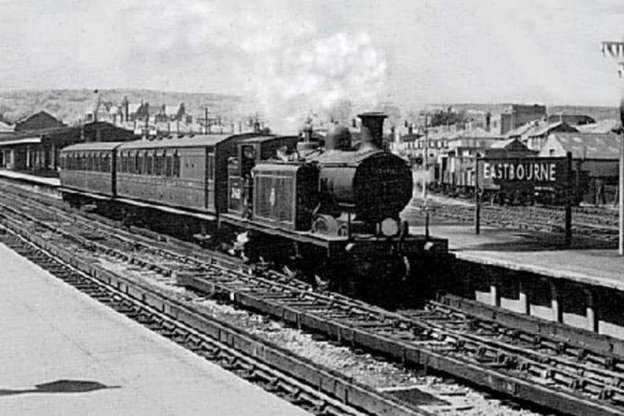
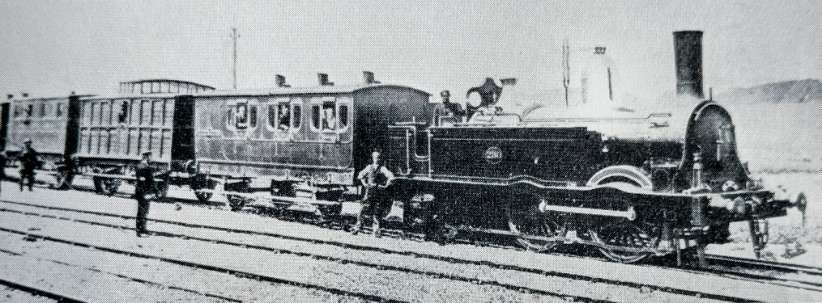
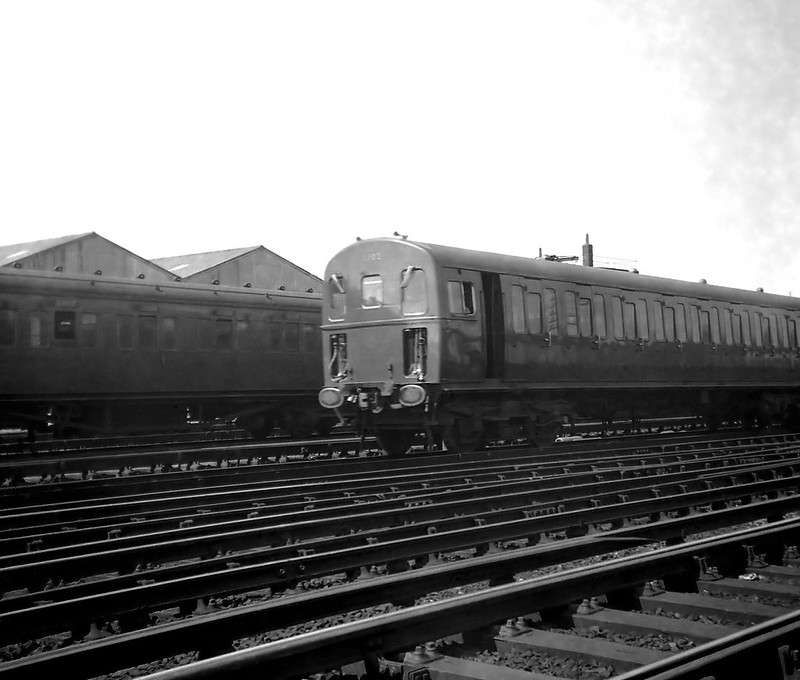
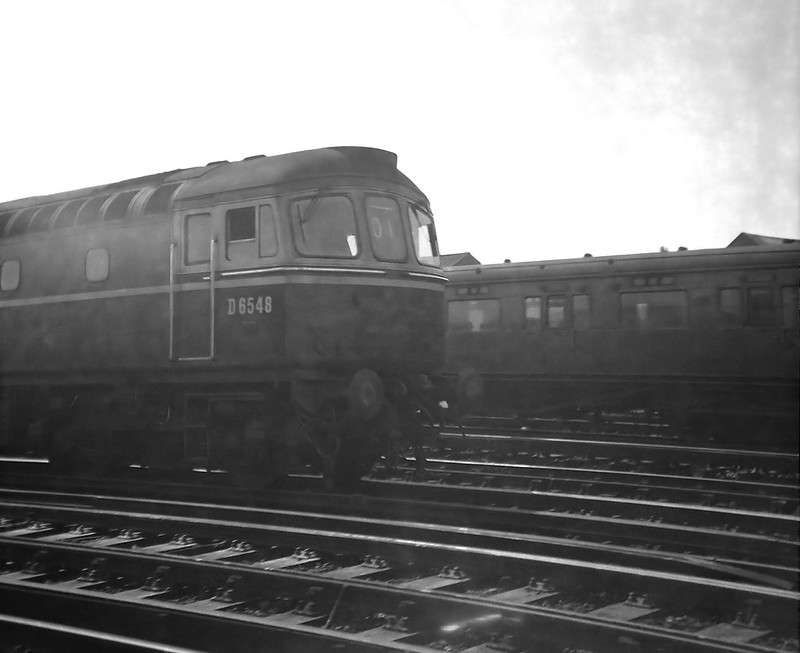
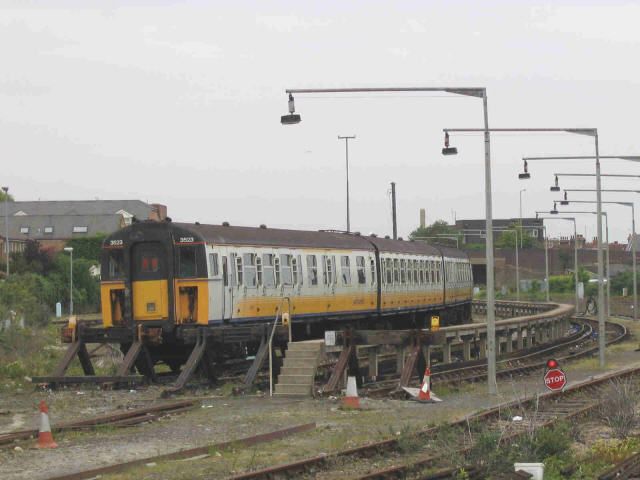
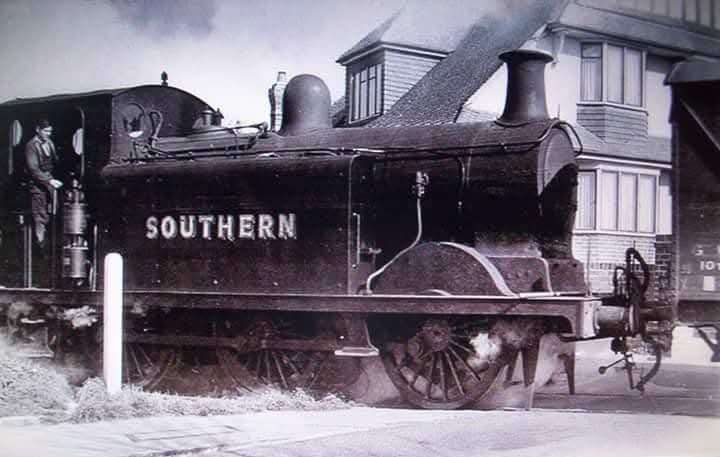
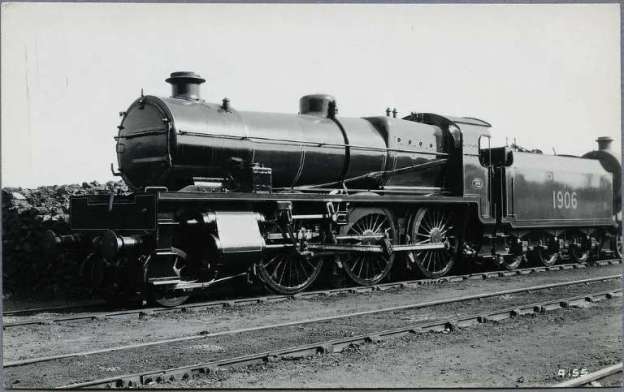
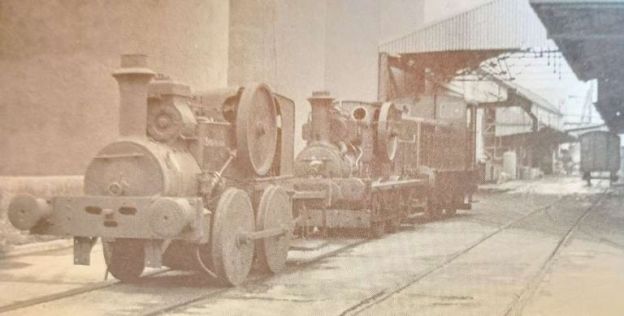
The featured image for this article shows a two coach train awaiting departure at Eastbourne Railway Station. It think that the locomotive is an ex-LB&SCR E4 0-6-2T in BR livery. These locomotives were originally numbered463-503, 507–520, 556–566, and 577-582. The number on the smoke box is not legible in the photograph. The exact locomotive shown in the photograph cannot easily be determined from the image.[21]
When the first railway was projected southwards from London to the Sussex Coast, its promoters had as their objective Brighton, which already was a well-established holiday resort. The eastern extension of this main line served the county town of Lewes, and had reached the western outskirts of St. Leonards by the summer of 1846, but it was not until 14th May 1849, that a 4.5-mile branch was opened from Polegate to serve Eastbourne, which was then little more than a village. The advent of the railway marked the beginning of the growth of Eastbourne as a holiday resort and residential area. At the end of the 1849s, Eastbourne’s population was around 2,500. By 1953, the town was a county borough, with a population of nearly 58,000, and in 2026 the population is around 105,000. [1] It has been suggested that the modern town of Eastbourne “was virtually created by the seventh Duke of Devonshire in the mid-nineteenth century, [but] there is little doubt that the advent of the former London, Brighton & South Coast Railway in 1849 was the influencing factor in promoting,” [3: p723] the growth of the town.
Since the inauguration of the line in 1849, the original modest terminus of the branch was twice superseded by a larger station. The first station was built in 1849, this was rebuilt in 1866 and rebuilt yet again in 1886. [2]
Stones writes: “An Act of 18th June 1846, authorised the London, Brighton & South Coast Railway Company (successors to the Brighton, Lewes & Hastings Railway) to construct two short lines from Polegate, to Eastbourne and Hailsham respectively, and these were completed and officially opened simultaneously on 14th May 1849. Originally, it had been intended that after leaving Polegate, the Eastbourne branch should pass through the village of Willingdon, and terminate in what is today the Old Town of Eastbourne, situated about a mile-and-a-half from the coast. However, because of the undulating nature of this route, and other considerations, it was finally decided to construct the line further to the East, with a terminus at the neighbouring and growing residential hamlet of South-Bourne, half-way between East-Bourne and the sea. As a result the Eastbourne branch, four-and-a-half miles in length, ran south-east from Polegate and traversed the Bourn or Willingdon Level, which forms part of an extensive plain extending to the east from the slopes of the South Downs. Although the terminal station was named ‘Eastbourne’ when the branch was opened in 1849, it was actually in South-Bourne, which was subsequently to disappear in name and become an important part of modern Eastbourne.” [3: p723,725]
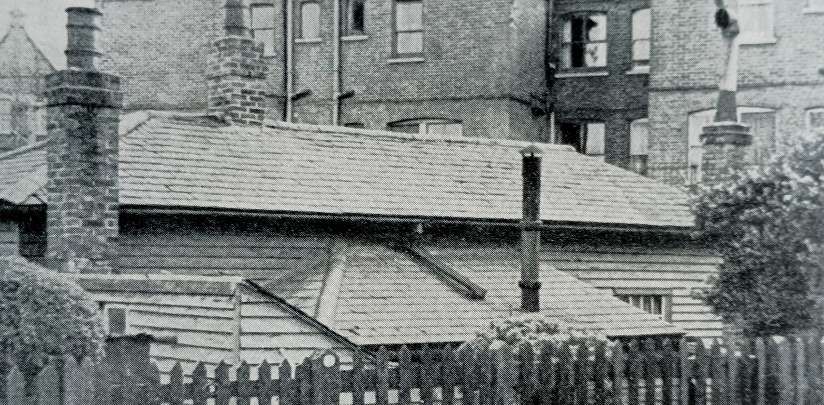
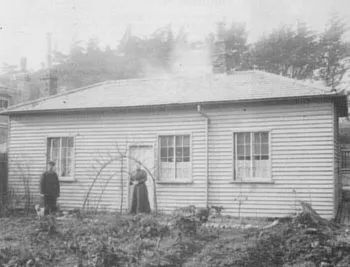
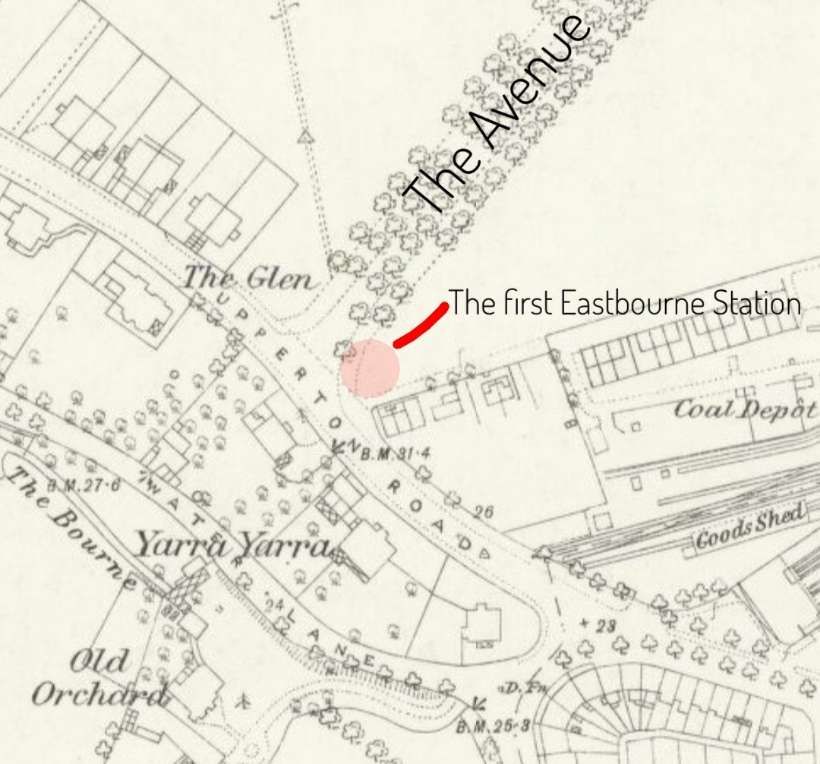
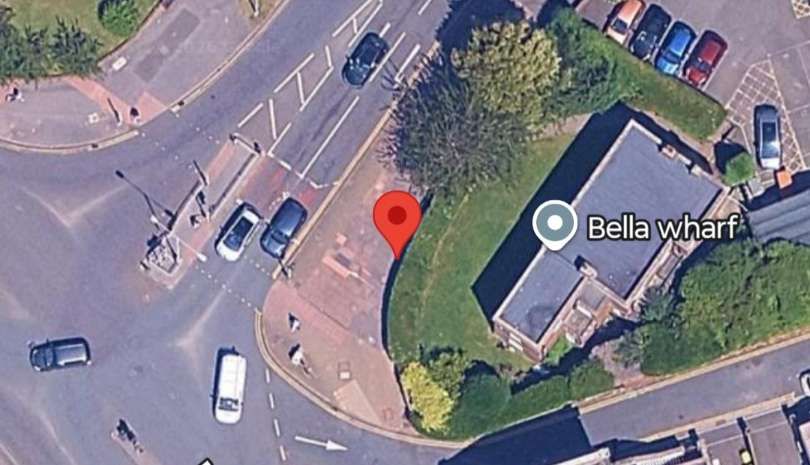
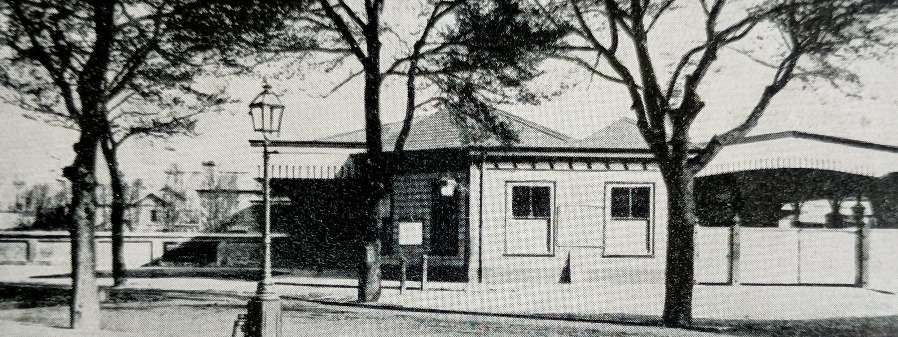
Stones tells us that “The first station at Eastbourne was situated to the west of the present terminus; the building was a small modest timber structure measuring 20 ft. by 12 ft. Several years later, the original station and tracks were removed to allow Upperton Road to pass over the site and link up with the main thoroughfare, Terminus Road. The old station building was moved and erected on the west side of the existing goods yard where it was converted into a dwelling house at present known as No. 1, Wharf Road.” [3: p725] In 1953, the building still stood but was over-shadowed by modern buildings.
Another view of the original station building, this time in its original location close to the end of The Avenue. [4]
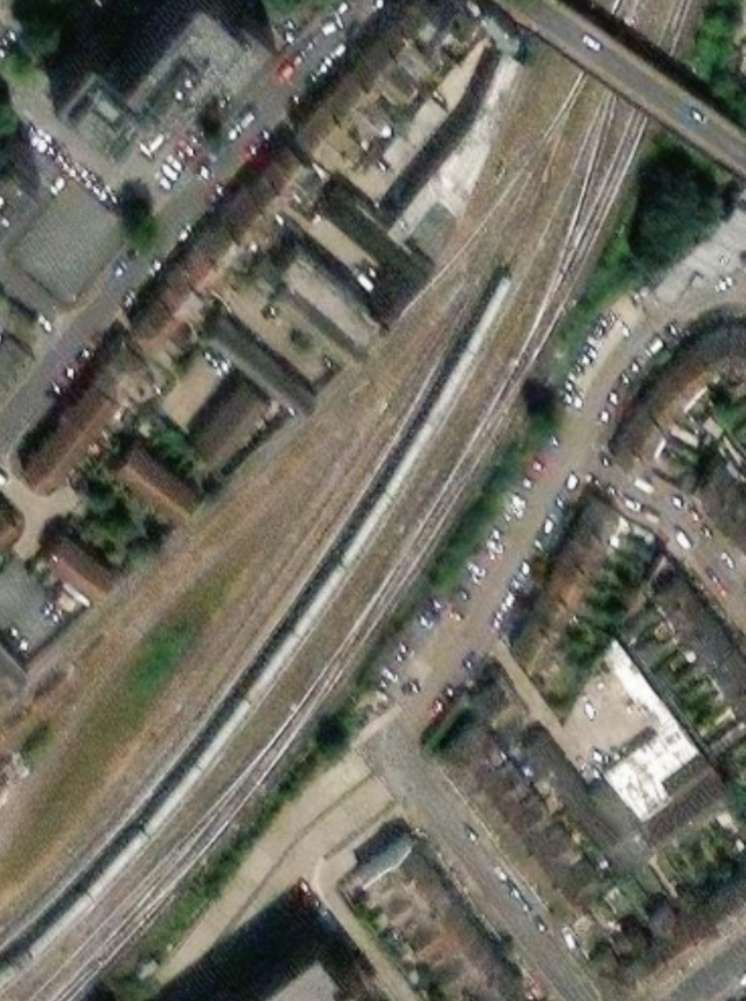
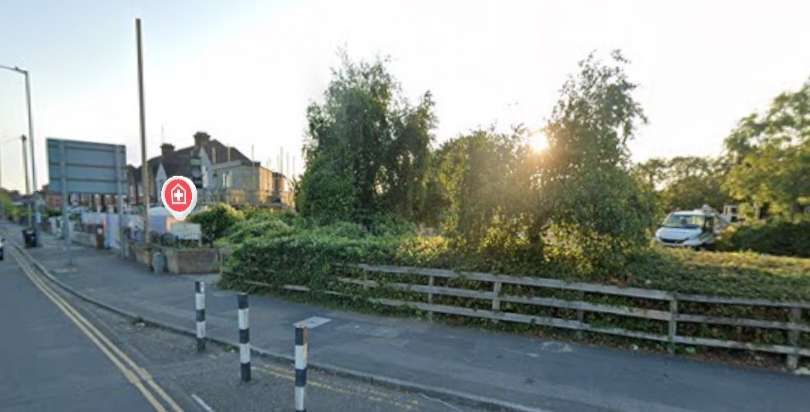
The first Eastbourne Station sat close to the end of The Avenue. [5]The red flag marks the approximate location of the original Eastbourne Station. The road to the Northwest of the flag is ‘The Avenue’, the road junction is with Upperton Road. [Google Maps, August 2026]
Stones tells us that when the line was opened, “two engines were stationed at Eastbourne but one was always kept in reserve. The other worked a shuttle service of local trains between Eastbourne and Hailsham via Polegate, where, at that time, the engine had to run round its train. At the commencement there were few trains, but by 1854 the service had increased to nine trains in each direction on weekdays. Passengers for London, Brighton, and Hastings were obliged to change at Polegate for some years, and this inconvenience proved a constant source of annoyance to Eastbourne residents, who considered that the importance of the town was being relegated by the poor railway facilities provided. This opinion was substantiated by the fact that in Bradshaw’s Monthly Descriptive Railway Guide for June 1857, the timetable did not even mention Eastbourne, and gave Brighton, Newhaven, St. Leonards, and Hastings as the important stations on the coast.” [3: p725]
In 1866, or perhaps as late as 1872, a replacement station was constructed at the corner of Terminus Road and Gildredge Road.
Apparently, the connecting service between Eastbourne and London in 1866 comprised seven trains daily in each direction.
Improvements to the service to and from London occurred in 1875 when, Stones writes, “several trains running between London and Hastings were provided with through coaches to and from Eastbourne, which were attached or detached at Polegate. At the same time, the 5 pm express from London Bridge to Brighton slipped a portion (first class only at ordinary fare) for Eastbourne at Haywards Heath.” [3: p725-726]
It was not until September 1880 that Eastbourne was finally connected with Tunbridge Wells when a line from Hailsham to Eridge was opened. “On 1st April 1884, a service of two expresses daily in each direction between Charing Cross and Eastbourne was inaugurated. … The new service did not prove a success … and was withdrawn on 31st December 1885” after agreement had been reached between the SER and the LB&SCR for a sharing of traffic receipts. [3: p727]
By 1904, agreement had finally been reached between the LB&SCR and the LNWR to run through coaches between Liverpool and Brighton and Eastbourne. Stones says, “This popular innovation, which obviated crossing London, soon developed into what was known as the ‘Sunny South Special’, which conveyed through portions from Liverpool (Lime Street), Manchester (London Road) and Birmingham (New Street). Up to the time of grouping this train was composed of LNWR. rolling stock, and included dining-car facilities. The service commenced to run daily (Sundays excepted) in each direction on 23rd July 1904, via Brighton and terminating at Eastbourne.” [3: p728]
At the time Stones was writing in 1953, the service had not been resurrected after the war.
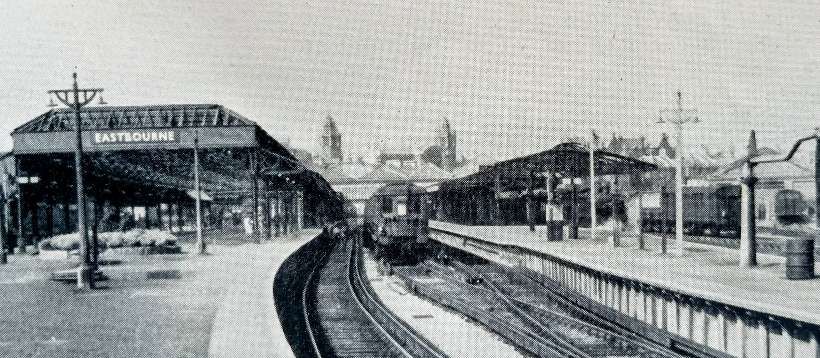
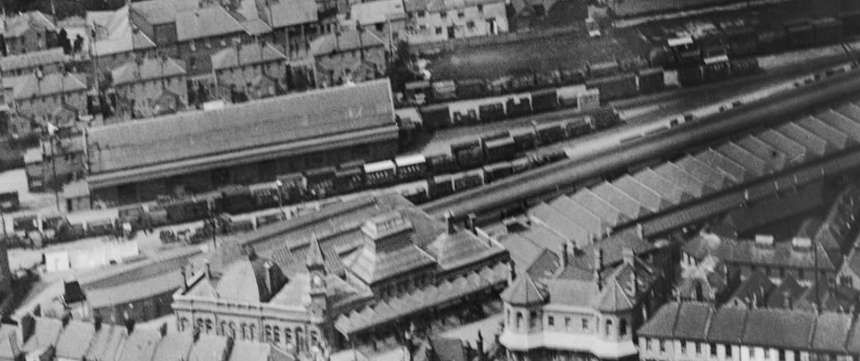
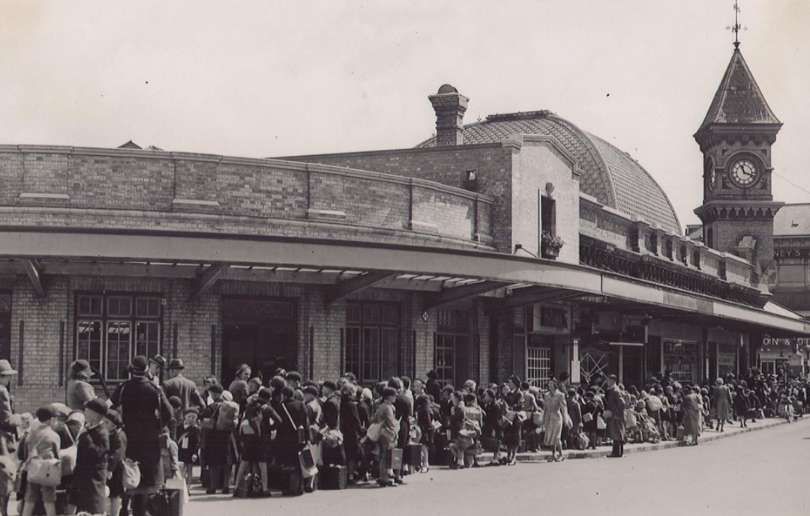
In 1953, Stones described Eastbourne Station: “The present station at Eastbourne consists of two island platforms served by four terminal tracks capable of holding 12-car electric trains. On the east side of the station there is a covered roadway for taxis and other vehicles between platforms 3 and 4, originally known as the arrival side. The platforms lead to a large circulating area around which are located the refreshment and dining rooms, waiting rooms, parcels office, and so on, with the booking hall at the western entrance to the station. During the second world war, the platforms and tracks were severely damaged by bombs on several occasions, and although most of the repairs have been completed, part of the platform awnings are still of a temporary character.” [3: p728]
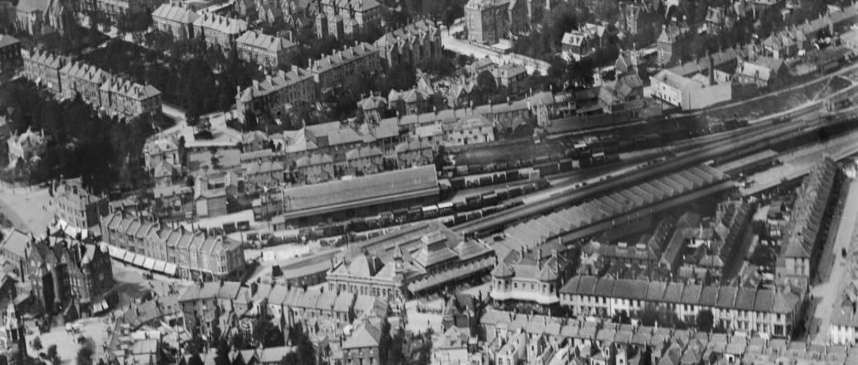
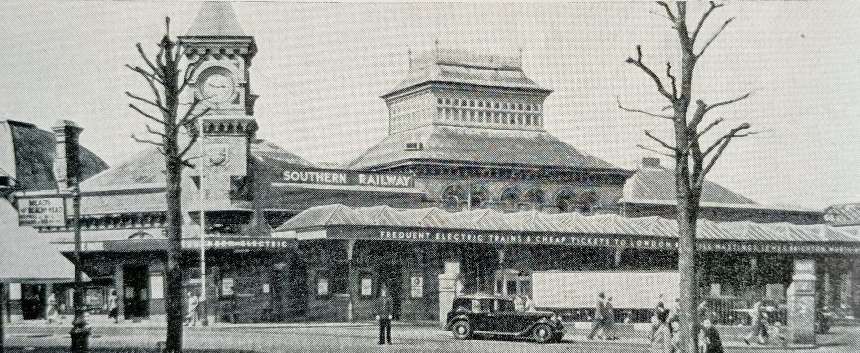
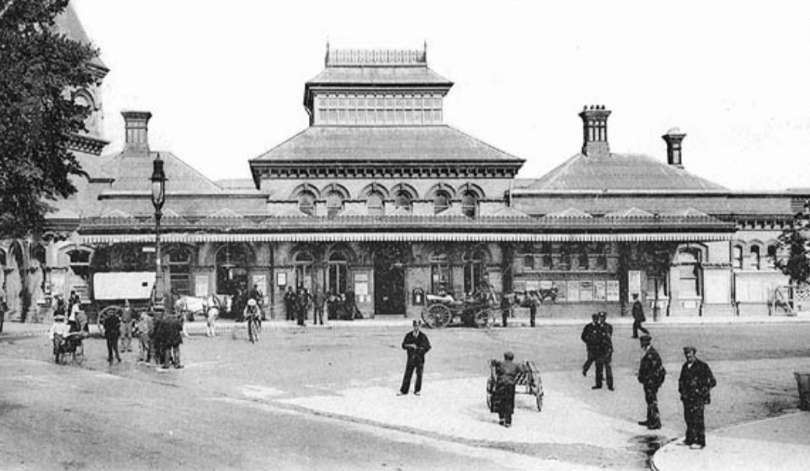
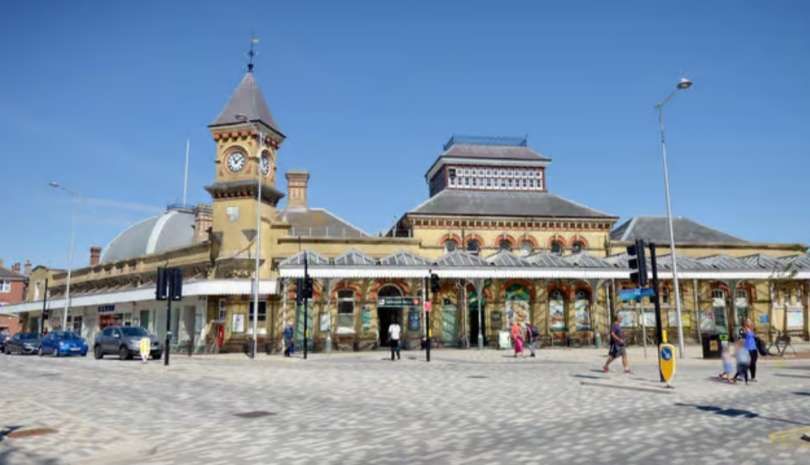
The present building is essentially that which was built in 1886, designed by F.D. Brick, which had a vaulted canopy and lantern roof, similar to Lewes. “The station had 4 platforms which increased in length over the years. There was also two run around loops between platforms 2 and 3. Over the years one of the runaround loops was lost as platforms 1 and 2 were built wider. On 12th April 1977 platform 4 was shortened from a 12 coach to an 8 coach length to make way for the ring road construction. And was taken out of use and the track lifted during the Eastbourne re-signalling in 1991.” [7]
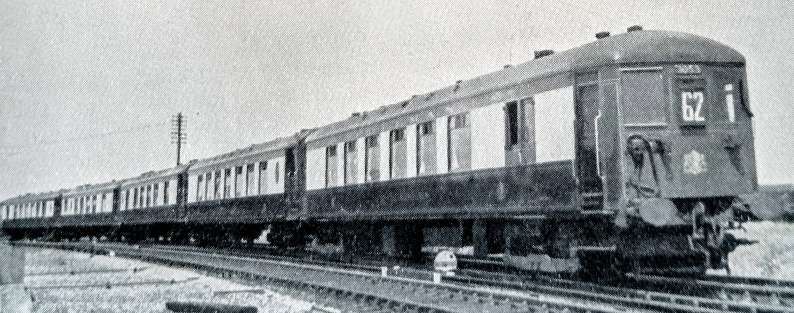
The line into Eastbourne was electrified by July 1935. Stones comments in 1953 that: “the number of trains to and from London (Victoria and London Bridge) has been increased and there is now an hourly service of fast electric trains with Pullman or buffet-car facilities; the journey takes about 1 hour 25 min. The fastest timing maintained during the summer months is by the non-stop all-Pullman train, successor to the former “Eastbourne Sunday Limited” inaugurated by the LB&SCR many years ago. This train, which makes one round trip on Sundays only, covers the down journey in 79 min. With the exception of the steam trains from Eastbourne to Hailsham and Tunbridge Wells, the remaining local passenger services, to and from Brighton and Hastings, are all operated by two- or four-car electric trains.” [3: p728]
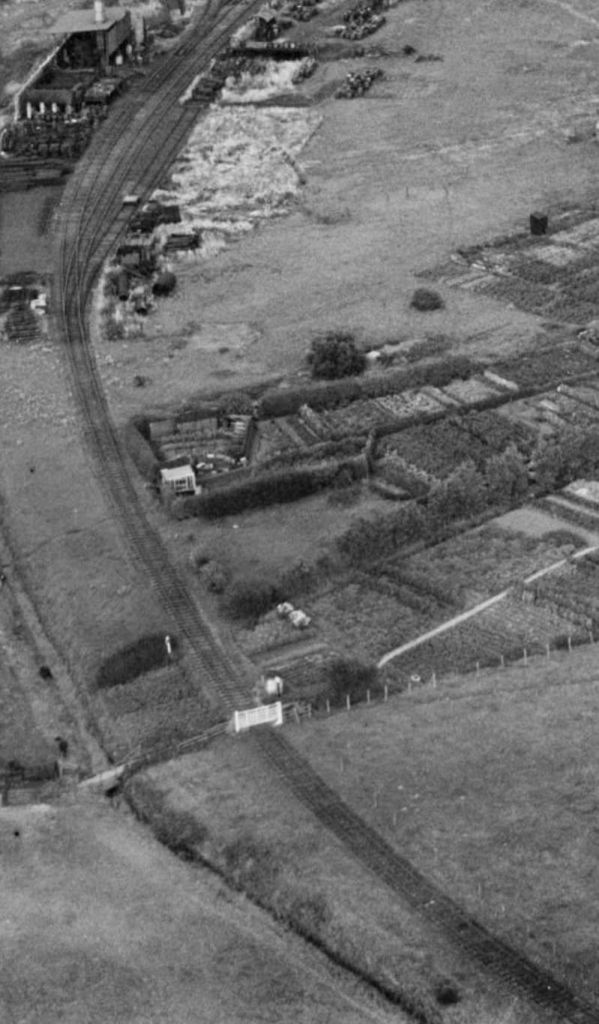
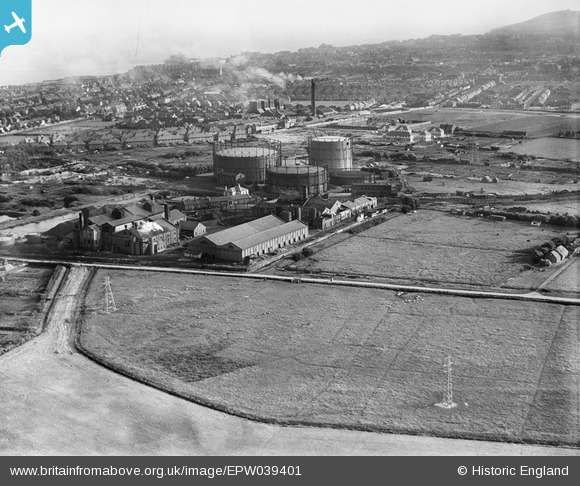
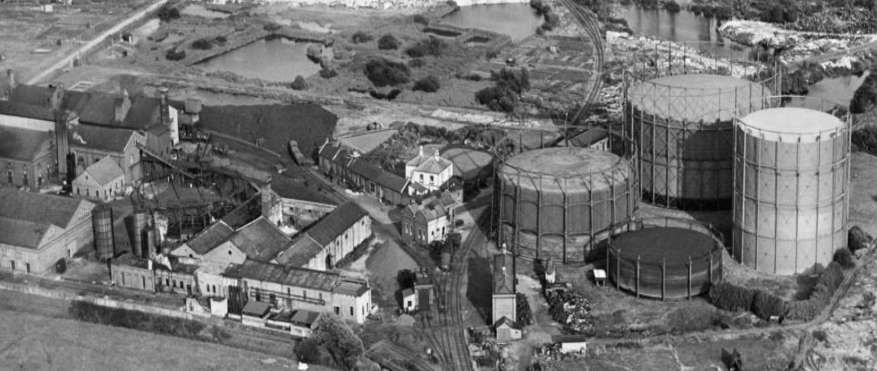
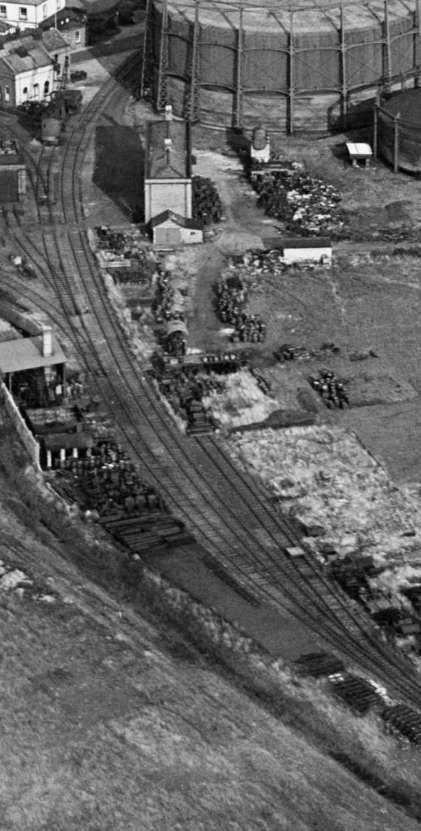
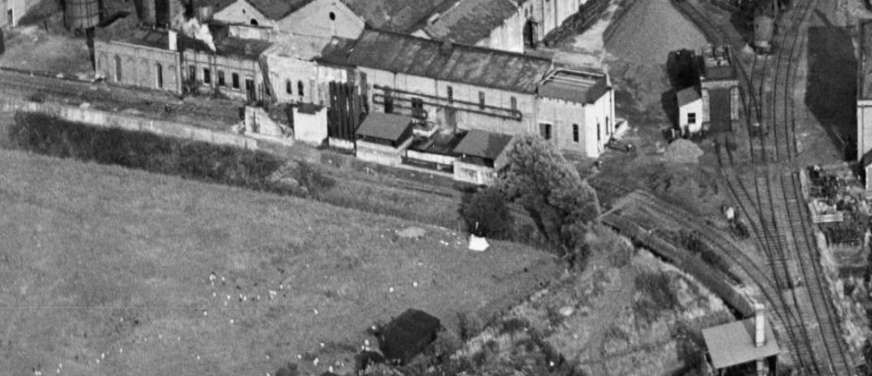
Stones continues: “West of the passenger station lie the goods shed and yard, and carriage sidings for both electric and steam rolling stock. A short distance from the terminus on the east side of the line is the coal yard, and, beyond, a siding about a mile in length runs in an easterly direction to serve the local gas and electricity works. This siding was formerly known as the Crumbles Branch as originally the line continued on to that part of the sea-shore called “The Crumbles,” where the LB&SCR installed a shingle ballast plant. Because of the extended use of stone ballast, this was dismantled some years ago and the extension to the coast was taken up. Traffic in and out of the passenger station, goods yard, carriage sidings and locomotive depot is controlled by one signal cabin with a manual frame of 72 levers, which is situated at the entrance to the terminus on the east side of the line.” [3: p728]
Stones writes: “The existing locomotive depot at Eastbourne is located about half a mile from the passenger station on the west side of the line and is connected by a single track running parallel with the up and down main lines. The site on which the depot stands was purchased by the LB&SCR in the early part of the present [20th] century for new carriage and wagon works to replace older and smaller installations at Brighton. However, because of opposition from the local authorities, the scheme was abandoned and the works were eventually constructed at Lancing.” [3: p729-730]
Stones tells us that “The present running shed, which is of the through type, was built in 1911 to replace an earlier and smaller shed of the half-roundhouse type opposite the signal cabin on a site now occupied by the carriage sidings at the station. Since electrification, Eastbourne shed has lost much of its importance and now houses only a few locomotives for goods and shunting services and for the local passenger trains to and from Hailsham and Tunbridge Wells. In recent years, several of the sidings adjoining the shed have been used to stable spare locomotives and those waiting to be broken up. During the war, the shed was severely damaged by air attack.” [3: p730]
In the paragraphs above, Stones has identified a number of interesting features of the station:
Goods Shed, Sidings and Coal Yard
Carriage Sidings
The mile long siding which was once the start of the ‘Crumbles Branch’
The Shingles Ballast Plant
The history of the engine shed
A. Goods Shed, Sidings and Coal Yard
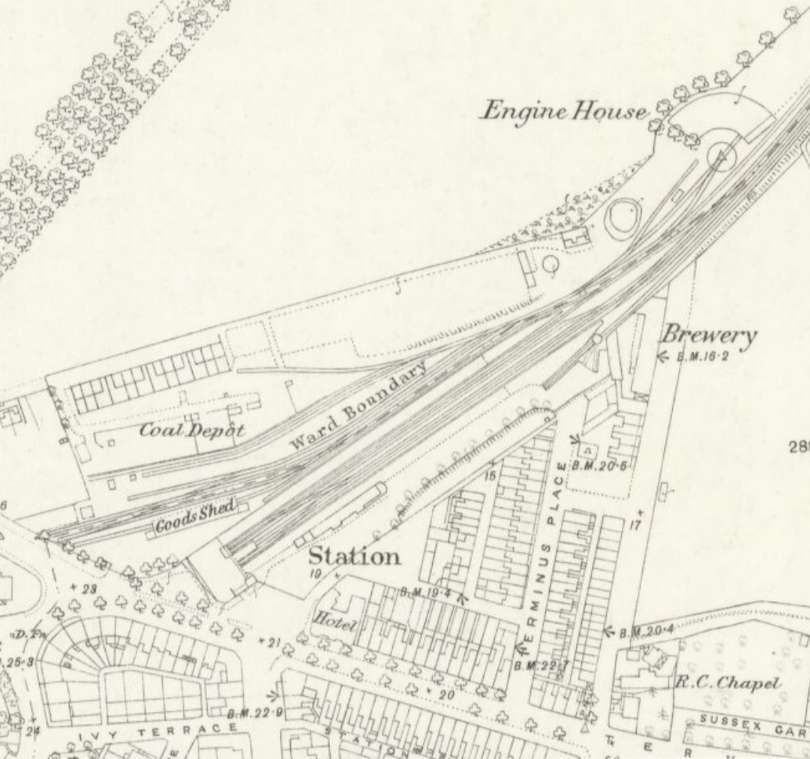
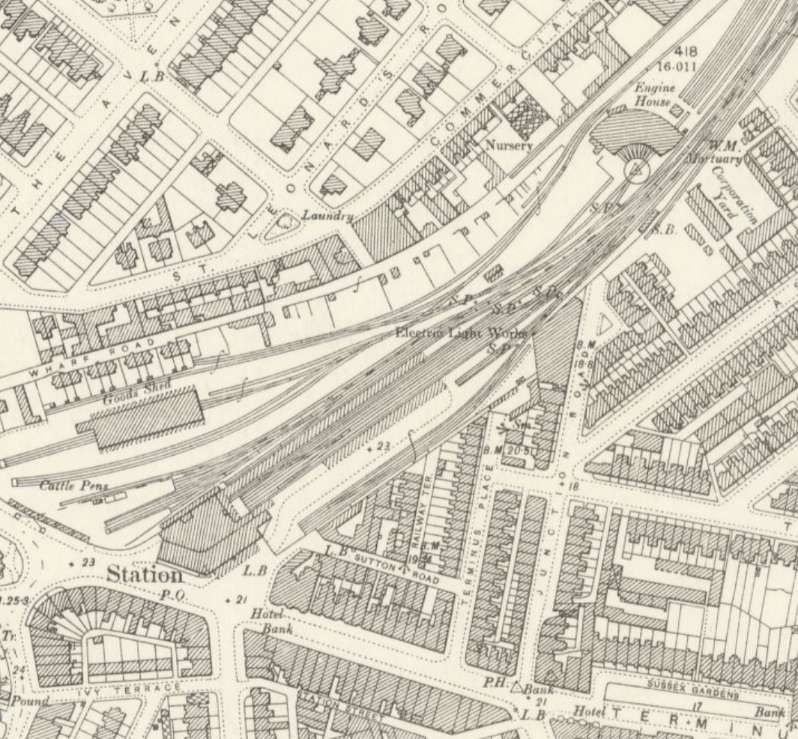
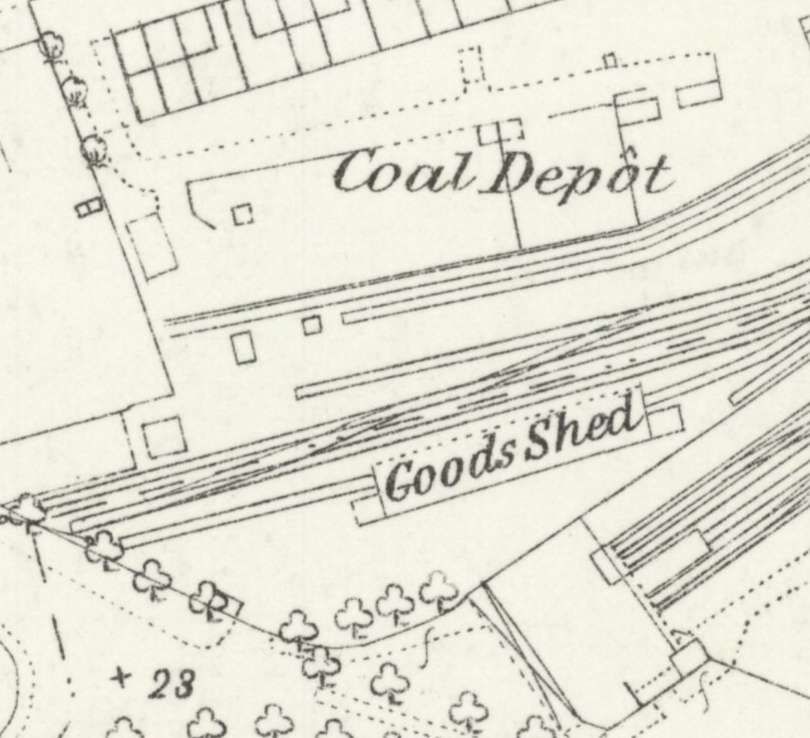
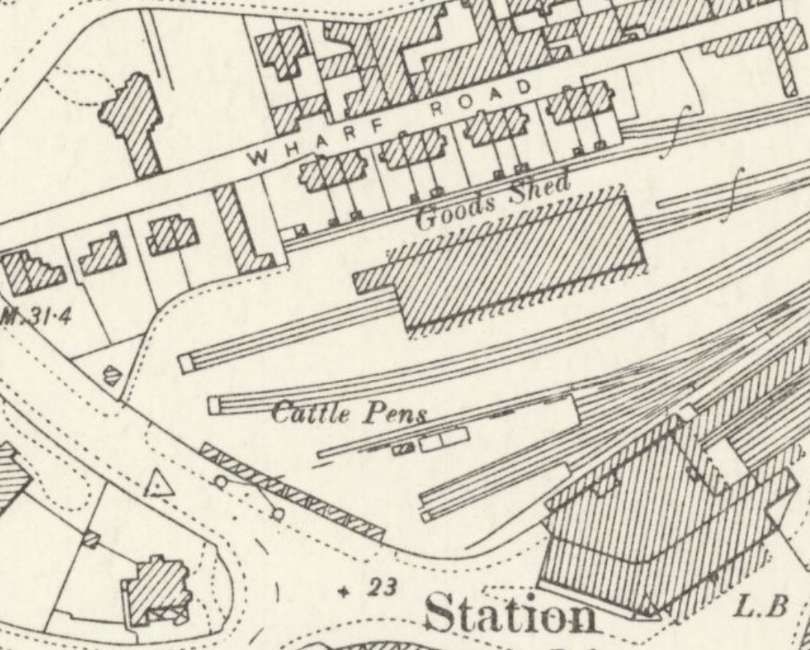
The following sequence of extracts from 25″ Ordnance Surveys in chronological order, illustrates the changes in the layout of the goods facilities at Eastbourne over time
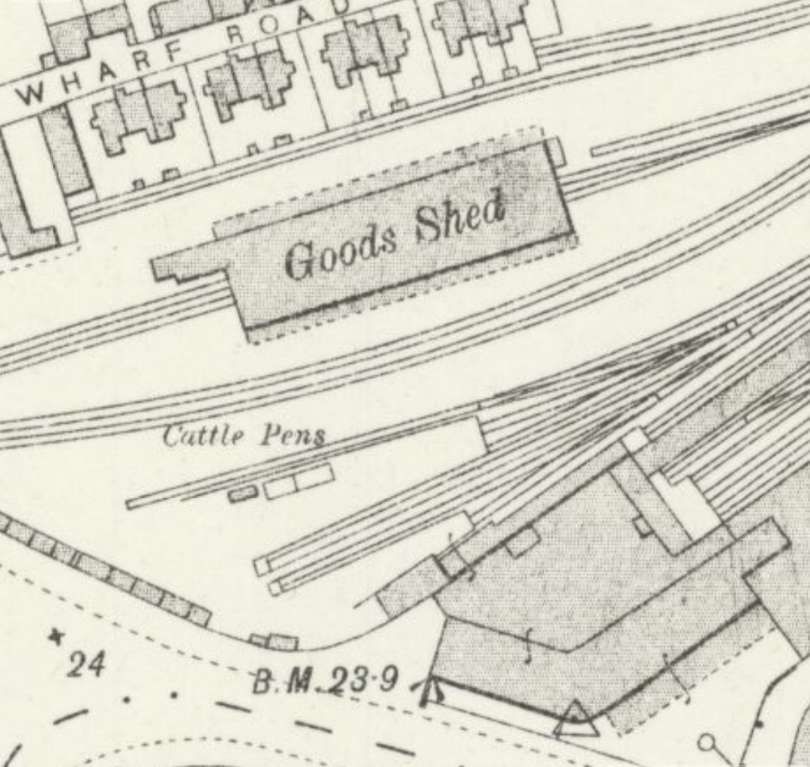
The Goods Shed, the immediately adjacent sidings and the Coal Depot at Eastbourne Station as shown on the 25″ Ordnance Survey of 1874, published in 1876. [5]
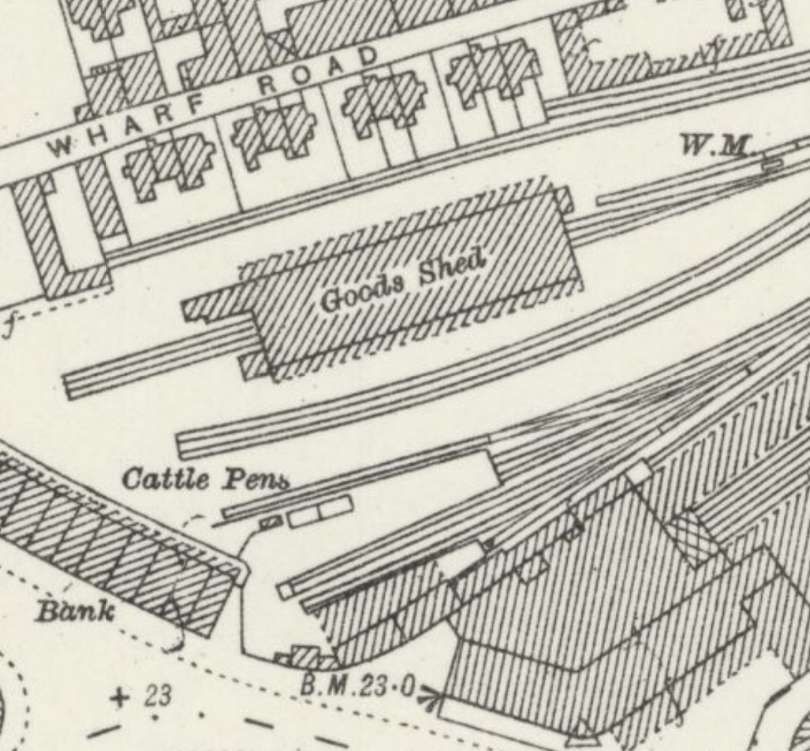
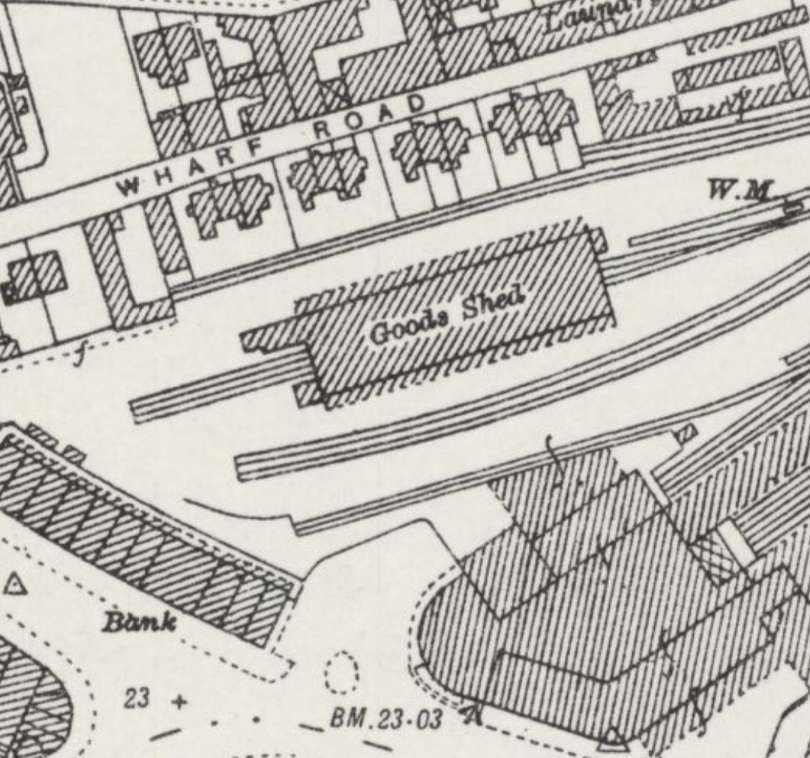
The Coal depot disappears between 1874 and 1898 and Wharf Road takes its place. The coal wharf might be the original of the name of the road. Holding seems to have been built on the site of the old coal depot. The Goods Shed seems to have been rebuilt a distance from the passenger station and cattle pens have been added to the site.
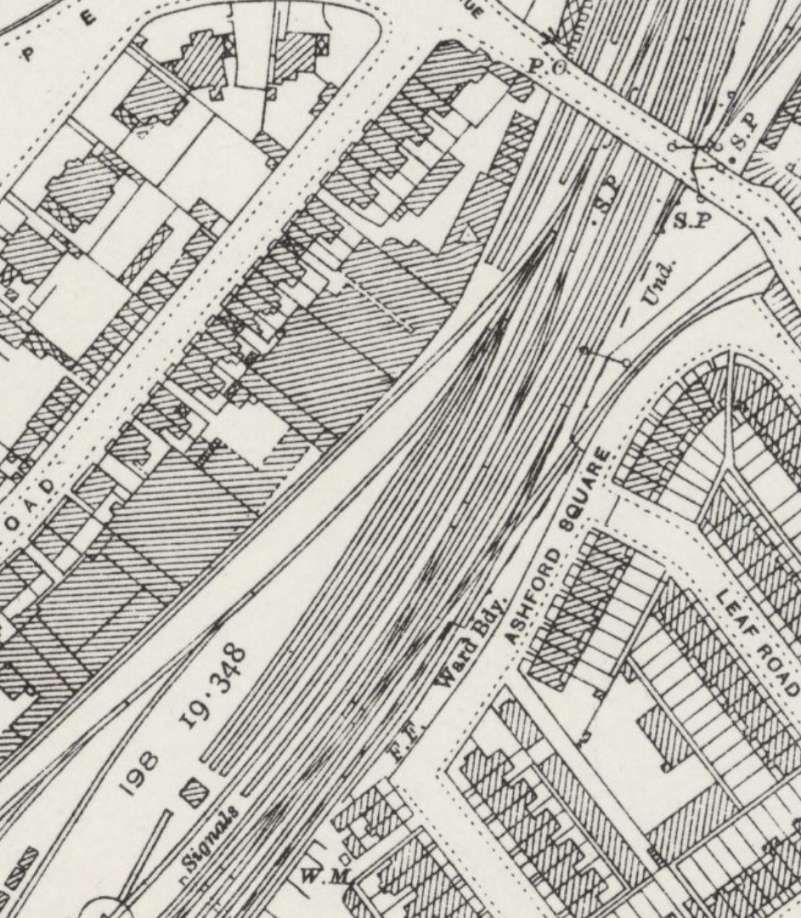
The rebuilt Goods Shed, the immediately adjacent sidings and the Cattle Pens at Eastbourne Station as shown on the 25″ Ordnance Survey of 1898, published in 1899. Note the rebuilt station buildings. [6]The Goods Shed, the immediately adjacent sidings and the Cattle Pens at Eastbourne Station as shown on the 25″ Ordnance Survey of 1908, published in 1910. No significant changes appear to have occurred since 1898. [9]The Goods Shed, the immediately adjacent sidings and the Cattle Pens at Eastbourne Station as shown on the 25″ Ordnance Survey revised and published in 1925. [10]The Goods Shed, the immediately adjacent sidings at Eastbourne Station as shown onthe 25″ Ordnance Survey of 1931/32, published in 1933. [11]
B. Carriage Sidings
In the 21st century, the carriage sidings provide stabling and overnight parking for Southern Class 377 and Class 442 Electric Multiple Units (EMUs). They include a carriage cleaning road and an engineer’s siding.
The site of the current carriage sidings occupy the historic location of Eastbourne’s early engine sheds (opened in 1849 and later replaced in 1876 and 1911 – see the paragraphs about the engine sheds below). The track layout and sidings were historically controlled by Eastbourne’s Victorian signal box built in 1882. [17]
Eastbourne’s carriage sidings sit at the centre of this map extract from the 25″ Ordnance Survey of 1931/1932, published in 1933. [19]The carriage sidings in the 21st century: the sidings were extended through what was the site of the old roundhouse engine shed in the middle of the 20th century. [Google Maps, October 2026]
A separate article covers this line. It can be found here. [16]
D. The Shingles/Crumbles Ballast Plant
The ballast plant on the Shingles (Crumbles) at Eastbourne was served by the Crumbles Branch. The Crumbles was a vast, desolate expanse of coastal shingle and marshland east of Eastbourne. The LB&SCR recognized the immense value of the site’s heavily compacted beach shingle and negotiated the purchase of large quantities of shingle from the local landowner, the Duke of Devonshire. They installed a dedicated shingle ballast plant directly on the shore to extract, process, and load the aggregate. At its height, the operation was removing roughly 250,000 tons of shingle per year. This material was vital for providing the structural foundation (ballast) for railway tracks across the southeast of England and was even shipped to London for projects like the construction of the Thames Embankment. [20]
By the 1920s and early 1930s, the newly formed Southern Railway began phasing out smooth beach shingle in favour of sharper, more durable angular granite chippings. The ballast plant closed in 1932. Please also look at the dedicated article about the Crumbles Branch, here. [16]
E. The Engine Sheds
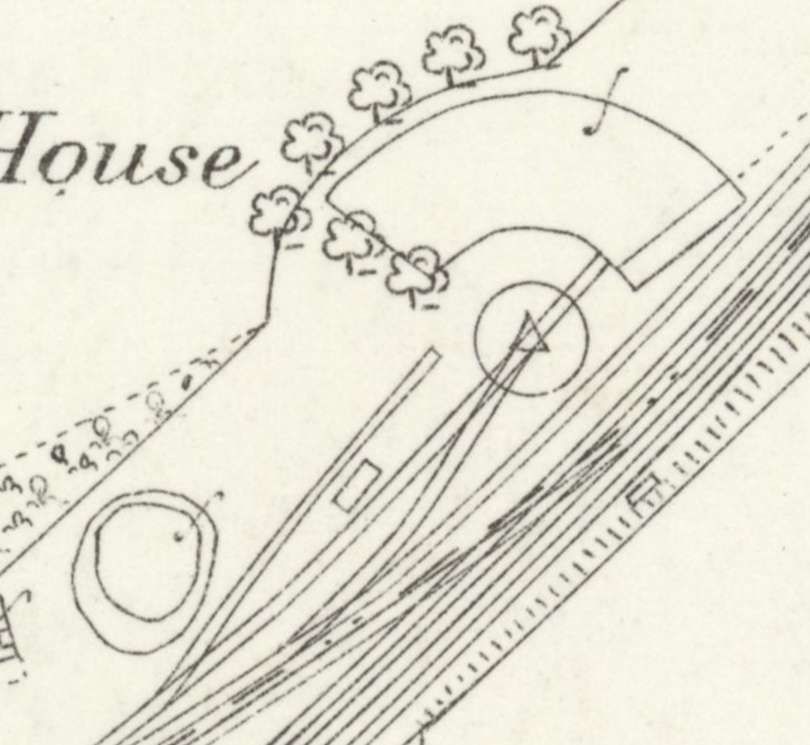
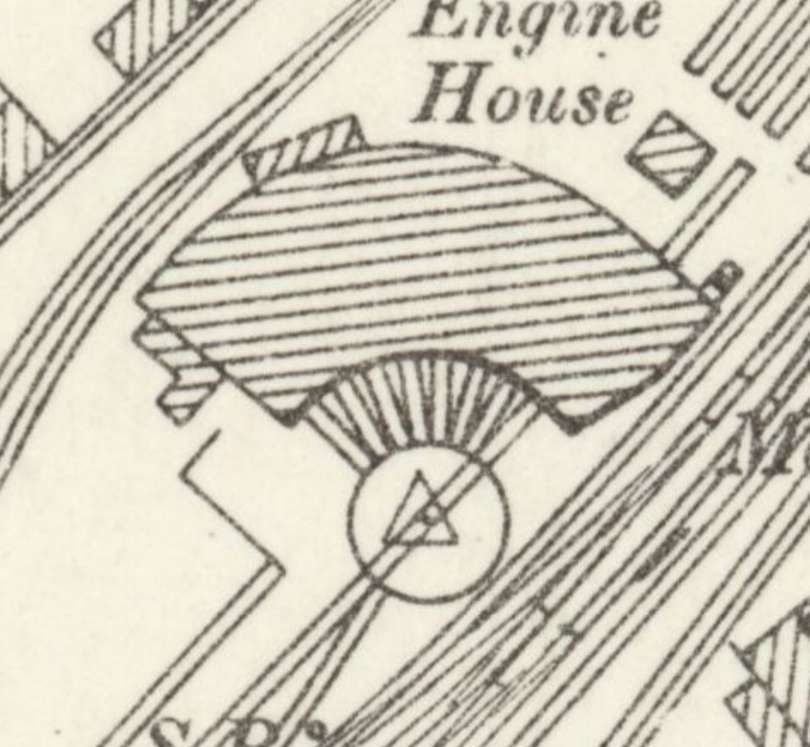
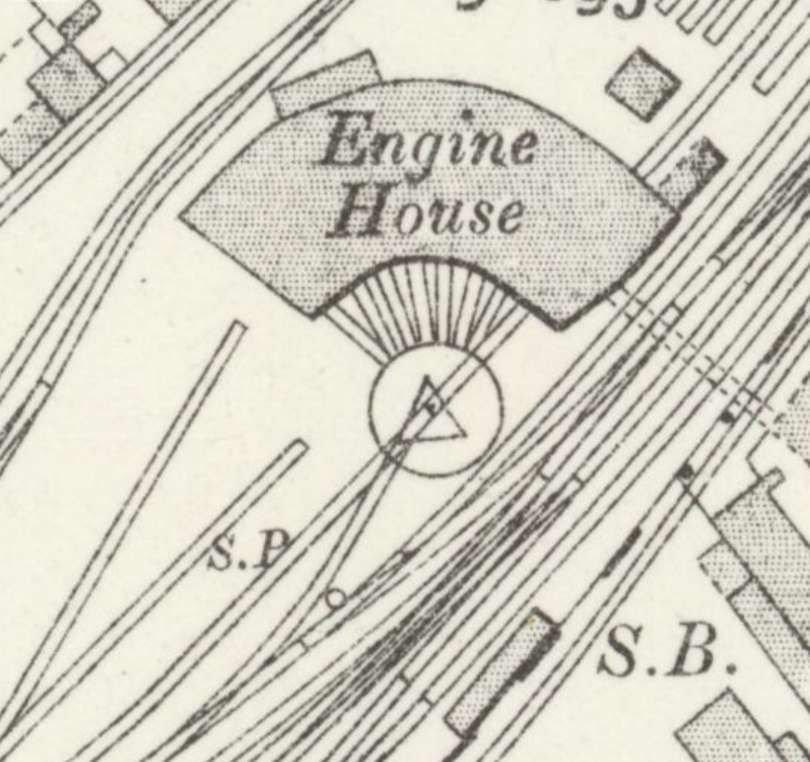
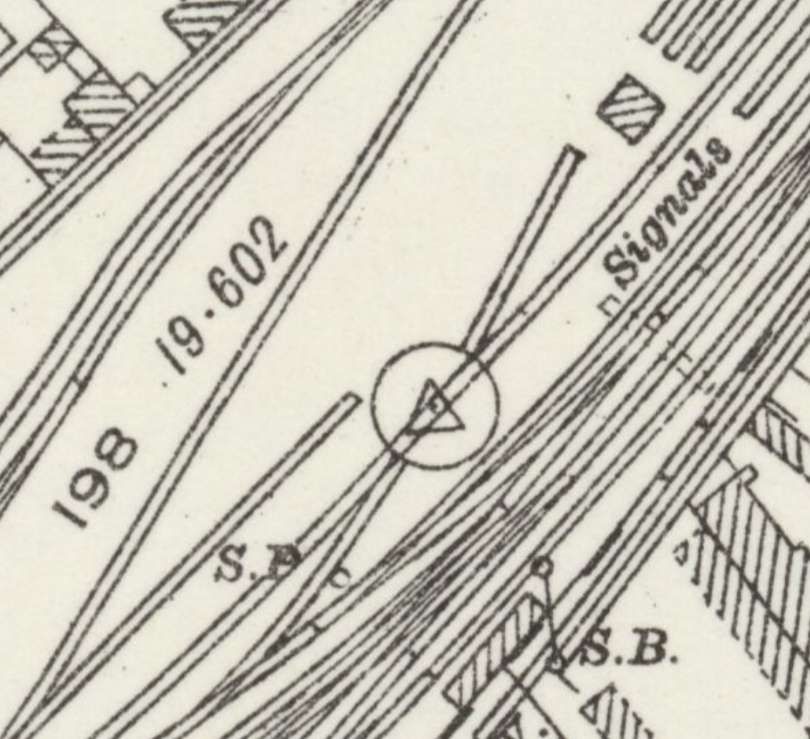
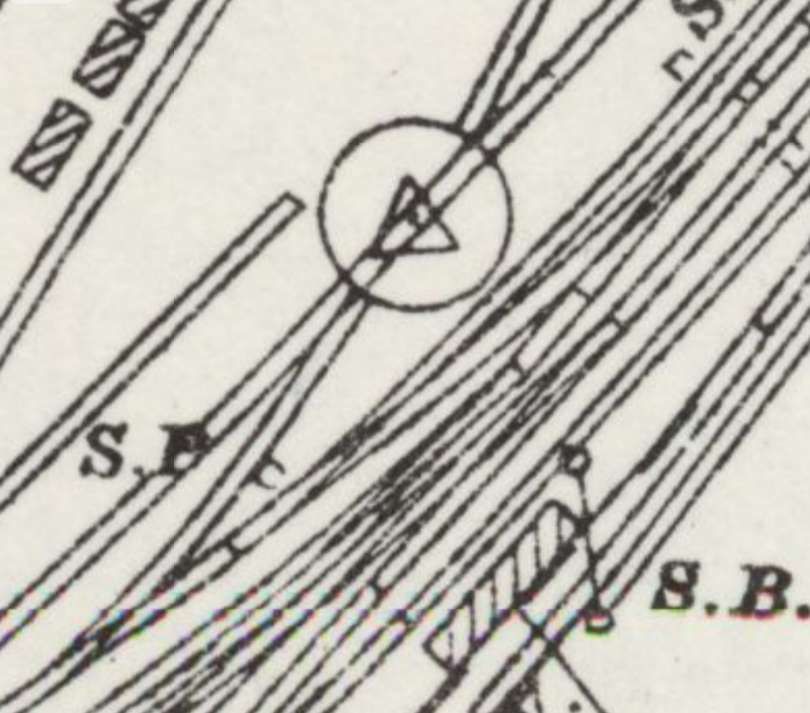
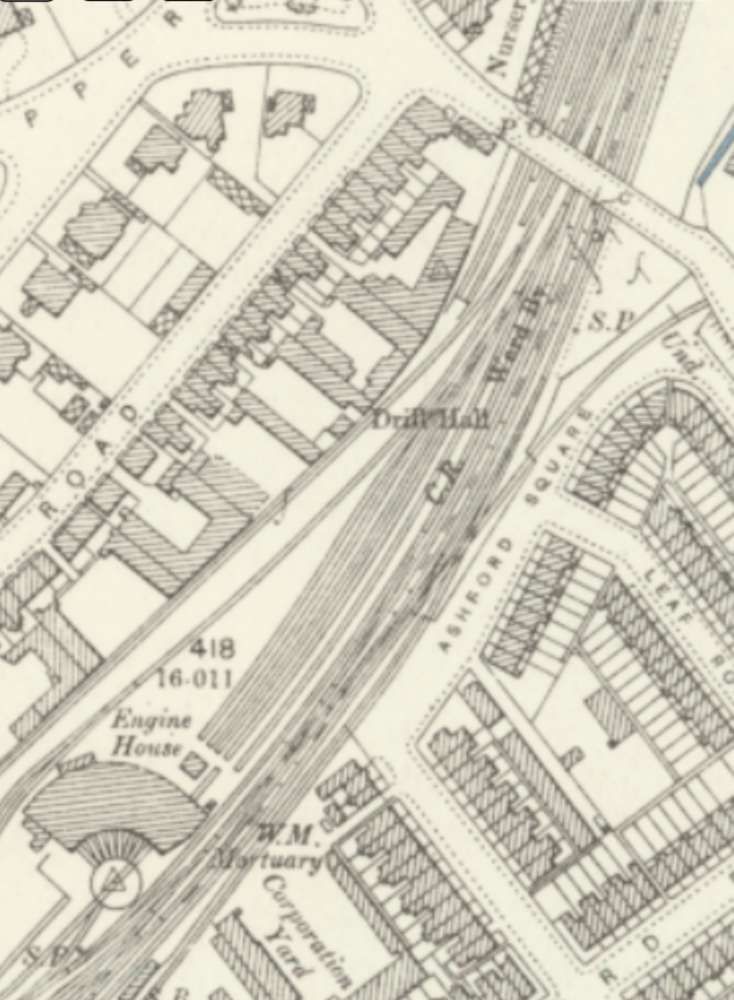
By 1874 a roundhouse engine shed and turntable sat alongside the line out of Eastbourne Railway Station. That structure was still in place at the time of the 1908 Ordnance Survey, but had gone by the time of the 1925 Ordnance Survey.
The roundhouse engine shed at Eastbourne as shown on the 25″ Ordnance Survey of 1874, published in 1876. [5]The roundhouse engine shed at Eastbourne as shown on the 25″ Ordnance Survey of 1898, published in 1899. [6]The roundhouse engine shed at Eastbourne as shown on the 25″ Ordnance Survey of 1908, published in 1910. [9]The location of the roundhouse engine shed at Eastbourne as shown on the 25″ Ordnance Survey revised and published in 1925. [10]The location of the original roundhouse engine shed at Eastbourne as shown on the 25″ Ordnance Survey of 1931/32, published in 1933. [11]
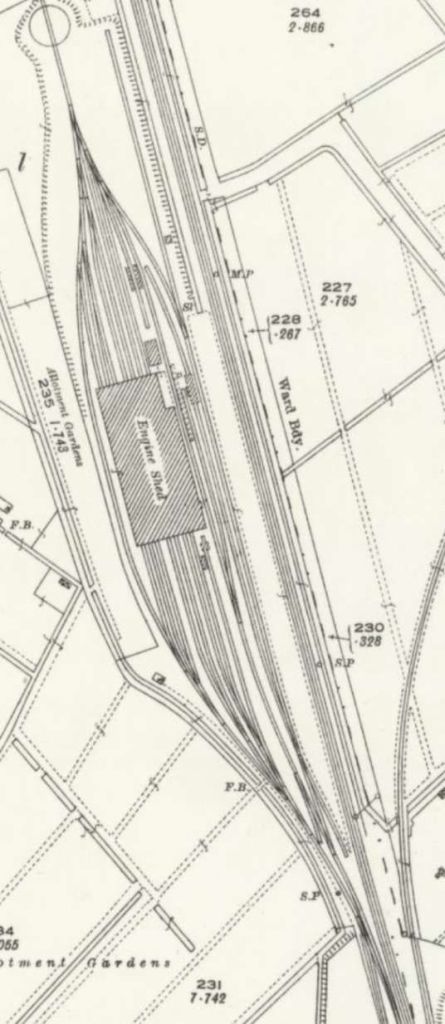
The site of the new engine shed at Eastbourne, as it appears on the Ordnance Survey of 1925. It was built to replace the original shed which had sat much closer to the station. This location is to the North of Whitley Road. Note the Crumbles Branch which moves away from the main line and heads North-northeast. [13]
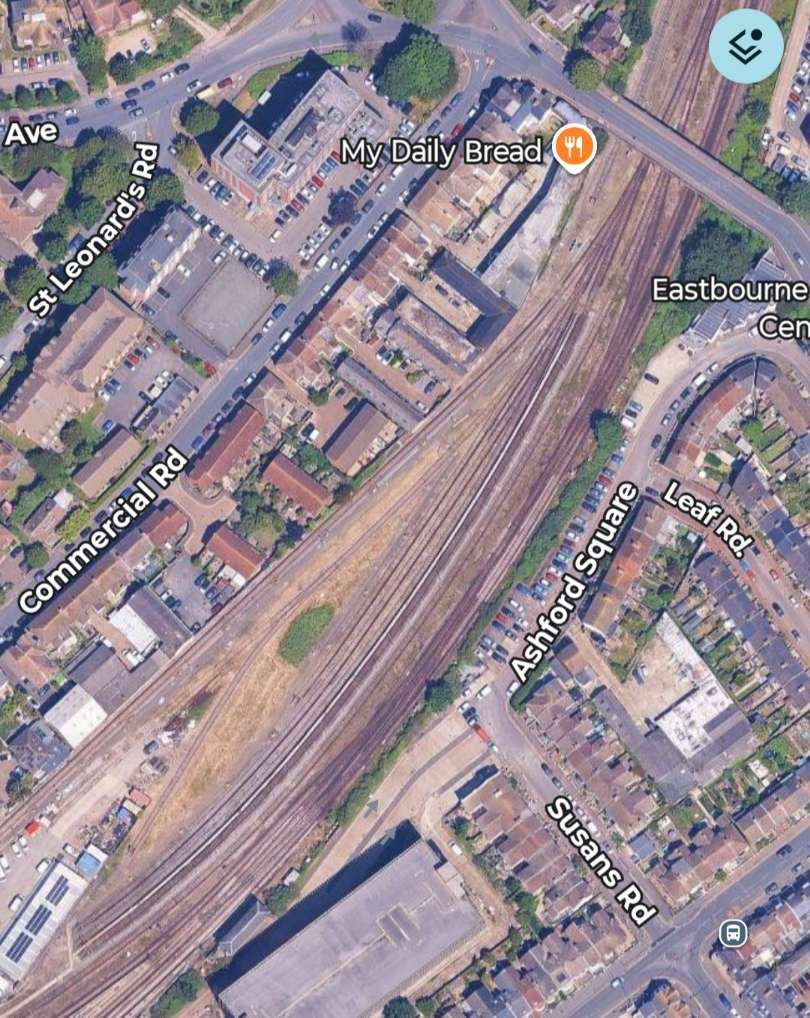
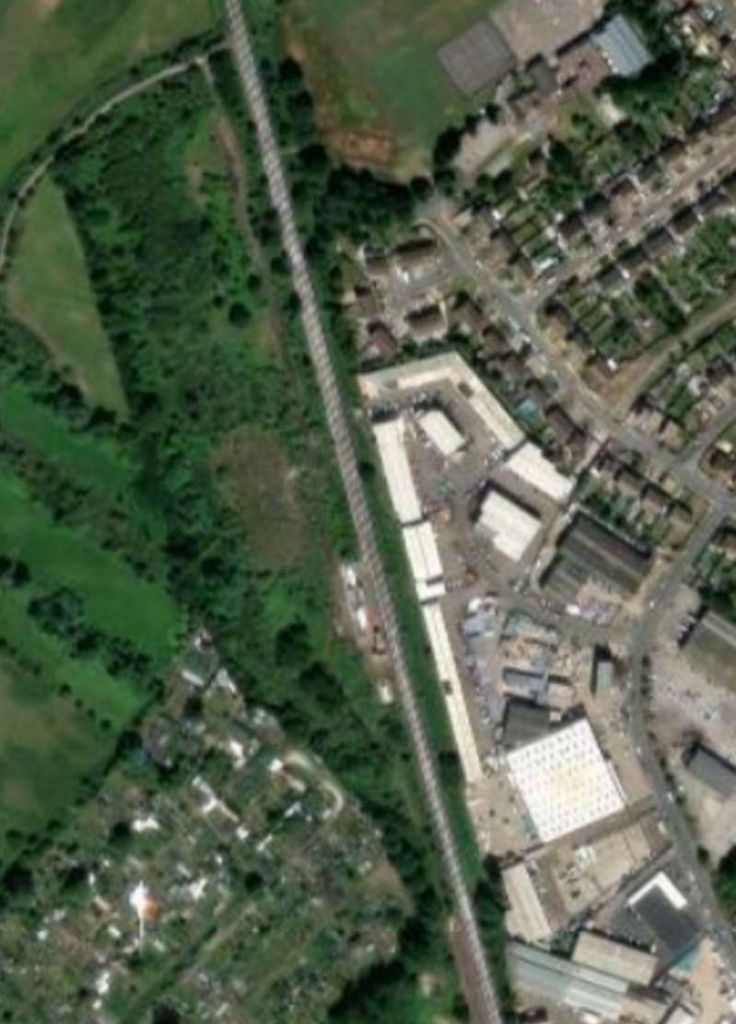
This satellite image is an extract from the ESRI satellite imagery provided by the NLS. The area once occupied by the Engine Shed can be seen with hedges boundaries to the West of the main running lines. The line of the erstwhile Crumbles Branch can also be seen. It is marked by the industrial property boundaries to the East of the main running lines and curving away to the East. [14]
Locomotive Names
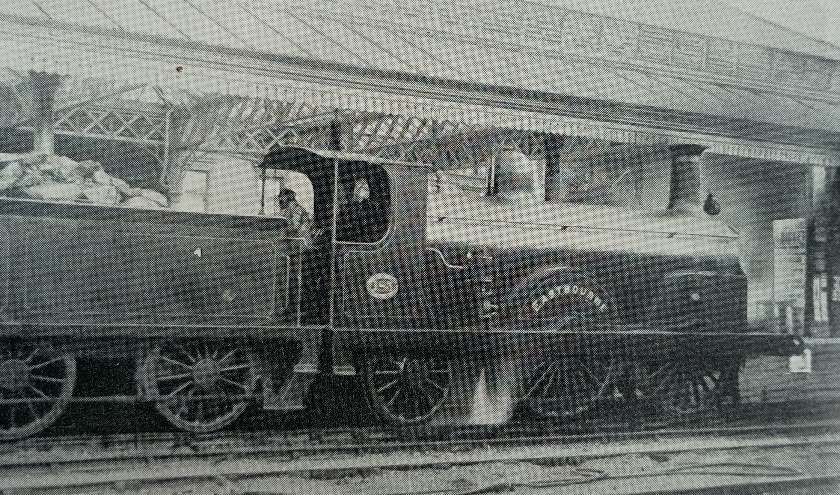
Both the LB&SCR. and its successor, the Southern Railway, honoured Eastbourne by allocating several locomotive names directly associated with the town. As early as 1881, William Stroudley gave the name ‘Eastbourne’ to a rebuilt 2-2-2 express locomotive with 6 ft. 6 in. wheels, No. 491. This engine, which was one of six which had been rebuilt and renumbered by Stroudley the same year, was originally designed by J. C. Craven and built by Nasmyth Wilson & Company in 1867, when it was numbered 241. In 1889, three of the famous ‘Gladstone’ class 0-4-2 locomotives Nos. 183 to 185 were named ‘Eastbourne’, ‘Carew D. Gilbert’ (an influential Eastbourne resident and member of a well known local family over part of whose land the railway was constructed), and ‘George A. Wallis’ (the first Mayor of Eastbourne, from 1883 to 1885). These were followed in 1898 by a Stroudley 0-6-2 tank locomotive, No. 469, which was named ‘Beachy Head’. Two of the aforementioned names were subsequently perpetuated by the Southern Railway; a former LB&SCR. Atlantic No. 2424, was named ‘Beachy Head’, and in 1933 ‘Schools’ class 4-4-0 No. 914 received the name ‘Eastbourne’ after the town’s public school.
I have enjoyed being a member of the Narrow Gauge Society for a number of years. One of the benefits of membership is the regular mailing.
The Narrow Gauge Railway Society sends out a bimonthly mailing in which ‘Narrow Gauge News’ (a full colour A4 update for readers covering what has been happening across a wide range of different narrow gauge lines in both the UK and around the world) is accompanied by one, sometimes two, more detailed studies of contemporary and more historic narrow gauge lines.
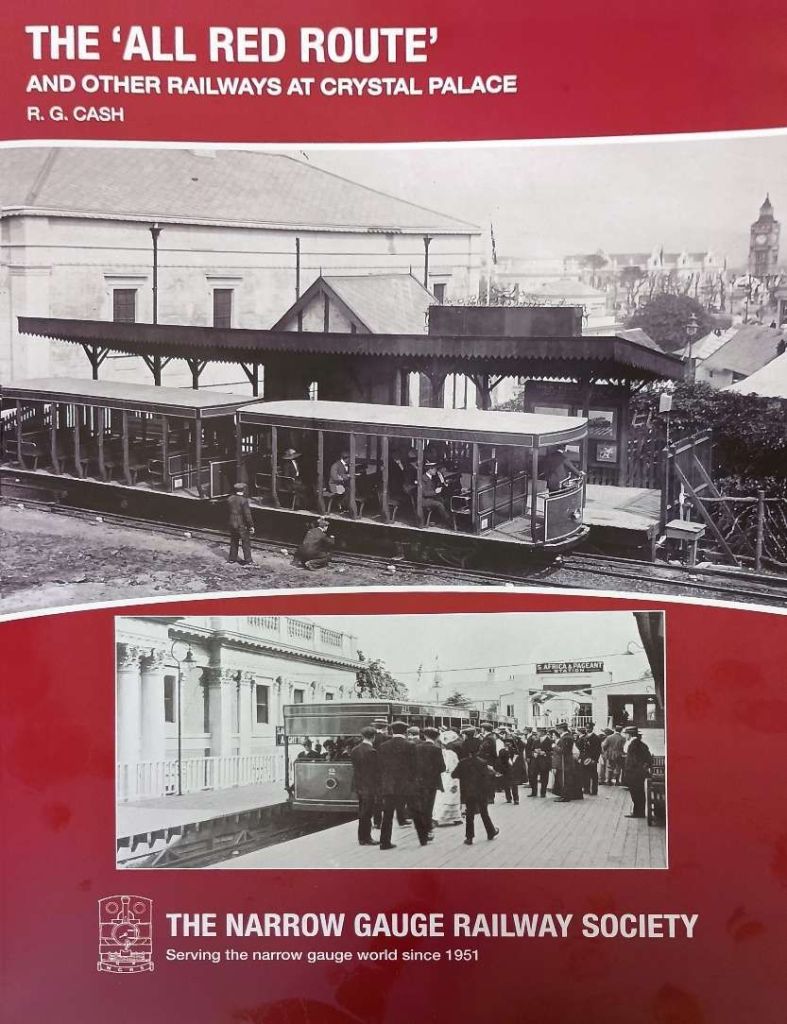
In October 2026, the latest mailing included two other A4 ‘bookazines’. The first being a single issue paper recorded as ‘The Narrow Gauge No. 302’ which focusses on various railways at Crystal Palace, written by R. G. Cash. [1]
‘Narrow Gauge No. 302’ – September 2026. [1]
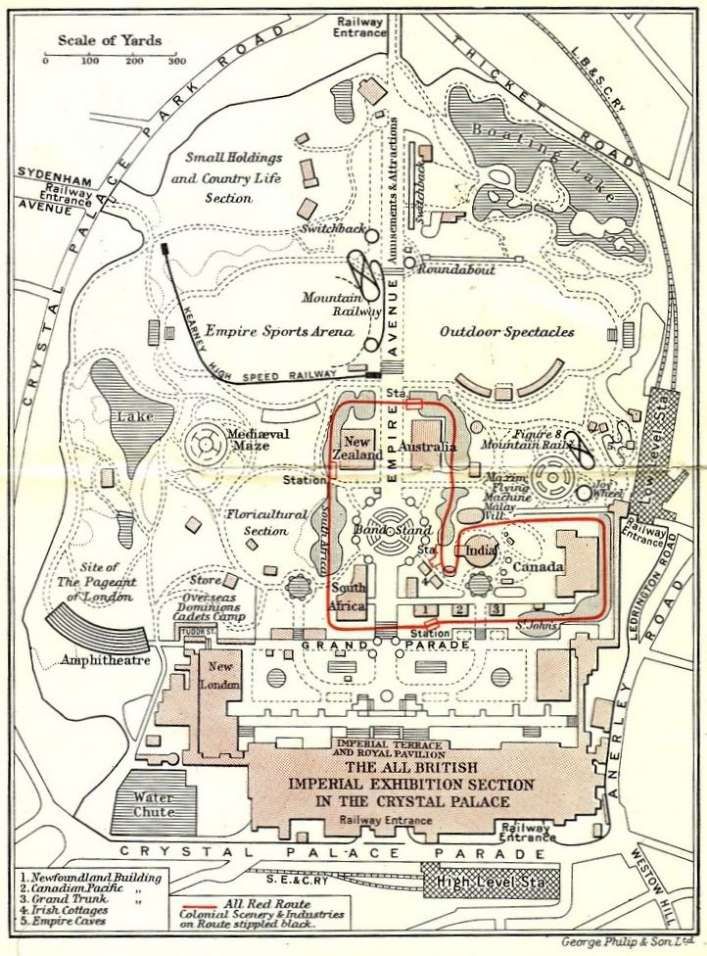
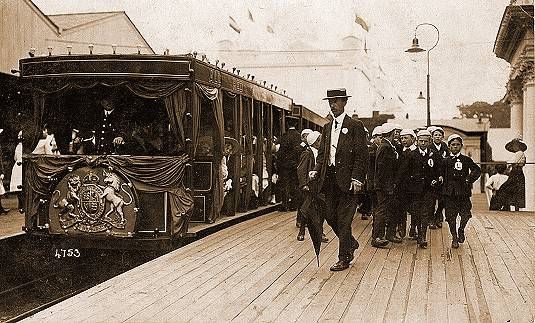
The inside front cover has a map (a public domain image) of the Festival of Empire and Imperial Exhibition of 1911. …
The ‘All Red Route’ was “a somewhat convoluted circuitous route of over a mile with stations near the principal buildings.” [1: p4]
Cash’s paper describes the track and route of the line. 60lb/yard flat-bottomed rail in 30ft lengths was spiked to wooden sleepers on 12″ of ballast. It is believed that it was a 3ft 6in-gauge railway. Trains ran at one-minute intervals in an anti-clockwise direction at a maximum speed of 4mph. Signals were not used.
Cash notes that the builders of the line “were keen to exploit the capabilities of electric traction and confidently laid out the line with gradients steeper than those on the Manx Electric Railway, which may have given the ride something of a ‘roller-coaster’ character, though the low speed would have mitigated this effect. There were also many … scenes and tableaux … which could be seen from the train. … The railway was reported to be ‘Highly successful’ and one of the most interesting features of the Exhibition.” [1: p6]
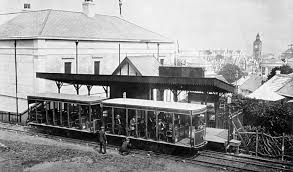
Rolling Stock – although built as a railway, rolling stock was typical of the electric tramways of the period.
Current collectors protruded from the sides of the trucks, one at the rear of the leading wheel of the motor car and one just behind the trailing wheel of the trailer.
Apparently, the All Red Route (including it power plant) cost £90,000 to build (that is over £70,000 per mile). Each train (moti car plus trailer) could carry 80 passengers around the route of the line in between 15 and 20 minutes. [1: p8]
Cash goes on to consider the costs of the Exhibition and what happened to the rolling stock before discussing:
Other railways that were on use during the Exhibition/Festival;
Pneumatic railways on the site (1864);
Electric pioneers (1881 & 1882);
Hydraulic pioneers (1891);
Looping the Loop! – perhaps the first amusement ride in the UK to invert its riders (1902-1907]
Miniature Railways – a 15in-gauge line which circled the drained basin of the Grand Fountain (1910 and not renewed for the 1911 exhibition). There were later proposals for similar lines in the park through the years, at least one of which was used (between 1990 & 1996).
The Narrow Gauge – Number 303
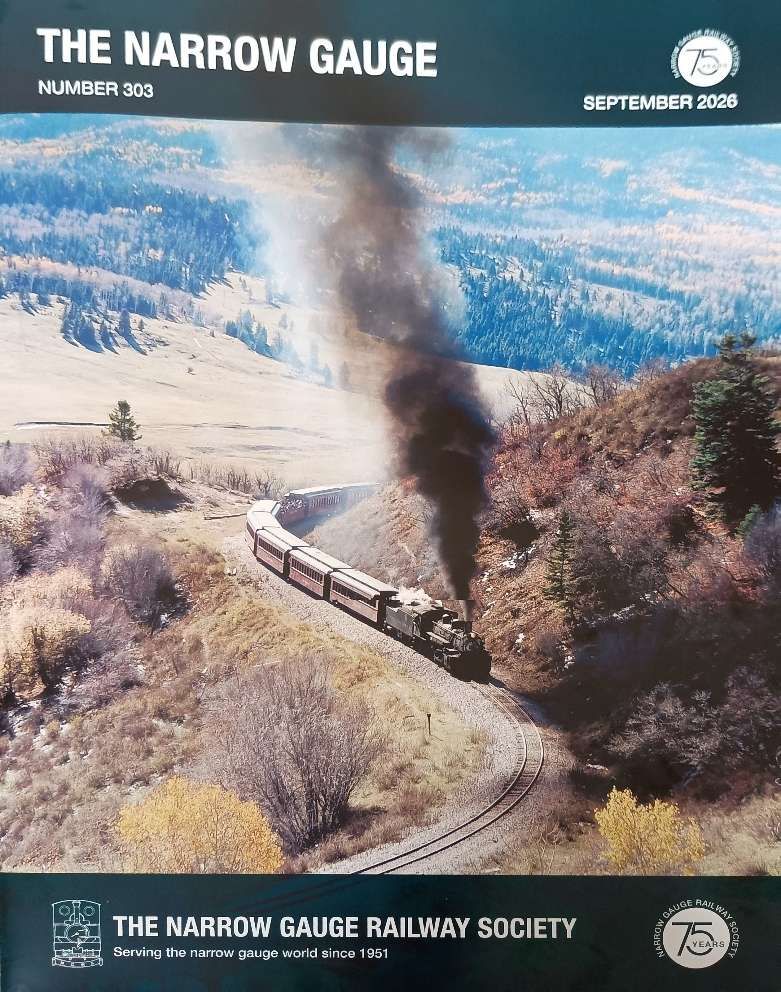
The second ‘bookazine’ is the September edition of ‘The Narrow Gauge’ – No. 303. In 2026, the Narrow Gauge Railway Society celebrates 75 years serving the narrow gauge world since 1951. This is reflected on the front cover of ‘The Narrow Gauge No. 303’. [2]
‘The Narrow Gauge’ No. 303 – September 2026. [2]
This second volume includes:
Slaggyford Light Rail – Philip Champion (p3-9);
Early Petrol-Electric Railcars in Prussia – David Meller (p10-22);
The Cumbres & Toltec Scenic Railroad: Part 1 – Jim Stancliffe (p23-33); and
A few shorter items.
Slaggyford Light Rail – Philip Champion tells the story of a privately owned 2ft-gauge railway which sat on an ‘island’ in the South Tyne River which was also the location of a caravan site. First in use in 1978, the line was owned by W. G. Horseman. He sold the line in 1981 to Bob Cant who renamed it ‘Slaggyford Lake Railway’. Cant closed the line in 2001 and much later, after his death, his collection was sold by auction (January 2025). Philip Champion includes in his article, information about the various locomotives and rolling stock used on the railway.
Early Petrol-Electric Railcars in Prussia – David Meller provides a survey of various narrow-gauge lines in Prussia before WW1, with some still active up to and beyond WW2.
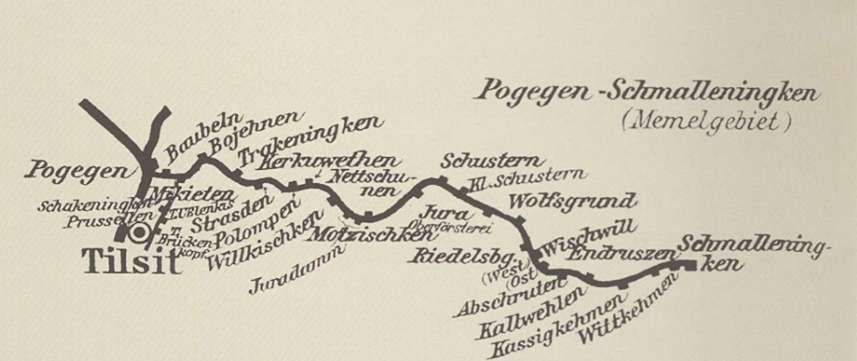
Meller first introduces us to The Kleinbahn Pogegen–Schmalleningken (Pogegen-Schmalleningken Railway), located in the historic Memelland region of East Prussia, which was a pioneer in using petrol-electric (or benzole-electric) railcars.
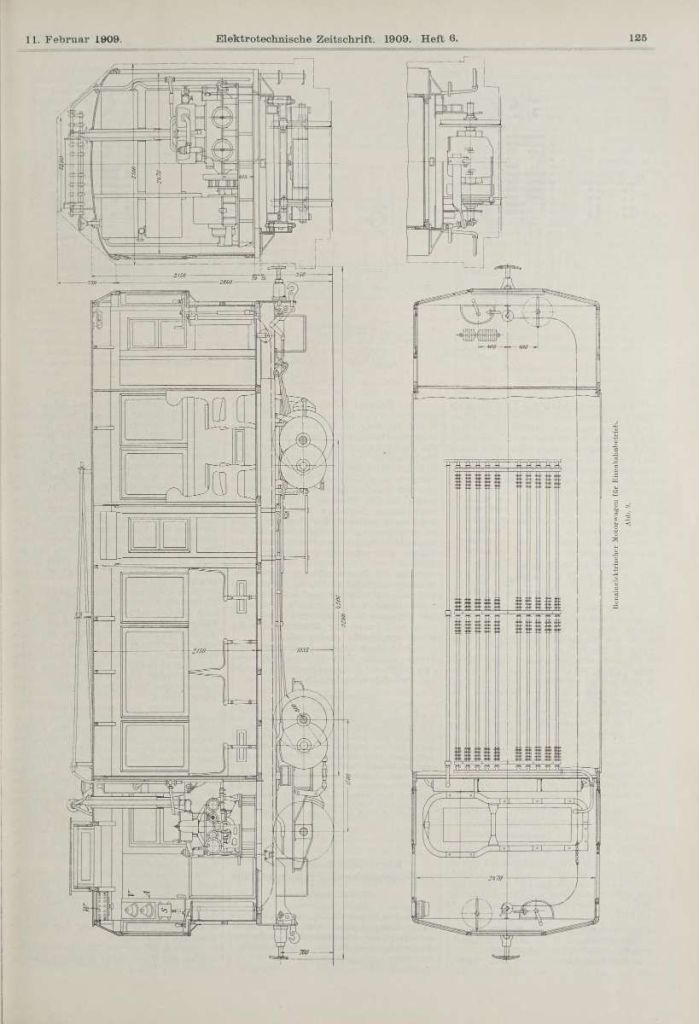
Meller points out that details of these first Petrol-Electric Railcars were provided in an article from the 11th February 1909 edition of Elektritechnische-Zeitschrift which is now available online in the Internet Archive. [4]
Illustrations provided by Miller come directly from that article. …
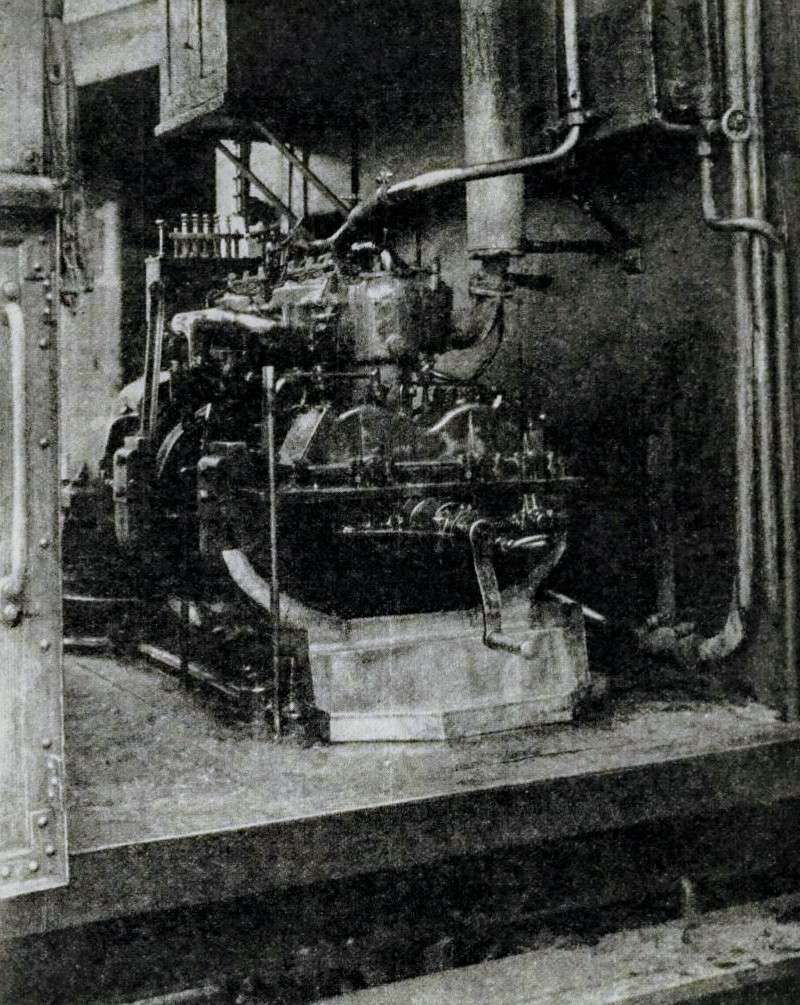
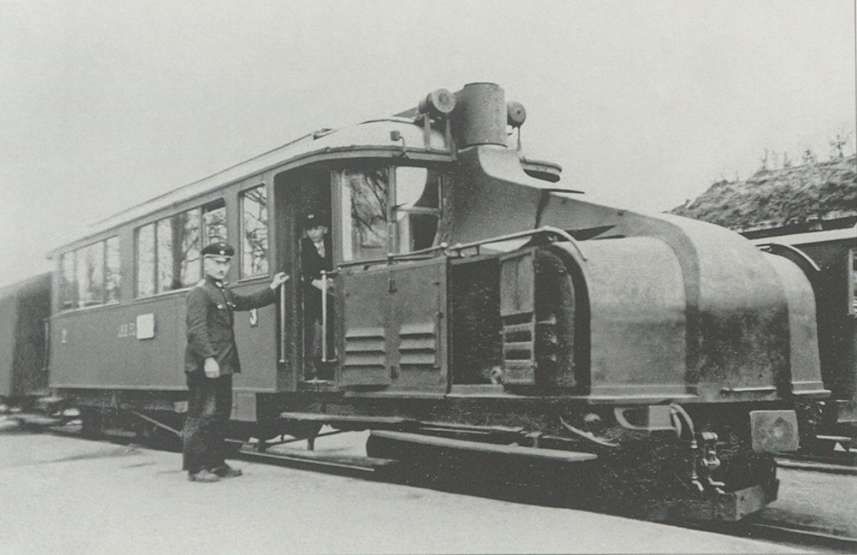
The interior of the driving cab of a Railcar equipped with a Westinghouse engine of the type used on the Pogegen-Schmalleningken Railway. [2: p10][4: p124]A Petrol-Electric Railcar of the Pogegen-Schmalleningken Railway. [2: p12][4: p125]
Meller then turns to the 750mm-gauge Konigsberger Kleinbahn which had three Petrol-Electric Railcars numbered 51, 52 and 53 in its fleet. This line was owned by the same company as the Pogegen-Schmalleningken line (Aktiengesellschaft fur Verkehrswesen – AVG).
In the autumn of 1911, the German electrical giant AEG (Allgemeine Elekricitats-Gesellschaft), the coachbuilder Waggonfabrik L. Steinfurt (based in Königsberg), and the engine manufacturer NAG (Neue Automobil-Gesellschaft) delivered a four-axle prototype railcar to the Königsberger Kleinbahn. Test runs showed that whole electrical and mechanical equipment performed well, vibration was excessive. This was overcome by moving the power unit away from the passenger accommodation.
The revised vehicle entered service in 1914 and was followed by two more.
Next Meller focusses on the Insterburger Kleinbahn which purchased three of the same design of units used on the Konigsberger Kleinbahn and, interestingly, also numbered the Railcars 51, 52 and 53.
He follows this with a look at the Gleiwitz-Rauden-Ratibor Line which seems to have purchased the final member of a batch of seven Railcars of the type used by the Konigsberger Kleinbahn and Insterburger Kleinbahn. This particular vehicle seems to have travelled around a number of venues before arriving at this line. It appears to have been recorded at the ‘Baltic Exhibition’ in Malmö, Sweden in 1914. Meller believes that it may have been seen at other exhibitions at least including the Weimar Bauhaus international architecture exhibition in 1923 and at Stuttgart in 1924. It was bought by the Gleiwitz line in 1925. But, Meller, says there are particularly concerns about this narrative and it is possible that the story of the seven Railcars is more complex!
The photographs included with the text of Meller’s article can be found along with the original German Schweizerische Bauzeitung article on a German discussion forum, here. [6]
The Cumbres & Toltec Scenic Railroad (C&TSR): Part 1 – Jim Stancliffe writes that this railroad was opened in 1971. It is a tourist line and lays claim to being the longest and highest steam-powered narrow gauge railroad in North America. Stancliffe describes the project to revive the line as “arguably, the most ambitious heritage project of its kind in the world at the time.” [2: p23]
As the Denver & Rio Grande Railroad (D&RGR) network entered terminal decline in the year either side of WW2, many of its narrow gauge routes were abandoned. The main passenger service on the narrow gauge was the ‘San Juan‘ which ran daily each way between Samosa and Durango, but it was withdrawn in 1951. The only remaining passenger service was the ‘Silverton‘, which ran as a mixed train, three times a week, each way between Durango and Silverton. [2: p25]
The D&RGR retained the Silverton Branch as a steam hauled summer tourist attraction until 1980. A buyer was sought and found in 1981. The new owner redeveloped the line as the Durango & Silverton Narrow Gauge Railroad (D&SR)
Separately, abandonment of much of the network was pursued by the Railway Company and preservation of a length of the network between Antonio and Chama was considered by New Mexico and then by Colorado. Stancliffe says that, “In July 1970, the states jointly purchased the track and line structures along the 64 mile long route between Antonito and Chama. The purchase included 9 steam locomotives and over 130 freight and works cars. The total cost for the whole package was $547,120. Whilst the purchase included all the yards and buildings at Chama, there were no available facilities at Antonito. These were all still required by the D&RGR.” [2: p27]
Stancliffe goes on to describe the birth of what became the ‘Cumbres & Toltec Scenic Railroad’.
The first train ran on 26th June 1971 but despite the initial air of optimism the deep recession caused by the oil crisis impacted the viability of the Railroad. In parallel there was a need for the two US states to find more effective ways of working together.
Various crises followed; the operating company had its contract terminated and another company was appointed. The volunteer organisation which was maintaining stock was removed from the site and eventually a new volunteer organisation was formed – the Friends of the Cumbres & Toltec Scenic Railroad (The Friends).
The new operating company (Kyle Railways) brought about a change in fortune for the C&TSR. In 1987, ridership was a record 38,721 people, and ridership continued to increase throughout the 1990s. In 1995, the total was 59,871. But by the end of the 1996 season, Kyle Railways, gave up their lease. The next lease holders survived in role only until the end of the 1999 season. After the lease was advertised once again, no suitable applicants applied. In February 2000, The Friends made an offer to run the railroad. The friends set up a not-for-profit company: the Rio Grande Railroad Preservation Corporation (RGRPC). This arrangement only lasted until the end of the 2005 season. Further negotiations saw The Friends forming another non-profit to run the day-to-day operations with capital funding for necessary works being the responsibility of the two states. Various factors meant that this new arrangement lasted only until the end of the 2011 season.
This seems, throughout Stancliffe’s article, to have been the ongoing experience of those running the railway – periods when reasonable progress was being made with passenger numbers being to rise towards a break even position, and then an incident or problem which set things back.
The late 2010s saw fragile good progress destroyed by COVID and in the 2020s a similar set back saw the restaurant kitchens at the intermediate stop at Osier, and dry weather causing significant damage to water supplies along the line.
Stancliffe has set the scene for Part 2 which will follow in a later edition of ‘The Narrow Gauge’.
And finally ….
I hope that this series of notes about the mailing sent out at the end of September 2026 might encourage new interest from non-members in the Narrow Gauge Railway Society.
References
The Narrow Gauge No. 302; the Narrow Gauge Railway Society, September 2026.
The Narrow Gauge No. 303; the Narrow Gauge Railway Society, September 2026.
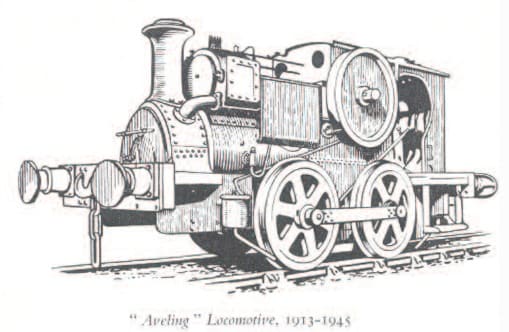
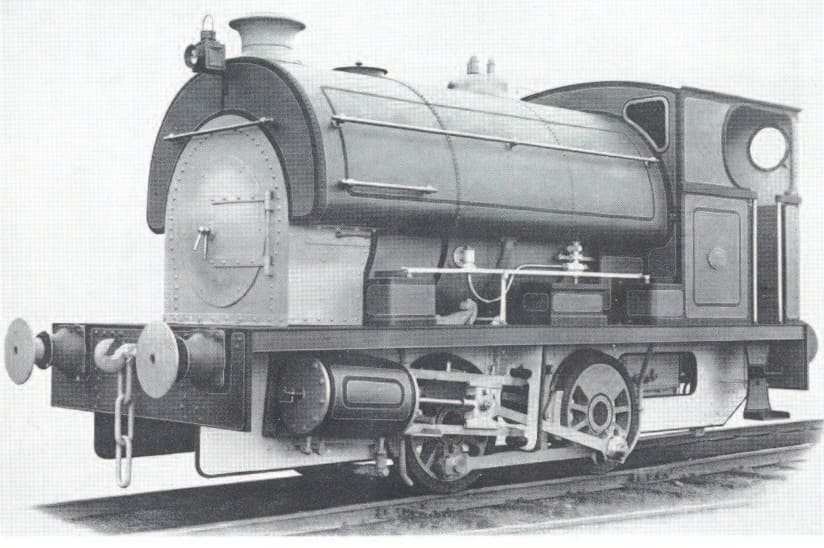
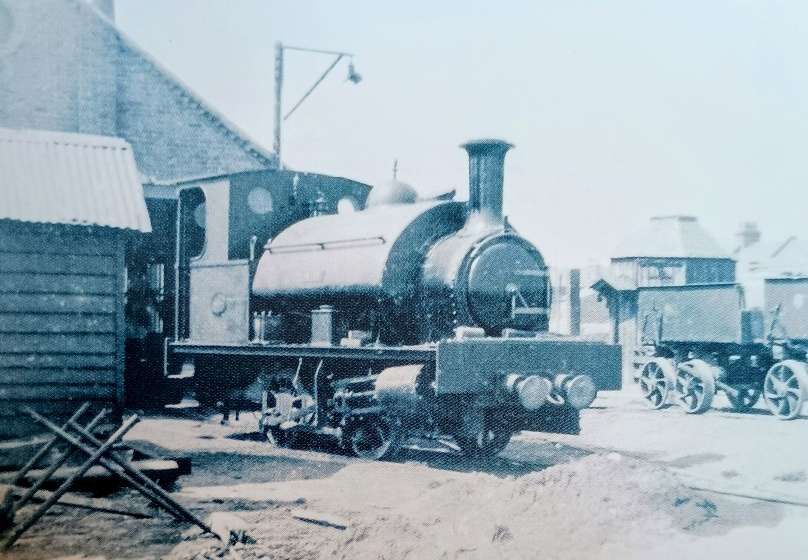
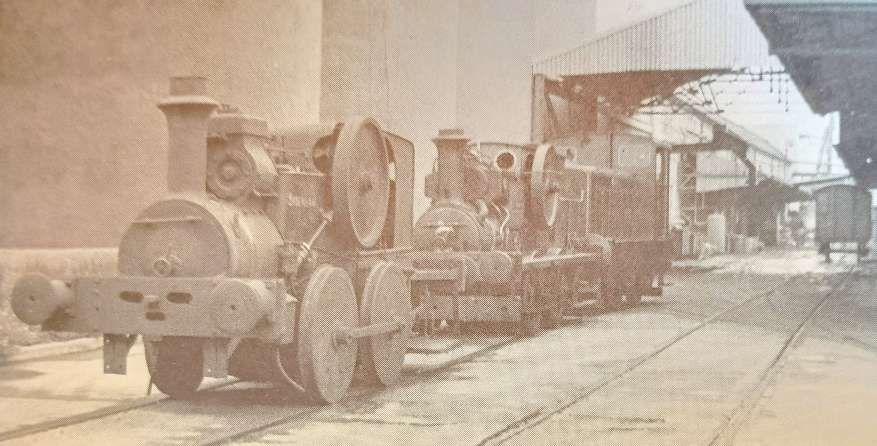
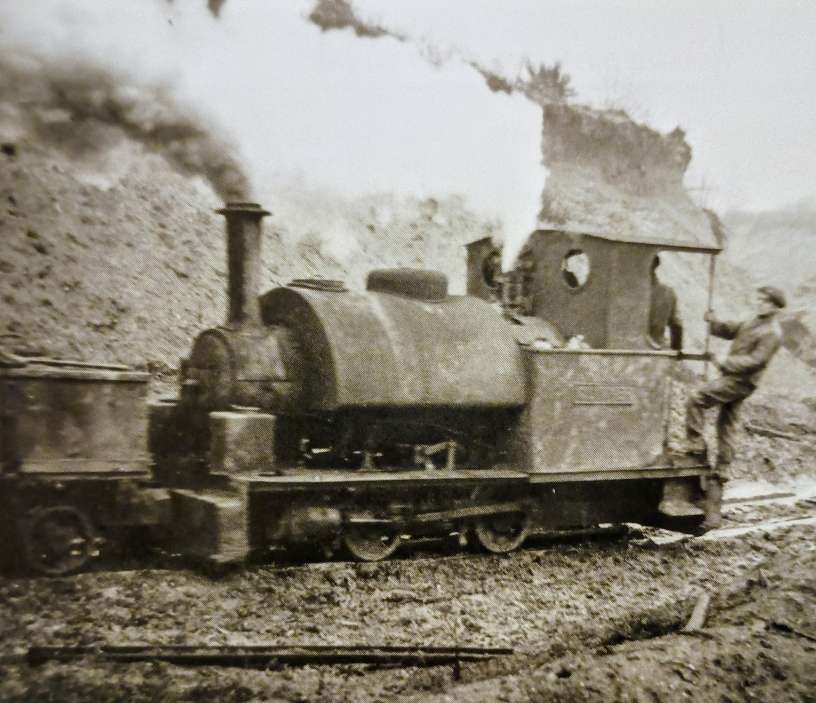
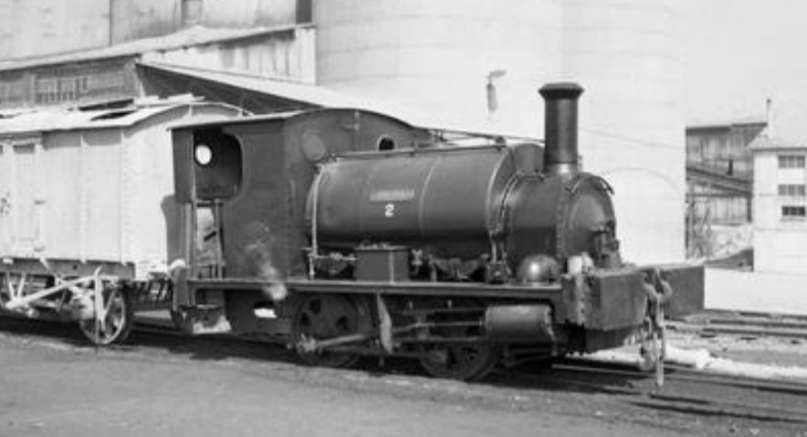
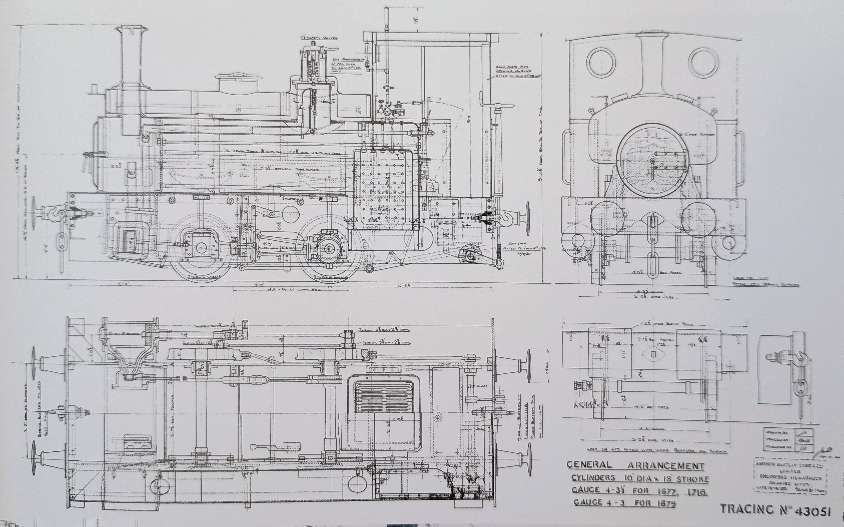
The featured image for this article is a line drawing of ‘Aveling’ (No. 2) an Aveling & Porter 0-4-0WTG locomotive that served at Queenborough from 1913 to 1945/46.
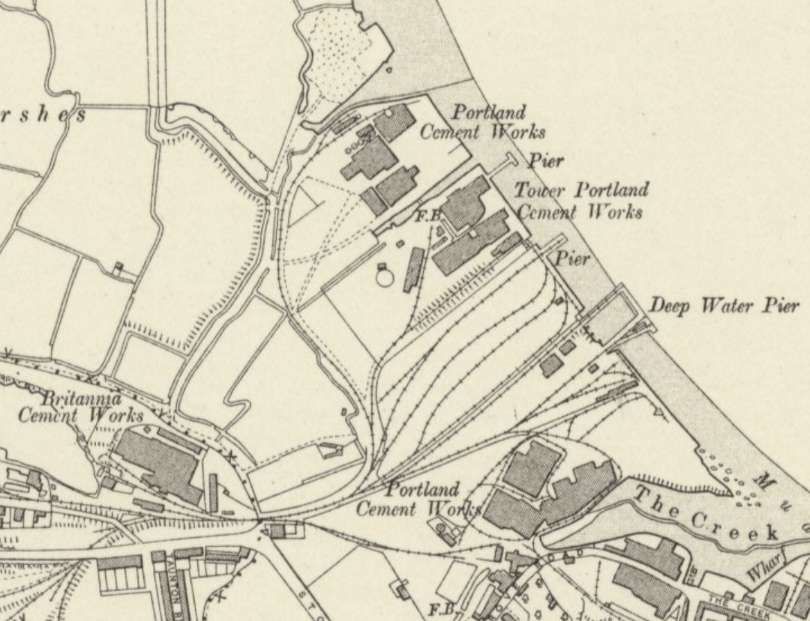
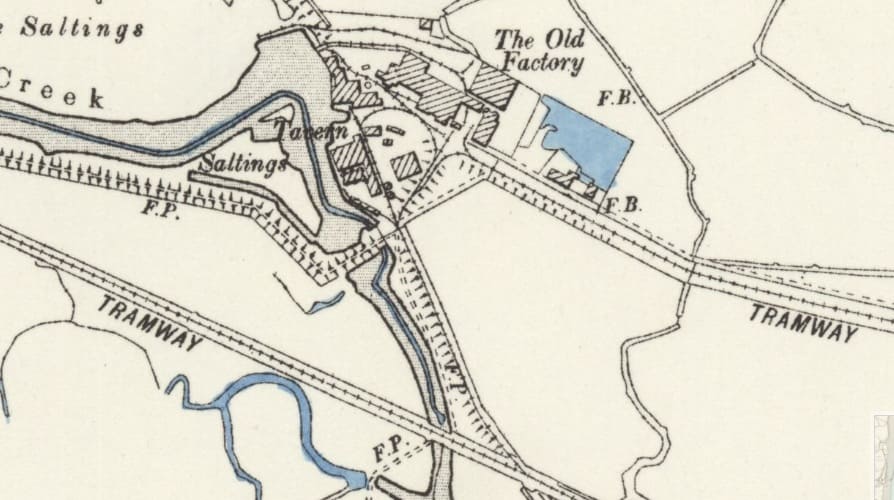
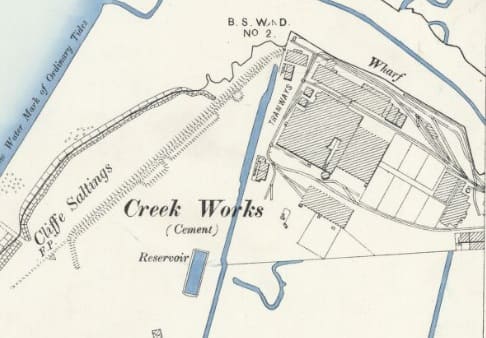
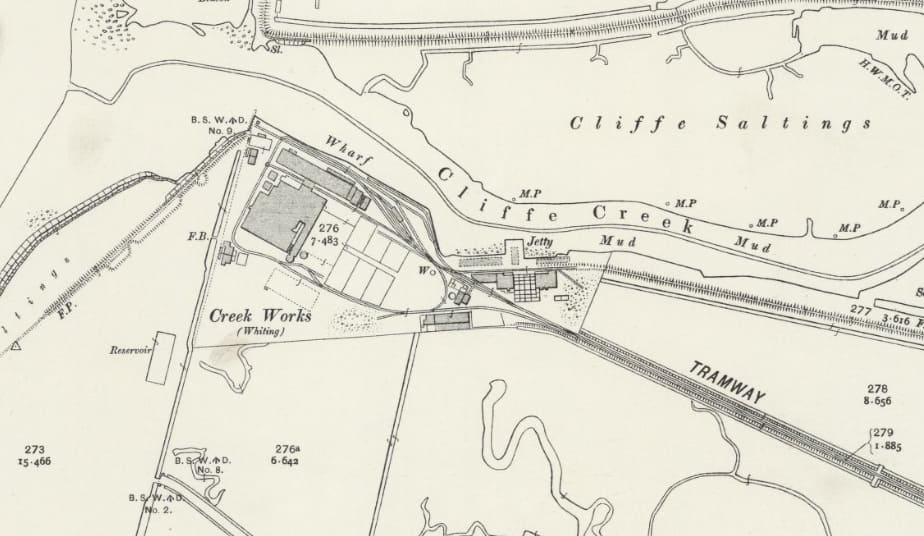
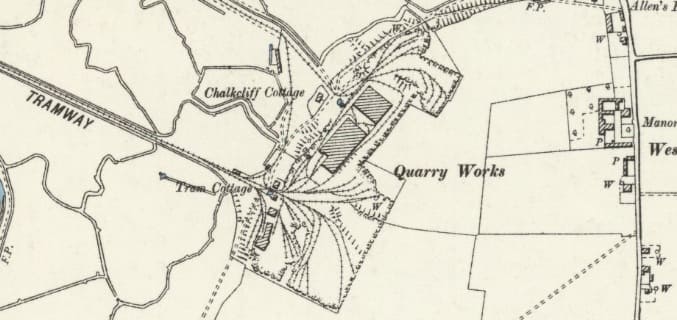
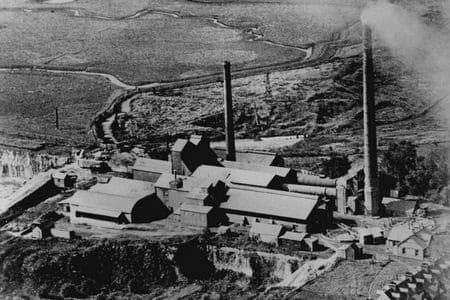
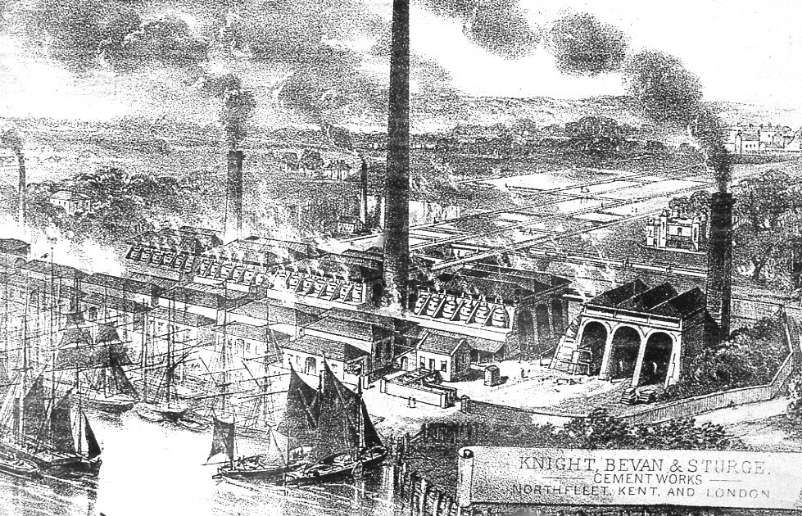
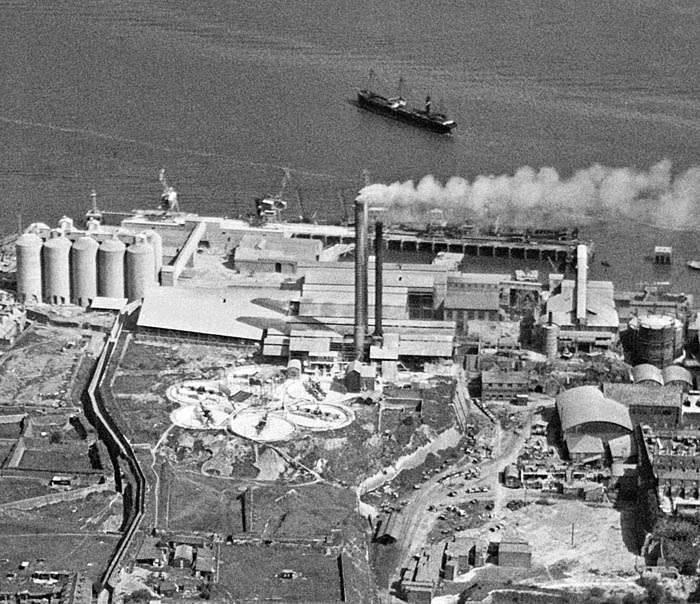
Stoyel & Kidner tell us that “The Queenborough Cement Co. Ltd opened in 1882 and by 1896 had a short tramway down to a wharf and creek leading off the River Swale; a siding to the SECR was laid in 1904. The chalk pit also supplied a ceramics manufacturer, A. Johnson & Sons Ltd, established in 1908, which had a narrow gauge tramway.” [1: p67]
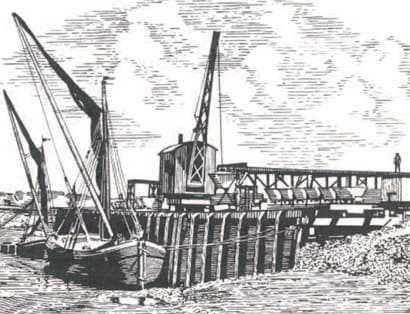
In 1895, the Cement Works operated four kilns. The clay for the kilns was excavated from a site nearby, and chalk, the other necessary ingredient, together with coal for firing, were brought in by sea. For this to be done more conveniently, “Chalk Wharf” was built in 1897. [13: p8]
The original Chalk Wharf. [13: p8]
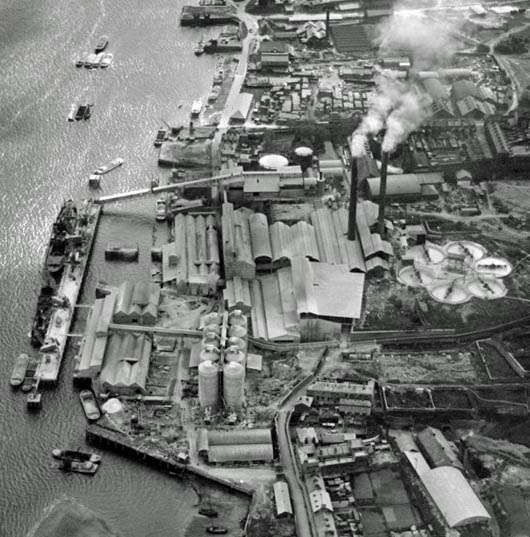
The Cement Company put in sidings from the railway company’s main line, and supplied facilities under agreement for rail traffic to serve the various concerns on the estate, and these form the nucleus of the provision later made by Settle Speakman for the other industrial undertakings on the site. The Cement Company, which at one time had an output of 400 tons per week, was disposed of in 1912, and during the 1914-18 war all the kilns and shafts were pulled down and the bricks and debris sold to the War Department for improving the roads on Sheppey Island. The old cement stores were turned into a hostel which housed and fed about 200. The quarry workings were gradually filled. [13: p9]
Stoyel & Kidner note that, “The Cement Co. did not join APCM in 1900 but had a five-year Agreement; in 1910 it joined BPCM.” [1: p67]
“In 1908 the wharf was taken over by industrialists from Cheshire, mainly for coal imports; they included Philip Speakman from Liverpool and Joel Settle from Alsager, and in 1930 they formed Settle Speakman & Co. Ltd. The company’s involvement with cement was purely the transport of chalk from the East Kent Chalk Quarry Co. Ltd at Gillingham, and the movement of products to the wharf.” [1: p67]
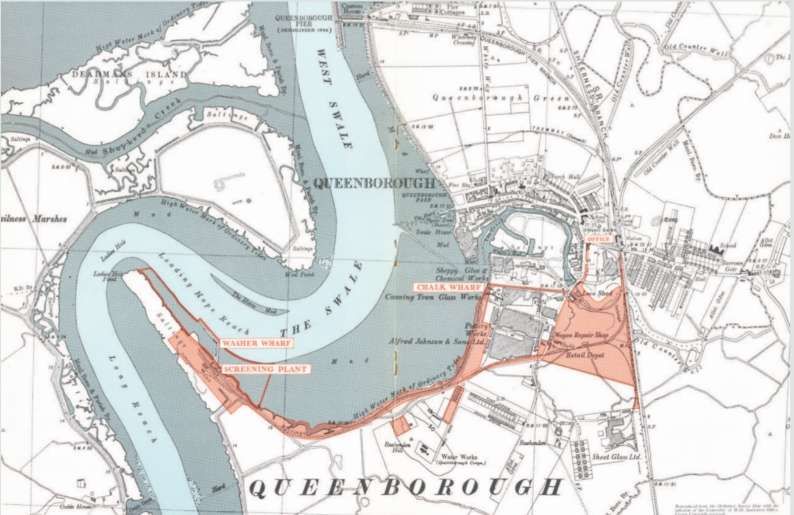
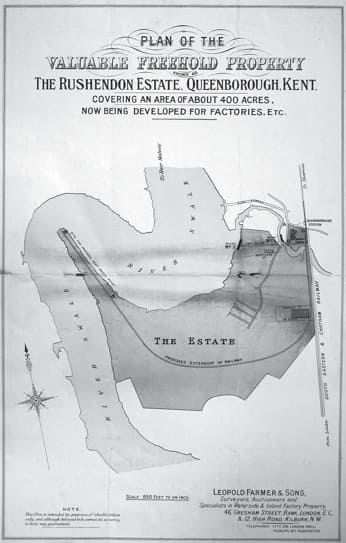
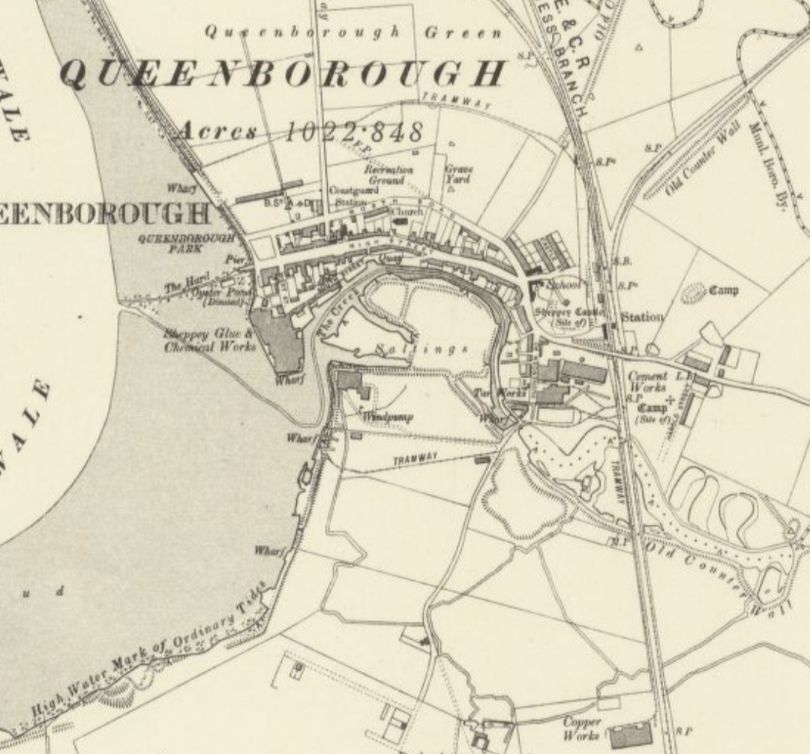
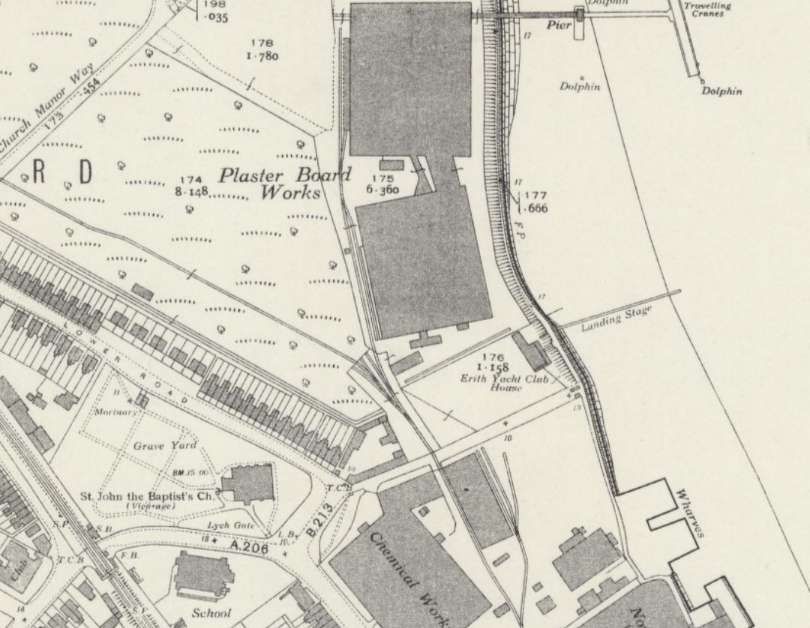
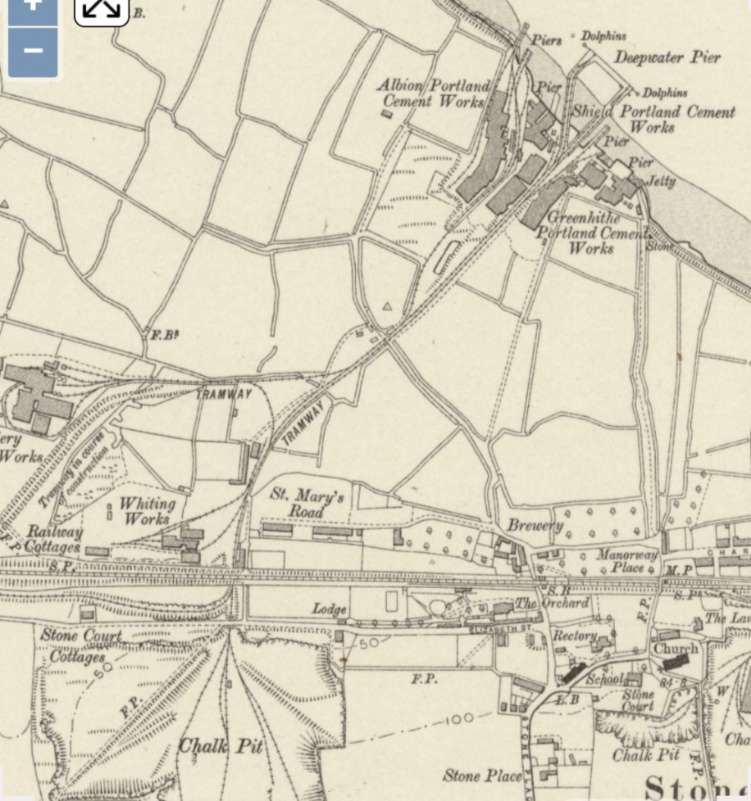
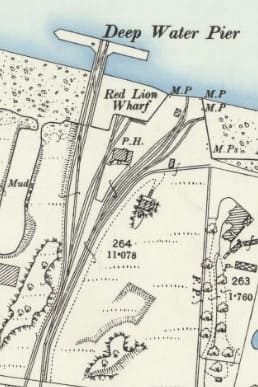
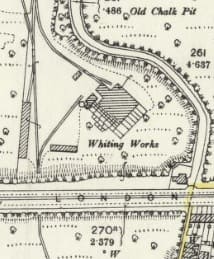
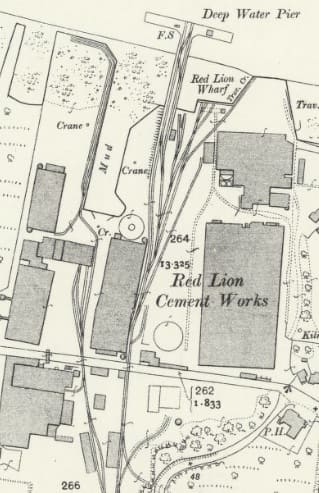
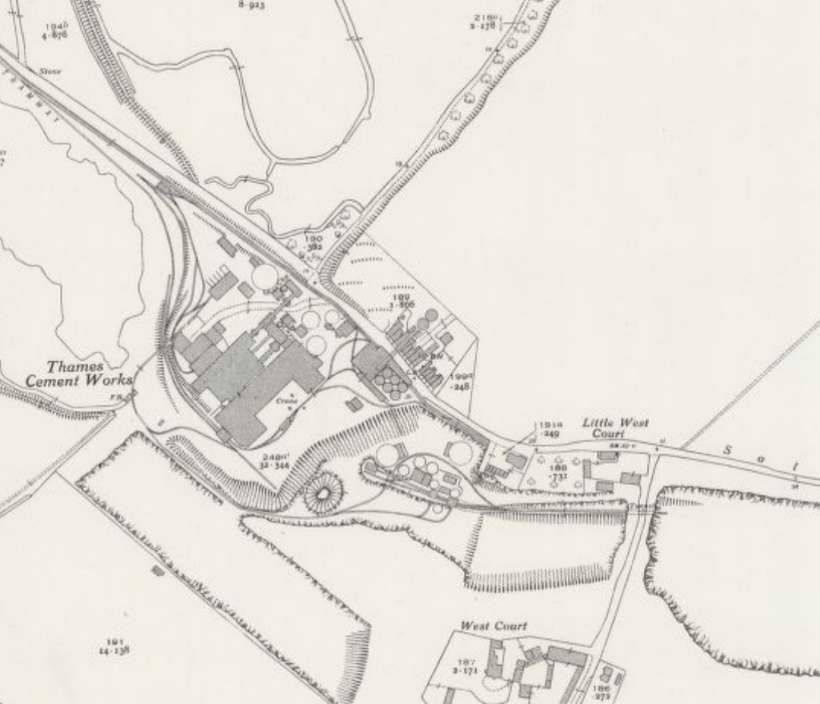
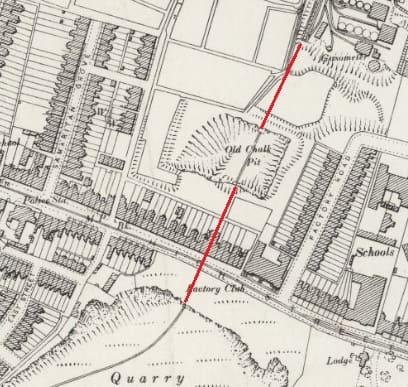
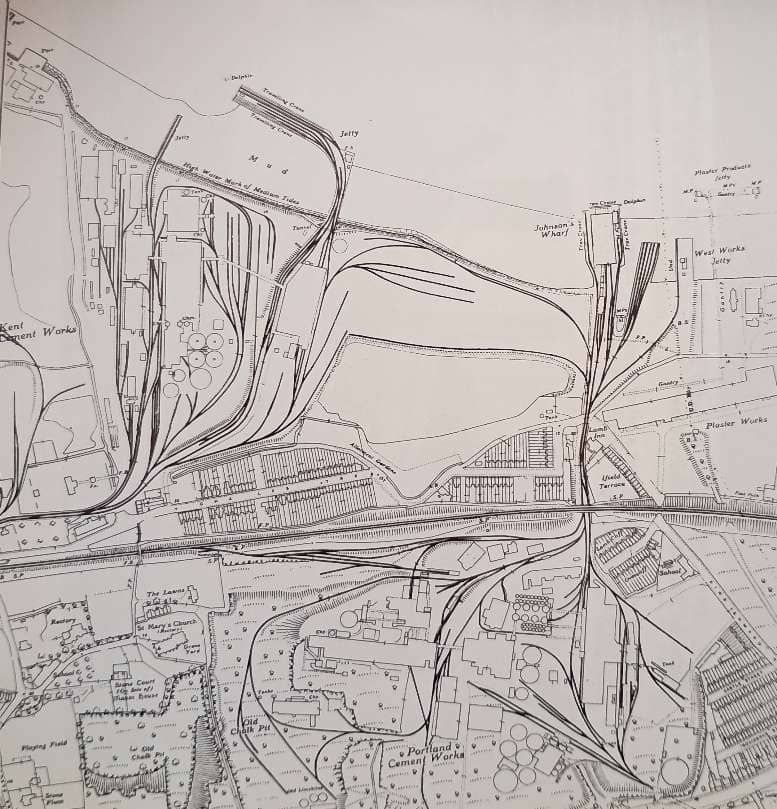
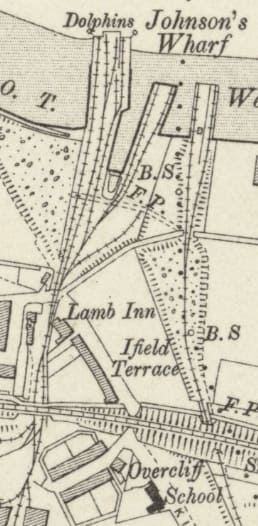
The extent of the holdings of Settle Speakman in Queenborough. [13: p16-17] The Rushenden Estate’s area (South of Queenborough) was impressive, and included a valuable promontory that reached into the deeper water of the tidal River Swale. It was this area that Settle & Speakman sought to exploit. (Sheppy Industries archive), (c) Public Domain. [5]Queenborough Cement Works as it appears on the 6″ Ordnance Survey of 1906, published in 1909. The Works sit on the West side of the South Eastern and Chatham Railway (SE&CR) branch to Sheerness, North of Sittingbourne. In 1906, the Works had an exchange siding alongside the SE&CR and a tramway which led to a Wharf on the River Swale. To the South of the Works a dedicated tramway siding followed the SE&CR South to a Copper Works. To the North of the exchange siding was …… Station on the SE&CR and another tramway curving Northwest from the SE&CR line to a Wharf on the Swale to the North of Queenborough. Immediately to the West of Queenborough in the banks of the River Swale was Sheppey Glue & Chemical Works with its own Wharf on the river. At the top of this map extract, the Queenborough Pier Branch leaves the Sheerness Branch. [12]
The Company bought rails and chairs for their railway in Widnes and Birkenhead and , while there, acquired two locomotives, “Pioneer” and “Leycett.” Contracts for erecting the wharf, pier, etc., were entered into with Robert McAlpine & Sons, and conveying plant was erected by the Queenborough Contracting Company. [13: p10-11]
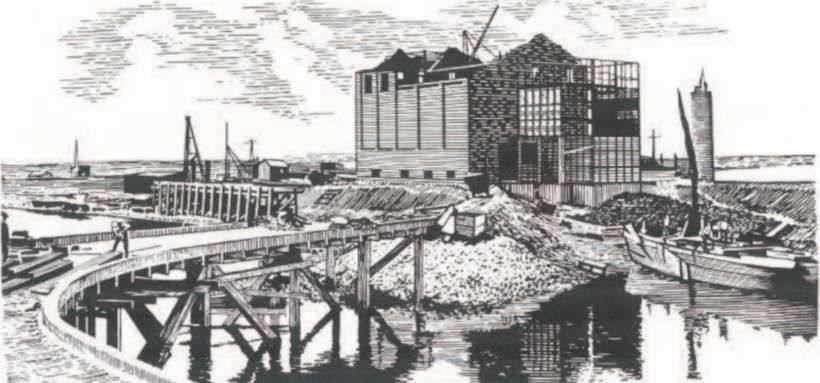
The Coal Washer and Wharf under construction [13: p10]
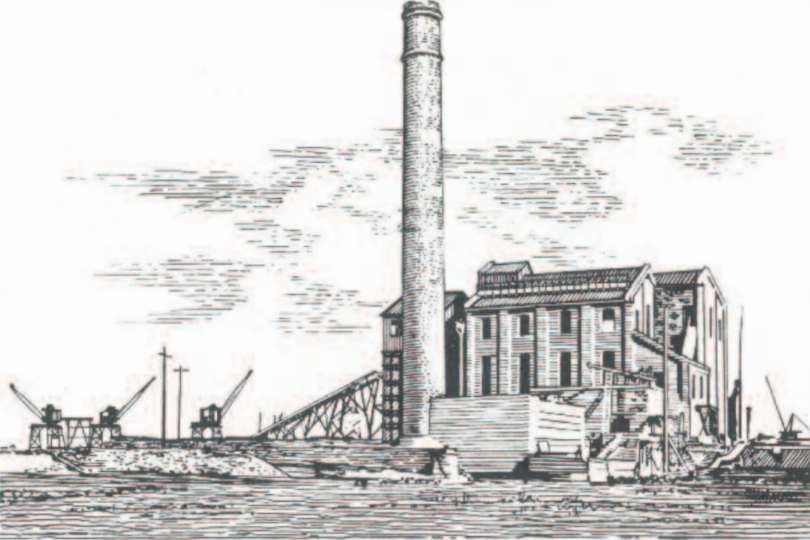
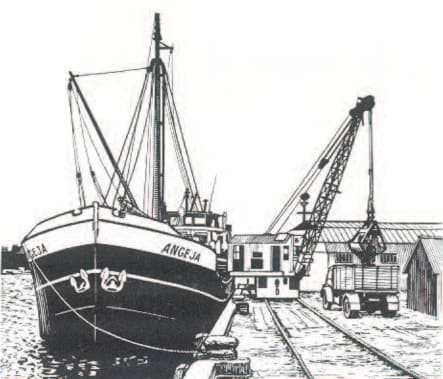
The Settle and Speakman built the Coal Washer themselves from plans supplied by Luhrig Coal and Ore Dressing Appliances Ltd. “The Queenborough Washer was the first in the South East of England. The very idea of the washer seemed strange, if not lunatic, to the local inhabitants – ‘Who ever would want to wash coal?’ Kent, in those days was far removed from the industrial north and the Kent coalfields had not then been developed. … The work was completed in little over twelve months and the first ship came alongside on 23rd November 1908. She was the ‘S. S. Britannia’: … The discharge at Queenborough did not get off to a good start; first the ship went aground at West Point, and … as high water rose, a gale blew up and washed away the embankment of the railway leading to the washer, so that the engine and trucks could not approach it. Only after tons of flint from the Chalk Wharf had been brought to fill the gap was it possible to proceed, but it took five days to discharge this first vessel.” [13: p11-12]
The completed Coal Washer Building. [13: p11]
One of the first benefits of the direct import of coal to Sheppey by the opening of the Queenborough Coal Pier and of washing and grading the coal, was an immediate reduction in local prices.
“In the years 1908 to 1910 there began a period of industrial development of the area with the building of the Pottery and the Glass Bottle Works, both of which had their services provided for by the Queenborough Wharf and Cement Companies. Joel Settle bought, during this period, the land upon which the company’s Retail Coal Depot [was to be] situated, and also acquired two plots of land, one on Rushenden Hill to be used as allotments by the company’s employees, and the other near the bottom upon which a row of houses named ‘Alsager Avenue’ (after Alsager, Cheshire, the home of Joel Settle) were built in 1912; many of these were occupied … by workers of the company.” [13: p12]
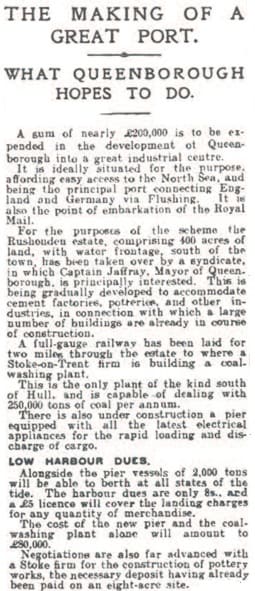
The adjacent press report comes from the ‘Daily Express on 3rd July 1908. It highlights the intentions of the company to develop a significant industrial site in the area close to Queenborough.
“In October 1911, the undertakings of Philip Speakman & Sons and Joel Settle were incorporated as a private limited company, Settle Speakman & Company Limited, Joel Settle being Chairman, and William Carroll a Director. Both the Queenborough Wharf Company and the washer of Settle Speakman carried on, with varying success, until 1918. Then Captain Jaffray, Lord Queenborough and Mr. W. H. Appleton took over the Washer; a mortgage was arranged and the Queenborough Coal & Washer Company formed. With many of the collieries in France lying derelict in the area covered by the fighting of the 1914-18 war, there was a brisk demand from France for washed coal at good prices, and 2,000 to 3,000 tons a week were shipped very profitably. But with the recovery of the French coal industry this demand ceased after about three years, and the fortunes of the Coal & Washer Company declined.” [13: p13]
The British Window Glass Works (see the notes on Sheet Glass Ltd below) “commenced operations at Queenborough in 1919, and the Contracting Company put in a railway line to the site of the works from the Wharf Company’s line; agreements were made for payments for goods passing over this line. To handle the extra traffic expected at the coal pier, {the Washer Wharf] was extended by 120 feet, this being financed by a loan from the Contracting Company. … Just before Christmas, 1922, the ‘S. S. Gyp’ collided with the Ferry Bridge across the River Swale; this is the sole approach to the island and road and rail traffic to and from the mainland was dislocated for many months. The Wharf Company had a shunting loco-motive, the “Emerald Isle” and this was put at once on to a shuttle service, running as often and as fast as her small driving wheels would take her, with passengers to the site of the bridge. Here the passengers were ferried across in rowing boats, to board a train on the other side to carry them to their destinations. This service had to be maintained for some months until the bridge was repaired and normal communications once more restored.” [13: p14]
For a time, the Coal & Washer Company was in liquidation. “Settle Speakman & Co. Ltd. took over all the assets of the Queenborough Coal & Washer Company and in early 1924 again worked the Washer, the Wharf Company continuing to perform the discharge and shunting operations. In 1926, the general strike stopped operations, although some revenue was obtained by working-over the accumulated deposits of tailings from the washer to recover for sale what little coal can have remained in them. Whilst the washer lay idle, slack in the raw coal hopper caught fire by spontaneous combustion, destroying the hopper and the conveyors feeding the washer. They were never rebuilt.” [13: p14]
A process of consolidation followed with many of the activities of the various companies being merged into the control of Settle Speakman & Co. Ltd. “It was decided to erect a Plant for screening the discharged coal on a site convenient to the pier and near the old washer, and this was completed in November 1927. At the end of 1928, the Queenborough Wharf Company went into liquidation and was sold to Settle Speakman & Co. Ltd., in 1930. A year later, the working assets of the Queenborough Contracting Company, which included the Chalk Wharf were taken over and Settle Speakman & Co. Ltd. thus obtained control over the discharge of ships and barges at both wharves and the transit of wagons. Further purchases of several pieces of land … took place, which served to strengthen the position of the company and to augment its resources.” [13: p18]
The Washer Wharf “was strengthened throughout in 1933 by driving reinforced concrete piles 70 feet in length to support a concrete raft 2 feet 6 inches thick on which the timber and concrete decking was supported. A new Wagon Shop was built (1934) and a concrete wall was erected (1935) for the protection of the Chalk Wharf.” [13: p18]
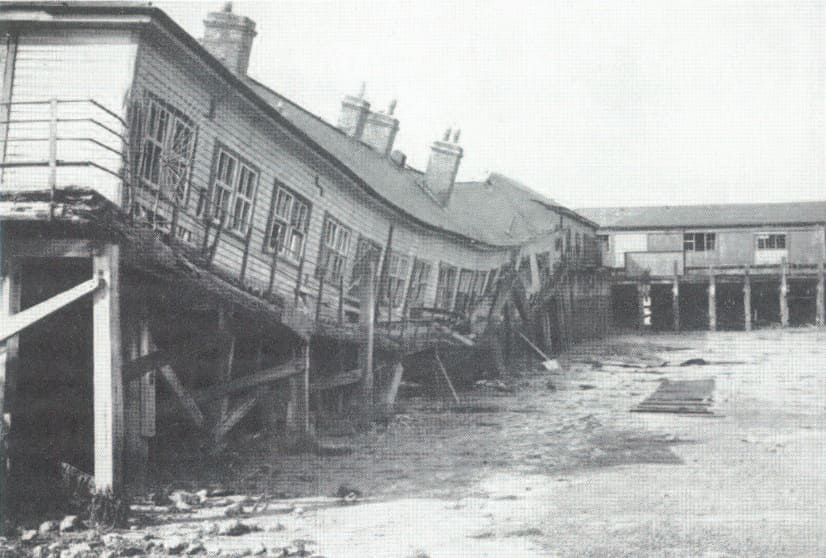
“In 1938, there occurred a very high tide accompanied by a strong gale. sea-wall near the wharves was breached and the sea poured into the low-lying land beyond, washing away the foundations of the railway in several places leaving the rails and sleepers in mid-air. … Hundreds of tons of material obtained from tips at the Pottery Works and from the adjacent hill were dumped into the gaps. Within three days communication with the wharf was established again.” [13: p18]
War damage during WW2 was surprisingly slight. During the War, “plans were made for post-war development at Queenborough which served as a blue-print for the progress which commenced [after the War]. … These plans permanently shaped Settle Speakman’s interests at Queenborough [Through into the late 1950s]. … Further land was acquired, additional railway sidings constructed and extensions to the Wagon Shop undertaken. The old chimney stack at the Washer Wharf was felled, and a stores and messroom with showers and a washroom, etc., made in the shell of the old washer. The reconstruction and strengthening of the wharf was completed, and a new railway weighbridge and weigh-house erected. A new locomotive ‘Stafford’, [and] a ‘Jones’ and a ‘Jumbo’ mobile crane, and a 5-ton Booth diesel crane were obtained to improve the handling facilities.” [13: p19]
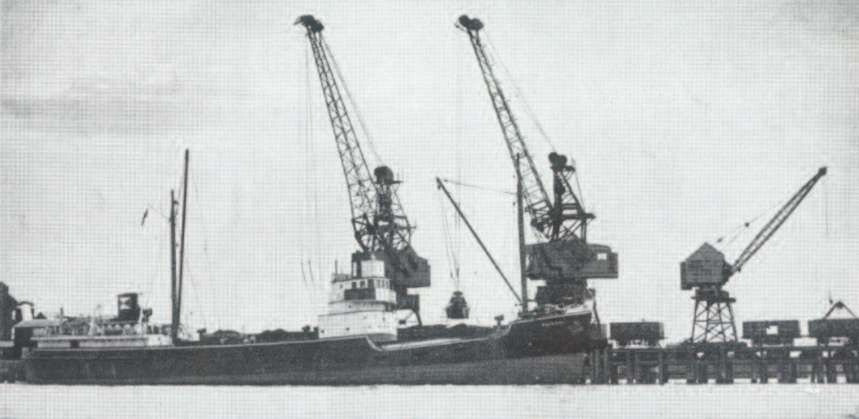
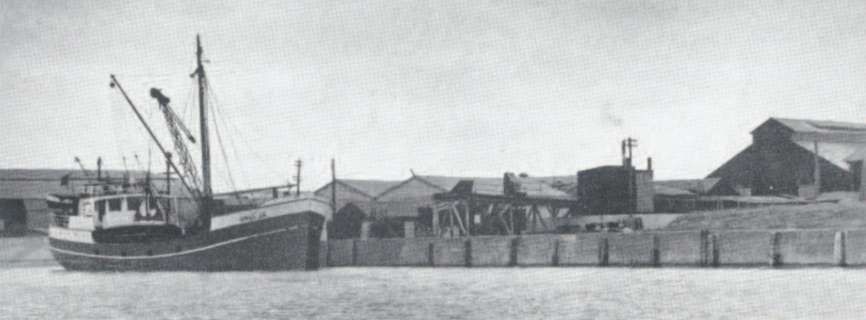
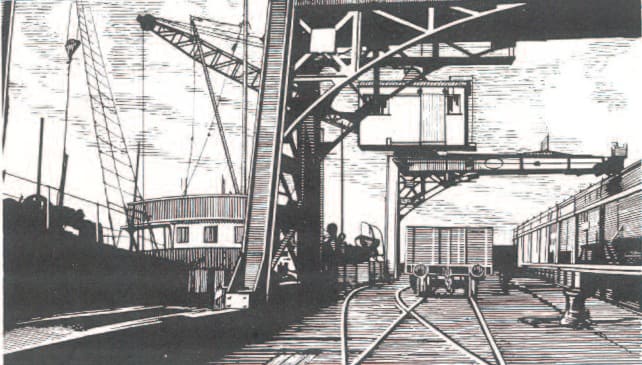
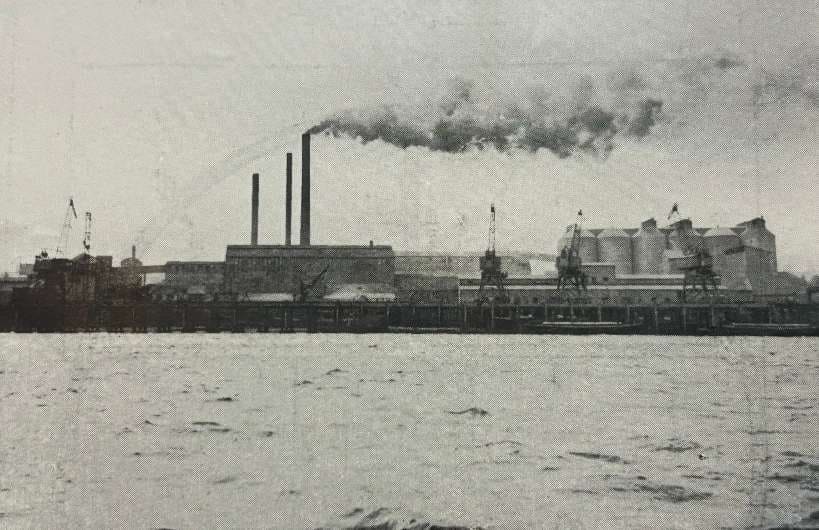
Significantly, two modern Stothert & Pitt 5-ton level luffing cranes [4][5][13: p20] were erected at the Coal Washer Wharf in 1953. [13: p20] The Coal Washer Wharf was the centre of operations for the Company. It was 300 feet long, with two lines of standard gauge railway along the full length. The two Stothert & Pitt electric cranes operated at a maximum and minimum radius of 68 feet and 23 feet, served the wharf, with a smaller crane also available. At the outward berth there was at least 12 feet of water at low water on spring tides, throughout the whole length of the wharf. [13: p23-24] The wharf was capable of handling coal and merchandise direct from a vessel into wagons, or overside into lighter or barge; or vice versa.
Coal Washer Wharf in the late 1950s. Note the two large Stothert & Pitt Cranes. [13: p23]
“Each of the new cranes at the Washer Wharf contains a recording weigher of a very high order of accuracy, complying with the requirements of the Board of Trade. A so-ton standard-gauge railway weighbridge, 16 feet long, is installed at the approach to the Washer Wharf and enables accurate weights to be given for traffic handled by rail. A 30-ton road weigh-bridge is installed adjacent to the retail coal depot, for handling road traffic.” [13: p25]
At Coal Washer Wharf, coal was discharged by grab onto a metal-plate conveyor on the wharf. A rubber-belt conveyor then took the coal to the Screening Plant, which gave a range of sizes. From the screens coal was loaded into railway wagons.
Adjacent to the Retail Coal Depot, the Company had a well-equipped Wagon Repair Shop. Here are carried out repairs not only to the Company’s own wagons, but also work for the British Transport Commission.
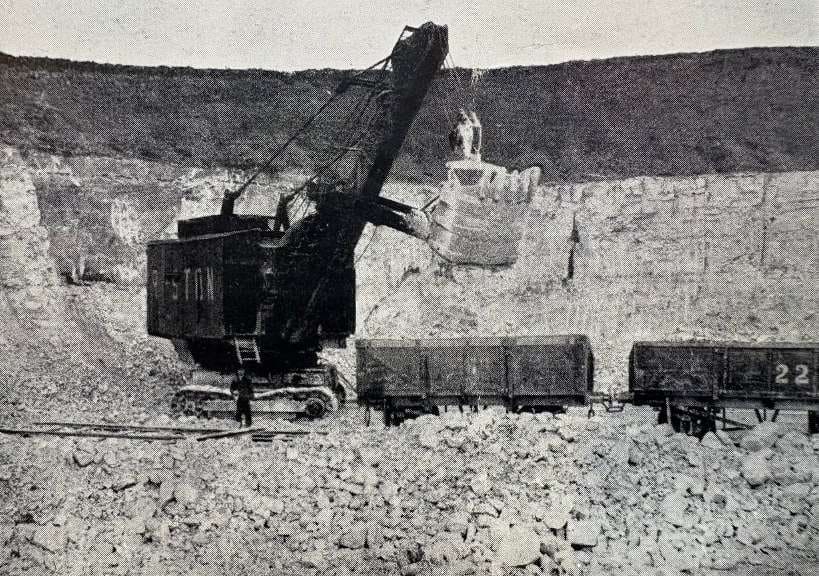
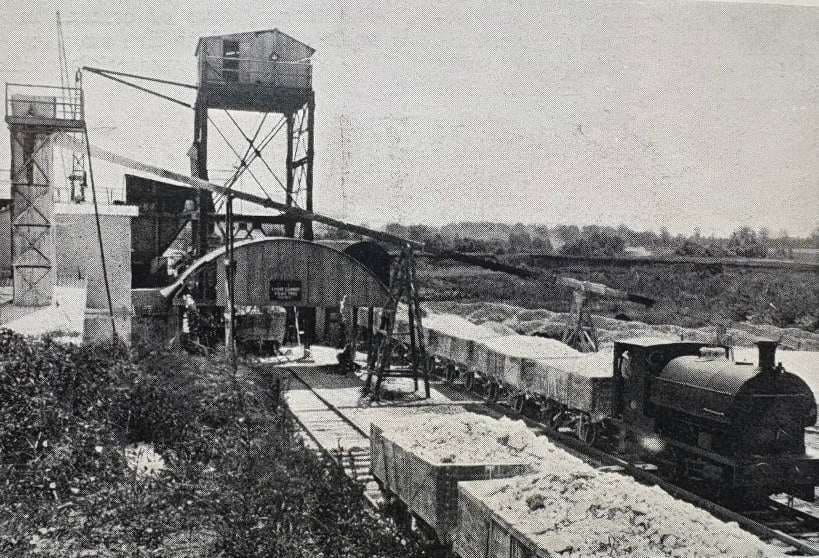
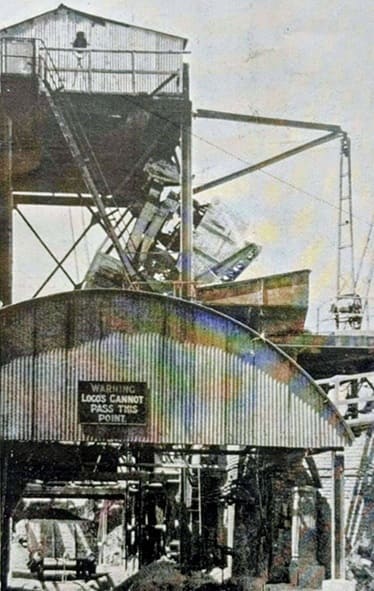
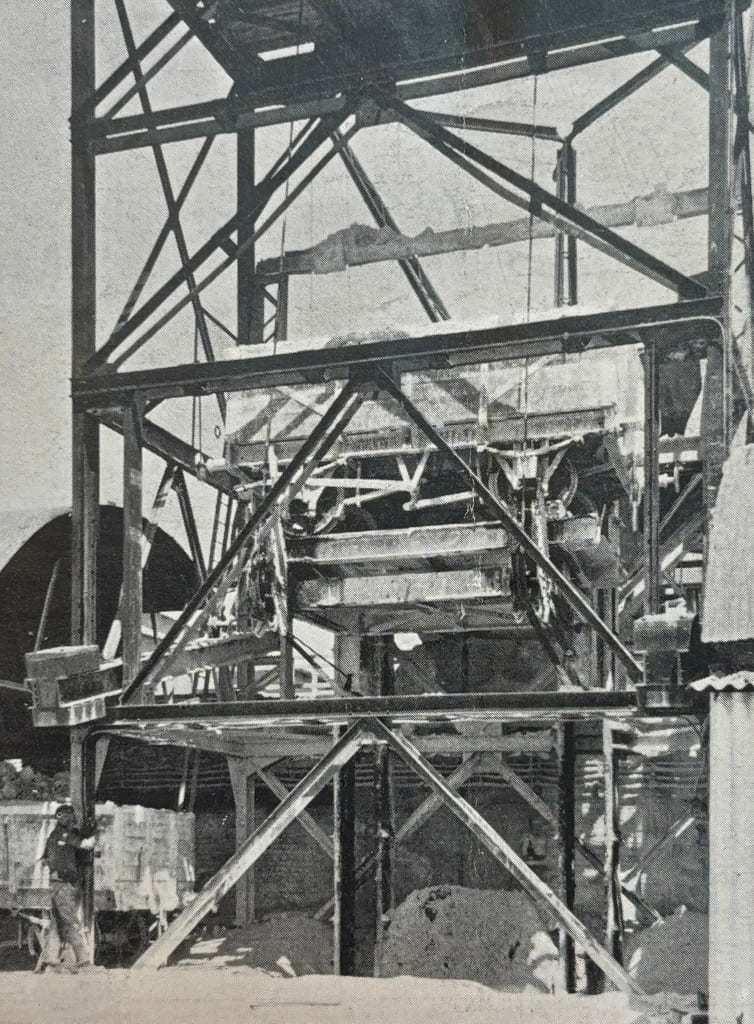
Chalk Wharf: was 350 feet long, and had both road and rail connections. The berth is tidal, with a maximum depth of water of 12 feet, enabling vessels of 250 to 300 tons capacity to be accommodated. It handled many of the raw materials for the adjacent factories – amber sand and flint sand from Belgium and felspar for the glass works, china clay and china stone from Cornwall, and boulder flints from France for the pottery works. Fuel oil is also delivered from barges at this wharf, and ballast unloaded. Sheet glass is loaded onto barges for the London River, where it is transhipped for export. [13: p24]
Chalk Wharf in the 1950s. [13: p24]Unloading at Chalk Wharf. [13: p25]
The next three map extracts come from the 1:2500 Ordnance Survey revised up to 1963 and published in 1964. They demonstrate the industrial developments, up to 1963, around Queenborough and show both the Coal Washer Wharf and Chalk Wharf at that time. …
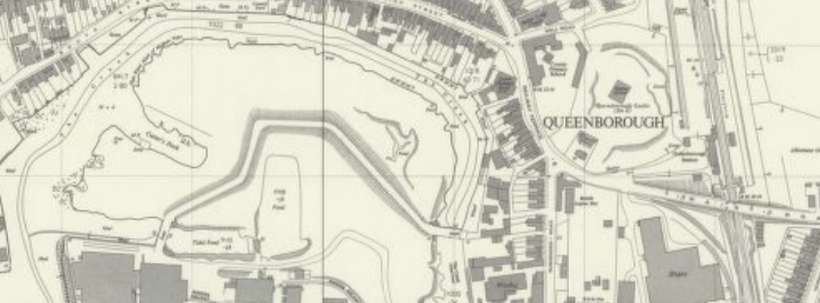
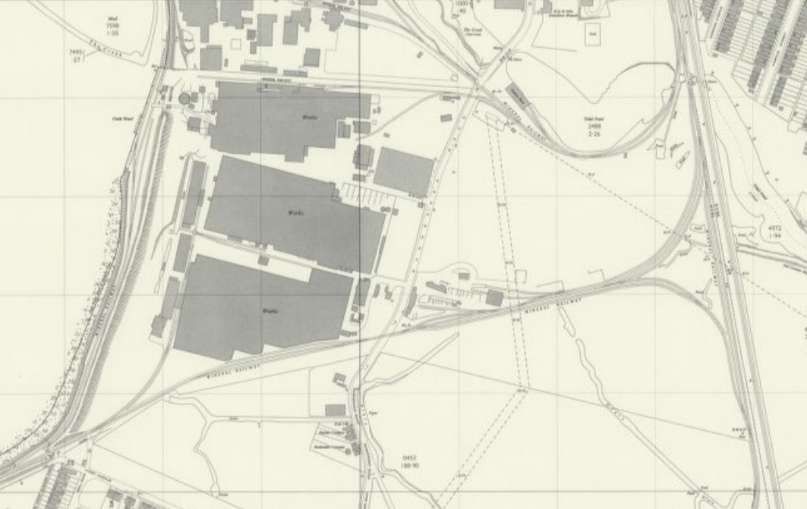
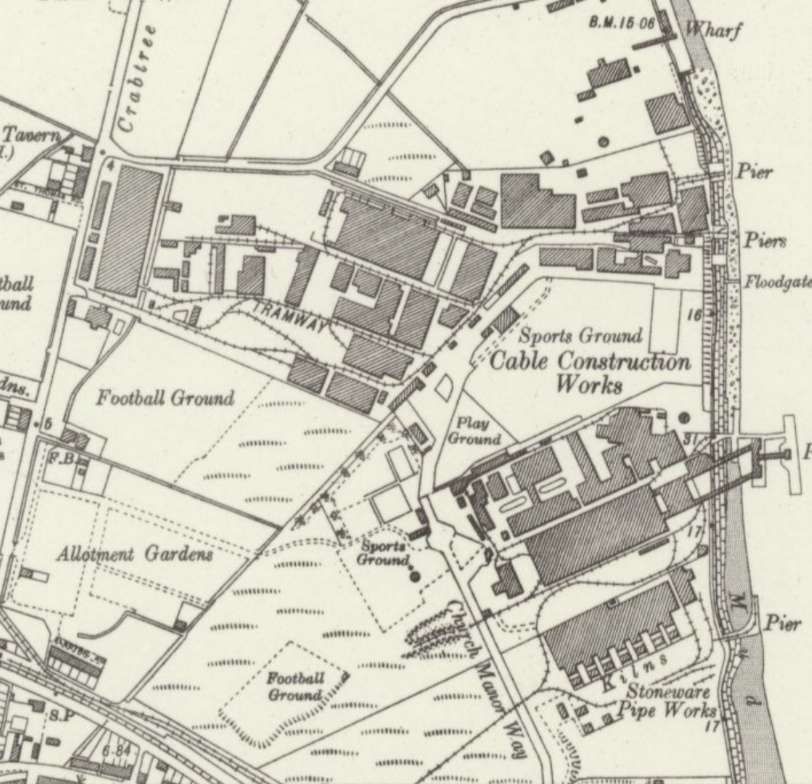
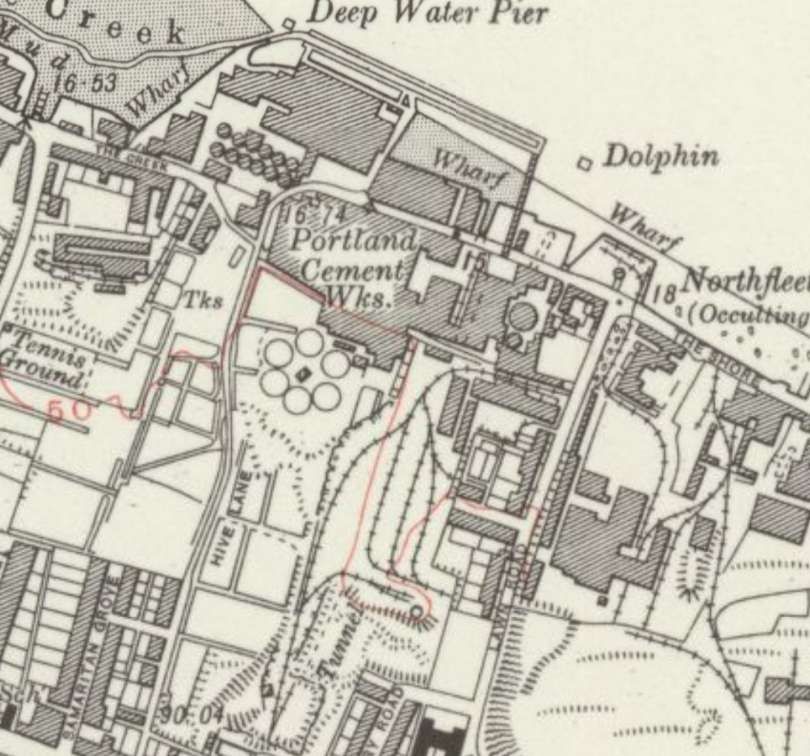
The heart of Queenborough, its Railway Station and the location of the cement works. The site of the cement works was to the West of the railway line in the bottom-right of this extract from the 1:2500 Ordnance Survey revision of 1963, published in 1964. [14]Chalk Wharf is on the left of this map extract from the 1:2500 Ordnance Survey revision of 1963, published in 1964. [15]The Coal Washer Wharf mentioned in the text. This map extract comes from the revised 1:2500 Ordnance Survey revised of 1963, published in 1964. [16]
Locomotives and Rolling Stock
Later, a variety of locomotives worked for Settle Speakman. Examples include:
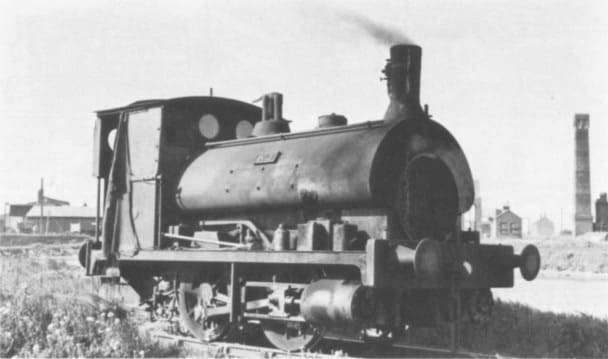
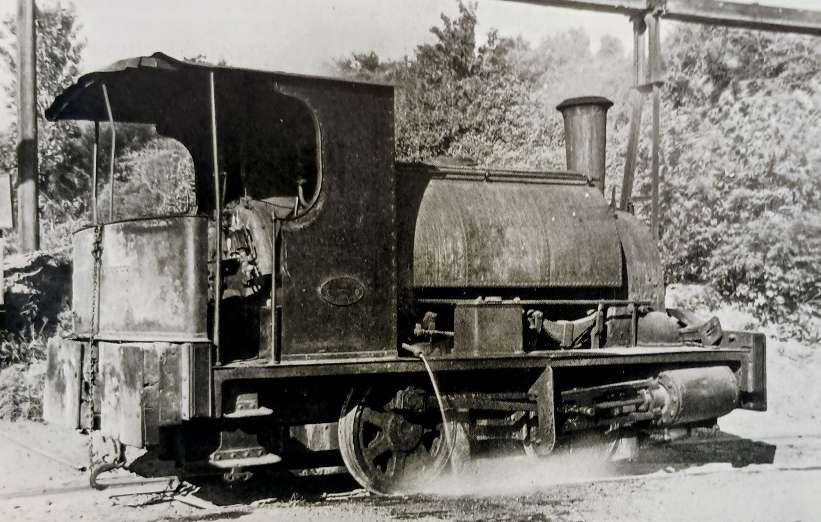
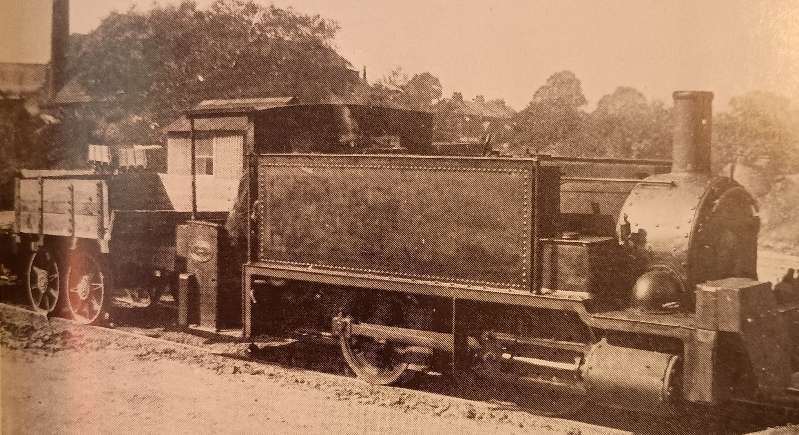
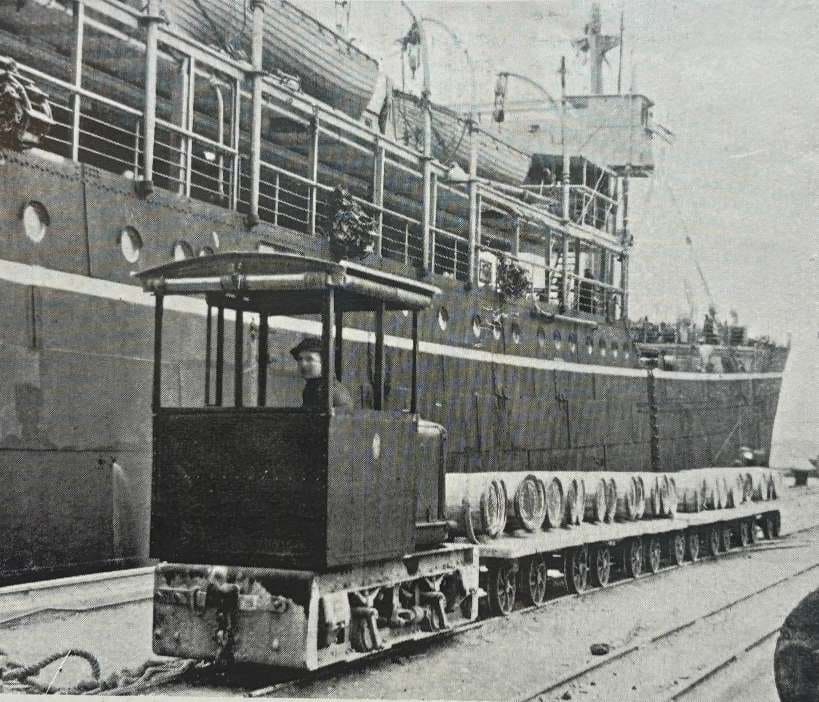
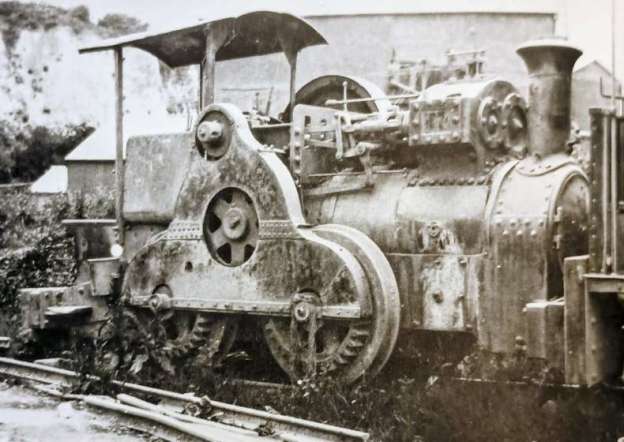
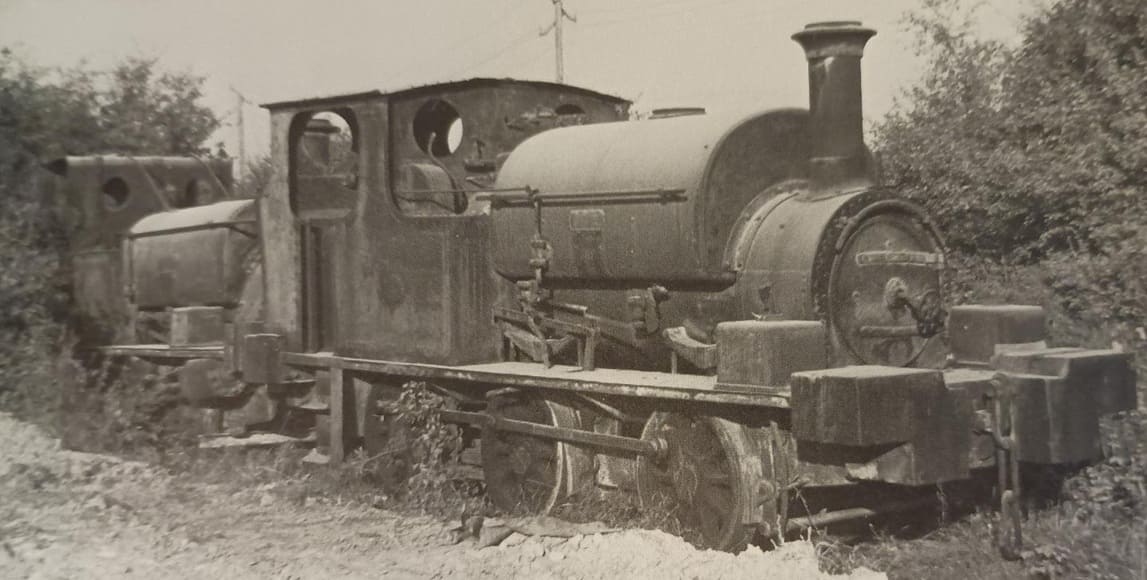
Stoyel & Kidner note two specific locomotives: ‘Success’ an 0-4-0WTG Aveling & Porter, Works No. 5082 built in 1902; and ‘No. 2’ another 0-4-0WTG Aveling & Porter, Works No. 7975, built in 1913. [1: p67] Other records suggest that ‘No. 2’ was named ‘Aveling’ [13: p18]
Stoyel & Kidner suggest that ‘Success’ had probably lost its name by the time it arrived from the East Kent Chalk Quarry Co. Ltd. ‘No. 2’ was new. The former was scrapped before 1930 and ‘No. 2’ in 1946, [1: p67] or possibly 1945. [13: p18]
‘Aveling’ (‘No. 2’) was new in 1913 and scrapped in 1945, [13: p18] or 1946. [1: p67]
As of 1957, Settle Speakman had 5 locomotives and 220 internal-user wagons working on the private sidings. Locomotives employed by Settle Speakman over the years included:
‘Stafford’ – a Bagnall-built 0-4-0ST which was bought new carried the name ‘Stafford’ because, as well as having a base at Queenborough in Kent, Settle Speakman & Co. was a major coal factoring, shipping, and colliery-owning group based in Stoke-on-Trent, North Staffordshire. Before the nationalization of the UK coal industry in 1947, they owned several pits, operated an extensive fleet of private owner railway wagons, and managed industrial locomotives to shunt coal.
‘Stafford’, an 0-4-0ST built by [13: p27]
No. 3 – a Dick Kerr 0-4-0ST formerly of Cadbury Brothers and named “Maybury.”
No. 3 – ‘Maybury’: a Dick Kerr 0-4-0ST former at Cadbury Brothers. Note the closeness of the cab spectacles – evidence that the locomotive was originally fitted with just a weatherboard, the overall cab being added at a later date. (F. Jones), (c) Public Domain. [2]
In later years, diesel shunters were employed – Two diesel-hydraulic 0-6-0 locomotives were at Queenborough Rolling Mill on 3rd September 2013, both originally built by Andrew Barclay of Kilmarnock for the British Forces in Germany in 1966. In the photograph dated 3rd September 2013, which can be found here, [3] the blue locomotive is “873” and the red one is “871”. The internal use railway wagons are ex-BR. Photograph dated 3rd September 2013. Other photographs of diesel locomotives at work at Queenborough can be seen here, [6] here, [7] and in the wider album here. [8]
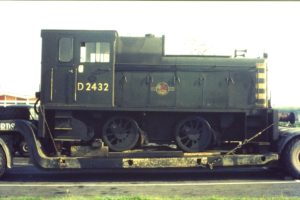
D2432 was a Class 6 0-4-0 diesel shunter which was first allocated to Hamilton in February 1960, transferring to Polmadie in May 1960, Ayr in 1966, and to Eastfield in September 1967. It was withdrawn from BR service at Eastfield and sold to R. E. Trem & Company, Finningley, near Doncaster. They in turn sold it to Shipbreaking (Queenborough), Oueenborough, Isle of Kent for further use. Movement from Glasgow to the Isle of Sheppey would appear to have occurred in part or most likely in whole by road. There is a report of it being sighted at Stamford on 20th May 1969 on road transport from where it continued to the Isle of Sheppey. Photographs of the locomotive in transport can be seen here. [9] Sightings of the locomotive were by Brian Henderson at Gosforth High Street (on road transport), 19/05/1969; Stamford (on road transport), 20/05/1969; Medway Services, M2, Kent (on road transport) by Peter Hall (IRS), on 20/05/1969; and at Queenborough by Gordon Edgar, 24/01/1971 and 22/10/1972, Mike Martin, 08/11/1975 and Tom Bartlett, 24/01/1976. [10]
Industries Served by the Railway
Settle Speakman provided the shunting requirements for the local factories, which were thereby connected with the Company’s wharves and with British Railways’ main line at Queenborough Station. All those local factories had strong links with the Company and its predecessors. The original agreements for shunting and handling of goods were still in operation,
The companies serve by Settle Speakman are listed below:
Sheppy Glue & Chemical Works: This works, reputed to have been the oldest chemical works in the country, haf existed at Queenborough from the 16th century. The original works was on the town side of the Creek, but by the 20th century an extensive site to the south east of the Creek was also occupied. The principal products were glue, granular compound fertilizers, super phosphate, organic fertilizers and sulphuric acid. The Queenborough Contracting Company made, in 1916, an agreement to construct a full gauge railway line into the works and to do all the shunting necessary. These arrangements were taken over by Settle Speakman & Co. Ltd. [13: p28]
Alfred Johnson & Son Limited: One of the largest UK producers of sanitary ware, Alfred Johnson & Son Ltd., (“Pyramid” trade mark). The Queenborough Works was established in 1908, and from the earliest days arrangements were in force whereby the various predecessors of Settle Speakman & Co. Ltd. constructed and operated railway connections and provided shunting facilities to the works. … A narrow gauge line from the Chalk Wharf operated for many years and conveyed the china clay and other raw materials to the works, but this has been replaced by road transport loaded directly from the ships. [13: p28]
Canning Town Glass Works Limited: Manufacture of glass bottles and jars commenced in 1910, with the establishment of the Queenborough Glass Bottle Works. From the outset arrangements were in force to discharge goods and raw materials for the works at the Chalk Wharf, including the use of an overhead gantry. A rail connection was made to the works in 1920 and an agreement was entered into for shunting services. When the works of the original company were taken over by the Canning Town Glass Works Ltd., in 1926, these arrangements remained in force, and were undertaken by Settle Speakman & Co. Ltd. [13: p28-29]
Medway Glass Works Limited: In anticipation of large contracts from a manufacturer of electric lamps, the construction of the Medway Glass Works was commenced in 1919, but labour conditions on the site delayed the completion of the factory, and the opportunity for the contracts was lost. Immediately following came the slump of 1920 and, as a result of these misfortunes, the completed works did not go into production. Agreements, however, were made for the discharge of materials at the wharves and for shunting arrangements. Production commenced in 1921, but prevailing conditions were such that the works soon had to close. … In 1942, the premises were requisitioned by the Admiralty, who retained them until de-requisition in 1947. Later, in 1952, the Admiralty purchased the works and carrried out considerable repairs to the buildings. [13: p29]
Sheet Glass Limited: In 1919, on the site of the old Queenborough Copper Works, a firm – British Window Glass Ltd. commenced to build a factory for the manufacture of sheet glass. Arrangements for discharging of goods and materials at the wharf and for delivery and shunting were entered into. Trading conditions in the 1920’s, however, were not favourable and production stopped in 1924. Another company was formed – Sheet Glass Ltd. and production re-commenced and continued for about two years from 1927. In 1932, the works re-opened having been acquired by Pilkington Bros. Ltd., of St. Helens, and Settle Speakman & Co. Ltd. continued to serve the new owners as had previously been agreed. [13: p29]
W. Lodder: This is an iron foundry which specialises in the making of the cast-iron moulds required for glass-bottle manufacture, a unique enterprise for this part of England. The foundry had an engineering works attached, which undertook general engineering repairs. [13: p29]
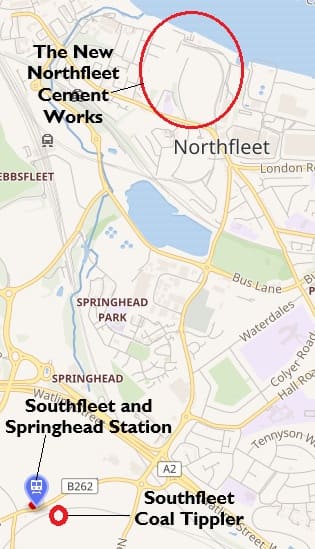
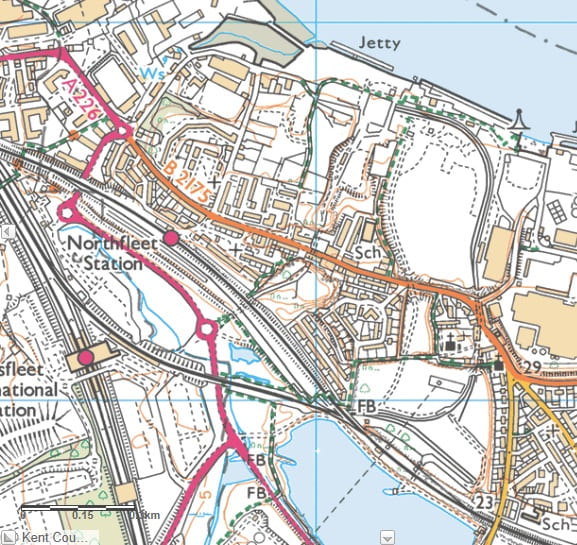
Queenborough Rolling Mill: this facility was established on the site of the old cement works. This made use of the industrial railway which ran to exchange sidings with the main line railway and to a jetty on the River Swale. Operations ceased in February 2013 and the physical assets were auctioned in September 2013. The Wharf and the associated industrial railway to Queenborough Station were used by Settle Speakman until the jetty was used by Shipbreakers (Queenborough). The Rolling Mill was then built and rails recovered from defunct railway lines arrived by ship and by rail and were rolled to produce steel bar for use in reinforced concrete. The reinforcement bar was despatched by ship, rail and road. Second-hand industrial railway locomotives and wagons were used for movements between the works and the jetty. The works was taken over by the international steel processing company ISTIL in 1999, which was purchased in 2006 by Estar. In 2010, the mill was operated under the name Invicta Merchant Bar. It is thought the railway to the jetty had ceased to be used by this time. [3] Scenes from around the Rolling Mill can be seen here. [8] The Mill closed in 2013. [17: p164]
A full list of locomotives used on the site by Lacmots 1960-1964, Shipbreaking Queenborough 1964-1972, Queeenborough Rolling Mill, 1972 onwards can be found in Robin Waywell’s book, Industrial Railways & Locomotives of Kent. [17: p163-168]
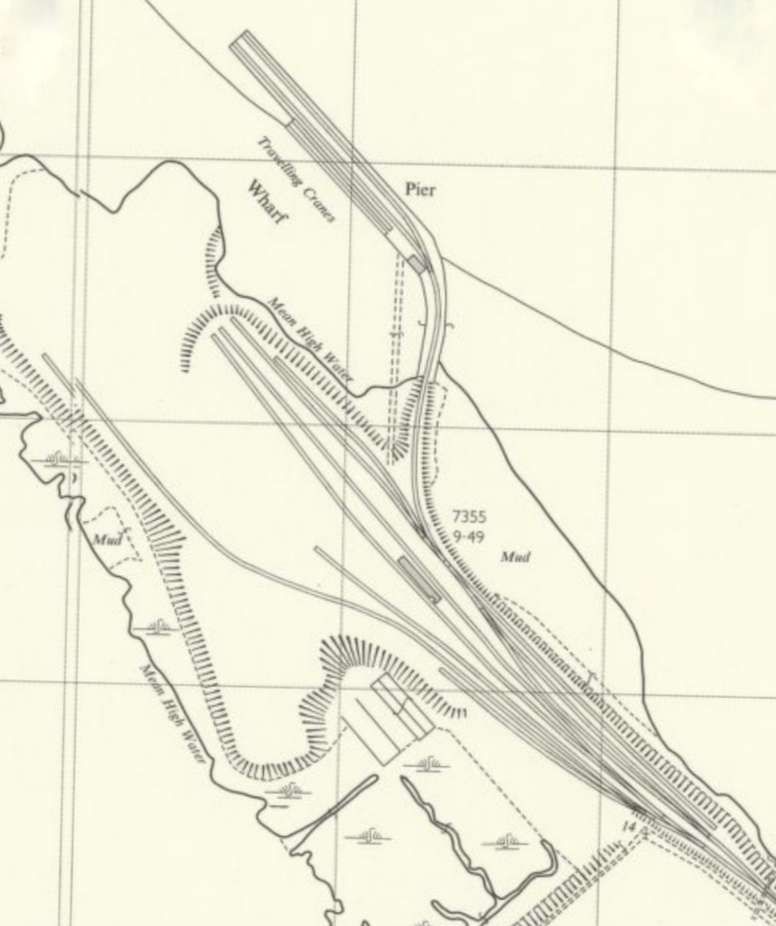
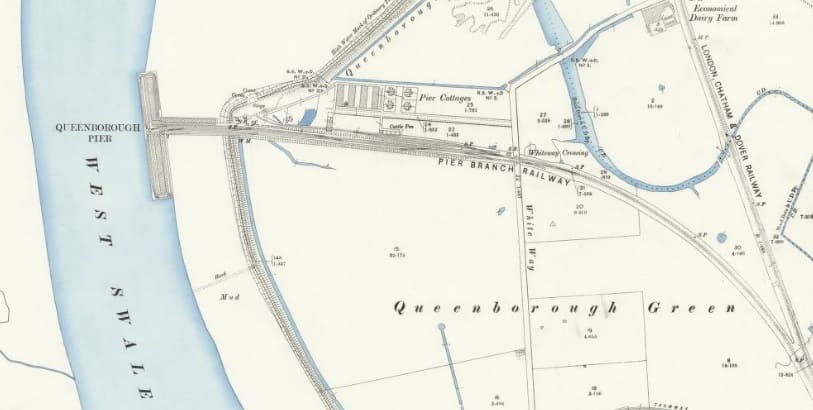
Flushing Pier: In about 1875 the old London, Chatham & Dover Railway Company decided to build a pier at the entrance of the River Swale to accommodate cross-Channel traffic. “The situation was a favourable one for trade and passenger crossings to Holland, as it was conveniently near to London, yet sheltered and notably less liable to become fog-bound and more generally useful than the railway company’s site at Dover. The pier was known as the Flushing Pier, as a regular day and night service for mailboats ran between Queenborough and that port. In 1885, the original pier was burned down, and a new one built, which was also destroyed by fire in 1900. The railway company again rebuilt the pier with a pier head structure 650 feet long and an approach pier 300 feet long, all on some 2,500 timber piles, heavily braced. On the pierhead and approach were extensive buildings, platforms and railtracks.” [13: p30]
Flushing Pier was more formally called Queenborough Pier. It sat to the North of Queenborough, close to the mouth of the River Swale. It is shown here at the end of a branch from the London, Chatham and Dover Railway on the 25″ Ordnance Survey of 1896, published in 1898. [11]Flushing Pier. [13: p30]
“The pier continued in operation until the outbreak of the 1914-18 war. When the war was over, the Continental route went through Folkestone and Dover and the pier never regained this traffic. Between the wars the pier was first used as a dismantling jetty, where such famous ships as “H.M.S. Orion” were broken up. In 1928 a company, The Port of Queenborough Ltd., was formed and hired the pier for dealing with merchandise and also proved successful in handling coal from the Kent coalfields. This company was acquired in 1931 by Settle Speakman & Co. Ltd., and re-organised. In 1936, an approach was made to the railway company to allow the pier to be adapted in order to take road transport, but after investigation the railway engineering department did not consider the structure to be safe for this purpose, so nothing came of it.” [13: p30-31]
“In November, 1939, the Admiralty gave notice that they required use of the pier forthwith, and within one week most of the Company’s gear, plant, etc., were removed and the pier taken over for use as a Mine Sweeping base. Arrangements were made to carry on the business at the wharves of Settle Speakman & Co. Ltd., and a considerable proportion of the tonnage was maintained. This requisitioning gave rise to long-drawn-out negotiations with the Admiralty and the Railway about compensation and the use of machinery, but eventually all was settled.” [13: p31]
“After the Admiralty vacated the Pier in 1948 attempts were made to resume activities but about 1951 it became evident that the pier was becoming unsafe for further use, and in 1955, it became a real danger to shipping. Demolition was put in hand, and June, 1956, saw the last of this … old pier; it had fought a losing battle against fire, changing trade routes, and the continuous and devastating attack of the teredo worm.” [13: p31]
By the end of its life, Flushing Pier was in a parlous state! [13: p31]
References
B. D. Stoyel & R. W. Kidner; The Cement Railways of Kent; The Oakwood Press (LP70], Headington, Oxford, 1973 & 1990.
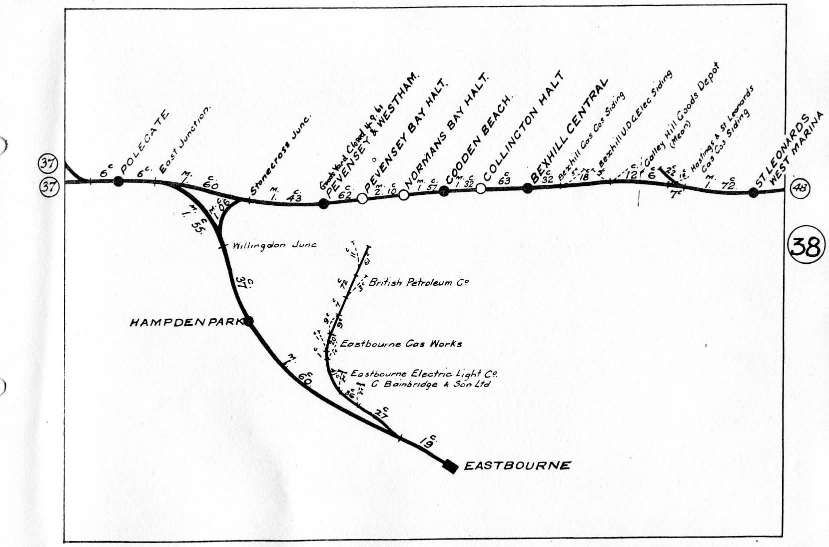
The Crumbles Branch (also known as the Ballast Line or Crumbles Railway) was a 3.5-mile standard-gauge industrial branch line constructed in 1862 that ran east from Eastbourne’s railway area out onto the remote shingle beach known as The Crumbles. [5][6][7][8]
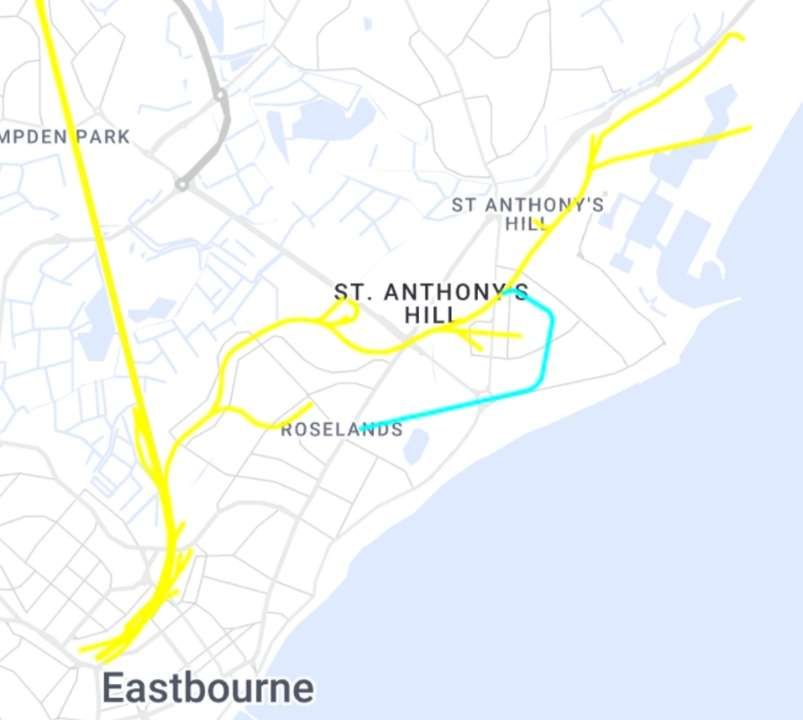
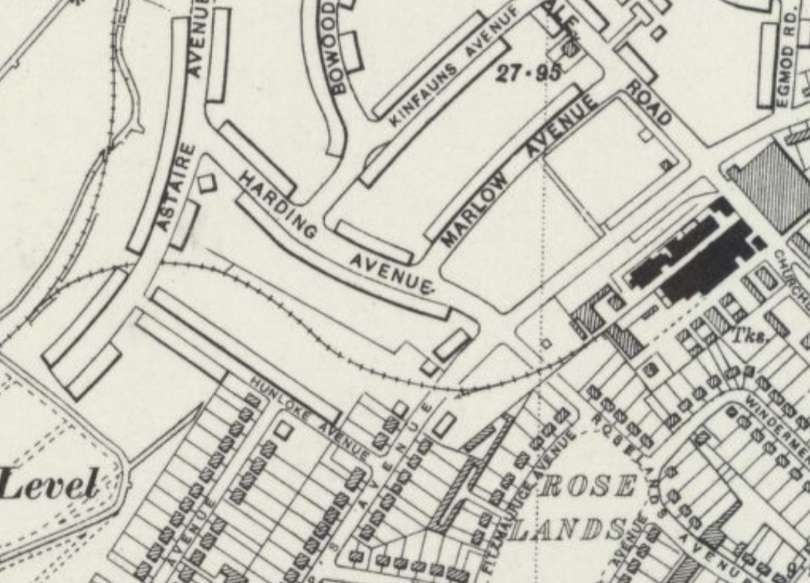
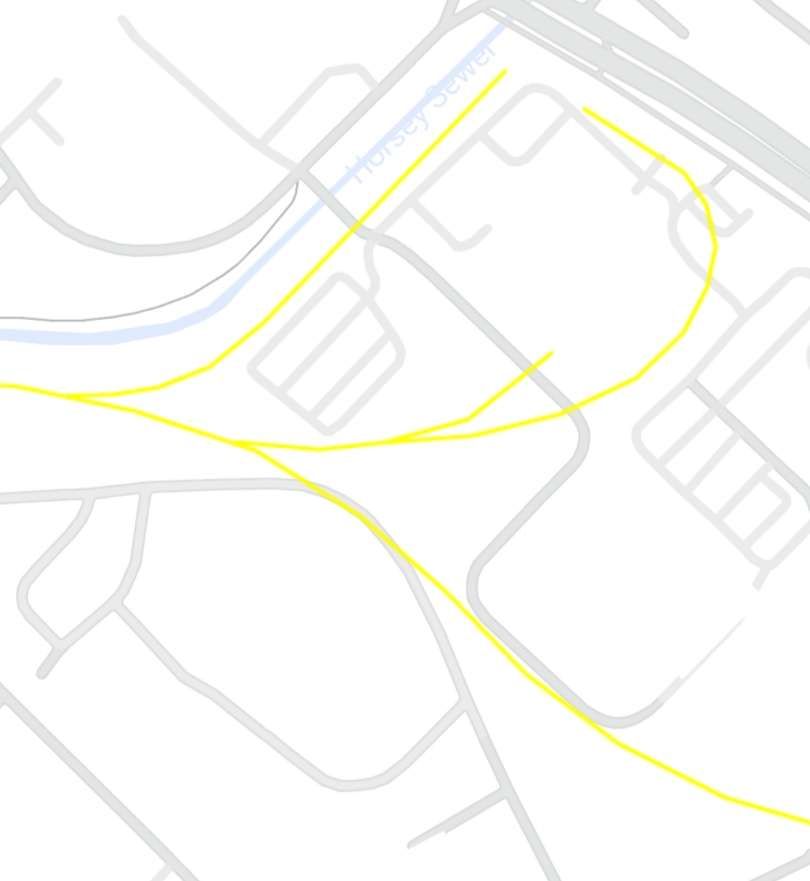
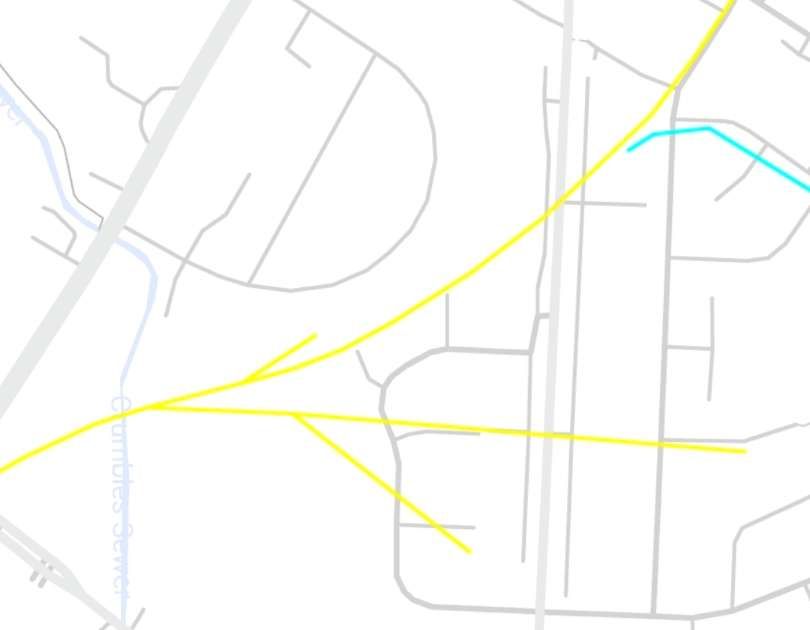
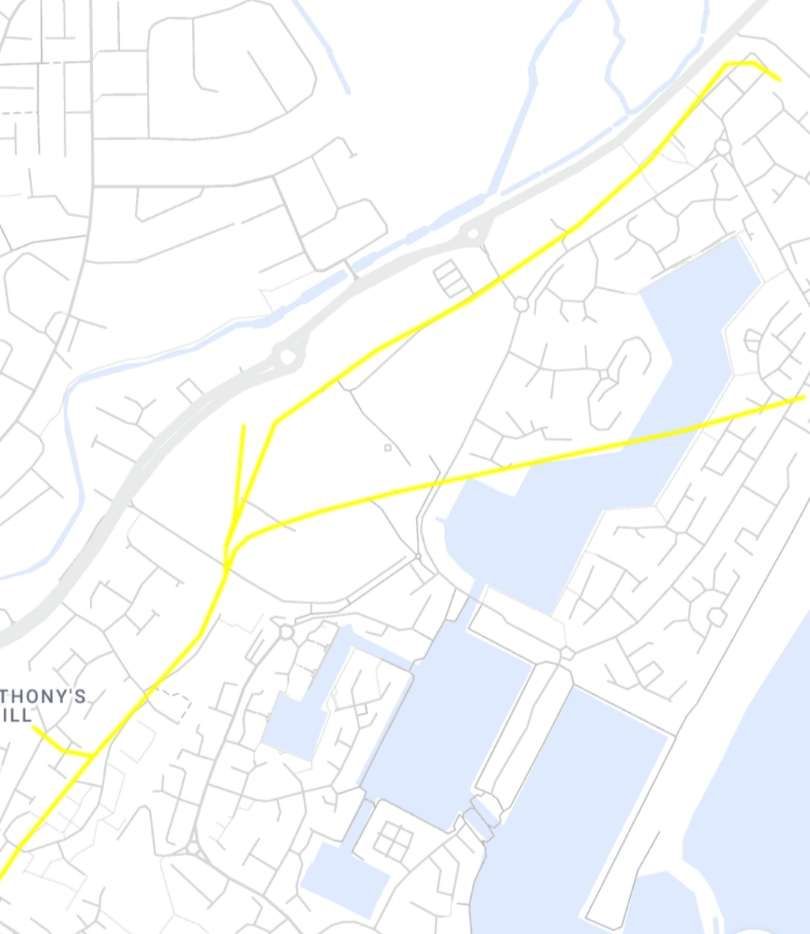
The Crumbles Branch ran from Eastbourne Railway Station Northeast roughly parallel to the coast. It is shown in yellow as it was part of the wider network near Eastbourne. A short branch can be seen near Roselands which served the Destructor Works. The Gas Works with its associated sidings, is directly North of the ‘LA’ of Roselands. The Turquoise line runs through, what were until the 1960s, rifle ranges to the Northeast of Eastbourne. It appears on the Ordnance Survey undertaken at the end of the 19th century but not on later surveys, so should not be confused with an electric tramway which was a tourist attraction in the mid-20th century. It may be associated with the Hall & Co. Narrow-Gauge (2ft) Tramway. [24][31]This image is a scan of the relevant page of a BR SR Route Mileage folder which gives some details of the Crumbles line at Eastbourne. The branch features at the centre of the image. This image was shared on the Disused Railways of Sussex Facebook Group by John Atkinson on 28th January 2021. [36]
The shingle bank/beach was 3⁄4-mile-wide (1.2 km) – shingle collected here was used as ballast for railway lines across the LB&SCR and the wider UK network. [2: plate 27]
Andrew Diack tells us that, “This distinctive area of coastal deposition lying adjacent to the sea underlies modern Sovereign Park and Princes Park and continues towards Sea Houses, near Eastbourne Pier. The irregular surface of ridges and hollows once contained pools of water in places, and a “Cromble Pond” of irregular form is shown on early maps, including John Speed’s map of Sussex of 1611 and Robert Marden’s map of Sussex of 1693, while the Ordnance Survey map of 1813 also shows “Crumble Pond”. In 1845, the Crumbles were partitioned between Lord Burlington, later the 7th Duke of Devonshire, and the Gilbert family; both families had a long association with the town as major landowners, benefactors and developers. The Gilberts and the Cavendish family, who as the Dukes of Devonshire were, in fact, connected by marriage through the Compton family, who were also landowners in Eastbourne and whose estate was managed from their residence at Compton Place, previously Bourne Place. The partition of the Crumbles was said to have been beneficial toward the development of the Seaside suburb to the east of Eastbourne. The railway came to Eastbourne in 1849, and with the expansion of railways so grew the demand for railway ballast and the need for gravel quarries to supply the stone. In 1857-62 the London Brighton & South Coast Railway (LB&SCR) negotiated the purchase of not less than 48,000 cubic yards of shingle from the Duke of Devonshire at 1 penny per cubic yard, to be extracted from the Crumbles.” [6]
Andrew Diack writes: “Due to the buoyant demand for ballast, this was a period of expansion for the gravel pits that produced the product, but it was equally a time when the natural landscape of vegetated shingle ridges suffered greatly by being transformed into a scarred landscape where industrial machines created holes and gashes in the surface of the land. Over a period of a hundred years shingle was removed at the rate of around 250,000 tons per year for railway ballast and building material, and that resulted in the height of the land being reduced by 4 metres within 100 metres of the shore.” [6]
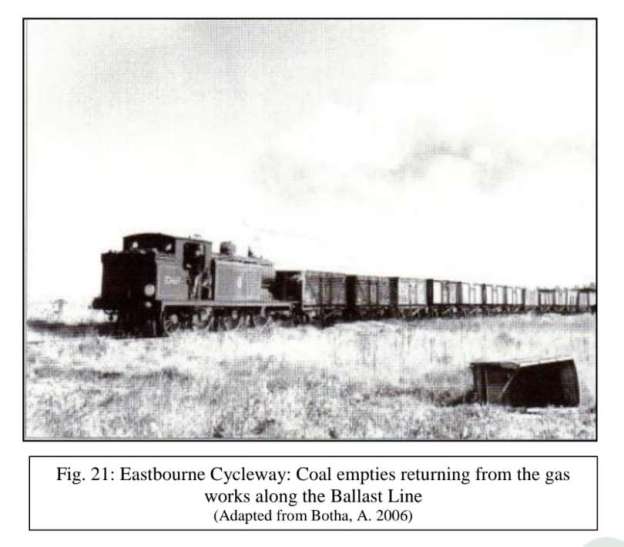
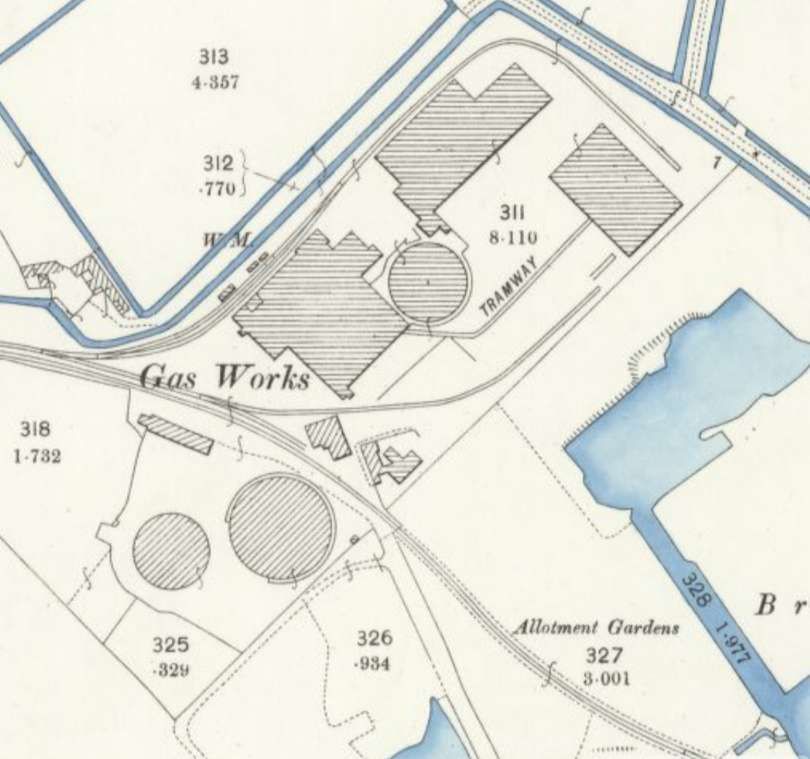
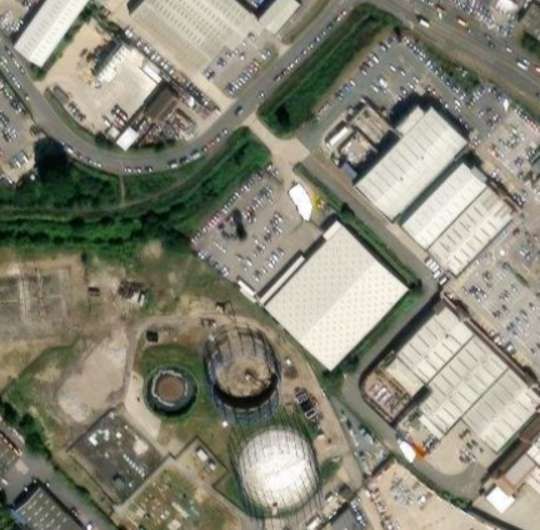
Additional branches were added to the line, including a siding built in 1870 for the Eastbourne Gas Company, which straddled the railway. The gasworks received coal via the rail connection and in return, produced coke, which was taken away. [2: plate 32][3]
“In 1926, a line was laid for the Eastbourne Corporation Electric Works, which transported coal and supplied fuel to the bus garage, as well as taking scrap metal from the refuse destructor works.” [2: plate 29][3][5]
In fact, “as Eastbourne expanded, the branch evolved into an industrial corridor. It served the town’s gasworks (delivering large volumes of coal), brickworks, timber yards, and destructor works.” [6]
Ballast trains ran until 1932, when the LB&SCR’s successor, the Southern Railway, switched to using granite.
Andrew Diack continues: “Although the gravel had a variety of uses, when railways changed to the use of granite chippings in 1930, the business went into terminal decline. (Broken granite chips interlock better than rounded pieces of flint, and they also provide good shock absorption and easier maintenance.) Shingle extraction gradually diminished, and by 1932, the railway was no longer used to transport shingle, though it continued to serve [some] other industrial sidings in addition to the gasworks.” [6]
“The branch ceased steam working in April 1960, after which diesel shunting locomotives took over [2: plate 28] until the line was closed in … 1967.” [2: plate 29][3][5]
Andrew Diack says that “The Crumbles railway continued to serve the gasworks until … 1967, but with gas production ceasing in June 1967, the track fell into disuse, and in the late 1980s it was removed at the time of the Eastbourne re-signalling project.” [6]
A short series of photographs follow below, all taken circa. 1962 by Dick Gilbert.
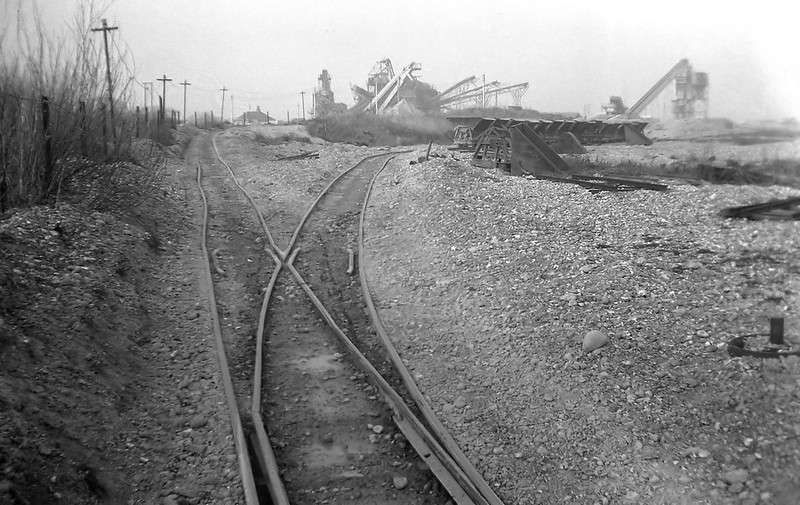
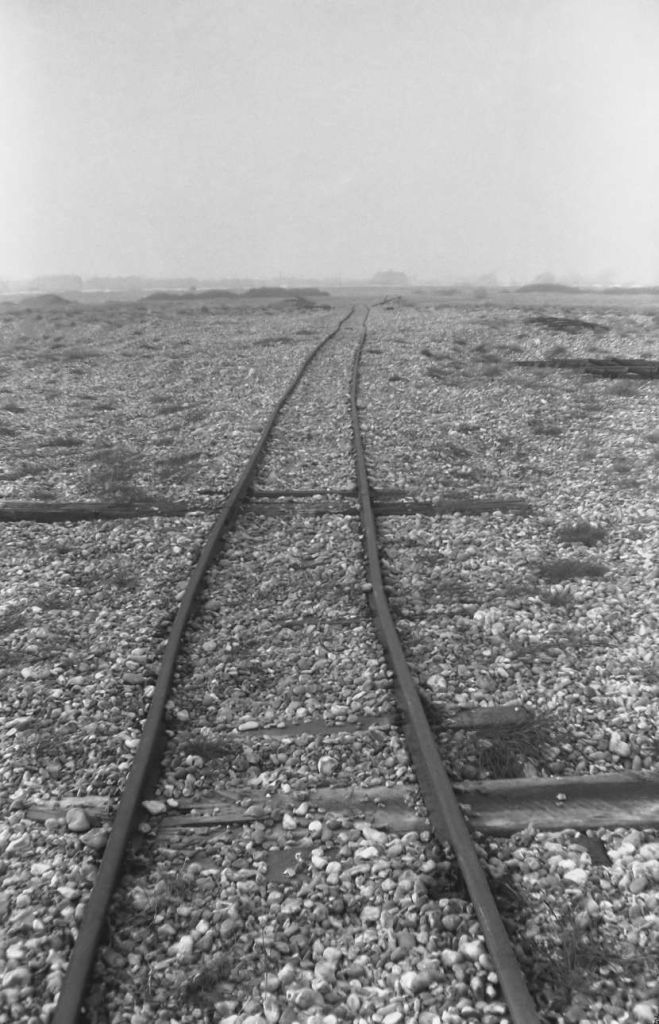
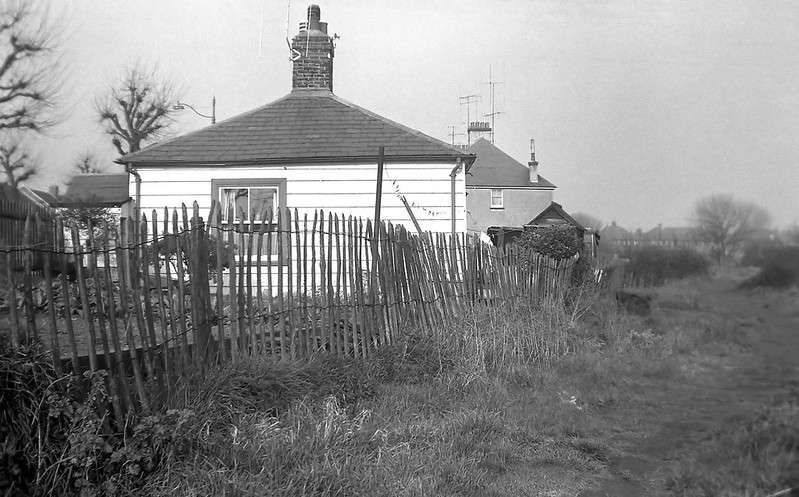
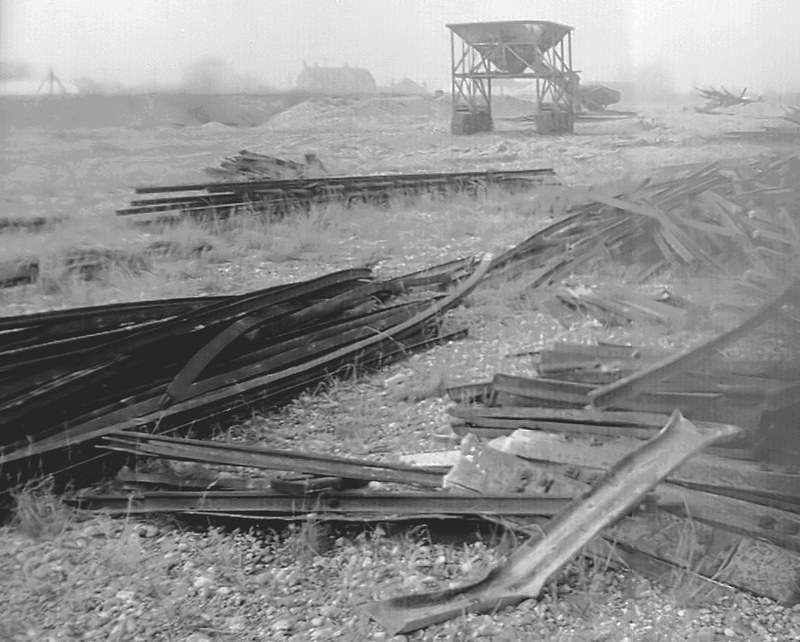
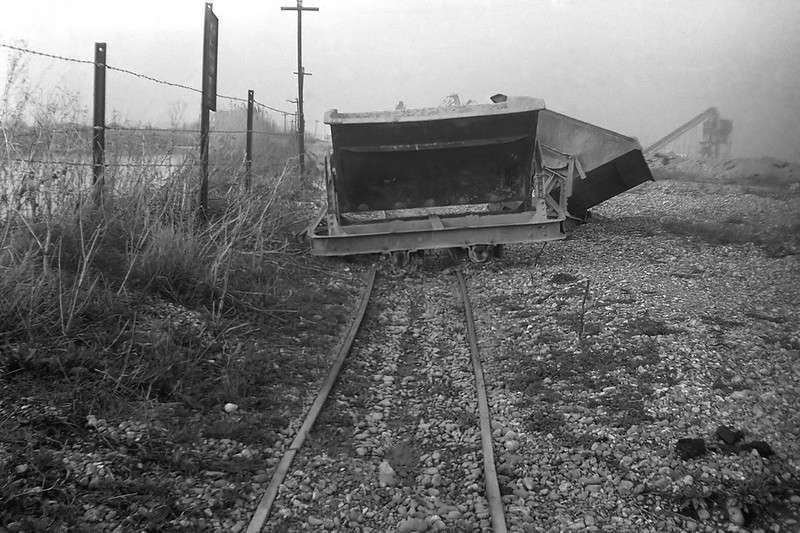
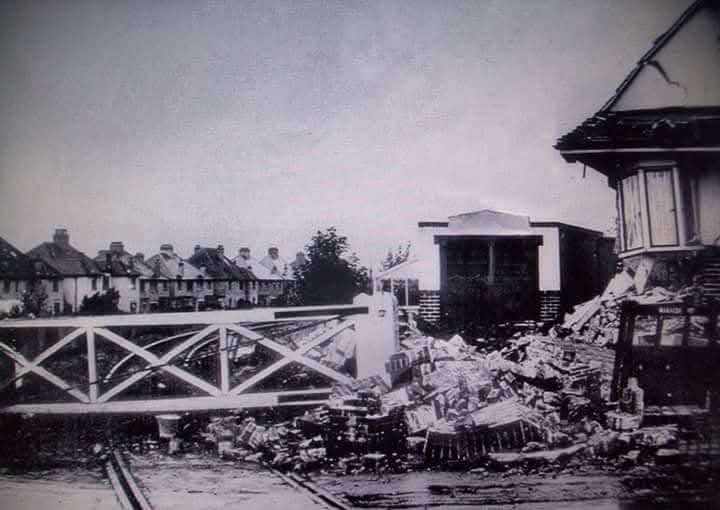
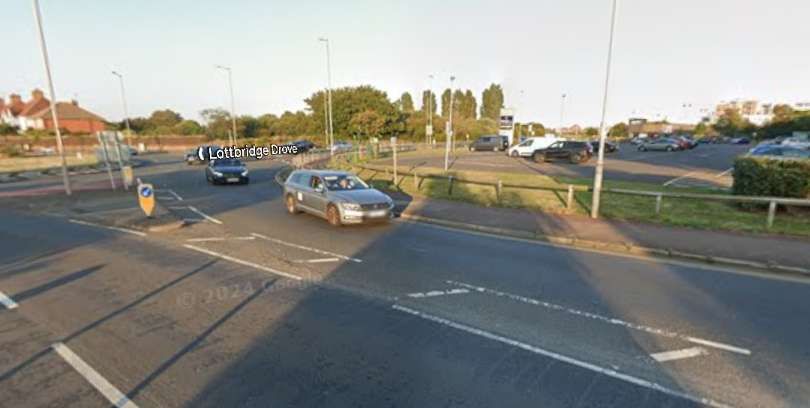
The line to the Crumbles remained in place until the early 1960s when these pictures were taken. There is no trace of anything shown in these pictures in the 21st century (Dick Gilbert, around 1962), (CC BY 2.0). [4]The line across the Crumbles (Dick Gilbert, around 1962), (CC BY 2.0). [4]The location of this wooden building is what is now the eastern side of the roundabout where the A259 coast road meets Lottbridge Drove (A2290). It is no longer there, but was probably a house for the crossing gates controller as the line crossed the A259 here – the houses on the left are on that road and some are still recognisable. The trackbed out to the Crumbles is on the right (Dick Gilbert, around 1962), (CC BY 2.0). [4]The redundant rails and sleepers removed from the branch line (Dick Gilbert, around 1962), (CC BY 2.0). [4]Disused/redundant skip wagons (Dick Gilbert, around 1962), (CC BY 2.0). [4]
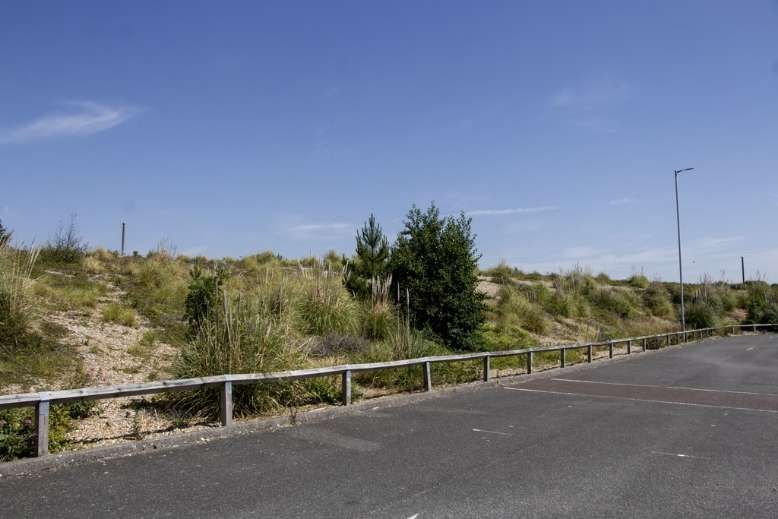
The remote shingle beach area of The Crumbles where the line terminated has since been redeveloped and is now home to Sovereign Harbour and retail developments.
An exploration of this line can be found here on YouTube. [7]
Following the Line
A separate line ran alongside the main line out beyond the location of the Engine House. …
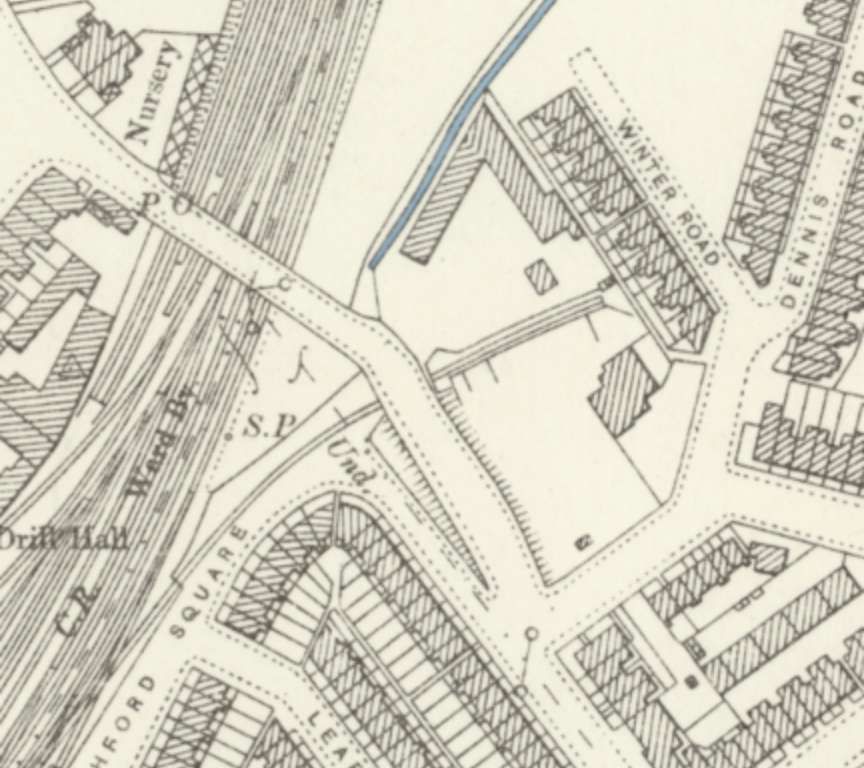
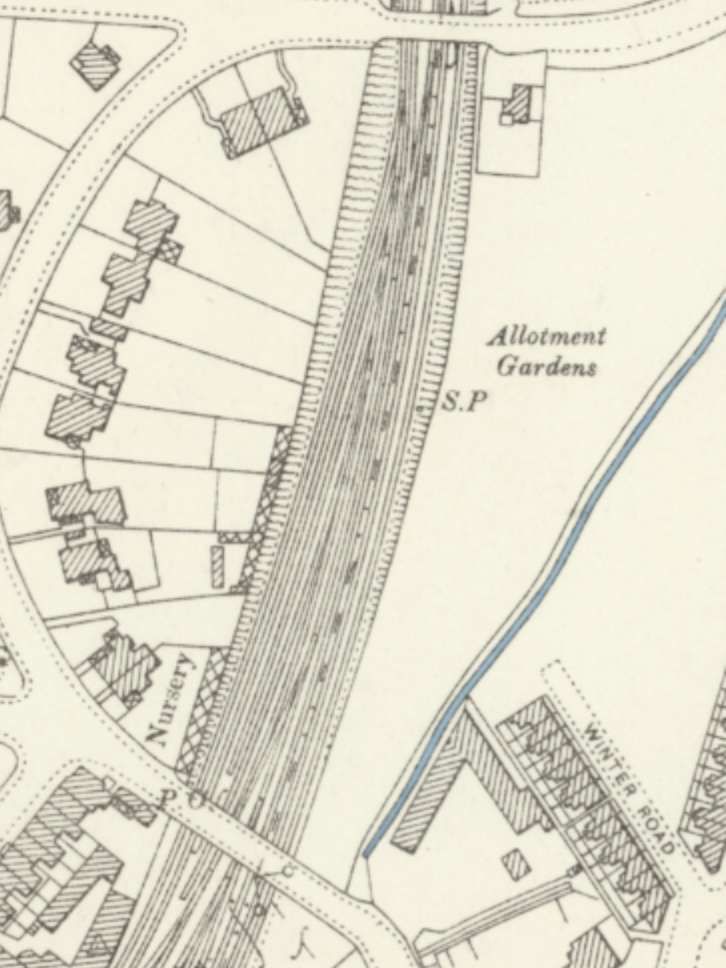
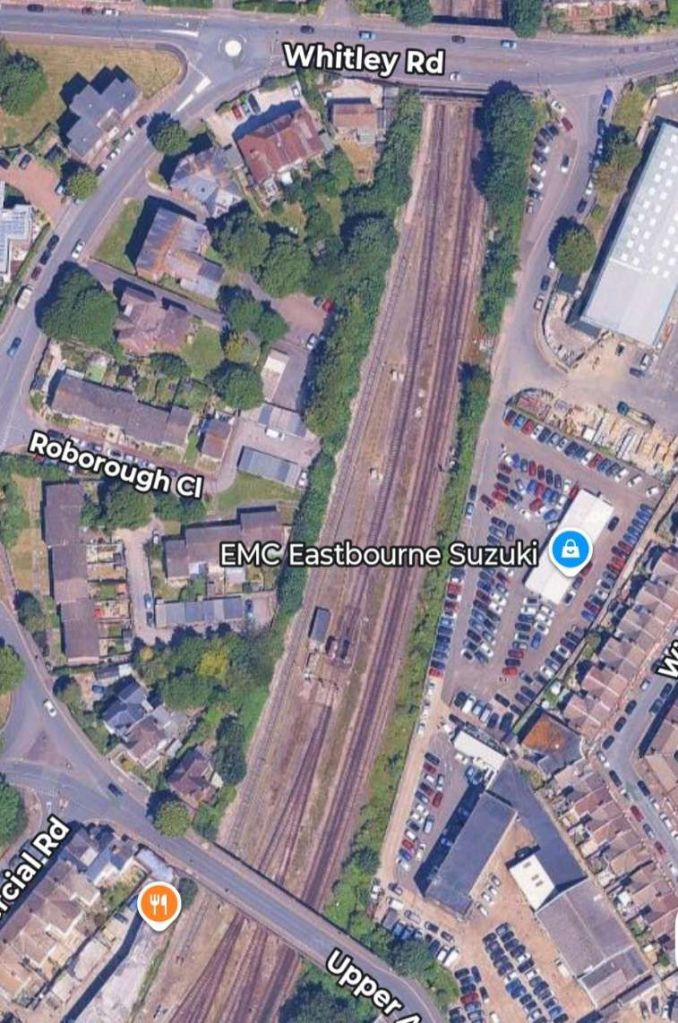
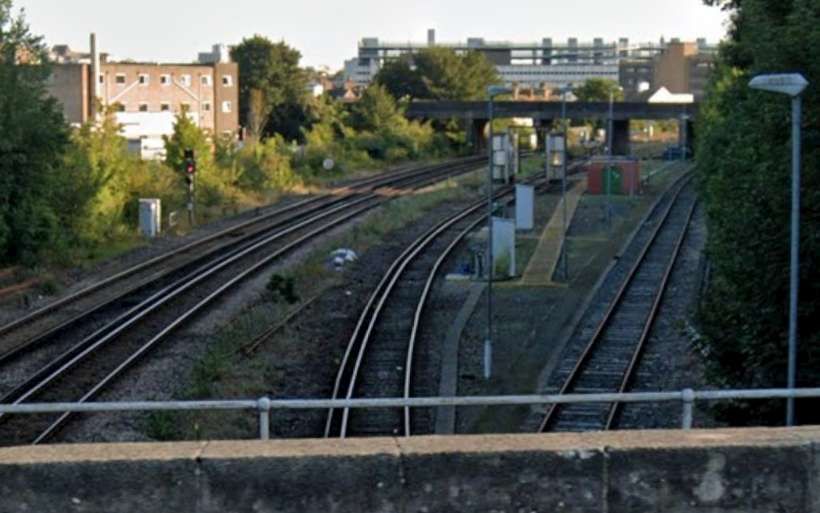
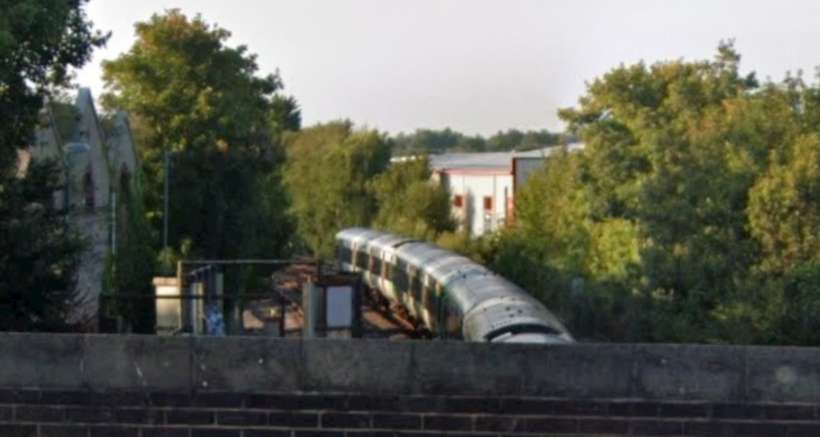
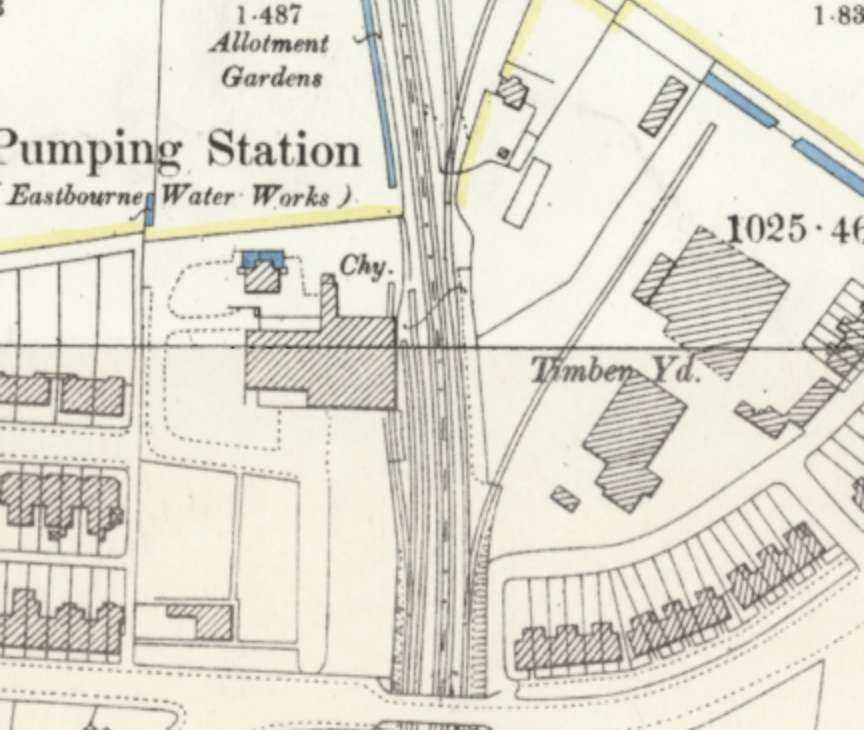
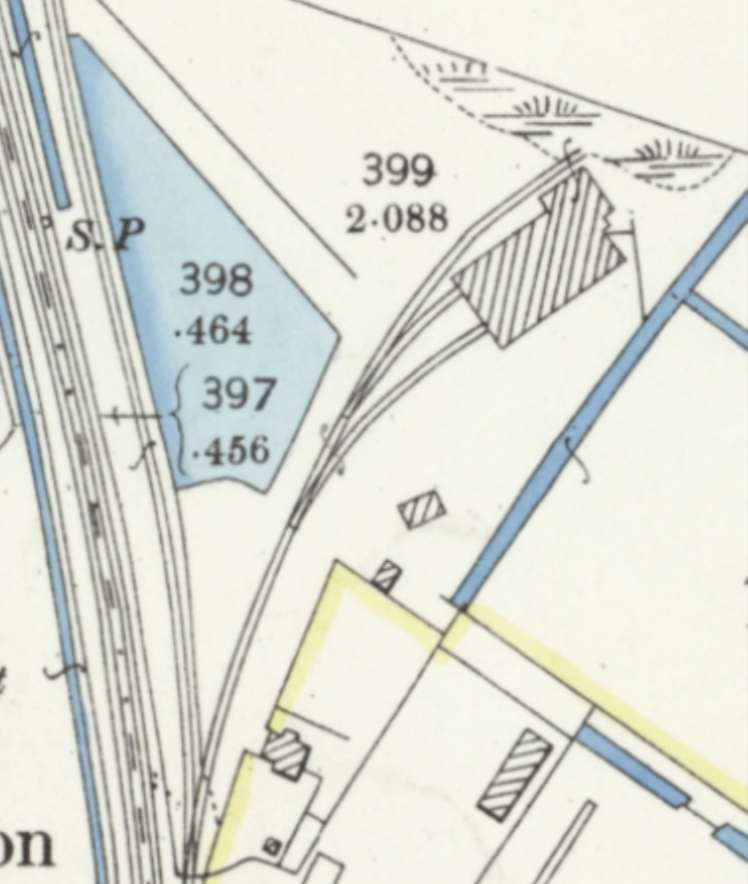
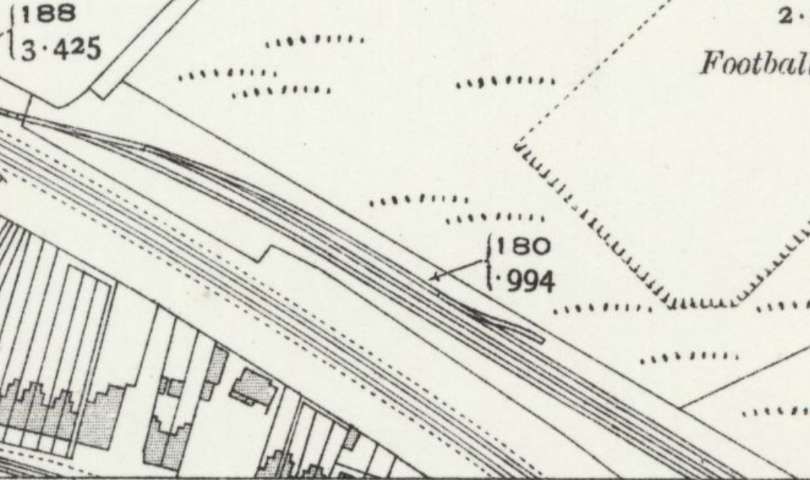
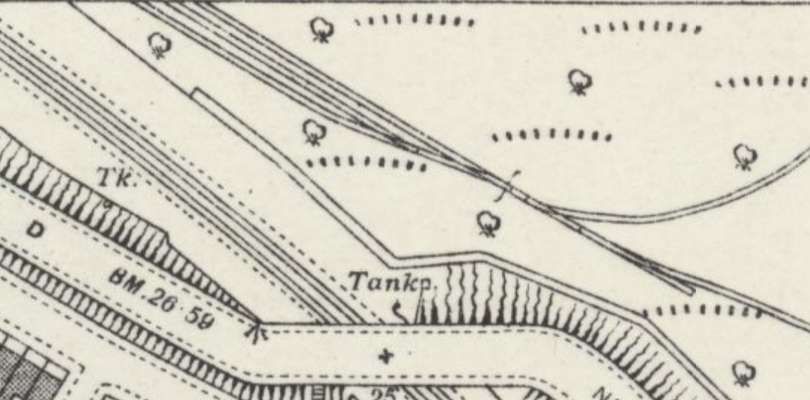
The Crumbles Branch ran beside and to the East of the main line a short stub line turned away to the East from the branch to serve a small yard. The branch continued under the bridge which provided a link between Upper Avenue and Cavendish Place. The 25″ Ordnance Survey of 1898, published in 1899. [8]The same area as it appears on the modern ESRI satellite imagery provided by the National Library of Scotland. The bridge noted on the map extract above can be seen in the top-right of this image. The road is now named Upper Avenue. [9]The short stub siding mentioned above is shown here on another extract from the same OS sheet. It passes under the link road and most probably already in place before that road was conceived. The site served by the sliding is marked ‘Smithy’ on a later Ordnance Survey map. [8]The view South from Upper Avenue bridge towards Eastbourne Station. [Google Streetview, August 2024]Looking North from Upper Avenue bridge towards Whitley Road bridge. [Google Streetview, August 2026]The next length of the line which covers the length between Upper Avenue bridge and that carrying Whitley Road. The 25″ Ordnance Survey of 1898, published in 1899. [10]While Upper Avenue appears to be much the same width as on the map extracts, Whitley Road bridge has been significantly widened. [Google Maps, August 2026]Looking South from Whitley Road bridge towards Upper Avenue bridge. [Google Streetview, August 2026]Looking North from Whitley Road bridge. [Google Streetview, August 2026]The line to the North of Whitley Road bridge. Another short branch from the Crumbles Branch serves as a private siding for a Timber Yard. The Crumbles Branch can be seen separating from the main line close to the Pumping Station. Another short siding can also be seen leaving the branch closed to the top of this map extract. This 25″ OS map extract of 1898, published 1899, spans two OS sheets. [10][11]This extract from the 25″ OS map extract of 1898, published 1899 shows the sliding which appeared at the very top of the last map extract. It is not clear what the site was used for at the turn of 20th century. [11]
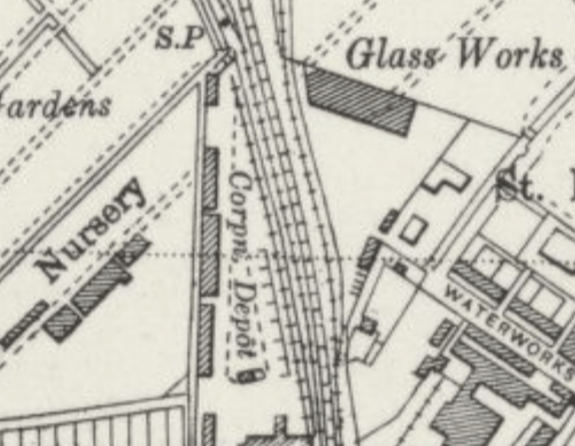
This small extract from the 6″ Ordnance Survey of 1938, published in 1947, shows a new building on the site, no rail connection, and the site is designated a Glass Works. Careful examination of the map extract shows that, although the sidings within the site and the building they served are now gone, the point on the Crumbles Branch remains. [12]
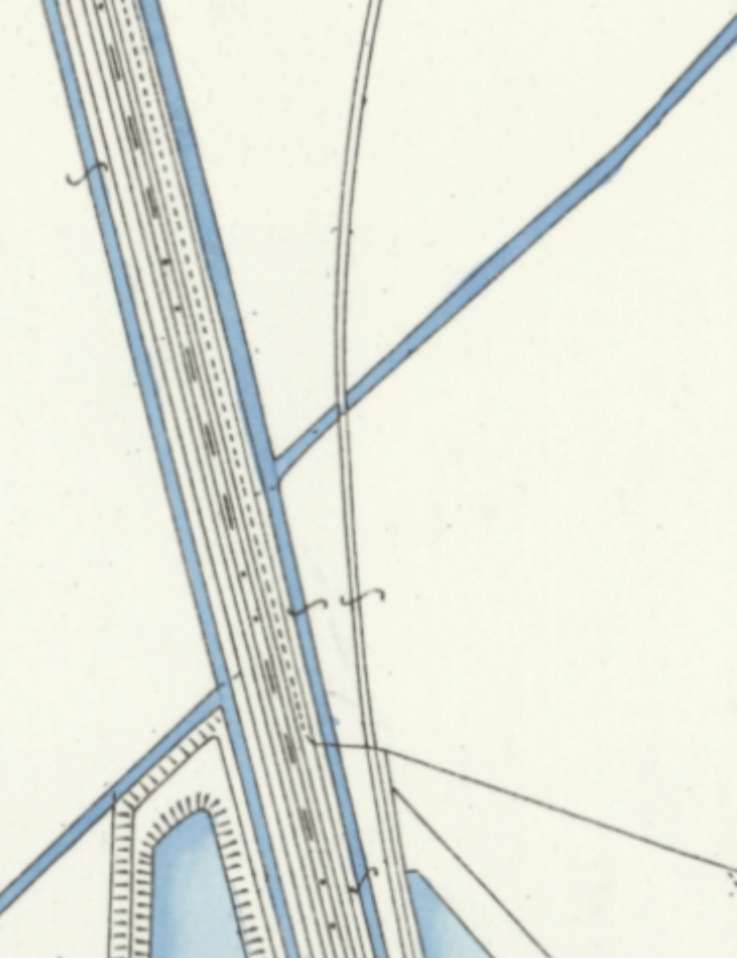
The Crumbles Branch diverged from the main line. 25″ OS map extract of 1898, published 1899. [11]The line continued to turn northeastwards. [11]Now heading Northeast, just at the top-right of this map extract a branch led away to the East. It served the Eastbourne Destructor Works and was in place for a period in the early- to mid-20th century. [11]The Crumbles Branch begins to turn North, the branch to the Destructor Works does not appear on this next 25″map extract from 1898/99, nor does it appear on later 25″ surveys provided by the NLS. [11]The 6″ Ordnance Survey of 1938, published in 1947 shows both the short siding/branch and the Destructor Works themselves which were sited to the Southeast of St. Philips Avenue. [12]
The branch serving the Destructor Works. [24]
A short aside is worthwhile here, to provide some information about the Destructor Works. …
The Eastbourne Destructor Works was a late 19th-century municipal waste incinerator and early energy-from-waste facility, producing electricity which was used locally in Eastbourne. Plants like this were built as towns grew and traditional waste disposal became difficult, the site burned household refuse in high-temperature furnaces to reduce volume, produce clinker, and generate steam for electricity. Coal was often required alongside the rubbish to keep the furnaces hot enough. [7][13][14]
By the 1950s and 1960s, shifting environmental standards, modern waste management approaches, led to the closure and demolition of the complex and the lifting of its rail link. [7][14]
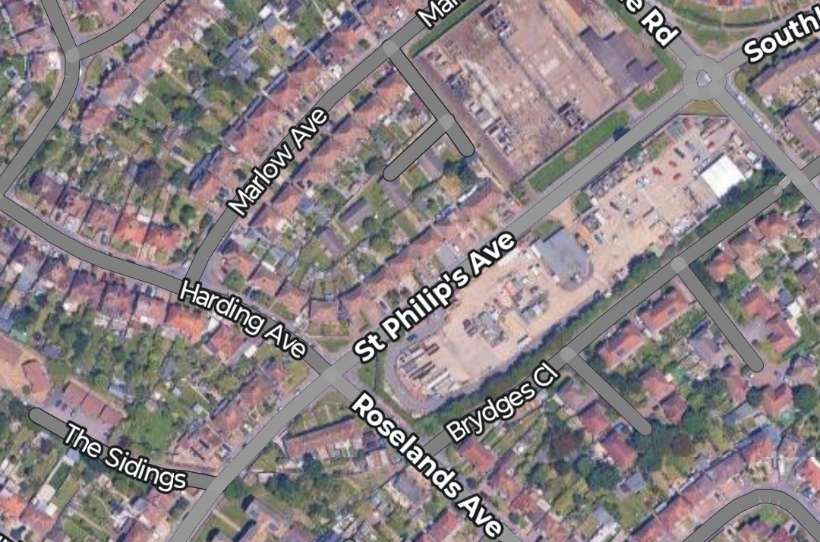
The wider industrial footprint stretched across the area of modern-day St Philips Avenue and Bridges Close. The refuse handling section stood roughly where the current recycling site is on St Philips Avenue, while the core furnace operations and rail sidings were nearby towards Bridges Close. Only the recycling centre remains as a hint to the past use of the industrial site. The rest of the land has been redeveloped into housing estates and roads.
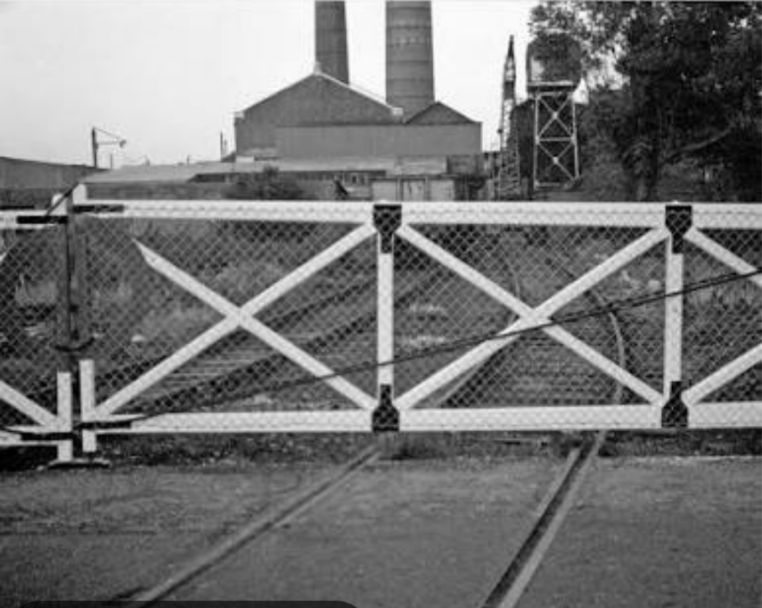
Simon Meader shared two photographs (photographer not known) which were taken before the nationalisation of the railways, both focus on the location of the level-crossing on St. Philip’s Avenue.
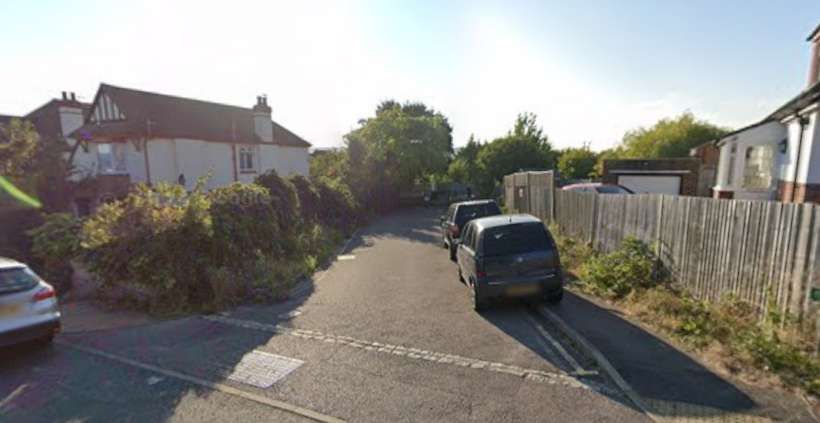
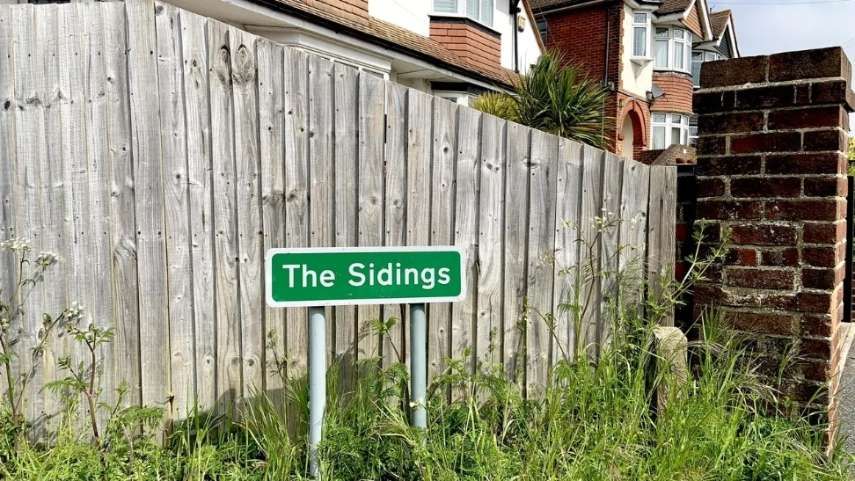
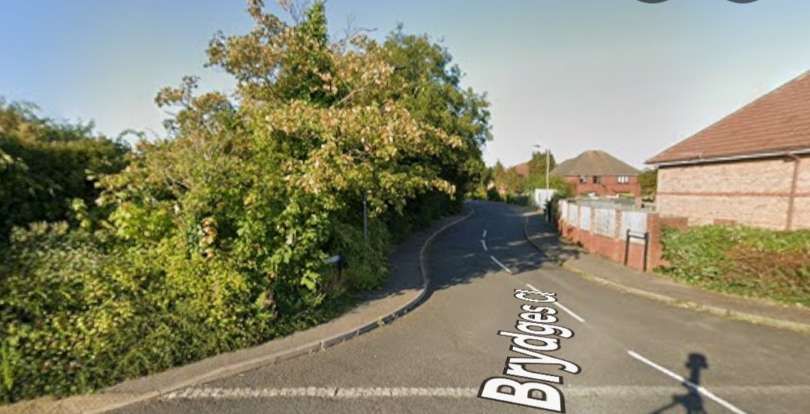
Looking West-northwest along the line of the old rail link, a short cul-de-sac called ‘The Sidings’ is seen here from St. Philip’s Avenue in August 2024. The waste amenity site is behind the camera to the right. [Google Maps, August 2024]
The Sidings runs West-southwest from St. Philip’s Avenue along the line of the old rail link.
The Sidings is bottom-left in this image, the civic amenity site is centre-right. [Google Maps, August 2026]
The National Archive record for the Works states: “The Eastbourne Gas Company was formed by Deed of Settlement in 1857. The original area of supply was the town and parish of Eastbourne and the parish of Willingdon. The company was dissolved and reincorporated by Act of Parliament in 1868. A new works was built in Willingdon and the original one closed.”
Over the next eighty or so years The area served by the plant grew. At each stage of development an Act of Parliament either extended the area of supply or permitted the company to purchase other gas companies and their areas of supply until nationalisation took place in 1949 when the undertaking became part of the Sussex Divison of South Eastern Gas Board.
The early gravel extraction/ballast workings were to be found at this location and this was for a time the end of the branch as shown on the 6″ Ordnance Survey below: …
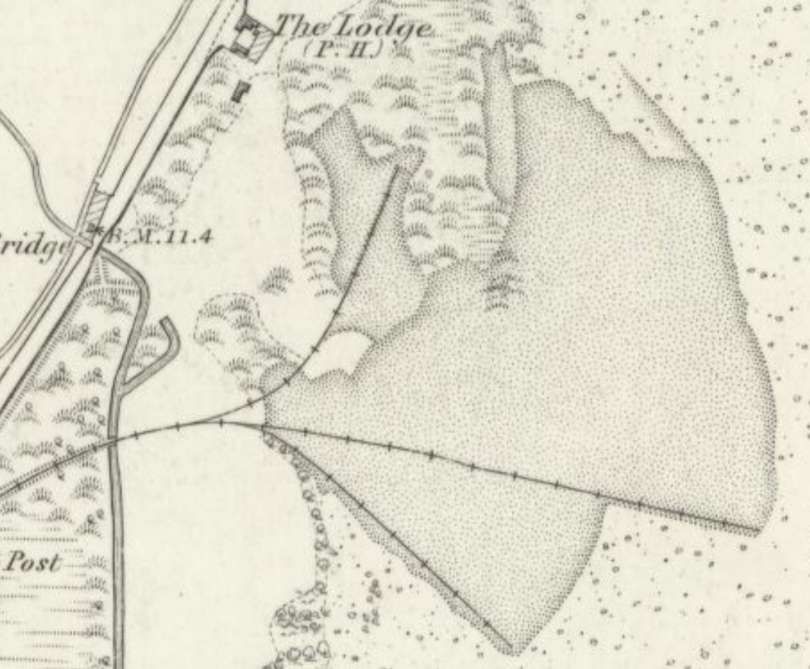
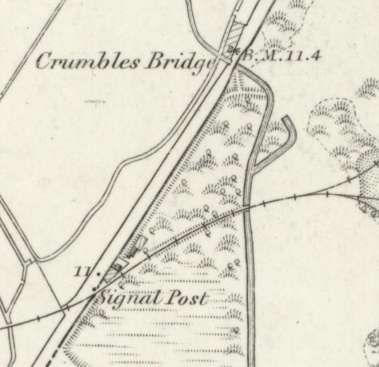
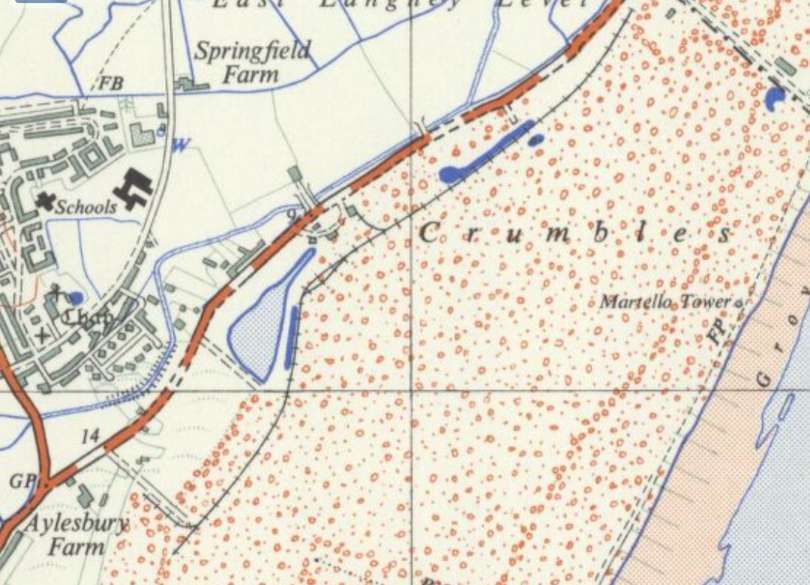
In 1875/76 this 6″ Ordnance Survey, published in 1879 shows the gravel pits which were the end of the line at that time. Crumbles Bridge can be seen just to the North of centre-left of the extract. [25]
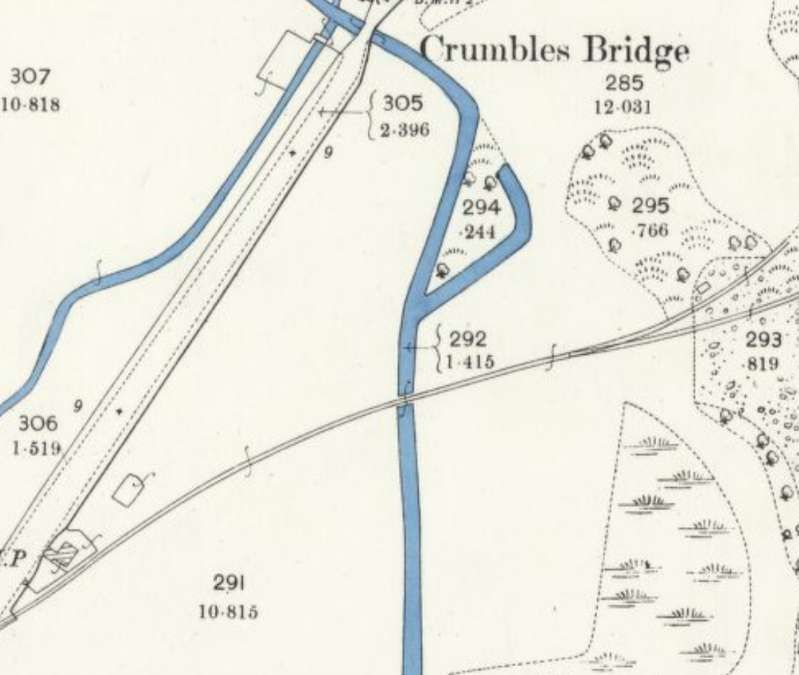
The level crossing and Crumbles Bridge. [25]
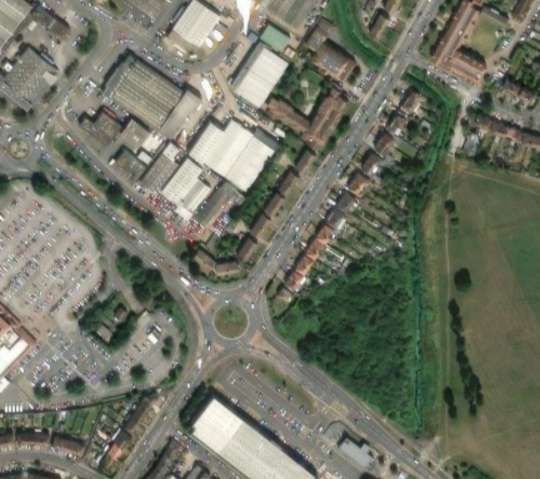
Crumbles Bridge was built between 1823 and 1827 to serve the local turnpike road network connecting Eastbourne and Hailsham. It crossed a low-lying drainage channel. The bridge was reconstructed in 1969 as the local road infrastructure changed. The surrounding shingle and marsh landscape has since been heavily redeveloped into residential areas and the Sovereign Harbour marina.
The same area as shown on the map extract immediately above. The location of the level crossing is just to the Southwest of the roundabout. The drainage channel continues to follow its original course with the more modern bridge sitting at the same location as the old Crumbles Bridge. [37]
Looking Southwest along the line of the Crumbles Branch from the location of the old level-crossing on Seaside. [Google Streetview, August 2024]Looking Northeast along the line of the Crumbles Branch from the location of the old level-crossing on Seaside. The line ran towards the poplar trees on the horizon. [Google Streetview, August 2024]The same location as on the extract from the 1875/76 6″ Ordnance Survey as it appears on railmaponline.com. [24] The turquoise line which appears here may represent a part of a 2ft-gauge network of tramways owned by Hall & Co. Hall & Co. tramways were transient, moving with the area being worked for shingle. [31]
Hall & Co. 2ft-gauge tramway as it was in 1959, this extract is taken from the 1:25,000 Ordnance Survey. [32]
The Crumbles Branch line was extended beyond that shown on the 1875/76 6″ Ordnance Survey above, to access further gravel reserves to the Northeast.
The line curve towards the Northeast and passed the end of a tramway which ran through the rifle ranges. [26]
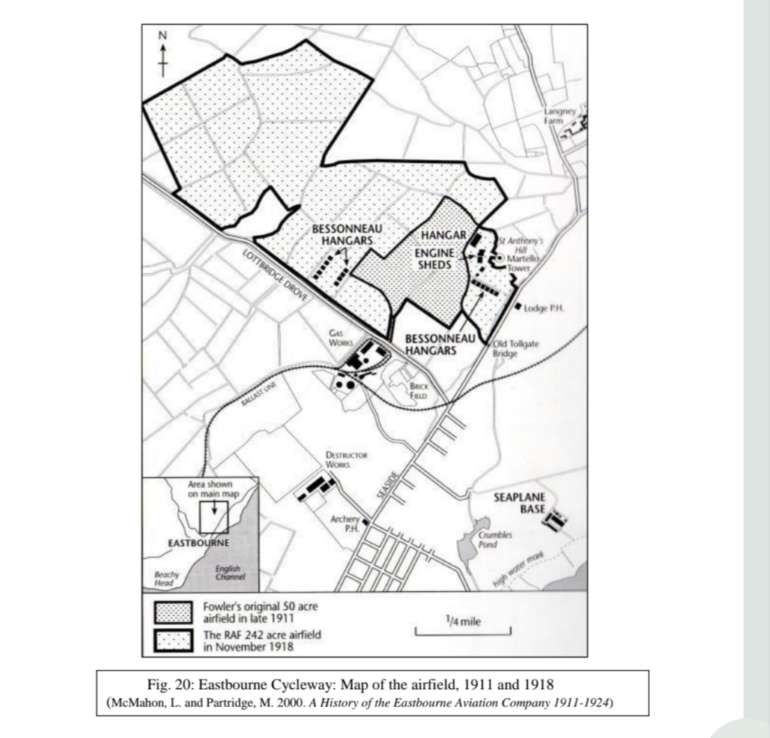
The military association with the Crumbles began in the early 19th century with the construction of defensive Martello Towers to ward off Napoleonic invasion. By the late 1800s and early 1900s, this desolate, wide-open shingle plain was deemed the perfect location for a military live-firing range.
The main range featured firing points stretching up to 600 yards. Marksmen and local cadet groups (such as the Eastbourne College Cadet Corps) would lie on the dirt to fire live ammunition from .303 Lee-Enfield rifles at large targets. The targets were managed by soldiers or cadets stationed “in the butts”—a protected, sunken trench directly beneath the targets. Their dangerous job was to pull the massive frames up and down via ropes, patch up the bullet holes, and signal the scores back to the firing line.
A red warning flag was flown whenever firing was live, and any stray bullets flew harmlessly out over the English Channel. The ranges remained active through both World Wars for troop training and continued operating well into the 1960s. The range finally closed in the late 1960s, and the area was later completely reshaped to build the Sovereign Harbour marina complex.
The electric tramway of the mid-20th century is covered in a separate article which can be found here. [30]
The line continued out across the shingle bank. [26][27]The line continued further Northeast. [27]
The end of the line in 1898/99. [27]
Railmaponline.com shows a somewhat greater extent of the various lines which served the shingle quarries/workings at this location. These extensions supported the workings until their closure in the 1930s. [24]
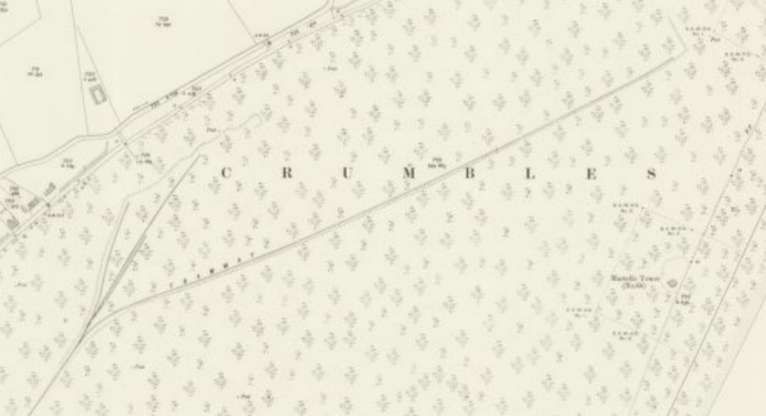
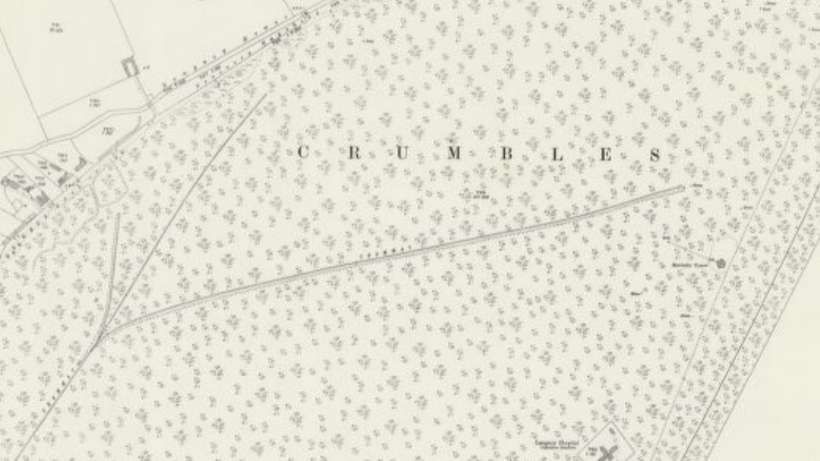
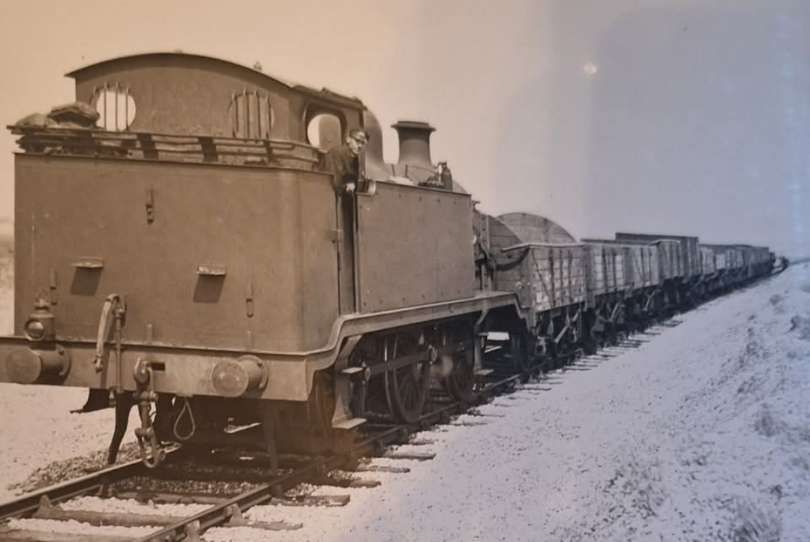
This is the extent of the line as it appears on the 25″Ordnance Survey of 1908, published in 1909. [28]This is the extent of the line as it appears on the 25″Ordnance Survey of 1925. [29]E2 Tank No. 100 at the Ballast Pit in the 1920s. This image was shared by Robert Ian on the Disused Railways of Sussex Facebook Group on 15th January 2025. [35]
We have noted in the narrative above the 2ft-gauge Hall & Co. Tramway which was horse and cable-worked. [31][32][34] There were other transient tramways laid on the Crumbles, these were associated with the local brickworks. Just inland of the open shingle beach (approaching St. Anthony’s Hill and the Langney boundary), the 1898 OS maps catch the footprint of Eastbourne’s late-Victorian building boom. Local clay pits and brickfields (such as those that eventually became the South Eastern Brick and Terra Cotta Works) utilized small, lightweight clay tramways to transfer raw materials from excavation pits to the kilns. [33]
References
Vic Mitchell & Keith Smith; Brighton to Eastbourne; Middleton Press, 1985.
Vic Mitchell & Keith Smith; Eastbourne to Hastings; Middleton Press, 1986.
The Hall & Co. Narrow-Gauge Tramway was, unlike the main LB&SCR railway branch that took deep shingle out for mainline railway ballast, a localized system dedicated to commercial shingle and gravel extraction. Track was moved dynamically over the years across the Crumbles to reach active digging pits. It was cable-worked and horse-drawn in its earliest iterations. It fed local concrete product works and smaller commercial loading docks rather than servicing the LB&SCR’s need for ballast. See also the OS Map @ reference [32]
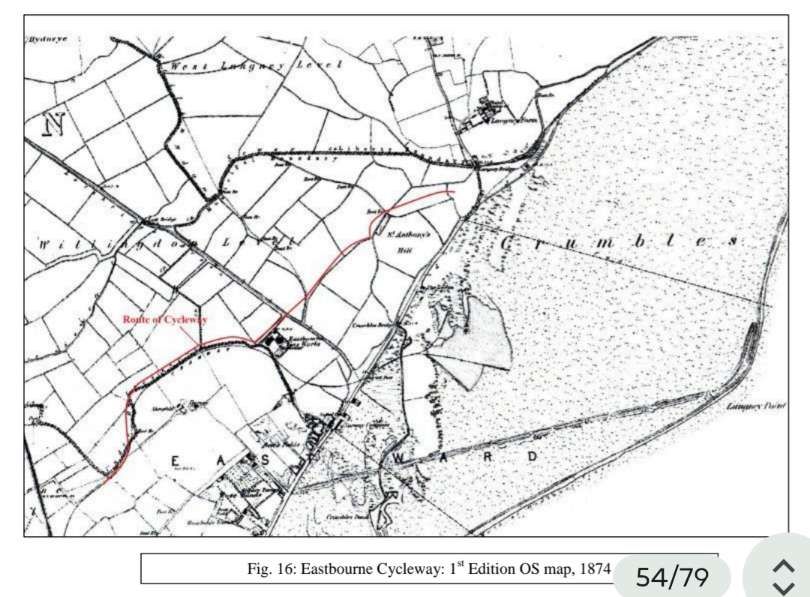
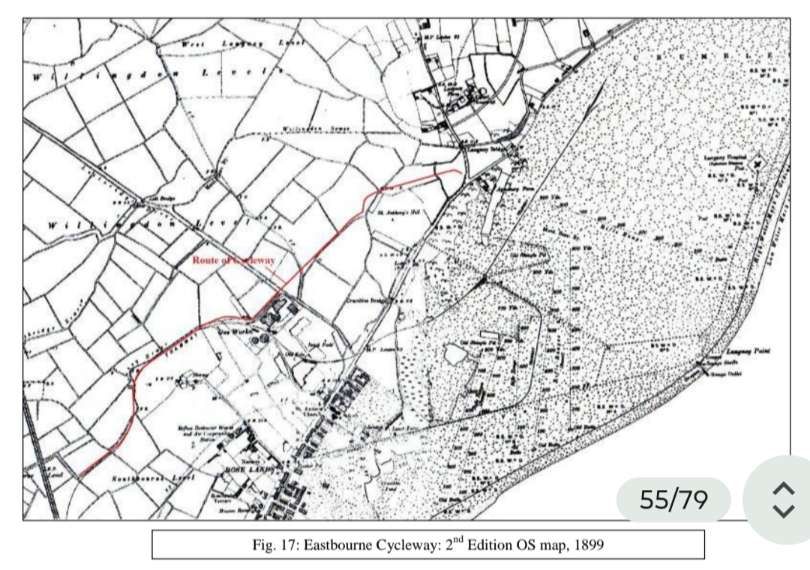
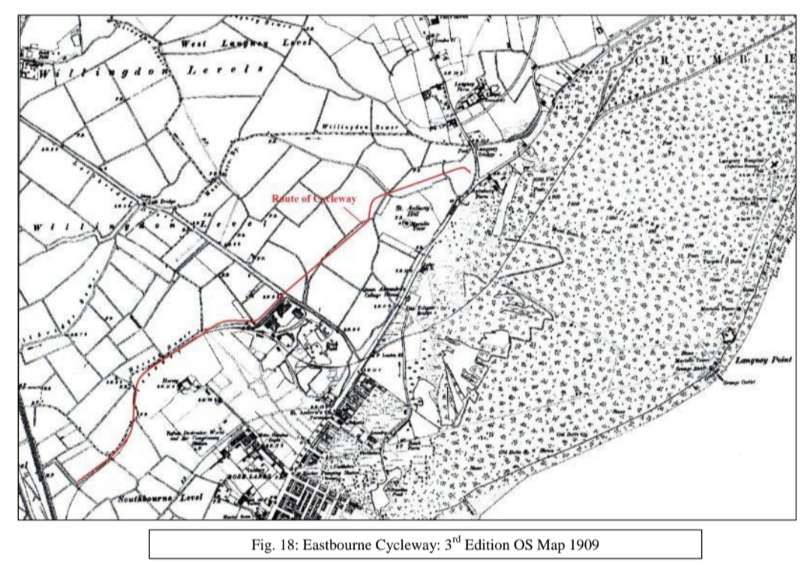
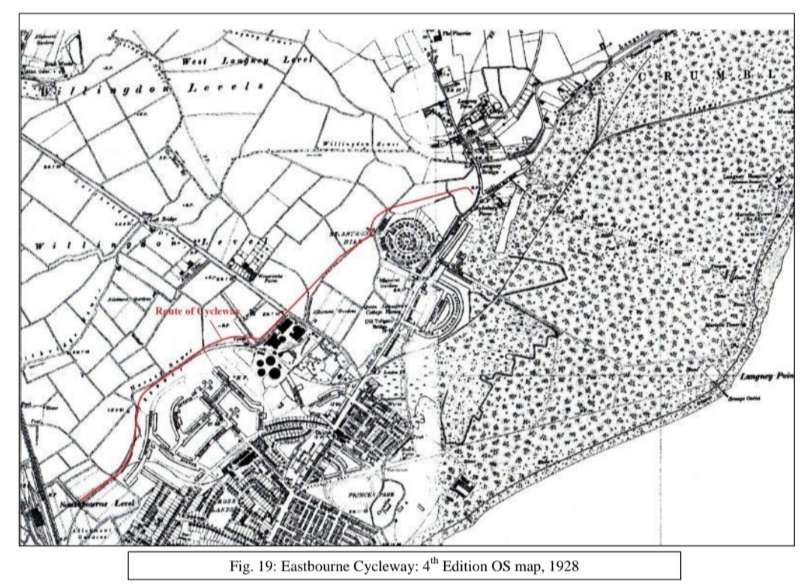
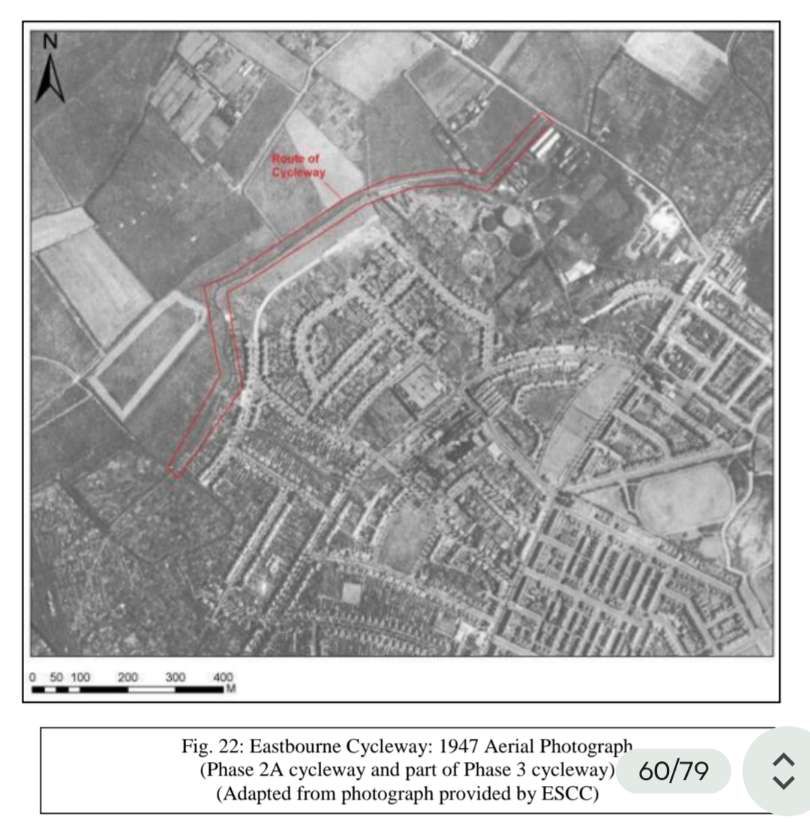
This image is taken from a report written by C. Butler & C Russell; Desk-based Assessment for the Sovereign Harbour Cycle Network Phases 2 and 3, (Ringwood Road to St Anthony’s Hill Roundabout) Eastbourne, East Sussex (updated from the original Desk-based Assessment for Phase 2A); Chris Butler MIfA, Archaeological Services Ltd., 2012; via: https://archaeologydataservice.ac.uk/archiveDS/archiveDownload?t=arch-969-1/dissemination/pdf/chrisbut1-398965_1.pdf, accessed on 1st September 2026.
Appendices
Appendix 1
Chris Butler and Dr Caroline Russell
Desk-based Assessment for the Sovereign Harbour Cycle Network Phases 2 and 3, (Ringwood Road to St Anthony’s Hill Roundabout) Eastbourne, East Sussex (updated from the original Desk-based Assessment for Phase 2A)
Chris Butler MIfA, Archaeological Services Ltd – Project No. CBAS0176 – October 2012
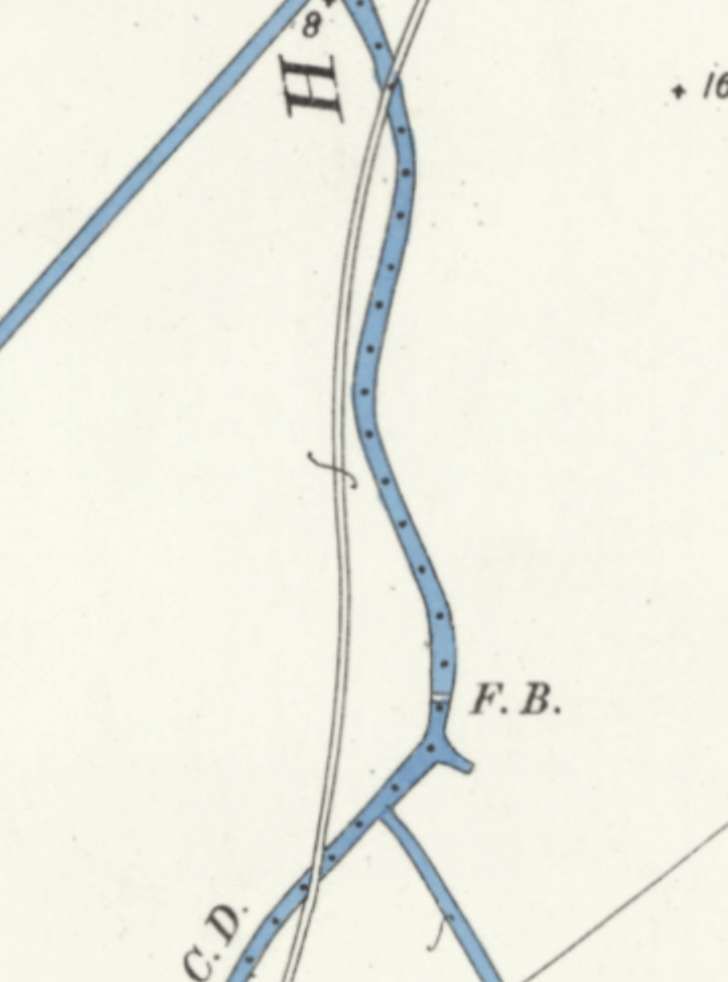
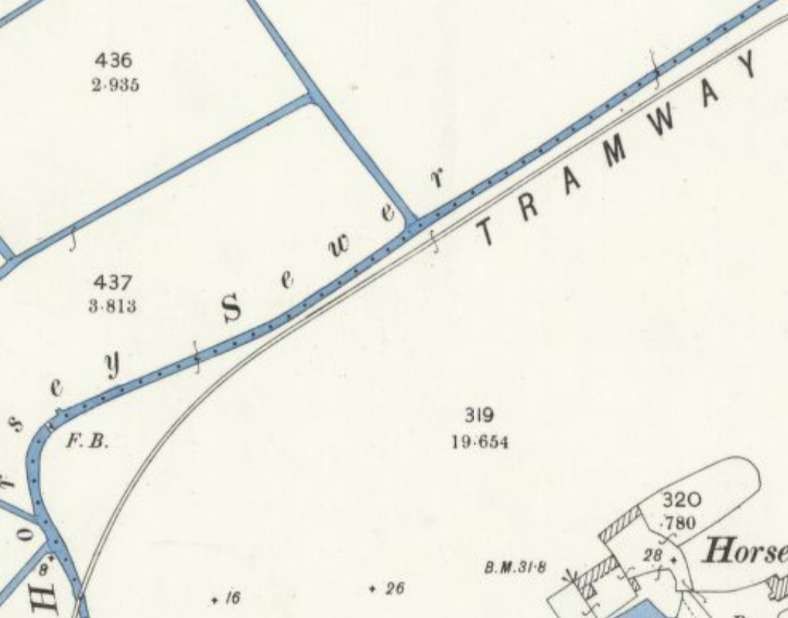
4.9.11 …The 1st Edition OS map of 1874 (Fig. 16) shows significant changes to have taken place to the landscape surrounding the Phase 2 cycleway route. Although the Horsey Sewer is shown within a field system that broadly reflects that seen on the early maps, a tramway now runs along its length. It crosses the sewer at three places, to run past the Eastbourne Gas Works and on to the Crumbles, with a single track branching off into the gasworks. To the immediate southeast is Horsey Farm, and then further southeast are ‘Rose Lands’ and a brickfields. [p15]
4.9.12 … The tramway served the beach gravel extraction on the Crumbles, and can be seen on the broader OS map to extend onto the beach before dividing into three separate branches; the gravel pits on the beach are recorded as MES7969-MES7971. In 1857-1862, the London Brighton and South East Railway negotiated with the Duke of Devonshire to purchase not less than 48,000 cubic yards of shingle from the Crumbles, at 1 penny per cubic yard. [48] They constructed a railway close to Eastbourne railway station, which ran through open countryside and along the Horsey Sewer, to turn south to cross the turnpike road (Seaside) near the junction with Lottbridge Drove. The railway was 6.4m wide and ran for 5.6km. It was known as the Ballast Line or the Crumbles Railway, and served the gasworks from 1870 onwards. In 1874, the Crumbles were also used for firing practice (firing ranges MES7961 and MES7962).
4.9.13 The Eastbourne Gas Company was formed in 1852, [49] and was incorporated by an Act of Parliament in 1868, [50] whilst the brickworks was in existence by 1866, and was operated by James Peerless, who leased the land from the Devonshire Estate in 1860. [51]
It continued to operate there until 1899. A smaller brickworks was located at Rose Lands, and was operated from 1860 to the 1880’s by the Eastbourne Brick Co. Ltd. [52]
4.9.14 In contrast, little change had taken place by 1875-1880 along the Phase 3 cycleway route (see Fig. 16 for the 1st Edition OS map). A footpath led through the short droveway, having come through the fields to the northwest. Further northeast along the Phase 3 route, two causeways, each in a different field, gave entry to the same field to the southeast. A drainage channel had been excavated beside the Crumble Sewer, to define a small rectangular plot, possibly a holding pen, directly outside the site boundary. At the north end of this new plot, a footbridge now provided access across the sewer and into the field to the northeast. From here, an adjacent causeway, rather than the previous central causeway, led southeast into the narrow field north of St. Anthony’s Hill. The only building nearby was ‘The Lodge’, a public house on the coast road, south of the hill.
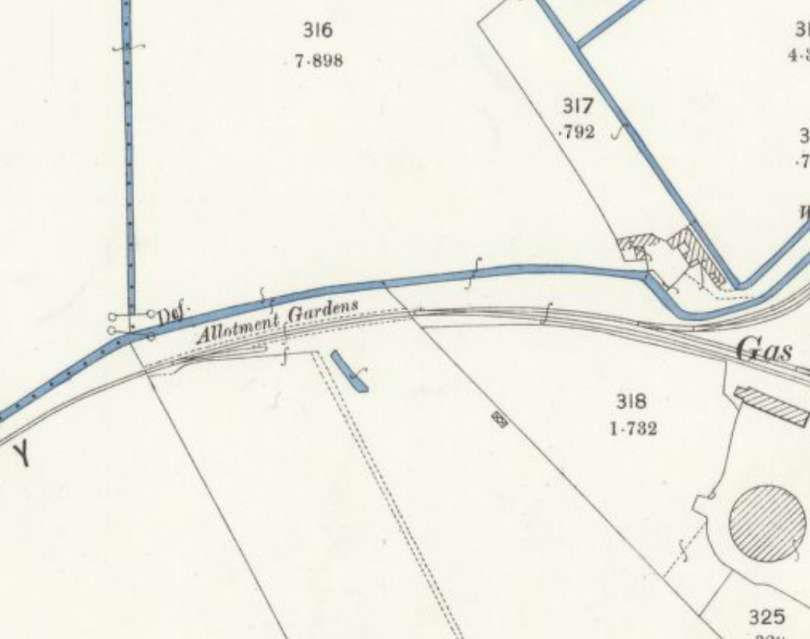
4.9.15 The gasworks had expanded eastwards by the 2nd Edition OS map of 1899 (Fig. 17); ESRO holds a plan of the land intended to be acquired for this expansion, which was drawn in 1879 by H.E. Jones, the Engineer for Eastbourne Gas. [53] The main brickworks had migrated northeast, with allotment gardens having been established along the northern edge of the earlier workings. Rose Lands was a nursery by this time, with a refuse destructor works and air compressing station located on its north side. [p16]
4.9.16 The tramway now had additional sidings serving the gasworks. It continued onto the Crumbles, where it ran to the east, while a branch turned southwest before returning westwards to Seaside on an existing earthwork (MES7968) shown on the 1st Edition OS map. Housing development had expanded northeast along the southeast side of Seaside. The tramway also later served the refuse destructor works and air compressing station, the brickworks and a timber yard.
4.9.17 The Phase 3 cycleway route remained unaltered between 1875-1880 and 1899 (see Fig. 17 for the 2nd Edition OS map). The footbridge had gone. The possible animal pen on St Anthony’s Hill now looks to have been defined by a fence line rather than by ditches, and a second larger such enclosure had been erected in the same former field, on the south side of the hill.
4.9.18 The Martello Towers (MES512 and MES513 / MES7994) on this stretch of coastline all disappeared in the late 19th or early 20th century. Tower 71 was demolished after having been used as target practice for the testing of the new rifled Armstrong Guns in 1860. [54]
Tower 72 had been washed away by the sea sometime prior to 1872, [55] as had West Langney Fort. Tower 70 had likewise been undermined by the sea and was abandoned in 1872 along with Tower 69. Tower 67 was demolished in 1922, whilst Tower 68 was knocked down in c.1925 to make way for residential development (however, see para. 4.9.28).
4.9.19 The 3rd Edition OS map of 1909 (Fig. 18) shows little change to the immediate area around the Phase 2 site, although there had been further housing development along Seaside. A long narrow plot of land was now fenced off along one side of a field, to form a passageway presumably for the movement of livestock between two fields, including the narrow field to the east in which the cycleway runs through. The Martello Tower on St. Anthony’s Hill (MES513 / MES7994) is marked on the map, along with its moat and footbridge; its absence from the 1st or 2nd Edition OS map is somewhat odd, although military installations were often omitted from OS maps for security purposes.
4.9.20 During the First World War, a temporary tented camp was set up at Horsey Bank, in the area of the junction of Churchdale Road and Astaire Avenue. [56] The allotment gardens shown on the 2nd and 3rd Edition OS maps (Figs. 17 and 18) were put to good use during these years, although it is recorded that the Eastbourne Gas Company refused a request to plough up land for allotments, but a compulsion order overturned this. [57] [p17]
4.9.21 From December 1911, Eastbourne Aviation Company Ltd had their manufacturing aerodrome (MES7491) at a site directly to the north of Lottbridge Drove. [58]
From about this time, this site also became the school aerodrome for the Eastbourne Aviation School and the Fowler Flying School. A map of the airfield [59] (Fig. 20) shows the middle stretch of the Phase 3 cycleway route to have been located within Fowler’s original 50 acre airfield.
4.9.22 In August 1914, the hangars and buildings of the aerodrome were taken over by the Royal Navy Air Service. [60] The aerodrome at St. Anthony’s was a RNAS flying school from April 1915 to April 1918, when it became a training depot station for the RAF until 1919. In November 1918, the RAF airfield comprised 242 acres, having predominantly expanded northwest across the Levels (Fig. 20). Almost the full route of the Phase 3 cycleway now stood within the airfield, except for the last stretch through the two fields at the northeast end. With the exception of one area, the buildings, which included a large hangar (MES7990) and the engine sheds, were built around the Martello Tower (MES513 / MES7994) and therefore outside the site boundary. The 15 Bessoneaux hangars were erected in three rows, with two rows having stood opposite each other to the northwest of what is now Birch Road, and the third row having stood along the south side of what is now Leeds Avenue, directly south of St. Anthony’s Hill. During the Phase 2A watching brief an identity disc was found. It is engraved R.N.A.S. / TURNER / ERNEST / EDWARD / A M / F364/ CCE. Ernest Edward Turner is recorded as having been born in 1894 in Bangalore, India, and entered the RNAS in 1914; [61] it is presumed that he served at St Anthony’s.
4.9.23 The aerodrome was licensed for civilian use again in April 1920 [62] and finally closed in 1925. The only remaining structure of the aerodrome is a guardroom (MES7991) from the RNAS phase of use, which is now a bungalow on Leeds Avenue. The large hangar (MES7990) stood extant nearby until the storm in 1987; its foundations are still visible today.
4.9.24 A site on the Crumbles, in the region of the present day Sovereign Centre, was used by the Eastbourne Aviation Company as a seaplane factory, and also for the refuelling and servicing of patrolling seaplanes. [63] The hangars on the Crumbles were converted to an aircraft factory, and during the war the Eastbourne Aviation Company built a total of 252 aircraft. [p18]
4.9.25 By the 4th Edition OS map of 1928 (Fig. 19), the tramway has developed to include a branch line to the refuse destructor works and air compressing station, and additional sidings at the gasworks. The return route of the tramway to Seaside from the Crumbles had been dismantled by this time. Some ‘tanks’ are shown adjacent to the Horsey Sewer, north of the gasworks and alongside a footbridge. Major housing development had taken place to the southeast of the Phase 2 cycleway route, along the northwest side of Seaside. Eastbourne Corporation had a licence to place a footbridge over the Horsey Sewer in 1926, [64] and had an agreement for works in the Horsey Sewer in 1937. [65]
4.9.26 The decline of the tramway began in 1920 when the ballast used on the railways changed to granite chippings and there was no further requirement for the shingle.
Shingle continued to be taken to the Duke of Devonshire’s depots at Eastbourne Station to be used for building purposes until 1931. [66] The shingle beds at the Crumbles were leased to Hall and Co. [67] who then began to use lorries to move the shingle, stopping rail movements completely in 1932. The tramway continued to serve the gasworks and other industrial sidings, taking thousands of tons of coal to the gasworks (Fig. 21). [68]
4.9.27 The land around the Phase 3 cycleway route looked little different in 1925-1930 from what it had done in 1910 (see Fig. 20 and the 4th Edition OS map of Fig. 19 for a comparison), revealing how easily the land had reverted to pasture after its use as an airfield. A number of buildings from the aerodrome still stood, including the engine sheds as well as the guardroom (MES7991) and large hangar (MES7990). A sluice is shown across the Crumble Sewer, south of the former hangar. A crossing across the sewer was now sited where the footbridge once was; it is the location of a bridge today, although it was not identified as such on this OS map. The crossing led into a small enclosure, once part of a larger enclosure, which linked up with the field to the east.
4.9.28 Residential housing had been built on the east side of St. Anthony’s Hill, and below it along Seaside. Both the inner and outer circular roads of The Circus and Rotunda Road had been laid out around the hill, although neither was specifically named as such at this time. The Circus was built around the in-filled moat of Tower 68, [69] whilst Rotunda Road may have traced the boundary of land first purchased by the government in 1795. The single building at the centre of the housing development, within The Circus, may incorporate the base of the Martello Tower (MES513 / MES7994) in its cellar. [70] Allotment gardens had been planted directly south of St. Anthony’s Hill and beside the Phase 3 cycleway route on Lottbridge Drove. [p19]
4.9.29 During the Second World War the coastline was put into a state of defence with anti-tank cubes, walls and ditches (e.g. MES7997), minefields (e.g. MES8007) andscaffolding located on the beach, and other defences such as pillboxes positioned to the rear (e.g. MES7999, MES8017 and MES8018). [71] Unexploded bombs fell in allotments near Lottbridge Drove on 14th September 1940, while the gasworks was attacked on the 19th October, setting alight the Number Three gasholder. [72] On 12th March 1941, eight bombs were dropped to the south of the Phase 2 site around Churchdale and Southbourne Roads, and on the following night bombs were dropped to the north of the gasworks. On the 26th August 1942, a German FW190 fighter-bomber was shot down and crashed into a ditch beside Lottbridge Drove. Further bombs were dropped on open ground near the gasworks as well as on the Crumbles on 6th June 1943. On considering its location in the Levels, further out of town, no bombs are known to have fallen in the area of the Phase 3 cycleway route. [73]
4.9.30 A 1947 aerial photograph (Fig. 22) shows residential development to have extended almost as far north as the Horsey Sewer. By the early 1960’s (modern OS maps are not reproduced), the housing developments had reached the southern edge of the sewer, and the tramway is still shown. In the locality of the Phase 3 cycleway route, further residential development had occurred on and around St. Anthony’s Hill, and hadexpanded out onto the Crumbles along Wallis Road and around the adjacent crescent.
Between 1947 and 1961, the Horsey Sewer was straightened to the north of the gasworks, cutting off the former droveway onto Lottbridge Drove. Three new causeways had been constructed along the course of the Phase 3 cycleway.
4.9.31 The tramway had gone by the time of the 1975 OS map, as it had finally closed in 1966. [74] The 1975 map also shows the commercial developments at the southeast end of Lottbridge Drove. One or two buildings appear to have stood at the northeast end of the Phase 3 cycleway route, facing onto the road north of the roundabout, which had been built by then; these buildings were demolished by 1992. The commercial developments had extended beyond the Horsey Sewer, along both sides of Lottbridge Drove by the 1981 OS map. This map also shows new housing developments along the north side of the Horsey Sewer. [p20]
Relevant References
48. Botha, A. 2006. The Crumbles Story. Eastbourne: ALB Books
49. Wright, J.C. 1902. Bygone Eastbourne. Spottiswood and Co. Ltd.
50. ESRO amsh/AMS5616/2/70
51. Beswick, M. 2001. Brickmaking in Sussex. Middleton Press.
Gatwick Airport (London) lies close to the town of Crawley, on the Victoria-Brighton main line. The station sits immediately to the East of what is now the South Terminal of the airport. This article was promoted by two aerial images of the site of the Airport and its railway station in the September 1997 issue of Steam World. [6]
Before the Airport there was Gatwick Racecourse, (c) Historic England, EPW028582, 1929. [1]Gatwick Railway Station and Racecourse in 1896 as shown on the 25″ Ordnance Survey. [7]Gatwick Railway Station and Racecourse as it appears on the 25″ Ordnance Survey of 1912, published in 1913. [8]
The present station, originally known as Gatwick, was built for the London, Brighton and South Coast Railway (LBSCR). It was closed in 1876 and reopened in 1891 by the LBSCR to serve the Gatwick Racecourse. At that time it was operating only on race days. [14]
Gatwick Racecourse Railway Station, circa. 1910, (c) Public Domain. [17]
The station, however, became obsolete due to the opening of nearby Tinsley Green/Gatwick Airport Station in September 1935. It was closed after the completion of the Beehive airport terminal, which was directly connected to the Gatwick station. [14]
Wikipedia marks significant events for Gatwick Airport and it Railway Station [13] from 1920 to 1945:
Late 1920s: Land adjacent to the racecourse (at Hunts Green Farm, along Tinsley Green Lane) was used as an aerodrome. The Hunts Green farmhouse on the land used for the aerodrome was converted into a clubhouse and terminal.
November 1928: Dominion Aircraft Limited based its Avro 504 G-AACX at Gatwick from November 1928.
October 1929: the Southern Railway “announced plans to electrify the Brighton Main Line on the 660 volts DC third rail system, in addition to the stretch westwards from that town to Worthing, and to Reigate. In the Daily Mirror on Monday 19th January 1931, the cost of the works was stated to be £2,770,660, exclusive of new or converted rolling stock, and covered 52-track miles. Work commenced in that year and the first scheduled electric passenger services started to run as far south as Three Bridges from 17th July 1932. On 5th of the previous month, three-aspect colour light signalling had come into use between Coulsdon North, on the Quarry Line, and Balcombe Tunnel Junction (31¾-miles from London Bridge), and in stages was completed through to Brighton, the last section between the latter and Preston Park coming into use on 16th October 1932. From Coulsdon North to Norwood Junction, and between Coulsdon South and Earlswood, semaphores were retained, and the accelerated electric timetable came into use on the full length of the Brighton Main Line on 1st January 1933. This was the first main line in the country to be electrified and at the time comprised the longest continuous stretch of colour light signalling in the world.” [19]
The story of the electrification can be found here. [20]
1st August 1930: Ronald Waters, manager of Home Counties Aircraft Service (based at Penshurst Airfield in Kent), who had come into possession of Gatwick Aerodrome, got a licence for it. He founded the Surrey Aero Club there.
2nd–3rd August 1930: Flying began with pleasure flights for the local population in Avro 504s of Waters’ Surrey Aero Club.
1932: The Redwing Aircraft Company bought the aerodrome, and operated a flying school; it was also used for pilots flying in for races.
1933: The Air Ministry approved commercial flights from Gatwick.
September 1933: A. M. (Morris) Jackaman, who owned several light aircraft, bought the aerodrome for £13,500. He had bold ideas for its future, such as expanding it to make it suitable to use as a relief aerodrome for London (Croydon) Airport and providing a regular service to Paris using de Havilland DH.84 Dragon aircraft. He overcame resistance from the Air Ministry, which was concerned about the cost of draining the clayey land and diverting the River Mole.
The down “City Limited”, 5 pm. from London Bridge to Brighton, comprising ten coaches and two Pullmans, passing Hassocks in May, 1934, (c) Public Domain. [20]The all-Pullman electric express, renamed the “Brighton Belle” in 1934, approaching Balcombe. This train, composed of two five-coach sets, completed the return journey between Victoria and Brighton three times on weekdays and twice on Sundays, (c) Public Domain. [20]
1934: Jackaman oversaw Gatwick’s transition to a public aerodrome, licensed for non-private flights, and planned a proper terminal building linked to a new railway station on the adjacent Brighton Main Line. He formed a new airport company, Airports Limited. Hillman’s Airways became Gatwick’s first commercial airline operator, beginning scheduled services from the airport to Belfast and Paris.
January 1935: Hillman’s Airways moved to Gatwick from Stapleford Aerodrome.
1935: A new airline, Allied British Airways, was formed with the merger of Hillman’s Airways, United Airways and Spartan Air Lines. The new carrier, which later shortened its name to British Airways, became Gatwick’s principal operator. Dorking and Horley Rural District Council was concerned about possible compensation claims from local residents and the threat of facing liability for flying accidents, and it “could see no benefit” to allowing further development of the aerodrome.
6th July 1935: The aerodrome closed temporarily for renovations, which included building the “Beehive”, the world’s first circular terminal building.
30th September 1935: Tinsley Green station opened 0.85 mi (1.37 km) south of the present Gatwick station. It was served by two trains per hour on the Victoria-Brighton line.
October 1935: The contracted opening date, was not met, partly because of drainage problems.
17th May 1936: The first scheduled flight departed from the Beehive terminal at 1:30 pm, bound for Paris Le Bourget. Jersey Airways operated this flight with a DH.86 under contract to British Airways Ltd., whose livery the aircraft wore. The airfare was £4 5s (including a first-class rail ticket from London Victoria Station), and there were up to three flights a day. Later the same day, British Airways Ltd. introduced another new scheduled service from Gatwick to Malmö, which was routed via Amsterdam, Hamburg and Copenhagen. Total travelling time between Gatwick and Malmö was six-and-a-half hours.
25th May 1936: British Airways Ltd. and Southern Railway jointly launched scheduled air services between Gatwick and the Isle of Wight.
1st June 1936: Tinsley Green station was renamed “Gatwick Airport”.
6th June 1936: The airport was officially reopened by the Secretary of State for Air, Lord Swinton. It featured four grass landing strips which were linked to the terminal area by two concrete taxiways, one each for arriving and departing aircraft respectively. The Beehive, the new terminal, was officially opened the same day. The Beehive was designed by Frank Hoar and incorporated several novel features, including a subway to the railway station at Tinsley Green which allowed passengers to travel from Victoria Station to the aircraft without stepping outside (with a transfer time from train to plane of as little as 20 minutes). Air Travel Ltd (a company specialising in aircraft and engine overhauls which had relocated to Gatwick from Penshurst) moved into the new airport’s No. 1 hangar.
July 1936: British Airways Ltd. inaugurated regular night mail flights linking Gatwick with Cologne and Hanover.
September and November 1936: Two fatal accidents happened, raising questions about the airport’s safety. The area was foggy, and its clay soil drained poorly; this caused the new subway to flood after rain.
17th February 1937: Gatwick was declared unserviceable due to waterlogging following repeated, heavy rainfalls. Because of this tendency to flood, and because longer landing strips were needed, the pre-war British Airways moved to Croydon Airport. Gatwick returned to private flying, and was used as a Royal Air Force (RAF) flying school.
October 1937: The No. 19 Elementary and Reserve Flying Training School RAF (E&RFTS) began instructing future RAF pilots at Gatwick on de Havilland Tiger Moth and Hawker Hart biplanes. [13]
A rotunda was built to serve as the Airport Terminal. The Station shown here was on a site to the South of the old Gatwick Racecourse Railway Station, The Station was linked to the Beehive Rotunda by and underground walkway, (c) Historic England, EPW053263, 1937. [2]The layout of Gatwick Airport in the late 1930s and early 1940s. The location of Gatwick Racecourse Railway Station is to the left of this image close to the racecourse. The Beehive Rotunda Airport building is towards the right of this image, (c) Public Domain. [18]
1938: Airwork General Trading Co. moved into the hangar British Airways Ltd. had occupied at Gatwick. This enabled Heston-based Airwork to expand its aircraft manufacturing capacity on behalf of the Civilian Repair Organisation (CRO), which had awarded it a contract to modify Whitley bombers for the RAF. Southern Aircraft (Gatwick) Ltd. was another company working under contract to the CRO at Gatwick at the time. It had been licensed to assemble Stinson Reliants and Beechcraft Expeditors for the Royal Navy and also repaired damaged Beaufighters. [13]
25th June 1938: The first Daily Express Air Display was held at Gatwick. Aircraft participating in the flypast included a Short Empire flying boat, a Lufthansa Focke-Wulf Condor, a Sabena Savoia-Marchetti SM.83, several RAF types and aerobatic aircraft. [13]
1st September 1939: No. 19 E&RFTS ended its activities at Gatwick. [13]
3rd September 1939: Following the declaration of war on Germany, all civilian flying at Gatwick and elsewhere in the UK stopped. As a consequence, civil aircraft maintenance and manufacturing activities at the airport stopped as well. This resulted in the airport being requisitioned by the Air Ministry, and becoming a base for RAF night-fighters and an Army co-operation squadron during World War II (primarily for repairs and maintenance and as an alternative to RAF Kenley in the event that Kenley was rendered inoperable by enemy action). [13]
December 1939: The operations manager of British Airways Ltd., which had begun the process of merging with Imperial Airways to form British Overseas Airways Corporation (BOAC), inspected Gatwick to assess its suitability as a base for the combined operations of the merged airline. [13]
1940: BOAC maintenance personnel began overhauling Armstrong Whitworth Ensigns and other aircraft types at Gatwick. Horse racing at Gatwick ended and never restarted. [13]
1940 and 1941: RAF units relocated to Gatwick from France. The airport became closely associated with the RAF Army Cooperation Command. As a result, several Army Cooperation Command aircraft were stationed at Gatwick. These included Westland Lysanders, Curtiss Tomahawks and North American Mustangs. [13]
Late 1942: Gatwick began receiving RAF and USAAF bombers that were damaged or running short of fuel. The most common types were Avro Lancasters, Handley Page Halifaxes, Short Stirlings and Boeing B-17 Flying Fortresses. [13]
January 1945: Gatwick was taken over by the Supreme Headquarters Allied Expeditionary Force Disarmament Unit. As a result, it received a large number of transport and communications aircraft. [13]
Gatwick Airport and its Railway Station, 1945 to 1975
1950: Despite local opposition, the Cabinet chose Gatwick as an alternative to Heathrow (then known as London Airport). BEA launched a seasonal scheduled service to Alderney in the Channel Islands, which operated for three consecutive summer seasons until 1952. At the time, there were three operational runways. These were aligned South-West–North-East, East–West and South-East–North-West. The first was 4,200 ft (1,300 m) long, 150 ft (46 m) wide and covered in steel mesh; the second was 3,600 ft (1,100 m) long, 150 ft (46 m) wide and covered in steel mesh as well; the third was of the same length and width as the second but was grass-covered. [13]
May 1950: Gatwick’s first charter flight left the airport’s original grass runway for Calvi on Corsica (with a refuelling stop in Nice). Jersey-based UK independent airline Air Transport Charter operated this flight under contract to UK package tour pioneer Vladimir Raitz’s Horizon Holidays with a 32-seat Douglas DC-3 carrying 11 passengers. [13]
1950s: The railway stations had a reversal of fortunes in the 1950s as a result of that government decision to expand and develop the Beehive airport terminal into London’s second airport. Gatwick Racecourse station was rebuilt to serve Gatwick Airport, and was integrated into its terminal. On 27th May 1958, the rebuilt station, which took the name Gatwick Airport, was opened in conjunction with a regular train service; and services serving the former Tinsley Green station were discontinued. [14]
This later image show increasing hangar space and a significant number of aeroplanes, little has changed at the station, (c) Historic England, EAW050735, 1953. [3]The Airport and Station seen in 1953 from the West. Air travel has still not become what it is in the 21st century. There are no airliners in sight! Careful inspection will see limousines outside the terminal building. Old fighter aircraft litter the apron to the South of the terminal building. The station has a covered footbridge and four platform faces. Its connection to the Airport is no more than a white swing-gate at the end of the station building access path. There appears to be a small gathering of people around a vehicle close to the gate. One wonders at what time of day the photograph was taken as both station and airport seem devoid of passengers, (c) Historic England, EAW050736, 1953. [4]
Gatwick Airport saw major reconstruction in 1957 and 58. This image looks from the West towards the railway station in the distance. The image is embedded direct from the Getty image website. [5]
The next aerial image shows Gatwick Airport and Station in 1958.
Gatwick Airport after completion of the rebuild, seen from the North. The station now has six platform faces and a covered footbridge connects to the terminal building. The image was a double-spread in Steam World magazine in September 1997 (hence the distorted nature of the image. The dual carriageway is the A23. [6]
1958: The 1958 refurbishment of the railway station included a parcels’ office beneath the main concourse, lifts and a corridor on the south side of the overbridge, separated from the passenger corridor by a glazed partition. To accommodate trains of up to 12-carriage lengths, the three old Racecourse island platforms were raised by 1 ft (0.30 m) and extended to the north by about 100 ft (30 m), except for the very long westernmost platform, which was reduced from the south. The ticket office on the main concourse of the station was able to handle 670 separate issues of Edmondson tickets from its Bellmatic equipment. [14]
Gatwick Airport and Railway Station seen from the East in 1961, (C) Unknown. [9]
1962: Two additional piers were added to the terminal. [13]
1964: Gatwick’s original, relatively short late-1950s paved runway was extended by 1,200 ft (370 m) to 8,200 ft (2,500 m) due to new noise rules governing the operation of jet aircraft at airports near (or surrounded by) densely populated urban areas. [13]
1965: By now, each of the three piers was nearly 1,000 ft (300 m) long, and the terminal complex had a floor area of 100,000 sq ft (9,300 m2). [13]
Gatwick Airport and Railway Station in 1970, (c) Unknown. [10]
1970: A second 875-foot (267 m) extension of Gatwick’s runway was completed, bringing it to 9,075 ft (2,766 m) and allowing non-stop jet flights to the US east coast with a full payload and full range and payload operations by British United Airways and Caledonian Airways BAC One-Eleven 500s. [13]
1973: The third extension of Gatwick’s runway was completed, bringing it to 10,165 ft (3,098 m) and allowing for non-stop narrow-body operations to the US west coast and commercially viable, long-range wide-body operations. [13]
Gatwick Airport and Railway Station in 1975, (c) Unknown. [11]Gatwick Airport in 1975, (c) Unknown. [12]
1975 onwards
Late 1970s: Government initiatives supporting Gatwick’s development resulted in steady growth in passenger traffic. Among these were policies seeking to transfer all scheduled services between London and the Iberian Peninsula from Heathrow to Gatwick, banning whole-plane charters at Heathrow and requiring all airlines planning scheduled services to London for the first time to use Gatwick instead of Heathrow. This policy was known as the London [Air] Traffic Distribution Rules. The government also approved a high-frequency helicopter shuttle service linking Gatwick with Heathrow. [13]
Late 1970s and early 1980s: Fully extendible jet bridges were added when the piers were rebuilt and extended. [13]
1980s: In the 1980s, the railway station was refurbished again. It had six platforms immediately beneath the airport’s South Terminal. [14]
1983: As passenger numbers grew, a circular satellite pier was added to the terminal building connected to the main terminal by the UK’s first automated people mover system. (This replaced the original North pier dating from 1962, and the people mover connecting the main terminal with the satellite pier was subsequently replaced with a walkway and travelators). A second terminal was planned, and construction began on the North Terminal on the land earmarked for a second runway in the draft plan of May 1970. This was the largest construction project south of London in the 1980s, costing £200 million. [13]
1984: Gatwick’s new air-traffic control tower opened, the tallest in the UK at the time.[123] The Gatwick Express was launched by British Rail, the world’s first non-stop airport-to-city-centre rail service (between the airport and Victoria Station). [13]
1988: On 18th March 1988: The North Terminal was opened by Queen Elizabeth II (including an automated rapid transit system link to the South Terminal). [13]
1991: A second aircraft pier was added to the North Terminal. [13]
1994: The North Terminal international departure lounge and the first phase of the South Terminal international departure lounge opened, at a cost of £30 million. [13]
1998: The main runway was extended for a fourth time, reaching 10,879 ft (3,316 m), to enable longer-range operations with wide-body aircraft. [13]
2000 to 2001: Gatwick’s two terminals were further expanded to add seating, retail space and catering outlets, at a cost of £60 million; this included an extension to the North Terminal departure lounge, completed in 2001. [13]
2005: An extension and refurbishment to the South Terminal’s baggage reclaim hall (doubling it in size) was completed. [13]
May 2005: Pier 6 opened at a cost of £110 million, adding 11 pier-served aircraft stands. The pier is linked to the North Terminal’s main building by the largest air passenger bridge in the world, spanning a taxiway and providing passengers with views of the airport and taxiing aircraft. [13]
May 2008: An extension of the South Terminal’s departure lounge was completed, and a second-floor security search area opened. This terminal is now primarily used by low-cost airlines; many former users moved to the North Terminal.
2010s: On 13th October 2010, a £53 million redevelopment programme for the railway station was announced to provide another platform capable of accommodating 12-car trains, refurbishment of the concourse, and track and signal upgrades. Escalators and lifts were provided for platforms 5 and 6, replacing a staircase to achieve improved circulation. The redevelopment provided improved capacity and flexibility on the Brighton Main Line. The project was jointly financed by Network Rail, who contributed £44.9 million, and Gatwick Airport who provided £7.9 million. Construction was structured so as not to negatively affect the 2012 Summer Paralympics, which was hosted in London. [14]
May 2013: Demolition began of Pier 1, Gatwick Airport’s second-oldest pier (the original 1962 South pier of what is now the South Terminal) for its replacement with a £180 million, two-storey structure with five pier-served aircraft stands and an automated baggage-storage facility, operational by summer 2016. [13]
2014: By 3rd February 2014, completion of the work on the Railway Station was marked by a ceremony officiated by Minister of State for Transport Baroness Kramer, who formally opened the new platform. Constructed by VolkerFitzpatrick, platform 7 is served by a 975-metre (3,199 ft) loop from the down fast line and used by services which formerly used at platform 5. VolkerFitzpatrick were responsible for track and signalling modifications. This has allowed platforms 5 and 6 to be dedicated to Gatwick Express services, thereby eliminating previous conflicts with slower services when they crossed to platforms 1 and 2. The project was finished on schedule and budget, despite extreme weather conditions during the winter of 2013/2014. [14]
In 2014, Baroness Kramer announced that the government had committed £50 million towards further improvements of the railway station. A scheme for further improvements, estimated to cost around £120 million, was announced by Network Rail. [14]
2016: On 1st February 2016, Caroline Ansell, the MP for Eastbourne, officially opened the redeveloped pier 5 of Gatwick’s North Terminal. The redevelopment of pier 5 cost £80 million and forms part of the airport’s £2 billion improvement programme under GIP ownership. Its main feature is an additional second level that separates departing and arriving passenger flows vertically to increase capacity by an additional 30 flights or approximately 2,400 passengers per day. This increase in capacity is achieved by accommodating up to seven large and 12 smaller aircraft (or a combination of both) at the pier’s redesigned aircraft stands to enhance operational flexibility for airlines and passengers and make passenger journeys smoother. [13]
2018: In April 2018, Network Rail submitted a planning application for modernising the railway station; doubling the size of the concourse, widening two platforms, and improving connections to the airport terminal. It was done in partnership with Gatwick Airport authorities, the Coast to Capital local enterprise partnership and the Department for Transport. The expansion is an element of a five-year programme, costed at £1.11 billion, announced by Gatwick Airport in early 2018. [14]
Amongst others, the main projects covered by this £1.11 billion include: a westward extension of the North Terminal’s pier 6, involving the relocation of the A380 stand to pier 5 and related widening and reconfiguration of a taxiway to enable A380 operators to access the new stand at pier 5; a dedicated domestic arrival and baggage reclaim facility in the South Terminal; and connecting the new Boeing hangar with the airfield.
2020s: Construction on the new railway station concourse began in November 2020. The refurbished station opened on 21st November 2023. [14]
The ticket office is staffed for ticket sales and enquiries, supplemented by ticket machines capable of handling online bookings usually available on a round-the-clock basis. Automated teller machines, payphones and e-mail access points are installed on the main concourse. There are coin-operated trolleys for luggage and a left luggage facility. On-site food and drink outlets are present. Toilets are available and baby changing facilities and additional toilets can be found in the adjacent South Terminal. There is no car parking facility. Transport for London’s (TfL) Oyster cards and contactless cards are accepted for travel at the station. [14]
Gatwick South Terminal and Railway Station in the 21st century. [Google Maps, September 2026]
A quick look at the Ordnance Survey maps of the North coast of Kent from the first half of the 20th century will show a veritable cat’s cradle of standard-gauge and narrow-gauge industrial railways. A similar survey of the Medway valley at the same period in the 20th century will show just how many individual Cement Works and other industries once existed there too. This article inevitably will not provide a comprehensive look at all industrial railways in the area.
The Oakwood Press produced two editions (1973, 1990) of a survey of these cement works. The second edition was an enlarged version of the first edition. Page references are to page numbers in the second edition.
The authors divide the various Cement works into three different geographical areas:
The Thames Estuary (working West to East)
The Medway Estuary
The Lower Medway
Part 1 – The Thames Estuary
This article looks at a number of the industrial sites on the southern banks of the River Thames Estuary. Industry along the River Medway will be covered in a future article or articles, as will industries in and around Chatham and to the East of Cliffe, Highamand Chatham.
It must also be noted that the details included in this article are much expanded on and probably also corrected in Robin Waywell’s book, ‘Industrial Railways and Locomotives of Kent‘ which came into my possession after this article had been completed. [61]
Before looking at the works described by Stoyel & Kidner and others, it is worth at least a glance at Erith situated further West along the River Thames. …
J. Parish & Co. Ltd
J. Parish & Co. was a historical industrial firm based in Erith, Kent, best known for operating the local Erith Loam Quarries and Ballast Wharf on Fraser Road. Established in the early 19th century (around 1805), the company supplied specialized moulding sands, silica sands, and high-quality natural loams to the British foundry and metal-casting industries.
It ran deep loam and sand pits off Fraser Road in Erith, utilizing industrial (4ft 0in) narrow-gauge locomotives to move ballast and sand. Its products (often marketed as the “Erith Range of Sands”) were widely utilized across UK metal foundries for core-making and casting. [8][9]
Hatherill & Hatherill tell us that, “Around 1800 sailing ships brought coal to London from the north east of England and, in 1805, John Parish started supplying ballast to the returning ships. The sand they supplied was quickly recognised in the north east as a rich loamy sand which was very suitable for foundry work. At first it was loaded from a wharf opposite the site of the first railway station, which was opened in 1849 but, in 1842, a new wharf was built which could, in later years, deal with ships of up to 650 tons.” [10: p11]
Horses handled the traffic at the start as the first locomotive, No. 1, did not arrive until 1864, built by Gilles, Wilson & Co., Works No. 185. It was an 0-4-0T with 6 inch cylinders. [10: p11]
Records show two further locomotives in use by Parish. These were: No. 2, an 0-4-0ST, built in 1881 by R. & W. Hawthorn, Works No. 1864 with 10″ cylinders; and No IV, another 0-4-0ST built in 1903 by Hawthorn, Leslie & Co., Works No.2565, with 12″ cylinders. These two locomotives served the quarries for decades, although only No. IV survived until the advent of road-motor vehicle haulage at the Works in 1957. [4, photo No. 75][10: p11]
Parish No. 3 was utilised for a steam excavator built by Grafton of Bedford which was used to remove the overburden from the underlying loam. [10: p11]
This 6″ Ordnance Survey map extract from the early 20th century shows Parish’s rail network connecting the Loam and Ballast Pits (bottom-left) with the Wharf on the River Thames (top-right). West Street can be seen running parallel to the River Bank with just some relatively narrow buildings in between. [11]The same area in the 21st century. [12]
West Street level-crossing allowed both Parish’s narrow-gauge line and Frazer & Chalmers’ standard-gauge line to access the wharves on the river bank.
Hatherill & Hatherill tell us that, “the crossing was also across the Erith Council Tramway system which ran along the road. There was a level crossing with four gates and a crossing cabin from which the gates were worked. When a train came down from the quarries a ship’s bell on the corner of the cabin was rung and the gates were wound across the road. When, in 1957, the railway was replaced by a fleet of lorries, Parish’s continued to use their level crossing. When the gates were closed across the road lorries went past along the route of the railway. As they were travelling along a private right of way they did not need to be licensed!” [10: p13]
West Street Level-crossing as shown on the early 29th century 6″ Ordnance Survey mapping provided by the NLS. The council’s tramway does not appear on this extract. [11]
Over the 20th century, as industrial quarrying scaled down and local demands shifted, parts of their former quarry properties and surrounding land transitioned into residential and factory developments.
Stone Court Chalk, Land & Pier Co. Ltd
The Stone Court Chalk, Land & Pier Co. Ltd. was a 19th- and 20th-century mineral extraction and industrial company based in Stone, Kent, operating roughly from 1885 until the mid-20th century. It supplied raw Upper Chalk (Seaford Chalk Formation) to nearby cement plants, including works at Greenhithe, Albion, and the Kent Cement Works. These cement works are covered in detail below.
Dylan Moore tells us that “A chalk pit was already in existence at Stone Court Lodge in 1827. The Stone Court estate began shipping chalk from their wharf in 1864. In 1873, the Stone Court Chalk Quarries Company extended the wharf to deep water, and commenced shipping ballast, while looking for cement companies that might use their chalk. In 1879 the Williams Fry and Co. Ltd Albion plant was set up to the west of the wharf, and in 1880, Wilders & Cary’s Shield plant was set up to the east. In 1885 the company was re-launched as the Stone Court Land & Pier Co. Ltd. The Gillingham Portland Cement Co. Ltd set up the Greenhithe plant to the east of Shield in 1889, and in 1890 Rosher & East set up the Artillery plant inland between the quarries and the wharf. By this time, supply to the cement plants was the bulk of its trade, and chalk ceased to be shipped after 1894.” [44]
Dylan Moore provides maps of the various Chalk Pits in North Kent and the Stone Court Land & Pier Co. Ltd map shows two main quarry complexes: [44]
Lodge Quarry south of Elizabeth Street, including Johnson’s Hole – these workings were abandoned completely by 1964; and
A set of pits to the west on either side of Cotton Lane and to the South of the North Kent railway line – these pits were worked out by 1956.
These two map extracts show the areas eventually exploited by the Stone Court Chalk, Land & Pier Co. Ltd. Both show the area to the South of the North Kent main line.
The first extract is from the 6″ Ordnance Survey of 1895, Lodge Quarry was being expoited at this date. It’s workings would eventually extend South of London Road into what became known as Johnson’s Hole. [45]
Dylan Moore’s map showing the extent of the two quarry areas can be found here. [47]
The area of the Cotton Lane Chalk Pits as it appears on the 25″ 1895 Ordnance Survey published in 1897. At this time only the Lodge Quarry Works are being exploited. The Cotton Lane Pits would sit either side of the lane. which can be seen at the third point in this extract. [46]
British Industrial Callender’s Cables Ltd (BICC Ltd).
BICC Ltd. used a 3ft 6in gauge railway at their cable works at Belvedere, near Erith. The steam locomotives were converted to run on oil fuel.The line was in use by 1900 when the first locomotive arrived. The railway’s purpose was “was to bring pig lead and other materials from their wharf on the River Thames at Belvedere into the works and to move drums of finished cable around the works and yard. From the wharf, cable was exported all over the world.
BICC purchased three new Bagnall 0-4-0ST locomotives: [4: photos No. 91, 92 & 93]
Mighty Atom – built in 1900 by Bagnall, Works No. 1630, had 6″ cylinders
Woto – built in 1924 by Bagnall, Works No. 2133, had 7″ cylinders. Photos 91 and 92 show this locomotive.
Sir Tom – built in 1925 by Bagnall, Works No. 2135, also had 7″ cylinders. Photo No. 93 shows this locomotive which cost £1127 when new.
After the purchase of ‘Mighty Atom’ a second-hand Hunslet 0-4-0ST was purchased and a new 0-4-0ST from the Yorkshire Engine Co. before the last two Bagnalls were bought. [10: p13]
“Both Woto and Sir Tom worked until 1968 when the railway closed, having outlasted by several years … two Ruston diesels! The former were acquired for preservation and are now [1984] stored in Romford.” [4: photo No. 93]
The two Rushton & Hornsby diesel locomotives had been purchased in 1934. [10: p13]
This extract from the 6″ Ordnance Survey of 1931, published 1934 shows BICCs Works at Belvedere. [14]The same area in the 21st century. [Google Maps, August 2026]
British Oil & Cake Mills (BOCM) Ltd
Was sited close to the BICC Works and had its own standard-gauge rail network which employed a number of steam and diesel locomotives over time.
The Crabtree Trust exchange sidings were alongside the North Kent Line between Belvedere and Erith. They were on the down side of the line near the former Crabtree Crossing signal box. They once fed a network of industrial lines serving riverside factories and works along what is now Crabtree Manorway These industrial concerns included the BICC Cable Works, the BOCM site, Hercules Powder Co., Doulton’s Pipe Works and British Gypsum’s Works. By the 1980s, the entire complex was disused, overgrown, and eventually cleared.
These sidings consisted of three parallel reception sidings operated on behalf of local industry by BOCM. The locomotives shown on the image above would have been found at work in the sidings. [10: p18]
The Crabtree Trust Sidings are shown on these two extracts from the 25″ Ordnance Survey of 1931, published in 1933. [15][16]
Further details about this location can be found here. [17]
British Gypsum (Erith Works)
British Plaster Board Ltd. originally opened the waterfront works at Church Manorway, Erith in 1934 to process imported gypsum. Rebranded as British Gypsum in 1964, the historic manufacturing site eventually transitioned into the Saint-Gobain Build Better Academy, operating as its longest-serving training facility for plaster and drywall systems since 1966.
A number of 0-4-0 diesel locomotives were employed at this location at different times, including:
Crabtree – built in 1953 by Ruston & Hornsby, Works No. 338416 (Class 88Ds). [18]
Princess Margaret – built in 1948 by Barclay, Works No. 376. [18][4: photo No. 58]
Possibly also:
Taurus – built in 1951 by Fowler (VF D139, DC 2273)
Prium – built in 1955 by Fowler (VF D293, DC 2566)
The British Plaster Board works which were to become British Gypsum’s Works at Erith. The Crabtree Trust Sidings are off the West side of this 25″ OS map extract from the 1930s. [16]
Dartford Cement Works Ltd. [1: p11]
A short line ran from a wharf on Dartford Creek to a small works which opened in around 1891 and South to a pit close to the North Kent main line. Stoyel & Kidner indicate that the line was horse-worked and closed in 1911.
Artillery & Albion Cement Co. Ltd. [1: p11]
This was a 19th/early-20th century cement manufacturer located at Stone Court (Stone Marshes). Its operations combined chalk quarried by the Stone Court company and Medway clay, shipping goods via Stone Court pier before eventually being absorbed into a larger cartel operation. Stoyel & Kidner tell us that both Artillery & Albion were adjacent works which were absorbed into the British Portland Cement Manufacturers (BPCM) in 1910 but probably closed by 1913.
A series of works cluster at the top-right of this 6″ map extract, a tramway/railway runs Southwest to Artillery Works and Whiting Works centre-left and chalk pits to the South of the main line. These are all mentioned below. [3]
Three 0-4-0ST locomotives were associated with Artillery and Albion Works:
Stonecourt – had outside cylinders and was sold in about 1915. Nothing else is known about this locomotive.
Artillery – built in 1896 by Falcon, Works No. 240. It had outside cylinders and was transferred by APCM to Hilton Works at Halling when the works at Stone closed.
Albion – built in 1901 by Peckett, Works No. 915. It also had outside cylinders and was also transferred by APCM to Hilton Works at Halling when the works at Stone closed.
Shield Works, Greenhithe Works. [1: p11]
The Shield Works were only a short distance to the East of the Albion Works. Greenhithe Works were a little further East.
Associated Portland Cement Manufacturers (APCM), took control of Shield Works in 1900. Greenhithe Works was acquired by J.B. White in 1893.
Stone Court Chalk Land & Pier Co. Ltd. [1: p11]
Although not a cement producer, this company was later taken over by APCM. In 1885, this company took over a pier and tramway on Stone March close to the works covered above. Stoyel & Kidner tell us that “All [those works] were served by a railway of standard gauge, which also ran south, under the SER and Cotton Lane, to a chalk pit. Just north of the tunnel under the SER there was a whiting works. In 1908, the branch line to the Artillery Works was extended to an exchange siding with the SER North Kent Line When the Kent Works was built to the east, a cutting was made parallel to the SER and south of it, with a connection to the Stone Court line just north of Cotton Lane tunnel, so that material could be worked from the pit to the new works. At about the same time, a further cutting was made south of the SER to enable Stone Court trains to run to new pits to the west. Since this line had to tunnel under Cotton Lane twice and also under Moody’s Lane, at great depth, there were in effect three pits in line. Some chalk from here went to Kent Works; however the layout at Cotton Lane tunnel was such that these trains had to run into the whiting works, reverse into the pit, and then reverse out again to hand the train over to a Kent Works engine. Some time before the last War this was altered so that trains could run straight through. However, a company called the Atlas Stone Company had established itself by 1928 at the bottom of the original pit, being served by Stone Court trains with materials. In 1935, Stone Court Ballast Co. was working gravel pits near the river shore, using high-sided wagons, unlike the small chalk tippers. Much of this went to Atlas Stone, and in the latter years when a square crossing had been laid at Cotton Lane tunnel, this meant that trains from the gravel pits to Atlas Stone crossed the path of chalk trains from the pits to Kent Works, and it is said that ‘traffic lights’ were installed to control the crossing.” [1: p12]
The Company had ten locomotives all of which had outside cylinders, Stoyel & Kidner list them as:
Adamant – an 0-4-0ST built in 1877 by Manning Wardle, Works No. 649, 8″ x 14″ cylinders and 2′ 8″ wheels.
Bulldog – an 0-4-0ST built in 1860 by Manning Wardle, Works No. 13, 8″ x 14″ cylinders and ???? wheels.
Sundridge – an 0-4-0ST built in ???? by Hughes, Works No. ????, 11″ x ??” cylinders and ???? wheels.
James Godwin – an 0-4-0ST built in 1870 by Shanks, Works No. ????, 10″ x 20″ cylinders and 3′ 1″ wheels.
Quarrier – an 0-4-0ST built in 1891 by Falcon, Works No. 203, 11″ x 18″ cylinders and 3′ 0″ wheels.
Longreach – an 0-4-0ST built in 1896 by Falcon, Works No. 236, 11″ x 18″ cylinders and 3′ 0″ wheels.
Flintfield – an 0-4-0ST built in 1898 by Brush, Works No. 277, 12″ x 20″ cylinders and 3′ 0″ wheels.
W.H. Liversidge – an 0-4-0ST built in 1899 by Brush, Works No. 286, 11″ x 18″ cylinders and 3′ 0″ wheels.
Lion – an 0-4-0ST built in 1891 by Falcon, Works No. 205, 11″ x 18″ cylinders and 3′ 0″ wheels.
Iota – an 0-4-0T built in 1892 by Falcon, Works No. 211, 11″ x 18″ cylinders and 3′ 0″ wheels.
Stoyel & Kidner tell us that, “Sundridge, Quarrier, Longreach, Flintfield and W.H. Liver sidge were supplied new. There is some suggestion that Sundridge was a vertical-boilered locomotive which was scrapped just before the turn of the century, but no confirmation has been found for this. Adamant had previously belonged to the Britannia London Portland Cement Co. at Seacombe, Birkenhead. James Godwin was originally built for the Southampton Dock Co. but came to Stone from the London & St Katherine Dock Co. (their No. 16) some time before 1896. Bulldog and Lion came from the APCM’s Tolhurst Works at Northfleet and lota from their Gibb’s Works at West Thurrock in about 1925. lota was a side-tank with dropped footplate and low vertical clearance.” [1: p14]
“Locomotive Adamant was said to have been scrapped in 1918 and Bulldog at an unknown date. Quarrier, Longreach and W.H. Liversidge were scrapped in 1949 after the railway had been abandoned. Flintfield was lent to the APCM Works at Stone in 1947-1948 and was then sold to the Atlas Stone Co. Ltd for use on their adjoining premises. There is some suggestion that James Godwin was sold to a firm at Portland. Lion was transferred in 1946 to the APCM’s Swanscombe Works and was sold in 1948 to the Atlas Stone Co. Ltd. Iota was loaned to Alpha Cement Ltd, West Thurrock, from 1945 until 1946 when it was sold to the BPCM Works at Penarth, in South Wales.” [1: p14]
The company’s chalk operations ceased in 1949, its engines were either scrapped or sold to Atlas stone to serve gravel traffic. The company remained in existence until 1974 when its assets were transferred to APCM.
APCM Ltd Kent Works, Stone, Dartford. [1: p 14]
These works are covered in a separate article which can be found here. [2]
I.C. Johnson & Co. Ltd., Greenhithe. [1: p26-36]
Please see the article dedicated to this Works which can be found here. [5]
John Tilden & Co., Greenhithe. [1: p36]
A short-lived firm which operated in the 1860s out of Lamb Wharf Chalk Works at Greenhithe. When constructed, the enlarged Johnson’s Wharf covered the area of the old Lamb Wharf.
Stoyel & Kidner say that two locomotives were known to have operated at these Works. Both were Aveling & Porter locomotives, supplied new, chain-driven and recorded at work in November 1865:
Works No. 48, built in 1862, one cylinder (probably 8.5″ x 10″)
Works No. 132, built in 1864, one cylinder (9.25″ x 12″)
C. G. Down tells us that a William Tingley sublet some land to John Cubit Gostling who formed the Globe Portland Cement & Whiting Co. Ltd. Gostling was also owner of a Thames-side Cement Works. Later, in 1895, the works was purchased by John Bazely White & Bros. Ltd., owners of the Swanscombe Works on the Thames. Due to the recession in the industry though, the works was not used much subsequently, and was bought by APCM on 24th August 1900. [6]
Stoyel & Kidner’s research tells a different story. They say that in 1899 the company became the New Globe Cement Chalk & Whiting Co. and then moved to a different site further East. It then became part of BPCM. [1: p37]
It seems as though there is some uncertainty over what happened beyond those dates. It appears to be clear that the site of the Works was closed by the 1920s with the wharf being used for oil storage.
Stoyel & Kidner record five locomotives being used at the site: [1: p37]
Globe (?) – 0-4-0WTG built by Aveling & Paorter
Globe No. 2 – 0-4-0T built in 1897 by Kerr Stuart, Works No. 124.
Globe No. 3 – 0-4-0ST built in 1901 by Peckett, Works No. 925.
Globe No. 4 – 0-4-0ST built in 1902 by Peckett, Works No. 967.
New Globe – 0-4-0ST built in 1901 by Peckett, Works No. 889.
The Aveling & Porter locomotive came second-hand, the others were purchased new. It is unclear what happened to the Aveling & Porter. Globe No. 2 may have seen service in France from 1916. Globe and Globe No. 2 may have been transferred to the APCM Works at Grays, Essex. [1: p37]
Though the Works closed in the 1920s, three of the locomotives were seen standing derelict at the site in 1929. Subsequently they were transferred to other Works: Globe No. 3 to BPCM, Greenhithe; Globe No. 4 to APCM, Northfleet (becoming No.5); and New Globe to BPCM, Greenhithe. [1: p37]
J.B. White & Bros Ltd., Swanscombe. [1: p38-49]
These works are covered in a separate article which can be found here. [7]
Operated by the Associated Portland Cement Manufacturers (APCM) Ltd, the Alkerden Clay Pits in Swanscombe, Kent, opened in 1909 to supply London clay for local cement works like Bevans and Kent. The clay was slurried on-site and pumped to main washmills. The Clay Pits closed in 1943.
A 2ft 8.5in narrow-gauge line served the Clay Pits. The railway gauge may have been dictated by the availability of locomotives, rolling stock and track panels from the Northfleet Works of Knight, Bevan & Sturge which operated on the same gauge. But, the Northfleet Works were not converted to standard-gauge until around 1926.
The pits sat between Watling Street and Alkerden Manor Farm near Swanscombe Wood. But were not deep level excavations, rather they spread over a relatively large area which led to the narrow-gauge rail network wandering over quite a large area and to the need to carry the railway over the line of the A2 on a long girder viaduct.
Stoyel & Kidner indicate that eight locomotives were used on this network of lines: [1: p51]
Swift – 0-4-0TV, built by Knight, Bevan & Sturge (?)
Rapid – 0-4-0TV, built by Knight Bevan & Sturge (?)
Alert – 0-4-0TV, built by Knight Bevan & Sturge (?)
Clinker – 0-4-0ST, built in 1917 by Bagnall, Works No. 2068, outside cylinders (8″ x 12″) with 2′ 0.5″ wheels.
Meteor – 0-4-0ST, built in 1893 by Black Hawthorn, Works No. 1085, outside cylinders (8.5″ x 16″) with 2′ 6″ wheels.
Planet – 0-4-0ST, built in 1902 by Hudswell Clarke, Works No. 631, outside cylinders (8.5″ x 16″) with 2′ 6″ wheels.
Comet – 0-4-0ST, built in 1921 by Hawthorn Leslie, Works No. 3506, outside cylinders (8.5″ x 16″) with 2′ 6″ wheels.
Rocket – 0-4-0ST, built in 1930 by Hawthorn Leslie, Works No. 3788, outside cylinders (8.5″ x 16″) with 2′ 6″ wheels.
Stoyel & Kidner tells us, “Very little is known about the three vertical boiler locomotives, all of which had been scrapped by 1931. … The Bagnall was obtained from C.J. Wills, Grimsby probably in 1921 when it was converted from 2ft 6 in. gauge. … Meteor, Planet and Comet were transferred in 1928 from Bevan’s Works, Northfleet. Planet was ordered from Chapman & Furneaux and carried their works plates (No. 1215, 1902) but this was the period when the firm was in difficulties, leading to its acquisition by Hawthorn, Leslie & Co. Ltd, and evidently the order was sub-contracted to Hudswell Clarke & Co. Ltd. Rocket was delivered new to the Alkerden pits. Clinker had gone by March 1943 and the remaining four, which were basically of the same design, were scrapped during 1943. The railway was superseded at about that time. Whites obtained clay from Cliffe from 1937.” [1: 51]
The area of Alkerden Clay Pits in the 21st century. The area to the West of the B255 is now occupied by Bluewater Shopping Centre. [Google Maps, August 2026]
These three concerns clustered together on the Northwest side of Robin’s Creek.
The three Cement Works, highlighted above, all appear in this map extract. Robin’s Creek is the Creek shown in the bottom-right corner of the extract. Northfleet Paper Mills was rail served as well. It sat just to the West of the Britannia Cement Works and just off the left edge of this extract. A line serving the Paper Mills can be seen leaving the left edge of this extract a little to the North of London Road. [33]A similar area in the 21st century. The whole area has been redeveloped and even the major roads have been realigned and renamed. [Google Maps, August 2026]
Stoyel & Kidner say that all the Works were originally supplied with chalk from pits close to the Works but when that option was exhausted land across London Road was exploited. Northfleet Coal & Ballast Co. Ltd. held the wharf on the Thames and handled the transport for all of the companies. The first of those pits were only just the other side of London Road, in fact, just off the bottom corner of the map extract above. [1: p51]
London Road is at the top of this next extract, the tramway from the cement works and the river wharf enters the extract at the top-right. It passes under London Road. The branch leaving the extract on the right runs parallel to the North Kent line on a 1 in 40 gradient to a transhipment point in the sidings at Northfleet Railway Station , the remaining lines serve the chalk pits, one of which tunnels under the main line railway. [33]
On the right side of this extract an engine house sits next to a tramway that served other concerns to the East.
Stoyel & Kidner note that the 1 in 40 gradient between the Works and Chalk Pits and the railway station sidings required double-heading for trains as short as 4 or 5 wagons. [1: p52]
The Northfleet quarries were worked out by 1920 and sold in 1921. [1: p52]
Stoyel & Kidner express surprise at the size of the locomotive fleet that served this series of concerns. They mention that there were two or three different owning companies, but provide a single list of the locomotives used:
Peveril – possibly built in the 1840s at the Edge Hill works of the Grand Junction Railway – purchased second-hand from E. W. Goodenough, Northfleet. Scrapped circa. 1900. [1: p53,54]
Fly – an 0-4-0ST probably built in 1864 by Manning Wardle, Works No. 111 – it had outside cylinders. If correct, this locomotive was sent on test to Ryde Pier Tramway on the Isle of Wight in 1864. Appears to have disappeared in 1919! [1: p53,54]
Fox – an 0-4-0ST built in 1871 by Henry Hughes and purchased new – it had outside cylinders (11″ x 18″), the wheel size is not given. Scrapped in 1930. [1: p53,54]
Loughborough – an 0-4-0ST built in ???? by Henry Hughes and purchased new – it had outside cylinders (9″ x 15″), the wheel size is not given. Transferred to West Thurrock circa. 1913. [1: p53,54]
Northfleet – an 0-4-0ST built in ???? by Henry Hughes and purchased new – it had outside cylinders (11″ x 18″), the wheel size is not given. Transferred to West Thurrock circa. 1902/1903.
Kilmarnock – an 0-4-0ST built in 1886 by Barclay, Works No. 282 and purchased new – it had outside cylinders (11″ x 18″) and 3′ 3″ wheels. Transferred to West Thurrock circa. 1913.
Swanscombe – an 0-4-0ST built in 1891 by Barclay, Works No. 699 and purchased new – it had outside cylinders (11″ x 18″) and 3′ 5″ wheels. Transferred to West Thurrock circa. 1913 (later entered preservation at Quainton Road).
W. H. Davies – an 0-4-0ST built in 1899 by Brush, Works No. 282 and purchased new – it had outside cylinders (??” x ??”) the wheel size is not given. Scrapped in 1957.
Torpedo – an 0-4-0ST built in 1886 by Peckett, Works No. 449, purchased second-hand in 1920 from A. R. Adams, Newport, Monmouthshire – it had outside cylinders (10″ x 14″) and 2′ 6″ wheels. This locomotive was previously used in the construction of GWR Wootton Bassett to Patchway line. Scrapped in 1930.
Denis – an 0-6-0ST built in 1902 by Manning Wardle, Works No. 1561, was purchased second-hand from G. Shellabear, Park Royal – it had inside cylinders (12″ x 17″) and 3′ 0″ wheels. It had been used by D. Shanks (contractor) with whom it carried the name of Coronation. Scrapped circa. 1945.
Dolphin – another 0-6-0ST built in 1879 by Manning Wardle, Works No. 725, was purchased in 1925 from the Southern Railway at Folkestone Harbour (No. A752), previously it had been rebuilt at the SE&CR’s Ashford Works in 1911 – it had inside cylinders (12″ x 17″) and 3′ 0″ wheels. Scrapped circa. 1945.
Bradley – an 0-4-0ST built in 1950 by Peckett, Works No. 1938 and purchased new – it had outside cylinders (12″ x 20″) and 3′ 0.5″ wheels. Scrapped circa. 1945.
Victory – an 0-4-0ST built in ???? by Dick & Stevenson Works No. ???, was another second-hand locomotive which came on loan from the Ministry of Supply in 1942 (their No. P234) it had outside cylinders (14″ x ??”) and the wheel size is not given. Prior to coming to Northfleet, it served at MoD Kinnerley. It only remained in Kent until 1943 before moving on to an unknown destination in Yorkshire. [1: p53,54]
Northfleet – another 0-4-0ST built in 1946 by Peckett, Works No. 2080 and purchased new – it had outside cylinders (12″ x 20″) and 3′ 0.5″ wheels. Scrapped in 1967.
The New Northfleet Cement Works
This new Works was not constructed until the end of the 1960s and became operational in the 1970s. It was predominantly built on brownfield land which included the sites of: Bevan’s Cement Works (Northfleet); the Crown Portland Cement Plant; and the London Portland Cement Plant.
This plant and the associated sidings is covered in another article about which can be found here. [33]
These Works are covered in a separate article which can be found here. [34]
London Portland Cement Co. Ltd., Northfleet [1: p62] and Crown Portland Cement Co. Ltd., Northfleet. [1: p62]
London Portland Cement Works were opened in 1868 just to the East of the Bevan Cement Works. There was a short tramway to pits north of the High Street. In 1900 these Works became part of APCM but were closed in 1908.his was one of the constituents of the APCM on the formation of the latter in 1900, but it soon became redundant and was closed in 1908, by which time the tramway had been extended through a tunnel under Granby Road to pits and a brickworks at Calleybank. Stoyel & Kidner state that “Latterly the system seems to have been integrated with that of the Crown Portland Cement Works lying just north-west. When the line serving Bevan’s Works was opened in 1929 to the exchange sidings on the ex-LC&DR near Rosherville, it used part of this old line including the tunnel under Granby Road, as well as part of the route of another earlier tramway which ran from a point just north of the crossing of the LC&D over the SER, via a whiting works and a white lead works, to Red Lion Wharf.” [1: p62]
More details of these Works can be found here [37] and here. [38]
Stoyel & Kidner note two standard gauge locomotives that they are sure were employed in conveying chalk to the works:
These two extracts from different 25″ Ordnance Survey sheets show the full extent of the lines associated with these two works before the turn of the 20th century. [35][36]
Locomotives
Vulcan built by Falcon in 1884, no more is known about this locomotive.
Unnamed – An 0-4-0ST built in 1877 by Manning Wardle, Works No. 651. It had outside cylinders (9″ x 14″) and 2′ 9″ wheels.
Of these two locomotives Stoyel & Kidner say that, “It is probable that Vulcan was supplied new but the Manning Wardle had originally seen service with the contractor William Moss in constructing the line between Peterborough and Seaton for the Midland Railway, at which time it carried the name Stafford. Its ultimate fate is unknown, but the boiler of Vulcan exploded in 1895 and it is likely that it was then scrapped.” [1: p62]
Red Lion Chalk & Whiting Co. Ltd., Northfleet. [1: p63] and Tolhurst & Sons Ltd., Gravesend. [1: p63]
Dylan Moore tells us that the Red Lion Wharf “was named after the local pub long before the Tolhursts arrived. Tolhurst’s initial business, from 1891, was export of chalk, and cement manufacture did not begin before 1896. There were initially 14 chamber kilns (output 406 tons/week) expanded to 19 around 1901 and to 38 (output 1100 tons/week) in 1907. In 1909, … After 1911 the plant was amalgamated with the Imperial plant. The rating in 1920 was 1000 tons/week. The remaining plant was described in the APCM 1924 schedule. There was no rail link, and all product was despatched by barge. After closure, the site remained derelict for many years before absorption into the Northfleet power station, now also cleared.” [39]
This indistinct extract from the 25″ 1895 Ordnance Survey, published in 1897, shows the Red Lion Wharf, the British White Lead Works, the Red Lion Chalk & Whiting Co. Ltd., and the associated chalk pits. The tunnel under London Road is just below the centre of the image. [36]
The Wharf and associated rails. [36]The Whiting Works and the tunnel under London Road. [36]
The Red Lion Cement Works in 1907 – 25″ Ordnance Survey of 1907, published in 1909. The Imperial Cement Works are on the left. [41]
Details of the locomotives used on the internal industrial railway serving this and the Imperial Works can be found under the Imperial Cement Works below.
Stoyel & Kidner tell us that, a tramway was laid in “about 1860 from Red Lion Wharf, Northfleet, to some limekilns near London Road, east of Woodfield Lodge: by 1870 a tunnel had been built under London Road and the tramway was exploiting the chalk land between there and Old London Road.” [1: p63]
Early ownership of the tramway is uncertain, but “in 1896 Tolhurst & Sons Ltd registered the Red Lion Chalk & Whiting Co. Ltd to take over his line, engines, works, etc. The railway was pushed further south-east and linked to the London Chatham & Dover Railway at Perry Street Siding. In 1898 land was sold for the erection of the Imperial Cement Co. Ltd mills, which by agreement had to take its chalk from Tolhurst. This was built partly on land formerly owned by a white lead works. All these works were serviced by Tolhurst’s standard gauge railway. The Red Lion Works was taken over by APCM in 1908 and closed in 1919; however part of the railway was used a few years later for a new entry to Bevans Works. The Imperial Works joined APCM in 1900 and closed in 1908, leading to litigation over the chalk agreement with Tolhurst which did not expire until 1948, ” [1: p63]
Imperial Cement Works
Stoyel & Kidner inform us that Tolhurst sold land “for the erection of the Imperial Cement Co. Ltd mills, which by agreement had to take its chalk from Tolhurst. This was built partly on land formerly owned by a white lead works. All these works were serviced by Tolhurst’s standard gauge railway.” [1: p63] It is clear that the Imperial Works were beholden to Tolhurst for their supply of chalk which Tolhurst’s rail network and locomotive provided first to the Imperial Cement Works and later to APCM/BPCM.
Dylan Moore tells us that there “were initially nine chamber kilns, output 205 t/week. A further 25 kilns were installed in the period 1899-1907 in 4 sets: two sets of 5 each of capacity 150 tons/week, 9 (260 tons/week) and 6 (175 tons/week), giving a final capacity of 940 tons/week. There was no rail link, and all product was despatched by barge. The plant’s operations were amalgamated with those of Red Lion from 1912, and re-assigned to APCM. The plant was described in detail in the APCM 1924 schedule. The kilns were demolished in 1923, and the site remained derelict for many years before absorption into the Northfleet power station, now also cleared.” [40]
Locomotivesused across the Red Lion, Tolhurst and Imperial sites
Bulldog – an 0-4-0ST built in 1860 by Manning Wardle, Works No. 13. It had outside cylinders (8″ x 14″). Its wheel size is not quoted. By 1871 this locomotive was in the ownership of j. Durden of Northfleet. It went to Stone Court Chalk, Land & Pier Co. Ltd.
Wolf – an 0-4-0ST built in 1890 by Falcon, Works No. 120. It had outside cylinders (??” x ??”). No wheel size is quoted, was transferred to Swanscombe Works.
Lion – another 0-4-0ST built in 1891 by Falcon, Works No. 205. It had outside cylinders (11″ x 18″) and 3′ 0″ wheels. It went to Stone Court Chalk, Land & Pier Co. Ltd.
Leopard – another 0-4-0ST built in 1896 by Falcon, Works No. 239. It had outside cylinders (11″ x 18″) and 3′ 0″ wheels. It was transferred to Crown & Quarry Works, Frindsbury.
Elephant – an 0-4-0ST Brush (Flacon/Henry Hughes), Works No. 287, built in 1899, it had outside cylinders (10′ x 18″) and 3′ 0″ wheels. After service at Tolhurst Works the locomotive was transferred to Kent Cement Works, Stone.
Stoyel & Kidner also tells us that Tolhurst “had an extensive railway serving its Gravesend works, of 3ft 6 in. gauge, laid down in the 1860s or before; it ran from a wharf between Rosherville Pier and Clifton Marine almost as far as what was later West Street. There were three kilns at various points on the system. It was not extended very much, but when the LCDR arrived in 1886 it had to build four bridges near West Street station over branches of the tramway. The site of the works and quarries was later used by the Imperial Paper Mills. One locomotive was said to have been named Diamond and to have been sold to the Imperial Paper Mills in 1948.” [1: p63]
The site of Tolhurst’s Works at Gravesend as it appears on the 6″ Ordnance Survey of 1895, published 1897. [42]The same site as it is shown on the 25″ Ordnance Survey of the same date. [43]
This site later became home to the Imperial Paper Mills in 1911. The Imperial Paper Mills are covered further below.
The Empire Paper Mills site and railway network as shown on the 6″ Ordnance Survey of 1938 to 1940, published in 1950. The line leaving this extract in the bottom left connected to the North Kent mainline to the East of Greenhithe Railway Station. The line leaving the extract bottom-right connected to the company’s paper store which sat alongside the A226. [21]
The Empire Paper Mills were owned by the Associated Press (later part of the Reed Paper Group network) as Empire Paper Mills Ltd in 1922. The main line connection to the works was severed in 1965 but the internal network operated until 1990. [23] The plant was sold to Norske Skog in 1991 before its final closure in 1922.
David Glasspool tells us that “From the outset the paper mill possessed a 24-inch gauge electrically-powered endless cable railway. This was double-track, linked the main jetty with the mill’s paper store, and upon it ran a fleet of wagons with removable tops. The latter allowed the tops of the wagons to be lowered into the holds of docked ships, filled with materials, and then hoisted back onto the chassis for onward travel within the mill. A series of sidings spurred off this network so static wagons could take refuge and not block the main tracks between the jetty and store. … A second railway network, again comprising a narrow gauge double-track line, ran from the jetty to the mill. This was elevated upon a steel structure and was dedicated to the transportation of coal from ships to the mill’s boiler house. It used a rake of wagons on an electrically-driven cable system, which took coal from a 100-foot-high unloading tower on the jetty and subsequently dumped this into hoppers. ” [25] Both these small networks ceased operating in the 1920s.
The standard-gauge network on the site hosted a number of different locomotives and rolling stock over time. There were three different standard-gauge locomotive ‘eras’ at the works. The line connecting to the paper store was constructed in the late 1920s. It was the last new length added to a network that was fist used in 1906/1907.
Glasspool tells us that in addition to a series of standard-gauge locomotives, “six rail-mounted steam cranes which ran on the standard gauge tracks … were used on the main jetty to unload materials from ships and could also be found handling goods within the main mill complex.
The three different standard-gauge ‘eras’ were:
A. The fireless era 1906-1971
No. 1 – an 0-4-0F (fireless) locomotive built in 1907(listed as 1906 in some sources) by Orenstein & Koppel, Works No. 2499 me this was one of the first O&K fireless engines imported into Britain. In Reed ownership the locomotive carried the fleet number S/10.
No.2 – also an 0-4-0F locomotive, built in 1917 by Andrew Barclay Sons & Co., Works No. 1561. This locomotive was purchased second-hand from the Royal Ordnance Factories. In Reed ownership the locomotive carried the fleet number S/11.
Andrew Barclay No. 1471 – another 0-4-0F locomotive, originally built in 1916 for Vickers Ltd to work at the National Filling Factory at Morecambe. It was one of three such locomotives supplied by Andrew Barclay to Vickers to work at Morecambe – Works Nos 1471-3 of which 1472 and 1473 have been preserved. 1471 appears to have operated at the Empire Paper Mills later in its life. [26]
Andrew Barclay No. 1471 on site at Empire Paper Mills, Greenhithe in 1968, (c) N. L. Cadge – this low quality image is made available for record/research purposes. [27]
B. Transitional Steam
Nelson – an 0-4-0ST built by Peckett in 1935, Works No. 1880. [4: photo No. 104]. This locomotive was purchased from Aylesford Paper Mill in 1967. Its tenure at Empire Paper Mills was brief. It was scrapped in 1969.
A photograph of this locomotive at Empire Paper Mills can also be seen here. [28]
C. Dieselisation 1968-1971
Diesel traction started to creep onto the scene at Empire Paper Mills in 1968:
No.3 – was a conversion of an Andrew Barclay 0-4-0ST locomotive, Works No. 2167 which was built in 1946. The conversion was undertaken in 1963 and the locomotive arrived at Empire Paper Mills in 1968. It was found to be unreliable and was scrapped in 1971. [29]
Purchase of three further diesel locomotives was to follow:
Paxman – an 0-4-0 diesel-electric built in 1958 by Ruston & Hornsby, ‘200DE’ Class, Works No. 412718 was purchased from a Darwen paper mill in Lancashire in March 1970. The loco was subsequently acquired by the North Downs Steam Railway at Dartford in September 1990, but it has since been scrapped. [23]
Airman – also an 0-4-0 diesel-electric built in 1958 by Ruston & Hornsby, ‘200DE’ Class, Works No. 412716 was purchased from New Northfleet Paper Mills when that works closed in 1971. [29] Although these details are worth further checking as this locomotive appears not to have been based at the New Northfleet Paper Mills. [32]
Batman – another 0-4-0 diesel-electric built in 1958 by Ruston & Hornsby, ‘200DE’ Class, Works No. 412717 was purchased from New Northfleet Paper Mills when that works closed in 1971. [29] David Glasspool suggests that this locomotive was, in fact, a ‘Class 88DS’. [32]
These three Rustons continued to work the yard well into the 1970s after the fireless fleet went. The connection to the North Kent Line was lifted around 1958 and the internal system finally closed with the mill in 1992. [29]
New Northfleet Paper Mills (Bowater’s Thames Mills)
The standard-gauge railway network at the Northfleet/Thames paper mills utilized fireless 0-4-0 steam locomotives and later diesel shunters to prevent fire hazards from sparks near flammable paper products. The most prominent locomotive associated with the site is an Andrew Barclay 0-4-0F fireless engine built in 1925.
David Glasspool tells us that “A pre-war boom in newspaper circulation saw [W. V. Bowater & Sons] purchase, in May 1914, the site of a redundant dockyard, where it proposed establishing its first paper mill for the production of newsprint. The site was previously known as “Northfleet Dockyard”, this having originally been commissioned in 1788 by one Thomas Pitcher. … The outbreak of war in July 1914 stalled Bowater’s plans for a mill at Northfleet and construction work did not commence until 1924. As part of the scheme, a new company by the name of “Bowater’s Paper Mills Limited” was formed in the previous year. ” [31]
Glasspool continues: “the extensive railway system commissioned at Thames Mills, Northfleet, … was linked to the Southern Railway’s branch line to Gravesend West Street by a ¾-mile-long single track, a junction being formed at Rosherville Sidings. The connection with Thames Mills reused a tunnel through the chalk ridge underneath London Road, originally bored for the railway network of the defunct Red Lion Cement Works. In addition to Thames Mills, the single track also linked the Gravesend West Street branch with the London Portland Cement Works. The latter had been commissioned in 1868 under the name “Messrs. J. C. Gostling & Co”, becoming the “London Portland Cement Company” in 1876 after a takeover. The works were situated on a large site just west of Thames Mills, the two being separated by allotment gardens.” [31]
Fireless locomotives were used here as in the other papermills on the Thames estuary.
New Northfleet Paper Mills in 1946 as it appears on the 6″ Ordnance Survey of 1946, published in 1951.The line leaving the map extract in the bottom-right corner linked the site to the Gravesend Branch to the West of Rosherville Halt at Rosherville Sidings. [30]
As already noted, the mills were built on the site of Northfleet Dockyard which covered an area of 18 acres and ran along the southern edge of the Thames for 960-feet. The first ship launched from here in 1789 and the site grew to incorporate seven shipbuilding slips and a dry dock. The dockyard ceased operations in 1860. The shell of the dockyard, complete with building slips, was still in existence at the time of Bowater’s purchase in 1914. [31]
No. 1 – was Andrew Barclay No. 1876, it was the first locomotive to work on the site. It was an 0-4-0F locomotive built in 1925, arriving at the Works in September 1925. With a hiatus for WW2, when newsprint production ceased in favour of the manufacture of munitions, supplies of pulpwood from Canada and Scandinavia, were unloaded from ships onto the deep water jetty on the Thames. From there, the raw material was conveyed to the mills via the internal railway system. [32]
No. 2 – was also an Andrew Barclay locomotive, Works No. 1962, built in 1928. It too was an 0-4-0F locomotive.
In 1957 as part of significant expansion plans, two newly-built diesel locomotives arrived at Northfleet, both having been manufactured by ‘Ruston & Hornsby’ : Class 165DE; Works No. 416209; and Class 88DS; Works No. 412427. These became, respectively, No. 3 and No. 4. [32]
Because of a concern about fire risks, the Imperial Paper Mills ordered two fireless locomotives from German company “Orenstein & Koppel”, the first (Works No. 4708) arriving in time for the mills’ opening in 1911, the second (Works No. 5900) coming in the following year. David Glasspool says that, “These were distinctive locomotives, not only for the fact that they possessed a reservoir and not a boiler, but also given that their pistons were rear-mounted underneath the cab. The latter gave the impression that the chassis had been constructed back-to-front. Orenstein & Koppel had earlier produced a fireless locomotive in 1906 for the Empire Paper Mills, Greenhithe, situated 2¾-miles to the west.” [22]
David Glasspool continues: “The first British manufacturer of fireless locomotives was Andrew Barclay Sons & Company, Ltd of Kilmarnock, Scotland, which started producing these engines in 1912. The company built several of these locomotives during World War I when, of course, it was no longer possible to source them from Germany. The Imperial Paper Mills initially ordered two of these from Andrew Barclay, the first (Works No. 1471) arriving in Gravesend in 1916 and the second (Works No. 1496) being delivered in 1917. These engines possessed cylinders of 15-inch diameter, had an 18-inch stroke, and their reservoirs were charged with steam to a pressure of 160lbs per square inch from a static boiler of 165lbs per square inch pressure. The arrangement was of the 0-4-0 type, the wheels being 3-feet in diameter and the wheelbase extending to 6-foot 6-inches.” [22]
NB: Other authorities suggest that No. 1471 was not supplied to Imperial Paper Mills but rather came directly to the Empire Paper Mills after service in Morecambe. Some notes are provided in the section relating to the Empire Paper Mills above.
A final fireless locomotive purchased for the Imperial Paper Mills was Imperial No. 1, an 0-4-0F built in 1956 by Andrew Barclay, Works No 2373. It cost £6,790.
Imperial Paper Mills were sited between the River Thames and the Southern Railway’s Gravesend Branch. These are the Mills as they were mapped in 1946 on the 6″ Ordnance Survey of 1946, published in 1951. As can be seen, the internal railways were extensive. [30]
Francis & Co. Ltd., Cliffe. [1: p64]
Francis & Co. Ltd., was a 19th- and early 20th-century cement manufacturing firm that operated works and quarries in Cliffe (Cliffe-at-Hoo), Kent. The company operated their original Nine Elms plant near Vauxhall Bridge in central London until it was taken over by the South Western Railway in 1867, when the plant at Cliffe was established. The company also took land at Cliffe Creek and Cliffe Quarry. Dylan Moore tells us that production of cement continued through to the APCM takeover of the company in 1900. “Cement manufacture formally ceased with the … takeover. … The plant continued making whiting, and remained the despatch point for cement. Cement activities ceased in 1921, but whiting manufacture continued into the 1930s. The plant had no landward communications except for the quarry tramway, and all transport was by barge. The wharf continued in use until the 1960s in connection with the supply of clay from the marshes to the Thames plants.” [48]
This old photograph shows the original bottle kilns, connected to a common steel stack, some time after closure, viewed from the Thames. The stack was installed in 1879, following complaints from the neighbouring Cliffe Fort, that the unpleasant fumes were “injurious to the health of the soldiers stationed in the fort”. Rawmix high in salt produced dense white fumes during the middle stage of the burn, (Blue Circle Archive) (c) Public Domain. [48]The 6″ Ordnance Survey of 1895, published 1898, shows the original works a little further inland than the later works below. [51]
The Cement Works fall immediately adjacent to the edge on the 25″ Ordnance Survey (Essex) of 1895, published 1897. The Kent sheet of that date is unavailable on the NLS website. … Until 1900, the Works was producing Cement. After the turn of the century the Works functioned as a Whiting works. [50]
Creek Whiting Works in 1907 – 25″ Ordnance Survey of 1907, published in 1908. [49]Cliffe Quarry sits in a location a little further inland. [52]Cliffe Works circa. 1920., (Medway Archive Centre) (c) Public Domain. [53]
Initially the quarry and works were served by a canal which was replaced circa. 1871 by a 3ft 8.5in railway. Initially trains were steam-hauled. [55] there was no rail link to the wider rail network in Kent, all the product from the Works and Quarry was despatched by river barge. The Works were acquired by APCM in 1900 and closed in 1920.
Motive power was predominantly provided by Aveling & Porter engines. Although the first locomotive used on site was an 0-4-0TV (vertical boiler) built in 1867 by Chaplin, Works No. 985. This locomotive was supplied through the agency of Wilmshurst & Co., London but was stated as being of 3ft 7.5in. Minor regauging was probably necessary! [1: p64]
Six Aveling & Porter locomotives were used during the life of the Works. Stoyel & Kidner list these as: [1: p64]
an 0-4-0WTG Aveling & Porter built in 1873, Works No. 915, one cylinder (8″ x 10″) geared steam locomotive with 3′ 0″ wheels. Believed scrapped on site.
a 2-2-0WTG Aveling & Porter built in 1880, Works No. 1594, one cylinder (8″ x 12″) geared locomotive with 5′ 0″ wheels. Believed scrapped on site.
an 0-4-0WTG Aveling & Porter built in 1887, Works No. 2229, two cylinders (5.5″ x 10″) geared locomotive with 3’0″ wheels. This locomotive was not completely new. It arrived on site in 1890. Stoyel & Kidner say that It “had an interesting background. It had been designed and built for work on the Brighton Tramways, but was found unsuitable and was returned to the makers, who rebuilt it in more conventional form. It retained its two high pressure cylinders, however, and in this respect was probably unique amongst Aveling & Porter’s railway locomotives.” [1: p66] Believed scrapped on site.
a 2-2-0WTG Aveling & Porter built in 1880, Works No. 2428, one cylinder (8″ x 12″) geared locomotive with 5′ 0″ wheels. This locomotive was still on site in 1938, standing abandoned in the shed and may have been used for target practice for anti-tank weapons.
No. 3, an 0-4-0WTG Aveling & Porter built in 1899, Works No. 4360 compound cylinder (8.875″ x 14.125″ x 14″) geared locomotive with 4′ 0″ wheels. This locomotive was sent to Albert Batchelor Ltd. at Halling.
an 0-4-0WTG Aveling & Porter built in 1900, Works No. 4537, compound cylinder (8.875″ x 14.125″ x 14″) geared locomotive with 3′ 6″ wheels. This locomotive was sent to the BPCM Works at Greenhithe.
And after closure, one of the wagons was adapted by William Herbert Slater circa. 1935. He fitted sails to create a sail-powered mail/supply trolley (“Land Ship”) used for the marshes.
William Slater’s ‘Land Ship’. It was used, according to Stoyel & Kidner to access the shore among other things to dig for worms and inspect the sea defences. Constructed out of a standard 2-foot narrow-gauge ‘Vee’ side-tipping skip wagon. The heavy bucket was removed, but the remaining frame and triangular metal side struts made an ideal foundation to securely brace makeshift wooden masts. [1: p64][56]
This extract from the mapping provided by railmaponline.com shows all of the lines in the immediate area of the Cliffe works and quarry. The railways associated with Francis & Co. Ltd’s operations (above) are the most northerly group of green lines. These were 3ft 8.5in-gauge lines. The later narrow-gauge railways of the Alpha/Thames Works are also shown green. Brown is used to designate the later standard-gauge branch line. [57]
Alpha Cement Co. Ltd., Cliffe. [1: p65]
Dylan Moore writes that “Alpha called [this plant] Thames Works, but confusingly also referred to it as Rochester Works. In common with all the other Alpha plants, after 1934 it was called Alpha Works by the locals. The company was launched by builders’ merchants Broad and Co., as with British Standard, to escape the dictatorship of the Blue Circle monopoly. Although undoubtedly a very shaky operation, it escaped takeover by Red Triangle, but was bought by Alpha, who, as at other plants, installed calcinators which were subsequently removed by Blue Circle. There was for most of the plant’s history no rail link, and the plant relied largely on river transport. The plant was originally connected to a wharf on Higham Creek at Cliffe Fort, initially by a 1.59 km ropeway used to send out cement and bring in coal. In 1935 this was replaced by a 2 ft gauge tramway leading to a new deep water wharf adjacent to Cliffe Fort. A substantial part of the plant’s output was shipped to Scotland. A short branch rail line was extended to the plant in 1961, with six bulk loading silos, and trains to Uddingston, near Glasgow, began.” [54]
Stoyel & Kidner tell us that the Works was built in 1912 and acquired by the Alpha Group in 1934. At that time an original ropeway was replaced by a narrow-gauge railway which ran Northwest from the Works to the Jetty. The plant and jetty were isolated from the rail network in Kent until circa. 1960 when a line was installed which connected with the Grain branch near Lower Higham. [1: p65-66]
The 25″ Ordnance Survey of 1939/40, published in 1946, shows the Alpha owned Thames Cement Works as it was before WW2. The railway which served the site and linked it to the River Thames was 2ft-gauge (610mm). [58]
Locomotives
Peldon -The works utilized internal narrow-gauge equipment, including a John Fowler 40 hp ‘Resilient’ class diesel locomotive named Peldon (Works No. 21295 of 1936), which was later preserved at the Amberley Museum. It is powered by a 40hp Fowler Sanders 4 cylinder engine, No. M443, B series. Peldon is now the only working example of a 2ft gauge, Fowler Resilient 4w industrial diesel locomotive. It was built by John Fowler & Co (Leeds) Ltd for the Essex Water Authority for use during the construction of the Abberton Reservoir near Colchester, Essex.
After the Water Authority had no further use for it, the loco was sold, with “Layer”, to the Alpha Cement Company, at Cliffe at Hoo, Kent. It was acquired for preservation by the Brockham Museum Trust, and transferred to Amberley with the Brockham collection in 1982. The locomotive was acquired in a rundown, derelict state, and was restored by volunteers at Amberley, finally re-entering service in 1987. [59]
‘Peldon’ on location at Amberley, (c) kitmasterbloke and licensed for reuse under a Creative Commons Licence (CC BY-SA 4.0) . [59]An unidentified member of the trio of Fowler engines at the Quarry at Cliffe in the late 1960s. This photograph was posted by Dave Willis on the Cliffe at Hoo Historical Society Facebook Page on 1st March 2015. Permission to use in this article has been requested. [60]
Layer(Works No. 21294) – Built in 1936, by Fowlers, this sister locomotive also moved from Abberton to Cliffe. It survived and is preserved at the Leeds Industrial Museum at Armley Mills. [59]
A Third Fowler Locomotive (Works No. 21296): The third Fowler unit of the same batch worked at Cliffe alongside its sisters but did not survive into preservation.
Ruston & Hornsby Fleet – The core backbone of day-to-day operations at Cliffe was a standardized fleet of 4-wheel diesel Ruston & Hornsby 44/48 HP Locomotives: A fleet of these standard class heavy-duty narrow-gauge diesels was purchased new by Alpha Cement to manage the continuous rotation of chalk and clay tipper wagons.
Ruston & Hornsby (Works No. 186310) – A 1938-built 4-wheel 2ft-narrow-gauge diesel was recorded as part of the working plant equipment at Cliffe Cement Works.
References
B. D. Stoyel & R. W. Kinder; The Cement Railways of Kent; Oakwood Press, Headington, Oxford, 1973, 1990.
Stoyel & Kidner write “The 1970s saw the final end of a process of rationalising the cement industry which had been going on for nearly a century. By 1880 it had become inefficient and almost suicidally competitive. Each works sought its own supplies of chalk and clay, and there was not enough mineral-bearing land to go round. Also, the adoption of the rotary kiln required a considerable capital investment, this could only be recouped by large-scale production, which in turn required larger reserves of raw materials. The formation of the ‘combine’ in 1900 allowed less favoured works to be shut, with the more favoured receiving rotary kilns. It was this trend, especially in the 1920s, which caused the replacement of narrow gauge by standard gauge lines, and the concentration of the industry into fewer but larger works requiring greater tonnages of raw materials.” [1: p112]
“By the 1930s there were just a few modern works: Kent, Johnsons, Swanscombe, and Bevans in the Thames heartland of the industry, and these served through the 1950s.” [1: p112]
APCM undertook a fundamental review of its UK manufacturing. It “built new, larger, regional works based on the more economic dry process of manufacture. These were at Dunbar, Weardale, Hope, Cauldon and Plymstock.” [1: p112-113]
APCM took a different approach with the works in the Thames Estuary, deciding to replace them with a new very large works based on the wet process of cement manufacture. Alone among the earlier works, Swanscombe was retained to focus on producing special cements. [1: p113]
The new Northfleet plant was not constructed until the beginning of the 1970s and became fully operational by 1972. It was predominantly built on brownfield land which included the sites of: Bevan’s Cement Works (Northfleet); the Crown Portland Cement Plant; and the London Portland Cement Plant. It was necessary as APCM sought to centralise operations in a strive for efficiency.
This somewhat overexposed aerial image shows the immediate site of the Northfleet Cement Work in 1990. (c) Kent County Council & Getmapping.com. [5]
Construction of the then new Northfleet Works commenced in 1968. David Glasspool tells us that, “By this time, in addition to United Kingdom trade, APCM had significant exports, and to supply all interests, the cement plant was to be equipped with six kilns capable of a combined output of four million tonnes of cement a year. Approximately 20% of this was destined for overseas markets: Africa and North America in particular. To feed the works, excavation commenced in Greenhithe to produce a huge chalk pit on former farmland, alongside an existing quarry operation. This subsequently became known as “Western Quarry”: its existing easterly neighbour, which had been in use since the turn of the 20th Century, was also included within the plans. In 1969, the go-ahead was given to deepen this pit (by then known as “Eastern Quarry”) by a further 6.7 metres. This followed in the footsteps of a previous deepening exercise in 1952, which saw the pit floor lowered by 2.4 metres, and would allow new chalk supplies tobe reached in anticipation of Northfleet Works’ opening.” [2]
Cement Manufacturing Plants replaced by Northfleet Works included: Bevan’s Works (Northfleet); Cliffe Works (Hoo Peninsula); Holborough Works (Medway); Johnson’s Works (Greenhithe); Kent Works (Stone); Metropolitan Works (Essex); and Wouldham Works (Essex).
Northfleet Cement Works operated from 1970 until its final closure in 2008. Built on older, exhausted lime and ballast sites (including the former Bevan’s Works), it was once the largest cement plant in the world, featuring six massive wet-process rotary kilns. Dylan Moore tells us that, “The site was cleared in 2009-10, and the stacks were finally demolished on 28/3/2010. The western (ex-Johnsons) quarry was redeveloped in the 1990s as the Bluewater Retail Park. The eastern (ex-Swanscombe) quarry awaits redevelopment.” [3]
The Northfleet Cement Works relied on a highly advanced, bidirectional double-track rail loop and an extensive marine wharf network. This configuration made it one of the most logistically efficient industrial plants of its time, allowing it to move millions of tons of heavy materials every year without causing bottlenecks. A double-track branch line curved around the perimeter of the cement works. Trains entered the site, offloaded or loaded, and exited back onto the mainline. Dylan Moore says: “An efficient looped rail link was established, accessing the plant through tunnels first driven for quarry access, and this allowed coal and gypsum to be brought in by shuttle trains without the need to re-verse. Up to seven 1500 ton trains of cement could be shipped out per day to a set of mostly newly-constructed depots around the country.” [3]
Locomotives at New Northfleet Cement Works
Shortly after the opening of the New Northfleet Cement Works. It was decided to convert the rotary kilns to coal firing. To do this, works were put in hand to re-open part of the former LCDR West Street branch as far as the yard of the closed Southfleet and Springhead station to allow coal trains entry from the Victoria to Chatham main line at Fawkham junction. … A new road “Foxhounds Way” was also constructed to allow coal lorries access to the works via the Swanscombe – Bean road.
Coal shipments commenced from the Nottinghamshire coal field in December 1970, the usual motive power being Class 45 Peak diesel electric locomotives, a rare visitor to North Kent.
Shunting the coal wagons around the run round loop and head shunt arrangement at Southfleet was the responsibility of the sites resident diesel shunter. [9]
Once the wagons had been relieved of their loads, the coal passed along a series of conveyors where it was stored in storage silos awaiting loading into lorries for onward transit to the Cement Works. … The arrangement lasted until 1976 when the rail spur from the North Kent Line into the cement works from Northfleet station was opened. The site of the tippler closed at that time and the area appears to have reverted to nature. [9]
By 1972, the resident shunter at the Southfleet coal tippler site was a Sentinel 0-4-0 diesel-hydraulic locomotive, housed in a prefabricated engine shed added by Associated Portland Cement Manufacturers (APCM). It seems that the tippler was initially fed by a chain system which winched wagons onto the tippler. Perhaps by 1972 this had become too unreliable or time consuming? [10]
It appears that the Sentinel locomotive concerned was Works No. 10248 which was delivered new to APCM’s West Thurrock Works (Thurrock Chalk and Whiting) in 1966. It was designated as fleet No. 2 and initially painted in a lined green livery. It was part of a major dieselisation push to phase out the system’s steam fleet. It handled heavily laden rakes of internal user side-tipper wagons transporting chalk and raw material between the sprawling quarries and the processing works. It was recorded as present there in 1966. [11] Stoyel & Kidner have a different Sentinel undertaking this role, Works No. 10260. [1: p113]
No. 2 appears to have been transferred to Southfleet in 1972. It was tasked with moving British Rail main line coal wagons onto the site’s tippler tracks. It was only needed at Southfleet until 1976 when the tippler was closed. It was then returned to the West Thurrock Works and was recorded back at work there in the 1980s. [11]
From 1976 onwards no privately owned locomotives worked at the New Northfleet Works. instead, mainline rail operations inside and to the plant were handled directly by British Rail locomotives, predominantly Class 33 “Crompton” diesel-electrics, alongside occasional heavier Class 47 or Class 45 “Peak” diesel locomotives working incoming coal (such as MGR block trains from Welbeck Colliery) and gypsum services.
David Glasspool has a photographic record of a number of BR Blue locomotives working at Northfleet including:
‘Crompton’ No. D6577 is seen two-thirds of the way around the merry-go-round loop, awaiting the signal to clear before proceeding under the cement loading silos in May 1971. Movements outbound by rail started from the opening of the Works. Only inbound movements relied initially of short-distance road transport from the Southfleet Tippler and then only until 1976; [2]
‘Crompton’ No. D6577 once again, now at dusk on the same day. The train had completed the loop around the cement works complex and was now on the western side of the site, facing in the direction of the tunnel portal leading back to British Rail metals; [2]
A pair of BR Blue Class 33 diesels seen cruising over the bridge which, at that time, carried the North Kent Line over the tracks which led to Northfleet Cement Works. Heading in the westward direction, the two were hauling the Allington to Westbury empties in September 1983; [2]
A westward view of Northfleet Cement Sidings in late 1983 showing a Class 33/2 ready to proceed to the cement works with the Mountfield to Northfleet gypsum train. The formation would embark on the tight curve under the North Kent Line, which leads to the loop line of the cement works; [2]
‘Crompton’ locomotives were also recorded double-heading cement trains from Northfleet to Dunstable in the 1970s and 1980s. [12]
Other references to movements to and from Northfleet can be found on the following links:
https://www.flickr.com/photos/auchlander/5154760319 – two Class 37 locomotives, 37226 & 37255 (at Shirebrook, taking the Warsop line at Shirebrook Junction, is a train of empty MGRs from Northfleet bound for one of the Mansfield collieries. [13]
https://www.flickr.com/photos/28083135@N06/20841871129 – MGR empties returning to the midlands from Northfleet cement works are recorded at Dartford with Class 47 47327 and Class 45 45004 at the helm on 27th September 1979. The Class 47 would be removed at Cricklewood. [14]
The Cessation of Rail Services
David Glasspool tells the story of the gradual demise of Northfleet Cement Works. … “In 1978: APCM was renamed ‘’Blue Circle Industries Limited’’ (BCI). In the following year alone, worldwide sales for the company totalled £527.9 million, exports forming £69.4 million of this total. In addition to this, over 12,150 people were employed within the company, which had assets valued at £770.6 million. Despite these impressive figures, the export market was actually slowing down, and to cut costs and prevent excessive use of chalk, half the number of kilns at the Northfleet Works had been taken out of use by 1980, after a mere decade’s use.” [15]
Costs continued to rise and new energy-efficient plans saw two of the three remaining kilns were modified for ‘’semi-wet’’ operation, as opposed to their existing ‘’wet’’ processing -this reduced energy costs. [15][16]
The economic recession if the early 1990s saw Northfleet only working with just one kiln. In February 1993, “the works ceased delivering cement from its Northfleet site by rail, and arrival of chalk and coal by this means only lasted until March. The 13th March 1993 marked the final day of rail operation to the site, and both the loop line and sidings went out of use. … Economic upturn saw the re-commissioning of a second kiln at Northfleet in 1994 in response to demand, but this was not enough to bring rail operation back to the site. Two kilns gave the site an annual output of 1.2 million tonnes of cement. It was also in 1994 that excavation ceased at Western Quarry, which by this time had grown to an area of 240 acres. In the pipeline was BCI’s own concept of transforming the redundant site into a modern shopping centre. The plans had received formal government approval, but on 25th June 1994, the exhausted quarry was instead sold to Australian real estate firm ‘’Lend Lease’’. It was this company which eventually undertook the Bluewater Shopping Centre project.” [15]
After Closure of the Works
Cement production at the site did not cease until the early years of the 21st century. The neglected rail infrastructure associated with the plant was too valuable to completely abandon. In 2012, Lafarge and Network Rail spent £13.5 million to restore and upgrade the rail sidings. The site became a vital logistical hub for the Crossrail (Elizabeth Line) construction project. Freight trains transported millions of tons of excavated earth out of London’s new underground tunnels via the North Kent Line, directly into the Northfleet loop.
From there, the material was transferred via an enclosed conveyor belt onto ships at the wharf to be used for an RSPB wetland nature reserve at Wallasea Island. [2][3][4]
The area of the Northfleet Cement Works and Sidings in the 21st century. the newly reconstructed line can be seen on the right side of this OS Map extract. [5]Construction of the freight railway project at Lafarge’s site in Northfleet. Work was complete in 2012. [6]
Up to five freight trains operated from Westbourne Park on Mondays to Saturdays with up to four trains on Sundays. The first test train successfully completed the inaugural journey in May 2012 ahead of the line’s official opening in June 2012.
Danny Boyle wrote at the time:
“David Simms, Lafarge Cement’s Kent-based land and planning director, said: “Northfleet, until recently the location of the UK’s largest cement works, is a site with a long history of rail use and is key to the sustainable onward distribution of essential construction materials for the built environment. Our involvement with the Crossrail project marks the latest stage in our vision for the 104-acre Northfleet site and delivers on our commitment to sustainable regeneration.”
“Andy Mitchell, Crossrail programme director, added: “The reinstated Northfleet rail link has been successfully commissioned with the operation of the first test locomotive by GB Railfreight. This new rail link will help us minimise lorry use in central London, as well as ensuring the efficient transfer of excavated material to sites where it can be best used for environmental improvement.” [6]
It was estimated at the time that the tunnelling for Crossrail would produce around six million tonnes of material which would be excavated from constructing the 21km twin-bore tunnel. Close to 100% of the excavated material was expected to be clean, uncontaminated and reusable elsewhere. In fact, during the construction of the Crossrail (Elizabeth line) project, a total of approximately 7 million tonnes of material was excavated. Out of this total amount, about 3.4 million tonnes were specifically dug out by the eight giant tunnel boring machines working on the 42 km of new tunnels, with the remainder coming from station boxes, shafts, and caverns.
A total of 3 million tonnes (roughly 3.2 million metric tons) of the excavated material was transported to Wallasea Island.While early project estimates aimed to send up to 4.5 million tonnes, the final amount delivered to the island made up nearly half of the project’s entire 7-million-tonne excavation payload. [7][8]
References
B. D. Stoyel & R. W. Kinder; The Cement Railways of Kent; Oakwood Press, Headington, Oxford, 1973, 1990. (Page numbers are from the 2nd edition.)
In brief, ‘’wet’’ operation involves feeding the kilns with raw materials in the form of a slurry, with excess water being removed by the application of heat. However, rising energy costs had made this an expensive process, and it was instead decided to remove the water not by heat, but rather filtration. This operation became known as ‘’semi-wet’’. [15]
The featured image for this article shows an unidentified 0-4-0ST (Peckett?) in charge of a train at the Washmills associated with Bevan’s Cement Works. After 1926, these were sited to the South of Northfleet and works trains required tunnels under the High Street in order to gain access to the Works. This image was shared by Andy Howdle on the Industrial Locomotive Enthusiasts Page Facebook Group on 28th August 2025 and is shared here with his kind permission. [10]
Knight, Bevan & Sturge Ltd. was established in 1853 between the River Thames and the centre of Northfleet. Although Thomas Bevan became sole proprietor, the firm continued to operate as Knight, Bevan & Sturge until it became one of the constituent companies of APCM in 1900. [1: p54]
Quarries were opened to the South of Northfleet and a 2ft 8.5in gauge linked them to the Works. Northfleet High Street runs along a ridge of high ground and as a result a tunnel was needed to allow access by rail between the Works and the quarries. [1: p54]
This further extract from the 25″ Ordnance Survey of 1895 shows the tunnel which took narrow-gauge engines and wagons through the ridge between the Chalk Pits and Bevan’s Works. [8]
One of the four tunnel mouths on the narrow-gauge. All of which are on the map extract above. [11]
Stoyel & Kidner list the locomotives that operated on the narrow-gauge network. [1: p60]
Three locomotives built by Neath Abbey Ironworks are recorded by Stoyel & Kidner as being in use at the Works. [1: p60]
Neath Abbey Ironworks Commenced locomotive building in 1829 to designs of Henry Taylor. The Ironworks ceased manufacturing locomotives in 1880 after having built around 35 locomotives. Henry Taylor was works manager when the firm went out of business. [5][6]
Two of the three Neath-built locomotives were built in 1874, the third was built in 1880, all had 8″ x 16″ cylinders. Stoyel & Kidner could only name the third, Comet.
The next locomotive listed is an unnamed Aveling & Porter, Works No. 952. It was a one cylinder (6″ x 10″) 4 hp 0-4-0WTG engine with 3ft wheels built in 1873.
The other narrow-gauge locomotives were all 0-4-0ST engines:
Meteor – built in 1893 by Black Hawthorn, Works No. 1085, had 8.5″ x 16″ outside cylinders and 2′ 6″ wheels.
Aerolite – built in 1894 by Black Hawthorn, Works No. 1107, had 8.5″ x 12″ outside cylinders and 2′ 6″ wheels.
Satellite – built in 1894 by Chapman & Furneaux, Works No. 1182, had 8.5″ x 16″ outside cylinders and 2′ 6″ wheels.
Planet – built in 1902 by Hudswell Clarke, Works No. 631, had 8.5″ x 16″ outside cylinders and 2′ 6″ wheels.
Rocket – built in 1906 by Hawthorn Leslie, Works No. 2649, had 8.5″ x 16″ outside cylinders and 2′ 6″ wheels.
Comet – built in 1921 by Hawthorn Leslie, Works No. 3506, had 8.5″ x 16″ outside cylinders and 2′ 6″ wheels.
Tolfa – little detail is available about this engine possibly employed by Bevan’s.
Rota – little detail is available about this engine possibly employed by Bevan’s.
Stoyel & Kidner note that all these locomotives were purchased new, two were scrapped circa 1926 when the rail network was re-gauged. Meteor, Planet and Comet were transferred to Alkerden Clay Pits in 1928. [1: p60]
The Standard Gauge Network
The Works were rebuilt in 1925 and a standard-gauge rail network replaced the narrow-gauge one. A new tunnel to the East of the narrow-gauge tunnel was constructed. The new network also connected with the Perry Street sidings of the former LCDR Gravesend West branch. [1: p60]
The Works seen from the North. This image was shared by Andy Howdle on the Industrial Locomotive Enthusiasts Page Facebook Group on 28th August 2025 and is shared with his kind permission. [10]The Chalk Pits were sited to the South of Northfleet. Washmills were built in the quarries and trains transported chalk from the quarries via a tunnel (as shown) to Bevan’s Works. Careful inspection of the map extract will show a line leaving to the right. This line connected with the Perry Street siding of the former LCDR Gravesend West branch. [9]The full length of the line to the Perry Street siding of the former LCDR Gravesend West branch to the Southwest of Rocherville Halt. [9]
Steam navvies were put to work in the quarries and for some time the chalk was transported to the works via the Washmills shown below. Much later, the chalk was slurried to allow it to be pumped to the Works by pipeline. [1: p60]
Chalk was excavated by steam excavator (navvy) and loaded directly into waiting wagon s which would take the chalk to the washmills shown below. This image was shared by Andy Howdle on the Industrial Locomotive Enthusiasts Page Facebook Group on 28th August 2025 and is shared with his kind permission. Gavin Phillips comments that it looks as the steam navvy could be a Ruston No.25 and with only around 8 of those being built, a rare machine by all accounts. [10]
Footage of Steam Navvies at work in one of the chalk pits along the South side of the River Thames can be seen here. [12]
The Washmill plant in the Chalk Pits with a train waiting to depart for the Works, This image was shared by Andy Howdle on the Industrial Locomotive Enthusiasts Page Facebook Group on 28th August 2025 and is shared with his kind permission. [10]
Closer views of the Washmills. These images were shared by Andy Howdle on the Industrial Locomotive Enthusiasts Page Facebook Group on 28th August 2025 and are shared with his kind permission. [10]
The locomotives on the standard gauge system were as follows:
No. 1 – 0-4-0ST built in 1926 by Peckett, Works No. 1701, supplied new but fitted at Northfleet with an ‘Aquastatic’ water softener. It had outside cylinders (14″ x 22″), 3′ 2.5″ wheels. It was transferred to the West Thurrock Works of BPCM in 1934. [1: p60,61]
No. 2 – 0-4-0ST built in 1926 by Peckett, Works No. 1899, supplied new but rebuilt with a rear bunker which upset its balance. It was again re uilt in 1946. It had outside cylinders (14″ x 22″), 3′ 2.5″ wheels. It went to Kent Works at Stone. [1: p60,61]
No. 3 – 0-4-0ST built in 1899 by Peckett, Works No. 759, outside cylinders (12″ x 18″), 2′ 9″ wheels. This locomotive came second-hand from Hilton’s Works, Halling and was transferred to the Crown & Quarry Works at Frindsbury in 1934. [1: p60,61]
No. 4 – 0-4-0ST built in 1900 by Peckett, Works No. 829, outside cylinders (12″ x 18″), 2′ 9″ wheels. This engine came second-hand from Lee’s Works at Halling and was scrapped in 1966. [1: p60,61]
No. 5 – 0-4-0ST built in 1902 by Peckett, Works No. 967, outside cylinders (10″ x 14″), 2′ 6.5″ wheels. This locomotive came second-hand from New Globe Works, Greenhithe in 1933 (their No. 4) and was scrapped in 1966. [1: p60,61]
No. 3 – 0-6-0ST built in 1931 by Avonside, Works No. 2001, outside cylinders (14″ x 22″), 3′ 6″ wheels. This locomotive was purchased second-hand via Messrs Cohen in 1934. Previously it worked on the Southampton Docks extension works for the joint contractors Nuttall and Mowlem. It did not last long at Bevan’s. As a six-coupled engine it was not suited to the site. It was broken up in 1951. [1: p60,61]
Duvals – 0-4-0ST built in 1899 by Bagnall, Works No. 1583, outside cylinders (10″ x 15″), 2′ 6″ wheels.. This engine came second-hand from Gray’s Chalk Quarries Co. Ltd. in 1951 and was scrapped in 1958. [1: p60,61]
An unnamed 0-4-0ST built in 1940 by Peckett, Works No. 1985, outside cylinders (14″ x 22″), 3′ 2.5″ wheels, was borrowed from Kent Works in 1945. [1: p61]
An unnamed 0-4-0ST built in 1929 by Hawthorn Leslie, Works No. 3719, outside cylinders (15″ x 22″), 3′ 5″ wheels, was borrowed from Swanscombe Works in 1955. [1: p61]
Stoyel & Kinder tell us that the railway was last used in September 1964, being replaced by conveyor-belting. The Works closed in 1970.
It is worth noting that the Works never had a “rail link for product, and used the river for most of its transportation, maintaining the best deep water jetty on the south bank. There was no main line rail link at all until 1915, when the loss of sea-borne coal supply led to a hurried connection of the plant to the Rosherville branch line.” [4]
2ft Narrow Gauge Line on the Riverside Wharf
A 2ft narrow-gauge railway served the Work’s wharves on the River Thames.
This image was shared by Andy Howdle on the Industrial Locomotive Enthusiasts Page Facebook Group on 28th August 2025 and is shared with his kind permission. [10]
Miscellaneous!
Film of a visit to Bevan’s site during demolition work. This will have been filmed after the closure of the New Northfleet cement Works. ,The remains visible seem to be historic, part of the older Bevan’s Cement Works! [13]
References
B. D. Stoyel & R. W. Kidner; The Cement Railways of Kent; Oakwood Press, Headington, Oxford, 1973, 1990, p54-62, page numbers are from the 2nd Edition.
In 1872, I. C. Johnson took over a quarry and tramway at Greenhithe which was used to provide ballast for ships returning to the Gar East without cargo. Stoyel & Kidner say that “The tramway ran from the quarry, approximately where the works was later built, under the South Eastern Railway to a pier. The Johnsons’ Works was opened in 1877; as I. C. Johnson did not purchase any locomotives, as far as is known, until 1891, he must have used those of his predecessor, but it is not known what they were, except that the gauge was presumably that used later, 3ft 9½ in.” [1: p26]
Stoyel & Kidner continue:
“The original chalk quarries were just to the south of the works, with another to the west towards Stone church, but when these were exhausted it was necessary to tunnel under the Dartford-Gravesend road to open up new ones. These finally reached as far as the A2 London-Dover road, being worked on two levels; the top level was closed in 1952 and the lower level ultimately reached a depth of 200 ft.
“The first step in modernising the works was taken in about 1903 when a rotary kiln was introduced. At about this time a line was laid to rise steeply to an exchange siding on the SE&C Railway to the west of the works. The Company joined BPCM in 1911. Then in about 1926 the works was closed for a time to enable it to be completely modernised and in the process of this reorganization standard gauge track was laid, as a temporary measure some of the line being dual gauge with three rails until the narrow gauge system was finally abandoned in about 1927. In 1928, one of the two lines running from the works to the pier was electrified on the overhead system, worked by motored bogie hopper wagons. These worked on 250V overhead supply, and carried a 25-ton load at 7 mph. They were built by English Electric (738-40) in 1928.
“The modernised works included eight new concrete silos 96 ft high, and a new concrete packing shed on the jetty, which had an extension built out into the river so that larger ships could berth there. The three hopper wagons (two in use, one spare) acted as a link between silo and packing shed, running under the former to load up, and unloading at the jetty by means of compressed air and screw conveyors. They were remarkably silent-running.” [1: p26]
The Kent Works deep-water wharf and works in on the left; to the right is Johnson’s Works wharf, with the works itself south of the railway. Note the line along the water’s edge which joined the two systems, and was the reason why Kent Works’ engines were frequently noted inside Johnson’s Works. [1: p21]I. C. Johnson’s Portland Cement Works sit at the centre of this extract from the 6″ Ordnance Survey of 1907, published in 1910. One significant chalk pit sits t the West of the Works (at the left of this map extract). The company’s wharf on the River Thames is shown in an enlarged extract from the OS map below. Also shown below is the tunnel which connected the Works to the Chalk Pit to the South of London Road. [3]
Johnson’s Wharf and Dolphin’s Wharf both seem to serve I. C. Johnson’s Works. A bridge carries the North Kent main line over the lines connecting the wharves with Johnson’s Works. [3]
The site of Johnson’s Wharf in the 21st century (as shown on the ESRI satellite imagery provided by the National Library of Scotland (NLS)). The site is now used by Heidelberg Materials Aggregates – Greenhithe. [4]
The bridge which carried the North Kent main line over Johnson’s industrial lines is still in position and continues to carry the main line in the 21st century! [Google Earth 3-D view, August 2026]
This second enlarged extract shows the tunnel passing under London Road (A2). [3]
The approximate line of the tunnel on the map extract is shown on this satellite image by the read line. [6]
The Chalk Pits were extended further to the South as time went by. This extract is from the 6″ Ordnance Survey of 1938 to 1940 which was published in 1950.Modern development has substantially replaced the old chalk pit workings. [7]
Clay first came by barge down the Medway, then from various local sites. Some was dredged from the Thames, some came from a BCPM claypit at Bean, some from the APCM pits at Alkerden.
Johnson’s closed in 1970.
Locomotives
Locomotives on the early narrow-gauge railway (3′ 9.5″), all new unless noted otherwise: [1: p30]
Elephant – an 0-4-0ST – no details available.
Cement – an 0-4-0T built in 1891 by Bagnall, Works No. 1344, outside cylinders (9″ x 14″), 2′ 9.5″ wheels.
Samson – an 0-4-0T built in 1892 by Bagnall, Works No. 1417, outside cylinders (9″ x 14″), 2′ 7″
Clinker – 0-4-0ST built in 1897 Falcon, Works No. 249, outside cylinders (?? x ??), ???? wheels.
Mammoth – 0-4-0ST built in 1899 by Bagnall, Works No. 1582, outside cylinders (10″ x 15″), 2′ 9.25″ wheels.
Leviathan – 0-4-0ST built in 1900 by Bagnall, Works No. 1609, outside cylinders (10″ x 15″), 2′ 9.25″ wheels.
(Not named) – 0-4-0WTG built in 1900 by Aveling & Porter, Works No. 4537, compound cylinders (8.5″ x 14.125″ x 14″), 3′ 6″ wheels. Transferred from the APCM works at Cliffe in 1920.
Goliath – 0-4-0ST built in 1921 by Barclay, Works No. 1741, outside cylinders (12″ x 20″), ???? wheels.
New Elephant – 0-4-0ST built in 1924 by Bagnall, Works No. 2258, outside cylinders (10″ x 15″), 2′ 9.25″ wheels.
In 1927, with standard-gauge track now in place, new locomotives were required: [1: p30]
Stone – 0-4-0ST built in 1927 by Peckett, Works No. 1740, outside cylinders (14″ x 22″), 3′ 2.5″ wheels.
Darenth – 0-4-0ST built in 1927 by Peckett, Works No. 1741, outside cylinders (14″ x 22″), 3′ 2.5″ wheels.
Greenhithe – 0-4-0ST built in 1927 by Peckett, Works No. 1742, outside cylinders (14″ x 22″), 3′ 2.5″ wheels.
Southfleet – 0-4-0ST built in 1928 by Peckett, Works No. 1746, outside cylinders (14″ x 22″), 3′ 2.5″ wheels.
Longfield – 0-4-0ST built in 1928 by Peckett, Works No. 1747, outside cylinders (14″ x 22″), 3′ 2.5″ wheels.
The first three were supplied with low cabs and boiler mountings, so as to clear the tunnels, being classified as ‘Type W 6 Special’ by Peckett. The last two Pecketts were not cut down when delivered. They were however rebuilt at the works many years later to a similarly reduced height.
“In addition to these new locomotives the narrow gauge locomotives Goliath and New Elephant were rebuilt to 4ft 8½ in. gauge in 1927 by the makers and by the cement works respectively, and the following were transferred from other works:” [1: p30]
New Globe – 0-4-0ST, built in 1901 by Peckett, Works No. 889, outside cylinders (14″ x 22″) and 2′ 6.5″ wheels, from Globe Whiting Co., Greenhithe in 1929.
Globe No. 3 – 0-4-0ST, built in 1901 by Peckett, Works No. 925, outside cylinders (8″ x 12″) and 2′ 3″ wheels, from Globe Whiting Co., Greenhithe in 1930.
Thames – 0-4-0ST, built in 1899 by Bagnall, Works No. 1588, Outside cylinders (12″ x 18″) and 3′ 0.5″ wheels, from Trechmann & Weekes Works, Halling in 1935 (regauged from 4 ft 2 in.)
Stoyel & Kidner tell us that, “Johnsons clay-pit at Bean was worked by two Simplex petrol engines and two Planet diesels; later by five Rustons diesels (175137, 182147, 194769, 195850/1); however they were often switched to other works and not always on site.” [1: p30]
“Of the narrow gauge engines, Elephant and Samson had disappeared by 1932, the Aveling was scrapped in 1934 and Clinker, Mammoth and Leviathan a year or two afterwards. Cement was not scrapped until after the war, although it had been derelict since 1927.” [1: p30,36]
Stoyel & Kidner tell us that “The standard gauge locomotives gradually became redundant during the post-war period until completely superseded by diesel locomotives. They [were] accordingly … hired or loaned out to other works, or otherwise disposed of, as follows:” [1: p36]
Stone: Transferred to Frindsbury Works in 1962.
Darenth: Hired to Purfleet Wharf & Saw Mills Ltd in 1940-1945. Loaned to Kent Works, Stone, in 1947. Scrapped in 1963.
Greenhithe: Hired to Samuel Williams & Son Ltd, Dagenham Dock, in 1945. Transferred to Hessle Quarry, Yorkshire, in 1962.
Southfleet: Transferred to Frindsbury Works in 1960.
Longfield: Transferred to Holborough Works in 1960.
Goliath: Transferred to Grays Works in 1960.
New Elephant: Scrapped in 1960.
New Globe: Scrapped in 1960.
Globe No. 3: Scrapped in 1948.
Thames: Disappeared some time after the last war, no doubt scrapped: the cab and saddle tank were still visible in March 1952.
Additionally, Stoyel & Kidner tell us that one other locomotive spent time at Johnson’s in 1942 having come from the APCM chalk pit at Highsted, before being loaned to their Dunstable Works. In 1946, it returned to Greenhithe and in 1947 was returned to Highsted. This locomotive was:
Tay: an 0-4-0ST built in 1924 by Barclay, Works No. 1828, outside cylinders (12″ x 20″) and with 3′ 2″ wheels. [1: p36]
References
B. D. Stoyel & R. W. Kinder; The Cement Railways of Kent; Oakwood Press, Headington, Oxford, 1973, 1990.
Andrew Neale; Industrial Railways of the South-East; Middleton Press, Midhurst, West Sussex, 1984.
Kent Works was built between 1919 and 1922. It had an extensive 4ft 3in railway “which ran inland to large chalk pits, connected with the lines of the Stone Court Chalk and Ballast Co. and … to Johnson’s Works next door.” [1: p4]
According to Stoyel & Kidner the Kent Works were built between 1919 and 1922 by contractors P. & W. Anderson for the Kent Portland Cement Co. Ltd, “but only a year after its completion the company was acquired by APCM. It is situated on the Thames foreshore about ½ mile north-east of Stone Crossing Halt between the railway (and road) and the river, where there was a jetty. There were extensive store areas and sidings between the main works and the SR exchange siding immediately west of Stone Crossing Halt.” [3: p14]
“It is probable that chalk was originally taken from the pit south of Cotton Lane; however by 1930 a large pit east of this, south of Elizabeth Street, was being worked. … This was progressively opened out down to London Road, and finally a tunnel under that road reached the southernmost pit.” [3: p14]
“The method of working a face was to lay a double track approaching it, singling at the actual face. As the engine hauled away the full wagons, the empty train would be propelled under the excavator, thus losing no time. The six-coupled engines could take some 16 wagons, loaded to about 3-4 yards each; though with a split-level face the gradient to the top level was sometimes severe, it was always in favour of the loaded trains.” [3: p14]
“In 1963, a cutting was built to connect the pit with that of Johnson’s Branch: there had always been a certain amount of interchange between the two works by a line along the bank of the river.” [3: p14]
Apparently “there was a well-built locomotive shed on the western edge of the works area.” [3: p19]
Kent Portland Cement Works as shown on the 6″ Ordnance Survey of 1938, published in 1946. Note the location of Charles Street to the North of the Main Line Railway. [8]Approximately the same area as it appears on 21st century satellite imagery. There is no remaining sign of the Kent Works. Charles Street still sits where it did during WW2. [Google Maps, August 2026]
Looking East along Charles Street from close to the roundabout junction with Crossways Boulevard. [Google Streetview, May 2018]
Looking East again along the extension to Charles Street to the East of the modern green open space. [Google Streetview, May 2018]
Locomotives
Stoyel & Kidner tell us that the company purchased its first locomotives second-hand from the contractor that built the works. These were:
Stone 0-6-0ST Hudswell Clarke, Works No. 298, built in 1888, it had inside cylinders (12″ x 18″) and 3′ 0″ wheels.
Toronto 0-4-0ST Hudswell Clarke, Works No. 571, built in 1900, it had outside cylinders (10″ x 16″) and 2′ 9″ wheels.
It is the end of the line for these two different Hudswell Clarke 0-4-0ST locomotives. Note the different cab roof details. On the left of this image is ‘Toronto’ HC Works No.5710f 1900 and on the right is ‘Stone’ HC Works No. 298 of 1888, (c) Public Domain – photographer F. Jones. [25: photo No. 20]
Arthur 0-6-0ST Manning Wardle, Works No. 1601, built in 1903, it had inside cylinders (12″ x 18″) and 3′ 0″ wheels. Arthur continued in use at the works until 1967 [2: photo No. 23] and has survived into preservation, residing at The Middleton Railway in Leeds, although under a different name.
Apex 0-6-0ST Manning Wardle, Works No. 1657, built in 1905, it had inside cylinders (12″ x 18″) and 3′ 0″ wheels. [3: p19] ‘Apex’ was not as fortunate as ‘Arthur’, it only survived in use until 1960 and was scrapped in that year.
They were soon supplemented by other second-hand locomotives transferred from other works owned by APCM.
Hilton 0-4-0ST Peckett, Works No. 633, built in 1896, it had outside cylinders (12″ x 18″) and 2′ 9″ wheels. ‘Hilton’ came from Hilton Works, Halling. I have not been able to find a photograph of No. 633, Hilton. However, Peckett Works No.614 ‘Bear’ was also built in1896, and was of the same W4 class as Works No. 633, with the characteristic open-backed cab.
No. 614 ‘Bear’ at Sittingbourne & Kemsley Light Railway 10th October 2023, The locomotives was moved to the Buckinghamshire Railway Centre, in March 2024 for initial cosmetic repair, followed, in due course as time and resources permit, by restoration to operating condition, (c) photographer not known. [7]
Elephant 0-4-0ST Brush (Flacon/Henry Hughes), Works No. 287, built in 1899, it had outside cylinders (10′ x 18″) and 3′ 0″ wheels. This came from Tolhurst Works, Northfleet.
Clarence – an 0-4-0ST Andrew Barclay & Sons, Works No. ???, built in ????, had outside cylinders (10″ x 18″) and 3′ 3″ wheels. This came from Hilton Works, Grays. [3: p19]
Wouldham – Hatherill & Hatherill tell us that ‘Wouldham’, an 0-4-0ST Andrew Barclay & Sons, Works No. 1679 arrived at Kent Works in 1920. They provide the works drawing below which indicates that the cylinder size matches that of ‘Clarence’. It is possible that ‘Wouldham’ was renamed ‘Clarence’ on arrival at Kent Works.
Stoyel & Kidner tell us that Kent Cement Works rebuilt Elephant and Apex in 1927 and Clarence in 1928. Stone was rebuilt by its makers in 1909.
Two new locomotives were the next to be purchased:
0-4-0ST Peckett, Works No. 1804, built 1935 (outside cylinders, 14″ x 22″ and 3′ 2½” wheels)
0-4-0ST Robert Stephenson & Hawthorns, Works No. 7336, built 1947 (outside cylinders, 14″ x 22″ and 3′ 8″ wheels)
After the war another 0-4-0ST Peckett was acquired second-hand from the Woolwich Arsenal. It was Works No. 1985, built in 1940 (outside cylinders 14″ x 20″).
Cab roofs of the second-hand locomotives had to be adapted after arrival to suit the tunnels on site.
Stoyel & Kidner tell us that “Stone and Toronto were scrapped in 1950 and in 1953 running numbers were allotted to the remaining locomotives as follows:
And finally, No. 2 at Northfleet Works was subsequently transferred to Stone, it became No. 9, it was an 0-4-0ST Peckett, Works No. 1702, built in 1926 (outside cylinders 14″ x 22″ and 3′ 2″. [3: p19]
Peckett & Sons Ltd. No. 1985 of 1940 was acquired after WW2 from Woolwich Arsenal and became Kent Works No. 7 Although a standard 0-4-0ST Peckett design (Class W6) with 14″ cylinders. Its appearance was changed by a lowering of the cab roof at the eaves to give clearance in the tunnels.
Robert Stephenson & Hawthorns (RSH) No. 7336 of 1947 became Kent Works Locomotive No. 8. This design of 16″ cylinder 0-4-0ST locomotives was used at several of the cement works in Kent. Like the Peckett design, these engines needed the eaves of the cab roof lowering to give clearance in the Works’ tunnels.
References
A & G Hatherill; Narrow Gauge & Industrial Album; RCL Publications, Gaendolbenmaen, Gwynedd, 2004.
Andrew Neale/Chalk Pits Museum; Industrial Railways of the South-East; Middleton Press, 1984.
B. D. Stoyel & R. W. Kinder; The Cement Railways of Kent; Oakwood Press, Headington, Oxford, 1973, 1990.