Category Archives: Norway

The Guardian Lifestyle Travel – Saturday 23rd May 2026 – Part 3 – Readers’ Favourite Railway Journeys – Part A

The travel section of the Saturday Guardian Magazine on 23rd May 2023 included a few pages about train journeys in Europe (pages 72 to 77). This is the third part of a look at those pages and focuses on some reader’s recommendations of journeys by train. It includes a few more uploaded by the Guardian online.

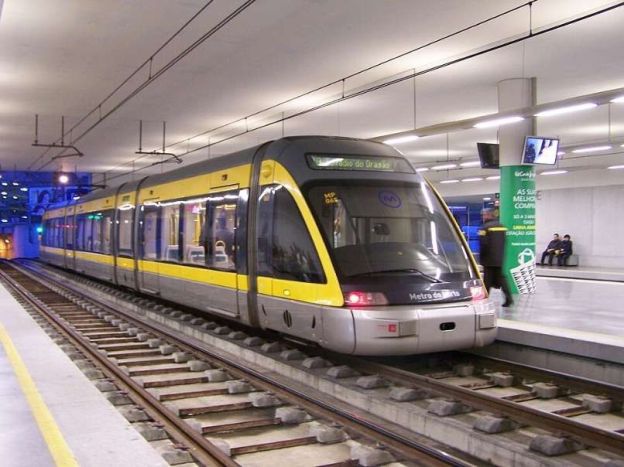
The featured image for this article is a Flexity Outlook Eurotram at Trindade station in Porto, Portugal, © Cornelius Kibelka and licensed for reuse under a Creative Commons licence (CC BY-SA 2.0). [3]

3. Readers’ Favourite Railway Journeys

A. A Dramatic Metro Line in Porto

“I love the surprise of urban rail. Porto’s metro D line heading south emerges from mundane darkness underground to suddenly skim rooftops and then rattle across the fantastic Eiffel-inspired Dom Luís I bridge. Choosing to walk back across the metal deck is a completely different experience.” [1: p75][12][Reader: Amy]
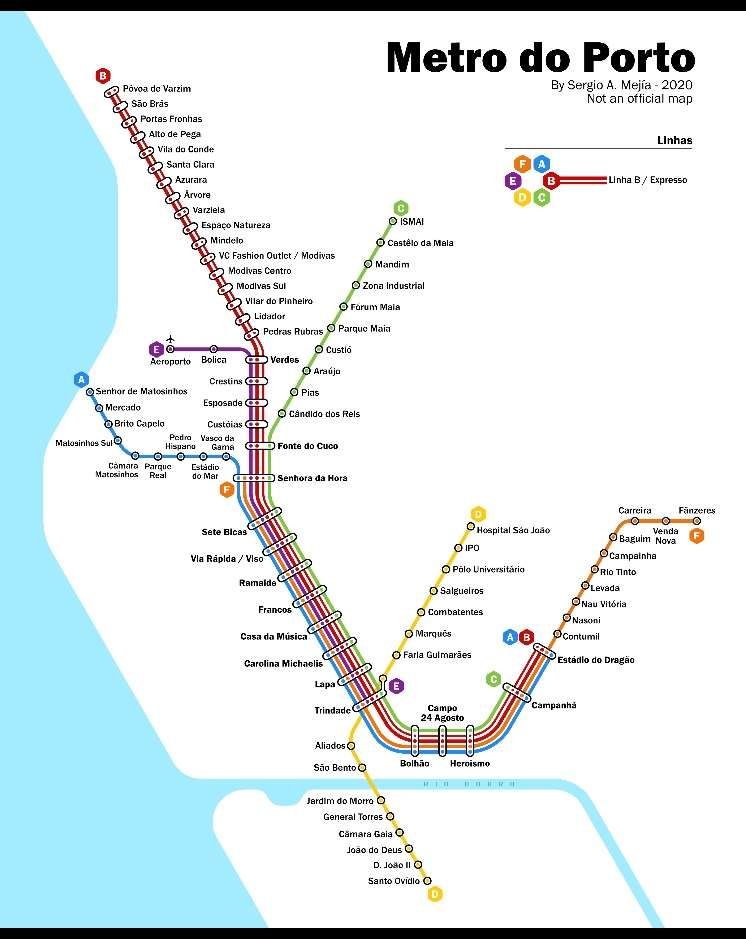
A map of the Metro in Porto. The yellow line is line D. It runs from Hospital Sãn João to Santo Ovidio. It is the one Metro line that crosses the Rio Douro. [2]

The Porto Metro (Portuguese: Metro do Porto) is the light rail network in Porto. It runs underground in central Porto and above ground into the city’s suburbs. The first parts of the system have been in operation since 2002. The network uses low-floor tram vehicles. [3]
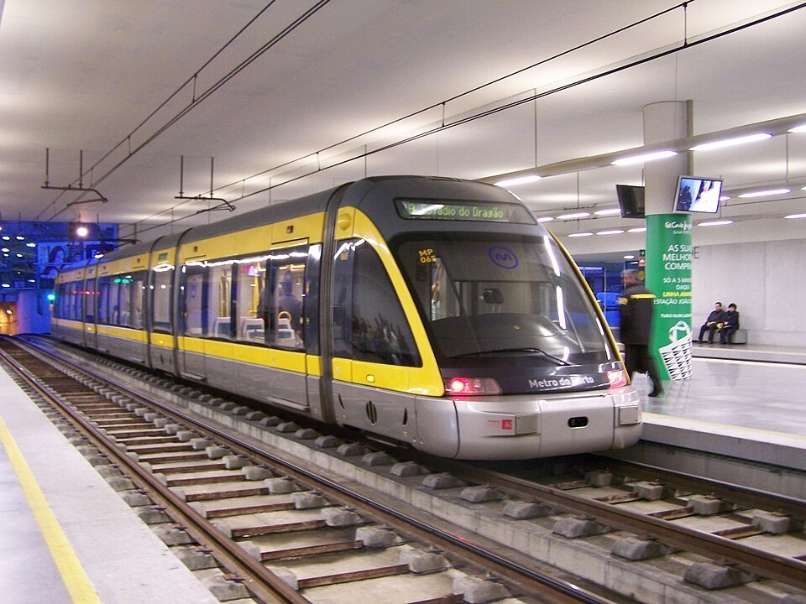
A Flexity Outlook Eurotram at Trindade station, © Cornelius Kibelka and licensed for reuse under a Creative Commons licence (CC BY-SA 2.0). [3]

The Socimi Eurotram (later sold as the Bombardier Flexity Outlook (E)) is an electric tramcar originally designed for the tram system of Compagnie de Transports Strasbourgeois (CTS). Initially produced by Socimi, after the company became bankrupt Eurotrams were manufactured first by ABB Group’s transportation division, then by Adtranz and finally by Bombardier Transportation, who marketed the tram as part of their Flexity Outlook range.” [4]
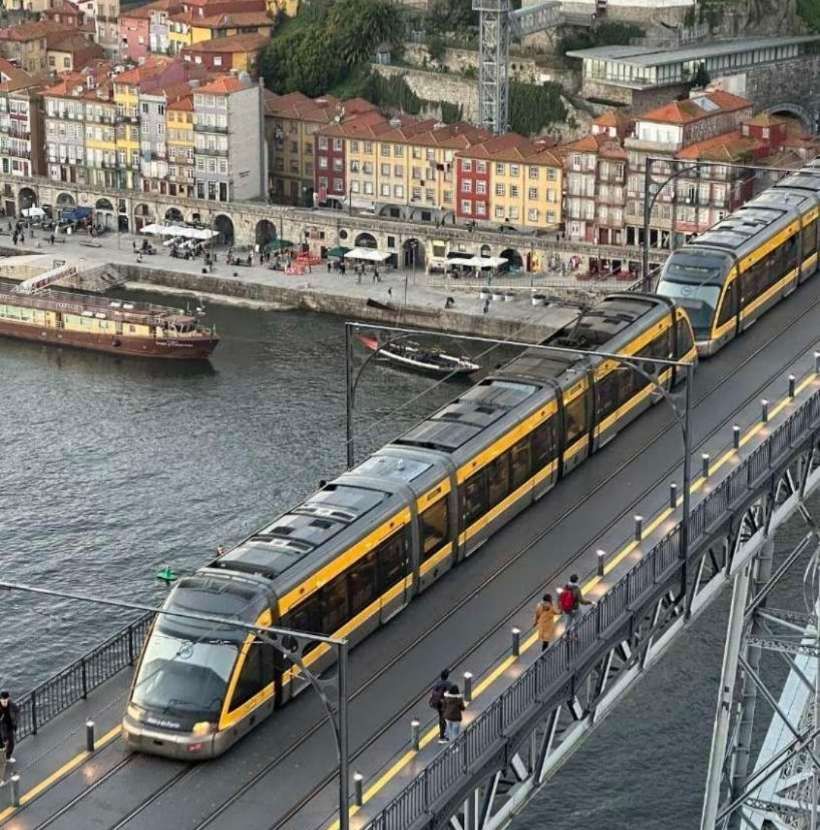
One of the Flexibilty Outlook Eurotrams crossing the Dom Luis I bridge over the Rio Duoro, © Sergei Gussev and licensed for reuse under a Creative Commons licence (CC BY 2.0). [5]
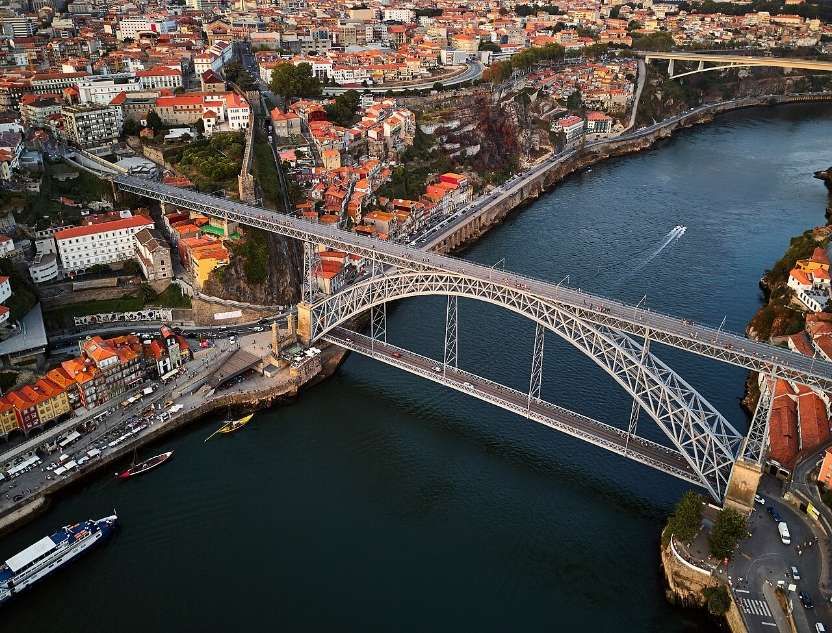
An aerial view of the Dom. Luis 1 Bridge over the Rio Douro in Porto. The bridge carries a road on a lower deck and the Metro Line D on the upper deck, © Deensel and licensed for reuse under a Creative Commons licence (CC BY 2.0). [6]
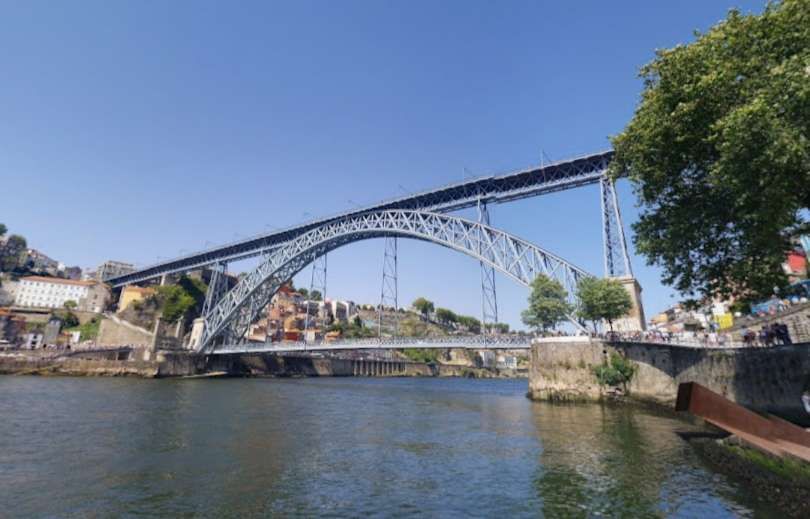
The Dom. Luis I Bridge seen from the West, © Milton Li, June 2019. [Google Maps, May 2026]

The bridge was designed by Theophile Seyrig and opened at the end of October 1886. In the 21st century, “the bridge’s upper level is used by pedestrians and by line D of the Porto Metro, whilst the lower level is used by buses, taxis, cyclists and pedestrians. The lower level links to the Porto waterfront, including the Praça da Ribeira and the lower station of the Guindais Funicular, at its northern end, and to Gaia waterfront, with its Port wine lodges, at its southern end. The upper level connects to Porto city centre and São Bento station at its northern end, and adjoins the Serra do Pilar Monastery and the upper station of the Gaia Cable Car at its southern end.” [6]

In 1879, Gustave Eiffel presented a project to construct a new bridge over the Douro, with a high single deck in order to facilitate ship navigation. This project was rejected due to dramatic growth of the urban population, which required a re-thinking of the limits of a single-deck platform. … A competition was initiated in November 1880, in order to construct a double-deck metal bridge, which included projects by Compagnie de Fives-Lille, Cail & C., Schneider & Co., Gustave Eiffel, Lecoq & Co., Société de Braine-le-Comte, Société des Batignolles (which submitted two ideas), Andrew Handyside & Co., Société de Construction de Willebroek (also two projects) and John Dixon. It was in January of the following year that deliberations by the committee supported the project of Société de Willebroek, a design that cost 369,000 réis and provided better carrying capacity. On 21st November 1881, the public work was awarded to the Belgian Société de Willebroek, from Brussels, for 402 contos. It was to be administered by Théophile Seyrig, the former partner of Gustave Eiffel and author of the project. Seyrig had also designed the Maria Pia bridge that was constructed by Eiffel & cie, hence the resemblance of his new bridge to the Maria Pia bridge. Construction began on the Luis I bridge alongside the towers of an earlier suspension bridge, the Ponte Pênsil, which was disassembled.” [6]

By 26th May 1886, the first weight experiments began, with the transport of a 2,000 kilograms (4,400 lb) per metre. On 30th October construction of the main arch and upper deck were concluded, resulting in its inauguration the very next day. On 1st November, a toll system began to operate under the administration of the winning company, that was equal to 4 reís per person. The following year the lower deck was inaugurated, completing the project. During its ceremonies, the bridge was blessed by Bishop D. Américo.” [6]

Line D (yellow line) opened on 17th September 2005 between Câmara de Gaia in Vila Nova de Gaia and Pólo Universitário in the North. At the northern end, the São João Hospital and IPO stations, were not brought into service until March 2006 due to safety concerns. At the southern end, the line was expanded until D. João II in May 2008 and then to Santo Ovídio in October 2011. In June 2024, the line was extended southwards by 3.15 km with three new stations added, Manuel Leão, Hospital Santos Silva and Vila d’Este. [3]

The Guardian reader (Amy) speaks of the tram emerging from the darkness of the tunnel before crossing the bridge. The tunnel mouth can be seen in the satellite image immediately below.
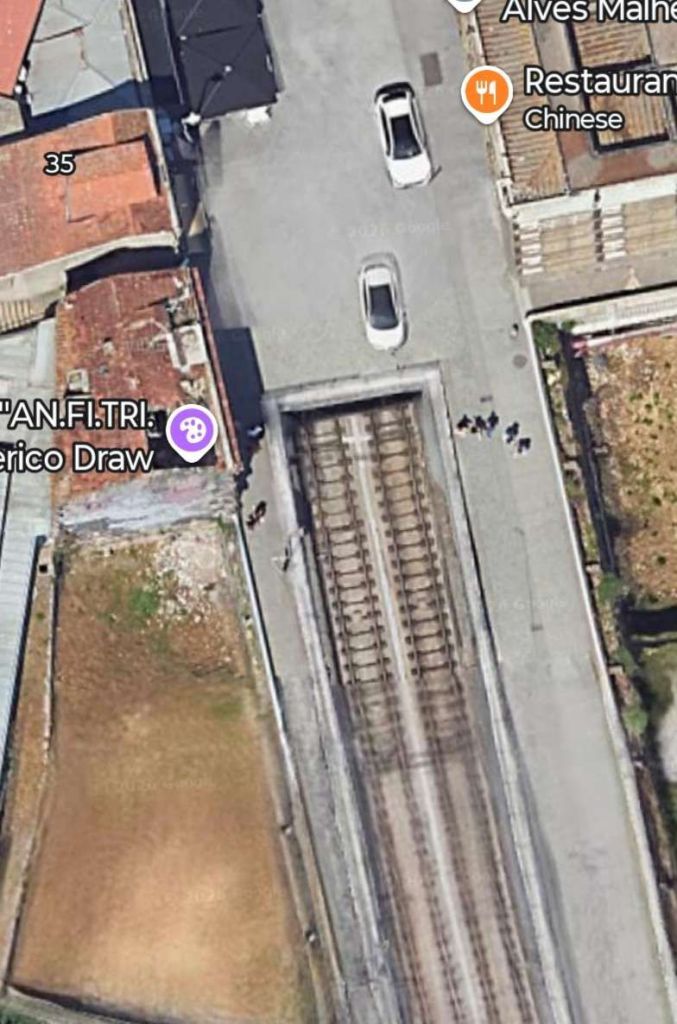
This satellite image shows the location mentioned above. Trams emerge from underground on the North side of the Rio Douro and are soon high above city streets such as Escardas do Codecal and Av. Gustavo Eiffel and then crossing the river. [Google Maps, May 2026]

On the South side of the river trams fly over R. da Cabo Simeo and Calcada da Serra before meeting and crossing R. Rocha Leao at level.
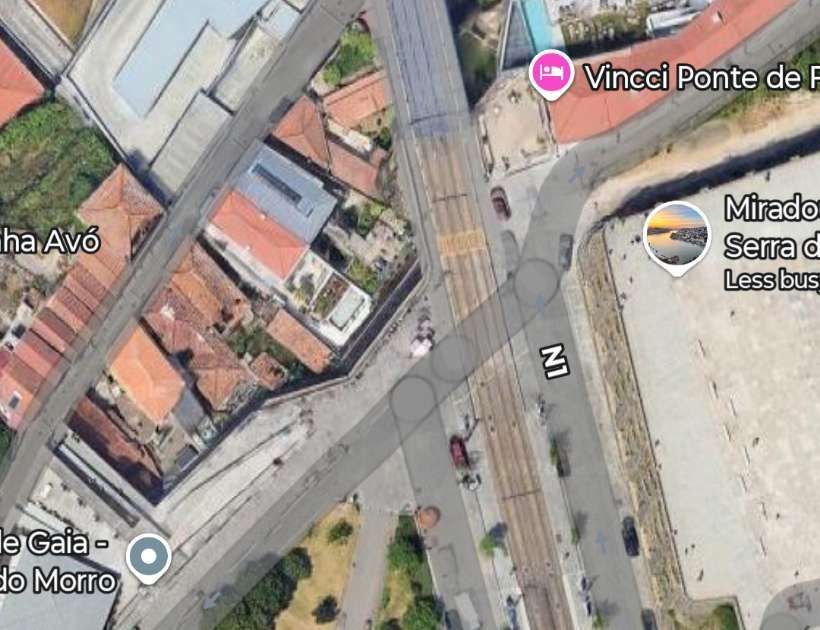
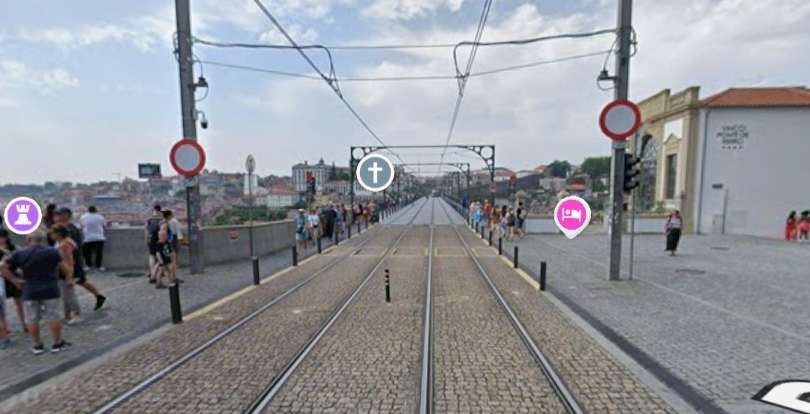
Metro line D runs North to South, crossing R. Rocha Leao at level. [Google Maps, May 2026]
Looking North towards the Rio Douro from R. Rocha Leao. [Google Streetview, June 2025]
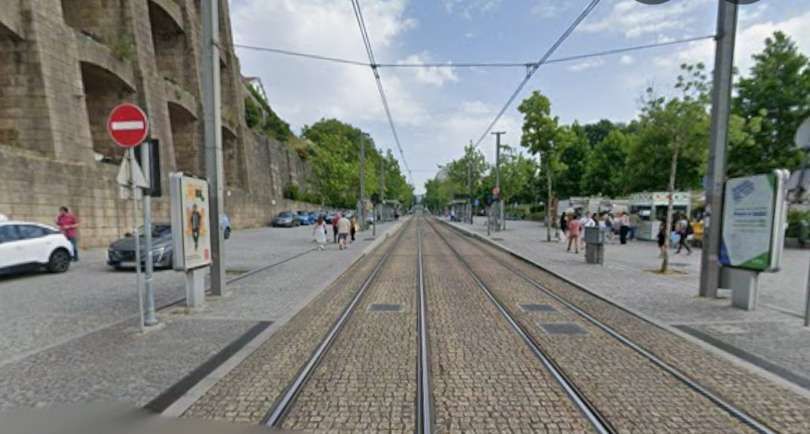
Turning through 180°, this is the view South along Metro Line D from R. Rocha Leao. [Google Streetview, June 2025]

The Guardian reader talked of crossing the bridge on the Metro and then walking back over it afterwards!

B. Fjords and Waterfalls in Norway

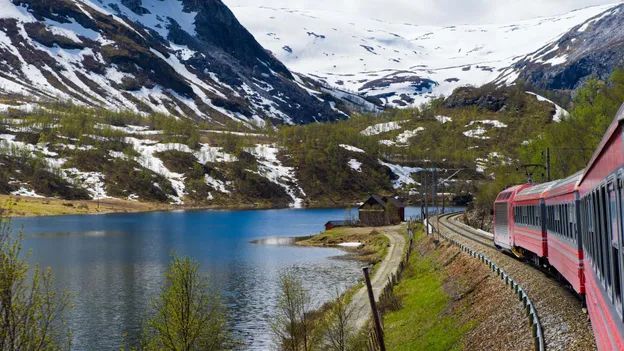
“I travelled across Norway by rail on the spectacular Bergensbanen, running between Oslo and Bergen, and the unforgettable Flåmsbana branch line. The Bergensbanen crosses the high mountain plateau of Hardangervidda, passing lakes, forests and snow‑covered peaks before descending toward the fjords of western Norway. At Myrdal, I transferred on to the steep Flåmsbana, which drops dramatically to Flåm on the Aurlandsfjord, with waterfalls and sheer-sided valleys at every turn.” [1: p75][12][Reader: Daniel]

The Bergensbanen is a spectacular 496-kilometre railway connecting Oslo and Bergen in Norway. Taking approximately 7 hours, it is Northern Europe’s highest mainline railway, reaching 1,237 metres above sea level. The line runs 4 to 6 times daily, offering stunning views of Hardangervidda mountain plateau and deep fjords.

Trains on the Bergensbanen are operated by Vy. [7] Highlights along the way include Finse (the highest station), Myrdal (transfer to the Flåm Railway), and Voss (a major skiing hub).

The Bergensbanen is actually a 371-kilometre (231 mile) long scenic standard-gauge railway line between Bergen and Hønefoss, Norway. However, the name is often applied to the entire route from Bergen to Oslo, including the Randsfjord and Drammen lines between Hønefoss and Oslo, covering a total distance of 496 kilometres (308 miles). [8]
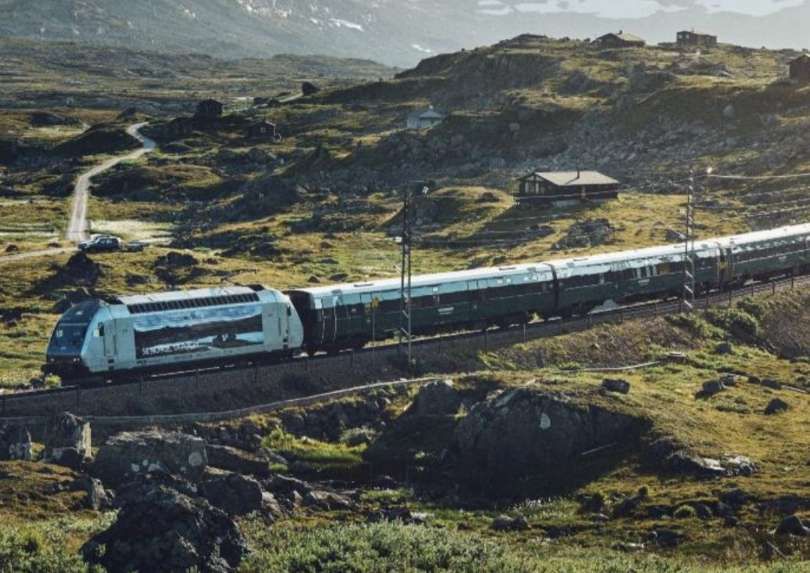
The Bergen Railway (Bergensbanen)
Between Oslo and Bergen by train, © Vy/Øivind Haug. [9]
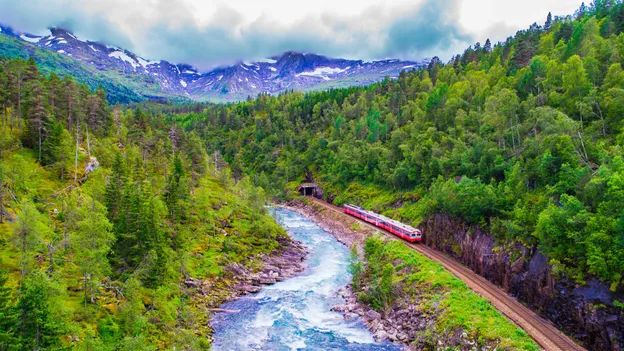
Connecting Norway’s stylish capital with its most picturesque city, the 496km, 39-station Oslo-Bergen railway is one of the world’s most beautiful train journeys, © MariusLtu/Getty Images. [10]
The route crosses the inhospitable Hardangervidda plateau, which soars more than 1km above sea level, © Stockstudiox/Getty Images. [10]

The Flåmsbana is one of the most beautiful train rides in the world and it takes you past mountains and waterfalls you will not forget.
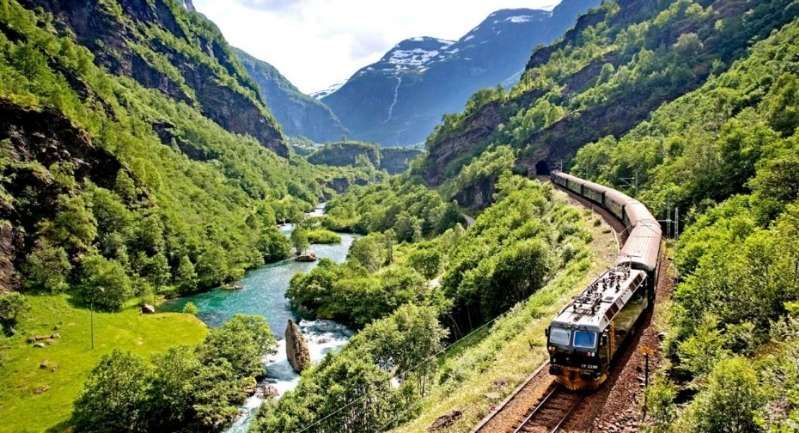
The Flåm Railway. © Morten Rakke. [9]

An article about the Flam railway can be found here. [11]

C. An Electric Gem in Germany

“I took the RB26 train from Berlin-Lichtenberg to Müncheberg and changed for the Buckower Kleinbahn historic narrow gauge railway. Opened in 1930 as an early electric railway, it closed its regular service in the late 1990s. It is now volunteers who run the line that takes you through the rolling hills of Märkische Schweiz in Brandenburg to the pretty spa town of Buckow. Here, I visited the residence of Bertolt Brecht and Helene Weigel on the peaceful reedy shores of Lake Schermützel, before returning refreshed to the Berlin bustle.” [1: p75][12][Reader: Rachael]

The Buckower Kleinbahn railway runs from Buckow to/from Müncheberg a round journey of close to 10km.
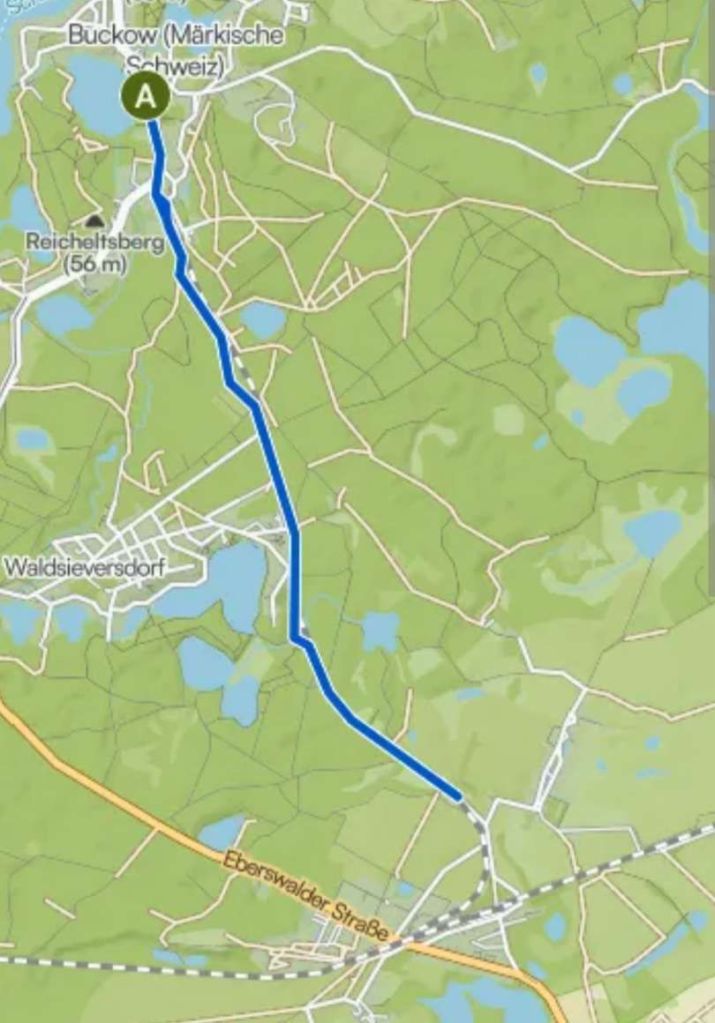
The blue line approxi.ates to the route of the preservation railway line. [14]

The little railway museum in Buckow’s train station building illustrates the history of Buckow’s narrow-gauge railway, as well as of other private and secondary railways, such as the Müncheberg narrow-gauge railway, the Oderbruch train and the ‘Royal Prussian Eastern Line’ (now the RB 26). There are also many exhibits of all sizes and ages, relating to general railroading in Germany.” [13]

A range of diesel and electricity-powered vehicles from the time between 1920 and 1986 are presented in the outdoor area of the Buckow train station. In addition to this, the old rectifier facility of Buckow’s narrow-gauge railway is home to an exhibition about railway power technology, as well as railway signalling and safety.” [13]

“Buckow’s narrow-gauge railway (Buckower Kleinbhan) with historic vehicles operates on weekends from April to October, and it is inseparably linked to the railway museum. Visitors coming from Berlin can board the museum train at Müncheberg station and are taken to Buckow via Waldsieversdorf with very friendly assistance. Children of all ages get to look over the train driver’s shoulder and interested adults can take part in a training course and obtain a certificate as an honorary train driver of the Buckow narrow-gauge railway.” [13]
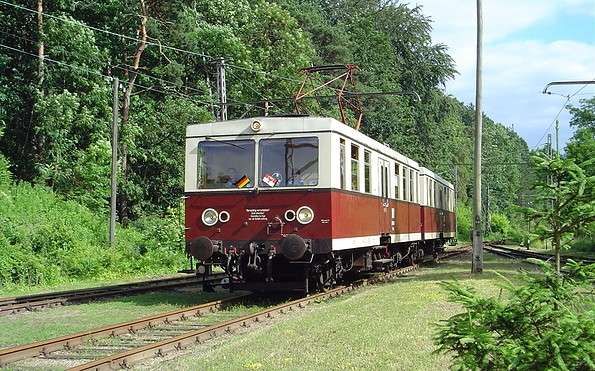
This historic electric railcar is one of a number of such vehicles, Class 279 or ET188 types, with some refurbished in the early 1980s, which run on the Buckower Kleinbahn railway, © Museumsbahn Buckower Kleinbahn e.V. [13]

D. The Swiss Watchmakers’ Line

“When time is not important, a little-known French railway line allows you to enter Switzerland through the valley of the watchmakers. The line from Besançon in France drifts through the beautiful Jura foothills to Le Locle, a Swiss watchmaking town. No one got on or off at L’Hôpital-du-Grosbois, a byway station en route named after a leprosy hospital. A line that Dr Beeching would probably have closed still delivers you into Switzerland on time. [1: p75][12][Reader: Martin]

The “Watchmakers’ Line” (La Ligne des Horlogers) is a historic cross-border railway connecting Besançon, France, to La Chaux-de-Fonds/Le Locle, Switzerland. Named in honour of the region’s rich horological heritage, it spans the Jura mountains

Winding through the rugged terrain of the French Pays Horloger (Watchmaking Country) and the Swiss canton of Neuchâtel, the line is a marvel of 19th-century railway engineering. It features numerous tunnels and viaducts built to conquer the steep alpine inclines. The route is actively served by TER (Transport Express Régional) trains on the French side and connects seamlessly with the Swiss rail network.

The TER (regional) train takes approximately 1 hour and 15 minutes to cover the 48-kilometre distance. There are around 9 direct trains per day in both directions.
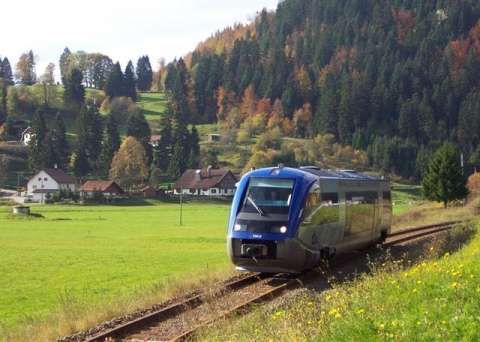
A standard train on the route between Besançon, France and La Chaux-de-Fonds/Le Locle, Switzerland. [16]

From 1st March to 31st October 2021, SNCF Réseau carried out major modernization work on the Horlogers line, a century-old mountain line, which connects Besançon (25) to La Chaux-de-Fonds in Switzerland for a budget of €55.5 million. These works reinforced structures (bridges, tunnels, walls, and trenches), renewed 35 km of track for €49 million (€19.4 million from the French State, €19.4 million from the Bourgogne-Franche-Comté Region, €6 million from INTERREG, and €4.2 million from SNCF Réseau), made the Morteau and Valdahon stations accessible to all for €1.5 million (€0.75 million from the French State and €0.75 million from the Bourgogne-Franche-Comté Region), and modernized the signaling system to allow TER regional trains in the Bourgogne-Franche-Comté Region to continue operating in Switzerland for €5 million (€2.5 million from the French State and €2.5 million from the Bourgogne-Franche-Comté Region). After a complete eight-month service interruption on the line, traffic between Besançon and Morteau resumed on 31st October, and between Morteau and La Chaux-de-Fonds on 23rd December 2021. [15]

The site of La Chaux-de-Fonds/Le Locle consists of two towns situated close to one another in a remote environment in the Swiss Jura mountains, on land not particularly suited to farming. Planned in the early 19th century, after extensive fires, the towns owed their existence to the watchmaking industry. Their layout along an open-ended scheme of parallel strips on which residential housing and workshops are intermingled reflects the needs of the local watchmaking culture that dates to the 17th century and is still alive today.

E. Charmed by the Vienna to Zagreb train

“The journey from Vienna to Zagreb saw mountainous central Europe relax into Balkan charm. Stunning Alpine scenery melted into forest, settling down into rolling hills as we passed through Graz and reached the Slovene border, stopping for an hour’s changeover at the tiny Zidani Most station, where we enjoyed afternoon beers gazing over lush Slovenian countryside. The connection to Zagreb boasted dramatic lake scenery that gave way to farm land, golden in evening light, as we passed into Croatia, soon rattling into its underrated capital. We booked this through Omio, which came in relatively cheaply at £41.” [12][Reader: Matt]

It is possible to get a direct train. According to thetrainline.com, the journey takes about 6 to 6.5 hours, covering roughly 370 km. Tickets can start around €25 to €35. There are normally 11 trains per day travelling from Vienna to Zagreb and tickets for this journey start from £25.89 when you book in advance. [17] The raileurope.com website quotes a lowest fare at under £22.00. [18]

The train journey from Vienna to Zagreb transitions from spectacular Alpine peaks to lush river valleys and rolling Balkan countryside. The journey takes you through southeastern Austria and northern Slovenia before arriving in Croatia. To catch the best views, sit on the left side of the train when departing Vienna to look down into the Semmering valleys. When traveling through Slovenia, sit on the right side to enjoy the best riverside views.

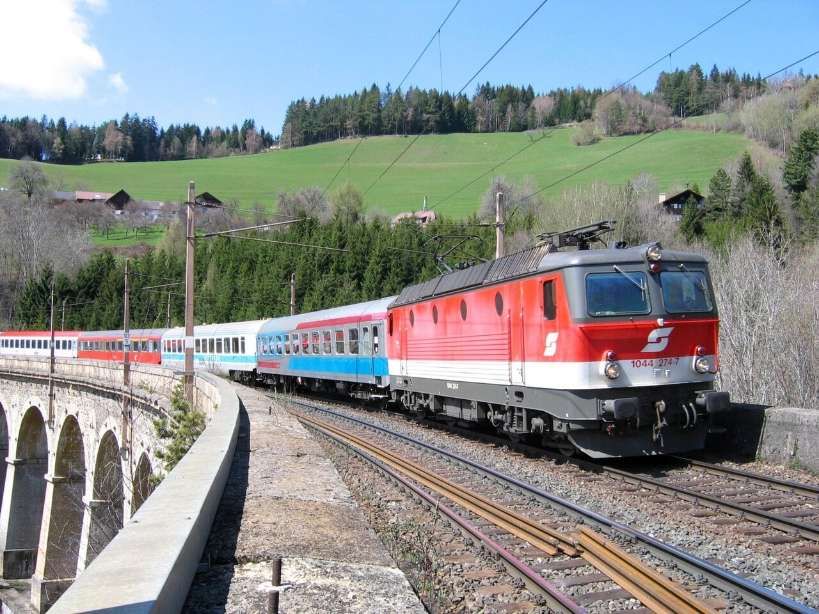
Shortly after leaving Vienna (Wiener Neustadt), the train climbs the Semmering Pass. This is a UNESCO World Heritage site, famous for winding viaducts, tunnels, and panoramic views of steep mountain valleys and dark pine forests.
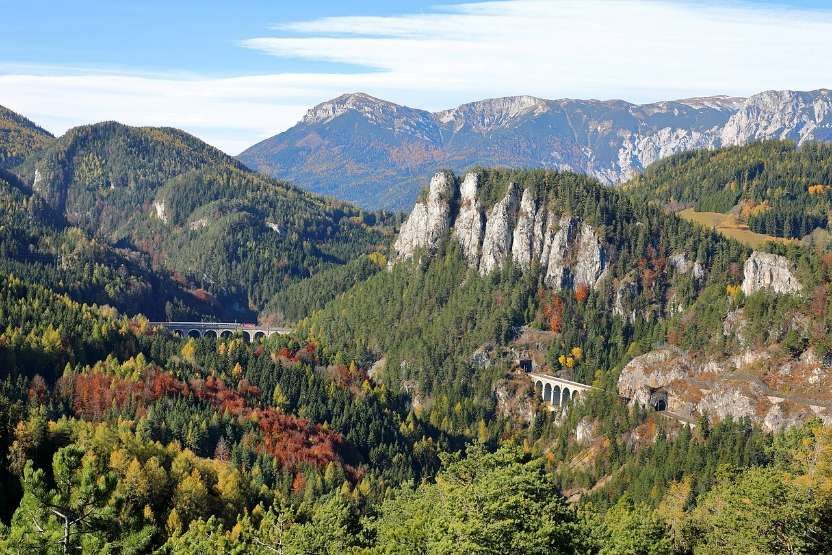
The Semmering Pass railway and surrounding scenery, © C.Stadler/Bwag and licensed for reuse under a Creative Commons licence (CC BY-SA 4.0). [19]
An international express on the Semmeringbahn, pulled by 1044 274-7 in 2004, © Herbert Ortner and licensed for reuse under a Creative Commons licence (CC BY 3.0). [19]

As you descend from the mountains, you’ll pass through the rolling, green agricultural landscapes and vineyards surrounding the city of Graz.

Crossing the border, the scenery becomes dramatic. The train tracks hug the winding Savinja and Sava rivers, passing through deep gorges and canyons flanked by dense forests and rural villages.

The rugged terrain flattens out into the golden farmlands and charming countryside of northern Croatia before pulling into Zagreb’s main station, Zagreb Glavni Kolodvor.

Further suggestions for rail journeys from Guardian readers can be found in the fourth of this series of articles based around the Guardian Saturday Magazine of 23rd May 2026.

References

  1. Readers’Travel Tips: Favourite Train Trips; in Saturday (the Guardian Magazine), 23rd May 2026, p75.
  2. https://www.reddit.com/r/TransitDiagrams/comments/gidbxm/ocdiagram_metro_do_porto_portugal, accessed on 25th May 2026.
  3. https://en.wikipedia.org/wiki/Porto_Metro, accessed on 25th May 2026.
  4. https://en.wikipedia.org/wiki/Socimi_Eurotram, accessed on 25th May 2026.
  5. https://commons.wikimedia.org/wiki/File:Vila_Nova_de_Gaia_(52734250241).jpg, accessed on 25th May 2026.
  6. https://en.wikipedia.org/wiki/Dom_Lu%C3%ADs_I_Bridge#/media/File%3ADom_Lu%C3%ADs_I_Bridge_(36961760686).jpg, accessed on 25th May 2026.
  7. https://www.vy.no/en/train/routes/the-bergen-line, accessed on 25th May 2026.
  8. https://en.wikipedia.org/wiki/Bergen_Line, accessed on 25th May 2026.
  9. https://en.visitbergen.com/visitor-information/travel-information/getting-here/bergensbanen-oslo-to-bergen-by-train, accessed on 25th May 2026.
  10. https://www.bbc.co.uk/travel/article/20230130-the-highest-rail-route-in-northern-europe, accessed on 25th May 2026.
  11. https://rogerfarnworth.com/2019/01/01/the-flam-railway-in-1950
  12. https://www.theguardian.com/travel/2026/may/22/readers-favourite-scenic-european-railway-journeys-trains, accessed on 25th May 2026.
  13. https://www.brandenburg-tourism.com/poi/seenland-oder-spree/industrial-culture/eisenbahnmuseum-and-buckower-kleinbahn-train-museum, accessed on 25th May 2026.
  14. https://www.komoot.com/smarttour/3623001, accessed on 25th May 2026.
  15. https://www.sncf-reseau.com/fr/cp/bourgogne-franche-comte/ligne-horlogers-modernisee-entre-besancon-et-morteau, accessed on 25th May 2026.
  16. https://www.railwaypro.com/wp/colas-consortium-to-modernise-ligne-des-horlogers, accessed on 25th May 2026.
  17. https://www.thetrainline.com/en/train-times/vienna-to-zagreb, accessed on 25th May 2026.
  18. https://www.raileurope.com/en-gb/destinations/vienna-zagreb-train, accessed on 25th May 2026.
  19. https://en.wikipedia.org/wiki/Semmering_railway, accessed on 25th May 2026.
Through Norway by Rail – The Railway Magazine, November 1899

E.E. Speight tells of his own experiences travelling by rail in Norway. In an article which is primarily a travelogue rather than a technical piece. He fails to mention the gauges of the different railways that he travels along. [1] The matter of the differing gauges of railways in Norway is covered in some paragraphs below.

In 1899, Norway had around 1,300 miles of railway. The principal elements were lines running:

  • from Christiania South towards Sweden reaching the border at Kornsjo (169 km – the Smaalensbanen);
  • from Christiania East towards Sweden reaching the border beyond Kongsvinger;
  • from Christiania to Trondhjem (562 km) with branches to Lillehamer, Otta and from Elverum to Kongsvinger;
  • from Trondhjem to Storlien (108 km) to meet the line in Sweden from Stockholm;
  • from Christiania South to Drammen, Laurvik and Skien (204 km) with branches to Randsfjord, Kongsberg and Kroderen, Horten and Brevik.
  • between Christiansand and Byglandsfjord (Saetersdal); Stavanger and Ekersund (Jaederbanen); and Bergen to Vosse (108 km).

The city of Oslo was founded in 1024. In 1624, it was renamed Christiania after the Danish king; in 1877, the spelling was altered to Kristiania. In 1925, it reverted to its original medieval name of Oslo.

It seems as though E.E. Speight may have missed the 1877 memo about the renaming of the city, and so continued to refer to Kristiania as Christiania. Reading in the 21st century we need to read Christiania as Oslo.

In the 21st century, the Norwegian railway system comprises 4,109 km of 1,435 mm (4 ft 8 1⁄2 in) (standard gauge) track of which 2,644 km is electrified and 274 km double track. There are 697 tunnels and 2,760 bridges. [2]

This was not the case in the early years of the network. The first railway in Norway was the Hoved Line between Oslo and Eidsvoll and opened in 1854. The main purpose of that railway was to move lumber from Mjøsa to the capital, but passenger service was also offered. In the period between the 1860s and the 1880s Norway saw a boom of smaller railways being built, including isolated railways in Central and Western Norway. The predominant gauge at the time was 1,067 mm (3 ft 6 in) (narrow gauge), but some lines were built in 1,435 mm (4 ft 8 1⁄2 in) (standard-gauge), particularly where those lines connected to the standard-gauge lines of Sweden. [2]

When building the Norwegian Trunk Railway (1850-1854), Robert Stephenson built the line to British standard gauge. This line was very expensive; Pihl argued that narrow-gauge railways would be less expensive to construct, he argued successfully for 3 ft 6 in (1,067 mm) gauge. During the railway construction boom of the 1870s and 1880s all but the Kongsvinger Line, the Meråker Line and the Østfold Line were built with narrow gauge, leaving Norway with two incompatible systems. [7]

The 3ft 6in gauge was chosen by Carl Pihl in 1857 as the ‘standard-gauge’ for Norwegian railways. Pihl was a civil engineer and director of the Norwegian State Railways (NSB) from 1865 until his death in 1897. [7]

A number of main line railways were built to the 3 ft 6 in (1,067 mm), to save cost in a sparsely populated mountainous country. This included: the Hamar – Grundset Railway which commenced operation in 1861; the more challenging Trondheim – Støren Railway which commenced operations in 1864; and Norway’s first truly long-distance line, the Røros Line, connecting Oslo and Trondheim (in 1877).

In 1883 the entire main railway network had been taken over by Norwegian State Railways (NSB), though a number of industrial railways and branch lines continued to be operated by private companies. [2]

It was the decision of the Norwegian Parliament to construct the Bergen line to standard-gauge (in the year following Phil’s death), which finally settled the debate over gauges. By this time, it had been demonstrated that standard-gauge lines built to the same specifications as the narrow gauge could be constructed at the same cost. [7]

Ultimately, all narrow-gauge lines owned by the NSB  were either closed or converted between 1909 and 1949, at a cost many times larger than the initial savings of building them narrow.

Projects such as the Bergen Line and the Sørland Line (also built to standard-gauge) were connecting all the isolated railways and transshipment costs were becoming significant. [7]

Some private railways had 750 mm (2 ft 5 1⁄2 in) and one had 1,000 mm (3 ft 3 3⁄8 in) gauge. A few railways are in part still operated as museum railways, specifically the Thamshavn Line, Urskog–Høland Line and the Setesdal Line. [3]

The Thamshavn Line (Norwegian: Thamshavnbanen) was Norway’s first electric railway, running from 1908 to 1974 in what is now Trøndelag county. Today it is operated as a heritage railway and is the world’s oldest railway running on its original alternating current electrification scheme, using 6.6 kV 25 Hz AC. It was built to transport pyrites from the mines at Løkken Verk to the port at Thamshavn, as well as passengers. There were six stations: Thamshavn, Orkanger, Bårdshaug, Fannrem, Solbusøy and Svorkmo. The tracks were extended to Løkken Verk in 1910. [4]

The Urskog–Høland Line (Norwegian: Urskog–Hølandsbanen), also known as Tertitten, is a narrow gauge (750 mm (2 ft 5 1⁄2 in)) railway between Sørumsand and Skulerud in Norway. [5]

The Setesdal Line (Norwegian: Setesdalsbanen) was a railway between Kristiansand and Byglandsfjord in southern Norway, 78 km (48 mi) long. It was built with a narrow gauge of 1,067 mm (3 ft 6 in), and opened to Hægeland 26 November 1895, and to Byglandsfjord 27 November 1896. Stations along the line included Mosby, Vennesla, Grovene (Grovane), Iveland and Hægeland. Now, 8km of this line is open as a heritage railway. [6]

By the 21st century, of the operational (non-heritage) railways in Norway, only the Trondheim (Trondhjem) Tramway has a different gauge, the metre-gauge, 1,000 mm (3 ft 3 3⁄8 in). [2]

Returning to Speight’s article in The Railway Magazine, he refers his readers to a government publication in French and Norwegian which provided excellent statistical information and maps/plans – De Offentlige Jernbaner, Aschehoug & Co., Christiania. This appears to have been a regular, annual, publication and copies from later years can be purchased online. [8]

Speight focus was on describing his own experiences on the rail network in Norway. He entered Norway from Sweden on a train which ran direct from Helsingborg (in Sweden) to Christiania (Oslo) remarking on the spaciousness and comfort of the Norsk-Svensk hurtugtog, or fast train.

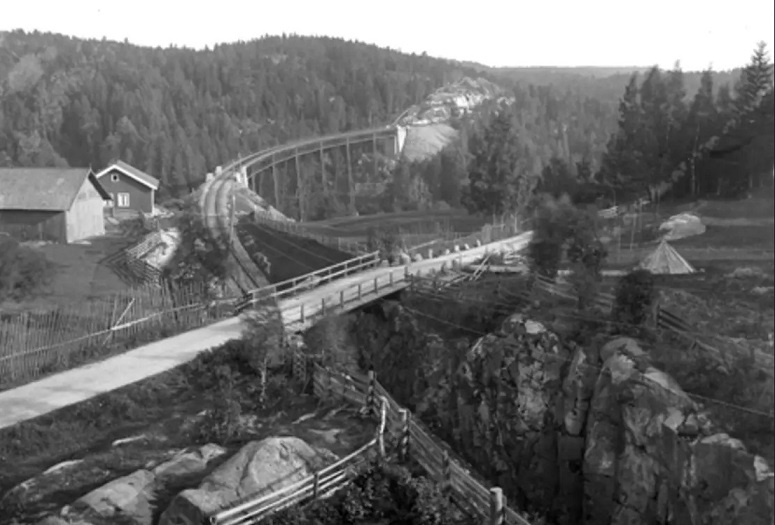
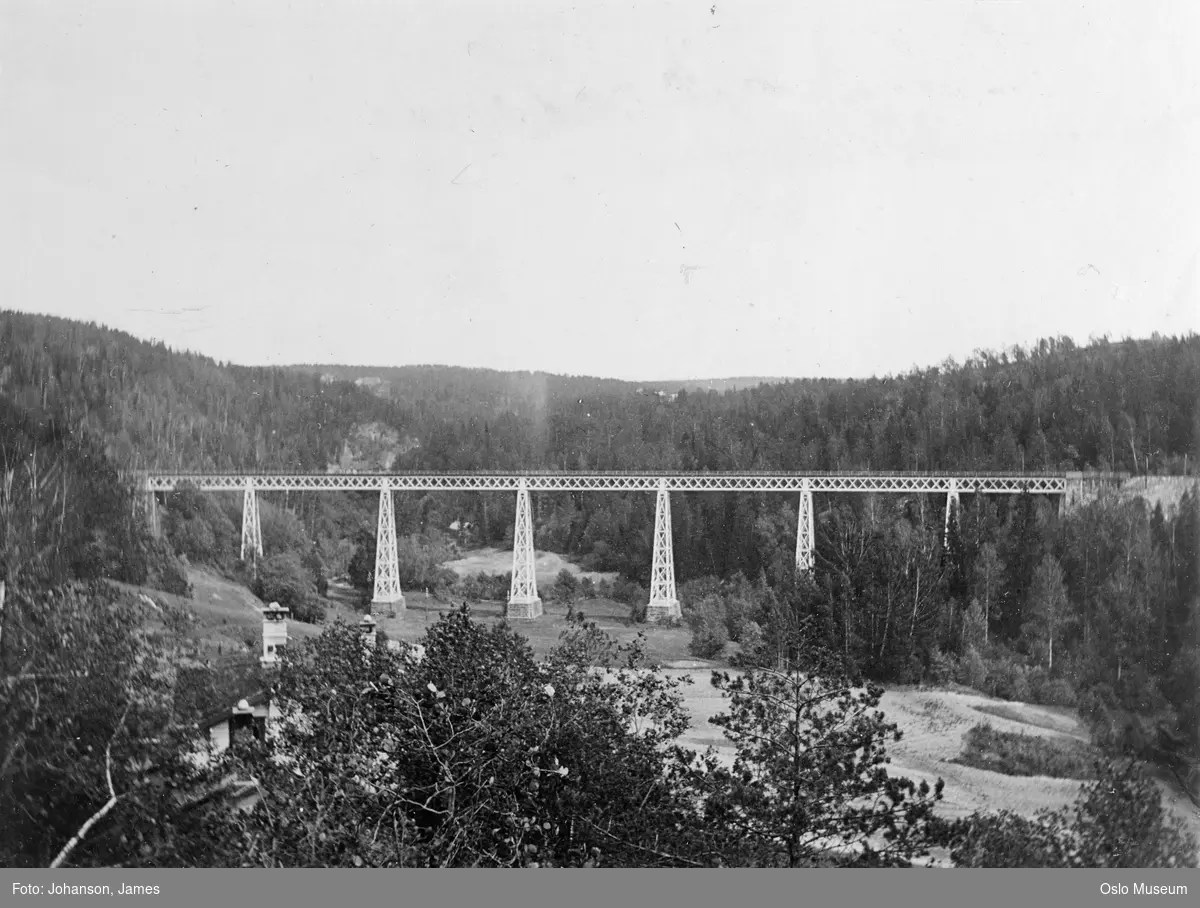
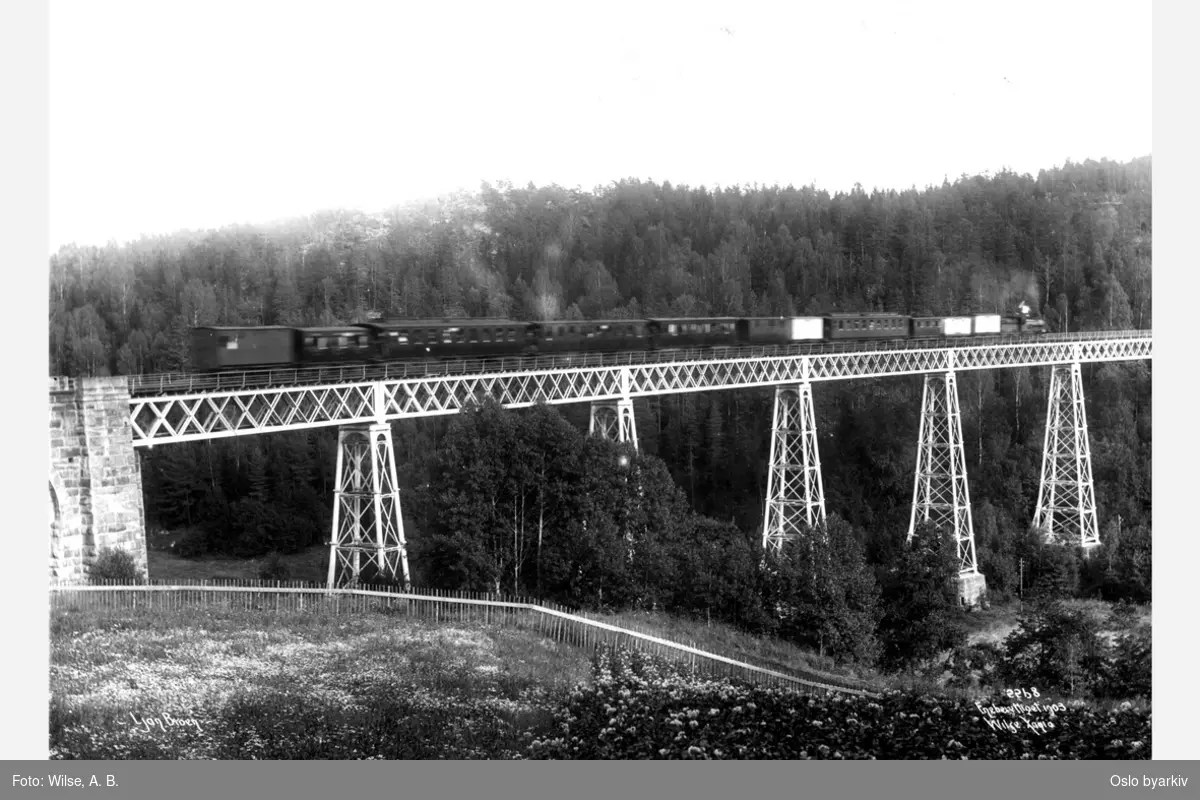
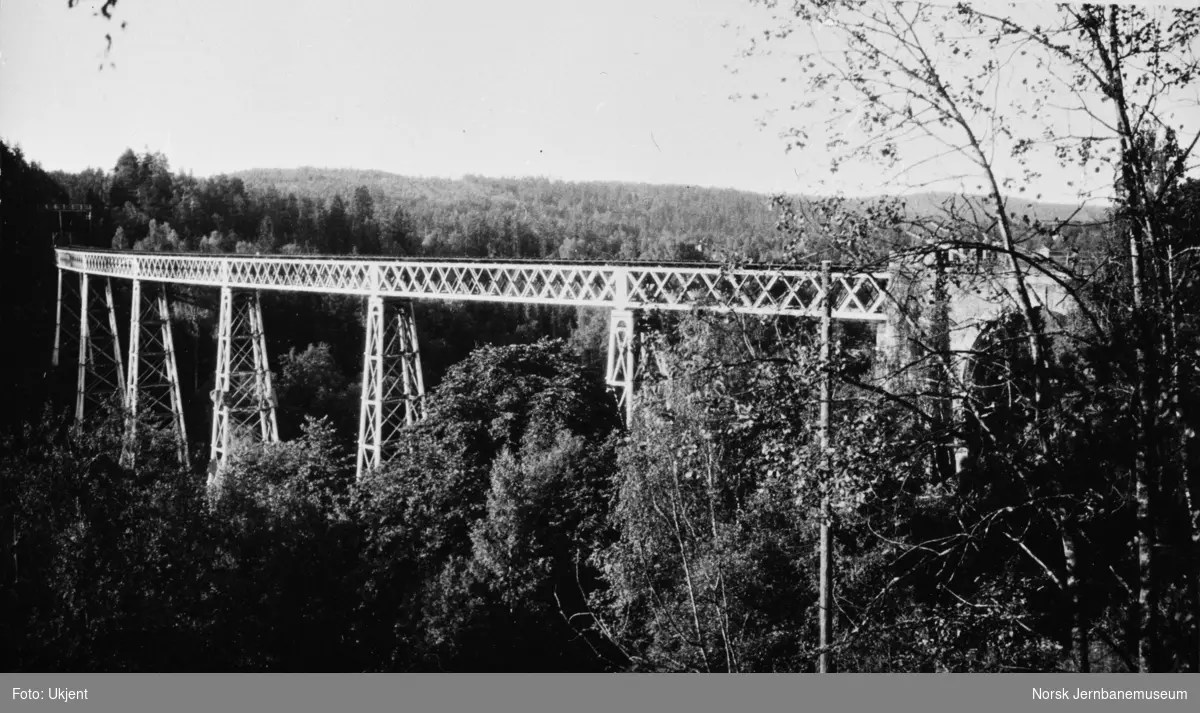
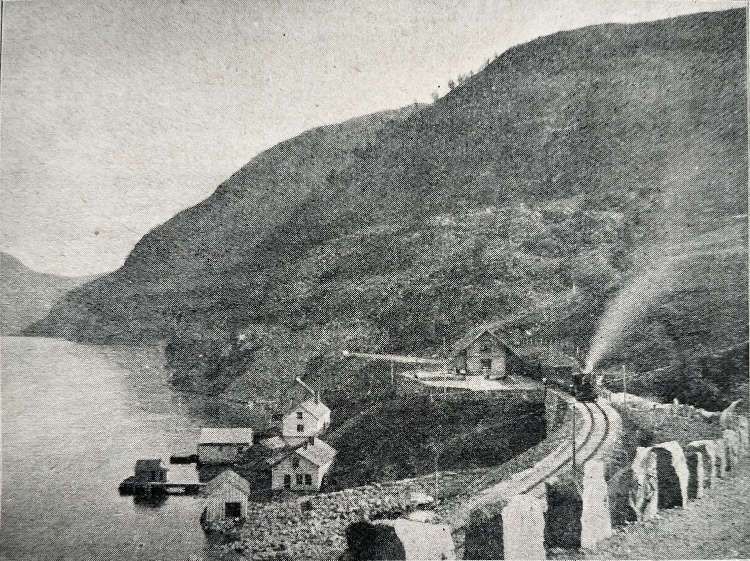
His first sight when opening the curtains of his train compartment in the morning was drizzle at the station in Frederikstadt. His first rail with rail journey in Norway was travelled at a very slow pace with long waits at stations in the route to Christiania (Oslo). He comments on the dramatic scenery and on the difficulties which must have been experienced in building the line on which he was travelling. Speight points his readers to the illustration below, which shows the Ljans viaduct (admittedly the photo quality is poor) and he says: “The train winds in and out among rocks and trees and over many a gorge, passing the most picturesque little  wooden homesteads all the way from Ljan, a few miles out of the city. One of the pretty villas was a smoking ruin as we passed, and the conductor told me that the day before it was all right, and that such fires were a common occurrence. At the upper window of another of these wooden villas, standing just over the water of an inlet of the fjord, appeared two faces, and the conductor cheerily saluted his wife and little child, as he does three times each week on his return from Sweden.” [1: p449]

Ljans Viaduct near Christiania (Oslo). Sadly, the picture included in the Railway Magazine is too grainy, [1: p448] This image was found on an internet form and appears to be the same image that was used in The Railway Magazine, © Olaf Peder Martin. It is held in the collection of the Norsk Jernbarnemuseum. The Ljans viaduct was completed in 1878. The bridge was sold to Christiania Spigerverk after the line got re-aligned towards Hauketo in 1925. It was blown up to provide materials for nails in 1929. [9]

The three photographs immediately above are further photos of Ljans Viaduct taken before 1929 all of which are in the collection of the Norsk Jernbarnemuseum. [9]

Speight continues: the main station in Oslo “adjoins the quays, and is at the bottom of the main street which runs up past the chief shops to the Castle, Carl Johan’s Gade, or Johan as it is known all over Norway.” [1: p449]

The trip from Copenhagen to Christiania (Oslo) was advertised as an 18 hour or a 22 hour journey. In Speight’s view, the journey could have been completed in either 12 or 14 hours. The causes for the length of the journey, in Speight’s view were “the length and weight of the trains, the frequent long stops and the form of locomotive used. … They [were] manifestly incapable of taking the eight or ten corridor carriages over the gradients on this line. … The [then] present total of stopping time amount[ed] to about three hours; this [was] partly accounted for by the fact that meals [were] taken in the stations, and at the customs station a long stay [was] made. But there [was] no need for the five or ten minutes’ stops made at many of the small stations where the little business could [have been done]  in a quarter of the time. If the two Governments cared to run … an express, from Helsingborg, stopping only, say, at Halmstad, Gothenburg, Trollhättan, Frederikshald, Frederik stadt and Moss (running a steamer thence to Horten for quick connection with Skein and Drammen) the journey  should [have been completed] in 12 hours, the more easily if a restaurant car were [to be] attached to save long stops.” [1: p450]

Speight then travelled Southwest from Oslo along the line which had termini in Skein, Kroderen and Kongsberg. He complains that no first class carriages were provided on the line and comments again about the slow speed of the service despite expresses being provided. He says: “An approach is made towards running expresses, four trains daily passing between Christiania and Drammen, 33 miles, without a stop, but with an occasional crawl, in an hour and a half. There are obstacles to fast speed on this line also, as there are many crossings and such gradients that for the heavy trains it is necessary to have a small engine at each end The point of depar ture in Christiania is situated by Piperviken, a quay for coast steamers. Vestbanens station is smaller than the Eastern station, but none the less cold and uncomfortable. There is no refreshment room, and some of the less known Midland stations, say Bingley or Keighley, are palaces in comparison. The trains, however, are comfortable, being provided with through passages, open to the public, and irregularly disposed seats – some like an English tram car, others saloon fashion.” [1: p450]

Speight has only praise for the scenery on the line: “The scenery along the line is remarkably attractive. Inland, after leaving the western bights of Christiania fjord, the road is cut through many pretty bits of English scenery, and at busy, timber-laden Drammen the sea again appears. It is near Holmestrand, however, that a typical form of Norwegian railway is traversed, where high speed is manifestly impossible. On one side are cliffs, pine-clad and bird-haunted; on the other, beating against a low sea-wall, the water of the fjord. Holmestrand is a little seaside resort which is becoming very popular. The railway here runs close under the cliffs, and the town spreads on the narrow steep between the line and the beach. Down to Tönsberg, a viking town of lost glory, the train is backed, to be run out after a short stay on to the main line again, a proceeding which would have been unnecessary had the station been built some half-mile from the present one. The district between Tönsberg and Laurvik is meadow and shrubby rockland, abounding in ancient memories of rich plundering days. In one field near the railway is the famous Gokstad mound, whence, some years back, the large viking ship was taken which now stands in the University Museum at Christiania.” [1: p451]

At Sandefjord, one of the most prettily situated towns in Norway, at the head of a four-mile fjord, with wooded rocky banks, [were] many signs of prosperity, and goods wagons are constantly to be seen in the sidings and down at the harbour, to which a branch line runs through the town. From here the line goes over the crest of the hill to Laurvik, a growing port, where passengers from Christiania for English ports are taken on board. Though the distance from Christiania is only 98 miles, the quickest train, the 11.17 p.m., takes 4 hr. 40 min. to make the journey, and one wretched “blandet-tog,” or mixed goods and passenger, actually spends 10 hr. 40 min. on the way. There is a morning train from Laurvik to Christiania which takes 11 hours, being passed on the way by another. Those who are unfortunate enough to be reduced to riding in one of these mixed trains have a dreadful time.” [1: p451]

This line, after leaving Laurvik, passes through Porsgrund, famous for its porcelain, and ends at Skien, a thriving manufacturing town.

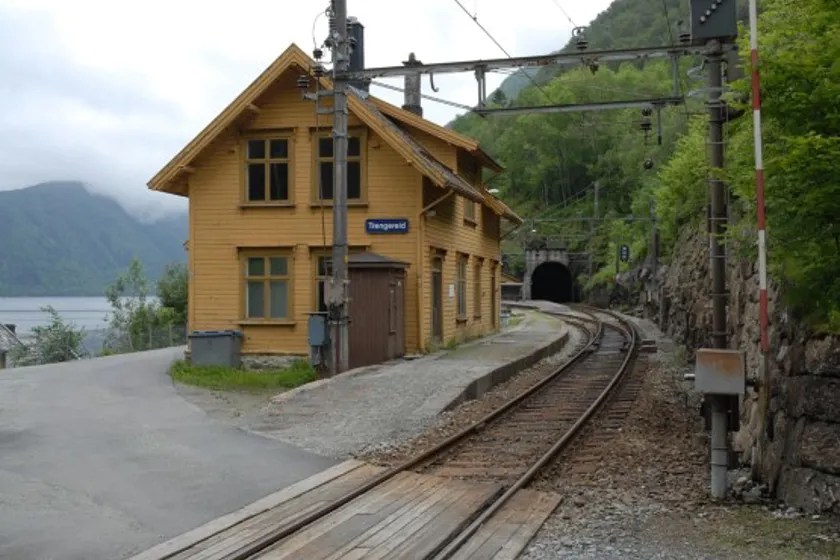
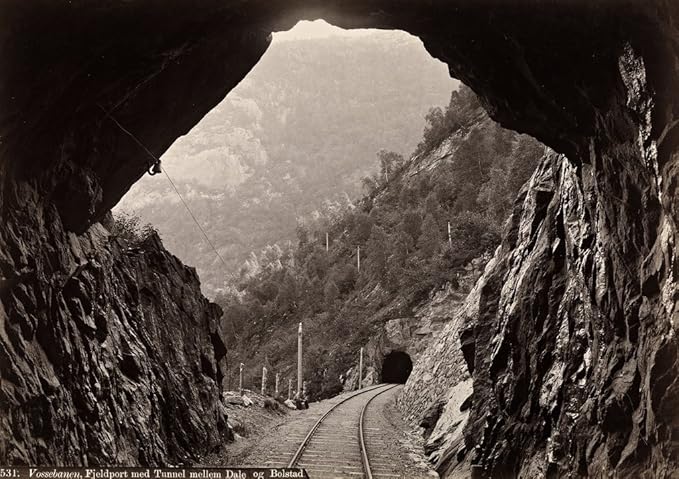
Speight was unable to travel over the lines which run from the coast inland, those from Christiansand to Byglandsfjord, Stavanger to Ekersund, and Bergen to Voss. He comments that the “two latter are perhaps too well known to English tourists to need description. … Two of the views accompanying this article (Trangereid Station and the mountain tunnel between Dale and Bolstad) will remind visitors to Bergen of the marvellous manner in which the engineering difficulties along the Vossebanen have been overcome.” [1: p451]

Trengereid Station on the Bergen-Vosse railway. [1: p449]
Trengereid Station on the Bergen-Vosse railway in the 21st century. Some remodelling of the station building has taken place, © Njal Svingheim. [10]
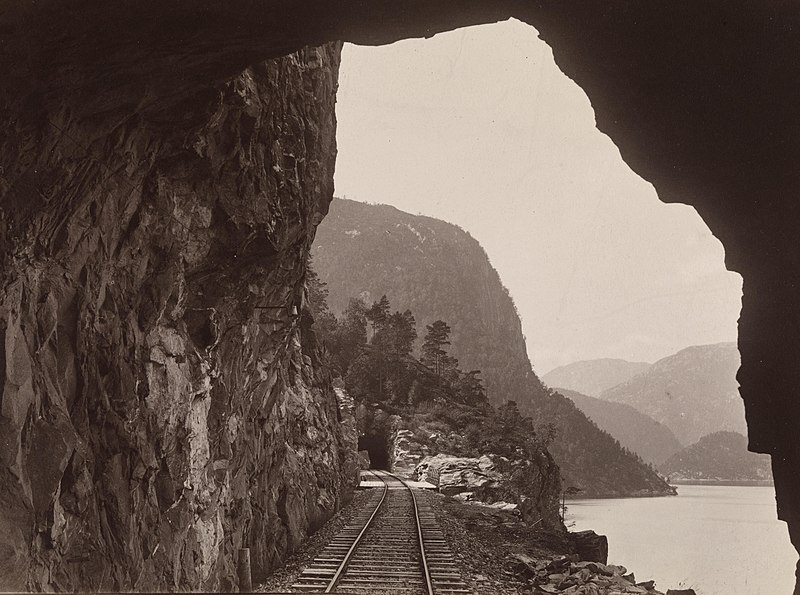
A tunnel (Fjeldport med Tunnel) on the Bergen-Vosse Railway (the Vossebanen) between Dale and Bolstad. Sadly, the image in The Railway Magazine is grainy and a little blurred. [1: p447] This is the same image found online. The Vossebanen is oldest part of the Bergen line. The line was started in 1875 and opened in 1883. The stretch was originally 106.7 km long, with 52 tunnels and 15 stops. After several line changes, the Vossebanen is today 86 km. The original stations of the track were designed by Balthazar Lange. Vossebanen is urban but also scenic. There is quite a lot of passenger trains but also a lot of freight traffic on the line. [11]
This photograph is taken at approximately the same location as the one immediately above and also shows the Fjeldport med Tunnel, © Mo i Rana, Public Domain. [12] Photographs of other tunnels in the area can be found here. [13]

Speight now turns from the smaller lines in Norway to what was known as the trunk line to the North, “a line which by the very nature of the country it passes through must always attract the attention of those who are “railway mad.” Its seclusion and remoteness from the general tourist-route, added to the fact that from the map it appears to traverse a most romantic part of the country, stealing through the mountains, like the Midland line from Settle to the North, lends an air of mystery.” [1: p451-452]

From Oslo (Christiania), the train leaves “the large station by the docks at 1.45pm and runs to Eidsvold and over an inlet of Lake Mjosen into Hamar (on that section of the line built originally by an English company, and called Hovedbanen) steadily at 26 miles per hour, through meadow, wood, and lakeside scenery. At Hamar a change of trains is  made, and all the passengers rush into the refreshment-room for ‘mid-dag’, an abundant meal of three courses, which costs about two shillings. Ample warning is given, and then you take places in a most comfortable corridor-train which seats and sleeps two persons only in each first-class compartment, a convenience which makes the journey no hardship, and which is regulated from the booking-office in Christiania. After leaving Hamar the pace is slow but very steady, and one’s attention is wholly occupied by the view from the windows. Fairly level country is passed through until Elverum, twenty miles from Hamar, then begins a slow climb, which lasts for eight hours. Elverum is 608 feet above the sea, and Tyvold, the highest point on the line, which is passed about two in the morning, 2,158 feet.” [1: p453]

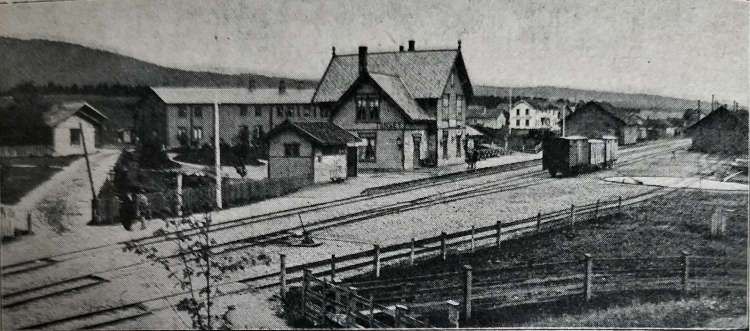
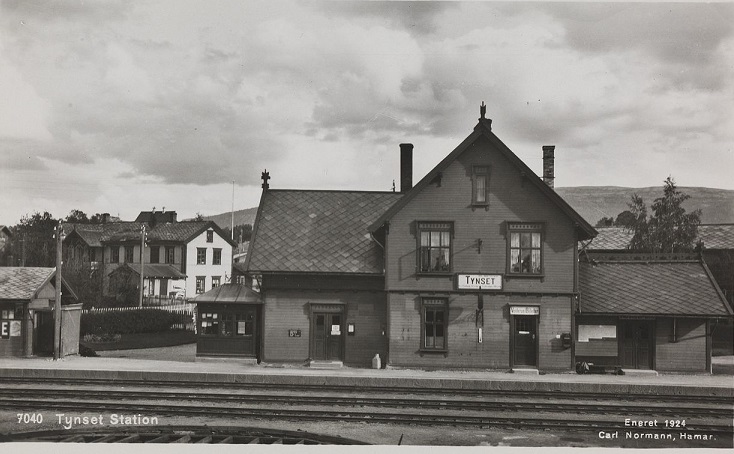
Tonset (Tynset) Railway Station, 1,520ft above sea-level. [1: p450]
An old postcard view of Tynset Railway Station from 1924, © Carl Normann, Public Domain. [14]
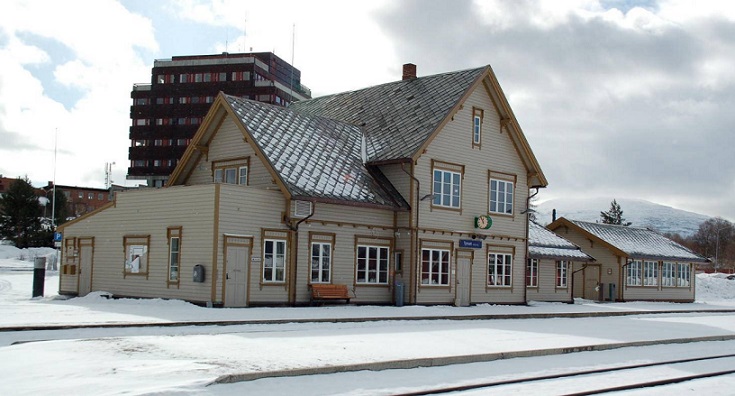
Tynset Railway Station in the 21st century. [15]

The line climbs alongside the River Glomen for 150 miles, alternately on one bank then the other, until “settling down to a regular position east of the stream, under steep wooded cliffs. The river was filled with timber floating down from the mountains. … Across the valley which grew narrower hourly were mountain-ridges, whose summits were white with snow. Under them nestled farms the whole way, though their share of sunlight and warmth seemed to be small. Here and there would appear clusters of prosperous looking farmsteads, with telephone lines running from one to another. And all the while the long train was slowly making its way up through cuttings and tiny rock tunnels, along sandy strips of road among the fragrant pines.” [1: p453-454]

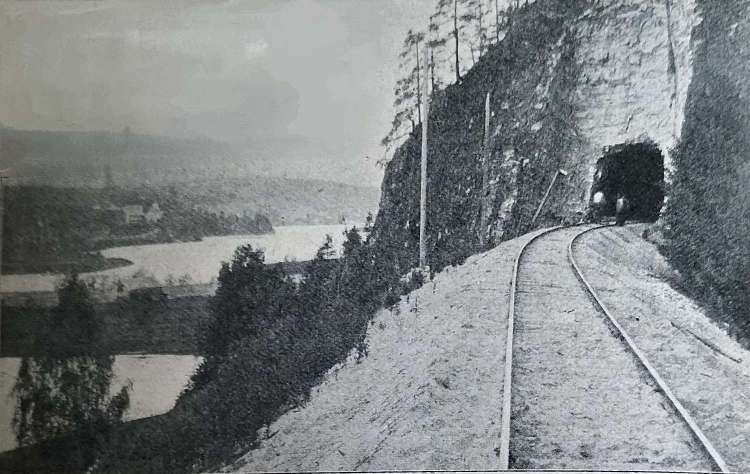
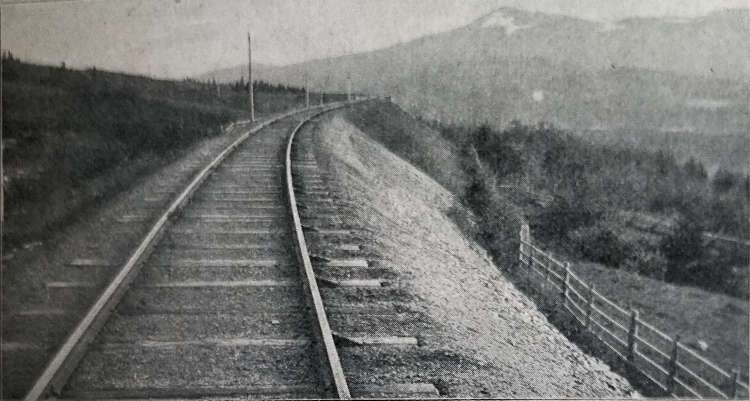
A tunnel and embankment on the railway, near Koppang. This gives a good idea of the valley at one of its wider parts.
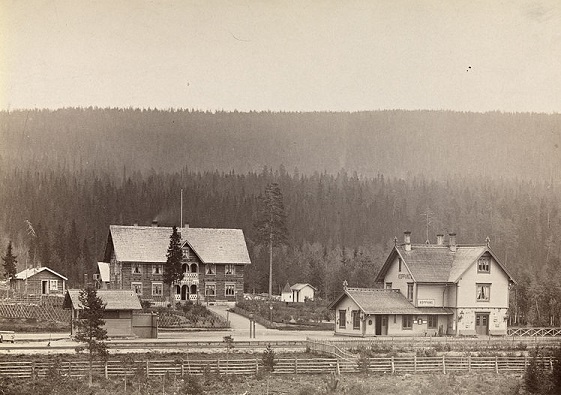
Koppang Railway Station in the early 20th century, © Hamar Thjems, Public Domain. [16]
Kappang Railway Station in the 21st century. [17]

Speight continues: “Koppang was the supper-place, where we had twelve minutes to drink milk and eat smörbröd, i.e., sandwiches of bread and fish, cheese, or meat. After leaving this station the conductor began to prepare the beds, and when they were ready they were indeed cosy. Sleep came easily after the mountain air, and although the intervening grades of the slope were missed, this only heightened the surprise with which I looked out of the window after suddenly waking at two o’clock. The scenery had changed entirely. We were running along the side of a bare, wintry ridge, and the next minute passed gingerly over a roaring torrent. It was light, as the June nights are in Norway, and … everything was covered with snow, altogether such a view as one might get among the upper heights of Craven in winter. I had missed Röros, the high mining town, which I specially had hoped to see, but it was gratifying to have returned to consciousness just at the very highest point of the line.” [1: p454]

Stören Railway Station, near Trondhjem. [1: p453]
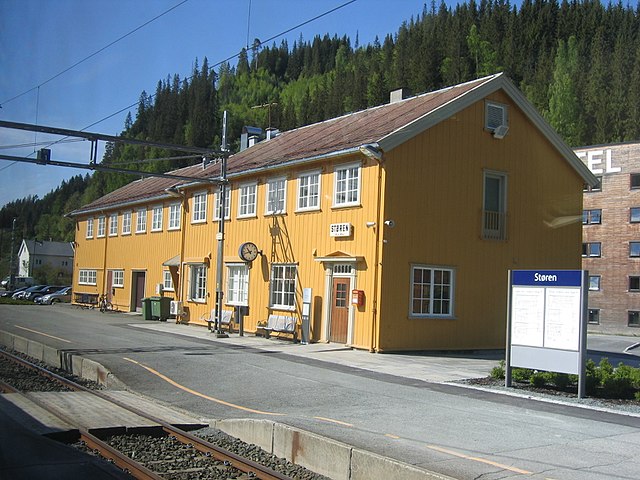
Stören Railway Station in the 21st century © Beagle84 and used here under a Creative Commons Licence (CC BY-SA 3.0). [18]

It took five hours to drop 2,100ft to sea-level at Trondhjem, “here everything was cold and desolate, and all the barns were dripping. … At Stören, reached [at] about five, the conductor brought us coffee and biscuits from the refreshment room. … From Stören we ran the 33 miles into Trondhjem in an hour and a half … and at 6.55 am, the train drew up alongside the harbour, where in old days the Hansa ships docked.” [1: p454-455]

The line beyond Trondhjem … runs over the mountains into Sweden, … it provides one of the most fascinating railway journeys possible. … From Trondhjem the line runs along the bends of the fjord for many miles, turning finally inland at a place called Hell. …  Then we enter Stördal, a narrow valley much resembling Upper Wharfdale, but with higher fells on each side and steeper falls of water coming down through the trees. For thirty miles the train creeps along into the heart of the mountains, past isolated farms, and always near the river, for the valley is only a few yards wide in places. The cart-road is grass-grown and one can see that the railroad is responsible for most of the traffic. Time after time one seems to be running straight into the hills; then a bend is turned and another mile or so of valley appears, with wonderful variety of forest and mountain views.” [1: p455]

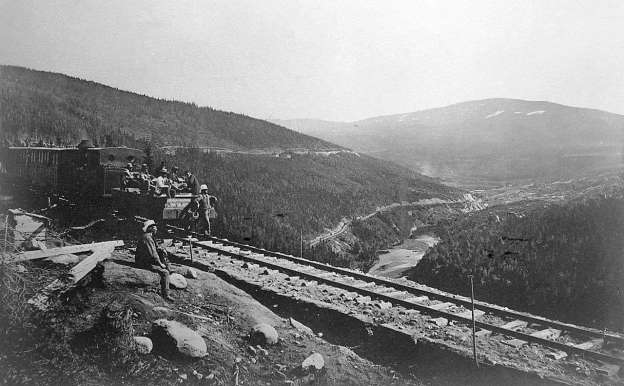
When the train arrived at Gudaan a locomotive was attached behind, and then the train was pushed and pulled up through the otherwise bleak and desolate forest. Speight continues: “So well do we climb that in one hour we have actually ascended 1,000 feet, and when we reach the Swedish frontier station, [Storlien], sixty-six miles from Trondhjem, we are over 2,000 feet above the sea, in a wilderness of deep snow, though it is already June.” [1: p455]

A severe climb on the railway towards Storlien. [1: p454]
Storlien Railway Station in its early years – 1880, © Public Domain. [19]

This laborious journey between Norway and Sweden was necessary because there was constant traffic between Sweden and Trondhjem and trains can be very heavy. Speight refers us to Samuel Laing, who, he says, “lived in this region about the year 1834, [and] dwells at some length on the trade route over into Sweden, traversed in winter by sleighs, the best railroad in the world, he says. His astonishment would have been worth recording had he been told that in time an actual railroad would penetrate these wilds of the Keel, and that comfortable, spacious carriages would daily find their way through those bleak woods.” [1: p455]

At Storlien, Speight, left Norway, continuing his journey into Sweden.

Early Locomotives in Norway

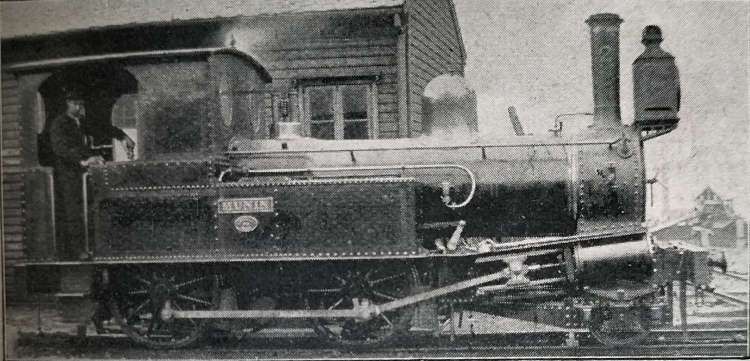
Speight commented on locomotives in Norway in 1899 seemingly being underpowered for the duties expected of them. He only provided one photograph of a locomotive in the article which is shown below. No details of the locomotive appears in his article. …

An 2-4-0T Norwegian Locomotive! Speight provides no details about the loco. It appears that it carries the name Munis. [1: p451]

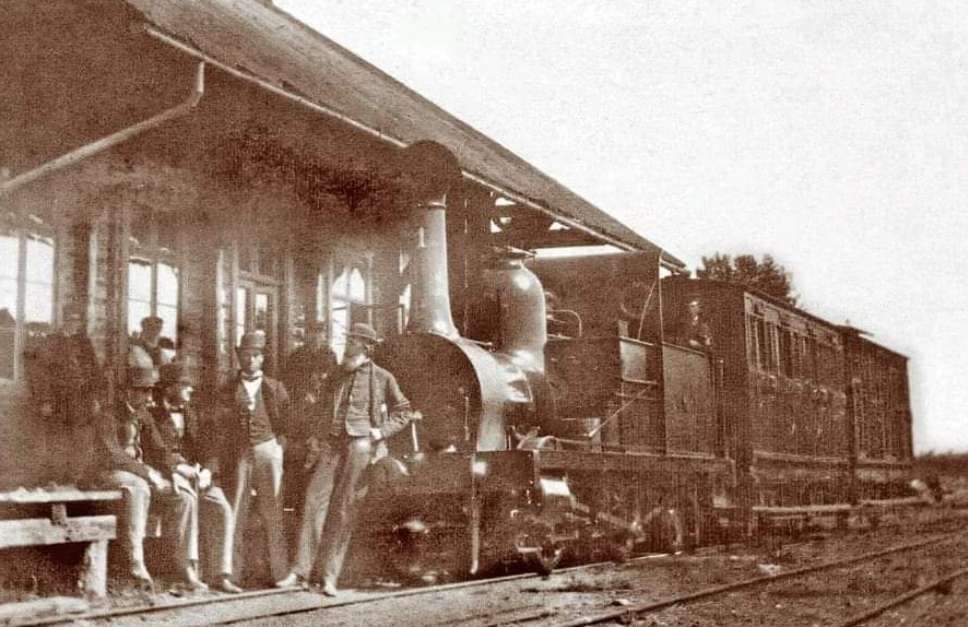
It seems as though Norway’s early narrow gauge steam locomotive classes were numbered using roman numerals by the NSB (I,II,III,IV,V, etc). [20] There is a limited amount of information available online about these locomotives, but it seems that a lot of the earliest classes were 2-4-0T locos. However, the first 3ft 6in gauge steam locomotive on Norway’s railways was an 0-4-2T, not a 2-4-0T but of a similar size to the other tank locomotives pictured above and further below. This 2-4-0T locomotive was No. 1 of the Hamar – Grundset Railway and is shown below at Løten station. The date was 18th October 1861, and it is believed that the photo was taken during a test run. Regular timetabled operations commenced on the railway the following month. The locomotive was built by Robert Stephenson & Co. in 1860. I found the photograph on transpressnz.blogspot.com. [25]

No. 1 of the Hamar – Grundset Railway shown at Løten station on 18th October 1861. It is believed that the photo was taken during a test run. [25]

I have not been able to clarify which class of locomotive is pictures in E.E. Speight’s article. Similar sized locos are pictured below but all different in some way from E.E. Speight’s photograph – different cab, different dome, different chimney.

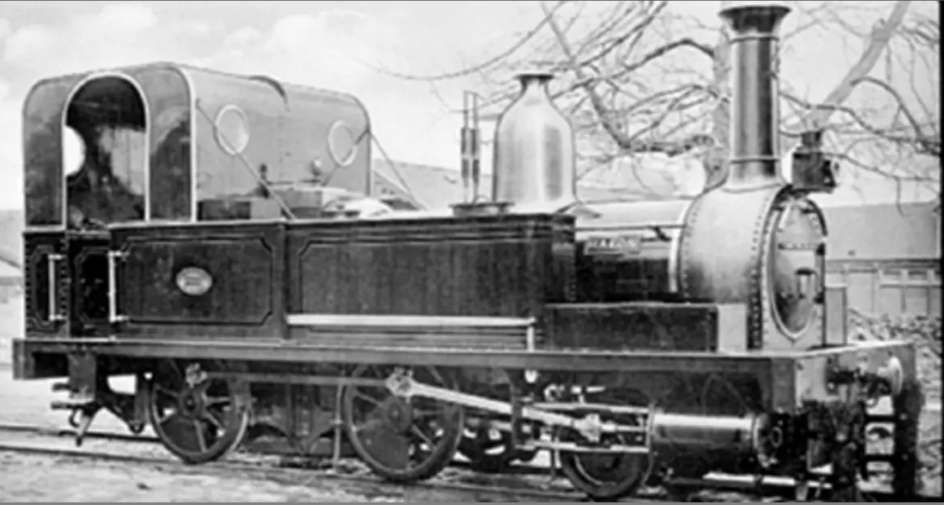
An example of the NSB Class II 2-4-0T side tank locos is shown below.

NSB Class II 2-4-0T Loco No. 3 Hakon. [24]

The NSB Class III locos were a class of six side tank 2-4-0T locomotives. They were built by Beyer, Peacock and company from 1868 to 1871 as part of the III class for the Norwegian State Railways. They were designed, built and operated for small local passenger trains for which they operated until the 1920s.

NCB Class III 2-4-0T Loco. No. 21, Alf. [22]

The NSB Class IV (or Tryggve Class) locos were 1,067 mm (3 ft 6 in) narrow gauge 2-4-0T steam locomotives built by Beyer, Peacock & Co. in Manchester, England. [21] This was a class of twenty-five side tank 2-4-0 locomotives. The first of the class was built by Beyer, Peacock and company in 1866 and the last built in 1882 also by Beyer, Peacock and company and originally classed II and XV from 1898. In 1900 the class was re-designated IV and IX and operated by the Norwegian State Railways until 1952 when the last one was withdrawn. The class was named Tryggve after the first locomotive of the class which was also numbered two. [23]

NCB Class IV 2-4-0T Loco No. 8, Cudrun at Melhus station. [23]

All these locomotives could well have been encountered by Speight on his journey through Norway.

References

  1. E.E. Speight; Through Norway by Rail; in The Railway Magazine, London, November 1899, p447-455.
  2. https://en.m.wikipedia.org/wiki/Rail_transport_in_Norway, accessed on 11th September 2024.
  3. https://en.m.wikipedia.org/wiki/Narrow-gauge_railways_in_Norway, accessed on 11th September 2024.
  4. https://en.m.wikipedia.org/wiki/Thamshavn_Line, accessed on 11th September 2024.
  5. https://en.m.wikipedia.org/wiki/Urskog%E2%80%93H%C3%B8land_Line, accessed on 11th September 2024.
  6. https://en.m.wikipedia.org/wiki/Setesdal_Line, accessed on 11th September 2024.
  7. https://en.m.wikipedia.org/wiki/Carl_Abraham_Pihl, accessed on 11th September 2024.
  8. For example: De Offentlige Jernbaner: Driftsberetning For Norsk Hoved-jernbane … https://amzn.eu/d/5nfTiC5; and https://www.yumpu.com/no/document/read/19751486/de-offentlige-jernbaner-beretning-om-de-norske-jernbaners-drift-1-, accessed on 12th September 2024.
  9. https://www.skyscrapercity.com/threads/norway-railways.935718/page-9, accessed on 12th September 2024.
  10. https://www.banenor.no/en/traffic-and-travel/railway-stations/-t-/trengereid, accessed on 12th September 2024.
  11. https://www.amazon.co.uk/POSTER-Vossebanen-Fjeldport-Bolstad-replica/dp/B00P5I624K, accessed on 12th September 2024.
  12. https://no.m.wikipedia.org/wiki/Fil:528._Vossebanen,_fjeldport_med_Tunnel_mellem_Dale_og_Bolstad_-_no-nb_digifoto_20151106_00106_bldsa_AL0528_(cropped).jpg, accessed on 12th September 2024.
  13. https://jenikirbyhistory.getarchive.net/topics/rail+tunnels+in+vestland/historical+images+of+vaksdal, accessed on 12th September 2024.
  14. https://en.wikipedia.org/wiki/Tynset_%28novel%29#/media/File:7040_Tynset_Station_-_no-nb_digifoto_20150807_00223_bldsa_PK29688.jpg, accessed on 12th September 2024.
  15. https://help.g2rail.com/stations/tynset, accessed on 12th September 2024.
  16. https://upload.wikimedia.org/wikipedia/commons/thumb/7/7c/Koppang_stasjon.jpeg/1280px-Koppang_stasjon.jpeg, accessed on 12th September 2024.
  17. https://www.banenor.no/en/traffic-and-travel/railway-stations/-k-/koppang, accessed on 12th September 2024.
  18. https://commons.wikimedia.org/wiki/File:Storen_stasjon_Rorosbanen_2008.JPG, accessed on 12th September 2024.
  19. https://jenikirbyhistory.getarchive.net/media/storlien-station-3b47b4, accessed on 12th September 2024.
  20. https://en.wikipedia.org/wiki/Norwegian_State_Railways_rolling_stock, accessed on 12th September 2024.
  21. https://en.wikipedia.org/wiki/NSB_Class_IV, accessed on 12th September 2024.
  22. https://locomotive.fandom.com/wiki/NSB_Class_III, accessed on 12th September 2024.
  23. https://locomotive.fandom.com/wiki/NSR_IV_%22Tryggve%22_Class, accessed on 12th September 2024.
  24. https://digitaltmuseum.no/search/?aq=classification:%22RU%22,%225288%22, accessed on 12th September 2024.
  25. https://transpressnz.blogspot.com/2024/07/norwegian-0-4-2t-from-1860.html?m=1, accessed on 12th September 2024.