Tag Archives: Switzerland

The Guardian Lifestyle Travel – Saturday 23rd May 2026 – Part 4 – Readers’ Favourite Railway Journeys – Part B

The travel section of the Saturday Guardian Magazine on 23rd May 2023 included a few pages about train journeys in Europe (pages 72 to 77). This is the fourth part of a look at those pages and includes more reader’s recommendations of journeys by train. It includes a few more uploaded by the Guardian online.

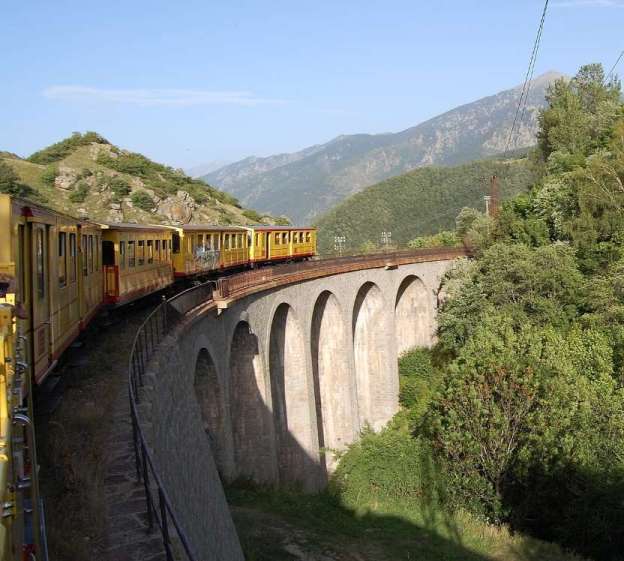
The featured image for this article is a photograph of Le Petit Train Jaune which runs from Villefranche-de-Conflent to Latour de Carol/Enveitg in the Pyrenees, © A1AA1A and licensed for reuse under a Creative Commons licence (CC BY-SA 3.0). [33]

Further Guardian reader’s recommendations for rail journeys can be found here. [2]

4. Readers’ Favourite Railway Journeys – Part B

F. Vintage Locomotives in Tuscany

“We took the Treno Natura from Siena last May for a whole day out in the beautiful Tuscan countryside. It’s a real steam engine with classic coaches. Most passengers were friendly locals: we only encountered two other foreign tourists, a Swiss couple. A band came aboard to entertain us, and an optional walk through vineyards was also available. Fabulous value at only €42 each.” [3][Reader: Nigel Gould]

The Treno Natura (Nature Train) is a restored historic steam train from the 1930s that takes passengers on scenic, slow-paced journeys through the Tuscan countryside, departing from Siena’s main station.
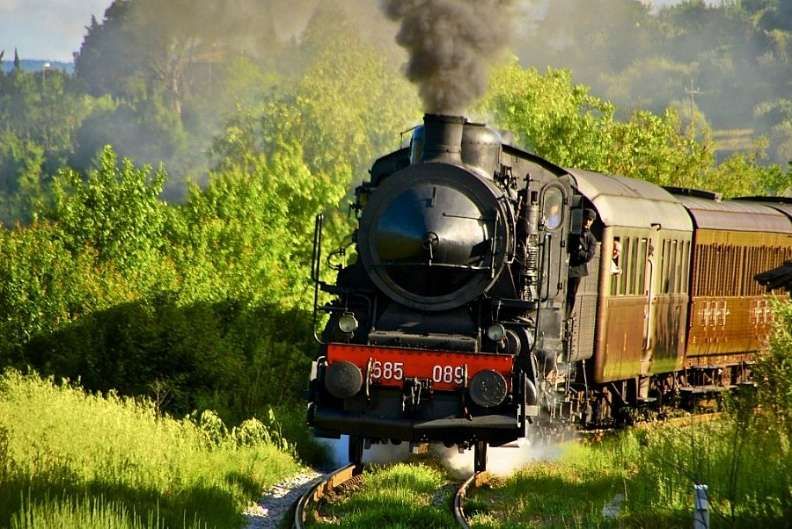
The Treno Natura (Nature Train). [20]

The Treno Natura has a mixed schedule from March through October, to combine a scenic ride with special events like festivals, markets, sagras and food and wine tastings. Departing from Siena, the train alternates routes, taking you to the gorgeous Val d’Orcia, to Asciano, Montalcino and other historic towns, where you can enjoy special food markets, antique markets, festivals or other events. You can also combine your ride with a walk through Italy’s postcard-perfect landscapes, and dine in authentic Tuscan trattorias. [20]

G. Alpine beauty on the Montreux to Interlaken line

“From Montreux station I took the MOB railway to Interlaken. Weaving up through vineyards, Lac Léman shimmers below as the panorama broadens. Suddenly, you’re in pine forests and glimpsing jagged mountain crests. Bridges straddle rushing white water. The clanging and hooting warnings for road crossings. A long tunnel. Then burst into alpine pastures peppered with chalets. Le Pays d’Enhaut. Valleys filled with crisp air, summer cowbells, flowers and crickets – perfect for long walks. Or winter-snow-muffled land, all skis and fondues. Arriving in Château-d’Œx feels like discovering a new world.” [3][Reader: Christian Vassie]

The Montreux to Interlaken line, operated by the GoldenPass Express (GPX), is a 3-hour and 15-minute scenic journey through Switzerland. Thanks to pioneering variable-gauge technology, the train seamlessly connects Lake Geneva to the Bernese Alps without requiring a change of trains at Zweisimmen.
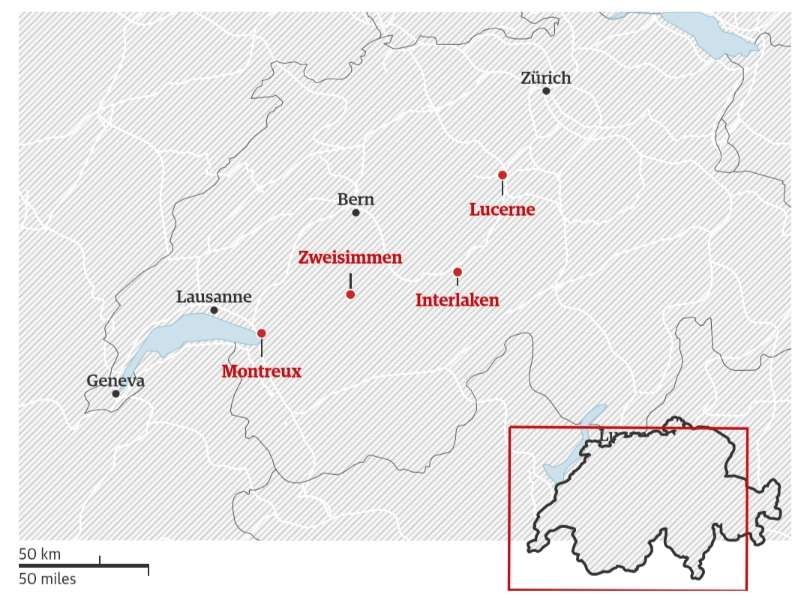
Montreux, Zweisimmen and Interlaken. [21]

As the train winds up the hillside above Lac Léman’s north shore, leaving Montreux behind, the bustle of the ‘Swiss Riviera’ gives way to the tranquil farming country of the Pays d’Enhaut, followed by the upmarket resort of Gstaad, before a gentle descent to Interlaken, between the twin lakes of Thun and Brienz in the Bernese Oberland.

One of our earliest family holidays abroad was a two week stay in Château-d’Œx. I was probably 14 years old at the time. The memories of the alpine pastures and the train at that time are vague. Much later in my 40s we travelled the line again after a night in Montreux and before staying on a caravan site close to Interlaken. A change of train was necessary at Zweisimmen.

This 70-mile route, crosses the röstigraben (the French-Swiss German language border) and links some of Switzerland’s most famous tourist centres.

Caroline Bishop tells us that since the early 2020s there has no longer been a need to change trains at Zweisimmen. The result of something that counts as a technological first. The Montreux Oberland Bernois railway (MOB) and BLS (the two train companies operating the line) were determined to develop a bespoke bogie which could narrow or widen to fit the different widths of the two railways, as well as adjust to their different platform heights. [21]

At Zweisimmen, The train crosses a special gauge-adapting ramp in Zweisimmen at a low speed of up to 15 km/hr. The train’s weight is momentarily relieved, allowing the variable-gauge bogies to slide the wheels closer together or further apart. The carriage is automatically raised or lowered from 35 cm to 55 cm, to align the doors with the different platform heights. Because the railway networks use different electrical voltages 900 V DC and 15 kV AC, a locomotive is attached or detached during the process. It takes just 8 minutes in all with the physical gauge and height changes happening in just a few seconds. [24]

The video below shows the process: [25]

Incidentally, the Golden Pass Line is not the only line to leave the lake shore at Montreux. The line to Rochers de Naye also claims away from the lakeside town. Rochers de Naye is a 2,042-metre-high mountain in the Swiss Alps, towering over Lake Geneva (Lac Léman) and the town of Montreux. It boasts panoramic views of the Alps (including Mont Blanc and the Eiger), it is easily accessible all-year-round by a historic 50-minute cogwheel train from Montreux.

The journey up Rochers de Naye departs from Montreux Station, climbing over 1,600 metres through forests, alpine meadows, and steep rocky ridges. The Montreux–Rochers-de-Naye railway line is an electrically operated rack railway of 800 mm track gauge of 800 mm. The line operates via the village of Glion, on the mountainside above Montreux, where it connects with the Territet–Glion funicular. [22]

Please see here for more about the Rochers de Naye railway. [23]

H. Slow travel at its best: Belgrade to Bar

” The train trip from Belgrade to Bar must be one of the slowest in Europe, taking 11 hours to cover 296 miles. At €23, it was probably the best-value travel money I’ve ever spent. In fact, the train trip was about the only time in my life when I longed for a journey to go slower rather than faster. It took me through some of the most dramatic scenery I’ve ever seen. Passing through deep gorges, canyons and mountain peaks, the train crossed more than 400 bridges and seemed to stop at every village. The Mala Rijeka viaduct was a highlight. The route took in spectacular dams, ancient monasteries and stone houses where old black-clad women waved at us from open kitchen windows. At one point, the passengers got out to feed a herd of goats and once we were overtaken by a mountain cowboy on a galloping horse. For the last part, you can see swimmers and sunbathers on Adriatic beaches.” [3][Reader: Peter]

The railway journey from Belgrade (Serbia) to Bar (Montenegro) is 476-kilometres (296-miles) in length. It features 254 tunnels and 435 bridges, including the Mala Rijeka Viaduct and it descends from the mountains to the Adriatic coast. There are two direct trains, one during the day and one at night. The Daytime Train (‘Tara’): Runs during the summer season. It departs around 09:00/09:45 and arrives in Bar around 21:00. In 2026, a standard second class single ticket costs €24. The best views can be seen when sitting on the right side of the train travelling from Belgrade to Bar.
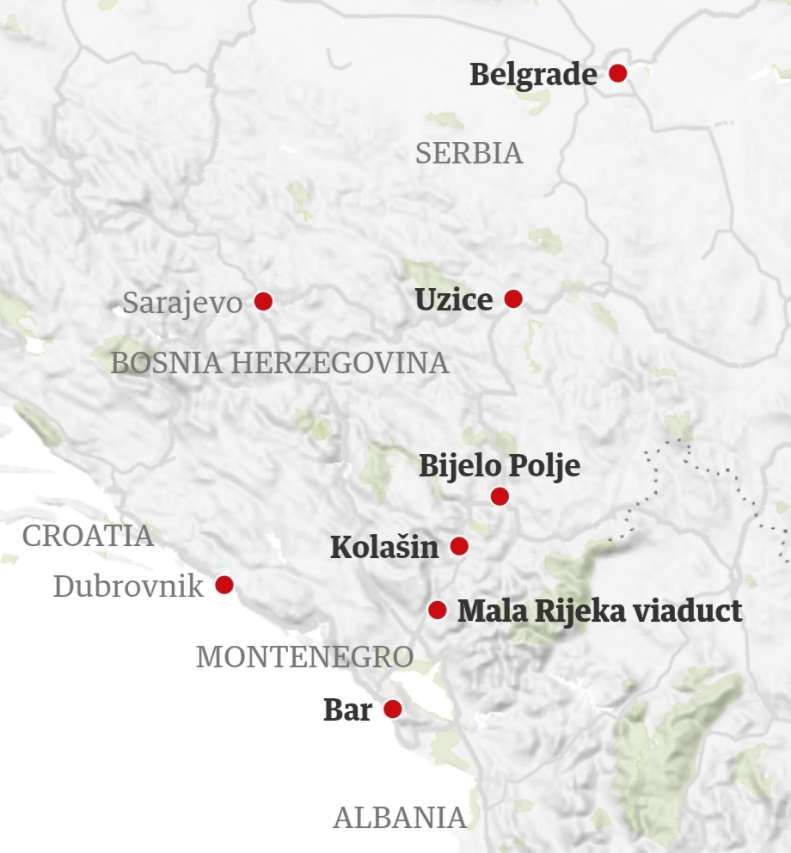
Belgrade to Bar a multi-national scenic journey. [26]

Camilla Bell-Davies describes the route like this:

“After leaving a sun-drenched Belgrade behind, it’s not long before we’re gazing out at the rolling hills of the verdant Valjevo and Užice wine regions. The scenery becomes more dramatic as the line reaches the Zlatibor mountain range. We’re tempted to get off and explore Tara national park, which has excellent hiking trails and wild camping spots. But we press on, gathering speed past well tended fields and roaming goats.

“We pass through a slice of Bosnia-Herzegovina and back into Serbia again. In 1976, there were no border checks between these Yugoslav republics. Today, stern border guards rap on the carriage door at each crossing and hawkers board the train and sell beer, burek (pastries) and cigarettes.

“After our third border crossing, the pastoral hills swell into Montenegro’s Black Mountains, which dodge in and out of view between the tunnels and bridges. At Kolašin, a town near Durmitor national park, we stop to stretch our legs and peer up at monasteries atop impossible summits. How fun it would be to climb them. Next time, we think, as the long hoot of the train’s whistle signals our departure.

“Within an hour we reach the dizzying Mala Rijeka viaduct. Our train briefly resembles the Hogwarts Express soaring over the Scotland’s Glenfinnan viaduct in the Harry Potter films. After that, the mountains taper to the brutalist blocks of Montenegro’s capital Podgorica – named Titograd from 1946 until 1992. There’s little to recommend it, so we keep going to Virpazar on Lake Skadar, where we stop and spend a day pottering in a boat.” [26]
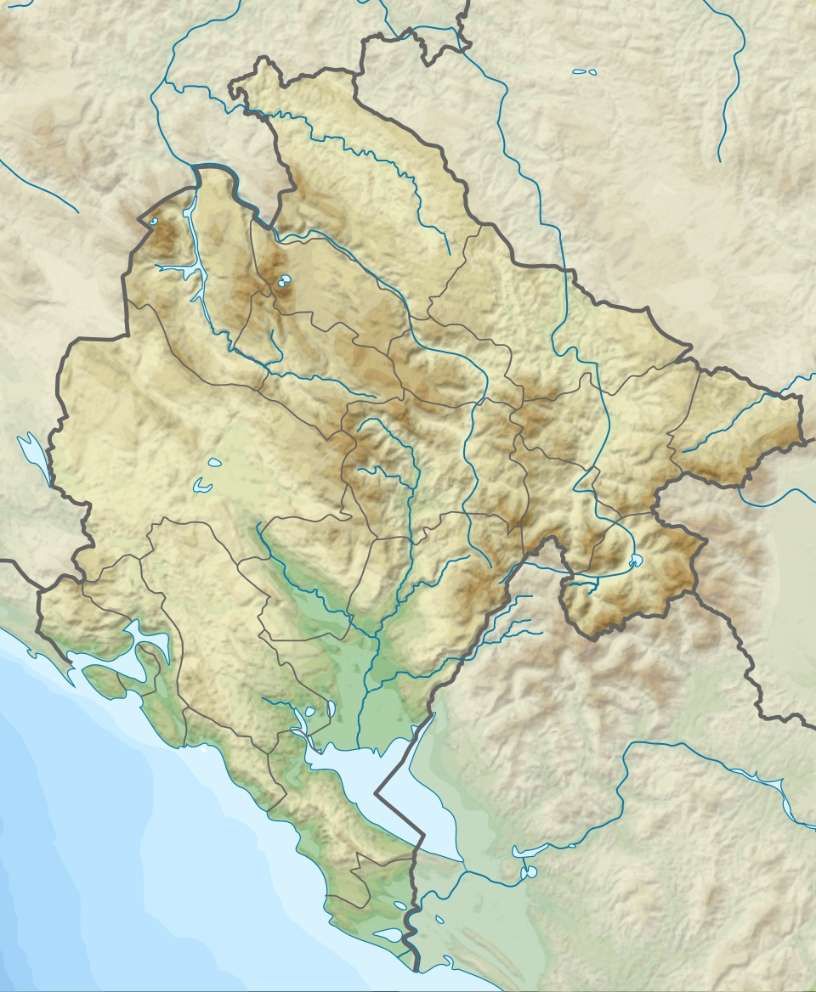
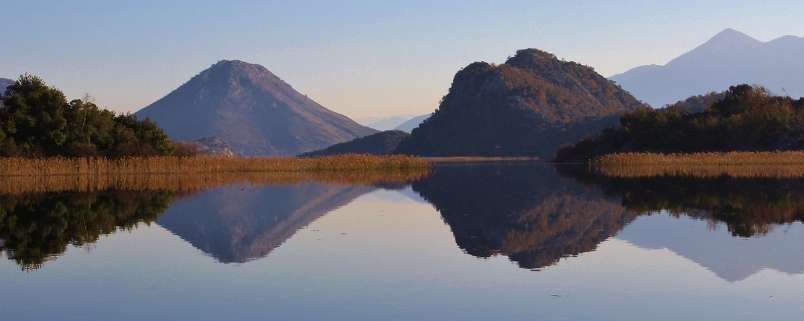
Lake Skadar, the largest in the Balkans sits half in Albania and half Montenegro, © GabrielZafra/BokicaK/Ivan25 and licensed for reuse under a Creative Commons licence (CC BY-SA 3.0). [27]
Lake Skadar. [28]

Camilla Bell-Davies continues:

“Half of the lake falls within Albania’s borders, and the Accursed mountains double up in the reflection of the water. These days the main division is a culinary one: Albania prepares the lake’s carp in a sizzling prune and tomato sauce called tavaë krapi, and Montenegro eats the freshwater fish salted and pickled, which is best tasted right by the water at the Restaurant Silistria.

“The next afternoon, we’re back on the train for the last stretch. At sunset, the Adriatic hoves into view. The sea opens to one side, the oranges and pinks in the sky melting into the water. For the final hour we swing past craggy headlands and sand-swept bays, arriving in Bar as darkness falls.” [26]

The Belgrade to Bar railway was completed in 1976. It was built by the Yugoslav State Railways (JŽ) and was 25 years in the making.

Sections of the railway were completed as follows:

  • Resnik – Vreoci in 1958
  • Podgorica – Bar in 1959
  • Vreoci – Valjevo in 1968
  • Valjevo – Užice in 1972
  • Užice – Podgorica in 1976

It is now operated by JŽ’s successor companies, Železnice Srbije (ŽS), Željeznice Republike Srpske (ŽRS) and Željeznička Infrastruktura Crne Gore (ŽICG). [29]

During the 1990s, the line had a chequered history:

  • In February 1993, the short Bosnian section of the railway was the site of the Štrpci massacre.
  • Maintenance of the Belgrade–Bar railway suffered from chronic underfunding during the 1990s, which has resulted in the railway deteriorating and becoming unsafe. This culminated in the Bioče derailment, when a passenger train derailed, causing the deaths of 47 passengers. As a result, efforts are being made to thoroughly reconstruct the railway.
  • The Serbian part of the railway was targeted several times by NATO during its bombing campaign in 1999, seriously damaging portions of the railway.
  • The small section that passes through Bosnia and Herzegovina was blown up by SFOR ground forces in the late 1990s. [29]

Repair work on the line is progressing gradually. In 2016, Serbia started a thorough reconstruction of its portion of the line in order to restore its original maximum speed of 120 kilometres per hour (75 mph). The first section, between Belgrade and Valjevo (27% of the Serbian part of the line) was completed in 2017. [29]

Since 2017, the Belgrade to Bar railway has undergone targeted, phased overhauls rather than a total route modernization, with hundreds of kilometers of track still awaiting upgrades. Progress has been split between Serbian and Montenegrin territories, heavily backed by the European Union and international loans.

In Serbia:

  • Resnik–Valjevo Section: Completed in 2017/2018, this USD $80 million upgrade by Russian Railways International rehabilitated a 77.6 km stretch of the railway. It restored maximum passenger speeds to 120 km/hr on this length of the line.
  • Valjevo to the Montenegrin Border: Engineering and technical documentation for the reconstruction of the remaining 210 km down to the border was initiated. However, construction has remained in the planning phase, with Serbian authorities estimating the total required investment for their remaining sections at €1.5 to €2 billion. [30]

In Montenegro:

  • Vrbnica–Bar Line Rehabilitation (2016–2020): Technical assistance with – and structural work on – the main Montenegrin corridor were completed with European Investment Bank (EIB) support.
  • Bar–Golubovci Upgrade: The European Union and the EIB committed a €175.6 million financial package to modernize a key 39 km stretch, improving reliability, safety, and increasing network capacity.
  • Kos–Trebešica Section: Targeted rehabilitation actions on this highly vulnerable section were launched to prevent bottlenecks and secure the combined maritime-railway transport with the Port of Bar.
  • Future Upgrades: Montenegro still requires major structural repairs across an estimated 160 km of its portion of the line. [30]

I. Through Italy’s Apennines to Rome from the Adriatic

“The cross-country east-west train trip from Pescara on the Adriatic to Rome is magnificent. It traverses the spine of Italy, single track all the way across the Apennines, stopping at towns such as Sulmona and Avezzano. The scenery changes as the route traverses mountain passes and ridiculous gradients before descending to plains over a period of 3 to 4 hours.” [3][Reader: Stephen]

The railway between Pescara and Rome is a 240-kilometre (150-mile) long railway line, that connects Rome with Tivoli, Avezzano, Sulmona and Pescara. The route operates through the regions of Lazio and Abruzzo. It was built in stages between 1873 and 1888. [9]
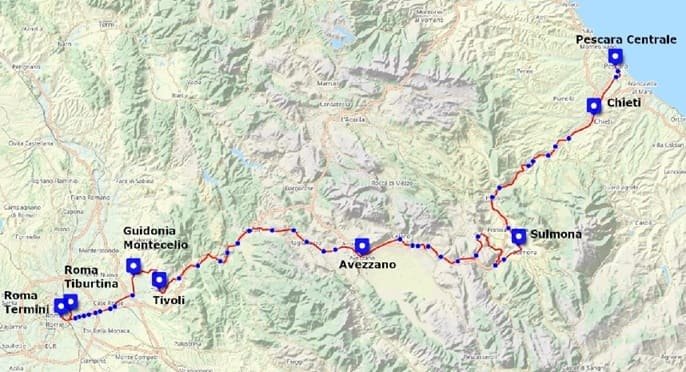
The route of the line from Pescara on the Adriatic to Rome, © Sayatek and licensed for reuse under a Creative Commons Licence (CC BY-SA 4.0). [5]

The line between Pescara and Popoli opened on 1st March 1873. That between Popoli and Sulmona opened on 1st November 1873. Tivoli to Mandela opened on 10th December1884. Mandela to Cineto Romano opened on 25th November 1885. Rome to Tivoli opened on 1st August 1887. The line between Sulmona and Avezzano opened on 28th/30th July 1888. [10]

A 15 minute introduction to the journey and the trains used on the line. [7]

It seems possible that the great experience that Stephen had on this line is not likely to be available for too much longer. …

Major upgrading of the route has been ongoing throughout the 2020s and was scheduled for completion by 2026. [4] Once all work has been completed, the number of trains covering the route will double and the journey time will drop from 3 hours 20 minutes (at best) to around 2 hours. But it is not at all clear how soon that might be.

The project has faced problems along the way. It was put on hold in October 2023, when Italy missed out on 1.5 billion euros from the EU Recovery and Resilience Fund. Although it seems that “the Italian government is now ready to partly refinance the initiative with 951 million euros. Around 720 million euros were unlocked by the Interministerial Committee for Economic Planning and Sustainable Development (CIPESS) via the EU Cohesion Fund. The remaining 231 million euros are coming from the funds for non-deferrable works.” [6]

On 6th March 2024, RailFreight.com reported that the funding made available by the Italian Government related primarily to the length of the line which is within the Abruzzo region. That scheme is separated into two lots, the first (Lot 1) envisioned the doubling of the line connecting the Interporto d’Abruzzo terminal to Manoppello. Lot 2 entailed laying a second track between Manoppello and Scafa. In total, these lines amount to roughly 13 kilometres of the roughly 240 making up the whole Rome-Pescara line. This is a very small portion of the whole line.

There are two further “lots that still need to be addressed: the Sulmona – Pratola Peligna and [the] Tagliacozzo – Avezzano sections, for which there does not [yet] seem to be any plan.” [6] Original intentions were also to improve the line from the Airport “terminal to Pescara via Chieti. No new decisions have been made for this section either as of yet.” [6]

Railfreight.com note that even after the present schemes are completed much of the route will still be single-track, old and with steep sections and tunnels that do not meet current European standards.

It transpires, even so, that progress has not been without problems. As of May 2026, work on the first two lots mentioned above is underway but the likely completion date is now in 2028.

The low-resolution video below gives an idea of progress made by early 2026: [8]

Work should be completed by 2028 on the two lots which are under contract: Interporto d’Abruzzo – Manoppello and Manoppello – Scafa. [8]

So, perhaps the deduction to be made is that it still might be worth taking a journey along the line for some time to come!

Incidentally, on a journey through Sulmona one should also note the existence of another line which runs from Sulmona to Isernia. It is named ‘Ferrovia dei Parchi’. [11]

Ferrovia dei Parchi

The line is given this name on account of the special nature of the places it passes through. Its spectacular route passes through the Maiella National Park and the Abruzzo, Lazio and Molise National Park. [11]
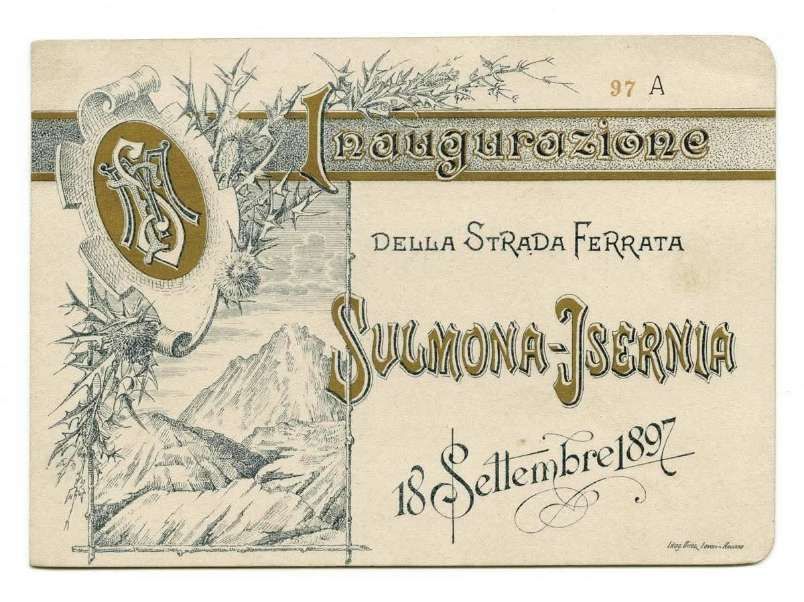
An invitation card to the opening (Inaugurazione) of the Sulmona-Isernia railway (Della Strada Ferrata Sulmona-Isernia) on 18th September 1897 © Public Domain. [12]

Opened on 18th September 1897, the Sulmona-Isernia was destroyed by the Germans during World War II. It was rebuilt and relaunched in 1955 as far as Castel di Sangro, and reached Carpinone in 1960. The line, which has never been electrified, has always been linked to steam locomotives. In the 1980s, was allowed to quietly deteriorate with no significant maintenance undertaken. In 1995, ticket offices were closed and several stations were downgraded to mere halts, until eventually, the line’s connection to the line from Pescara to Rome was severed in the early years after the millennium. [11]
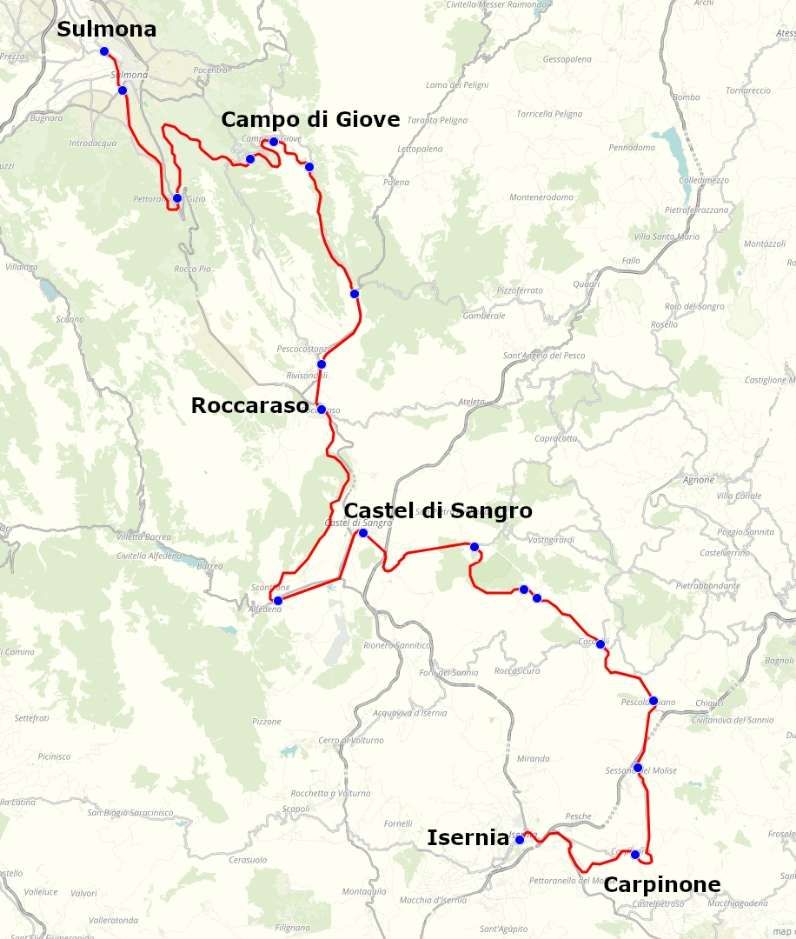
The route of the Ferrovia dei Parchi, © Sayatek and licensed for reuse under a Creative Commons Licence (CC BY-SA 4.0). [14]

Nowadays, the line has been given a new lease of life as a tourist railway. It was superbly engineered when it was built. Despite the mountainous territory through which it runs the Ferrovia dei Parchi climbs gently up the mountainsides using viaducts, curves and tunnels, never exceeding gradients of more than 28%. It is over 128 km in length, 25 km of which are in 58 tunnels. Those tunnels are among more than one hundred engineering works carrying the line including bridges and viaducts. In addition, there are more than 300 aqueducts, bridges, avalanche barriers and overpasses, as well as 21 different stations. [11]

The tourist train runs in the summer months – June to September – booking in advance is advised and packages are available with accommodation in Sulmona included. [12][13]

The service uses vintage carriages consisting of wagons dating back to the 1930s, such as Corbellini and Centoporte carriages , generally hauled by an FS D.445 diesel locomotive.” [15]
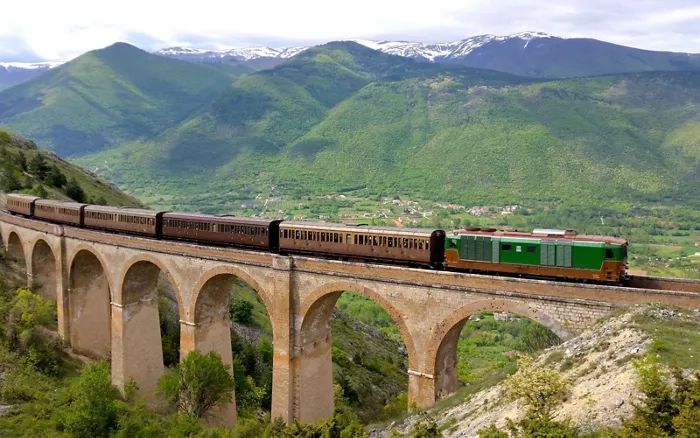
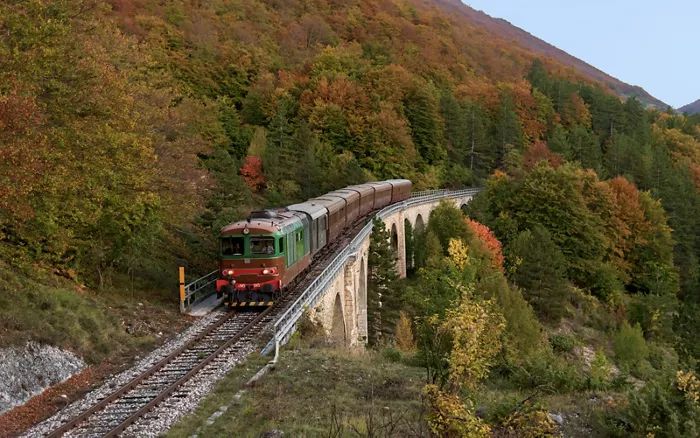
Two photographs of Locomotive D445 ‘Bombardone’ and the early 20th century, wooden-bodied coaching stock. [11]

J. Best way to See the Pyrenees? On a Little Yellow Train!

“Le Train Jaune runs between Villefranche-de-Conflent and Latour-de-Carol in France. ‘Le Canari’, as it’s known locally, climbs to 1,595 metres at Bolquère-Eyne during its spectacular 40-mile (63km) route. Fresh mountain air, breathtaking views and valley-crossing suspension bridges can all be experienced either from the train’s bright yellow open-air wagons or from within the cosy comfort of its carriages. It is the best way to discover the wonders of the Pyrenees. My wife and I went for our honeymoon and fell in love with the little yellow train. [3][Reader: Joe Brownen]
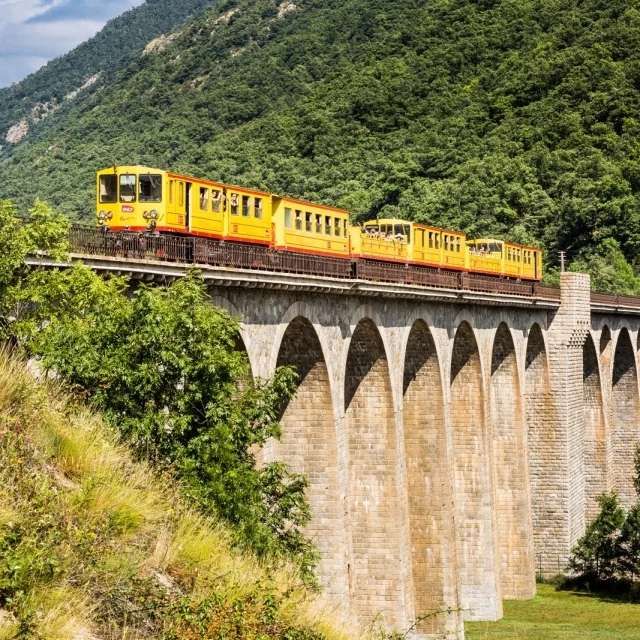
Le Petit Train Jaune. [31]

Highlights on the journey include crossing the UNESCO-listed Gisclard Suspension Bridge, the Séjourné Viaduct, and rolling through the Cerdagne plateau.

The train takes 3 hours for a one-way trip from Villefranche-de-Conflent to Latour de Carol/Enveitg and the cost is €22.50 (or €5 if you got a special summer offer from the “Region Occitanie”). A return trip takes 6 hours minimum (there is a stop of a few hours at the terminus) for €45 full price. (Prices correctly in May 2026.) [16]

The Ligne de Cerdagne, usually referred to as Le Train Jaune is a 1,000 mm (3 ft 3 3⁄8 in) gauge railway. The line serves 22 stations, fourteen of which are ‘request stops’. There are 19 tunnels, the longest of which is the Tunnel du Pla de Llaurar with a length of 380 metres.

Amongst the various structures along the line are the two viaducts over the River Têt which are mentioned above. They are classified as Historic Monuments because of their architectural and technical importance:
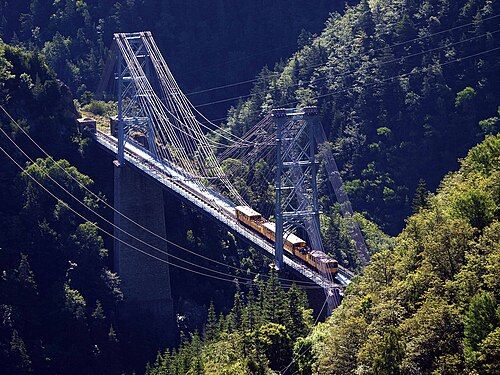
The Pont Cassagne (also known as Pont Gisclard) is 253 metres (830 ft) long and, unusual for a railway bridge, a suspension bridge – the only one in France located on an operating railway. In 2023, a major project was carried out to replace 12 of the suspension cables © Cevenol2 and licensed for reuse under a Creative Commons (CC BY-SA 2.0 fr). [18]
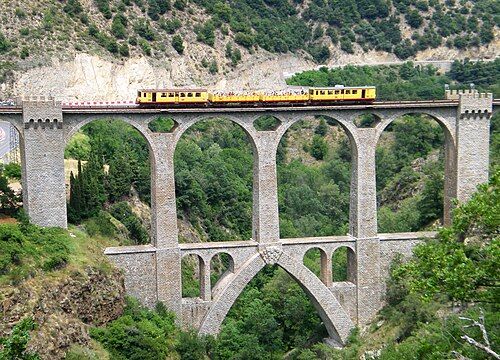
The Pont Séjourné, a 236.70 metre-long masonry viaduct in the town of Fontpédrouse. [19]

The line is single-track with passing loops. Trains are powered by electricity at 850 volts DC, supplied by a third rail. The power is supplied by hydro-electric generators on the River Têt. The maximum speed of the train is 55 km/h (34 mph). Modern two-car multiple units are used, as well as older powered cars with trailer carriages. Line maintenance vehicles are stored at Villefranche-de-Conflent. [17]

Construction started in 1903 and the section from Villefranche-de-Conflent to Mont-Louis was completed in 1910, followed by the extension to Latour-de-Carol in 1927. [17]

The website for le Petit Train Jaune can be found here. [32]

References

  1. Readers’Travel Tips: Favourite Train Trips; in Saturday (the Guardian Magazine), 23rd May 2026, p75.
  2. https://rogerfarnworth.com/2026/05/27/the-guardian-lifestyle-travel-saturday-23rd-may-2026-part-3-readers-favourite-railway-journeys-part-a
  3. https://www.theguardian.com/travel/2026/may/22/readers-favourite-scenic-european-railway-journeys-trains, accessed on 25th May 2026.
  4. https://www.fsitaliane.it/en/strategic-projects/rome-pescara-line-.html, accessed on 27th May 2026.
  5. https://it.wikipedia.org/wiki/File:Ferrovia-rm-pe.png, accessed on 27th May 2026.
  6. https://www.railfreight.com/infrastructure/2024/03/06/doubling-of-rome-pescara-railway-partly-back-on-track, accessed on 27th May 2026.
  7. https://youtu.be/ubiP4tuAzbk?si=HsWYksmW14pXdIIe, accessed on 27th May 2026.
  8. https://youtu.be/_L8txHrI_U0?si=TMAn-BwN7z1y_zJe, accessed on 27th May 2026.
  9. https://en.wikipedia.org/wiki/Rome%E2%80%93Sulmona%E2%80%93Pescara_railway, accessed on 27th May 2026.
  10. https://www.trenidicarta.it/aperture.html, accessed on 27th Mat 2026.
  11. https://www.italia.it/en/italy/things-to-do/snow-train-ferrovia-dei-parchi, accessed on 27th May 2026
  12. https://ferroviadeiparchi.it, accessed on 27th May 2026.
  13. https://ferroviadeiparchi.it/shop, accessed on 27th May 2026.
  14. https://it.wikipedia.org/wiki/Ferrovia_dei_Parchi#/media/File%3AFerrovia_Sulmona-Isernia.png, accessed on 27th May 2026.
  15. https://it.wikipedia.org/wiki/Ferrovia_dei_Parchi, accessed on 27th May 2026.
  16. https://letrainjaune.fr/en/horaires-et-infos, accessed on 28th May 2026.
  17. https://en.wikipedia.org/wiki/Ligne_de_Cerdagne, accessed on 28th May 2026.
  18. https://en.wikipedia.org/wiki/Ligne_de_Cerdagne#/media/File%3APont_gisclar_082004.jpg, accessed on 28th May 2026.
  19. https://en.wikipedia.org/wiki/Ligne_de_Cerdagne#/media/File%3AViaduc_sejourne%2C_train_jaune%2C_fontpedrouse.jpg, accessed on 28th May 2026.
  20. https://www.summerinitaly.com/guide/steam-train-from-siena#google_vignette, accessed on 25th May 2026.
  21. https://www.theguardian.com/travel/2022/dec/07/switzerlands-brilliant-new-train-route-direct-from-montreux-to-interlaken, accessed on 26th May 2026.
  22. https://en.wikipedia.org/wiki/Montreux%E2%80%93Glion%E2%80%93Rochers-de-Naye_railway_line, accessed on 26th May 2026.
  23. https://rogerfarnworth.com/2018/04/16/the-rochers-de-naye-line
  24. https://www.gpx.swiss/en/stories/technology, accessed on 26th May 2026.
  25. https://youtu.be/74mKjQpPzNA?si=48XvU8X2a_eNaBZx, accessed on 26th May 2026.
  26. https://www.theguardian.com/travel/2024/sep/18/mountains-beaches-history-belgrade-bar-best-train-rides-europe-serbia-montenegro, accessed on 26th May 2026.
  27. https://en.wikipedia.org/wiki/Lake_Skadar, accessed on 26th May 2026.
  28. https://undiscoveredmontenegro.com/lake-skadar-national-park, accessed on 26th May 2026.
  29. https://en.wikipedia.org/wiki/Belgrade%E2%80%93Bar_railway, accessed on 26th May 2026.
  30. https://seenews.com/news/serbia-montenegro-seek-eu-support-for-belgrade-bar-railway-revamp-1262919, accessed on 26th May 2026.
  31. https://www.tourisme-pyreneesorientales.com/destination/incontournables/le-train-jaune, accessed on 28th May 2026.
  32. https://letrainjaune.fr, accessed on 28th May 2026.
  33. https://en.wikipedia.org/wiki/Ligne_de_Cerdagne#/media/File%3ATrainJaune_viaduc.jpg, accessed on 28th May 2026.
The Guardian Lifestyle Travel – Saturday 23rd May 2026 – Part 3 – Readers’ Favourite Railway Journeys – Part A

The travel section of the Saturday Guardian Magazine on 23rd May 2023 included a few pages about train journeys in Europe (pages 72 to 77). This is the third part of a look at those pages and focuses on some reader’s recommendations of journeys by train. It includes a few more uploaded by the Guardian online.

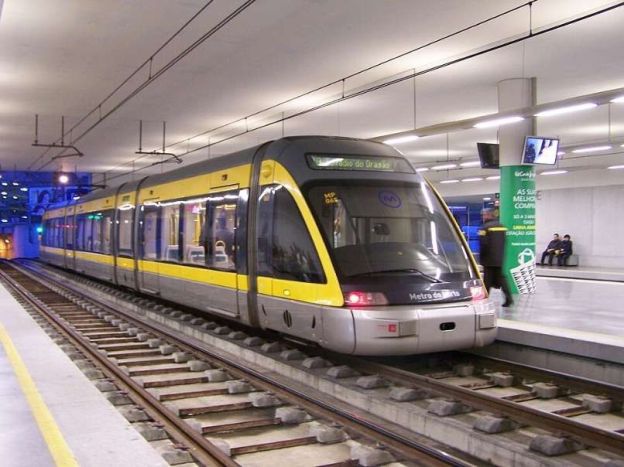
The featured image for this article is a Flexity Outlook Eurotram at Trindade station in Porto, Portugal, © Cornelius Kibelka and licensed for reuse under a Creative Commons licence (CC BY-SA 2.0). [3]

3. Readers’ Favourite Railway Journeys

A. A Dramatic Metro Line in Porto

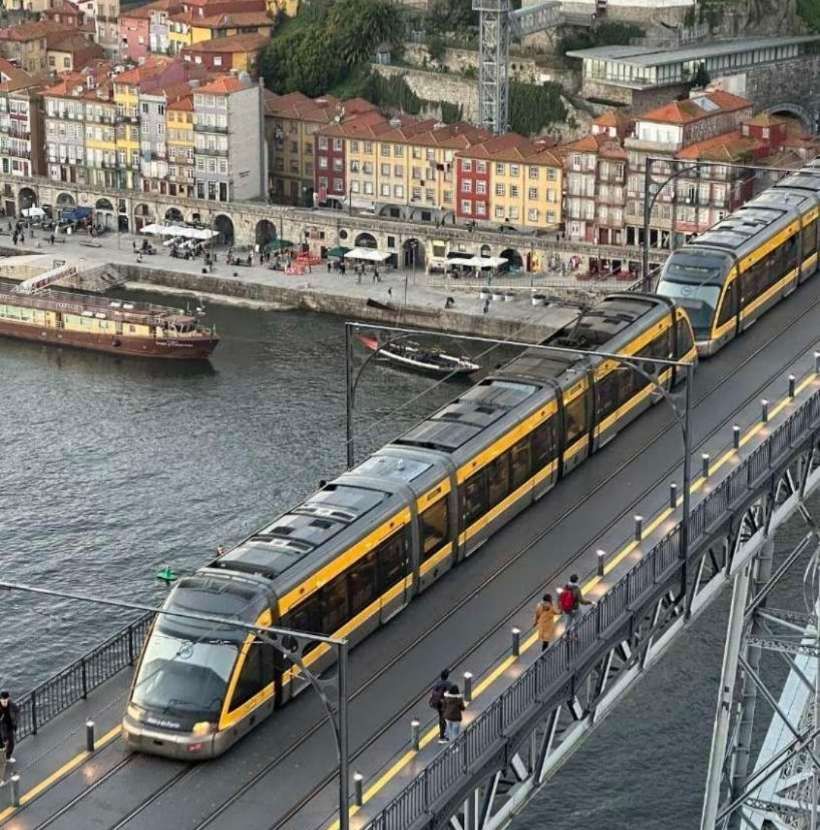
“I love the surprise of urban rail. Porto’s metro D line heading south emerges from mundane darkness underground to suddenly skim rooftops and then rattle across the fantastic Eiffel-inspired Dom Luís I bridge. Choosing to walk back across the metal deck is a completely different experience.” [1: p75][12][Reader: Amy]

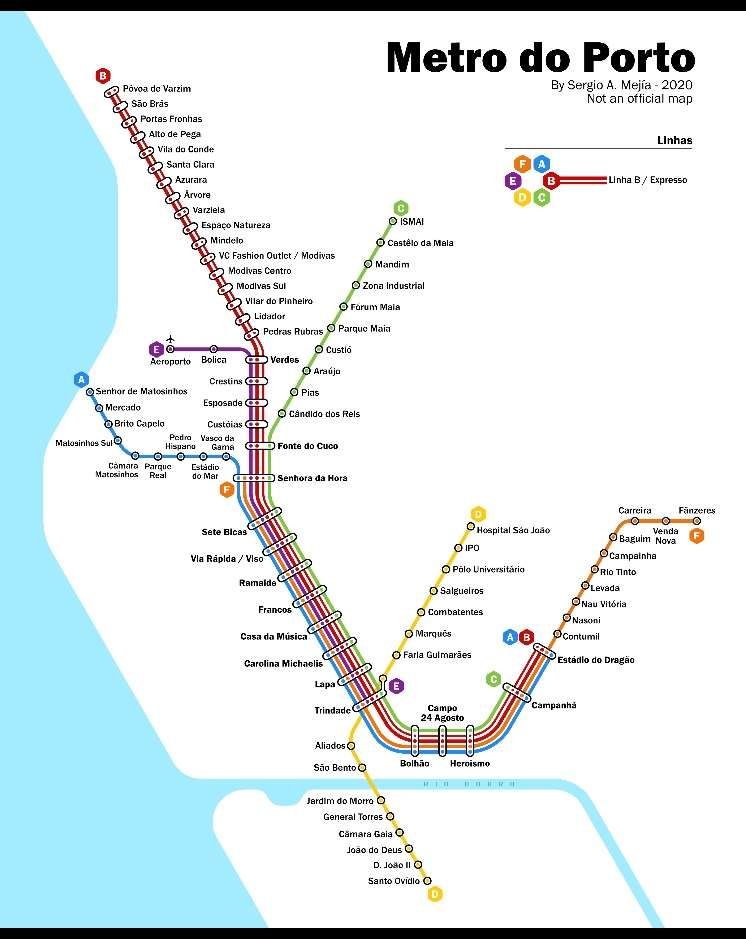
A map of the Metro in Porto. The yellow line is line D. It runs from Hospital Sãn João to Santo Ovidio. It is the one Metro line that crosses the Rio Douro. [2]

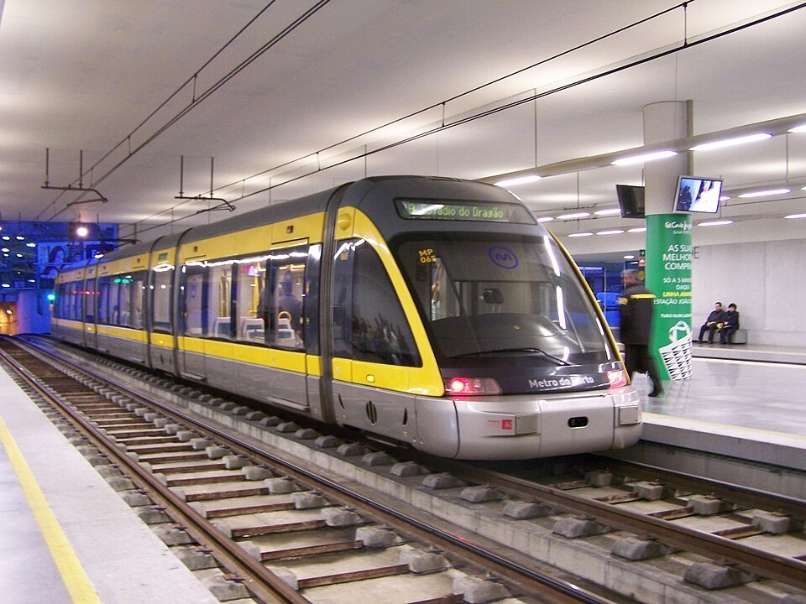
The Porto Metro (Portuguese: Metro do Porto) is the light rail network in Porto. It runs underground in central Porto and above ground into the city’s suburbs. The first parts of the system have been in operation since 2002. The network uses low-floor tram vehicles. [3]

A Flexity Outlook Eurotram at Trindade station, © Cornelius Kibelka and licensed for reuse under a Creative Commons licence (CC BY-SA 2.0). [3]

The Socimi Eurotram (later sold as the Bombardier Flexity Outlook (E)) is an electric tramcar originally designed for the tram system of Compagnie de Transports Strasbourgeois (CTS). Initially produced by Socimi, after the company became bankrupt Eurotrams were manufactured first by ABB Group’s transportation division, then by Adtranz and finally by Bombardier Transportation, who marketed the tram as part of their Flexity Outlook range.” [4]

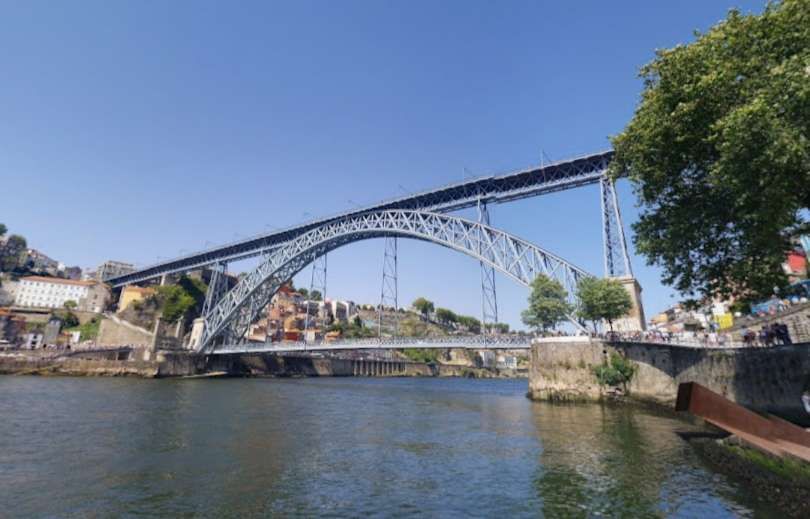
One of the Flexibilty Outlook Eurotrams crossing the Dom Luis I bridge over the Rio Duoro, © Sergei Gussev and licensed for reuse under a Creative Commons licence (CC BY 2.0). [5]
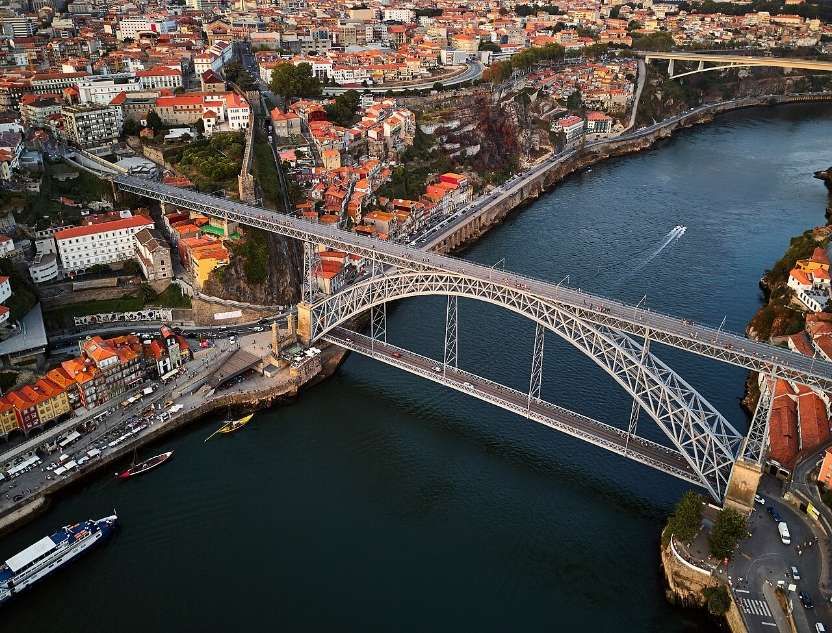
An aerial view of the Dom. Luis 1 Bridge over the Rio Douro in Porto. The bridge carries a road on a lower deck and the Metro Line D on the upper deck, © Deensel and licensed for reuse under a Creative Commons licence (CC BY 2.0). [6]
The Dom. Luis I Bridge seen from the West, © Milton Li, June 2019. [Google Maps, May 2026]

The bridge was designed by Theophile Seyrig and opened at the end of October 1886. In the 21st century, “the bridge’s upper level is used by pedestrians and by line D of the Porto Metro, whilst the lower level is used by buses, taxis, cyclists and pedestrians. The lower level links to the Porto waterfront, including the Praça da Ribeira and the lower station of the Guindais Funicular, at its northern end, and to Gaia waterfront, with its Port wine lodges, at its southern end. The upper level connects to Porto city centre and São Bento station at its northern end, and adjoins the Serra do Pilar Monastery and the upper station of the Gaia Cable Car at its southern end.” [6]

In 1879, Gustave Eiffel presented a project to construct a new bridge over the Douro, with a high single deck in order to facilitate ship navigation. This project was rejected due to dramatic growth of the urban population, which required a re-thinking of the limits of a single-deck platform. … A competition was initiated in November 1880, in order to construct a double-deck metal bridge, which included projects by Compagnie de Fives-Lille, Cail & C., Schneider & Co., Gustave Eiffel, Lecoq & Co., Société de Braine-le-Comte, Société des Batignolles (which submitted two ideas), Andrew Handyside & Co., Société de Construction de Willebroek (also two projects) and John Dixon. It was in January of the following year that deliberations by the committee supported the project of Société de Willebroek, a design that cost 369,000 réis and provided better carrying capacity. On 21st November 1881, the public work was awarded to the Belgian Société de Willebroek, from Brussels, for 402 contos. It was to be administered by Théophile Seyrig, the former partner of Gustave Eiffel and author of the project. Seyrig had also designed the Maria Pia bridge that was constructed by Eiffel & cie, hence the resemblance of his new bridge to the Maria Pia bridge. Construction began on the Luis I bridge alongside the towers of an earlier suspension bridge, the Ponte Pênsil, which was disassembled.” [6]

By 26th May 1886, the first weight experiments began, with the transport of a 2,000 kilograms (4,400 lb) per metre. On 30th October construction of the main arch and upper deck were concluded, resulting in its inauguration the very next day. On 1st November, a toll system began to operate under the administration of the winning company, that was equal to 4 reís per person. The following year the lower deck was inaugurated, completing the project. During its ceremonies, the bridge was blessed by Bishop D. Américo.” [6]

Line D (yellow line) opened on 17th September 2005 between Câmara de Gaia in Vila Nova de Gaia and Pólo Universitário in the North. At the northern end, the São João Hospital and IPO stations, were not brought into service until March 2006 due to safety concerns. At the southern end, the line was expanded until D. João II in May 2008 and then to Santo Ovídio in October 2011. In June 2024, the line was extended southwards by 3.15 km with three new stations added, Manuel Leão, Hospital Santos Silva and Vila d’Este. [3]

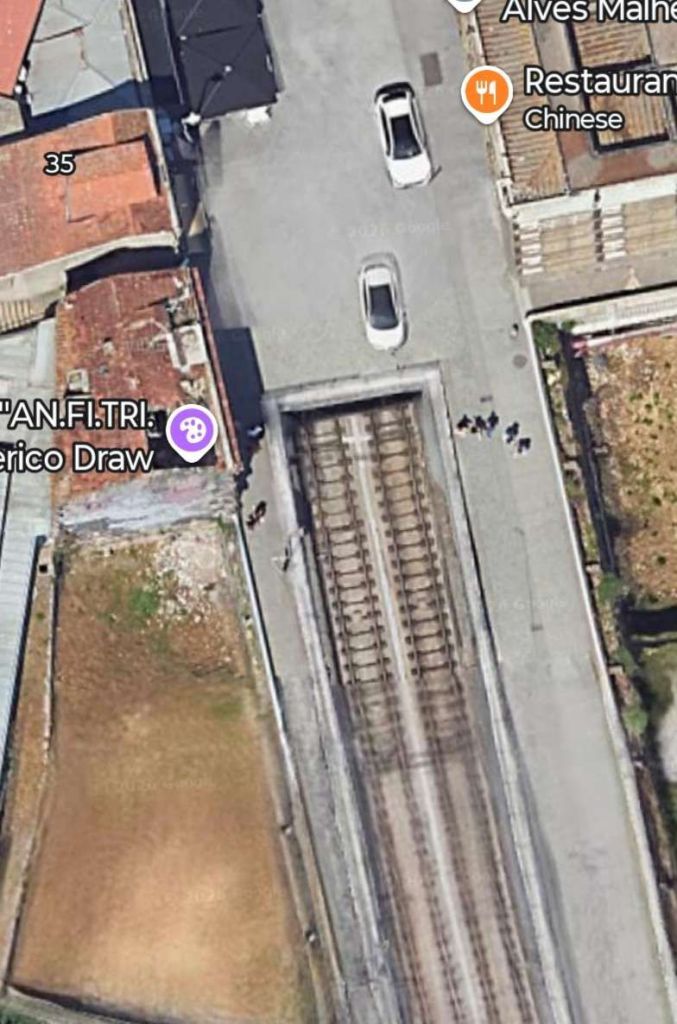
The Guardian reader (Amy) speaks of the tram emerging from the darkness of the tunnel before crossing the bridge. The tunnel mouth can be seen in the satellite image immediately below.

This satellite image shows the location mentioned above. Trams emerge from underground on the North side of the Rio Douro and are soon high above city streets such as Escardas do Codecal and Av. Gustavo Eiffel and then crossing the river. [Google Maps, May 2026]

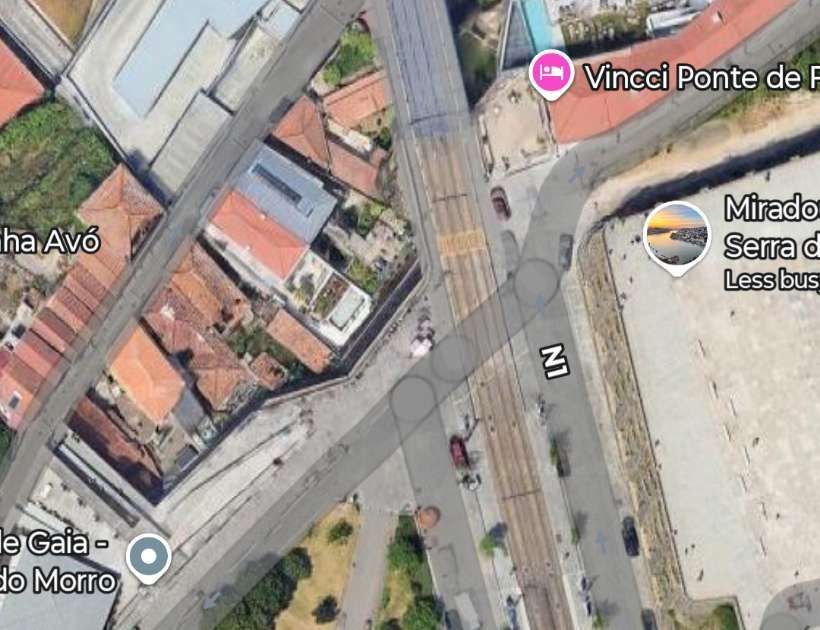
On the South side of the river trams fly over R. da Cabo Simeo and Calcada da Serra before meeting and crossing R. Rocha Leao at level.

Metro line D runs North to South, crossing R. Rocha Leao at level. [Google Maps, May 2026]
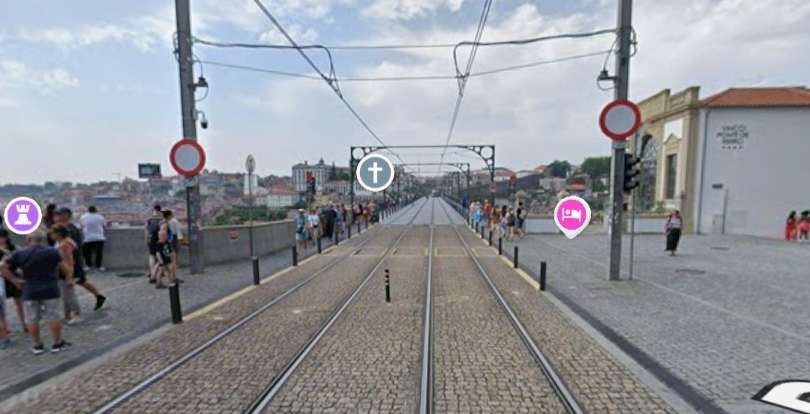
Looking North towards the Rio Douro from R. Rocha Leao. [Google Streetview, June 2025]
Turning through 180°, this is the view South along Metro Line D from R. Rocha Leao. [Google Streetview, June 2025]

The Guardian reader talked of crossing the bridge on the Metro and then walking back over it afterwards!

B. Fjords and Waterfalls in Norway

“I travelled across Norway by rail on the spectacular Bergensbanen, running between Oslo and Bergen, and the unforgettable Flåmsbana branch line. The Bergensbanen crosses the high mountain plateau of Hardangervidda, passing lakes, forests and snow‑covered peaks before descending toward the fjords of western Norway. At Myrdal, I transferred on to the steep Flåmsbana, which drops dramatically to Flåm on the Aurlandsfjord, with waterfalls and sheer-sided valleys at every turn.” [1: p75][12][Reader: Daniel]

The Bergensbanen is a spectacular 496-kilometre railway connecting Oslo and Bergen in Norway. Taking approximately 7 hours, it is Northern Europe’s highest mainline railway, reaching 1,237 metres above sea level. The line runs 4 to 6 times daily, offering stunning views of Hardangervidda mountain plateau and deep fjords.

Trains on the Bergensbanen are operated by Vy. [7] Highlights along the way include Finse (the highest station), Myrdal (transfer to the Flåm Railway), and Voss (a major skiing hub).

The Bergensbanen is actually a 371-kilometre (231 mile) long scenic standard-gauge railway line between Bergen and Hønefoss, Norway. However, the name is often applied to the entire route from Bergen to Oslo, including the Randsfjord and Drammen lines between Hønefoss and Oslo, covering a total distance of 496 kilometres (308 miles). [8]

The Bergen Railway (Bergensbanen)
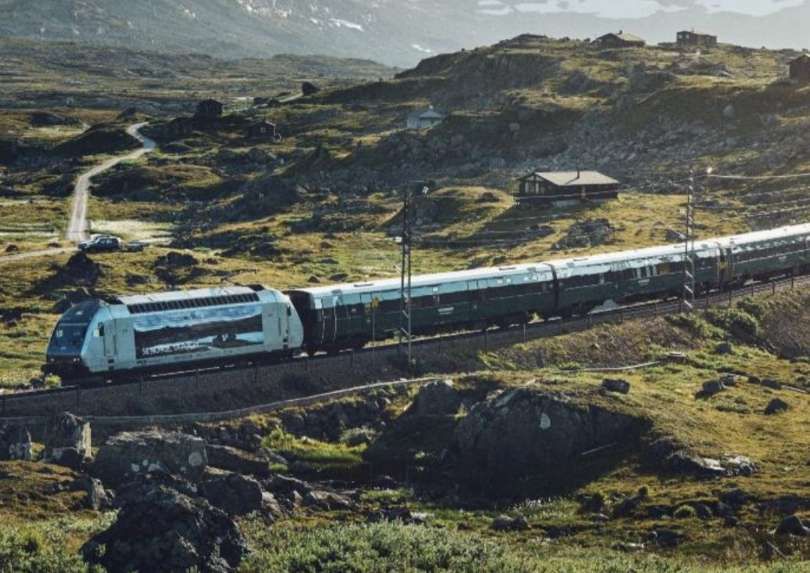
Between Oslo and Bergen by train, © Vy/Øivind Haug. [9]
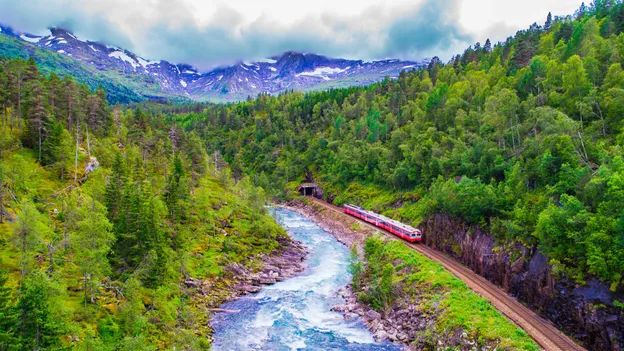
Connecting Norway’s stylish capital with its most picturesque city, the 496km, 39-station Oslo-Bergen railway is one of the world’s most beautiful train journeys, © MariusLtu/Getty Images. [10]
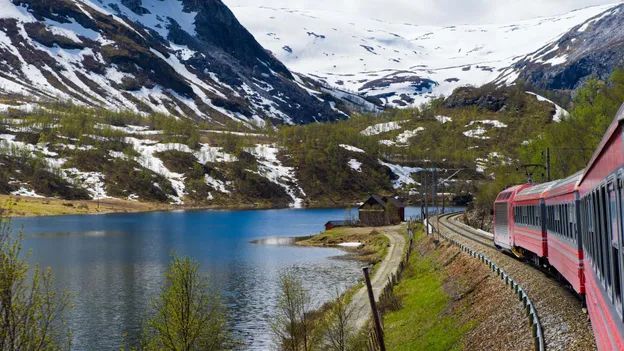
The route crosses the inhospitable Hardangervidda plateau, which soars more than 1km above sea level, © Stockstudiox/Getty Images. [10]

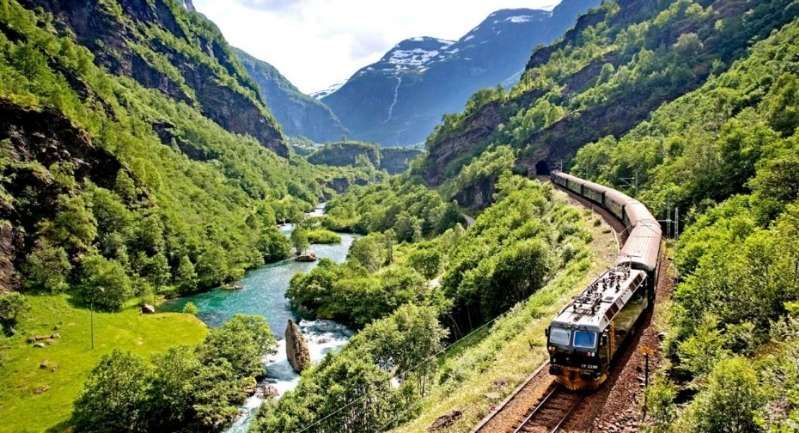
The Flåmsbana is one of the most beautiful train rides in the world and it takes you past mountains and waterfalls you will not forget.

The Flåm Railway. © Morten Rakke. [9]

An article about the Flam railway can be found here. [11]

C. An Electric Gem in Germany

“I took the RB26 train from Berlin-Lichtenberg to Müncheberg and changed for the Buckower Kleinbahn historic narrow gauge railway. Opened in 1930 as an early electric railway, it closed its regular service in the late 1990s. It is now volunteers who run the line that takes you through the rolling hills of Märkische Schweiz in Brandenburg to the pretty spa town of Buckow. Here, I visited the residence of Bertolt Brecht and Helene Weigel on the peaceful reedy shores of Lake Schermützel, before returning refreshed to the Berlin bustle.” [1: p75][12][Reader: Rachael]

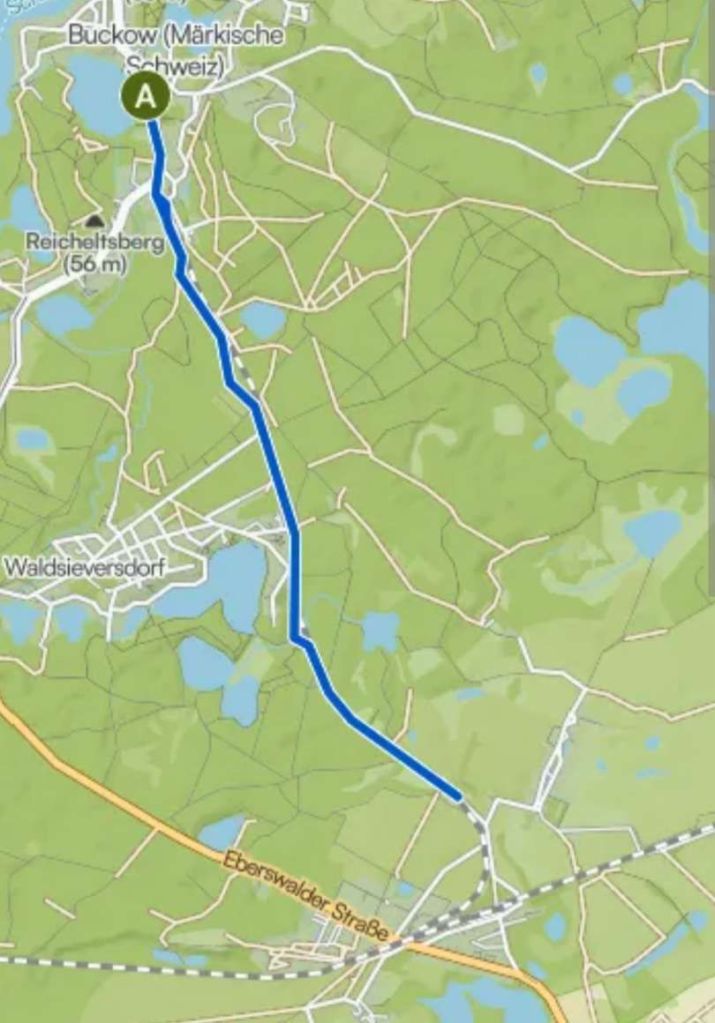
The Buckower Kleinbahn railway runs from Buckow to/from Müncheberg a round journey of close to 10km.

The blue line approxi.ates to the route of the preservation railway line. [14]

The little railway museum in Buckow’s train station building illustrates the history of Buckow’s narrow-gauge railway, as well as of other private and secondary railways, such as the Müncheberg narrow-gauge railway, the Oderbruch train and the ‘Royal Prussian Eastern Line’ (now the RB 26). There are also many exhibits of all sizes and ages, relating to general railroading in Germany.” [13]

A range of diesel and electricity-powered vehicles from the time between 1920 and 1986 are presented in the outdoor area of the Buckow train station. In addition to this, the old rectifier facility of Buckow’s narrow-gauge railway is home to an exhibition about railway power technology, as well as railway signalling and safety.” [13]

“Buckow’s narrow-gauge railway (Buckower Kleinbhan) with historic vehicles operates on weekends from April to October, and it is inseparably linked to the railway museum. Visitors coming from Berlin can board the museum train at Müncheberg station and are taken to Buckow via Waldsieversdorf with very friendly assistance. Children of all ages get to look over the train driver’s shoulder and interested adults can take part in a training course and obtain a certificate as an honorary train driver of the Buckow narrow-gauge railway.” [13]

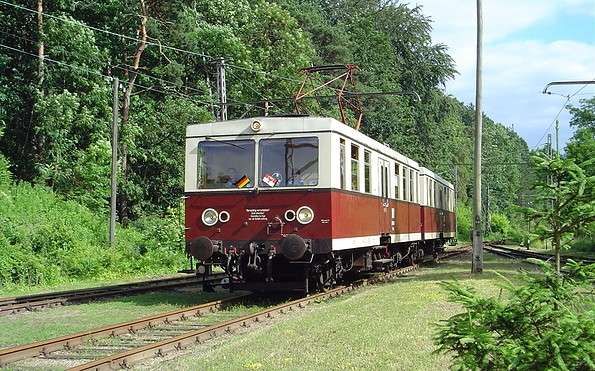
This historic electric railcar is one of a number of such vehicles, Class 279 or ET188 types, with some refurbished in the early 1980s, which run on the Buckower Kleinbahn railway, © Museumsbahn Buckower Kleinbahn e.V. [13]

D. The Swiss Watchmakers’ Line

“When time is not important, a little-known French railway line allows you to enter Switzerland through the valley of the watchmakers. The line from Besançon in France drifts through the beautiful Jura foothills to Le Locle, a Swiss watchmaking town. No one got on or off at L’Hôpital-du-Grosbois, a byway station en route named after a leprosy hospital. A line that Dr Beeching would probably have closed still delivers you into Switzerland on time. [1: p75][12][Reader: Martin]

The “Watchmakers’ Line” (La Ligne des Horlogers) is a historic cross-border railway connecting Besançon, France, to La Chaux-de-Fonds/Le Locle, Switzerland. Named in honour of the region’s rich horological heritage, it spans the Jura mountains

Winding through the rugged terrain of the French Pays Horloger (Watchmaking Country) and the Swiss canton of Neuchâtel, the line is a marvel of 19th-century railway engineering. It features numerous tunnels and viaducts built to conquer the steep alpine inclines. The route is actively served by TER (Transport Express Régional) trains on the French side and connects seamlessly with the Swiss rail network.

The TER (regional) train takes approximately 1 hour and 15 minutes to cover the 48-kilometre distance. There are around 9 direct trains per day in both directions.

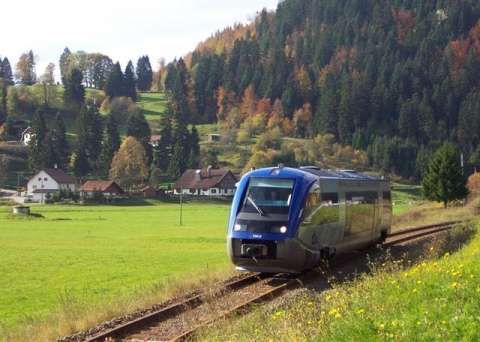
A standard train on the route between Besançon, France and La Chaux-de-Fonds/Le Locle, Switzerland. [16]

From 1st March to 31st October 2021, SNCF Réseau carried out major modernization work on the Horlogers line, a century-old mountain line, which connects Besançon (25) to La Chaux-de-Fonds in Switzerland for a budget of €55.5 million. These works reinforced structures (bridges, tunnels, walls, and trenches), renewed 35 km of track for €49 million (€19.4 million from the French State, €19.4 million from the Bourgogne-Franche-Comté Region, €6 million from INTERREG, and €4.2 million from SNCF Réseau), made the Morteau and Valdahon stations accessible to all for €1.5 million (€0.75 million from the French State and €0.75 million from the Bourgogne-Franche-Comté Region), and modernized the signaling system to allow TER regional trains in the Bourgogne-Franche-Comté Region to continue operating in Switzerland for €5 million (€2.5 million from the French State and €2.5 million from the Bourgogne-Franche-Comté Region). After a complete eight-month service interruption on the line, traffic between Besançon and Morteau resumed on 31st October, and between Morteau and La Chaux-de-Fonds on 23rd December 2021. [15]

The site of La Chaux-de-Fonds/Le Locle consists of two towns situated close to one another in a remote environment in the Swiss Jura mountains, on land not particularly suited to farming. Planned in the early 19th century, after extensive fires, the towns owed their existence to the watchmaking industry. Their layout along an open-ended scheme of parallel strips on which residential housing and workshops are intermingled reflects the needs of the local watchmaking culture that dates to the 17th century and is still alive today.

E. Charmed by the Vienna to Zagreb train

“The journey from Vienna to Zagreb saw mountainous central Europe relax into Balkan charm. Stunning Alpine scenery melted into forest, settling down into rolling hills as we passed through Graz and reached the Slovene border, stopping for an hour’s changeover at the tiny Zidani Most station, where we enjoyed afternoon beers gazing over lush Slovenian countryside. The connection to Zagreb boasted dramatic lake scenery that gave way to farm land, golden in evening light, as we passed into Croatia, soon rattling into its underrated capital. We booked this through Omio, which came in relatively cheaply at £41.” [12][Reader: Matt]

It is possible to get a direct train. According to thetrainline.com, the journey takes about 6 to 6.5 hours, covering roughly 370 km. Tickets can start around €25 to €35. There are normally 11 trains per day travelling from Vienna to Zagreb and tickets for this journey start from £25.89 when you book in advance. [17] The raileurope.com website quotes a lowest fare at under £22.00. [18]

The train journey from Vienna to Zagreb transitions from spectacular Alpine peaks to lush river valleys and rolling Balkan countryside. The journey takes you through southeastern Austria and northern Slovenia before arriving in Croatia. To catch the best views, sit on the left side of the train when departing Vienna to look down into the Semmering valleys. When traveling through Slovenia, sit on the right side to enjoy the best riverside views.

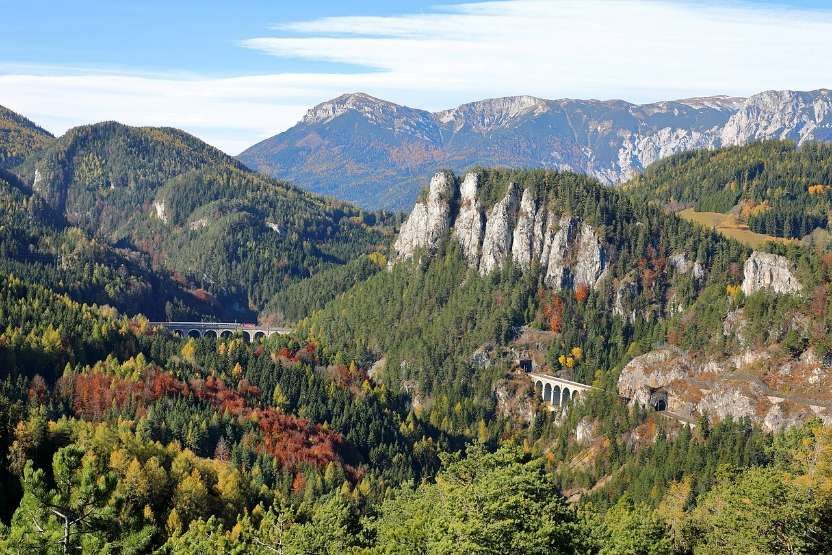
Shortly after leaving Vienna (Wiener Neustadt), the train climbs the Semmering Pass. This is a UNESCO World Heritage site, famous for winding viaducts, tunnels, and panoramic views of steep mountain valleys and dark pine forests.

The Semmering Pass railway and surrounding scenery, © C.Stadler/Bwag and licensed for reuse under a Creative Commons licence (CC BY-SA 4.0). [19]
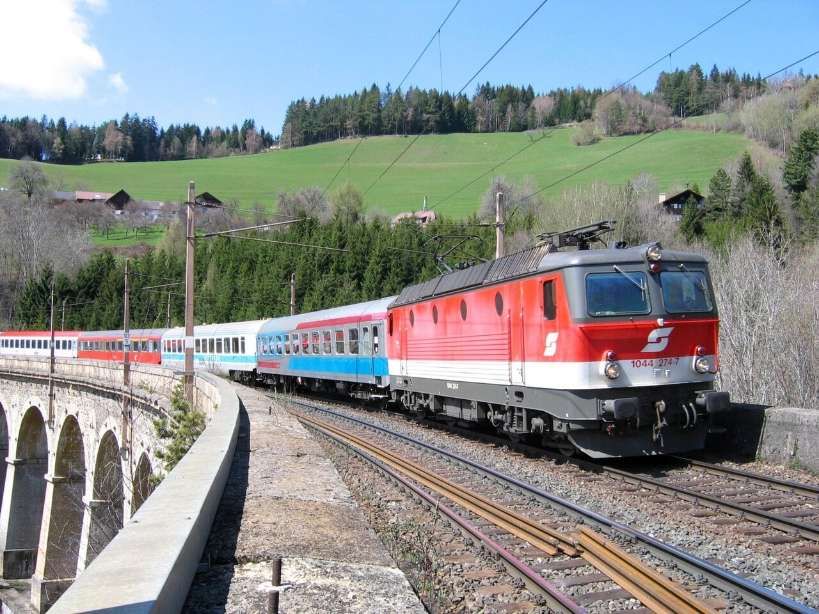
An international express on the Semmeringbahn, pulled by 1044 274-7 in 2004, © Herbert Ortner and licensed for reuse under a Creative Commons licence (CC BY 3.0). [19]

As you descend from the mountains, you’ll pass through the rolling, green agricultural landscapes and vineyards surrounding the city of Graz.

Crossing the border, the scenery becomes dramatic. The train tracks hug the winding Savinja and Sava rivers, passing through deep gorges and canyons flanked by dense forests and rural villages.

The rugged terrain flattens out into the golden farmlands and charming countryside of northern Croatia before pulling into Zagreb’s main station, Zagreb Glavni Kolodvor.

Further suggestions for rail journeys from Guardian readers can be found in the fourth of this series of articles based around the Guardian Saturday Magazine of 23rd May 2026.

References

  1. Readers’Travel Tips: Favourite Train Trips; in Saturday (the Guardian Magazine), 23rd May 2026, p75.
  2. https://www.reddit.com/r/TransitDiagrams/comments/gidbxm/ocdiagram_metro_do_porto_portugal, accessed on 25th May 2026.
  3. https://en.wikipedia.org/wiki/Porto_Metro, accessed on 25th May 2026.
  4. https://en.wikipedia.org/wiki/Socimi_Eurotram, accessed on 25th May 2026.
  5. https://commons.wikimedia.org/wiki/File:Vila_Nova_de_Gaia_(52734250241).jpg, accessed on 25th May 2026.
  6. https://en.wikipedia.org/wiki/Dom_Lu%C3%ADs_I_Bridge#/media/File%3ADom_Lu%C3%ADs_I_Bridge_(36961760686).jpg, accessed on 25th May 2026.
  7. https://www.vy.no/en/train/routes/the-bergen-line, accessed on 25th May 2026.
  8. https://en.wikipedia.org/wiki/Bergen_Line, accessed on 25th May 2026.
  9. https://en.visitbergen.com/visitor-information/travel-information/getting-here/bergensbanen-oslo-to-bergen-by-train, accessed on 25th May 2026.
  10. https://www.bbc.co.uk/travel/article/20230130-the-highest-rail-route-in-northern-europe, accessed on 25th May 2026.
  11. https://rogerfarnworth.com/2019/01/01/the-flam-railway-in-1950
  12. https://www.theguardian.com/travel/2026/may/22/readers-favourite-scenic-european-railway-journeys-trains, accessed on 25th May 2026.
  13. https://www.brandenburg-tourism.com/poi/seenland-oder-spree/industrial-culture/eisenbahnmuseum-and-buckower-kleinbahn-train-museum, accessed on 25th May 2026.
  14. https://www.komoot.com/smarttour/3623001, accessed on 25th May 2026.
  15. https://www.sncf-reseau.com/fr/cp/bourgogne-franche-comte/ligne-horlogers-modernisee-entre-besancon-et-morteau, accessed on 25th May 2026.
  16. https://www.railwaypro.com/wp/colas-consortium-to-modernise-ligne-des-horlogers, accessed on 25th May 2026.
  17. https://www.thetrainline.com/en/train-times/vienna-to-zagreb, accessed on 25th May 2026.
  18. https://www.raileurope.com/en-gb/destinations/vienna-zagreb-train, accessed on 25th May 2026.
  19. https://en.wikipedia.org/wiki/Semmering_railway, accessed on 25th May 2026.

The Modern Tramway – May 1951 – A Tram-Bus Experiment in Switzerland

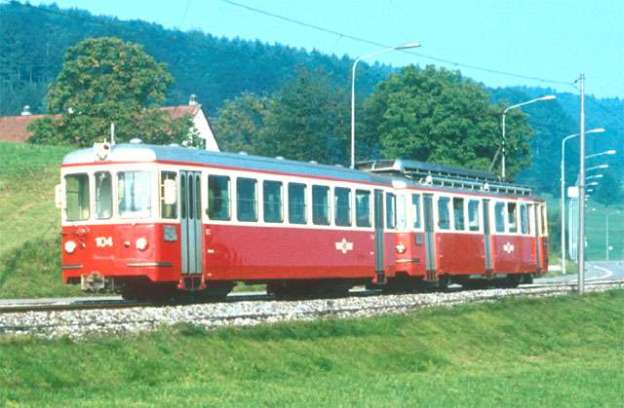
The featured image for this article is a Forchbahn Bt: 104 + Be 4/4 in service in 1982. These tramcars were built in the 1950s after the experiment described below, © Spoorjan and licenced for reuse under a Creative Commons licence (CC BY-SA 3.0). [5]

One of the points regularly made by the editors of The Modern Tramway is that given a proper chance to shine modern electric trams are better than internal combustion engined buses. So it must have come as something of a relief to hear, in 1951, that testing had taken place in Switzerland which seems to have supported the argument that the closure of tramway networks would ultimately prove to be a false economy. … [1]

The Modern Tramway reported in May 1951 that:

“The March issue of ‘Der Nahverkehr’ [3] contains an interesting and significant story about the 10-mile interurban tramway from Zürich Stadelhofen via Forch to Esslingen, in Switzerland. This line, known as the Forchbahn, was opened to traffic in 1912, and is operated with 10 motor tramcars, 5 trailers and some goods vehicles. Two of the motor trams are modern bogie vehicles constructed in 1948 by Schlieren & Co. with Oerliken equipment, the other cars are of the 4-wheel type.

“For much of its length the single metre-gauge track is laid in the public highway, an arrangement which the Company have long planned to eliminate by the construction of a private right-of-way. This plan was taken up in earnest in 1950, but the expected high cost of the new construction caused some hesitation among the directors, some of whom wondered whether replacement by buses might not be a cheaper alternative.

It was finally arranged with the Zürich town tramways that the latter should take over the service for an experimental period of 14 days, using buses from the municipal fleet to replace the Forchbahn trams. The period chosen was from 6th to 19th November, 1950. As was to be expected, the buses showed a certain advantage in journey time, as the tramway is single-track with widely-spaced passing loops. In summer, the Forchbahn carries a heavy weekend traffic from Zürich to the country, and in order to test the capacity of the buses in dealing with such traffic, exceptionally low excursion fares were introduced on one Sunday during the test period. Despite rainy weather large crowds were attracted to the service, and the fundamental disadvantage of the bus soon showed itself. Many extra buses were needed, and by comparison with the usual tram-and-trailer units, double the usual staff were required. The overloaded buses fell behind schedule, and even the most modern were overtaken in the Zürich suburbs by elderly city trams hauling trailers. The uneven motion of the buses soon invited unflattering comparison with that of the trams from the many passengers who had to travel standing, for the Swiss are now accustomed to comfortable travel.

“The results of the test showed that the use of buses would involve a disproportionately heavy outlay; additional personnel would be needed, the vehicles would have less than half the effective life of the tram, the goods traffic would no longer be an economical sideline, and the buses would probably have to charge fares 50% higher than those charged on the present trams. These conclusions were not published until after the test had taken place, but the population of the communities served by the Forchbahn had needed only a few days of buses to convince them that the trams gave them the better service. When, fourteen days later, the first trams ran again between Zürich and Esslingen, the citizens hung out flags and decorated the cars with branches and flowers, and in the space usually occupied by the destination board appeared a large placard: “Es lebe die Forchbahn!” The Forchbahn lives again!” [1]

The conclusion of the experiment was that retaining the line was the best solution provided that the line could be separated from the street and modernized. In the following decade, separation of rail and road traffic was increased. New bogie rolling stock was acquired, similar to two cars built for the line in the late 1940s.” [5]

The Forchbahn is still operating in the mid-21st century. It is a local mixed tramway/railway line in the Swiss canton of Zürich. It is owned and operated by the Forchbahn AG, and is branded as line S18 of the Zürich S-Bahn. The standard Zürcher Verkehrsverbund (ZVV) zonal fare tariffs apply to the line. [5]

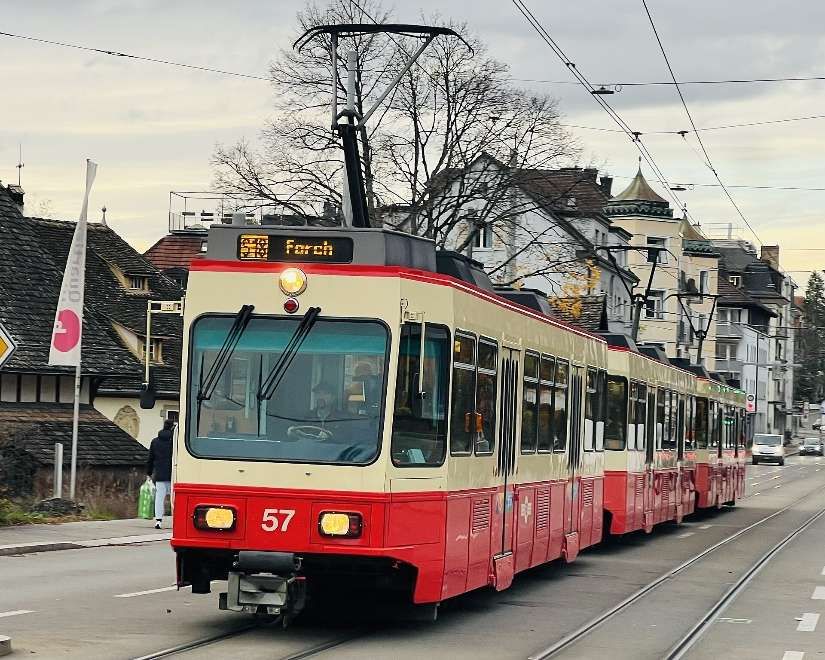
In 2004, new low floor cars were acquired from Stadler to replace the 1950s stock, © S5A-0043 and made available for reuse under a Creative Commons licence (CC-BY 2.0). [5]

References

  1. Instructive Tram-Bus Experiment in Switzerland; in The Modern Tramway, Volume 14, No. 161, May 1951, p112.
  2. ‘Der Nahverkehr’ translates into English as ‘Local Transport’, a Journal with that name is published in the mid-21st century. It dates back to 1983. It is not the journal referred to by The Modern Tramway. For the record, it is a technical and operational monthly journal for all public passenger transport in the city and region. Its target audience includes managers and decision-makers in transport companies, government agencies, associations and corporations, transport science, consulting firms and the transport industry. It is the official organ of the Association of German Transport Companies (VDV) and part of the media offering of Alba Fachmedien ÖPNV in the DVV Media Group. (https://www.dvvmedia-shop.de/DER-NAHVERKEHR/DNV-NA-12-DIGI)
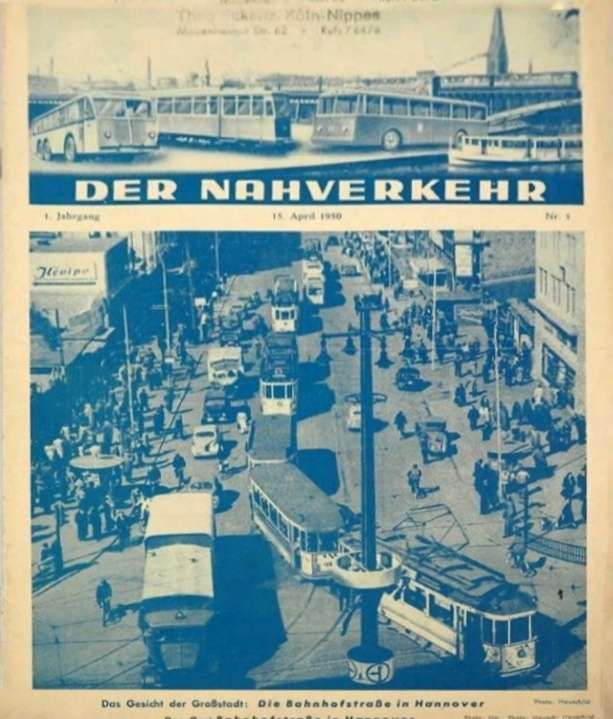
  3. The ‘Der Nahverkehr‘ referred to in the article published by The Modern Tramway was, in 1951, a relatively new journal. The first issue came out in April 1950.
  4. https://ebay.us/m/bKn6Ic, accessed on 16th May 2026.
  5. https://en.wikipedia.org/wiki/Forch_railway, accessed on 16th May 2026.
The first issue of ‘Der Nahverkehr’ which was published in April 1950. [4]

Articulated Tramcars for Basel & Zurich – Modern Tramway, June 1962.

Modern Tramway and Light Railway Review, June 1962 carried an article based on notes by H.J. Bertschmann, G.A. Meier and M. Frei about then new articulated trams in these two Swiss cities. [1]

Both the Basler Verkehrs-Betriebe and the Verkehrsbetriebe der Stadt Zürich had taken delivery, in the months prior to the article being written, of the first prototypes of a new design of articulated tramcar. The design was a new departure, a double-articulated tram on three trucks. Earlier models of articulated cars had  two sections on two or three trucks, or three sections on two or four trucks, but never before three sections on three trucks.

“Wages costs represent a very high pro- portion of the total costs in the operation of public transport, and in both Basel and Zürich reach[ed] 80 per cent of the total expenditure. Economy in staff [was] therefore the only way in which undertakings [could] remain solvent, and the rapid increase in traffic oblige[d] transport undertakings to use high-capacity vehicles in order to minimise utilisation of the road surface. The development of bogie cars was the first step in this direction, and the delivery of the first articulated cars carries this a stage further.” [1: p19]

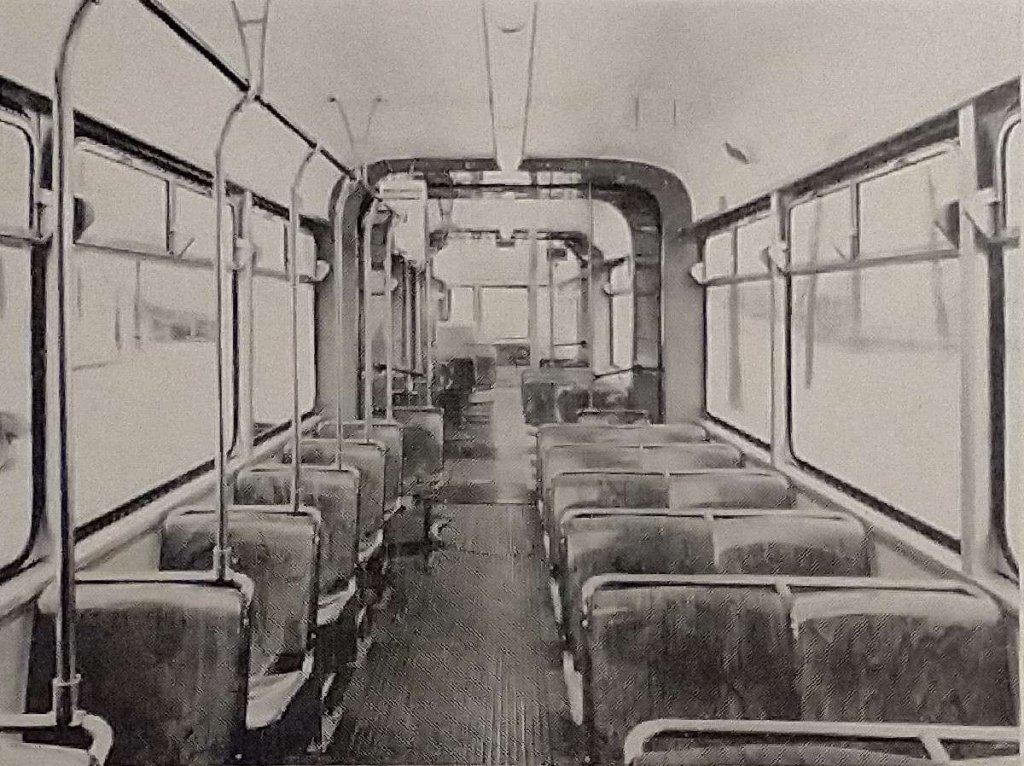
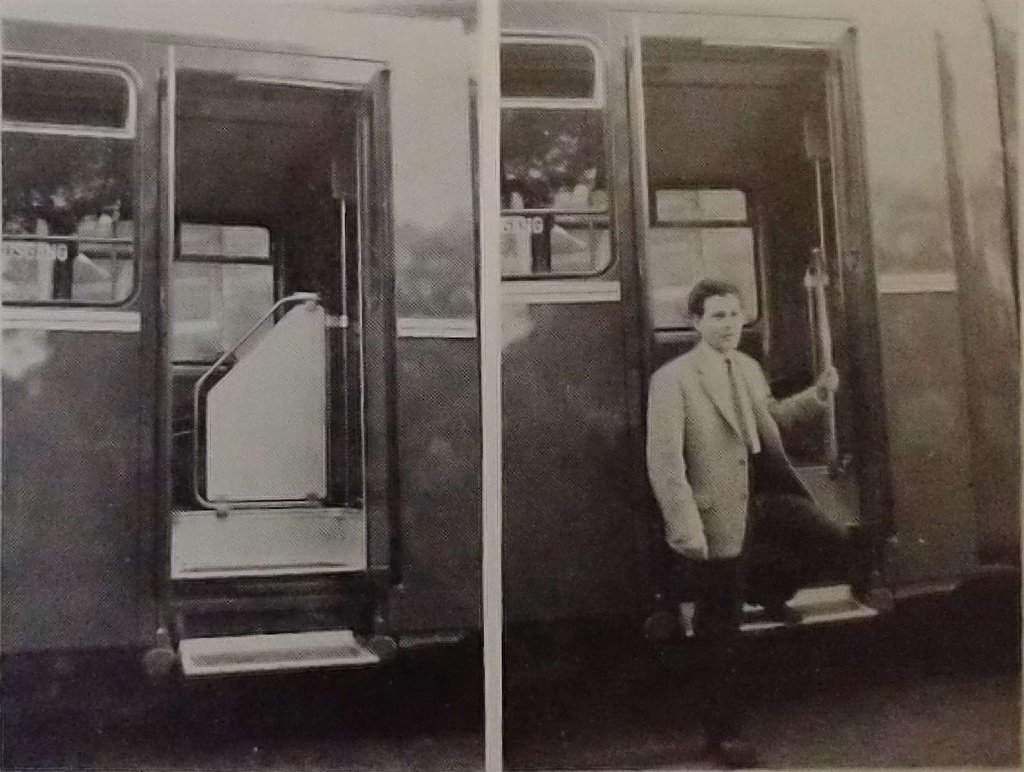
The interior of Zürich Tramcar No. 1801. Modern Tramway commented in 1962.”Its clean lines are very attractive, and the styling is in accord with the latest Swiss designs. The Basel cars differ only in minor details such as the arrangement of grab-rails and in the provision of upholstered seats. Even in 1962, Zürich trams have hard seats of moulded reinforced plastic; their riding is so smooth that upholstery is unnecessary! © Verkehrsbetriebe der Stadt Zürich. [1: p19]
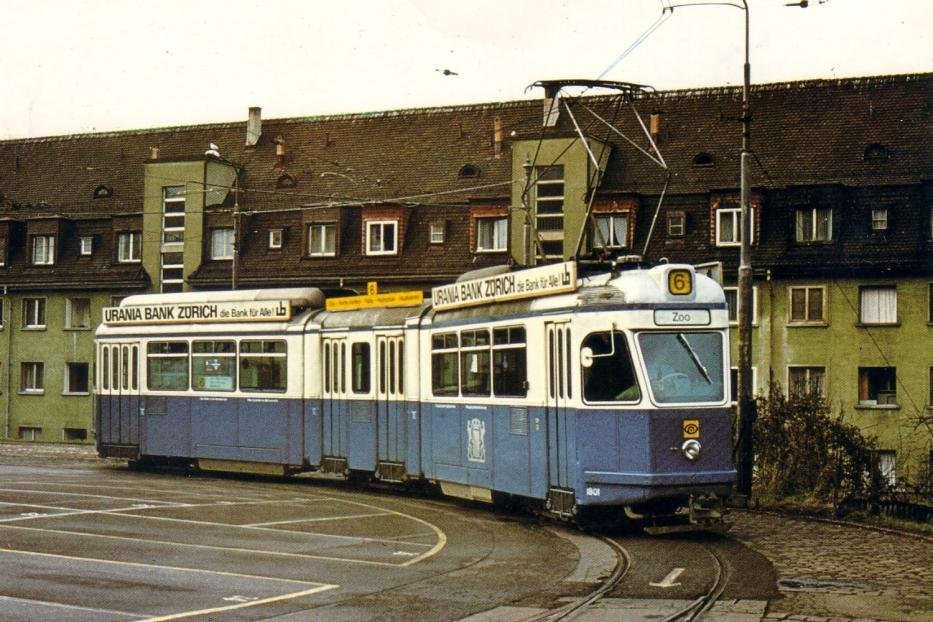
Zurich Tram Car No. 1801 sits outside Irchel Depot © Ernst B. Leutwiler Verlag. Entrances to the tram were at either end. Egress was via the two central doors. Number 1801 was built in 1961 as a prototype for the large batch of, what Zurich would call, Mirages that came later in the 1960s. It was scrapped in December 1999. [3]

The very different technical requirements of the Swiss urban transport undertakings had often hindered the development of a Swiss standard tramcar, one of the difficulties was caused by differences in the topography of the towns.

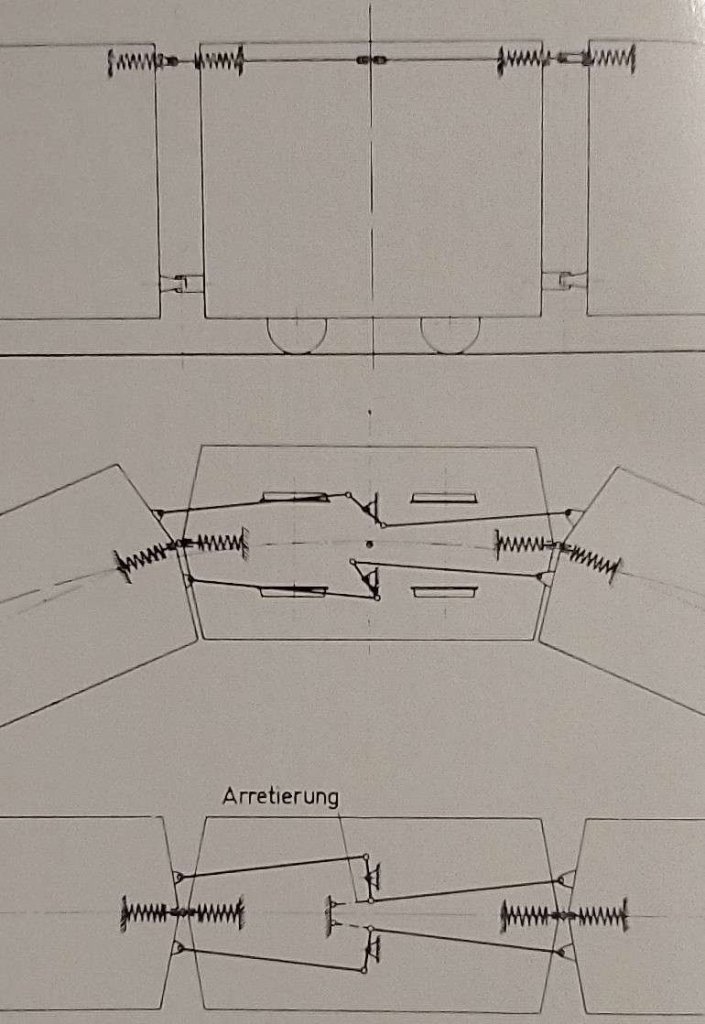
“This … led to a unified effort by the Basel and Zürich undertakings, the two largest tram- ways in Switzerland, to design an articulated car whose basic design was suitable for both undertakings. Whilst a classical (by German standards) two-section single-articulated six-axle car was built for Zürich by SWS (Schlieren), the co-operation between the two systems to find the most advantageous design resulted in an order for three articulated cars, two for the BVB (Basel) and one for the VBZ (Zurich), being placed with SIG (Neuhausen). SIG conceived a new style of construction, departing from the customary articulation over the central bogie (known as a Jacobs bogie) in favour of a short middle section on a two-axle non-rigid truck with an articulation at each end.

There [we]re so many common features in the design for both BVB and VBZ that practically the only differences [we]re in the number of motors and their electrical connections. Basel cars [had] four motors totalling 264 kW, whilst Zürich cars [had] six motors rated at a total of 396 kW. Motor bogie wheels ha[d] a diameter of 720 mm against the 660 mm of the Basel middle bogie wheels. Whilst the Basel cars [would] normally each haul a bogie trailer and the Zürich prototype car will also do this, the production batch of Zürich cars [would] run in multiple-unit pairs, and … (like Basel) have only two power trucks. Zürich has still to decide whether the two leading trucks will be motored, as distinct from the end trucks as at Basel. By confining the differences to these features (apart from minor differences in interior styling), the cars [could] achieve the maximum economy whilst ensuring the best use of the adhesion weight. By means of special mechanisms, it was possible to arrange the axle loadings so that the load on the driving axles was the same in both the four-motor and six-motor cars. Variations in the axle-load on the middle truck induce[d] horizontal forces in the upper part of the articulations; these induce[d] turning movements in the vertical plane, with consequent transfer of load between the outer and inner trucks. As a result of this design, the car [was] better able to start from rest on hills. [1: p19-21]

The advantages of the new design were:

  • The middle truck is not under the articulation mechanisms – so maintenance is much easier.
  • Rotation over each of the two mechanisms is half of that for one mechanism.
  • The body did not obstruct the drivers view of the exit doors which are in the middle section of the tram.
  • Double articulation permits wider front and end designs which allows doors to be built in the parallel sides of the tram.
  • A minimising of internal obstructions for passengers was achieved by the lesser amount of articulation required.
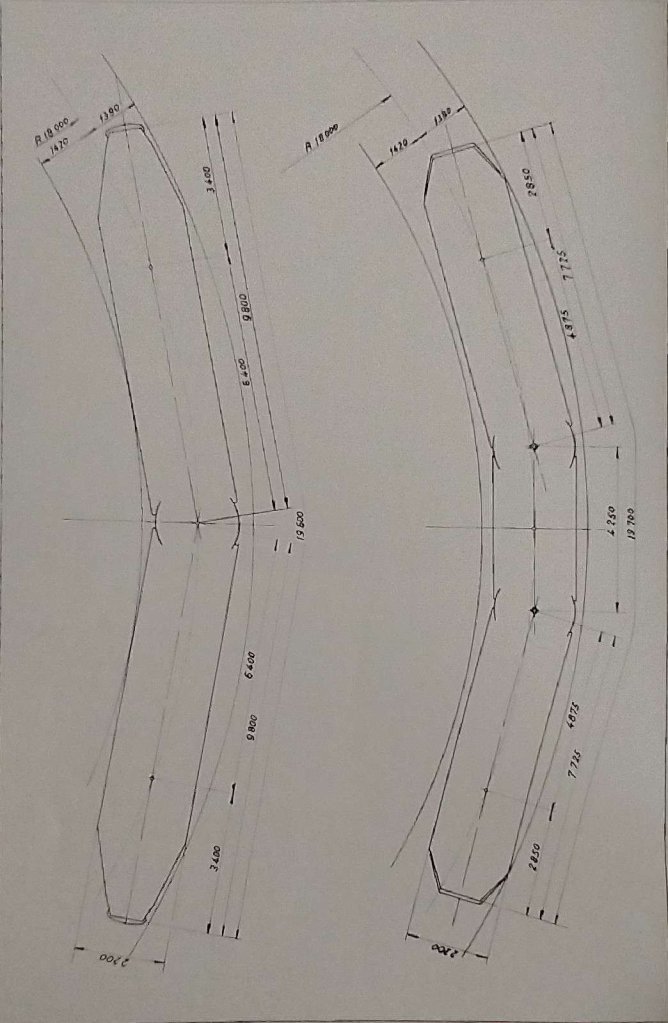
These two diagrams enable a comparison to be made between the conventional articulated car (left) and the new Swiss double-articulated design. The left-hand diagram shows the extensive end-tapering necessary to prevent overhang, whilst the right-hand diagram shows how “squarer” ends are possible and that much less relative movement takes place at the articulations, © Der Stadtverkehr. [1: p188]
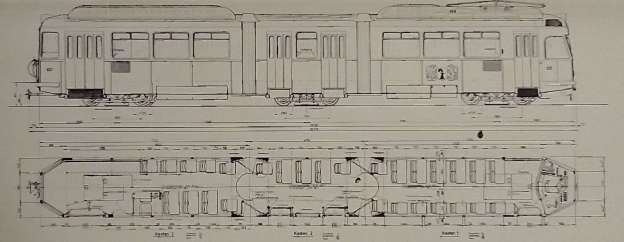
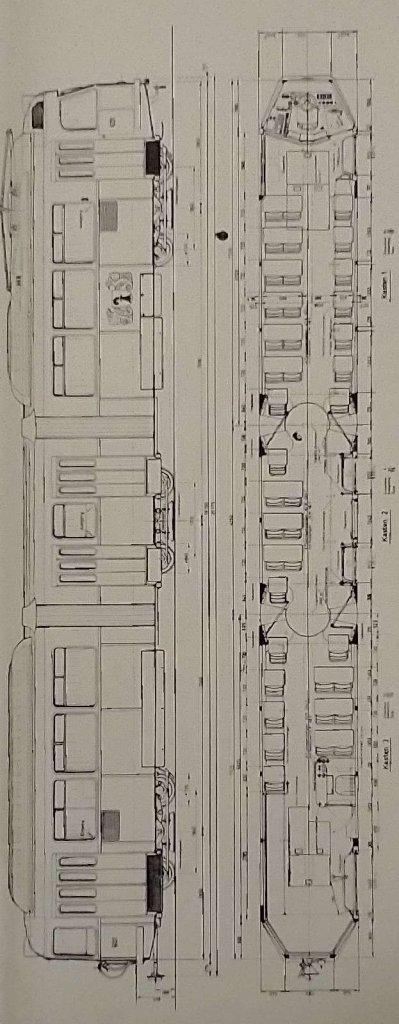
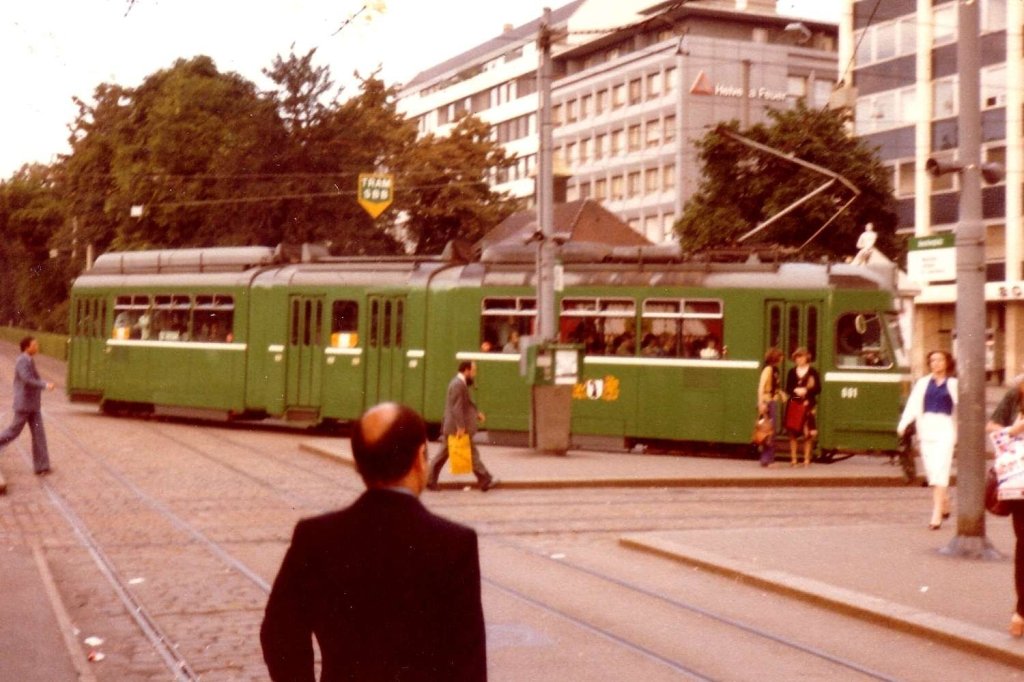
Plan and elevation of Basel  Tramcar No. 601. Apart from the livery, the external appearance of the Zürich car differs mainly in the addition of a front coupler, © Der Stadtverkehr. [1: p189]
Basel Articulated Tram No. 601 on Aeschenplatz in 1981, © Henrik Boye and used here by kind permission of the photographer. This tram survived in service until 1991. Its last journey in service was on 5th May 1991 and it was written off on 13th June 1991. [2][4]

Trams travelled at a maximum speed of 60km/h and had a capacity of 42 seated and 123 standing. The empty car weighed 28.3 tonnes. The significant dimensions of the tramcars were:

  • Overall length between couplings: 20.45m
  • Length of body: 19.7m
  • Height of roof over rails: 3.385m
  • Width: 2.2m
  • Distances between king-pins: 7.0m
  • Overhangs: 2.85m
  • Wheelbase of motorised truck: 1.86m
  • Wheelbase of non-motorised truck: 1.7m

The article describes the trucks, braking systems and control systems as follows:

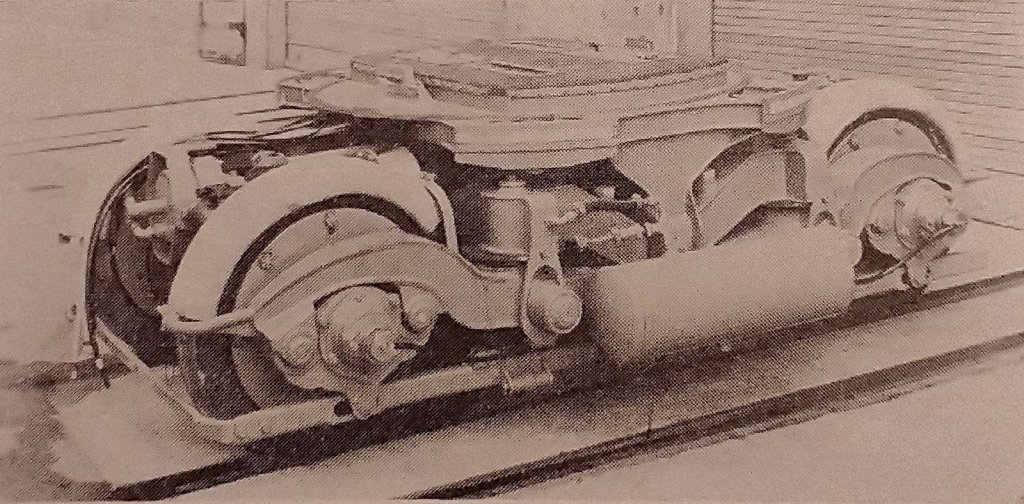
“The motor trucks are swing-link trucks with outside frames and torsion-bar springing. The springing of the torsion bar and the swing-links is combined into a single springing system, and this contributes considerably to noise reduction, in conjunction with the resilient wheels. The longitudinally-mounted motors are held by a three-point suspension to the truck frames, using rubber inserts.

The braking system: … The service brake is rheostatic, augmented with an air-operated disc-brake. A Charmilles brake handle is fitted under the controller wheel (a Volkswagen steering-wheel), … the air brake automatically supplements the electrical brake as the regenerative current dies out, and excessive braking through combined electric and air braking applications is eliminated. In an emergency, the braking effort can be supplemented with magnetic brakes. The parking brake is a hydro-mechanical hand brake. An Electro-pneumatic valve proportions the application of air to the trailer and (on the Basel cars) to the un-motored truck.

The control system has 22 running notches, of which the last three are field-weakening notches; there are 23 notches for rheostatic braking and a 24th emergency notch for magnetic braking in addition. The motors are connected in series pairs, each motor operating at half-voltage, and every effort has been made to keep the number of power cables crossing an articulation to a minimum.” [1: p190-191]

The truck design adopted for the, then, new Basel and Zurich cars, © Der Stadtverkehr. [1: p190]
This schematic drawing illustrates the, then, ingenious link mechanisms at the articulations whereby the load was distributed in the most efficient manner. The upper diagram shows an elevation of the central section, and the two lower diagrams show plans of the car on a curve and on straight track, © Der Stadtverkehr. [1: p190]

The Modern Tramway Journal also reported on a number of other features:

“The exit doors incorporate a device similar to that on the Stuttgart articulated cars. They are operated by the passengers through a push-button, and the opening of a light inner door by the passenger in order to gain access to the step holds the main doors open. The other function of the inner door is to prevent the entry of passengers at the exit doors. In Zürich, passengers would press the push-button to signal to the conductor to open the doors, whilst Basel had intended that passengers should open the doors themselves. However, as Basel experienced some confusion with this arrangement, they changed over to the Zürich system.

Particularly interesting features of the new cars include a “Hesomat” indicator blind, driven by an electric motor. The driver merely presses a “tens” button and a “second digit” button for the code number of the desired destination, and this is automatically set-up. Another innovation is the point-changing button enabling the driver to simulate a “power” signal whilst coasting past the detector. To prevent the current taken by auxiliaries causing a false “power” signal, a push-button in the centre of the controller wheel can cut off all auxiliary power as the detector is passed.

The Zürich undertaking needs new cars urgently and it is hoped that the number of articulated cars will ultimately rise to 200; they are intended to be the basic unit for the planned Tiefbahn (subway) services. The Basel plans are less ambitious for the present, but they hope to operate route 6 entirely by these cars at some date in the future. This route, from Allschwil to the German border at Riehen, is one of the fastest urban routes in Switzerland, and these cars should be particularly suitable.” [1:p191]

In addition to the external jack-knife doors, the exits have a single leaf internal door. The action of the passenger in holding this open keeps the main doors open, and it also serves as a handrail. Its main purpose, however, is to deter passengers from entering by the exits, © Basler
Verkehrs-Betriebe.[1: p191]

Ultimately, tram No. 1801 was a success as a prototype in Zurich. A series of these vehicles were purchased later in the 1960s and were called ‘Mirages’. [4] An online acquaintance tells me that a number of these trams were later sold to the city of Vinnytsia in Ukraine. Details can be found here, [6] and in the YouTube video below. [7]

Ukraine passes trams to Vinnytsia. [7]

Tram No. 601 and its partner were less of a success in Basel. As a result, the two trams ordered by Basel were not followed by a larger order. They remained the only Basel trams of their specific type. [5] Basel did purchase further articulated trams but from different a different source.

References

  1. H.J. Bertschmann, G.A. Meier & M. Frei; New Articulated Tramcars for Basel and Zurich; in Modern Tramway, Light Railway Transport League and Ian Allan, Hampton Court, Surrey, June 2022, p187-191.
  2. https://en.sporvognsrejser.dk/foto/s/basel-articulated-tram-601-on-aeschenplatz-1981.jpg, accessed on 2nd August 2023.
  3. https://en.sporvognsrejser.dk/foto/postcard-zurich-articulated-tram-1801-at-the-depot-tramdepot-irchel-1975, accessed on 2nd August 2023.
  4. https://transphoto.org/vehicle/276178/?lang=et, accessed on 3rd August 2023.
  5. https://ba.e-pics.ethz.ch/catalog/ETHBIB.Bildarchiv/r/690998/viewmode=infoview, accessed on 3rd August 2023.
  6. https://en.m.wikipedia.org/wiki/Trams_in_Vinnytsia, accessed on 10th August 2023.
  7. https://www.youtube.com/watch?v=Gh7sMfSNK08, accessed on 10th August 2023.