One of the points regularly made by the editors of The Modern Tramway is that given a proper chance to shine modern electric trams are better than internal combustion engined buses. So it must have come as something of a relief to hear, in 1951, that testing had taken place in Switzerland which seems to have supported the argument that the closure of tramway networks would ultimately prove to be a false economy. … [1]
The Modern Tramway reported in May 1951 that:
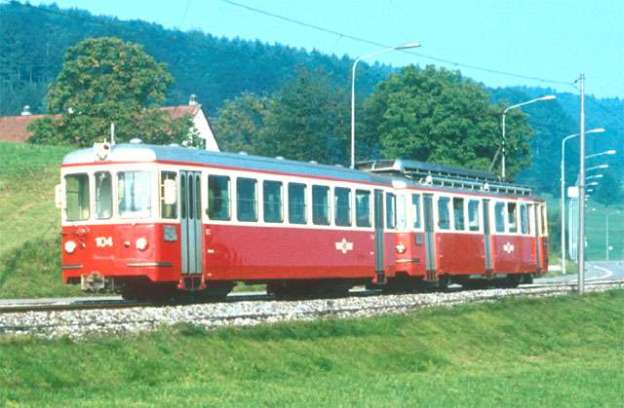
“The March issue of ‘Der Nahverkehr’ [3] contains an interesting and significant story about the 10-mile interurban tramway from Zürich Stadelhofen via Forch to Esslingen, in Switzerland. This line, known as the Forchbahn, was opened to traffic in 1912, and is operated with 10 motor tramcars, 5 trailers and some goods vehicles. Two of the motor trams are modern bogie vehicles constructed in 1948 by Schlieren & Co. with Oerliken equipment, the other cars are of the 4-wheel type.
“For much of its length the single metre-gauge track is laid in the public highway, an arrangement which the Company have long planned to eliminate by the construction of a private right-of-way. This plan was taken up in earnest in 1950, but the expected high cost of the new construction caused some hesitation among the directors, some of whom wondered whether replacement by buses might not be a cheaper alternative.
It was finally arranged with the Zürich town tramways that the latter should take over the service for an experimental period of 14 days, using buses from the municipal fleet to replace the Forchbahn trams. The period chosen was from 6th to 19th November, 1950. As was to be expected, the buses showed a certain advantage in journey time, as the tramway is single-track with widely-spaced passing loops. In summer, the Forchbahn carries a heavy weekend traffic from Zürich to the country, and in order to test the capacity of the buses in dealing with such traffic, exceptionally low excursion fares were introduced on one Sunday during the test period. Despite rainy weather large crowds were attracted to the service, and the fundamental disadvantage of the bus soon showed itself. Many extra buses were needed, and by comparison with the usual tram-and-trailer units, double the usual staff were required. The overloaded buses fell behind schedule, and even the most modern were overtaken in the Zürich suburbs by elderly city trams hauling trailers. The uneven motion of the buses soon invited unflattering comparison with that of the trams from the many passengers who had to travel standing, for the Swiss are now accustomed to comfortable travel.
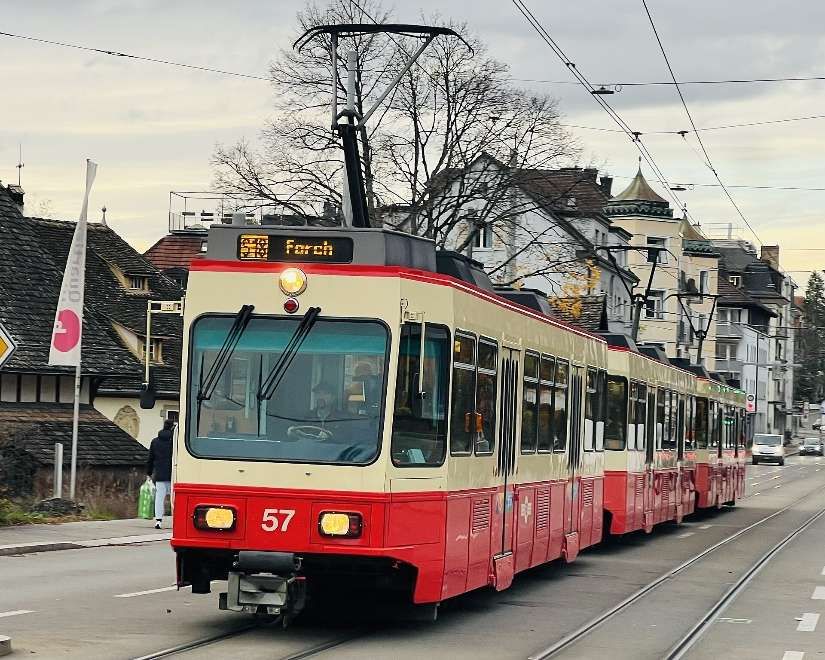
“The results of the test showed that the use of buses would involve a disproportionately heavy outlay; additional personnel would be needed, the vehicles would have less than half the effective life of the tram, the goods traffic would no longer be an economical sideline, and the buses would probably have to charge fares 50% higher than those charged on the present trams. These conclusions were not published until after the test had taken place, but the population of the communities served by the Forchbahn had needed only a few days of buses to convince them that the trams gave them the better service. When, fourteen days later, the first trams ran again between Zürich and Esslingen, the citizens hung out flags and decorated the cars with branches and flowers, and in the space usually occupied by the destination board appeared a large placard: “Es lebe die Forchbahn!” The Forchbahn lives again!” [1]
“The conclusion of the experiment was that retaining the line was the best solution provided that the line could be separated from the street and modernized. In the following decade, separation of rail and road traffic was increased. New bogie rolling stock was acquired, similar to two cars built for the line in the late 1940s.” [5]
The Forchbahn is still operating in the mid-21st century. It is a local mixed tramway/railway line in the Swiss canton of Zürich. It is owned and operated by the Forchbahn AG, and is branded as line S18 of the Zürich S-Bahn. The standard Zürcher Verkehrsverbund (ZVV) zonal fare tariffs apply to the line. [5]
Instructive Tram-Bus Experiment in Switzerland; in The Modern Tramway, Volume 14, No. 161, May 1951, p112.
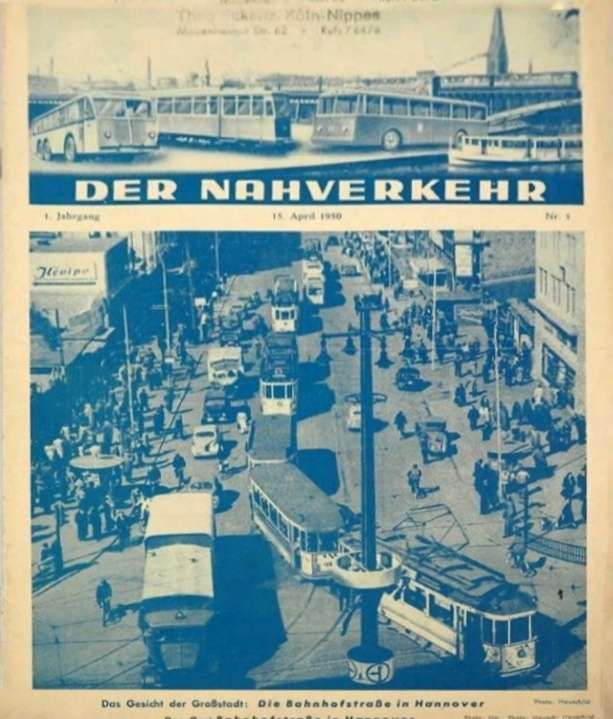
‘Der Nahverkehr’ translates into English as ‘Local Transport’, a Journal with that name is published in the mid-21st century. It dates back to 1983. It is not the journal referred to by The Modern Tramway. For the record, it is a technical and operational monthly journal for all public passenger transport in the city and region. Its target audience includes managers and decision-makers in transport companies, government agencies, associations and corporations, transport science, consulting firms and the transport industry. It is the official organ of the Association of German Transport Companies (VDV) and part of the media offering of Alba Fachmedien ÖPNV in the DVV Media Group. (https://www.dvvmedia-shop.de/DER-NAHVERKEHR/DNV-NA-12-DIGI)
The ‘Der Nahverkehr‘ referred to in the article published by The Modern Tramway was, in 1951, a relatively new journal. The first issue came out in April 1950.
Modern Tramway and Light Railway Review, June 1962 carried an article based on notes by H.J. Bertschmann, G.A. Meier and M. Frei about then new articulated trams in these two Swiss cities. [1]
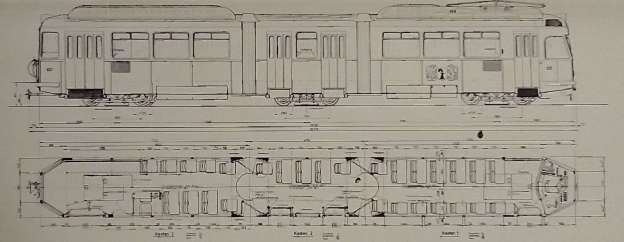
Both the Basler Verkehrs-Betriebe and the Verkehrsbetriebe der Stadt Zürich had taken delivery, in the months prior to the article being written, of the first prototypes of a new design of articulated tramcar. The design was a new departure, a double-articulated tram on three trucks. Earlier models of articulated cars had two sections on two or three trucks, or three sections on two or four trucks, but never before three sections on three trucks.
“Wages costs represent a very high pro- portion of the total costs in the operation of public transport, and in both Basel and Zürich reach[ed] 80 per cent of the total expenditure. Economy in staff [was] therefore the only way in which undertakings [could] remain solvent, and the rapid increase in traffic oblige[d] transport undertakings to use high-capacity vehicles in order to minimise utilisation of the road surface. The development of bogie cars was the first step in this direction, and the delivery of the first articulated cars carries this a stage further.” [1: p19]
The very different technical requirements of the Swiss urban transport undertakings had often hindered the development of a Swiss standard tramcar, one of the difficulties was caused by differences in the topography of the towns.
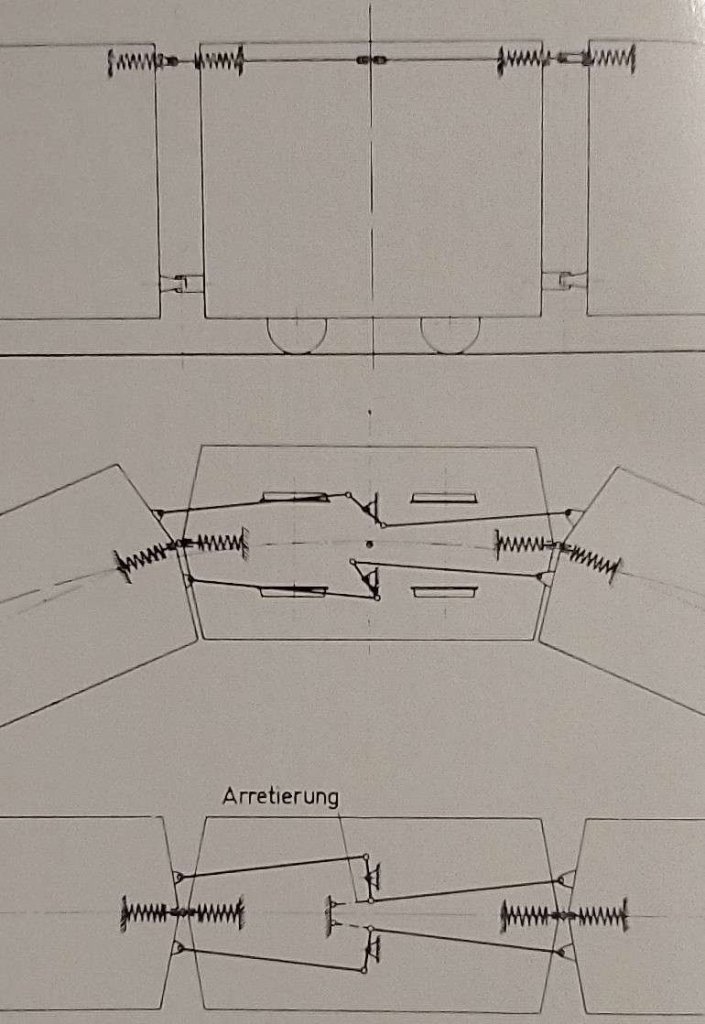
“This … led to a unified effort by the Basel and Zürich undertakings, the two largest tram- ways in Switzerland, to design an articulated car whose basic design was suitable for both undertakings. Whilst a classical (by German standards) two-section single-articulated six-axle car was built for Zürich by SWS (Schlieren), the co-operation between the two systems to find the most advantageous design resulted in an order for three articulated cars, two for the BVB (Basel) and one for the VBZ (Zurich), being placed with SIG (Neuhausen). SIG conceived a new style of construction, departing from the customary articulation over the central bogie (known as a Jacobs bogie) in favour of a short middle section on a two-axle non-rigid truck with an articulation at each end.
There [we]re so many common features in the design for both BVB and VBZ that practically the only differences [we]re in the number of motors and their electrical connections. Basel cars [had] four motors totalling 264 kW, whilst Zürich cars [had] six motors rated at a total of 396 kW. Motor bogie wheels ha[d] a diameter of 720 mm against the 660 mm of the Basel middle bogie wheels. Whilst the Basel cars [would] normally each haul a bogie trailer and the Zürich prototype car will also do this, the production batch of Zürich cars [would] run in multiple-unit pairs, and … (like Basel) have only two power trucks. Zürich has still to decide whether the two leading trucks will be motored, as distinct from the end trucks as at Basel. By confining the differences to these features (apart from minor differences in interior styling), the cars [could] achieve the maximum economy whilst ensuring the best use of the adhesion weight. By means of special mechanisms, it was possible to arrange the axle loadings so that the load on the driving axles was the same in both the four-motor and six-motor cars. Variations in the axle-load on the middle truck induce[d] horizontal forces in the upper part of the articulations; these induce[d] turning movements in the vertical plane, with consequent transfer of load between the outer and inner trucks. As a result of this design, the car [was] better able to start from rest on hills. [1: p19-21]
The advantages of the new design were:
The middle truck is not under the articulation mechanisms – so maintenance is much easier.
Rotation over each of the two mechanisms is half of that for one mechanism.
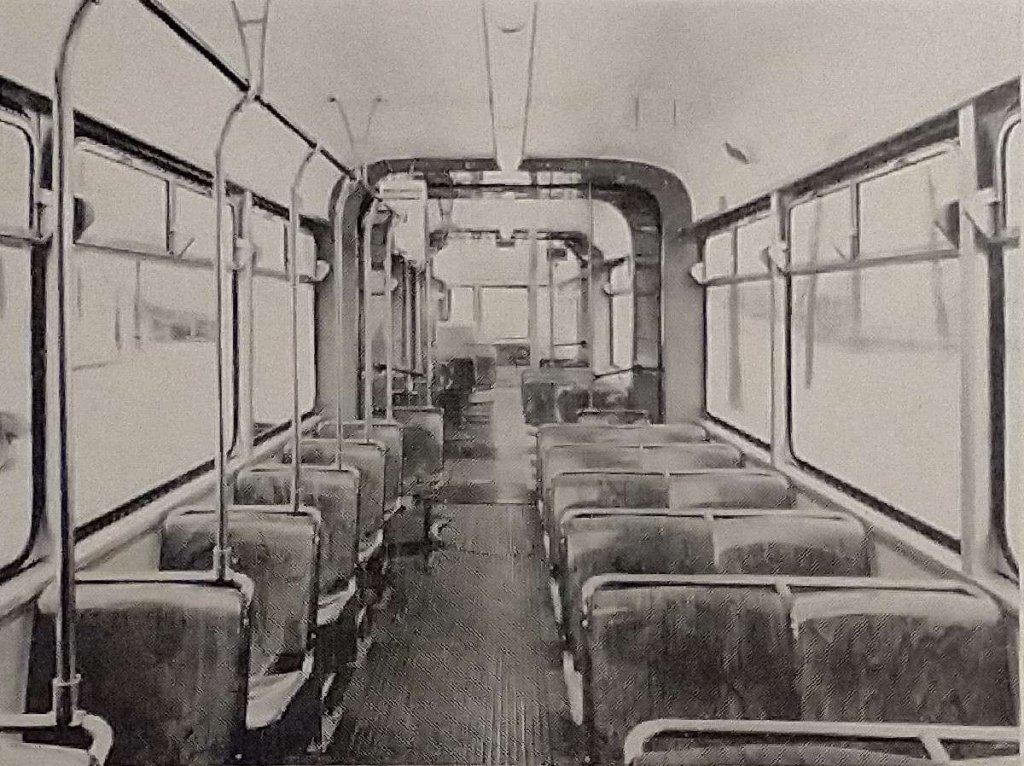
The body did not obstruct the drivers view of the exit doors which are in the middle section of the tram.
Double articulation permits wider front and end designs which allows doors to be built in the parallel sides of the tram.
A minimising of internal obstructions for passengers was achieved by the lesser amount of articulation required.
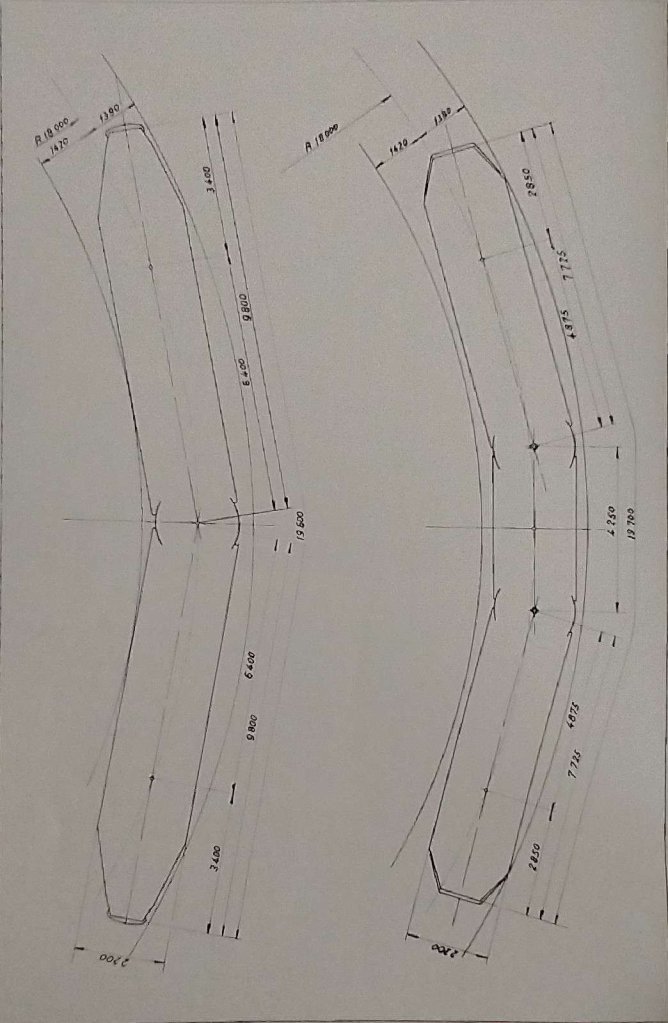
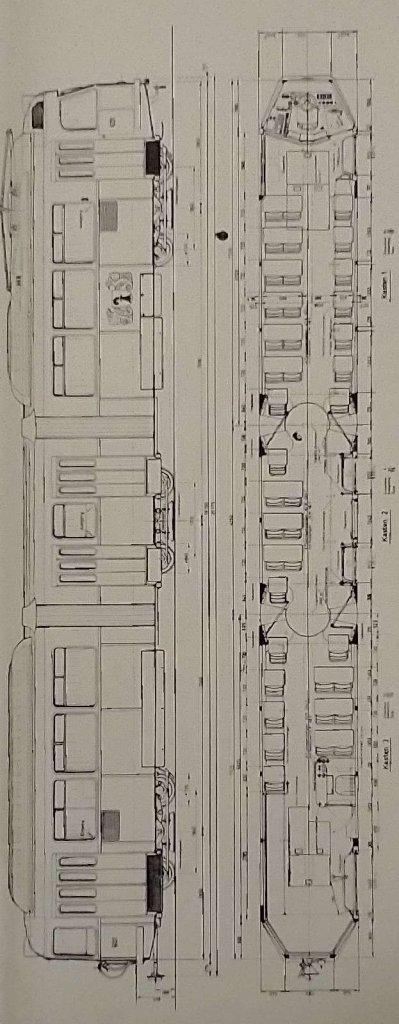
Trams travelled at a maximum speed of 60km/h and had a capacity of 42 seated and 123 standing. The empty car weighed 28.3 tonnes. The significant dimensions of the tramcars were:
Overall length between couplings: 20.45m
Length of body: 19.7m
Height of roof over rails: 3.385m
Width: 2.2m
Distances between king-pins: 7.0m
Overhangs: 2.85m
Wheelbase of motorised truck: 1.86m
Wheelbase of non-motorised truck: 1.7m
The article describes the trucks, braking systems and control systems as follows:
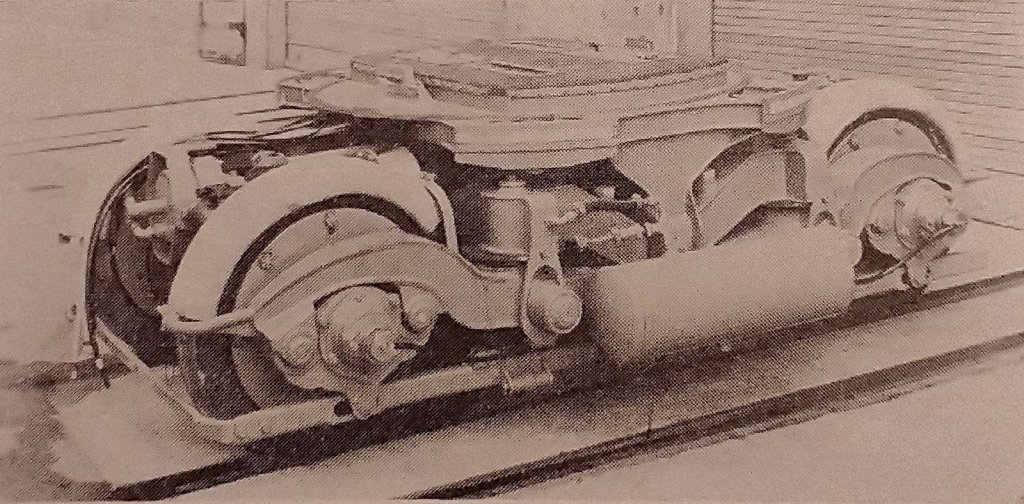
“The motor trucks are swing-link trucks with outside frames and torsion-bar springing. The springing of the torsion bar and the swing-links is combined into a single springing system, and this contributes considerably to noise reduction, in conjunction with the resilient wheels. The longitudinally-mounted motors are held by a three-point suspension to the truck frames, using rubber inserts.
The braking system: … The service brake is rheostatic, augmented with an air-operated disc-brake. A Charmilles brake handle is fitted under the controller wheel (a Volkswagen steering-wheel), … the air brake automatically supplements the electrical brake as the regenerative current dies out, and excessive braking through combined electric and air braking applications is eliminated. In an emergency, the braking effort can be supplemented with magnetic brakes. The parking brake is a hydro-mechanical hand brake. An Electro-pneumatic valve proportions the application of air to the trailer and (on the Basel cars) to the un-motored truck.
The control system has 22 running notches, of which the last three are field-weakening notches; there are 23 notches for rheostatic braking and a 24th emergency notch for magnetic braking in addition. The motors are connected in series pairs, each motor operating at half-voltage, and every effort has been made to keep the number of power cables crossing an articulation to a minimum.” [1: p190-191]
The Modern Tramway Journal also reported on a number of other features:
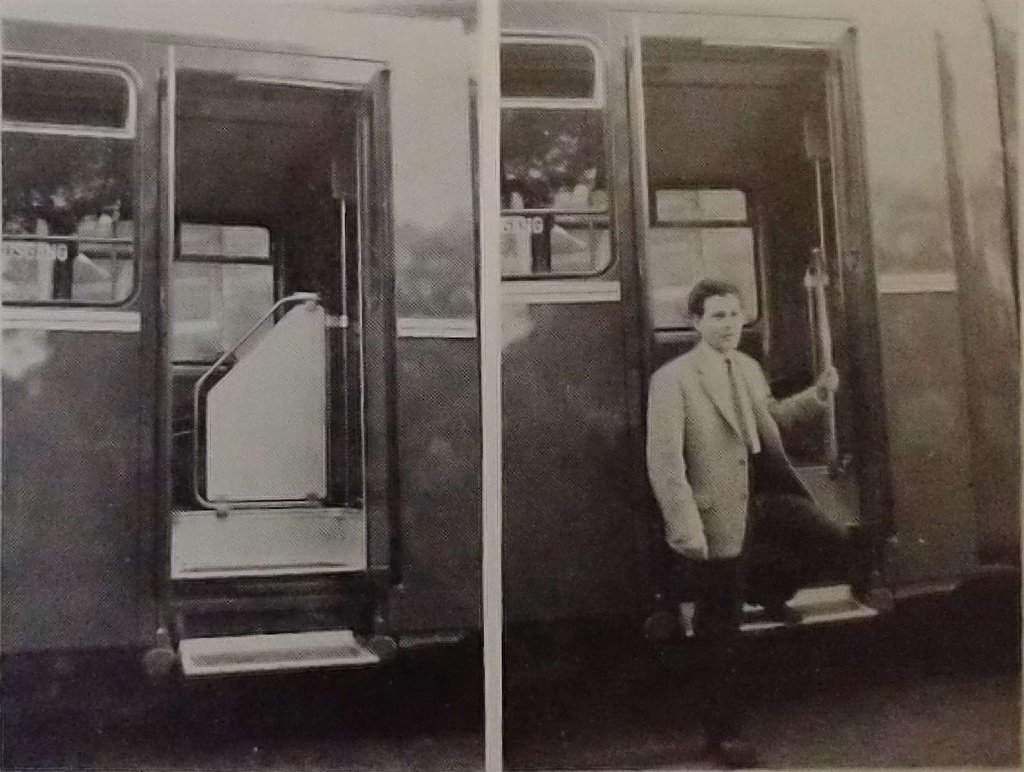
“The exit doors incorporate a device similar to that on the Stuttgart articulated cars. They are operated by the passengers through a push-button, and the opening of a light inner door by the passenger in order to gain access to the step holds the main doors open. The other function of the inner door is to prevent the entry of passengers at the exit doors. In Zürich, passengers would press the push-button to signal to the conductor to open the doors, whilst Basel had intended that passengers should open the doors themselves. However, as Basel experienced some confusion with this arrangement, they changed over to the Zürich system.
Particularly interesting features of the new cars include a “Hesomat” indicator blind, driven by an electric motor. The driver merely presses a “tens” button and a “second digit” button for the code number of the desired destination, and this is automatically set-up. Another innovation is the point-changing button enabling the driver to simulate a “power” signal whilst coasting past the detector. To prevent the current taken by auxiliaries causing a false “power” signal, a push-button in the centre of the controller wheel can cut off all auxiliary power as the detector is passed.
The Zürich undertaking needs new cars urgently and it is hoped that the number of articulated cars will ultimately rise to 200; they are intended to be the basic unit for the planned Tiefbahn (subway) services. The Basel plans are less ambitious for the present, but they hope to operate route 6 entirely by these cars at some date in the future. This route, from Allschwil to the German border at Riehen, is one of the fastest urban routes in Switzerland, and these cars should be particularly suitable.” [1:p191]
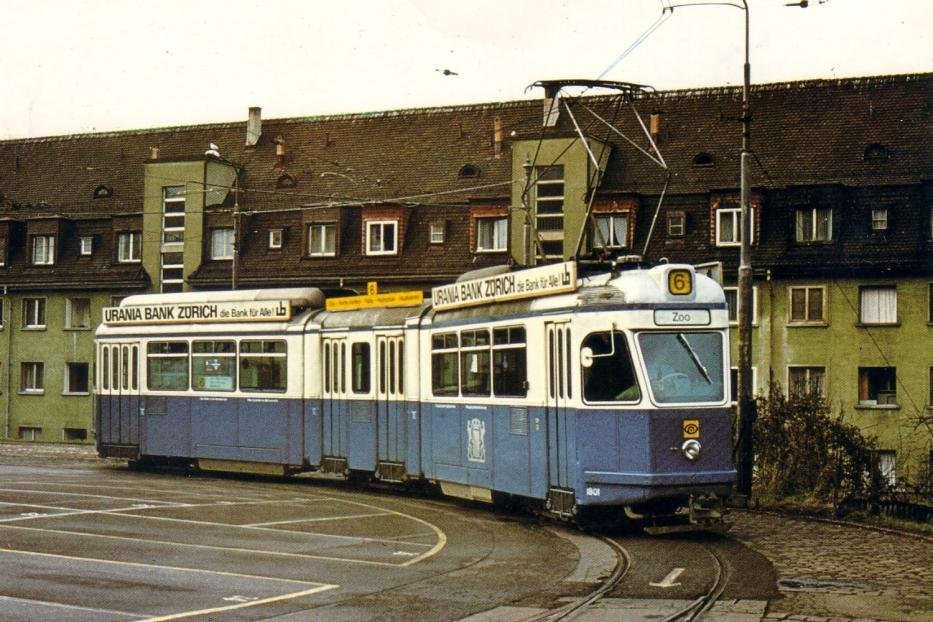
Ultimately, tram No. 1801 was a success as a prototype in Zurich. A series of these vehicles were purchased later in the 1960s and were called ‘Mirages’. [4] An online acquaintance tells me that a number of these trams were later sold to the city of Vinnytsia in Ukraine. Details can be found here, [6] and in the YouTube video below. [7]
Ukraine passes trams to Vinnytsia. [7]
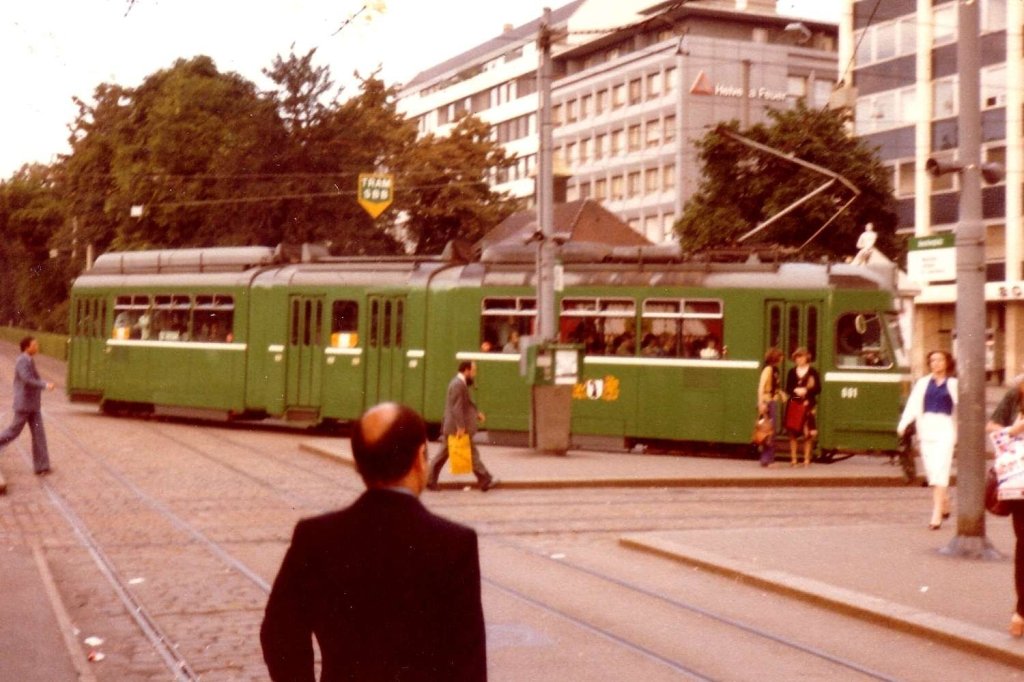
Tram No. 601 and its partner were less of a success in Basel. As a result, the two trams ordered by Basel were not followed by a larger order. They remained the only Basel trams of their specific type. [5] Basel did purchase further articulated trams but from different a different source.
References
H.J. Bertschmann, G.A. Meier & M. Frei; New Articulated Tramcars for Basel and Zurich; in Modern Tramway, Light Railway Transport League and Ian Allan, Hampton Court, Surrey, June 2022, p187-191.