

An earlier article about the Listowel & Ballybunion Railway can be found here. [1]
The featured image for these notes is a sketch of the Lartigue locomotive, (c) Public Domain. [8]
This short note pulls together a few other references to the line and to the Lartigue Monorail System.
D. Gordon Tucker wrote a short article in the Railway and Canal Historical Society Journal in 1984. The article can be found here. [2]
Listowel & Ballybunion Railway Locomotives Nos. 1-3


Andrew Neale wrote a short introduction to these unusual Hunslet Locomotives which was carried by the Narrow Gauge & Industrial Railway Modelling Review in July 2007. …
“The line’s first locomotive had been built by Tubize in Belgium and had previously been used briefly on a short demonstration line in London. It had twin vertical boilers but was primarily used on construction, the three new Hunslets working the regular traffic. These were makers numbers Hunslet 431 to 433, with the first two leaving the works on 10th October, 1887 and the third one seven days later. Each locomotive had twin boilers with two 7 ins x 12 ins cylinders driving three 24 inch diameter wheels on the engine portion giving a tractive effort of 3112 lbs. All wheels on both boiler and tender were double flanged and the horizontal guide wheels were of 12 inch diameter. The two boilers had Salter safety valves, and the main brake reservoirs were mounted under each boiler. The cab and tender were also divided and the latter was fitted with two auxiliary cylinders of 5 x 7 ins. driving the two carrying wheels by means of a jackshaft and side rods to add a further 926 lbs to the tractive effort.
“The locos were painted dark green with large circular brass number plates on the tender and a similar brass patent plate on each cab side.” [4: p288-289]
The locomotives proved, in service, to be under-powered. Insufficient steam was generated to be able to make use of both the standard and auxiliary cylinders noted in the sales catalogue sheet above. Neale tells us that the auxiliary cylinders were soon removed and that double-heading of trains became standard practice on the line. Neale suggests that Hunslet’s drawing office was aware that the auxiliary cylinders, although specified by the customer, might not be successful. The drawing office prepared plans for the powered tenders requested and for a ‘conventional, non-powered one.
Driving these locos was not easy, there was considerable noise from the track and the driver also had to fire one of the boilers. Nonetheless, the line settled down to a effective existence for 36 years! It was only the advent of road motor competition which forced closure in 1924.
“Many relics of the former line have been painstakingly salvaged and put on display. … A short replica of the line has been built in Listowel using a replica Loco and coaches from Alan Keef Ltd. although sadly this is diesel-powered. ” [4: p289]
Oakwood Press No. LP33 – Reprint

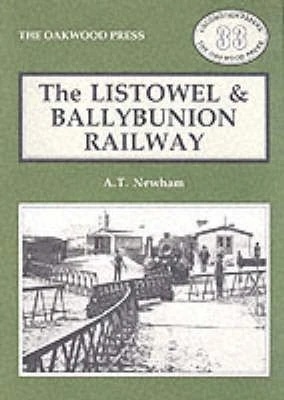
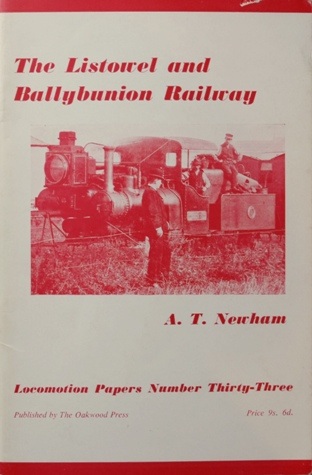
First published in 1967 as a slim Oakwood edition by A.T. Newham, going through two print runs. In 1989, Oakwood issued a new edition. This 2025 edition, was reprinted with a new cover design,
The book is softback, has 112 pages of text, around 100 illustrations including many black & white photos, route map, detail maps and drawings of carriages and locomotives. Covers of earlier editions are shown below. [5]
A Centenary Publication

Michael Guerin: A book was published about the railway by the Lartigue Centenary Committee in 1988. [6]
The Lartigue Centenary Committee was formed in Listowel, County Kerry, Ireland, in 1988 to mark the centenary of the unique Lartigue Listowel and Ballybunion Railway. The group published a foundational local history book and later evolved into restoration and twinning efforts.
The committee arranged for the construction of about 1000 m of demonstration track on which a full-scale diesel-powered replica of the original carriage can operate.
A museum was set up in ex-CIE (Irish State Railways) goods shed, which shows a film of the original line in operation and a large-scale model of the Lartigue station. The site of the original Listowel terminus is preserved in a nearby park and some track foundations remain along the remarkably straight road to Ballybunion. [7]
References
- https://rogerfarnworth.com/2018/12/31/the-listowel-and-ballybunion-railway/
- https://rogerfarnworthsrailways.wordpress.com/2026/08/08/lartigue-rchs-journal-28th-march-1984/
- Listowel & Ballybunion Railway Nos. 1-3; in Narrow Gauge & Industrial Railway Modelling Review Vol. 9 No. 71; Roy C. Link, Garndolbenmaen, Gwynedd, July 2007, p286-287.
- Andrew Neale; Listowel & Ballybunion Railway Nos. 1-3; in Narrow Gauge & Industrial Railway Modelling Review Vol. 9 No. 71; Roy C. Link, Garndolbenmaen, Gwynedd, July 2007, p288-289.
- Michael Foster; The Listowel & Ballybunion Railway; Oakwood Press, Stenlake Publishing, Catrine, Ayrshire, 2025.
- Michael Guerin; The Lartigue Listowel & Ballybunion Railway; Lartigue Centenary committee, 1988.
- https://www.erih.net/i-want-to-go-there/site/lartigue-monorail-museum, accessed on 10th August 2026.
- https://upload.wikimedia.org/wikipedia/commons/thumb/9/97/Lartigue_Lokomotive.png/1280px-Lartigue_Lokomotive.png?utm_source=en.wikipedia.org&utm_campaign=imageinfo&utm_content=thumbnail, accessed on 10th August 2026.
 Roger Farnworth
