I have a few older copies of Modern Tramway which I had not yet read. The first of these is the January 1951 issue, this is a third reflection from that copy of the Journal.
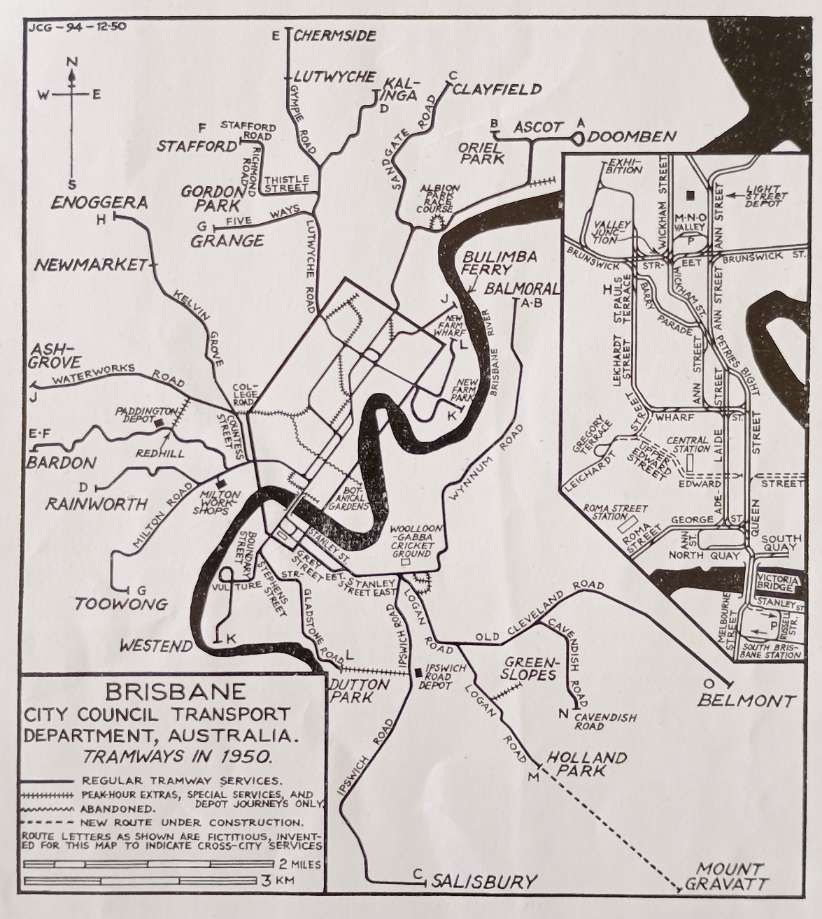
The Brisbane City Council Transport Department Tram Network in 1950. [1: p17]
“Brisbane, the capital of Queensland, Australia, was first settled in 1824. From that date it grew steadily, expanding round the broad winding Brisbane river to become the great city and seaport it is today. Horse trams were introduced by the Metropolitan Tramway and Investment Company in August 1885, and these gave way to electric cars in 1897 and 1898. At the same time, the Brisbane Tramway Company was formed to take over operation of the electric lines and this company built many extensions to the system to match the needs of the fast-growing city. In 1923 the tramways passed into the hands of the Brisbane Tramways Trust, a government board representing Brisbane ratepayers; this Trust was only a temporary body, and when the Greater Brisbane City Council was formed in 1925, the tramways and all city transport became the concern of the Brisbane City Council Transport Department.
“When the public authority took over in 1923, the fleet consisted of 195 cars: today [1950] the Department operates 420 tramcars and 154 single-deck diesel buses. The old B.T.C. cars, many of which are still running, are of great variety and include 4-wheel and bogie “toast racks” and 4-wheel and 8-wheel end-loading saloons, known as ‘Dreadnoughts’. These cars appear only during peak hours and they present an odd appearance against the modern streamliners. … The first new tramcar design developed by the B.C.C. was the ‘drop-centre’ type of which 204 were built, numbered from 196 to 399. These cars have a plate frame, reversed maximum-traction trucks, open centre compartment with eight transverse benches and two closed end compartments. They seat 64, have a maximum capacity of 110, and are 45ft. 6in. long.
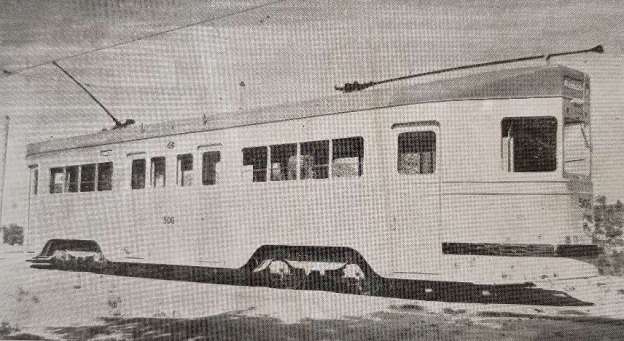
“In 1938, a second new type was evolved, later to become known as the ‘400’ or ‘Streamliner’ class. Of these cars, 108 have been built to date [1950], the prototype, No. 400, differing slightly in appearance from its successors. These fine cars are 49ft. in length, seat 64 with a total capacity of 110, and are very fast. The post war version, numbered 473-508 is an improved type with sliding doors: 483-508 have Dunlopillo seating and panelled bodywork; 497, 498, 499, 505, 506, 507 and 509 are fitted with resilient wheels and a multi-notch controller. Other noise-reducing features not yet introduced include rubber inserts in the trolley head. A further 50 of the improved “400” class are yet to be built. Other features of these cars are:
– Integral construction, the whole of the frame and panels being of steel with no separate under-frame.
– Interior lined with varnished natural timber, ceiling of white-enamelled masonite.
– Sashless windows operated by Young full-drop window balancers.
– Motorman’s windows of armour-plated glass and fitted with air-operated windscreen wiper.
– Bogie trucks equipped with GE 247A motors of 40 h.p. each and air brakes.
– Double helical driving gears.
– Air compressors and trolley base mounted on special rubber fittings to reduce noise and vibration.
“The B.C.C. livery is silver with blue lettering.
“The general condition of the track is good, all new track being laid in solid concrete to the top of the rails. On straight track 82 lb. railway rail is used without guard rails, the groove being formed in the concrete. Curves are laid with British Standard 6C tramway rail. There are reserved and private-right-of-way sections on the Chermside, Salisbury, Belmont, Rainworth and Ascot routes. The Chermside extension, opened in 1947, is a model layout with rails laid in concrete and flower beds on either side of the tram track separating it from the motor road: the poles supporting the overhead are at the side of the road.
“Since the war ended in 1945, extensions of three lines have been opened: to Belmont (31st July 1948), to Chermside and to Enoggera (13th August 1949). An extension from Holland Park to Mount Gravatt (1 3/4 miles) is at present under construction and two more extensions are provided for during the current financial year. The Holland Park line now under construction is a street line, and will serve a new housing area. The new lines completed since the war, together with the Mount Gravatt extension, total about six route miles. On 30th June 1949, the total route mileage was 65 miles 60 chains (track mileage 119 miles 75 chains). Of particular interest is the new Ann Street diversion. Formerly all routes [that] passed through the city centre (with one exception) converged at an awkward bottleneck in Petrie Bight. As had been long feared, an accident occurred at this point during a Saturday midday peak with resultant dislocation of traffic. To avoid any recurrence, the Tramway Department constructed a line in Ann Street (about 1/8 mile) from Wharf Street to Petrie Bight in 1946. Of single track with double track junctions, the new line, used only for emergencies, is of standard concrete construction with double overhead wire. It is planned to place tram tracks underground at the inter-section of Ann and and Queen Streets as a first move in a more extensive future city centre subway plan to relieve surface traffic and speed up street transport. When this plan takes shape, Brisbane will be the first Australian city to have tramway subways (the Wynward line in Sydney was built by the Railway Department and is only on loan to the tramways until the underground railway proper is constructed).
“On weekdays the fares start at 2d. for one section and an additional penny for each section, but there are zone fares to and from the city at a reduced rate, and on some routes these work out at about a penny a mile. On Saturdays and Sundays after 6.30 p.m. the fares are increased by a penny with the exception of the first section which remains at 2d. From Monday to Friday concession tickets sold in books of eight for a shilling may be used at the rate of one ticket for each section and are much in demand. On Sundays excursion tickets are sold at 1s. 6d. for adults and 3d. for children; they allow the holder to travel anywhere on the system between 8 a.m. and 2 p.m. or between 2 p.m. and 10 p.m.
“The only tramway that has been abandoned in Brisbane is the short length between the Botanical Gardens and Queen Street and from Queen Street to Gregory Terrace, all in the city centre and operated as two short shuttle services until 1948. This route from the the Gardens to Gregory Terrace will form part of Brisbane’s first trolleybus route (the remainder of the route along Coronation Drive to the University at St. Lucia has never been a tram line) and bodies are now being constructed on 30 Sunbeam trolleybus chassis; it is anticipated that these 44-seater all-steel trolleybuses will be in operation before the end of 1950.
– St. Paul’s Terrace – Enoggera. – West End – New Farm Park. – Dutton Park – New Farm Wharf. – Belmont/Cavendish Road/Holland Park – Wharf Street or Valley Junction.
– Valley Junction – South Brisbane Station.
(Special and short workings are not included in the above list.)” [1: p15-16]
In practice, “Brisbane’s historic tramway network operated from 1885 to 1969, serving as a vital transport link before being replaced by buses. Known for its iconic, largely open-design ‘toastrack’ trams, the network reached a peak of 109 km in 1954, connecting suburbs like Paddington, Ascot, and Toowong. The system officially closed on 13th April 1969.” [2] The horse-car era lasted from 1885-1899, the electric-car era from 1899 to 1969.
Trams “ran on standard gauge track. The electric system was originally energised to 500 volts, and subsequently increased to 600 volts. All tramcars built in Brisbane up to 1938 had an open design. This proved so popular, especially on hot summer nights, that the trams were used as fundraisers and often chartered right up until the last service by social groups.” [2]
Brisbane was the last capital city in Australia “to close its tram network. Despite the decision to shut down the network, Brisbane’s trams were held with great affection by locals, and one commentator described their removal [as] ‘one of the most appalling urban planning mistakes in the city’s history’. [3] There have been ongoing proposals since the early 1990s to reinstate a functional tram network.” [2]
In the 21st century, Brisbane has its own ‘Metro’ but it is not a tramway network. “Since the 1990s, busways were considered as one of the options when the Queensland Government developed the 25 year Integrated Regional Transport Plan. It was recommended that a 75 km (47 mi) network of busway corridors to complement the existing Queensland Rail City network,” [4][5] should be built.
The first section of busway, opened in September 2000, with the rest of the South East Busway opening in April 2001 at a final cost of over $600 million. [6] Planning and construction of the Northern and Eastern Busways began soon after the success of the first section, increasing bus commuter statistics. As of 2025, the city had three busways, spanning 29 kilometres, including 28 stations and 20 tunnels. [4][7]
As of 2007, 294 buses per hour (one way) – 1 bus every 12 seconds – passed through the busway network’s busiest point (a section of the South East Busway north of Woolloongabba station). Further, capacity issues occurred at other locations in the city. [4]
“In order to meet the capacity bottlenecks of the busway system, various solutions [were] proposed, including conversion to light rail, the BaT tunnel, a second Victoria Bridge, bus route changes, and later, Brisbane Metro.” [4][8]
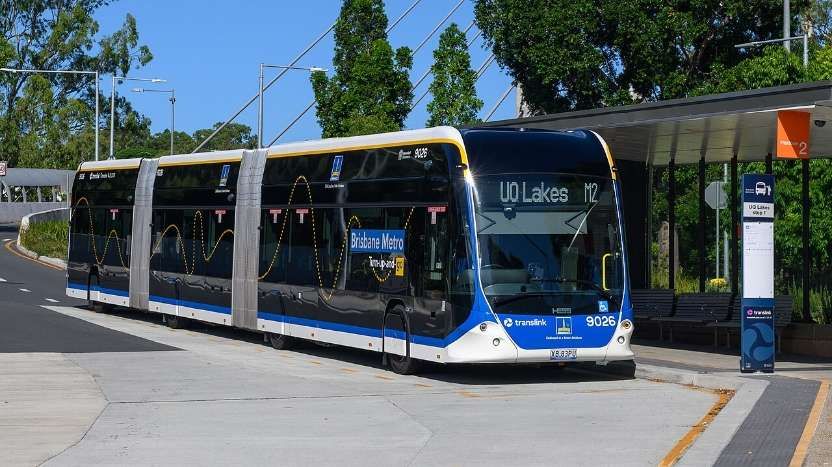
The initial proposals for a rubber-tyred metro of 2016 were adapted to meet specific concerns. Bi-articulated buses were chosen. The buses would operate on two routes. The business case released in November 2017 costed the project at AUS$944 million. By April 2018, the federal government had agreed to contribute AUS$300 million.
In November 2019, BCC announced that a consortium of Hess, Volgren and ABB had been awarded a contract for 60 buses. The buses were to be fully electric via overhead wireless charging that will charge at the end of each route for less than six minutes. [4][9]
“A pilot bus was built and tested in Europe in 2021, arriving in Brisbane for testing in early 2022. Following successful testing, an order was placed for the remaining 59, with close to 1000 modifications based of the original pilot vehicle. [10] The 60 vehicles cost AUS$190 million, an increase of $100 million compared to more traditionally powered vehicles, with deliveries beginning in late 2023. As of 2026, the full 60 ordered are still being delivered.” [4][11]
“The system consists of two routes over 21 km (13 mi) of busways. The routes serve Brisbane CBD every five minutes during peak times, extending as far as Eight Mile Plains, the Royal Brisbane and Women’s Hospital and the University of Queensland respectively. Route M2 began service on 28th January 2025. Route M1 began service on 20th June 2025.” [4]
A route map for the Metro can be found here. [12] Route M1 connects with the South East Busway services. Route M2 connects with the Northern Busway services. [12]
In April 1920, a couple of paragraphs in The Railway Magazine focussed on a new experimental Railmotor constructed by New South Wales Railways. [1]
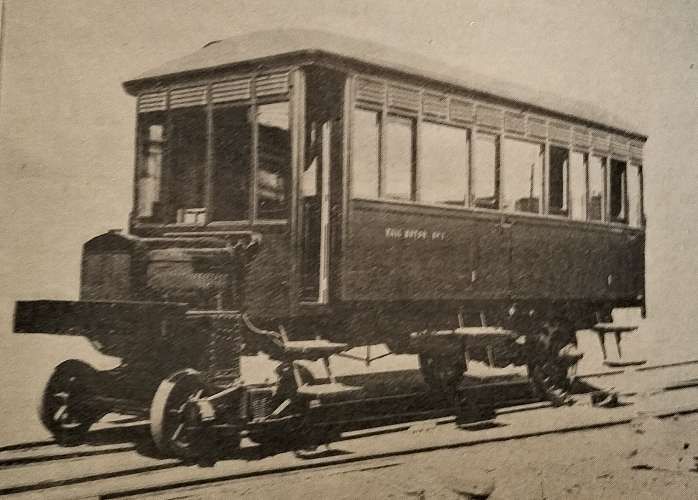
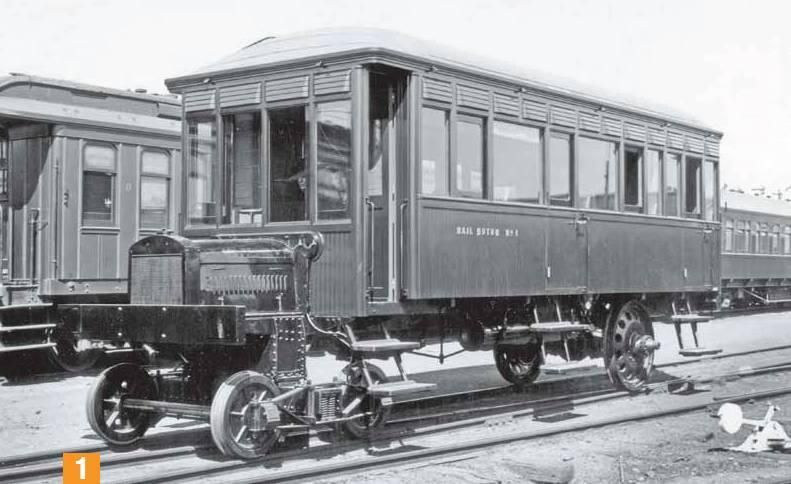
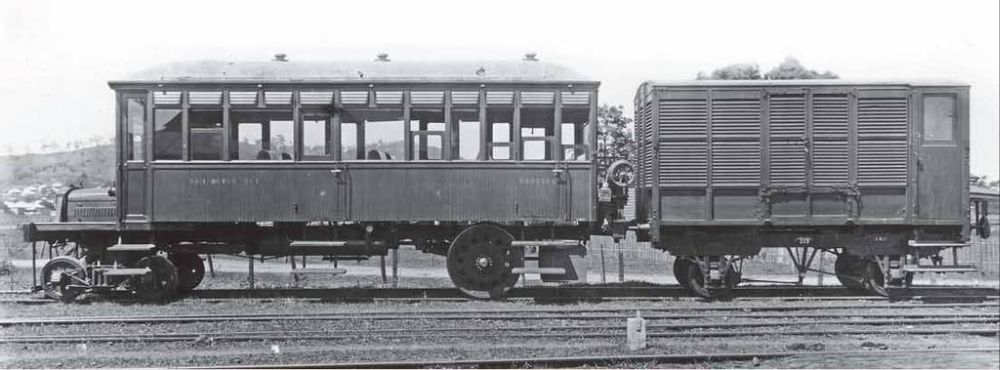
Railmotor No. 1
In April 1920, The Railway Magazine reported that New South Wales’ Railway Commissioners introduced a railmotor service on the Lismore line, an isolated section on the North Coast. The railmotor car was provided by converting and lengthening to 8 ft. 6 in. the chassis of a five-ton Moreland motor lorry. The front pair of wheels were also replaced by a four-wheeled bogie. The railmotor provided seating accommodation for 33 passengers, and was designed and constructed at the carriage and wagon shops of the system at Eveleigh, Sydney. [1]
Before being placed in service, a severe trial run was made, and proved in every way to be most successful; a I in 40 grade being taken at a speed of 18 m.p.h. The time-table was arranged for speeds up to 25 mph. The Railway Magazine noted that if found satisfactory in continued service similar rail-motor services would be introduced on other branch lines. [1]
NSW Railmotor No. 1 was powered by a 42 hp 4-cylinder American Waukesha petrol engine. This engine was later replaced by a 40 hp British Thornycroft 4-cylinder petrol engine. This vehicle proved a success on the line between Lismore and Grafton. [3]
“The wooden body … was finished in narrow tongue and groove boards. It was divided into three separate sections, accommodating 33 passengers and 2 crew. The first section was the cab, which accommodated the train crew (the driver and the guard). The second section (the forward compartment) accommodated 23 passengers and the third section (the rear compartment) was a smoking area and accommodated 10 passengers. The two passenger compartments were fitted with transverse seats and drop type windows, and each compartment had two doors, which opened outwards. There was no interconnection between the three compartments. Steps were fitted under each of the doors to allow passengers to alight from the vehicle to ground level.” [3]
“The Railmotor was designed to run in one direction only and draw-gear was fitted to the trailing end so that a trailer could be attached for hauling light goods and parcels. A collapsible tricycle (trike) was also carried for the train crew’s use in case of an emergency or breakdown in the section. This was carried on the back of the Railmotor.” [3]
“In November 1925, after six years of reliable service, [this vehicle] was withdrawn from passenger traffic and it took on a new role as the Signal Engineer’s inspection car. It subsequently lost its title of Railmotor No.1 as this was re-allocated to one the newly designed 42-foot Railmotors in November 1926.” [3]
“No. 1 was finally withdrawn from railway service in 1930. The body was sold and it began a new life as a house in the Coffs Harbour region, while the chassis was scrapped.” [3]
As we have already noted, one drawback with Railmotor No.1 was that it was only single ended and needed to be turned at the terminus for the return journey. Therefore double-ended operation was to be provided in the next prototype vehicle, Railmotor No.2, built in 1921. [3] Both trial vehicles were sufficiently successful to mean that the railway company went on to use a number of Railmotors.
Railmotor No. 2
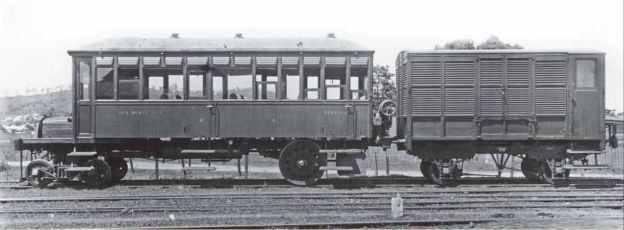
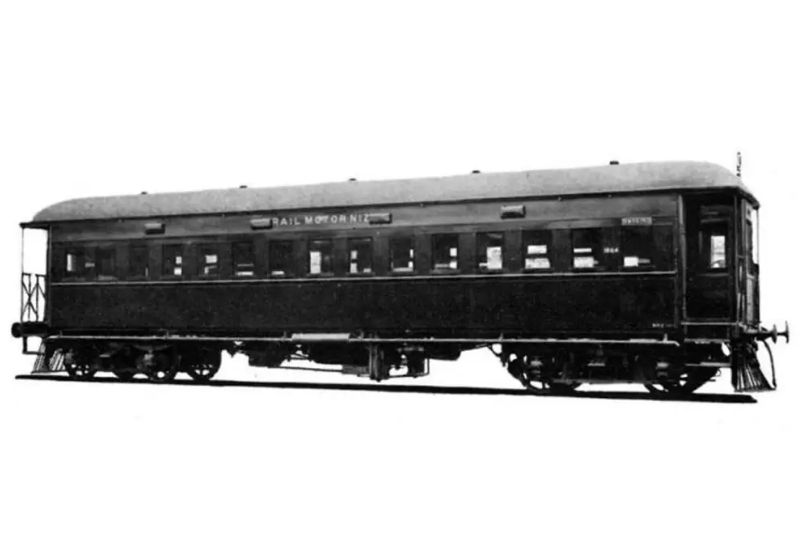
Railmotor No. 2 (Kathleen)! “An end-platform suburban type carriage, FA 1864, was chosen for this experimental vehicle. Eveleigh Carriage Works converted this carriage to a Railmotor while its mechanical parts and the petrol engine were designed and built in Eveleigh Locomotive Works.” [3]
Configured as a railmotor, Kathleen (never its official name) “was divided into 4 sections, accommodating 53 passengers and 2 crew. [A] driving [cab was] positioned at each end. The First Class section accommodated 16 passengers, while the Second Class section accommodated 37 passengers. … Driving cabs were mounted in the centre of the end platforms at each end of the vehicle. Entry to the cab was gained through a back door that opened into the passenger compartment. The driving controls were arranged to allow the vehicle to be driven from either end and this meant the vehicle did not have to be turned for the return journey.” [3]
The first class section of the Railmotor “occupied one third of the vehicle’s length and the second class area occupied the remaining two thirds. Access to either area was gained through a door contained in a wall separating the two compartments. The engine protruded through the floor of the second class area and was covered by a padded fixture providing seating for an additional 5 passengers. This fixture measured 10′ 6″ x 3′ 6″. Battery boxes were also located in this central area and these to were covered with padded seats providing seating for 12 passengers.” [3]
“Railmotor No. 2 was powered by a 6-cylinder 100 hp (@1,000 rpm) petrol engine manufactured in the Eveleigh Railway Workshops. This engine was regarded as a fine piece of engineering, as it was reversible. That is, it could be turned in either direction and it contained features such as coil ignition, seven bearing crankshaft, together with overhead valves and camshaft. To make the engine turn in the opposite direction a camshaft containing two sets of cams was slid into position by means of compressed air. This engine weighed 22 cwt. A three-speed gearbox was coupled by cardan-shaft to both axles on one bogie. The vehicle was geared to give a road speed of 40 mph (@1,425 rpm) in top gear. Total weight of the vehicle of 26 tons 7 cwt 2 qtr.” [4]
“As the Railmotor could run in either direction, buffers, cowcatchers and standard screw drawgear were mounted on headstocks at either end and electric headlights were mounted above each of the driver’s windscreens. Electric lighting was used for the cab and compartment areas.” [4]
“Railmotor No.2 ran trials between Tamworth and Barraba on the 29th April, 1921. On the 15th October, 1922, the public timetable officially showed the railmotor, which provided a faster daily service (except Sundays) in place of the three times weekly mixed train service.” [4]
“No.2 failed to complete about two thirds of its allotted mileage during the first twelve months of operation and this poor performance was put down to undulating grades on the Barraba branch. The unit was eventually withdrawn from this working in November 1924. The unit proved a little more successful when it was trialled on the easier graded Burren Junction to Pokataroo branch during 1925.” [4]
It was withdrawn from service “in November 1925 and reverted to its original role as a suburban carriage number FA 1864. The engine that powered No.2 found a new life driving a water pump at Armidale and later at Valley Heights. … A proposal to construct another five cars similar to Kathleen but with an increased seating capacity lapsed. New designs proceeded and the standard 42-foot railmotor emerged.” [4]
References
Petrol Railmotor Car: New South Wales Government Railways; in The Railway Magazine, April 1920, p230.
Victoria’s and South Australia’s railways were 5ft 3in broad gauge. New South Wales’ railways were standard-gauge, Queensland’s were 3ft 6in gauge. And, as of 1899, the authorities were in no sense inclined to yield up their gauge to progress. [1: p417]
Perhaps we need a review of the historical context. Wikipedia provides a narrative which aids in understanding why Australia ended up with three different railway gauges.
“In 1845, a Royal Commission on Railway Gauges in the United Kingdom was formed to report on the desirability for a uniform gauge. As a result, the Regulating the Gauge of Railways Act 1846 was passed which prescribed the use of 4 ft 8 1⁄2 in (1,435 mm) in England, Scotland and Wales (with the exception of the Great Western Railway) and 5 ft 3 in (1,600 mm) in Ireland. … In 1846, Australian newspapers discussed the break of gauge problem in the United Kingdom, especially for defence [and] in 1847, South Australia adopted the 4 ft 8 1⁄2 in gauge as law.” [5]
“In 1848, the Governor of New South Wales, Charles Fitzroy, was advised by the Secretary of State for the Colonies in London, Earl Grey, that one uniform gauge should be adopted in Australia, this being the British standard 4 ft 8+1⁄2 in gauge. The recommendation was adopted by the then three colonies.[10][11][12] Grey notes in his letter that South Australia has already adopted this gauge.” [5] As at that time, Victoria and Queensland were part of New South Wales. It would seem as though this instruction should have settled the question of a suitable railway gauge for the Australian continent. However, communication with the UK took anything between 2 1⁄2 and 7 months before the installation of the Australian Overland Telegraph Line and under-sea cable communications in 1872 and debate over matters of consequence could be very protracted. In 1850, the NSW legislature sought a change of gauge to match the Irish standard gauge of 5 ft 3 in (1,600 mm). This was endorsed by the NSW Governor, and Colonial Secretary Earl Grey in London. That agreement was confirmed in 1851. In the meantime, a new engineer, James Wallace, was appointed by the railway company. He preferred the British standard gauge. “The government was persuaded to make the change back to 4 ft 8 1⁄2 in and in January 1853 they advised the company that the Act requiring 5ft 3in (1,600mm) would be repealed.” [5]
In February 1853, the other colonies (Victoria having separated from New South Wales in 1851) were sent a memorandum advising them of the pending change and it was recommended they likewise adopt 4 ft 8 1⁄2 in. IIn Victoria, the colonial government decided that it preferred the 5 ft 3 in (1,600 mm) gauge and an order for locomotives and rolling-stock was and placed.land communicated to suppliers in the UK.
“In July 1853, the Government of Victoria advised New South Wales that it would use the broader gauge and later appealed to the British Government to force a reversal of New South Wales’ decision. Subsequently, the Melbourne and Hobson’s Bay Railway Company opened the first railway in Australia in 1854, as a 5ft 3in (1600mm) a broad gauge line, and the South Australian Railways used the same gauge on its first steam-hauled railway in 1856.” [5]
Despite a request by the Secretary of State for the Colonies to reconsider the alteration to standard-gauge, in 1855, “the NSW Governor William Denison gave the go-ahead for the 4 ft 8 1⁄2 in Sydney to Parramatta railway, which opened in September of that year. … Concerns over the gauge difference began to be raised almost immediately. At a Select Committee called in Victoria in September 1853, a representative of the railway company which had not replied to Charles La Trobe’s earlier memorandum, reported a preference for 5 ft 3 in (1,600 mm), but when asked if Victoria should follow NSW he answered: ‘We must, I conclude of necessity, do so’. In 1857, the NSW railway engineer John Whitton suggested that the short length of railway then operating in New South Wales be altered from 4 ft 8 1⁄2 in gauge to 5 ft 3 in (1,600 mm) to conform with Victoria but, despite being supported by the NSW Railway Administration, he was ignored.” [5] At that time, there were only 23 miles (37 km) of track, four engines and assorted rolling-stock on the railway. “However, by 1889, New South Wales, under engineer Whitton, had built almost 1,950 miles (3,500 km) of standard gauge line.” [5][6: p186]
The problem was exacerbated when Queensland Railways opened their first line in 1865. They chose a narrow gauge, 3 ft 6 in (1,067 mm), on the supposition that it would be constructed more cheaply, faster and on tighter curves than the wider gauges. This line, between Ipswich and Grandchester, was the first narrow gauge main line in the world.
“South Australia first adopted this gauge in 1867 with its line from Port Wakefield to Hoyleton. The main reasons for choosing this were reduced cost, and the expectation that the narrow gauge would never connect to broad gauge lines. ‘Overbuilt’ English railways were criticised. The Wakefield line was also envisaged as a horse-drawn tramway. … Later narrow gauge lines went towards Broken Hill and to Oodnadatta and from Mount Gambier.” [5]
The Western Australian Government Railways adopted the narrow-gauge in 1879 for its first line from Geraldton to Northampton. [6: p186}]
“The Tasmanian Government Railways opened its first railway from Launceston to Deloraine in 1871 using 5 ft 3 in (1,600 mm) broad gauge, but converted to 3 ft 6 in (1,067 mm) narrow gauge in 1888.” [5][6: p186]
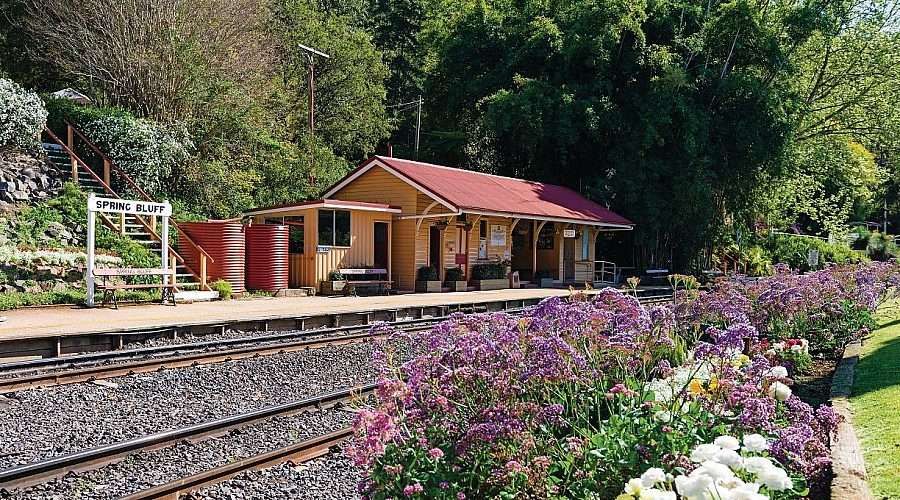
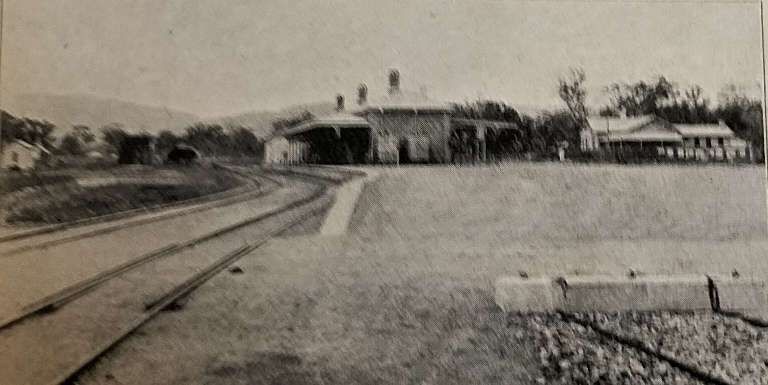
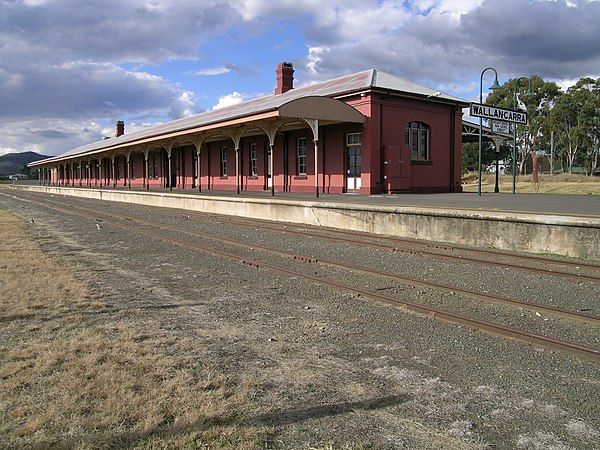
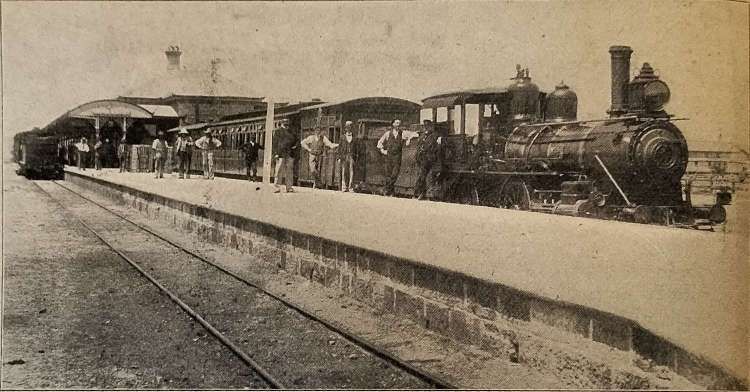
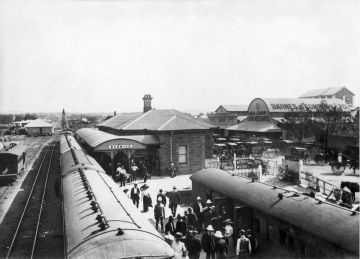
Queensland Railways train at Spring Bluff Station [1: p420]Spring Bluff Railway Station in 2024. Spring Bluff is best known for its heritage listed Railway Station, in the Spring Bluff valley tucked into the ranges north of Toowoomba. Spring Bluff Railway State is a favourite day trip for visitors, with the landscaped gardens and steam train rides attracting thousands for the spring exhibit during Toowoomba Carnival of Flowers. [14]
“South Australia first adopted this gauge in 1867 with its line from Port Wakefield to Hoyleton. The main reasons for choosing this were reduced cost, and the expectation that the narrow gauge would never connect to broad gauge lines. ‘Overbuilt’ English railways were criticised. The Wakefield line was also envisaged as a horse-drawn tramway. … Later narrow gauge lines went towards Broken Hill and to Oodnadatta and from Mount Gambier.” [5]
The Western Australian Government Railways adopted the narrow-gauge in 1879 for its first line from Geraldton to Northampton. [6: p186}]
“The Tasmanian Government Railways opened its first railway from Launceston to Deloraine in 1871 using 5 ft 3 in (1,600 mm) broad gauge, but converted to 3 ft 6 in (1,067 mm) narrow gauge in 1888.” [5][6: p186]
“Until the 1880s, the gauge issue was not a major problem, as there were no connections between the separate systems. The focus of railway traffic was movement from the hinterland to the ports and cities on the coast, so governments were not concerned about the future need for either inter-city passenger or freight services. It was not until 1883 when the broad and standard gauge lines from Melbourne and Sydney met at Albury, and in 1888, narrow and standard gauge from Brisbane and Sydney met at Wallangarra that the break of gauge became an issue.” [5]
“The issue of rail gauge was mentioned in an 1889 military defence report authored by British army officer Major General James Bevan Edwards, who said that the full benefit of the railways would not be attained until a uniform gauge was established. Until the turn of the 20th century, the benefits of a uniform gauge were not immediately apparent, since passengers had to pass through customs and immigration at the intercolonial border, meaning that all goods would have to be removed for customs inspection. It was only with [the anticipation of] Federation in 1901 and its introduction of free trade between the states that the impediment of different gauges became apparent.” [5]
The November 1899 edition of The Railway Magazine engaged in the discussion with the first of a series of three articles on the subject.
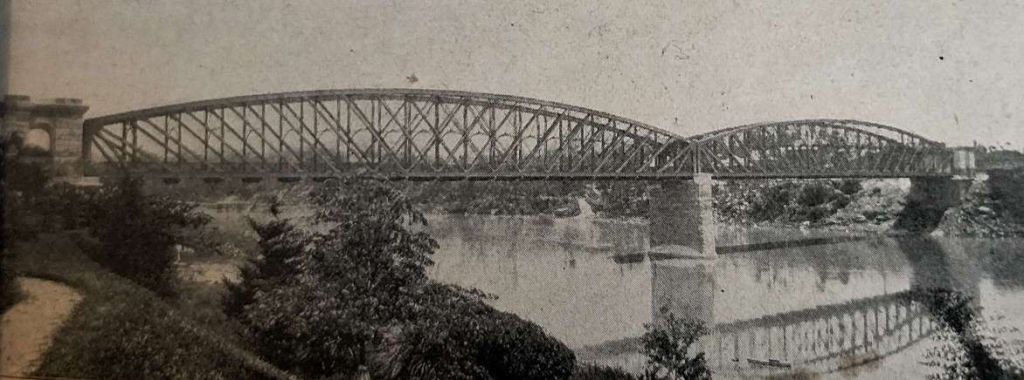
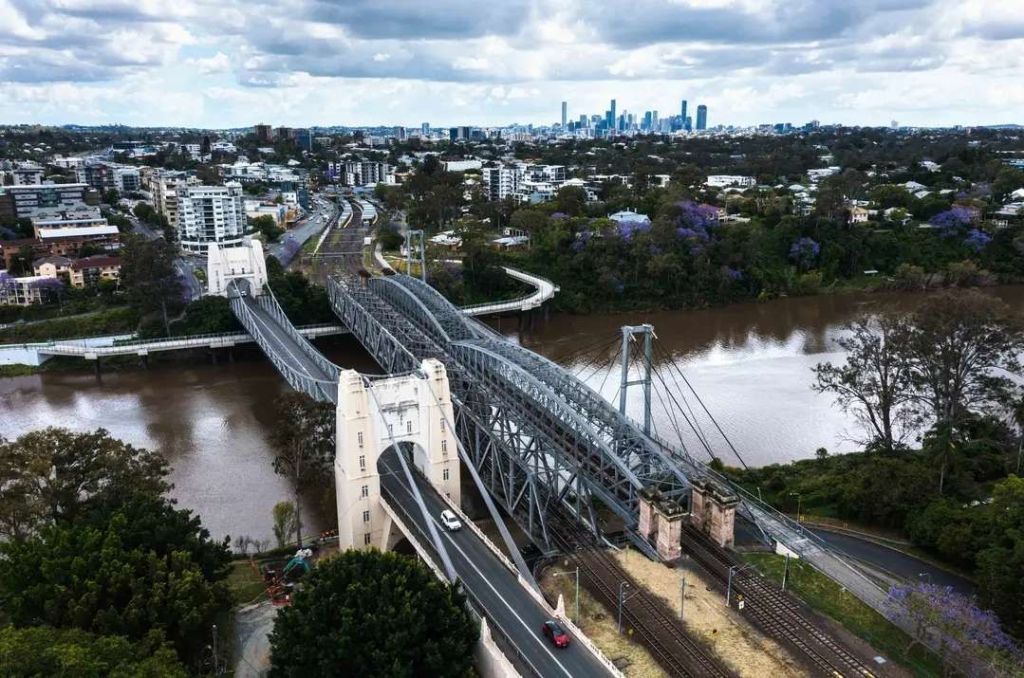
Indooroopilly Girder Bridge, Queensland Railway. [1: p417]The Indooroopilly Railway Bridge is still.in use in the 21st century. It now sits alongside a road toll-bridge. The railway bridge is undergoing refurbishment which started in 2022 and which is due to be completed by 2025. Eptec Services have been engaged to do the refurbishment work which will involve cleaning, sandblasting and repainting the bridge structure which is made up of steelwork fabricated in Italy. [15]
“All the aspirants for State rights and an Australian nationhood not unnaturally contend that the respective gauges now in use within their territorial boundaries are well adapted for their own requirements in the proposed Commonwealth.” [1: p417] So starts the first in a series of articles in The Railway Magazine (November 1899).
Despite the evidence tendered to those debating the formation of the new Commonwealth of Australia by accredited railway experts, the unification of railway gauges was “ultimately dropped as being beyond the grasp of Conventional solution.” [1: p418]
By 1897, the deliberations of the working group set up to address the difficulties brought about by the different gauges, resulted in a recommendation to their respective governments that the New South Wales standard-gauge be adopted at a probable cost of £2,400,000 to bring all of the colonies into line. (A better estimate of the cost, according to The Railway Magazine would be a minimum of £8,000,000). [1: p418]
Perhaps in the light of the expenditure involved in unifying the different gauges, the same working group met again in late 1898 to look at “several ingenious mechanical contrivances to overcome the break of gauge difficulties … [but these proposals] were deemed inadequate to the requirements of the proposed Commonwealth’s railway system.” [1: p418] The meeting endorsed the decision of 1897 with one dissenting voice, that of the Queensland representative, Mr R.J. Gray who reaffirmed his commitment to the 3ft 6in gauge.
In an article written in 1897, Gray’s deputy, Mr J.F. Thallon had indicated that no common gauge would, at that time, be agreed between the different jurisdictions. He proved “most clearly that the narrow gauge [had] been more cheaply constructed, worked and maintained than either the 4 ft. 8 1⁄2in. or 5 ft. 3 in., and that in Queensland, where the 3 it. 6 in. gauge [had] been adopted, the people [had] lower fares and freights than in New South Wales or Victoria; also, that the narrow gauge [was] capable of earning a revenue four times as great as the [then] present revenue of the Victorian railways and [was] therefore the best and cheapest gauge for a progressive Queensland.” [1: p418-419]
‘Rebus’ commented that “it will be readily admitted by all … that a uniform gauge throughout Australia would be a decided advantage. That need not be discussed, but a very pertinent question, if an alteration is to be made, is ‘Which is the best gauge for Australia?’ It is not the cost of conversion only we have to consider, but the extension of railways in the future, and the annual expenditure that will fall upon the generations yet to come. It is not a question of having one gauge from Brisbane to Sydney, or from Sydney to Melbourne, leaving the other lines in Queensland the same gauge as at present. Such a scheme would only perpetuate and intensify the evil, seeing that the traffic between Darling Downs and Gymple, Bundaberg, would all have to be transhipped in Brisbane. If a break of gauge is to remain anywhere, it could not be better placed than at Wallangarra, where there is little traffic. If a change of gauge is to be made it must … be complete, and include one and the same gauge for all Australia. Some have suggested a third rail between certain points, but the proposal cannot be treated seriously. To lay down a third rail in Queensland would cost more than to alter the gauge, and it would be much less satisfactory to all concerned.” [1: p419]
He continues: “The cost of converting the Australian railways to one uniform gauge, whichever be adopted, would be stupendous, involving, as it would, the absolute necessity of discarding and replacing enormous quantities. of rolling-stock, as well as the reconstruction of the permanent way of the converted lines. So far as mileage is concerned, the 3 ft. 6 in. gauge already almost equals (and adding extensions now in progress in Queensland and Western Australia, will quite equal) the other twoput together.” [1: p419-420]
By 1899, the lengths of each gauge open to public traffic were: 3ft 6in gauge, 5,280 miles; 5ft 3in gauge, 3,615 miles; and 4 f. 8 1⁄2in gauge, 2,531 miles. It was obvious to ‘Rebus’ that “to convert all lines to the 3 ft. 6 in. gauge would cost the community less in money, in time, and in public inconvenience than to adopt either of the other two. To alter the 4 ft. 8 1⁄2in. to 5 ft. 3 in. (which is the next important as regards mileage) would not be attended with insuperable difficulties, and it would have one substantial advantage, viz., that the rolling-stock of the 4 ft. 8 1⁄2in. gauge could be readily disposed of, whereas the 5 ft. 3 in. rolling-stock, if discarded would be a comparative drug on the market; but 5 ft. 3 in. as the uniform gauge would be decidedly objectionable, seeing it [was] all but obsolete. The question, so far as Australia [was] concerned, therefore reduces itself to 4 ft. 8 1⁄2in. or 3 ft. 6 in.” [1: p420]
‘Rebus’ goes on to review how the different gauges compared with each other in regard to cost of construction, revenue and expenditure, rates, fares, etc. He used the average expenditure of previous years to estimate the cost of construction and equipment: New South Wales had by that time spent £37 million on its railways, an average cost of £14,560/mile; Victoria had spent over £38 million on its railways, an average cost of £12,206/mile; Queensland had spent over £17 million on the miles of its network, £6,947/mile. He argued that it was vital to minimise cost of construction as the interest burden on each of the colonies was at about 50% of all expenditure!
Whilst, the cost burden of government borrowing was a significant argument. ‘Rebus’ seems to ignore the great advantages of increased speed and loading capacity available to networks of the wider gauges. Perhaps this was not so apparent at the end of the 19th century as it would become in later generations. It is clear that, in ‘Rebus” world, speed is of little value, cost is seemingly far more significant, perhaps this is indicative of the predominant concern being the transport of imperishable goods, rather than passengers or perishable goods.
‘Rebus’ goes on to argue that the cost per head of population was not particularly relevant but it was “very much the same in all three colonies, ranging from £29 in New South Wales to£36 in Queensland.” [1: p421-422] The length of railway per head of population was perhaps of greater significance – close to 28 ft in Queensland; 10 1⁄2ft in New South Wales; and 14 ft in Victoria! ‘Rebus’ argues that it was important to keep this disparity in mind when comparing the relative merits of different gauges, “because it is length of railway, not width, which is required to open up and develop the resources of Australia.” [1: p422]
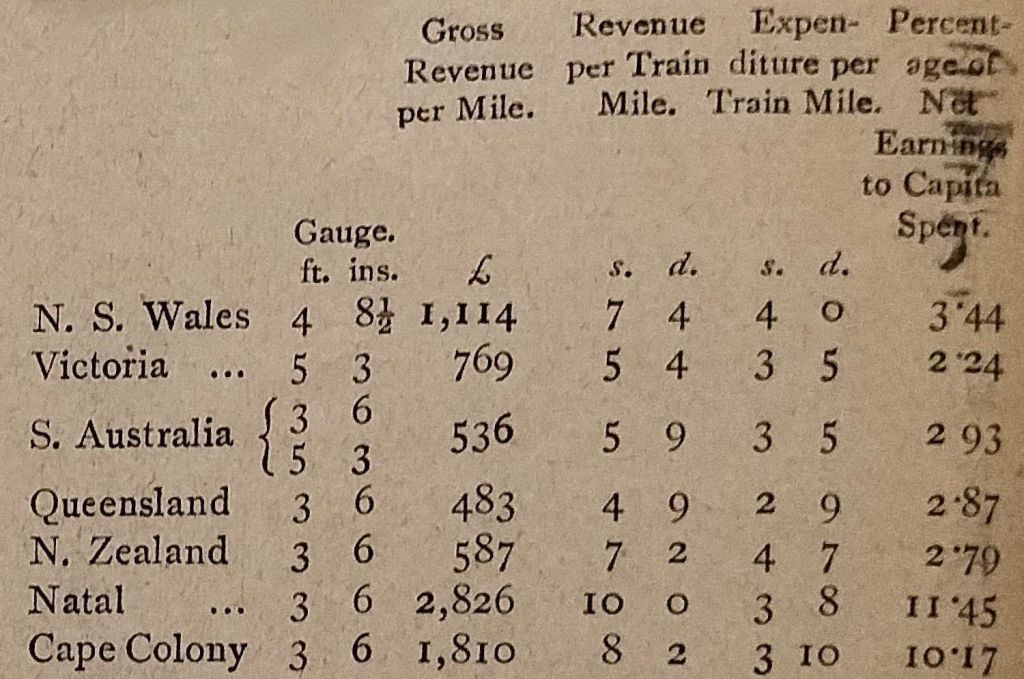
He further argued that if the cost of servicing loans, the cost of maintenance and working expenses were aggregated, then “the New South Wales railways must earn a gross revenue of about £1,200 per mile in order to pay their way, Victoria £984, and Queensland £563. Taking the latest published returns, New South Wales earned £1,114 per mile, Victoria £769, and Queensland £483. In this respect,” he said, “the colonies of Australia [were] far behind other colonies where a uniform gauge of 3ft 6in is in operation.” [1: p422]
‘Rebus’ provides this table to allow a comparison of the percentage of net earnings to capital spent. [1: p422]
In the table above it can be seen that the return on investment in the two colonies in South Africa was significantly higher than all the networks in Australia and New Zealand. ‘Rebus’ pointed out that narrow-gauge lines could live with much lower traffic levels than the wider gauges of New South Wales and Victoria.
Of some interest may be the comparative figures ‘Rebus’ provides for revenue per head of population. The figures in Australia were:
New South Wales: £2 3s 10d
Victoria: £2 0s 10d
Queensland: £2 9s 4d
He compares this with revenue per head of population in the UK:
England & Wales: £1 18s 4d
Scotland: £1 16s 9d
He suggests that it would be unwise to assume an annual revenue higher than £2 10s per head of population.
He accepts that “gross receipts per mile of railway and per head of population may not prove a very reliable criterion of the practical advan-tage of one gauge over another, and it can without doubt be contended that the wider gauges, having more powerful locomotives and a larger population settled alongside, can carry at a much cheaper rate, and thus the residents of New South Wales and Victoria should gain indirectly a counterpoise to the very apparent disadvantage of the greatly increased initial cost in those colonies.” [1: p423]
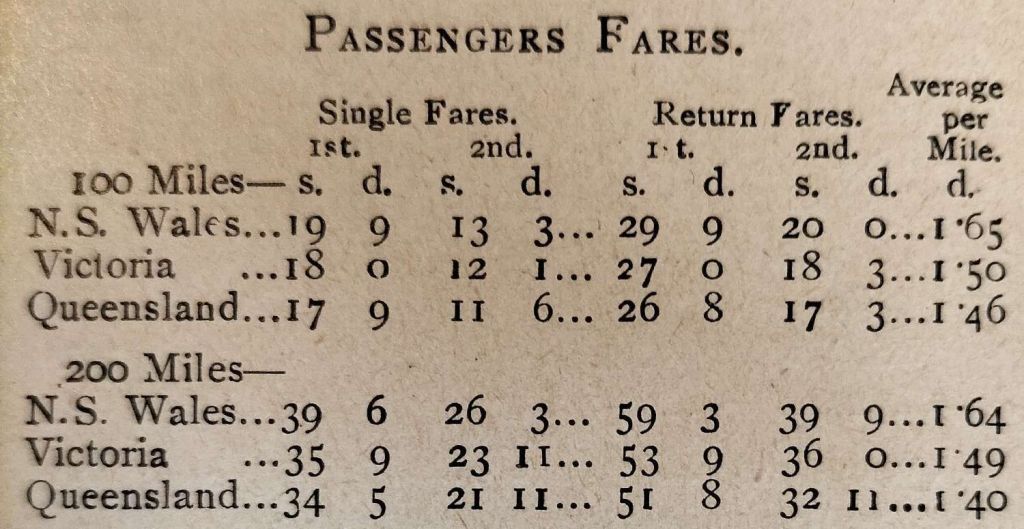
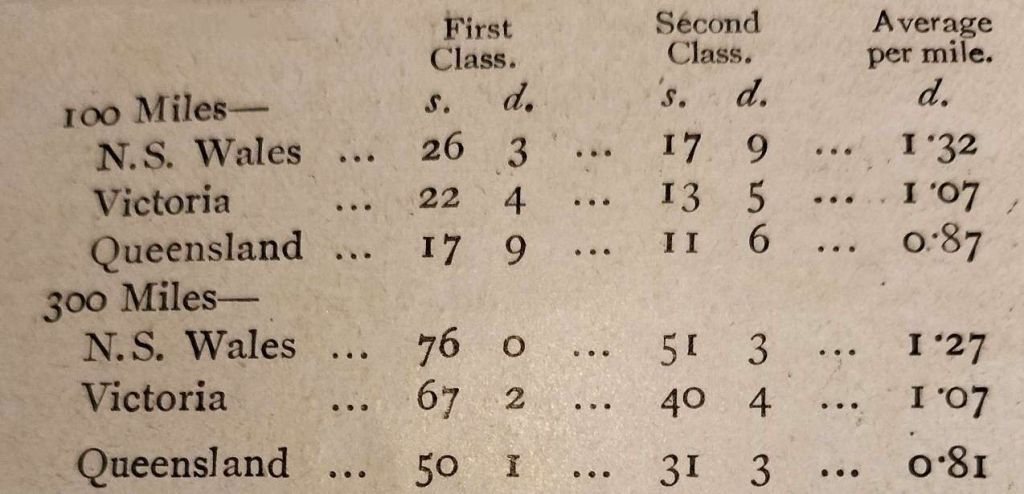
He, therefore, compares a few rates and fares taken from the then latest published lists and in operation in 1899.
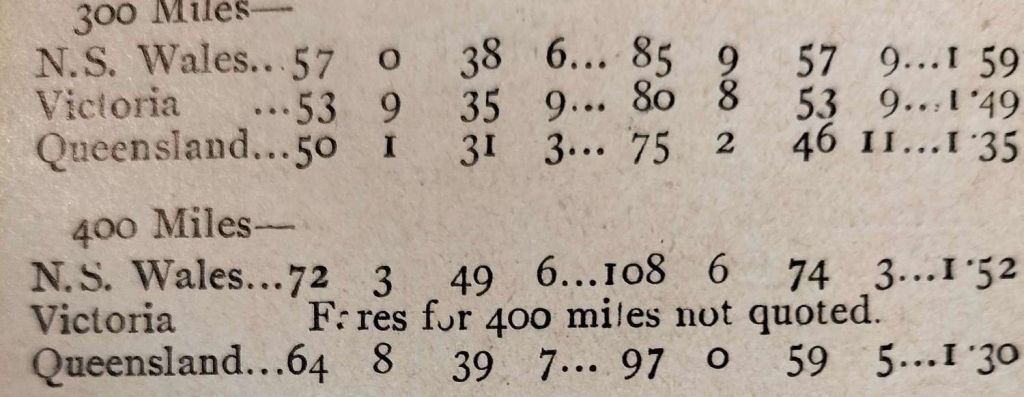
‘Rebus’ says that, “it will be observed that the ordinary fares in Queensland are very much lower per mile than in either of the other two colonies. In the case of holiday excursion fares the difference is even more favourable to Queensland, the figures being:” [1: p424]
Comparison of long-distance fares in Australia. [1: p424]
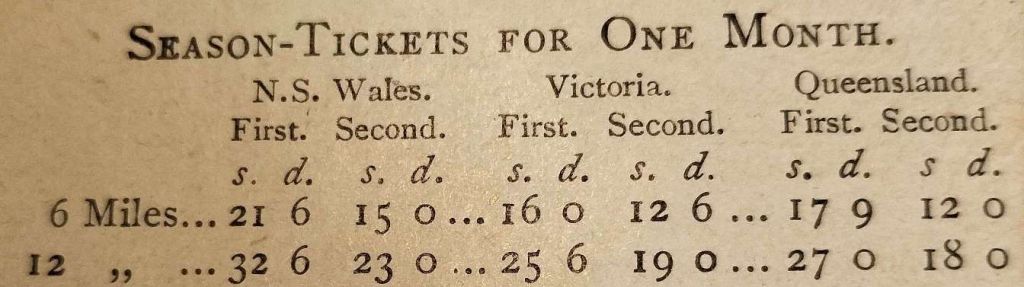
‘Rebus’ also provides a fare comparison for shorter distances based on the price of season tickets:
Monthly Season Ticket Comparison for 1899 in Australia shows that New South Wales prices are the highest. [1: p424]
‘Rebus’ continues to look at livestock transport costs and he demonstrates that the narrow-gauge of Queensland achieved cattle transport at about 75% of the cost in the other network areas. Sheep were again transported at lower rates/mile than on the other two networks. However, he seems to avoid drawing attention to the fact that cost per animal rather than per mile would not be as advantageous to his argument as the distances involved were much larger in Queensland.
This seems to be a weakness in each of the comparisons made by ‘Rebus’ for dairy products and grain as well.
Unfortunately, I don’t have access to the later articles which seek to put the case for the other two gauges. There are weaknesses in the arguments made by ‘Rebus’ and we have noted them in the text above. Possibly, however, as time went by and the 20th century unfolded, it increasingly became clear in many parts of the world that narrow gauge lines struggled with road competition and were handicapped by the longer transit times than possible on the larger gauges.
“With Federation in 1901 and the removal of trade barriers, the short sightedness of three gauges became apparent, [but] it would be 94 years before all mainland state capitals were joined by one standard gauge!” [2]
In those 94 years it became clear that the 3ft 6in gauge would, if chosen as the national gauge, have needed replacement with a wider gauge.
“At the time of Federation, standard gauge was used only in NSW, but was favoured for future construction. Work on gauge conversion was assisted by section 51 (xxxiii) of the Constitution of Australia, which made specific provisions for the Commonwealth Parliament to make laws with respect to railway acquisition and construction. An agreement was made with the South Australian and Western Australian state governments for the Trans-Australian Railway from Port Augusta to Kalgoorlie, with work started in 1911 and completed in 1917. However, with the different gauges, to transport goods from Queensland to Perth required four transshipments!” [2]
The Wikipedia article continues: “In October 1921, a royal commission into uniform rail gauge recommended gauge conversion of large areas of the country and that:
the gauge of 4 feet 8 1⁄2 inches be adopted as the standard
no mechanical, third rail, or other device would meet the situation
uniformity could be secured by one means only, viz., by conversion of the gauges other than 4 ft 8 1⁄2 in.” [5][7]
“The subject was discussed at a conference of the Prime Minister with the Premiers in November 1921, when it was decided to adopt 4 ft 8 1⁄2 in as the standard gauge for Australia and it was resolved that adoption of a uniform gauge was essential to the development and safety of the nation.” [5] [8]
“By the outbreak of World War II in 1939, there were still 14 break-of-gauge locations, with upwards of 1600 service personnel and many more civilians employed to transfer 1.8 million tons of freight during the conflict.” [5]
Strikingly, in 1922, 273 inventions to solve the break-of-gauge were proposed, and none adopted. [9]
In 1933, as many as 140 devices were proposed by inventors to solve the break-of-gauge problem, none of which was adopted. [10]
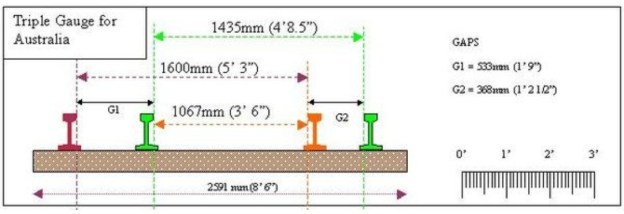
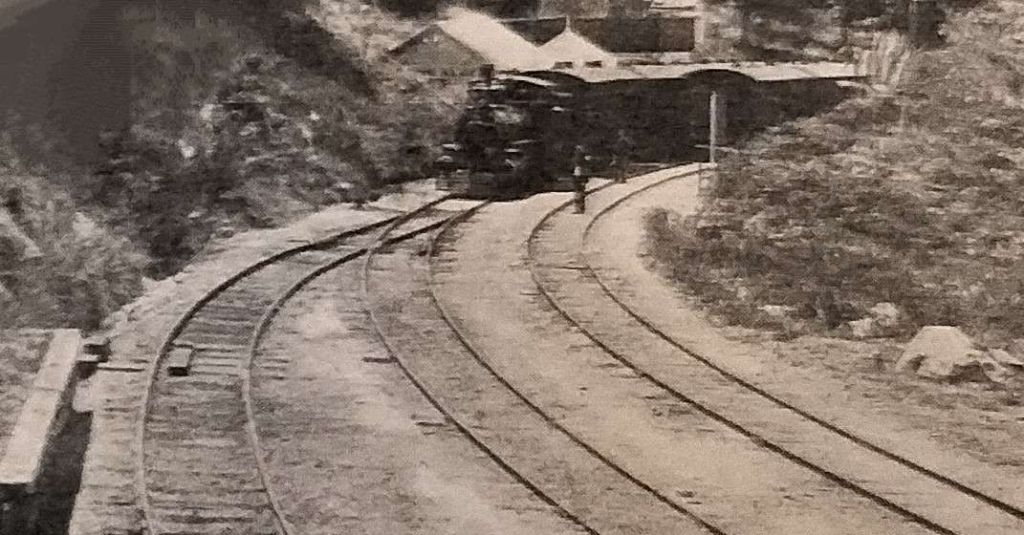
Even dual gauge with a third rail for combining Irish gauge and standard gauge was rejected as too reckless, as the gap between these gauges of 6.5 inches (165 mm) was considered to be too small. [11] Dual gauge combining Irish gauge and narrow gauge where the gap was 21 in (530 mm) was also rejected. [12]
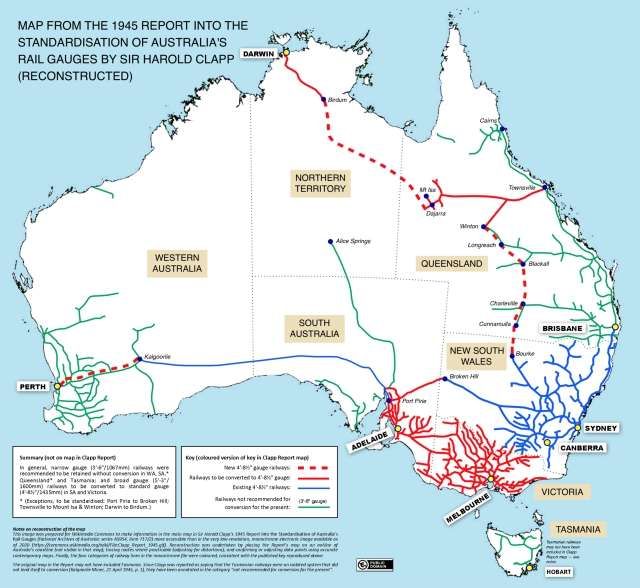
“After the Second World War a report on uniformity of railway gauges was commissioned from former Victorian Railways Chief Commissioner Harold Clapp for the Commonwealth Land Transport Board. The report produced three main recommendations:
Gauge standardisation from Fremantle and Perth to Kalgoorlie, all of South Australian and Victorian broad gauge lines, all of the South Australian south east and Peterborough division narrow gauge lines, and acquisition and conversion of the Silverton Tramway. Costed at £44.3 million.
A new standard gauge “strategic and developmental railway” from Bourke, New South Wales to Townsville, Queensland and Dajarra (near Mount Isa) with new branch lines from Bourke via Barringun, Cunnamulla, Charleville, Blackall to Longreach. Existing narrow gauge lines in Queensland would be gauge converted, including Longreach – Linton – Hughenden – Townsville Dajarra and associated branches. Costed at £21.6 million.
A new standard gauge line to Darwin, including a new line from Dajarra, Queensland to Birdum, Northern Territory, and a gauge conversion of the Birdum to Darwin narrow gauge line. Costed at £10.9 million.
The report wrote that if only main trunk lines were converted, it would introduce a multitude of break of gauge terminals and result in greatly increased costs. It also recommended abandoning part of the existing Perth to Kalgoorlie narrow gauge line, and build a flatter and straighter route using third rail dual gauge, as modernisation was just as important as standardisation.” [5]
Wikipedia has reconstructed the railway network changes proposed by the Clapp Report. This file is made available under the Creative Commons CC0 1.0 Universal Public Domain Dedication [2]
None of the states in Australia were happy with the report. It seems to have been shelved, but “gauge conversion continued, with the South Australian Railways’ Mount Gambier line from Wolseley to Mount Gambier and associated branches converted to broad gauge in the 1950s, on the understanding it would change again to standard gauge at a later date, which would have made it the first and only railway in Australia to have successfully been converted to all three gauges.” [2] But it closed in 1995. Standard gauge lines were also built, with the line between Stirling North and Marree opened in July 1957. [2][6: p188]
“In 1956, a Government Members Rail Standardisation Committee was established, chaired by William Wentworth MP. It found that while there was still considerable doubt as to the justification for large scale gauge conversion, there was no doubt that work on some main trunk lines was long overdue. Both the committee and the government strongly supported three standardisation projects at a cost of £41.5 million:
Albury to Melbourne (priority 1)
Broken Hill to Adelaide via Port Pirie (priority 2, built third)
Kalgoorlie to Perth and Fremantle (priority 3, built second).” [2]
The Wikipedia article continues to describe individual projects in the 1960s, 1970s, 1980s, 1990s and on into the 21st century as late as 2018. [2]
As of 2022, there were 11,914 kilometres (7,403 miles) of narrow-gauge railways, 18,007 kilometres (11,189 miles) of standard gauge railways and 2,685 kilometres (1,668 miles) of broad gauge railways. [13]
References
‘Rebus’; Uniformity of Gauge in Australia – The Case for 3ft 6in Gauge; in The Railway Magazine, November 1899, London, 1899, p417-425.
“Standardisation of Railway Gauges“. Year Book Australia, 1967. Australian Bureau of Statistics. 25th January 1967, accessed on 9th September 2024.
“Break of Gauge“. The Daily News. Perth. 12th January 1922. p. 2. Retrieved 26th October 2013 – via National Library of Australia, accessed again, 9th September 2024.
“Break of Gauge”. The Brisbane Courier. Brisbane. 14th August 1933. p. 15. Retrieved 27th August 2011 – via National Library of Australia, accessed again, 9th September 2024.
“Great Western Railway”. The Argus. Melbourne. 11th March 1926. p. 7. Retrieved 26th August 2011 – via National Library of Australia, accessed again, 9th September 2024.
“Standard Gauge Plan Postponed”. The Argus. Melbourne. 17 February 1941. p. 5. Retrieved 26 August 2011 – via National Library of Australia, accessed again, 9th September 2024.
“Trainline 9” (PDF). Bureau of Infrastructure, Transport and Regional Economics. Department of Infrastructure, Transport, Regional Development and Communications. 26 May 2022. Retrieved 27 May 2022, accessed again on 9th September 2024.





_-_cropped.jpg)


