
I have a few older copies of Modern Tramway which I had not yet read. The first of these is the January 1951 issue, this is a third reflection from that copy of the Journal.
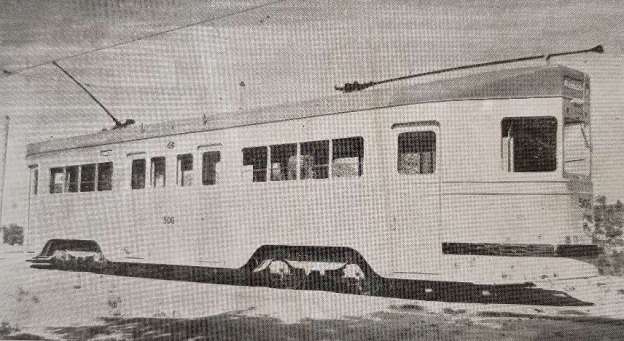
The featured image for this article is Brisbane City Transport No. 506: a high-speed, resilient-wheeled car, one of a new [1950] batch of 50, with full-length sliding doors, leather-covered foam-rubber seats and a panelled body. This car had a multi-notch controller driving 4 x 40 hp motors; there are 64 seats and the overload capacity is 110, © Public Domain. [1: p1]
“Brisbane, the capital of Queensland, Australia, was first settled in 1824. From that date it grew steadily, expanding round the broad winding Brisbane river to become the great city and seaport it is today. Horse trams were introduced by the Metropolitan Tramway and Investment Company in August 1885, and these gave way to electric cars in 1897 and 1898. At the same time, the Brisbane Tramway Company was formed to take over operation of the electric lines and this company built many extensions to the system to match the needs of the fast-growing city. In 1923 the tramways passed into the hands of the Brisbane Tramways Trust, a government board representing Brisbane ratepayers; this Trust was only a temporary body, and when the Greater Brisbane City Council was formed in 1925, the tramways and all city transport became the concern of the Brisbane City Council Transport Department.
“When the public authority took over in 1923, the fleet consisted of 195 cars: today [1950] the Department operates 420 tramcars and 154 single-deck diesel buses. The old B.T.C. cars, many of which are still running, are of great variety and include 4-wheel and bogie “toast racks” and 4-wheel and 8-wheel end-loading saloons, known as ‘Dreadnoughts’. These cars appear only during peak hours and they present an odd appearance against the modern streamliners. … The first new tramcar design developed by the B.C.C. was the ‘drop-centre’ type of which 204 were built, numbered from 196 to 399. These cars have a plate frame, reversed maximum-traction trucks, open centre compartment with eight transverse benches and two closed end compartments. They seat 64, have a maximum capacity of 110, and are 45ft. 6in. long.
“In 1938, a second new type was evolved, later to become known as the ‘400’ or ‘Streamliner’ class. Of these cars, 108 have been built to date [1950], the prototype, No. 400, differing slightly in appearance from its successors. These fine cars are 49ft. in length, seat 64 with a total capacity of 110, and are very fast. The post war version, numbered 473-508 is an improved type with sliding doors: 483-508 have Dunlopillo seating and panelled bodywork; 497, 498, 499, 505, 506, 507 and 509 are fitted with resilient wheels and a multi-notch controller. Other noise-reducing features not yet introduced include rubber inserts in the trolley head. A further 50 of the improved “400” class are yet to be built. Other features of these cars are:
– Integral construction, the whole of the frame and panels being of steel with no separate under-frame.
– Interior lined with varnished natural timber, ceiling of white-enamelled masonite.
– Sashless windows operated by Young full-drop window balancers.
– Motorman’s windows of armour-plated glass and fitted with air-operated windscreen wiper.
– Bogie trucks equipped with GE 247A motors of 40 h.p. each and air brakes.
– Double helical driving gears.
– Air compressors and trolley base mounted on special rubber fittings to reduce noise and vibration.
“The B.C.C. livery is silver with blue lettering.
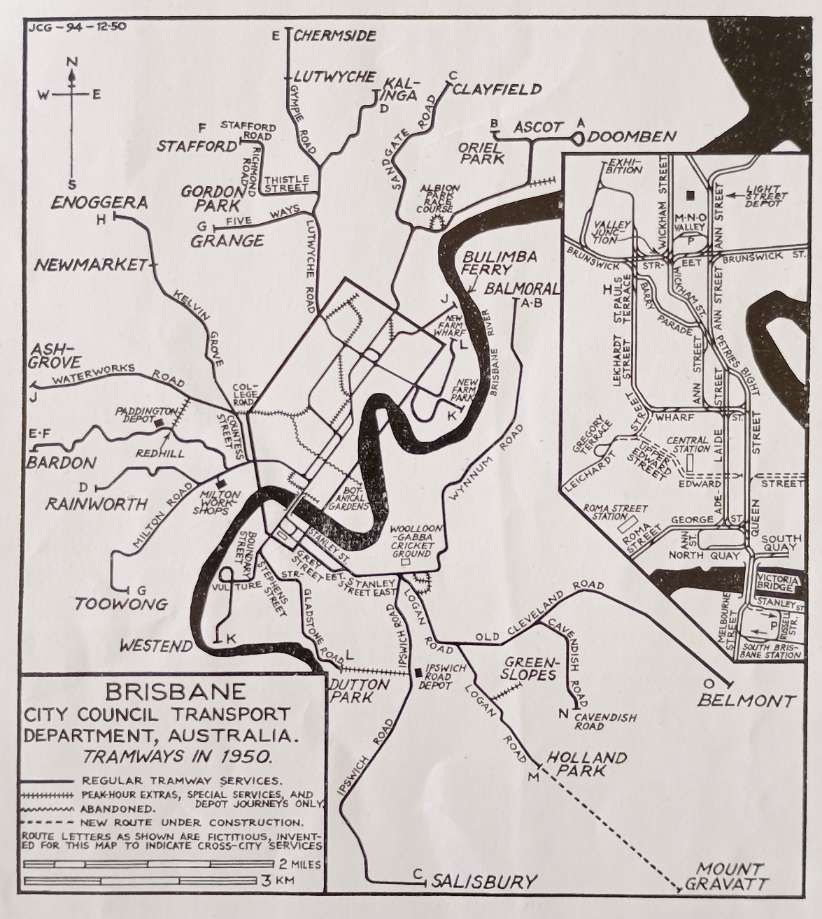
“The general condition of the track is good, all new track being laid in solid concrete to the top of the rails. On straight track 82 lb. railway rail is used without guard rails, the groove being formed in the concrete. Curves are laid with British Standard 6C tramway rail. There are reserved and private-right-of-way sections on the Chermside, Salisbury, Belmont, Rainworth and Ascot routes. The Chermside extension, opened in 1947, is a model layout with rails laid in concrete and flower beds on either side of the tram track separating it from the motor road: the poles supporting the overhead are at the side of the road.
“Since the war ended in 1945, extensions of three lines have been opened: to Belmont (31st July 1948), to Chermside and to Enoggera (13th August 1949). An extension from Holland Park to Mount Gravatt (1 3/4 miles) is at present under construction and two more extensions are provided for during the current financial year. The Holland Park line now under construction is a street line, and will serve a new housing area. The new lines completed since the war, together with the Mount Gravatt extension, total about six route miles. On 30th June 1949, the total route mileage was 65 miles 60 chains (track mileage 119 miles 75 chains). Of particular interest is the new Ann Street diversion. Formerly all routes [that] passed through the city centre (with one exception) converged at an awkward bottleneck in Petrie Bight. As had been long feared, an accident occurred at this point during a Saturday midday peak with resultant dislocation of traffic. To avoid any recurrence, the Tramway Department constructed a line in Ann Street (about 1/8 mile) from Wharf Street to Petrie Bight in 1946. Of single track with double track junctions, the new line, used only for emergencies, is of standard concrete construction with double overhead wire. It is planned to place tram tracks underground at the inter-section of Ann and and Queen Streets as a first move in a more extensive future city centre subway plan to relieve surface traffic and speed up street transport. When this plan takes shape, Brisbane will be the first Australian city to have tramway subways (the Wynward line in Sydney was built by the Railway Department and is only on loan to the tramways until the underground railway proper is constructed).
“On weekdays the fares start at 2d. for one section and an additional penny for each section, but there are zone fares to and from the city at a reduced rate, and on some routes these work out at about a penny a mile. On Saturdays and Sundays after 6.30 p.m. the fares are increased by a penny with the exception of the first section which remains at 2d. From Monday to Friday concession tickets sold in books of eight for a shilling may be used at the rate of one ticket for each section and are much in demand. On Sundays excursion tickets are sold at 1s. 6d. for adults and 3d. for children; they allow the holder to travel anywhere on the system between 8 a.m. and 2 p.m. or between 2 p.m. and 10 p.m.
“The only tramway that has been abandoned in Brisbane is the short length between the Botanical Gardens and Queen Street and from Queen Street to Gregory Terrace, all in the city centre and operated as two short shuttle services until 1948. This route from the the Gardens to Gregory Terrace will form part of Brisbane’s first trolleybus route (the remainder of the route along Coronation Drive to the University at St. Lucia has never been a tram line) and bodies are now being constructed on 30 Sunbeam trolleybus chassis; it is anticipated that these 44-seater all-steel trolleybuses will be in operation before the end of 1950.
“LIST OF SERVICES, 1950.
– Ascot (Oriel Park and Doomben) – Balmoral.
– Clayfield – Salisbury.
– Kalinga – Rainworth.
– Grange – Toowong.
– Chermside/Stafford – Bardon.
– Bulimba Ferry – Ashgrove.– St. Paul’s Terrace – Enoggera.
– West End – New Farm Park.
– Dutton Park – New Farm Wharf.
– Belmont/Cavendish Road/Holland Park – Wharf Street or Valley Junction.– Valley Junction – South Brisbane Station.
(Special and short workings are not included in the above list.)” [1: p15-16]
In practice, “Brisbane’s historic tramway network operated from 1885 to 1969, serving as a vital transport link before being replaced by buses. Known for its iconic, largely open-design ‘toastrack’ trams, the network reached a peak of 109 km in 1954, connecting suburbs like Paddington, Ascot, and Toowong. The system officially closed on 13th April 1969.” [2] The horse-car era lasted from 1885-1899, the electric-car era from 1899 to 1969.
Trams “ran on standard gauge track. The electric system was originally energised to 500 volts, and subsequently increased to 600 volts. All tramcars built in Brisbane up to 1938 had an open design. This proved so popular, especially on hot summer nights, that the trams were used as fundraisers and often chartered right up until the last service by social groups.” [2]
Brisbane was the last capital city in Australia “to close its tram network. Despite the decision to shut down the network, Brisbane’s trams were held with great affection by locals, and one commentator described their removal [as] ‘one of the most appalling urban planning mistakes in the city’s history’. [3] There have been ongoing proposals since the early 1990s to reinstate a functional tram network.” [2]
In the 21st century, Brisbane has its own ‘Metro’ but it is not a tramway network. “Since the 1990s, busways were considered as one of the options when the Queensland Government developed the 25 year Integrated Regional Transport Plan. It was recommended that a 75 km (47 mi) network of busway corridors to complement the existing Queensland Rail City network,” [4][5] should be built.
The first section of busway, opened in September 2000, with the rest of the South East Busway opening in April 2001 at a final cost of over $600 million. [6] Planning and construction of the Northern and Eastern Busways began soon after the success of the first section, increasing bus commuter statistics. As of 2025, the city had three busways, spanning 29 kilometres, including 28 stations and 20 tunnels. [4][7]
As of 2007, 294 buses per hour (one way) – 1 bus every 12 seconds – passed through the busway network’s busiest point (a section of the South East Busway north of Woolloongabba station). Further, capacity issues occurred at other locations in the city. [4]
“In order to meet the capacity bottlenecks of the busway system, various solutions [were] proposed, including conversion to light rail, the BaT tunnel, a second Victoria Bridge, bus route changes, and later, Brisbane Metro.” [4][8]
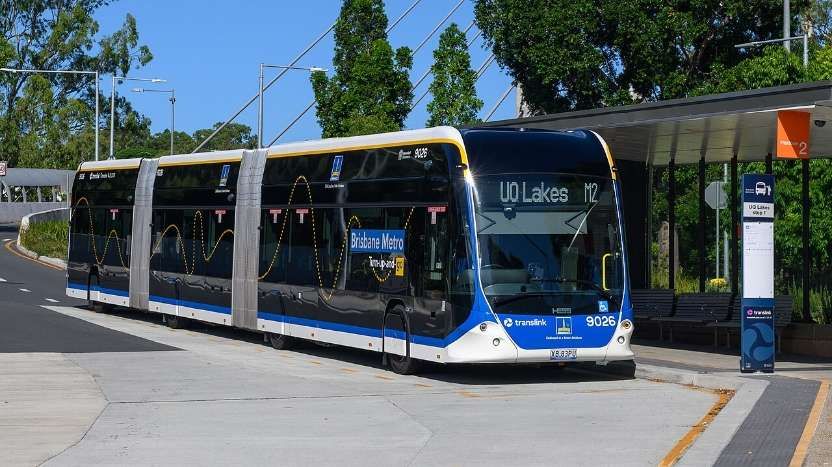
The initial proposals for a rubber-tyred metro of 2016 were adapted to meet specific concerns. Bi-articulated buses were chosen. The buses would operate on two routes. The business case released in November 2017 costed the project at AUS$944 million. By April 2018, the federal government had agreed to contribute AUS$300 million.
In November 2019, BCC announced that a consortium of Hess, Volgren and ABB had been awarded a contract for 60 buses. The buses were to be fully electric via overhead wireless charging that will charge at the end of each route for less than six minutes. [4][9]
“A pilot bus was built and tested in Europe in 2021, arriving in Brisbane for testing in early 2022. Following successful testing, an order was placed for the remaining 59, with close to 1000 modifications based of the original pilot vehicle. [10] The 60 vehicles cost AUS$190 million, an increase of $100 million compared to more traditionally powered vehicles, with deliveries beginning in late 2023. As of 2026, the full 60 ordered are still being delivered.” [4][11]
“The system consists of two routes over 21 km (13 mi) of busways. The routes serve Brisbane CBD every five minutes during peak times, extending as far as Eight Mile Plains, the Royal Brisbane and Women’s Hospital and the University of Queensland respectively. Route M2 began service on 28th January 2025. Route M1 began service on 20th June 2025.” [4]
A route map for the Metro can be found here. [12] Route M1 connects with the South East Busway services. Route M2 connects with the Northern Busway services. [12]
References
- The Brisbane City Tramways; in Modern Tramway Volume 14 No. 157; The Light Railway Transport League, London, January 1951, p1 & 15-17.
- https://en.wikipedia.org/wiki/Trams_in_Brisbane, accessed on 11th May 2026.
- Michael Madigan; 50 years after Brisbane’s trams were scrapped, it’s not too late to fix this epic planning fail; via (https://www.couriermail.com.au/news/insight/50-years-after-brisbanes-trams-were-scrapped-its-not-too-late-to-fix-this-this-epic-planning-fail/news-story/98ef3d140cb1e2c8c2b5d28829c42ffe); The Courier-Mail, 13th April 2019, access not permitted without a subscription, 11th May 2026.
- https://en.wikipedia.org/wiki/Brisbane_Metro, accessed on 11th May 2026.
- Integrated Regional Transport Plan (Part 1); Queensland Government, Department of Transport and Main Roads; via: https://web.archive.org/web/20110316094603/http://tmr.qld.gov.au/~/media/1008ff20-a4b7-4a18-89df-10c19d3348d6/pdf_irtp_part01.pdf, accessed on 11th May 2026.
- https://web.archive.org/web/20110527083538/http://www.thgq.com.au/projects_south_east_transit.php, accessed on 11th May 2026.
- Melbourne buses: How do other cities compare?; ABC News, Australia, 16th February 2017; via: https://www.abc.net.au/news/2017-02-16/melbourne-buses-how-do-other-cities-do-bus-transit/8276628, accessed on 11th May 2026.
- Project History: Brisbane Metro; Brisbane City Council; via: https://caportal.com.au/bcc/brisbane-metro/history?utm_source=copilot.com, accessed on 11th May 2026.
- Bevin Liu; The big EV bus revolution: Brisbane City’s new metro unwrapped and the partnerships we need to have; The Fifth Estate, 15th October 2024; via: https://thefifthestate.com.au/urbanism/infrastructure/the-big-ev-bus-revolution-brisbane-citys-new-metro-unwrapped-and-the-partnerships-we-need-to-have, accessed on 11th May 2026.
- Brisbane (AUS): Large order for Hess; Urban Transport Magazine, 10th August 2022; via: https://www.urban-transport-magazine.com/en/brisbane-aus-large-order-for-hess, accessed on 11th May 2026.
- Brisbane Metro vehicle; via: https://metro.brisbane.qld.gov.au, accessed on 11th May 2026.
- https://en.wikipedia.org/wiki/Template:Brisbane_Metro, accessed on 11th May 2026.
- https://en.wikipedia.org/wiki/Brisbane_Metro#/media/File%3AXB_83_PU_HESS_lighTram25_(55053370230)_-_cropped.jpg, accessed on 11th May 2026.


_-_cropped.jpg)