
I have a few older copies of Modern Tramway which I had not yet read. The first of these is the January 1951 issue, this is a second reflection from that copy of the Journal.
As the London network began to close a significant number of trams were sold. This copy of Modern Tramway notes that the remaining ‘Felthams’ were sold to Leeds City Transport.
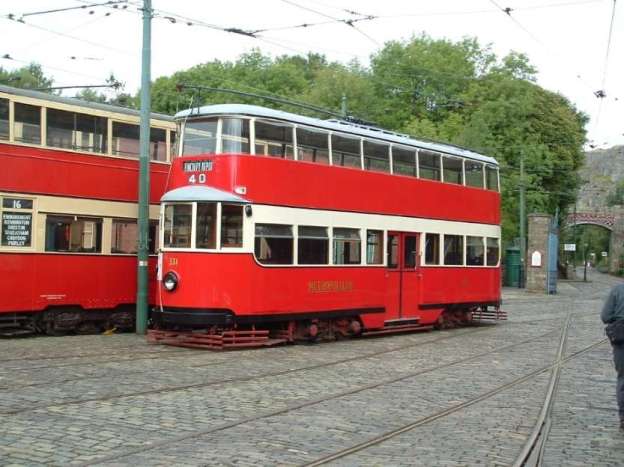
The featured image for this article shows Feltham No. 331 which was actually transferred to Sunderland, becoming No. 100 in Sunderland. This Feltham was unique, having central doors. It is now resident at Crich, © Nathan 1492 and licenced for reuse under a Creative Commons licence (CC BY-SA 3.0). [6]
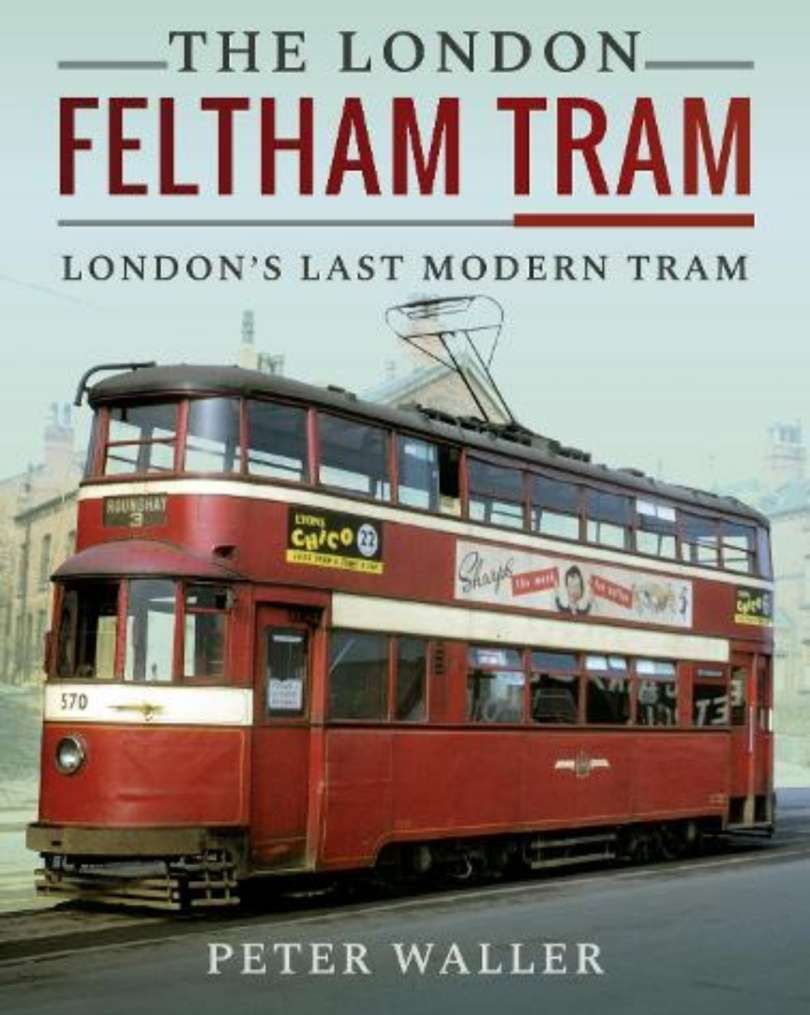
“In 1929 the Metropolitan Electric Tramways (MET) placed into service an experimental tramcar, No. 320, manufactured by the Union Construction Company which was located in Feltham. This tram was of a significantly more advanced design than other experimental cars that the MET had trialled in the previous few years, and was the first of three prototypes that led to the final design of what became known as the “Feltham” trams. Two more experimental tramcars were then constructed: MET No. 330 later the same year, and No. 331 the next. After experience in passenger service was assessed, the best features of each were combined to form the final design.” [3][4]
After service in London until 1949 and into the very early 1950s, 92 of these trams were to be purchased by Leeds City Transport. In January 1951, Modern Tramway reports:
“The purchase of the remaining 92 London ‘Feltham’ type cars by Leeds City Transport at a cost of £500 each is a wonderful bargain for the latter city; a bus with the same expectation of life as one of these still very modern cars would cost about £4,000, and a new bogie tram at least £7,000.
“On arrival at Kirkstall Works the trucks are completely stripped and all worn parts are replaced. The hornways where worn are built up by a welding process. It has been found necessary to replace the rubber blocks used in the driving-wheel hornways in London by the correct springs, and the tyres are turned to the standard Leeds profile.
“It was found that the car bodies were structurally quite sound on arrival from London; all that it has been necessary to do to the exterior has been to replace damaged panels and to remove dents in the dash; internally, all the woodwork has had the old varnish removed and has been repolished with a light oak finish, all interior panels being finished in light brown. The seats are removed from the cars and the upholstery thoroughly cleaned. Any cars that are received with seat coverings in poor condition will be re-upholstered in the standard Leeds red leather. A combined route-number and destination blind has been fitted, the apertures used in London for displaying the service number having been painted out; a lower saloon side indicator-blind is also provided. The front exit has not been restored for passenger operation, the air-operated front door being used solely for perambulators and luggage.
“The cars, which are arriving at the rate of two a week, are being numbered from 501 upwards in the order of arrival from London, up to 515 having been received at the time of writing and up to 504 being in passenger service. Arrangements have been made with London Transport for the ex-Metropolitan cars with B.T.H. equipment to be despatched first, to be followed by the ex-London United cars with G.E.C. equipment. The ex-Metropolitan and ex-London United cars will be classified in Leeds as types UCC/1 and UCC/2 respective’y.
“The livery finally decided upon for these cars is ‘British Electric Traction’ red all over, relieved by a cream band below the upper saloon windows and a cream panel above the lower saloon windows. The cars are lined out in gold and the roof, trucks and lifeguards are painted Brunswick black. Car No. 503 lacks the cream bands, whilst car No. 501 is still in London Transport livery.
“The cars have proved very satisfactory in service and are popular with the passengers. Those at present in service operate from Torre Road Depot which will eventually operate ‘Felthams’ exclusively. The riding qualities of these cars on the long reserved-track routes to Crossgates and Templenewsam are good. The Leeds undertaking is to be congratulated on obtaining and reconditioning these fine cars.” [1: p6]
The ‘Felthams’ served in Leeds until the closure of that city’s network in 1959. Wikipedia talks of 90 rather than 92 of these trams operating in Leeds. [3] The Seashore Trolley Museum in Maine, USA agrees with this assessment. [5]
The Seashore Trolley Museum reports:
“Car No. 341 was one of this class known as the ‘Felthams’ (after their place of construction). The ‘Feltham’ cars were the result of a complete vehicle redesign similar to the development of the PCC car in the USA at about the same time. No. 341 was one of 54 cars built for the MET which served London’s northern suburbs. At over 40 feet long, the ‘Felthams’ were relatively long and had a tapering body, large entrance/exit vestibules and a low floor height. A distinctive feature was the higher floor for the operator’s cab. Rather than using overhead wires, London trams (including the MET trams) drew power from an underground conduit, similar to systems in Washington, DC and New York City. When the London Passenger Transport Board acquired the Metropolitan Electric in 1933, No. 341 became No. 2085. The car survived the World War II blitz, but the LPTB’s policy was to replace trams with trolley buses and expanded underground lines. The ‘Felthams’ were the last new trams purchased for London. After 1938, most of LPTB’s remaining tram lines were in South London. In 1948, LPTB was nationalized and became the London Transport Executive. The last London tram ran in 1952. The tram system in Leeds acquired 90 ‘Felthams’ from London Transport in 1950, including No. 2085, which became No. 526 at Leeds. Leeds painted its trams red and used overhead bow collectors rather than trolley poles. Leeds abandoned its trams in 1959.” [5]
Two other ‘Felthams’ have been preserved:
Car No 331 (LTPB No. 2168) which was transferred to Sunderland. This tram was a central entrance prototype which was numbered 100 when in service in Sunderland. It now is part of the National Tramway Museum, Crich, collection. [3]
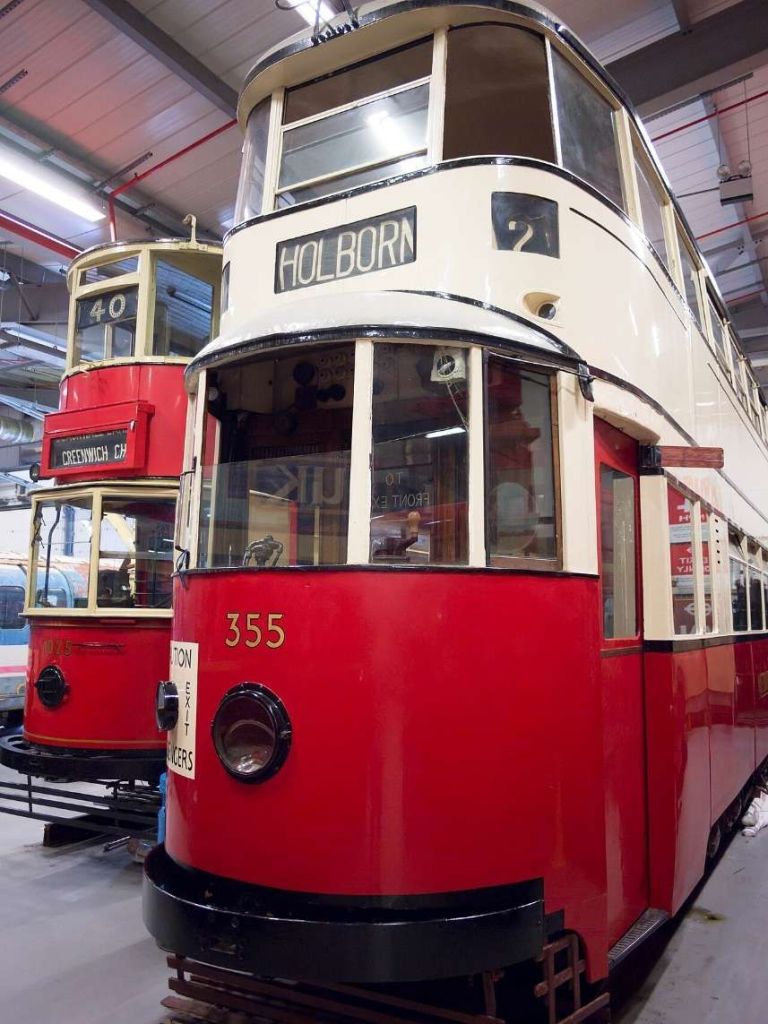
Car No. 355 (LTPB No. 2099, later Leeds No. 501) is now part of the collection at London Transport Museum, Store, Acton, London. [3]
References
- The ‘Felthams’ in Leeds; in Modern Tramway Volume 14 No. 157; The Light Railway Transport League, London, January 1951, p6.
- Peter Waller; The London Feltham Tram – London’s Last Modern Tramway; Pen & Sword, 2020.
- https://en.wikipedia.org/wiki/Feltham_Tram, accessed on 11th May 2026.
- T. A. Gibbs; The Metropolitan Electric Tramways, a Short History; The Oakwood Press, 1964.
- https://trolleymuseum.org/london2085, accessed on 11th May 2026.
- https://en.wikipedia.org/wiki/Feltham_Tram#/media/File%3ALondon_Metropolitan_Tramways_%22Feltham%22_Tram_No.331%2C_National_Tramway_Museum%2C_Crich.JPG, accessed on 11th May 2026.
- https://en.wikipedia.org/wiki/Feltham_Tram#/media/File%3ALondon_Tram_(no._355)_-_Flickr_-_James_E._Petts.jpg, accessed on 11th May 2026.


_-_Flickr_-_James_E._Petts.jpg)