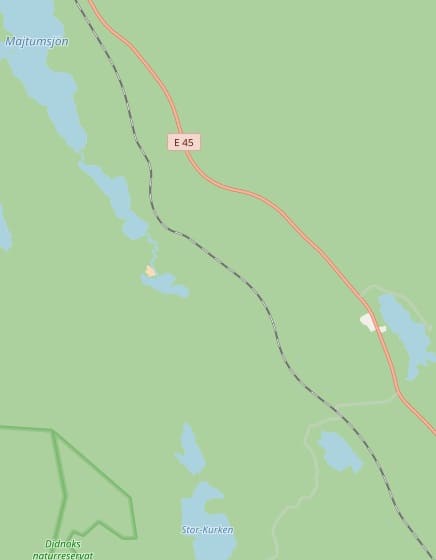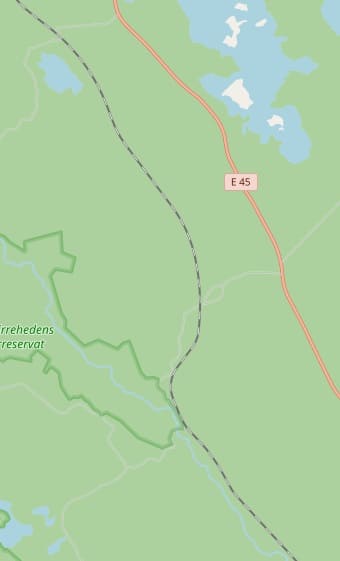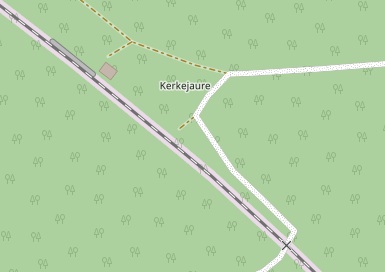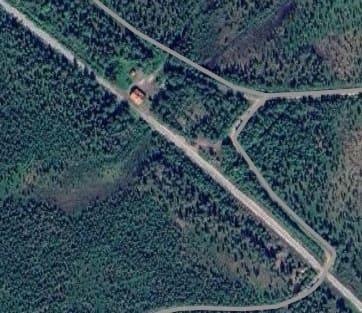
Category Archives: Scandinavia

Sweden’s Inland Railway (Inlandsbanan) – Part 1 – Introduction and the Route of the Railway from Gällivare to Arvidsjaur

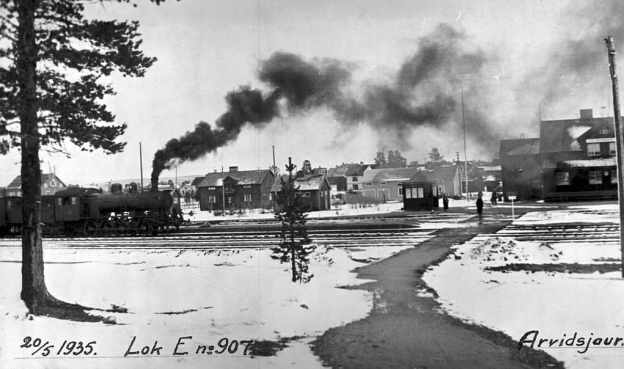
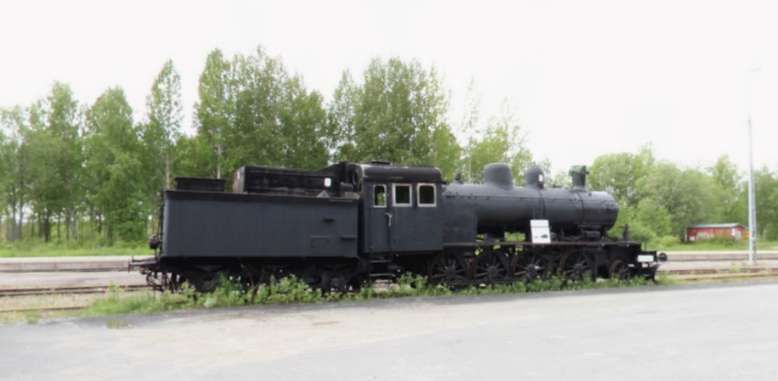
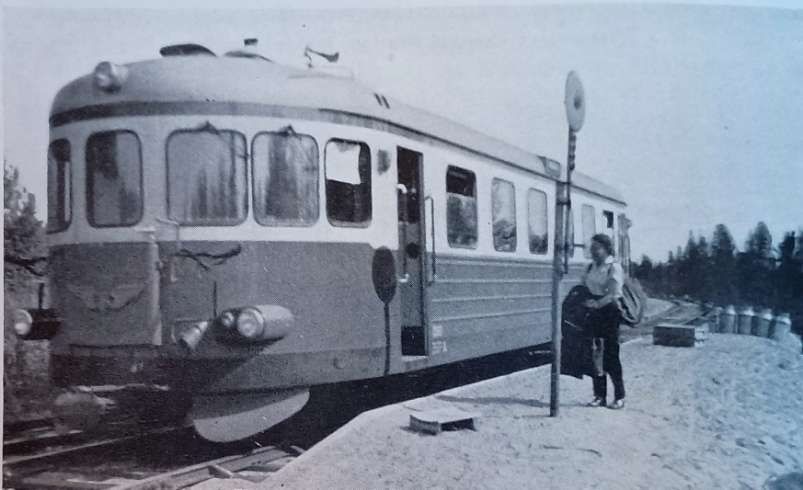
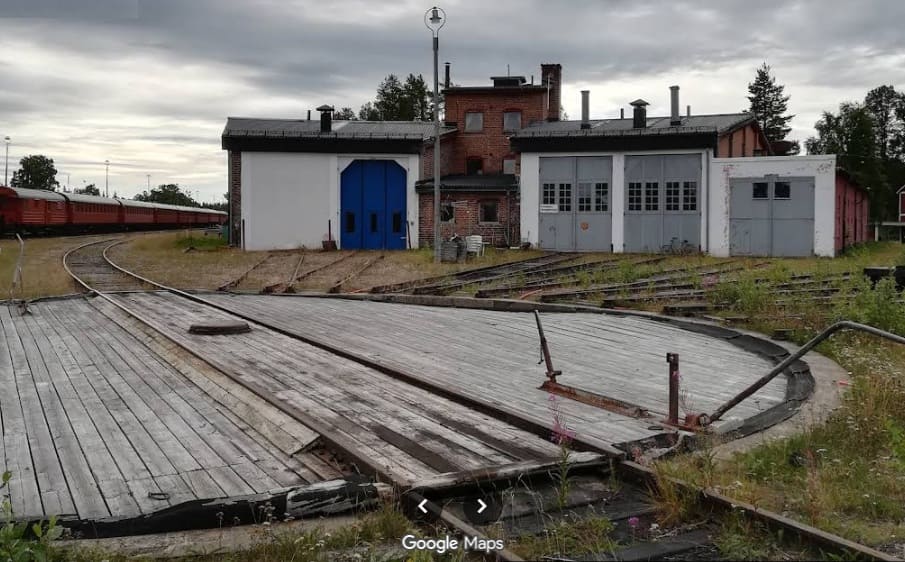
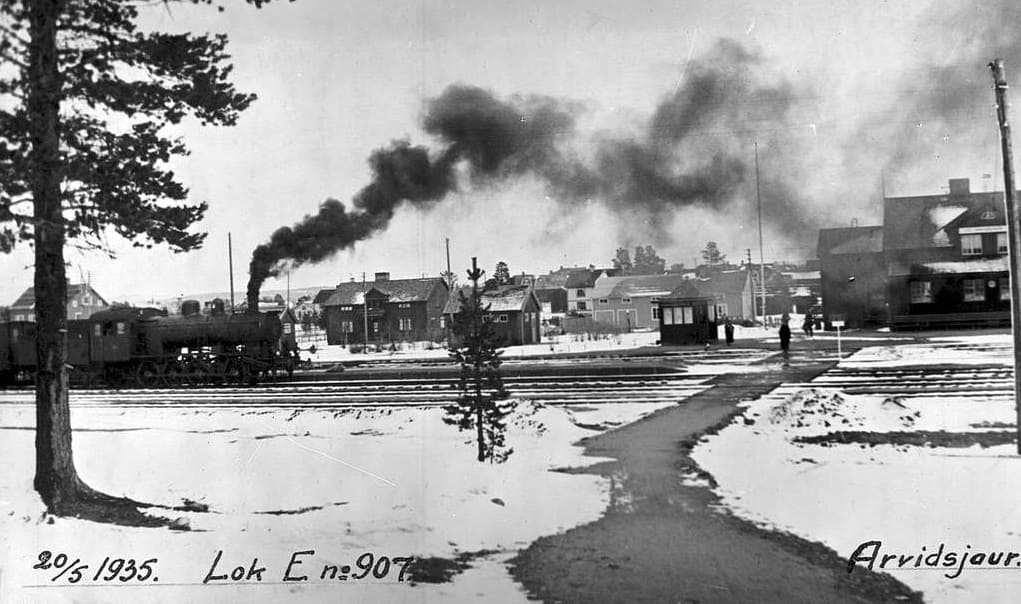
The featured image for this article is a picture of Swedish State Railways (Swedish: Statens Järnvägar) Locomotive No. 907 at Arvidsjaur Railway Station. The image is dated May 1935, (c) Public Domain. [60]

Known as Sweden’s Inland Railway, the Inlandsbanan “extends from Gällivare, in Lapland, to Kristinehamn, on Lake Väner, in Värmland, a distance of 800 miles, through scenery that ranges from the tundra of the Arctic to the forest lands of Central Sweden.” [1: p826]

The line is known for its leisurely pace, allowing for wildlife spotting (reindeer, elk) and spontaneous stops, with onboard hosts providing commentary. Trains operate with daily departures during the 3 months of high summer, often with packages that include hotels. It also operates for 4 months in the winter.

It was built between 1908 and 1937, and was designed to connect inland northern Sweden, avoiding the coast for security reasons and to foster regional development.

The Railway Magazine.of December 1958 carried an article about the line written by M. D. Greville & H. A. Vallance. [1]

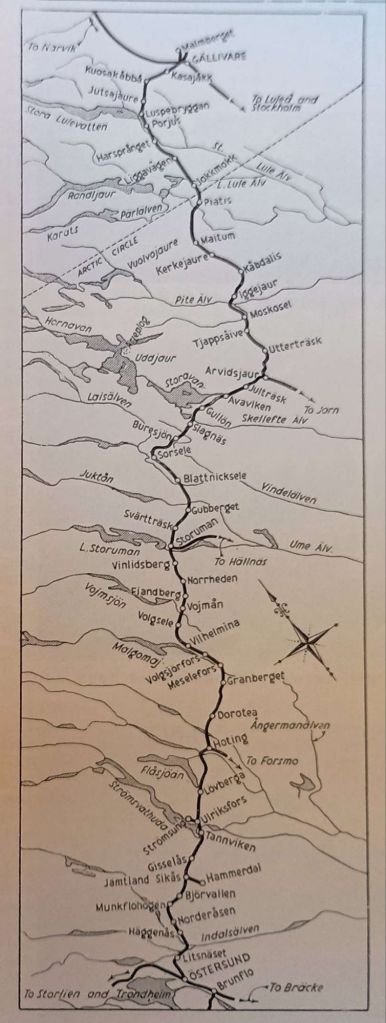
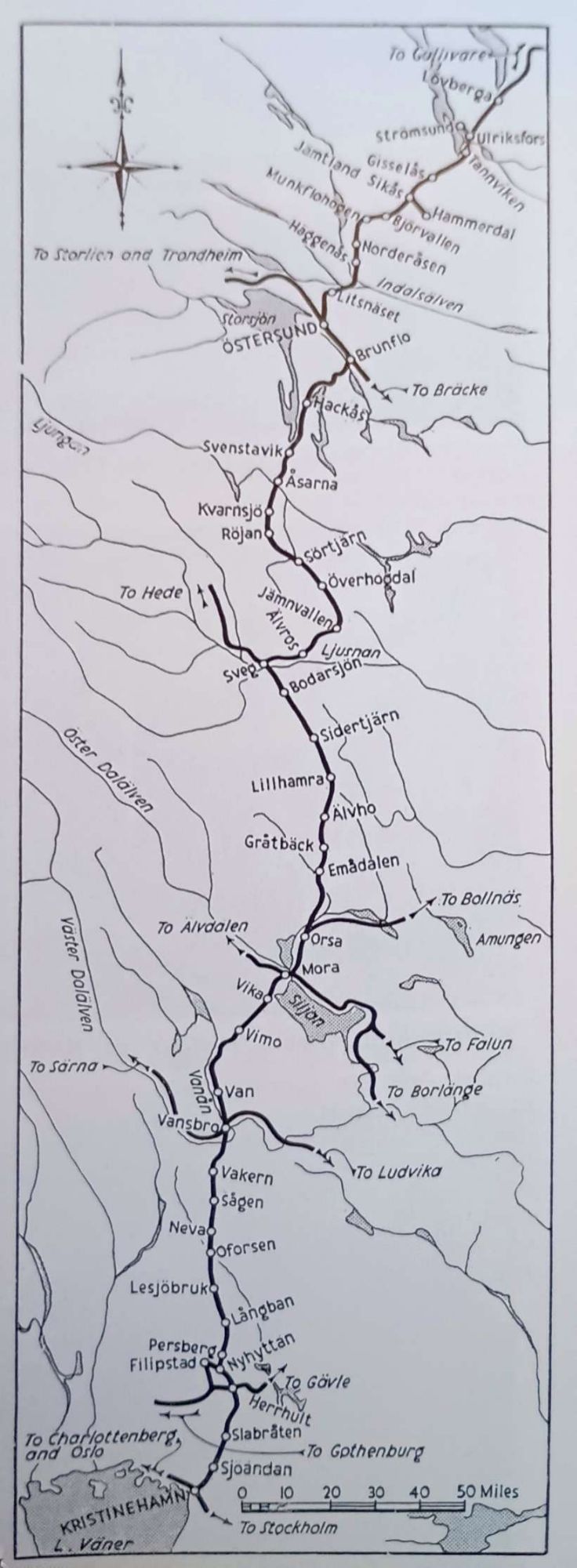
The northern length of the Inlandsbanen from Ostersund to Gällivare. Ostersund features in the OpenStreetMap images below and appears at the South end of the portion of the line shown in the first of two maps of the line. [1: p827]

Vallance and Greville wrote: “The inland route was first projected at the end of the nineteenth century as a private enterprise, to carry iron ore from Lapland and timber from Central Sweden to a new port on the west coast, north of Gothenburg. No progress was made with this scheme, and in 1907 the Swedish Government decided to begin the construction of the northern part of the railway from Östersund, on the main line from Bräcke to Storlien, on the Norwegian frontier, completed in 1882.” [1: p826]

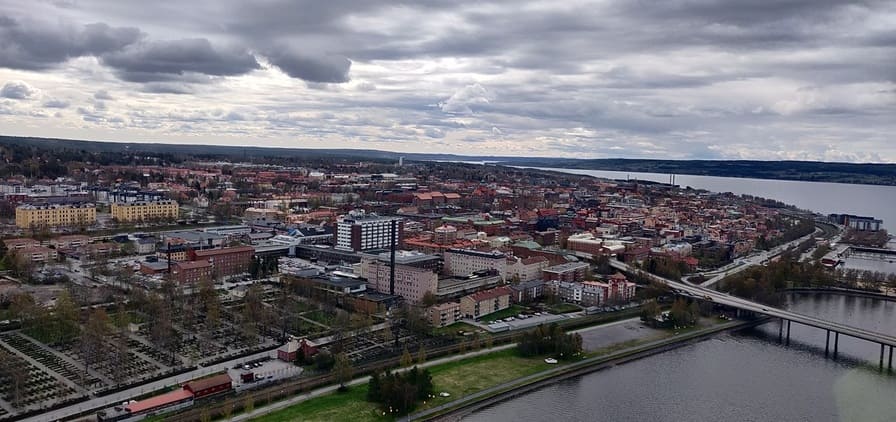
Östersund in May 2021, (c) Hult and licenced for reuse under a Creative Commons licence (CC BY-SA 4.0). [13]

Östersund is the capital of Jämtland. It is located at the shores of Sweden’s fifth-largest lake, Storsjön, opposite the island Frösön. With a total population of 50,960 (2017) Östersund is the 22nd most populous city in Sweden. [14]

Östersund appears on this second map of the route which shows the Southern length of the line which extends to Kristinehamn. [1: p827]

The completed line runs from Gällivare, in the North, to Kristinehamn in the South, passing through Östersund which is the most significant location along the line.

Stops along the line recorded by Greville and Vallance include: Kasajakk, Kuosakabba, Jutsajaure, Luspebryggan, Porjus, Harspranget, Liggavagen, Jokkmokk, Piatis, Maitum, Kerkejaure, Kabdalis, Iggejaur, Moskosei, Tjappsaive, Uttertrask, Arvidsjaur (a junction station serving the line to Jorn), Juitrask, Avaviken, Gullon, Slagnas, Buresjon, Sorsele (which was the Northern terminus of the line from 1929 until the line was completed), Blattnicksele, Gubberget, Sarttrask, Storuman (which was the junction for the line to Hallnas), Vinlidsberg, Norrheden, Fiandberg, Vojman, Volgsele, Vilhelmina (the northern terminus of the line from 1918 to 1929), Vlogsjorfors, Meselefors, Granberget, Dorotea, Hoting (the junction station for the line to Forsmo), Lovberga, Ulriksfors (which became a junction station when the line to the North opened in 1912, with the original line to Stromsund becoming a short branch line), Tannviken, Gisselas, Sikas (whuch was a junction station for the short line to Hammerdal), Bjorvallen, Munkflohogen, Norderasen, Haggenas, Litsnaset and Östersund. [1: p827]

South of Östersund, Greville and Vallance record the following stations: Brunflo (the Junction station on the line to Bräcke), Hackas, Svenstavik, Asarna, Kvarnsjo, Rojan, Sortjarn, Overhoodal, Jamnvallen, Alvros, Sveg, Bodarsjon, Sidertjarn, Lillhamra, Alvho, Gratback, Emadalen, Orsa (which is the junction station for the line to Bollnas), Mora (the junction station for the lines to Alvdalen, Falun and Borlange), Vika, Vimo, Van, Vansbro (the junction station for the lines to Sarna and Ludvika), Vakern, Sagen, Neva, Oforsen, Lesjobruk, Langban, Persberg, Nyhyttan (the junction for the line to Filipstad and beyond), Herrhult (the junction station for the lines to Gothenburg and Galve), Slabraten, Sjoandan and Kristuinehamn. [1: p827]

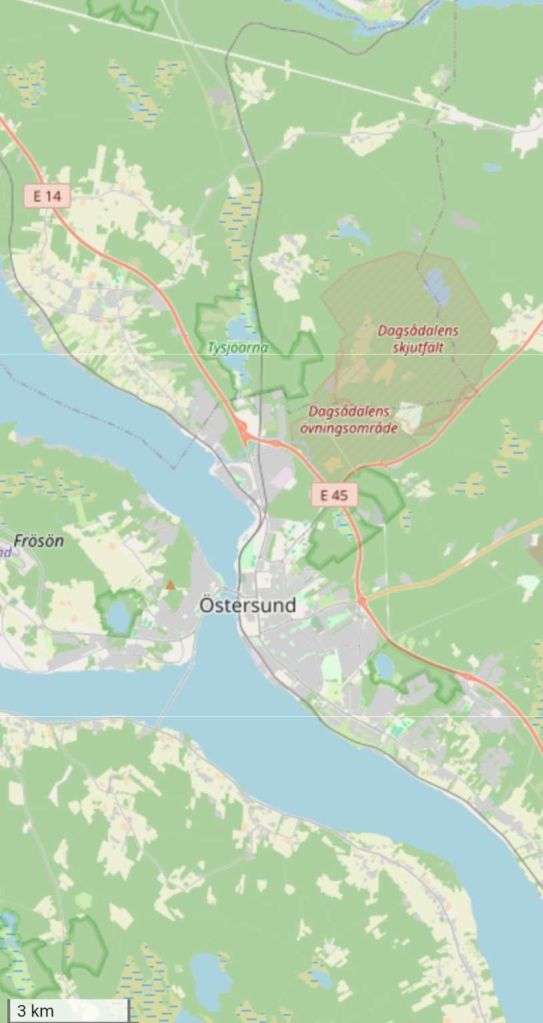
The city of Östersund sits on the East shore of Lake Storsjön. The railway line between Bräcke and Storlien, on the Norwegian frontier, hugs the lakeshore. It enters the map extract near the bottom-right corner and leaves close to the E14 near the top-left. The Inland line (Inlandsbanan) leaves the Bräcke to Storlien line North of Östersund and leaves this map extract towards the top-right. [8]

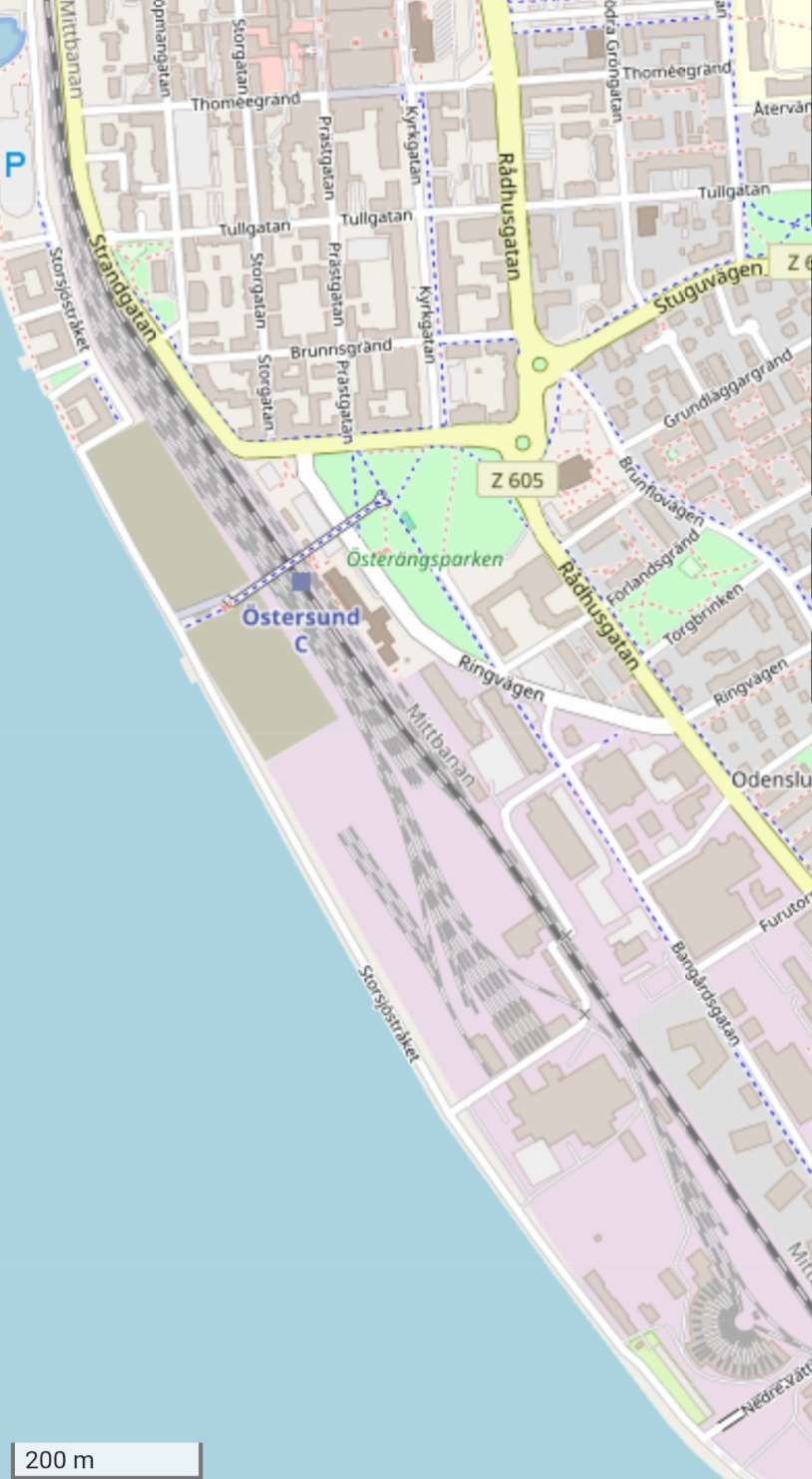
Östersund Railway Station, the line to Bräcke leaves this map extract in the bottom-right corner. The roundhouse at Östersund is also at the bottom left of this image. [8]

The junction: the line to Storlien hugs the shore of Lake Storsjon, the Inlandsbanan heads away to the North. [8]

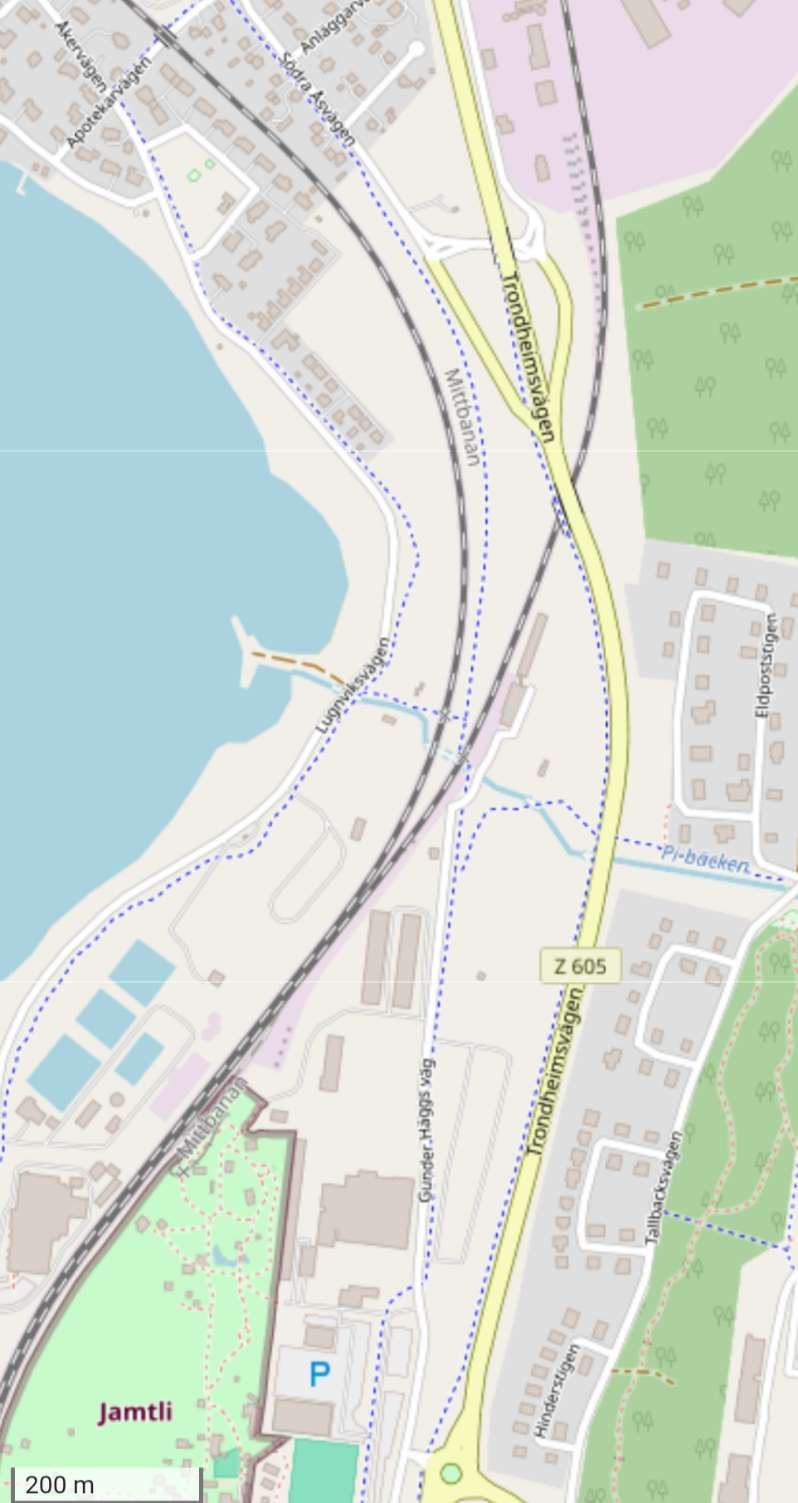
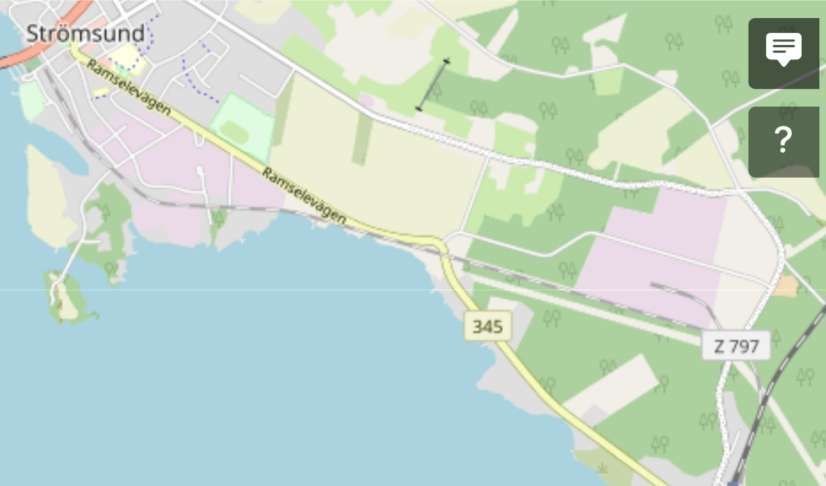
The 74 miles North from Östersund to Strömsund were opened in 1912. Strömsund was the terminus of the line until the line was opened further to the North. [1: p826]

What became the main line to the North can be seen in the bottom-right of this map extract. Strömsund was served from that time on (1918) by a short branch line. The junction was at Ulriksfors which is just off the bottom right of this image. [10]

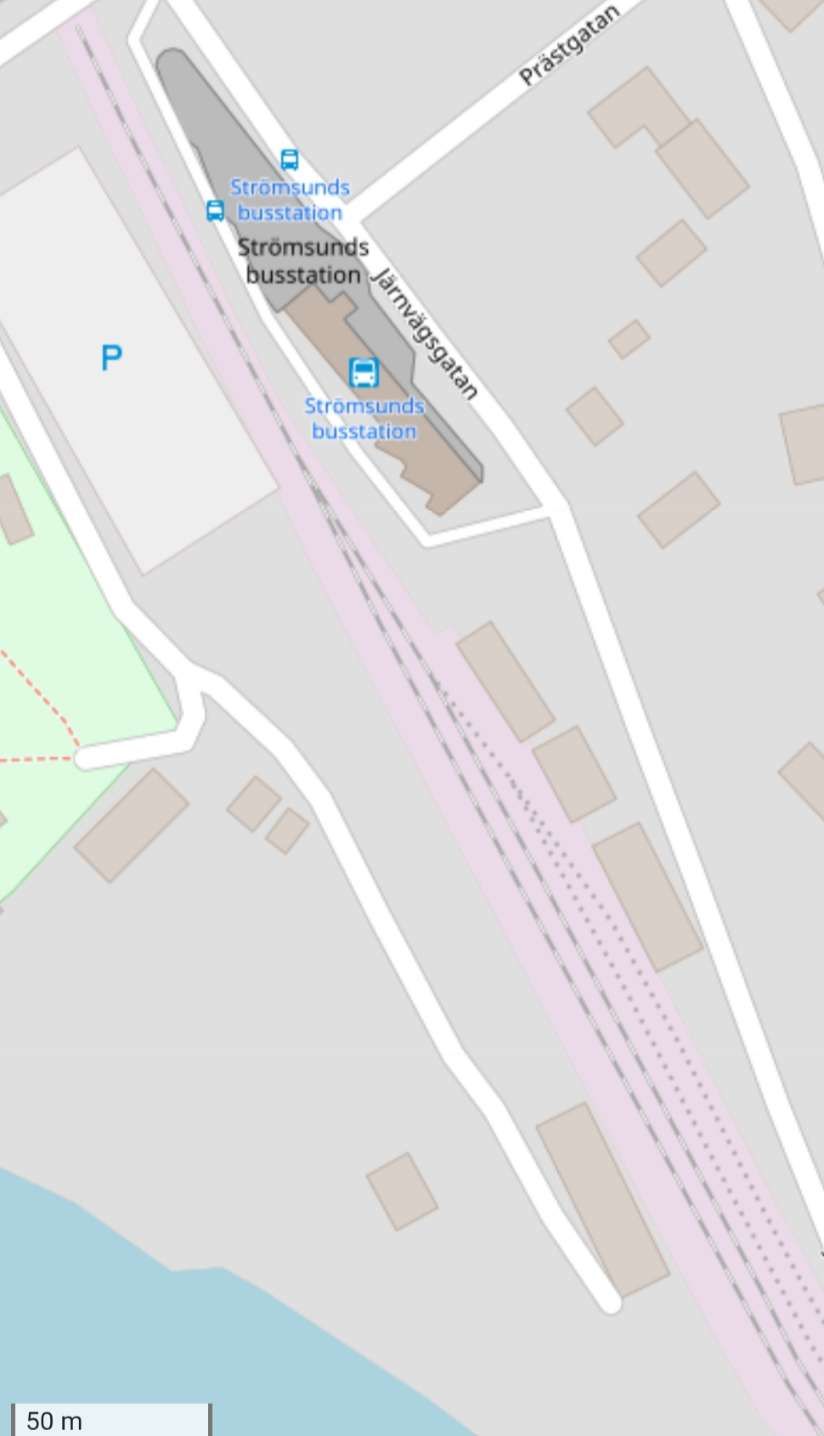
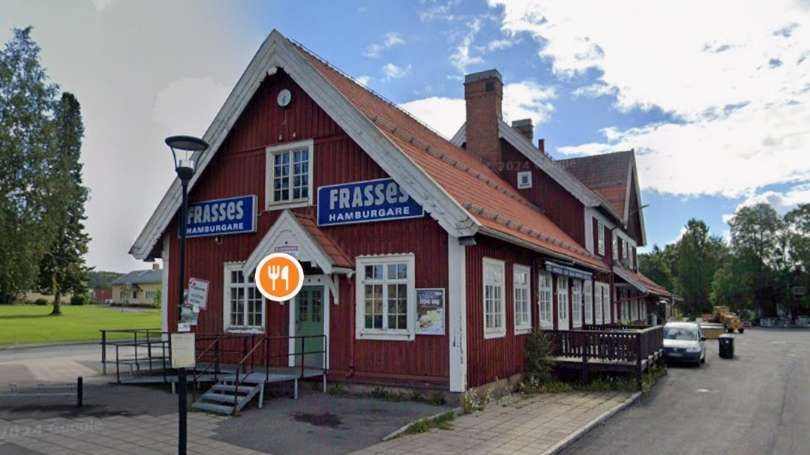
Strömsund Railway Station is now its bus station. [10]

Strömsund Station seen from the Northwest. The tracks ran along the right side of the building which is now the town’s bus station. [Google Streetview, July 2024]
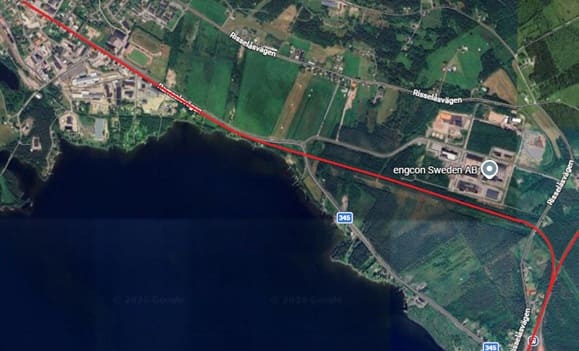
The line from Strömsund to Ulriksfors is shown by the red line running from the left side of this satellite image to meet the Inlandsbanen in the bottom-right of the image. [Google Maps, April 2026]

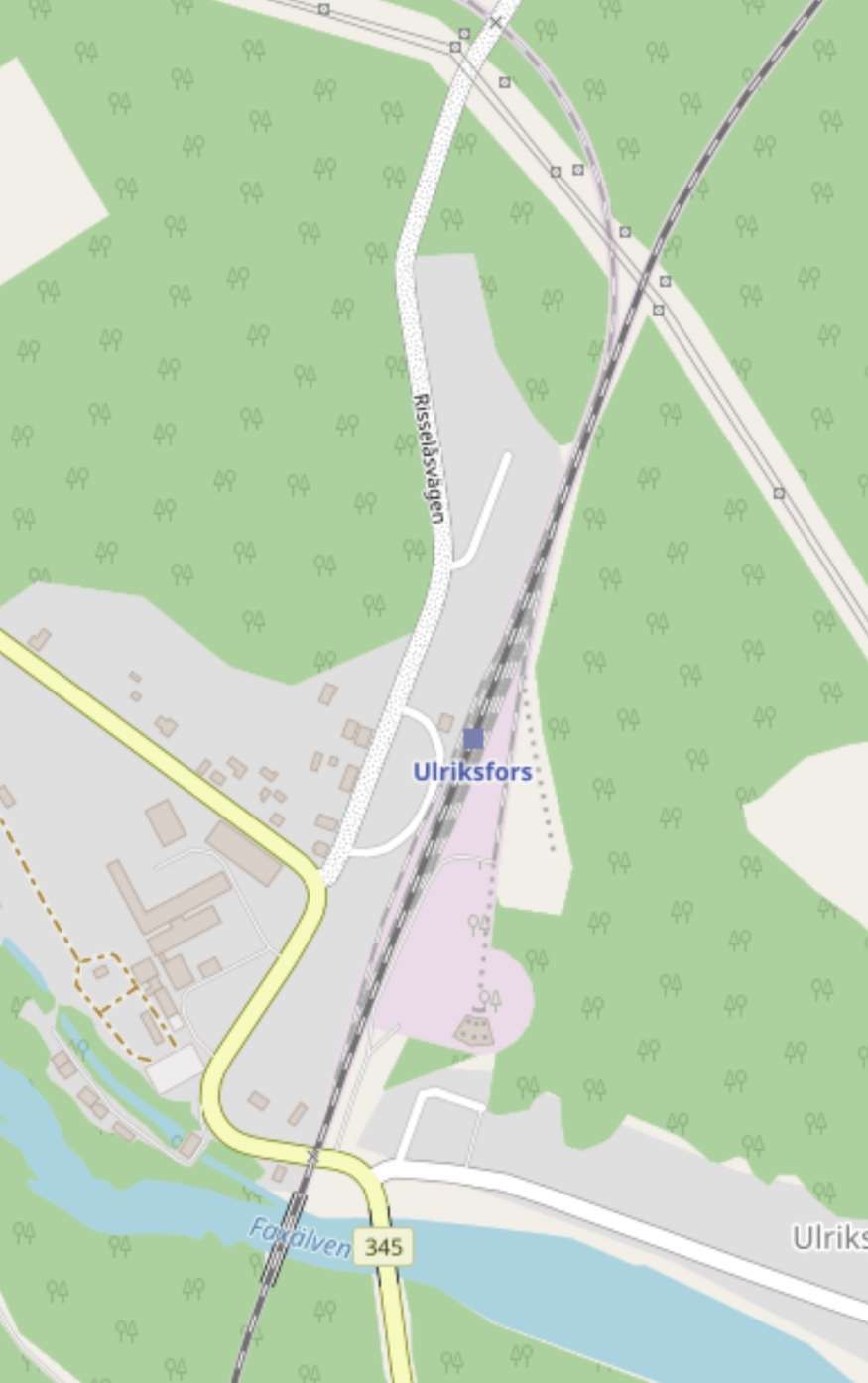
Ulriksfors Railway Station sits just to the North of the railway bridge over the Faxälven River. (Google gives the river the name ‘Fängsjön’.) [11]

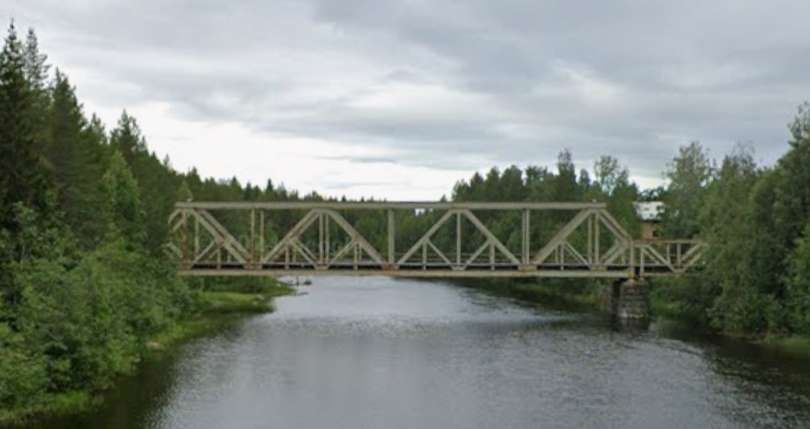
The railway bridge over the river, seen from the East from the road bridge over the river. [Google Streetview, July 2024]
Ulriksfors Railway Station seen from the Southwest. [Google Streetview, September 2023]

The line was then continued northward from Ulriksfors to develop wide and very sparsely-inhabited areas in Lapland. The 80 miles from Ulriksfors to Vilhelmina were brought into use in 1918 and, after an interval of 11 years, the 87 miles thence to Sorsele were opened in 1929.” [1: p826]

Vilhelmina and Sorsele are shown below. …

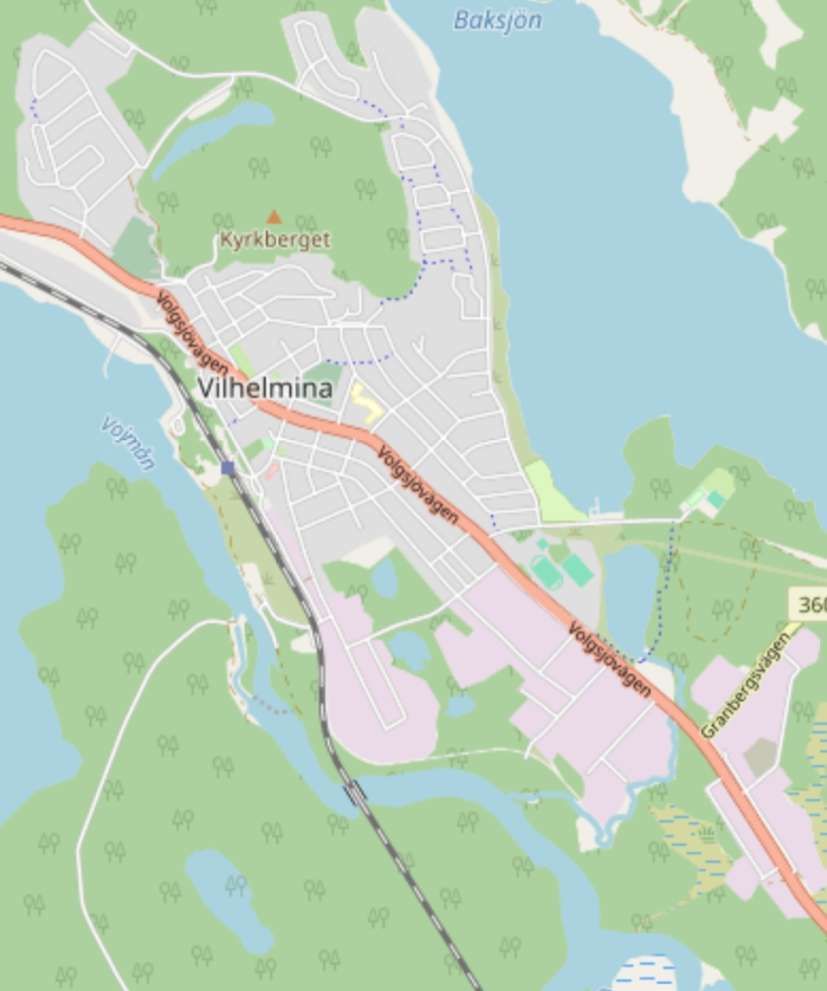
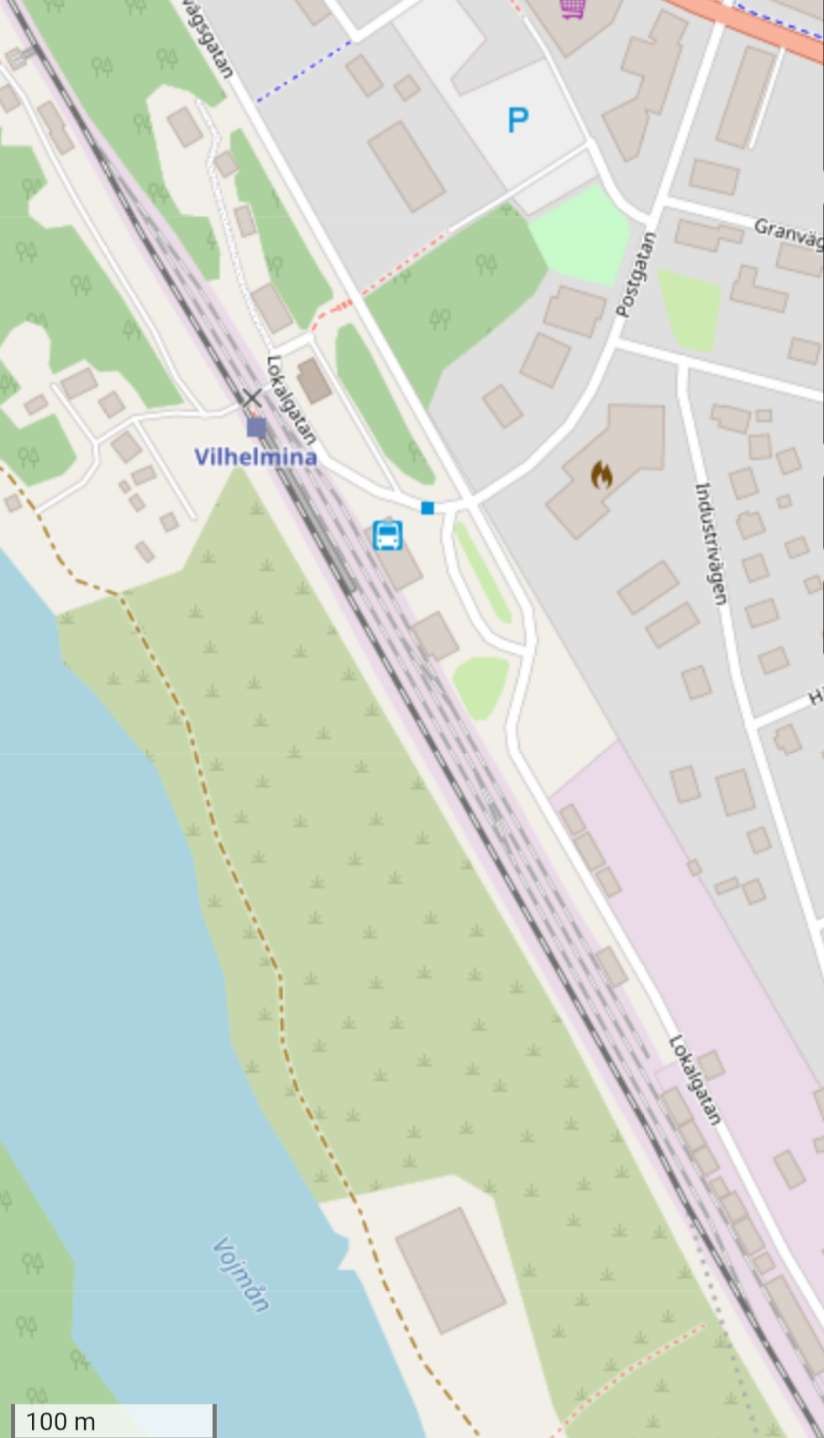
Vilhelmina Railway Station was on the West side of the town between it and Lake Vojmän. The railway was opened through to the town from the South in 1918. [12]

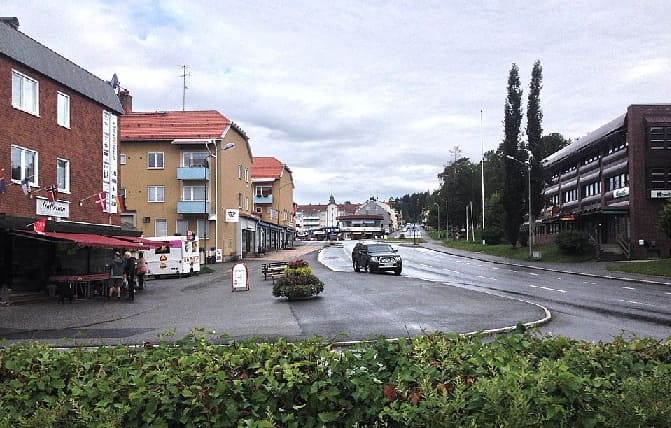
Vilhelmina had 3,657 inhabitants in 2010. [15]

The town centre, (c) Konky2000 and licenced for reuse under a Creative Commons Licence (CC BY-SA 3.0) [15]

A closer view on OpenStreetMap of Vilhelmina Railway Station. [12]

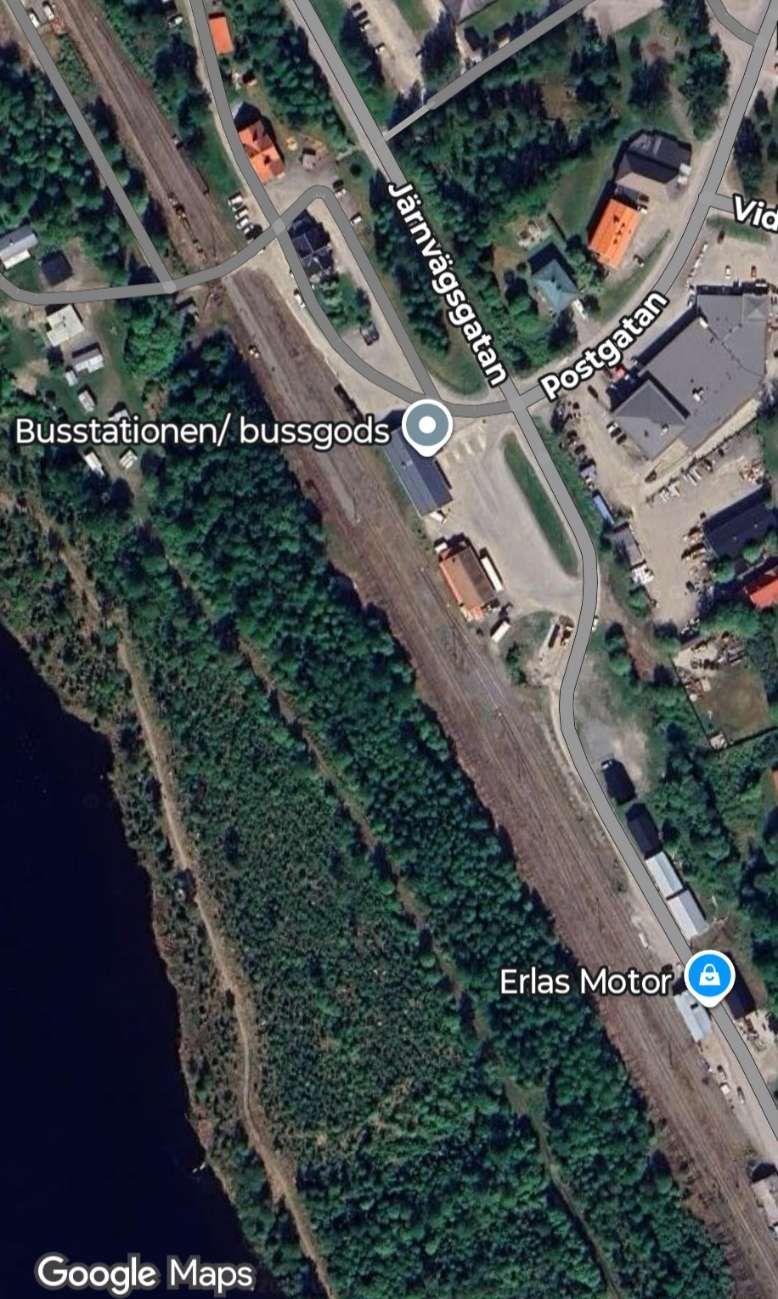
The same area as it appears on Google’s satellite imagery. [Google Maps, April 2026]
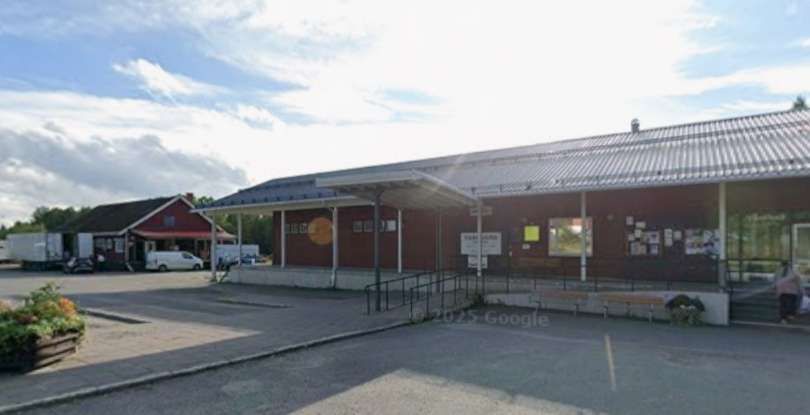
The building closest to the camera is the bus station at Vilmelmina. [Google Streetview, September 2025]

The next two photographs show a steam locomotive which used to work on the Inlandsbanan which has been stabled in a short spur to the North of the bus station building. …

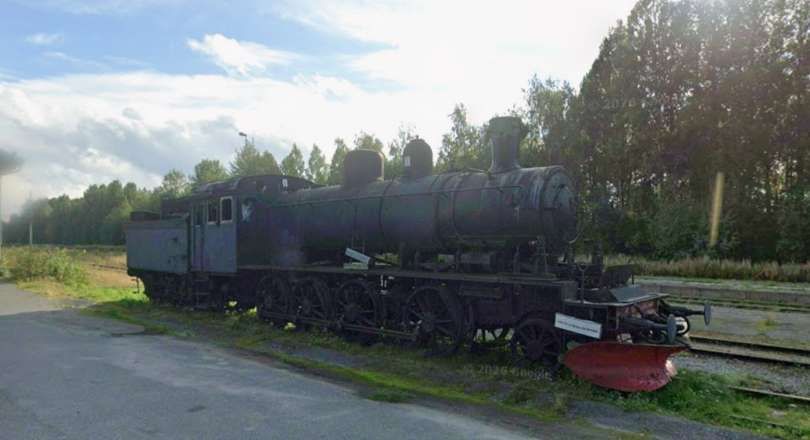
The two photographs show a decommissioned SJ E2 class 2-8-0 steam locomotive, specifically number 1127, which is preserved as a monument at the train station in Vilhelmina, Sweden. [Google Streetview, September 2025]
The same locomotive as it appeared in 2018. It was last in steam on the Inlandsbanan in 1972, © Marcus Bäckström. [Google Streetview, April 2026]
Vilhelmina Railway Station seen from the North in 1958, © H. A. Vallance. [1: p828]
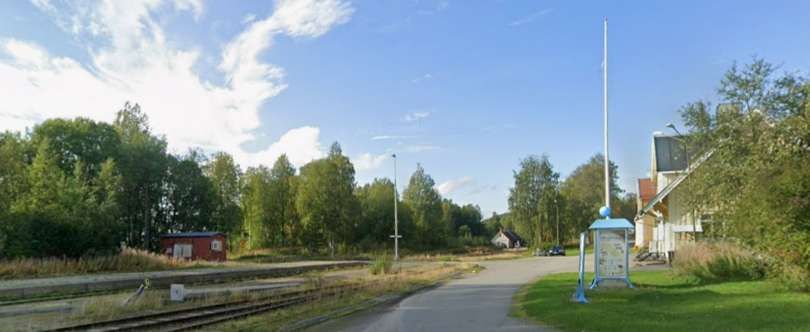
Looking Northwest through the site of the railway station. The station building is behind the tree on the right of the image. [Google Streetview, September 2025]
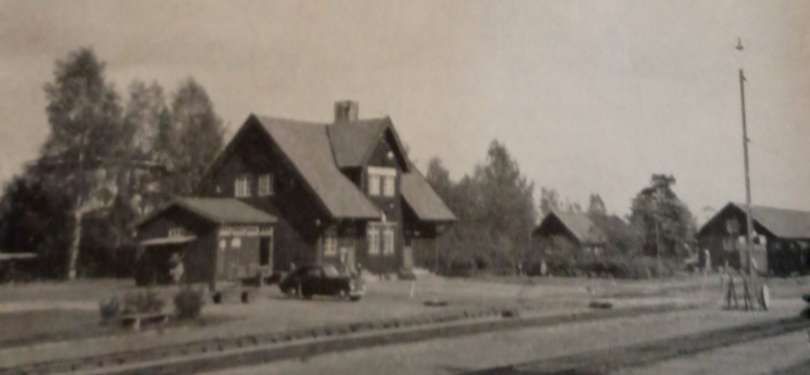
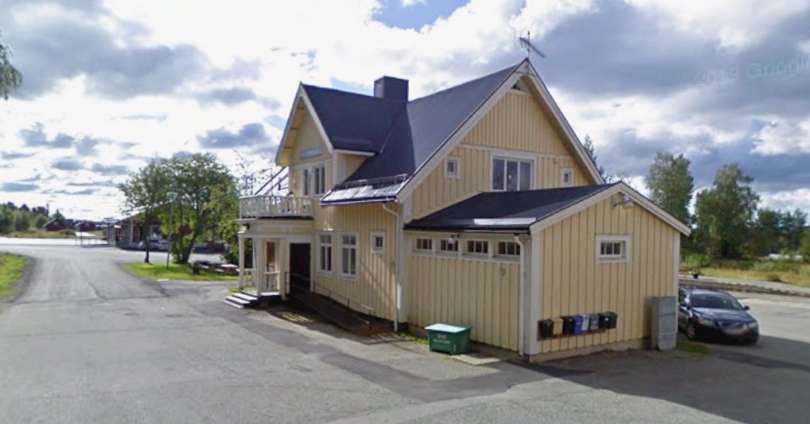
Vilhelmina Railway Station building seen from the North. [Google Streetview September 2010]

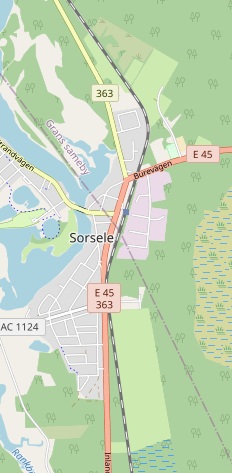
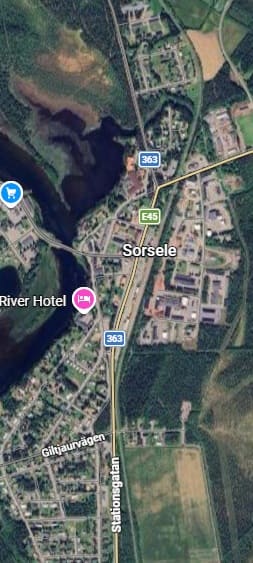
Sorsele was the next terminus location as the line was gradually built to the North. It was the northern terminus of the line from 1929 until the connection to the line being built South from Gällivare was made. [16][Google Maps, April 2026]

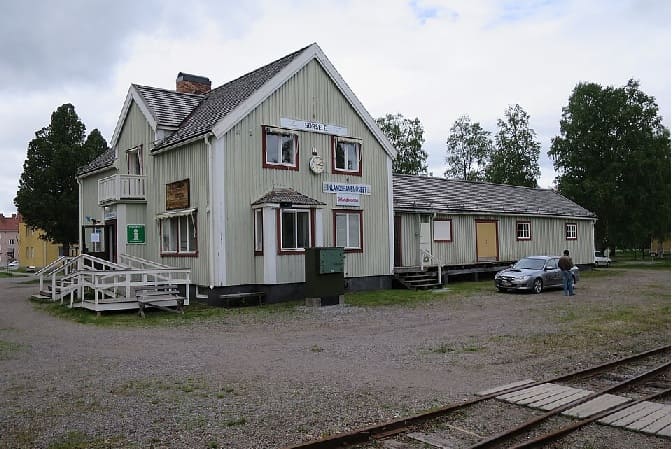
Sorsele Railway Station in 2014, (c) Reinhard Dietrich and licenced for reuse under a Creative Commons licence (CC0 1.0 Universal). [17]

While the line was progressing gradually North from Östersund to Sorsele, construction started from a junction with the line to Narvik (in Norway) at Gällivare. [2][3]

Greville & Vallance tell us that, “A temporary track, to carry materials for the construction of a big hydro-electric power station, had been laid for 33 miles to Porjus in 1911, and this section was opened for goods traffic in 1916, and for passengers in 1925. The 29 miles from Porjus to Jokkmokk were brought into use in 1927. The intervening gap of 163 miles from Jokkmokk to Sorsele was bridged in two sections, from Sorsele to Arvidsjaur (55 miles) in 1933, and from Arvidsjaur to Jokkmokk (108 miles) in 1937. Between 1924 and 1930, cross-country lines were opened from Hoting to Forsmo, and from Storuman to Hallnas, to connect the new inland route with the older main line from Stockholm to Lapland.” [1: p826]

We will pick up details of these different locations as we travel along the line from Gällivare to Kristinehamn in this and future articles.

Historically, the southern half of the route, from Östersund to Kristinehamn, falls into two parts. The Kristinehamn-Sjöandan Railway, seven miles long, was constructed between those places as early as 1850, as part of a system of narrow-gauge railways and canals connecting the local iron foundries with Lake Vaner and, via the Gota Canal, with the sea. It was at first worked by horses, but became steam-operated in 1858, and in 1859 started to carry passengers. In 1873, this line was acquired by the Ostra Varmlands Railway, converted to standard gauge, and extended for 29 miles to Persberg in 1875, part of another narrow-gauge line, the Kroppa Railway, being incorporated.” [1: p826]

Greville and Vallance continue: “Between 1889 and 1891, the Östra Värmlands Railway opened the 102 miles from Persberg, through Vansbro, to Mora, where a connection was made with the Falun-Rättvik-Mora Railway, which was extended for eight miles from Mora to Orsa in 1892. The 77 miles from Orsa to Sveg were built by the Orsa-Härjedalens Railway, and opened in 1909 The whole line from Kristinehamn to Sveg passed into the hands of the Swedish State Railways between 1917 and 1919. … The remainder of the route was built by the State, in a southerly direction from a junction with the Bräcke-Östersund line at Brunflo, nine miles from Östersund. The 42 miles from Brunflo to Åsarna were brought into use in sections between 1916 and 1918, and the 63-mile link between Åsarna and Sveg was completed in 1922.” [1: p829]

Following the Route of the Railway – Gällivare to Arvidsjaur

Gällivare is at the northern end of the Inlandsbanan. We start our journey along the line from here. …

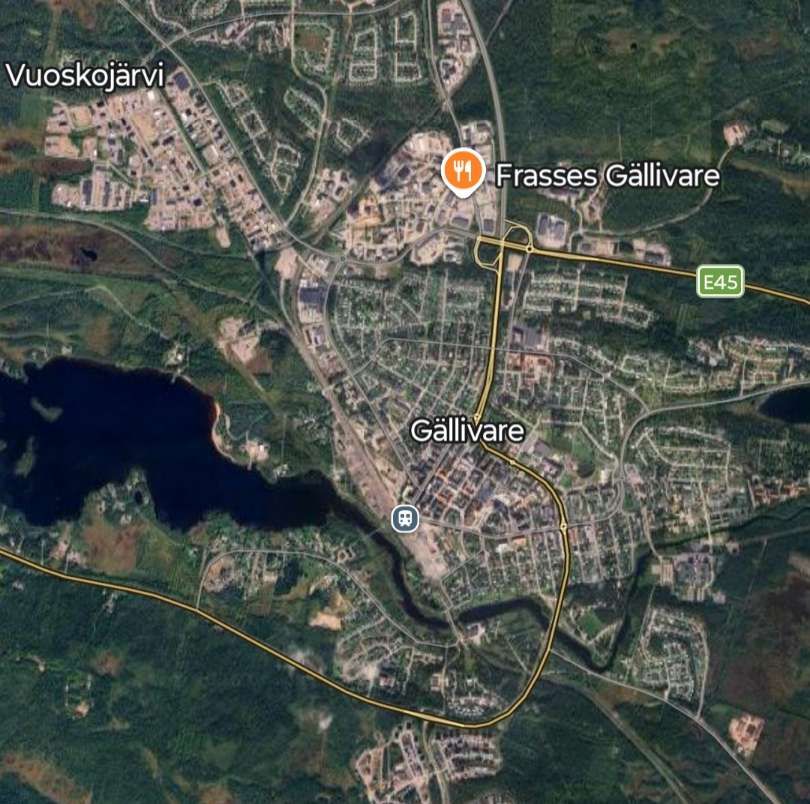
Gällivare. [Google Maps, April 2026]

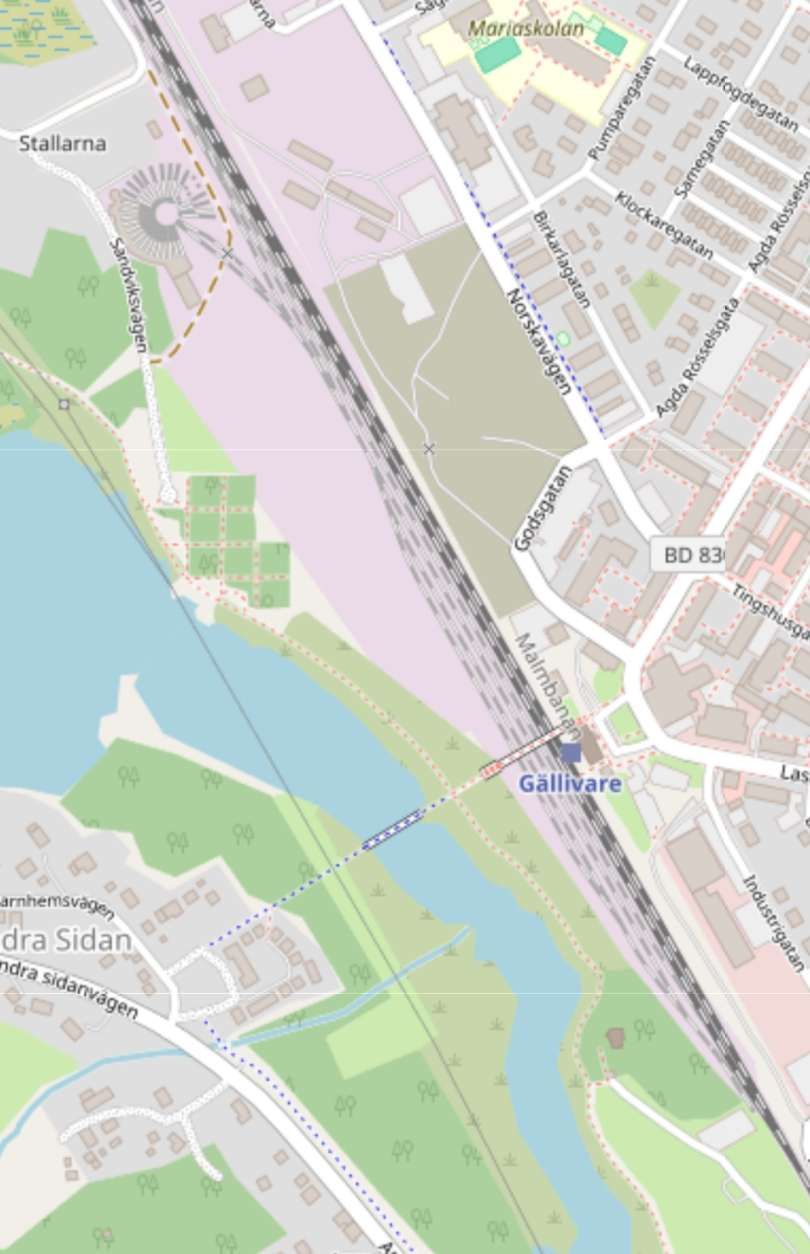
Gällivare Station sits alongside the Vassara River on the Southwest side of the town. The line to Narvik heads away to the West, North of the top of this map extract.  The Inlandsbanan also leaves heading West from the triangle. The line heading Southeast across the Vassara River heads for Luleå and thence to Stockholm via the coastal line. [Google Maps, April 2026]

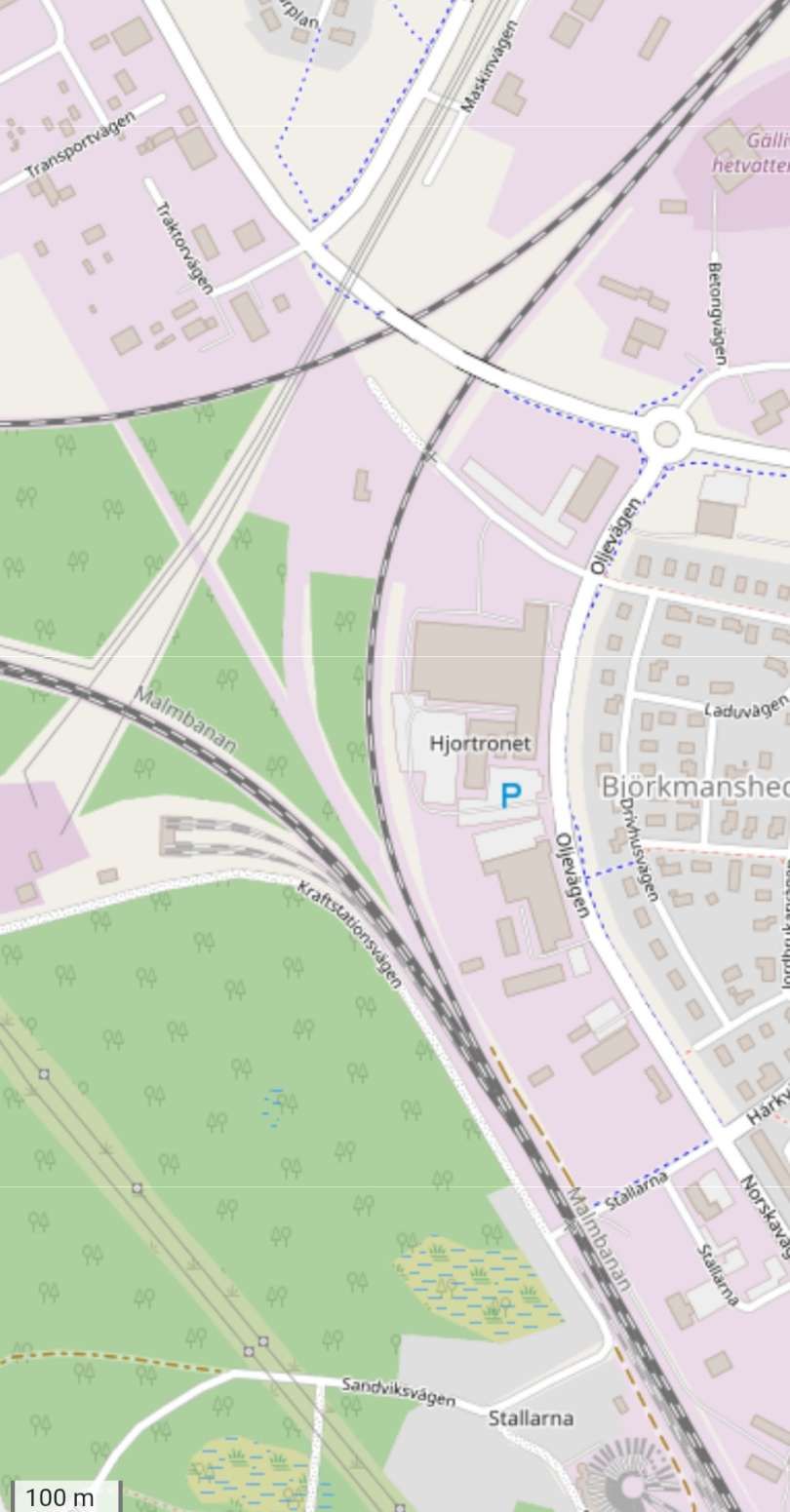
The next two images are taken from OpenStreetMap’s mapping and, between them, show the length of the station site at Gällivare. …

The North end of Gällivare Railway Station site. The triangular junction is worth noting at the top of this extract. [7]

The South end of Gällivare Railway Station site. The significant roundhouse should be noted at the top of this image. [7]

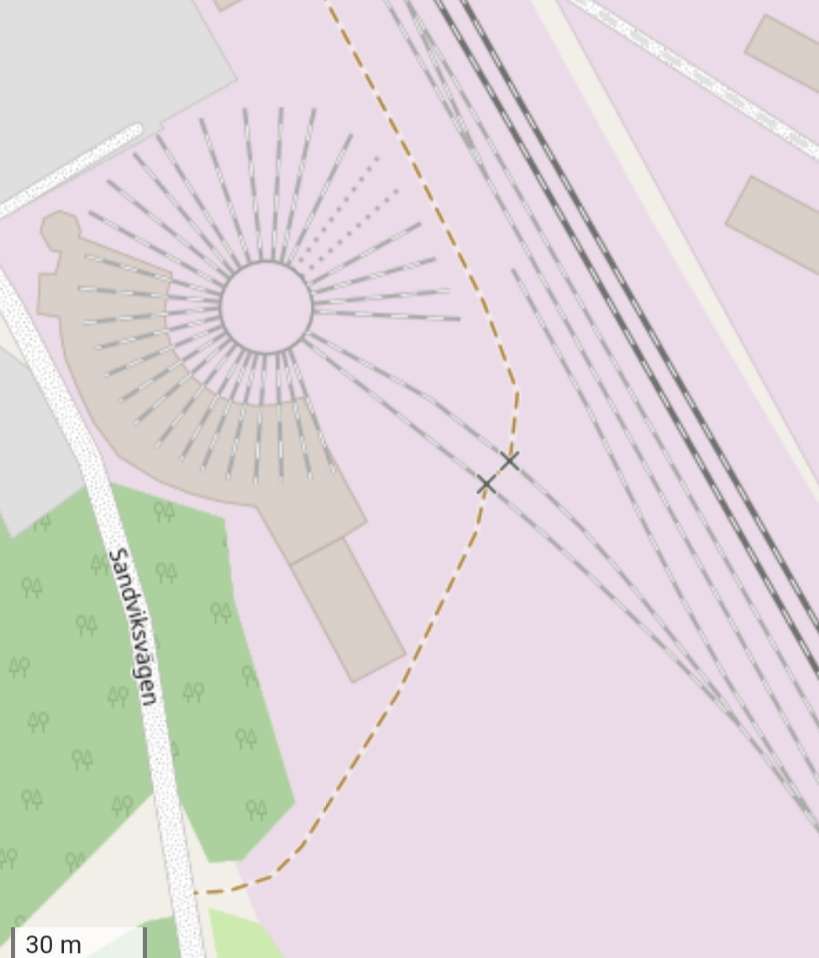
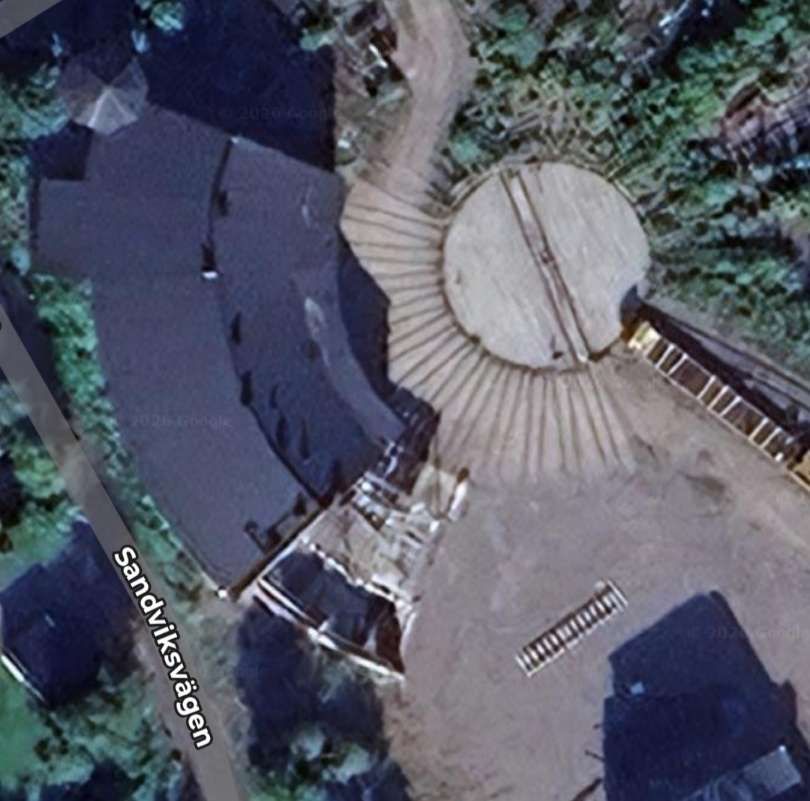
Two closer views of Gällivare’s roundhouse: one cartographic, [7] the other satellite. [Google Maps, April 2026]

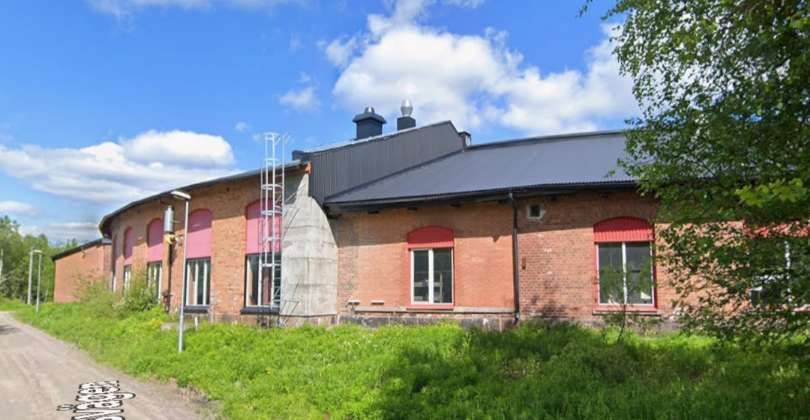
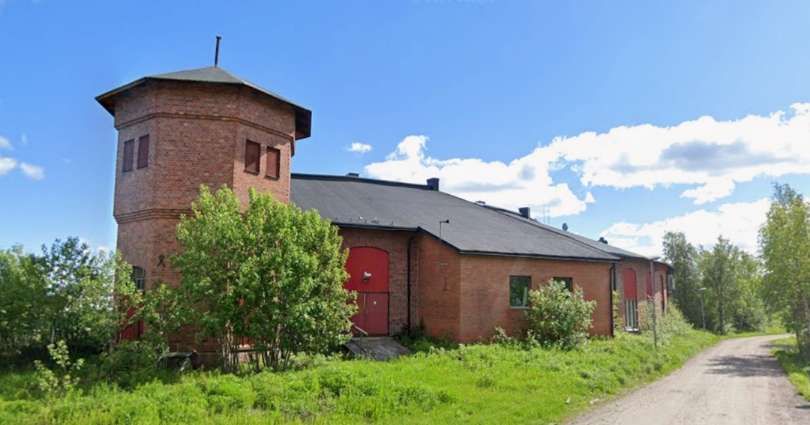
The Roundhouse seen from the South on Sandviksvagen. [Google Streetview, June 2022]
The Roundhouse seen from the Northwest on Sandviksvagen. [Google Streetview, June 2022]
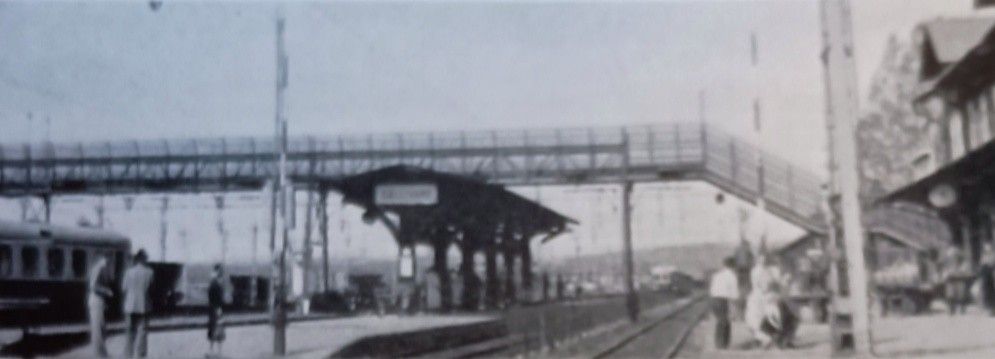
Gällivare Station looking North. A diesel railcar for the inland line is at the platform on the extreme left, © H. A. Vallance. [1: p826]
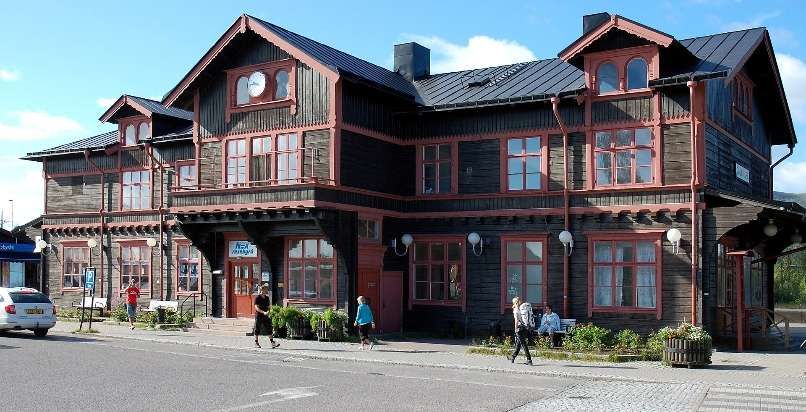
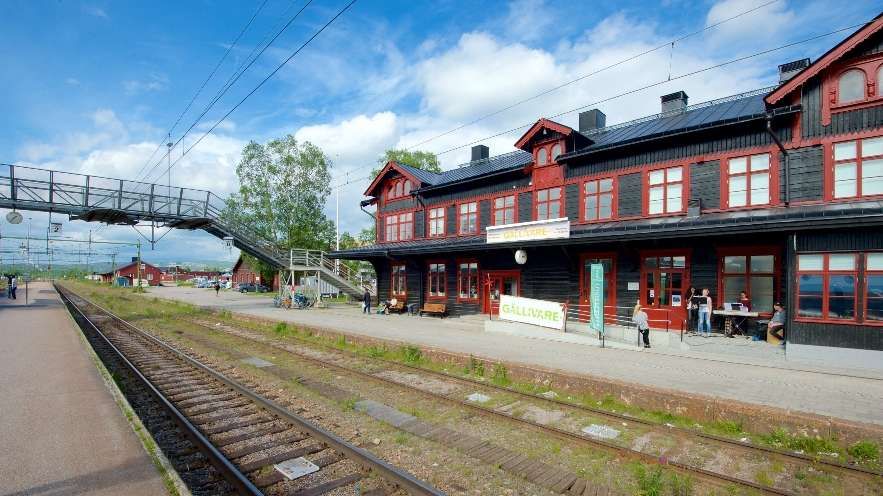
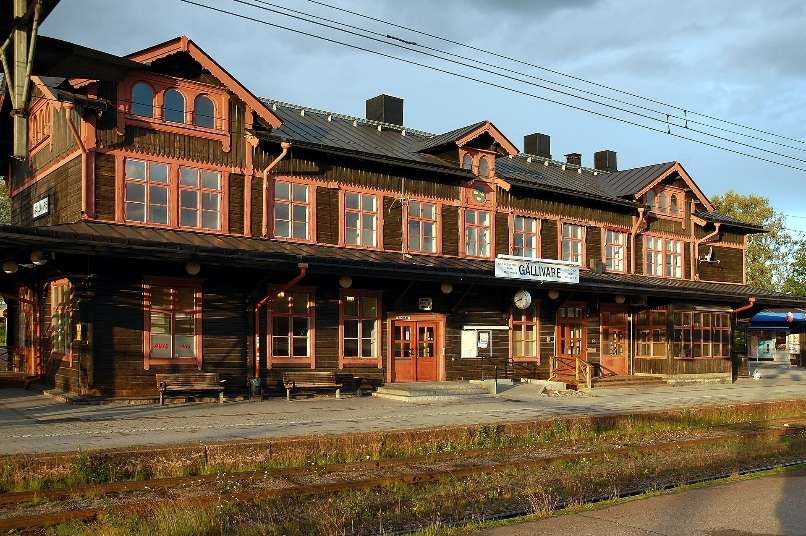
Gällivare Station seen from the road in 2012, © Svjo and licenced for reuse under a Creative Commons licence (CC BY-SA 3.0). [4]
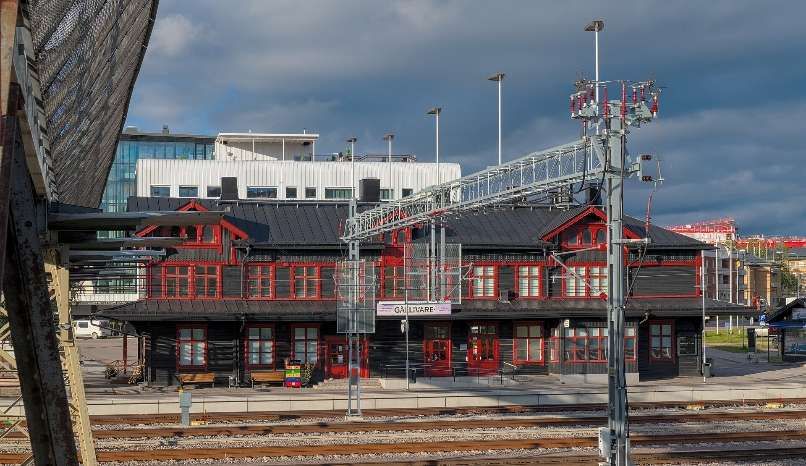
Gällivare Station, looking North [3]
Gällivare Station, looking Northeast. [5]
Gällivare Station, looking East. [6]

Trains travelling South on the Inlandsbanan set off from Gällivare Railway Station in a northerly direction. North of the Roundhouse they bear round to the West.

Greville and Vallance talk of the line in 1958: “The line is single track throughout, with passing loops at most stations. Unlike the railway to Narvik, it is not electrified. Apart from the bridges over the numerous rivers, heavy engineering works have been avoided, and the gradients are undulating, and frequently quite steep. For many miles, the railway passes through forests and tundra, almost devoid of habitation. The country is rather flat, but is relieved by several lakes, and there are distant views, towards the west, of the Lapland mountains, including Kelneksise (8,900 ft.) the highest mountain in Sweden. Herds of wandering reindeer are frequently seen, and may even hold up the train while they cross the unfenced line to reach their feeding grounds. Laspebryggan, 28 miles from Gällivare, is the starting point for the popular journey by boat along a chain of lakes to Stora Sjöfallet, the finest waterfall in Sweden, and considered by many to be the most magnificent in Europe.” [1: p829]

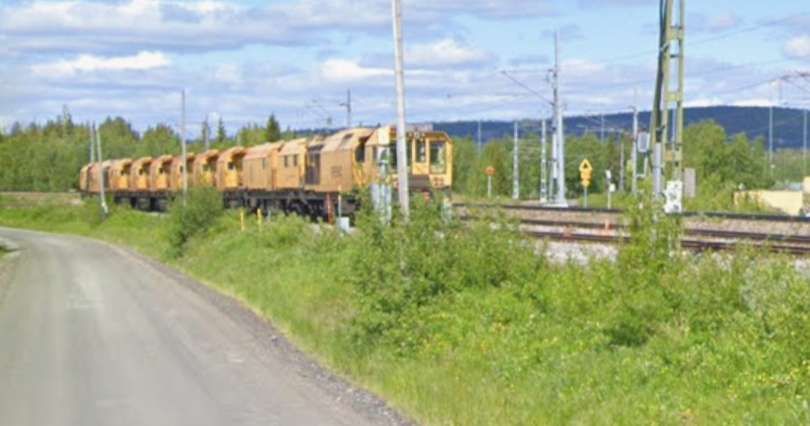
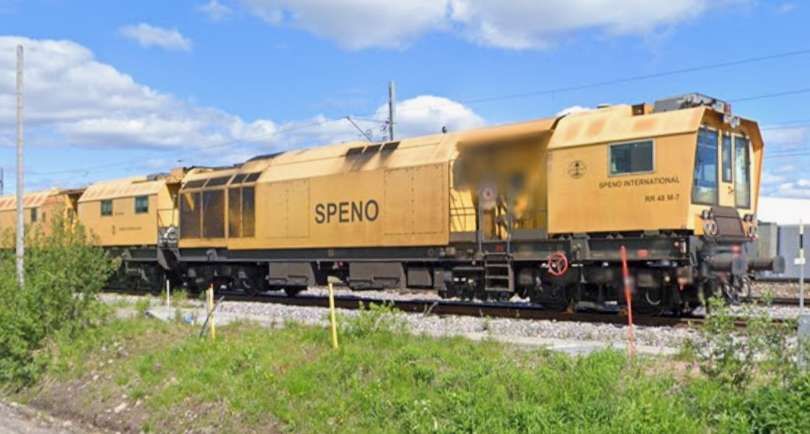
Looking North, the line out of Gällivare runs Northwest before curving round to the West. The yellow machine is a Speno International rail grinding train, specifically model RR 48M-7. It is designed for rail rectification, removing small layers of metal from the railhead to eliminate surface cracks and irregularities.  This keeps the track in good condition, preventing derailments and ensuring a smoother, quieter journey for passengers and freight.  [Google Streetview, June 2022]
A closer view of the front unit on the train in the siding. [Google Streetview, June 2022]
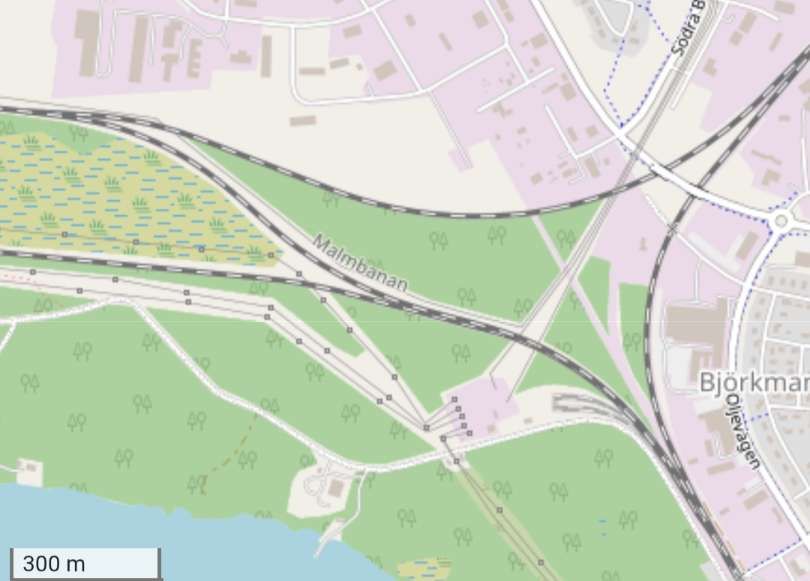
The line heading South runs through Gällivare Railway Station. The Inlandsbanan is the line leaving this map extract centre-left with the line to Narvik to its North. The line leaving the extract top-right runs only a short distance through Koskullskulle to Vitåforsgruvan. Just on the Southwest side of the curve there is a rail-served facility which appears to be newly built. [7]
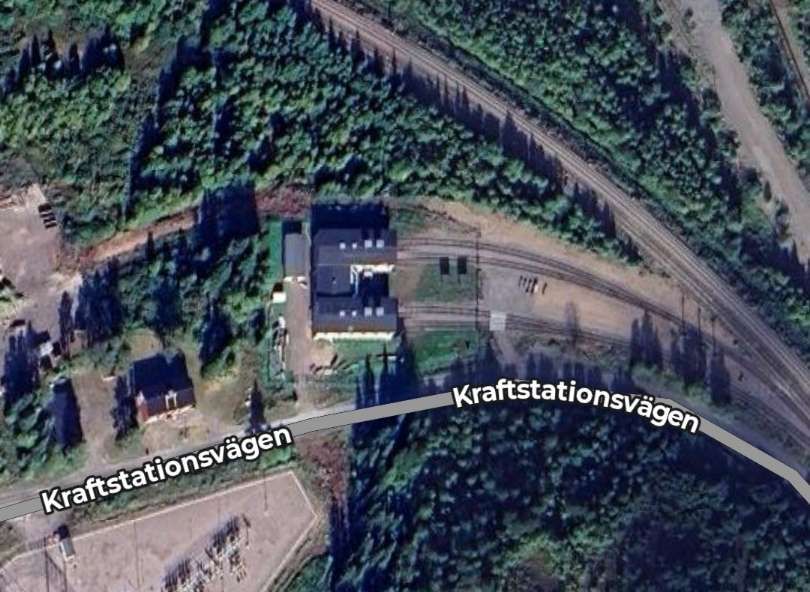
The rail-served building which appears to be a modern locomotive/traction stabling facility. [Google Maps, April 2026]
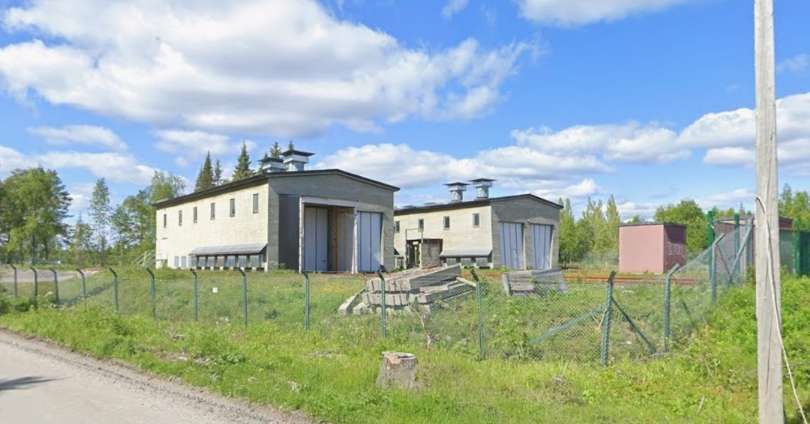
The same building seen from the road. [Google Streetview, June 2022]
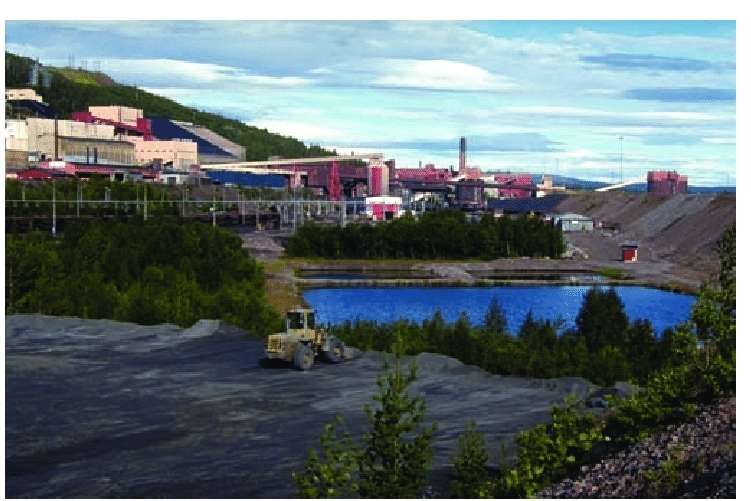
Mineral production at Vitåforsgruvan, Malmberget in Lappland, Sweden. This site is rail-served with its own branch heading North from Gällivare, © Anders Damberg. [9]

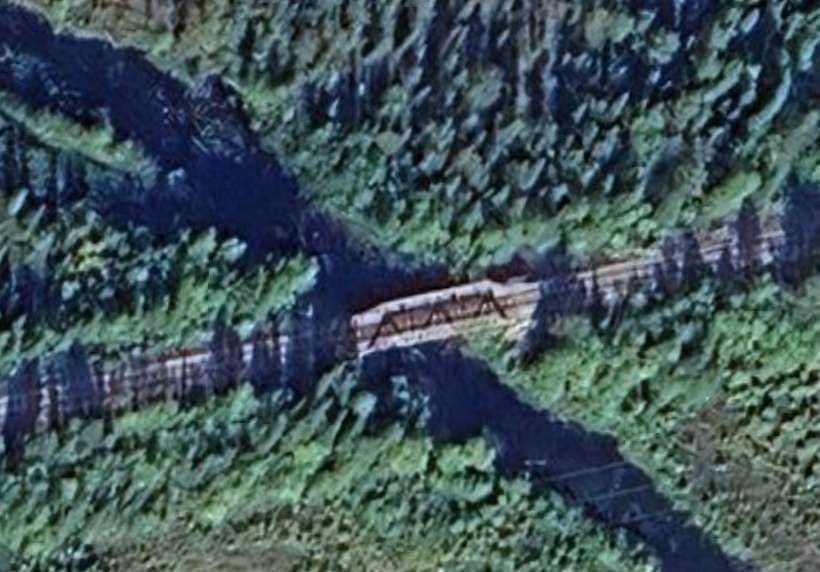
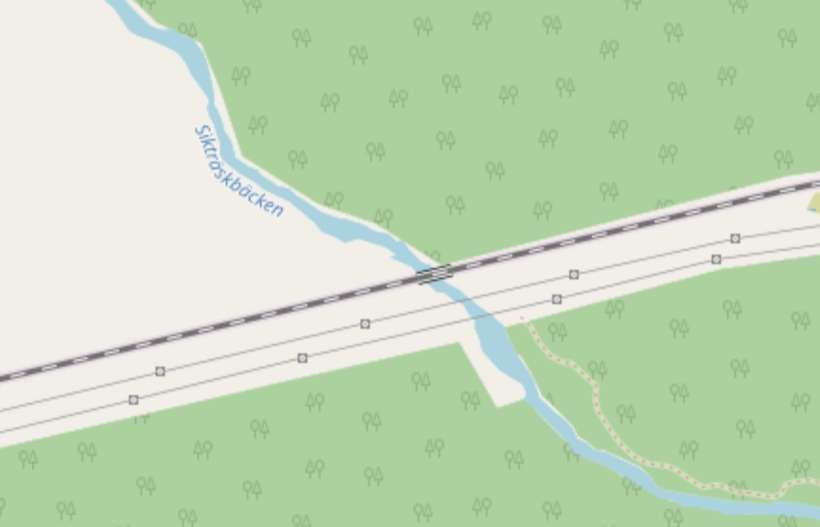
Heading West the Inlandsbanan bridges the Sikträskbäcken River which feeds into Lake Vassaraträsket close to which Gällivare sits.

The truss girder bridge over the Sikträskbäcken. [Google Maps, April 2026]

The bridge as it appears on OpenStreetMap’s mapping. [18]

The line continues in a westerly direction for some considerable distance. …

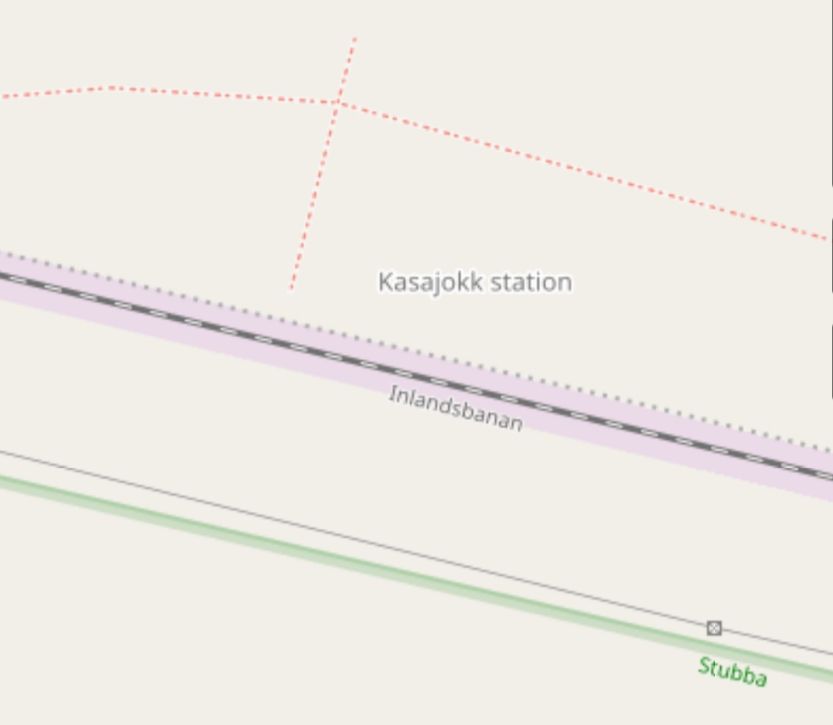
Kasajokk (Kasajakk) Station. [19]

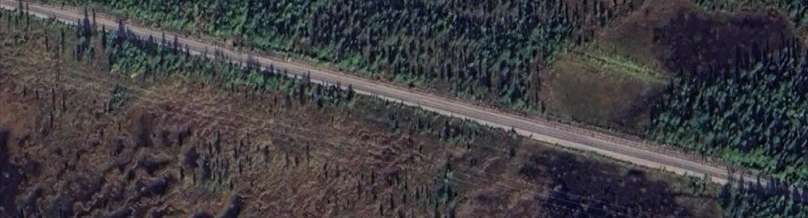
There was a passing loop at this location. [Google Maps, April 2026]

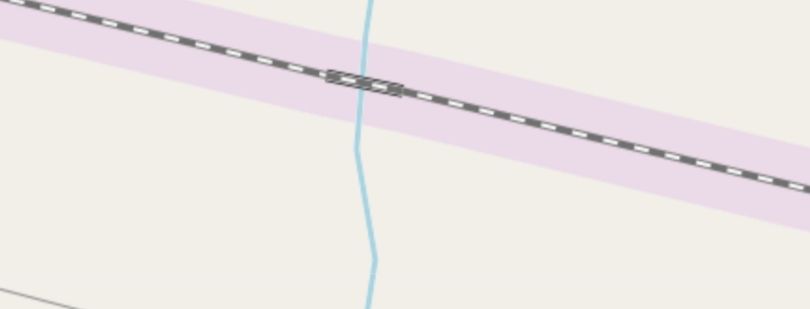
The bridge over the Gassajahka River. [20]

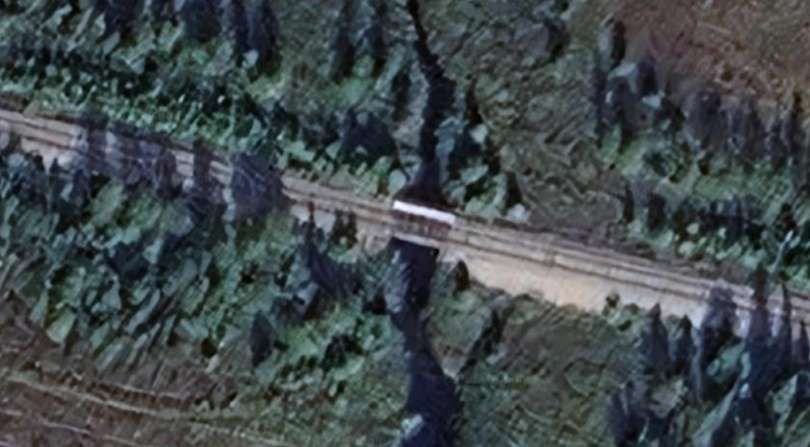
The Gassajahka River bridge. [Google Maps, April 2026]

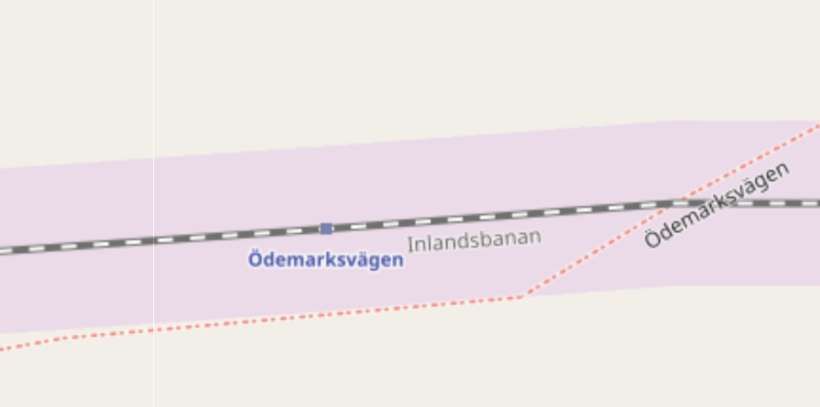
Ödemarksvagen forest road and railway station. [21]

Ödemarksvagen Railway Station. [Google Maps, April 2026]

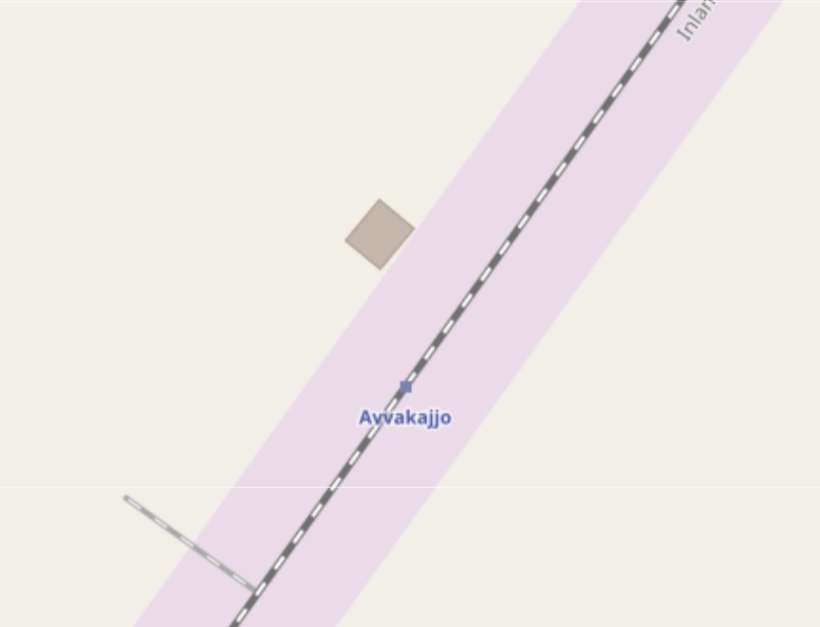
After passing through Ödemarksvagen, the line begins to turn to the Southwest, eventually passing through Avvakajjo station.

Avvakajjo Railway Station can be seen on OpenStreetMap. Bottom-left, there was once a track for storage of a track maintenance vehicle at this location. [22]

There is no easily identifiable location on Google Maps.

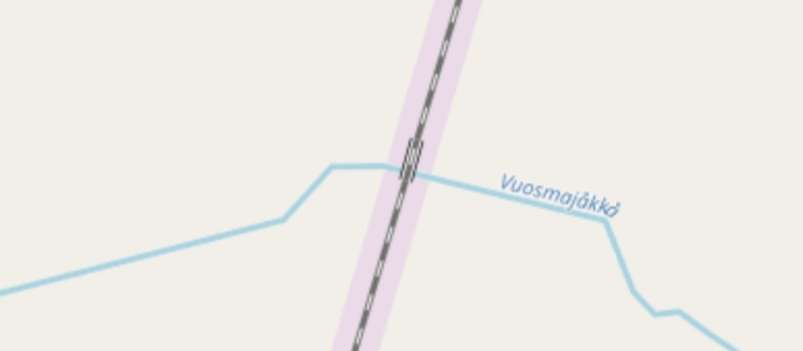
After Avvakajjo the line begins to turn to a South-southwest bearing and then bridges the Vuosmajákka River.

The bridge over the Vuosmajákka River. [Google Maps, April 2026][23]

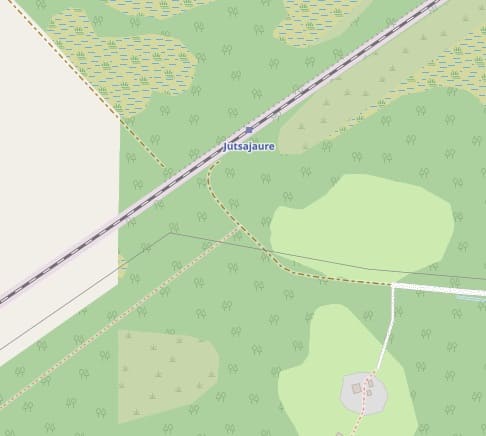
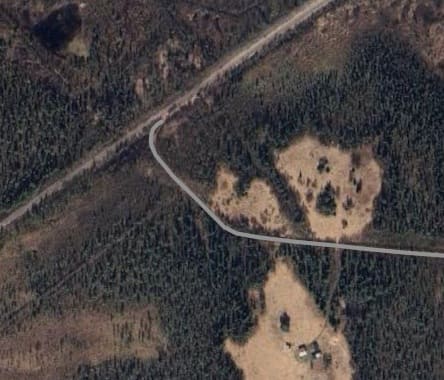
Jutsajaure Halt. [24][Google Maps, April 2026]

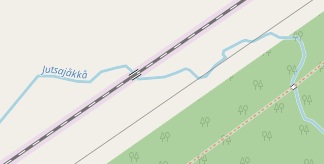
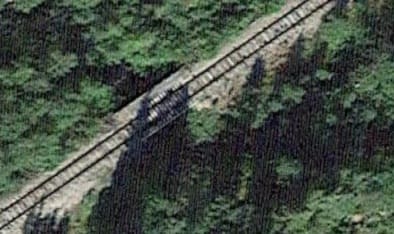
Jutsajakka River. [25][Google Maps, April 2026]

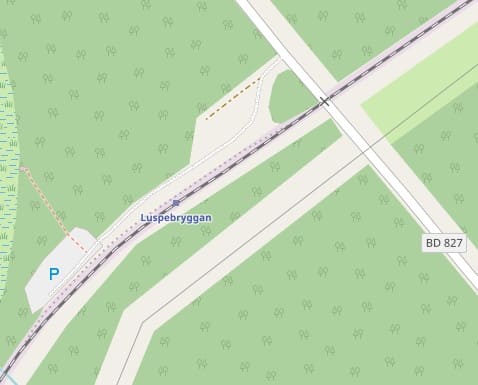
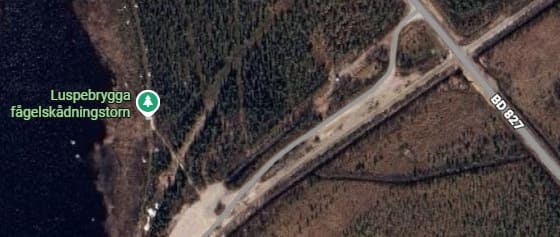
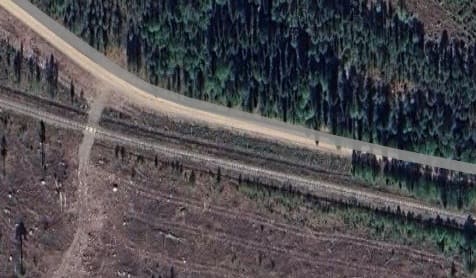
The line continues Southwest crossing the BD827 road and entering Luspebryggan Halt. [26][Google Maps, April 2026]

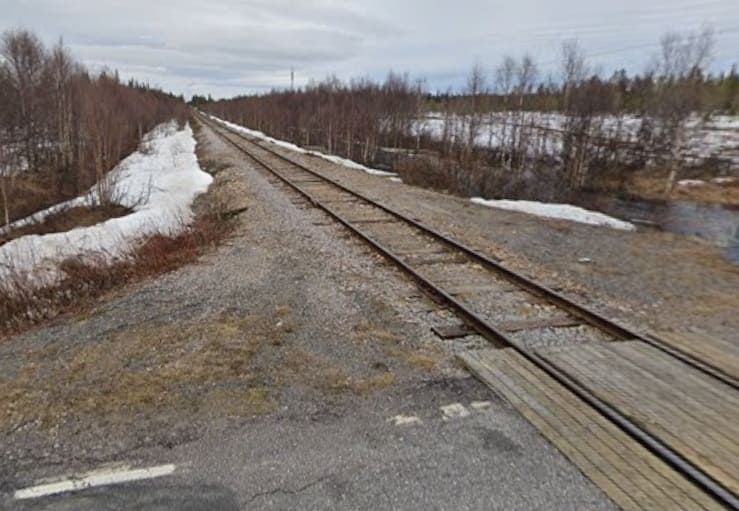
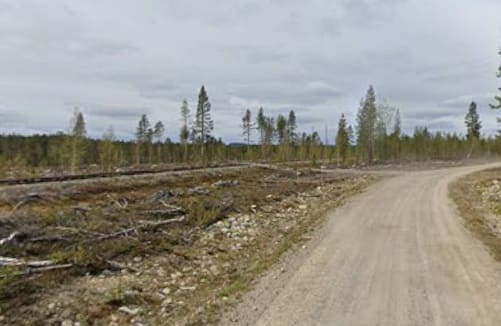
Looking Northwest along the Inlandsbanen from the BD 827. [Google Streetview, May 2024]
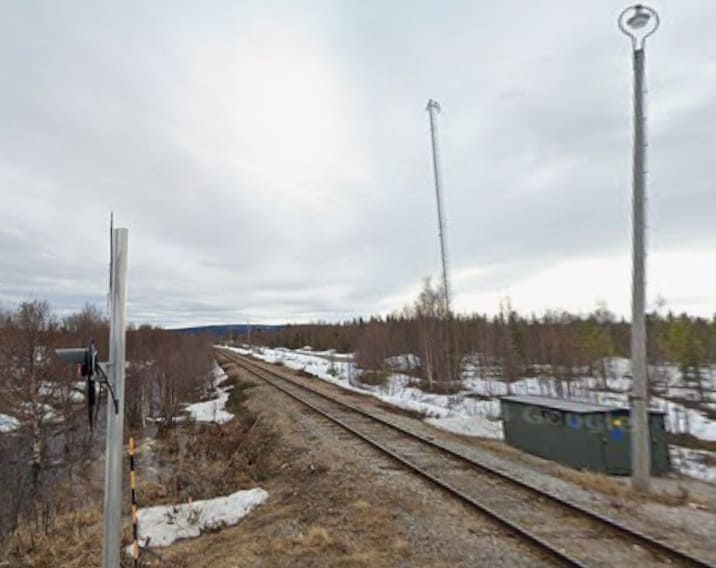
Looking Southeast along the Inlandsbanen from the BD 827. The halt of Luspebryggan is just ahead. [Google Streetview, May 2024]

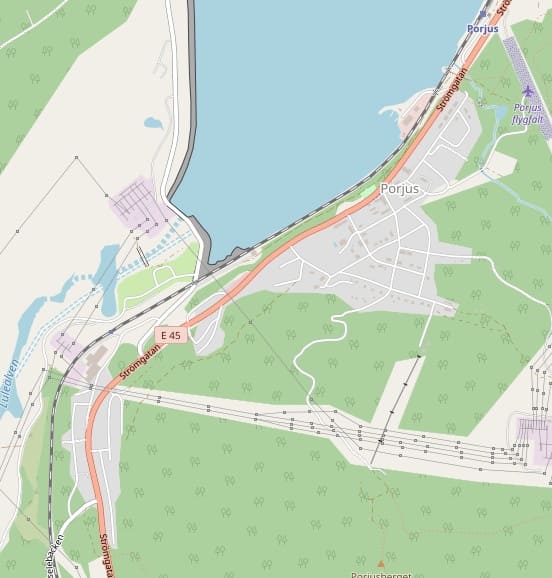
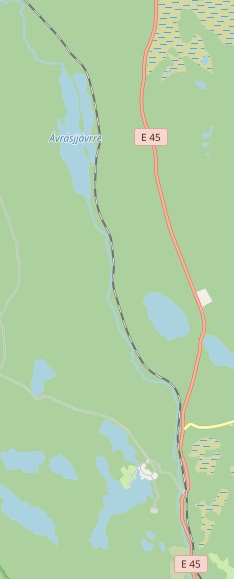
Beyond Luspebryggan, the line turn towards the South, running along the lakeshore (Store Lulwvatten) to Porjus.

The small town of Porjus. [27]

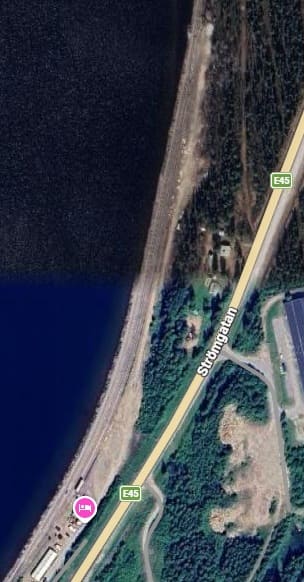
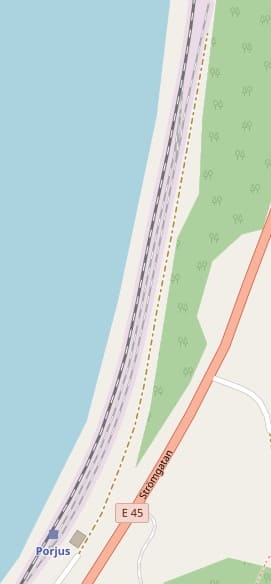
Porjus Railway Station. [Google Maps, April 2026] [27]

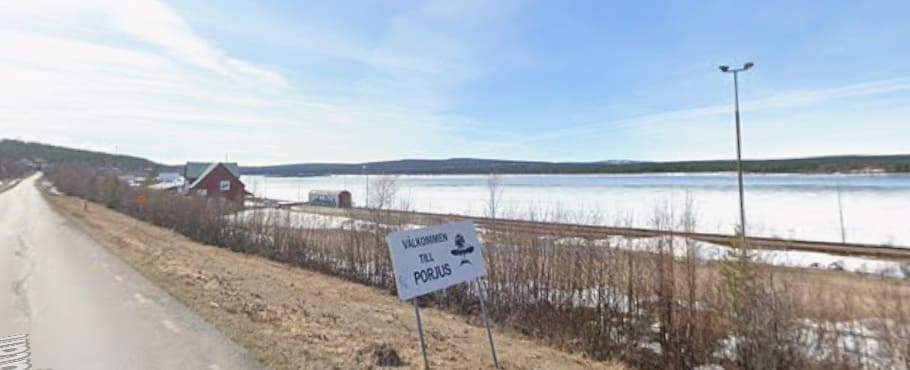
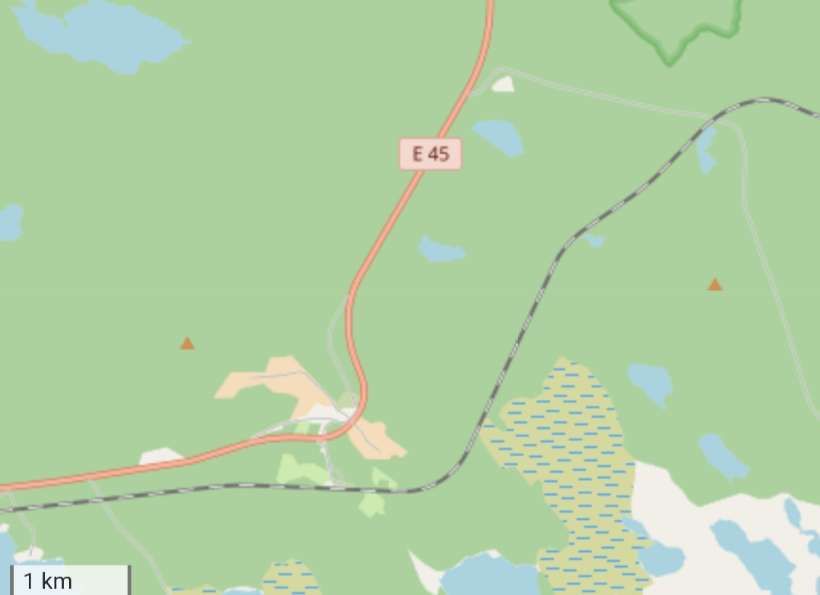
Porjus Railway Station, seen from the Northeast. This photograph was taken on the E45 approaching Porjus. [Google Streetview, May 2024]
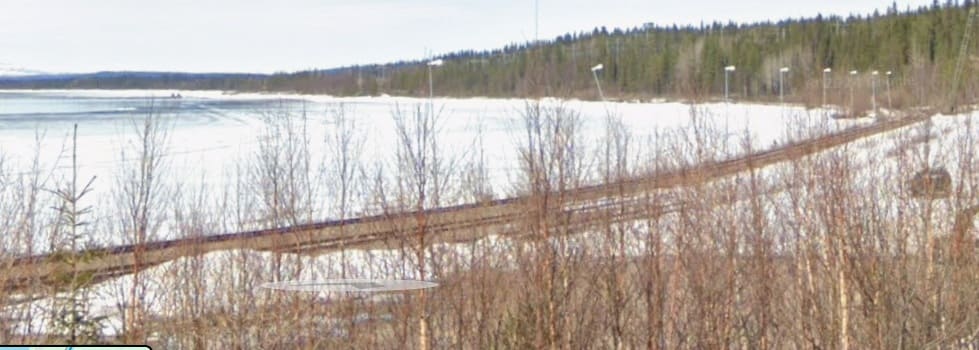
Looking North along the lakeside, with the railway curving round to the North as it sets off for Gällivare. [Google Streetview, May 2024]
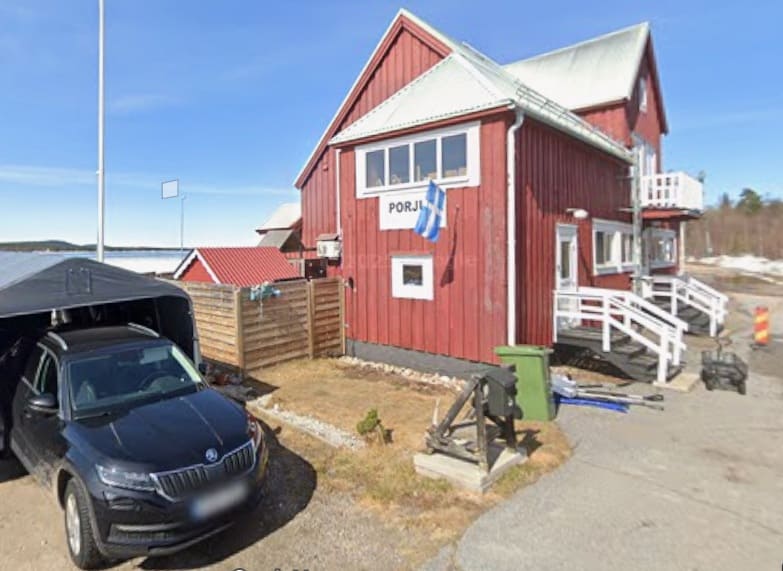
Porjus Railway Station building which is also a B&B, offering opportunities for glamping!
[Google Streetview, May 2024]

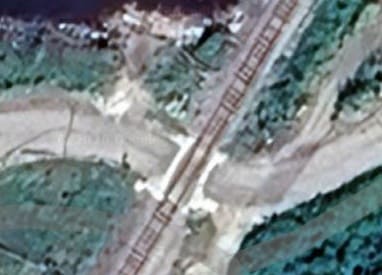
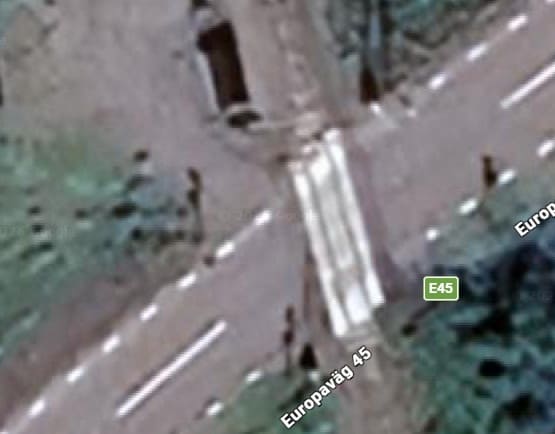
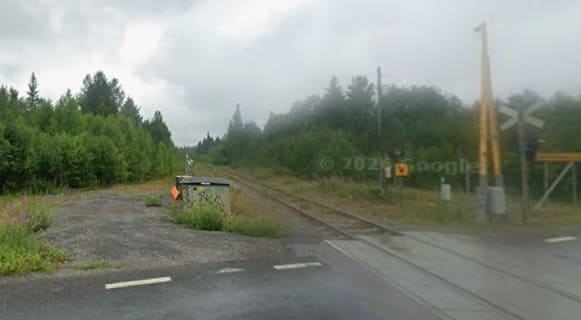
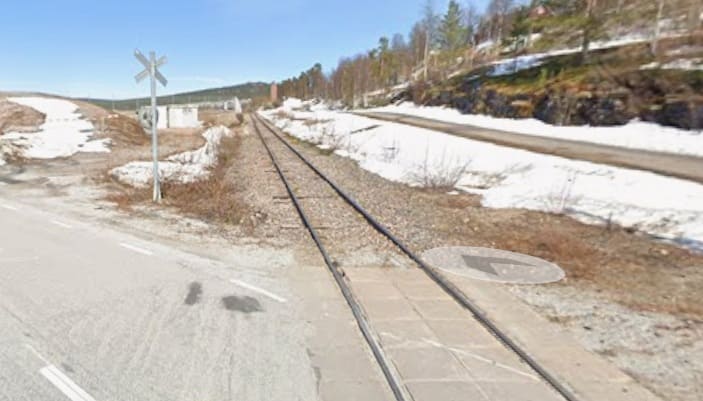
A short distance further along the line it is crossed by a short access road from the E45 to the lakeshore. [Google Maps, April 2026]

Looking Northwest along the lakeshore towards Porjus Station from that level-crossing to the lake shore. [Google Streetview, May 2026]
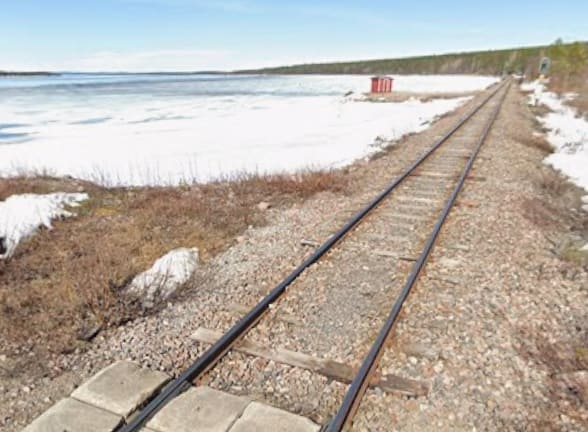
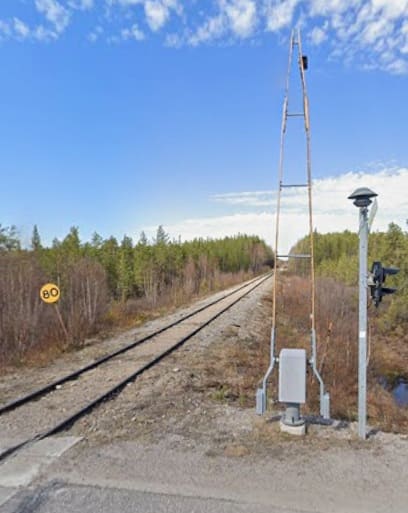
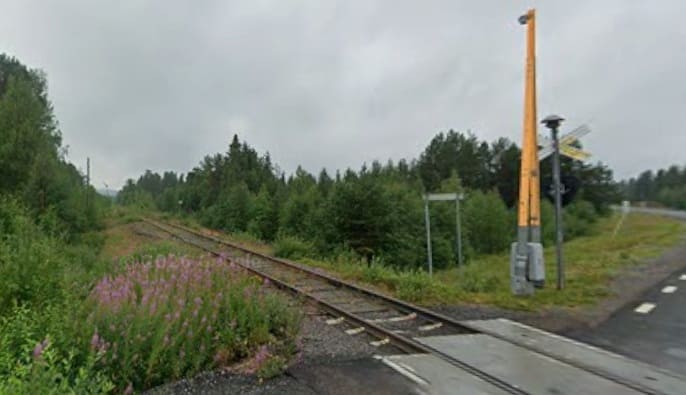
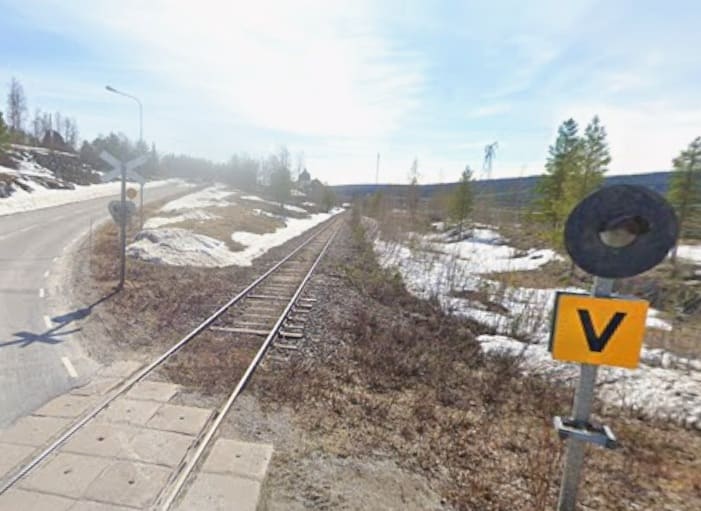
Looking Southwest along the line. [Google Streetview, May 2024]

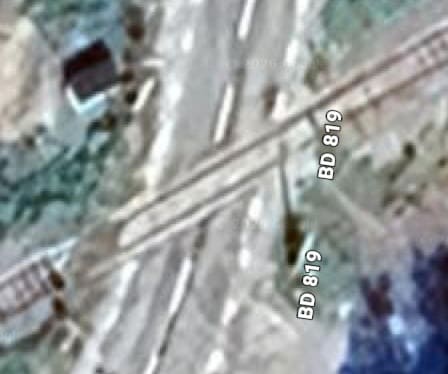
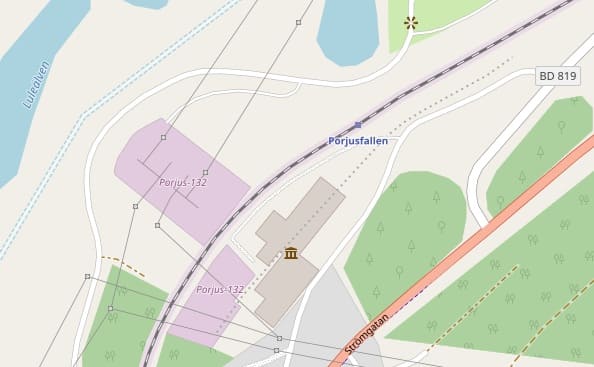
A short distance along the line a little further than the point where the line leaves the lakeside it is crossed by the BD819. [Google Maps, April 2026]

Looking back towards Porjus from the level-crossing on the BD819.
[Google Streetview, May 2024]
Turning through 180°, this is the view Southwest along the line. [Google Streetview, May 2024]

Porjus is the site of a significant hydroelectric power station which was built below ground in the early 1900s, the purpose was to provide electricity for the Malmbanan Railway, which was used to transport iron ore. The new hydroelectric power plant and electrification contributed to a strong growth in Sweden’s mining industry. [45]

Construction of the Porjus power plant began in 1910. In 1915, Gustaf V inaugurated the Porjus power plant by telephone, as his advisors did not consider it safe to make such a long journey in the middle of the war. Porjus quickly became a hub in an industrial Sweden that was consuming increasingly more energy. When the power plant was inaugurated, there were already 20 hydroelectric power plants around the country, but Porjus received a lot of attention because of its geographical location and because the construction technology was very advanced for its time.” [45]

The power plant is located underground, blasted into the rock. The number of turbines in the old power plant increased between 1920 and 1960 to nine units. The turbines are still operational but are not used in normal operation. Two of the old units have been converted into research units and are used to test new technology and equipment.” [45]

A new power plant with two new units was built in 1971–1975. All new transformers were built underground, and therefore no new building was needed. … The old dam has been replaced by a rockfill dam with a dense core of moraine. It has been built immediately downstream of the old dam, and has two new spillways that are closed by segmental gates.” [45]

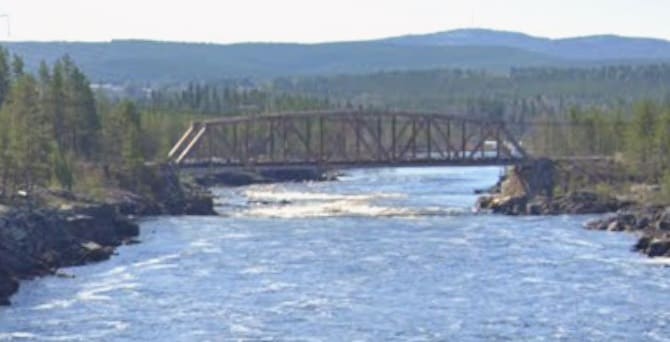
Greville and Vallance comment that “A run of some thirty miles through mountainous and well-wooded country brings the train to the girder bridge over the rapid Lilla Lule Alv (Little Lale River) and to Jokkmokk (800 ft. above sea level), formerly a Lapp village and market centre, but now a thriving modern town.” [1: p829]

We continue our journey South from Porjus.

Just beyond the level-crossing at the BD819 there was another Halt – Porjusfallen Halt, after which the line curved round to the South. [27]

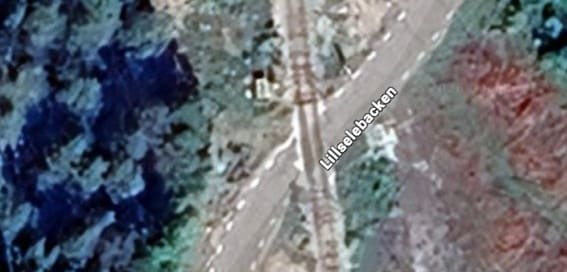
A further level-crossing took the railway over Lillselebacken, the BD826 road. [Google Maps, April 2026]

Looking back North towards Porjus from the level-crossing on Lillselebacken, the BD826 road.
[Google Streetview, May 2024]
Looking South at the same location. [Google Streetview, May 2024]

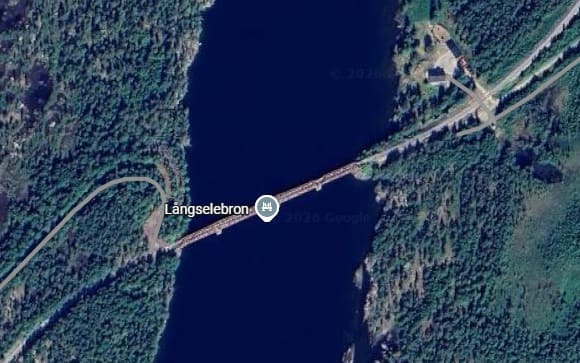
Beyond Porjus the Inlandsbanan followed the banks of the Lulealven River/Lake in a southeasterly direction, for about 3 miles before turning West to bridge the river.

The bridge over the Lulealven River – named ‘Långselebron’. [Google Maps, April 2026]

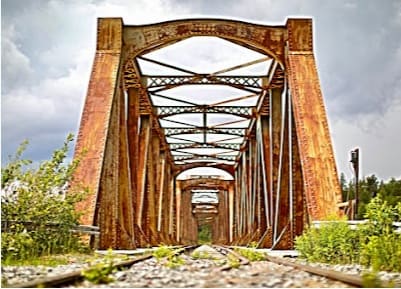
The view Northeast through the bridge, © Helen Hagegren, July 2023. [Google Maps, April 2026]

The ‘Långselebron’, © Oleh, August 2017. [Google Maps, April 2026]

A final view of the ‘Långselebron’, © Oleh, August 2017. [Google Maps, April 2026]

Beyond the bridge, the line turns South and runs along the West bank of the river/lake. The next Halt is at Harspranget adjacent to the dam.

Harsprånget (the Hare’s Leap), was formerly one of the finest falls in Sweden, but by 1958, the water had been diverted to a new power station. [1: p829]

Harspranget Halt sat at the West end of the reservoir. dam. The E45 ran alongside the lake/river on the opposite bank. Google records the body of water held by the dam as ‘Harsprangsselet’. [28]

This view looks South from the E45 at a point about 1 km North of the dam. The road drops to the level of the foot of the dam over the that 1 km. [Google Streetview, May 2024]

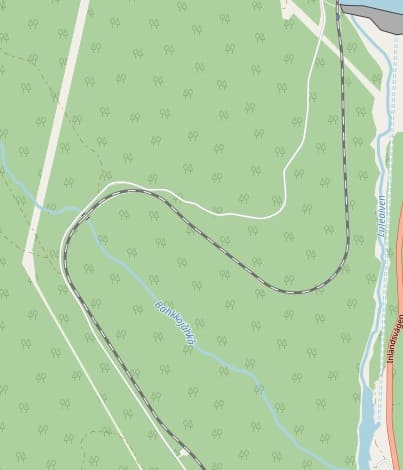
The railway follows the West, bank of the river for another kilometre or so before turning relatively sharply to the Northwest to follow the contours round the valley of the Bahkkojahka River. [28]

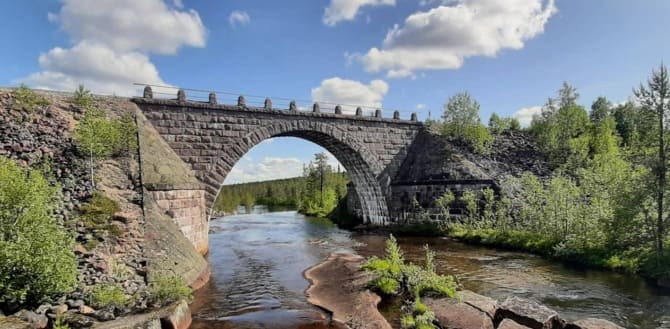
The Steinbrücke Pakkobron © Per Naeslund, July 2025. [Google Maps, April 2026]

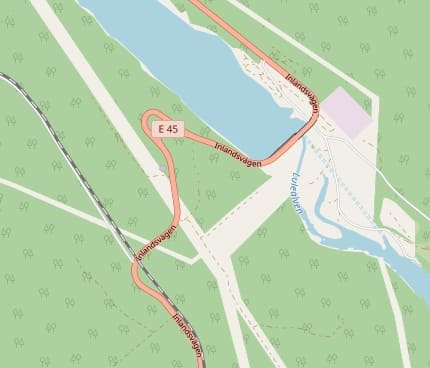
The line follows the West bank of the Lulealven River which is dammed once again a little further down stream. The E45 crosses the river at this point running at the top of the dam, before bridging the railway. [29]

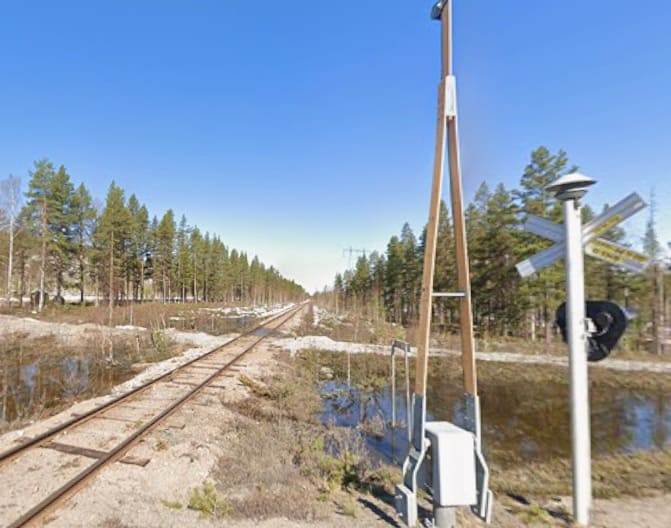
Looking Northwest along the Inlandsbanan towards Porjus. [Google Streetview, May 2024]
Looking Southeast along the railway from the level-crossing on the E45 (the same level-crossing).
[Google Streetview, May 2024]
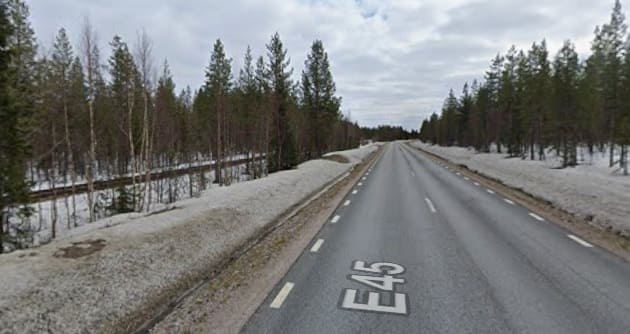
Travelling South the railway and the E45 run parallel to each other in close proximity.
[Google Streetview, May 2024]

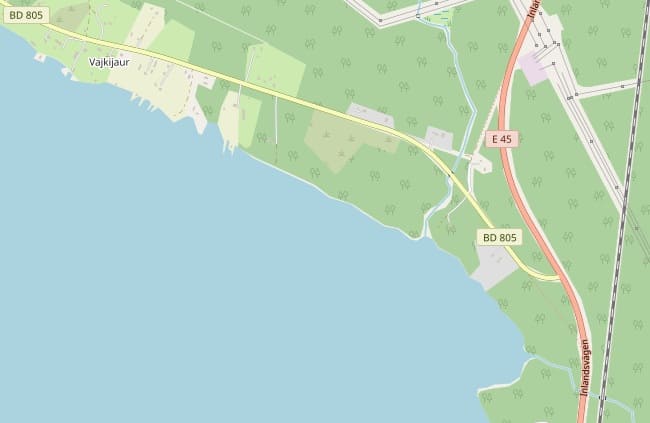
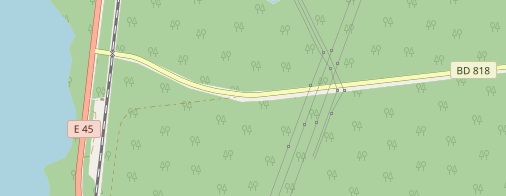
Road and rail pass close to Vajkigaur and just a short distance further South the line crosses the BD 818 close to its junction with the E45. [30]

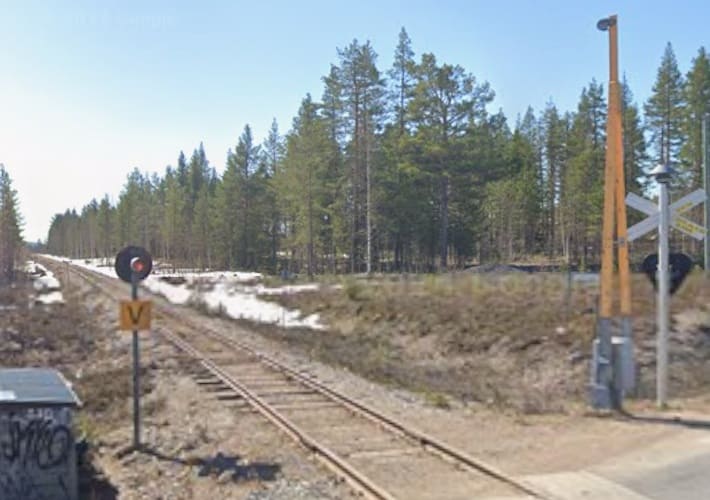
Looking North along the Inlandsbanan from its level-crossing with the BD 818. [Google Streetview, May 2024]

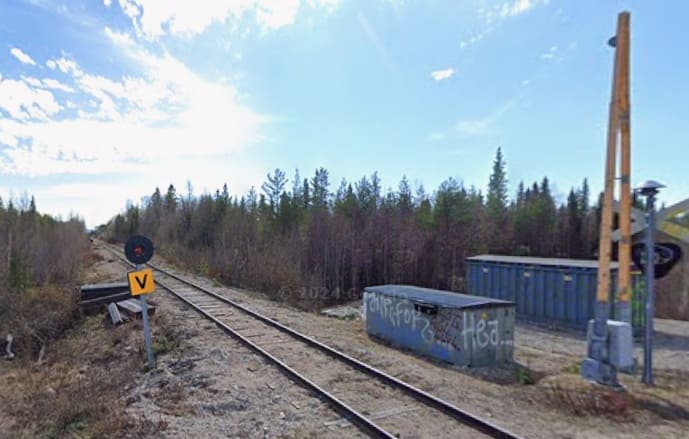
Looking South along the Inlandsbanan from the same level- crossing. [Google Streetview, May 2024]

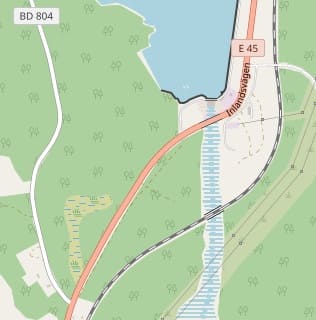
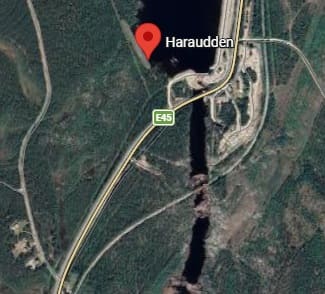
A short distance further South at Haraudden both road and rail cross the Lulealven River to the South of another dam. [31][Google Maps, April 2026]

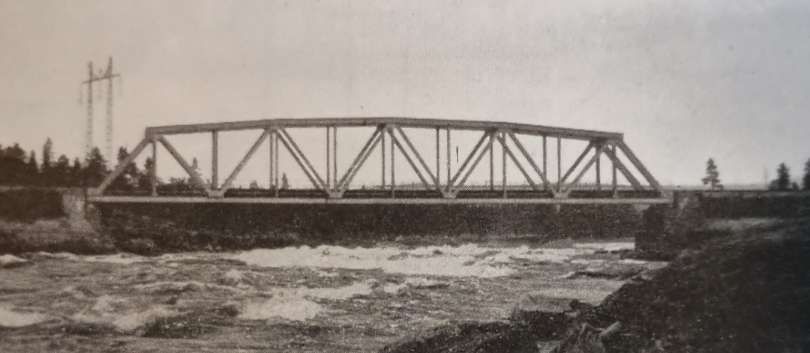
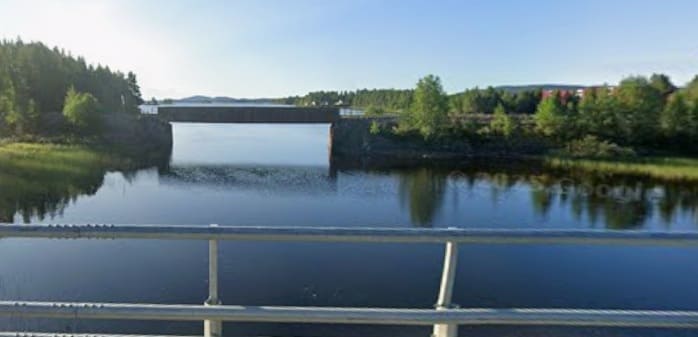
The view of the rail bridge over the Lulealven River from the bridge carrying the E45 across the river at the base of the dam which is visible in the images above. [Google Streetview, May 2024]

The same structure in 1958, © H. A. Vallance. [1: p828]

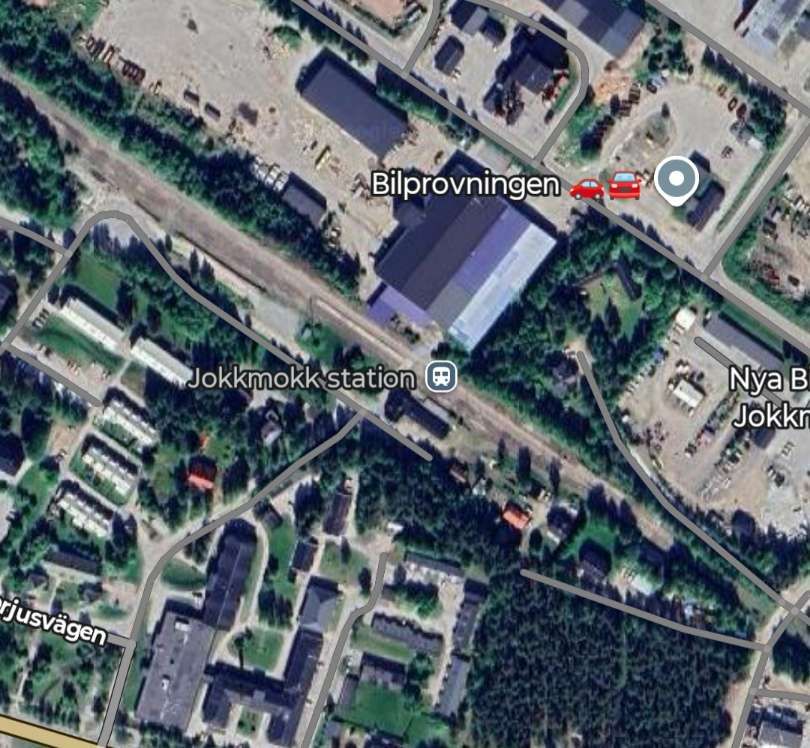
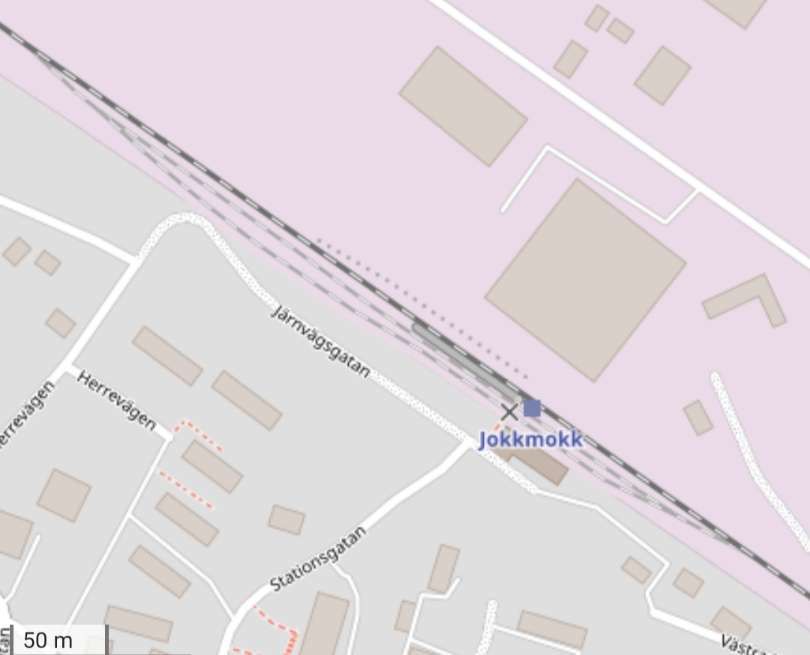
Just a short distance Southeast the line enters Jokkmokk. [32][33] ….

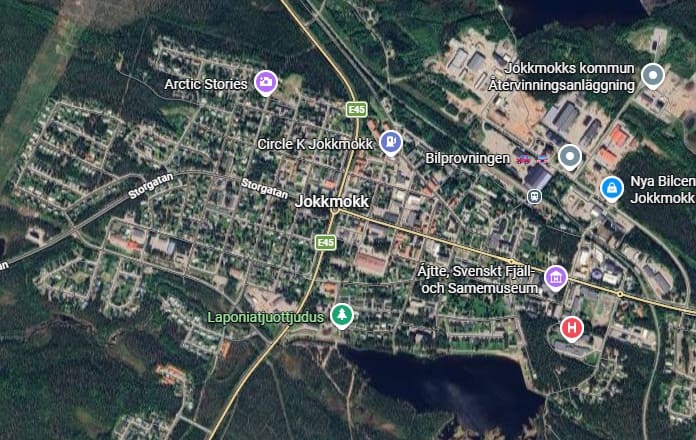
The town of Jokkmokk as seen on Google’s satellite imagery. [Google Maps, April 2026]
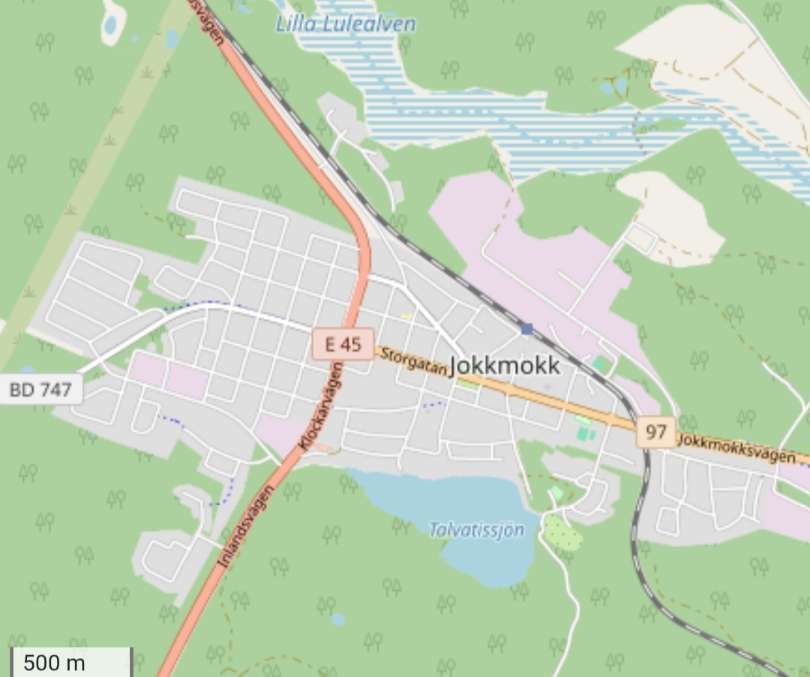
Jokkmokk as it appears on OpenStreetMap’s mapping. [34]
Jokkmokk Railway Station. [Google Maps, April 2026]
Jokkmokk Railway Station as it appears on OpenStreetMap. [34]
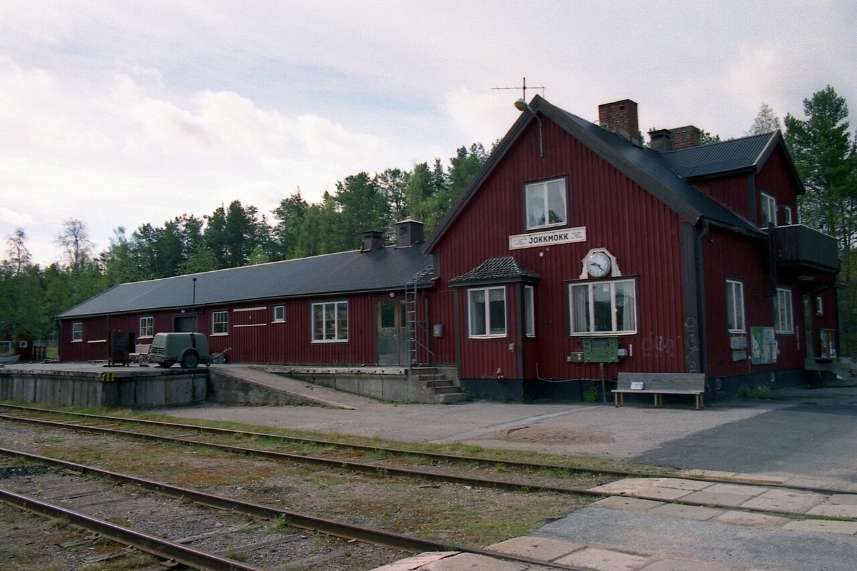
Jokkmokk Railway Station, © wassen and authorised for reuse under a Creative Commons licence (CC BY-SA 3.0). [35]
Looking Northwest through the station site, © Roman Klupper, 2020. [Google Maps, April 2026]
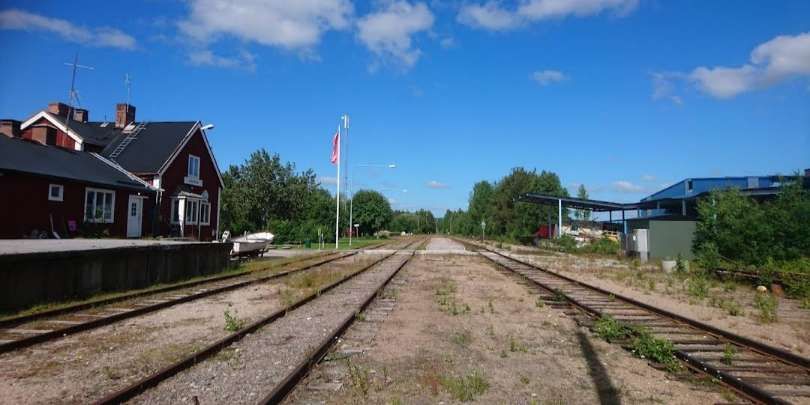
Looking Southeast through the station site, © gesla, 2024. [Google Maps, April 2026]
The station forecourt and Jokkmokk Railway Station building. [Google Streetview, May 2024]

Greville and Vallance tell us that “A granite pillar at the station commemorates the opening of the inland line in 1937 by the Crown Prince of Sweden (now King Gustaf VI Adolf) The inscription includes a facsimile of the Crown Prince’s signature.” [1: p829]

The level-crossing at Kyrkogaten. [Google Maps, April 2026]
Looking back towards Jokkmokk Station from the level-crossing at Kyrkogaten. [Google Streetview, May 2024]
Looking Southeast from the level-crossing at Kyrkogaten. [Google Streetview, May 2024]
The Line to the South of Jokkmokk. [36]

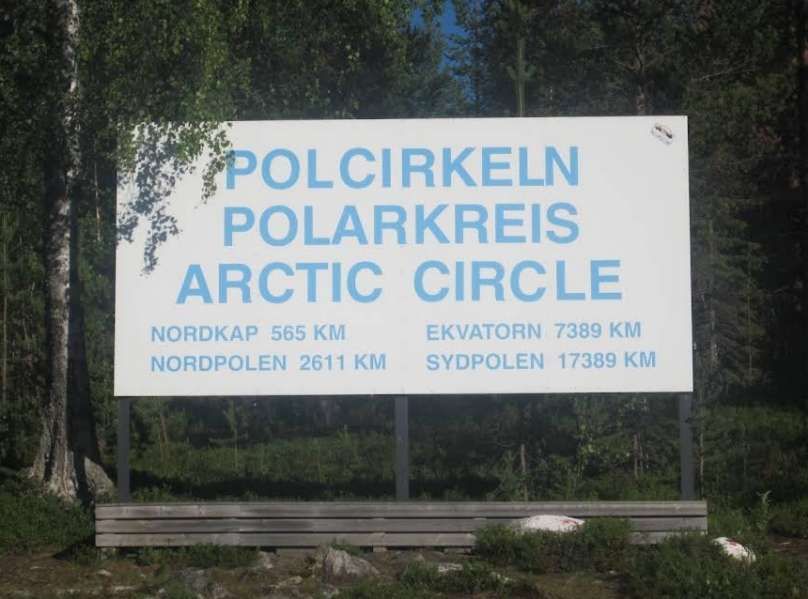
Some three miles south of Jokkmokk, the train crosses the Arctic Circle, marked by white boards and stones, and heralded by a long blast on the whistle.” [1: p829]

The Station at the Arctic Circle is on the first section of the line to travel Southwest after leaving Jokkmokk. [36]
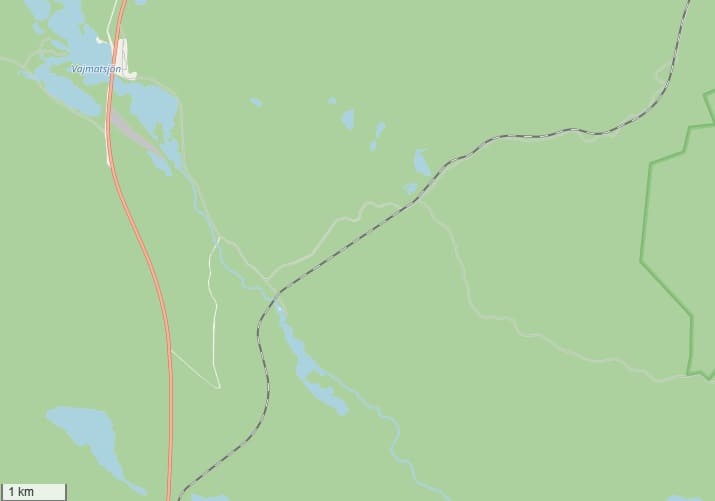
Google’s satellite imagery marks two separate locations. That shown on OpenStreetMap is the more southerly of the two. [Google Maps, April 2026]
The Artic Circle sign on the Inlandsbanan, © Benutzer:Jojo86 and licenced for reuse under a GNU Free Documentation licence (GNU FDL). [37]

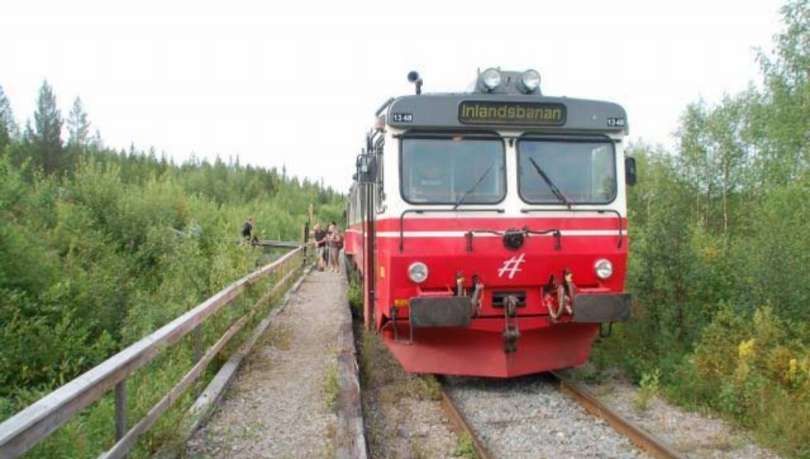
An Inlandsbanan train stopped at the Arctic Circle, (c) Chihiro Tanaka, 2016. [Google Maps, April 2026]

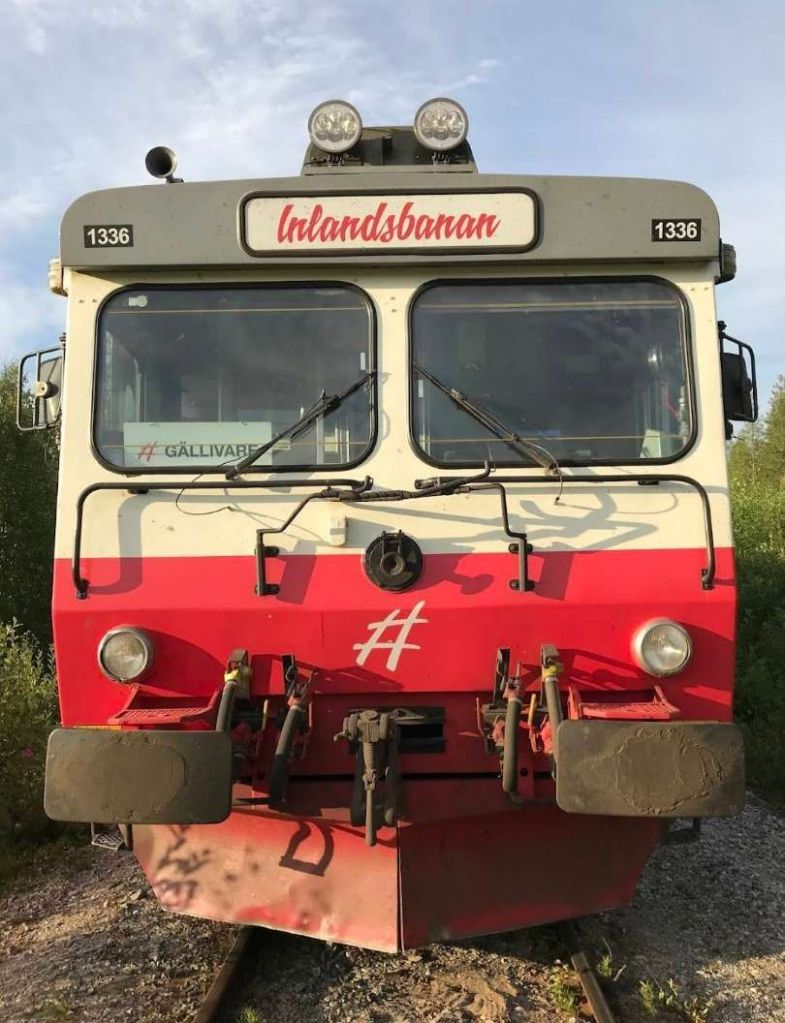
An Inlandsbanan train heading for Gällivare, sitting at the Arctic Circle Station, (c) Martin Divis, 2010.
[Google Maps, April 2026]
The next length of the line brings it back close to the E45. [38]

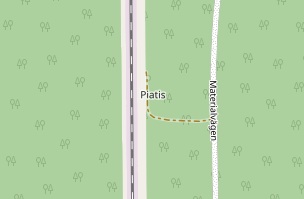
There is a Halt at Piatis which is accessed by a short path from the maintenance road which runs alongside the railway. [38]

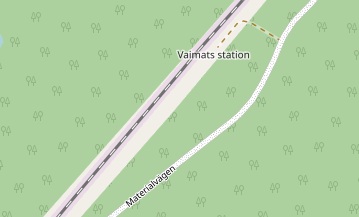
There is a further halt shown on the OpenStreetMap at Vaimats. [38]

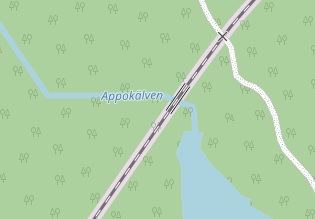
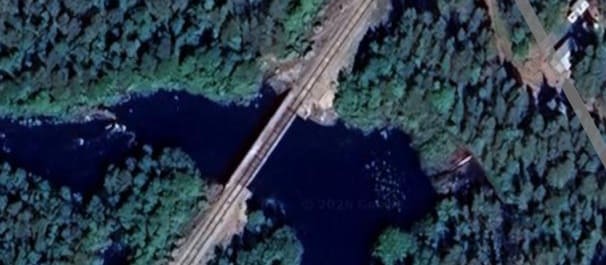
The line bridges the Appokalven River. [38][Google Maps, April 2026]

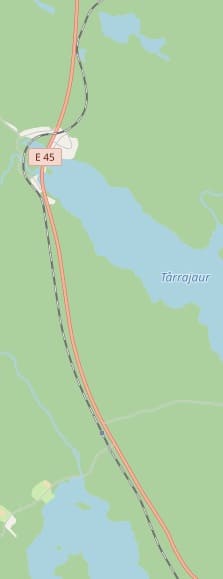
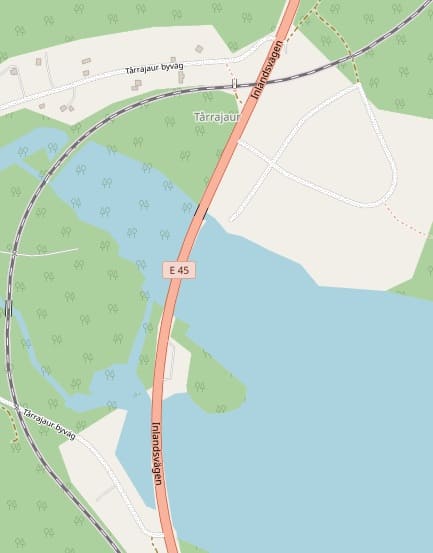
The next length of the line follows the same route as the E45 road (Klockarvägen). it crosses the road at Tarrajaur a small settlement at the head of a lake which bears the same name. [39]

A closer view of Tarrajaur. [39]
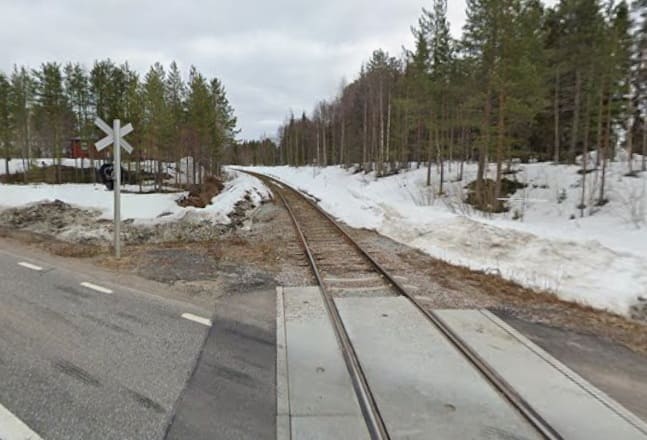
Looking back towards Jokkmokk. [Google Streetview, May 2024]
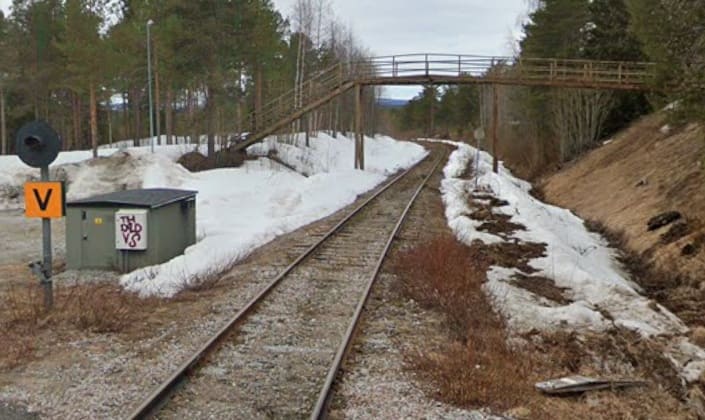
Looking ahead along the line. The railway is bridged by a footbridge close to the road before it turns away to the South. [Google Streetview, May 2024]
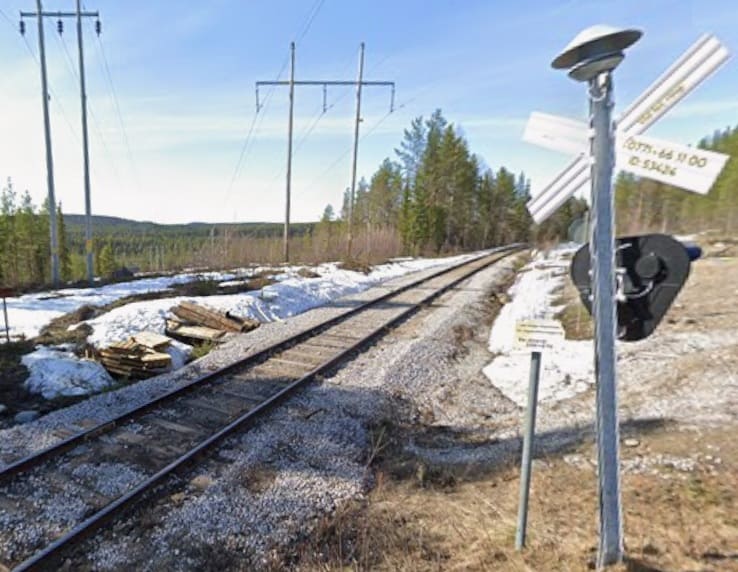
A diesel railcar at Tarrajaur. This was a conditional stop where the disc signal was used to indicate that passengers were waiting to be picked up, (c) H. A. Vallance, 1958. [1: p832]

The line then runs Southeast alongside the E45 road on the West side of the road.

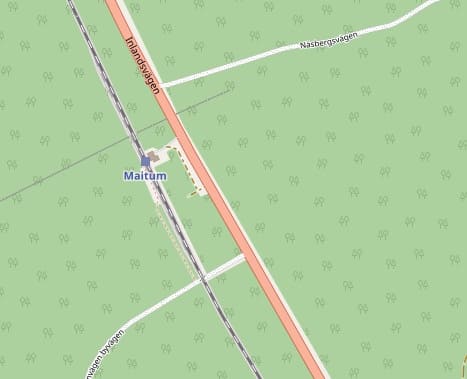
The next Halt is named Maitum. [39]

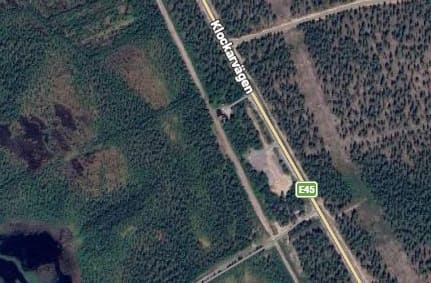
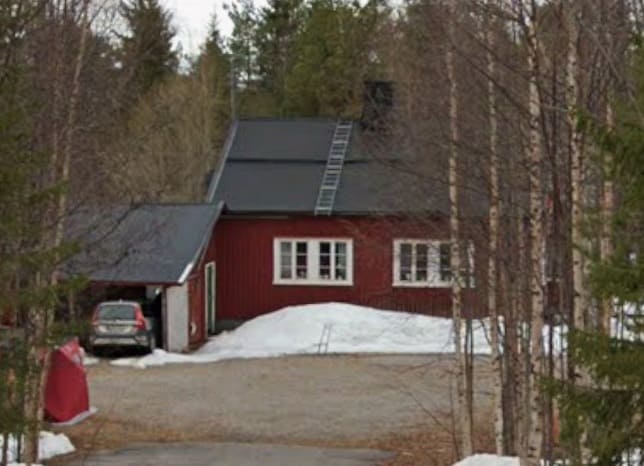
The building at the centre of this satellite image is at Maitum Halt. [Google Maps, April 2026]
The building which appears at the centre of the map and satellite image above, seen from the E45.
[Google Streetview, May 2024]

The line continues running Southeast. [40]

And again, the line continues running Southeast. [41]

Kerkejaure Halt sits to the North of Lill Kurken, the small lake at the top right of the image. A much closer view shows both a platform and building

This much closer view shows both a platform, a building and a road crossing at Kerkejaure. [41]
Kerkejaure on satellite imagery. [Google Maps, April 2026]

When the line next runs alongside the E45, it has turned closer to the South. [42]

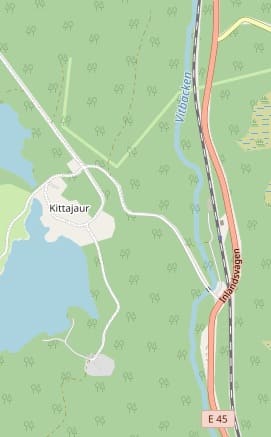
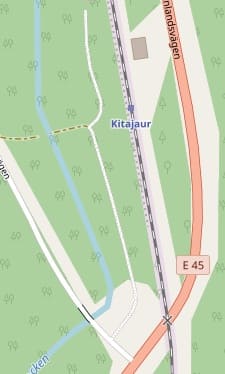
Kittajaur is a small settlement with its own station. [42]
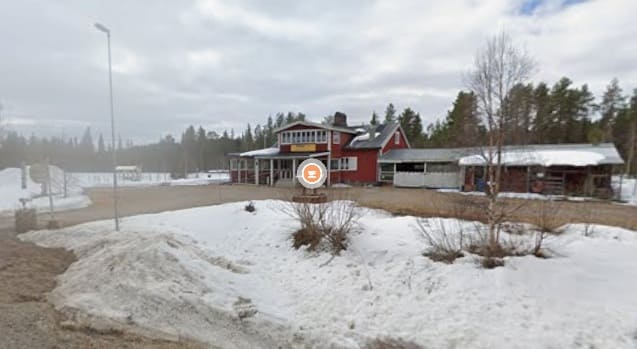
The Polar Station at Kittajaur. The line runs on the far side of the building and the railway platform is to the left of the building. [Google Streetview, May 2024]
Looking back North towards the station from the E45 level-crossing. [Google Streetview, May 2026]
Looking South from the same road crossing. [Google Streetview, May 2024]
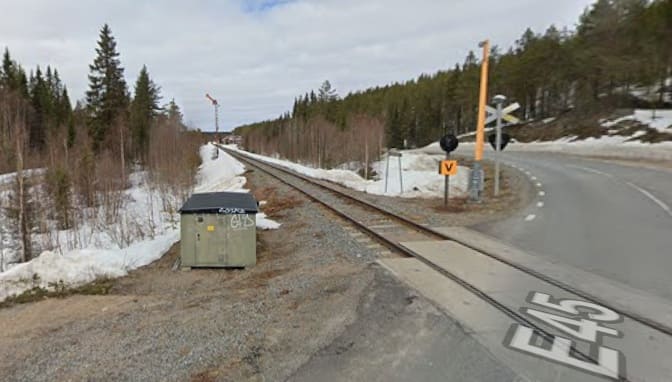
Continuing South, the road and the railway are at times seen close together. This is a typical location looking Southeast from the E45, the railway can be seen close by but at a higher level.
[Google Streetview, May 2023]
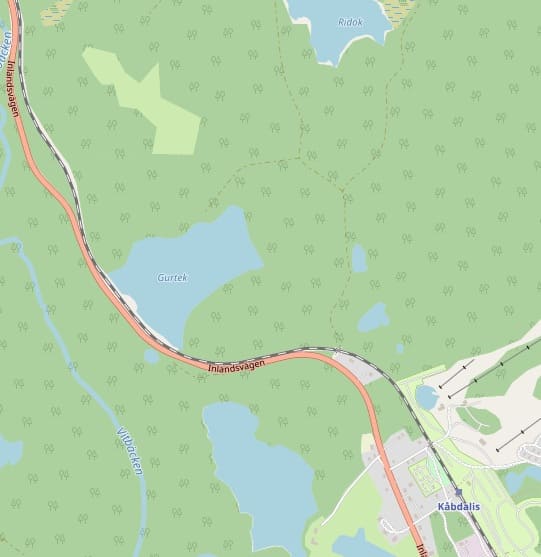
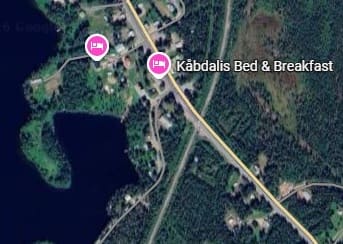
This next length of the line takes us as far as Kabdalis. [43]
The line is seen here alongside the E45 with lake Gurtek beyond. The photograph looks East from the road.[Google Streetview, May 2023]

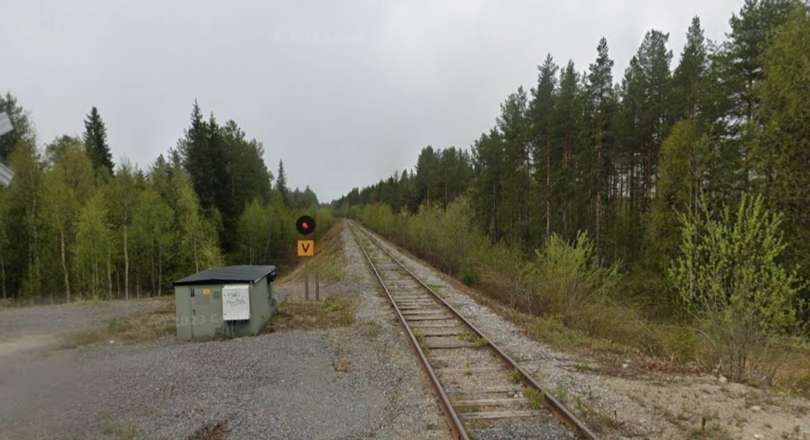
On the approach to Kabdalis, the line crosses an access road to an electrical substation/industrial site. [Google Maps, April 2026]

Looking Northwest from the level-crossing. [Google Streetbview, May 2023]
Looking Southeast from the same level-crossing towards the station at Kabdalis.
[Google Streetview, May 2023]

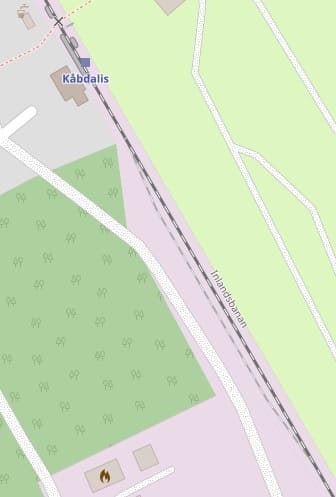
Kabdalis Railway Station: a passing loop is provided to the Southeast of the station platform. [43]

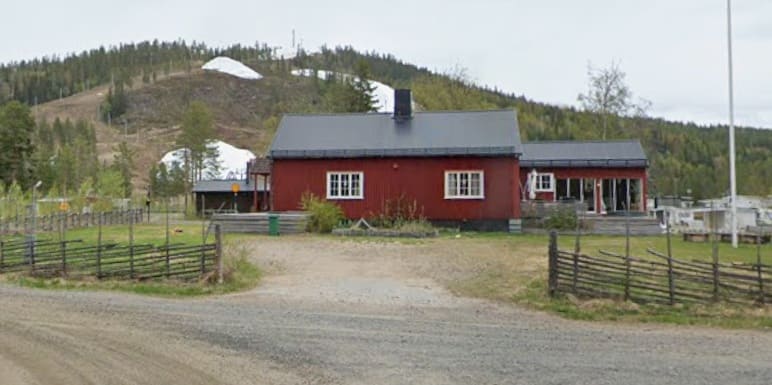
Kabdalis Railway Station seen from the approach road. The platform is beyond the building and extends to the left of it as well. [Google Streetview, May 2023]
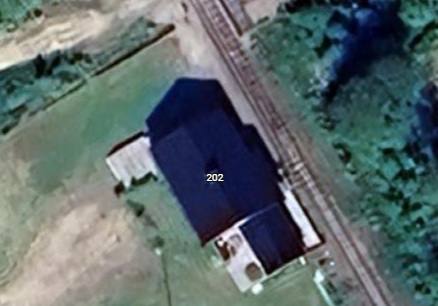
Kabdalis Railway Station.
[Google Maps, April 2026]
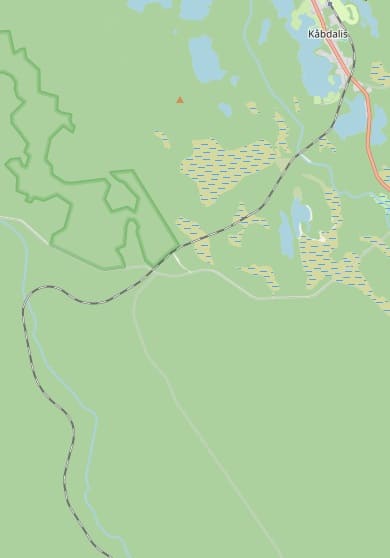
The line to the South of Kabdalis. [44]

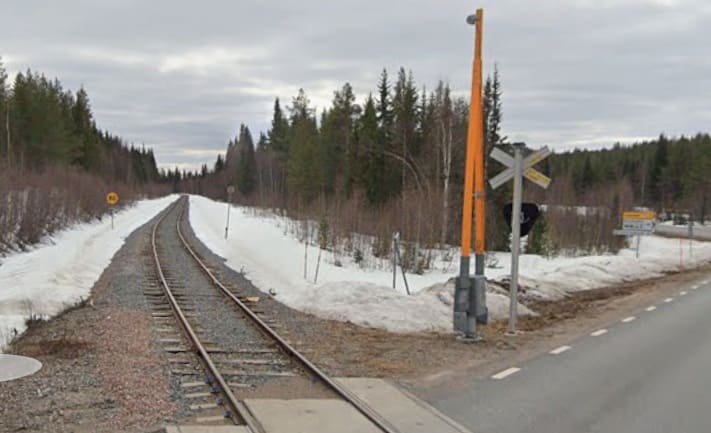
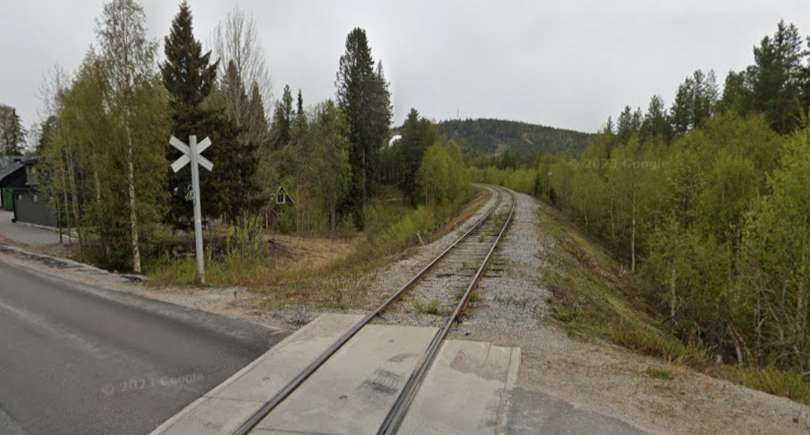
The railway crosses the E45 again just to the South of Kabdalis. [Google Maps, April 2026]

Looking back North from the level-crossing on the E45 towards Kabdalis Railway Station. [Google Streetview, May 2023]
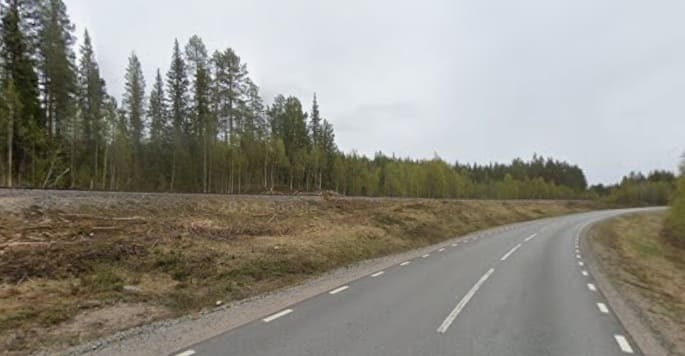
Looking South from the level-crossing on the E45 towards Kabdalis R. [Google Streetview, May 2023]

After the road crossing the road and railway take significantly different paths South. …

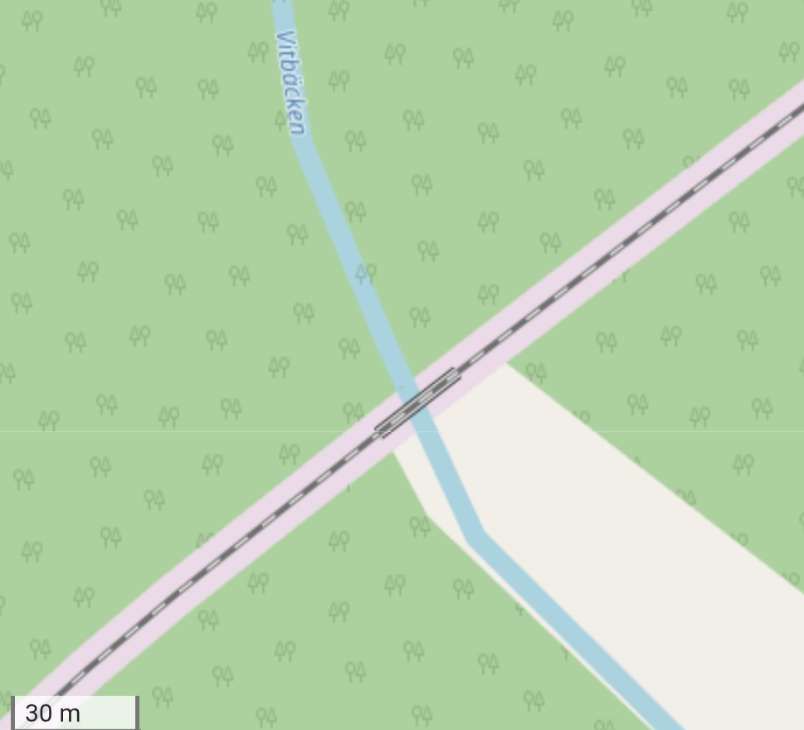
A few hundred meters along the line after passing Lake Satermjaure, the line bridges the Vitbacken River. [44][Google Maps, April 2026]

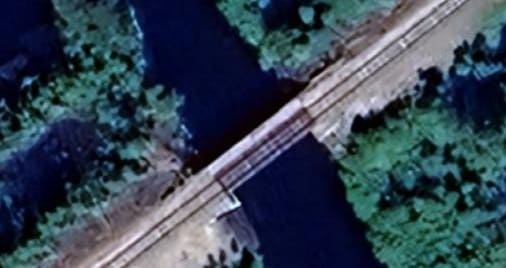
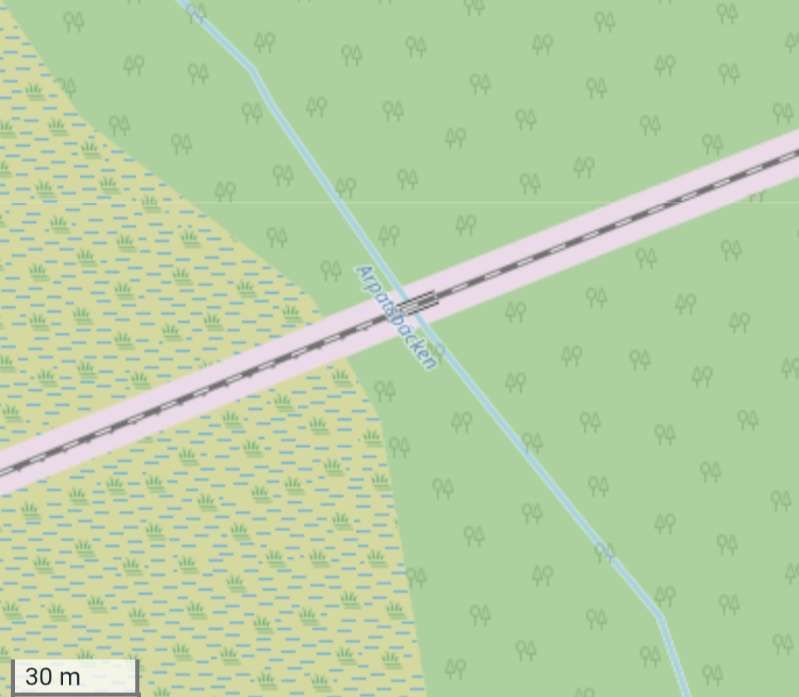
After crossing a forest track and a few kilometres along the line, it bridges the Arpatsbacken River. [44][Google Maps, April 2026]

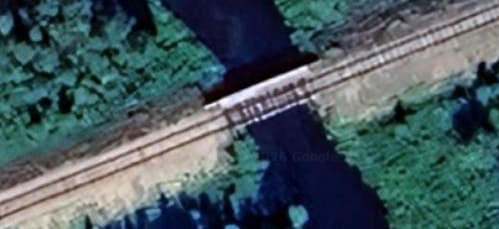
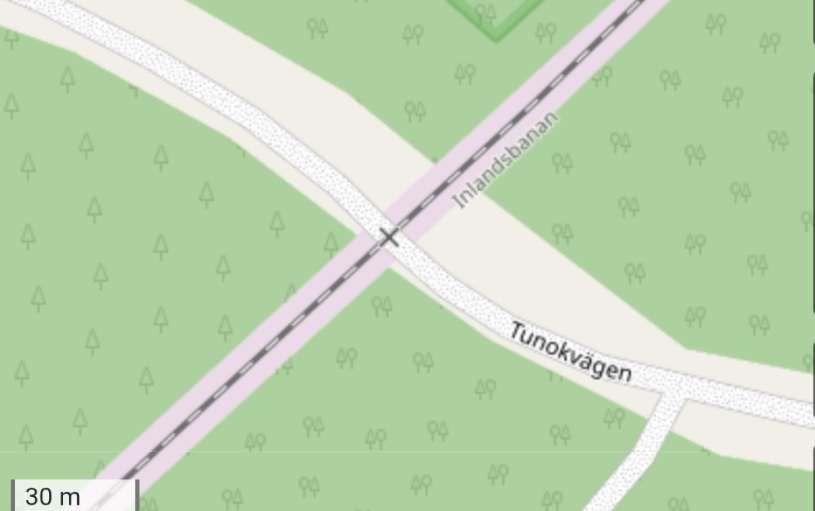
After another forest track is crossed the line crosses the Tunokvagen forest road at a Level Crossing. [44][Google Maps, April 2026]

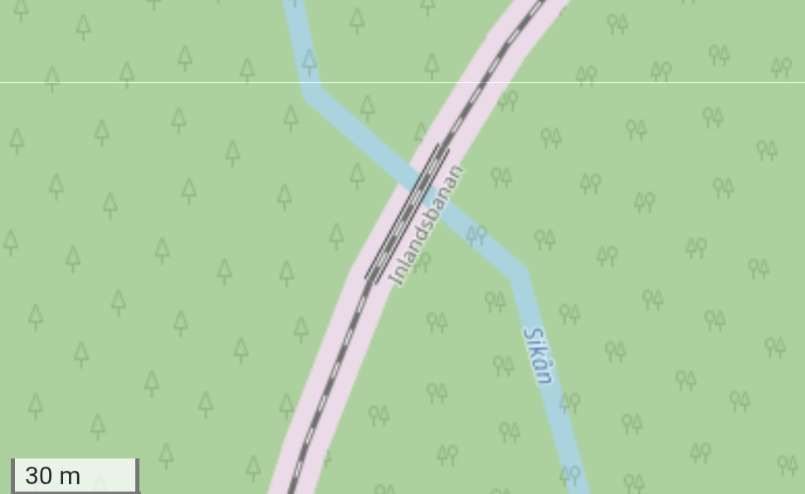
A few kilometres beyond the Tunokwagen, the railway crosses the Sikan River by means of a high embankment and culvert. [44][Google Maps, April 2026]

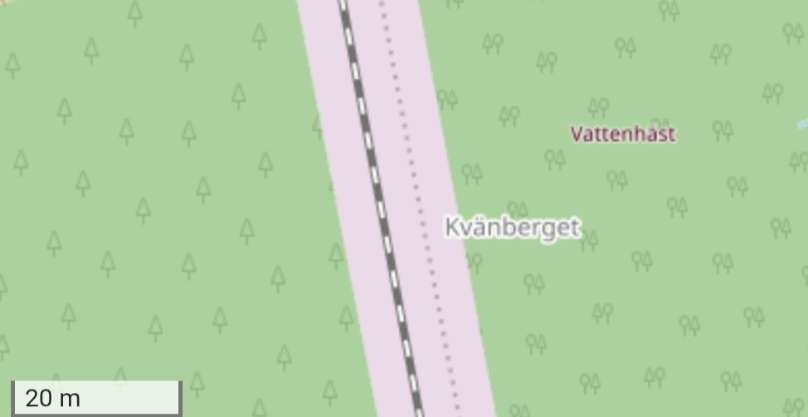
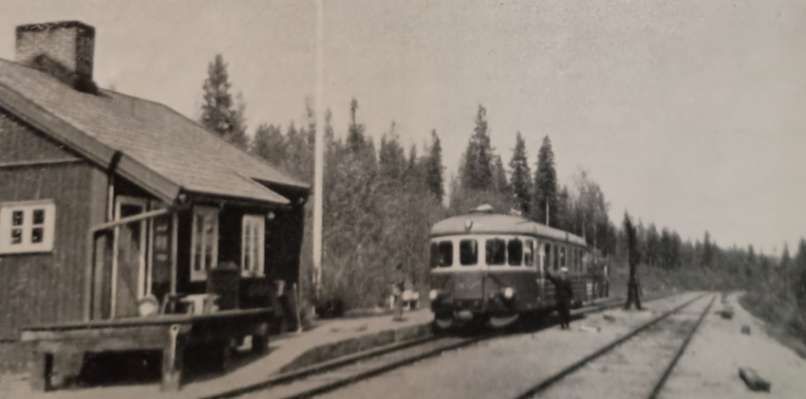
A very short distance South of the river crossing was Kvanberget Halt. [44][Google Maps, April 2026] There was a passing loop at this Halt as can be seen in the monochrome image below from The Railway Magazine article below. The small station building does not feature on OpenStreetMap nor Google’s satellite imagery.

Southbound diesel railcar at Kvänberget, between Käbdalis and Iggejaur, © H. A. Vallance, 1958. [1: p828]
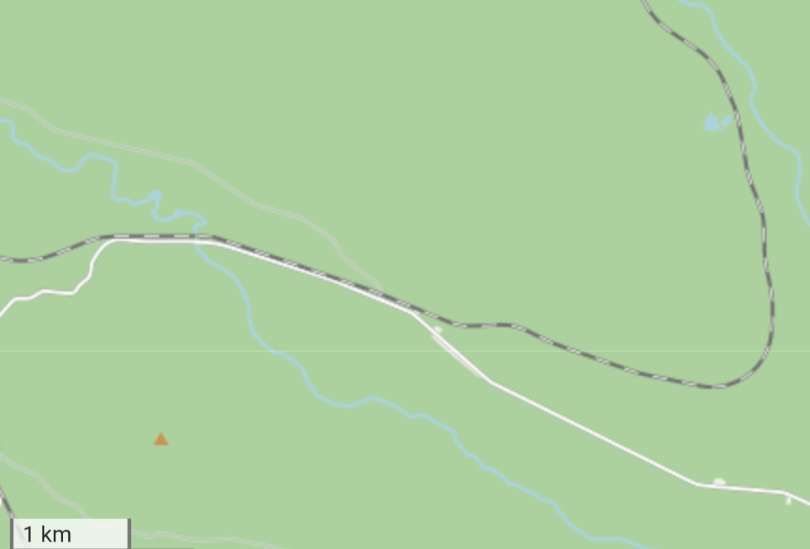
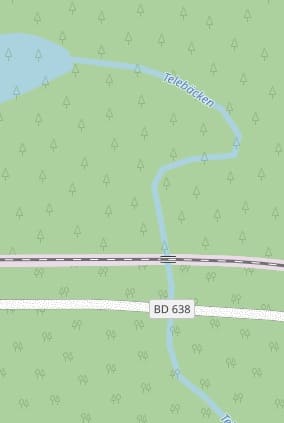
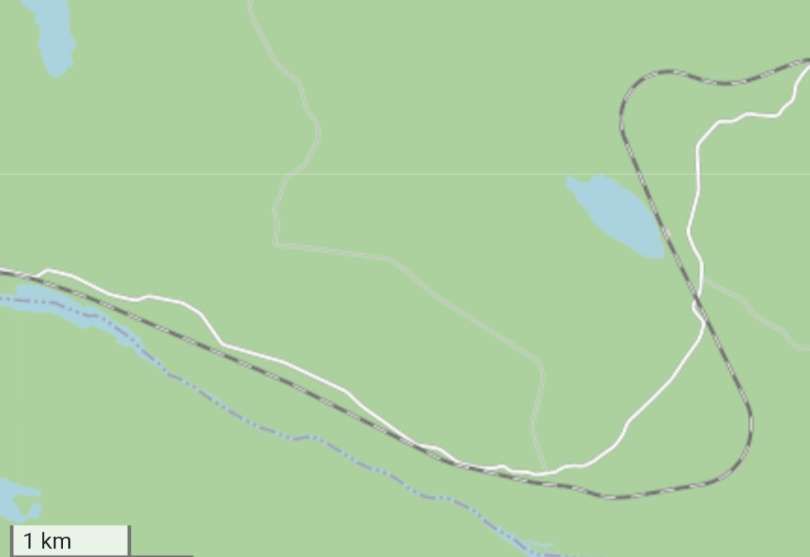
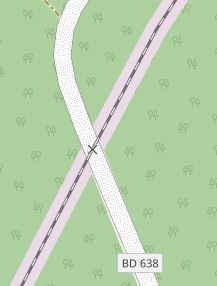
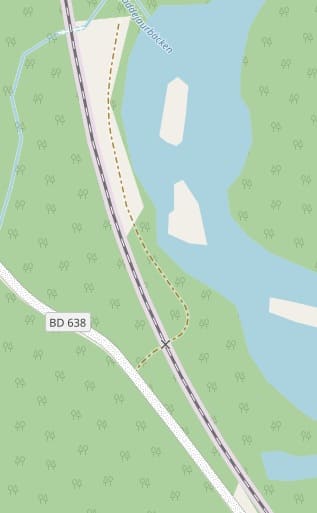
Beyond Kvänberget, the line continues South for a short distance before turning to the West. The road shown on this map extract is the BD638. [46]
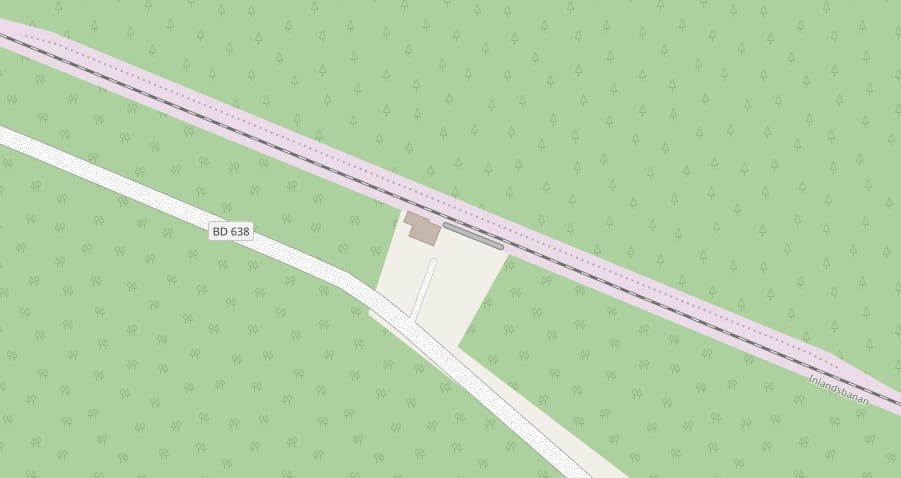
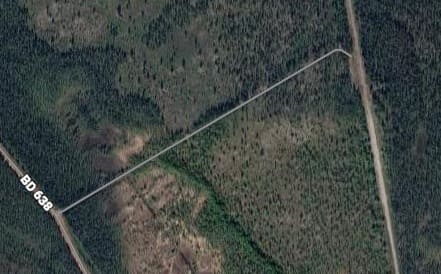
The Railway Station/Halt at Tellejåkk sits on the North side of the BD638. the hamlet of Tellejåkk sits a short distance along the BD638 to the Southeast. [46]
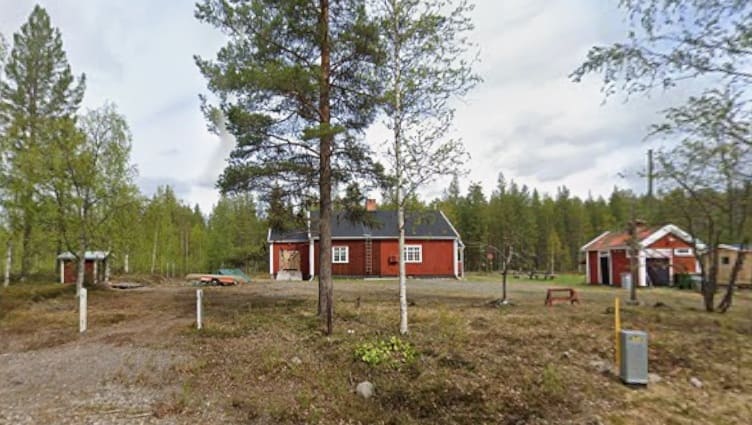
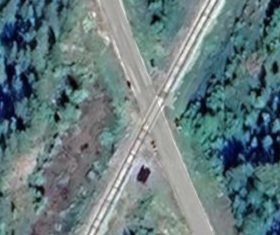
The location of the Halt at Tellejåkk. The short platform is beyond and to the right of the building at the centre of the image. There is a passing loop provided at this location. [Google Streetview, May 2023]

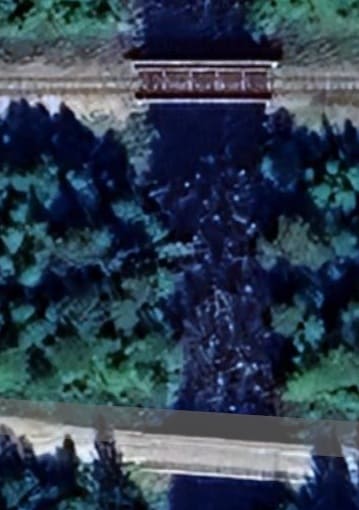
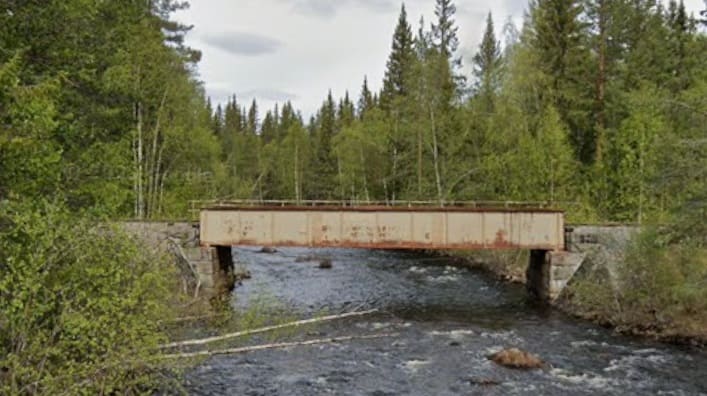
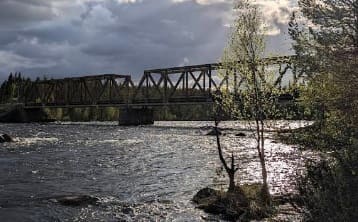
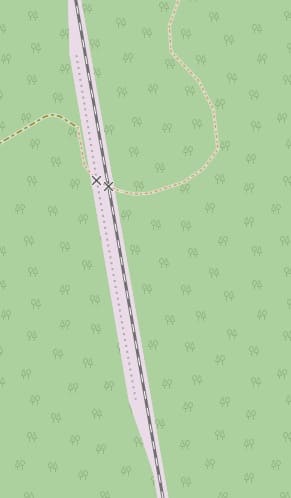
A short distance to the West of of the Halt at Tellejåkk the line bridges the Telebacken River alongside the road. [46][Google Maps, April 2026]

The rail bridge over the Telebacken seen from the BD638. [Google Streetview, May 2023]
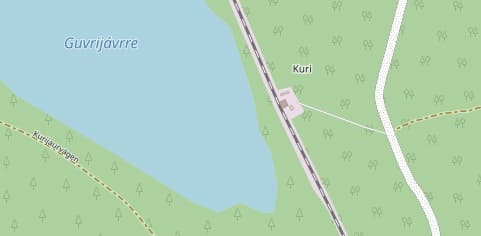
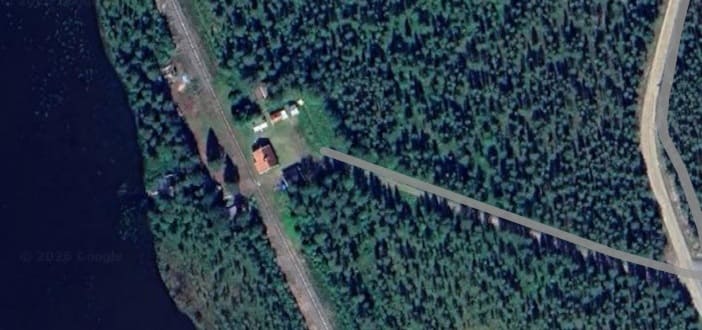
Although travelling predominantly in a westerly direction the line does not follow a straight path. Here it can be seen diverting to the South and running beside Lake Guvrejavrre where there was another Halt on the line. [47]

Lake Guvrejavrre and the Halt at Kuri. [47]{Google Maps, April 2026]

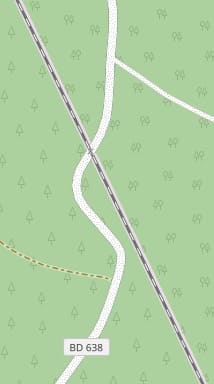
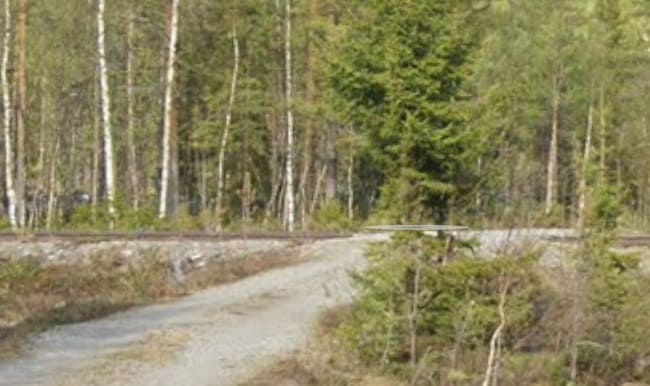
The railway crosses the BD638 at a level-crossing just to the south of the Halt. [47][Google Maps, April 2026]

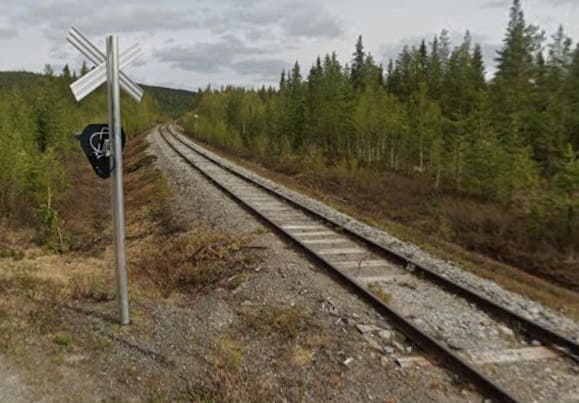
Looking North from the level crossing at the BD638. [Google Streetview, May 2023]
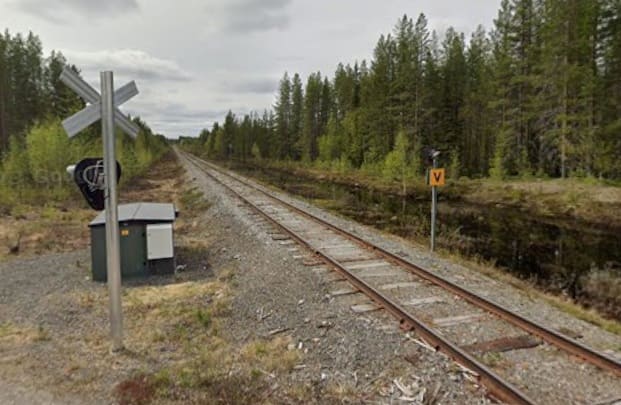
Looking South from the level crossing at the BD638. [Google Streetview, May 2023]

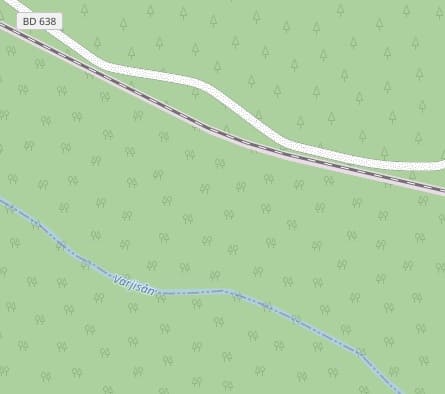
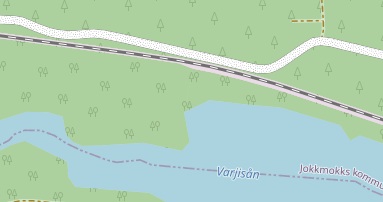
Road and rail, heading West, are at times very close together. The Varjisan River is towards the bottom of the map extract. [47][Google Maps, April 2026]

Looking West along the BD638 at the location shown above. [Google Streetview, May 2023]

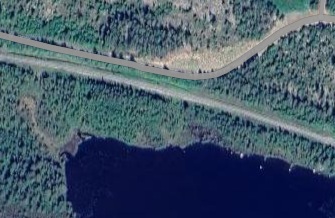
Lake Frostselet is a widening of the Varjisan River. At times the road and railway sit close to its banks. [47][Google Maps, April 2026]

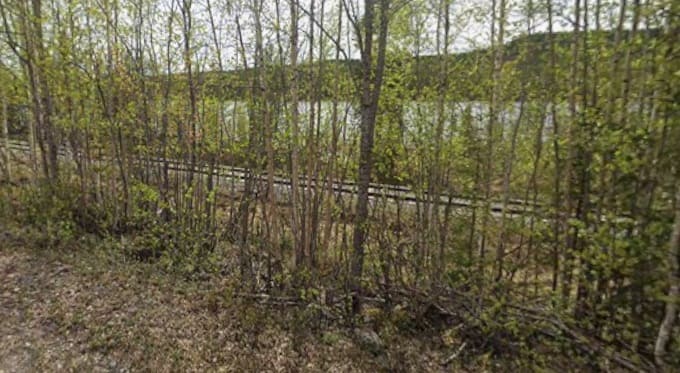
Looking South from the BD638 in the early spring. Both railway and lake are visible. Later as leaf growth continues, neither will be easily seen from the road. [Google Streetview, May 2023]
Road, railway and river continue heading West. [48]

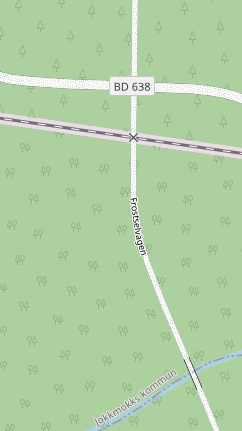
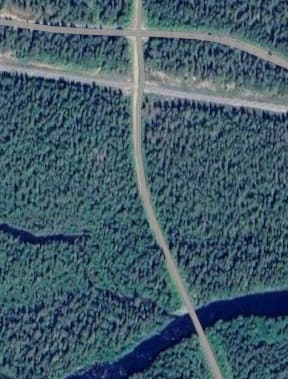
A side road from the BD638, the Frostselwagen, crosses the railway on the level. [48]

Looking south from the BD638 the level-crossing is visible from the main road! [Google Maps, April 2026]
The level-crossing at Frostselwagen. [Google Streetview, May 2023]

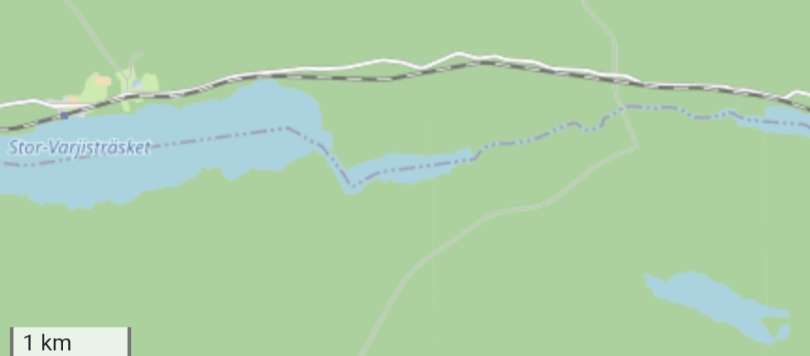
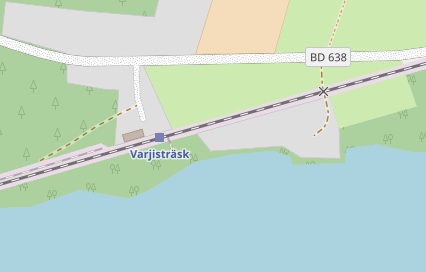
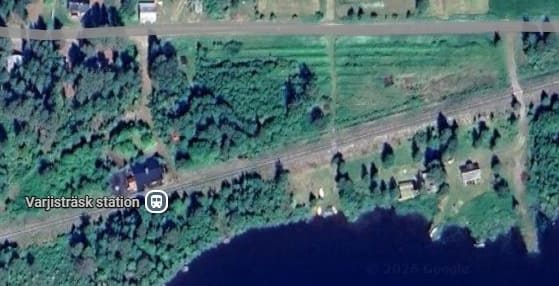
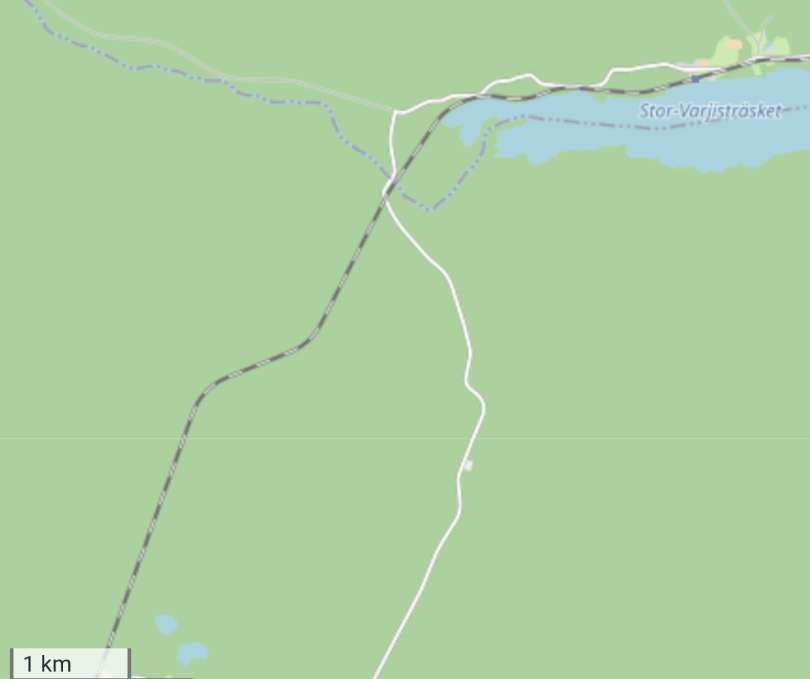
The next station on the line – Varjistrask – sits on the North side of (the Lake) Stor- Varjistrasket. [48][Google Maps, April 2026]

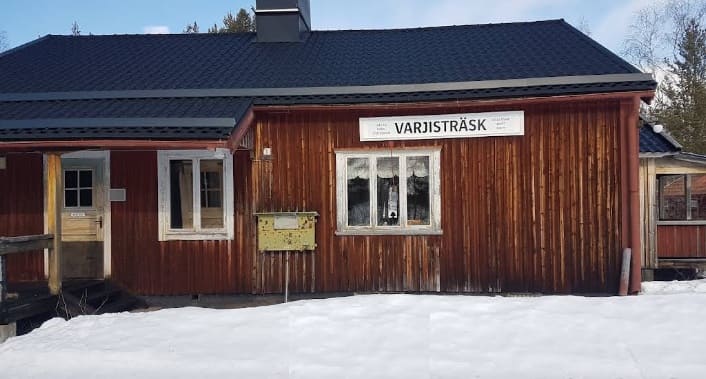
Varjisträsk Station building seen from the train with snow still on the ground. It is not possible to see the station building from the BD638, (c) Karlsson, June 2017. {Google Maps, April 2026]
West of Varjistrask, the line turns to the Southwest. [49]

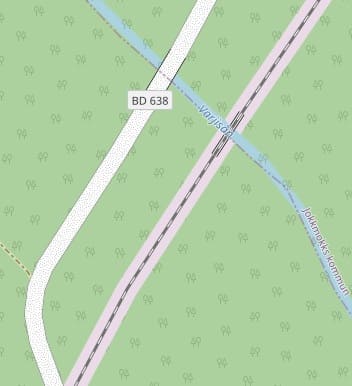
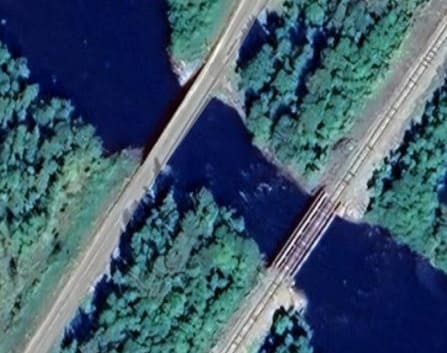
It bridges the Varjisan River just to the West of Stor-Varjistrasket and adjacent to the BD638. [49][Google Maps, April 2026]

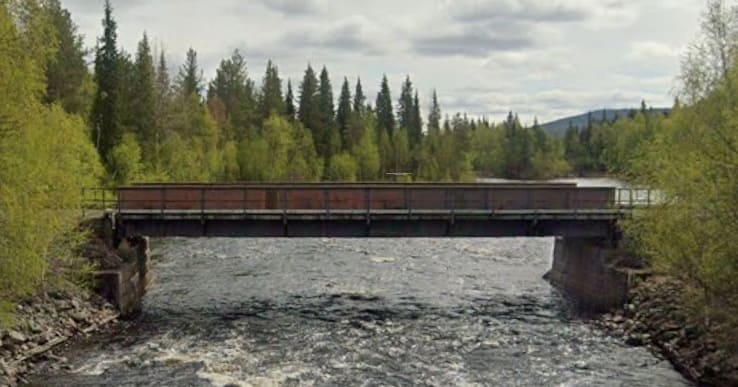
Looking Southeast from the bridge carrying the BD638 over the Varjisan River, the bridge carrying the railway over the river can be seen easily. [Google Streetview, May 2023]

Almost immediately to the Southwest of the river bridge the BD638 crosses the railway on the level. [49][Google Maps, April 2026]

Looking Northeast from the level-crossing over the BD638 towards the location of the bridge over the Varjisan. [Google Streetview, May 2023]
Looking Southwest from the level-crossing. [Google Streetview, May 2023]
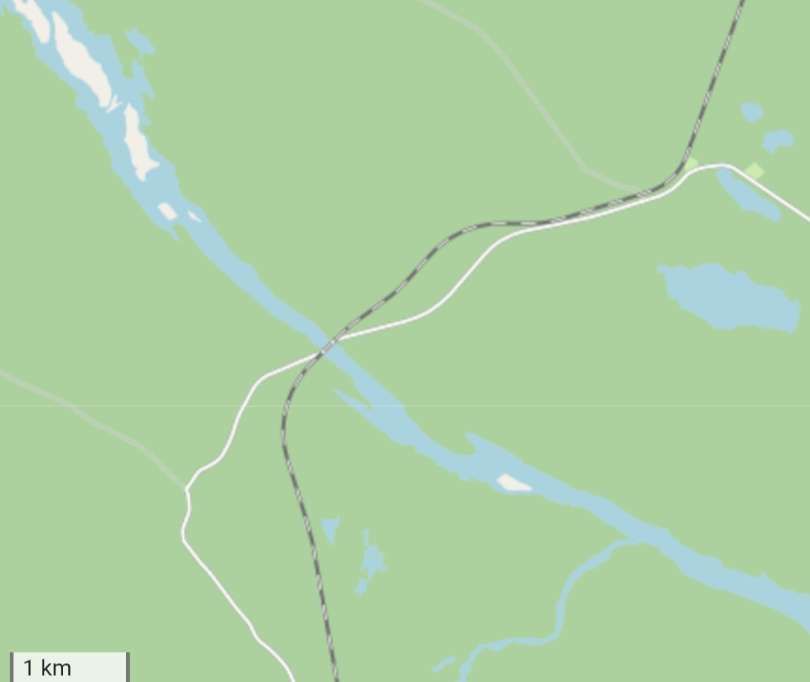
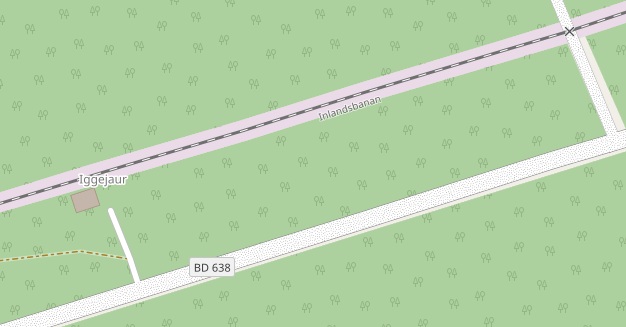
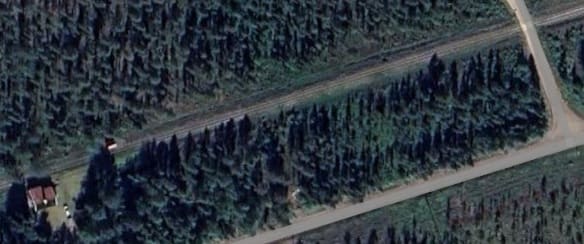
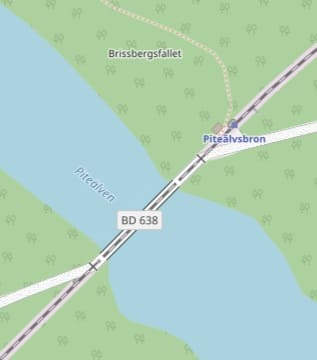
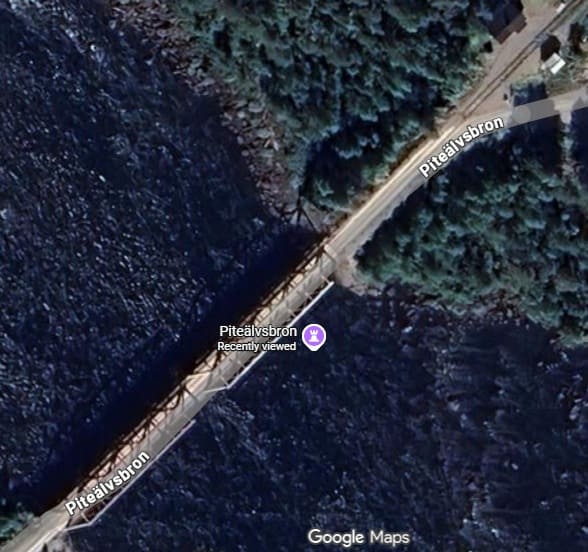
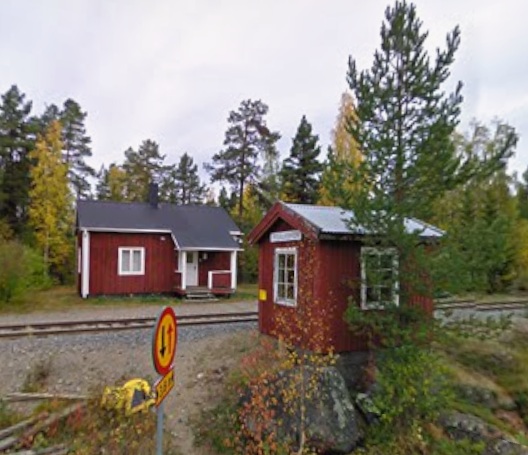
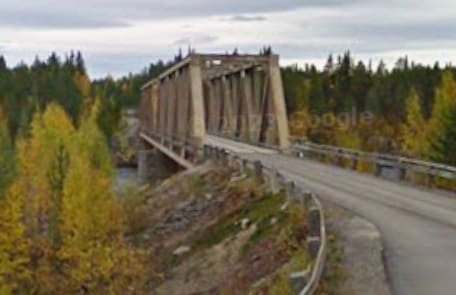
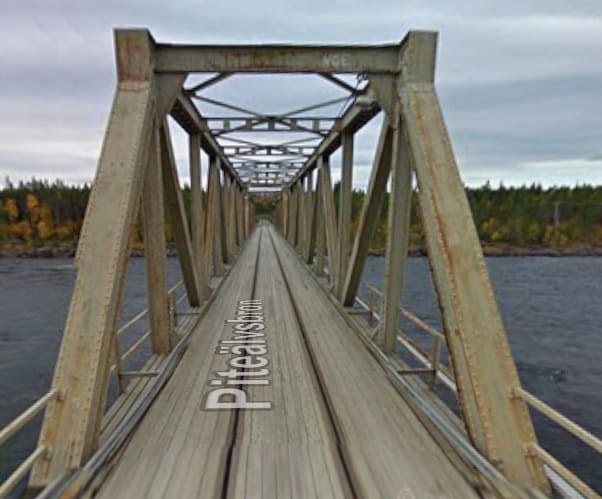
Continuing Southwest the line passes through Iggejaur, bridges the Pitealven River at Pitealvsbron and then turns to the South. [50]

The Halt at Iggejaur. [50][Google Maps, April 2026]

The combined road/rail bridge (Piteälvsbron) over the Pitealven River. [50][Google Maps, April 2026]

The small Halt at Pitealvsbron and the bridge seen from close to the Halt. [Google Streetview, September 2009]

Looking South over the bridge, which is a shared road and rail bridge. [Google Streetview, September 2009] And a of the bridge from the East, (c) Gustavo Azevedo, 2025, [Google Maps, April 2026]

This location South of Pitealvsbron has a passing place but is not named either on Google Maps or OpenStreetMap. [50][Google Maps, April 2026]

As can be seen from the satellite image an access road runs from the BD638 to the location which, together with passing loop would suggest the existence of a Halt in the past.

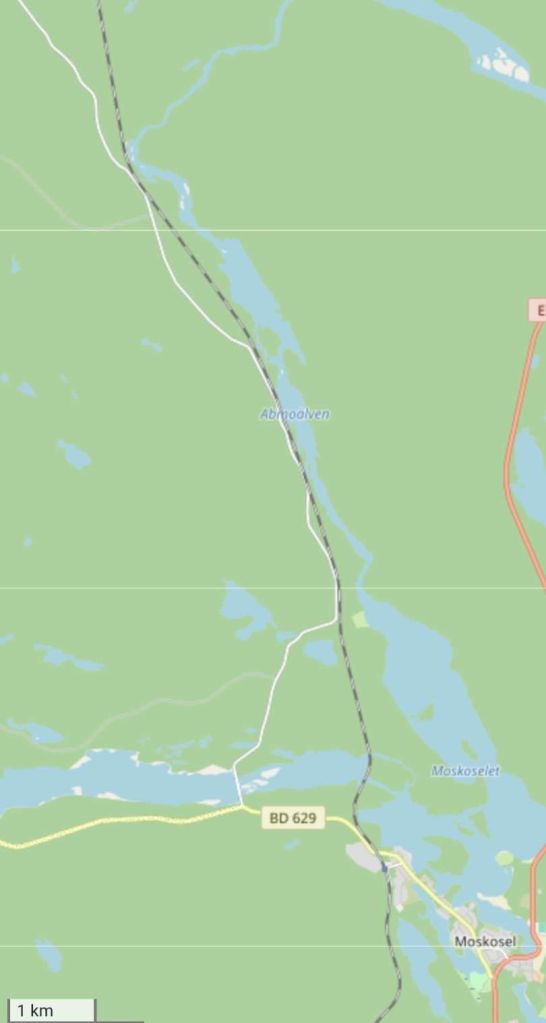
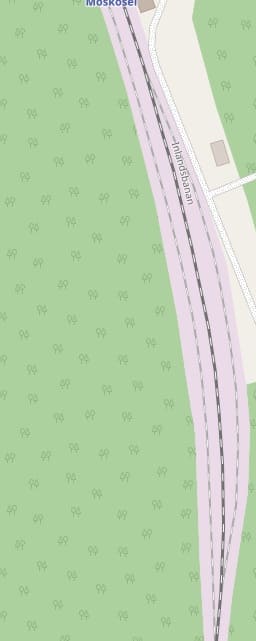
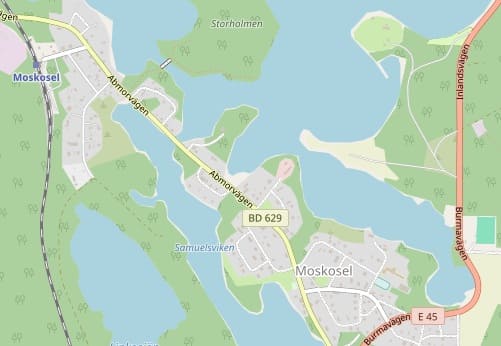
This extract from OpenStreetMap’s mapping shows the line running South-southeast into Moskosei. [51]

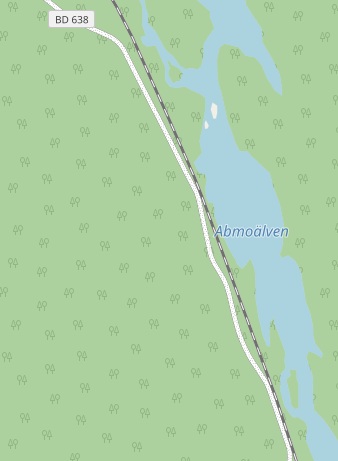
On its way towards Moskosel, the line runs between the BD638 and the Abmoalven River, a tributary of the Pitealven River. [51]

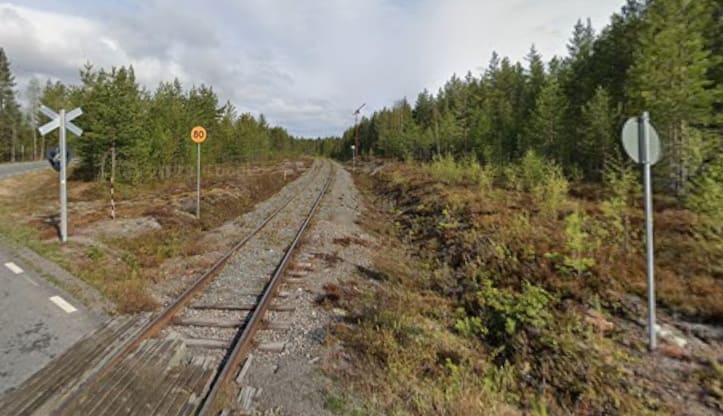
As can be seen in the image immediately above, the railway can be seen from the BD638, looking Northeast. [Google Streetview, May 2023]

Road, rail and river run practically adjacent to each other as we continue South-southeast towards Moskosel. [51]

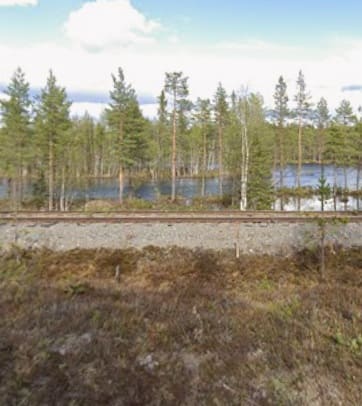
The view West from the BD638 across the railway to the Abmoalven River. [Google Streetview, May 2023]

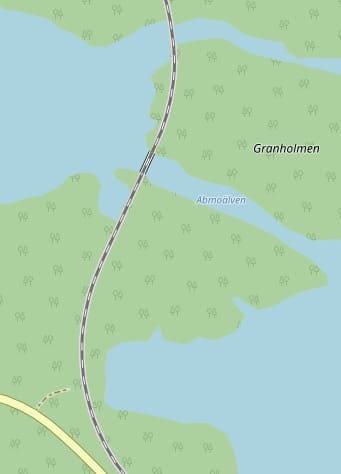
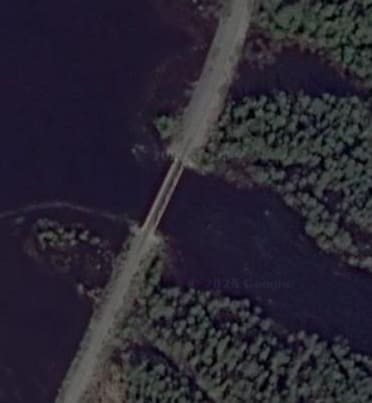
Another bridge – this one crosses the Abmoalven. [51][Google Maps, April 2026]

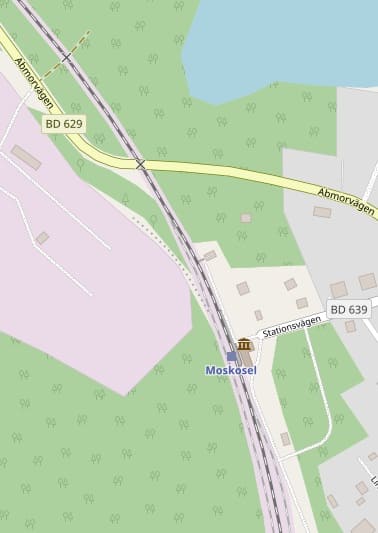
On the approach to Moskosel the line crosses the BD629 (Abmorvagen) at a level crossing. [51]

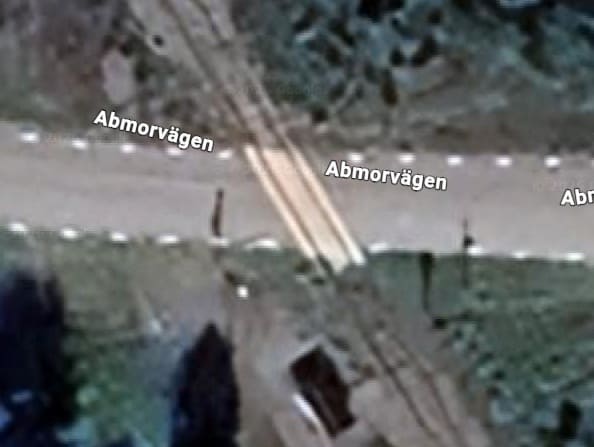
The crossing at Abmorwagen (BD629). [Google Maps, April 2026]
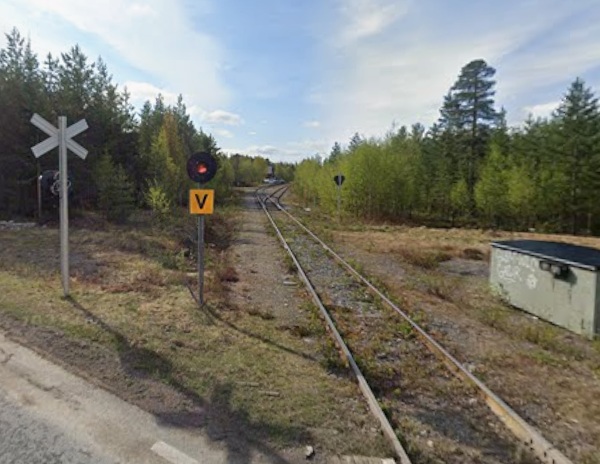
Looking Northwest from the level-crossing on Abmorwagen. [Google Streetview, May 2023]
Looking Southeast towards the station at Moskosel. [Google Streetview, May 2023]

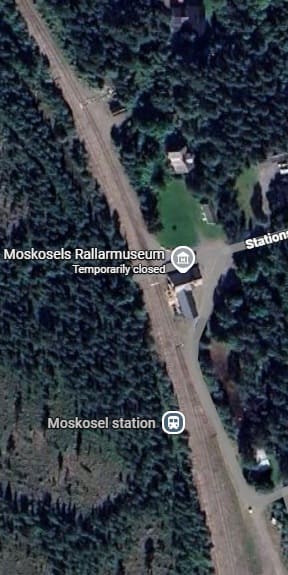
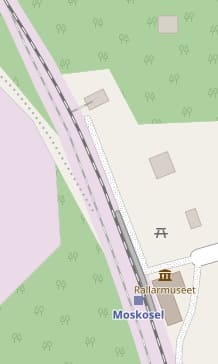
Moskosel Railway Station site. [Google Maps, April 2026][51]

Moskosel Railway Station had a long siding to the North of the station platform and two loops off the main running line to the South of the station platform. These can be seen in the extracts from OpenStreetMap’s mapping immediately above.

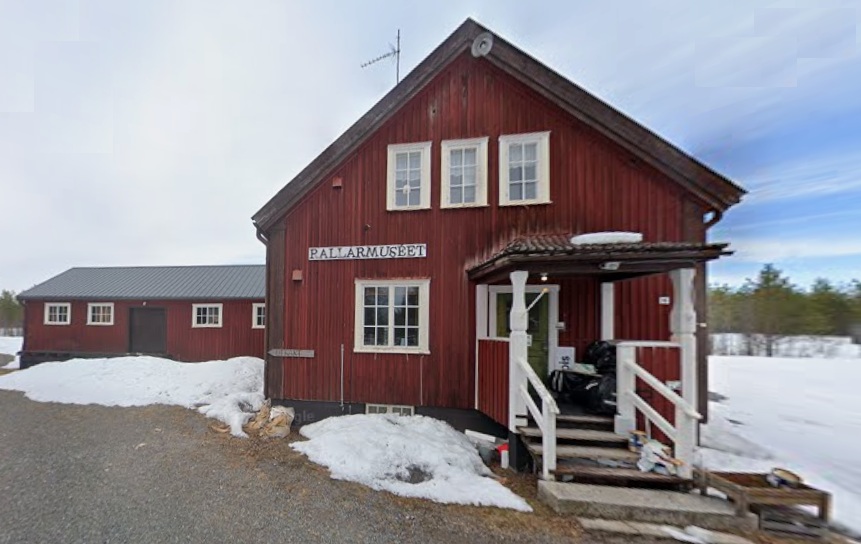
The Railway Station building at Moskosel is, in the 21st century, a small railway museum which It focuses on the history of the “rallare” (railway construction workers) who built the Inland Railway. [Google Streetview, April 2021]
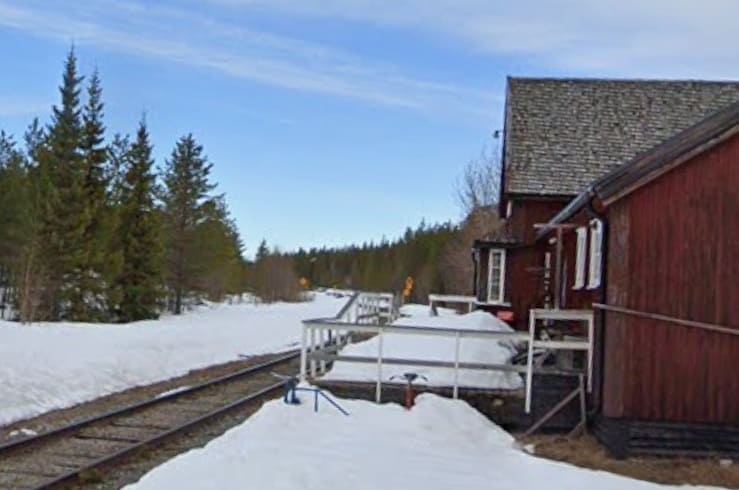
Looking North, this view shows the station platform at Moskosel. [Google Streetview, April 2021]

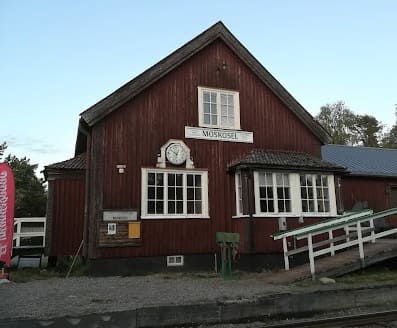
Seen from the East across the single line through the station, this is the platform side view of the station building, (c) dirk-steffen, 2025. [Google Maps, April 2026]

The station is quite a distance Northwest of Moskosel town centre. [51]

South of Moskosel, the line first finds its own way to the Southwest. ….

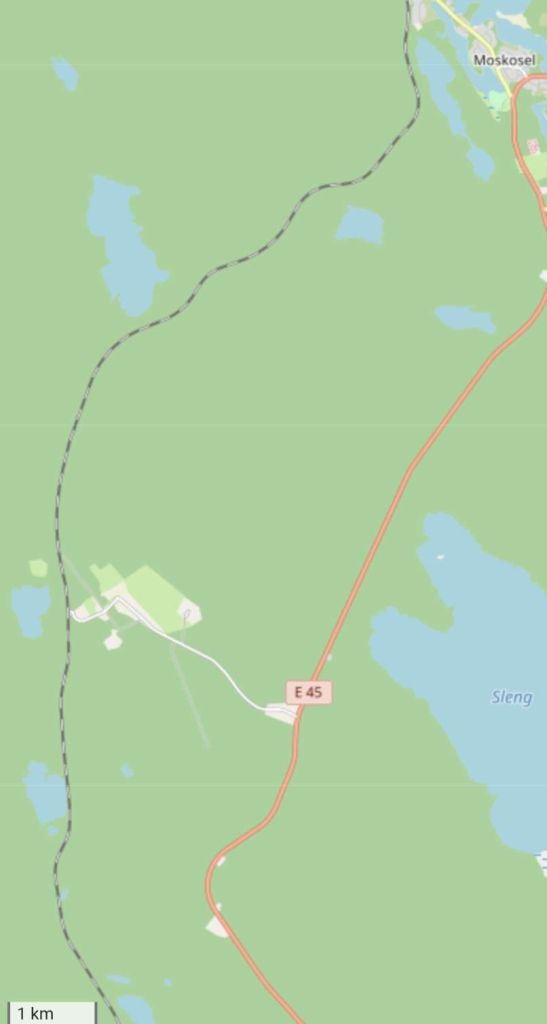
The line to the Southwest of Moskosel: it passes to the West of Lake Linkosjon and heads Southwest, passing to the South of Lake Sierbra before turning South once again. [52]

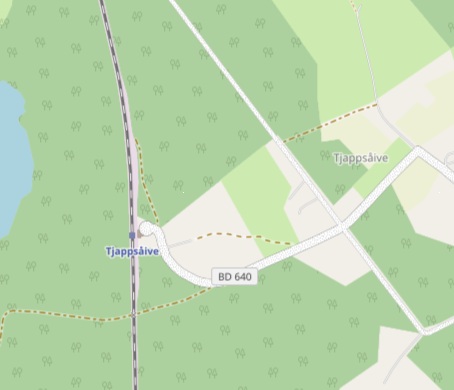
Tjappsaive Halt is at the end of a long side road off the E45 road. [52][Google Maps, April 2026]

The line continues South from Tjappsaive Halt, crossing the E45 again on the way. [53]

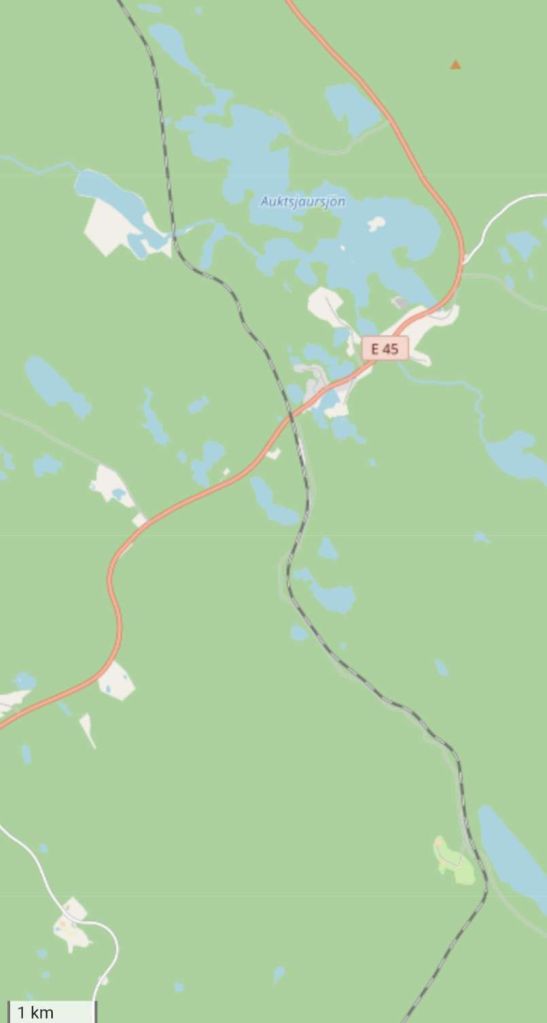
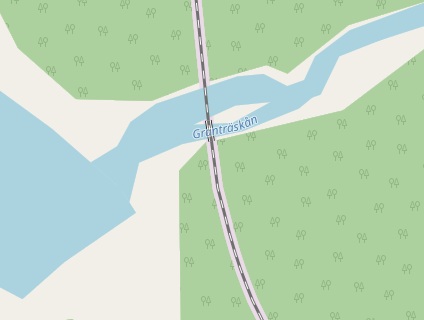
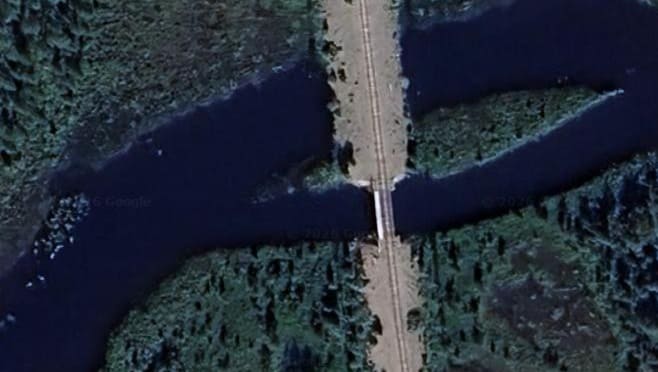
Before reaching the level-crossing, the line bridged the Grantraskan which flowed between Lake Levas and Lake Auktsjaursjon. [53][Google Maps, April 2026]

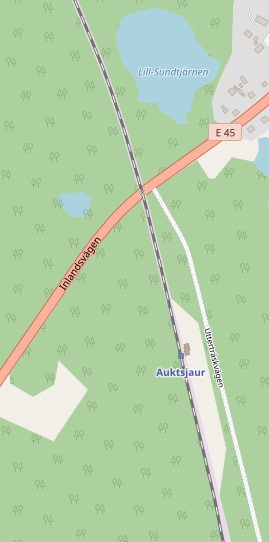
The level-crossing at Auktsjaur and the Halt which is just to the South of the crossing. [53]

The E45 level-crossing. [Google Maps, April 2026]
Looking North from the crossing. [Google Streetview, July 2025]
Looking South. [Google Streetview, July 2025]

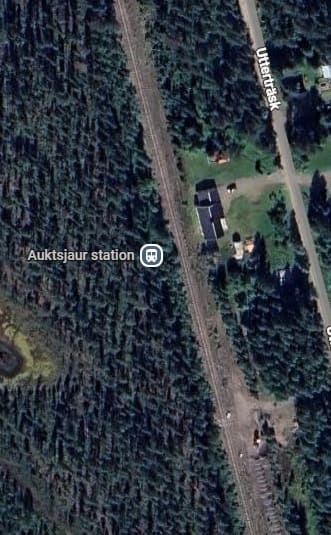
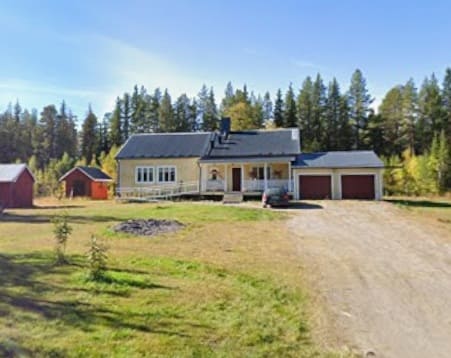
Auktsjaur Railway Station is a halt without a passing loop. The village it serves sits to the Northeast of the station straddling the E45. [Google Maps, April 2026]

Auktsjaur Railway Station seen from Uttertrask road. the railway line runs behind the building. [Google Streetview, September 2021]
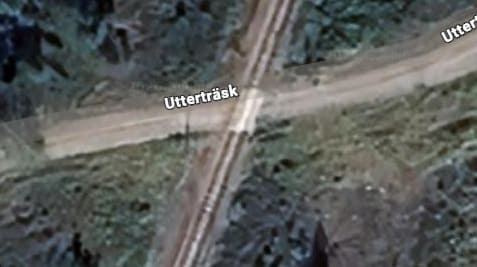
A little way South of the station Uttertrask crosses the line. [Google Maps, April 2026]
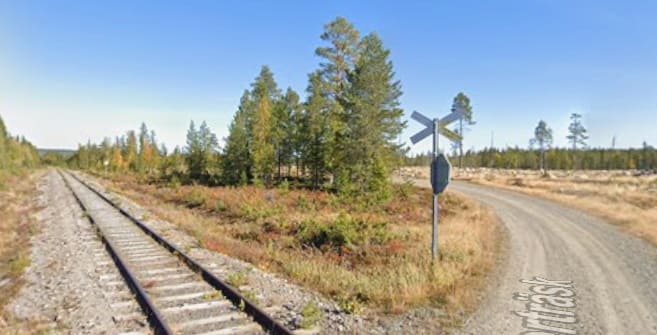
Looking back North towards Auktsjaur Station from the road-crossing with Uttertrask.
[Google Streetview, September 2021]
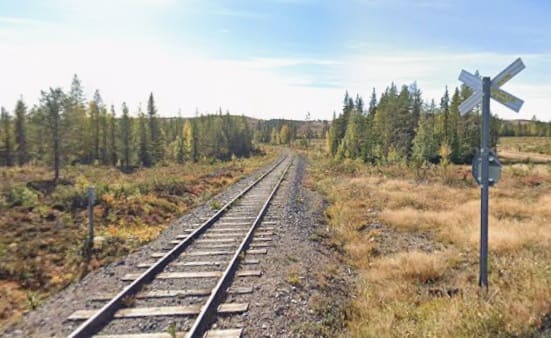
Looking South down the line from the same road-crossing.
[Google Streetview, September 2021]

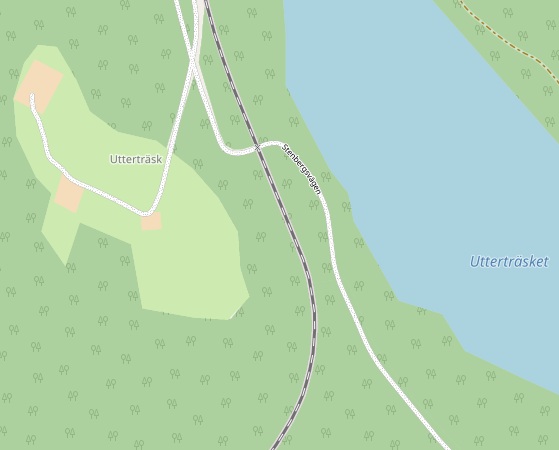
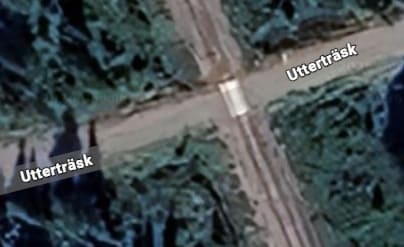
Road and rail cross again at the hamlet of Uttertrask alongside Lake Uttertrasket. [53][Google Maps, April 2026]

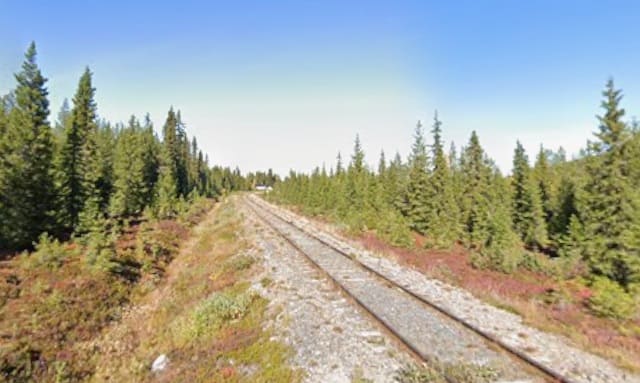
Looking North towards Auktsjaur from the road crossing above. [Google Streetview, September 2021]
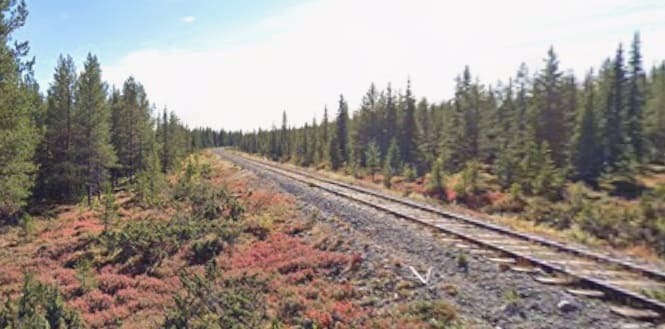
Looking South from the same crossing. [Google Streetview, September 2021]
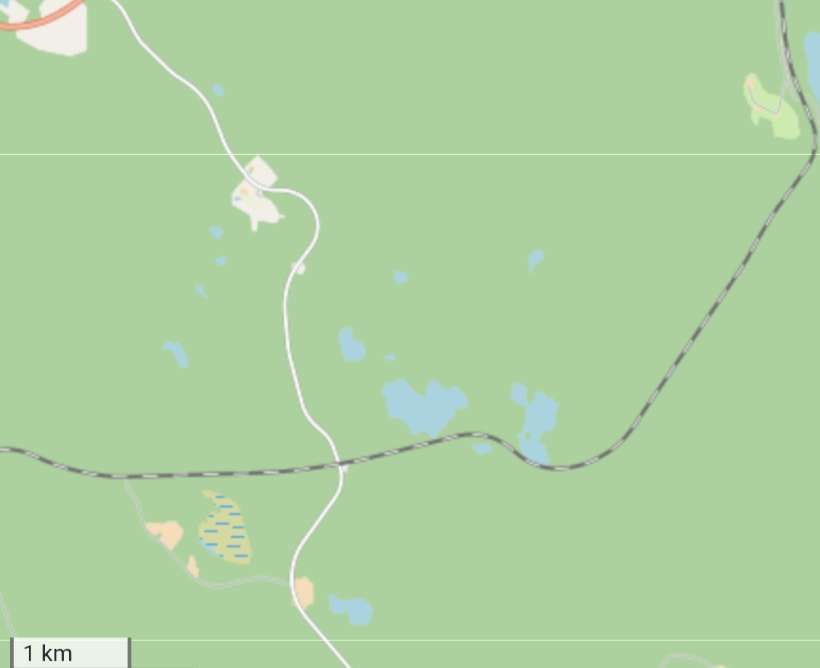
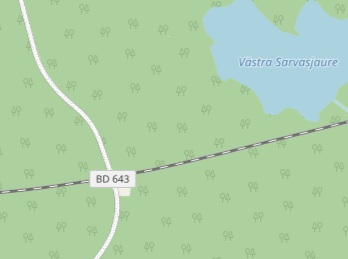
On this next map extract, Uttertrask appears top right, the line turns to travel West, running to the South of two lakes Vastra Sarvasjaure and Ostra Sarvasjaure. It then crosses the BD643. [54]

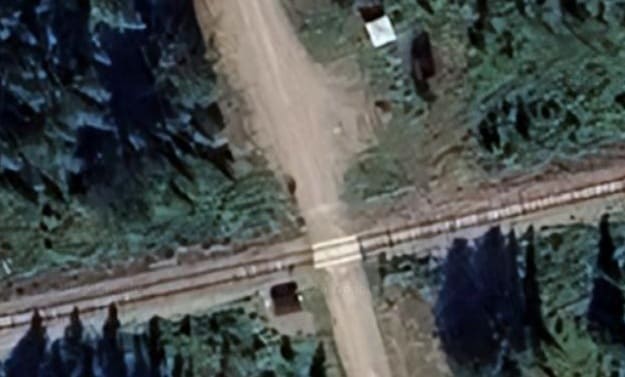
The road-crossing at the BD643. [54][Google Maps, April 2026]

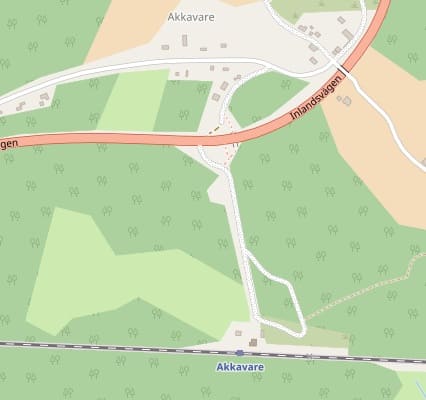
Still travelling ina predominantly westward direction the line crosses this next map extract and takes up closer order with the E45 again near the small village of Akkavare. [55]

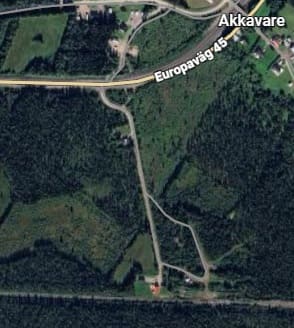
Akkavare Village and Halt. [55][Google Maps, April 2026]

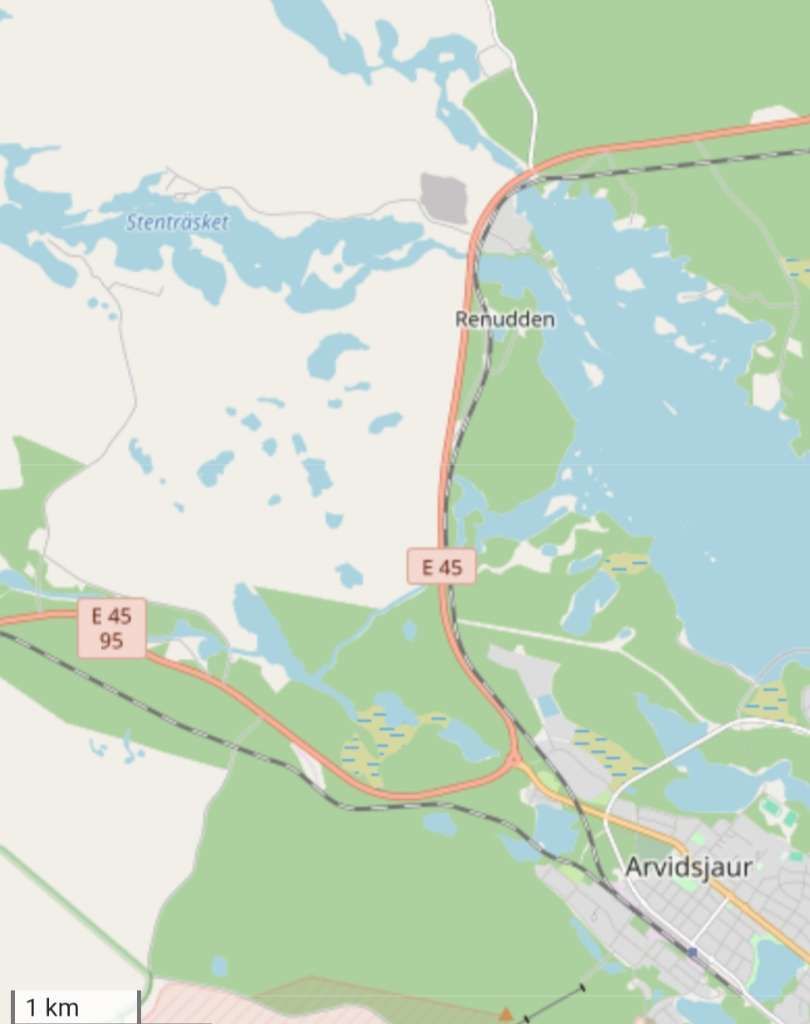
This last OpenStreetMap wide area extract covers the run in to Arvidsjaur. [56]

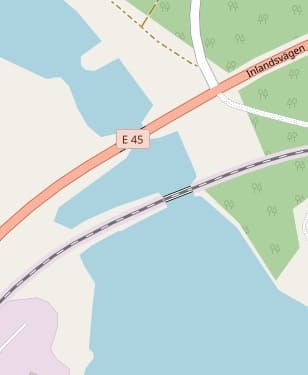
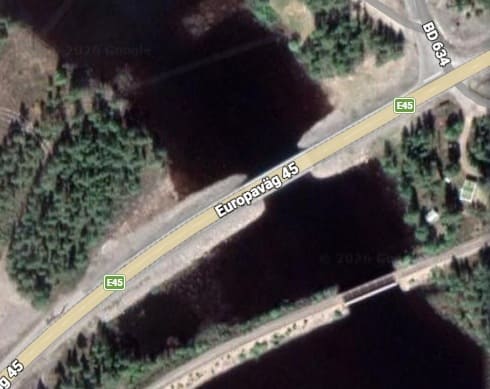
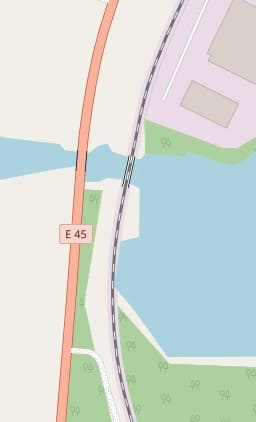
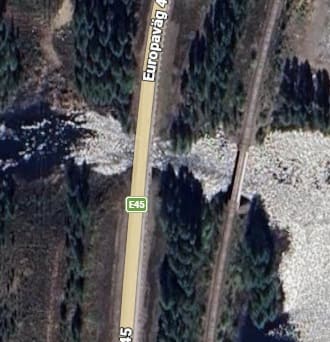
The E45 and the Inlandsbanan bridge the channel linking Lake Vastra Kikkejaure and Lake Arvidsjaurjon. Both are on causeways which are breached by short bridges. [56][Google Maps, April 2026]

This photograph shows the Inlandsbanan bridge as it is seen from The E45. This image faces Southeast. [Google Streetview, August 2025]

The E45 and the Inlandsbanan cross the channel linking Lake Stentrasket with Lake Arvidsjaurjon. [56][Google Maps, April 2026.
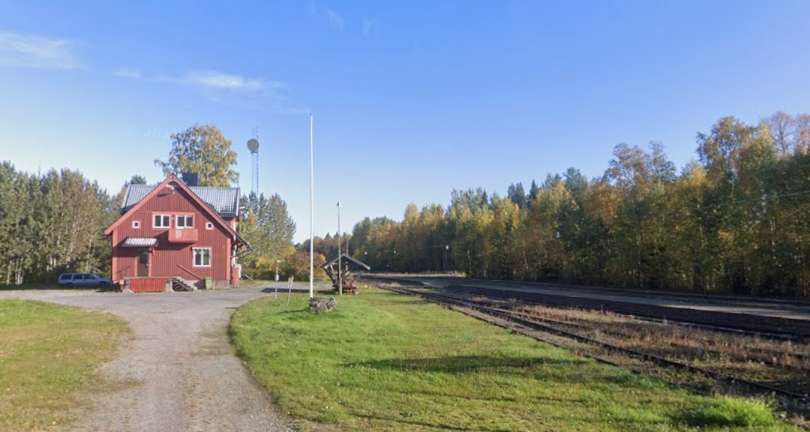
An early morning view of the Inladsbanan bridge seen, looking East, from the E45 bridge.
[Google Streetview, August 2025

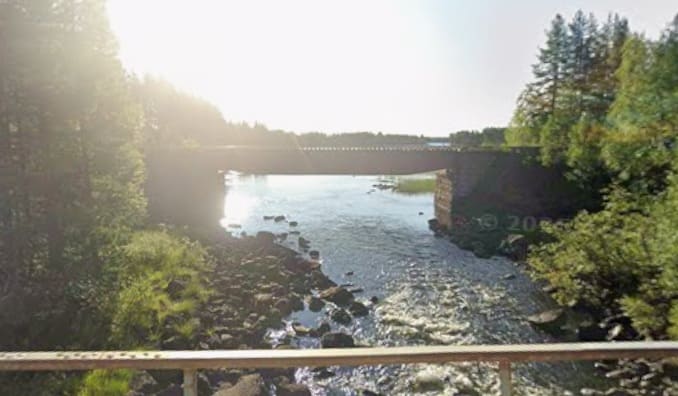
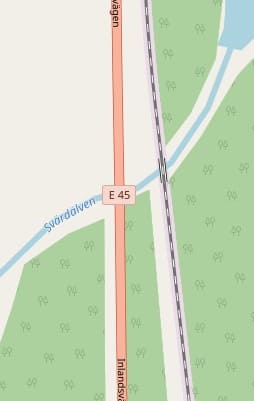
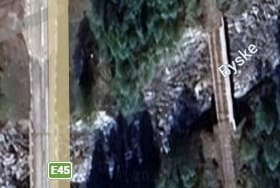
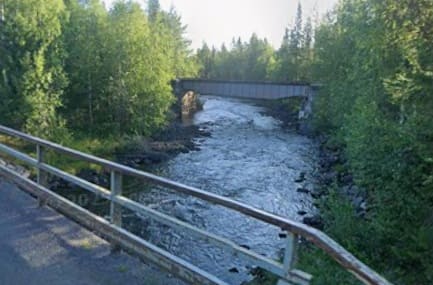
A little further South road and rail bridge the Svardalven River, Google has this as the Byske. [56][Google Maps, April 2025]

Looking Northeast from the E45 along the Byske/Svardalven. [Google Streetview, August 2025]
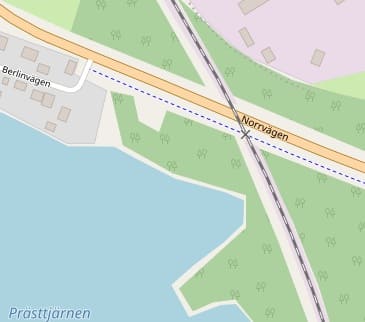
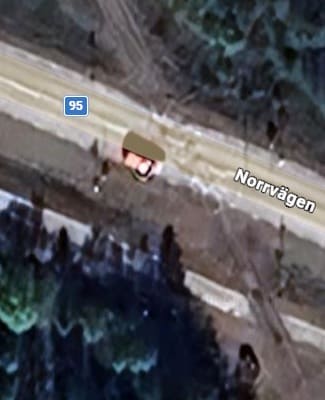
We are now on the approach to Arvidsjaur and its Railway Station. As the line enters the outskirts of the town, close to the Prasttjarnen Lake it crosses Norrwagen. [56]

The line crosses Norrvagen. [Google Maps, April 2026]

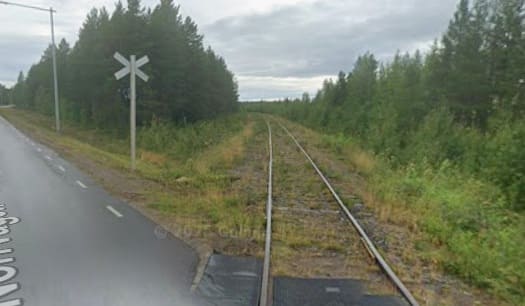
Looking Northwest along the line. [Google Streetview, August 2025]
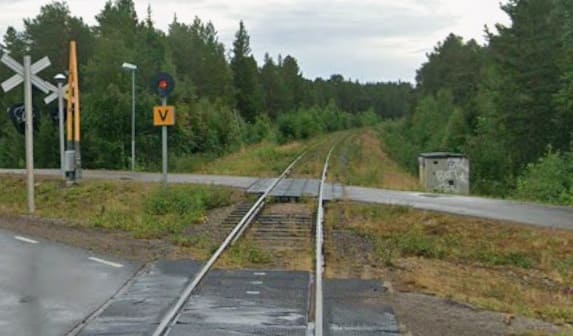
Looking Southeast towards the Railway Station. [Google Streetview, August 2025]
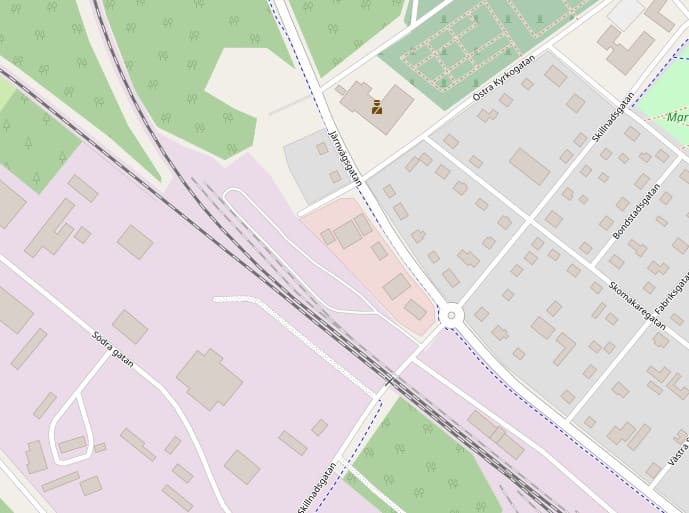
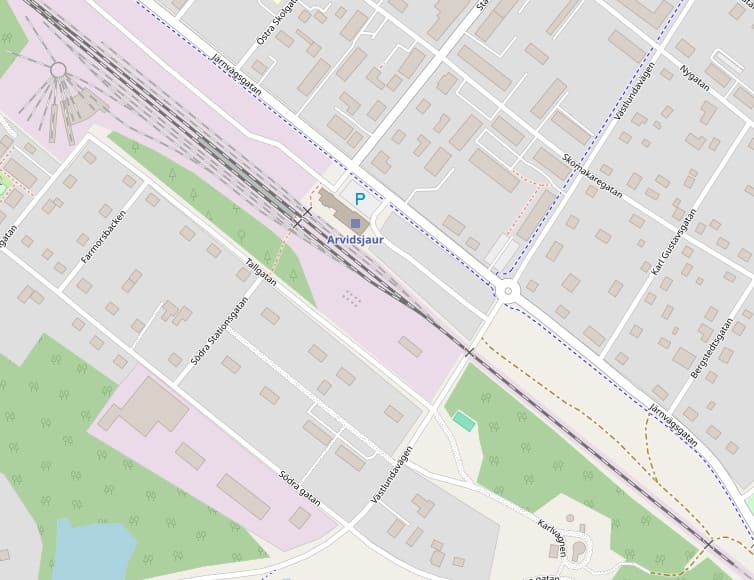
Arvidsjaur Railway Station used to be a junction station. with two arms of the inlandsbanan entering the station from the Northwest and a line to Jörn leaving to the Southeast. The line to Jörn has been lifted. The 75-km Jörn–Arvidsjaur railway line (opened 1928, closed 1990) connects Arvidsjaur with the main line at Jörn. While disused, there are potential plans to reopen it for defence purposes. This map extract shows the two arms of the Inlandsbanan meeting to the Northwest of the railway station. Note also the two sidings on the North side of the running lines. [56][57]
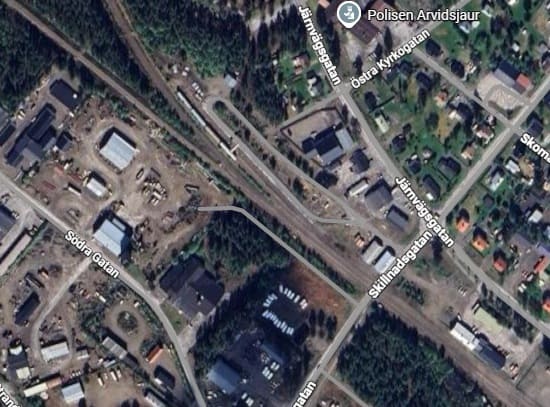
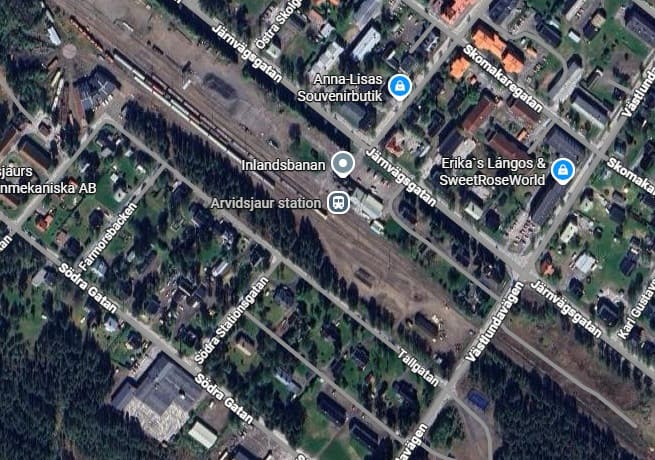
The same area as it appears on Google’s satellite imagery. Note the rolling stock in the sidings on the North side of the running lines. [Google Maps, April 2026]
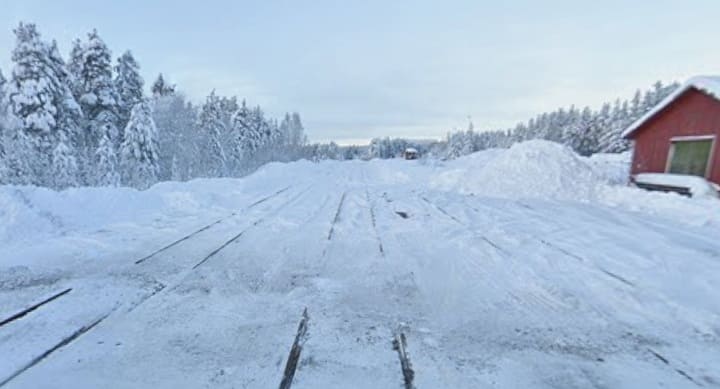
Looking Northwest in mid-winter from the level-crossing at Skillnadsgatan.The line from the North is at the centre of the image, the line for the South is shown to the left and the sidings mentioned above are on the right side of this photograph. [Google Stretview, January 2021]
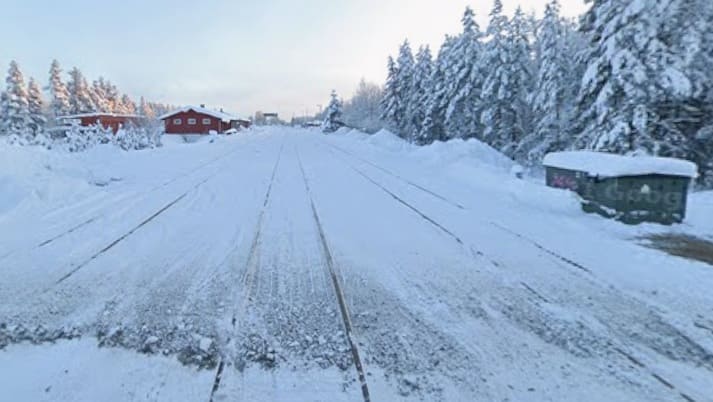
Similarly in the grip of winter this view looks from the same road-crossing towards Arvidsjaur Railway Station. The Inlandsbanan line from the North is at the centre of the image, that for the South is on the right side of the picture. The sidings are on the left of the image. [Google Streetview, January 2021]
This map extracts focuses on the Railway Station at Arvidsjaur with the two arms of the inlandsbanan entering from the Northwest and the sub of the line to Jörn running only a very short distance to the Southeast, acting as no more than a head shunt for the station. At the top-left of the image the locomotive depot can be seen on the South side of the running lines. [56]
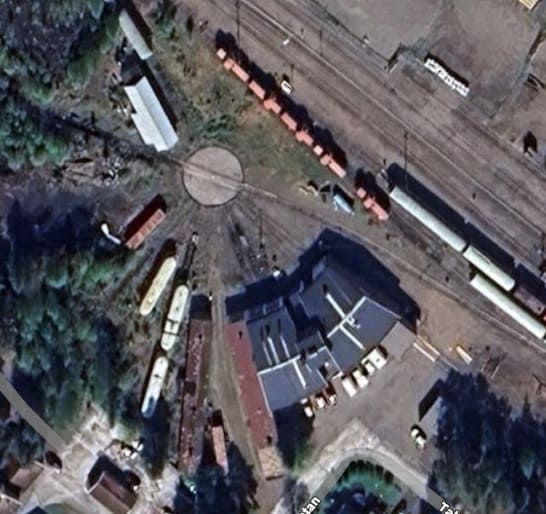
A similar area as it appears on Google’s satellite imagery. There is a lot of rollingstock visible in the sidings at the station. There also appear to be some single car and two-car DMUs in the locomotive depot at the top-left of the image. The ‘head shunt’ can be picked out crossing Västlundavägen and heading for the bottom-right of the image. [Google Maps, April 2026]

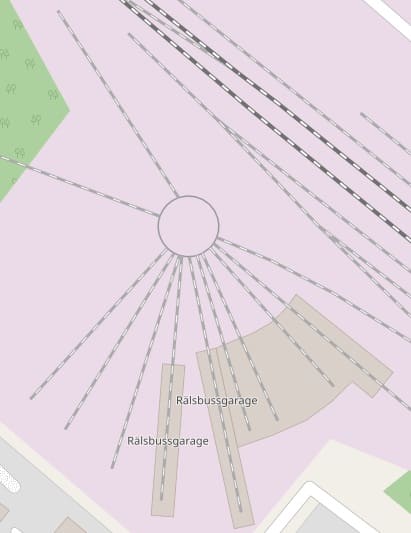
The old locomotive shed/depot now acts as a stabling point for railbuses that are used on the Inlandsbanen. [56][Google Maps, April 2026]

The locomotive depot at Arvidsjaur is used for the stabling of railcars, (c) dirk-steffen, 2025. [Google Maps, April 2026]
A winter view of the station buildings at Arvidsjaur, seen from Tallgatan (South of the station).
[Google Streetview, January 2021]
A view in early spring (March) of the station buildings at Arvidsjaur, from the station approach.
[Google Streetview,March 2021]

The station building seen from the North, (c) dirk-steffen, 2025. [Google Maps, April 2026]

The station building seen from the East, (c) gesla 26.11, 2024. [Google Maps, April 2026]

Steam at Arvidsjaur on 20th May 1935, Locomotive No. 907, no known copyright restrictions. [60]

More photographs of the site of the railway station and some rolling stock can be seen here. [58]

Looking Northwest from the road-crossing at Västlundavägen into the site of the railway station. [Google Streetview, July 2025]
Looking Southeast along what was the line to Jörn which now acts as a head-shunt for the railway station. [Google Streetview, July 2025]

Arvidsjaur had a population of 4,635 in 2010. During the winter months, major car-manufacturers perform arctic trials in the Arvidsjaur area. The town also fosters tourism by offering snowmobile tours, trekking, skiing, fishing and dogsled rides. Arvidsjaur is a Swedish adaptation of the Ume Sámi word árviesjávrrie, derived from árvies (“generous” or “one who gives abundantly”) and jávrrie (“lake”), referring to the fishing in the nearby lake of the same name. Aruens järff by was the Swedishized name of the Sámi village where the Arvidsjaur Church was built in 1607. [59]

It is at Arvidsjaur that we take a break on our journey South down the Inlandsbanan.

References

  1. M. D. Grenville & H. A. Vallance; Sweden’s Inland Railway; in The Railway Magazine, December 1958; Tothill Press, London, 1958, p826-832 & p870.
  2. Gällivare is 744 miles (1,198 km) from Stockholm. It a quaint mining town and the gateway to the mountains, forest and glaciers of Laponia. This small town of around 8,500 people is an ideal base from which to venture into the surrounding wilderness. (The Laponia World Heritage Site includes the spectacular national parks of Sarek, Stora Sjöfallet and Muddus) Gällivare’s museum allows one to learn about the lives of the town’s early settlers as well as the culture of the region’s indigenous Sami communities. A guided tour of the Aitik Copper Mine, one of the largest mines in Europe, is available. Expedia suggests visits to the town’s historic churches including: the tiny Old Church (Gällivare Gamla Kyrka), which dates back to the 18th century; and the white New Church (Gällivare Nya Kyrka) which was designed by architect Emil Langlet. A visit to Malmberget would give a further glimpse into this region’s industrial past. Malmberget is home to a branch of the LKAB Iron-Ore Mine which offers daily tours. A visit to Kåkstan, a historical “shanty town” museum village, dating back to the 1888 iron-ore rush should be included in any itinerary. [3]
  3. https://www.expedia.co.uk/Gallivare.dx1308, accessed on 19th April 2026.
  4. https://commons.wikimedia.org/wiki/File:G%C3%A4llivare-station-5.jpg, accessed on 19th April 2026.
  5. https://commons.wikimedia.org/wiki/File:G%C3%A4llivare_station_%28DSCF0855%29.jpg, accessed on 19th April 2026.
  6. https://commons.wikimedia.org/wiki/File:G%C3%A4llivare-station-1.jpg, accessed on 19th April 2026.
  7. https://www.openstreetmap.org/#map=15/67.14337/20.63916, accessed on 19th April 2026.
  8. https://www.openstreetmap.org/#map=11/63.1973/14.6639, accessed on 19th April 2026.
  9. https://www.researchgate.net/figure/Mineral-production-at-Vitaforsgruvan-Malmberget-in-Lappland-Sweden-Photo-Anders_fig1_264006617, accessed on 19th April 2026.
  10. https://www.openstreetmap.org/#map=13/63.84192/15.56361, accessed on 19th April 2026.
  11. https://www.openstreetmap.org/#map=13/63.83321/15.61672, accessed on 19th April 2026.
  12. https://www.openstreetmap.org/#map=14/64.62064/16.63751, accessed on 19th April 2026.
  13. https://en.wikipedia.org/wiki/%C3%96stersund#/media/File:%C3%96stersund_3.jpg, accessed on 20th April 2026.
  14. https://en.wikipedia.org/wiki/%C3%96stersund, accessed on 20th April 2026.
  15. https://en.wikipedia.org/wiki/Vilhelmina, accessed on 20th April 2026.
  16. https://www.openstreetmap.org/#map=13/65.52822/17.52354, accessed on 20th April 2026.
  17. https://commons.wikimedia.org/wiki/File:Bf_Sorsele.JPG, accessed on 20th April 2026.
  18. https://www.openstreetmap.org/#map=15/67.14943/20.53101, accessed on 21st April 2026.
  19. https://www.openstreetmap.org/#map=17/67.139085/20.372847, accessed on 21st April 2026.
  20. https://www.openstreetmap.org/#map=19/67.140804/20.355332, accessed on 21st April 2026.
  21. https://www.openstreetmap.org/#map=18/67.158108/20.133092, accessed on 21st April 2026.
  22. https://www.openstreetmap.org/#map=19/67.125529/20.025827, accessed on 21st April 2026.
  23. https://www.openstreetmap.org/#map=17/67.100023/19.996829, accessed on 21st April 2026.
  24. https://www.openstreetmap.org/search?query=Avvakajjo++sweden&zoom=15&minlon=38.63063335418702&minlat=-5.445123599992578&maxlon=38.669900894165046&maxlat=-5.416584834447957#map=16/67.06372/19.92198, accessed on 22nd April 2026.
  25. https://www.openstreetmap.org/search?query=Avvakajjo++sweden&zoom=15&minlon=38.63063335418702&minlat=-5.445123599992578&maxlon=38.669900894165046&maxlat=-5.416584834447957#map=16/67.06084/19.90829, accessed on 22nd April 2026.
  26. https://www.openstreetmap.org/search?query=Avvakajjo++sweden&zoom=15&minlon=38.63063335418702&minlat=-5.445123599992578&maxlon=38.669900894165046&maxlat=-5.416584834447957#map=16/67.03214/19.80031, accessed on 22nd April 2026.
  27. https://www.openstreetmap.org/search?query=Porjus++sweden&zoom=14&minlon=19.773588180541996&minlat=66.945190478894&maxlon=19.85212326049805&maxlat=66.9676331513497#map=13/66.96011/19.82217, accessed on 22nd April 2026.
  28. https://www.openstreetmap.org/search?query=Porjus++sweden&zoom=14&minlon=19.773588180541996&minlat=66.945190478894&maxlon=19.85212326049805&maxlat=66.9676331513497#map=15/66.88487/19.81730, accessed on 22nd April 2026.
  29. https://www.openstreetmap.org/search?query=Porjus++sweden&zoom=14&minlon=19.773588180541996&minlat=66.945190478894&maxlon=19.85212326049805&maxlat=66.9676331513497#map=13/66.80483/19.87676, accessed on 22nd April 2026.
  30. https://www.openstreetmap.org/search?query=Porjus++sweden&zoom=14&minlon=19.773588180541996&minlat=66.945190478894&maxlon=19.85212326049805&maxlat=66.9676331513497#map=14/66.65719/19.83526, accessed on 22nd April 2026
  31. https://www.openstreetmap.org/search?query=Porjus++sweden&zoom=14&minlon=19.773588180541996&minlat=66.945190478894&maxlon=19.85212326049805&maxlat=66.9676331513497#map=14/66.63137/19.83019, accessed on 22nd April 2026.
  32. Jokkmokk is a locality and the seat of Jokkmokk Municipality in Norrbotten County, province of Lapland, Sweden, with 2,786 inhabitants in 2010. The Lule Sámi name of the place (composed of the individual words jåhkå and måhkke) means “River’s Curve,” due to the meandering river that runs through it. As in other towns in Lapland, the Swedish language is dominant, accessed on 23rd April 2026. at an official level in Jokkmokk in modern times. The settlement is just north of the Arctic Circle. [33]
  33. https://en.wikipedia.org/wiki/Jokkmokk, accessed on 22nd April 2023.
  34. https://www.openstreetmap.org/#map=18/66.607141/19.839935, accessed on 22nd April 2026
  35. https://commons.wikimedia.org/wiki/Category:Jokkmokks_station#/media/File%3AJokkmokk_EG_29.05.00.jpg, accessed on 22nd April 2026.
  36. https://www.openstreetmap.org/#map=14/66.55468/19.91518, accessed on 23rd April 2026.
  37. https://commons.wikimedia.org/wiki/File:Polarkreis_inlandsbanan.jpg, accessed on 23rd April 2026.
  38. https://www.openstreetmap.org/#map=12/66.4121/19.6612, accessed on 23rd April 2026.
  39. https://www.openstreetmap.org/#map=12/66.4097/19.6873, accessed on 23rd April 2026.
  40. https://www.openstreetmap.org/#map=12/66.3347/19.7378, accessed on 23rd April 2026.
  41. https://www.openstreetmap.org/#map=12/66.2821/19.8250, accessed on 23rd April 2026.
  42. https://www.openstreetmap.org/#map=14/66.17832/19.93143, accessed on 23rd April 2026.
  43. https://www.openstreetmap.org/#map=14/66.16070/19.95975, accessed on 23rd April 2026.
  44. https://www.openstreetmap.org/#map=12/66.1152/19.9543, accessed on 23rd April 2026.
  45. https://powerplants.vattenfall.com/sv/porjus, accessed on 24th April 2026.
  46. https://www.openstreetmap.org/#map=12/66.0492/19.8382, accessed on 26th April 2026.
  47. https://www.openstreetmap.org/#map=13/66.04406/19.74827, accessed on 26th April 2026.
  48. https://www.openstreetmap.org/#map=12/66.0433/19.5814, accessed on 26th April 2026.
  49. https://www.openstreetmap.org/#map=13/66.02569/19.46280, accessed on 26th April 2026.
  50. https://www.openstreetmap.org/#map=12/65.9845/19.3401, accessed on 26th April 2026.
  51. https://www.openstreetmap.org/#map=12/65.9106/19.3737, accessed on 26th April 2026.
  52. https://www.openstreetmap.org/#map=14/65.82168/19.36199, accessed on 26th April 2026.
  53. https://www.openstreetmap.org/#map=14/65.73805/19.38825, accessed on 26th April 2026.
  54. https://www.openstreetmap.org/#map=13/65.68087/19.37327, accessed on 26th April 2026.
  55. https://www.openstreetmap.org/#map=14/65.66172/19.23659, accessed on 26th April 2026.
  56. https://www.openstreetmap.org/#map=12/65.6098/19.1239, accessed on 26th April 2026.
  57. https://www.railfreight.com/infrastructure/2025/08/20/a-railway-in-sweden-might-reopen-after-25-years-for-defence-purposes, accessed on 27th April 2026.
  58. https://www.google.com/maps/place/Arvidsjaur+station/@65.5887896,19.1703657,3a,75y,90t/data=!3m8!1e2!3m6!1sCIHM0ogKEICAgICdnoO7Kw!2e10!3e12!6shttps:%2F%2Flh3.googleusercontent.com%2Fgps-cs-s%2FAPNQkAF7iE4sU9sWfNsY4tQneVZJD4ZVnmm2yRD1sLH82kvTj42WnEy0k4G354uijjEuR2Gklqw7GPUYqFbes8SbOc_Yqx_JIDirBKN4tWFyBJBUF7Hvsqcu3AW9I7WDdBtkGLs1xhs%3Dw114-h86-k-no!7i4080!8i3072!4m7!3m6!1s0x467857e4d73f311f:0xa1a8fee6020ccd46!8m2!3d65.5888094!4d19.1692597!10e5!16s%2Fg%2F12hhgqb0n?entry=ttu&g_ep=EgoyMDI2MDQyMC4wIKXMDSoASAFQAw%3D%3D, accessed on 27th April 2026.
  59. https://en.wikipedia.org/wiki/Arvidsjaur, accessed on 27th April 2026.
  60. https://picryl.com/media/statens-jarnvagar-sj-e-907-arvidsjaur-station-anlagd-1927-c74560, accessed on 27th April 2026.

Through Norway by Rail – The Railway Magazine, November 1899

E.E. Speight tells of his own experiences travelling by rail in Norway. In an article which is primarily a travelogue rather than a technical piece. He fails to mention the gauges of the different railways that he travels along. [1] The matter of the differing gauges of railways in Norway is covered in some paragraphs below.

In 1899, Norway had around 1,300 miles of railway. The principal elements were lines running:

  • from Christiania South towards Sweden reaching the border at Kornsjo (169 km – the Smaalensbanen);
  • from Christiania East towards Sweden reaching the border beyond Kongsvinger;
  • from Christiania to Trondhjem (562 km) with branches to Lillehamer, Otta and from Elverum to Kongsvinger;
  • from Trondhjem to Storlien (108 km) to meet the line in Sweden from Stockholm;
  • from Christiania South to Drammen, Laurvik and Skien (204 km) with branches to Randsfjord, Kongsberg and Kroderen, Horten and Brevik.
  • between Christiansand and Byglandsfjord (Saetersdal); Stavanger and Ekersund (Jaederbanen); and Bergen to Vosse (108 km).

The city of Oslo was founded in 1024. In 1624, it was renamed Christiania after the Danish king; in 1877, the spelling was altered to Kristiania. In 1925, it reverted to its original medieval name of Oslo.

It seems as though E.E. Speight may have missed the 1877 memo about the renaming of the city, and so continued to refer to Kristiania as Christiania. Reading in the 21st century we need to read Christiania as Oslo.

In the 21st century, the Norwegian railway system comprises 4,109 km of 1,435 mm (4 ft 8 1⁄2 in) (standard gauge) track of which 2,644 km is electrified and 274 km double track. There are 697 tunnels and 2,760 bridges. [2]

This was not the case in the early years of the network. The first railway in Norway was the Hoved Line between Oslo and Eidsvoll and opened in 1854. The main purpose of that railway was to move lumber from Mjøsa to the capital, but passenger service was also offered. In the period between the 1860s and the 1880s Norway saw a boom of smaller railways being built, including isolated railways in Central and Western Norway. The predominant gauge at the time was 1,067 mm (3 ft 6 in) (narrow gauge), but some lines were built in 1,435 mm (4 ft 8 1⁄2 in) (standard-gauge), particularly where those lines connected to the standard-gauge lines of Sweden. [2]

When building the Norwegian Trunk Railway (1850-1854), Robert Stephenson built the line to British standard gauge. This line was very expensive; Pihl argued that narrow-gauge railways would be less expensive to construct, he argued successfully for 3 ft 6 in (1,067 mm) gauge. During the railway construction boom of the 1870s and 1880s all but the Kongsvinger Line, the Meråker Line and the Østfold Line were built with narrow gauge, leaving Norway with two incompatible systems. [7]

The 3ft 6in gauge was chosen by Carl Pihl in 1857 as the ‘standard-gauge’ for Norwegian railways. Pihl was a civil engineer and director of the Norwegian State Railways (NSB) from 1865 until his death in 1897. [7]

A number of main line railways were built to the 3 ft 6 in (1,067 mm), to save cost in a sparsely populated mountainous country. This included: the Hamar – Grundset Railway which commenced operation in 1861; the more challenging Trondheim – Støren Railway which commenced operations in 1864; and Norway’s first truly long-distance line, the Røros Line, connecting Oslo and Trondheim (in 1877).

In 1883 the entire main railway network had been taken over by Norwegian State Railways (NSB), though a number of industrial railways and branch lines continued to be operated by private companies. [2]

It was the decision of the Norwegian Parliament to construct the Bergen line to standard-gauge (in the year following Phil’s death), which finally settled the debate over gauges. By this time, it had been demonstrated that standard-gauge lines built to the same specifications as the narrow gauge could be constructed at the same cost. [7]

Ultimately, all narrow-gauge lines owned by the NSB  were either closed or converted between 1909 and 1949, at a cost many times larger than the initial savings of building them narrow.

Projects such as the Bergen Line and the Sørland Line (also built to standard-gauge) were connecting all the isolated railways and transshipment costs were becoming significant. [7]

Some private railways had 750 mm (2 ft 5 1⁄2 in) and one had 1,000 mm (3 ft 3 3⁄8 in) gauge. A few railways are in part still operated as museum railways, specifically the Thamshavn Line, Urskog–Høland Line and the Setesdal Line. [3]

The Thamshavn Line (Norwegian: Thamshavnbanen) was Norway’s first electric railway, running from 1908 to 1974 in what is now Trøndelag county. Today it is operated as a heritage railway and is the world’s oldest railway running on its original alternating current electrification scheme, using 6.6 kV 25 Hz AC. It was built to transport pyrites from the mines at Løkken Verk to the port at Thamshavn, as well as passengers. There were six stations: Thamshavn, Orkanger, Bårdshaug, Fannrem, Solbusøy and Svorkmo. The tracks were extended to Løkken Verk in 1910. [4]

The Urskog–Høland Line (Norwegian: Urskog–Hølandsbanen), also known as Tertitten, is a narrow gauge (750 mm (2 ft 5 1⁄2 in)) railway between Sørumsand and Skulerud in Norway. [5]

The Setesdal Line (Norwegian: Setesdalsbanen) was a railway between Kristiansand and Byglandsfjord in southern Norway, 78 km (48 mi) long. It was built with a narrow gauge of 1,067 mm (3 ft 6 in), and opened to Hægeland 26 November 1895, and to Byglandsfjord 27 November 1896. Stations along the line included Mosby, Vennesla, Grovene (Grovane), Iveland and Hægeland. Now, 8km of this line is open as a heritage railway. [6]

By the 21st century, of the operational (non-heritage) railways in Norway, only the Trondheim (Trondhjem) Tramway has a different gauge, the metre-gauge, 1,000 mm (3 ft 3 3⁄8 in). [2]

Returning to Speight’s article in The Railway Magazine, he refers his readers to a government publication in French and Norwegian which provided excellent statistical information and maps/plans – De Offentlige Jernbaner, Aschehoug & Co., Christiania. This appears to have been a regular, annual, publication and copies from later years can be purchased online. [8]

Speight focus was on describing his own experiences on the rail network in Norway. He entered Norway from Sweden on a train which ran direct from Helsingborg (in Sweden) to Christiania (Oslo) remarking on the spaciousness and comfort of the Norsk-Svensk hurtugtog, or fast train.

His first sight when opening the curtains of his train compartment in the morning was drizzle at the station in Frederikstadt. His first rail with rail journey in Norway was travelled at a very slow pace with long waits at stations in the route to Christiania (Oslo). He comments on the dramatic scenery and on the difficulties which must have been experienced in building the line on which he was travelling. Speight points his readers to the illustration below, which shows the Ljans viaduct (admittedly the photo quality is poor) and he says: “The train winds in and out among rocks and trees and over many a gorge, passing the most picturesque little  wooden homesteads all the way from Ljan, a few miles out of the city. One of the pretty villas was a smoking ruin as we passed, and the conductor told me that the day before it was all right, and that such fires were a common occurrence. At the upper window of another of these wooden villas, standing just over the water of an inlet of the fjord, appeared two faces, and the conductor cheerily saluted his wife and little child, as he does three times each week on his return from Sweden.” [1: p449]

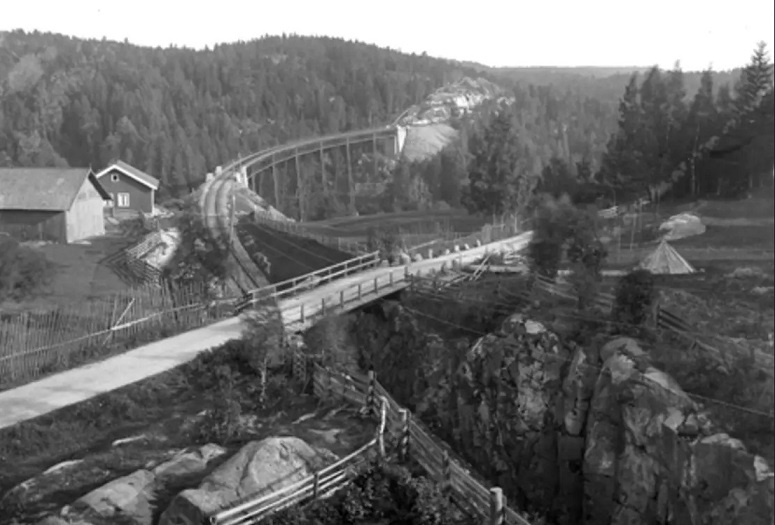
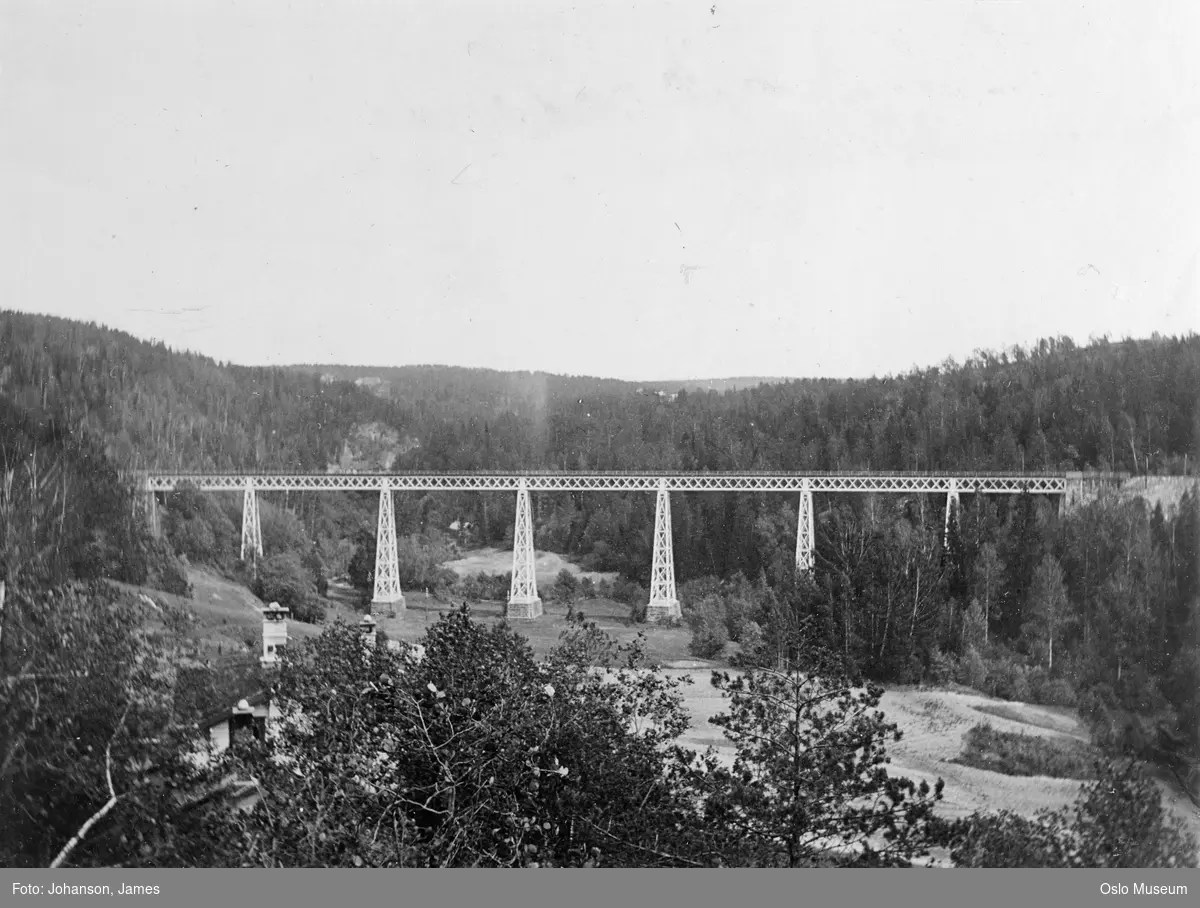
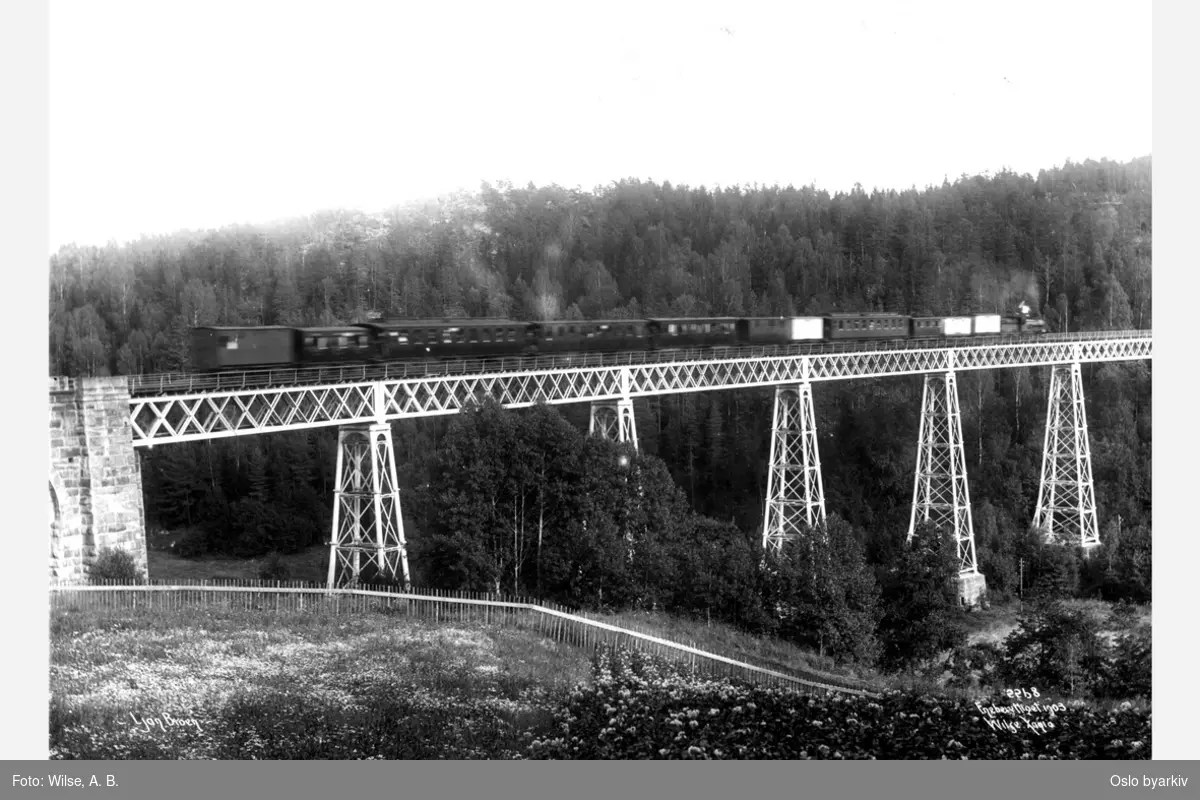
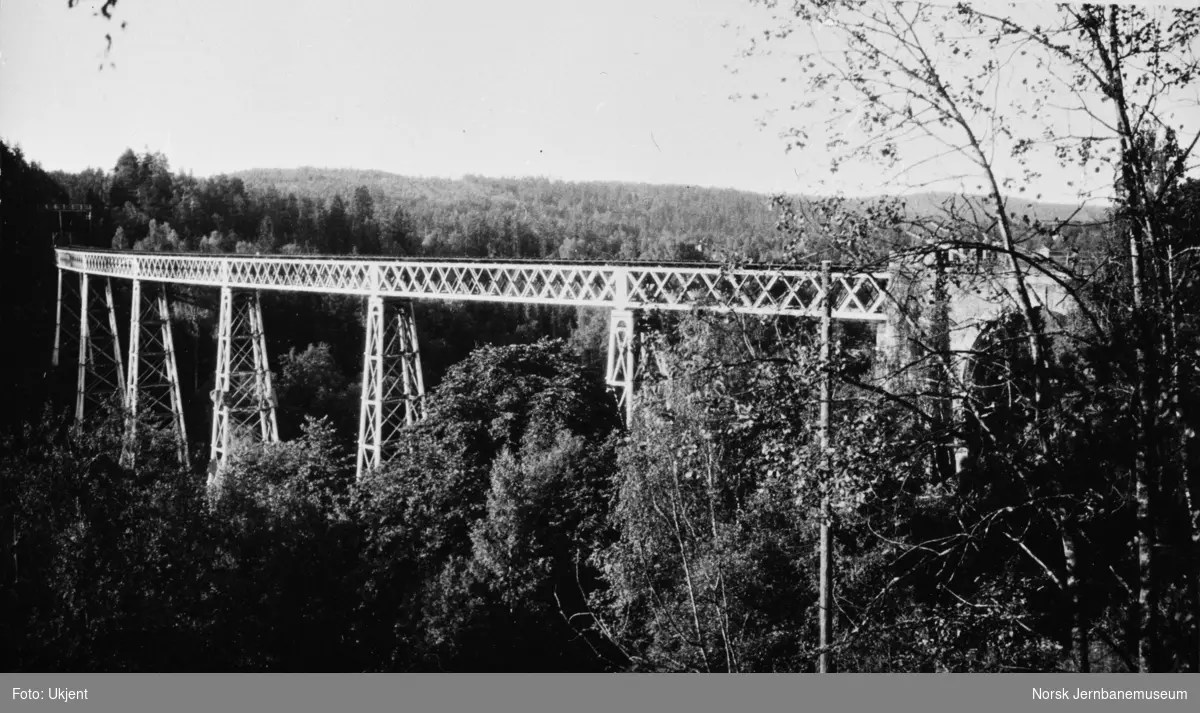
Ljans Viaduct near Christiania (Oslo). Sadly, the picture included in the Railway Magazine is too grainy, [1: p448] This image was found on an internet form and appears to be the same image that was used in The Railway Magazine, © Olaf Peder Martin. It is held in the collection of the Norsk Jernbarnemuseum. The Ljans viaduct was completed in 1878. The bridge was sold to Christiania Spigerverk after the line got re-aligned towards Hauketo in 1925. It was blown up to provide materials for nails in 1929. [9]

The three photographs immediately above are further photos of Ljans Viaduct taken before 1929 all of which are in the collection of the Norsk Jernbarnemuseum. [9]

Speight continues: the main station in Oslo “adjoins the quays, and is at the bottom of the main street which runs up past the chief shops to the Castle, Carl Johan’s Gade, or Johan as it is known all over Norway.” [1: p449]

The trip from Copenhagen to Christiania (Oslo) was advertised as an 18 hour or a 22 hour journey. In Speight’s view, the journey could have been completed in either 12 or 14 hours. The causes for the length of the journey, in Speight’s view were “the length and weight of the trains, the frequent long stops and the form of locomotive used. … They [were] manifestly incapable of taking the eight or ten corridor carriages over the gradients on this line. … The [then] present total of stopping time amount[ed] to about three hours; this [was] partly accounted for by the fact that meals [were] taken in the stations, and at the customs station a long stay [was] made. But there [was] no need for the five or ten minutes’ stops made at many of the small stations where the little business could [have been done]  in a quarter of the time. If the two Governments cared to run … an express, from Helsingborg, stopping only, say, at Halmstad, Gothenburg, Trollhättan, Frederikshald, Frederik stadt and Moss (running a steamer thence to Horten for quick connection with Skein and Drammen) the journey  should [have been completed] in 12 hours, the more easily if a restaurant car were [to be] attached to save long stops.” [1: p450]

Speight then travelled Southwest from Oslo along the line which had termini in Skein, Kroderen and Kongsberg. He complains that no first class carriages were provided on the line and comments again about the slow speed of the service despite expresses being provided. He says: “An approach is made towards running expresses, four trains daily passing between Christiania and Drammen, 33 miles, without a stop, but with an occasional crawl, in an hour and a half. There are obstacles to fast speed on this line also, as there are many crossings and such gradients that for the heavy trains it is necessary to have a small engine at each end The point of depar ture in Christiania is situated by Piperviken, a quay for coast steamers. Vestbanens station is smaller than the Eastern station, but none the less cold and uncomfortable. There is no refreshment room, and some of the less known Midland stations, say Bingley or Keighley, are palaces in comparison. The trains, however, are comfortable, being provided with through passages, open to the public, and irregularly disposed seats – some like an English tram car, others saloon fashion.” [1: p450]

Speight has only praise for the scenery on the line: “The scenery along the line is remarkably attractive. Inland, after leaving the western bights of Christiania fjord, the road is cut through many pretty bits of English scenery, and at busy, timber-laden Drammen the sea again appears. It is near Holmestrand, however, that a typical form of Norwegian railway is traversed, where high speed is manifestly impossible. On one side are cliffs, pine-clad and bird-haunted; on the other, beating against a low sea-wall, the water of the fjord. Holmestrand is a little seaside resort which is becoming very popular. The railway here runs close under the cliffs, and the town spreads on the narrow steep between the line and the beach. Down to Tönsberg, a viking town of lost glory, the train is backed, to be run out after a short stay on to the main line again, a proceeding which would have been unnecessary had the station been built some half-mile from the present one. The district between Tönsberg and Laurvik is meadow and shrubby rockland, abounding in ancient memories of rich plundering days. In one field near the railway is the famous Gokstad mound, whence, some years back, the large viking ship was taken which now stands in the University Museum at Christiania.” [1: p451]

At Sandefjord, one of the most prettily situated towns in Norway, at the head of a four-mile fjord, with wooded rocky banks, [were] many signs of prosperity, and goods wagons are constantly to be seen in the sidings and down at the harbour, to which a branch line runs through the town. From here the line goes over the crest of the hill to Laurvik, a growing port, where passengers from Christiania for English ports are taken on board. Though the distance from Christiania is only 98 miles, the quickest train, the 11.17 p.m., takes 4 hr. 40 min. to make the journey, and one wretched “blandet-tog,” or mixed goods and passenger, actually spends 10 hr. 40 min. on the way. There is a morning train from Laurvik to Christiania which takes 11 hours, being passed on the way by another. Those who are unfortunate enough to be reduced to riding in one of these mixed trains have a dreadful time.” [1: p451]

This line, after leaving Laurvik, passes through Porsgrund, famous for its porcelain, and ends at Skien, a thriving manufacturing town.

Speight was unable to travel over the lines which run from the coast inland, those from Christiansand to Byglandsfjord, Stavanger to Ekersund, and Bergen to Voss. He comments that the “two latter are perhaps too well known to English tourists to need description. … Two of the views accompanying this article (Trangereid Station and the mountain tunnel between Dale and Bolstad) will remind visitors to Bergen of the marvellous manner in which the engineering difficulties along the Vossebanen have been overcome.” [1: p451]

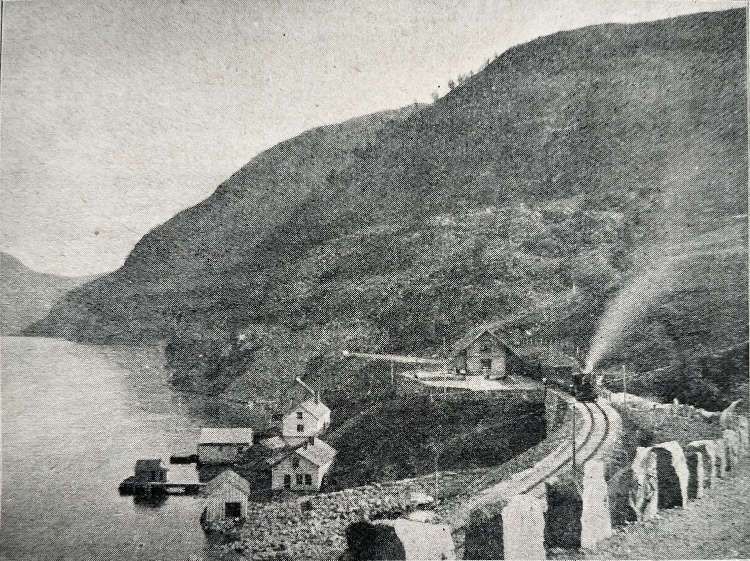
Trengereid Station on the Bergen-Vosse railway. [1: p449]
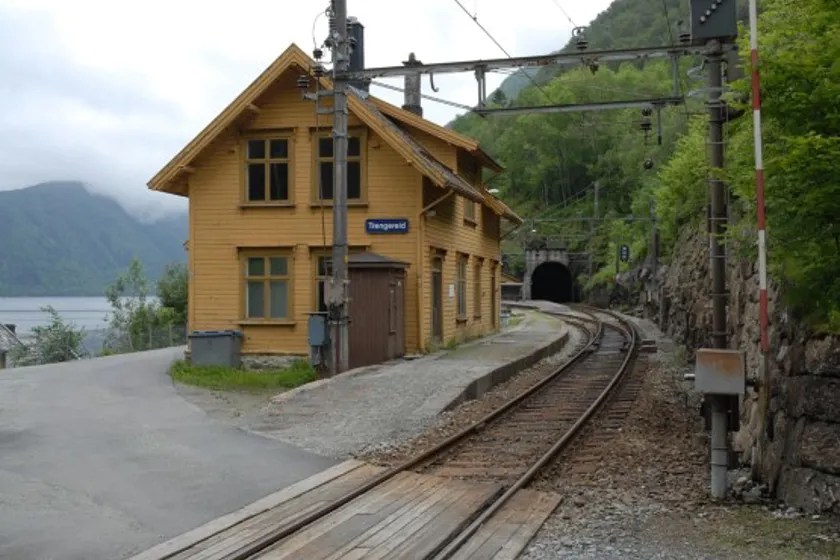
Trengereid Station on the Bergen-Vosse railway in the 21st century. Some remodelling of the station building has taken place, © Njal Svingheim. [10]
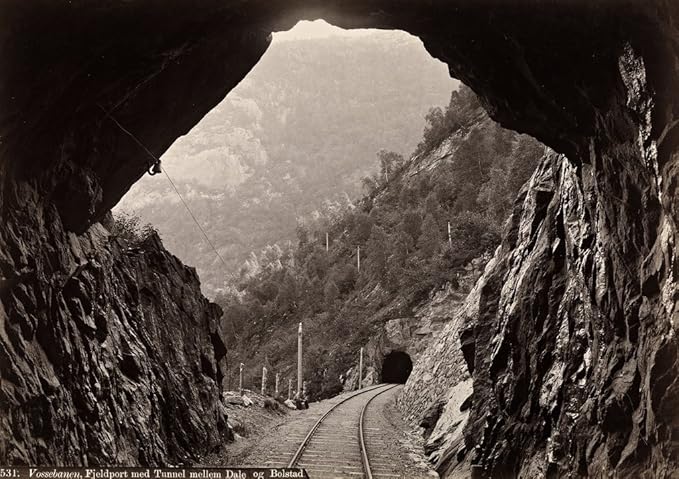
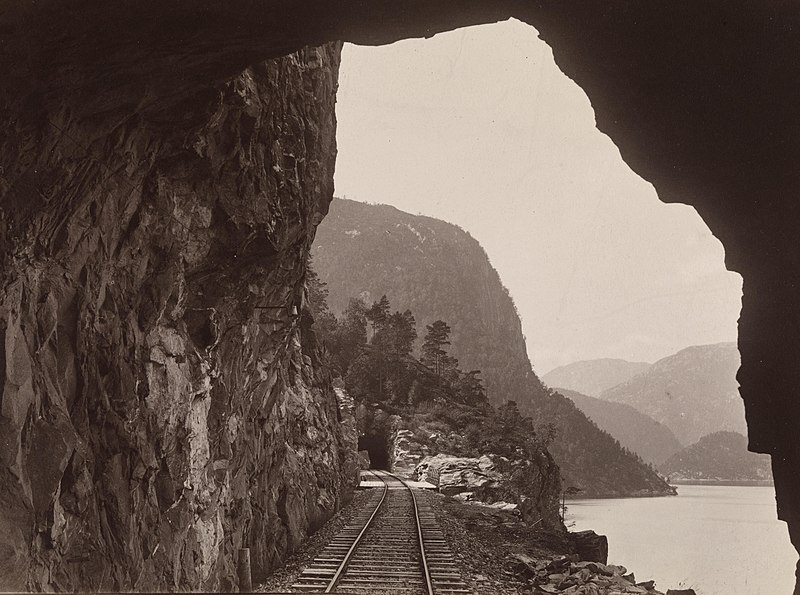
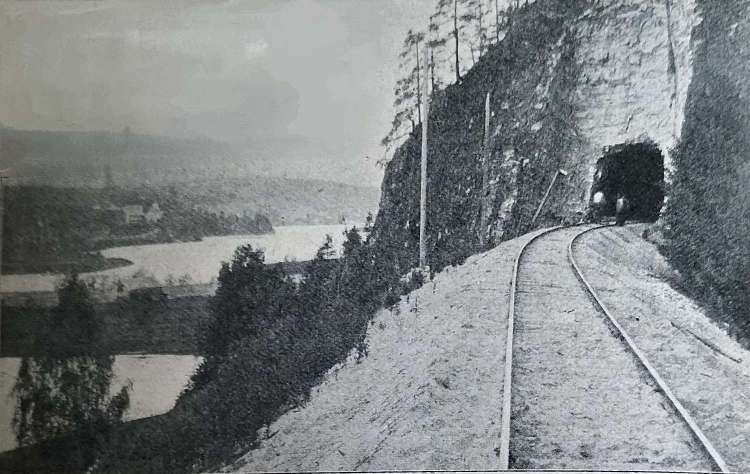
A tunnel (Fjeldport med Tunnel) on the Bergen-Vosse Railway (the Vossebanen) between Dale and Bolstad. Sadly, the image in The Railway Magazine is grainy and a little blurred. [1: p447] This is the same image found online. The Vossebanen is oldest part of the Bergen line. The line was started in 1875 and opened in 1883. The stretch was originally 106.7 km long, with 52 tunnels and 15 stops. After several line changes, the Vossebanen is today 86 km. The original stations of the track were designed by Balthazar Lange. Vossebanen is urban but also scenic. There is quite a lot of passenger trains but also a lot of freight traffic on the line. [11]
This photograph is taken at approximately the same location as the one immediately above and also shows the Fjeldport med Tunnel, © Mo i Rana, Public Domain. [12] Photographs of other tunnels in the area can be found here. [13]

Speight now turns from the smaller lines in Norway to what was known as the trunk line to the North, “a line which by the very nature of the country it passes through must always attract the attention of those who are “railway mad.” Its seclusion and remoteness from the general tourist-route, added to the fact that from the map it appears to traverse a most romantic part of the country, stealing through the mountains, like the Midland line from Settle to the North, lends an air of mystery.” [1: p451-452]

From Oslo (Christiania), the train leaves “the large station by the docks at 1.45pm and runs to Eidsvold and over an inlet of Lake Mjosen into Hamar (on that section of the line built originally by an English company, and called Hovedbanen) steadily at 26 miles per hour, through meadow, wood, and lakeside scenery. At Hamar a change of trains is  made, and all the passengers rush into the refreshment-room for ‘mid-dag’, an abundant meal of three courses, which costs about two shillings. Ample warning is given, and then you take places in a most comfortable corridor-train which seats and sleeps two persons only in each first-class compartment, a convenience which makes the journey no hardship, and which is regulated from the booking-office in Christiania. After leaving Hamar the pace is slow but very steady, and one’s attention is wholly occupied by the view from the windows. Fairly level country is passed through until Elverum, twenty miles from Hamar, then begins a slow climb, which lasts for eight hours. Elverum is 608 feet above the sea, and Tyvold, the highest point on the line, which is passed about two in the morning, 2,158 feet.” [1: p453]

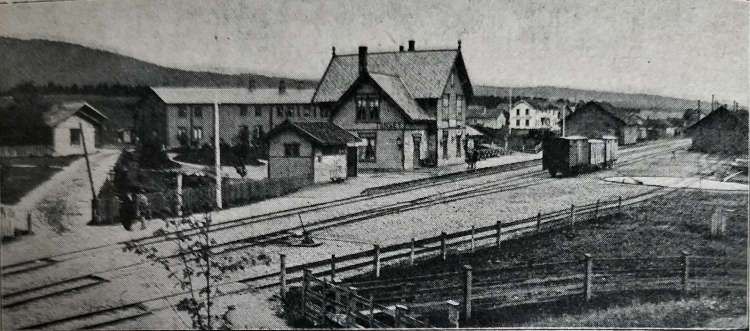
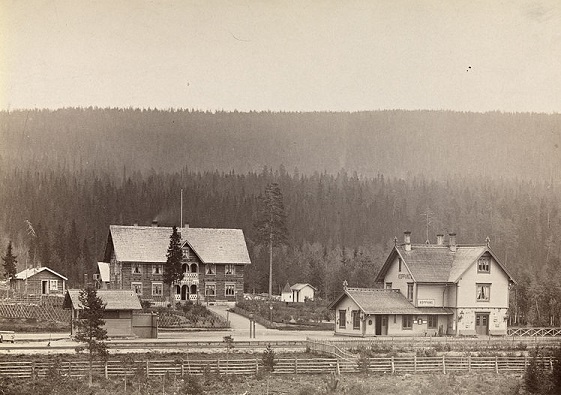
Tonset (Tynset) Railway Station, 1,520ft above sea-level. [1: p450]
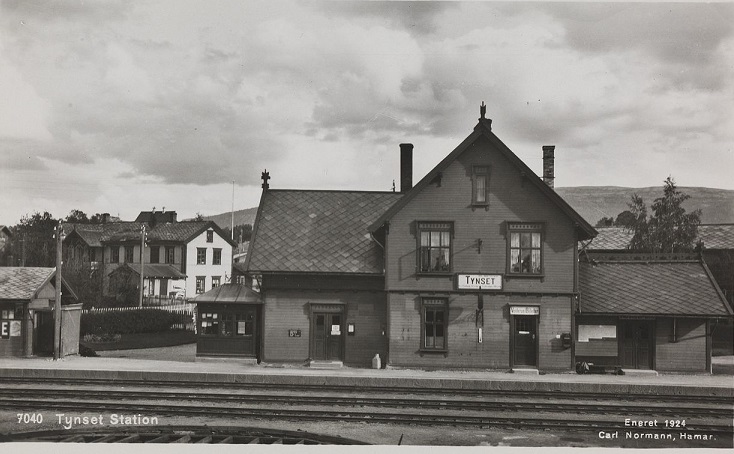
An old postcard view of Tynset Railway Station from 1924, © Carl Normann, Public Domain. [14]
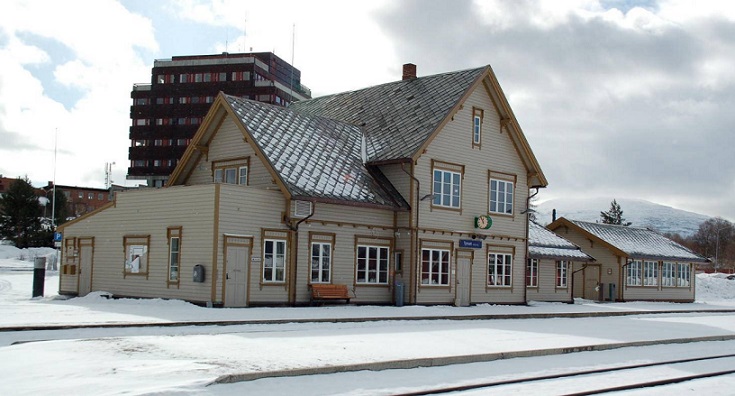
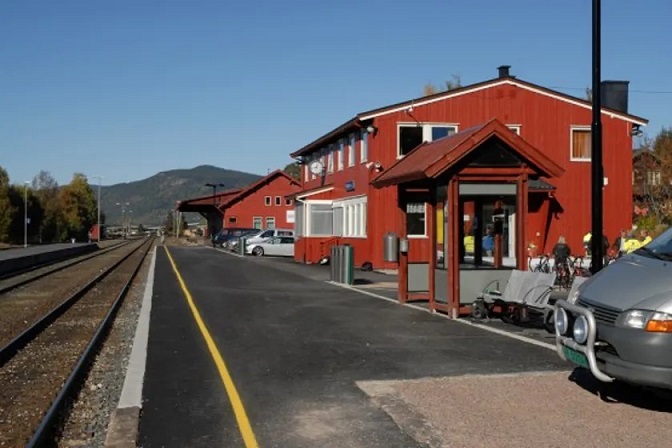
Tynset Railway Station in the 21st century. [15]

The line climbs alongside the River Glomen for 150 miles, alternately on one bank then the other, until “settling down to a regular position east of the stream, under steep wooded cliffs. The river was filled with timber floating down from the mountains. … Across the valley which grew narrower hourly were mountain-ridges, whose summits were white with snow. Under them nestled farms the whole way, though their share of sunlight and warmth seemed to be small. Here and there would appear clusters of prosperous looking farmsteads, with telephone lines running from one to another. And all the while the long train was slowly making its way up through cuttings and tiny rock tunnels, along sandy strips of road among the fragrant pines.” [1: p453-454]

A tunnel and embankment on the railway, near Koppang. This gives a good idea of the valley at one of its wider parts.
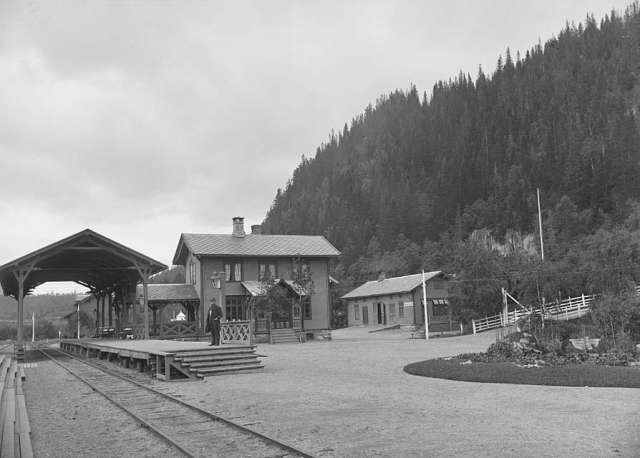
Koppang Railway Station in the early 20th century, © Hamar Thjems, Public Domain. [16]
Kappang Railway Station in the 21st century. [17]

Speight continues: “Koppang was the supper-place, where we had twelve minutes to drink milk and eat smörbröd, i.e., sandwiches of bread and fish, cheese, or meat. After leaving this station the conductor began to prepare the beds, and when they were ready they were indeed cosy. Sleep came easily after the mountain air, and although the intervening grades of the slope were missed, this only heightened the surprise with which I looked out of the window after suddenly waking at two o’clock. The scenery had changed entirely. We were running along the side of a bare, wintry ridge, and the next minute passed gingerly over a roaring torrent. It was light, as the June nights are in Norway, and … everything was covered with snow, altogether such a view as one might get among the upper heights of Craven in winter. I had missed Röros, the high mining town, which I specially had hoped to see, but it was gratifying to have returned to consciousness just at the very highest point of the line.” [1: p454]

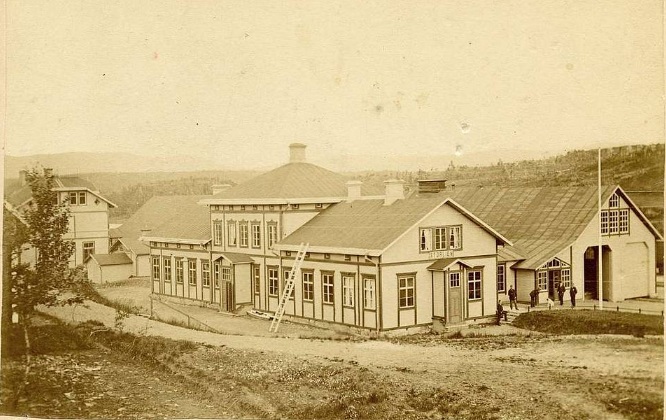
Stören Railway Station, near Trondhjem. [1: p453]
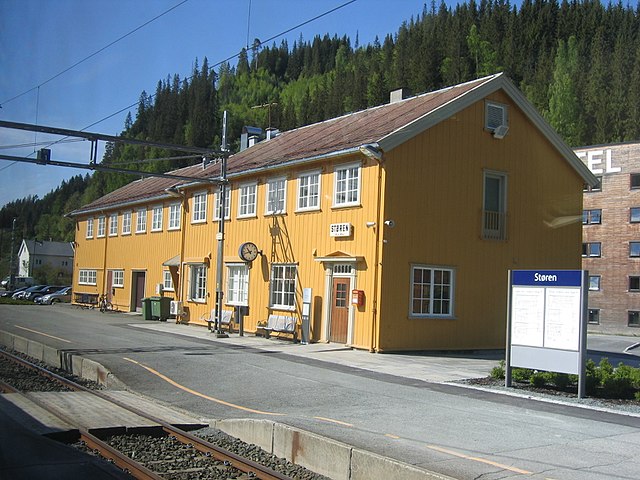
Stören Railway Station in the 21st century © Beagle84 and used here under a Creative Commons Licence (CC BY-SA 3.0). [18]

It took five hours to drop 2,100ft to sea-level at Trondhjem, “here everything was cold and desolate, and all the barns were dripping. … At Stören, reached [at] about five, the conductor brought us coffee and biscuits from the refreshment room. … From Stören we ran the 33 miles into Trondhjem in an hour and a half … and at 6.55 am, the train drew up alongside the harbour, where in old days the Hansa ships docked.” [1: p454-455]

The line beyond Trondhjem … runs over the mountains into Sweden, … it provides one of the most fascinating railway journeys possible. … From Trondhjem the line runs along the bends of the fjord for many miles, turning finally inland at a place called Hell. …  Then we enter Stördal, a narrow valley much resembling Upper Wharfdale, but with higher fells on each side and steeper falls of water coming down through the trees. For thirty miles the train creeps along into the heart of the mountains, past isolated farms, and always near the river, for the valley is only a few yards wide in places. The cart-road is grass-grown and one can see that the railroad is responsible for most of the traffic. Time after time one seems to be running straight into the hills; then a bend is turned and another mile or so of valley appears, with wonderful variety of forest and mountain views.” [1: p455]

When the train arrived at Gudaan a locomotive was attached behind, and then the train was pushed and pulled up through the otherwise bleak and desolate forest. Speight continues: “So well do we climb that in one hour we have actually ascended 1,000 feet, and when we reach the Swedish frontier station, [Storlien], sixty-six miles from Trondhjem, we are over 2,000 feet above the sea, in a wilderness of deep snow, though it is already June.” [1: p455]

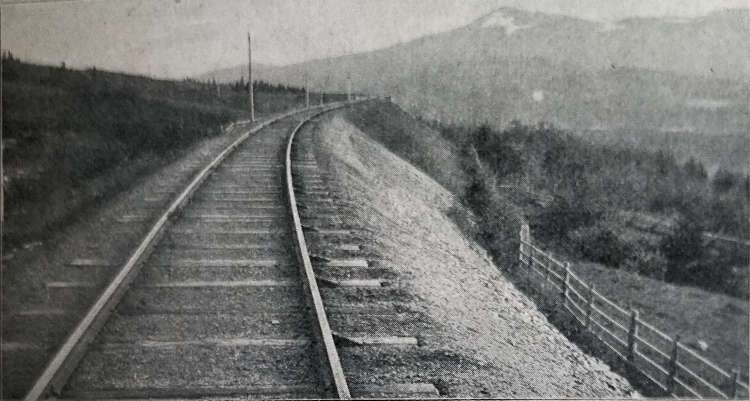
A severe climb on the railway towards Storlien. [1: p454]
Storlien Railway Station in its early years – 1880, © Public Domain. [19]

This laborious journey between Norway and Sweden was necessary because there was constant traffic between Sweden and Trondhjem and trains can be very heavy. Speight refers us to Samuel Laing, who, he says, “lived in this region about the year 1834, [and] dwells at some length on the trade route over into Sweden, traversed in winter by sleighs, the best railroad in the world, he says. His astonishment would have been worth recording had he been told that in time an actual railroad would penetrate these wilds of the Keel, and that comfortable, spacious carriages would daily find their way through those bleak woods.” [1: p455]

At Storlien, Speight, left Norway, continuing his journey into Sweden.

Early Locomotives in Norway

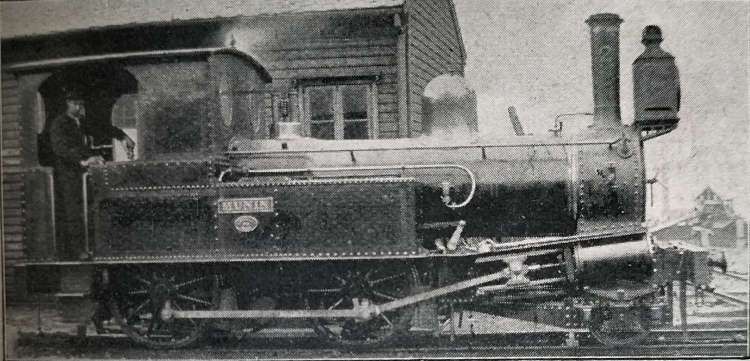
Speight commented on locomotives in Norway in 1899 seemingly being underpowered for the duties expected of them. He only provided one photograph of a locomotive in the article which is shown below. No details of the locomotive appears in his article. …

An 2-4-0T Norwegian Locomotive! Speight provides no details about the loco. It appears that it carries the name Munis. [1: p451]

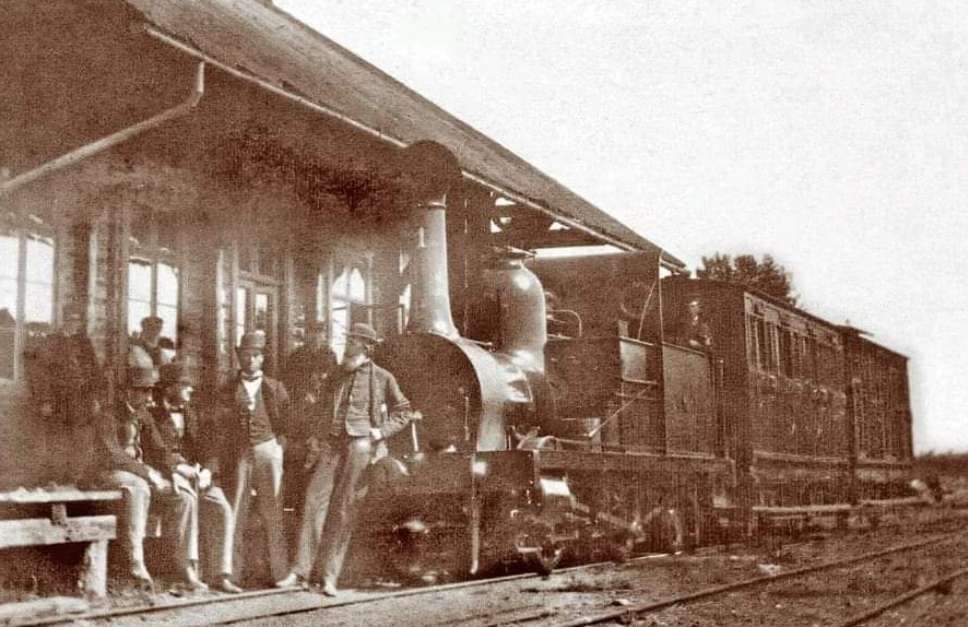
It seems as though Norway’s early narrow gauge steam locomotive classes were numbered using roman numerals by the NSB (I,II,III,IV,V, etc). [20] There is a limited amount of information available online about these locomotives, but it seems that a lot of the earliest classes were 2-4-0T locos. However, the first 3ft 6in gauge steam locomotive on Norway’s railways was an 0-4-2T, not a 2-4-0T but of a similar size to the other tank locomotives pictured above and further below. This 2-4-0T locomotive was No. 1 of the Hamar – Grundset Railway and is shown below at Løten station. The date was 18th October 1861, and it is believed that the photo was taken during a test run. Regular timetabled operations commenced on the railway the following month. The locomotive was built by Robert Stephenson & Co. in 1860. I found the photograph on transpressnz.blogspot.com. [25]

No. 1 of the Hamar – Grundset Railway shown at Løten station on 18th October 1861. It is believed that the photo was taken during a test run. [25]

I have not been able to clarify which class of locomotive is pictures in E.E. Speight’s article. Similar sized locos are pictured below but all different in some way from E.E. Speight’s photograph – different cab, different dome, different chimney.

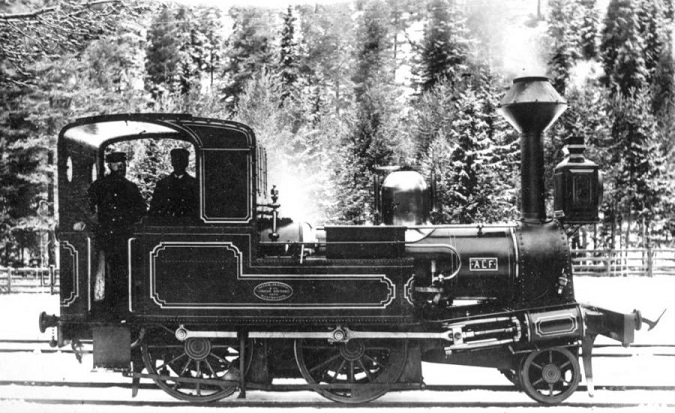
An example of the NSB Class II 2-4-0T side tank locos is shown below.

NSB Class II 2-4-0T Loco No. 3 Hakon. [24]

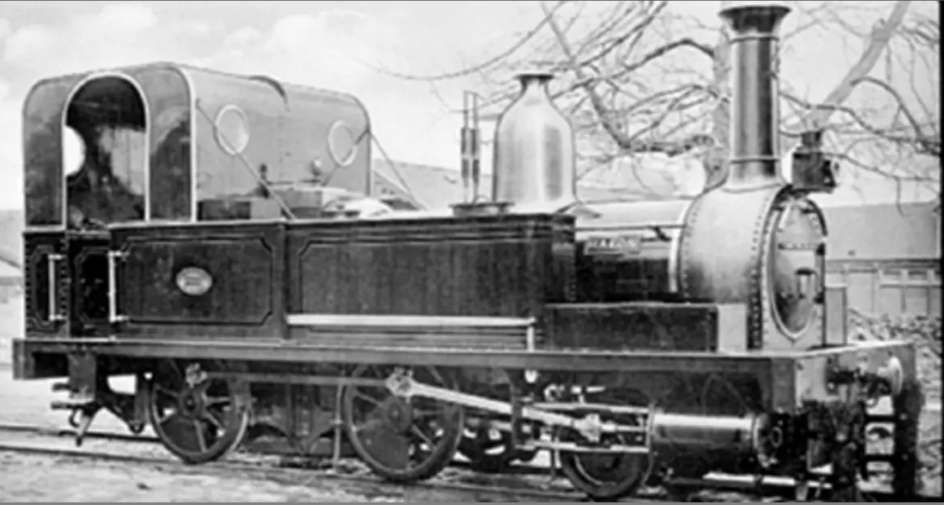
The NSB Class III locos were a class of six side tank 2-4-0T locomotives. They were built by Beyer, Peacock and company from 1868 to 1871 as part of the III class for the Norwegian State Railways. They were designed, built and operated for small local passenger trains for which they operated until the 1920s.

NCB Class III 2-4-0T Loco. No. 21, Alf. [22]

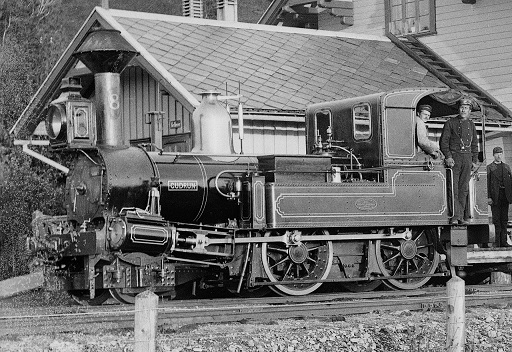
The NSB Class IV (or Tryggve Class) locos were 1,067 mm (3 ft 6 in) narrow gauge 2-4-0T steam locomotives built by Beyer, Peacock & Co. in Manchester, England. [21] This was a class of twenty-five side tank 2-4-0 locomotives. The first of the class was built by Beyer, Peacock and company in 1866 and the last built in 1882 also by Beyer, Peacock and company and originally classed II and XV from 1898. In 1900 the class was re-designated IV and IX and operated by the Norwegian State Railways until 1952 when the last one was withdrawn. The class was named Tryggve after the first locomotive of the class which was also numbered two. [23]

NCB Class IV 2-4-0T Loco No. 8, Cudrun at Melhus station. [23]

All these locomotives could well have been encountered by Speight on his journey through Norway.

References

  1. E.E. Speight; Through Norway by Rail; in The Railway Magazine, London, November 1899, p447-455.
  2. https://en.m.wikipedia.org/wiki/Rail_transport_in_Norway, accessed on 11th September 2024.
  3. https://en.m.wikipedia.org/wiki/Narrow-gauge_railways_in_Norway, accessed on 11th September 2024.
  4. https://en.m.wikipedia.org/wiki/Thamshavn_Line, accessed on 11th September 2024.
  5. https://en.m.wikipedia.org/wiki/Urskog%E2%80%93H%C3%B8land_Line, accessed on 11th September 2024.
  6. https://en.m.wikipedia.org/wiki/Setesdal_Line, accessed on 11th September 2024.
  7. https://en.m.wikipedia.org/wiki/Carl_Abraham_Pihl, accessed on 11th September 2024.
  8. For example: De Offentlige Jernbaner: Driftsberetning For Norsk Hoved-jernbane … https://amzn.eu/d/5nfTiC5; and https://www.yumpu.com/no/document/read/19751486/de-offentlige-jernbaner-beretning-om-de-norske-jernbaners-drift-1-, accessed on 12th September 2024.
  9. https://www.skyscrapercity.com/threads/norway-railways.935718/page-9, accessed on 12th September 2024.
  10. https://www.banenor.no/en/traffic-and-travel/railway-stations/-t-/trengereid, accessed on 12th September 2024.
  11. https://www.amazon.co.uk/POSTER-Vossebanen-Fjeldport-Bolstad-replica/dp/B00P5I624K, accessed on 12th September 2024.
  12. https://no.m.wikipedia.org/wiki/Fil:528._Vossebanen,_fjeldport_med_Tunnel_mellem_Dale_og_Bolstad_-_no-nb_digifoto_20151106_00106_bldsa_AL0528_(cropped).jpg, accessed on 12th September 2024.
  13. https://jenikirbyhistory.getarchive.net/topics/rail+tunnels+in+vestland/historical+images+of+vaksdal, accessed on 12th September 2024.
  14. https://en.wikipedia.org/wiki/Tynset_%28novel%29#/media/File:7040_Tynset_Station_-_no-nb_digifoto_20150807_00223_bldsa_PK29688.jpg, accessed on 12th September 2024.
  15. https://help.g2rail.com/stations/tynset, accessed on 12th September 2024.
  16. https://upload.wikimedia.org/wikipedia/commons/thumb/7/7c/Koppang_stasjon.jpeg/1280px-Koppang_stasjon.jpeg, accessed on 12th September 2024.
  17. https://www.banenor.no/en/traffic-and-travel/railway-stations/-k-/koppang, accessed on 12th September 2024.
  18. https://commons.wikimedia.org/wiki/File:Storen_stasjon_Rorosbanen_2008.JPG, accessed on 12th September 2024.
  19. https://jenikirbyhistory.getarchive.net/media/storlien-station-3b47b4, accessed on 12th September 2024.
  20. https://en.wikipedia.org/wiki/Norwegian_State_Railways_rolling_stock, accessed on 12th September 2024.
  21. https://en.wikipedia.org/wiki/NSB_Class_IV, accessed on 12th September 2024.
  22. https://locomotive.fandom.com/wiki/NSB_Class_III, accessed on 12th September 2024.
  23. https://locomotive.fandom.com/wiki/NSR_IV_%22Tryggve%22_Class, accessed on 12th September 2024.
  24. https://digitaltmuseum.no/search/?aq=classification:%22RU%22,%225288%22, accessed on 12th September 2024.
  25. https://transpressnz.blogspot.com/2024/07/norwegian-0-4-2t-from-1860.html?m=1, accessed on 12th September 2024.