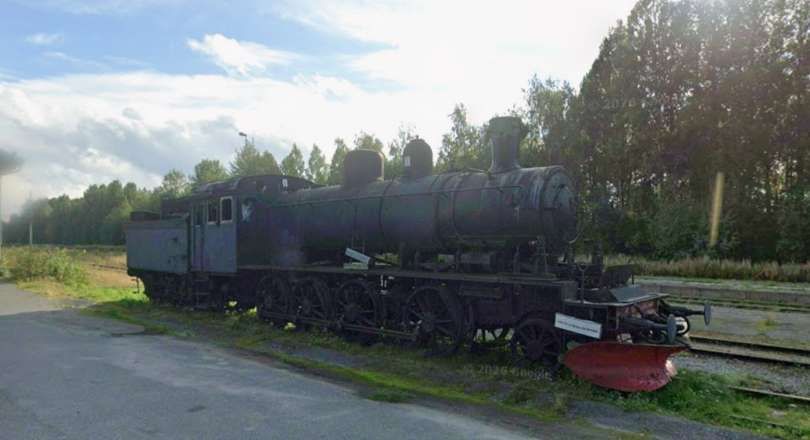
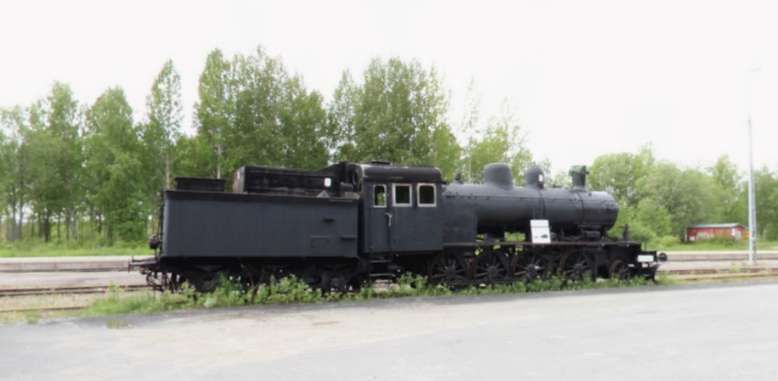
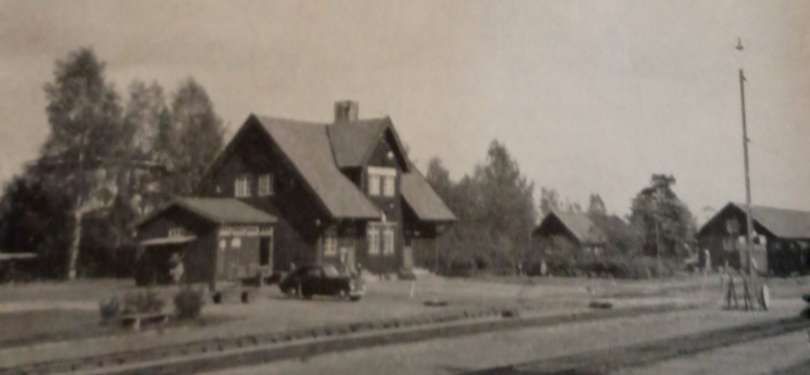
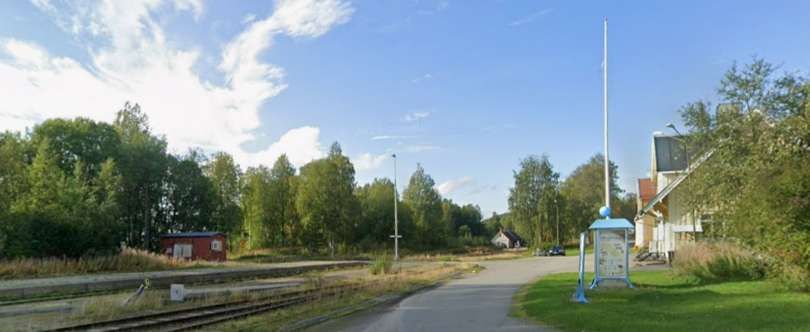
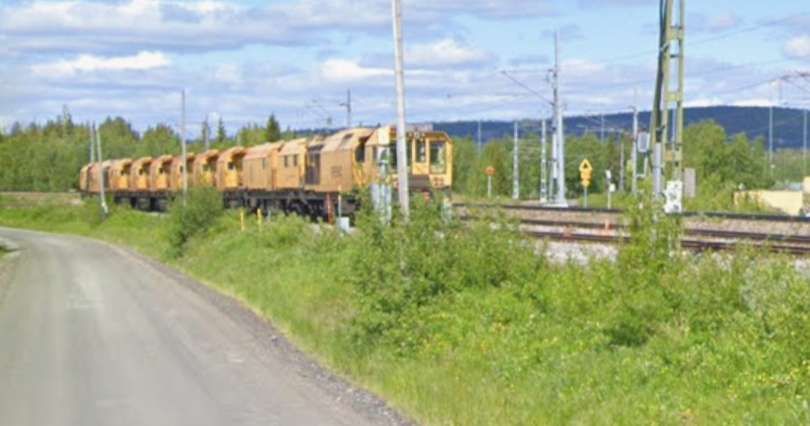
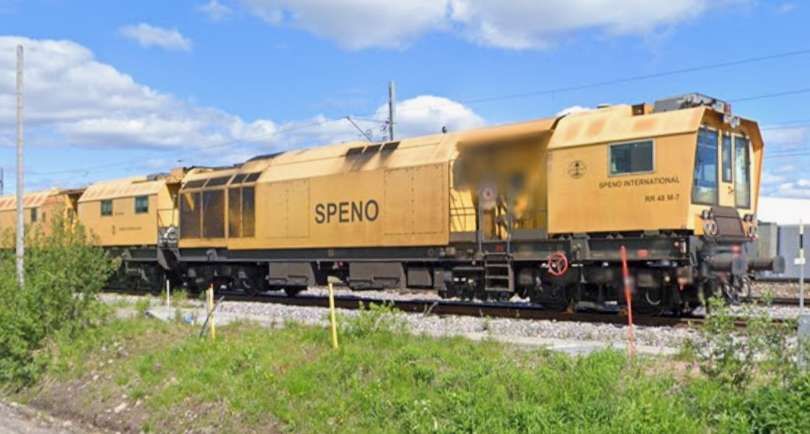
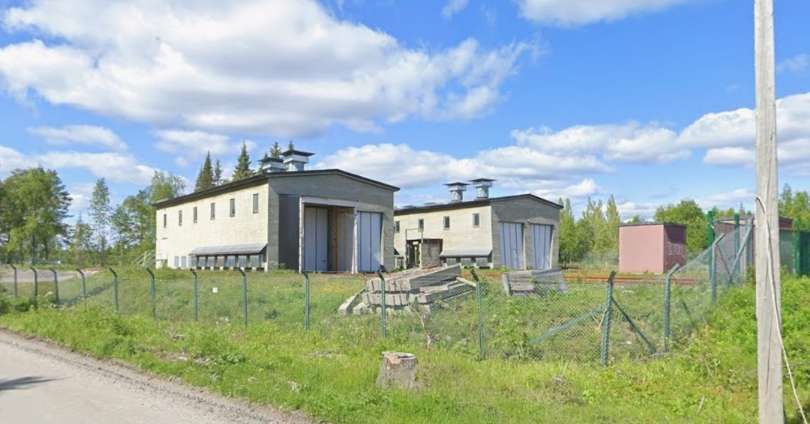
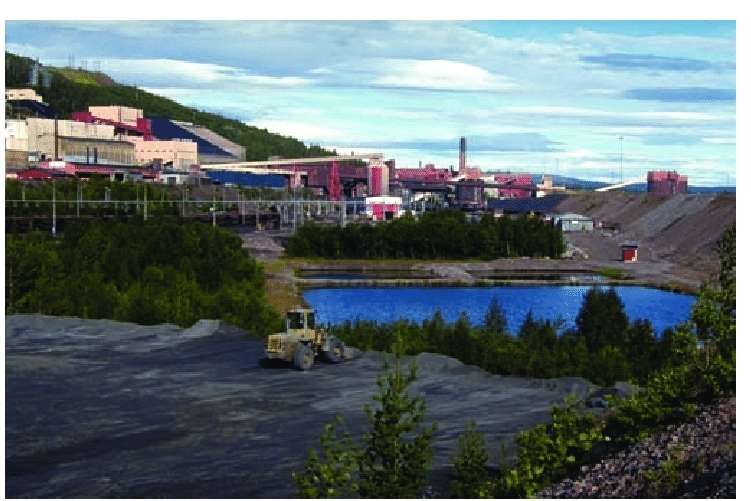
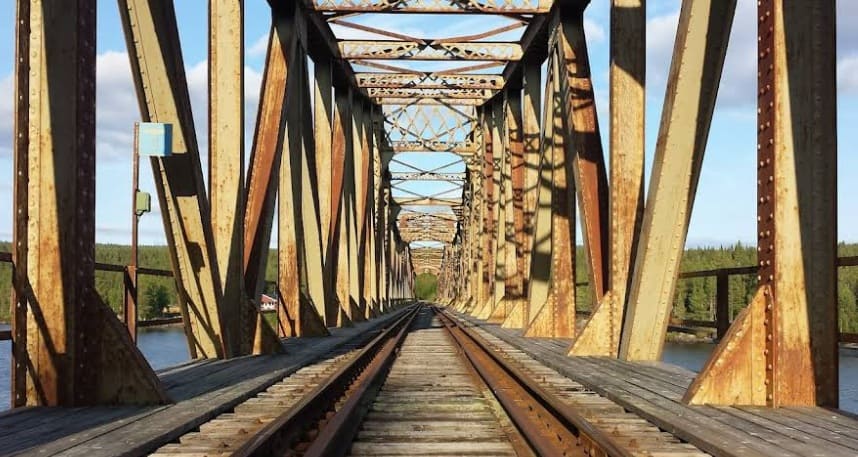
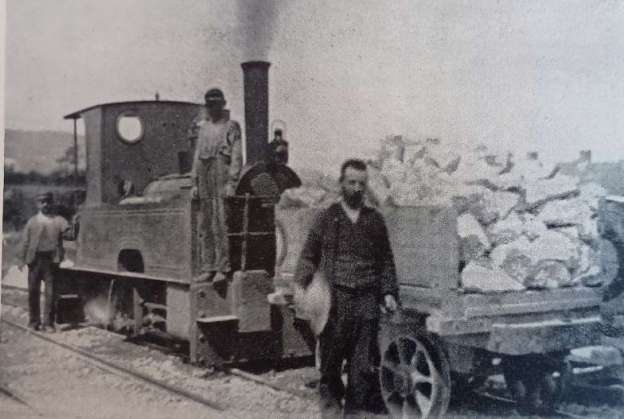
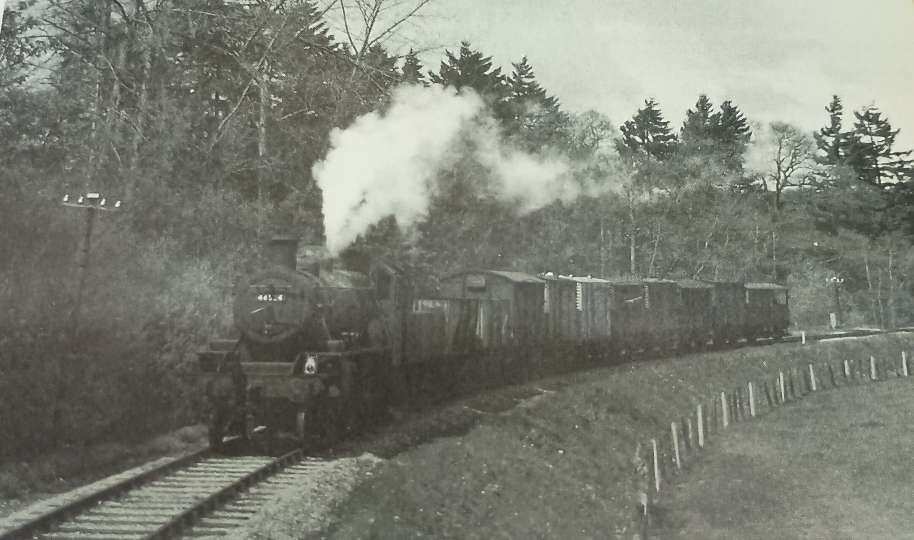
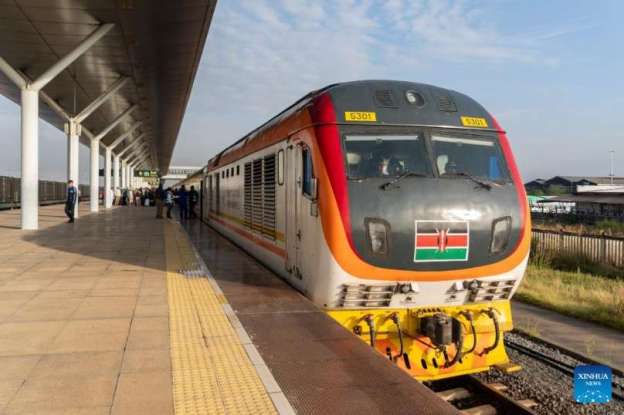
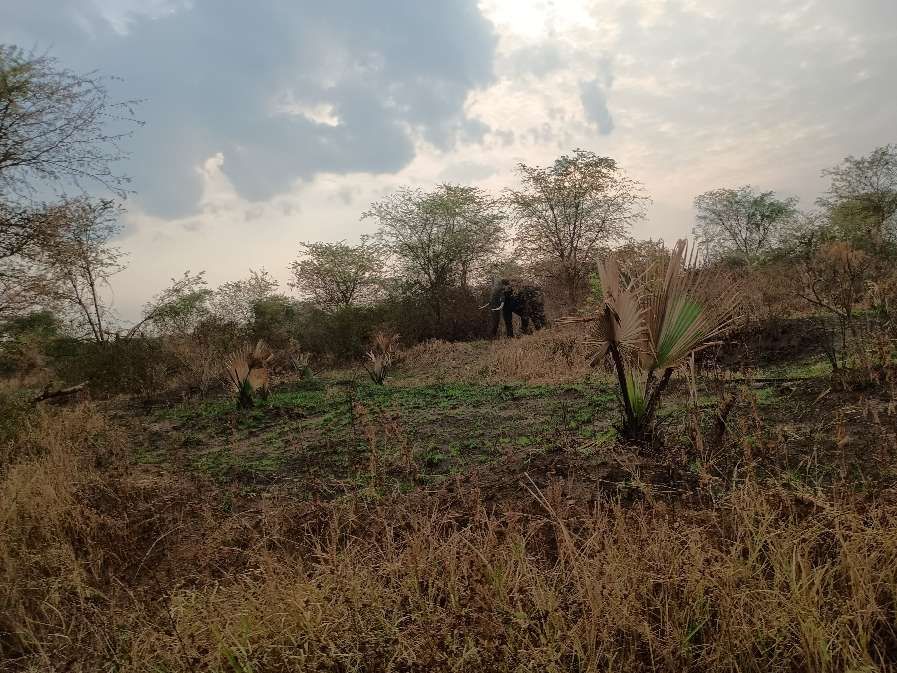
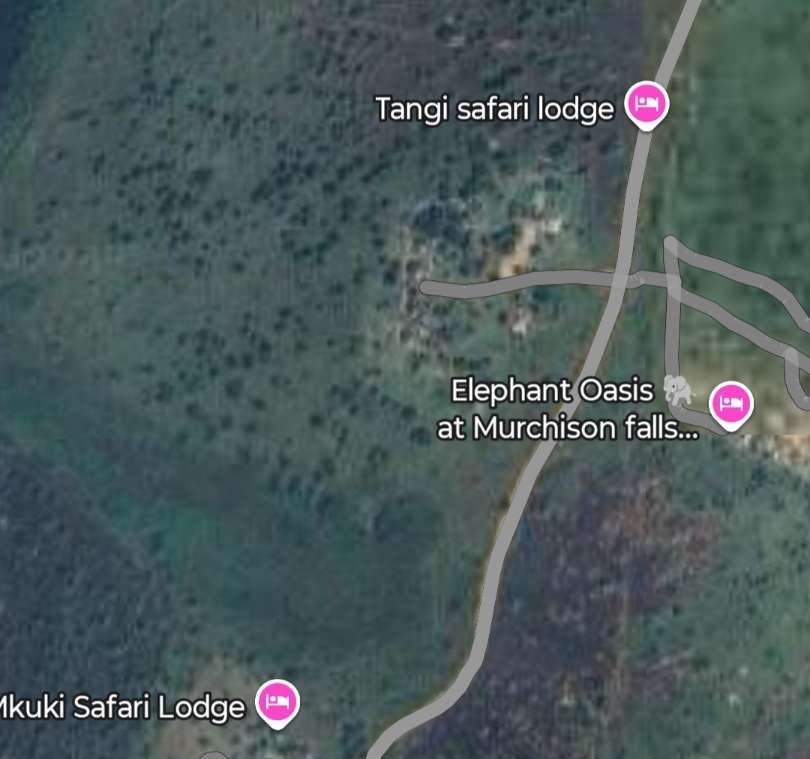
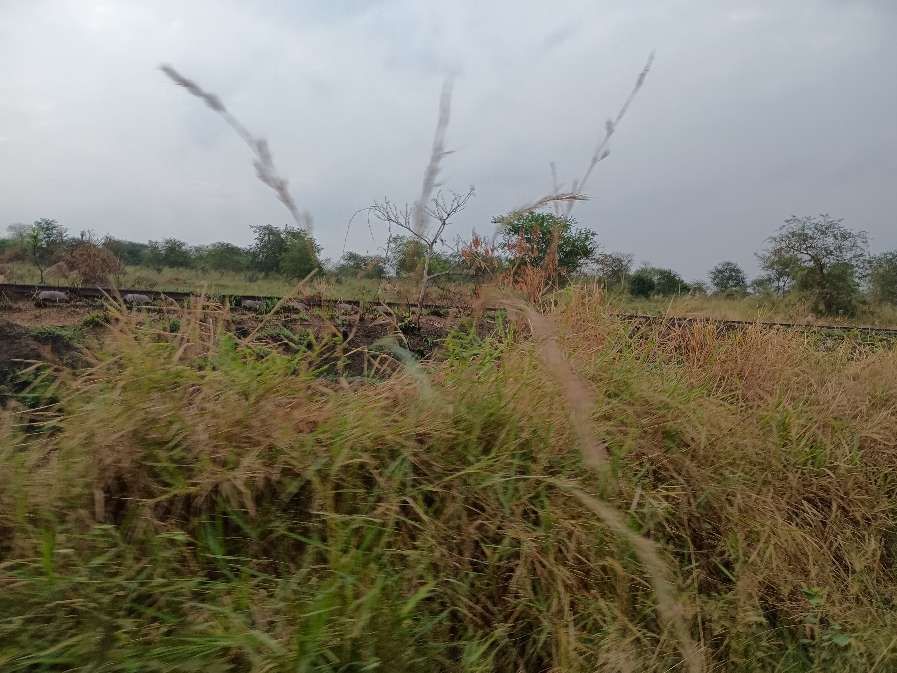
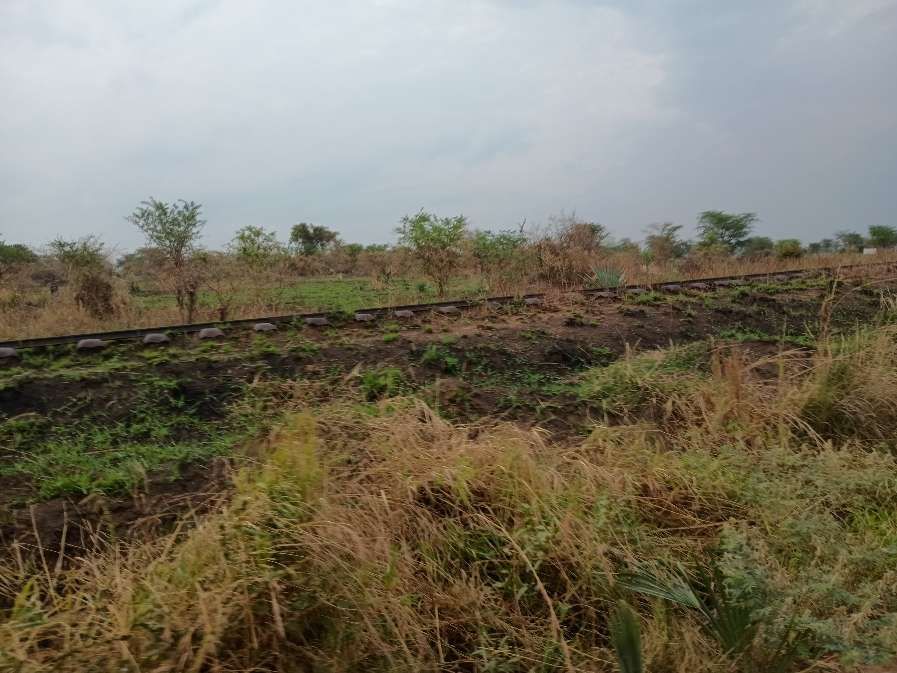
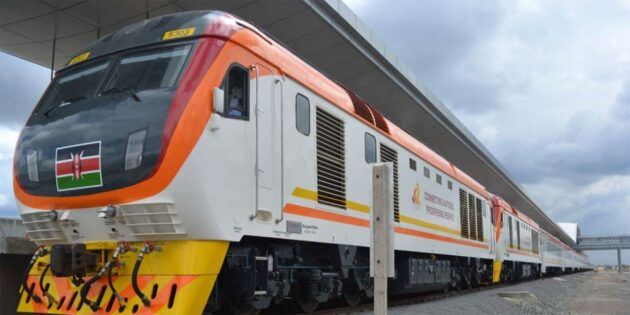
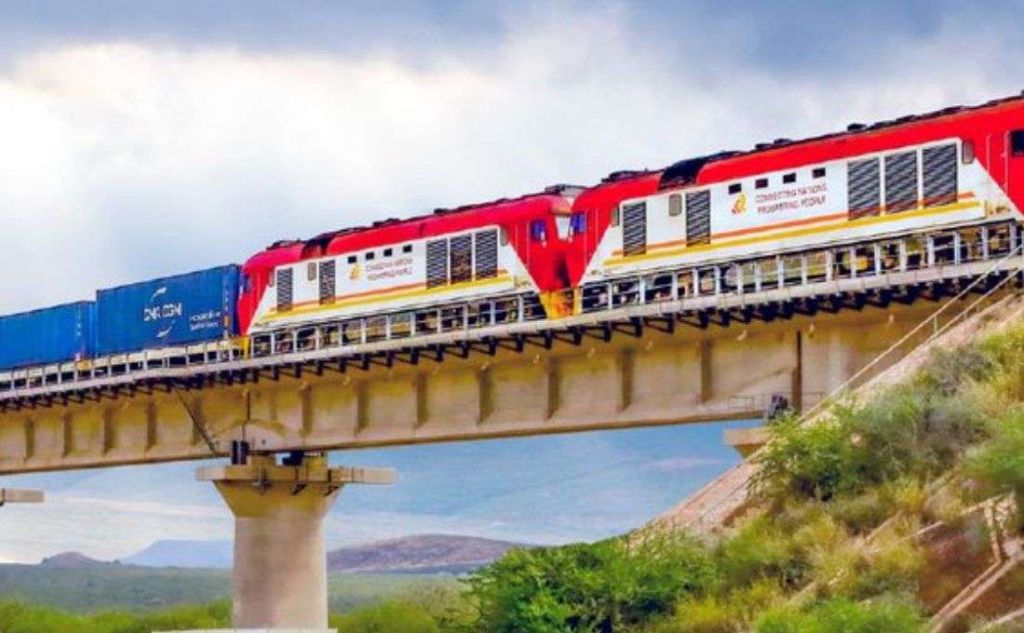
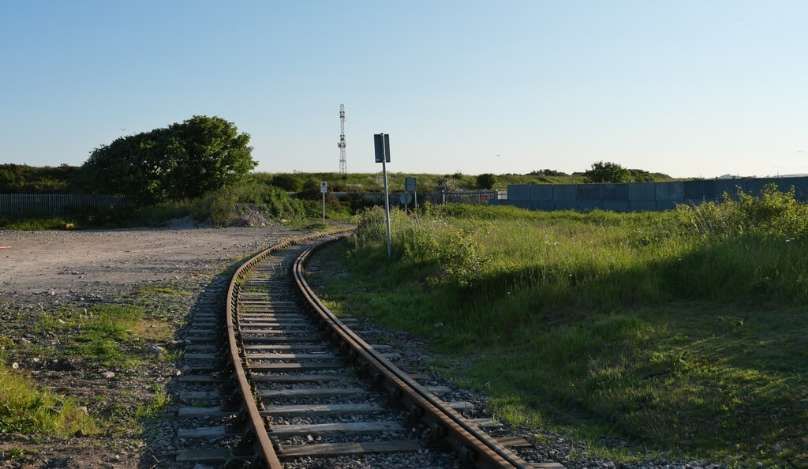
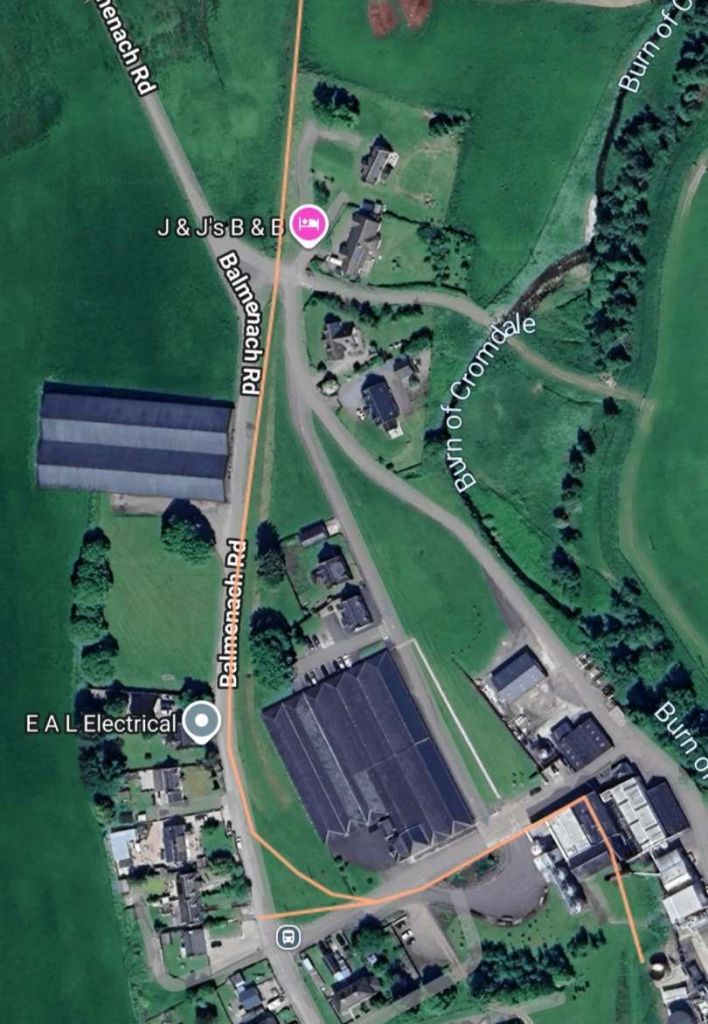
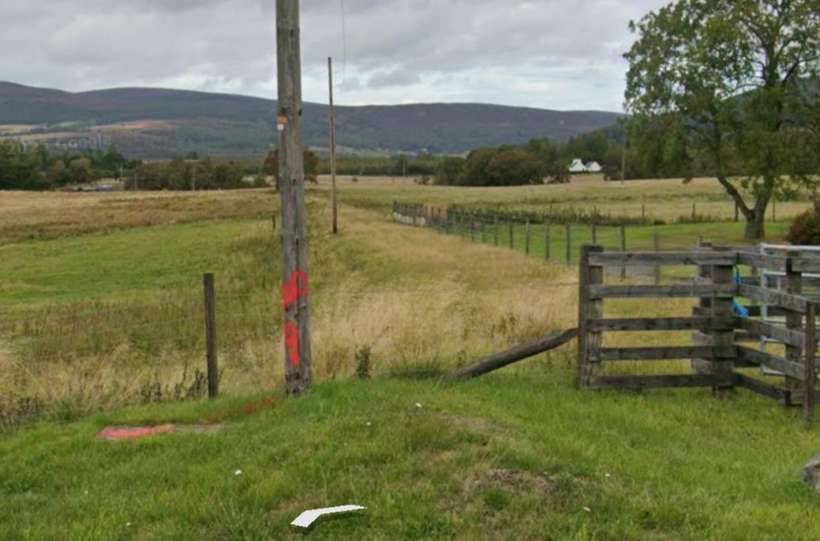
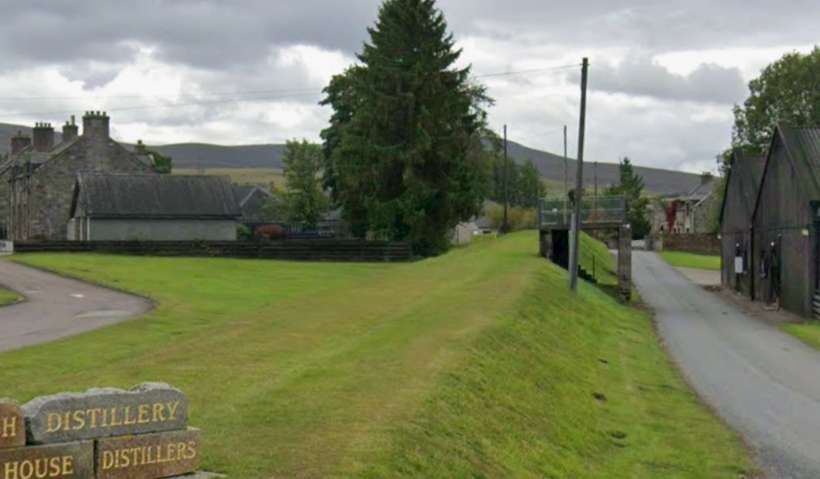
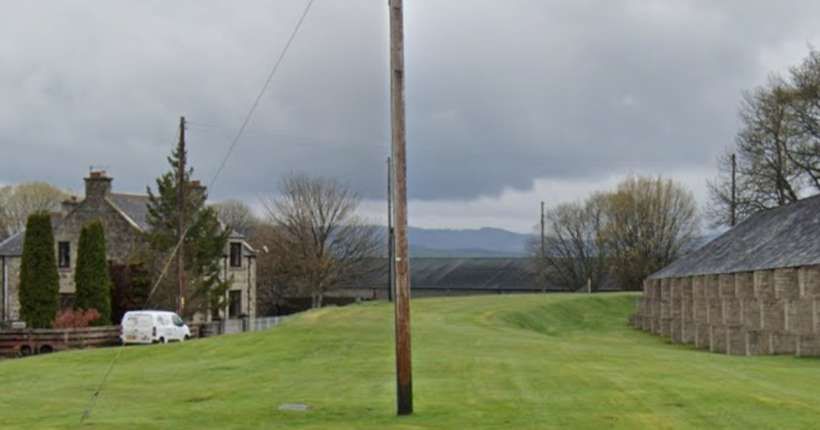
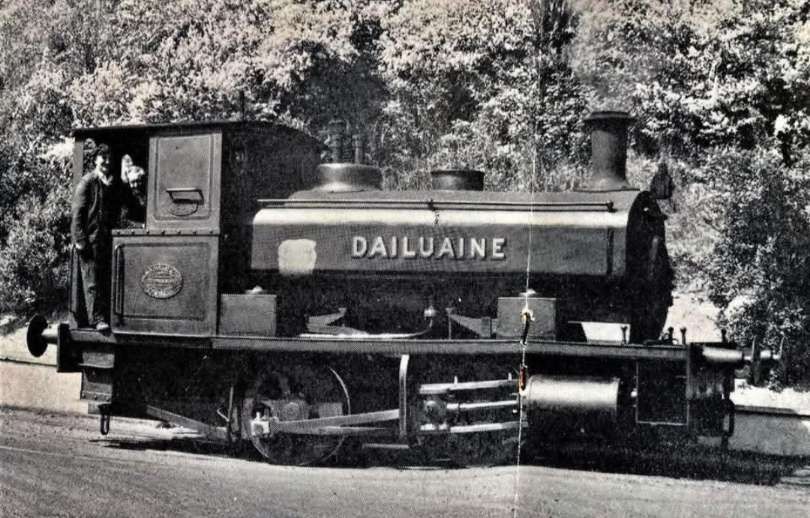
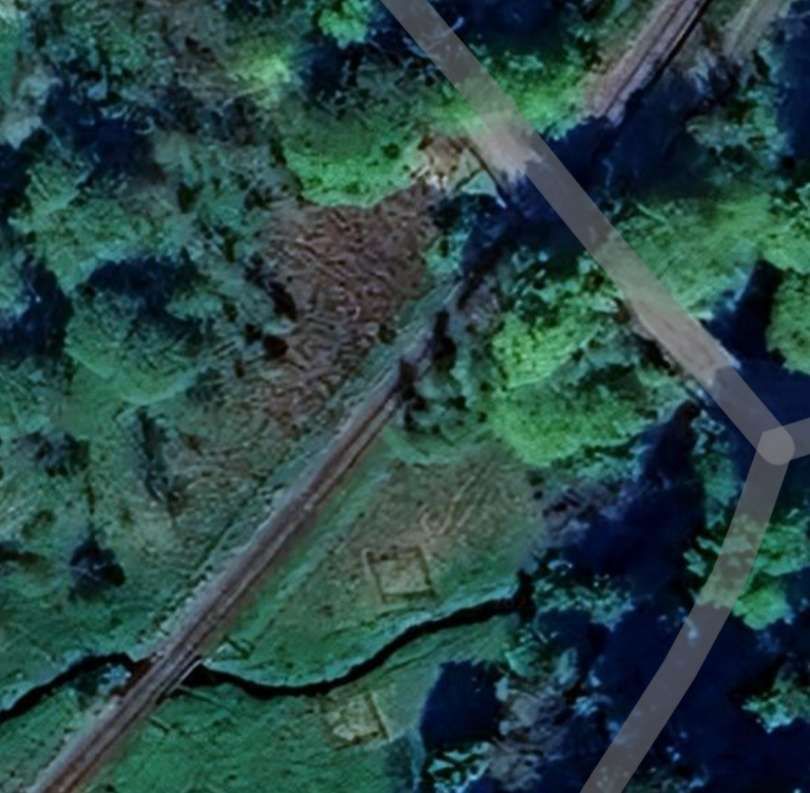
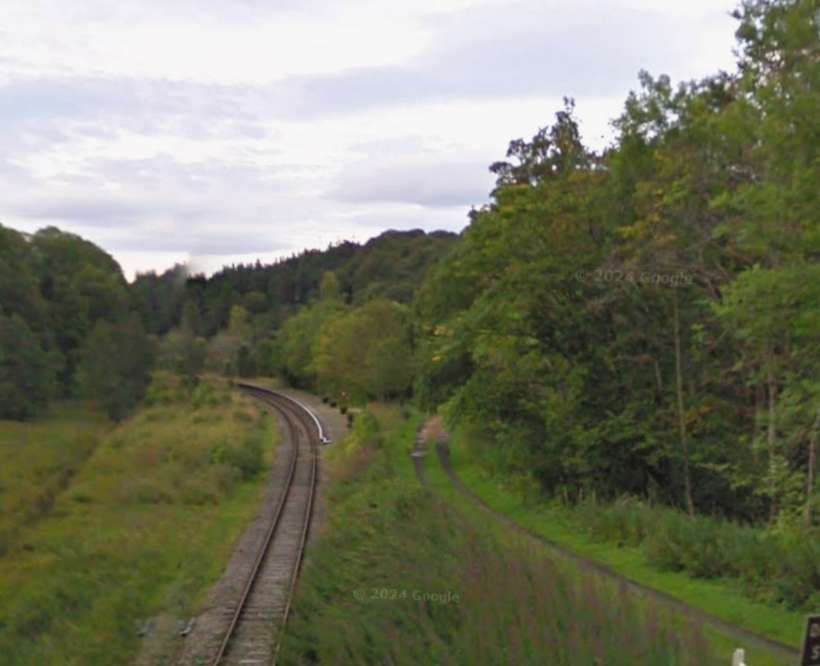
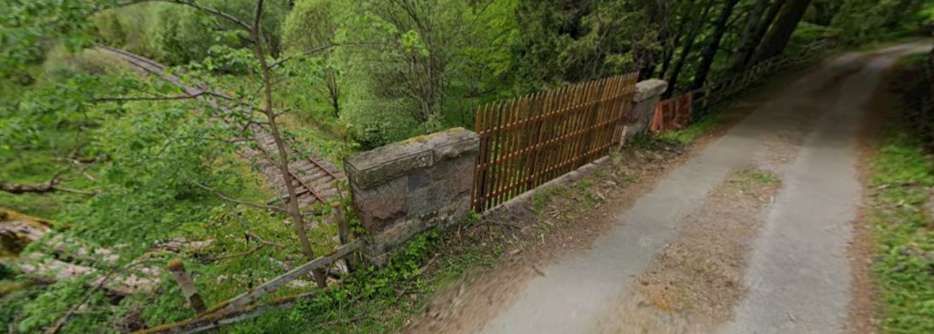
The featured image for this article shows a Tata Chemicals locomotive at work on the metre-gauge line near Magadi. [9][cf. 6]
A. Railways Africa recently reported:
East African Governments Ramp Up Rail Investment in 2026/27 Budgets
“East Africa’s latest budget allocations show rail moving higher up the public investment agenda, with governments linking railway development to logistics efficiency, urban mobility and regional trade competitiveness. Kenya, Uganda and Tanzania are each approaching the sector from different starting points, but the common direction is clear: rail is being positioned as a strategic infrastructure tool, not only a transport asset.
Africa Star Railway Operation Company (Afristar) is the company that runs the SGR in Kenya, it is a subsidiary of the China Road and Bridge Corporation (CRBC). It has been the operator of Kenya’s Standard Gauge Railway (SGR) since its launch. However, the Kenya Railways Corporation (KRC) has been gradually taking over these operations, with full control expected in 2027. [10][11]
“The figures also point to a wider corridor logic across the region. Uganda’s Malaba–Kampala SGR, Tanzania’s continued SGR construction and rehabilitation programme, and Kenya’s rail allocations all sit within the broader ambition of improving inland connectivity, reducing logistics costs and strengthening access between ports, production centres and landlocked markets.
“East African governments are significantly increasing investment in railway infrastructure in their 2026/27 national budgets, with Kenya, Uganda and Tanzania allocating billions of shillings to expand rail networks, modernise transport systems and improve regional trade connectivity.
“In Kenya, Cabinet Secretary for the National Treasury, John Mbadi Ng’ongo, announced a proposed allocation of KSh38.4 billion for railway projects as part of the government’s transport infrastructure programme.
From Naivasha to Malaba, construction of the SGR expansion was due to start in July 2026. [12] The project will reshape logistics, lower transport costs and boost connectivity across counties. This project stands as a symbol of progress and long-term economic planning in motion.
“The allocation forms part of a broader effort to improve public transport and logistics infrastructure.
“To improve urban mobility, the government has also proposed KSh582 million for the Nairobi Bus Rapid Transit (BRT) Project, aimed at reducing traffic congestion in the capital.
“Meanwhile, Uganda has continued prioritising railway development through substantial infrastructure spending.
“Finance, Planning and Economic Development Minister Henry Musasizi announced the commencement of the construction of the 273-kilometre Standard Gauge Railway (SGR) linking Malaba and Kampala.
“Once completed, the railway is expected to reduce the cost of transporting containers from Mombasa to Kampala from approximately US$3,500 to US$1,600, while cutting transit times from five days to one day.
“Musasizi revealed that the rehabilitation of the Tororo–Gulu Metre Gauge Railway has reached 66% completion, while works on the Kampala–Mukono section have been completed.
“Uganda has allocated Shs8.79 trillion for transport infrastructure development in the next financial year, with priority given to the construction of the Malaba–Kampala Standard Gauge Railway and completion of the metre gauge railway rehabilitation programme.
“In Tanzania, the government has allocated 1.27 trillion Tanzanian shillings for the construction and rehabilitation of railway infrastructure, including 1.12 trillion shillings dedicated to the Standard Gauge Railway programme.
“The government said construction of the Dar es Salaam–Dodoma SGR sections, covering Lots 1 and 2, has been completed and is now operational.
“According to Finance Minister Ambassador Khamis Mussa Omar, the government views the Standard Gauge Railway as a key component of its broader economic transformation strategy.
“The railway, together with Msalato International Airport, will support the development of Dodoma into a modern administrative capital, a regional transport and logistics hub and a centre for sustainable urban development.
“Tanzania also plans to continue implementing the TAZARA Railway Revitalisation Project and advance construction of the Standard Gauge Railway from Dodoma to Mwanza and Isaka to Kigoma.
“According to the government, these projects are expected to stimulate economic activity across multiple regions by improving transport efficiency, strengthening regional trade corridors and leveraging Tanzania’s strategic geographic position.” [1]
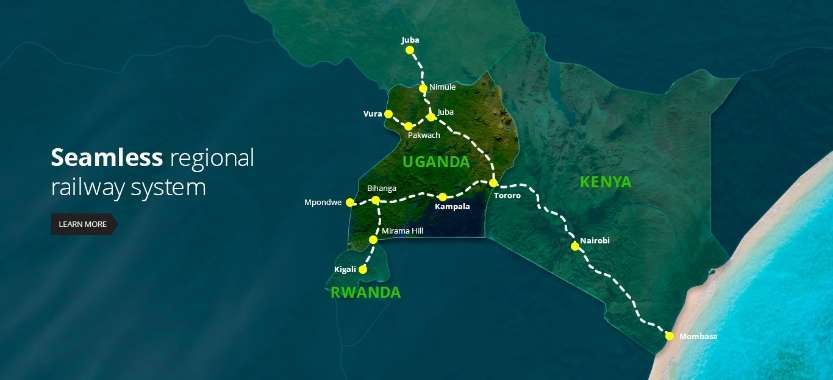
In 2009, the East African Community produced the East African Railway Master Plan, [3] a proposal for upgrading the railways serving Tanzania, Kenya, and Uganda, and building new railways to serve Rwanda and Burundi. Evidence of progress in development of SGR routes is manifest, but the pace of development has been relatively slow.
B. On Sunday 28th June 2026, The East African reported:
Uganda locks funds for joint SGR as Kenya plan stalls
President William Ruto and his Ugandan counterpart Yoweri Museveni during the official launch of the Kisumu-Malaba Standard Gauge Railway at Kibos in Kisumu County on 21st March 2026, (c) Alex Odhiambo, Nation Media Group. [2]
“Uganda expects to conclude financing arrangements for its €2.7 billion ($3 billion) standard gauge railway (SGR) project within the next few months after securing a major funding commitment from the Islamic Development Bank (IsDB), bringing the long-delayed infrastructure initiative closer to financial close than at any point in the past decade.” [2]
“But Kenya, with which Kampala is building the cross-border project, is struggling to raise about $4 billion for the extension of its line from Naivasha in the Central Rift to Malaba on the border, with the Treasury confirming the project will not proceed under public private partnership as earlier advised.” [2]
C. Magadi Soda Works and Branch line
Thanks to ‘Class442’ on RailUKForums [4] for pointing this out.
Tata-Owned Locomotive Catches Fire
A locomotive operated by Tata Chemicals Magadi Ltd, which transports soda ash from Lake Magadi to Mombasa, caught fire on 1st July 2026, at or near Simba station in Kajiado County. The branch line between Magadi and Konza where it encounters the Nairobj-Mombasa metre-gauge line is managed as a private line by Magadi Ltd. It was a company locomotive that caught fire while travelling on the main line near Simba.
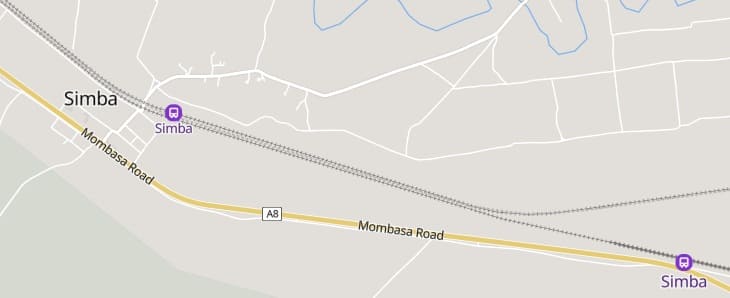
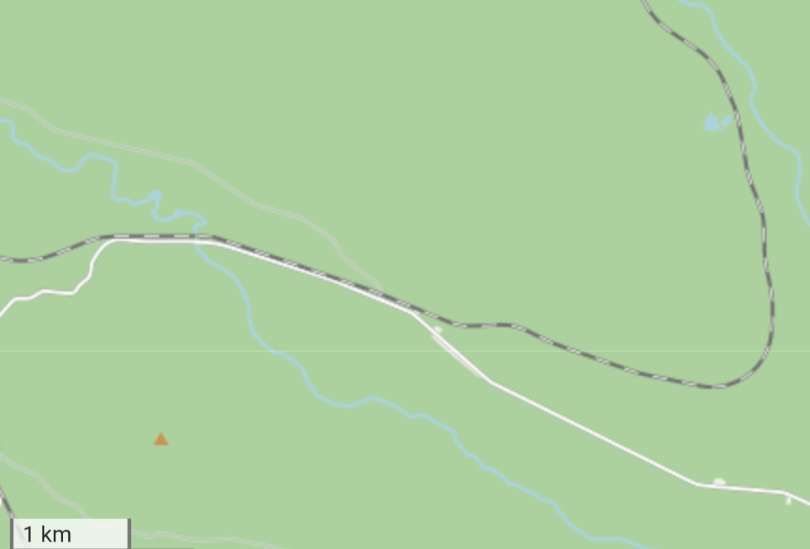
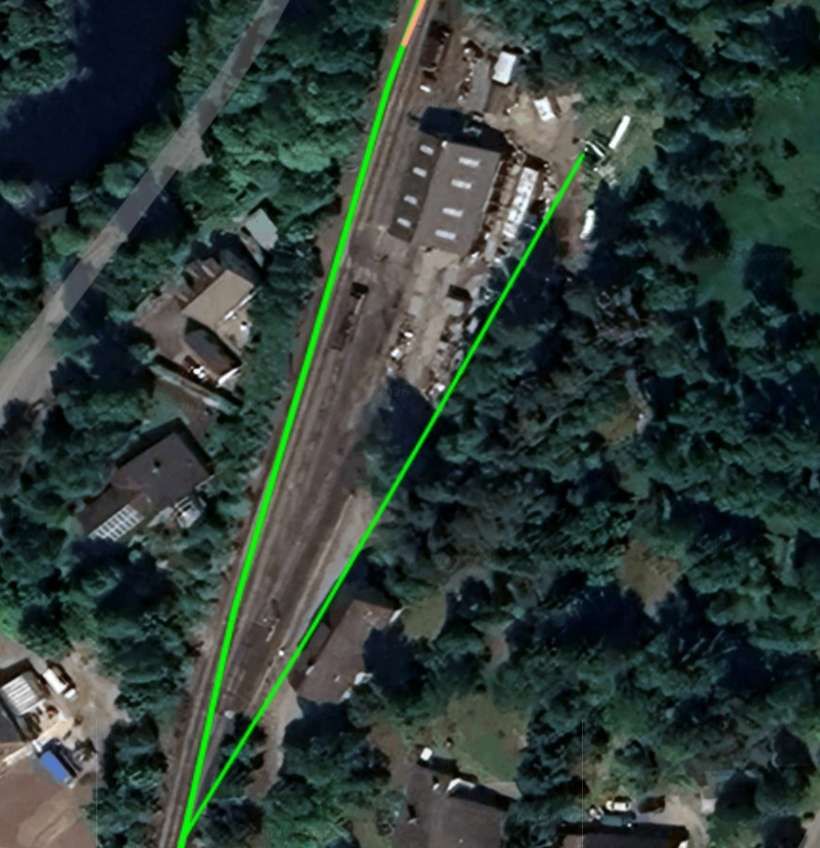
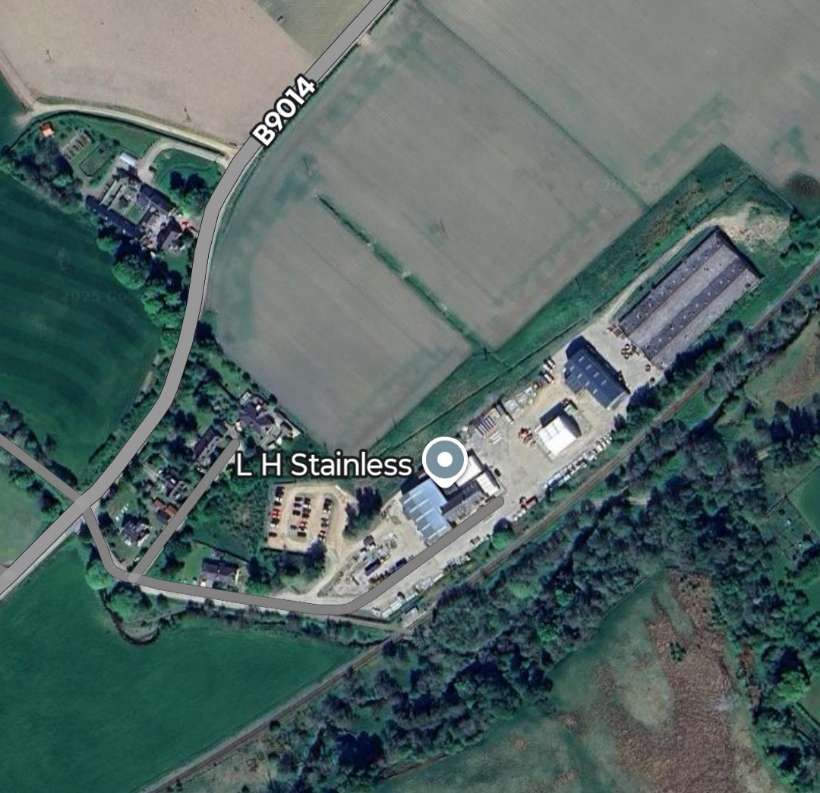
This MapCarta extract shows the town of Simba at the left side of the image, with both the metre-gauge line (MGR) and the more modern standard-gauge line (SGR). The MGR railway station is in the town. The SGR station is about 4 kilometres East of the town of Simba. [5]
Online (Instagram Video) can be found on these links:
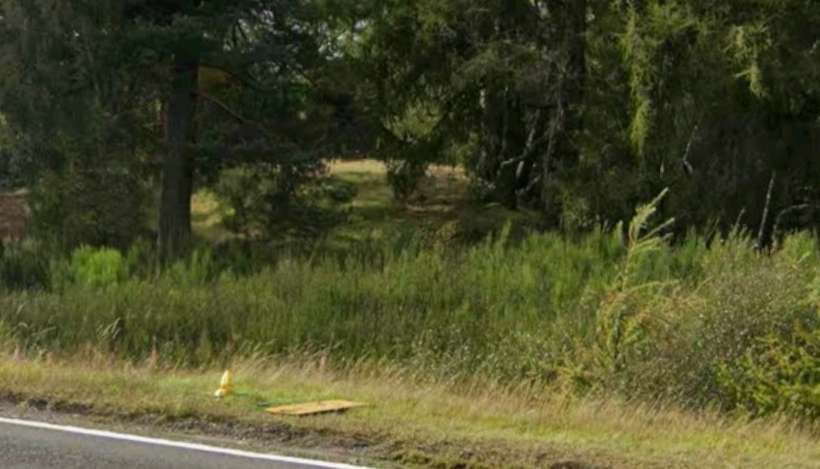
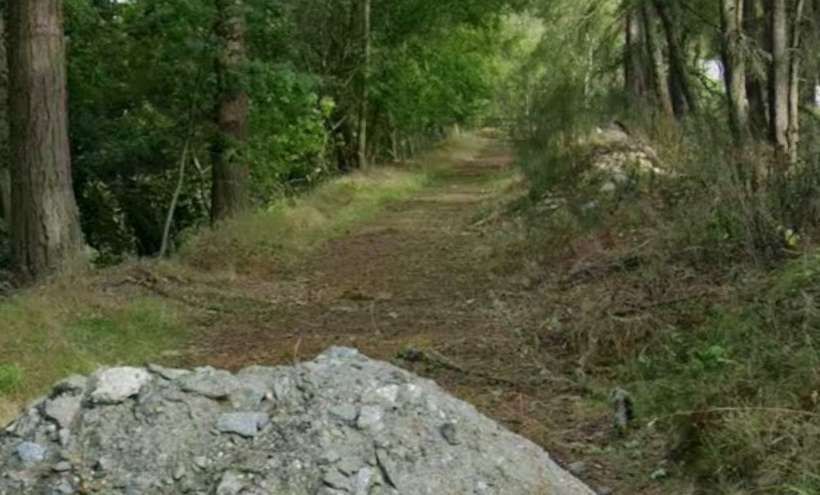
First responders were local people. They took a number of photographs of which this is one. Flames engulfed the train as emergency responders and members of the public worked to contain the fire. [6]
Kenya Digest reports:
“A cargo train fire at Simba Station has prompted investigations as authorities work to determine what caused the incident and assess the extent of the damage. The train, operated by Tata Chemicals Magadi Ltd, caught fire on June 1, 2026, leading to an emergency response along the Magadi rail corridor.
Kenya Railways confirmed the incident in a statement issued late Wednesday night, saying the cargo train burst into flames while carrying out its normal operations.
Emergency teams were quickly sent to the scene to contain the fire, support recovery efforts, and begin assessing what may have led to the incident.
According to preliminary findings released by Kenya Railways, the fire is believed to have started after mechanical damage affected the locomotive’s fuel tank.
Officials suspect the damage caused fuel to leak before it ignited, resulting in the blaze. However, the corporation stressed that these are only early findings and that investigations are still underway to establish the exact cause of the fire and the sequence of events.
Kenya Railways said investigators are examining all available evidence before reaching a final conclusion. The corporation noted that more details will be made public once the investigation has been completed.
The railway operator also confirmed that it is working closely with Tata Chemicals Magadi Ltd, the owners of the cargo train, as both parties seek to understand what happened. Management teams from both organisations are coordinating recovery operations while technical experts continue inspecting the affected locomotive.
The cargo train operates along the Magadi rail corridor, an important industrial railway that has served the region for many years.
The line plays a key role in transporting soda ash and other industrial cargo from Magadi to different parts of the country, supporting manufacturing and other economic activities.
By the time the incident was reported, no casualties had been officially confirmed. The absence of reported injuries was welcomed, although the fire has raised fresh questions about the condition of industrial locomotives and the importance of regular maintenance to reduce the risk of similar incidents.
The latest fire also comes at a time when the government is continuing efforts to revive and modernise Kenya’s metre-gauge railway network. The rehabilitation programme is intended to improve transport options for businesses and passengers while making greater use of existing railway infrastructure across the country.
Kenya Railways has assured the public that it remains committed to establishing the facts surrounding the incident.
Officials have urged patience as technical assessments continue, saying a comprehensive report will provide a clearer picture of what caused the fire and whether any additional safety measures will be required to help prevent similar incidents in the future.” [6]
‘Class442’ points out that this is not the first incident associated with Magadi Ltd. Two years ago on 9th July 2026, there was an accident on the Magadi-Konza line.
Kenya Railways noted that the train in the accident that claimed one life, was operated privately by Tata Chemicals Magadi Limited. [7]
Maria Silantoi of Swala Nyeti reported in July 2024: “According to witnesses and police, on 9th July 2024, the train carrying 59 passengers was heading towards Kajiado town from Magadi when it rolled backwards along a steep section of the track. Local residents believe the accident was caused by a combination of factors, including rampant vandalism of the railway line and poor visibility due to recent heavy rains. Concerns have been raised about the increasing frequency of such vandalism by scrap metal dealers, who reportedly evade capture by patrolling officers. … The ill-fated train service provided a vital and affordable public transport option for residents in remote villages of Kajiado West Sub-county, offering a Sh70 fare for a journey of approximately 135 kilometres. This service was established specifically to address the transportation challenges faced by these local communities. Previously, reaching Kajiado through the Kiserian-Isinya route could cost up to Sh700 and take as long as four hours. … The tragedy highlights the urgent need for improved railway infrastructure security and maintenance in the region. This incident serves as a stark reminder of the importance of prioritizing safety measures to prevent such devastating accidents on crucial public transport routes.” [8]
D. Biza Kenya reportson 2nd July 2026
Construction of the Malaba Extension Begins
The 475-kilometre Naivasha-Kisumu-Malaba SGR project forms a vital section of the Northern Corridor transport network, which is expected to boost trade with East African countries and cement Kenya’s role as the region’s logistics hub. [12][13]
Kenya Railways has officially commenced construction on the 475-kilometre Naivasha-Kisumu-Malaba Standard Gauge Railway, with the Sh700 billion project now underway in Narok County, which hosts approximately 100 kilometres of the corridor.
The project is divided into Phase 2B (Naivasha-Kisumu), covering 264 kilometres with an 8.69-kilometre branch line to Kisumu Port, and Phase 2C (Kisumu-Malaba), covering 107 kilometres through Siaya, Vihiga, Kakamega and Busia counties.
The entire Naivasha-Malaba extension is targeted for completion by June or August 2027. Land acquisition is ongoing, with compensation planned for over 3,500 landowners. [12]
E. The Citizen Reported on Saturday 14th March 2026:
Tanzania Begins Local Assembly of Locomotives
Tanzania has begun assembling Metre Gauge Railway (MGR) locomotives locally, The TRC claimed that they were the first country in East Africa to undertake such an initiative, the Citizen reports. The full article can be read here. [14]
The move has drawn praise from the Parliamentary Standing Committee on Infrastructure, which recently visited the site, according to a statement issued by the Tanzania Railways Corporation (TRC) on Saturday.
During an inspection visit to the locomotive assembly project at the Pugu Railway Workshop, the committee urged TRC to continue strengthening the skills of Tanzanian youth involved in the programme through advanced technical training both locally and abroad.
The committee was informed that the decision to assemble locomotives locally was partly prompted by delays in the delivery of spare parts from suppliers, caused by global supply chain disruptions linked to the Russia–Ukraine War.
To address the delays, TRC imported two fully assembled locomotives from Malaysia, while the remaining components were shipped to Tanzania for assembly at the Pugu workshop.
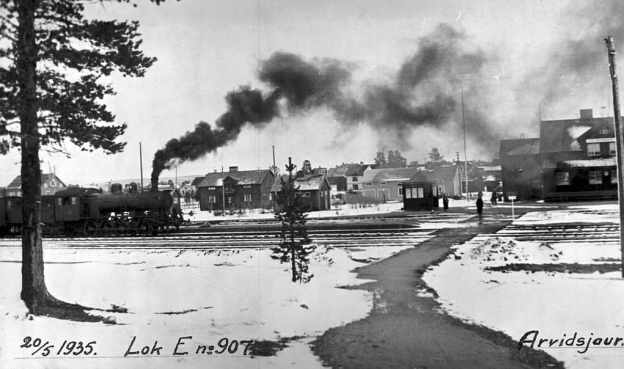
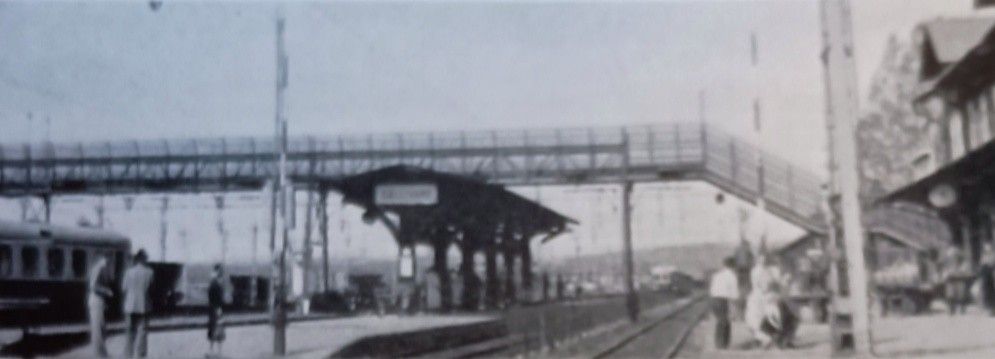
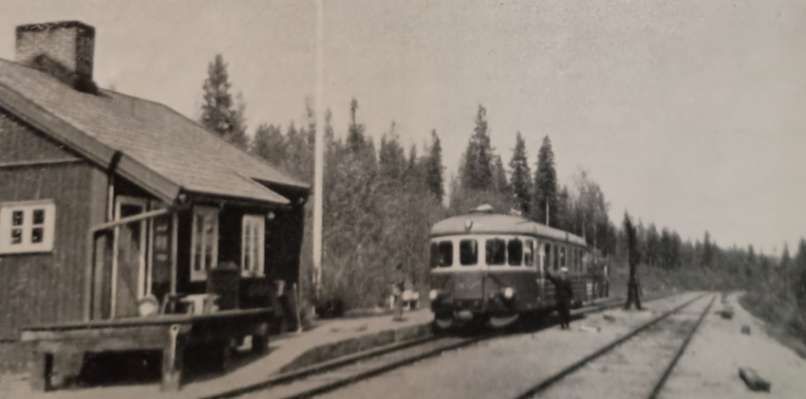
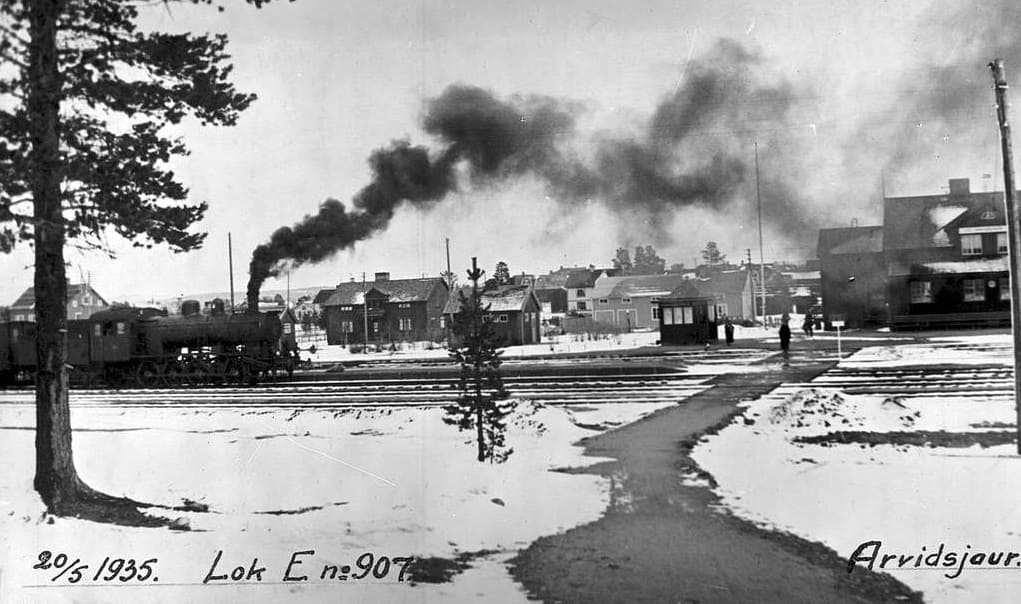
The featured image for this article is a picture of Swedish State Railways (Swedish: Statens Järnvägar) Locomotive No. 907 at Arvidsjaur Railway Station. The image is dated May 1935, (c) Public Domain. [60]
Known as Sweden’s Inland Railway, the Inlandsbanan “extends from Gällivare, in Lapland, to Kristinehamn, on Lake Väner, in Värmland, a distance of 800 miles, through scenery that ranges from the tundra of the Arctic to the forest lands of Central Sweden.” [1: p826]
The line is known for its leisurely pace, allowing for wildlife spotting (reindeer, elk) and spontaneous stops, with onboard hosts providing commentary. Trains operate with daily departures during the 3 months of high summer, often with packages that include hotels. It also operates for 4 months in the winter.
It was built between 1908 and 1937, and was designed to connect inland northern Sweden, avoiding the coast for security reasons and to foster regional development.
The Railway Magazine.of December 1958 carried an article about the line written by M. D. Greville & H. A. Vallance. [1]
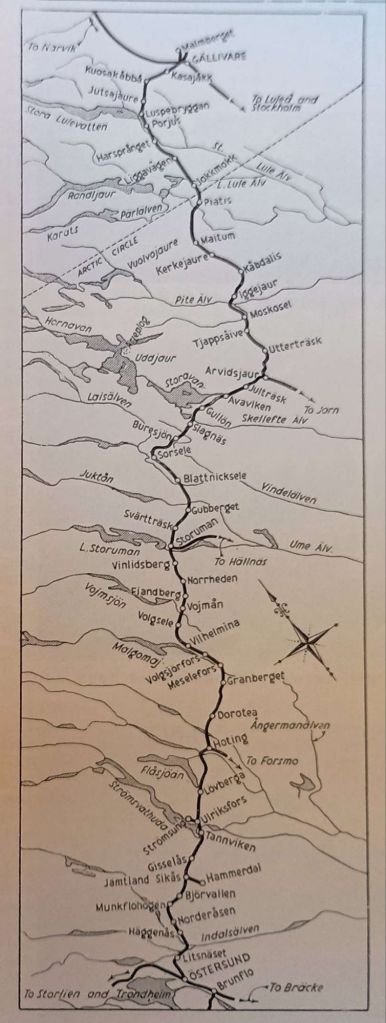
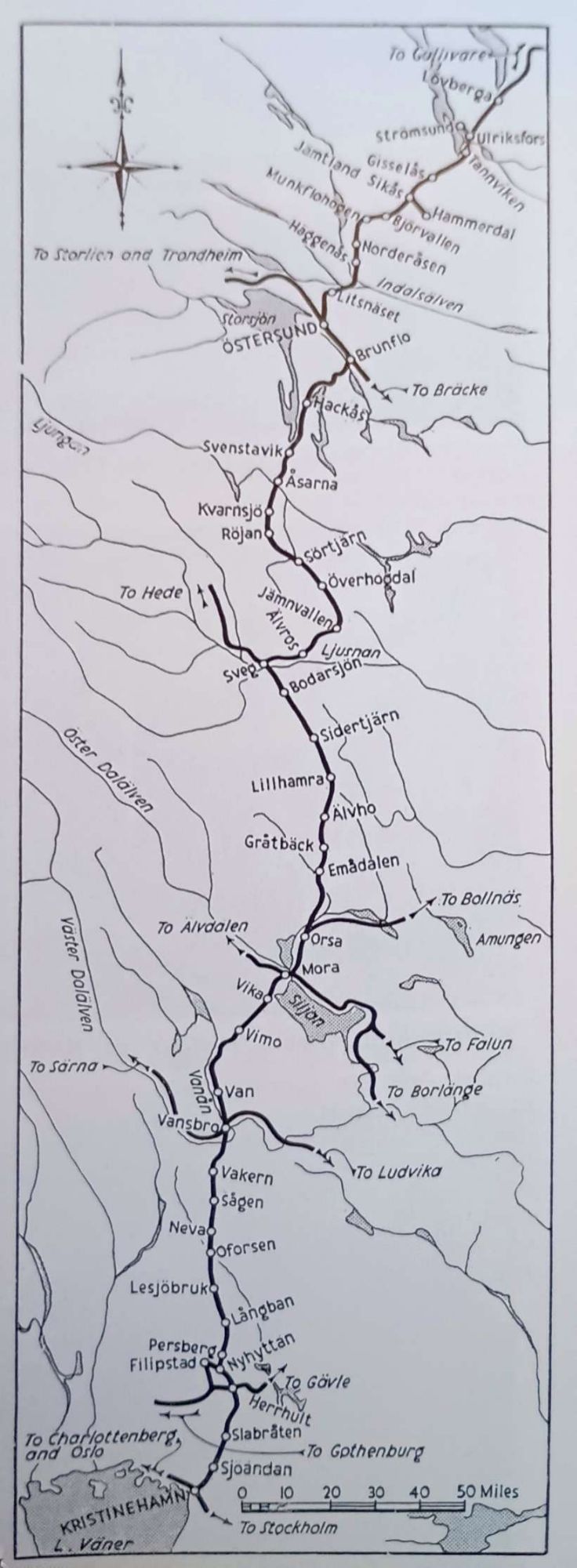
The northern length of the Inlandsbanen from Ostersund to Gällivare. Ostersund features in the OpenStreetMap images below and appears at the South end of the portion of the line shown in the first of two maps of the line. [1: p827]
Vallance and Greville wrote: “The inland route was first projected at the end of the nineteenth century as a private enterprise, to carry iron ore from Lapland and timber from Central Sweden to a new port on the west coast, north of Gothenburg. No progress was made with this scheme, and in 1907 the Swedish Government decided to begin the construction of the northern part of the railway from Östersund, on the main line from Bräcke to Storlien, on the Norwegian frontier, completed in 1882.” [1: p826]
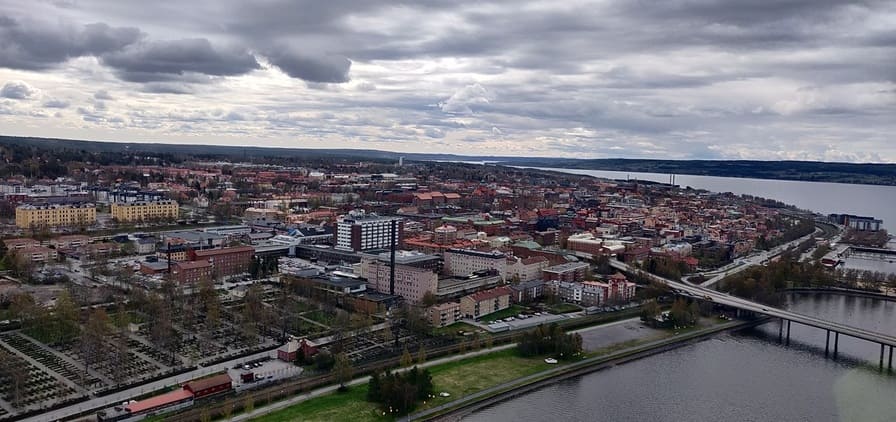
Östersund in May 2021, (c) Hult and licenced for reuse under a Creative Commons licence (CC BY-SA 4.0). [13]
Östersund is the capital of Jämtland. It is located at the shores of Sweden’s fifth-largest lake, Storsjön, opposite the island Frösön. With a total population of 50,960 (2017) Östersund is the 22nd most populous city in Sweden. [14]
Östersund appears on this second map of the route which shows the Southern length of the line which extends to Kristinehamn. [1: p827]
The completed line runs from Gällivare, in the North, to Kristinehamn in the South, passing through Östersund which is the most significant location along the line.
Stops along the line recorded by Greville and Vallance include: Kasajakk, Kuosakabba, Jutsajaure, Luspebryggan, Porjus, Harspranget, Liggavagen, Jokkmokk, Piatis, Maitum, Kerkejaure, Kabdalis, Iggejaur, Moskosei, Tjappsaive, Uttertrask, Arvidsjaur (a junction station serving the line to Jorn), Juitrask, Avaviken, Gullon, Slagnas, Buresjon, Sorsele (which was the Northern terminus of the line from 1929 until the line was completed), Blattnicksele, Gubberget, Sarttrask, Storuman (which was the junction for the line to Hallnas), Vinlidsberg, Norrheden, Fiandberg, Vojman, Volgsele, Vilhelmina (the northern terminus of the line from 1918 to 1929), Vlogsjorfors, Meselefors, Granberget, Dorotea, Hoting (the junction station for the line to Forsmo), Lovberga, Ulriksfors (which became a junction station when the line to the North opened in 1912, with the original line to Stromsund becoming a short branch line), Tannviken, Gisselas, Sikas (whuch was a junction station for the short line to Hammerdal), Bjorvallen, Munkflohogen, Norderasen, Haggenas, Litsnaset and Östersund. [1: p827]
South of Östersund, Greville and Vallance record the following stations: Brunflo (the Junction station on the line to Bräcke), Hackas, Svenstavik, Asarna, Kvarnsjo, Rojan, Sortjarn, Overhoodal, Jamnvallen, Alvros, Sveg, Bodarsjon, Sidertjarn, Lillhamra, Alvho, Gratback, Emadalen, Orsa (which is the junction station for the line to Bollnas), Mora (the junction station for the lines to Alvdalen, Falun and Borlange), Vika, Vimo, Van, Vansbro (the junction station for the lines to Sarna and Ludvika), Vakern, Sagen, Neva, Oforsen, Lesjobruk, Langban, Persberg, Nyhyttan (the junction for the line to Filipstad and beyond), Herrhult (the junction station for the lines to Gothenburg and Galve), Slabraten, Sjoandan and Kristuinehamn. [1: p827]
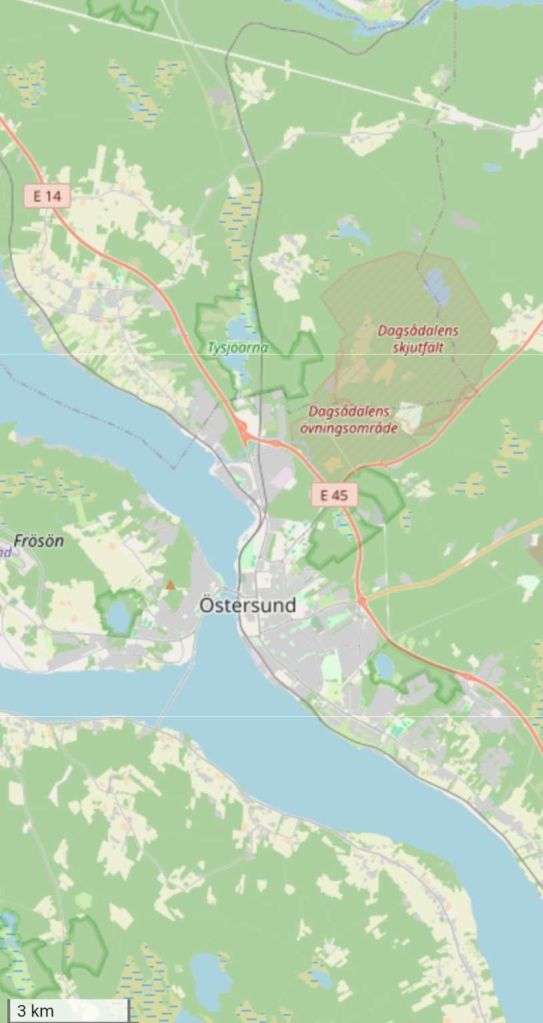
The city of Östersund sits on the East shore of Lake Storsjön. The railway line between Bräcke and Storlien, on the Norwegian frontier, hugs the lakeshore. It enters the map extract near the bottom-right corner and leaves close to the E14 near the top-left. The Inland line (Inlandsbanan) leaves the Bräcke to Storlien line North of Östersund and leaves this map extract towards the top-right. [8]
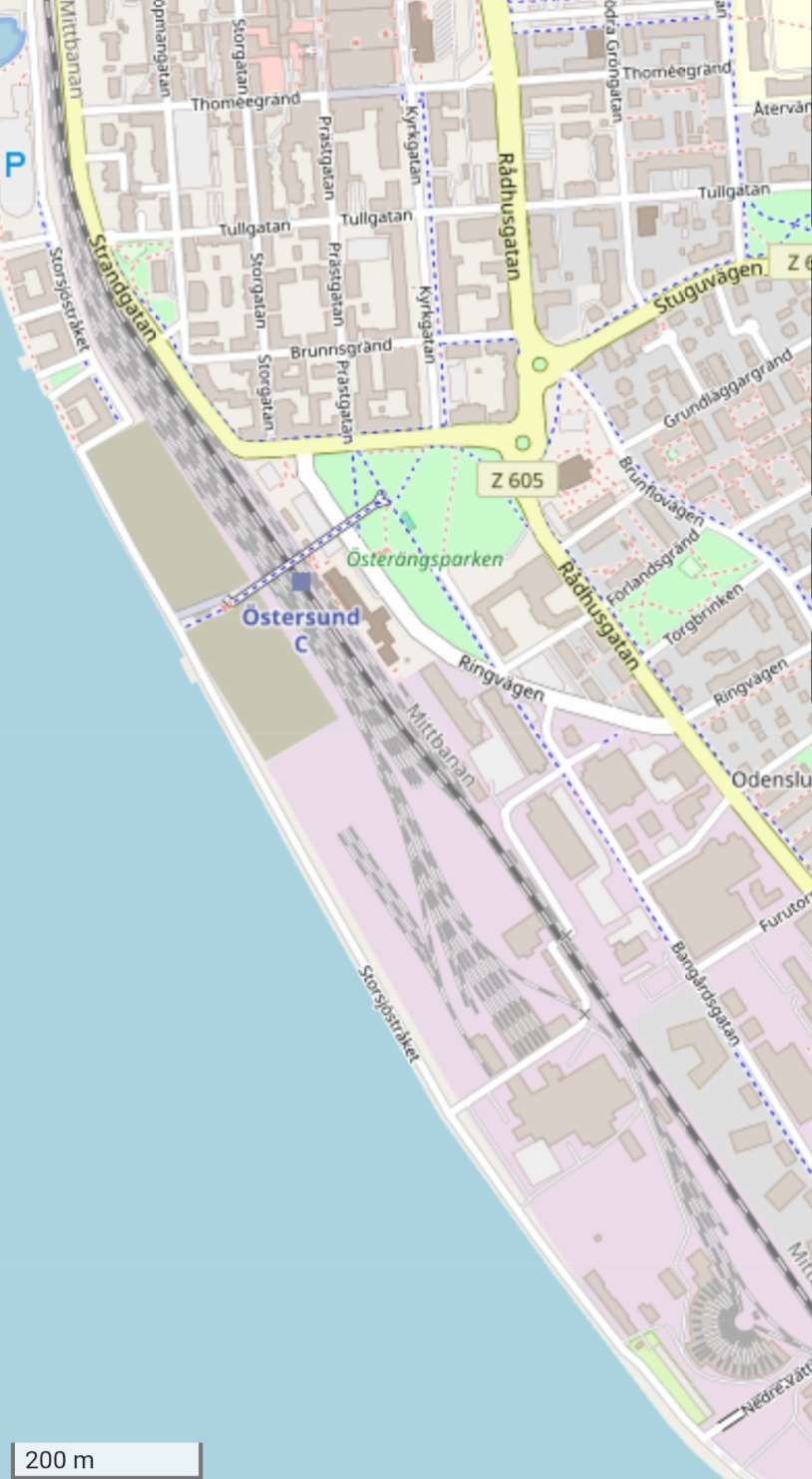
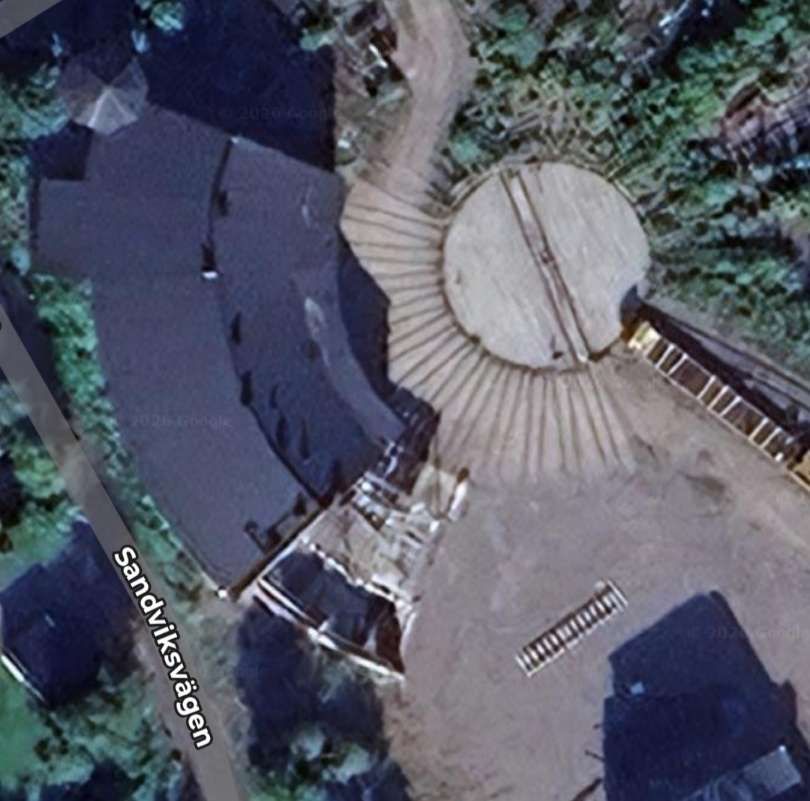
Östersund Railway Station, the line to Bräcke leaves this map extract in the bottom-right corner. The roundhouse at Östersund is also at the bottom left of this image. [8]
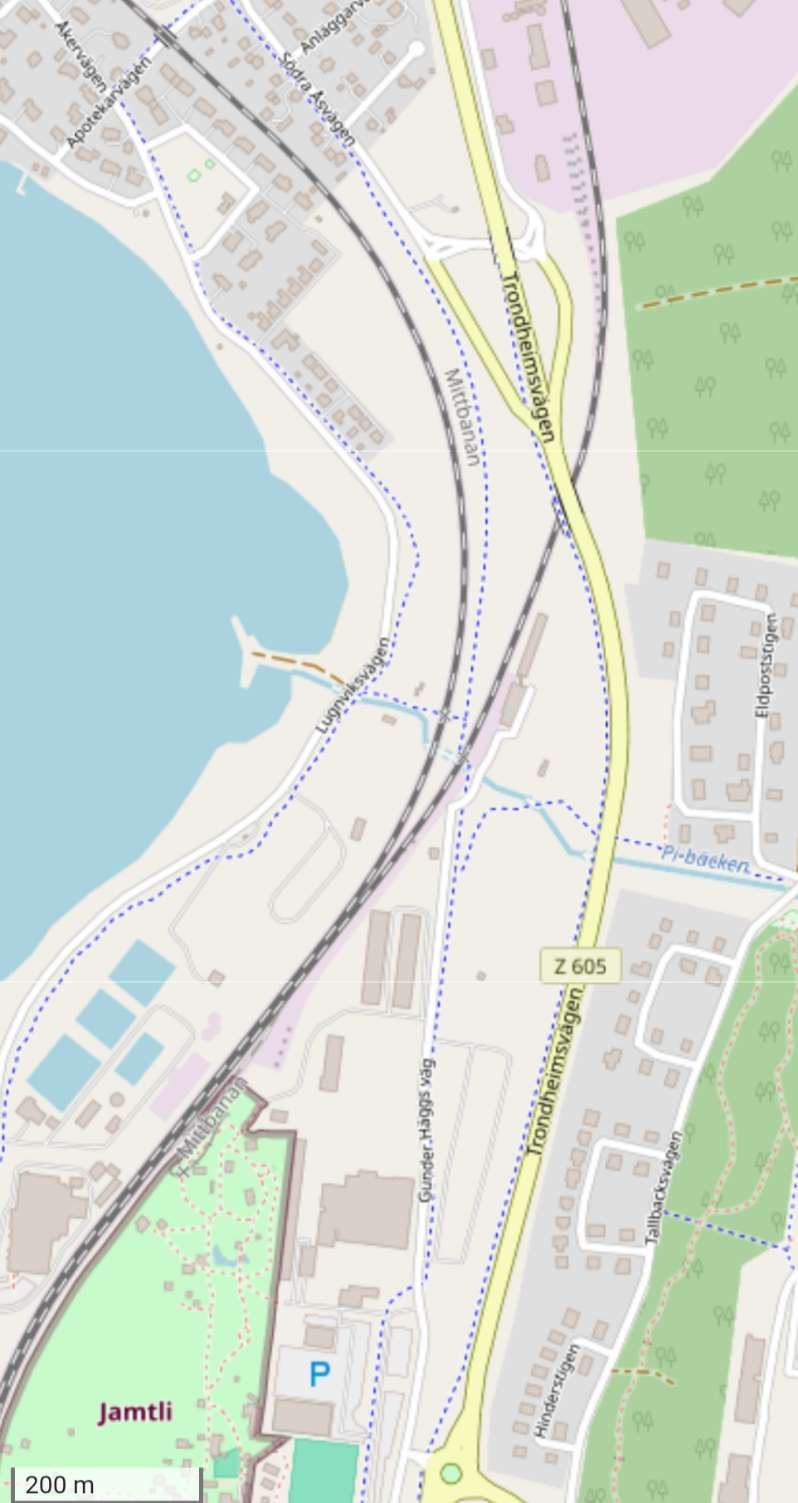
The junction: the line to Storlien hugs the shore of Lake Storsjon, the Inlandsbanan heads away to the North. [8]
The 74 miles North from Östersund to Strömsund were opened in 1912. Strömsund was the terminus of the line until the line was opened further to the North. [1: p826]
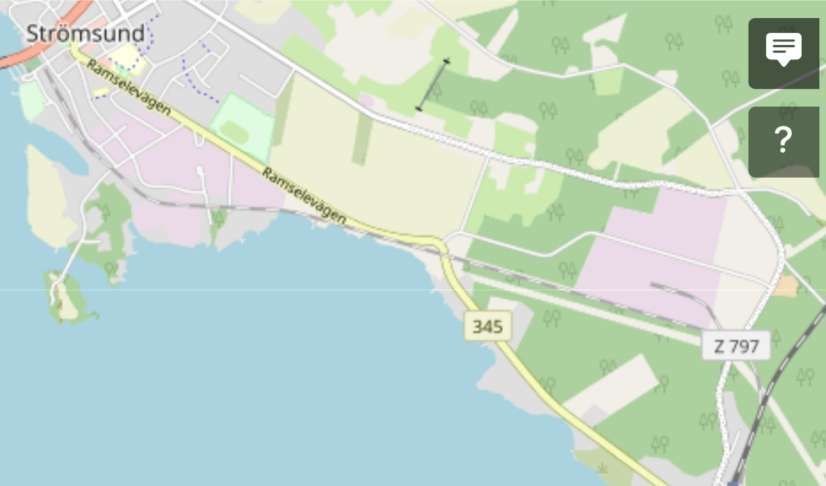
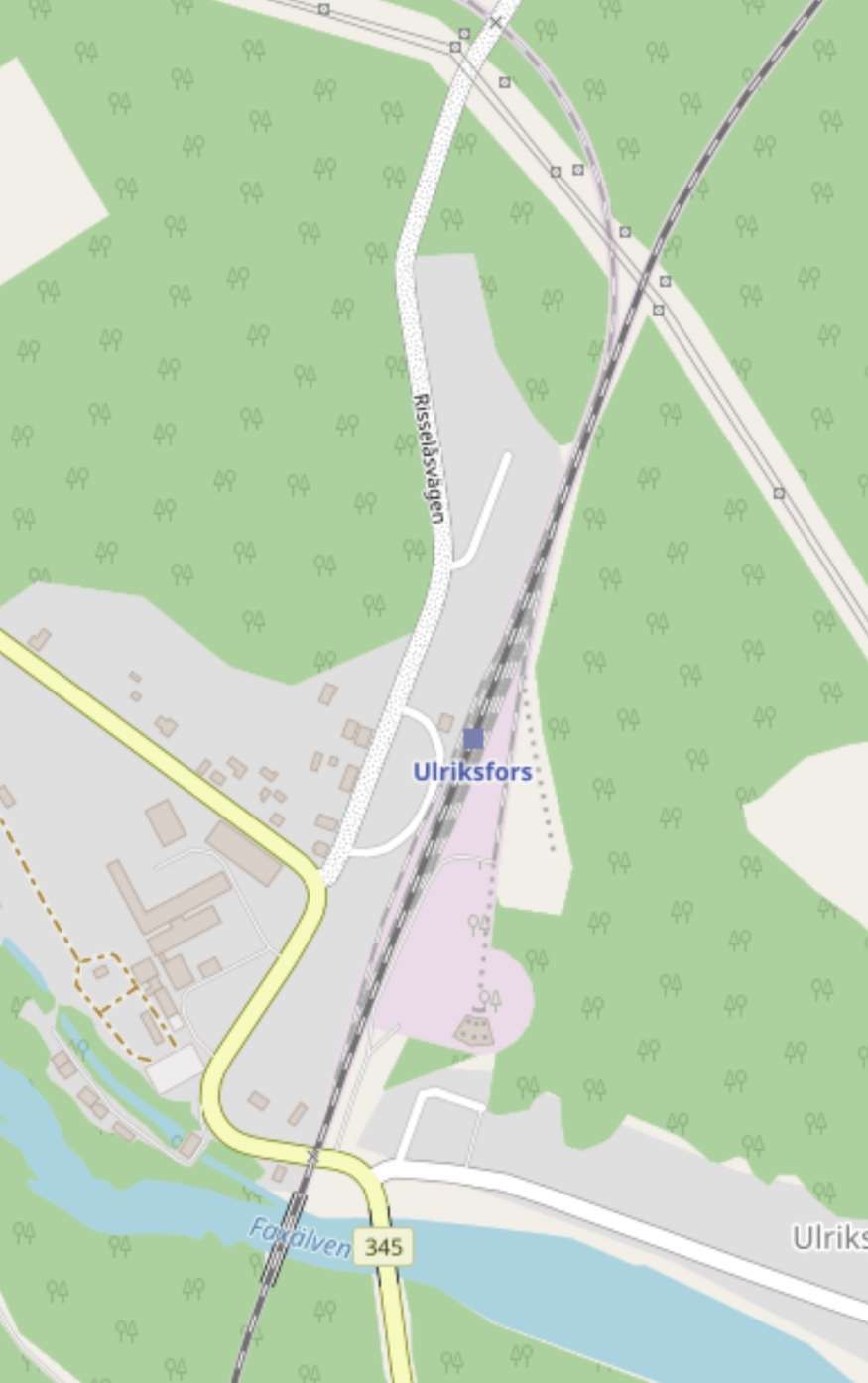
What became the main line to the North can be seen in the bottom-right of this map extract. Strömsund was served from that time on (1918) by a short branch line. The junction was at Ulriksfors which is just off the bottom right of this image. [10]
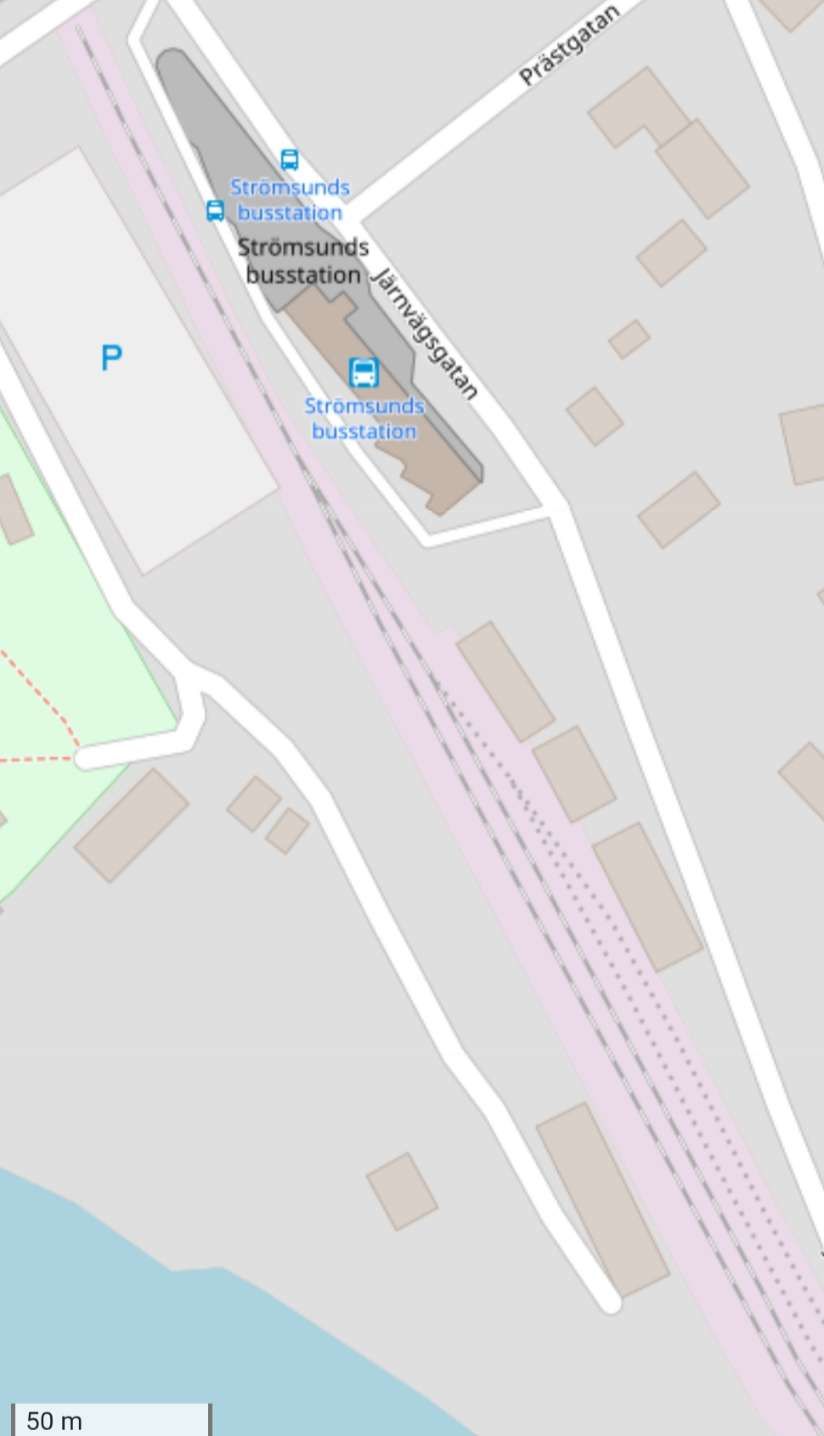
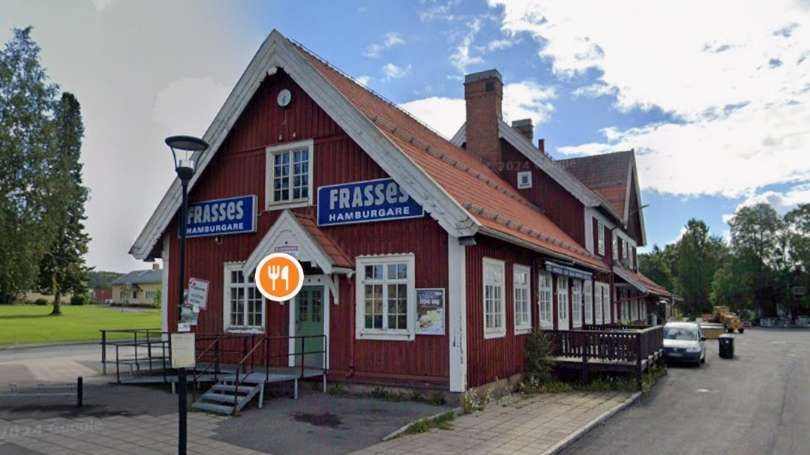
Strömsund Railway Station is now its bus station. [10]
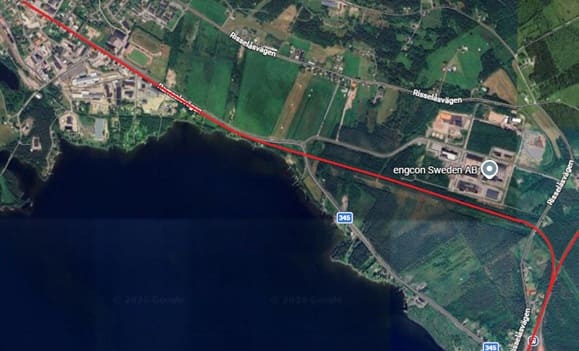
Strömsund Station seen from the Northwest. The tracks ran along the right side of the building which is now the town’s bus station. [Google Streetview, July 2024]The line from Strömsund to Ulriksfors is shown by the red line running from the left side of this satellite image to meet the Inlandsbanen in the bottom-right of the image. [Google Maps, April 2026]
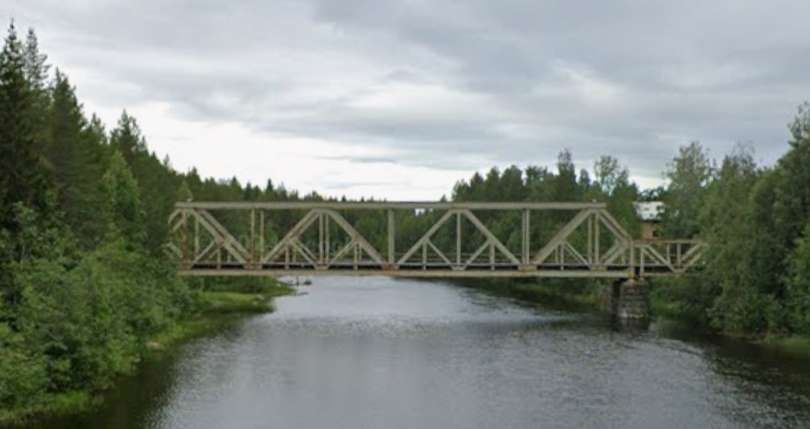
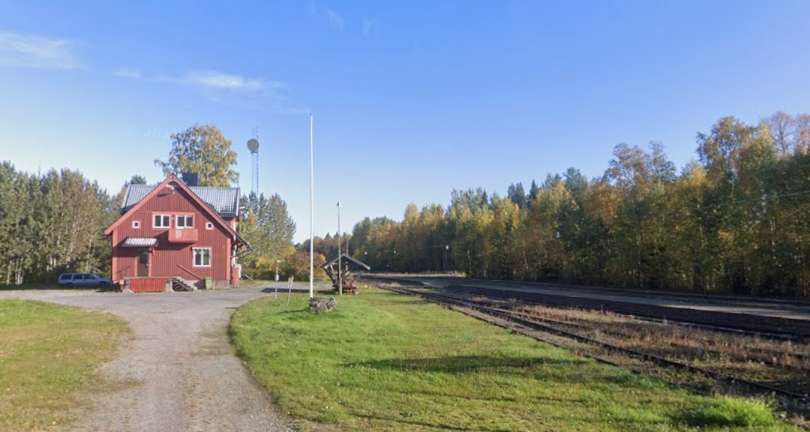
Ulriksfors Railway Station sits just to the North of the railway bridge over the Faxälven River. (Google gives the river the name ‘Fängsjön’.) [11]
The railway bridge over the river, seen from the East from the road bridge over the river. [Google Streetview, July 2024]Ulriksfors Railway Station seen from the Southwest. [Google Streetview, September 2023]
“The line was then continued northward from Ulriksfors to develop wide and very sparsely-inhabited areas in Lapland. The 80 miles from Ulriksfors to Vilhelmina were brought into use in 1918 and, after an interval of 11 years, the 87 miles thence to Sorsele were opened in 1929.” [1: p826]
Vilhelmina and Sorsele are shown below. …
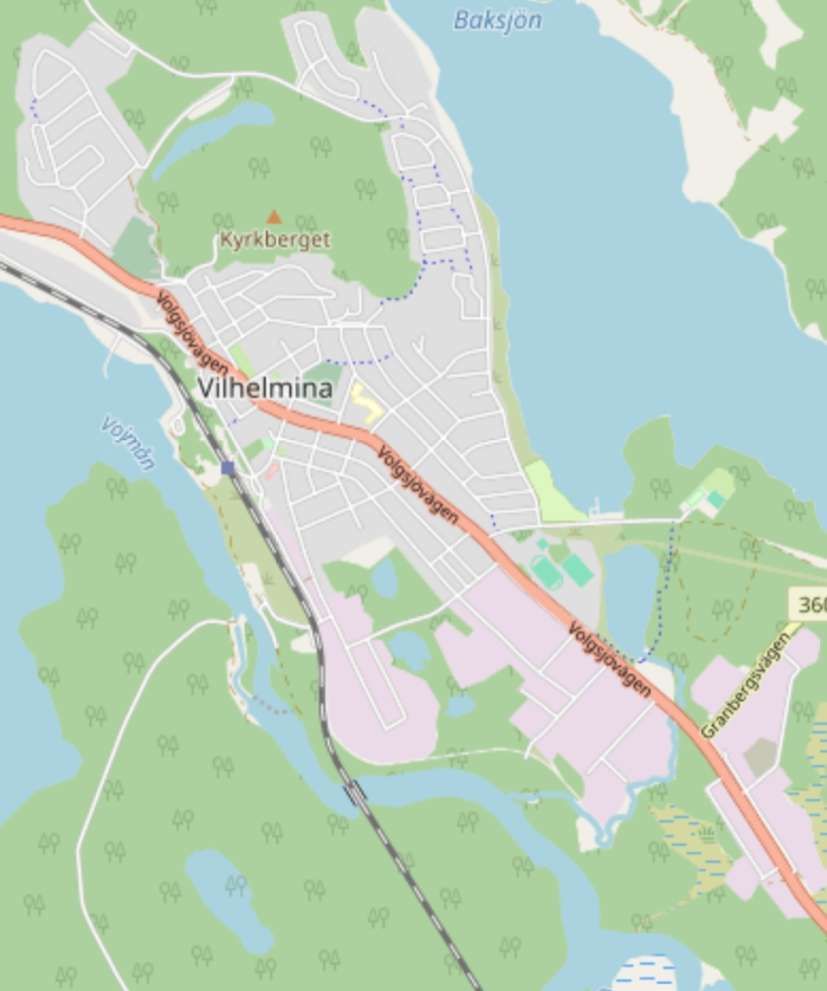
Vilhelmina Railway Station was on the West side of the town between it and Lake Vojmän. The railway was opened through to the town from the South in 1918. [12]
Vilhelmina had 3,657 inhabitants in 2010. [15]
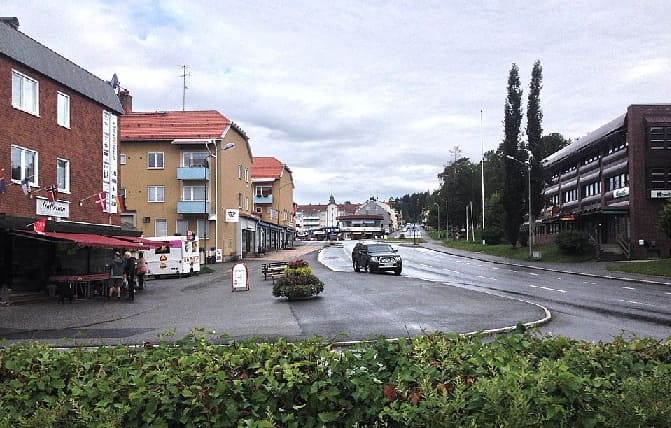
The town centre, (c) Konky2000 and licenced for reuse under a Creative Commons Licence (CC BY-SA 3.0) [15]
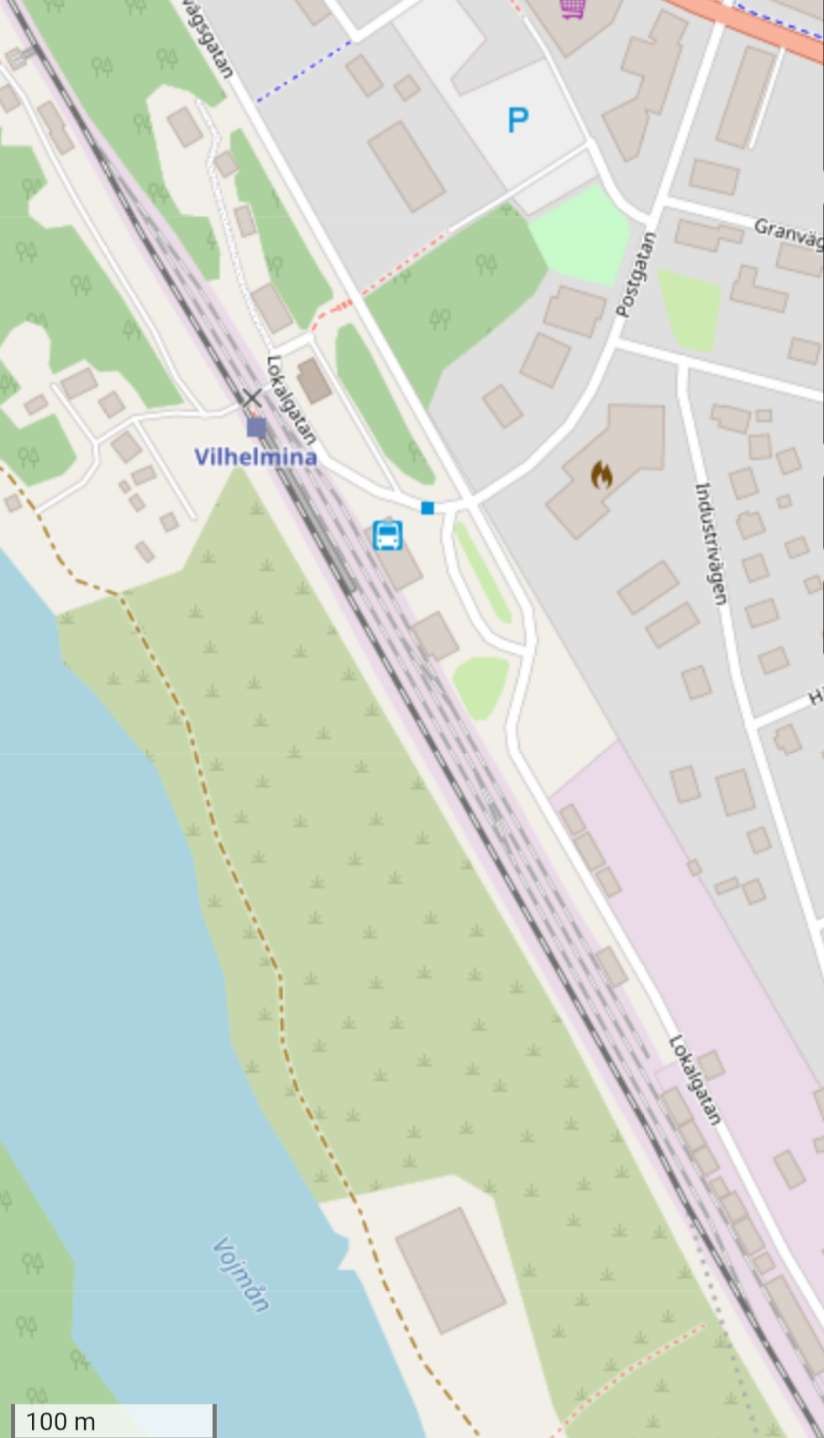
A closer view on OpenStreetMap of Vilhelmina Railway Station. [12]
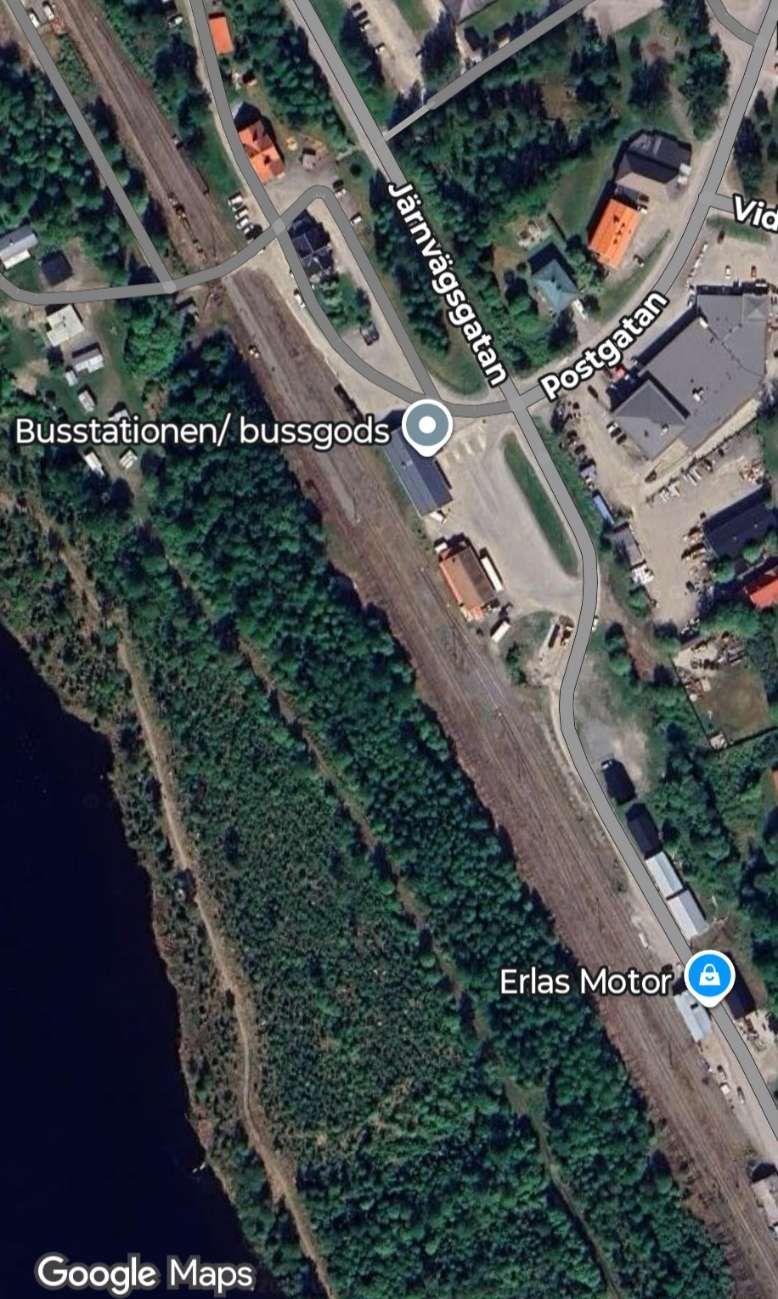
The same area as it appears on Google’s satellite imagery. [Google Maps, April 2026]
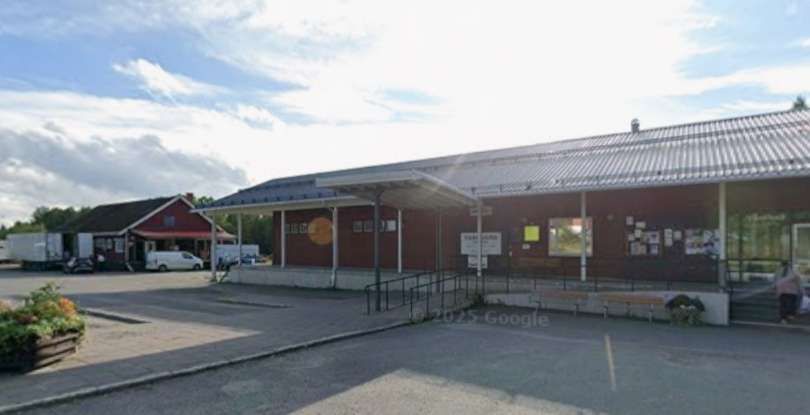
The building closest to the camera is the bus station at Vilmelmina. [Google Streetview, September 2025]
The next two photographs show a steam locomotive which used to work on the Inlandsbanan which has been stabled in a short spur to the North of the bus station building. …
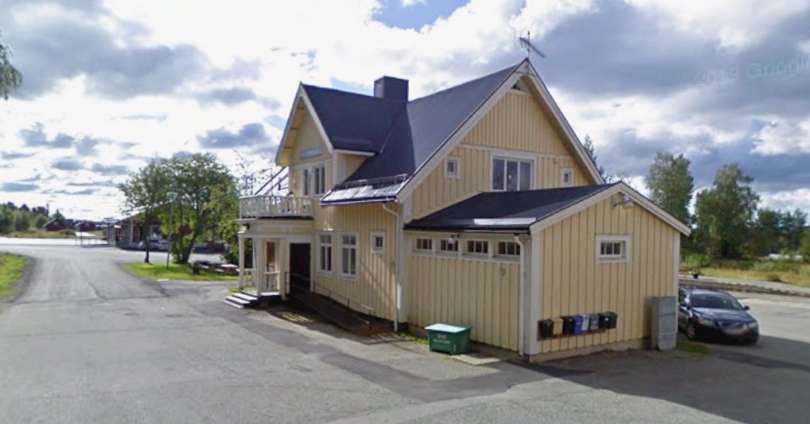
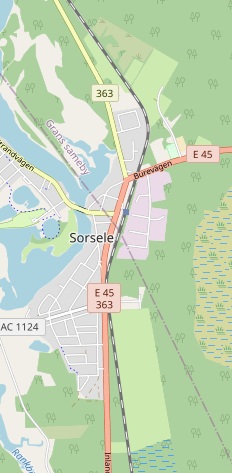
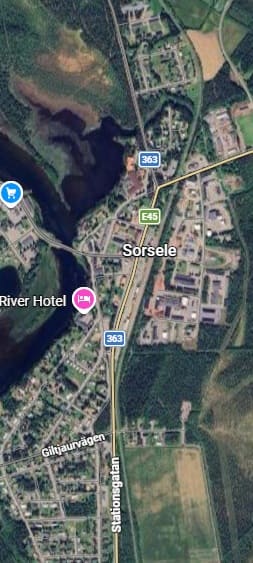
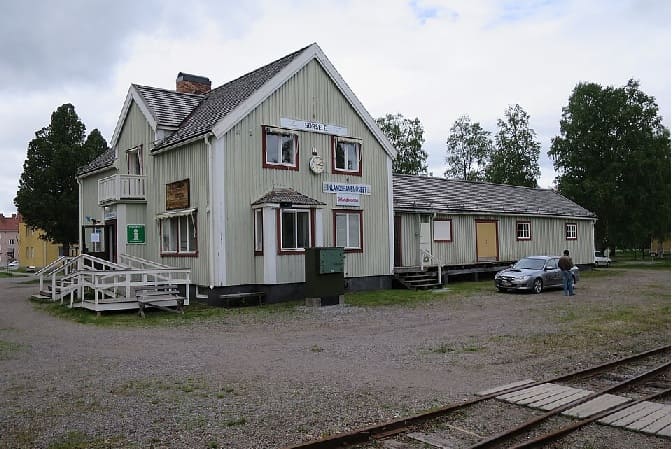
Sorsele was the next terminus location as the line was gradually built to the North. It was the northern terminus of the line from 1929 until the connection to the line being built South from Gällivare was made. [16][Google Maps, April 2026]
Sorsele Railway Station in 2014, (c) Reinhard Dietrich and licenced for reuse under a Creative Commons licence (CC0 1.0 Universal). [17]
While the line was progressing gradually North from Östersund to Sorsele, construction started from a junction with the line to Narvik (in Norway) at Gällivare. [2][3]
Greville & Vallance tell us that, “A temporary track, to carry materials for the construction of a big hydro-electric power station, had been laid for 33 miles to Porjus in 1911, and this section was opened for goods traffic in 1916, and for passengers in 1925. The 29 miles from Porjus to Jokkmokk were brought into use in 1927. The intervening gap of 163 miles from Jokkmokk to Sorsele was bridged in two sections, from Sorsele to Arvidsjaur (55 miles) in 1933, and from Arvidsjaur to Jokkmokk (108 miles) in 1937. Between 1924 and 1930, cross-country lines were opened from Hoting to Forsmo, and from Storuman to Hallnas, to connect the new inland route with the older main line from Stockholm to Lapland.” [1: p826]
We will pick up details of these different locations as we travel along the line from Gällivare to Kristinehamn in this and future articles.
“Historically, the southern half of the route, from Östersund to Kristinehamn, falls into two parts. The Kristinehamn-Sjöandan Railway, seven miles long, was constructed between those places as early as 1850, as part of a system of narrow-gauge railways and canals connecting the local iron foundries with Lake Vaner and, via the Gota Canal, with the sea. It was at first worked by horses, but became steam-operated in 1858, and in 1859 started to carry passengers. In 1873, this line was acquired by the Ostra Varmlands Railway, converted to standard gauge, and extended for 29 miles to Persberg in 1875, part of another narrow-gauge line, the Kroppa Railway, being incorporated.” [1: p826]
Greville and Vallance continue: “Between 1889 and 1891, the Östra Värmlands Railway opened the 102 miles from Persberg, through Vansbro, to Mora, where a connection was made with the Falun-Rättvik-Mora Railway, which was extended for eight miles from Mora to Orsa in 1892. The 77 miles from Orsa to Sveg were built by the Orsa-Härjedalens Railway, and opened in 1909 The whole line from Kristinehamn to Sveg passed into the hands of the Swedish State Railways between 1917 and 1919. … The remainder of the route was built by the State, in a southerly direction from a junction with the Bräcke-Östersund line at Brunflo, nine miles from Östersund. The 42 miles from Brunflo to Åsarna were brought into use in sections between 1916 and 1918, and the 63-mile link between Åsarna and Sveg was completed in 1922.” [1: p829]
Following the Route of the Railway – Gällivare to Arvidsjaur
Gällivare is at the northern end of the Inlandsbanan. We start our journey along the line from here. …
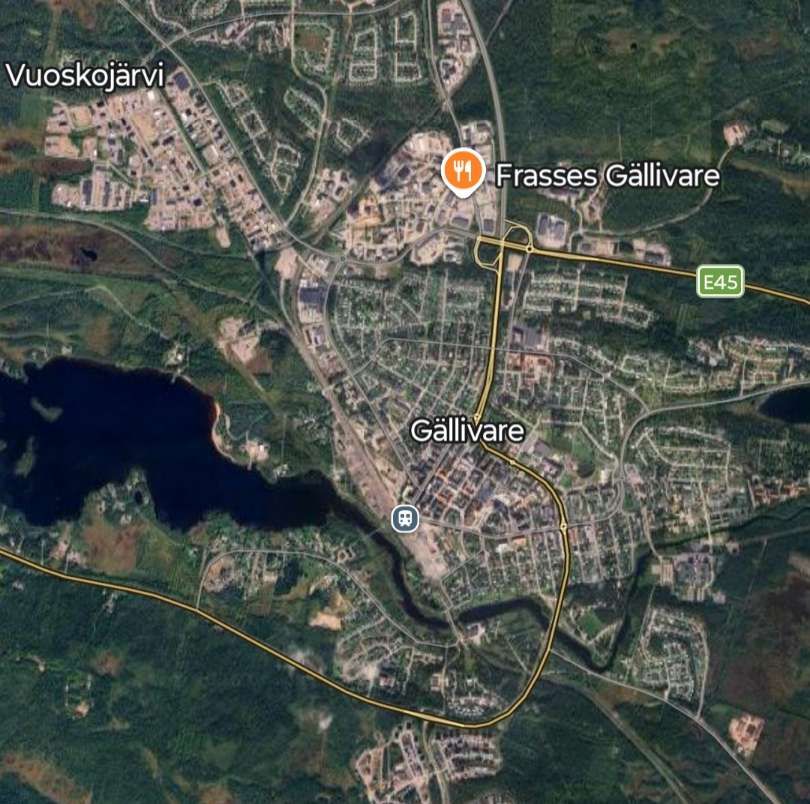
Gällivare. [Google Maps, April 2026]
Gällivare Station sits alongside the Vassara River on the Southwest side of the town. The line to Narvik heads away to the West, North of the top of this map extract. The Inlandsbanan also leaves heading West from the triangle. The line heading Southeast across the Vassara River heads for Luleå and thence to Stockholm via the coastal line. [Google Maps, April 2026]
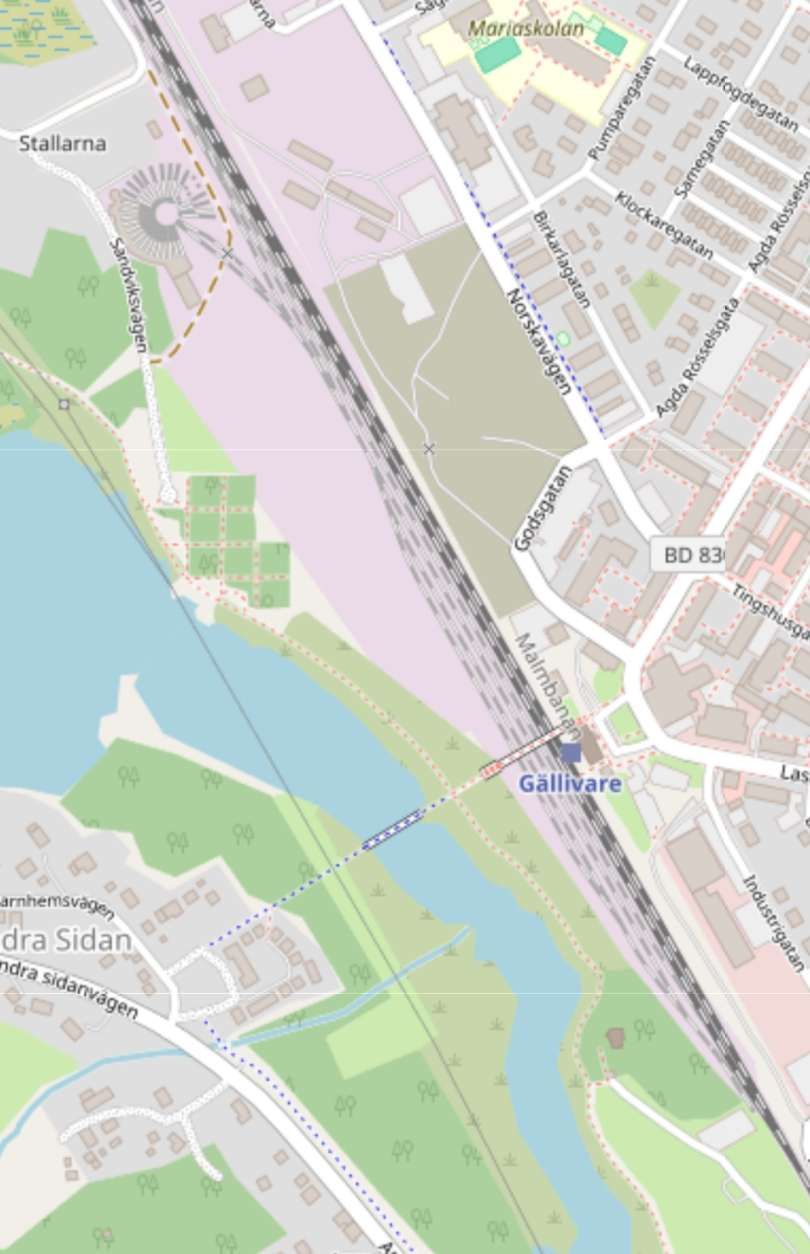
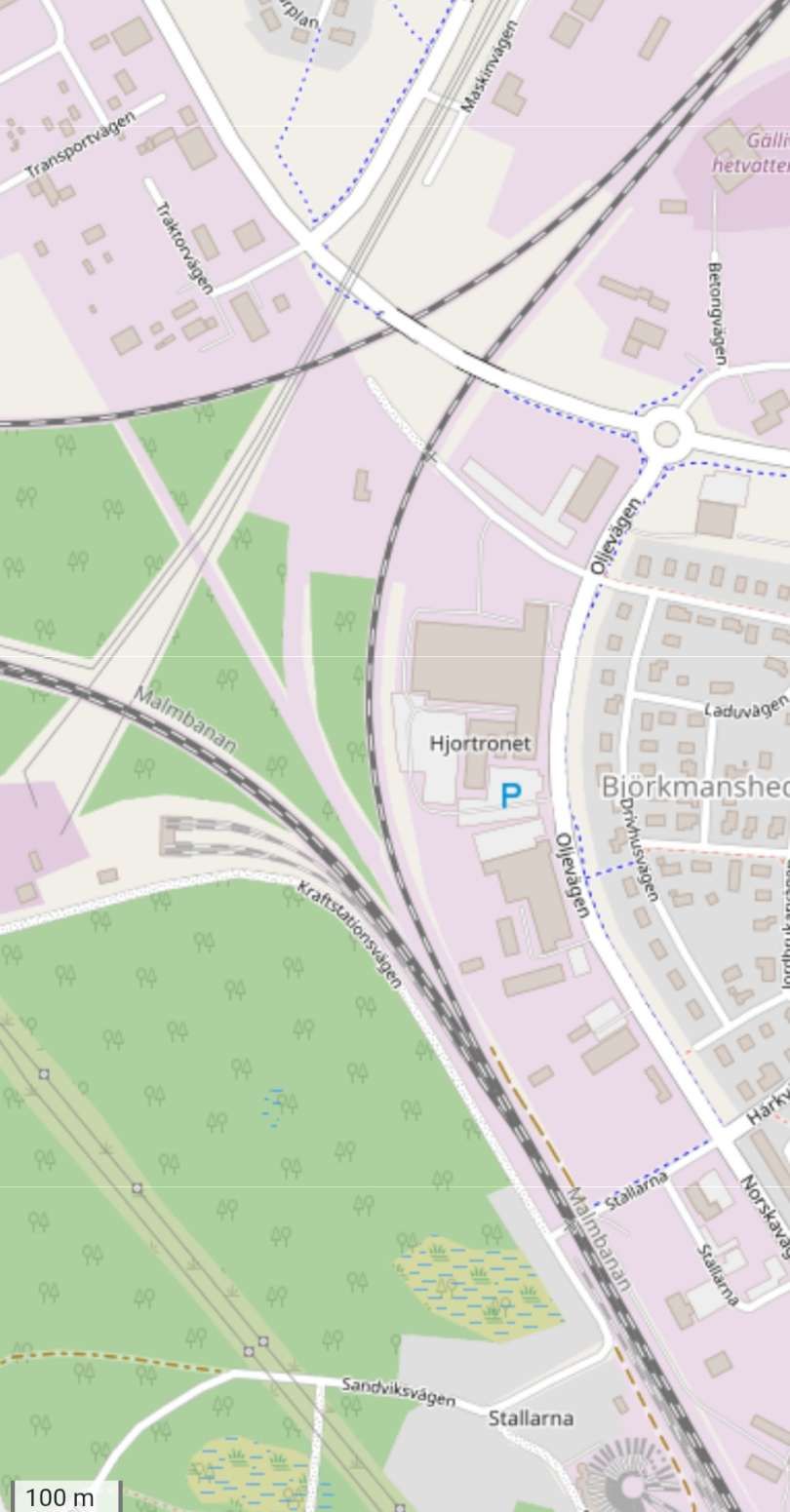
The next two images are taken from OpenStreetMap’s mapping and, between them, show the length of the station site at Gällivare. …
The North end of Gällivare Railway Station site. The triangular junction is worth noting at the top of this extract. [7]
The South end of Gällivare Railway Station site. The significant roundhouse should be noted at the top of this image. [7]
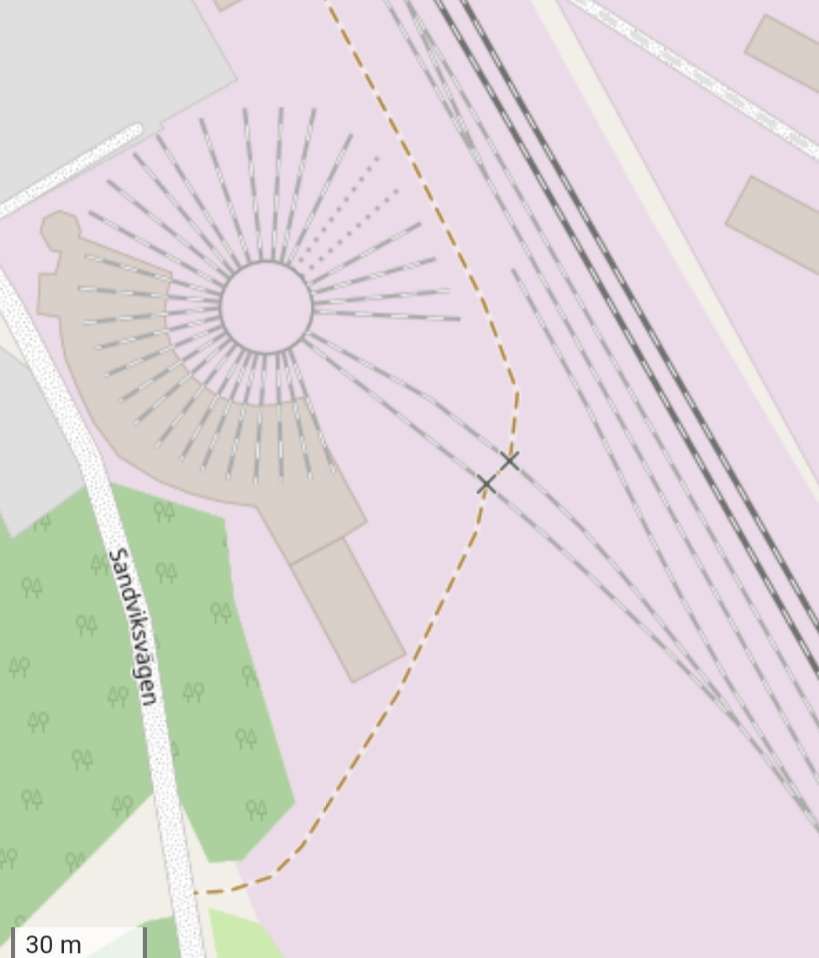
Two closer views of Gällivare’s roundhouse: one cartographic, [7] the other satellite. [Google Maps, April 2026]
Trains travelling South on the Inlandsbanan set off from Gällivare Railway Station in a northerly direction. North of the Roundhouse they bear round to the West.
Greville and Vallance talk of the line in 1958: “The line is single track throughout, with passing loops at most stations. Unlike the railway to Narvik, it is not electrified. Apart from the bridges over the numerous rivers, heavy engineering works have been avoided, and the gradients are undulating, and frequently quite steep. For many miles, the railway passes through forests and tundra, almost devoid of habitation. The country is rather flat, but is relieved by several lakes, and there are distant views, towards the west, of the Lapland mountains, including Kelneksise (8,900 ft.) the highest mountain in Sweden. Herds of wandering reindeer are frequently seen, and may even hold up the train while they cross the unfenced line to reach their feeding grounds. Laspebryggan, 28 miles from Gällivare, is the starting point for the popular journey by boat along a chain of lakes to Stora Sjöfallet, the finest waterfall in Sweden, and considered by many to be the most magnificent in Europe.” [1: p829]
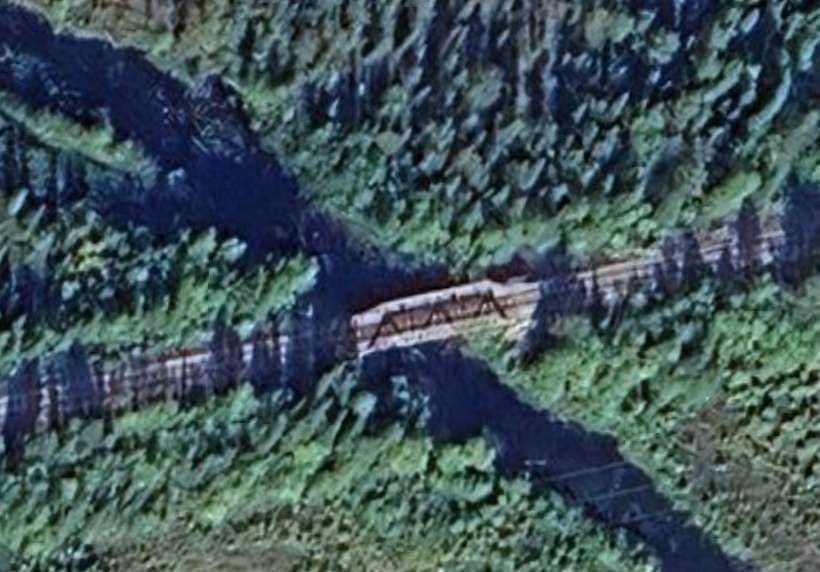
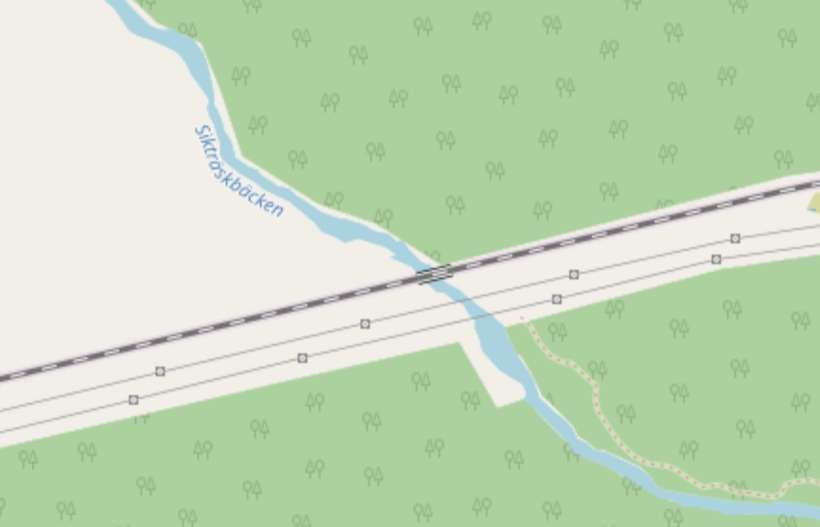
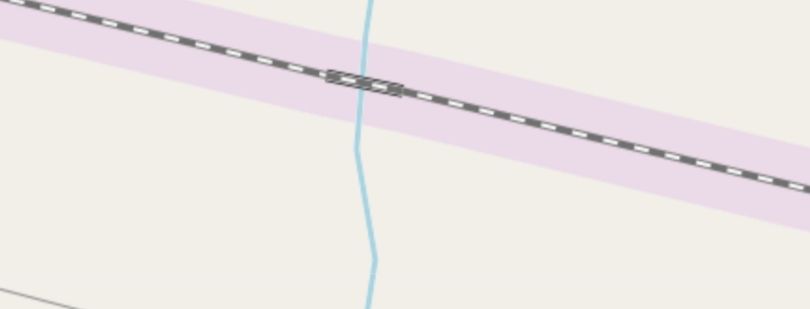
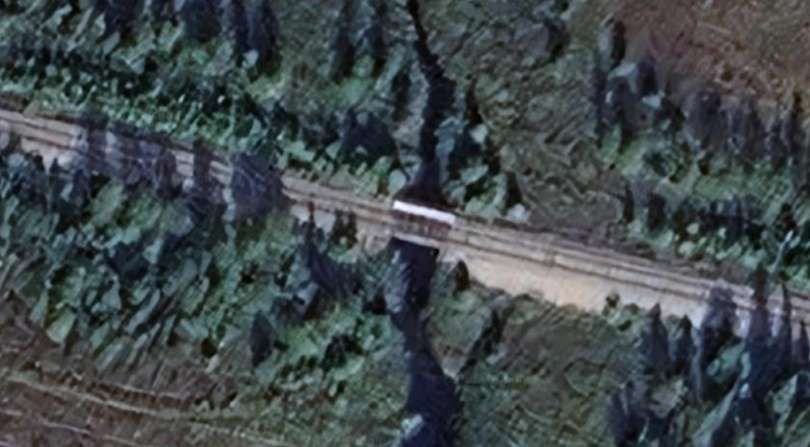
Heading West the Inlandsbanan bridges the Sikträskbäcken River which feeds into Lake Vassaraträsket close to which Gällivare sits.
The truss girder bridge over the Sikträskbäcken. [Google Maps, April 2026]
The bridge as it appears on OpenStreetMap’s mapping. [18]
The line continues in a westerly direction for some considerable distance. …
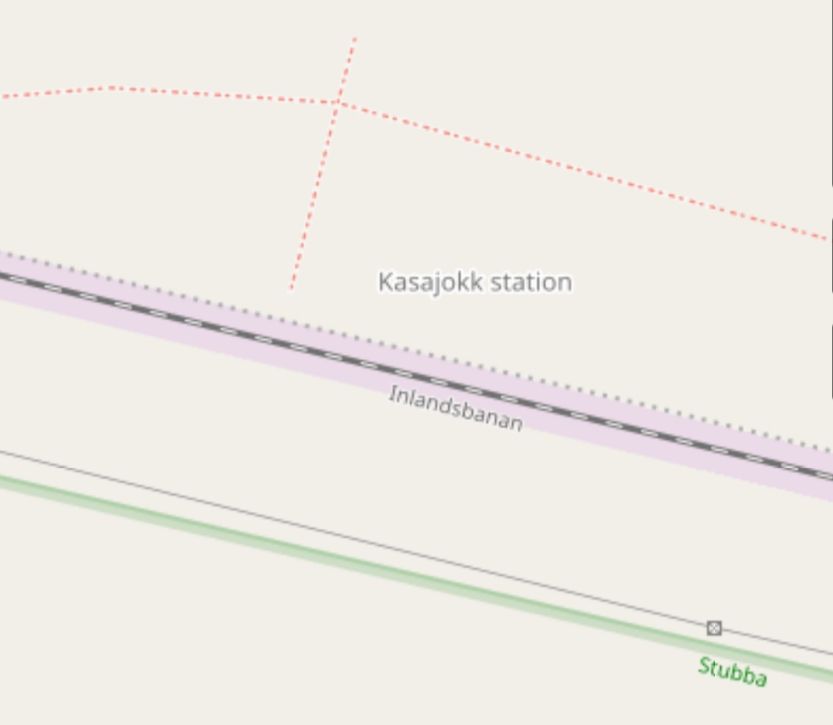
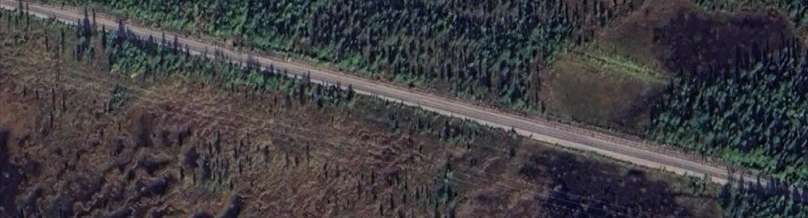
Kasajokk (Kasajakk) Station. [19]
There was a passing loop at this location. [Google Maps, April 2026]
The bridge over the Gassajahka River. [20]
The Gassajahka River bridge. [Google Maps, April 2026]
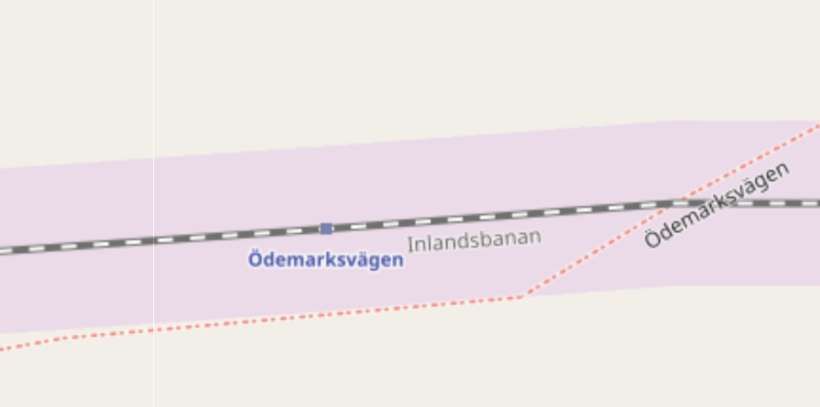
Ödemarksvagen forest road and railway station. [21]
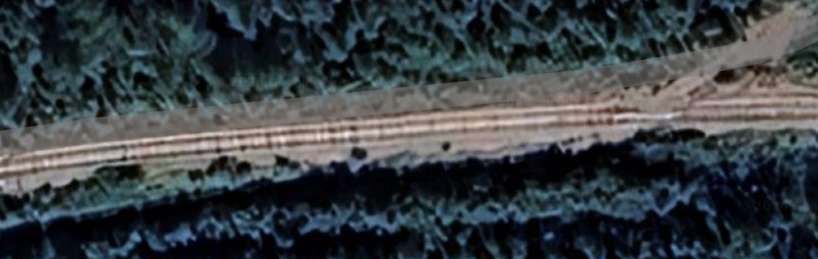
Ödemarksvagen Railway Station. [Google Maps, April 2026]
After passing through Ödemarksvagen, the line begins to turn to the Southwest, eventually passing through Avvakajjo station.
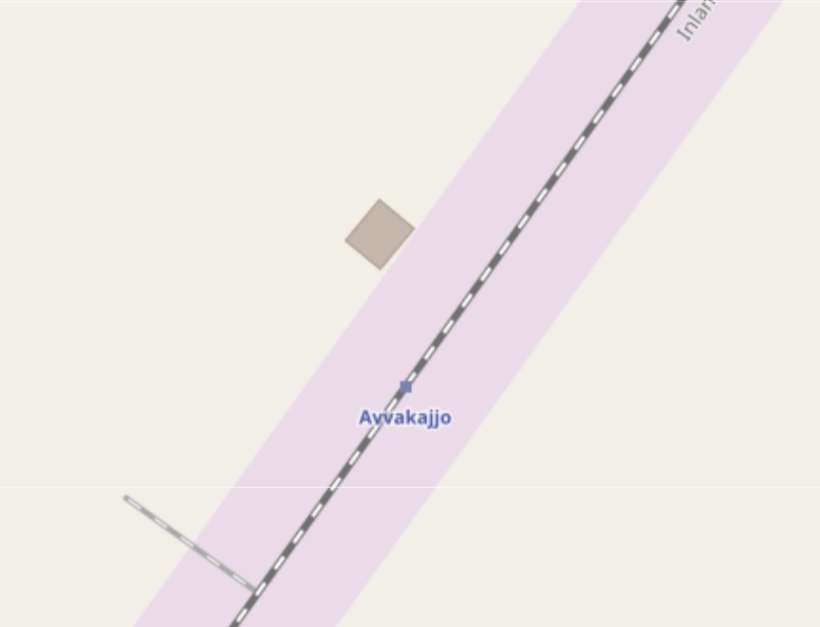
Avvakajjo Railway Station can be seen on OpenStreetMap. Bottom-left, there was once a track for storage of a track maintenance vehicle at this location. [22]
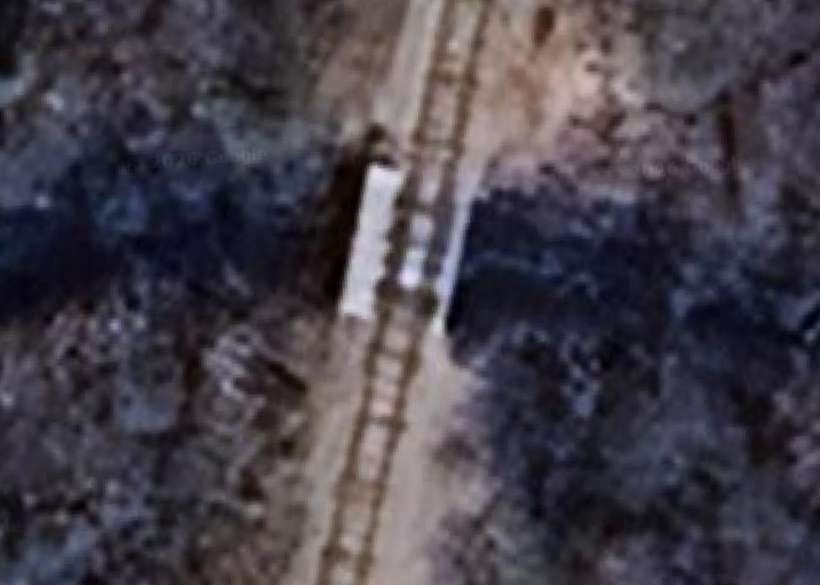
There is no easily identifiable location on Google Maps.
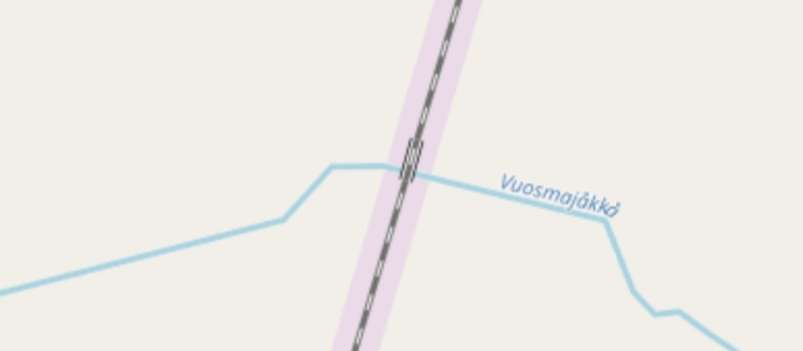
After Avvakajjo the line begins to turn to a South-southwest bearing and then bridges the Vuosmajákka River.
The bridge over the Vuosmajákka River. [Google Maps, April 2026][23]
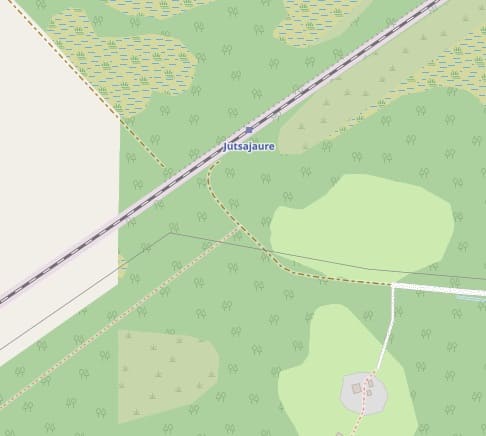
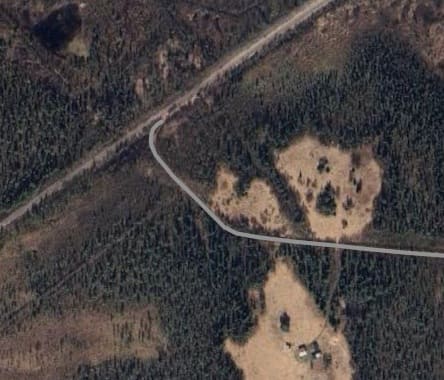
Jutsajaure Halt. [24][Google Maps, April 2026]
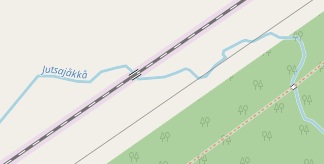
Jutsajakka River. [25][Google Maps, April 2026]
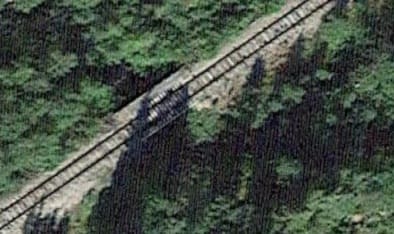
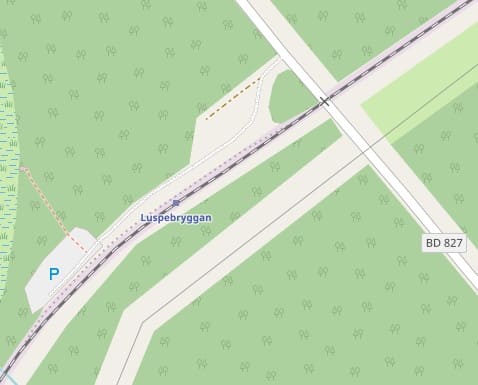
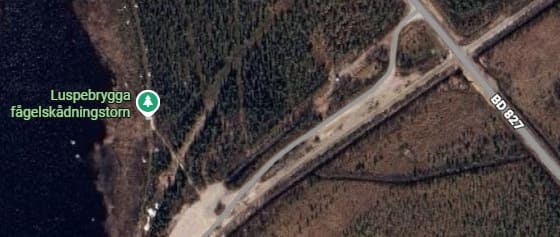
The line continues Southwest crossing the BD827 road and entering Luspebryggan Halt. [26][Google Maps, April 2026]
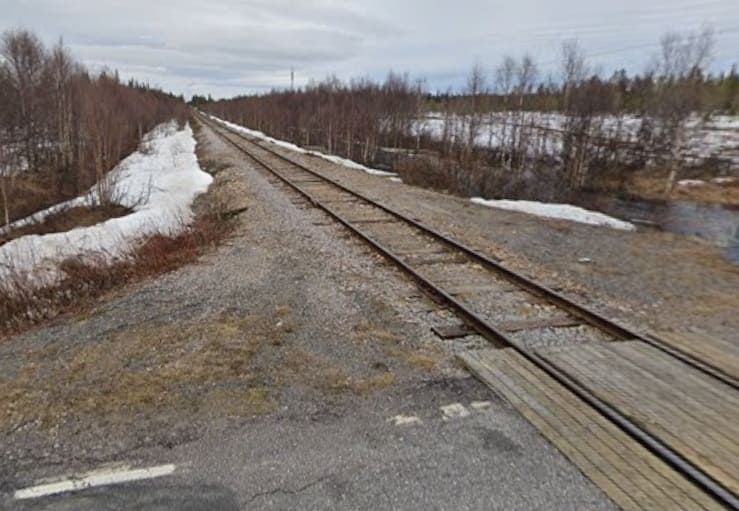
Looking Northwest along the Inlandsbanen from the BD 827. [Google Streetview, May 2024]Looking Southeast along the Inlandsbanen from the BD 827. The halt of Luspebryggan is just ahead. [Google Streetview, May 2024]
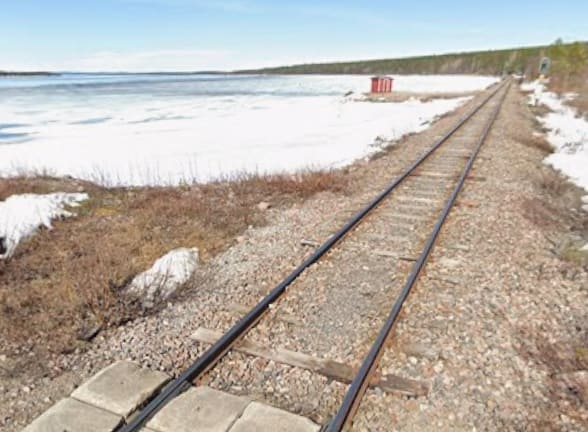
Beyond Luspebryggan, the line turn towards the South, running along the lakeshore (Store Lulwvatten) to Porjus.
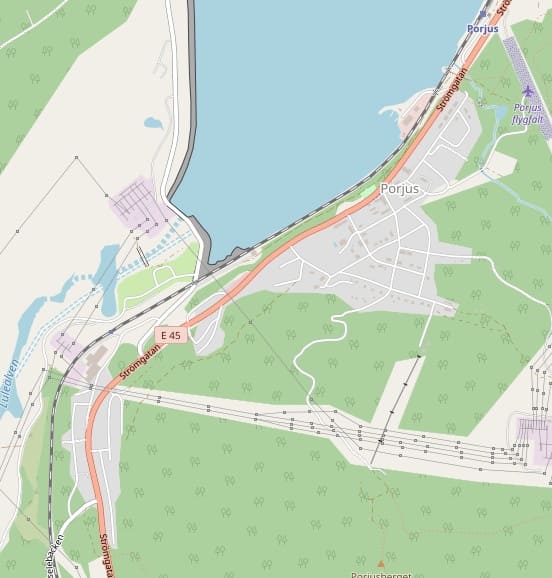
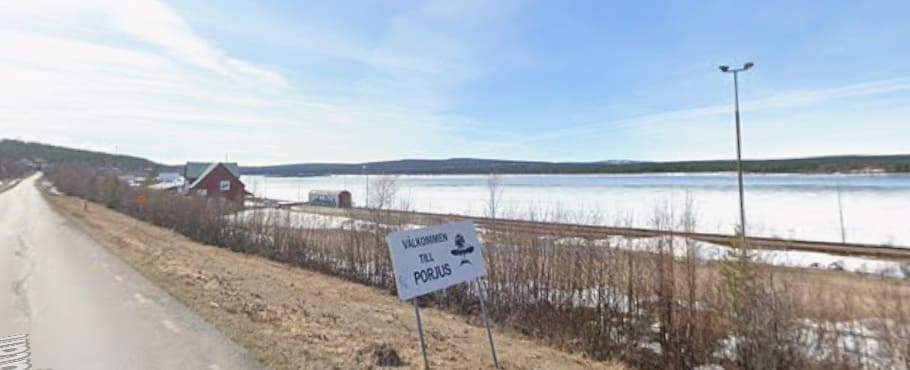
The small town of Porjus. [27]
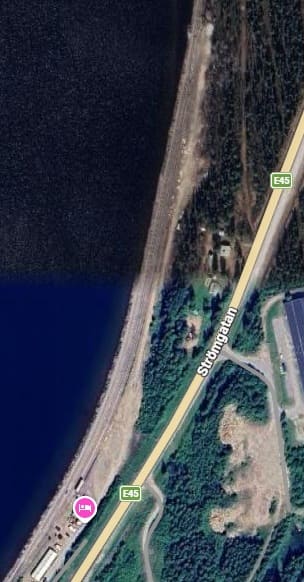
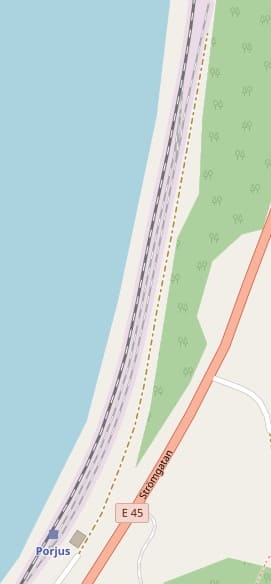
Porjus Railway Station. [Google Maps, April 2026] [27]
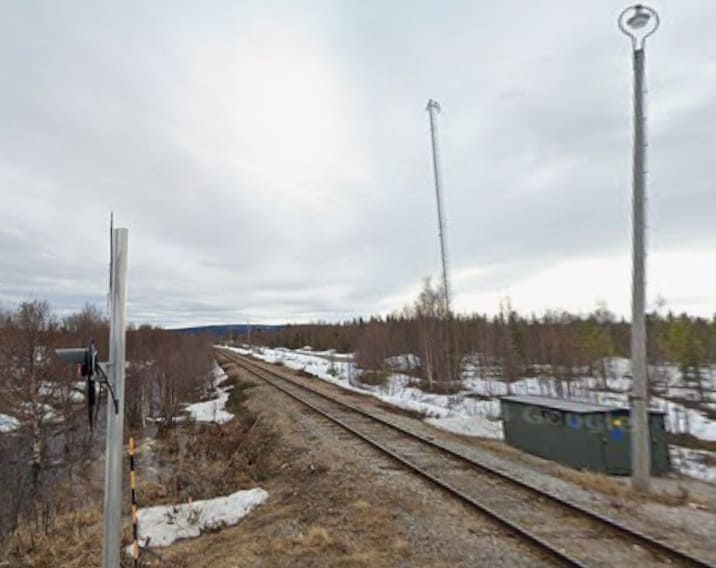
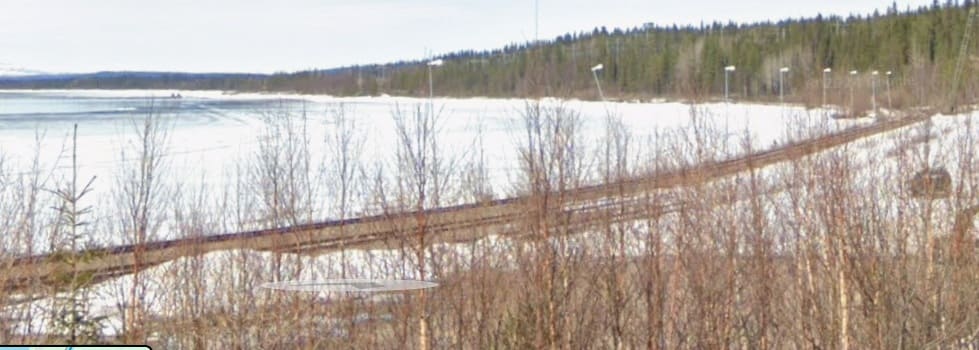
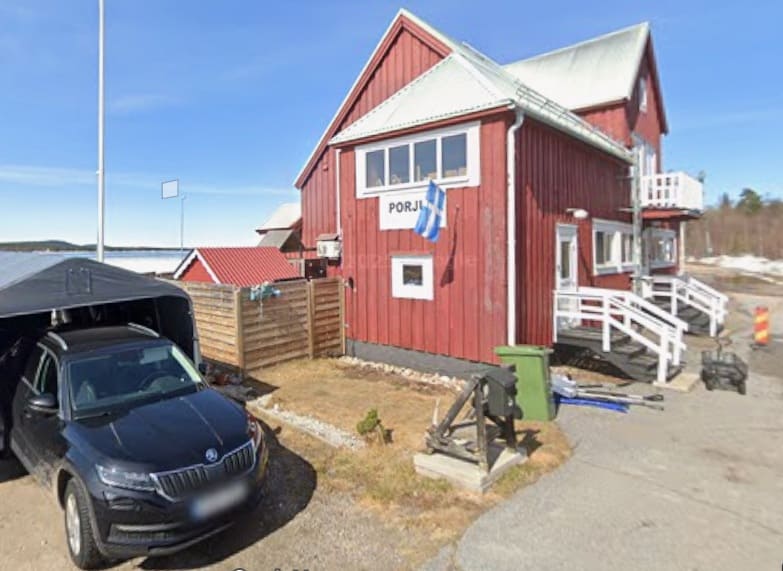
Porjus Railway Station, seen from the Northeast. This photograph was taken on the E45 approaching Porjus. [Google Streetview, May 2024]Looking North along the lakeside, with the railway curving round to the North as it sets off for Gällivare. [Google Streetview, May 2024]Porjus Railway Station building which is also a B&B, offering opportunities for glamping! [Google Streetview, May 2024]
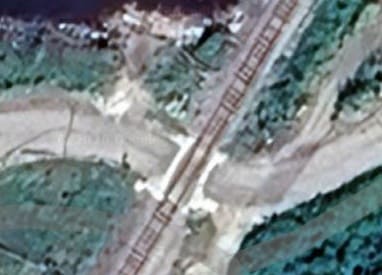
A short distance further along the line it is crossed by a short access road from the E45 to the lakeshore. [Google Maps, April 2026]
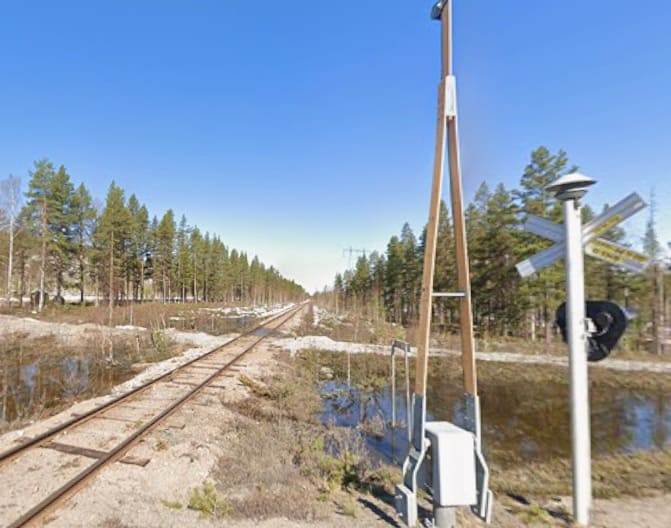
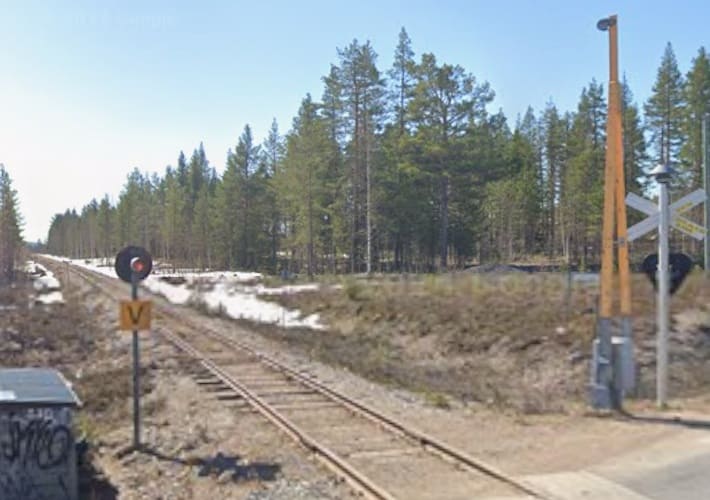
Looking Northwest along the lakeshore towards Porjus Station from that level-crossing to the lake shore. [Google Streetview, May 2026]Looking Southwest along the line. [Google Streetview, May 2024]
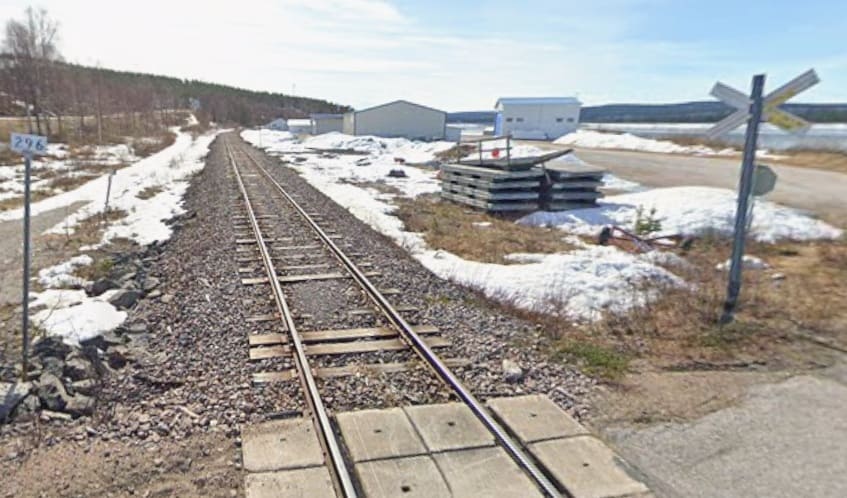
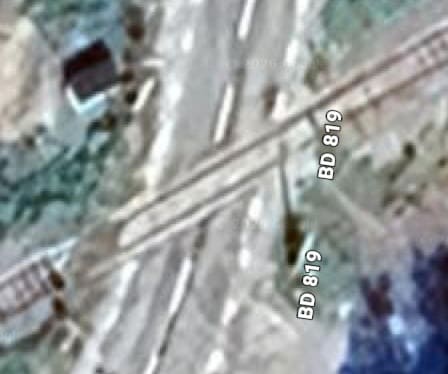
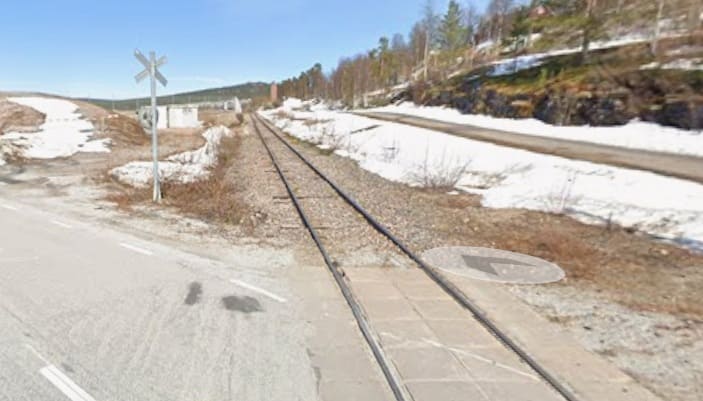
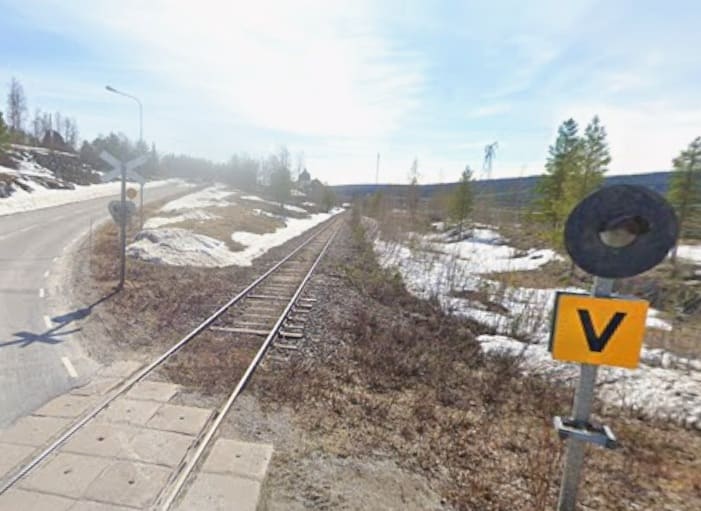
A short distance along the line a little further than the point where the line leaves the lakeside it is crossed by the BD819. [Google Maps, April 2026]
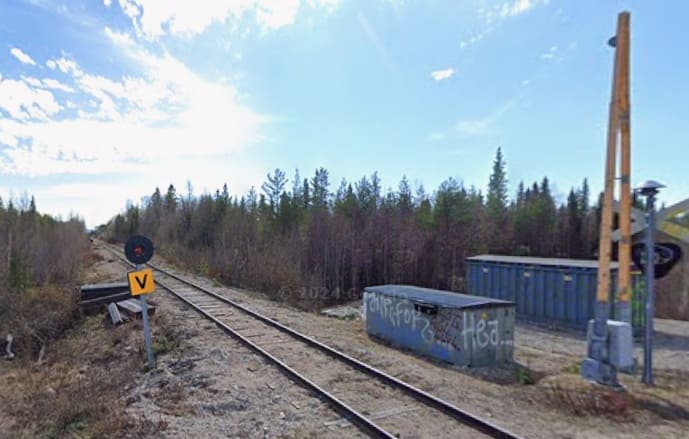
Looking back towards Porjus from the level-crossing on the BD819. [Google Streetview, May 2024]Turning through 180°, this is the view Southwest along the line. [Google Streetview, May 2024]
Porjus is the site of a significant hydroelectric power station which was built below ground in the early 1900s, the purpose was to provide electricity for the Malmbanan Railway, which was used to transport iron ore. The new hydroelectric power plant and electrification contributed to a strong growth in Sweden’s mining industry. [45]
“Construction of the Porjus power plant began in 1910. In 1915, Gustaf V inaugurated the Porjus power plant by telephone, as his advisors did not consider it safe to make such a long journey in the middle of the war. Porjus quickly became a hub in an industrial Sweden that was consuming increasingly more energy. When the power plant was inaugurated, there were already 20 hydroelectric power plants around the country, but Porjus received a lot of attention because of its geographical location and because the construction technology was very advanced for its time.” [45]
“The power plant is located underground, blasted into the rock. The number of turbines in the old power plant increased between 1920 and 1960 to nine units. The turbines are still operational but are not used in normal operation. Two of the old units have been converted into research units and are used to test new technology and equipment.” [45]
“A new power plant with two new units was built in 1971–1975. All new transformers were built underground, and therefore no new building was needed. … The old dam has been replaced by a rockfill dam with a dense core of moraine. It has been built immediately downstream of the old dam, and has two new spillways that are closed by segmental gates.” [45]
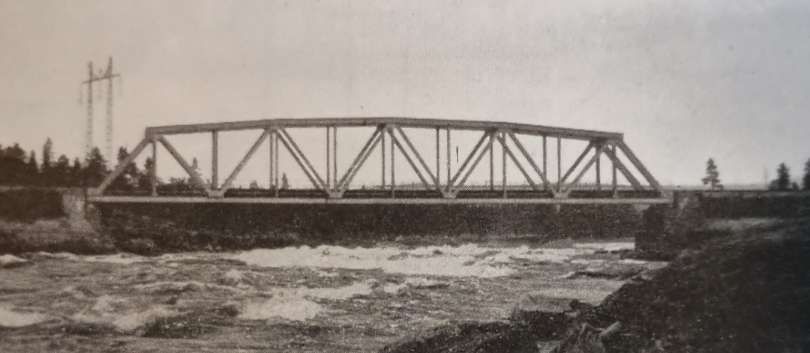
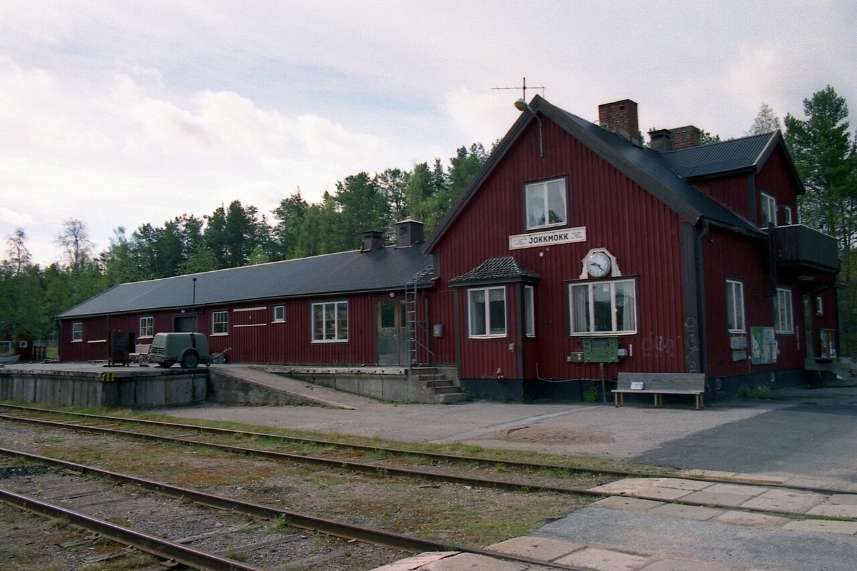
Greville and Vallance comment that “A run of some thirty miles through mountainous and well-wooded country brings the train to the girder bridge over the rapid Lilla Lule Alv (Little Lale River) and to Jokkmokk (800 ft. above sea level), formerly a Lapp village and market centre, but now a thriving modern town.” [1: p829]
We continue our journey South from Porjus.
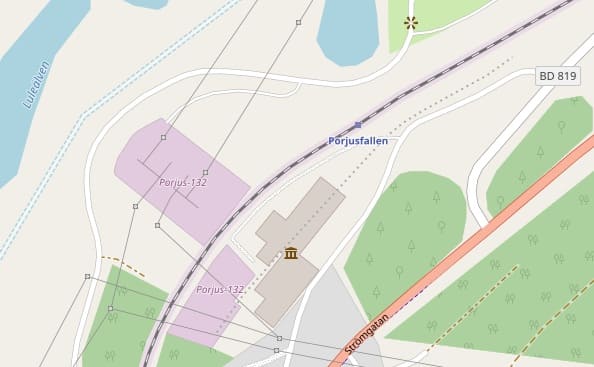
Just beyond the level-crossing at the BD819 there was another Halt – Porjusfallen Halt, after which the line curved round to the South. [27]
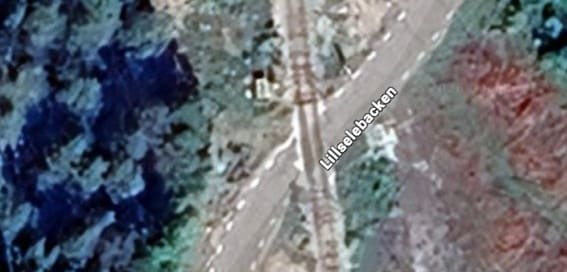
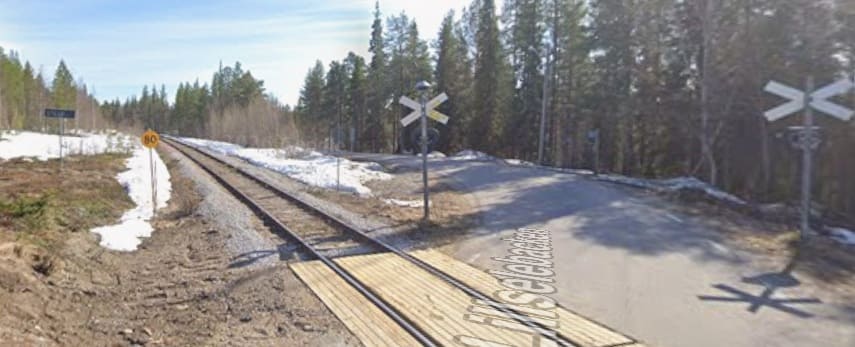
A further level-crossing took the railway over Lillselebacken, the BD826 road. [Google Maps, April 2026]
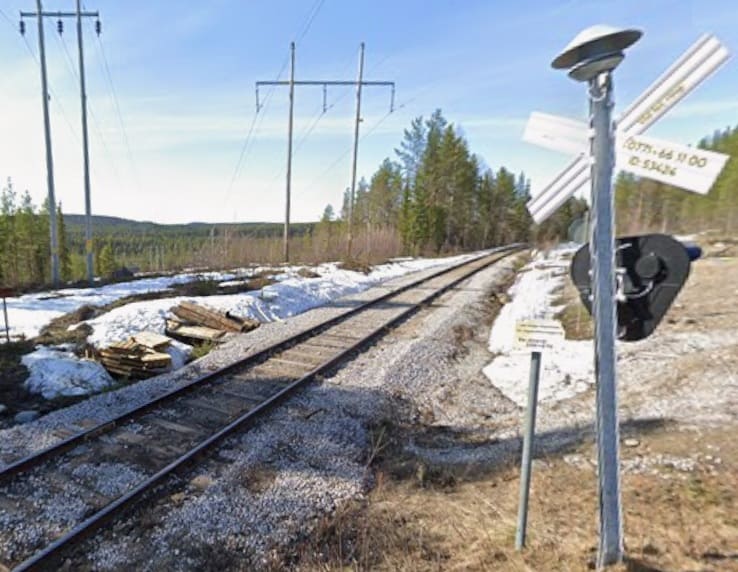
Looking back North towards Porjus from the level-crossing on Lillselebacken, the BD826 road. [Google Streetview, May 2024]Looking South at the same location. [Google Streetview, May 2024]
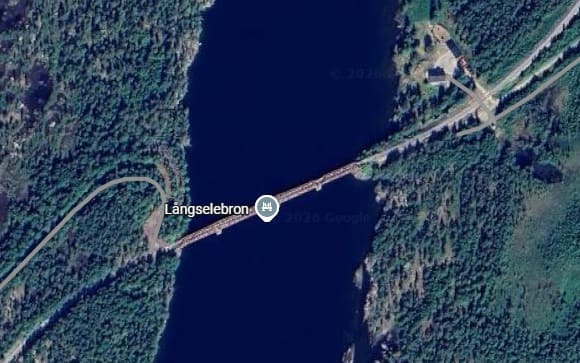
Beyond Porjus the Inlandsbanan followed the banks of the Lulealven River/Lake in a southeasterly direction, for about 3 miles before turning West to bridge the river.
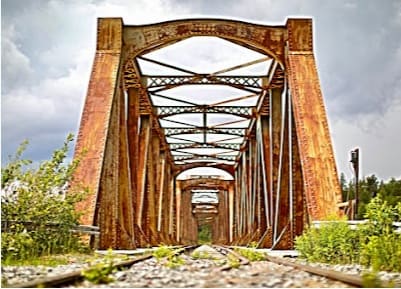
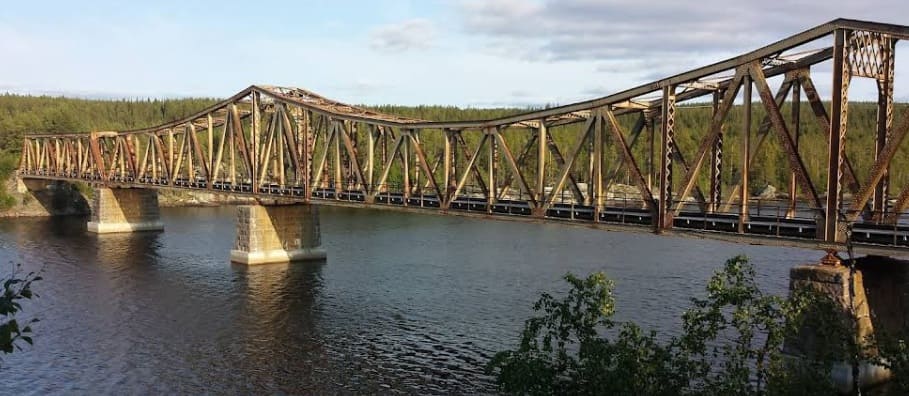
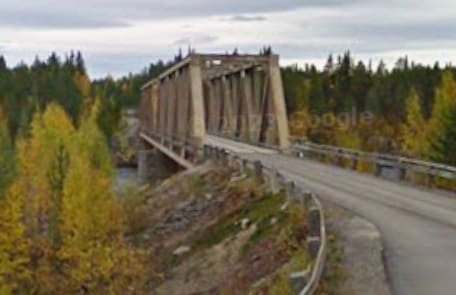
The bridge over the Lulealven River – named ‘Långselebron’. [Google Maps, April 2026]
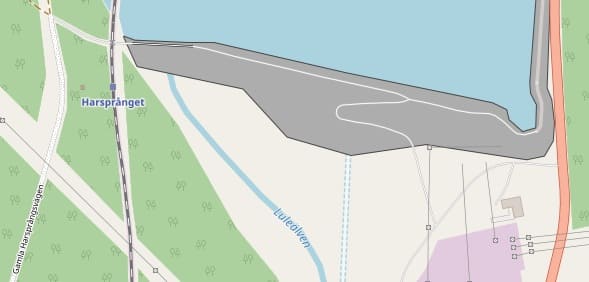
Beyond the bridge, the line turns South and runs along the West bank of the river/lake. The next Halt is at Harspranget adjacent to the dam.
Harsprånget (the Hare’s Leap), was formerly one of the finest falls in Sweden, but by 1958, the water had been diverted to a new power station. [1: p829]
Harspranget Halt sat at the West end of the reservoir. dam. The E45 ran alongside the lake/river on the opposite bank. Google records the body of water held by the dam as ‘Harsprangsselet’. [28]
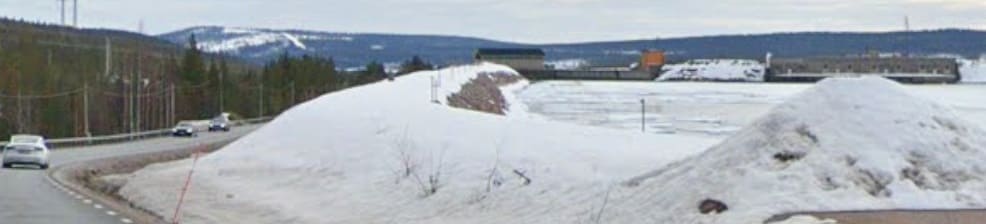
This view looks South from the E45 at a point about 1 km North of the dam. The road drops to the level of the foot of the dam over the that 1 km. [Google Streetview, May 2024]
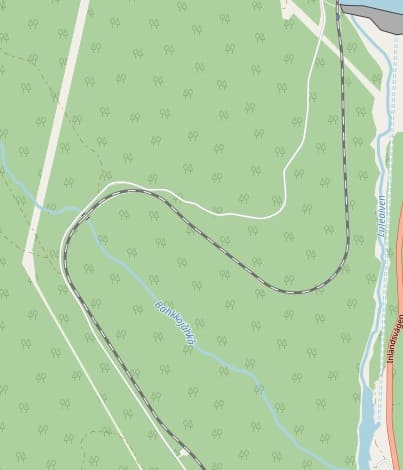
The railway follows the West, bank of the river for another kilometre or so before turning relatively sharply to the Northwest to follow the contours round the valley of the Bahkkojahka River. [28]
The line follows the West bank of the Lulealven River which is dammed once again a little further down stream. The E45 crosses the river at this point running at the top of the dam, before bridging the railway. [29]
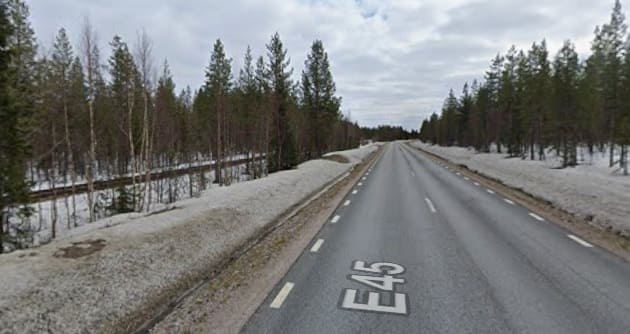
Looking Northwest along the Inlandsbanan towards Porjus. [Google Streetview, May 2024]Looking Southeast along the railway from the level-crossing on the E45 (the same level-crossing). [Google Streetview, May 2024]Travelling South the railway and the E45 run parallel to each other in close proximity. [Google Streetview, May 2024]
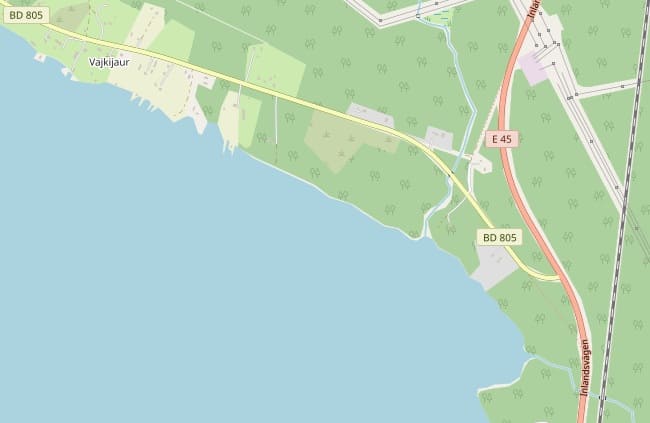
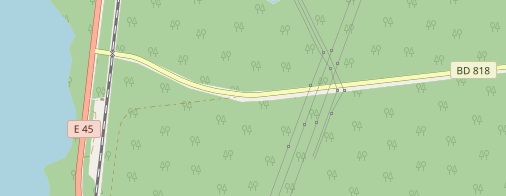
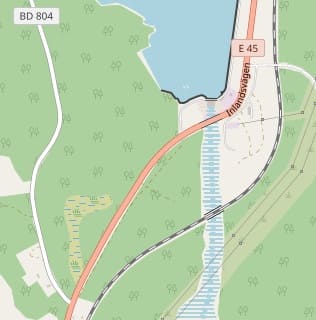
Road and rail pass close to Vajkigaur and just a short distance further South the line crosses the BD 818 close to its junction with the E45. [30]
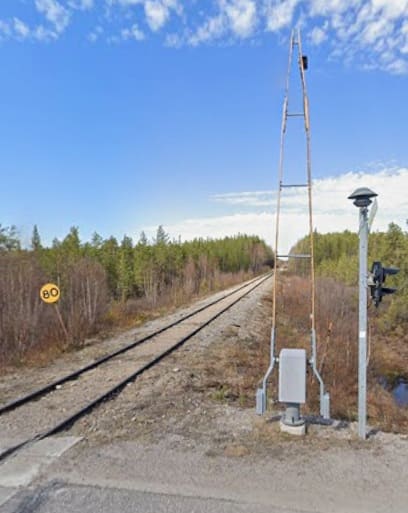
Looking North along the Inlandsbanan from its level-crossing with the BD 818. [Google Streetview, May 2024]
Looking South along the Inlandsbanan from the same level- crossing. [Google Streetview, May 2024]
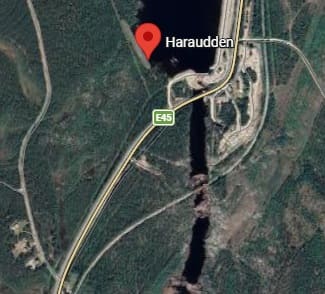
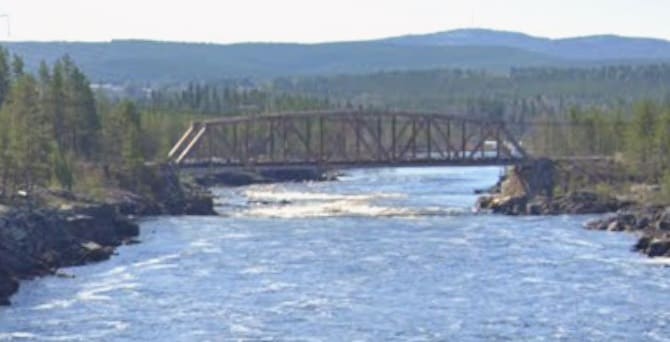
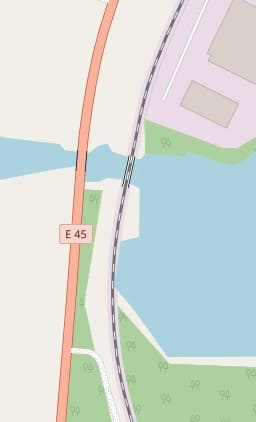
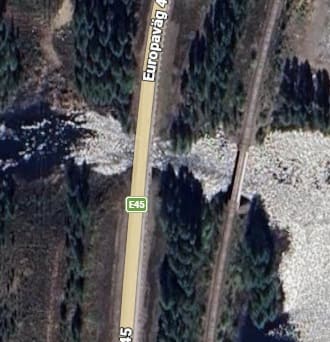
A short distance further South at Haraudden both road and rail cross the Lulealven River to the South of another dam. [31][Google Maps, April 2026]
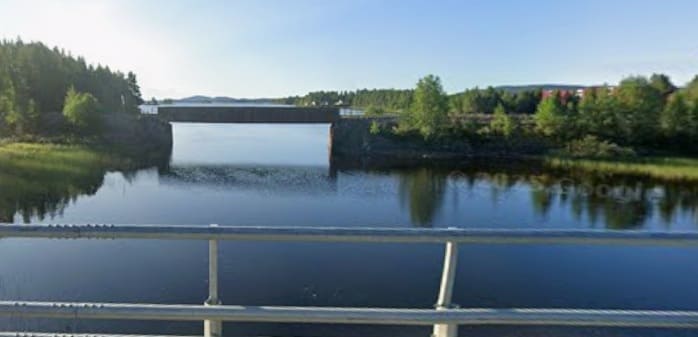
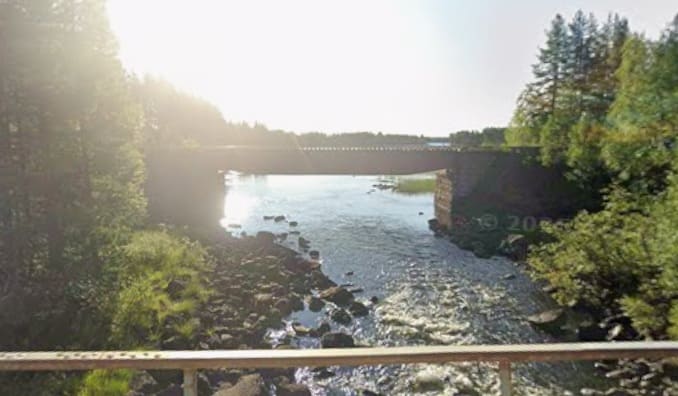
The view of the rail bridge over the Lulealven River from the bridge carrying the E45 across the river at the base of the dam which is visible in the images above. [Google Streetview, May 2024]
Greville and Vallance tell us that “A granite pillar at the station commemorates the opening of the inland line in 1937 by the Crown Prince of Sweden (now King Gustaf VI Adolf) The inscription includes a facsimile of the Crown Prince’s signature.” [1: p829]
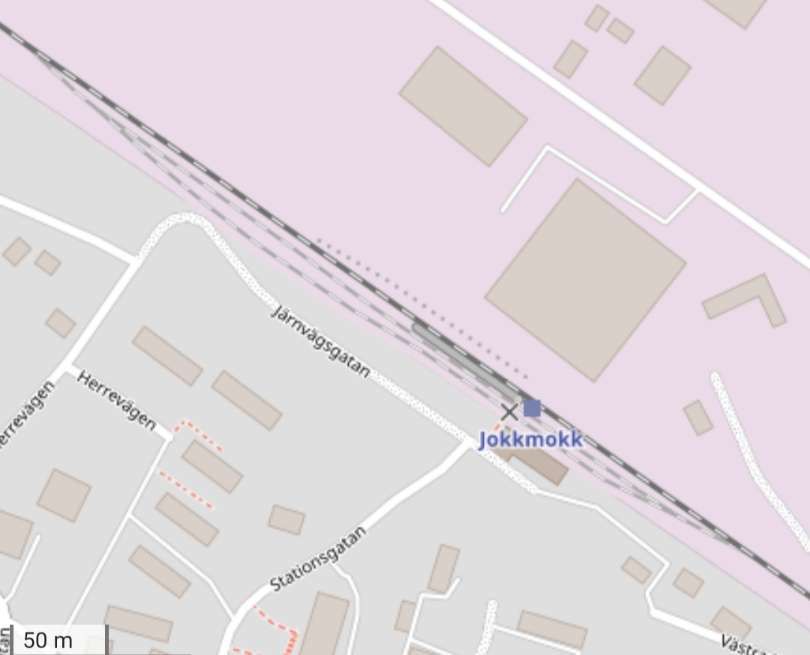
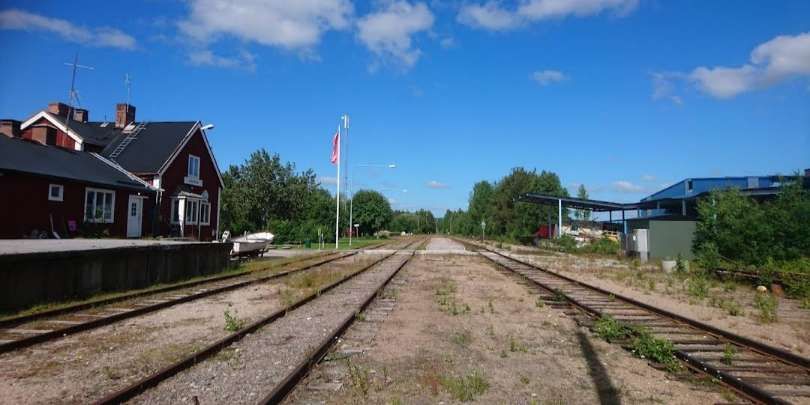
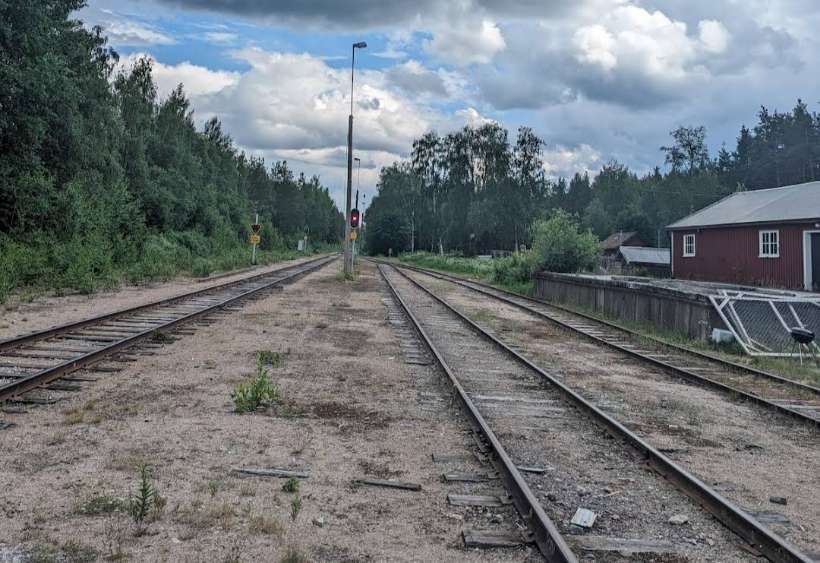
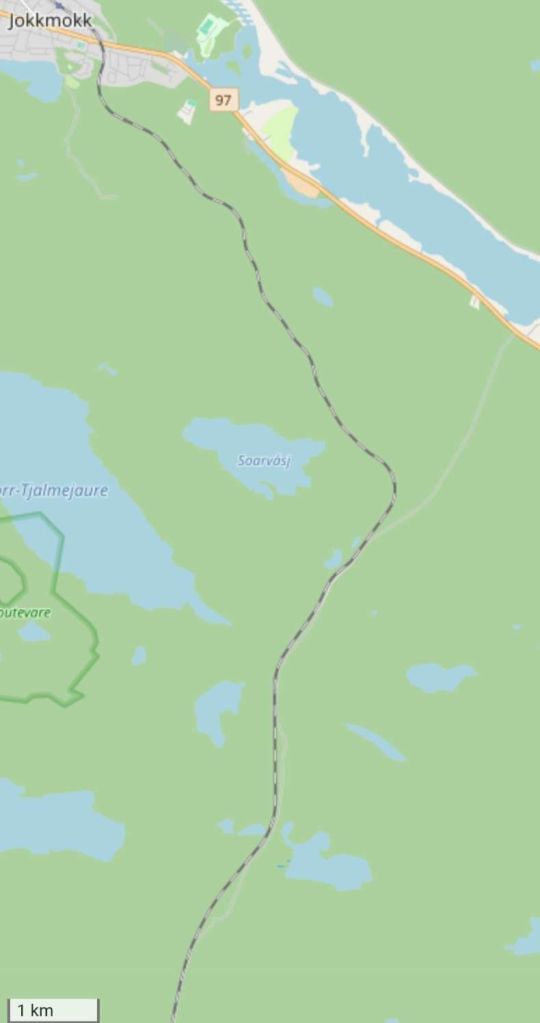
The level-crossing at Kyrkogaten. [Google Maps, April 2026]Looking back towards Jokkmokk Station from the level-crossing at Kyrkogaten. [Google Streetview, May 2024]Looking Southeast from the level-crossing at Kyrkogaten. [Google Streetview, May 2024]The Line to the South of Jokkmokk. [36]
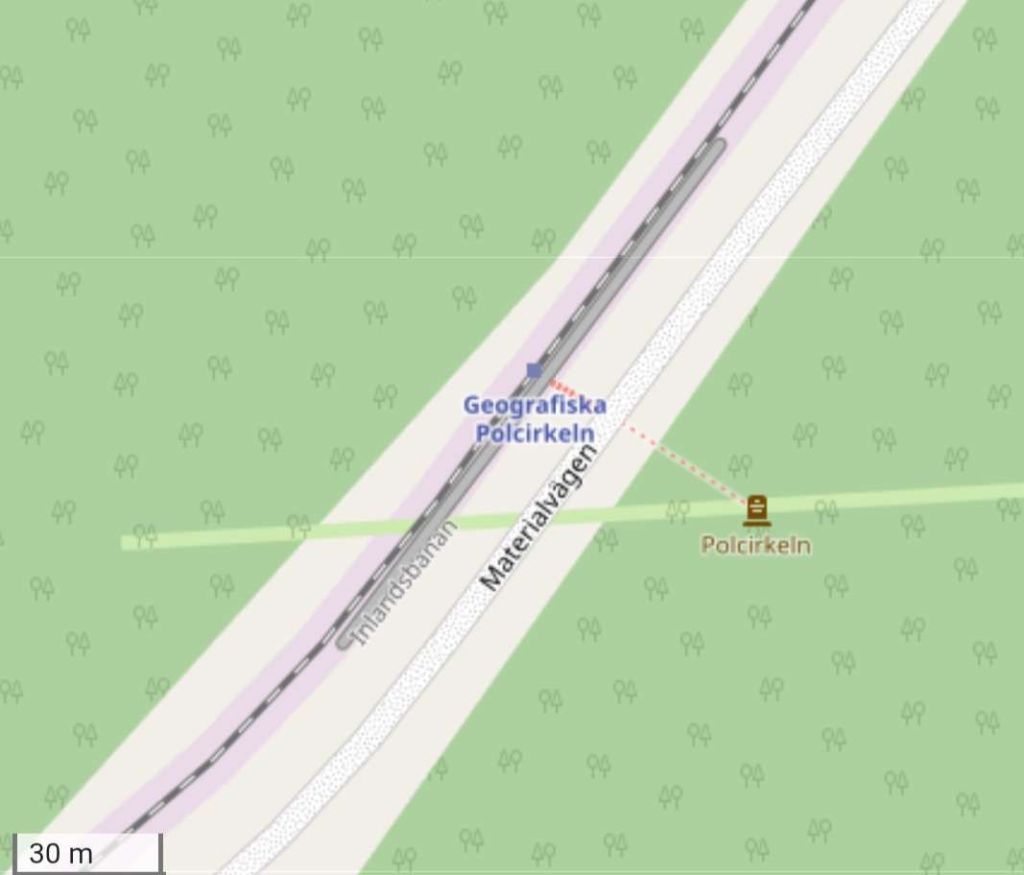
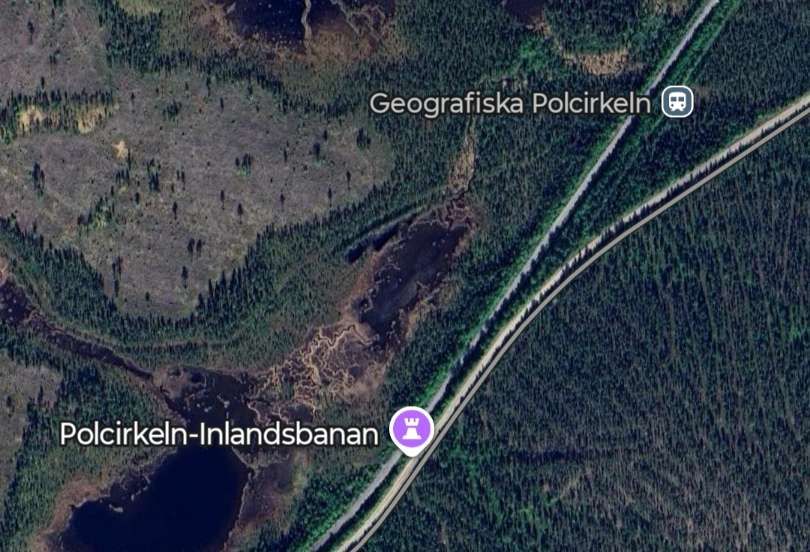
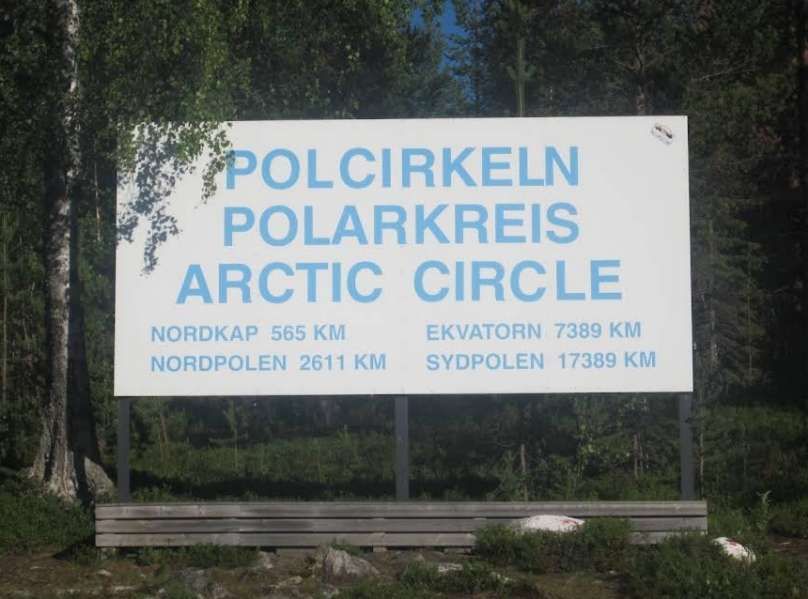
“Some three miles south of Jokkmokk, the train crosses the Arctic Circle, marked by white boards and stones, and heralded by a long blast on the whistle.” [1: p829]
An Inlandsbanan train stopped at the Arctic Circle, (c) Chihiro Tanaka, 2016. [Google Maps, April 2026]
An Inlandsbanan train heading for Gällivare, sitting at the Arctic Circle Station, (c) Martin Divis, 2010. [Google Maps, April 2026]The next length of the line brings it back close to the E45. [38]
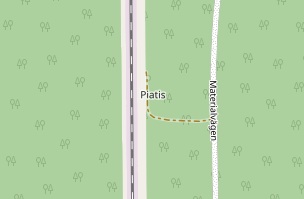
There is a Halt at Piatis which is accessed by a short path from the maintenance road which runs alongside the railway. [38]
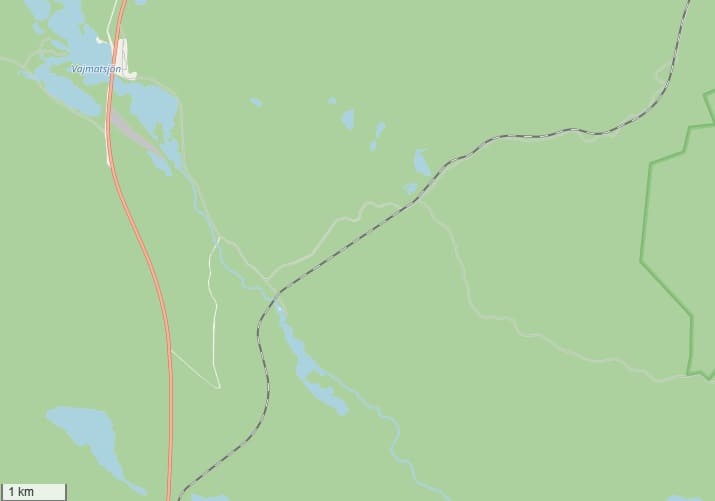
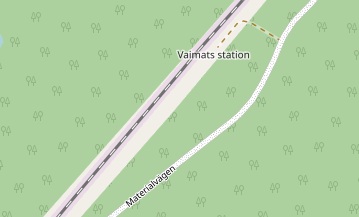
There is a further halt shown on the OpenStreetMap at Vaimats. [38]
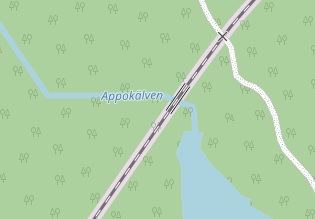
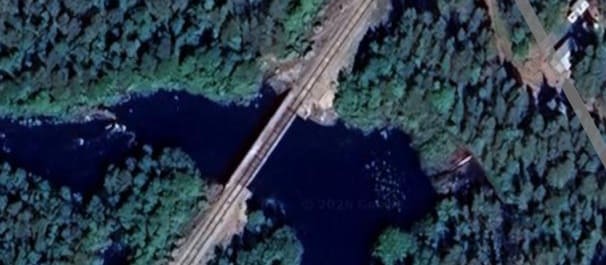
The line bridges the Appokalven River. [38][Google Maps, April 2026]
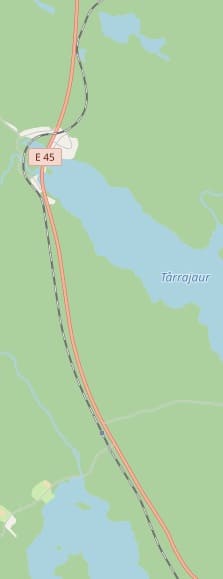
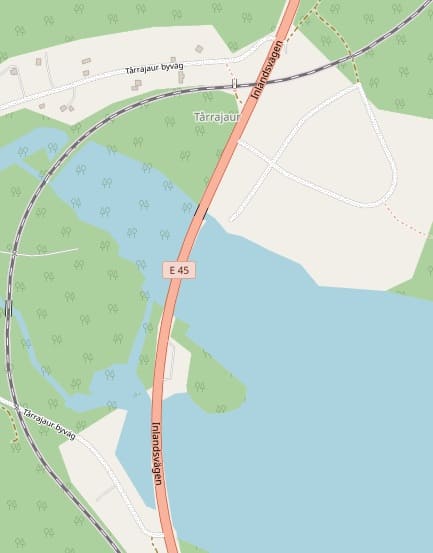
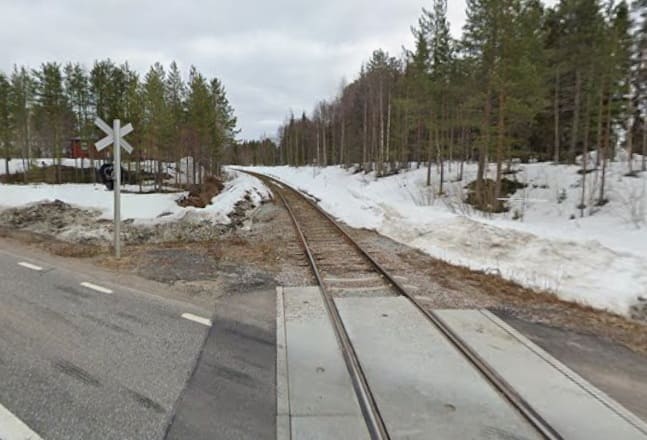
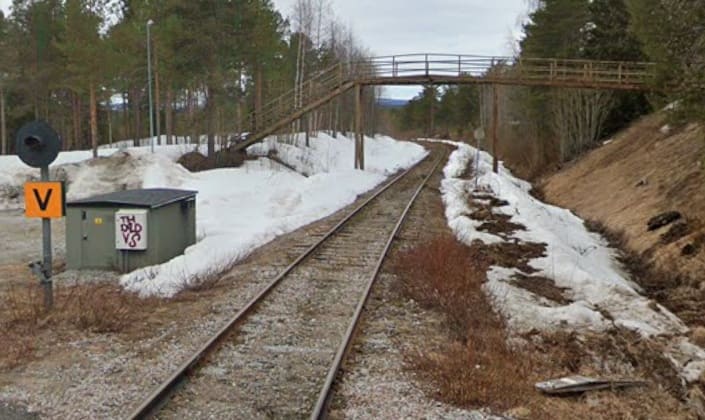
The next length of the line follows the same route as the E45 road (Klockarvägen). it crosses the road at Tarrajaur a small settlement at the head of a lake which bears the same name. [39]
A closer view of Tarrajaur. [39]Looking back towards Jokkmokk. [Google Streetview, May 2024]Looking ahead along the line. The railway is bridged by a footbridge close to the road before it turns away to the South. [Google Streetview, May 2024]
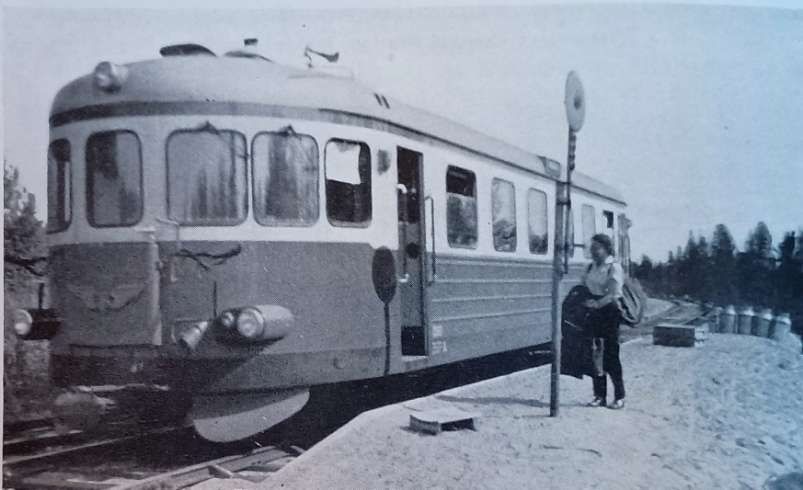
A diesel railcar at Tarrajaur. This was a conditional stop where the disc signal was used to indicate that passengers were waiting to be picked up, (c) H. A. Vallance, 1958. [1: p832]
The line then runs Southeast alongside the E45 road on the West side of the road.
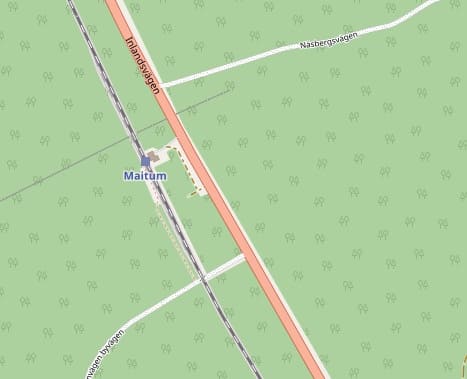
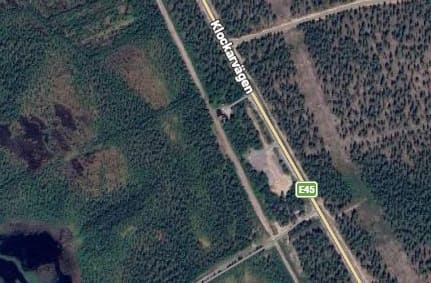
The next Halt is named Maitum. [39]
The building at the centre of this satellite image is at Maitum Halt. [Google Maps, April 2026]
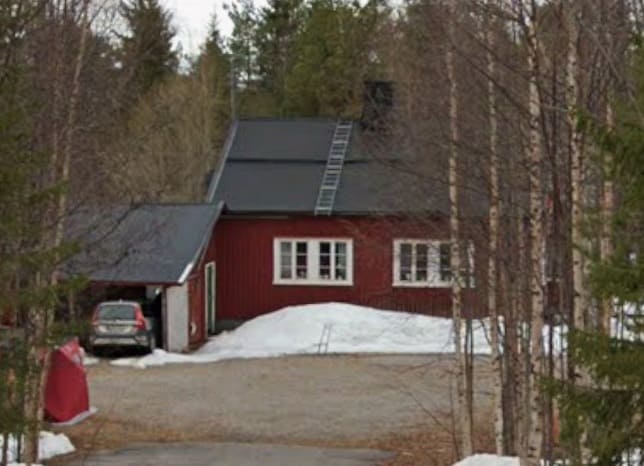
The building which appears at the centre of the map and satellite image above, seen from the E45. [Google Streetview, May 2024]
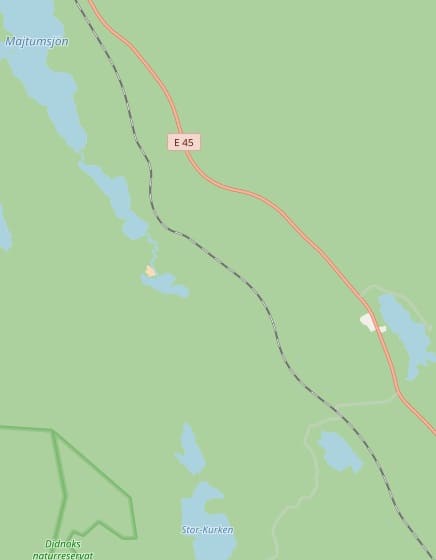
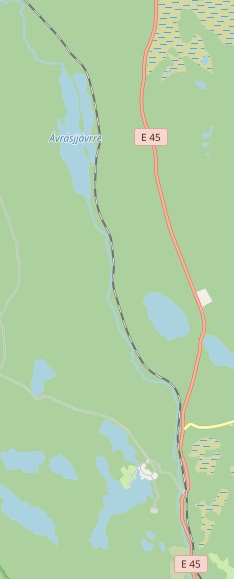
The line continues running Southeast. [40]
And again, the line continues running Southeast. [41]
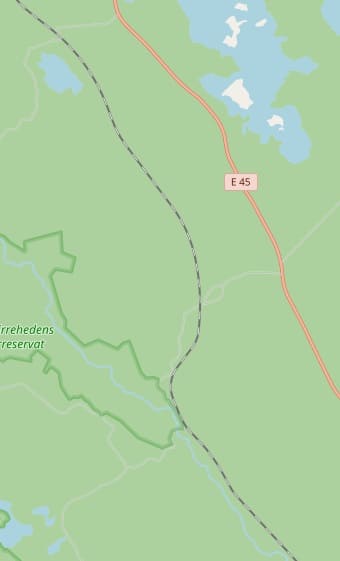
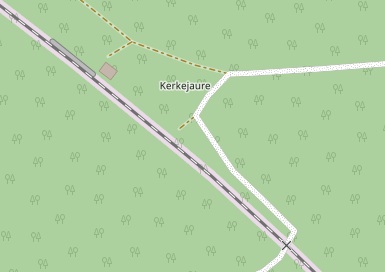
Kerkejaure Halt sits to the North of Lill Kurken, the small lake at the top right of the image. A much closer view shows both a platform and building
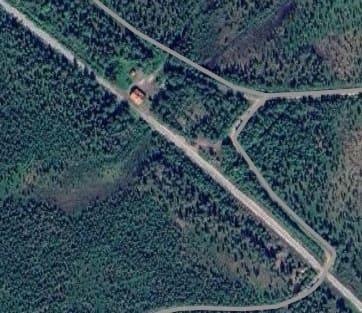
This much closer view shows both a platform, a building and a road crossing at Kerkejaure. [41]Kerkejaure on satellite imagery. [Google Maps, April 2026]
When the line next runs alongside the E45, it has turned closer to the South. [42]
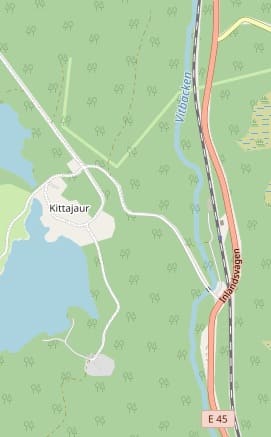
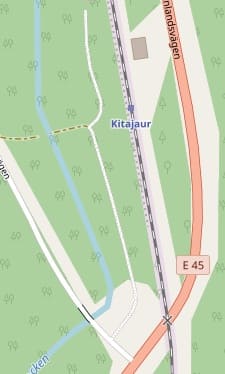
Kittajaur is a small settlement with its own station. [42]
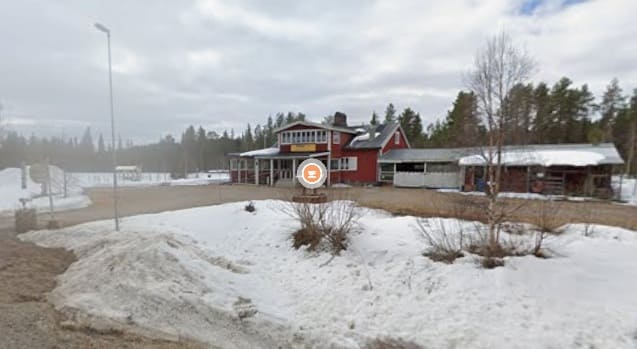
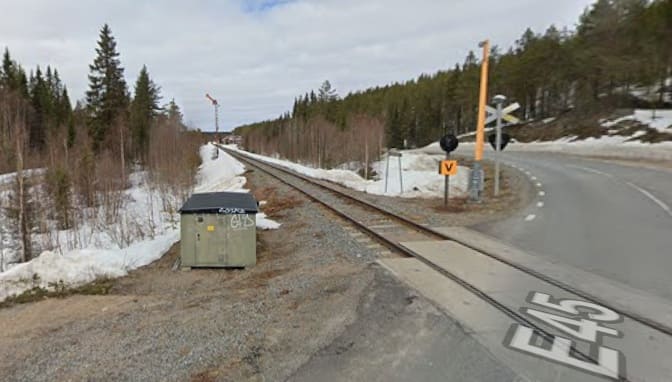
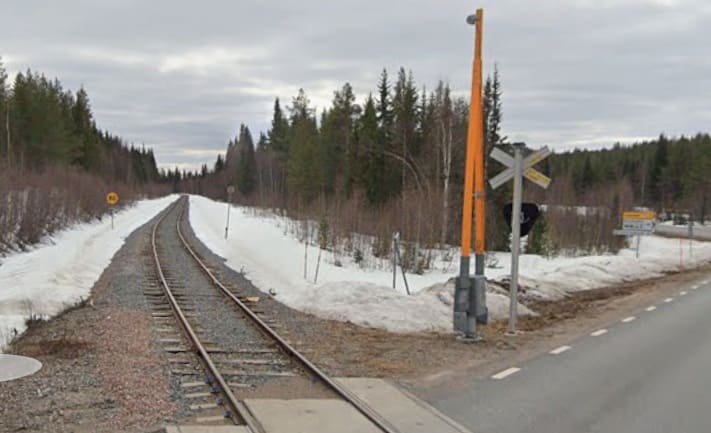
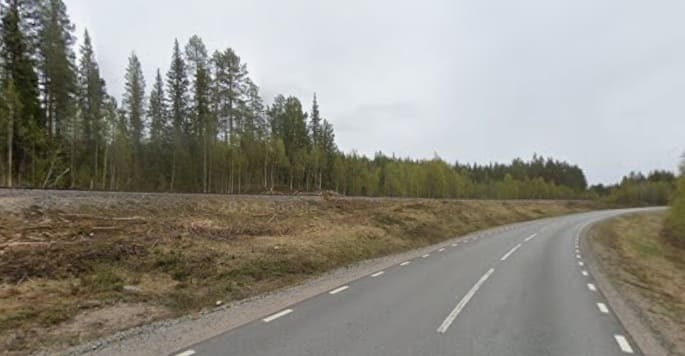
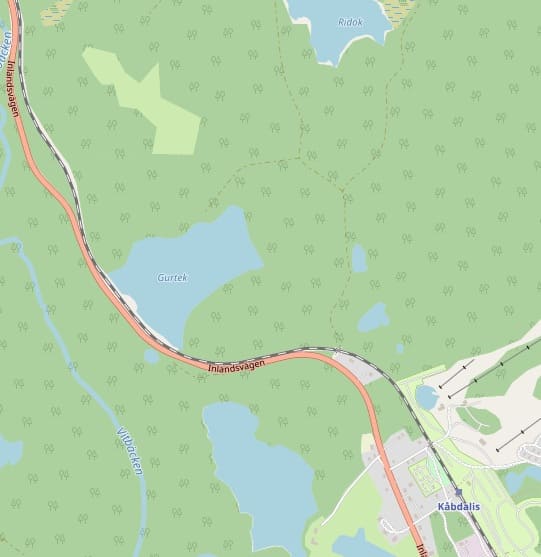
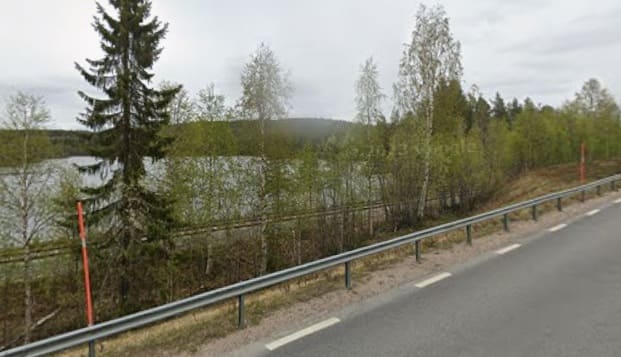
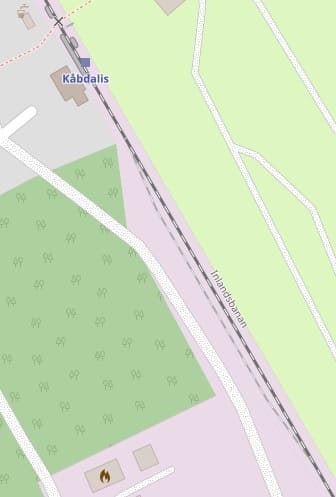
The Polar Station at Kittajaur. The line runs on the far side of the building and the railway platform is to the left of the building. [Google Streetview, May 2024]Looking back North towards the station from the E45 level-crossing. [Google Streetview, May 2026]Looking South from the same road crossing. [Google Streetview, May 2024]Continuing South, the road and the railway are at times seen close together. This is a typical location looking Southeast from the E45, the railway can be seen close by but at a higher level. [Google Streetview, May 2023]This next length of the line takes us as far as Kabdalis. [43]The line is seen here alongside the E45 with lake Gurtek beyond. The photograph looks East from the road.[Google Streetview, May 2023]
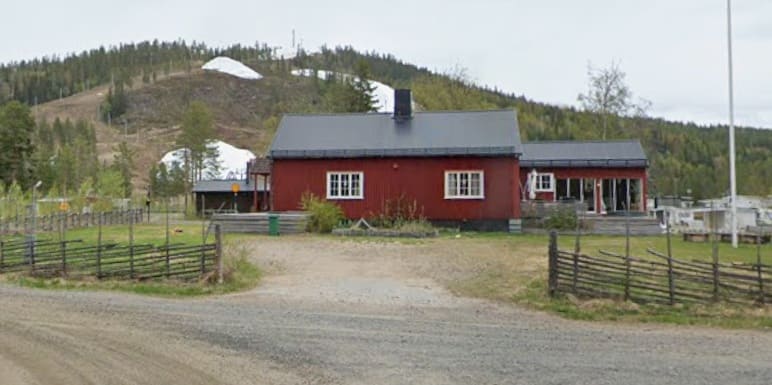
On the approach to Kabdalis, the line crosses an access road to an electrical substation/industrial site. [Google Maps, April 2026]
Looking Northwest from the level-crossing. [Google Streetbview, May 2023]Looking Southeast from the same level-crossing towards the station at Kabdalis. [Google Streetview, May 2023]
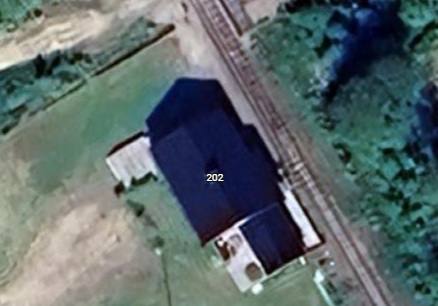
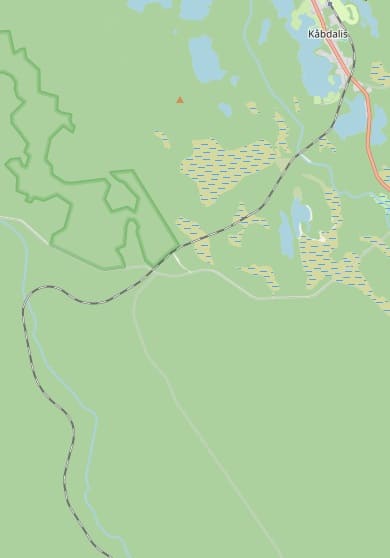
Kabdalis Railway Station: a passing loop is provided to the Southeast of the station platform. [43]
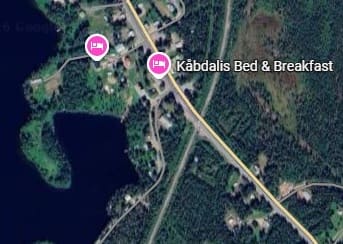
Kabdalis Railway Station seen from the approach road. The platform is beyond the building and extends to the left of it as well. [Google Streetview, May 2023]Kabdalis Railway Station. [Google Maps, April 2026]
The line to the South of Kabdalis. [44]
The railway crosses the E45 again just to the South of Kabdalis. [Google Maps, April 2026]
Looking back North from the level-crossing on the E45 towards Kabdalis Railway Station. [Google Streetview, May 2023]Looking South from the level-crossing on the E45 towards Kabdalis R. [Google Streetview, May 2023]
After the road crossing the road and railway take significantly different paths South. …
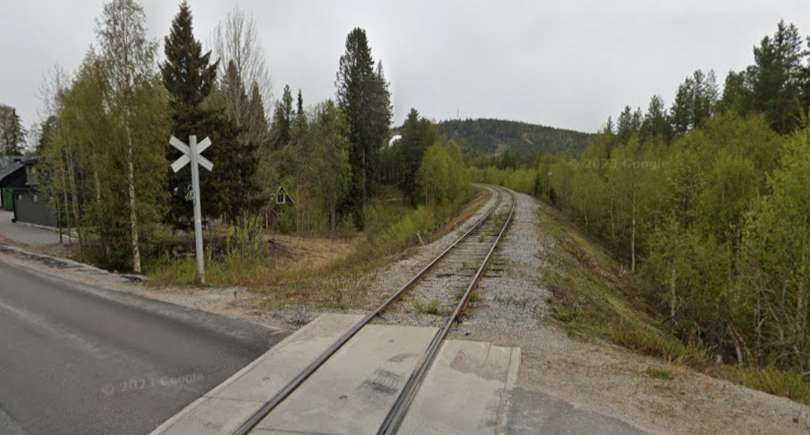
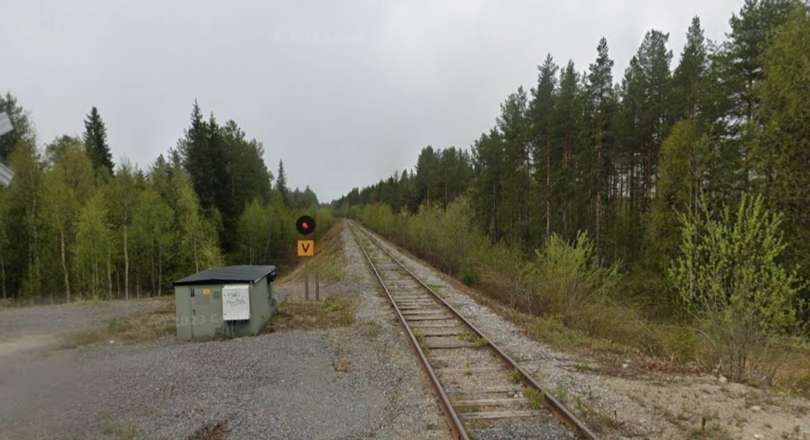
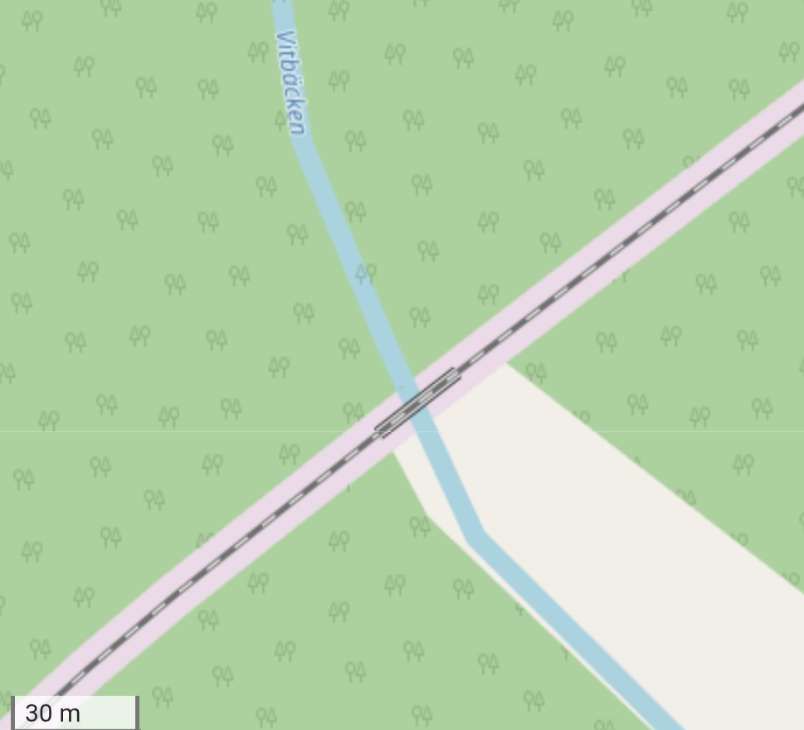
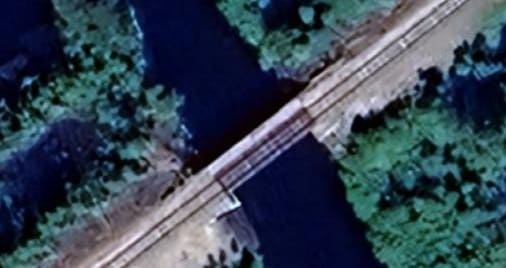
A few hundred meters along the line after passing Lake Satermjaure, the line bridges the Vitbacken River. [44][Google Maps, April 2026]
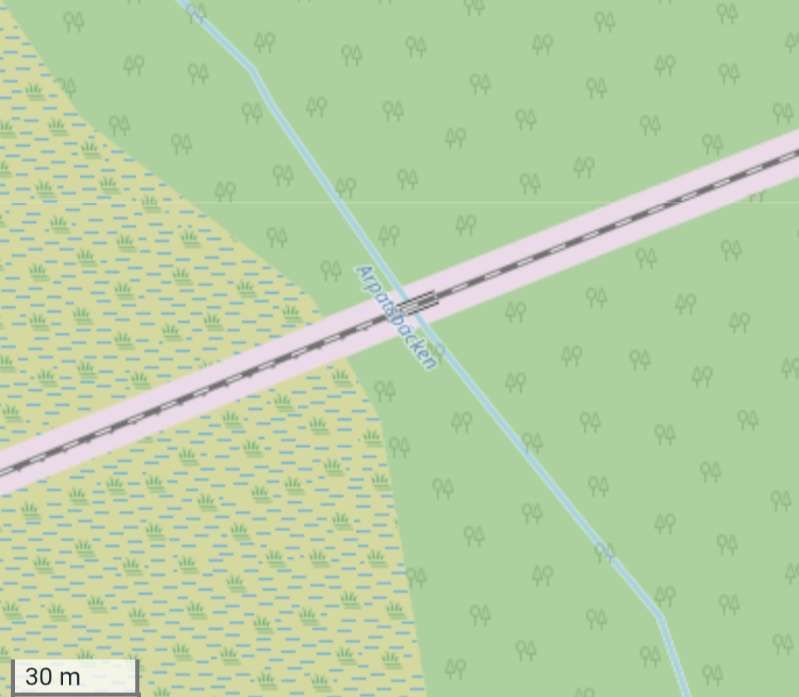
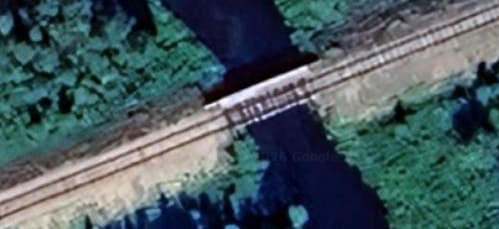
After crossing a forest track and a few kilometres along the line, it bridges the Arpatsbacken River. [44][Google Maps, April 2026]
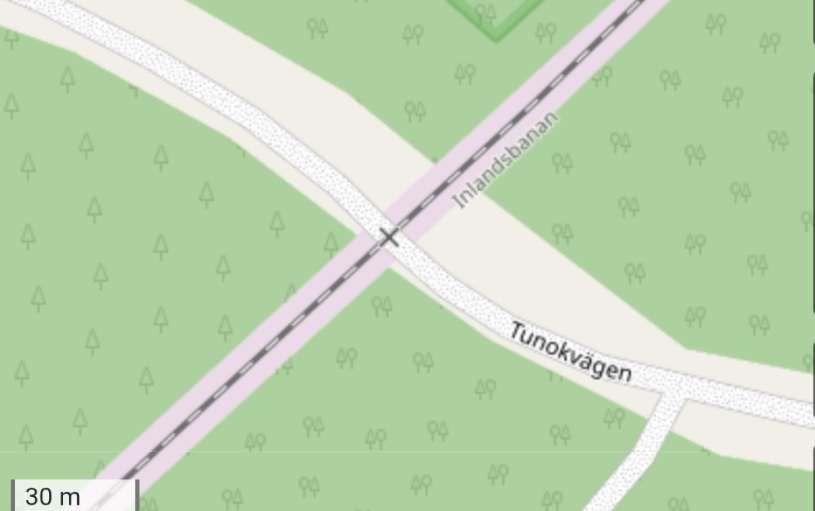
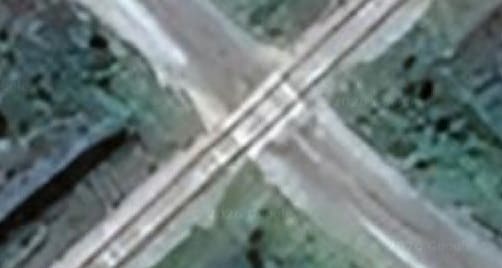
After another forest track is crossed the line crosses the Tunokvagen forest road at a Level Crossing. [44][Google Maps, April 2026]
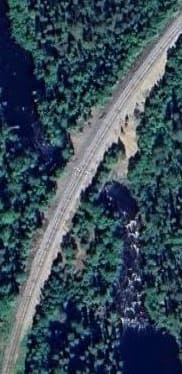
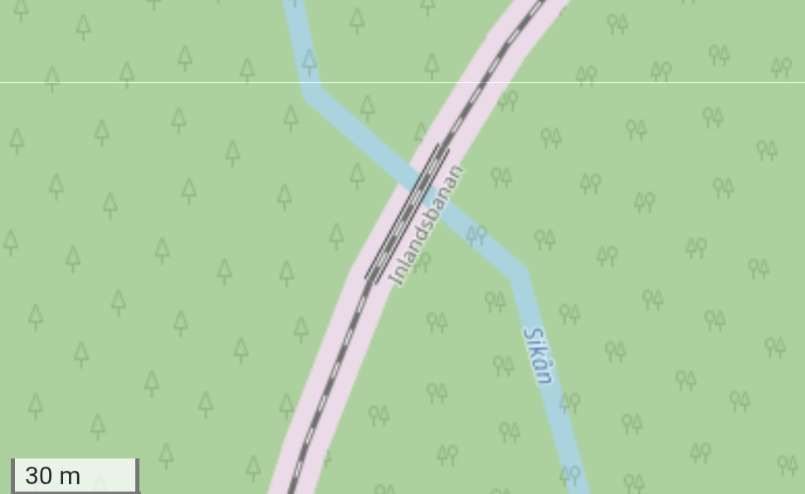
A few kilometres beyond the Tunokwagen, the railway crosses the Sikan River by means of a high embankment and culvert. [44][Google Maps, April 2026]
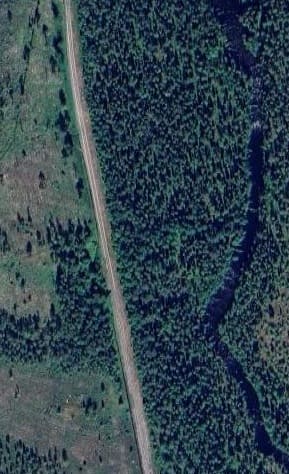
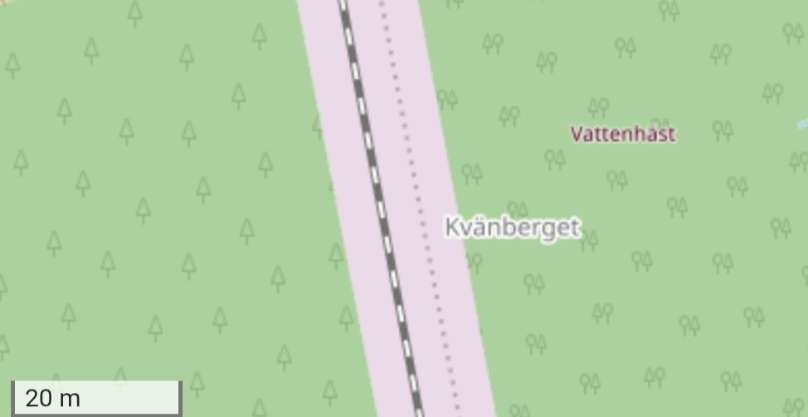
A very short distance South of the river crossing was Kvanberget Halt. [44][Google Maps, April 2026] There was a passing loop at this Halt as can be seen in the monochrome image below from The Railway Magazine article below. The small station building does not feature on OpenStreetMap nor Google’s satellite imagery.
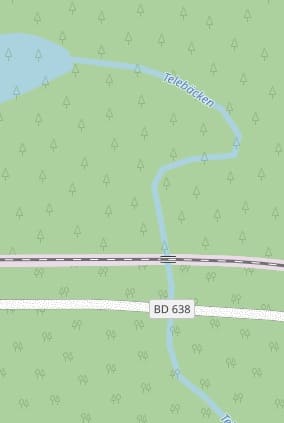
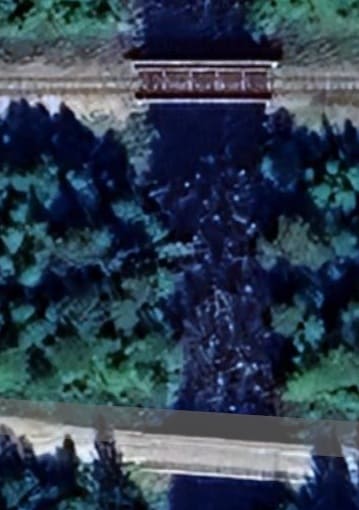
A short distance to the West of of the Halt at Tellejåkk the line bridges the Telebacken River alongside the road. [46][Google Maps, April 2026]
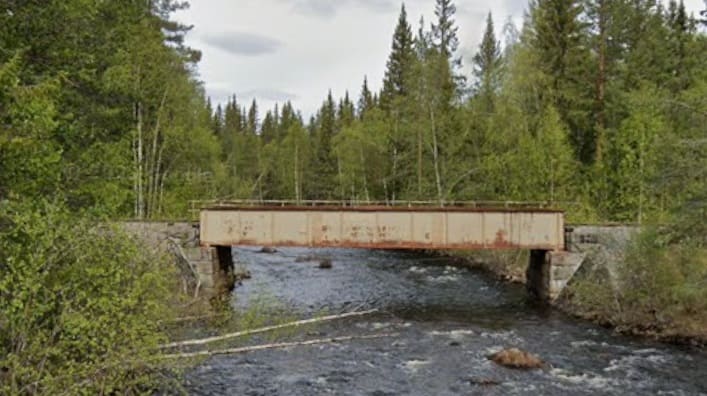
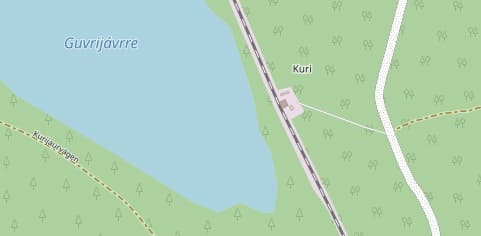
The rail bridge over the Telebacken seen from the BD638. [Google Streetview, May 2023]Although travelling predominantly in a westerly direction the line does not follow a straight path. Here it can be seen diverting to the South and running beside Lake Guvrejavrre where there was another Halt on the line. [47]
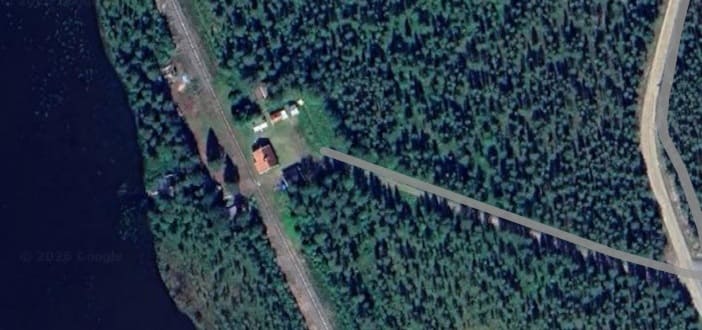
Lake Guvrejavrre and the Halt at Kuri. [47]{Google Maps, April 2026]
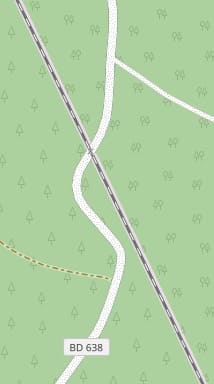
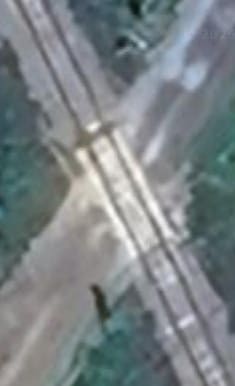
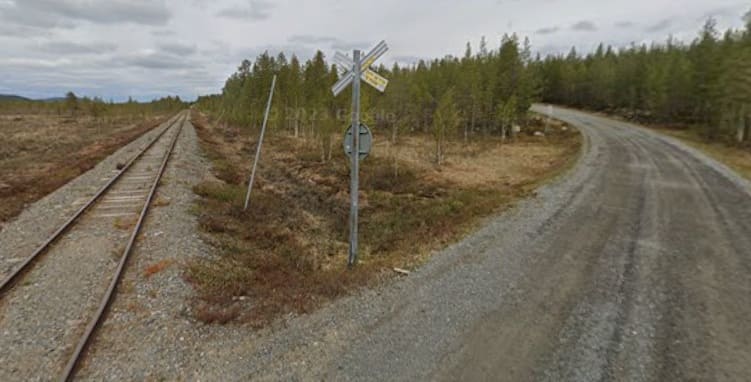
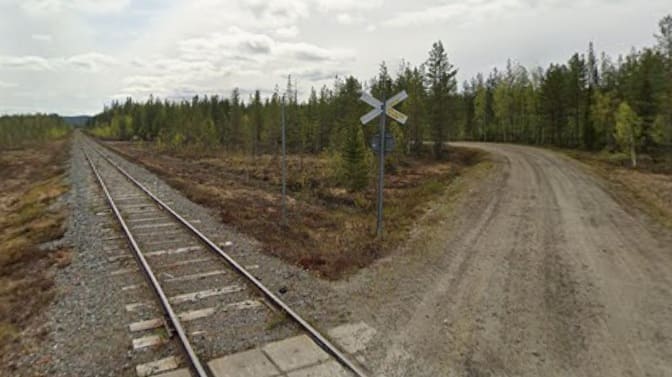
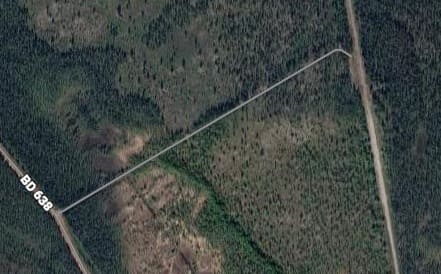
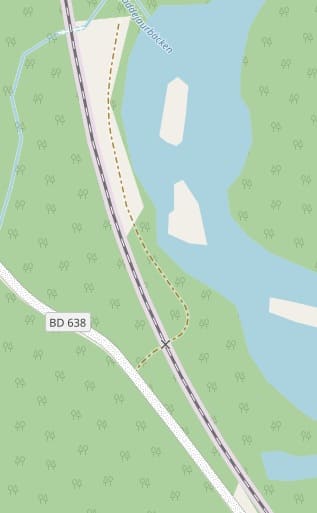
The railway crosses the BD638 at a level-crossing just to the south of the Halt. [47][Google Maps, April 2026]
Looking North from the level crossing at the BD638. [Google Streetview, May 2023]Looking South from the level crossing at the BD638. [Google Streetview, May 2023]
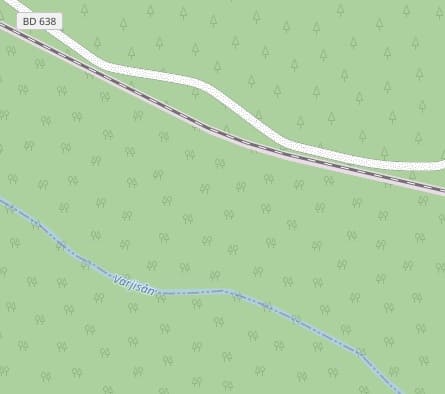
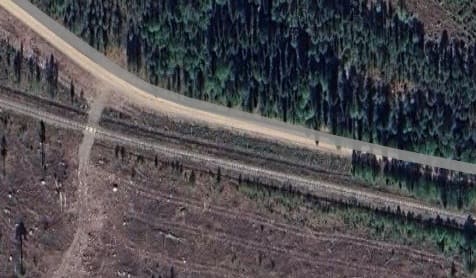
Road and rail, heading West, are at times very close together. The Varjisan River is towards the bottom of the map extract. [47][Google Maps, April 2026]
Looking West along the BD638 at the location shown above. [Google Streetview, May 2023]
Lake Frostselet is a widening of the Varjisan River. At times the road and railway sit close to its banks. [47][Google Maps, April 2026]
Looking South from the BD638 in the early spring. Both railway and lake are visible. Later as leaf growth continues, neither will be easily seen from the road. [Google Streetview, May 2023]Road, railway and river continue heading West. [48]
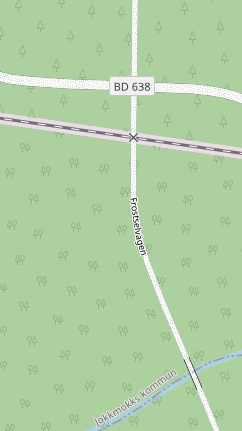
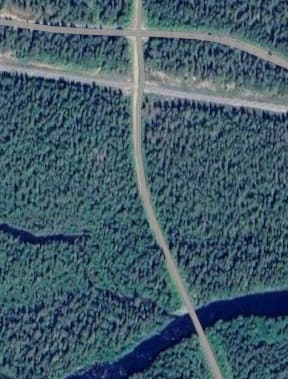
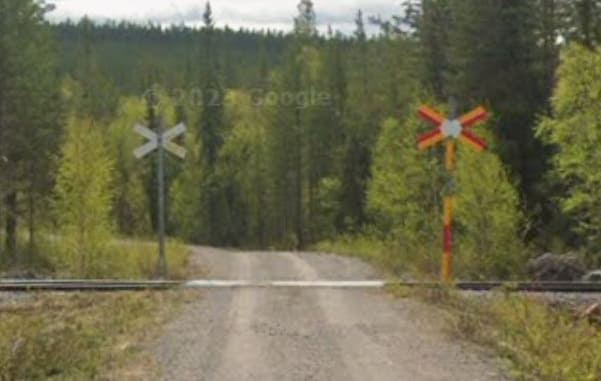
A side road from the BD638, the Frostselwagen, crosses the railway on the level. [48]
Looking south from the BD638 the level-crossing is visible from the main road! [Google Maps, April 2026]
The level-crossing at Frostselwagen. [Google Streetview, May 2023]
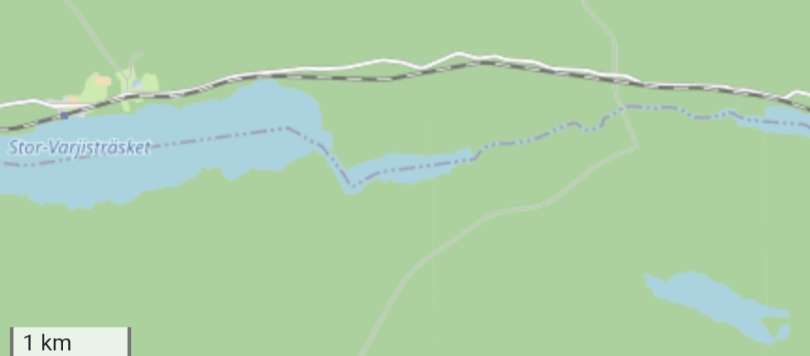
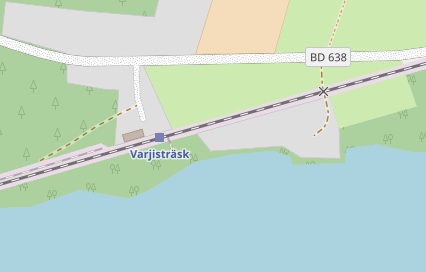
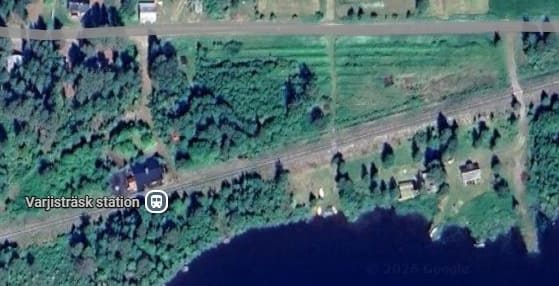
The next station on the line – Varjistrask – sits on the North side of (the Lake) Stor- Varjistrasket. [48][Google Maps, April 2026]
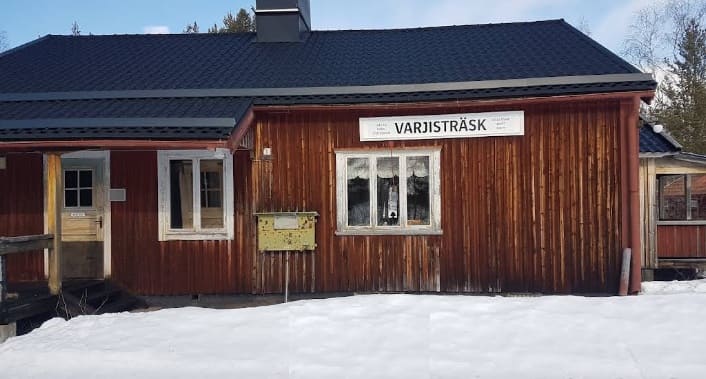
Varjisträsk Station building seen from the train with snow still on the ground. It is not possible to see the station building from the BD638, (c) Karlsson, June 2017. {Google Maps, April 2026]West of Varjistrask, the line turns to the Southwest. [49]
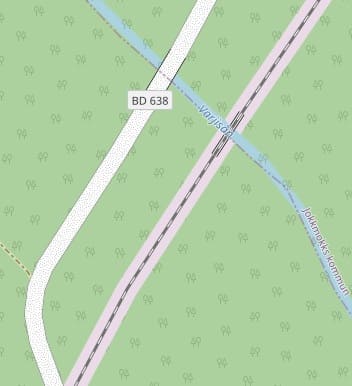
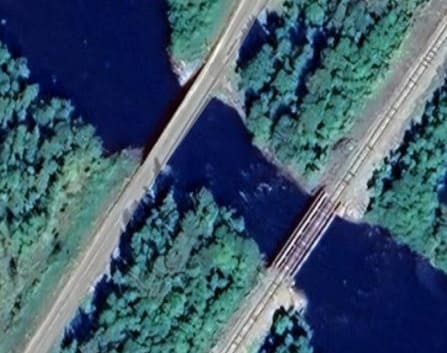
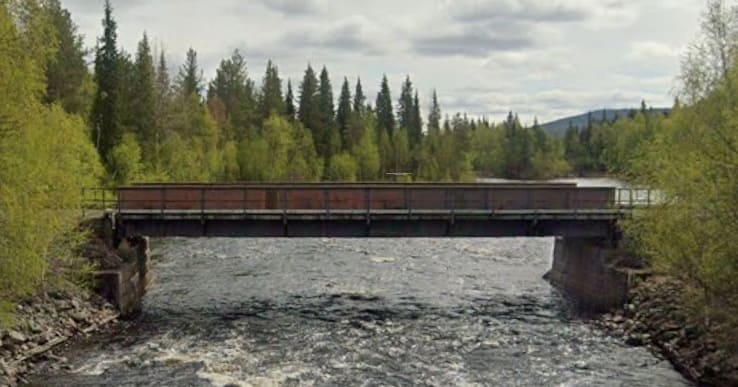
It bridges the Varjisan River just to the West of Stor-Varjistrasket and adjacent to the BD638. [49][Google Maps, April 2026]
Looking Southeast from the bridge carrying the BD638 over the Varjisan River, the bridge carrying the railway over the river can be seen easily. [Google Streetview, May 2023]
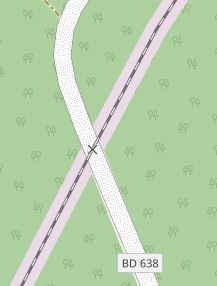
Almost immediately to the Southwest of the river bridge the BD638 crosses the railway on the level. [49][Google Maps, April 2026]
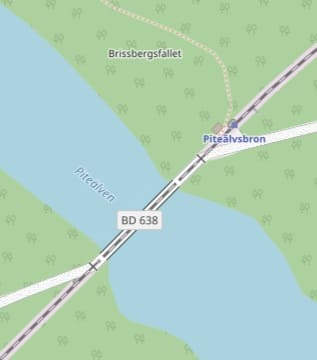
Looking Northeast from the level-crossing over the BD638 towards the location of the bridge over the Varjisan. [Google Streetview, May 2023]Looking Southwest from the level-crossing. [Google Streetview, May 2023]Continuing Southwest the line passes through Iggejaur, bridges the Pitealven River at Pitealvsbron and then turns to the South. [50]
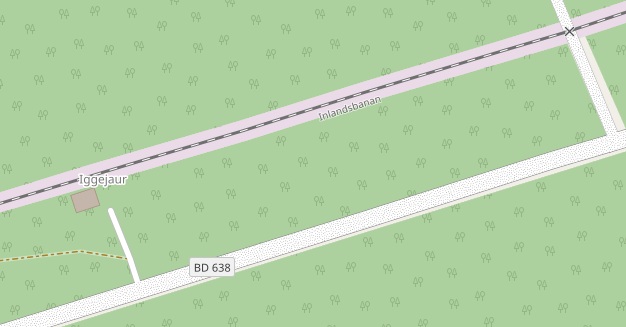
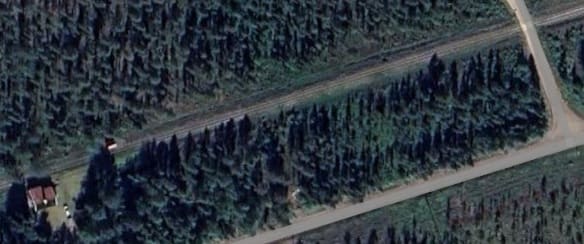
The Halt at Iggejaur. [50][Google Maps, April 2026]
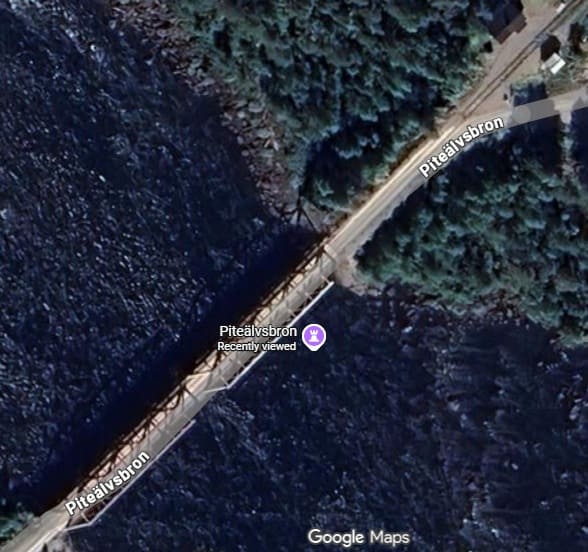
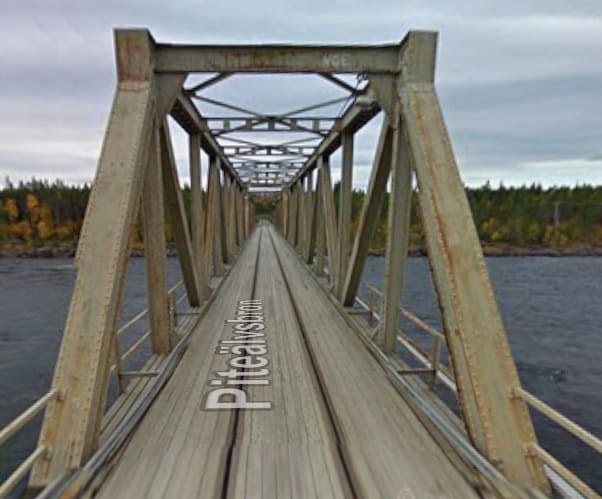
The combined road/rail bridge (Piteälvsbron) over the Pitealven River. [50][Google Maps, April 2026]
The small Halt at Pitealvsbron and the bridge seen from close to the Halt. [Google Streetview, September 2009]
Looking South over the bridge, which is a shared road and rail bridge. [Google Streetview, September 2009] And a of the bridge from the East, (c) Gustavo Azevedo, 2025, [Google Maps, April 2026]
This location South of Pitealvsbron has a passing place but is not named either on Google Maps or OpenStreetMap. [50][Google Maps, April 2026]
As can be seen from the satellite image an access road runs from the BD638 to the location which, together with passing loop would suggest the existence of a Halt in the past.
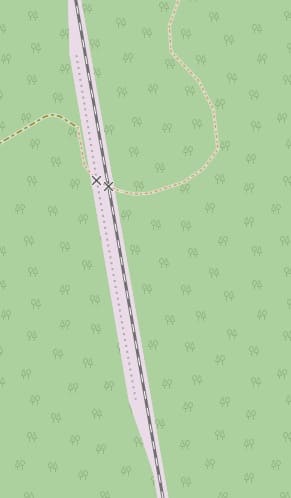
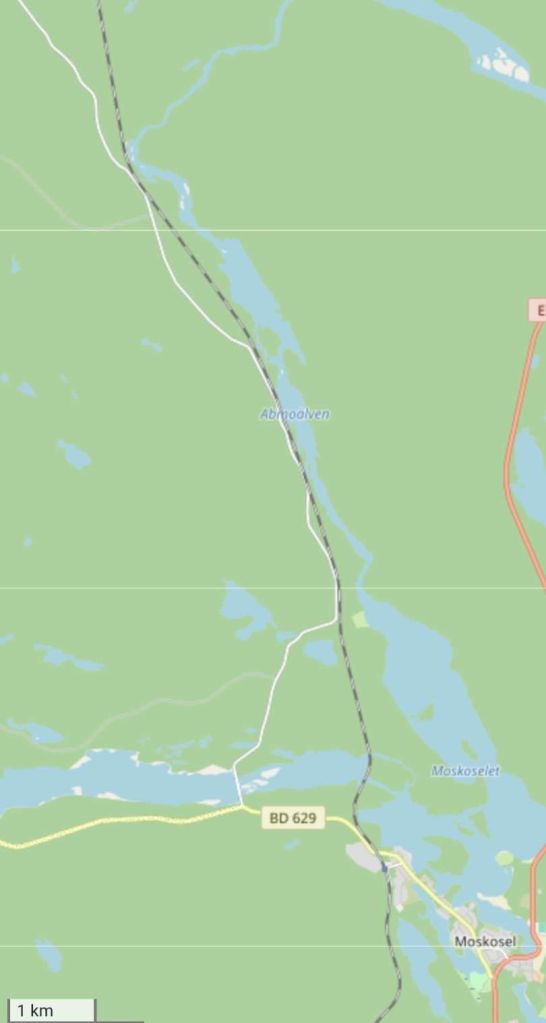
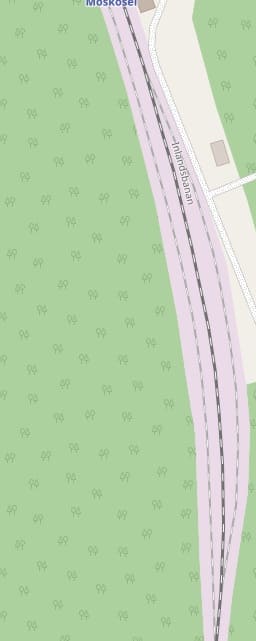
This extract from OpenStreetMap’s mapping shows the line running South-southeast into Moskosei. [51]
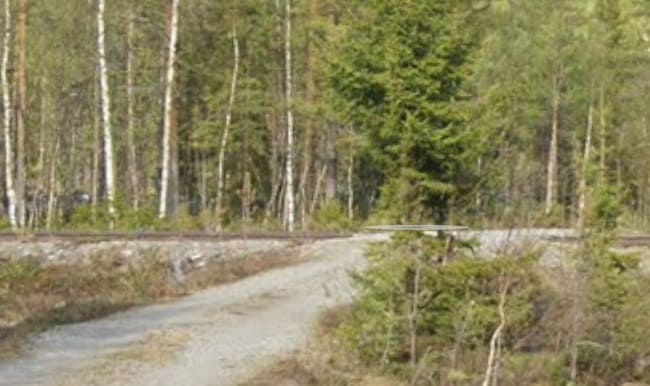
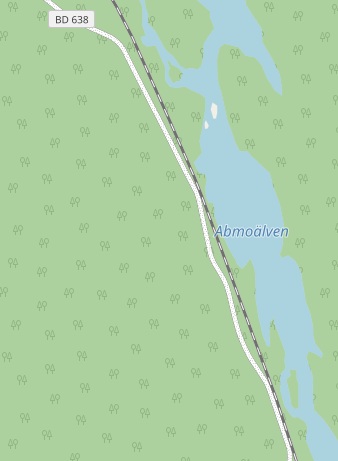
On its way towards Moskosel, the line runs between the BD638 and the Abmoalven River, a tributary of the Pitealven River. [51]
As can be seen in the image immediately above, the railway can be seen from the BD638, looking Northeast. [Google Streetview, May 2023]
Road, rail and river run practically adjacent to each other as we continue South-southeast towards Moskosel. [51]
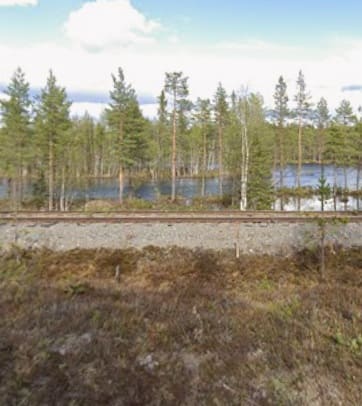
The view West from the BD638 across the railway to the Abmoalven River. [Google Streetview, May 2023]
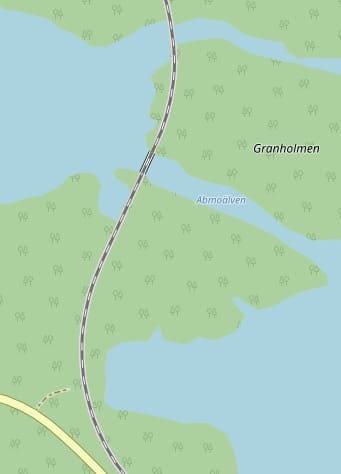
Another bridge – this one crosses the Abmoalven. [51][Google Maps, April 2026]
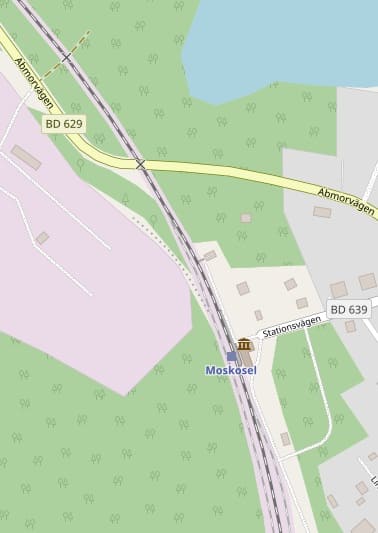
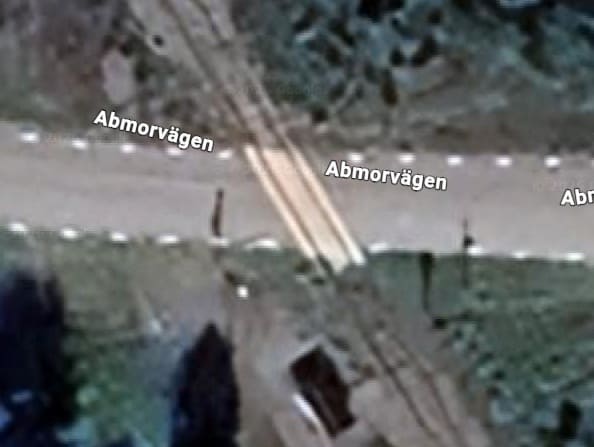
On the approach to Moskosel the line crosses the BD629 (Abmorvagen) at a level crossing. [51]
The crossing at Abmorwagen (BD629). [Google Maps, April 2026]
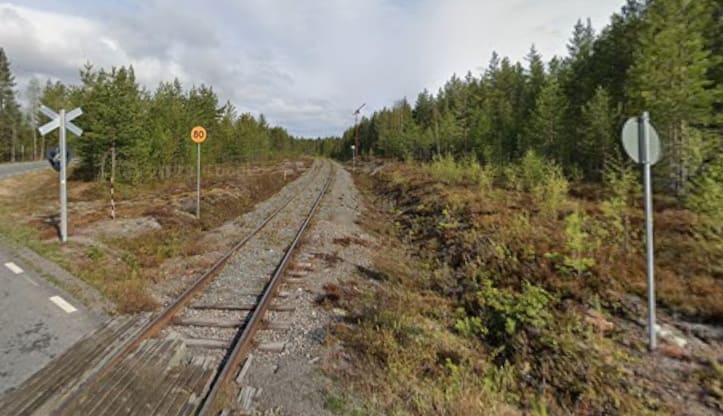
Looking Northwest from the level-crossing on Abmorwagen. [Google Streetview, May 2023]Looking Southeast towards the station at Moskosel. [Google Streetview, May 2023]
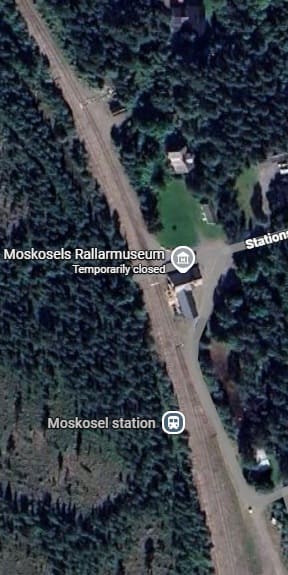
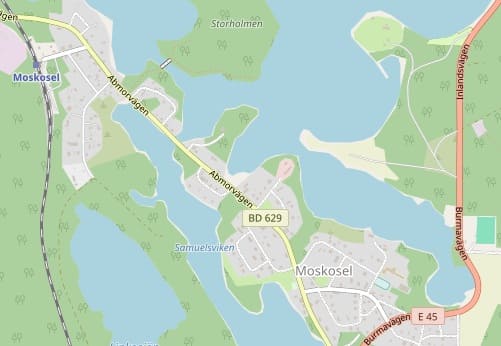
Moskosel Railway Station site. [Google Maps, April 2026][51]
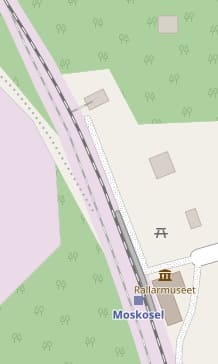
Moskosel Railway Station had a long siding to the North of the station platform and two loops off the main running line to the South of the station platform. These can be seen in the extracts from OpenStreetMap’s mapping immediately above.
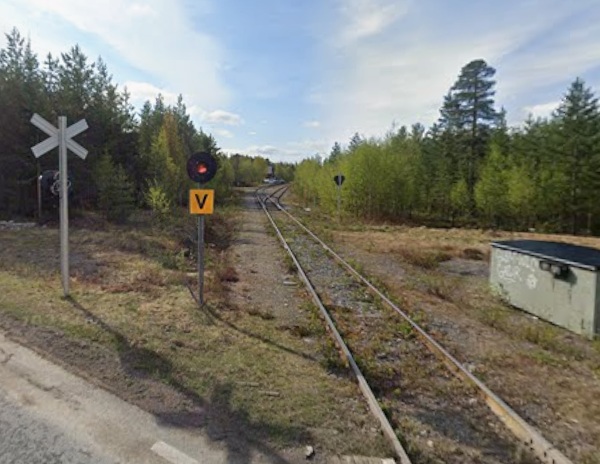
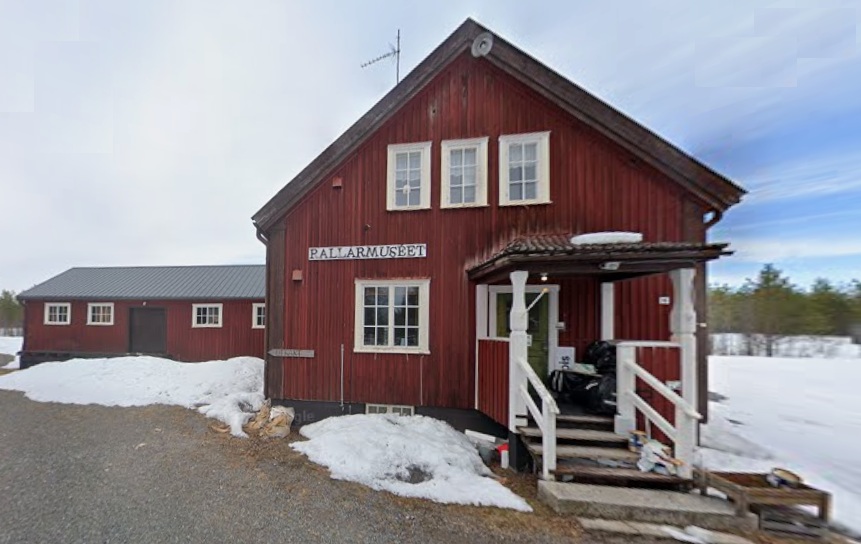
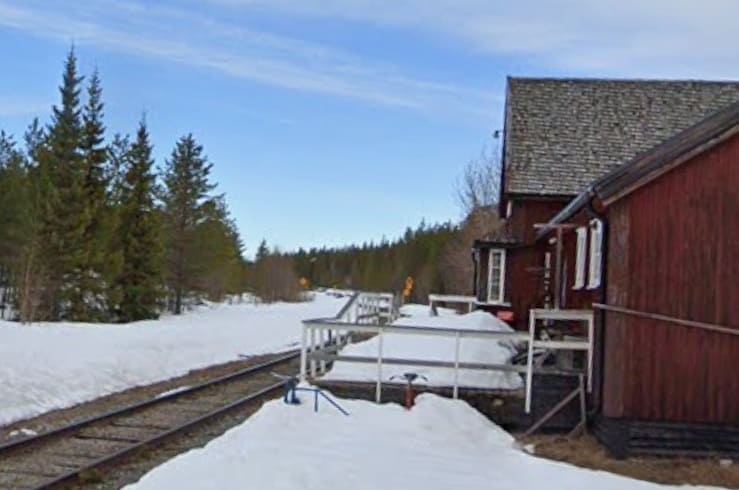
The Railway Station building at Moskosel is, in the 21st century, a small railway museum which It focuses on the history of the “rallare” (railway construction workers) who built the Inland Railway. [Google Streetview, April 2021]Looking North, this view shows the station platform at Moskosel. [Google Streetview, April 2021]
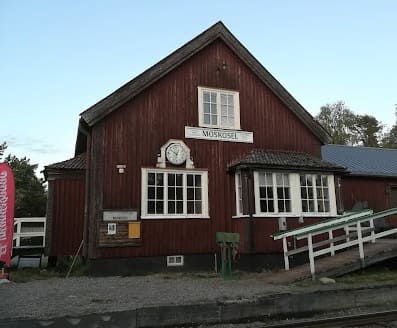
Seen from the East across the single line through the station, this is the platform side view of the station building, (c) dirk-steffen, 2025. [Google Maps, April 2026]
The station is quite a distance Northwest of Moskosel town centre. [51]
South of Moskosel, the line first finds its own way to the Southwest. ….
The line to the Southwest of Moskosel: it passes to the West of Lake Linkosjon and heads Southwest, passing to the South of Lake Sierbra before turning South once again. [52]
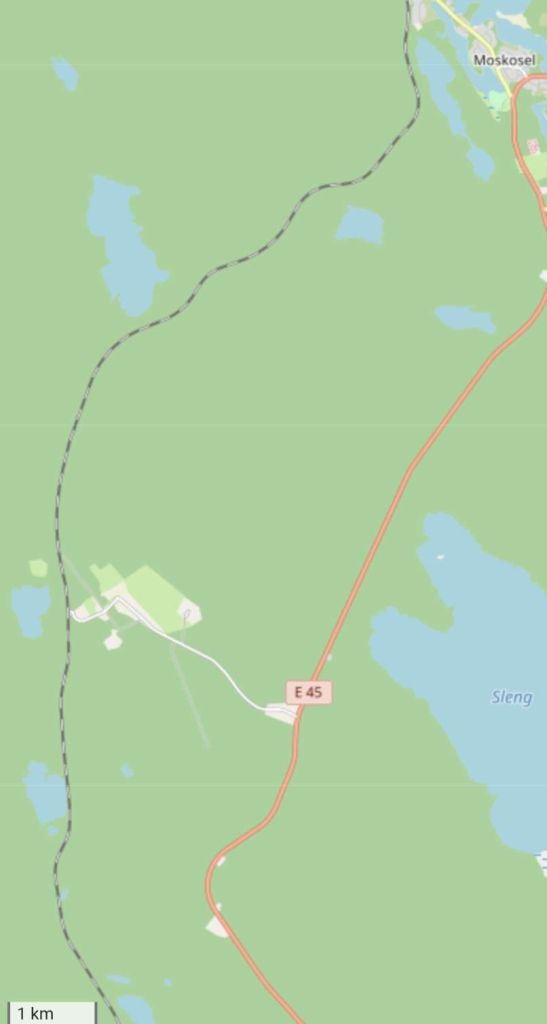
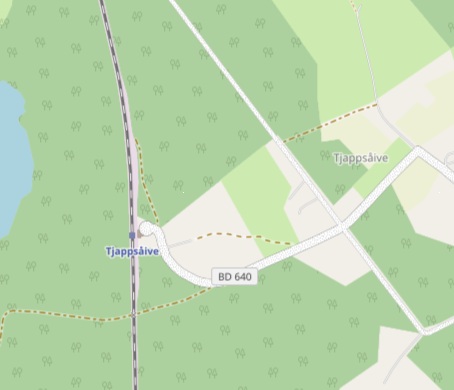
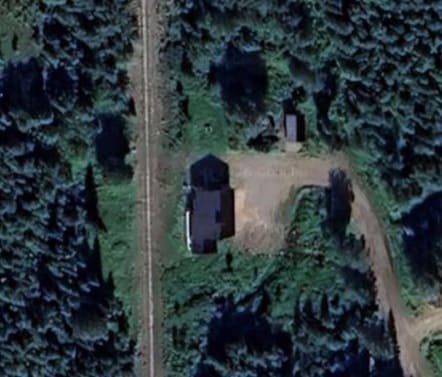
Tjappsaive Halt is at the end of a long side road off the E45 road. [52][Google Maps, April 2026]
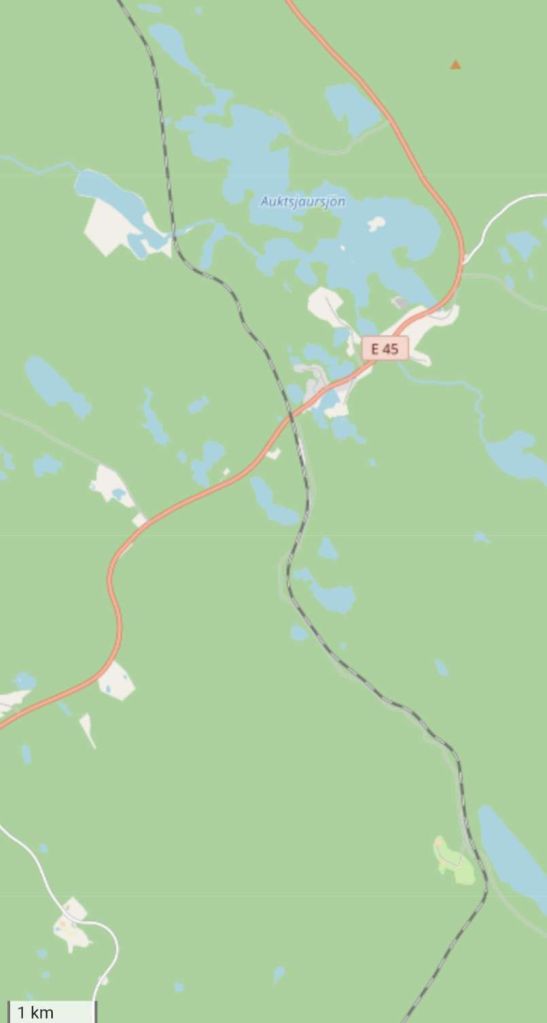
The line continues South from Tjappsaive Halt, crossing the E45 again on the way. [53]
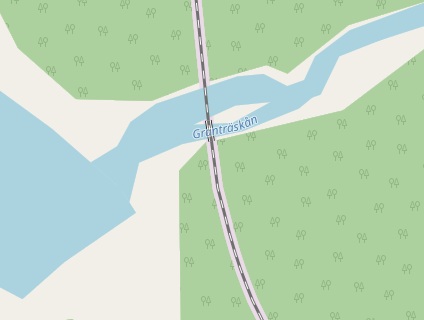
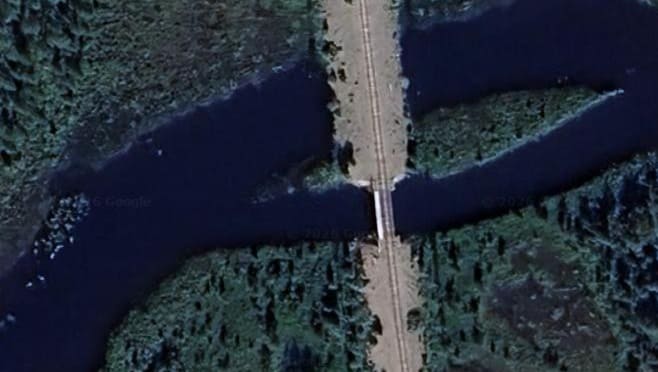
Before reaching the level-crossing, the line bridged the Grantraskan which flowed between Lake Levas and Lake Auktsjaursjon. [53][Google Maps, April 2026]
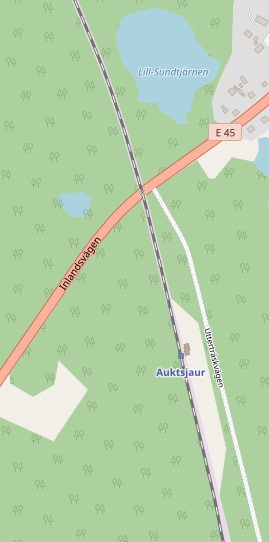
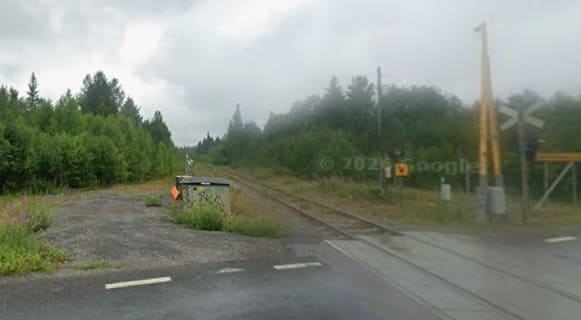
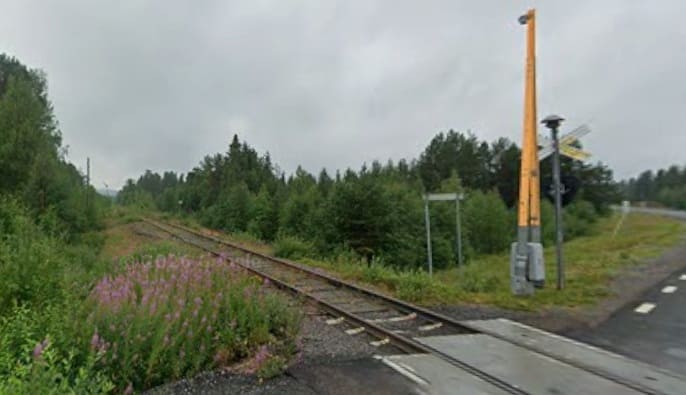
The level-crossing at Auktsjaur and the Halt which is just to the South of the crossing. [53]
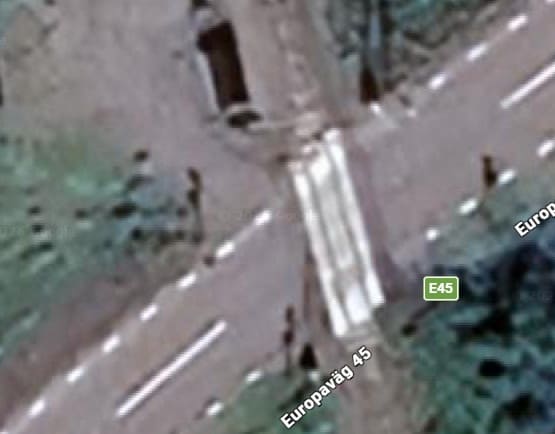
The E45 level-crossing. [Google Maps, April 2026]Looking North from the crossing. [Google Streetview, July 2025]Looking South. [Google Streetview, July 2025]
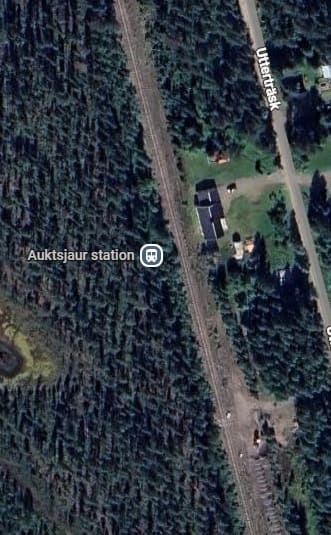
Auktsjaur Railway Station is a halt without a passing loop. The village it serves sits to the Northeast of the station straddling the E45. [Google Maps, April 2026]
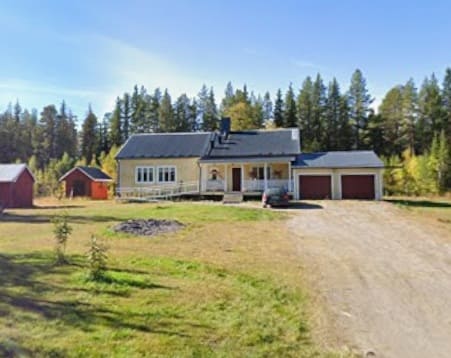
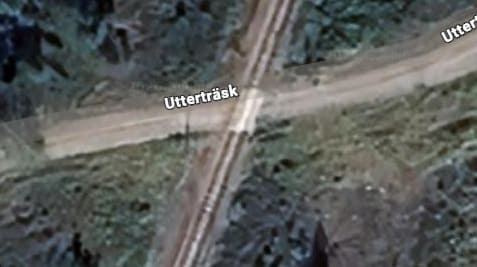
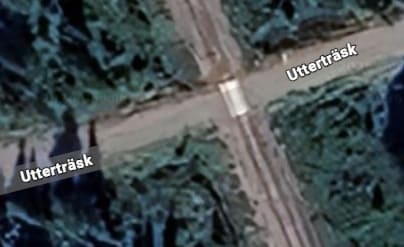
Auktsjaur Railway Station seen from Uttertrask road. the railway line runs behind the building. [Google Streetview, September 2021]A little way South of the station Uttertrask crosses the line. [Google Maps, April 2026]
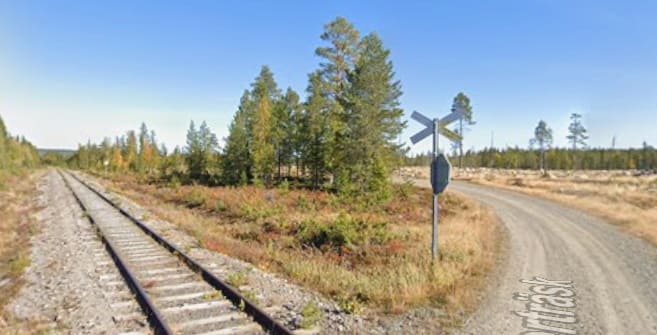
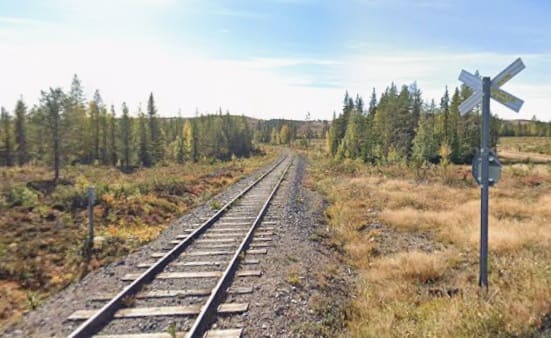
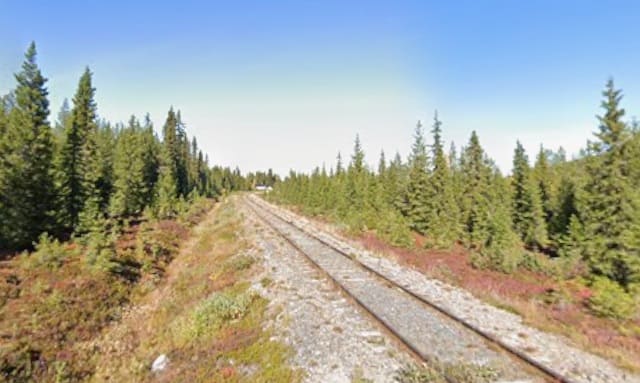
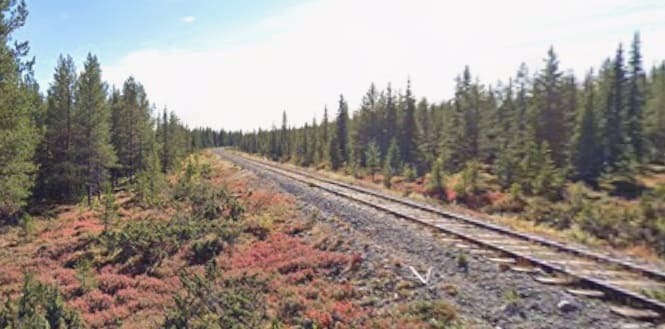
Looking back North towards Auktsjaur Station from the road-crossing with Uttertrask. [Google Streetview, September 2021]Looking South down the line from the same road-crossing. [Google Streetview, September 2021]
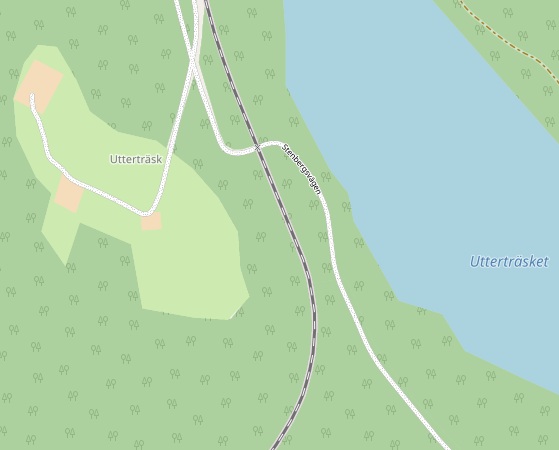
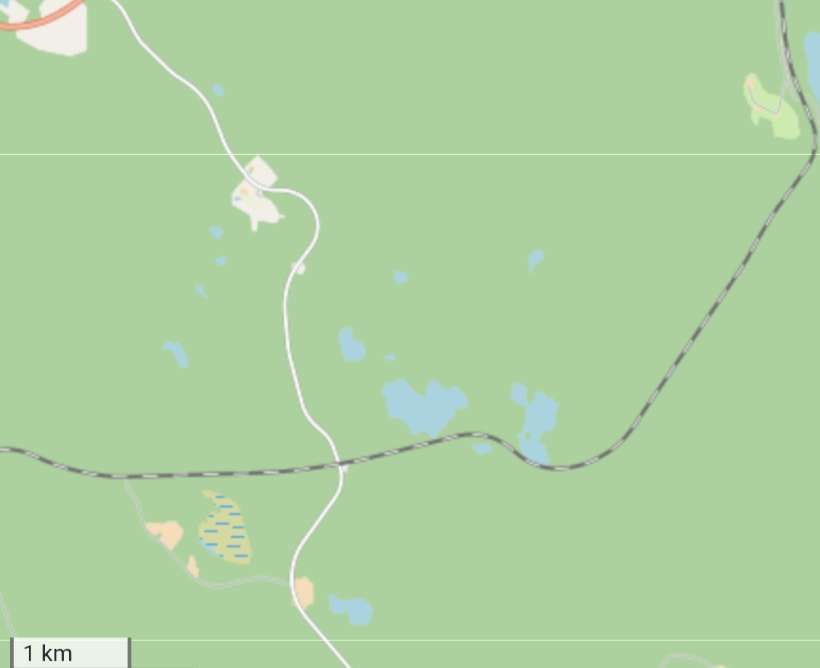
Road and rail cross again at the hamlet of Uttertrask alongside Lake Uttertrasket. [53][Google Maps, April 2026]
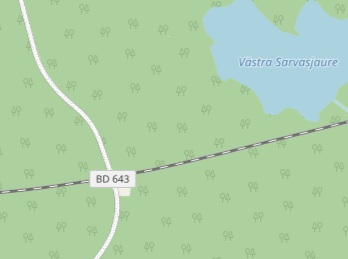
Looking North towards Auktsjaur from the road crossing above. [Google Streetview, September 2021]Looking South from the same crossing. [Google Streetview, September 2021]On this next map extract, Uttertrask appears top right, the line turns to travel West, running to the South of two lakes Vastra Sarvasjaure and Ostra Sarvasjaure. It then crosses the BD643. [54]
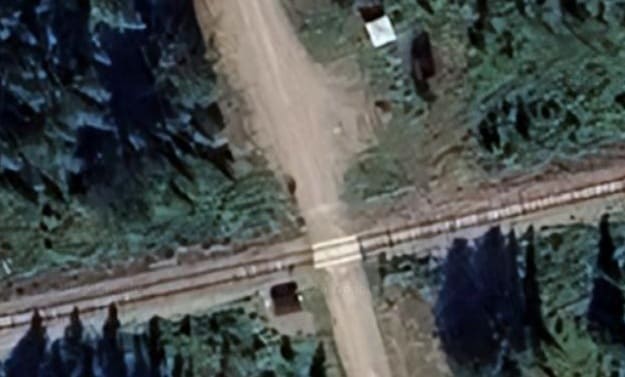
The road-crossing at the BD643. [54][Google Maps, April 2026]
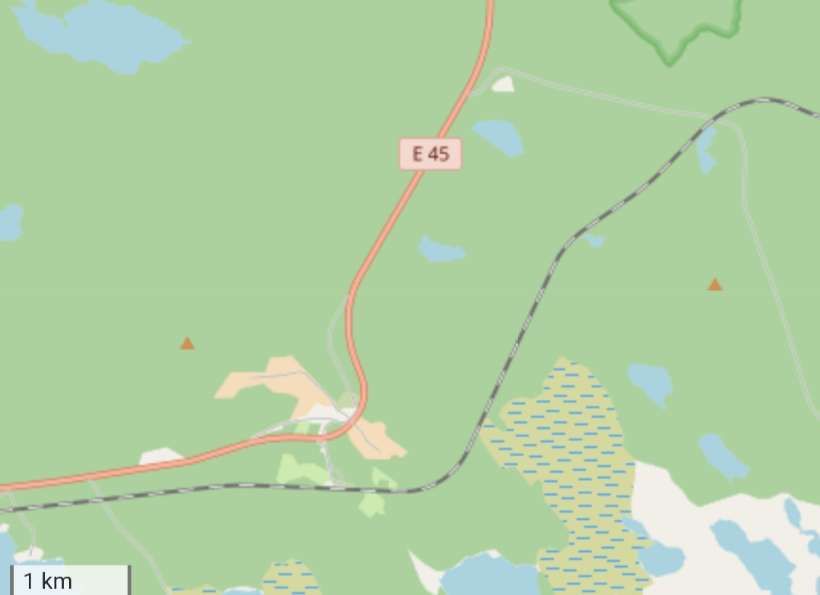
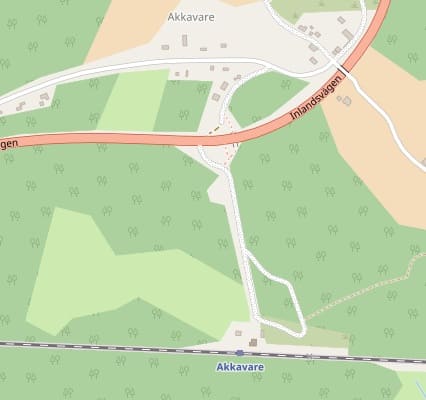
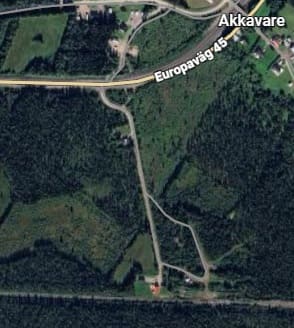
Still travelling ina predominantly westward direction the line crosses this next map extract and takes up closer order with the E45 again near the small village of Akkavare. [55]
Akkavare Village and Halt. [55][Google Maps, April 2026]
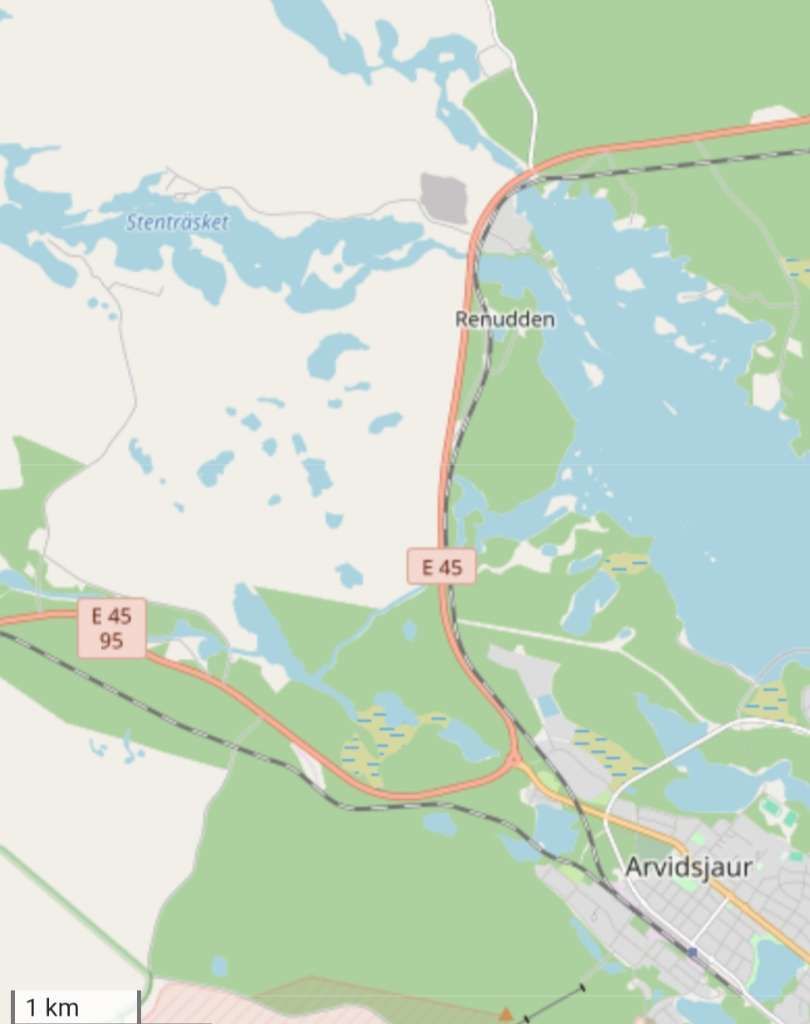
This last OpenStreetMap wide area extract covers the run in to Arvidsjaur. [56]
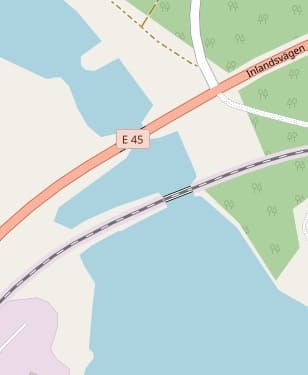
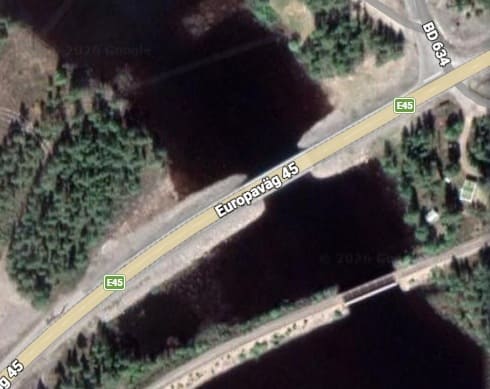
The E45 and the Inlandsbanan bridge the channel linking Lake Vastra Kikkejaure and Lake Arvidsjaurjon. Both are on causeways which are breached by short bridges. [56][Google Maps, April 2026]
This photograph shows the Inlandsbanan bridge as it is seen from The E45. This image faces Southeast. [Google Streetview, August 2025]
The E45 and the Inlandsbanan cross the channel linking Lake Stentrasket with Lake Arvidsjaurjon. [56][Google Maps, April 2026.
An early morning view of the Inladsbanan bridge seen, looking East, from the E45 bridge. [Google Streetview, August 2025
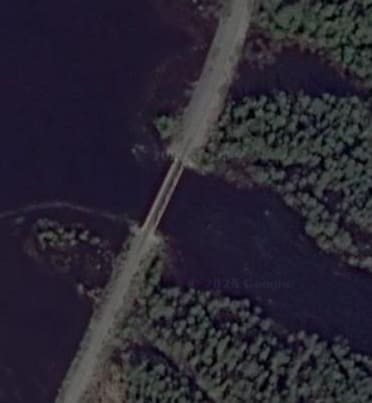
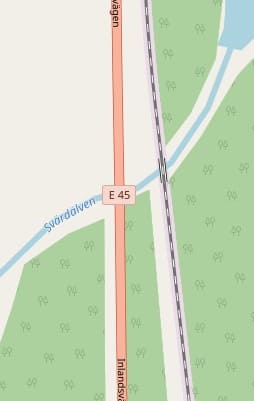
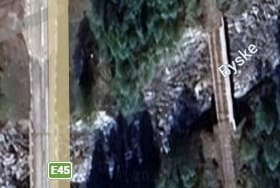
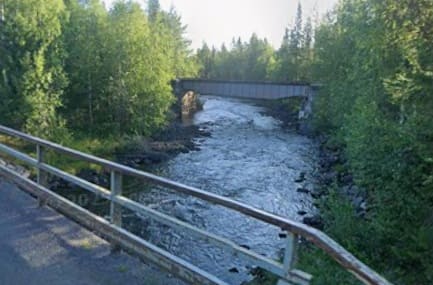
A little further South road and rail bridge the Svardalven River, Google has this as the Byske. [56][Google Maps, April 2025]
Looking Northeast from the E45 along the Byske/Svardalven. [Google Streetview, August 2025]
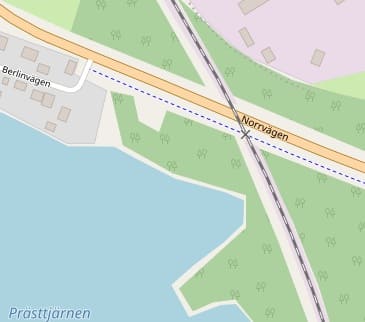
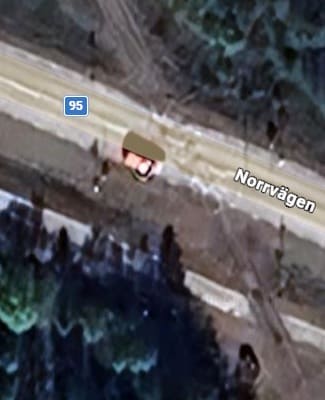
We are now on the approach to Arvidsjaur and its Railway Station. As the line enters the outskirts of the town, close to the Prasttjarnen Lake it crosses Norrwagen. [56]
The line crosses Norrvagen. [Google Maps, April 2026]
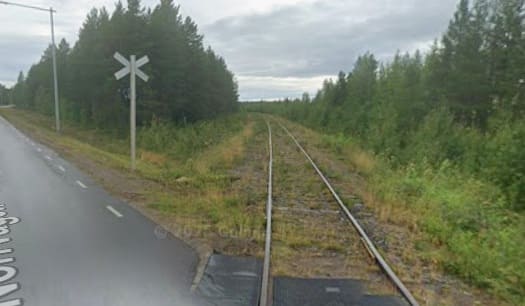
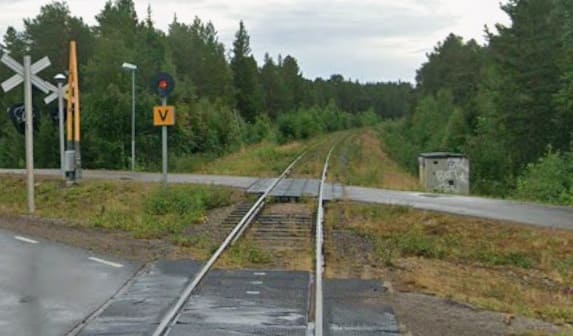
Looking Northwest along the line. [Google Streetview, August 2025]Looking Southeast towards the Railway Station. [Google Streetview, August 2025]
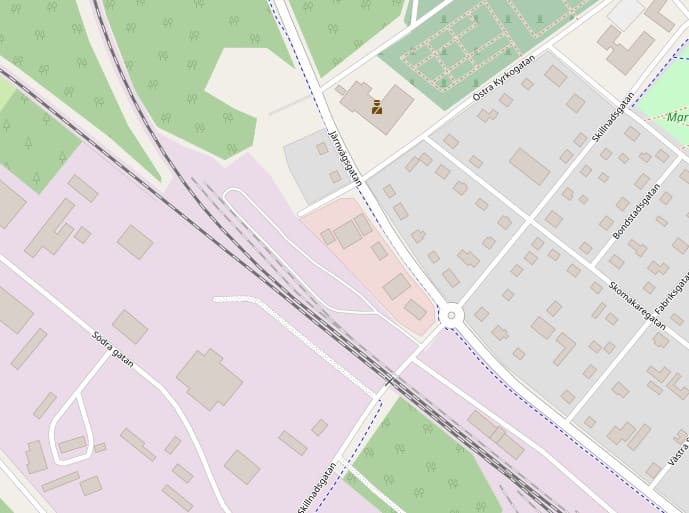
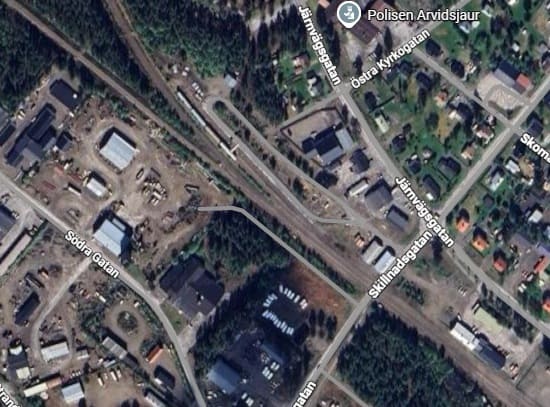
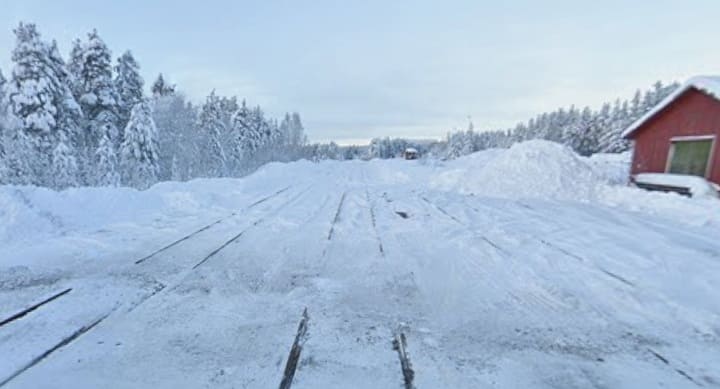
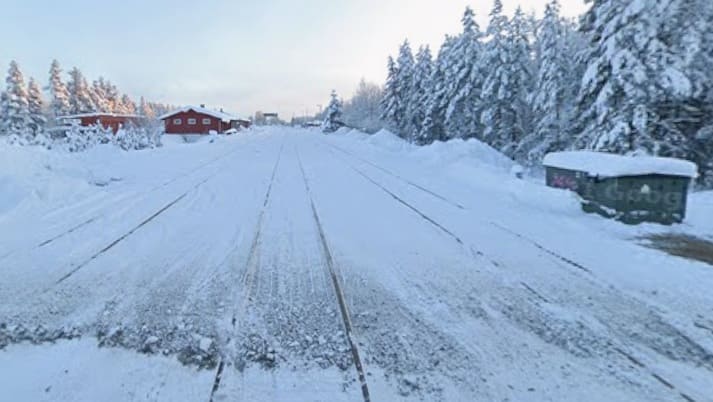
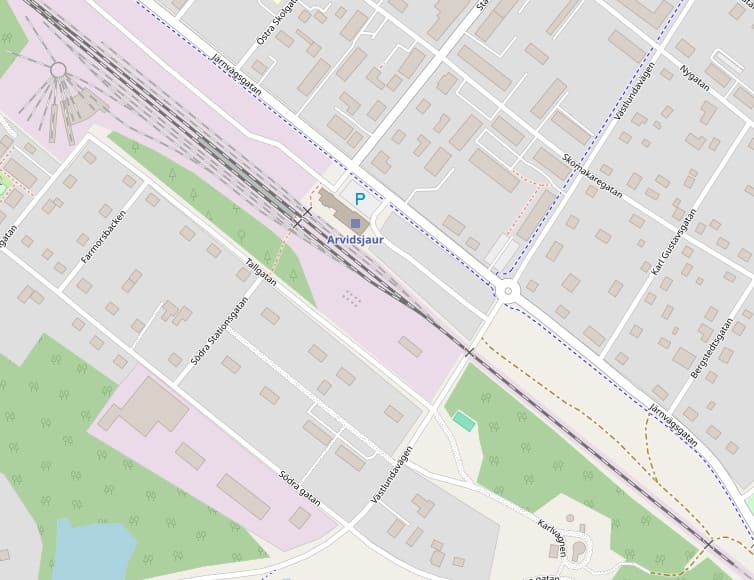
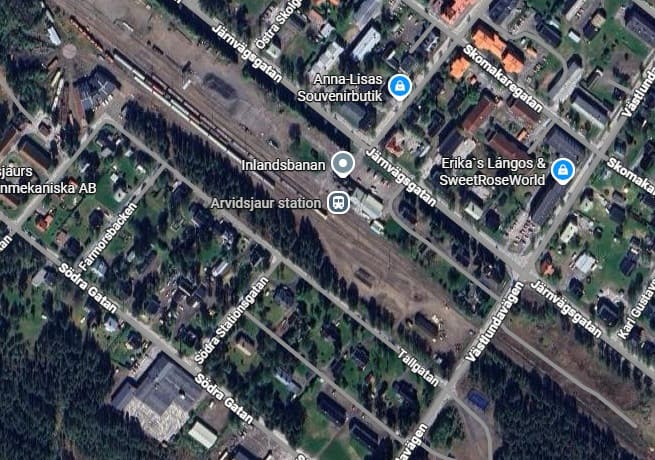
Arvidsjaur Railway Station used to be a junction station. with two arms of the inlandsbanan entering the station from the Northwest and a line to Jörn leaving to the Southeast. The line to Jörn has been lifted. The 75-km Jörn–Arvidsjaur railway line (opened 1928, closed 1990) connects Arvidsjaur with the main line at Jörn. While disused, there are potential plans to reopen it for defence purposes. This map extract shows the two arms of the Inlandsbanan meeting to the Northwest of the railway station. Note also the two sidings on the North side of the running lines. [56][57]The same area as it appears on Google’s satellite imagery. Note the rolling stock in the sidings on the North side of the running lines. [Google Maps, April 2026]Looking Northwest in mid-winter from the level-crossing at Skillnadsgatan.The line from the North is at the centre of the image, the line for the South is shown to the left and the sidings mentioned above are on the right side of this photograph. [Google Stretview, January 2021]Similarly in the grip of winter this view looks from the same road-crossing towards Arvidsjaur Railway Station. The Inlandsbanan line from the North is at the centre of the image, that for the South is on the right side of the picture. The sidings are on the left of the image. [Google Streetview, January 2021]This map extracts focuses on the Railway Station at Arvidsjaur with the two arms of the inlandsbanan entering from the Northwest and the sub of the line to Jörn running only a very short distance to the Southeast, acting as no more than a head shunt for the station. At the top-left of the image the locomotive depot can be seen on the South side of the running lines. [56]A similar area as it appears on Google’s satellite imagery. There is a lot of rollingstock visible in the sidings at the station. There also appear to be some single car and two-car DMUs in the locomotive depot at the top-left of the image. The ‘head shunt’ can be picked out crossing Västlundavägen and heading for the bottom-right of the image. [Google Maps, April 2026]
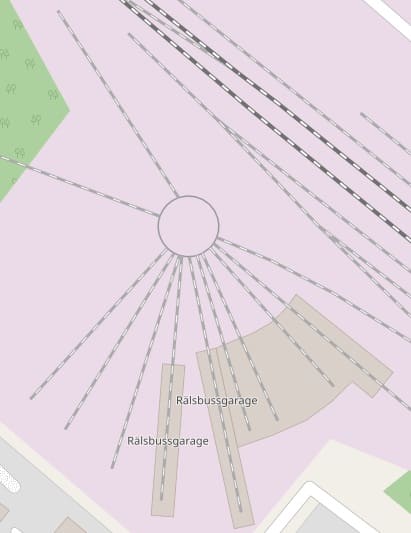
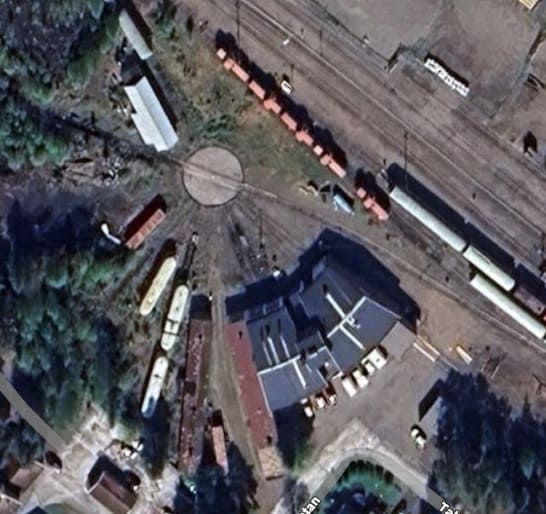
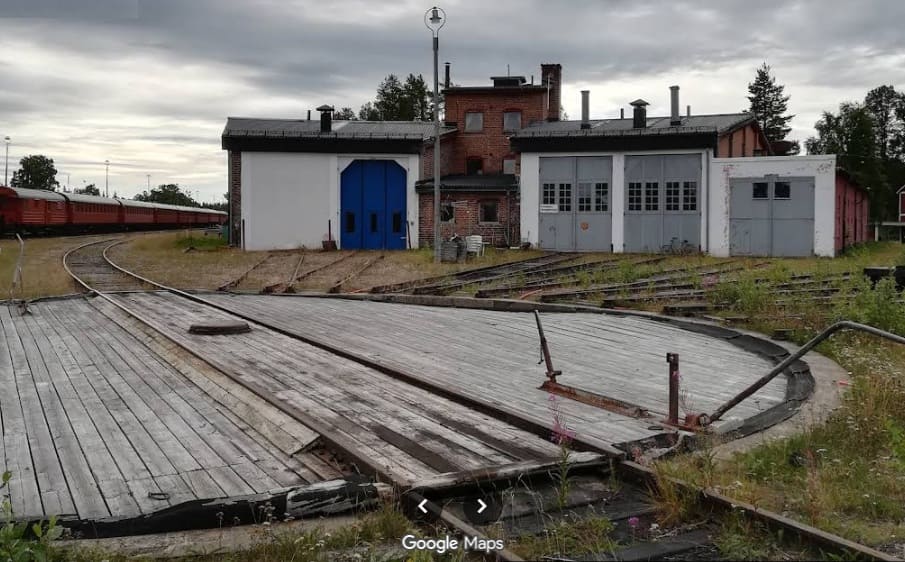
The old locomotive shed/depot now acts as a stabling point for railbuses that are used on the Inlandsbanen. [56][Google Maps, April 2026]
The locomotive depot at Arvidsjaur is used for the stabling of railcars, (c) dirk-steffen, 2025. [Google Maps, April 2026]A winter view of the station buildings at Arvidsjaur, seen from Tallgatan (South of the station). [Google Streetview, January 2021]A view in early spring (March) of the station buildings at Arvidsjaur, from the station approach. [Google Streetview,March 2021]
The station building seen from the North, (c) dirk-steffen, 2025. [Google Maps, April 2026]
The station building seen from the East, (c) gesla 26.11, 2024. [Google Maps, April 2026]
Steam at Arvidsjaur on 20th May 1935, Locomotive No. 907, no known copyright restrictions. [60]
More photographs of the site of the railway station and some rolling stock can be seen here. [58]
Looking Northwest from the road-crossing at Västlundavägen into the site of the railway station. [Google Streetview, July 2025]Looking Southeast along what was the line to Jörn which now acts as a head-shunt for the railway station. [Google Streetview, July 2025]
Arvidsjaur had a population of 4,635 in 2010. During the winter months, major car-manufacturers perform arctic trials in the Arvidsjaur area. The town also fosters tourism by offering snowmobile tours, trekking, skiing, fishing and dogsled rides. Arvidsjaur is a Swedish adaptation of the Ume Sámi word árviesjávrrie, derived from árvies (“generous” or “one who gives abundantly”) and jávrrie (“lake”), referring to the fishing in the nearby lake of the same name. Aruens järff by was the Swedishized name of the Sámi village where the Arvidsjaur Church was built in 1607. [59]
It is at Arvidsjaur that we take a break on our journey South down the Inlandsbanan.
References
M. D. Grenville & H. A. Vallance; Sweden’s Inland Railway; in The Railway Magazine, December 1958; Tothill Press, London, 1958, p826-832 & p870.
Gällivare is 744 miles (1,198 km) from Stockholm. It a quaint mining town and the gateway to the mountains, forest and glaciers of Laponia. This small town of around 8,500 people is an ideal base from which to venture into the surrounding wilderness. (The Laponia World Heritage Site includes the spectacular national parks of Sarek, Stora Sjöfallet and Muddus) Gällivare’s museum allows one to learn about the lives of the town’s early settlers as well as the culture of the region’s indigenous Sami communities. A guided tour of the Aitik Copper Mine, one of the largest mines in Europe, is available. Expedia suggests visits to the town’s historic churches including: the tiny Old Church (Gällivare Gamla Kyrka), which dates back to the 18th century; and the white New Church (Gällivare Nya Kyrka) which was designed by architect Emil Langlet. A visit to Malmberget would give a further glimpse into this region’s industrial past. Malmberget is home to a branch of the LKAB Iron-Ore Mine which offers daily tours. A visit to Kåkstan, a historical “shanty town” museum village, dating back to the 1888 iron-ore rush should be included in any itinerary. [3]
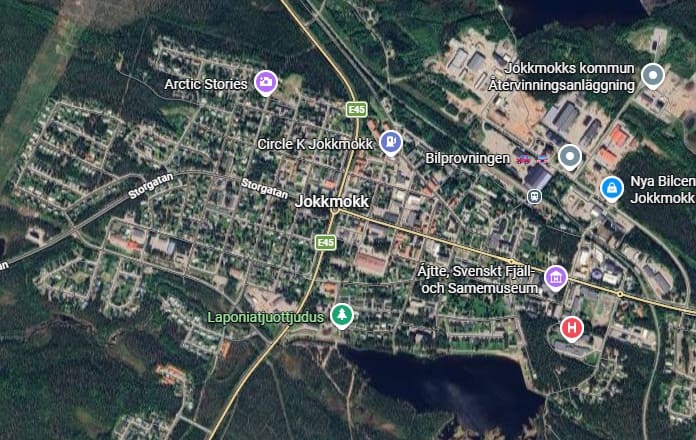
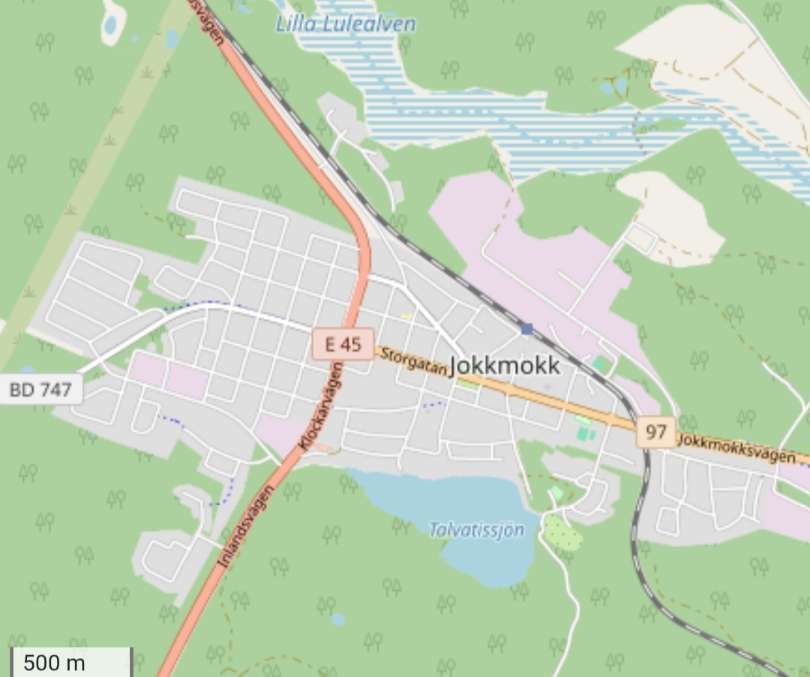
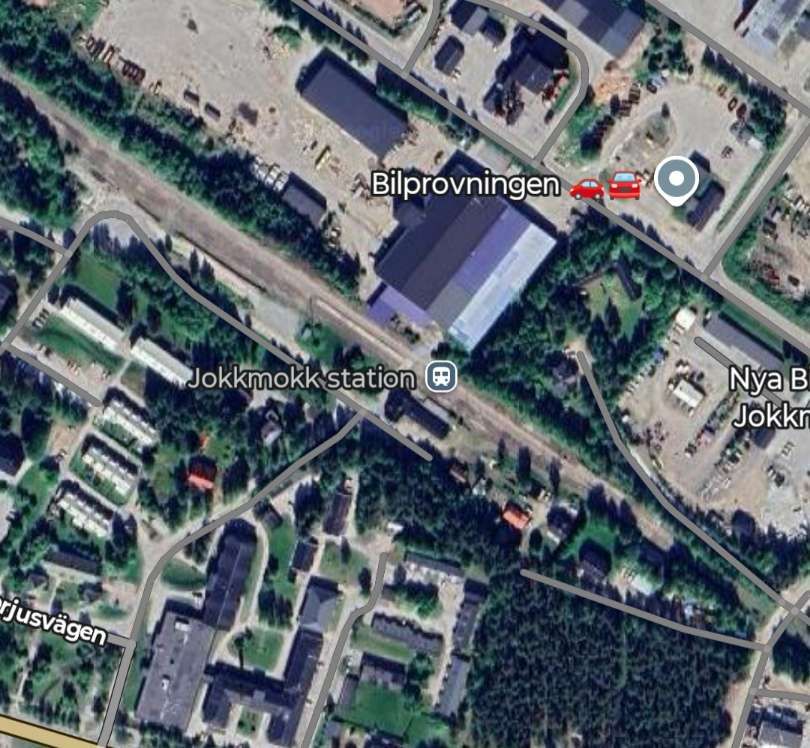
Jokkmokk is a locality and the seat of Jokkmokk Municipality in Norrbotten County, province of Lapland, Sweden, with 2,786 inhabitants in 2010. The Lule Sámi name of the place (composed of the individual words jåhkå and måhkke) means “River’s Curve,” due to the meandering river that runs through it. As in other towns in Lapland, the Swedish language is dominant, accessed on 23rd April 2026. at an official level in Jokkmokk in modern times. The settlement is just north of the Arctic Circle. [33]
Limestone had been shipped from Carnlough for some time, but the trade was small, and declining. It was for this purpose that Gibbons [7] built a pier. Jimmy Irvine tells us that, at Carnlough, “There had been a ‘hurry’, or gravitational inclined plane at the quarry to assist in bringing down stone to the head of the Croft or Gortin Road as it was then called. From there it came on to the pier by cart. Of the pier, Lieut. John Chaytor wrote in 1832, ‘There is a quay at the north east end of the town which has been for some yeans in a state of dilapidation. Small craft from 15 to 20 tons can come in here,’ and he added, ‘Some are in the habit of shipping limestone to Scotland where they barter it for coal . . . but not to such an extent as in the town and neighbourhood of Glenarm. [8] Vessels calling at Glenarm, however, had to stand out in the bay and be loaded by lighter. The new projected Carnlough Harbour would allow ships to enter a basin which would not only offer them protection in times of storm, but would permit their being loaded direct from trucks, thereby ensuring a speedy turnaround.” [9]
A mineral railway and enlarged harbour were constructed in 1853/1854 with a first significant cargo of limestone leaving the Carnlough harbour for Scotland in mid-August 1854.
Jimmy Irvine continues: “Exactly nine months after the work first began Wilson [10] wrote, ‘I have this day loaded a vessel of Limestone from the end of the new quay. I had the stone brought down from the quarries by carts, but it will not pay to do so.’ (8.8.1854). The shipping of this load brought an immediate order from the recipients. Messrs. Tennent of Glasgow for 10,000 tons of stone.” [9]
Wilson encountered serious problems in constructing the harbour. A significant band of harder rock was encountered at what was to be the harbour entrance. It was some years before larger shops were able to enter the harbour. During that time only smaller ships could be loaded efficiently at the harbour walls. The larger ships had to be served by lighters taking limestone out to deeper water.
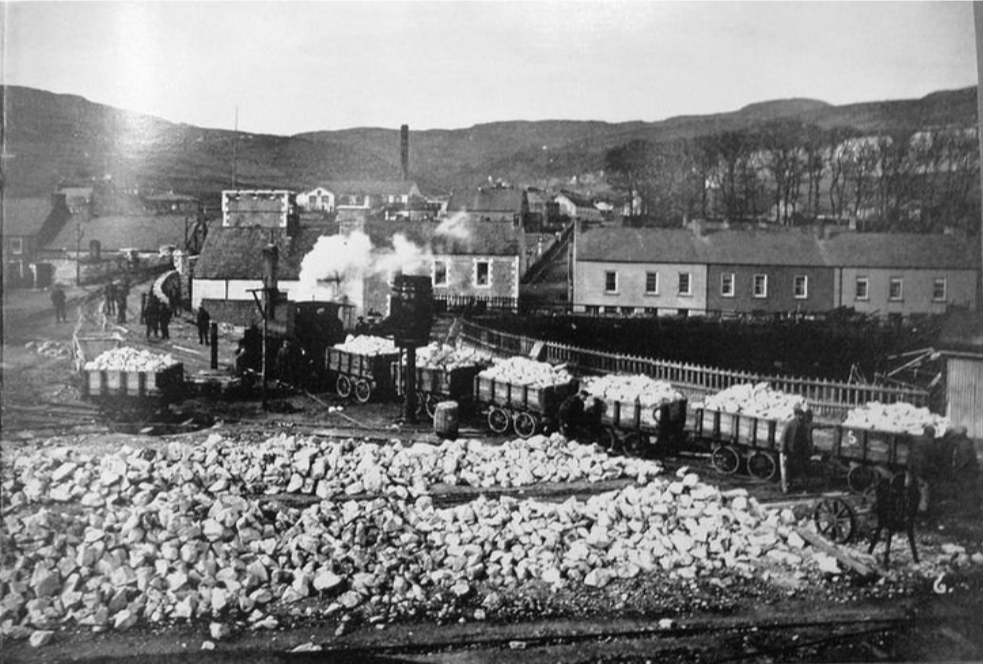
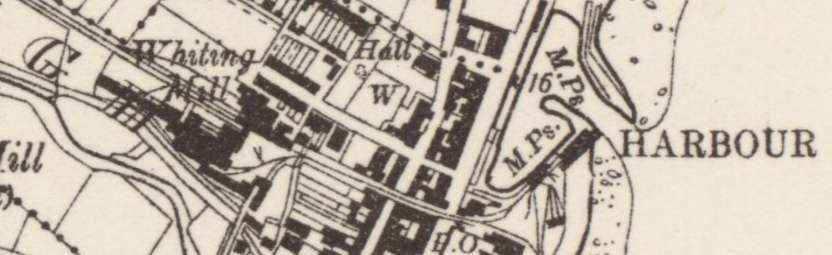
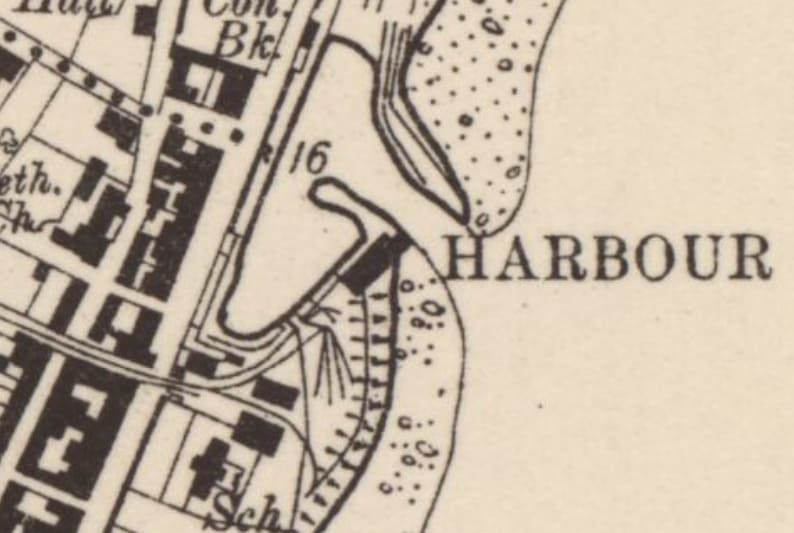
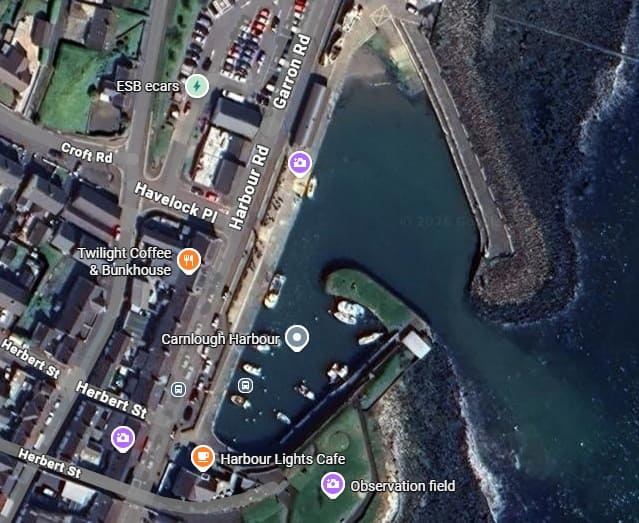
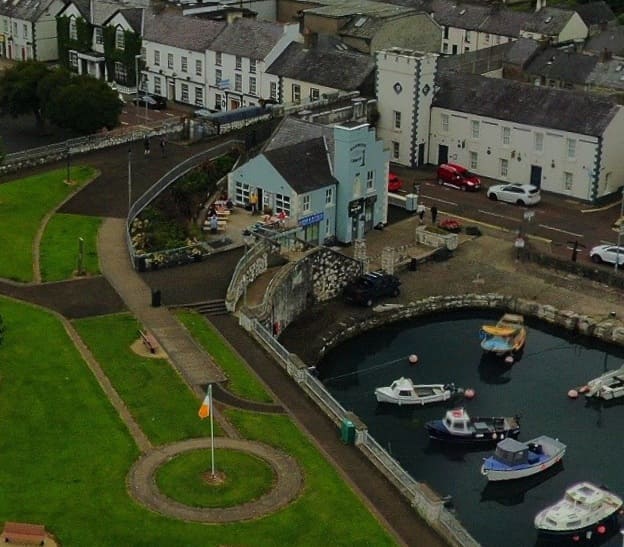
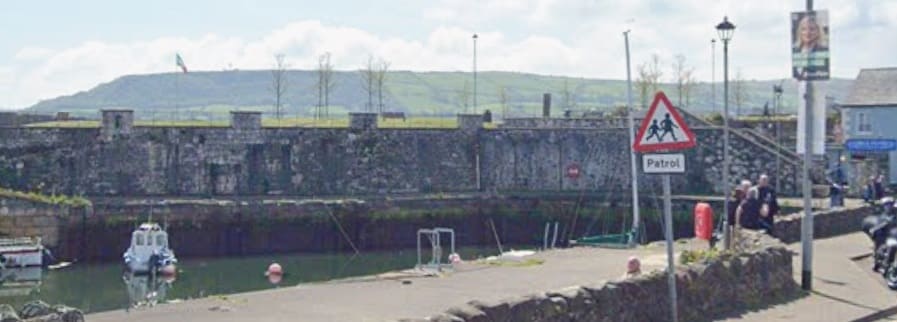
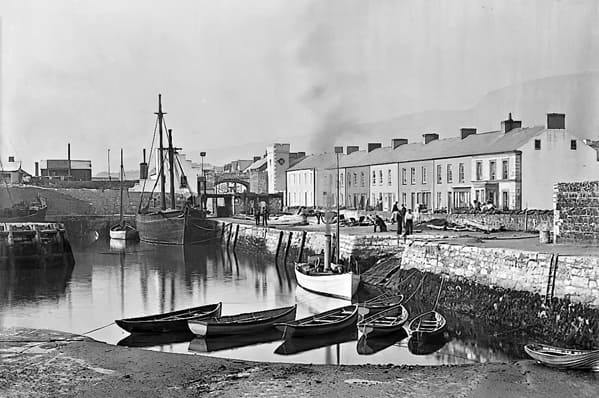
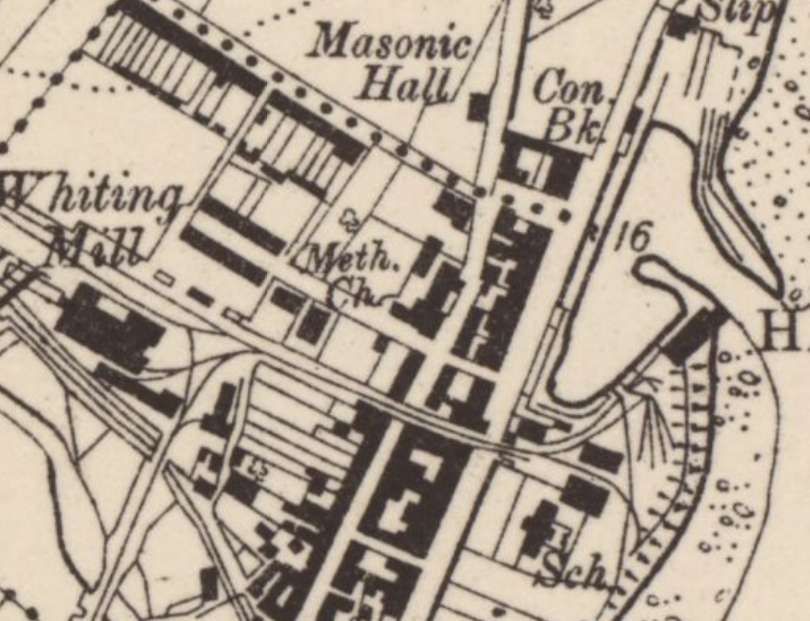
Carnlough Harbour as it appears on the 6″ Ordnance Survey of 1903, published in 1906. Two bridges carried the railway over Harbour Road and High Street. [13]The harbour in 2026. [Google Maps, April 2026]An aerial view of the route of the railway into the harbour area, looking Southwest over the harbour. From the bridge over Harbour Road, the line curves round to run at high level adjacent to the harbour wall where ‘drops’ were operated to load shipping with limestone, (c) Gareth Rowan, 2020. [Google Maps, April 2026]A view of the high level ‘plateau’ which house rail sidings, ‘drops and later, tippers. This photograph looks Southeast across the harbour from Harbour Road. [Google Maps, April 2026]Carnlough Harbour seen from the Northeast in the early 20th century, (c) Public Domain. [14]
The story of the harbour is a litany of different problems: [9]
The band of rock already noted;
A 2 year period to get the limestone ‘drops’ working effectively;
A sand bar developing which further restricted access to the harbour;
15 months wait for a dredger;
“In February 1860, part of the South Pier carrying the railway and one of the shoots, collapsed into the water. There was a difference of some 30 feet between the top of the pier and the floor of the basin, where the foundations had given way. Watson took charge of the repairs and by October, With the help of divers, he had rebuilt the fallen masonry and cleared the basin of debris.” [9]
In April 1862, Wilson that “the harbour has filled up nearly two feet since the dredger was at work and we are now obliged to have resource to the old system of shipping outside in lighters.” [9]
Another long wait occurred until a dredger could be permanently allocated to the harbour.
Problems were also encountered with the rail inclines. Only on the upper part of the railway could the loaded trucks pull up the empties, so that horse-drawing was still necessary on the lower. Robert Watson, an engineer from Seaham was brought in to see what he could do. He arrived in March 1856, and two months later Wilson wrote, “I am happy to say Watson has succeeded admirably in making it self acting, superseding the use of Horse work in drawing up the empty wagons.” (9.5.1856). [9]
Wilson sought to diversify to increase income. He began to burn lime in the small kiln (17.12.1855). By keeping careful accounts he soon found that he could sell at a profit. Armed with this knowledge, he urged the building of lime kilns as part of the development scheme. These were authorised at a cost of £600 and the railway to them at another £577. “Watson thought of a plan whereby trucks would be hoisted up to feed the kiln instead of running on an incline, thus saving almost £300.” [9]
McGuigan wrote that, “kilns for burning the limestone, and a mill for manufacturing whiting, were erected.” [1: p792] In fact, the project was so successful that once lime burning began in August, 1857, in a short time a further two kilns had to be built, making five in all. [9]
McGuigan tells us that the kilns “flourished until the second decade of the [20th] century, when the general industrial depression, coupled with the decrease in the use of lime mortar for building and the decline of the iron smelting industry on the west coast of Great Britain, caused the demand for limestone and burnt lime to drop. The kilns ceased operating, but fortunately there arose a demand for crushed lime for agricultural purposes and this kept the undertaking going during the lean years.” [1: p792] In 1954, that product still formed the major portion of the works output, and McGuigan reported that recently the demand for raw limestone had increased. …
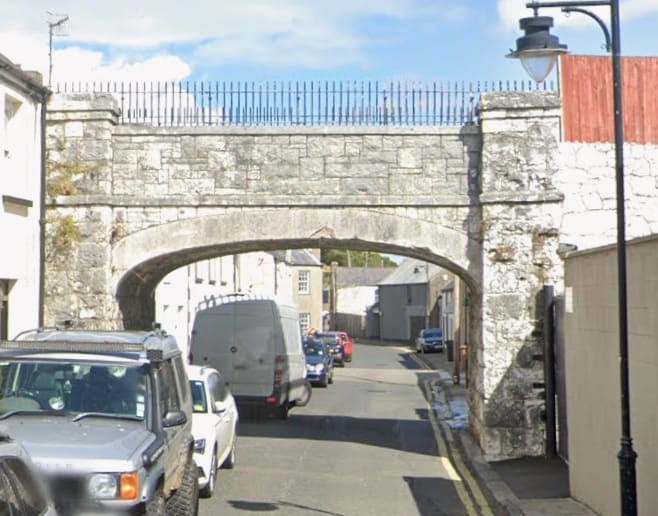
The lines running over these bridges were dual gauge, accommodating both narrow-gauge and standard-gauge traffic. The narrow-gauge line to Tullyoughter Quarry is dealt with later in this article.
The line to Gortin Quarry and Creggan Quarry
J. H. McGuigan tells us that “The original railway was of single track, about a mile in length, running inland on a gradient of 1 in 25 from the harbour to Gortin Quarry. This line [was] still in use [in 1954], except for the final 150 yd. or so, which was abandoned when the quarry became worked out [in around 1929/1939].” [1: p782]
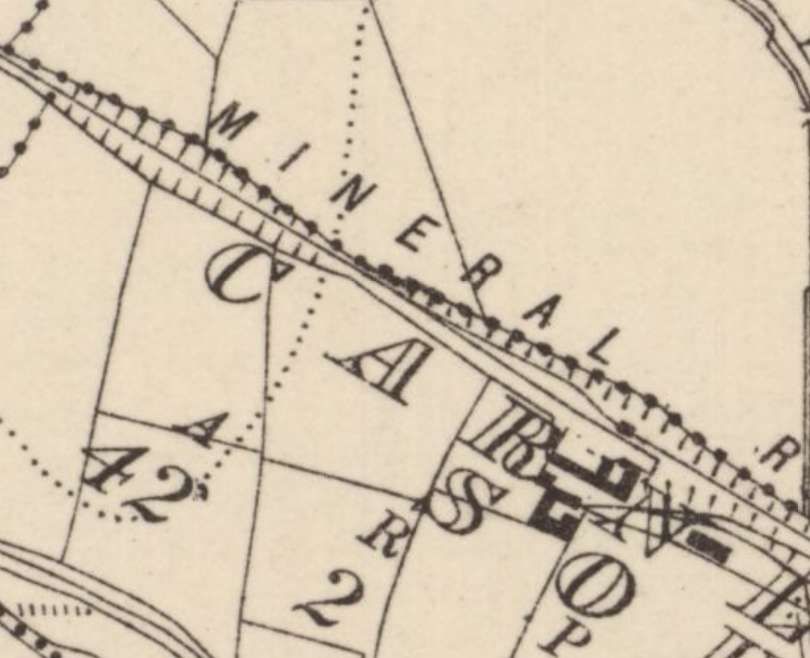
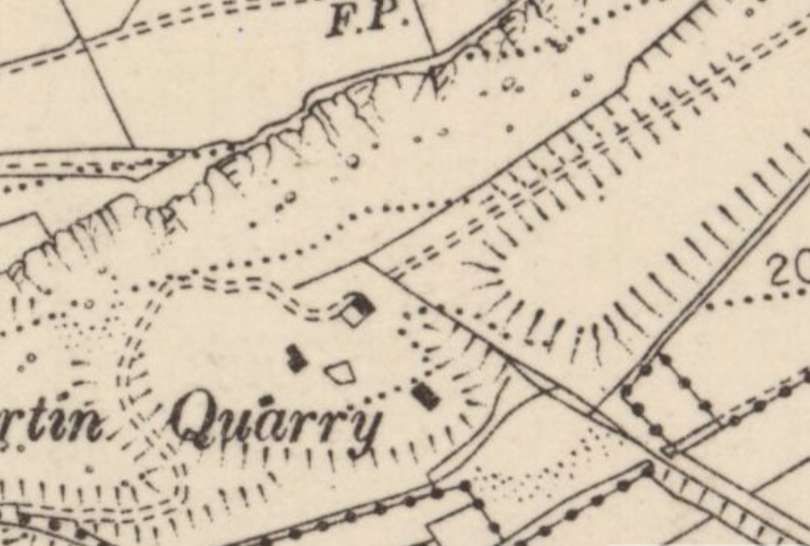
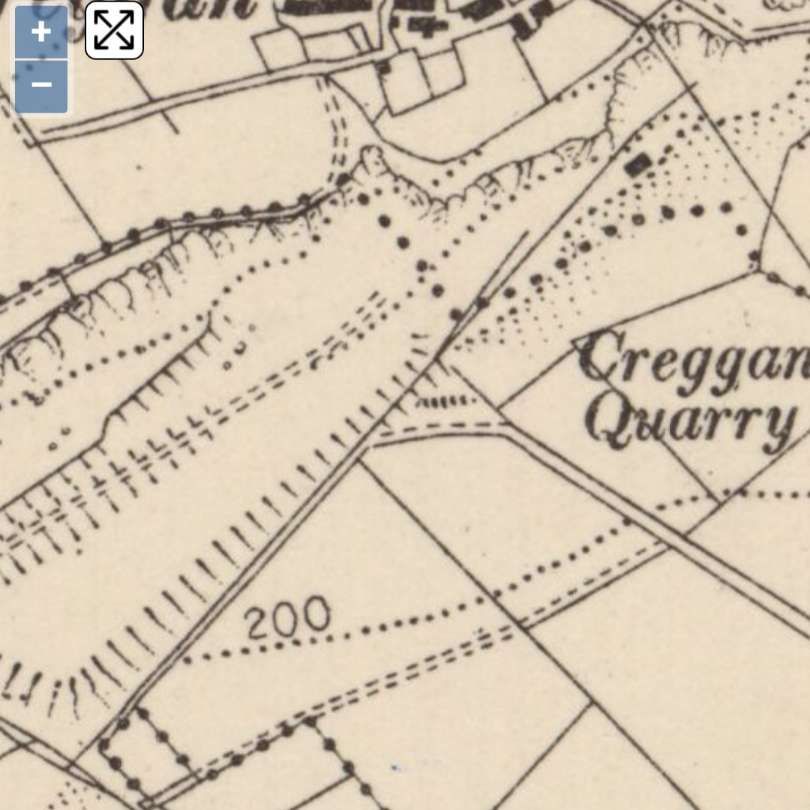
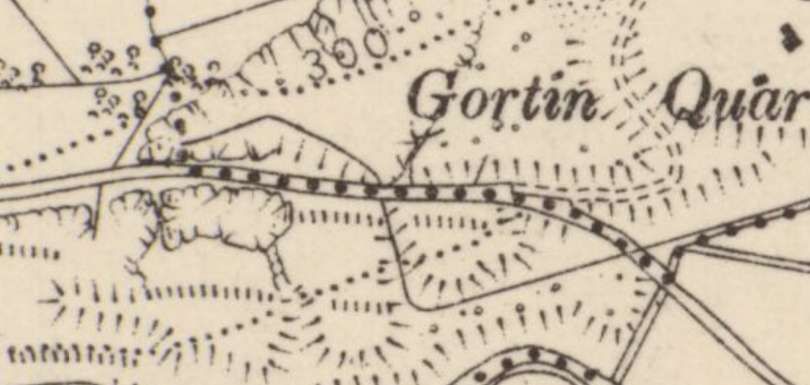
The original railway extended from the harbour, through the site of Whiting Mill and on to Gortin Quarry. This is an extract from the 6″ Ordnance Survey of 1903, published in 1906. [13]The line continues Northwest and up a steep incline towards Gortin Quarry. [13]The line continued uphill and to the Northwest. [13]Very close now to Gortin Quarry, the track arrangements at the top of the incline are evident in the top-right corner of this image. The line to Creggan Quarry leaves at 90° to the line from Carnlough and exits this map extract at the top. [13]This map extract shows the arrangement of the track work at the entrance to Gortin Quarry. [13]
“In the meantime, quarrying had extended northwards, and a second line, about half a mile in length, was constructed on a 1 in 7 gradient at a right angle to, and as an extension of, the original line. This also continue[d] in use [in 1954], giving a total of about one-and-a-half miles [then] working. The gauge [was] 4 ft. 8.5 in., rather unusual in Ireland.” [1: p782]
The line was originally operated by gravity and horse power but this was later replaced by cables with a winding house over at least part of the route. [2]
The line to Creggan Quarry left the lower incline at 90°, running Northeast. [13]Gortin Quarry was served by a short internal railway. [13]
McGuigan noted, in 1954, that the first section of about 750 yards, “from the harbour to a point about 500 yd. above the mill, [was] worked by a single cable and winding engine, the loaded trucks descending to the harbour by gravity but
attached to the haulage cable and therefore under the control of the engine driver. Empty trucks at the harbour [were] then coupled to the cable in place of the loaded ones and hauled up by the winder. Until the middle of 1952, the winding engine was steam-operated, and strongly resembled a ship’s winch. It had two cylinders, each 6 in. dia. by 11 in. stroke; the drum was 34 in. dia., with a brake drum 48 in. dia. on the same shaft, and was manufactured by Alexander Chapman & Company of Glasgow. Steam was supplied by a vertical cross-tube boiler 10 ft. high and 4 ft. dia. In 1952, the unit was electrified by the s
imple expedient of removing both connecting-rods, fitting a vee-belt pulley in place of one crank, and installing a 35-h.p. three-phase electric motor with vee-belt drive.” [1: p792-793]
Trucks on the standard-gauge track attached to the cable from the winding engine. The cable passed overhead to an idling drum before returning to ground level. [1: p794]
Above the powered rope-worked incline another 650 yard self-acting rope-worked incline operated with the weight of descending wagons lifting empties. That incline was “single track with a passing loop at the middle. The haulage cable passe[d] round a drum 8 ft. 6 in. dia. in a pit at the top of the incline. The drum rotate[d] about a roughly vertical axle and [was] provided with a hand-operated band-brake by which the speed of the trucks [was] controlled. To avoid the two portions of the cable becoming crossed, the ascending rake of trucks [had] to travel on the same side of the passing loop as that used by the previous descending rake, and this entail[ed] throwing the points at each end of the loop after every run. A man [travelled] on the rear truck of each rake, and as these approach[ed] the passing loop the brakeman reduce[d] speed. Each man then dismount[ed] as his rake enter[ed] the loop, [threw] the points when the last truck of the entering rake [had] passed, and board[ed] the last vehicle of the emerging rake on which he return[ed] to his base.” [1: p793]
At the top of the incline, the next section, left at an angle of about 90°, the connection was made by means of a turntable, a square crossing and a cut-off line. McGuigan said in 1954: “Loaded trucks from the upper incline travel via the cut-off line to a dead end, from which they reverse on to the lower incline. Empty trucks from the lower line are turned on the turntable and enter the upper incline over the square crossing with the track used by loaded vehicles.” [1: p793]
McGuigan continued his narrative: “From this point to the terminus (approximately half a mile) the line is worked as two consecutive gravity inclines, similar to that just described, a siding and a turntable adjacent to the brake-drum of the lower incline giving access to the working face of the neighbouring Creggan Quarry via a fan of tracks along which the trucks are manhandled.” [1: p793]
“Some 100 yd. above this point, the second incline enter[ed] a cutting about 100 ft. deep in which [was] the passing loop, and then passe[d] through a concrete-lined tunnel about 100 yd. long from which it emerge[d] to the upper quarry.” [1: p795]
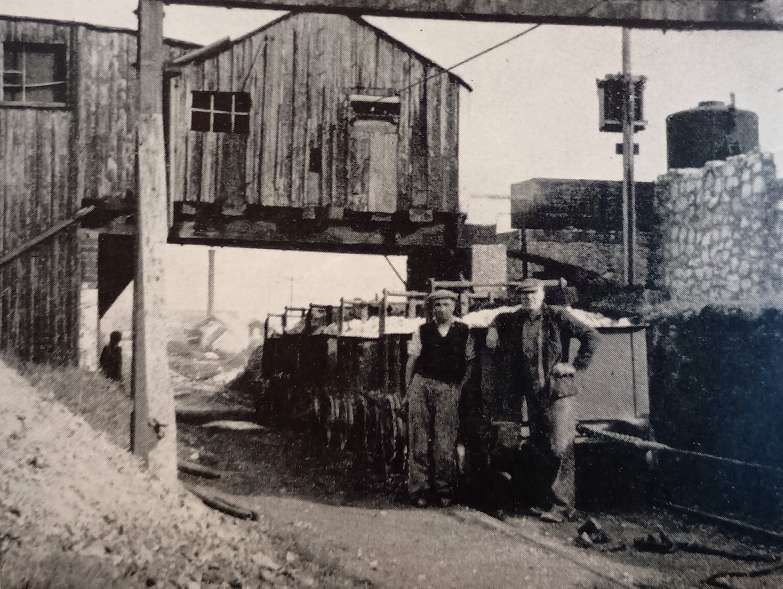
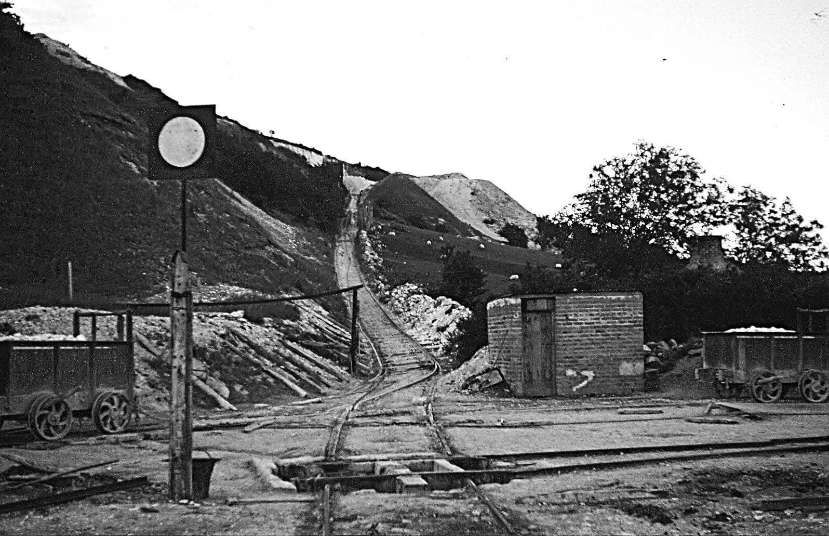
McGuigan continued, in his article, to talk through the signalling arrangements in use on the line. One of the disc signals mentioned can be seen in the monochrome image above. “Disc signals, each consisting of a board about 3 ft. 6 in. square, painted black with a white disc on one side, and mounted on a wooden post arranged to turn about a vertical axis, [were] provided at the top and bottom of each incline. The heights of the posts [varied] from about 4 ft. to 25 ft., according to position. The normal aspect of the signal [was] with the board parallel to the track, that is with the disc invisible to a person on the track. When a rake of trucks, usually six vehicles, [was] ready to depart from one end of an incline the operator there turn[ed] his signal to exhibit its disc to the operator at the other end. When the latter [had] ascertained that the rake at his end [was] ready, he turn[ed] his signal and exhibit[ed] its disc in acknowledgment. The brakeman or engine man, as the case may be, then release[d] the brake and allow[ed] the run to take place.” [1: p795]
Whiting Mill and its Rails
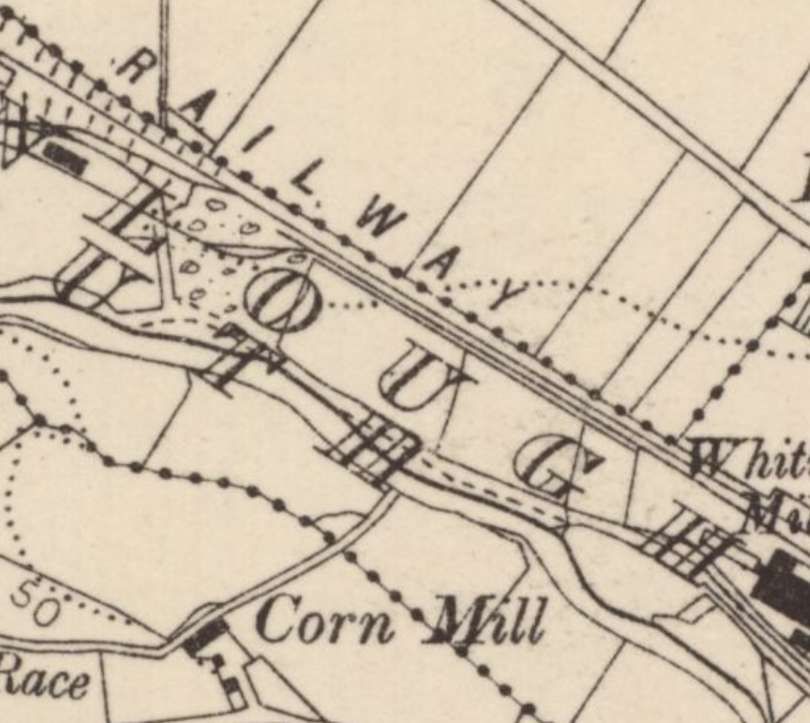
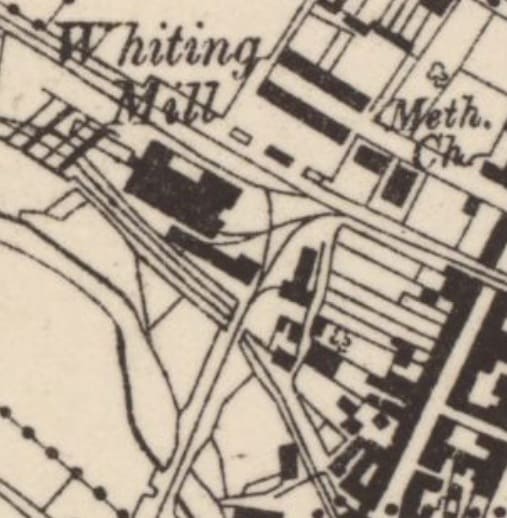
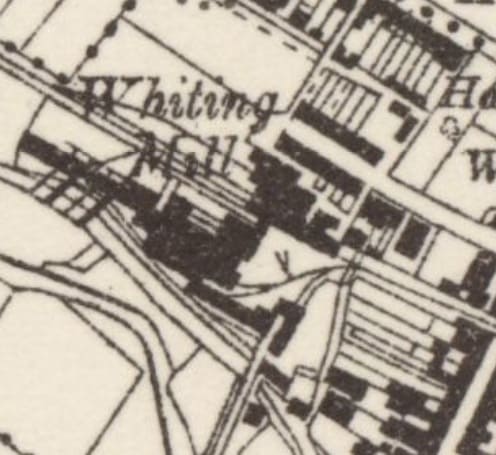
Whiting Mill as shown on the 6″ Ordnance Survey of 1903, published in 1906. Notice the array of tracks close to the mill, the line heading West-northwest ran to the base of the first incline. The line running South-southwest is the 3ft 6in-gauge line to the quarry at Tullyoughter which is discussed below. It is worth comparing this map extract with the one immediately below. [13]Whiting Mill as shown on the 6″ Ordnance Survey of 1931, published in 1933. Notice that the buildings have been enlarged, that the track layout in the yard is more simple and that the line which used to serve the quarry at Tullyoughter has gone. [12]
The Narrow-gauge line to Tullyoughter Quarry
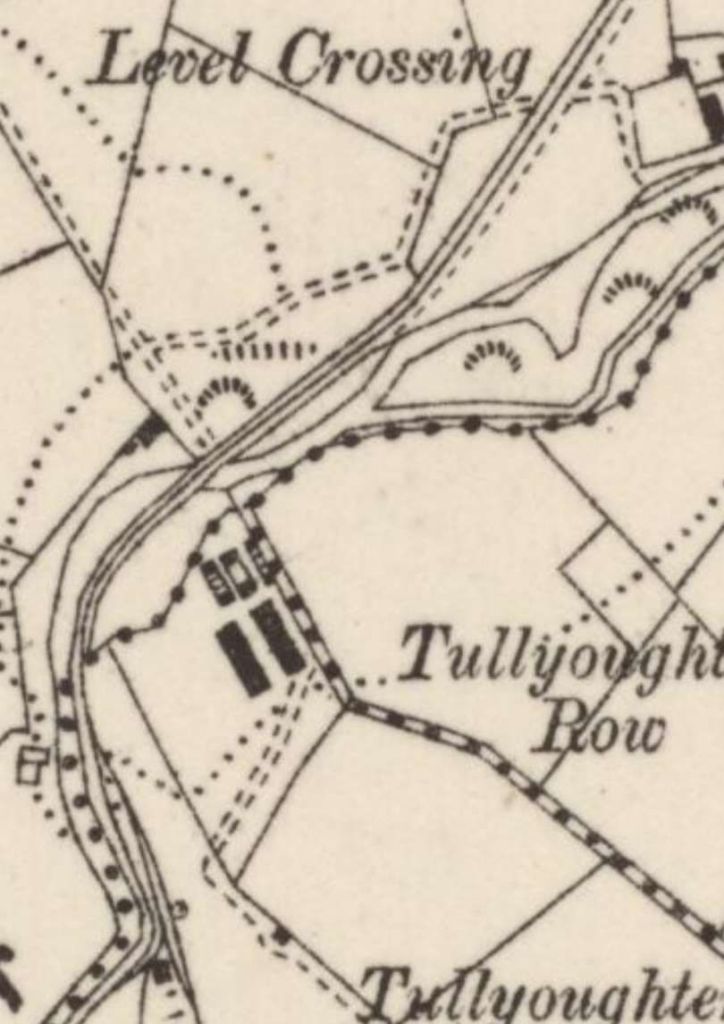
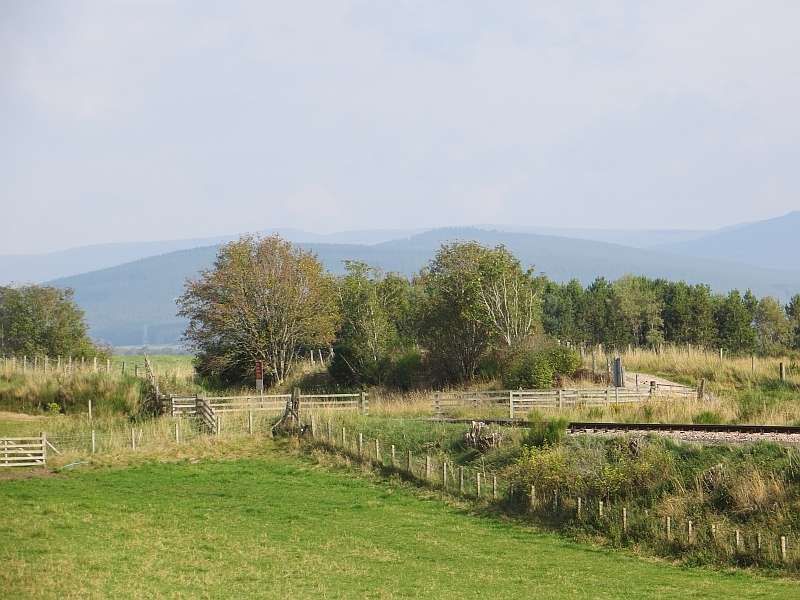
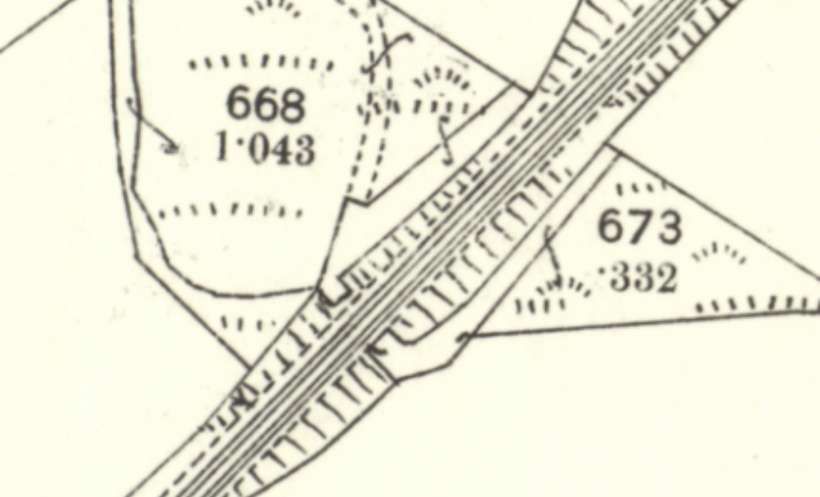
McGuigan continued: “About 1890, presumably because of a boom in the limestone business, a quarry was opened at Tullyaughter, about two miles south of Whiting Mill, and a 3 ft. 6 in. gauge, single-track railway was laid thence. The addition of a third rail to the existing line allowed trucks of limestone to pass directly from the quarry to the harbour. The new line crossed the Carnlough River on a timber trestle bridge, and then, about half a mile further on, crossed the Ballymena-Carnlough road on the level. Gates to close the ends of the railway when trains were not passing were provided there, and a man was employed to operate them and exhibit a red flag to road traffic when a train was approaching.” [1: p795]
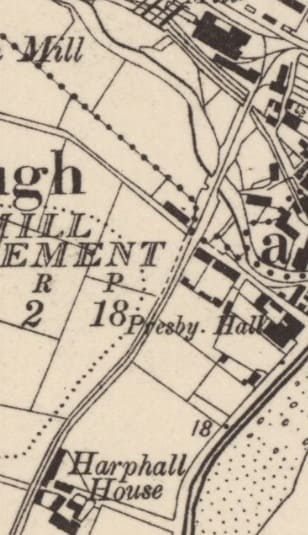
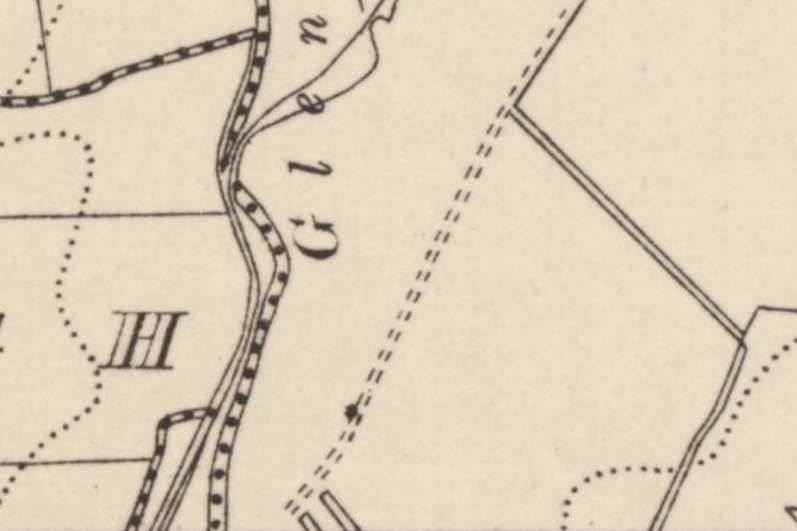
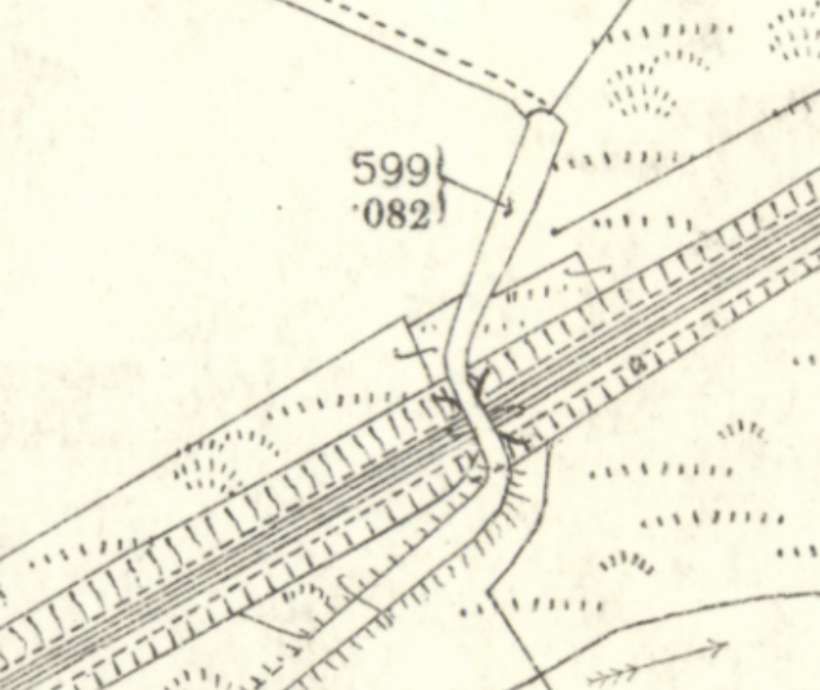
The first length of the 3ft 6in-gauge line from Whiting Mill to the quarry at Tullyoughter bridged the Carnlough River and ran down the West side of Harphall House. [13]
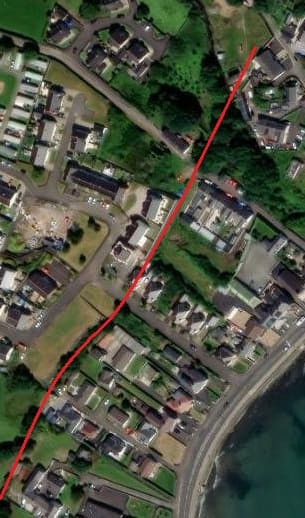
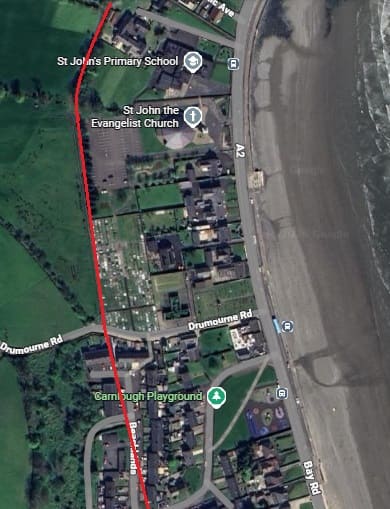
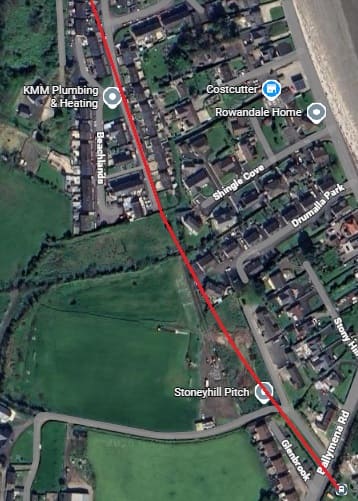
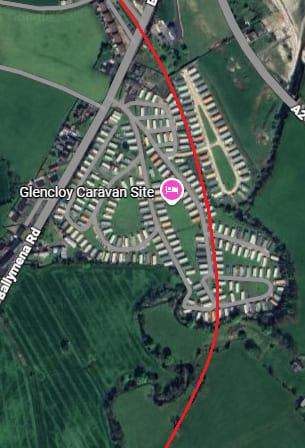
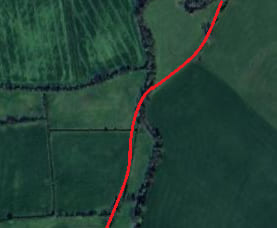
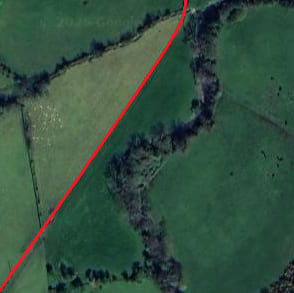
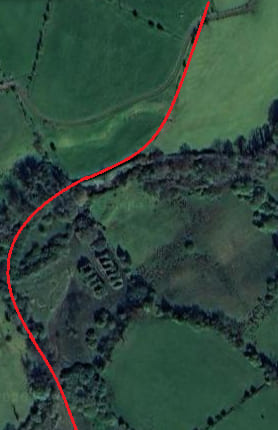
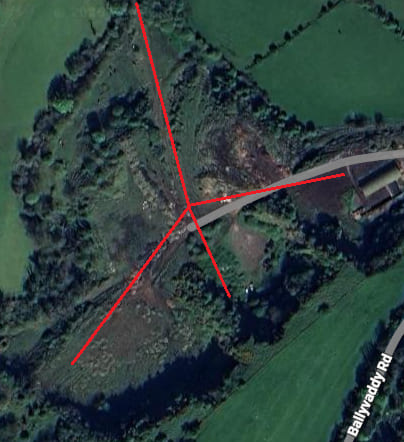
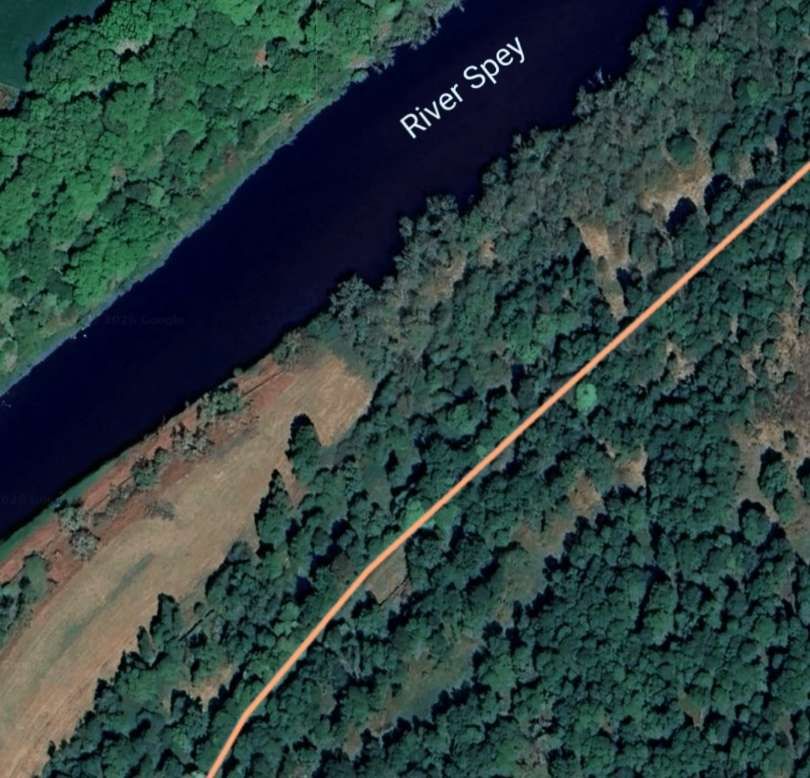
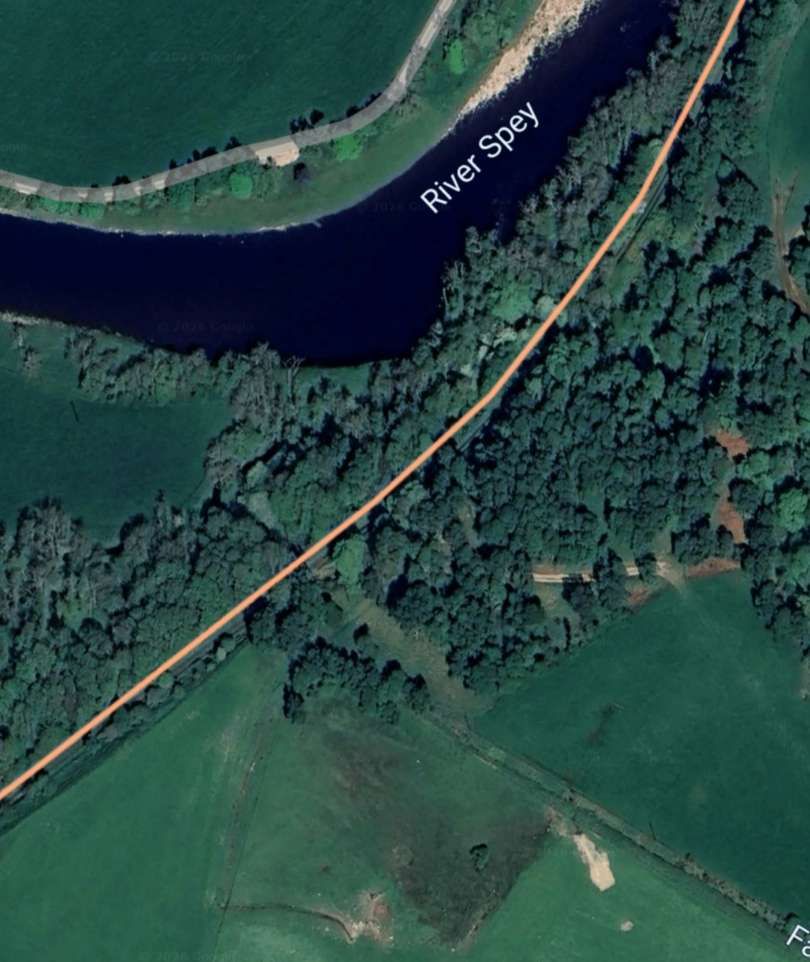
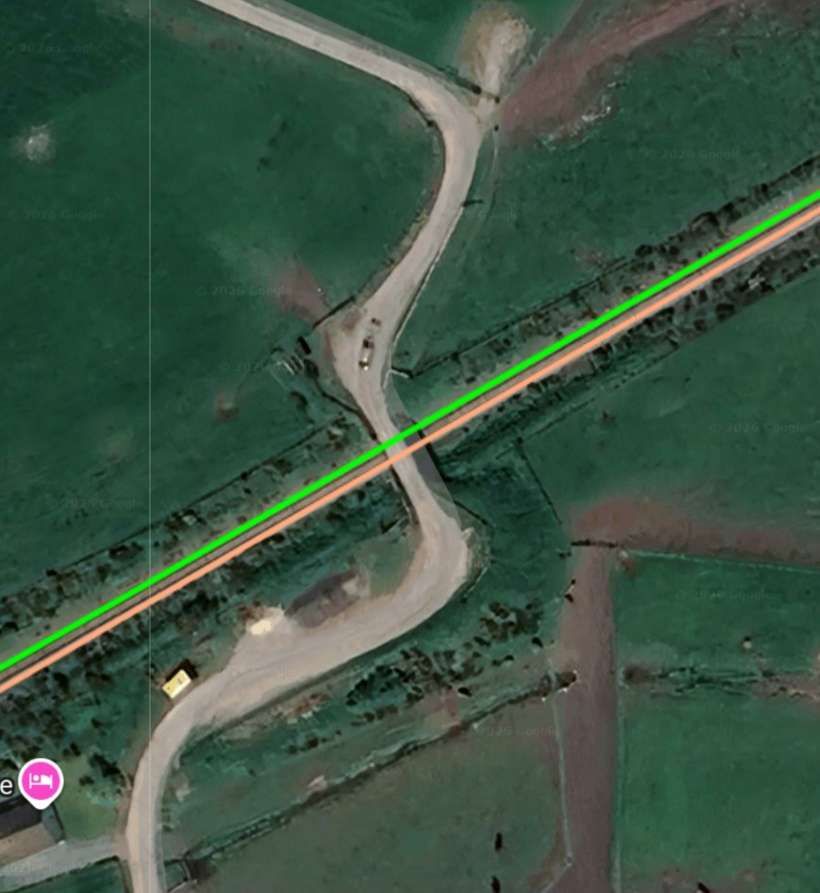
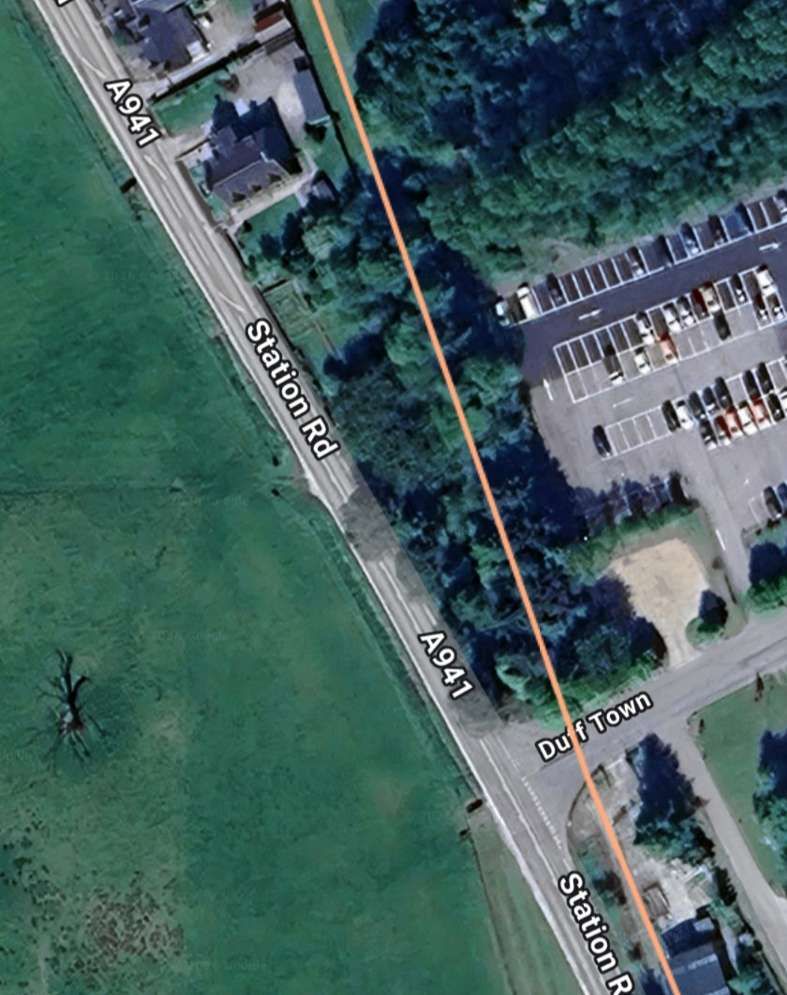
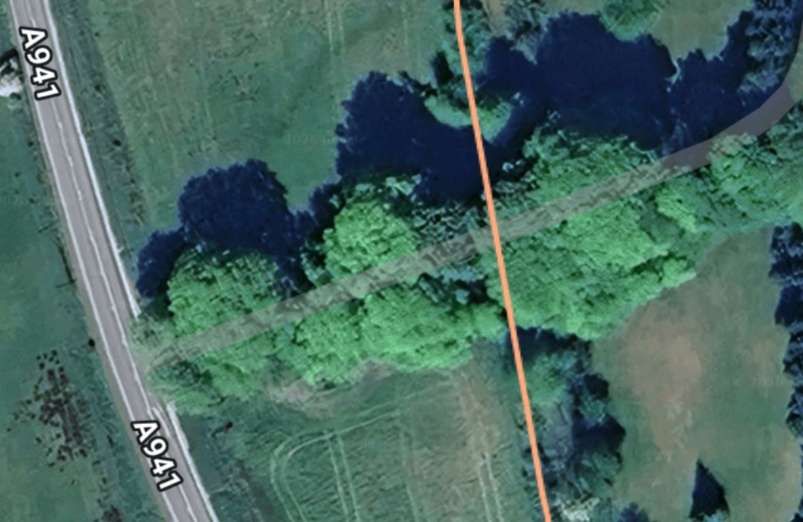
The route of the line is shown on the satellite image on the right above as a red line. this applies along the route of this 3ft 6in line and to the satellite images below. [Google Maps, April 2026]
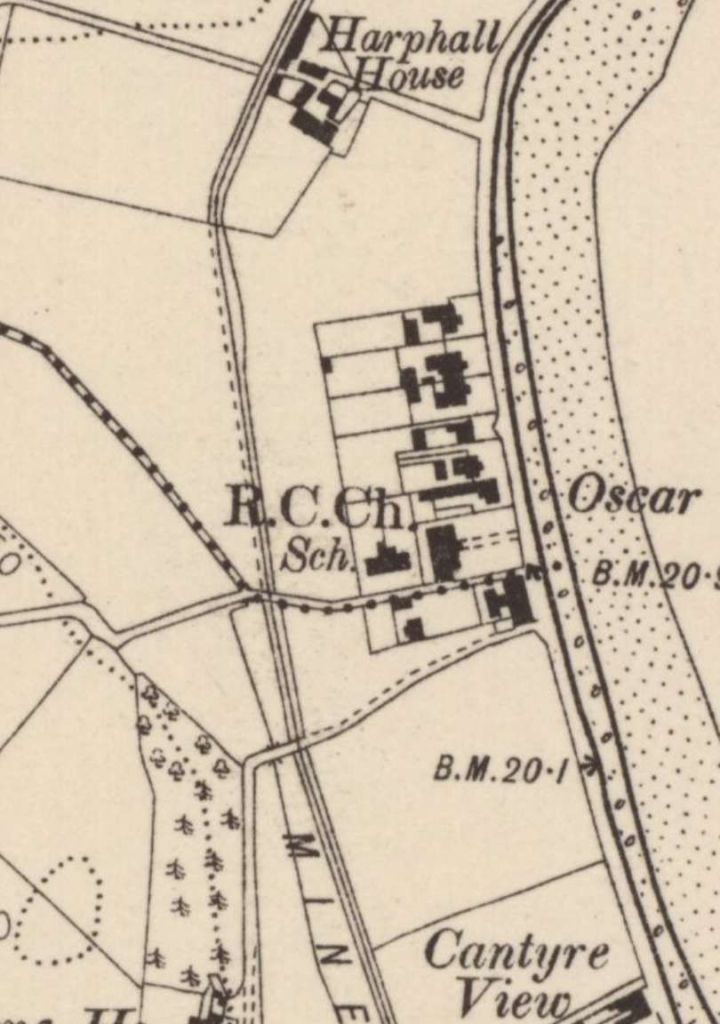
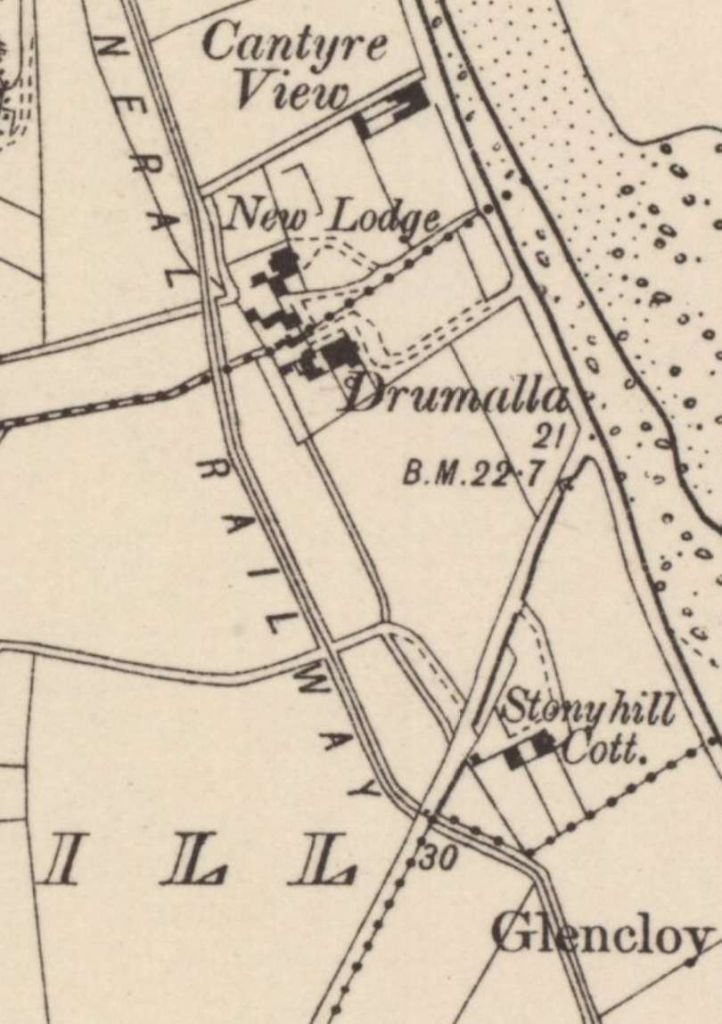
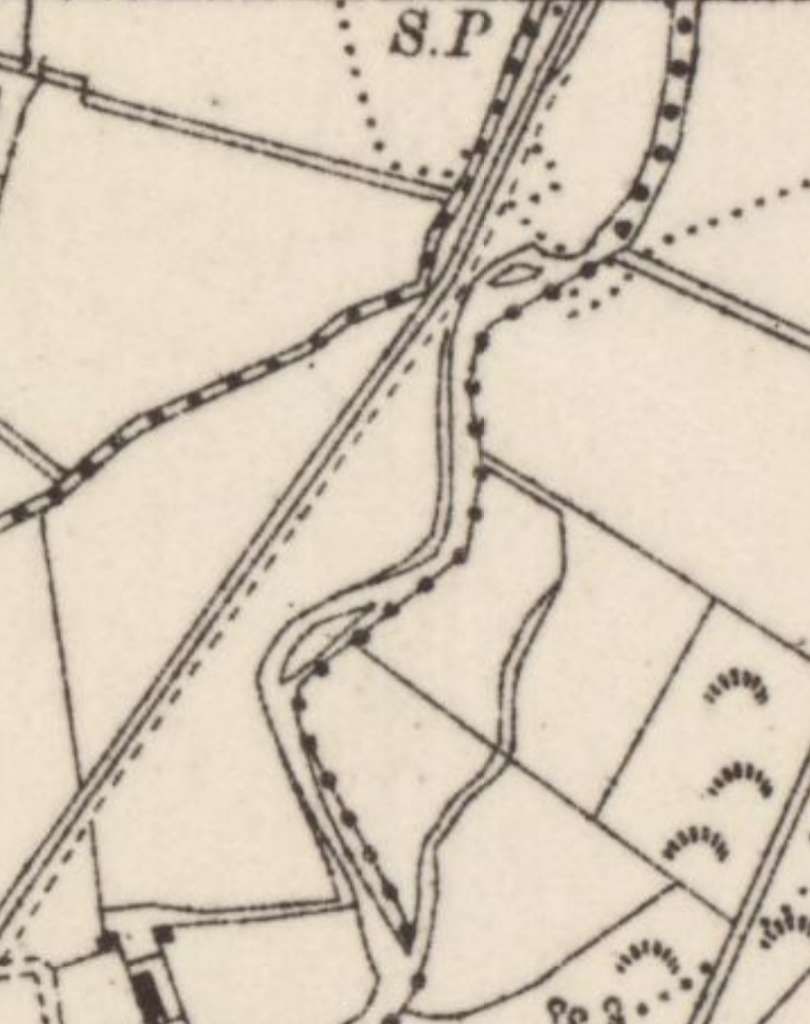
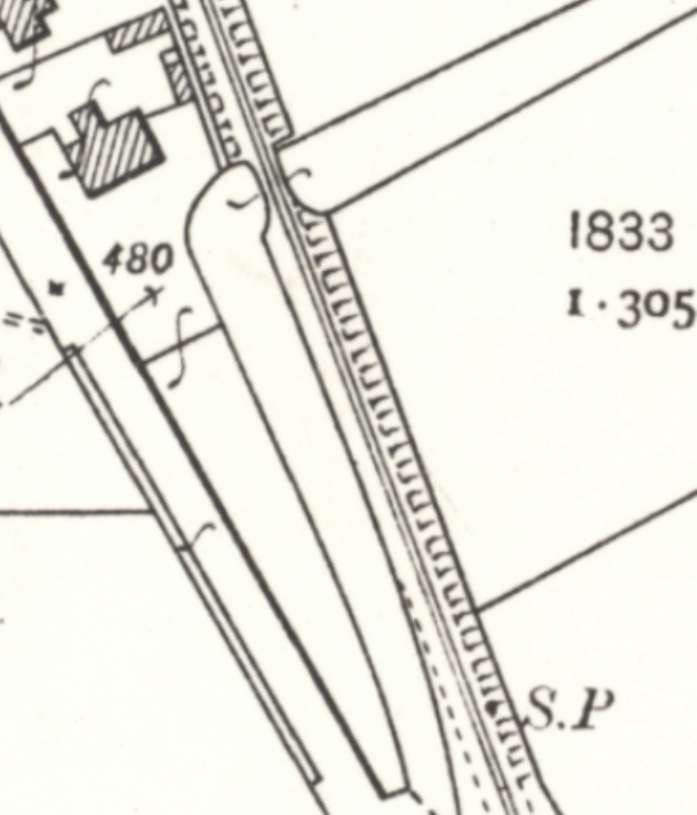
The next length of the line ran behind the properties which face out onto the A2, [13]
The line continues South at the rear of what were single properties facing the A2 but now replaced by small estates. [13]
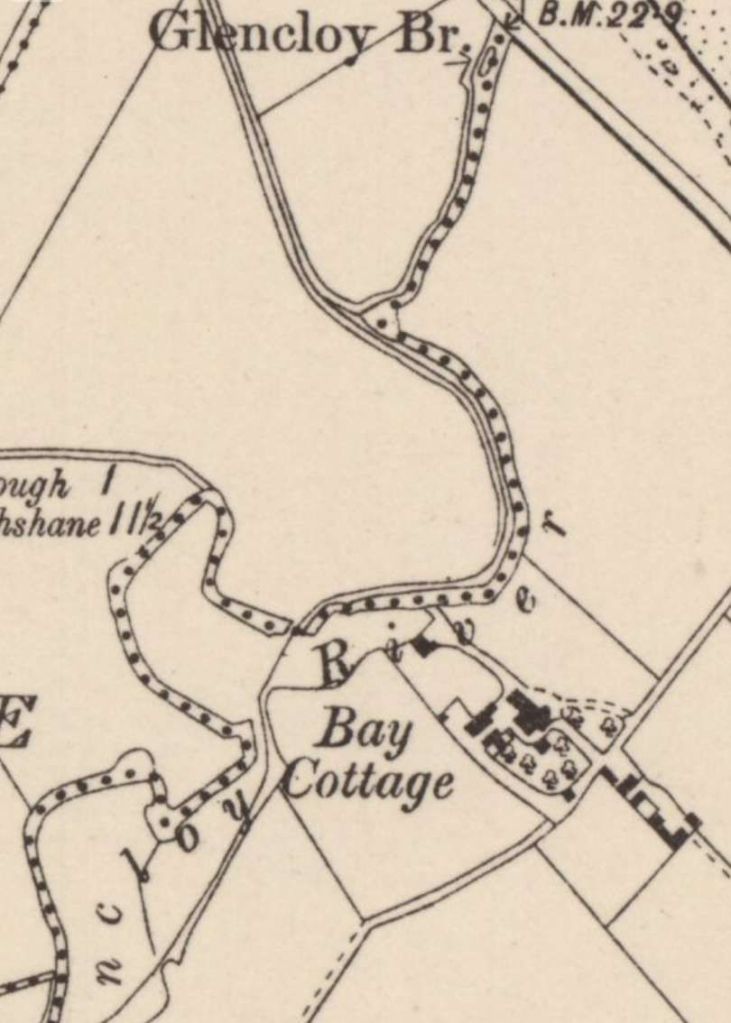
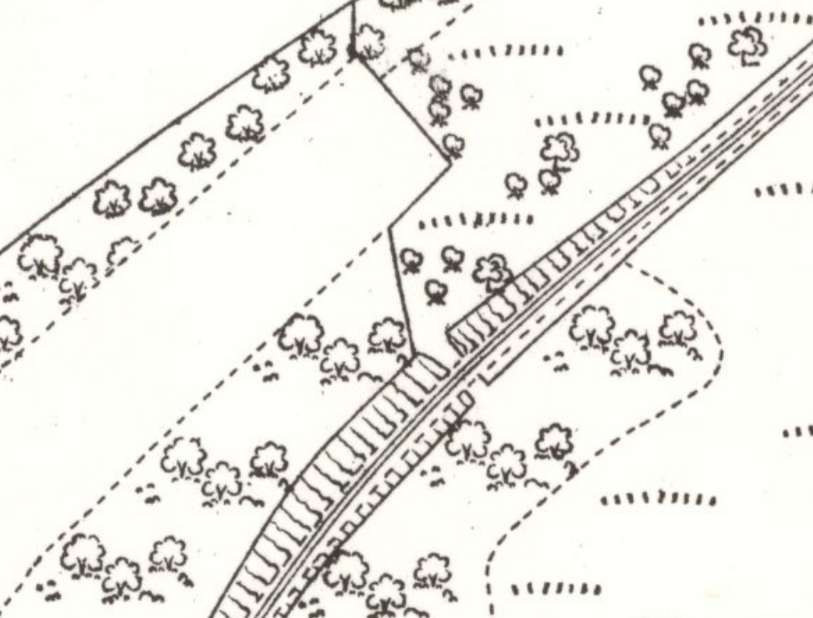
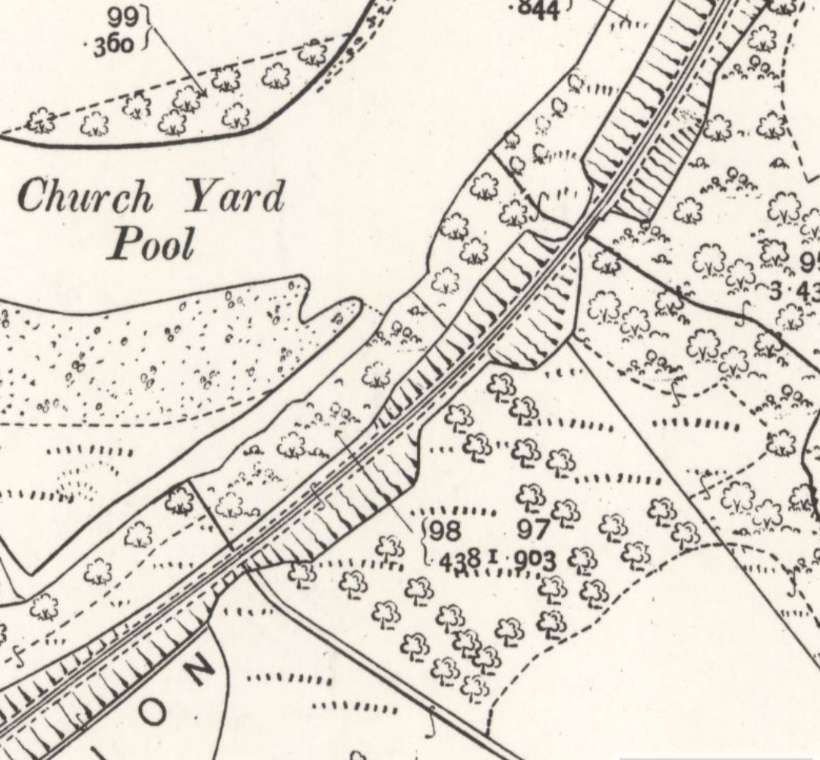
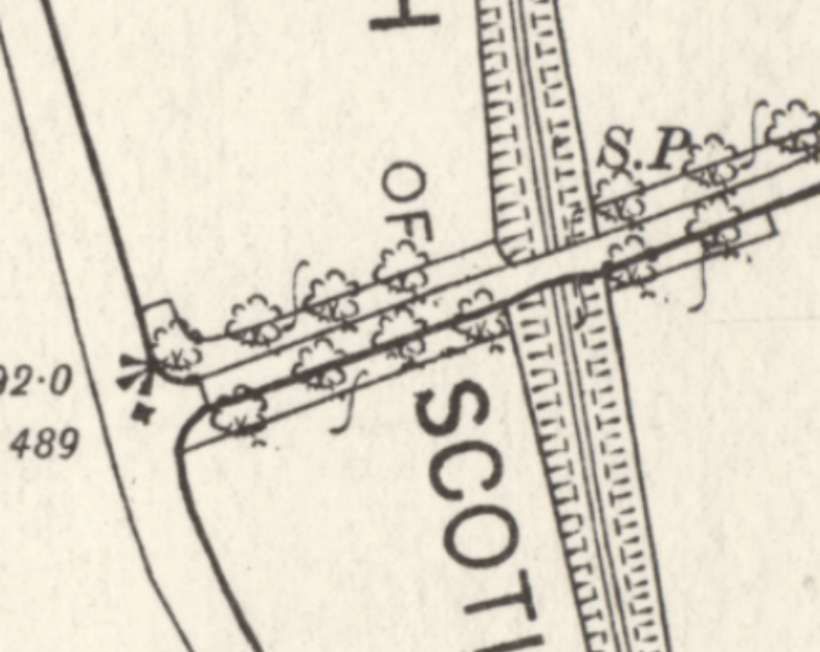
The railway ran along the West bank of the Glencloy River. It passed to the West of Bay Cottage, [13]
The next extract from the NLS 6″ OS mapping takes us to the bottom of the OS sheet. … [13]
The line to the edge of the OS sheet. [13]
The next three sections of the line are shown on the next OS sheet. … [15]
The next length of the railway is on the next Ordnance Survey sheet. [15]
A very similar length of the line as shown on the adjacent OS mapping. [Google Maps, April 2026]
The length from the Level-Crossing to Tullyoughter. [15]
The next images show the last length of the line and its terminus in Tulluoughter Quarry. … [16]
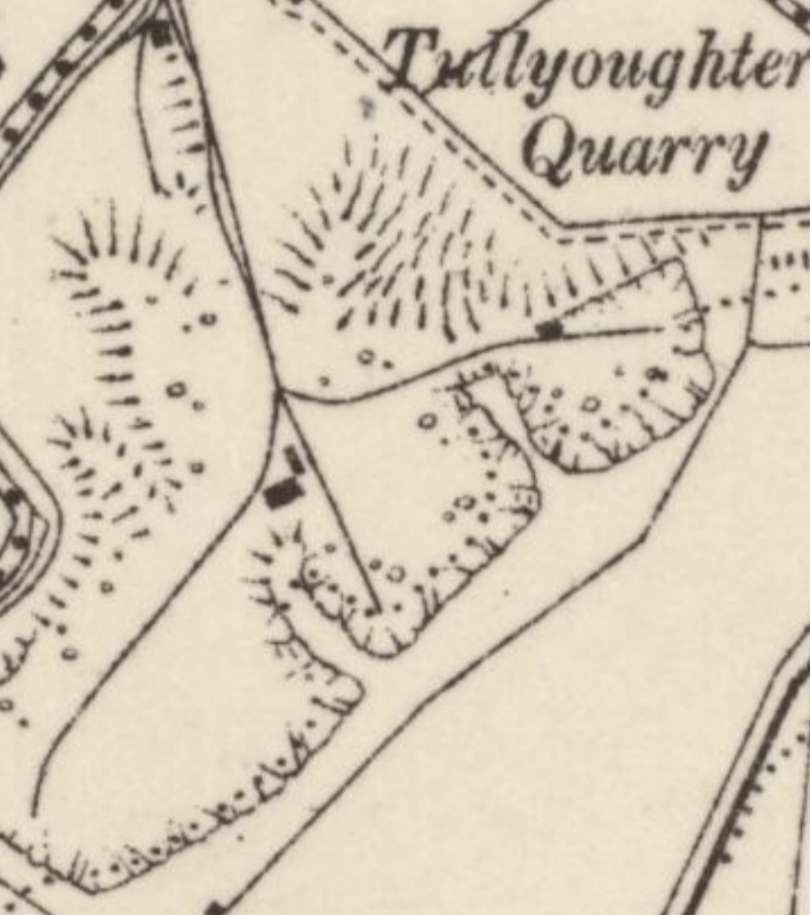
The line terminates at Tullyoughter Quarry, [15]
McGuigan says: “The line from the mill to the quarry was on a rising gradient of about 1 in 50, and was worked by gravity and horses until a steam locomotive was acquired in 1898. This was a 0-4-0 side tank engine, named Otter, built in 1896 by Andrew Barclay, Sons & Company, of Kilmarnock, and had 7 in. by 14 in. outside cylinders, 2 ft. 1 in. wheels, and a wheelbase of 3 ft. 9 in. The heating surface was 145 sq. ft., the grate area 3.5 sq. ft., and the working pressure, 140 lb. per sq. in. The engine was provided with a cab, and the fuel bunker was in part of the right-hand tank. Otter hauled loads of about 20 trucks. Work at Tullyaughter Quarry ceased about 1922, and the line between it and the mill was lifted about 1924. Otter continued to work in the mill yard and at the harbour till about 1930, after which it lay derelict until it was sold for scrap and cut up in July, 1951.” [1: p795]
Writing in 1954, McGuigan goes on to talk about rolling stock on the line: “Rolling stock at present consists of about 80 trucks for the 4 ft. 8 in. gauge. and 13 for the 3 ft. 6 in. gauge. The former have timber frames and steel bodies 7 ft. 8 in. long, 4 ft. wide, and 2 ft. 10 in. deep. The wheelbase is 3 it. 5 in., and wheel diameter in some cases 2 ft. 6 in., and in others 2 ft. The narrow-gauge vehicles consist of seven trucks with bodies and six flats, and are of all-wooden construction, except for wheels and fittings. Both broad-and narrow-gauge trucks are designed for end tipping, and have one end arranged to swing outwards on a hinge just above the top edge. The narrow-gauge stock is used exclusively for the transport of finely ground products from the mill to the harbour, the flats are used for bagged material. An agricultural tractor acts as locomotive between the harbour and the mill, and does shunting work. The track layout at the harbour is triangular, and includes sidings of each gauge, three-rail mixed-gauge sidings, and one four-rail mixed-gauge track leading to four turntables which serve the chutes down which the limestone is delivered into the holds of the steamers.” [1: p795]
McGuigan then talks of planned modernisation of the railway with new sidings serving a new crushing plant, “the provision of an electrically operated wagon-tippler, and the electrification of the winding-engine all indicat[ing] that, unlike some public railways in Ireland which are in decline, the Carnlough Railway [was] entering its second century in a spirit of rejuvenation.” [1: p795]
An Aerial Ropeway for the The Sulphate of Ammonia Co. Ltd. (Carnlough)
Perhaps of additional interest is another industrial concern in the vicinity. In the early 1900s an American and a German, Messrs. H.C. Woltrick and G.W. Mottram, who had arrived in England in 1899 “to demonstrate the process for the production of white lead by electrolysis, … had ventured to [Co. Antrim] where they discovered … that the mountain behind Carnlough, in the townland of Harphall, was particularly rich in the type of peat from which ammonia could be extracted. Thus the venture began and a limited syndicate was formed to carry on the work.” [11]
“Early in 1904 the business was taken over by the Chemical Proprietory Co. Ltd. with a capital of £100,000. Woltrick and Mottram remained directors and it was not long before this new company … ran into difficulties. It was reconstructed as Chemicals Ltd. in late 1904.” [11]
The Company needed to transport peat, in an efficient manner, down the side of the mountain. Their chosen solution was an aerial ropeway. They negotiated an agreement with the local landowner and “early in 1905 a dining-room and huts for sleeping were erected [on] the mountain; and an office, staff house and retorts were built at the foot of the mountain at … the ‘Low Station’. The aerial ropeway, supported by 24 trestles in a straight line down the mountain side and over the Cranny River to the Low Station was also built.” [11]
“The aerial ropeway was to carry numerous buckets which were to circulate continuously in a clockwise direction up and down the mountain side. They would be loaded with peat at the top of the mountain and carry it down to the Low Station to be unloaded and burned in the large retorts. Tools such as stone hammers and peat knives were purchased to aid the workers cut the peat. Some 200 people were employed.” [11]
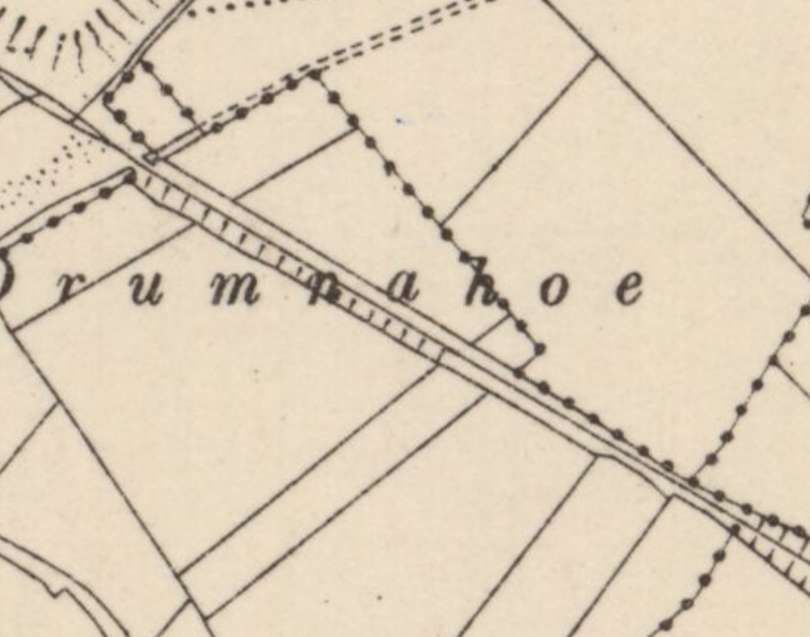
“Railway lines 7 feet wide resting on 12 foot sleepers were laid [across the bog on the mountain]. Side lines were laid in conjunction with the main line. The peats were stacked beside the lines and then loaded onto wagons on the main line which were drawn by an engine called ‘Moor Hen’ to the head of the aerial ropeway. Here they were transferred into buckets and taken by cable to the Low Station at Drumahoe … where they were emptied into the large retorts lined with lead and burned using sulphuric acid. From here the produce was loaded in granule form into trucks and sent down to the harbour for export.” [11]
After a few months, “Chemicals Ltd. went into liquidation for lack of capital. It was reconstructed as the Sulphate of Ammonia Company with a capital of £125,000 and for the next two years things went well without any hitches.” [11]
Early in 1908 production was almost at a standstill due to the decreasing ammonia content of the peat and the lack of further capital. The company ceased trading and “the aerial ropeway… was purchased by a Cumberland coal mining company. Under the direction of Hugh and Thomas Wilson it was re-erected at St. Bee’s Head.” [11]
References
J. H. McGuigan; Carnlough Limestone Railway and Harbour; in The Railway Magazine, Tothill Press, London, November 1954, p792-795.
Phillip Gibbons was master of a smack from Westport, Co.Sligo. Late in the eighteenth century he pulled in at Glenarm where, foresaking the sea, he married Anne, daughter of Nicholas Stewart, the Earl of Antrim’s agent. Through his marriage he became possessed of, amongst other properties, the townland of Carnlough North, where they resided. He was a sort of farmer-contractor, prepared to undertake any work for the betterment of the district. He died about 1815.
The Ordnance Survey Memoirs for the Parish of Ardclinis: see “The Glynns” Vol I, page 31.
Following on from a couple of articles about the Tanat Valley Light Railway written some years back, I was reading some older rather tatty magazines and found an article entitled “Rails up the Tanat Valley” in an issue of the Ian Allan publication ‘Railway World‘ – the June 1990 edition. [1]
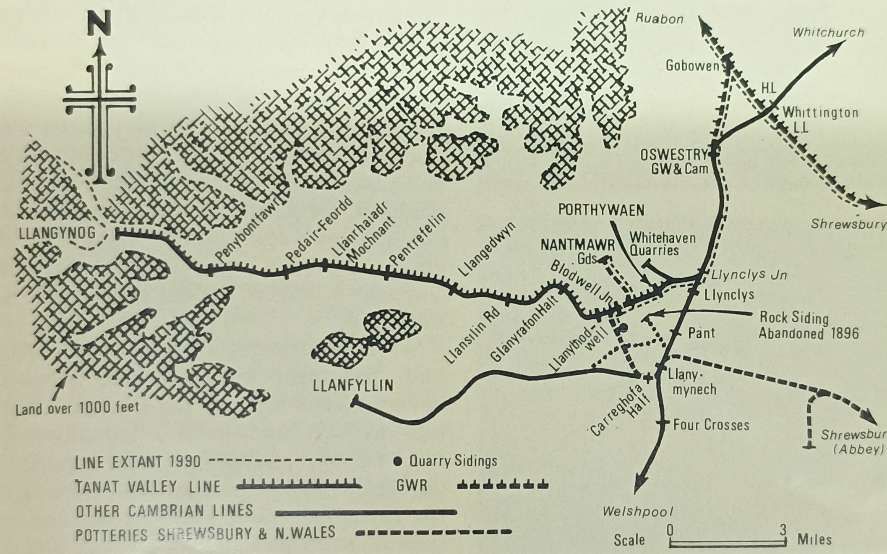
The Tanat Valley Railway and associated lines. [1: p365]
In his article, Colin Ganley recounted the rise and decline of the minor lines running west from Oswestry, the last remnant of which by 1990 had been ‘mothballed’.
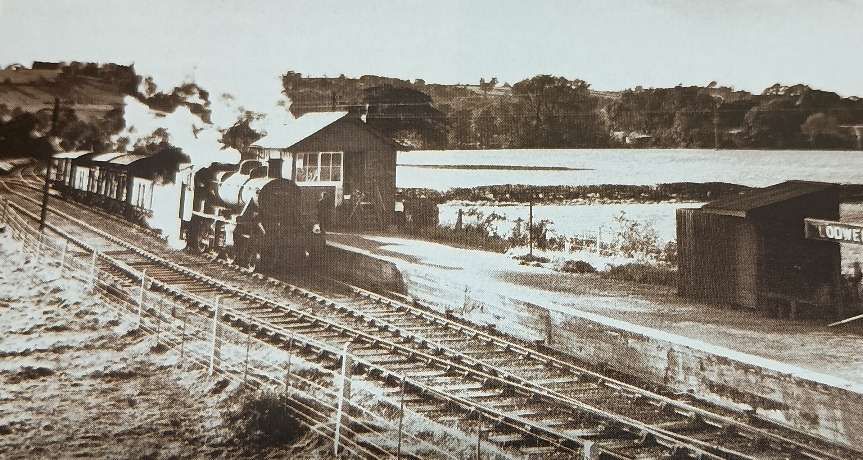
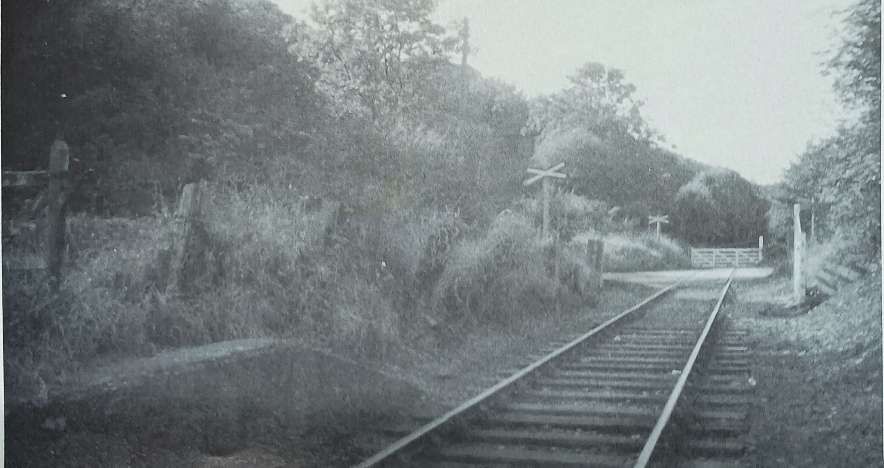
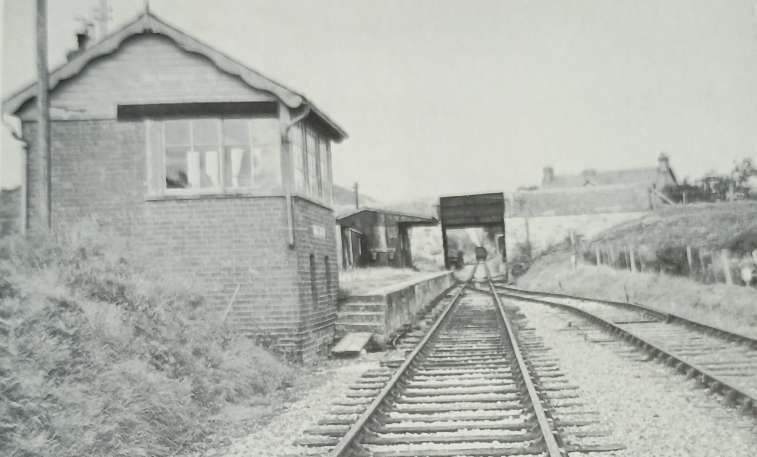
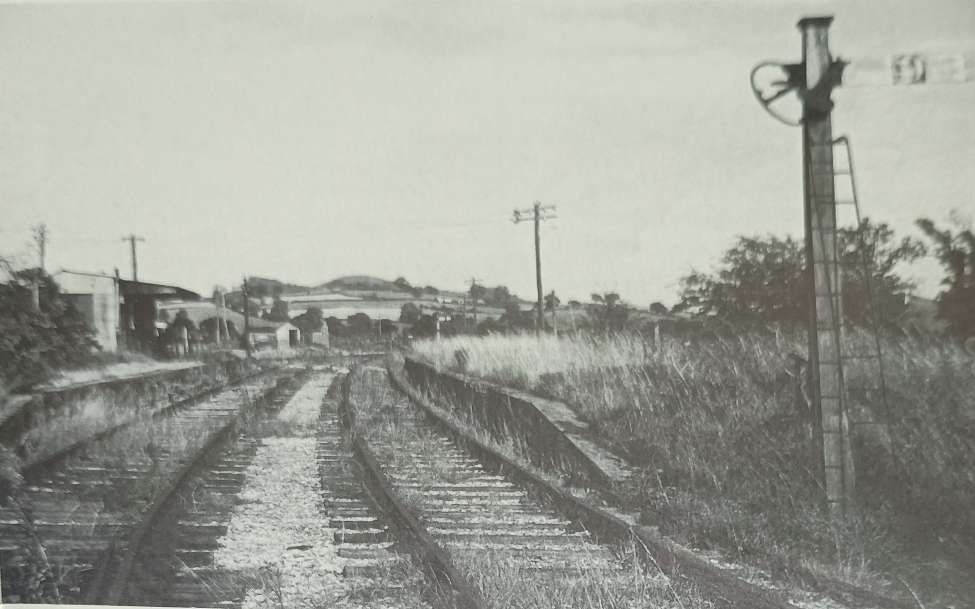
Colin Ganley wrote: “In October 1988, the last train ran between Gobowen and Biodwell Quarry in Shropshire. For some years the line had carried only stone trains, bringing out ballast to the requirements of the Area Engineer. The trains, normally Class 31-hauled, traversed the remains of five different branch lines, which in their heyday provided Oswestry and the eastern end of the Tanat Valley with a fascinating and complicated array of lines to serve local industry. With the decision to cease using ballast from Blodwell, traffic on the line came to an end, marking the final cessation of all rail services connected with the delightful one-time Tanat Valley Light Railway.” [1: p364]
He continued: “For the present, this surviving section is in suspended animation. As there is a possibility that the stone traffic may restart in the future, the railway is being left in place. Traffic will resume if BR returns to this source of ballast. If not, eventually a decision will be made to lift the track and dispose of the land: unless the Cambrian Railways Society, based at Oswestry, is in a position to take an active interest in its future.” [1: p364]
Parts of the derelict line at Nant Mawr which were once the western end of the Old Potts Railway are now owned by ‘The Tanat Valley Light Railway’ which is a modern charity that aims to preserve and restore this line.
“The original Tanat Valley Light Railway was the first cross border light railway crossing from England into Wales, meandering up the fantastic Tanat Valley from Llynclys Junction to Llangynog and providing links to Llanymynech and Llanfyllin via its other branches.” [2] It was opened in 1904, mainly as a direct result of the 1896 Light Railways Act, but, says Ganley, “before taking up its story it would be useful to look at its associated lines and also earlier schemes to provide the picturesque village of Llangynog with railway transport. At the height of railway mania in 1845, the Shrewsbury, Oswestry and Chester Junction Railway obtained powers to build a line from Shrewsbury to Chester with a branch from Gobowen to Llanymynech. All that was built of the branch was the 2.25 miles from Gobowen to Oswestry, which opened on 23rd December 1848. In 1854 this line became part of the Great Western Railway.” [1: p364]
He continues: “The second portion of line to be constructed was the Oswestry & Newtown Railway, which was incorporated in 1855. to link these two towns. The section between Oswestry and Pool Quay opened on 1st May 1860 with the remainder to Newtown opening on 14th August. … The company, which was to be the foundation of the later Cambrian Railways, opened a 1.25-mile freight-only branch from Llynclys Junction, some 3.5 miles south of Oswestry, to Porthywaen. This branch served important quarries, some of which are still operating today, and became the railhead for the industries of the Upper Tanat Valley, Shortly after the Porthywaen branch was opened, a mineral line was built from it to serve some collieries at Trefonen. These collieries however were not very successful and this line was abandoned as early as 1881.” [1: p364]
“In the meantime there had been several proposals to build a line up the Tanat Valley. One such proposal envisaged a great trunk line from Worcester to Porth Dinllaen, near Nefyn on the Caenarvonshire coast, with the object of providing an alternative route for Irish Mail traffic. In 1860, a similar proposal was put forward as the West Midlands, Shrewsbury & Coast of Wales Railway which planned a railway from Shrewsbury to Portmadoc via Llanymynech, Llangynog and Bala. This route would have included a 1.5-mile tunnel under the Berwyn Mountains between Llangynog and Bala.” [1: p364]
“However, the project had trouble raising support and money. … Proposals for a similar route were resurrected in 1862 as the Shrewsbury & North Wales Railway. Powers were obtained by 1865 to build a line from Abbey Foregate, Shrewsbury, to Llanymynech but before this section was completed the company had merged with another scheme to provide a railway from Stoke-on-Trent to Shrewsbury. The combined efforts brought forth the grand title of the Potteries, Shrewsbury & North Wales Railway (or POTTS for short) and extended the original plans to include an extension from Llanymynech to Nantmawr over which passenger trains were to run as far as Llanyblodwell (later renamed Blodwell Junction). The financial troubles of the POTTS and its rebirth as the renowned Shropshire & Montgomeryshire Light Railway [3] are outside the scope of this article, but the result was the working of the Llanymynech to Nant Mawr section by the Cambrian Railways from 1881. At this time goods traffic only was operated, the passenger service between and Llanymynech and Lianyblodwell having ceased in 1880.” [1: p364-365]
“The Light Railways Act of 1896 made possible the construction of railways to remote agricultural areas that hitherto had had difficulties in raising capital and several places along the Welsh border benefited from such schemes, one being the Tanat Valley. The Act saw the birth of two schemes to provide, at last, rail transport to the Upper Tanat Valley and the industries of Llangynog. The unsuccessful proposal was for a 2ft 6in gauge railway from the Llanfyllin terminus of the Cambrian branch from Llanymynech.” [1: p365]
“This plan, the Llanfyllin & Llangynog Light Railway, was to cross sparsely populated country between Llanfyllin and Penybontfawr and would not have benefited the lower part of the Tanat Valley. It nevertheless could have been a fascinating line had it been constructed, though the change of gauge at Llanfyllin would have proved a disadvantage.” [1: p365]
“The scheme that was selected by the Light Railway Commissioners was for a standard gauge line from the Cambrian’s Porthywaen mineral branch straight up the valley Liangynog. The plan also envisaged using a short section of the Nantmawr branch. The Tanat Valley Light Railway received its Light Railway Order in 1898 and was constructed by J. Strachan of Cardiff who employed about 125 men on the work. The total cost of the line proved to be about £92,000 which was around £20,000 more than the company had hoped for. This shortfall, not helped by a delay in construction, meant that the Tanat Valley Co was impoverished from the outset and had to approach the Treasury for more grant aid. During construction in 1903 some directors found that the contractor was giving a ‘free’ train service over the partially finished railway but as the contractor was allowed to finish the job it can be assumed that any quarrel was rectified.” [1: p365] For the earlier articles about this line, please follow these two links:
Colin Ganley continues: the Tanat Valley Light Railway “opened on 5th January 1904 to both passengers and freight and was worked by the Cambrian from the start. It became wholly part of the Cambrian in 1921, passing to the Great Western Railway and then to the Western Region of British Rail. The length of the linc from Llynclys Junction to Llangynog was some 15 miles 71 chains and included 11 stations or halts, one of which was former POTTS station of Llanyblodwell which was renamed Blodwell Junction. The stations were of typical light railway pattern with rather mean corrugated iron clad buildings and, except for Liangedwyn and Llanrhaiadr Mochnant, had only one platform. Original plans for some stations did consider refreshment rooms in effort to build up tourism but the company’s lack of capital put an end to such plans.” [1: p365-366]
“With the opening of the Tanat Valley line, passenger services were restored between Llanymynech and Blodwel Junction as this had been a condition of securing support from potential opponents during the planning stages. The opening of the Tanat Valley line also restimulated the slate quarries at Llangynog which had all but closed by 1900. Slate quarrying continued intermittently until 1939 but lead mining, which had effectively ceased in 1877, was never to resume on any commercial scale. The railway also assured the development of granite quarrying at Llangynog, the Berwyn Granite Co. providing much traffic until World War 2. The quarry survived into the mid 1950s but at the end offered virtually no traffic to the railway.” [1: p366] Berwyn Granite Quarries Ltd. remains an active company with headquarters in Wellington, Shropshire. [4]
Colin Ganley continues: “Initially the passenger service consisted of four trains each weekday with an extra trip on Wednesdays. Many trains were mixed and the journey to Oswestry took no less than 75min on some trains. Two trains a day carried a through coach to Llanymynech, detached at Blodwell Junction, but this practice ceased in 1915 and was replaced by a connecting service. The Blodwell Junction to Llanymynech service ceased completely as from 1st January 1917, having been hardly ever used and only operated to fulfil an agreement. Freight traffic over this section ceased in 1925, the Nantmawr traffic then being worked via Porthywaen, and most of it was lifted between 1936 and 1938.” [1: p366]
By 1923, “the number of passengers being carried was half the level of 1913 and continued to decline during the GWR years. By 1925 services, which normally consisted of two four-wheeled carriages, were reduced to three trains each way, though certain extras ran on Wednesdays and Saturdays. In 1929, the GWR introduced a rival bus service which was taken over by Crosville in 1933. The bus served the centres of villages far better than the train as certain stations. Llanrhajadr Mochnant in particular, were badly situated. This, coupled with the elongated journey times caused by the adherence to light railway practices, reduced traffic even further.” [1: p366-367]
“During World War 2 the passenger service was reduced to two trains each way, by now composed of a single Cambrian brake third. After the war, despite petrol rationing, few people were making the delightful trip up the Tanat Valley by rail. Goods traffic was also on the wane and on 15th January 1951 passenger services ceased because of a grave coal shortage, never to return. Official closure took place on 1st July 1952 and at the same time freight traffic was also withdrawn between Llanrhaiadr Mochnant and Llangynog. The track on this section remained in situ for several years, not being lifted until 1958. Freight traffic to Llanrhaiadr Mochnant ceased abruptly on 5th December 1960 after the river bridge near Pentrefelin was badly damaged by flooding,” [1: p367]
“Services on neighbouring lines were savaged in the mid-1960s. All passenger traffic between Welshpool and Whitchurch and also over the Llanfyllin branch were withdrawn on 18th January 1965, leaving Oswestry with the Gobowen diesel shuttle service, which ceased in November the following year. By 1967, just the single track South of Oswestry to Porthywaen and Nantmawr was left, along with the line from Gobowen. Reduction in traffic over the ensuing years left just the Blodwell Quarry service. All the sidings at Oswestry and Porthywaen disappeared. The section west of Blodwell Junction had been lifted by 1965 and though the Nantmawr branch has not seen a train for 20 years the track is still in-situ, although with sturdy trees growing between the sleepers.” [1: p367]
“No account of the Tanat Valley would be complete without a brief mention of its quaint motive power. From the outset, the Cambrian normally provided three Sharp Stewart 2-4-0Ts, Nos 57, 58 & 59 of 1866 vintage. They became GWR Nos. 1192, 1196 and 1197 respectively, and although No 1192 was withdrawn in 1929 after being sent to Devon, Nos 1196 & 1197, both in a rebuilt state, survived at Oswestry until 1948.” [1: p367]
Sharp, Stewart and Co. “was a steam locomotive manufacturer, originally based in Manchester, England. The company was established in 1843 following the dissolution of Sharp, Roberts & Co.. In 1888, it relocated to Glasgow, Scotland, where it later amalgamated with two other Glasgow-based locomotive manufacturers to form the North British Locomotive Company.” [5]
Ganley tells us that the two surviving Sharp Stewart locomotives were “assisted by No. 1308 Lady Margaret, an Andrew Barclay 2-4-0T built in 1902 for the Liskeard and Looe Railway and taken over by the GWR in 1909. This locomotive also did yeoman service in the Tanat Valley until it too was withdrawn in 1948.” [1: p367]
“Other locomotives were seen up the Tanat Valley at various times, including old Cambrian Sharp Stewart 0-6-0s dating from 1875 and the odd Dean Goods. In the latter years passenger traffic was the preserve of ‘5800’ class 0-4-2 tanks, numbers 5808 & 5812 being particular regulars. Goods traffic that remained was normally entrusted by the early 1950s to the Ivatt Class 2 2-6-0s.” [1: p367]
“Various types of diesels handled the surviving quarry services, including Classes 25, 31 and 37. A Class 31 had the privilege to be the last railway locomotive to operate a commercial train (so far) in this region of complex and fascinating railway history. It remains to be seen whether the Cambrian Railways Society will be able to continue the railway traditions of the area if they can successfully launch a private steam service from their Oswestry base.” [1: p367]
Ganley was writing in 1990, things have moved on over the past 36 years. Cambrian Heritage Railways, in the 2020s, operate a service on selected days from their Oswestry Station to Weston Wharf, featuring steam, vintage diesel and diesel multiple units. The 1.75-mile scenic route leads to Weston Wharf with its period station with a café, picnic area, and railway artifact displays. Cambrian Heritage Railways also operate the ‘Llynclys Railway Centre’ which is open on select dates – at Llynlcys South Station. [6][7]
References
Colin Ganley; Rails up the Tanat Valley; in Railway World; Ian Allan, June 1990, p364-367.
I spent 3 weeks in Uganda in February 2026. This short article picks up on local news reports about developments relating to railways in East Africa early in 2026. …. This article follows on from one published early in December 2025 which can be found here. [3]
The featured image above shows one of the Standard Gauge Railway (SGR) locomotives and its passenger train on the existing network in Kenya. [13]
Uganda
EOI – Uganda – Consultancy Services for the Development/Preparation of the Railway Transport Master Plan – EAC – Railway Rehabilitation Support Project
On 16th February 2026, the African Development Bank Group reported [1] that, the Government of Uganda had received financing from the African Development Fund (ADF) towards the cost of the EAC-Railway Rehabilitation Support Project (Refurbishment of Kampala-Malaba MGR), and intends to apply part of the agreed amount for this Grant to payments under the contract for Consultancy Services for the Development/Preparation of the Railway Transport Master Plan for the Uganda Railwaiys Corporation.
The overall objective of the assignment is for the Consultant to formulate a comprehensive railway transport master plan for the railway subsector in Uganda, including an international/multimodal transport strategy for Uganda 2026-2040.
Government Pushes to Secure 13 trillion UgX loan for Eastern SGR Line
NilePost reported on 19th February 2026 [2] that Uganda is fast-tracking final financing for the Malaba–Kampala Standard Gauge Railway, with talks underway with the Islamic Development Bank to unlock 13 trillion UgX. The project promises faster, cheaper cargo transport and stronger regional trade links!
High Level Discussions with the Islamic Development Bank
High-level discussions with the Islamic Development Bank (IsDB) are seen as a critical step toward ‘financial closure’, which would trigger full-scale construction of the 273-kilometre Eastern Route.
The Minister of State for Works and Transport, Musa Ecweru, hosted an IsDB Appraisal Mission led by Dr. Issahaq Umar Iddrisu, Regional Hub Manager.
Discussions focused on integrating the SGR into a broader 3.9 trillion UgX ($800 million) Country Engagement Framework being finalised by IsDB with Uganda for 2025–2027.
‘This railway is transformative for Uganda and the wider region… time is of the essence; we should close financing early and proceed without delay’, Ecweru told the delegation.
The SGR is a strategic effort to replace Uganda’s century-old Metre Gauge Railway (MGR). Between 2015 and 2023, Uganda partnered with China Harbour Engineering Company (CHEC), but Chinese lenders withdrew due to concerns over connectivity with Kenya’s SGR.
In October 2024, Uganda signed an Engineering, Procurement, and Construction (EPC) contract with Turkish firm Yapı Merkezi, drawing on the company’s experience with Tanzania’s SGR.
Subsequently, Uganda sought diversified financing from European export credit agencies and Islamic finance institutions, including IsDB, to fill the multibillion-euro funding gap.
The railway is designed for electric traction, supporting speeds of up to 120 km/h for passengers and 100 km/h for freight. It will carry up to 25 million tonnes of cargo annually, with 40% of the contract value reserved for Ugandan firms.
Currently, transporting a 40-foot container from Mombasa to Kampala costs about 14.6 million UgX ($3,500) by road. Once operational, the SGR is expected to reduce this to 6.3 million UgX ($1,500) while cutting transit times from several days to under 24 hours. Each train will be able to carry 216 containers—the equivalent of 200 trucks—significantly lowering road maintenance costs and carbon emissions.
Over 60 percent of the railway’s right-of-way has been acquired, with nearly 150 kilometres of land secured across Tororo, Butaleja, Namutumba, Luuka, Iganga, Mayuge, Jinja, and Buikwe districts.
Current efforts focus on the densely populated corridors of Mukono, Wakiso, and Kampala. The government has already invested more than 328 billion UgX in compensation and early works to mitigate risks associated with the project for international lenders.
The Malaba–Kampala line is a cornerstone of the Northern Corridor Integration Projects, linking Uganda to Kenya’s SGR and connecting the Great Lakes region—including Rwanda, South Sudan, and the DRC—to the Indian Ocean.
Bilateral talks with Kenya aim to ensure interoperability between Uganda’s European-standard line and Kenya’s Chinese-built tracks, supporting seamless “port-to-door” rail service. Although a change of traction will be required between diesel and electric systems at the international border
Under a ‘Limited Notice to Proceed’, Yapı Merkezi is already setting up sleeper factories and construction camps along the route, preparing for full-scale construction once financing is finalised.
On 20th February 2026, NTV Uganda reported that the Islamic Development Bank had agreed to inject 410 million euros into the Standard Gauge Railway project for the line from Malaba at the Uganda–Kenya border to Kampala. According to the Ministry of Works and Transport, the funding will cover 272 kilometres of the main Standard Gauge Railway corridor, as well as an additional 232 kilometres of lines linking key industrial hubs across the country. [10]
Uganda Railways Corporation Strategic Plan 2025/26 to 2029/30
Uganda Railways produced their strategic plan for the period to 2029/30 in September 2025. [4]
This somewhat out-of-focus plan shows the current metre-gauge network in Uganda. Only the black-dotted length is at present functional. The red-dotted lengths are in various states of disrepair. [4: p11]Table 1 – Tabulated details of lengths of the railway lines in Uganda. [4: p11]
The Strategic Plan says: “Even with the ongoing efforts to rehabilitate the MGR, much of the railway network remains un-operational, with the few operational sections in poor condition characterised by low handling capacity, limited speeds amid occasional temporary speed restrictions, and low reliability and safety. This has resulted in an over-reliance on road transport in transporting cargo even when rail would be most suited. The impact is the increased costs of transportation that continues to impact productivity, competitiveness and economic growth of Uganda.” [4]
An example of the current condition of the rail infrastructure is the state (in February 2026) of the line close to Pakwach in the North of Uganda.
Pakwach is on the West bank of the Albert (White) Nile. At its immediate location, a loop in the river means that it flows almost West to East with Pakwach on its North side. At Pakwach, there is a significant bridge over the Albert Nile. The two pictures below show the bridge and can be found on Google Maps (February 2026).
The Pakwach Bridge, built in 1965 and commissioned in 1969, is a crucial, aging structure crossing the Albert Nile to connect Uganda’s West Nile region, South Sudan, and Congo. Currently experiencing structural cracks and flooding issues, it is being redesigned by China Communications Construction Company to support modern, heavy, multi-modal transport. The replacement structure will be designed to accommodate both road and rail (metre-gauge and standard-gauge), pedestrian walkways and will also be able to accommodate the largest shipping that might use the Albert Nile. The project aims to facilitate the revival of the Pakwach Riverport (which became ineffective due to the poor headroom of the current bridge), and support regional trade. The bridge condition is very poor and at risk of collapse. Temporary measures are currently being considered to sustain vehicular and pedestrian traffic in the period before the new bridge is designed, built and opened. [6][7]
In early February 2026, as part of a visit to the Murchison Falls National Park we travelled alongside remnants of the old railway to the East of Pakwach on the East bank of the Albert Nile.
Pakwach is at the extreme left of this extract from Google Maps satellite imagery. The old railway crossed the Albert Nile on the bridge at the left of the image and curved around to the East. For the first few hundred yards it ran on the North side of the Arua/Gulu Road. [Google Maps, February 2026]
The railway heading for Gulu runs alongside the Gulu/Arua Road on the East bank of the Albert Nile. The pictures immediately below show remnants of the line which once sat on a low embankment between the road and the river. ….
Like elsewhere in Uganda, the metre-gauge line sat on steel sleepers to avoid the risk of termite damage to wooden sleepers. This and other images show that sections of the embankment have been washed away. [My photograph, February 2026]Another length of the line where the river has washed away a section of the railway embankment when in spare. [My photograph, February 2026]After running alongside the Arua/Gulu Road for a short distance, the old railway drifted away from the road to the North. Its line can just be made out on this satellite image. [Google Maps, February 2026]The line turned further towards North-northeast. Its route can again be picked out starting in the bottom left of this satellite image and running diagonally up the West side of the oil company site on the right of the image. The route of the old railway leaves the image centre-top. An access road to some safari lodges runs immediately to the West of the industrial site and can be seen crossing the line of the old railway, then running alongside it for a short distance before heading away to the North. [Google Maps, February 2026]The murram road mentioned above turns once again to run parallel to the old railway which itself runs Northeast along the boundary of the petrochemical site. [Google Maps, February 2026]We drove along the Bwana Tembo Road after leaving the Gulu/Arua Road and crossed the line a few times at the ‘m’ in ‘Tembo’ on the satellite image. The remains of the old railway continue alongside the road (to its Southeast). [Google Maps, February 2026]We crossed the line at this point (the ‘m’ in ‘Tembo’) three times, the only photograph I have is from before dawn facing South en-route to an early morning safari. [My photograph, February 2026]In amongst the undergrowth, the metre-gauge track can be made out. This location is perhaps one hundred metres to the Northeast of the road junction, taken looking South-southwest from our safari vehicle on our last day near Murchison Falls. [My photograph, February 2026]Further Northeast the old line can be seen swinging away to the East before turning to the North. [Google Maps, February 2026]The flat formation of the old railway can be seen here as it gradually begins to converge with the road. This photograph was taken facing East from the window of the safari vehicle. [My photograph, February 2026]The road and old railway gradually converge as we travel North across this next satellite image. At the flag marking Tangi Safari Lodge, the two are once again immediately adjacent to each other. [Google Maps, February 2026]Closer still to the road, this view looks East again. [My photograph, February 2026]And closer still! [My photograph, February 2026]This next slide shows the route of the old line turning through 180° to run away to the South. Its curved can be seen to the South of the flag of the MCC Student Centre. [Google Maps, February 2026]A final photograph of the line, once again very close to the murram road. [My photograph, February 2026]
Hopefully, these few photographs, together with the images from Google Maps have given some impression of the condition of the metre-gauge line close to Pakwach in the 21st century.
Everything that I have seen of the metre-gauge (with the exception of the line between Torroro and Kampala) is reflected in these most recent pictures.
The Strategic Plan itemises the rolling stock that it owns – a total of 1,420 wagons of different types including flatbeds, tanks, covered wagons among others, and spread across the entire network (including Kenya and Tanzania). However, it says, the URC still faces a big challenge of availability of rolling stock throughout the year with wagon and locomotives availability standing at 40% (505 fit wagons) and 46.5% respectively in the 2023/24 year. “Of the fit wagons, only 35% were flat beds yet they have a higher demand. Table 2 below shows the state of the Corporation’s wagons, plant & machinery as at the end of December 2024.” [4: p12]
Table 2 – Status of URC Wagons, Plant & Machinery as at December 2024 – The table shows that the URC is operating below average in terms of operating stock. Therefore, there is a need to improve rolling stock availability through timely maintenance as well and improvement of facilities at the different maintenance workshops. [4: p12]
The reality is that URC has missed its freight targets by a significant margin over recent years as Table 3 shows.
URC’s performance against targets since 2020. [4: p14]
Table 3 shows that during the period July 2020 – December 2024, the URC network carried a total of 1,150,844 MT against a target of 2,175,170 MT, that is 53%. Of this, 77% were imports while 23% were exports.
Passenger Services
Passenger services were reintroduced under a pilot project in December 2015 as a response to the increasing traffic congestion in Kampala City due to absence of organized public transport. Currently, the passenger train plies four trips daily between Kampala and Namanve. There was a hiatus of around 12 months in the provision of this service while the metre-gauge line between Kampala and Mukono was refurbished, with services restarting in May 2024. “The 30-minute journey has various halts in Nakawa, at Spedag, Kireka, and Namboole, finally terminating at Namanve with an average ridership of 4000 commuters per day.” [4: p15]
Logistics, Warehousing & Terminals
The URC operates three fully licensed, one-stop centres for warehousing, customs clearance, and UNBS checks: Mukono Inland Container Depot, PortBell and Jinja Piers (with the capacity to handle consolidation and
deconsolidation of cargo). Warehousing includes Gulu Logistics Hub, Mukono ICD,
Kampala Good shed, Mbale Good Shed, and Tororo Good Shed. [4: p16]
Challenges
The URC honestly reports a number of challenges which must be addressed in coming years [4: p34-36]
An outdated and inadequate policy, legal and regulatory framework, especially with standards in railway and inland water transport. Particularly, harmonisation of railway policies across the East African region.
Dilapidation of railway transport infrastructure and other assets. The larger portion of the existing MGR network remains in a poor state due to ageing of equipment, dilapidation of the network and out of date technology. In addition, the URC’s regional assets including upcountry stations, staff quarters, offices are in a poor state, poorly managed and left to the oversight of unknown occupants.
An increasing potential demand for passenger services in the Greater Kampala Metropolitan Area. The need for additional passenger stock in good serviceable condition. The need for new feasible passenger routes.
Limited integration with other modes of transport (road, water, air). The need for railway stations to become intermodal hubs is expressed in the strategic plan, but this would require new or replacement stations to be built and there to be a much more structured approach to other transport (boda-boda, matatu and long-distance buses) and a significant improvement in the rail network.
Very limited funding being made available for the URC Strategic Plan priorities. The previous plan set funding targets but only 9% of planned expenditure actually occurred! A serous increase in stakeholder funding is a paramount need for the URC’s future.
The human resource capacity is limited – at the end of March 2025 the URC had only been able to fill about 56% of its agreed staff structure.
Weak data management and reporting frameworks. A lack of a robust monitoring and evaluation system. It is, however, difficult to perceive what could usefully be measured that would produce a meaningful positive impact.
Massive encroachment onto URC land and vandalism of railway materials and property. In some regions of the country, encroachers have secured illegal land titles to URC land and illegal developments have taken place. The URC needs to complete a full survey of its property and must implement a land management strategy.
Public attitude to the railway is poor, many are unaware of its value, advertising of plans and services is poor, and big battles remain to be fought with those who have encroached on its assets
The situation is dire, the future of the metre-gauge seems to be uncertain and bleak!
The strategic plan sets, what must seem to all involved to be, and unobtainable goal: “A developed, adequate, safe, reliable and efficient multi–modal transport system in Uganda.” [4: p38] The fact that the overall goal is unrealistic means it is difficult to give a great deal of credence to any of the intentions which develop from it.
A more effective goal which did not aim at an unobtainable outcome might produce definite steps forward for the existing rail transport network.
Major societal change would be needed to create any form of intermodal transport system. Road transport is in the hands of a myriad of private business concerns all with their own interests and this appears to be very unlikely to change, especially not within the 5 year time frame of the plan.
Perhaps a more focussed and implementable plan is needed. Perhaps limited to improvements in the maintenance of the rail network itself. Perhaps focussing on passenger capacity on the one route currently available with a demonstrable improvement in commuting time on both road and rail as a result of an improved rail service. Perhaps setting realistic goals for the recovery of illegally occupied land over lengths of the metre-gauge line with a significant possibility of being brought back into effective use.
Recent and Upcoming Railway Tenders
UgandaTenders.com lists tendering opportunities for Railway activity in Uganda. These included:
Supply & Commissioning of Ten (10) New Diesel Electric Locomotives and Training of Maintenance & Operation Personnel – the East Africa Community Railway Rehabilitation Support Project (19th December 2025);
Rehabilitation of Malaba-jinja and Port Bell-kampala-kyengera Railway Line Sections Including Support Infrastructure (19th January 2026);
Drainage Improvement works on Kampala – Mukono Railway Line Section (5th March 2026);
Permanent way (Railway line works)(12th March 2026);
Consultancy Services to Develop the National Railway Transport Policy in Uganda – EAC-Railway Rehabilitation Support Project (12th March 2026); and
Consultancy Services for the Development/Preparation of the Railway Transport Master Plan – EAC-Railway Rehabilitation Support Project (12th March 2026).
Kenya
Kenya Railways Blog
In January 2026, the Kenya Railways Blog carried two articles:
A.Statement on Upcoming Railway Developments under the Nairobi Commuter Rail Service to Support AFCON 2027
Following a successful bid to co-host the Africa Cup of Nations (AFCON) in 2027 alongside Uganda and Tanzania, the Government of Kenya is making preparations to host a successful tournament.
In Kenya, the games will be hosted at Nyayo National Stadium, Talanta Sports City Stadium and Moi International Sports Centre, Kasarani. Nyayo National Stadium is designated as a training centre during the tournament because of its central position.
One of the key initiatives being undertaken includes provision of an effective transport solution that will ensure easy access to and from the venues of the soccer event.
With this in mind, the Government intends to construct a railway station adjacent to Nyayo National Stadium and a railway spur line from the Nairobi Central station through Nyayo National Stadium area, Kibera to Talanta Sports City Stadium Stadium.
Kenya Railways is in the process of evicting any illegal occupiers of its land as it prepares for the construction of the line. All illegal structures and property found on the land within the corridor will be removed without further notice, at the cost of the individual or concern that built a structure or placed property on the land.
B. Successful Testride Signals Readiness of Uplands–Longonot–Kijabe MGR corridor
On 23rd January 2026 it reported that on 19th January 2026 that a successful test ride on the Uplands–Longonot–Kijabe Metre Gauge Railway (MGR) line had taken place, signalling renewed readiness to restore services along the critical corridor.
The exercise confirmed the safety, integrity and operational soundness of the restored infrastructure after months of intensive rehabilitation necessitated by severe washaways caused by unprecedented rains in 2024. Works carried out included embankment stabilisation, bridge strengthening, drainage reconstruction and track realignment to improve the corridor’s resilience to extreme weather conditions.
The Uplands–Longonot–Kijabe MGR line forms a key link within the MGR network, supporting passenger movement from Nairobi to Kisumu and freight movement from the Port of Mombasa to Kenya’s hinterland and regional markets across East and Central Africa. Its restoration reinforces Kenya Railways broader strategy of maintaining an integrated, resilient, and efficient rail system.
As the Corporation prepares for the progressive resumption of services along the corridor, the test ride marks not only a technical achievement, but a renewed commitment to reliability, safety and national development.
Kenya Railways Begins Preparations for Naivasha-Kisumu-Malaba SGR Phases 2b and 2c
In an article dated 20th February 2026, Capital FM (Nairobi) reported that Kenya Railways has commenced preparations for the construction of the Naivasha-Kisumu-Malaba Standard Gauge Railway (SGR) Phases 2B and 2C.
The railway operator, in partnership with the National Land Commission (NLC), has deployed survey teams to the proposed Kisumu Terminus site, marking the boundaries for Phase 2B.
In a statement, Kenya Railways said the exercise involves identifying project boundaries, confirming affected land parcels, and measuring land sizes to facilitate the gazettement process.
The survey teams are using Global Navigation Satellite System (GNSS) technology, a modern satellite-based system, to ensure precise and reliable measurements.
The preparatory work marks a key milestone in the expansion of Kenya’s SGR network, which aims to enhance regional connectivity and boost trade along the Nairobi-Kisumu-Malaba corridor. [11]
An SGR locomotive and passenger train on the existing network. [12]
View of Chinese-built Mombasa-Nairobi Standard Gauge Railway (SGR) in Kenya
In a short publicity article dated 21st February 2026, the Chinese newsagency Xinhua uses pictures to describe travel on the SGR in Kenya on 17th February 2026. It can be found here … [13]
“Stretching 472 km from the port city of Mombasa to the capital Nairobi in Kenya, the Chinese-built Mombasa-Nairobi Standard Gauge Railway (SGR) was launched on 31st May 2017. It is the first new railway built in Kenya since independence and a flagship project of China-Kenya cooperation under the Belt and Road Initiative.” [13]
A snapshot of current and planned tenders for railway work.
Consultancy Services For Design Review And Construction Supervision For The Proposed Construction Of Nairobi Railway City Central Station, Public Realm And Other Associated Infrastructure Works (15th January 2026);
Consultancy Services For Design Review And Construction Supervision For The Proposed Standard Gauge Railway From Naivasha \U2013 Kisumu (Phase 2B) (15th January 2026);
Proposed Construction Of Limuru Railway Station And Associated Facilities (23rd January 2026); and
Supply And Delivery Of Rail Fittings And Fasteners For Standard Gauge Railway (SGR) (20th February 2026).
Kenya 2026 Budget Policy Prioritises Rail And Logistics Modernisation
Phillippa Dean of Railways Africa reports [15]that:
Kenya’s 2026 Budget Policy Statement sets out a programme of infrastructure and policy interventions aimed at accelerating economic transformation, lowering the cost of doing business and improving the movement of people and goods. Transport and logistics feature prominently, with rail identified as a key enabler of national competitiveness and regional connectivity.
The Government confirms that it has completed construction of the Miritini MGR Station at the Mombasa Terminus, including a new metre gauge railway link and a railway bridge across the Makupa Causeway. The works are intended to provide seamless first- and last-mile connectivity for Standard Gauge Railway passengers.
As part of efforts to strengthen the transport policy framework, the Government has developed the National E-Mobility Policy to guide the transition to clean and sustainable transport technologies, the National Road Safety Action Plan 2024 to 2025, and the National Logistics and Freight Strategy for horticulture exports.
A comprehensive ten-year infrastructure programme is planned to address existing gaps. This includes dualling 2,500 kilometres of priority highways, surfacing an additional 28,000 kilometres of roads and expanding strategic transport corridors through Public Private Partnerships. Rail development forms part of this wider transport and logistics modernisation agenda.
The extension of the Standard Gauge Railway from Naivasha to Kisumu and onward to Malaba has begun, marking a step towards enhanced regional connectivity. The statement also identifies modernisation of the railway system as a priority within the broader transport and logistics investment framework.
Performance data included in the statement show that the services sector recorded growth of 4.8 percent in the first quarter, 5.5 percent in the second quarter and 5.4 percent in the third quarter of 2025. Within this, the transportation and storage sub-sector expanded by 3.7 percent, 5.4 percent and 5.2 percent respectively, across the same quarters. Growth in the sub-sector was supported by increased activity in road, water and air transport, as well as railway operations.
Transport and logistics investments also extend to the modernisation of Jomo Kenyatta International Airport, the building of a new international airport, development at the Ports of Mombasa and Lamu and reforms aimed at restoring the operational and financial stability of Kenya Airways. Additional priorities include completing port berths, establishing logistics hubs and enhancing maritime safety through programmes such as Vijana Baharia.
The statement highlights the scale of public sector exposure within the rail sector. The cumulative on-lent loan portfolio stands at KSh 1,051.1 billion, of which Kenya Railways Corporation accounts for KSh 547.4 billion, representing 52 percent of the total. This concentration reflects a significant exposure within a single entity.
Overall, the Budget Policy Statement frames the modernisation and expansion of transport and logistics infrastructure, including rail, as essential to connecting markets, reducing the cost of doing business and reinforcing Kenya’s position as an aviation and commercial hub for East and Central Africa. [15]
Freight Trains Poised for Return as Kenya Railways Clears Key Rift Valley Corridor
An article carried by Dawan Africa on 19th January 2026 reported that: [16]
After months of silence on the tracks, freight trains are edging closer to a comeback along the vital Uplands–Kijabe–Longonot railway corridor, offering fresh hope to traders and businesses that rely on rail transport across the region.
Kenya Railways has announced that after heavy rain disruption in April 2024 halted services, the vital Uplands–Kijabe–Longonot railway is ready for freight trains, promising lower costs and stronger regional trade links once slope protection works are finalised. [16]
Kenya Railways Corporation has confirmed that rehabilitation works on the route, which was severely damaged by heavy rains in April 2024, have been fully completed. The disruption forced a suspension of freight services, cutting off a key link in the transport chain between the coast, western Kenya and neighbouring countries.
In a statement issued on Monday, the corporation said the line has undergone successful test runs, clearing it for safe operations.
Engineers are now finalising slope protection works, a precautionary measure aimed at reinforcing the corridor and preventing future damage, especially during periods of heavy rainfall.
“Rehabilitation works on the Uplands–Kijabe–Longonot railway corridor are now 100% complete, with successful test rides conducted to confirm the safety and operational readiness of the line,” Kenya Railways said. “The only remaining activity is slope protection works, which are being finalised to enhance long-term stability and safety.”
While no specific date has been given for the resumption of freight services, the corporation said preparations are already underway. Once operational, the corridor is expected to play a critical role in easing the movement of goods from the Port of Mombasa to Nyanza and Western Kenya, while also strengthening regional trade links with Uganda, Rwanda, the Democratic Republic of Congo and South Sudan.
The announcement signals renewed momentum in Kenya Railways’ broader recovery efforts following weather-related disruptions. It also comes just weeks after the corporation reinstated the Kisumu Safari Train, which had been grounded for nearly a year.
That service was revived in December to meet increased festive season travel demand to the lakeside city, offering passengers a safer and more affordable alternative during one of the busiest periods of the year. Kenya Railways said the move helped ease pressure caused by last-minute bookings and limited transport options.
With freight trains now set to follow suit, the reopening of the Kijabe corridor is expected to reduce pressure on roads, cut transport costs and restore confidence in rail as a dependable backbone for trade and travel across the region. [16]
A Formal Start to Construction of the SGR Extension
Baringo News reports that on 19th March 2026, President William Ruto is scheduled to launch the extension of the Standard Gauge Railway (SGR) from Suswa to Western Kenya, culminating at the Kenya–Uganda border. [17]
Barrow-in-Furness Railway Station is shown in the featured image above and repeated in the first image below. It featured a large, distinct covered roof over the platforms, as seen in this vintage postcard view from the south. The prominent locomotive is one of the Furness Railway K2 Class locomotive, often referred to as “Larger Seagulls”. [4]
Barrow was featured in The Railway Magazine in March 1959. [1] The rebuilding of the old Central Station at Barrow-in-Furness which was virtually destroyed (please see the images below) in the air-raids of 1941 was completed in the late 1950s. The replacement buildings marked another link broken with Barrow’s past. Originally known as Barrow Central Station and the headquarters of the Furness Railway, it was, by the end of the rebuilding renamed Barrow-in-Furness. Early in the 20th century, the borough boasted ten stations. It had grown from a hamlet of a few farms with a population of around 100 to “a seething steel-town of 60,000 in under forty years.” [1: p149]
The most significant factor in the dramatic increase in population was apparently “the progress in railway development in the 1830s. The two dukes had toyed with the possibility of a mineral line for some years, but it was not until George Stephenson’s plan for the Caledonian, West Cumberland & Furness Railway was made known in 1837 that serious attention was given to the idea. Though this scheme for crossing the Duddon Estuary and Morecambe Bay came to nothing, a survey for embanking and reclaiming land and for a mineral line in Furness was carried out in 1841 by James Walker at the request of the Earl of Burlington (later seventh Duke of Devonshire).” [1: p149]
The coming of the railway made the exploitation of vast iron ore deposits feasible. Large ironworks, steelmaking, and shipbuilding industries developed, attracting thousands of workers and causing rapid population growth, urbanization, and infrastructural development. Barrow village had been shipping iron ore for many years and was chosen as a suitable port for iron ore from Lindal-in-Furness and slate quarries at Kirkby-in-Furness.
Google Maps satellite imagery shows the relative location of Kirkby-, Lindal-, and Barrow-in-Furness. [Google Maps, 21st December 2025]
The person directly responsible for the organisation of the Bill and for the affairs of the new Furness Railway Company was Benjamin Currey, Clerk of the House of Lords and Agent of the Devonshire Estates. He visited Furness frequently at this period and was able to influence the local population in favour of the railway. [1: p149-151]
It appears that a strong influence on the development of railways in the area was the purchase of Roa Island by J. A. Smith, who, in conjunction with the Preston & Wyre Railway at Fleetwood, planned to build a pier to accommodate a ferry service between Furness and Fleetwood.
Roa Island lies just over half a mile (1 km) south of the village of Rampside at the southernmost point of the Furness Peninsula in Cumbria. [2]
Roa Island in the 21st Century. This view looks North towards the village of Rampside. [3]Roa Island sits to the South of the Furness Peninsula and North of Piel Island and Piel Castle. [Google Maps, December 2025]
Smith’s plans meant that the Furness Railway Company needed to provide a connecting line to the pier. Two trips between Fleetwood and Roa Island were made daily from 24th August 1846.
A superb diagrammatic map of the railway system around Barrow-in-Furness giving details of the network in 1959 with dates on railways previously proposed but not built and others which had already been removed. The present main line from Ulverston enters the sketch map in the top right. The line to Whitehaven leaves the map centre-top. [1: p150]The wider Furness Railway network and its connections to other companies’ railways in the pre-grouping era. [1: p151]
Initially the Furness Railway Company built a single line North from the pier on Roa Island. The competing needs of mineral and passenger traffic could not be accommodated. The solution was the doubling of the track running North-South between Millwood Junction and Roose Junction. Timetables were published in Bradshaw but Smith’s ferry was not ready in time for the new season. Unsurprisingly, relationships between Smith and the Furness Railway Company were strained!
Indeed, the relationship continued to be difficult, seemingly with Smith seeking to persuade the Furness Railway to purchase his interest in the pier. Eventually, after significant damage occurred to the pier in a storm on 27th December 1852. The Furness Railway saw an opportunity to deal with the problem and bought out Smith’s interests in the pier and in any of Smith’s schemes to access mineral reserves in Furness. Apparently the buy out cost £15,000. However Smith’s pier continued in use until the opening of Ramsden Dock Station in 1881. The pier “was rebuilt in 1867-8 to accommodate the Midland Railway boat trains (which began in 1867) and survived until 1891, when it was finally demolished.” [1: p152]
Andrews continues: “During the early years Barrow grew slowly, as railway workshops were built and its pier gradually enlarged, and it was not until 1859 that the stage was set for the boom that hit this village in the 1860s. In 1846 a young man named James Ramsden, from Wolverton Works, had been appointed Locomotive Superintendent of the Furness, and from the outset had shown considerable promise as an administrator. He was appointed Secretary and Superintendent of the Line in 1850.” [1: p152]
Continuing developments saw the line to Kirkby-in-Furness extended in 1848 to Broughton and the Whitehaven & Furness Junction Railway opened to Whitehaven in 1850. The line to Dalton was continued to Ulverston by 1854 and the Ulverston & Lancaster Railway opened through to Carnforth by 1857. In Barrow, the first blast furnaces opened in 1859.
“With the local production of iron and the establishment of through rail communication, Ramsden was able to put into operation his plan for a new Barrow – a model industrial town and port. The first stage was the construction of a dock between Barrow Island and the mainland, when it would be possible to build up passenger and freight steamer services with Belfast and the Isle of Man. Stage two was the development of an industrial estate on Barrow Island and on the mainland shore, with a residential area inland.” [1: p152]
1863 saw an Act obtained for the construction of the Devonshire and Buccleuch Docks. The Devonshire Dock was opened in September 1867. During that year: Barrow became a County Borough; a ferry service from Piel Pier to the Isle of Man commenced; the Belfast ferry service opened (in the Autumn); and the population of Barrow exceeded 11,000; and the Barrow Haematite Iron & Steel Company paid a 30% divided to shareholders.
“Negotiations with the Midland Railway led to the Furness & Midland Joint line scheme of 1863 which included the moving of the Midland steamer services from Morecambe to Piel Pier.” [1: p153]
It seems that the “Midland Railway was anxious that a communication should be provided for affording better access to the Lakes in connection with the Yorkshire districts.” [8]
Andrews tells us that, “During the 1860s, the Furness Railway … absorbed its neighbours one by one. The Ulverston & Lancaster, which had been heavily subsidised by the Furness during its construction, was bought in 1862 and … the Whitehaven & Furness Junction Railway was taken over in 1866.” [1: p154]
There were plans for the construction of a viaduct to span the Duddon Estuary which would have been part of a new line running North along the coast from a point near to the Iron Works and Steel Works at Hindpool. The scheme failed to gain parliamentary approval because it constricted access to the small port at Borwick Rails.
After a depression in the late 1860s, a return to prosperity in 1870 brought with it a fresh wave of development plans. These included:
Moving the ferry/steamer service from Piel Pier to a new Dock Station.
Two loop lines intended to relieve congestion on the mainline, one the Gleaston loop between Lindal and Salt-house, and the other the Barrow loop from Salthouse to Ormsgill. Later the Gleaston scheme was abbreviated to a single line branch to Stank Mines (opened in 1873. The Barrow loop was slowed by the depression of the late 1870s and was not opened until 1882;
Completion of the docks, which ultimately proved to be somewhat over scale. However the deep water berth at Ramsden Dock was a great improvement over Piel Pier.
High capital expenditure in the 1870s meant that resources for railway development were limited in the 1880s. In the 1890s, exhaustion of local iron ore stocks and the lower cost of imported iron ore saw local freight traffic decline rapidly. In 1893, the Midland Railway gave three years’ notice to the Furness Railway as it had developed its own harbour at Heysham. Some services remained at Barrow until the first world war. Services declined further after the railway grouping, iron ore traffic dwindled away, leaving only that between Hodbarrow and the iron works/docks.
A century of gradual decline brought changes to the rail network. The original line entered Barrow “at Millwood Junction, where the Kirkby and Dalton branches joined, and then ran down the narrow valley to the ruins of Furness Abbey, where a station and hotel were completed in 1847. This became an important interchange station when the lines through to Carnforth and Whitehaven were open, and although a curve was opened between the two branches on 1st August 1858, most trains continued to reverse at Furness Abbey until 1873 when Dalton took over the exchange traffic; the now-unused bays at Dalton were for the Barrow branch trains. Furness Abbey was still used for dividing boat trains into portions for the dock and Barrow until 1904, and the down loop used for this existed until the 1930s. An up bay at Furness Abbey was used in the 1880s for a service from and to Coniston, but this was discontinued in 1891. The first part of the original Kirkby branch from Millwood to Park Junction (renamed Goldmire in 1882) fell rapidly into disuse after this as Whitehaven-Barrow traffic used the Park loop after 1882. Millwood Junction was finally removed in 1898.” [1: p155]
In 1959, Roose had “a reasonable passenger traffic from the surrounding housing estates. The main road originally crossed the line on the level and it was at these gates that trains first stopped by signal in the 1850s. The old junction with the Piel line was where the bridge carrying the main road now stands (which was completed with the [station present in 1959] in 1875).” [1: p156]
“The Piel line curved away to the left, following the shore for about a mile before entering a cutting to reach Rampside Station.” [1: p156]
The three map extracts below show the line as it appeared on 25″ OS mapping of 1889, published in 1890. The chord running South towards Rampside Station had, by this time, already been removed. …
The next sequence of satellite images shows the line to Rampside Station and Roa Island superimposed on modern satellite imagery. The main line can be seen curving away to the West after passing South through Roose Railway Station. …
This sequence of three satellite image extracts from Railmaponline.com show the line serving Piel Pier. Rampside Station was closed to the Concle Inn at the top of the third of the images. [10]
The two map extracts below show Rampside Station and Roa Island as they appear on the 25″ OS mapping of 1889, published in 1890.
Rampside Railway Station was a single platform station opened on 24th August 1846 as Concle Station, [14: p37] it was renamed Rampside in 1869. The station remained operational until 1936 when it closed along with the line and the following station at Piel, which had been reachable via the Roa Island Causeway. The station building and entire branch line had been demolished by the 1980s. [15]
Roa Island in 1889. The Pier Hotel has the benchmark on its West side. [13]This view faces South on Roa Island, the Pier Hotel is now a private dwelling, Piel Station was to its West side (on the right of the Hotel in this image). [Google Streetview, October 2024]
Returning to the main line: South and West of Roose Railway Station the main line curves round towards what was Salthouse Junction.
Only the main line remains to the East of Salthouse Junction. To the West, a single line leaves the main line at Salthouse Junction on the South side of the main line, heading West alongside Cavendish Dock.
Andrews tells us that a significant embankment was built from Salthouse Junction to Barrow Island. A line was laid along this which separated the Ramsden and Buccleuch Docks, running to the South of what was the old line to Strand Station. After the building of the embankment, land to its North was reclaimed and the old Strand Station was closed together with the line which approached it on a rather tortuous/sinuous route. Parts of the embankment for this old line were still visible in the late 1950s.
Andrews tells us that “The original Barrow Station, a wooden structure with one platform, rapidly became inadequate to deal with the expanding traffic of the town and was converted into an engine shed in 1862.” [1: p156] Apparently, in the late 1950s, it was still in use “as a carpenters’ shed and offices, although the lines leading to it were closed in January 1871. … The main line was taken round the outside of the works [shown below] to reach the newer Strand Station in 1862. This, [in the late 1950s,] the Railway Institute, had to be enlarged again in 1873 and the old carriage shed … converted into an arrival station. However, hardly had these alterations been completed in the Strand, than the intention to build a large new station in the centre of the new town.” [1: p156]
This extract from the 1911 Ordnance Survey shows the railway works and sidings. [11]This image is an extract from Railmaponline.com’s satellite imagery showing the same area as the map extract above. So much railway infrastructure has been lost. [10]
The line from St. Luke’s Junction through Barrow Central Station was not opened until 1882. Andrews continues: “by which time it had been put on a through route to the North by the completion of the Park loop line. A curve between Oaklea and Goldmire Junctions allowed the station to be approached from Carnforth in both directions. This curve [shown dashed in the adjacent image] was closed in 1904.” [1: p156]
Andrew’s describes Central Station as having “a large, all-over roof covering Platforms 1 and 2. No. 3, the other side of the island platform, was uncovered and was used by the local service to Piel which ran from 1881 to 1936. These trains approached the Piel line by a curve from Salthouse Junction built in 1873; the line from Roose Junction to Parrock Hall was closed in 1881, after the boat trains were diverted to Ramsden Dock.” [1: p156]
Central Station appears top-centre on the extract from the sketch map of Barrow’s railways below. We will return to look at this later in this article
Andrews continued: “From 1881, the boat trains left the main line at Salthouse Junction and proceeded down the embankment to Loco Junction, where the curve from St. Lukes Junction, on the Central line, came in on the up side, and where the line to the Barrow goods yard and old Strand Station curved away. The passageway between the Ramsden and Buccleuch Docks was crossed by a swing bridge, replaced by the present lift bridge in 1907.” [1: p156-157]
And again: “Shipyard Junction was reached in a cutting and the line to the Naval construction works curved off to the right. A station, Island Road, was built in 1899 for workmen’s trains and these have used the platforms ever since. The line is now used for out-of-gauge loads to Vickers Works, near Island Road Station, and normal freight traffic is worked over Devonshire Bridge from the goods yard.” [1: p157]
Andrews continued: “Reaching the shore, the line to the docks branched off at Dockyard Junction and the passenger line curved away to the left to reach Ramsden Dock Station, which consisted of a long covered platform and a short bay. A goods shed separated the platform from the quayside and at low tide passengers embarked through a tunnel under the lines. The station was completed in 1885. Regular steamboat traffic to the Isle of Man, Belfast and Fleetwood ceased at the outbreak of the first world war, but excursion boats were run from the station, mainly to Blackpool, until 1936. The station was pulled down in 1938.” [1: p157]
Although the docks, seen on satellite imagery, seem substantially as shown on the drawing in Andrews’ article, closer inspection will reveal substantial changes. [Google Maps, February 2026]
Before looking at the rail infrastructure of the 21st century it is right to at least try to show what existed in around 1910 and which has since been substantially lost.
It is difficult to give an effective account of the complexity of the railway infrastructure around the docks at the turn of the 20th century, although the sketch map from 1959 is particularly helpful for understanding the mid-20th century situation. The following extracts from the 25″ Ordnance Survey from around 1910 may do more to obfuscate than to illustrate!
The Buccleuch Bridge of 1907 is shown in this extract. [20]
The location of the 1907 lift bridge as it appears in the 21st century. [Google Maps, February 2026]
As we have noted, the lift bridge mentioned by Andrews in 1959, is long gone, as is all of the network to the West of the bridge. That network was substantial. … A line ran from the bridge Southwest before curving round to the Southeast to head into Ramsden Dock Station.
Ramsden Dock railway station (also known as Barrow Island and officially as Barrow Ramsden Dock) was the terminus of the Furness Railway’s Ramsden Dock Branch. [26]
The station operated between 1881 and 1915. Located at the southern tip of Barrow Island alongside Ramsden Dock it primarily served the adjacent Walney Channel passenger ferry terminal. It was accessible by Ramsden Dock Road and the Barrow-in-Furness Tramway. [26]
The station building was demolished in the 1940s, while the rail line leading to it was completely removed in the 1990s. No evidence of either remain and a windfarm operations centre has been built on the site. [26]
Running parallel to the line through Ramsden Dock Station were lines which served the various sidings in the docks. These lines can be seen in the extract above entering at the third-point along the top from the left of the image, and appear on the extract below, running diagonally across the image from the top-left corner.
A tree of sidings curved off the feeder line and ran East-West. The lines leaving the bottom of the extract at the third-point from the right enter the last extract from the quarter-point from the left. [20]Anchor Basin and the Anchor Line Sheds circa 1910. [20]South of the extract above, the extract shows the Dock Basin which had a lock gate to open water at its Southwest end with Cattle Sheds to its Southeast. [20]A grain store sat to the Southeast of Anchor Basin and a lock linked it with the Dock Basin in the last extract. The Northeast end of the Cattle Sheds can be seen at the bottom of this extract. [20]Approximately the same area as covered by the four map extracts above, as it appears in the 21st century! [Google Maps, February 2026]Lines ran between the Southeast dock wall of Ramsden Dock and the shore. [20]At the Southeast corner of Ramsden Dock, one line remained close to the shore with another turning North to run between Ramsden Dock and Cavendish Dock. The line along the Southeast side of Cavendish Dock and close to the shore led across to the Piel Branch curving round to the North to make a junction with the Branch. [20]The line heading North linked back to the line that ran along the Northwest edge of Cavendish Dock and crossed the Buccleuch Bridge. [20]This length of line is part of the remnants of what was on an extensive rail system. [20]Approximately the same area as covered by the four map extracts above in the 21st century! [Google Maps, February 2026]
Much more has changed since 1959. The significant network of dock railways has been replaced by a single line running down the East side of Ramsden Dock.
Associated British Ports’ “Port of Barrow plays a key role in serving the offshore energy industry in the region described as Britain’s “energy coast”. The port has 15ha of secure open storage and is the site of BAE Systems’ submarine design and manufacturing facility. … The Port of Barrow … handles over 100,000 tonnes of cargo each year, comprising an array of different products including limestone, sand, aggregates, granite and woodpulp. Heavy lift projects are also routinely and efficiently carried out to support the offshore energy sector.” [19]
To the Northwest of the dock lines we have been looking at, were the Naval Engineering Works and Shipbuilding Yard. These were served from the Southeast by a line heading West-northwest from Shipyard Junction which ran round the Southern side of the stadium and then in the surface of Island Road.
The road layout in the area of the Steelworks and to their immediate South has changed significantly. The image immediately below looks North-northwest along the line of the old and new Ironworks Road which now accommodates Northbound traffic on the A590.
Looking at the lines further to the North, Andrews said in 1959 that, “The economy drive which closed the Piel branch in 1936 also abolished the junction into the goods lines at Ormsgill north of the Central Station, and now trains from the north of the iron works have to work round through Loco Junction and Barrow yard.” [1: p157]
Ormsgill Junction is at the bottom-left of this sketch map. Lines to Hawcoat Quarry and Roanhead Iron Mines were similarly closed by the late-1950s. [1: p150]
But to complete our look at the central area of Barrow, we follow the line up through Barrow Central Station to the North.
Barrow Central Station after the turn of the 29th century. [21]The site of the station as it appears on the ESRI satellite imagery supplied by the National Library of Scotland. [21]Barrow Central Station seen from the South on the Station Approach in the 21st century. [Google Streetview, August 2018]Barrow Central Station seen from Abbey Road Bridge looking Northwest. [Google Streetview, May 2022]
Andrews said in 1959: “The buildings at the new Barrow in Furness Station have been constructed on the site of the old, and are mainly steel framed. A considerable amount of glass has been introduced in the infilling panels forming windows to both the road and platform elevations. Multi-coloured rustic bricks have been used, with slate window sills and fascia over the high-level windows of the front entrance. The platform awnings are of light steel decking, with continuous roof glazing in line with the face of the external wall adjacent to No. 1 platform. The flooring of the booking hall and cafeteria-waiting rooms is laid in precast tiles, and polished hardwood has been used extensively as a decorative wall lining in the cafeterias, and for the framing to the ticket windows and internal window frames. The walls of the booking hall are finished in glazed tiles to the top of door height, with a glossy finish above, and re-erected on the south wall is the Furness Railway 1914-18 war memorial, Loudspeakers have been installed through out the station, and the open platform lighting is fluorescent, incorporating the station name within the light fitting.” [1: p200]
Looking North from the end of the station platform towards what was the location of the carriage sheds. [Google Streetview & Vextrix Surveys, November 2021]Carriage Sheds to the Northwest of Barrow Central Station in the early 20th century. Note the single industrial siding serving British Griffin Chilled Iron Works. [21]A similar area in the 21st century! [21]By the early 1930s, the provision for local industry close to the carriage sidings had increased significantly! This extract comes from the 25″ Ordnance Survey of 1931, published in 1933. [35]The lines passed under Devonshire Road. [23]The same location in the 21st century. [23]This photograph was taken in the late 1950s from a point somewhere Southeast of Devonshire Road. The carriage sheds are on the right of the photograph. There are two tracks on the left of the main line which served industrial premises. The Ordnance Survey shows the first of these sidings serving British Griffin Chilled Ironworks. This image was shared by Ralph Sheppard on the Barrow-in-Furness in Old Photos Facebook Group on 29th December 2019. [34]Looking Southeast from Devonshire Road towards the maintenance facilities and the station beyond. [Google Streetview, November 2024]Looking Northwest from Devonshire Road. [Google Streetview, November 2024]Continuing Northwest, the lines passed under Walney Road. [23]The same location in the 21st century. [23]Looking Southeast from the A590, Walney Road, along the line of the railway towards Barrow Railway Station. [Google Streetview, November 2024]
We finish our survey of Barrow’s Railways at this northern point. Towards the end of his 1959 article, Andrews commented about the first half of the 20th century: “The last fifty years have shown a steady decline in Barrow’s railway system, the inevitable result of the failure of James Ramsden’s vision to become reality. Although the iron ore brought a temporary and easy prosperity, the geographical situation was a permanent setback to the port. The industrial centres of Lancashire and Yorkshire were just too far away and the Furness main line was not built for real speed. Moreover, the Furness Railway Company just failed to establish sufficient variety of local industry to keep the port busy with local trade and the town came in the end to rely almost entirely on the shipbuilding industry. Since the last war, however, there have been signs of a reversal in this downward trend; sidings are being laid in to serve new factories at Salthouse and Sandscale, and Barrow is to become a divisional centre in the L.M.R. de-centralisation scheme. It is hoped that some of the prosperity of the old days is on the way back.” [1: p157]
From 1959 to 2026, Barrow-in-Furness transitioned from a traditional heavy industrial town into a specialized hub for nuclear submarine construction and offshore energy. While iron and steel industries closed by 1988, the BAE Systems shipyard became the town’s primary economic driver, cementing its role in national defense.
British Cellophane (1959) and Kimberly Clark (1967) established manufacturing plants in Barrow and the 1980s saw the development of gas terminals for the Morecambe Bay gas field.
The vast majority of the industrial railway heritage has disappeared. The town is left with its mainline service which serves the Cumbrian Coast and connects the town to the wider UK, and a branch line which runs down to the ABP port facilities.
References
M. J. Andrews; The Railways of Barrow; in The Railway Magazine, Tothill Press, London, March 1959, p149-157 & 200.
This is the third article following the Strathspey Line. The first can be found here. [3] The second can be found here. [4]
The featured image above is a Manson O class 4-4-0 locomotive. When the GNSR Directors requested larger engines to handle increasing passenger traffic loads, and Manson designed his Class O (LNER D42) locomotives to meet this need. Initially allocated to main line passenger duties between Aberdeen and Elgin, as later 4-4-0s (e.g..the D40s) were introduced, they were displaced to secondary duties. By the time of the Grouping (1923), they could be found across the GNSR system, including at Boat of Garten working the Speyside Line. [32]
We start this next leg of the journey at Ballindalloch Railway Station.
Ballindalloch Railway Station as it appears on the 25″ Ordnance Survey of 1902, published in 1905. [5]The location of Ballindalloch Railway Station as it appears on the satellite imagery provided by railmaponline.com. [6]
The scenery undergoes a change beyond Ballindalloch, and the woods that have so far characterised the journey give place to the wilder moorland country of upper Strathspey. [2: p6]
Just to the West of Ballindalloch Railway Station the line bridged the Burn of Ayeon. [7]The same location in the 21st century with the line of the old railway superimposed on modern satellite imagery. [6]The warehousing on the above satellite image seen from the road, the old railway was beyond these buildings. [Google Streetview, September 2025]As the line curved towards the South following the course of the River Spey, a cattle-creep allowed access from the fields to the river bank. [8]The same location in the 21st century. [6]Near Church Yard Pool on the River Spey, two Futher small burns were bridged by the railway just prior to meeting the river. The first encountered is Achvochkie Burn, the next was Faeshellach Burn. [9]The same location in the 21st century. [6]As the line headed Southwest two further burns were crossed, the first is shown here, Caechan Ruadh. [9]Approximately the same area in the 21st century as that in the Ordnance Survey extract above. [6]The second and more substantial burn is the Burn of Advie. [9]Approximately the same area in the 21st century as that in the Ordnance Survey extract above. [6]Advie Railway Station at the turn of the 20th century. [10]Approximately the same area in the 21st century as that in the Ordnance Survey extract above. This is the location of Advie station as shown on the railmaponline.com satellite imagery. [6]
Photographs of Advie Station when the line was operating and after the track had been lifted can be found here. [15]
The original Advie station, opened on 1st July 1863 as a simple halt at the north end of the road from Mains of Advie, was short-lived and relocated westward, with the replacement Advie station opening on 1st September 1868 to better accommodate growing needs. This second station featured a single platform on the south side of the line, initially short but later extended, along with a timber waiting room building, a goods yard accessed from the west including a siding, and facilities supporting local freight such as agricultural produce and goods from nearby Tormore Distillery. Today, remnants of the station, including the platform and a former railway building, survive as part of the disused line now incorporated into the Strathspey Way long-distance footpath. [11]
Looking East from the bridge at the East end of the Advie station site. [Google Streetview, September 2025]The view West from the bridge in 2009. By 2025 vegetation had grown so that this view was impossible. [Google Streetview, March 2009]The view East through the station from the West end of the platform. [Google Streetview, August 2011]
The line curved round to the South following the river.
Burn of Duiar was bridged close to the Bridge of Duiar. [12]The same location in the 21st century. [6]The view from the Bridge of Duiar towards the route of the old railway line. [Google Streetview, September 2026]
“Six miles separate the non-crossing stations of Advie and Cromdale, but when the line was opened this section was broken by a rather isolated station at Dalvey (spelled Dalvie in the very early timetables). Closed in 1868, the buildings and platform have long since been dismantled, but the site of the station, some three miles from Advie, can still be identified.” [2: p6]
“At Cromdale, a branch serves a distillery more than a mile south-east of the station.” [2: p6]We will follow the line of this branch before returning to the Strathspey Line Southwest of Cromdale Station.
Cromdale village sat on the East side of the Branch. The main road through the village bridged the branch line. [14]The same location in the 21st century. [6]The view North from the A95 towards Cromdale Station Yard along the line of the old branch line.Looking South from the A95 along the line of the old railway towards Balmenach Distillery. [Google Streetview, September 2025]The line followed the Balmenach Road towards the distillery. Looking South the line was on the left of the road. [Google Streetview, September 2025]The terminus of the branch at Balmenach- Glenlivet Distillery, South of Cromdale. [15]The same location in the 21st century. [6]The view back to the North from the Distillery entrance along the shallow embankment which used to carry the branch line. [Google Streetview, September 2025]Turning through 180°, the line continued on a slight embankment into the distillery site [Google Streetview, September 2025]A final view from the end of the branch looking back along the embankment which carried the line North away from the distillery. [Google Streetview, April 2022]
Beyond Cromdale, “The train crosses the boundary between Morayshire and Inverness-shire beyond Cromdale, and reaches Grantown-on-Spey, 24.25 miles from Craigellachie.” [2: p6]
Continuing Southwest on the Strathspey Line. ….
We pass under the road bridge and head Southwest along the Strathspey Line. Seen here from the road bridge. [Google Streetview, September 2025]
The line curved round to the South and began to run alongside the Spey once again. …..
An access road from the Mains of Cromdale bridged the line and ran South alongside it. Just to The North of the bridge the line was joined by a short siding which served old gravel pits. This is the 25″Ordnance Survey from the turn of the 20th century again. [18]The same length of the old railway as it appears on the satellite imagery from railmaponline.com. [6]The line bridged two small tributary burns of the Allt Choire Odhair. [19]The same location in the 21st century. [6]It then bridged the Allt Choire Odhair itself. [19]The same length of line shown on 21st century satellite imagery. [6]
Across the River Spey from Speybridge the railway ran into Grantown Railway Station. …
More photographs of the station can be found here. [29]
“Founded in 1776, Grantown-on-Spey is laid out on a spacious and regular plan on the western (Morayshire) side of the Spey. In addition to its importance as a local business centre, it enjoys considerable favour as a holiday resort. The station on the Strathspey line (now designated Grantown-on-Spey East, to distinguish it from the former Highland Railway station) is on the opposite side of the river, in a rather isolated position, more than a mile from the town, and is in Inverness-shire. The layout and the buildings are similar to those at the other crossing stations.” [2: p6]
Three images follow below, of the site of Grantown East Railway Station as it appears in the 21st century. …
The three images above show the Grantown Railway Station site as it appears in the 21st century. [Google Streetview, September 2025]Looking back along the line of the railway from the West end of the station site. [Google Streetview, September 2025]Looking West along the route of the old line from the same location as the last image. [Google Streetview, September 2025]As it left the station heading West it bridged the old road from Speybridge to the Southwest. [22]The same location in the 21st century. [6]Looking West-northwest along the line of the old railway. The Speyside Way rejoins the line of the old railway just a few hundred metres ahead. The view looking back towards Grantown Railway Station from this point is obscured by vegetation. [Google Streetview, May 2025]
“Between Grantown and Nethy Bridge, the railway reaches its summit, 702 ft. above sea-level, the highest on the former Great North of Scotland Railway. The gradual ascent from Craigellachie (270 ft. above sea-level) is in complete contrast to the steep fall into Strathspey from Dufftown, and involves no gradient steeper than 1 in 75, and that for short distances only. The summit is in open moorland country, and snow fences protect the railway from drifts during winter blizzards.” [2: p6 & 8]
A short distance along the line it spanned three streams in short succession.
The length of line referred to above. The most northerly stream is Auchernack Burn. The other two are not named on the OS mapping. [23]The area is heavily wooded so little is visible other than the tree canopy on satellite imagery. The railmaponline.com mapping shows the lines of the streams in the 21st century most clearly.
The line was then bridged by an access road. …
A farm access road bridged the line. [24]The same location on railmaponline.com mapping. [6]The access Road to Balliefurth Farm also bridged the line. [27]The same access road in the 21st century. [6]The bridge over Allt Mor. [20]The same location in the 21st century. [Google Maps, February 2026]Another farm access crossed the line South of Allt Mor. [25]The same location in the 21st century. [Google Maps, February 2026]Nethy Bridge Railway Station at the turn of the 20th century. [26]The location of the Nethy Bridge Railway Station in the 21st century. [6]The platform at Nethy Bridge Railway Station, seen in the snow, from the Speyside Way. [Google Streetview, March 2023]Nethy Bridge Railway Station, seen in the snow, from the Speyside Way. [Google Streetview, March 2023]
A series of photographs of Nethy Bridge Railway Station can be found here. [30]
“Originally named Abernethy when it opened on the Strathspey Railway, the station was renamed Nethy Bridge on 1st November 1867 to avoid confusion with another Abernethy station near Perth, after which misdirected goods deliveries occurred.” [31]
“Construction of the station was straightforward, reflecting its rural setting in the sparsely populated Abernethy area, with a basic single-platform layout designed for modest traffic volumes. Key engineering features included a substantial rail bridge spanning the River Nethy immediately adjacent to the station, whose stone supports remain visible today as remnants of the original infrastructure.” [31]
“The name change for the station prompted a corresponding renaming of the nearby village from Abernethy—known in Scottish Gaelic as Obar Neithich—to Nethy Bridge, reflecting the influence of the expanding rail network on local identity; however, Abernethy remains in common local use for the broader parish area.” [31]
“In the station’s early years through the late 19th century, operations focused on fundamental passenger and goods handling along the single-track Strathspey Railway, which connected remote Highland settlements to broader networks at Craigellachie and later Boat of Garten. The station primarily accommodated local residents traveling for work, markets, and social purposes, while also supporting the nascent tourism to Speyside’s scenic landscapes and sporting estates, with basic platforms and a modest goods shed facilitating timber, agricultural produce, and visitor luggage.” [31]
“Safety measures were implemented from the outset on this lightly trafficked branch line, including a signal box to control train movements and manned level crossing gates at the nearby road intersection, essential for managing single-line working and preventing collisions in the rural setting.” [31]
Looking back into Nethy Bridge Station site along the line of the old railway from what was a level-crossing. [Google Streetview, May 2025]Turning through 180° and looking ahead along the line of the old railway. [Google Streetview, May 2025]
Immediately after crossing the road at the South end of the station site, the railway bridged the River Nethy. The railway then turned “sharply westward, and crosses the Spey for the third time on a girder bridge of five spans supported on masonry piers. It then curves back towards the south, and runs beside the main line of the former Highland Railway to Boat of Garten, 33.5 miles from Craigellachie. Throughout the final stages of the journey, the Cairngorms rise boldly on the eastern horizon, their dark outlines relieved by the snow which frequently lingers in the corries until midsummer.” [2: p8-9]
“The southbound platform at Boat of Garten Station is an island, the outer face of which is used by the Strathspey trains. The layout includes a run-round loop, and sidings for the exchange of traffic. The only physical connection between the two railways formerly was at the south end of the station, but [in the 1950s] an improved junction, allowing trains to run direct between Strathspey line and the Highland line platforms, [was] provided at the north end.” [2: p9]
Services on the Strathspey Line
H.A. Vallance describes services on the line: “The early train services on the Strathspey line call for little comment. The trains stopped at all stations, and were characterised by their leisurely progress. There were three trains in each direction in summer, and two in winter, but with the gradual improvement of services on the Great North after the early 1880s, the number of services was increased, and there was some improvement in speed. At least three trains were run throughout the year, and in summer there were additional trains, some of which worked only between Craigellachie and Ballindalloch. The services suffered some reduction during the first world war from which they never fully recovered. In [the period before Vallance was writing] there [were] three trains in each direction, and the journey time for the 33.5 miles between Craigellachie and Boat of Garten [was] about 1.25 hour.” [2: p9]
“In the early years of the [20th] century, the GNSR introduced a summer programme of long-distance half-day excursions by special trains from Aberdeen on Wednesdays and Saturdays. The first of these trips to the Speyside line was on 17th June 1905, and the fare for the return journey to Boat of Garten (101.25 miles each way) was 2s. 6d. The train ran non-stop between Aberdeen and Craigellachie (68 miles) in 85 min., and reached Boat of Garten in 2.25 hours.” [2: p9]
During the summer of 1906, the journey “was extended for 17 miles over the Highland Railway, from Boat of Garten to Kingussie, but this innovation lasted for one season only. By 1909, the non-stop run had been shortened to 64 miles by the addition of a stop at Dufftown. The GNSR. had no restaurant cars, but lunches provided by the Palace Hotel, Aberdeen, owned by the railway company, were served on the outward journey in saloon carriages fitted with tables. Teas were served on the return journey.” [2: p51]
“After being withdrawn during the first world war, these excursions were re-introduced by the London & North Eastern Railway, but at increased fares. The catering arrangements were improved by the provision of a fully-equipped restaurant car, and the trains also ran on Sundays, thus becoming the first Sunday services on the Strathspey line. The trains were again withdrawn on the outbreak of the second world war, and [were not] restored.” [2: p5]
“The sharp curves on the lines between Keith and Elgin are said to have led the GNSR to use locomotives with a leading bogie at an early date. For many years after its opening in 1863, the Strathspey line was worked by some of the first 4-4-0s built for the company. ” [2: p51]
“Successive locomotive superintendents perpetuated the 4-4-0 wheel arrangement for general mixed-traffic duties, and, as the older locomotives were withdrawn from service, several of these types appeared on the Boat of Garten trains. Six-coupled engines were unknown on the line until after grouping, when 4-6-0s from the former Great Eastern Railway were sent to North-East Scotland, and were used on the Strathspey excursion trains. In [the 1950s], British Railways standard 2-6-0s … worked the passenger services, and class “K” 2-6-0s [worked] goods trains.” [2: p51]
“On 3rd November 1958, the services on the Strathspey line were re-organised by the introduction of one of the new diesel railbuses. … These vehicles, which [had] seats for 56 passengers, and a top speed of 55 m.p.h., [were] designed for use on routes on which traffic [was] light. The railbus [made] three journeys in each direction daily on the Strathspey line, and the only remaining steam-hauled passenger service [was] the late evening train from Craigellachie, on Saturdays only, which convey[ed] a through coach from Aberdeen.” [2: p51]
“Advantage [was] taken of the ease with which a diesel unit can be reversed to extend the railbus journeys over the main line between Craigellachie and Elgin. The introduction of through services between Strathspey and Elgin was among the suggestions made in an article on the possibilities of light diesel units in the North of Scotland, which appeared in The Railway Magazine for January, 1956. Two journeys in each direction also [were] extended between Boat of Garten and Aviemore. distance from Aviemore to Elgin via Craigellachie is 51 miles, and the railbus [was] thus covering a daily mileage of almost 300, or 1,800 miles a week.” [2: p51]
A significant series of photographs at locations along the line can be seen here. [42]
References
The Railway Magazine Volume 105 No. 693, Tothill Press, London, January 1959.
H.A. Vallance; The Strathspey Line; in The Railway Magazine Volume 105 No. 693, Tothill Press, London, January 1959, p3-9 & 51.
We start this next leg of the journey in Dufftown at the Railway Station which is the terminus of the Keith & Dufftown Railway.
Dufftown Railway Station at the turn of the 29th century. [3]
Beyond Dufftown we continue a descent at 1 in 78 and 1 in 80 through the Fiddich Gorge. “The engineering works on this section include two masonry bridges over the Fiddich, a deep rock cutting at Corbie’s Craig, and a diversion of the river to enable an embankment to be formed on what had been the bed of the stream. The line emerges from the gorge at Craigellachie, a short distance from the confluence of the Fiddich and the Spey.” [1: p5-6]
A short distance North of Dufftown Railway Station, the line bridged an access road. [4]The A941 runs alongside the route of the old railway (shown orange on this extract from the satellite imagery provided by railmaponline.com). The house which appears top left matches that which appears in the same location on the map extract. Duff Town is a new access road. The original road under the line turned East close to the house. [5]The next location along the line was a bridge carrying an access road to Balvenie House. [6]The same location in the 21st century. [5]The line bridged the next minor road which crossed the line to the North of Balvenie House. [6]The same location in the 21st century. [5]The next structure was a bridge over the River Fiddich which the line has been following since Dufftown. [7]The same location in the 21st century. [5]Construction of the line required the diversion of a short length of the River Fiddich. [7]The same location in the 21st century. [5]
The railway continues its sinuous way down the valley of the River Fiddich before reaching Popine Mills. …
An excellent photograph of steam at Craigellachie can be found here. [23]
Craigellachie Junction Railway Station was opened as Strathspey Junction on 1st July 1863 by the Great North of Scotland Railway. It was renamed Craigellachie on 1st June 1864. There was a large goods yard to the west. The station closed to passengers on 6th May 1968 and to goods traffic on 4th November 1968. [13]
This was a three platform station and junction, with two platforms on the route between Elgin East and Keith via Dufftown and one platform on the Strathspey route to Boat of Garten. Almost immediately after leaving the station, trains for Elgin crossed the Craigellachie Bridge to reach Dandaleith.
The erstwhile railway bridge over the River Spey. It should not be confused with Thomas Telford’s road bridge further to the West of this location. This railway bridge carried the line to Elgin. [14]The same location in the 21st century as shown on the ESRI satellite imagery supplied by the National Library of Scotland (NLS). [14]
The main station building at Craigellachie Junction Railway Station was a long single-storey building situated on the platform between the Elgin line and the Boat of Garten line. There was a smaller waiting room structure on the platform that served Dufftown trains from Elgin. There was a goods yard on the West side of the station site. A turntable sat at the Southwest corner of the site.
The station had three signal boxes, all opened in 1900. The South box, “located on the east side at the south end of the station at the junction between the Boat of Garten and Elgin East routes and the turn out for the goods yard. This box above the west bank of the River Fiddich with a large stone base. The line crossed over the Fiddich just to the south by a girder bridge.” [17]
The other two signal boxes, the West box and the North box were at the North end of the two platforms.
Vallance wrote of Craigellachie Station: “Craigellachie Station … has three, platform faces, of which two serve the Elgin line, and the third the Boat of Garten trains. Sidings and a run-round loop for locomotives adjoin the third platform.” [1: p6]
In a relatively deep cuttings, the Speyside Line curved away from Craigellachie Station to the West and then Southwest. [18]The same location in the 21st century. The Speyside Way follows the old railway formation. [Google Maps, January 2026]Looking back into the station site from the modern A95 bridge. The Goods Shed once sat to the right of this image. [Google Streetview, June 2025]Looking forward along the Speyside Way (which follows the old railway route) from the A95 overbridge. [Google Streetview, June 2025]
Vallance continues: “The Strathspey line reaches the right bank of the Spey a short distance beyond the station, and a glimpse is caught of Telford’s graceful iron bridge. with embattled towers, erected in 1815 to carry the Elgin road over the river. The train then passes through a short tunnel (65 yd. long), the only one on the line, and one of the very few on the former Great North of Scotland Railway.” [1: p6]
Vallance continues: “A run of 4.75 miles beside the wooded banks of the river takes the train past the crossing station of Aberlour to the single-platform halt of Dailuaine.” [1: p6]
The line spans a tributary of the River Spey – the Burn of Allachoy. [28]The same location in the 21st century. [14]Looking North from the A95 towards the River Spey, which can just be seen in the photograph, from adjacent to the Bridge of Allachoy. The track running parallel to the road and crossing the field access is the formation of the old railway and now The Speyside Way. [Google Streetview, June 2025]Aberlour Railway Station and Goods Yard at the turn of the 20th century. The village’s full name is Charlestown of Aberlour. [29]The same area in the 21st century. [14]
The village was founded by Charles Grant of Elchies in 1812 – with the name of Charlestown of Aberlour after his son Charles. It is commonly referred to simply as Aberlour. [30] The railway Station closed to passengers in 1965 and to freight in 1971. The station building is now the Speyside Way Visitor Centre and Cafe. [31]
Looking Northeast through Aberlour Railway Station from the footbridge carrying a public right of way over the line at the Southwest end of the station site. When opened, Aberlour was a single platform station. The goods yard was to the Northeast of the station, accessed from the North. The loop, signal box and second platform were added in 1910. The signal box sat at the Northeast end of the additional platform, directly opposite the Goods shed. The station closed to passengers in 1965. The signal box closed 3 years later, when the Aberlour became the terminus of the linefrom Dufftown. The station closed to freight in 1971. [31]The original station building at Aberlour Railway Station, seen from the East. [Google Streetview, June 2025]Aberlour Railway Station building, seen from the South. The running lines were beyond the building and would have been visible to the left of the building. [Google Streetview, June 2025]Only a short distance to the Southwest of the station the line bridged the Burn of Aberlour which spilled into the River Spey a short distance to the Northwest of the line. [32]
The next significant location on the line was some distance further to the Southwest bridging another stream close to Dailuaine Halt.
The Dailuaine-Glenlivet Distillery was South of this location. The railway bridge over the tributary of the Spey is shown here on an extract from the 25″ Ordnance Survey revision of 1903, published 1905. The distillery remains active and is owned by Diageo in the 21st century. [24]The location of Dailuaine Halt. The halt opened in November 1933 and closed to both passengers and goods on 18th October 1965. [25]This extract from the railmaponline.com satellite imagery shows the site of the Dailuaine Distillery. The Speyside line runs across the top-left corner of this extract. The thinner orange line is the short branch which served the distillery. [14]A dedicated Barclay locomotive served the branch. [26]
More photographs of the Dailuaine Distillery branch and its locomotive can be found here. [27]
On its way West the line passed under the access road to Carron House. [33]The same location in the 21st century. [14]
A short distance to the West. The industrial line formed a junction with the main line before the line crossed the River Spey and entered Carron Railway Station. in so doing, the line left “Banffshire, and [crossed] to the Morayshire side of the Spey on [the Bridge of Carron] with a central iron span of 150 ft., flanked on each side by a single masonry arch, which also [carried] a public road.” [1: p6]
Before reaching the Bridge Of Carron the line bridged a minor road which continued alongside the line and crossed the Bridge of Carron alongside the railway. [33]The same location shown on railmaponline.com,’s satellite imagery. [14]Seen from the South, this is the location where the line bridged the road. [Google Streetview, September 2025]Railway and Road crossed the Bridge of Carron over the River Spey on the same structure. [34]The Bridge of Carron as shown on the satellite imagery from railmaponline.com. [14]The Bridge of Carron seen from the Southeast. Trains crossed the bridge to the left of the road. The Speyside Way now uses the railway route over the bridge. [Google Streetview, September 2025]
The Bridge of Carron was built for the Strathspey Railway in 1863, to a design by Alexander Gibb, an engineer for the Great North of Scotland Railway. It was fabricated by the iron founders William McKinnon and Co. It originally carried both the railway and a roadway. [35]
Once over the Bridge of Carron the goods yard of the railway station opened out alongside the road with a Saw Mill and timber yard immediately next to the road. The railway curved gently through the Station.
An August 1978 view of the station after closure can be found here, [38] and another view, here. [39]
Vallance continues: “Carron Station … has a crossing loop, and its solidly-constructed stone buildings are typical of those provided by the G.N.S.R. at many other roadside stations. The large whisky distilleries at Carron and at Knockando, 2.5 miles further on, bring a considerable amount of traffic to the railway.” [1: p6]
Imperial Distillery which was immediately to the South of the Station, was built by Thomas Mackenzie in 1897. In 1925, Imperial joined The Distillers Company, in 1989, it was sold to Allied Distillers. The distillery was demolished in 2013 and a new distillery, Dalmunach, established on the site in 2015. [40]
At Millhaugh the line bridged the Ballintomb Burn. [42]The same location on mapping provided by railmsponline.com. Satellite imagery shows very little of interest at this location as the area is heavily wooded. [14]Another burn is bridged just a short distance to the West. [43]The same location on railmaponline.com’s mapping. Tree cover means that it is impossible to see features below the canopy on the satellite imagery. [14]
The line continues on the North bank of the Spey running by Knockando distillery.
Vallance writing in 1959, says that, “When the railway was opened, there was no station between Carron and Blacksboat, a distance of 4.75 miles, but on 1st September 1869, a platform, at which certain trains called by request, was opened at Knockando, 1.25 miles from Carron. This platform (now known as Knockando House Halt) ranks as an unadvertised private station for the Knockando estate. On 1st July 1899, a public station was brought into use at a distillery siding, 1.25 miles south of the private platform. Known at first as Dalbeallie, the name of this station became Knockando on 1st May 1905.” [1: p6]
More about the Tamdhu Distillery and its whisky can be found here. [47]
As trains left the station travelling West they crossed the Knockando Burn and ran to the South of the Tamdhu Distillery. The distillery was rail served from sidings alongside the Speyside Line.
The Tamdhu Distillery – a set of three sidings ran parallel to the main line with further sidings on the West side of the distillery. [48]
Beyond the Tamdhu Distillery, the Speyside Line curved round to the South following the river bank and crossed the burn shown on the map extract below. Vallance, writing about this location, says: “About three-quarters of a mile beyond Knockando, the railway crosses the Allt Arder, a tributary of the Spey, on a masonry bridge of three spans, one of 50 ft. and two of 40 ft. Difficulty was experienced in obtaining sound foundations for the piers of this structure, and after loose boulders and shingle had been excavated to a depth of 16 ft., piles had to be driven for a further 15ft.” [1: p6]
Blacksboat Railway Station opened on 1st July 1863. It had a rectangular-shaped building and a wooden goods shed. The station closed to both passengers and goods traffic on 18th October 1965. [52] It had a single platform on the West side of the line and a small Goods Yard to the South. The station building is well-preserved.bdetsils of the building can be found here. [53]
Looking South, this is the station building in the 21st century. [53]Close to the Mill of Pit-chroy the line bridged Allt a’ Gheallaidh (Burn of the Promise). [54]The satellite imagery from railmaponline.com shows very little as the tree canopy hides the topography. The mapping shows that the original road alignment has been changed significantly in the area close to the Allt a’ Gheallaidh. Following the line of the road on Google Streetview it is not possible to identify the location of the stream. [14]The next significant structure on the 25″ Ordnance Survey from the turn of the 20th century is this bridge over the line. It gave access to Dalnapot (just off the bottom of this map extract. [55]A wider area is shown on this extract from the satellite imagery from railmaponline.com. [14]O er this length of the line the road runs at the top of the cutting which carried the old railway. At the location of the bridge shown on the OS Map extract above it is just possible to make out the parapet wall of the bridge in this modern view. [Google Streetview, September 2025]
The access road to Dalnapot ran down the far side of the cutting from the bridge. That lane has been abandoned in favour of a more direct route between the B9102 and Dalnapot Futher South along the line of the old railway.
Looking Southeast from the B9102 into the access road to Dalnapot the old railway crosses the access road at level just a short distance down the access road. [Google Streetview, September 2025]
Vallance continues his narrative: “Beyond the single-platform station of Blacksboat, the train returns to the Banffshire side of the Spey on a lattice girder bridge of 198 ft. span, and reaches Ballindalloch Station, 12.25 miles from Craigellachie. In less than a mile, however, the county boundary crosses to the eastern side of the river, and Morayshire is re-entered.” [1: p6]
Ballindalloch Viaduct crosses the Spey at Ballindaloch, linking the parishes of Inveravon in Banffshire and Knockando in Moray. It is a wrought iron lattice girder bridge, with a single-span of 195 feet (59 metres), supported by rubble abutments, and with plate girder spans at either end giving an overall length of around 250 feet (75 metres). The viaduct was designated a Category A listed building in 1987, and was a scheduled monument until 2006. It is open to pedestrians and cyclists, forming a part of the Speyside Way. [57]
Immediately after crossing the River Spey over Ballindalloch Viaduct, trains entered Ballindalloch Railway Station which was situated on a relatively tightly curved length of the Strathspey Line.
Ballindalloch Railway Station opened on 1st July 1863 by the Great North of Scotland Railway. To the north was Cragganmore distillery, which had opened because it was close to the railway. There were two goods sheds: a two-storey goods shed that connected with the distillery and the other was in the middle of the large goods yard which was to the east of the station site. The two-storey goods shed was used to store whisky from the distillery. The station closed to both passengers and goods traffic on 18th October 1965. [60]
References
The Railway Magazine Volume 105 No. 693, Tothill Press, London, January 1959.
H.A. Vallance; The Strathspey Line; in The Railway Magazine Volume 105 No. 693, Tothill Press, London, January 1959, p3-9.
The original source for this image has not been recorded. It was shared on the BR: Disused Railway Stations: Britain and Ireland Facebook Group by Mark Davidson on 26th December 2025, https://www.facebook.com/share/p/1D2Xsot4Un, accessed on 27th January 2026.
The January issue of The Railway Magazine usually focussed on Scotland. The January 1959 edition was no exception. [1] Included in the Magazine were articles by:
H.A. Vallance about The Strathspey Line.
J.W. Grant about Scottish 0-4-4 Tank Engines.
G.H. Robin about The Lanarkshire & Dunbartonshire Railway.
M.D. Grenville about Scottish Railways in 1859.
This article picks up on the article by H.A. Vallance, and begins a journey along the Strathspey line which ran down the valley of the River Spey from Keith towards Abernethy. Initially the line ran Southwest along Strathisla before crossing the watershed to Strathspey.
At much the same time (November 1860) as the Highland Railway promoted its scheme from Forrest to Grantown-on-Spey and on across the Grampians by the Druimuachdar Pass into Strathtay, the Great North of Scotland Railway subscribed £100,000 to a nominally independent scheme was promoted by the Keith & Dufftown Railway. In addition to its subscription, the Great North of Scotland Railway undertook to work the railway.
Vallance tells us that from Dufftown, “the Strathspey Railway was to run north-westwards for nearly four miles to Craigellachie, and thence in a south-westerly direction, through Strathspey, for some 28 miles to Abernethy. Connection with the Inverness & Perth Junction Railway (IPJR) was to be provided by a short branch south of Grantown. The railway was authorised on 17th May 1861 (five days before the IPJR), and the construction of the main line went ahead with all possible speed, but the works on the branch at Grantown were not undertaken.” [1: p4]
The railway between Dufftown and Abernethy opened on 1st July 1863. Two months later, on 9th September, the last section of the IPJR was opened. The lack of a physical link between the two lines meant that the Strathspey line suffered financially. Vallance says that powers for the link were obtained on 5th July 1865, “when the Strathspey Company was authorised to extend its railway from Abernethy to a junction with the line to Perth some two miles north of Boat of Garten. Earlier in the year, the IPJR and its associated companies had been amalgamated, and in June had assumed the title of the Highland Railway.” [1: p5]
The Strathspey trains were extended from Abernethy to Boat of Garten on 1st August 1866, but a dispute with the Highland Railway soon arose with the Highland Railway over costs associated with the junction signal box meant a temporary closure of the link until the dispute could be settled. The link reopened 1st June 1868 on the basis that a separate track would provided for the Strathspey, from the original junction as far as the Station at Boat of Gareth where a physical connection would occur.
The Strathspey line also formed a junction at Craigellachie with the Morayshire Railway which gave a cess Loosiemouth via Elgin. The short connection between the Morayshire Railway and the Strathspey line was opened on 1st July 1863. Vallance notes that once the working agreement with the Great North came into force, “the Morayshire Railway virtually lost its separate identity. The Great North thus secured complete control of a route from Keith to Elgin, but many years were to elapse before through trains between Aberdeen and Inverness ran via Craigellachie.” [1: p5]
An extract from a drawing in H.A. Vallance’s article which shows the length of the Strathspey line from Keith through Dufftown and Craigellachie to Boat of Garten. Great North of Scotland lines are shown solid black, those of the Highland Railway are shown dashed. [1: p4]
On 30th July 1866, “the Great North obtained powers to absorb the Keith & Dufftown and the Strathspey Railways, and the fusion became effective two days later. At the same time, the Morayshire Company was authorised to amalgamate with the Great North as soon as mutually acceptable terms had been agreed; but so involved were its finances that it was not possible to reach an agreement until 1880.” [1: p5]
Keith to Dufftown
This length of the line has become the preservation line, the Keith and Dufftown Railway. Their website is on this link. [41]
In the 21st century, “only a single platform remains in full-time use at Keith Railway Station, though the Dufftown branch platform (numbered 1) is available if required for turning back trains from the Aberdeen direction. … The bays have been filled in, having been abandoned and tracks lifted in the early 1970s after the closure of the Moray Coast Line (for which the station was a terminus). A signal box (which retains the name Keith Junction) remains at the eastern end to control a passing loop on the single track main line beyond the station, the now little-used goods yard (formerly used by trains accessing the nearby Chivas Regal whisky plant) and the stub of the Dufftown branch.” [6]
Further information about Keith Railway Station can be found here. [7]
Vallance describes a journey along the line in 1959. Starting from Keith Station (Junction), “the Craigellachie line ascends Strath Isla for some eight miles, past the single-platform station of Keith Town, Auchindachy, and Drummuir.” [1: p5]
The line continues from Keith Town Station, Southwest towards Auchindachy.
Just to the Southwest of Keith Town Station the line passed under two bridges. The first carries Bridge Street which became the A96. The second [11]Approximately the same area in the 21st century as seen on Railmaponline.com’s satellite imagery. [9]The bridge carrying the A96 over the line as seen from the next bridge down the line. [Google Streetview, October 2014]The bridge carrying Old Town over the line to the Southwest of the A96, seen from the South on Old Town. [Google Streetview, October 2014]
Strathisla Mill sat on the banks of the Isla.
Strathisla Mill on the banks of the River Isla was passed just before the line bridged the river. [12]The same location in the 21st century. The older mill buildings are now part of the Strathisla Distillery complex. [Google Maps, January 2026]The bridge over the River Isla to the South of the mill buildings. [12]The same bridge over the River Isla, in the 21st century. [Google Maps, January 2026]The next bridge along the line. [13]The same location in the 21st century. [Google Maps, January 2026]The same bridge seen from the Southeast. [Google Streetview, October 2014]The same bridge seen from the North. [Google Streetview, October 2014]
Further Southwest another overbridge links the Douglasbrae Lime Kilns to the road network. The main road here is now the B9014.
The next overbridge carried the access road to Douglasbrae Lime Kilns over the River and the railway. [13]The same location in the 21st century. I am not quite sure what I think about the two different names given to the site of what we’re on e the Douglasbrae Lime Kilns – Strathisla Pet Crematorium sounds so much better than Douglasbrae Knackery! [Google Maps, January 2026]Looking back to the Northeast from the bridge carrying the access road. [Google Streetview, October 2014]The bridge carrying the access road, seen from the Southwest on the B9104. [Google Streetview, June 2023]The view Southwest along the line from the access road bridge. [Google Streetview, October 2014]
The line continues Southwest towards Bridge of Maisley.
At Bridge of Maisley the line passed under what is now the B9104, close to a junction with a minor road which first served Maisley Lime Works, before running West on the North side of the River Isla. The railway then bridges the river, crossing from the North bank to the South bank. [13]The same location in the 21st century, the three bridges are still evident. [Google Maps, January, 2026.The bridge which carries the B9014 across the railway, seen from the road to the Northeast of the line. [Google Streetview, June 2023]The view back to the Northeast along the railway. [Google Streetview, June 2023]The view ahead to the Southwest along the line. [Google Streetview, June 2023]The railway bridge over the Isla is hidden by vegetation from the B9014. This is the view from the North on the minor road mentioned above. [Google Streetview, March 2022]The railway remains on the South side of the river for a very short distance before crossing back to the other bank, travelling in a southerly direction. [13]The same location in the 21st century. [Google Maps, January 2026]
A short distance to the South, the line approaches Auchindachy Station.
Auchindachy Station as shown on the 1868 25″ Ordnance Survey, published in 1869. [15]The location of Auchindachy Station as shown on the ESRI satellite imagery provided by the National Library of Scotland (NLS). [16]
Auchindachy Railway Station had two platforms set on a gentle curve. Photographs of the station can be found here. [17]
Turning to look to the Southwest. In 2022, the view along the line was completely obscure by tree growth. The photograph below was taken earlier in the 21st century.
Looking Southwest along the line from the bridge carrying the B9014 over the line. [Google Streetview, August 2011]A short distance further Southwest the railway bridges the River Isla again. [20]The same location in the 21st century. [Google Streetview, January 2026]
In short shift trains heading South entered Drummuir Railway Station. …
Drummuir Railway Station at around the turn of the 20th century. [23]The same location in the 21st century. [Google Streetview, January 2026]
Drummuir station was first opened in 1862 by the Keith and Dufftown Railway. The station was closed to passengers by British Railways in May 1968, but the line remained open for freight and special excursions for some time. It was reopened as a preserved station in 2003 by the Keith and Dufftown Railway Association.
Further pictures of Drummuir Railway Station can be found here. [26]
Immediately Southwest of the site of Drummuir Station the line passes under a road bridge and crosses the Burn of Drumhendry. This is the location at the turn of the 20th century. [27]The same location in the 21st century. [Google Maps, January 2026]Looking back to the Northeast through Drummuir Railway Station. [Google Streetview, September 2011]Looking Southwest from the road bridge, the view ahead is obstructed by foliage but it is possible to seethe Burn of Drumhendry after it has passed under the railway. [Google Streetview, September 2011]The bridge over the Burn of Drumhendry seen from a point to the Northwest of the bridge over the railway. [Google Streetview, September 2011]The next structure along the line, again at the turn of the 20th century. [27]The same location in the 21st century. The railway can just be made out but the route of the road is less easy to pick out so its centre-line is highlighted by the blue line. [Google Maps, January 2026]At the same location, the bridge parapet and the view back along the line towards Drummuir. [Google Streetview, May 2022]At the same location, the other bridge parapet and the view ahead along the line. [Google Streetview, May 2022]
“About a mile beyond Drummuir is Loch Park, a narrow sheet of water lying in a wooded gorge. The railway skirts its southern shore on a narrow ledge at the foot of the precipitous hillside.” [1: p5]
Just before passing the dam at the East end of the Loch the line passes under the road which runs across the West end of Loch Park.
Just before the line passes Loch Park it is bridged once again. [27]The same structure in the 21st century. [Google Maps, January 2026]The tidy looking structure seen from the road to the East. [Google Streetview, May 2022]Looking East back along the line from the bridge. [Google Streetview, May 2022]Looking West along the line from the bridge towards Loch Park. Note the well-kept permanent way but between the railway and the road. [Google Streetview, May 2022]A view from the West looking past the platelayer’s hut towards the road bridge. [Google Streetview, May 2022]This modern satellite image shows the railway running alongside Loch Park. Its route appears as a dark line in the trees immediately adjacent to the Southeast shore of the Loch. [Google Maps, January 2026]A very similar area as it appears on the 25″ 2nd Edition OS Map from the turn of the 20th century. [28]
“From the summit at the western end of Loch Park, the line descends at 1 in 60 into the valley of the River Fiddich, which is crossed on a masonry bridge shortly before Dufftown is reached. ” [1: p5]
The next structure to the Southwest appears on the map extract below. …..
The line passes under what will be the B9014. [29]The same location with the B9104 crossing the line in the 21st century. [Google Maps, January 2026]The bridge seen from the Northeast. [Google Streetview, May 2022]Looking Northeast along the line from the B9014 bridge. [Google Streetview, May 2022]Looking Southwest from the same bridge. [Google Streetview, May 2022]
The next map extract shows the junction close to the Parkmore Distillery, where a branch serving Parkmore Lime Works and Glendullan and Mortlach distilleries left the main line. …
The line to Dufftown continued to the West on the South side of the Parkmore Distillery, while the short branch ran south to serve local industry. At the turn of the 20th century, the Parkmore Limekilns had their own short siding. [30]Approximately the same area in the 21st century. [Google Maps, January 2026]The railway bridge over the B9104, seen from the North. [Google Streetview, May 2022]A view from the South on the B9104. The railway bridge carrying the line over the B9104 is on the left. The access road from rail level down to the road network is on the right. The branch line ran through the area which, in the 21st century, is wooded at the right side of the image. [Google Streetview, March 2022]Glendullan Distillery had its own short siding with the line running towards Mortlach Distillery. [31]Glendullan Distillery is owned by Diageo in the 21st century. The alignment of the old railway siding and branch are shown by the orange lines superimposed on the Google Maps satellite imagery. [9]The line curves round the East side of Dufftown. [32]The route of the line as it appears on the railmaponline.com satellite imagery. [9]The bridge carrying the A941 over the route of the old branch to Mortlach Distillery and over Dullan Water – the Bridge of Crachie. [Google Streetview, June 2023]A closer view of the bridge over rail and river. [32]
The branch only ran a short distance beyond the Bridge of Crachie to serve Mortlach Distillery
The short branch terminated at Mortlach Distillery. [33]A similar area in the 21st century with the railway route superimposed again. [9]
Returning to the main line we see it bridging the River Fiddich. …
The main line bridges the River Fiddich and begins to curve round to the Northwest. [34]The route of the line is again superimposed on the modern satellite imagery. [9]The view looking East from Castle Road (B975) towards the bridge over the River Fiddich. [Google Streetview, September 2025]As the line approached Dufftown Station it passed Glenfiddich Distillery. [35]The Glenfiddich Distillery in the 21st century with the original railways shown as orange lines superimposed on the satellite imagery from railmaponline.com. [9]Looking North alongside Glenfiddich Distillery from Castle Road (B975), the line can be seen in a shallow cutting on its approach to Dufftown Railway Station. A DMU can be made out in the middle left of the photograph. [Google Streetview, September 2025]
A remarkable number of distillery buildings survive in the 21st century in the immediate vicinity of Dufftown. The most famous of these is the Glenfiddich Distillery which continues to produce a significant volume of Whisky. [37]
Parkmore Distillery buildings are no longer used for producing Whisky. They were operational from 1894 but mostly silent from 1931, closing officially in 1988; its well-preserved buildings are now used by Edrington Group for whisky warehousing, with its rare existing whisky valued by collectors and its grounds sometimes hosting whisky experiences. [38]
Glendullan Distillery is a significant but often behind-the-scenes producer of single malt Scotch whisky, primarily for Diageo’s blends like Johnnie Walker, though it also contributes to The Singleton range. Founded in 1897, it operates a larger, modern facility built next to the original, which now serves as storage and workshops after its closure in 1985. [39]
And Mortlach also remains active. It was founded in 1823 and is now owned by Diageo. Its Whisky is a key component in several Johnnie Walker bottlings,and Diageo also markets four Mortlach single malts. [40]
Balvenie Distillery, owned by William Grant & Sons Ltd., sits to the Northeast of the Glenfiddich Distillery on the East side of Dufftown Station. Grant left his employment at Mortlach Distillery to set up his own company in 1886 when the foundations of the new distillery were laid. The distillery remains active. “David Stewart MBE, Balvenie’s Malt Master, is one of the industry’s most experienced experts and began working with William Grant & Sons in 1962. He was the first to create the process that would later be known as wood finishing, whereby whiskies are matured in one type of cask, such as ex-Bourbon barrels, then transferred into a second cask type (such as ex Sherry, Port or Rum), resulting in a greater depth and complexity of the final flavour of the whisky. He received his MBE from Queen Elizabeth II on the 5th of July, 2016, for his services to the Scotch Whisky Industry.” [42]
Kininvie Distillery is a Speyside single malt Scotch whisky distillery in Dufftown, owned by William Grant & Sons, built in 1990 primarily to supply their popular blends like Grant’s and Monkey Shoulder, though it now releases its own single malts, often using shared facilities (mash/fermentation) with its sister distillery, The Balvenie. [43]
Dufftoen Railway Station at the turn of the 20th century. [36]Dufftown Railway Station in the 21st century. It is now the terminus of the preservation line. [9]
Dufftown Railway Station “first opened on 21st February 1862 by the Keith and Dufftown Railway. There was a goods yard to the southwest, which is used for stock storage nowadays. The station closed on 6th May 1968 to passengers. The line for westbound trains was lifted shortly after. Goods traffic ceased around 1991. In 2003, the Keith and Dufftown Association reopened the station and the line as a preserved railway and set up their headquarters at the station.” [44]
Some images of Dufftown Station can be found here [45] and here. [47]
We complete this leg of the journey standing on the platform of the preservation railway at Dufftown Railway Station. The next leg of the journey will take us over the watershed into Strathspey.
References
The Railway Magazine Volume 105 No. 693, Tothill Press, London, January 1959.
H.A. Vallance; The Strathspey Line; in The Railway Magazine Volume 105 No. 693, Tothill Press, London, January 1959, p3-9.
A. Uganda to begin construction of its Standard Gauge railway network in April 2026.
In August 2025, Rogers Atukunda wrote of the construction of Uganda’s Standard Gauge railway network commencing in April 2026. His article can be found here. [1]
B. Uganda is to use electric traction for the Kampala to Malaba Standard Gauge Railway Line.
Uganda has recently confirmed that its Standard Gauge line from Malaba/Tororo to Kampala will operate with electric traction to European standards rather than diesel traction to Chinese standards.
The planned regional standard-gauge network includes two lines separating inside the Eastern border of Uganda at Tororo. These then diverge further in the West (at Bihanga) and in the North (at Gulu). The total route length will be 1,724 kilometres subject to change due to design modifications and additional sidings and/or branch lines. [3]
Kabona Esiara of ‘The East African‘ explained in November 2025 that this required detailed negotiations between the railway authorities in Kenya and Uganda. These negotiations commenced in mid-November 2025. [2]
Uganda and Kenya were working on a raft of technical and policy measures to facilitate a seamless SGR system between the two countries as they work in the next few years on parallel finishing of their SGR lines.
Kenya says it will start constructing the Naivasha-Kisumu-Malaba line early in 2026 while construction of Uganda’s Kampala-Malaba should commence in the second quarter of 2026.
C. A series of mis-steps in the development of railways in Kenya and Uganda.
Mary Serumaga, in 2018, said that “the building of standard gauge (SGR) railways in both Uganda and Kenya and the predictable sagas that have ensued are reminiscent of the controversies surrounding the building of the Uganda and Rhodesian Railways in the late 19th and early 20th centuries. Both present a framework within which it is possible finally to understand the limited achievements in development in all sectors (and frankly, underdevelopment in many) and regression in Uganda’s primary education, copper mining and agricultural sectors. Both SGR projects are tainted with suspicion of shady procurement which, if taken together with the track records of the implementers, points to corruption. It would be irresponsible to say otherwise.” [4]
“The route, design, level of service and all other decisions of the Uganda Railway of 1990 were dictated by potential profits for foreign investors (both public and private) and their local agents, and not by notions of public service and the common good of those who would bear the ultimate cost. Return on investment is not a bad thing but the Imperial government also claimed to be acting in the interests of the indigenous populations. … The difference now is that there is no pretence about whether the railways are serving the interests of the general population. The different financial implications presented by the procurement process itself, the selection of routes and the relative cost of engineering in the different terrains, plus the cost of compensating displaced landowners, provide scope for long-running, energy-depleting corruption scandals. From the outset, there has been a lack of confidence that procurement processes for the necessary services would prioritise the interests of the public over the interests of the contractor and would actively exclude the personal interests of the public servants commissioning the works. This is what is triggering the anxiety surrounding the SGRs.” [4]
“Moreover, the choice over whether to upgrade the old railway or to start afresh was not adequately debated publicly. Ditto the options on financing. For the Kenyan SGR, the most costly of the potential routes were reportedly selectively chosen. Several cheaper routes on land allegedly already in possession of the government are said to have been rejected. … There are also questions surrounding passenger service. Do the railways only serve trade or are passengers entitled to this alternative to dangerous road transport?” [4]
“Uganda owns one half of the old East African Railway. Together with the Kenyan leg, it was put under a 25-year management contract. The new owners renamed their new toy Rift Valley Railways (RVR). In 2017, after only twelve years, the governments cancelled the contracts in a move the RVR called an illegal takeover. On the Ugandan end, there were allegations of asset-stripping by previous European concessionaires as well as unpaid concession fees and massive salary arrears caused by RVR. If RVR were to successfully sue the government for cancellation of the contract, their compensation would be the first budget overrun. … The government of Uganda then signed a Memorandum of Understanding in 2014 with the China Civil Engineering Construction Corporation (CCECC), which had submitted a study. It abandoned those negotiations in favour of a second Chinese entity, the China Harbour Engineering Company. In justifying its action, the government questioned the quality of the CCECC’s study, which it said was cut and pasted from pre-existing feasibility studies (something that could have been avoided by following proper procurement procedures). CCECC insists it was a pre-feasibility study requiring less detail than a full-blown feasibility study. Whatever the case, if CCECC had followed through with its suit for US$8 million in compensation, which would have been another massive blow to the budget at inception. Whatever compensation they have agreed to has not been made public but as matters stand, the budget for the eastern leg of the SGR has gone up from CCECC’s proposed US$4.2 billion to CHEC’s US$6.7 billion.” [4]
The remainder of Mary Serumaga’s article which looks back at colonial construction work and draws parallels with 21st century procurement and construction in East Africa can be found here. [4]
D. President Yoweri Museveni’s State of the Nation Address in June 2025.
In June 2025, President Museveni highlighted significant rail developments, advancing the Standard Gauge Railway (SGR) project to link with Kenya and the region, aiming to cut costs and boost trade, while discussing financing for the $2.8 billion Kampala-Malaba SGR and emphasizing participation in the development of the new rail infrastructure. In essence, the 2025 address signalled a push for comprehensive road and railway modernization and expansion, leveraging oil revenues and debt financing to build a robust network for economic transformation. [5] Museveni said, “we are soon finalizing the construction of the 1,443km East African Crude Oil Pipeline (EACOP) from Buliisa to Tanga in Tanzania. The construction of the SGR, which I launched last year, is soon starting,” [5] and “the NRM Government has prioritized infrastructure development especially roads, railways and electricity.” [5] In addition, the government will be focusing on revitalizing metre-gauge lines (like Tororo-Gulu, Kampala-Malaba).
E. Kenya – Additional Madaraka Express Trains for the Christmas period.
Kenya Railways announces additional Madaraka Express trains from 8th December 2025, to 5th January 2026, to meet increased festive season demand. The Nairobi-Mombasa train departs Nairobi at 9:40 AM, arriving in Mombasa at 3:35 PM, while the Mombasa-Nairobi train leaves at 4:30 PM, reaching Nairobi at 10:55 pm. [6]
“The railway operator said the move comes in response to increased demand during the holiday period, when thousands of Kenyans and tourists journey along the scenic Nairobi-Mombasa route. … ‘We are committed to providing a safe and convenient travel experience, and the additional services will help ease congestion while maintaining punctuality’ reads the notice dated 2nd December.” [7]