
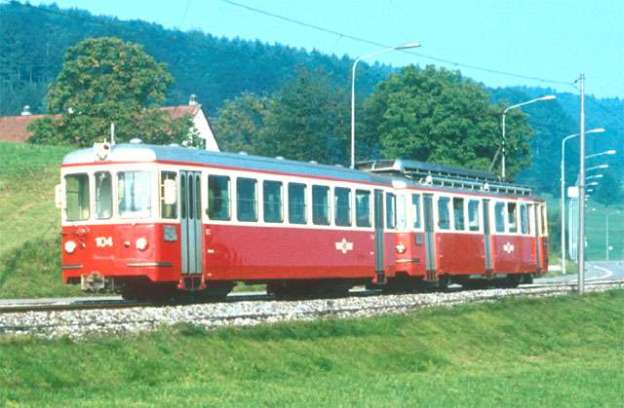
The featured image for this article is a Forchbahn Bt: 104 + Be 4/4 in service in 1982. These tramcars were built in the 1950s after the experiment described below, © Spoorjan and licenced for reuse under a Creative Commons licence (CC BY-SA 3.0). [5]
One of the points regularly made by the editors of The Modern Tramway is that given a proper chance to shine modern electric trams are better than internal combustion engined buses. So it must have come as something of a relief to hear, in 1951, that testing had taken place in Switzerland which seems to have supported the argument that the closure of tramway networks would ultimately prove to be a false economy. … [1]
The Modern Tramway reported in May 1951 that:
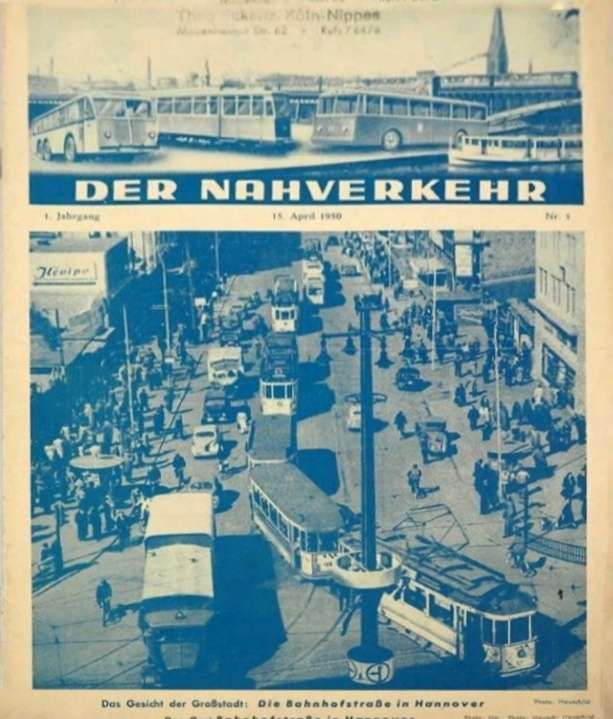
“The March issue of ‘Der Nahverkehr’ [3] contains an interesting and significant story about the 10-mile interurban tramway from Zürich Stadelhofen via Forch to Esslingen, in Switzerland. This line, known as the Forchbahn, was opened to traffic in 1912, and is operated with 10 motor tramcars, 5 trailers and some goods vehicles. Two of the motor trams are modern bogie vehicles constructed in 1948 by Schlieren & Co. with Oerliken equipment, the other cars are of the 4-wheel type.
“For much of its length the single metre-gauge track is laid in the public highway, an arrangement which the Company have long planned to eliminate by the construction of a private right-of-way. This plan was taken up in earnest in 1950, but the expected high cost of the new construction caused some hesitation among the directors, some of whom wondered whether replacement by buses might not be a cheaper alternative.
It was finally arranged with the Zürich town tramways that the latter should take over the service for an experimental period of 14 days, using buses from the municipal fleet to replace the Forchbahn trams. The period chosen was from 6th to 19th November, 1950. As was to be expected, the buses showed a certain advantage in journey time, as the tramway is single-track with widely-spaced passing loops. In summer, the Forchbahn carries a heavy weekend traffic from Zürich to the country, and in order to test the capacity of the buses in dealing with such traffic, exceptionally low excursion fares were introduced on one Sunday during the test period. Despite rainy weather large crowds were attracted to the service, and the fundamental disadvantage of the bus soon showed itself. Many extra buses were needed, and by comparison with the usual tram-and-trailer units, double the usual staff were required. The overloaded buses fell behind schedule, and even the most modern were overtaken in the Zürich suburbs by elderly city trams hauling trailers. The uneven motion of the buses soon invited unflattering comparison with that of the trams from the many passengers who had to travel standing, for the Swiss are now accustomed to comfortable travel.
“The results of the test showed that the use of buses would involve a disproportionately heavy outlay; additional personnel would be needed, the vehicles would have less than half the effective life of the tram, the goods traffic would no longer be an economical sideline, and the buses would probably have to charge fares 50% higher than those charged on the present trams. These conclusions were not published until after the test had taken place, but the population of the communities served by the Forchbahn had needed only a few days of buses to convince them that the trams gave them the better service. When, fourteen days later, the first trams ran again between Zürich and Esslingen, the citizens hung out flags and decorated the cars with branches and flowers, and in the space usually occupied by the destination board appeared a large placard: “Es lebe die Forchbahn!” The Forchbahn lives again!” [1]
“The conclusion of the experiment was that retaining the line was the best solution provided that the line could be separated from the street and modernized. In the following decade, separation of rail and road traffic was increased. New bogie rolling stock was acquired, similar to two cars built for the line in the late 1940s.” [5]
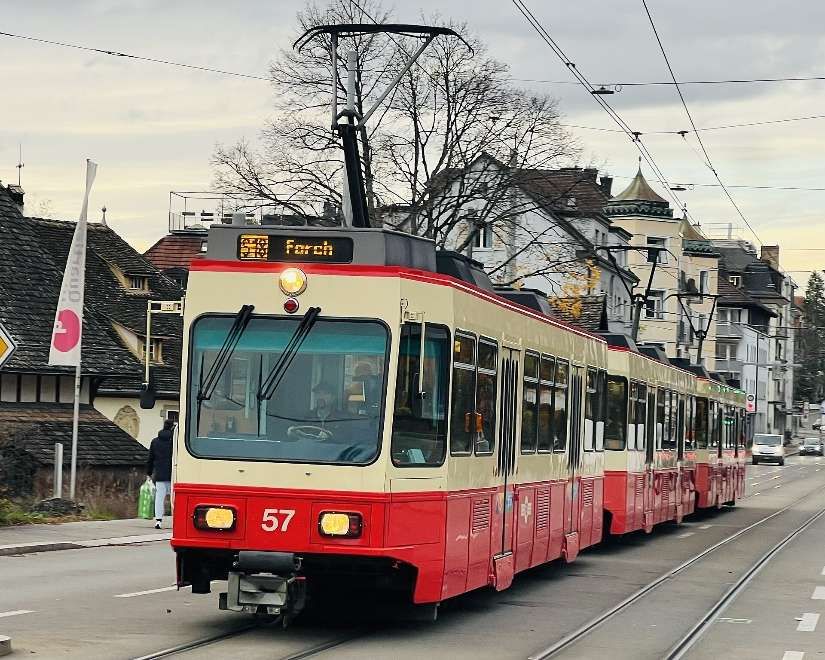
The Forchbahn is still operating in the mid-21st century. It is a local mixed tramway/railway line in the Swiss canton of Zürich. It is owned and operated by the Forchbahn AG, and is branded as line S18 of the Zürich S-Bahn. The standard Zürcher Verkehrsverbund (ZVV) zonal fare tariffs apply to the line. [5]
References
- Instructive Tram-Bus Experiment in Switzerland; in The Modern Tramway, Volume 14, No. 161, May 1951, p112.
- ‘Der Nahverkehr’ translates into English as ‘Local Transport’, a Journal with that name is published in the mid-21st century. It dates back to 1983. It is not the journal referred to by The Modern Tramway. For the record, it is a technical and operational monthly journal for all public passenger transport in the city and region. Its target audience includes managers and decision-makers in transport companies, government agencies, associations and corporations, transport science, consulting firms and the transport industry. It is the official organ of the Association of German Transport Companies (VDV) and part of the media offering of Alba Fachmedien ÖPNV in the DVV Media Group. (https://www.dvvmedia-shop.de/DER-NAHVERKEHR/DNV-NA-12-DIGI)
- The ‘Der Nahverkehr‘ referred to in the article published by The Modern Tramway was, in 1951, a relatively new journal. The first issue came out in April 1950.
- https://ebay.us/m/bKn6Ic, accessed on 16th May 2026.
- https://en.wikipedia.org/wiki/Forch_railway, accessed on 16th May 2026.
 Roger Farnworth