
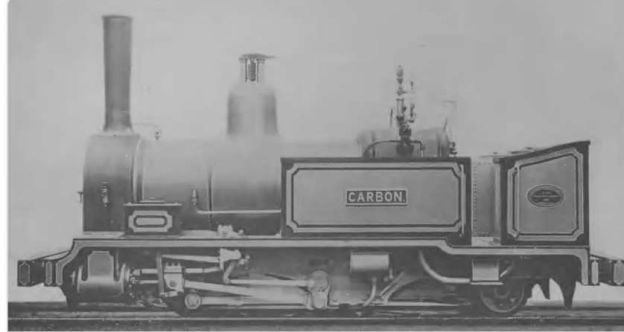
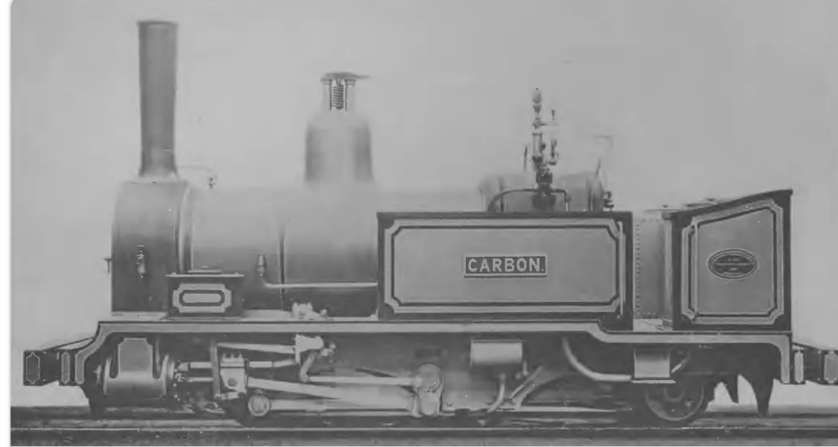
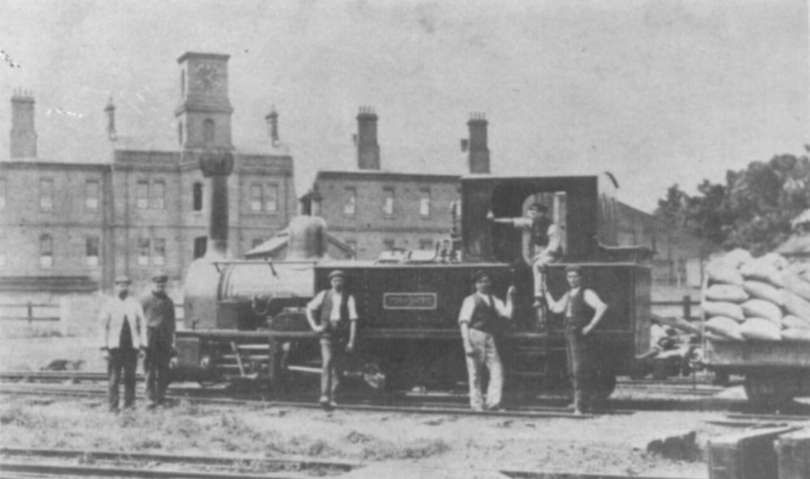
The featured image for this article is an ex-Works photograph of ‘Carbon‘ – an 0-4-2T – built in 1886 by the Yorkshire Engine Co. (Works No. 404), which arrived at the Lodge Hill & Upnor Railway ex-War Department 1st April 1906 and which was scrapped by 1932. © Public Domain. [1][8: p31 & 32]
This article is one of a series looking at industrial railways on the North coast of Kent and around the River Medway with a particular focus on the railways which served the Cement Industry. This line, however, primarily served military establishments.
The Lodge Hill & Upnor Railway (Chattenden & Upnor Railway)
In December 1966, D. Yeatman penned an article about this railway in the Industrial Railway Record. [1] Yeatman wrote: “The story of the Lodge Hill & Upnor Railway begins in 1873 when a Manning Wardle 1ft 6in gauge locomotive named ‘Burgoyne‘ was sent to the Royal Engineers at Upnor to assist in the construction of a light railway, which was to be known as the Chattenden & Upnor Railway. Some of the line must have been laid to 4ft 8½in gauge as we hear that six Aveling & Porter engines of 2−2−0 design were also supplied. These 5−ton ‘Steam Sappers’ had two sets of wheels, one for road work and a flanged set for use on rails.” [1: p277]
At the time, the School of Military Engineering was based at Chattenden Barracks (adjacent to the Railway Depot/Loco Sheds). Yeatman says that “by 1875 work had progressed so well that there were some four miles of track from Pontoon Hard, via Tank Field and Church Crossing to the Railway Depot with a spur line going from the crossing towards Lower Upnor, as well as a one and a half mile line from Chattenden to Hoo Creek.” [1: p277]
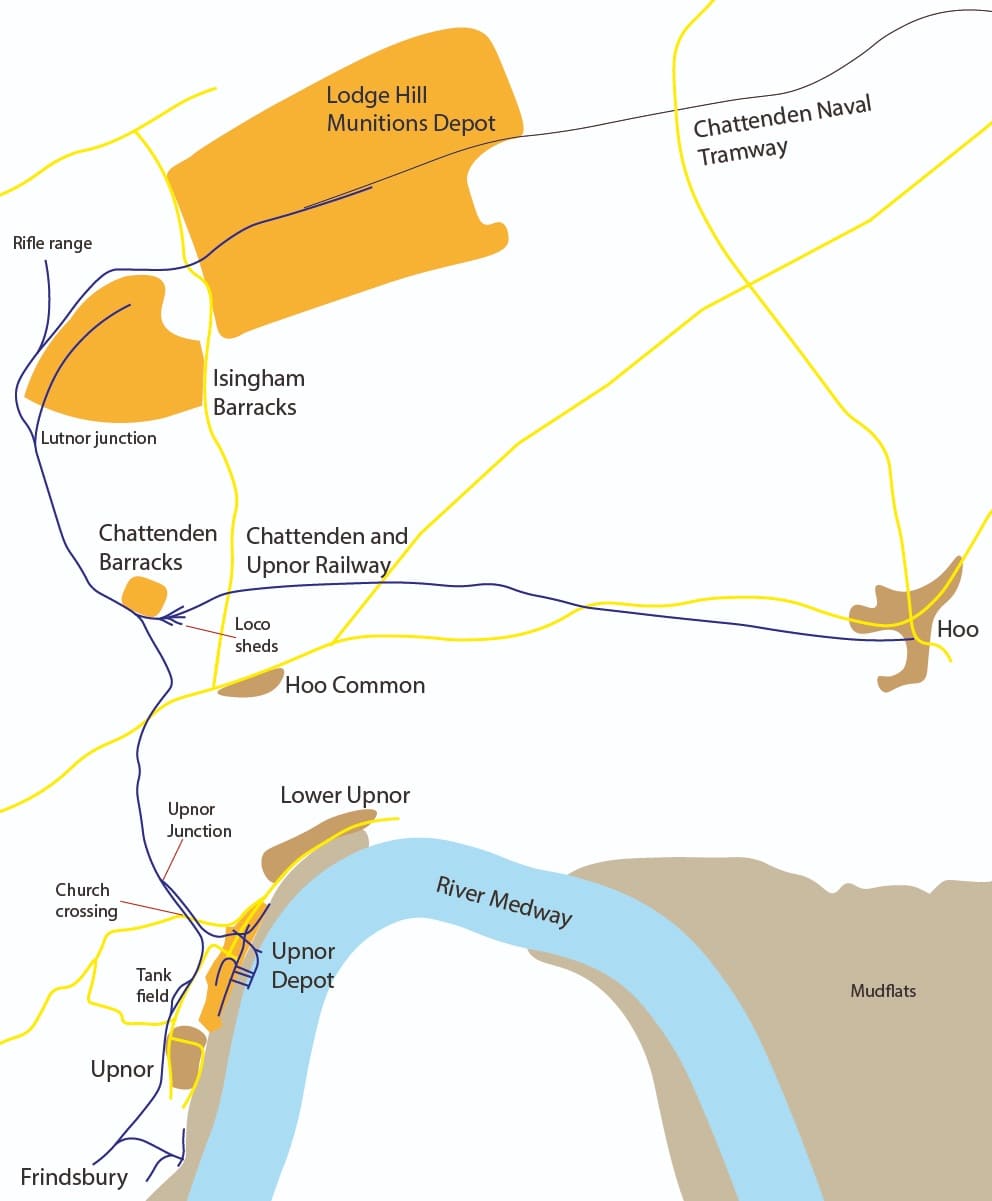
Wikipedia notes that, “The railway was a narrow gauge railway serving the military barracks and depot at Upnor, Kent, and associated munitions and training depots. It started life in the early 1870s as a standard-gauge railway. The 2 ft 6 in (762 mm) narrow gauge working began in 1885, initially in a mixed gauge formation with the standard gauge, and after c. 1903 2 ft 6 in (76 cm) gauge exclusively. In the latter form the line continued in use until the end of 1961.” [3]
Wikipedia continues: “The first railway at Chattenden was a standard gauge line laid by the Royal Engineers in the early 1870s. This was used to bring building materials from a wharf at Upnor to be used in the construction of the Chattenden Munitions Depot. [4] According to a report in the issue of “Iron” dated Saturday 29th May 1875: ‘A detachment of non-commissioned officers and men of the Royal Engineers, commanded by Lieutenant Barker, on Saturday left the School of Military Engineering at Chatham for Upnor, where they will be quartered for some time, as they are to be employed to lay down lines of rails to connect forts on the Thames and Medway with the new powder magazines to be constructed at Chattenden Roughs, a few miles from the old magazines at Upnor Castle. It is expected that more than forty miles of these railways will be constructed.’ [5] This railway fell out of use when the building work was completed.” [2][4]
Wikipedia says: “An 18 in. (457 mm) railway is thought to have been laid to help with the construction of the standard gauge line. An 0-4-0ST locomotive, called Burgoyne, built by Manning Wardle in 1873 (Works no. 448), would have been used in construction, although it may also have been used on the Chatham Eastern Defences 18 inch gauge railway and worked on Borstal Prison construction work. Burgoyne was identical as built to Busy Bee (built by Manning Wardle Works No. 424 of 1872 for the Admiralty at Chatham Dockyard) and was a member of the classic Manning Wardle ‘6 by 8’ 0-4-0ST specification.” [2]
Locomotives
There were a number of 18in-gauge locomotives used at the site, which suggests a a possibly greater significance for the 18″ line than purely a construction line. These were all 0-4-0ST locomotives:
- Burgoyne built by Manning Wardle (Works No. 448) in 1873. [1][8: p231]
- Lord Raglan built by Manning Wardle (Works No. 353) in 1871. [1]
- Trafalgar built by Manning Wardle (Works No. 386) in 1871. [1]
- Busy Bee built by Manning Wardle (Works No. 424) in 1872. [1]
- Fidget built by Manning Wardle (Works No. 506) in 1874. [1]
Another locomotive may have been either 18″-gauge or standard-gauge: Centaur – little is known about this locomotive. The locomotives from Manning Wardle were recorded by Manning Wardle as at ‘Admiralty, Chatham Dockyard’. It is possible that they all assisted with construction work on the Chattenden & Upnor Railway. [1]
Focussing now on the 2ft 6in-gauge line …
Hatherill & Hatherill say that the 2ft 6in-gauge Lodge Hill & Upnor Railway was “used to carry ammunition which had been discharged from naval vessels going into Chatham Dockyard for repairs or refits. The railway carried the ammunition inland from Upnor pier to the magazines at Lodge Hill. En route was Chattenden Depot which had barracks, the railway workshops, engine sheds and stores. In all, there had been fifteen steam locomotives, some of experimental designs, a very early Hornsby oil engined loco and, latterly, a large number of battery electric tractors for use in the magazine areas. … In 1949, there was a Drewry 0-6-0D which had just been delivered and a Hunslet 0-6-OD mines loco which had a low cab and a brass topped chimney made from a shell case! There were other small [Internal Combustion engines] locos and a large number of battery electric rail trucks. At that time there was a busy service with about nine trains per day with extra workings as required. The steam locomotives were not in regular use but three were still in the shed. They were steamed at intervals to keep them in working order but all the daily work was by the two diesels. A third diesel was added in 1954, later working on the Festiniog Railway as ‘Upnor Castle‘ The Drewry diesel later worked on the Welshpool and Llanfair Railway. The last train ran on 29th Мау 1961, the track being lifted in December 1964.” [6: p21]
Neale & Smith highlight a number of locomotives that worked on the line:
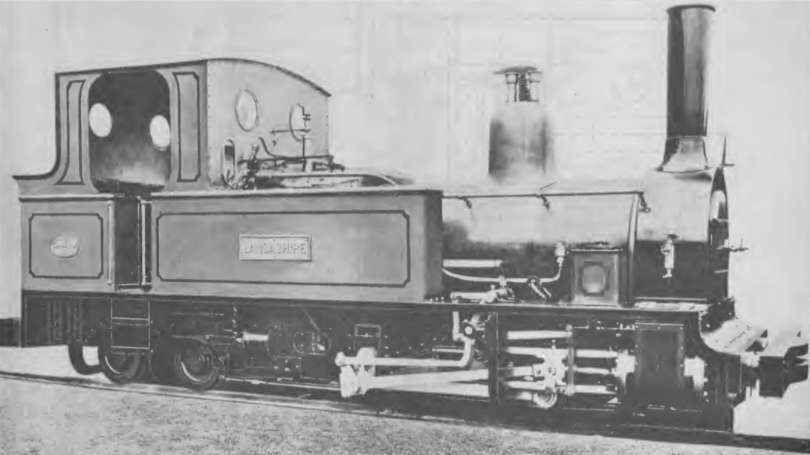
- Lancashire – an 0-4-4T, built by the Yorkshire Engine Co. in 1891 which was sent to M. Lynch & Son Ltd for scrap by June 1930, it may actually have been scrapped in 1932. [7: photo 77][8: p31]
- Burnett Hall – an 0-4-2T, built by the Avonside Engine Co. (Works No. 2070) in 1933. This loco was sent to Bailey & Noyce, Itchenor, Surry, for scrap in May 1956. (The nameplate from this locomotive was preserved at the Chalk Pits Museum.) [7: photo. 78][8: p31]
- Norbury – an 0-4-2T, built by Peckett & Co. (Works No. 1868) in 1934. This was purchased for comparison trials with Burnett Hall and had much larger side tanks. (The nameplate and Worksplate from this locomotive were preserved at the Chalk Pits Museum.) [7: photo. 79]
- DC Works No. 2263/49 – an 0-6-0 diesel mechanical locomotive built by Baguley-Drewry. [7: photo. 80]
But there were a myriad of different locomotives used on the 2ft 6in-gauge line. … The following were used on the Lodge Hill & Upnor Railway or within the various depots along the line, some have already been noted above:
A. Steam
- Sulphur – an 0-4-2T – built in 1885 by the Yorkshire Engine Co. (Works No. 405), arrived ex-War Department 1st April 1906 and set aside/scrapped by 1931; [1][8: p31 & 32]
- Carbon – an 0-4-2T – built in 1886 by the Yorkshire Engine Co. (Works No. 404), arrived ex-War Department 1st April 1906 and scrapped by 1932; [1][8: p31 & 32]
- Cheshire – another 0-4-2T built by Bagnall in 1890 (Works No. 260), arrived ex-War Department, Crewe, sent to M. Lynch & Son Ltd., Strood, for scrap, 1932 (or by 1931 per other source); [1][8: p31 & 32]
- Lancashire – an 0-4-4T built in 1891 by Yorkshire Engine Co. (Works No. 462), arrived ex-War Department 1st April 1906, sent to M. Lynch & Son Ltd., Strood, for scrap, by May 1931; [1][8: p31 & 32]
- Cumberland – another 0-4-2T built in 1893 by Lowca Engine Co. (Works No. 220), arrived ex-War Department 1st April 1906 and scrapped by 1904; [1][8: p31 & 32]
- Eardley Wilmot – an 0-6-0T built in1897 by Bagnall (Works No. 1513), known as Stafford until around 1915, arrived ex War Department, South Africa, by 1906, sent to M. Lynch & Son Ltd., Strood, for scrap, April 1941; [1][8: p31 & 32]
- Bagnall – an 0-6-0ST built in 1897 by Bagnall (Works No. 1514) arrived ex War Department, South Africa, by 1906, sent to M. Lynch & Son Ltd., Strood, for scrap, 1932 (or by 1931 per other source); [1][8: p31 & 32]
- Kitchener (former Lord Kitchener) – an 0-6-2T built in 1902 by Yorkshire Engine Co. (Works No. 711), arrived ex-War Department, Egypt, sent to Chatham Dockyard for scrap 1948; scrapped 1954; [1][8: p31 & 32]
- Yorkshire – an 0-4-4T built in 1887 by John Fowler & Co. (Works No. 5350) – arrived ex-War Department 1st April 1906 and was sent to M. Lynch & Son Ltd., Strood, for scrap, by May 1931; [1][8: p31 & 32]
- Pioneer – a 2-6-2PT built in 1904 by Yorkshire Engine Co. (Works No. 757), arrived new and was sent
to War Department, Woolmer Instructional Military Railway, 1905; [1] - Ascension – an 0-4-2T built in 1904 by Avonside Engine Co. (Works No. 1480), arrived new and was sent to the Admiralty, Hoo Ness Island, by 20th July 1914; [1][8: p31 & 32]
- Fisher No. 40 – an 0-6-2T built in 1915 by Dick Kerr & Co. (Works No. 139960), arrived new and was scrapped in October 1954; [1]
- Chevalier No. 1 – an 0-6-2T built in 1915 by Manning Wardle (Works No. 1877), arrived new and was sent to Bowater Lloyds Ltd., Sittingbourne, via William Wills Ltd., Gravesend, 1950; [1][8: p31 & 32]
- Burnett Hall No. 49 – an 0-4-2T built in 1933 by Avonside Engine Co. (Works No. 2070), arrived new and was sent to Bailey & Noyce, Itchenor, Surrey, for scrap, May 1956; [1][8: p31 & 32]
- Norbury No. 42 – an 0-4-2T built in 1934 by Peckett & Sons (Works No. 1868) arrived new and was sent to the Admiralty, Trecwm, Pembroke, circa. 1940; returned circa. 1940; scrapped on site by G. Cohen Sons & Co. Ltd., November 1955; [1][8: p31 & 32]
B. Diesel
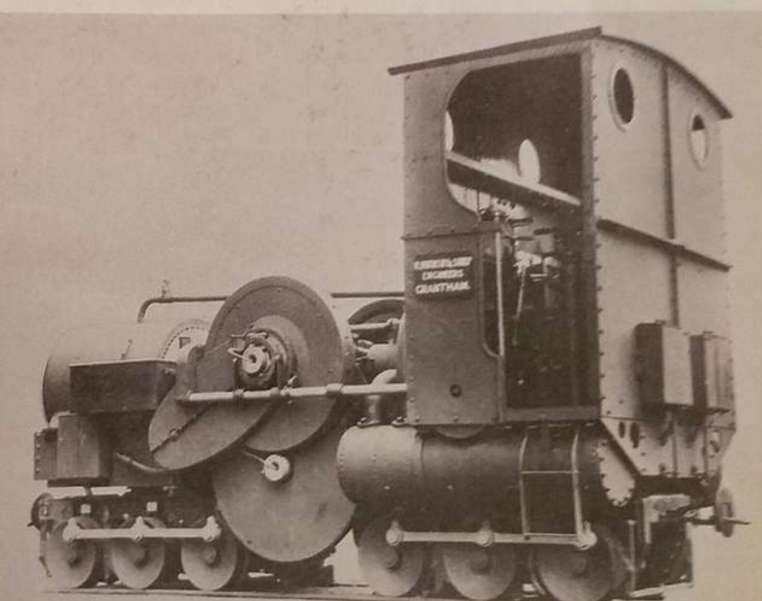
- Unnamed 6w+6wDM (0-6-6-0) Diesel Mechanical – built in 1903 by Hornsby Ackroyd (Works No. 6234), scrapped circa 1915. [1][8: p31]
- Eardley Wilmot – 0-6-0 PM (Petrol Mechanical) – built in 1911 by McEwan Pratt arrived new in 1911 and advertised for sale ‘in scrap condition’, lying at Chattenden in September 1922, no futher trace. [1][8: p31 & 32]
- Yard No. 44 – 4wDM – built in 1954 by F. C. Hibberd (Works No.3687) arrived new and was sent to the Welshpool & Llanfair Railway in February 1962. [1][8: p31 & 32]
- Yard No. 85 (later Yard No.107) – an 0-6-0DM – built in1949 by Baguley/Drewry Car Co. (Works No.2263), arrived new and sent to Admiralty, Ernesettle, Devon in October 1960. [1][8: p31 & 32]
- Yard No. 92 – an 0-6-0DM – built in 1946 by the Hunslet Engine Co. (Works No. 3301), arrived on site in new condition and probably moved to Chatham Dockyard for storage sometime after March 1961. Later it went to W. R. Brett (c/o Denton Plant Hire Ltd, The Sidings, Meopham Station, Kent circa. November 1967). [1][8: p31 & 32]
- 83 – 4wDM built in1943 by Ruston & Hornsby (Works No. 213838) arrived new and was sent to Chatham Dockyard for storage in 1960. Later it went to W. R. Brett, Goose Farm, Calverstone, Meopham circa. November 1967. [1][8: p31 & 32]
- Yard No. 84 – 4wDM – built in 1947 by Ruston & Hornsby (Works No. 212949), arrived ex- RNAD Trecwn, Dyfed by February 1960 and sent to Admiralty, Crombie, Fife in December 1961. [1][8: p31 & 32]
- Yard No. 45 – 4wDM – built in 1952 by Ruston & Hornsby (Works No. 268878), arrived new and was sent to Admiraly, Ernesettle, Devon in November 1960. [1][8: p31 & 32]
C. Battery Electric
Battery-electric locomotives were used, mainly to move munitions around the Lodge Hill depot. [3] Steam engines would have presented a very significant fire risk. These vehicles were all four-wheeled ‘engines’, of two different types:
(a) Locomotives – these were fitted with cabs and suitable for shunting within the depots or for hauling trains on the main line. They were deployed in two distinct batches. The first six “were in use by 1931, the first having been introduced in 1928. … Although of similar overall dimensions to the latter-day machines, these early locomotives were of a more ‘rectangular’ construction.” [1] They had central cabs with large square-cornered windows and tramway skirts covering the wheels. [3]
These were replaced by six Greenwood and Batley locomotives built between 1938 and 1945, “all of which were in existence when the line closed, differed from those above in having rounded corners to the cab windows, sloping tops to the engine covers, deep plate frames and only one headlamp. They were flameproof machines weighing 8 tons and having a normal drawbar pull of 900lbs at 6mph.” [1] These were delivered new to the railway and all were set aside or scrapped by 1957. These locomotives were:
- 43 – built by Greenwood & Batley (Works No. 1581) in 1938.
- 44 – built by Greenwood & Batley (Works No. 1618) in 1939.
- 48 – built by Greenwood & Batley (Works No. 1947) in 1944.
- 88 – built by Greenwood & Batley (Works No. 1983) in 1945.
- 89 – built by Greenwood & Batley (Works No. 1984) in 1945.
- 90 – built by Greenwood & Batley (Works No. 1985) in 1945.
(b) Trolleys – these were cab-less vehicles of limited power, being motorised wagons rather than haulage locomotives, and were only used within the depots. Greenwood & Batley Works Nos. 3277 to 3280 and 3537 to 3544, were known by the makers as ‘rail trucks’. They had a capacity of 3−4 tons and were fitted with platforms 8ft long by 4ft wide. Most were purchased new. [1][8: p31 & 32] They were often referred to at military establishments as ‘cheese trucks’. [8: p32]
- 28 – built by Greenwood & Batley – arrival date not known, set aside or scrapped by 1957. [1][8: p31 & 32]
- 50 – built in 1918 or 1919 by Greenwood & Batley – works number not known, set aside or scrapped by 1957. [1][8: p31 & 32]
- 51 – built in 1918 or 1919 by Greenwood & Batley – works number not known, set aside or scrapped by 1957. [1][8: p31 & 32]
- 52 – built in 1918 or 1919 by Greenwood & Batley – works number not known, set aside or scrapped by 1957. [1][8: p31 & 32]
- 53 – built in 1918 or 1919 by Greenwood & Batley – works number not known, set aside or scrapped by 1957. [1][8: p31 & 32]
- 54 – built in 1918 or 1919 by Greenwood & Batley – works number not known, set aside or scrapped by 1957.[1][8: p31 & 32]
- 84 – Built by Greenwood & Bailey (Works No. 3277) arrived new and was sent to Speedwell Electrics Ltd., Nottingham; resold to John Lysaght‘s Scunthorpe, Works Ltd., Nettleton Top Ironstone Mines, Lincs. in 1961. [1][8: p31 & 32]
- 85 – Built by Greenwood & Bailey (Works No. 3278) arrived new and was sent to Speedwell Electrics Ltd., Nottingham; resold to John Lysaght‘s Scunthorpe, Works Ltd., Nettleton Top Ironstone Mines, Lincs. in 1961. [1][8: p31 & 32]
- 86 – Built by Greenwood & Bailey (Works No. 3279) arrived new and was sent to Speedwell Electrics Ltd., Nottingham; resold to John Lysaght‘s Scunthorpe, Works Ltd., Nettleton Top Ironstone Mines, Lincs. in 1961. [1][8: p31 & 32]
- 87 – Built by Greenwood & Bailey (Works No. 3280) arrived new and was sent to Speedwell Electrics Ltd., Nottingham; resold to John Lysaght‘s Scunthorpe, Works Ltd., Nettleton Top Ironstone Mines, Lincs. in 1961. [1][8: p31 & 32]
- 99 – No. 4512 (2) – Built by Greenwood & Bailey (Works No. 3540) arrived new in 1946 and was sent to Admiralty, Crombie, Fife in June 1961. [1][8: p32]
- 100 – No. 4513 (7) – Built by Greenwood & Bailey (Works No. 3539) arrived new in 1946 and was sent to Admiralty, Crombie, Fife in June 1961. [1][8: p32]
- 101 – No. 4514 – Built by Greenwood & Bailey (Works No. 3538) arrived new in 1946 and was sent to Admiralty, Crombie, Fife in June 1961. [1][8: p32]
- 102 – No. 4515 – Built by Greenwood & Bailey (Works No. 3537) arrived new in 1946 and was sent to Admiralty, Crombie, Fife in June 1961. [1][8: p32]
- 103 – No. 4516 (11) – Built by Greenwood & Bailey (Works No. 3541) arrived new in 1946 and was sent to Admiralty, Bull Point, Devon in September 1961. [1][8: p32]
- 104 – No. 4517 (12) – Built by Greenwood & Bailey (Works No. 3542) arrived new in 1946 and was sent to Admiralty, Bull Point, Devon in September 1961. [1][8: p32]
- 105 – No. 4518 – Built by Greenwood & Bailey (Works No. 3543) arrived new in 1946 and was sent to Chatham Dockyard for storage after November 1960. [1][8: p32]
- 106 – No. 4519 – Built by Greenwood & Bailey (Works No. 3544) arrived new in 1946 and was sent to Admiralty, Trecwn, Dyfed in November 1960. [1][8: p32]
- 108 – Built by Wingrove & Rogers (works number, build date and condition on arrival not known). [1][8: p32]
- 110 – Built by Wingrove & Rogers (works number, build date and condition on arrival not known). [1][8: p32]
- 111 – Built by Edison Accumulator Vehicles. [1][8: p32]
- 112 – Built by Edison Accumulator Vehicles. [1][8: p32]
- 113 – Built by Edison Accumulator Vehicles. [1][8: p32]
- 114 – Built by Wingrove & Rogers. [1][8: p32]
- 115 – Built by Edison Accumulator Vehicles. [1][8: p32]
- 116 – Built in Lodge Hill Workshops in 1932 and set aside or scrapped after 10th May 1951. Hatherill & Hatherill have a picture of this vehicle. [1][6: p23][8: p32]
- 119 – Built by Greenwood & Batley. [1] or Wingrove & Rogers [8: p32]
- 121 – Built by Greenwood & Batley. [1]
- 122 – Built by Greenwood & Batley. [1]
- 125 – Built by Greenwood & Batley (Works No. 3586), arrived ex-Ferranti in 1948. [1]
- 281 – Built by Greenwood & Batley. [1]
- 283 – Built in Lodge Hill Workshops. [1]
- 285 – Built by Greenwood & Batley. [1]
- 287 – Built by Greenwood & Batley. [1]
- Unknown – Built in 1940 by Wingrove & Rogers (Works No. 1367). [8: p32]
- Unknown – Built in 1940 by Wingrove & Rogers (Works No. 1368). [8: p32]
Other Rolling Stock
Wikipedia tabulates the other rolling stock on the railway. [3]
In summary, there were:
- 4 brake vans (3 of which were numbered – Nos. 1, 212 and 213);
- 2 four-wheel coaches, one of which was converted into an ambulance van;
- 2 combination coaches (although not defined);
- 6 Bogie coaches (Nos. 196, 198, 199, 200, 202 and 204 – 4 of which are under restoration at the Sittingbourne & Kemsley Railway;
- 1 bogie van (No. 12);
- 1 bogie flat wagon (No.16);
- 1 bogie well wagon (No. 18);
- 12 bogie low-sided wagons (Nos. 19, 20, 21, 26, 27, 28, 32, 33, 35, 38, 41 and 45);
- 4 bogie high-sided wagons (Nos. 48, 60, 65 and 66);
- 8 3T powder vans (Nos. 69, 99, 110, 111, 130, 158 and 179);
- 11 5T powder vans (Nos. 68, 69 (converted 3T), 97, 106, 112, 121, 128, 137, 140, 142 and 171)
Standard-Gauge Locomotives – are recorded by Yeatman: [1]
Some “of these locomotives worked at Chattenden Barracks and latterly on the line from Lodge Hill to Sharnal Street (the “Chattenden Naval Tramway”) which was in existence by 1905. (The South Eastern Railway reached Sharnal Street from Hoo Junction in 1882.)” [1] The railway operated standard-gauge locomotives during its initial phase in the 1870s and 1880s before transitioning fully to narrow gauge. [3]
A number of these locomotives were referred to as ‘Steam Sappers’. Many were supplied by Aveling & Porter from their Invicta Works in Strood. It is known that a number of Aveling & Porter geared locomotives were active in the area, it is not entirely clear whether they were operating on the Lodge Hill & Upnor Railway. The editor’s note at the end of D. Yeatman’s article suggests that the locomotives listed below may have worked on the railway. [1] Waywell does not refer to the standard-gauge locomotives. [8]
- 2-2-0TG Aveling & Porter (Works No. 129) built in 1865;
- 2-2-0TG Aveling & Porter (Works No. 182) built in 1866;
- 2-2-0TG Aveling & Porter (Works No. 218) built in 1866;
- 2-2-0TG Aveling & Porter (Works No. 718) built in 1871;
- 2-2-0TG Aveling & Porter (Works No. 719) built in 1871; and
- 2-2-0TG Aveling & Porter (Works No.1023) built in 1874.
The Steam Sappers are noted as follows:
- Steam Sapper No. 3 – 2-2-0TG SC Aveling & Porter (Works No. 822) built in 1872;
- Steam Sapper No. 4 – 2-2-0TG SC Aveling & Porter (Works No. 829) built in 1872;
- Steam Sapper No. 5 – 2-2-0TG SC Aveling & Porter (Works No. 830) built in 1872;
- Steam Sapper No. 6 – 2-2-0TG SC Aveling & Porter (Works No. 831) built in 1872;
- Steam Sapper No. 7 – 2-2-0TG SC Aveling & Porter (Works No. 832) built in 1872;
- Steam Sapper No. 8 – 2-2-0TG SC Aveling & Porter (Works No. 939) built in 1873;
Other Standard-gauge locomotives possibly included all of the following:
- Royal Engineer – an 0-4-0ST built in 1876 by Manning Wardle (Works No. 602) arrived new and was sent to the Royal Arsenal at Woolwich
- Vauban – another 0-4-0ST built in 1885 by Manning Wardle (Works No. 937) arrived ex Lucas & Aird, Suakin & Berber Railway contract, Sudan and was sent to an unknown location in 1904 before going to the War Department, Slough, where it was named ‘Thor’, and then to William. Rigby & Co., contractors.
- Burgoyne – an 0-6-0ST built in 1885 by Manning Wardle (Works No. 949) arrived ex Lucas & Aird, Suakin & Berber Railway contract, Sudan, and was scrapped by 1904.
- Pioneer – an 0-4-0ST built in 1885 by Manning Wardle (Works No. 962) arrived ex Lucas & Aird, Suakin & Berber Railway contract, Sudan, and was also scrapped by 1904.
- Harvey (or Harry) – no further details.
- Napier – built in 1881 and scrapped by 1904.
- Tipster – built in 1882 and scrapped by 1904.
- Nicholson – built in 1885 and scrapped by 1904.
- Gordon – built in 1885 and scrapped by 1904.
- Lucifer – build date unknown, probably sent to another unknown site in 1908.
- V3 Yard No. 91 – an 0-4-0D built in 2944 by Hunslet (Works No. 3133),carried new and was sent to Admiralty, Bullpoint, Devon in January 1962.
- Yard No. 43 – 4wD built in 1943 by Ruston & Hornsby (Works No. 221639) came ex Austin Motor Co. Ltd., Cofton Hackett, Birmingham, June 1951, and was sent to Admiralty, Wrabness, Essex, December 1961.
The Route of the Line
We start at the southern-most point on the network near Frindsbury. …
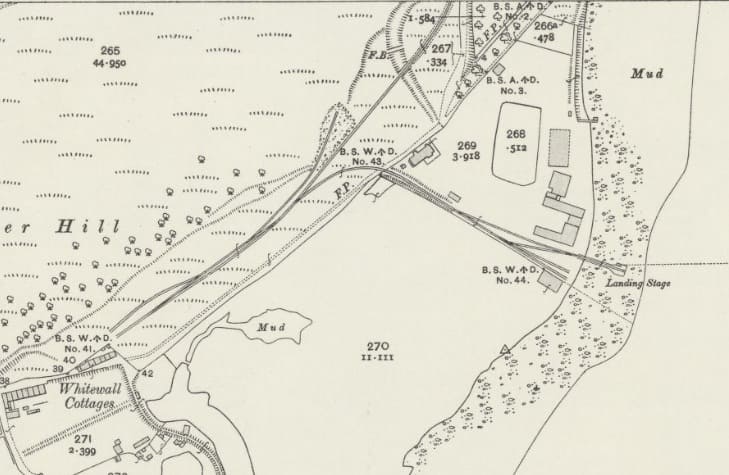
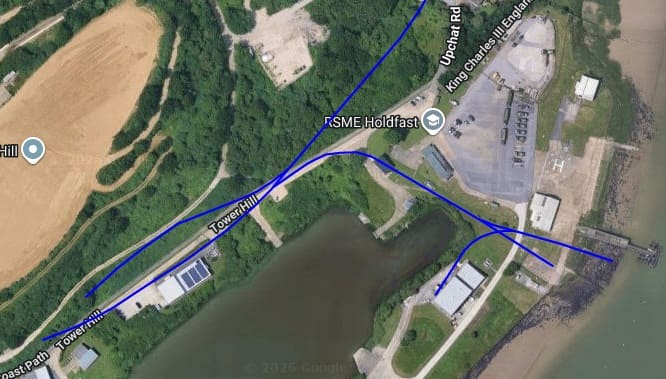
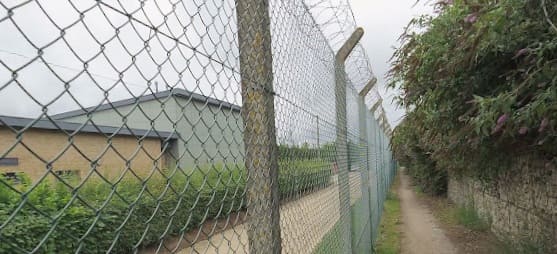
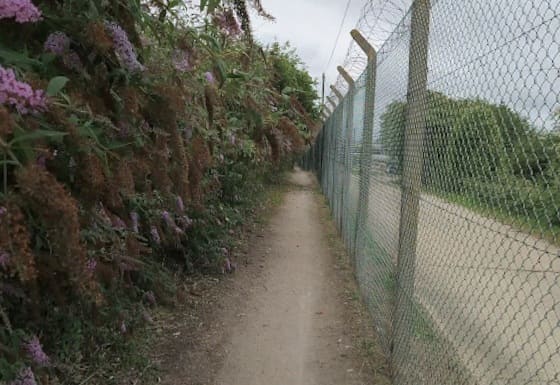
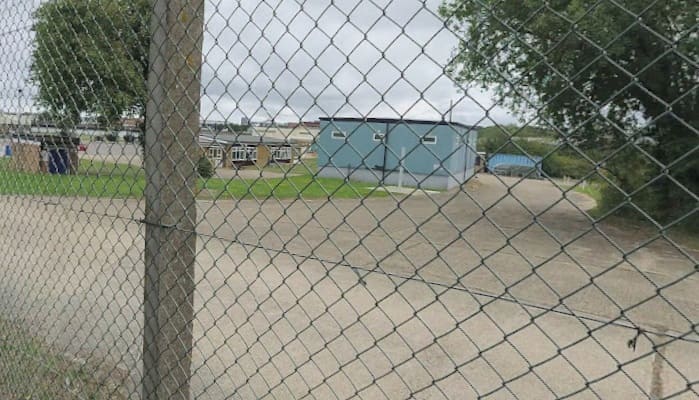
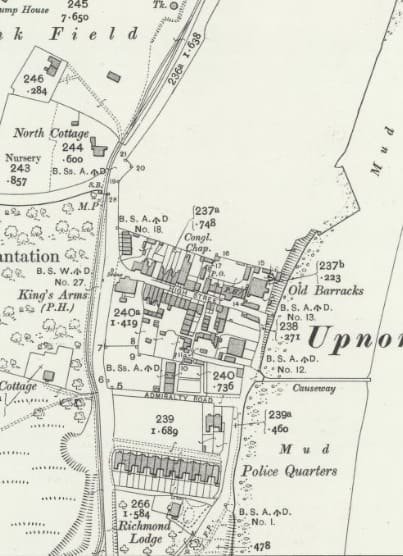
The line ran North to the West side of the small village of Upnor. [15][14]
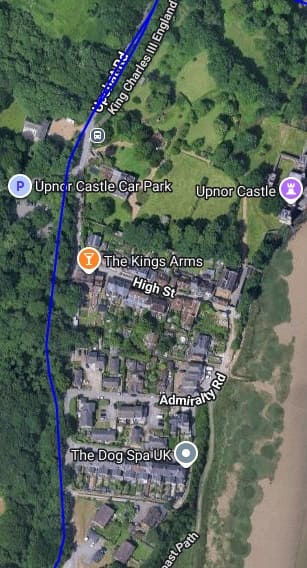
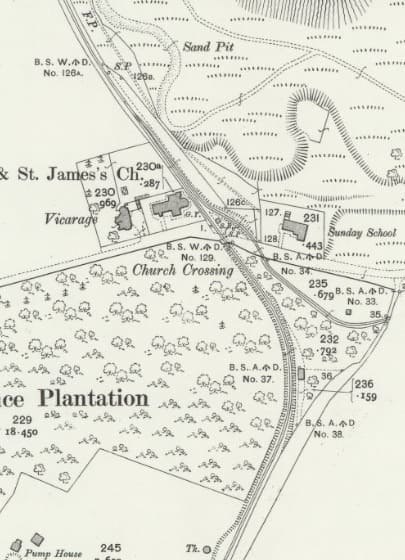
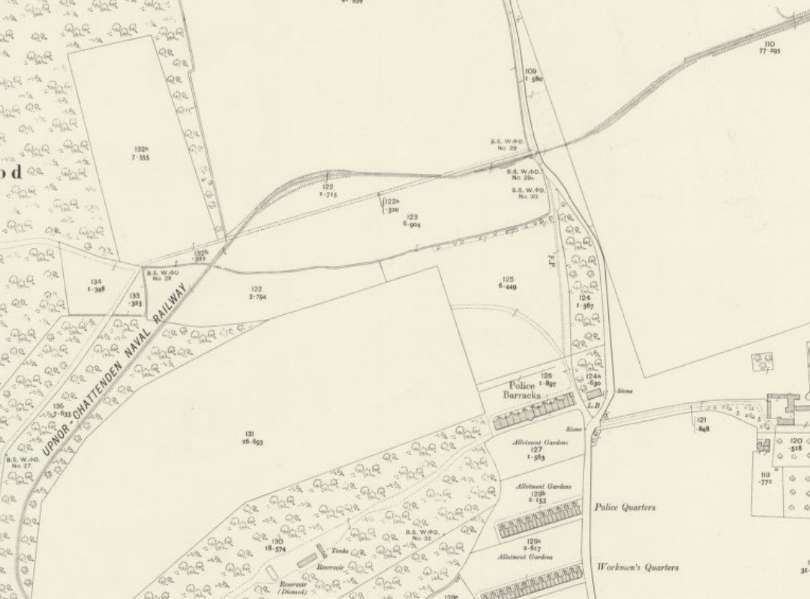
The line then turned away to the Northwest running close to St. Philip and St. James’ Church. This is the location as it appears on the 1906 Ordnance Survey. [15]
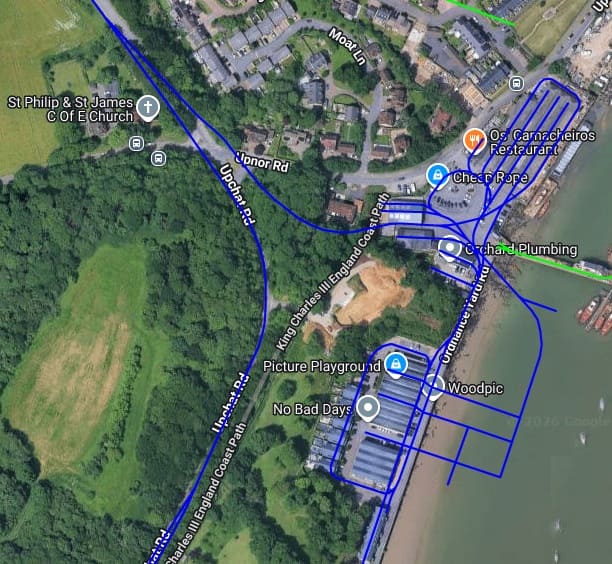
Railmaponline.com shows a complex set of sidings to the East of the line on the banks of the Medway, this location appears below on the 1931 Ordnance Survey. [14]
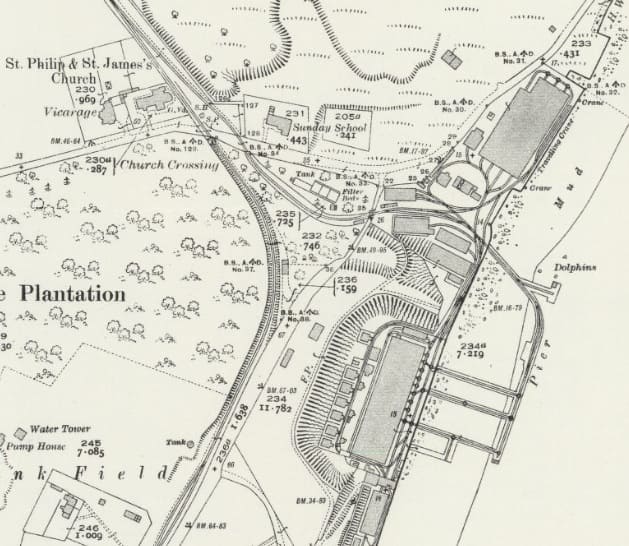
Church Crossing is highlighted on both of the extract from the Ordnance Survey mapping above.
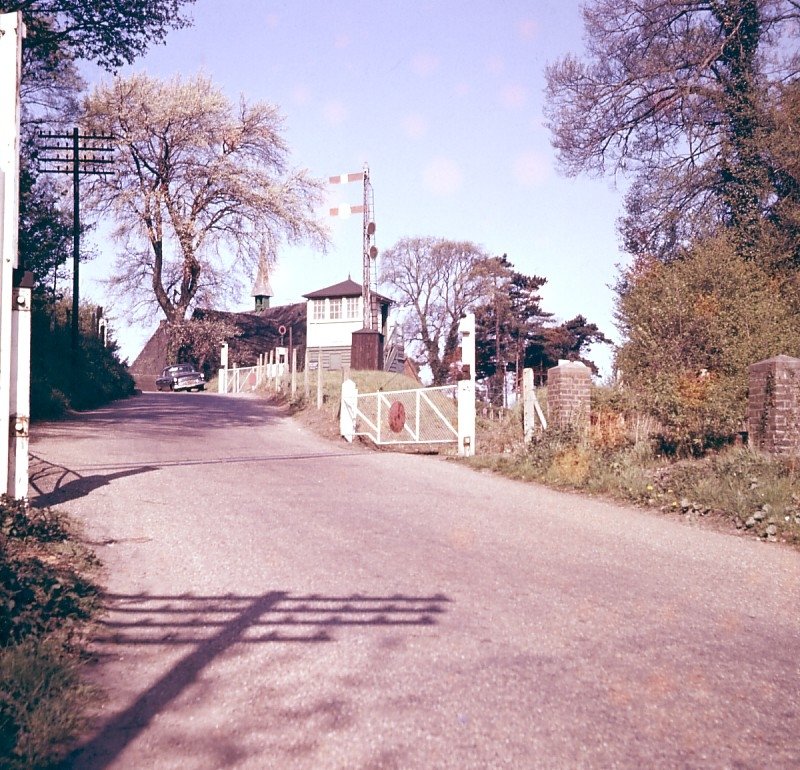
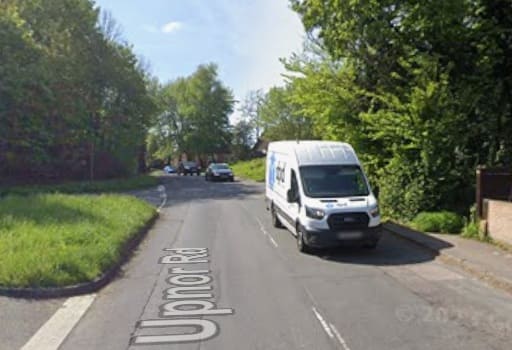
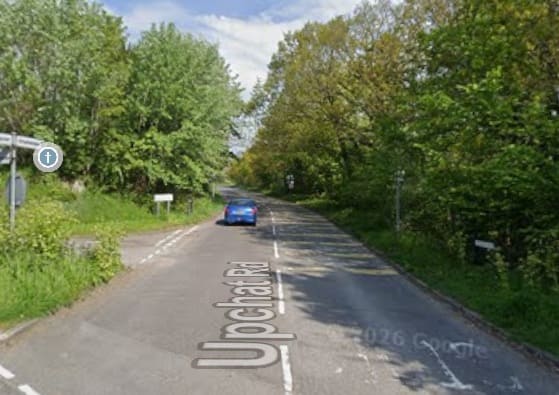
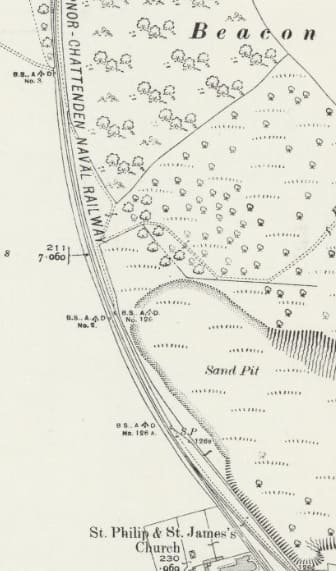
The old railway continues North. [15][14]
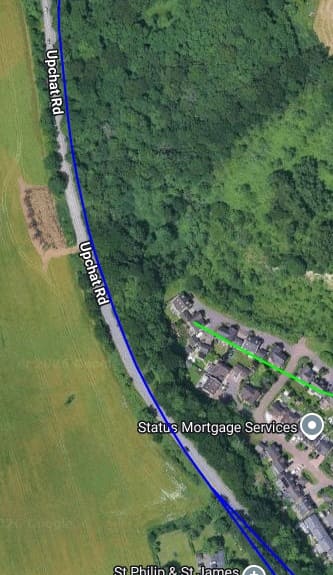
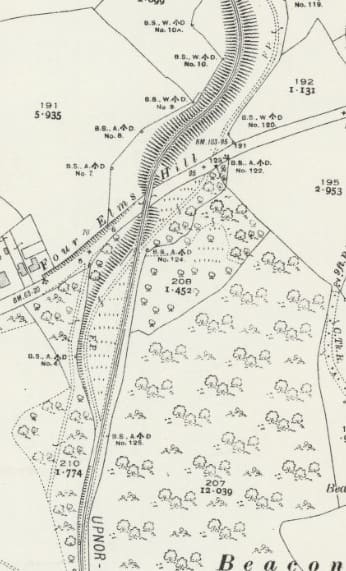
The old railway continues North. [15][14]
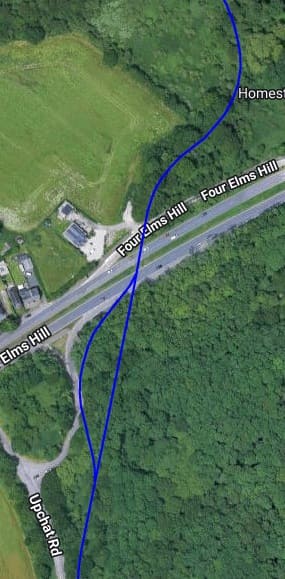
The railway crossed Four Elms Hill (now the A228)by means of a bridge. The length of the road which passed under the bridge has been by-passed by the new A228 dual-carriageway.
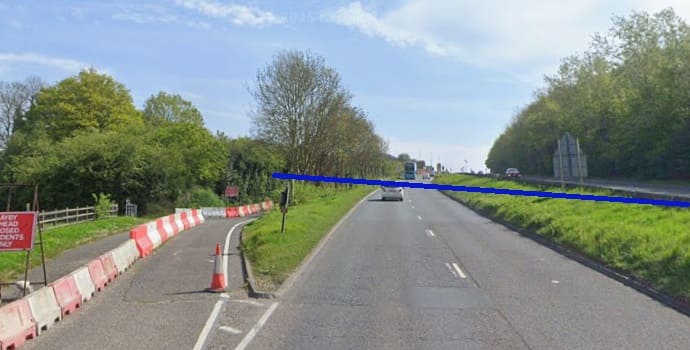
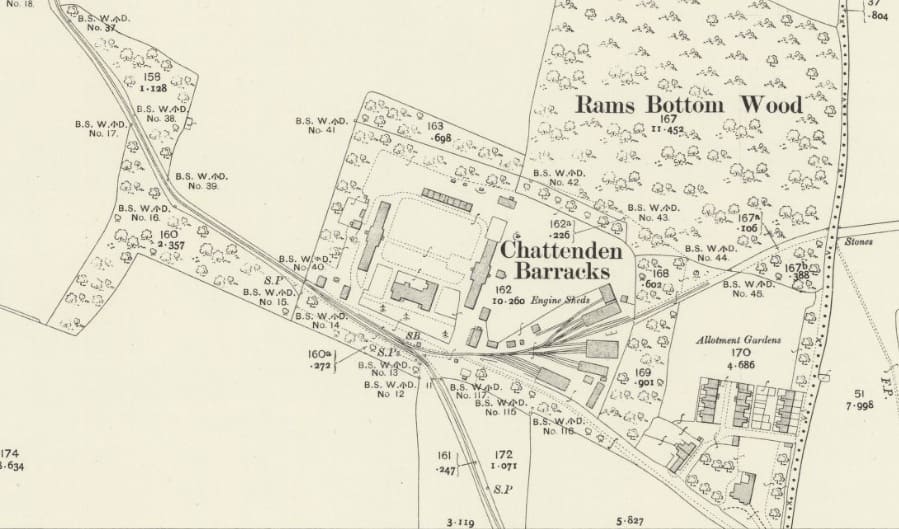
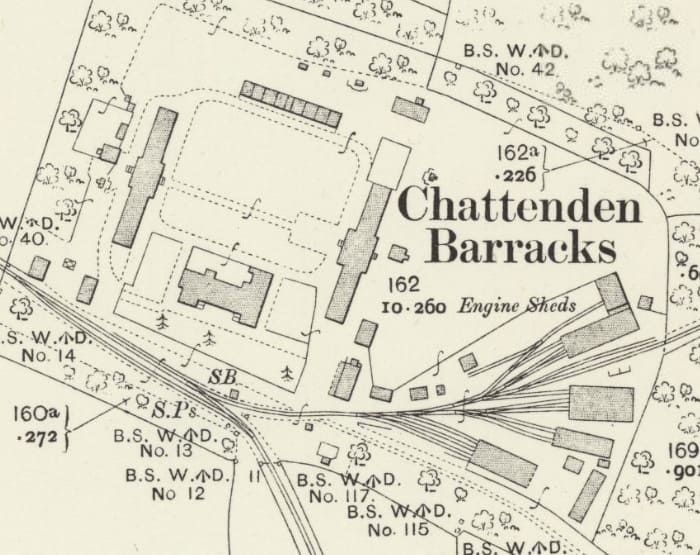
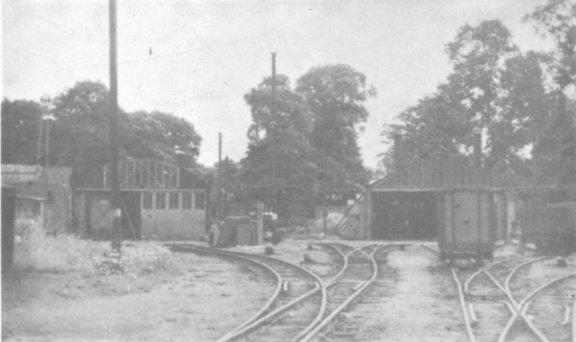
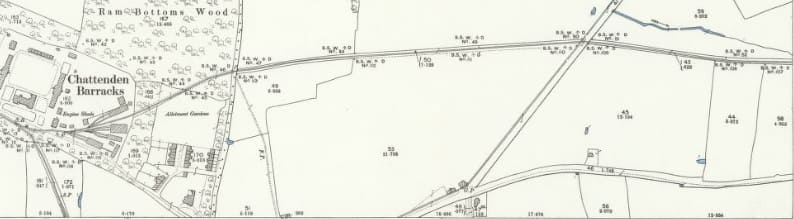
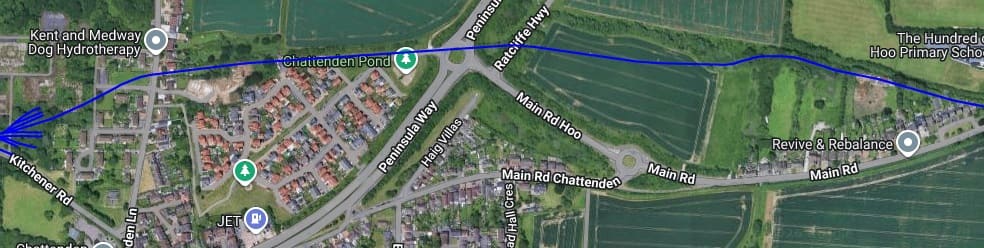
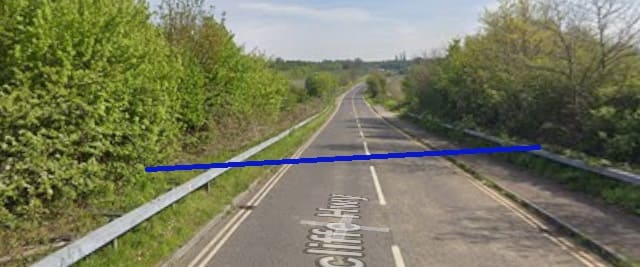

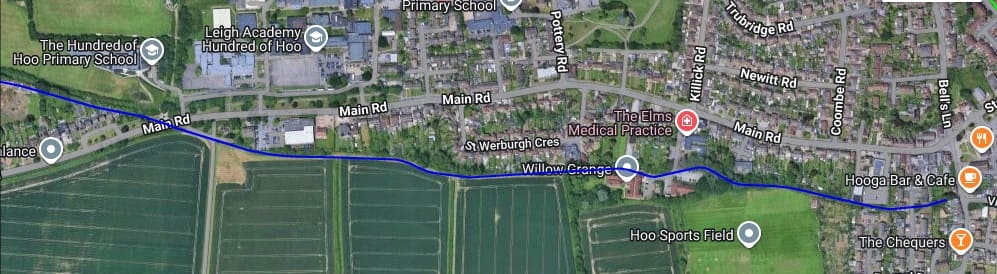
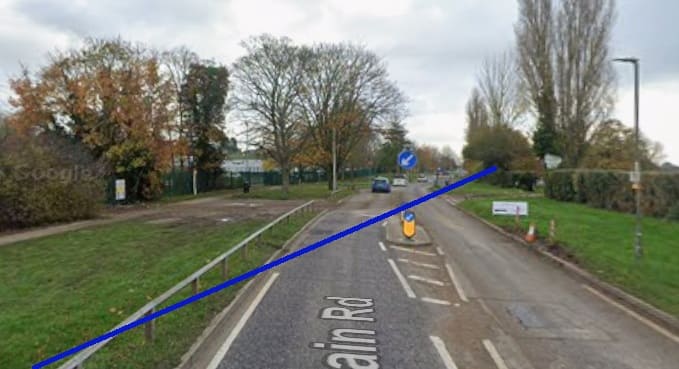
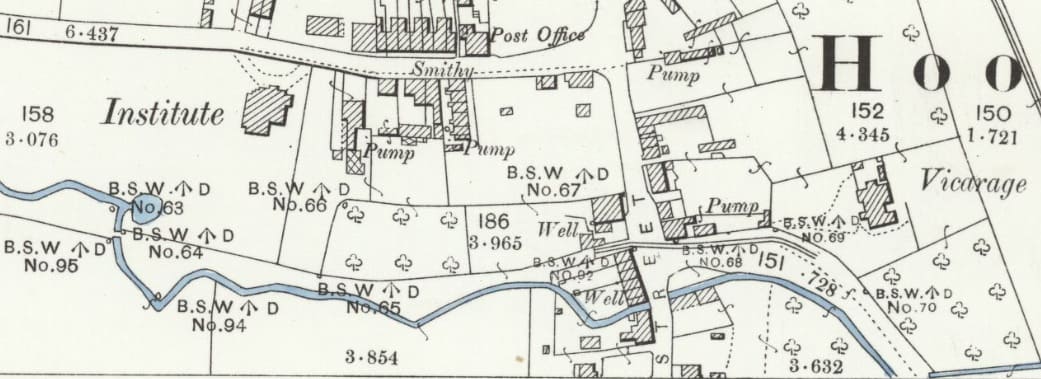
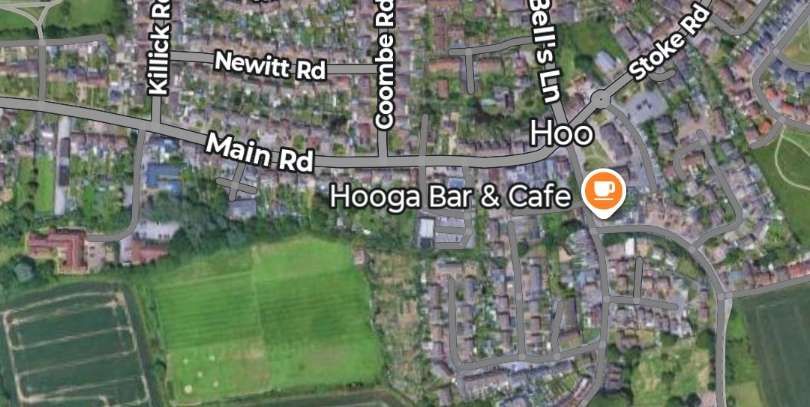
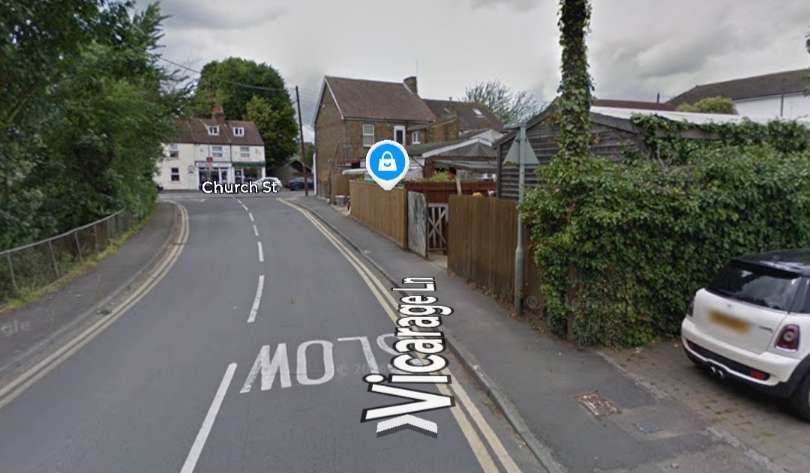
Returning now to Chattenden Barracks. …
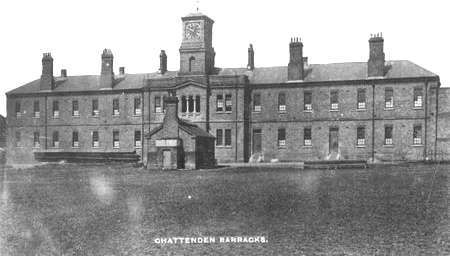
A clearer image of Chattenden Barracks (circa 1905). The Barracks were built in 1872–1873 for the Royal School of Military Engineering.Use: Used by the British Army until 1994, © Public Domain. [23]
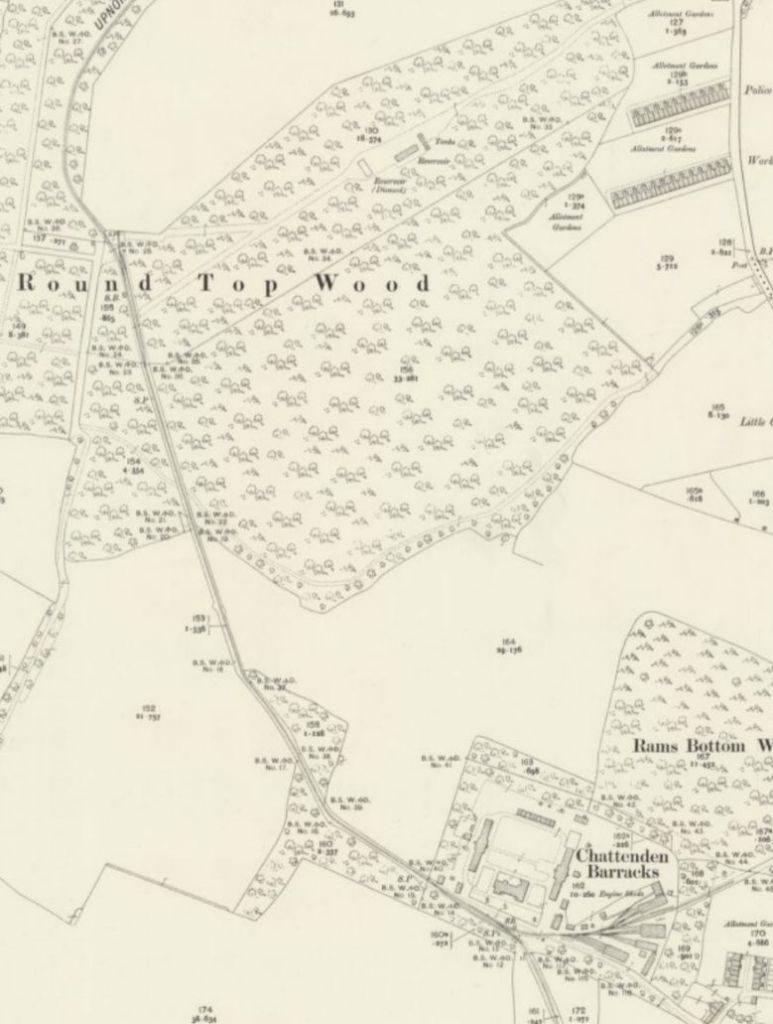
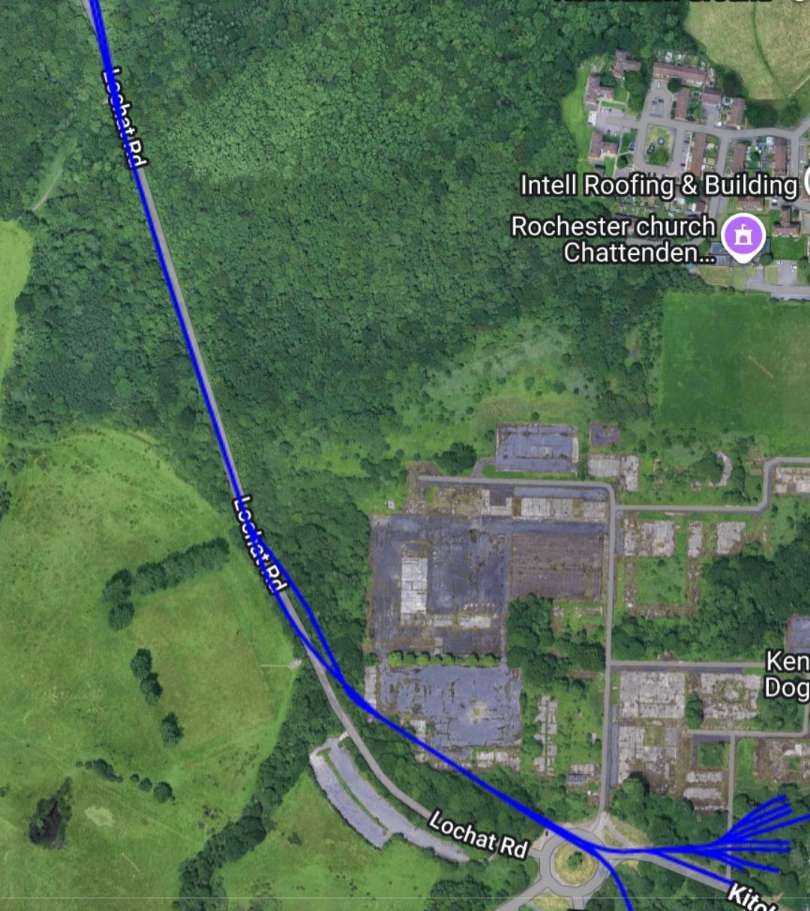
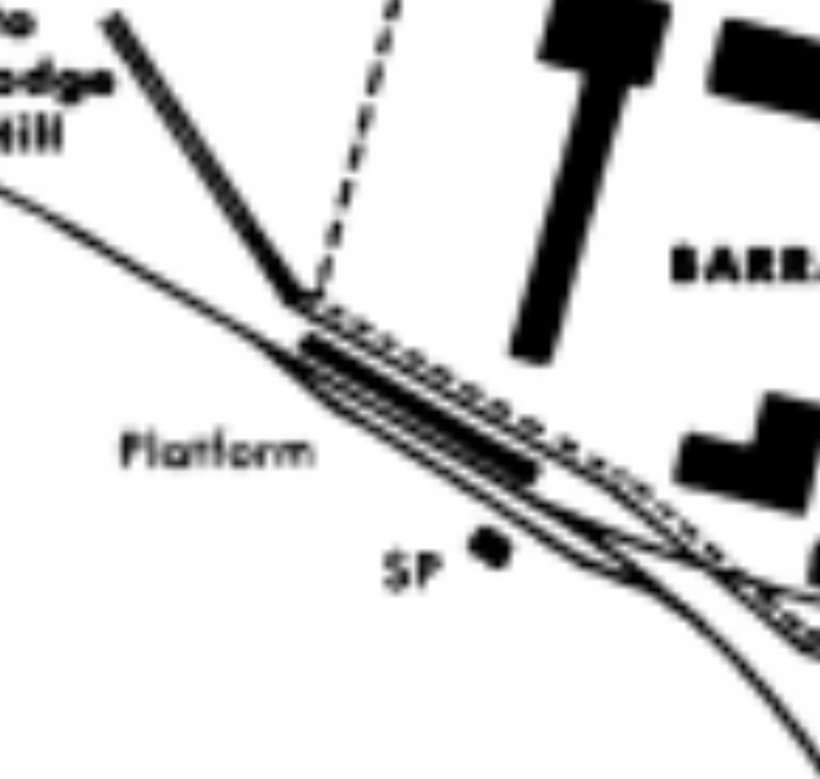
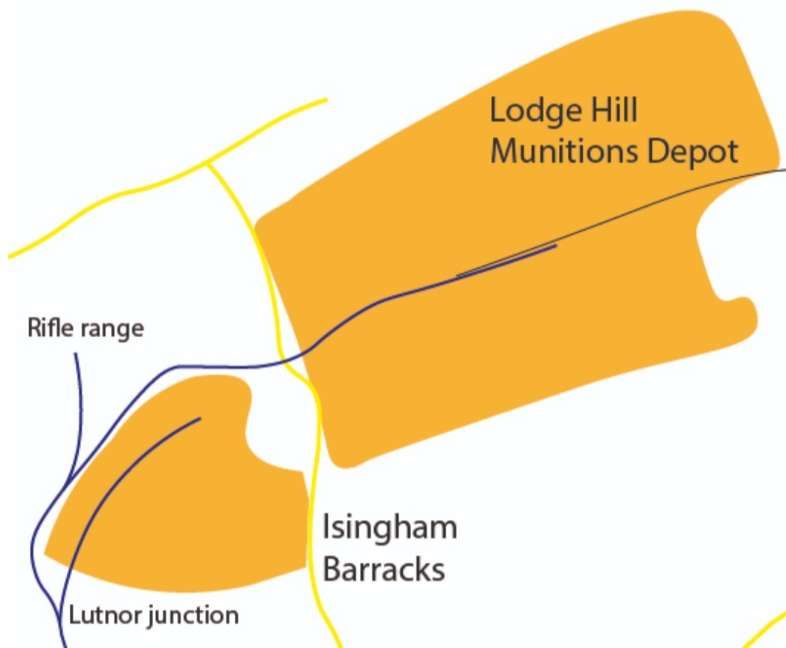
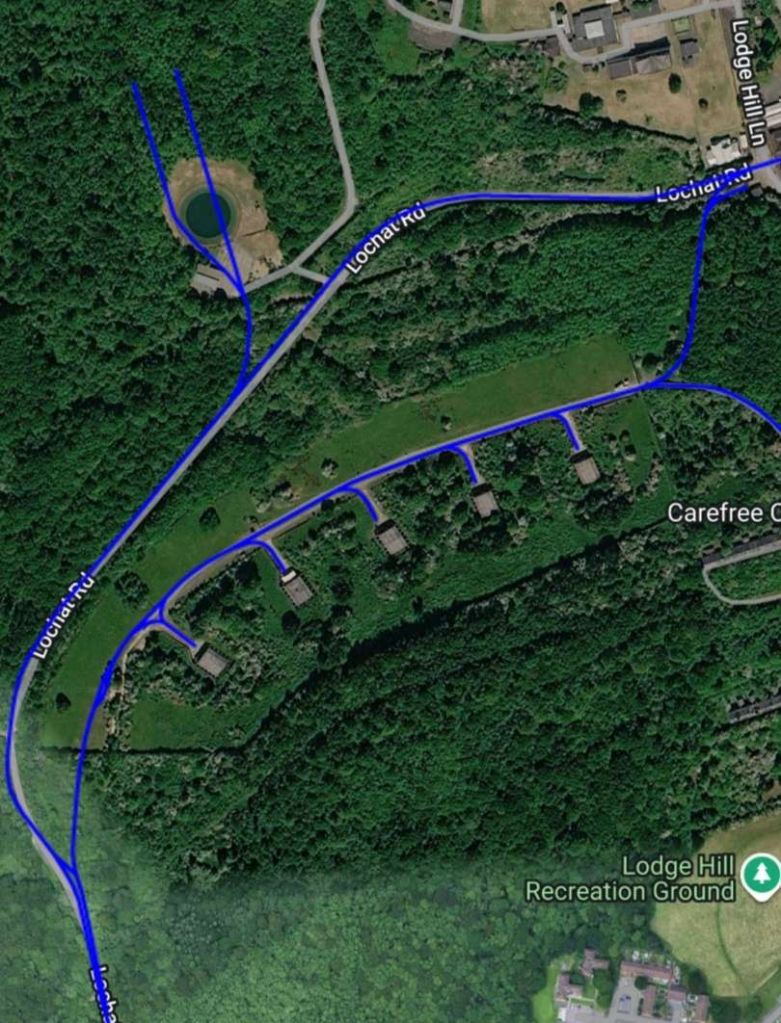
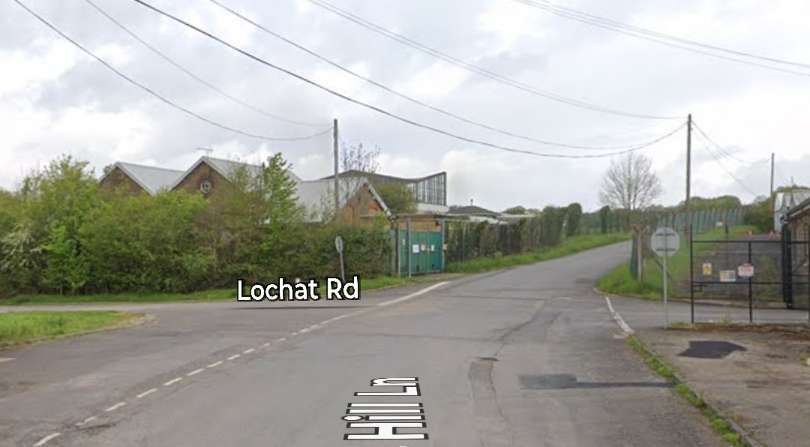
The next three images are photographs at the junction between Lochat Road and Lodge Hill Lane which can be seen at the top-right of the railmaponline.com satellite image above. …
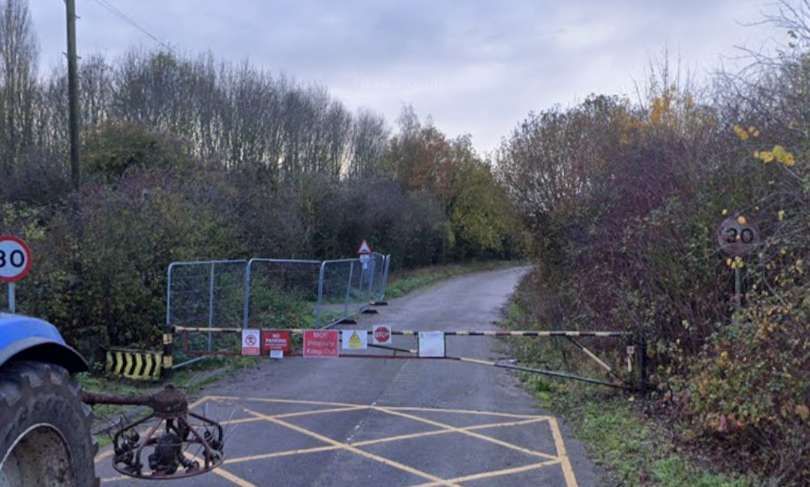
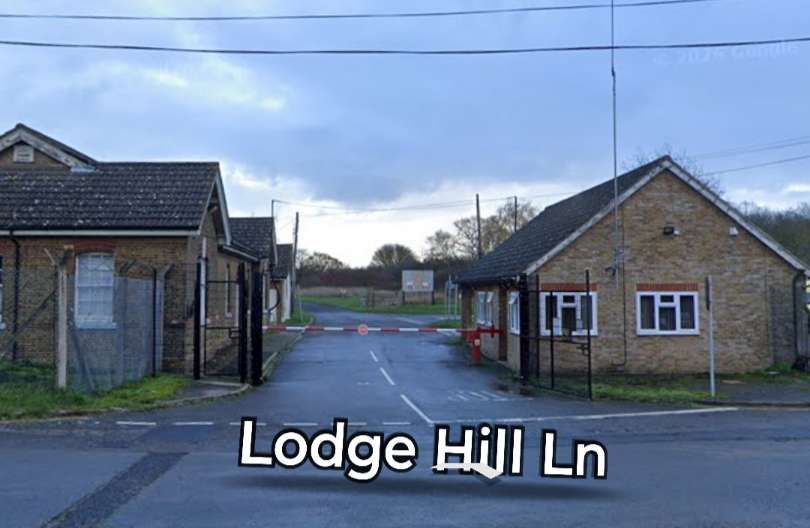
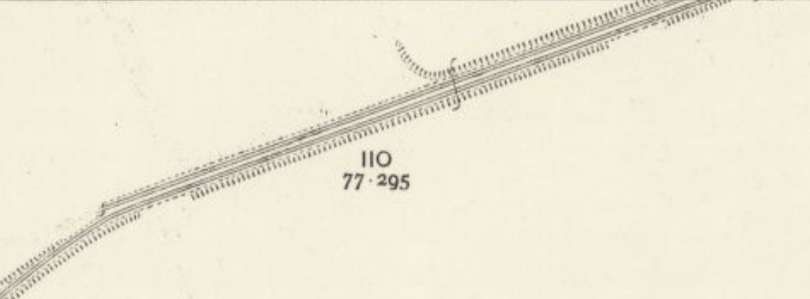
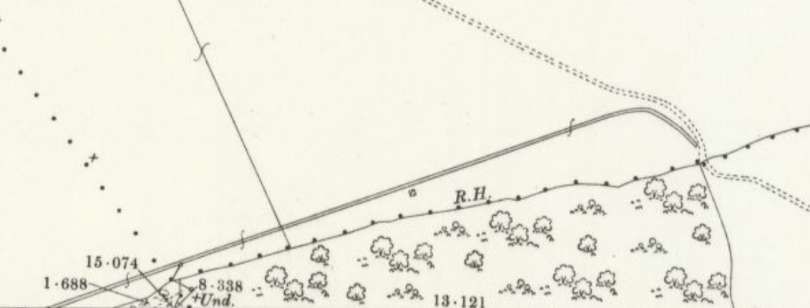
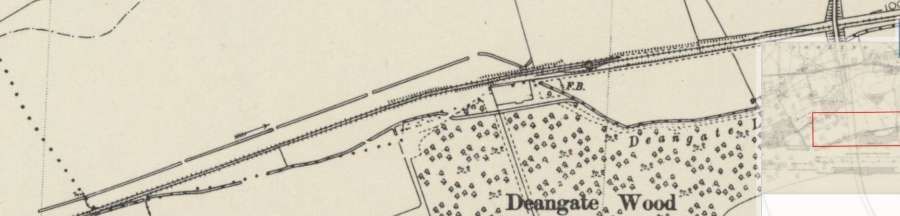
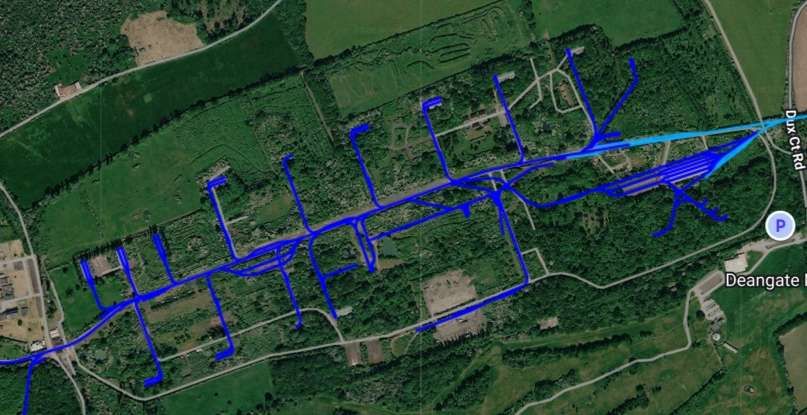
A much better picture of the network of lines at Lodge Hill can be found at railmaponline.com. …
A video exploring the Lodge Hill & Upnor Railway can be seen here. [27]
The Chattenden Naval Tramway
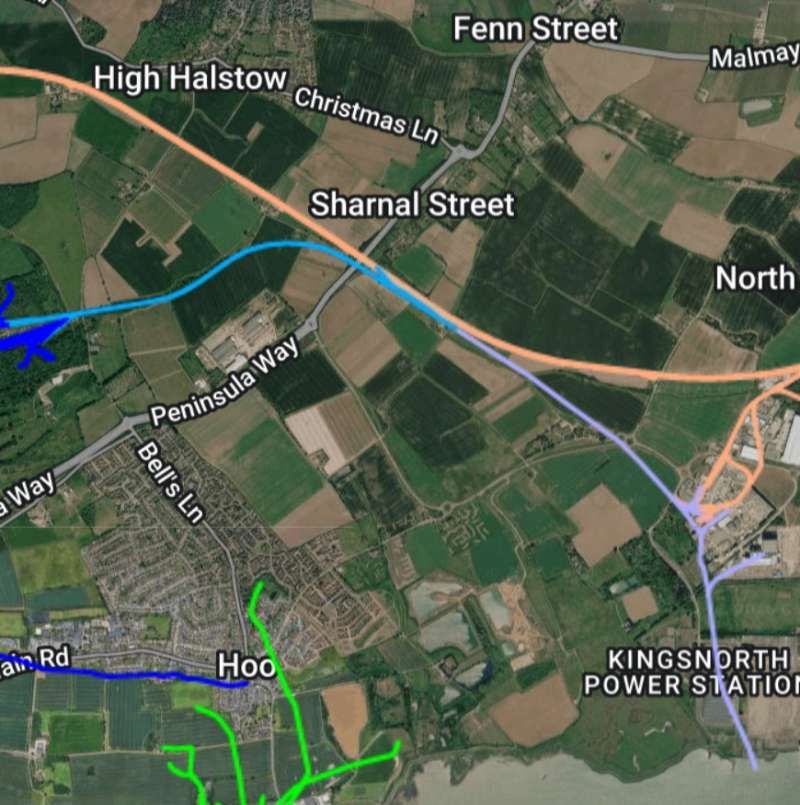
The Chattenden Naval Tramway was a two-mile, standard-gauge military connection linking the Royal Naval Armament Depot at Lodge Hill (and the Chattenden & Upnor Railway (otherwise known as the Lodge Hill & Upnor Railway)) to the South Eastern Railway main line at Sharnal Street on the Hoo Peninsula.
In 1901, a connection via a series of exchange sidings was made between the SER’s line at Sharnal Street and the Chattenden Naval Tramway/Railway. The two-mile Chattenden Naval Tramway between Sharnal Street and Lodge Hill was formally approved by a Light Railway Act dated 24th July 1901. [26]
The exchange sidings also provided access to the Kingsnorth Light Railway.
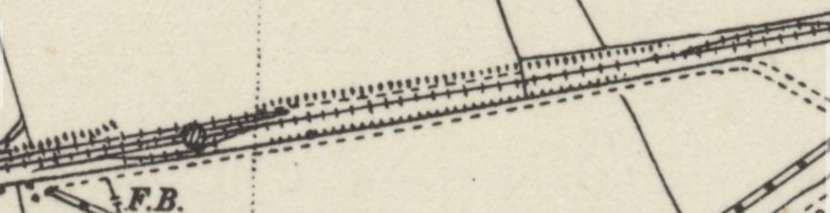
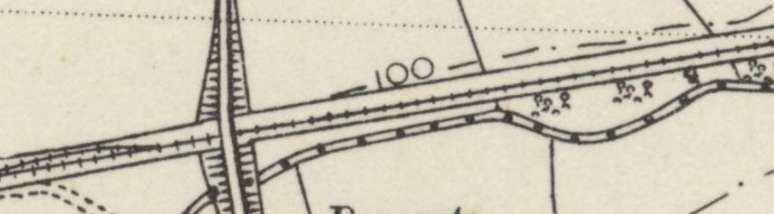
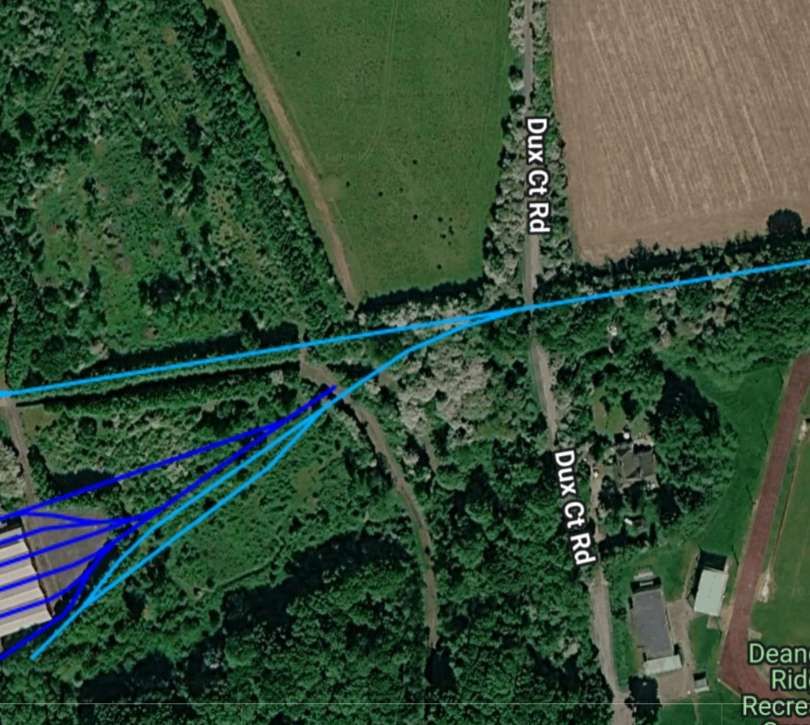
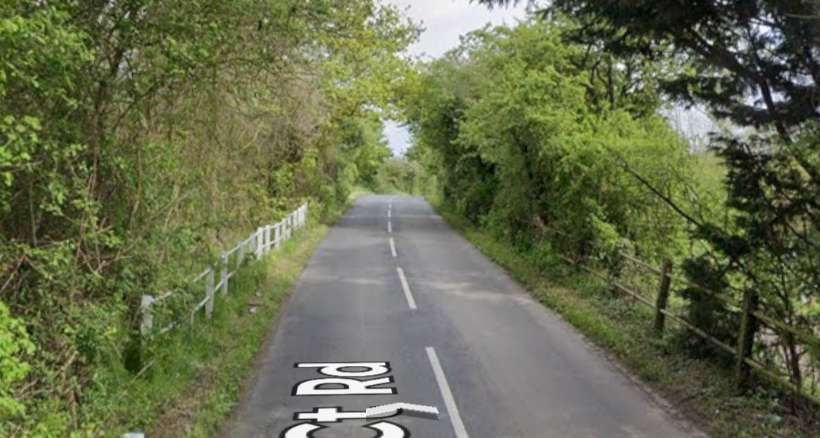
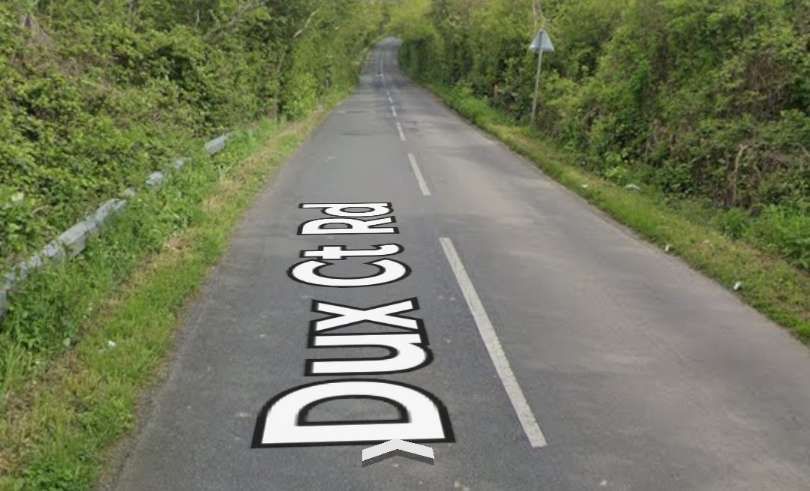
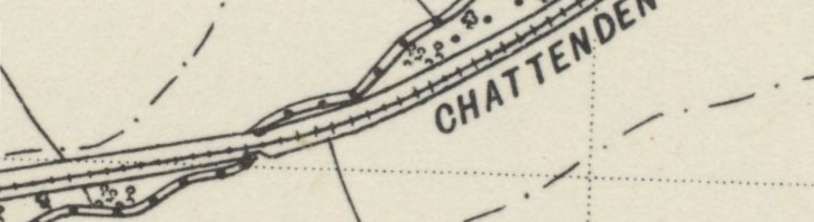
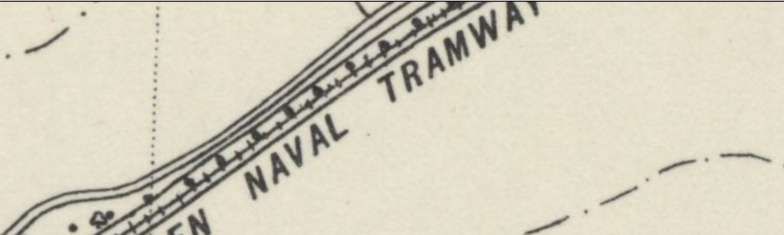
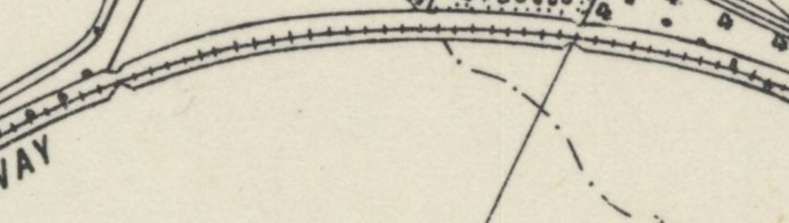
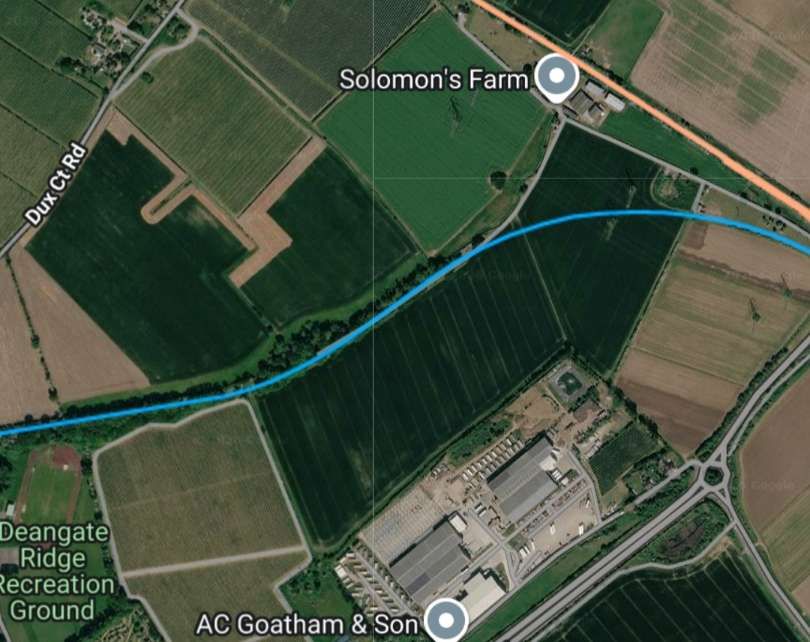
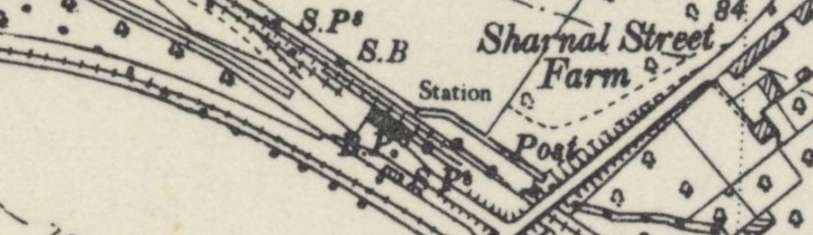
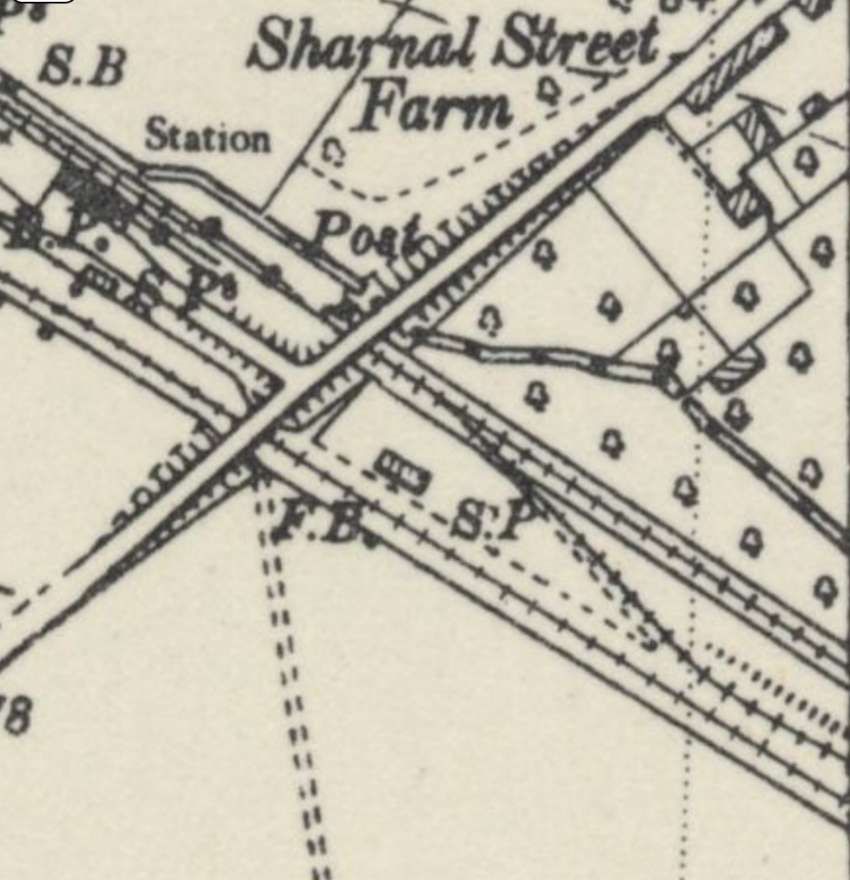
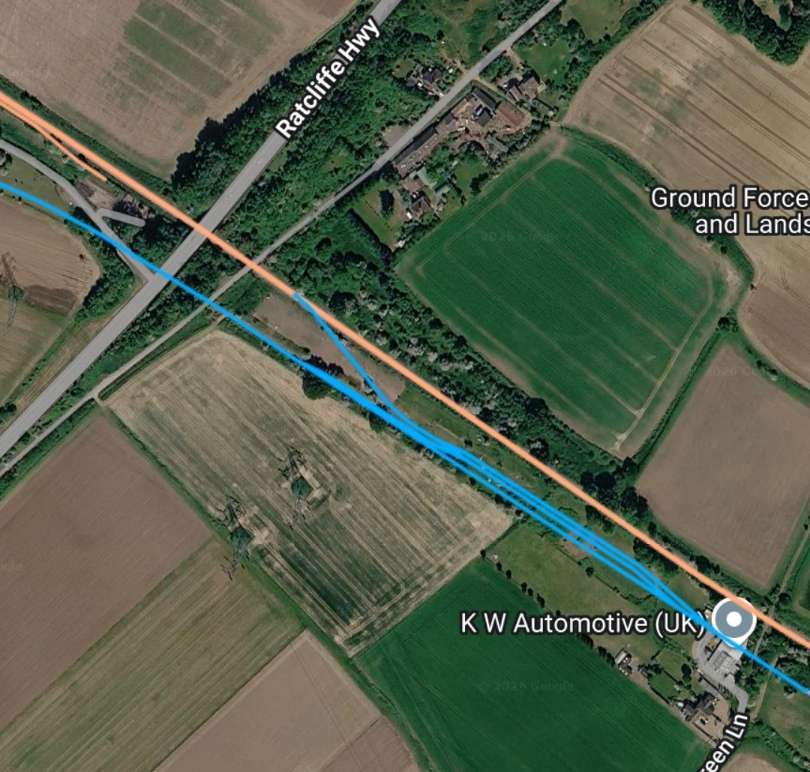
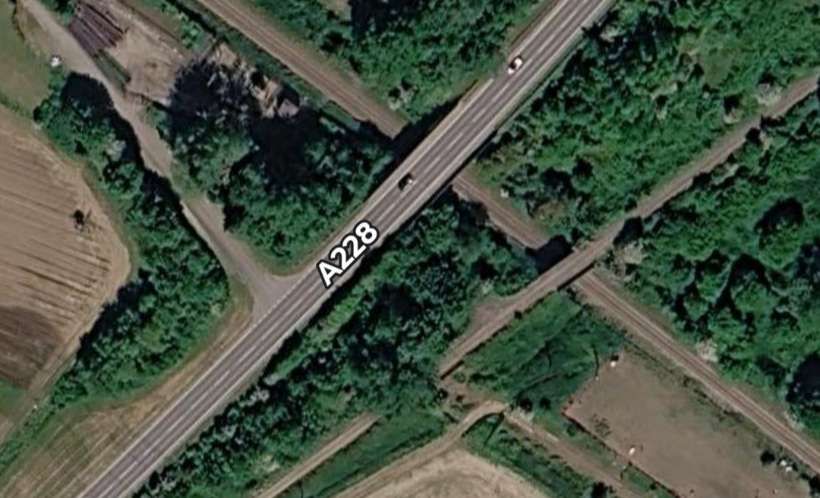
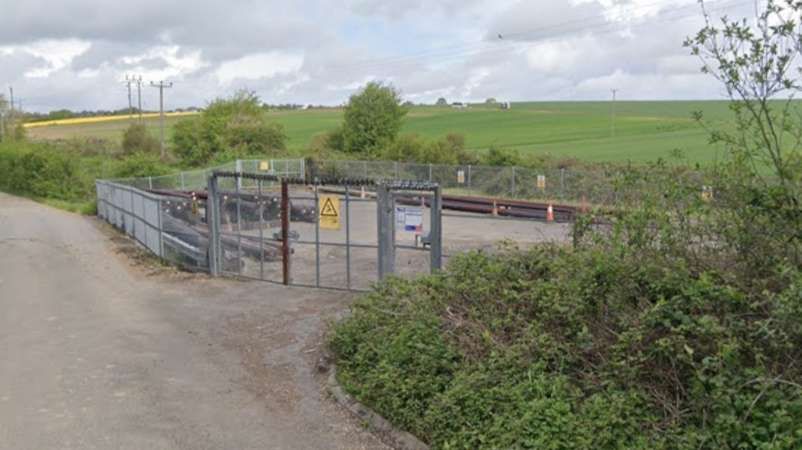
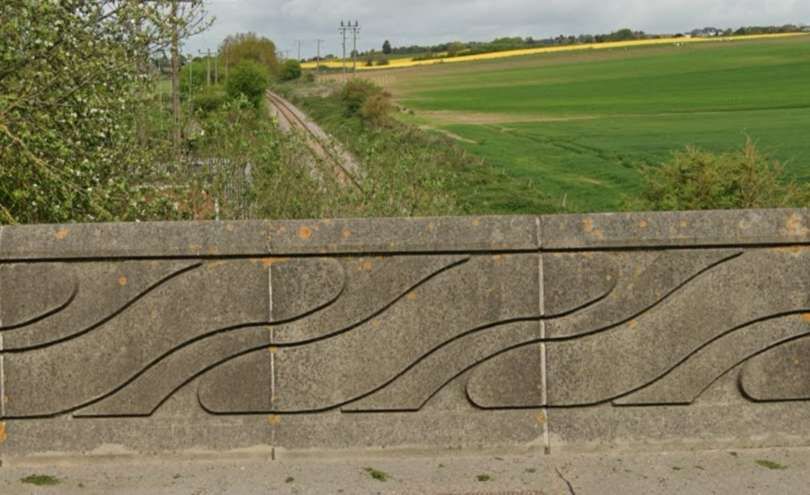
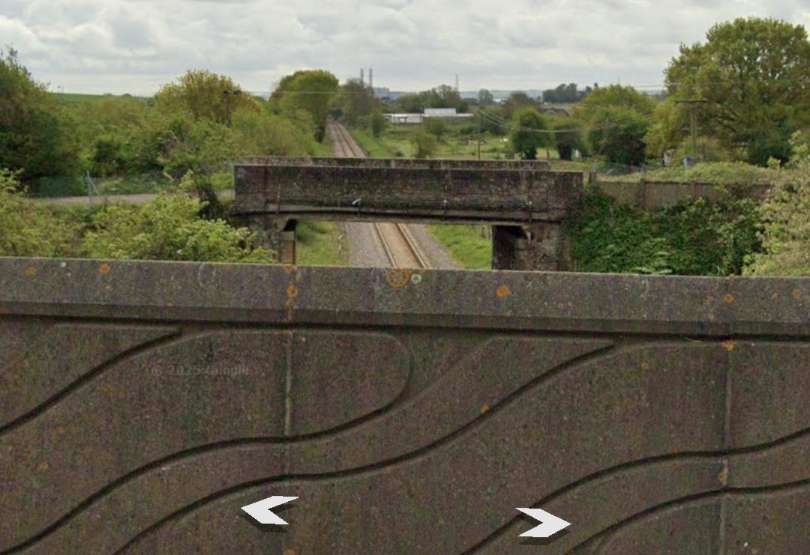
The location of the road bridge over the tramway cannot easily be determined exactly in the 21st century. The main line remains live in 2026. The bridge carrying the road is still present but no longer carries the main road.
References
- D. Yeatman; Lodge Hill & Upnor Railway; in The Industrial Railway Record, No. 12, Industrial Railway Society, December 1966, p277-292; via https://shop.irsociety.co.uk/Archives/12/lodge_hill.htm, accessed on 14th September 2026.
- https://commons.wikimedia.org/wiki/File:Chattenden_and_Upnor_Railway.jpg, accessed on 14th September 2026.
- https://en.wikipedia.org/wiki/Chattenden_and_Upnor_Railway, accessed on 14th September 2026
- The Chattenden & Upnor Railway; in The Railway Magazine. January 1962.
- Letters to the Editor; in The Industrial Railway Record No. 15, September 1967, p118.
- A. & G. Hatherill; Narrow Gauge &Industrial Album; RCL Publications, Gaendolbenmaen, Gwynedd, 2004.
- Andrew Neale & David Smith; Industrial Railways of the South East; Middleton Press, Midhurst, West Sussex, 1984.
- Robin Waywell; Industrial Railways and Locomotives of Kent; Industrial Railway Society, 2016.
- https://en.wikipedia.org/wiki/Chattenden_and_Upnor_Railway#/media/File:Locomotive_%22Carbon%22.png, accessed on 21st September 2026.
- https://renopenrose.getarchive.net/media/hornsby-akroyd-internal-combustion-engine-locomotive-of-the-2ft-6in-gauge-chattenden-69e842, accessed on 21st September 2026.
- https://en.wikipedia.org/wiki/Chattenden_and_Upnor_Railway#/media/File:YORKSHIRE_B.jpg, accessed on 21st September 2026.
- https://en.wikipedia.org/wiki/Chattenden_and_Upnor_Railway#/media/File:Locomotive_Lanchashire.png, accessed on 21st September 2026.
- https://maps.nls.uk/view/103677170, accessed on 24th September 2026.
- https://railmaponline.com/uk-and-irish-railways, accessed on 24th September 2026.
- https://maps.nls.uk/view/103676411, accessed on 24th September 2026.
- https://maps.nls.uk/view/103676408, accessed on 24th September 2026.
- https://www.narrow-gauge.co.uk/gallery/view/all-shipshape-2533, accessed on 24th September 2026.
- https://maps.nls.uk/view/103676375, accessed on 24th September 2026.
- https://shop.irsociety.co.uk/Archives/12/Chattenden.jpg, accessed on 24th September 2026.
- https://maps.nls.uk/view/103676378, accessed on 24th September 2026.
- https://maps.nls.uk/view/103676387, accessed on 24th September 2026.
- https://en.wikipedia.org/wiki/Chattenden_and_Lodge_Hill_Military_Camps, accessed on 24th September 2026.
- https://www.whoocares.org.uk/chattenden, accessed on 24th September 2026.
- https://maps.nls.uk/view/103676345, accessed on 25th September 2026.
- https://maps.nls.uk/view/101428188, accessed on 25th September 2026.
- https://kentrail.uk/sharnal_street.htm, accessed on 25th September 2026.
- https://youtu.be/IlC6wTOsqxc?is=BM-cUGjhJKov-tD5, accessed on 26th September 2026.


