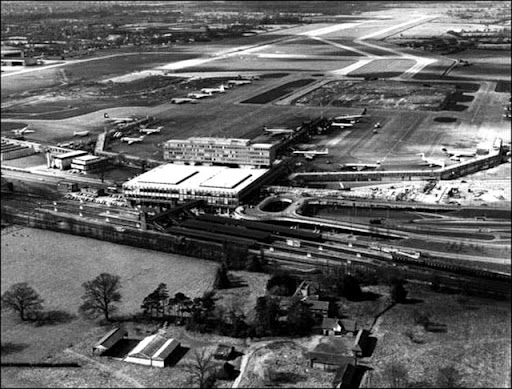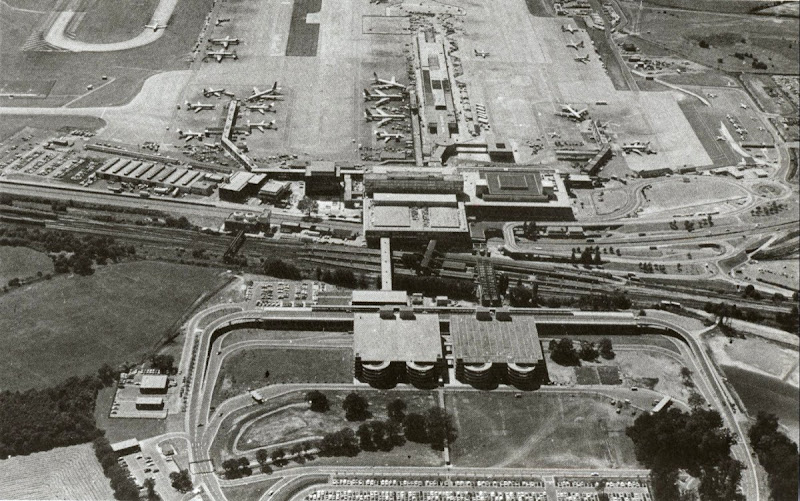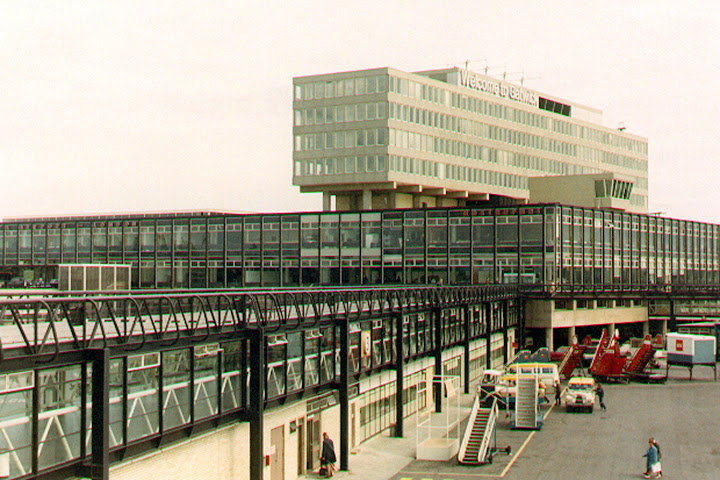
Gatwick Airport (London) lies close to the town of Crawley, on the Victoria-Brighton main line. The station sits immediately to the East of what is now the South Terminal of the airport. This article was promoted by two aerial images of the site of the Airport and its railway station in the September 1997 issue of Steam World. [6]
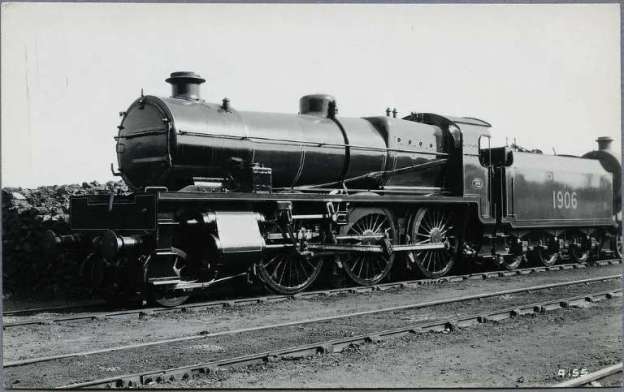
The featured image for this article shows a Southern Railway U-1 Class locomotive No. 1906. U and U1 2-6-0s were the everyday locos you would have seen stopping at Gatwick Racecourse on local services prior to the electrification of the London-Brighton line, © Public Domain. [16]
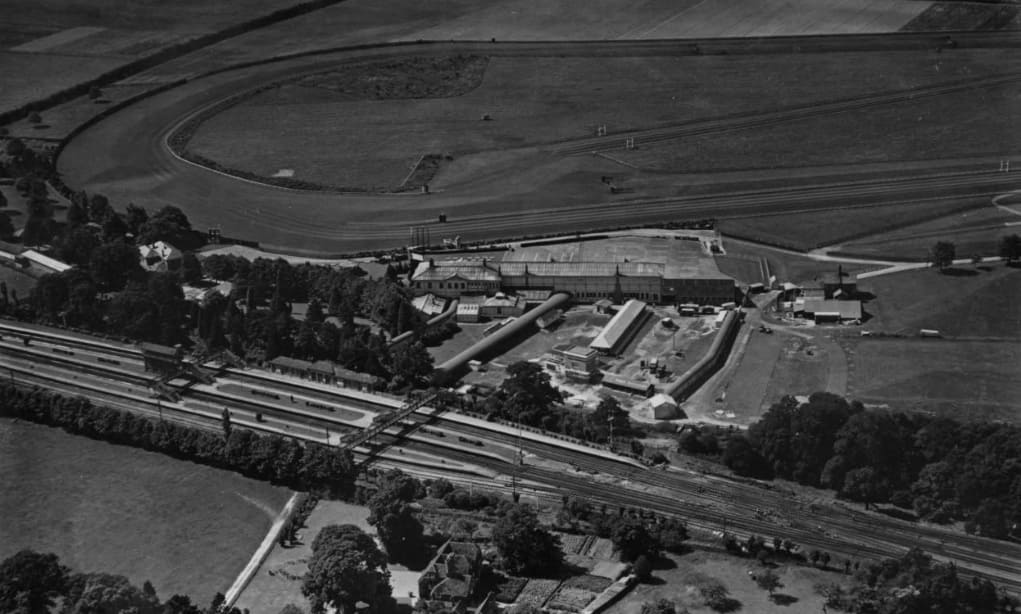
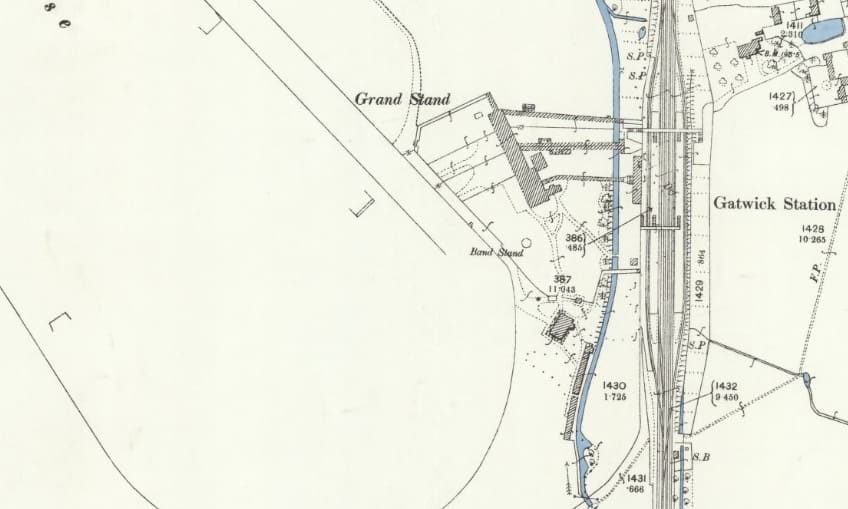
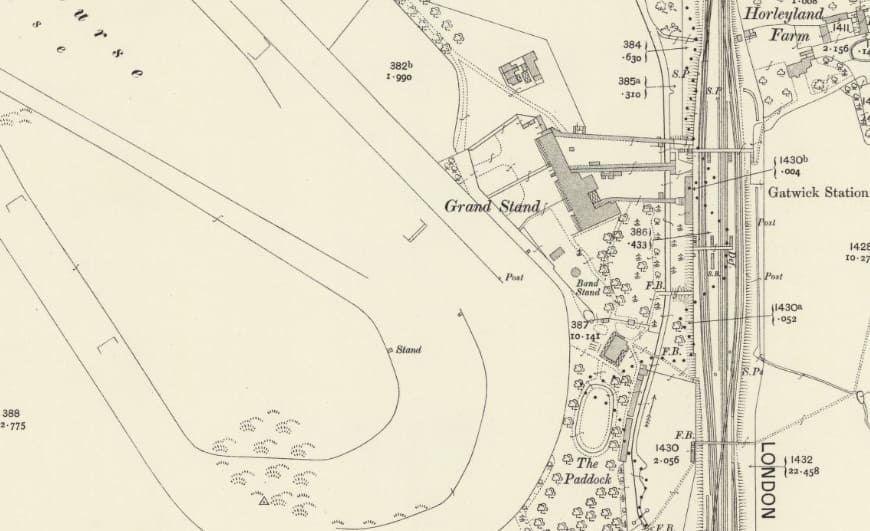
The present station, originally known as Gatwick, was built for the London, Brighton and South Coast Railway (LBSCR). It was closed in 1876 and reopened in 1891 by the LBSCR to serve the Gatwick Racecourse. At that time it was operating only on race days. [14]
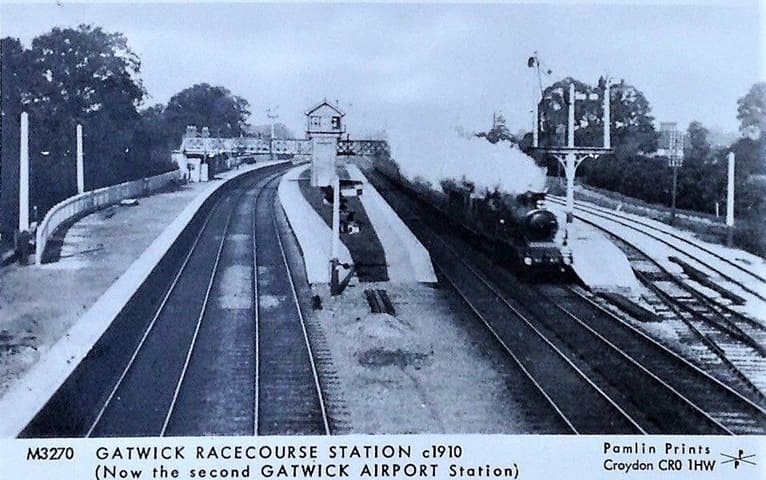
The station, however, became obsolete due to the opening of nearby Tinsley Green/Gatwick Airport Station in September 1935. It was closed after the completion of the Beehive airport terminal, which was directly connected to the Gatwick station. [14]
Wikipedia marks significant events for Gatwick Airport and it Railway Station [13] from 1920 to 1945:
Late 1920s: Land adjacent to the racecourse (at Hunts Green Farm, along Tinsley Green Lane) was used as an aerodrome. The Hunts Green farmhouse on the land used for the aerodrome was converted into a clubhouse and terminal.
November 1928: Dominion Aircraft Limited based its Avro 504 G-AACX at Gatwick from November 1928.
October 1929: the Southern Railway “announced plans to electrify the Brighton Main Line on the 660 volts DC third rail system, in addition to the stretch westwards from that town to Worthing, and to Reigate. In the Daily Mirror on Monday 19th January 1931, the cost of the works was stated to be £2,770,660, exclusive of new or converted rolling stock, and covered 52-track miles. Work commenced in that year and the first scheduled electric passenger services started to run as far south as Three Bridges from 17th July 1932. On 5th of the previous month, three-aspect colour light signalling had come into use between Coulsdon North, on the Quarry Line, and Balcombe Tunnel Junction (31¾-miles from London Bridge), and in stages was completed through to Brighton, the last section between the latter and Preston Park coming into use on 16th October 1932. From Coulsdon North to Norwood Junction, and between Coulsdon South and Earlswood, semaphores were retained, and the accelerated electric timetable came into use on the full length of the Brighton Main Line on 1st January 1933. This was the first main line in the country to be electrified and at the time comprised the longest continuous stretch of colour light signalling in the world.” [19]
The story of the electrification can be found here. [20]
1st August 1930: Ronald Waters, manager of Home Counties Aircraft Service (based at Penshurst Airfield in Kent), who had come into possession of Gatwick Aerodrome, got a licence for it. He founded the Surrey Aero Club there.
2nd–3rd August 1930: Flying began with pleasure flights for the local population in Avro 504s of Waters’ Surrey Aero Club.
1932: The Redwing Aircraft Company bought the aerodrome, and operated a flying school; it was also used for pilots flying in for races.
1933: The Air Ministry approved commercial flights from Gatwick.
September 1933: A. M. (Morris) Jackaman, who owned several light aircraft, bought the aerodrome for £13,500. He had bold ideas for its future, such as expanding it to make it suitable to use as a relief aerodrome for London (Croydon) Airport and providing a regular service to Paris using de Havilland DH.84 Dragon aircraft. He overcame resistance from the Air Ministry, which was concerned about the cost of draining the clayey land and diverting the River Mole.
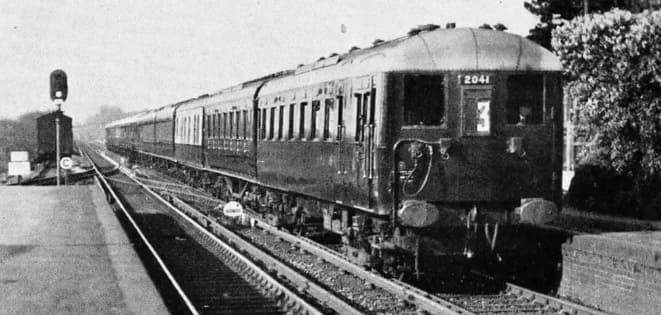
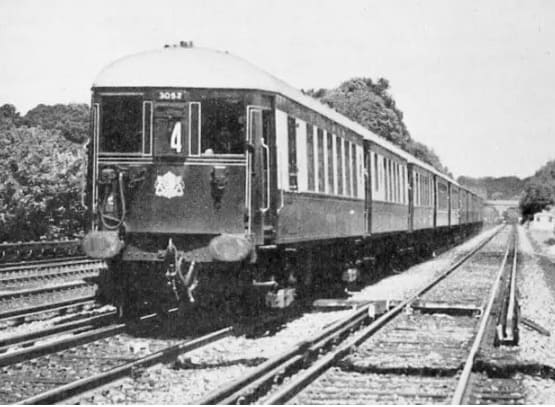
1934: Jackaman oversaw Gatwick’s transition to a public aerodrome, licensed for non-private flights, and planned a proper terminal building linked to a new railway station on the adjacent Brighton Main Line. He formed a new airport company, Airports Limited. Hillman’s Airways became Gatwick’s first commercial airline operator, beginning scheduled services from the airport to Belfast and Paris.
January 1935: Hillman’s Airways moved to Gatwick from Stapleford Aerodrome.
1935: A new airline, Allied British Airways, was formed with the merger of Hillman’s Airways, United Airways and Spartan Air Lines. The new carrier, which later shortened its name to British Airways, became Gatwick’s principal operator. Dorking and Horley Rural District Council was concerned about possible compensation claims from local residents and the threat of facing liability for flying accidents, and it “could see no benefit” to allowing further development of the aerodrome.
6th July 1935: The aerodrome closed temporarily for renovations, which included building the “Beehive”, the world’s first circular terminal building.
30th September 1935: Tinsley Green station opened 0.85 mi (1.37 km) south of the present Gatwick station. It was served by two trains per hour on the Victoria-Brighton line.
October 1935: The contracted opening date, was not met, partly because of drainage problems.
17th May 1936: The first scheduled flight departed from the Beehive terminal at 1:30 pm, bound for Paris Le Bourget. Jersey Airways operated this flight with a DH.86 under contract to British Airways Ltd., whose livery the aircraft wore. The airfare was £4 5s (including a first-class rail ticket from London Victoria Station), and there were up to three flights a day. Later the same day, British Airways Ltd. introduced another new scheduled service from Gatwick to Malmö, which was routed via Amsterdam, Hamburg and Copenhagen. Total travelling time between Gatwick and Malmö was six-and-a-half hours.
25th May 1936: British Airways Ltd. and Southern Railway jointly launched scheduled air services between Gatwick and the Isle of Wight.
1st June 1936: Tinsley Green station was renamed “Gatwick Airport”.
6th June 1936: The airport was officially reopened by the Secretary of State for Air, Lord Swinton. It featured four grass landing strips which were linked to the terminal area by two concrete taxiways, one each for arriving and departing aircraft respectively. The Beehive, the new terminal, was officially opened the same day. The Beehive was designed by Frank Hoar and incorporated several novel features, including a subway to the railway station at Tinsley Green which allowed passengers to travel from Victoria Station to the aircraft without stepping outside (with a transfer time from train to plane of as little as 20 minutes). Air Travel Ltd (a company specialising in aircraft and engine overhauls which had relocated to Gatwick from Penshurst) moved into the new airport’s No. 1 hangar.
July 1936: British Airways Ltd. inaugurated regular night mail flights linking Gatwick with Cologne and Hanover.
September and November 1936: Two fatal accidents happened, raising questions about the airport’s safety. The area was foggy, and its clay soil drained poorly; this caused the new subway to flood after rain.
17th February 1937: Gatwick was declared unserviceable due to waterlogging following repeated, heavy rainfalls. Because of this tendency to flood, and because longer landing strips were needed, the pre-war British Airways moved to Croydon Airport. Gatwick returned to private flying, and was used as a Royal Air Force (RAF) flying school.
October 1937: The No. 19 Elementary and Reserve Flying Training School RAF (E&RFTS) began instructing future RAF pilots at Gatwick on de Havilland Tiger Moth and Hawker Hart biplanes. [13]
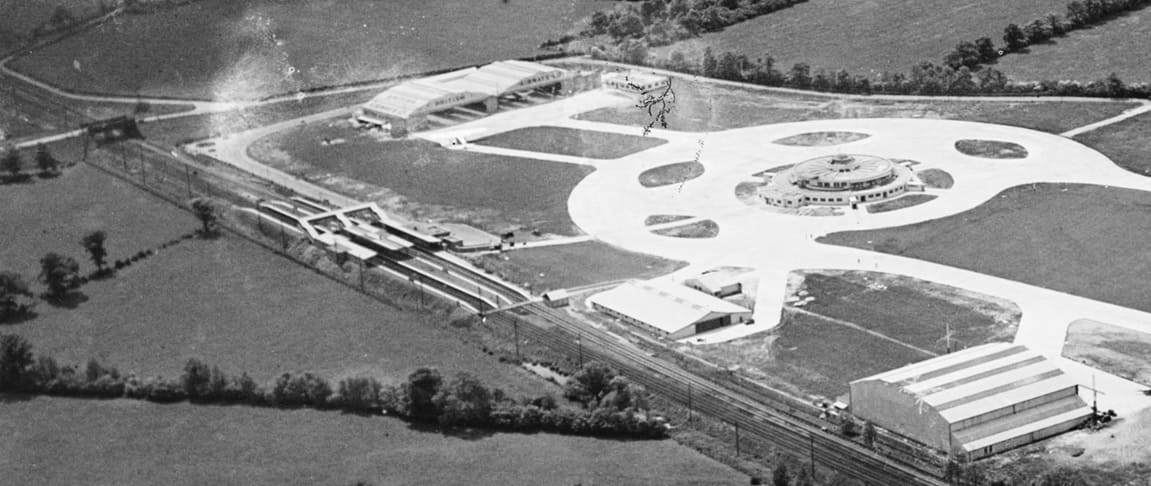
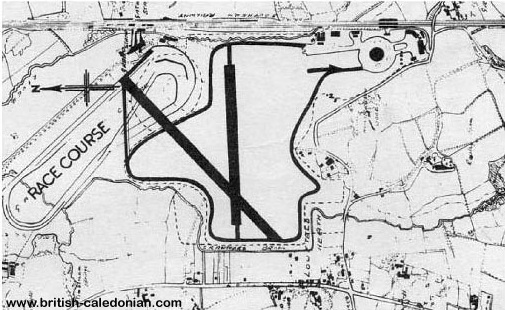
1938: Airwork General Trading Co. moved into the hangar British Airways Ltd. had occupied at Gatwick. This enabled Heston-based Airwork to expand its aircraft manufacturing capacity on behalf of the Civilian Repair Organisation (CRO), which had awarded it a contract to modify Whitley bombers for the RAF. Southern Aircraft (Gatwick) Ltd. was another company working under contract to the CRO at Gatwick at the time. It had been licensed to assemble Stinson Reliants and Beechcraft Expeditors for the Royal Navy and also repaired damaged Beaufighters. [13]
25th June 1938: The first Daily Express Air Display was held at Gatwick. Aircraft participating in the flypast included a Short Empire flying boat, a Lufthansa Focke-Wulf Condor, a Sabena Savoia-Marchetti SM.83, several RAF types and aerobatic aircraft. [13]
1st September 1939: No. 19 E&RFTS ended its activities at Gatwick. [13]
3rd September 1939: Following the declaration of war on Germany, all civilian flying at Gatwick and elsewhere in the UK stopped. As a consequence, civil aircraft maintenance and manufacturing activities at the airport stopped as well. This resulted in the airport being requisitioned by the Air Ministry, and becoming a base for RAF night-fighters and an Army co-operation squadron during World War II (primarily for repairs and maintenance and as an alternative to RAF Kenley in the event that Kenley was rendered inoperable by enemy action). [13]
December 1939: The operations manager of British Airways Ltd., which had begun the process of merging with Imperial Airways to form British Overseas Airways Corporation (BOAC), inspected Gatwick to assess its suitability as a base for the combined operations of the merged airline. [13]
1940: BOAC maintenance personnel began overhauling Armstrong Whitworth Ensigns and other aircraft types at Gatwick. Horse racing at Gatwick ended and never restarted. [13]
1940 and 1941: RAF units relocated to Gatwick from France. The airport became closely associated with the RAF Army Cooperation Command. As a result, several Army Cooperation Command aircraft were stationed at Gatwick. These included Westland Lysanders, Curtiss Tomahawks and North American Mustangs. [13]
Late 1942: Gatwick began receiving RAF and USAAF bombers that were damaged or running short of fuel. The most common types were Avro Lancasters, Handley Page Halifaxes, Short Stirlings and Boeing B-17 Flying Fortresses. [13]
January 1945: Gatwick was taken over by the Supreme Headquarters Allied Expeditionary Force Disarmament Unit. As a result, it received a large number of transport and communications aircraft. [13]
Gatwick Airport and its Railway Station, 1945 to 1975
1950: Despite local opposition, the Cabinet chose Gatwick as an alternative to Heathrow (then known as London Airport). BEA launched a seasonal scheduled service to Alderney in the Channel Islands, which operated for three consecutive summer seasons until 1952. At the time, there were three operational runways. These were aligned South-West–North-East, East–West and South-East–North-West. The first was 4,200 ft (1,300 m) long, 150 ft (46 m) wide and covered in steel mesh; the second was 3,600 ft (1,100 m) long, 150 ft (46 m) wide and covered in steel mesh as well; the third was of the same length and width as the second but was grass-covered. [13]
May 1950: Gatwick’s first charter flight left the airport’s original grass runway for Calvi on Corsica (with a refuelling stop in Nice). Jersey-based UK independent airline Air Transport Charter operated this flight under contract to UK package tour pioneer Vladimir Raitz’s Horizon Holidays with a 32-seat Douglas DC-3 carrying 11 passengers. [13]
1950s: The railway stations had a reversal of fortunes in the 1950s as a result of that government decision to expand and develop the Beehive airport terminal into London’s second airport. Gatwick Racecourse station was rebuilt to serve Gatwick Airport, and was integrated into its terminal. On 27th May 1958, the rebuilt station, which took the name Gatwick Airport, was opened in conjunction with a regular train service; and services serving the former Tinsley Green station were discontinued. [14]
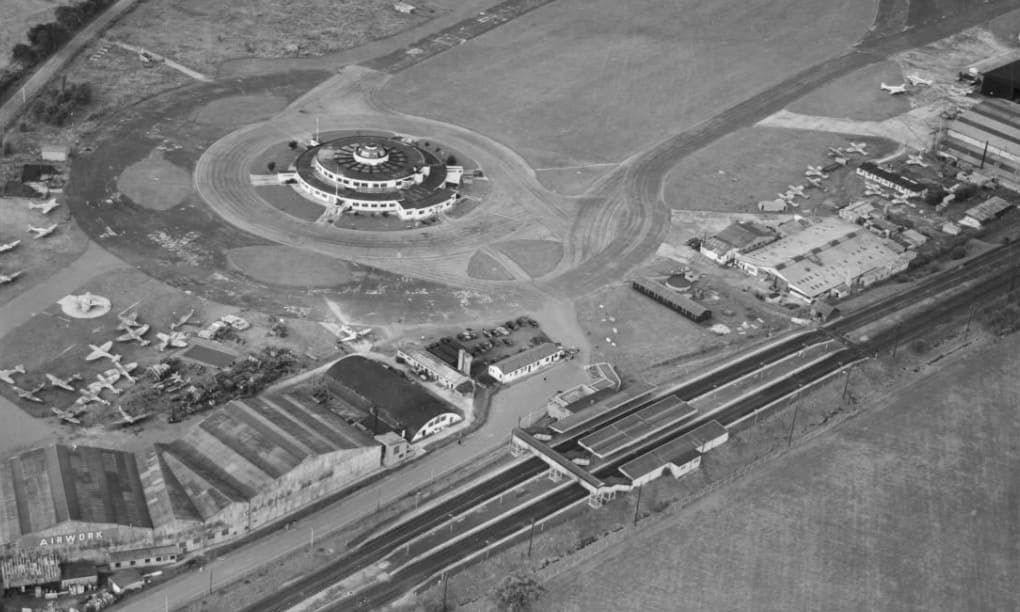
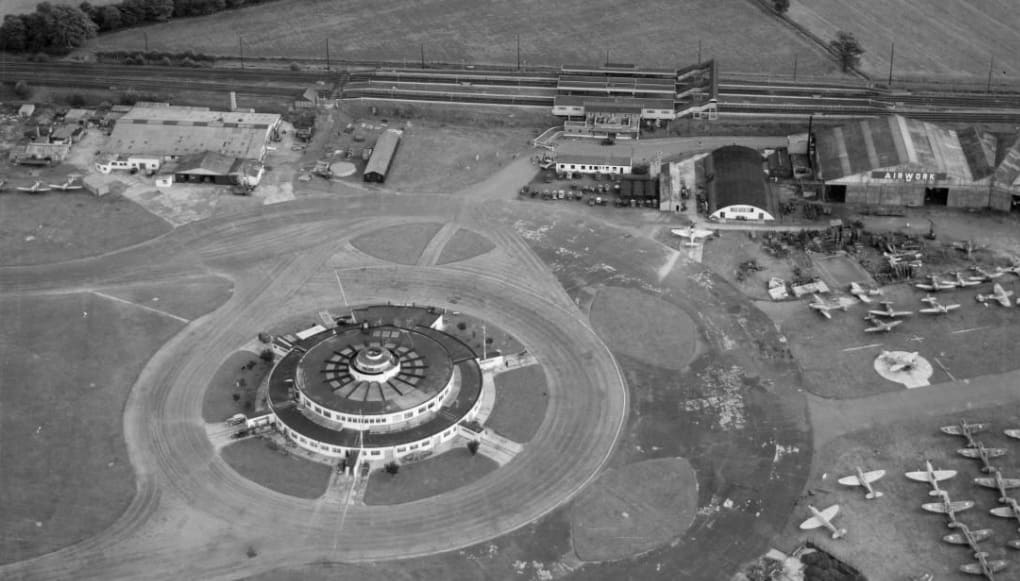
Between 1953 and 1958 much changed!
The next aerial image shows Gatwick Airport and Station in 1958.
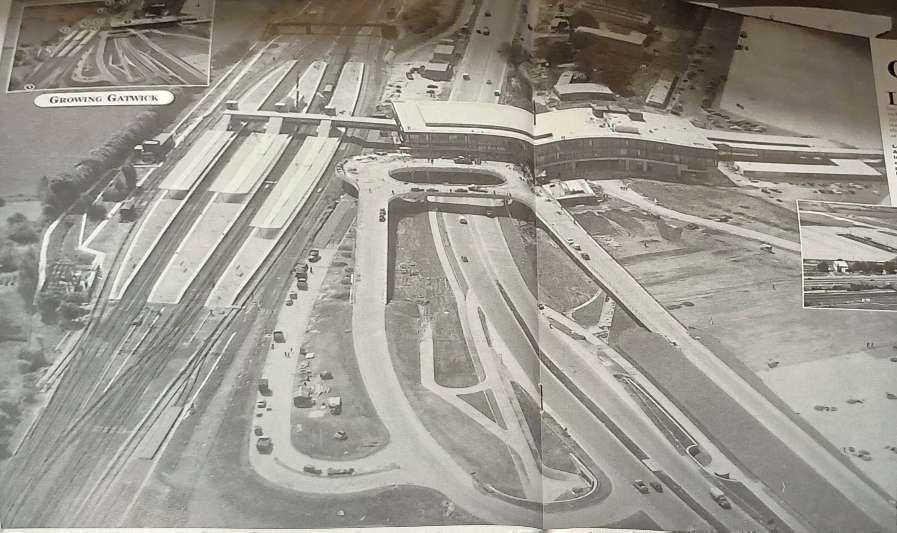
1958: The 1958 refurbishment of the railway station included a parcels’ office beneath the main concourse, lifts and a corridor on the south side of the overbridge, separated from the passenger corridor by a glazed partition. To accommodate trains of up to 12-carriage lengths, the three old Racecourse island platforms were raised by 1 ft (0.30 m) and extended to the north by about 100 ft (30 m), except for the very long westernmost platform, which was reduced from the south. The ticket office on the main concourse of the station was able to handle 670 separate issues of Edmondson tickets from its Bellmatic equipment. [14]
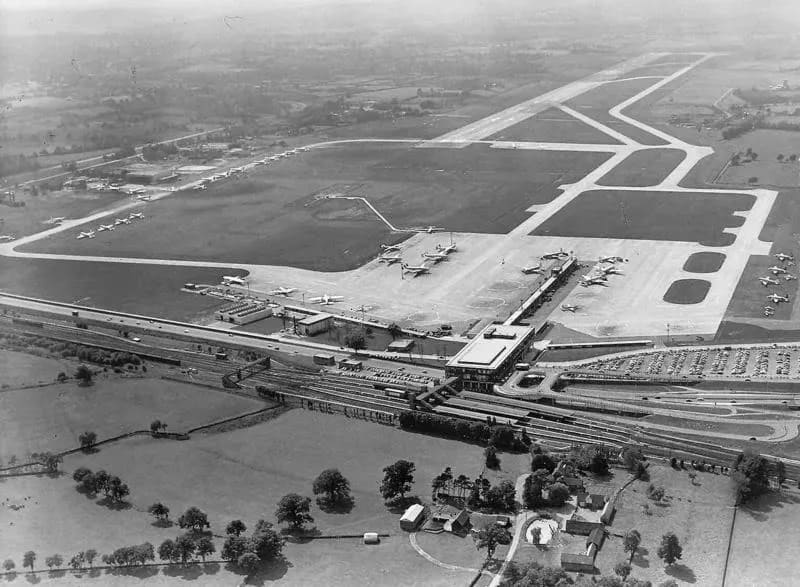
1962: Two additional piers were added to the terminal. [13]
1964: Gatwick’s original, relatively short late-1950s paved runway was extended by 1,200 ft (370 m) to 8,200 ft (2,500 m) due to new noise rules governing the operation of jet aircraft at airports near (or surrounded by) densely populated urban areas. [13]
1965: By now, each of the three piers was nearly 1,000 ft (300 m) long, and the terminal complex had a floor area of 100,000 sq ft (9,300 m2). [13]
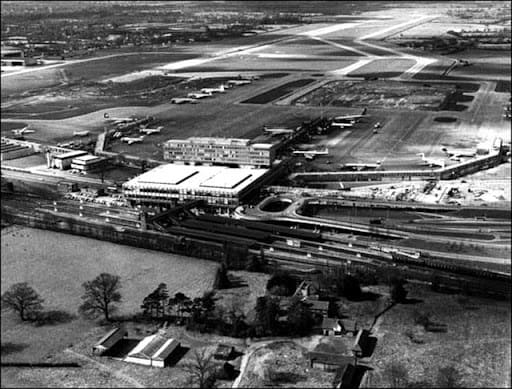
1970: A second 875-foot (267 m) extension of Gatwick’s runway was completed, bringing it to 9,075 ft (2,766 m) and allowing non-stop jet flights to the US east coast with a full payload and full range and payload operations by British United Airways and Caledonian Airways BAC One-Eleven 500s. [13]
1973: The third extension of Gatwick’s runway was completed, bringing it to 10,165 ft (3,098 m) and allowing for non-stop narrow-body operations to the US west coast and commercially viable, long-range wide-body operations. [13]
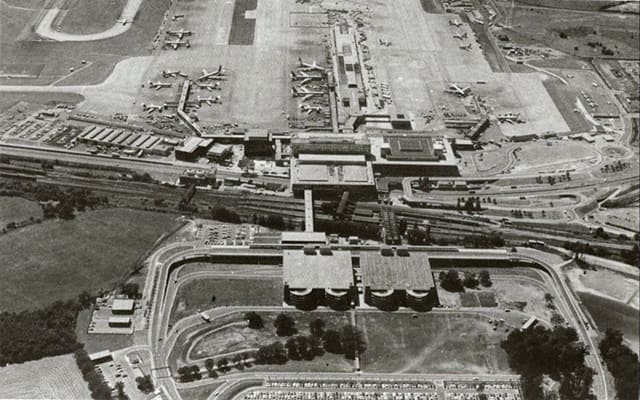
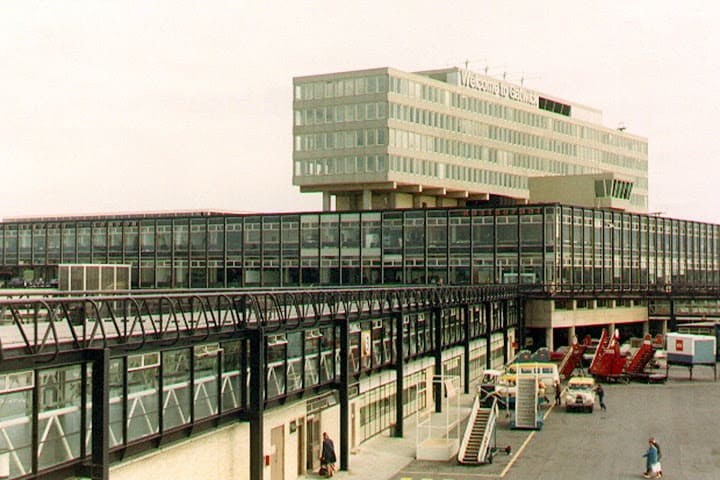
1975 onwards
Late 1970s: Government initiatives supporting Gatwick’s development resulted in steady growth in passenger traffic. Among these were policies seeking to transfer all scheduled services between London and the Iberian Peninsula from Heathrow to Gatwick, banning whole-plane charters at Heathrow and requiring all airlines planning scheduled services to London for the first time to use Gatwick instead of Heathrow. This policy was known as the London [Air] Traffic Distribution Rules. The government also approved a high-frequency helicopter shuttle service linking Gatwick with Heathrow. [13]
Late 1970s and early 1980s: Fully extendible jet bridges were added when the piers were rebuilt and extended. [13]
1980s: In the 1980s, the railway station was refurbished again. It had six platforms immediately beneath the airport’s South Terminal. [14]
1983: As passenger numbers grew, a circular satellite pier was added to the terminal building connected to the main terminal by the UK’s first automated people mover system. (This replaced the original North pier dating from 1962, and the people mover connecting the main terminal with the satellite pier was subsequently replaced with a walkway and travelators). A second terminal was planned, and construction began on the North Terminal on the land earmarked for a second runway in the draft plan of May 1970. This was the largest construction project south of London in the 1980s, costing £200 million. [13]
1984: Gatwick’s new air-traffic control tower opened, the tallest in the UK at the time.[123] The Gatwick Express was launched by British Rail, the world’s first non-stop airport-to-city-centre rail service (between the airport and Victoria Station). [13]
1988: On 18th March 1988: The North Terminal was opened by Queen Elizabeth II (including an automated rapid transit system link to the South Terminal). [13]
1991: A second aircraft pier was added to the North Terminal. [13]
1994: The North Terminal international departure lounge and the first phase of the South Terminal international departure lounge opened, at a cost of £30 million. [13]
1998: The main runway was extended for a fourth time, reaching 10,879 ft (3,316 m), to enable longer-range operations with wide-body aircraft. [13]
2000 to 2001: Gatwick’s two terminals were further expanded to add seating, retail space and catering outlets, at a cost of £60 million; this included an extension to the North Terminal departure lounge, completed in 2001. [13]
2005: An extension and refurbishment to the South Terminal’s baggage reclaim hall (doubling it in size) was completed. [13]
May 2005: Pier 6 opened at a cost of £110 million, adding 11 pier-served aircraft stands. The pier is linked to the North Terminal’s main building by the largest air passenger bridge in the world, spanning a taxiway and providing passengers with views of the airport and taxiing aircraft. [13]
May 2008: An extension of the South Terminal’s departure lounge was completed, and a second-floor security search area opened. This terminal is now primarily used by low-cost airlines; many former users moved to the North Terminal.
2010s: On 13th October 2010, a £53 million redevelopment programme for the railway station was announced to provide another platform capable of accommodating 12-car trains, refurbishment of the concourse, and track and signal upgrades. Escalators and lifts were provided for platforms 5 and 6, replacing a staircase to achieve improved circulation. The redevelopment provided improved capacity and flexibility on the Brighton Main Line. The project was jointly financed by Network Rail, who contributed £44.9 million, and Gatwick Airport who provided £7.9 million. Construction was structured so as not to negatively affect the 2012 Summer Paralympics, which was hosted in London. [14]
May 2013: Demolition began of Pier 1, Gatwick Airport’s second-oldest pier (the original 1962 South pier of what is now the South Terminal) for its replacement with a £180 million, two-storey structure with five pier-served aircraft stands and an automated baggage-storage facility, operational by summer 2016. [13]
2014: By 3rd February 2014, completion of the work on the Railway Station was marked by a ceremony officiated by Minister of State for Transport Baroness Kramer, who formally opened the new platform. Constructed by VolkerFitzpatrick, platform 7 is served by a 975-metre (3,199 ft) loop from the down fast line and used by services which formerly used at platform 5. VolkerFitzpatrick were responsible for track and signalling modifications. This has allowed platforms 5 and 6 to be dedicated to Gatwick Express services, thereby eliminating previous conflicts with slower services when they crossed to platforms 1 and 2. The project was finished on schedule and budget, despite extreme weather conditions during the winter of 2013/2014. [14]
In 2014, Baroness Kramer announced that the government had committed £50 million towards further improvements of the railway station. A scheme for further improvements, estimated to cost around £120 million, was announced by Network Rail. [14]
2016: On 1st February 2016, Caroline Ansell, the MP for Eastbourne, officially opened the redeveloped pier 5 of Gatwick’s North Terminal. The redevelopment of pier 5 cost £80 million and forms part of the airport’s £2 billion improvement programme under GIP ownership. Its main feature is an additional second level that separates departing and arriving passenger flows vertically to increase capacity by an additional 30 flights or approximately 2,400 passengers per day. This increase in capacity is achieved by accommodating up to seven large and 12 smaller aircraft (or a combination of both) at the pier’s redesigned aircraft stands to enhance operational flexibility for airlines and passengers and make passenger journeys smoother. [13]
2018: In April 2018, Network Rail submitted a planning application for modernising the railway station; doubling the size of the concourse, widening two platforms, and improving connections to the airport terminal. It was done in partnership with Gatwick Airport authorities, the Coast to Capital local enterprise partnership and the Department for Transport. The expansion is an element of a five-year programme, costed at £1.11 billion, announced by Gatwick Airport in early 2018. [14]
Amongst others, the main projects covered by this £1.11 billion include: a westward extension of the North Terminal’s pier 6, involving the relocation of the A380 stand to pier 5 and related widening and reconfiguration of a taxiway to enable A380 operators to access the new stand at pier 5; a dedicated domestic arrival and baggage reclaim facility in the South Terminal; and connecting the new Boeing hangar with the airfield.
2020s: Construction on the new railway station concourse began in November 2020. The refurbished station opened on 21st November 2023. [14]
The ticket office is staffed for ticket sales and enquiries, supplemented by ticket machines capable of handling online bookings usually available on a round-the-clock basis. Automated teller machines, payphones and e-mail access points are installed on the main concourse. There are coin-operated trolleys for luggage and a left luggage facility. On-site food and drink outlets are present. Toilets are available and baby changing facilities and additional toilets can be found in the adjacent South Terminal. There is no car parking facility. Transport for London’s (TfL) Oyster cards and contactless cards are accepted for travel at the station. [14]
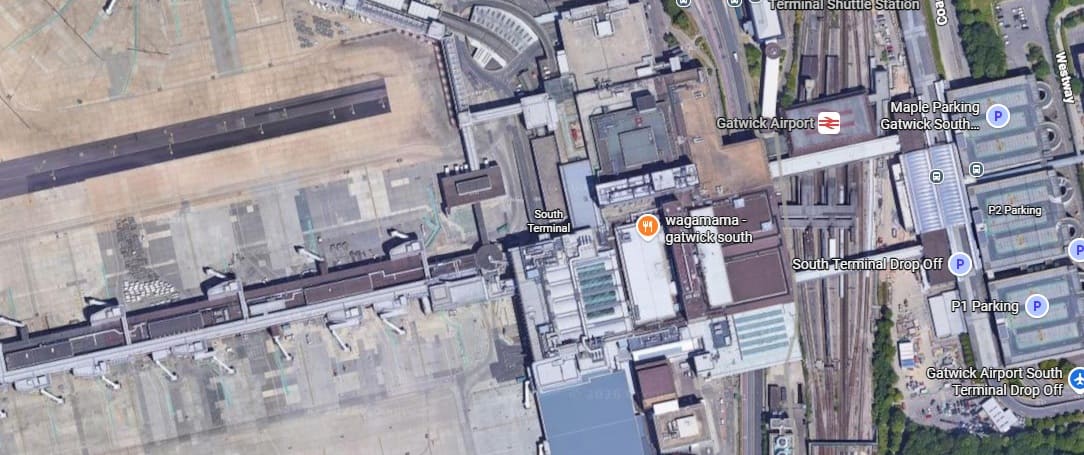
References
- https://www.britainfromabove.org.uk/en/image/EPW028582, accessed on 8th September 2026.
- https://www.britainfromabove.org.uk/en/image/EPW053263, accessed on 8th September 2026.
- https://www.britainfromabove.org.uk/en/image/EAW050735, accessed on 8th September 2026.
- https://www.britainfromabove.org.uk/en/image/EAW050736, accessed on 8th September 2026.
- https://www.gettyimages.ae/detail/news-photo/an-aerial-view-of-a-new-gatwick-airport-terminal-under-news-photo/2177625739, accessed on 8th September 2026.
- Growing Gatwick; in Steam World, Issue 123, September 1997, p32-35.
- https://maps.nls.uk/view/103317073, accessed on 8th September 2026.
- https://maps.nls.uk/view/103317070, accessed on 8th September 2026.
- https://i145.photobucket.com/albums/r231/thawes/RAF%20Lyneham/Gatwick1961.jpg, accessed on 8th September 2026.
- https://lh4.ggpht.com/_9g9gbl9dTkg/SbKweMEBPhI/AAAAAAAAEO8/Hf5xfy6MvIU/Gatwick%201970.jpg, accessed on 8th September 2026.
- https://lh4.ggpht.com/_9g9gbl9dTkg/SRzQ94gQkNI/AAAAAAAAAjY/iZG9r9SwA1U/s800/lgw1-1975.jpg, accessed on 8th September 2026.
- https://lh4.ggpht.com/_9g9gbl9dTkg/SRzQ71yot7I/AAAAAAAAAjM/q5HUf9D0ueI/s720/z-LGW-JU%7E1.JPG, accessed on 8th September 2026.
- https://en.wikipedia.org/wiki/Timeline_of_Gatwick_Airport, accessed on 8th September 2026.
- https://www.railway-technology.com/projects/gatwickairportstatio, accessed on September 2026.
- https://en.wikipedia.org/wiki/Gatwick_Airport_railway_station#History, accessed on 8th September 2026.
- https://picryl.com/amp/media/southern-railway-sr-u-1-952-eb1f71, accessed on 9th September 2026.
- https://eggythebread.weebly.com/other-local-areas.html, accessed on 9th September 2026.
- https://www.british-caledonian.com/Gatwick_Airport_-_The_History_P2.html, accessed on 9th September 2026.
- https://kentrail.uk/gatwick_airport.htm, accessed on 9th September 2026.
- https://www.railwaymagazine.co.uk/25838/from-the-archive-the-brighton-electrification, accessed on 9th September 2026.