
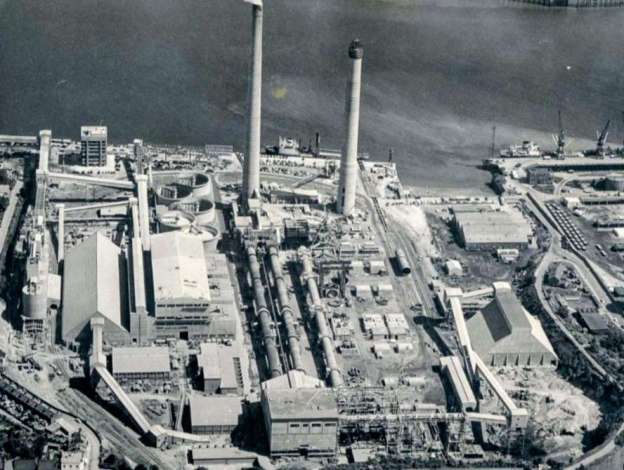
The featured image for this article is an aerial image looking North across the New Northfleet Cement Works soon after construction was completed in 1970. Careful inspection will show the loop of rail sidings that ran round the core of the works, © Christoph Bull/Gravesend Libraries. [17]
Stoyel & Kidner write “The 1970s saw the final end of a process of rationalising the cement industry which had been going on for nearly a century. By 1880 it had become inefficient and almost suicidally competitive. Each works sought its own supplies of chalk and clay, and there was not enough mineral-bearing land to go round. Also, the adoption of the rotary kiln required a considerable capital investment, this could only be recouped by large-scale production, which in turn required larger reserves of raw materials. The formation of the ‘combine’ in 1900 allowed less favoured works to be shut, with the more favoured receiving rotary kilns. It was this trend, especially in the 1920s, which caused the replacement of narrow gauge by standard gauge lines, and the concentration of the industry into fewer but larger works requiring greater tonnages of raw materials.” [1: p112]
“By the 1930s there were just a few modern works: Kent, Johnsons, Swanscombe, and Bevans in the Thames heartland of the industry, and these served through the 1950s.” [1: p112]
APCM undertook a fundamental review of its UK manufacturing. It “built new, larger, regional works based on the more economic dry process of manufacture. These were at Dunbar, Weardale, Hope, Cauldon and Plymstock.” [1: p112-113]
APCM took a different approach with the works in the Thames Estuary, deciding to replace them with a new very large works based on the wet process of cement manufacture. Alone among the earlier works, Swanscombe was retained to focus on producing special cements. [1: p113]
The new Northfleet plant was not constructed until the beginning of the 1970s and became fully operational by 1972. It was predominantly built on brownfield land which included the sites of: Bevan’s Cement Works (Northfleet); the Crown Portland Cement Plant; and the London Portland Cement Plant. It was necessary as APCM sought to centralise operations in a strive for efficiency.
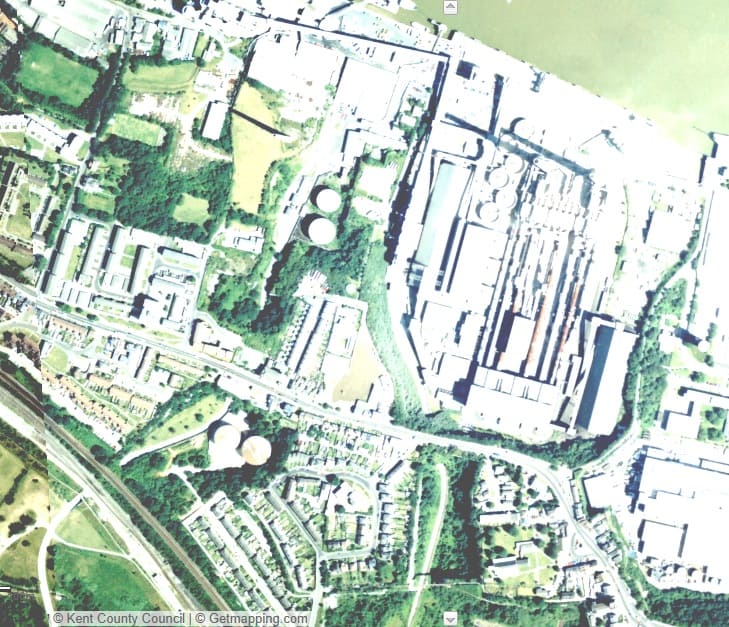
Construction of the then new Northfleet Works commenced in 1968. David Glasspool tells us that, “By this time, in addition to United Kingdom trade, APCM had significant exports, and to supply all interests, the cement plant was to be equipped with six kilns capable of a combined output of four million tonnes of cement a year. Approximately 20% of this was destined for overseas markets: Africa and North America in particular. To feed the works, excavation commenced in Greenhithe to produce a huge chalk pit on former farmland, alongside an existing quarry operation. This subsequently became known as “Western Quarry”: its existing easterly neighbour, which had been in use since the turn of the 20th Century, was also included within the plans. In 1969, the go-ahead was given to deepen this pit (by then known as “Eastern Quarry”) by a further 6.7 metres. This followed in the footsteps of a previous deepening exercise in 1952, which saw the pit floor lowered by 2.4 metres, and would allow new chalk supplies to be reached in anticipation of Northfleet Works’ opening.” [2]
Cement Manufacturing Plants replaced by Northfleet Works included: Bevan’s Works (Northfleet); Cliffe Works (Hoo Peninsula); Holborough Works (Medway); Johnson’s Works (Greenhithe); Kent Works (Stone); Metropolitan Works (Essex); and Wouldham Works (Essex).
Northfleet Cement Works operated from 1970 until its final closure in 2008. Built on older, exhausted lime and ballast sites (including the former Bevan’s Works), it was once the largest cement plant in the world, featuring six massive wet-process rotary kilns. Dylan Moore tells us that, “The site was cleared in 2009-10, and the stacks were finally demolished on 28/3/2010. The western (ex-Johnsons) quarry was redeveloped in the 1990s as the Bluewater Retail Park. The eastern (ex-Swanscombe) quarry awaits redevelopment.” [3]
More information can be found here. [3]
The Northfleet Cement Works relied on a highly advanced, bidirectional double-track rail loop and an extensive marine wharf network. This configuration made it one of the most logistically efficient industrial plants of its time, allowing it to move millions of tons of heavy materials every year without causing bottlenecks. A double-track branch line curved around the perimeter of the cement works. Trains entered the site, offloaded or loaded, and exited back onto the mainline. Dylan Moore says: “An efficient looped rail link was established, accessing the plant through tunnels first driven for quarry access, and this allowed coal and gypsum to be brought in by shuttle trains without the need to re-verse. Up to seven 1500 ton trains of cement could be shipped out per day to a set of mostly newly-constructed depots around the country.” [3]
Locomotives at New Northfleet Cement Works
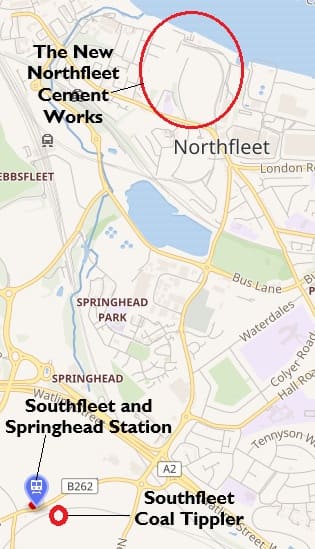
Shortly after the opening of the New Northfleet Cement Works. It was decided to convert the rotary kilns to coal firing. To do this, works were put in hand to re-open part of the former LCDR West Street branch as far as the yard of the closed Southfleet and Springhead station to allow coal trains entry from the Victoria to Chatham main line at Fawkham junction. … A new road “Foxhounds Way” was also constructed to allow coal lorries access to the works via the Swanscombe – Bean road.
Coal shipments commenced from the Nottinghamshire coal field in December 1970, the usual motive power being Class 45 Peak diesel electric locomotives, a rare visitor to North Kent.
Shunting the coal wagons around the run round loop and head shunt arrangement at Southfleet was the responsibility of the sites resident diesel shunter. [9]
Once the wagons had been relieved of their loads, the coal passed along a series of conveyors where it was stored in storage silos awaiting loading into lorries for onward transit to the Cement Works. … The arrangement lasted until 1976 when the rail spur from the North Kent Line into the cement works from Northfleet station was opened. The site of the tippler closed at that time and the area appears to have reverted to nature. [9]
By 1972, the resident shunter at the Southfleet coal tippler site was a Sentinel 0-4-0 diesel-hydraulic locomotive, housed in a prefabricated engine shed added by Associated Portland Cement Manufacturers (APCM). It seems that the tippler was initially fed by a chain system which winched wagons onto the tippler. Perhaps by 1972 this had become too unreliable or time consuming? [10]
It appears that the Sentinel locomotive concerned was Works No. 10248 which was delivered new to APCM’s West Thurrock Works (Thurrock Chalk and Whiting) in 1966. It was designated as fleet No. 2 and initially painted in a lined green livery. It was part of a major dieselisation push to phase out the system’s steam fleet. It handled heavily laden rakes of internal user side-tipper wagons transporting chalk and raw material between the sprawling quarries and the processing works. It was recorded as present there in 1966. [11] Stoyel & Kidner have a different Sentinel undertaking this role, Works No. 10260. [1: p113]
No. 2 appears to have been transferred to Southfleet in 1972. It was tasked with moving British Rail main line coal wagons onto the site’s tippler tracks. It was only needed at Southfleet until 1976 when the tippler was closed. It was then returned to the West Thurrock Works and was recorded back at work there in the 1980s. [11]
From 1976 onwards no privately owned locomotives worked at the New Northfleet Works. instead, mainline rail operations inside and to the plant were handled directly by British Rail locomotives, predominantly Class 33 “Crompton” diesel-electrics, alongside occasional heavier Class 47 or Class 45 “Peak” diesel locomotives working incoming coal (such as MGR block trains from Welbeck Colliery) and gypsum services.
David Glasspool has a photographic record of a number of BR Blue locomotives working at Northfleet including:
- ‘Crompton’ No. D6577 is seen two-thirds of the way around the merry-go-round loop, awaiting the signal to clear before proceeding under the cement loading silos in May 1971. Movements outbound by rail started from the opening of the Works. Only inbound movements relied initially of short-distance road transport from the Southfleet Tippler and then only until 1976; [2]
- ‘Crompton’ No. D6577 once again, now at dusk on the same day. The train had completed the loop around the cement works complex and was now on the western side of the site, facing in the direction of the tunnel portal leading back to British Rail metals; [2]
- A pair of BR Blue Class 33 diesels seen cruising over the bridge which, at that time, carried the North Kent Line over the tracks which led to Northfleet Cement Works. Heading in the westward direction, the two were hauling the Allington to Westbury empties in September 1983; [2]
- A westward view of Northfleet Cement Sidings in late 1983 showing a Class 33/2 ready to proceed to the cement works with the Mountfield to Northfleet gypsum train. The formation would embark on the tight curve under the North Kent Line, which leads to the loop line of the cement works; [2]
‘Crompton’ locomotives were also recorded double-heading cement trains from Northfleet to Dunstable in the 1970s and 1980s. [12]
Other references to movements to and from Northfleet can be found on the following links:
- https://www.flickr.com/photos/auchlander/5154760319 – two Class 37 locomotives, 37226 & 37255 (at Shirebrook, taking the Warsop line at Shirebrook Junction, is a train of empty MGRs from Northfleet bound for one of the Mansfield collieries. [13]
- https://www.flickr.com/photos/28083135@N06/20841871129 – MGR empties returning to the midlands from Northfleet cement works are recorded at Dartford with Class 47 47327 and Class 45 45004 at the helm on 27th September 1979. The Class 47 would be removed at Cricklewood. [14]
The Cessation of Rail Services
David Glasspool tells the story of the gradual demise of Northfleet Cement Works. … “In 1978: APCM was renamed ‘’Blue Circle Industries Limited’’ (BCI). In the following year alone, worldwide sales for the company totalled £527.9 million, exports forming £69.4 million of this total. In addition to this, over 12,150 people were employed within the company, which had assets valued at £770.6 million. Despite these impressive figures, the export market was actually slowing down, and to cut costs and prevent excessive use of chalk, half the number of kilns at the Northfleet Works had been taken out of use by 1980, after a mere decade’s use.” [15]
Costs continued to rise and new energy-efficient plans saw two of the three remaining kilns were modified for ‘’semi-wet’’ operation, as opposed to their existing ‘’wet’’ processing -this reduced energy costs. [15][16]
The economic recession if the early 1990s saw Northfleet only working with just one kiln. In February 1993, “the works ceased delivering cement from its Northfleet site by rail, and arrival of chalk and coal by this means only lasted until March. The 13th March 1993 marked the final day of rail operation to the site, and both the loop line and sidings went out of use. … Economic upturn saw the re-commissioning of a second kiln at Northfleet in 1994 in response to demand, but this was not enough to bring rail operation back to the site. Two kilns gave the site an annual output of 1.2 million tonnes of cement. It was also in 1994 that excavation ceased at Western Quarry, which by this time had grown to an area of 240 acres. In the pipeline was BCI’s own concept of transforming the redundant site into a modern shopping centre. The plans had received formal government approval, but on 25th June 1994, the exhausted quarry was instead sold to Australian real estate firm ‘’Lend Lease’’. It was this company which eventually undertook the Bluewater Shopping Centre project.” [15]
After Closure of the Works
Cement production at the site did not cease until the early years of the 21st century. The neglected rail infrastructure associated with the plant was too valuable to completely abandon. In 2012, Lafarge and Network Rail spent £13.5 million to restore and upgrade the rail sidings. The site became a vital logistical hub for the Crossrail (Elizabeth Line) construction project. Freight trains transported millions of tons of excavated earth out of London’s new underground tunnels via the North Kent Line, directly into the Northfleet loop.
From there, the material was transferred via an enclosed conveyor belt onto ships at the wharf to be used for an RSPB wetland nature reserve at Wallasea Island. [2][3][4]
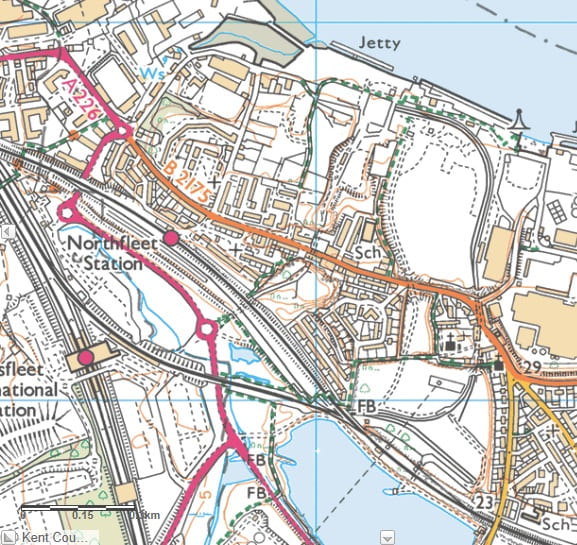
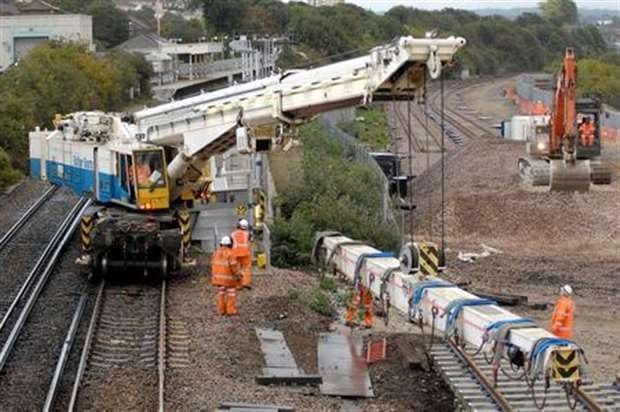
Up to five freight trains operated from Westbourne Park on Mondays to Saturdays with up to four trains on Sundays. The first test train successfully completed the inaugural journey in May 2012 ahead of the line’s official opening in June 2012.
Danny Boyle wrote at the time:
“David Simms, Lafarge Cement’s Kent-based land and planning director, said: “Northfleet, until recently the location of the UK’s largest cement works, is a site with a long history of rail use and is key to the sustainable onward distribution of essential construction materials for the built environment. Our involvement with the Crossrail project marks the latest stage in our vision for the 104-acre Northfleet site and delivers on our commitment to sustainable regeneration.”
“Andy Mitchell, Crossrail programme director, added: “The reinstated Northfleet rail link has been successfully commissioned with the operation of the first test locomotive by GB Railfreight. This new rail link will help us minimise lorry use in central London, as well as ensuring the efficient transfer of excavated material to sites where it can be best used for environmental improvement.” [6]
It was estimated at the time that the tunnelling for Crossrail would produce around six million tonnes of material which would be excavated from constructing the 21km twin-bore tunnel. Close to 100% of the excavated material was expected to be clean, uncontaminated and reusable elsewhere. In fact, during the construction of the Crossrail (Elizabeth line) project, a total of approximately 7 million tonnes of material was excavated. Out of this total amount, about 3.4 million tonnes were specifically dug out by the eight giant tunnel boring machines working on the 42 km of new tunnels, with the remainder coming from station boxes, shafts, and caverns.
A total of 3 million tonnes (roughly 3.2 million metric tons) of the excavated material was transported to Wallasea Island.While early project estimates aimed to send up to 4.5 million tonnes, the final amount delivered to the island made up nearly half of the project’s entire 7-million-tonne excavation payload. [7][8]
References
- B. D. Stoyel & R. W. Kinder; The Cement Railways of Kent; Oakwood Press, Headington, Oxford, 1973, 1990. (Page numbers are from the 2nd edition.)
- https://kentrail.uk/northfleet_cement_works.htm, accessed on 23rd August 2026.
- https://www.cementkilns.co.uk/cement_kiln_northfleet.html, accessed on 23rd August 2026.
- https://www.newsshopper.co.uk/news/9410068.lafarge-cement-works-in-northfleet-is-restoring-rail-sidings-at-the-site-which-will-be-used-by-crossrail, accessed on 23rd August 2026.
- https://webapps.kent.gov.uk/KCC.KLIS.Web.Sites.Public/ViewMap.aspx, accessed on 23rd August 2026.
- Danny Boyle; First Train Launches New Kent Railway; KentonLine, 15th May 2012; via https://www.kentonline.co.uk/kent-business/county-news/first-train-launches-new-kent-ra-a64448, accessed on 24th August 2026.
- https://newsroom.ferrovial.com/en/local-news/one-millionth-tonne-of-earth-removed-from-crossrails-west-london-tunnels, accessed on 24th August 2026.
- https://www.asce.org/publications-and-news/civil-engineering-source/civil-engineering-magazine/article/2022/06/excavated-crossrail-soil-creates-nature-reserve, accessed on 24th August 2026.
- https://www.gres.org.uk/gres-local-history/1231-2, accessed on 24th August 2026.
- https://www.facebook.com/groups/1730959503584733/posts/27602186059368723, accessed on 24th August 2026.
- https://paxton-road.blogspot.com/2022/11/alan-sewells-visits-to-thurrock-chalk.html, accessed on 24th August 2026.
- https://www.facebook.com/groups/892735862535042/posts/1057069989434961, accessed on 24th August 2026.
- https://www.flickr.com/photos/auchlander/5154760319, accessed on 24th August 2026.
- https://www.flickr.com/photos/28083135@N06/20841871129, accessed on 24th August 2026.
- https://kentrail.uk/northfleet_cement_works_2.htm, accessed on 24th August 2026.
- In brief, ‘’wet’’ operation involves feeding the kilns with raw materials in the form of a slurry, with excess water being removed by the application of heat. However, rising energy costs had made this an expensive process, and it was instead decided to remove the water not by heat, but rather filtration. This operation became known as ‘’semi-wet’’. [15]
- https://www.kentonline.co.uk/gravesend/news/500-new-riverside-homes-take-shape-274962, accessed on 25th August 2026.

