

The featured image for this article is Aveling & Porter 0-4-0WTG Reliance seen at Swanscombe in 1921. Only one end of the axles was geared. This is the non-geared side of the locomotive. Swanscombe Works employed a range of unusual industrial locomotives! (Locomotive Publishing Co.), © Public Domain. [30: p48]
Possibly as early as 1825, an extensive horse-drawn tramway network served the works.
The tramway was laid to 3ft 5.5in. “The gauge was measured to the outside of the railheads as the wheels had flanges outside of the rails. … They were the earliest railways in the area. … It is said that outside flanges were used so that the space between the rails could be built up into a firm level path for the horses. Fallen lumps of chalk could then be easily kicked clear of the rails.” [1: p4]
“The works lay to the north of the London Road and the tramway ran due north for 1000 yards to Bell Wharf. There was a whiting works to the west of the main works with a tramway to the pits near the cricket ground. The main pits were between the London Road and the South Eastern Railway. Some time before 1898 the tramway burrowed under the South Eastern Railway in a tunnel at Craylands and pits were opened south of the railway later extending for a considerable distance. There was a transhipment siding on the South Eastern Railway at Craylands during the time of the narrow gauge.” [30: p38,42]
“Steam locomotives were introduced in 1875, built by a variety of builders. “There were engines by Lewin of Poole, HE Taylor of Chester, Kilmarnock Engineering Co. and … Aveling and Porter of Rochester. By 1927, these charming workhorses were becoming increasingly difficult to maintain and so, with the need to increase production, the railway was re-laid to standard gauge and new locomotives purchased.” [1: p4]
Initially the industry was made up of a series of independent companies. These companies joined in 1900 to form ‘The Associated Portland Cement Manufacturers’ (APCM), often referred to within the industry as ‘The Combine’. After 1900 the various works continued to be known by their original names.
The modernisation of the railways at Swanscombe Works was completed by 1929. … The Works shifted to a busy, efficient standard-gauge system connecting the chalk pits, main plant, river Thames jetty, and British Rail interchange.
“When the standard gauge line was built a single track ran down from the exchange sidings on a steep and curving route to the works. The standard gauge ‘main line’ ran through the tunnel under Craylands, then turned more westerly than the old line, and passed under a footbridge across old workings, through a tunnel under a lane, then another tunnel under Alkerden Lane, and into a very large pit running almost down to Watling Street, a distance of 14 miles from the Works.” [30: p42]
The Works were among the most important cement production facilities in the country. Extensive railway infrastructure was required to handle raw materials and finished cement, resulting in a complex network of sidings, exchange lines, and industrial locomotives. Rail traffic included limestone and chalk movements, internal works shunting, and outward cement trains connecting with the wider British Rail network. By the late 1960s and early 1970s, the site reflected wider changes across the UK rail system. [11]

A sketch of the area around Swanscombe Works. The pier on the Thames, the Works and the quarries were on a North-South axis. This sketch is an extract from a broader sketch of the various Cement Works on the South side of the River Thames. [30: p10]
The series of map extracts and photographs below illustrate the development of the Works over the years.
Map of Works in 1864

Map of Works in 1895


Map of Works in 1915/1916


Map of Works in 1934


Map of Works 1938-1940


These three 6″ Ordnance Survey map extracts of 1938-1940 and published in 1950-1951 belong together. The top two overlap marginally North to South. [5] The third extract sits alongside the second – to its left. It comes from a different OS Sheet and shows the Works line extending to Chalk Pits near Knockhall and Alkerden Manor Farm. [6]
Swanscombe Cement Works began operations in 1825, when James Frost commenced making his “British Cement” using wet process bottle kilns. The plant was acquired by Francis and White in 1833 and made the same product. The partnership was dissolved in 1836 and John Bazley White and Sons commenced as a business in 1837, making both Roman and Frost’s cements at the Swanscombe site. [8]
Map of the Railway Network in 1965

In 1965, the Works had seven 0−4−0STs to work the considerable traffic – six built by Hawthorn Leslie (four in 1928, one in 1929 and one in 1935) and the last by Robert Stephenson & Hawthorns in 1948. All seven were painted green with the running number on each side of the tank. There were no diesels. One was tried but it could not manage the poor track and was continually “sitting down”. There is no prospect of having any until money can be spared for relaying several miles of track. [12] A number of other locomotives were used at different times after 1929.
The five identical Hawthorn Leslie 0-4-0ST engines were delivered in 1928, followed by a sixth in 1935. They weighed 25 tons, featured 16in x 24in outside cylinders, and had a tractive effort of 21,425 lbf. [13]
The works can be divided into three areas. The first two are old chalkpits, dug each side of the main road, while the third contains the line to the workings. The first area is bisected by a private road with the cement works proper on one side. On the other side is the single road engine shed and works, and also an awning over one track where engines stand when not in use. A single line runs past the works, and across the marshy countryside to the jetty on the river Thames. [12]
“Another line runs across the road and winds its way around the main works until entering a tunnel under the main road. This brings it to the second old pit, where are situated two unloading tips for arriving trains. As can be seen from the map, a connection to British Railways struggles up and round the side of the pit. (Sand all over the rails shows the severity of the climb.) On the opposite side of the pit, another single line dips downwards into a tunnel under BR, a road and the connecting line, and emerges into a long, deep and wide cutting. There are two passing loops on the way to the workings, of which one has watering facilities, and another tunnel, and a high footbridge.” [12]
Chris Down, writing in 1965, continues:
“At the middle pit, an arriving train runs above one of the two tips, and backs down on to the tip. When the end wagon is on the tip, the wagons are braked, and the locomotive is uncoupled so that it can go up to the end of the line to obtain coal and water.
“The tips are similar to mechanical coaling plants on B.R. and deal with one wagon at a time. As each wagon is unloaded, it runs along the siding by gravity, until the train is reformed at the other end of the loop. The locomotive then comes back and couples onto the same end as before. The next train brings the single line tablet which is hung on a hook on a post. The first train collects the tablet and then goes down to the workings, the locomotive propelling the wagons.
“I spent some time around the footbridge, photographing the trains which passed at frequent intervals. The maximum speed was about 20m.p.h., but trains lurched terribly, due to the poor track. When the track deteriorates so much as to necessitate its replacement, diesels will doubtless be purchased. From the opinion of many of the men to whom I spoke, however, steam should retain its supremacy for some time to come.” [12]
Satellite Image the Area of the Works of 2026

“Swanscombe cement works operated for nearly 165 years, one of the longest-lived cement works in the world and, for many decades, … one of the largest. For a hundred years from about 1826 until 1929 it employed a unique narrow gauge railway using outside-flanged wheels, with over thirty steam locomotives, many also unique. When modernised in the 1927-29 period, its new standard gauge railway was one of the busiest and most efficient in the industry.” [9]
Details of locomotives employed at the Works can be found below.

Comparing 1915/1916 to the 21st century
A few images follow which compare locations on the Swanscombe Works network with modern satellite imagery. The plans and satellite images are supplemented, where available, with photographs from close to ground level.

Bell Wharf at the North end of the company’s rail network, as it appears on the 6″ Ordnance Survey of 1915/1916 published in 1923. [33]

The Wharf as it appears on the ESRI satellite imagery provided by the national Library of Scotland (NLS) [34]

The approach to the Jetty along the line of the old railway. This view looks North towards the jetty. [Google Streetview, August 2025]

The jetty seen from the South. [Google Streetview, August 2025]

Looking South across the marshes from the jetty towards the location of Swanscombe Works. [Google Streetview, August 2025]

The Cement Works in 1915/1916. A road can bee seen leaving London Road at the bottom-left of this map extract and running towards Manor Way Farm through the centre of the site. [33]

In the 21st century, the outline of the Cement Works site is still visible. A variety of primarily transport related companies use the site. Manor Way now runs from the bottom-right across the centre of the old cement works site and the area is known as Manor Way Business Park. [34]


Looking Northeast along Manor Way in the 21st century. The majority of buildings which were present when the Cement Works was in operation have been removed. [Google Streetview, October 2024]
Narrow Gauge Locomotives before 1929
Although records are sketchy, Stoyel and Kidner give details of nearly 30 narrow-gauge locomotives which served at Swanscombe, all of which had wheels with outside flanges. These included:
Aveling & Porter supplied a total of eight 3ft 5.5in, outside-gauge, geared tramway engines to Swanscombe Works. These were all scrapped by 1929 after the standard-gauge works lines were built.

The Aveling & Porter locomotives, according to Stoyel & Kidner, were built between 1896 and 1909 – all were 0-4-0WTG locomotives;
Goliath, Works No. 3680, a single-cylinder (8″ x 12″)
Jubilee, Works No. 3978, compound cylinders (9″ x 14.5″ x 14″), 3ft diameter wheels.
Samson, Works No. 4176, compound cylinders (9″ x 14.5″ x 14″), 3ft 6in diameter wheels.
Galley Hill, Works No. 4469, compound cylinders (9″ x 14.5″ x 14″), 3ft 6in diameter wheels.
Barnfield, Works No. 4501, compound cylinders (9″ x 14.5″ x 14″), 3ft 6in diameter wheels.
Progress, Works No. 6040, compound cylinders (9″ x 14.5″ x 14″), 3ft 6in diameter wheels.
Enterprise, Works No.6419, compound cylinders (9″ x 14.5″ x 14″), 3ft 6in diameter wheels.
Reliance, Works No. 6828, compound cylinders (9″ x 14.5″ x 14″), 3ft 6in diameter wheels.


S. Lewin of Poole – Only a small number of locomotives were built by this company, including: an 0-4-0 locomotive of 1875, for the 1 ft 10 in (559 mm) gauge Cornish Hush Mine, Howden Burn; 0-4-0 Ant and Bee, for the 20 in (508 mm) gauge Great Laxey Mine Railway, Isle of Man; an 0-4-0ST for Seaham Harbour, County Durham; an 0-4-0 steam tram engine for Guernsey Railway; an 0-4-0 with rear tank, 3 ft 5 1⁄2 in (1,055 mm) gauge, outside flanged, (photographed below at) Swanscombe Cement Works; and an 0-4-0 Tiny, a 3 ft 9 in (1,143 mm) gauge loco for the Fayle’s Tramway on the Isle of Purbeck. [23][24]
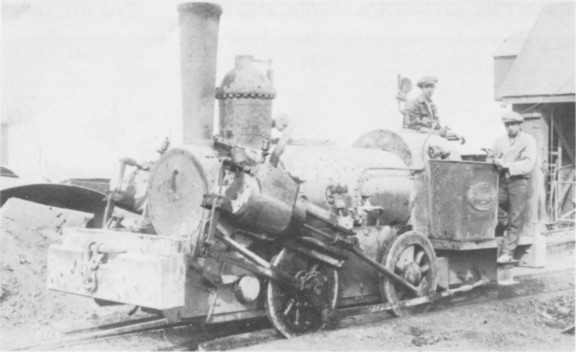
S. Lewin only made a few locomotives. Erith “had the eccentrics on the front axle and the valves were on top of the steeply-inclined cylinders, the spindles being actuated by Stephenson link motion. Erith was rebuilt at Swanscombe Works in 1920 with the help of fitters from the Dorset Iron Foundry.” [30: p45]
De Winton supplied one vertical-bolier 0-4-0WT locomotive, Revolution, it had two 6″ x 10″ cylinders and 1ft 7in diameter wheels.

It is possible that Revolution “came second-hand in about 1890 and possibly from the Bute Works Supply Co. Cardiff, who were advertising a similar locomotive for sale in 1893.” [30: p45]
H. E. Taylor of Chester supplied six 0-4-0 side tank locomotives to Swanscombe Works between 1877 and 1882.
Stoyel & Kidner provide details of these locomotives:
Swanscombe, 0-4-0ST, 1879, outside cylinders other details not known.
Iron Horse, 0-4-0ST, 1882, outside cylinders (9.5″ x 18″), 2ft 6in wheels.
Dead Horse, 0-4-0ST, 1882, outside cylinders other details not known.
Millbank, 0-4-0ST, 1879, outside cylinders other details not known.
Liverpool, 0-4-0ST, 1879, outside cylinders other details not known.
Chester, 0-4-0ST, 1877, outside cylinders other details not known.


William Wilkinson & Co. built around sixty locomotives. Wilkinson’s also contracted out the manufacture of tram locomotives to Beyer, Peacock and Co, Black, Hawthorn and Co and Thomas Green and Son. Altogether 207 engines were built to Wilkinson’s patent. The Plymouth & Devonport Tramways steam locomotives were assembled at Wilkinson’s works in Wigan, the vertical boiler in each of these locomotives was made by the Steel Company of Scotland. Small bore cylinders acted upon a crankshaft that was in turn connected to the four, coupled wheels by means of cog-wheel gears. The axles, wheels and nearly all the working parts of the engine were made of Sieman-Martin’s best quality steel and all the brass workings were of phosphor bronze. The exhaust steam was superheated in the firebox before escaping to the atmosphere through the chimney. The fuel was coke and the emission of smoke was described as ‘scarcely perceptible’. The Plymouth locomotives were apparently from Wilkinson’s own works. They cost between £600 each for the non-condensing version and £1,100 for those fitted with the condensing apparatus. [26]
A number of the Wilkinson steam trams purchased by the Plymouth & Devonport Tramways for their abortive experiment with steam trams were bought by the Swanscombe Works in the late 1880s/early 1890s. [25]

A typical Wilkinson’s Steam Tram – this one was used on the Wigan network close to Wilkinson’s Works. It was built in 1886. These engines must have been an unusual sight working on an industrial railway! [27]
Wilkinson also supplied a single vertical-boiler locomotive to Swanscombe Works. It was built in 1884.

Kilmarnock Engineering Co. supplied five 0-4-0ST 3ft 5.5in outside-gauge locomotives to Swanscombe Works in 1920 and 1925. Kilmarnock Engineering Co. were not prolific engine builders. These five were some of a very few locomotives built by the Company.


J. B. White & Bros, owners of the Swanscombe works, appear to have constructed at least one locomotive in use on their own site, Gravesend, another 0-4-0WT. It is also possible that a number of other locomotives used on the site were rebuilt there at various times. [30: p45]
Bagnall – one locomotive, Rede, an 0-4-0ST built in 1894, was built by Bagnall (Works No. 1413) and came second-hand in 1921. [30: p45]
Hudswell Clarke – one locomotive, Spry, another 0-4-0ST, was built by Hudswell Clarke and arrived at Swanscombe in 1923. [30: p45]
Stoyel & Kidner tell us that “on a visit to the works in December 1929, 12 narrow gauge locomotives were seen on a length of track awaiting scrapping. The old 3-road engine shed was rebuilt as a two-road standard gauge shed. … On the modernisation of the railway system in 1929 all the remaining narrow gauge locomotives were scrapped that year or in 1930, and it is thought that very few of them had been scrapped at an earlier date, although Plymouth and Devonport are said to have been broken up in 1922, and Swanscombe by 1920. The second-hand engines would have had their gauge altered on arrival.” [30: p45]
The narrow gauge wooden tipper wagons, “were shunted in 1929 into the passing loops half way down the tramway to the river, and remained there for many years. There were also a few left in an old pit south of Ingress Gardens.” [30: p45]
Standard Gauge Locomotives after 1929
“When preparations were made in 1928 for replacing the narrow gauge system by one laid to the 4ft 8½ in. gauge, an order was placed for a series of powerful new locomotives for the purpose. Pending their delivery three old locomotives were transferred from other works but they were usually employed two at a time in removing the overburden prior to quarrying, on track which had no physical connection with the remainder of the system.” [30: p45]
Those early standard-gauge arrivals were from two manufacturers:
Falcon – Henry Hughes and Company was based at Falcon Works. The firm experienced financial difficulties in the late 1870s/early 1880s. It was restructured as the Falcon Railway Plant Works in 1883 under the control of Norman Scott Russell. [31]
The factory remained busy with both railway and tramway locomotives and rolling stock. Among these were tank locomotives for Ireland, Spain and the Azores. Some were subcontracts from other firms, such as Kerr, Stuart and Co, at that time in Glasgow. [32]
The two Falcon locomotives came to Swanscombe second-hand, they were Works Nos 120 and 150 and were named Wolf and Delta. Delta was one of a number originally supplied to Gibbs Works, Essex. It had a dropped cab for passage through low tunnels. [30: p43, 45]

Falcon also provided a later second-hand arrival, Lion, (Works No. 205?) which was transferred from Stone Court in 1946. [30: p41, 45]
Manning Wardle – Guernsey, a 0-4-0ST, Works No. 1241 of 1892 came second-hand to Swanscombe at the end of the 1920s.

Hawthorn Leslie supplied five identical standard-gauge 0-4-0ST locomotives to Swanscombe Works in 1928. [1: p6] These locomotives were constructed with two outside cylinders of 16in x 24in, 3ft 3in diameter driving wheels and a weight of 25 tons and a tractive effort of 21.425 lbf. [13] A single further engine (No. 6) was supplied in 1935.
- No. 1 was Hawthorn Leslie Works No. 3715. [13]
- No. 2 was Hawthorn Leslie Works No. 3716. [16]
- No. 3 was Hawthorn Leslie Works No. 3717. [15]
- No. 4 was Hawthorn Leslie Works No. 3718. [14]
- No. 5 was Hawthorn Leslie Works No. 3719. [17][25]
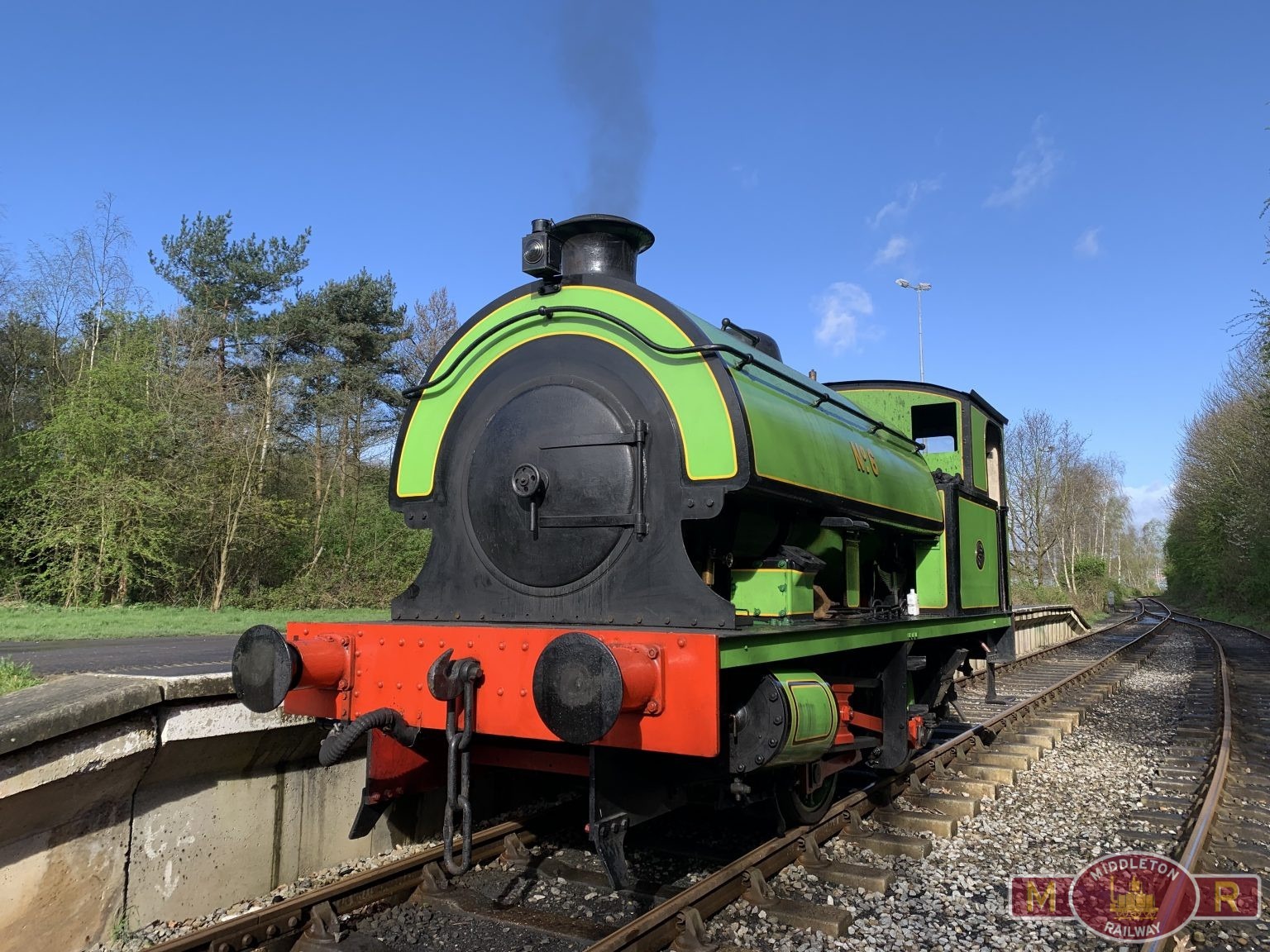
- No. 6 was Hawthorn Leslie Works No. 3860. [18]

Chapman & Furneaux – Kappa, another 0-4-0ST, built by Chapman & Furneaux (successors to Black, Hawthorn & Co) Works No. 1164 (of 1898) arrived at Swanscombe in the 1930s. [30: p45]
Robert Stephenson & Hawthorns supplied one slightly larger standard-gauge locomotive to Swanscombe Works – 0-4-0ST No. 7, RSH No. 7405 of 1948. [1: p6]

Miscellaneous …
Some historic footage of the Swanscombe Works and quarries can be found here. [2]
References
- A & G Hatherill; Narrow Gauge & Industrial Album; RCL Publications, Gaendolbenmaen, Gwynedd, 2004.
- https://www.facebook.com/share/v/18Lm6U8N5w, accessed on 9th August 2026.
- https://maps.nls.uk/view/102342323, accessed on 10th August 2026.
- https://maps.nls.uk/view/101428125, accessed on 10th August 2026.
- https://maps.nls.uk/view/101428119, accessed on 10th August 2026
- https://maps.nls.uk/view/101428077, accessed on 10th August 2026.
- https://maps.nls.uk/view/103676144, accessed on 10th August 2026.
- https://www.cementkilns.co.uk/cement_kiln_swanscombe.html, accessed on 10th August 2026.
- https://irsshop.co.uk/swanscombe, accessed on 10th August 2026.
- C. Down; Swanscombe Cement Works and its Railways; Industrial Locomotive Society, Whitchurch, Shropshire, 2022.
- https://www.gres.org.uk/members-layouts-apcm-swanscombe-works, accessed on 10th August 2026.
- C. Down; Christmas at Swanscombe; Industrial Railway Society, 1965; via https://shop.irsociety.co.uk/Archives/12/christmas_at_swanscombe.htm, accessed on 10th August 2026.
- https://preservedbritishsteamlocomotives.com/hawthorn-leslie-works-no-3715-associated-portland-cement-at-swanscombe-no-1-0-4-0st, accessed on 10th August 2026.
- https://www.railwaymagazine.co.uk/4710/new-face-at-quainton-as-it-bags-ex-swanscombe-hawthorn-no-4, accessed on 11th August 2026.
- https://preservedbritishsteamlocomotives.com/hawthorn-leslie-works-no-3717-associated-portland-cement-at-swanscombe-no-3-0-4-0st, accessed on 11th August 2026.
- https://www.gwra.co.uk/auctions/worksplate-r-w-hawthorn-leslie-co-ltd-engineers-ne-2023jul-0296.html, accessed on 11th August 2026.
- Swanscombe No. 5 did not survive into preservation.
- https://preservedbritishsteamlocomotives.com/hawthorn-leslie-works-no-3860-associated-portland-cement-at-swanscombe-no-6-0-4-0st, accessed on 11th August 2026.
- https://middletonrailway.org.uk/wp-content/uploads/2024/04/3860-1536×1152.jpg, accessed on 11th August 2026.
- https://www.facebook.com/photo/?fbid=10224531389586054&set=gm.5187090374725107&idorvanity=163976490369879, accessed on 11th August 2026.
- https://shop.irsociety.co.uk/Archives/36/Lewin.jpg, accessed on 11th August 2026.
- https://shop.irsociety.co.uk/Archives/36/Letters_36.htm, accessed on 11th August 2026.
- https://en.wikipedia.org/wiki/Stephen_Lewin, accessed on 11th August 2026.
- The industrial Locomotive Society; Steam on the Narrow Gauge. A Collection; David Charles, 1965.
- Andrew Neale/Chalk Pits Museum; Industrial Railways of the South-East; Middleton Press, 1984.
- Brian Moseley; When Plymouth had Steam Trams; Old Plymouth Society, December 2012; via https://oldplymouthsociety.net/when-plymouth-had-steam-trams, accessed on 13th August 2026.
- https://www.gracesguide.co.uk/File:Im1955EnV199-p834.jpg, accessed on 13th August 2026.
- http://www.britainfromabove.org.uk/image/EPW017658, accessed on 13th August 2026.
- http://www.britainfromabove.org.uk/image/EPW060599, accessed on 13th August 2026.
- B. D. Stoyel & R. W. Kinder; The Cement Railways of Kent; Oakwood Press, Headington, Oxford, 1973, 1990.
- https://collection.sciencemuseumgroup.org.uk/people/cp20744/henry-hughes-and-company, accessed on 15th August 2026.
- https://www.gracesguide.co.uk/Falcon_Engine_and_Car_Works, accessed on 15th August 2026.
- https://maps.nls.uk/geo/explore/#zoom=16.0&lat=51.46122&lon=0.30214&layers=6&b=ESRIWorld&o=100, accessed on 16th August 2026.
- https://maps.nls.uk/geo/explore/#zoom=16.0&lat=51.46122&lon=0.30214&layers=6&b=ESRIWorld&o=0, accessed on 16th August 2026.
- https://www.britainfromabove.org.uk/en/image/EPW060594, accessed on 16th August 2026.


Pingback: Kent’s Cement and Other Industrial Railways – Part 1 | Roger Farnworth