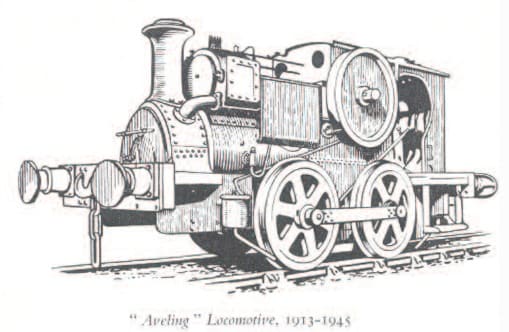
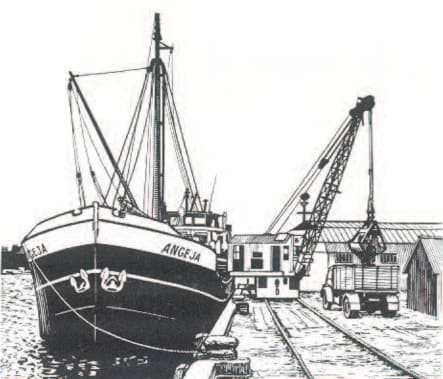
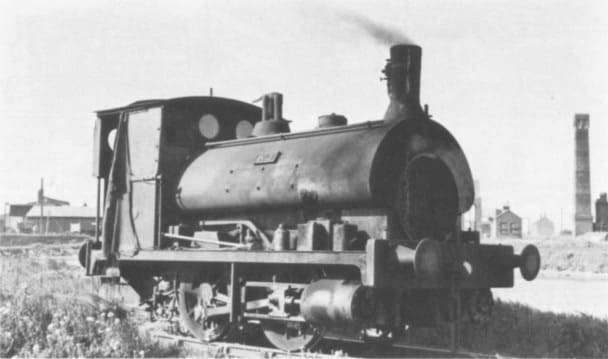
The featured image for this article is a line drawing of ‘Aveling’ (No. 2) an Aveling & Porter 0-4-0WTG locomotive that served at Queenborough from 1913 to 1945/46.
Stoyel & Kidner tell us that “The Queenborough Cement Co. Ltd opened in 1882 and by 1896 had a short tramway down to a wharf and creek leading off the River Swale; a siding to the SECR was laid in 1904. The chalk pit also supplied a ceramics manufacturer, A. Johnson & Sons Ltd, established in 1908, which had a narrow gauge tramway.” [1: p67]
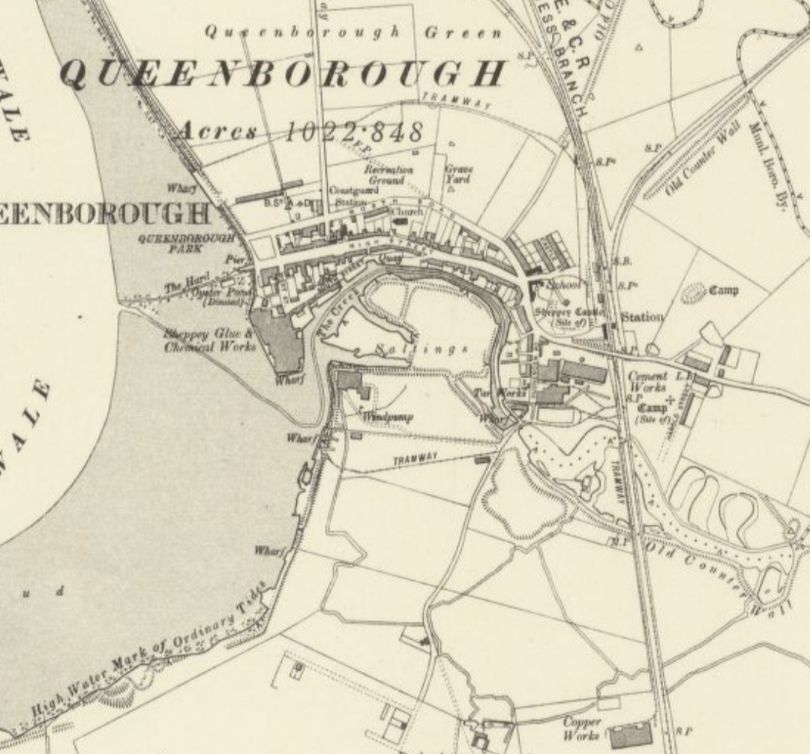
In 1895, the Cement Works operated four kilns. The clay for the kilns was excavated from a site nearby, and chalk, the other necessary ingredient, together with coal for firing, were brought in by sea. For this to be done more conveniently, “Chalk Wharf” was built in 1897. [13: p8]
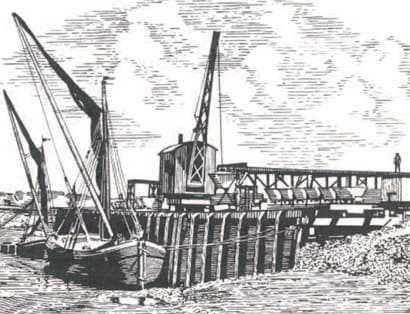
The Cement Company put in sidings from the railway company’s main line, and supplied facilities under agreement for rail traffic to serve the various concerns on the estate, and these form the nucleus of the provision later made by Settle Speakman for the other industrial undertakings on the site. The Cement Company, which at one time had an output of 400 tons per week, was disposed of in 1912, and during the 1914-18 war all the kilns and shafts were pulled down and the bricks and debris sold to the War Department for improving the roads on Sheppey Island. The old cement stores were turned into a hostel which housed and fed about 200. The quarry workings were gradually filled. [13: p9]
Stoyel & Kidner note that, “The Cement Co. did not join APCM in 1900 but had a five-year Agreement; in 1910 it joined BPCM.” [1: p67]
“In 1908 the wharf was taken over by industrialists from Cheshire, mainly for coal imports; they included Philip Speakman from Liverpool and Joel Settle from Alsager, and in 1930 they formed Settle Speakman & Co. Ltd. The company’s involvement with cement was purely the transport of chalk from the East Kent Chalk Quarry Co. Ltd at Gillingham, and the movement of products to the wharf.” [1: p67]
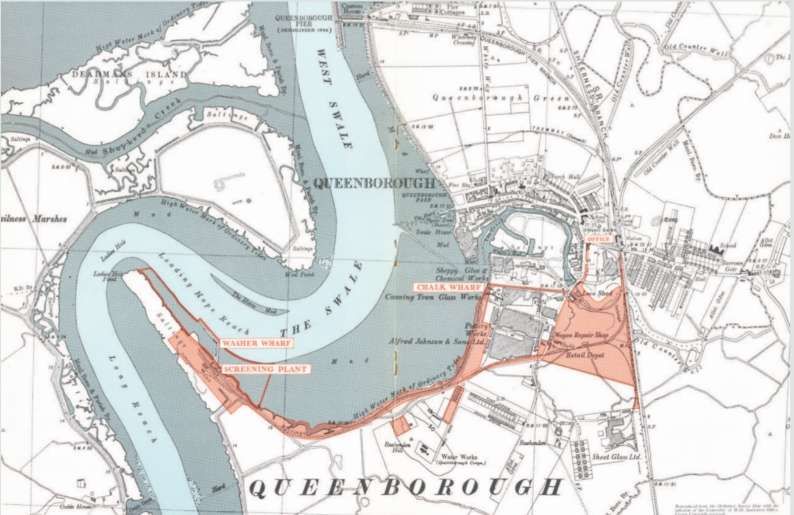
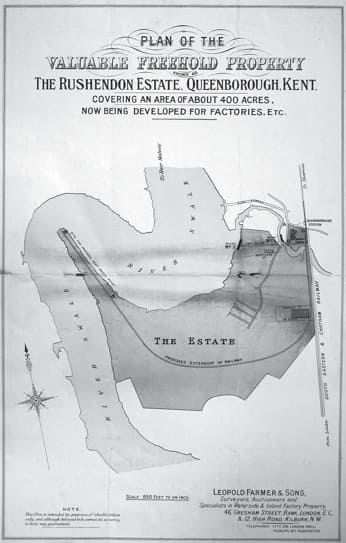
The Rushenden Estate’s area (South of Queenborough) was impressive, and included a valuable promontory that reached into the deeper water of the tidal River Swale. It was this area that Settle & Speakman sought to exploit. (Sheppy Industries archive), (c) Public Domain. [5]
The Company bought rails and chairs for their railway in Widnes and Birkenhead and , while there, acquired two locomotives, “Pioneer” and “Leycett.” Contracts for erecting the wharf, pier, etc., were entered into with Robert McAlpine & Sons, and conveying plant was erected by the Queenborough Contracting Company. [13: p10-11]
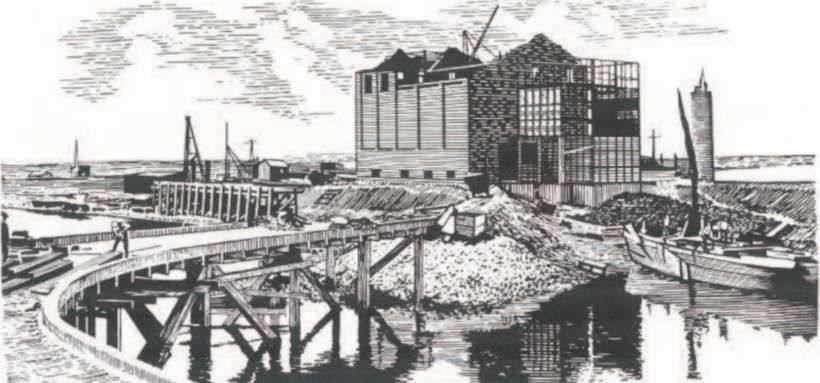
The Settle and Speakman built the Coal Washer themselves from plans supplied by Luhrig Coal and Ore Dressing Appliances Ltd. “The Queenborough Washer was the first in the South East of England. The very idea of the washer seemed strange, if not lunatic, to the local inhabitants – ‘Who ever would want to wash coal?’ Kent, in those days was far removed from the industrial north and the Kent coalfields had not then been developed. … The work was completed in little over twelve months and the first ship came alongside on 23rd November 1908. She was the ‘S. S. Britannia’: … The discharge at Queenborough did not get off to a good start; first the ship went aground at West Point, and … as high water rose, a gale blew up and washed away the embankment of the railway leading to the washer, so that the engine and trucks could not approach it. Only after tons of flint from the Chalk Wharf had been brought to fill the gap was it possible to proceed, but it took five days to discharge this first vessel.” [13: p11-12]
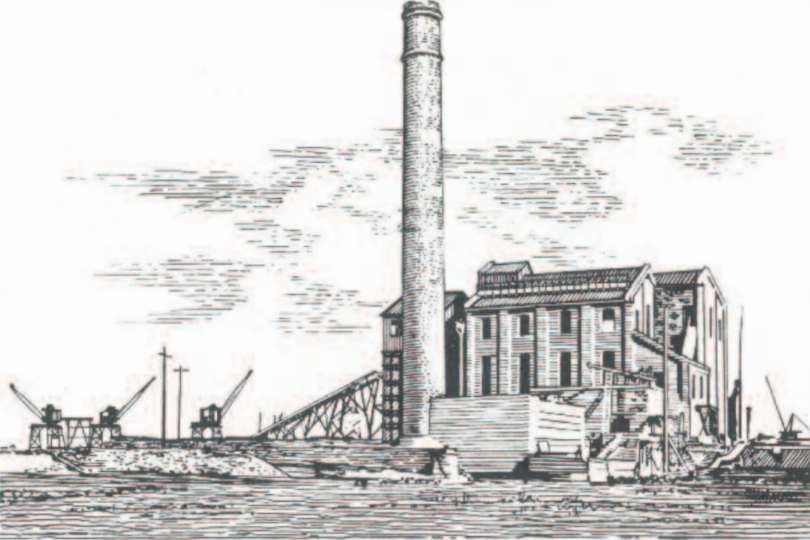
One of the first benefits of the direct import of coal to Sheppey by the opening of the Queenborough Coal Pier and of washing and grading the coal, was an immediate reduction in local prices.
“In the years 1908 to 1910 there began a period of industrial development of the area with the building of the Pottery and the Glass Bottle Works, both of which had their services provided for by the Queenborough Wharf and Cement Companies. Joel Settle bought, during this period, the land upon which the company’s Retail Coal Depot [was to be] situated, and also acquired two plots of land, one on Rushenden Hill to be used as allotments by the company’s employees, and the other near the bottom upon which a row of houses named ‘Alsager Avenue’ (after Alsager, Cheshire, the home of Joel Settle) were built in 1912; many of these were occupied … by workers of the company.” [13: p12]
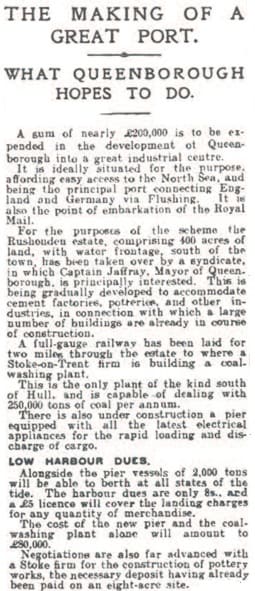
The adjacent press report comes from the ‘Daily Express on 3rd July 1908. It highlights the intentions of the company to develop a significant industrial site in the area close to Queenborough.
“In October 1911, the undertakings of Philip Speakman & Sons and Joel Settle were incorporated as a private limited company, Settle Speakman & Company Limited, Joel Settle being Chairman, and William Carroll a Director. Both the Queenborough Wharf Company and the washer of Settle Speakman carried on, with varying success, until 1918. Then Captain Jaffray, Lord Queenborough and Mr. W. H. Appleton took over the Washer; a mortgage was arranged and the Queenborough Coal & Washer Company formed. With many of the collieries in France lying derelict in the area covered by the fighting of the 1914-18 war, there was a brisk demand from France for washed coal at good prices, and 2,000 to 3,000 tons a week were shipped very profitably. But with the recovery of the French coal industry this demand ceased after about three years, and the fortunes of the Coal & Washer Company declined.” [13: p13]
The British Window Glass Works (see the notes on Sheet Glass Ltd below) “commenced operations at Queenborough in 1919, and the Contracting Company put in a railway line to the site of the works from the Wharf Company’s line; agreements were made for payments for goods passing over this line. To handle the extra traffic expected at the coal pier, {the Washer Wharf] was extended by 120 feet, this being financed by a loan from the Contracting Company. … Just before Christmas, 1922, the ‘S. S. Gyp’ collided with the Ferry Bridge across the River Swale; this is the sole approach to the island and road and rail traffic to and from the mainland was dislocated for many months. The Wharf Company had a shunting loco-motive, the “Emerald Isle” and this was put at once on to a shuttle service, running as often and as fast as her small driving wheels would take her, with passengers to the site of the bridge. Here the passengers were ferried across in rowing boats, to board a train on the other side to carry them to their destinations. This service had to be maintained for some months until the bridge was repaired and normal communications once more restored.” [13: p14]
For a time, the Coal & Washer Company was in liquidation. “Settle Speakman & Co. Ltd. took over all the assets of the Queenborough Coal & Washer Company and in early 1924 again worked the Washer, the Wharf Company continuing to perform the discharge and shunting operations. In 1926, the general strike stopped operations, although some revenue was obtained by working-over the accumulated deposits of tailings from the washer to recover for sale what little coal can have remained in them. Whilst the washer lay idle, slack in the raw coal hopper caught fire by spontaneous combustion, destroying the hopper and the conveyors feeding the washer. They were never rebuilt.” [13: p14]
A process of consolidation followed with many of the activities of the various companies being merged into the control of Settle Speakman & Co. Ltd. “It was decided to erect a Plant for screening the discharged coal on a site convenient to the pier and near the old washer, and this was completed in November 1927. At the end of 1928, the Queenborough Wharf Company went into liquidation and was sold to Settle Speakman & Co. Ltd., in 1930. A year later, the working assets of the Queenborough Contracting Company, which included the Chalk Wharf were taken over and Settle Speakman & Co. Ltd. thus obtained control over the discharge of ships and barges at both wharves and the transit of wagons. Further purchases of several pieces of land … took place, which served to strengthen the position of the company and to augment its resources.” [13: p18]
The Washer Wharf “was strengthened throughout in 1933 by driving reinforced concrete piles 70 feet in length to support a concrete raft 2 feet 6 inches thick on which the timber and concrete decking was supported. A new Wagon Shop was built (1934) and a concrete wall was erected (1935) for the protection of the Chalk Wharf.” [13: p18]
“In 1938, there occurred a very high tide accompanied by a strong gale. sea-wall near the wharves was breached and the sea poured into the low-lying land beyond, washing away the foundations of the railway in several places leaving the rails and sleepers in mid-air. … Hundreds of tons of material obtained from tips at the Pottery Works and from the adjacent hill were dumped into the gaps. Within three days communication with the wharf was established again.” [13: p18]
War damage during WW2 was surprisingly slight. During the War, “plans were made for post-war development at Queenborough which served as a blue-print for the progress which commenced [after the War]. … These plans permanently shaped Settle Speakman’s interests at Queenborough [Through into the late 1950s]. … Further land was acquired, additional railway sidings constructed and extensions to the Wagon Shop undertaken. The old chimney stack at the Washer Wharf was felled, and a stores and messroom with showers and a washroom, etc., made in the shell of the old washer. The reconstruction and strengthening of the wharf was completed, and a new railway weighbridge and weigh-house erected. A new locomotive ‘Stafford’, [and] a ‘Jones’ and a ‘Jumbo’ mobile crane, and a 5-ton Booth diesel crane were obtained to improve the handling facilities.” [13: p19]
Significantly, two modern Stothert & Pitt 5-ton level luffing cranes [4][5][13: p20] were erected at the Coal Washer Wharf in 1953. [13: p20] The Coal Washer Wharf was the centre of operations for the Company. It was 300 feet long, with two lines of standard gauge railway along the full length. The two Stothert & Pitt electric cranes operated at a maximum and minimum radius of 68 feet and 23 feet, served the wharf, with a smaller crane also available. At the outward berth there was at least 12 feet of water at low water on spring tides, throughout the whole length of the wharf. [13: p23-24] The wharf was capable of handling coal and merchandise direct from a vessel into wagons, or overside into lighter or barge; or vice versa.
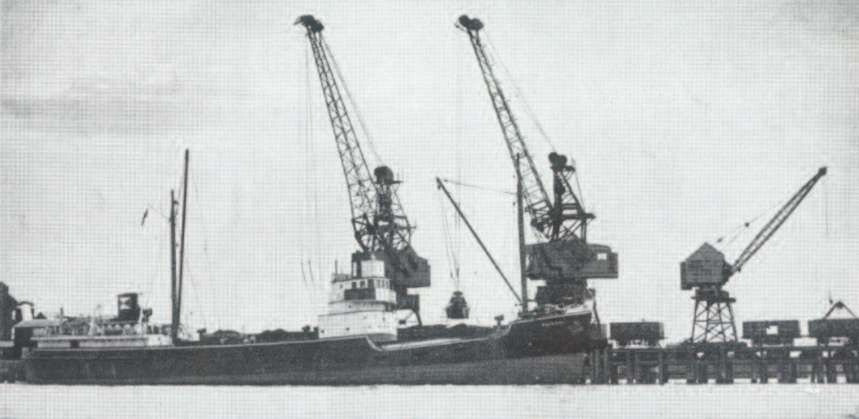
“Each of the new cranes at the Washer Wharf contains a recording weigher of a very high order of accuracy, complying with the requirements of the Board of Trade. A so-ton standard-gauge railway weighbridge, 16 feet long, is installed at the approach to the Washer Wharf and enables accurate weights to be given for traffic handled by rail. A 30-ton road weigh-bridge is installed adjacent to the retail coal depot, for handling road traffic.” [13: p25]
At Coal Washer Wharf, coal was discharged by grab onto a metal-plate conveyor on the wharf. A rubber-belt conveyor then took the coal to the Screening Plant, which gave a range of sizes. From the screens coal was loaded into railway wagons.
Adjacent to the Retail Coal Depot, the Company had a well-equipped Wagon Repair Shop. Here are carried out repairs not only to the Company’s own wagons, but also work for the British Transport Commission.
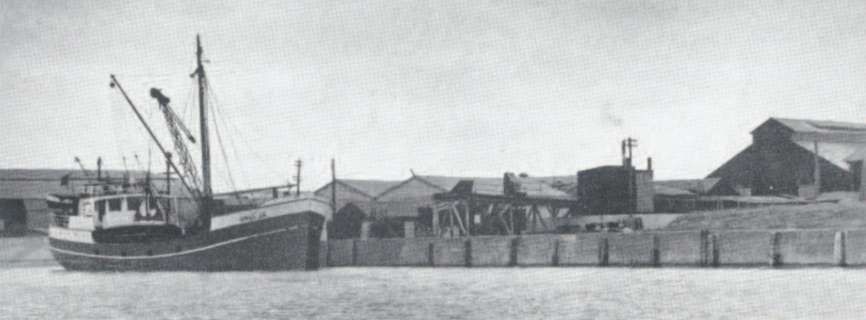
Chalk Wharf: was 350 feet long, and had both road and rail connections. The berth is tidal, with a maximum depth of water of 12 feet, enabling vessels of 250 to 300 tons capacity to be accommodated. It handled many of the raw materials for the adjacent factories – amber sand and flint sand from Belgium and felspar for the glass works, china clay and china stone from Cornwall, and boulder flints from France for the pottery works. Fuel oil is also delivered from barges at this wharf, and ballast unloaded. Sheet glass is loaded onto barges for the London River, where it is transhipped for export. [13: p24]
The next three map extracts come from the 1:2500 Ordnance Survey revised up to 1963 and published in 1964. They demonstrate the industrial developments, up to 1963, around Queenborough and show both the Coal Washer Wharf and Chalk Wharf at that time. …
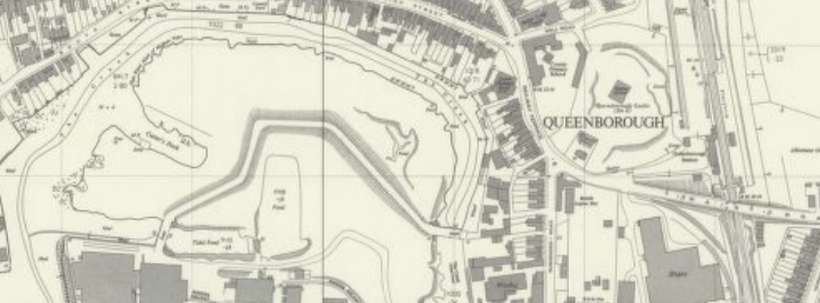
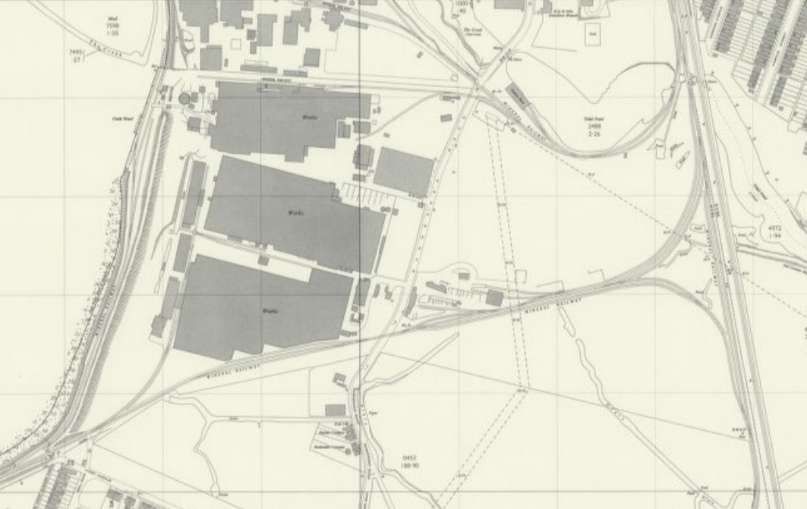
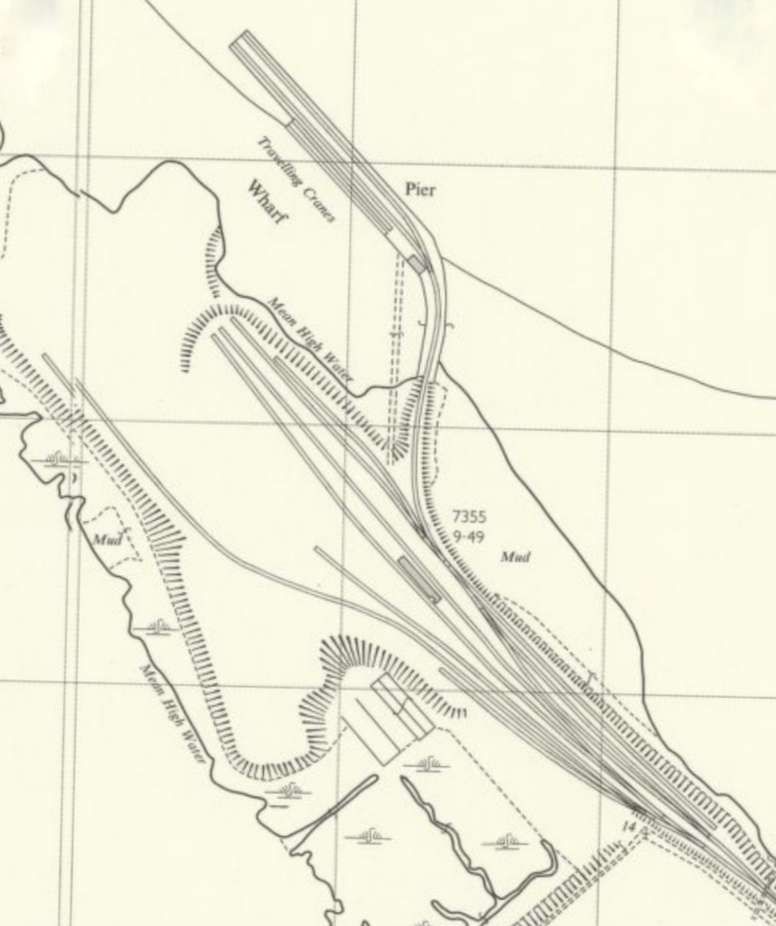
Locomotives and Rolling Stock
Later, a variety of locomotives worked for Settle Speakman. Examples include:
Stoyel & Kidner note two specific locomotives: ‘Success’ an 0-4-0WTG Aveling & Porter, Works No. 5082 built in 1902; and ‘No. 2’ another 0-4-0WTG Aveling & Porter, Works No. 7975, built in 1913. [1: p67] Other records suggest that ‘No. 2’ was named ‘Aveling’ [13: p18]
Stoyel & Kidner suggest that ‘Success’ had probably lost its name by the time it arrived from the East Kent Chalk Quarry Co. Ltd. ‘No. 2’ was new. The former was scrapped before 1930 and ‘No. 2’ in 1946, [1: p67] or possibly 1945. [13: p18]
As of 1957, Settle Speakman had 5 locomotives and 220 internal-user wagons working on the private sidings. Locomotives employed by Settle Speakman over the years included:
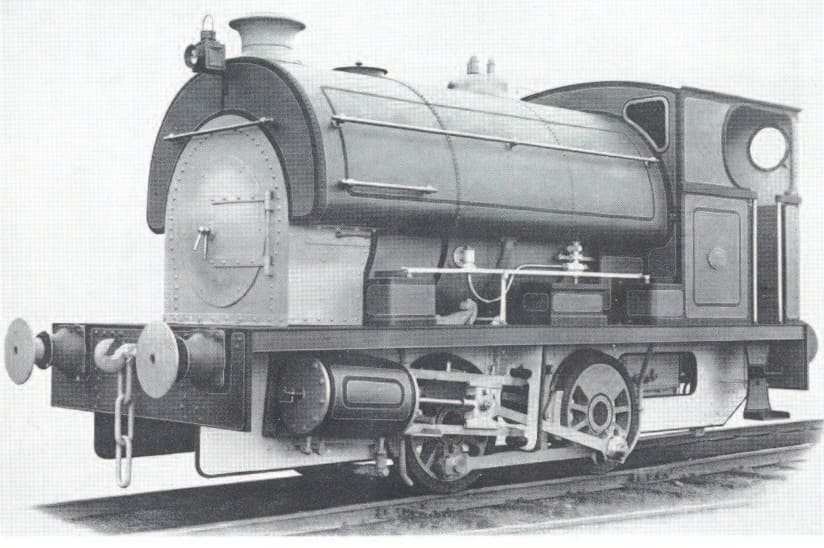
‘Stafford’ – a Bagnall-built 0-4-0ST which was bought new carried the name ‘Stafford’ because, as well as having a base at Queenborough in Kent, Settle Speakman & Co. was a major coal factoring, shipping, and colliery-owning group based in Stoke-on-Trent, North Staffordshire. Before the nationalization of the UK coal industry in 1947, they owned several pits, operated an extensive fleet of private owner railway wagons, and managed industrial locomotives to shunt coal.
No. 3 – a Dick Kerr 0-4-0ST formerly of Cadbury Brothers and named “Maybury.”
In later years, diesel shunters were employed – Two diesel-hydraulic 0-6-0 locomotives were at Queenborough Rolling Mill on 3rd September 2013, both originally built by Andrew Barclay of Kilmarnock for the British Forces in Germany in 1966. In the photograph dated 3rd September 2013, which can be found here, [3] the blue locomotive is “873” and the red one is “871”. The internal use railway wagons are ex-BR. Photograph dated 3rd September 2013. Other photographs of diesel locomotives at work at Queenborough can be seen here, [6] here, [7] and in the wider album here. [8]
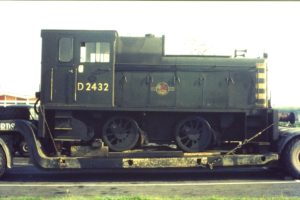
D2432 was a Class 6 0-4-0 diesel shunter which was first allocated to Hamilton in February 1960, transferring to Polmadie in May 1960, Ayr in 1966, and to Eastfield in September 1967. It was withdrawn from BR service at Eastfield and sold to R. E. Trem & Company, Finningley, near Doncaster. They in turn sold it to Shipbreaking (Queenborough), Oueenborough, Isle of Kent for further use. Movement from Glasgow to the Isle of Sheppey would appear to have occurred in part or most likely in whole by road. There is a report of it being sighted at Stamford on 20th May 1969 on road transport from where it continued to the Isle of Sheppey. Photographs of the locomotive in transport can be seen here. [9] Sightings of the locomotive were by Brian Henderson at Gosforth High Street (on road transport), 19/05/1969; Stamford (on road transport), 20/05/1969; Medway Services, M2, Kent (on road transport) by Peter Hall (IRS), on 20/05/1969; and at Queenborough by Gordon Edgar, 24/01/1971 and 22/10/1972, Mike Martin, 08/11/1975 and Tom Bartlett, 24/01/1976. [10]
Industries Served by the Railway
Settle Speakman provided the shunting requirements for the local factories, which were thereby connected with the Company’s wharves and with British Railways’ main line at Queenborough Station. All those local factories had strong links with the Company and its predecessors. The original agreements for shunting and handling of goods were still in operation,
The companies serve by Settle Speakman are listed below:
Sheppy Glue & Chemical Works: This works, reputed to have been the oldest chemical works in the country, haf existed at Queenborough from the 16th century. The original works was on the town side of the Creek, but by the 20th century an extensive site to the south east of the Creek was also occupied. The principal products were glue, granular compound fertilizers, super phosphate, organic fertilizers and sulphuric acid. The Queenborough Contracting Company made, in 1916, an agreement to construct a full gauge railway line into the works and to do all the shunting necessary. These arrangements were taken over by Settle Speakman & Co. Ltd. [13: p28]
Alfred Johnson & Son Limited: One of the largest UK producers of sanitary ware, Alfred Johnson & Son Ltd., (“Pyramid” trade mark). The Queenborough Works was established in 1908, and from the earliest days arrangements were in force whereby the various predecessors of Settle Speakman & Co. Ltd. constructed and operated railway connections and provided shunting facilities to the works. … A narrow gauge line from the Chalk Wharf operated for many years and conveyed the china clay and other raw materials to the works, but this has been replaced by road transport loaded directly from the ships. [13: p28]
Canning Town Glass Works Limited: Manufacture of glass bottles and jars commenced in 1910, with the establishment of the Queenborough Glass Bottle Works. From the outset arrangements were in force to discharge goods and raw materials for the works at the Chalk Wharf, including the use of an overhead gantry. A rail connection was made to the works in 1920 and an agreement was entered into for shunting services. When the works of the original company were taken over by the Canning Town Glass Works Ltd., in 1926, these arrangements remained in force, and were undertaken by Settle Speakman & Co. Ltd. [13: p28-29]
Medway Glass Works Limited: In anticipation of large contracts from a manufacturer of electric lamps, the construction of the Medway Glass Works was commenced in 1919, but labour conditions on the site delayed the completion of the factory, and the opportunity for the contracts was lost. Immediately following came the slump of 1920 and, as a result of these misfortunes, the completed works did not go into production. Agreements, however, were made for the discharge of materials at the wharves and for shunting arrangements. Production commenced in 1921, but prevailing conditions were such that the works soon had to close. … In 1942, the premises were requisitioned by the Admiralty, who retained them until de-requisition in 1947. Later, in 1952, the Admiralty purchased the works and carrried out considerable repairs to the buildings. [13: p29]
Sheet Glass Limited: In 1919, on the site of the old Queenborough Copper Works, a firm – British Window Glass Ltd. commenced to build a factory for the manufacture of sheet glass. Arrangements for discharging of goods and materials at the wharf and for delivery and shunting were entered into. Trading conditions in the 1920’s, however, were not favourable and production stopped in 1924. Another company was formed – Sheet Glass Ltd. and production re-commenced and continued for about two years from 1927. In 1932, the works re-opened having been acquired by Pilkington Bros. Ltd., of St. Helens, and Settle Speakman & Co. Ltd. continued to serve the new owners as had previously been agreed. [13: p29]
W. Lodder: This is an iron foundry which specialises in the making of the cast-iron moulds required for glass-bottle manufacture, a unique enterprise for this part of England. The foundry had an engineering works attached, which undertook general engineering repairs. [13: p29]
Queenborough Rolling Mill: this facility was established on the site of the old cement works. This made use of the industrial railway which ran to exchange sidings with the main line railway and to a jetty on the River Swale. Operations ceased in February 2013 and the physical assets were auctioned in September 2013. The Wharf and the associated industrial railway to Queenborough Station were used by Settle Speakman until the jetty was used by Shipbreakers (Queenborough). The Rolling Mill was then built and rails recovered from defunct railway lines arrived by ship and by rail and were rolled to produce steel bar for use in reinforced concrete. The reinforcement bar was despatched by ship, rail and road. Second-hand industrial railway locomotives and wagons were used for movements between the works and the jetty. The works was taken over by the international steel processing company ISTIL in 1999, which was purchased in 2006 by Estar. In 2010, the mill was operated under the name Invicta Merchant Bar. It is thought the railway to the jetty had ceased to be used by this time. [3] Scenes from around the Rolling Mill can be seen here. [8] The Mill closed in 2013. [17: p164]
A full list of locomotives used on the site by Lacmots 1960-1964, Shipbreaking Queenborough 1964-1972, Queeenborough Rolling Mill, 1972 onwards can be found in Robin Waywell’s book, Industrial Railways & Locomotives of Kent. [17: p163-168]
Flushing Pier: In about 1875 the old London, Chatham & Dover Railway Company decided to build a pier at the entrance of the River Swale to accommodate cross-Channel traffic. “The situation was a favourable one for trade and passenger crossings to Holland, as it was conveniently near to London, yet sheltered and notably less liable to become fog-bound and more generally useful than the railway company’s site at Dover. The pier was known as the Flushing Pier, as a regular day and night service for mailboats ran between Queenborough and that port. In 1885, the original pier was burned down, and a new one built, which was also destroyed by fire in 1900. The railway company again rebuilt the pier with a pier head structure 650 feet long and an approach pier 300 feet long, all on some 2,500 timber piles, heavily braced. On the pierhead and approach were extensive buildings, platforms and railtracks.” [13: p30]
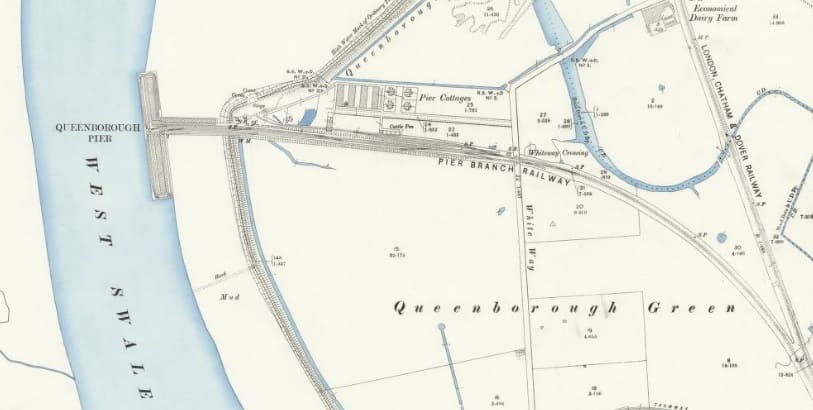
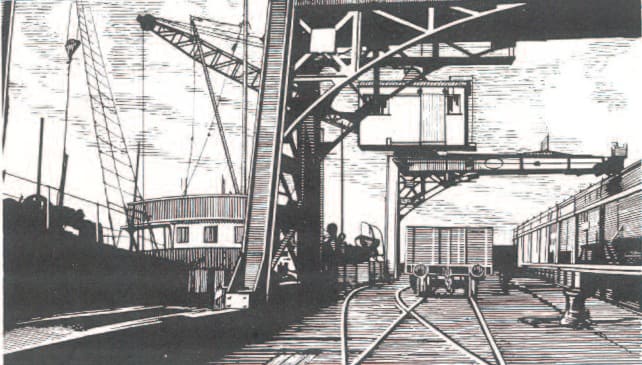
“The pier continued in operation until the outbreak of the 1914-18 war. When the war was over, the Continental route went through Folkestone and Dover and the pier never regained this traffic.
Between the wars the pier was first used as a dismantling jetty, where such famous ships as “H.M.S. Orion” were broken up. In 1928 a company, The Port of Queenborough Ltd., was formed and hired the pier for dealing with merchandise and also proved successful in handling coal from the Kent coalfields. This company was acquired in 1931 by Settle Speakman & Co. Ltd., and re-organised.
In 1936, an approach was made to the railway company to allow the pier to be adapted in order to take road transport, but after investigation the railway engineering department did not consider the structure to be safe for this purpose, so nothing came of it.” [13: p30-31]
“In November, 1939, the Admiralty gave notice that they required use of the pier forthwith, and within one week most of the Company’s gear, plant, etc., were removed and the pier taken over for use as a Mine Sweeping base. Arrangements were made to carry on the business at the wharves of Settle Speakman & Co. Ltd., and a considerable proportion of the tonnage was maintained. This requisitioning gave rise to long-drawn-out negotiations with the Admiralty and the Railway about compensation and the use of machinery, but eventually all was settled.” [13: p31]
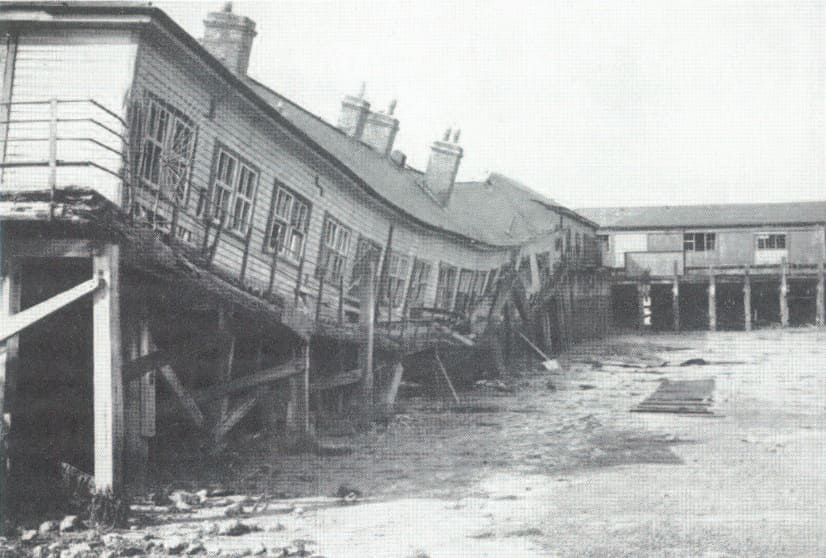
“After the Admiralty vacated the Pier in 1948 attempts were made to resume activities but about 1951 it became evident that the pier was becoming unsafe for further use, and in 1955, it became a real danger to shipping. Demolition was put in hand, and June, 1956, saw the last of this … old pier; it had fought a losing battle against fire, changing trade routes, and the continuous and devastating attack of the teredo worm.” [13: p31]
References
- B. D. Stoyel & R. W. Kidner; The Cement Railways of Kent; The Oakwood Press (LP70], Headington, Oxford, 1973 & 1990.
- https://shop.irsociety.co.uk/Archives/46/Letters_46.htm, accessed on 17th September 2026.
- http://www.railalbum.co.uk/industrial-railways/images/images-qbro/images-qbro-intro-1/qbro-scene-03sep2013-imgp6038.jpg, accessed on 17th September 2026.
- https://en.wikipedia.org/wiki/Stothert_%26_Pitt, accessed on 16th September 2026.
- https://queenboroughsociety.org.uk/wp-content/uploads/2025/07/Rushenden-Estate.pdf, accessed on 16th September 2026.
- http://www.railalbum.co.uk/industrial-railways/images/images-qbro/images-qbro-intro-1/qbro-loco-29jne1991-film91140-3.jpg, accessed on 17th September 2026.
- http://www.railalbum.co.uk/industrial-railways/images/images-qbro/images-qbro-intro-1/qbro-scene-1986-film8660-32.jpg, accessed on 17th September 2026.
- http://www.railalbum.co.uk/industrial-railways/queenborough-intro-1.htm, accessed on 17th September 2026.
- https://rcts.org.uk/wp-content/uploads/diesel-dilemmas/06000-D2432-19690520-Medway-Services-Peter-Hall-IRS-Andrew-Smith-2-300×200.jpg, accessed on 17th September 2026.
- https://rcts.org.uk/features/diesel-dilemmas/class-06/d2432, accessed on 17th September 2026.
- https://maps.nls.uk/view/103676531, accessed on 17th September 2026.
- https://maps.nls.uk/view/101428281, accessed on 15th September 2026.
- https://queenboroughsociety.org.uk/wp-content/uploads/2025/07/Settle-Speakman-History-1957.pdf, accessed on 15th September 2026.
- https://maps.nls.uk/view/103203940, accessed on 15th September 2026.
- https://maps.nls.uk/view/103203937, accessed on 15th September 2026.
- https://maps.nls.uk/view/188600758, accessed on 15th September 2026.
- Robin Waywell; Industrial Railways and Locomotives of Kent; Industrial Railway Society, 2016.