Tag Archives: Medway estuary

Crown and Quarry Cement Works, Frindsbury Peninsula

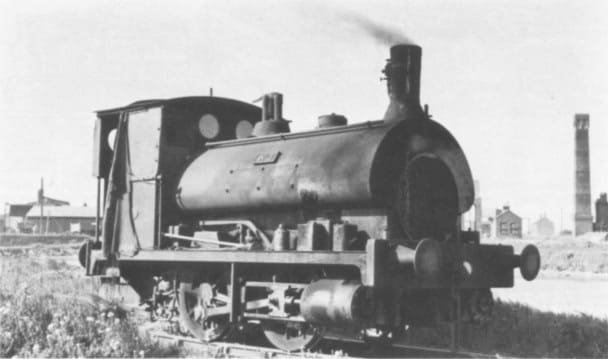
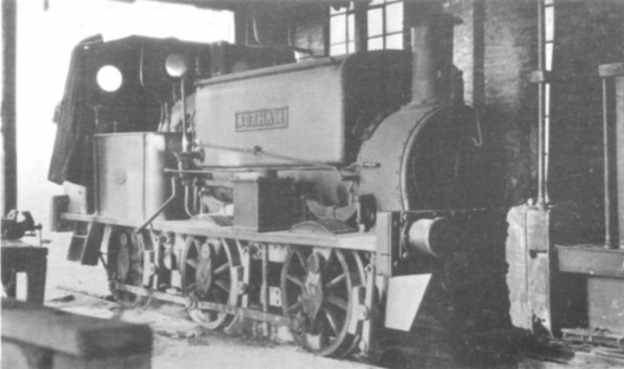
The featured image for this article is a photograph taken by F. Jones of ‘Burham’, a Manning Wardle 0-6-0ST built in 1879 (Works No. 730) came from APCM Burham Works, Aylesford in 1937 and was returned to Burham in 1938 [15: p55], scrapped in September 1952. [6] This photograph was taken at the Crown & Quarry Works and must therefore be dated in 1938. An internet search to check copyright suggests that many of F. Jones photographs are now treated as Public Domain.

Much of this article is based on work undertaken by Chris Down and published in the Industrial Railway Record, Issue 16, published in 1967 and available in the Industrial Railway Society archive. [6]

To the East of the Peninsula were the Whitewall Cement Works. ….

Whitewall Cement Works – South of the southern end of the Lodge Hill & Upnor Railway was the Whitewall Cement Works which were owned by the Formby Brothers and which were active between 1862 and 1907. After 1907 two attempts were made to resuscitate these works – Whitewall Portland Cement Co. Led. (1914) and Medway Standard Portland Cement Co. Ltd. (1915). Neither company ever traded. Robin Waywell tells us that “the site occupied an area of about 24 acres with the works divided into two plants, No. 1 plant contained a pair of 130hp compound condensing engines and two Lancashire boilers, driving crushing & grinding machinery and had seven bottle and two chamber kilns. No.2 plant contained a pair of 130hp Tangye engines, two Lancashire boilers, driving crushing & grinding machinery and nine bottle and four chamber kilns. The wash mill, slurry mixer and pumps were powered by a 90hp horizontal tandem engine. There was a wharf with a frontage of 750ft with tramways and three 3ton traveling loco cranes for loading & unloading barges. The Whitewall site was very inaccessible and used solely water transport. After World War 2 the plant was demolished and the site cleared it is now partly waste ground.” [5: p388]

Chris Down wrote in the 1960s that, “Formby’s Whitewall Cement Works (closed 1909; auctioned 23rd July 1909) whose derelict site can still be examined; … never had a tramway and, after a 50ft deep overburden of Thanet Sand proved too much for quarrying, the works had chalk barged down from Halling. It was at this time that [a] proposal was put forward to extend [William] Ball’s quarry lines to Whitewall, via [a] new tunnel.” [6]

Down’s mention of William Ball means that it is worth noting the various arrangements which were made and broken over the supply of chalk to the cement works on the peninsula.

Down said in his article, that, “With so much industry within ⅜ mile of the river front, it might be expected that disputes arose. The few that did, however, were due to the complicated arrangements for chalk supply that existed and plagued the area for much of its life.” [6]

Chalk supplies for the Cement Works

The various Cement Works which developed on the West side of the Frindsbury Peninsula (Limehouse Reach) are listed below the hand-drawn map below.

William Tingey opened the Crown Cement Works in around 1851 and held something of a monopoly on the supply of chalk to the other Cement Works. Down says that, Tingey, who controlled physical access to the works, “specified that the works should obtain their chalk from him. He performed his own quarrying in the area of his works and later, when this was exhausted, took to barging chalk down from his Wouldham Quarries (the Rochester Chalk Co. Ltd.), a few miles up−river. But the lessors of the land (the Ecclesiastical Commissioners) seem to have appointed a common quarrier, doubtless imagining that this would be a more efficient arrangement than for the individual owners to quarry themselves.” [6]

By 1863, John Cole, appointed by the Ecclesiastical Commissioners was quarrying on their land and offering chalk to the nearby works.

It seems that Phoenix Cement Works soon broke the terms of its lease and took chalk from Cole. In 1878, Cole died and was succeeded by William Ball; “on 30th December 1879 the Ecclesiastical Commissioners agreed to rent the land to Ball for an annual rental of £100 plus 5d per ton on the chalk quarried. As other works were put up, the complaints grew in number, both about the restrictions imposed by Tingey … and about the chalk prices charged by Ball. It does seem fairly certain that Ball was trying to some extent to drive the manufacturers out of business. He could then put up his own works and manufacture at a much lower cost. But for the depression of the industry in general, and the formation of A.P.C.M. (1900) Ltd., he might even have succeeded.” [6]

Down wrote that, “Ball supplied Phoenix, Globe, Quarry, Beehive and Beaver exclusively and Bridge probably in part. Tingey supplied himself and Bridge, but these arrangements probably altered according to local animosity at the time. At various times, Ball cut off chalk supplies for a number of reasons that were more or less contrived with the object of demonstration his power; equally often, the manufacturers threatened to obtain chalk from up−river quarries unless Ball reduced his prices. Small wonder that the industry was in such a bad state at the end of the century.” [6]

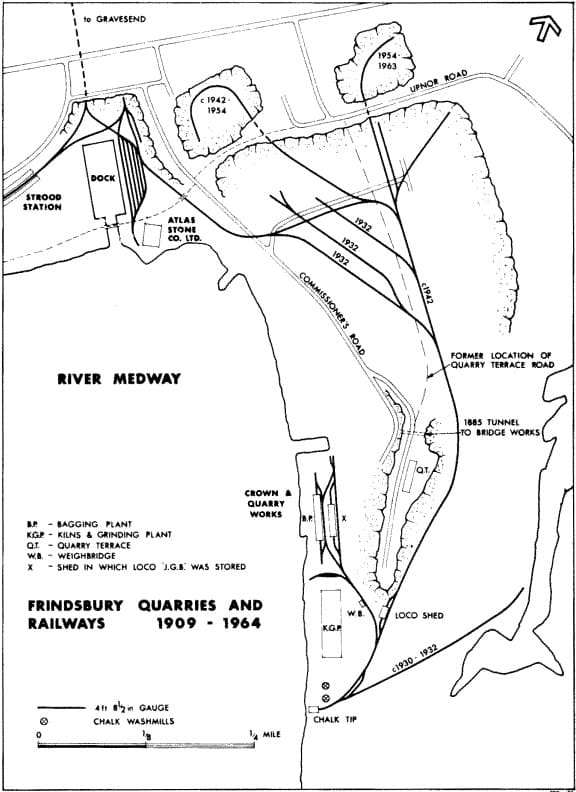
Crown & Quarry Cement Works were on the western shore of the Frindsbury Peninsula. … The Frindsbury Peninsula was South of Upnor and the Whitewall Works. It was rail-served. The schematic map below was included in the article written by Chris Down in Issue 16 of the Industrial Railway Record in 1967. [6] This map shows the Cement Works and their railways prior to their absorption into
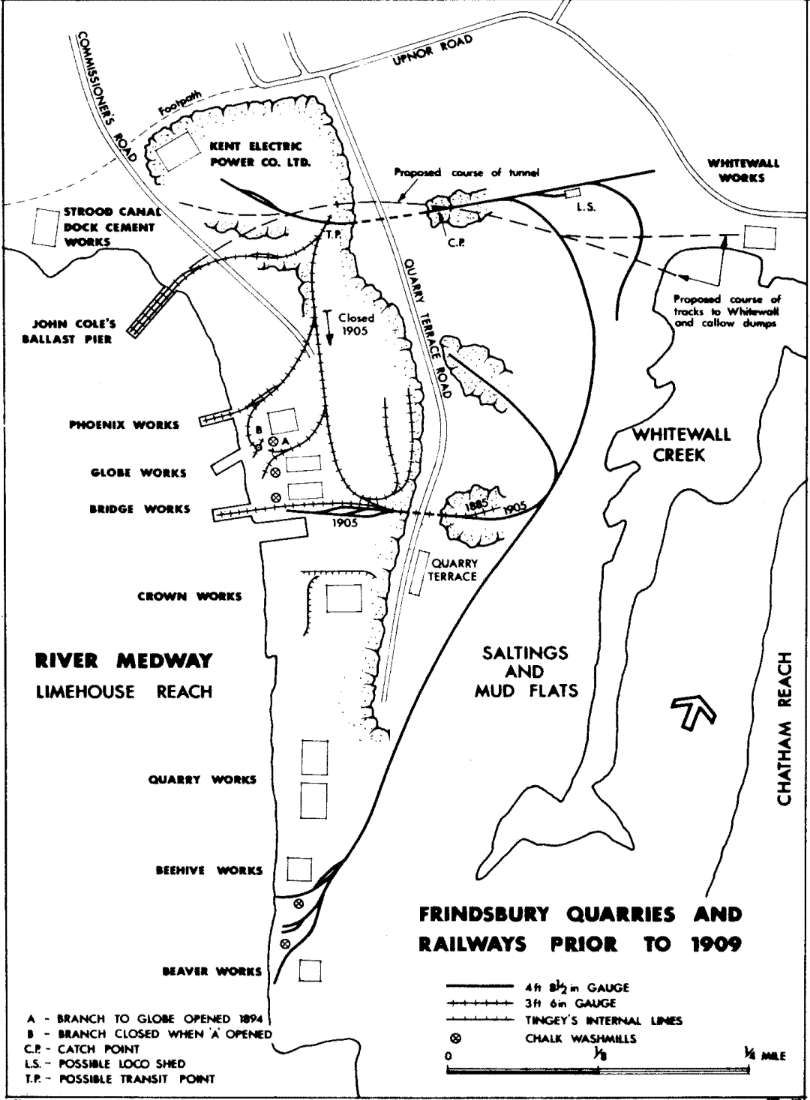
Industrial Premises on the Frindsbury Peninsula prior to 1909. This is one of two images showing the railway routes on the Peninsula provided in Chris Down’s article in the Industrial Railway Record. Both these images can be found here, (c) Chris Down. [6]

A series on seven different cement works were present on the peninsula and all seven became part of the APCM (1900) Ltd.: [5: p54]

  • Crown Works (Established ~1851): Founded by William Tingey & Son, operating long-term before merging into Blue Circle operations that lasted until 1963. [6]
  • Phoenix Works (Started 1877): Established by George Burge, closing by 1907. [6]
  • Globe Works (1880): Established as a cement and whiting facility, later absorbed and closed in 1901.
  • Bridge Works (1886): Operated by TC Hooman & Co. between the Globe and Crown sites. [6]
  • Quarry Works (1889): Established in 1889 by William Tingey’s mineral and chalk mining operations. Independent operations largely ceased around November 1907. [6]
  • Beaver Works (1884): The plant was built around 1884 by Burge (or established in 1885). In 1897, the Beaver Cement Works merged with the neighbouring Beehive Cement Works, driven by an acquisition by the Gillingham Portland Cement Company. It eventually became part of the combined Crown & Quarry works through the 1930s. [8]
  • Beehive Works (1890): In 1897, the Works merged with the Beaver Cement Company Works following the latter’s acquisition by the Gillingham Portland Cement Company. [9]

Dylan Moore provides another map of the peninsula which further clarifies the locations of the different Works which can be found here. [7]

As we have already noted, Chalk for the various works came from pits on land owned by the Ecclesiastical Commissioners and from Crown Works own quarry. Chalk quarrying ceased in December 1962, and Crown Works closed in March 1963. The works was rail connected to the North Kent line adjacent to Strood Dock. … An inventory of 1924 listed 1.25 miles of 4ft 8.5in permanent way, with two geared locomotives and 64, 3 ton, chalk wagons. [5: p54]

The earliest railways on the Peninsula were probably 3ft 6in gauge tramways associated with Phoenix Cement Works. These were short horse-worked tramways owned by Joseph Cole. Down has a drawing of these tramways:
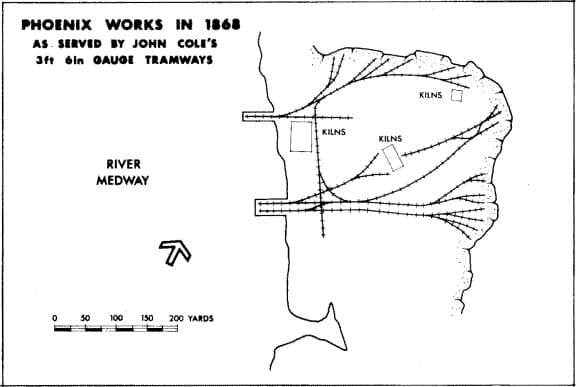
The 3ft 6in gauge tramways at Phoenix Works in 1868. It appears that these lines may well have been traced from the Ordnance Survey Sheet (below). These immediately local tramways were no longer present by the end of the 19th century, (c) Chris Down. [6]

The National Library of Scotland (NLS) does not have the earliest 25″ Ordnance Survey for the Peninsula (that published in 1869) on its website. The first image below is an extract from the 6″ Ordnance Survey of 1863-1865, published in 1869. Cole’s tramways appear on this map extract inn association with Frindsbury Lime Works.
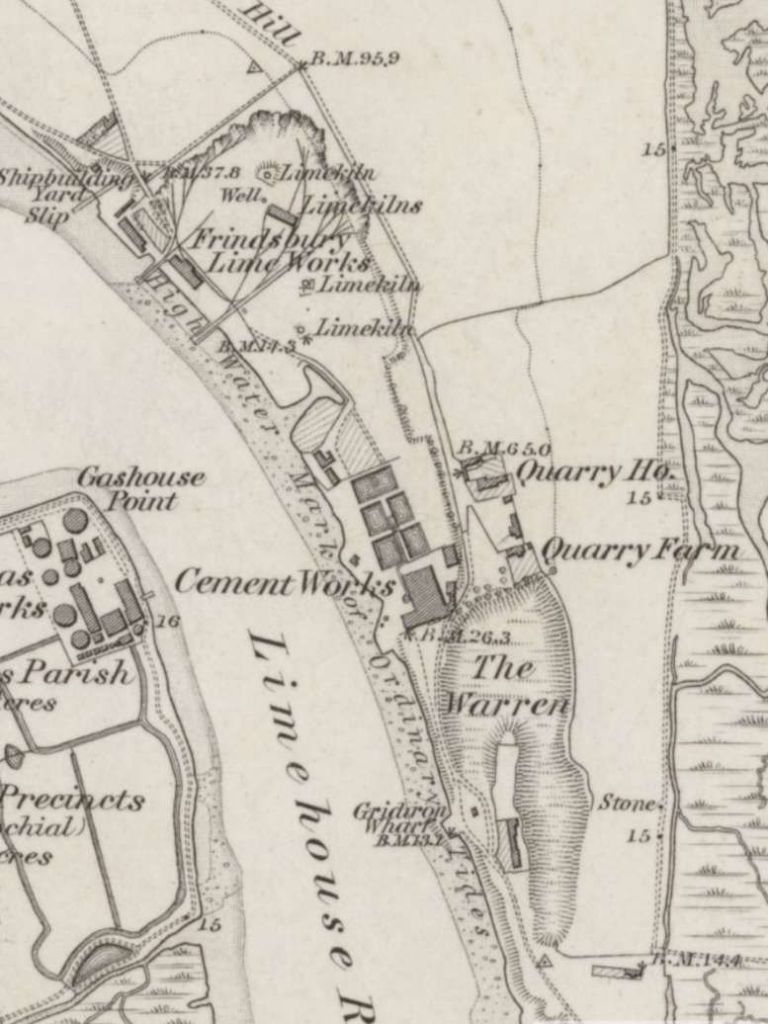
The Frindsbury Peninsula in 1863/1865 as shown on the 6″ survey undertaken between this dates and published in 1869. Only one Cement Works is  active at this time. It appears not to be Rail-Served in any form. To its North, Frindsbury Lime Works are shown. There appears to be a series of tramways at that location. It is the location of the Phoenix Cement Works on the later mapping, below. [2]

At the end of 1879, Cole was succeeded by William Ball, whose tenancy was renegotiated on a yearly basis. Ball extended Cole’s tramways a little – “to serve the newly erected Globe Works and Bridge Works (reached by a tunnel carrying 3ft 6in gauge rails under Quarry Terrace Road constructed in 1885, the cost being paid by the Ecclesiastical Commissioners).” [6]

Ball sought greater security of tenure in the form of a longer lease. This was resisted for a number of years by the Ecclesiastical Commissioners refused permission for a number of years.

In 1884, Ball was asked to drive a tunnel under Quarry Terrace Road to accommodate a standard-gauge rail line, so that Ball could quarry on the eastern side of the hill and also to allow him to dump arisings on the marshy areas/saltings to the East. The tunnel was around 700ft long and with an adverse 1 in 75 gradient to eastbound trains, and then dropping them at 1 in 200 down to the saltings. By 20th July 1886, the tunnel was finished except for fencing and Ball was paid £1,575 for doing the job. [6]

Down tell us that, “The tunnel immediately opened up new fields of supply for Ball. Within a few years, the standard gauge was extended south to serve the new quarry, Beehive and Beaver Works. While there was probably a transhipment point whereby chalk was tipped into the 3ft 6in gauge wagons (wooden side-tippers holding 55 cwts) serving Phoenix and Globe. Bridge, via its own tunnel, had 3ft 6in gauge quarry lines of its own.” [6]

Down continues: “Soon after completion of the tunnel in 1886, Ball asked for a long lease to enable increased expenditure on locomotives, wagons and tramways, while in June 1890, a review of Ball’s operations stated that he owned three or four steam engines, wagons, tramways, horses and buildings valued at £7,000. … Quite possibly these steam engines were stationary, for Aveling & Porter, the most likely suppliers of locomotives … have no record of deliveries at this time. (Two locomotives, of unknown gauge however, were delivered to I. Ball (Ball’s predecessor?), one in 1868 and the other (named BURNT OAK) in 1869. These were of six and ten nominal horsepower respectively, and were probably used on a coal wharf at Gillingham but may have been transferred to Frindsbury at a later date.)” [6]

On 25th March 1892, Ball was finally granted a long lease. His first locomotive, named ‘Alderman‘, despatched from Aveling & Porter’s Rochester Works on 23rd October 1893 (Works No. 3277, type TC 10), it was a standard gauge 10hp two-cylinder compound 2−2−0 of the traction engine type. … ; the cylinders were 7in (high pressure) and 11½in (low pressure) bore with a common stroke of 12in. ‘Sabina‘, a larger 2−2−0 compound of 20hp and of type TCG, followed on 21st December 1898 (Works number 4248). It was also a standard-gauge locomotive. [6]

Down tells us that, “A plan dated 4th February 1891, shows the layout of the 3ft 6in gauge lines. One branch served Phoenix and another, running between Phoenix and Globe served the latter. Another line went off to serve Bridge. In 1894, the branch to Phoenix was probably abandoned and the line to Globe extended to serve both works.” [6] These tramways are shown on Down’s hand-drawn map of the railway sup to 1909, above.

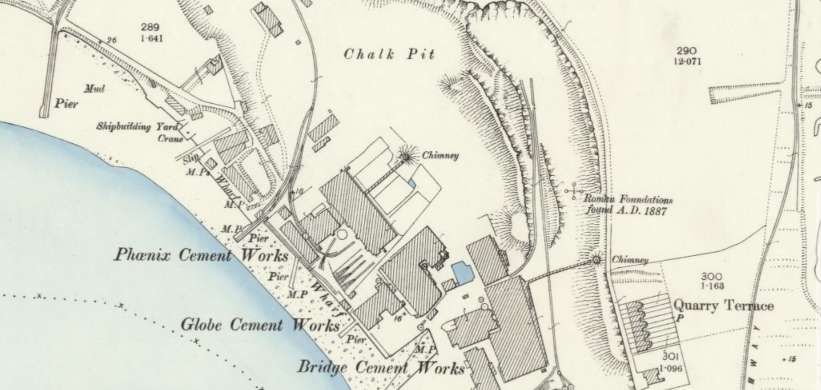
The earliest available 25″ Ordnance Survey mapping was surveyed in 1895/1896 and published in 1898. A sequence of extracts from that survey appears below.
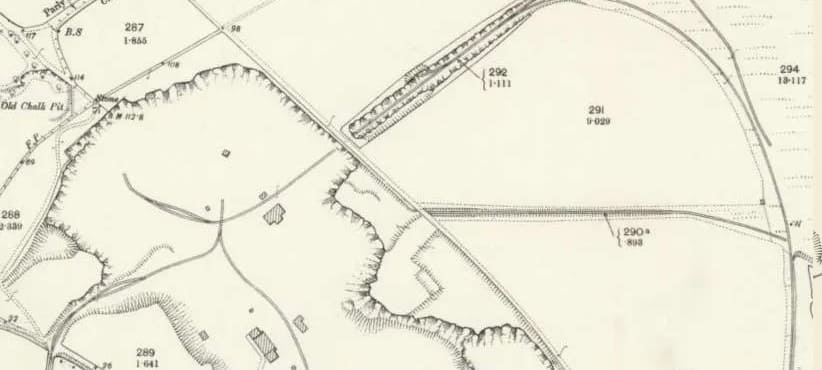
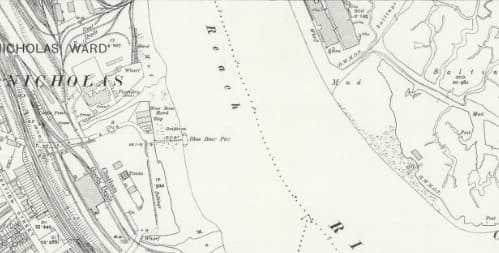
The tramway network has, by the end of the 19th century, expanded significantly. Bottom left of this first extract , the North end of Joseph Cole’s Ballast Pier can just be made out. A tramway tunnel under the main access road from Parsonage Road to the various Cement Works, can be made out just to the left of the centre of the extract. A tramway which provides access to Frindsbury Peninsula head Northeast in cutting before swinging round to the South. To the left of the image, tramways run through to Cole’s Pier and South towards Phoenix Cement Works. [1]
The full length of Joseph Cole’s Ballast Pier can be seen in the top-left of this next extract and the tramway serving Phoenix Works and its wharf and pier enters the extract at about the third-point from the left. On the far-right of the extract the tramway giving access to the South of the Peninsula can be seen running North to South. Globe Cement Works seems not to have associated tramways. Bridge Cement Works seems to have a short tramway network to its East. [1]
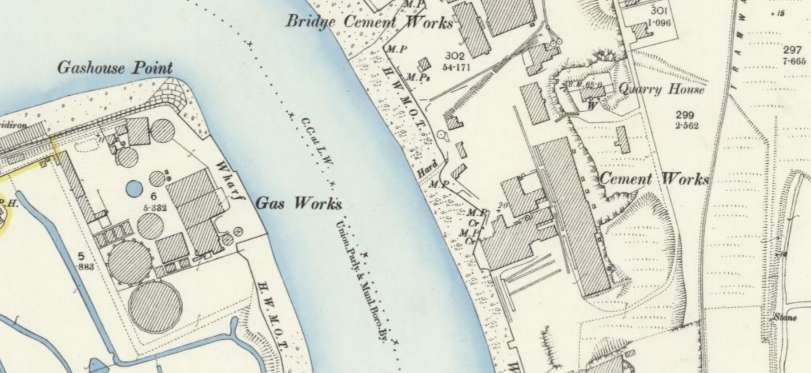
This next extract shows the tramways associated with Bridge Cement Works running Southwest to the High Water Mark. Crown Cement Works is just called a ‘Cement Works’. It appears to have some tramway line between it and the High Water Mark. [1]
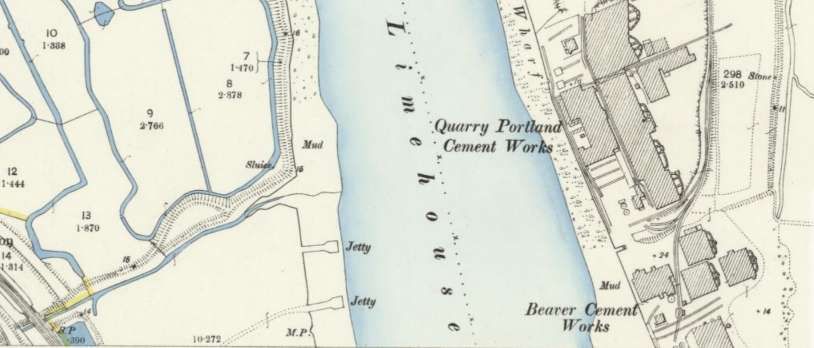
Quarry Cement Works and Beaver Cement Works were at the southern end of the Limehouse Reach on the Frindsbury Peninsula. [1]

Down tells us that, “After the APCM takeover in 1900, Ball seems to have continued quarrying much as usual, although there was not the same demand for chalk due to partial closure of some of the works. In 1905, he widened the tunnel to Bridge Works so as to take the standard gauge track from the eastern line. This was to meet APCM’s chalk requirements and cost £135 0s 6d. … It would seem that by 1905, … the 3ft 6in gauge had ceased to be operative, except perhaps the lines to Cole’s and Phoenix Works’s piers. On 3rd December 1909, it was stated that no cement was being made, and this seems to have been the case for three years. APCM had taken to barging down chalk from Halling when any cement was to be made, and Ball’s quarries were inactive. In November 1915, Ball’s lease expired and APCM took over quarrying rights.” [6]

This next series of map extracts come from the 25″ Ordnance Survey of 1907, published in 1909. Significant proportions of the tramway network were converted to standard-gauge. Down shows these on his hand-drawn map of the Cement Works and Quarries for the period up to 1909, which can be found earlier in this article. …
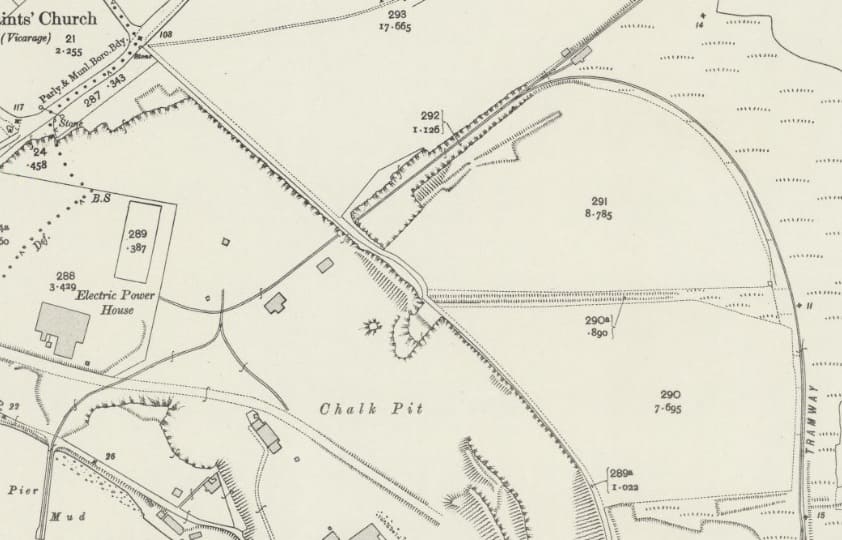
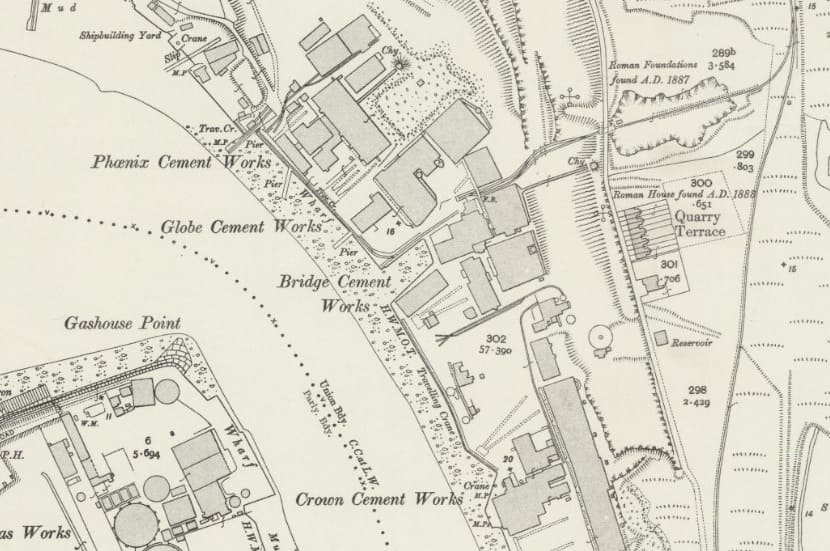
At the North end of the Peninsula, very little change had occurred in the decade since the earlier 25″ Ordnance Survey. [3]
Apart from some construction work associated with each cement works and the confirmation of the name of ‘Crown Cement Works’, the most notable change in this next extract is the tramway which reaches West from the tramway line on the right side of the image and which passes in tunnel under the access road to serve Bridge Cement Works. [3]
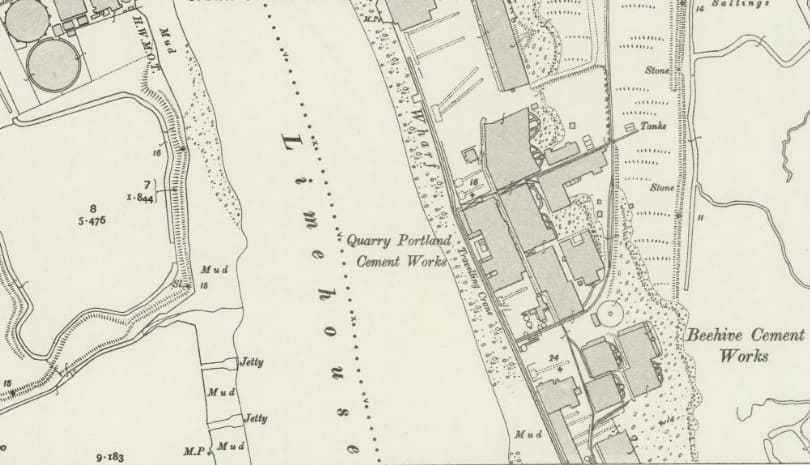
Tramways continue to serve Quarry Portland Cement Works and Beehive Cement Works, now named. [3]
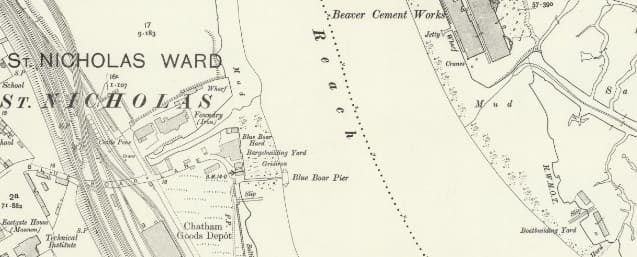
This final extract from the 25″ Ordnance Survey of 1907, published in 1909 shows Beaver Cement Works and the South end of the Peninsula. As already noted Beaver and Beehive Cement Works were operated by the Gillingham Portland Cement Company as a single operation. [4]

We know that at the turn of the 20th century, all of the cement works on the Frindsbury Peninsula came under the control of the APCM (1900) Ltd. Inevitably there was some rationalisation of operations on the Peninsula. A single operation was formed out of the different Works along the West side of the Peninsula and that new entity was called the ‘Crown & Quarry Cement Works’.

The next ‘snapshot’ that we have of the Peninsula and its railways/tramways is that provided by the 25″ Ordnance Survey of 1932/1933, published in 1935. …
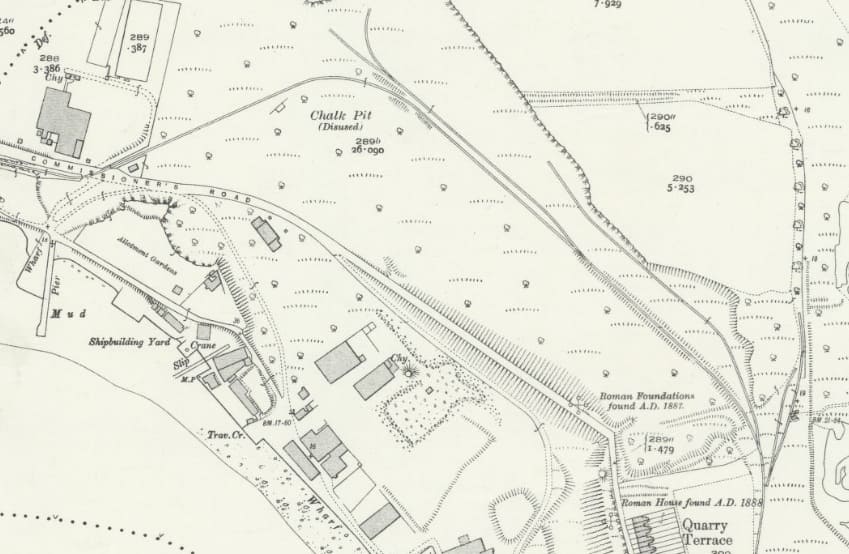
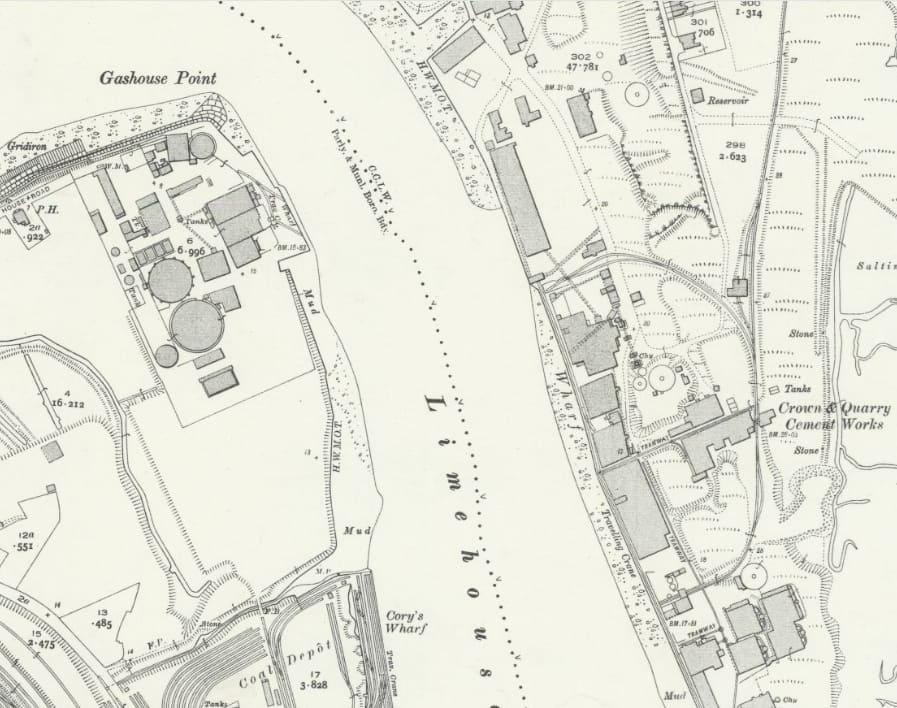
The tramways across the various cement works and quarry/chalk pit sites have been replace by standard-gauge railway lines. Although dated 1932/1933, this survey does not pick up some of the sidings shown by Chris Down on his hand-drawn map of the site below. the dates provided by Down suggest that the Ordnance Survey of the site took place early in 1932. [10]
In 1932, Crown & Quarry Cement Works incorporated element so of other Cement Works. It was rail-served by a standard-gauge branch line, and had a number of tramways within its site. A travelling crane operated along the water-front. [10]
The remaining length of the water-front and the buildings associated with Crown & Quarry Cement Works transgress on to the adjacent OS Map Sheet to the South. [11]
This hand-drawn map summarises the various changes on the Peninsula, perhaps the most significant change alongside the creation of a single Cement Works was the rationalisation of the railways and the commitment to standard gauge rails. Down highlights the different dates that each length of line was in use. The drawing covers the full period from 1909 to the closure of Crown & Quarry Cement Works in the 1960s, (c) Chris Down. [6]
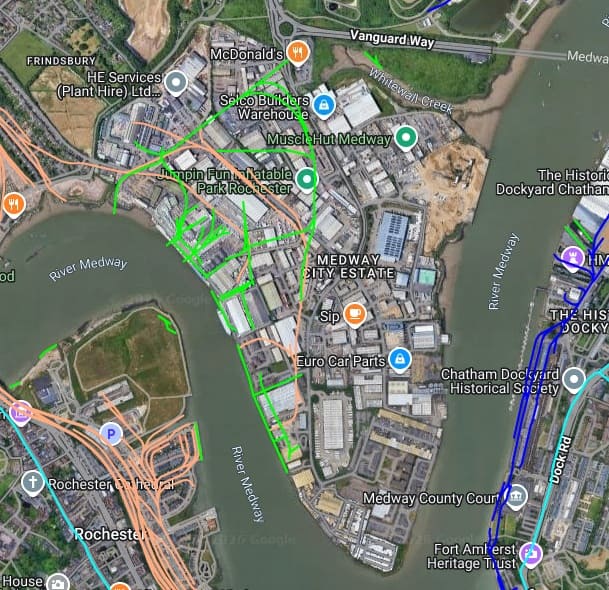
The tramways and railways on the Frindsbury Peninsula from the various different eras are shown mapped onto modern satellite imagery by railmaponlin.com. The background satellite image shows that the whole of the Peninsula has been redeveloped since the closure of the cement works in the 1960s. There would be little value in attempting to trace these old lines through a significantly altered physical environment. [12]

From 1900, APCM had control of the Peninsula. Waywell provides lists of the locomotives used by APCM on the standard-gauge lines on the peninsula. His list relies on work undertaken by Down. [13: p54-55][6]

Locomotives in use at the Crown & Quarry Works

Earlier in this article we have noted two Aveling & Porter Locomotives (owned by William Ball) that worked on the standard gauge lines on the Frindsbury Peninsula in the later years of the 19th century and the early years of the 20th century. There were:

  • Alderman – an Aveling & Porter 2-2-0TG locomotive built in 1893 (Works No. 3277)
  • Sabina – a second Aveling & Porter 2-2-0TG locomotive built in 1898 (Works No. 4248)

Both of these locomotives spent their whole life on the Frindsbury Peninsula. [6]

After the turn of the 20th century, APCM used a series of locomotives on the Peninsula. These were:

  • Unnamed – an Aveling & Porter 2-2-0TG built in 1879 (Works No. 1524) came from Booth’s Works Borstal circa. 1928 and scrapped on site in 1930. [13: p54][6]
  • Stuart – No. 7 – an Andrew Barclay 0-4-0ST built in 1890 (Works No. 681). [13: p54-55]
  • Unnamed – a Dick, Kerr 0-4-0ST built in 1890 which came from Hilton, Anderson Brook’s Works in Grays, Essex and which went to the BPCM Hilton Manor Works, circa 1930. [13: p54-55]
  • Leopard – a Falcon Engine Works 0-4-0ST built in 1896 (Works No. 239) came from BPCM Tolhurst’s Works circa. 1921 and was scrapped circa. 1930. [13: p54-55]
  • Kappa – a Chapman & Furneaux 0-4-0ST built in 1898 (Works No. 1164) came from APCM Burham Works, Aylesford and was sent to to APCM Swanscombe Works, June 1931. [13: p55][6]
  • George – a Peckett 0-4-0ST built in 1899 (Works No. 759) came from Bevan’s Works, Northfleet in 1934 and was scrapped by A. Arnold of Chatham, September 1960. [13: p55][6]
  • J. G. B. – an Avonside 0-4-0ST built in 1821 (Works No. 1874) came from Thos. W. Ward Ltd., Grays, Essex and was scrapped in August 1964. [13: p55][6]
  • Killarney – a Hudswell Clarke 0-6-0ST built in 1902 (Works No. 611) came from APCM Burham Works, Aylesford in 1934 and was returned in the same year. [13: p55][6]
  • Burham – a Manning Wardle 0-6-0ST built in 1879 (Works No. 730) came from APCM Burham Works, Aylesford in 1937 and was returned to Burham in 1938 [15: p55], scrapped in September 1952. [6]
  • C. F. S. – a Stephenson Hawthorns 0-4-0ST built in 1952 (Works No. 7742) bought new and sent to Holborough Works on loan in 1954, returned from loan by October 1954, then sent to Alpha Cement Ltd., Shipton-on-Cherwell, Oxon, circa 1963. [13: p55][6]
  • Southfleet – a Peckett 0-4-0ST built in 1928 (Works No. 1746) came from BPCM Johnson’s Branch, Greenhithe, in August 1960 and sent to to Thurrock Chalk & Whiting Co. Ltd., Essex, in June 1964. [13: p55][6]
  • Stone – a Peckett 0-4-0ST built in 1927 (Works No. 1740) came from BPCM Johnson’s Branch, Greenhithe, in November 1962 and sent to APCM Holborough Works, Snodland, circa 1963. [13: p55][6]
  • Longfield – a Peckett 0-4-0ST built in 1928 (Works No. 1747) came on loan from APCM Holborough Quarry, Snodland, in 1962 and returned later in the same year. [13: p55][6]

Chris Downs concludes in the 1960s: “Crown & Quarry Works was closed and tracklifting in the quarry began on 18th April 1963, the navvies being removed by 10th May. Some locomotives were still in use at this time, though, and there were four locomotives in all at the works. ‘J.G.B.‘ was partly dismantled in a shed near the bagging plant, and had been so for a number of months; officially it had been for repair, but this was never carried out. Of the others, ‘Stone‘ … was somewhat out of favour due to badly worn tyres. ‘Southfleet‘ … was in regular use. ‘C.F.S.‘, … was also a regular worker. … By the summer of 1964, the only locomotive left was ‘J.G.B.‘ In August it was towed out of the shed and cut up. Tracklifting was begun in October, being carried out by two men who professed to be self-employed. By 2nd November, the track had been lifted as far as the level crossing, the rails being burned into short lengths and loaded into a small van. The only remaining piece of railway equipment (within the works, on track embedded in concrete) was a wagon frame and wheels loaded with a crane jib.” [6]

References

  1. https://maps.nls.uk/view/103677173, accessed on 27th October 2026
  2. https://maps.nls.uk/view/266663224, accessed on 27th October 2026
  3. https://maps.nls.uk/view/103677170, accessed on 27th October 2026.
  4. https://maps.nls.uk/view/103677209, accessed on 27th October 2026.
  5. Robin Waywell; Industrial Railways and Locomotives of Kent; Industrial Railway Society, 2016.
  6. C. G. Down; Frindsbury Cement Works; in The Industrial Railway Record, Issue No. 16, 1967, p132-143 & p156; via https://shop.irsociety.co.uk/Archives/16/Frindsbury.htm, accessed on 22nd September 2026.
  7. https://www.cementkilns.co.uk/images/1907_det.jpg, accessed on 22nd September 2026.
  8. https://heritage.kent.gov.uk/Monument/MKE17074, accessed on 27th October 2026.
  9. https://heritage.kent.gov.uk/Monument/MKE17076, accessed on 27th October 2026.
  10. https://maps.nls.uk/view/103677167, accessed on 27th October 2026.
  11. https://maps.nls.uk/view/103677206, accessed on 27th October 2026.
  12. https://railmaponline.com/uk-and-irish-railways, accessed on 27th October 2026.
  13. Robin Waywell; Industrial Railways and Locomotives of Kent; Industrial Railway Society, 2016.
Queenborough Cement Works and Associated Industries at Queenborough

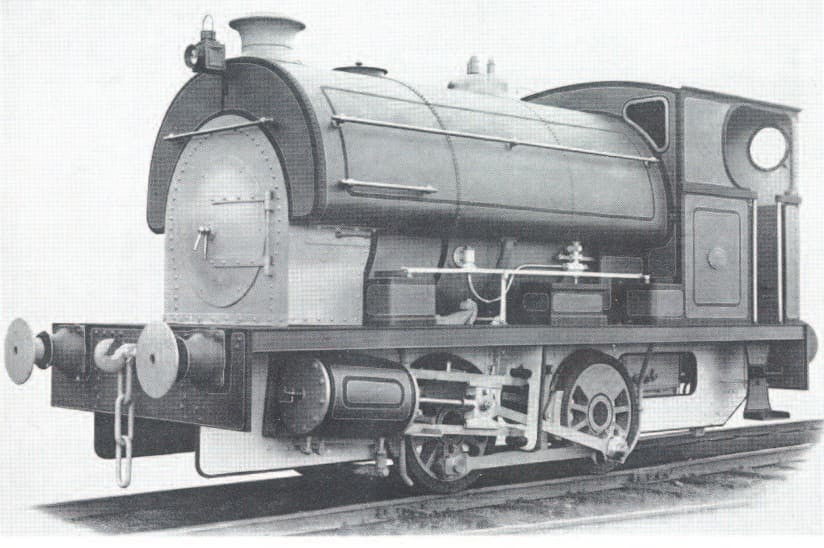
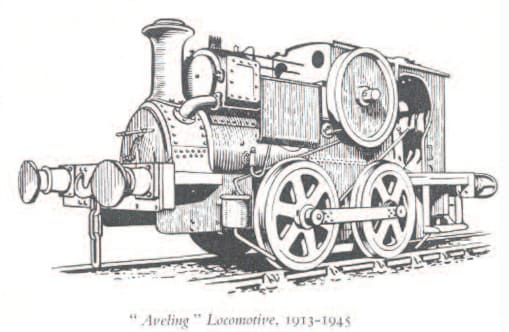
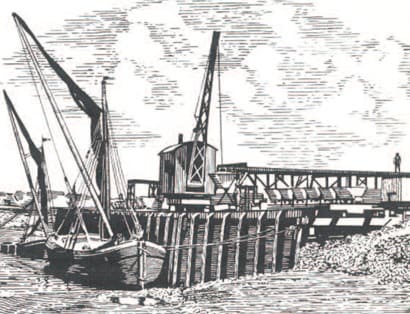
The featured image for this article is a line drawing of ‘Aveling’ (No. 2) an Aveling & Porter 0-4-0WTG locomotive that served at Queenborough from 1913 to 1945/46.

Stoyel & Kidner tell us that “The Queenborough Cement Co. Ltd opened in 1882 and by 1896 had a short tramway down to a wharf and creek leading off the River Swale; a siding to the SECR was laid in 1904. The chalk pit also supplied a ceramics manufacturer, A. Johnson & Sons Ltd, established in 1908, which had a narrow gauge tramway.” [1: p67]

In 1895, the Cement Works operated four kilns. The clay for the kilns was excavated from a site nearby, and chalk, the other necessary ingredient, together with coal for firing, were brought in by sea. For this to be done more conveniently, “Chalk Wharf” was built in 1897. [13: p8]

The original Chalk Wharf. [13: p8]

The Cement Company put in sidings from the railway company’s main line, and supplied facilities under agreement for rail traffic to serve the various concerns on the estate, and these form the nucleus of the provision later made by Settle Speakman for the other industrial undertakings on the site. The Cement Company, which at one time had an output of 400 tons per week, was disposed of in 1912, and during the 1914-18 war all the kilns and shafts were pulled down and the bricks and debris sold to the War Department for improving the roads on Sheppey Island. The old cement stores were turned into a hostel which housed and fed about 200. The quarry workings were gradually filled. [13: p9]

Stoyel & Kidner note that, “The Cement Co. did not join APCM in 1900 but had a five-year Agreement; in 1910 it joined BPCM.” [1: p67]

“In 1908 the wharf was taken over by industrialists from Cheshire, mainly for coal imports; they included Philip Speakman from Liverpool and Joel Settle from Alsager, and in 1930 they formed Settle Speakman & Co. Ltd. The company’s involvement with cement was purely the transport of chalk from the East Kent Chalk Quarry Co. Ltd at Gillingham, and the movement of products to the wharf.” [1: p67]

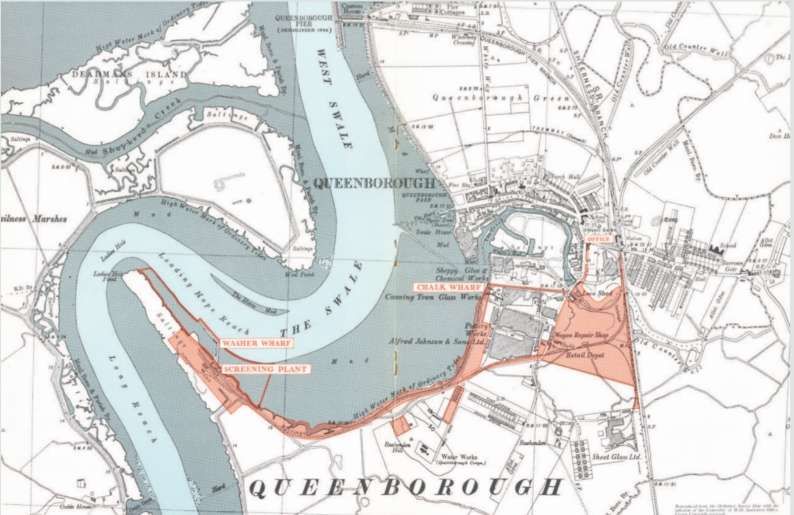
The extent of the holdings of Settle Speakman in Queenborough. [13: p16-17]

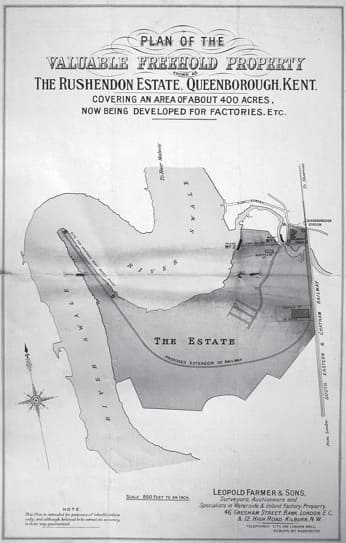
The Rushenden Estate’s area (South of Queenborough) was impressive, and included a valuable promontory that reached into the deeper water of the tidal River Swale. It was this area that Settle & Speakman sought to exploit. (Sheppy Industries archive), (c) Public Domain. [5]
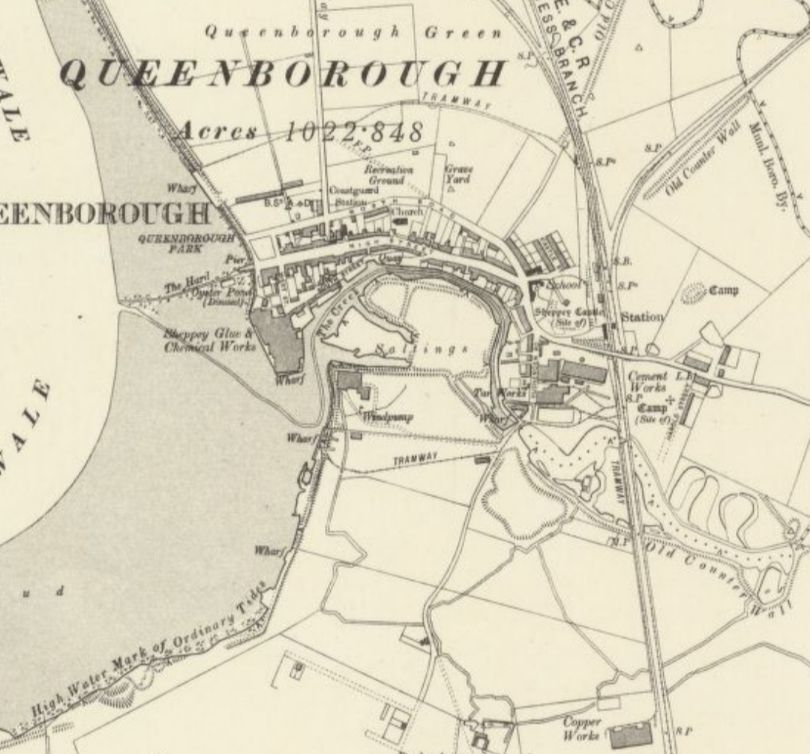
Queenborough Cement Works as it appears on the 6″ Ordnance Survey of 1906, published in 1909. The Works sit on the West side of the South Eastern and Chatham Railway (SE&CR) branch to Sheerness, North of Sittingbourne. In 1906, the Works had an exchange siding alongside the SE&CR and a tramway which led to a Wharf on the River Swale. To the South of the Works a dedicated tramway siding followed the SE&CR South to a Copper Works. To the North of the exchange siding was …… Station on the SE&CR and another tramway curving Northwest from the SE&CR line to a Wharf on the Swale to the North of Queenborough. Immediately to the West of Queenborough in the banks of the River Swale was Sheppey Glue & Chemical Works with its own Wharf on the river. At the top of this map extract, the Queenborough Pier Branch leaves the Sheerness Branch. [12]

The Company bought rails and chairs for their railway in Widnes and Birkenhead and , while there, acquired two locomotives, “Pioneer” and “Leycett.” Contracts for erecting the wharf, pier, etc., were entered into with Robert McAlpine & Sons, and conveying plant was erected by the Queenborough Contracting Company. [13: p10-11]

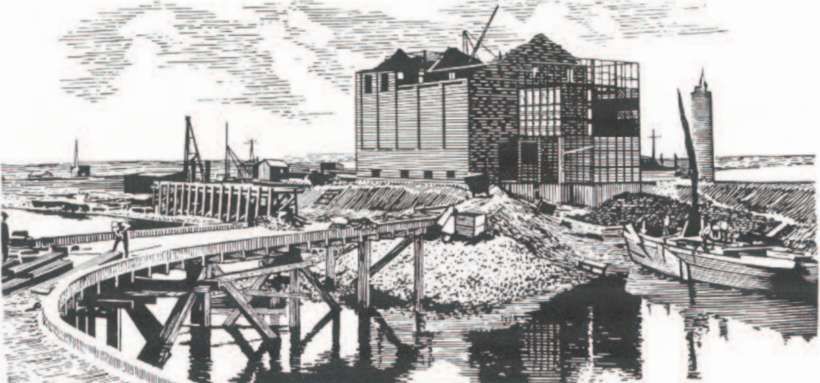
The Coal Washer and Wharf under construction [13: p10]

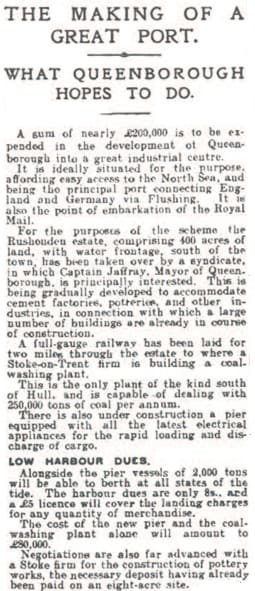
The Settle and Speakman built the Coal Washer themselves from plans supplied by Luhrig Coal and Ore Dressing Appliances Ltd. “The Queenborough Washer was the first in the South East of England. The very idea of the washer seemed strange, if not lunatic, to the local inhabitants – ‘Who ever would want to wash coal?’ Kent, in those days was far removed from the industrial north and the Kent coalfields had not then been developed. … The work was completed in little over twelve months and the first ship came alongside on 23rd November 1908. She was the ‘S. S. Britannia’: … The discharge at Queenborough did not get off to a good start; first the ship went aground at West Point, and … as high water rose, a gale blew up and washed away the embankment of the railway leading to the washer, so that the engine and trucks could not approach it. Only after tons of flint from the Chalk Wharf had been brought to fill the gap was it possible to proceed, but it took five days to discharge this first vessel.” [13: p11-12]

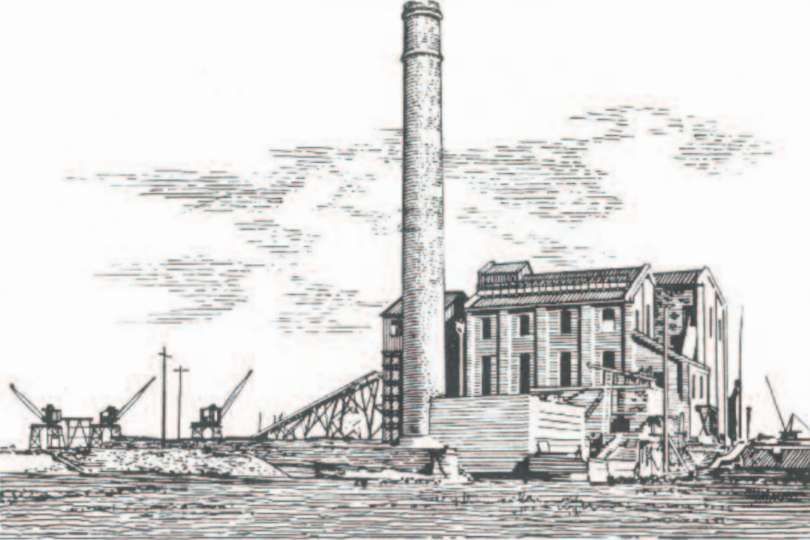
The completed Coal Washer Building. [13: p11]

One of the first benefits of the direct import of coal to Sheppey by the opening of the Queenborough Coal Pier and of washing and grading the coal, was an immediate reduction in local prices.

“In the years 1908 to 1910 there began a period of industrial development of the area with the building of the Pottery and the Glass Bottle Works, both of which had their services provided for by the Queenborough Wharf and Cement Companies. Joel Settle bought, during this period, the land upon which the company’s Retail Coal Depot [was to be] situated, and also acquired two plots of land, one on Rushenden Hill to be used as allotments by the company’s employees, and the other near the bottom upon which a row of houses named ‘Alsager Avenue’ (after Alsager, Cheshire, the home of Joel Settle) were built in 1912; many of these were occupied … by workers of the company.” [13: p12]

The adjacent press report comes from the ‘Daily Express on 3rd July 1908. It highlights the intentions of the company to develop a significant industrial site in the area close to Queenborough.

“In October 1911, the undertakings of Philip Speakman & Sons and Joel Settle were incorporated as a private limited company, Settle Speakman & Company Limited, Joel Settle being Chairman, and William Carroll a Director. Both the Queenborough Wharf Company and the washer of Settle Speakman carried on, with varying success, until 1918. Then Captain Jaffray, Lord Queenborough and Mr. W. H. Appleton took over the Washer; a mortgage was arranged and the Queenborough Coal & Washer Company formed. With many of the collieries in France lying derelict in the area covered by the fighting of the 1914-18 war, there was a brisk demand from France for washed coal at good prices, and 2,000 to 3,000 tons a week were shipped very profitably. But with the recovery of the French coal industry this demand ceased after about three years, and the fortunes of the Coal & Washer Company declined.” [13: p13]

The British Window Glass Works (see the notes on Sheet Glass Ltd below) “commenced operations at Queenborough in 1919, and the Contracting Company put in a railway line to the site of the works from the Wharf Company’s line; agreements were made for payments for goods passing over this line. To handle the extra traffic expected at the coal pier, {the Washer Wharf] was extended by 120 feet, this being financed by a loan from the Contracting Company. … Just before Christmas, 1922, the ‘S. S. Gyp’ collided with the Ferry Bridge across the River Swale; this is the sole approach to the island and road and rail traffic to and from the mainland was dislocated for many months. The Wharf Company had a shunting loco-motive, the “Emerald Isle” and this was put at once on to a shuttle service, running as often and as fast as her small driving wheels would take her, with passengers to the site of the bridge. Here the passengers were ferried across in rowing boats, to board a train on the other side to carry them to their destinations. This service had to be maintained for some months until the bridge was repaired and normal communications once more restored.” [13: p14]

For a time, the Coal & Washer Company was in liquidation. “Settle Speakman & Co. Ltd. took over all the assets of the Queenborough Coal & Washer Company and in early 1924 again worked the Washer, the Wharf Company continuing to perform the discharge and shunting operations. In 1926, the general strike stopped operations, although some revenue was obtained by working-over the accumulated deposits of tailings from the washer to recover for sale what little coal can have remained in them. Whilst the washer lay idle, slack in the raw coal hopper caught fire by spontaneous combustion, destroying the hopper and the conveyors feeding the washer. They were never rebuilt.” [13: p14]

A process of consolidation followed with many of the activities of the various companies being merged into the control of Settle Speakman & Co. Ltd. “It was decided to erect a Plant for screening the discharged coal on a site convenient to the pier and near the old washer, and this was completed in November 1927. At the end of 1928, the Queenborough Wharf Company went into liquidation and was sold to Settle Speakman & Co. Ltd., in 1930. A year later, the working assets of the Queenborough Contracting Company, which included the Chalk Wharf were taken over and Settle Speakman & Co. Ltd. thus obtained control over the discharge of ships and barges at both wharves and the transit of wagons. Further purchases of several pieces of land … took place, which served to strengthen the position of the company and to augment its resources.” [13: p18]

The Washer Wharf “was strengthened throughout in 1933 by driving reinforced concrete piles 70 feet in length to support a concrete raft 2 feet 6 inches thick on which the timber and concrete decking was supported. A new Wagon Shop was built (1934) and a concrete wall was erected (1935) for the protection of the Chalk Wharf.” [13: p18]

“In 1938, there occurred a very high tide accompanied by a strong gale. sea-wall near the wharves was breached and the sea poured into the low-lying land beyond, washing away the foundations of the railway in several places leaving the rails and sleepers in mid-air. … Hundreds of tons of material obtained from tips at the Pottery Works and from the adjacent hill were dumped into the gaps. Within three days communication with the wharf was established again.” [13: p18]

War damage during WW2 was surprisingly slight. During the War, “plans were made for post-war development at Queenborough which served as a blue-print for the progress which commenced [after the War]. … These plans permanently shaped Settle Speakman’s interests at Queenborough [Through into the late 1950s]. … Further land was acquired, additional railway sidings constructed and extensions to the Wagon Shop undertaken. The old chimney stack at the Washer Wharf was felled, and a stores and messroom with showers and a washroom, etc., made in the shell of the old washer. The reconstruction and strengthening of the wharf was completed, and a new railway weighbridge and weigh-house erected. A new locomotive ‘Stafford’, [and] a ‘Jones’ and a ‘Jumbo’ mobile crane, and a 5-ton Booth diesel crane were obtained to improve the handling facilities.” [13: p19]

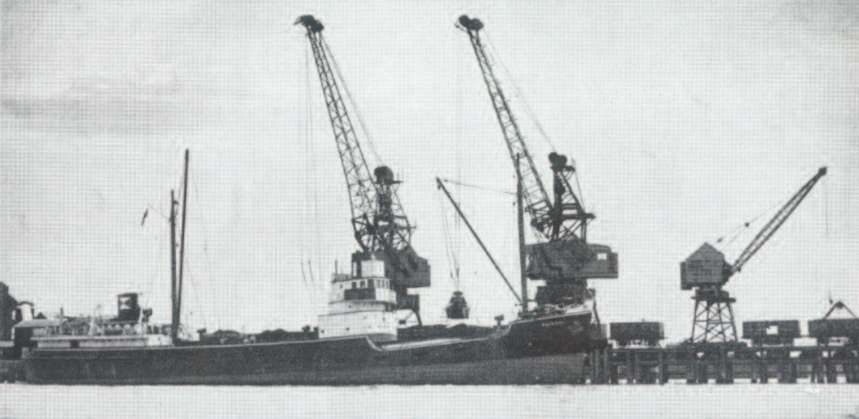
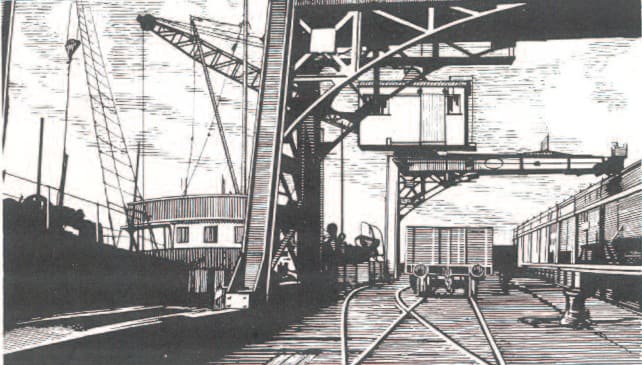
Significantly, two modern Stothert & Pitt 5-ton level luffing cranes [4][5][13: p20] were erected at the Coal Washer Wharf in 1953. [13: p20] The Coal Washer Wharf was the centre of operations for the Company. It was 300 feet long, with two lines of standard gauge railway along the full length. The two Stothert & Pitt electric cranes operated at a maximum and minimum radius of 68 feet and 23 feet, served the wharf, with a smaller crane also available. At the outward berth there was at least 12 feet of water at low water on spring tides, throughout the whole length of the wharf. [13: p23-24] The wharf was capable of handling coal and merchandise direct from a vessel into wagons, or overside into lighter or barge; or vice versa.

Coal Washer Wharf in the late 1950s. Note the two large Stothert & Pitt Cranes. [13: p23]

“Each of the new cranes at the Washer Wharf contains a recording weigher of a very high order of accuracy, complying with the requirements of the Board of Trade. A so-ton standard-gauge railway weighbridge, 16 feet long, is installed at the approach to the Washer Wharf and enables accurate weights to be given for traffic handled by rail. A 30-ton road weigh-bridge is installed adjacent to the retail coal depot, for handling road traffic.” [13: p25]

At Coal Washer Wharf, coal was discharged by grab onto a metal-plate conveyor on the wharf. A rubber-belt conveyor then took the coal to the Screening Plant, which gave a range of sizes. From the screens coal was loaded into railway wagons.

Adjacent to the Retail Coal Depot, the Company had a well-equipped Wagon Repair Shop. Here are carried out repairs not only to the Company’s own wagons, but also work for the British Transport Commission.

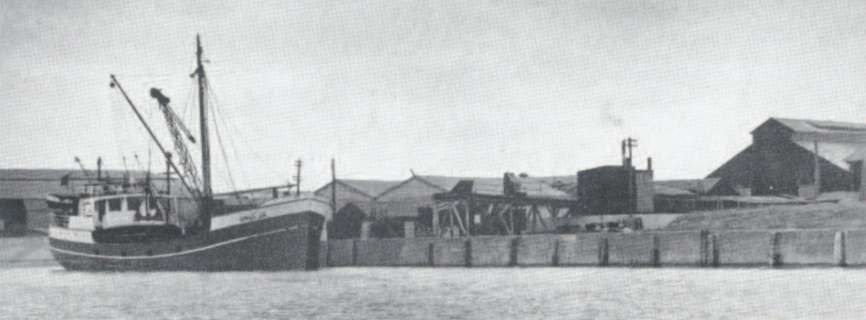
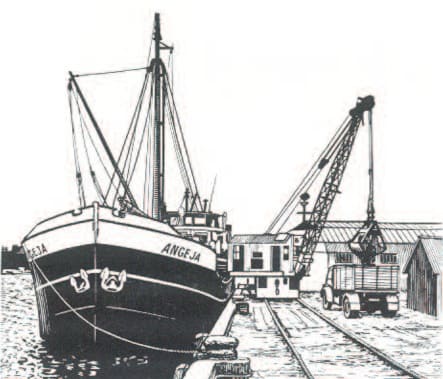
Chalk Wharf: was 350 feet long, and had both road and rail connections. The berth is tidal, with a maximum depth of water of 12 feet, enabling vessels of 250 to 300 tons capacity to be accommodated. It handled many of the raw materials for the adjacent factories – amber sand and flint sand from Belgium and felspar for the glass works, china clay and china stone from Cornwall, and boulder flints from France for the pottery works. Fuel oil is also delivered from barges at this wharf, and ballast unloaded. Sheet glass is loaded onto barges for the London River, where it is transhipped for export. [13: p24]

Chalk Wharf in the 1950s. [13: p24]
Unloading at Chalk Wharf. [13: p25]

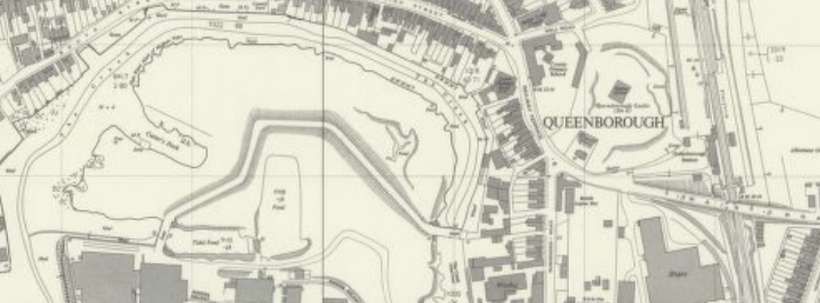
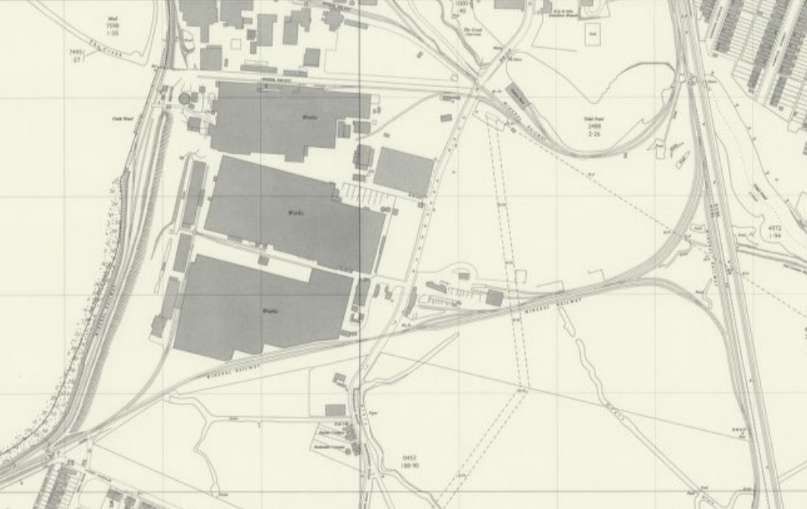
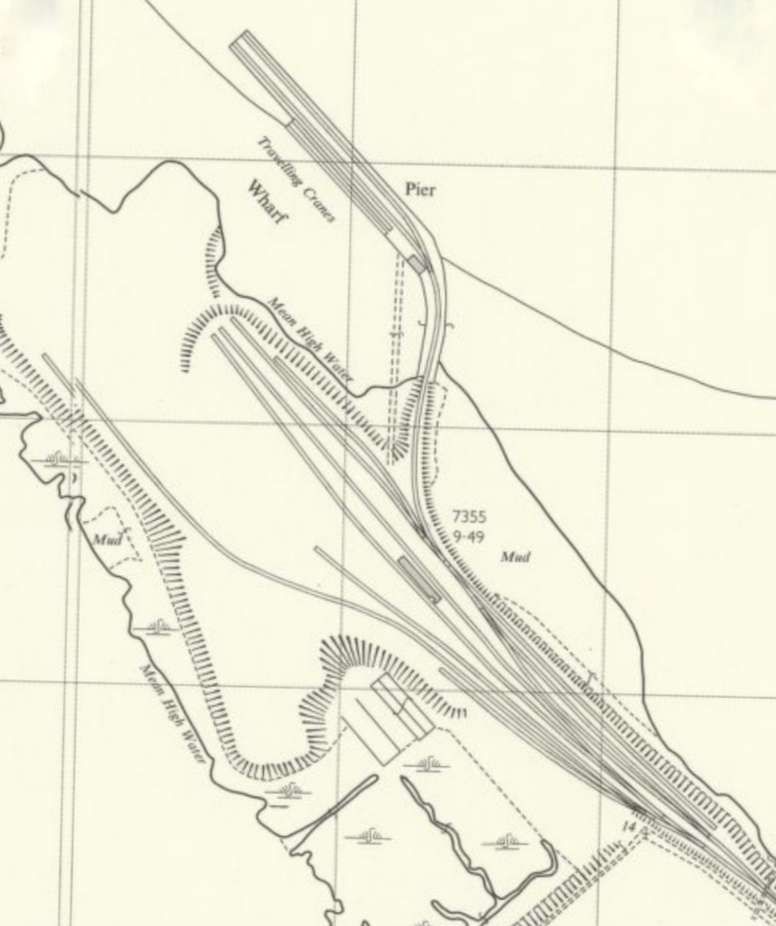
The next three map extracts come from the 1:2500 Ordnance Survey revised up to 1963 and published in 1964. They demonstrate the industrial developments, up to 1963, around Queenborough and show both the Coal Washer Wharf and Chalk Wharf at that time. …

The heart of Queenborough, its Railway Station and the location of the cement works. The site of the cement works was to the West of the railway line in the bottom-right of this extract from the 1:2500 Ordnance Survey revision of 1963, published in 1964. [14]
Chalk Wharf is on the left of this map extract from the 1:2500 Ordnance Survey revision of 1963, published in 1964. [15]
The Coal Washer Wharf mentioned in the text. This map extract comes from the revised 1:2500 Ordnance Survey revised of 1963, published in 1964. [16]

Locomotives and Rolling Stock

Later, a variety of locomotives worked for Settle Speakman. Examples include:

Stoyel & Kidner note two specific locomotives: ‘Success’ an 0-4-0WTG Aveling & Porter, Works No. 5082 built in 1902; and ‘No. 2’ another 0-4-0WTG Aveling & Porter, Works No. 7975, built in 1913. [1: p67] Other records suggest that ‘No. 2’ was named ‘Aveling’ [13: p18]

Stoyel & Kidner suggest that ‘Success’ had probably lost its name by the time it arrived from the East Kent Chalk Quarry Co. Ltd. ‘No. 2’ was new. The former was scrapped before 1930 and ‘No. 2’ in 1946, [1: p67] or possibly 1945. [13: p18]

‘Aveling’ (‘No. 2’) was new in 1913 and scrapped in 1945, [13: p18] or 1946. [1: p67]

As of 1957, Settle Speakman had 5 locomotives and 220 internal-user wagons working on the private sidings. Locomotives employed by Settle Speakman over the years included:

‘Stafford’ – a Bagnall-built 0-4-0ST which was bought new carried the name ‘Stafford’ because, as well as having a base at Queenborough in Kent, Settle Speakman & Co. was a major coal factoring, shipping, and colliery-owning group based in Stoke-on-Trent, North Staffordshire. Before the nationalization of the UK coal industry in 1947, they owned several pits, operated an extensive fleet of private owner railway wagons, and managed industrial locomotives to shunt coal.

‘Stafford’, an 0-4-0ST built by [13: p27]

No. 3 – a Dick Kerr 0-4-0ST formerly of Cadbury Brothers and named “Maybury.”

No. 3 – ‘Maybury’: a Dick Kerr 0-4-0ST former at Cadbury Brothers. Note the closeness of the cab spectacles – evidence that the locomotive was originally fitted with just a weatherboard, the overall cab being added at a later date. (F. Jones), (c) Public Domain. [2]

In later years, diesel shunters were employed – Two diesel-hydraulic 0-6-0 locomotives were at Queenborough Rolling Mill on 3rd September 2013, both originally built by Andrew Barclay of Kilmarnock for the British Forces in Germany in 1966. In the photograph dated 3rd September 2013, which can be found here, [3] the blue locomotive is “873” and the red one is “871”. The internal use railway wagons are ex-BR. Photograph dated 3rd September 2013. Other photographs of diesel locomotives at work at Queenborough can be seen here, [6] here, [7] and in the wider album here. [8]

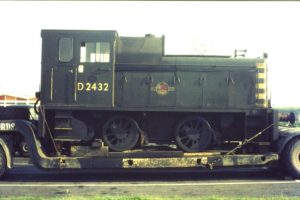
D2432 was a Class 6 0-4-0 diesel shunter which was first allocated to Hamilton in February 1960, transferring to Polmadie in May 1960, Ayr in 1966, and to Eastfield in September 1967. It was withdrawn from BR service at Eastfield and sold to R. E. Trem & Company, Finningley, near Doncaster. They in turn sold it to Shipbreaking (Queenborough), Oueenborough, Isle of Kent for further use. Movement from Glasgow to the Isle of Sheppey would appear to have occurred in part or most likely in whole by road. There is a report of it being sighted at Stamford on 20th May 1969 on road transport from where it continued to the Isle of Sheppey. Photographs of the locomotive in transport can be seen here. [9] Sightings of the locomotive were by Brian Henderson at Gosforth High Street (on road transport), 19/05/1969; Stamford (on road transport), 20/05/1969; Medway Services, M2, Kent (on road transport) by Peter Hall (IRS), on 20/05/1969; and at Queenborough by Gordon Edgar, 24/01/1971 and 22/10/1972, Mike Martin, 08/11/1975 and Tom Bartlett, 24/01/1976. [10]

Industries Served by the Railway

Settle Speakman provided the shunting requirements for the local factories, which were thereby connected with the Company’s wharves and with British Railways’ main line at Queenborough Station. All those local factories had strong links with the Company and its predecessors. The original agreements for shunting and handling of goods were still in operation,

The companies serve by Settle Speakman are listed below:

Sheppy Glue & Chemical Works: This works, reputed to have been the oldest chemical works in the country, haf existed at Queenborough from the 16th century. The original works was on the town side of the Creek, but by the 20th century an extensive site to the south east of the Creek was also occupied. The principal products were glue, granular compound fertilizers, super phosphate, organic fertilizers and sulphuric acid. The Queenborough Contracting Company made, in 1916, an agreement to construct a full gauge railway line into the works and to do all the shunting necessary. These arrangements were taken over by Settle Speakman & Co. Ltd. [13: p28]

Alfred Johnson & Son Limited: One of the largest UK producers of sanitary ware, Alfred Johnson & Son Ltd., (“Pyramid”  trade mark). The Queenborough Works was established in 1908, and from the earliest days arrangements were in force whereby the various predecessors of Settle Speakman & Co. Ltd. constructed and operated railway connections and provided shunting facilities to the works. … A narrow gauge line from the Chalk Wharf operated for many years and conveyed the china clay and other raw materials to the works, but this has been replaced by road transport loaded directly from the ships. [13: p28]

Canning Town Glass Works Limited: Manufacture of glass bottles and jars commenced in 1910, with the establishment of the Queenborough Glass Bottle Works. From the outset arrangements were in force to discharge goods and raw materials for the works at the Chalk Wharf, including the use of an overhead gantry. A rail connection was made to the works in 1920 and an agreement was entered into for shunting services. When the works of the original company were taken over by the Canning Town Glass Works Ltd., in 1926, these arrangements remained in force, and were undertaken by Settle Speakman & Co. Ltd. [13: p28-29]

Medway Glass Works Limited: In anticipation of large contracts from a manufacturer of electric lamps, the construction of the Medway Glass Works was commenced in 1919, but labour conditions on the site delayed the completion of the factory, and the opportunity for the contracts was lost. Immediately following came the slump of 1920 and, as a result of these misfortunes, the completed works did not go into production. Agreements, however, were made for the discharge of materials at the wharves and for shunting arrangements. Production commenced in 1921, but prevailing conditions were such that the works soon had to close. … In 1942, the premises were requisitioned by the Admiralty, who retained them until de-requisition in 1947. Later, in 1952, the Admiralty purchased the works and carrried out considerable repairs to the buildings. [13: p29]

Sheet Glass Limited: In 1919, on the site of the old Queenborough Copper Works, a firm – British Window Glass Ltd. commenced to build a factory for the manufacture of sheet glass. Arrangements for discharging of goods and materials at the wharf and for delivery and shunting were entered into. Trading conditions in the 1920’s, however, were not favourable and production stopped in 1924. Another company was formed – Sheet Glass Ltd. and production re-commenced and continued for about two years from 1927. In 1932, the works re-opened having been acquired by Pilkington Bros. Ltd., of St. Helens, and Settle Speakman & Co. Ltd. continued to serve the new owners as had previously been agreed. [13: p29]

W. Lodder: This is an iron foundry which specialises in the making of the cast-iron moulds required for glass-bottle manufacture, a unique enterprise for this part of England. The foundry had an engineering works attached, which undertook general engineering repairs. [13: p29]

Queenborough Rolling Mill: this facility was established on the site of the old cement works. This made use of the industrial railway which ran to exchange sidings with the main line railway and to a jetty on the River Swale. Operations ceased in February 2013 and the physical assets were auctioned in September 2013. The Wharf and the associated industrial railway to Queenborough Station were used by Settle Speakman until the jetty was used by Shipbreakers (Queenborough). The Rolling Mill was then built and rails recovered from defunct railway lines arrived by ship and by rail and were rolled to produce steel bar for use in reinforced concrete. The reinforcement bar was despatched by ship, rail and road. Second-hand industrial railway locomotives and wagons were used for movements between the works and the jetty. The works was taken over by the international steel processing company ISTIL in 1999, which was purchased in 2006 by Estar. In 2010, the mill was operated under the name Invicta Merchant Bar. It is thought the railway to the jetty had ceased to be used by this time. [3] Scenes from around the Rolling Mill can be seen here. [8] The Mill closed in 2013. [17: p164]

A full list of locomotives used on the site by Lacmots 1960-1964, Shipbreaking Queenborough 1964-1972, Queeenborough Rolling Mill, 1972 onwards can be found in Robin Waywell’s book, Industrial Railways & Locomotives of Kent. [17: p163-168]

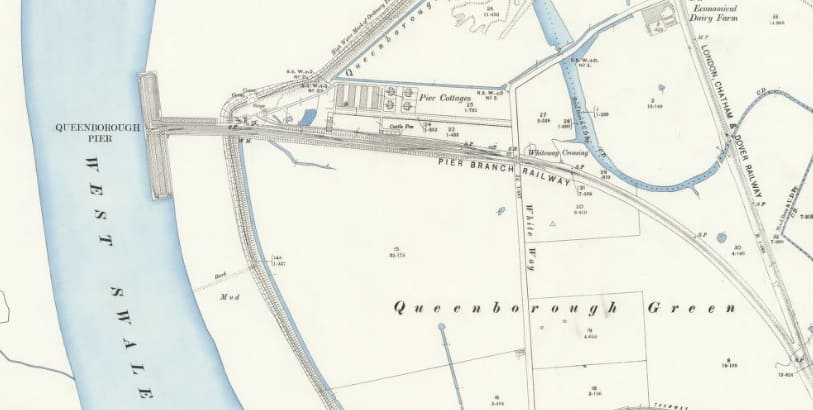
Flushing Pier: In about 1875 the old London, Chatham & Dover Railway Company decided to build a pier at the entrance of the River Swale to accommodate cross-Channel traffic. “The situation was a favourable one for trade and passenger crossings to Holland, as it was conveniently near to London, yet sheltered and notably less liable to become fog-bound and more generally useful than the railway company’s site at Dover. The pier was known as the Flushing Pier, as a regular day and night service for mailboats ran between Queenborough and that port. In 1885, the original pier was burned down, and a new one built, which was also destroyed by fire in 1900. The railway company again rebuilt the pier with a pier head structure 650 feet long and an approach pier 300 feet long, all on some 2,500 timber piles, heavily braced. On the pierhead and approach were extensive buildings, platforms and railtracks.” [13: p30]

Flushing Pier was more formally called Queenborough Pier. It sat to the North of Queenborough, close to the mouth of the River Swale. It is shown here at the end of a branch from the London, Chatham and Dover Railway on the 25″ Ordnance Survey of 1896, published in 1898. [11]
Flushing Pier. [13: p30]

“The pier continued in operation until the outbreak of the 1914-18 war. When the war was over, the Continental route went through Folkestone and Dover and the pier never regained this traffic.
Between the wars the pier was first used as a dismantling jetty, where such famous ships as “H.M.S. Orion” were broken up. In 1928 a company, The Port of Queenborough Ltd., was formed and hired the pier for dealing with merchandise and also proved successful in handling coal from the Kent coalfields. This company was acquired in 1931 by Settle Speakman & Co. Ltd., and re-organised.
In 1936, an approach was made to the railway company to allow the pier to be adapted in order to take road transport, but after investigation the railway engineering department did not consider the structure to be safe for this purpose, so nothing came of it
.” [13: p30-31]

“In November, 1939, the Admiralty gave notice that they required use of the pier forthwith, and within one week most of the Company’s gear, plant, etc., were removed and the pier taken over for use as a Mine Sweeping base. Arrangements were made to carry on the business at the wharves of Settle Speakman & Co. Ltd., and a considerable proportion of the tonnage was maintained. This requisitioning gave rise to long-drawn-out negotiations with the Admiralty and the Railway about compensation and the use of machinery, but eventually all was settled.” [13: p31]

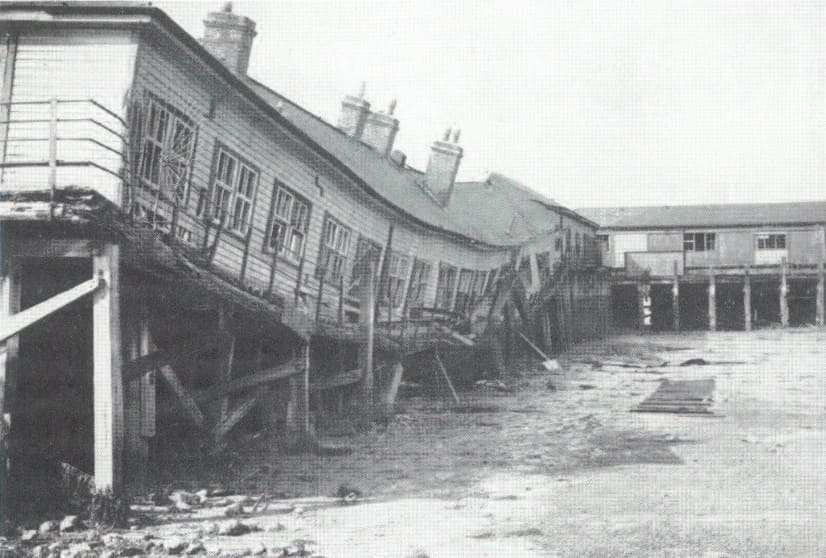
“After the Admiralty vacated the Pier in 1948 attempts were made to resume activities but about 1951 it became evident that the pier was becoming unsafe for further use, and in 1955, it became a real danger to shipping. Demolition was put in hand, and June, 1956, saw the last of this … old pier; it had fought a losing battle against fire, changing trade routes, and the continuous and devastating attack of the teredo worm.” [13: p31]

By the end of its life, Flushing Pier was in a parlous state! [13: p31]

References

  1. B. D. Stoyel & R. W. Kidner; The Cement Railways of Kent; The Oakwood Press (LP70], Headington, Oxford, 1973 & 1990.
  2. https://shop.irsociety.co.uk/Archives/46/Letters_46.htm, accessed on 17th September 2026.
  3. http://www.railalbum.co.uk/industrial-railways/images/images-qbro/images-qbro-intro-1/qbro-scene-03sep2013-imgp6038.jpg, accessed on 17th September 2026.
  4. https://en.wikipedia.org/wiki/Stothert_%26_Pitt, accessed on 16th September 2026.
  5. https://queenboroughsociety.org.uk/wp-content/uploads/2025/07/Rushenden-Estate.pdf, accessed on 16th September 2026.
  6. http://www.railalbum.co.uk/industrial-railways/images/images-qbro/images-qbro-intro-1/qbro-loco-29jne1991-film91140-3.jpg, accessed on 17th September 2026.
  7. http://www.railalbum.co.uk/industrial-railways/images/images-qbro/images-qbro-intro-1/qbro-scene-1986-film8660-32.jpg, accessed on 17th September 2026.
  8. http://www.railalbum.co.uk/industrial-railways/queenborough-intro-1.htm, accessed on 17th September 2026.
  9. https://rcts.org.uk/wp-content/uploads/diesel-dilemmas/06000-D2432-19690520-Medway-Services-Peter-Hall-IRS-Andrew-Smith-2-300×200.jpg, accessed on 17th September 2026.
  10. https://rcts.org.uk/features/diesel-dilemmas/class-06/d2432, accessed on 17th September 2026.
  11. https://maps.nls.uk/view/103676531, accessed on 17th September 2026.
  12. https://maps.nls.uk/view/101428281, accessed on 15th September 2026.
  13. https://queenboroughsociety.org.uk/wp-content/uploads/2025/07/Settle-Speakman-History-1957.pdf, accessed on 15th September 2026.
  14. https://maps.nls.uk/view/103203940, accessed on 15th September 2026.
  15. https://maps.nls.uk/view/103203937, accessed on 15th September 2026.
  16. https://maps.nls.uk/view/188600758, accessed on 15th September 2026.
  17. Robin Waywell; Industrial Railways and Locomotives of Kent; Industrial Railway Society, 2016.