
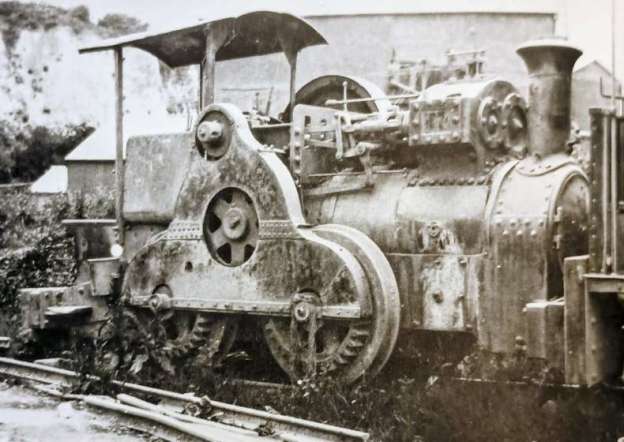
The featured image for this article is the narrow-gauge Aveling & Porter geared engine which came to Johnson’s Works from Cliffe Works. To make the move, the gauge of the locomotive had to be increased by one inch. The locomotive is seen here in a derelict state in September 1932. (G. Alliez) © Public Domain. [1: p34]
In 1872, I. C. Johnson took over a quarry and tramway at Greenhithe which was used to provide ballast for ships returning to the Gar East without cargo. Stoyel & Kidner say that “The tramway ran from the quarry, approximately where the works was later built, under the South Eastern Railway to a pier. The Johnsons’ Works was opened in 1877; as I. C. Johnson did not purchase any locomotives, as far as is known, until 1891, he must have used those of his predecessor, but it is not known what they were, except that the gauge was presumably that used later, 3ft 9½ in.” [1: p26]
Stoyel & Kidner continue:
“The original chalk quarries were just to the south of the works, with another to the west towards Stone church, but when these were exhausted it was necessary to tunnel under the Dartford-Gravesend road to open up new ones. These finally reached as far as the A2 London-Dover road, being worked on two levels; the top level was closed in 1952 and the lower level ultimately reached a depth of 200 ft.
“The first step in modernising the works was taken in about 1903 when a rotary kiln was introduced. At about this time a line was laid to rise steeply to an exchange siding on the SE&C Railway to the west of the works. The Company joined BPCM in 1911. Then in about 1926 the works was closed for a time to enable it to be completely modernised and in the process of this reorganization standard gauge track was laid, as a temporary measure some of the line being dual gauge with three rails until the narrow gauge system was finally abandoned in about 1927. In 1928, one of the two lines running from the works to the pier was electrified on the overhead system, worked by motored bogie hopper wagons. These worked on 250V overhead supply, and carried a 25-ton load at 7 mph. They were built by English Electric (738-40) in 1928.
“The modernised works included eight new concrete silos 96 ft high, and a new concrete packing shed on the jetty, which had an extension built out into the river so that larger ships could berth there. The three hopper wagons (two in use, one spare) acted as a link between silo and packing shed, running under the former to load up, and unloading at the jetty by means of compressed air and screw conveyors. They were remarkably silent-running.” [1: p26]
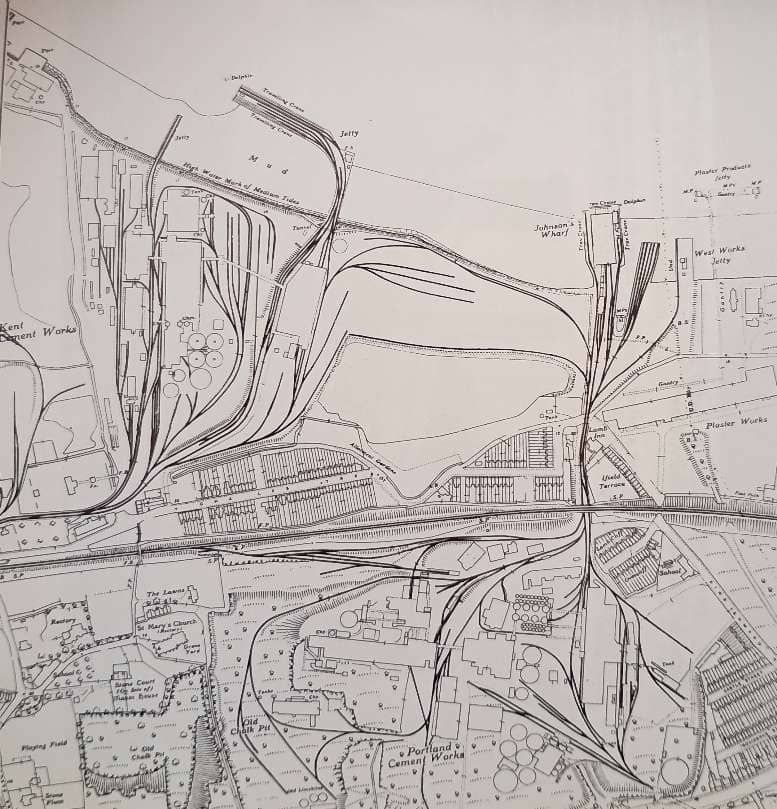

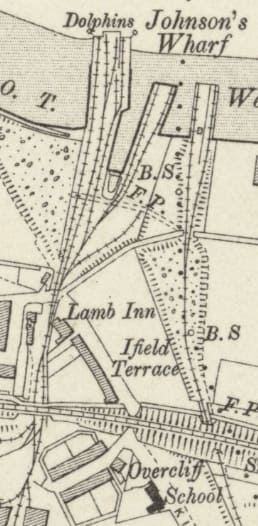
Johnson’s Wharf and Dolphin’s Wharf both seem to serve I. C. Johnson’s Works. A bridge carries the North Kent main line over the lines connecting the wharves with Johnson’s Works. [3]
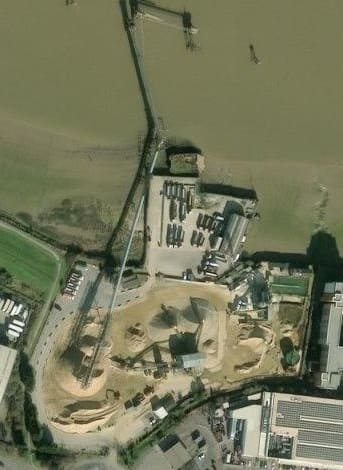
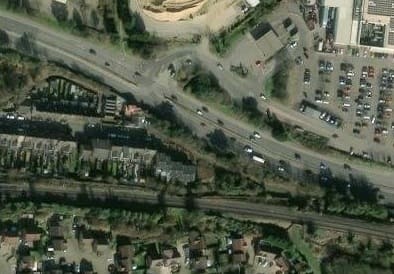


The bridge which carried the North Kent main line over Johnson’s industrial lines is still in position and continues to carry the main line in the 21st century! [Google Earth 3-D view, August 2026]

This second enlarged extract shows the tunnel passing under London Road (A2). [3]
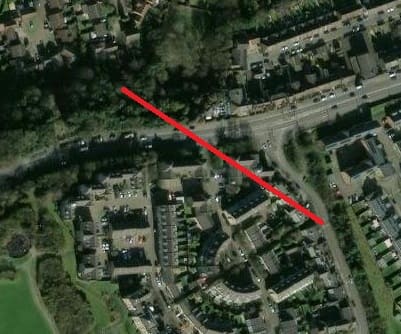
The approximate line of the tunnel on the map extract is shown on this satellite image by the read line. [6]
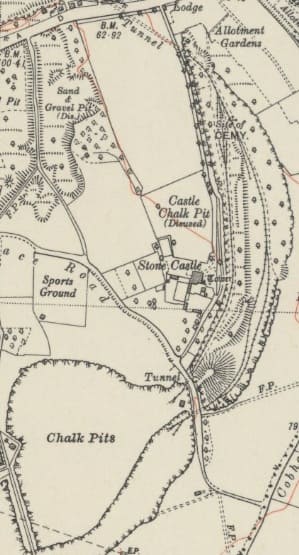
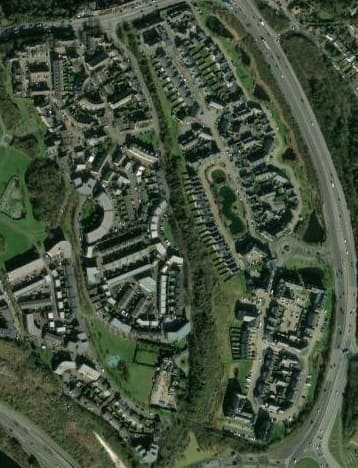
The Chalk Pits were extended further to the South as time went by. This extract is from the 6″ Ordnance Survey of 1938 to 1940 which was published in 1950. Modern development has substantially replaced the old chalk pit workings. [7]
Clay first came by barge down the Medway, then from various local sites. Some was dredged from the Thames, some came from a BCPM claypit at Bean, some from the APCM pits at Alkerden.
Johnson’s closed in 1970.
Locomotives
Locomotives on the early narrow-gauge railway (3′ 9.5″), all new unless noted otherwise: [1: p30]
Elephant – an 0-4-0ST – no details available.
Cement – an 0-4-0T built in 1891 by Bagnall, Works No. 1344, outside cylinders (9″ x 14″), 2′ 9.5″ wheels.
Samson – an 0-4-0T built in 1892 by Bagnall, Works No. 1417, outside cylinders (9″ x 14″), 2′ 7″
Clinker – 0-4-0ST built in 1897 Falcon, Works No. 249, outside cylinders (?? x ??), ???? wheels.
Mammoth – 0-4-0ST built in 1899 by Bagnall, Works No. 1582, outside cylinders (10″ x 15″), 2′ 9.25″ wheels.
Leviathan – 0-4-0ST built in 1900 by Bagnall, Works No. 1609, outside cylinders (10″ x 15″), 2′ 9.25″ wheels.
(Not named) – 0-4-0WTG built in 1900 by Aveling & Porter, Works No. 4537, compound cylinders (8.5″ x 14.125″ x 14″), 3′ 6″ wheels. Transferred from the APCM works at Cliffe in 1920.
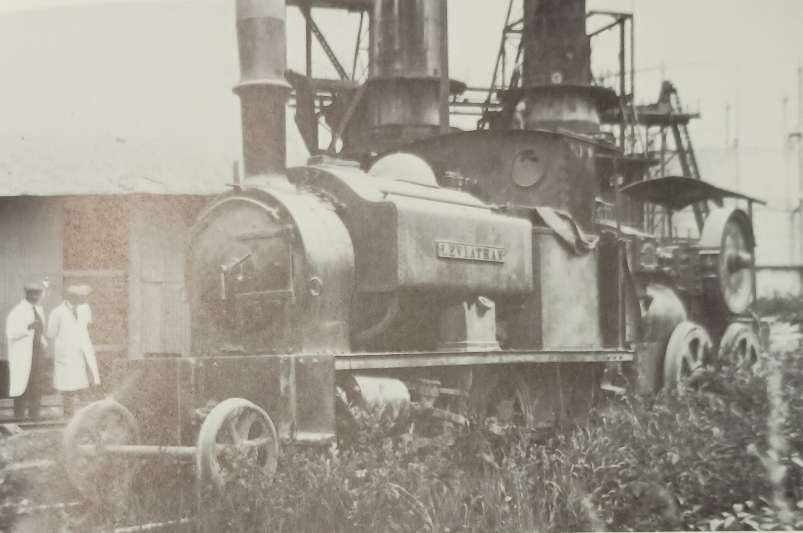
Goliath – 0-4-0ST built in 1921 by Barclay, Works No. 1741, outside cylinders (12″ x 20″), ???? wheels.
New Elephant – 0-4-0ST built in 1924 by Bagnall, Works No. 2258, outside cylinders (10″ x 15″), 2′ 9.25″ wheels.
In 1927, with standard-gauge track now in place, new locomotives were required: [1: p30]
Stone – 0-4-0ST built in 1927 by Peckett, Works No. 1740, outside cylinders (14″ x 22″), 3′ 2.5″ wheels.
Darenth – 0-4-0ST built in 1927 by Peckett, Works No. 1741, outside cylinders (14″ x 22″), 3′ 2.5″ wheels.
Greenhithe – 0-4-0ST built in 1927 by Peckett, Works No. 1742, outside cylinders (14″ x 22″), 3′ 2.5″ wheels.
Southfleet – 0-4-0ST built in 1928 by Peckett, Works No. 1746, outside cylinders (14″ x 22″), 3′ 2.5″ wheels.
Longfield – 0-4-0ST built in 1928 by Peckett, Works No. 1747, outside cylinders (14″ x 22″), 3′ 2.5″ wheels.
The first three were supplied with low cabs and boiler mountings, so as to clear the tunnels, being classified as ‘Type W 6 Special’ by Peckett. The last two Pecketts were not cut down when delivered. They were however rebuilt at the works many years later to a similarly reduced height.
“In addition to these new locomotives the narrow gauge locomotives Goliath and New Elephant were rebuilt to 4ft 8½ in. gauge in 1927 by the makers and by the cement works respectively, and the following were transferred from other works:” [1: p30]
New Globe – 0-4-0ST, built in 1901 by Peckett, Works No. 889, outside cylinders (14″ x 22″) and 2′ 6.5″ wheels, from Globe Whiting Co., Greenhithe in 1929.
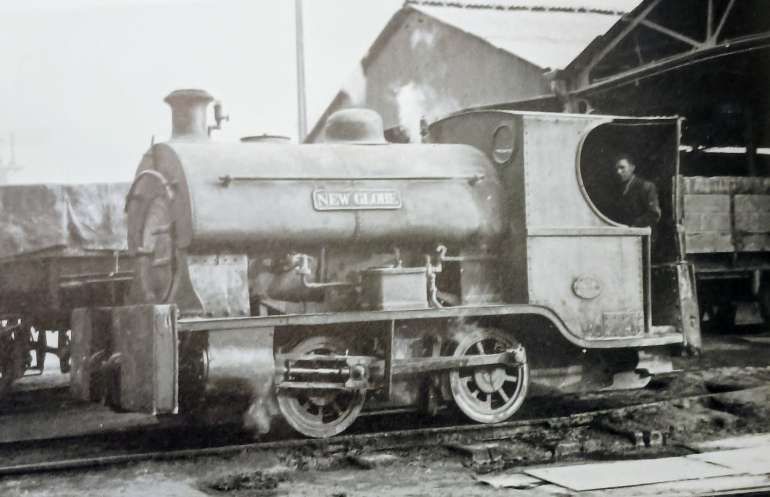
Globe No. 3 – 0-4-0ST, built in 1901 by Peckett, Works No. 925, outside cylinders (8″ x 12″) and 2′ 3″ wheels, from Globe Whiting Co., Greenhithe in 1930.
Thames – 0-4-0ST, built in 1899 by Bagnall, Works No. 1588, Outside cylinders (12″ x 18″) and 3′ 0.5″ wheels, from Trechmann & Weekes Works, Halling in 1935 (regauged from 4 ft 2 in.)
Stoyel & Kidner tell us that, “Johnsons clay-pit at Bean was worked by two Simplex petrol engines and two Planet diesels; later by five Rustons diesels (175137, 182147, 194769, 195850/1); however they were often switched to other works and not always on site.” [1: p30]
“Of the narrow gauge engines, Elephant and Samson had disappeared by 1932, the Aveling was scrapped in 1934 and Clinker, Mammoth and Leviathan a year or two afterwards. Cement was not scrapped until after the war, although it had been derelict since 1927.” [1: p30,36]
Stoyel & Kidner tell us that “The standard gauge locomotives gradually became redundant during the post-war period until completely superseded by diesel locomotives. They [were] accordingly … hired or loaned out to other works, or otherwise disposed of, as follows:” [1: p36]
Stone: Transferred to Frindsbury Works in 1962.
Darenth: Hired to Purfleet Wharf & Saw Mills Ltd in 1940-1945. Loaned to Kent Works, Stone, in 1947. Scrapped in 1963.
Greenhithe: Hired to Samuel Williams & Son Ltd, Dagenham Dock, in 1945. Transferred to Hessle Quarry, Yorkshire, in 1962.
Southfleet: Transferred to Frindsbury Works in 1960.
Longfield: Transferred to Holborough Works in 1960.
Goliath: Transferred to Grays Works in 1960.
New Elephant: Scrapped in 1960.
New Globe: Scrapped in 1960.
Globe No. 3: Scrapped in 1948.
Thames: Disappeared some time after the last war, no doubt scrapped: the cab and saddle tank were still visible in March 1952.
Additionally, Stoyel & Kidner tell us that one other locomotive spent time at Johnson’s in 1942 having come from the APCM chalk pit at Highsted, before being loaned to their Dunstable Works. In 1946, it returned to Greenhithe and in 1947 was returned to Highsted. This locomotive was:
Tay: an 0-4-0ST built in 1924 by Barclay, Works No. 1828, outside cylinders (12″ x 20″) and with 3′ 2″ wheels. [1: p36]
References
- B. D. Stoyel & R. W. Kinder; The Cement Railways of Kent; Oakwood Press, Headington, Oxford, 1973, 1990.
- Andrew Neale; Industrial Railways of the South-East; Middleton Press, Midhurst, West Sussex, 1984.
- https://maps.nls.uk/view/101428083, accessed on 20th August 2026.
- https://maps.nls.uk/geo/explore/#zoom=17.0&lat=51.45402&lon=0.27470&layers=6&b=ESRIWorld&o=0, accessed on 20th August 2026.
- https://maps.nls.uk/geo/explore/#zoom=19.0&lat=51.45119&lon=0.27431&layers=6&b=ESRIWorld&o=0, accessed on 20th August 2026.
- https://maps.nls.uk/geo/explore/#zoom=17.0&lat=51.44780&lon=0.27553&layers=6&b=ESRIWorld&o=0, accessed on 20th August 2026.
- https://maps.nls.uk/view/101428077, accessed on 20th August 2026.

