
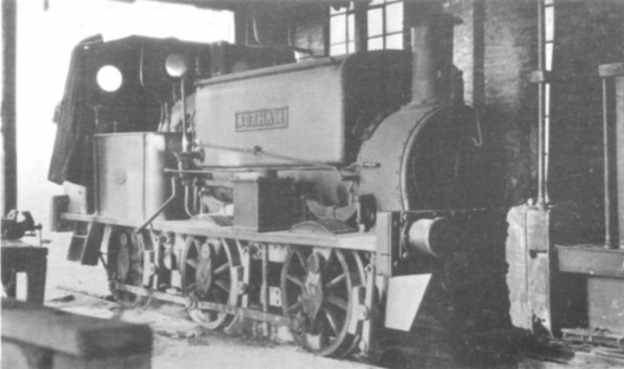
The featured image for this article is a photograph taken by F. Jones of ‘Burham’, a Manning Wardle 0-6-0ST built in 1879 (Works No. 730) came from APCM Burham Works, Aylesford in 1937 and was returned to Burham in 1938 [15: p55], scrapped in September 1952. [6] This photograph was taken at the Crown & Quarry Works and must therefore be dated in 1938. An internet search to check copyright suggests that many of F. Jones photographs are now treated as Public Domain.
Much of this article is based on work undertaken by Chris Down and published in the Industrial Railway Record, Issue 16, published in 1967 and available in the Industrial Railway Society archive. [6]
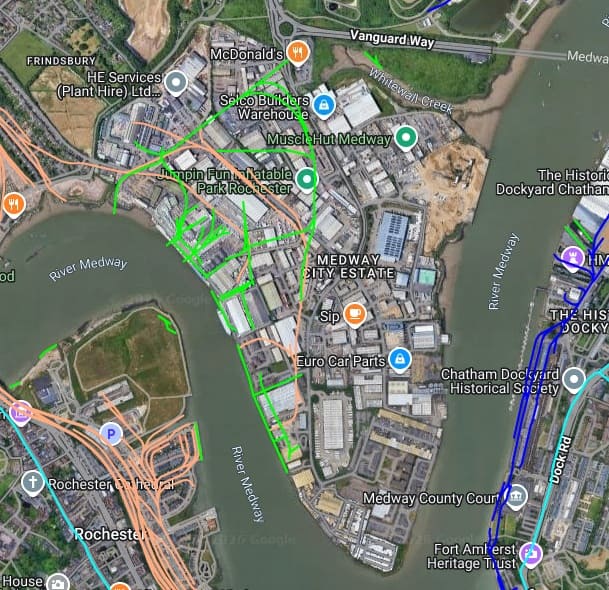
To the East of the Peninsula were the Whitewall Cement Works. ….
Whitewall Cement Works – South of the southern end of the Lodge Hill & Upnor Railway was the Whitewall Cement Works which were owned by the Formby Brothers and which were active between 1862 and 1907. After 1907 two attempts were made to resuscitate these works – Whitewall Portland Cement Co. Led. (1914) and Medway Standard Portland Cement Co. Ltd. (1915). Neither company ever traded. Robin Waywell tells us that “the site occupied an area of about 24 acres with the works divided into two plants, No. 1 plant contained a pair of 130hp compound condensing engines and two Lancashire boilers, driving crushing & grinding machinery and had seven bottle and two chamber kilns. No.2 plant contained a pair of 130hp Tangye engines, two Lancashire boilers, driving crushing & grinding machinery and nine bottle and four chamber kilns. The wash mill, slurry mixer and pumps were powered by a 90hp horizontal tandem engine. There was a wharf with a frontage of 750ft with tramways and three 3ton traveling loco cranes for loading & unloading barges. The Whitewall site was very inaccessible and used solely water transport. After World War 2 the plant was demolished and the site cleared it is now partly waste ground.” [5: p388]
Chris Down wrote in the 1960s that, “Formby’s Whitewall Cement Works (closed 1909; auctioned 23rd July 1909) whose derelict site can still be examined; … never had a tramway and, after a 50ft deep overburden of Thanet Sand proved too much for quarrying, the works had chalk barged down from Halling. It was at this time that [a] proposal was put forward to extend [William] Ball’s quarry lines to Whitewall, via [a] new tunnel.” [6]
Down’s mention of William Ball means that it is worth noting the various arrangements which were made and broken over the supply of chalk to the cement works on the peninsula.
Down said in his article, that, “With so much industry within ⅜ mile of the river front, it might be expected that disputes arose. The few that did, however, were due to the complicated arrangements for chalk supply that existed and plagued the area for much of its life.” [6]
Chalk supplies for the Cement Works
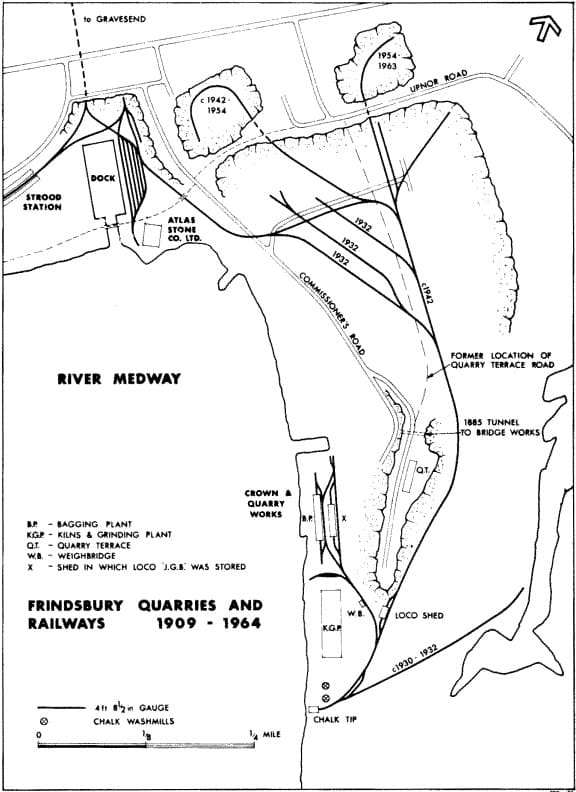
The various Cement Works which developed on the West side of the Frindsbury Peninsula (Limehouse Reach) are listed below the hand-drawn map below.
William Tingey opened the Crown Cement Works in around 1851 and held something of a monopoly on the supply of chalk to the other Cement Works. Down says that, Tingey, who controlled physical access to the works, “specified that the works should obtain their chalk from him. He performed his own quarrying in the area of his works and later, when this was exhausted, took to barging chalk down from his Wouldham Quarries (the Rochester Chalk Co. Ltd.), a few miles up−river. But the lessors of the land (the Ecclesiastical Commissioners) seem to have appointed a common quarrier, doubtless imagining that this would be a more efficient arrangement than for the individual owners to quarry themselves.” [6]
By 1863, John Cole, appointed by the Ecclesiastical Commissioners was quarrying on their land and offering chalk to the nearby works.
It seems that Phoenix Cement Works soon broke the terms of its lease and took chalk from Cole. In 1878, Cole died and was succeeded by William Ball; “on 30th December 1879 the Ecclesiastical Commissioners agreed to rent the land to Ball for an annual rental of £100 plus 5d per ton on the chalk quarried. As other works were put up, the complaints grew in number, both about the restrictions imposed by Tingey … and about the chalk prices charged by Ball. It does seem fairly certain that Ball was trying to some extent to drive the manufacturers out of business. He could then put up his own works and manufacture at a much lower cost. But for the depression of the industry in general, and the formation of A.P.C.M. (1900) Ltd., he might even have succeeded.” [6]
Down wrote that, “Ball supplied Phoenix, Globe, Quarry, Beehive and Beaver exclusively and Bridge probably in part. Tingey supplied himself and Bridge, but these arrangements probably altered according to local animosity at the time. At various times, Ball cut off chalk supplies for a number of reasons that were more or less contrived with the object of demonstration his power; equally often, the manufacturers threatened to obtain chalk from up−river quarries unless Ball reduced his prices. Small wonder that the industry was in such a bad state at the end of the century.” [6]
Crown & Quarry Cement Works were on the western shore of the Frindsbury Peninsula. … The Frindsbury Peninsula was South of Upnor and the Whitewall Works. It was rail-served. The schematic map below was included in the article written by Chris Down in Issue 16 of the Industrial Railway Record in 1967. [6] This map shows the Cement Works and their railways prior to their absorption into
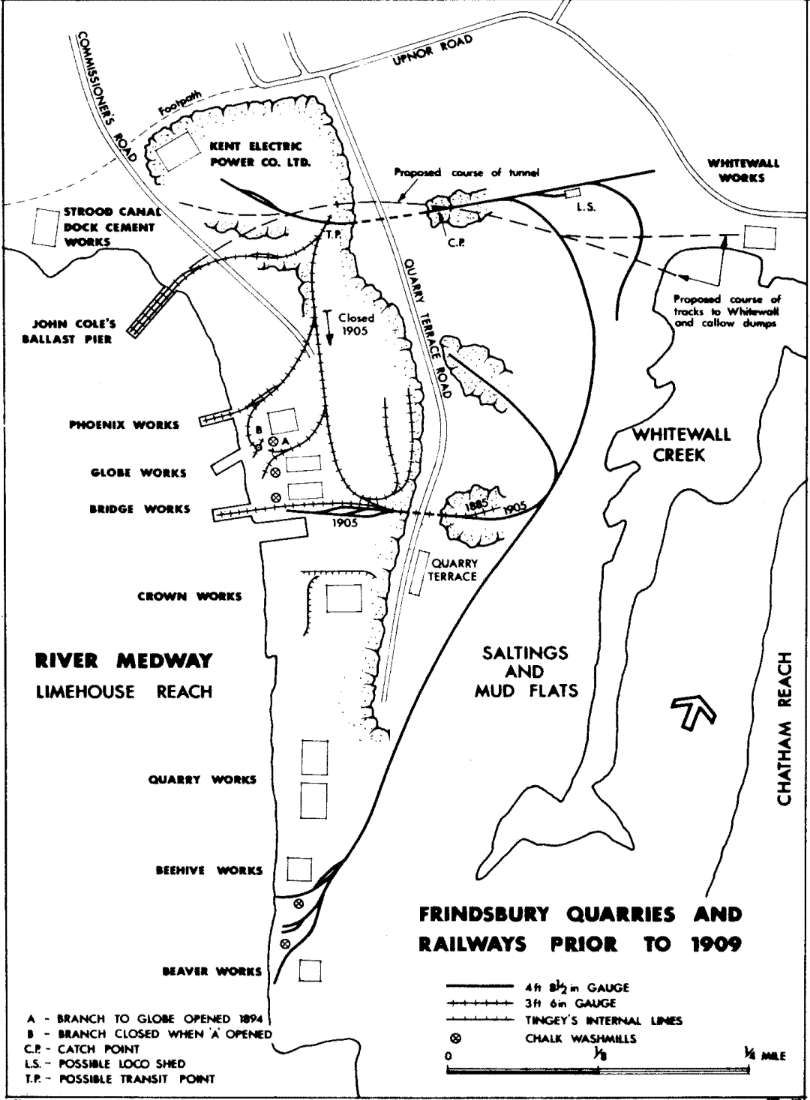
A series on seven different cement works were present on the peninsula and all seven became part of the APCM (1900) Ltd.: [5: p54]
- Crown Works (Established ~1851): Founded by William Tingey & Son, operating long-term before merging into Blue Circle operations that lasted until 1963. [6]
- Phoenix Works (Started 1877): Established by George Burge, closing by 1907. [6]
- Globe Works (1880): Established as a cement and whiting facility, later absorbed and closed in 1901.
- Bridge Works (1886): Operated by TC Hooman & Co. between the Globe and Crown sites. [6]
- Quarry Works (1889): Established in 1889 by William Tingey’s mineral and chalk mining operations. Independent operations largely ceased around November 1907. [6]
- Beaver Works (1884): The plant was built around 1884 by Burge (or established in 1885). In 1897, the Beaver Cement Works merged with the neighbouring Beehive Cement Works, driven by an acquisition by the Gillingham Portland Cement Company. It eventually became part of the combined Crown & Quarry works through the 1930s. [8]
- Beehive Works (1890): In 1897, the Works merged with the Beaver Cement Company Works following the latter’s acquisition by the Gillingham Portland Cement Company. [9]
Dylan Moore provides another map of the peninsula which further clarifies the locations of the different Works which can be found here. [7]
As we have already noted, Chalk for the various works came from pits on land owned by the Ecclesiastical Commissioners and from Crown Works own quarry. Chalk quarrying ceased in December 1962, and Crown Works closed in March 1963. The works was rail connected to the North Kent line adjacent to Strood Dock. … An inventory of 1924 listed 1.25 miles of 4ft 8.5in permanent way, with two geared locomotives and 64, 3 ton, chalk wagons. [5: p54]
The earliest railways on the Peninsula were probably 3ft 6in gauge tramways associated with Phoenix Cement Works. These were short horse-worked tramways owned by Joseph Cole. Down has a drawing of these tramways:
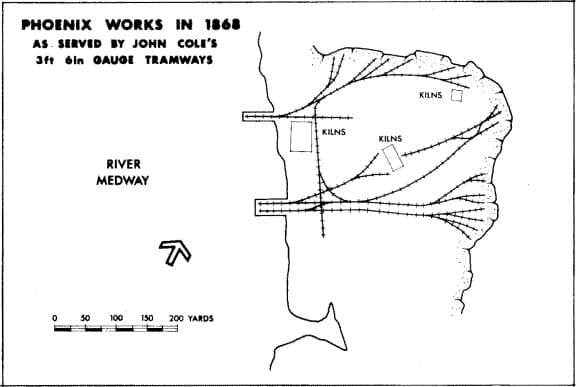
The 3ft 6in gauge tramways at Phoenix Works in 1868. It appears that these lines may well have been traced from the Ordnance Survey Sheet (below). These immediately local tramways were no longer present by the end of the 19th century, (c) Chris Down. [6]
The National Library of Scotland (NLS) does not have the earliest 25″ Ordnance Survey for the Peninsula (that published in 1869) on its website. The first image below is an extract from the 6″ Ordnance Survey of 1863-1865, published in 1869. Cole’s tramways appear on this map extract inn association with Frindsbury Lime Works.
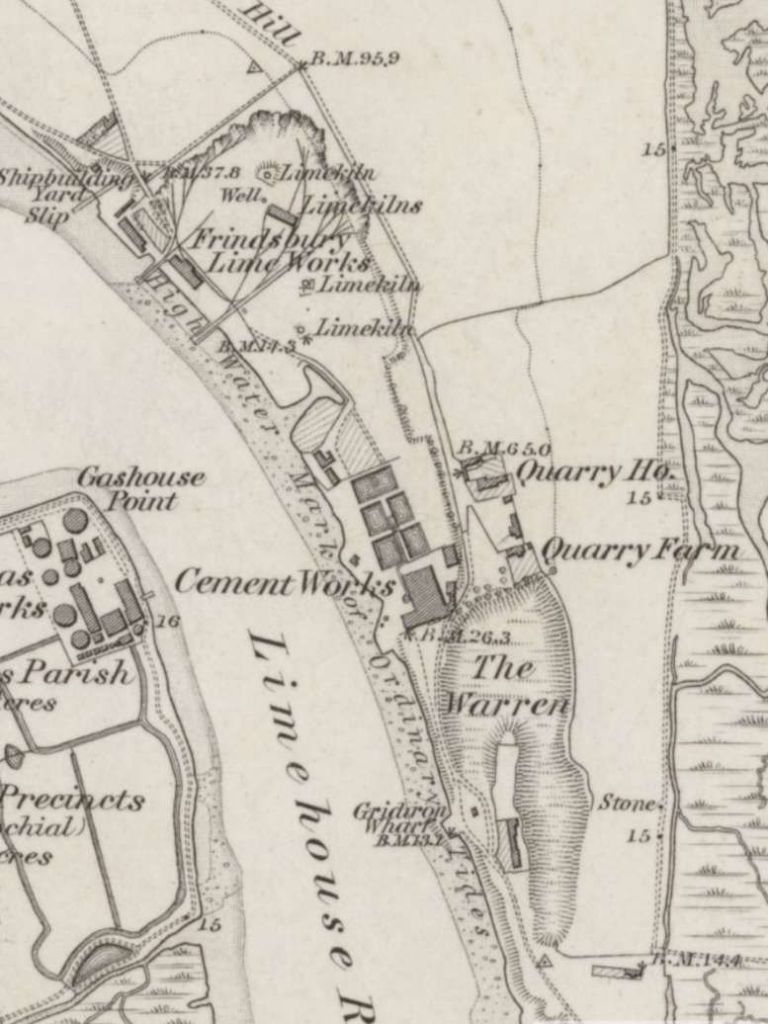
At the end of 1879, Cole was succeeded by William Ball, whose tenancy was renegotiated on a yearly basis. Ball extended Cole’s tramways a little – “to serve the newly erected Globe Works and Bridge Works (reached by a tunnel carrying 3ft 6in gauge rails under Quarry Terrace Road constructed in 1885, the cost being paid by the Ecclesiastical Commissioners).” [6]
Ball sought greater security of tenure in the form of a longer lease. This was resisted for a number of years by the Ecclesiastical Commissioners refused permission for a number of years.
In 1884, Ball was asked to drive a tunnel under Quarry Terrace Road to accommodate a standard-gauge rail line, so that Ball could quarry on the eastern side of the hill and also to allow him to dump arisings on the marshy areas/saltings to the East. The tunnel was around 700ft long and with an adverse 1 in 75 gradient to eastbound trains, and then dropping them at 1 in 200 down to the saltings. By 20th July 1886, the tunnel was finished except for fencing and Ball was paid £1,575 for doing the job. [6]
Down tell us that, “The tunnel immediately opened up new fields of supply for Ball. Within a few years, the standard gauge was extended south to serve the new quarry, Beehive and Beaver Works. While there was probably a transhipment point whereby chalk was tipped into the 3ft 6in gauge wagons (wooden side-tippers holding 55 cwts) serving Phoenix and Globe. Bridge, via its own tunnel, had 3ft 6in gauge quarry lines of its own.” [6]
Down continues: “Soon after completion of the tunnel in 1886, Ball asked for a long lease to enable increased expenditure on locomotives, wagons and tramways, while in June 1890, a review of Ball’s operations stated that he owned three or four steam engines, wagons, tramways, horses and buildings valued at £7,000. … Quite possibly these steam engines were stationary, for Aveling & Porter, the most likely suppliers of locomotives … have no record of deliveries at this time. (Two locomotives, of unknown gauge however, were delivered to I. Ball (Ball’s predecessor?), one in 1868 and the other (named BURNT OAK) in 1869. These were of six and ten nominal horsepower respectively, and were probably used on a coal wharf at Gillingham but may have been transferred to Frindsbury at a later date.)” [6]
On 25th March 1892, Ball was finally granted a long lease. His first locomotive, named ‘Alderman‘, despatched from Aveling & Porter’s Rochester Works on 23rd October 1893 (Works No. 3277, type TC 10), it was a standard gauge 10hp two-cylinder compound 2−2−0 of the traction engine type. … ; the cylinders were 7in (high pressure) and 11½in (low pressure) bore with a common stroke of 12in. ‘Sabina‘, a larger 2−2−0 compound of 20hp and of type TCG, followed on 21st December 1898 (Works number 4248). It was also a standard-gauge locomotive. [6]
Down tells us that, “A plan dated 4th February 1891, shows the layout of the 3ft 6in gauge lines. One branch served Phoenix and another, running between Phoenix and Globe served the latter. Another line went off to serve Bridge. In 1894, the branch to Phoenix was probably abandoned and the line to Globe extended to serve both works.” [6] These tramways are shown on Down’s hand-drawn map of the railway sup to 1909, above.
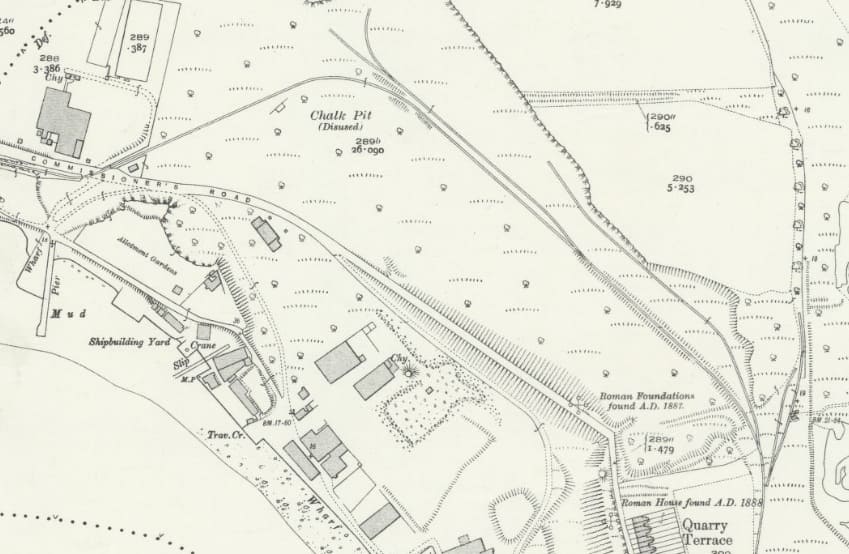
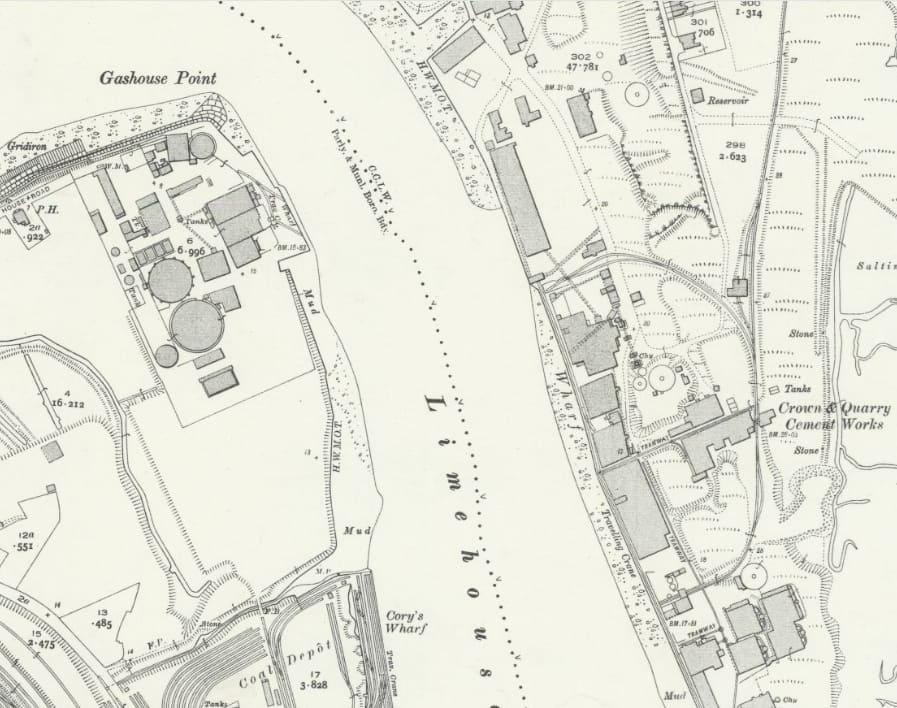
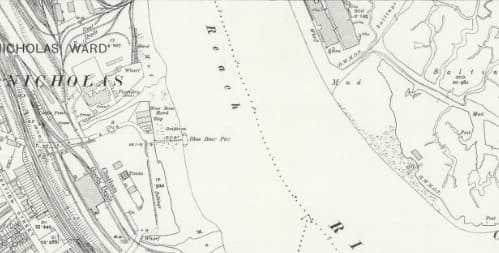
The earliest available 25″ Ordnance Survey mapping was surveyed in 1895/1896 and published in 1898. A sequence of extracts from that survey appears below.
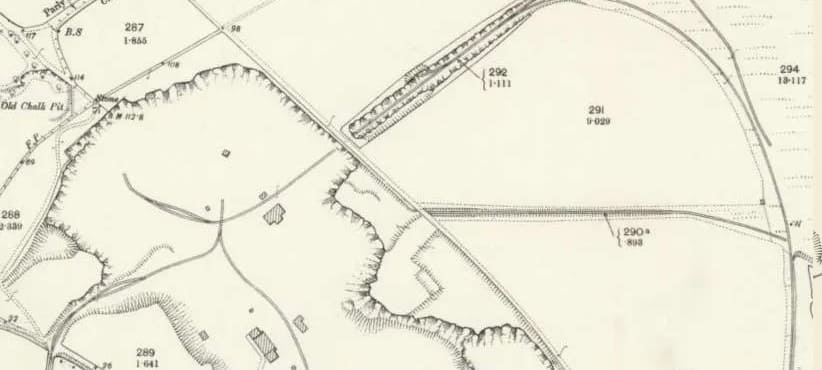
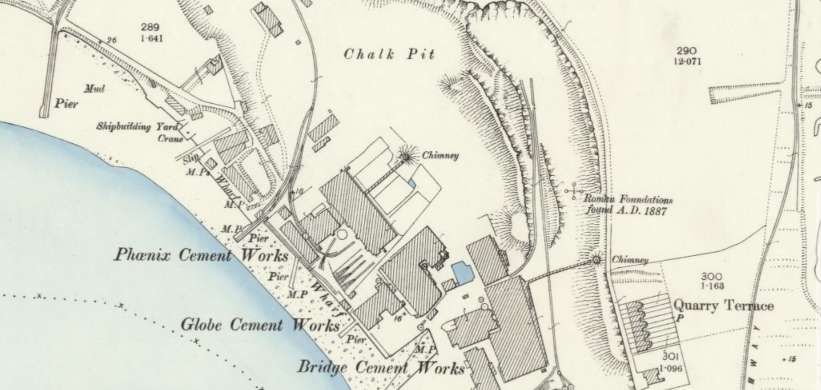
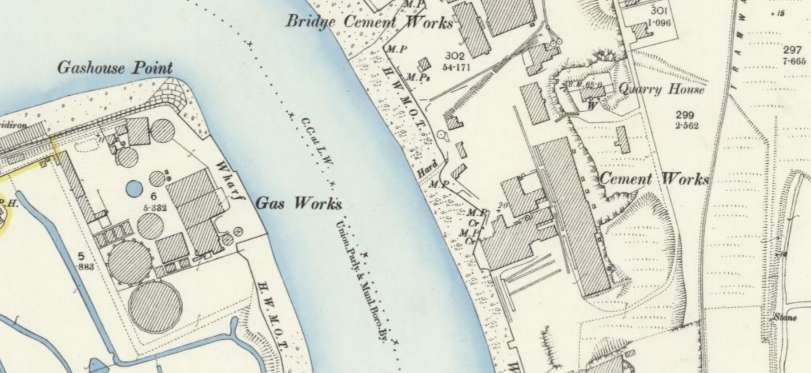
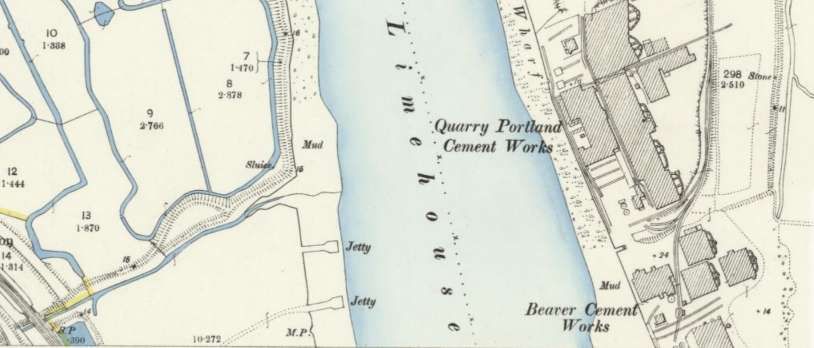
Down tells us that, “After the APCM takeover in 1900, Ball seems to have continued quarrying much as usual, although there was not the same demand for chalk due to partial closure of some of the works. In 1905, he widened the tunnel to Bridge Works so as to take the standard gauge track from the eastern line. This was to meet APCM’s chalk requirements and cost £135 0s 6d. … It would seem that by 1905, … the 3ft 6in gauge had ceased to be operative, except perhaps the lines to Cole’s and Phoenix Works’s piers. On 3rd December 1909, it was stated that no cement was being made, and this seems to have been the case for three years. APCM had taken to barging down chalk from Halling when any cement was to be made, and Ball’s quarries were inactive. In November 1915, Ball’s lease expired and APCM took over quarrying rights.” [6]
This next series of map extracts come from the 25″ Ordnance Survey of 1907, published in 1909. Significant proportions of the tramway network were converted to standard-gauge. Down shows these on his hand-drawn map of the Cement Works and Quarries for the period up to 1909, which can be found earlier in this article. …
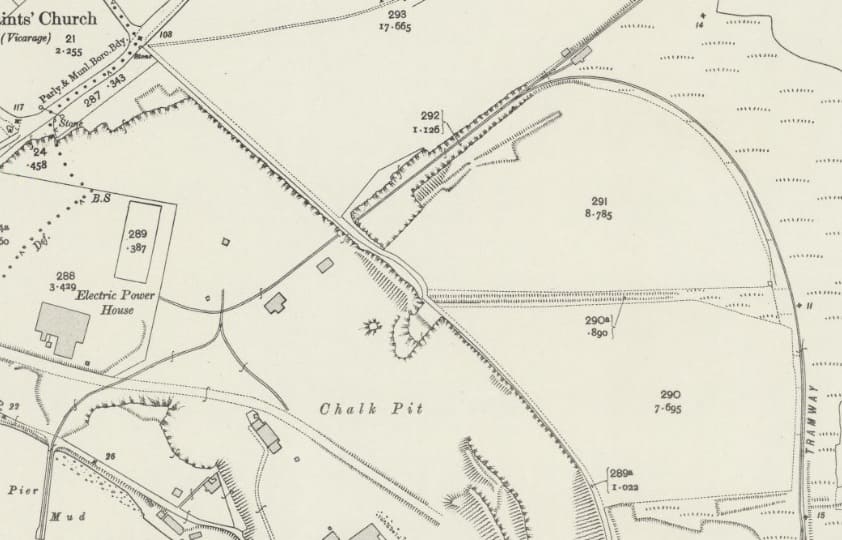
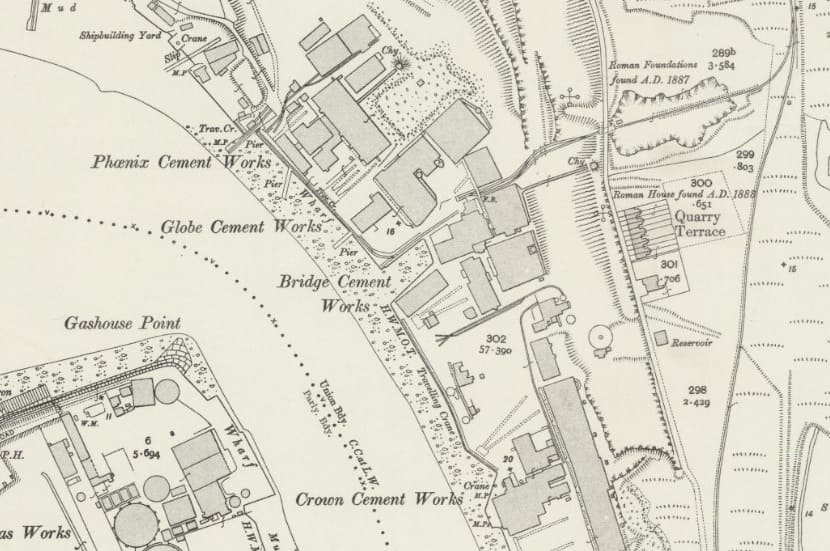
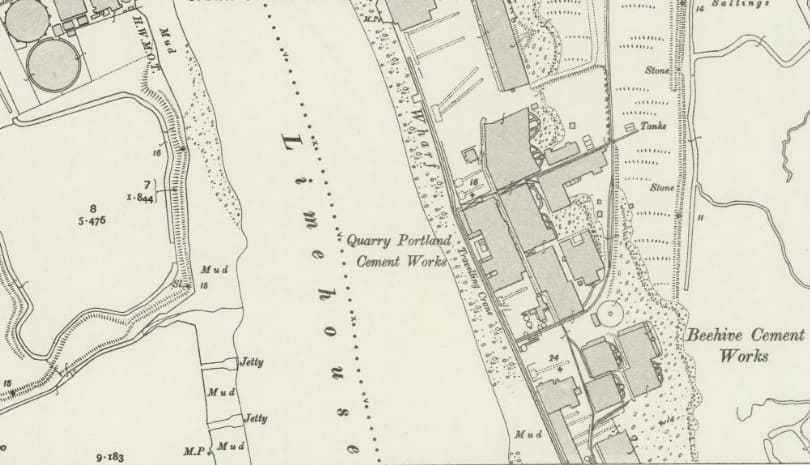
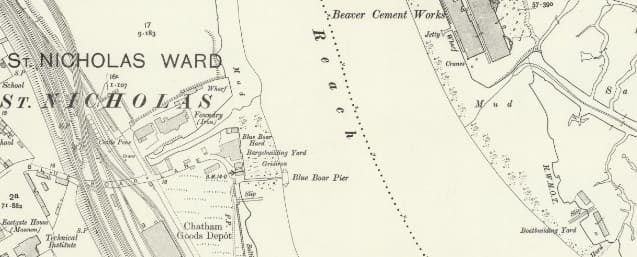
We know that at the turn of the 20th century, all of the cement works on the Frindsbury Peninsula came under the control of the APCM (1900) Ltd. Inevitably there was some rationalisation of operations on the Peninsula. A single operation was formed out of the different Works along the West side of the Peninsula and that new entity was called the ‘Crown & Quarry Cement Works’.
The next ‘snapshot’ that we have of the Peninsula and its railways/tramways is that provided by the 25″ Ordnance Survey of 1932/1933, published in 1935. …
From 1900, APCM had control of the Peninsula. Waywell provides lists of the locomotives used by APCM on the standard-gauge lines on the peninsula. His list relies on work undertaken by Down. [13: p54-55][6]
Locomotives in use at the Crown & Quarry Works
Earlier in this article we have noted two Aveling & Porter Locomotives (owned by William Ball) that worked on the standard gauge lines on the Frindsbury Peninsula in the later years of the 19th century and the early years of the 20th century. There were:
- Alderman – an Aveling & Porter 2-2-0TG locomotive built in 1893 (Works No. 3277)
- Sabina – a second Aveling & Porter 2-2-0TG locomotive built in 1898 (Works No. 4248)
Both of these locomotives spent their whole life on the Frindsbury Peninsula. [6]
After the turn of the 20th century, APCM used a series of locomotives on the Peninsula. These were:
- Unnamed – an Aveling & Porter 2-2-0TG built in 1879 (Works No. 1524) came from Booth’s Works Borstal circa. 1928 and scrapped on site in 1930. [13: p54][6]
- Stuart – No. 7 – an Andrew Barclay 0-4-0ST built in 1890 (Works No. 681). [13: p54-55]
- Unnamed – a Dick, Kerr 0-4-0ST built in 1890 which came from Hilton, Anderson Brook’s Works in Grays, Essex and which went to the BPCM Hilton Manor Works, circa 1930. [13: p54-55]
- Leopard – a Falcon Engine Works 0-4-0ST built in 1896 (Works No. 239) came from BPCM Tolhurst’s Works circa. 1921 and was scrapped circa. 1930. [13: p54-55]
- Kappa – a Chapman & Furneaux 0-4-0ST built in 1898 (Works No. 1164) came from APCM Burham Works, Aylesford and was sent to to APCM Swanscombe Works, June 1931. [13: p55][6]
- George – a Peckett 0-4-0ST built in 1899 (Works No. 759) came from Bevan’s Works, Northfleet in 1934 and was scrapped by A. Arnold of Chatham, September 1960. [13: p55][6]
- J. G. B. – an Avonside 0-4-0ST built in 1821 (Works No. 1874) came from Thos. W. Ward Ltd., Grays, Essex and was scrapped in August 1964. [13: p55][6]
- Killarney – a Hudswell Clarke 0-6-0ST built in 1902 (Works No. 611) came from APCM Burham Works, Aylesford in 1934 and was returned in the same year. [13: p55][6]
- Burham – a Manning Wardle 0-6-0ST built in 1879 (Works No. 730) came from APCM Burham Works, Aylesford in 1937 and was returned to Burham in 1938 [15: p55], scrapped in September 1952. [6]
- C. F. S. – a Stephenson Hawthorns 0-4-0ST built in 1952 (Works No. 7742) bought new and sent to Holborough Works on loan in 1954, returned from loan by October 1954, then sent to Alpha Cement Ltd., Shipton-on-Cherwell, Oxon, circa 1963. [13: p55][6]
- Southfleet – a Peckett 0-4-0ST built in 1928 (Works No. 1746) came from BPCM Johnson’s Branch, Greenhithe, in August 1960 and sent to to Thurrock Chalk & Whiting Co. Ltd., Essex, in June 1964. [13: p55][6]
- Stone – a Peckett 0-4-0ST built in 1927 (Works No. 1740) came from BPCM Johnson’s Branch, Greenhithe, in November 1962 and sent to APCM Holborough Works, Snodland, circa 1963. [13: p55][6]
- Longfield – a Peckett 0-4-0ST built in 1928 (Works No. 1747) came on loan from APCM Holborough Quarry, Snodland, in 1962 and returned later in the same year. [13: p55][6]
Chris Downs concludes in the 1960s: “Crown & Quarry Works was closed and tracklifting in the quarry began on 18th April 1963, the navvies being removed by 10th May. Some locomotives were still in use at this time, though, and there were four locomotives in all at the works. ‘J.G.B.‘ was partly dismantled in a shed near the bagging plant, and had been so for a number of months; officially it had been for repair, but this was never carried out. Of the others, ‘Stone‘ … was somewhat out of favour due to badly worn tyres. ‘Southfleet‘ … was in regular use. ‘C.F.S.‘, … was also a regular worker. … By the summer of 1964, the only locomotive left was ‘J.G.B.‘ In August it was towed out of the shed and cut up. Tracklifting was begun in October, being carried out by two men who professed to be self-employed. By 2nd November, the track had been lifted as far as the level crossing, the rails being burned into short lengths and loaded into a small van. The only remaining piece of railway equipment (within the works, on track embedded in concrete) was a wagon frame and wheels loaded with a crane jib.” [6]
References
- https://maps.nls.uk/view/103677173, accessed on 27th October 2026
- https://maps.nls.uk/view/266663224, accessed on 27th October 2026
- https://maps.nls.uk/view/103677170, accessed on 27th October 2026.
- https://maps.nls.uk/view/103677209, accessed on 27th October 2026.
- Robin Waywell; Industrial Railways and Locomotives of Kent; Industrial Railway Society, 2016.
- C. G. Down; Frindsbury Cement Works; in The Industrial Railway Record, Issue No. 16, 1967, p132-143 & p156; via https://shop.irsociety.co.uk/Archives/16/Frindsbury.htm, accessed on 22nd September 2026.
- https://www.cementkilns.co.uk/images/1907_det.jpg, accessed on 22nd September 2026.
- https://heritage.kent.gov.uk/Monument/MKE17074, accessed on 27th October 2026.
- https://heritage.kent.gov.uk/Monument/MKE17076, accessed on 27th October 2026.
- https://maps.nls.uk/view/103677167, accessed on 27th October 2026.
- https://maps.nls.uk/view/103677206, accessed on 27th October 2026.
- https://railmaponline.com/uk-and-irish-railways, accessed on 27th October 2026.
- Robin Waywell; Industrial Railways and Locomotives of Kent; Industrial Railway Society, 2016.


