Category Archives: Magazines

The Modern Tramway – July 1951 – Pittsburgh: An American Tramway Stronghold

The Modern Tramway of July 1951 included an article by A. A. Jackson about the tramways of Pittsburgh. [1]

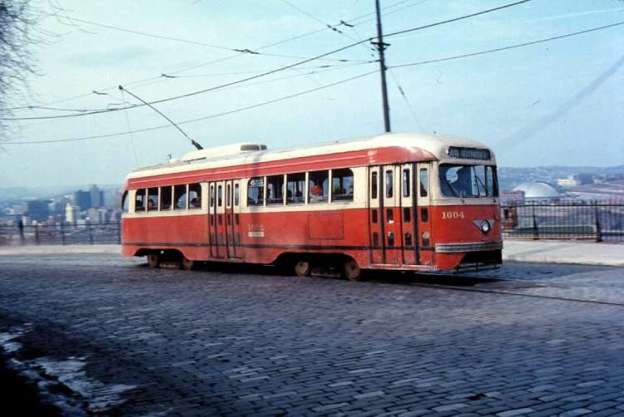
The featured image for this article is a vintage Presidents’ Conference Committee (P.C.C.) tramcar- No. 1604. It is from the 1600 series of P.C.C. cars, operated by Pittsburgh Railways and is pictured on Line 49 bound for Beltzhoover. This photograph was taken during the 1970s, © Voogd075 and licenced for reuse under a Creative Commons licence (CC BY-SA 3.0). [2]

Pittsburgh is situated at the point where the Allegheny and Monongahela rivers converge to become the  River Ohio, historically it is the most important Iron and Steel Centre in the United States.

Jackson wrote:

“It is also one of the greatest American Tramway strongholds. The present population of the city is just under 674,000 and the surrounding industrial area is densely peopled.

Public transport began in 1859, when the first horse cars ran, and up till 1902 there were a large number of competing tramway companies. In that year, these companies were brought together under the Pittsburgh Railways Company, which is still the operator today [(late ,1950)]. There are now 1,187 trams, 666 of them being P.C.C. cars. There are over 542 miles of 5ft. 2 in. gauge track. This network of 79 routes sprawls over the whole urban and suburban area, serving more than 50 communities from Sewickley in the west to Trafford and Pitcairn in the east and from Aspinwall and Etna in the north to Washington and Charleroi in the south. These latter two places are about 28 and 20 miles respectively from the centre of the city and the tramway routes serving them are of interurban character. The Charleroi line actually runs beyond that town to a point further south in the borough of Roscoe. It has a branch to Donora and California. Half-hourly service is provided on these two interurban lines.

“Many of the suburban routes have private right-of-way and reserved track.” [1: p160]

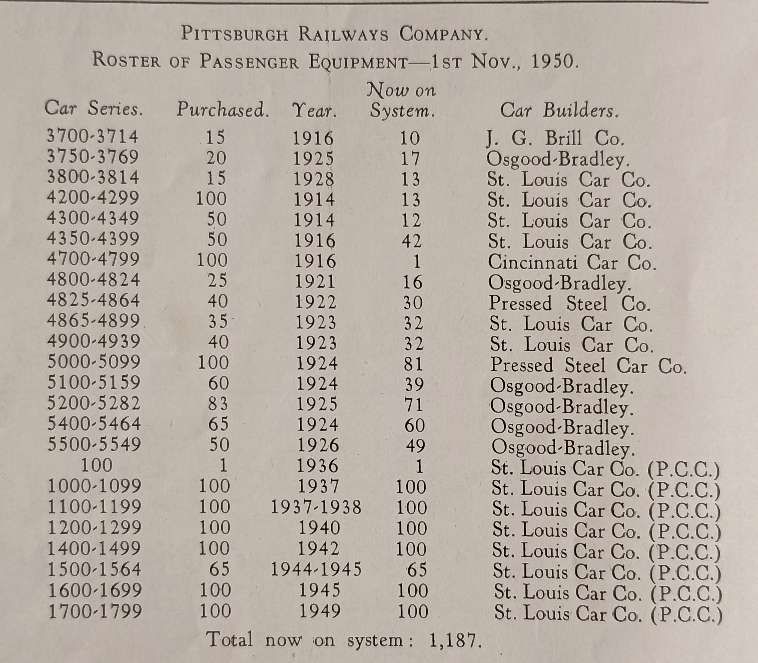
The tram fleet owned by the Pittsburgh Railway Company. [1: p160]
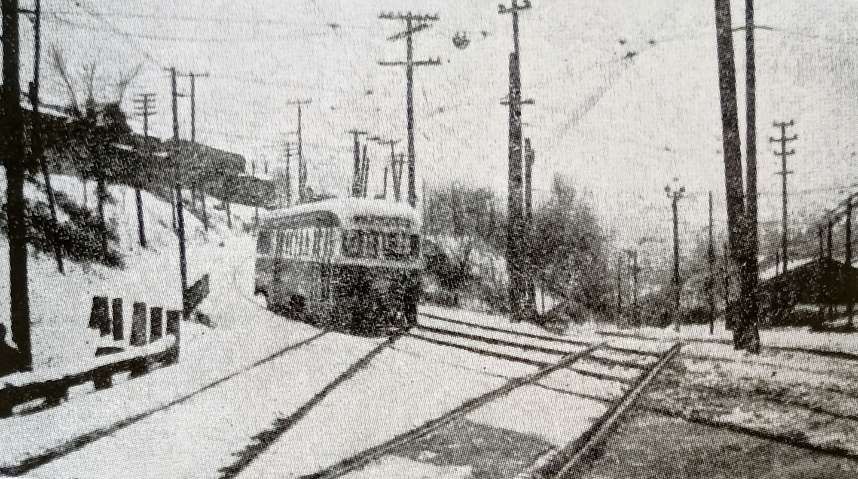
South Hills Junction, with P.C.C. car on service 37, © Public Domain. [1: p162]

“All tram services are designated by numbers (1 to 99, with gaps) and by names which usually indicate the district served or the principal street the route traverses, All-night cars operate in most districts between 1 a.m. and 5 a.m. “Car Stop” discs are attached to the overhead wire and at heavy loading points where more than one car loads at the same time, special signs are placed on the overhead wires reading: ‘First Car’, ‘Second Car’ and, in some cases, ‘Third Car’.

“The first P.C.C. car arrived on 26th July, 1936, and the remainder were delivered (all from the St. Louis Car Co.) as follows: 1937 (175 cars), 1938 (25 cars), 1940 (100 cars), 1942 (100 cars), 1944 (50 cars), 1945 (115 cars), 1948 (100 cars). Included in the 1945 batch was No. 1600, the first standard 1945 model all-electric, standee-window P.C.C. car to be produced. It was included as a sample model by agreement. (All subsequent P.C.C. cars ordered after 1945 were standardized to that design (with ceiling fans and monitor roof optional) replacing the electric-air operated, non-standee window P.C.C. design originating in 1935).” [1: p162]

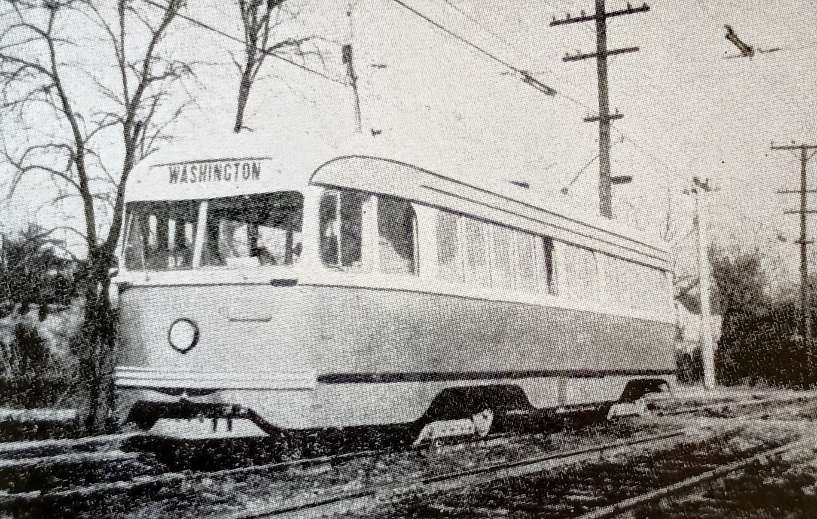
Interurban P.C.C. car No. 1613 at Cannonsburg, © Public Domain. [1: p162]

“Thirty-seven of the P.C.C. cars have been modified for interurban operation on the Washington and Charleroi lines. These modifications include replacing Clark B-2 trucks with St. Louis B-3 trucks, replacing H-B. lifeguard fenders with ‘cow-catchers’, provision of sirens, cash registers and an emergency tool kit over the windows ahead of the centre doors. The cars are also equipped with baggage racks. Some of the interurban P.C.C. cars are also equipped with radio telephones. Pittsburgh is the only system using single-ended, single-unit P.C.C. cars in long distance interurban service and the only system to use all-electric cars on this type of service. All Pittsburgh’s P.C.C. cars are one-man operated, with front entrance (P.A.Y.E.) and centre exit.” [1: p162-163]

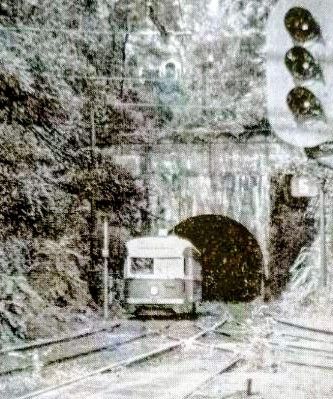
Tram No. 1614, emerging from the tunnel at South Hills Junction, running outbound from Pittsburgh to Washington Pa.) on the inter-urban route. This junction carries 6 city and 2 inter-urban services, all operated by PCC. cars. [1: p163]

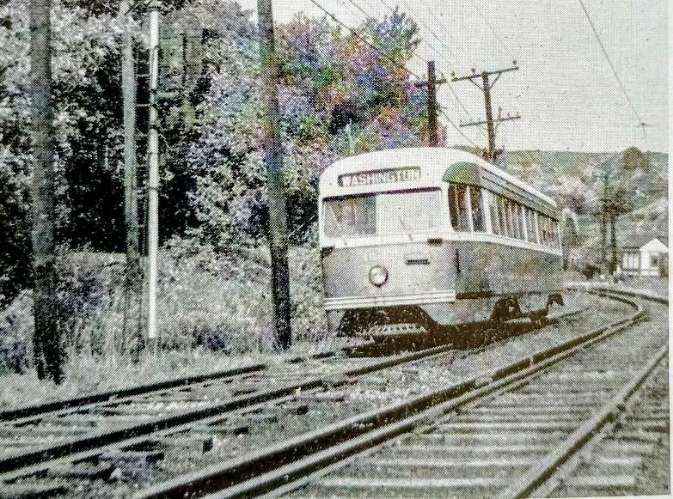
Tram No. 1647 outbound from Washington Junction to Washington (Pa.). This tramcar is one of 12 specially equipped for inter-urban service with type B3 trucks, siren, emergency tool kit and cash register. [1: p163]

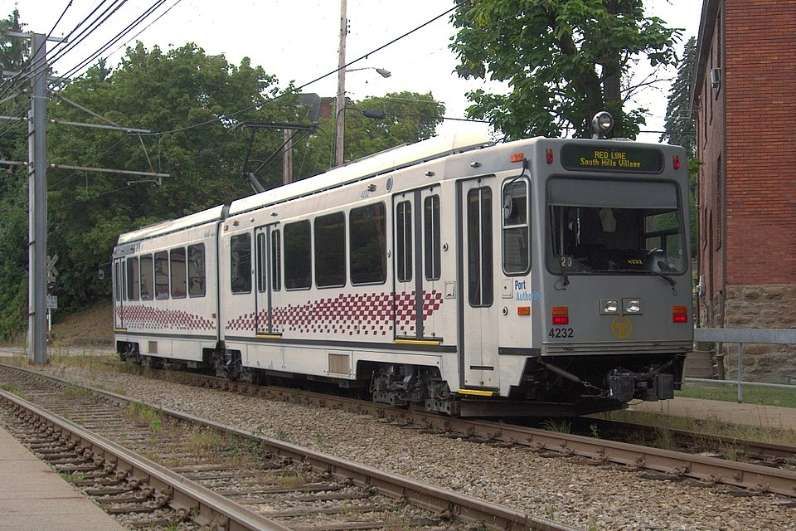
At its height, the Pittsburgh Railways Company operated 666 P.C.C. streetcars, the third-largest fleet in North America, after Toronto (745) and Chicago (683). The network comprised 68 streetcar routes, of which three remain in operation in partially modernized form as part of the Pittsburgh Light Rail system. [3]

Financially, the Pittsburgh Railway Company struggled. Its lease and operate business model proved hard to support and the company declared bankruptcy twice, first in 1918 lasting for 6 years and then again in 1938, this time lasting until 1st January 1951. Company costs rose in the early twentieth century. PRC faced constant pressure from the city to improve equipment and services and workers would walk out when a pay raise was rejected.

When A.A. Jackson was writing about the network for The Modern Tramway, the company was still in bankruptcy.

On 26th July 1936, the PRC took delivery of P.C.C. streetcar No. 100 from the St. Louis Car Company. It was placed in revenue service in August 1936, the first revenue earning PCC in the world. The company went on to purchase a very large number of these vehicles in batches of 100 on most occasions. Jackson’s table giving details of the PRC fleet (above) shows that after purchasing car No. 100 in 1936: cars 1000-1099 were purchased/leased in 1937; cars 1100- 1199 were purchased/leased in 1937/1938; cars 1200-1299 were bought/leased in 1940; cars 1400-1499 arrived in 1942; cars 1500-1564 were purchased/leased in 1944/1945; cars 1600-1699 arrived in 1945; cars 1700-1799 arrived in 1949. During much of this time the PRC was bankrupt.

Despite the size of the network, it was not able to withstand the winds of change and large scale abandonments of lines began in the late 1950s, usually associated with highway or bridge work. [3]

As examples:

  • highway improvements in the Duquesne-McKeesport area resulted in the replacement of tram services with buses on 21st September 1958;
  • The replacement of the Point Bridge with the Fort Pitt Bridge precipitated the abandonment of many routes to the West End, all on 21st June 1959. In the end, the company had to abandon 27 miles (43 km) of street track in situ and was awarded $300,000 as compensation.

These events “marked the beginning of significant abandonments: 90 percent of the network was dismantled over the next decade.” [3]

A network that seemed to A.A. Jackson to have a bright future was by 1970 a pale shadow of the network in the early 1950s.

Similar things were happening in respect of the PRC Interurban network:

  • The Charleroi interurban line was cut back to the Allegheny County border at Library (Simmons loop) in June 1953. It continued to operate until the 1980s as 35 Shannon-Library and became the southern portion of 47L Library via Overbrook when Light Rail Vehicles (LRVs) replaced [trams]. The [tram] loop was removed in 2004. In 2010 this line became the Blue Line – Library, and in 2020 was renamed the Silver Line – Library.” [3]
  • The Washington line was cut back to the county boundary at Drake in August 1953 and eventually became the 36 Shannon-Drake. This in turn became the southern portion of 42 South Hills Village (excluding the new link from Dorchester to South Hills Village, which was built in 1984). The final portion of the interurban from Dorchester to Drake was renamed 47 Drake, finally closing in 1999 and bringing to an end P.C.C. Streetcar operation in Pittsburgh.” [3]
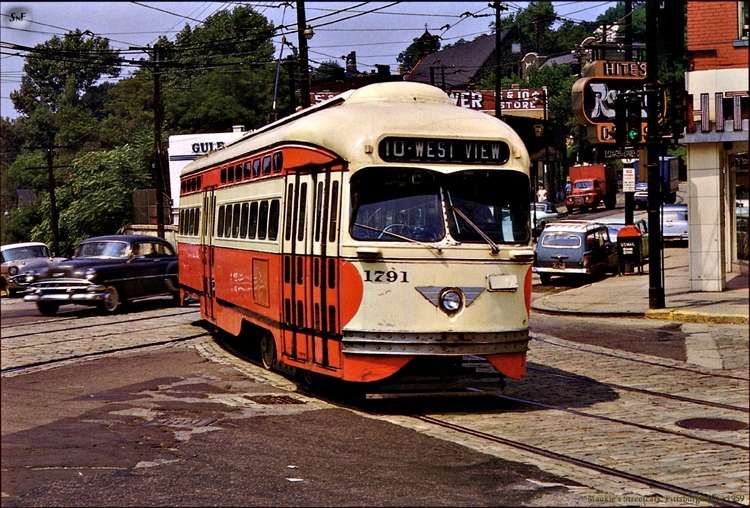
P.C.C. No. 1791, route 10 West View. [4]

Pittsburgh Light Rail

The Pittsburgh Light Rail is the successor to the original Pittsburgh Railway Company. Some residual parts of the old network are in use as part of the Pittsburgh Light Rail system.

The Pittsburgh Light Rail (commonly known as The T or the Trolley) is a 26.2-mile (42.2 km) light rail system in Pittsburgh, Pennsylvania, serving the city and surrounding suburbs. The system operates as a deep-level subway in Downtown Pittsburgh, but runs mostly at-grade in suburban areas south of the city. It is largely linear in a north–south direction, with one terminus near the central business district and two termini in the South Hills. The system is owned and operated by Pittsburgh Regional Transit.” [5]

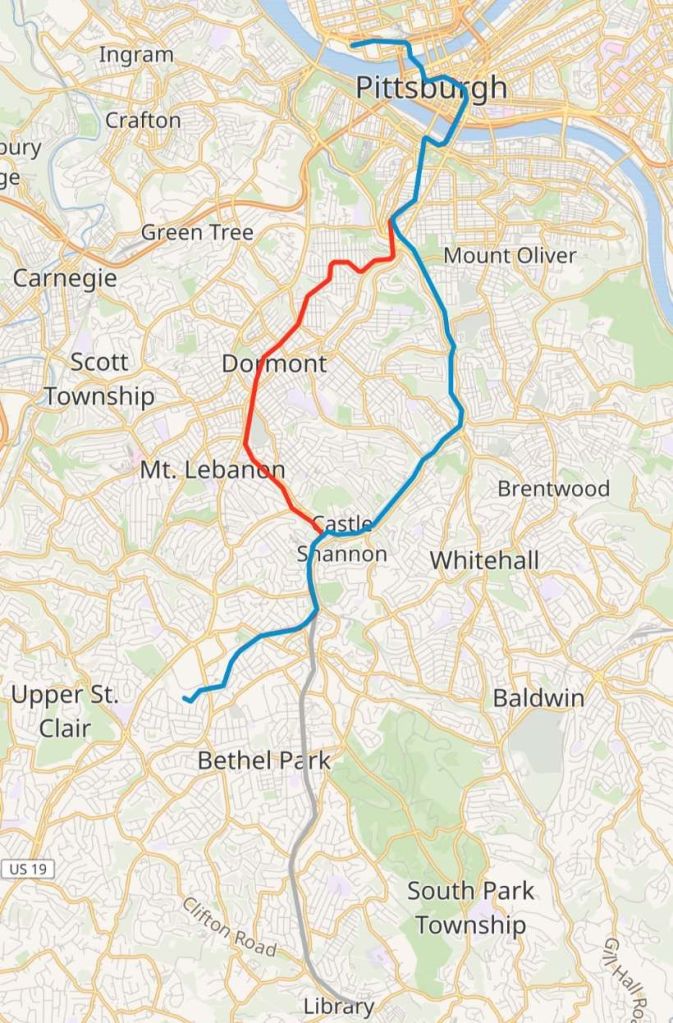
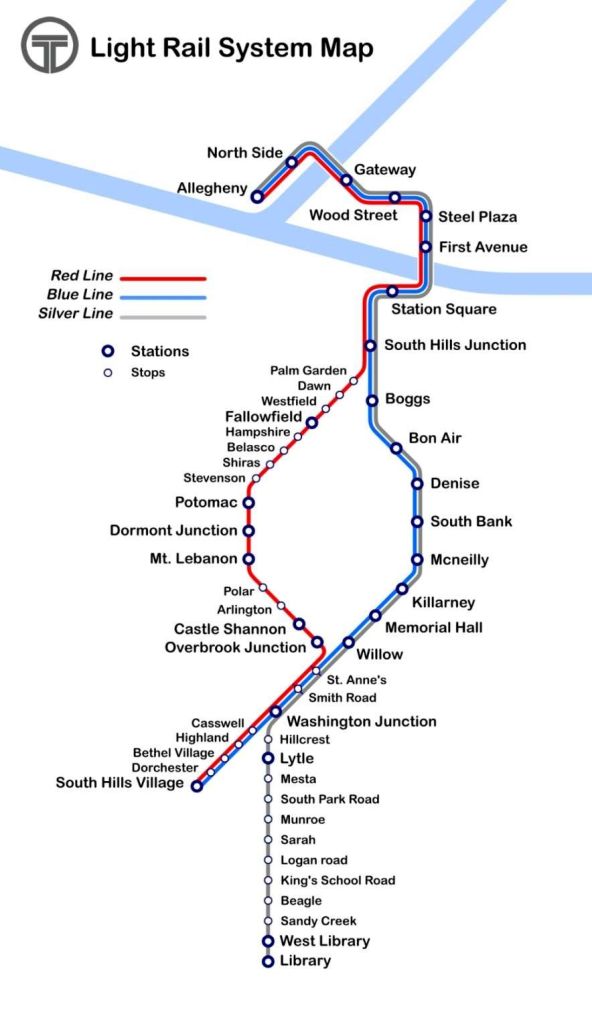
The Pittsburgh Light Rail network is made up of three lines – the Blue Line, the Red Line and the Silver Line. This map shows the three lines superimposed on an OpenStreetMap base layer. [6]

The system is one of the surviving first-generation streetcar systems in North America, with portions of the network dating to 1903, when they were operated by the Pittsburgh Railways Company. It is one of three light rail systems in the United States that continues to use the broad 5 ft 2 1⁄2 in (1,588 mm) Pennsylvania trolley gauge rather than the 4 ft 8 1⁄2 in (1,435 mm) standard gauge. In 2025, the system had a ridership of 3,104,400.” [5]

On 1st March 1964, the PRC system “was acquired by the newly established Port Authority of Allegheny County (PAT), which also assumed operations of more than 30 other transit companies in the region, including bus operators and the incline lines. The state hoped the consolidation would help stabilize the system as the private companies all had separate fare structures, labour agreements, and, in some cases, overlapping routes, while ridership had declined in the preceding years.” [5]

PAT undertook a program of consolidation and modernisation. MOT tram routes were converted to bus operation which it believed reflected lower operating and maintenance costs and reduced capital requirements. “By the early 1970s, only a small number of trams routes remained, primarily those using the Mount Washington Transit Tunnel to reach the South Hills, retained in part because they operated on private rights-of-way separate from street traffic.” [5]

PAT also planned to introduce guided busways. The programme was given the name ‘Skybus’. However investment was curtailed in the late 1970s because of public opposition.

Stage I

Planning shifted toward reconstructing the remaining tram lines as a modern light rail system, resulting in a ‘Stage I’ plan, the first phase of a broader program to develop a new light rail network. “The project included reconstruction of the Beechview line, construction of a short branch to South Hills Village, and a 1.1-mile (1.8 km) subway through downtown. Reconstruction of the existing line included double-tracking formerly single-track segments, replacing jointed rail with continuous welded rail, and upgrading the overhead power system to modern catenary.” [5]

A Blue Line train crosses the Panhandle Bridge and approaches First Avenue station in April 2023, © Cbaile19 and licenced for reuse under a Creative Commons licence (CC0). [8]

“Only the busiest stops were rebuilt with high-level platforms, while lower-ridership stops retained low-level, street-level boarding. Because this work preceded the Americans with Disabilities Act of 1990, full systemwide accessibility was not required. The design also allowed continued operation of P.C.C. cars on unmodified portions of the network, with some shared stations providing both high- and low-level boarding.” [5]

Construction started at the end of 1980. The first modern light rail cars began operating on 15th April 1984. A full service across the subway, the rebuilt Beechview line, and the South Hills Village branch was operating by July 1985. [5]

Funding for upgrades to the segment of the line between Castle Shannon and South Hills Junction was approved in May 1985, including $20 million in federal grants. The entire Stage I project was declared complete on 22nd May 1987, at a total cost of $522 million, which included the purchase of 55 light rail vehicles. [5]

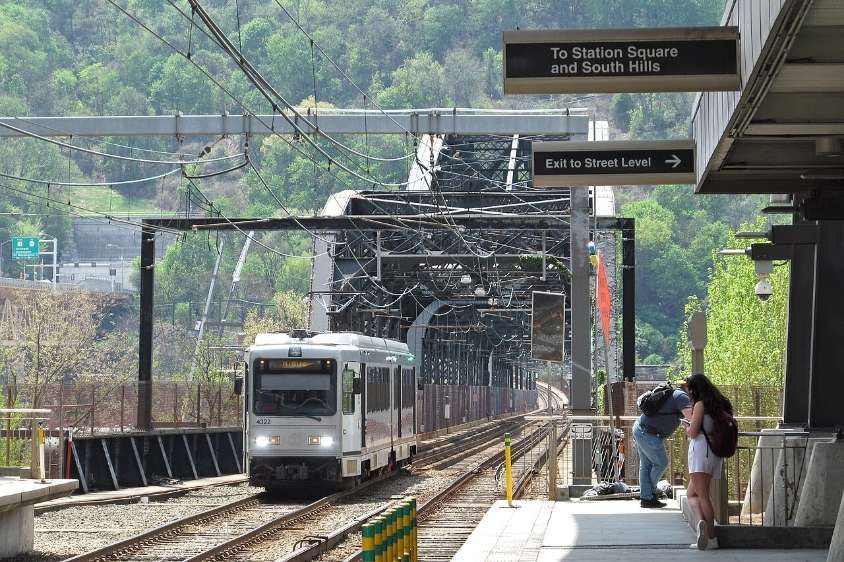
Southbound Blue Line train departs Station Square, heading into the Mount Washington Transit Tunnel. The Blue Line operates between Pittsburgh’s North Shore and South Hills Village via Downtown and the neighborhoods of Knoxville and Overbrook, as well as Castle Shannon and Bethel Park. The line operates over the Overbrook line and the South Hills Village line, © kaffeeeinstein and licenced for reuse under a Creative Commons licence (CC BY-SA 2.0). [9]

Stage II – The Overbrook Line

“The line from South Hills Junction to Castle Shannon via Overbrook (now called the Overbrook Line, part of the Blue and Silver lines) was first constructed by the Pittsburgh and Castle Shannon Railroad (P&CSRR) between 1872 and 1874. In 1905, Pittsburgh Railways leased the route, and between 1909 and 1910, converted it to dual gauge, retaining the existing narrow gauge for the coal-hauling trains and adding the broad 5 ft 2 1⁄2 in (1,588 mm) Pennsylvania tram gauge for passenger service using trams (streetcars). While the line was electrified with overhead power, the coal trains continued to use existing steam locomotives.” [5]

The Beechview line was rebuilt during the 1980s, but the Overbrook line remained largely unchanged and continued to be operated using P.C.C. cars. “The reconstruction of this line would be part of the Stage II project, to be performed at a future date pending additional funding. However, the condition of the track and infrastructure of the Overbrook line continued to deteriorate and in 1993, Pittsburgh Regional Transit determined the line to be unsuitable for safe operation in its current state and suspended service on the line. The line remained dormant until 1999, when the PRT broke ground on the Overbrook Line reconstruction project.” [5]

The rebuilt Overbrook line was essentially an entirely new line built along the original line’s right of way. As had been done with the Beechview line prior, the rebuilt line was completely double-tracked with continuously welded rail, pandrol clip fixation, upgraded catenary and signaling, and other improvements. The rebuilt line included eight accessible stations with high-level platforms; unlike the Beechview line, no street-level stops were retained. The Overbrook line reopened in June 2004, at a total cost of $386 million, including the cost of purchasing 28 LRVs. Coinciding with the opening, Pittsburgh Regional Transit purchased 28 additional light rail cars to support the line and increase overall system capacity. At this time, the 55 existing cars were completely rehabilitated as well. In addition, as part of the Stage II project, upgrades to the traction power network, Operations Control Centre, and signals and communications had been implemented.” [5]

Southbound Red Line train at Westfield, September 2015. The Red Line runs between South Hills Village and Downtown Pittsburgh via the Beechview neighbourhood, © Cbaile19 and licenced for reuse under a Creative Commons licence (CC0). [10]
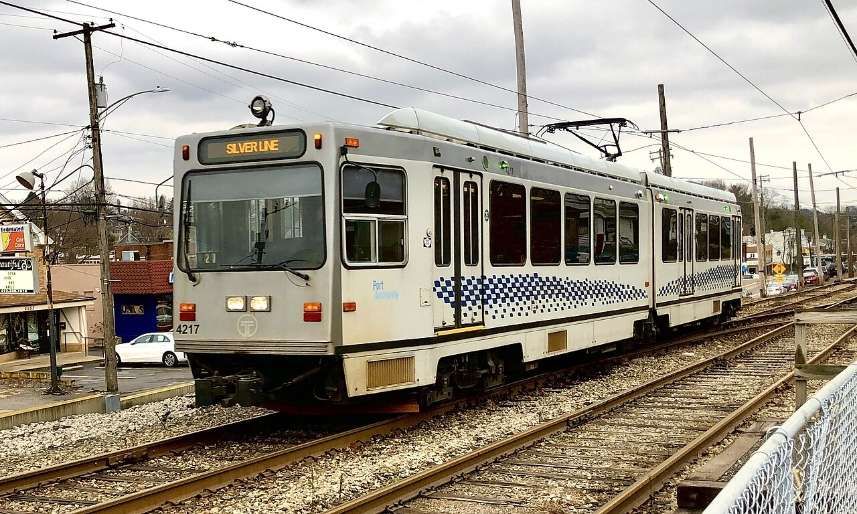
Northbound Silver Line train near Mesta, December 2020. The Silver Line operates between Pittsburgh’s North Shore and Library via Downtown and the neighborhoods of Knoxville and Overbrook, as well as Castle Shannon and Bethel Park, © Sebileis2017 and licenced for reuse under a Creative Commons licence (CC BY-SA 4.0). [11]

North Shore Connector

In January 1999, Pittsburgh Regional Transit began planning for the construction of a light rail line to connect Pittsburgh’s Downtown and North Shore. Federal funding was approved for the extension on 6th February 2004.

The main project involved twin-bore tunnels below the Allegheny River to connect a refurbished Gateway Station, which was the former Downtown terminus, to North Side station, located just west of PNC Park, and Allegheny station, located just north of Heinz Field. The completed project opened to the public on 25th March 2012. The final cost was $523.4 million. [5]

Route map of the three lines on the Pittsburgh light rail system, © Haha169 and licenced for reuse under a Creative Commons licence (CC BY-SA 4.0). [7]

2024–2028 Rail Replacement Projects

From 2024 to 2028, PRT is undertaking a system-wide program of track rehabilitation across the network. The work includes phased closures, single-tracking, and temporary service reroutes. … In 2024, sections of the Red Line were closed for track replacement, resulting in single-tracking operations, shuttle bus substitutions, and a temporary Red Line Short service between Dormont Junction and Overbrook Junction. During part of this period, Red Line trains were also rerouted over the Blue Line alignment.” [5]

That programme continues in 2026.

Future light-rail and rapid-transit extensions are mapped out in the 25-year ‘NEXTransit‘ plan. [12]

Rolling Stock

The majority of Light Rail Vehicles (LRVs) in use on the network are Siemens SD-400 units, introduced to the network between 1985 and 1987. These units were rebuilt by CAF (Construcciones y Auxiliar de Ferrocarriles) in 2005‍–‍2006 and are currently numbered from 4101‍–‍4155. (Seven units salvaged for parts, then scrapped.) CAF also supplied 28 of their own design of LRV between 2003 & 2004. [5]

References

  1. A. A. Jackson; An American Tramway Stronghold; in The Modern Tramway, Volume 14, No. 163, July 1951, p160 & p162-163.
  2. https://commons.wikimedia.org/wiki/File:PCC_uit_de_1600_serie_op_lijn_49_BELTZHOOVER.jpg, accessed on 18th May 2026.
  3. https://en.wikipedia.org/wiki/Pittsburgh_Railways, accessed on 18th May 2026.
  4. https://en.wikipedia.org/wiki/Pittsburgh_Railways#/media/File%3APCC_uit_de_1700_serie_op_lijn_10_WEST_VIEW.jpg, accessed on 18th May 2026
  5. https://en.wikipedia.org/wiki/Pittsburgh_Light_Rail, accessed on 18th May 2026.
  6. https://en.wikipedia.org/wiki/Pittsburgh_Light_Rail#/map/0, accessed on 18th May 2026.
  7. https://en.wikipedia.org/wiki/Pittsburgh_Light_Rail#/media/File%3APittsburgh_T_System_map.png, accessed on 18th May 2026.
  8. https://en.wikipedia.org/wiki/Pittsburgh_Light_Rail#/media/File%3APanhandle_Bridge_from_First_Avenue_Station%2C_2023-04-21.jpg, accessed on 18th May 2026.
  9. https://en.wikipedia.org/wiki/Blue_Line_(Pittsburgh)#/media/File%3AT_Lightrail_an_der_Station_Square_03.jpg, accessed on 18th May 2026.
  10. https://en.wikipedia.org/wiki/Red_Line_(Pittsburgh)?wprov=rarw1#/media/File%3ARed_Line_Car%2C_Beechview%2C_2015-09-10%2C_02.jpg, accessed on 18th May 2026.
  11. https://en.wikipedia.org/wiki/Silver_Line_(Pittsburgh)?wprov=rarw1#/media/File%3ASilver_Line_(cropped).jpg, accessed on 18th May 2026.
  12. https://nextransit.network, accessed on 18th May 2026.
The Modern Tramway – February 1951 – The Modernisation of Amsterdam Tram No. 12

In 1939, Amsterdam acquired twelve 2-axle motor cars from the closing electric city tram network in Utrecht (Gemeentetram Utrecht – GTU). These trams, built by Werkspoor in 1927, were introduced to the Amsterdam network and later renumbered, serving as the only secondhand motor cars purchased by the Amsterdam city transport service.

These twelve cars (originally numbered 67-78 in Utrecht) were subsequently renumbered 1–12 in Amsterdam. The purchase helped Amsterdam boost its fleet for expansion, particularly as new tracks were being laid in Amsterdam-Oost and around the new Amstel station (opened in Oct 1939). [1]

These “Utrechtenaren” remained in service for over a decade, eventually renumbered 301-312 in 1954 before being replaced by new buses. [1]

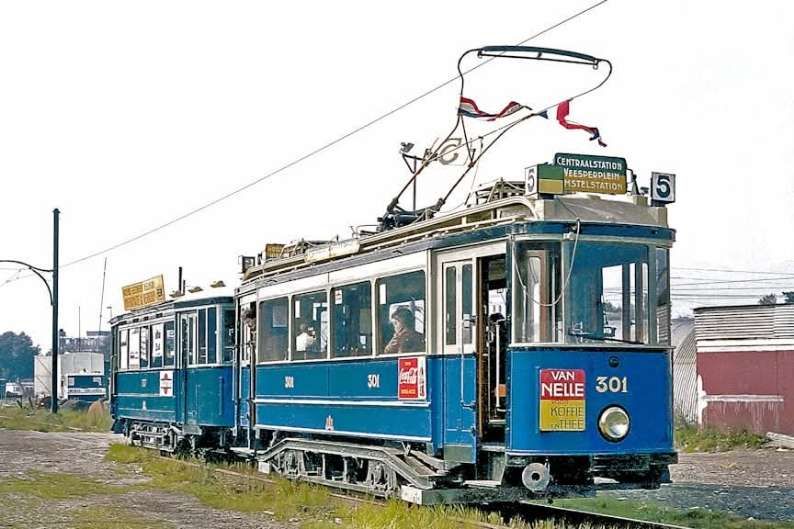
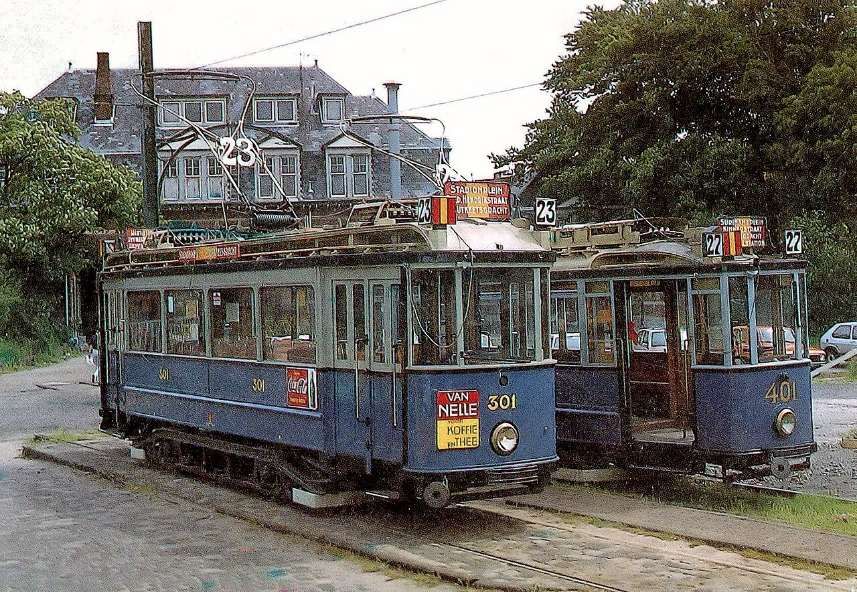
The trams which came from Utrecht are still represented by one unit. The sole surviving ex-Utrecht car is No. 301 (originally Amsterdam No. 1)

The sole surviving ex-Utrecht to have run on the Amsterdam tram network is car, No. 301, is seen here shunting temporary bookshop car No. 757 to the outer terminus at Ringweg during the early years of RETM/EMA museum line operations. The tramcar is preserved as a museum tram, associated with the Electric Tram Museum Amsterdam (RETM/EMA), © Ray Deacon, permission to use it here has been requested. [1]
Ex-Utrecht tram which was No. 301 on the Amsterdam network, in preservation in 1982 at the Electric Tram Museum Amsterdam (RETM/EMA), © Eriksw (1982) and licenced for reuse under a Creative Commons licence (CC BY-SA 4.0). [3]
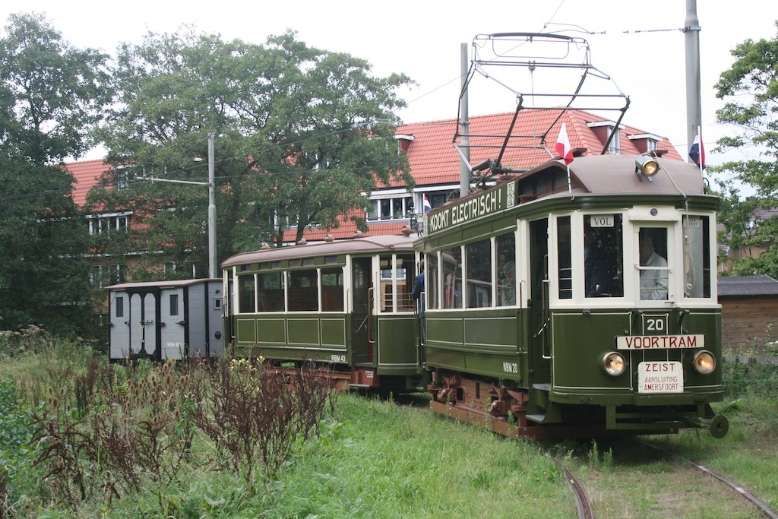
Another view of an ex-Utrecht car (not one of the twelve that saw service in Amsterdam) preserved in Amsterdam. This is Utrecht No. 20 at the head of a short ‘train’ No. 20, No. 43 (trailer) and No. 402 (wagon), © Eriksw (2012) and licenced for reuse under a Creative Commons licence (CC BY-SA 3.0). [4]

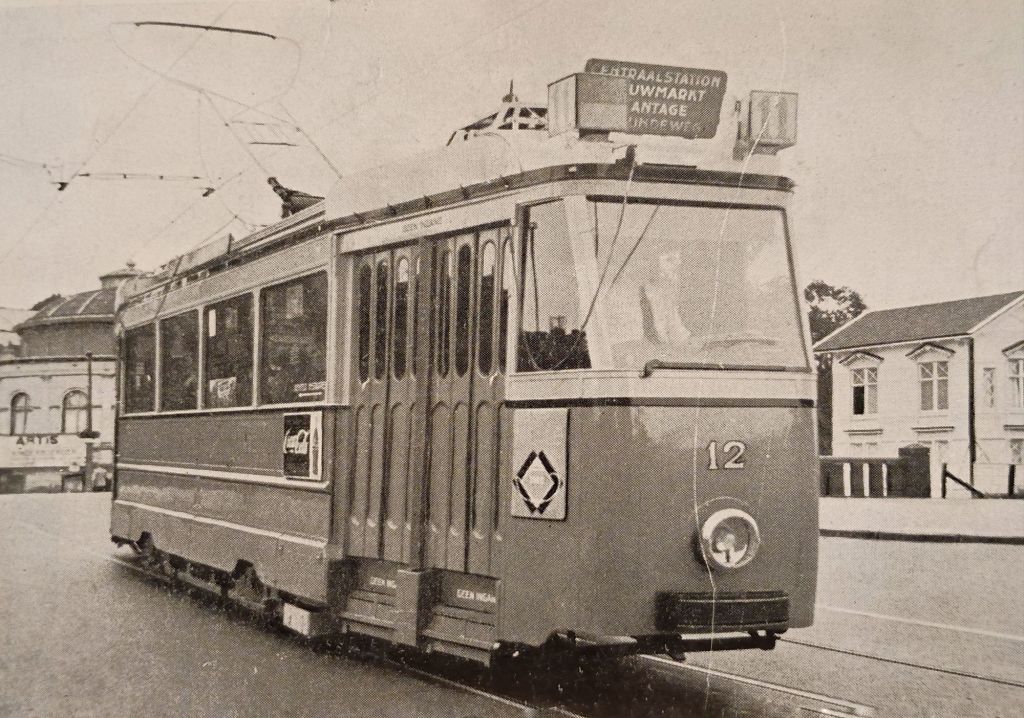
However, this is not all that is known about the twelve trams from Utrecht. Amsterdam’s rolling programme of modernisation of their trams included work on Amsterdam No. 12 in 1950. The Modern Tramway reported in February 1951 that:

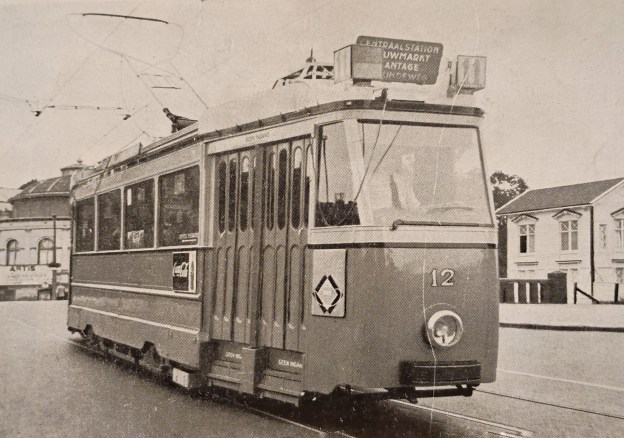
“In continuation of their policy of modernising their rolling stock, the Amsterdam Tramways have rebuilt car No. 12, one of those taken over from Utrecht Corporation in 1939. The reconstruction has as far as possible followed the principles adopted in the new 6-wheeled cars (Nos. 491-550), and the result of the rebuilding can be seen in the photograph [featured and below].

“The body has been lengthened from 10.38 metres to 11.40 metres and the floor has been brought to the same level throughout the car. This latter feature, together with the wide gangway, greatly contributes to a speedy circulation of passengers – an important requirement in any car equipped for the Peter Witt system (seated conductor).

“At the rear of the car the former partition between the saloon and the platform has been removed; the front partition has been retained but the sliding door has been removed. A separate compartment has been made for the driver, closely resembling the driving compartment of the 6-wheeled cars but lacking the track-brake pedal (it has not been possible to fit a track-brake to the existing truck) The old controller has been replaced by a multi-notch ratchet controller. The driver has a seat which can be easily removed. The front window and ‘nose’ of the car is identical to that of the 3-axle cars and the front trailer coupling has been retracted.

“The conductor’s post with the payments table has been moved somewhat further forward from the entrance doors thus providing more space for those passengers who have not yet paid their fares … The total capacity of the car is now 72 of which 16 are seated, whereas it was formerly 62 with 32 seats. The double entrance and exit doors are provided with double folding sections operated electro-magnetically by the conductor. When the doors are closed, the bottom step folds up.

“The original interior lighting has been completely removed and replaced by 6 Phillips fluorescent tubes placed in a line along the centre of the ceiling, and giving a remarkably bright and even illumination.

“Drop windows and ventilating louvres remain unchanged and the circulation of air has been improved by placing an additional air scoop at the front and a pair of Flettner rotary extractors at the rear.

“In order to keep the costs as low as possible no optical signalling has been introduced and contact between conductor and driver is solely by bell.”

(Translated from Streek en Stadsverecer, August 1950, by J. D. A. Floyd). [2: p42-43]

Amsterdam’s Modernised Tram No. 12, later (in 1954) to be renumbered No. 312. [1: p44]

As a ‘bonus’ here are two interesting films of Utrecht’s early tramways in operation in the late 1920s. [5][6]

And finally, Utrecht’s modern and earlier trams networks are compared here. [7]

References

  1. https://www.facebook.com/share/p/1BsQ6Qmsrt, accessed on 12th May 2026.
  2. J. D. A. Floyd (trans); Amsterdam: Modernisation of No. 12; in Streek en Stadsverecer, August 1950; in The Modern Tramway, Volume 14, No. 158, February 1951, p42-43.
  3. https://nl.wikipedia.org/wiki/Utrechtse_museumtrams#/media/File%3AGVB_301%2C_401.jpg, accessed on 18th May 2026.
  4. https://nl.wikipedia.org/wiki/Trams_in_Utrecht#/media/File%3ATramstel_NBM_20_%2B_43_%2B_402%3B_Bovenkerk.jpg, accessed on 19th May 2026.
  5. https://youtu.be/-Zn9820fFV0?si=zdHS2eGIyFmD-AAq, accessed on 19th May 2026.
  6. https://youtu.be/QaAOo6x23_U?si=Ytg4CrOMnwt0zFT2, accessed on 19th May 2026.
  7. https://wp.me/p5afWR-KS, accessed on 19th May 2026.

The Modern Tramway – July 1951 – The Tramways of Clermont-Ferrand

The Modern Tramway of July 1951 included an article by Peter J. Jacques about the tramways of Clermont-Ferrand. [1]

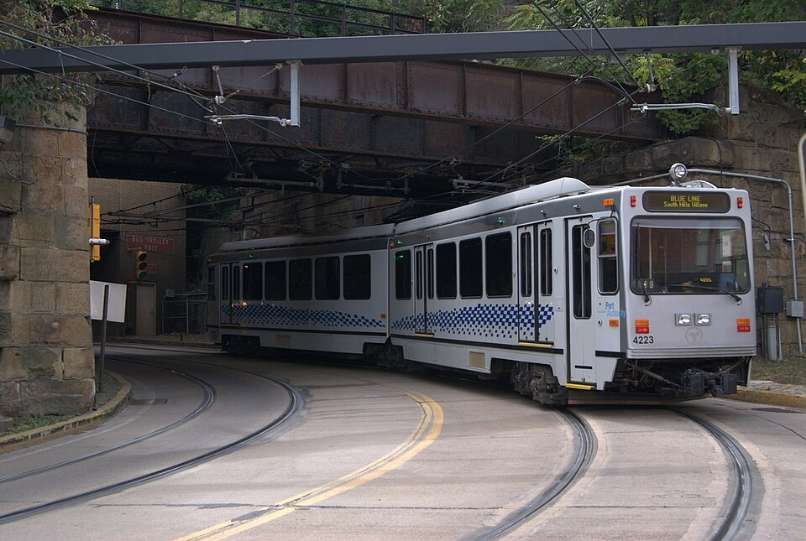
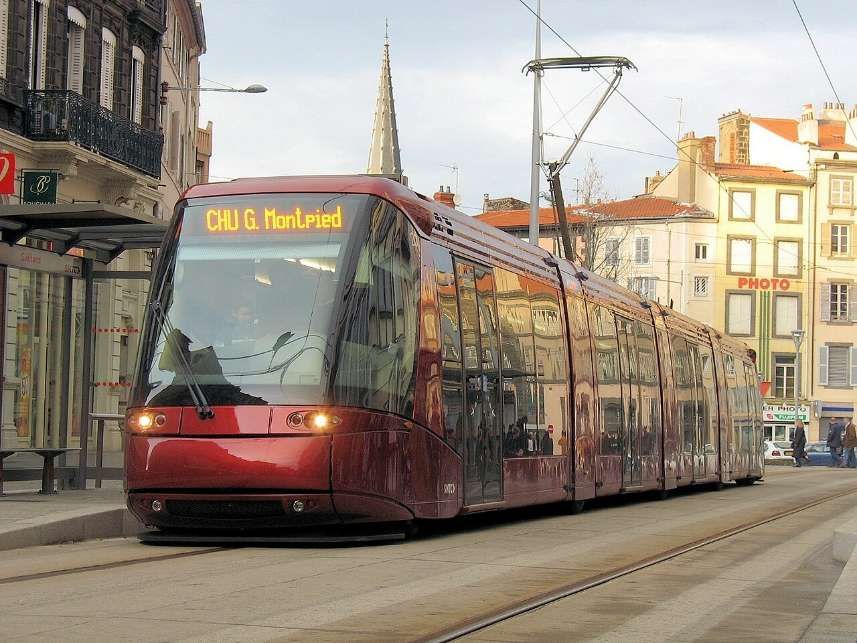
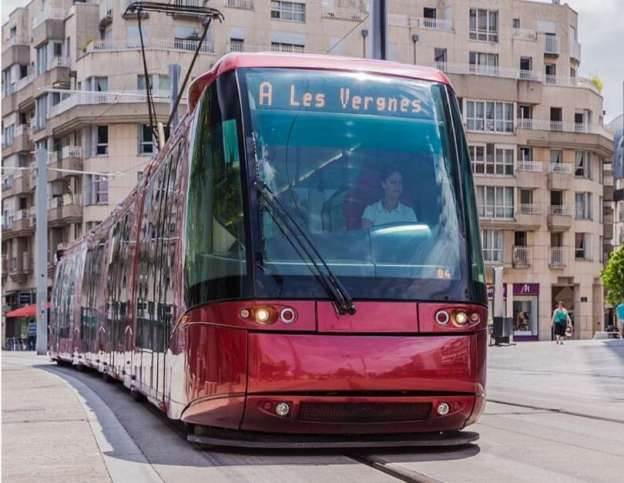
The featured image for this article is a photograph of one of Clermont-Ferrand’s modern trams. The initial fleet was 26 trains, but in September 2019, the fleet was expanded to 30 trains. Every STE 4 model consists of 4 cars, for a length of 32 metres (105 ft), © William Crochot and licenced for reuse under a Creative Commons licence (CC BY-SA 4.0). [2]

Jacques wrote:

“The French city of Clermont-Ferrand has a population of approximately 100,000 and is situated in the mountainous Departement of Puy de Dome. Most of the local transport is provided by the Compagne des Tramways de Clermont-Ferrand et du Puy de Dome, which operates tram services over four routes and several bus services. The tramcar fleet comprises 66 single-deck cars, including 33 trailers. The system is interesting, not merely because of its present day policy of retention and modernisation, but also on account of its importance in the history of French Tramways.” [1: p156]

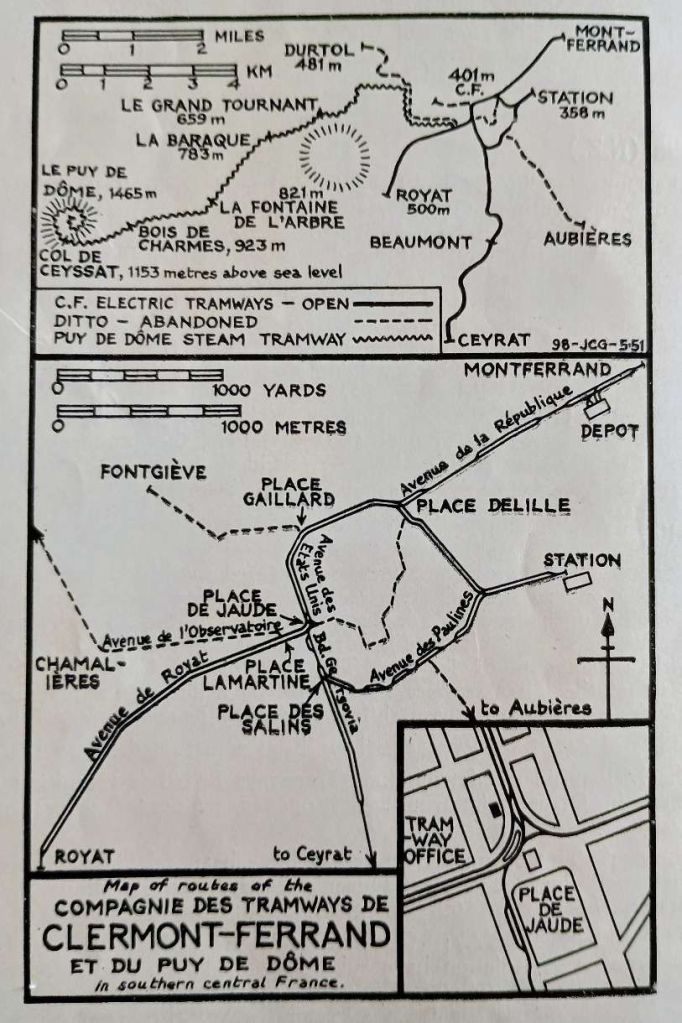
A map of the Clermont-Ferrand tram network in the 1950s. [1: p156]
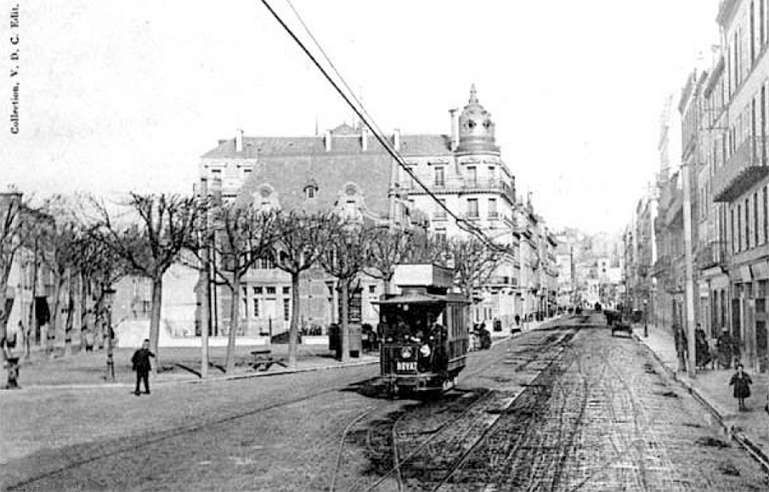
An early postcard image, © Public Domain. [10]

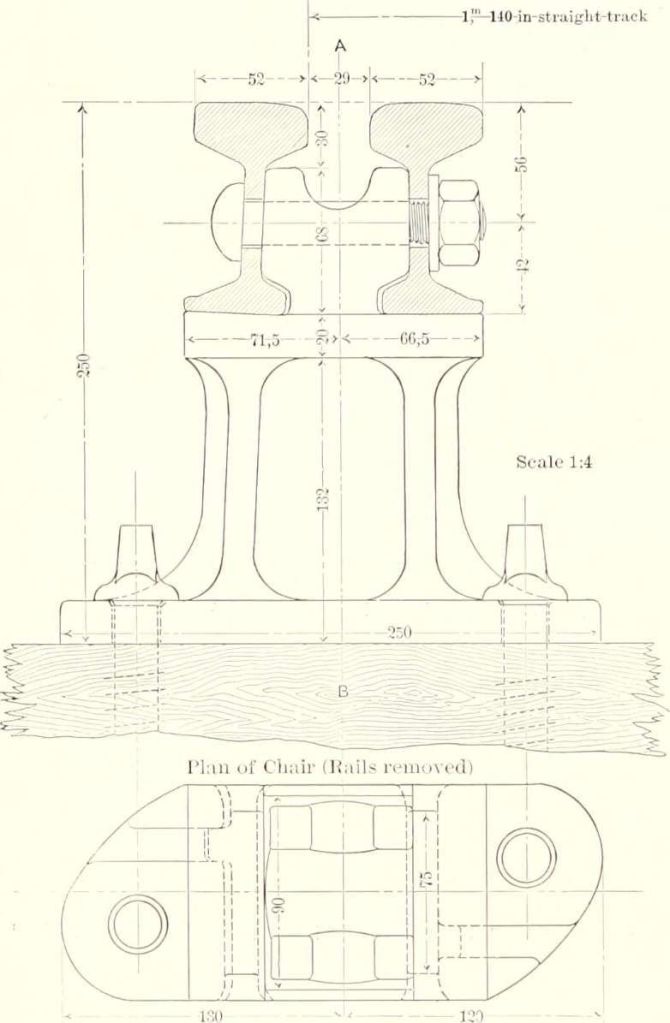
“It was at Clermont-Ferrand that the first French electric tramway was installed in 1888; the line ran from Montferrand to Royat and was built by M. Claret, the father of the present [in 1951] Director.vthere was a branch line to the station and a depot at Montferrand. Current was collected, by means of a shoe which the car towed at the end of a wire, from a rectangular tube suspended 6 metres above the track. ‘Marsillon’ type rails [3] were used, laid on wooden sleepers and held in position by cast-iron chairs. The cars were 4-wheel single-deckers fitted with ‘Thury’ type motors.” [1: p156-157]

Marsillon Type Rails: two pictures of this rail type are shown below. Antoine-Léon Marsillon (1824-1892) was responsible for the design.

This image comes from page 369 of ‘The Street Railway Journal’ of 1884. [3]

Thury Type Motors: were pioneering direct-current (DC) traction motors and high-voltage DC (HVDC) power systems developed by the Swiss-French engineer René Thury in the late 19th and early 20th centuries. Thury’s innovative designs were heavily utilized across early European tramways and electrified mountain railways. Clermont-Ferrand used Thury 25-horsepower motors. A single motor drove one axle via a gear train, and the second axle was driven by connection rods coupled to the first. [4]

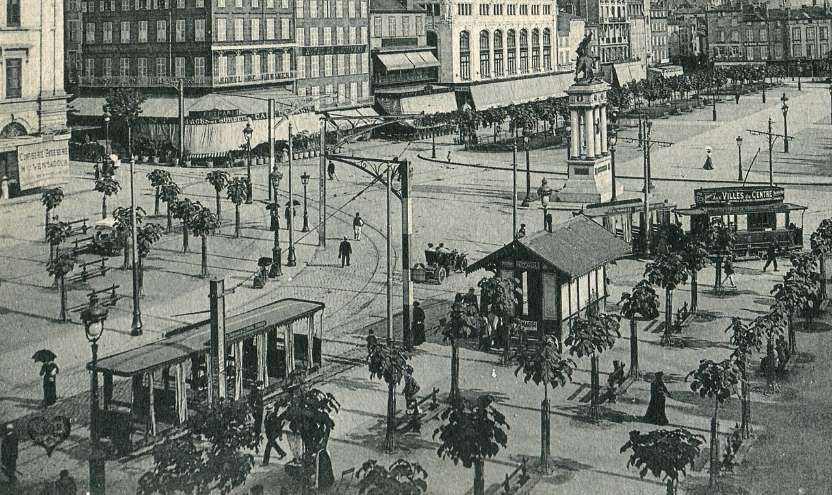
An early postcard image showing trams in the Place de Jaude just after the statue of Vercingetorix was erected, © Public Domain. [11]

Jacques continued:

“Two years later, an experiment was made with surface-contact current collection on a stretch of track 219 yards long, using the Claret Vuilleumier system, although it was never adopted in Clermont-Ferrand, the success of the trial in that city led M. Claret to construct a tramway on this system in Paris, from the Place de la République to Romainville. (The latter tramway was the first electric route in the French capital and was opened in 1896).

“In 1903, another route was added to the Clermont-Ferrand tramways; it followed a winding course from the Place Delille to the Place de Jaude. In 1906, a light railway was constructed from the Place Lamartine to the summit of the Puy de Dôme mountain, to the west of the city. This line was worked by steam tank locomotives hauling three or four 4-wheeled carriages. The depot was at Durtol.

“In the course of the next few years, normal overhead wires were installed in place of the overhead “tubes,” and the cars were fitted with trolley poles; at the same time the track was entirely relaid with ‘Broca’ rails.

“New trailer cars were built in 1912 and these open-sided bogie vehicles are still [in 1951] used during the summer months. The following year saw the construction of new lines to Fontgiève and to the station via the Place des Salins. The line to Vallières and Beaumont was opened in 1914, and several new trailers with partly-open bodywork were built in that year. The route from the Place Delille to the Place de Jaude was closed in 1915.” [1: p157]

The Claret Vuilleumier System of Current Collection: The Claret-Vuilleumier system was an early, now obsolete surface-contact method for powering electric trams without overhead wires. Developed in the late 19th century, it used electromagnetic, road-level studs that only became energized as a tram passed over them, delivering power to the vehicle through an under-carriage skate. It was most notably implemented on tram lines in Paris (such as the République-Romainville line), the system was engineered to eliminate the visual “wire pollution” of overhead catenaries in city centres. It solved the shock hazard problem of exposed surface studs through an ingenious, albeit troublesome, mechanical setup. [5]

Small iron contact studs were spaced about 2.5 metres apart and protruded roughly 5 mm above the cobblestone surface. The studs were not permanently live. Instead, they were connected to a series of underground switches controlled by a master mechanism. As the tram rolled over the track, magnets on the vehicle triggered the underground switch. The stud directly beneath the tram became energized with 500–600 volts to power the tram’s motors, while the studs ahead and behind remained safely dead. [5]

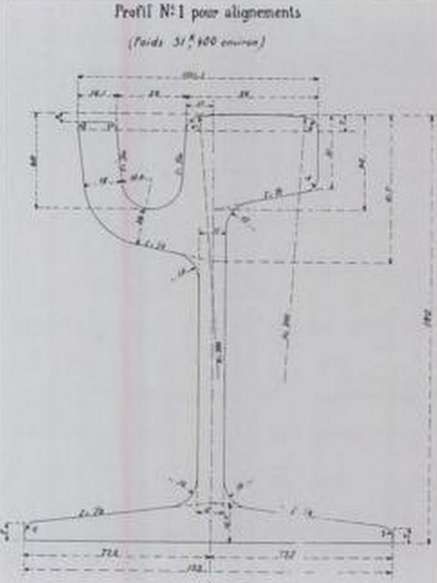
Broca Rail: (often called a grooved or girder rail) is a specialized steel track invented in the late 19th century. It is primarily used for streetcars and trams, featuring a built-in groove that allows trains to sit flush with paved city streets without disrupting car traffic or pedestrian walking paths. [6]

Broca’ rail was designed by Georges Broca, © Public domain. [7]

Jacques continued:

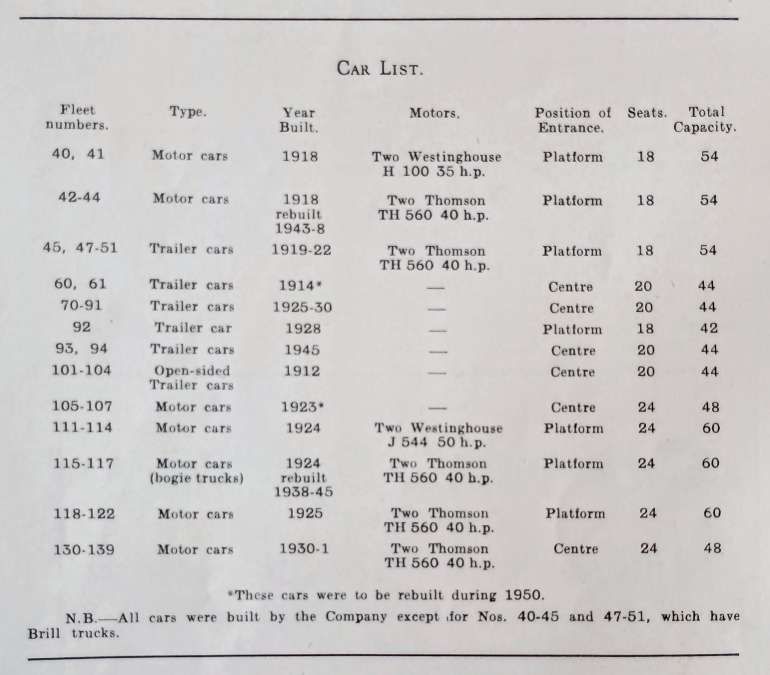
“In 1918, the Company built 5 new motor trams fitted with two Westinghouse H 100 35 h.p. motors and these were followed by 6 more of the same type between 1919 and 1922. During the latter year, the Beaumont line was extended to Ceyrat, a distance of over 4 miles from the city centre.

“The Puy de Dôme railway was closed in 1926 and a road was built on the right-of-way. The line as far as Durtol was retained for a time as an electric tramway but was shortly replaced by a bus route. In 1928, the Aubière line was opened and in the following year, the short Fontgiève line was closed. The replacing bus service also served other outlying districts not yet sufficiently developed to require tramway service.” [1: p158]

Jacques provided a list of tramcars used on the Clermont-Ferrand network in the very early 1950s. [1: p158]

Jacques narrative continued:

“Between 1923 and 1930, 12 new motor trams and 23 trailers were added to the fleet. Of these, four motor cars (Nos. 111-14) were fitted with two Westinghouse J544 50 h.p. motors, while the remaining 8, Nos. 115-22, were of improved design with independent suspension, fitted with two Thomson TH 560 40 h.p. motors. In 1930, a new tramcar was built at the Company’s workshops. Of modern design with centre entrances and independent suspension, it had two Thomson TH 560 40 h.p. motors and had seats for 24 passengers in two saloons with room for 24 standing passengers on its large central platform. The success of this car led to the construction of nine others, all of which were in service by the end of 1931. This type are numbered 130-139. In 1938, work began on the reconstruction of Nos. 115-117, the only bogie motor trams in the fleet. In 1943, three more cars, Nos. 42-44 were rebuilt and given Thomson TH 560 40 h.p. motors. Two new trailers were built in 1945 (Nos. 93-4).” [2: p158]

The Westinghouse J544 50 h.p. Motor: was an early-20th-century direct current (DC) traction motor rated at 50 horsepower. Widely used on streetcars and interurban railways in North America, these motors provided the high starting torque and reliability necessary to modernize urban public transit.

The Thomson TH 560 40 h.p. Motor (or GE-560): was  an early 40-horsepower electric railway motor. It as manufactured at the turn of the 20th century by the British Thomson-Houston (BTH) company (and its American parent, General Electric).

Jacques continued:

“At the end of the Second World War, the future of the tramways was discussed and it was decided to retain trams on all routes except that serving Aubière; this route was closed in December, 1949. The overhaul and repainting of all cars was begun and a new livery of bright red and cream was chosen to replace the former maroon and cream. Many cars have now been repainted and five trailers which do not conform to the standard pattern (60, 61, 105-7) are being rebuilt with central double doors. All work is carried out in the Company’s own workshops at Montferrand.

“At present, four routes are worked, the cars carrying a coloured destination board, as follows:

– Yellow: Station – Place des Salins – Place de Jaude – Place Delille – Station.

– Red: Station – Place Delille – Place de Jaude –  Place des Salins – Station.

– Blue: Royat Chamalières – Place de Jaude –  Place Delille – Montferrand.

– White: Place de Jaude – Vallières – Beaumont – Ceyrat.

“The headway on the Station and Montferrand Royat routes is usually six minutes. The Ceyrat route has short workings to Vallières and Beaumont. Ceyrat cars maintain a headway of 40 minutes which is shortened to 20 minutes as required. Cars run to Beaumont and Vallières every 20 and 10 minutes respectively. One car is sufficient to operate the Vallières short working and it is usually one of the 118-122 type.

“An interesting feature of the system is the provision of curbside or island loading facilities at the termini and main stops. All termini have sheltered waiting rooms and there are small enquiry offices at the station and the Place de Jaude.

“As Clermont-Ferrand is an important tourist centre, heavy demands are placed on the tramways during the summer months. Royat is a celebrated spa and its population increases from 3,500 to 10,000 between June and September. Ceyrat lies in the heart of beautiful hilly countryside and is much visited. The trams have no difficulty in handling the crowds and the ordinary service to Royat is capable of carrying nearly a thousand passengers an hour (ten trains an hour with an average capacity of 98). Seats in the open-sided trailers are eagerly sought when these cars are in service.

It is encouraging to note that there is no bias in favour of any one form of transport; whilst the Company have abandoned certain lines unsuitable for tramway operation, they are retaining tramcars on the more heavily-burdened routes. In addition to the reconditioning of cars already mentioned, the Company is opening a new sub-station (with three mercury vapour rectifiers) and ultra-modern passenger shelters have been built at Montferrand, Royat and the Place de Jaude. Trolleybuses are to replace motor buses on the Durtol route and if the area develops any further, the trams may yet run again to that district.” [1: p159 & 161]

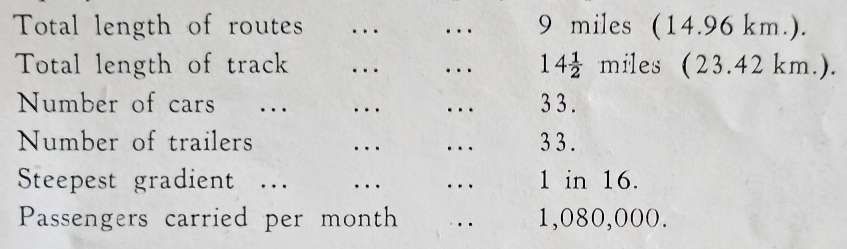
Jacques provided these statistics for the Clermont-Ferrand tramway network. [1: p161]
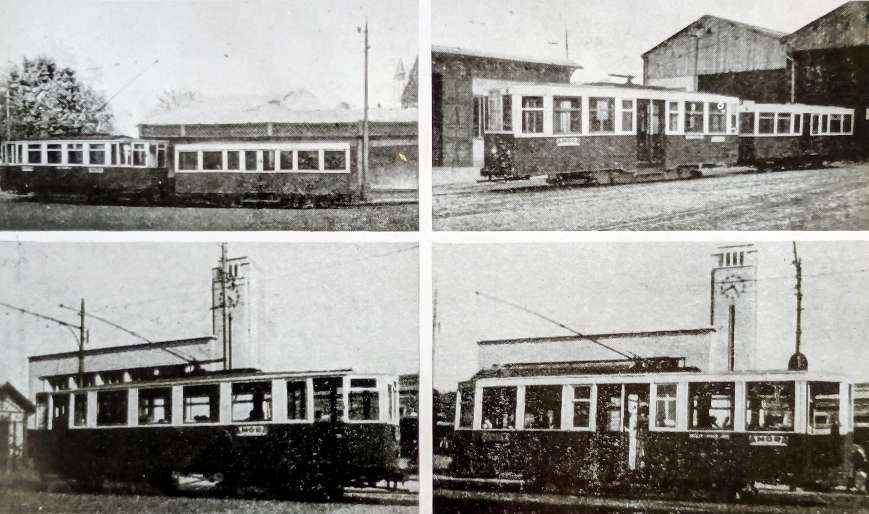
Four photographs taken by M.S. Hill and P.J. Jacques accompanied the article. Top-left: Motor -car No. 114 and trailer No. 84 at the Royat terminus. Top-right: Motor-car No. 139 and trailer No. 76 at the Montferrand depot. Bottom-left: Bogie-car No. 116 at Station. Bottom-right: Centre-entrance car No 139 at Station, © M.S. Hill & P. J. Jacques, Public Domain. [1: p161]

Just 5 years after Jacques article, the tram network in Clermont-Ferrand was closed in favour of buses. “The last tram in Clermont-Ferrand ran on 17th March 1956. After this, public transportation in the city was solely by bus. In many places, the rails were paved over to make way for cars.” [8]

Clermont-Ferrand’s Modern Tramway

In the 1970s, concern over the consequences of automobile use increased. In the 1983 Elections, a tramway was proposed by Socialist mayor Roger Quilliot in his re-election campaign. … However, the tram project was only seriously considered … in 1990. The development of the system was given to SOFRETU (now Systra), which proposed the building of two tramlines: one north–south line (which would eventually become Line A), and an east–west line. In 1996, bids were solicited for the rolling stock for the tramway. Alstom proposed that Alstom Citadis trams be used for the system, and Alstom Citadis trams were bought for Line A on 14th October 1996. Thus, the first tramway followed SOFRETU’s proposal, which corresponded to the present day Line A. However, due to pressure from the Chamber of Commerce and industries in Clermont-Ferrand (mostly Michelin), this initial tramway project was halted.” [8]

A revised project was proposed in 2000 and bids were sought in 2002. The contract was won by Lohr Industrie. A first section was opened in November 2006 with the remainder of the originally proposed network opening in 2007. The line had to be closed for seven weeks in 2013 to renovate many station platforms due to their deterioration. [8]

In 2011, an extension of Line A to Vergnes was initiated. Work began in December 2011 and took almost 2 years.” [8]

On 14th December 2013, the 2-kilometre (1.2 mile) extension of Line A from Champratel to Vergnes opened to the public.  This extension was part of the ‘Reorganization of Les Verges Region’ program, mainly to ease access to the Stade Gabriel Montpied.” [8]

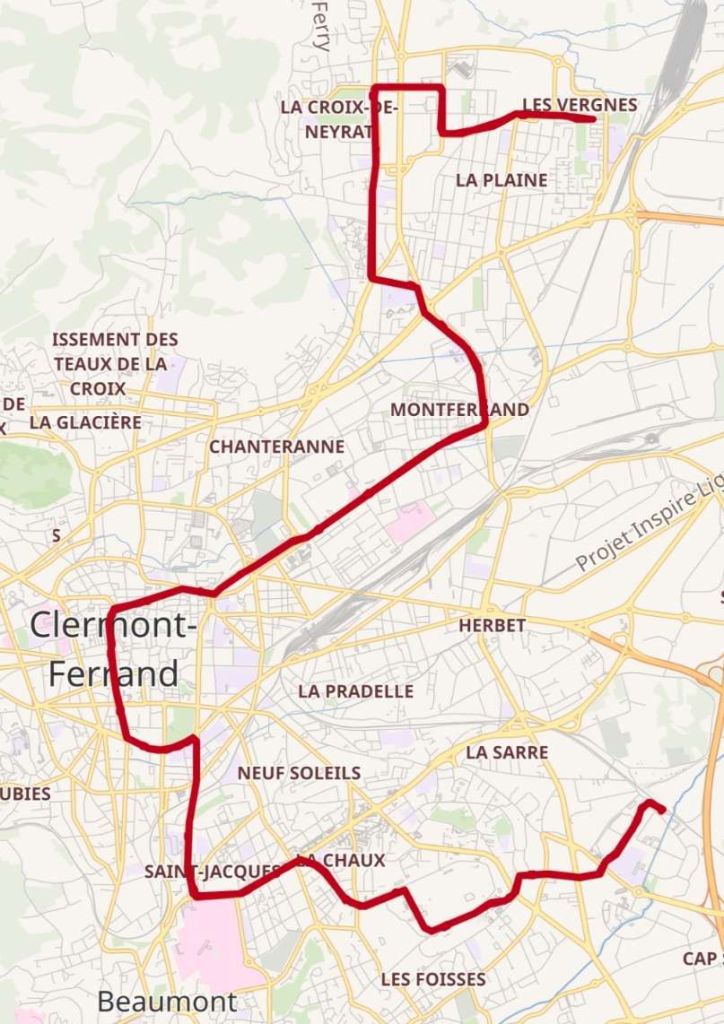
The modern Clermont-Ferrand tram network. [9]
A modern Clermont-Ferrand tram on Avenue des Etats Unis, © Fabien1309 and licenced for reuse under a Creative Commons licence (CC BY-SA 2.0). [12]

The tramway of Clermont-Ferrand uses Translohr technology. The initial fleet was 26 trains, but in September 2019, the fleet was expanded to 30 trains. Every STE 4 model consists of 4 cars, for a length of 32 metres (105 ft). … Every train has a maximum capacity of 238 people with around 40 sitting. Six trains were priced at approximately 14 million euros.” [8]

References

  1. P. J. Jacques; The Tramways of Clermont-Ferrand; in The Modern Tramway Volume 14 No. 163, July 1951, p156-159 & p161.
  2. https://en.wikipedia.org/wiki/Clermont-Ferrand_tramway#/media/File%3ATranslohr_STE4_-_143.jpg, accessed on 18th May 2026.
  3. https://commons.wikimedia.org/wiki/Category:Marsillon_rail, accessed on 18th May 2026.
  4. https://en.wikipedia.org/wiki/History_of_electric_power_transmission, accessed on 18th May 2026.
  5. https://www.citytransport.info/Trams02.htm, accessed on 18th May 2026.
  6. https://www.glorycrane.com/grooved-rails., accessed on 18th May 2026.
  7. https://commons.wikimedia.org/wiki/Category:Broca_rail#/media/File%3AProfil_du_Rail_Broca%2C_en_forme_du_champignon._Profil_N%C2%B01_pour_alignements_(Doc._Archives_de_Paris).jpg, accessed on 18th May 2026.
  8. https://en.wikipedia.org/wiki/Clermont-Ferrand_dtramway, accessed on 18th May 2026.
  9. https://en.wikipedia.org/wiki/Clermont-Ferrand_tramway#/map/0, accessed on 18th May 2026.
  10. https://en.wikipedia.org/wiki/Clermont-Ferrand_tramway_(1890%E2%80%931956)#/media/File%3ATramway-electrique-Clermont-Ferrand-cp.jpg, accessed on 18th May 2026.
  11. https://en.wikipedia.org/wiki/Clermont-Ferrand_tramway_(1890%E2%80%931956)#/media/File%3AELD_3497_-_CLERMONT-FD_-_Place_de_Jaude_-_Vue_prise_de_l’Hotel_de_la_Poste_(D%C3%A9tail).JPG, accessed on 18th May 2026.
  12. https://en.wikipedia.org/wiki/Clermont-Ferrand_tramway#/media/File%3ATramway-clermont-ferrand-2.jpg, accessed on 18th May 2026.

The Modern Tramway – May 1951 – A Tram-Bus Experiment in Switzerland

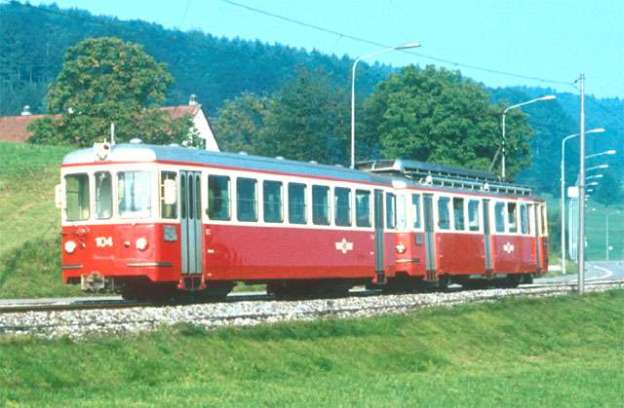
The featured image for this article is a Forchbahn Bt: 104 + Be 4/4 in service in 1982. These tramcars were built in the 1950s after the experiment described below, © Spoorjan and licenced for reuse under a Creative Commons licence (CC BY-SA 3.0). [5]

One of the points regularly made by the editors of The Modern Tramway is that given a proper chance to shine modern electric trams are better than internal combustion engined buses. So it must have come as something of a relief to hear, in 1951, that testing had taken place in Switzerland which seems to have supported the argument that the closure of tramway networks would ultimately prove to be a false economy. … [1]

The Modern Tramway reported in May 1951 that:

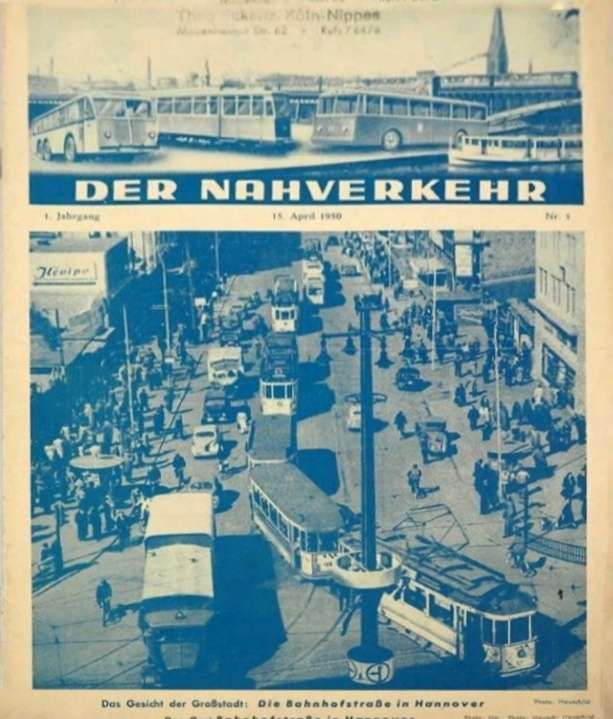
“The March issue of ‘Der Nahverkehr’ [3] contains an interesting and significant story about the 10-mile interurban tramway from Zürich Stadelhofen via Forch to Esslingen, in Switzerland. This line, known as the Forchbahn, was opened to traffic in 1912, and is operated with 10 motor tramcars, 5 trailers and some goods vehicles. Two of the motor trams are modern bogie vehicles constructed in 1948 by Schlieren & Co. with Oerliken equipment, the other cars are of the 4-wheel type.

“For much of its length the single metre-gauge track is laid in the public highway, an arrangement which the Company have long planned to eliminate by the construction of a private right-of-way. This plan was taken up in earnest in 1950, but the expected high cost of the new construction caused some hesitation among the directors, some of whom wondered whether replacement by buses might not be a cheaper alternative.

It was finally arranged with the Zürich town tramways that the latter should take over the service for an experimental period of 14 days, using buses from the municipal fleet to replace the Forchbahn trams. The period chosen was from 6th to 19th November, 1950. As was to be expected, the buses showed a certain advantage in journey time, as the tramway is single-track with widely-spaced passing loops. In summer, the Forchbahn carries a heavy weekend traffic from Zürich to the country, and in order to test the capacity of the buses in dealing with such traffic, exceptionally low excursion fares were introduced on one Sunday during the test period. Despite rainy weather large crowds were attracted to the service, and the fundamental disadvantage of the bus soon showed itself. Many extra buses were needed, and by comparison with the usual tram-and-trailer units, double the usual staff were required. The overloaded buses fell behind schedule, and even the most modern were overtaken in the Zürich suburbs by elderly city trams hauling trailers. The uneven motion of the buses soon invited unflattering comparison with that of the trams from the many passengers who had to travel standing, for the Swiss are now accustomed to comfortable travel.

“The results of the test showed that the use of buses would involve a disproportionately heavy outlay; additional personnel would be needed, the vehicles would have less than half the effective life of the tram, the goods traffic would no longer be an economical sideline, and the buses would probably have to charge fares 50% higher than those charged on the present trams. These conclusions were not published until after the test had taken place, but the population of the communities served by the Forchbahn had needed only a few days of buses to convince them that the trams gave them the better service. When, fourteen days later, the first trams ran again between Zürich and Esslingen, the citizens hung out flags and decorated the cars with branches and flowers, and in the space usually occupied by the destination board appeared a large placard: “Es lebe die Forchbahn!” The Forchbahn lives again!” [1]

The conclusion of the experiment was that retaining the line was the best solution provided that the line could be separated from the street and modernized. In the following decade, separation of rail and road traffic was increased. New bogie rolling stock was acquired, similar to two cars built for the line in the late 1940s.” [5]

The Forchbahn is still operating in the mid-21st century. It is a local mixed tramway/railway line in the Swiss canton of Zürich. It is owned and operated by the Forchbahn AG, and is branded as line S18 of the Zürich S-Bahn. The standard Zürcher Verkehrsverbund (ZVV) zonal fare tariffs apply to the line. [5]

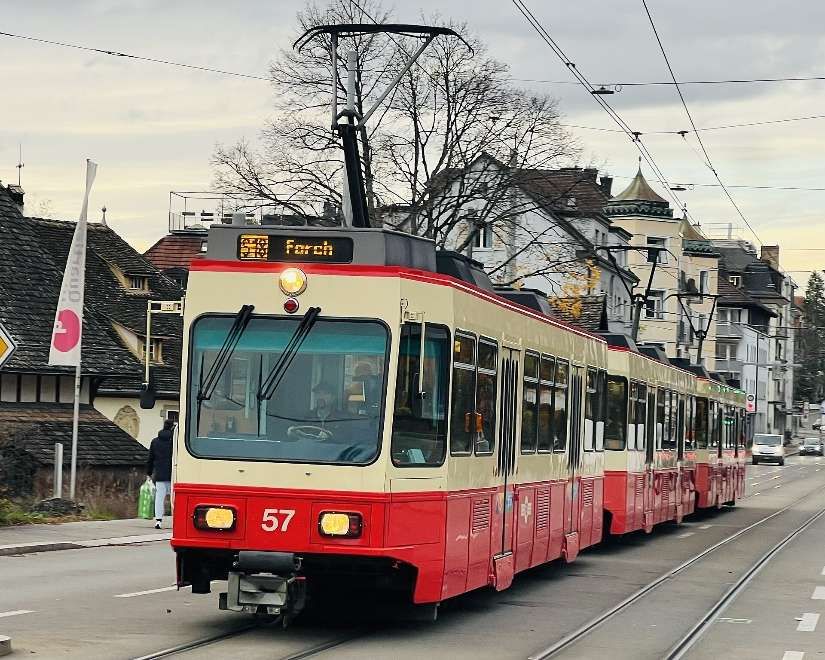
In 2004, new low floor cars were acquired from Stadler to replace the 1950s stock, © S5A-0043 and made available for reuse under a Creative Commons licence (CC-BY 2.0). [5]

References

  1. Instructive Tram-Bus Experiment in Switzerland; in The Modern Tramway, Volume 14, No. 161, May 1951, p112.
  2. ‘Der Nahverkehr’ translates into English as ‘Local Transport’, a Journal with that name is published in the mid-21st century. It dates back to 1983. It is not the journal referred to by The Modern Tramway. For the record, it is a technical and operational monthly journal for all public passenger transport in the city and region. Its target audience includes managers and decision-makers in transport companies, government agencies, associations and corporations, transport science, consulting firms and the transport industry. It is the official organ of the Association of German Transport Companies (VDV) and part of the media offering of Alba Fachmedien ÖPNV in the DVV Media Group. (https://www.dvvmedia-shop.de/DER-NAHVERKEHR/DNV-NA-12-DIGI)
  3. The ‘Der Nahverkehr‘ referred to in the article published by The Modern Tramway was, in 1951, a relatively new journal. The first issue came out in April 1950.
  4. https://ebay.us/m/bKn6Ic, accessed on 16th May 2026.
  5. https://en.wikipedia.org/wiki/Forch_railway, accessed on 16th May 2026.
The first issue of ‘Der Nahverkehr’ which was published in April 1950. [4]

The Modern Tramway – May 1951 – The Tramways of Udine, Italy – Part 1

The Modern Tramway of May 1951 included a short article by Peter J. Jacques about the Tramways of Udine and District. [1]

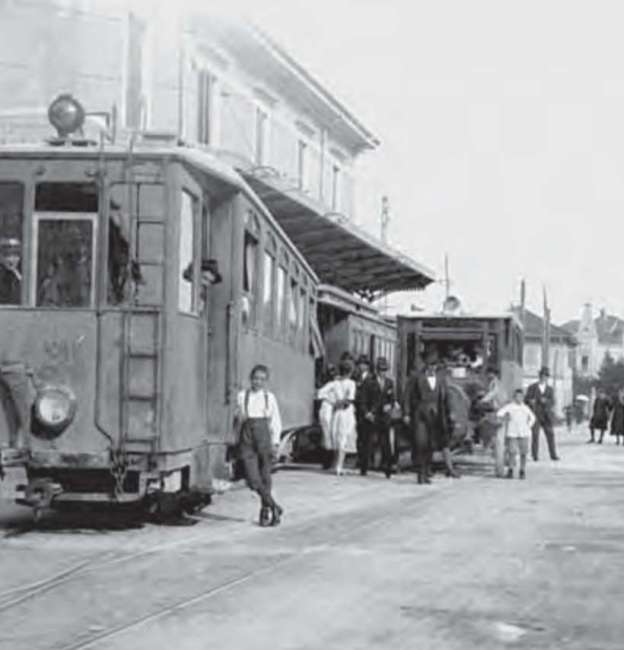
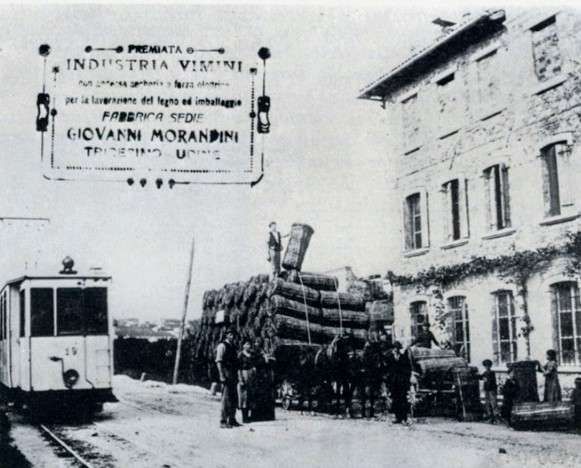
The featured image for this article is a photograph of Sante Gerussi probably dating from the early 1920s. The tram is No. 21 serving on the Udine-Tricesimo-Tarcento line. Originally these trams were painted white but were repainted when the management was transferred from the Società friulana di Elettricità to the Società anonima Tranvie del Friuli. The bus in the image may be the one that connected Tricesimo with Buja, © Public Domain. [13]

In 1951, Peter Jacques wrote:

“Udine is the chief town of the north-east Italian province of Friuli and is situated some 80 miles north-east of Venice. Its 70,000 inhabitants are served by the metre gauge tramcars of the Tranvie del Friuli. There are three town services, operated by 18 four-wheel single-deck cars, and two interurban lines, each with its own cars.” [1]

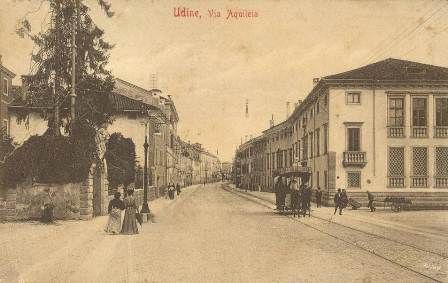
A vintage postcard image of Via Aquileia with a horse-drawn tram prominent in the picture, © Public Domain. [9]

“Horse tramways were established towards the end of the last century, and operated from the Piazza Liberta (then known as Piazza Vittorio Emanuele) to the station (circular) and to Porta Gemona, where a depot was built.” [1]

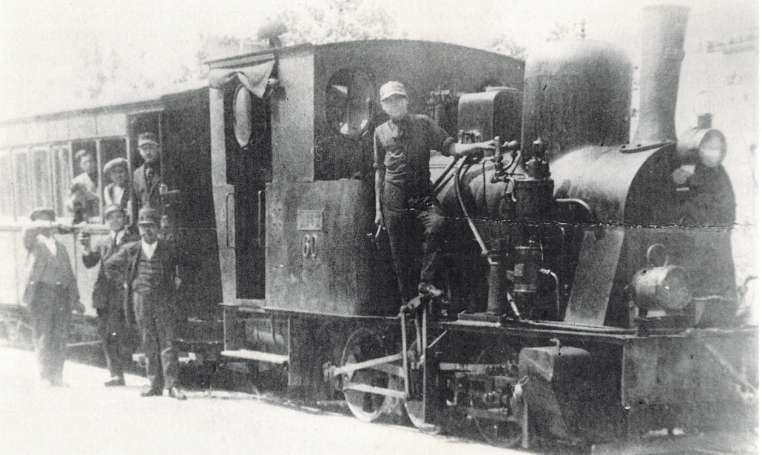
An early photograph of the historic steam tramway which linked Udine to San Daniele, © Public Domain. [3]

Jacques writing about it, said:

“An interurban steam tramway was constructed to connect the city with San Daniele, to the north-west. The Udine terminus and depot of this line were connected to the town tramways.” [1]

The Udine to San Daniele Tramway opened in 1889. Its engineer was Adolf Gründorf and it was managed in the early years by the German banker Karl Neufeldt, it was the first (and only) steam tramway in Friuli, although as early as 1924, under the management of engineer Giacomo Cantoni, it was able utilise electric locomotives. [3]

Although officially a tramway, due to its numerous stations and depots, the length of its trains, and the fact that it was often separated from the road, the Udine–San Daniele line resembled a small railway. [3]

None of its locomotives or other rollingstock survived its closure. [3]

Jacques continued:

“In 1908, the town lines were electrified and 14 single-truck cars were purchased; they were built in 1907 by the Electric Company of Milan and had bow collectors. The connecting track between the town system and the San Daniele line was closed at the time of the electrification.” [1]

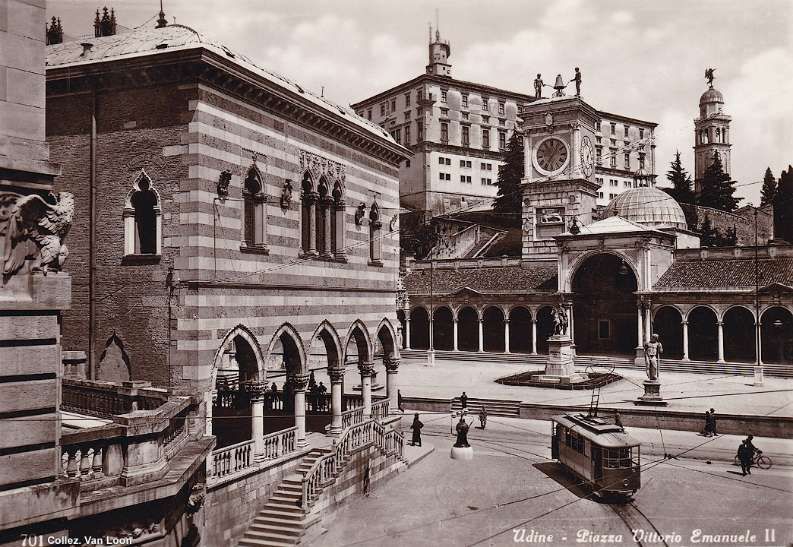
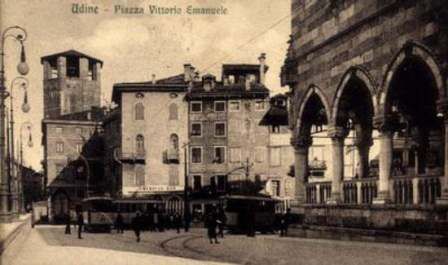
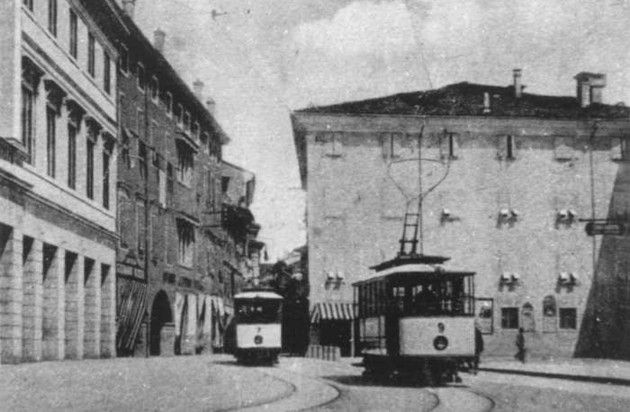
A vintage postcard view of Udine in which one of the original 4-wheel trams features. This image shows a two-axle tram parked in the central Piazza Vittorio Emanuele II, formerly Piazza Nuova and later Piazza della Libertà. On the left is the 15th-century Loggia del Lionello (Town Hall), while in the background is the Porticato di San Giovanni with its Clock Tower, © Public Domain. [4]
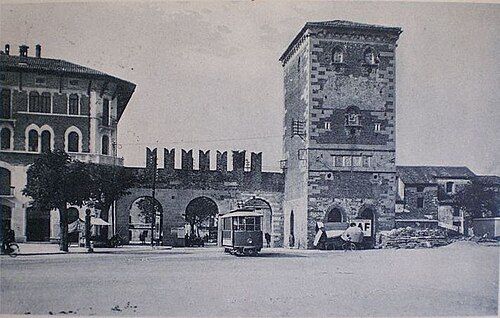
An electric tram at Porta Aquileia, © Public Domain. [9]
Another vintage postcard view of The terminus of Piazza Vittorio Emanuele crowded with trams, © Public Domain. [9]
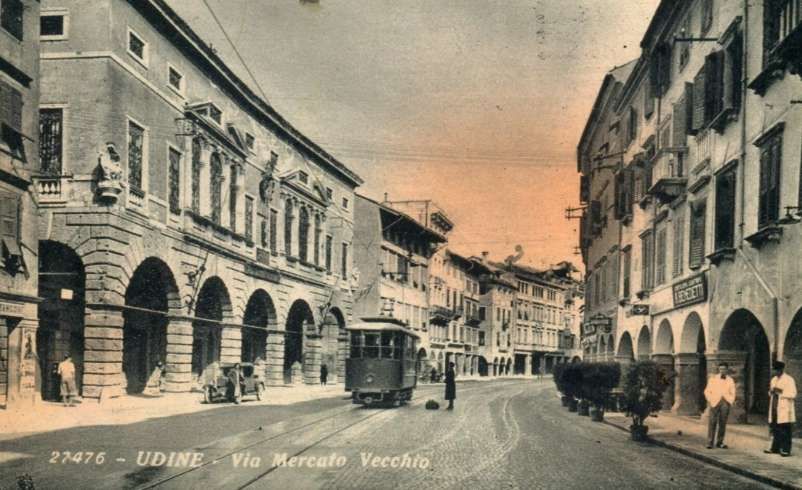
A vintage postcard view of a tram travelling along Via Mercator Vecchio in Udine, © Public Domain. [6]

Jacques continued:

“During the 1920s considerable improvements were made to the system; cars were overhauled and tracks renewed where necessary, most of the station route being reconstructed with double track, partly on reservation. The Porta Gemona service was extended to Chiavris along the track of the newly-opened electric interurban tramway Udine-Tarcento.

“On 2nd July 1932, an extension of the town tramways was opened on the main Venice road, westwards, on side reservation, as far as San Rocco (via Nervesa); in the following October the line was further extended to its present terminus at San Caterina. On 6th January 1947, the reserved-track line from Chiavris to the Hospital, a branch from the Udine-Tarcento interurban, was opened.

“The present tram fleet comprises the original 14 cars built in 1907 (Nos. 1-14), four cars purchased from Gorizia (Nos. 51-54) and the cars used on the San Daniele and Tarcento lines. All are 4-wheeled except the motor trams on the Tarcento line. The San Daniele interurban tramway is now worked by battery operated motor-cars, although occasionally one of the original steam locomotives is seen. Trailers on this line are closed, with end platforms, and are similar to those used on the former Giants Causeway tramway. The four cars bought from Gorizia are larger than the 1907 class and were built in 1927. They originally ran with central-partitioned saloon and end platforms, but in 1949 and 1950 were rebuilt with folding platform doors and conductor’s seat, and the partitions were removed, ready for ‘pay as you pass’ service.

“The management plan to modernise Nos. 1-14 completely, and the first car to undergo this treatment, No. 13, emerged from the workshops entirely transformed. The ends and roof were removed, as were the partitions between the saloon and the platforms. The longitudinal seats were replaced by transverse single seats. New control equipment was fitted and the exterior and new roof finished in streamline fashion with large windscreens. [1: p107]

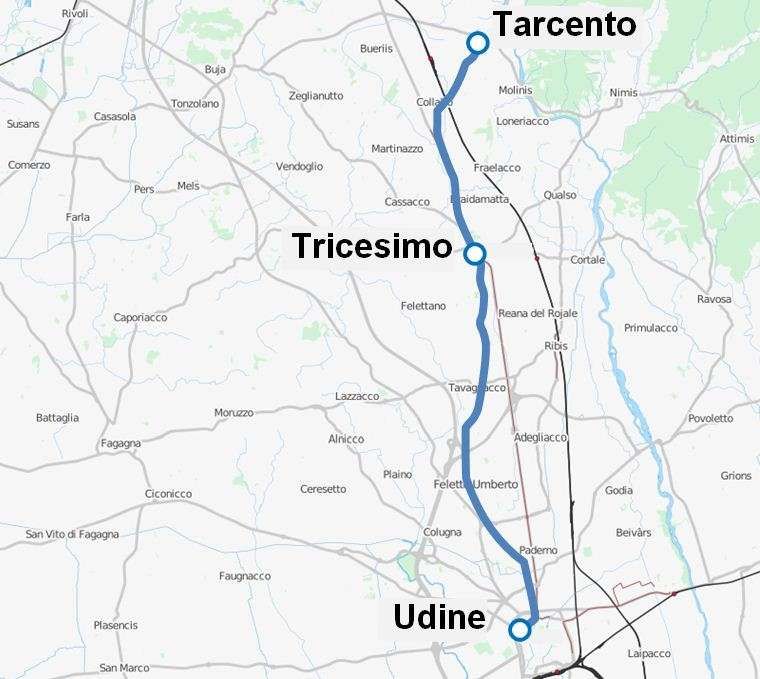
The Friuli tramways were an interurban and urban transport network, active primarily in the first half of the twentieth century, connecting Udine with neighbouring towns such as Tarcento and San Daniele del Friuli. Operated by the Società Tranvie del Friuli (TdF) since 1923, these electric lines (often nicknamed ‘white trams’) were crucial to the region’s economic development before road transport became more reliable in the 1950s. [2]

The main tram lines in Friuli were:

Udine-Tarcento Tramway (1915-1955): Also known for its white colour, the line arrived in Tarcento in 1927, quickly connecting the Torre torrent valley to Udine and the railway station.

The Udine to Tarcento Tramway (Interurban Line), © Ale Sasso and licenced for reuse under a Creative Commons licence (CC BY-SA 3.0). [5]
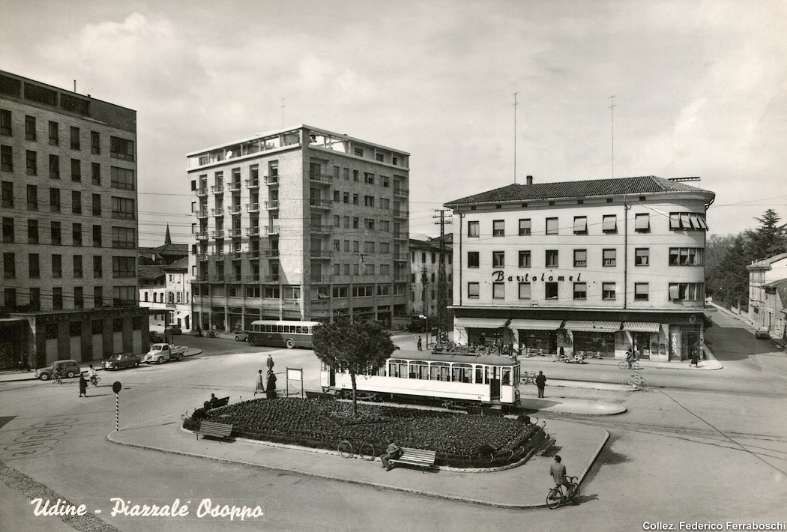
This postcard, dating back to the first half of the 1950s, shows a white tramcar on the Tarcento line, waiting to depart from the Udine terminus located in Piazzale Osoppo, along the city’s northern ring road, © Public Domain. [4]

A vintage photograph showing the “White Tram” in Tricesimo. [3]

Udine-San Daniele Tramway (1889-1955): An important interurban line that connected the capital to San Daniele del Friuli, characterised by a route that acted as a true local railway, operated with accumulator-powered electric locomotives from 1924 onwards.

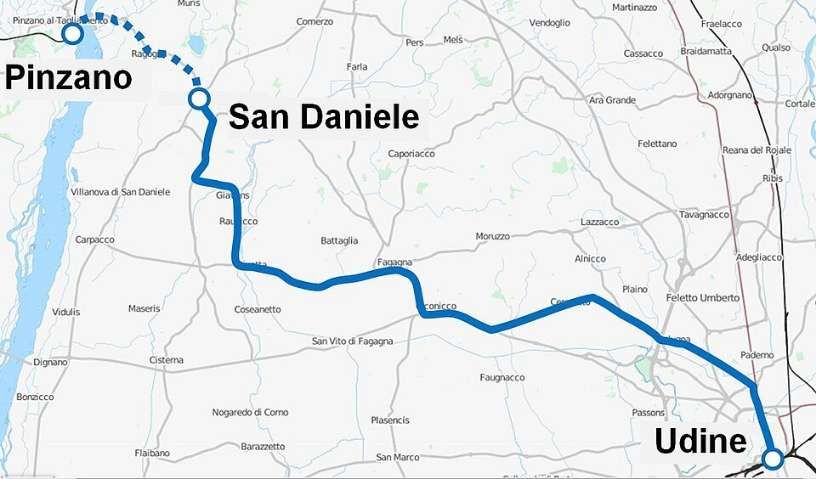
The Udine to San Daniele Tramway (Interurban Line), © Ale Sasso and licenced for reuse under a Creative Commons licence (CC BY-SA 3.0). [7]

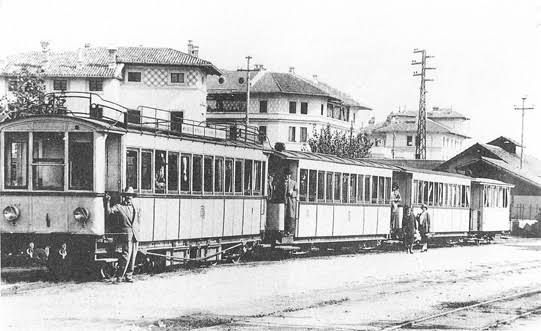
As this vintage photograph shows,  trams on the Udine to San Daniele Interurban line were more like trains! © Public Domain. [8]

Udine Urban Network (1887-1950 approximately): Started with horse-drawn traction and then electrified from 1908 thanks to Arturo Malignani and the Friulian Electricity Company, the urban network shared depots and infrastructures with the interurban lines.

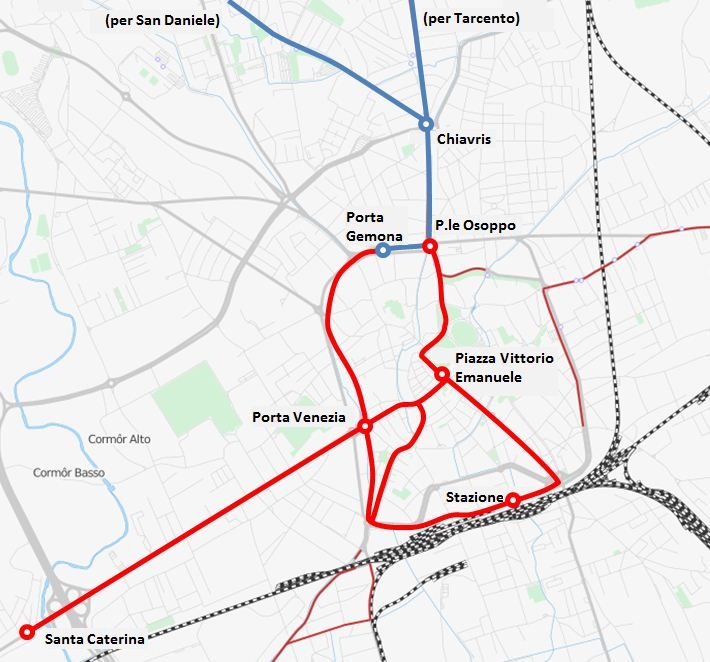
The Urban Network in Udine is shown here in red, the two Interurban Lines are shown in blue, © Ale Sasso and licenced for reuse under a Creative Commons licence (CC BY-SA 3.0). [9]

Trams in the centre of Udine in 1922, © Public Domain. [11]

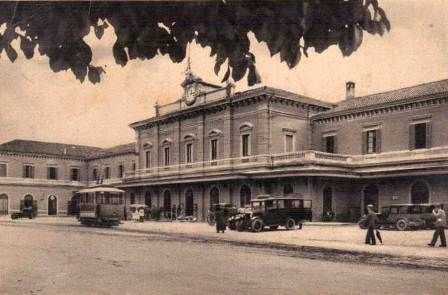
A tram outside Udine railway station building, © Public Domain. [12]

After 1952

In the 21st century, Udine does not have an active tram system. The historic, 1000 mm gauge tramway network, which opened in 1887 and once operated through the city centre (including Piazza Vittorio Emanuele), was decommissioned and closed in 1952. Public transport is now managed by Arriva Udine via an extensive bus network. [10]

When Jacques wrote his short article for The Modern Tramway, little did he know that the Udine tram network had only a year or so before it was closed!

References

  1. Peter J. Jacques; The Tramways of Udine and District; in The Modern Tramway, Volume 14, No. 161, May 1951, p107.
  2. https://www.stagniweb.it/foto6.asp?File=traminte&Inizio=17&Righe=10&InizioI=1&RigheI=50&Col=5, accessed on 15th May 2026.
  3. https://www.vecchibinarifvg.it/le-ferrovie-in-friuli/tranvie-friulane, accessed on 15th May 2026.
  4. http://www.stagniweb.it/foto6.asp?File=carttram&Inizio=15&Righe=10&InizioI=1&RigheI=50&Col=5, accessed on 15th May 2026.
  5. https://it.wikipedia.org/wiki/Tranvia_Udine-Tarcento, accessed on 15th May 2026.
  6. https://ebay.us/m/k66mBE, accessed on 15th May 2026.
  7. https://it.wikipedia.org/wiki/Tranvia_Udine-San_Daniele, accessed on 25th May 2026.
  8. https://www.dlfudine.it/gruppi/articoli_tender/tender69.pdf, accessed on 15th May 2026.
  9. https://it.wikipedia.org/wiki/Rete_tranviaria_di_Udine?oldformat=true, accessed on 15th May 2026.
  10. https://www.welcomeoffice.fvg.it/practical-info/daily-life/transport-facilities/udine-transport-system, accessed on 15th May 2026.
  11. https://commons.wikimedia.org/wiki/File:Tram_Udine.jpg, accessed on 15th May 2026.
  12. https://commons.wikimedia.org/wiki/File:Udine,_stazione_ferroviaria.jpg, accessed on 15th May 2026.
  13. https://acrobat.adobe.com/id/urn:aaid:sc:EU:2a54dd68-d611-494a-862a-7667957ff066, accessed on 16th May 2026.

The Modern Tramway – April 1951 – The Tramways of Auckland

The April 1951 issue of The Modern Tramway featured an article about the Tramways of Auckland, New Zealand. [1]

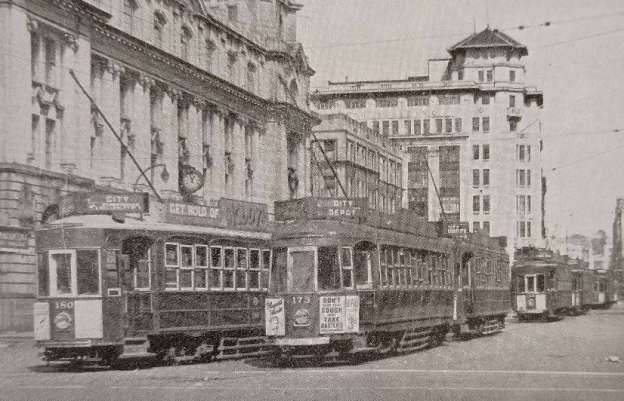
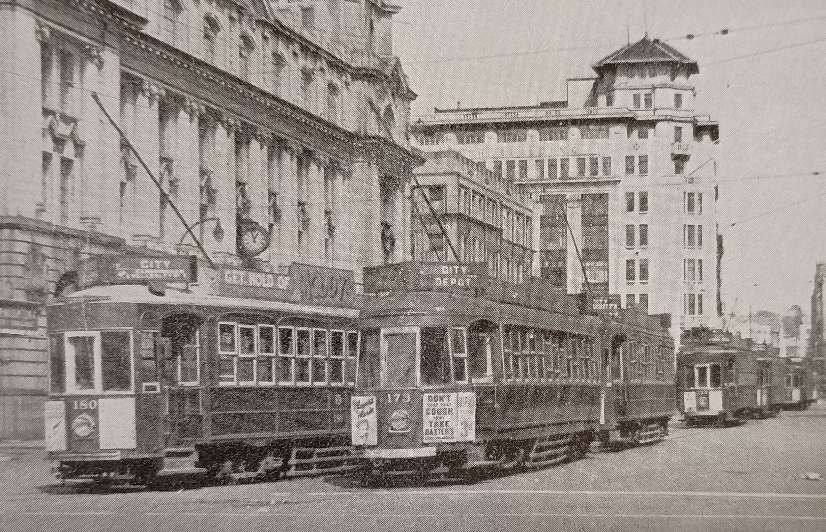
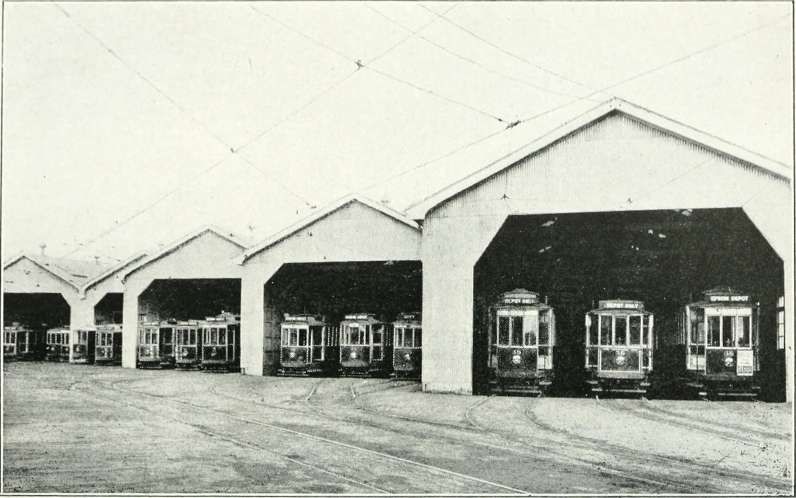
The featured image for this article (which also appears below) shows a series of older trams on Lower Queen Street, Auckland. [1: p85]

“The Auckland Transport Board operates 44 miles of tramways with 216 cars in New Zealand’s largest city. The system has several interesting features, one of which is that although all its lines are laid on sleepers, there is no reserved track or private right-of-way. The sleepers rest on a base of scoria (lava slag). Another unusual aspect of the Auckland tramways is the free tram service provided since 1936 by the Farmer’s Trading Company for its shop customers. This is operated by the Board with 3 cars on a shuttle service in the main shopping area. The store also provides a free trolleybus service for its customers and the 4 trolleybuses which have worked the service since 1938 were the first in Auckland. Also of interest is the Onehunga tram route which has a 6-minute headway, is seven miles long and is the only ocean-to-ocean tramway in the world, it runs from the port of Auckland on the Pacific Ocean to the port of Onehunga on the Tasman Ocean. it is also probably the only tramway in the world that crosses a country from one side to the other as it traverses New Zealand at the narrowest part. With the exception of two two short stretches on the Westmere and Victoria Avenue routes all the track is double and mostly in wide roads with an adequate number of safety zones (loading islands).” [1: p85]

The Modern Tramway article continues:

“Tramway operation began on 11th August. 1854, …, horse trams were superseded by electric cars from November 1902, onwards, the conversion being effected by the Auckland Electric Tramways Company (registered 22nd March 1889), a subsidiary of the British Electric Traction Company. Six reversed-staircase open-top Brush/English Electric double-deck cars were included in the original fleet, but one of them was involved in a serious accident in 1903. … These cars, which were never very popular because they lurched badly at speed and came dangerously near the centre poles, were gradually converted to single-deckers, and were all scrapped in 1948, except No. 38 which has been in use as a rail-grinder since 1936. On 1st July 1919, the tramways were purchased by the City Council for £1,227,201. The Auckland Transport Board, an elective body comprising representatives from all parts of the metropolitan area, came into being in 1928 and took over operation of the tramways from the Council on 16th January 1929.” [1: p85-86]

From 1902 onwards, Auckland’s electric tramways formed the backbone of its public transport network. They were preceded by Horse-drawn trams and later by steam-powered trams.

Lake Takapuna steam tram in 1911, © Albert Percy Godber and now in the Public Domain. [8]

Wikipedia indicates that the first steam-powered trams in Auckland operated in 1871. [6] The electric trams which replaced the horse-drawn and Steam-powered ones, “were fast, smooth and capable of running an incredibly frequent schedule. Aucklanders loved them, and patronage boomed. In 1903, the first full year of electric tram service, Aucklanders boarded their trams 13 million times. Yet 15 years later, in 1918 that figure had exploded to 44 million passengers per annum, and tram routes had expanded to cover … most of today’s inner-city.” [4]

In 1926, Aucklanders made 63 million trips by tram despite the total population of Auckland City only numbering about 90,000 people. (Compare that to 2018-19’s 100.8 million public transport boardings – Auckland’s highest since 1951 – from a population of almost 1.7 million!) Similar figures were recorded at the end of the 1930s, even when the effects of the Great Depression were still being felt.” [4]

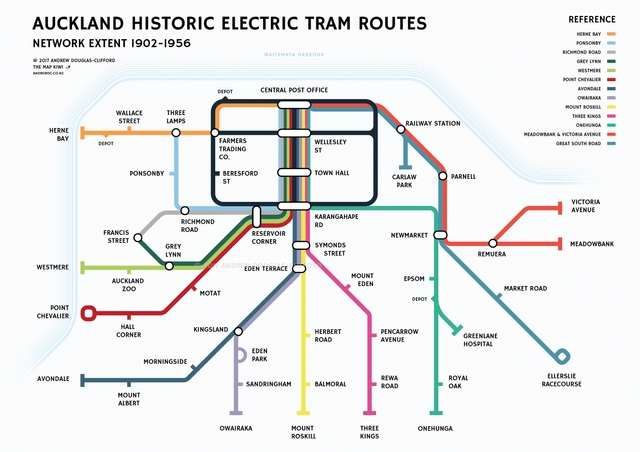
This diagrammatic map shows the extent of the historic tramway network in Auckland. It served the city from 1902 to 1956. [5]

The April 1951 article continues:

“Three routes in the north-west corner of the city have been selected for experimental trolleybus conversion; they are Herne Bay, Richmond Road and Ponsonby, the last-named being the original electric line. The Herne Bay trolleybus service began on 24th September, 1949, but the other routes have not yet been converted.

“All cars now in service are bogie single deck saloons fitted with air-brakes and two trolley-booms. They move the crowds very effectively as they are capable of carrying a total load of 100 passengers. The normal standing load is 7 on each platform and 24 more inside. The average speed including stops is claimed as 11 m.p.h., and running speeds of 25 m.p.h. and above are not unusual. The livery is bright red, unlined, with buff window frames. Most Auckland cars have a profusion of windows; some cars have as many as 36 and even the latest car, built in 1940, has 26. Another characteristic feature of the Auckland trams are the indicator boxes; there are no service numbers, but each car carries four indicator boxes arranged in pairs at each end of the car, in the form of a V. The movement of the blinds in each pair of boxes is synchronised and controlled by a single wheel. The cars can be entered from front or rear.

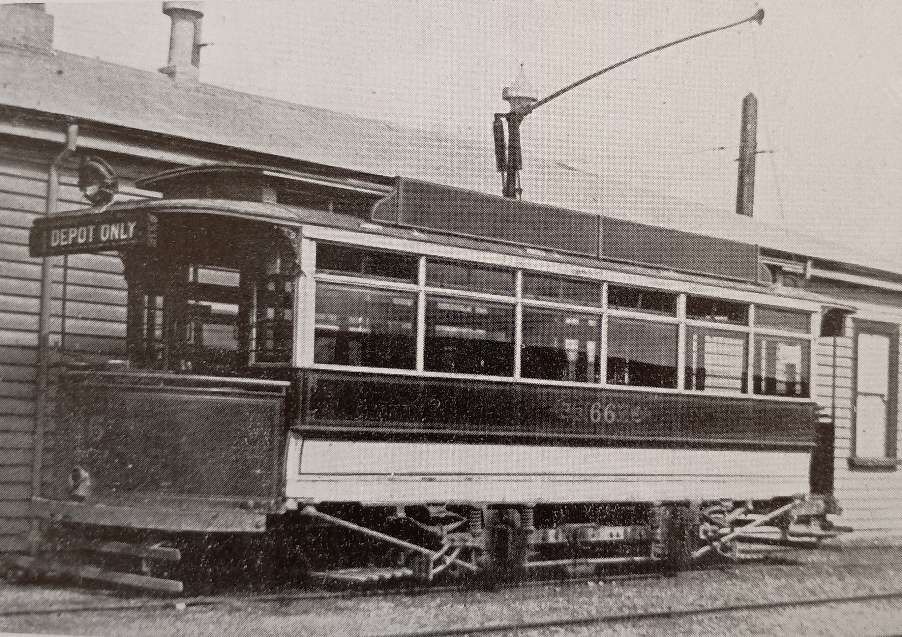
“The fleet numbers 66-69 were allocated to 4 cars sent out from Britain in 1907; these cars would have been old friends to any North Londoners, as they were none other than four representatives of the famous Metropolitan Electric Tramways class E single-deckers. They were shipped to New Zealand complete, and on arrival London tram tickets were still on the floors! They retained their Metropolitan livery of red and cream and were always painted red until they were scrapped in 1921; because of this they were known as ‘the Lobsters’. As will be seen by the photograph, certain alterations were carried out in Auckland: at a later date they were mounted on double bogies. Two were sold to Napier, but owing to an earthquake which destroyed that city and it’s tramway system, they never saw service in their third home.” [1: p86-87]

Auckland Electric Tramways Company No. 66 (Ex-Metropolitan Electric Tramways) which was scrapped in 1922. [1: p86]

The Hawke’s Bay earthquake, also known as the Napier earthquake, occurred at 10:47 am on 3rd February 1931, “killing 256, injuring thousands and devastating the Hawke’s Bay region. It remains New Zealand’s deadliest natural disaster. Centred 15 km north of Napier, it lasted for two and a half minutes and had a magnitude of 7.8 Ms (7.7 Mw). There were 525 aftershocks recorded in the following two weeks, with 597 being recorded by the end of February. The main shock could be felt in much of New Zealand, with reliable reports coming in from as far south as Timaru, on the east coast of the South Island.” [2]

Nearly all buildings in the central areas of Napier and Hastings were levelled. … The material damage of the earthquake was estimated at $960 million. [3: p140] … The local landscape changed dramatically, with the coastal areas around Napier being lifted by around two metres. The most noticeable land change was the uplifting of some 40 km2 of sea-bed to become dry land. This included Ahuriri Lagoon, which was lifted more than 2.7 metres and resulted in draining 3,600 hectares (9,000 acres) of the lagoon.” [2]

Returning to The Modern Tramway piece, the image below was included in that article it shows a number of the bogie trams used on the Auckland network through to its closure.

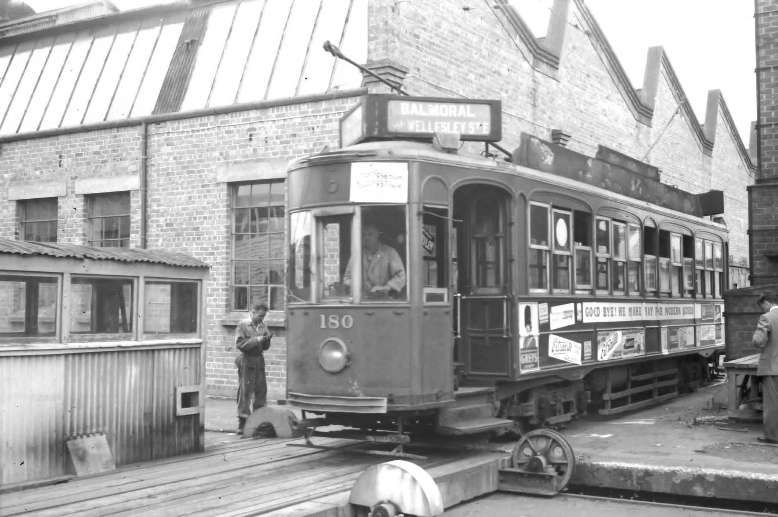
Older tramcars of the Auckland Transport Board in Lower Queens Street, Auckland. Of the two trams most prominent in the image, Tram No. 180 is a four-axle ‘combination’ bogie tram. These were a standard design for Auckland, featuring a central enclosed section and open ‘smoking’ sections at either end. Tram No. 173 is also a four-axle bogie tram, often associated with routes like Ponsonby or Westmere. [1: p85]

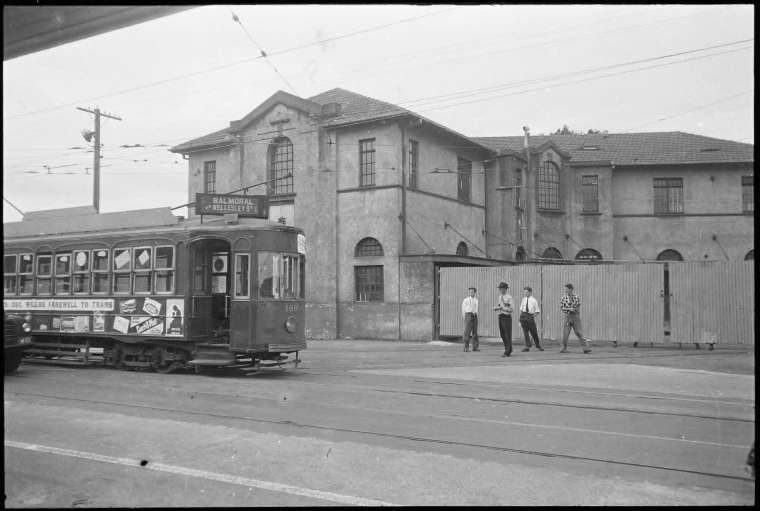
The two trams prominent in the image above survived through to the closure of the network at the end of 1956. No. 180 appears in the next two photographs which were taken on the same day in 1957, a few months after closure.

This photograph was taken outside the Tramway Depot in Epsom on the 25th March 1957, after the tramway closed 29th December 1956.  Over the next five months into 1957, many of the remaining trams were driven from the Epsom Depot here,  the 1.5kms down Manukau Road to the Royal Oak Workshops, where they were stripped of running gear and seats and the bodies trucked off to Thames where they would be later sold to become holiday homes or baches.  Tram No.180 is about to make this one-way trip to the Workshops.
Taken later the same day, this image shows No. 180 at the Manukau Road Workshops in Royal Oak, rolling onto the traverser to go into the truck shop for stripping down, © Graham Stewart, 1957 and also held in Auckland Libraries Heritage Collection. [7]

The Modern Tramway article continues

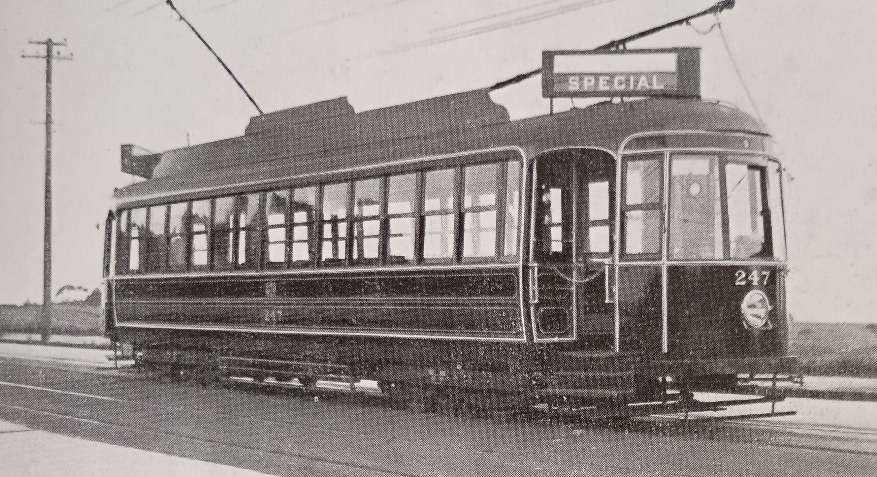
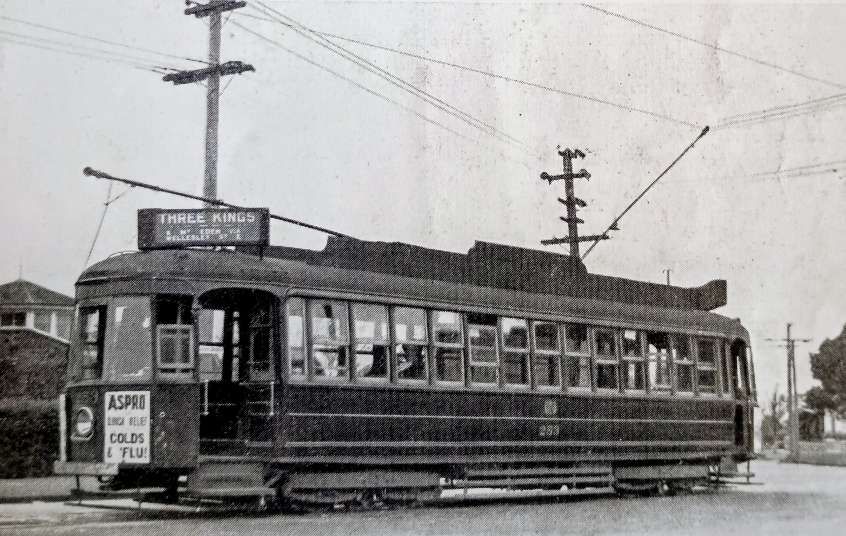
“The most modern Auckland trams are the ‘1937’ class, actually built between 1938 and 1940. These have E.M.B. lightweight or Brush trucks, four 35 h.p. Metropolitan Vickers motors and A.T.B. bodies. One of these cars, No. 253, built 1940, is fitted with regenerative braking and an M-V master controller (the others have General Electric K 35 HH controllers) and, known as ‘Queen Mary’, is the fastest and most modern tramcar in New Zealand. The graceful lines of these cars are unhappily disfigured by the ugly indicator boxes, the excessive number of small windows and the advertising boards carried on each side of the roof and dash.” [1: p87]

Auckland Transport Board Tram No. 247, built in 1938. [1: p87]
Auckland Transport Board Tram No. 253, built in 1940 and equipped with regenerative braking. [1: p87]

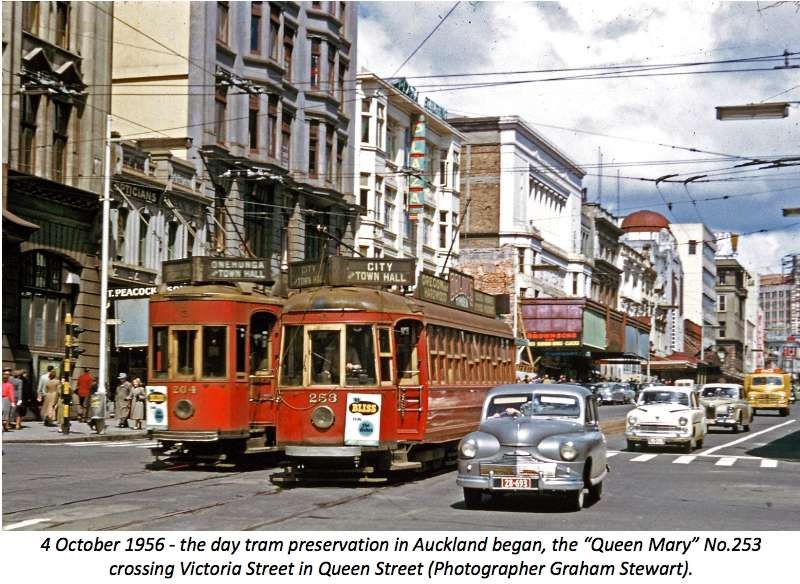
The two images above show two members of Auckland’s “1937 Class” Streamliner trams. All six of this Class were all built between 1938 and 1940 at the Royal Oak Workshops. They were the final, most modern tram design for the city, featuring distinctive bulbous sides, rounded ends, 27″ wheels and 4-motor bogie trucks. Six were built, including the renowned ‘Queen Mary’ (No. 253), which was a testbed for modern regenerative braking and high-speed performance. [9] Nos. 248 and 253 have survived into preservation and are held by MOTAT (Museum of Transport and Technology).

This image comes from the MOTAT website. No. 253 is the tram closest to the centre of the image. Alongside it is Tram No. 204, one of the earlier trams . [9]

“In June, 1950, the following tram services were in operation (the headways given [in brackets] are for off-peak periods):

– Three Kings Point Chevalier via Queen Street and Hobson Street (8 minutes).

– Owairaka Great South Road via Queen Street and Anzac Avenue (10 minutes).

– Avondale Remuera and Meadowbank via Town Hall and Parnell (8 minutes).

– Ponsonby Railway Station via Queen Street and Beach Road (8 minutes).

– Mount Roskill G.P.O. via Queen Street (5 minutes).

– Onehunga G.P.O. via Town Hall (6 minutes).

– Westmere G.P.O. via Town Hall (8 minutes).

– Richmond Road Richmond Road (circular via Town Hall and Hobson Street) (15 minutes).

– Victoria Avenue Victoria Avenue (circular via Town Hall and Anzac Avenue) (30 minutes).

– Farmer’s Free Service (to and from Karangahape Road) (service as required).” [1: p88]

Epsom Tram Depot, Auckland, in 1922. This image appeared in the Municipal and Official Handbook of the City of Auckland, New Zealand in 1922, © Public Domain. [11]

“The depots are situated at Eden Park, Epsom, Gaunt Street and Herne Bay (now [in 1951] no longer a tram depot).

“These notes were compiled by the Overseas Editor from material sent by two members of the Australian Electric Traction Association, Messrs. G. C. Stewart and G. Cobham, both of Auckland, to whom grateful acknowledgement is made. The photographs are from Mr. G. C. Stewart’s collection.” [1: p88]

The tramway network in Auckland had about 5 years left before full closure at the end of 1956.

Trams in Auckland since 1956

MOTAT

MOTAT preserved what it could. We have already noted that No. 253 was preserved by the Museum.

MOTAT is located in Western Springs, Auckland and features large collections of civilian and military aircraft, trams, and technology, with live working exhibits. It operates two sites linked by a heritage tramway. Its collection includes a number of Auckland’s historic trams:

  • No. 11, 1902 Brush Electrical Engineering Co. Bogie saloon combination. In service.
  • No. 17, 1902 Brush Electrical Engineering Co. Bogie double-decker. Stored
  • No. 44, 1906 Auckland Electric Tramways Co. Open fronted, Single truck, Saloon. Operational
  • No. 89, 1909 DSC & Cousins & Cousins. 52-seat bogie saloon. Stored
  • No. 147, 1913 DSC & Cousins & Cousins. 52-seat bogie saloon. Stored
  • No. 203, 1926 DSC & Cousins & Cousins. 52-seat Art Deco car steel-sided car. Stored
  • No. 248, 1938 Auckland Transport Board’s Royal Oak Workshops. Electro Magnetic Braking Co. (EMB), L5 bogied Streamliner. Operational.
  • No. 253, 1940 Auckland Transport Board’s Royal Oak Workshops. Regenerative braking, L5 bogied Streamliner. Stored.

New Tramways and Trams

As of 2026, the only remaining light rail lines (tram lines) in Auckland are heritage tramways. Recently, Auckland has considered reintroducing light rail lines to replace some of its most heavily used bus routes. Many line proposals have involved reusing the routes of Auckland’s former tram system. [12]

In 2015 the city’s transport agency, Auckland Transport, proposed a new light rail network – with a focus on a line between the Auckland CBD and Auckland Airport. In subsequent years, various technology types and modes were proposed by local and central government – including traditional street tramways and light metro. The most recent plans, proposed by the Sixth Labour Government, would have seen the construction of a hybrid underground/surface route. However, that particular project was cancelled by the Sixth National Government in January 2024. [12]

The City Centre-Māngere line was planned to run from Wynyard Quarter to Auckland Airport; via the Auckland CBD, University of Auckland, Kingsland railway station, Wesley, Mount Roskill, Onehunga and Māngere. There would have been be a total of 18 stops with trains running every five minutes. While the line between Wynyard Quarter and Mount Roskill would have been tunnelled, the rest of the network would have been a surface line running alongside State Highway 20.[32][33] As of 2025, Auckland Transport continues to include the corridor in its rapid transit plans, but lists City Centre-Māngere as ‘mode to be confirmed’.” [12]

References

  1. The Tramways of Auckland; in The Modern Tramway Volume 14, No. 160, April 1951, p85-88.
  2. https://en.wikipedia.org/wiki/1931_Hawke%27s_Bay_earthquake, accessed on 14th May 2026.
  3. David Dowrick; Damage and intensities in the magnitude 7.8 1931 Hawke’s Bay, New Zealand, earthquake (PDF); New Zealand Society for Earthquake Engineering, September 1998, via: https://www.nzsee.org.nz/db/Bulletin/Archive/31(3)0139.pdf, accessed on 14th May 2026.
  4. https://ahi.auckland.ac.nz/2023/05/25/the-good-old-trams, accessed on 14th May 2026.
  5. https://www.reddit.com/r/newzealand/comments/7b09mm/extent_of_aucklands_historic_electric_tram, accessed on 14th May 2026.
  6. https://en.wikipedia.org/wiki/Trams_in_New_Zealand, accessed on 14th May 2026.
  7. https://www.facebook.com/share/p/1DTLpm8pWC, accessed on 15th May 2026.
  8. https://commons.wikimedia.org/wiki/File:Lake_Takapuna_Tramway,_1911_ATLIB_286547.png, accessed on 15th May 2026.
  9. https://www.motatsociety.org.nz/post/motat-s-queen-of-the-rails, accessed on 15th May 2026.
  10. https://en.wikipedia.org/wiki/MOTAT_collections, accessed on 15th May 2026.
  11. https://commons.wikimedia.org/wiki/File:Municipal_and_official_handbook_of_the_City_of_Auckland,_New_Zealand_%281922%29_%2814783938132%29.jpg, accessed on 15th May 2026.
  12. https://en.wikipedia.org/wiki/Light_rail_in_Auckland, accessed on 15th May 2026.

The Modern Tramway – March 1951 – Glasgow Tramways Fare System

The March 1951 issue of The Modern Tramway included an article about Glasgow Tramways Fare System, written by F. James Mayhew. [1]

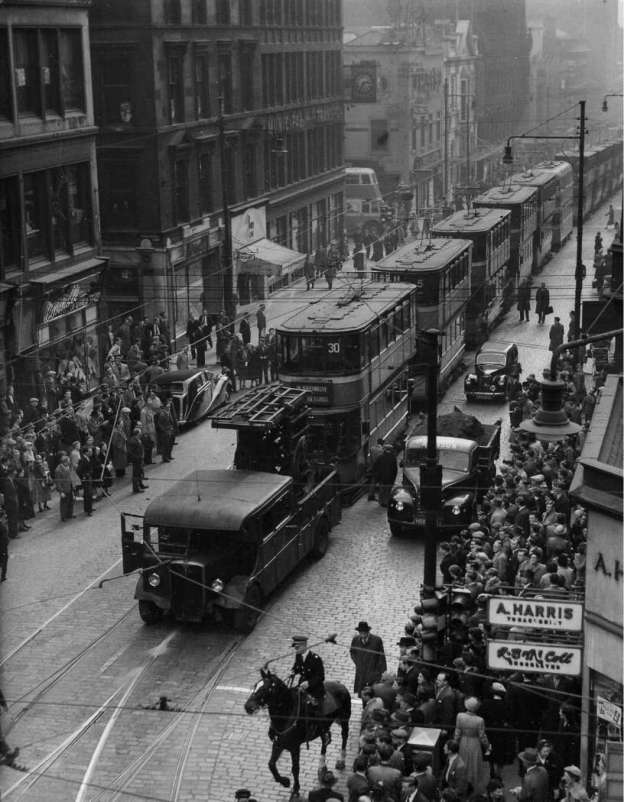
The featured image for this article shows a hold up on tram movements on Sauchiehall Street and Renfield Street in 1951. In front of a queue of trams, a service car is at work tending to the overhead cable(s), © Public Domain. [3]

The article is interesting even if just for an insight into the relative value of money in 1951 compared to 2026.

In 2026, an adult single bus fare for a 5-mile journey in Glasgow is typically between £2.90 to £3.25. Using First Bus Tap On Tap Off (contactless), a 4–5 mile journey is listed at £2.90, while a standard on-bus ticket can be higher. Prices vary between operators, with First Bus and McGill’s being the primary carriers.

Back in 1951, a 5 mile journey on Glasgow’s trams would set you back 3d, about 1.25p.

£1 in 1951 is equivalent in purchasing power to approximately £40.77 in early 2026, according to the UK Inflation Calculator, [2] 1.25p on the general inflation index would, in 2026, be worth about 51p. This means that when general inflation is taken into account, today’s traveller on public transport is paying the equivalent of around 6 times as much as a traveller on Glasgow’s trams at the start of the 1950s!

F. J. Mayhew wrote:

“In 1872, the first tramway route was opened between St. George’s Cross and Eglinton Toll on which the through fare was 2d. with a 1d. stage from either end to the top of Union Street. On the steam tramway between Paisley Road Toll and Govan the fare inside was 2d. but it was only 1d. on the top, with the doubtful pleasure of cinders and smoke.

“When Glasgow Corporation took over the tramways from the Glasgow Tramways & Omnibus Company and commenced operating in 1894, the fares were soon reduced and were extremely reasonable. The following examples are taken from the 1914 list: for [a half-penny] one could travel 1.15 miles or 2 stages, a penny fare doubled the distance, 1.5d. fare carried you 3.75 miles, and the fares increased by [a half-penny] for every 2 stages right up to a fare of 7d. for 14.48 miles.

“After the first world war the fares were revised with a minimum of Id. for 2 stages and rising by [a half-penny] every two stages. The Corporation issued a 1d. token which cost 9d. [per] dozen and entitled one to travel 2 stages, and it was a very useful concession.

“In 1926, owing to severe competition by private buses the Corporation took the drastic action of introducing a maximum fare of 2d. on 1st July, 1926, for any distance, so that there were only three fares in operation, 1d. for 2 stages, 1.5d. for 4 stages, 2d. over 4 stages, and these fares applied all day without restriction. It was an immediate success and the trams were packed to capacity. This is the nearest to a simple system of fare collection ever tried out in Glasgow. The maximum of 2d. was not a mere experiment as it lasted for 5 years and on 31st January, 1932, the maximum was increased to 2.5d. with a new fare of 2d. covering 8 stages. This new maximum lasted till the commencement of the second world war when the new maximum was 3d.

“The rising costs of war years and after have made various alterations necessary. and the maximum was fixed at 4d. for over 10 stages and decreasing by [a half-penny] for every two stages down to the minimum fare of Id. for two stages. A popular fare of 1.5d. for 4 stages was an early casualty as it was first reduced to 3 stages and then abolished altogether.

“On 31st December, 1950, Glasgow Corporation abolished the 1d. ticket which has been the backbone of the fare system with the exception of two periods when a [half-penny] fare was in operation. The scale today is 2 stages 1.5d., 3 stages 2d., 6 stages 2.5d., 9 stages 3d., and over 9 stages 4d.

“In Glasgow, the fare system did not allow of concessions to workers at special rates as the whole scale of fares was very low. The same scale of fares applied to all routes, without the annoying exceptions some cities have for various routes and this has contributed in no small measure to the esteem in which the tramways are held by the travelling public. …

“All stages are clearly marked by the sign ‘Fare Stage’ painted red and by a red band on the pole; a small plate is fastened to the sign indicating the number of the stage. The stages are so numbered that where services converge together in the city the same number applies to the fare stage for all services. In the case of circular services or services not proceeding through the city centre, the stage numbers are apt to vary from the through routes. It is interesting to know that No. 1 stage is at Renfrew Ferry, as trams could run through from there to Milngavie, via Paisley, Barrhead, Shawlands, Glasgow, Hillfoot, and the stage number at Milngavie terminus is No. 41, a distance of 22.73 miles. Unfortunately, this through route has been severed between Paisley and Barrhead at Glenfield a short time ago. The stages in the city centre run between numbers 25 and 30 and either decrease in the east and south routes or increase in the west and north routes. The stage numbers are shown against the appropriate names of streets which are shown on the fare lists inside the trams on both decks and the fare between any two points can be very easily ascertained.

“Prior to the second world war 6d. evening tourist tram tickets were available on all tram services from 5 p.m. to midnight on any weekday, and on Sundays a 1s. ticket all day took in the bus services and underground as well. In 1950, an experimental 1.5d. voucher was issued for use between 10 a.m. and noon and 2.30 p.m. and 4.30 p.m. for any distance, valid from Monday to Friday, to encourage travel at off-peak periods. This was withdrawn after a six months trial, but a new 2d. voucher is to be introduced shortly for any distance, from Monday to Friday, between 10 a.m. and noon and 2.30 p.m. and 4 p.m. Thus the 2d. maximum fare returns after twenty years although restricted to set times.

The Transport Committee are investigating the collection of fares so as to minimise the considerable loss caused through uncollected fares every day. The red box is fitted to all trams on the platforms to allow passengers to pay their uncollected fares when leaving the tram, but unfortunately many citizens fail to realise that by not placing their uncollected fares in the boxes they are injuring their own transport system.” [1: p60-61]

In 1951, Glasgow’s extensive tram network was still a dominant, well-loved, and bustling part of city life, despite a report in October of that year signaling its eventual decline. There were sleek, new-looking trams on routes like the Service 14 to Speirsbridge and busy, often crowded, scenes in central areas such as Renfield Street and Paisley Road. [3]

Glasgow Corporation Tramways were heavily used and, in 1951, remained an essential, iconic part of the city’s transport infrastructure, even as city officials began planning for their replacement. [3]

Although the system was in the early stages of a phased transition towards buses, it still operated a vast network, including high-traffic routes like the ‘Goldmine’ service.

Photographer Peter Mitchell captured over a thousand images of the city’s trams during this period (1951-1962), showcasing Standards, Coronations, and Cunarders in operation. [4]

Glasgow Standard Tramcar in the Riverside Museum, Glasgow in 2912, © Kim Traynor and licenced for reuse under a Creative Commons licence (CC BY-SA 3.0). [5]

Tramcars in service also included in operation also included the ‘Kilmarnock bogies’ (built 1927/28). These trams were a batch of 50 maximum-traction, eight-wheeled trams (Nos. 1091–1140) featuring bogies supplied by the Ayrshire-based Kilmarnock Engineering Company. Though technologically advanced with wider interiors, they were prone to derailing on tight curves and were restricted to flatter, straighter east-west routes. [6]

References

  1. F. J. Mayhew; Glasgow Tramways Fare System; in The Modern Tramway, Volume 14, No. 159, March 1951, p60-61.
  2. https://www.in2013dollars.com/uk/inflation, accessed on 13th May 2026.
  3. https://www.heraldscotland.com/opinion/18248444.days—glasgow-trams-1951-1962, accessed on 13th May 2026.
  4. Hugh McAulay & Charlie Loarridge; Around the Glasgow Tramway System with Peter Mitchell; Adam Gordon Publishing, Brora, Sutherland, 2022.
  5. https://commons.wikimedia.org/wiki/File:Glasgow_tramcar.JPG, accessed on 13th May 2026.
  6. https://tramway.co.uk/collections/trams/glasgow-corporation-no-1115, accessed on 13th May 2926.

The Modern Tramway – March 1951 – The Hill of Howth Tramway

Following on from an article written in May 2023, after a visit to Howth, which can be read here, [1] I found an article about the Tramway by C. L. Fry in the March 1951 issue of The Modern Tramway. [2]

The May 2023 article covers the route of the line in some detail.

The featured image for this article is a Standard Double-deck tramcar sitting at Sutton Station on the Hill of Howth Tramway © F. Jeffares, Public Domain. [2: p50]

C. L. Fry wrote:

“A very delightful summer outing can be had by availing oneself of the excellent service operated by the Great Northern Railway (Ireland) on its Dublin local line from Amiens Street Station to Howth. Perhaps the best way would be to leave the train at Sutton Station and there board a G.N.R. Hill of Howth tram which leaves Sutton Station, and winds its way round and over the Hill. The tramway at its summit reaches a height of 350 feet above sea level. From the top of the Hill, and the tramway goes almost to the top (560 ft.) it is possible to see the Mountains of Mourne on the north side, the Wicklow Hills on the south side, and the wonderful view of Dublin Bay and Bray Head. The view at night time, with the reflection of millions of lights glittering in the sea across the bay is equally marvellous. For 1s. 6d., a ticket may be purchased to include a trip by railcar to the tramway terminus and then by the tramway round and over the Head, and back to Dublin by diesel railcar.” [2: p50]

A repeat of the featured image for this article which shows a Standard Double-deck tramcar sitting at Sutton Station on the Hill of Howth Tramway © F. Jeffares, Public Domain. [2: p50]

Fry continued:

“The tramway, which is single line throughout, runs mainly in a reserved right-of-way, about one-third of this being on the side of the road. The track is laid with standard type bull head rails, with the wooden keys on the inside so that it is only necessary for the milesman to walk the line once to see if all the keys are tight. There is, however, about a half-mile of standard tramway grooved rail from Sutton Cross to the foreshore near St. Finton’s – one of the first calling places after Sutton Cross. This track, of course, is sunk in the carriageway. There are many passing-places on the line, and each one of these is signalled to the next passing-place by the driver, thereby preventing a car from the opposite direction entering the single line section, though cars may follow in the same section. The line is 5.25 miles long and starts from the railway station at Sutton and ends at Howth railway station.

“It is at Sutton that the car sheds, fitting shop, and former power station are situated (power is now taken from the Electricity Supply Board); the voltage is 550 d.c. The car shed has three lines side by side and a point of interest is the fact that there is a 3-way overhead frog with a moveable tongue, which is hand-operated from the base of the post, so that the trolley will take the correct wire to go into the sheds.

“This tramway was opened on 7th June 1901, and is now the only electric tramway in the Irish Republic. Within a couple of years of the opening day, the Company had eleven bogie tramcars, all of which are still working more or less in the same condition as when first built. Nos. 1-8 were built by the Brush Engineering Co., are mounted on Brill maximum-traction trucks, and have vestibuled platforms. They are 31ft. 4in. long by 7ft. 6in. wide, and carry 30 passengers in the saloon, and 37 on the upper deck. They are painted blue and cream. Nos. 9 and 10 were built by Milnes, are rather larger, and are mounted on Peckham maximum-traction trucks. They are painted in the standard mahogany colours of the G.N.R.(I) carriages. These cars are unusual, insofar as they have a combination of ‘knife-board’ and transverse seats downstairs, to enable people to admire the beautiful scenery to be seen on this journey. Seating capacity is 33 in the saloon, and 40 on the upper deck: the cars have vestibule ends, and are 33ft. long and 7ft. 6in. wide. All ten cars on this tramway have open tops. The trolley poles are mounted on the extreme side (the sea-side) of the tramcar. Car No. 11 is a works vehicle; it is really a wagon with a tower at one end used for repairing the overhead. The trolley in this case is mounted on the centre line of the roof at the opposite end from the tower. This car is mounted on Brill maximum traction trucks, and is 24ft. 3in. long and 7ft. 3in. wide.” [2: p50-51]

A tramcar ascending Howth Hill, © F. Jeffares, Public Domain. [2: p51]

“All the passenger trams are fitted with air brakes, which are charged with compressed air to 75lb. per square inch at the car sheds every morning. They also have regenerative and hand brakes for control on the very steep hills on which they operate, the gradings being as steep as 1 in 16.25. Nos. 1-8 are fitted with electric heaters downstairs.

“While the Dublin United Tramway [D. U. T.] Company’s line was operating to Howth, there were two extremely unusual features:

“(1) Although both tramways were built to the standard Irish railway gauge of 5ft. 3in. and at Sutton Cross cars of the G.N.R. tramways crossed the D.U.T. on the same level, there was no point or other physical connection to enable cars of the two Companies to interchange. The G.N.R. single overhead wire was fitted with insulators on both sides of the two D.U.T. overhead wires at this crossing, the actual length of G.N.R.(I) wire taking D.U.T. current being about 6ft.

“(2) At Howth the G.N.R. Tramway again crossed the D.U.T., but this time on an over bridge, the G.N.R.(I) descending to the level of the D.U.T. Again there was no physical connection.

“Incidentally, of course, this is the level of the railway station at Howth. The tramway is on one side of the railway platform. The railway journey from Sutton is but 2 miles” [2: p51-52]

This image shows the service car in use at the summit of the line, with a passenger car behind, © F. Jeffares, Public Domain. [2: p52]

“Another item of interest in the fact that the overhead consists of a single wire from the Summit to Howth while it is double all the way (with the exception of the old D.U.T. crossing already referred to) in the other direction to Sutton.

“The tramway has, on the whole, been very well maintained by the G.N.R. Extensive renewals of track have taken place quite recently and overhead posts which have corroded owing to the action of sea air have had steel bars inserted and have been filled with concrete.

Some ten years or so ago buses were operated for a short time but were withdrawn as the tramway service was more suitable owing to the hilly nature of the line. Today, the position unfortunately is rather uncertain, and while a splendid service is operated in the summer, the number of passengers using the service in the winter enables only a skeleton service to be operated.

“Regarding the future of this delightful tramway, one thing is certain, that Mr. G. B. Howden, General Manager, G.N.R.(I) and also General Manager of Coras Iompair Eireann, who has done his best to maintain every branch line, will, I have no doubt, do all in his power to keep this line open as long as traffic warrants it.” [2: p52]

References

  1. https://rogerfarnworth.com/2023/05/14/the-hill-of-howth-tramway
  2. C. L. Fry; The Hill of Howth Tramway; in The Modern Tramway, Volume 14, No. 159, March 1951, p50-52.

The Modern Tramway – February 1951 – Traction Motor Trends in 1951 – and beyond

The featured image for this article is a line drawing of a drive system from a Hamburg Metro Car, an SKF DT4. [5] … AC traction motors (commonly induction motors) are the standard for modern trams, replacing older DC motors to provide higher efficiency, better reliability, and reduced maintenance. These motors, often running at 60–200 kW, power the bogies and enable regenerative braking to feed energy back into the overhead line. They are controlled by variable-frequency inverters for smooth acceleration.

The Modern Tramway of February 1951 carried an article by ‘Eltee’ entitled ‘Traction Motor Trends’ about the recent changes in electric motors in trams. [1: p33-34]

“The present trend towards the use of lightweight high-speed electric motors for traction purposes, a trend exemplified at its best by the motors used in in the P.C.C. cars in America, and those of similar design now being introduced at Blackpool and and Glasgow and on the Continent, justifiably prompts the query as to why motors were not, in the past, built as they are today. There are actually several reasons for this, some highly technical, but one of the more important is that the need for efficient ventilation of motors was not sufficiently appreciated in the early days.

“When a motor is running and current is passing through its conductors these conductors are heated by the passage of current, just as are the conductors of an electric stove though much less so. The power represented by this heat is lost to the motor, and called the ‘copper loss’. Another source of loss is the rotation of the armature in the motor magnetic field; the alternating magnetism through the armature caused by its rotation brings about power losses in armature iron, which also appear as heat. In running, then, the motor gets heated, and if there were no means of dissipating this heat the motor would get hotter and hotter until something melted.

“In practice this does not happen, as the motor casing is in contact with the air around it, and when the casing is hot it loses heat to this air, doing so all the more readily when the car it is driving is moving and there is a certain amount of draught. Many years ago this was the only way of cooling the tramway motor, hence a large motor had to be used simply to ensure that there was enough casing area to dissipate the heat generated. Some additional armature cooling was given by the provision of axial ducts in the armature, aided by a few radial ducts. In this way some slight fanning action was given by the moving armature, swirling the air in the motor casing and conveying the heat from the armature more readily to the outside casing for dissipation into the atmosphere.

“A later development introduced what is now known as ‘series ventilation’, the self-ventilated motor being introduced about 1910. In such a motor a fan is mounted on the non-commutator end of the armature, and two sets of openings are made in the same end of the motor casing. The fan draws air through the armature axial ducts when the motor is running and expels it through one of the casing openings; this assists to keep the armature cool. This air, in the first place, is drawn in through the other set of openings and over the field coils before turning round and entering the armature ducts; in this way the field also is kept cool, but the ventilation of the armature suffers because the air is already somewhat warmed by its passage over the field coils.

“A further development, common from about 1920 onwards, is known as ‘parallel ventilation’, in which there are two parallel air streams through the motor. A twin fan is fitted to the non-commutator end of the armature, and openings made in both ends of the motor casing. The fan draws a stream of cool air over the commutator, round the armature surface and over the field coils before expelling it. The other half of the fan draws an air stream under the commutator and through the armature axial ducts, thus keeping the interior of the armature cool and dissipating most of the iron losses effectively.

“With a motor as efficiently ventilated as this it is possible to ‘force’ the motor more without its getting too hot; that is, in more technical language, a motor can have a higher rated power. Consideration of the above method of ventilation readily shows that if the motor armature rotates more quickly the attached fan will draw more air through it, ventilate it even more thoroughly, and permit even more ‘forcing’ by the passage of greater currents. This, in essence, explains the present trend towards motors of high rotational speed; the efficient ventilation possible on such motors permits more power to be passed through them than through motors of similar size with less effective ventilation.

“The above being understood, two further points are worthy of emphasis. One is that the greatest losses occur in a motor when it is starting and running slowly; the best ventilation occurs when it is running quickly. Cars on a town route will thus need bigger motors than similar cars on an interurban route on which there is a lot of free running, providing their maximum speeds are equal. The second point is that, if motors have been used on a service on which their capabilities are being fully employed the gear ratio must not be altered, because, although the speed of the cars can thereby be improved, such a measure will not only increase the currents passed through the motor (for more power will be required from the motor) but will also decrease the average speed of rotation of the motor. resulting increased “losses” and impaired ventilation will both tend to raise the operating temperature of the motor. and so reduce its life, unless it was known that hitherto it had been used well below its capacity and was operating at relatively low temperatures.” [1: p33-34]

Since ‘Eltee’ was writing at the beginning of the 1950s, much has changed!

Improvements in the ventilation of tramcar electric motors since 1950 have centred on a move away from traditional forced-air cooling in direct current (DC) motors to advanced, sealed, and integrated systems used with modern AC traction, enhancing reliability and reducing maintenance. [2][3]

Modern three-phase AC motors allow for lighter, more compact, and more powerful motors. These motors are often less sensitive to heat and easier to cool than older designs. [2][3]

Modern tram design integrates motors directly into the bogies, with ventilation systems designed as part of the overall low-floor, compact carriage architecture, ensuring better cooling airflow in restricted spaces. [3]

Many modern motors are now completely enclosed, utilizing improved heat sinking and specialized cooling fan designs rather than drawing in outside air, reducing the impact of dust and water on electrical components. [2][3]

The use of GTO-inverters and modern power electronics reduces motor heat generation compared to older resistor-controlled DC motors, reducing the load on ventilation systems. [2][3]

Improved insulation materials allow motors to operate safely at higher temperatures, reducing the strain on the cooling systems and improving longevity. [2][3]

Modern electric trams utilize motors to generate electricity during braking, returning power to the grid or charging on-board batteries/supercapacitors. The use of battery-power and on-board storage can allow trams to pass through city centres or other sensitive areas without overhead wires. [3][4]

Electric motors are ideal for rapid urban transport because their higher torque at low speeds allows speedy departures from stops on a network. It also allows tramcars to handle hilly terrain better than internal combustion engines.

Electric motors are roughly 90% efficient at converting energy into motion. In contrast, diesel engines lose about 60-70% of fuel energy as heat. [4]

Additionally, unlike internal combustion engined vehicles that consume fuel while stopped, electric trams use virtually no power when stationary. [4]

AC motors have been shown to improve reliability and decrease downtime compared to traditional DC motors. But they have significantly lower maintenance needs than internal combustion engines, having far fewer moving parts and not needing oil changes, spark plugs, filters, and complex exhaust systems. The high torque of electric motors at low speeds eliminates the need for heavy, expensive multi-stage gearboxes common in internal combustion engined vehicles. [4]

Trams typically have a service life of about 30 years, roughly double that of diesel-powered buses. They typically produce no local pollutants like nitrogen oxides or particulates, which is critical for city air quality and meeting climate targets. Electric propulsion is significantly quieter than internal combustion engines, reducing noise pollution in densely populated areas. In addition, electricity can be generated from various sources, including renewable energy (wind, solar, hydro), making the system future-proof as the power grid decarbonizes. [4]

Increasingly in an urban environment public transport is heading underground. Because they emit no exhaust fumes, electric trams can safely operate in tunnels and underground stations where diesel engines cannot.

Internal flexibility is increased as the need for bulky and heavy engines and fuel tanks is eliminated. The net gain is a more friendly user experience, faster loading and unloading at stops and increased passenger capacity. [4]

It is not surprising that many cities around the UK, and across the world, are seeking to reintroduce trams and to increase the size of their networks.

References

  1. ‘Eltee’; Traction Motor Trends; in The Modern Tramway Volume 14 No. 158; The Tramway and Light Railway League, February 1951, p33-34.
  2. https://en.wikipedia.org/wiki/Electric_locomotive, accessed on 12th May 2026.
  3. https://en.wikipedia.org/wiki/History_of_trams, accessed on 12th May 2026.
  4. https://medium.com/@blaisekelly/why-trams-are-cheaper-than-buses-6d929192624a, accessed on 12th May 2026.
  5. https://evolution.skf.com/new-drive-systems-for-mass-transit, accessed on 12th May 2026.

Modern Tramway February 1951 – New Tramcars for the Brno Tramways in 1950/51

The featured image for this article is Brno Tramways No. 131 with Trailer No. 310, which early in 1951 was newly delivered to Brno. [1: p21]

Gerald Deuce reported in February 1951 on a series of new tramcars being delivered to Brno in what is now the Czech Republic. [1: p25-26]

He writes that these tramcars:

“are uni-directional single truck motor-cars with trailers of similar design and are intended for PAYE [Pay As You Enter] operation with the entrance at the rear. All the doors except the leading set of the motor-car, are under the control of the respective conductor.

“The cars are heated by electric radiators fitted under the transverse seats, and lighted by a fluorescent tube strip along the ceiling.

“Brno is the capital of Moravia and has a population of just over 273,000. It is situated about 130 miles south-east of Prague, and is the centre of the Czechoslovak textile industry and an important tourist centre.” [1: p25]

Their ‘vital statistics’ were: ….

In this table, the first column of figures relates to the motorcar the second column of figures relates to the trailer. [1: p25]
As far as I can tell the trams introduced in 1950/51 in Brno were KPS Brno 4MT trams and the trailer is a vv4 trailer car. Deuce  does not give full details. [1: p25]

In 1950, the Královopolská strojírna plant in Brno manufactured new tram cars, including the KPS Brno 4MT2 motor tram and a vv4 trailer, which served the city. This period focused on modernizing existing infrastructure, with four-axle T-series trams and K-series cars introduced during the 1950s/60s. The KPS Brno 4MT2 tram, manufactured in 1950, was later used in the 1970s by the Technical Museum. [9]

Deuce continues:

“The tramway system is of standard gauge, the lines all rising from the railway station, near the centre of the town, with a total route mileage of about 23. The main depot and workshops are at Pisarky, approached by a long sleeper-track section. This line also serves the exhibition grounds, where there is a special four-track layout. There is an interurban line to Lisen, 5.2 miles long and nearly all on private right-of-way; most of this line is single-track with passing loops, with automatic colour-light signals.

“Services operated are as follows:

1 & 6 Pisarky – Reckovice.
2 & 8 Horno Herspice – Zidenice.
3 & 7 Obrany – Bystrc.
4 Komarov – Masarykova ctvrt.
5 Julianov – Stefanikova ctvrt.
9 Julianov – Cerna pole..
10 Nove Sady – Lisen (interurban).

“The higher number indicated against the first three services refers to a short working over the central portion of the route. Services 5 and 9 run together for most of the distance. Frequent services with trailers are operated on all routes. The through trains on the Lisen line usually consist of a motor-car and two trailers, and run at intervals varying between 15 and 40 minutes; there are additional short workings.

“There is a flat fare of 2kcs. 50h.” [1: p26]

This photo depicts a passing place on the tram line between Brno and Lisen in the Czech Republic. The image shows pre-war rolling stock in operation, © Gerald Deuce, Public Domain. [1: p26]

The Brno tramway network (Czech: Tramvajová doprava v Brně, simply Tramvaje v Brně) was the first network of its kind to be put into operation in what is now known as the Czech Republic with its horse tram lines dating back to 1869. [In the 21st century], Brno is the second largest city in the Czech Republic, after Prague, and its tram network is also the second largest in the country.” [5]

At different times, three different modes of propulsion were used on the network: from 1869, horse-power was in use; from 1884, steam-power was in use; and from 1900 electric trams were introduced. [5]

Brno hosts a tram parade in June each year. The three images below come from that parade: ….

Traditional Horse Tram in Brno Tram Parade, 2006, © Aktron/Wikipedia Commons and licenced for reuse under a Creative Commons licence (CC BY-SA 3.0). [6]
Traditional Steam Tram, in Brno Tram Parade, 2006, © Aktron/Wikipedia Commons and licenced for reuse under a Creative Commons licence (CC BY-SA 3.0). [7]
Early Electric Tram in Brno Tram Parade, 2009, © Harold and licenced for reuse under a Creative Commons licence, (CC BY-SA 2.5). [8]

These next paragraphs come from a webpage written in 1998/99 by Richard Bilek from the Czech Republic, who died in 2001 (R.I.P.). Translated from Czech, that have in places been paraphrased to read more easily. They are a ‘snapshot’ of the tramway network in Brno in 1998/1999 and a potted history of developments from the 1950s to the late 1990s. [2]

“In 1951, Brno had 62 km of network. In 1948, the last two-axle tramcars from Zbrojovka Zidenice were delivered. In the 50s, the city renewed their tramcars with new progressive tramcars of class T2. 94 tramcars of this type were delivered till 1961. No T1 type tramcars were purchased by the city.

“In 1963 new tramcars of T3 arrived. The city wanted tramcars with bigger capacity. Tatra Works developed articulated tramways of type K2 in the mid of 60s. First prototypes were tested here in 1965, and between 1966 and 1977, the City purchased 132 tramcars of this type, so they operated the largest fleet of K2 tramcars in the Czech Republic. These tramcars were still most typical for Brno at the end of the 20th century.

“All Czech cities except Brno at the end of 60s shortened their network at the end of the 1960s. Brno was the only city with uninterruptable expansion of track after WW2 through until the turn of the 21st century. New housing estates in Brno also were connected with the tramway and later, with trolleybuses. The last major expansion, a new line, was opened in 1989, a further short connection line was opened in 1994. An additional 2.2 km was under construction  in 1998/1999. The city purchased new KT8D5 tramcars at the turn of the 21st century, 28 cars entered service. Further renewals were also planned – T6B5 type. and low-floor tramways of RT6N1 type.

“The city was operating the following tramcars just prior to the turn of the 21st century:

1470+1462 Last units of T2 tramcars of T2 type. These two vehicles were due to be scrapped in 1998.
1495..1668 Tramcars of T3 or T3SUCS. Mostly in service
1001..1132 Articulated tramways of K2. 126 still in service
1701..1728 KT8D5 Tramcars. One withdrawn after an accident
1201..1220 New T6B5 tramcars, delivered 1995 and 1996
1729..1735 KT8 tramcars with low-floor mid section
1801-1804 RT6 low floor tramcars

“The city also sought to renew these old tramcars:

“Tramcar T3 no.1615 was rebuilt in 1993-1994 to new type T3MB with new body, renewed electricity, etc. There was a hope to rebuild approx. 70 tramcars to this state, but only 11 had been renewed by the end of 1997.

“Also, K2 tramcars were intended for renewal in this way. First prototype was rebuilt in Pars DMN Sumperk works (small city approx. 120 km norhtern from Brno) and was placed in service in Brno. An additional batch of 6 similar tramcars was renewed later.

“There were plans to order new KT8 tramcars (for a new line to Lisen). They were due to be delivered with a low-floor middle section in 1998/1999.” [2]

The Modern Tram Network

As we have already noted, Brno is the second largest city in the Czech Republic, after Prague, and its tram network is also the second largest in the country.

Scribble Map of Brno’s 21st century tram network on OpenStreetMap.com base map. Follow this link to the interactive map. [3]

The urbanrail.net webpage has a more detailed map and plenty of images of trams in service on the network. [4]

The Brno tram system comprises 12 lines, with a total operational track length of 139 kilometres (86 miles) and a total route length of 70.4 kilometres (43.7 miles). The lines not only serve the urban area, but also lead to the neighboring town of Modřice located south of Brno. Before construction began on the final leg of the extension in 2008, the entire network was made up of 69.7 km of track. [5][9]

Further details of the modern network and the trams in service in the mid-21st century can be found here. [5]

References

  1. Gerald Deuce; New Cars for the Brno Tramways; in The Modern Tramway, Volume 14, No. 158; The Light Railway Transport League, February 1951, p25-26.
  2. https://tram.rusign.com/cz/br-tr-e.htm, accessed on 12th May 2026.
  3. https://www.scribblemaps.com/maps/view/Brno_Tram/BrnoTram, accessed on 12th May 2026.
  4. https://www.urbanrail.net/eu/cz/brno/brno.htm, accessed on 12th May 2026.
  5. https://en.wikipedia.org/wiki/Trams_in_Brno, accessed on 12th May 2026.
  6. https://commons.wikimedia.org/wiki/File:Brno,_Brno_M%C4%9Bsto,_historick%C3%A1_ko%C5%88sk%C3%A1_tramvaj.jpg, accessed on 12th May 2026.
  7. https://commons.wikimedia.org/wiki/File:Brno,_Moravsk%C3%A9_n%C3%A1m%C4%9Bst%C3%AD,_parn%C3%AD_tramvaj_II.jpg, accessed on 12th May 2026.
  8. https://commons.wikimedia.org/wiki/File:Brno,_140_let_MHD_(64),_N%C3%A1dra%C5%BEn%C3%AD,_10.jpg, accessed on 12th May 2026.
  9. https://www.dpmb.cz/en/about-us, accessed on 12th May 2026. See also other pages on the same website.