
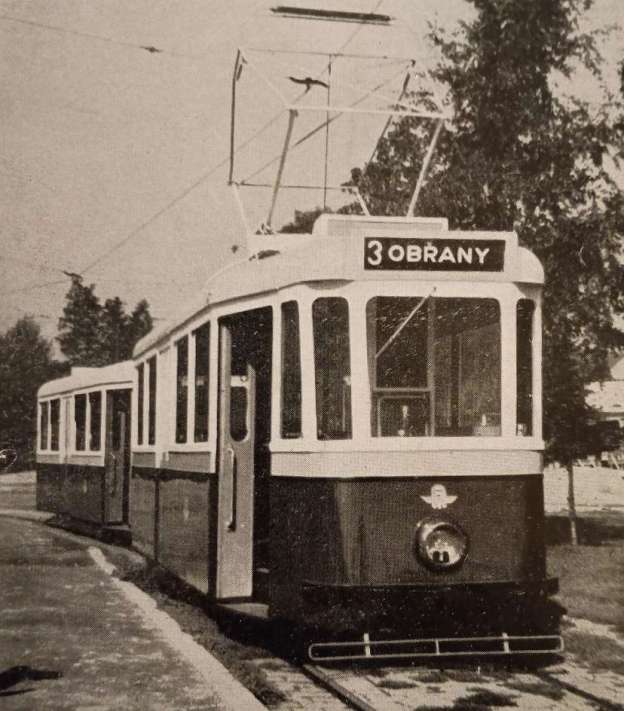
The featured image for this article is Brno Tramways No. 131 with Trailer No. 310, which early in 1951 was newly delivered to Brno. [1: p21]
Gerald Deuce reported in February 1951 on a series of new tramcars being delivered to Brno in what is now the Czech Republic. [1: p25-26]
He writes that these tramcars:
“are uni-directional single truck motor-cars with trailers of similar design and are intended for PAYE [Pay As You Enter] operation with the entrance at the rear. All the doors except the leading set of the motor-car, are under the control of the respective conductor.
“The cars are heated by electric radiators fitted under the transverse seats, and lighted by a fluorescent tube strip along the ceiling.
“Brno is the capital of Moravia and has a population of just over 273,000. It is situated about 130 miles south-east of Prague, and is the centre of the Czechoslovak textile industry and an important tourist centre.” [1: p25]
Their ‘vital statistics’ were: ….

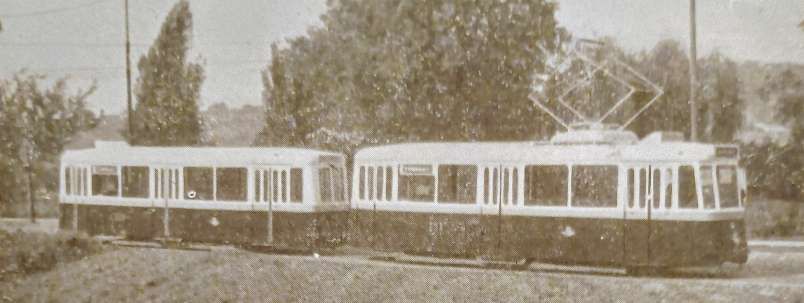
In 1950, the Královopolská strojírna plant in Brno manufactured new tram cars, including the KPS Brno 4MT2 motor tram and a vv4 trailer, which served the city. This period focused on modernizing existing infrastructure, with four-axle T-series trams and K-series cars introduced during the 1950s/60s. The KPS Brno 4MT2 tram, manufactured in 1950, was later used in the 1970s by the Technical Museum. [9]
Deuce continues:
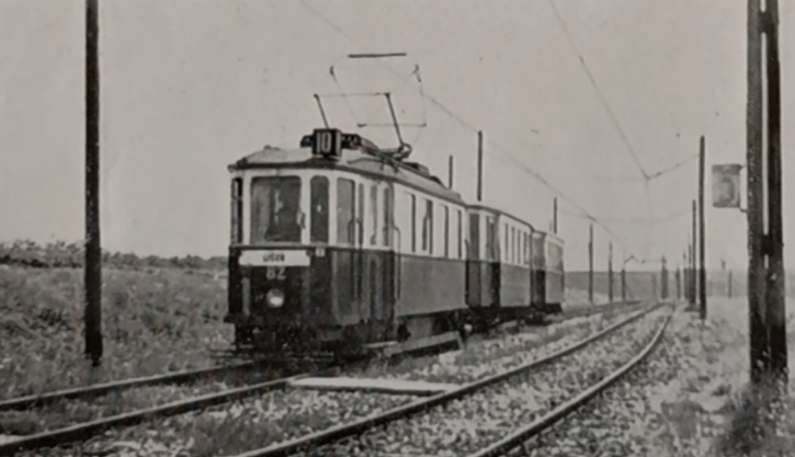
“The tramway system is of standard gauge, the lines all rising from the railway station, near the centre of the town, with a total route mileage of about 23. The main depot and workshops are at Pisarky, approached by a long sleeper-track section. This line also serves the exhibition grounds, where there is a special four-track layout. There is an interurban line to Lisen, 5.2 miles long and nearly all on private right-of-way; most of this line is single-track with passing loops, with automatic colour-light signals.
“Services operated are as follows:
1 & 6 Pisarky – Reckovice.
2 & 8 Horno Herspice – Zidenice.
3 & 7 Obrany – Bystrc.
4 Komarov – Masarykova ctvrt.
5 Julianov – Stefanikova ctvrt.
9 Julianov – Cerna pole..
10 Nove Sady – Lisen (interurban).
“The higher number indicated against the first three services refers to a short working over the central portion of the route. Services 5 and 9 run together for most of the distance. Frequent services with trailers are operated on all routes. The through trains on the Lisen line usually consist of a motor-car and two trailers, and run at intervals varying between 15 and 40 minutes; there are additional short workings.
“There is a flat fare of 2kcs. 50h.” [1: p26]
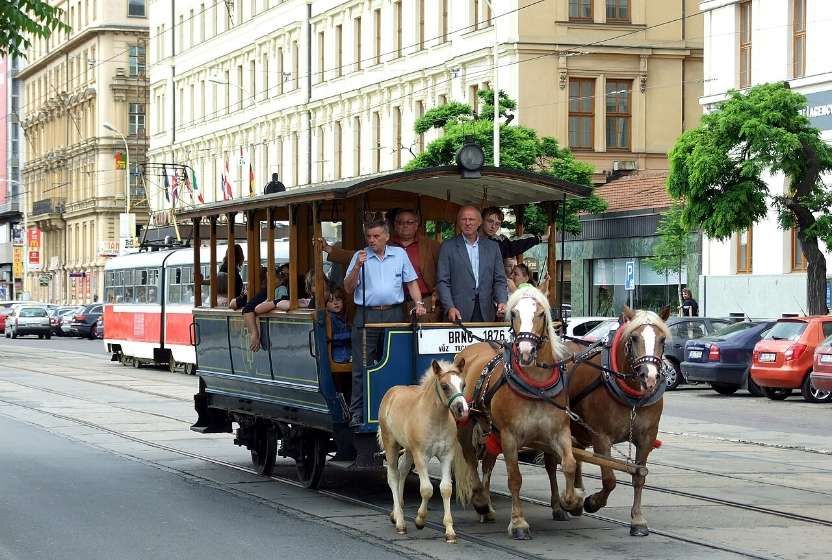
“The Brno tramway network (Czech: Tramvajová doprava v Brně, simply Tramvaje v Brně) was the first network of its kind to be put into operation in what is now known as the Czech Republic with its horse tram lines dating back to 1869. [In the 21st century], Brno is the second largest city in the Czech Republic, after Prague, and its tram network is also the second largest in the country.” [5]
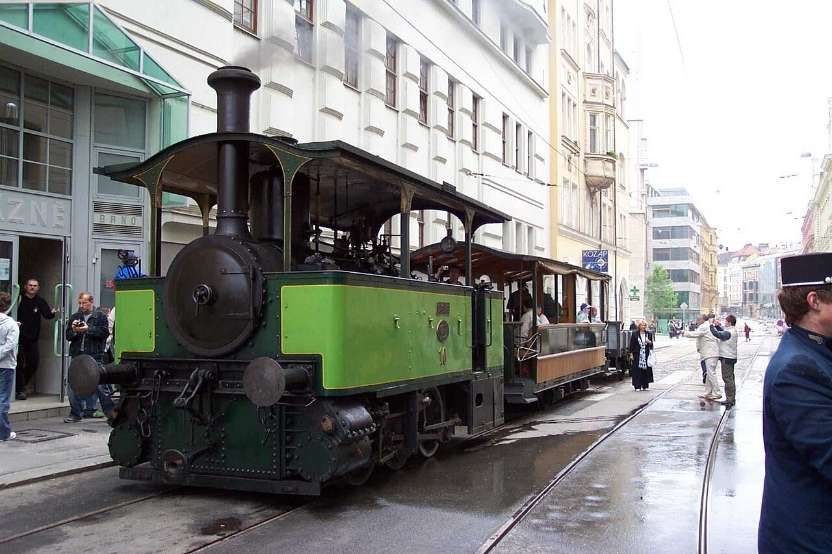
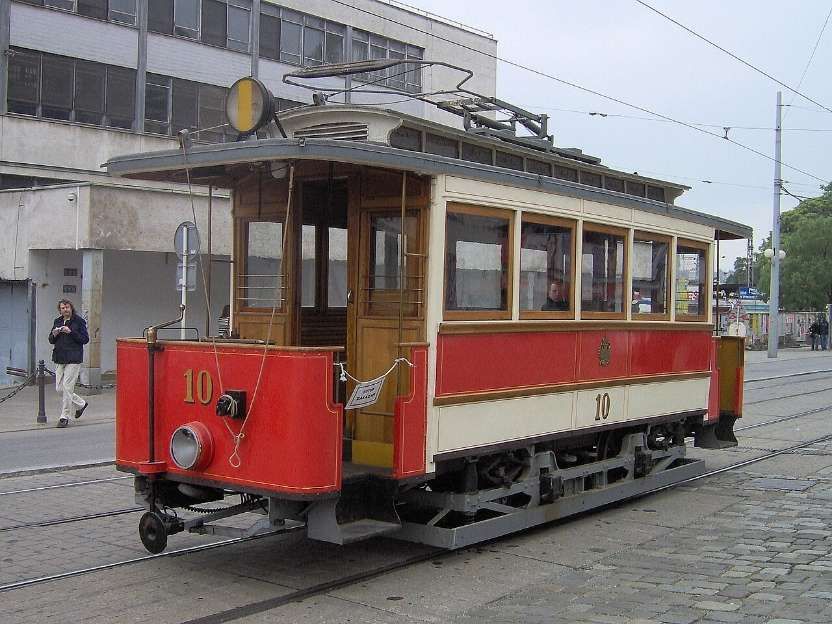
At different times, three different modes of propulsion were used on the network: from 1869, horse-power was in use; from 1884, steam-power was in use; and from 1900 electric trams were introduced. [5]
Brno hosts a tram parade in June each year. The three images below come from that parade: ….
These next paragraphs come from a webpage written in 1998/99 by Richard Bilek from the Czech Republic, who died in 2001 (R.I.P.). Translated from Czech, that have in places been paraphrased to read more easily. They are a ‘snapshot’ of the tramway network in Brno in 1998/1999 and a potted history of developments from the 1950s to the late 1990s. [2]
“In 1951, Brno had 62 km of network. In 1948, the last two-axle tramcars from Zbrojovka Zidenice were delivered. In the 50s, the city renewed their tramcars with new progressive tramcars of class T2. 94 tramcars of this type were delivered till 1961. No T1 type tramcars were purchased by the city.
“In 1963 new tramcars of T3 arrived. The city wanted tramcars with bigger capacity. Tatra Works developed articulated tramways of type K2 in the mid of 60s. First prototypes were tested here in 1965, and between 1966 and 1977, the City purchased 132 tramcars of this type, so they operated the largest fleet of K2 tramcars in the Czech Republic. These tramcars were still most typical for Brno at the end of the 20th century.
“All Czech cities except Brno at the end of 60s shortened their network at the end of the 1960s. Brno was the only city with uninterruptable expansion of track after WW2 through until the turn of the 21st century. New housing estates in Brno also were connected with the tramway and later, with trolleybuses. The last major expansion, a new line, was opened in 1989, a further short connection line was opened in 1994. An additional 2.2 km was under construction in 1998/1999. The city purchased new KT8D5 tramcars at the turn of the 21st century, 28 cars entered service. Further renewals were also planned – T6B5 type. and low-floor tramways of RT6N1 type.“The city was operating the following tramcars just prior to the turn of the 21st century:
1470+1462 Last units of T2 tramcars of T2 type. These two vehicles were due to be scrapped in 1998.
1495..1668 Tramcars of T3 or T3SUCS. Mostly in service
1001..1132 Articulated tramways of K2. 126 still in service
1701..1728 KT8D5 Tramcars. One withdrawn after an accident
1201..1220 New T6B5 tramcars, delivered 1995 and 1996
1729..1735 KT8 tramcars with low-floor mid section
1801-1804 RT6 low floor tramcars
“The city also sought to renew these old tramcars:“Tramcar T3 no.1615 was rebuilt in 1993-1994 to new type T3MB with new body, renewed electricity, etc. There was a hope to rebuild approx. 70 tramcars to this state, but only 11 had been renewed by the end of 1997.
“Also, K2 tramcars were intended for renewal in this way. First prototype was rebuilt in Pars DMN Sumperk works (small city approx. 120 km norhtern from Brno) and was placed in service in Brno. An additional batch of 6 similar tramcars was renewed later.
“There were plans to order new KT8 tramcars (for a new line to Lisen). They were due to be delivered with a low-floor middle section in 1998/1999.” [2]
The Modern Tram Network
As we have already noted, Brno is the second largest city in the Czech Republic, after Prague, and its tram network is also the second largest in the country.
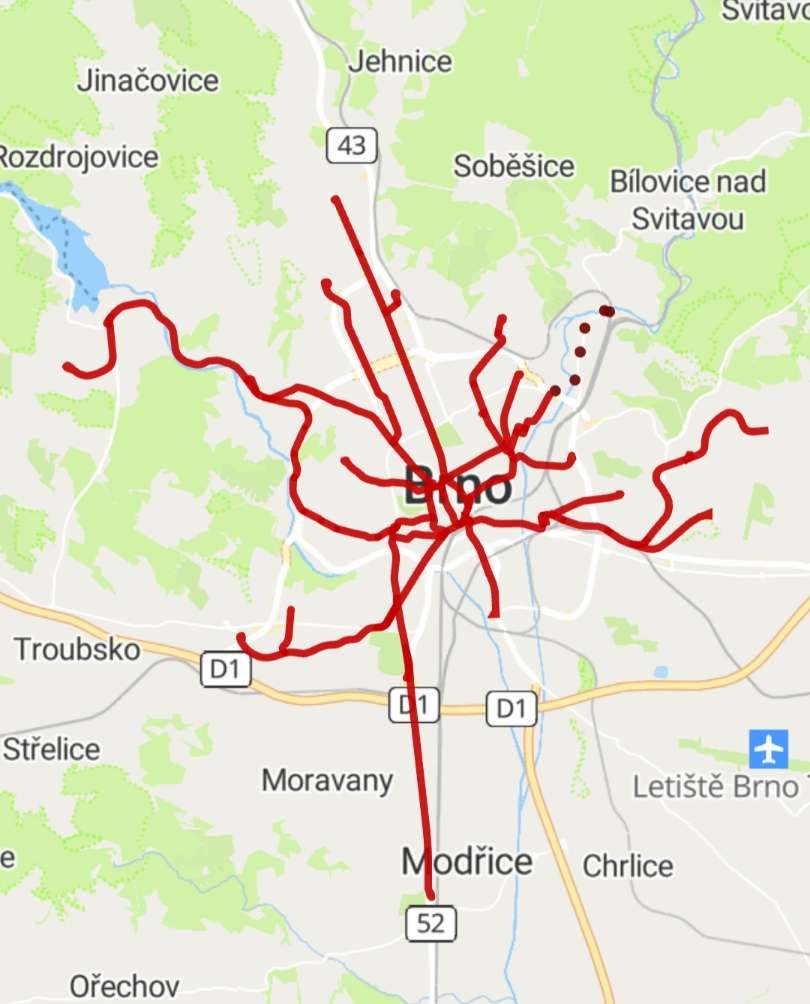
The urbanrail.net webpage has a more detailed map and plenty of images of trams in service on the network. [4]
The Brno tram system comprises 12 lines, with a total operational track length of 139 kilometres (86 miles) and a total route length of 70.4 kilometres (43.7 miles). The lines not only serve the urban area, but also lead to the neighboring town of Modřice located south of Brno. Before construction began on the final leg of the extension in 2008, the entire network was made up of 69.7 km of track. [5][9]
Further details of the modern network and the trams in service in the mid-21st century can be found here. [5]
References
- Gerald Deuce; New Cars for the Brno Tramways; in The Modern Tramway, Volume 14, No. 158; The Light Railway Transport League, February 1951, p25-26.
- https://tram.rusign.com/cz/br-tr-e.htm, accessed on 12th May 2026.
- https://www.scribblemaps.com/maps/view/Brno_Tram/BrnoTram, accessed on 12th May 2026.
- https://www.urbanrail.net/eu/cz/brno/brno.htm, accessed on 12th May 2026.
- https://en.wikipedia.org/wiki/Trams_in_Brno, accessed on 12th May 2026.
- https://commons.wikimedia.org/wiki/File:Brno,_Brno_M%C4%9Bsto,_historick%C3%A1_ko%C5%88sk%C3%A1_tramvaj.jpg, accessed on 12th May 2026.
- https://commons.wikimedia.org/wiki/File:Brno,_Moravsk%C3%A9_n%C3%A1m%C4%9Bst%C3%AD,_parn%C3%AD_tramvaj_II.jpg, accessed on 12th May 2026.
- https://commons.wikimedia.org/wiki/File:Brno,_140_let_MHD_(64),_N%C3%A1dra%C5%BEn%C3%AD,_10.jpg, accessed on 12th May 2026.
- https://www.dpmb.cz/en/about-us, accessed on 12th May 2026. See also other pages on the same website.
 Roger Farnworth


,_N%C3%A1dra%C5%BEn%C3%AD,_10.jpg)