
The April 1951 issue of The Modern Tramway featured an article about the Tramways of Auckland, New Zealand. [1]
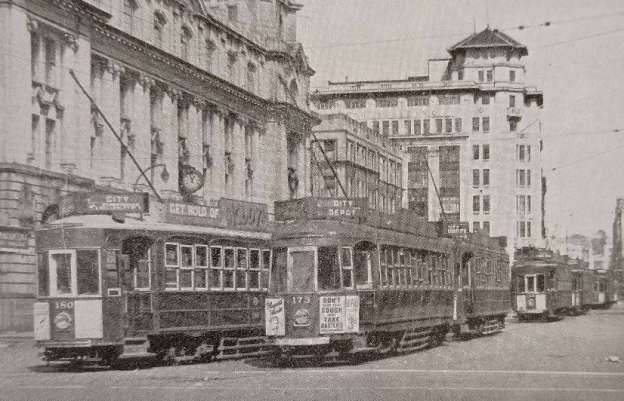
The featured image for this article (which also appears below) shows a series of older trams on Lower Queen Street, Auckland. [1: p85]
“The Auckland Transport Board operates 44 miles of tramways with 216 cars in New Zealand’s largest city. The system has several interesting features, one of which is that although all its lines are laid on sleepers, there is no reserved track or private right-of-way. The sleepers rest on a base of scoria (lava slag). Another unusual aspect of the Auckland tramways is the free tram service provided since 1936 by the Farmer’s Trading Company for its shop customers. This is operated by the Board with 3 cars on a shuttle service in the main shopping area. The store also provides a free trolleybus service for its customers and the 4 trolleybuses which have worked the service since 1938 were the first in Auckland. Also of interest is the Onehunga tram route which has a 6-minute headway, is seven miles long and is the only ocean-to-ocean tramway in the world, it runs from the port of Auckland on the Pacific Ocean to the port of Onehunga on the Tasman Ocean. it is also probably the only tramway in the world that crosses a country from one side to the other as it traverses New Zealand at the narrowest part. With the exception of two two short stretches on the Westmere and Victoria Avenue routes all the track is double and mostly in wide roads with an adequate number of safety zones (loading islands).” [1: p85]
The Modern Tramway article continues:
“Tramway operation began on 11th August. 1854, …, horse trams were superseded by electric cars from November 1902, onwards, the conversion being effected by the Auckland Electric Tramways Company (registered 22nd March 1889), a subsidiary of the British Electric Traction Company. Six reversed-staircase open-top Brush/English Electric double-deck cars were included in the original fleet, but one of them was involved in a serious accident in 1903. … These cars, which were never very popular because they lurched badly at speed and came dangerously near the centre poles, were gradually converted to single-deckers, and were all scrapped in 1948, except No. 38 which has been in use as a rail-grinder since 1936. On 1st July 1919, the tramways were purchased by the City Council for £1,227,201. The Auckland Transport Board, an elective body comprising representatives from all parts of the metropolitan area, came into being in 1928 and took over operation of the tramways from the Council on 16th January 1929.” [1: p85-86]
From 1902 onwards, Auckland’s electric tramways formed the backbone of its public transport network. They were preceded by Horse-drawn trams and later by steam-powered trams.
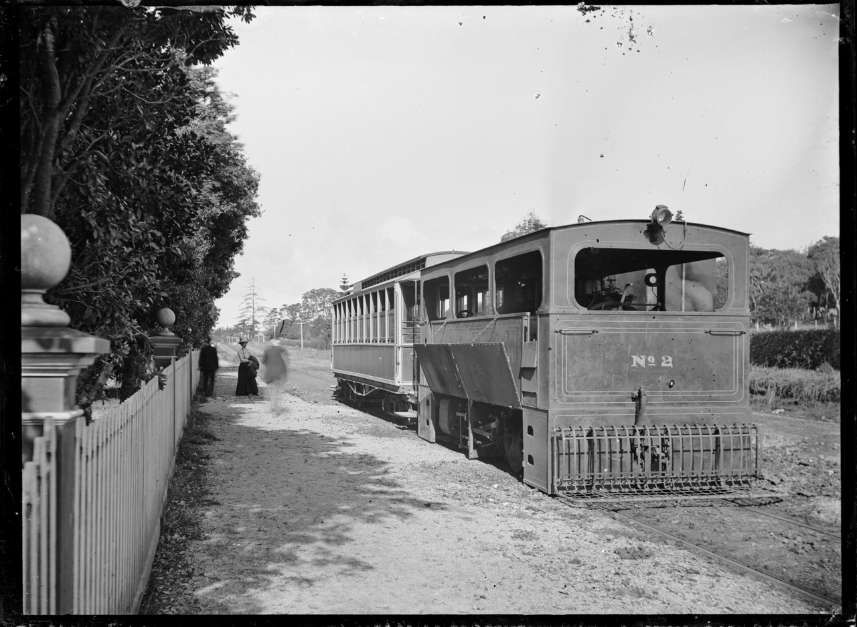
Wikipedia indicates that the first steam-powered trams in Auckland operated in 1871. [6] The electric trams which replaced the horse-drawn and Steam-powered ones, “were fast, smooth and capable of running an incredibly frequent schedule. Aucklanders loved them, and patronage boomed. In 1903, the first full year of electric tram service, Aucklanders boarded their trams 13 million times. Yet 15 years later, in 1918 that figure had exploded to 44 million passengers per annum, and tram routes had expanded to cover … most of today’s inner-city.” [4]
“In 1926, Aucklanders made 63 million trips by tram despite the total population of Auckland City only numbering about 90,000 people. (Compare that to 2018-19’s 100.8 million public transport boardings – Auckland’s highest since 1951 – from a population of almost 1.7 million!) Similar figures were recorded at the end of the 1930s, even when the effects of the Great Depression were still being felt.” [4]
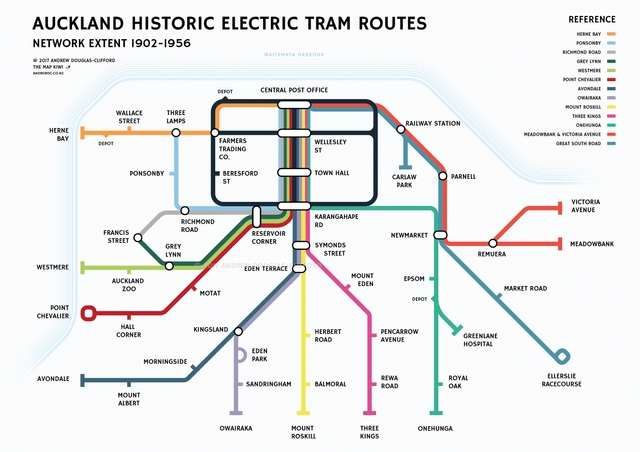
This diagrammatic map shows the extent of the historic tramway network in Auckland. It served the city from 1902 to 1956. [5]
The April 1951 article continues:
“Three routes in the north-west corner of the city have been selected for experimental trolleybus conversion; they are Herne Bay, Richmond Road and Ponsonby, the last-named being the original electric line. The Herne Bay trolleybus service began on 24th September, 1949, but the other routes have not yet been converted.
“All cars now in service are bogie single deck saloons fitted with air-brakes and two trolley-booms. They move the crowds very effectively as they are capable of carrying a total load of 100 passengers. The normal standing load is 7 on each platform and 24 more inside. The average speed including stops is claimed as 11 m.p.h., and running speeds of 25 m.p.h. and above are not unusual. The livery is bright red, unlined, with buff window frames. Most Auckland cars have a profusion of windows; some cars have as many as 36 and even the latest car, built in 1940, has 26. Another characteristic feature of the Auckland trams are the indicator boxes; there are no service numbers, but each car carries four indicator boxes arranged in pairs at each end of the car, in the form of a V. The movement of the blinds in each pair of boxes is synchronised and controlled by a single wheel. The cars can be entered from front or rear.
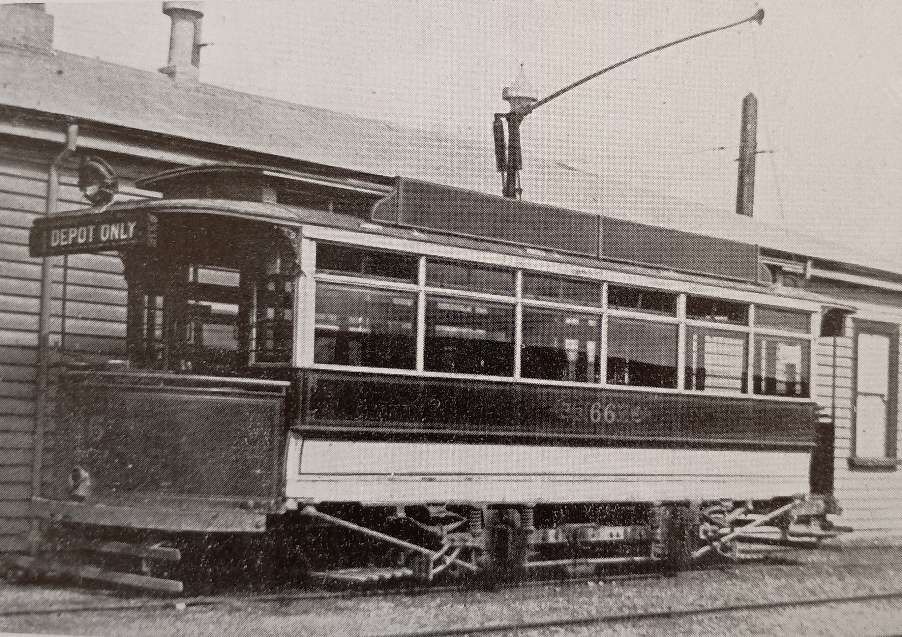
“The fleet numbers 66-69 were allocated to 4 cars sent out from Britain in 1907; these cars would have been old friends to any North Londoners, as they were none other than four representatives of the famous Metropolitan Electric Tramways class E single-deckers. They were shipped to New Zealand complete, and on arrival London tram tickets were still on the floors! They retained their Metropolitan livery of red and cream and were always painted red until they were scrapped in 1921; because of this they were known as ‘the Lobsters’. As will be seen by the photograph, certain alterations were carried out in Auckland: at a later date they were mounted on double bogies. Two were sold to Napier, but owing to an earthquake which destroyed that city and it’s tramway system, they never saw service in their third home.” [1: p86-87]
The Hawke’s Bay earthquake, also known as the Napier earthquake, occurred at 10:47 am on 3rd February 1931, “killing 256, injuring thousands and devastating the Hawke’s Bay region. It remains New Zealand’s deadliest natural disaster. Centred 15 km north of Napier, it lasted for two and a half minutes and had a magnitude of 7.8 Ms (7.7 Mw). There were 525 aftershocks recorded in the following two weeks, with 597 being recorded by the end of February. The main shock could be felt in much of New Zealand, with reliable reports coming in from as far south as Timaru, on the east coast of the South Island.” [2]
“Nearly all buildings in the central areas of Napier and Hastings were levelled. … The material damage of the earthquake was estimated at $960 million. [3: p140] … The local landscape changed dramatically, with the coastal areas around Napier being lifted by around two metres. The most noticeable land change was the uplifting of some 40 km2 of sea-bed to become dry land. This included Ahuriri Lagoon, which was lifted more than 2.7 metres and resulted in draining 3,600 hectares (9,000 acres) of the lagoon.” [2]
Returning to The Modern Tramway piece, the image below was included in that article it shows a number of the bogie trams used on the Auckland network through to its closure.
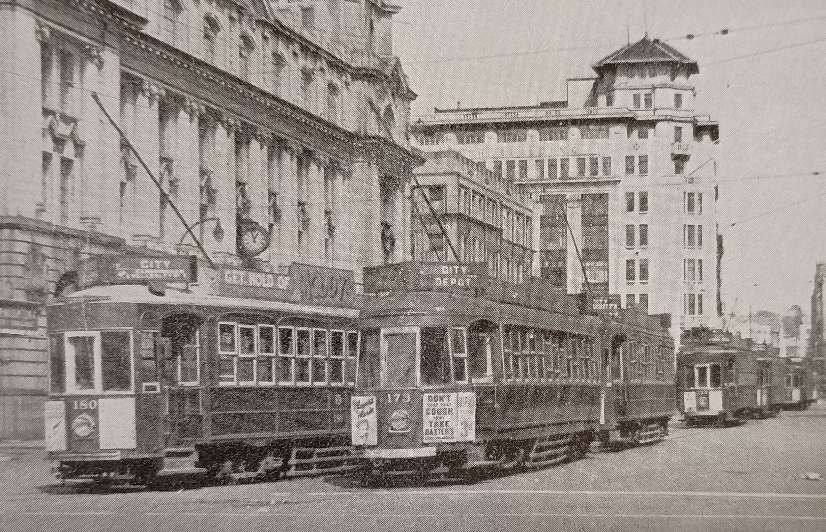
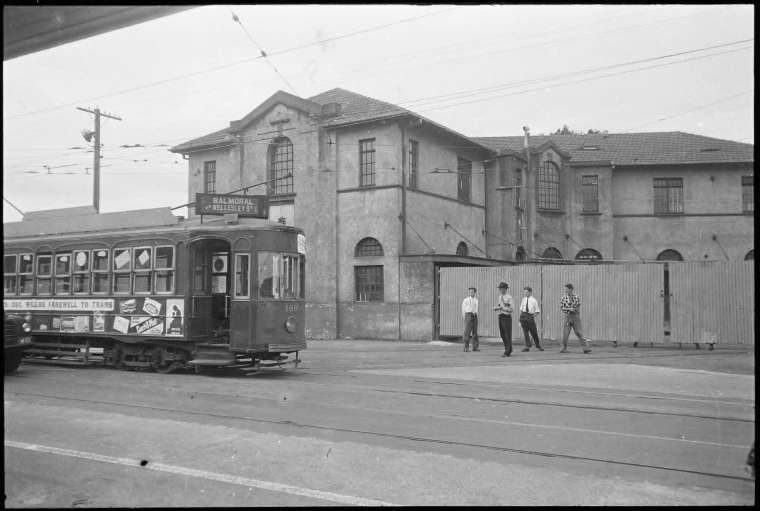
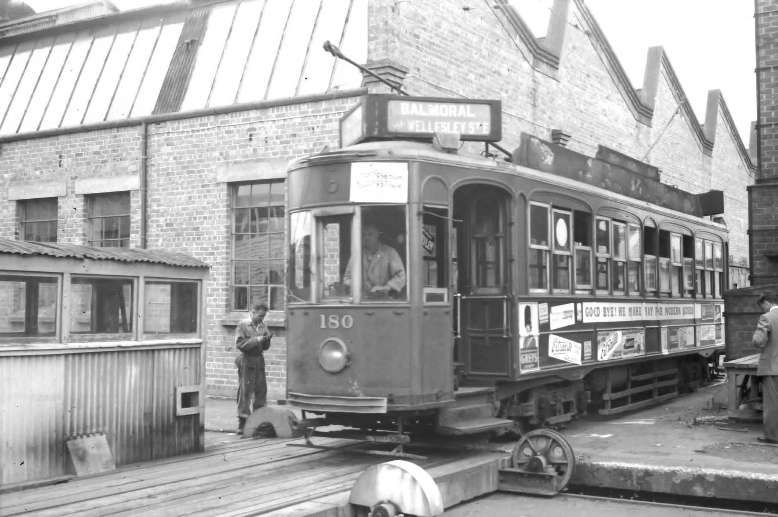
The two trams prominent in the image above survived through to the closure of the network at the end of 1956. No. 180 appears in the next two photographs which were taken on the same day in 1957, a few months after closure.
The Modern Tramway article continues
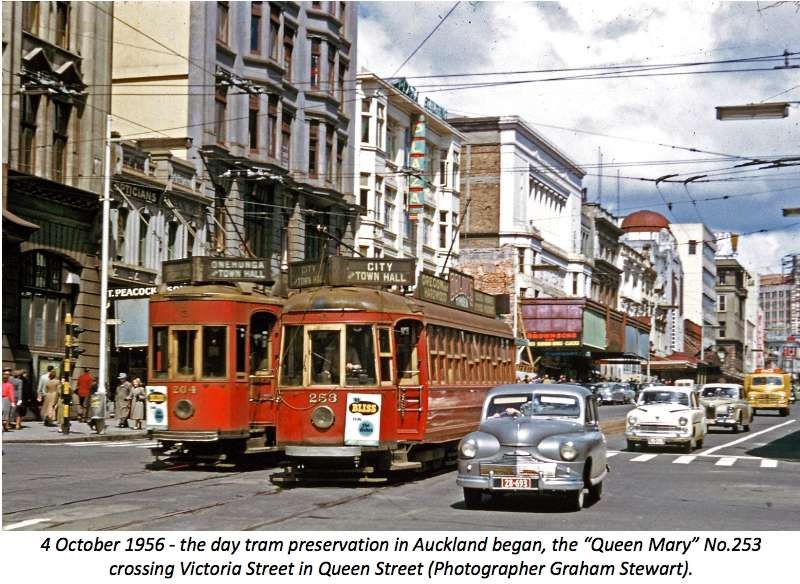
“The most modern Auckland trams are the ‘1937’ class, actually built between 1938 and 1940. These have E.M.B. lightweight or Brush trucks, four 35 h.p. Metropolitan Vickers motors and A.T.B. bodies. One of these cars, No. 253, built 1940, is fitted with regenerative braking and an M-V master controller (the others have General Electric K 35 HH controllers) and, known as ‘Queen Mary’, is the fastest and most modern tramcar in New Zealand. The graceful lines of these cars are unhappily disfigured by the ugly indicator boxes, the excessive number of small windows and the advertising boards carried on each side of the roof and dash.” [1: p87]
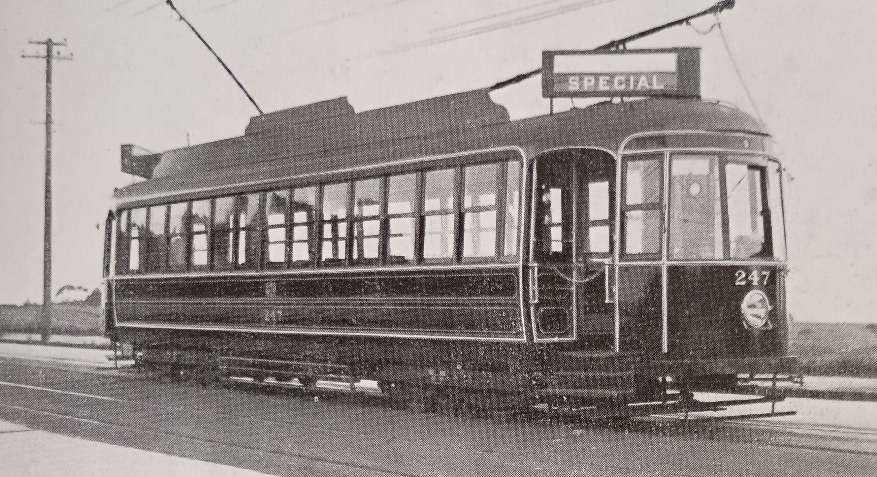
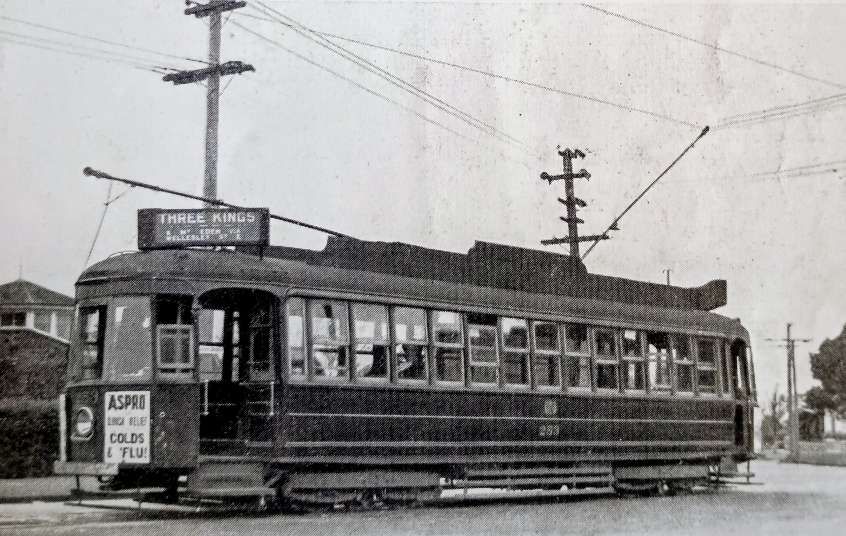
The two images above show two members of Auckland’s “1937 Class” Streamliner trams. All six of this Class were all built between 1938 and 1940 at the Royal Oak Workshops. They were the final, most modern tram design for the city, featuring distinctive bulbous sides, rounded ends, 27″ wheels and 4-motor bogie trucks. Six were built, including the renowned ‘Queen Mary’ (No. 253), which was a testbed for modern regenerative braking and high-speed performance. [9] Nos. 248 and 253 have survived into preservation and are held by MOTAT (Museum of Transport and Technology).
“In June, 1950, the following tram services were in operation (the headways given [in brackets] are for off-peak periods):
– Three Kings Point Chevalier via Queen Street and Hobson Street (8 minutes).
– Owairaka Great South Road via Queen Street and Anzac Avenue (10 minutes).
– Avondale Remuera and Meadowbank via Town Hall and Parnell (8 minutes).
– Ponsonby Railway Station via Queen Street and Beach Road (8 minutes).
– Mount Roskill G.P.O. via Queen Street (5 minutes).
– Onehunga G.P.O. via Town Hall (6 minutes).
– Westmere G.P.O. via Town Hall (8 minutes).
– Richmond Road Richmond Road (circular via Town Hall and Hobson Street) (15 minutes).
– Victoria Avenue Victoria Avenue (circular via Town Hall and Anzac Avenue) (30 minutes).
– Farmer’s Free Service (to and from Karangahape Road) (service as required).” [1: p88]
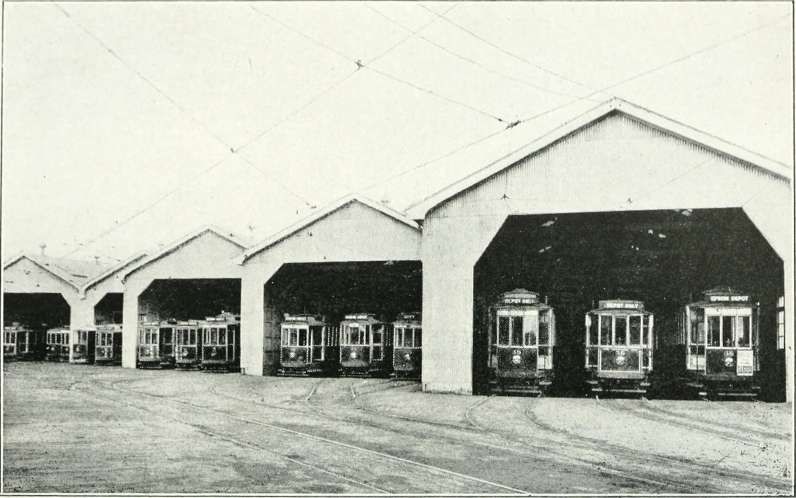
“The depots are situated at Eden Park, Epsom, Gaunt Street and Herne Bay (now [in 1951] no longer a tram depot).
“These notes were compiled by the Overseas Editor from material sent by two members of the Australian Electric Traction Association, Messrs. G. C. Stewart and G. Cobham, both of Auckland, to whom grateful acknowledgement is made. The photographs are from Mr. G. C. Stewart’s collection.” [1: p88]
The tramway network in Auckland had about 5 years left before full closure at the end of 1956.
Trams in Auckland since 1956
MOTAT
MOTAT preserved what it could. We have already noted that No. 253 was preserved by the Museum.
MOTAT is located in Western Springs, Auckland and features large collections of civilian and military aircraft, trams, and technology, with live working exhibits. It operates two sites linked by a heritage tramway. Its collection includes a number of Auckland’s historic trams:
- No. 11, 1902 Brush Electrical Engineering Co. Bogie saloon combination. In service.
- No. 17, 1902 Brush Electrical Engineering Co. Bogie double-decker. Stored
- No. 44, 1906 Auckland Electric Tramways Co. Open fronted, Single truck, Saloon. Operational
- No. 89, 1909 DSC & Cousins & Cousins. 52-seat bogie saloon. Stored
- No. 147, 1913 DSC & Cousins & Cousins. 52-seat bogie saloon. Stored
- No. 203, 1926 DSC & Cousins & Cousins. 52-seat Art Deco car steel-sided car. Stored
- No. 248, 1938 Auckland Transport Board’s Royal Oak Workshops. Electro Magnetic Braking Co. (EMB), L5 bogied Streamliner. Operational.
- No. 253, 1940 Auckland Transport Board’s Royal Oak Workshops. Regenerative braking, L5 bogied Streamliner. Stored.
New Tramways and Trams
As of 2026, the only remaining light rail lines (tram lines) in Auckland are heritage tramways. Recently, Auckland has considered reintroducing light rail lines to replace some of its most heavily used bus routes. Many line proposals have involved reusing the routes of Auckland’s former tram system. [12]
In 2015 the city’s transport agency, Auckland Transport, proposed a new light rail network – with a focus on a line between the Auckland CBD and Auckland Airport. In subsequent years, various technology types and modes were proposed by local and central government – including traditional street tramways and light metro. The most recent plans, proposed by the Sixth Labour Government, would have seen the construction of a hybrid underground/surface route. However, that particular project was cancelled by the Sixth National Government in January 2024. [12]
“The City Centre-Māngere line was planned to run from Wynyard Quarter to Auckland Airport; via the Auckland CBD, University of Auckland, Kingsland railway station, Wesley, Mount Roskill, Onehunga and Māngere. There would have been be a total of 18 stops with trains running every five minutes. While the line between Wynyard Quarter and Mount Roskill would have been tunnelled, the rest of the network would have been a surface line running alongside State Highway 20.[32][33] As of 2025, Auckland Transport continues to include the corridor in its rapid transit plans, but lists City Centre-Māngere as ‘mode to be confirmed’.” [12]
References
- The Tramways of Auckland; in The Modern Tramway Volume 14, No. 160, April 1951, p85-88.
- https://en.wikipedia.org/wiki/1931_Hawke%27s_Bay_earthquake, accessed on 14th May 2026.
- David Dowrick; Damage and intensities in the magnitude 7.8 1931 Hawke’s Bay, New Zealand, earthquake (PDF); New Zealand Society for Earthquake Engineering, September 1998, via: https://www.nzsee.org.nz/db/Bulletin/Archive/31(3)0139.pdf, accessed on 14th May 2026.
- https://ahi.auckland.ac.nz/2023/05/25/the-good-old-trams, accessed on 14th May 2026.
- https://www.reddit.com/r/newzealand/comments/7b09mm/extent_of_aucklands_historic_electric_tram, accessed on 14th May 2026.
- https://en.wikipedia.org/wiki/Trams_in_New_Zealand, accessed on 14th May 2026.
- https://www.facebook.com/share/p/1DTLpm8pWC, accessed on 15th May 2026.
- https://commons.wikimedia.org/wiki/File:Lake_Takapuna_Tramway,_1911_ATLIB_286547.png, accessed on 15th May 2026.
- https://www.motatsociety.org.nz/post/motat-s-queen-of-the-rails, accessed on 15th May 2026.
- https://en.wikipedia.org/wiki/MOTAT_collections, accessed on 15th May 2026.
- https://commons.wikimedia.org/wiki/File:Municipal_and_official_handbook_of_the_City_of_Auckland,_New_Zealand_%281922%29_%2814783938132%29.jpg, accessed on 15th May 2026.
- https://en.wikipedia.org/wiki/Light_rail_in_Auckland, accessed on 15th May 2026.


