Egyptian National Railways (Al-Sikak al-Ḥadīdiyyah al-Miṣriyyah) is the national railway network of Egypt. Founded in 1854, it is the oldest railway system in Africa and the Middle East. [1]
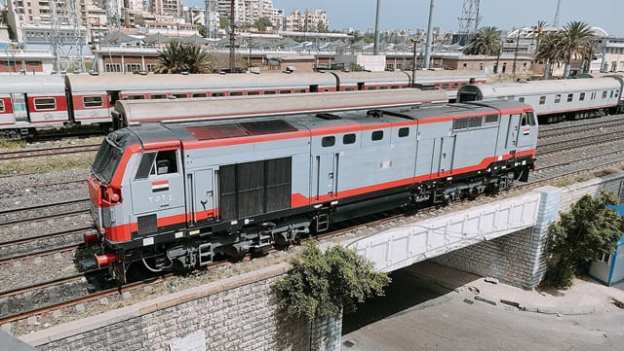
The featured image for this article is an Egyptian National Railways (ENR) GE ES30ACi locomotive in the Alexandria railway station yard, (c) Abdelrhman 1990and licensed for reuse under a Creative Commons licence (CC BY-SA 4.0). [6]
The National Authority for Egyptian Railways is one of the largest economic institutions in Egypt and the Arab world, and it is the largest in the field of transport services (passengers and goods). It is considered the backbone of passenger transport in Egypt. Its share of passenger transportation is more than 30% of the total transportation volume at the national level. The Railways Authority transports both people and goods. Passenger transport is provided in: [2]
Luxurious first and second class air-conditioned high-speed trains (all lines);
Luxury turbo trains (Cairo – Alexandria line);
Luxury sleeper trains (all year long in Upper Egypt, and in summer from Cairo to Marsa Matrouh);
Express trains in regular and mixed grades;
Line trains, and suburban areas in the same class. [2]
With regard to the transportation of goods, the authority provides two types of service: [2]
Urgent freight transport service on passenger trains – for luggage, parcels, light transport, foods, newspapers, publications and letters.
Non-urgent freight transportation – heavy goods on dedicated movements supported by the best available traction – bulk and packed grain, coal, sugar cane and its products, petroleum products, iron ore, phosphate ore, manufactured fertilizers, salt and all kinds of minerals. [2]
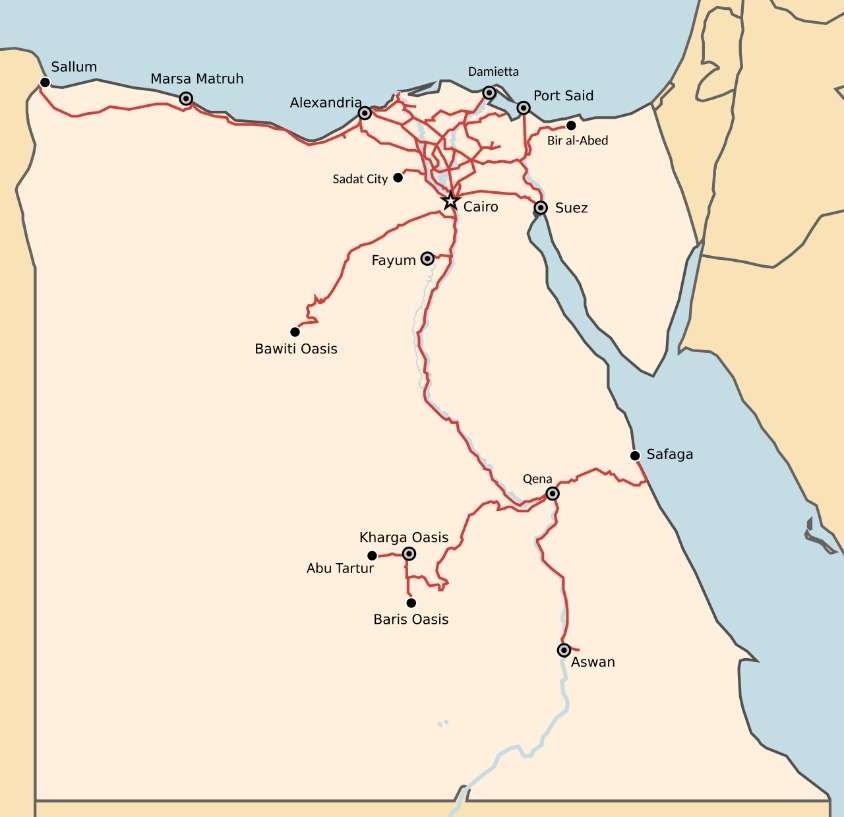
Egypt claims to have the second oldest railway in the world. It has 9,570 km of railway, 705 passenger stations, 1330 level-crossings, 3500 thousand passenger coaches, 10,000 goods wagons, 820 locomotives. [2]
920 passenger services run each day. 4.8 million tons of goods are moved per year on dedicated goods trains, which still only represents 1.2% of the goods by weight that enter Egypt. [2]
The statistics provided by the National Authority for Egyptian Railways indicate the following: [2]
Passenger transport: 500 million passengers annually (about 1.4 million passengers per day). [2]
Cargo transportation: 6 million tons annually. [2]
Rail network: The total length of the network is 9,570 km. Four-line tracks – 20 km. Double-line tracks – 1,466 km. Single-line tracks – 3,667 km. This excludes railyards, workshops and warehouses. [2]
Stations: The total number of stations, as noted above, is 705, including: 22 central stations; 59 significant stations; 60 medium stations and 564 small stations. [2]
Bridges and tunnels: 885 bridges and tunnels as follows: 511 Rail bridges over the Nile and other obstacles; 58 vehicular bridges over the railway; 157 tunnels under the railway for cars and pedestrians; 137 overhead pedestrian bridges. [2]
Locomotive fleet: 342 German locomotives capacity of 2,475 horsepower; 45 Canadian locomotive, capacity 2,475 horsepower; 30 American locomotive, capacity of 1850 horsepower; 253 Canadian locomotive, 1650 hp; 30 Spanish shunting locomotives, 1,200 hp; 80 new American GE locomotives, 4000 hp; 40 new American EMD locomotive, 3245 hp; horsepower. A total of 820. [2]
Passenger transport: 3500 coaches of which 850 are air-conditioned. Services range in speed from 90 to 120 km/hour. [2]
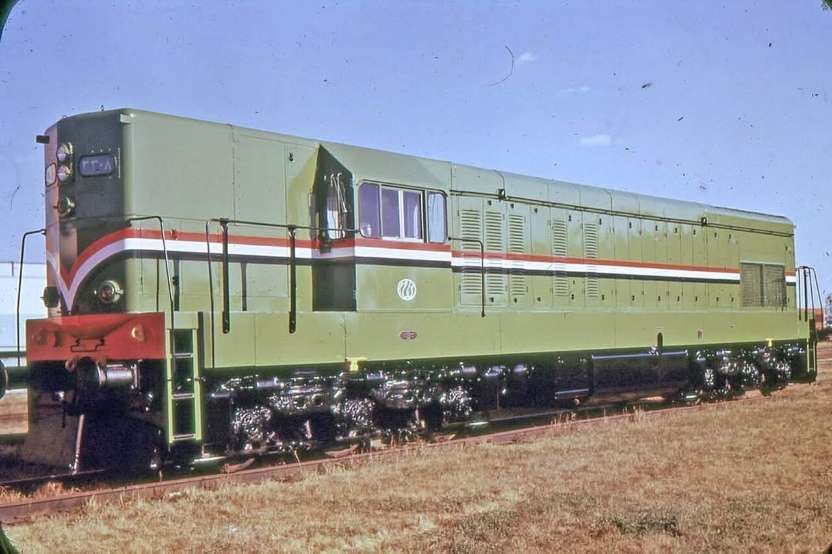
An EMD G16 used by the Egyptian National Railways: 16 are operating in Egypt Nos. 3301–3316. They were built in 1960–1961, photographer not known, available under a Creative Commons licence (CC0). [4]
The locomotive fleet noted above is outlined in more detail on Wikipedia here. [4] Given the extent of the detail provided in that Wikipedia article, it is not repeated in this article.
Despite the major role railways play in Egyptian transport, the rail system falls short in at least two critical areas: passenger safety and moving freight. The World Bank is providing two loans to the Egyptian government to help the Egyptian National Railways (ENR) tackle these issues. A $440-million loan will support safety and service quality improvements along the Alexandria-Cairo-Nag Hammadi railway corridor, while another $400-million project addresses rail logistics. [3]
Both of these projects aim to reduce the climate and environmental impacts of transport by moving more people and goods from roads to rail — a change that can’t come fast enough. In the Middle East and North Africa Region, air pollution is responsible for 270,000 premature deaths every year, which bear a huge economic cost of around 2 percent of GDP per year. A large culprit of this pollution is transport emissions. In Egypt, the proliferation of private cars, taxis and trucks on the road triggered a 75% increase in transport emissions between 2005 and 2019, demonstrating how rapid motorization comes with serious implications for health and the environment. [3]
Moving freight from trucks to trains
Trucks still move the vast majority of Egypt’s freight, about 96 percent of it. Railways move only about 1.9 percent. Part of the reason is that only three freight trains per direction per day can travel between Alexandria’s seaport and the 6th of October dry port outside Cairo. Capacity constraints on rail, roads, and the Nile River weaken the links between ports, cities, and industrial zones. These kinds of inefficiencies are costly, and improving logistics is necessary to expand trade competitiveness. Further, a lack of targeted regulations distorts the market and gives road transport an unfair economic advantage over rail. [3]
The Bank-supported Cairo Alexandria Trade Logistics Development Project is intended to ease the pressure by co-financing the creation of a railway bypass around Greater Cairo, which will greatly increase network capacity and reduce the competition between freight and passenger services. [3]
The project will also help modernize railway policies and regulations. Right now, publicly-owned ENR is the only operator that can carry freight on the rail network. A new system will change that and allow private operators to use railway tracks in exchange for a toll, which will be paid directly to ENR. By encouraging private operators to enter the freight rail market, these reforms are expected to boost capacity and efficiency across the network. [3]
Together, these initiatives will help improve the rail system and move freight on a larger, more reliable network, cutting transit delays. Egyptian rail has already more than quadrupled the amount of freight it moves to approximately 25 million tons annually, up from 4.6 million tons just five years ago. [3]
Making travel safer for everyone
Ninety percent of Egyptian National Railways’ operations involve moving passengers, and they, particularly low-income riders, will benefit from safer, more reliable, and faster services. The World Bank’s financing will lead to railway reforms that improve the Egyptian National Railways’ (ENR) safety and efficiency to cut down on air pollution, speed access to jobs and services, and make rail service safe and accessible for all. [3]
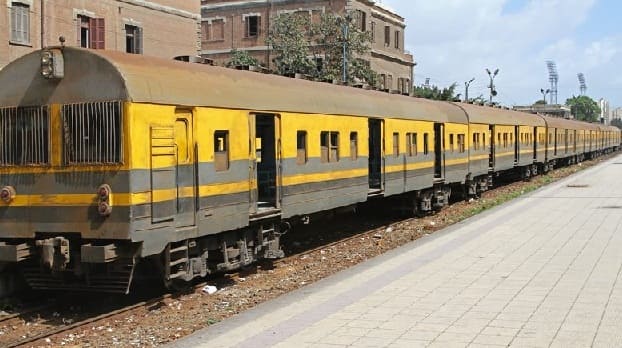
Typical older, yellow-and-gray train operated by Egyptian National Railways. The train is waiting at Misr Ramses Station in Cairo. It part of a fleet undergoing reform. Photographer not known. [7]
Safety and service quality are driving much of the engagement between the World Bank, the Egyptian Ministry of Transport, and ENR. This includes extensive upgrades to the signalling system along the Alexandria-Cairo-Nag Hammadi corridor, an all-important 763-kilometre railway route that connects densely-populated areas across the country. [3]
But the concept of safety extends beyond hard infrastructure to the feeling passengers get when they ride Egypt’s trains. This involves, for instance, creating a stronger safety culture with a focus on safe operations and maintenance. As part of this, the World Bank is supporting the creation of a database for safety incidents, which will help ENR monitor and analyze incidents in a more systematic way to prevent reoccurrence. The Bank is also supporting ENR’s efforts to rethink the design of stations and level crossings, especially to enhance the “beyond-rail” elements of the design – safety, security and accessibility – utilizing design principles from best international practice. [3]
In parallel, to ensure these initiatives translate into lasting results, the Bank is working with the Egyptian Ministry of Transport and the Korean experts to facilitate local training and knowledge exchange. The objective is to help train the next generation of Egyptian planners, engineers and managers, and to enhance the country’s technical capacity across the railway sector. [3]
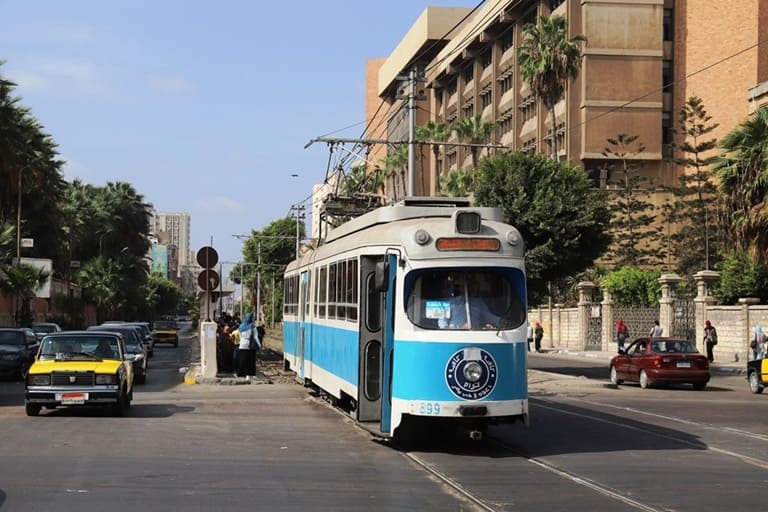
Other developments in the rail network and associated modes of transport, including trams in Alexandria and Cairo, the growing monorail network in Cairo, its trams and Metro services are covered in a separate article which can be found here. [5]
Egyptian National Railways is the national railway network of Egypt. Founded in 1854, it is the oldest railway system in Africa and the Middle East. [7] A separate article provides more detail about the history of the railways of Egypt which can be found here. [9]Other articles are under preparation in July 2026.
This article focuses on relatively recent news about the railways of Egypt. …
A. Cairo Monorail Project: The 56.5km East Nile line began operations in March 2026, serving 22 stations with driverless technology, reducing Cairo congestion. A second line, bringing the total network to over 100km, is under development.
B. High-Speed Network: Siemens Mobility is constructing a 2,000 km network, featuring Velaro and Desiro HC trains traveling up to 250 km/h, covering 60 cities.
C. Modernisation: of Egypt’s 10,000 kilometre rail network. ……
A.Cairo Monorail Network
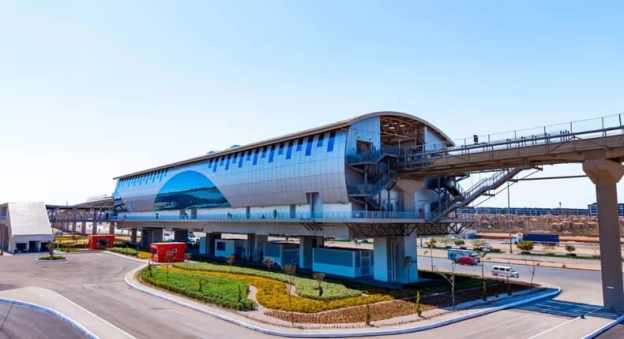
Recent articles about various railways in Egypt include the news that Egypt has just opened a new monorail, 56 kilometres in length.
The featured image shows one of the twenty-two station s on the route. [1][2]
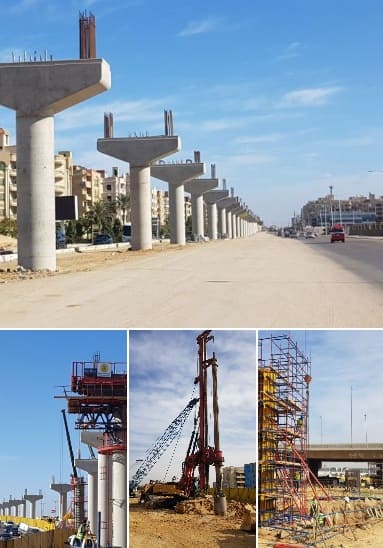
Solomon Ekanem reports that Egypt has officially launched the 56.5-kilometre East Nile monorail – Africa’s longest – marking a major milestone in the country’s push to modernise urban transport and expand green mobility infrastructure.
The East Nile monorail, connects Cairo’s Nasr City to the New Administrative Capital. It is a driverless monorail which calls at 22 stations. It is intended to ease congestion and improve urban connectivity. It is Africa’s longest single monorail line and part of the continent’s largest monorail network when combined with a second line. The eco-friendly, automated system reduces energy consumption by 30% compared to conventional electric rail.
President Abdel Fattah al-Sisi inaugurated the driverless system on Friday 20th March 2026 and then travelled alongside families of fallen Egyptian soldiers on the monorail from the Al-Fattah Al-Alim Mosque station to the Financial District, passing through key residential zones.
Transport Minister Kamel al-Wazir described the project as a “civilizational leap,” noting that it aligns with government efforts to deploy eco-friendly transport systems that reduce fuel consumption and road congestion. The rubber-tyred, fully automated system operates on elevated tracks, minimizing disruption to existing road networks.
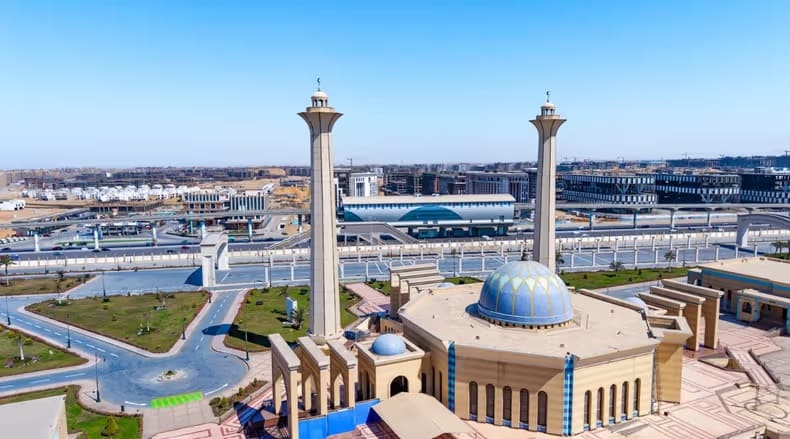
El-Mosheer Tantawy Mosque sits close to the monorail, one station of the monorail can be seen beyond the mosque in this image. [1][2]
“The East Nile monorail … is part of a broader network — the “Cairo Monorail” system — which includes a second line linking 6th of October City. When both lines are combined, the network stretches to about 96 km, making it Africa’s largest monorail system overall. In simple terms, the East Nile route holds the record for a single line, while the full Cairo network holds the continental record for total system size. Built by a consortium including Alstom, Orascom Construction, and Arab Contractors, the project features 40 trains capable of reaching speeds of up to 80 km/h, with intervals as short as 90 seconds. The system integrates with Cairo’s Metro Line 3 and the Light Rail Transit (LRT), with future links planned to Metro Lines 4 and 6.” [1]
“Equipped with platform screen doors, LED displays, and accessibility features, the monorail is expected to play a central role in reshaping Cairo’s urban mobility and supporting the shift toward sustainable transport.” [1]
Ekanem’s report is echoed by a report in Egypt Today. [2]
Cairo Monorail was first conceptualized in the late 2010s to combat the rise of traffic in the Greater Cairo area, and to provide a rapid transportation option for suburban residents. The Monorail was also thought of as a rail link between Cairo and Egypt’s New Administrative Capital. “Funding for the project was secured and obtained through a mix of local and international investments. This included a substantial loan facilitation agreement between the National Authority for Tunnels and JP Morgan Europe Limited, as well as contributions from other financial institutions such as the European Bank for Reconstruction and Development (EBRD) and the European Investment Bank (EIB). The total funding amounted to approximately 4.5 billion Euros.” [4]
It was reported in August 2019, that French rolling stock manufacturer, Alstom, would lead a consortium which includes The Arab Contractors: Osman Ahmed Osman & Co and Orascom. The consortium would sign a 2.7 billion Euros contract to design, construct, operate, and maintain the two monorail lines. Upon completion of construction, the consortium will operate and maintain the network for 30 years. [4]
Hill International highlighted their involvement with the project in a post on LinkedIn four years ago. They were providing project management, design review, and implementation supervision services for the New Administrative Capital City and 6th of October City (East and West) Lines. [3]
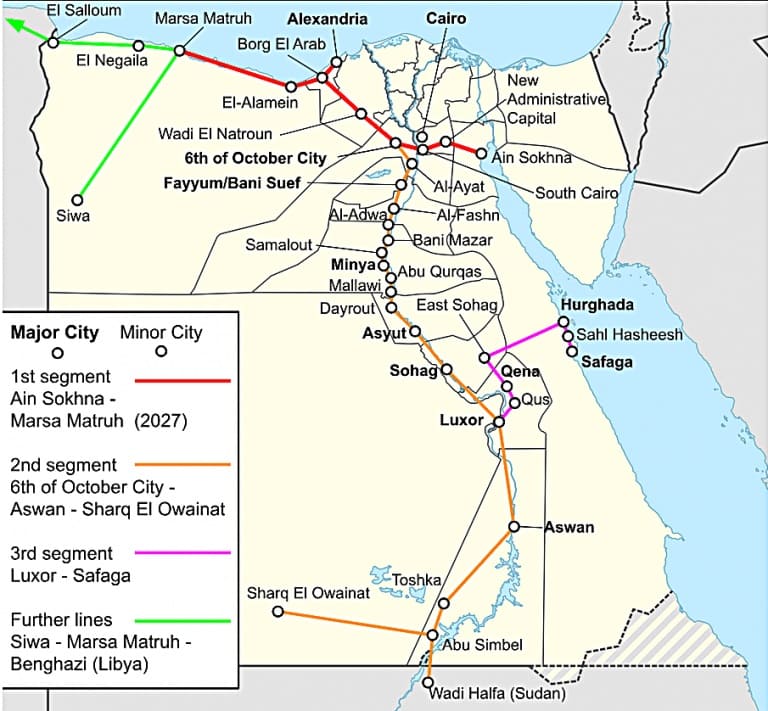
B. High-Speed Network: This network is a planned 2,000 km network which Siemens Mobility is constructing. It will feature Velaro and Desiro HC trains traveling up to 250 km/h, covering 60 cities. The network will include three lines:
Line 1 (Green Line): Connects Ain Sokhna to Marsa Matrouh via Cairo. Line 2: Connects Cairo to Abu Simbel. Line 3: Connects Qena with Hurghada and Safaga.
The project includes 15-year maintenance by Deutsche Bahn and involves upgrading 7 key rail stations via Thales, focusing on increasing freight capacity to 13 million tonnes annually.
Egypt has a bold vision to build one of the world’s largest high-speed rail networks. Siemens Mobility is committed to delivering fully integrated, sustainable transportation solutions tailored to Egypt’s unique environment. The High Speed rail project “will span over 2,000 kilometres. It will ultimately connect all the major cities and reach nearly 90% of the population. Once complete, Egypt will have the sixth-largest high-speed network in the world. It will significantly reducing travel times, cutting CO₂ emissions, and boosting sustainable local economic development.” [6]
Siemens Mobility’s 15-year maintenance commitment covers the entire fleet for Egypt’s new high-speed rail network ensuring long-term operational excellence. This network will cut travel times by up to 50%. It will offer millions of passengers safer, more reliable, and more comfortable journeys. [6]
Currently completed to over 65%, the first phase of Egypt’s Ain Sokhna to Marsa Matrouh high-speed train is set to begin operations in 2027. The 670-kilometre line will include 21 stations! [6]
C. Modernization: In addition to new lines, Egypt is modernizing its existing 10,000 km network with new trainsets from Talgo, locomotives from Progress Rail, and new traffic control systems to improve efficiency.
The Railway Gazette International reported in September 2025 that Hitachi Rail has deployed a centralised traffic control system to manage 19 stations on the 200 km Cairo to Alexandria line. [5]
“The initial contract for the programme was signed in 2013, and has since been extended to encompass more than €100m of investment. The mechanical and electrical signalling has been replaced with a modern electronic system, including digital interlockings, new signals and motorised drives. A fixed and mobile telecommunications system has been installed, with drivers able to communicate with the operations manager in case of emergency or failure. Level crossings have been modernised, and technical buildings constructed.” [5]
“The modernisation project will enable Egyptian National Railways to increase the maximum speed of trains by 40 km/h to 160 km/h, reducing the journey time between the two cities to 2½ h. The route’s throughput is also set to grow by 40% to a maximum of 286 trains/day. A progressive increase in the number of freight trains is planned, allowing the line to carry 15 per day in 2030 and 50 per day by 2060.” [5]
In November 2025, TravelMole.com reported that Egypt had showcased a new high-speed train. [6]
“On 10th November 2025, German technology giant Siemens unveiled the Velaro high-speed train in Cairo, which had been specifically adapted to withstand the harsh climate conditions of Egypt. The official presentation occurred during TransMEA 2025, the region’s leading exhibition for transportation and logistics in the Middle East and Africa. The Siemens Mobility Velaro high-speed train is specially adapted for Egypt’s desert conditions. It can reach a speed of up to 250 km/h and offers seating for 489 passengers. The company will deliver 41 Velaro trains to the Egyptian rail network.” [6]
On the same day, “the Desiro HC regional train successfully completed its first train run on newly constructed tracks near the 6th of October Depot, West of Cairo. The Desiro High-Capacity regional train is a key element of Egypt’s new high-speed rail network, with 94 trains set to provide efficient and comfortable regional transport. Specially adapted for Egypt’s climate, each train offers up to 849 passenger spaces and advanced features such as air conditioning,” [6]
“With a top speed of 160 km/h, the Desiro HC fleet will play a vital role in connecting cities along the Green Line. This line consists of a 660 km network connecting Cairo to Ain Sokhna, Alexandria, and Marsa Matrouh. The Green Line is already referred to as the ‘Suez Canal on Rails’.” [6]
Freight – in June 2026, reports the Railway Gazette, Egyptian National Railways signed four freight corridor upgrade contracts.
An Alstom-led consortium has signed four contracts worth €690m with Egyptian National Railways for the modernisation of two strategic freight rail corridors. Together with Rowad Modern Engineering and Concrete Plus, Alstom will upgrade the 6th October City – Alexandria and Belbes – 10th Ramadan City lines. The upgrades aim to reduce transit times by up to 80 minutes and improve connections between Egypt’s logistics hubs and seaports. [8]
In addition to these ‘Heavy Rail’ commitments, Egypt is also seeking to modernise its tram networks and Cairo’s Metro.
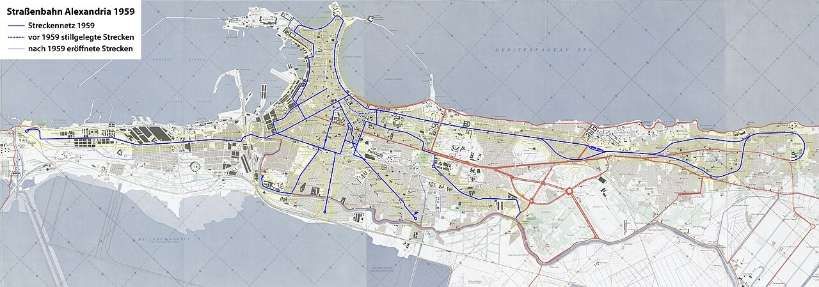
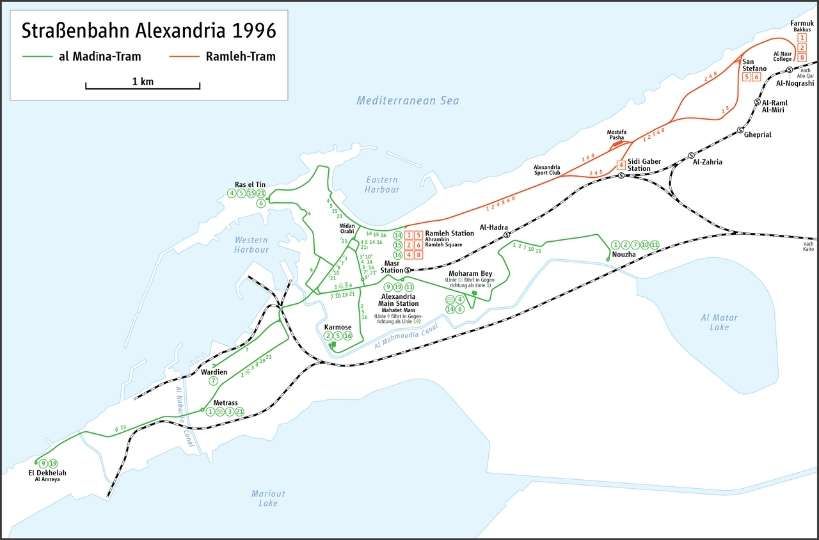
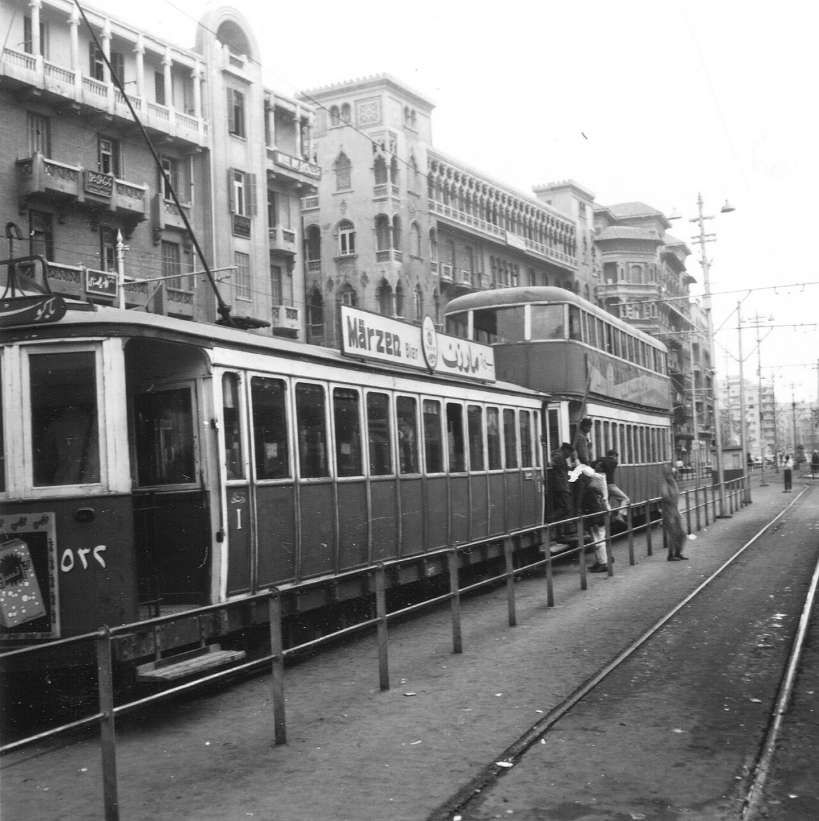
Egypt’s major tram modernization focuses on the historic Al Raml tramway in Alexandria, which suspended operations on 1st April 2026. Managed by the National Authority for Tunnels (NAT), the €236 million overhaul converts the 14.1 km heritage line into a fast, digitally controlled light rail system slated to finish by late 2028. [10]
Hitachi Rail has secured a contract to deliver the rail systems and digital technologies that will modernise and upgrade the Alexandria Raml Tram – the first modern tramway project of its kind in Egypt. The contract was awarded by the Hassan Allam Construction and Arab Contractors joint venture and will significantly improve speed, capacity and reliability on one of the world’s oldest continuously operating tram systems. [10]
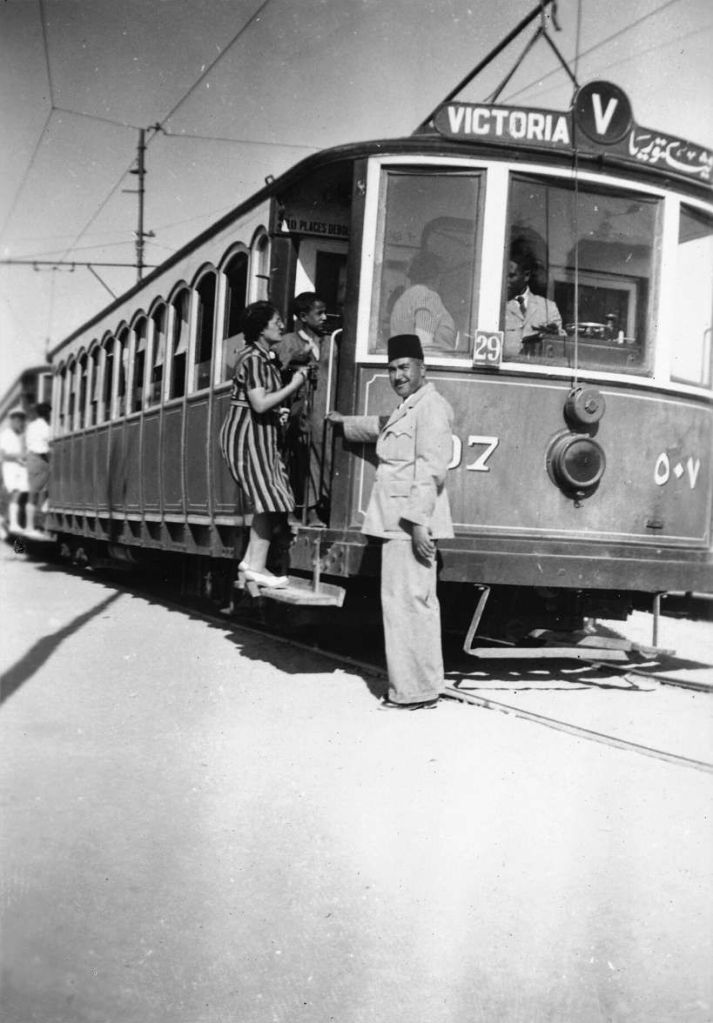
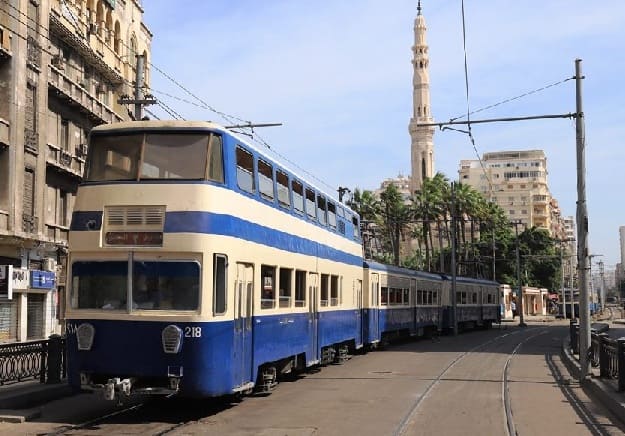
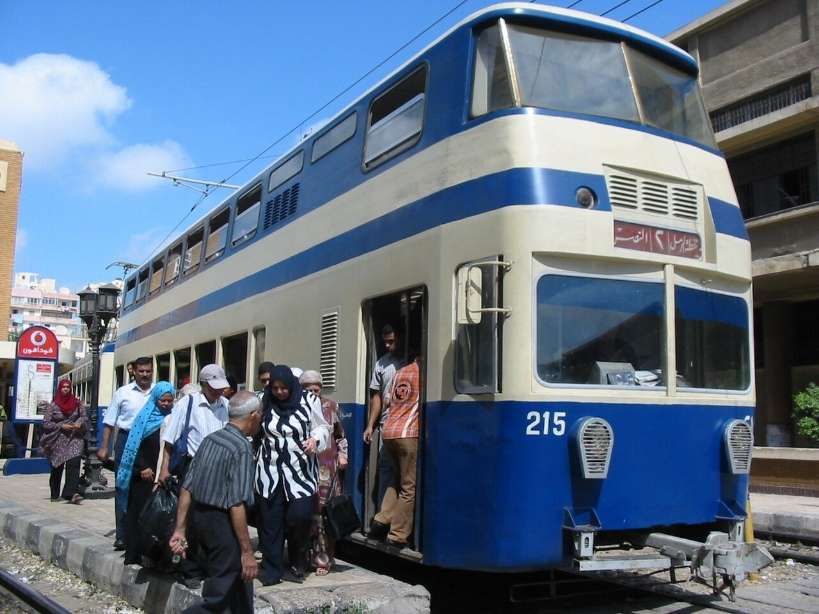
The Alexandria El Raml Tram is the oldest tramline in the Middle East and Africa, dating back to 1863. Despite its age and limited modernisation since the 1960s, it remains one of the few tramways globally to operate double-deck vehicles in regular service. The new contract marks a major step in the line’s transformation. [10]
Under the agreement, Hitachi Rail will supply advanced signalling and communications systems, a modern Operational Control Centre, SCADA, CCTV and access control, passenger information systems, and on-board equipment. Together, these systems will help deliver a faster, safer and more efficient public transport service aligned with Egypt’s Vision 2030 goals for sustainable mobility. [10]
The modernisation programme includes the reconstruction of 24 stations and 13.2 km of track. Once completed, the new system will:
reduce travel time from 60 to 35 minutes
double operational speed from 11 km/h to 21 km/h
cut headways from 9 minutes to 3 minutes
increase capacity from 4,700 to 13,800 passengers per hour per direction
This capacity boost will ease congestion, support modal shift and reduce CO₂ emissions while improving daily mobility across Alexandria. [10]
The El Raml Tram upgrade represents a significant milestone for Hitachi Rail’s growing presence in Egypt’s rail and metro sector. The company is already involved in key national programmes, including the Greater Cairo metro network, the LRT and monorail systems, and AFC modernisation initiatives. [10]
Hitachi Rail continues to expand its local footprint through engineering, financial, legal and operational teams established in Egypt. The company has increased localisation of IVVQ activities for CBTC systems and developed automated fare collection (AFC) projects that promote high-tech employment and diversity. These align with Egypt’s industrial and economic development priorities.[10]
Digital passenger information and multimodal payment systems are becoming central to Hitachi Rail’s offering in the region. For example, the upcoming Abu Qir Metro in Alexandria will integrate TRANSCITY™ AFC, enabling payments via QR codes, contactless cards, EMV bank cards and NFC mobile devices. [10]
“The contract will see us modernize and upgrade the oldest electric tram system in Africa, transforming it into a reliable, efficient, and digitally enhanced transportation system. The project underlines the capabilities of Hitachi Rail technologies in the rehabilitation and modernization of tramway systems,” Carlo Piacenza, SRS MEA Regional Director, Hitachi Rail, said. [10]
Urban Transport Magazine reported in April 2026 that, “with the closure of the long-established Ramleh tramway, Alexandria is currently undergoing one of the most radical system transformations in urban rail transport in North Africa. The project exemplifies a global trend: replacing historically evolved tramway systems with higher-capacity light rail infrastructure — and the associated trade-offs.” [11]
Alexandria’s tramway network is among the oldest in the world: opened as early as 1863 and electrified from 1902, the Ramleh line in particular developed into one of the city’s most important east–west corridors. With around 80,000 passengers per day and a route length of approximately 32 km, it was a central component of the urban transport system. [11]
At the same time, the system suffered from decades of underinvestment. Low average speeds of around 11 km/h, ageing infrastructure and limited reliability significantly constrained its performance. Against the backdrop of increasing congestion and ongoing urbanisation, comprehensive modernisation gradually moved to the forefront of transport policy. [11]
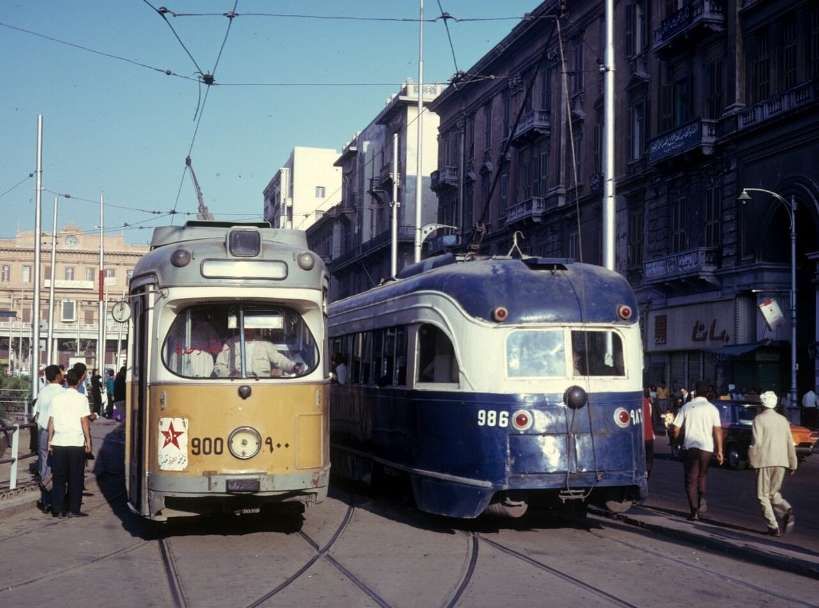
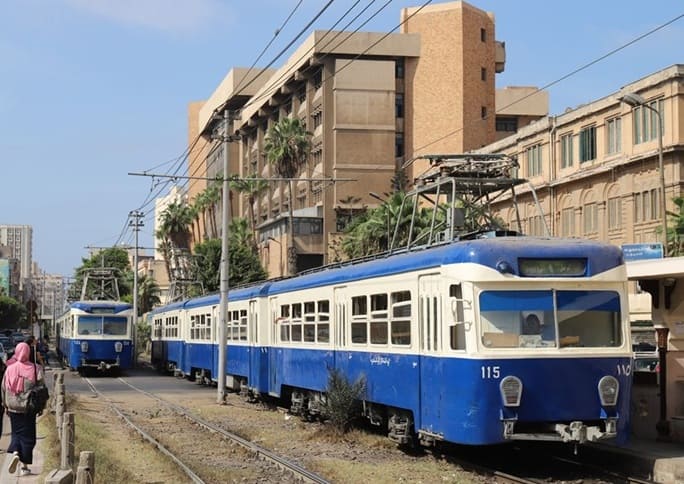
Until its closure, operations on the Ramleh tramway were characterised by a remarkably heterogeneous and ageing fleet. The core of the services was provided by modernised vehicles from Kinki Sharyo, complemented by locally Tatra Yug units. In addition, a number of second-hand high-floor trams originally built by Düwag in the 1960s and acquired from Copenhagen remained in service. This mix of vehicles from different generations and technical standards reflected both the long operational history of the line and the prolonged lack of fleet renewal, resulting in increasing maintenance complexity and declining reliability in the final years of operation. [11]
The transition to the new system began in early 2026 with a phased shutdown. Following initial restrictions in February, operations were completely suspended on 1 April 2026. Since then, the existing infrastructure — including tracks, power supply and stops — has been undergoing comprehensive dismantling. The complete interruption of services represents a deliberate break with historical continuity, in contrast to many European modernisation projects, where upgrades are often carried out while operations continue. [11]
In place of the conventional tramway, a modern light rail system with significantly altered parameters is being developed. Approximately 13 km of the route will be fundamentally upgraded and partially realigned. [11]
Key elements include:
Increase in average speed from 11 to around 21 km/h
Reduced stop density (approximately 500 m spacing)
Modern signalling and control systems
Introduction of 30 high-capacity vehicles (Hyundai Rotem)
The project is thus clearly aimed at increasing capacity and efficiency, and conceptually aligns more closely with light rail or metro systems than with traditional tramways. [11]
Since early 2026, operations on the Ramleh tramway have been gradually wound down: following initial test closures in February, partial suspension began on 11th February, before services were fully discontinued on 1st April 2026. [11]
In the weeks leading up to this, the network saw something of a series of “farewell runs”, before the final trams ceased operation in early April. In parallel with the closure, comprehensive dismantling of the infrastructure began, including tracks, overhead lines and, in some cases, adjacent urban spaces. [11]
The transformation has met with considerable criticism in Alexandria and is the subject of intense public debate. While the government presents the project as a necessary step towards modernisation to increase capacity and speed, many residents view it as a profound intervention in the city’s historic urban fabric. [11]
A central point of criticism is the planned elevation of the route. More than half of the future line, which will be around 13 km long, is to run on viaducts. Critics fear that the existing tree-lined right-of-way will be replaced by “concrete stilts”, leading to a loss of the city’s characteristic urban landscape. [11]
Furthermore, it is argued that the shift towards a faster system, more strongly segregated from general traffic, may bring operational advantages but could come at the expense of urban integration. Urban planners warn that the new infrastructure is geared more towards throughput and speed, and less towards public realm quality and local accessibility. [11]
Transport impacts have also been viewed critically: even during the construction phase, the suspension of services has exacerbated traffic problems, as replacement services have only been able to compensate for demand to a limited extent. Some observers see this as an indication that, in the short term, the transformation could even lead to increased reliance on private motorised transport. [11]
Finally, the loss of cultural heritage plays a central role in the public debate. For many residents, the tramway is not merely a mode of transport, but an integral part of the city’s identity. Critics therefore speak of a tension between modernisation and “cultural dislocation”. [11]
Reopening is scheduled for the end of 2027. Whether the new system will meet expectations in terms of performance and attractiveness will depend largely on how successfully operational efficiency can be balanced with urban integration. [11]
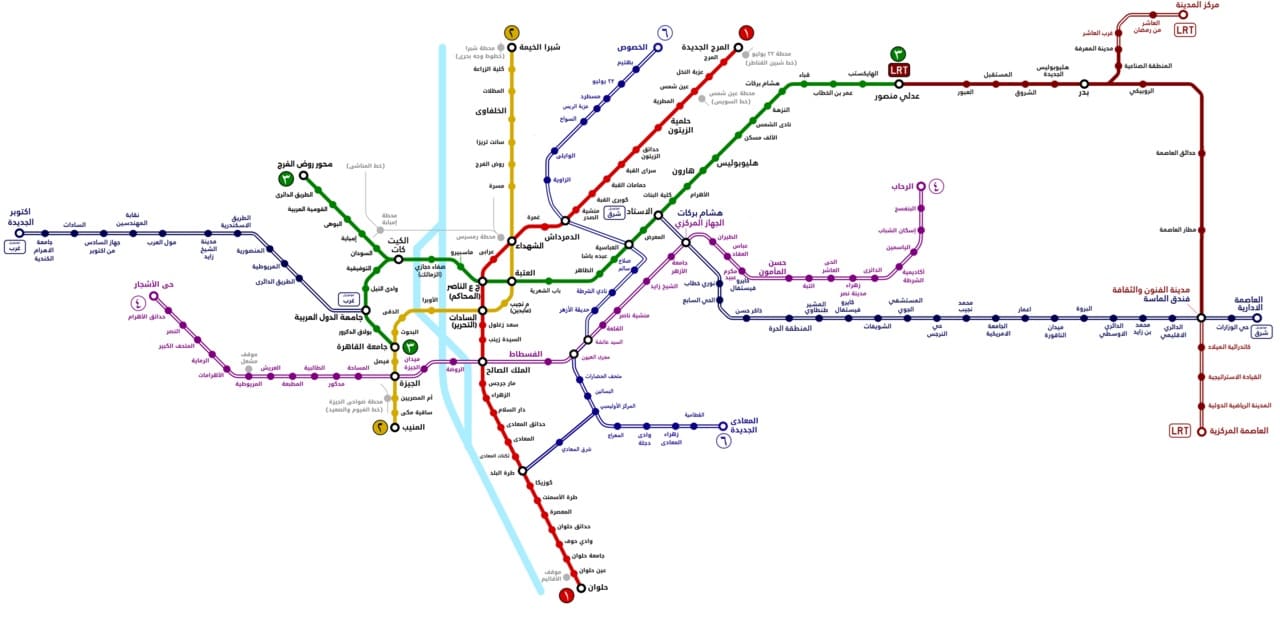
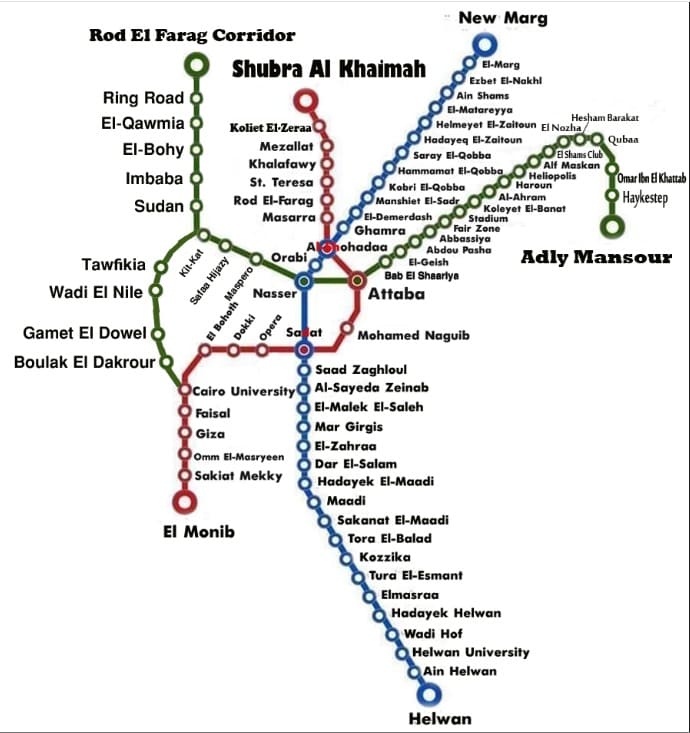
Cairo’s Metro:–
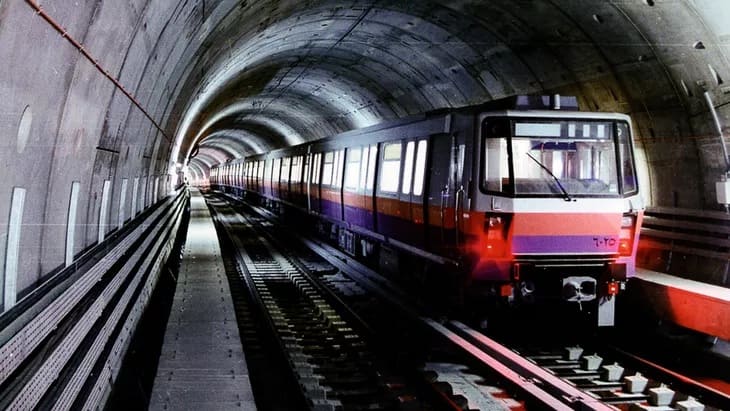
As of 2024, Cairo’s Metro has 84 stations of which 5 are transfer stations, with a total length of 106.8 kilometres (66.4 mi). The system consists of three operational lines numbered 1 to 3. It is part of an integrated transport network.
Map of Cairo Metro, LRT, and Monorail lines. Thick lines indicate lines in operation and hollow lines indicate lines under construction or in planning, (c) BasilLeaf and licensed for reuse under a Creative Commons licence, (CC BY-SA 4.0). [12]
As the biggest and most densely populated megacity in Africa and the Middle East, Greater Cairo had a strong case for a metro. In 1987 that population stood at 10 million residents, not counting the two million or so commuters who came into Cairo every day to work. The capacity of Cairo’s public transport infrastructure was around 20,000 passengers/hour, which increased to 60,000 after the construction of the metro. [13]
In the 2020s, “Cairo has more than 20 million people in its metropolitan area, and the chaos on the surface can be disorientating for anyone arriving for the first time: gridlock that stretches for kilometres, constant horns, intersections that follow no obvious logic. But beneath all that noise there is a system that organises the movement of millions of people every day. The Cairo Metro — officially the Cairo Metro or مترو القاهرة — is the backbone of public transport in this megalopolis, the first metro ever built in Africa, and the first in the entire Arab world.” [14]
In 2023, Cairo Metro carried 1,460 million passengers, which works out to around 5 million journeys a day — a figure that puts it among the most heavily used metro systems in Africa and the Arab world. For most of its passengers, the metro is not an alternative to other options; it is the only realistic way to cross the city in a reasonable amount of time. [14]
What makes this system distinctive is not only its history but its composition. Line 1 was born from the conversion of existing suburban railway corridors, combining surface sections with a few kilometres of tunnel through the historic heart of the city. Line 2 was a first for the continent: it crosses the Nile through a tunnel, the first railway tunnel under that river anywhere in Africa, a genuinely complex engineering achievement. Line 3, the most modern, was under construction in phases for over a decade and represents the biggest technological step forward in the system, with better stations and newer trains. It was completed in 2024. [14]
For travellers arriving in Cairo, the Metro is an indispensable tool for connecting the historic centre with modern districts, Ramses train station and the main residential areas. At present, the Cairo Metro does not reach the Pyramids of Giza. [14]
The density of Greater Cairo makes any underground construction extraordinarily complicated. Several sections were built directly beneath narrow alleyways, centuries-old markets, multi-storey buildings and layers of pre-existing infrastructure. Expropriations in historic districts such as Khan El Khalili, or in densely populated residential neighbourhoods, required lengthy and costly negotiations. In some stretches engineers opted for cut-and-cover construction with minimal disruption; in the historic centre, tunnel-boring machines were the only viable approach. [14]
The system at present operates trains from different generations depending on the line.
Line 1 still runs sets from the original era — nine-car trains with capacity for over 2,000 passengers, revised and upgraded over the decades. Some were refurbished by Hyundai in the early 2010s. [19] Others are being refurbished by Mitsubishi at present. [14][17]
Line 2 has more modern stock acquired in the 1990s and early 2000s. [18] The National Authority for Tunnels has awarded CAF three contracts totalling more than €450m for the modernisation and maintenance of trainsets on Cairo Metro Line 2 and the maintenance of trainsets on Line 1. [14][20]
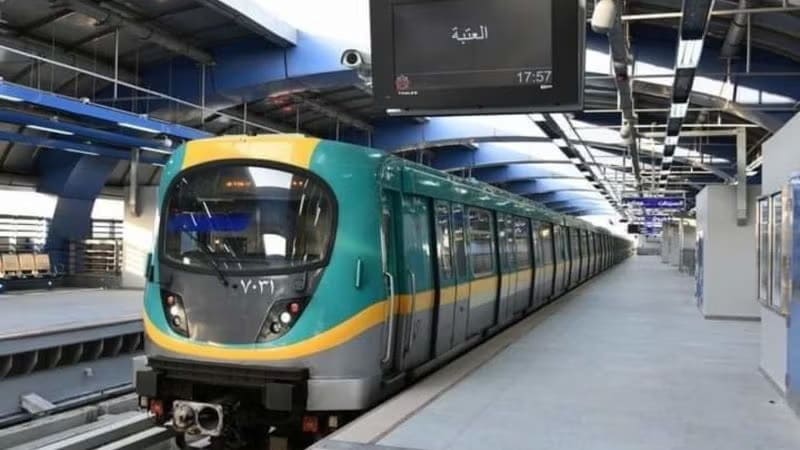
Line 3 works with the newest trains, some of them from contracts signed with Alstom in 2020/2021 for the supply of new Metropolis units. [14][21]
Line 4 connecting to Giza is under construction. The line is ultimaely intended to be 42 kilometres in length. [15] A first phase of 18-19 kilometres and between 15 and 17 stations planned, it will connect the El-Malek El-Saleh area with north-west Giza, bringing the Metro significantly closer to the Pyramids zone for the first time. The project includes lifts for passengers with disabilities and modern access management systems built into the original design. Opening is estimated at being in the first half of 2028. [14][16]
Phase 1 runs largely underground, serving 17 stations, from the boundary between Cairo and 6th of October City to Grand Egyptian Museum, Remaya Square, Haram Street, Giza Station, El-Malek El-Saleh and Fustat. Gewaily says that Line 4 will carry approximately 2 million passengers a day when completed. [16]
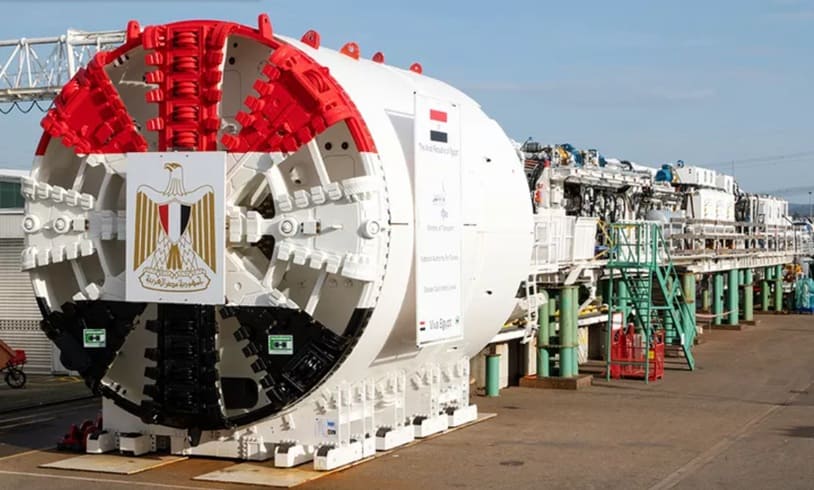
Four high-performance Herrenknecht tunnel boring machines were deployed for tunnel construction. They commenced excavation at the end of 2023 and the beginning of 2024, ensuring efficient and precise tunnelling under challenging geological conditions. [15]
Mitsubishi is supplying 23 trains for the line, the first of was scheduled for delivery In May 2026, construction of depot facilities and the installation of electromechanical systems. Civil works are being undertaken by domestic firms Arab Contractors, Orascom, Concord, Petrojet, and Hassan Allam Construction. [16]
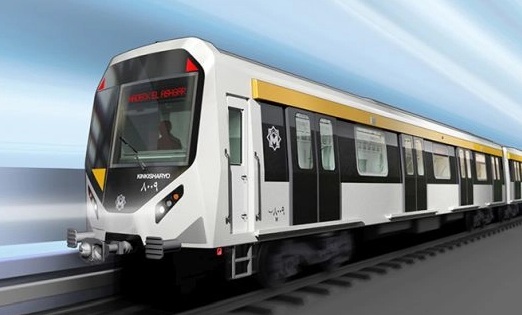
A Mitsubishi Kinki Sharyo train manufactured for the Cairo Metro Line 4. Phase 1 of Line 4 is scheduled to open in the first half of 2028.The contract includes supplying 184 metro cars to be delivered between 2026 and 2028.The trainsets are being shipped from Kobe, Japan, to Alexandria, Egypt. [16]
The government is currently considering three further phases for Line 4:
Phase 2: Fustat – New Cairo Phase 3: Hadaeq El Ashgar – Hosary Square, and Phase 4: New Cairo – the Capital Airport. [16]
The extended line will provide interchange with the planned metro Line 6, the Light Rail Transit (LRT) network and both the East of Nile and West of Nile monorail lines. [16]
Also planned is an extension to Line 3 to reach Cairo International Airport. It will add roughly 7 kilometres and 5 new stations from the Heliopolis area to the airport terminal. As of mid-2026 there is no confirmed opening date: the project has been announced on several occasions, but financing and timescales are not yet settled. [16]
Line 5 and Line 6 and the long-term network. The Greater Cairo master plan envisages a network of up to six metro lines plus complementary systems including the monorail, long-distance high-speed rail and extensions to the new satellite cities. Line 6 is planned to connect Shubra with Maadi, providing a new north-south axis that takes pressure off Line 1. All of these projects extend beyond 2030. [16]
Egyptian National Railways (Al-Sikak al-Ḥadīdiyyah al-Miṣriyyah) is the national railway network of Egypt. Founded in 1854, it is the oldest railway system in Africa and the Middle East. [1] Much of what follows comes from the Wikipedia article about Egypt’s national railway network [1] and from Hugh Hughes book, ‘Middle East Railways’, published by the Continental Railway Circle. [3] Other sources include Grace’s Guide, [6] the Egyptian Government [7] and the Institute of Developing Economies. [8]
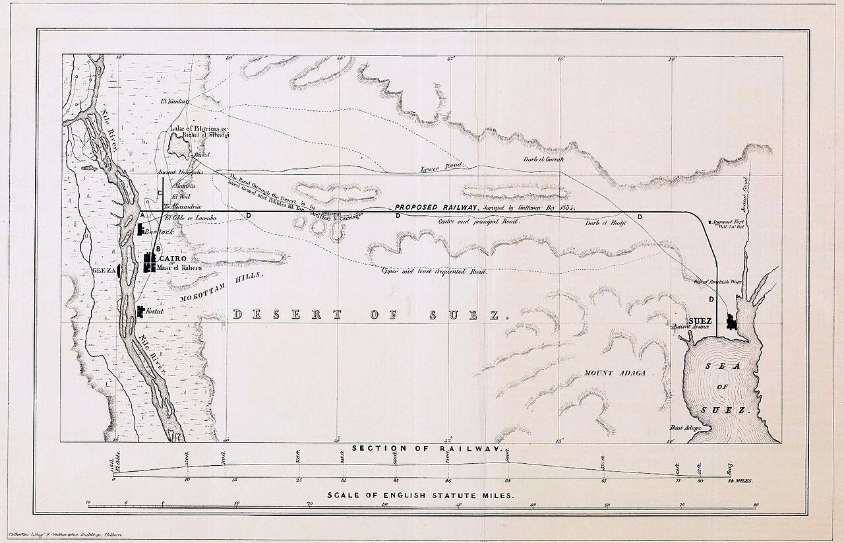
Wikipedia tells us that, “In 1833, Muhammad Ali Pasha considered building a railway between Suez and Cairo to improve transit between Europe and India. Muhammad Ali had proceeded to buy the rail when the project was abandoned due to pressure by the French who had an interest in building a canal instead.” [1] The route of the planned railway is shown in the first image below.
The proposed railway of 1833 which was not built. [1]
“Muhammad Ali died in 1848, and in 1851 his successor Abbas I contracted Robert Stephenson to build Egypt’s first standard gauge railway. The first section, between Alexandria on the Mediterranean coast and Kafr el-Zayyat on the Rosetta branch of the Nile was opened in 1854. [3: p12] This was the first railway in the Ottoman Empire as well as Africa and the Middle East. [4] In the same year, Abbas died and was succeeded by Sa’id Pasha, in whose reign the section between Kafr el-Zayyat and Cairo was completed in 1856 followed by an extension from Cairo to Suez in 1858. [3: p12] This completed the first modern transport link between the Mediterranean and the Indian Ocean, as Ferdinand de Lesseps did not complete the Suez Canal until 1869. [1]
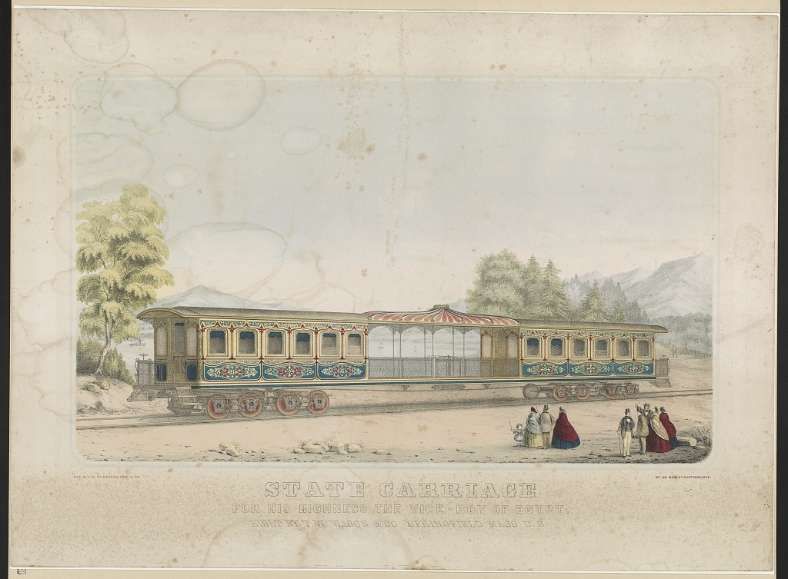
A state carriage by Wason Manufacturing built for Sa’id Pasha for state functions which was included with 161 less ornate railcars sent by the company in 1860. [1][2: p70]
“At Kafr el-Zayyat the line between Cairo and Alexandria originally crossed the Nile with an 80 feet (24 m) car float. [3: p17] However, on 15th May 1858 a special train conveying Sa’id’s heir presumptive Ahmad Rifaat Pasha fell off the float into the river and the prince drowned. [3: p17] Stephenson therefore replaced the car float with a swing bridge nearly 500 metres (1,600 ft) long. [3: p17] By the end of Sa’id’s reign branches had been completed from Banha to Zagazig on the Damietta branch of the Nile in 1860, to Mit Bera in 1861 and from Tanta to Talkha further down the Damietta Nile in 1863.” [1][3: p12]
“Sa’id’s successor Isma’il Pasha strove to modernise Egypt and added momentum to railway development. In 1865 a new branch reached Desouk on the Rosetta Nile and a second route between Cairo and Talkha was opened, giving a more direct link between Cairo and Zagazig. [3: p12] The following year a branch southwards from Tanta reached Shibin El Kom. [3: p12] The network started to push southwards along the west side of the Nile with the opening of the line between Imbaba near Cairo and Minya in 1867. [3: p15] A short branch to Faiyum was added in 1868. [3: p15] A line between Zagazig and Suez via Nifisha was completed in the same year. [3: p12] The following year the line to Talkha was extended to Damietta on the Mediterranean coast and a branch opened to Salhiya and Sama’ana.” [3: p12]
“Imbaba had no rail bridge across the Nile to Cairo until 1891. [3: p17] However, a long line between there and a junction west of Kafr el-Zayyat opened in 1872, linking Imbaba with the national network. [3: p12] From Minya the line southwards made slower progress, reaching Mallawi in 1870 and Assiut in 1874.[3: p15] On the west bank [as far as] Najee Hammady, [then] on east bank of the Nile till Aswan. A shorter line southwards linked Cairo with Tura in 1872 and was extended to Helwan in 1875. [3: p12] In the Nile Delta the same year, a short branch reached Kafr el-Sheikh and in 1876 a line along the Mediterranean coast linking the termini at Alexandra and Rosetta was completed.” [3: p12]
1877-1888
“By 1877, Egypt had a network of key main lines and the Nile Delta had quite a network, but with this and other development investments, Isma’il had gotten the country deeply into debt. For its first 25 years of operation Egypt’s national railway had never even produced an annual report. [3: p13] A Council of Administration with Egyptian, British and French members was appointed in 1877 to put the railway’s affairs in order. They published its first annual report in 1879, [3: p13] and in the same year, the British Government had Isma’il Pasha deposed, exiled and replaced with his son Tewfik Pasha. In 1882, the British essentially invaded and occupied Egypt.” [1]
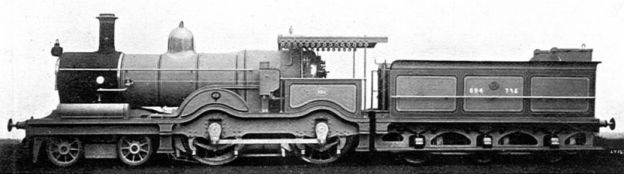
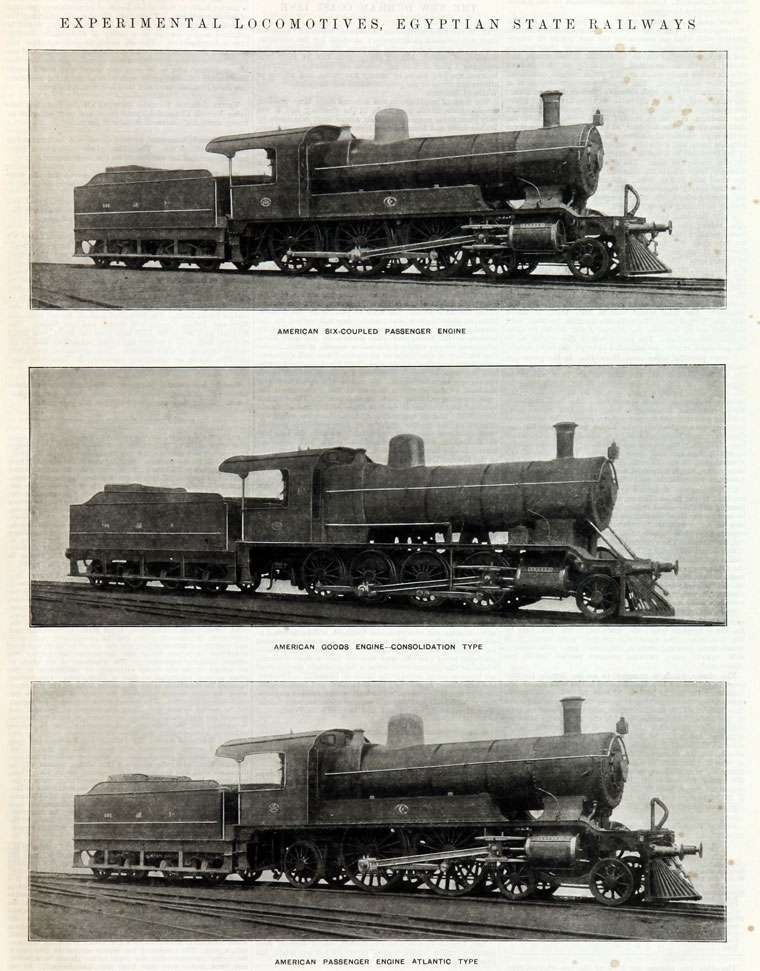
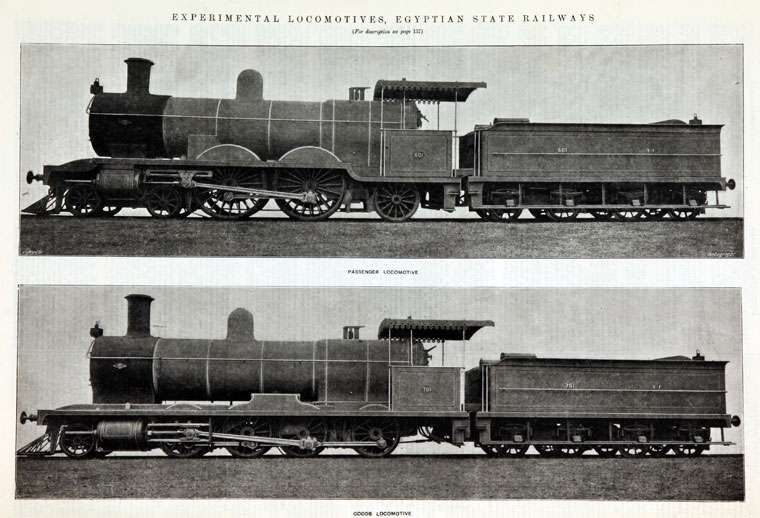
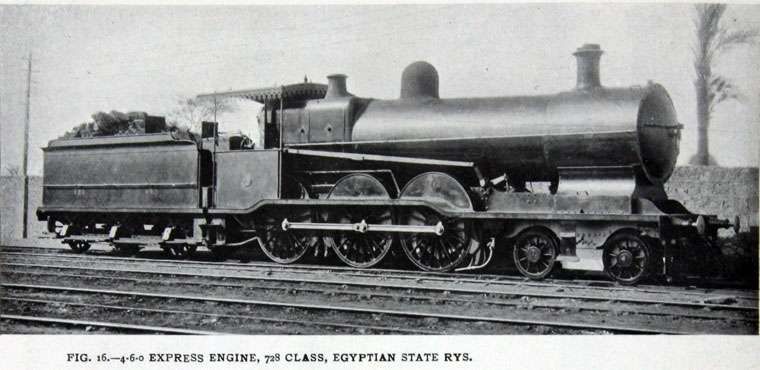
With these developments, the Egyptian Railway Administration’s (ERA’s) rail network stagnated until 1888, but it also put its management in much better order. [3: p13] “In 1883 the ERA appointed Frederick Harvey Trevithick, nephew of Francis Trevithick, as Chief Mechanical Engineer. [3: p32][5] Trevithick found a heterogeneous fleet of up to 246 steam locomotives of many different designs from very different builders in England, Scotland, France and the USA. [3: p32] This lack of standardisation of locomotives or components complicated both locomotive maintenance and general railway operation.” [1][3: p32]
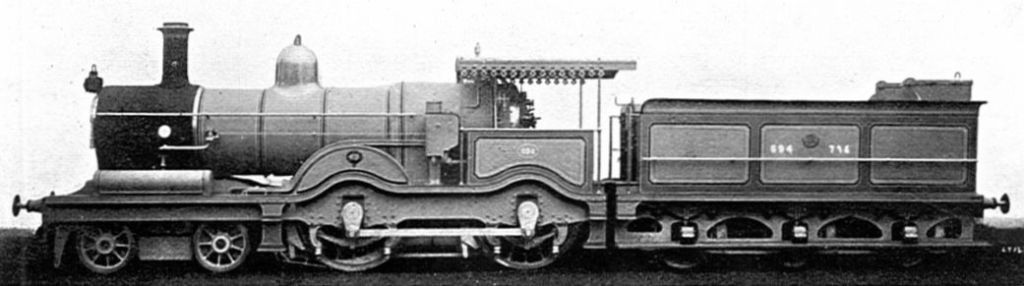
“From 1877 to 1888, the ERA struggled to keep up with even basic maintenance, [3: p13] but by 1887 Trevithick managed to start a programme to renew 85 of the very mixed fleet of locomotives with new boilers, cylinders and motion. [3: 32] He started to replace the others with four standard locomotive types introduced from 1889 onwards: one class of 0-6-0 for freight, one class of 2-4-0 for mixed traffic, one 0-6-0T tank locomotive for shunting and one class of only ten 2-2-2 locomotives for express passenger trains. [3: p32] Trevithick ensured that these four classes shared as many common components as possible, which simplified maintenance and reduced costs still further.” [1][3: p32]
1888-1914
“By 1888, the ERA was in better order and could resume expanding its network. In 1890, a second line between Cairo and Tura opened. [3: p12] On 15th May 1892, the Imbaba Bridge was built across the Nile, linking Cairo with the line south following the west bank of the river.” [3: p17] Grace’s Guide has the opening taking place in 1891. [6] “The civil engineer for the bridge was Gustave Eiffel. (It was reformed and renewed in 1924 which is still the only railway bridge across the Nile in Cairo.) Cairo’s main Misr Station was rebuilt in 1892. The line south was extended further upriver from Assiut reaching Girga in 1892, Nag Hammadi in 1896, Qena in 1897 and Luxor and Aswan in 1898. [3: p15] With the railroad’s completion, construction began the same year on the first Aswan Dam and the Assiut Barrage, main elements of a plan initiated in 1890 by the government [9] to modernize and more fully develop Egypt’s existing irrigated agriculture, export potential, and ability to repay debts to European creditors.” [10][1]
“In the north in 1891, a link line was opened between Damanhur and Desouk. [3: p12] The line to Shibin El Kom was extended south to Menouf in the same year and reached Ashmoun in 1896. [3: p12] By then a line across the Nile Delta from a junction north of Talkha on the line to Damietta had reached Biyala. [3: p12] By 1898 this reached Kafr el-Sheikh, completing a more direct route between Damietta and Alexandria.” [3: p12][1]
“An important extension along the west bank of the Suez Canal linking Nifisha with Ismaïlia, Al Qantarah West and Port Said was completed in 1904.” [3: p12][1]
“Thereafter network expansion was slower but two short link lines north of Cairo were completed in 1911 followed by a link between Zagazig and Zifta in 1914.” [1][3: p12]
“The first El Ferdan Railway Bridge over the Suez Canal was completed in April 1918 for the Palestine Military Railway. [3: p17] It was considered a hindrance to shipping so after the First World War it was removed. [3: p17] During the Second World War a steel swing bridge was built in 1942 but this was damaged by a steamship and removed in 1947. [1][3: p17]
The First World War (1914-1918) saw an increase in the importance of the railway network to the British Colonial Powers. The outbreak of the Second World War (1939-1945), saw the British increasingly relying on the Egyptian rail network for the transport of equipment, ammunition and soldiers After the war, the next significant moment was the revolution of 23rd July 1952. The new government saw the value of the network for the transport of its citizens and programmed the provision of passenger rolling stock as a priority. The building the High Dam led to a reliance on the railways to transport the necessary construction tools, materials and workers for what was a huge project. [15]
“A double swing bridge [over the Suez Canal][was completed in 1954 but the 1956 Israeli invasion of Sinai severed rail traffic across the canal for a third time. [3: p17] A replacement bridge was completed in 1963 [11] but destroyed in the Six-Day War in 1967. A new double swing bridge was completed in 2001 and is the largest swing bridge in the world. [11] However, the construction of the New Suez Canal has since disconnected the Sinai from the rest of Egypt’s rail network again. Instead of the bridge, two rail tunnels are planned under the canal, one near Ismailia and one in Port Said.” [1]
“Historically, the Palestine Railways main line linked Al Qantarah East with Palestine and Lebanon. It was built in three phases during the First and Second World Wars. Commenced in 1916, it was extended to Rafah on the border with Palestine as part of the Egyptian Expeditionary Force’s Sinai and Palestine Campaign against the Ottoman Empire. The route was extended through to Haifa in Mandate Palestine after World War I, to Tripoli, Lebanon in 1942 and became a vital part of the wartime supply route for Egypt.” [1]
“As a result of the 1947–1949 Palestine war, the Palestine Railways main line was severed at the 1949 Armistice Line. The 1956 Israeli invasion severed Sinai’s rail link with the rest of Egypt was reconnected its rail link with Israel. Israel captured a 4211 class 0-6-0 diesel shunting locomotive and five 545 class 2-6-0 steam locomotives. [12: p137] Israel also captured rolling stock including a six-wheel coach dating from 1893 and a 30-ton steam crane built in 1950, both of which Israel Railways then appropriated into its breakdown fleet. Before being forced to withdraw from Sinai in March 1957, Israel systematically destroyed infrastructure including the railway. [13: p194] By 1963 the railway in Sinai was reconnected to the rest of Egypt but remained disconnected from Israel.” [1]
“In the 1967 Six-Day War, Israel captured more Egyptian railway equipment including one EMD G8, four EMD G12 and three EMD G16 diesel locomotives [12: p136] all of which were appropriated into Israel Railways stock. After 1967, Israel again destroyed the railway across occupied Sinai and this time used the materials in the construction of the Bar Lev Line of fortifications along the Suez Canal.” [1]
“After long service on Israel Railways, the 30-ton crane, 1893 Belgian 6-wheel coach and one of the EMD G16 diesels are all [now] preserved in the Israel Railway Museum in Haifa.” [1]
Egypt’s RailwayMuseum
“Egypt’s railway museum was built in 1932 next to Misr Station (now Ramses Station) in Cairo.[3: p15] The museum opened in January 1933 to mark the city’s hosting of the International Railway Congress. [3: p15] Its stock of over 700 items includes models, historic drawings and photographs. [3: p15] Among its most prominent exhibits are three preserved steam locomotives: [1]
2-2-4 No. 30, built by Robert Stephenson and Company in 1862. Wikipedia says, “The Egyptian connections to Robert Stephenson were very considerable and a wealth of consequential artefacts are in Cairo Railway Museum. This includes what could well be the single most extravagant piece built by the Robert Stephenson Works. This is works number 1295 of 1862 whose artistic design was by Matthew Digby Wyatt. This 2-2-4T for the Egyptian Railways survives with all its fantastical marquetry in the Egyptian Railway Museum at Cairo. It is called the Khedive’s Train;” [14: p7]
0-6-0 No. 986 (originally 189, then 142), built by Robert Stephenson and Company in 1861; [14: p7]
4-4-2 No. 194 (originally 678) built by the North British Locomotive Company in 1905. [14: p7]
Frederick Harvey Trevithick, was the nephew of Francis Trevithick (1812—1877) who was the son of Richard Trevithick. Francis Trevithick was, in 1840, appointed resident engineer on Grand Junction Railway (GJR) between Birmingham and Crewe. He was then appointed, in 1841, as Locomotive Superintendent. In 1843, he was transferred to the new works at Crewe as Locomotive Superintendent of the Northern Division of the LNWR. In 1857, having lost the confidence of certain directors, Trevithick was forced to resign (although given a handsome ‘Golden Handshake’).
Ewald Bloche; Constructing Modern Egypt: Modernization and Development Discourses in the Context of British and Egyptian Water Engineering; p.6-7 (Broken link to a German text – so cannot verify the source.)
Paul Cotterell; The Railways of Palestine and Israel; Tourret Publishing, 1984.
Noam Chomsky; The Fateful Triangle; South End Press, New York, 1983.
Peter Proud & C. Smith eds.; The Standard Gauge Locomotives of the Egyptian State Railways and The Palestine Railways 1942-1945; Railway Correspondence and Travel Society, London, 1946.



_GE_ES30ACi.jpg)
