
Egyptian National Railways (Al-Sikak al-Ḥadīdiyyah al-Miṣriyyah) is the national railway network of Egypt. Founded in 1854, it is the oldest railway system in Africa and the Middle East. [1]
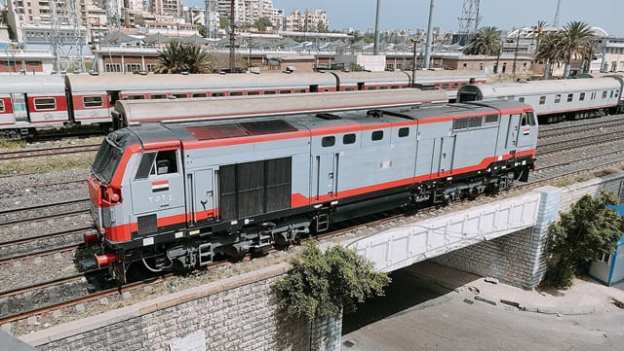
The featured image for this article is an Egyptian National Railways (ENR) GE ES30ACi locomotive in the Alexandria railway station yard, (c) Abdelrhman 1990 and licensed for reuse under a Creative Commons licence (CC BY-SA 4.0). [6]
The National Authority for Egyptian Railways is one of the largest economic institutions in Egypt and the Arab world, and it is the largest in the field of transport services (passengers and goods). It is considered the backbone of passenger transport in Egypt. Its share of passenger transportation is more than 30% of the total transportation volume at the national level. The Railways Authority transports both people and goods. Passenger transport is provided in: [2]
- Luxurious first and second class air-conditioned high-speed trains (all lines);
- Luxury turbo trains (Cairo – Alexandria line);
- Luxury sleeper trains (all year long in Upper Egypt, and in summer from Cairo to Marsa Matrouh);
- Express trains in regular and mixed grades;
- Line trains, and suburban areas in the same class. [2]
With regard to the transportation of goods, the authority provides two types of service: [2]
- Urgent freight transport service on passenger trains – for luggage, parcels, light transport, foods, newspapers, publications and letters.
- Non-urgent freight transportation – heavy goods on dedicated movements supported by the best available traction – bulk and packed grain, coal, sugar cane and its products, petroleum products, iron ore, phosphate ore, manufactured fertilizers, salt and all kinds of minerals. [2]
Egypt claims to have the second oldest railway in the world. It has 9,570 km of railway, 705 passenger stations, 1330 level-crossings, 3500 thousand passenger coaches, 10,000 goods wagons, 820 locomotives. [2]
920 passenger services run each day. 4.8 million tons of goods are moved per year on dedicated goods trains, which still only represents 1.2% of the goods by weight that enter Egypt. [2]
The statistics provided by the National Authority for Egyptian Railways indicate the following: [2]
- Passenger transport: 500 million passengers annually (about 1.4 million passengers per day). [2]
- Cargo transportation: 6 million tons annually. [2]
- Rail network: The total length of the network is 9,570 km. Four-line tracks – 20 km. Double-line tracks – 1,466 km. Single-line tracks – 3,667 km. This excludes railyards, workshops and warehouses. [2]
- Stations: The total number of stations, as noted above, is 705, including: 22 central stations; 59 significant stations; 60 medium stations and 564 small stations. [2]
- Bridges and tunnels: 885 bridges and tunnels as follows: 511 Rail bridges over the Nile and other obstacles; 58 vehicular bridges over the railway; 157 tunnels under the railway for cars and pedestrians; 137 overhead pedestrian bridges. [2]
- Locomotive fleet: 342 German locomotives capacity of 2,475 horsepower; 45 Canadian locomotive, capacity 2,475 horsepower; 30 American locomotive, capacity of 1850 horsepower; 253 Canadian locomotive, 1650 hp; 30 Spanish shunting locomotives, 1,200 hp; 80 new American GE locomotives, 4000 hp; 40 new American EMD locomotive, 3245 hp; horsepower. A total of 820. [2]
- Passenger transport: 3500 coaches of which 850 are air-conditioned. Services range in speed from 90 to 120 km/hour. [2]
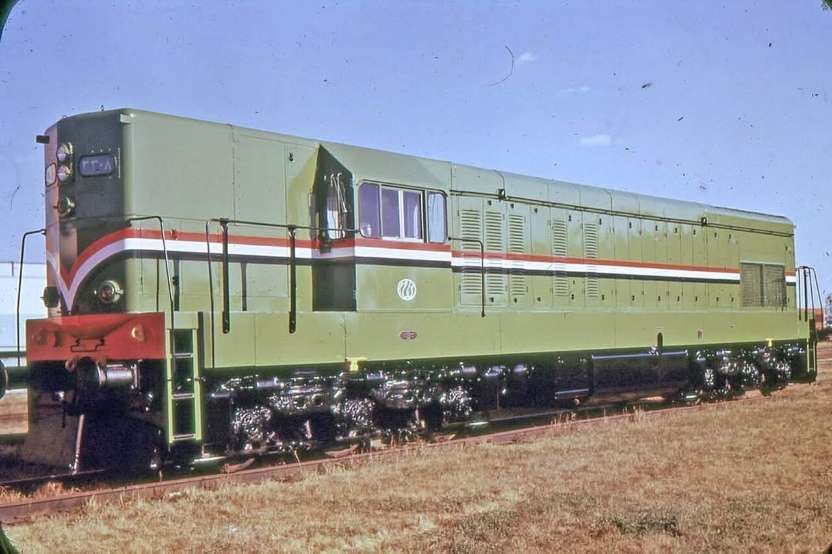
The locomotive fleet noted above is outlined in more detail on Wikipedia here. [4] Given the extent of the detail provided in that Wikipedia article, it is not repeated in this article.
Despite the major role railways play in Egyptian transport, the rail system falls short in at least two critical areas: passenger safety and moving freight. The World Bank is providing two loans to the Egyptian government to help the Egyptian National Railways (ENR) tackle these issues. A $440-million loan will support safety and service quality improvements along the Alexandria-Cairo-Nag Hammadi railway corridor, while another $400-million project addresses rail logistics. [3]
Both of these projects aim to reduce the climate and environmental impacts of transport by moving more people and goods from roads to rail — a change that can’t come fast enough. In the Middle East and North Africa Region, air pollution is responsible for 270,000 premature deaths every year, which bear a huge economic cost of around 2 percent of GDP per year. A large culprit of this pollution is transport emissions. In Egypt, the proliferation of private cars, taxis and trucks on the road triggered a 75% increase in transport emissions between 2005 and 2019, demonstrating how rapid motorization comes with serious implications for health and the environment. [3]
Moving freight from trucks to trains
Trucks still move the vast majority of Egypt’s freight, about 96 percent of it. Railways move only about 1.9 percent. Part of the reason is that only three freight trains per direction per day can travel between Alexandria’s seaport and the 6th of October dry port outside Cairo. Capacity constraints on rail, roads, and the Nile River weaken the links between ports, cities, and industrial zones. These kinds of inefficiencies are costly, and improving logistics is necessary to expand trade competitiveness. Further, a lack of targeted regulations distorts the market and gives road transport an unfair economic advantage over rail. [3]
The Bank-supported Cairo Alexandria Trade Logistics Development Project is intended to ease the pressure by co-financing the creation of a railway bypass around Greater Cairo, which will greatly increase network capacity and reduce the competition between freight and passenger services. [3]
The project will also help modernize railway policies and regulations. Right now, publicly-owned ENR is the only operator that can carry freight on the rail network. A new system will change that and allow private operators to use railway tracks in exchange for a toll, which will be paid directly to ENR. By encouraging private operators to enter the freight rail market, these reforms are expected to boost capacity and efficiency across the network. [3]
Together, these initiatives will help improve the rail system and move freight on a larger, more reliable network, cutting transit delays. Egyptian rail has already more than quadrupled the amount of freight it moves to approximately 25 million tons annually, up from 4.6 million tons just five years ago. [3]
Making travel safer for everyone
Ninety percent of Egyptian National Railways’ operations involve moving passengers, and they, particularly low-income riders, will benefit from safer, more reliable, and faster services. The World Bank’s financing will lead to railway reforms that improve the Egyptian National Railways’ (ENR) safety and efficiency to cut down on air pollution, speed access to jobs and services, and make rail service safe and accessible for all. [3]
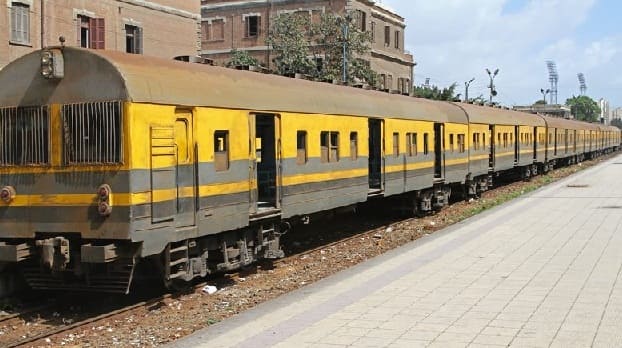
Safety and service quality are driving much of the engagement between the World Bank, the Egyptian Ministry of Transport, and ENR. This includes extensive upgrades to the signalling system along the Alexandria-Cairo-Nag Hammadi corridor, an all-important 763-kilometre railway route that connects densely-populated areas across the country. [3]
But the concept of safety extends beyond hard infrastructure to the feeling passengers get when they ride Egypt’s trains. This involves, for instance, creating a stronger safety culture with a focus on safe operations and maintenance. As part of this, the World Bank is supporting the creation of a database for safety incidents, which will help ENR monitor and analyze incidents in a more systematic way to prevent reoccurrence. The Bank is also supporting ENR’s efforts to rethink the design of stations and level crossings, especially to enhance the “beyond-rail” elements of the design – safety, security and accessibility – utilizing design principles from best international practice. [3]
In parallel, to ensure these initiatives translate into lasting results, the Bank is working with the Egyptian Ministry of Transport and the Korean experts to facilitate local training and knowledge exchange. The objective is to help train the next generation of Egyptian planners, engineers and managers, and to enhance the country’s technical capacity across the railway sector. [3]
Other developments in the rail network and associated modes of transport, including trams in Alexandria and Cairo, the growing monorail network in Cairo, its trams and Metro services are covered in a separate article which can be found here. [5]
References
- https://en.wikipedia.org/wiki/Egyptian_National_Railways, accessed on 22nd March 2026.
- https://forum.mrhmag.com/post/egypts-railways-a-long-history-and-successive-achievements-12217053 (this appears to be material translated from Arabic), accessed on 29th July 2026.
- https://www.worldbank.org/en/news/feature/2023/11/14/in-egypt-safer-and-more-efficient-railways-will-bring-wide-ranging-benefits-for-development, accessed on 30th July 2026.
- https://en.wikipedia.org/wiki/List_of_rolling_stock_used_by_Egyptian_National_Railways, accessed on 29th July 2026.
- https://rogerfarnworth.com/2026/07/28/egyptian-rail-news-summer-2026/
- https://commons.wikimedia.org/wiki/File:Egyptian_Railways_(ENR)_GE_ES30ACi.jpg, accessed on 30th July 2026.
- https://www.meed.com/egypt-close-to-awarding-deal-for-train-coaches, accessed on 30th July 2026.
 Roger Farnworth
_GE_ES30ACi.jpg)