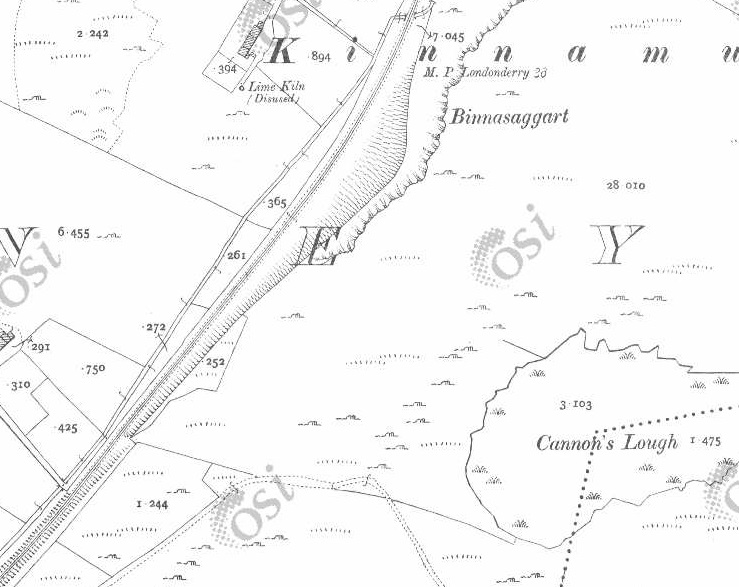
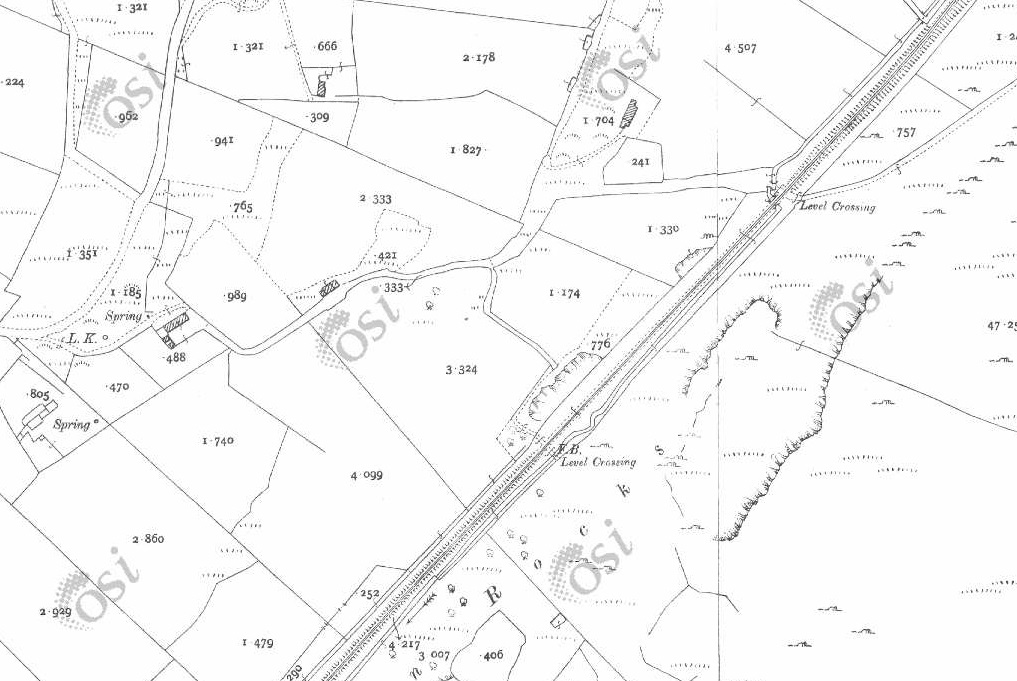
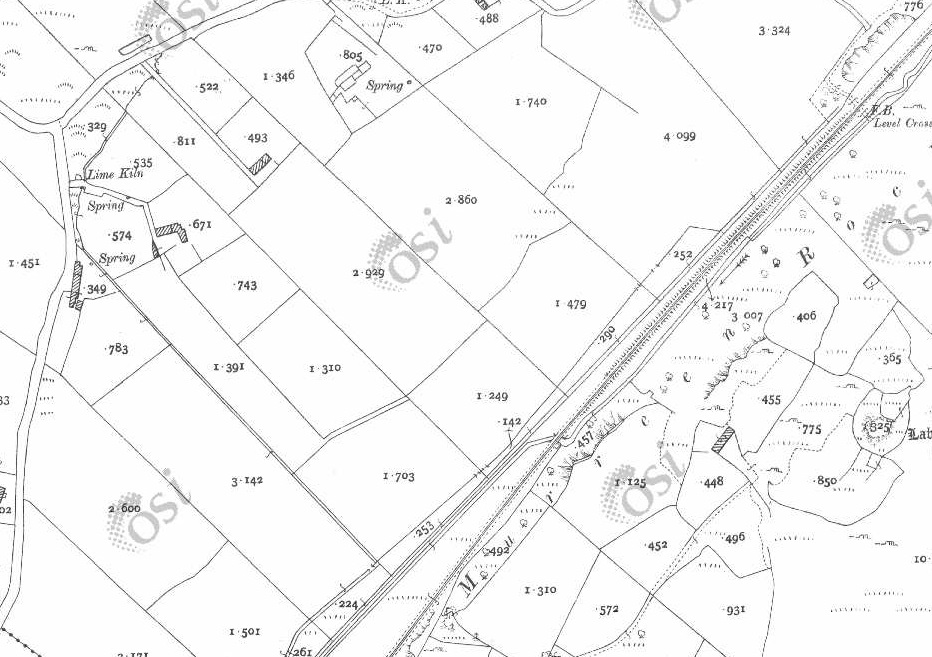
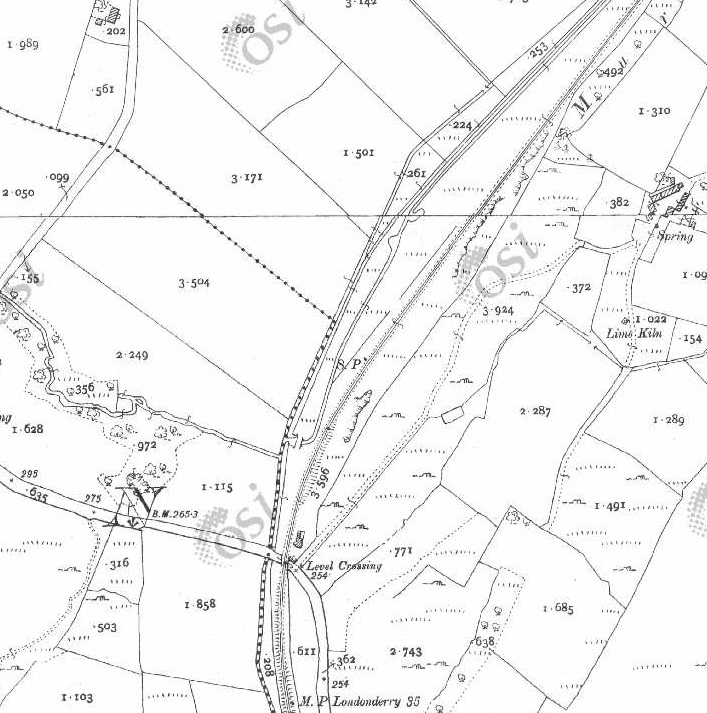
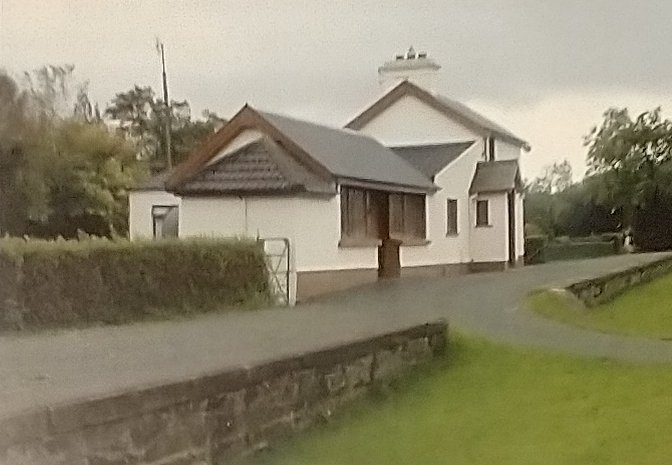
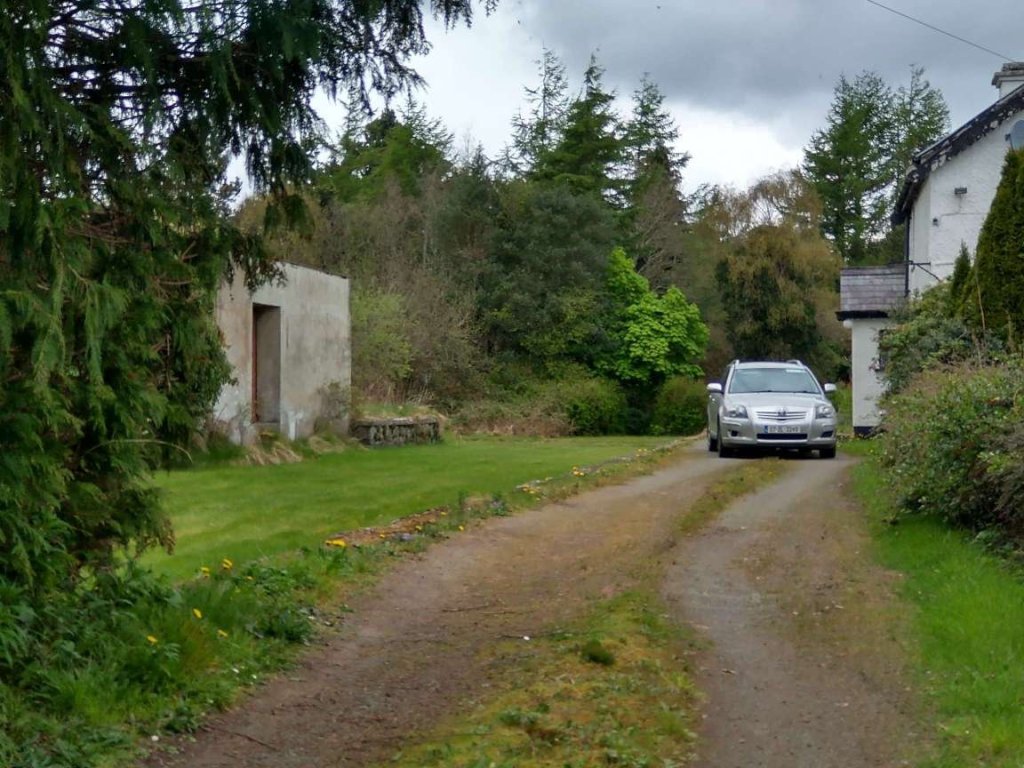
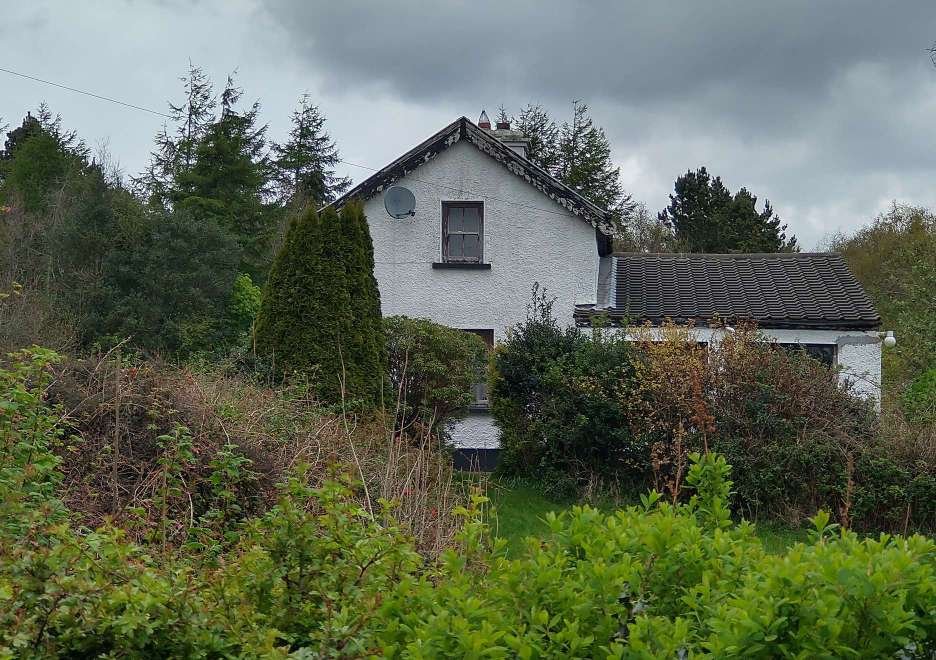
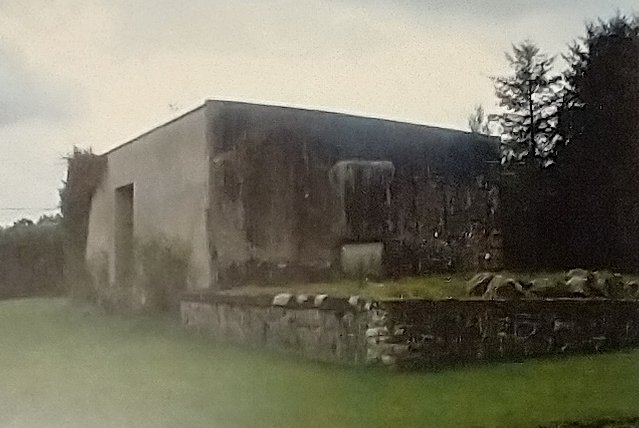
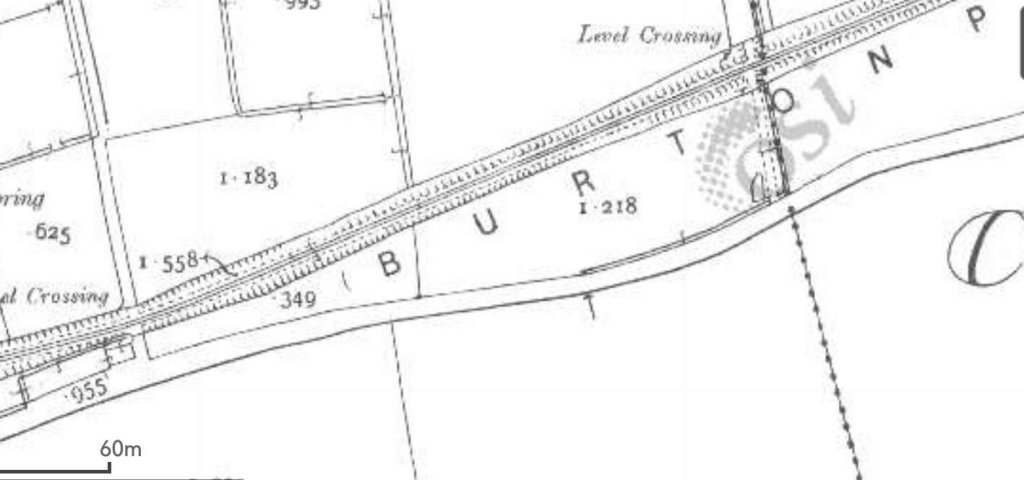
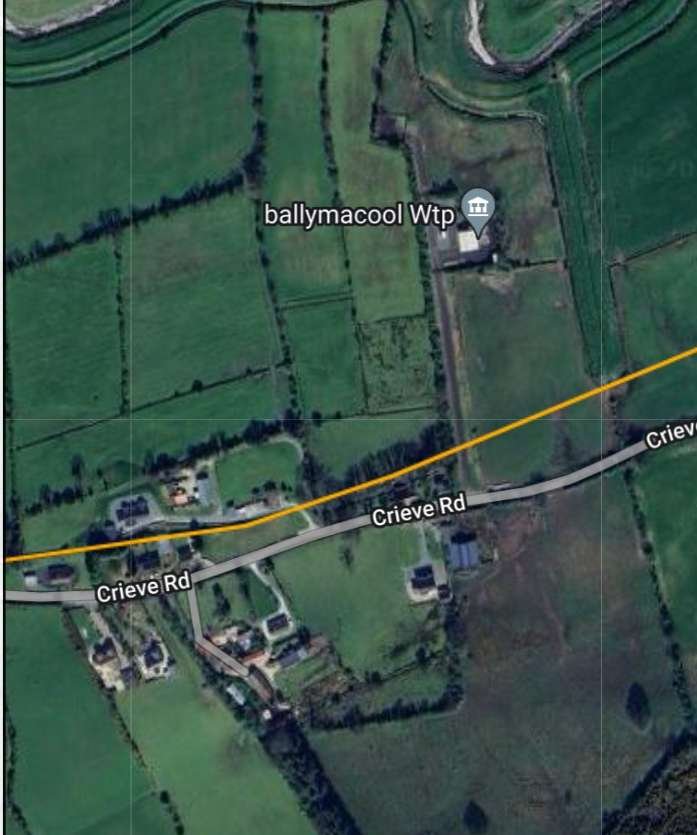
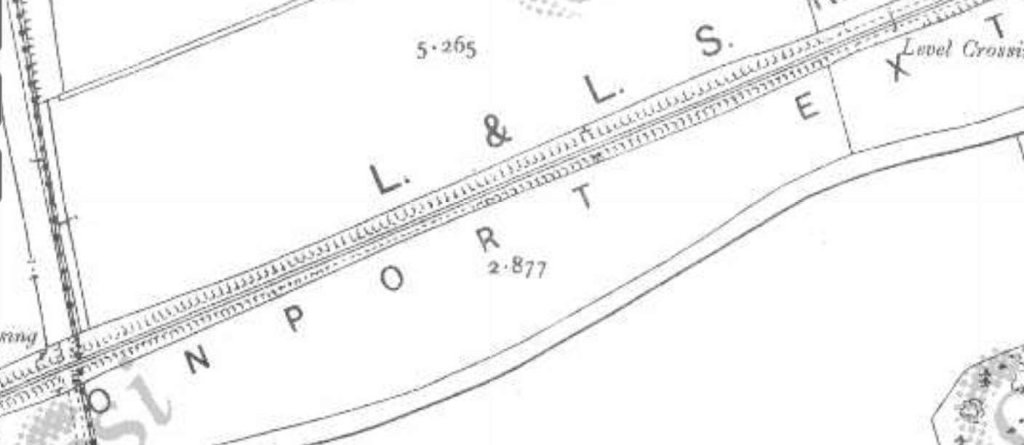
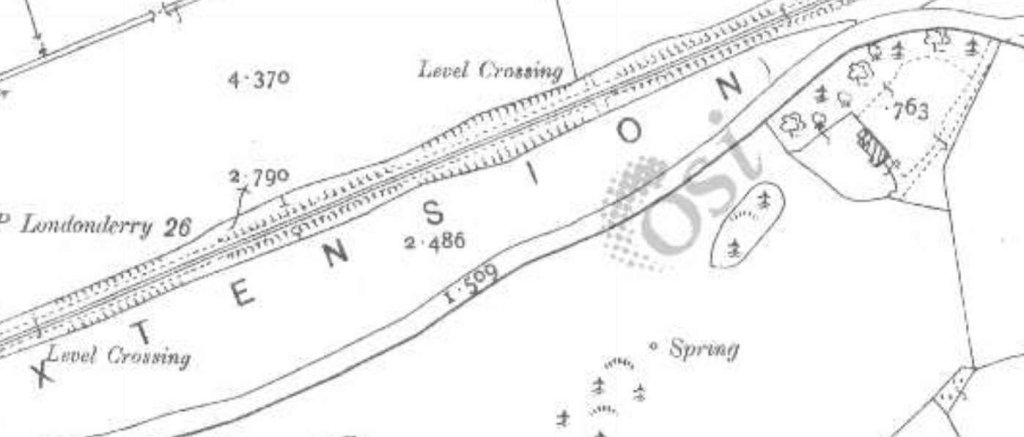
The line ran from Derry to Burtonport. Initially constructed from Derry to Letterkenny it was later extended, via a circuitous route, to the fishing village of Burtonport. We have been following the route of the line from Burtonport to Letterkenny in a series of articles of which this is the fourth.
This length of the line begins at Barnes Gap (not to be confused with Barnesmore Gap further South on the Co. Donegal Railways network) and travels first in a generally Southerly direction before approaching Letterkenny from the West.
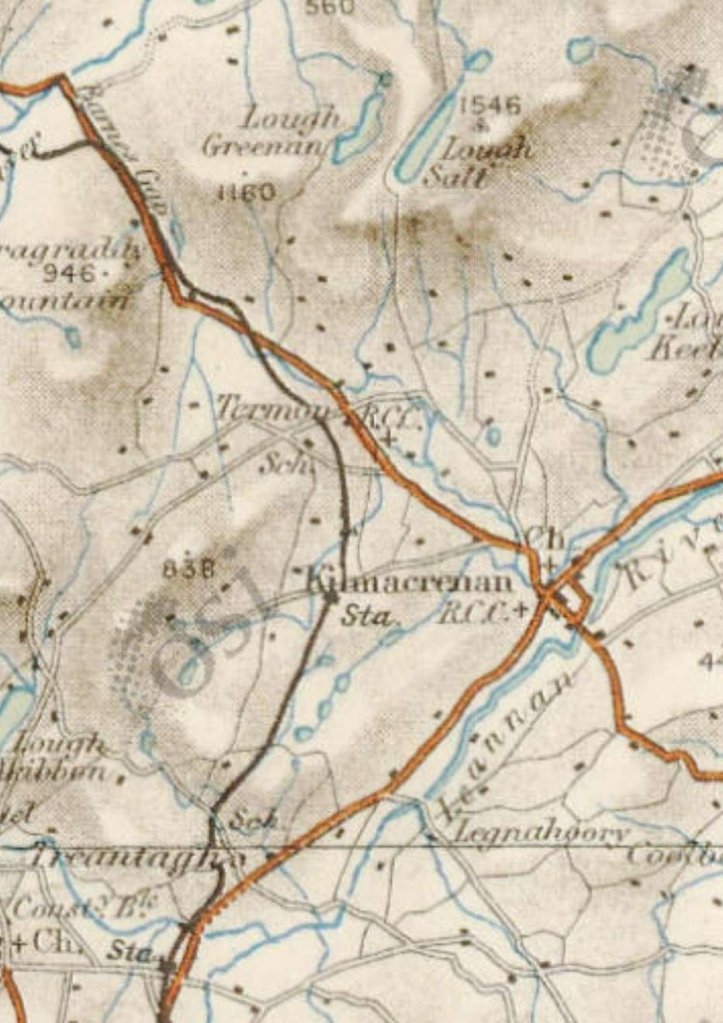
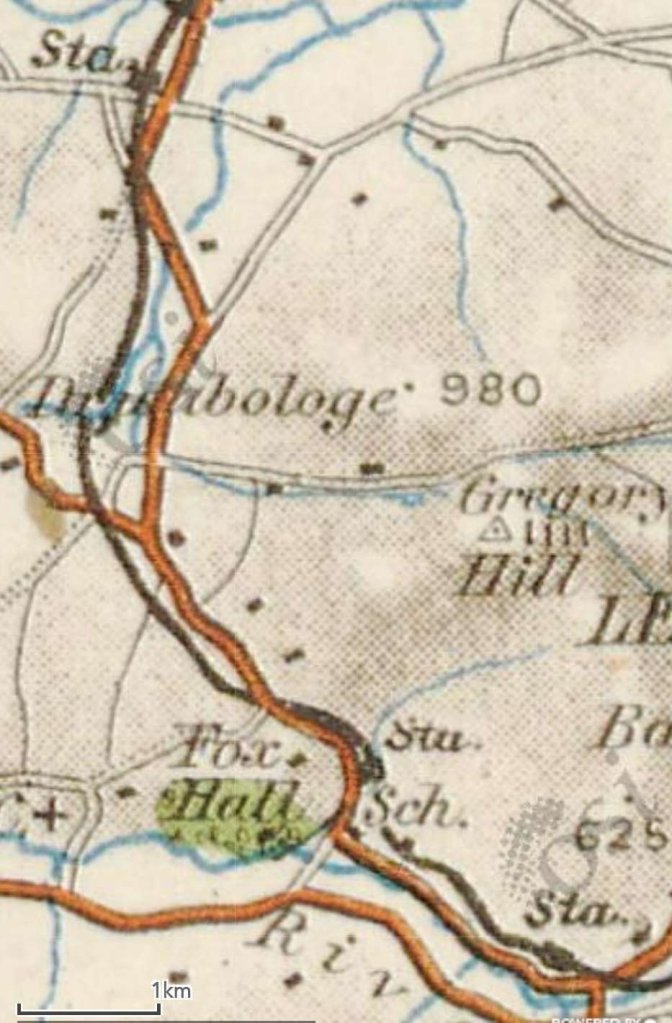
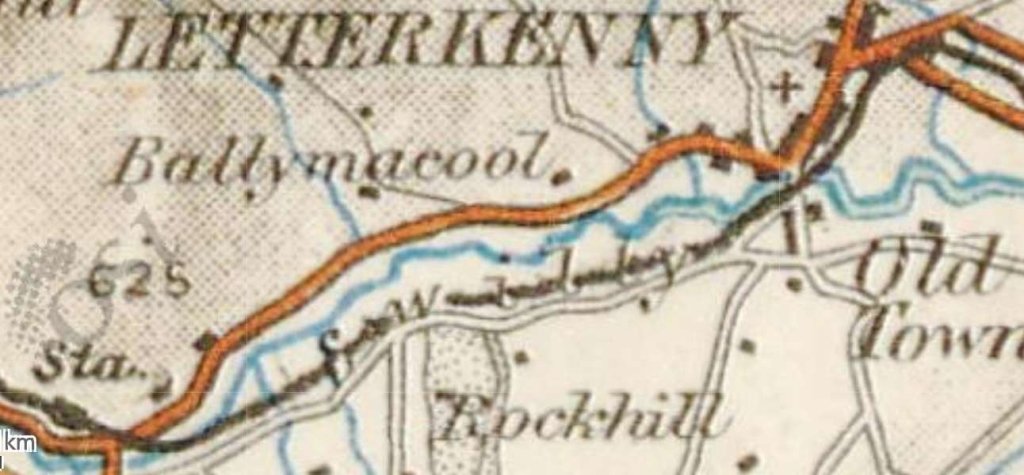
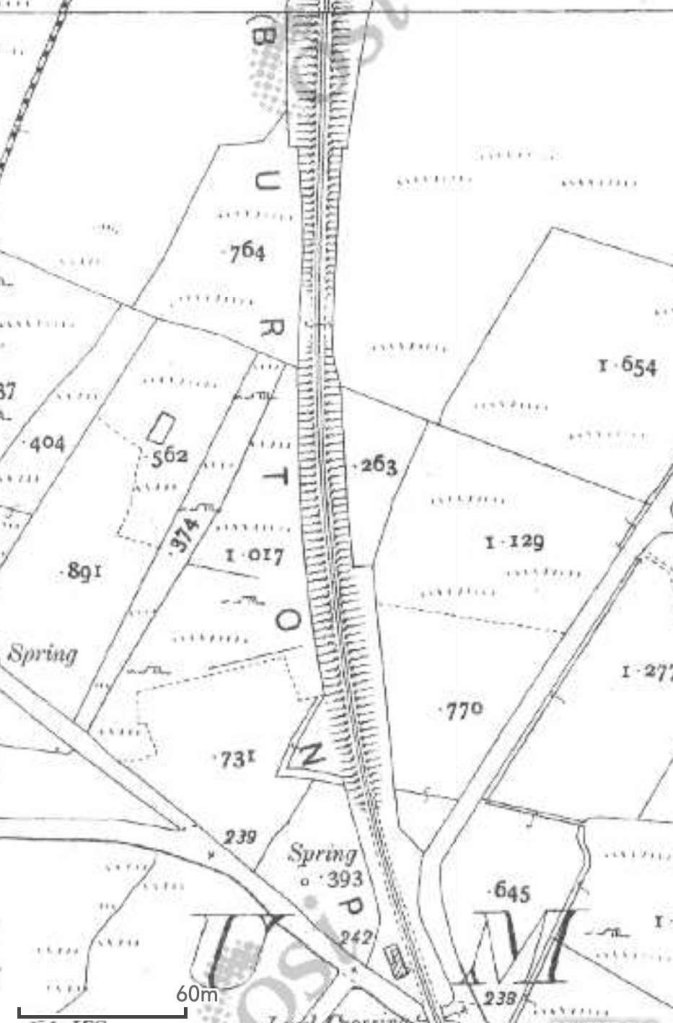
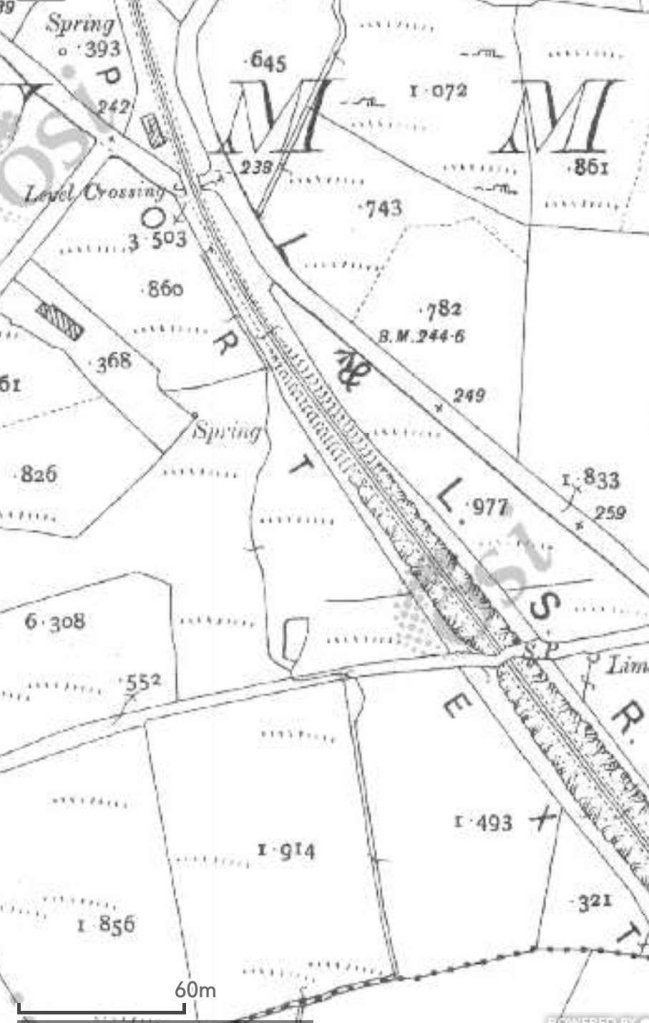
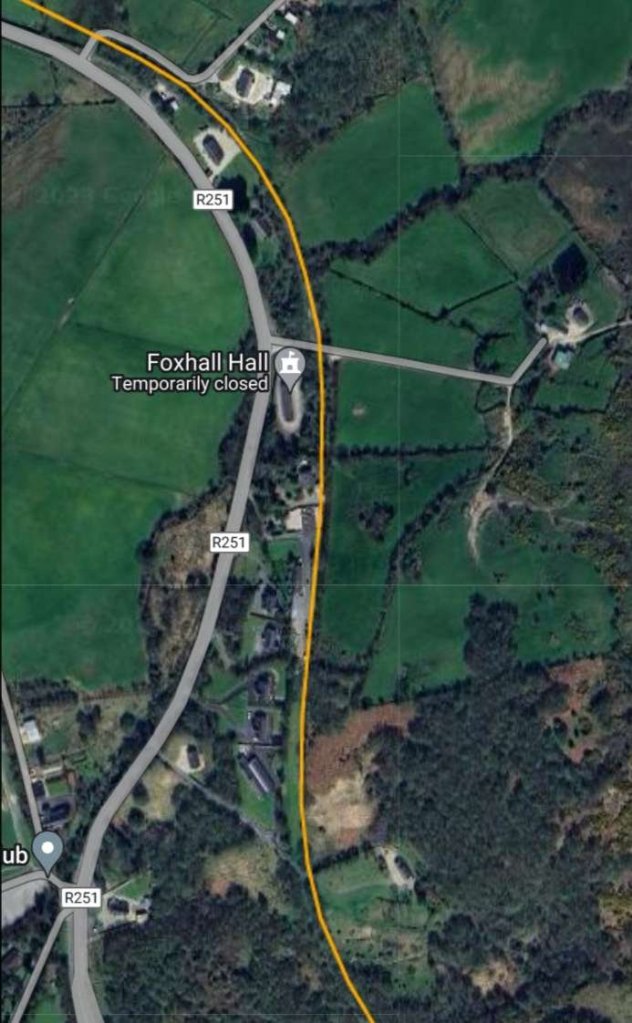
The first length of this part of the route of the old railway begins at Barnes Gap and travels via Kilmacrenan Railway Station to Churchill Station as shown on this extract from the 1″ OSi mapping of the mid-20th century. [2]Churchill Station is at the top-left of this next extract. The next Station was at Fox Hall at the point where the old railway entered the valley of the River Swilly. A little further to the East was Newmills Station which can be seen in the bottom-right of this image. [2]The the East of Newmills Station the railway bridged the River Swilly and ran along its South side at far as Old Town in Letterkenny where the line bridged the river once again and ran on into Letterkenny Station which sat at the right-hand edge of this map extract. [2]
We now look at this section of the Burtonport Extension Railway in more detail, starting at Barnes Gap.
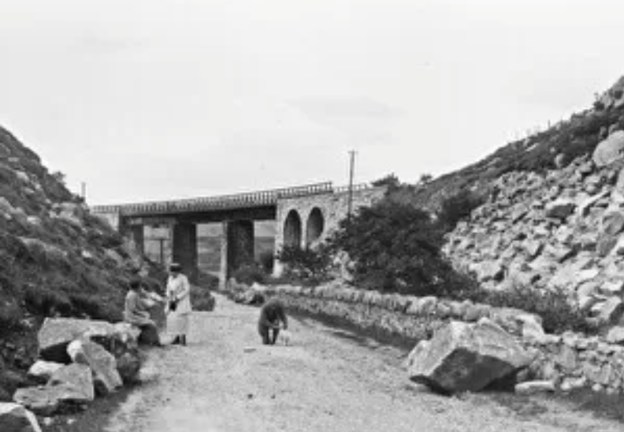
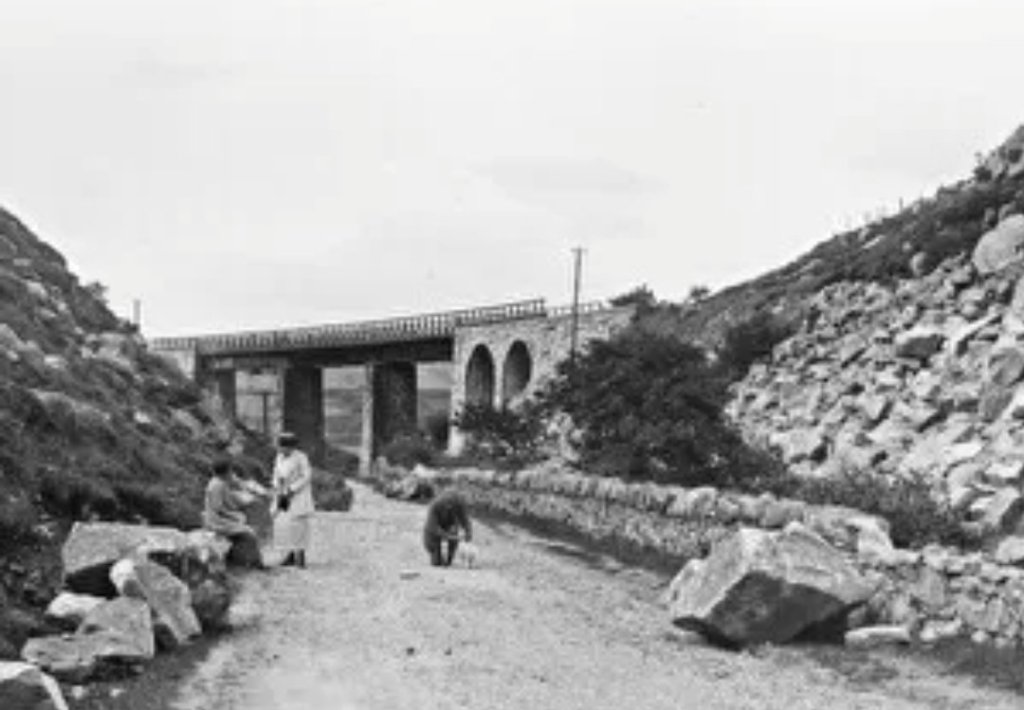
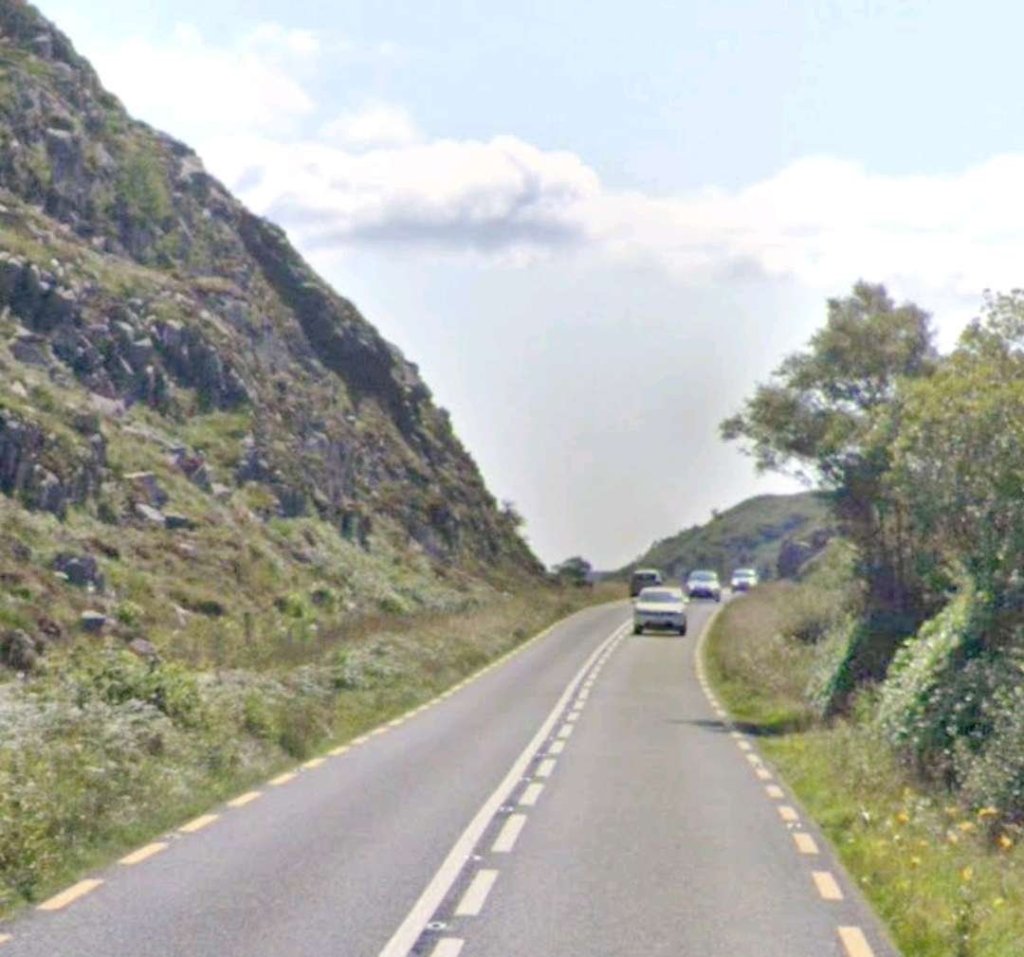
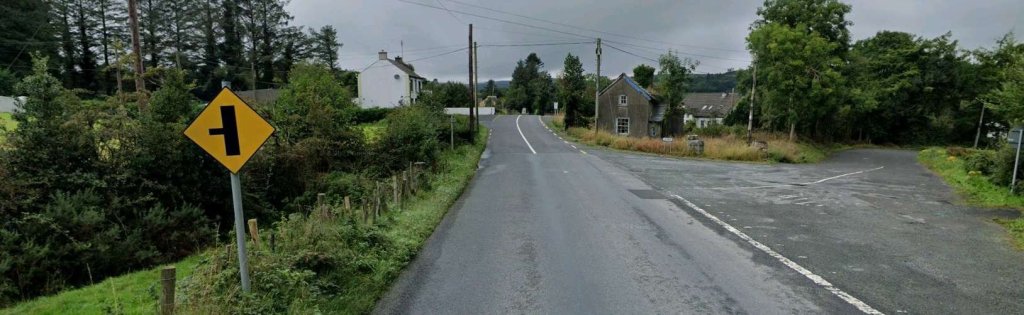
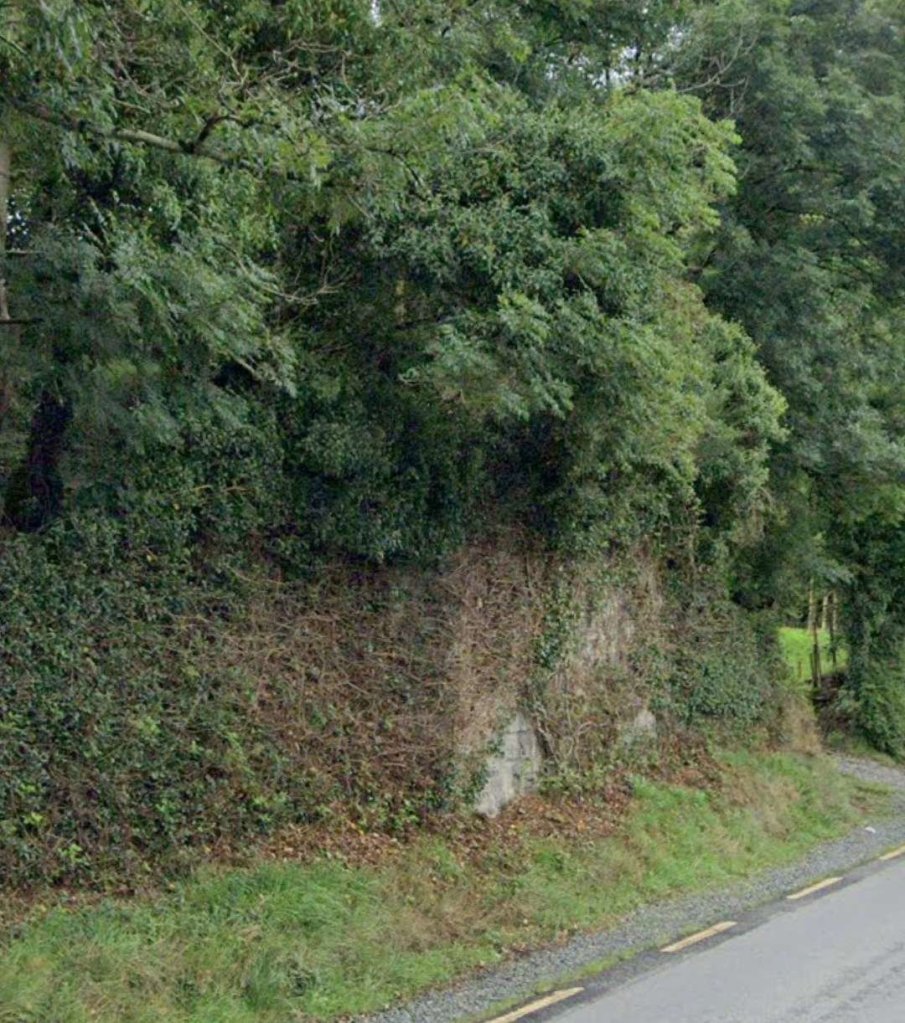
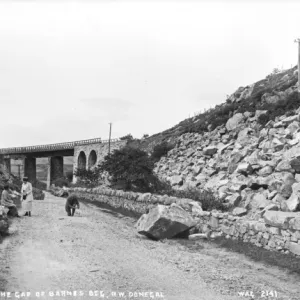
The first image is an excellent view of the viaduct by which the old railway crossed the road at Barnes Gap. It seems as though rock falls may have been a problem at this location, evidenced by the large rocks which sit alongside the road and a large boulder sitting on the right hand edge of the unmetalled carriageway
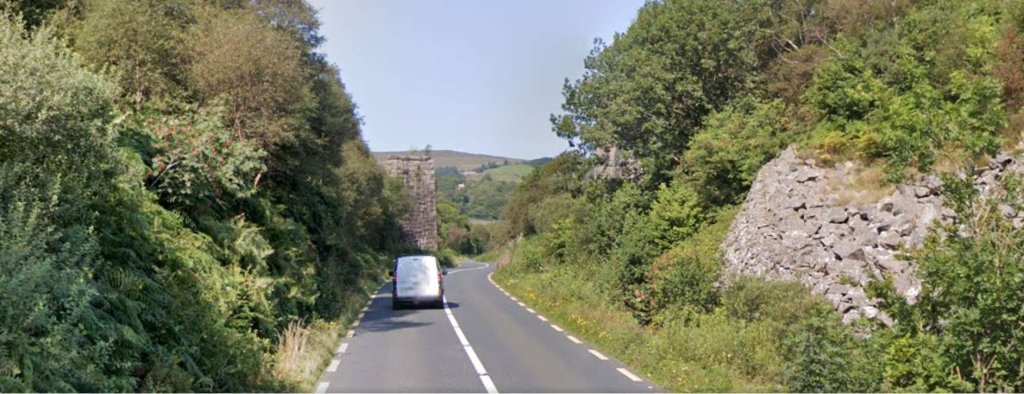
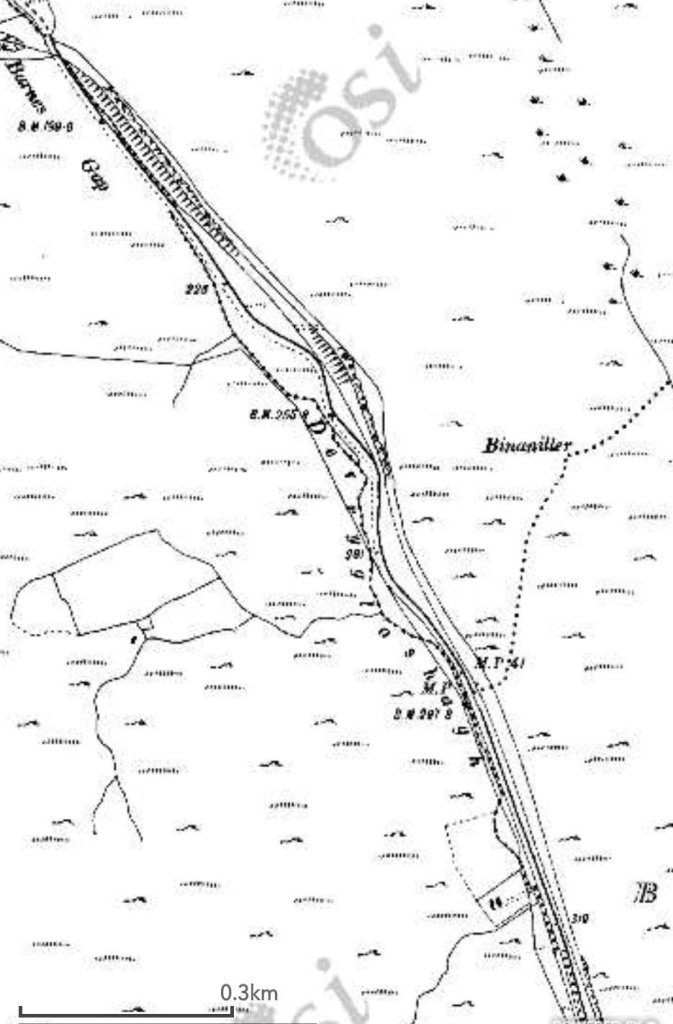
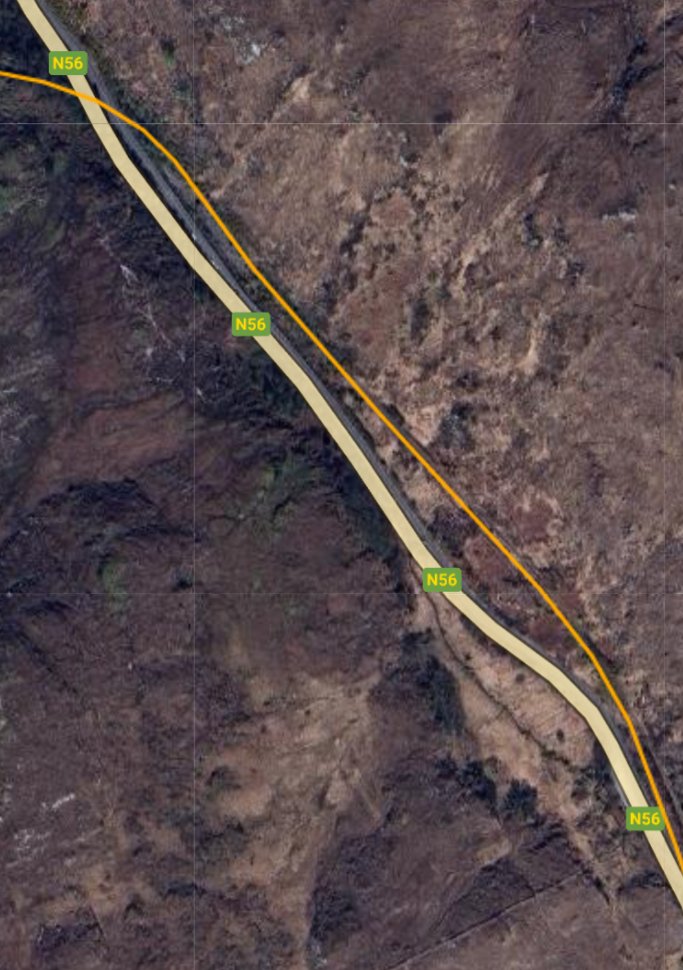
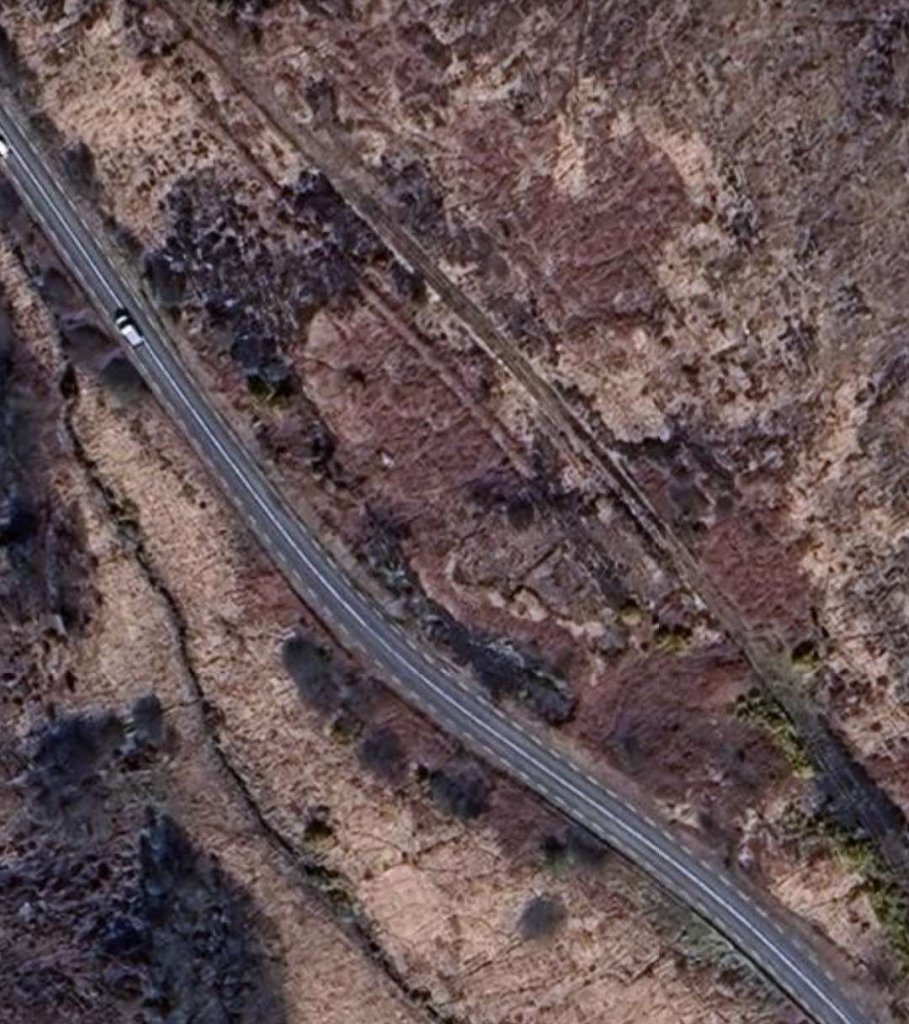
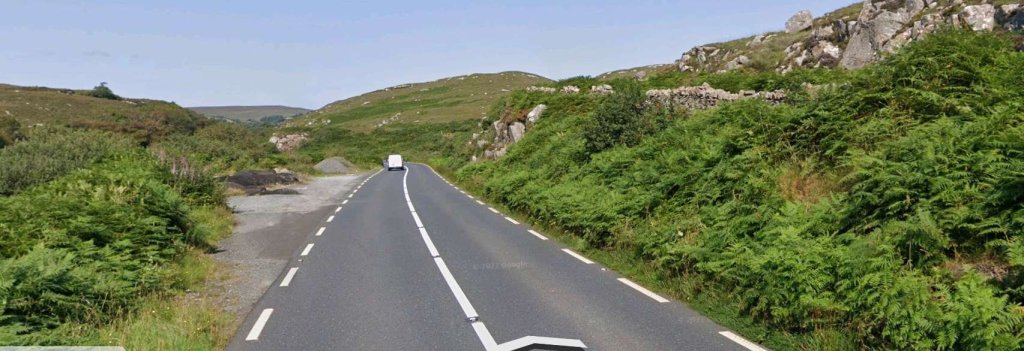
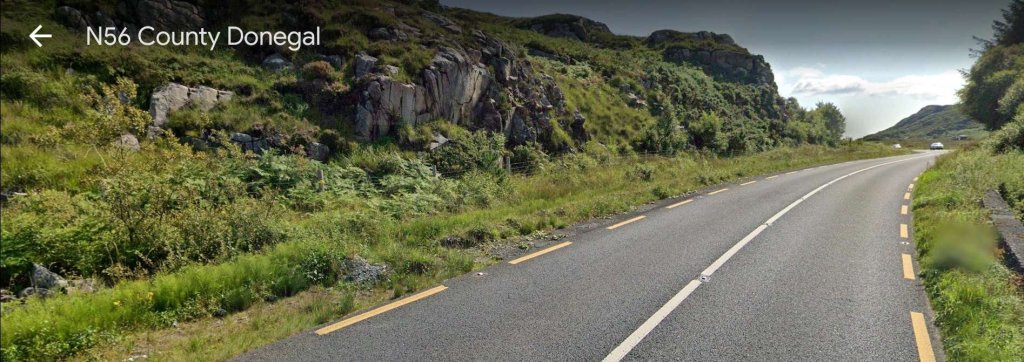
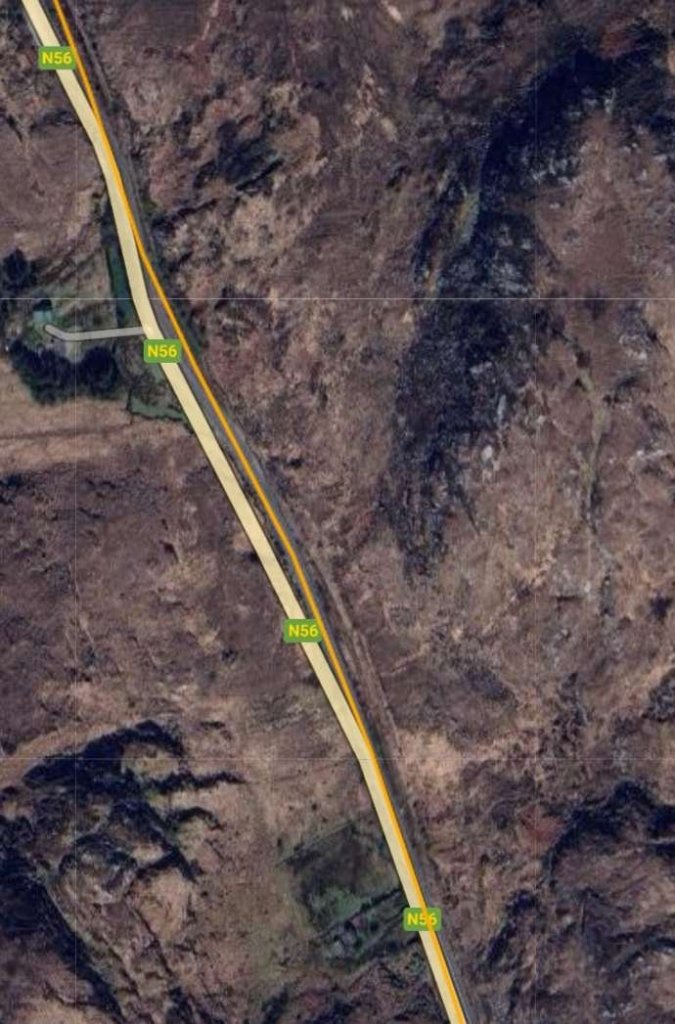
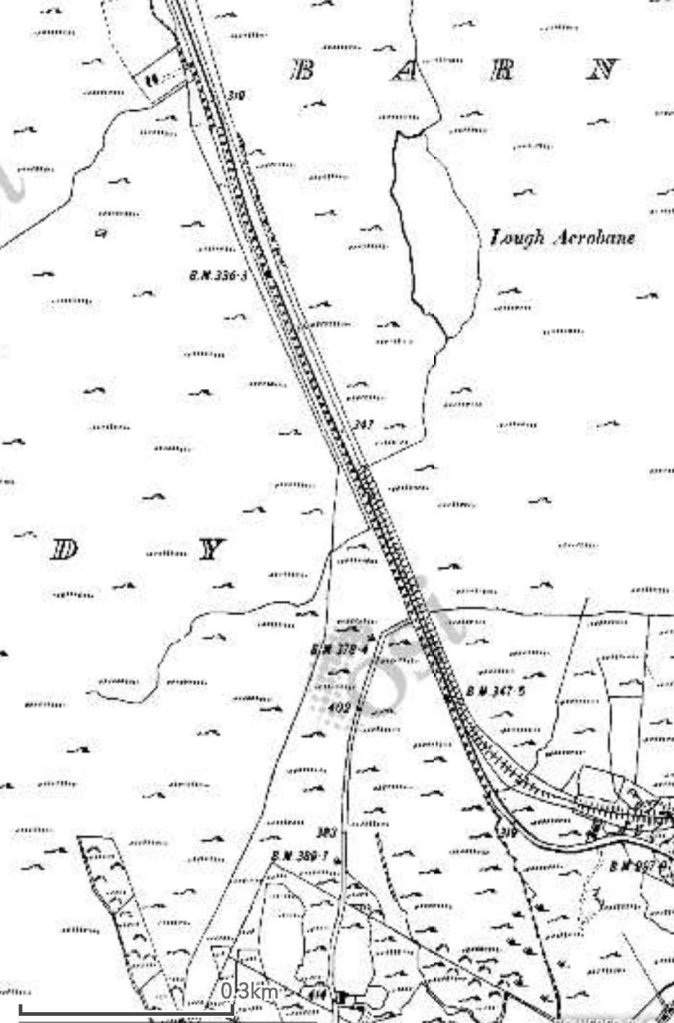
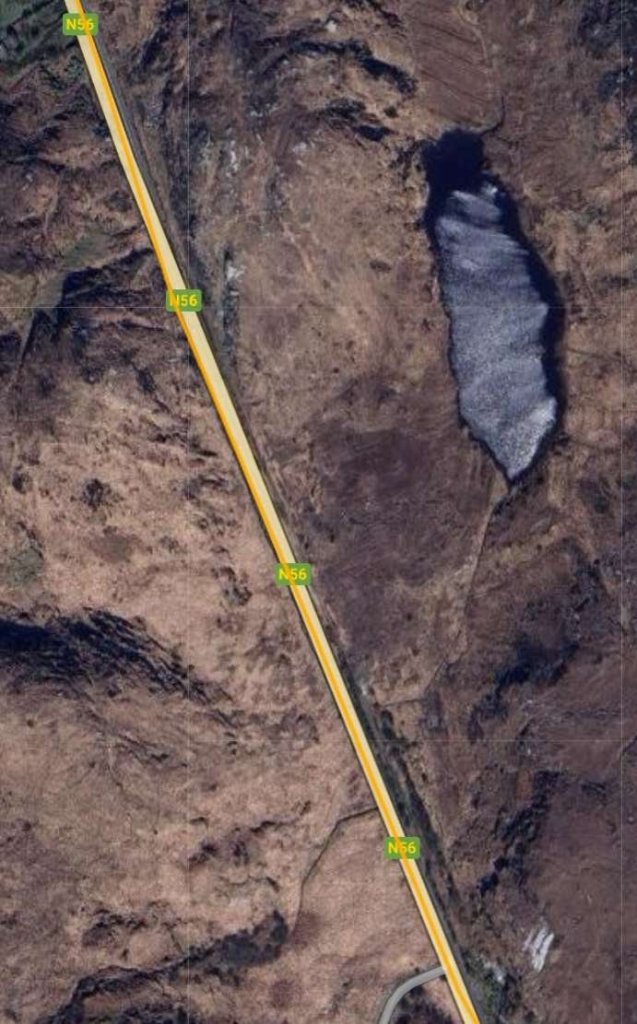
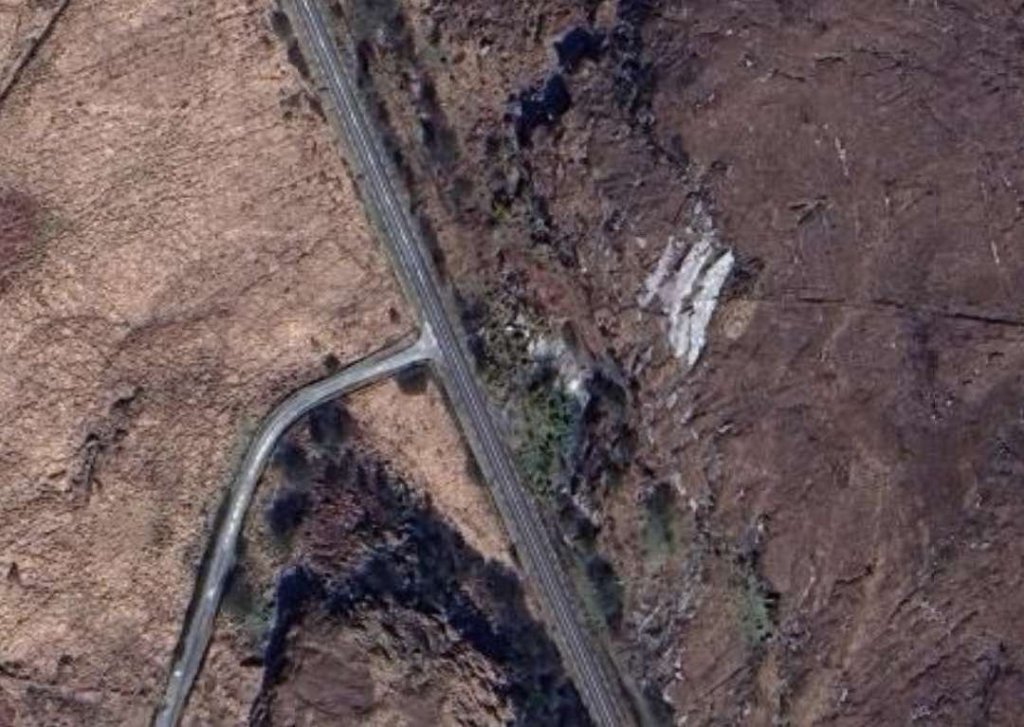
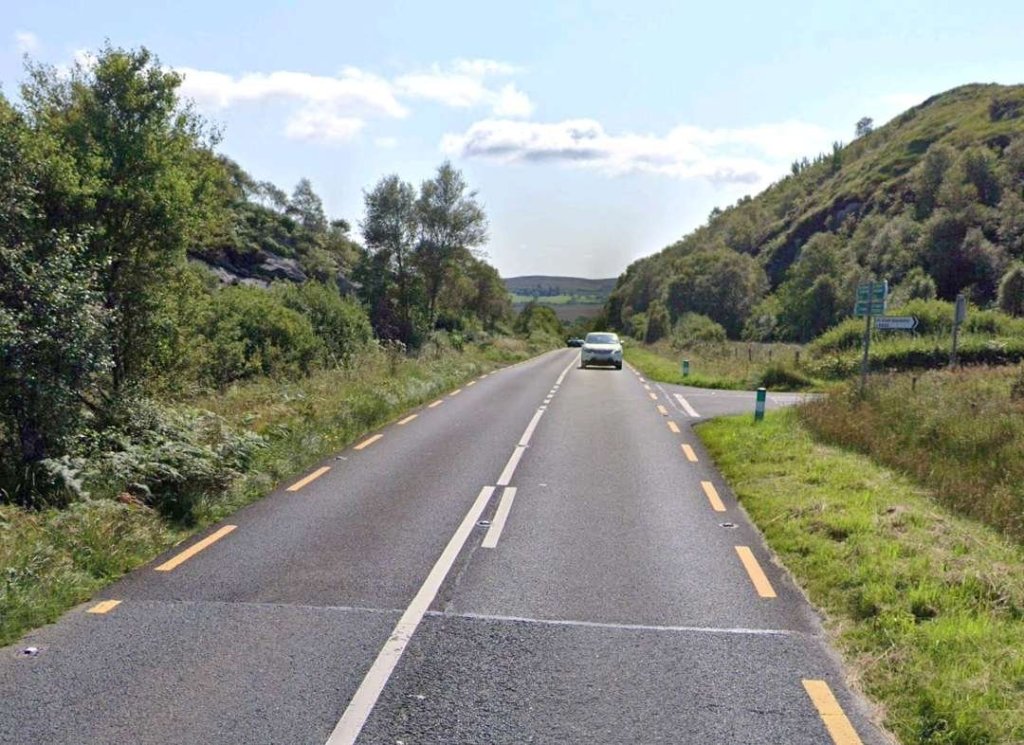
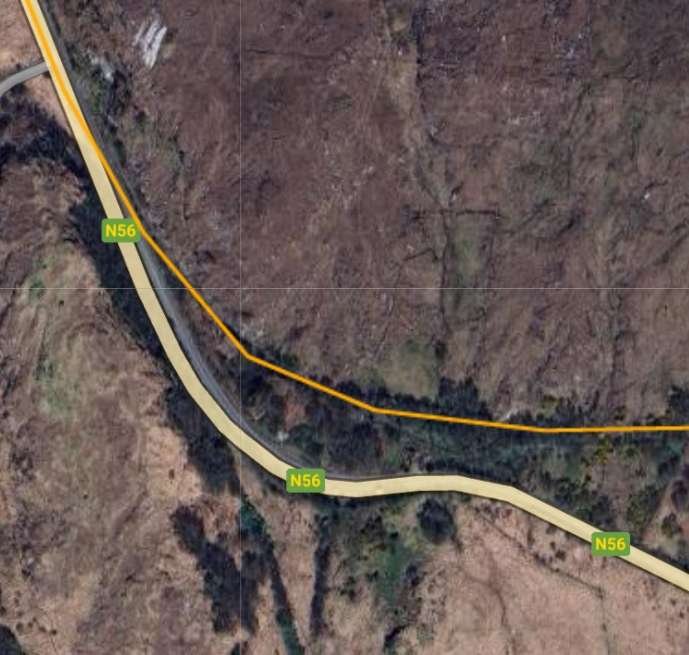
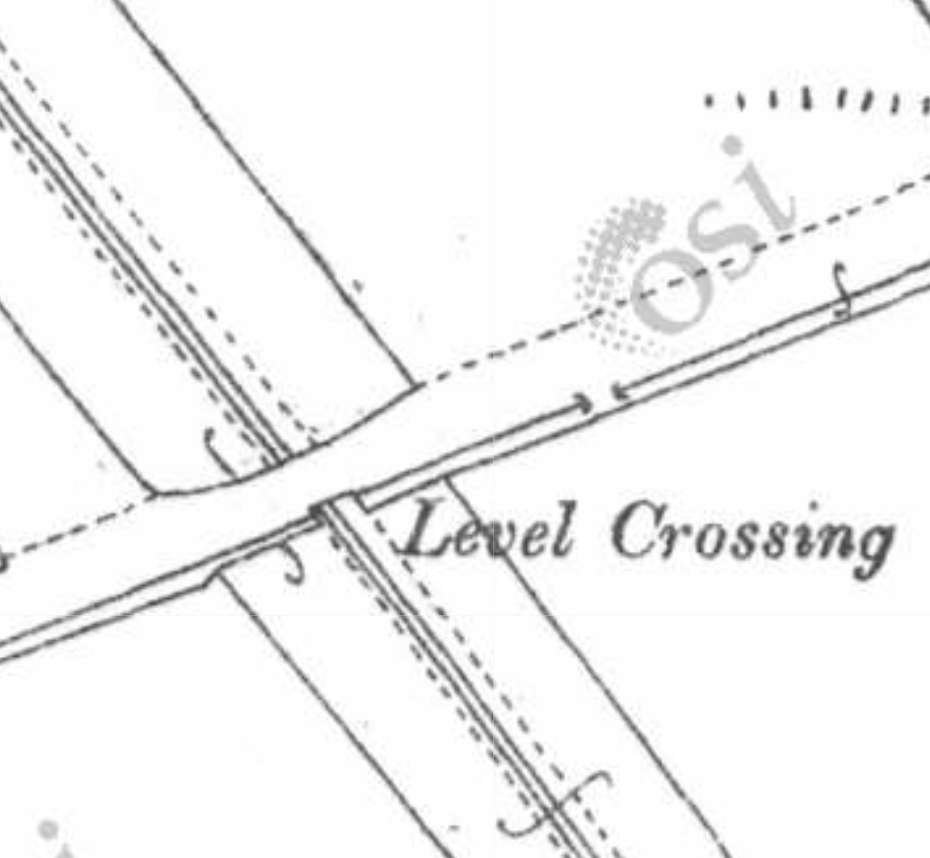
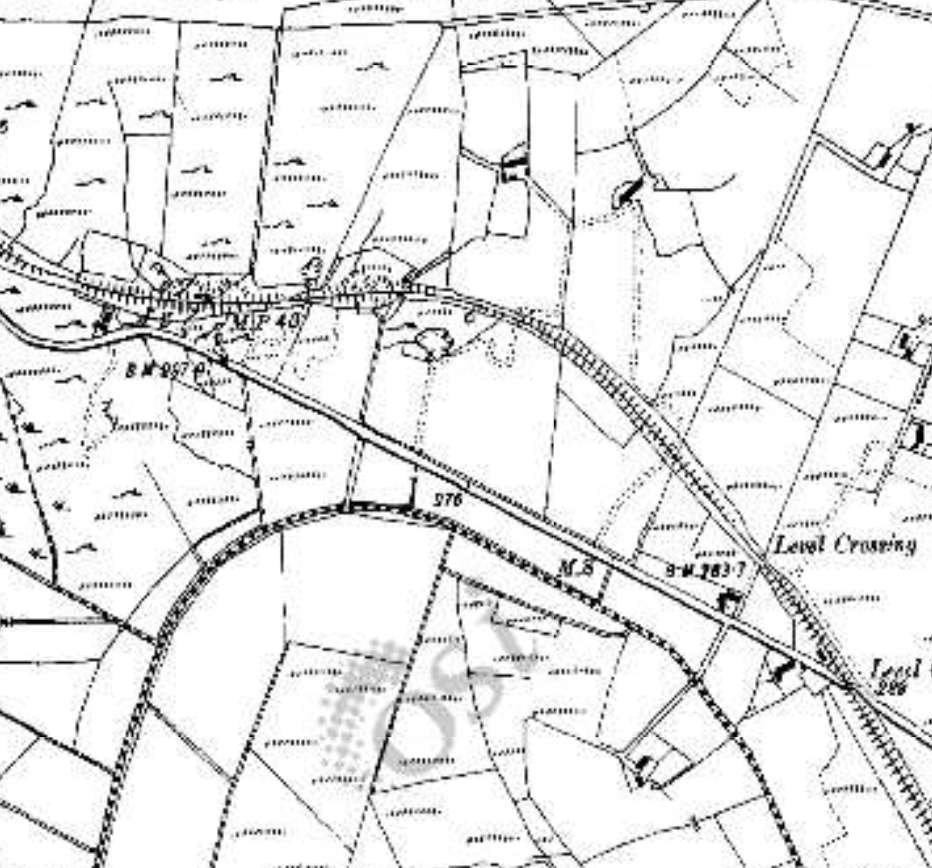
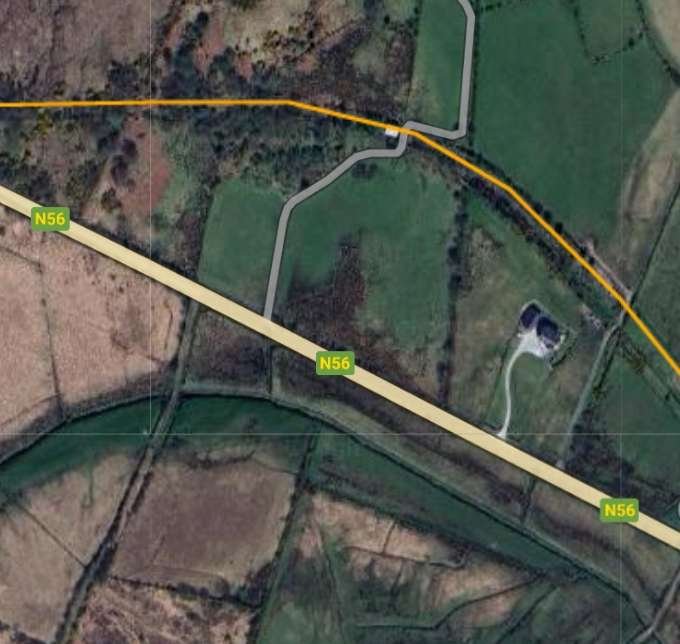
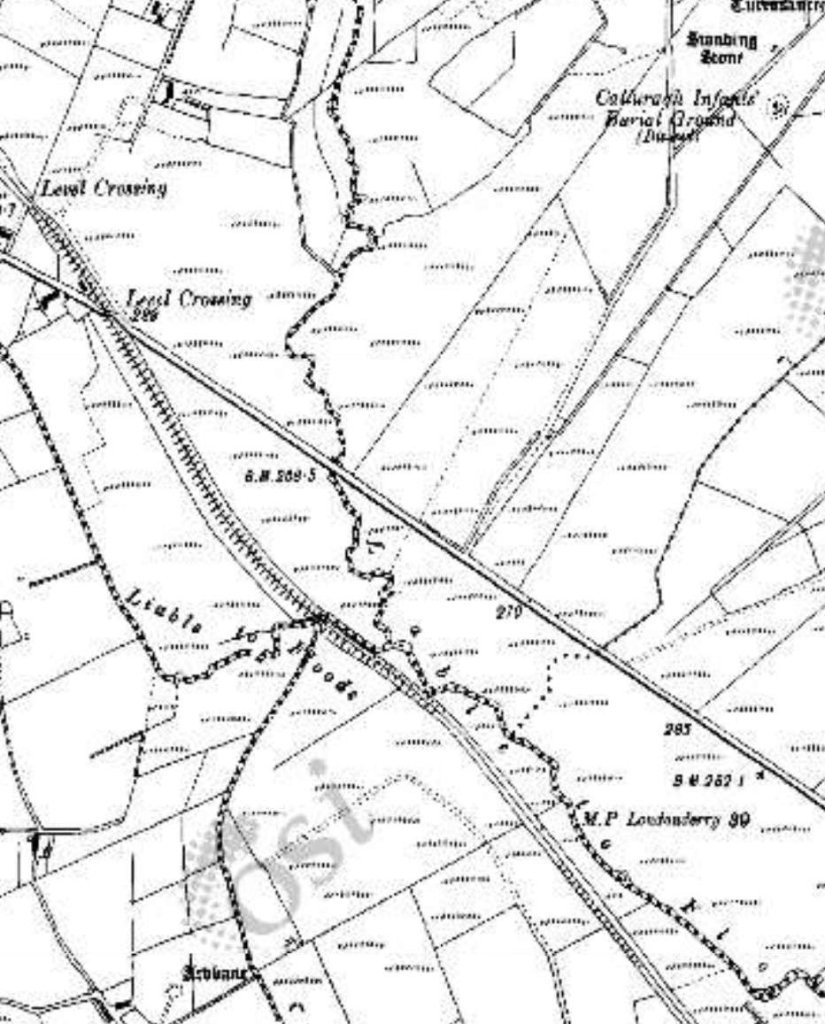
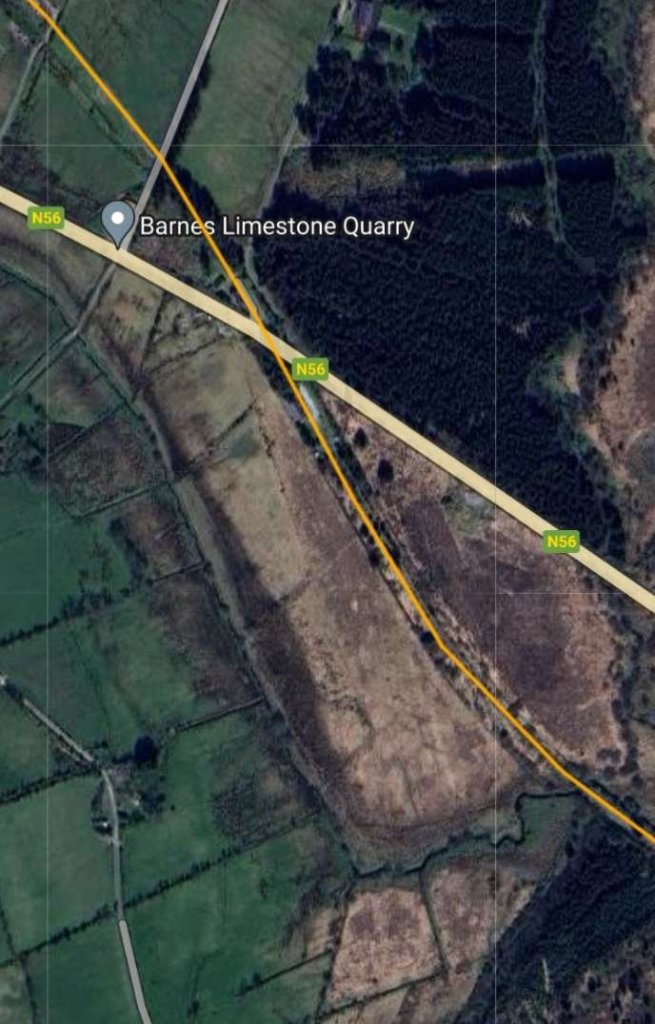
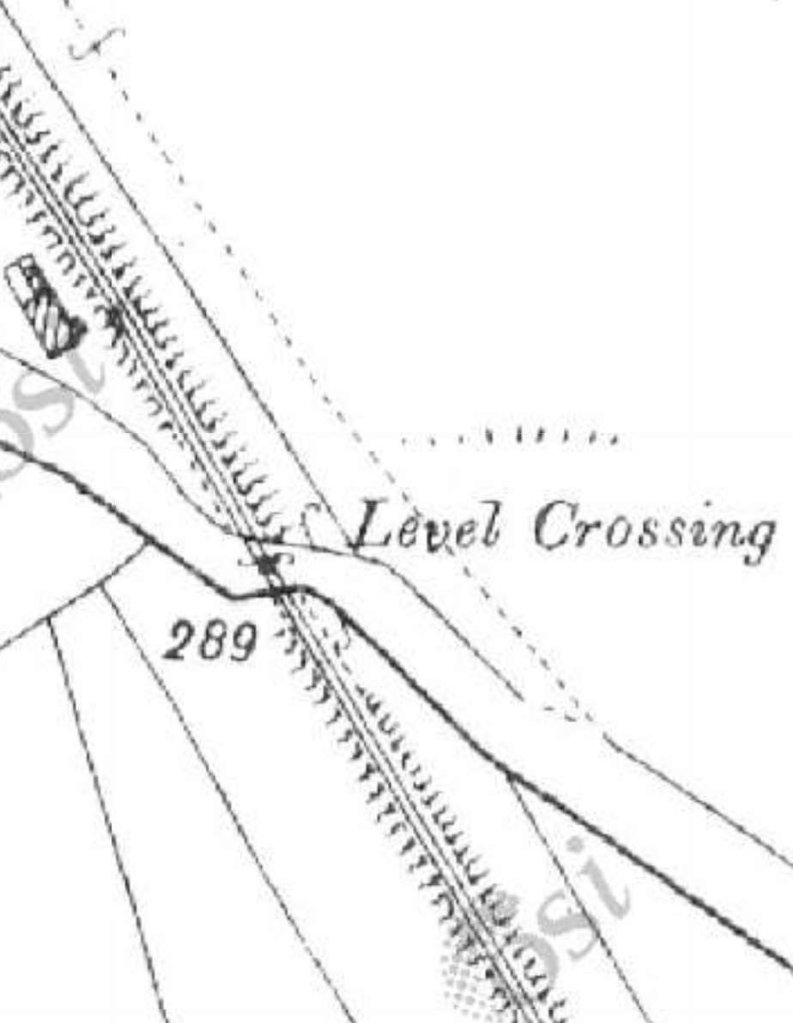
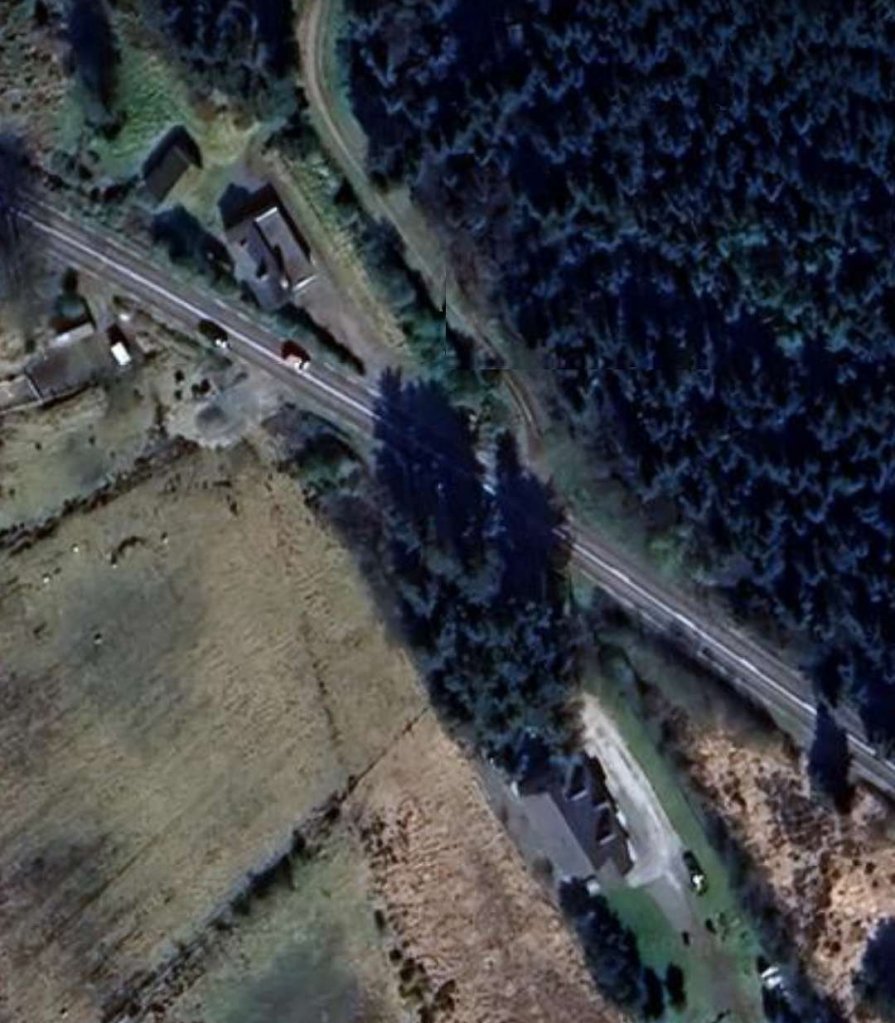
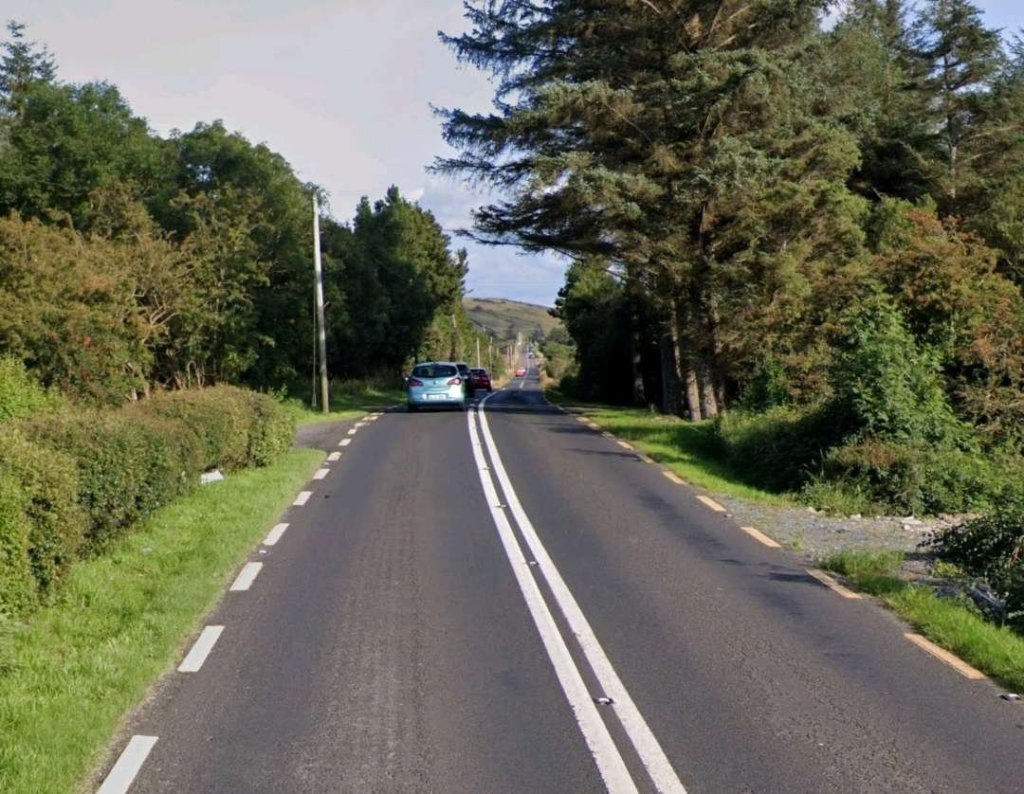
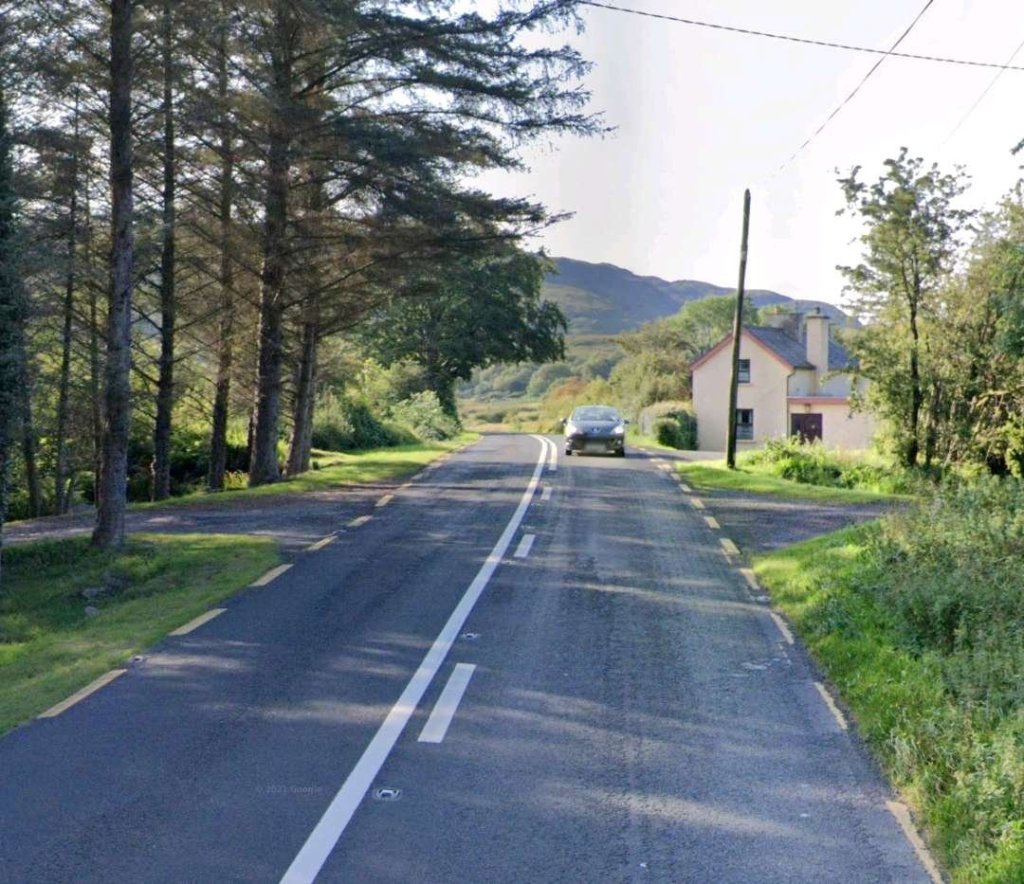
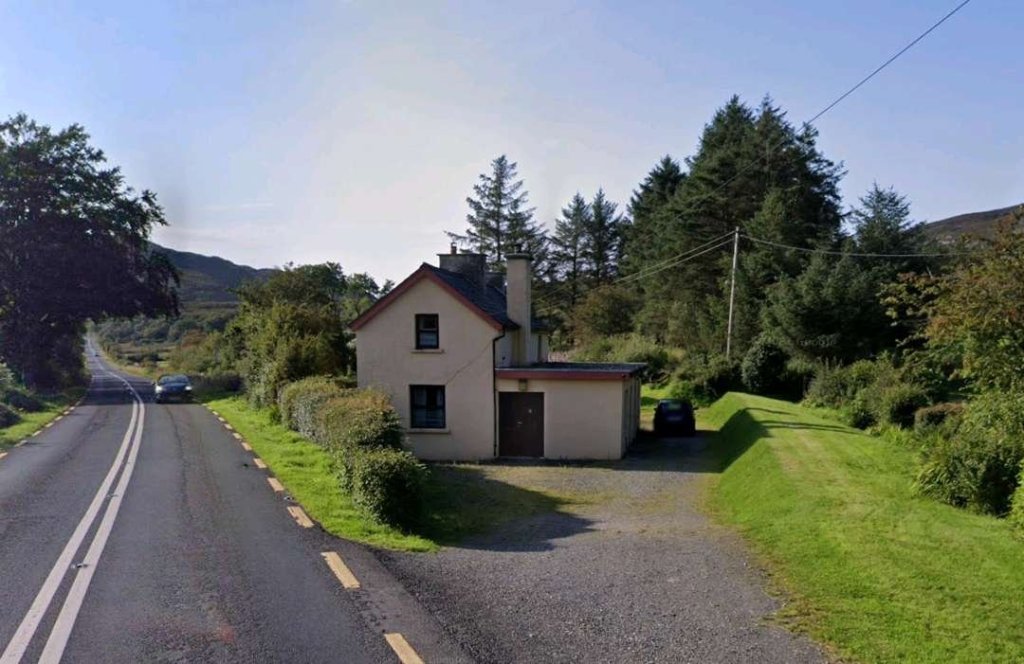
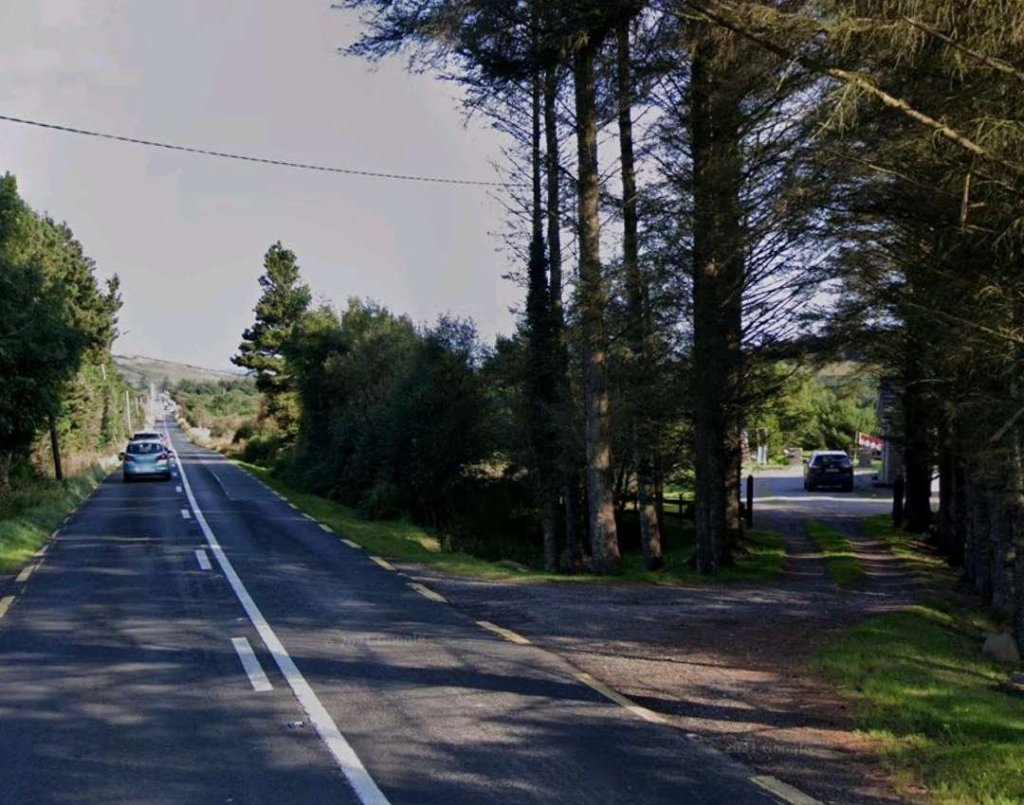
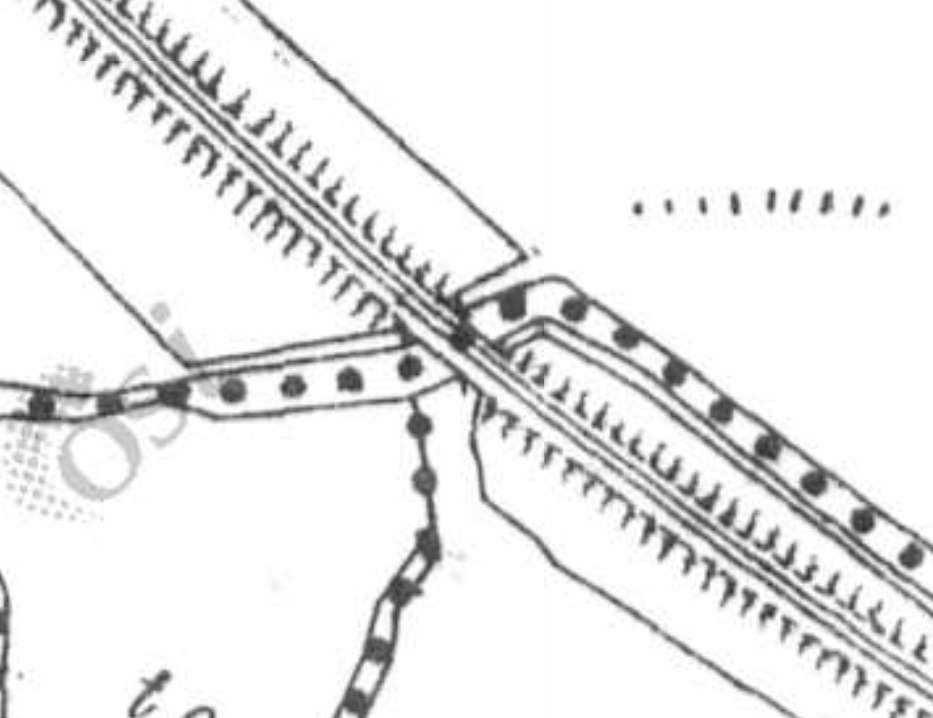
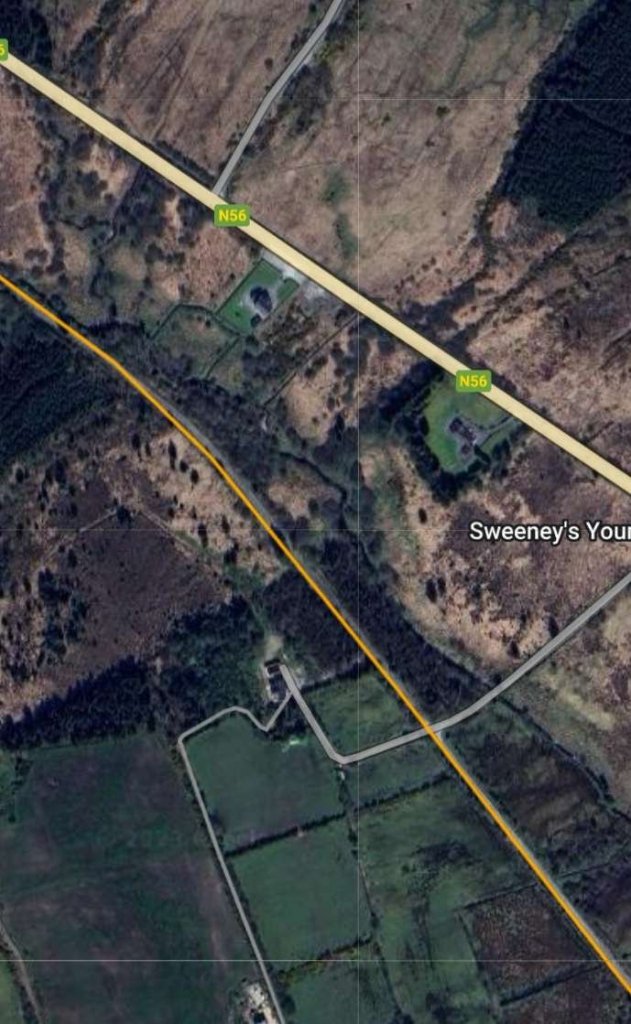
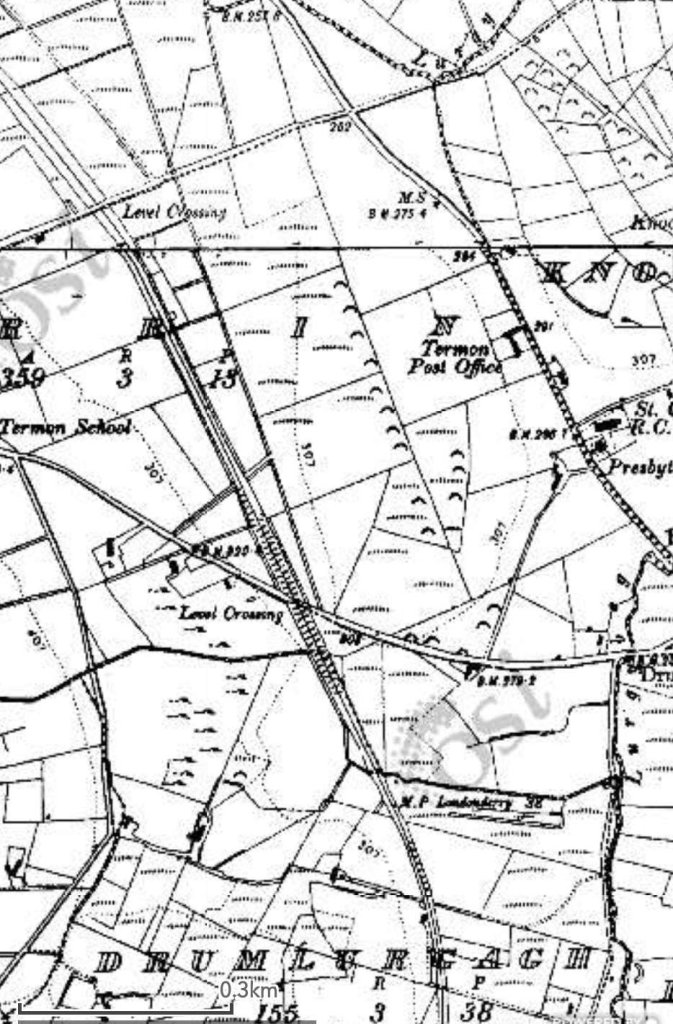
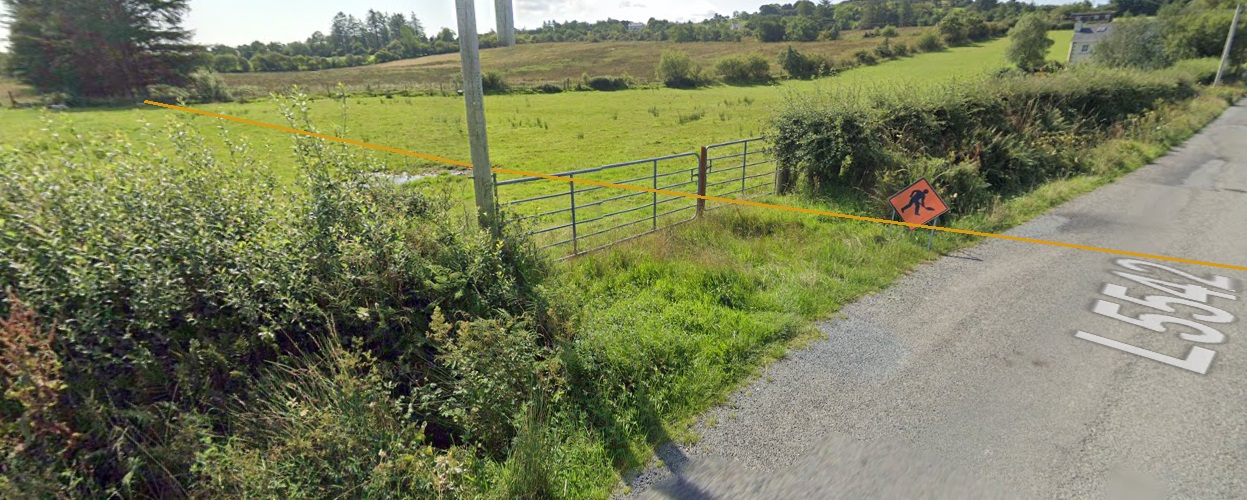
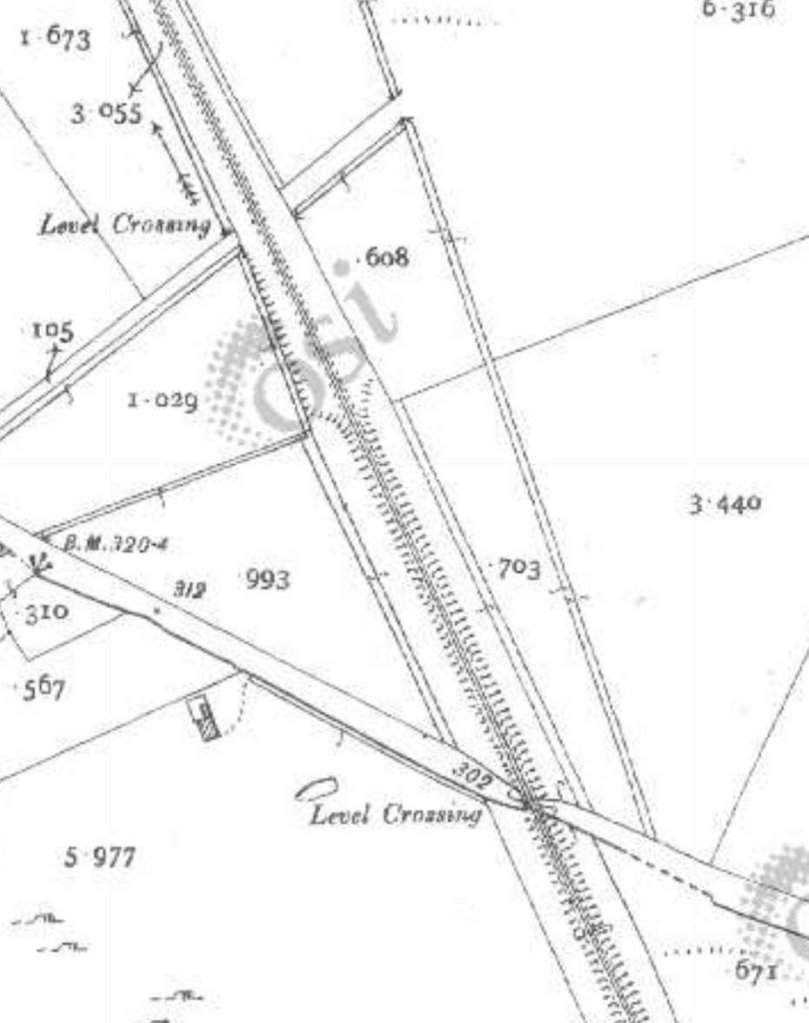
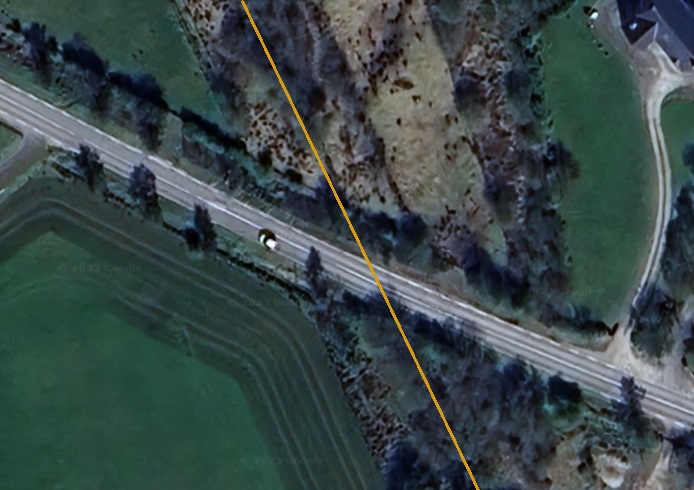
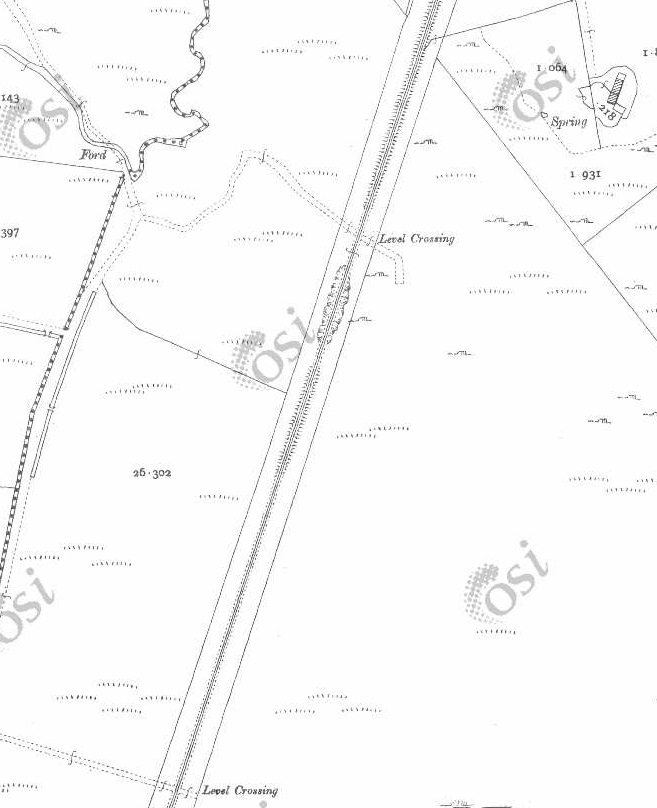
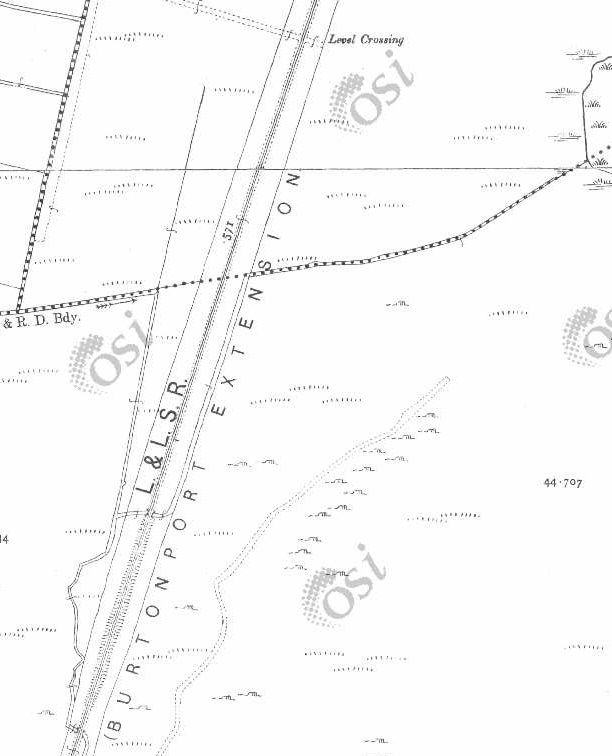
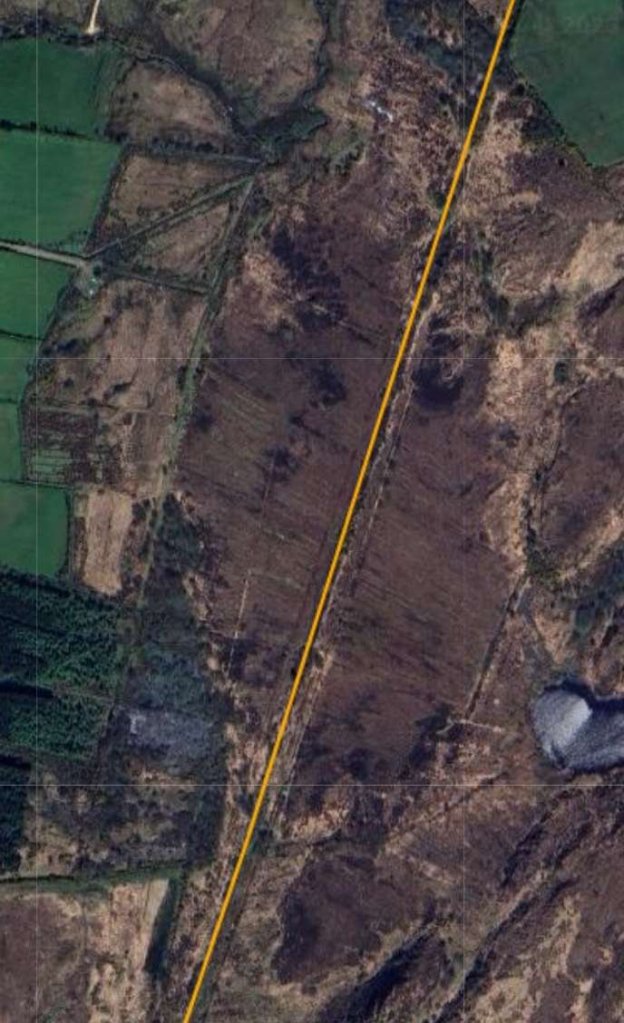
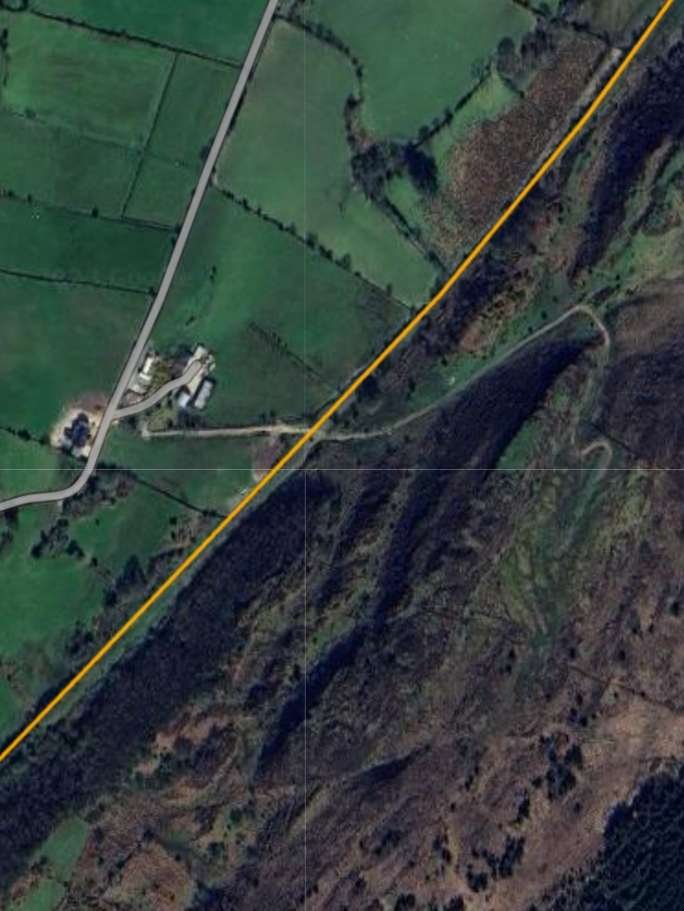
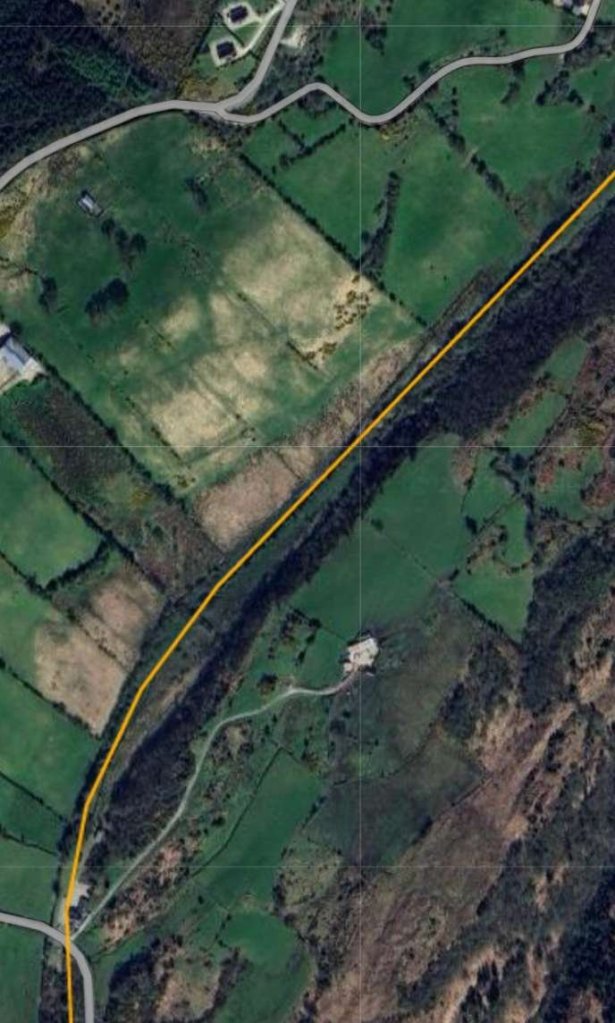
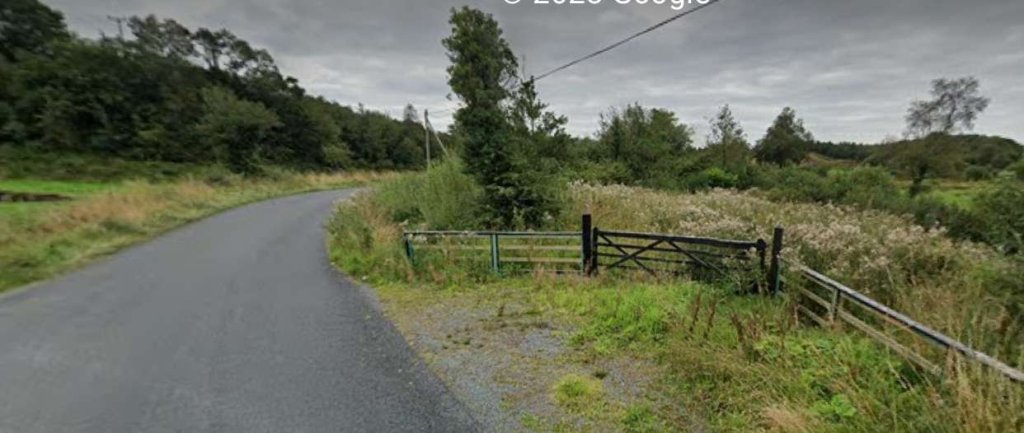
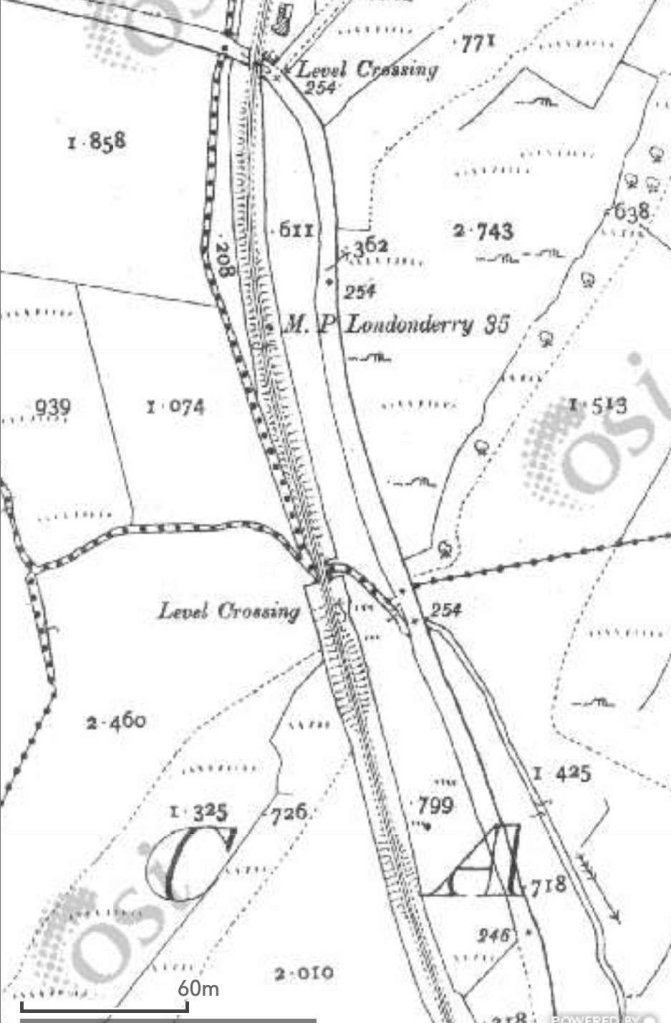
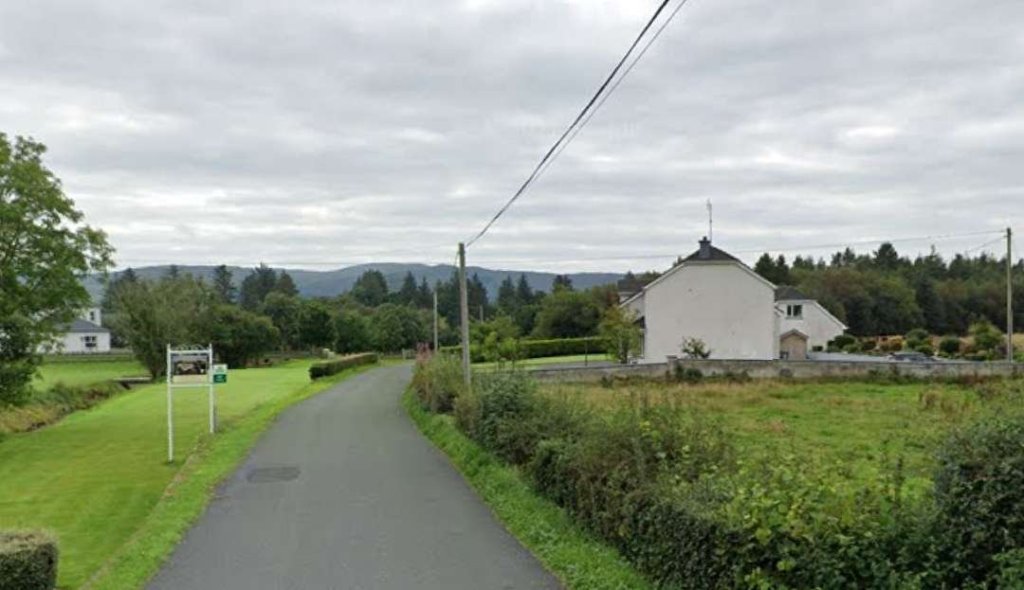
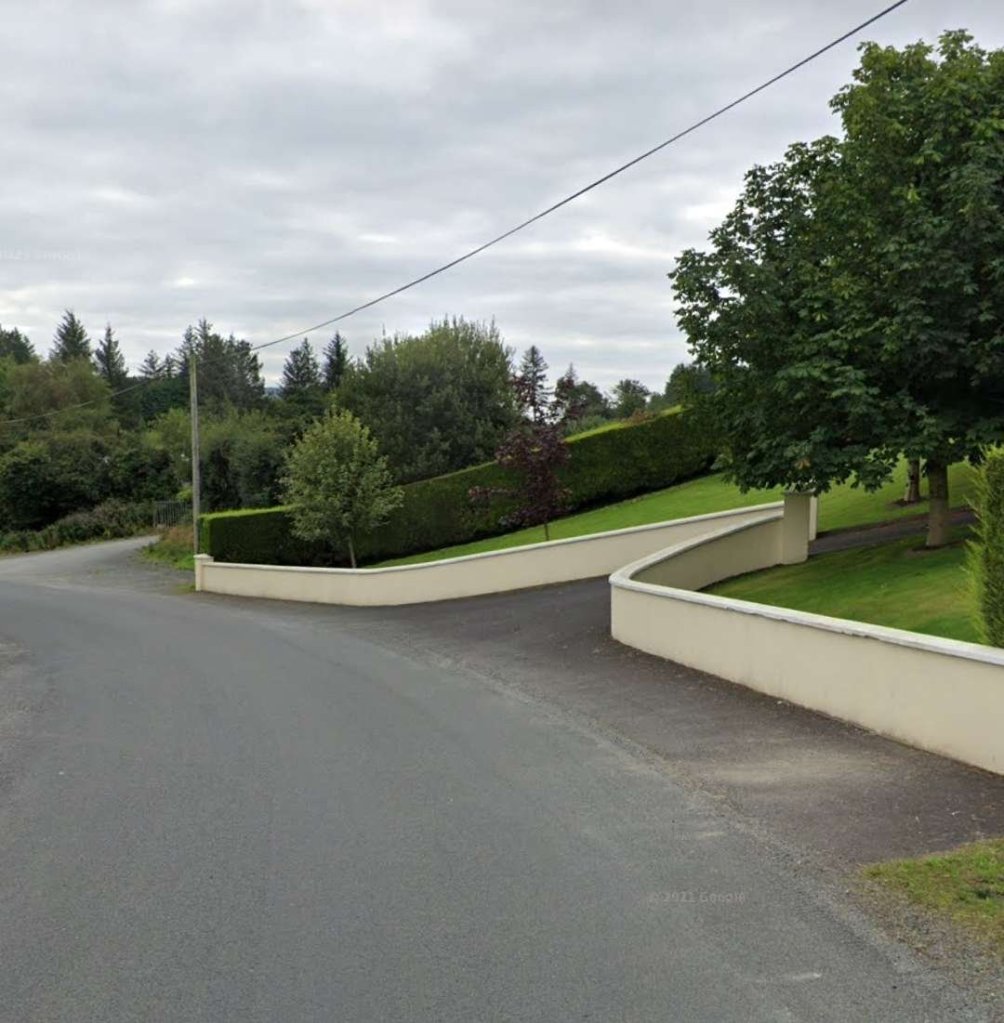
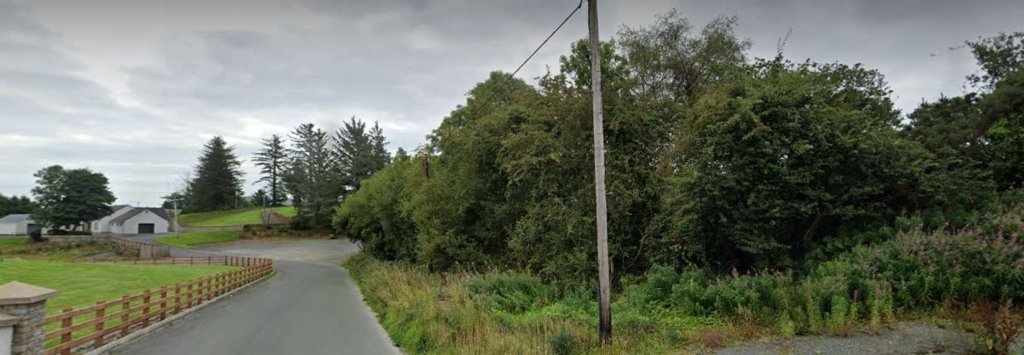
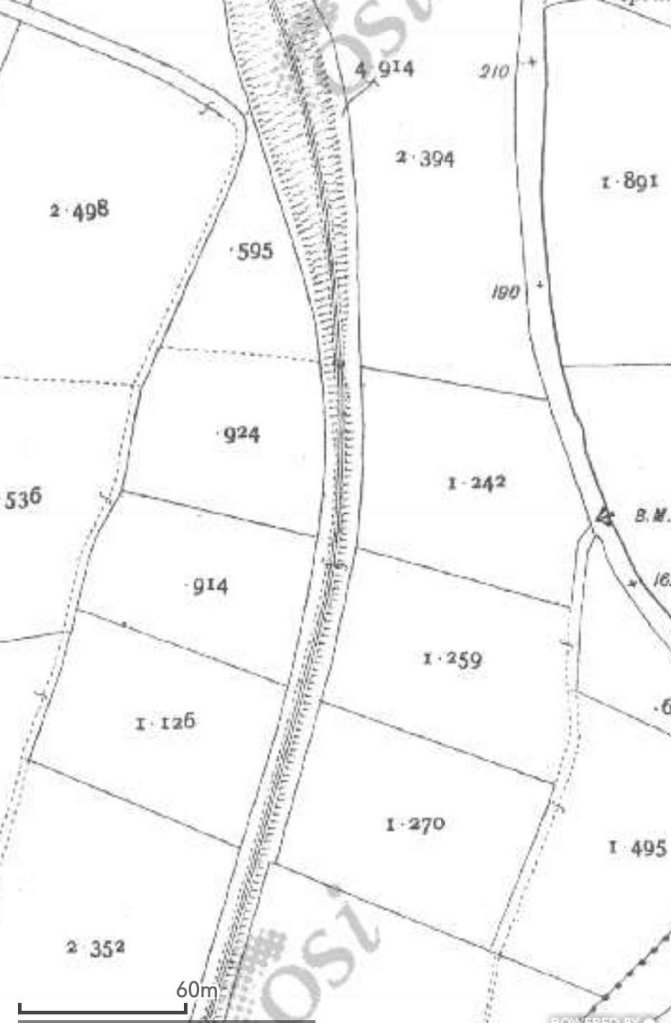
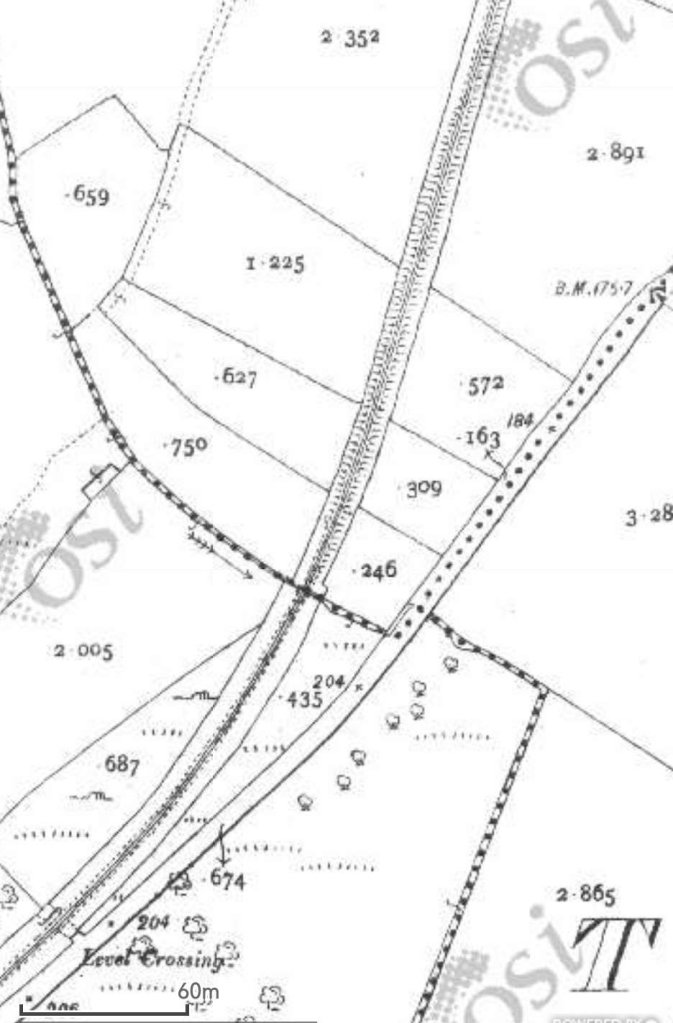
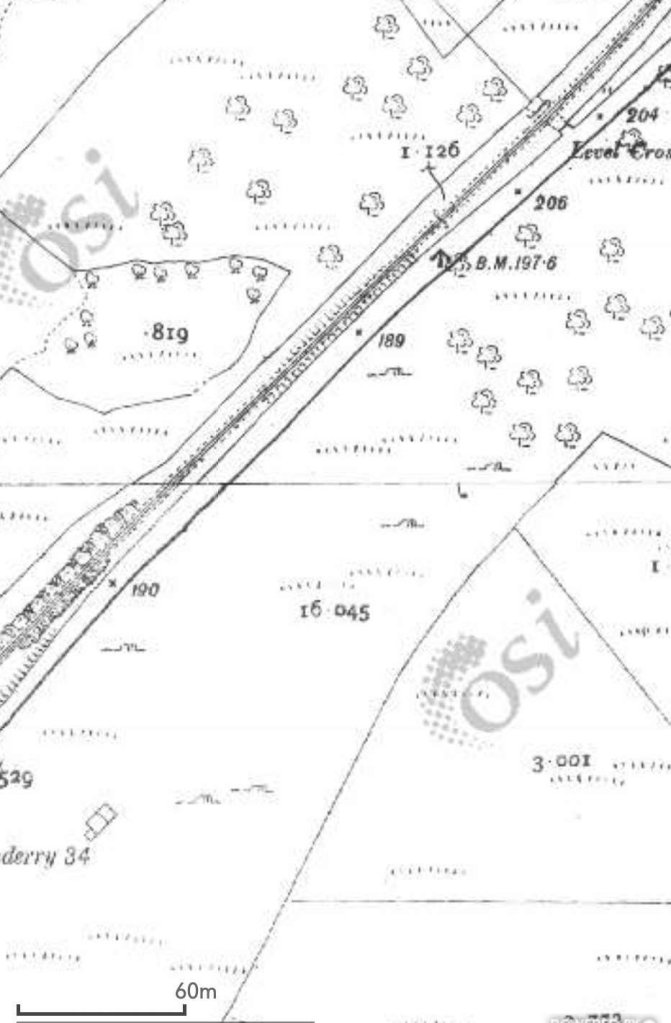
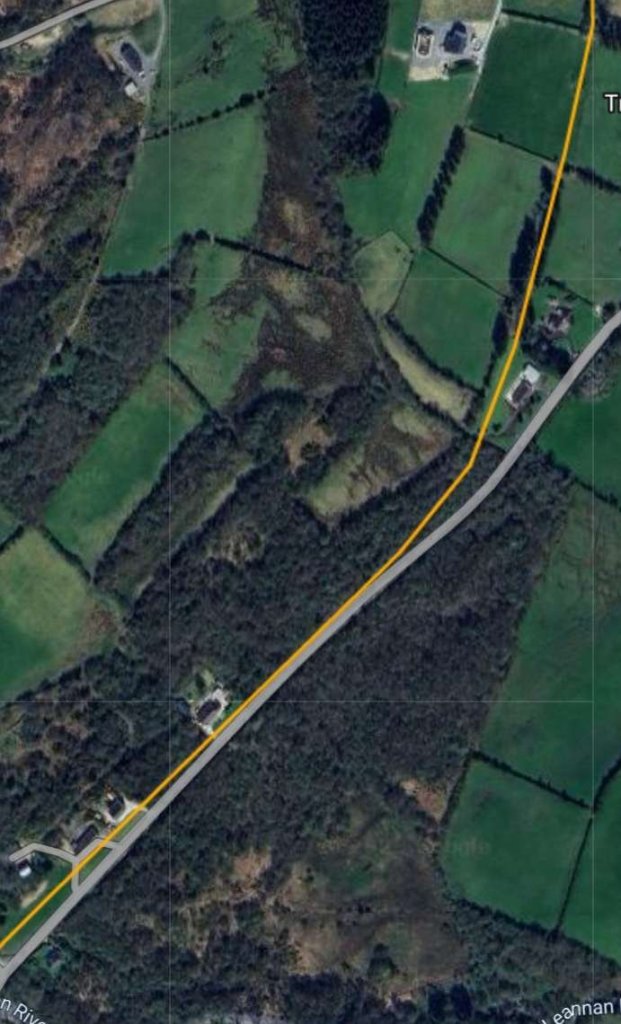
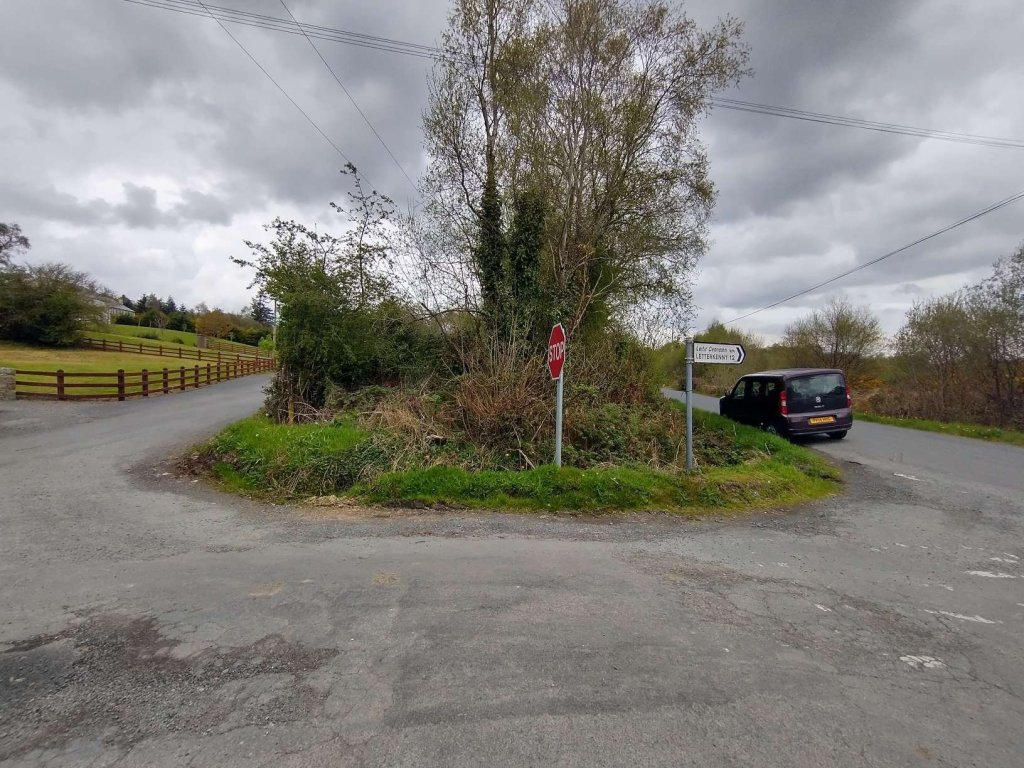
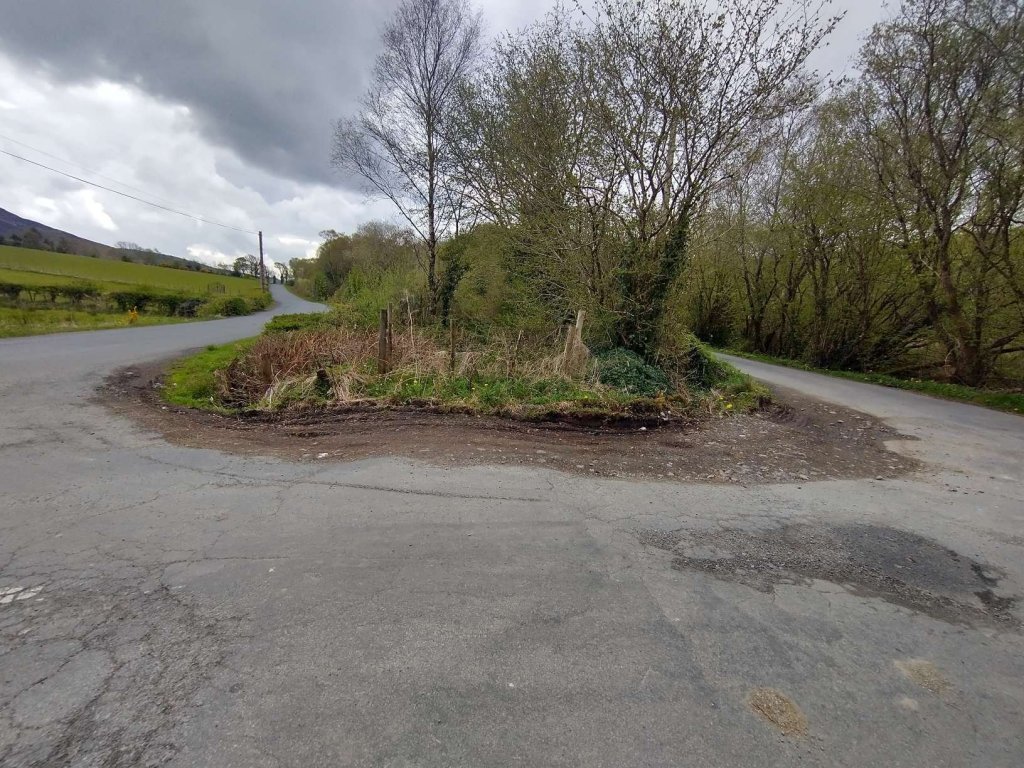
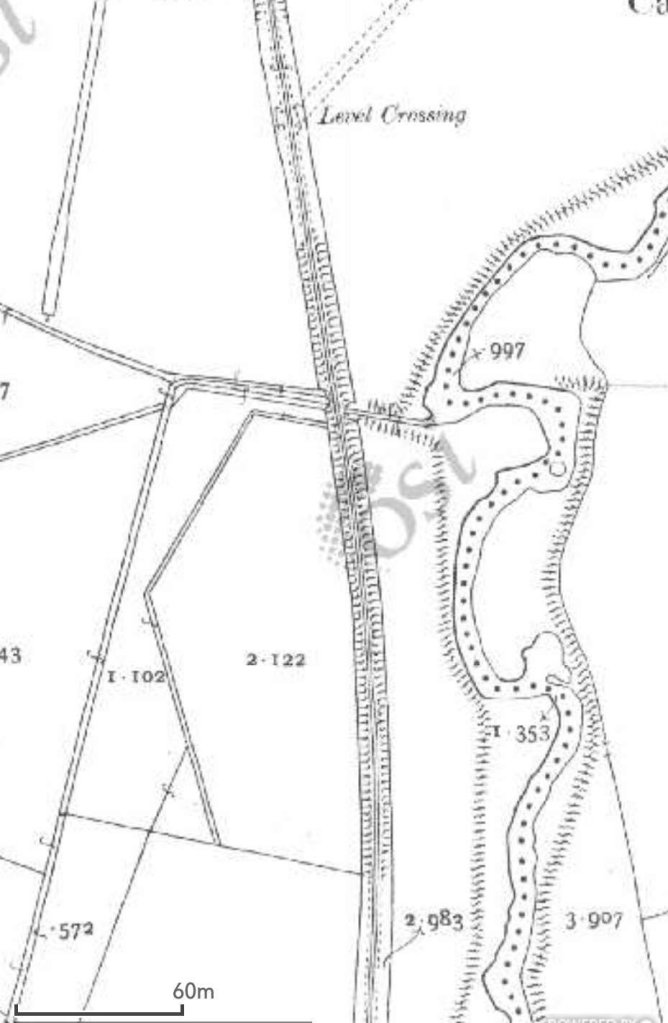
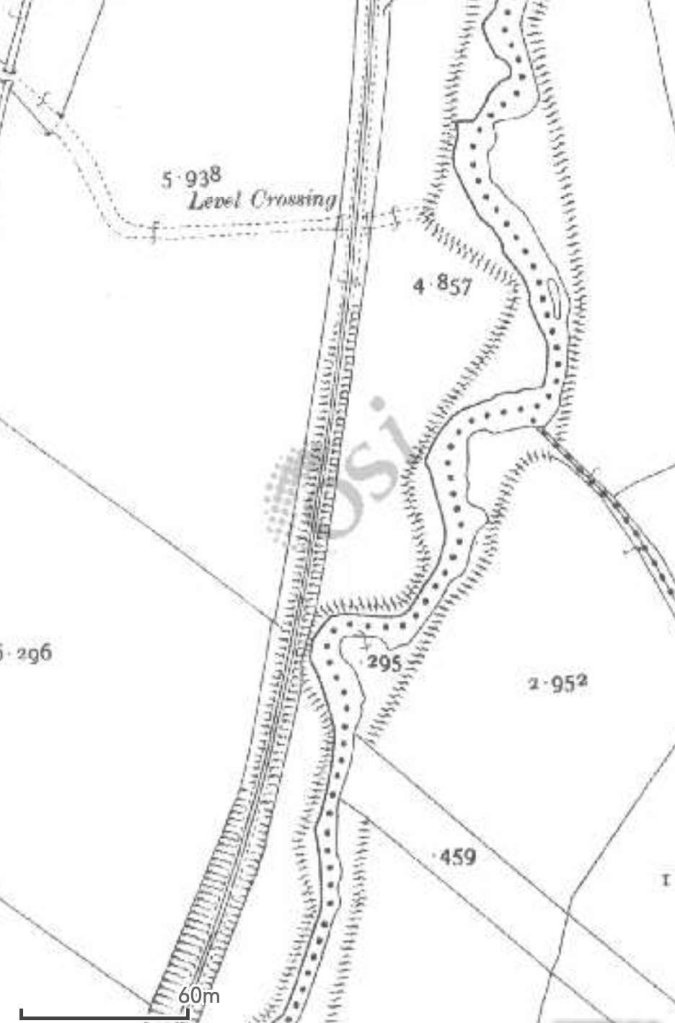
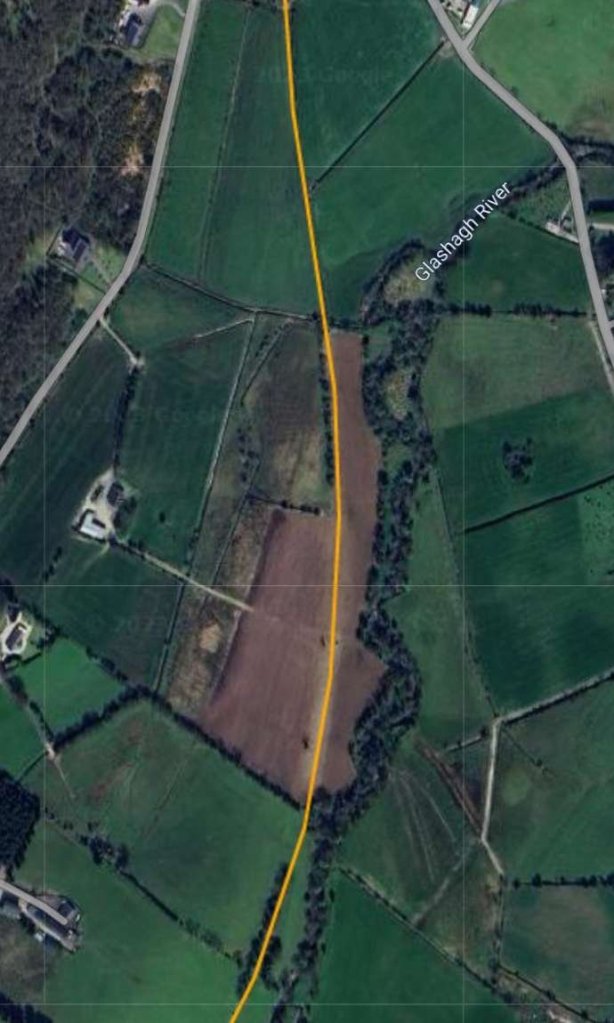
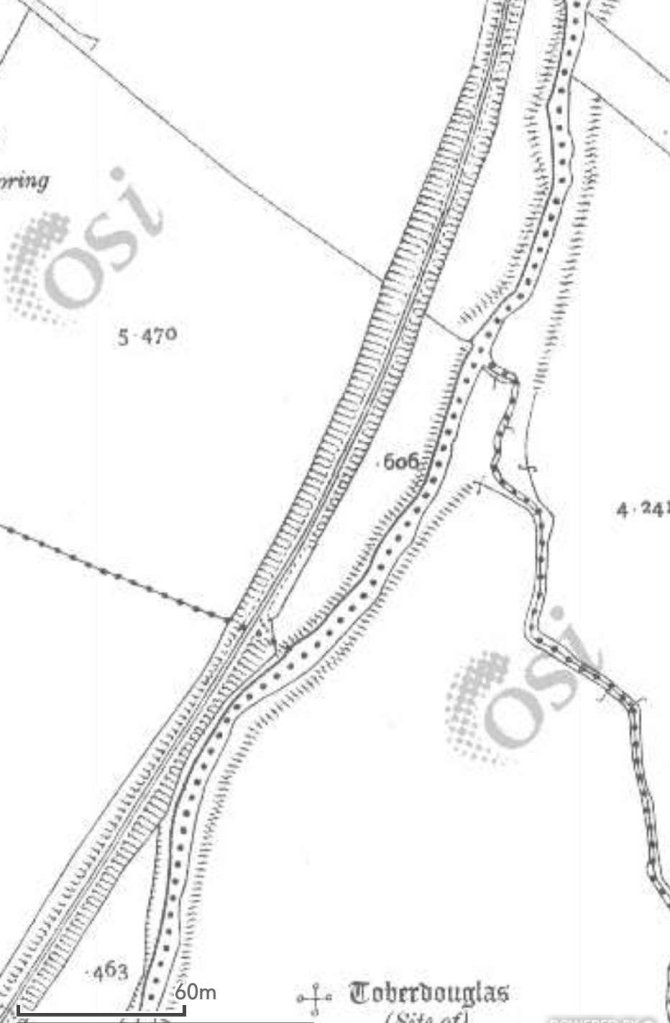
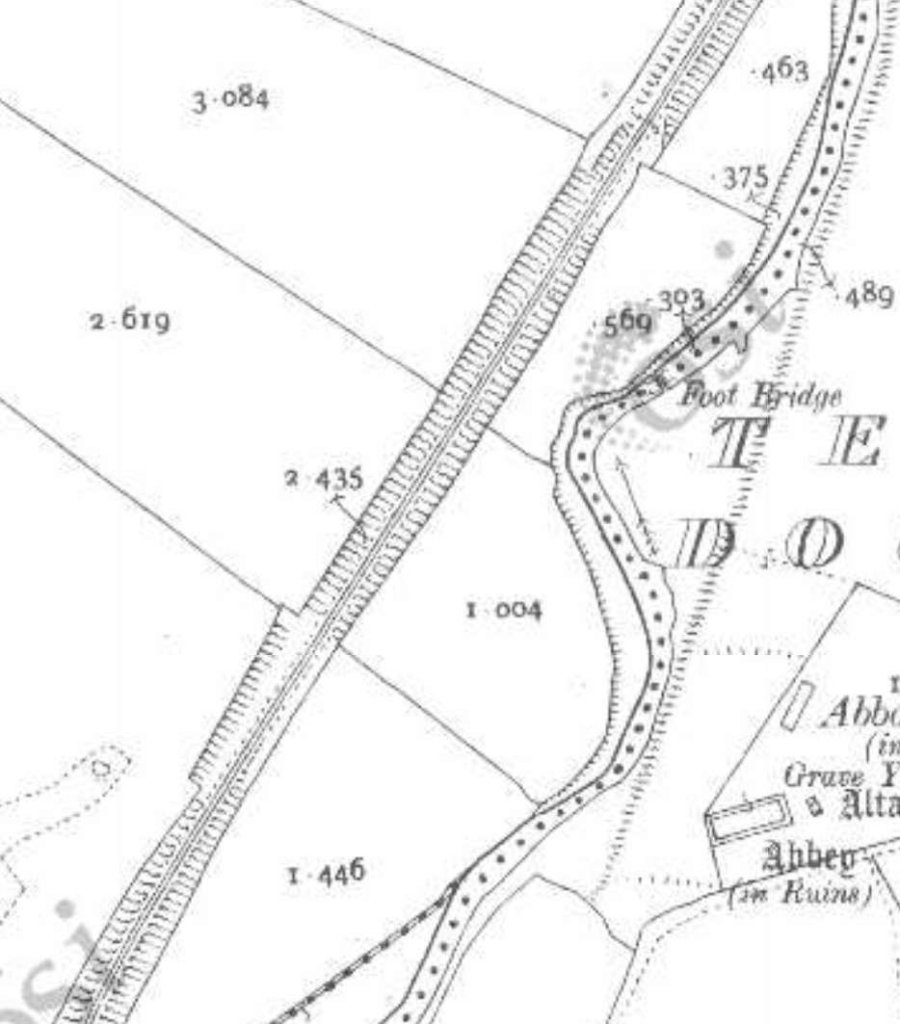
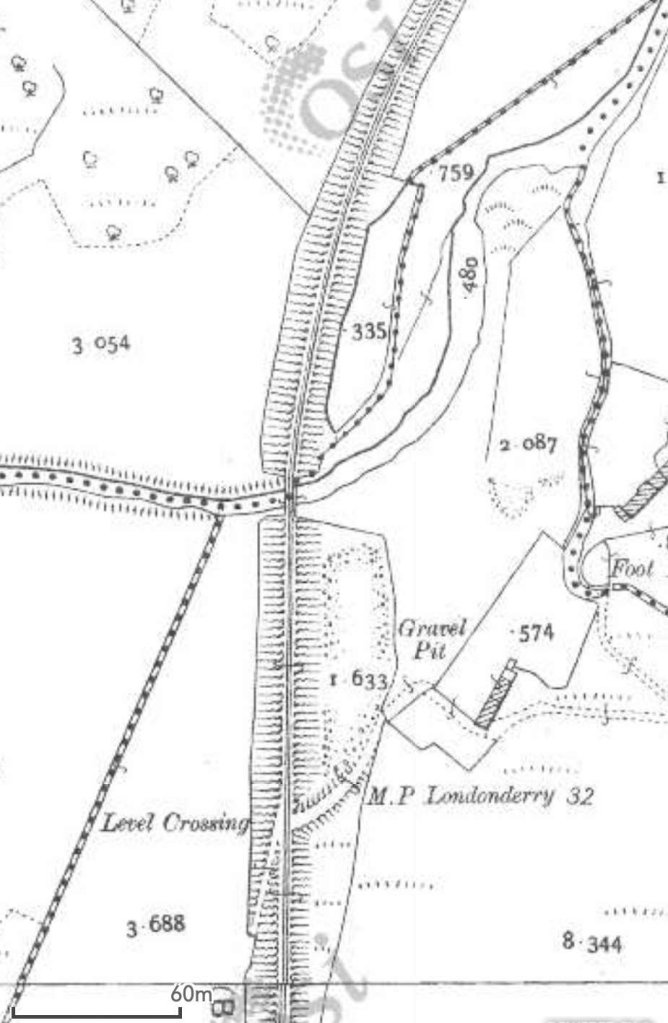
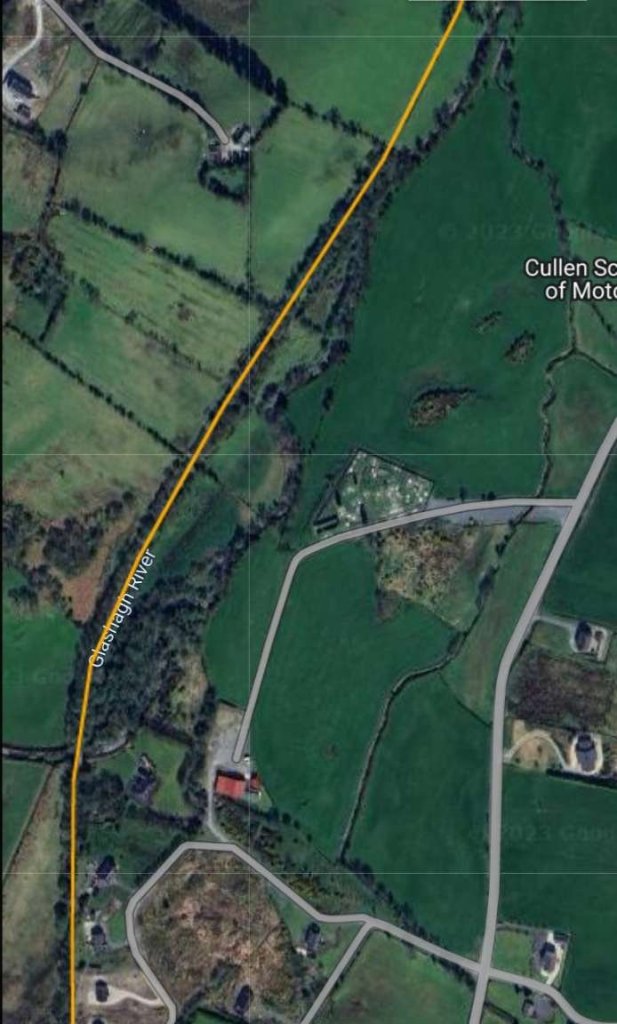
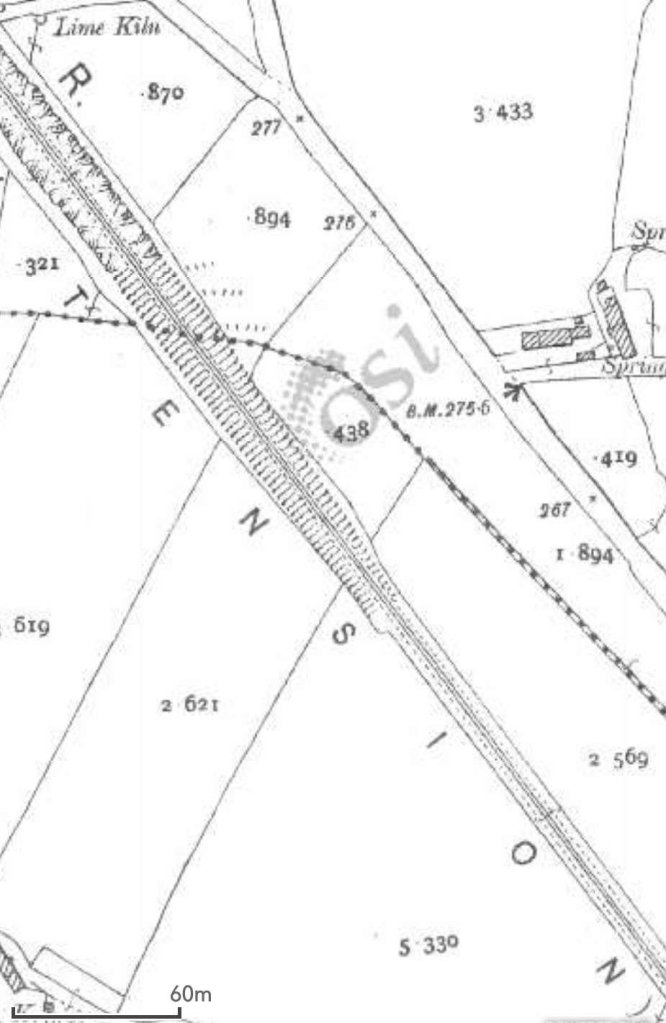
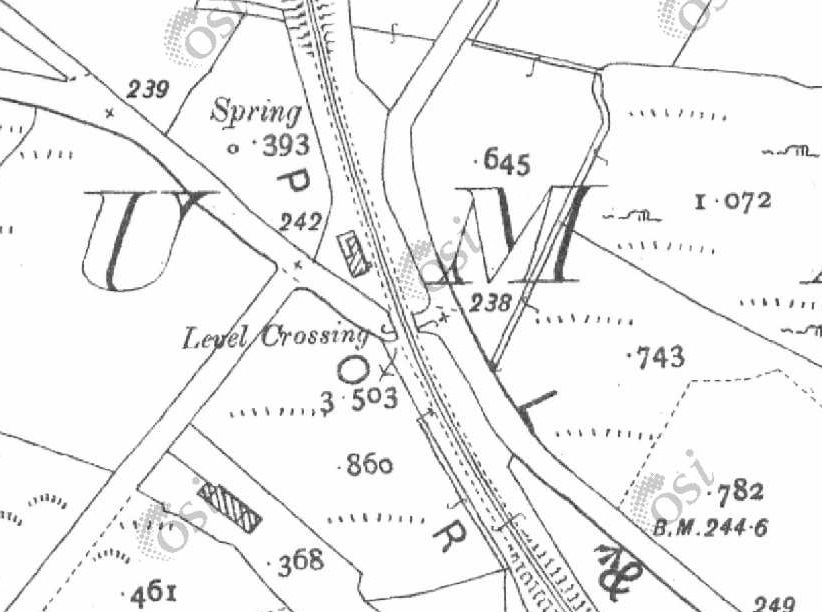
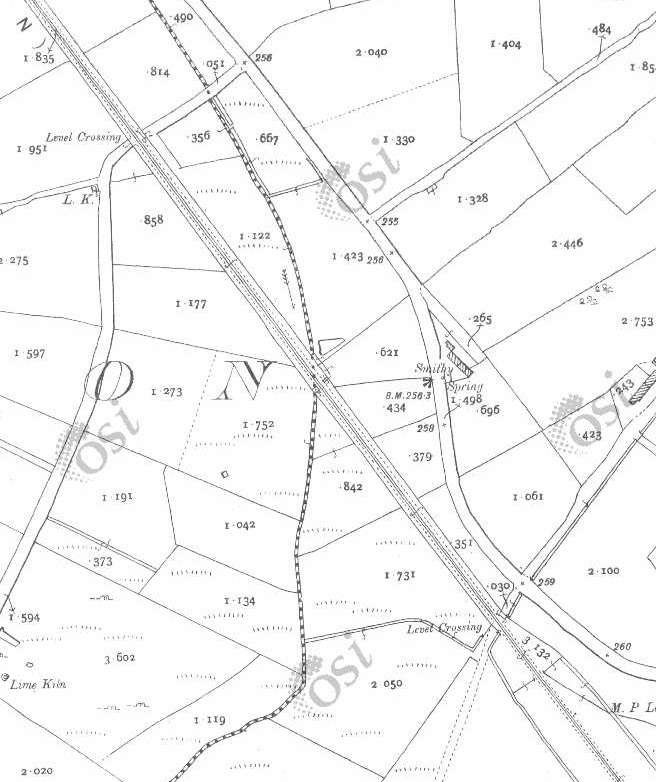
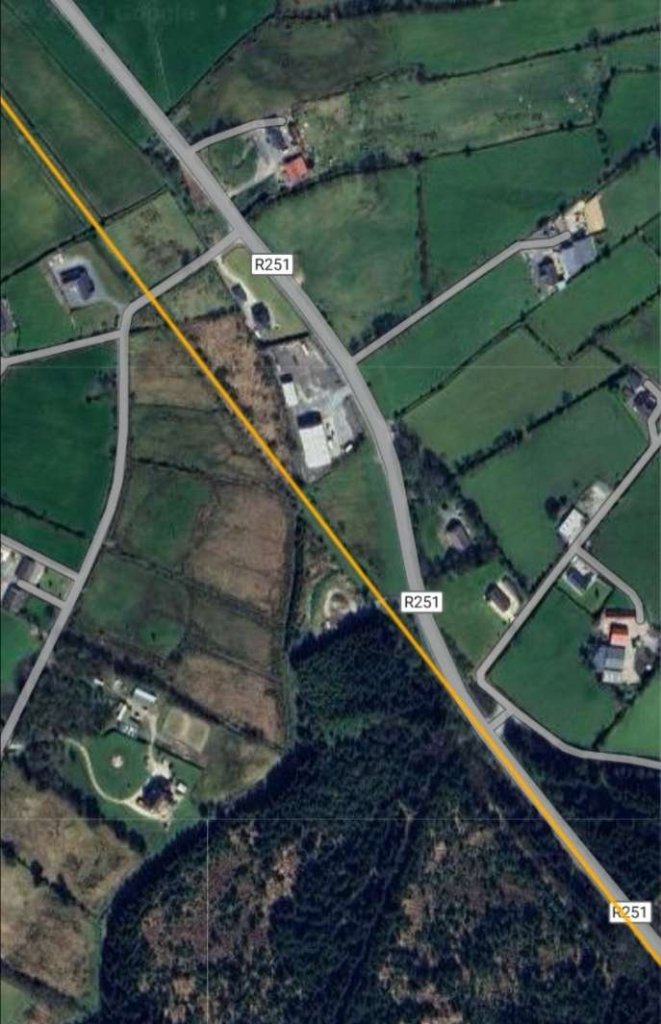
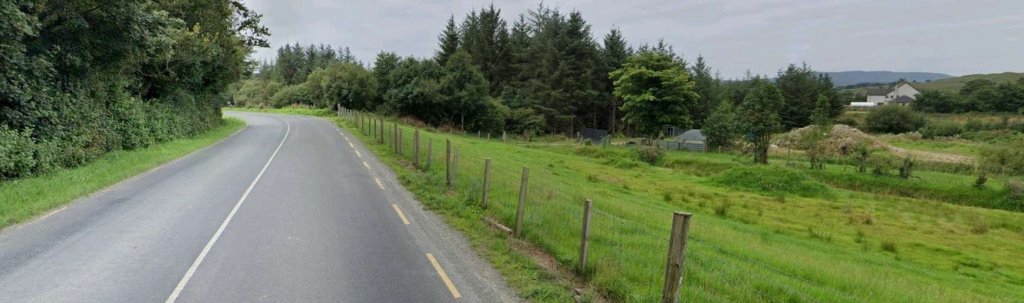
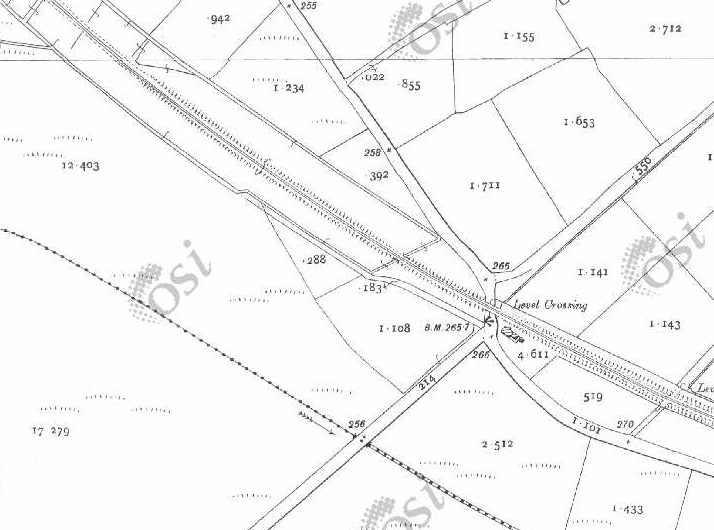
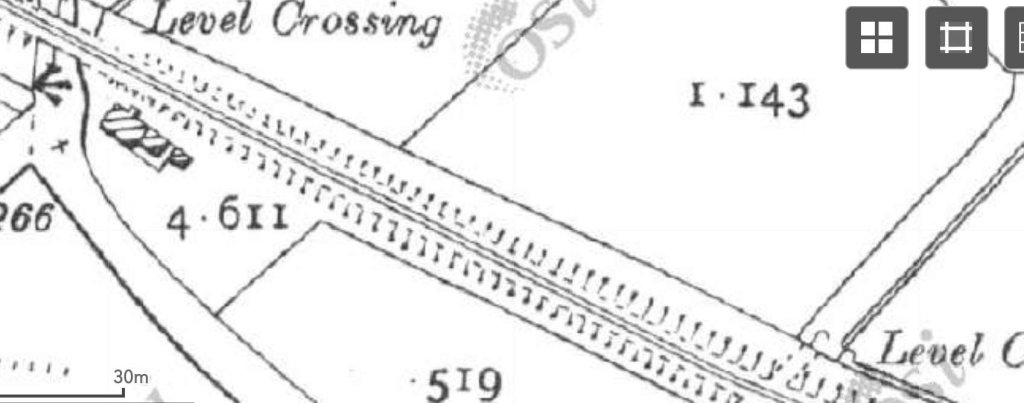
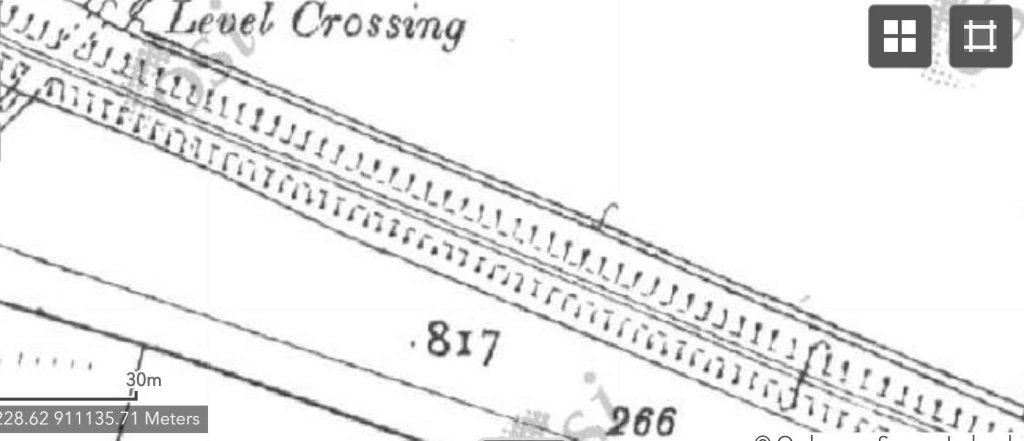
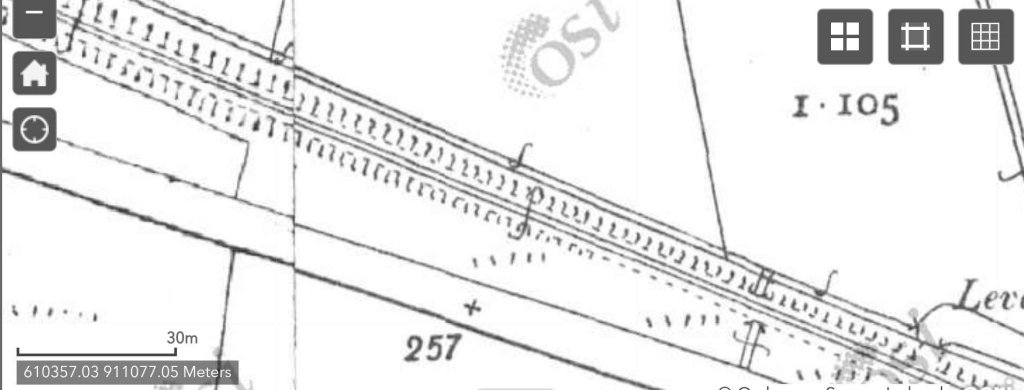
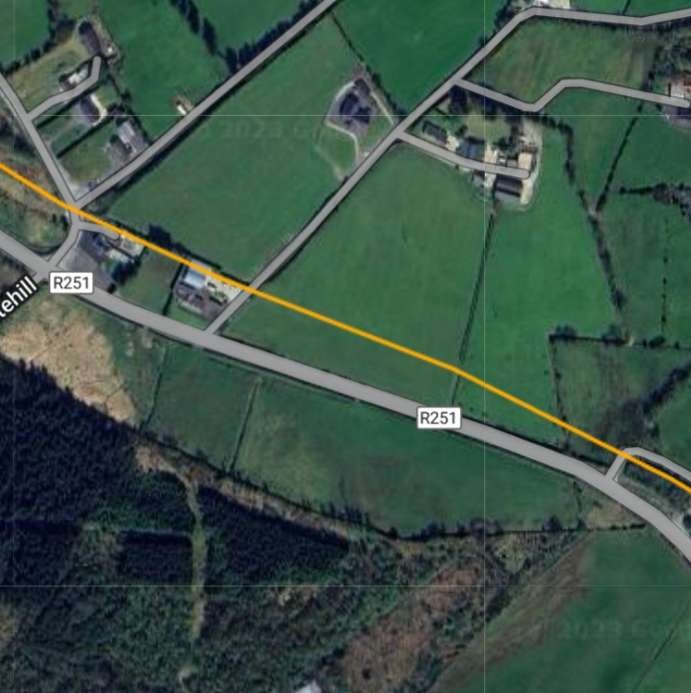
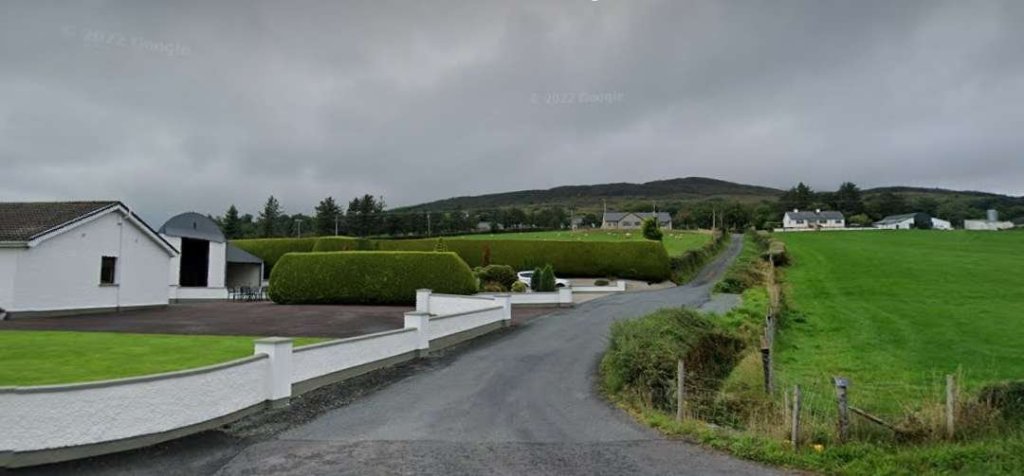
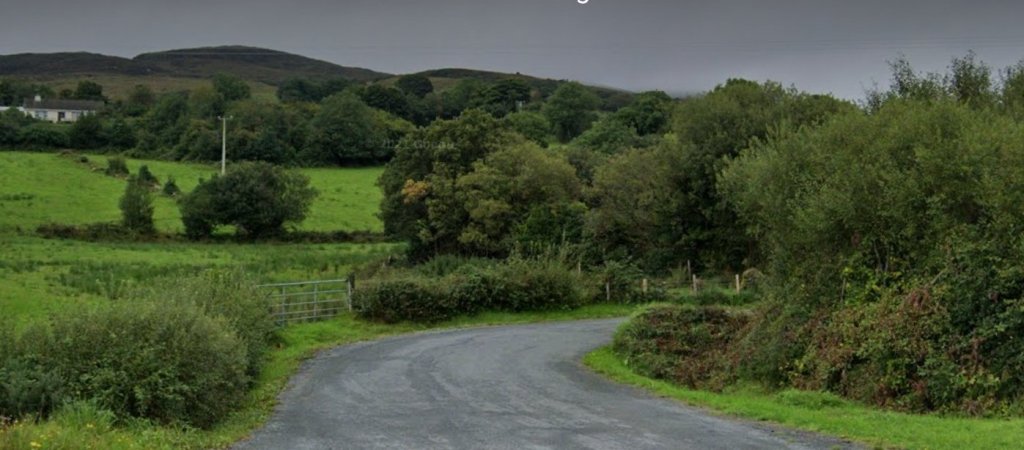
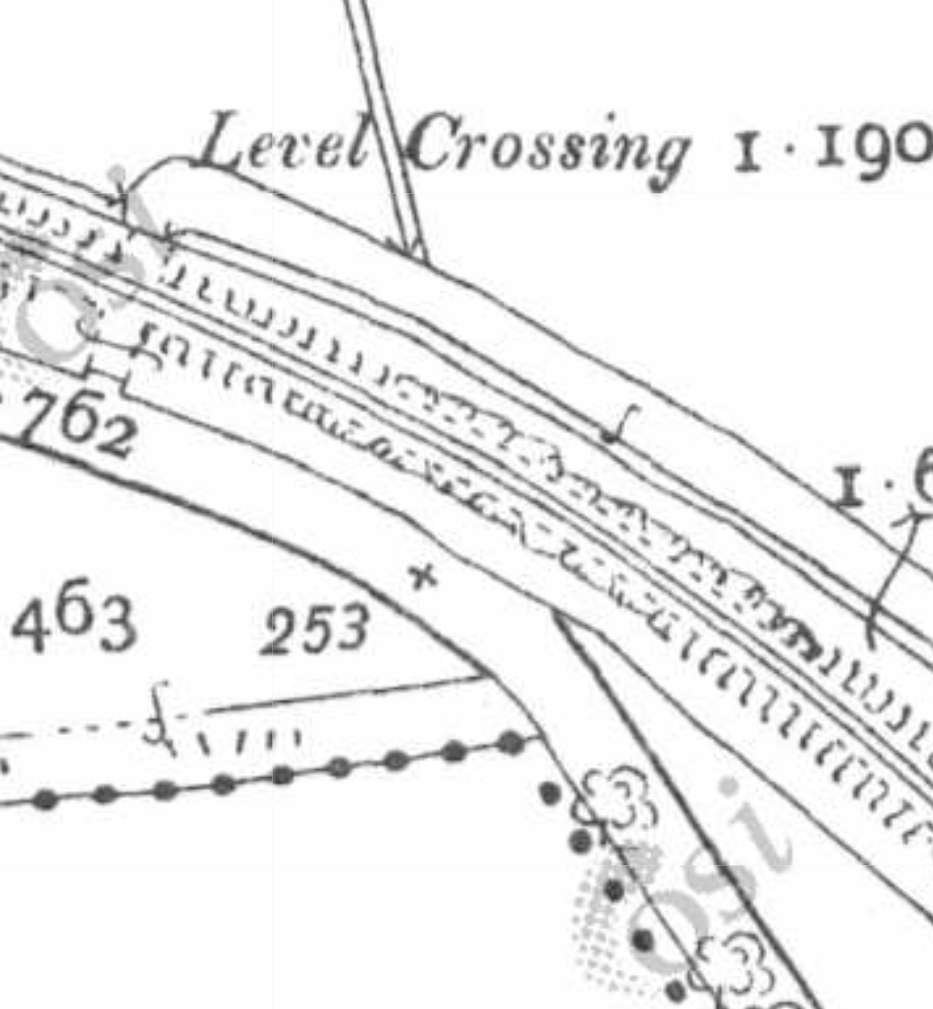
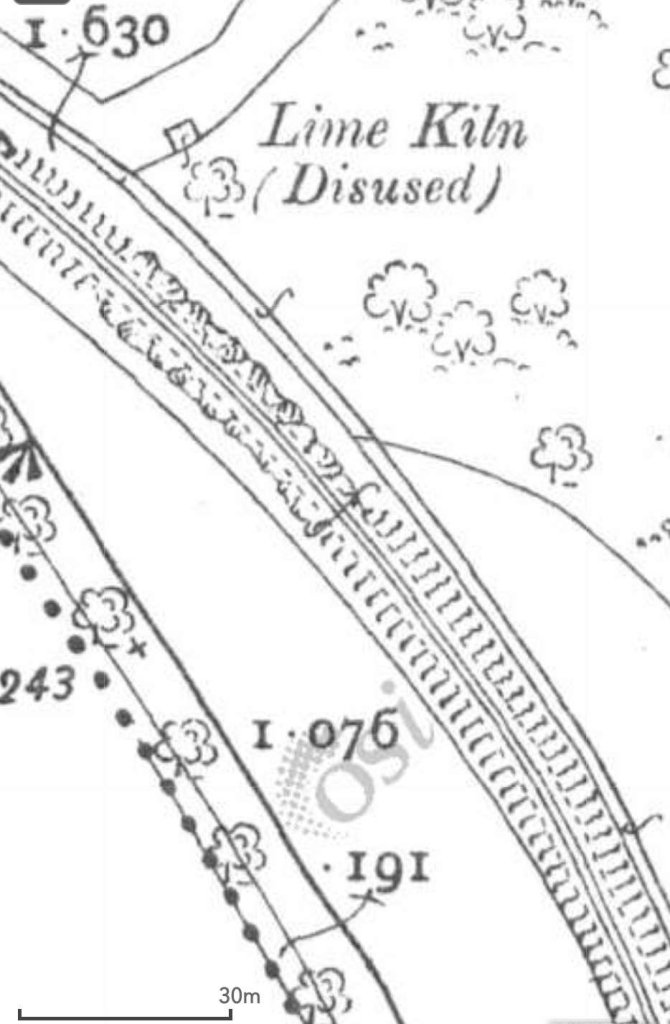
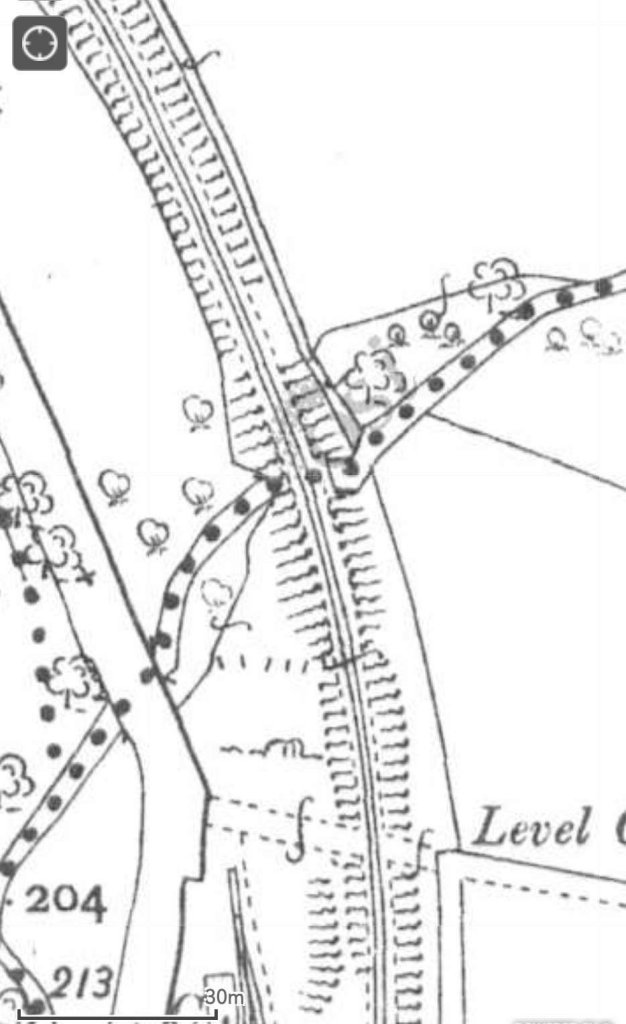
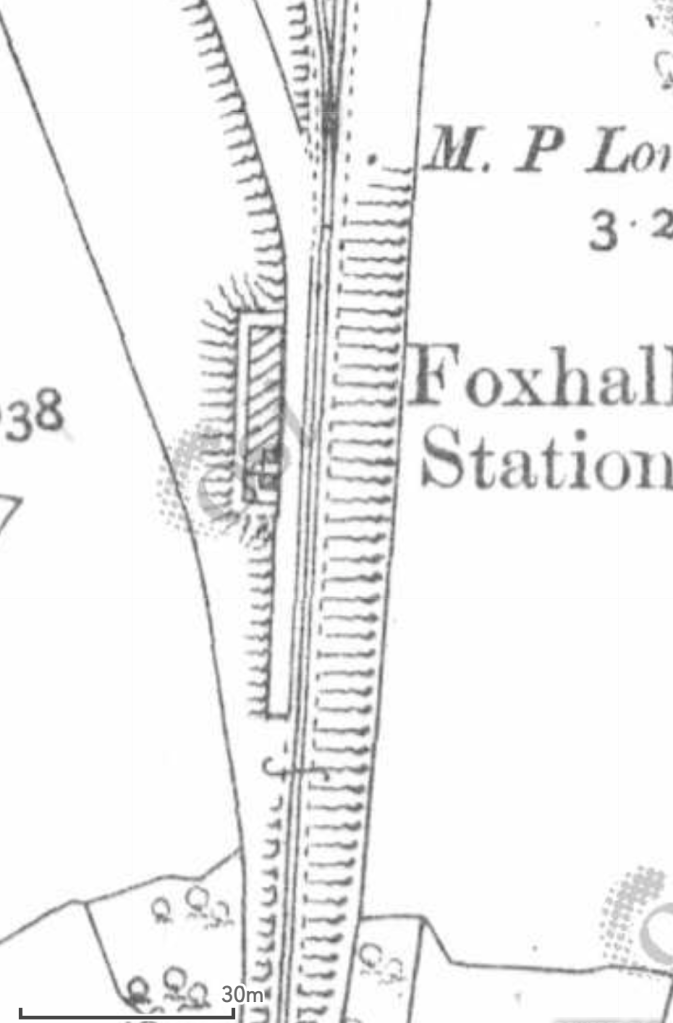
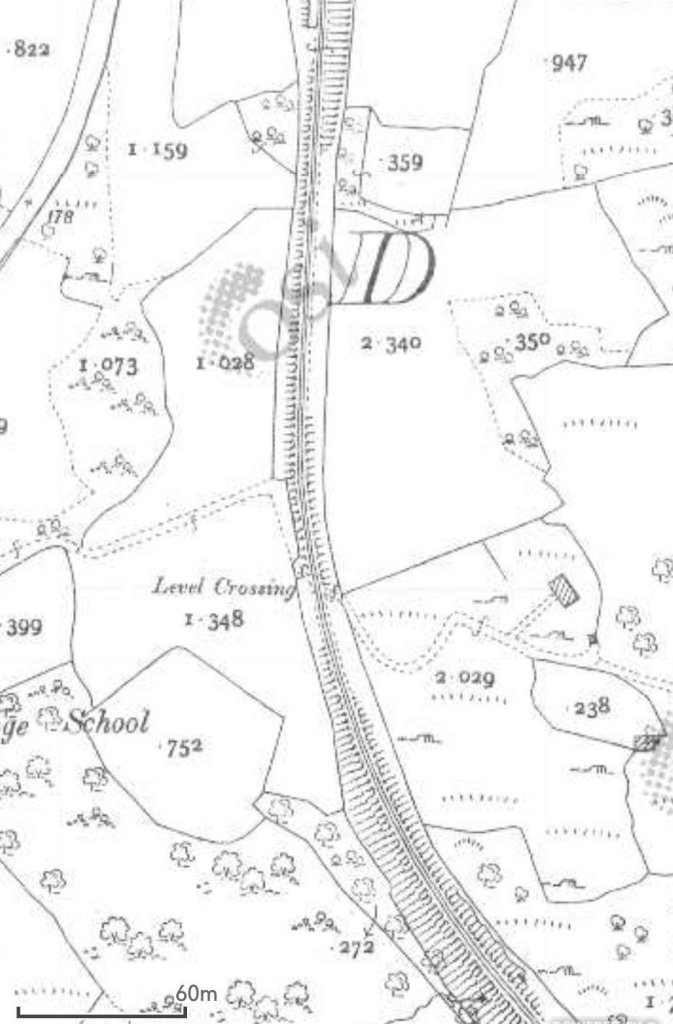
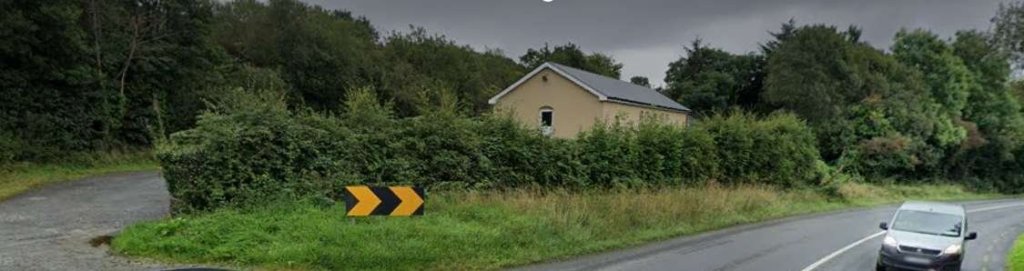
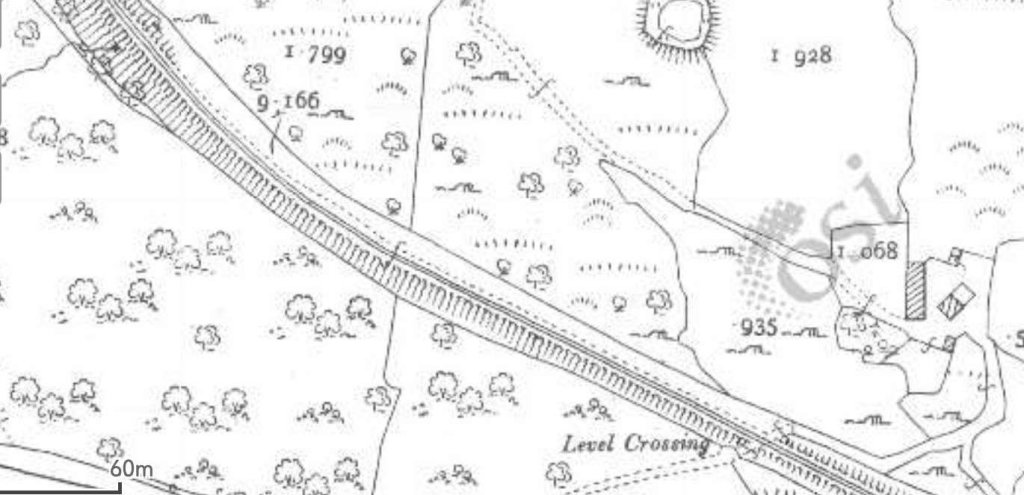
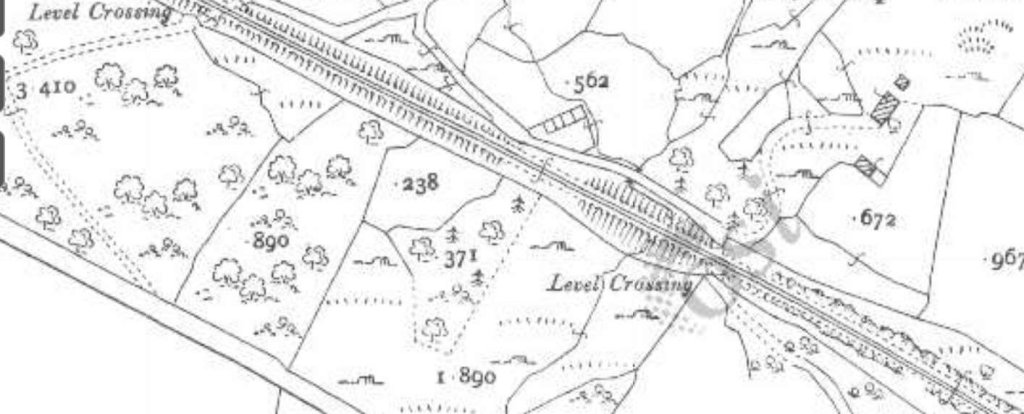
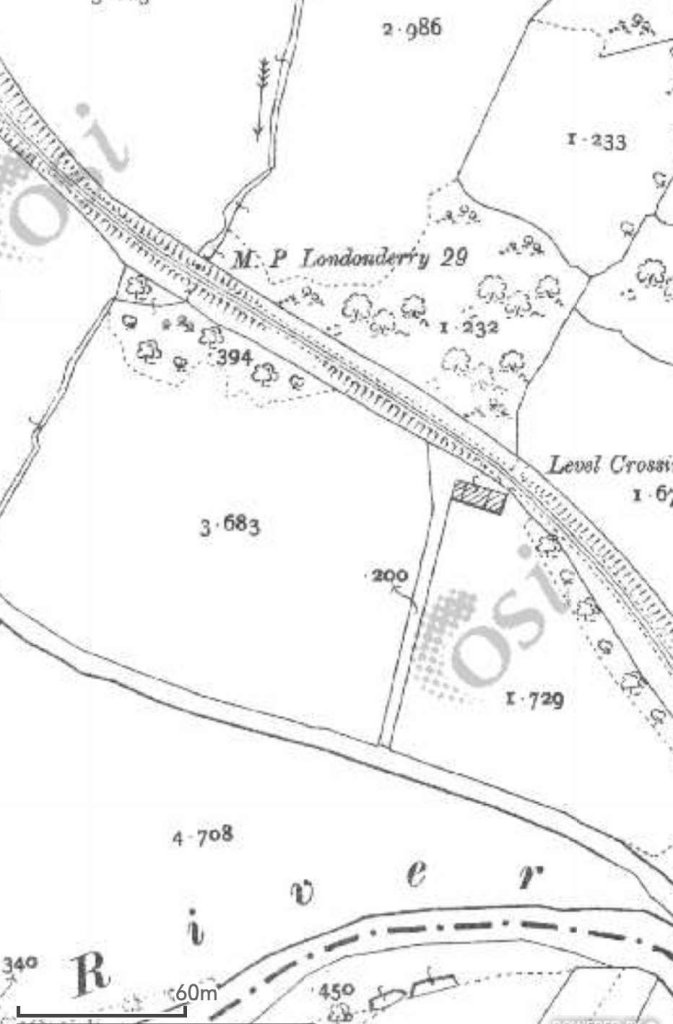
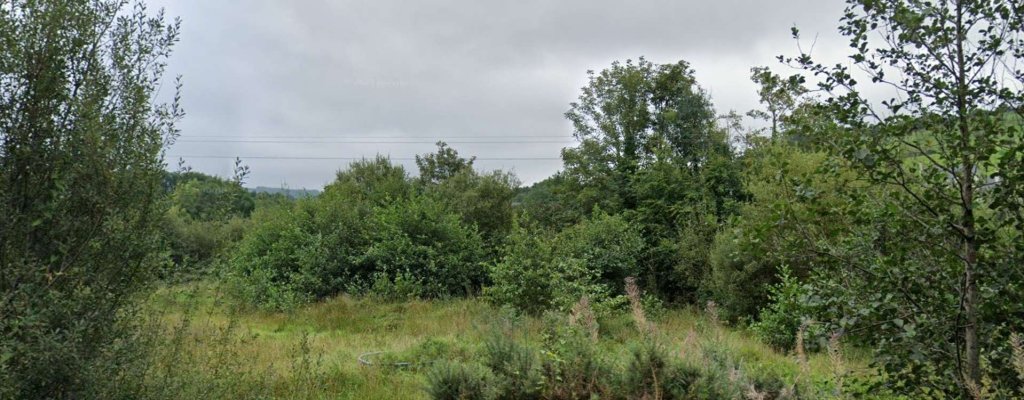
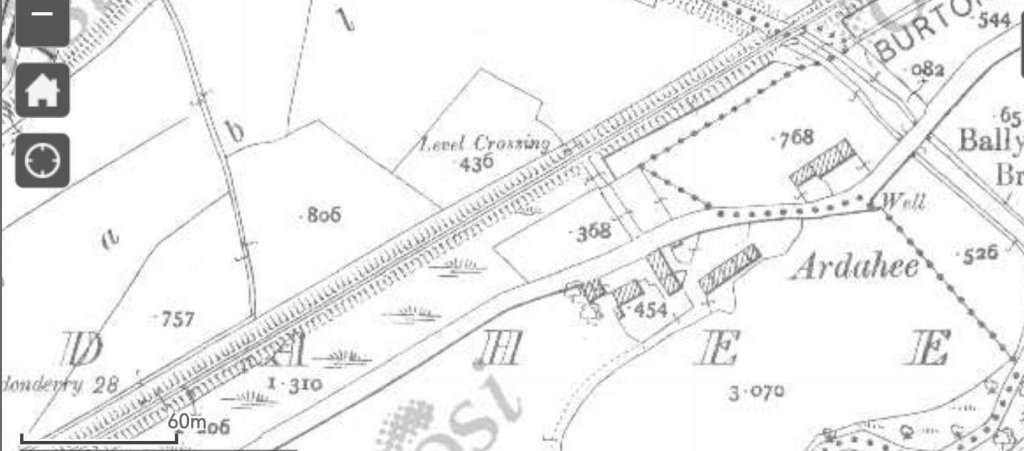
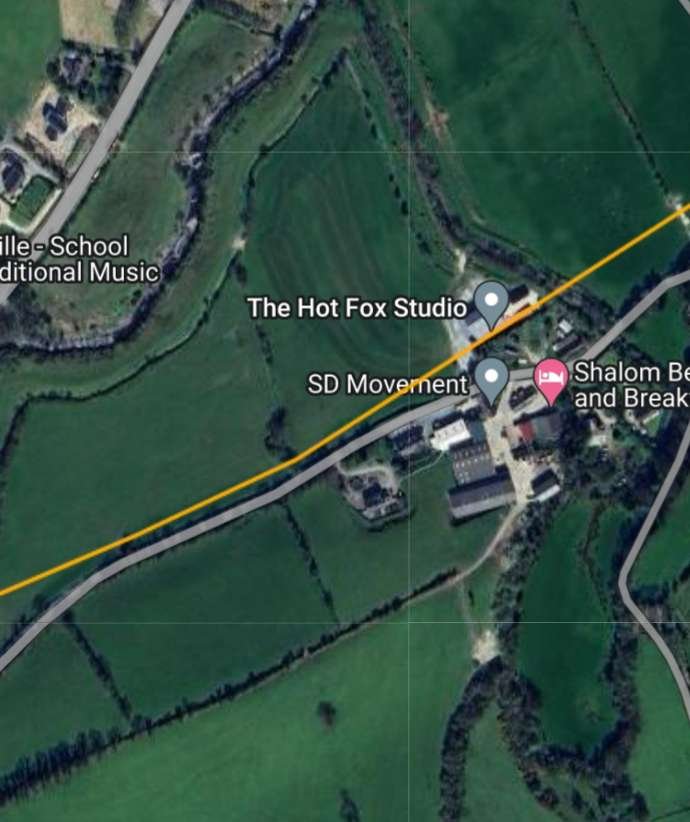
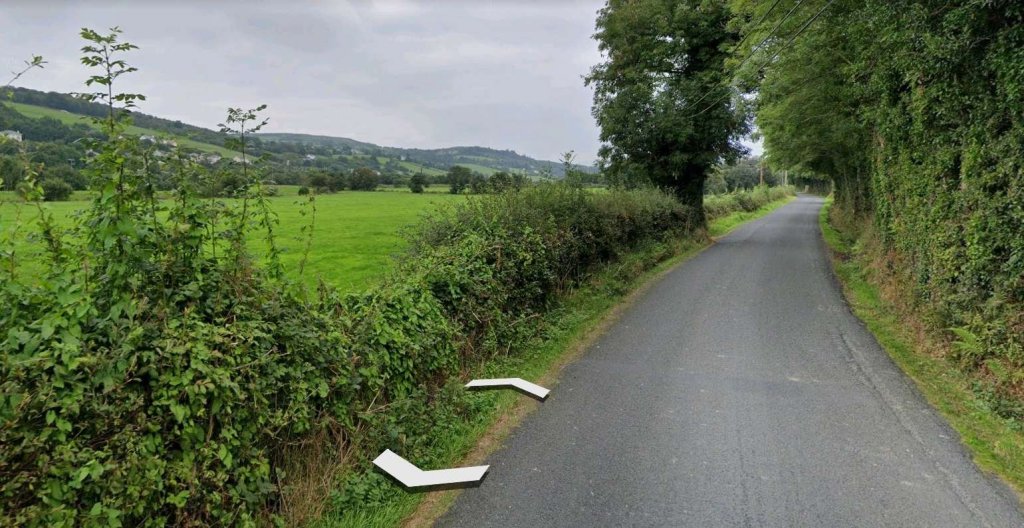
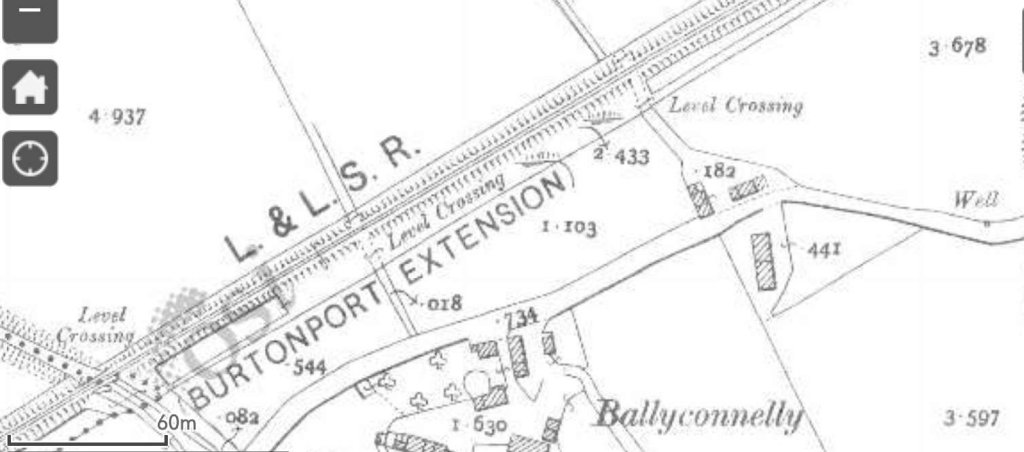
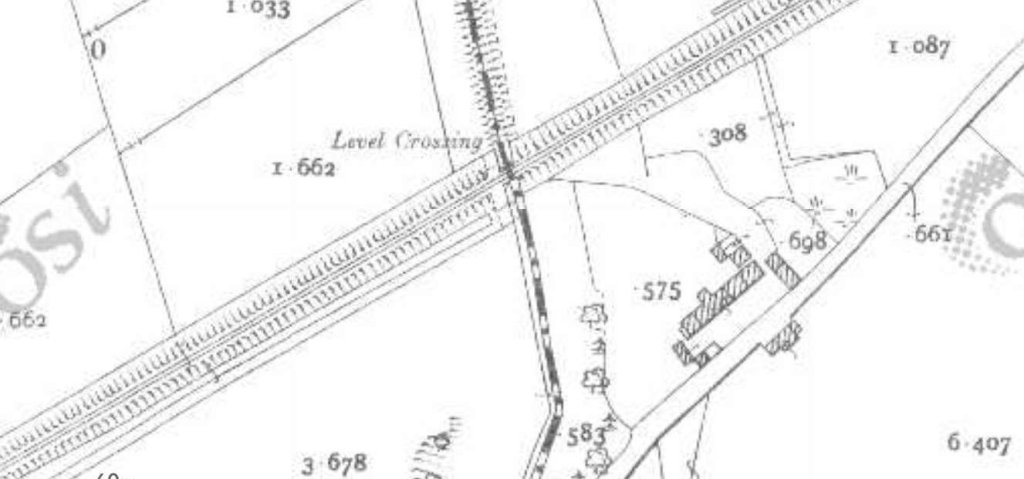
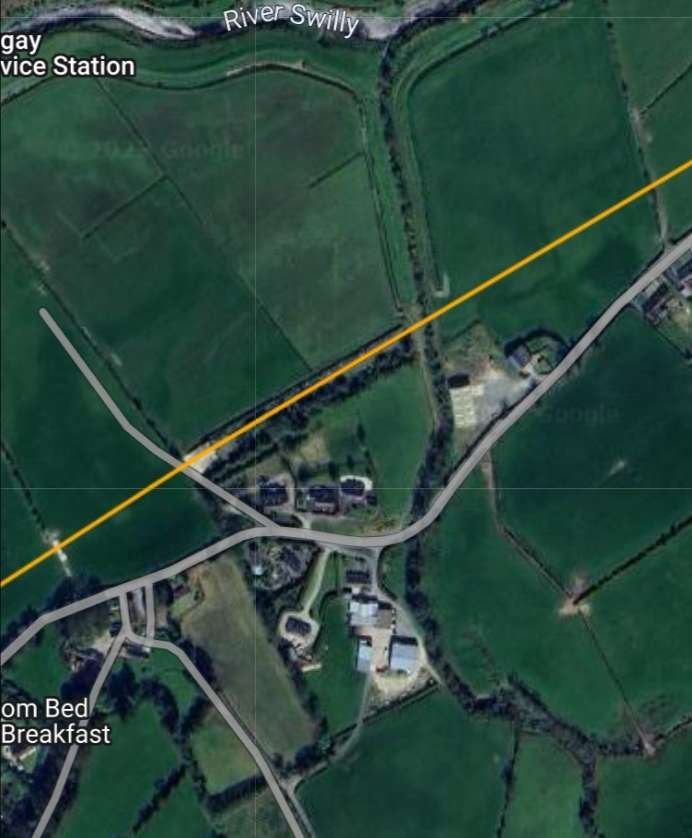
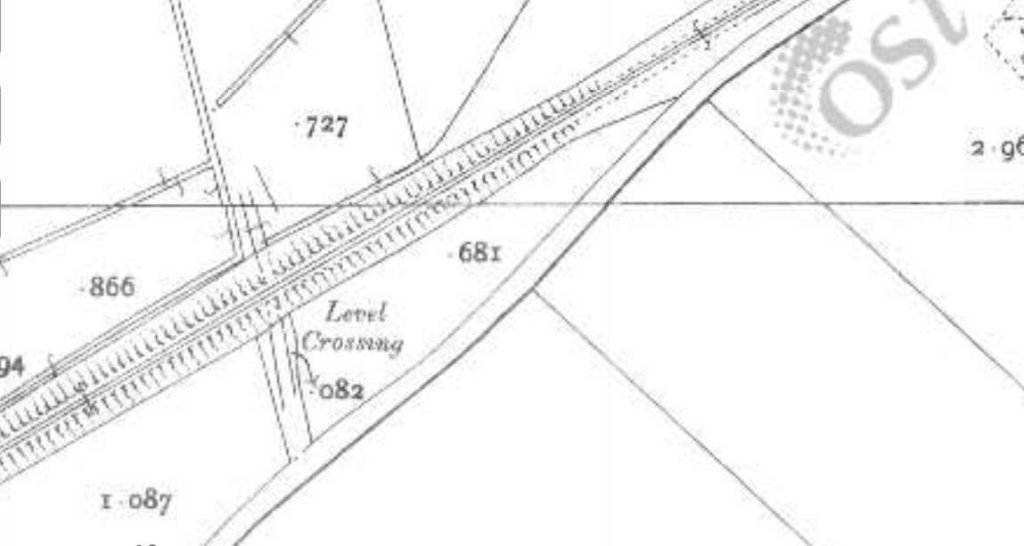
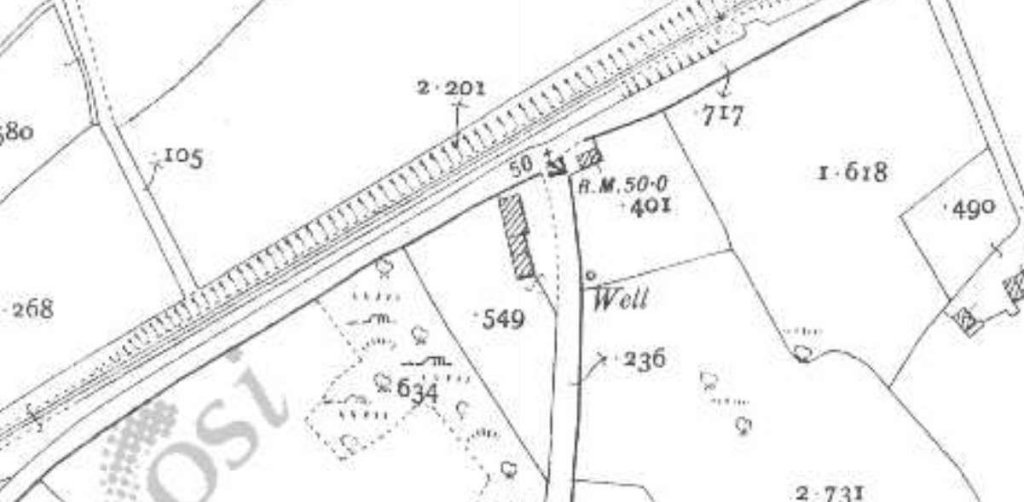
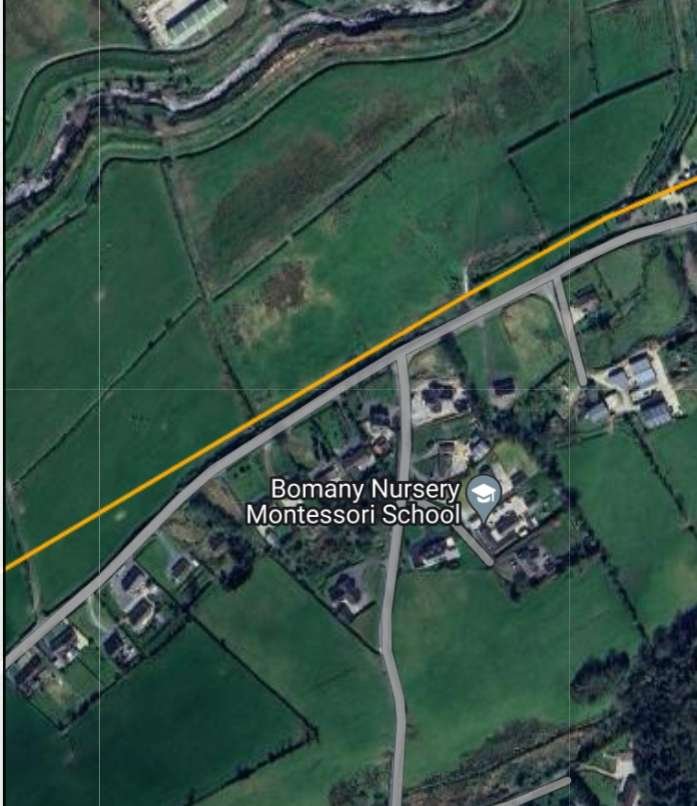
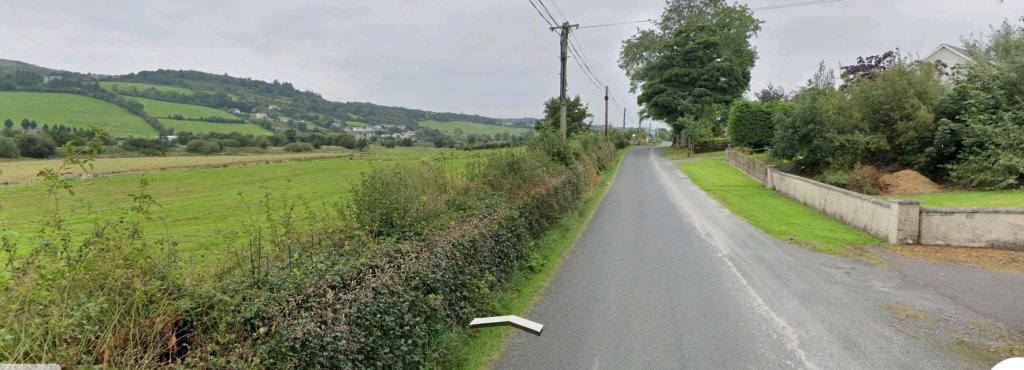
A view looking North towards the viaduct at Barnes Gap. [3]Approximately the same view in August 2021. [Google Streetview, August 2021]Barnes Gap, not to be confused with the Barnesmore Gap further South in Co. Donegal, sits at the top left of this first map extract from the 6″ OSi survey of 1901. Road and rail run close to each other with the road on the valley floor and the railway above. [2]This extract from RailMapOnline.com’s satellite imagery covers the top half of the map extract above. [4]A closer view as can be seen on Google Earth, the railway formation can be seen 50 metres or so to the Northeast of the N56. [Google Earth, June 2023]Taken just to the Southeast of the location of the satellite image immediately above, this photograph looks Northwest along the N56 as the old railway formation, marked by the stone wall to the left of the road, closes in on the line of the road. [Google Streetview, August 2021]Turning through 180° to look Southeast along the N56, the old railway formation is now at the same level as the road. It runs between the road edge and the rock outcrop its left. [Google Streetview, August 2021]This next satellite image emphasises how close the road and old railway ran as they headed South and it covers the bottom half of the map extract abovel. [4]Further to the South and looking South-southeast along the N56. The old railway alignment runs parallel to the road on its Eastern (left) side. [Google Streetview, August 2021]The road and railway followed each other closely for another kilometre or so until, as this extract from the OSi mapping shows, the railway required a larger radius curve, shown at the bottom-right of the extract. [2]The road and old railway formation are shown coinciding on this next RailMapOnline image. The reality on the ground is a little different as the next two images show. [4]This extract from the Google Earth satellite imagery, sowing the road junction at the bottom of the RailMapOnline image above. It also shows that the two forms of transport, road and rail were generally separated by a few metres with them closer where ground features needed them to be. [Google Earth, June 2023]The view South-southeast along the N56 and the road junction in the satellite image above. The tree line to the left of the road indicates the location of the old railway formation. [Google Streetview]Here we see the two alignments, road and old railway, diverging as shown on the OSi map extract above. The modern N56 seems to follow the alignment of the old road. [4]This extract from the 25″ OSi survey shows what was probably an ungated crossing over the lane that linked the crossroads close to Termon School to the main road, now the L5542. The crossing appears in the top-left of the 6″ OSi map extract above. [2][4]The road and the old railway follow separate paths once the valley broadens out. The railway remained, at first, on the North side of the road. [2]This extract from RailMapOnline shows the majority of the area covered by the 6″ OSi map extract above. [4]Once it crossed to the South side of the road the line drifted away from the road in a Southeasterly direction and crossed to the South side of the river valley. The line headed Southeast, the road East-southeast. [2]This satellite image shows approximately the same length of the line as the top half of the map extract above. [4]This enlarged extract from the 25″ OSi survey from the early 20th century shows the precedence given at the time to rail traffic with the gated crossing requiring traffic to turn to cross the line. [2]This enlarged image from Google Streetview shows the location of the level crossing in the 21st century. The larger building on the top-left, just North of the road is the crossing-keeper’s cottage. [Google Earth, June 2023]The view Southeast along the N56 through the location of the level-crossing. [Google Streetview, August 2021]The view Northwest along the N56 through the location of the level-crossing. The crossing-keeper’s cottage is on the right of the road. The railway ran to the right of the cottage. [Google Streetview, August 2021]The crossing-keeper’s cottage, the old railway ran to the right of the cottage. [Google Streetview, August 2021]Looking Southeast along the N56. The old railway formation is the track on the right of this image. [Google Streetview, August 2021]
Barnes Halt was adjacent to the road at this location. This is how it is described on Wikipedia:
“Barnes Halt was not a ‘station’ in the ordinary sense. It was simply a stopping point at the level crossing across the Kilmacrennan-Creeslough road, a few miles north of Termon. There was no station building or platforms, only the embankment on which the rail track ran, and the house occupied by the railway employee responsible for manning the level crossing gates.” [5]
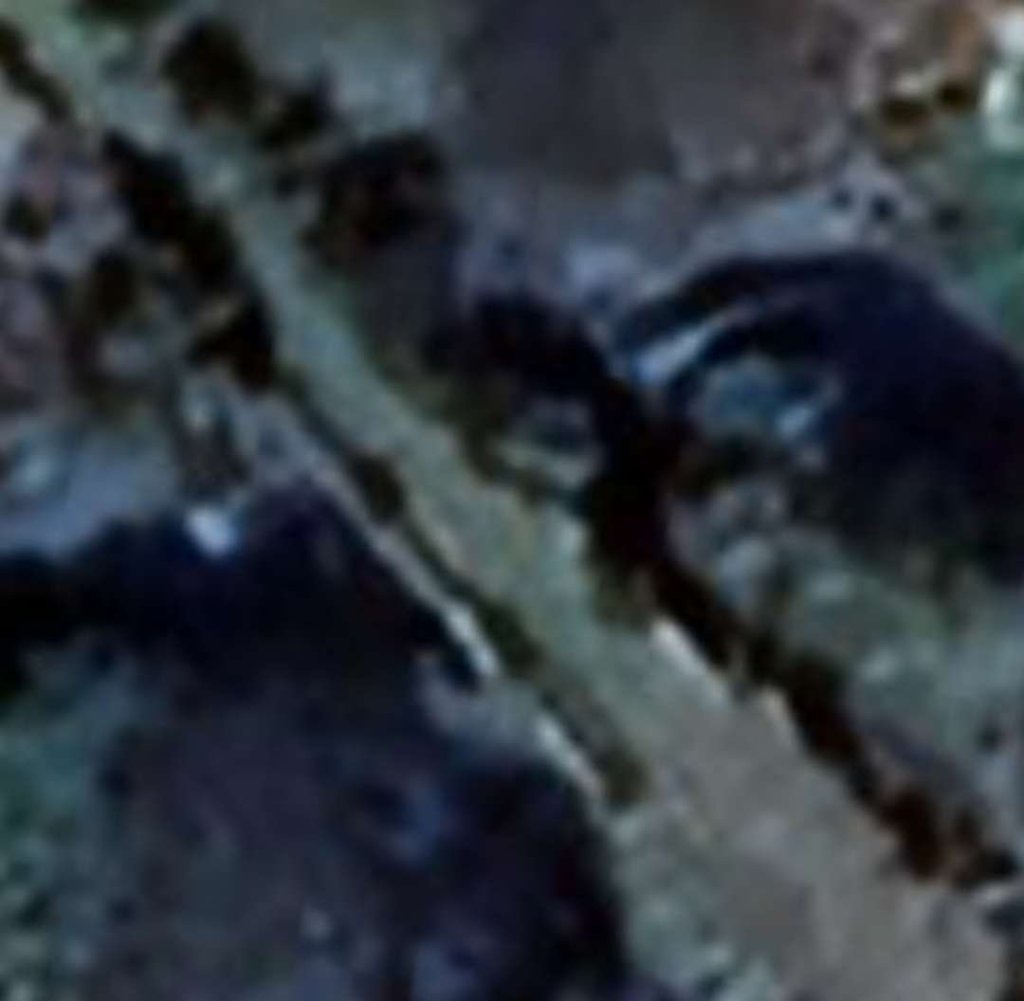
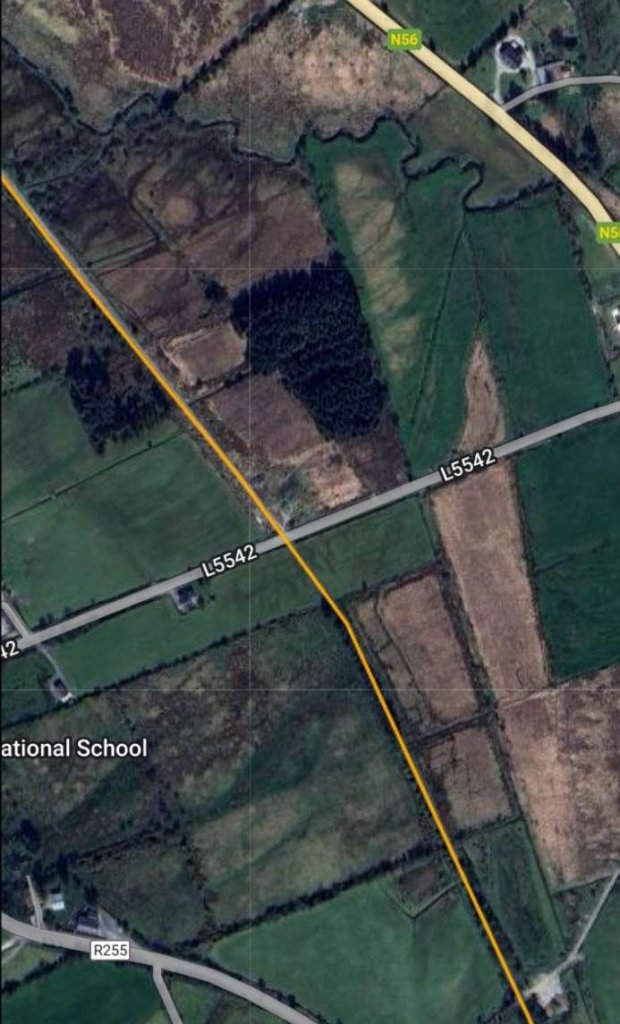
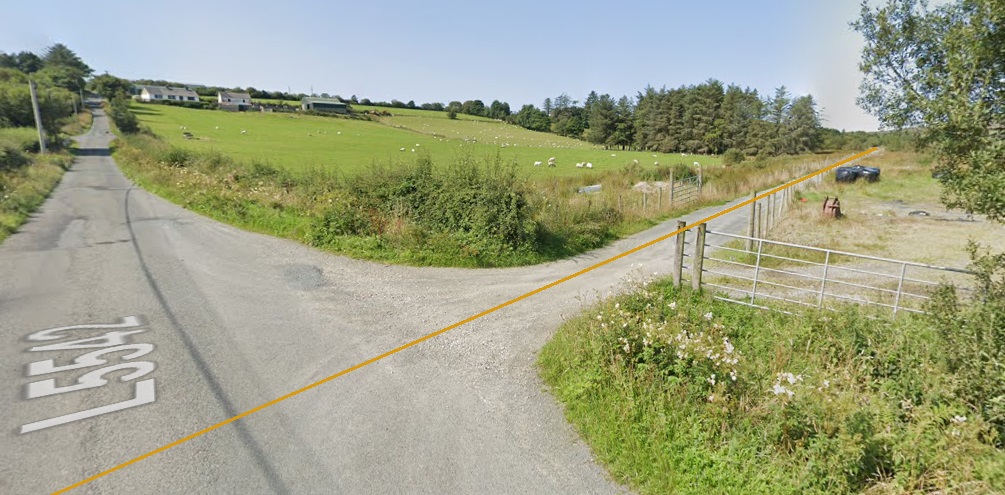
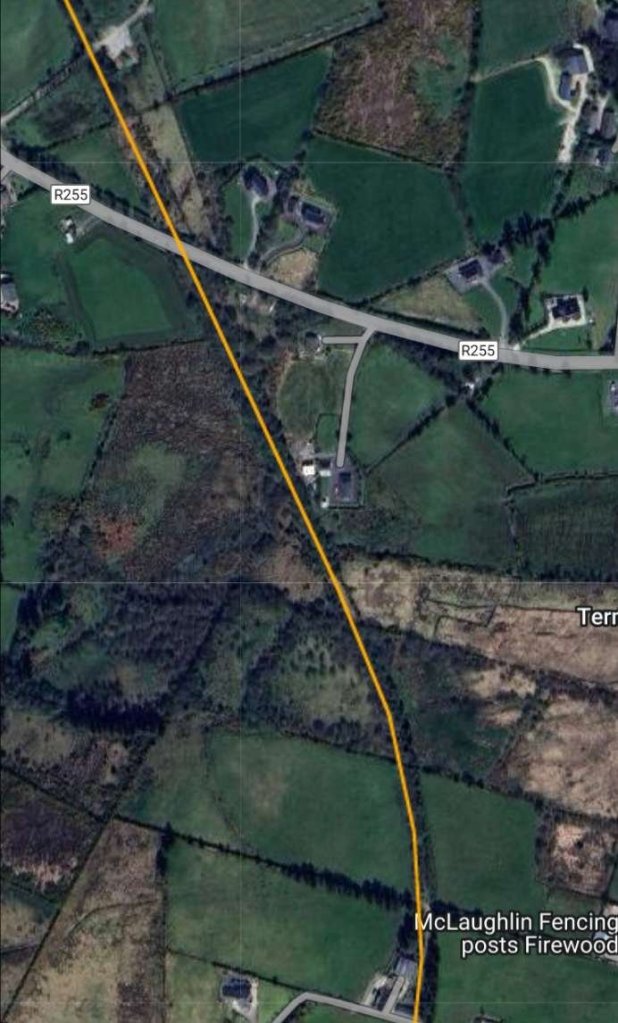
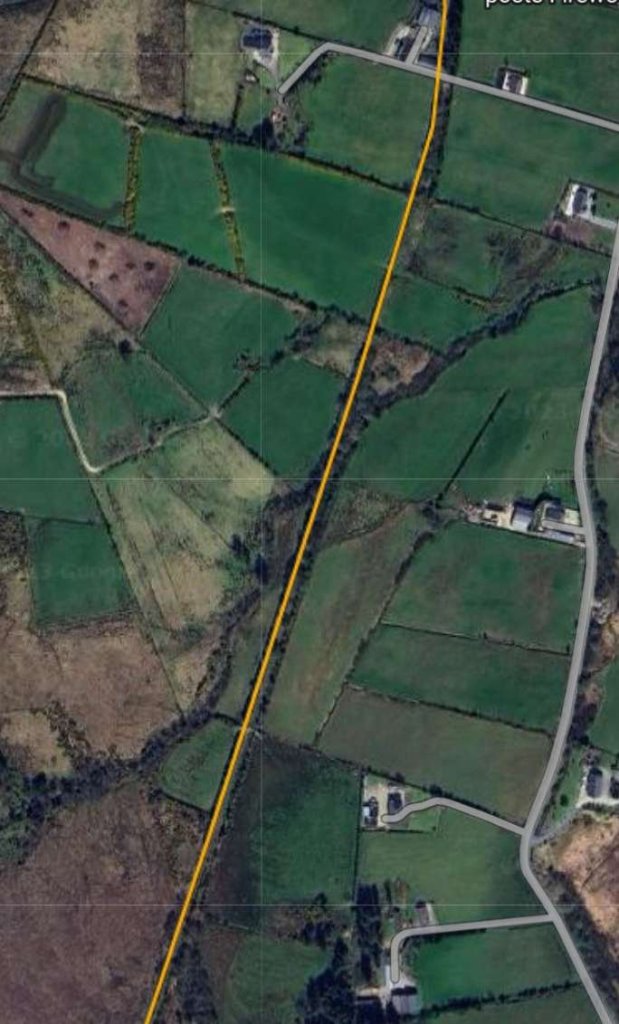
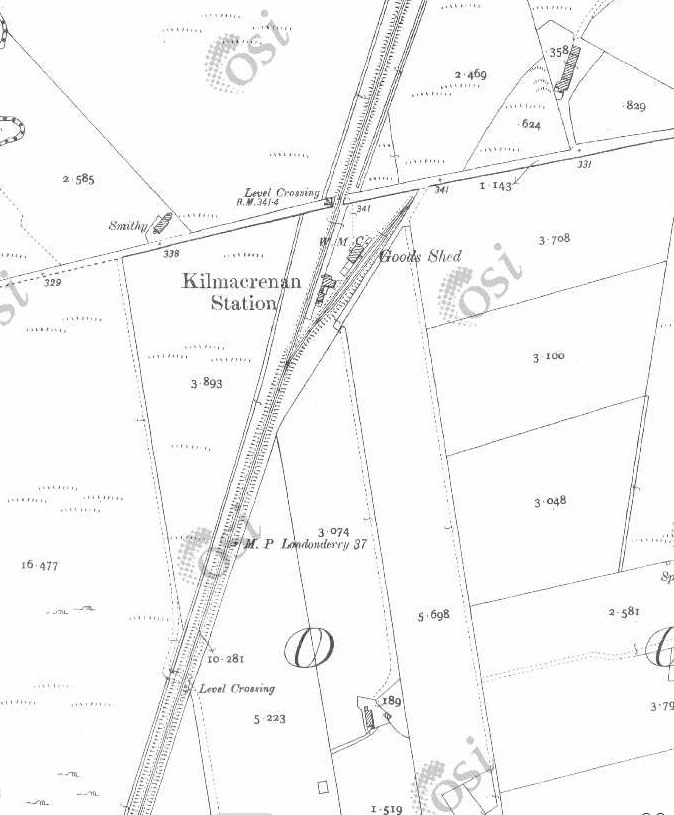
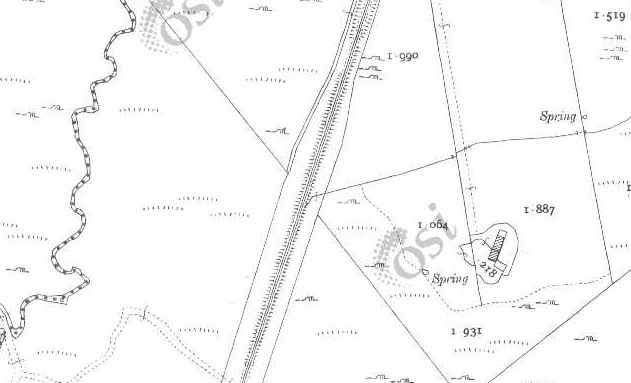
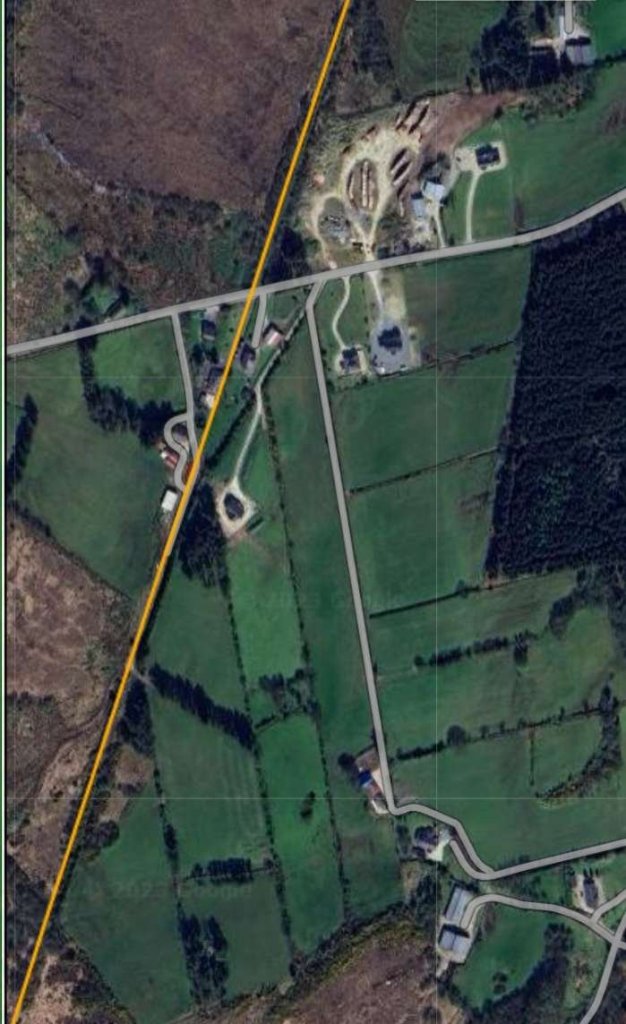
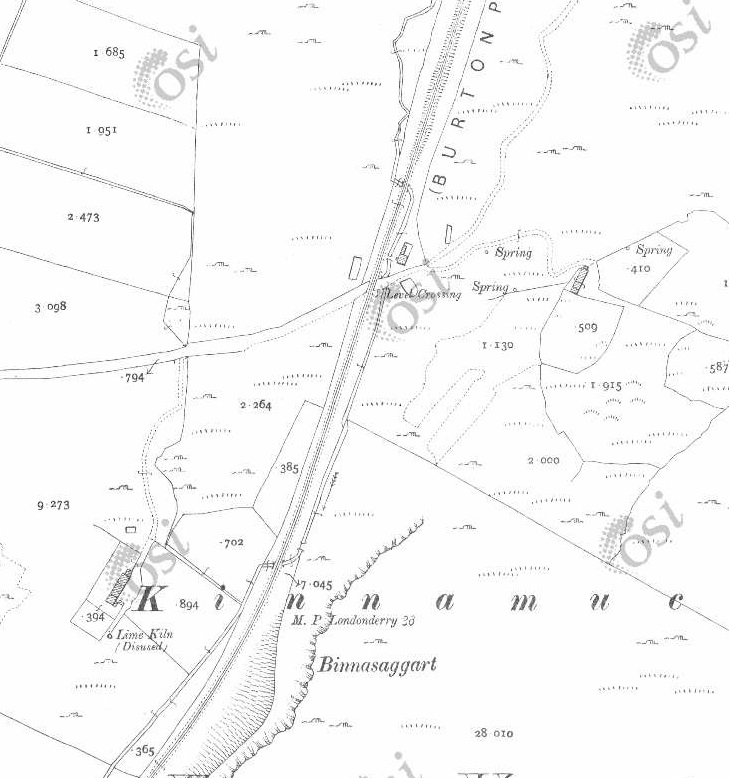
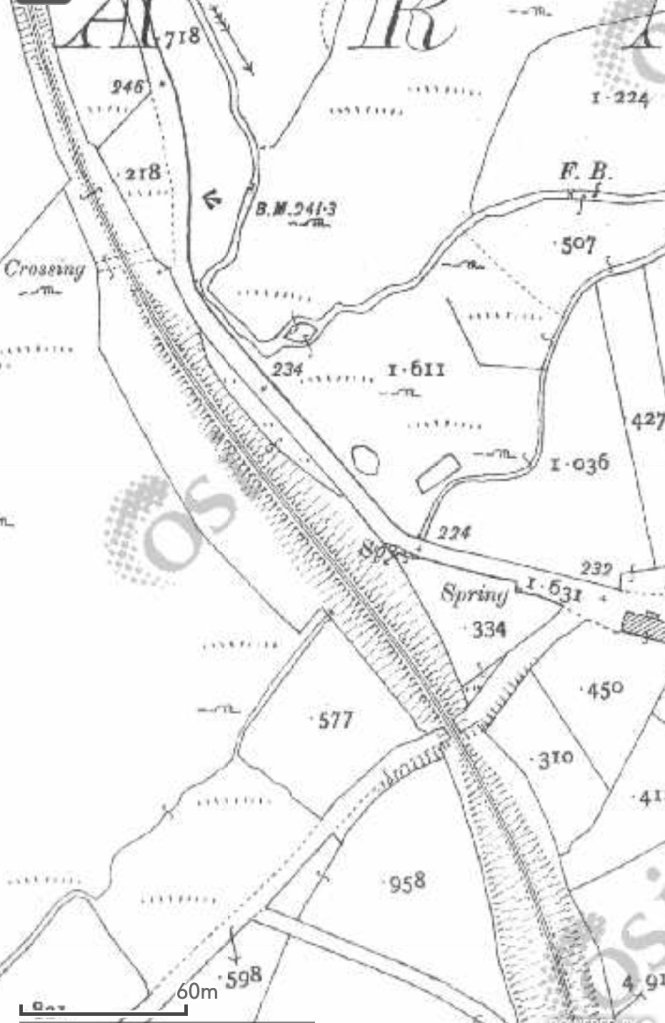
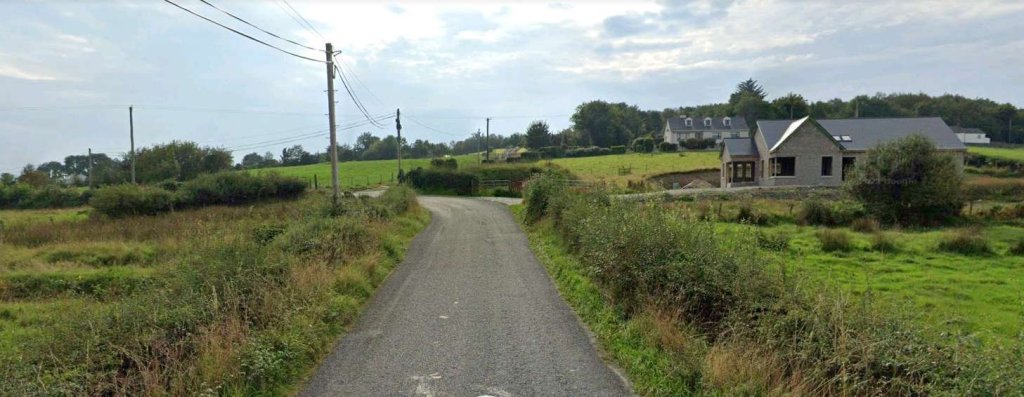
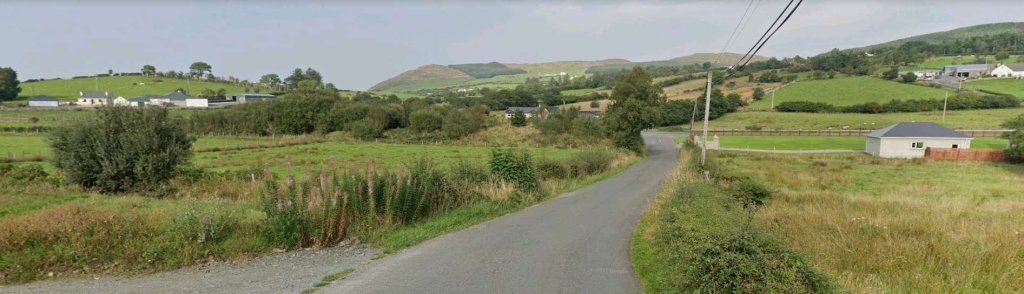
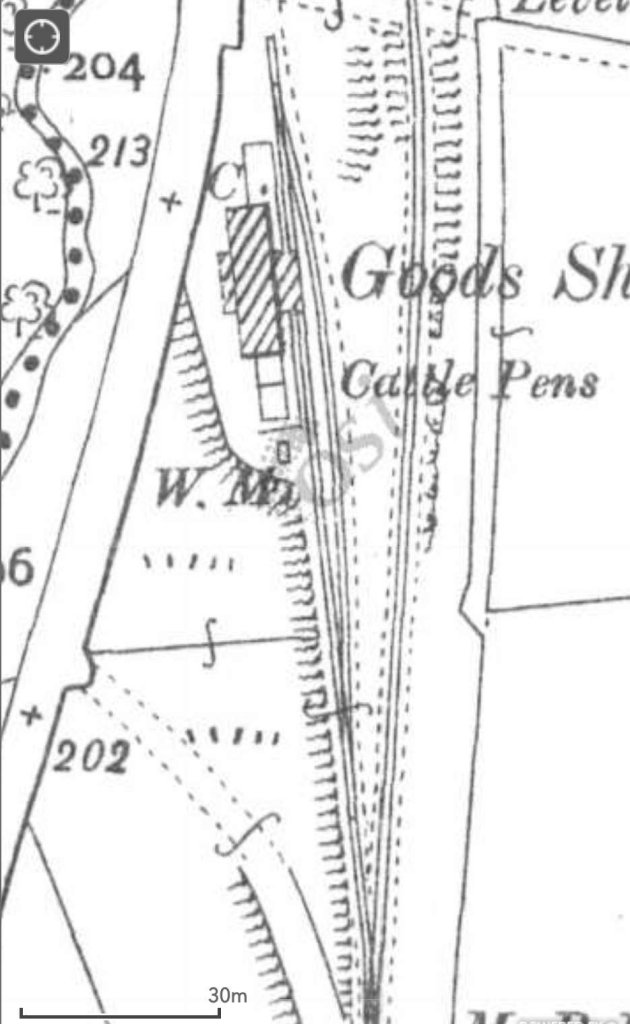
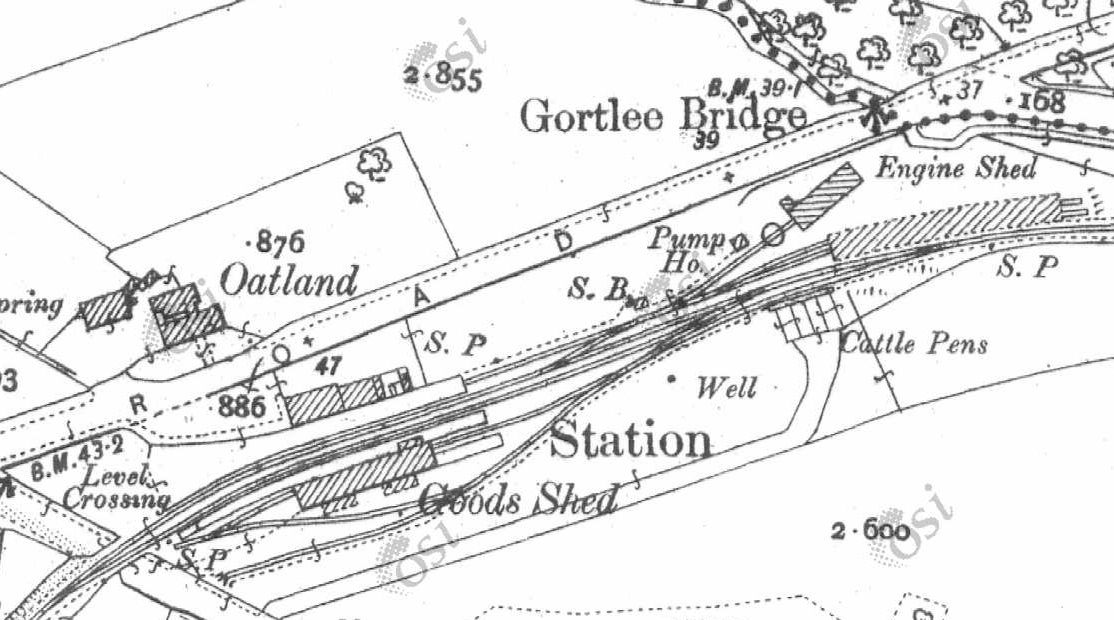
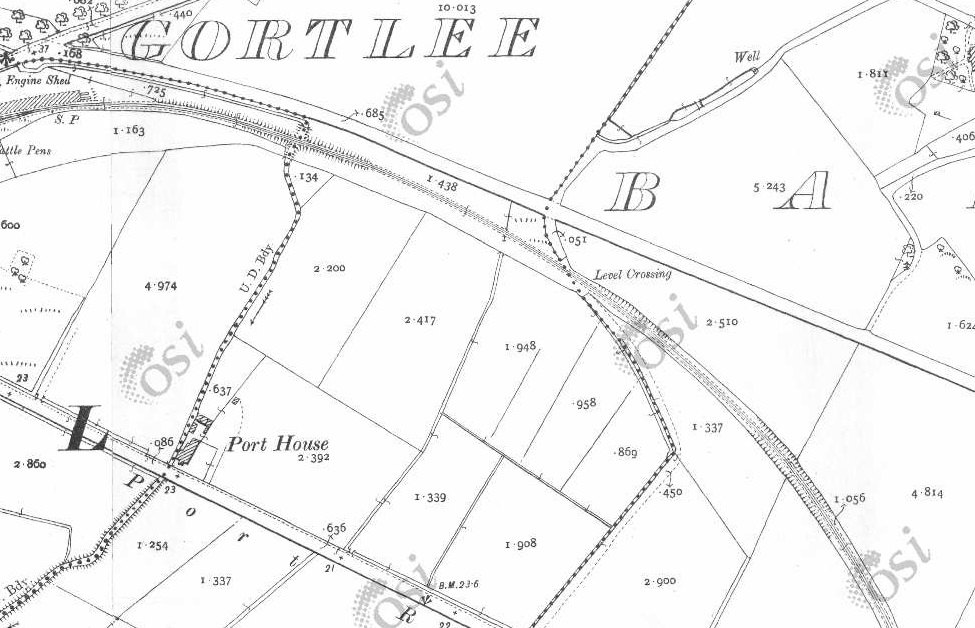
This next extract from the 25″ survey shows the bridge which carried the line across the river to the Southeast of the road crossing. The bridge appears at the bottom-right of the RailMapOnline image above. I do not have a photograph of this location in 21st century. However the image below shows that the bridge is still in place in 2023. [2]This grainy image is an enlarged view of the bridge as it appears on Google Earth. The old railway formation is in use as a moorland access track. [Google Earth, June 2023]This satellite image shows approximately the same length of the old railway as appears in the bottom half of the 6″ OSi map extract above. [4]This next extract from the 6″ OSi survey of 1901 shows the line turning from a South-southeast trajectory to a Southerly direction. In this length the line crossed what became two metalled minor roads. The mapping also crossed onto a new map sheet just to the South of the first of those level-crossings. [2]This image covers the top half of the map extract above. It again comes from the RailMapOnline.com website with the route of the old railway shown as a yellow line. [4]Looking West along the L5542 through the location of the old level crossing. The track to the right of the image follows the formation of the old railway. The crossing was gated (Gates No. 7), although no crossing-keeper’s cottage was provided. This suggests that train crews would probably have been responsible for opening and closing the gates. [Google Streetview, August 2021]Looking Southeast at the same location. The Burtonport Extension Railway route is marked by the yellow line. There is a line of conifers at the left side of this image which run along the line of the old railway. [Google Streetview, August 2023]The extract from the 25″ OSi survey shows two further level crossings. The more northerly of the two provided field access across the railway and would have been ungated. At the more southerly of the two the old railway crossed what eventually became a metalled road, the R255. This map extract ties in with the bottom half of the 6″ OSi map extract and the top left of the next RailMapOnline.com image below. [2]The old railway continued in a generally southerly direction beginning to turn towards the South-southwest. [4]A closer view of the location of the old railway crossing. Comparing this image with the map extract from the 25″ OSi survey shows that the carriageway is a little wider. Interestingly, looking back at the map extract from 1901, the road only seems at that time to have narrowed slightly at the crossing rather than turning to allow a crossing at right-angles to the railway. The crossing was gated (Gates No. 6) with train crews again needing to operate the gates. The location of the boundary fences which marked the extent of railway land can easily be seen North of the road. South of the road the railway land has become a woodland corridor. [4]Looking North at the location of the level crossing. [Google Streetview, August 2021]Looking South from the R255 at the same locagtion. The old railwayroute runs through the undergrowth directly ahead. The edge of railway land is the edge of the field on the right. [Google Streetview, August 2021]This and the next map extract are taken from the 25″ OSi survey of 1901 and show the railway heading South-southwest towards Kilmacrenan Station. There were two ungated crossings on this length of the line. [2]This map extract shows the length of the line just to the North of Kilmacrenan Railway Station. [2]This satellite image from RailMapOnline.com covers approximately the same length of line as shown on the two 25″ map extracts above. [4]This map extract shows the layout of Kilmacrenan Railway Station. This was another station with no passing loop at the turn of the 20th century, and where trains would need to lay back into the goods sidings to allow another one to pass. The road crossing on the Northern boundary of the station site would have been gated. The gates probably would have been operated by station staff. [2]The length of line South of Kilmacrenan Railway Station. [2]This satellite image covers approximately the same length of line as the two 25″ map extracts above. The line runs on a South-southwest/North-northeast axis. [4]The approach to Kilmacrenan Railway Station from the North as seen from the minor road at the North end of the station. [Google Streetview, August 2021]Kilmacrenan Railway Station site in 2021. The station is seen from the minor road at the North end of the Station platform. The goods shed/store is left of centre, the platform edge remains, as does the station house. [Google Streetview, August 2021]
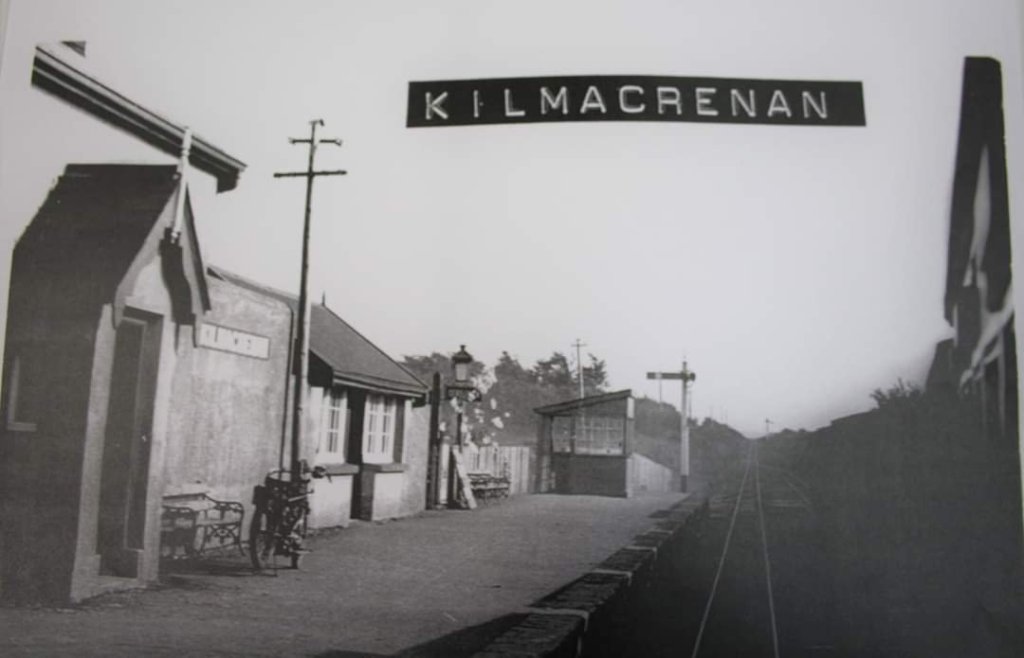
“Kilmacrenan Station was to the west of the town, approximately two miles away by road in the townland of Doon. Nearby is Doon well, which was a pilgrimmage venue which generated passenger traffic to the station. The station building and platform were on the Up side with a goods store and two sidings behind this.” [6]
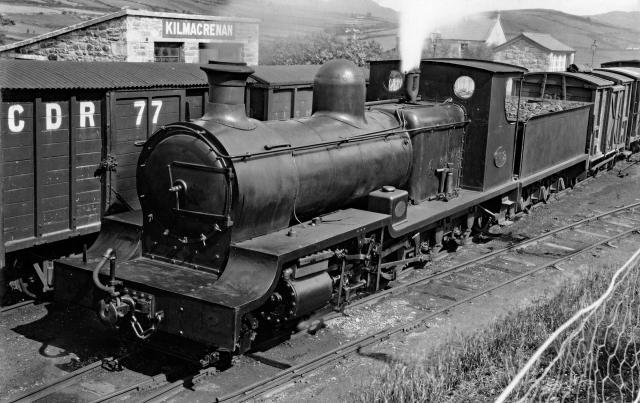
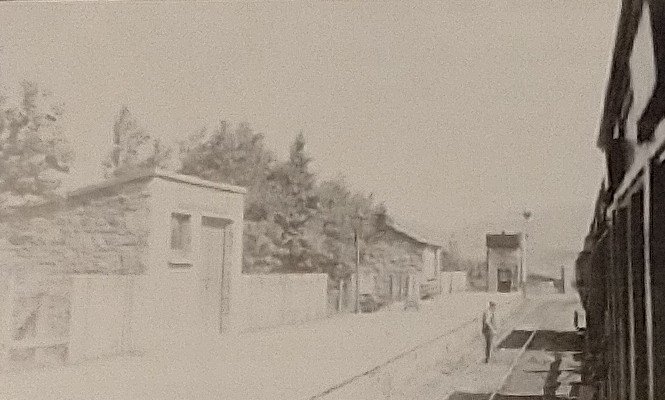
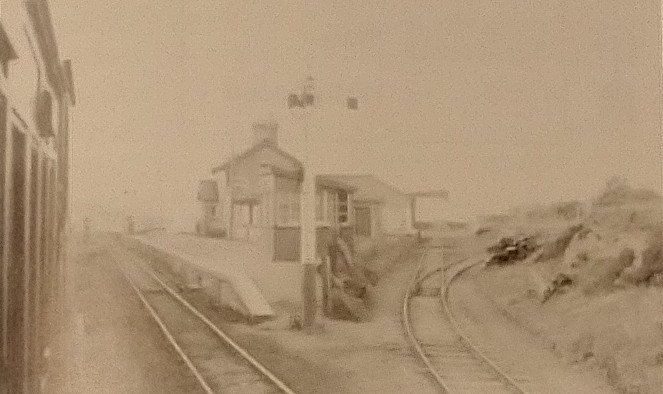
These two photographs show Kilmacrenan Railway Station as it appeared in 2007. The goods shed and the station house are seen above in a photograph taken from the Northeast, just to the South of the road serving the station. [7]This photograph looks along the line of the sidings at Kilmacrenan Station from close to the location of the buffers. Both this image and that immediately above were shared on the Londonderry & Lough Swilly Railway Facebook Group on 19th November 2020 by Chris Stewart. [7]This photograph of 4-8-0 Locomotive No. 12 shows it on a goods train at Kilmacrenan Railway Station. Two trains appear to be passing each other. The picture was shared by the Donegal Railway Heritage Centre on Facebook on 25th March 2022. [8]This image was shared on Facebook by Donegal County Museum on 17th August 2020. It shows the passenger station building on the left. It seems that, in this picture, two lines ran alongside the platform. The photograph was taken from a train in 1937 by H.C. Casserley. [9]These two further pictures of the station were also taken by H.C. Casserley in 1937 from the train on which he was travelling. This image looks North, the train appears to be heading South. [1: p64]This photograph also looks North but from a different train heading North towards Barnes Gap and Creeslough. The photograph was also taken by H.C. Casserley. [1: p63]These two map extracts show the railway line further to the South of Kilmacrenan Station. The line ran for some distance on a straight course. [2]This RailMapOnline.com satellite image shows approximately the same length of the line as shown on the two 25″ map extracts immediately above. [4]The line continues, eventually curving further to the Southwest, through Mile Point 36 (from Londonderry). [2]And on, passed Cannon’s Lough. [2]Again, this satellite image covers the same length of the line as the two map extracts above. [4]This and the next two extracts from the 25″ OSi survey of 1901 take the line as far as Level Crossing No. 5. [2]These two images cover the same length of the line as the three map extracts above. [4]Crossing-keeper’s cottage and gates No. 5 appear at the bottom-left of this satellit image.[4]
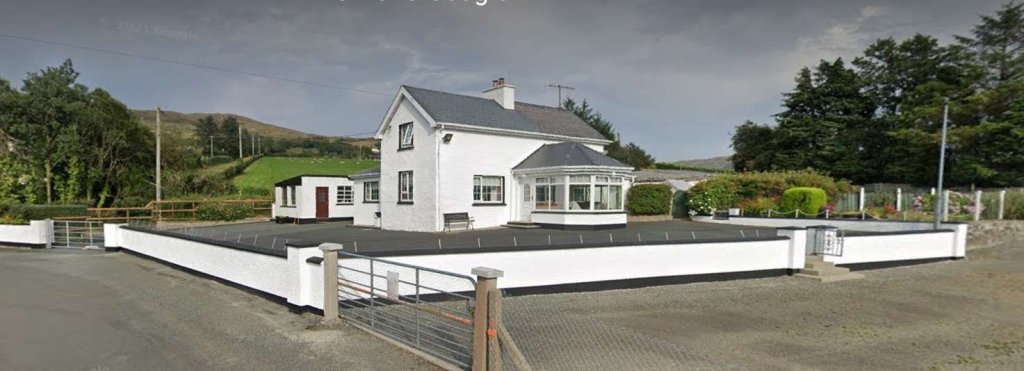
Crossing Cottage No. 5 has been significantly extended since the demise of the line.
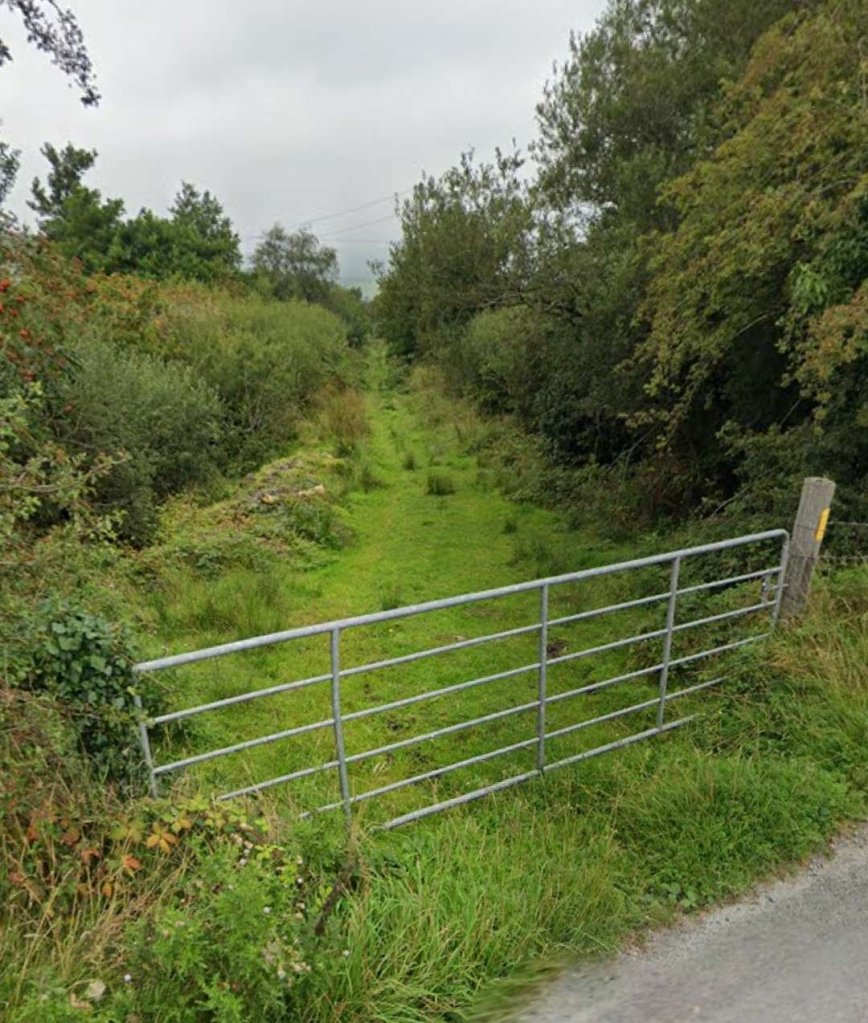
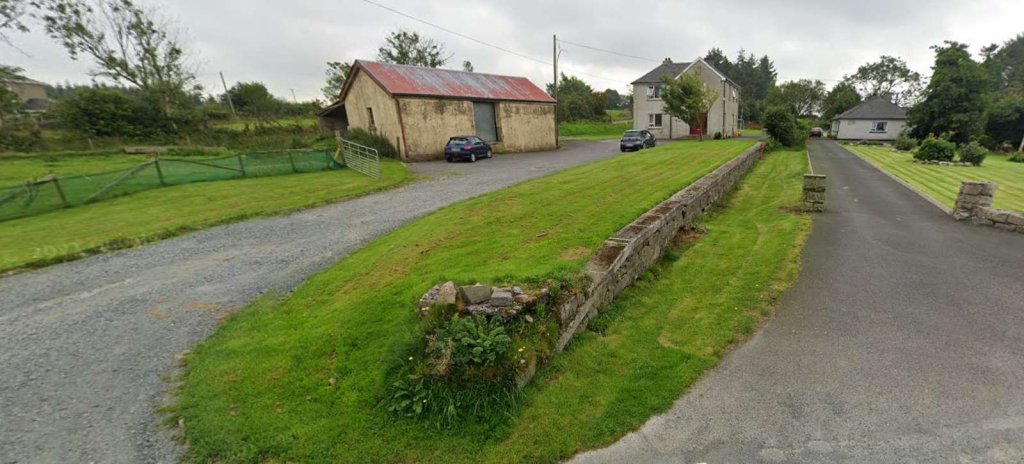
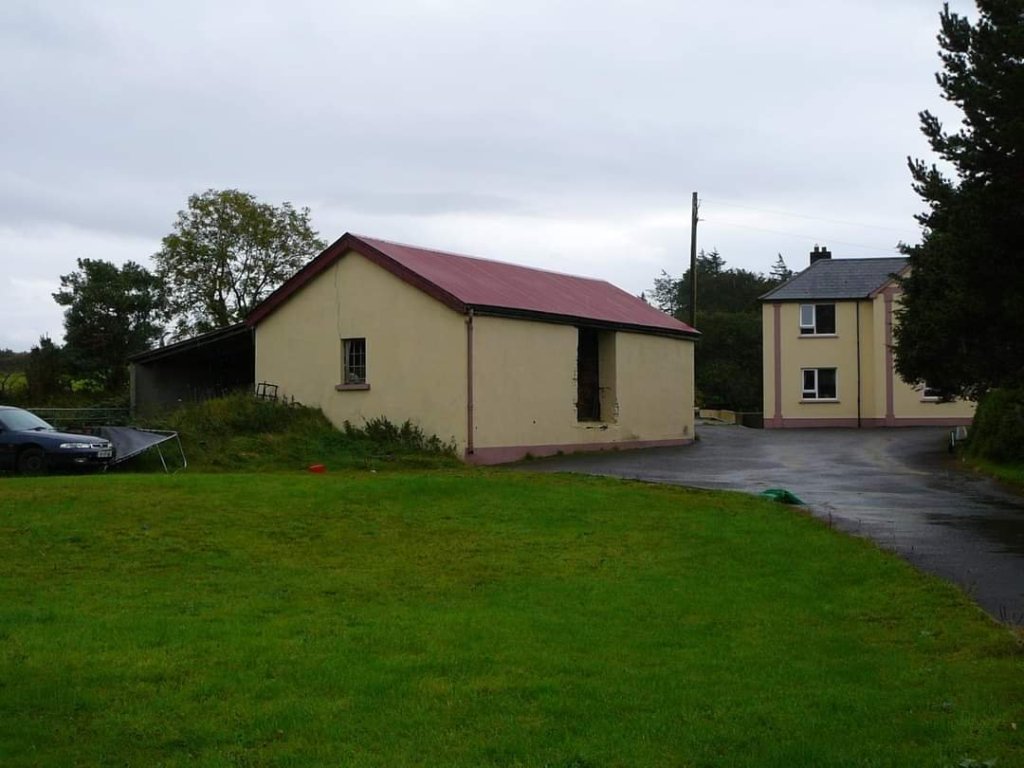
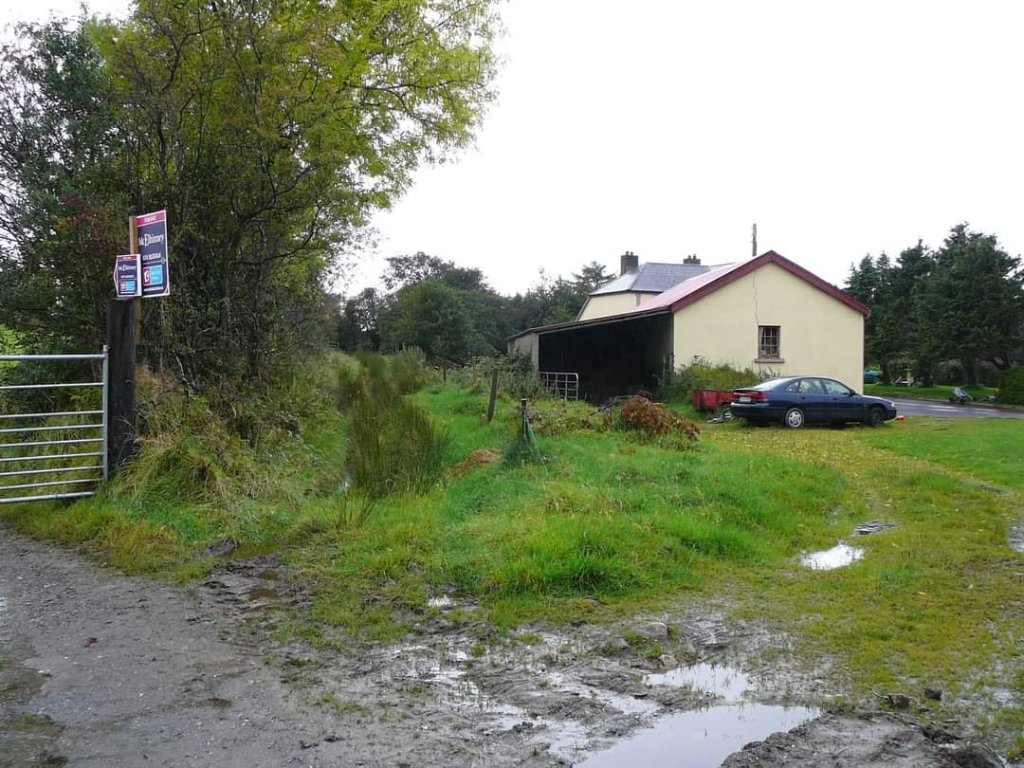
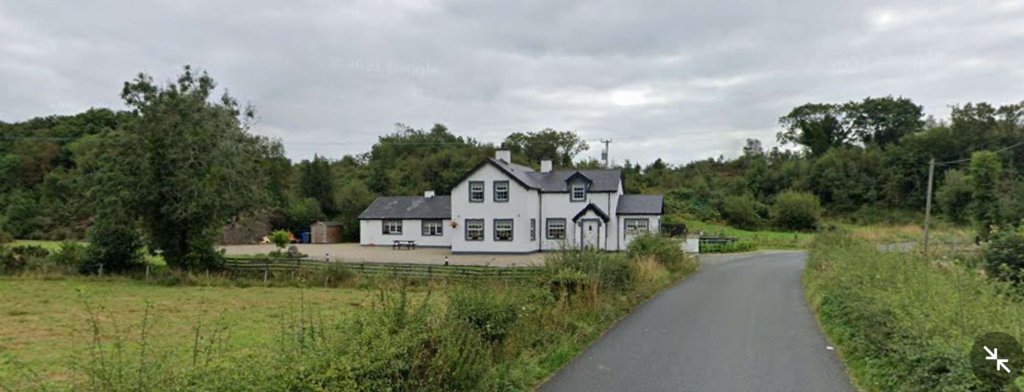
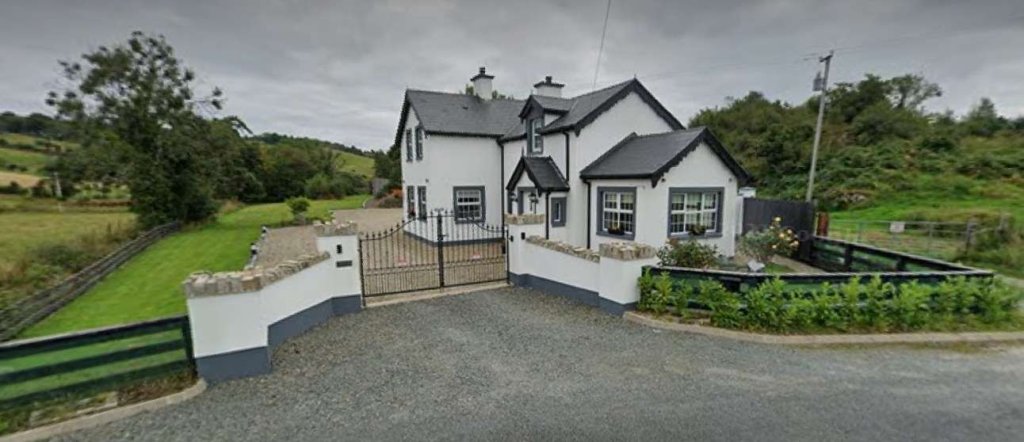
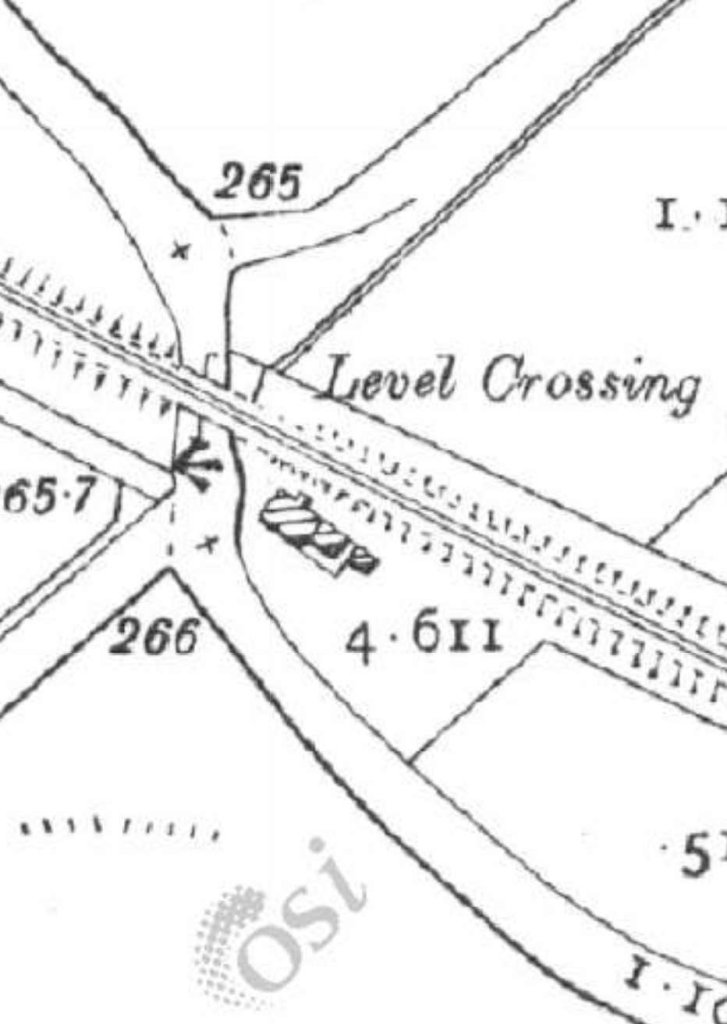
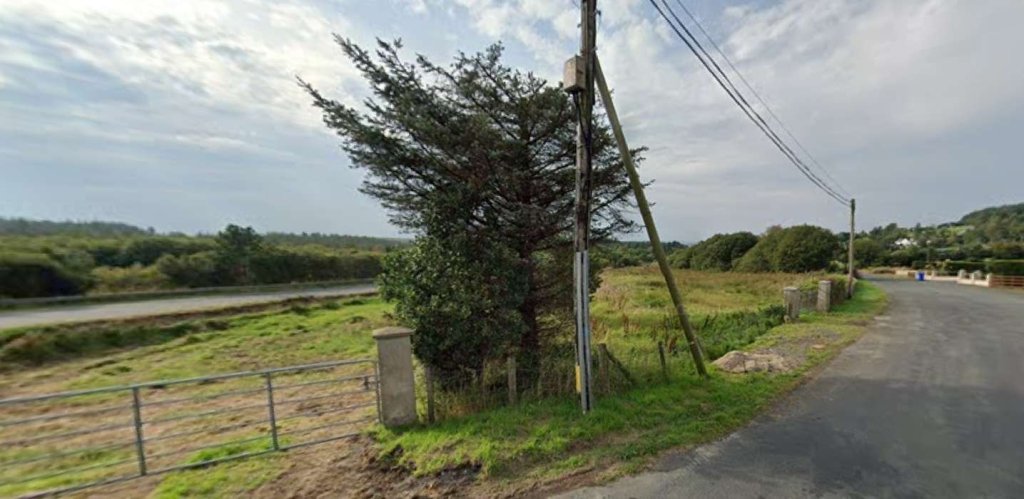
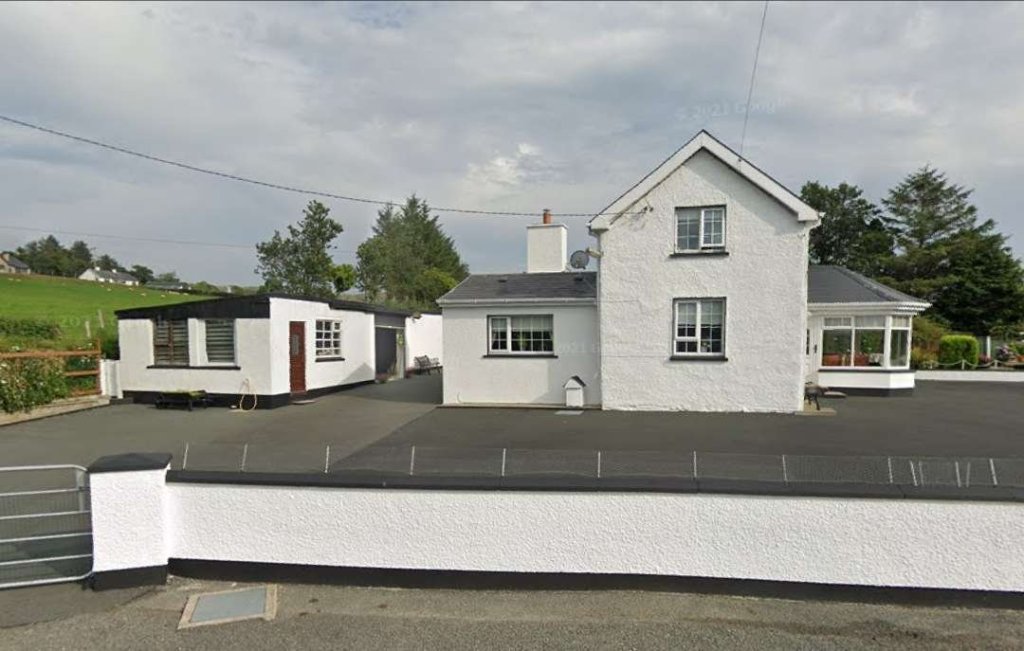
Crossing No. 5, the Keeper’s Cottage sat on the East side of the line, North of the minor road which crossed the line.Crossing Cottage No. 5 as it appeared in August 2021. The original cottage is much extended. The old railway ran across the image left to right (or vice- versa) in front of the cottage. [Google Streetview, August 2021]Looking North along the line of the Burtonport Extension Railway from the location of Crossing No. 5. The original cottage is the two storey section of the building closest to the camera. [Google Streetview, August 2021]The minor road curves sharply to the South on the East side of the crossing and runs roughly parallel to the old railway formation which can be seen running South behind the field gate. [Google Streetview, August 2022]
Being at one of the significant crossings along the line warrants us noting the comments about these crossings made by Bell and Flanders: “These Gates were a regular feature along the route of the line and were much more important than the accommodation crossings. … Whereas accommodation crossings were private accessways for local farmers the Gates were placed where the railway crossed public roads and were always staffed – opened and closed – by railway employees who lived in the adjoining houses.
Accommodation crossing gates [where they existed]were kept open for the railway and closed to the farm tracks until someone needed to cross. Crossing Gates, on the other hand were always kept open for the road and closed to the trains until it was time for a train to pass by.
Being a crossing keeper was a good job as it was a steady income, good living accommodation and, as there were few trains even in the railway’s golden days, the work wasn’t strenuous. But crossing keepers did have to know the railway regulations and any special instructions issued from time to time. Crossing keepers were often the wives of railway gangers who had their length of track to check and maintain each day. As the years went by the gated crossings sometimes became regular, though “unofficial” stopping places for passengers and goods.” [1: p61]
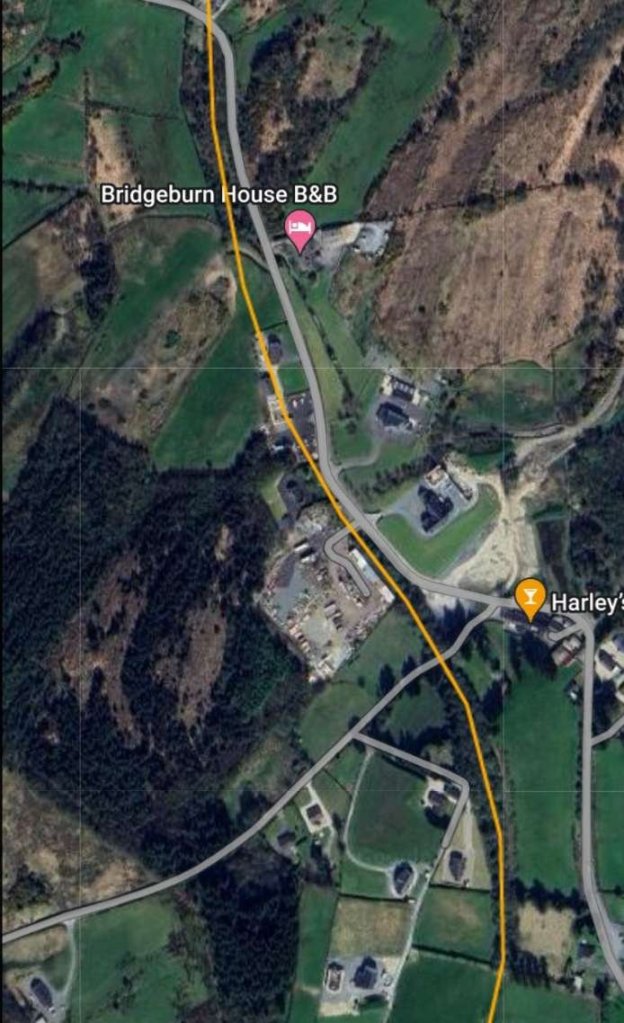
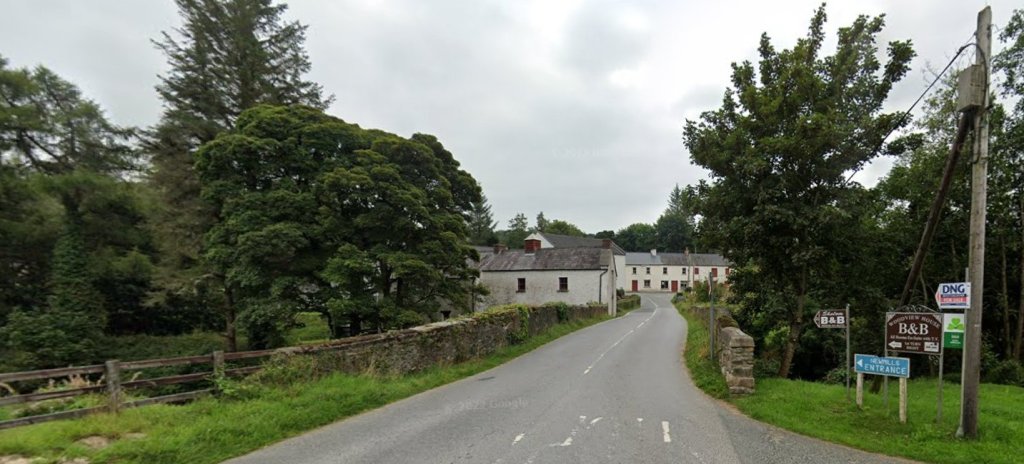
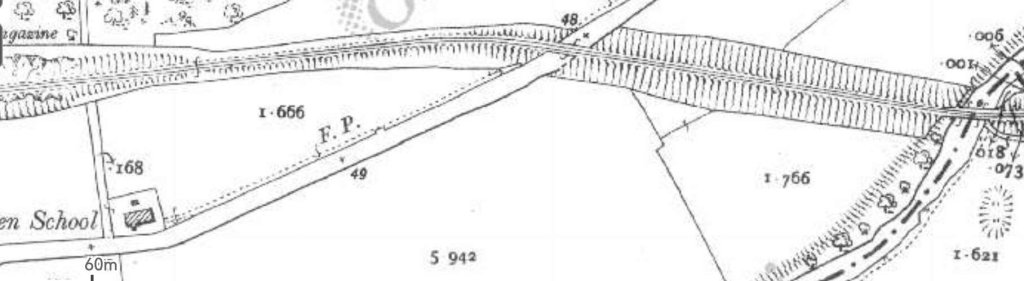
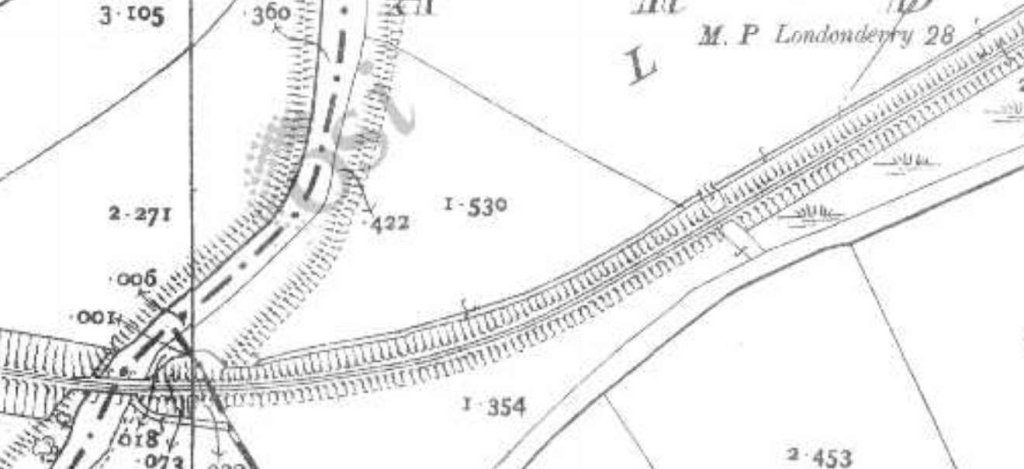
The old line continues in a South-southeast direction alongside the minor road which leads to Treantagh. [2]Both these two images are map extracts from the 25″OSi 1801 survey. Close to Treantagh the old railway turned towards the South, crossing a road bridge in the process.The next RailMapOnline extract shows roughly the same area as the two map extracts above. The route of the old railway continues to be shown by the yellow line. [4]The building on the right of this image is built across the line of the old railway. This image is taken looking South adjacent to Bridgeburn House B&B flagged on the satellite image above. [Google Streetview, August 2021]A short distance to the South, the old railway ran along the verge of the road for a short distance, approximately on the line of the boundary wall before heading through what is now a stand of trees which can be seen on the left of this image. [Google Streetview, August 2021]The line is rising as the road falls away and turns to the left. The trees mentioned above fill the right half of this image. [Google Streetview, August 2021]
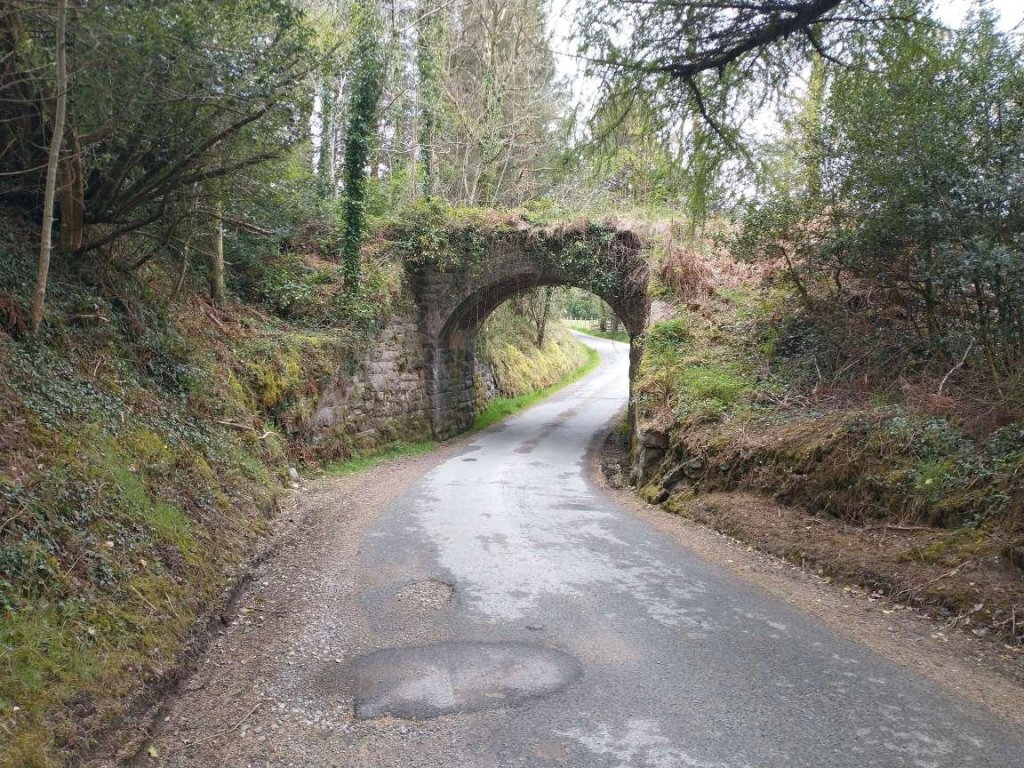
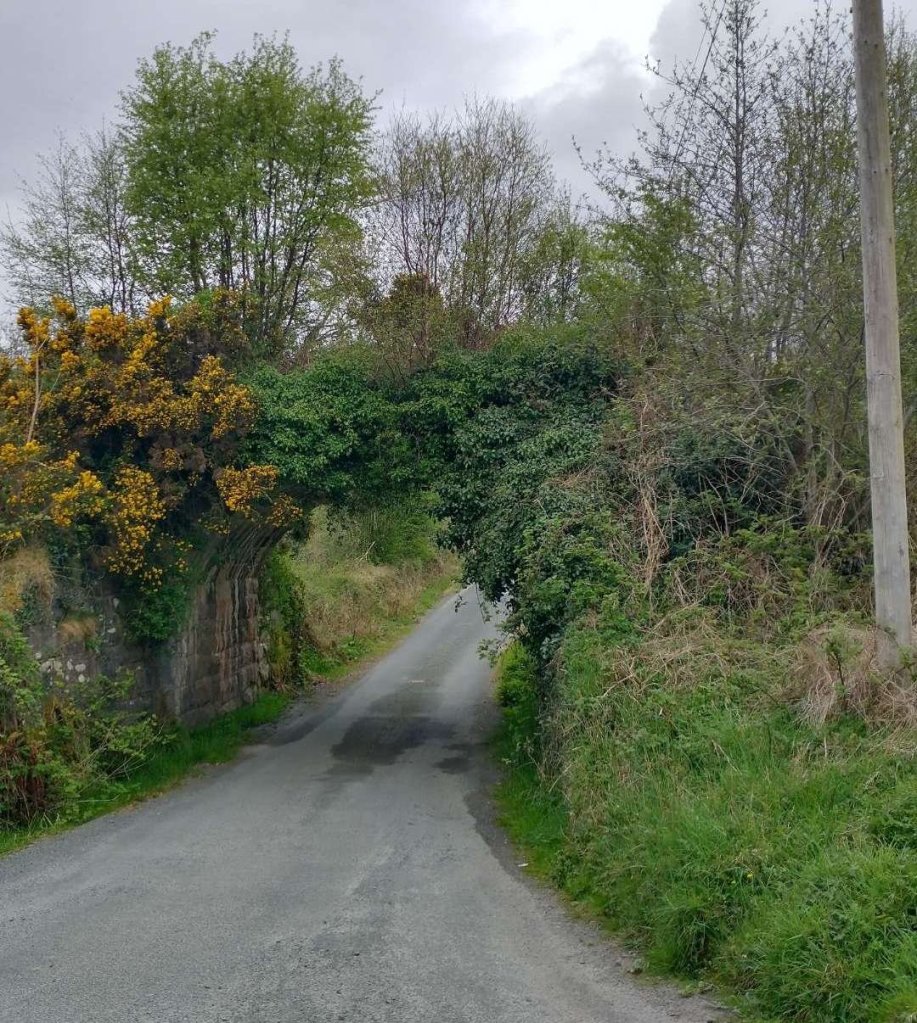
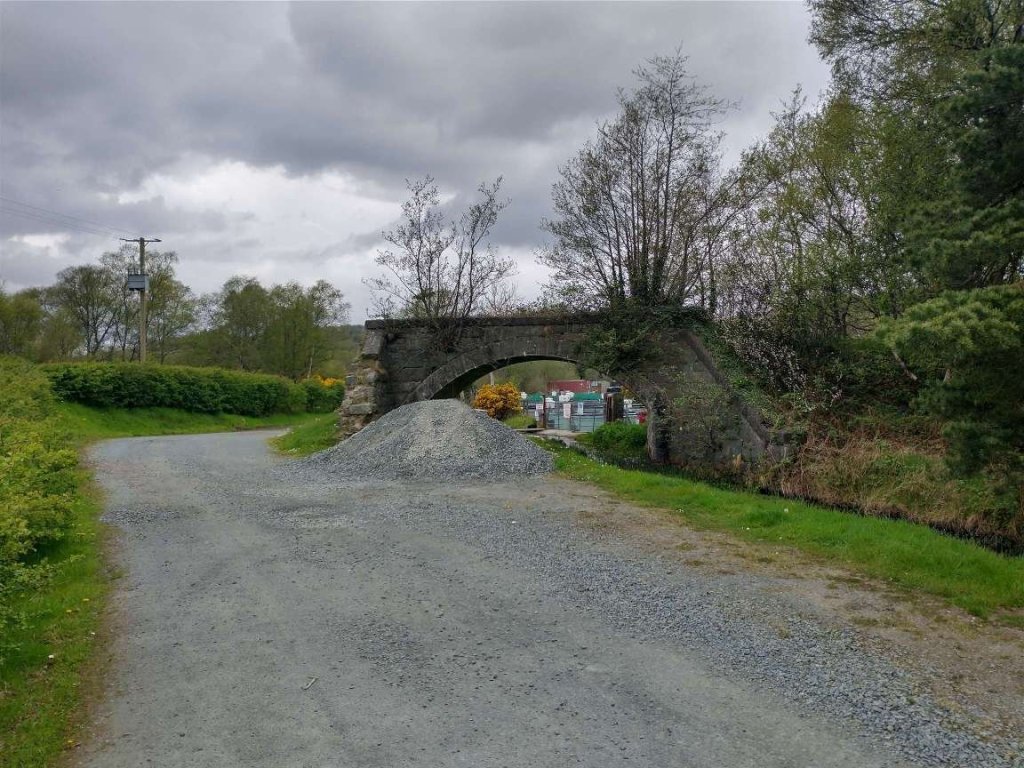
A little further to the South the line crossed a different minor road by means of a stone arch bridge.
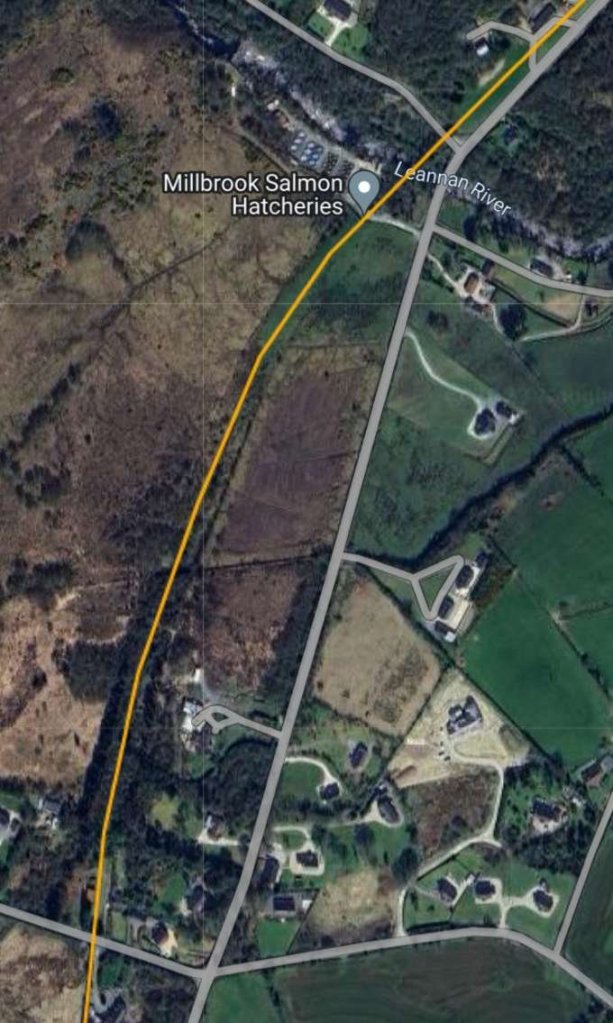
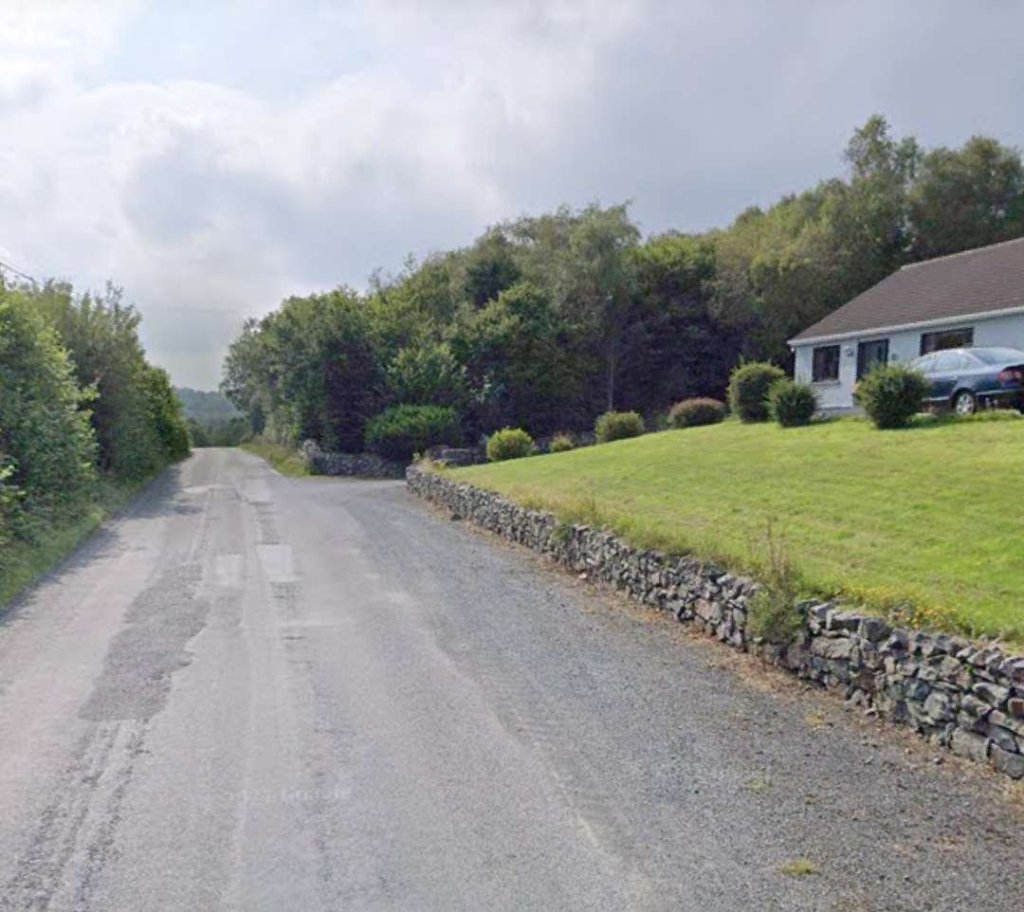
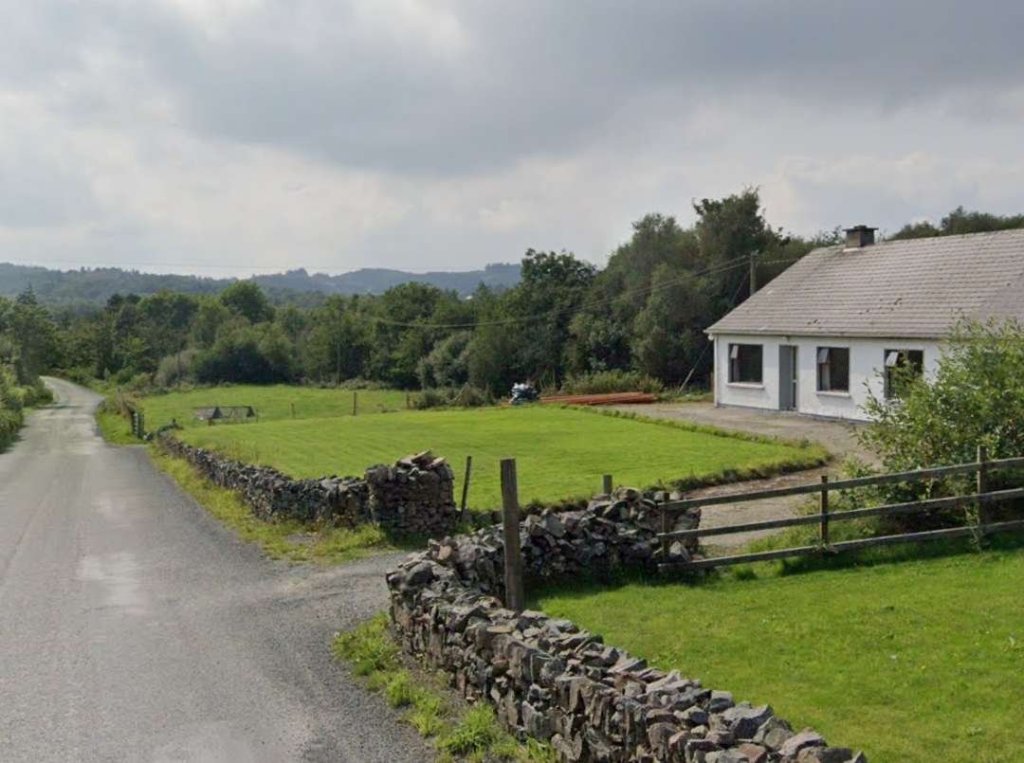
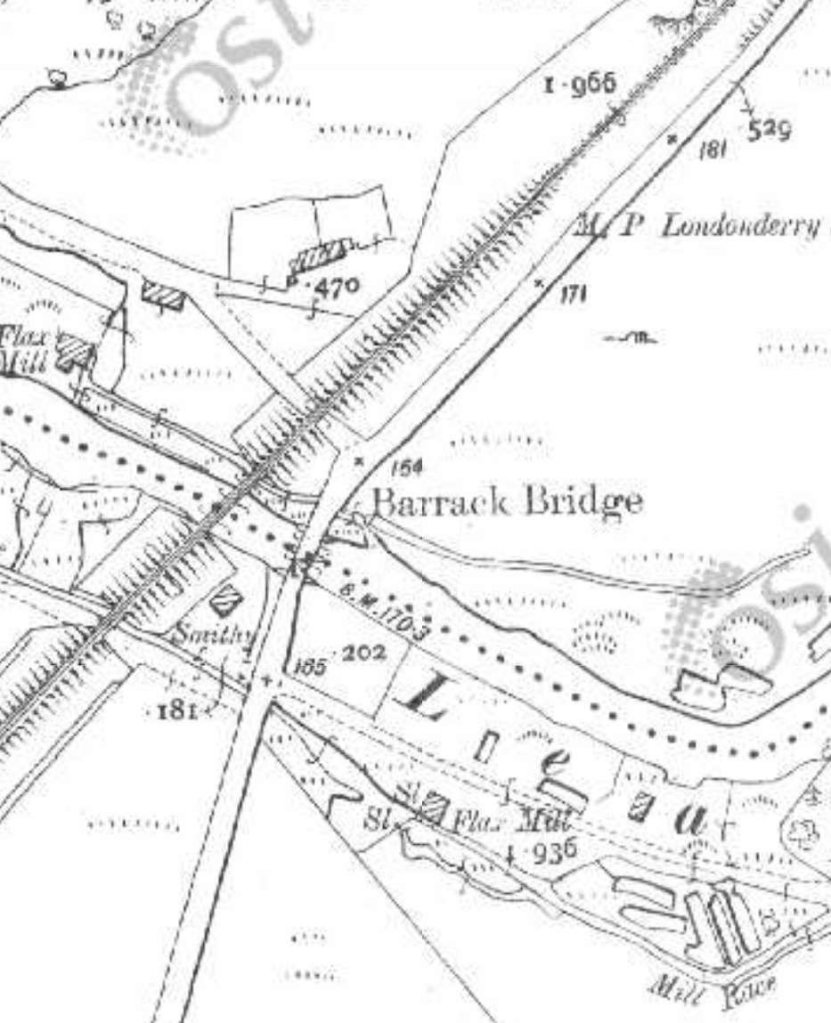
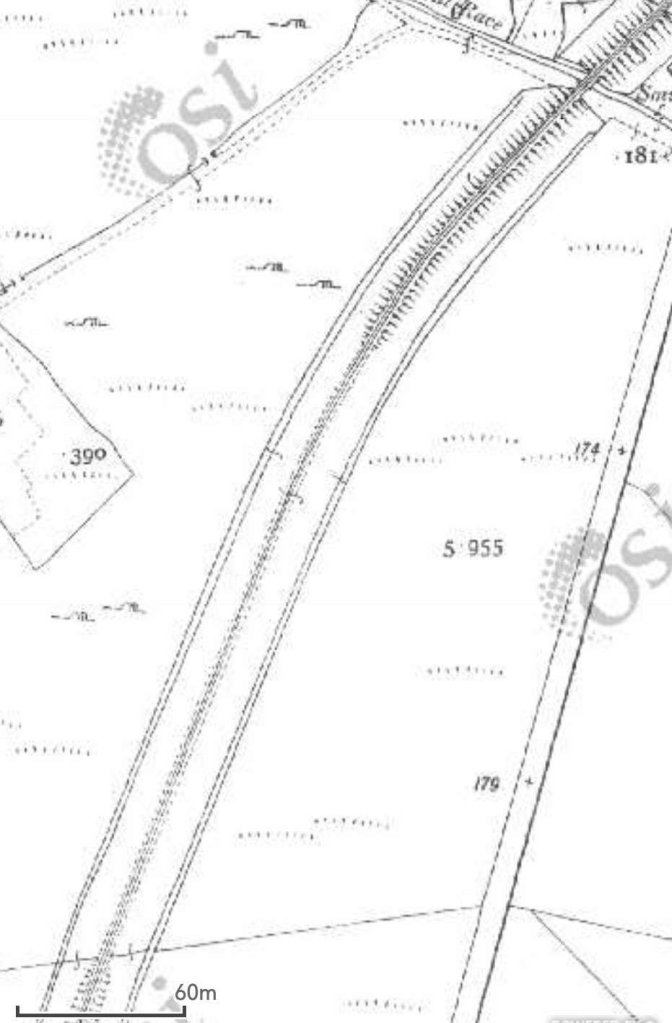
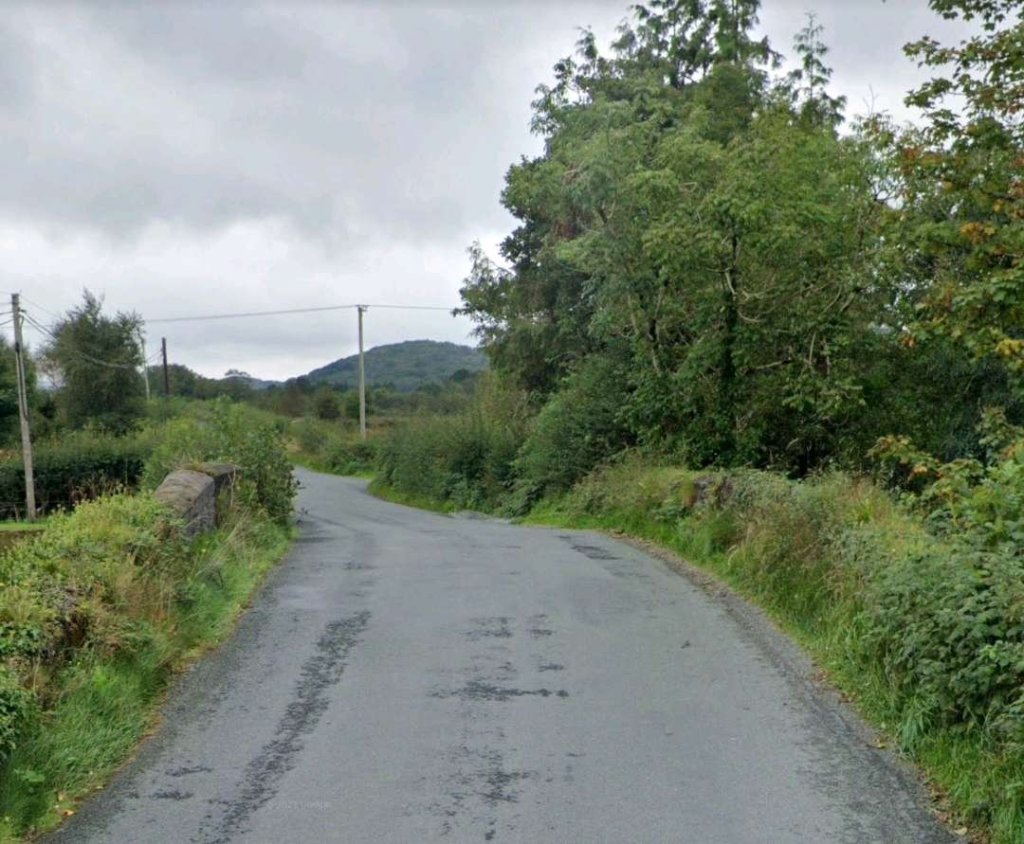
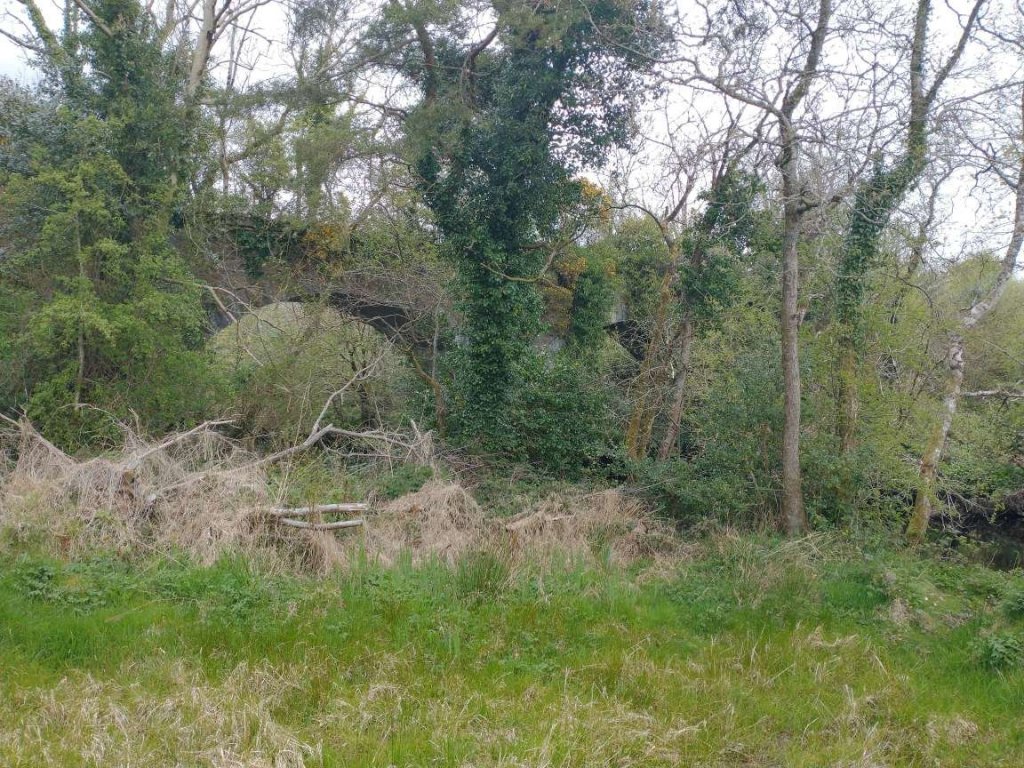
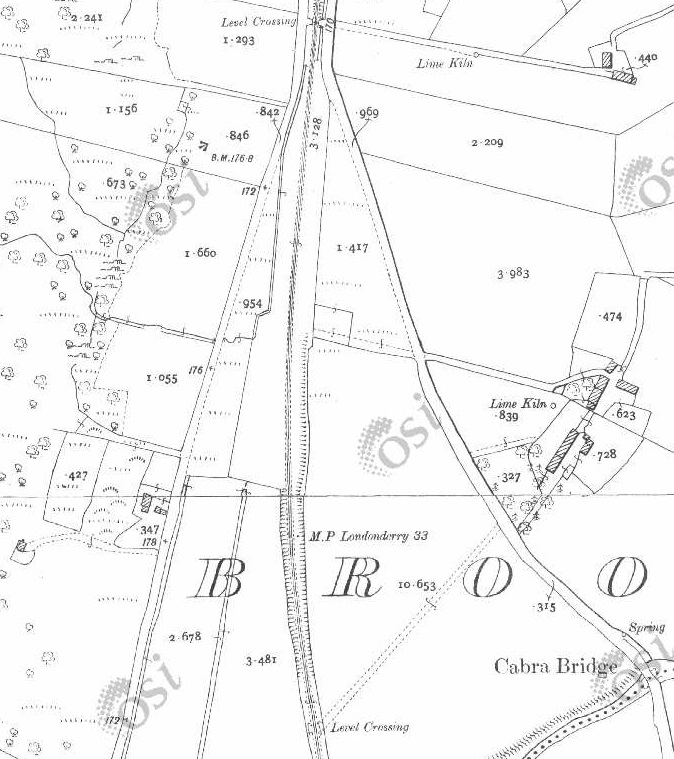
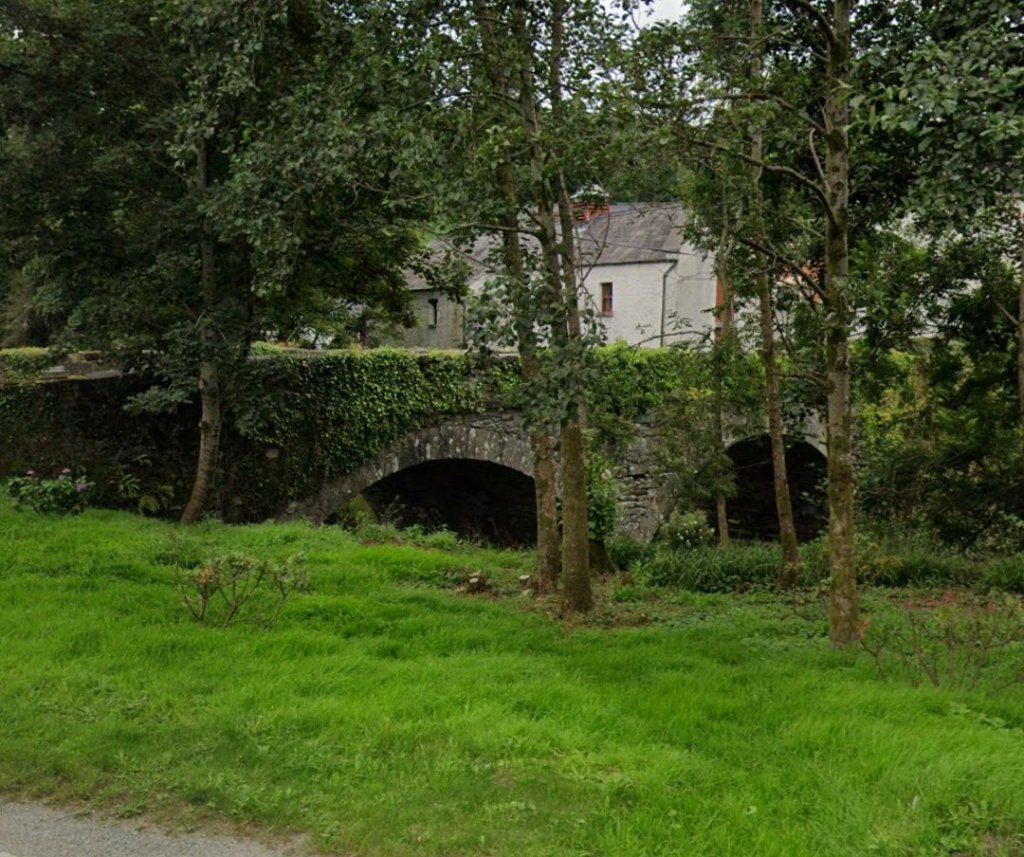
The bridge shown in the satellite images above. The photograph looks along the minor road from the Northeast. [My photograph, 29th April 2023]The line continued to the South, curving round towards the Southwest. [2]The line continues turning to the Southwest, beginning to run alongside another minor road. [2]Road and rail ran in tight formation heading Southwest. [2]This satellite image from RailMapOnline.com covers the length of the old line illustrated on the three extracts from the 25″ OSi mapping of 1901. [4]The route of the old railway is shown on the satellite image above as running through woodland on the North side of the minor road. [Google Streetview, August 2021]The bungalow on the right of this image is approximately on the line of the old railway. [Google Streetview, August 2021]This image shows the next bungalow along the minor road which again sits on what was the old railway formation. [Google Streetview, August 2021]The old railway, while travelling in a Southwesterly direction, was carried over a series of obstacles as this extract from the 25″ OSi 1901 survey shows: a road, a mill-race, the River Lennan, another mill race and then an access road. [2]This and the next map extract show the length of the line North of Churchill (Church Hill) Railway Station. [2]Churchill Railway Station appears at the bottom of this map extract. [2]This satellite image covers the same ground as the map extracts immediately above. [4]Another minor road leading to Milltown Carrick is spanned by a stone arch bridge, which appears at the top-right of the satellite image above. [My photograph, 29th April 2023]Looking Southwest along the minor road crossing the River Lennan at Barrack Bridge. The route of the old railway was only a very short distance to the right of the road at this location. In the summer months, the arch bridge carrying the old railway over the River Lennan is shielded from the road bridge by modern vegetation. However, at the time of our visit in April/May 2023 the vegetation was not carrying its full summer weight. [Google Streetview, August 2021]The railway bridge across the River Lennan is shown in this photograph taken from the road carriageway. [My photograph, 29th April 2023]A very short distance to the Southwest was a viaduct carrying the old railway across an access road and a mill stream. In the 21st century, the road provides access to Millbrook Salmon Hatchery which is noted on the satellite image above. Originally the road served flax mills downstream. [My photograph, 29th August 2023]
The next location that we have access to is the point at which the old railway crossed the next minor road. That location appears both at the bottom of the satellit image above and the top of the next section of the line, both on the OSi mapping and the satellite imagery below: the location of Churchill (Church Hill) Railway Station.
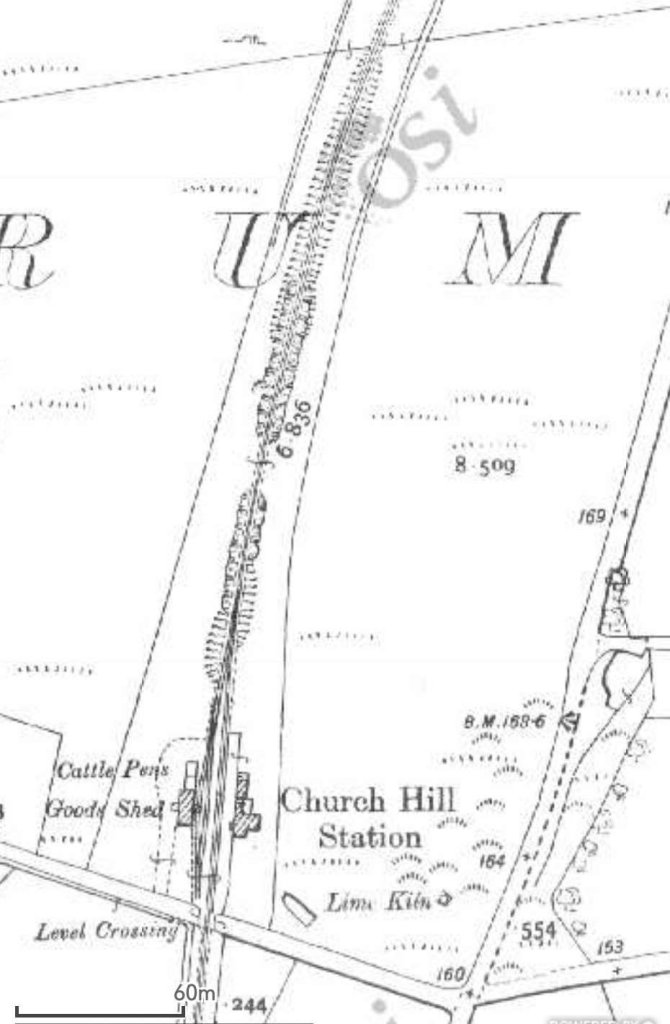
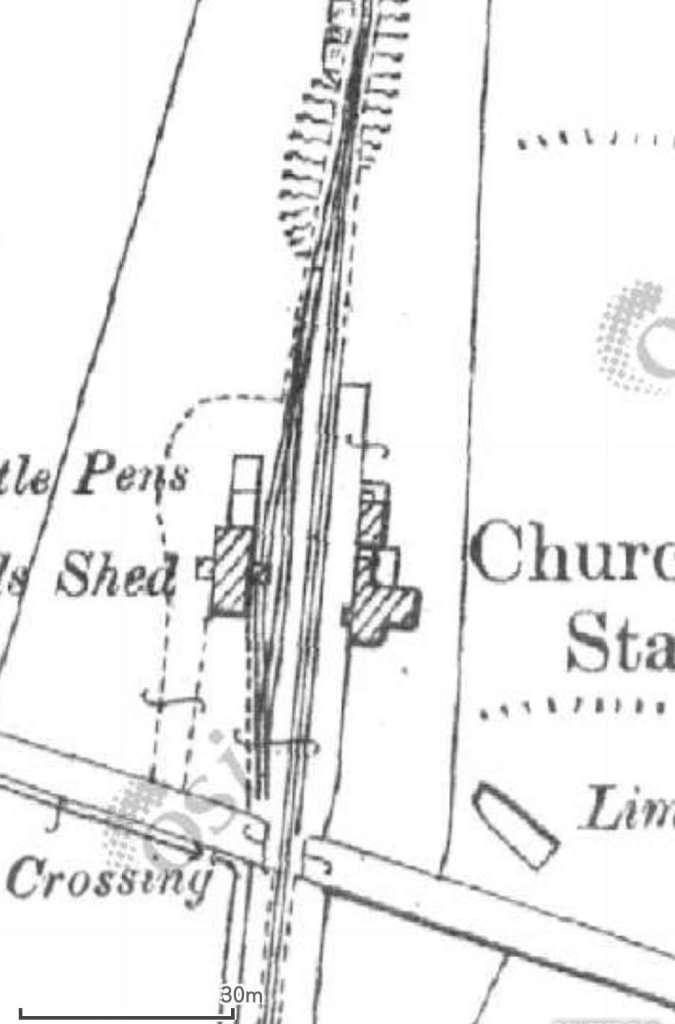
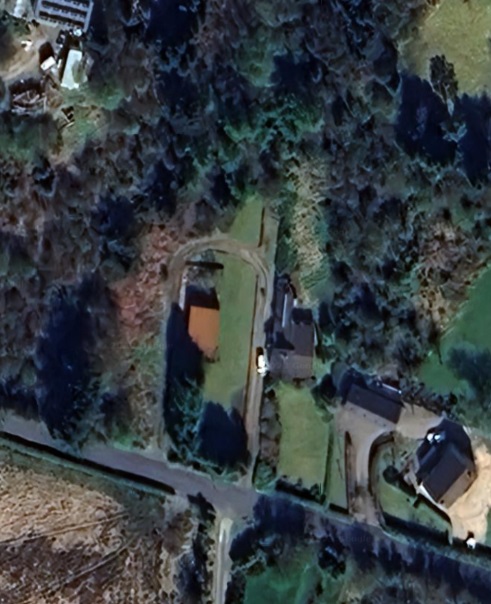
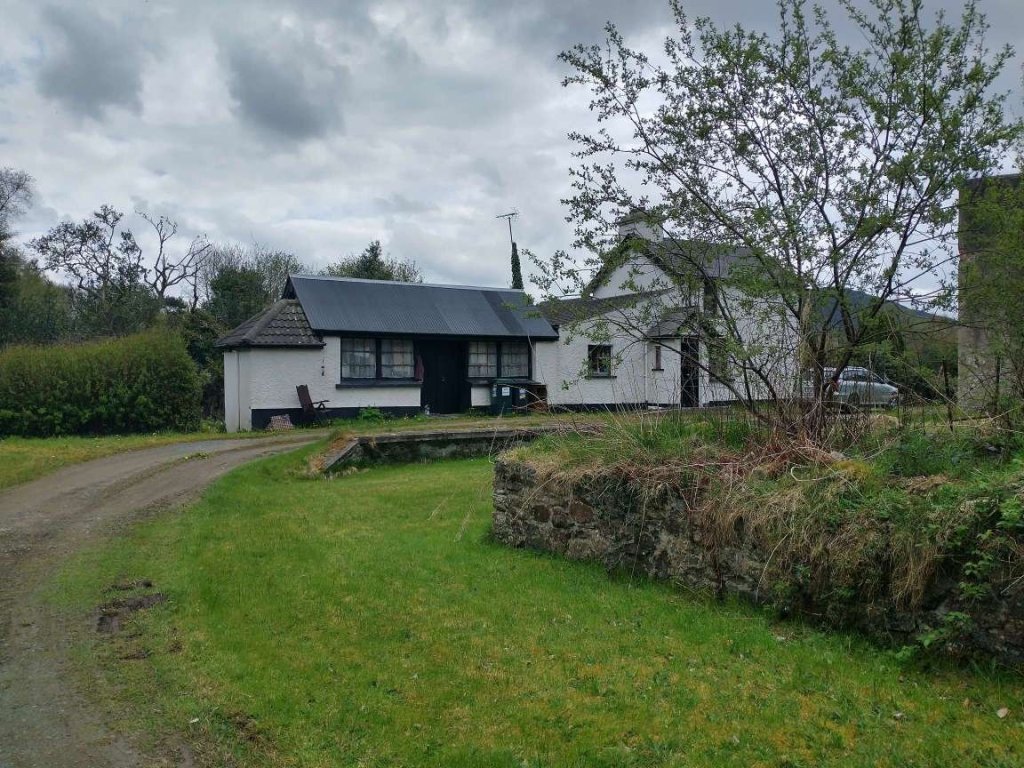
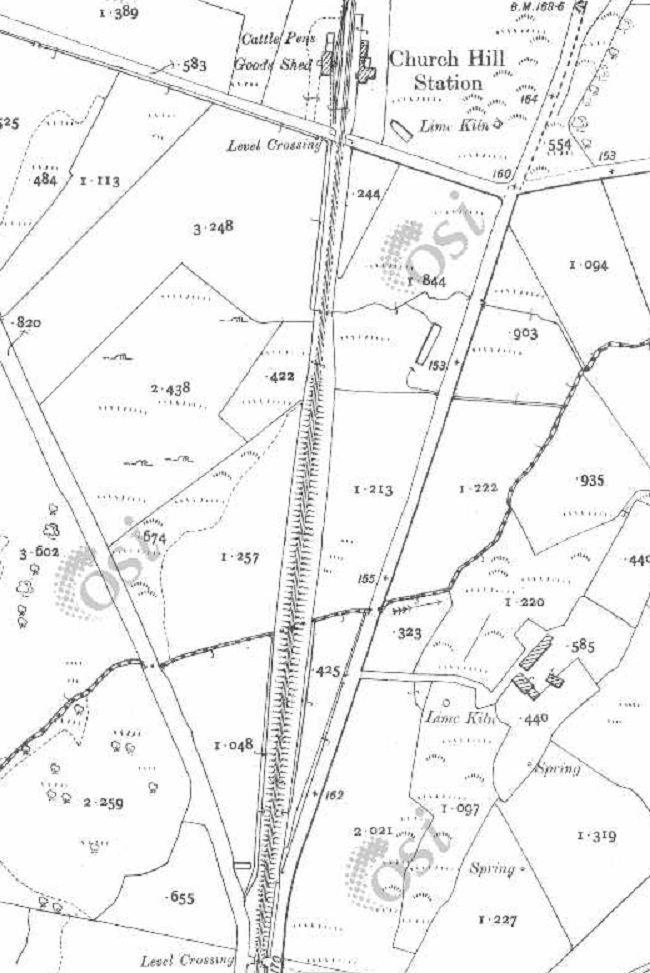
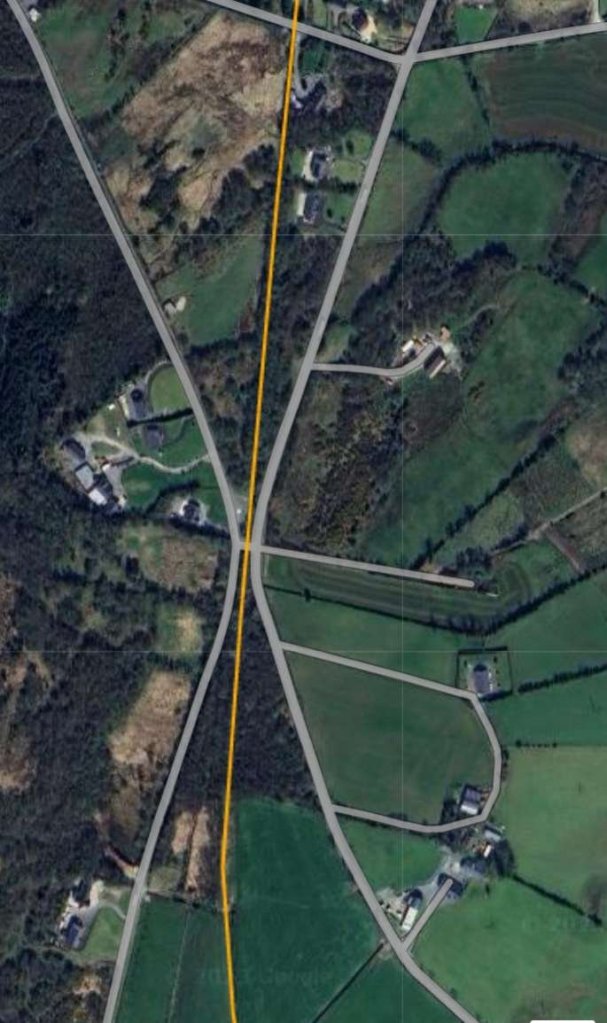
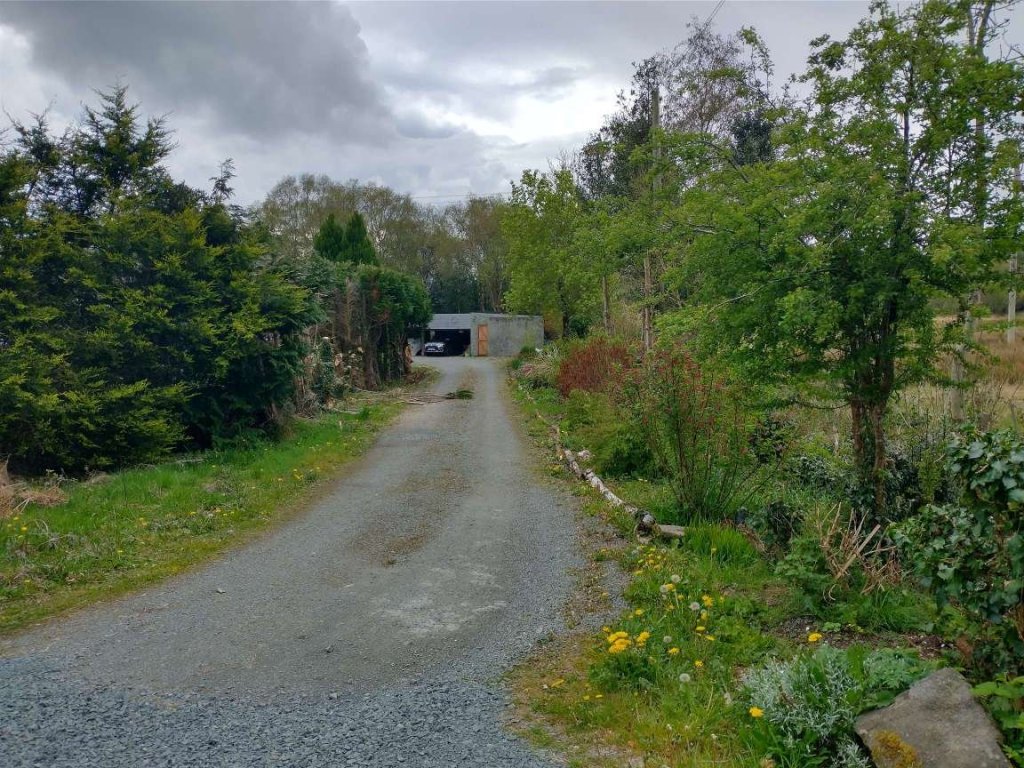
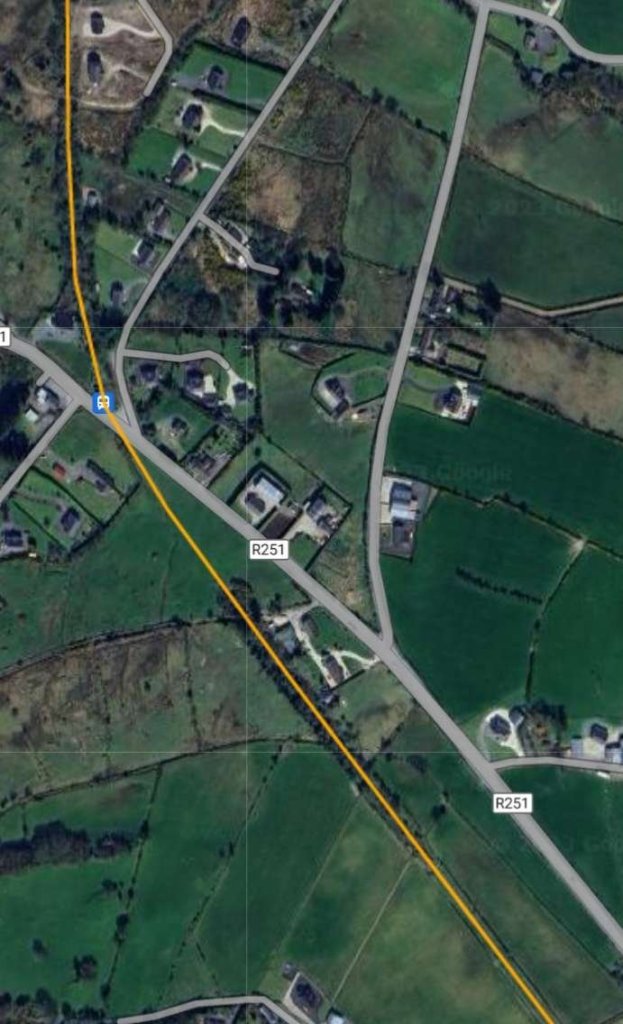
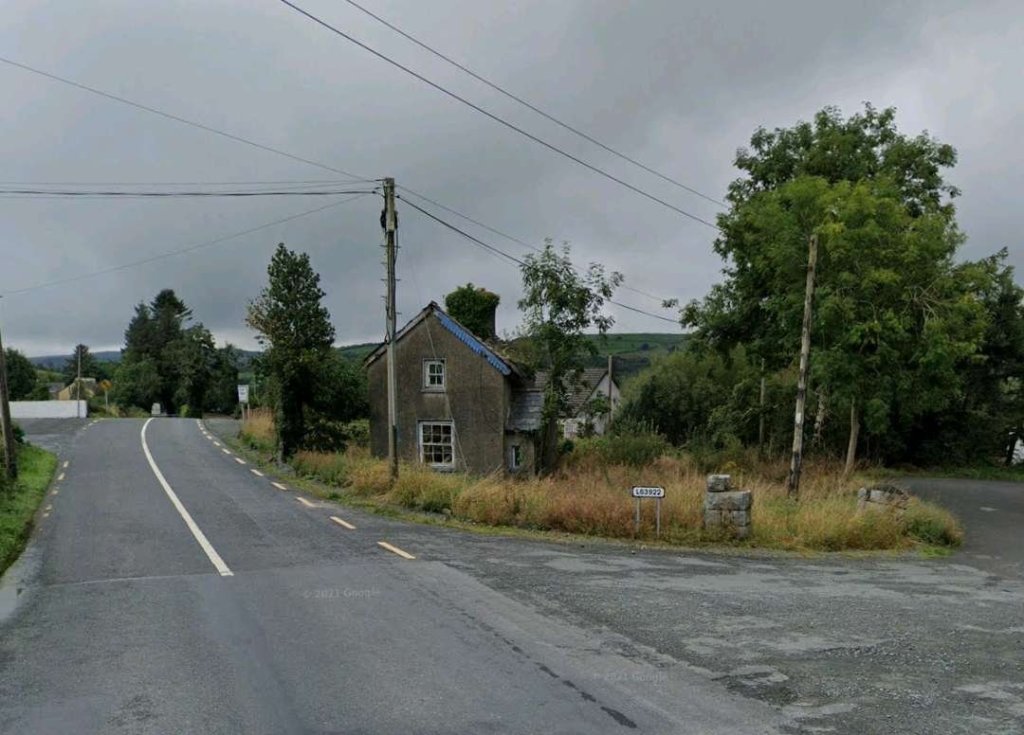
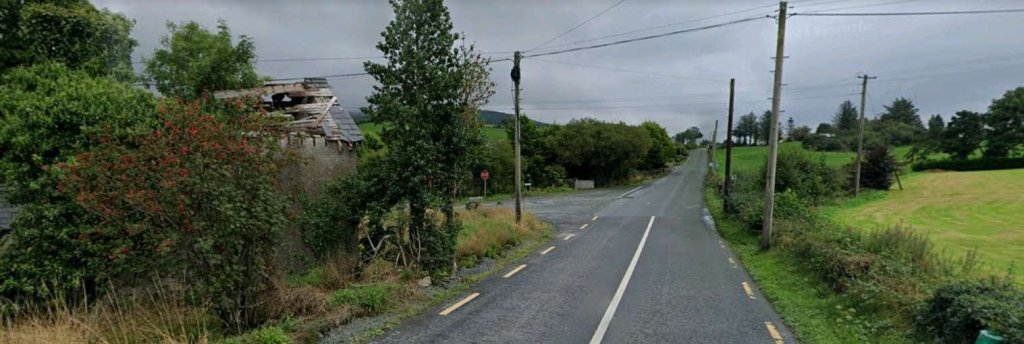
An enlarged map extract of Churchill (Church Hill) Railway Station as shown on the 25″ OSi survey of 1901. The goods shed/store can be seen on the West side of the line, the passenger facility is on the East side of the line. It appears that in 1901, there was no passing loop at the station. [2]The location of Churchill (Church Hill) Railway Station as it appears on Google Earth in 2023. [Google Earth 3rd July 2023] Church Hill Railway Station passenger facilities still stand in the 21st century and are now a private home. This photograph looks at the buildings from the Northwest. [My photograph, 29th April 2023]This is how the buildings appeared at the turn of the 21st century or perhaps a little later. The photograph looks onto the site from the North-northwest. [10: p164]This view from the South looks along Ng the old station platform. The Goods Shed is on the left and the station building on the right. [My photograph, 29th April 2023]The Church Hill Station building as seen from the road which crossed the old line at the South end of the station site. [My photograph, 29th April 2023]The Goods Shed seen from the North. The platform close to the camera was the location of the cattle pens. [10: p164]This next extract from the 25″ OSi mapping shows the old railway heading almost due South as it left Church Hill Railway Station. At the bottom of this extract two roads flank the old railway for a short distance. [2]South of the level crossing the roads diverged from the old railway. [2]This satellite image provided by RailMapOnline illustrates the convergence and divergence mentioned above. It covers the same length of the old railway as the two map extracts above. [4]Looking South along the route of the Burtonport Extension Railway from the road which crossed the old railway at the Southern end of Church Hill Railway Station. [My photograph, 29th April 2023]Looking back North from the level crossing noted above. [My photograph, 29th April 2023]Turning through 180° to look South along the old railway as it headed towards Letterkenny. In a rural context, the road arrangement at this location must be unusual! [My photograph, 29th April 2023]The two map extracts above show the old line curving gently from a South-southeast direction to a South-southwest trajectory and following the Glashagh River. [2]This extract from RailMapOnline.com shows much the same length of line as covered by the two 25″ map extracts above. [4]The three extracts from the 25″ OSi survey of 1901 show the Burtonport Extension curving back towards the South and bridging the Glashagh River. [2]This extract from RailMapOnline.com shows the same length of the old railway. [4]This is the best image that I can provide of the railway bridge crossing the River Glashagh. It can be seen between a quarter and a third of the way up the last image from the bottom, just in from the left margin. [Google Streetview, 4th July 2023]These three map extracts take the old railway through its crossing over the junction between what are now the R251 and the L63922 roads before taking a Southeasterly path. [2]Another extract from the RailMapOnline.com satellite imagery which covers the same length of the old line as the three 25″ map extracts above. Note both the location of Crossing No. 3 and that of the accommodation bridge to the Southeast. [4]The junction between the R251 and the L63922, looking Northwest back along the route of the old railway towards Church Hill Railway Station. The gatekeeper’s cottage is in a state of decay, parts of two of the gateposts remain adjacent to the road number sign for the more minor road. This location was Crossing No. 3 on the Burtonport Extension Railway. [Google Streetview, August 2021]The road that is now the R251 used to curve round to cross the old railway at right-angles. That curve is visible as th edge of the tarmac highway in the modern pictures of the junction. [2]This is a wide angle image of the same crossing, also looking Northeast. This image allows the full location of the crossing to be seen. The railway passed to the right of the crossing keeper’s cottage, crossed what is now the R251 at an angle and ran along the line of the trees on the left of this image. Google Streetview, August 2021]Walking a little to the Northwest, this image looks through the same crossing but is taken looking Southeast. The ruined crossing keeper’s cottage is on the left. The old railway formation passes behind the cottage and crosses the road, heading away along the line of trees/bushes to the right of the road, behind the first telegraph pole. [Google Streetview, August 2021]
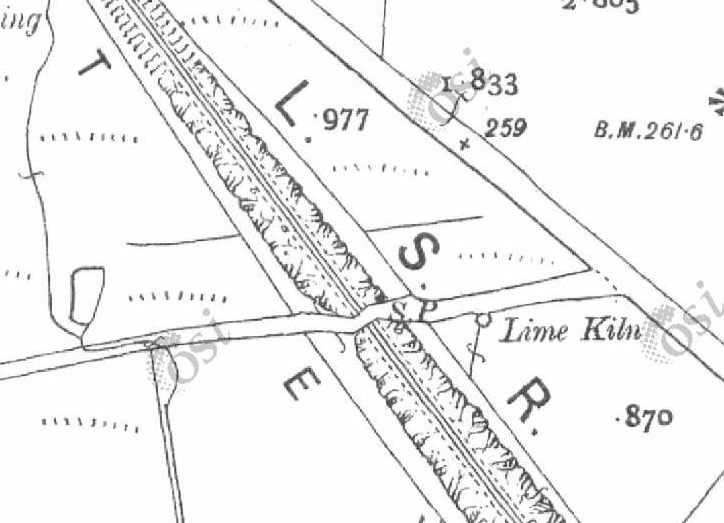
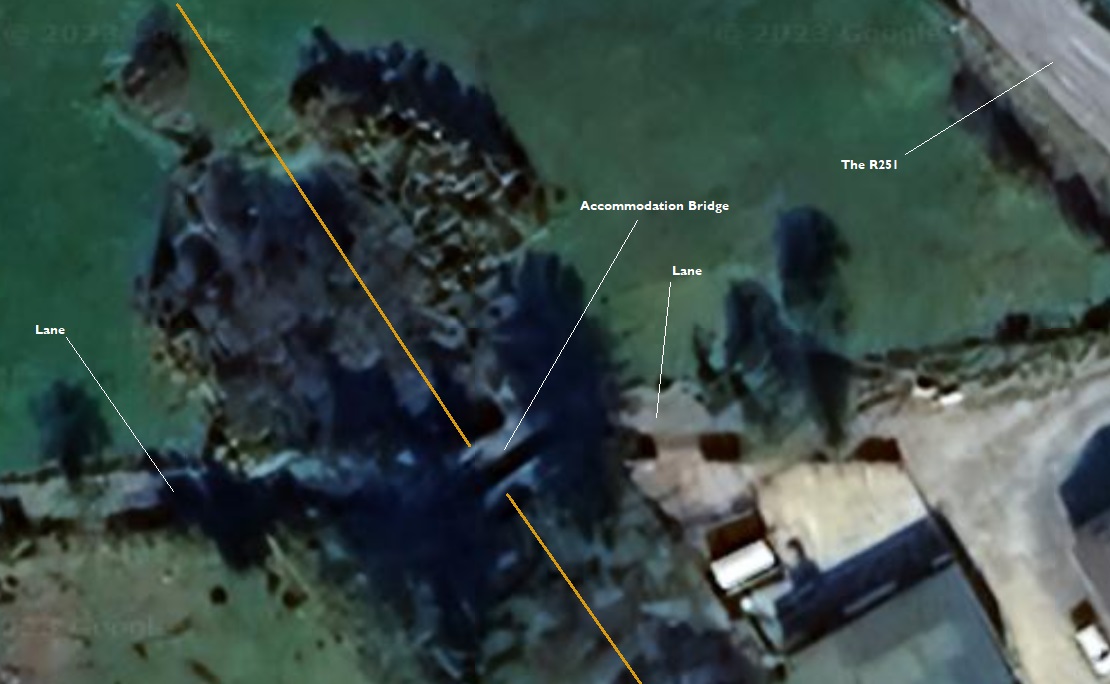
Around 200 to 300 metres Southeast of the crossing the old line entered a cutting as the land around it rose. Shortly after it entered the cutting it was bridged by a lane. Both the bridge and the lane appear to remain today.
The cutting and the accommodation bridge mentioned above are shon on this enlarged map extract from the OSi survey of 1901. The road running from the centre-top tp close to the bottom right is now the R251. [2]The accommodation bridge to the Southeast of Crossing No. 3, as it appears on Google Earth. [Google Earth, 5th July 2023]
A further 700 to 800 metres to the Southeast the old railway crossed a minor road at level. This can be seen in the images below. The R251 and the old railway route run parallel to each other for a distance before the road drifts closer to the old railway and finally runs on the formation of the Burtonport Extension Railway for
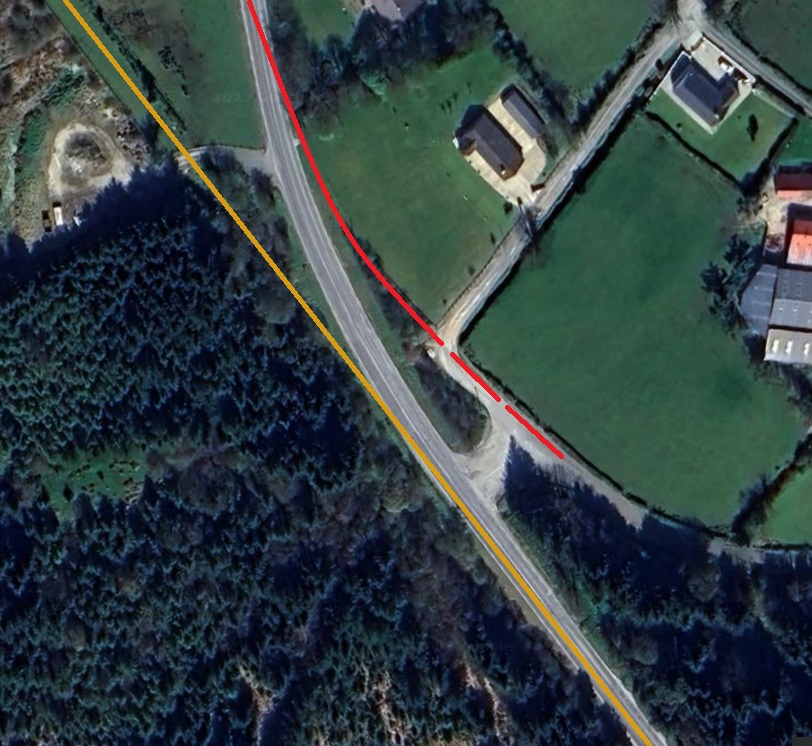
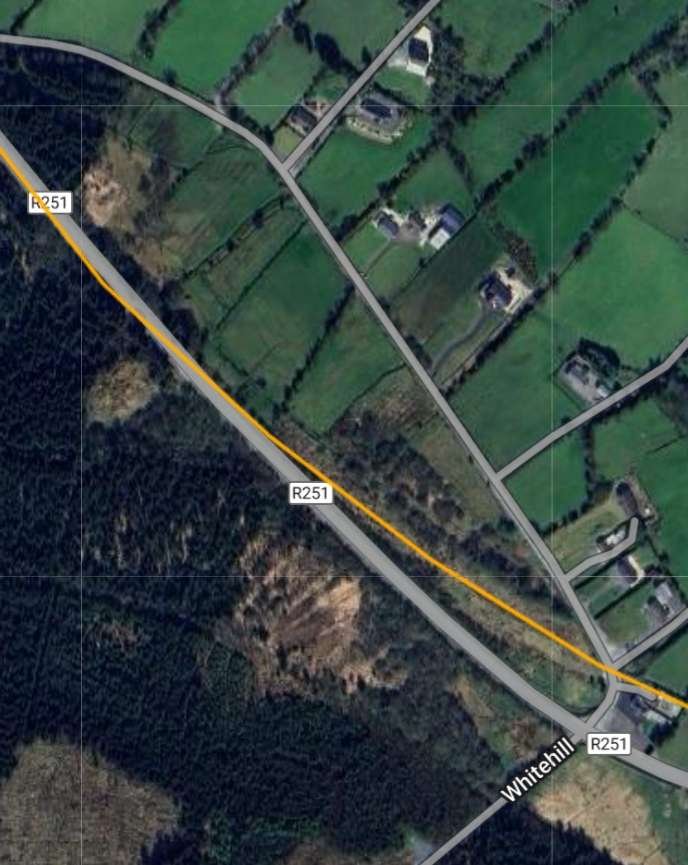
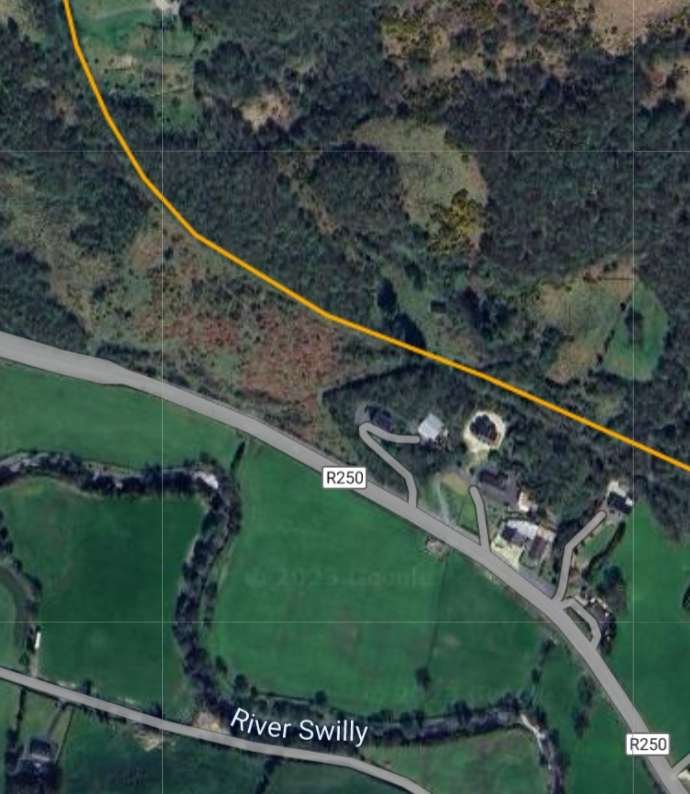
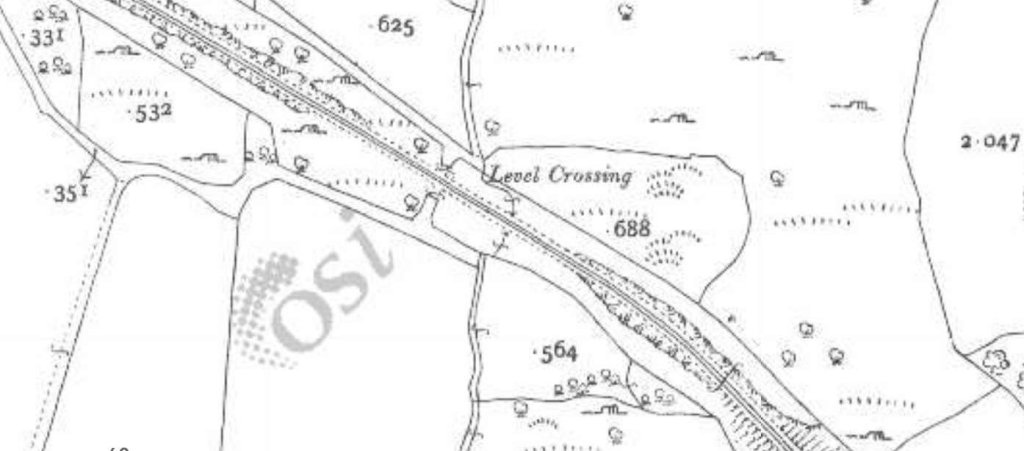
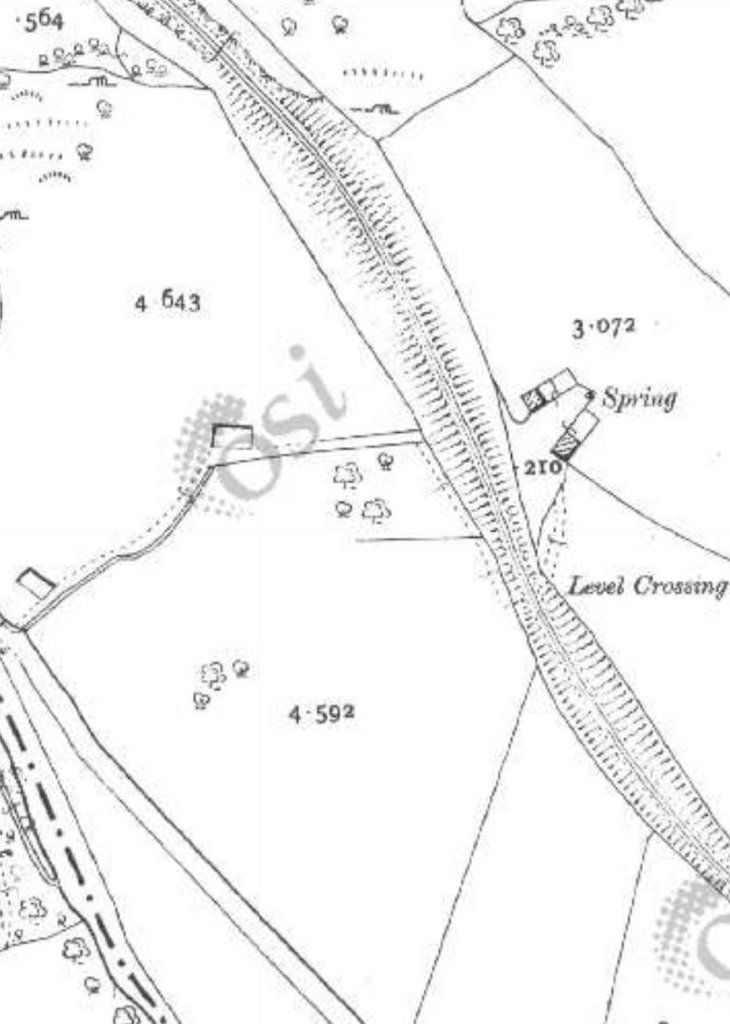
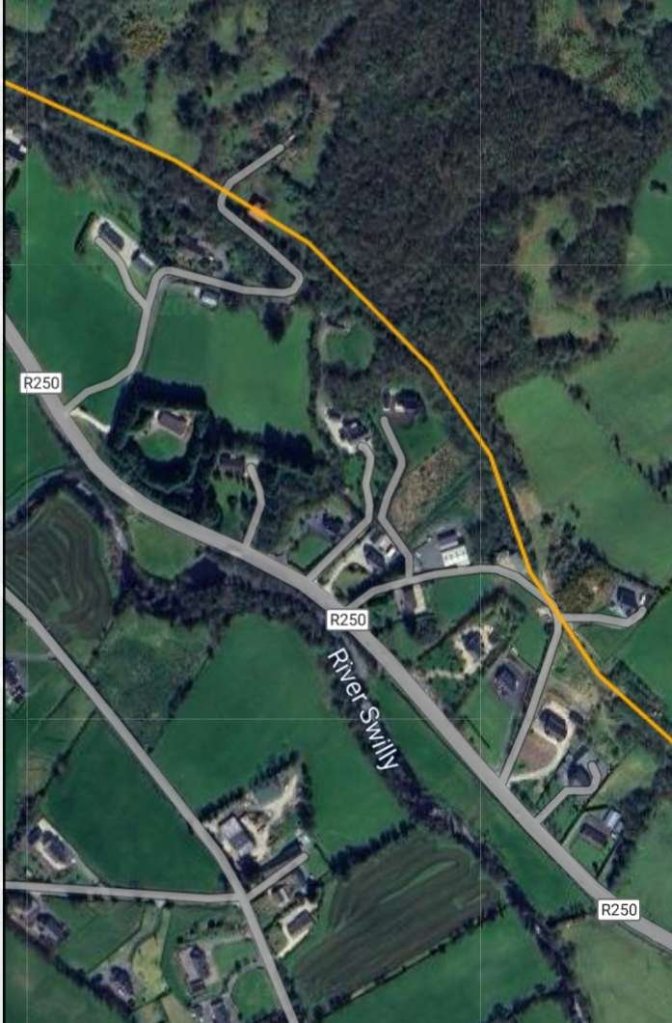
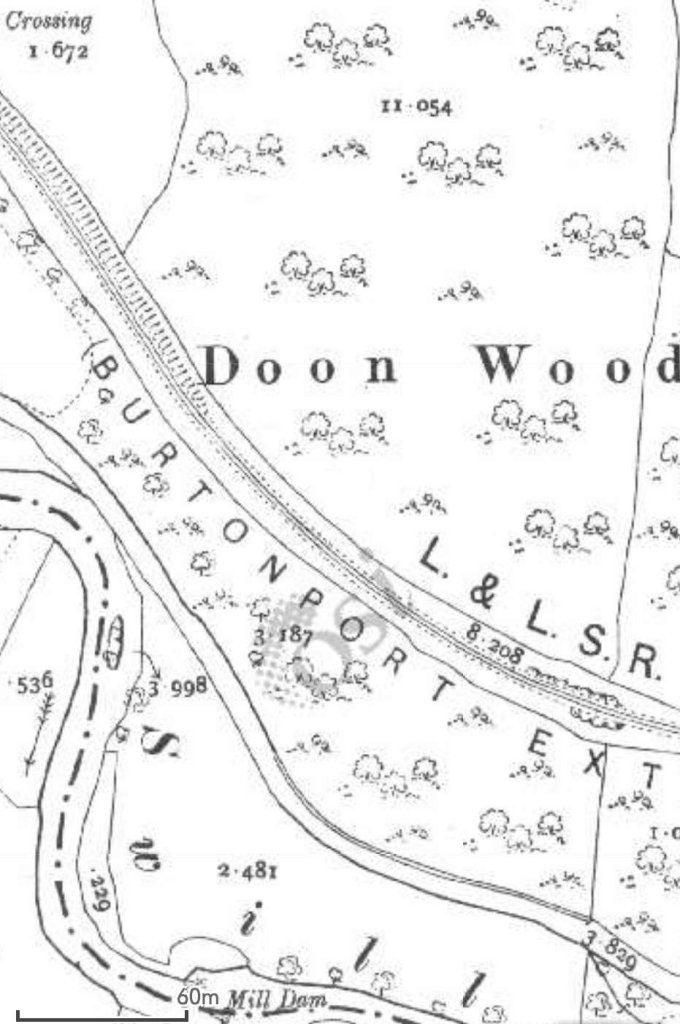
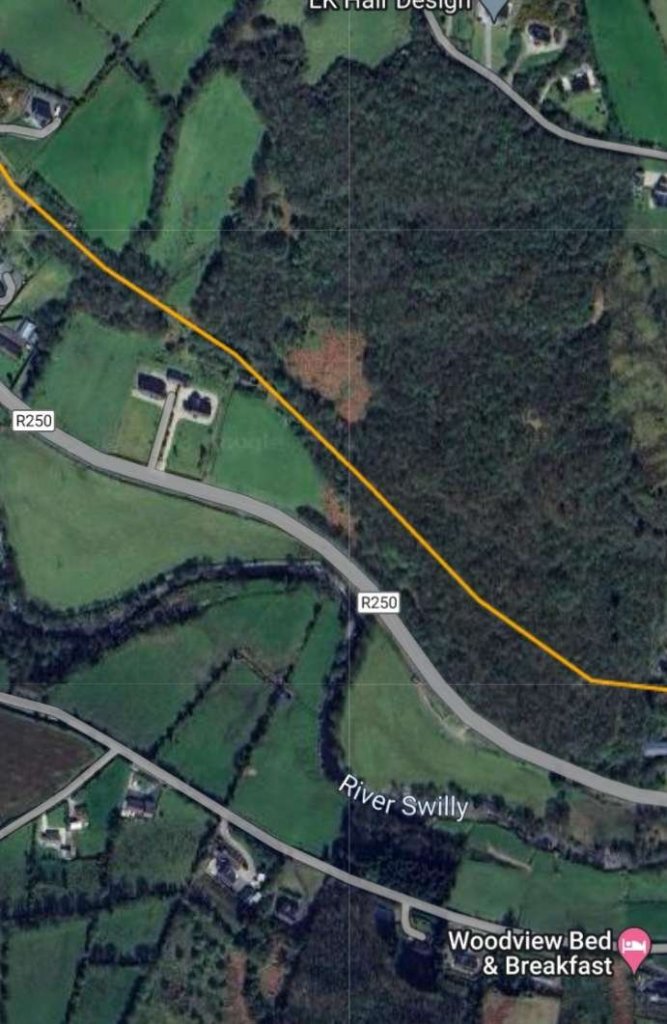
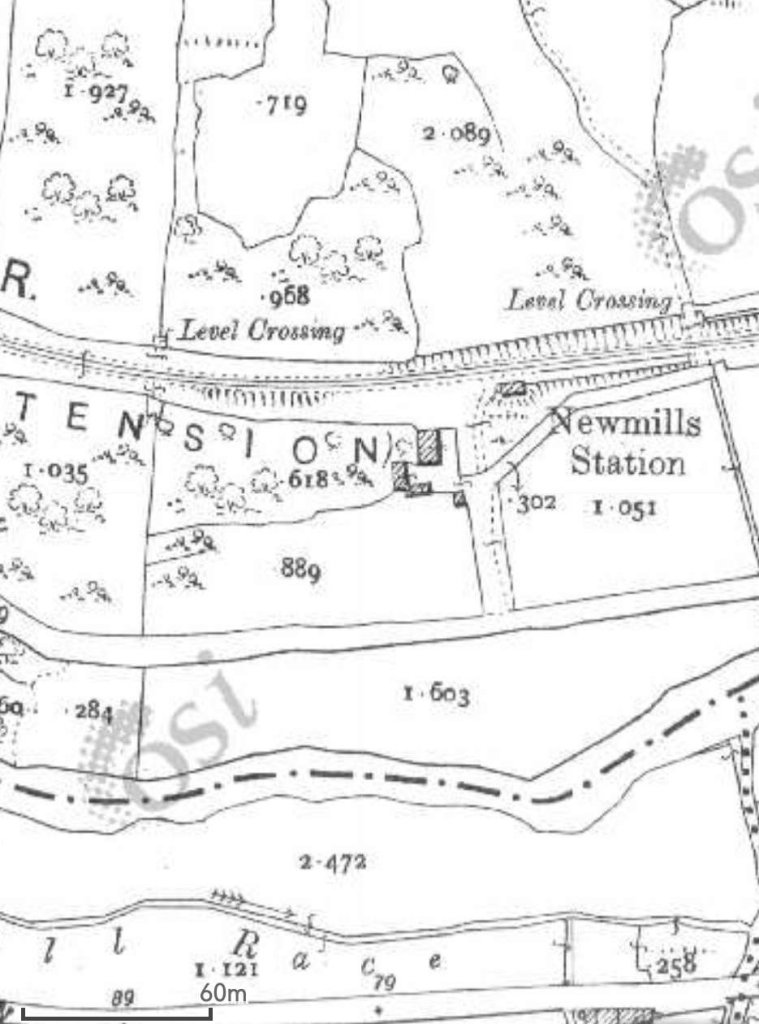
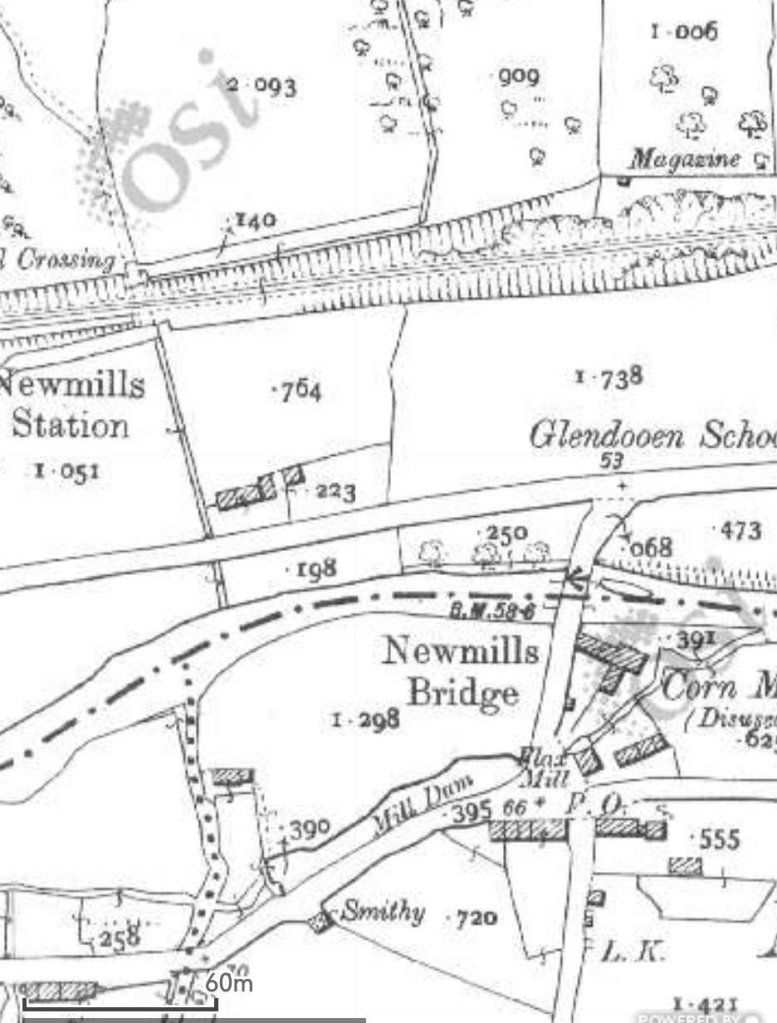
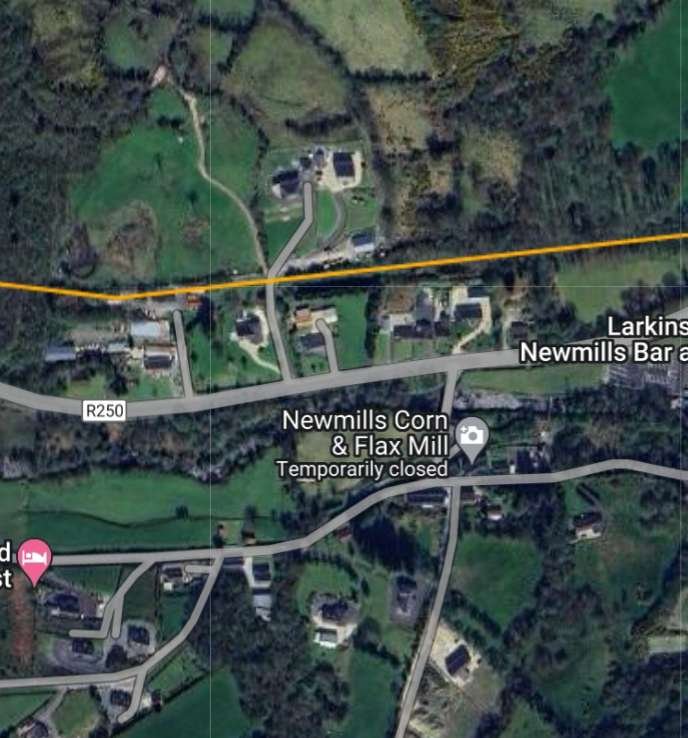
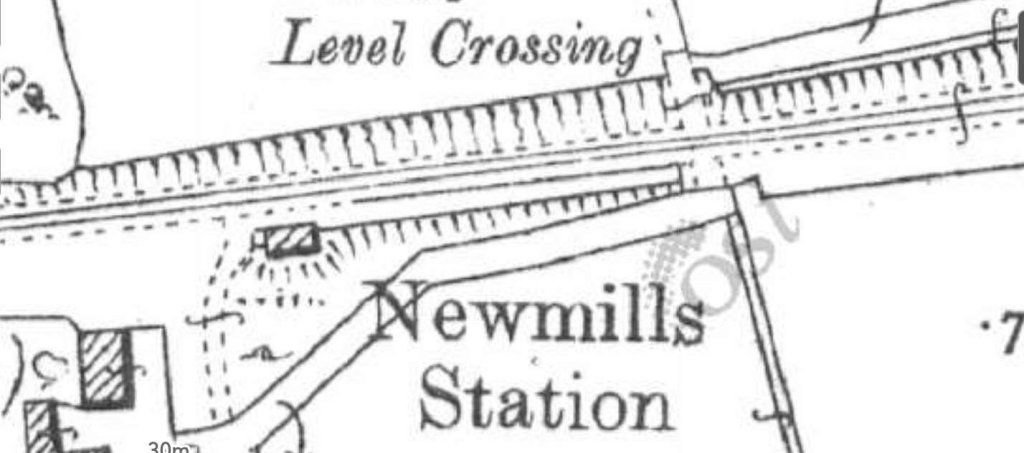
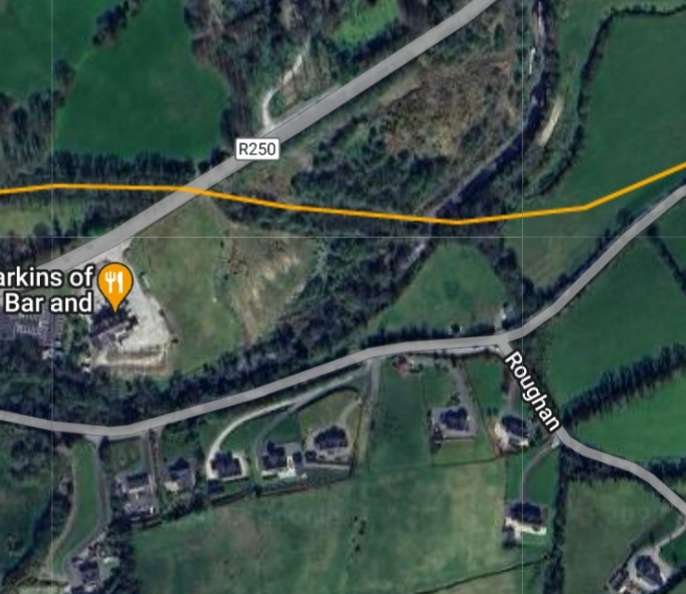
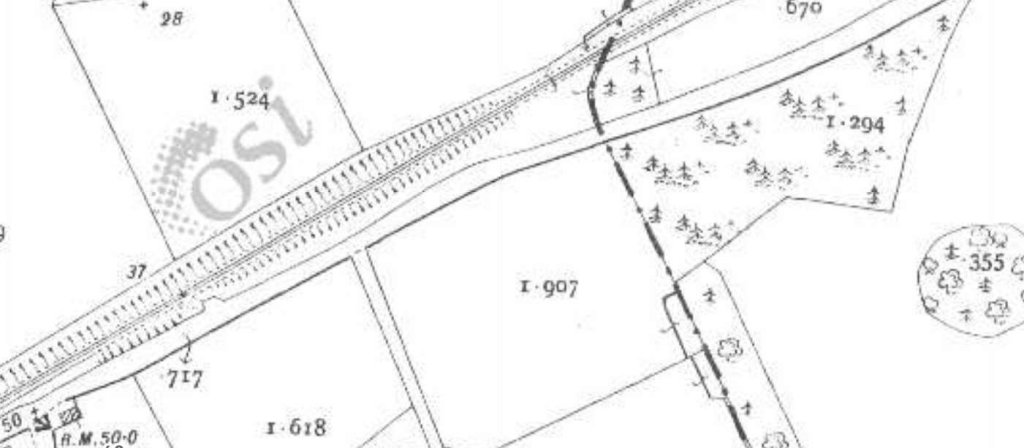
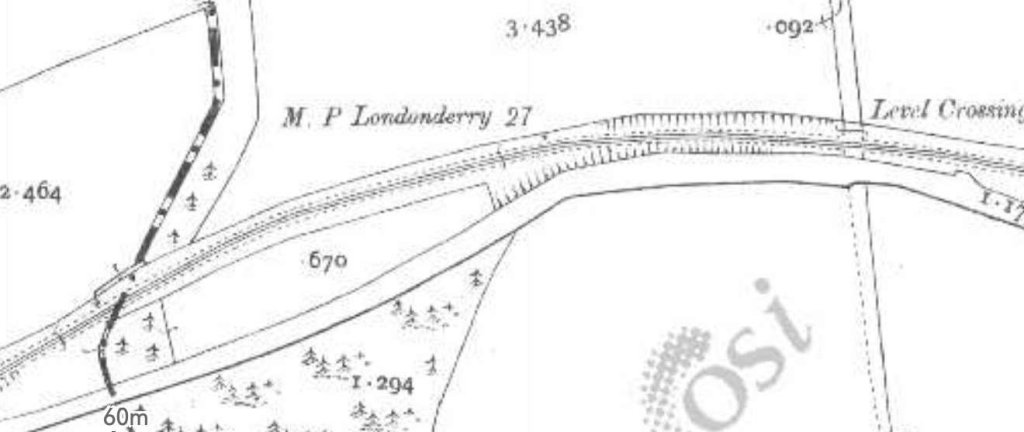
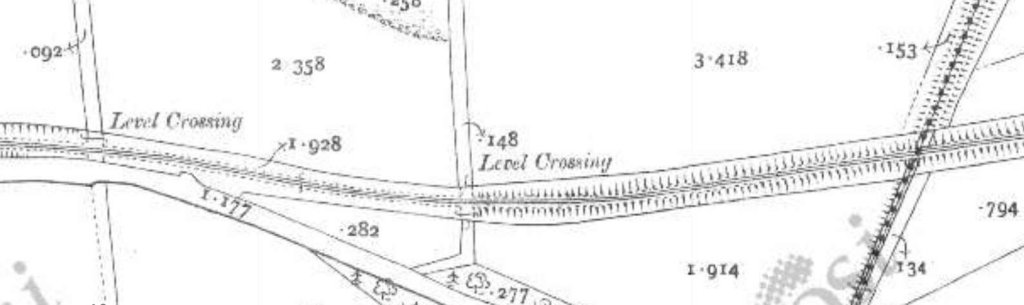
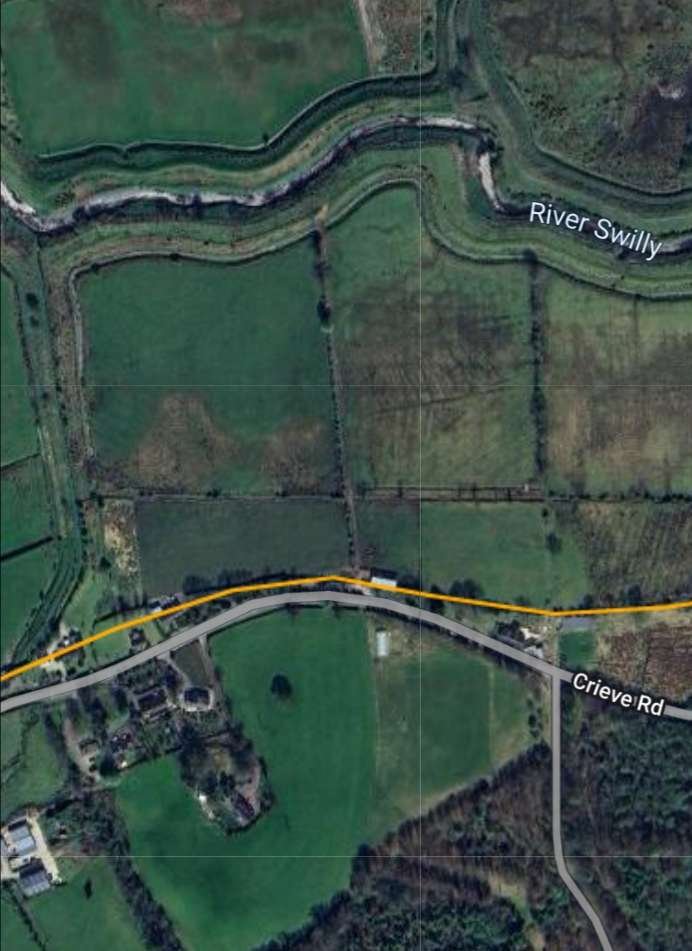
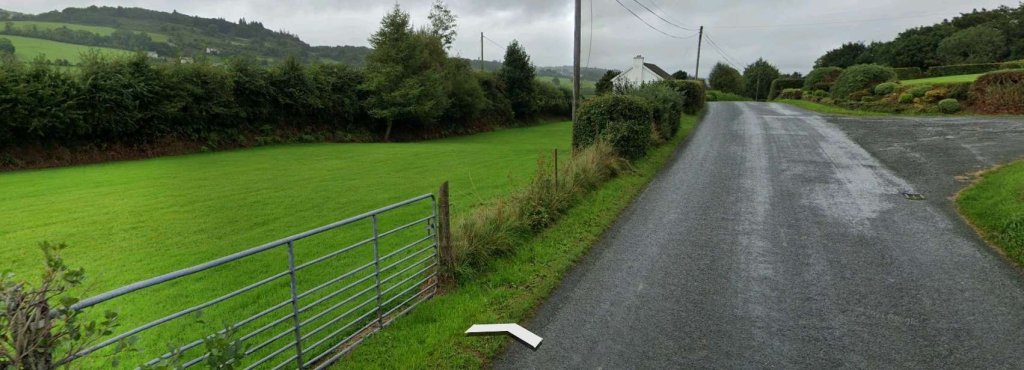
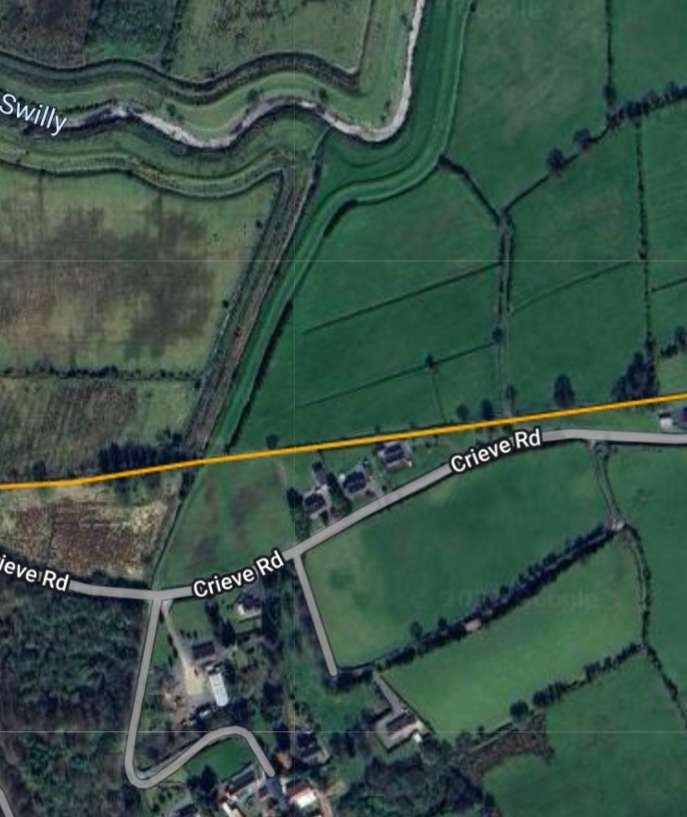
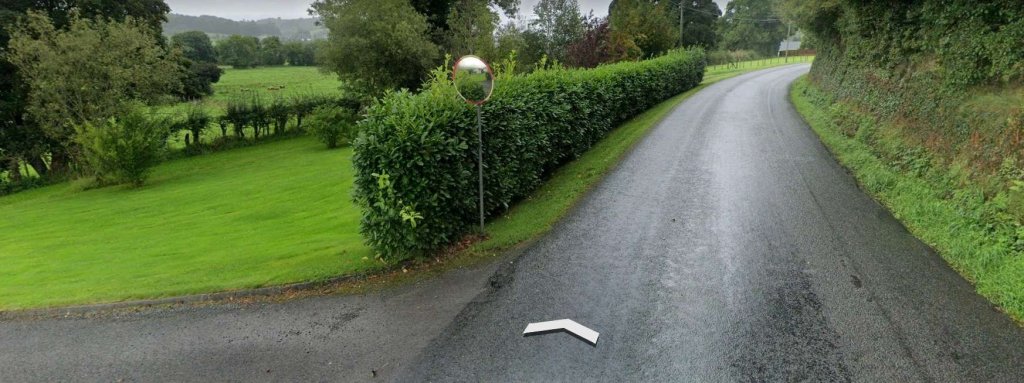
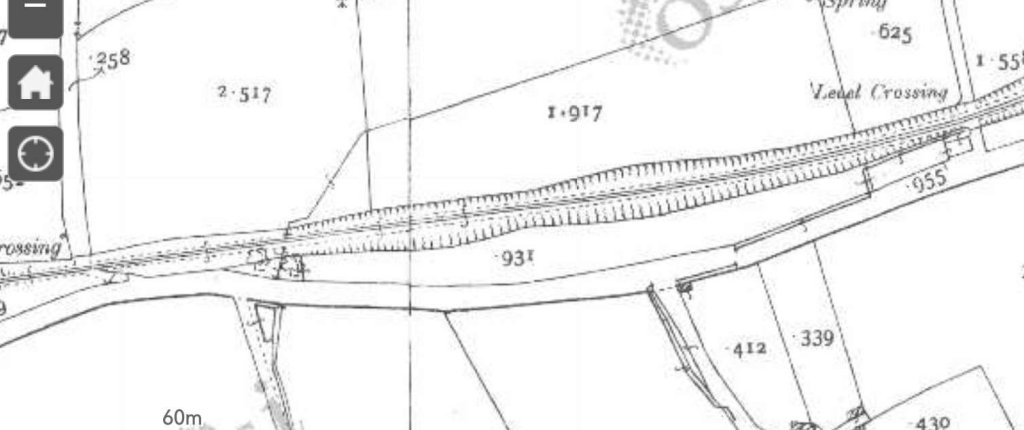
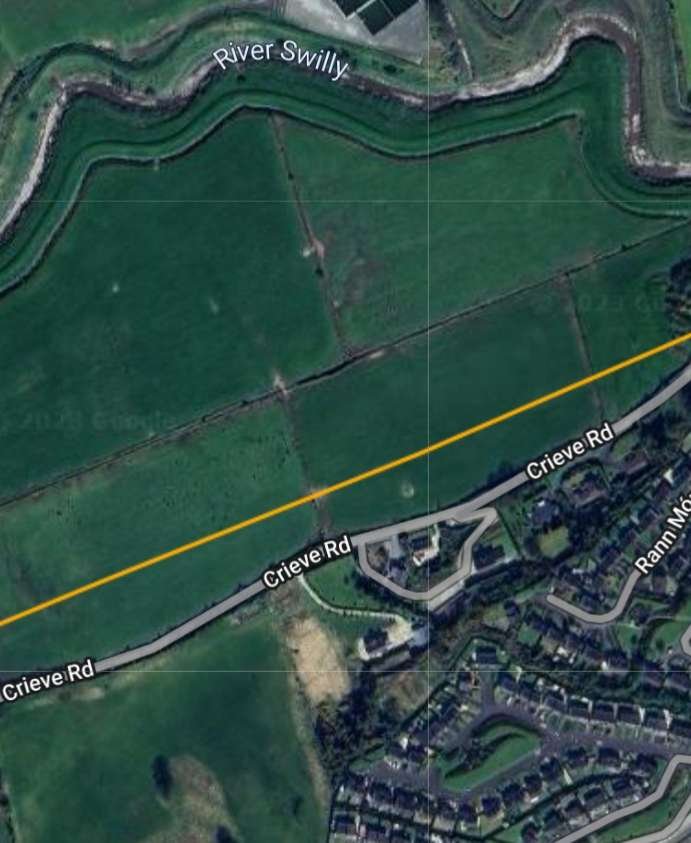
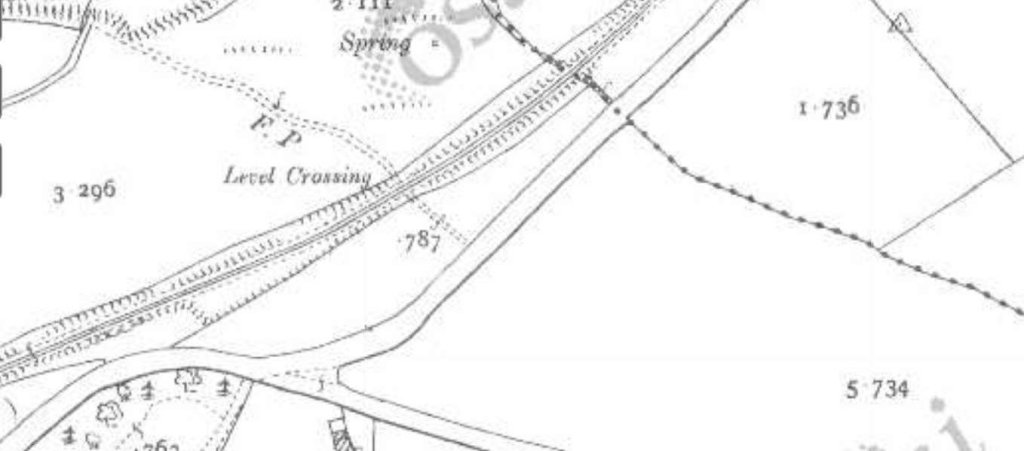
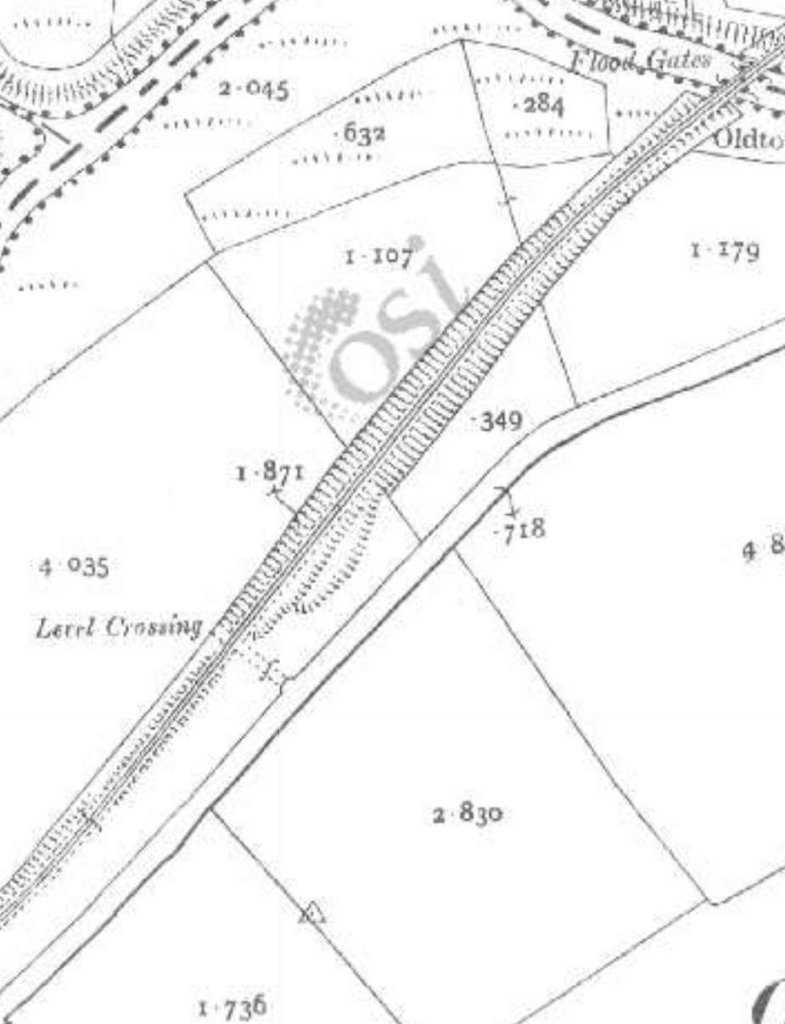
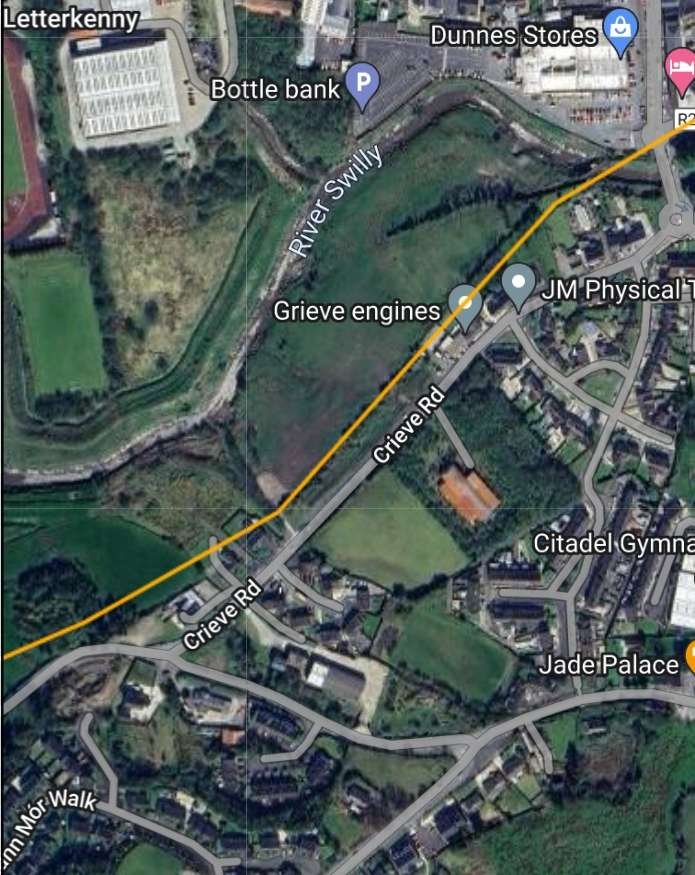
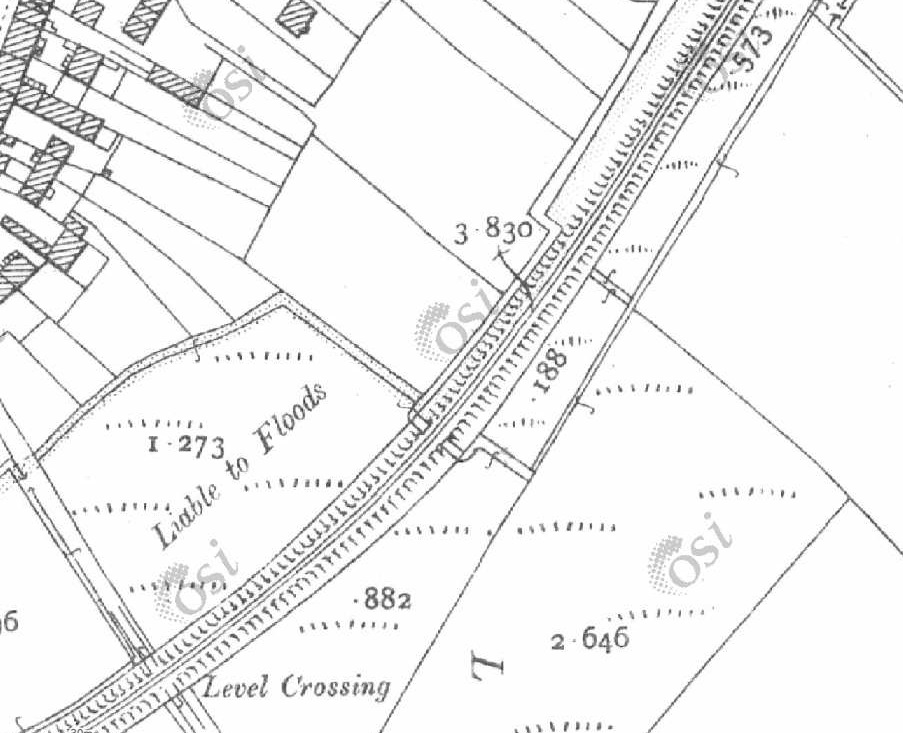
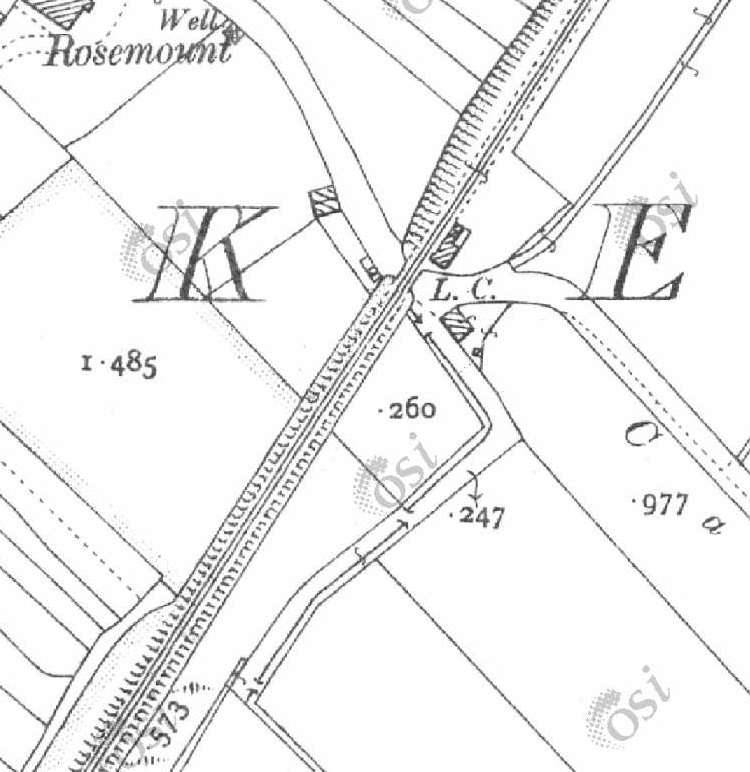
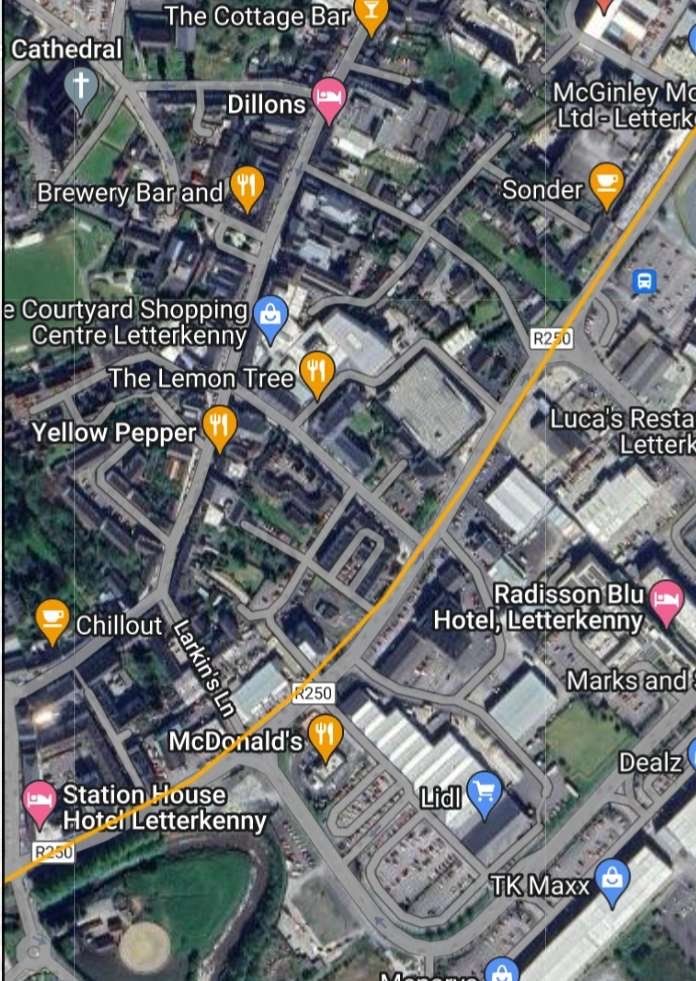
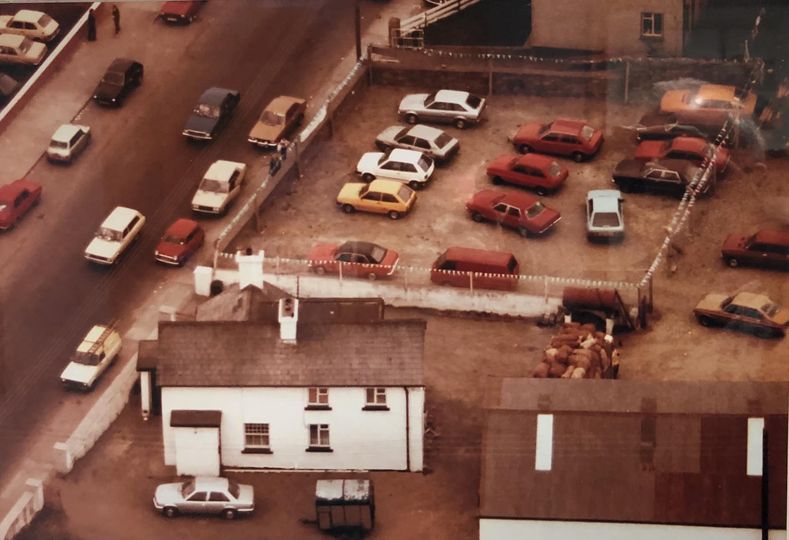
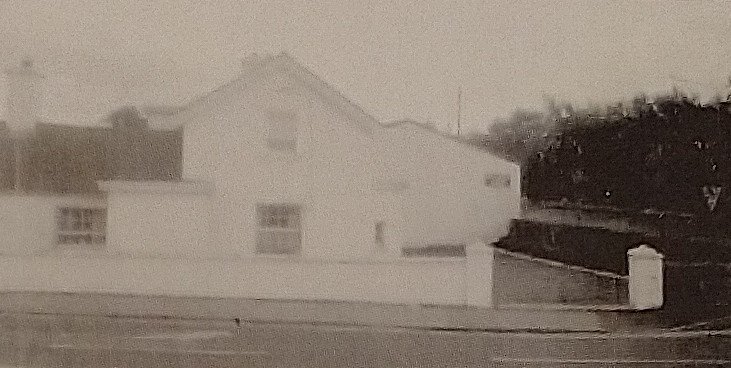
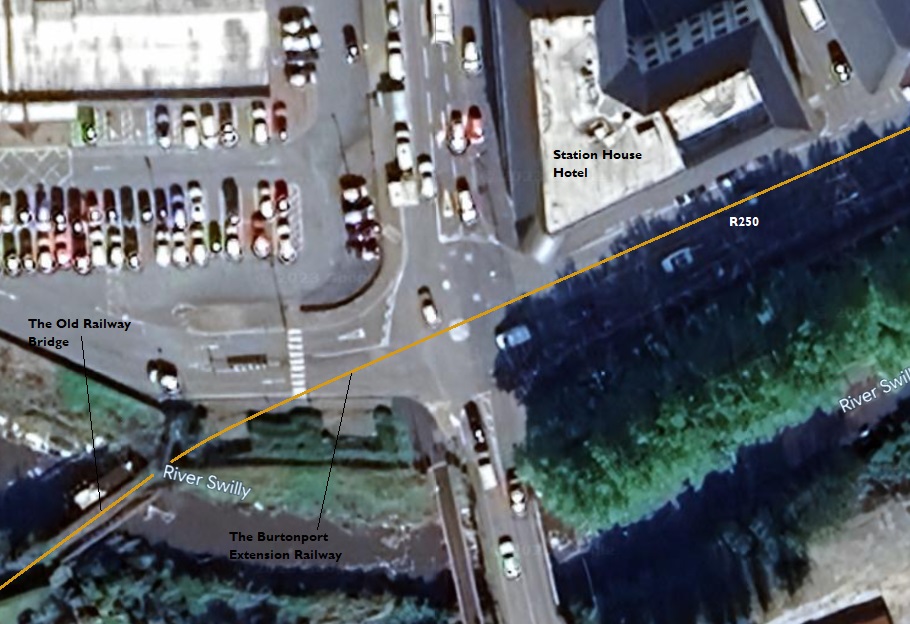
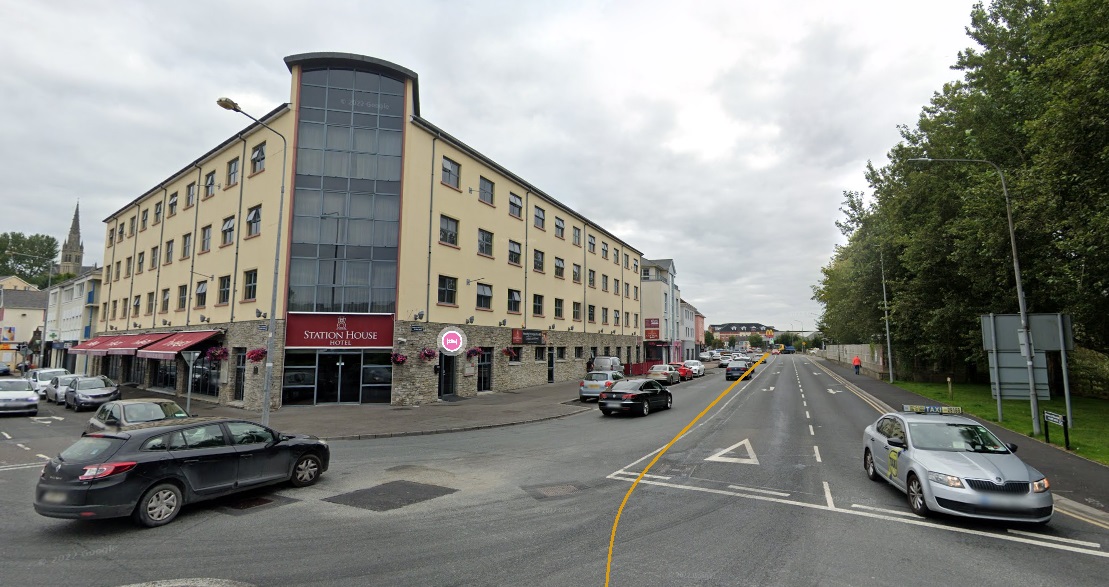
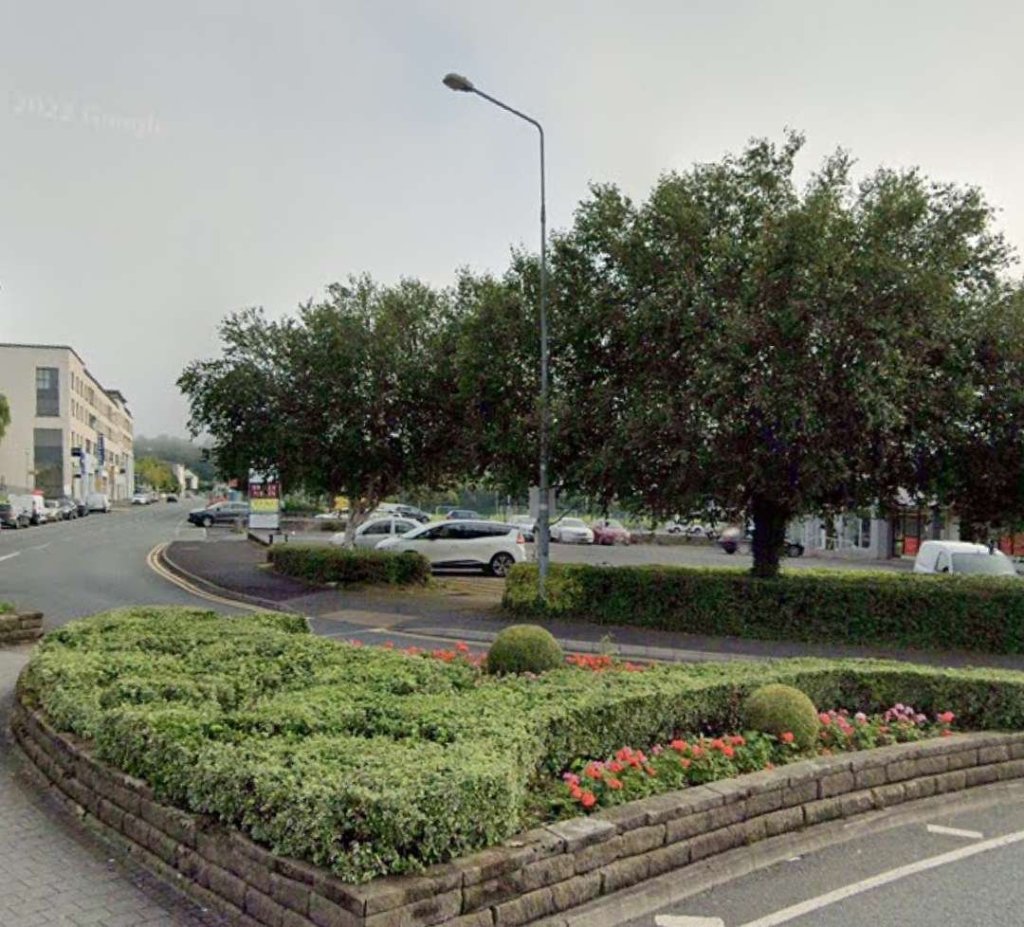
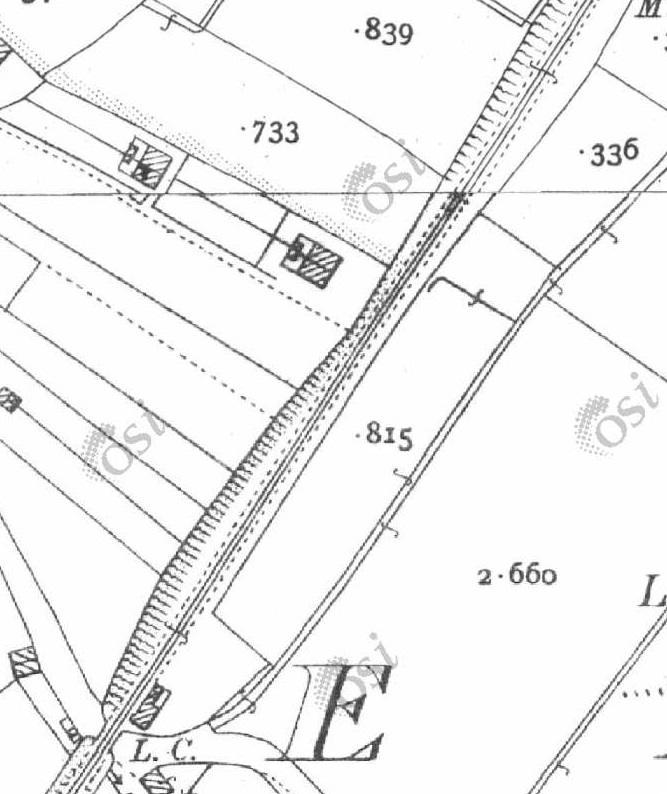
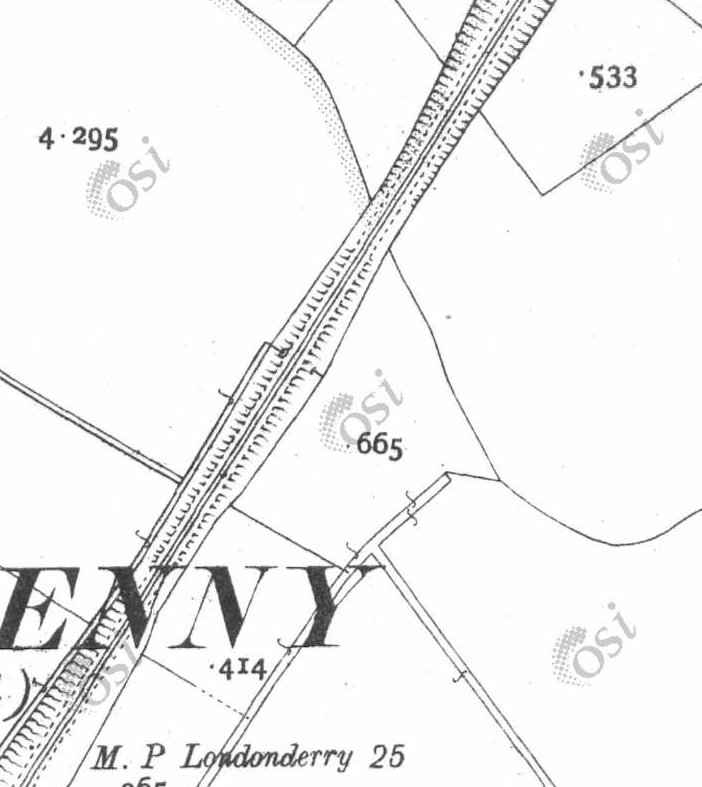
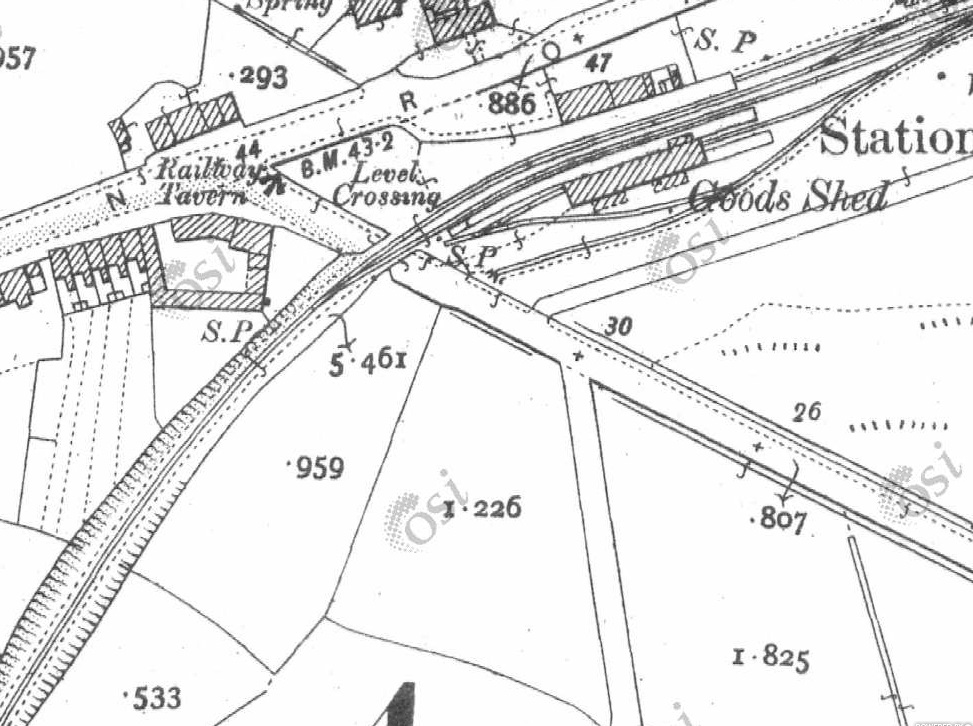
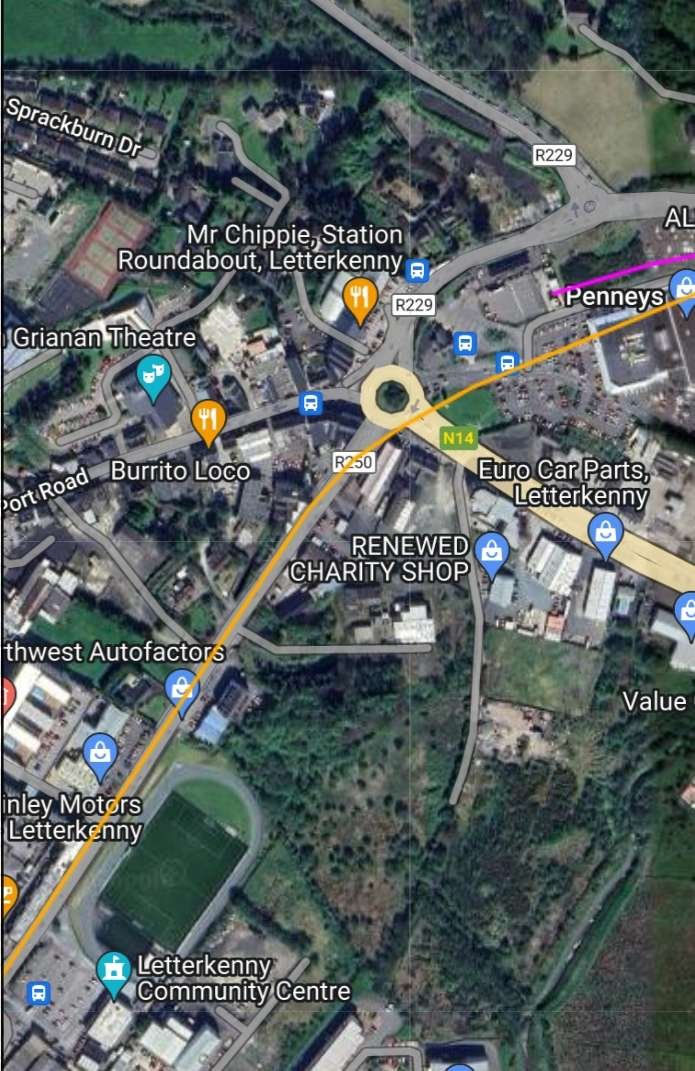
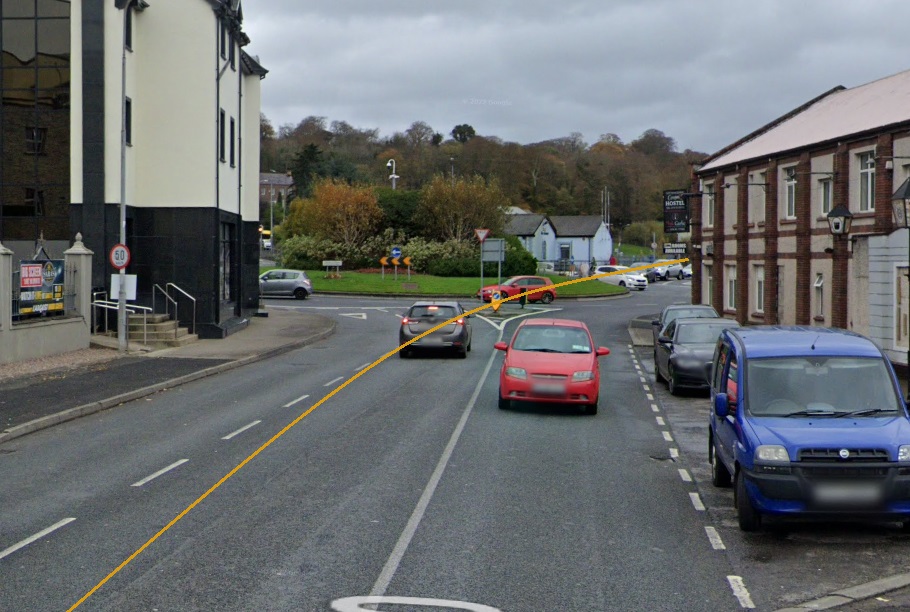
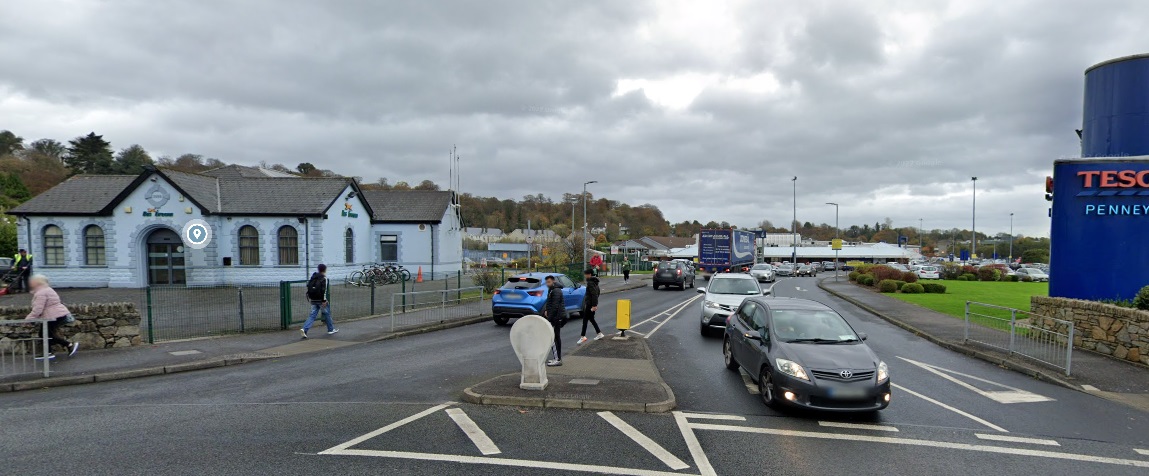
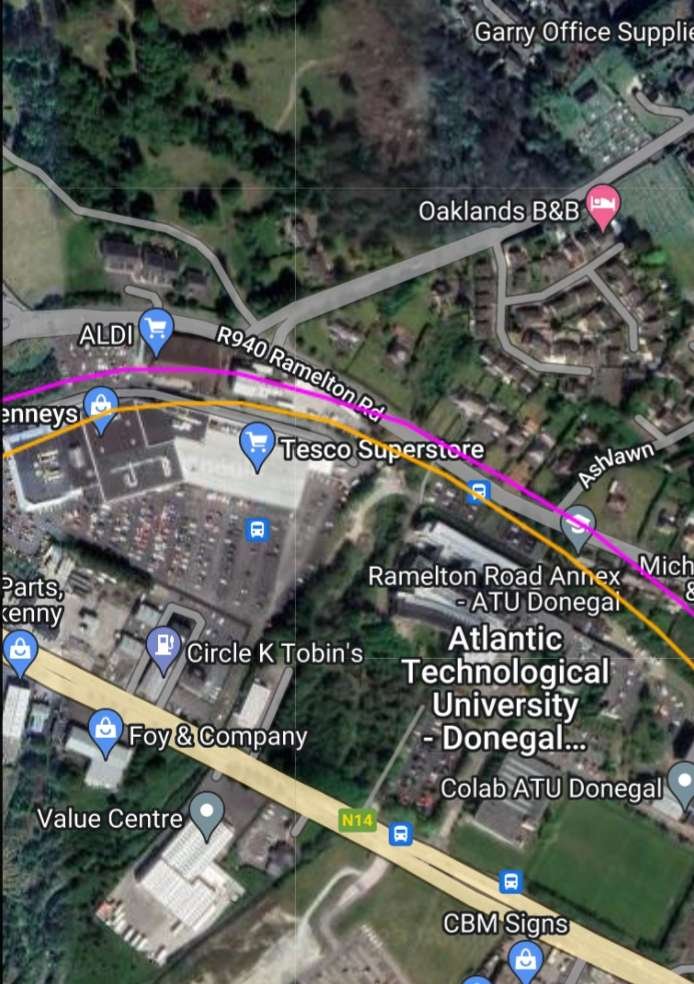
This next extract from the 25″ OSi survey shows the old road and the railway coming very close (bottom-right and then the road heads away again from the old railway line. [2]Google Maps moderna satellite imagery which is used by RailMapOnline shows the R251 leaving the old road alignment and then running Southeast along the old railway formation. [4]Looking Southwest along the minor road referred to above. The old railway ran along the line of the fireld boundary and bushes which can be seen on the right of this image. It crossed the road and then ran on in front of the hadge/bushes seen on the left of the image. [Google Streetview, August 2021]The view Northeast across the old railway line formation, looking along the same road. The Burtonport Extension Railway ran behind the bush shown on the left of this image, crossed the road and continued on the same bearing. {Google Streetview, August 2021]The road and the old railway formation become closely aligned at the tree line ahead. The old formation can still be picked out running into this photograph from the right. [Google Streetview, August 2021]Hopefully this enlarged extract from Google Earth shows clearly how the road has been moved to follow the old railway formation. The red line is the old road. The yeallow line is the old railway. The R251 is shown as the wide grey route. [Google Earth, 6th July 2023]These two map extracts cover the length of the old railway as far as Crossing No. 2, which can be seen in the bottom-right quadrant of the lower image. [2]This is the same length of line as shown on the two 25″ map extracts above. [4]An enlarged extract from the 25″ OSi survey of 1901 shows the old road crossing the railway at Crossing No. 2. The crossing keeper’s cottage is at the centre of this image, to the Southeast of the level crossing. [2]Looking back along the old railway towards Crossing No. 3. The line ran to the right of the tree in the foreground. [Google Streetview, August 2021]Turning through 180° this image shows the crossing keeper’s cottage. The line ran to the left of the cottage approximately through the shed at the left of the image. [Google Streetview, August 2021]The crossing keeper’s cottage as seen, in 2021, from the R251. [Google Streetview, August 2021]These three map extracts show the line continuing towards Foxhall Railway Station in a Southeasterly direction. [2]This single extract from RailMapOnline.com covers the same length of the old railway as the three map extracts above. [4]A view North from the R251 towards the route of the old railway. The railway ran approximately on the line of the second hedge in the image. [Google Streetview, August 2021]Looking Northeast from the R251. The old railway crossed this side road immediately before it turned round to the right. [Google Streetview, August 2021]Three extracts from the 25″ OSi survey take the old railway to the northern approach to Foxhall Station. [2]These two extracts show the Foxhall Station site. [2]South of Foxhall Station the line curved gradually round to a Southeasterly direction. [2]This RailMapOnline.com satellite image covers the same length of the old railway as do the six map extracts above. [4]The Goods Shed at Foxhall Station served as a village community centre after the demise of the Burtonport Extension Railway. It is seen here from the R251. [Google Streetview, August 2021]We are now in the valley of the River Swilly and heading for Letterkenny there are just two more stations before Letterkenny Railway Station, Mill ….. Station and Old Town Station. At this point the line was travelling in a Southeasterly direction to the North of the road which became the R250. The River Swilly is beyond the road to the South. [2]This extract from the RailMapOnline.com satellite imagery shows the route of the old railway, the R250 and the River Swilly and covers nearly the same length of railway as the map extracts above. [4]These two map extracts show the line continuing Southwest down the Swilly valley. [2]This RailMapOnline.com satellite image covers much the same length of the old railway as the map extracts above. [4]A further two map extracts has the River Swilly, the R250 and the Burtonport Extension Railway in close order still heading Southeast. [2]This satellite image mage covers a similar length of line to the two map extracts above. [4]Two more extracts take the line as far as Newmills Station and the cluster of buildings around Newmills Bridge – Flax Mill, Corn Mill and associated buildings. [2]Newmills and the location of Newmills Station in the 21st century. [4]A closer view of Newmills Station which was effectively no more than a halt. [2]Newmills Bridge seen from the R250. The mills are hidden beyond the trees. [Google Streetview, August 2021]The mills at Newmills seen from the R250. [Google Streetview, August 2021]Two more map extracts show the old railway bridging both the R250 and the River Swilly. [2]Again this satellite image covers much the same area as the two map extracts above. [4]Looking Northeast on the R250 at the remaining bridge abutment on the North side of the road. [Google Streetview, August 2021]A little further to the East, this view shows trees and undergrowth on the line of the old railway embankment on the South side of the R250. The bridge abutment on the South side of the road would have been off the image to the right but will have been removed when the road was improved. [Google Streetview, August 2021]A single map extract shows the line travelling Northeast towards Letterkenny. [2]This RailMapOnline.com satellite image takes the route of the old line to the same point as the map extract above. [4]The old railway ran on the North side of the minor road between Newmills and Letterkenny, effectively just beyond the hedge line. [Google Streetview, August 2021]These two map extracts show the line heading on Northeast towards Letterkenny. [2]This satellite image covers the same ground as the two map extracts above. [4]These two map extracts show the old railway and the adjacent road back immediately next to each again. [2][4]In this image, taken 200 metres or so to the West of the side road shown in the above satellite image, the route of the old railway was immediately to the left of the hedge line. [Google Streetview, August 2021]These three map extracts see the old railway running East through Mile Point 27. [2]Crieve Road and the old railway route run West to East across this satellite image which covers a similar length of line as the three map extracts above. [4]Further Northeast, the boundary of railway land can be discerned, the parallel hedges to the left of the road delineate the route of the old railway. [Google Streetview, August 2021]The old line and Crieve Road come close to each other again. [2]Another satellite image which covers the same area as the map extract above. [4]This is the view Northeast at the right quarter point of the satellite image above. The hedge which runs in from the left side of the image marks what was the boundary of railway land. [Google Streetview, August 2021][4][4]These two further map extracts show the old railway heading Northeast towards Letterkenny. The bridge crossing the River Swilly at Letterkenny Old Town can be seen in the top-right of the lower of these two extracts.. [2]This satellite image covers the same length of the old railway as the two map extracts above. There is a marked encroachment of the built up area of Letterkenny! [4]The Burtonport Extension Railway crossed the River Swilly at Letterkenny Old Town on a substantial girder bridge which had stone abutments. This picture was probably taken in the late 1980s. By this time it had not been in use for around 40 years. [1: p60]A similar view of the bridge in 2023. [My photograph, 29th April 2023]Another view of the railway bridge, this is taken from the East, from the modern road bridge over the River Swilly. These two pictures show a bridge that is continuing to bear up to the effects of the environment in 2023, some 75 or so years after the closure of the Burtonport Extension Railway. [My photograph, 29th April 2023]After crossing the River Swilly, trains crossed a level crossing which protected the Western approach to Old Town Station. Old Town Station was a halt rather than a Station, it had a short single platform adjacent to the level crossing on the road South out of Letterkenny Old Town. [2]These two map extracts show the old railway line heading Northeast outside the old limits of Letterkenny Town. The level crossing in the middle of the second extract was provided with a crossing keeper’s cottage. The location of the cottage is now a car park. [2]Letterkenny has developed considerably since the 25″ OSi survey was undertaken at the beginning of the 20th century. The line heading Northeast from Old Town station was once in fields but is, in the 21st century, overwhelmed by modern development. The formation of the Burtonport Extension Railway appears now to be the route of the R250 which runs round the South side of the town centre. This extract from RailMapOnline.com’s satellite imagery covers roughly the same length of line as the three map extracts immediately above. [4]This is an aerial view from the 1980s of the former Oldtown Railway Station House. In 2005 it was knocked down and rebuilt, opening first as the Ramada Encore Hotel in 2006 before officially being renamed in 2010 as the “Station House Hotel.” This image was shared on the Letterkenny History Facebook Page on 1st July 2023. [11]This photograph of Old Town Station building also comes from the 1980s when it was a private dwelling. The photograph is taken from the road before the new R250 was built along the old railway formation. [1: p59]Google Earth provides this satellite image of the old railway bridge over the River Swilly and the Station House Hotel which stands on the site of the old Station House which served Old Town. [Google Earth, 10th July 2023]This view looks Northeast from the line of the Burtonport Extension Railway and shows the modern Station House Hotel which sits on the site of Old Town Station building which was demolished as noted above. The yellow line is an approximation to the route of the old railway which might have run a little closer to the modern hotel. [Google Streetview, November 2022]The view Northeast from the R250 towards the location of the crossing-keeper’s cottage, which is shown at the bottom of the map extract below. I have been unable to find a picture of the old railway building. [Google Streetview, November 2022]Three extracts from the 25″ OSi survey of 1901 show the length of the line from the final crossing-keeper’s cottage on the Burtonport Extension Railway to Letterkenny Railway Station. [2]The final approach to the location of Letterkenny Railway Station as shown by RailMapOnline.com. The pink line entering from the right is the Co. Donegal Railways line to Strabane. [4]Looking Northeast along the R250 in November 2022 at what would have been the station throat. The approximate line of the old railway is shown in yellow. The sky-blue building at the centre of the image is the old Co. Donegal Railways station building now in use as a bus station. [Google Streetview, November 2022]Looking East-northeast into the site of what was the L&LS Railway Station in Letterkenny. The sky-blue building, as we have already noted, was once the Co. Donegal Railways Station building. [Google Streetview, November 2022]Letterkenny Station in 1901, before the arrival of the Co. Donegal Railways line from Strabane. When the Co. Donegal Railways line from Strabane arrived at Letterkenny, the road running diagonally across the map extract had to be moved over to accommodate the new Station. [2]At a smaller scale, this extract from the 25″ OSi Survey of 1901 shows the line to the East of Letterkenny as it heads away towards Derry. [2]Letterkenny Railway Station area and the line to the East as shown by RailMapOnline.com. As noted above, the pink line is the route of the Co. Donegal line to Strabane. [4]
Ernie’s Railway Archive on Flickr has a range of photographs of the L&LS Letterkenny Railway Station site from the 1950s, the links are embedded here below, click on each link to see the image in Ernie’s Railway Archive on Flickr:
https://flic.kr/p/2nMqBvu – The L&LSR Station site from the East in 1952. The carriage shed is closest to the camera on the right of the image. The locomotive shed and turntable are hidden behind the carriage shed. At the centre-top of the image, the Goods Shed can be seen.
https://flic.kr/p/2nM8xYs – The Goods Yard of the L&LSR in 1952. Beyond wagons L&LSR No. 124 and L&BER No. 73 the Goods Shed and the passenger station building can be seen.
https://flic.kr/p/2nWyB5y – The L&LSR Goods Yard in 1952. The side elevation of the Goods Shed is visible beyond the wagons in the yard. Prominent in the picture is L&LSR Wagon No. 71.
https://flic.kr/p/2nCR8dg – L&LSR No. 12 is featured in this image from 1952. No. 15 is just poking its nose into the shot on the left.
https://flic.kr/p/2kHNdD9 – L&LSR No. 8 is being turned on Letterkenny’s turntable on 27th June 1952.
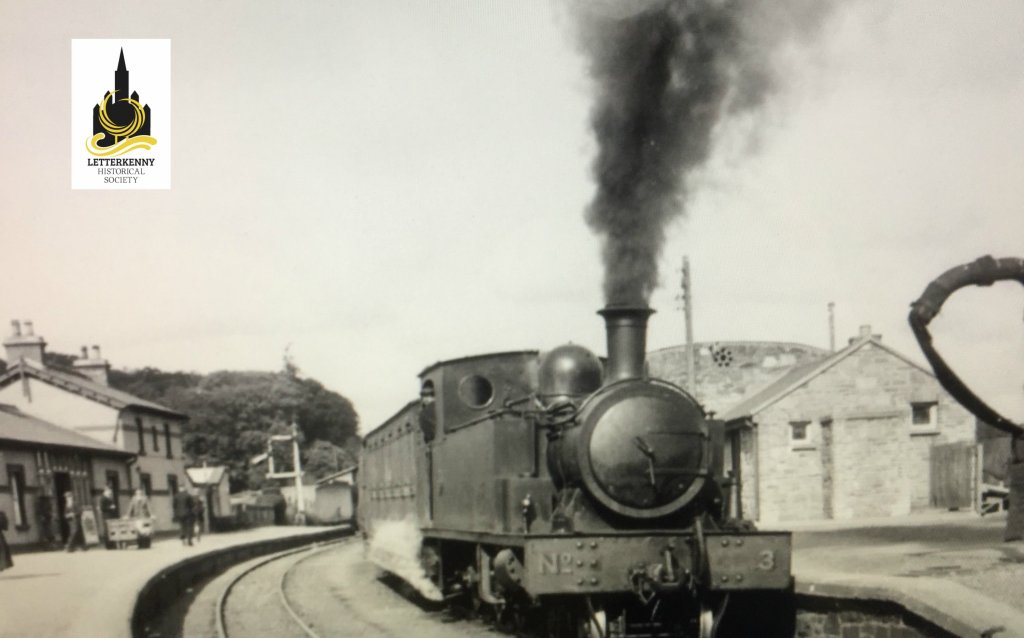
https://flic.kr/p/BWoyiF – L&LSR No3 at Letterkenny. On the left, the image is framed by the wall of the Goods Shed. The crossing gates at the West end of the station are visible beyond No. 3’s train. The passenger facilities are on the right. Note the coach acting as a brake van for the train. (c) JW Armstrong/ARPT
https://flic.kr/p/BvajsP – L&LSR No. 12 in the Engine Shed at Letterkenny, (c) JW Armstrong/ARPT
https://flic.kr/p/2ma5Lo3 – The L&LSR Station at Letterkenny on 1st July 1959 after the rails had been lifted. The Goods Shed door is closed (on the left) and the station buildings are on the right.
https://flic.kr/p/2k1hGvQ – The L&LSR operated a daily goods service by lorry after the closure of the line. A company rail lorry bearing the number plate IB7024 is shown standing where trains would once have passed, adjacent to the station building at Letterkenny. The photograph was taken on 23rd August 1954.
Other photographs of Letterkenny’s L&LSR railway station can be found on Flickr or elsewhere on line:
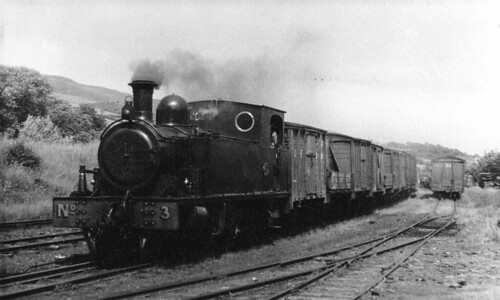
This image shows 4-6-0T No. 3, probably, in the Yard at Letterkenny station. No. 3 was built by Barclay in 1902. The image was shared by ‘Trainiac’ on Flickr and noted as being in the Public Domain. [12]
Dave Bell & Steve Flanders; The Londonderry & Lough Swilly Railway: A Visitor’s Guide; County Donegal Railway Restoration Society, The Donegal Railway Heritage Centre, Donegal.
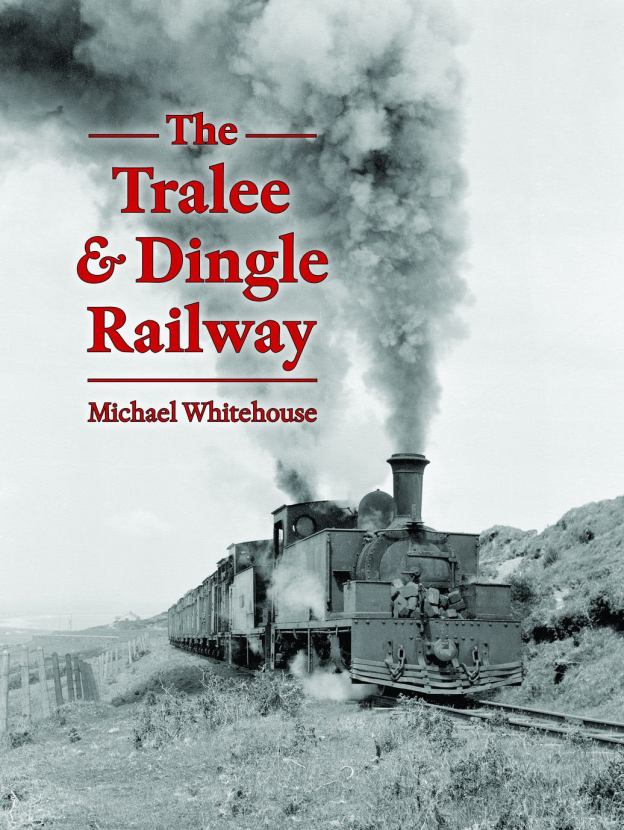
The Lightmoor Press has developed a reputation for producing a substantial number of high quality railway-interest books. One of their latest has been produced about the Tralee and Dingle Railway in Co. Kerry, Ireland. The author is Michael Whitehouse. [1] It is another excellent publication.
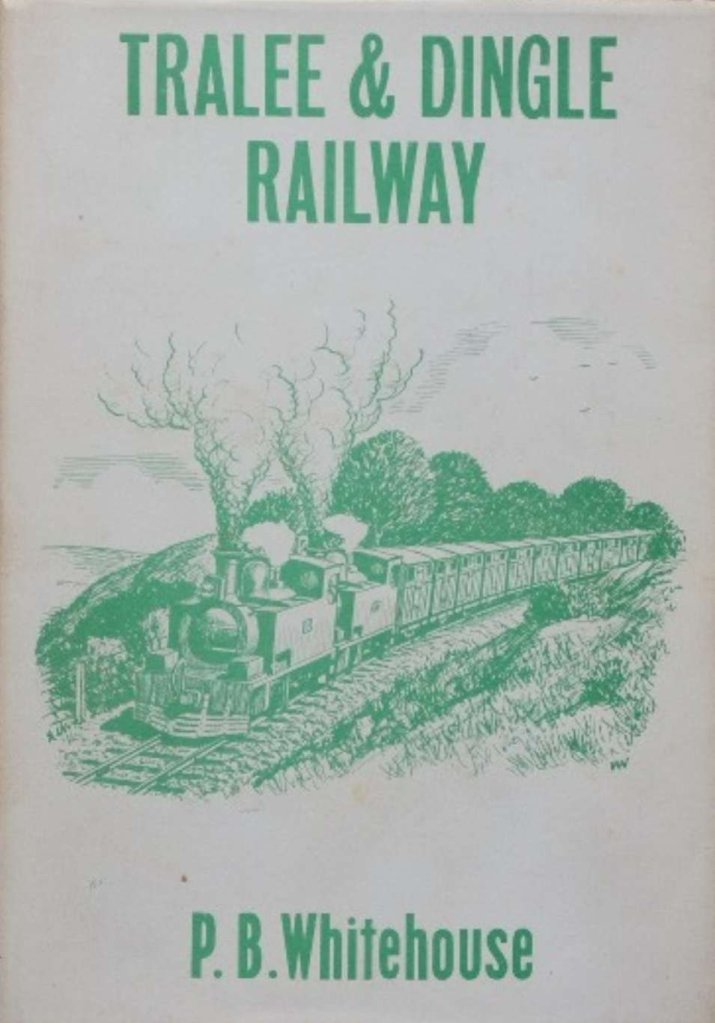
The book is an enlarged and extended version of that written by Michael’s father, Patrick Whitehouse (PWB) in collaboration with John Powell in the mid-1950s.
The Lightmoor Press edition is given the status of a second edition with PWB’s 1954 book called the first edition. [2]
The ‘first edition’ book about the Tralee & Dingle Railway written by P.B. Whitehouse. [2]
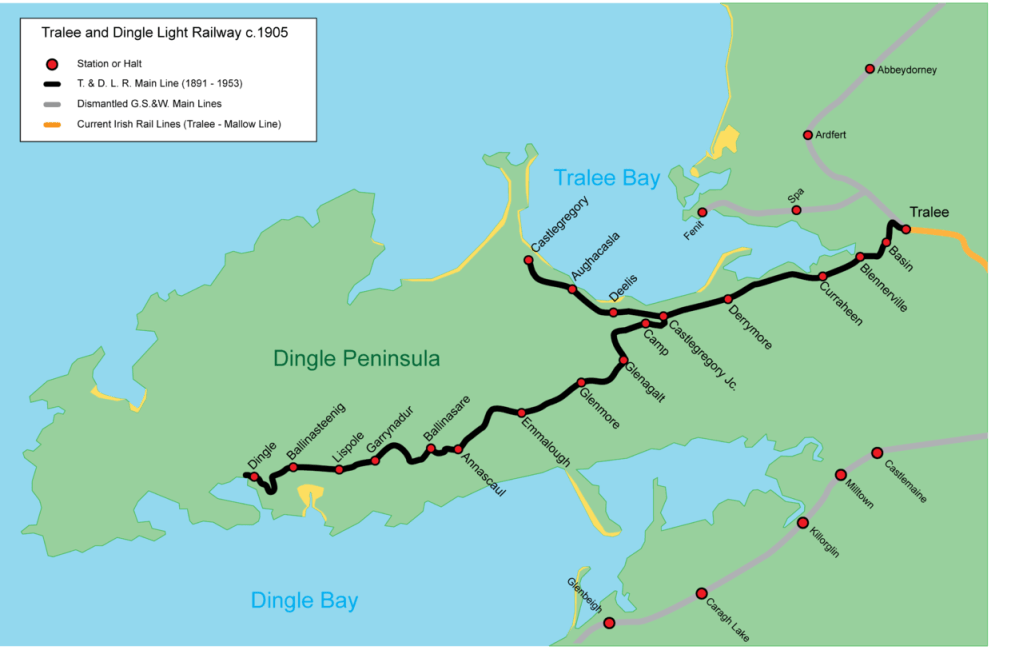
Wikipedia tells us the Tralee and Dingle Light Railway and Tramway was a 32 mile (51 km), 3 ft (914 mm) narrow gauge railway running between Tralee and Dingle, with a 6.2 mile (10 km) branch from Castlegregory Junction to Castlegregory, in County Kerry on the west coast of Ireland. It operated between 1891 and 1953; the Castlegregory branch closed shortly prior to the outbreak of the Second World War. [3]
It was one of the most westerly railway lines in Europe, but the terminus of the Valentia Harbour branch to the South was further west.
As the Lightmoor Press says, “The Tralee & Dingle Railway still stirs the hearts and imagination. Many ferro-equinologists, including the author’s father, flocked to the railway, but most only just in time. They saw the last rites of the monthly cattle train serving the Dingle fair in the early 1950s and experienced the thrill of a lifetime riding the narrow gauge train and even the footplates of the steam locomotives as they rushed the steep gradients and flew down the other side, brushing red fuchsias into disarray. All spiced by the general hazards of near-derelict rolling stock running over grass-covered and barely maintained track, often wet from Irish rain and mountain mists and over some of the most frightful curves and gradients ever engineered on a narrow gauge railway.” [4]
“The Dingle peninsula has some of the best scenery in Ireland to travel through which is a draw all of its own. Fact and folklore generated by this three-foot narrow gauge railway was all quite remarkable, as was its involvement in the developing Irish political environment.” [4]
In this book, “Michael Whitehouse revisits the story of this remarkable railway using his father’s photographs and research notes, together with considerably expanded text to place the railway in its political, economic and social context.” [4]
The book begins with a series of different prefaces before chapters 1 to 4 cover a history of the line. Chapter 5 relates the story of the short-lived preservation line, the Tralee & Blennerville Railway and the surviving stock from the old railway which found its way to other locations.
Whitehouse then takes readers on a journey on the line (in Chapter 6), the political and economic environment in which it operated (in Chapter 7), the work of the running department: the men and the locomotives (in Chapter 8). He devotes a chapter to the carriages and wagons used on the line (Chapter 9). Two chapters cover the development of operations and signalling on the line and significant accidents (Chapters 10 & 11). A series of appendices including, among other things, facsimile copies of: the full text of The Tralee & Dingle Light Railway Order, 1888; the Bye-laws & Regulations; and the Working Timetables & Rules which detailed what were the Company’s expectations of its staff.
The book is published on high quality glossy paper held between strong board covers. It is a detailed, well-illustrated and comprehensive account which qualifies admirably as a final word on the Tralee & Dingle Railway.
The costs of publication of specialist, high quality books is high and is rising. The recommended retail price is £60.00. The Lightmoor Press will supply it direct and it can be bought from other outlets as well.
Highly recommended!
References
Michael Whitehouse; The Tralee & Dingle Railway: 2nd Edition; Lightmoor Press, Lydney, Gloucestershire, 2023.
Patrick B. Whitehouse; The Tralee & Dingle Railway; Locomotive Publishing Co Ltd., 1954.
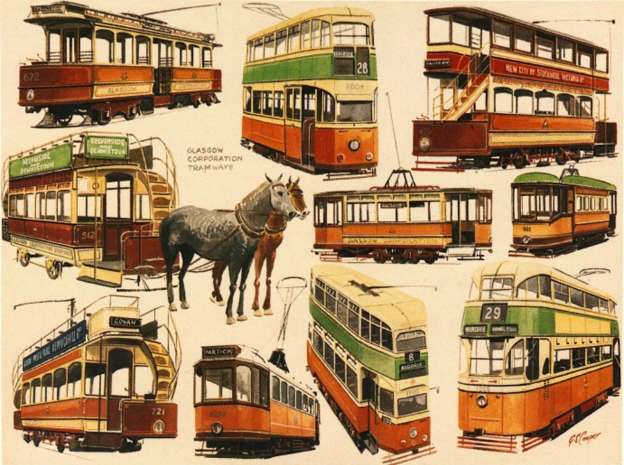
In the 1950s, a tram Glasgow purchased some years before, a ‘one-off’, unidirectional double decker car which it numbered 1005 and which was sometimes known as the ‘Blue Devil’ for its unconventional three tone blue colour scheme, was put forward by the LIght Railway Transport League as an option for trails that the League hoped might happen in London. The tramcar sat on PCC type trucks [1] and was sleek and streamlined. It can be seen in its later standard colour scheme in the bottom-right of the featured image above (Public Domain). [6]
The link to Flickr below takes us directly to Frederick McLean’s page on Flickr which focusses on this tram. Frederick McLean’s notes say that the reverse of the photograph was stamped with the photographer and/or negative owner name C. W. Routh and with the date 25 May 1955. He notes too that, in the photograph, the tram was heading South-east at St. George’s Cross.
In Washington DC a conduit system was in use, like that in London, and PCC cars were in use. The Light Railway Transport League (LRTL) proposed a trial on London’s streets of a modern PCC tram. They were even prepared to pay for the exercise.
Glasgow’s No 1005 was one of two cars considered a suitable vehicle for the trial by the LRTL. It was “equipped with up-to-date VAMBAC [3] electronic control, which promised smoother starting and braking, thus allowing higher schedule speeds with safety and comfort for passengers. In addition the trucks were fitted with improved motors, and more importantly, resilient wheels which gave a much quieter ride.” [2: p45]
Sadly the obstacles to the trial in London were too great. Harley lists these: [2: p46]
Single-ended cars needed turning loops. There was only one route (between Beresford Square and Well Hall Roundabout on Route No. 44) which might accommodate the trial.
Glasgow trams used bow collectors rather than trolley poles and we’re not fitted out for conduit working.
The Glasgow network was in fact a narrow-gauge network, three quarters of an inch (19mm) narrower than the standard-gauge in use in London. [5]
With a will to do so, these obstacles might have been overcome at LRTL expense, but ultimately there was no desire among the authorities in London to countenance the trial. Harley quotes the letter sent by the Operating Manager (Trams and Trolleybuses), dated 23rd March 1950: “Work on the replacement of the remaining trams is proceeding rapidly, and it is expected that the first stage of the conversion scheme will be completed before the end of the year, and that the scheme as a whole will be finished within a period of three years. You will see, therefore, that the Executive are committed to a policy of substituting oil-engined buses for the tramway system, a policy which they consider to be right and proper. In these circumstances the Executive regret that they cannot avail themselves of the offer you have made.” [2: p46]
The parallel offer of a similar trial using a, then, modern single deck Blackpool tram was also rejected by the authorities in London. Their minds were fully made up.
In Glasgow, Car No. 1005, foundered in use. Trams Today tells us that “when initially built in 1947 it featured Vambac controllers, a unique livery of three tone blue and was single ended but progressively both the livery and the control equipment had been standardised with the rest of the fleet. This still left the unusual loading arrangements which made 1005 unpopular with the general public amongst a fleet of more than a thousand more orthodox trams. Consequently it had for several years been restricted operation to use only at peak times whilst much oldertrams bore the brunt of all day service.” [4]
“In an attempt to rectify this situation and make better use of 1005 it entered the workshops during 1955 for rebuild that dispensed with the single ended arrangement. A drivers cab and full controls were provided in the rear. …. The work was carried out on a strict budget and, although successful in making 1005 more standardised, it still saw only infrequent use when it tram, generally appearing only during rush hour period until 1962 when it was finally withdrawn and disposed of for scrap.” [4]
References
PCC type bogies were first used on PCC cars in New York. The PCC car was “a revolutionary vehicle – a streamlined, single deck Tramcar which ride on superbly engineered trucks, giving a quiet and comfortable ride. When, on 1st October 1936, Mayor Fiorello H. La Guardia of New York, inaugurated service of Brooklyn and Queens Transit Car 1009, a new era in rail transportation opened. Orders followed from American and Canadian cities and eventually almost 5,000 cars rolled off the production line. This figure was augmented by the 15,000 PCC cars or vehicles built under PCC patents which appeared in Europe and Asia. The concession for England was snapped up by Crompton-Parkinson. They produced an advanced VAMBAC system (Variable Automatic Multinotch Braking and Acceleration Control), compatible with PCC technology, and 42 sets of equipment were used by London Under- ground in the late 1930s. In 1937, W Vane Morland, the Leeds manager, visited Boston to see the new design. He then returned home with the blueprints of the PCC, but the outbreak of war put paid to any more progress.” [2: p45]
Robert J. Harley; London Tramway Twilight: 1949-1952; Capital Transport Publishing, Harrow Weald, Middlesex, 2000.
VAMBAC was the acronym used to refer to Variable Automatic Multinotch Braking and Acceleration Control. It was in use in the UK as early as the late 1930s on London Underground. [2: p45]
Glasgow Corporation Tramways; Wikipedia; https://en.m.wikipedia.org/wiki/Glasgow_Corporation_Tramways: “Glasgow’s tramlines had a highly unusual track gauge of 4 ft 7+3⁄4 in (1,416 mm). This was to permit 4 ft 8+1⁄2 in (1,435 mm) standard gauge railway wagons to be operated over parts of the tram system (particularly in the Govan area) using their wheel flanges running in the slots of the tram tracks. This allowed the railway wagons to be drawn along tramway streets to access some shipyards. The shipyards provided their own small electric locomotives, running on the tramway power, to pull these wagons, principally loaded with steel for shipbuilding, from local railway freight yards.”
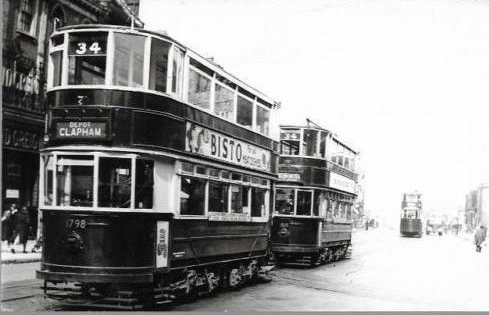
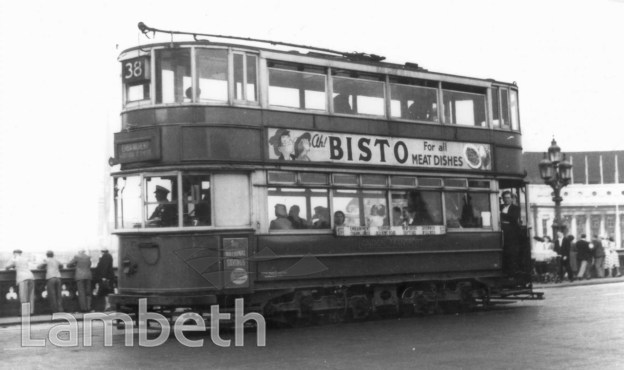
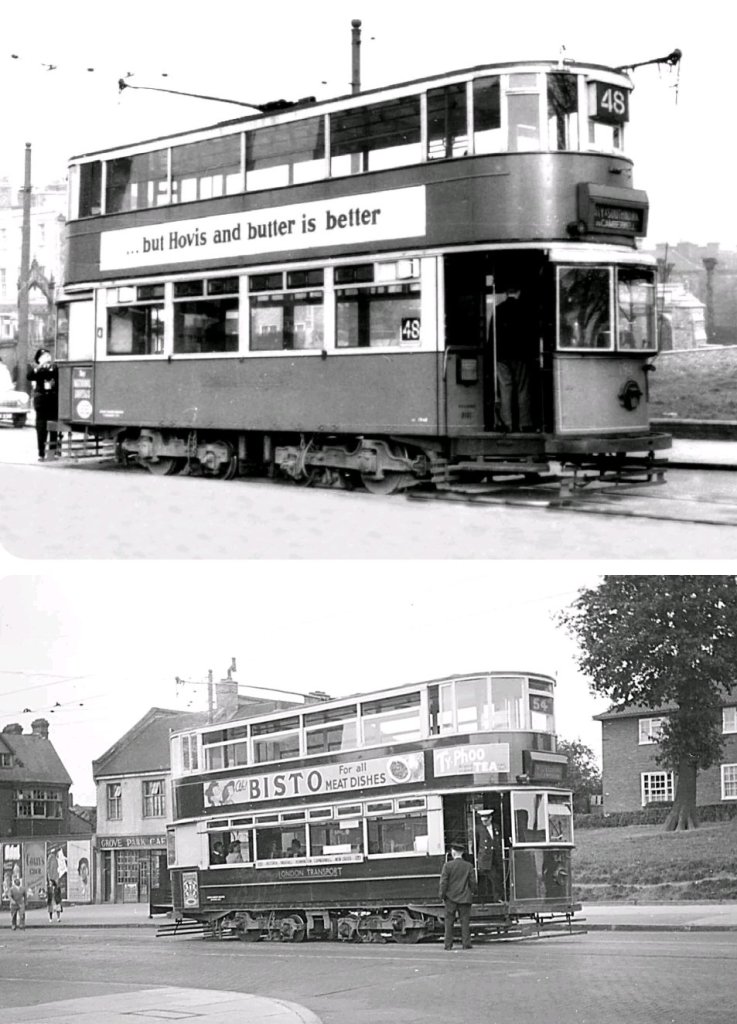
The featured image at the head of this article shows trams which served Route 34 in Clapham in 1949, the photographer is not recorded. [2] Route No. 34 ran from Chelsea (Kings Road) via Clapham and Camberwell Green to Blackfriars. [1: p122]
Robert Harley, in his book ‘London Tramway Twilight: 1949-1952 has chapters focussing, among other subjects on the years 1949, 1950 & 1951. [1]
In the chapter which considers 1949, [1: p32-41] Harley tells us that in May 1949, forty members of the Light Railway Transport League (LRTL) undertook a tour in Feltham car No. 2094. “It was noted that this particular car was resplendent in fresh paint and in excellent mechanical condition, having recently passed through Charlton Works. Chief Inspector Perry was ‘on the handles’, and he drove Car 2094 from Victoria to Southcroft Road. Tour participants were then transported to Purley, before returning to Victoria. The journey from Purley to Victoria was timed at 55 minutes.” [1: p36]
Harley goes on to say: “Perhaps many of the 40 members realised that an era of stability was about to end, for on 8th June space was made free in Wandsworth and Clapham depots to allow construction of garage facilities for diesel buses. This work would include filling tramway inspection pits, providing new bus docking pits, sinking fuel oil storage tanks in the ground and installing fuelling points. The old tramway traversers which were used to shift trams sideways, would also go. It was indeed the beginning of the end, and a tangible sign that progress towards the inevitable extinction of electric traction was now unstoppable.” [1: p36-37]
Harley also notes that, ‘The Modern Tramway’ for July 1949 “contained a number of details under the headline ‘London Depot Changes’. According to the correspondent, Wandsworth Depot had been converted to overhead wire and a change pit constructed at the entrance. Removal of the conduit equipment within the depot made for an easier and safer conversion. Fleet changes included seventeen cars of the 1700 series E/1 which were shifted to Clapham Depot to work route 26. Fifty-one other E/1s were transferred from Clapham to Camber- well and New Cross. The 1500 series E/1 cars were now mostly stabled at New Cross. Six E/3 cars were moved from Thornton Heath to Norwood, which also received some rehabs from New Cross. Route 34 was now worked by Camberwell Depot and was operated mainly by E/3 cars, with the odd HR/2 and E/1 taking a turn. New Cross took over route 66 from Camberwell; Norwood worked most of route 10, although Telford Avenue still supplied one Feltham for this route. Telford Avenue took over Clapham’s share of route 10 and part of the allocation of cars on routes 22 and 24.” [1: p37]
The reality was that, from its formation in 1937 by J.W. Fowler to seek the modernisation and retention of electric tramways [1: p42], the LRTL was fighting against entrenched views in London Transport (LT). “Lord Ashfield, Frank Pick, Sir Henry Maybury and the other board members were firmly convinced that the sooner they got rid of the trams there better.” [1: p42]
“Although there was a genuine affection for tramways amongst many LT employees, it is safe to say that the attitude of LT, the Labour Government and the TGWU was fairly consistent. New and better road vehicles, in the form of the RT bus, would provide a flexible, more integrated service thus in this sense, the post-war abandon- ment programme was never a party political issue. It was the consensus of transport experts that trams had had their day. Arguments such as the danger of relying on imported oil and rubber found little support in the corridors of power. As for the growth of motor vehicles, it was confidently predicted that the average speed of London’s traffic would increase after the removal of the trams. Parking was not foreseen as a problem, and the use of American style parking meters was discounted as unBritish! Concerns about pollution mainly centred on burning smokeless fuels, which would ease the fog situation. The possible harmful effects of exhaust fumes from the thousand or so new buses were given the same short shrift as American parking meters.” [1: p43]
References
Robert. J Harley; London Tramway Twilight: 1949-1952; Capital Transport, Harrow Weald, Middlesex, 2000.
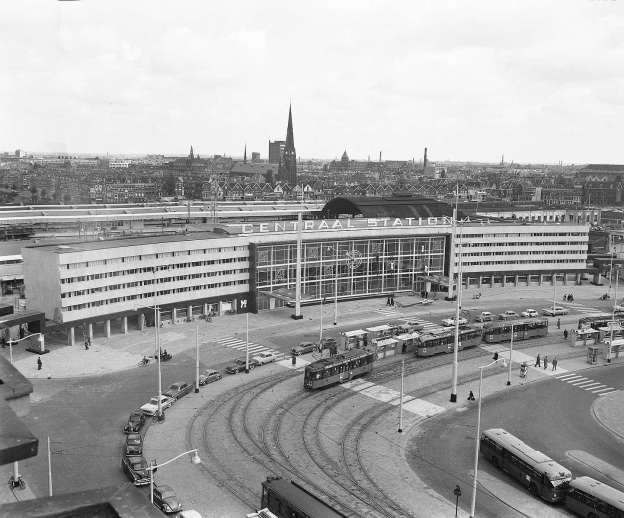
This short article could be entitled, ‘The Modern Tramway takes on the Manchester Guardian‘. In. Its May 1957 journal the Light Railway Transport League asks whether its readers had read the Manchester Guardian on 22nd January. The featured image shows trams in Rotterdam in May 1957. [3]
In an article entitled ‘A Twisted Tale’, The Modern Tramway Journal is surprised to see the Manchester Guardian being taken in by the spirit of the current age which was decidedly anti-Tram. [1: p83]
“Did you read the ‘Manchester Guardian’s’ account of the re-building of Rotterdam in the issue of 22nd January? It was a good article, catching the spirit of the modern conception of town planning, and making you feel that the writer had not only visited Rotterdam but had been genuinely inspired by the creat- ive talent of its designers until you got to his last sentence, which pro- vided so violent a contrast that it might have been written by a different person. It read: “It is odd to see trams still clanking through the city and to hear that there is no intention as yet of scrapping them.
“Whatever was the writer [on] about? Rotterdam’s trams are among the finest and most modern in Europe, as well as some of the quietest, a system that conforms to the League’s highest ideals and amply attains its motto of ‘Vlug, veilig en goedkoop (fast, safe and cheap)’.”
[1: p83]
As the article goes on to explain, “nothing about a Rotterdam tram could remotely be described as clanking; they run on track entirely free from dropped joints and corrugations, and their noisiest feature is the click of the controller ratchet. As for the town planning aspect, if you have visited Rotterdam during the last 10 years you will have seen how the rebuilding of the city went hand in hand with the rebuilding of the transport system; the tramways in the main streets in the city centre are now sited on central reservations, free from other traffic, and the busiest stops are laid out with a foresight rare else- where, the track dividing so that each group of routes has its own stop and shelter side by side. The service the trams give is one of the finest a city could have, a smooth, effortless flow of high-capacity vehicles operating at the cheapest fares in Holland, and how any trained observer could visit the city and fail to be impressed by it is difficult to understand.” [1: p83]
While it may have been true that the oldest tramcars on the Rotterdam network were contemporaries of the HR2s in London they were actually almost silent! Indeed, The Modern Tramway expressed surprise that the city’s tram company(Rotterdamse Ekectrische Tram (R.E.T.)) considered those vehicles due for retirement. Apparently the company had already ordered a first batch of replacement single, and two car articulated sets. Pointedly The Modern Tramway comments:
“As for the other post-war cars, their equipment came from Trafford Park, and the ‘Guardian’s’ outburst is hardly calculated to further the export trade of Metropolitan-Vickers who made them.”
[1: p84]
So, what might have been the explanation for the Manchester Guardian’s faux-pas? The Modern Tramway thought that it had an explanation which might be charitable:
“Perhaps the writer, putting his impressions on paper some time after his visit, searched in his mind for the sound of Rotterdam’s trams (and failed, since they are noiseless), and unconsciously completed his mental picture by substituting the tram noises he knew in Manchester, the home of groaning motors, rattling windows, dropped joints, broken check-rail, lifeguard trays tied up with string, four-wheel cars with odd bearings, bogie cars with odd trucks and all the rest of it. Either this, or he deliberately set out to mislead and based his words on three quite erroneous assumptions, to wit:
(a) A modern city with trams is odd;
(b) Trams, including Rotterdam ones, clank;
(c) Rotterdam’s trams will ultimately be scrapped, but not as yet.
We had always looked on the Manchester Guardian as a factual paper with a liberal outlook, a traditional supporter of oppressed minorities, and free of the bigoted outlook that is so often present elsewhere. We did not expect a paper that devoted page after page to the horrors of shipping live horses to Antwerp to show the customary English attitude of ignorance and intolerance towards tramcars; trams, after all, are a persecuted minority without the means of defending themselves.”
[1: p84]
I suspect that The Modern Tramway editor had his/her tongue firmly in his/her cheek as they penned that last paragraph!
The article continues:
“If the contributor had written about St. Malo or Douai or Maubeuge or some other of those French towns whose trams were capable of racing a tortoise on equal terms then we might have felt a glimmer of sympathy, but the article was on Rotterdam, and it is possible only to say that the remarks were inappropriate, misleading and absolutely untrue.
Of course, we wrote to the ‘Guardian’; on enquiring among our readers who know Rotterdam, we found that they too had not been slow to refute this smear against the R.E.T., and we believe that some of the Guardian’s’ overseas readers wrote as well. Last (but by no means least), our friend Ir. Bogstra, the General Manager of the R.E.T., was so surprised by the Guardian’s remarks that he sent the paper a set of photographs of the newest trams and a coldly factual analysis of the reasons why Rotterdam prefers trams to buses. From all this, we might have expected to read at least one “Letter to the Editor” disagreeing with the contributor, but all that happened was the appearance of a childish note of defiance in the “Miscellany” gossip-column a fortnight or so later, expressing surprise that there were such things as silent modern trams; because the word “tram” rhymed with “slam” you expected it to be noisy, and so on in the same vein. There are newspapers from which we should have expected unenlightened comment, but we never thought that we should have to include the Manchester Guardian’ among their number.”
[1: p84]
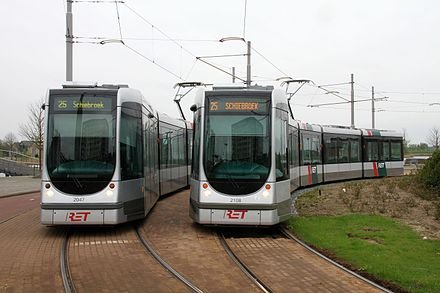
Rotterdam’s Trams remain an integral part of the city’s transport provision. “Opened in 1879, the network currently has nine regular tramlines, and three special or seasonal tramlines. It has been operated since 1927 by Rotterdamse Elektrische Tram (RET). The tram network is the city’s more extensive public transport system, while the rapid transit Rotterdam Metro is the more utilized system.” [2]
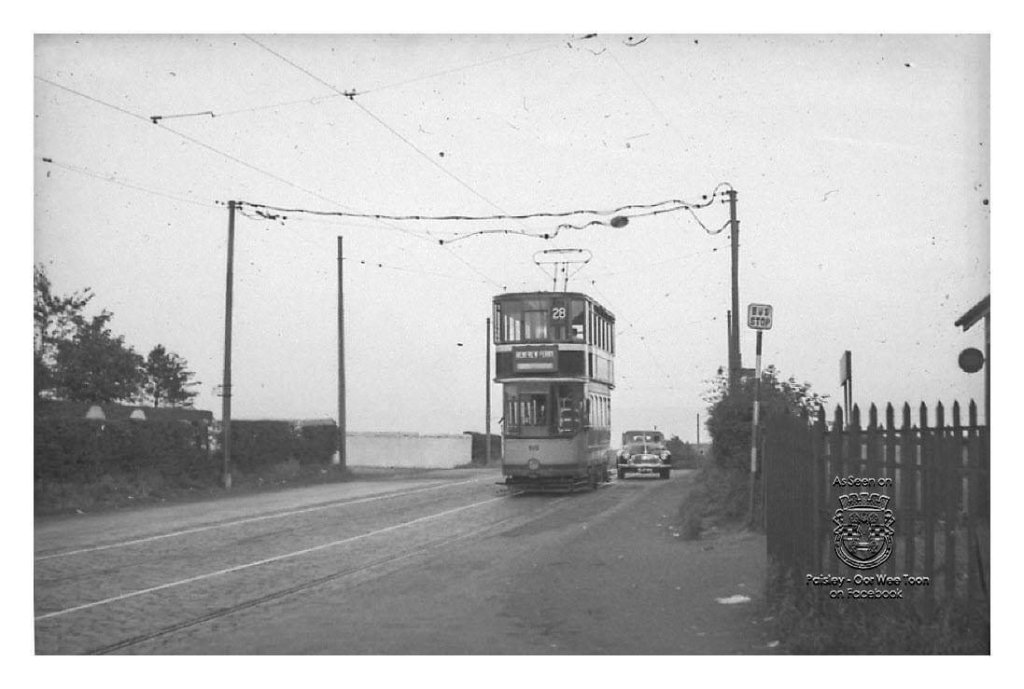
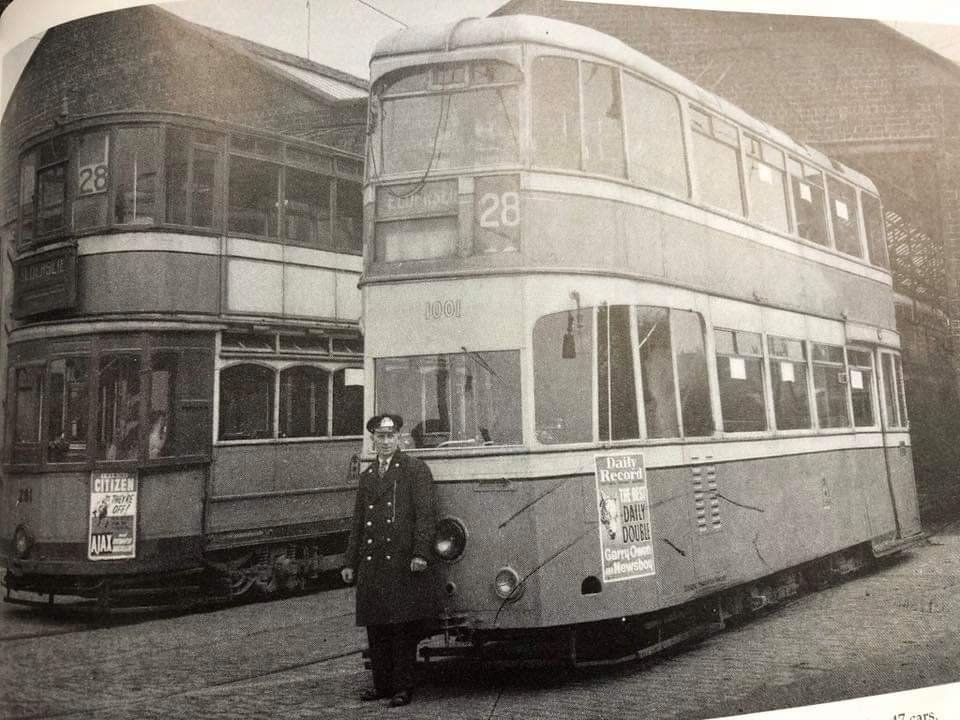
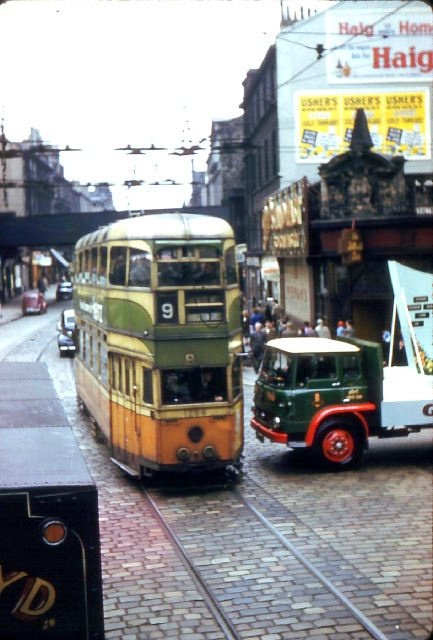
The Modern Tramway Journal of April 1957 included a nostalgic look at one of the Glasgow tram network’s successes. [1] An ‘out-boundary’ route, No. 28, which at one time was part of the longest tram route in the UK, almost 23 miles in length. End to end it was a 2 hour tram journey. At that time, the early 1930s, the route from Renfrew Ferry to Milngavie was numbered 14. “In 1943 it was cut at Spiersbridge and renumbered 28, and on 3rd April 1949, the Glenfield – Cross Stobs section was closed.” [1: p61] The truncated line (No. 28) ran from Renfrew Ferry to Glenfield – a distance of 5.24 miles.
For some general information about Glasgow’s trams, please look towards the end of this article. First, we focus on Line No. 14 which was renumbered 28. …
The route of Line No.14 passed through the following ‘stations’/stops:
Renfrew (Ferry Road, High Street, Paisley Road); Paisley (Renfrew Road, Gilmour Street Station, Causeyside Street, Neilston Road); Barrhead (Cross Arthurlie Street, Main Street, Darnley Road); Nitshill Road; Jenny Lind; Thornliebank Main Street; Mansewood; Pollokshaws Road; Shawlands Cross; Strathbungo; St Andrew’s Cross; Laurieston; Glasgow Bridge; Union Street; Renfield Street; Sauchiehall Street; Cambridge Street; Gartnethill; St George’s Cross; Queen’s Cross; Wyndford; Maryhill (Maryhill Road); Bearsden (Milngavie Road); Milngavie (Main Street). [4]
Line 28 was much reduced in length, as we have noted, it still ran from and to Renfrew Ferry but the locations mentioned by Coonie in his article do not appear in the list above.
Glenfield Road and Caplethill Road met close to the Glenfield Terminus of the No. 28 route. The image below shows the terminus in use.
The old No. 14 continued beyond this terminus following Caplethill Road to Barrhead and then left Barrhead along Athurlie Street continuing on through the centre of Glasgow. As you will see below Coonie talks of the Glenfield Terminus being ‘out in the wilds’. [1: p63] Even in 2023 this appears to be the case!
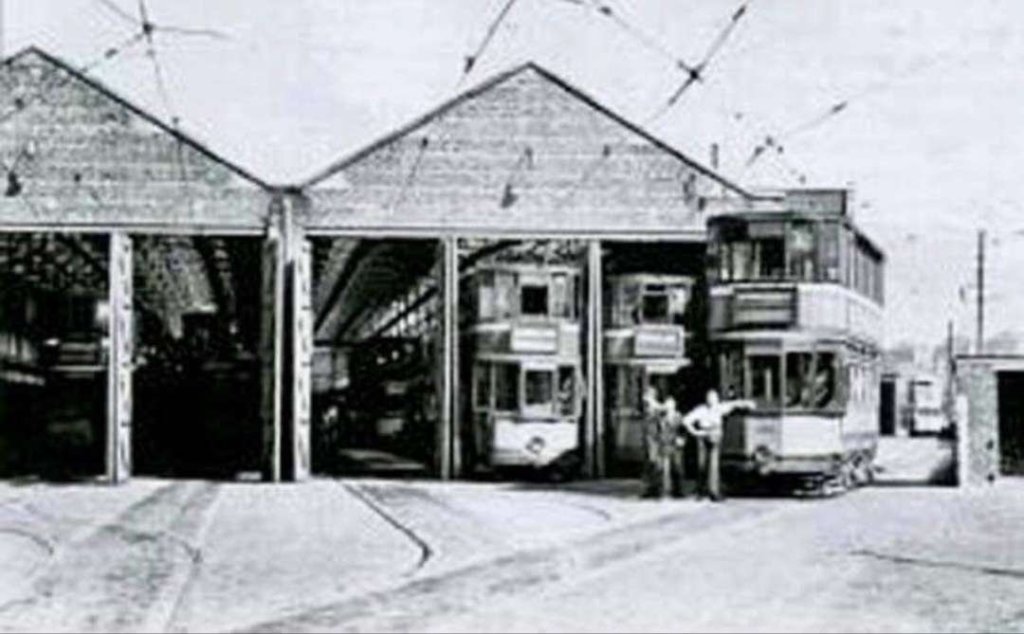
The Elderslie Depot mentioned by Coonie below is, of course, long-gone. Elderslie itself remains, South of the A737 to the West of Paisley and also immediately to the South of the railway line from Paisley to Johnstone. The tram depot was on Main Road, Enderslie. It was opened in 1904 by Paisley District Tramways, it was acquired by Glasgow City Transport in 1923. It was also used as as bus garage between 1932 and 1955 and eventually closed in 1957. The entrance was just before the railway bridge.
Elderslie Tram Depot. This image was shared on the Paisley Heritage Facebook Page on 1st March 2020. [11]
The nickname for the No. 28 route was ‘The Goldmine’ as the pence-per-mile average was well above the city average!
In his article, Coonie talks first of the old line (No. 14):
“It is a rare “double-ended” service, taking the crowds both ways at once, shipyard workers to the Clyde, engineering workers to Porterfield Road, shop and office workers into Paisley, factory workers to the south side, workmen’s business and shopping traffic all up and down the same five- mile stretch, with busy two-way peaks but without the awkward tidal traffic flow so common in city transport and yet so uneconomic. Of all the out- boundary routes, the 28 is probably the only one they are sorry to lose; the others lost £80,000 a year, but not the “Goldmine.” It has a history too. In the days of Paisley District Tramways it ran from the Ferry through Renfrew and Paisley burghs to Barrhead and beyond, and after the 1923 take-over Glasgow made it part of Britain’s longest tram route-22.9 miles and two hours, the No. 14 from Renfrew Ferry to Milngavie. … The weekday service is every six minutes (73 before mid-day), with two and three-minute intervals at rush hours and extra cars on Saturdays, so that you get 48 cars in the two-hour morning rush, including ten coming round from Elderslie. There are buses too, for Glasgow Corporation have no monopoly in Paisley or Renfrew and four bus companies are on the same road, red, green and blue- and-white buses racing green-and-orange trams, and most of the buses bought second-hand at that. Patons, Western S.M.T. and Cunninghams run from the Ferry to Paisley, McGills and Western from Paisley to Barrhead, all competing with the trams, … but this is the one place where the trams fought back and held their ground.”
[1: p61-62]
Coonie tells the story of the ‘battle’:
“Up to 1949, Elderslie had only six modern cars (Nos. 1266-1271) and since one of the loops on the Glenfield- Barrhead section was a bit short, only 4-wheel cars were used there. But with that obstacle removed, things be- gan to warm up; the road-widening scheme north of Paisley gave the trams a real speed-track, a new lye at Porter- field Road kept rush-hour cars clear of the main line, a new crossover at Lochfield Road allowed economical short-workings, and then they brought over twelve more Coronations and five modern 4-wheelers from the city to work the base service, kept the old cars on the 21 or in the depot (except at rush hours) and sat back to watch the fun. It was worth watching; the comfort, the headway and the rapid acceleration soon brought passengers back to the trams and kept them, the average speed including stops was 2 m.p.h. above the city’s average, and although the 28 modernisation was expensive, it paid off. The “Goldmine” was a fine example of what you can do with modern trams if you try – even in 1950 – and although the boundary agreement means that its days are numbered now, that’s politics and no fault of the trams.
Most trips are busy and uneventful, with the accent on good timekeeping and good service, but (keep it dark) the “Goldmine Handicap” is still run two or three times a month, depending on the rosters, the weather, and whether anyone is around. My last race was on [Car No.] 1272 just before Christmas, with Dennis up front … We left the Ferry dead on time, but were held at Renfrew Cross, and the pride and joy of Cunningham’s Bus Service (second-hand ex-London R.T. 1481) got away in front, driven by tram-hater Duncan who once called Coronations a “pile of junk.” Dennis decided to show ’em; he opened her up, but passengers were already leaving the tram stop at Robertson Park to get on the bus, which always gets his goat, and with strange oaths, half-Irish, half-Glasgow, he went on gaining ground to Renfrew South. The road widened out; the Coronation was put on the last notch, traction motors whining, lamp-shades swinging, Rosie the clippie squealing ‘Whit ur you playin’ et?’ as we tore up Moorpark, over the hill, down past the boundary sign and round the curve till at Sandyford Fire Station the R.T. gasped and called it a day. Dennis whined past, picked up six passengers, and kept right on at full power to Paisley North, the 17-year-old tram beating London’s wonderful post-war bus as usual. Officially these things don’t happen, and the names in this story are fictitious, but that’s how the insulator suffered at Moorpark.”
[1: p62-63]
Trams at Elderslie Depot. This photograph was shared on the Paisley Heritage Facebook Page on 1st March 2020. [11]
Apparently, it was important, if one wanted to make a claim to have done the ‘Goldmine’ properly, to start at Enderslie Depot. Coonie describes the route in detail:
“The cars for [Route No.] 28 are all shedded at Elderslie; Coronations 1266 to 1283, older hex- dash and round-dash cars, and the five single-truck experimentals 1001-4 and No. 6, dating from 1939-41. No. 6 is “The Coffin”; once a standard car, it was destroyed in the Clydeside blitz of March, 1941, rebuilt as a modern car, burnt out at Newlands Depot in 1948, rebuilt, sandwiched between 1280 and 1282 in 1951 and rebuilt again. But ours is flagship 1279, a Phoenix with a 1954 Coronation body, running number eight due out 6.20 am. On the dark winter’s morning, the wind blows across the railway and the jungle that was once a garden, tended by the staff of Paisley District Tramways; we enter the main road, reverse, cross over, and roar down through Paisley and the darkened High Street, picking up the “regulars” for the south side starch and textile-finishing works. At the Cross, the driver changes the points (no points- man till 7 a.m.), then we take the curve into Gilmour Street, and the passengers rise and swing the seats unasked as we reverse in County Square for the ten-minute run south through the waking town to Glenfield.
Glenfield terminus is almost out in the wilds. A few derelict standards remind you that eight years ago you I could travel by a “Saxby” down the narrow country road to Barrhead, with sharp turns into the loops and the power a bit on the weak side, though that didn’t prevent No. 1005 taking a League party down there in 1947. But we turn the seats, wait for a minute and then head north again; down the grade, past the road from Glenburn housing estate whose people are forever complaining at their bus service, up again through Potterhill where the “nobbery” live and, over the goods line at the old Potterhill station. If you look back now, you see the majestic skyline of the Gleniffer Braes, made famous by the Paisley poet Robert Tannahill.
Things begin to warm up now, with customers at every stop. Over Lochfield Road crossover and Neilston Road, we pass Brown and Polson’s cornflower works and the line becomes a real town tramway with tenements, 3-story buildings and the Royal Alexandra Infirmary. The final descent, Causeyside Street, is rather wider, and then we pass a crossover round a curve, and ride up the 1 in 12 St. Mirren Street Brae to stop more often than not at the Paisley Cross traffic lights. Despite the grade there is no record of any tram accident here, though a bus ran away in a heavy frost some years back. Later in the day, at 9 a.m., 12 noon, 3, 6 or 9 p.m. you can hear the carillon of Paisley Town Hall across the garden in Dunn Square, old Scottish tunes with hymn-tunes on Sundays. At Christmas, the square is a fairyland of coloured lights.
The lights change, we rattle over the points and crossings of the 21 route (Paisley’s best-known sound), and pull up in narrow Gilmour Street, the main loading point for the “Goldmine” to Renfrew. On Saturday, the scene in Gilmour Street has to be seen to be believed, with long queues at both north and southbound stops and never a wasted journey. Then we pass Paisley Municipal Buildings and the old jail, all turreted and crenellated like a medieval fortress, facing on County Square and harmonising with the G.P.O. and the railway station built to the same style. There is a crossover, and a small loop, once connected at both ends to the northbound line but now a fossilised remnant; it was once the terminus of the Abbotsinch service worked latterly by oneman single-deck car No. 92 from Finnieston until it closed on 26th March 1933. The loop was still used for short-working 28s until about five years ago.
Under Gilmour Street bridge we turn into Old Sneddon Street, cross the River Cart by Abercorn Bridge and see on our left the red-brick Abercorn Street sub-station of G.C.T., its siding connected to our northbound track by a trailing point. Excluded from the frequency-change scheme, Abercorn Street is the last sub-station working at 25 cycles, and since its closure will complete the change to industrial frequency at Pinkston this explains why the Department are pre- pared to give up serving Paisley. Just past here, a tenement block juts out and causes the track to become single for twenty feet in Weir Street, the only single track on the Glasgow system, and then we turn left into Renfrew Road, pass some engineering works and Paisley (Abercorn) station, and gain the open road again. There are several schools here, and until 1953 a special school car was run from Elderslie.
Next come Sandyford Road crossover (“Paisley North”), the terminus of the long No. 4 from Springburn. At the fringe of the New Gallowhill housing scheme is a small cairn, marking the spot where Marjorie Bruce, mother of Robert the Bruce, was thrown from her horse and fatally injured. In contrast, there is nothing at all to mark the site of Renfrew tram depot at Newmains Road, which was swallowed up completely by a housing scheme in 1949 after being used for 13 years as a store. We are now on a stretch of road which until 1949 was just a dusty cobbled lane with no pavement and the “Saxby” cars brushing the hedges; to-day it is a fine broad tarmac road, on which the Elderslie Coronations and Govan Cunarders can really show their paces. When the road was widened, the track was completely realigned. Beyond, on the right, we can see the runways of Renfrew Airport, and on the skyline the shipyard cranes of the Clyde and the tower of Glasgow University.
From here, we climb over the hill and down to Porterfield Road (“Renfrew South” on the screens). One of the sights of the “Goldmine” is the 5.30 p.m. scene on the Porterfield Road lye, a new track (with a double-track triangle junction) put in in 1950 to cater for the Babcock and Wilcox engineering works traffic. As the hour approaches, specials arrive from both north and south, from Elderslie and from Govan, to line up on the works track; then at 5.28 the whistle blows, the crowds stream out to the waiting cars, and from 5.31 to 5.38 a queue of packed special cars moves off nose- to-tail, some for Paisley (Causeyside Street), some to Lochfield Road, and some to take the curve at the Cross for Elderslie. The sight is warmly recommended to all tram-lovers.
Passing the Robertson Park (second finest in Scotland) we reach Renfrew Cross and the turreted Town Hall, six times the height of a tram. Away to the right swing the tracks of the 4 and 27, linking Renfrew with Glasgow via Shieldhall and Govan, and we are on our own again, round a slight curve, under the goods railway and past some shipyards on our right, perhaps with a dredger fitting out. Ahead lies the end of the line, the slipway of Renfrew Ferry, and the towering mass of the Clyde Valley Power Station across the water. Originally the terminus was nearer the ferry gates and consisted of a trailing crossover, but this was cut back to ease congestion in 1954 and replaced by a single line in the middle of the road. The slack wire used to facilitate the bow reversal here is one of the longest on the system.
The car comes to a stand; the crew turn the seats, and the passengers walk down to the diesel-electric chain ferry and float slowly across to where other trams – standards, Coronations, Kilmarnock bogies, and strange beasties like 1809 and 1100 – run up and down between cranes and shipyard walls to Whiteinch, Clydebank and Dalmuir. And as we pay the penny toll to enter Dunbartonshire, we can look back at the grid pylon reflected in the water, to the chain of the ferry vanishing into the depths, and to the Coronation standing in Ferry Road beyond, almost out of sight, waiting for another good payload and another run “Down the Goldmine,” the route where the tram hit back – and won.”
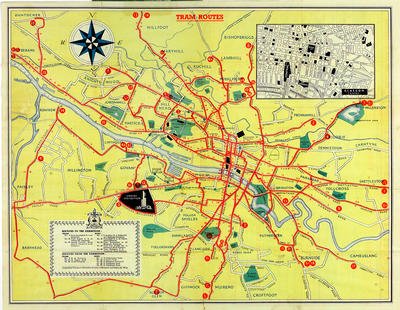
Glasgow Corporation Tramways were formerly one of the largest urban tramway systems in Europe. [2] Over 1000 municipally-owned trams served the city of Glasgow, Scotland, with over 100 route miles (160 route kilometres) by 1922. [3] The system finally closed in 1962 and was the last city tramway in Great Britain (prior to the construction of new systems in the 1990s). [4]
“From a maximum of more than 1,200 trams in 1947, the system was gradually wound down from about 1953 in what proved to be a lingering death.” [8]
Wikipedia tells us that the Glasgow system’s initial network of a few lines expanded greatly in the early years of the 20th century, [5] extending to burghs and rural areas outside the city boundaries which were soon incorporated into it as well as outlying neighbouring towns [6]
The time of the 1938 Empire Exhibition held in the city’s Bellahouston Park is viewed by some as the apex of the system’s timeline, [6][7] with new cars recently put into service [8] and special routes added for the exhibition, while the city was as yet undisturbed by World War II and subsequent redevelopments, with the trams winding through the dense network of tenements and factories which characterised industrial Glasgow in the first part of the 1900s, [9] but also into some new ‘garden suburb’ developments with widened streets to accommodate the tracks. After the war the trams began to be phased out, although periodic reviews of routes were still conducted. Tellingly, the routes were not extended to any of the large 1950s peripheral housing schemes nor to the new towns being developed outside the city. [4]
References
Ian M. Coonie; Down the ‘Goldmine’; in The Modern Tramway, The Light Railway Transport League, April 1957, p61-65.
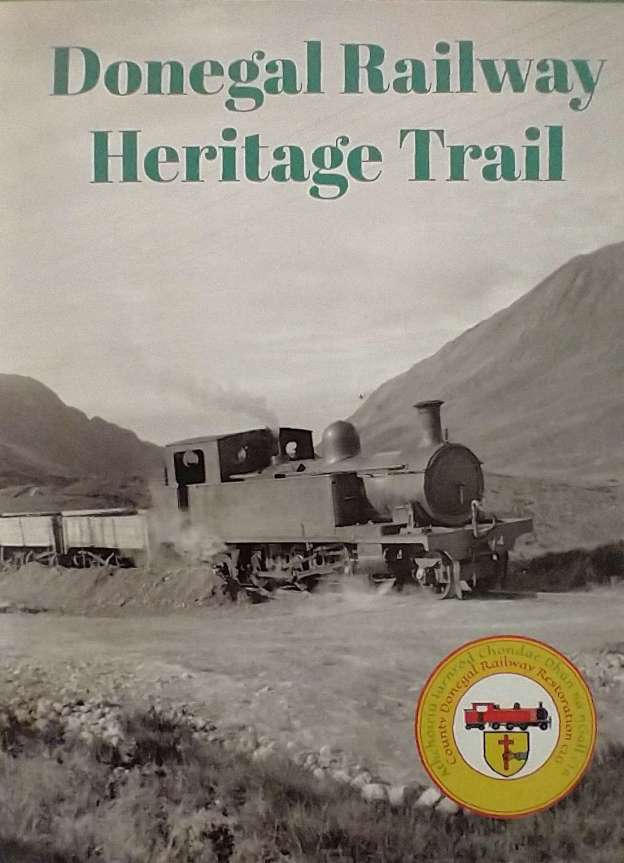
On 28th February 2022 the Donegal Railway Heritage Centre announced that, with funding provided through the “Creative Ireland” programme administered by Donegal County Council, they completed the production of a map of County Donegal showing some of the main Donegal railway heritage still to be seen across the County and into Northern Ireland.
Niall McCaughan, Manager of the railway Museum stated: “In recent years there has been an increased interest in railway heritage, locally, nationally and internationally. Here in Donegal is no different, but the uniqueness of the railways that operated across Donegal has a special place in the hearts of the local population, not to mention too the international interest it rightly deserves. Although much of our great railway heritage has disappeared over the decades, there still is surprising a lot about, hidden in plain sight and some of Donegal’s railway heritage is still in operation for different purposes, including as the Bus Éireann bus station in Letterkenny and their depot in Donegal town, both previously part of the Donegal railway network. This includes Station buildings, halts, Gatehouses, bridges, etc. With this in mind, we have produced a simple easy to read folded “Heritage Trail” guide for the county, as well as some locations just across the border.” [1]
I picked up one of these leaflets at the Heritage Centre in Donegal Town. It is a really well-prepared fold-out map with a significant number of important locations on both the Londonderry and Lough Swilly Railway (which served the Northern half of County Donegal from its station in Derry) and the Co. Donegal Railways network.
If you are planning a holiday in Co. Donegal then writing off for one of the leaflets would be worthwhile. They are supplied free, provided the buyer covers postage and packing costs. Alternatively, the leaflet is also available to download as a .pdf file, here. [2]
This is a low resolution copy of the map which forms part of the heritage trail leaflet. Each of the numbered locations has its own short note and photograph on the reverse side of the leaflet. [2]Just a few of the locations highlighted in the leaflet. [2]
This is an excellent leaflet providing a great way to plan a trip round Co. Donegal to find railway heritage and to enjoy Donegal’s wonderful scenery. Don’t get so focussed on the railway history that you miss the superb beaches and the rugged moorland scenery.
The leaflet’s suggested stop-off points can supplemented by some excellent railway walking.
The first 6 km of the line from Burtonport (on the L&LSR [3]) is an easily accessible, well-maintained walk. Full details of the walk and associated historic photographs can be found on this link:
A further excellent walk, part metalled, runs between Falcarragh Railway Station and the Foot of Muckish Trailhead, also on the L&LSR, which can be found within this link:
Lough Connell, Meenderrynasloe, Co. Donegal. The old railway ran along the North side of the lough. Parking is available at the West end of the lough. [Google Maps, 5th June 2023]
It is also possible to follow other lengths of the line which are part of other walking trails or which require a little more adventurous spirit. The full length of the Burtonport Extension of the L&LSR is covered by the series of which the three noted above are a part.
More about the railways which used to grace Co. Donegal can be found on these links:
An article from the magazine Steam Days, May 1992 can be found here. [4]
‘The Modern Tramway’ in March 1957 (Volume 20, No. 231) carried a follow-up article [1] to that carried by the Journal in April 1954. The original article is covered here:
The follow-up article in the March 1957 Journal focussed on a new Road Research Laboratory Report about London road accidents. The Modern Tramway claimed in the article that the Report went almost unnoted in the national press, unlike the Laboratory’s earlier report.
Two images of London trams, possibly both Felthams. The first on Route 48, the second on Route 54. Route 48 ran between West Norwood, Elephant & Castle and City (Southwark). Route 54, between Grove Park Station and Victoria Station. [2][3: p122]
The featured image at the top of this article is part of the Lambeth Landmark Collection (Ref: 04823, Identifier: SP160, 1951). It shows, possibly, another Feltham tram on Route 38 crossing Westminster Bridge going towards Parliament Square. The London County Hall building can be seen on the right. The Skylon of the Festival of Britain is just visible (no more than a ghostly shadow) on the left side of the tram. Route 38 ran between Abbey Wood and Victoria Embankment (via Westminster Bridge). [4][3: p122]
The new report studied the effect on accidents of resurfacing former tramway roads in the boroughs of Camberwell and Wandsworth, and the report’s conclusions were that the improvement in road surfaces reduced skidding accidents but increased some other types of accident presumably by encouraging higher speeds. The final result was a marked transfer of accident-proneness from pedal cyclists to pedestrians and motor vehicles, a 10% decrease in total accidents and a ‘non-significant increase’ in fatal and serious accidents. The Journal commented that the phrase ‘non-significant increase’ was “not intended to reduce the seriousness of the case; since fatal and serious accidents are fewer than slight accidents a far more dramatic change in the trend would be necessary to reach the point of statistical signifi- cance.” [1: p43]
Of particular significance was the additional evidence which this latest report provided that “London tramway accident figures were not typical of those for the country as a whole. The comparison is made between the period when the tracks were intact but disused (and in many cases patched, leaving only the conduit slot exposed) and the first equivalent period after complete resurfacing; it confirms that the conduit slot was probably as important a factor as the running rails in pedal cycle accidents, and since this outdated feature of the former L.C.C. system was entirely confined to London (at least in the motor age) it clearly invalidates any comparison of accident figures between London and other towns.” [1: p43] Other similar points, such as the absence of loading islands in London, were brought out in the previous article in April 1954.
The Light Railway Transport League secured an interview with the Road Research Laboratory in which evidence relating to Dundee’s experience of a conversion from trams to buses was discussed as well as the then recent report about London. The tram and bus accident figures for Dundee showed that Dundee trams ran about three times as far per fatality as Dundee buses. “The Laboratory … considered that the Dundee figures were too small for any definite conclusion to be drawn from them, and maintain their previous view that since London results in almost all other matters have been found similar to those elsewhere the same must be true of trams.” [1: p43]
Sadly, the League came to the conclusion that the Laboratory’s conclusions would only be challenged if it’s own members were able to provide statistically significant and conclusive figures relating to some of the larger city networks which allow comparisons to be made. The League suggested that two forms of comparison were possible: “one in a city such as Sheffield where modern practices (and modern surfaces) apply on a street tramway system, the other in a city such as Liverpool where a high proportion of the tramways were on reserved track.” [1: p43] The League was convinced that the many untypical features of the London tramways rendered invalid any extrapolation of London results to other towns, and that a similar study in (say) Sheffield would provide ample proof of this. Their view was tramway modernisation would have brought about a greater reduction in accidents than the replacement of trams with buses. The League asserted that figures received from Hamburg seemed to confirm this. The Deputy Director of the Laboratory agreed that such practices as coupling trams together and providing loading islands could reasonably be expected to reduce the accident rate, but the Laboratory had no figures to support this. It seems, however, that there was shared agreement on the safety value of reserved tramway tracks as a study undertaken by the City Engineer in Glasgow after the war showed accidents to be negligible. [1: p44]
References
More About Accidents; in The Modern Tramway, The Light Railway Transport League, Volume 20, No. 231, p43-44.
The Modern Tramway Journal in February 1957 carried an article about the tramways of Leeds. The data for the article was collated by A.K. Terry and the article was written by J.H. Price. [1] Please note that the copyright of the featured image above is owned by the National Tramway Museum at Crich. The museum are content for it to be shared in this way provided that their copyright is acknowledged.
The Suez crisis brought a temporary halt to a number of things within the UK economy. One of these was the planned scrapping of the tram routes and tramcars in Leeds. That pause provided the opportunity for the Light Railway Transport League to compile a map, fleet list and list of services for the city. Everything included in the February 1957 article was correct as of 31st December 1956.
In 1953, Leeds City Council decided to substitute buses for trams over a period of ten years. This meant tha by the end of 1956, ten nineteen of the city’s tram routes had been abandoned and the 1953 roster of 417 tramcars reduced to 170.
Those changes were recorded by the article as follows:
“The first conversion was the service from the Corn Exchange to Half Mile Lane (No. 14) on 4th October 1953, followed on 4th April 1954, by Kirkstall Abbey (No. 4) and Compton Road (No. 10). The latter abandonment saw the withdrawal of the last ex-Manchester and ex-Southampton cars and the Pivotal-truck Chamberlain cars, while Headingley depot was closed to trams at the same time. No further abandonments took place in 1954, but 1955 and 1956 have witnessed six closures and the concentration of all tramway operations on the large central depot at Swinegate.
Chapeltown Depot was closed as a running shed on 24th April 1955 … and the Gipton tram service (No. 11) was replaced by buses on the same day, followed by Meanwood (No. 6) and Elland Road (No. 8) from 26th June. But as a result of the oil crisis, trams are now running to Elland Road again, after an absence of over seventeen months! The explanation is that this line remained intact to serve Low Fields Road scrapyard, and with the oil shortage special trams now run again on certain Saturday afternoons in connection with football matches at the Leeds United ground.
The replacement by buses of the Beeston service (No. 5) on 20th November 1955, enabled the depart- ment to cease using Torre Road depot (except to store some cars awaiting scrap) and this building is being converted to a bus garage, unlike Chapeltown depot which is to be sold. The 1956 abandonments – Lawnswood (No. 1) from 4th March, followed by Whingate (No. 15) and New Inn (No. 16) from 22nd July have removed trams from the city’s busiest thoroughfare (Boar Lane) and have eliminated the last of the Chamberlain cars. These vehicles were former Pivotal cars of 1925-26 remounted on new P.35 type trucks built at Kirkstall Road Works from 1944 onwards, mostly after the patent had been purchased in 1948 from the Brush company. Save for works journeys, trams no longer run through City Square, another notable traffic centre which provided one of the few British examples of the familiar Continental technique of using the centre of a square or roundabout as a full-scale tramway station.
The abandonment of the routes on the west side of Leeds has left the works at Kirkstall Road rather unfavourably placed. At present, tracks are maintained from Swinegate through City Square and Wellington Street to the works, but the Chairman of Transport Committee … stated some time ago that the Department was considering moving trams to and from the works on a special road vehicle. This has not materialised, and it is thought that when the fleet has been further reduced, the rear tracks of Swinegate Depot will be fitted with lifting gear and equipped to carry our body repairs, the trucks, motors and controllers then being taken by road to and from Kirkstall Road Works for attention.
Although no definite indication of policy has been given, it seems likely that after the completion of the present scheme to convert all lines laid entirely in streets (of which three remain Hunslet, Dewsbury Road and Moortown), the routes with reserved tracks may remain for several years. Track renewals have been taking place on all routes, notably on York Road where some of the former wooden sleepers have given way to a concrete base as already used on the Belle Isle reservation. The Roundhay reserved track has also received attention.
Since the Leeds Transport Committee seem to consider the sub-ject solely from the financial angle, the retention (or otherwise) of the reserved-track routes will presumably depend on the Department’s ability to keep the cost of tramway operation down to a figure comparable with that of the buses. The Chairman has admitted that reserved tracks are much cheaper to maintain than street tracks, and the concentration of all the cars at one large depot is evidently another step in this direction, as is the elimination of non-standard cars and equipments from the tram fleet. The diversity of types in the Leeds tram fleet will be seen from the accompanying table, and it is significant that only Horsfield and Feltham cars are now receiving major overhauls; these two classes between them would be more than sufficient to work the reserved-track routes.
Of the other types, the Headingley streamlined and Chamberlain cars have already departed from passenger service, and one of the three ex-London H.R.2 cars (No. 277) has been withdrawn following a collision, while London’s famous No. 1 (Leeds 301) will soon find its way back to its birthplace at Charlton as a prized exhibit in the B.T.C. collection of historic vehicles. The most unfortunate demise in Leeds is that of the Middleton bogie cars, of which only one (No. 268) now remains in service. Whatever the virtues of standardisation and maintenance-simplification, one cannot but regret the passing of what were some of the smoothest-riding double-deck cars ever built; so far as can be judged from personal observation, their withdrawal is due to body defects and the need to retyre the wheels at very frequent intervals lest the swing links of the trucks fail to clear the road surface. The extra cost of four-motor maintenance, as also experienced in Liverpool, may have been a factor. Enquiries were made as to the possibility of preserving one of these cars, but the scrap value and consequent purchase price would be in the region of £145. Nevertheless, anyone willing to help is invited to contact Mr. C. Routh, 17, Wynford Rise, West Park, Leeds 17, so that the potential financial support for such a scheme may be assessed.
The former preserve of these cars, the No. 12 route to Middleton, is now linked with the Belle Isle and York Road services and served mainly by Horsfields and Felthams. Both classes acquit themselves surprisingly well on the reserved track, but on such a route as this the 4-wheeled double-decker must inevitably proceed more cautiously than an equal-wheel bogie car, and the exhilarating dash down through the woods by the last few cars at night is now almost a thing of the past. Various minor improvements are being made to the Horsfield cars, including the replacement of air bells by electric bells, smaller destination boxes which no longer occupy the entire end window space, and fixed upper-deck windows with sliding ventilators to replace the winding type made famous elsewhere by the twin notices “Do not spit on the car. The conductor will adjust the win- dows on request.”
Since Leeds does not intend to buy or to build any more trams, the life of the reserved track lines may in the end be determined by the life of the cars, most of which are already 26 years old. Yet the Middleton route with its private express track has a wonderful potential advantage in time and distance over the shortest route to Middleton by road, and if the private track were extended into the city along the colliery railway, and modern coupled single-deckers introduced to run at railway speeds, the earning power of the trams would certainly be superior to that of buses using the increasingly congested streets. Birmingham is considering using its former tramway reservations, linked by subways, to form a rapid-transit system, but Leeds is even more fortunately placed, for the modern substations and suburban reserved tracks already exist, and present slum-clearance and road-widening schemes could bring the York Road reserved track almost to the city centre. It would be a short step to link this with the Middleton route by a subway, a new road, or even a private surface line laid partly over the river. These are real possibilities, and should be examined now, while the chance exists, so that they can be taken into account in town planning schemes. The opportunity is far too good to miss. [1: p23-24 & 27]
The article included a plan of Leeds City Tramways as they existed on 31st December 1956.
The Leeds City Tramway Network as on 31st December 1956. [1: p22]
The article also provides a table showing tram services in Leeds as at 31st December 1956
Leeds Tram Services recorded at the end of 1956. [1: p25]
The next two images show the table of rolling stock still in use on the tramway network at the end of 1956. The first image tabulates the rolling stock, the second provides explanatory notes and details of manufacturers.
Tramcars in use in Leeds at the end of 1956. [1: p30-31]
A separate numbering system was used for ‘Works Cars’ – snowplough cars, rail grinders, stores cars, water cars and rail Derrick’s. All of the Works Cars apart from the snow brooms and rail derrick No 1 were converted from passenger cars.
Works Cars and Former Passenger Cars [1: p32]
The article also included photographs of some of the Leeds tramcars.
The January 1957 edition of ‘The Modern Tramway’ reported a significant decision made by the Manx Government at the end of 1956 in respect of the future of the M.E.R. (the Manx Electric Tramway). [1]
On 12th December 1956, “the House of Keys decided by 17 votes to four that the railway, instead of being allowed to close, should be purchased by the Manx Government and run as a national tourist attraction. In addition to the purchase price of £50,000, they approved a scheme to relay the Douglas-Laxey and Snaefell track over ten years and to construct four new cars for the base service.” [1: p4]
Given the general attitude across the British Isles in the 1950s this might have seemed to be an unlikely outcome. As The Modern Tramway comments:
“This is a historic decision, the first case in which the powers that be have recognised that an electric tramway, no less than a narrow-gauge or miniature railway, constitute a real tourist attraction. Again, it is perhaps the first case in which real heed has been paid to suggestions first put forward in these pages, [The Modern Tramway]. …
On 20th June [1956], the House of Keys rejected the advice of a committee that the Manx Electric Railway be allowed to close, and appointed a new committee to investigate the possibility of continuing the system. … [That committee] found that the cost of essential track renewals was the same as already quoted (£90,000 for Douglas-Laxey, £36,000 for Snaefell and £139,000 for Laxey-Ramsey) and that the only major saving would be to limit the purchase of new rolling stock to the four motor cars needed for the base service. It would however be possible to get ten more year’s life from the existing track north of Laxey and reconsider the future of the Laxey-Ramsey section later on, and they also obtained a reduction in the purchase price from £70,000 to £50,000 by leaving out two hotels and allowing the company to retain its investments. They therefore reported that the cost of taking over the railway and running it for ten years would be £50,000 for purchase, £25,000 for ten years’ trading losses and £225,000 for renewals, and the question before the Manx Parliament was whether this expenditure would be justified.”
A Future for the M.E.R.; The Modern Tramway Volume 20, No. 229, January 1957, p4. [1:p4]
After summarising the costs of improvements and renewal the article quoted the Committee’s Report:
“We think everyone will agree that the existence of the Railway is a very great asset to the Visiting Industry. It has been at all times well patronised, and its failure would be a serious loss to the amenities of the Island as a visiting resort. Numerous letters have appeared in the local Press deploring the proposal to close the Railway and indicating the value which visitors place upon it, and the enjoyment derived from its use. Some of us feel that in any event the moral effect of closing this scenic railway which has served to supply visitors with the means of access to many of our Glens, some of which have already been purchased on behalf of the Isle of Man Government, would have a very serious effect upon the whole future of the Isle of Man and that no steps should be spared within reasonable limits to maintain it in existence.”
A Future for the M.E.R.; The Modern Tramway Volume 20, No. 229, January 1957, p4. [1:p4]
The Committee published their report in November 1956 and, in it, went on to mention the effect on the Island’s economy as regards unemployment, electricty supply, road improvements and winter work schemes, but the tourist industry naturally was their main concern. They paid tribute to the directors’ willingness to compromise which had led to the reduction in the purchase price.
A full debate took place in the Court of Tynwald on 12th December 1956 and was voted on. 17 members were in favour, four against with two abstentions.
In practice, this meant that a Board of Tynwald was set up to run the line. That Board took control of the line in 1957; and were tasked with a complete renewal of the track between Douglas and Laxey before 7 years had elapsed. After completion of that renewal, the Snaefell Mountain Railway was to be addressed in the next 3 years. In addition, purchase of 4 new cars, at an estimated cost of £8,000 each, was approved.
The Modern Tramway closes it’s article with an encouragement, first, to the Manx Tourist Board to “advertise the line as much as they can; … as a national asset the M.E.R. can and must take its proper place in the excellent handbooks and posters which the island distributes. Special guests should be taken for a trip over the line (in the directors’ saloon, of course) just as they were when it was new, and there might be a thing or two to be gleaned from the Talyllyn Railway or the R.H. & D. in the field such as selling guides, postcards and history brochures, conducting visitors round the sheds, putting together a small museum or even running a named express. Bi-lingual station name boards (as suggested by the Visiting Industry Commission) and altitude posts on the mountain railway.” [1: p5-6]
And secondly, to the Light Railway Transport League properly support the decision of the Tynwald. This, the article suggests should at least include:
a League visit on an annual basis,
a publication covering the history of the line,
members choosing to take their holidays on the Isle of Man,
regular talks about the island and it’s unique forms of transport.
Manx Electric Railway special train at Dhoon Quarry in September 1975: the train consists of the original motor car, No.1 of 1893, and ‘Royal Saloon’ no.59 of 1895, and was working an enthusiast trip. At this time No.1 was normally only used for maintenance work, and had been equipped with platforms screens to give some protection to the driver. The front dash panel can be seen to be seriously dented, and the body can be seen to be in need of attention. It was ‘rescued’ from this condition in 1979 and restored as part of the Tynwald Millennium celebrations.
2023 sees the 130th anniversary of the opening of the M.E.R., the Company advertises its Douglas to Ramsey service, the Snaefell service and the Steam railway together. [2] The M.E.R. has, since nationalisation, had a chequered history. The Company’s website has a short history of the service which tells us that:
“The new timetable introduced in June 1958 with 11 round trips to Ramsey between 10am and 6pm was met with immediate disapproval, so much that nearly the entire Board resigned. After the appointment of a new Board in July 1959, a service of 20 round trips with a winter service was the agreed replacement, allowing the mail contract to continue.
By 1965 the relaying of the Derby Castle to Laxey section and rewiring was near enough complete. Tynwald’s commitment to the M.E.R was tested in January 1967 where a short section of the wall at Bulgham collapsed, meaning temporary termini had to be set up north and south of the accident site. Reconstruction of the embankment started in May, and was finished in mid-July.
The Laxey-Ramsey section was closed after a few years of speculation in September 1975, causing the railway to lose the mail contract. Following Government debate it was decided to keep the Ramsey section closed for 1976, the railway as a result becoming the high topic at the year’s General Election!
Support for the M.E.R meant that the Laxey-Ramsey section was reopened for the 1977 season, with the amalgamation of the Steam Railway and M.E.R under the title of Isle of Man Railways coming shortly after during 1978 (though the name of the M.E.R Board was not changed) Both railways were to be marketed jointly and timetables coordinated, working in turn with the amalgamated bus network. The M.E.R looked to be safe, with the Centenary of Electric Traction Celebrations coming to the fore in 1979.
The ‘Centenary of Electric Traction’ Celebrations were very successful for the Manx Electric Railway, with the restoration of Freight Trailer No.26 and Locomotive No.23 to display condition, the opening of the Electric Railway Museum in Ramsey Car Shed, and the Grand Cavalcade at Laxey, during which all the operational stock was exhibited to the general public. Car No.1 was also restored to operational passenger use, with Car No.2 following in Winter 1980/81.
During 1983 the Manx Electric Railway and National Transport Boards were amalgamated, to become the Isle of Man Passenger Transport Board, with Car No.6 receiving the title ‘Isle of Man Passenger Transport’ post-overhaul. During the same year, Locomotive No.23 was also restored to operational condition, receiving again trucks and equipment from Car No.33. It ran during the May 1983 and 1984 ‘Vintage Transport’ Weekends, being very popular for visiting and local enthusiasts. Further repairs were undertaken to areas of the Bulgham section of the M.E.R, with the northern section of the retaining wall (near today’s excursion platform) receiving attention.
In 1986, the Board system was scrapped and the M.E.R came under the control of the Department of Tourism and Transport (Today the Department of Community, Culture and Leisure). Following two years of planning, the ‘Year of Railways’ was launched in 1993, with the Centenary of the Manx Electric Railway being the prime focus.” [3]
“The section between Laxey and Ramsey was closed again in summer 2008, after a consultancy report commissioned by the Isle of Man Government exposed critical failings in the permanent way, deeming it unsuitable for passenger service in the near future. The … Tynwald, agreed to spend nearly £5 million for track replacement in July–September, allowing trams to run on a single track. … Manx authorities were considering vintage buses as a replacement during the closure. … In 2009, the full line operated continuously, and it has continued to do so during the summer season since the beginning of the 2010 season at Easter, except for [a] COVID-related suspension, with no rail-related incidents affecting services.
Until 1998, the line operated a year-round service, but since then it has run seasonally, usually between March and the beginning of November, though the dates can vary from season to season.” [4]
30 years have passed since the centenary celebrations and the Company now maintains its own website and an active social media presence.
References
A Future for the M.E.R.; The Modern Tramway; Volume 20, No. 229, January 1957, p4-6.