Tag Archives: Wye valley

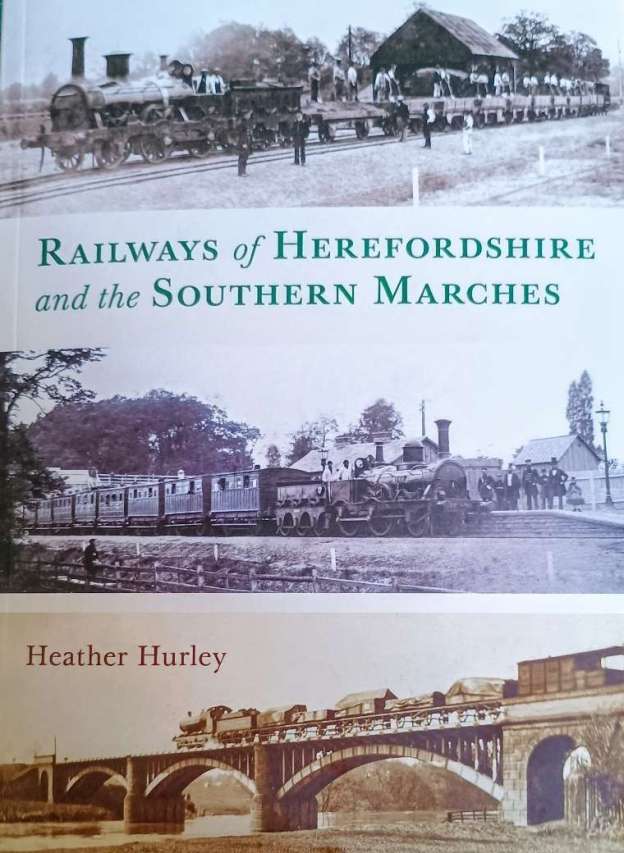
The Railways of Herefordshire and the Southern Marches

This is the second book written by Heather Hurley which focuses on railway history. The first concentrated or the early tramways/tramroads of the Wye valley. [2] A short review of that earlier book can be found here. [3]

In this latest publication, Heather Hurley provides a social history of the lines which served the area between Ludlow in the North and Chepstow in the South – the area shown in the map below.
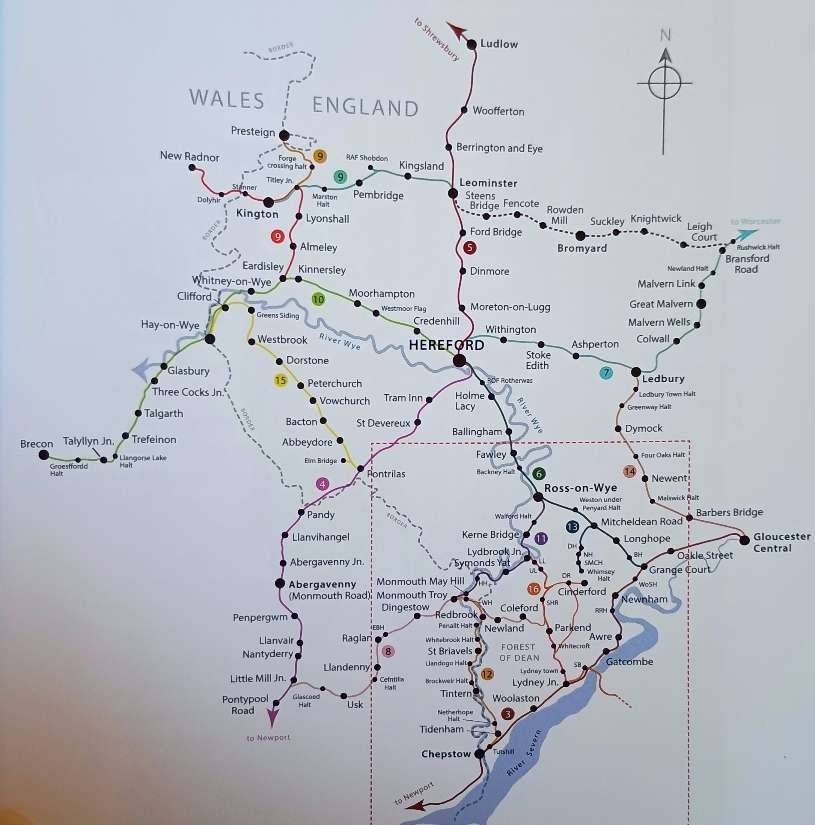
The area covered by the book. [1: pvii]

Given the essentially rural nature of the Southern Marches, it is sometimes easy to forget the industries which existed in the area and the manifest need, in the 19th century, for the railway connections which developed over time.

This book is an obvious successor to Hurley’s earlier study of the Tramways in the Wye valley. It is “written by a local historian, not a railway enthusiast, who has delved through the archives of 18 railway companies: two were abandoned from the start, four remained open, with another partly restored as a heritage line. Apart from the documentary research, a great deal of fieldwork was undertaken [by Hurley] in the counties of Herefordshire, Gloucestershire, Monmouthshire, Brecknockshire and Radnorshire, in order to provide important visual information.” [1: pix]

Hurley’s account, “follows the challenges, disappointments, financial gains and losses throughout a period of railway mania and beyond. The account has been thoroughly researched, drawing on Acts of Parliament and tables of tolls, company minutes and accounts, plans and maps, newspapers, journals and books, with contemporary and modern photographs to illustrate the railways, trains and people involved, the enormous task of construction, opening celebrations, and the history of each line until its fate was decided.” [1: pix]

The different individual railways have been well recorded in many publications, but this is the first book to give an overview of the relatively haphazard development of the railway network in the southern marches. It highlights the incredible social significance of the developing rail network during the 19th century and chronicles their impact on the industries, local economies and growing population during the nineteenth century.

Hurley does not claim to be a railway historian, but she has collated, “A richly detailed and illustrated account of the railways formed between 1845 and 1900 across Herefordshire, Gloucestershire, Monmouthshire, Brecknockshire and Radnorshire. Unpicking an often haphazard network, the book traces the lines and infrastructure, the stations, bridges and tunnels, the investors, engineers and navvies, and the charismatic steam locomotives that criss-crossed the region up until the 1960s.” [1: back cover]

Preliminary chapters look at:

  • the history of the Welsh Marches, their industries and communications. The earlier tramways in the area are dealt with in Hurley’s earlier book. [2] Although reference is made in this book to both the Leominster Canal of 1791 and the earlier long-distance tramways.
  • the arrival of steam powered railways, including: locomotives, wagons and coaching stock; and the work and life of the navvies that built the lines.

Succinct chapters deal with the development, acts of parliament and incorporation, construction, life, eventual demise of most of the railway companies and lines covered, and present day remains (mainly buildings, bridges and sections of the line):

  • The South Wales Railway and The Monmouth & Hereford Railway.
  • The Newport, Abergavenny & Hereford Railway.
  • The Shrewsbury & Hereford Railway.
  • The Hereford, Ross & Gloucester Railway.
  • The Worcester & Hereford Railway.
  • The Coleford, Monmouth, Usk & Pontypool Railway and The Coleford Railway.
  • The Leominster & Kingston Railway and The Kingston & Eardisley Railway.
  • The Hereford, Hay & Brecon Railway.
  • The Ross & Monmouth Railway.
  • The Wye Valley Railway.
  • The Mitcheldean Road & Forest of Dean Junction Railway.
  • The Newent Railway and the Ross & Ledbury Railway.
  • The Golden Valley Railway.
  • The Severn & Wye Railway.

Clearly there is insufficient space in a volume of this nature for detailed descriptions and historical investigations, nonetheless this book is an excellent introduction to the railways of the Southern Marches and a good starting point for any reader wanting to study any of these railways.

It is a well-written and well illustrated social history of the railways of the Southern Marches.

I noticed only a couple of minor points worth questioning in the whole volume:

  • The Worcester Mile is mentioned [1: p53] as providing a direct route from South to North from Barrs Court Station. I believe that the Worcester Mile ran South to North from Barton Station. [4]
  • Colonel Rich [1: p156] is noted as ‘the chief Great Western Railway engineer’. In fact, Colonel Frederick Henry Rich (8th March 1824 – 22nd August 1904) was a British soldier, who served with the Royal Engineers and was initially seconded to the Board of Trade as an Inspector of Railways in 1861. He continued in this role after his retirement from the Royal Engineers, serving as Chief Inspecting Officer of the Railway Inspectorate between 1885 and 1889. It was normal for the Board of Trade to inspect newly constructed railways prior to their opening for public use. [5]

References

  1. Heather Hurley; The Railways of Herefordshire and the Southern Marches; Logaston Press, Eardisley, 2026.
  2. Heather Hurley; Horse-drawn Tramways of the Wye Valley; Logaston Press, Eardisley, 2022.
  3. https://rogerfarnworth.com/2023/01/02/horse-drawn-tramways-of-the-wye-valley.
  4. https://htt.herefordshire.gov.uk/her-search/monuments-search/search/Monument?ID=30846, accessed on 27th July 2026.
  5. https://en.wikipedia.org/wiki/Frederick_Henry_Rich, accessed on 27th July 2026.
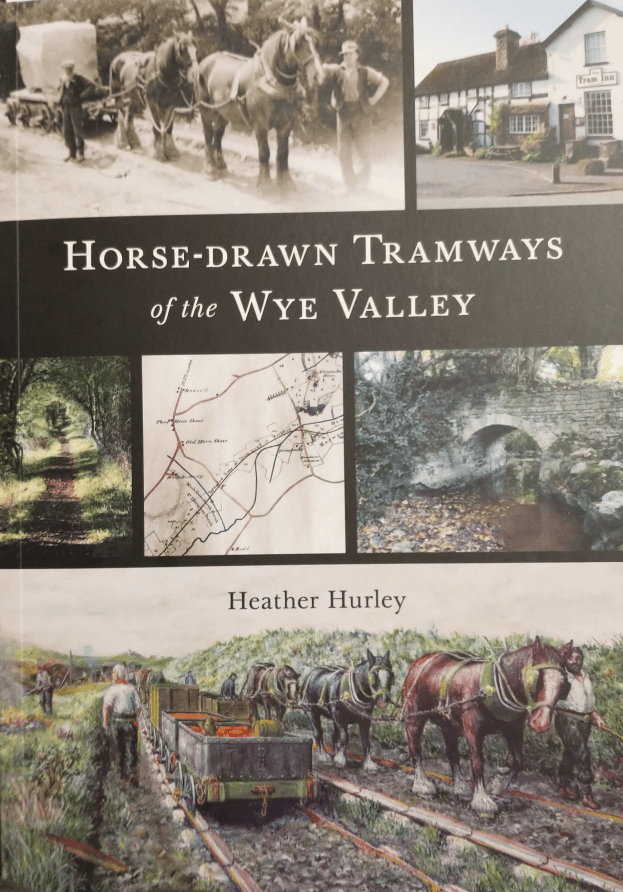
Horse-Drawn Tramways of the Wye Valley

A great Christmas purchase from Rossiter Books in Leominster! (£12.99, ISBN 978-1-910839-60-7, Paperback, 176 pages, 242 x 171mm). NB: The images in this article are sourced from the internet.

Horse-Drawn Tramways of the Wye Valley [1] by Heather Hurley, published by the Logaston Press in Novber 2022, is an excellent introduction to the early tramways in the Wye Valley. A short-lived transport system of horse-drawn waggons on rails, operating from the late eighteenth century to the introduction of steam locomotives in the middle of the nineteenth century, primarily used for transporting goods such as coal and wood.

Heather Hurley explores all of the tramways known to have existed in and around the Wye Valley from Kington, through Brecon and Hay to Abergavenny, Monmouth, the Forest of Dean and Hereford; the routes taken, the companies that built and ran them, and the people who used them. She draws on extensive research of Tramway Company archives, Acts and ledgers, maps and plans, newspapers and journals, archaeological reports, books and illustrations, as well as detailed fieldwork.

As the back cover states, Hurley’s book is richly illustrated and offers captivating insights into early nineteenth-century transport history, trade routes and the beginnings of the steam railways on the Welsh border.

Heather Hurley has a keen interest in local history. She has written several books, including ‘The Scudamores of Kentchurch and Holme Lacy’, ‘The Story of Ross’ and ‘Landscape Origins of the Wye Valley’. She is planning to produce a parallel volume about the railways of the Wye Valley in due course.

Horse-Drawn Tramways of the Wye Valley is an easy to read but well-researched introduction to tramways in the Southern Marches. Evidence of Hurley’s detailed research can be found in the extensive notes which support each chapter. Solid research does not, however, mean that this is primarily a dry academic book. It is accessibly produced with appropriate illustrations and a confident narrative.

The first chapter gives an overview of transport systems which predated the introduction of tramways. A chapter is devoted to the development of the horse-drawn tramways which includes an important section focussing on the horses used, before the more usual engineering matters of waggons, rails and stone ‘sleepers’ are covered.

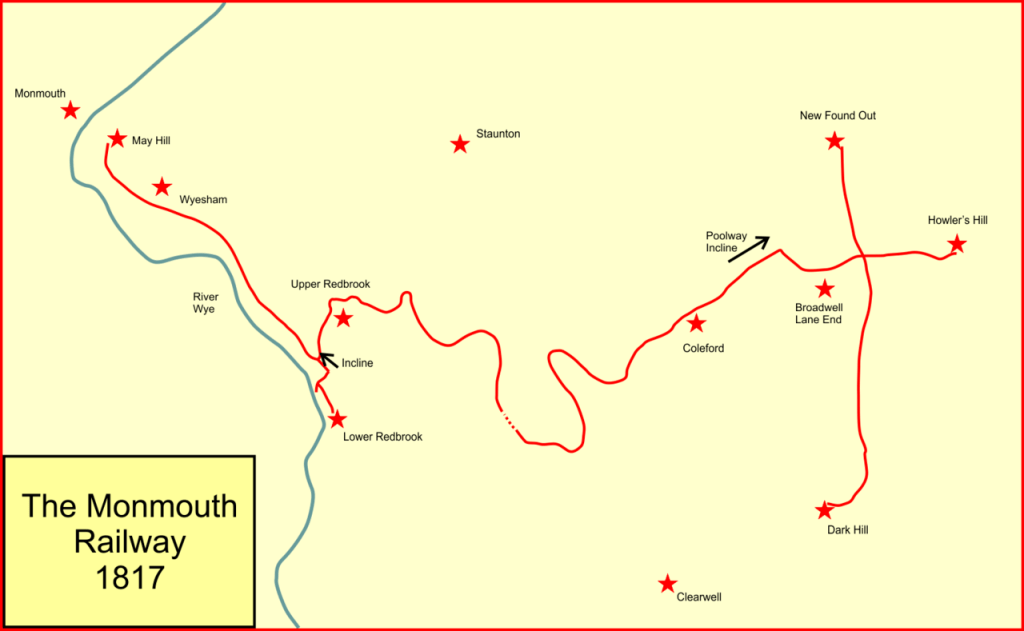
The Monmouth Tramroad (or Railway),
© Afterbrunel and licenced for use under a Creative Commons Licence (CC BY-SA 4.0). [2]

Individual chapters are devoted to the major networks which developed along the Wye Valley:

  • The Monmouth Tramroad
  • The Severn and Wye Tramroad
  • The Bishopswood, Scott and Teague Tramways
  • The Hay Railway
  • The Kingston Railway
  • The Abergavenny and Hereford Rail Road.
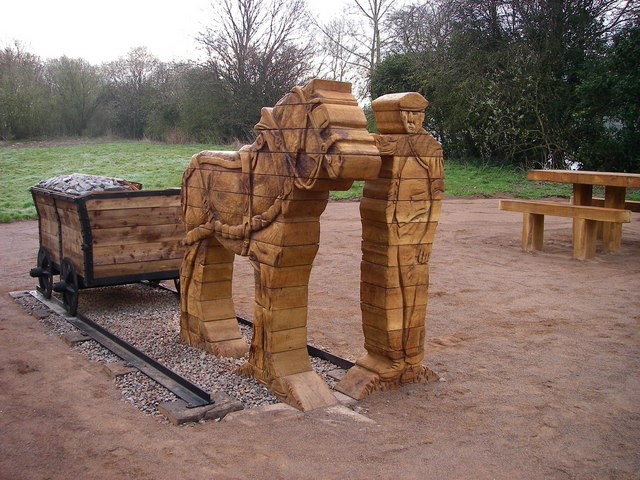
Brecon – the longest railway in the world: … This ‘diorama’ was installed by British Waterways in the ‘noughties’ beside the canal at Brecon. It commemorates the one-time ‘longest railway in the world’ which ran from Brecon to Kington via Hay-on-Wye. It was actually two horse-drawn tramways which met end-on at Eardisley – The Hay Railway and the Kingston Railway. The combined length exceeded 36 miles and claimed the title of the longest railway between 1820 and 1837, © Copyright Alan Bowring and licensed for reuse under a Creative Commons Licence (CC BY-SA 2.0). [3]
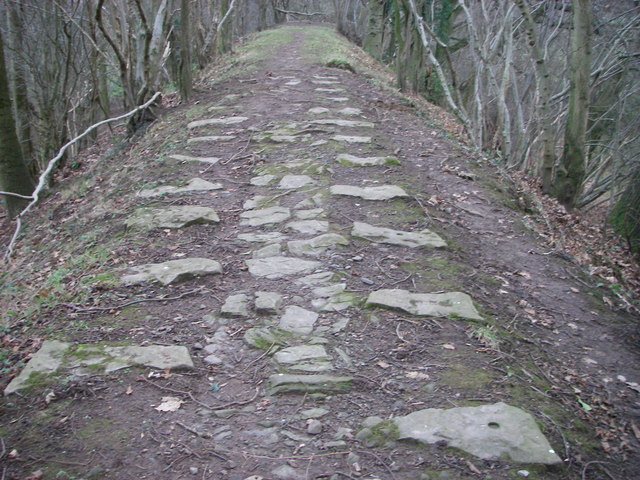
Grosmont Tramroad: Behind Werngifford are the remains of a tramroad built in the early 19th century. It formerly connected with the Llanfihangel Tramroad to form a through route between Abergavenny and Hereford until replaced by the modern railway in 1854, © Copyright Alan Bowring and licensed for reuse under a Creative Commons Licence (CC BY-SA 2.0). [4]

Two further chapters cover some local tramways of interest and the coming of steam-power.

The history of each of the major lines is recounted is some detail, each route is surveyed and details of goods carried are provided. For each line, some notes are provided on remains visible in the 21st century and on where documents recording its life can be found.

The extent of the coverage in a paperback book of 176 pages is to be commended. No doubt some readers will want to look at one or more of the routes portrayed in more detail than is possible in a book of this nature. The book might have benefitted from the addition of maps to support the detailed route descriptions provided towards the end of each of the major chapters. The book is, however, a wonderful introduction to its subject and has been an excellent post-Christmas read!

I wholeheartedly recommend this book to anyone interested in the industrial history of the Welsh Marches and the Forest of Dean. Anyone interested in the history of tramways/tramroads in the UK would do well to purchase a copy, not only for the informative narrative and illustrations but also for the detailed endnotes.

The Logaston Press takes its name from the hamlet of Logaston, in the beautiful countryside of rural north-west Herefordshire. It was here that Logaston Press was set up by Andy Johnson in 1983, and later run by Andy together with his wife Karen.

In 2018 Andy and Karen handed over the reins to Richard and Su Wheeler, who now run Logaston Press from the nearby village of Eardisley.

Logaston Press publishes books on local history, landscape, archaeology, architecture, and a range of walks guides – all focussed on the ‘Logaston heartlands’ of the Southern Marches: Herefordshire, Shropshire, Worcestershire and Gloucestershire, Radnorshire, Breconshire and Montgomeryshire.

In almost four decades, Logaston Press has published more than 350 titles, with more than 100 books currently in print. Its books are beautifully produced, ethically printed and reasonably priced. They are are a pleasure to own.

Logaston Press is rooted in the people and places of the Southern Marches and is dedicated to publishing books that explore and illuminate this extraordinary part of the world.

References

  1. Heather Hurley; Horse-Drawn Tramways of the Wye Valley; Logaston Press, Eardisley, 2022.
  2. https://en.wikipedia.org/wiki/Monmouth_Railway, accessed on 1st January 2023.
  3. https://www.geograph.org.uk/photo/757089, accessed on 2nd January 2023.
  4. https://www.geograph.org.uk/photo/635820, accessed on 2nd January 2023.