
Tag Archives: Hereford

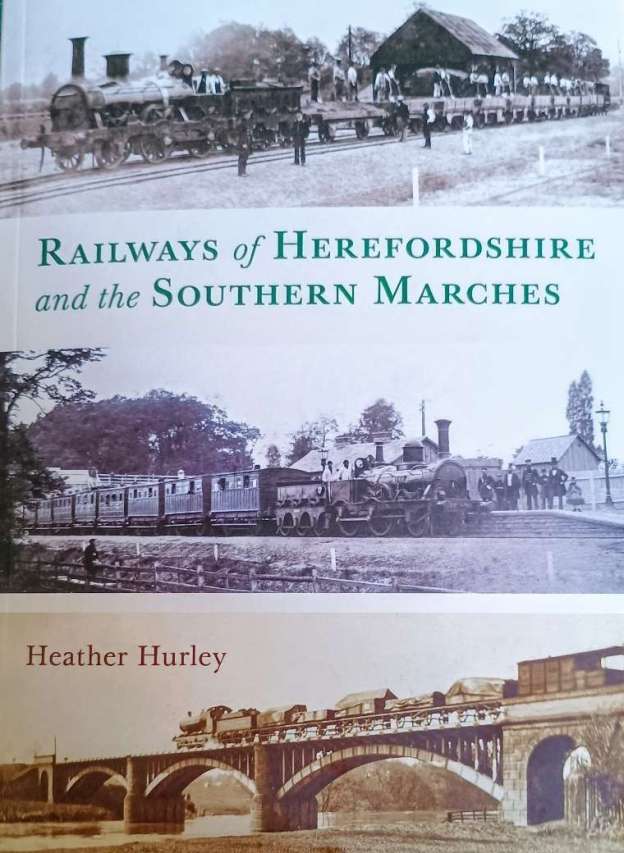
The Railways of Herefordshire and the Southern Marches

This is the second book written by Heather Hurley which focuses on railway history. The first concentrated or the early tramways/tramroads of the Wye valley. [2] A short review of that earlier book can be found here. [3]

In this latest publication, Heather Hurley provides a social history of the lines which served the area between Ludlow in the North and Chepstow in the South – the area shown in the map below.
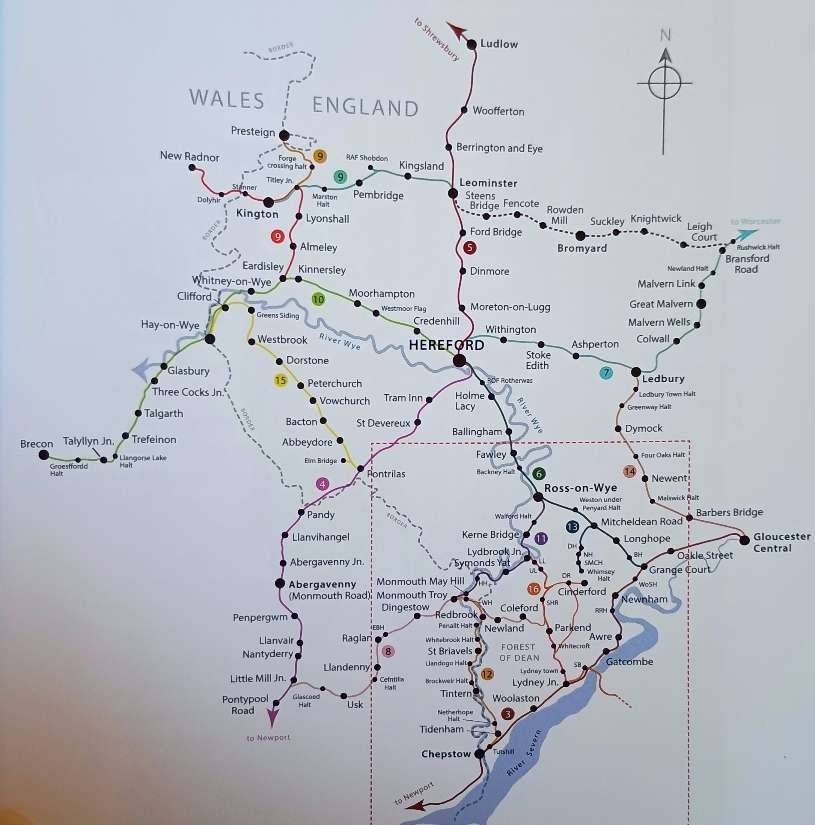
The area covered by the book. [1: pvii]

Given the essentially rural nature of the Southern Marches, it is sometimes easy to forget the industries which existed in the area and the manifest need, in the 19th century, for the railway connections which developed over time.

This book is an obvious successor to Hurley’s earlier study of the Tramways in the Wye valley. It is “written by a local historian, not a railway enthusiast, who has delved through the archives of 18 railway companies: two were abandoned from the start, four remained open, with another partly restored as a heritage line. Apart from the documentary research, a great deal of fieldwork was undertaken [by Hurley] in the counties of Herefordshire, Gloucestershire, Monmouthshire, Brecknockshire and Radnorshire, in order to provide important visual information.” [1: pix]

Hurley’s account, “follows the challenges, disappointments, financial gains and losses throughout a period of railway mania and beyond. The account has been thoroughly researched, drawing on Acts of Parliament and tables of tolls, company minutes and accounts, plans and maps, newspapers, journals and books, with contemporary and modern photographs to illustrate the railways, trains and people involved, the enormous task of construction, opening celebrations, and the history of each line until its fate was decided.” [1: pix]

The different individual railways have been well recorded in many publications, but this is the first book to give an overview of the relatively haphazard development of the railway network in the southern marches. It highlights the incredible social significance of the developing rail network during the 19th century and chronicles their impact on the industries, local economies and growing population during the nineteenth century.

Hurley does not claim to be a railway historian, but she has collated, “A richly detailed and illustrated account of the railways formed between 1845 and 1900 across Herefordshire, Gloucestershire, Monmouthshire, Brecknockshire and Radnorshire. Unpicking an often haphazard network, the book traces the lines and infrastructure, the stations, bridges and tunnels, the investors, engineers and navvies, and the charismatic steam locomotives that criss-crossed the region up until the 1960s.” [1: back cover]

Preliminary chapters look at:

  • the history of the Welsh Marches, their industries and communications. The earlier tramways in the area are dealt with in Hurley’s earlier book. [2] Although reference is made in this book to both the Leominster Canal of 1791 and the earlier long-distance tramways.
  • the arrival of steam powered railways, including: locomotives, wagons and coaching stock; and the work and life of the navvies that built the lines.

Succinct chapters deal with the development, acts of parliament and incorporation, construction, life, eventual demise of most of the railway companies and lines covered, and present day remains (mainly buildings, bridges and sections of the line):

  • The South Wales Railway and The Monmouth & Hereford Railway.
  • The Newport, Abergavenny & Hereford Railway.
  • The Shrewsbury & Hereford Railway.
  • The Hereford, Ross & Gloucester Railway.
  • The Worcester & Hereford Railway.
  • The Coleford, Monmouth, Usk & Pontypool Railway and The Coleford Railway.
  • The Leominster & Kingston Railway and The Kingston & Eardisley Railway.
  • The Hereford, Hay & Brecon Railway.
  • The Ross & Monmouth Railway.
  • The Wye Valley Railway.
  • The Mitcheldean Road & Forest of Dean Junction Railway.
  • The Newent Railway and the Ross & Ledbury Railway.
  • The Golden Valley Railway.
  • The Severn & Wye Railway.

Clearly there is insufficient space in a volume of this nature for detailed descriptions and historical investigations, nonetheless this book is an excellent introduction to the railways of the Southern Marches and a good starting point for any reader wanting to study any of these railways.

It is a well-written and well illustrated social history of the railways of the Southern Marches.

I noticed only a couple of minor points worth questioning in the whole volume:

  • The Worcester Mile is mentioned [1: p53] as providing a direct route from South to North from Barrs Court Station. I believe that the Worcester Mile ran South to North from Barton Station. [4]
  • Colonel Rich [1: p156] is noted as ‘the chief Great Western Railway engineer’. In fact, Colonel Frederick Henry Rich (8th March 1824 – 22nd August 1904) was a British soldier, who served with the Royal Engineers and was initially seconded to the Board of Trade as an Inspector of Railways in 1861. He continued in this role after his retirement from the Royal Engineers, serving as Chief Inspecting Officer of the Railway Inspectorate between 1885 and 1889. It was normal for the Board of Trade to inspect newly constructed railways prior to their opening for public use. [5]

References

  1. Heather Hurley; The Railways of Herefordshire and the Southern Marches; Logaston Press, Eardisley, 2026.
  2. Heather Hurley; Horse-drawn Tramways of the Wye Valley; Logaston Press, Eardisley, 2022.
  3. https://rogerfarnworth.com/2023/01/02/horse-drawn-tramways-of-the-wye-valley.
  4. https://htt.herefordshire.gov.uk/her-search/monuments-search/search/Monument?ID=30846, accessed on 27th July 2026.
  5. https://en.wikipedia.org/wiki/Frederick_Henry_Rich, accessed on 27th July 2026.
Christmas 2025 Book Reviews and Notes No. 1 – Colin Judge …

I received a few welcome gifts for Christmas 2025:

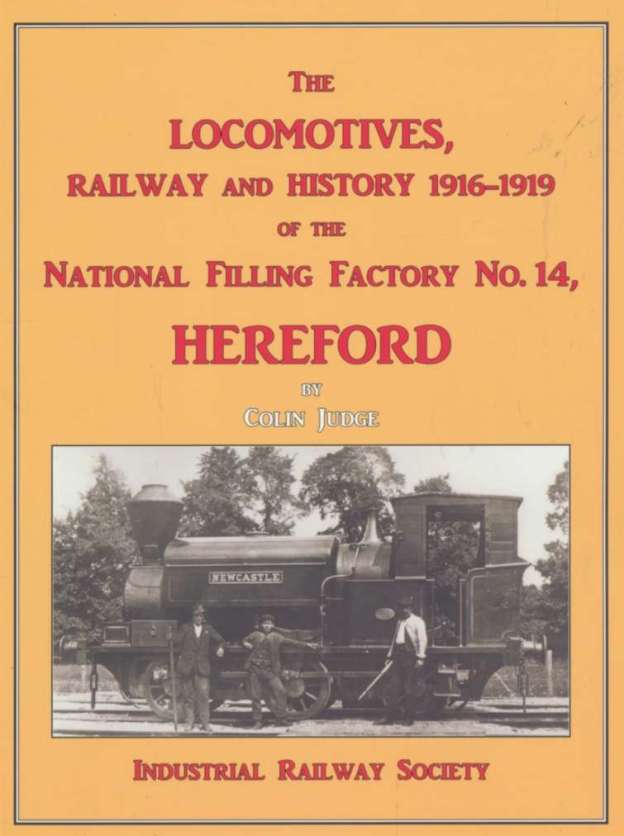
  1. Colin Judge; The Locomotives, Railway and History 1916-1919 of the National Filling Factory No. 14, Hereford; Industrial Railway Society, Melton Mowbray, Leicestershire, 2025. [1]
  2. Anthony Burton; The Locomotive Pioneers: Early Steam Locomotive Development – 1801-1851; Pen and Sword, Barnsley, 2017. [2] The review and notes can be found here. [7]
  3. Christian Wolmar; The Subterranean Railway: How the London Underground was Built and How it Changed the City Forever (2nd extended Edition); Atlantic Books, 2020. This edition includes a chapter on Crossrail. [3].  The review and notes can be found here. [8]
  4. Neil Parkhouse; British Railway History in Colour Volume 6: Cheltenham and the Cotswold Lines; Lightmoor Press, Lydney, Gloucestershire, 2025. [4]

1. The National Filling Factory No. 14 at Rotherwas

I have an abiding interest in the railways of Hereford and so was delighted to receive Colin Judge’s book as a Christmas present.

Judge’s book focusses on an area to the Southeast of Hereford, surrounding Rotherwas House, which was to become an essential element of the British war effort. Initially, intended to be a reserve filling station, National Filling Factory No. 14 was quickly to become vital when on 1st October 1917, the factory at Morecambe was put out of action by an explosion and a major fire. Later, on 1st July 1918, an explosion at the Filling Factory at Chilwell killed 134 employees, leaving it only able to produce munitions at a much reduced level. No. 14 was critical to the supply of munitions.

The usage of shells during the conflict was frighteningly high, staggering! Judge tells us that during the Battle of the Somme 1,738,000 shells were used, and that at Passchendaele, over 5 million shells were fired. It is difficult to appreciate what those on the battlefield experienced. [1: p4]

This rate of usage demanded an unbelievable level of activity on the home front. 507 acres were purchased for the new factory around Rotherwas House. “The order was then given on the 30th May 1916 to commence the drawings and these were started on the 1st June 1916. The set of drawings for the Amatol section of the factory was finished and sent out to tender on the 12th of June. …   Then the remaining drawings, of the Lyddite/Picric area were finished on the 15th of June and again dispatched to the various tenderers … construction [commenced as soon as] the final contractor was chosen.” [1: p15] John Mowlem & Co. Ltd won the contract on the basis of a guaranteed lump sum of £1,200,000 (approx £133,392,000 in 2025!).

Remarkably, in an incredible feat, 3,000 drawings covering the factory and an outpost at Credenhill (an ammunition storage facility) were produced in just a fortnight! All drawn by hand! Even more incredible when a significant design change occurred increasing the required output from the factory from 400 tons of Amatol and 200 tons of Lyddite per week. The new demand was for 700 tons of Amatol and 400 tons of Lyddite each week!

The contract for the construction was signed by both parties on 5th July 1916. Work progressed at speed and the first shell was being filled in the Lyddite area on 11th November 1916. The Amatol side of the factory filled its first shell on 22nd June 1917.

Judge tells us that Mowlem had to assemble the Amatol and Lyddite areas, a huge army ordnance depot (Rotherwas stores), barracks for the guards (alterations to Rotherwas House), hostel accommodation in Hereford for construction workers, stores and barracks at the Credenhill site (6 miles further from Hereford and on the Midland line from Hereford to Hay and Brecon). [1: p18]

The story of the works is copiously illustrated with contemporary plans and photographs and a modern diagrammatic representation of the internal railway system at the factory site. There were more than 27 miles of internal standard-gauge railways! [1: p16-17][5] In addition, the Picric/Lyddite area of the works was served by a significant network of 2ft-gauge lines. [1: p16]

In addition to covering the history of the site during World War 1, Judge describes the fleet of 2ft-gauge locomotives known to be used by John Mowlem &Co Ltd during construction of the site. These included: Kerr Stuart Wren Locomotives, KS2473, KS2474 and KS2477, all built in 1916; and Bagnall works number WB1740. Other locomotives may also have been used during construction: KS1047, KS1142, KS1144, KS 4017, KS 4018.

Judge provides drawings of the Kerr Stuart Wren Class of locomotives [1: p10 & 11] and details/photographs of the Bagnall Locomotive, works No. WB1740. [1: p11-14]

Judge provides notes on the locomotives used at Credenhill [1: p54-63] and at the Rotherwas Site. [1: p77-92] He also includes a chapter which is well-illustrated, focussing on the employees and the operation of the Rotherwas Site.

Chapters headings in Judge’s book are:

Chapter One: Brief History of the Proposed Area for the National Filling Factory No. 14, Hereford.

Chapter Two: Why did Britain need a new National Shell Filling Factory?

Chapter Three: Ministry of Munitions purchase of the land for the National Filling Factory No. 14, Hereford.

Chapter Four: John Mowlem Ltd – the Contractor and his Locomotives used on this site.

Chapter Five: Construction of the National Filling Factory No. 14, Hereford.

Chapter Six: The Great Western Railway, London & North Western Railway and Midland Railway’s involvement in the Factory’s Construction and Operation.

Chapter Seven: Credenhill – Army Ordnance Depot – the NFF Hereford’s Outpost

Chapter Eight: Credenhill-Army Ordnance Depot Locomotives.

Chapter Nine: Basic Operations at the Hereford No. 14 Factory, Rotherwas.

Chapter Ten: Details of the Locomotives known to have operated on the internal railway at Hereford No. 14 (Rotherwas) Factory site.

He also includes as an Appendix, a short history of the site throughout the 20th century.

Rotherwas was revived as a Royal Ordnance Factory (Filling Factory No 4) with the onset of the Second World War in 1939, and filled large bombs and 15 inch (38 mm) shells for naval guns. [6]

References

  1. Colin Judge; The Locomotives, Railway and History 1916-1919 of the National Filling Factory No. 14, Hereford; Industrial Railway Society, Melton Mowbray, Leicestershire, 2025.
  2. Anthony Burton; The Locomotive Pioneers: Early Steam Locomotive Development – 1801-1851; Pen and Sword, Barnsley, 2017.
  3. Christian Wolmar; The Subterranean Railway: How the London Underground was Built and How it Changed the City Forever (2nd extended Edition); Atlantic Books, 2020. This edition includes a chapter on Crossrail. [8]
  4. Neil Parkhouse; British Railway History in Colour Volume 6: Cheltenham and the Cotswold Lines; Lightmoor Press, Lydney, Gloucestershire, 2025.
  5. https://en.wikipedia.org/wiki/ROF_Rotherwas, accessed on 25th December 2025.
  6. https://www.erih.net/i-want-to-go-there/site/rotherwas-royal-ordnance-factory, accessed on 25th December 2025.
  7. https://rogerfarnworth.com/2025/12/30/christmas-2025-book-reviews-no-2-anthony-burton.
  8. https://rogerfarnworth.com/2026/01/20/christmas-2025-book-reviews-and-notes-no-3-christian-wolmar-the-subterranean-railway