Tag Archives: Steam Locomotive

Locomotives of the London, Brighton & South Coast Railway (LB&SCR) – 1920.

I have just been given a small pamphlet style paperback book compiled and published in June 1920 by W.G. Tilling.

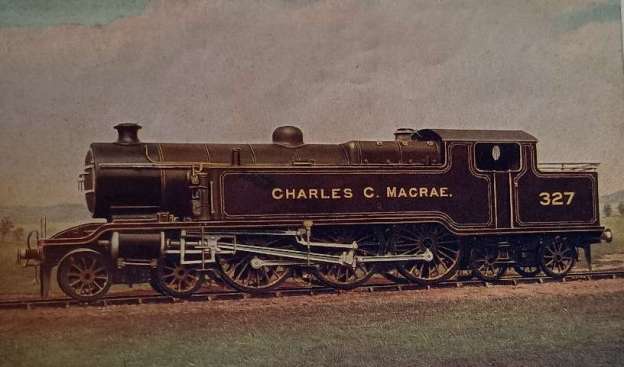
The featured image for this article comes from the frontispiece of Tilling’s book. It is a picture of the Class L 4-6-4T superheated large tank locomotive ‘Charles C. Macrae’. [1]

Tilling’s forward to the book states:

“For many years particulars of the locomotives running on our railway lines were difficult to obtain, but the Great Western Railway Company a year or two back broke through the usual official reticence by publishing a list of all their named engines. This was doubtless done to interest the general public in that railway, and I believe has proved a successful advertisement.

“Unofficial lists have also been published of the engines of the London and North Western Railway and a few of the smaller lines. Following these examples, I am prompted to deal with the locomotives of the London Brighton and South Coast Railway. This Company’s engines have probably had a larger circle of admirers than those of any other railway of similar size. The influence on locomotive design of the genius of the late William Stroudley (locomotive superintendent from 1871 until 1889) has appealed to the technical mind; whilst many, unconnected with railways, first attracted in their boyhood to this Company’s locomotives by their bright yellow livery and the fact that nearly all bore distinctive names, continue to take a keen interest in them long after their school days; and even now, when the engines are painted in less attractive colours, and the Stroudley classes are passing to the scrapheap, I feel sure there is a sufficiently large number interested to warrant the publication of this little book, and moreover, I am sanguine enough to hope that it may be of some use to many in the Company’s service.” [1: p3]

There were six hundred and six locomotives on the company’s roster in 25 different classes at the time that Tilling was writing these were:
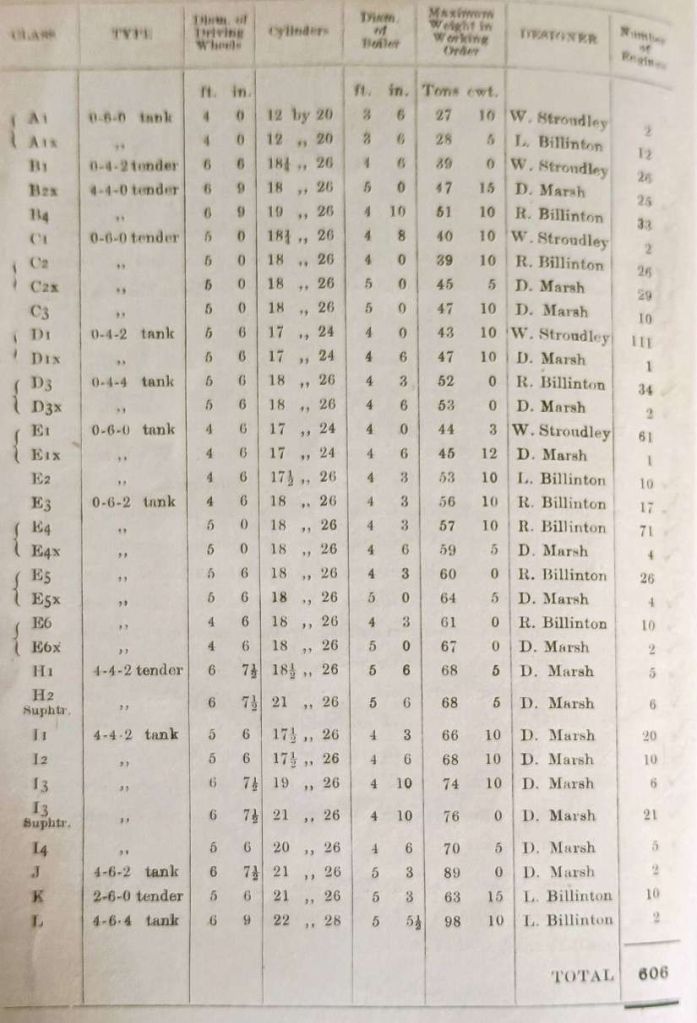
The locomotives of the London, Brighton & South Coast Railway in 1920. [1: p4]

There were 172 tender engines and 434 tank engines (all of the side tank variety). In addition, Tilling writes, there were four tank engines attached to the Locomotive Department for shunting in the Locomotive Works and the three principal steam sheds.
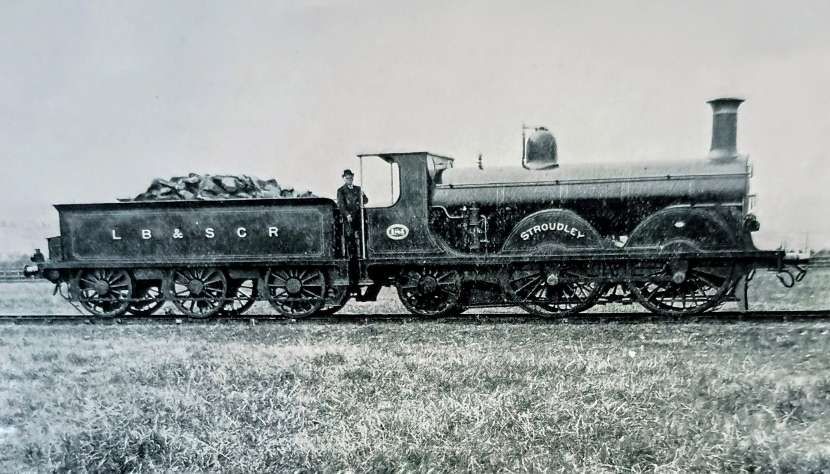
Class B1 0-4-2 Express Passenger Locomotive. [1: facing p4]

Tilling continues:

“All engines are fitted with the Westinghouse brake, whilst a few running in conjunction with ‘foreign’ lines have the automatic vacuum brake in addition. These latter engines proved extremely useful during the war in dealing with the large amount of other Companies’ rolling stock that passed over the Brighton system.

“The passenger engines are painted umber colour lined out with two yellow lines with the Company’s arms in colours on the splashers and gold lettering, whilst the goods engines are painted black with red lining and gold lettering.” [1: p5]

There were seventeen Locomotive Depots on the system. …
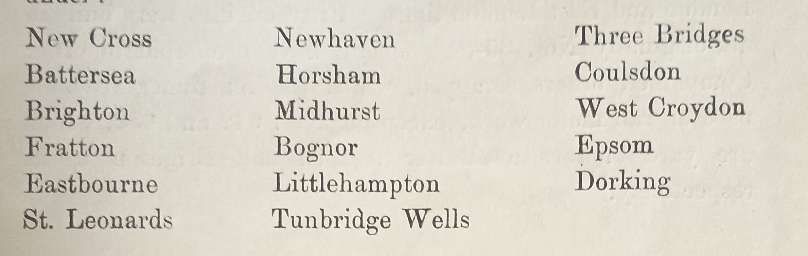
Locomotive Depots of the LB&SCR. [1: p5]
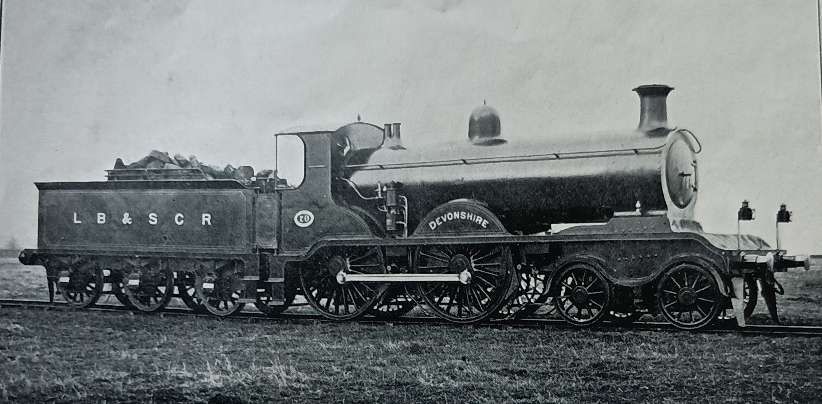
Class B4 4-4-0 Express Passenger Locomotive. [1: facing p5]
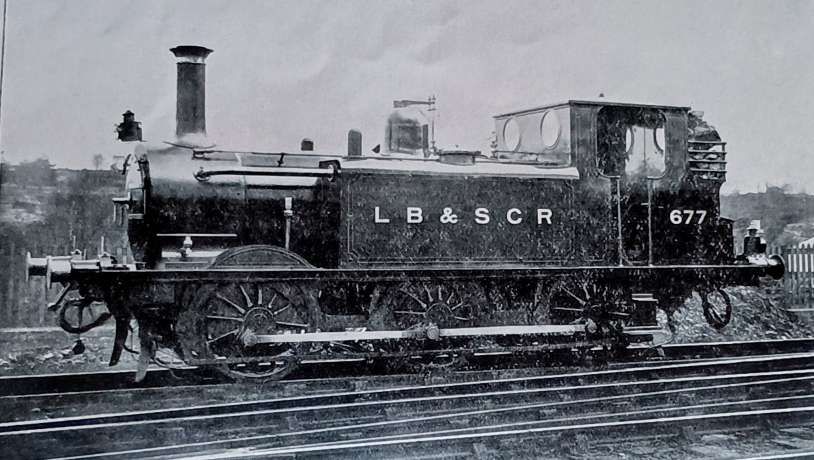
Class A1x 0-6-0T Rail Motor Engine. [1: facing p9]

Tilling describes the various classes of locomotive:

CLASS A: are small six-coupled side tanks with 4-ft. wheels, usually known as ‘Terriers’. They were designed [in 1872] years ago for working passenger trains on the South London and East London lines. Fifty engines were built in all, originally Nos. 35-84; several have been sold to other Companies, others scrapped, whilst the remainder are now used on rail motor work, excepting Nos. 642 and 682, which are yard engines at Battersea shed and Brighton works respectively.

“During the war several were taken over by the Government for working on light military lines in England and Scotland, for which their light weight only 27 tons 10 cwt. in working order made them very suitable. Although the oldest class now running on the line they are still very useful little engines, and several have recently been rebuilt with new boilers, etc., and are now classed A1x.

CLASS B: include Stroudley’s and R. J. Billinton’s four-coupled passenger express engines, subdivided into B1 (‘Gladstones’), B2 (‘Grasshoppers’), B3 (one engine only-213 ‘Bessemer’) and B4 (‘Scotchmen’). The B2 and B3 engines are now all rebuilt with larger boilers of the C3 type and classed B2x.

The Bl’s are front-coupled non-bogie engines, and they for many years worked the bulk of the express traffic between London and Brighton until superseded by the B4’s in 1901. The majority of the survivors are now employed on work usually done by tank engines, and several are now stationed at Tunbridge Wells shed. ‘Gladstone’ itself, after thirty-seven years, is still in evidence working slow trains between Brighton and the Metropolis. No. 172 is the only one of the class not fitted with Stroudley’s pumps and arrangement for utilising part of the exhaust steam to heat the water in the tender.

“The B2’s were the first express engines with a leading bogie to run on the LBS&CR. They were built to supersede the old single wheelers on the London-Portsmouth road with its many curves, and the first batch, Nos. 314-324, were all sent to Fratton shed, except No. 323, which worked from St. Leonards.

“No. 206 was badly damaged in the Wivelsfield accident of December, 1899, and also has the distinction of having worked the first sixty-minute Pullman train from Victoria to Brighton on 2nd October 1898.

“Several of the B2x’s have had wells fitted to their tenders to increase their water capacity, whilst Nos. 204, 206-209, 211, 212, 314, 323 and 324 now have the large tenders formerly on the C3 goods engines.

“The B4’s were nearly all built in Glasgow at the time of the Boer War, and many carried names reminiscent of that campaign, until Mr. Marsh, with a few exceptions, abandoned the naming of engines.

“The B4’s have been used for a number of trials at one time and another. No. 45 ran from 1902 till 1911 with a Drummond water-tube fire-box. No. 48 worked for some time early in 1905 fitted with templates over the boiler to test the clearance of the newly designed ‘Atlantics’. When Mr. Marsh decided to do away with the old yellow livery in 1905, he painted experimentally two of this class (Nos. 50 and 52) dark green. No. 52 also ran for some time in 1902/3 fitted with Holden’s oil fuel apparatus (as did also some of the B1, B2 and E5 classes). No. 53 ran for several years fitted with the Hotchkiss water circulator, whilst No. 59 worked with a ‘Phoenix’ superheater from 1912 to 1915.

“No. 54 formerly bore the name ‘Empress’, and was at one time used for all Royal specials. She carried the name ‘La France’ for a week in August, 1905, when working special trains in connection with the visit of the French fleet to Portsmouth.

“Several of this class have now been fitted with extended smokeboxes.” [1: p6-8]
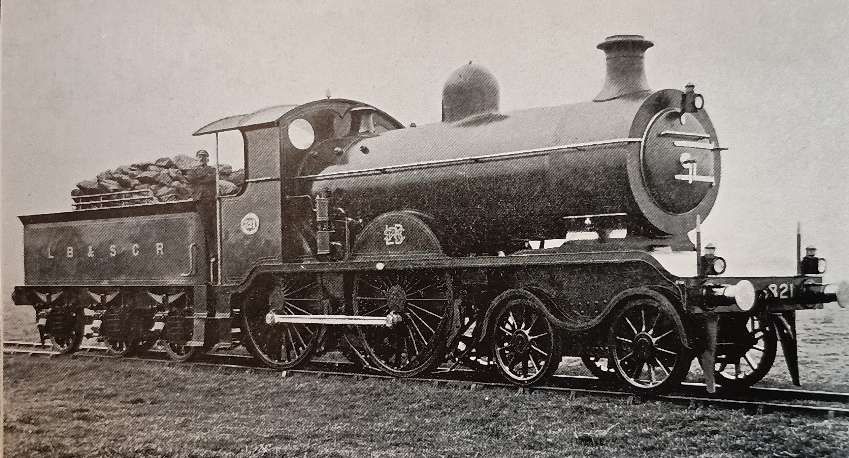
A Class B2x 4-4-0 Express Passenger Locomotive. [1: facing p12]
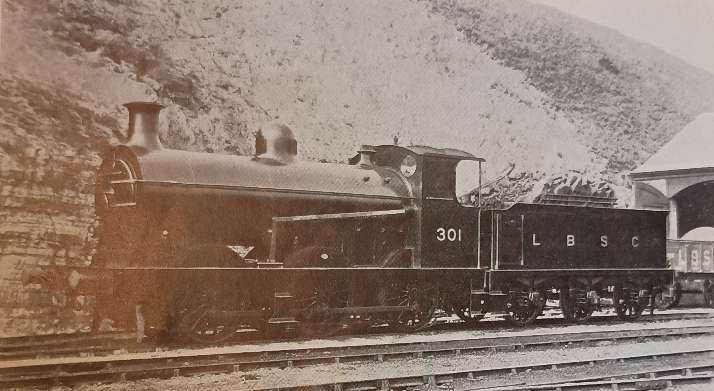
A Class C3 0-6-0 Main Line Goods Locomotive No. 301. [1: p46]
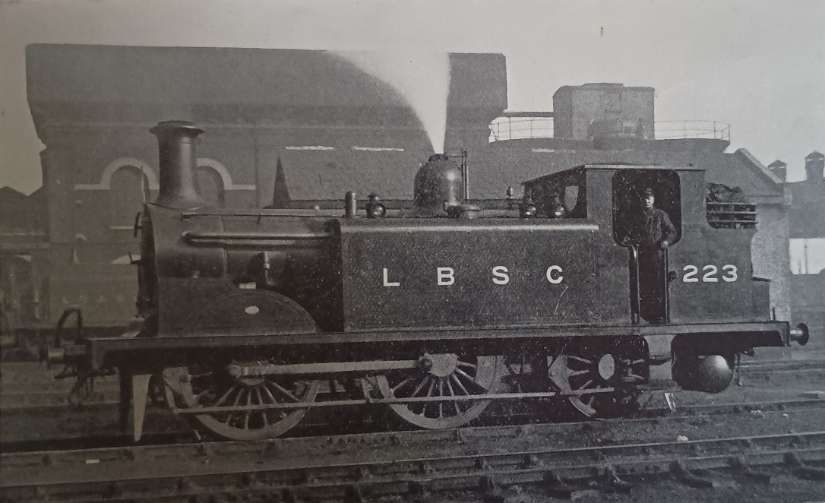
Class D1 0-4-2T Passenger Locomotive. [1: facing p8]

Tilling next focused on Class C locomotives:

Class C: are the tender goods engines, of which there are four varieties.

“The C1 class, when built, were amongst the largest goods engines in the country. Only two survive, No. 428 stationed at Fratton and No. 430 at Brighton. They have both recently had the Stroudley patent brake gear removed and the standard arrangement substituted, in order to cope with heavier goods trains. No. 430 in the early days of the war worked a troop special through to Doncaster.

“The C2’s were all built by the Vulcan Foundry Co. They are now being reconstructed as C2x’s, having the larger C3 boiler. Like the B4’s they have makers’ plates on the back of the tenders, but as the tenders have been interchanged at various times, the works numbers on the plates do not necessarily apply to the engines to which the tenders are now attached. Two of the C2x’s, Nos. 524 and 546, are at present (June 1920) on loan to the Great Western Railway; they are stationed at Old Oak Common depot and regularly work through onto the Brighton line.

“The C3’s are nearly all at present attached to the Horsham depot; they were an advance on the C2 class in boiler power, but the first five only had 174-inch cylinders, though the remaining five have 18 inch cylinders. They originally had 3112 gallon tenders, but latterly these large tenders have been transferred to engines of the B2x class and the C3’s now have the smaller ones formerly on the B2x engines.” [1: p8-9]

Tilling continues:

CLASS D: “The D1 class is Stroudley’s well-known front-coupled tank engine. Mr. Stroudley built no fewer than 125 of these engines, distributed over practically the whole period of his rule at Brighton. Whilst designed for the London suburban traffic they have been used on every class of work, and some of them are to be found at every shed on the system. Perhaps Fratton has seen the least of them, but Nos. 254 and 356 are there at present for working the Portsmouth-Chichester rail motor. No. 248 has side tanks with rounded ends as in the Marsh engines.

“No. 625 of this class was the first engine on this railway to be fitted with the Westinghouse brake; and 233 is noteworthy as having been for many years stationed at East Grinstead, being, in fact, the only engine ever stationed there.

“The D3 class is Mr. R. J. Billinton’s four-coupled bogie tank. Having a greater coal and water capacity than the D1’s, they are used on the longer routes. The valve gear and cylinders of this class are interchangeable with those of the C2 goods engines. Two of the D3’s (Nos. 396 and 397) have been rebuilt with the larger boiler of the I2 class.” [1: p9-10]

He continues:

Class E: “The ‘E’ CLASSES are the six-coupled side tanks, the oldest being Stroudley’s E1’s. The first of these appeared in 1874, and the last were turned out in 1891 by Mr. R. J. Billinton, who fitted his own design of boiler which added slightly to the weight. No. 689 has been entirely rebuilt, having new tanks, cab and boiler.

“No. 157 differs from all the other engines of its class. It was built for, and has worked all its life on the difficult Eastbourne-Tunbridge Wells line. It has side tanks and bunker slightly larger than the other E1’s, cylinders 18.25in × 26in, motion as Classes B1 and C1, and weighs 46 tons 18 cwt. in working order.

“Several of the E1’s were condemned for scrap in 1912, and Mr. L. B. Billinton designed an entirely new class to take their place. These are the E2’s. There are ten of this series, the second five having longer side tanks than the others. For a short time, when new, Nos. 103 and 104 worked in the centre of six coaches as a rail motor between London Bridge and Crystal Palace via Forest Hill.

“When Mr. Stroudley died in December 1889, an experimental six-coupled radial tank was in hand. This engine – No. 158 – did not commence work until just two years after his death, and while it had Stroud let’s standard 18.25in × 26in cylinders, it was essentially ‘Billinton’ in appearance. This engine weighed 52 tons 14 cwt. When Mr R. J. Billinton subsequently built sixteen others, they had his standard 18in x 26in cylinders. They are Class E3.
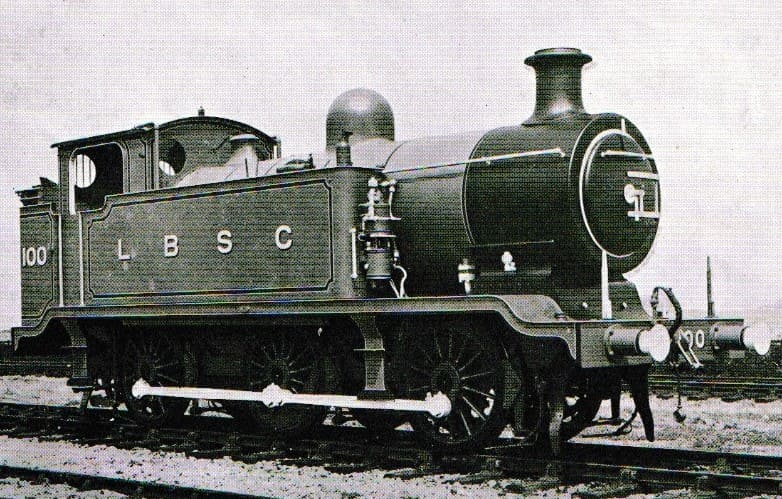
A Class E2 0-6-0T Goods Tank Locomotive, No. 100. [1: facing p36]
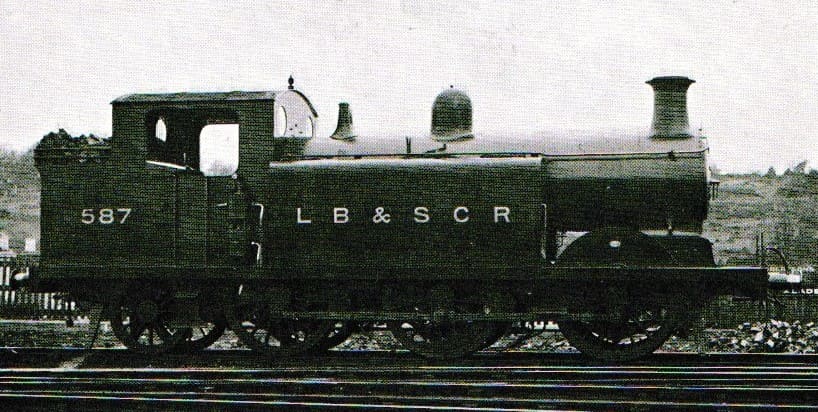
A Class E5 0-6-2T Mixed Traffic Tank Locomotive, No. 587. [1: facing p37]

Tilling continues:

“The E4’s and E5’s are similar to the E3’s but with larger driving wheels for mixed traffic and passenger work respectively, the capacity of the tanks is, however, larger. Twelve of the E4 class served on active service in France. They were Nos. 470, 481, 498, 504, 506, 516, 518, 562-565 and 580, and were chiefly employed banking trains on the St. Pol-Amiens line. They have all now been returned, and having been overhauled are back in service, painted black and unlined. They still bear the small plate inside the cab with which they were supplied before going overseas, to the effect that they are the property of the LB&SCR. of England. They were the only Brighton engines that were sent overseas during hostilities.

“Four engines of Class E4 have been rebuilt with the larger 12 class boiler and are now classed E4x, whilst four of the E5’s and two of the E6’s have been fitted with the larger C3 boiler and are now class E5x and E6x respectively.

No. 591, one of the E5’s, for some years regularly worked the 8.00 p.m. Grande Vitesse train from London Bridge to Newhaven; this engine is also noteworthy in having retained its name ‘Tillington’ and its yellow livery until 1917, over four years after all other ‘yellow’ engines had disappeared. Several of the E3’s and E4’s have been fitted with circular smokeboxes supported on a saddle, but when they retain the original sized boiler they are not classed E3x or E4x.” [1: p11]

Again, Tilling continues

Class H: This class “consist of the ‘Atlantics’, eleven in number. Mr. Marsh came to Brighton from Doncaster, and the first engine he designed for this railway was based on the familiar G.N. standard express type. Five were at first built by Messrs. Kitson of Leeds (Class H1). The H2’s were built at Brighton some years later; they have super-heaters which allow larger cylinders and lower boiler pressure to be used. Ten of them are stationed at Brighton and one at Eastbourne, and in conjunction with the ‘J’ and ‘L’ tanks they work all the heaviest expresses between London, Brighton and Eastbourne. No. 39 is frequently used for Royal specials, and bears the name ‘La France’. [1: p11-12]
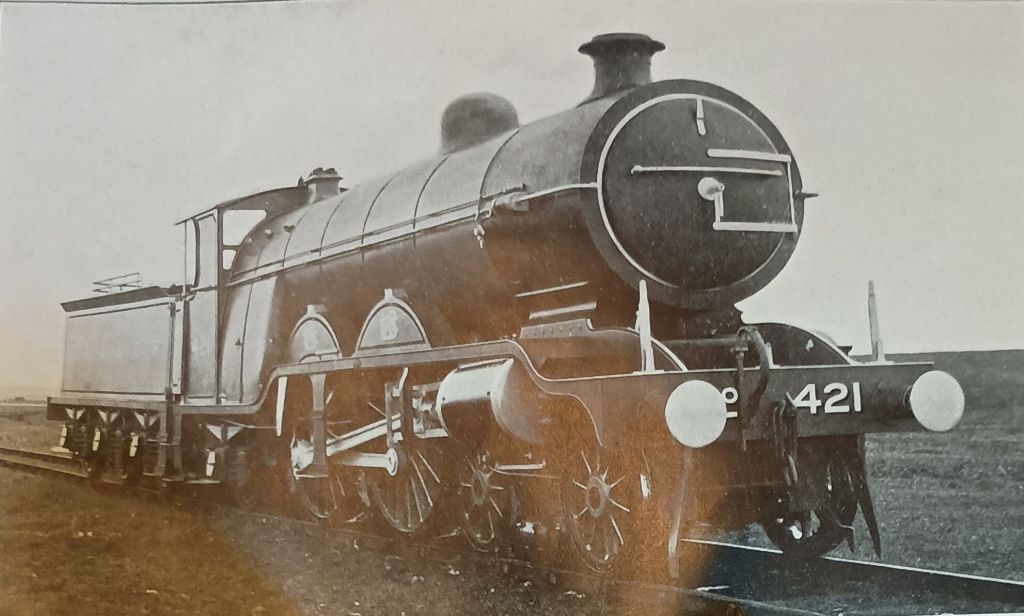
A Class H2 Superheated 4-4-2 Express Passenger Locomotive No. 421. [1: facing p13]

The next class of locomotives that Tilling covers are:

Class I: “The ‘I’ class consist of the ten-wheeled tanks. The I1’s suffer from having too small boilers, but the later I3’s built for express work are very successful engines.

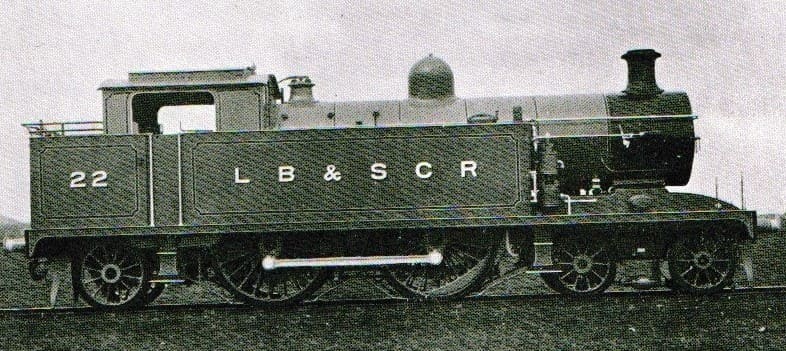
“No. 21 differs from the others in having 6 ft. 9 in. drivers, and the same cylinders and motion as the B4’s; it was fitted with a superheater during 1919. Twenty others of the I3’s are fitted with superheaters but have 21 in. x 26 in. cylinders.

“The I1’s are used on various local services; the I2’s and I4’s (which are the same as the I2’s, but with 20 in. cylinders and superheated) on such services as the London-Tunbridge Wells trains; whilst the I3’s work chiefly between London and the Coast on fast trains.

“No. 23 worked regularly for some weeks during 1909 in conjunction with the LNWR engine No. 7, ‘Titan’, on the ‘Sunny South Special’, running from Brighton through to Rugby one day and returning the next.” [1: p12]
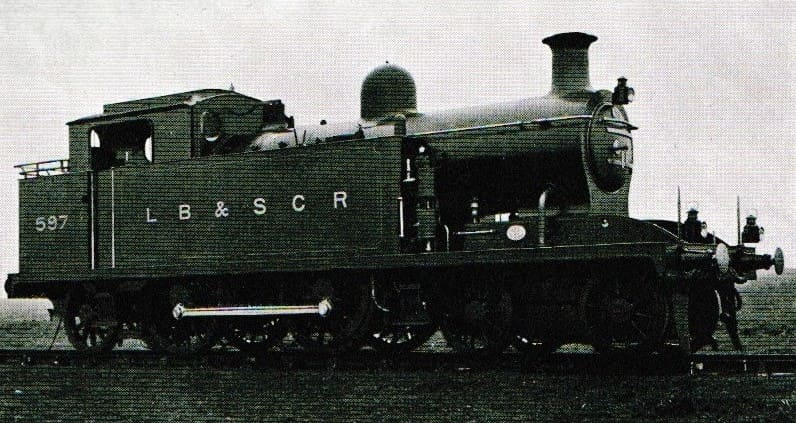
A Class I1 4-4-2T Passenger Tank Locomotive No. 597. [1: facing p20]
A Class I3 Superheated 4-4-2T Express Tank Locomotive No. 22. [1: facing p21]

Class J: “The ‘J’ Class consist of two experimental tank engines built by Mr. D. Earle Marsh for the express service between London and the Coast. They are of the ‘Pacific’ or 4-6-2 type with 21 in. × 26 in. cylinders, driving wheels 6 ft. 7 in. diameter, and superheated. No. 325 is fitted with Stephenson’s valve gear, whilst No. 326 was the first engine on this line to be fitted with the Walschaert pattern valve gear.
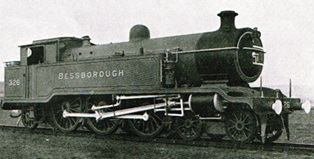
A Class J Superheated 4-6-2T Express Tank Locomotive – N0.326 ‘Besborough’. [1: facing p28]

Tilling continues:

Class K: “The ‘K’ Class are the latest heavy goods engines designed by Mr. L. B. Billinton for the traffic between London and Newhaven. They are tender engines of the ‘Mogul’ or 2-6-0 type, superheated. The first of these was put into service in September, 1913. To meet the greatly increased goods service to Newhaven, due to the war, another five were built in 1916; they are fitted with top feed to the boilers and have Belpaire fireboxes, and having proved so successful in service others with an improved top feed system are now under construction at Brighton. No. 339, one of the earlier engines, was fitted with this new arrangement in April, 1920, and is illustrated in these pages.” [1: p13]
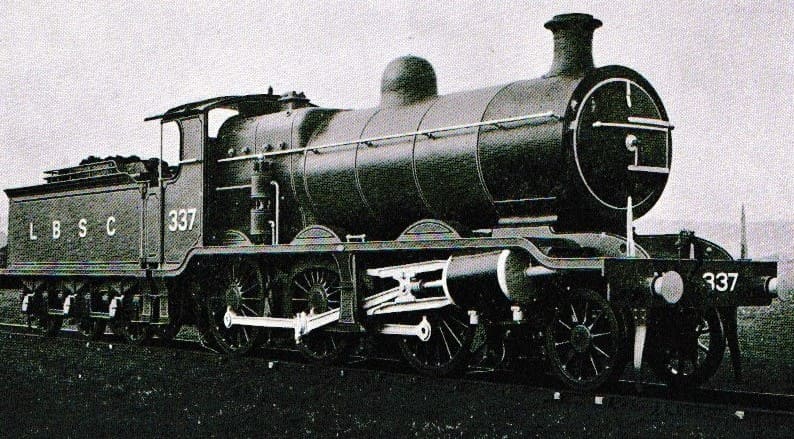
A Class K Superheated 2-6-0 Fast Goods Locomotive No. 337. [1: facing p29]

He also notes that in 1920 there were:

“Seven engines of the K class … under construction at Brighton, they will be numbered 347 to 353. The engines at present numbered 347 to 353 will in due course be re-numbered 214 to 220; and engines at present numbered 214, 217 and 219 will be re-numbered 618, 619 and 620.” [1: p46]
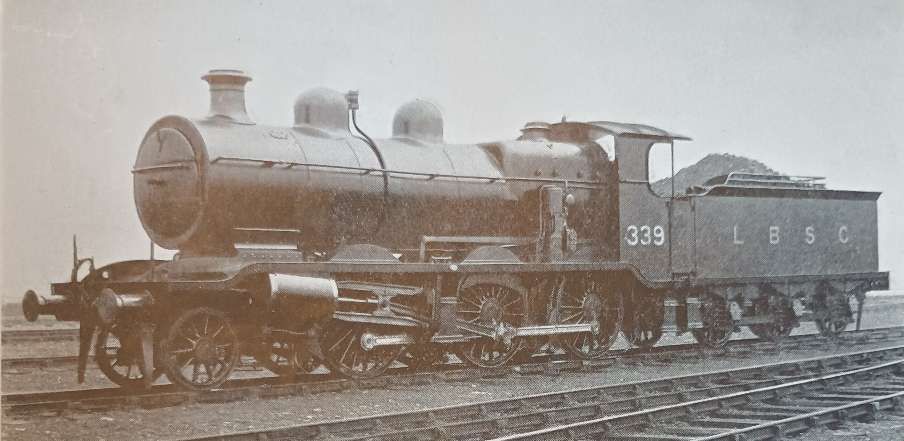
Another Class K Superheated 2-6-0 Fast Goods Locomotive, No. 339, which was fitted with the, then, latest arrangement of Top Feed (April 2020). [1: p45]

Class L: “The ‘L’ Class consist of two tank engines of the ‘Baltic’ or 4-6-4 type. These are the largest express tank engines in Britain, and were built by Mr. L. B. Billinton to work the fast non-stop service between London and the coast towns at an approximately uniform speed, and so save racing on the down grades. These engines have cylinders of 22 in. diameter and 28 in. stroke, and the boiler which is of ample capacity is fitted with a superheater. The driving wheels are 6 ft. 9 in. diameter, and sufficient water and coal is carried for the longest non-stop run between London and Portsmouth.” [1: p13]

In the years prior to 1920, the LB&SCR had locomotives not recorded by Tilling, these include:

LB&SCR Richmond class: This class was a series of 0-4-2 express passenger locomotives, designed by William Stroudley in 1877. They were a larger version of his “Lyons” class (D2) which were in turn developed from his successful ‘D-tank’ class of 1873. [2]

The six locomotives in this class were built at Brighton railway works and appeared in traffic between October 1878 and March 1880, intended to replace earlier classes designed by John Chester Craven on the heaviest express trains between London and Brighton. They performed well on these duties for a decade but were eventually replaced by Stroudley’s larger “Gladstone” class (B1). They were then transferred to Eastbourne and St Leonards to work on expresses from those towns. During the winter of 1900/01 members of the class were transferred to the duplicate list. Withdrawal commenced in April 1901 and was completed by November 1904. No examples were preserved. [2]

They were originally classified as “B class” together with the members of the larger “Gladstone class”. As all six locomotives had been withdrawn before D.E. Marsh introduced his letter/number classification scheme, they were never officially allocated a new class designation. They were, however, described as ‘D3 class’. [2]
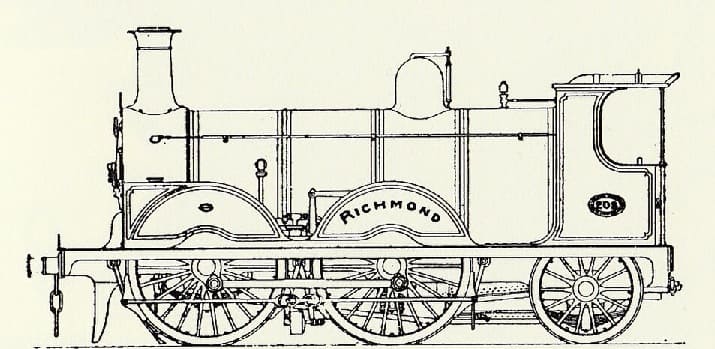
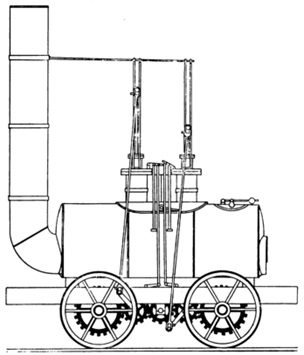
Diagram of a Richmond class 0-4-2, (c) F. Burtt and Public Domain. [2]

Locomotives designed by and built during the tenure of John Chester Craven between his appointment in 1847 and his retirement in January 1870. A full list of these locomotives can be found here. [3]

The ‘Jenny Lind’: The ‘Jenny Lind’ was built in 1847 after a relatively complicated gestation by E. B. Wilson and Company. [4] But it proved to be so successful that the design was used by Wilson & Co. as their standard design and more than seventy examples were built for various railways, including twenty-four for the Midland Railway. It could be said to be the first to be mass-produced to a consistent pattern. Indeed, the manufacturers charged a hefty premium for variations, although in response to pressure, they later built a number of “large jennies”. [4]

Other manufacturers and railways also adopted the type. John Chester Craven, Kirtley’s successor at Brighton, built a class of five similar “Jenny Lind singles” from 1853 to 1854. [4] An enlarged type was also built by Beyer, Peacock and Company in 1860 for the Portuguese South Western Railway. [4]
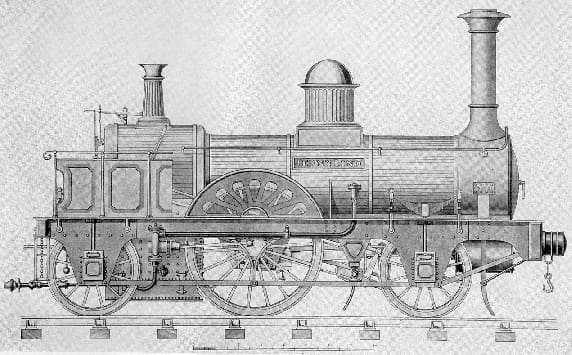
The original Jenny Lind, (c) Public Domain. [4]

Class G: A prototype single locomotive, No. 151 Grosvenor, was designed by Stroudley and produced by Brighton railway works in December 1874. This was extensively tested before a second, scaled down locomotive No. 325 Abergavenny, was ordered in June 1876 and completed in January 1877. Both locomotives performed adequately, but Abergavenny was significantly less powerful than Grosvenor. A modified design was developed and twelve further locomotives were built between December 1880 and November 1881. The members of this class worked express trains between London and South Coast towns such as Portsmouth, Brighton and Eastbourne, and covered large mileages. The introduction of the Billinton B2 class made the singles redundant on the Portsmouth line and so several were transferred to Tunbridge Wells. … Withdrawals began in May 1907, and the last locomotive survived until May 1914. No examples have been preserved, but there is a model of No. 331 Fairlight in the museum at Sheffield Park on the Bluebell Railway. [5]
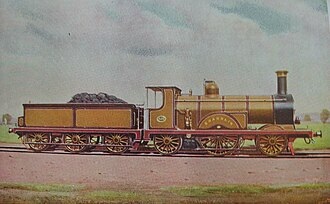
London Brighton and South Coast Railway Class G 2-2-2 Locomotive. 26 locomotives were produced in this class. ‘Grosvenor’ was the first, ‘Abergavenny’ was the second (with alterations) and subsequently 24 more were produced, (c) Public Domain. [5]

Very Early Locomotives of the LB&SCR: Wikipedia also provides a list of all the locomotives owned by the LB&SCR from its inception (1846) until 1849. [6] That list includes a significant number of locomotives built by a series of specialist locomotive builders including: Sharp, Roberts & Co.; Jones, Turner and Evans; G and J Rennie; Edward Bury & Co.; William Fairbairn; George Forrester & Co.; Sharp Brothers; R and W Hawthorn Ltd.; Jones & Potts; John George Bodmer; Timothy Hackworth; and Stothert & Slaughter. Many of these were built for companies which formed the LB&SCR in 1846 and were built as early as 1838.

The majority of the locomotives acquired were owned or ordered by one of the three constituent railways, but some had been ordered by the Joint Committee. After the Joint Committee’s dissolution, some locomotives were ordered by John Gray, the new locomotive superintendent, from Timothy Hackworth and delivered during 1847 and 1848. Others were purchased from Stothert & Slaughter between 1847 and 1849. After this date the railway’s new locomotives were designed and built by John Chester Craven, usually at Brighton railway works. [6]

A List of Locomotive of the LB&SCR in 1920: Tilling provides a detailed list, locomotive by locomotive, of locomotives in use by the LB&SCR in 1920 to complete his book. These tables can be found here.

References

  1. W.G. Tilling; The Locomotives of the London, Brighton & South Coast Railway; Tilling, London, 1920.
  2. https://en.wikipedia.org/wiki/LB%26SCR_Richmond_class, accessed on 13th June 2026.
  3. https://en.wikipedia.org/wiki/List_of_Craven_locomotives, accessed on 13th June 2026.
  4. https://en.wikipedia.org/wiki/Jenny_Lind_locomotive, accessed on 13th June 2026.
  5. https://en.wikipedia.org/wiki/LB%26SCR_G_class, accessed on 14th June 2026.
  6. https://en.wikipedia.org/wiki/List_of_early_locomotives_of_the_London_Brighton_and_South_Coast_Railway, accessed on 14th June 2026.
  7. https://rogerfarnworthsrailways.wordpress.com/wp-content/uploads/2026/06/lbscr-locos-1920.pdf
Christmas 2025 Book Reviews and Notes No. 1 – Colin Judge …

I received a few welcome gifts for Christmas 2025:

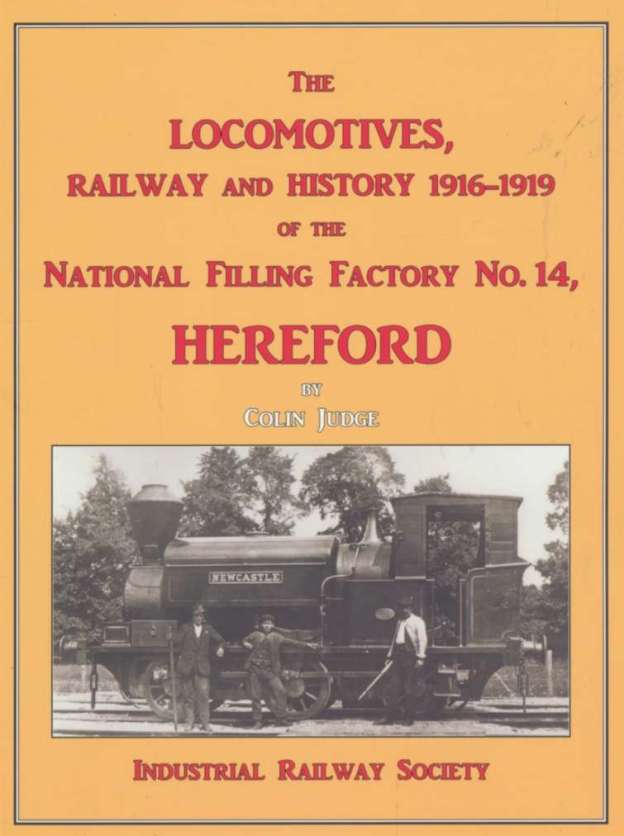
  1. Colin Judge; The Locomotives, Railway and History 1916-1919 of the National Filling Factory No. 14, Hereford; Industrial Railway Society, Melton Mowbray, Leicestershire, 2025. [1]
  2. Anthony Burton; The Locomotive Pioneers: Early Steam Locomotive Development – 1801-1851; Pen and Sword, Barnsley, 2017. [2] The review and notes can be found here. [7]
  3. Christian Wolmar; The Subterranean Railway: How the London Underground was Built and How it Changed the City Forever (2nd extended Edition); Atlantic Books, 2020. This edition includes a chapter on Crossrail. [3].  The review and notes can be found here. [8]
  4. Neil Parkhouse; British Railway History in Colour Volume 6: Cheltenham and the Cotswold Lines; Lightmoor Press, Lydney, Gloucestershire, 2025. [4]

1. The National Filling Factory No. 14 at Rotherwas

I have an abiding interest in the railways of Hereford and so was delighted to receive Colin Judge’s book as a Christmas present.

Judge’s book focusses on an area to the Southeast of Hereford, surrounding Rotherwas House, which was to become an essential element of the British war effort. Initially, intended to be a reserve filling station, National Filling Factory No. 14 was quickly to become vital when on 1st October 1917, the factory at Morecambe was put out of action by an explosion and a major fire. Later, on 1st July 1918, an explosion at the Filling Factory at Chilwell killed 134 employees, leaving it only able to produce munitions at a much reduced level. No. 14 was critical to the supply of munitions.

The usage of shells during the conflict was frighteningly high, staggering! Judge tells us that during the Battle of the Somme 1,738,000 shells were used, and that at Passchendaele, over 5 million shells were fired. It is difficult to appreciate what those on the battlefield experienced. [1: p4]

This rate of usage demanded an unbelievable level of activity on the home front. 507 acres were purchased for the new factory around Rotherwas House. “The order was then given on the 30th May 1916 to commence the drawings and these were started on the 1st June 1916. The set of drawings for the Amatol section of the factory was finished and sent out to tender on the 12th of June. …   Then the remaining drawings, of the Lyddite/Picric area were finished on the 15th of June and again dispatched to the various tenderers … construction [commenced as soon as] the final contractor was chosen.” [1: p15] John Mowlem & Co. Ltd won the contract on the basis of a guaranteed lump sum of £1,200,000 (approx £133,392,000 in 2025!).

Remarkably, in an incredible feat, 3,000 drawings covering the factory and an outpost at Credenhill (an ammunition storage facility) were produced in just a fortnight! All drawn by hand! Even more incredible when a significant design change occurred increasing the required output from the factory from 400 tons of Amatol and 200 tons of Lyddite per week. The new demand was for 700 tons of Amatol and 400 tons of Lyddite each week!

The contract for the construction was signed by both parties on 5th July 1916. Work progressed at speed and the first shell was being filled in the Lyddite area on 11th November 1916. The Amatol side of the factory filled its first shell on 22nd June 1917.

Judge tells us that Mowlem had to assemble the Amatol and Lyddite areas, a huge army ordnance depot (Rotherwas stores), barracks for the guards (alterations to Rotherwas House), hostel accommodation in Hereford for construction workers, stores and barracks at the Credenhill site (6 miles further from Hereford and on the Midland line from Hereford to Hay and Brecon). [1: p18]

The story of the works is copiously illustrated with contemporary plans and photographs and a modern diagrammatic representation of the internal railway system at the factory site. There were more than 27 miles of internal standard-gauge railways! [1: p16-17][5] In addition, the Picric/Lyddite area of the works was served by a significant network of 2ft-gauge lines. [1: p16]

In addition to covering the history of the site during World War 1, Judge describes the fleet of 2ft-gauge locomotives known to be used by John Mowlem &Co Ltd during construction of the site. These included: Kerr Stuart Wren Locomotives, KS2473, KS2474 and KS2477, all built in 1916; and Bagnall works number WB1740. Other locomotives may also have been used during construction: KS1047, KS1142, KS1144, KS 4017, KS 4018.

Judge provides drawings of the Kerr Stuart Wren Class of locomotives [1: p10 & 11] and details/photographs of the Bagnall Locomotive, works No. WB1740. [1: p11-14]

Judge provides notes on the locomotives used at Credenhill [1: p54-63] and at the Rotherwas Site. [1: p77-92] He also includes a chapter which is well-illustrated, focussing on the employees and the operation of the Rotherwas Site.

Chapters headings in Judge’s book are:

Chapter One: Brief History of the Proposed Area for the National Filling Factory No. 14, Hereford.

Chapter Two: Why did Britain need a new National Shell Filling Factory?

Chapter Three: Ministry of Munitions purchase of the land for the National Filling Factory No. 14, Hereford.

Chapter Four: John Mowlem Ltd – the Contractor and his Locomotives used on this site.

Chapter Five: Construction of the National Filling Factory No. 14, Hereford.

Chapter Six: The Great Western Railway, London & North Western Railway and Midland Railway’s involvement in the Factory’s Construction and Operation.

Chapter Seven: Credenhill – Army Ordnance Depot – the NFF Hereford’s Outpost

Chapter Eight: Credenhill-Army Ordnance Depot Locomotives.

Chapter Nine: Basic Operations at the Hereford No. 14 Factory, Rotherwas.

Chapter Ten: Details of the Locomotives known to have operated on the internal railway at Hereford No. 14 (Rotherwas) Factory site.

He also includes as an Appendix, a short history of the site throughout the 20th century.

Rotherwas was revived as a Royal Ordnance Factory (Filling Factory No 4) with the onset of the Second World War in 1939, and filled large bombs and 15 inch (38 mm) shells for naval guns. [6]

References

  1. Colin Judge; The Locomotives, Railway and History 1916-1919 of the National Filling Factory No. 14, Hereford; Industrial Railway Society, Melton Mowbray, Leicestershire, 2025.
  2. Anthony Burton; The Locomotive Pioneers: Early Steam Locomotive Development – 1801-1851; Pen and Sword, Barnsley, 2017.
  3. Christian Wolmar; The Subterranean Railway: How the London Underground was Built and How it Changed the City Forever (2nd extended Edition); Atlantic Books, 2020. This edition includes a chapter on Crossrail. [8]
  4. Neil Parkhouse; British Railway History in Colour Volume 6: Cheltenham and the Cotswold Lines; Lightmoor Press, Lydney, Gloucestershire, 2025.
  5. https://en.wikipedia.org/wiki/ROF_Rotherwas, accessed on 25th December 2025.
  6. https://www.erih.net/i-want-to-go-there/site/rotherwas-royal-ordnance-factory, accessed on 25th December 2025.
  7. https://rogerfarnworth.com/2025/12/30/christmas-2025-book-reviews-no-2-anthony-burton.
  8. https://rogerfarnworth.com/2026/01/20/christmas-2025-book-reviews-and-notes-no-3-christian-wolmar-the-subterranean-railway

The Mother of All Inventions. …

Why were railways created?

What were the circumstances which brought about their existence?

History does not make it easy to take out one example from a steady continuum of change. …

David Wilson writes: “There have been track or plateways since Roman times. You might say that these could be brought within the term railway and therefore the Romans invented the railway.” [1: p61]

Except there were railways of a sort, at least as far back at 600 BCE, possibly going back even further, maybe as far back as 1000 BCE. The clearest example being the Diolkos Trackway. [2] This was a paved trackway near Corinth in Ancient Greece which enabled boats to be moved overland across the Isthmus of Corinth.

David Wilson continues: “For most people, however, the railways began with the Stockton and Darlington (S&D), though I’m sure many people already appreciate that history is not always what it seems.” [1: p61]

David Wilson tells us that if one wished to take the view that the first ever railway was the first to have been authorised by Parliament, then the first railway was built in Leeds – The Middleton Railway. “The Middleton Railway was given Parliamentary Assent in 1758 and began using steam traction in 1812, two years before the advent of Mr Stephenson’s first locomotive, ‘Blucher’, and 13 years before the opening of the S&D.” [1: p61]

But there is more to consider. … The Lake Lock Rail Road opened in 1798 (arguably the world’s first public railway). It carried coal from the Outwood area to the Aire and Calder navigation canal at Lake Lock near Wakefield. [3][4] The Surrey Iron Railway was the first railway to be authorised by the UK Parliament (21st May 1801).  It was a horse-drawn railway which ran between Wandsworth and Croydon. [5][6][7][8][9] It was followed by The Carmarthenshire Railway or Tramroad (authorised by Act pf Parliament on 3rd June 1802). It was a horse-drawn goods line, located in Southwest Wales, the first public railway first authorised by Act of Parliament in Wales.[3][10][11][12]

The Low Moor Furnace Waggonway was constructed in 1802. It connected Barnby Furnace Colliery to Barnby Basin on the Barnsley Canal. It was replaced in 1809 by The Silkstone Waggonway which operated until 1870. [19][20] The Merthyr Tramroad, between Merthyr Tydfil and Abercynon, also opened in 1802. [5][13][14][15][16][17][18] The Lancaster Canal Tramroad (also known as the Walton Summit Tramway or the Old Tram Road), was completed in 1803. It linked the north and south ends of the Lancaster Canal across the Ribble valley. [21][22]

The first steam locomotive to pull a commercial load on rails was Penydarren (or Pen-y-Darren) was built by Richard Trevithick. It was used to haul iron from Merthyr Tydfil to Abercynon, Wales. The first train carried a load of 10 tons of iron. On one occasion it successfully hauled 25 tons. However, as the weight of the locomotive was about 5 tons the locomotive’s weight broke many of the cast iron plate rails. [5][13][14][15][16][17]

We could go on to mention:

  • The Croydon, Merstham & Godstone Goods Railway opened in 1805; [23]
  • The Sirhowy Tramroad opened in 1805; [24]
  • The Ruabon Brook Tramway (also known as Jessop’s Tramway or the Shropshire Union Tramway) also opened in 1805; [25][26][27][28]
  • The Middlebere Plateway (or Middlebere Tramway) opened on the Isle of Purbeck in 1806; [29][30][31][32]
  • The Monmouthshire Canal Tramway, open by 1806; [33][34]
  • The Oystermouth Railway, opened in 1806; [35][36] and
  • The Doctor’s Tramroad, Treforest which opened in 1809. [37][38][39]
  • The Monmouth Railway authorised by the UK Parliament in 1811. [5][72][73]
  • The Kilmarnock & Troon Railway which opened in 1812. [5][74][75][76][77]
  • The Killingworth Waggonway of which a first stretch opened in 1762 and which was extended in 1802, 1808 and 1820. [78][79][80][81][82][83]
  • The Haytor Granite Railway of 1820 which not only transported granite from Dartmoor as freight but ran on granite rails. [84]

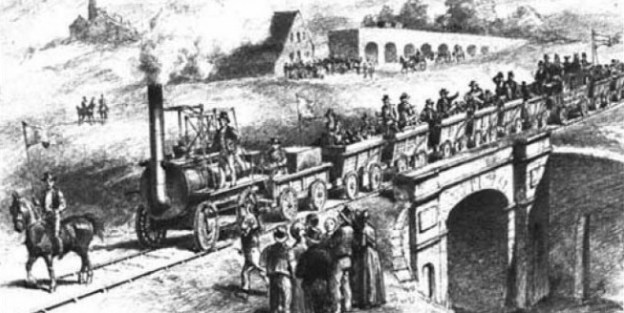
The drawing of the locomotive Blücher (below) was done by Clement E. Stretton, © Public Domain. Blücher was built by George Stephenson for the Killingworth Waggonway. It was the first of a series of locomotives which established his reputation as an engine designer and eventually “Father of the Railways”.

We could list other railways opening before the S&D in 1825. The use of steam power at The Merthyr Tramroad and The Middleton Railway preceded its use on the S&D. A very strong claim to be the most significant development in the early 1800s could be made on behalf of The Middleton Railway. But it is the Stockton & Darlington (S&D) Railway which has caught the imagination and it is the 200th anniversary of the S&D which is being celebrated in 2025 as the beginning of the railway age.

Why is this?

It is clear that the claim to fame of the Stockton and Darlington (S&D) is lessened, at least, by the prior claim of the Middleton Railway both as first to be sanctioned by Parliament and first to make commercial use of steam power. The claims associated with other railways which preceded the S&D also must be significant. However, there is one important and fundamental difference between it and them. David Wilson says that, unlike the Middleton Railway, “the S&D was constructed with a view to carrying other companies’ goods and, to a lesser extent, to carry people.” [1: p61]

In addition, he says, “Bear in mind the distinction between the carriage of goods and people, and between carrying one’s own goods and those of others. In many ways this type of division is what distinguishes the modern concept of the railway as a system for the transport of goods and passengers on a hire and reward basis from the early plateways and railways such as the Middleton, which were not essentially built to carry anything other than goods, typically coal, for their owners.” [1: p61]

Perhaps, though, there are more grounds for the place taken in history by the S&D. Rather than just running between a pithead and a coal wharf on a canal, river or road and serving specific industrial concerns, the S&D also was built by public subscription and linked one town to another.

David Wilson continues: “To arrive at a description of what constitutes a railway we have to enlarge our definition to include not only Parliamentary Sanction, the use of rails or tracks, and the carriage of goods, but also the carriage of the public, the carriage of public goods and that one settlement be joined to another by the laying of a line paid for through the issue of shares. Thus … a railway is a set of tracks laid between two centres of habitation, which carries goods or people for commercial reward and has been authorised by Act of Parliament. It will have been built through the raising of public funds, either through the sale of shares in it or via government spending from the public purse.” [1: p61]

Let’s return to the era before the existence of the steam locomotive, the era of that list of lines highlighted above (and many more).

David Wilson comments: “The growth of the coal mining industry in the later part of the 17th and early 18th century had led to a growth in the plateway systems used to move the coal from the pit head to [a road], canal or river for shipment to the growing cities and the newly built mills. By as early as 1645 there were wagonways taking coal from the Durham coalfields down to the Tyne. By 1800 there were more than 100 miles of these plateways in the Tyneside area alone.” [1: p61]

Similar developments were taking place elsewhere in the UK:

  • The first overground railway line in England may have been a wooden-railed, horse-drawn tramroad which was built at Prescot, near Liverpool, around 1600 and possibly as early as 1594. Owned by Philip Layton, the line carried coal from a pit near Prescot Hall to a terminus about half a mile away. [40]
  • The Wollaton Waggonway in Nottinghamshire was in use by 1604. [5]
  • In East Shropshire and around the Severn Gorge; [41][42] A railway was made at Broseley in Shropshire some time before 1605 to carry coal for James Clifford from his mines down to the River Severn to be loaded onto barges and carried to riverside towns. It is possible that Clifford’s ‘railway’ was in use as early as 1570 and a similar line may well have been constructed by William Brooke near Madeley, again down to the River Severn. [43: p21] By 1775, there were a number of both short and long tramroads in the area around the Severn Gorge.
  • The Tranent to Cockenzie Waggonway was built by the York Buildings Company of London, to transport coal from the Tranent pits to the salt pans at Cockenzie and the Harbour at Port Seton, in Haddingtonshire, now East Lothian. [5][44]
  • The Alloa Wagon Way was constructed in 1768 by the Erskines of Mar in Alloa, to carry coal from the Clackmannanshire coalfields of central Scotland to the Port of Alloa. [45]
  • The Halbeath Railway opened in 1783, from the colliery at Halbeath to the harbour at Inverkeithing. [46][47]
  • The Charnwood Forest Canal, sometimes known as the ‘Forest Line of the Leicester Navigation’ was, under the guidance of William Jessop, using railways to supplement the canal between Nanpantan and Loughborough wharf, Leicestershire by 1789. [5][48]
  • The Butterley Gangroad (or Crich Rail-way) was built by Benjamin Outram in 1793. [49][50][51][52][53][54][55][56][57]
  • The Earl of Carlisle’s Waggonway opened in 1799 from coal pits owned by George Howard, 6th Earl of Carlisle around Lambley to Brampton, Cumbria. [51][58] There is some confusion over dates. The earliest opening date quoted is 1774, the latest 1799. [59] Dendy Marshall says that it was built in 1775. [60] C.E. Lee says it was constructed in 1798. [59][61]

It is perhaps easy to loose sight of the scale of these industrial undertakings. The rapid expansion of mining, plateways and railways “led to an increase in the numbers of horses in use … and a growth in the amount of horse feed needed. By 1727 The Tanfield Waggonway, in Co. Durham, carried 830 wagon loads of coal daily that’s a lot of horses.” [1: p61][5][62][63] “In 1804, the Middleton Colliery line was carrying 194 loads per day. Each wagon held about 2.5 tons and required the use of one horse and driver.” [1: p61]

A crisis in the use of horses and wagons occurred early in the 19th century with the advent of the Napoleonic Wars. The conflict became a significant drain on both horse and horse feed availability. The resulting inflation in the price of horses and feed lowered the profitability of each wagon load of coal. David Wilson says that, “The more visionary (or greedy, depending on your point of view) pit owners started to search for alternatives to the horse to move their goods to market. They provided their pit engineers with money and materials to experiment with steam power to replace horse power.” [1: p61]

Of course, steam power wasn’t new. Knowledge of the power of steam had been around since before the Common Era in Greek society [64][65][66] and the pits themselves had steam engines for pumping out the water and for lifting coal to the surface, or as winding engines on rope-worked inclines. [66][67] Newcomen’s first engine was installed for pumping in a mine in 1712 at Dudley Castle in Staffordshire. [66][68] What was new was first, the expiry of Boulton & Watt’s patent for a high-pressure steam engine, [5][69] and second, the idea of making the steam engine mobile, thus creating the steam locomotive. What eventually became even more revolutionary was the idea of creating a network of railways to serve the whole country. [1: p61]

We sometimes talk of a ‘perfect storm’ (a particularly violent storm arising from a rare combination of adverse meteorological factors), when we are talking about a series of adverse conditions occurring at the same time – a situation caused by a combination of unfavourable circumstances. The opposite of a ‘perfect storm’ is usually assumed to be a period of calm. However, the true opposite of a perfect storm is the occurrence (co-occurence) of a series of positive factors which combine to produce something significantly valuable. Wilson says that “as with almost anything man-made, there must be certain ingredients present. To bake a cake you need eggs, flour, milk etc. and in creating a railway you need, metalworking skills, engineering expertise, labour, capital and an incentive.” [1: 61]

The early years of the 19th century saw a timely co-incidence of these and other factors:

  • growing shortages of horse and feed coupled to the rising prices of both;
  • poor road conditions;
  • a rapidly developing understanding of engineering – Wilson suggests that this was “as a consequence of the more theoretical works of philosophers such as Newton, Descartes and Leibniz. … Such men have a reputation as creators or exponents of the mechanistic world view. Prior to the works of these men many had thought, and indeed some still do think, that the earth was a living entity. However, the views espoused by Newton, Descartes and Leibniz came to be accepted, the world was made up of dead, lifeless and inert matter, here to benefit mankind;” [1: p62]
  • the availability of skilled and unskilled labour – particularly the ‘navigators’ who were skilled in the techniques of earthworks, tunneling and bridge building – the men who had earlier built the canals. (“These men were to become the skilled labour of the railway construction industry and in turn they passed on their skills to the former farm labourers who were recruited to railway works as the lines progressed along their routes“); [1: p62]
  • developing metalworking skills – “the Darby family, who set up the … Coalbrookdale foundry. had acquired new skills in metalworking from tinkers, in what is now the Netherlands;” [1: p62] After constructing Ironbridge, “the Coalbrookdale ironmasters began to widen their horizons. One of their number, John “Iron Mad” Wilkinson, constructed what was reputedly the first iron barge and, more importantly, … the smiths of Coalbrookdale collaborated with Richard Trevithick in the construction of his locomotive – they cast the cylinder block and the plates for the construction of the boiler;” [1: p62]
  • the increasing availability of financial capital;
  • the increasing birth rate and the better health of the work-force which provided the necessary labour while engineering work was still labour-intensive.

The Availability of Capital

Among the physical factors listed above is an interesting financial factor which will bear some scrutiny. Wilson tells us that “the capital to build the world’s first public railway came, not from the Government, but from the Society of Friends, the Quakers.” [1: p62] He notes too that the Darby family whose Coalbrookdale plant had such a formative influence in the early days of the industrial revolution, were also Quakers. Wilson explains that Quakers were isolated from much of society and public life because of a refusal to sign up to the articles of faith of the established church. However, the same religious views made them sympathetic to works performed for the public good. Various Quaker families began to take an interest in the developing railway sphere. The website quakersintheword.org [70] tells the story of the significant role played in financing railways played by the Quakers.

In 1818 a small group of Quaker businessmen, including Edward Pease and his son Joseph from Darlington, Benjamin Flounders and the banker Jonathan Backhouse, met to discuss the possibility of building a railway from Darlington, passing several collieries, to the port of Stockton.” [70] 

The Act of Parliament required for the work to take place faced significant delays in the parliamentary process. “The delay proved very significant, as in April 1821 Edward met George Stephenson and recruited him as an engineer for the railway. The original intention had been that the coaches would be horse drawn, just like all the others now in existence. However, George convinced Edward that steam engines were the future for railways, and that he could build them. The Pease family then put up much of the capital that enabled Stephenson to establish a company in Newcastle, where he built the locomotives.” [70]

After the opening of the Stockton & Darlington Railway, “the railway network grew under the guidance of Edward’s son Joseph, who opened the Stockton & Middlesbrough branch in 1828. … In 1833 Joseph became the first Quaker to enter Parliament and the railway interests passed to his brother Henry. In 1838, Henry opened the Bishop Auckland & Weardale line, followed by the Middlesbrough and Redcar line in 1846. Henry wanted to traverse the Pennines and in 1854 he started the Darlington & Barnard Castle line, which opened in 1856.” [70]

Quakers were often involved in railway developments in the 19th century, for instance, “in 1824, a group of merchants, including Quaker philanthropist and anti-slavery campaigner James Cropper, went to see the Stockton and Darlington railway.  They soon began building the Liverpool and Manchester railway, which opened in 1830.” [70]

Incidentally, Quakers “were also responsible for two innovations that improved the way these new passenger railways worked – timetables and tickets. James Cropper produced a 12-page timetable for the Liverpool and Manchester railway, probably the first railway timetable ever.  It was the forerunner of Quaker George Bradshaw’s Railway Companion, published in 1839. Bradshaw’s became a household name for anyone using the railways. … The second innovation was the railway ticket. In 1839 Thomas Edmundson, another Quaker, was appointed station master at Milton, on the Newcastle and Carlisle line.  He was unhappy that customers paid their fares directly to him without receiving a receipt.  Consequently he introduced the railway ticket, which came into general use with the creation of the Railway Clearing House in 1842.” [70]

The Birth Rate and Increasing Health of the UK Population

Wilson points us to one more significant factor in the development of railways in the early 19th century. “Seemingly disconnected and irrelevant factors were playing their part. During the period from the end of the civil war (1649) onwards there was a growing awareness of the value of the human being as resource, and a concerted effort was made to increase the birth rate and to cut the death rate. … This did not stem from any rise in humanitarianism but from a recognition that people were worth money. After all, in the 1640s and on into the 19th century, slavery was still common throughout the so-called civilised world, including Britain. Improvements in diet and sanitation increased life exресtancy. It is no coincidence that the first workhouses began to appear around the middle of the 17th century – a reasonably fit and healthy population produced more than a sickly and unfit one.” [1: p62]

By the beginning of the 19th century, the conditions were in place for a major economic expansion. A growing empire and military strength ensured the supply of raw materials and provided a growing market place for the products made from them. An expanding population provided the physical means by which the empire might be held together. Technology provided the ability to carry out the grand design. The workhouses and other reforms had created a disciplined workforce.” [1: p62-63]

By 1850, a quarter of a million workers – a force bigger than the Army and Navy combined – had laid down 3,000 miles of railway line across Britain, connecting people like never before. [71]

And Finally …

Wilson suggests one other, less definable, reason for the dramatic welcome given to steam technology in particular. He suggests that there was a more visceral connection to steam power which predisposed humanity to embrace the technology.

No doubt, the S&D was at the forefront of engineering developments it was “the white heat of technology, the frontier of science.” [1: p63] Wilson asks us to consider that there was (and still is) a connection between “a piece of primitive industrial technology, the steam locomotive and its enduring popularity, and an ancient, and some might say mystical, view of the world.” [1: p63]

Wilson says: “Prior to the advent of the mechanistic world view in which cause and effect, hard science and hard facts are the order of the day, people held to a more animistic philosophy. Miners would pray to the earth before digging it up. … In this more mystic view of the world things were not made of chemicals and atoms, molecules and the force of gravity. They were composed of the four elements – earth, air, fire and water.” [1: p63] He asks us to consider whether “the reason so many people took to the steam engine and the railway when it began was that the steam locomotive has a unique blend of the four elements not only in its construction but in the very forces and requirements necessary for its movement. … [It] is made from the ores of the earth, heated by fire which needs air to burn. The metals from the forge are then tempered by water whilst being shaped on the anvil. In order to make the steam locomotive work, coal, or part of the earth, is consumed along with air in a fire which turns water into steam which in turn brings the locomotive to life.” [1: p63]

We all know that all men, are just little boys at heart. Increasingly women are involved in the preservation movement. There seems to be a deep emotional connection for many of us between the steam beasts of earth, wind, fire and water that reigned over the railway networks for the world for more than a century and a half and our own psyche, something deeply ‘elemental’!

Whatever the cause, the early 19th century saw humanity embrace steam-power and the benefits it brought with open arms and wallets.

References

  1. David Wilson; Mother of Inventions; in the Evening Mail Supplement, 1st June 1993, p61-63.
  2. https://en.m.wikipedia.org/wiki/Diolkos, accessed on 2nd March 2025.
  3. https://en.wikipedia.org/wiki/1790s_in_rail_transport, accessed on 20th February 2025.
  4. https://web.archive.org/web/20100604080339/http://www.stanleyhistoryonline.com/Lake-Lock-Rail-Road.html, accessed on 8th January 2025.
  5. https://en.wikipedia.org/wiki/Timeline_of_railway_history, accessed on 7th January 2025.
  6. https://web.archive.org/web/20070523122428/http://www.stephensonloco.fsbusiness.co.uk/surreyiron.htm, accessed on 9th January 2025.
  7.  Dorian Gerhold; The Rise and Fall of the Surrey Iron Railway, 1802–46 (PDF); in Surrey Archaeological Collections, Vol. 95, 2010, p193–210; via https://archaeologydataservice.ac.uk/archiveDS/archiveDownload?t=arch-379-1/dissemination/pdf/vol_95/surreyac095_193-210_gerhold.pdf, accessed on 6th February 2025.
  8. https://en.wikipedia.org/wiki/1801_in_rail_transport, accessed on 20th February 2025.
  9. https://en.wikipedia.org/wiki/Surrey_Iron_Railway, accessed on 20th February 2025.
  10. https://coflein.gov.uk/en/site/275707, accessed on 8th January 2025.
  11.  https://en.wikipedia.org/wiki/1802_in_rail_transport, accessed on 20th February 2025.
  12.  M.R. Connop Price; The Llanelly & Mynydd Mawr Railway; Oakwood Press, Oxford, 1992.
  13. https://rogerfarnworth.com/2019/02/02/the-penydarren-tramroad-south-wales-part-1
  14. https://rogerfarnworth.com/2019/02/06/the-penydarren-tramroad-south-wales-part-2
  15. https://coflein.gov.uk/en/site/91513, accessed on 8th January 2025.
  16. https://www.irsociety.co.uk/Archives/59/Penydarren.htm, accessed on 8th January 2025.
  17. https://coflein.gov.uk/en/site/91513, accessed on 8th January 2025.
  18. https://en.wikipedia.org/wiki/Merthyr_Tramroad, accessed on 20th February 2025.
  19. https://en.wikipedia.org/wiki/Low_Moor_Ironworks, accessed on 20th February 2025.
  20. Silkstone Waggonway, South Yorkshire: Survey Report (PDF). Vol. 1; Yorkshire Archaeological Trust,  August 2012; via https://web.archive.org/web/20160311113301/http://iadb.co.uk/epip/Silkstone%20Waggonway%20Vol%201%20text%20plates%20figures.pdf, accessed on 20th February 2025.
  21. https://en.wikipedia.org/wiki/Lancaster_Canal_Tramroad, accessed on 20th February 2025.
  22. S. Barritt; The Old Tramroad – Walton Summit to Preston Basin; Carnegie Publishing, Lancaster, 2000.
  23. Paul W. Sowan; The Croyden, Mertsham & Godstone Iron Railway: A Short Chapter in a Long Story; The Bourne Society (LHR45), Croydon, London, 2006, LHR45, p53-69; via https://bournesoc.org.uk/bslivewp/wp-content/uploads/CMG-Iron-Railway-SECURE.pdf, accessed on 9th January 2025.
  24. https://en.wikipedia.org/wiki/Sirhowy_Railway#Sirhowy_Tramroad, accessed on 20th February 2025.
  25. Alan Jowett; Jowett’s Railway Atlas; Patrick Stephens Limited, 1989, p57, 59.
  26. https://en.wikipedia.org/wiki/Ruabon_Brook_Tramway, accessed on 20th February 2025.
  27. Trefynant – Opening of Branch Railway at Trefynant Works; in Wrexham Advertiser, 6th January 1866, p8.
  28. Meeting of the Wrexham District Highways’ Board; in Wrexham Advertiser. 26th January 1867, p5.
  29. https://en.wikipedia.org/wiki/Middlebere_Plateway, accessed on 20th February 2025.
  30. R.W. Kidner; The Railways of Purbeck (Third ed.); Oakwood Press, 2000.
  31. Purbeck’s clay railways; in Dorset Life Magazine, January 2007; via https://web.archive.org/web/20070927150728/http://www.dorsetlife.co.uk/articles/ArticlesDetail.asp?ID=599, accessed on 20th February 2025.
  32. Middlebere Plateway; The Purbeck Mineral & Mining Museum; via https://web.archive.org/web/20070928063415/http://www.pmmmg.org/Middlebere.htm, accessed on 20th February 2025.
  33. https://en.wikipedia.org/wiki/Monmouthshire_and_Brecon_Canal#Monmouthshire_Canal_Tramway, accessed on 20th February 2025.
  34. https://coflein.gov.uk/en/site/308291, accessed on 20th February 2025.
  35. https://en.wikipedia.org/wiki/1807_in_rail_transport, accessed on 20th February 2025.
  36. https://en.wikipedia.org/wiki/Swansea_and_Mumbles_Railway, accessed on 9th January 2025.
  37. https://cof, lein.gov.uk/en/site/407018/?ref=goodoil.news, accessed on 20th February 2025.
  38. https://coflein.gov.uk/en/site/96185, accessed on 20th February 2025.
  39. https://britishlistedbuildings.co.uk/300024912-machine-bridge-also-known-as-pont-y-doctor-pontypridd/photos/147433, accessed on 20th February 2025.
  40. Mark Jones; Lancashire Railways – The History of Steam; Countryside Books, Newbury, 2012 p. 5.
  41. https://rogerfarnworth.com/2022/04/25/ancient-tramroads-near-telford-part-1-tramroads
  42. https://rogerfarnworth.com/2022/04/26/ancient-tramroads-near-telford-part-2-the-coalbrookdale-company-tramroads-shown-on-the-1882-83-6-os-maps-published-in-1887-and-later-surveys
  43. Peter King, The First Shropshire Railways in G. Boyes (ed.), in Early Railways 4: Papers from the 4th International Early Railways Conference 2008, Six Martlets, Sudbury, 2010, p70–84.
  44. https://en.wikipedia.org/wiki/Tranent_to_Cockenzie_Waggonway, accessed on 25th February 2025.
  45. An oblique aerial photograph taken facing north shows a general view in 1928 of Alloa, its Town Hall, Marshill and Church Street. The wagon road which was used to transport coal from the Holton area of Sauchie to Alloa harbour. Although the tracks are gone the road still exists from Station Hotel down to South School. https://www.britainfromabove.org.uk/image/SPW020247, accessed on 7th January 2025.
  46. https://en.wikipedia.org/wiki/1780s_in_rail_transport, accessed on 25th February 2025.
  47. Mark Poustie; Halbeath Railway; via https://www.railscot.co.uk/articles/Halbeath_Railway/#google_vignette, accessed on 25th February 2025.
  48. https://waterways.org.uk/waterways/discover-the-waterways/charnwood-forest-canal, accessed on 8th January 2025.
  49. Early Years; https://web.archive.org/web/20180120205818/http://www.butterleygangroad.co.uk/bgearlyyears.html, accessed on 8th January 2025.
  50. https://heritagecalling.com/2015/03/17/heritage-highlights-where-is-one-of-the-worlds-oldest-surviving-railway-tunnels, accessed on 8th January 2025.
  51. https://en.wikipedia.org/wiki/1790s_in_rail_transport, accessed on 20th February 2025.
  52. https://en.wikipedia.org/wiki/Butterley_Gangroad, accessed on 22nd February 2025.
  53.  https://historicengland.org.uk/listing/the-list/list-entry/1422984?section=official-list-entry, accessed on 22nd February 2025.
  54.  https://www.bbc.co.uk/news/uk-england-derbyshire-31951751, accessed on 22nd February 2025.
  55.  P. Riden; Outram, Benjamin (bap. 1764, d. 1805); in the Oxford Dictionary of National Biography; Oxford University Press, Oxford, 2004; via, https://www.oxforddnb.com/display/10.1093/ref:odnb/9780198614128.001.0001/odnb-9780198614128-e-20959, accessed on 22nd February 2025.
  56. https://historicengland.org.uk/listing/the-list/list-entry/1109195?section=official-list-entry, accessed on 22nd February 2025.
  57. https://en.wikipedia.org/wiki/Steam_Horse_locomotive, accessed on 22nd February 2025.
  58. Brian Webb & David A. Gordon; Lord Carlisle’s Railways; Railway Correspondence & Travel Society, 1978.
  59. https://en.wikipedia.org/wiki/Brampton_Railway, accessed on 25th February 2025.
  60. C.F. Dendy Marshall; A History of British Railways Down to the Year 1830; Oxford University Press, London. 1938, 1971.
  61. C.E. Lee; The Brampton Railway; in The Railway Magazine, May and June 1942.
  62. https://en.wikipedia.org/wiki/Tanfield_Railway, accessed on 25th February 2025.
  63. Tanfield Railway; Wear – BBC Home; via https://www.bbc.co.uk/wear/content/articles/2008/05/20/tanfield_main_feature.shtml, accessed on 25th February 2025.
  64. Hero (Heron) of Alexandria, described in detail what is thought to be the first working steam engine. He called it an aeolipile (“wind ball”). His design was a sealed caldron of water was placed over a heat source. As the water boiled, steam rose into the pipes and into the hollow sphere. The steam escaped from two bent outlet tubes on the ball, resulting in rotation of the ball. The principle he used in his design is similar to that of today’s jet propulsion. Hero (Heron) did not consider this invention being useful for everyday applications: he considered his aeolipile invention as a novelty, a remarkable toy. https://www.smith.edu/hsc/museum/ancient_inventions/steamengine2.html, accessed on 3rd March 2025. The same device was also mentioned by Vitruvius in De Architectura about 100 years earlier. [66]
  65. https://blogs.bl.uk/digitisedmanuscripts/2020/12/ancient-steam-engines.html, accessed on 3rd March 2025.
  66. https://en.wikipedia.org/wiki/History_of_the_steam_engine, accessed on 3rd March 2025.
  67. In 1712, Thomas Newcomen’s atmospheric engine became the first commercially successful engine using the principle of the piston and cylinder, which was the fundamental type of steam engine used until the early 20th century. The steam engine was used to pump water out of coal mines. [66]
  68. Steven Johnson; The Invention of Air: A story of Science, Faith, Revolution and the Birth of America; Riverhood Books, New York, 2008.
  69. https://mises.org/mises-daily/james-watt-monopolist, accessed on 8th January 2025.
  70. https://www.quakersintheworld.org/quakers-in-action/286/Railways-in-Britain, accessed on 3rd March 2025.
  71. https://www.railwaymuseum.org.uk/objects-and-stories/navvies-workers-who-built-railways, accessed on 3rd March 2025.
  72. https://co-curate.ncl.ac.uk/wylam-wagonway, accessed on 15th January 2025.
  73. https://www.twsitelines.info/smr/1032, accessed on 15th January 2025.
  74. https://en.wikipedia.org/wiki/Kilmarnock_and_Troon_Railway, accessed on 20th February 2025.
  75. Campbell Highet; The Glasgow and South Western Railway; Oakwood Press, Lingfield, 1965.
  76. https://en.wikipedia.org/wiki/1812_in_rail_transport, accessed on 20th February 2025.
  77. C.J.A. Robertson; The Origins of the Scottish Railway System 1722–1844; John Donald Publishers, Edinburgh, 1983.
  78. https://my.northtyneside.gov.uk/sites/default/files/web-page-related-files/Killingworth%20Moor%20Archaeological%20Assessment.pdf, accessed on 3rd March 2025.
  79. https://co-curate.ncl.ac.uk/blucher, accessed on 15th January 2025.
  80. https://en.wikipedia.org/wiki/Killingworth_locomotives
  81. Clement E. Stretton; The Railway World, Volume VI; 1897.
  82. https://co-curate.ncl.ac.uk/killingworth-waggonway, accessed on 15th January 2025.
  83. https://www.northeastheritagelibrary.co.uk/coalsarchive/ww07/killingworth-waggonway, accessed on 15th January 2025.
  84. https://en.wikipedia.org/wiki/Haytor_Granite_Tramway, accessed on 27th April 2025