Tag Archives: London Brighton & South Coast Railway

Locomotives of the London, Brighton & South Coast Railway (LB&SCR) – 1920.

I have just been given a small pamphlet style paperback book compiled and published in June 1920 by W.G. Tilling.

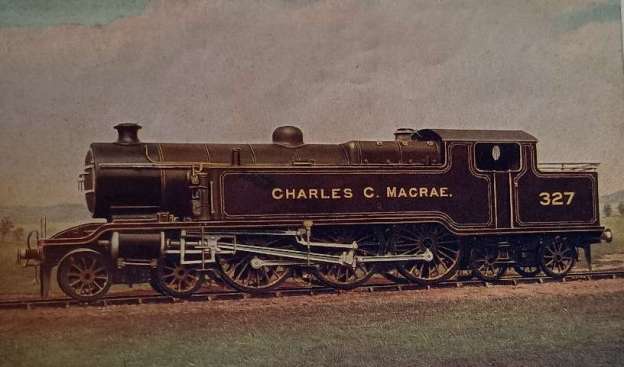
The featured image for this article comes from the frontispiece of Tilling’s book. It is a picture of the Class L 4-6-4T superheated large tank locomotive ‘Charles C. Macrae’. [1]

Tilling’s forward to the book states:

“For many years particulars of the locomotives running on our railway lines were difficult to obtain, but the Great Western Railway Company a year or two back broke through the usual official reticence by publishing a list of all their named engines. This was doubtless done to interest the general public in that railway, and I believe has proved a successful advertisement.

“Unofficial lists have also been published of the engines of the London and North Western Railway and a few of the smaller lines. Following these examples, I am prompted to deal with the locomotives of the London Brighton and South Coast Railway. This Company’s engines have probably had a larger circle of admirers than those of any other railway of similar size. The influence on locomotive design of the genius of the late William Stroudley (locomotive superintendent from 1871 until 1889) has appealed to the technical mind; whilst many, unconnected with railways, first attracted in their boyhood to this Company’s locomotives by their bright yellow livery and the fact that nearly all bore distinctive names, continue to take a keen interest in them long after their school days; and even now, when the engines are painted in less attractive colours, and the Stroudley classes are passing to the scrapheap, I feel sure there is a sufficiently large number interested to warrant the publication of this little book, and moreover, I am sanguine enough to hope that it may be of some use to many in the Company’s service.” [1: p3]

There were six hundred and six locomotives on the company’s roster in 25 different classes at the time that Tilling was writing these were:
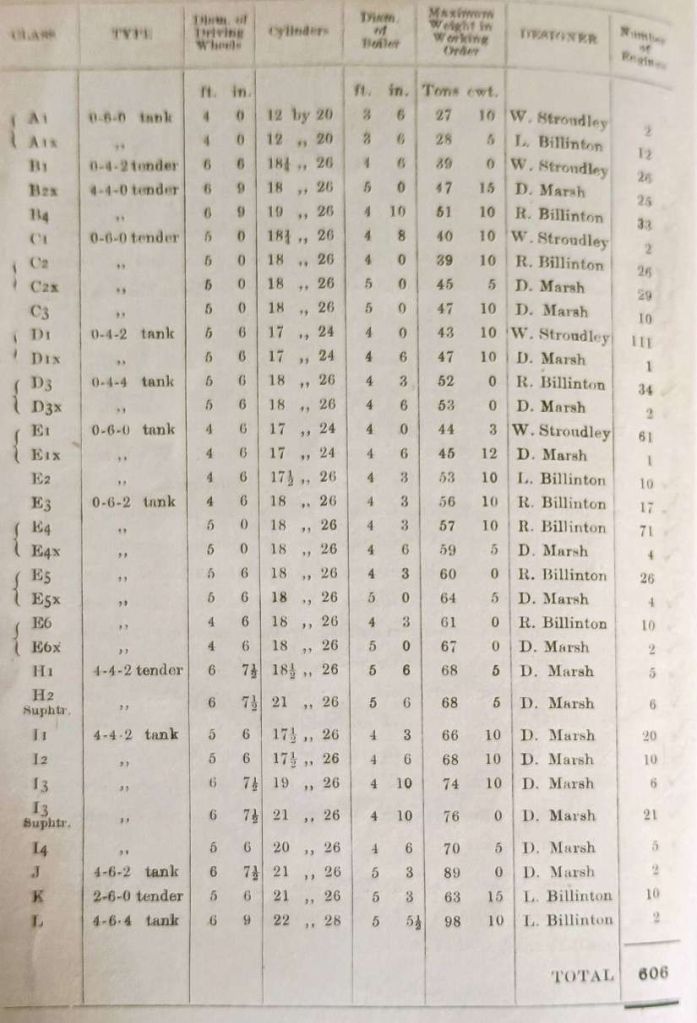
The locomotives of the London, Brighton & South Coast Railway in 1920. [1: p4]

There were 172 tender engines and 434 tank engines (all of the side tank variety). In addition, Tilling writes, there were four tank engines attached to the Locomotive Department for shunting in the Locomotive Works and the three principal steam sheds.
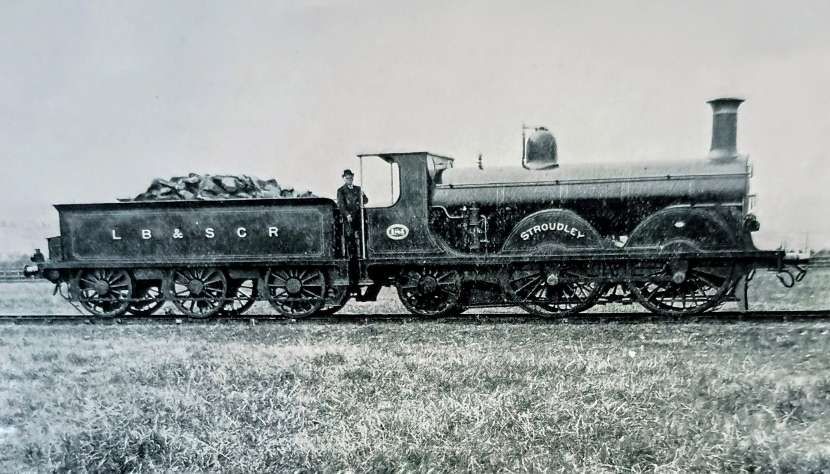
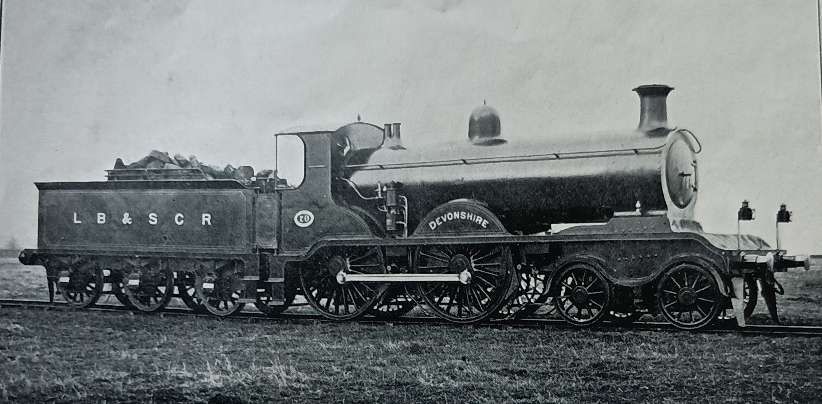
Class B1 0-4-2 Express Passenger Locomotive. [1: facing p4]

Tilling continues:

“All engines are fitted with the Westinghouse brake, whilst a few running in conjunction with ‘foreign’ lines have the automatic vacuum brake in addition. These latter engines proved extremely useful during the war in dealing with the large amount of other Companies’ rolling stock that passed over the Brighton system.

“The passenger engines are painted umber colour lined out with two yellow lines with the Company’s arms in colours on the splashers and gold lettering, whilst the goods engines are painted black with red lining and gold lettering.” [1: p5]

There were seventeen Locomotive Depots on the system. …
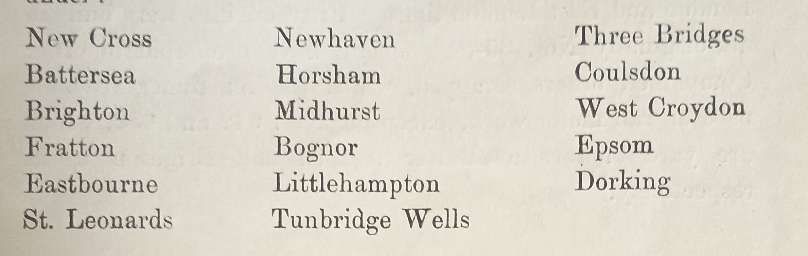
Locomotive Depots of the LB&SCR. [1: p5]
Class B4 4-4-0 Express Passenger Locomotive. [1: facing p5]
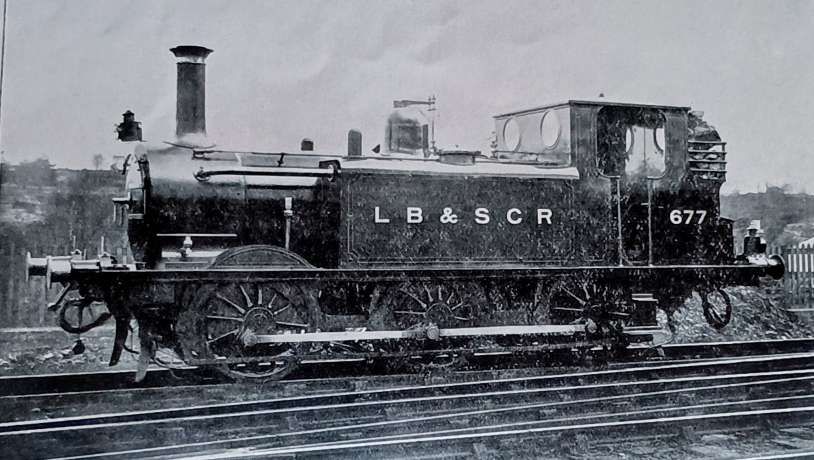
Class A1x 0-6-0T Rail Motor Engine. [1: facing p9]

Tilling describes the various classes of locomotive:

CLASS A: are small six-coupled side tanks with 4-ft. wheels, usually known as ‘Terriers’. They were designed [in 1872] years ago for working passenger trains on the South London and East London lines. Fifty engines were built in all, originally Nos. 35-84; several have been sold to other Companies, others scrapped, whilst the remainder are now used on rail motor work, excepting Nos. 642 and 682, which are yard engines at Battersea shed and Brighton works respectively.

“During the war several were taken over by the Government for working on light military lines in England and Scotland, for which their light weight only 27 tons 10 cwt. in working order made them very suitable. Although the oldest class now running on the line they are still very useful little engines, and several have recently been rebuilt with new boilers, etc., and are now classed A1x.

CLASS B: include Stroudley’s and R. J. Billinton’s four-coupled passenger express engines, subdivided into B1 (‘Gladstones’), B2 (‘Grasshoppers’), B3 (one engine only-213 ‘Bessemer’) and B4 (‘Scotchmen’). The B2 and B3 engines are now all rebuilt with larger boilers of the C3 type and classed B2x.

The Bl’s are front-coupled non-bogie engines, and they for many years worked the bulk of the express traffic between London and Brighton until superseded by the B4’s in 1901. The majority of the survivors are now employed on work usually done by tank engines, and several are now stationed at Tunbridge Wells shed. ‘Gladstone’ itself, after thirty-seven years, is still in evidence working slow trains between Brighton and the Metropolis. No. 172 is the only one of the class not fitted with Stroudley’s pumps and arrangement for utilising part of the exhaust steam to heat the water in the tender.

“The B2’s were the first express engines with a leading bogie to run on the LBS&CR. They were built to supersede the old single wheelers on the London-Portsmouth road with its many curves, and the first batch, Nos. 314-324, were all sent to Fratton shed, except No. 323, which worked from St. Leonards.

“No. 206 was badly damaged in the Wivelsfield accident of December, 1899, and also has the distinction of having worked the first sixty-minute Pullman train from Victoria to Brighton on 2nd October 1898.

“Several of the B2x’s have had wells fitted to their tenders to increase their water capacity, whilst Nos. 204, 206-209, 211, 212, 314, 323 and 324 now have the large tenders formerly on the C3 goods engines.

“The B4’s were nearly all built in Glasgow at the time of the Boer War, and many carried names reminiscent of that campaign, until Mr. Marsh, with a few exceptions, abandoned the naming of engines.

“The B4’s have been used for a number of trials at one time and another. No. 45 ran from 1902 till 1911 with a Drummond water-tube fire-box. No. 48 worked for some time early in 1905 fitted with templates over the boiler to test the clearance of the newly designed ‘Atlantics’. When Mr. Marsh decided to do away with the old yellow livery in 1905, he painted experimentally two of this class (Nos. 50 and 52) dark green. No. 52 also ran for some time in 1902/3 fitted with Holden’s oil fuel apparatus (as did also some of the B1, B2 and E5 classes). No. 53 ran for several years fitted with the Hotchkiss water circulator, whilst No. 59 worked with a ‘Phoenix’ superheater from 1912 to 1915.

“No. 54 formerly bore the name ‘Empress’, and was at one time used for all Royal specials. She carried the name ‘La France’ for a week in August, 1905, when working special trains in connection with the visit of the French fleet to Portsmouth.

“Several of this class have now been fitted with extended smokeboxes.” [1: p6-8]
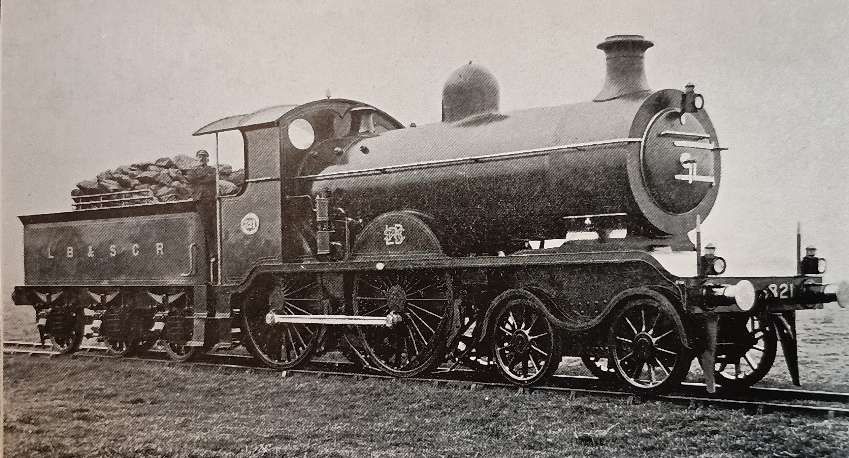
A Class B2x 4-4-0 Express Passenger Locomotive. [1: facing p12]
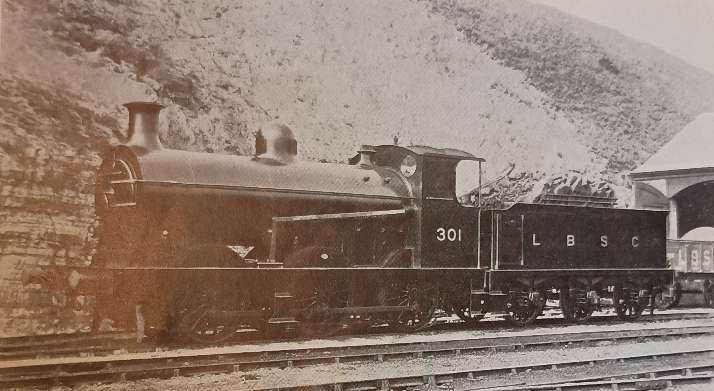
A Class C3 0-6-0 Main Line Goods Locomotive No. 301. [1: p46]
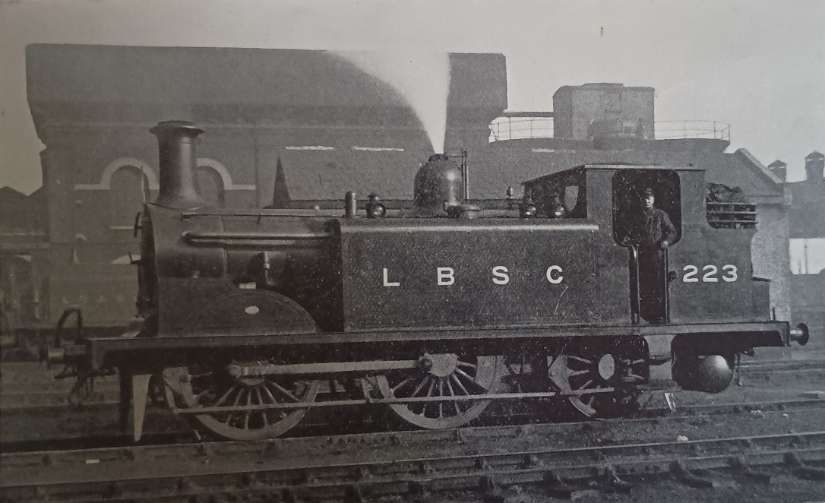
Class D1 0-4-2T Passenger Locomotive. [1: facing p8]

Tilling next focused on Class C locomotives:

Class C: are the tender goods engines, of which there are four varieties.

“The C1 class, when built, were amongst the largest goods engines in the country. Only two survive, No. 428 stationed at Fratton and No. 430 at Brighton. They have both recently had the Stroudley patent brake gear removed and the standard arrangement substituted, in order to cope with heavier goods trains. No. 430 in the early days of the war worked a troop special through to Doncaster.

“The C2’s were all built by the Vulcan Foundry Co. They are now being reconstructed as C2x’s, having the larger C3 boiler. Like the B4’s they have makers’ plates on the back of the tenders, but as the tenders have been interchanged at various times, the works numbers on the plates do not necessarily apply to the engines to which the tenders are now attached. Two of the C2x’s, Nos. 524 and 546, are at present (June 1920) on loan to the Great Western Railway; they are stationed at Old Oak Common depot and regularly work through onto the Brighton line.

“The C3’s are nearly all at present attached to the Horsham depot; they were an advance on the C2 class in boiler power, but the first five only had 174-inch cylinders, though the remaining five have 18 inch cylinders. They originally had 3112 gallon tenders, but latterly these large tenders have been transferred to engines of the B2x class and the C3’s now have the smaller ones formerly on the B2x engines.” [1: p8-9]

Tilling continues:

CLASS D: “The D1 class is Stroudley’s well-known front-coupled tank engine. Mr. Stroudley built no fewer than 125 of these engines, distributed over practically the whole period of his rule at Brighton. Whilst designed for the London suburban traffic they have been used on every class of work, and some of them are to be found at every shed on the system. Perhaps Fratton has seen the least of them, but Nos. 254 and 356 are there at present for working the Portsmouth-Chichester rail motor. No. 248 has side tanks with rounded ends as in the Marsh engines.

“No. 625 of this class was the first engine on this railway to be fitted with the Westinghouse brake; and 233 is noteworthy as having been for many years stationed at East Grinstead, being, in fact, the only engine ever stationed there.

“The D3 class is Mr. R. J. Billinton’s four-coupled bogie tank. Having a greater coal and water capacity than the D1’s, they are used on the longer routes. The valve gear and cylinders of this class are interchangeable with those of the C2 goods engines. Two of the D3’s (Nos. 396 and 397) have been rebuilt with the larger boiler of the I2 class.” [1: p9-10]

He continues:

Class E: “The ‘E’ CLASSES are the six-coupled side tanks, the oldest being Stroudley’s E1’s. The first of these appeared in 1874, and the last were turned out in 1891 by Mr. R. J. Billinton, who fitted his own design of boiler which added slightly to the weight. No. 689 has been entirely rebuilt, having new tanks, cab and boiler.

“No. 157 differs from all the other engines of its class. It was built for, and has worked all its life on the difficult Eastbourne-Tunbridge Wells line. It has side tanks and bunker slightly larger than the other E1’s, cylinders 18.25in × 26in, motion as Classes B1 and C1, and weighs 46 tons 18 cwt. in working order.

“Several of the E1’s were condemned for scrap in 1912, and Mr. L. B. Billinton designed an entirely new class to take their place. These are the E2’s. There are ten of this series, the second five having longer side tanks than the others. For a short time, when new, Nos. 103 and 104 worked in the centre of six coaches as a rail motor between London Bridge and Crystal Palace via Forest Hill.

“When Mr. Stroudley died in December 1889, an experimental six-coupled radial tank was in hand. This engine – No. 158 – did not commence work until just two years after his death, and while it had Stroud let’s standard 18.25in × 26in cylinders, it was essentially ‘Billinton’ in appearance. This engine weighed 52 tons 14 cwt. When Mr R. J. Billinton subsequently built sixteen others, they had his standard 18in x 26in cylinders. They are Class E3.
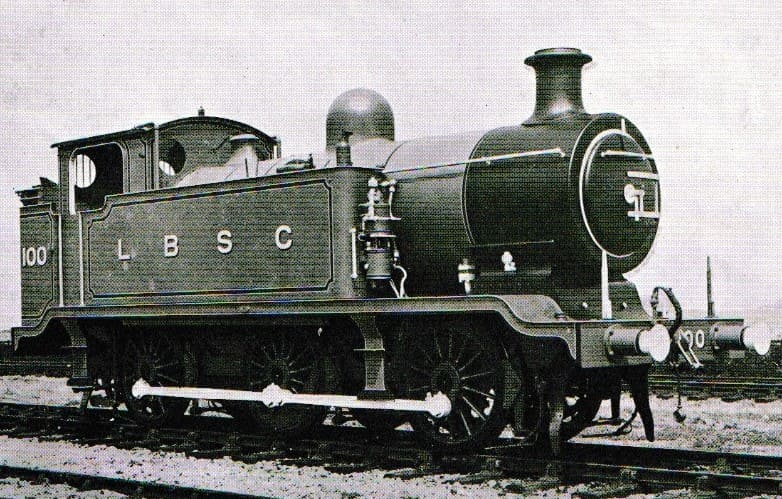
A Class E2 0-6-0T Goods Tank Locomotive, No. 100. [1: facing p36]
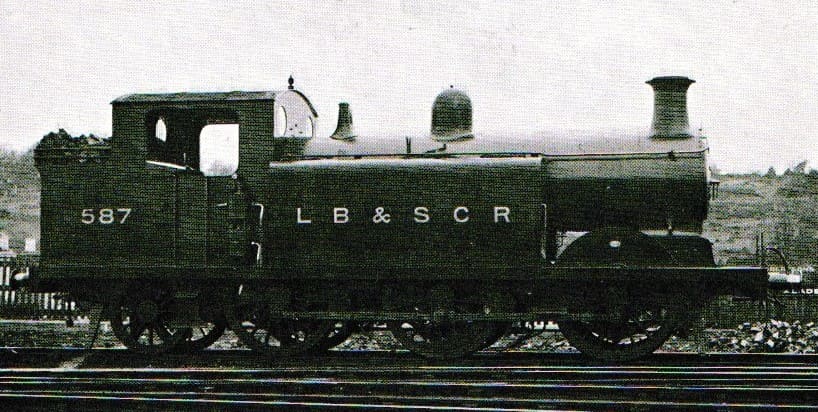
A Class E5 0-6-2T Mixed Traffic Tank Locomotive, No. 587. [1: facing p37]

Tilling continues:

“The E4’s and E5’s are similar to the E3’s but with larger driving wheels for mixed traffic and passenger work respectively, the capacity of the tanks is, however, larger. Twelve of the E4 class served on active service in France. They were Nos. 470, 481, 498, 504, 506, 516, 518, 562-565 and 580, and were chiefly employed banking trains on the St. Pol-Amiens line. They have all now been returned, and having been overhauled are back in service, painted black and unlined. They still bear the small plate inside the cab with which they were supplied before going overseas, to the effect that they are the property of the LB&SCR. of England. They were the only Brighton engines that were sent overseas during hostilities.

“Four engines of Class E4 have been rebuilt with the larger 12 class boiler and are now classed E4x, whilst four of the E5’s and two of the E6’s have been fitted with the larger C3 boiler and are now class E5x and E6x respectively.

No. 591, one of the E5’s, for some years regularly worked the 8.00 p.m. Grande Vitesse train from London Bridge to Newhaven; this engine is also noteworthy in having retained its name ‘Tillington’ and its yellow livery until 1917, over four years after all other ‘yellow’ engines had disappeared. Several of the E3’s and E4’s have been fitted with circular smokeboxes supported on a saddle, but when they retain the original sized boiler they are not classed E3x or E4x.” [1: p11]

Again, Tilling continues

Class H: This class “consist of the ‘Atlantics’, eleven in number. Mr. Marsh came to Brighton from Doncaster, and the first engine he designed for this railway was based on the familiar G.N. standard express type. Five were at first built by Messrs. Kitson of Leeds (Class H1). The H2’s were built at Brighton some years later; they have super-heaters which allow larger cylinders and lower boiler pressure to be used. Ten of them are stationed at Brighton and one at Eastbourne, and in conjunction with the ‘J’ and ‘L’ tanks they work all the heaviest expresses between London, Brighton and Eastbourne. No. 39 is frequently used for Royal specials, and bears the name ‘La France’. [1: p11-12]
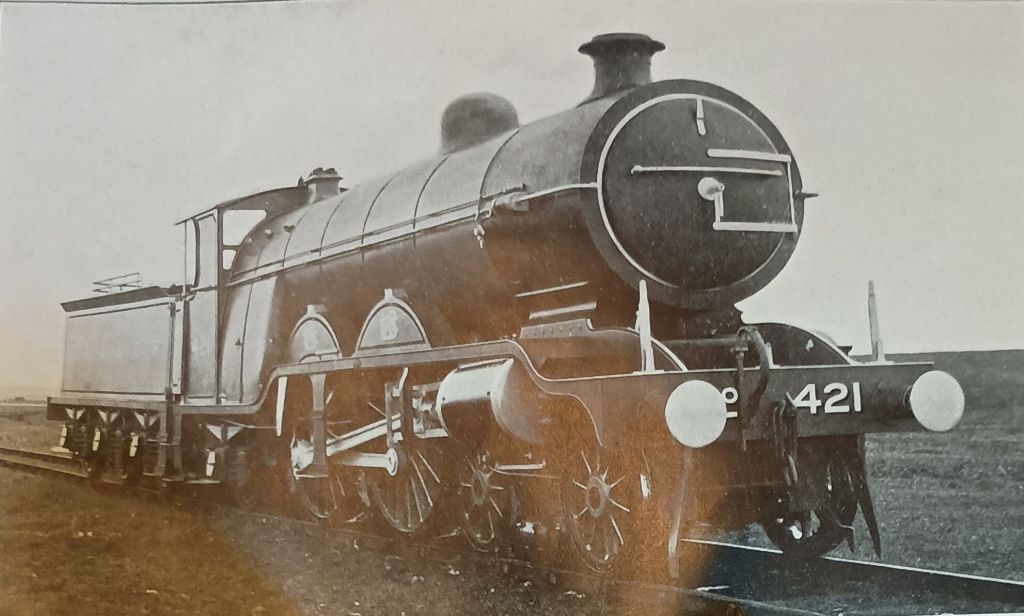
A Class H2 Superheated 4-4-2 Express Passenger Locomotive No. 421. [1: facing p13]

The next class of locomotives that Tilling covers are:

Class I: “The ‘I’ class consist of the ten-wheeled tanks. The I1’s suffer from having too small boilers, but the later I3’s built for express work are very successful engines.

“No. 21 differs from the others in having 6 ft. 9 in. drivers, and the same cylinders and motion as the B4’s; it was fitted with a superheater during 1919. Twenty others of the I3’s are fitted with superheaters but have 21 in. x 26 in. cylinders.

“The I1’s are used on various local services; the I2’s and I4’s (which are the same as the I2’s, but with 20 in. cylinders and superheated) on such services as the London-Tunbridge Wells trains; whilst the I3’s work chiefly between London and the Coast on fast trains.

“No. 23 worked regularly for some weeks during 1909 in conjunction with the LNWR engine No. 7, ‘Titan’, on the ‘Sunny South Special’, running from Brighton through to Rugby one day and returning the next.” [1: p12]
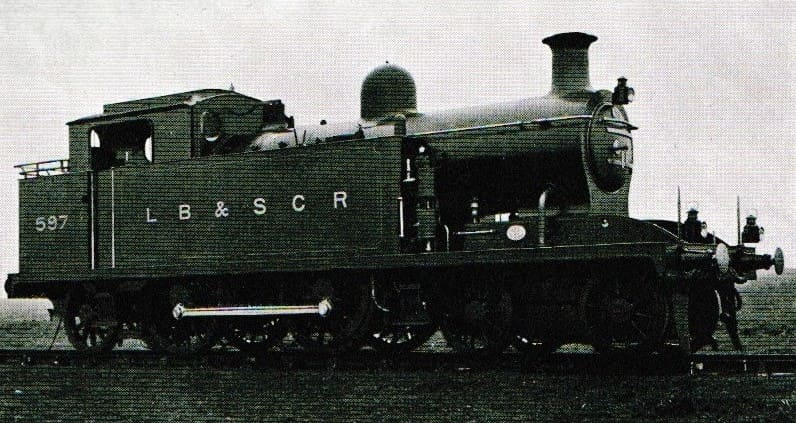
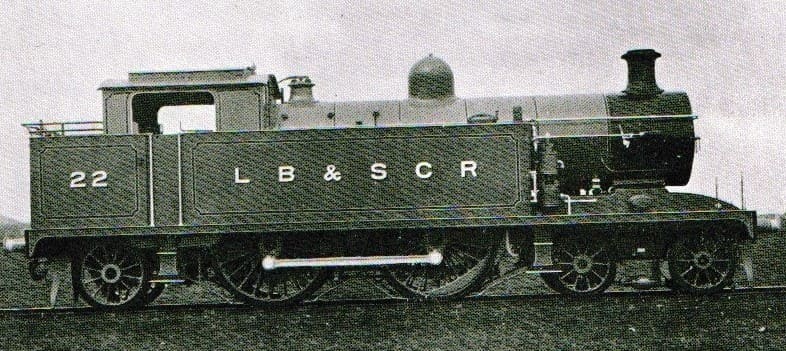
A Class I1 4-4-2T Passenger Tank Locomotive No. 597. [1: facing p20]
A Class I3 Superheated 4-4-2T Express Tank Locomotive No. 22. [1: facing p21]

Class J: “The ‘J’ Class consist of two experimental tank engines built by Mr. D. Earle Marsh for the express service between London and the Coast. They are of the ‘Pacific’ or 4-6-2 type with 21 in. × 26 in. cylinders, driving wheels 6 ft. 7 in. diameter, and superheated. No. 325 is fitted with Stephenson’s valve gear, whilst No. 326 was the first engine on this line to be fitted with the Walschaert pattern valve gear.
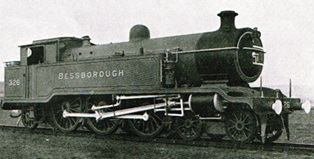
A Class J Superheated 4-6-2T Express Tank Locomotive – N0.326 ‘Besborough’. [1: facing p28]

Tilling continues:

Class K: “The ‘K’ Class are the latest heavy goods engines designed by Mr. L. B. Billinton for the traffic between London and Newhaven. They are tender engines of the ‘Mogul’ or 2-6-0 type, superheated. The first of these was put into service in September, 1913. To meet the greatly increased goods service to Newhaven, due to the war, another five were built in 1916; they are fitted with top feed to the boilers and have Belpaire fireboxes, and having proved so successful in service others with an improved top feed system are now under construction at Brighton. No. 339, one of the earlier engines, was fitted with this new arrangement in April, 1920, and is illustrated in these pages.” [1: p13]
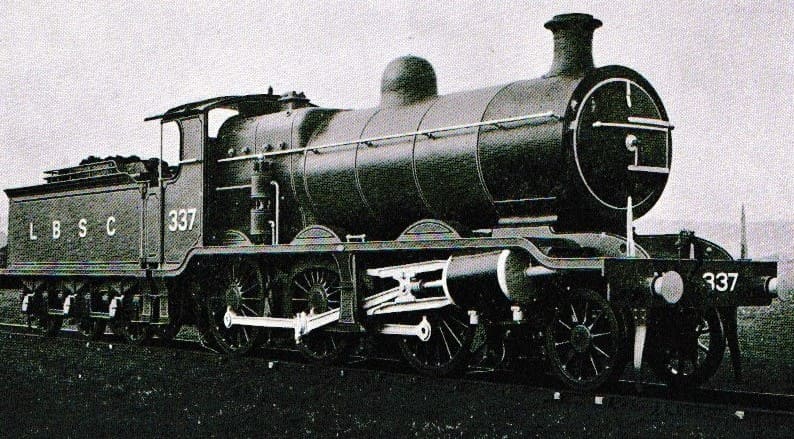
A Class K Superheated 2-6-0 Fast Goods Locomotive No. 337. [1: facing p29]

He also notes that in 1920 there were:

“Seven engines of the K class … under construction at Brighton, they will be numbered 347 to 353. The engines at present numbered 347 to 353 will in due course be re-numbered 214 to 220; and engines at present numbered 214, 217 and 219 will be re-numbered 618, 619 and 620.” [1: p46]
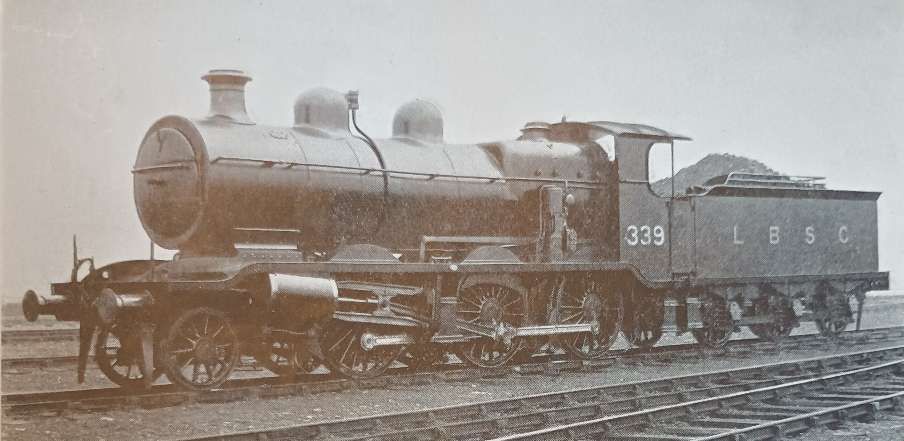
Another Class K Superheated 2-6-0 Fast Goods Locomotive, No. 339, which was fitted with the, then, latest arrangement of Top Feed (April 2020). [1: p45]

Class L: “The ‘L’ Class consist of two tank engines of the ‘Baltic’ or 4-6-4 type. These are the largest express tank engines in Britain, and were built by Mr. L. B. Billinton to work the fast non-stop service between London and the coast towns at an approximately uniform speed, and so save racing on the down grades. These engines have cylinders of 22 in. diameter and 28 in. stroke, and the boiler which is of ample capacity is fitted with a superheater. The driving wheels are 6 ft. 9 in. diameter, and sufficient water and coal is carried for the longest non-stop run between London and Portsmouth.” [1: p13]

In the years prior to 1920, the LB&SCR had locomotives not recorded by Tilling, these include:

LB&SCR Richmond class: This class was a series of 0-4-2 express passenger locomotives, designed by William Stroudley in 1877. They were a larger version of his “Lyons” class (D2) which were in turn developed from his successful ‘D-tank’ class of 1873. [2]

The six locomotives in this class were built at Brighton railway works and appeared in traffic between October 1878 and March 1880, intended to replace earlier classes designed by John Chester Craven on the heaviest express trains between London and Brighton. They performed well on these duties for a decade but were eventually replaced by Stroudley’s larger “Gladstone” class (B1). They were then transferred to Eastbourne and St Leonards to work on expresses from those towns. During the winter of 1900/01 members of the class were transferred to the duplicate list. Withdrawal commenced in April 1901 and was completed by November 1904. No examples were preserved. [2]

They were originally classified as “B class” together with the members of the larger “Gladstone class”. As all six locomotives had been withdrawn before D.E. Marsh introduced his letter/number classification scheme, they were never officially allocated a new class designation. They were, however, described as ‘D3 class’. [2]
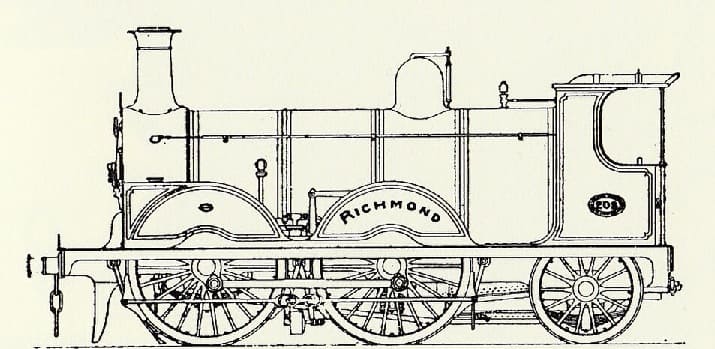
Diagram of a Richmond class 0-4-2, (c) F. Burtt and Public Domain. [2]

Locomotives designed by and built during the tenure of John Chester Craven between his appointment in 1847 and his retirement in January 1870. A full list of these locomotives can be found here. [3]

The ‘Jenny Lind’: The ‘Jenny Lind’ was built in 1847 after a relatively complicated gestation by E. B. Wilson and Company. [4] But it proved to be so successful that the design was used by Wilson & Co. as their standard design and more than seventy examples were built for various railways, including twenty-four for the Midland Railway. It could be said to be the first to be mass-produced to a consistent pattern. Indeed, the manufacturers charged a hefty premium for variations, although in response to pressure, they later built a number of “large jennies”. [4]

Other manufacturers and railways also adopted the type. John Chester Craven, Kirtley’s successor at Brighton, built a class of five similar “Jenny Lind singles” from 1853 to 1854. [4] An enlarged type was also built by Beyer, Peacock and Company in 1860 for the Portuguese South Western Railway. [4]
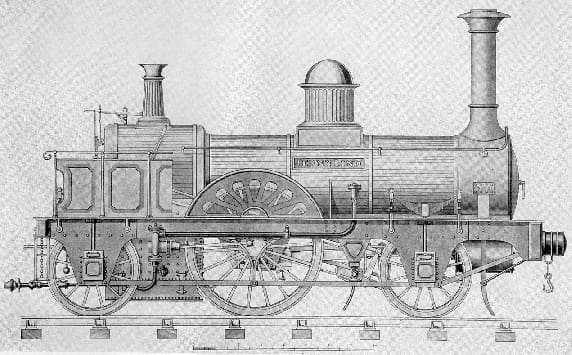
The original Jenny Lind, (c) Public Domain. [4]

Class G: A prototype single locomotive, No. 151 Grosvenor, was designed by Stroudley and produced by Brighton railway works in December 1874. This was extensively tested before a second, scaled down locomotive No. 325 Abergavenny, was ordered in June 1876 and completed in January 1877. Both locomotives performed adequately, but Abergavenny was significantly less powerful than Grosvenor. A modified design was developed and twelve further locomotives were built between December 1880 and November 1881. The members of this class worked express trains between London and South Coast towns such as Portsmouth, Brighton and Eastbourne, and covered large mileages. The introduction of the Billinton B2 class made the singles redundant on the Portsmouth line and so several were transferred to Tunbridge Wells. … Withdrawals began in May 1907, and the last locomotive survived until May 1914. No examples have been preserved, but there is a model of No. 331 Fairlight in the museum at Sheffield Park on the Bluebell Railway. [5]
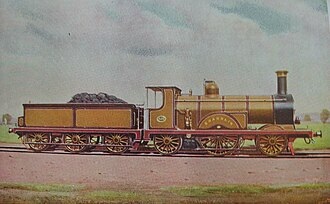
London Brighton and South Coast Railway Class G 2-2-2 Locomotive. 26 locomotives were produced in this class. ‘Grosvenor’ was the first, ‘Abergavenny’ was the second (with alterations) and subsequently 24 more were produced, (c) Public Domain. [5]

Very Early Locomotives of the LB&SCR: Wikipedia also provides a list of all the locomotives owned by the LB&SCR from its inception (1846) until 1849. [6] That list includes a significant number of locomotives built by a series of specialist locomotive builders including: Sharp, Roberts & Co.; Jones, Turner and Evans; G and J Rennie; Edward Bury & Co.; William Fairbairn; George Forrester & Co.; Sharp Brothers; R and W Hawthorn Ltd.; Jones & Potts; John George Bodmer; Timothy Hackworth; and Stothert & Slaughter. Many of these were built for companies which formed the LB&SCR in 1846 and were built as early as 1838.

The majority of the locomotives acquired were owned or ordered by one of the three constituent railways, but some had been ordered by the Joint Committee. After the Joint Committee’s dissolution, some locomotives were ordered by John Gray, the new locomotive superintendent, from Timothy Hackworth and delivered during 1847 and 1848. Others were purchased from Stothert & Slaughter between 1847 and 1849. After this date the railway’s new locomotives were designed and built by John Chester Craven, usually at Brighton railway works. [6]

A List of Locomotive of the LB&SCR in 1920: Tilling provides a detailed list, locomotive by locomotive, of locomotives in use by the LB&SCR in 1920 to complete his book. These tables can be found here.

References

  1. W.G. Tilling; The Locomotives of the London, Brighton & South Coast Railway; Tilling, London, 1920.
  2. https://en.wikipedia.org/wiki/LB%26SCR_Richmond_class, accessed on 13th June 2026.
  3. https://en.wikipedia.org/wiki/List_of_Craven_locomotives, accessed on 13th June 2026.
  4. https://en.wikipedia.org/wiki/Jenny_Lind_locomotive, accessed on 13th June 2026.
  5. https://en.wikipedia.org/wiki/LB%26SCR_G_class, accessed on 14th June 2026.
  6. https://en.wikipedia.org/wiki/List_of_early_locomotives_of_the_London_Brighton_and_South_Coast_Railway, accessed on 14th June 2026.
  7. https://rogerfarnworthsrailways.wordpress.com/wp-content/uploads/2026/06/lbscr-locos-1920.pdf
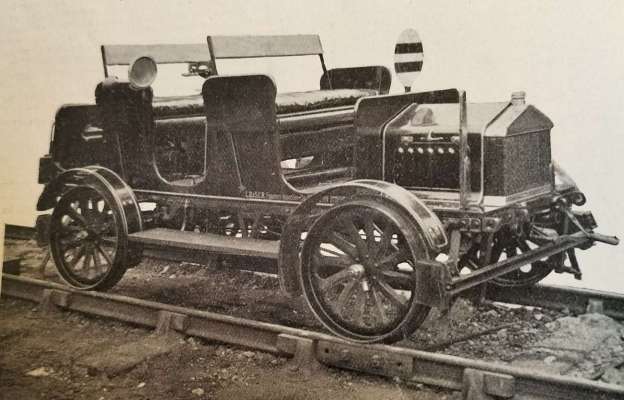
Early Small Petrol-Powered Rail Inspection Cars

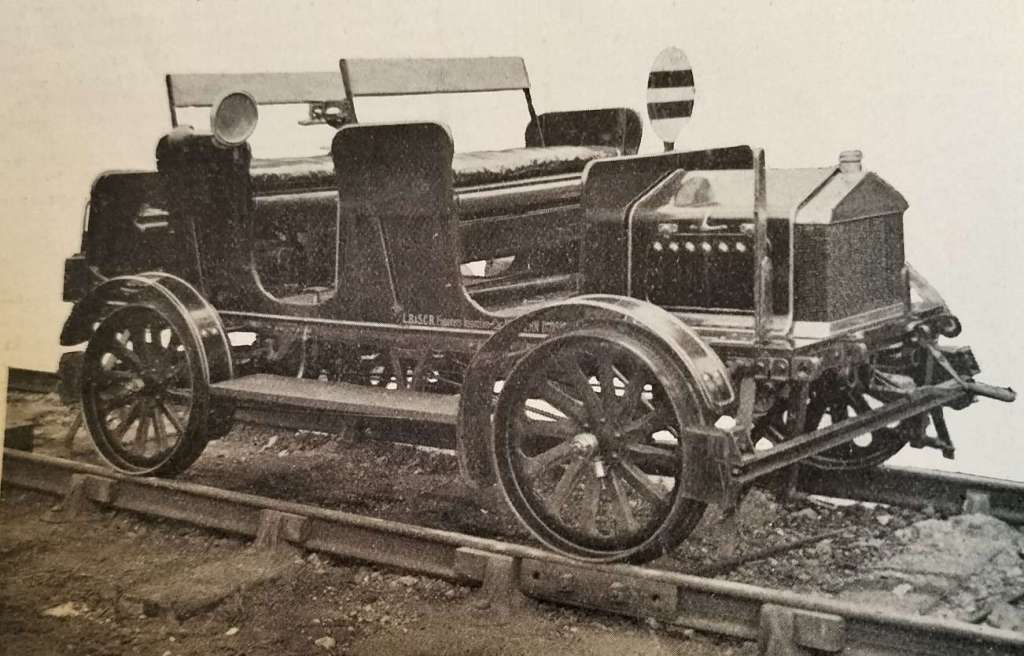
The featured image for this short article is the petrol motor-car used by the Croydon District Engineer of the London, Brighton, and South Coast Railway, in connection with his duties. The car is block-signalled in the same way as a train and carries head code discs. It was included in The Railway Magazine of July 1906. [1]

Petrol Motor-car used by the Croydon District Engineer of the London, Brighton, and South Coast Railway, © J. Reynolds. [1]

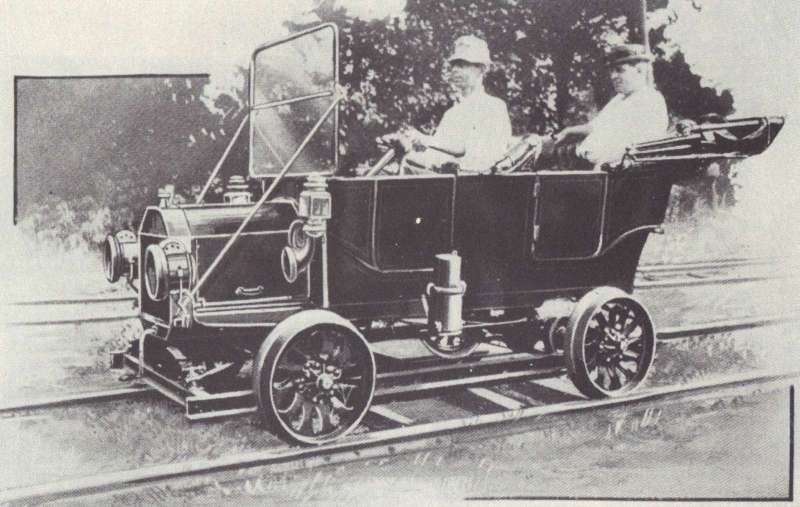
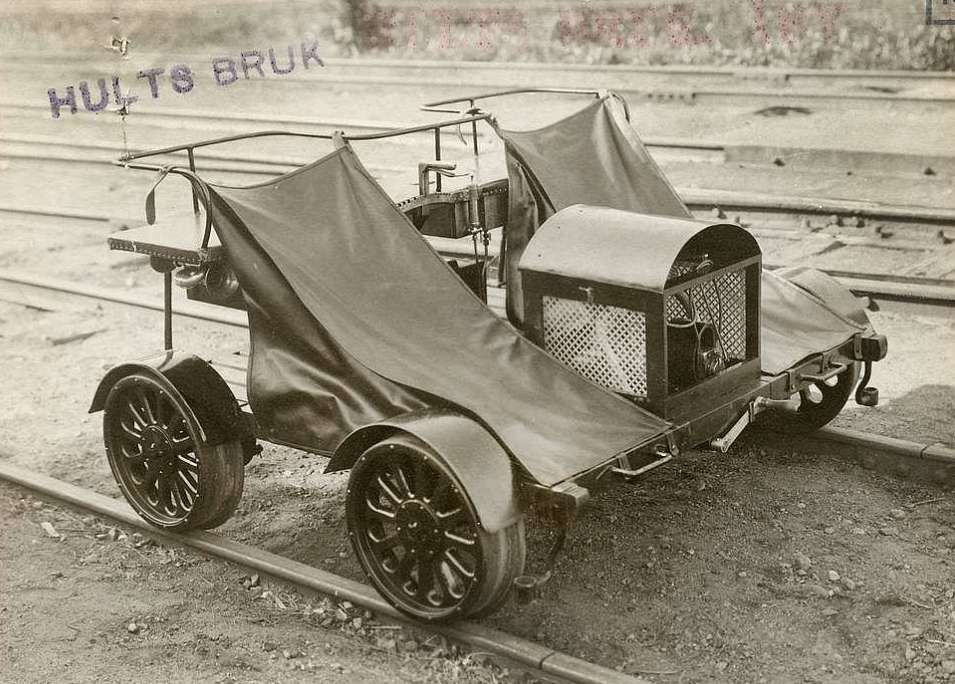
This article includes an eclectic mix of inspection vehicles, united only by the fact that they are petrol-powered.

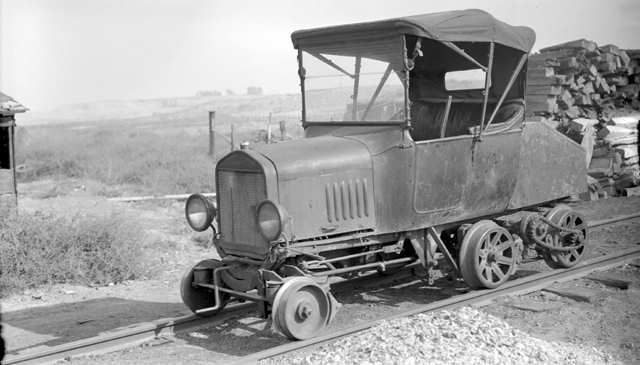
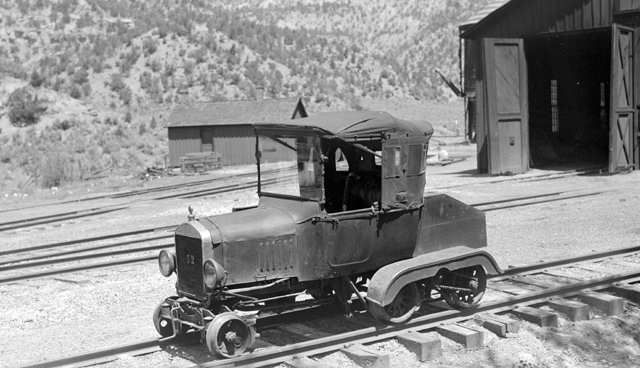
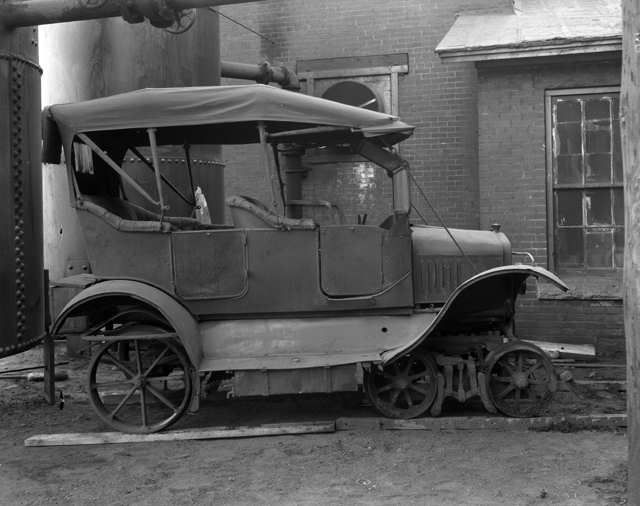
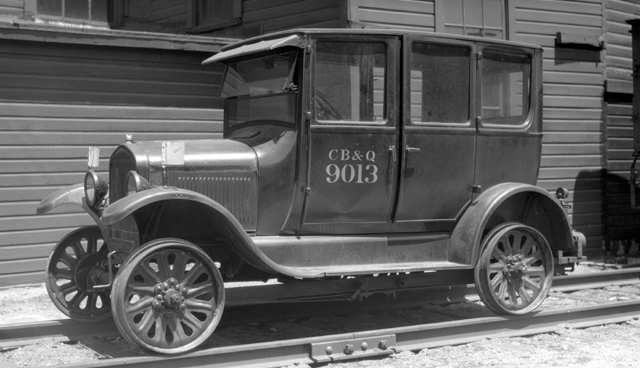
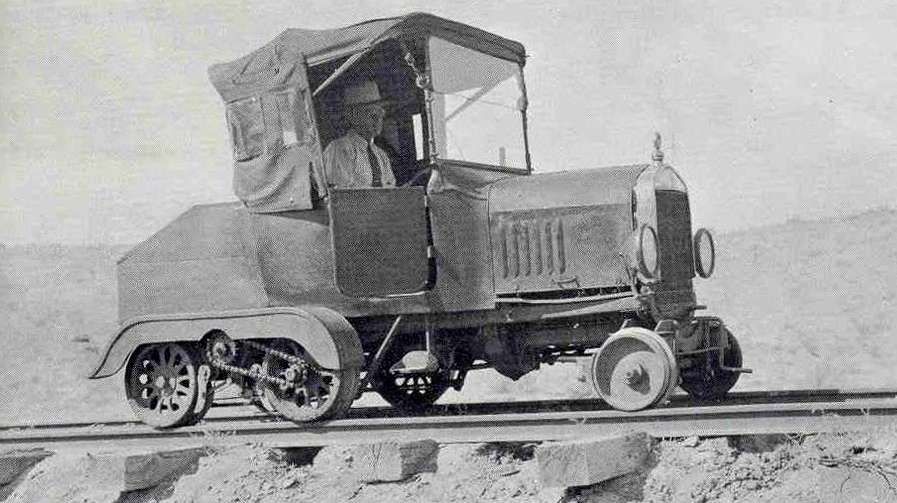
First, some Ford Model T inspection cars:

1912 Ford Model T converted to rail use for J.P. Murphy, superintendent for the Little River Railroad. [2]

And some other examples:

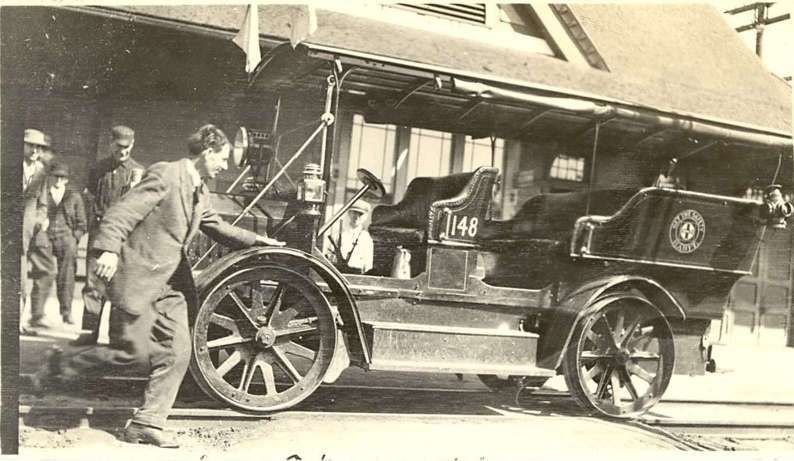
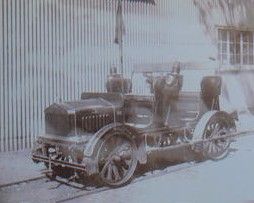
Swedish, four-wheeled inspection vehicle with two-cylinder air-cooled petrol engine.  Magnetic ignition.  Weight approximately 285 kilos, © Public Domain. [3]
Petrol-Powered Inspector’s car at a Santa Fe Station, 1912. You can make out ‘Santa Fe’ in the centre of the emblem. The lettering around it says ‘Get the Safety Habit’. [4]

Motorised inspection trolley built by Alldays & Onions, 8 hp. [5]

Alldays & Onions was an English engineering business and an early automobile manufacturer based at Great Western Works and Matchless Works, Small Heath, Birmingham. It manufactured cars from 1898 to 1918. [9]

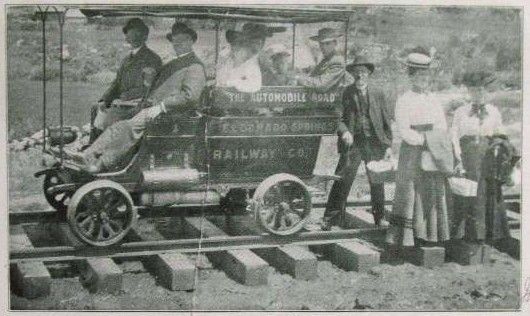
1907 El Dorado Springs Railway Company Texas Auto Railway Car. [6]

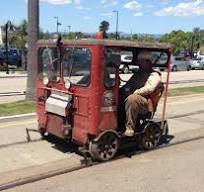
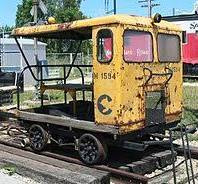
In the United States and Canada, in the 20th century, a particular form of inspection vehicle known often as a ‘Speeder’ was developed. “A speeder (also known as a section car, railway motor car, putt-putt, track-maintenance car, crew car, jigger, trike, quad, trolley, inspection car, or draisine) is a small railcar formerly used around the world by track inspectors and work crews to move quickly to and from work sites. Although slow compared to a train or car, it is called speeder because it is faster than a human-powered vehicle such as a handcar. Motorized inspection cars date back to at least 1896, when it was reported that the U.S. Daimler Motor Company created a gasoline-powered rail inspection car capable of 15 mph (24 km/h).” [10][11]

Much later, in the 1990s, many speeders were replaced by pickup trucks or sport utility vehicles with additional flanged wheels that could be lowered for travelling on rails, called “road–rail vehicles” or “hi-rails” for “highway-railroad”. Speeders are collected by hobbyists, who refurbish them for excursions organized by the North American Railcar Operators Association in the U.S. and Canada and the Australian Society of Section Car Operators, Inc. in Australia.

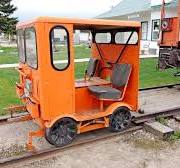
Three typical ‘Speeders’ are shown below: [10][12]

The three cars above are:

  • A Fairmont Speeder; [12]
  • A speeder in use in Santa Cruz, California; [10] and
  • A former Chessie System (a holding company that owned the Chesapeake and Ohio Railway) speeder at the Linden Railroad Museum, Linden, Indiana. [10]

References

  1. The Railway Magazine, London, July 1906, p24.
  2. Floyd Clymer; Henry’s Wonderful Model T 1908-1927, Bonanza Books, 1955, via https://progress-is-fine.blogspot.com/2015/08/model-t-inspection-car.html?m=1, accessed on 11th October 2024.
  3. https://jenikirbyhistory.getarchive.net/media/fyrhjulig-dressin-med-tvacylindrig-luftkyld-bensinmotor-magnetelekrisk-tandning-7bb43c, accessed on 11th October 2024.
  4. https://www.trainboard.com/highball/index.php?attachments/418249778_10221002059915743_3696497498370196004_n-jpg.278504, accessed on 11th October 2024.
  5. https://atom.drisa.co.za/index.php/railcar-built-by-allday-onions-8-hp, accessed on 11th October 2024.
  6. https://www.worthpoint.com/worthopedia/1907-el-dorado-springs-railway-1913047085, accessed on 11th October 2024
  7. https://www.mtfca.com/discus/messages/80257/84718.html?1237133514, accessed on 17th October 2024.
  8. https://justacarguy.blogspot.com/2011/07/steampunkvehicles, accessed on 17th October  2024.
  9. https://en.m.wikipedia.org/wiki/Alldays_&_Onions, accessed on 17th October 2024.
  10. https://en.wikipedia.org/wiki/Railroad_speeder, accessed on 21st October 2024.
  11. The Automotor and Horseless Carriage Journal, December 1896, p103.
  12. https://the-north-valley-shortline.fandom.com/wiki/Derek?file=Fairmontspeeder.jpg, accessed on 21st October 2024.

Steam Railmotors – Part 5 – Articulated Steam Railmotors

Earlier articles in this short series about steam railmotors can be found on these links:

The Earliest Steam Railmotors:

Steam Railmotors – Part 1 – Early Examples.

Dugald Drummond and Harry Wainwright:

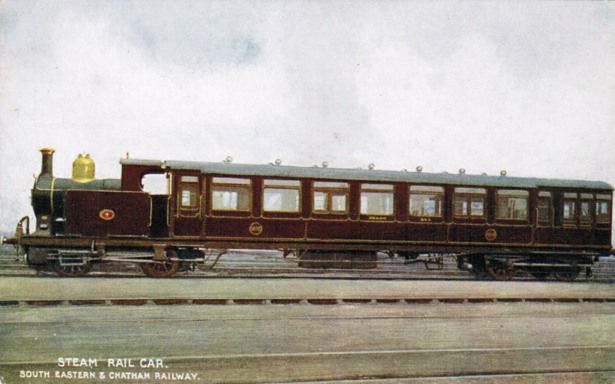
Steam Railmotors – Part 2 – Dugald Drummond (LSWR) and Harry Wainwright (SECR)

The GWR Steam Railmotors:

Steam Railmotors – Part 3 – The Great Western Railway (GWR)

Rigid-bodied Railmotors of Different Companies in the first two decades of the 20th century:

Steam Railmotors – Part 4 – Rigid-bodied Railmotors owned by other railway companies

Articulated Steam Railmotors in the First 2 decades of the 20th Century

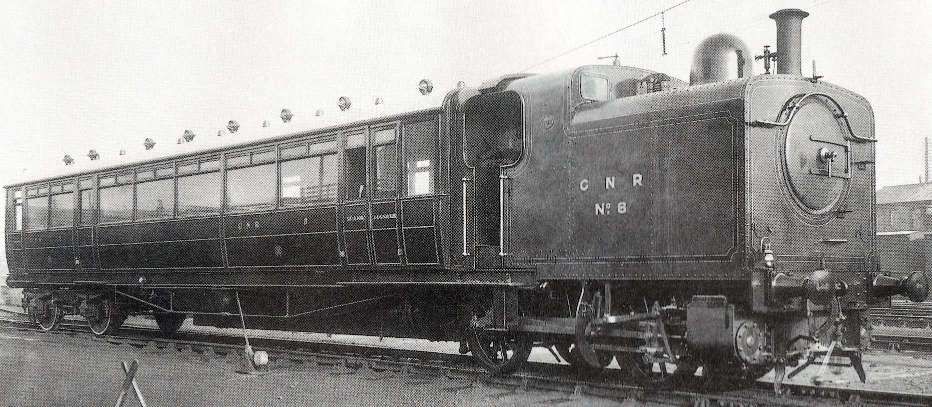
Jenkinson and Lane comment that although the articulated railmotors were numerically less significant than the rigid type, “the articulated option was to sprout just as many variations, and attracted the attention of a number of eminent locomotive engineers – perhaps because they  looked more like ‘real’ trains. Be that as it may, most of them, however short-lived or unsustainable they may have been, were of more than usually pleasant visual aspect.” [1: p26]

Examples of articulated railmotors were those  of the Taff Vale Railway (TVR), the Lancashire & Yorkshire Railway (L&YR) the South Eastern & Chatham Railway (SECR),  the North British Railway (NBR), the London Brighton & South Coast Railway (LB&SCR), the North Staffordshire Railway (NSR), the Rhymney Railway (RR), the Port Talbot Railway (PTR), the Isle of Wight Central Railway (IWCR), the Glasgow and South Western Railway (G&SWR), and the Great North of Scotland Railway (GNSR).

We have already picked up on the decisions made by Harry Wainwright of the SECR. Others were making the same decisions at roughly the same time. …

The Taff Vale Railway Railmotors

Tom Hurry Riches (1846–1911) “became the Locomotive Superintendent of the Taff Vale Railway in October 1873, and held the post until his death on 4 September 1911. At the time of his appointment, he was the youngest locomotive superintendent in Britain.” [5]

His steam railmotors “were built between 1903 and 1905, … one prototype and three main batches. There were 18 engine units and 16 carriage potions, … permitting stand-by power units to be available. … The pioneer power unit came from the company’s workshops (the last ‘locomotive’ to be built by the TVR in its shops at West Yard, Cardiff) followed by six each from Avonside and Kerr Stuart and a final five from Manning Wardle, the last type being much more powerful than the first three series, which were broadly identical.” [1: p21]

TVR No. 1, used on the Cardiff, Penarth & Cogan section of the TVR. 12 1st class, 40 3rd class passengers could be carried seated. It was built to the design of T. Hurry Riches, © Public Domain. [6]

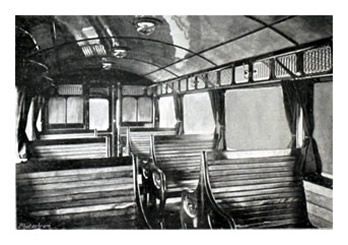
The first-class compartment of Riches prototype was “furnished with longitudinal seats. The third-class compartment [was] furnished with transverse seats arranged in pairs, divided by a central gang-way. The car underframe [was] constructed of steel, and … carried at one end on an ordinary carriage bogie, the wheels of which [were] Kitson’s patent wood cushioned type; the other end of the car [was] carried on the engine.” [7]

A later view of a TVR Steam Railmotor. Engine No.6 which is in charge of an unidentified carriage portion and a single 6-wheel trailer coach, © National Museum of Wales. [9]

All of the TVR Steam Railmotors had transverse boilers and were driven from rearward-placed cylinders onto an uncoupled front axle. [7]

The Lancashire & Yorkshire Railway Steam Railmotors

The Lancashire and Yorkshire Railway (L&YR) operated two classes of twenty steam railmotors in total. [10]

Kerr Stuart Railmotors

Kerr, Stuart & Co. built 4 Steam Railmotors for the L&YR (2) and the TVR (2) as a single batch in 1905. [10]

One of the 2 Kerr Stuart Steam Railmotors on the L&YR. These shared their design, with transverse boilers, with those that Kerr Stuart built from the TVR. [12]

The locomotive units had transverse boilers … where a single central firebox fed extremely short fire-tubes to a smokebox at each side. … These then returned to a central smokebox and chimney. The outside cylinders were rear-mounted and drove only the leading axle, without coupling rods. The locomotive units were dispatched separately to Newton Heath, where their semi-trailers were attached.” [10][11: p170-171]

Their coaches were semi-trailers, with reversible seats for 48 passengers and electric lighting. There were also a luggage compartment and a driving compartment for use in reverse. Folding steps were provided at each of the two doors on each side. [11: p155] They were built by Bristol Wagon & Carriage Works. [11: p170-171]

Hughes Steam Railmotors

George Hughes (9 October 1865 – 27 October 1945) was …  chief mechanical engineer (CME) of the Lancashire and Yorkshire Railway (L&YR) and the London, Midland and Scottish Railway (LMS). [13].

When the L&YR amalgamated into the LNWR in January 1922 he became the CME of the combined group and was appointed the CME of the LMS on its formation at the 1923 grouping. [13][14]

He retired in July 1925 after only two and a half years at the LMS. [11: p198] He was succeeded by Henry Fowler who had worked with him at Horwich Works before moving to the former Midland Railway’s Derby Works. [15: p38]

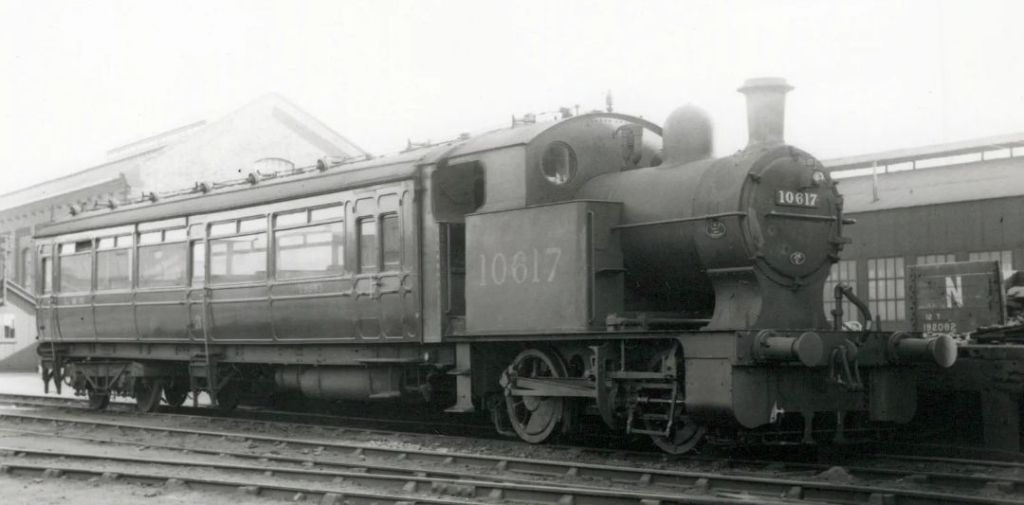
Hughes designed a second class of railmotors that were then built at Horwich and Newton Heath, in four batches over five years. They were of the “0-4-0T locomotive + semi-trailer type”, with conventional locomotive boilers. [11: p155, 170-171] In total, 18 power units were made to Hughes specification.

In LMS days, sitting at Horwich Loco Works, this is No 10617 and an unidentified passenger portion. [18]

All were inherited by the London, Midland and Scottish Railway (LMS) in 1923, who numbered the locomotives 10600-17 and gave the trailers separate numbers in the coaching stock series. These were the only self-propelled vehicles numbered in the LMS locomotive series rather than the coaching stock series. The first was withdrawn in 1927, and only one survived by nationalisation in 1948. That railmotor, LMS No. 10617, was withdrawn in 1948 and given the British Railways internal number 50617, but got withdrawn in March of the same year. None were preserved.” [10][16]

The best-remembered of these railmotors was the ‘Altcar Bob’ service from Southport to Barton railway station (also known as ‘Downholland’) (before 1926, it ran to Altcar and Hillhouse) and the ‘Horwich Jerk’ service from Horwich to Blackrod. The latter became the last part of the L&Y System which made use of Hughes Railmotors.[10][16]

Many of the last survivors of these 18 Railmotors ended their lives at Bolton MPD and in their final hours were used on the workmen’s’ trains between that town and the works at Horwich. [17]

South Eastern & Chatham Railway (SECR) Steam Railmotors

These were covered in the 2nd article in this short series:

Steam Railmotors – Part 2 – Dugald Drummond (LSWR) and Harry Wainwright (SECR)

SECR Steam Railmotor No.1 – the first of a second series of six steam railmotors on the SECR. All six in the series were articulated. This steam railmotor operated on the Sheppey Light Railway for a few years before being moved to Tonbridge for the Otford to Sevenoaks service in 1907. In 1910, it went to Dover to serve on the Sandgate route and by 1914 was at the Bricklayers Arms to work the Woodside to Sheldon Road service. It was ‘set aside’ in 1915, © Public Domain. [19][1: p26]

Jenkinson and Lane comment that the SECR was surprisingly a leader in the field. “Harry Wainwright supervised the design of eight beautifully stylish examples in 1904-5.” [1: p26]

Despite determined efforts over the years to improve their efficiency, the Railmotors were non-too-popular and were scheduled for withdrawal in 1914. The war intervened and gave a longer life to some units, but soon after the war they were all set aside, although some survived unused into the grouping era.

Great Northern Railway (GNR) Steam Railmotors

Ivatt, on behalf of the GNR, had six railmotors built in pairs, with similar passenger accommodation but differing in other details. He had them produced “as part of a GNR experiment with self-propelled passenger units and numbered in a new series 1&2, 5&6, 7&8, the missing 3&4 being kept for two proposed petrol engined cars of which … only one was bought.” [1: p28] All six units utilised the underfloor area of the carriage portion to house the water tanks. [1: p28]

Nos. 1&2 were built by the GNR themselvescat Doncaster in 1905, the passenger portions were among the earliest passenger ‘coaches’ to be given full elliptical roofs. “In 1930, the passenger ends were converted to an articulated twin (Nos. 44151-2) but only lasted until 1937 because of damage received in a mishap at Hatfield.” [1: p27]

GNR Railmotor No. 2, © Public Domain. [25]

Nos. 5&6 were built by Kitson and Co. in 1905. The locomotive portion was of very similar design to Nos 1&2. Their passenger bodies were supplied by Birmingham Carriage and Wagon Works. They had the traditional flatter roofs which tied in with the profile of the roof of the engine portions. [1: p28]

Kitson built GNR Railmotor No. 6 standing at King’s Cross engine shed in 1924, © Public Domain. [25]

Nos. 7&8 were built by Avonside with carriage bodies from Bristol Carriage and Wagon Works. The Avonside locomotive portion was rather bulky (Jenkinson and Lane describe it as ‘brutish’ [1: p28]) and was soon remodelled because maintenance was hampered by an engine casing which cloaked most of the fitments. The passenger portions of these units were converted to another pair of articulated carriages (Nos. 44141-2) which survived until they were condemned in 1958. They “worked the Essendine- Bourne branch until 1951 and afterwards in such widespread like captions as Mablethorpe, Newcastle-Hawick and finally Bridlington-Scarborough.” [1: p28]

GNR Railmotor No. 8, before remodelling. The engine casing on these units, was removed as early as 1907, © Public Domain. [26][1: p28]
Avonside built GNR Railmotor No. 7, after the engine portion was remodelled, is standing at Louth in 1910, © Public Domain. [25]

These railmotors lasted in service until 1917 when they were set aside. After the grouping, the LNER saw little use for the units and as noted above “the carriage parts were converted into articulated ‘twins’ … And the engine portions [were] withdrawn. ” [1: p28]

Articulated twin set Nos. 44141 & 2, built from GNR  Railmotors Nos. 7&8 sitting at Bourne Station in 1951, © Public Domain. [25]

Steam Railmotors on the London Brighton & South Coast Railway (LB&SCR)

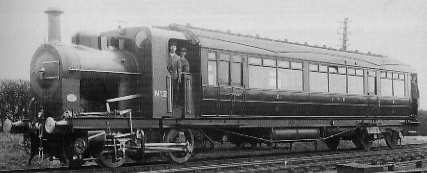
Jenkinson and Lane say that the LB&SCR and the North Staffordshire (see below) articulated steam railmotors had much in common, both being built by Beyer Peacock in 1905-6.[1: p30][21: p62] “They displayed a sort of cross-bred powered end, partially enclosed but with smokebox front and chimney projecting in a rather quaint fashion beyond the ‘cab’ –  probably very practical for cleaning purposes. The engine portions were identical on both railways but the carriage portions displayed different styling – those of the Brighton line being rather neater. Fortunately, … both types were reasonably well recorded photographically, especially those of the NSR.” [1: p30]

The LB&SCR examples did not seem to be well received and only lasted for a few years, albeit not being formally withdrawn for some time. [1: p30]

Both companies’ railmotors, by comparison with other articulated railmotors, were rather ungainly looking with a sort of tramcar-like passenger part. [1:p30]

LB&SCR Steam Railmotor No. 1 when brand new in 1905. The carriage bodywork was built by the Electric Railway and Tramway Carriage Works of Preston, Lancashire. It did not match the normal company stock of the time but appears quite stylish. Jenkinson and Lane tell us that after the unit was formally withdrawn in 1919, it was sold, in November 1919, to the Trinidad Government Railways. This image was shared on the Ferrovias & Trens Facebook Page on 23rd January 2022. It is a Southern Railway Official Image. [20][1: p30]

The pair of steam railmotors “were stationed at Eastbourne and St Leonards and ran services on the East and West Sussex coast lines. They were both loaned to the War Department in 1918/19 before being sold to the Trinidad Government Railway. [21: p67] There they have never been put in operation. One of the coach parts was converted into the Governor’s saloon and the other into a second class carriage.” [2][22]

North Staffordshire Railway Steam Railmotors (NSR)

As we have already noted, the three [1:p9][23] steam railmotors owned by the NSR were built by Beyer Peacock in 1905-6. Jenkinson and Lane comment that, given their longer active lives, (the three NSR examples ran until 1922), “they must have generated a bit of revenue during the 16 years or so before they went the way of the rest.” [1: p30]

Three steam railmotors were built for the North Staffordshire Railway by the United Electric Car Company which originated as the Electric Railway and Tramway Carriage Works Ltd. in the East Works buildings, Preston, in 1897. These were very similar to the Railmotors Beyer Peacock supplied to the LB&SCR. [24] Jenkinson and Lane note the strong visual locomotive similarities to the Brighton cars and remark on the somewhat less stylish bodywork of the set. [1: p31]

Rhymney Railway (RR) Steam Railmotors

After Tom Hurry Riches moved to the Rhymney Railway he had Hudswell Clarke build a pair of railmotors for the RR. They consisted of an 0-4-0 engine portion semi-permanently articuled with a 64-passenger coach. T. Hurry Riches designed the combination, contracting with Cravens Ltd of Sheffield to build the passenger coaches. All seating was designed for third class and was divided between smoking and non-smoking sections. [27]

Rhymney Railway Steam Railmotor No. 1, © Public Domain. [32]

In 1911, RR No. 1 “was converted to an independent, mixed-traffic tank locomotive that operated chiefly between Rhymney Bridge, Ystrad Mynach, and Merthyr with four six-wheel coaches. At that time, No. 2 still ran on the Senghenydd branch.” [27]

Port Talbot Railway and Docks Co. (PT&DR) Steam Railmotor

The Port Talbot Railway Railmotor was the largest of the Steam Railmotors and had a six-coupled power section. [31]

Port Talbot Railway and Docks Company (PT&DR) owned a single rigid-bodied steam railmotor, numbered No.1. The GWR persuaded the PTR&DR to purchase it. Tenders were submitted by 15 companies “and a joint tender from Hurst, Nelson & Co. Ltd and R. & W. Hawthorn, Leslie and Company was accepted and the vehicle was delivered in early 1907. This was the largest steam railmotor ever to run in the UK. it was 76 ft 10 in (23.42 m) long, and the bodywork was metal, that covering the engine fashioned to match the carriage. Retractable steps were fitted under each of the four recessed passenger doors, although the steps were later fixed in position.” [28][29]

Hawthorn Leslie built two steam railmotors for use in Great Britain, and at least one for abroad. [30]

The locomotive was six-coupled with 3 ft diameter wheels; it had a conventional boiler with the firebox leading, 12 by 16 inch cylinders and a boiler pressure of 170 psi and a tractive effort of 9,792 lbs.” It was designed with a trailing load in mind. [28]

It was the only Steam Railmotor in the UK to have a six-coupled power section. [1: p9]

This Railmotor passed through GWR hands to the Port of London Authority (PLA). In 1915, the GWR moved it to their Swindon works then in 1920 it became PLA No.3. It remained in service until the North Greenwich branch of the PLA closed and was scrapped in 1928. [28]

Isle of Wight Central Railway (IWCR) Steam Railmotor

The Isle of Wight Central Railway had a single Railmotor which was built in 1906 by R.W. Hawthorn (engine) and Hurst, Nelson & Co. of Motherwell (carriage). Jenkinson and Lane tell us that this railmotor was delivered in-steam from Hurst, Nelson & Co. works to Southampton Docks.

This advertisement for R. & W. Hawthorn, Leslie and Company Ltd’s Forth Banks locomotive works (Newcastle-on-Tyne, England) is on display at the Head of Steam Railway Museum in the former Darlington North Road railway station in Durham County. The featured vehicle is Isle of Wight Central Railway (IWCR) steam railmotor No. 1. [33]

Once on the island, the railmotor took up duties on “the Merstone to Ventnor Town service, and then transferred to the Freshwater line in 1908. Although highly regarded in terms of economy, … it was … prone to oscillation and … ‘laid aside’ in November 1910.” [1: p34]

Once the railmotor was placed out of service, the two parts of the railmotor were repurposed. The carriage entered the regular coaching stock of the railway (with an added bogie). The engine “was given a small bunker and was used at Newport for occasional shunting, before being sold in 1918.” [1: p34] It was sold to Furness Shipbuilding, Haverton Hill and became their  No. 8.

Glasgow & South Western Railway (G&SWR) Steam Railmotors

The G&SWR had three steam railmotors on its books which lasted in service until 1917. Two to one design and the third to a slightly different design.

No. 1 and No. 2 were built at Kilmarnock in 1904. The ‘side tanks’ were used to carry coal with water carried in a 500 gallon well tank. These units were used on the Catrine branch shuttle to Mauchline and from Ardrossan to Largs and Kilwinning. [1: p34-5]

The only image that I have found of Railmotors No. 1 and No. 2 is a copyright protected thumbnail image. It can be seen by clicking here. [34]

No. 3 was not strictly a steam railmotor as the engine and carriage were close-coupled rather than articulated. Jenkinson and Lane winder whether it should be included within the scope of a book about railmotors but decide to include it because “it was designed as an integrated concept … Intended for the Moniaive branch on which one of the G&SWR railmotors certainly ran.” [1: p35]

Great Northern of Scotland Railway (GNSR) Steam Railmotors

The two GNSR railmotors had some unique design features – patented boilers and hemispherical fireboxes. They were, however, not a success and they were withdrawn after just a few years. [1: p34]

A GNSR Railmotor unit. The two portions of the railmotor appear to be engine No. 29 and coach No. 31, © Public Domain. The photo was carried in The Railway Magazine of October 1905, No. 100, p330. [36]

The two articulated units were designed by Pickersgill and built by Andrew Barclay & Co. of Kilmarnock and powered by vertical boilers made by Cochran & Co. of Annan. They entered service on the Lossiemouth and St. Combs branches in 1905. [35]

The boilers were new to locomotive work but of a type well-known in other fields. 10 in. x 16 in. cylinders were placed just ahead of the rear bogie wheels and drove on to the leading axle. Walschearts valve gear was used. The 4 wheels  of the power unit were 3 ft. 7in. diameter. [35]

A small bunker attached to the front of the coach body formed the back of the cab and held 15 cwt. of coal. Underneath the leading end of the coach there was a 650-gallon water tank.

The coach portion of the rail motor consisted of a long passenger compartment and a small compartment at the rear end, with doors for ingress and egress of passengers, also serving as a driving compartment when the unit was being driven from that end. The passenger compartment was 34 ft. 7in. long and seated 45 while the overall length of the car was 49 ft. 11 ½ in. and the total weight 47 tons. [35]

The two engine units were numbered 29 and 31, (Barclay’s numbers 1056-7). The coaches were Nos. 28 and 29. Unit 29/28 went to work on the St Combs Light Railway on 1st November 1905, and 31/29 started working on the Lossiemouth branch on the same day.” [35]

The two units were not a success and “in the course of time the engine units were detached from the coaches and used as stationary boilers. Here they were apparently more successful; on the line they were dreadfully noisy and the boilers would not steam properly, and the hopes of their designer were not realized.” [35]

References

  1. David Jenkinson & Barry C. Lane; British Railcars: 1900-1950; Pendragon Partnership and Atlantic Transport Publishers, Penryn, Cornwall, 1996.
  2. https://en.m.wikipedia.org/wiki/British_steam_railcars, accessed on 14th June 2024.
  3. R.M. Tufnell; The British Railcar: AEC to HST; David and Charles, 1984.
  4. R.W. Rush; British Steam Railcars; Oakwood Press, 1970.
  5. https://en.m.wikipedia.org/wiki/Tom_Hurry_Riches, accessed on 19th June 2024.
  6. https://commons.m.wikimedia.org/wiki/File:Taff_Vale_railmotor_(Rankin_Kennedy,_Modern_Engines,_Vol_V).jpg, accessed on 19th June 2024.
  7. http://www.penarth-dock.org.uk/09_04_090_02.html, accessed on 19th June 2024.
  8. The Taff Vale Railmotor, in the Railway Magazine, February 1904; via http://www.penarth-dock.org.uk/09_04_090_02.html, accessed on 19th June 2024.
  9. National Museum and Galleries of Wales – Amgueddfa Cymru — National Museum Wales – archive; included in Mountfield & Spinks; The Taff Vale Lines to Penarth; The Oakwood Press; via http://www.penarth-dock.org.uk/09_04_090_02.html, accessed on 19th June 2024.
  10. https://en.m.wikipedia.org/wiki/L%26YR_railmotors, accessed on 19th June 2024.
  11. John Marshall; The Lancashire & Yorkshire Railway. Vol. 3: Locomotives and Rolling Stock; David & Charles, Newton Abbot, 1972.
  12. https://www.railforums.co.uk/threads/lancashire-and-yorkshire-hughes-rail-motors-running-backwards.222458, accessed on 19th June 2024.
  13. https://en.m.wikipedia.org/wiki/George_Hughes_(engineer),accessed on  19th June 2024.
  14. George Hughes; in Grace’s Guide to British Industrial History. Archived from the original on 20th June 2017 and retrieved 22nd August 2019, accessed via https://en.m.wikipedia.org/wiki/George_Hughes_(engineer),accessed on  19th June 2024.
  15. Patrick Whitehouse & David St. John Thomas; LMS 150; David & Charles, Newton Abbot, 1987.
  16. G. Suggitt; Lost Railways of Lancashire; Countryside Books, Newbury, 2003.
  17. https://wp.me/pwsVe-R1, accessed on 19th June 2024
  18. https://www.ebay.co.uk/itm/275193815724?mkcid=16&mkevt=1&mkrid=711-127632-2357-0&ssspo=yXJFhbJMSuC&sssrc=4429486&ssuid=afQhrar7TGK&var=&widget_ver=artemis&media=COPY; accessed on 19th June 2024.
  19. https://www.southeasternandchathamrailway.org.uk/gallery.html, accessed on 19th June 2024.
  20. https://www.facebook.com/ferroviastrens1/photos/a.162504877245931/2159328897563509/?type=3&mibextid=rS40aB7S9Ucbxw6v, accessed on 19th June 2024.
  21. D.L. Bradley; Locomotives of the London Brighton and South Coast Railway. Part III.; Railway Correspondence and Travel Society Press, London, 1974.
  22. Locomotives of the Trinidad Government Rlys; in Locomotive Magazine and Railway Carriage and Wagon Review, Vol. 42 No. 522, 15th February 1936, p53–55. Archived from the original on 28th January 2023. Retrieved 19 September 2023, accessed via https://en.m.wikipedia.org/wiki/British_steam_railcars, on 20th June 2024.
  23. https://www.nsrsg.org.uk/chronology.php#NSR, accessed on 20th June 2024.
  24. https://redrosecollections.lancashire.gov.uk/view-item?i=214678&WINID=1718865502724, accessed on 20th June 2024.
  25. https://www.lner.info/locos/Railcar/gnr_railmotor.php, accessed on 20th June 2024.
  26. https://x.com/SleeperAgent01/status/1280269864175894529?t=FyeWO8DJP5xUPrL5hnbaqg&s=19, 20th June 2024.
  27. https://www.steamlocomotive.com/locobase.php?country=Great_Britain&wheel=0-4-0&railroad=rhymney, accessed on 20th June 2024.
  28. https://en.m.wikipedia.org/wiki/Port_Talbot_Railway_and_Docks_Company, accessed on 18th June 2024.
  29. Robin G Simmonds, A History of the Port Talbot Railway & Docks Company and the South Wales Mineral Railway Company, Volume 1: 1853 – 1907, Lightmoor Press, Lydney, 2012
  30. http://www.britishtransporttreasures.com/product/r-w-hawthorn-leslie-co-ltd-catalogue-section-steam-rail-motor-coaches, accessed on 18th June 2024.
  31. https://www.gracesguide.co.uk/File:Im1963EnV216-p221.jpg, accessed on 18th June 2024.
  32. https://x.com/DamEdwardurBoob/status/1051567390251597824?t=q01zKvK-GVPLXT7ilVlYaA&s=19, accessed on 20th June 2024.
  33. https://pin.it/35Lh0CRNz, accessed on 20th June 2024.
  34. https://www.mediastorehouse.com.au/mary-evans-prints-online/glasgow-motor-carriage-603697.html, accessed on 20th June 2024.
  35. https://steamindex.com/locotype/gnsr.htm#:~:text=Steam%20rail%20motors%2Frailcars%20(Pickersgill%2FAndrew%20Barclay)&text=These%20units%20consisted%20of%20a,on%20an%20ordinary%20coach%20bogie., accessed on 20th June 2024.
  36. https://commons.m.wikimedia.org/wiki/File:GNSR_steam_railmotor_(Railway_Magazine,_100,_October_1905).jpg, accessed on 20th June 2024.