

The featured image for this article shows a Tata Chemicals locomotive at work on the metre-gauge line near Magadi. [9][cf. 6]
A. Railways Africa recently reported:
East African Governments Ramp Up Rail Investment in 2026/27 Budgets
“East Africa’s latest budget allocations show rail moving higher up the public investment agenda, with governments linking railway development to logistics efficiency, urban mobility and regional trade competitiveness. Kenya, Uganda and Tanzania are each approaching the sector from different starting points, but the common direction is clear: rail is being positioned as a strategic infrastructure tool, not only a transport asset.

“The figures also point to a wider corridor logic across the region. Uganda’s Malaba–Kampala SGR, Tanzania’s continued SGR construction and rehabilitation programme, and Kenya’s rail allocations all sit within the broader ambition of improving inland connectivity, reducing logistics costs and strengthening access between ports, production centres and landlocked markets.
“East African governments are significantly increasing investment in railway infrastructure in their 2026/27 national budgets, with Kenya, Uganda and Tanzania allocating billions of shillings to expand rail networks, modernise transport systems and improve regional trade connectivity.
“In Kenya, Cabinet Secretary for the National Treasury, John Mbadi Ng’ongo, announced a proposed allocation of KSh38.4 billion for railway projects as part of the government’s transport infrastructure programme.

From Naivasha to Malaba, construction of the SGR expansion was due to start in July 2026. [12] The project will reshape logistics, lower transport costs and boost connectivity across counties. This project stands as a symbol of progress and long-term economic planning in motion.
“The allocation forms part of a broader effort to improve public transport and logistics infrastructure.
“To improve urban mobility, the government has also proposed KSh582 million for the Nairobi Bus Rapid Transit (BRT) Project, aimed at reducing traffic congestion in the capital.
“Meanwhile, Uganda has continued prioritising railway development through substantial infrastructure spending.
“Finance, Planning and Economic Development Minister Henry Musasizi announced the commencement of the construction of the 273-kilometre Standard Gauge Railway (SGR) linking Malaba and Kampala.
“Once completed, the railway is expected to reduce the cost of transporting containers from Mombasa to Kampala from approximately US$3,500 to US$1,600, while cutting transit times from five days to one day.
“Musasizi revealed that the rehabilitation of the Tororo–Gulu Metre Gauge Railway has reached 66% completion, while works on the Kampala–Mukono section have been completed.
“Uganda has allocated Shs8.79 trillion for transport infrastructure development in the next financial year, with priority given to the construction of the Malaba–Kampala Standard Gauge Railway and completion of the metre gauge railway rehabilitation programme.
“In Tanzania, the government has allocated 1.27 trillion Tanzanian shillings for the construction and rehabilitation of railway infrastructure, including 1.12 trillion shillings dedicated to the Standard Gauge Railway programme.
“The government said construction of the Dar es Salaam–Dodoma SGR sections, covering Lots 1 and 2, has been completed and is now operational.
“According to Finance Minister Ambassador Khamis Mussa Omar, the government views the Standard Gauge Railway as a key component of its broader economic transformation strategy.
“The railway, together with Msalato International Airport, will support the development of Dodoma into a modern administrative capital, a regional transport and logistics hub and a centre for sustainable urban development.
“Tanzania also plans to continue implementing the TAZARA Railway Revitalisation Project and advance construction of the Standard Gauge Railway from Dodoma to Mwanza and Isaka to Kigoma.
“According to the government, these projects are expected to stimulate economic activity across multiple regions by improving transport efficiency, strengthening regional trade corridors and leveraging Tanzania’s strategic geographic position.” [1]
In 2009, the East African Community produced the East African Railway Master Plan, [3] a proposal for upgrading the railways serving Tanzania, Kenya, and Uganda, and building new railways to serve Rwanda and Burundi. Evidence of progress in development of SGR routes is manifest, but the pace of development has been relatively slow.
B. On Sunday 28th June 2026, The East African reported:
Uganda locks funds for joint SGR as Kenya plan stalls

“Uganda expects to conclude financing arrangements for its €2.7 billion ($3 billion) standard gauge railway (SGR) project within the next few months after securing a major funding commitment from the Islamic Development Bank (IsDB), bringing the long-delayed infrastructure initiative closer to financial close than at any point in the past decade.” [2]
“But Kenya, with which Kampala is building the cross-border project, is struggling to raise about $4 billion for the extension of its line from Naivasha in the Central Rift to Malaba on the border, with the Treasury confirming the project will not proceed under public private partnership as earlier advised.” [2]
C. Magadi Soda Works and Branch line
Thanks to ‘Class442’ on RailUKForums [4] for pointing this out.
Tata-Owned Locomotive Catches Fire
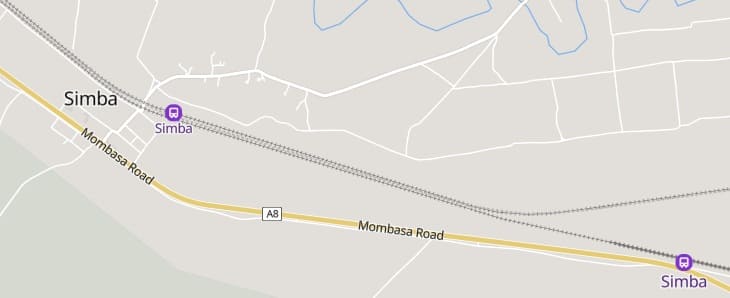
A locomotive operated by Tata Chemicals Magadi Ltd, which transports soda ash from Lake Magadi to Mombasa, caught fire on 1st July 2026, at or near Simba station in Kajiado County. The branch line between Magadi and Konza where it encounters the Nairobj-Mombasa metre-gauge line is managed as a private line by Magadi Ltd. It was a company locomotive that caught fire while travelling on the main line near Simba.
Online (Instagram Video) can be found on these links:
https://www.instagram.com/reels/DaSSNIBMpXB (PLUG TV)
https://www.instagram.com/reels/DaQYQGBt8XR (TV 47)

First responders were local people. They took a number of photographs of which this is one. Flames engulfed the train as emergency responders and members of the public worked to contain the fire. [6]
Kenya Digest reports:
“A cargo train fire at Simba Station has prompted investigations as authorities work to determine what caused the incident and assess the extent of the damage. The train, operated by Tata Chemicals Magadi Ltd, caught fire on June 1, 2026, leading to an emergency response along the Magadi rail corridor.
Kenya Railways confirmed the incident in a statement issued late Wednesday night, saying the cargo train burst into flames while carrying out its normal operations.
Emergency teams were quickly sent to the scene to contain the fire, support recovery efforts, and begin assessing what may have led to the incident.
According to preliminary findings released by Kenya Railways, the fire is believed to have started after mechanical damage affected the locomotive’s fuel tank.
Officials suspect the damage caused fuel to leak before it ignited, resulting in the blaze. However, the corporation stressed that these are only early findings and that investigations are still underway to establish the exact cause of the fire and the sequence of events.
Kenya Railways said investigators are examining all available evidence before reaching a final conclusion. The corporation noted that more details will be made public once the investigation has been completed.
The railway operator also confirmed that it is working closely with Tata Chemicals Magadi Ltd, the owners of the cargo train, as both parties seek to understand what happened. Management teams from both organisations are coordinating recovery operations while technical experts continue inspecting the affected locomotive.
The cargo train operates along the Magadi rail corridor, an important industrial railway that has served the region for many years.
The line plays a key role in transporting soda ash and other industrial cargo from Magadi to different parts of the country, supporting manufacturing and other economic activities.
By the time the incident was reported, no casualties had been officially confirmed. The absence of reported injuries was welcomed, although the fire has raised fresh questions about the condition of industrial locomotives and the importance of regular maintenance to reduce the risk of similar incidents.
The latest fire also comes at a time when the government is continuing efforts to revive and modernise Kenya’s metre-gauge railway network. The rehabilitation programme is intended to improve transport options for businesses and passengers while making greater use of existing railway infrastructure across the country.
Kenya Railways has assured the public that it remains committed to establishing the facts surrounding the incident.
Officials have urged patience as technical assessments continue, saying a comprehensive report will provide a clearer picture of what caused the fire and whether any additional safety measures will be required to help prevent similar incidents in the future.” [6]

‘Class442’ points out that this is not the first incident associated with Magadi Ltd. Two years ago on 9th July 2026, there was an accident on the Magadi-Konza line.
Kenya Railways noted that the train in the accident that claimed one life, was operated privately by Tata Chemicals Magadi Limited. [7]
Maria Silantoi of Swala Nyeti reported in July 2024: “According to witnesses and police, on 9th July 2024, the train carrying 59 passengers was heading towards Kajiado town from Magadi when it rolled backwards along a steep section of the track. Local residents believe the accident was caused by a combination of factors, including rampant vandalism of the railway line and poor visibility due to recent heavy rains. Concerns have been raised about the increasing frequency of such vandalism by scrap metal dealers, who reportedly evade capture by patrolling officers. … The ill-fated train service provided a vital and affordable public transport option for residents in remote villages of Kajiado West Sub-county, offering a Sh70 fare for a journey of approximately 135 kilometres. This service was established specifically to address the transportation challenges faced by these local communities. Previously, reaching Kajiado through the Kiserian-Isinya route could cost up to Sh700 and take as long as four hours. … The tragedy highlights the urgent need for improved railway infrastructure security and maintenance in the region. This incident serves as a stark reminder of the importance of prioritizing safety measures to prevent such devastating accidents on crucial public transport routes.” [8]
D. Biza Kenya reports on 2nd July 2026
Construction of the Malaba Extension Begins

Kenya Railways has officially commenced construction on the 475-kilometre Naivasha-Kisumu-Malaba Standard Gauge Railway, with the Sh700 billion project now underway in Narok County, which hosts approximately 100 kilometres of the corridor.
The project is divided into Phase 2B (Naivasha-Kisumu), covering 264 kilometres with an 8.69-kilometre branch line to Kisumu Port, and Phase 2C (Kisumu-Malaba), covering 107 kilometres through Siaya, Vihiga, Kakamega and Busia counties.
The entire Naivasha-Malaba extension is targeted for completion by June or August 2027. Land acquisition is ongoing, with compensation planned for over 3,500 landowners. [12]
E. The Citizen Reported on Saturday 14th March 2026:
Tanzania Begins Local Assembly of Locomotives
Tanzania has begun assembling Metre Gauge Railway (MGR) locomotives locally, The TRC claimed that they were the first country in East Africa to undertake such an initiative, the Citizen reports. The full article can be read here. [14]
The move has drawn praise from the Parliamentary Standing Committee on Infrastructure, which recently visited the site, according to a statement issued by the Tanzania Railways Corporation (TRC) on Saturday.
During an inspection visit to the locomotive assembly project at the Pugu Railway Workshop, the committee urged TRC to continue strengthening the skills of Tanzanian youth involved in the programme through advanced technical training both locally and abroad.
The committee was informed that the decision to assemble locomotives locally was partly prompted by delays in the delivery of spare parts from suppliers, caused by global supply chain disruptions linked to the Russia–Ukraine War.
To address the delays, TRC imported two fully assembled locomotives from Malaysia, while the remaining components were shipped to Tanzania for assembly at the Pugu workshop.

References
- Chamwe Kaira; East African Governments Ramp Up Rail Investment in 2026/27 Budgets; Railways Africa; https://www.railwaysafrica.com/news/east-african-governments-ramp-up-rail-investment-in-2026-27-budgets, accessed on 29th June 2026.
- Julius Barigaba, Vincent Owino & James Anyanzwa; Uganda locks funds for joint SGR as Kenya plan stalls; The East African, 28th June 2026; via https://www.theeastafrican.co.ke/tea/business-tech/uganda-locks-funds-for-joint-sgr-as-kenya-plan-stalls-5511520, accessed on 29th June 2026.
- https://acrobat.adobe.com/id/urn:aaid:sc:EU:a8806fa2-3669-444d-8624-47320503d3be, accessed on 30th June 2026.
- https://www.railforums.co.uk/threads/kenya-and-uganda-news-february-2026.300641/#post-7853475, accessed on 8th July 2026.
- https://mapcarta.com/W1198959229/Map, accessed on 8th July 2026.
- https://kenyadigest.com/kenya-railways-reveals-early-findings-after-cargo-train-blaze-at-simba-station/amp, accessed on 8th July 2026.
- https://k24.digital/411/kenya-railways-on-magadi-train-accident, accessed on 8th July 2026.
- https://swalanyeti.co.ke/news/article/8929/1-dead-scores-injured-in-magadi-konza-commuter-train-morning-accident, accessed on 8th July 2026.
- https://businesstoday.co.ke/tata-chemicals-magadi-wins-company-year-award, accessed on 11th July 2026.
- https://newsaf.cgtn.com/news/2021-05-31/Kenya-to-mark-4th-anniversary-since-launch-of-SGR-operations-10He0J9sBdS/index.html, accessed on 11th July 2026.
- https://en.wikipedia.org/wiki/Mombasa%E2%80%93Nairobi_Standard_Gauge_Railway, accessed on 11th July 2026.
- https://www.facebook.com/share/p/18yjTai4wd, accessed on 11th July 2026.
- https://gaa.go.ke/construction-sh700b-sgr-extension-malaba-begins, accessed on 11th July 2026.
- https://www.thecitizen.co.tz/tanzania/news/national/tanzania-begins-local-assembly-of-locomotives-5391096, accessed on 8th August 2026. (NB: the article is beyond a firewall requiring a subscription to access it.)

