Tag Archives: railway

The Lough Swilly Railway continued. … Letterkenny to Derry – Part 1

Letterkenny once had two railway stations immediately adjacent to each other. One was the terminus of the County Donegal Railways Strabane to Letterkenny branch. The other was a through station on the Lough Swilly (when operation in the first half of the 20th century it’s formal title was the ‘Londonderry & Lough Swilly Railway’).

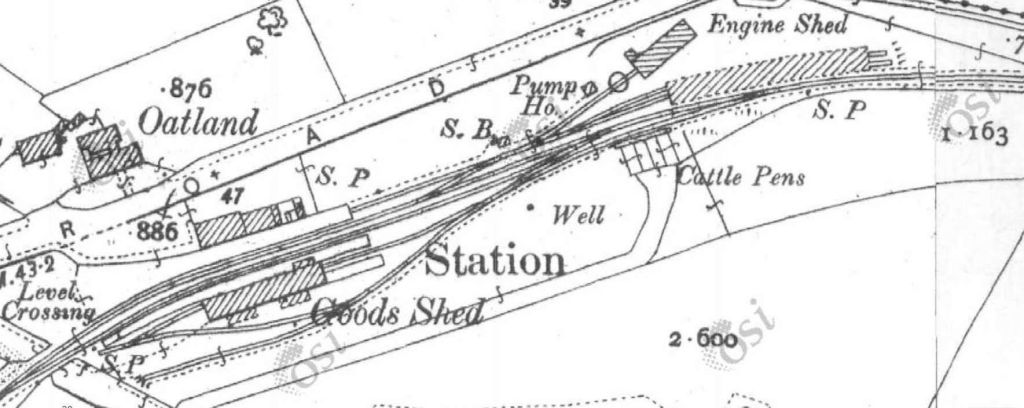
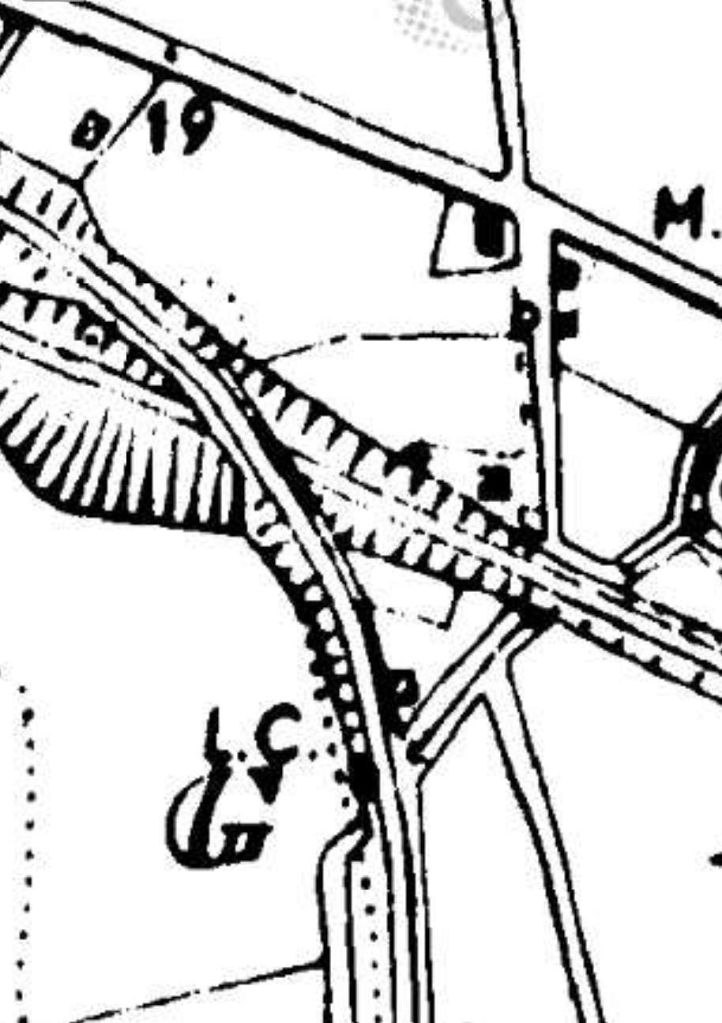
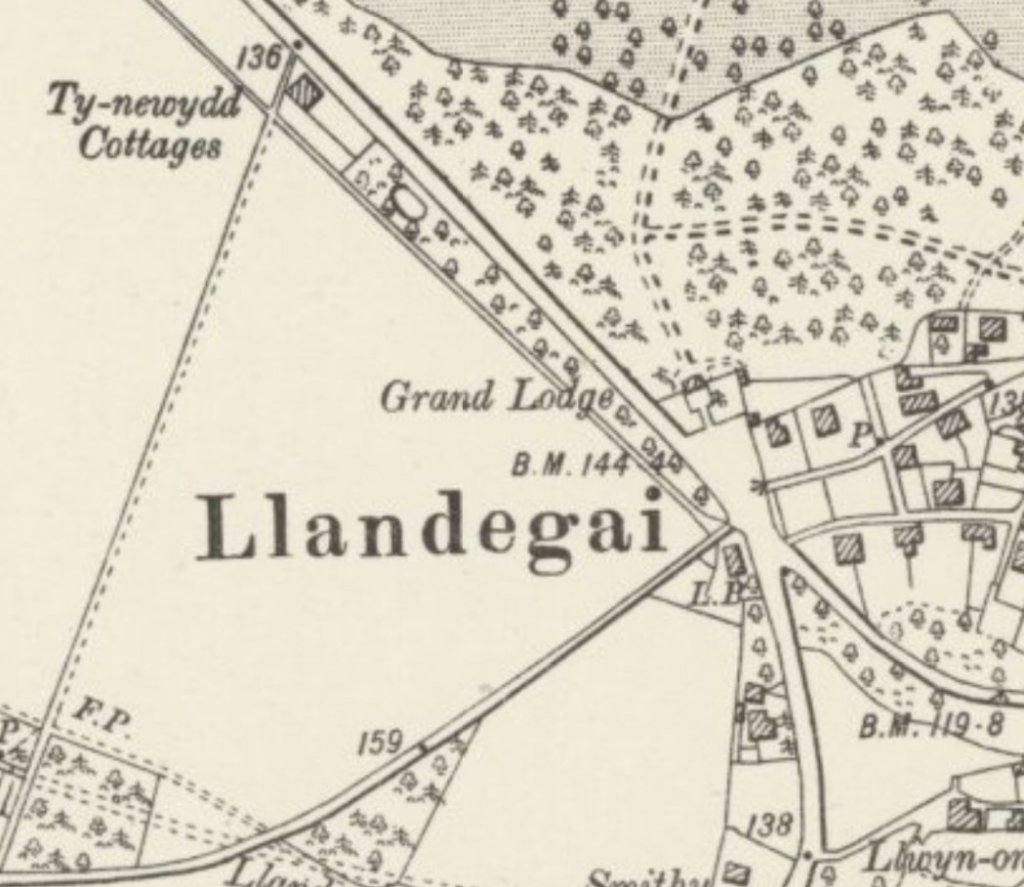
The two railway stations in Letterkenny lay side by side. That to the North was the terminus if the County Donegal Railways branch which connected Letterkenny to Strabane. That to the South was the Lough Swilly station through which passed trains between Burtonport and Derry. OSi 6″ to 1 mile last series. [3]
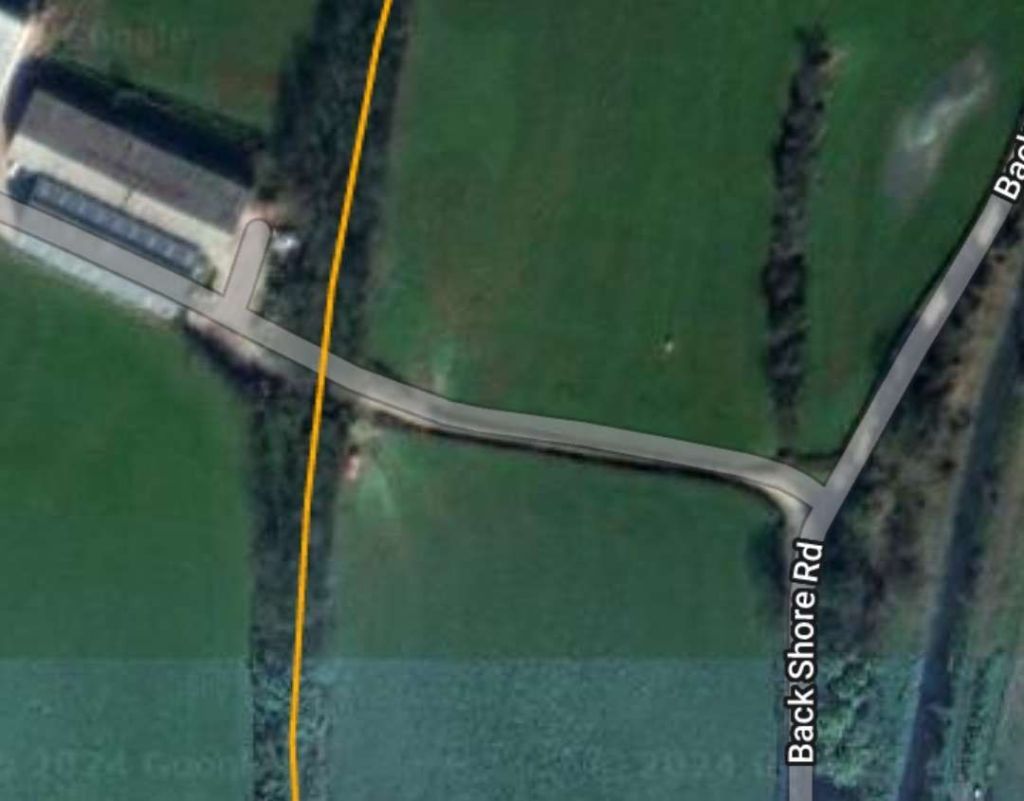
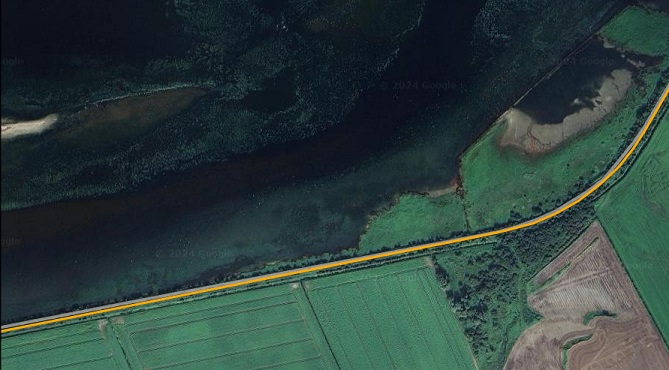
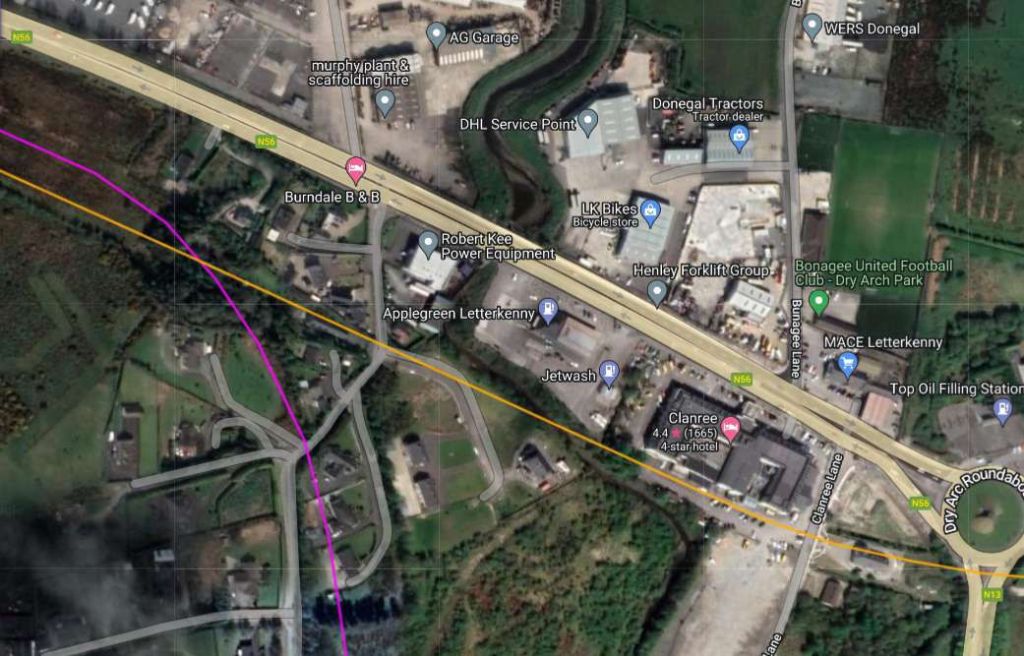
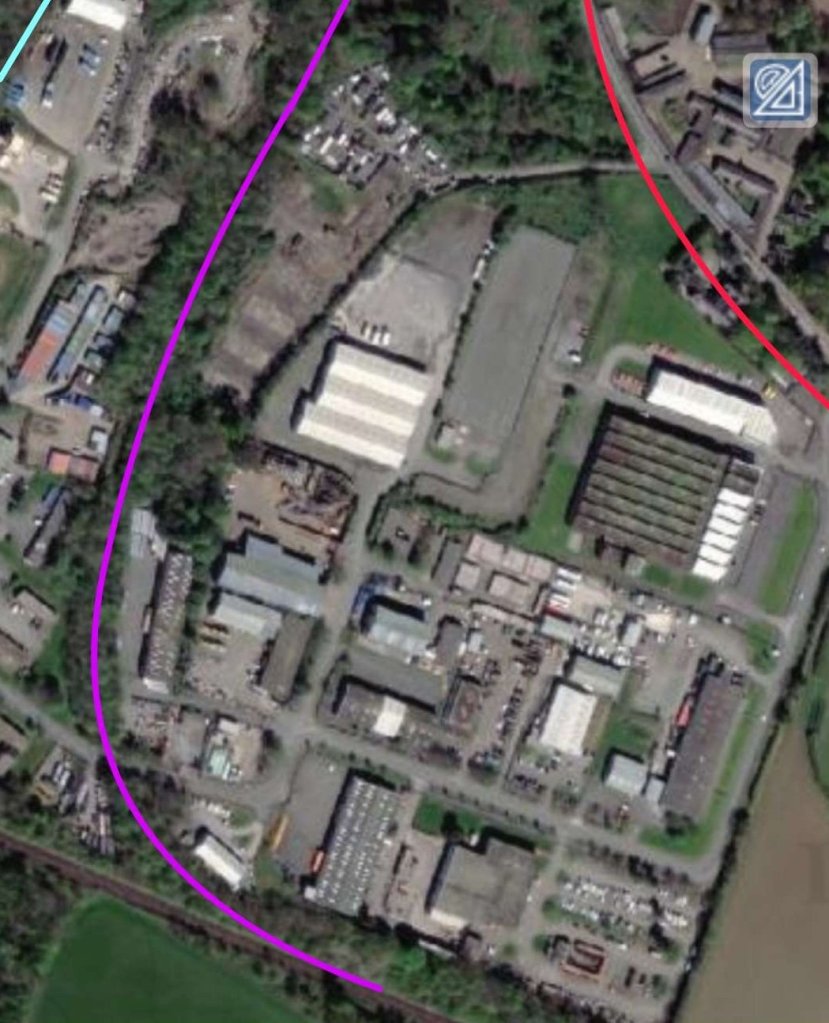
The same area as shown on the railmaponline.com satellite imagery. Contrary to what appears on the image, both railway lines ran on the South side of Ramelton Road. That shown in Orange is the Lough Swilly line. [4]

In an East-Southeast direction, the two companies’ lines ran parallel for some distance, before the Co. Donegal line headed away to the South through Convoy and Raphoe before crossing the border at Lifford and meeting the other Co. Donegal lines at Strabane. The Loch Swilly found its way to Derry via Tooban Junction where a significant branch line to Buncrana and Cardonagh left the line to Derry.

To the West, the Lough Swilly’s Burtonport Extension Railway meandered across the moors and between small villages nearer the coast.

Three articles cover the Strabane to Letterkenny branch of the Co. Donegal Railways. They can be found on the following links. ….

Co. Donegal Railways, Ireland – Part 4 – Strabane to Letterkenny (Part A – Strabane to Raphoe)

Co. Donegal Railways, Ireland – Part 5 – Strabane to Letterkenny (Part B – Raphoe to Convoy)

Co. Donegal Railways, Ireland – Part 6 – Strabane to Letterkenny (Part C – Convoy to Letterkenny)

The Burtonport Extension of the Lough Swilly is covered in four other articles which can be found on these links. …

The Burtonport Extension of the ‘Londonderry & Lough Swilly Railway’ – Part 1

The Burtonport Extension of the ‘Londonderry & Lough Swilly Railway’ – Part 2

The Burtonport Extension of the L&LSR (Londonderry & Lough Swilly Railway) – Part 3 – Cashelnagor Railway Station to Barnes Gap

The Burtonport Extension of the L&LSR (Londonderry and Lough Swilly Railway) – Part 4 – Barnes Gap to Letterkenny. …

The Lough Swilly’s line between Derry and Letterkenny was built in stages and included a change of track gauge from 5ft 3in to 3ft.

The railway was initially planned as the Derry and Lough Swilly Railway Company when an application for incorporation was filed in 1852,  … The company opened its first line, a 5 ft 3 in (1,600 mm) link between Derry and Farland Point, on 31st December 1863. A branch line between Tooban Junction and Buncrana was added in 1864 and much of the Farland Point line was closed in 1866.” [1][2: pxiv]

Wikipedia’s history of the railway company goes on to say that “in 1883, the 3 ft (914 mm) narrow gauge Letterkenny Railway between Cuttymanhill and Letterkenny was opened and the L&LSR connected with it by reopening the Tooban Junction – Cuttymanhill section of its Farland Point line. The L&LSR worked the Letterkenny Railway, and in 1885 it converted its track from 5 ft 3 in (1,600 mm) gauge to 3 ft (914 mm) narrow gauge to enable through running. In 1887, ownership of the Letterkenny Railway passed to the Irish Board of Works, which continued the agreement by which the L&LSR operated the line.” [1][2: pxiv & p3]

Carndonagh was reached by an extension completed in 1901 and Burtonport by a one completed in 1903. Both lines were constructed as joint ventures with the UK Government, with ownership and liabilities shared between the two parties. During this period the company did not make a profit, and struggled to meet its debts.” [1][2: p2 & p3]

The Lough Swilly Railway between Letterkenny and Derry in 1926. © Public Domain. [1]

Letterkenny to Newtowncunningham

Letterkenny to Newtoncunningham. The L&LS railway is shown on this extract from OSi mapping of the mid-20th century. [3]

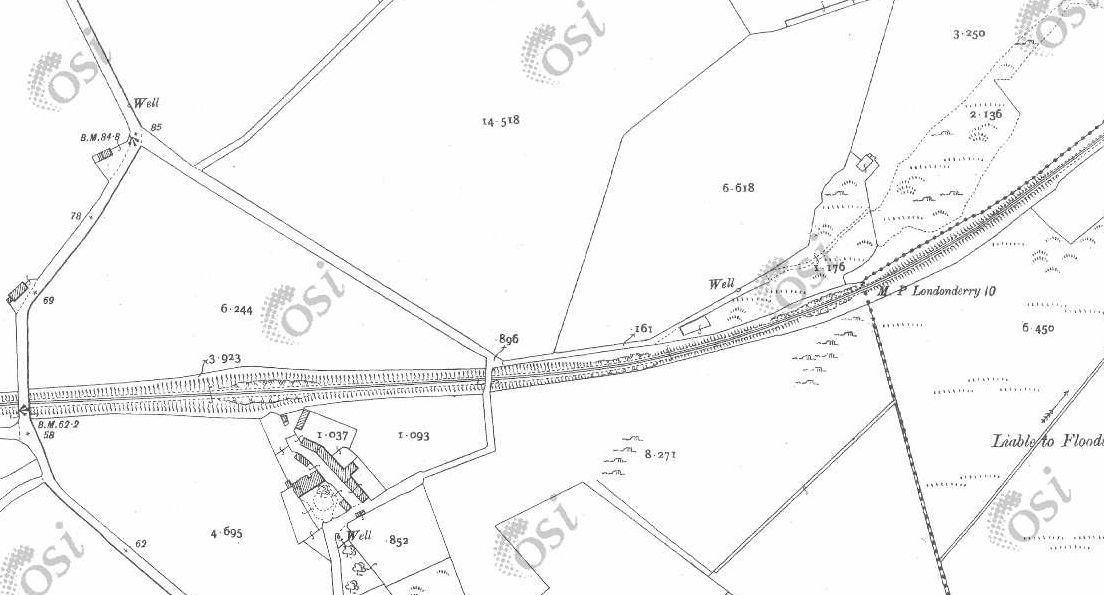
The first map extract from OSi mapping which appears close to the top of this article shows the Co. Donegal and the Lough Swilly stations in Letterkenny. The 6″to 1 mile series as digitised is not the clearest mapping. An earlier 25″ to 1 mile series shows only the Lough Swilly line but is of a higher quality.

These first two 25″ OSi map extracts show only the Lough Swilly Station and line. When the Co. Donegal branch was constructed the Ramilton Road had to be realigned northward.
Letterkenny & Burtonport Extension Railway (L&BER) No. 3 was a 3ft gauge 4-6-0T, built by Andrew Barclay & Sons Co. in 1902 for the Letterkenny and Burtonport Extension Railway. The line was operated by the L&LSR. No.3 was scrapped in 1954. It is seen here heading from Burtonport to Letterkenny, © Courtesy of Trainiac on Flicker (Public Domain). [8]

Ernie’s Railway Archive on Flickr has a range of photographs of the L&LS Letterkenny Railway Station site from the 1950s, the links are embedded here below, click on each link to see the image in Ernie’s Railway Archive on Flickr:

https://flic.kr/p/2nMqBvu – The L&LSR Station site from the East in 1952. The carriage shed is closest to the camera on the right of the image. The locomotive shed and turntable are hidden behind the carriage shed. At the centre-top of the image, the Goods Shed can be seen.

https://flic.kr/p/2nM8xYs – The Goods Yard of the L&LSR in 1952. Beyond wagons L&LSR No. 124 and L&BER No. 73 the Goods Shed and the passenger station building can be seen.

https://flic.kr/p/2nWyB5y – The L&LSR Goods Yard in 1952. The side elevation of the Goods Shed is visible beyond the wagons in the yard. Prominent in the picture is L&LSR Wagon No. 71.

https://flic.kr/p/2nCR8dg – L&LSR No. 12 is featured in this image from 1952. No. 15 is just poking its nose into the shot on the left.

https://flic.kr/p/2kHNdD9 – L&LSR No. 8 is being turned on Letterkenny’s turntable on 27th June 1952.

https://flic.kr/p/JoWHRY – L&LSR No.15 sits in front of Letterkenny WaterTower in 1953.

https://flic.kr/p/BWoyiF – L&LSR No3 at Letterkenny. On the left, the image is framed by the wall of the Goods Shed. The crossing gates at the West end of the station are visible beyond No. 3’s train. The passenger facilities are on the right. Note the coach acting as a brake van for the train. (c) JW Armstrong/ARPT

https://flic.kr/p/BvajsP – L&LSR No. 12 in the Engine Shed at Letterkenny, (c) JW Armstrong/ARPT

https://flic.kr/p/2ma5Lo3 – The L&LSR Station at Letterkenny on 1st July 1959 after the rails had been lifted. The Goods Shed door is closed (on the left) and the station buildings are on the right.

https://flic.kr/p/2k1hGvQ – The L&LSR operated a daily goods service by lorry after the closure of the line. A company rail lorry bearing the number plate IB7024 is shown standing where trains would once have passed, adjacent to the station building at Letterkenny. The photograph was taken on 23rd August 1954.

Other photographs of Letterkenny’s L&LSR railway station can be found on Flickr or elsewhere on line:

The last engines to be built for the Swilly were a pair of extraordinary 4-8-4Ts, weighing 58 tons each. No 6, with LSR diamond on the tanks, is outside Letterkenny shed on 15 June 1948. This image was shared on eBay [5]
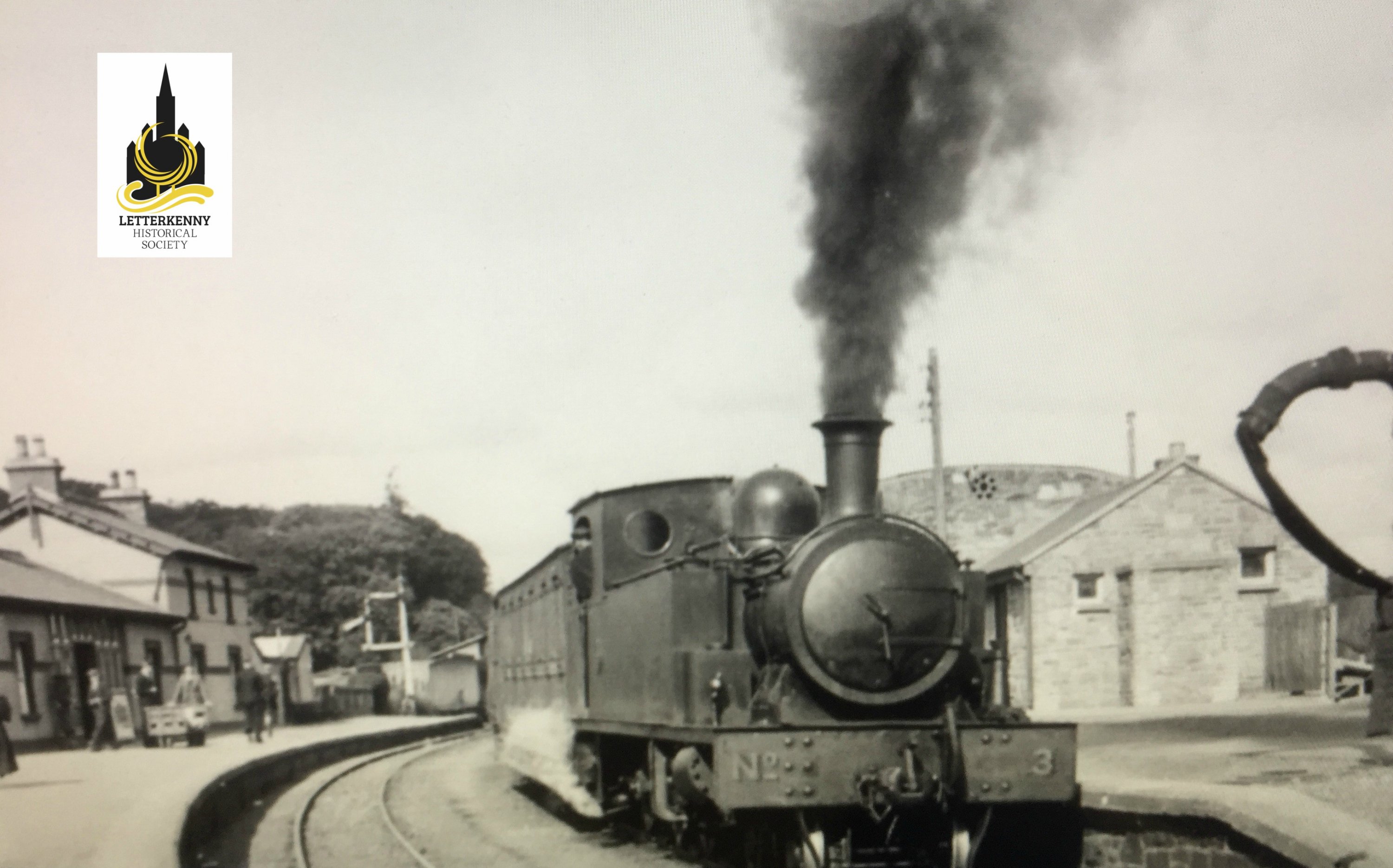
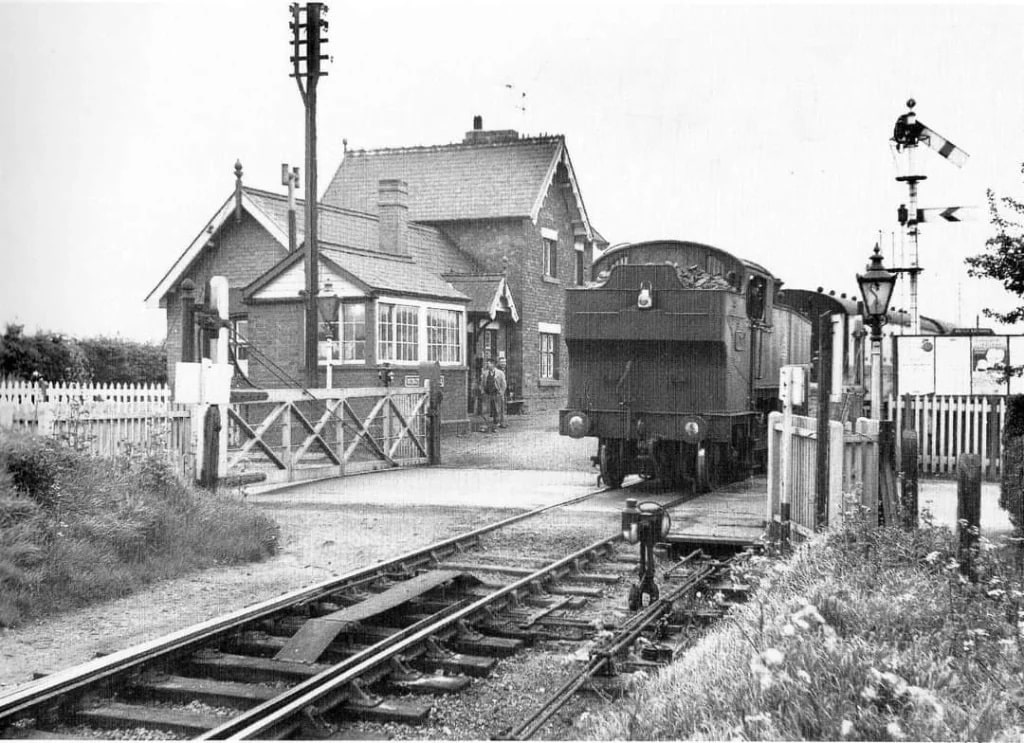
L&LSR No. 3 at the head of a train from Derry at Letterkenny Station, either heading for Burtonport or terminating at Letterkenny. The image was shared by Letterkenny History on their webpage. [6]
Plenty to see in this shot at Letterkenny. Locomotive No. 12 is facing the photographer and a CDR engine is in the background. Shared by Kerry Doherty on the L&LSR Facebook Group on 1st February 2021. [7]
A goods train has just arrived from Derry in June 1950, © John Edgington c/o Pendragon Collection and shared on the Donegal Railway Heritage Museum Facebook Page. [9]
The L&LSR’s Letterkenny Station, seen from the Northeast. Either this train has just arrived from Burtonport or is setting off for Derry. This image was shared by Gabe J. McTuile on the Letterkenny Community Heritage Facebook Group on 19th January 2017. [10]
The two Letterkenny Railway Stations. The terminus of the Strabane to Letterkenny Branch of the Co. Donegal Railways Joint Committee is on the left. The L&LSR station which sat on the line between Derry and Burtonport. This image was shared on the Donegal County Museum Facebook Page on 20th February 2013. [11]
Another view of the two station buildings in Letterkenny. This image was shared by Keiran Kelly on the Letterkenny Community Heritage Facebook Group on 13th October 2014. [12]

These next images show the railway station buildings in Letterkenny after the closure of both lines.

The remains of both station buildings can be seen at the centre of this aerial image. There  are quite a few of the Lough Swilly Bus Company’s fleet of buses visible. This image was shared by Gabe J. McTuile on the Letterkenny Community Heritage Facebook Group on 18th June 2016 . [13]
The Co. Donegal terminus in Letterkenny is now repurposed as the passenger facilities for the town’s bus station. My photograph, 29th April 2023.
The length of the two lines between the stations and Port Bridge, superimposed on Google Maps satellite imagery. [April 2023]
Leaving the Station site, the two railway lines ran parallel to each other. Both lines crossed the old Port Road by means of girder bridges with stone abutments. The lines then crossed the River Swilly by means of lattice girder bridges alongside the road bridge. After which, the Co. Donegal line rose above the L&LSR, turning South as it bridged the L&LSR line. [13]
The North abutment of one of the bridges which carried the two lines over the Port Road. © Kerry Doherty. [17, May 2020]
Looking ahead along the line of the two railways towards the River Swilly. The remaining abutment is alongside the camera. The plaque which can be seen in the foreground close to the abutment illustrates what the bridges would have looked like, © Kerry Doherty. [17, May 2020]
The plaque mentioned above, © Kerry Doherty. [17, May 2020]
Port Bridge, Letterkenny, seen from the South, presumably before the construction of the Co. Donegal Railway Structure.  [14]
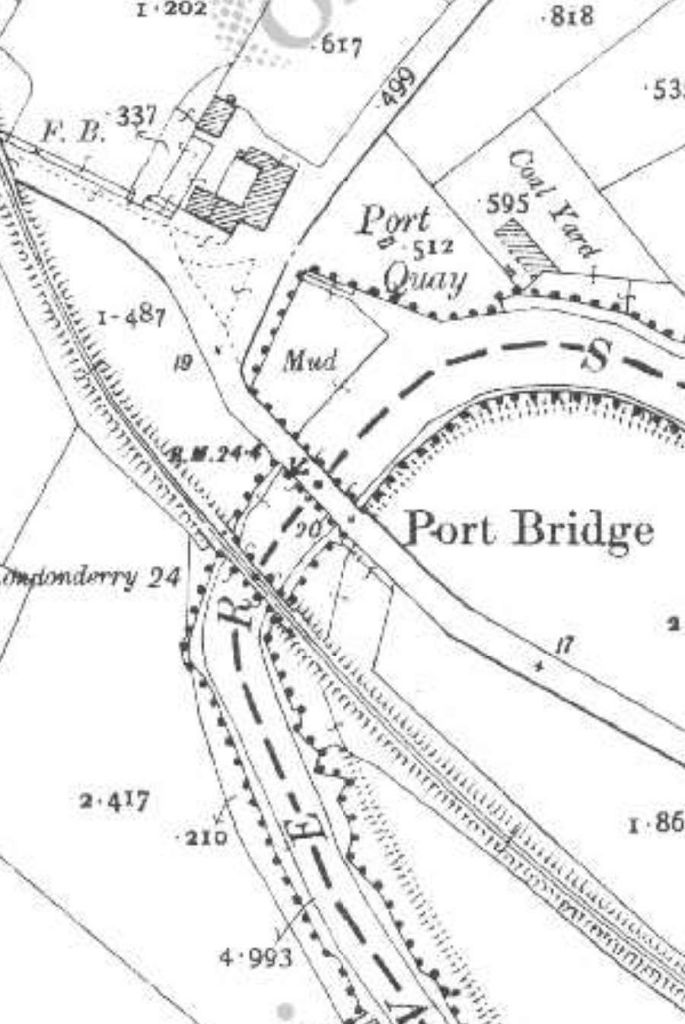
An extract from the 1st edition 6″ OSi mapping which shows just the road bridge. [15]
The same location after the construction of the L&LSR line from Derry to Letterkenny as it appeared on the 25″ OSI mapping.. [15]
The same location once more. This is an extract from the last 6″ edition of the OSi mapping. [15]
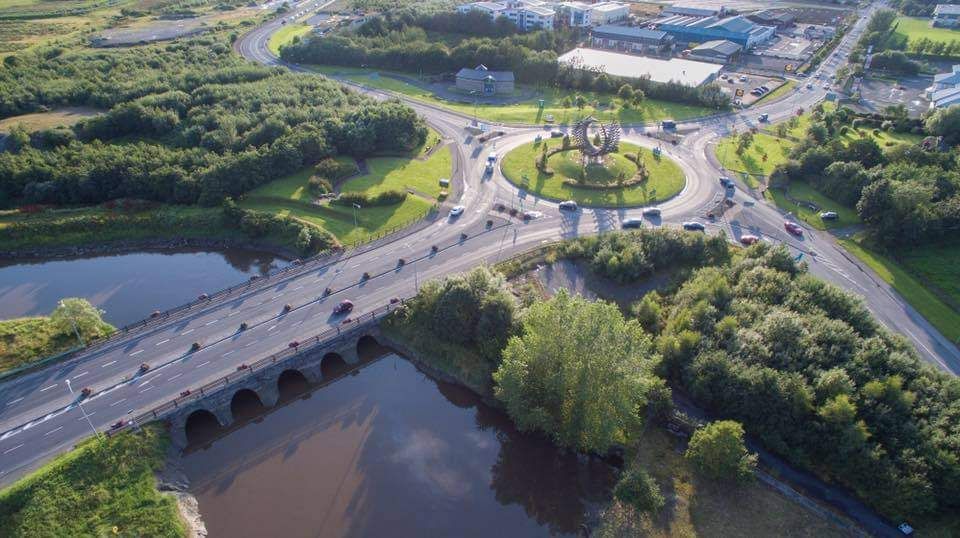
A modern aerial view of Port Bridge (seen from the downstream side) and the Polestar roundabout. This image was shared by Gabe J. McTuile on the Letterkenny Community Heritage Facebook Group on 1st February 2017. [16]
Looking Northwest along the N56 towards the Polestar roundabout. The modern bridge sits directly over the location of the old railway bridges scanning the River Swilly. [Google Maps, April 2020]
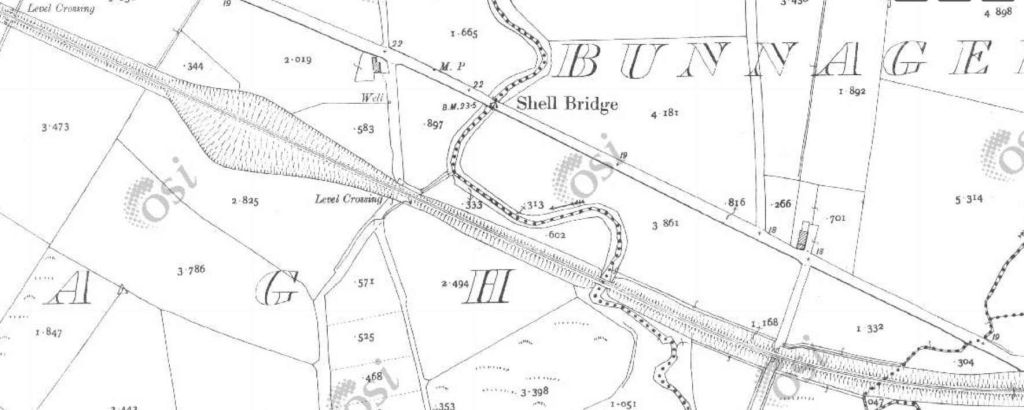
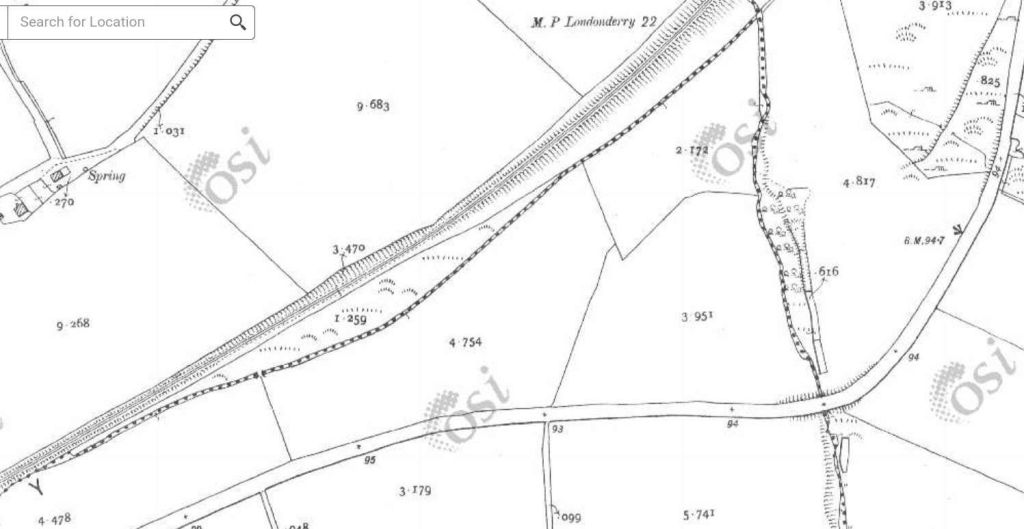
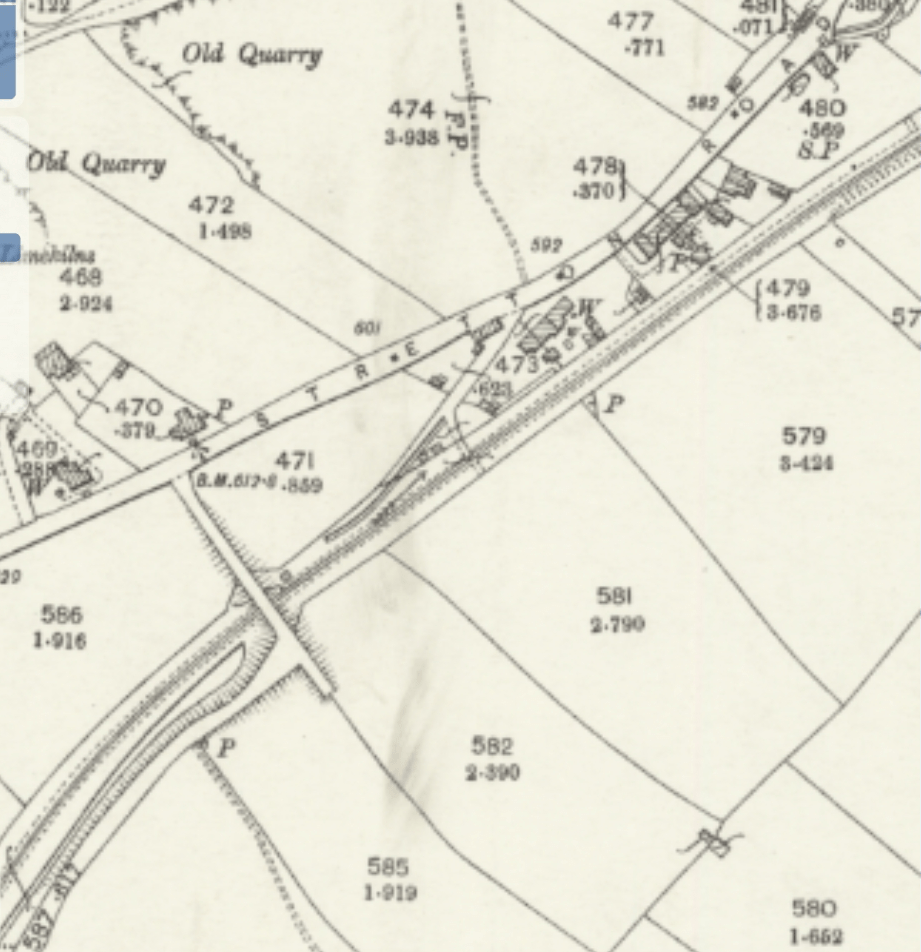
This extract from the 25″ OSi mapping which predated the construction of the CDR branch. The old main road to Derry runs parallel to the railway line to the North. Another road rises on an embankment to cross the L&LSR. [15]
The same location on the last 6″ OSi survey. The embankment has been shifted to accommodate the CDR branch. [15]
Approximately the same area as covered by the 25″ extract above as shown on the railmaponline.com satellite imagery. The road alignment shown in the OSi extracts above remains. The bridge over the two lines has been partially infilled. [4]
The embankment highlighted above is to the right of this image. The area adjacent to the white van is the bridge location. The area under the bridge has been altered to act as garage space. This image is the view westward from the modern N56.  [Google Street view, April 2023]
Dave Bell and Steve Flanders describe the use of the bridge arches in the 1980s like this: “The present owner of the filling station has made good use of the bridge by bricking up one side and building a garage against the other. In effect he now has a garage with three bays, the roof of which is actually the side road.” [18: p47] There are two pictures of the arched bays in Bell and Flanders book.

Kerry Doherty also very kindly supplied this photograph which shows the arches of the old bridge inside the garage facility, (c) Dave Bell. [17]

A short distance to the South East the CDR branch crossed the Lough Swilly and turned away to the South.

The next extract from the 25″ OSi survey. [15]
The immediate area of the bridge carrying the CDR over the Lough Swilly line as shown on the last 6″ OSi mapping.. [15]
Approximately the same area as covered by the 25″ extract above. [4]
As we have already noted, after crossing the River Swilly the two railway lines ran approximately parallel to each other. The Co. Donegal branch line climbed gradually until it was able to bridge the Lough Swilly line and head away to the South. By the time this picture was taken the Lough Swilly line had closed and had been lifted. This picture was kindly supplied by Kerry Doherty. It shows Co. Donegal Railway No. 5 Drumboe at the head of a goods train in 1959, © J.G. Dewing, Color-rail. [17]

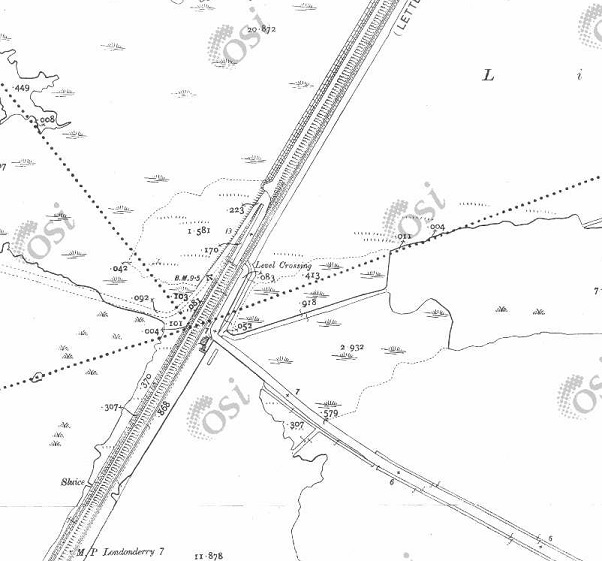
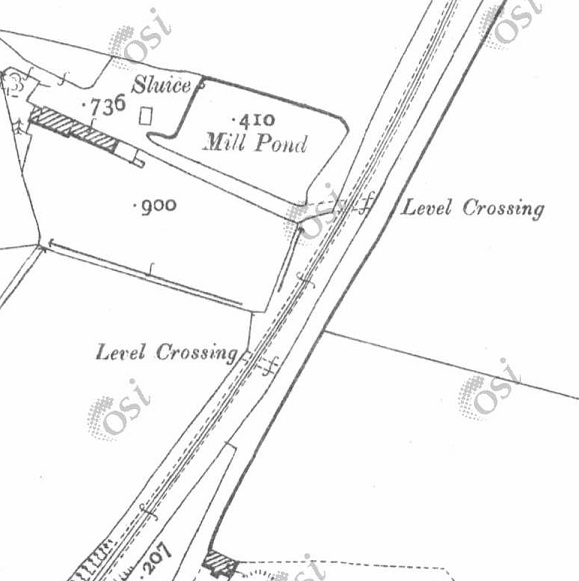
A short distance to the East of the over bridge the Lough Swilly line crossed another road at a level crossing.

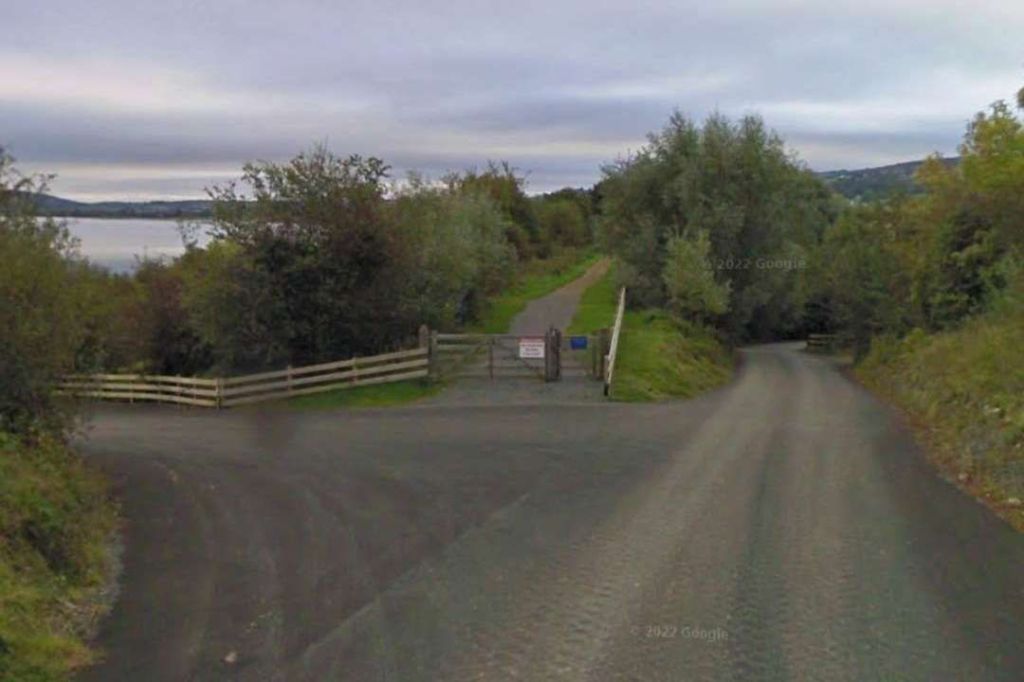
The site of the level-crossing as shown by Google Maps [May 2024]
At the site of the level-crossing, this view looks back towards Letterkenny along the line of the old railway. [Google Streetview, August 2021]
Also at the level-crossing this view looks ahead to the Southeast along the line of the railway. [Google Streetview, August 2021]

A few hundred metres to the Southeast the line crossed Clanree Lane at the level.

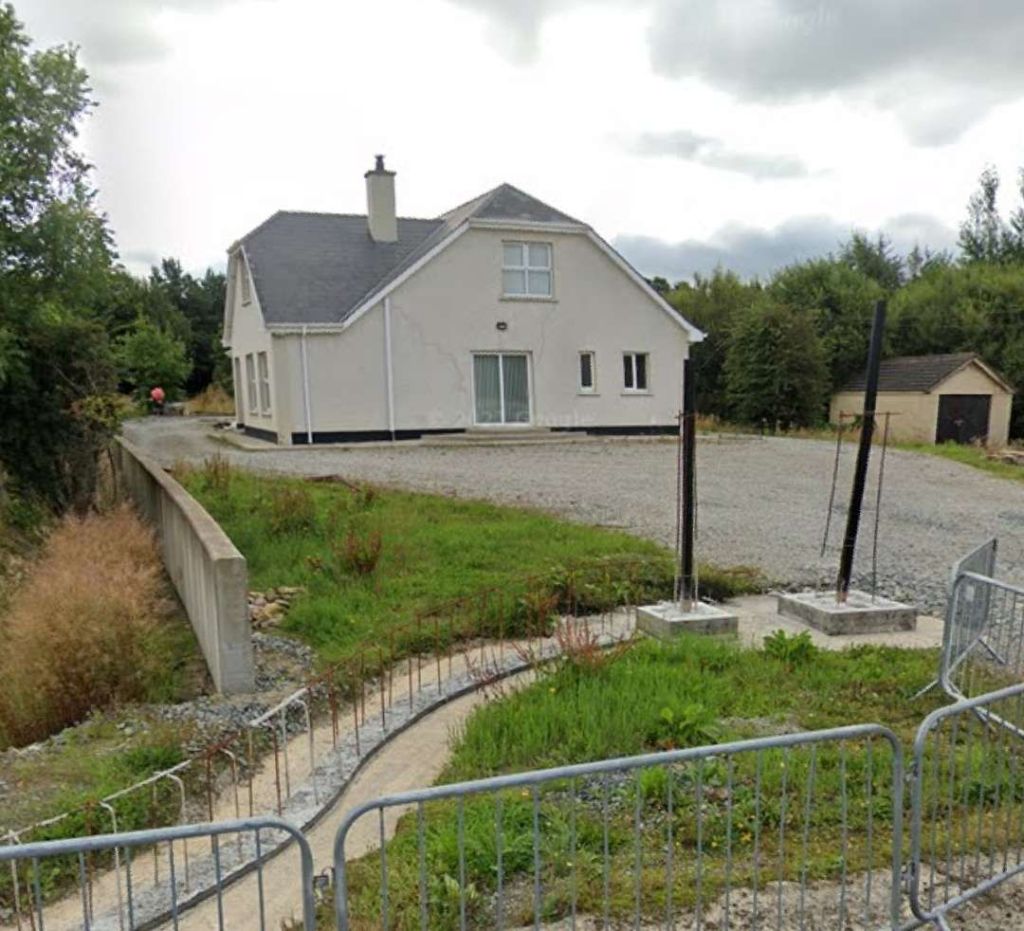
The old railway ran approximately along the line of parked cars in the Clarence Hotel carpark in this Google Maps satellite image, across Clanree Lane and through the house which has been built over the old railway. [Google Maps, May 2024]
Looking back along the line of the Lough Swilly Railway from the location of the level-crossing on Clanree Lane. [Google Streetview, August 2021]
Looking East from the lpcation of the level-crossing on Clanree Lane. The house has been built over the old formation. [Google Streetview, August 2021]
The next length of the old railway as shown on the 25″ OSi survey. [15]
The same length of the Lough Swilly Railway as it appears on railmaponlin.com’s satellite imagery. The old railway formation is buried under the earthworks of the modern N13 road. [4]
This next extract from the OSi 25″ survey shows the old road to Derry passing under the Lough Swilly. [15]
The route of the Lough Swilly Railway continues to be located under the earthworks of the N13 dual-carriageway. [4]
This next OSi extract (from the 25″ survey shows the line meandering to the North. [15]
The N13 continues to follow the route of the old railway. [4]
The 25″ OSi survey again. … The line continues to follow the contours as it curves around higher land. [15]
Railmaponline.com continues to show the line of the Lough Swilly Railway in orange. [4]
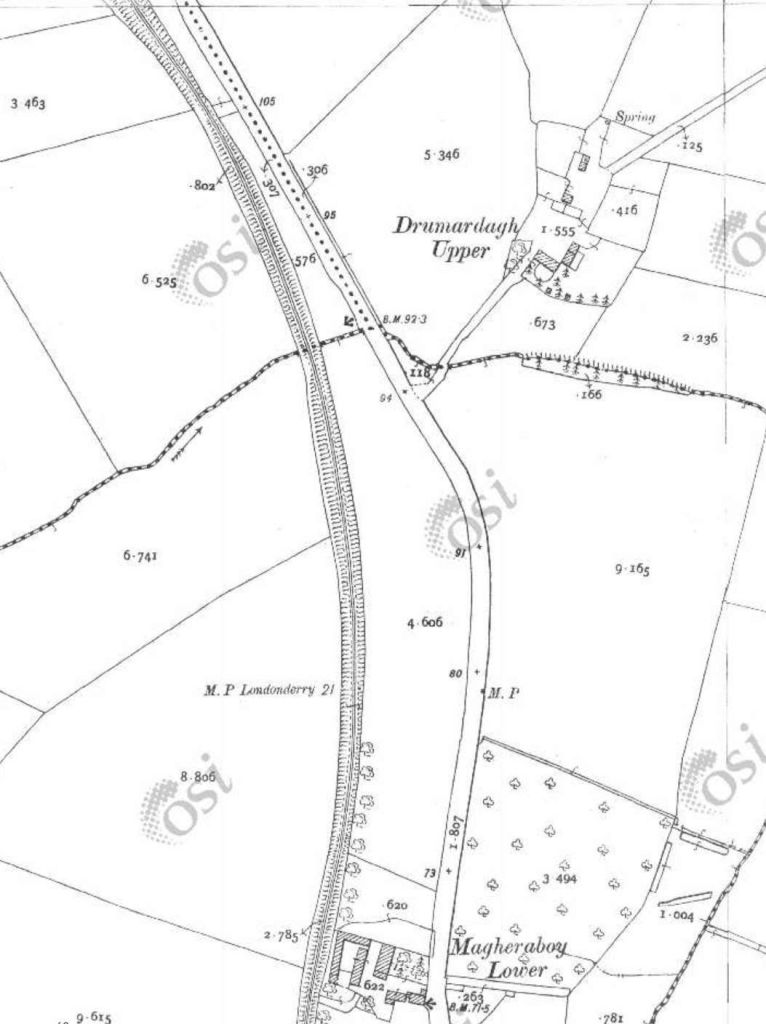
This next extract from the OSi 25″ survey shows the Lough Swilly Railway crossing the old main Road by means of a bridge and continuing to cut e round towards a southerly alignment. [15]
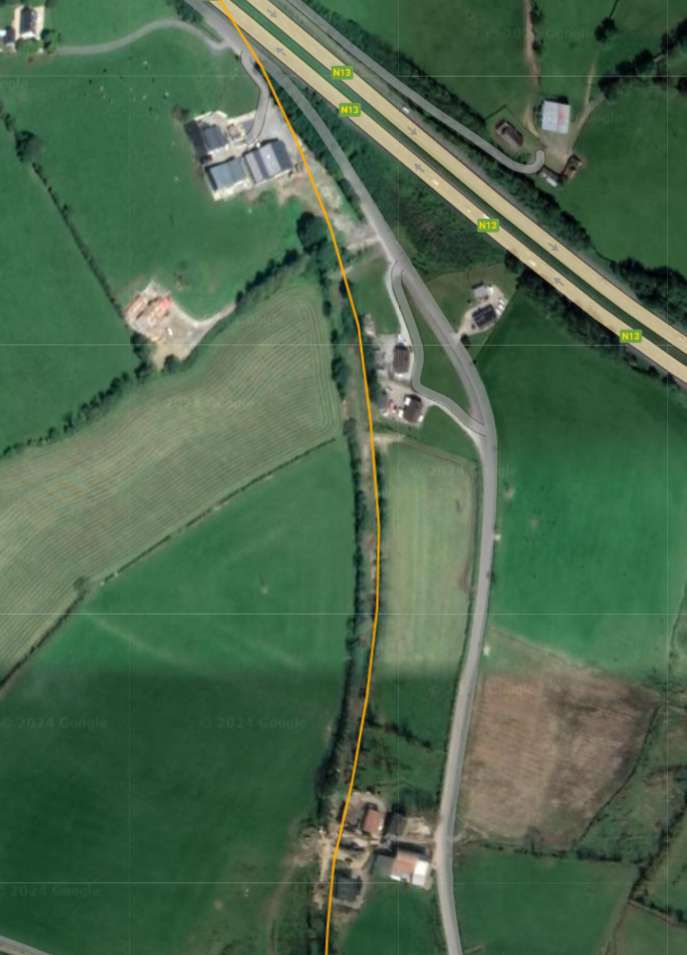
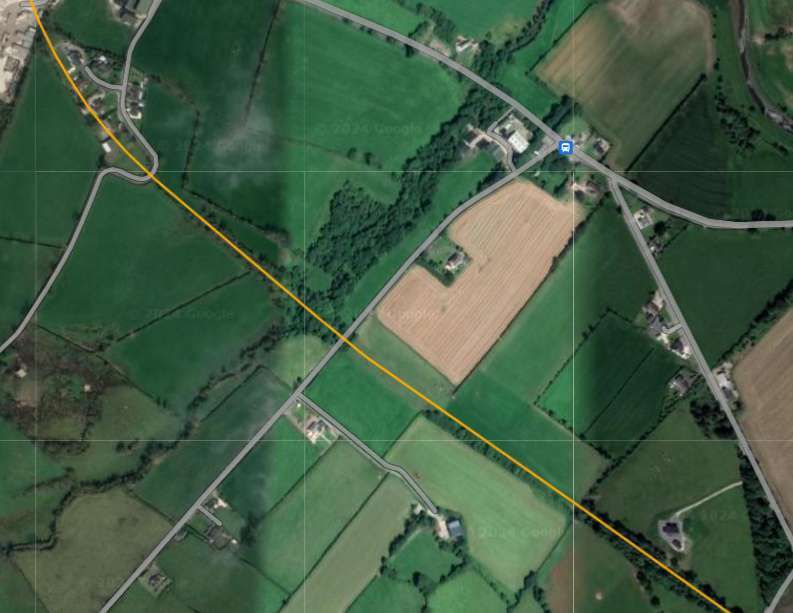
For much of this extract from railmaponline.com the route of the old railway is followed by the N13. However close to the bottom-right of the extract the route of the Lough Swilly Railway turns South away from the modern N13. [4]
Travelling South toward Pluck, the line ran along the West side of the old road to Derry. [15]
Railmaponline.com’s satellite imagery shows that the route of the old line is still marked by hedge lines which mark the old boundaries of railway land. [4]
On the approach to Pluck Station the line bridged a narrow lane before curving round into the station.When the line was built the lane providing access to the station was diverted to allow it to bridge the line. The bridge is visible in the bottom-right of the extract. [15]
The modern satellite imagery shows that the road layout around Pluck Station is little changed. [4]
Looking East along the minor road shown in the top half of the map extract and satellite image above. The bridge abutments of the railway bridge crossing the road remains. [Google Streetview, August 2021]
An enlarged extract from the 25″ OSi survey showing Pluck Station. [15]
The same location as it appears on Google Maps. The original station building at Pluck is now in private hands and much extended/altered. [Google Maps May 2024]
Pluck Station building in 1901, seen from the North [19]
The much altered and extended building that was once Pluck Station building, seen from the North. [Google Streetview, April 2011]
Pluck Station railway bridge seen from the road to the West of the structure. The road looped round over the bridge and provided access to the Station from the South. [Google Streetview, April 2011]
To the Southeast of Pluck Station, after passing under the station bridge, the Lough Swilly Railway crossed a culverted stream and a narrow road. [15]
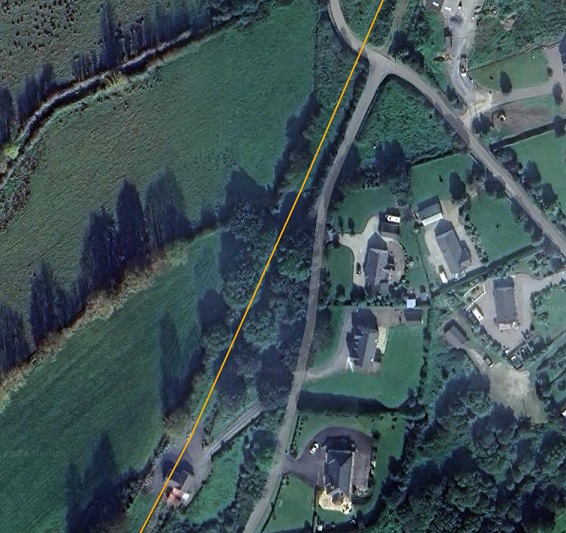
The same area as shown on the map extract above. The orange line represents the route of the Lough Swilly Railway. Field boundaries and hedgerows delineate the route on the ground. [4]
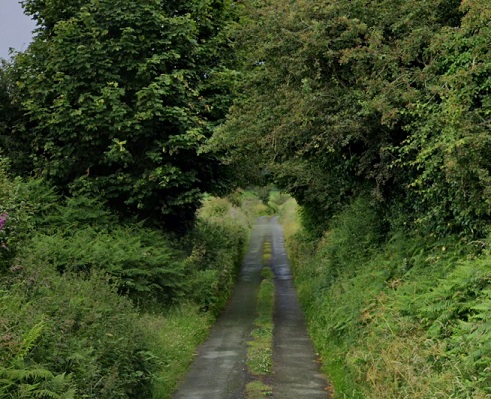
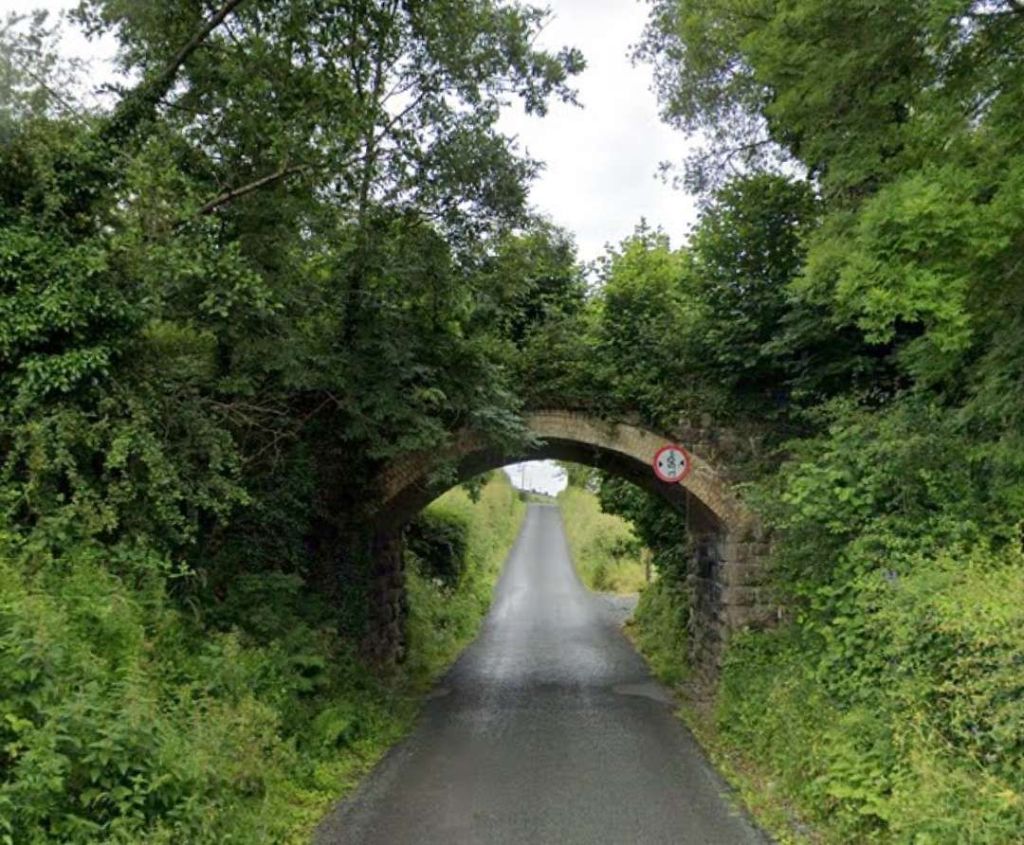
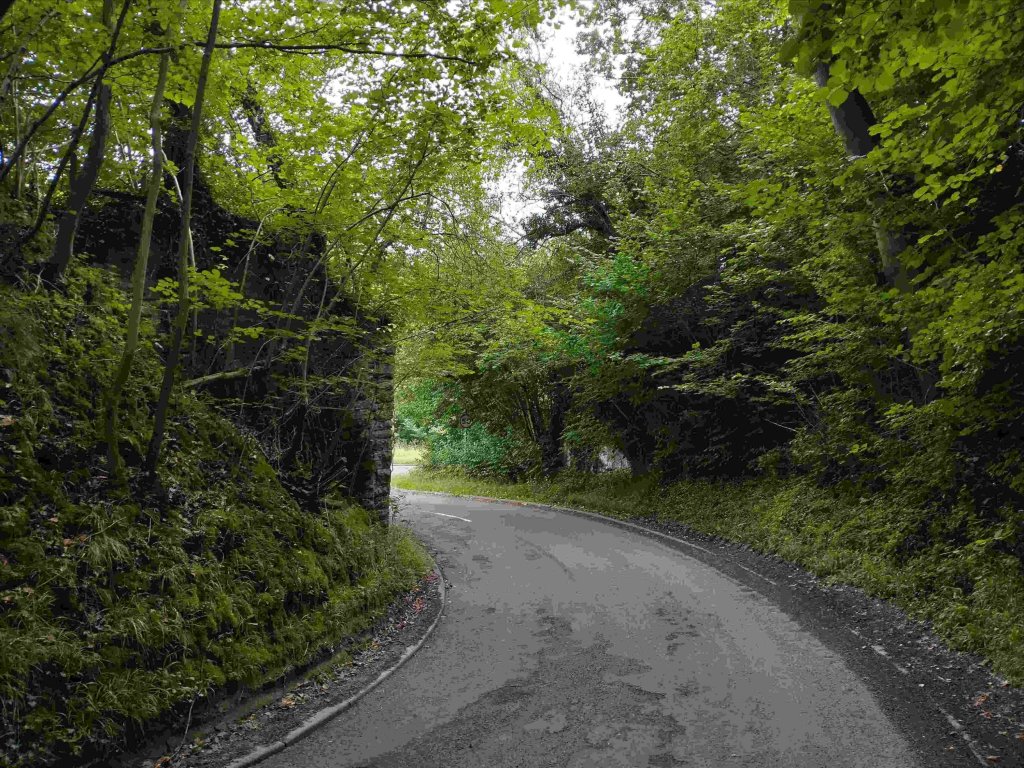
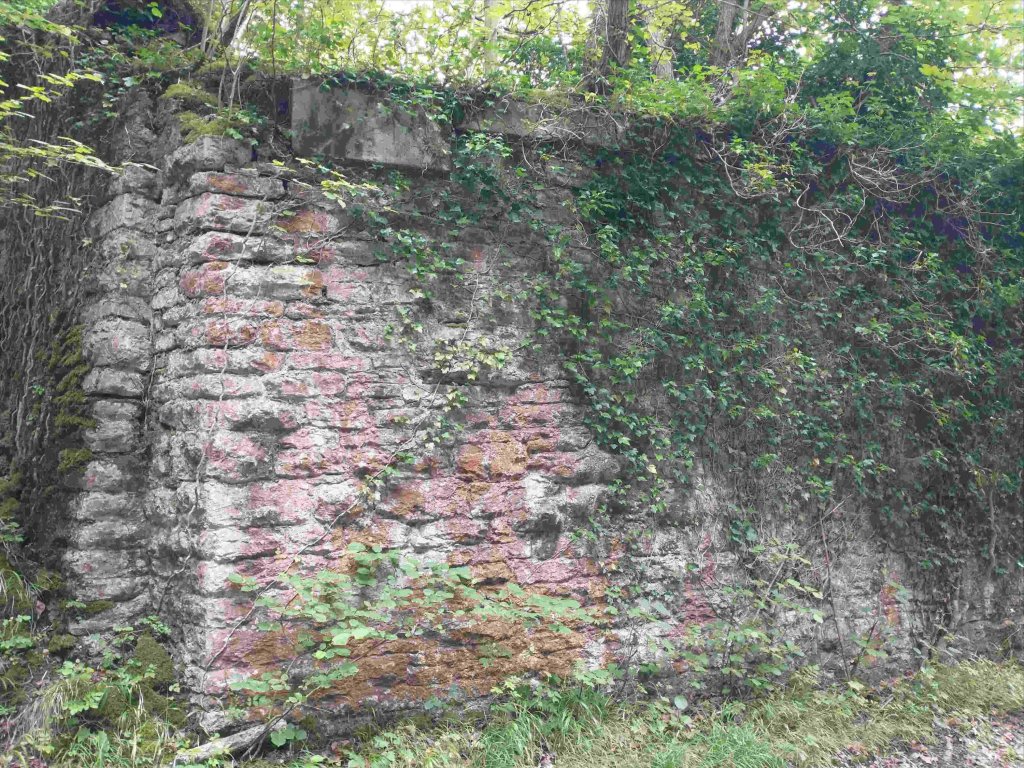
To the Southeast of Pluck Station the railway crossed a narrow lane by means of a stone-arched bridge. This image shows the bridge from the North. [Google Streetview, July 2021]
This next extract from the OSi 25″ survey shows the line continuing in a southeasterly direction and crossing over a further road by means of ankther stone-arched bridge. Two roads would have crossed the line in short succession had the most easterly of these not been diverted. [15]
The railmaponline.com satellite imagery shows the heavily wooded embankment which once carried the railway. [4]
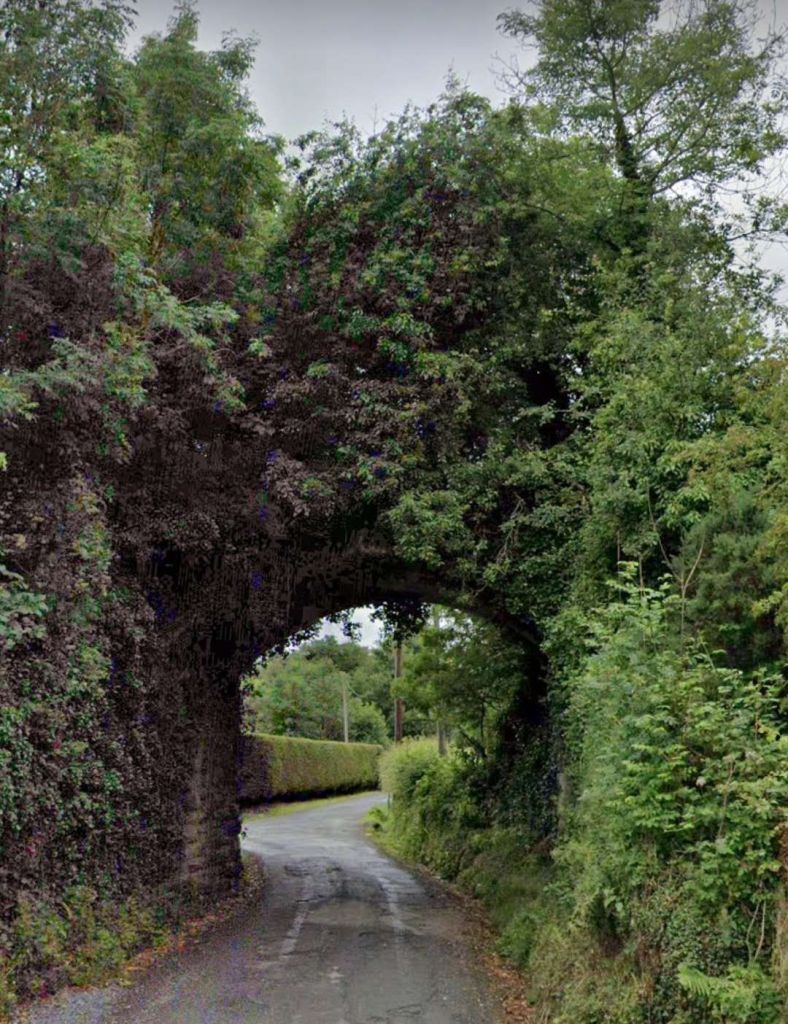
Looking North though the bridge which carried the old railway over the minor road at the top left of the extracts above. [Google Streetview, July 2021]
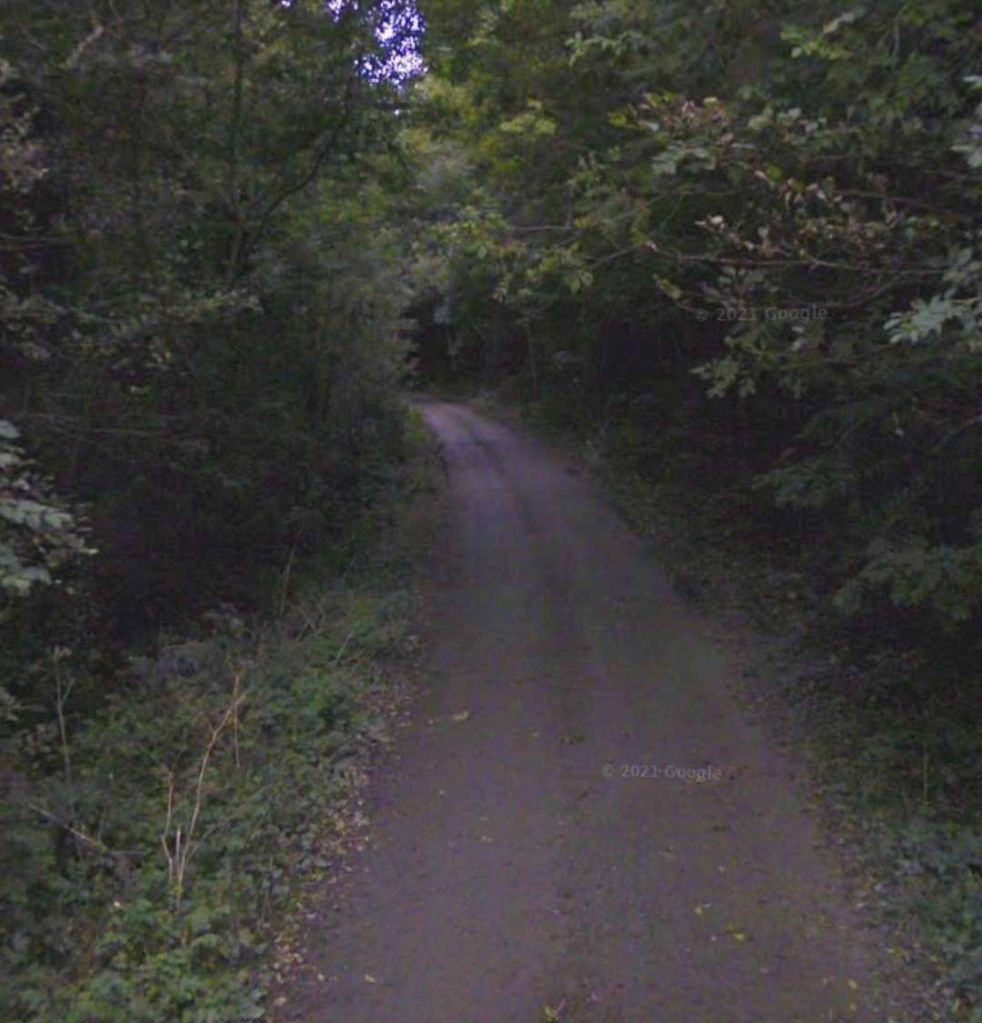
Looking Southeast along the minor road which was diverted as part of the construction of the Lough Swilly Railway. The railway embankment is on the left of this image and the bridge in the photograph above is behind the camera to the left. [Google Streetview July 2021]
The line then curved round through East to a east-northeastly direction. A further road crossed the line in the bottom-right of this extract. [15]
The satellite image shows that the line has been ploughed back into the landscape over much of the length covered in these extracts. Towards the right of this extract, a farm track can be seen following the line of the old railway. [4]
Looking back along the line of the Lough Swilly Railway to the West. The farm track sits on the line of the old railway. [Google Streetview, July 2021]
The road mentioned in the satellite image and the map extract above is shown on the left side of this next extract from the OSi 25″ survey. A further road appears at the right of this extract. When the line was built that road was diverted so as to be able to bridge the line. [15]
From the road on the left of these extracts a further length of the old railway has been ploughed back into stable land. At the third point in this image the route of the old line is once again shrouded by trees. As can be seen here and below, the road diversion remains in place but the cutting appears to have been infilled and there is no longer any evidence of the bridge over the railway. [4]
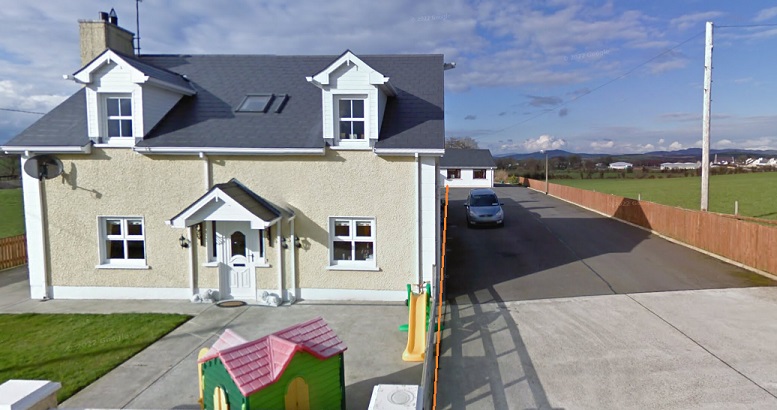
Looking ahead from the road on the left of the two extracts above, facing East along the line of the old railway. The line ran to the right of the trees behind the black farm building. It crossed this minor road on the level. [Google Streetview, July 2021]
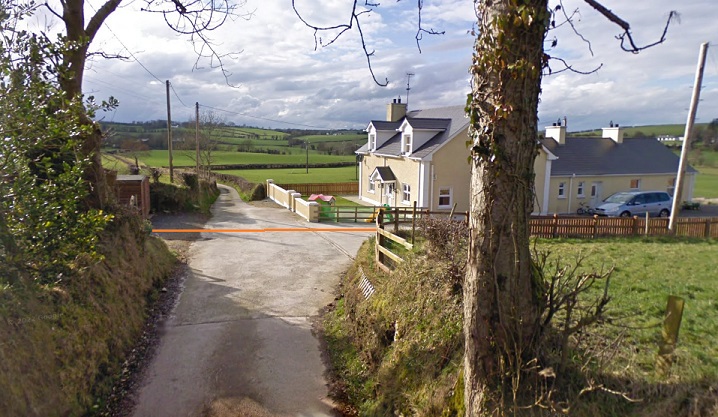
A Streetview image showing the road at the right of the map and satellite images above. The Lough Swilly Railway passed under the road at this location. As noted above there is no evidence except for the road alignment that the railway was present. [Google Streetview, July 2021]
The sinuous curving of the line continues on this next extract as the line continued to cross open farmland. The road at the left of this image is that at the right of the last map extract. [15]
Even without the orange line provided by railmaponline.com, the route of the old railway would be easy to pick out. [4]
The line then entered Manorcunningham Station. [15]
This is the same area as shown on the map extract above. The route of the old Letterkenny to Strabane road shows up as a grey line on the satellite imagery. The modern road was constructed long after the closure of the railway. [4]
This is the point at which the old main road leaves the modern road. Road traffic ran across the North side of the railway station and then turned sharply to the South to cross the line at the East end of the station. [Google Streetview, July 2021]
This enlarged extract from the 25″ OSi survey focusses on Manorcunningham Railway Station. [15]
This satellite image shows the same area as that covered by the map extract above. [4]
Manorcunningham Railway Station in the first half of the 20th century. [20]
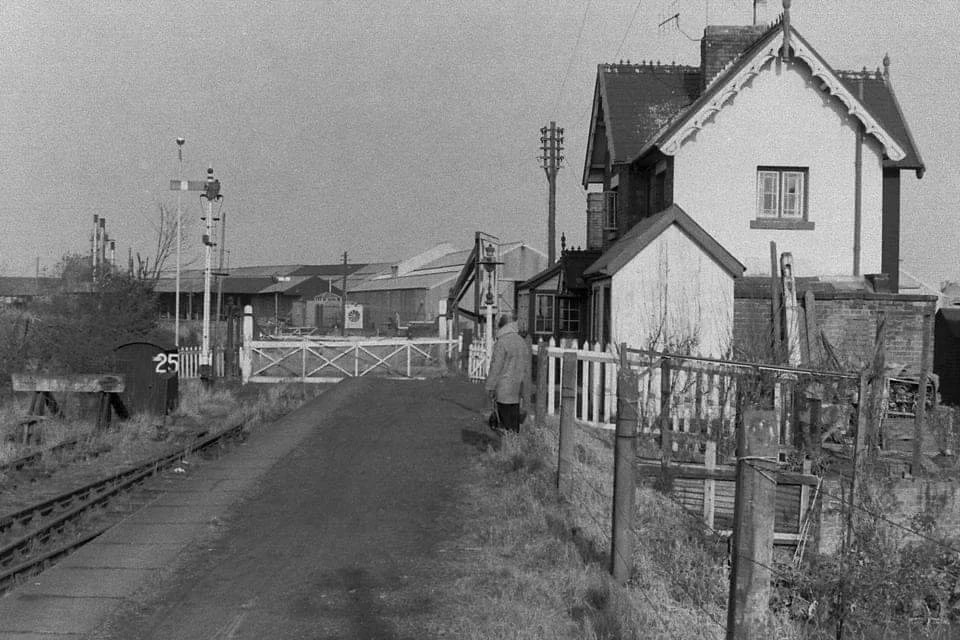
A similar view of the Railway Station as it appeared in the 1980s. This image was included in Dave Bell and Steve Flanders book: The Londonderry and Lough Swilly Railway: A Visitor’s Guide and used by kind pe
The old station forecourt as seen from the modern N14. [Google Streetview, July 2021]
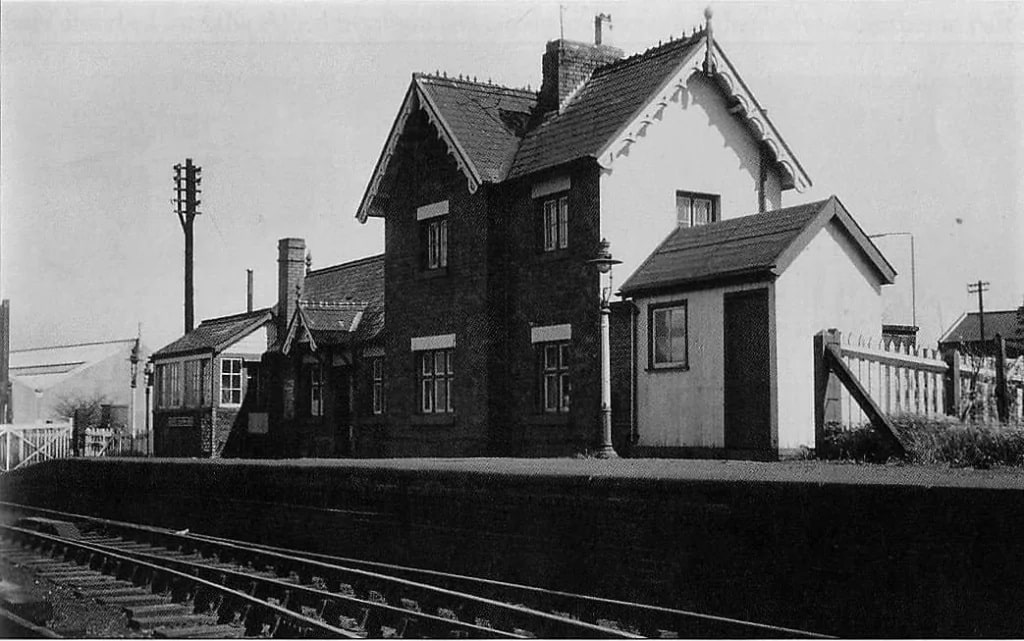
An enlarged view of the old Manorcunningham station building in the 21st century. [Google Streetview, July 2021]
A better view of the station building. This image was shared on the Donegal Railway Heritage Museum Facebook Page on 25th December 2021. [21]
A modern view of the platform side of Manorcunningham Station. [Google Streetview, July 2021]
The old main road ran on the North side of the station and railway line and at the end of Manorcunningham station site, turned sharply to the South passing under the railway. The abutments of the bridge carrying the railway over the road can still be found by following the old main road where it diverts from the modern N14. [My photograph, 10th May 2024]
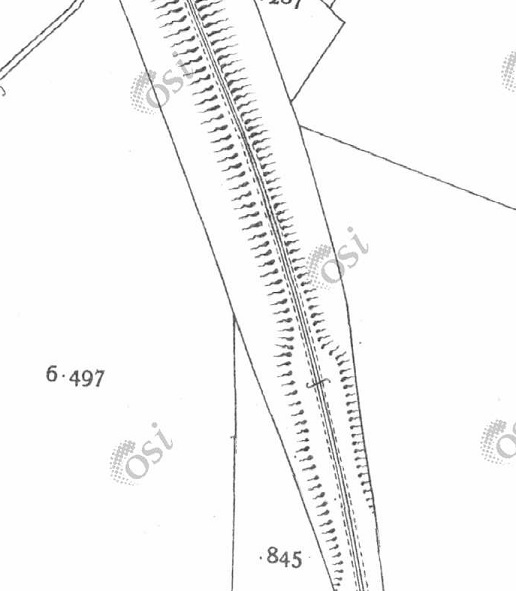
A further road crossed the line close to Drumoghill. [15]
This extract from railmaponline.com satellite imagery covers a similar area to the map extract above. The Lough Swilly Railway’s route now runs Northeast in a straight line. There is no sign of the short viaduct which spanned both river and road as can be seen in the enlarged map extract below. [4]
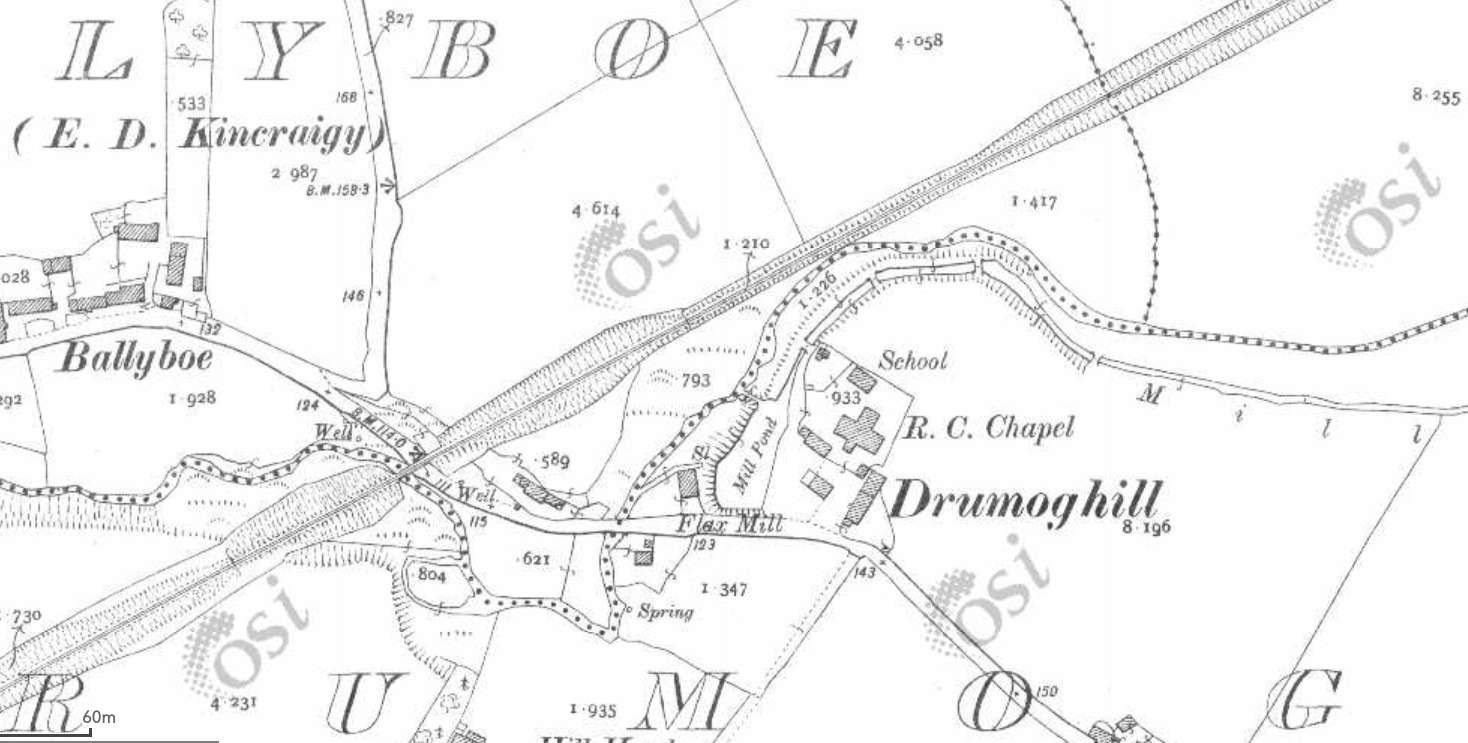
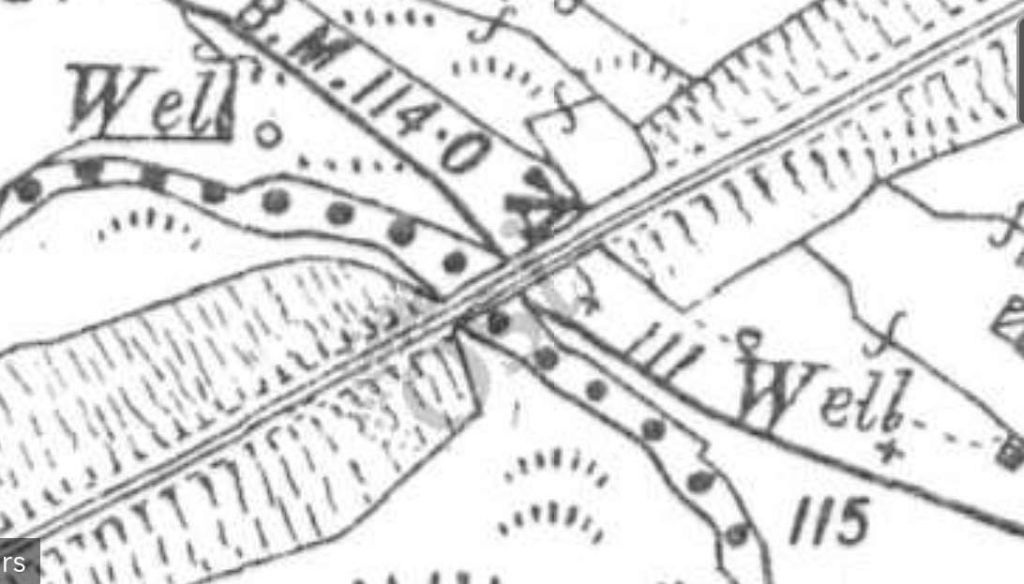
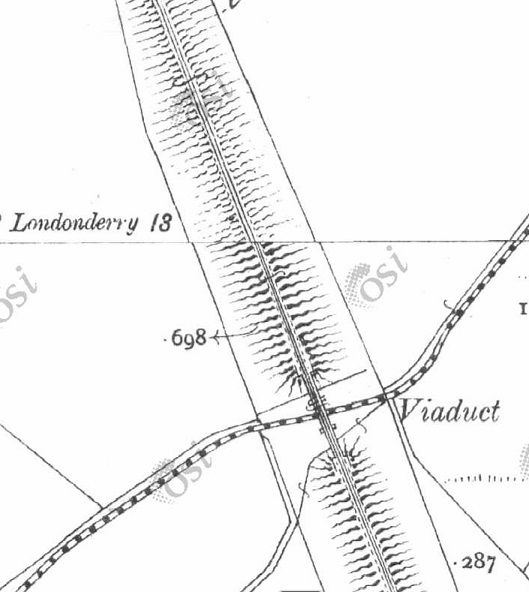
This enlarged extract from the OSi 25″ survey shows the erstwhile viaduct close to Drumoghill. [15]
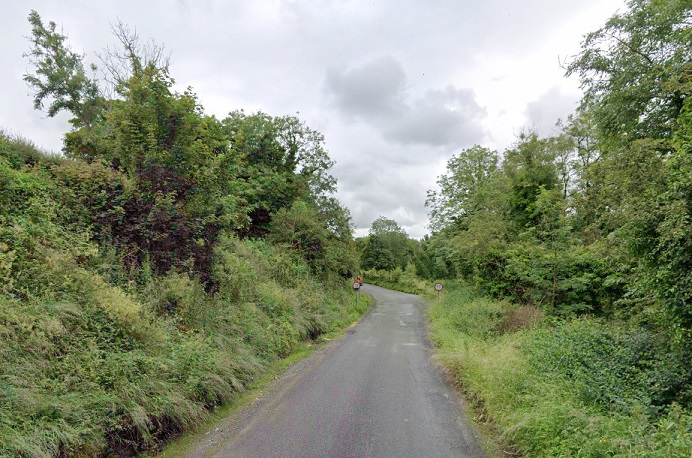
Looking Southeast along the line of the minor road approaching Drumoghill through the location of the old railway viaduct. [Google Streetview, July 2021]
Remains of the viaduct which crosses the stream. The section over the road has been removed. This and the following three photographs were shared on the Londonderry and Lough Swilly Railway Facebook Group by Willie Rodgers on 13th December 2021. [23]
Three photos taken in sequence looking and walking Northeast along the L&LSR from the location of the old viaduct shown on the enlarged map extract above. These pictures were all shared on the Londonderry and Lough Swilly Railway Facebook Group by Willie Rodgers on 13th December 2021. [23]
After Drumoghill, the Lough Swilly Railway continues Northeast over open farmland. [15]
Approximately the same area as shown on the map extract above. A green lane marks the line of the old railway. Hedges mark the extent of railway land. [4]
Turning further towards the North, the line ran to the East of Tullybogly. [15]
The Lough Swilly Railway passed beneath a minor road as it travelled North. [4]
Looking East along the lane which bridged the Lough Swilly Railway to the South of Tullybogly. The road can bee seen to rise and then fall away quickly after crossing the old line. [Google Streetview, July 2021]
The line continued Northeast passing close to Monclink where there was a single siding. [15]
A similar area as covered in the map extract above. A racetrack has been built over the line of the old railway at Monclink (Manor Race Track). [4]
This next extract from the OSi 25″ survey shows the line curing round towards the East and entering Sallybrook Station. [15]
The same length of the Lough Swilly Railway as shown on the railmaponline.com satellite imagery. [4]
An enlarged extract from the 25″ OSi mapping showing the Sallybrook Station site and the adjacent creamery. The road crossing ran through the heart of the station site at level, with the goods shed to the East of the road and passenger facilities to the West of the road. [15]
Approximately the same location as the enlarged extract from the OSi mapping showing the station location. [4]
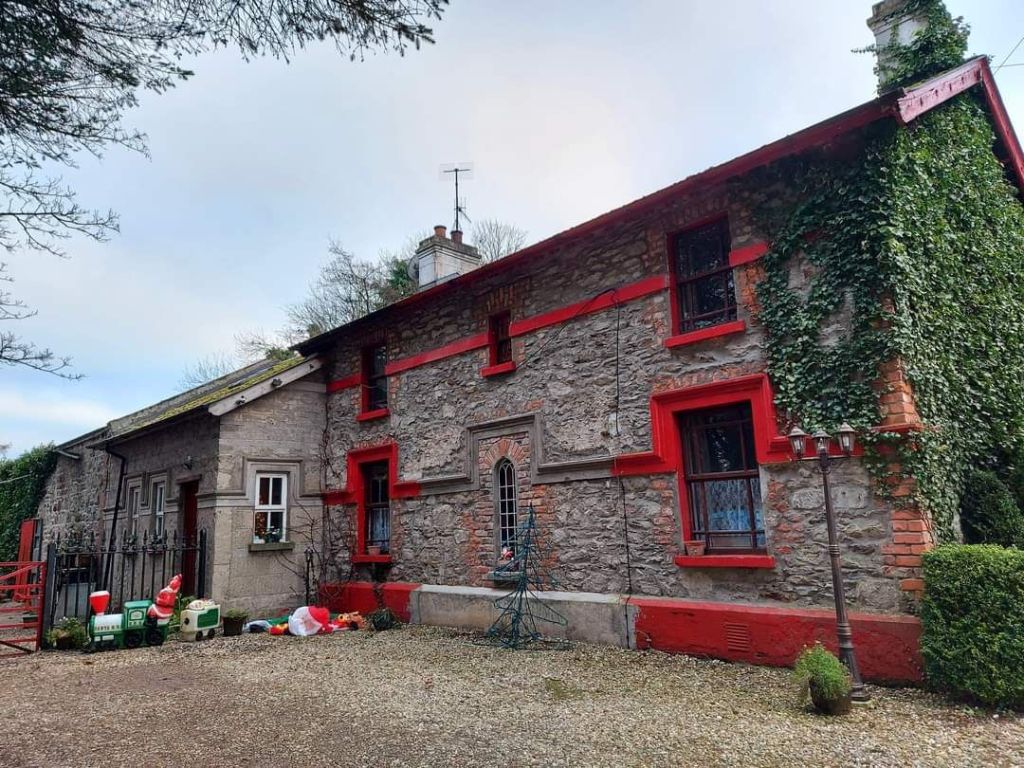
Sallybrook Station House, seen from the North in July 2021. The brick out building was built on the platform after closure of the line. [Google Streetview July 2021]
Sallybrook Station as illustrated in Dave Bell and Steve Flanders book: The Londonderry and Lough Swilly Railway: A Visitor’s Guide; County Donegal Railway Restoration Society and used by kind permission of Steve Flanders and the Donegal Railway Heritage Museum. The two images on the right show the station as it was in 1953, © H.V. Casserley. Those on the left show the s[18: p41]

Anticipating that the Sallybrook Station House would’ve been fully renovated, we drove down the access road and discovered that no further work had been undertaken since the July 2031 photo was taken. Two pictures of the building are included here.

The station forecourt side of Sallybrook Station building, [My photograph, 10th May 2024]
Looking West along the line of the Lough Swilly Railway along the platform side of the Station building. [My photograph, 10th May 2024]
Looking Northwest from the minor road across the level-crossing at Sallybrook Station. [Google Streetview, July 2021]
Looking ahead, East, at Sallybrook Station, towards Newtoncunningham. [Google Streetview, July 2021]
The next extract from the 25″ OSi survey shows the length of the line immediately yo the East of Sallybrook Station. Land levels are such that the Lough Swilly Railway [passed over the next road. [15]
Google Maps shows the same location in the 21st century. [Google Maps, 15th May 2024]
Looking North along the minor road which appears in the map extract and the image above. The trees to the right and left of the road mask the embankment which carried the old railway. The bridge at this location has been removed. [Google Streetview, October 2021]

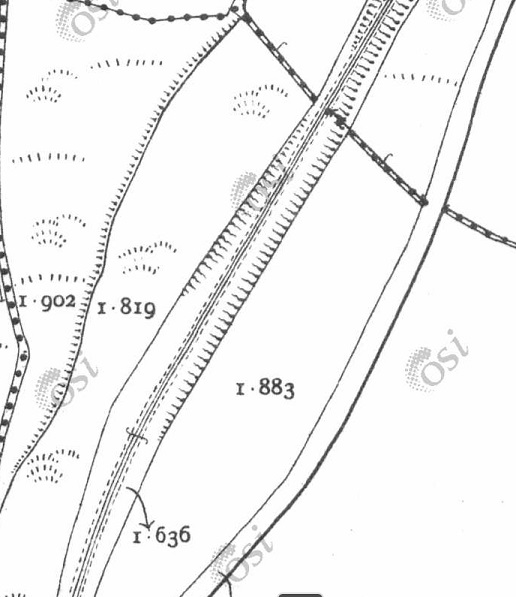
This next series of extracts from the 25″ OSi survey shows the Lough Swilly Railway crossing opens country between Sallybrook Station and Newtoncunningham Station.

The seven map extract above show the Lough Swilly Railway traversing open country/farmland in a generally Northeasterly direction. [15]
This satellite image from Google Maps shows that same length of the line as covered by the seven extracts immediately above. Field boundaries remain as they were at the time of the 25″ OSi survey. Over parts of this length of the line, hedgerows which used to flank the old railway have disappeared. [Google Maps, 16th May 2024]
This next extract from the 25″ OSi survey shows the point at which Castleblaugh crossed the line. [15]
A similar area to that shown on the map extract immediately above as it is shown on Google Maps satellite imagery in the 21st century. [Google Maps, 16th May 2024]
Looking East along Castleblaugh, the only indication of the old railway at this point is the crest in the road alignment at the point where the road bridged the line. [Google Streetview, July 2021]

From Castlebaugh heading North to Milltown much of the old railway formation has been ploughed back into the landscape. The next few 25″ OSI survey extracts show the line as it was.

The eight extracts from the 25″ OSi survey show the length of the railway between the road bridge carrying Castleblaugh and that at Milltown. [15]
The length of the Lough Swilly Railway from Castleblaugh to Milltown as shown on railmaponline.com’s satellite imagery. Much of the formation of the old railway has been ploughed back into farmland. [4]
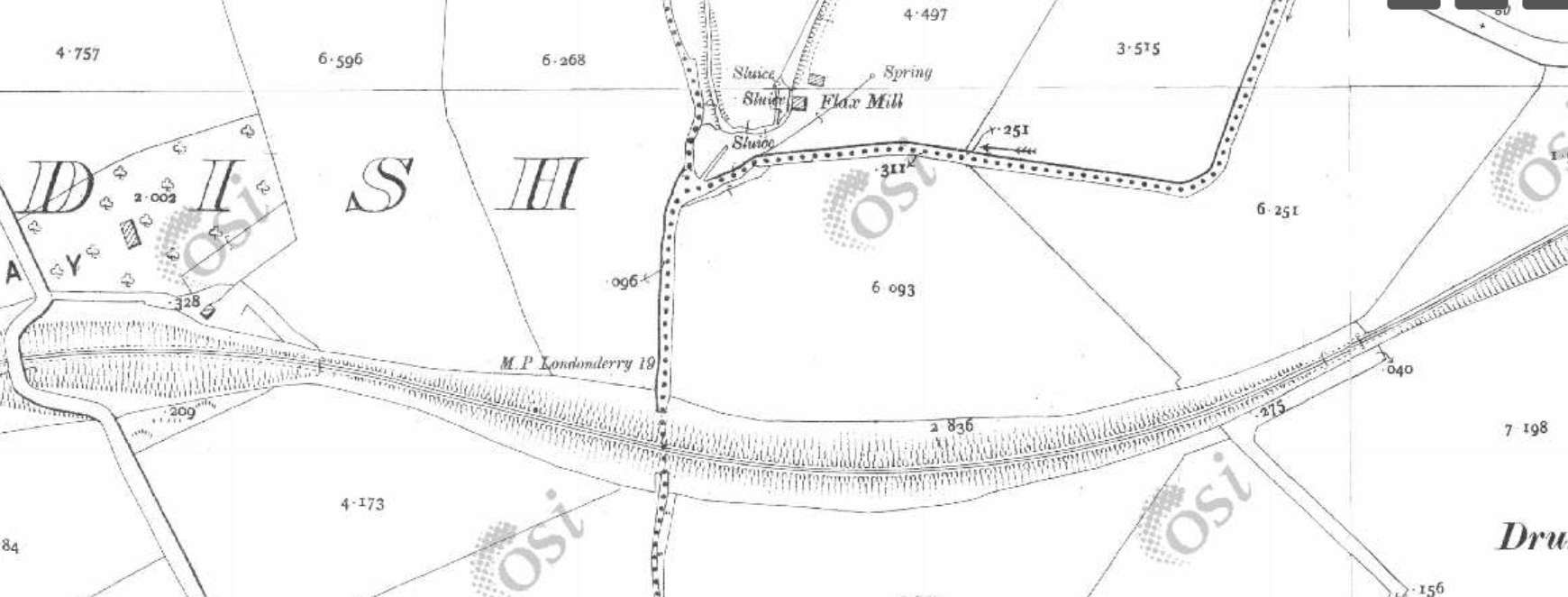
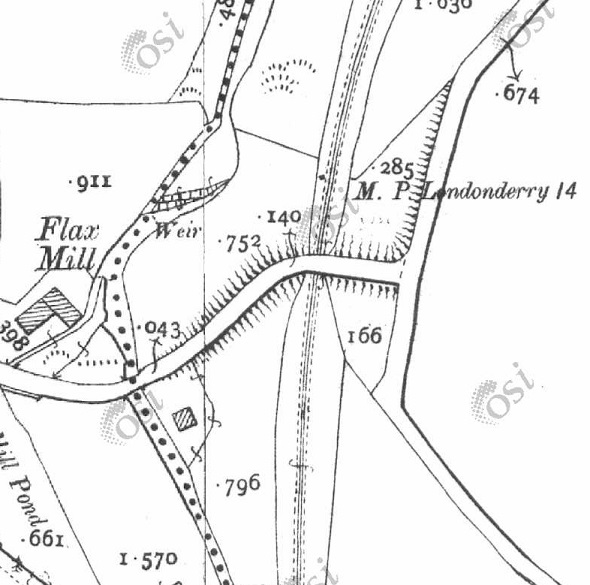
The Flax Mill at Milltown and the road bridge over the Lough Swilly Railway. [15]
Railmaponline.com’s satellite imagery shows the same area close to the old flax mill, as it appears in the 21st century. [4]
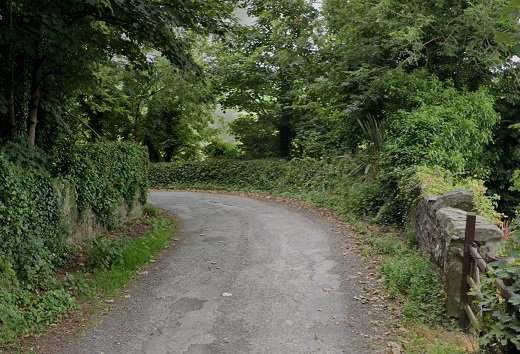
The bridge at Milltown as it appears in the 21st century. This view looks from the East over the bridge towards the location of the flax mill. [Google Streetview, July 2021]
Looking South from Monad Road along the line of the old railway. The curtting at this location has been infilled and only the bridge parapet remains visible. [Google Strettview, July 2021]
Looking North from Monad Road along the line of the Lough Swilly Railway towards Newtoncunningham. More of the cutting of te old railway can be seen in this direction. [Google Streetview, July 2021]

The next 4 extracts from the 25″ OSi survey cover the length of the line as far as Mason Lodge and the overbridge at that location.

Four extracts from the OSi 25″ survey take us as far as Mason Lodge and the bridge over the line at that location. [15]
The length of the line covered by the four map extracts above as it is shown on railmaponl;ine.com’s satellite imagery. [4]
An enlarged extract from railmaponline.com’s satellite imagery focussed on the location of the bridge over the line adjacent to Mason Lodge. [4]
Looking West across the old bridge over the Lough Swilly Railway adjacent to Mason Lodge. This 21st century image shows the bridge parapets still in place. [Google Streetview, July 2021]
Looking South along the old railway the cutting is heavily overgrown in the 21st century. [Google Streetview, July 2021]
Looking North over the bridge parapet in 2021a private property straddles the old formation with the line running close to the hedge in the foreground and through the out-building ahead. {Google Streetview, July 2021]
From a point a little further to the North on the minor road which ran parallel to the old railway, it is possible to make out the stone arch which carried the road over the line. It is masked by the landscaping of the private garden. [Google Streetview, July 2021]
The line continued Northward in cutting. [15]
As this next extract from the 25″ OSi survey shows, where the cutting came to an end and before the line ran North onto embankment there was a further road crossing, this time at level. [15]
This extract from railmaponline.com’s satellite imagery covers the same length of the old railway as the two map extracts immediately above. The bridge close to Mason Lodge appears at the southern edge of the extract, the level crossing noted above appears at the top of this image. [4]
This photograph shows the view looking West across the line of the old railway at the location of the lvel-crossing. [Google Streetview, March 2011]
Looking South along the line of the Lough Swilly Railway from the levle-crossing noted above, the formation continues to be defined by boundary hedges although, in the 21st century, it is in private hands. [Google Streetview, March 2011]
Looking North from the location of the level crossing. The approximate route of the old railway is shown by the orange line. [Google Streetview, March 2011]
This next extract shows that the line North of the level crossing was on a relatively significant embankment. [15]
Continuing to the North, this next extract from the 25″ OSi survey shows a significant viaduct which carried the line over a stream. [15]
The line then crossed a more significant road by means of another bridge. This road was to become the N13 linking Letterkenny to Derry. [15]
The location of the level-crossing appears at the bottom of this next extract from railmaponline’s satellite imagery, the N13 at the top and the viaduct location just above the centre of the image. [4]
Looking Northeast along the N13 through the location of the bridge which carried the Lough Swilly Railway over the road. [Google Streetview, November 2022]
Looking South from the N13 the rail embankment has been removed for some distance from the modern road, but the embankment can be seen in the distance. Railway land at this location was wide enought o accommodate the full width of the embankment and remains delineated by the modern hedges seen in this image. [Google Streetview, November 2022]
Looking Northwest from the N13, the embankment has not been removed. The stonework of the bridge abutment and the springing at the base of the arch which spanned the old road before its widening can clearly be seen. [Google Streetview, November 2022]
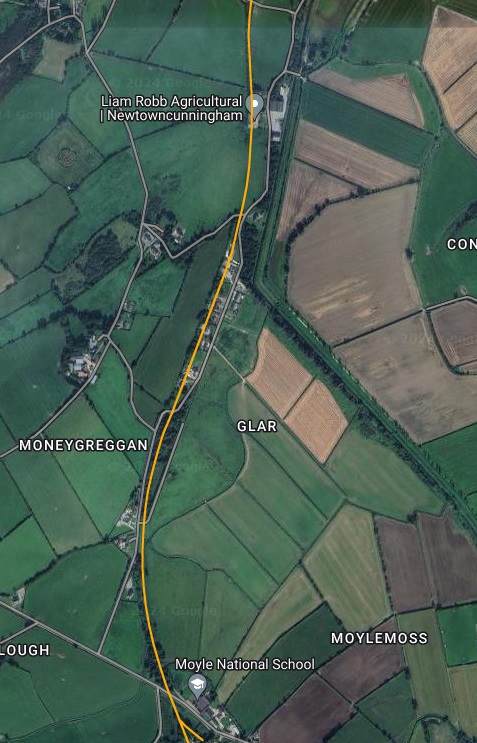
The two extracts from the 25″ )Si survey show the southern approach to the station at Newtowncunningham. [15]
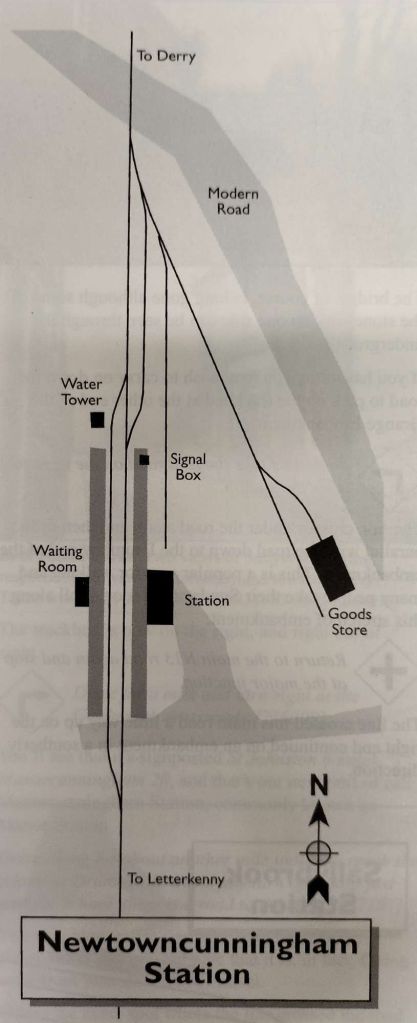
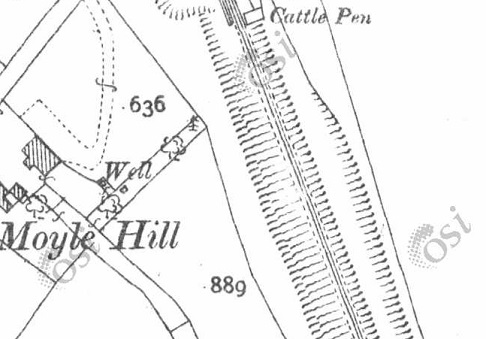
Newtowncunnigham Railway Station as shown on the 25″ OSi survey. The station was sited in the area known as Moyle. [15]
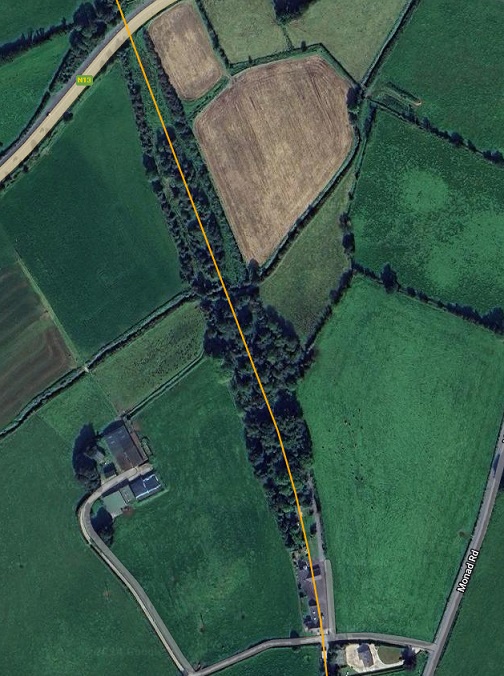
The site of Newtowncunningham Railway Station as shown on railmaponline.com’s satellite imagery. The bridge at the North end of the station has been removed and the road realigned. The Station House and the Water Tower remain. The Station House in private hands. [4]

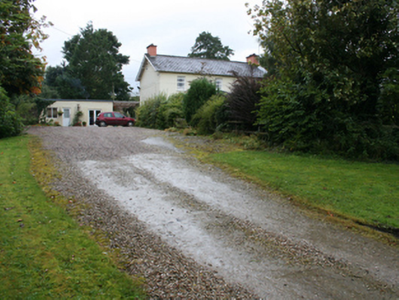
(c) National Inventory of Architectural Heritage (@niah_ireland [Instagram], @NIAH_Ireland [Twitter])

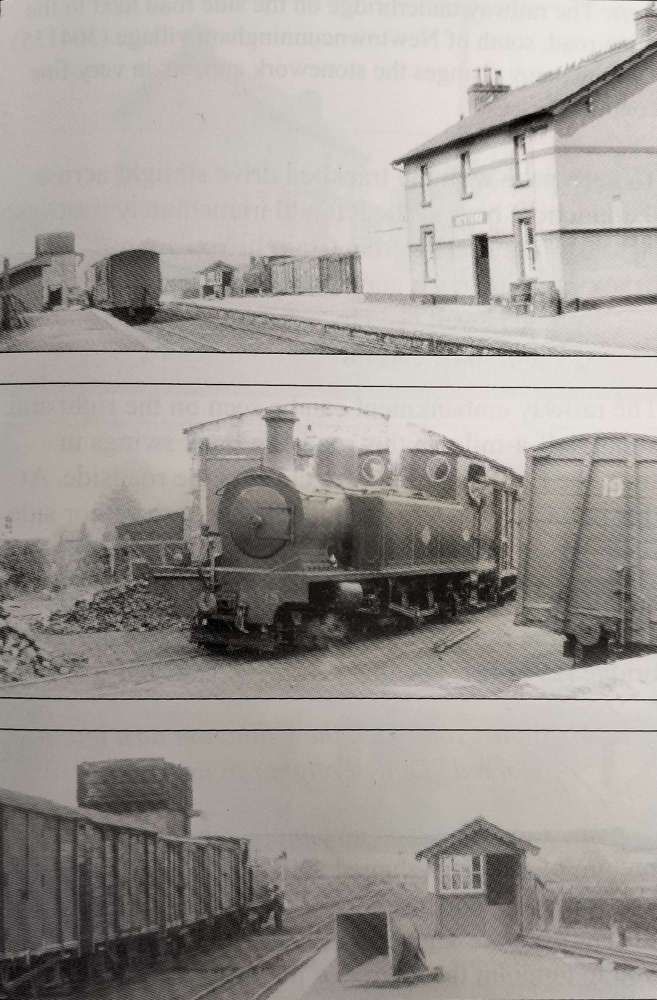
Two views of Newtowncunninham Railway Station House, now in private ownership, (c) National Inventory of Architectural Heritage (@niah_ireland [Instagram], @NIAH_Ireland [Twitter]). [22]

Newtowncunningham Station Water Tower. The National Inventory of Architectural heritage describes this as a “freestanding single-bay two-storey former railway water tower associated with Newtowncunningham Railway Station, built c. 1883, having rendered platform over surmounted by timber-clad metal water tank.” (c) National Inventory of Architectural Heritage (@niah_ireland [Instagram], @NIAH_Ireland [Twitter]). [22]

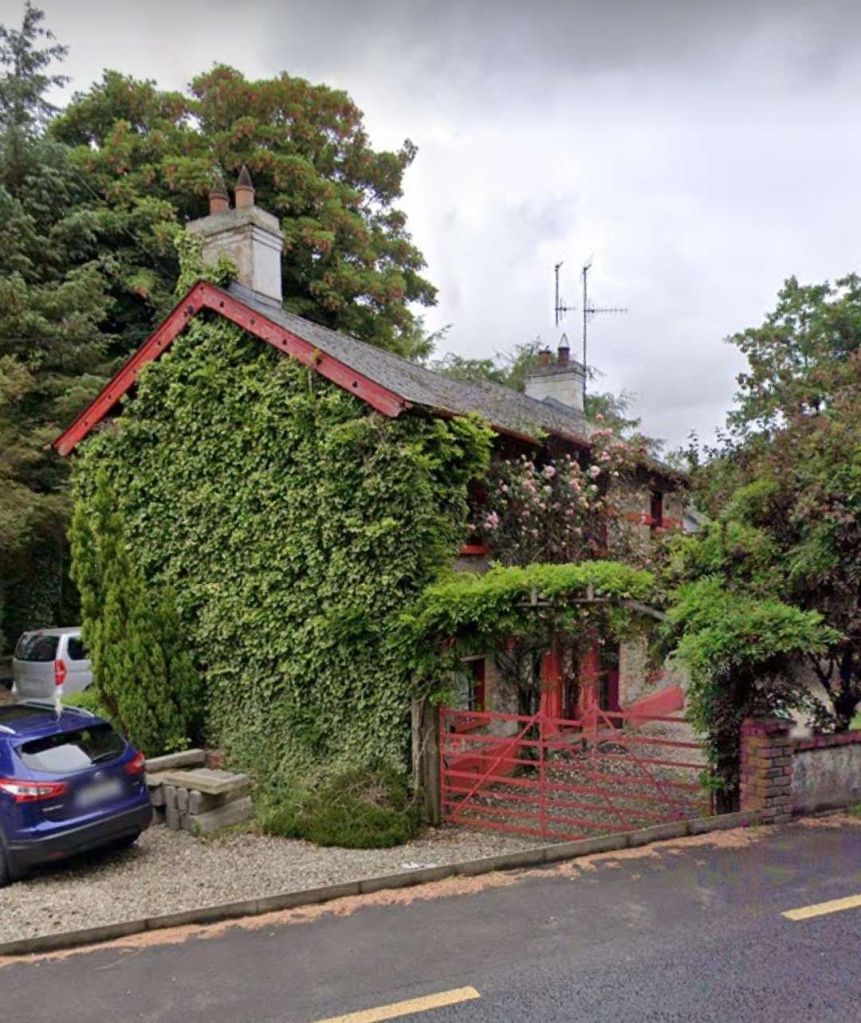
The Station House seen from the road. [My photograph, 9th May 2024]

We complete this article here at Newtowncunningham Railway Station. The next article in this series will look at the line from Newtowncunningham to Derry.

References

  1. https://en.m.wikipedia.org/wiki/Londonderry_and_Lough_Swilly_Railway, a cessed on 30th April 2024.
  2. S. Maxwell Hajducki; A Railway Atlas of Ireland; David & Charles, Newton Abbot, 1974.
  3. https://osi.maps.arcgis.com/apps/webappviewer/index.html?id=bc56a1cf08844a2aa2609aa92e89497e, accessed on 30th April 2024.
  4. https://railmaponline.com/UKIEMap.php, accessed on 1st May 2024.
  5. https://www.ebay.co.uk/itm/293669517301?mkcid=16&mkevt=1&mkrid=711-127632-2357-0&ssspo=vFhrxofnRnO&sssrc=4429486&ssuid=afQhrar7TGK&var=&widget_ver=artemis&media=COPY, accessed on 13th July 2023.
  6. https://www.letterkennyhistory.com/the-railways, accessed on 13th July 2023.
  7. https://m.facebook.com/groups/788818974978955/permalink/1011585592702291, accessed on 13th July 2023.
  8. https://www.flickr.com/photos/29903115@N06/48627305973, accessed on 3rd May 2024.
  9. https://www.facebook.com/share/p/wdwkAfVanbCPbvmT, accessed on 3rd May 2024.
  10. https://www.facebook.com/share/AEut2yYnGpVF5Bdu, accessed on 3rd May 2024.
  11. https://www.facebook.com/share/LY7arTwvoZJ3iVTs, accessed on 3rd May 2024.
  12. https://www.facebook.com/share/p/qUSZXS8nL2jjKiYG, accessed on 4th May 2024.
  13. http://geohive.maps.arcgis.com/apps/we2bappviewer/index.html?id=9def898f708b47f19a8d8b7088a100c4, accessed on 27th and 28th October 2020.
  14. https://catalogue.nli.ie/Record/vtls000332873, accessed on 5th May 2024.
  15. https://osi.maps.arcgis.com/apps/webappviewer/index.html?id=bc56a1cf08844a2aa2609aa92e89497e, accessed on 5th May 2024.
  16. https://www.facebook.com/share/p/8ZMXsiwAdUZFuj7X, accessed on 5th May 2024.
  17. In 2020, Kerry Doherty of Ballindrait very kindly sent me a series of pictures of the Co. Donegal Railways Strabane and Letterkenny Railway route. Each of these, in this article, bears the reference number [17].
  18. Dave Bell and Steve Flanders; The Londonderry and Lough Swilly Railway: A Visitor’s Guide; County Donegal Railway Restoration Society.
  19. http://donegalgenealogy.com/1901pluck.htm, accessed on 8th May 2024.
  20. https://www.donegaldaily.com/2024/03/19/plans-for-reinstatement-of-old-east-donegal-railway-line, accessed on 9th May 2024.
  21. https://www.facebook.com/share/p/WPFKVTW43vPdgCJY, accessed on 9th May 2024.
  22. https://www.buildingsofireland.ie/buildings-search/?query=&location_type=building&county=DG&town=Newtowncunningham&townland=&group=&type=&date_from=&date_to=, accessed on 16th May 2024.
  23. https://www.facebook.com/groups/788818974978955/permalink/1209152166278965/?app=fbl, accessed on 2nd June 2024.

The Wenlock Branch from Much Wenlock to Presthope

The featured image shows Presthope Station with the 18.00 hrs Craven Arms – Much Wenlock – Wellington train is leaving on 21st April 1951, heading for Much Wenlock. [30]

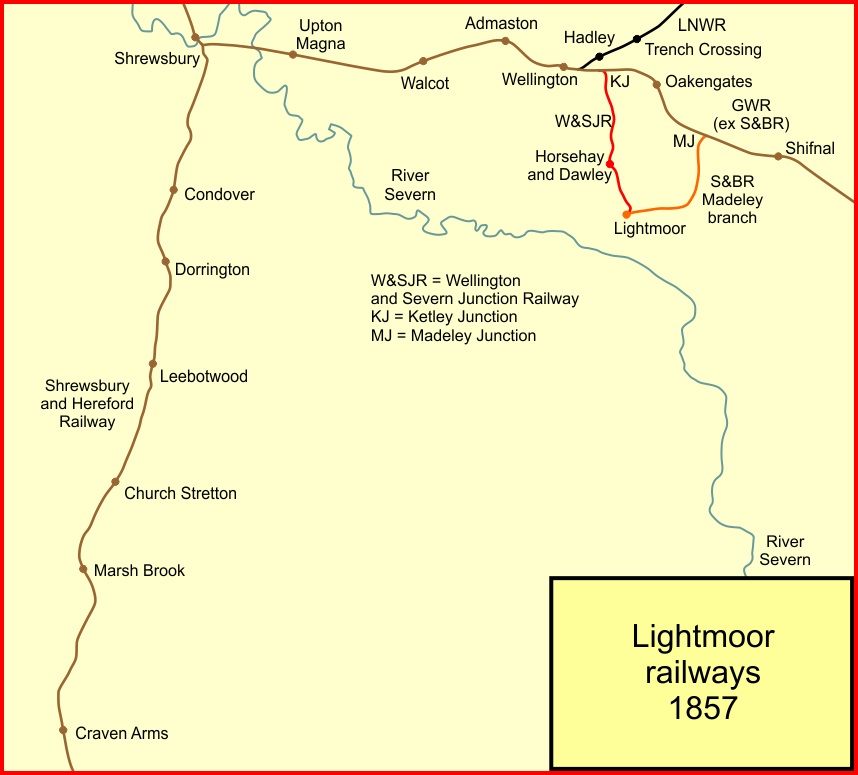
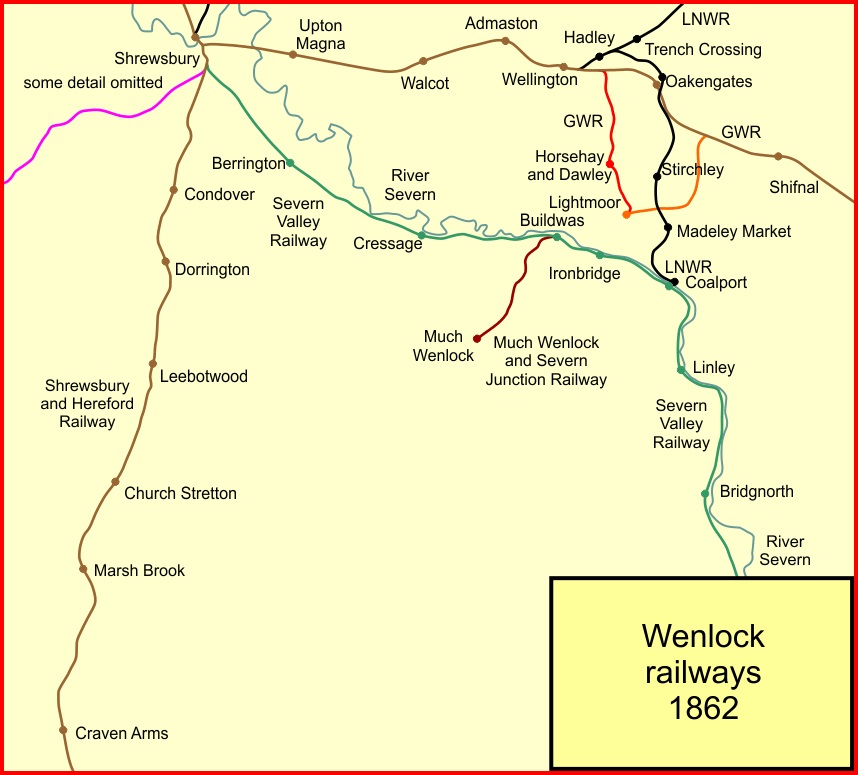
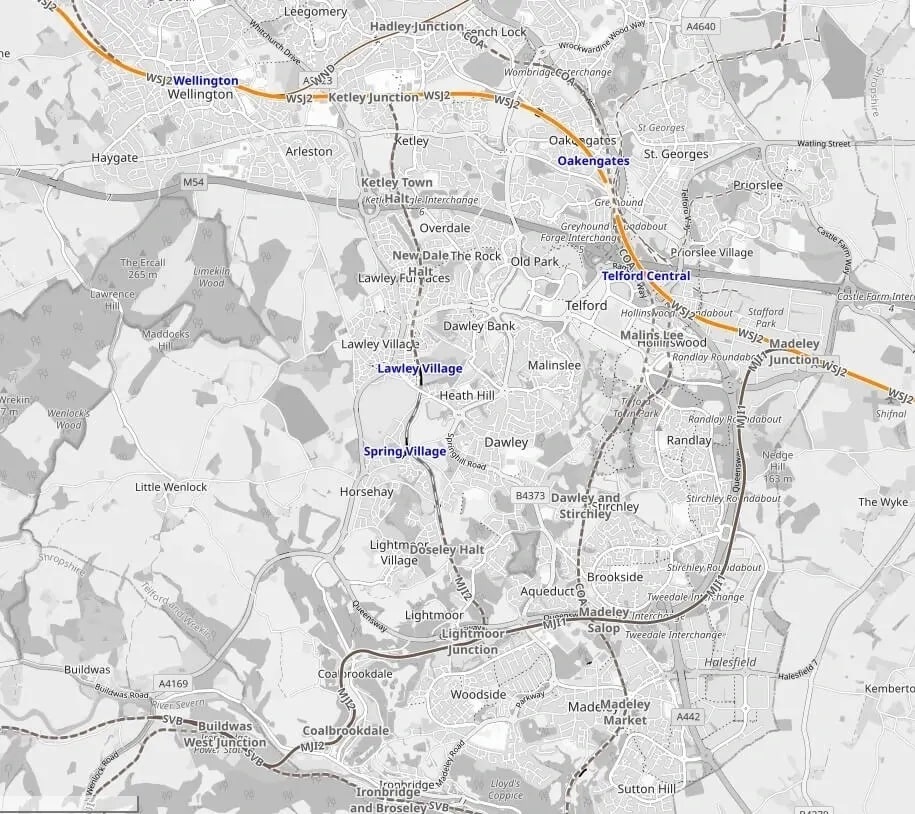
This article follows on from four other articles which covered the Wellington to Severn Junction Railway and this line from Buildwas to Much Wenlock. The first three articles can be found on these links:

https://rogerfarnworth.com/2022/07/07/the-railways-of-telford-the-wellington-to-severn-junction-railway-wsjr-part-1-wellington-to-horsehay

https://rogerfarnworth.com/2022/07/12/the-railways-of-telford-the-wellington-to-severn-junction-railway-wsjr-part-2-horsehay-to-lightmoor-junction

https://rogerfarnworth.com/2022/07/18/the-railways-of-telford-the-wellington-to-severn-junction-railway-wsjr-part-3-lightmoor-junction-to-buildwas

The most recent article covers this line between Buildwas and Much Wenlock and can be found here:

The Railways of East Shropshire (and Telford) – the Much Wenlock and Severn Junction Railway, Buildwas to Much Wenlock.

Much Wenlock to Presthope and on to Craven Arms

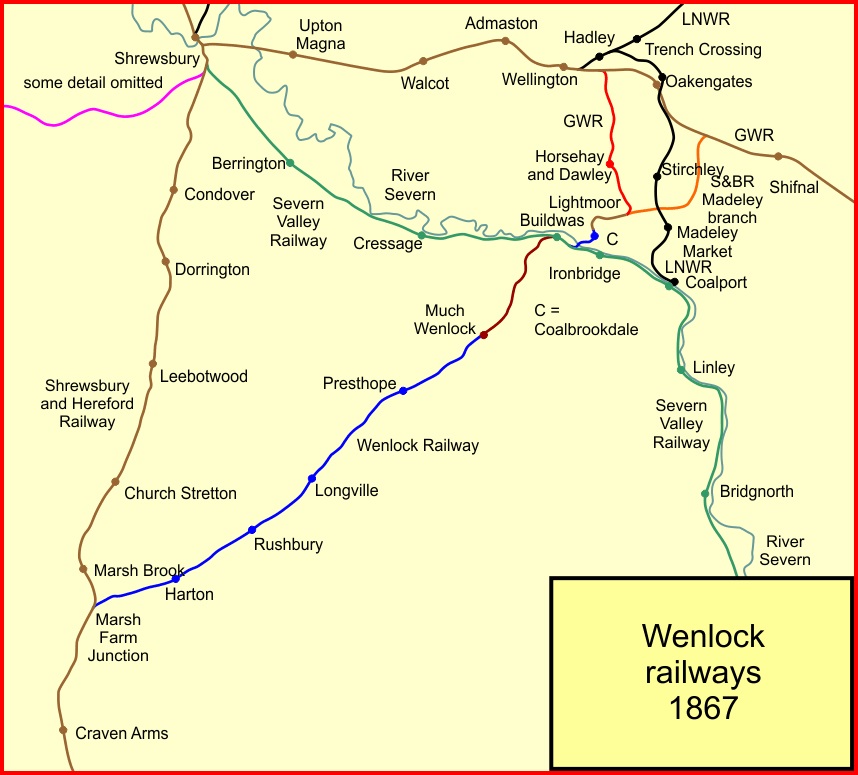
From the commencement of the building of the line between Buildwas and Much Wenlock, the directors hoped that the line could be extended to Craven Arms via Presthope on Wenlock Edge (linking with the limestone quarries/works at that location).

The directors of the Wellington & Severn Junction Railway were, however, fully occupied with the line from Wellington to Buildwas. Another company was set up to build the ‘Wenlock & Craven Arms and Coalbrookdale Extension Railway‘. The bill went through the parliamentary process unopposed and authorised the ‘Wenlock Railway Company‘ to construct the line. Work started on 23rd October 1861.

By 5th December 1864, the line was open from Much Wenlock to Presthope. At this time, because it was a freight-only line, the Board of Trade saw no need for an inspection of the line. It had already been agreed at a meeting held on 4th December 1863 not to proceed with the line from Presthope to Craven Arms for the time being. It was to be three years after the line reached Presthope before the connection to the Shrewsbury & Hereford Railway close to Craven Arms was completed. It was finally opened on 16th December 1867.

Much Wenlock to Presthope

This article focusses on the length of the line which was completed in December 1864 – Much Wenlock to Presthope. Another article will follow the line to the West of Presthope.

We start at Much Wenlock Railway Station.

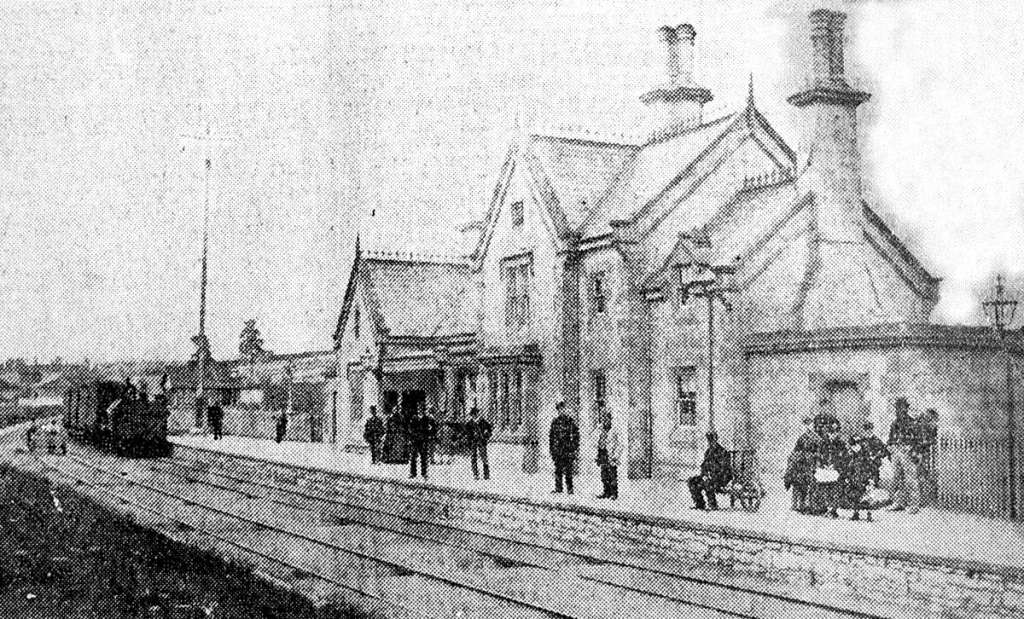
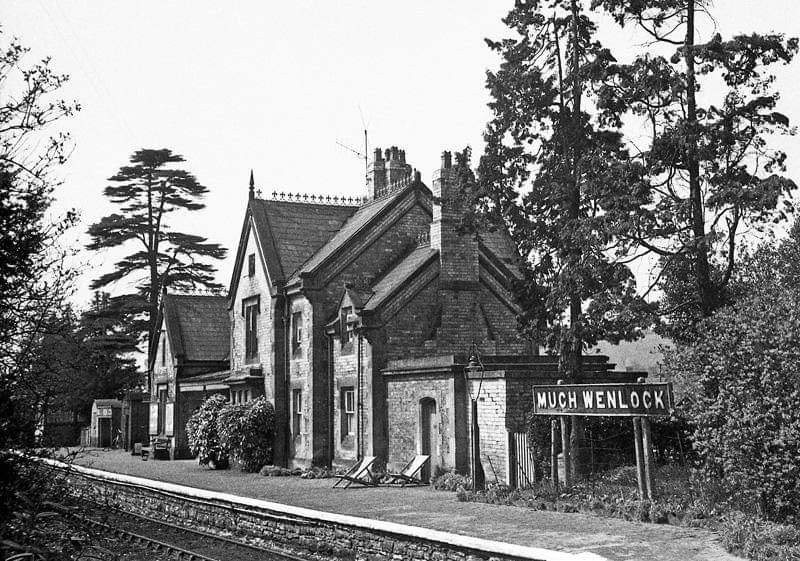
The forecourt of Much Wenlock station in the early 1960s. The building was designed by Joseph Fogerty © R.S. Carpenter. [1: p100]
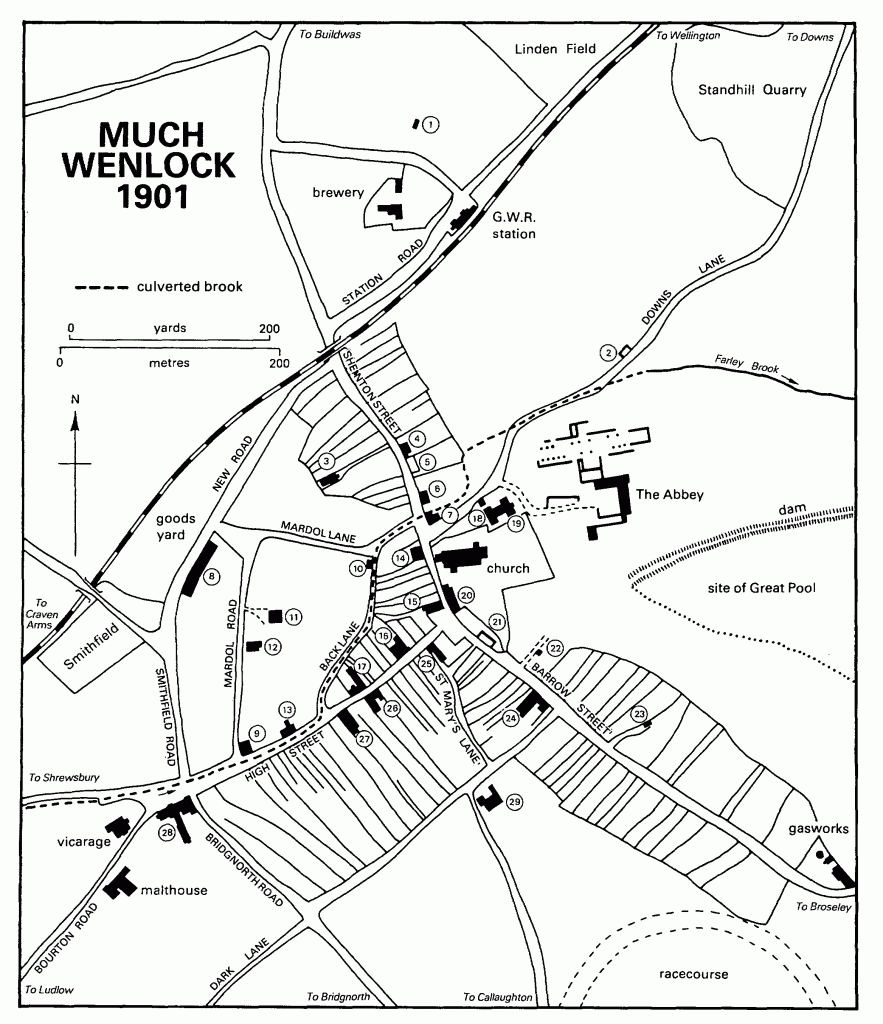
The Wenlock Branch ran across the Northwest side of the town. The railway station was due North of the town centre and was accessed from a loop off  Sheinton Road. Station Road leading up to the Station from close to the railway bridge. [4]
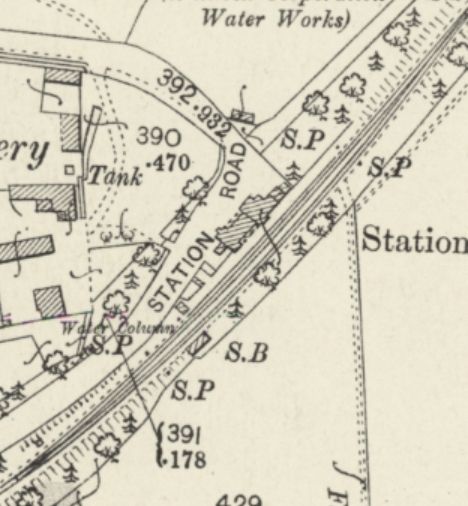
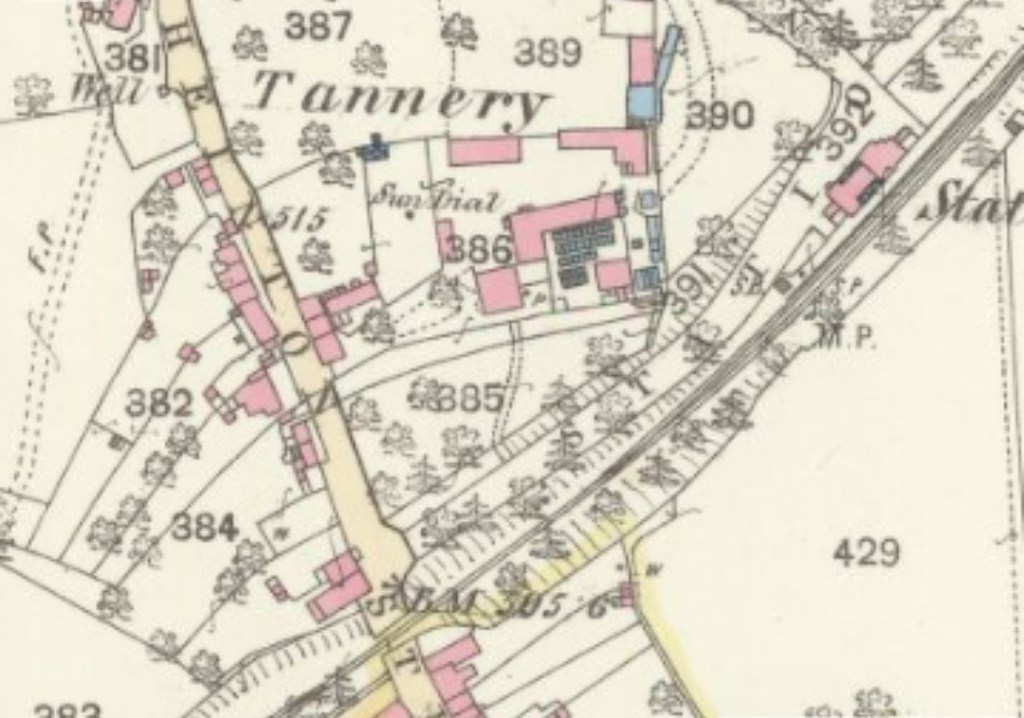
The 25″ Ordnance Survey of 1901 shows Much Wenlock Station with its platform on the Northwest side of the running line and a passing-loop to the Southeast. Partially off the left of the map extract is the town brewery. [5]

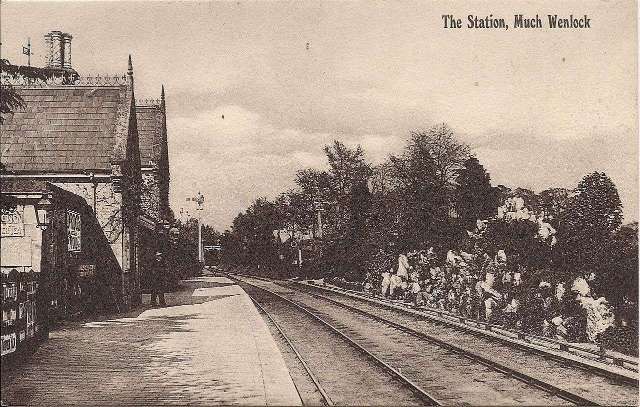
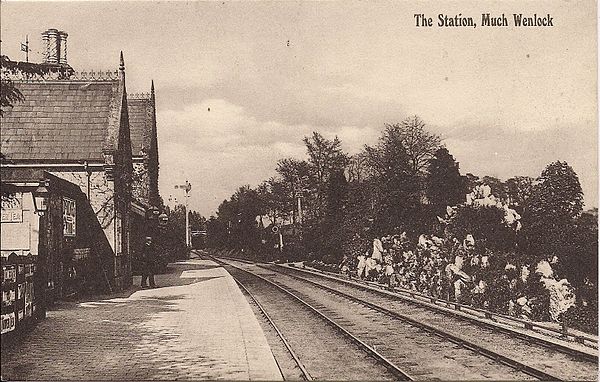
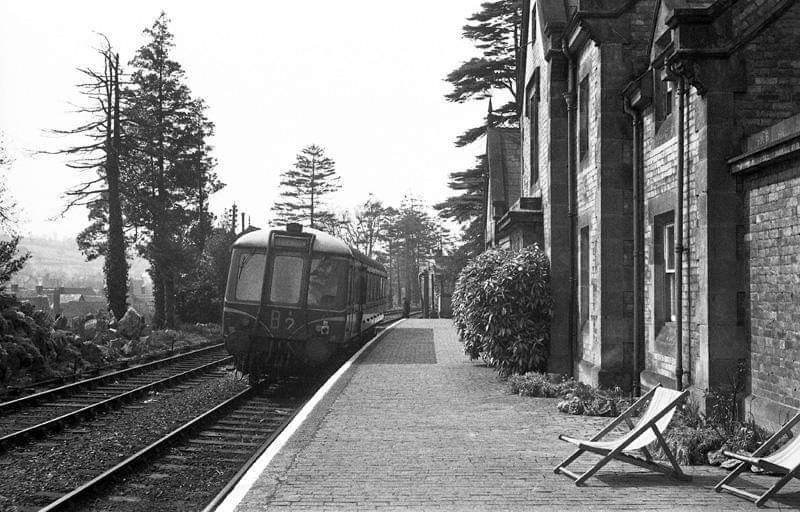
Much Wenlock Railway Station had a single platform adjacent to the main running line. A passing loop was provided opposing the platform, and beyond it there was a rockery garden, “large limestone boulders [were] interspersed with shrubs and alpine plants flanked by a row of rhododendron bushes. In the centre of the rockery was a fountain.” [1: p97]

Much Wenlock Railway Station in the very early 20th century. The passing-loop and the adjacent rockery garden are on the right of the image. The photograph looks Northeast through the station. [7]
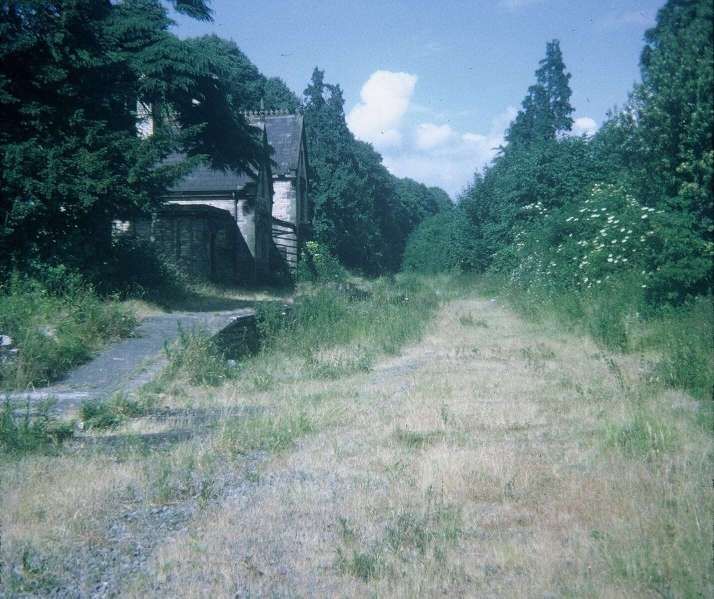
The photographer is standing on the running line a few steps further to the Southwest. This photo was taken on 12th July 1969 by David Hillas and is used here under a Creative Commons Licence (CC BY-SA 2.0 DEED). [8]
The length of the station site as shown on Railmaponline.com. The running line is shown in green with a single line indicating the location of the Goods Yard. [12]
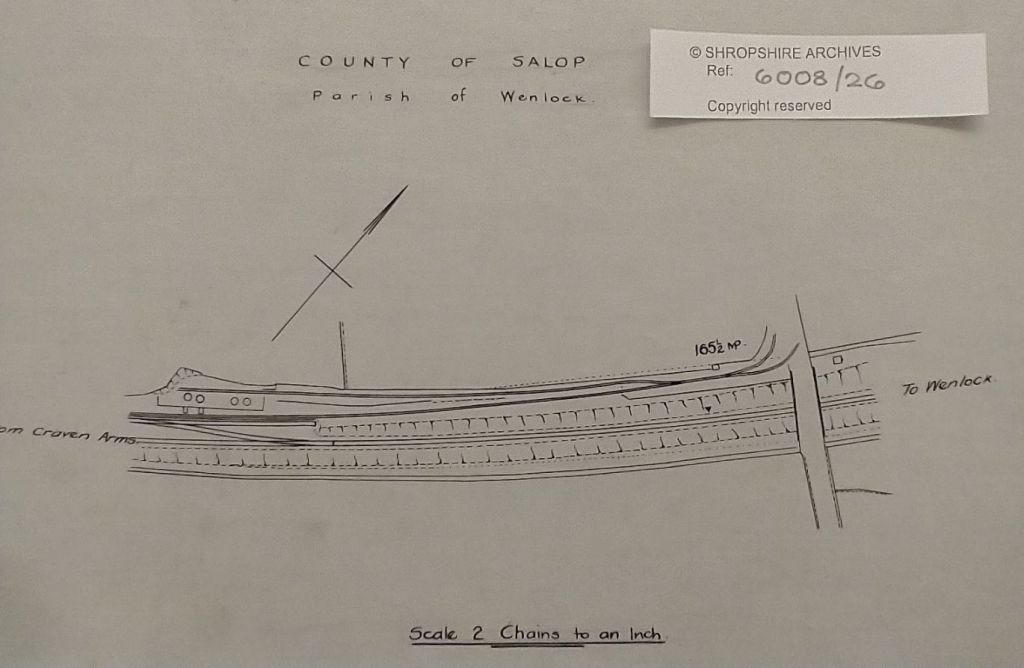
This is a first extract, in this article, from the pre-contract plans of the Much Wenlock line which are held in the Shropshire Archives in Shrewsbury. It shows the full length of the station facilities (passenger and goods) at Much Wenlock. It shows approximately the same length as the RailMapOnline image above. The Station building was on the West side of the line and North of the bridge which carried the line over what became the A4169. The goods yard was South of the bridge on the East side of the line. … As we have noted in the article about the line between Buildwas and Much Wenlock, these precontract plans were orientated in respect to the North point so as to get the greatest possible length of the proposed railway onto each sheet,, © Shropshire Archives Ref. No. 6008/26 copyright reserved, used by kind permission. [9][My photograph of the plan, 5th August 2022]

Trains leaving for Craven Arms crossed Sheinton Road/Street Bridge and passed the goods shed and yard on the left and then the engine shed. When the line terminated at Much Wenlock, the goods facilities used until the final closure of the line were the temporary railway station.

A view Northwest along Sheinton Street taken outside number 19 Sheinton St. It is included here for the view of the railway bridge over the road and was taken in the first half of the 1960s. This image was shared on the Much Wenlock Memories Facebook Group by Lynne Steele on 10th April 2021. [10]
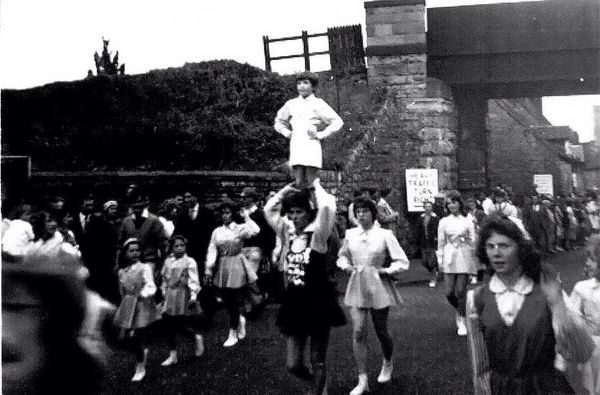
A view Southeast along Sheinton Street showing one of the carnival walks in Much Wenlock probably in the mid-60s. It is included here for the view of the railway bridge which span the road. This image was shared on the Much Wenlock Memories Facebook Group by Colin Onions on 2nd February 2015. [11]
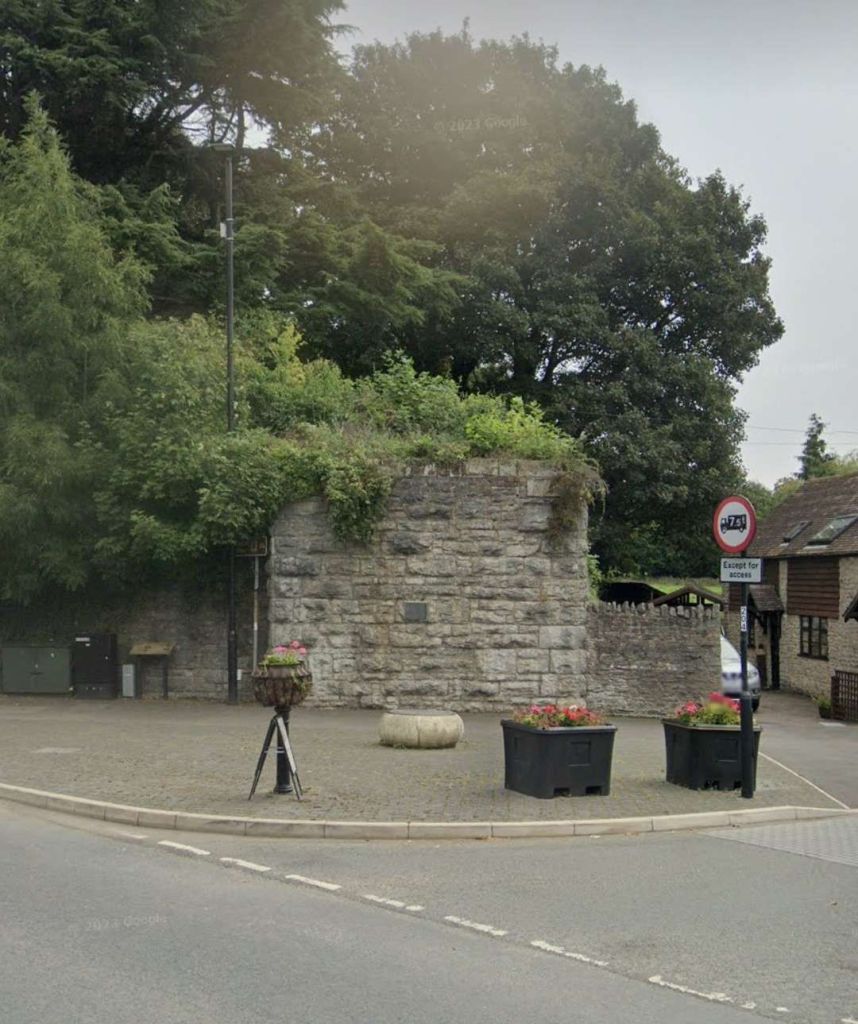
Looking Northeast along the line of the old railway towards the passenger Station from the approximate location of the second abutment of the railway bridge. Just the one abutment remains, the other having been removed to facilitate a road realignment. The road from Buildwas (Sheinton Street) becomes New Road at this point with Sheinton Street heading away to the right of the image. [Google Streetview, August 2023]
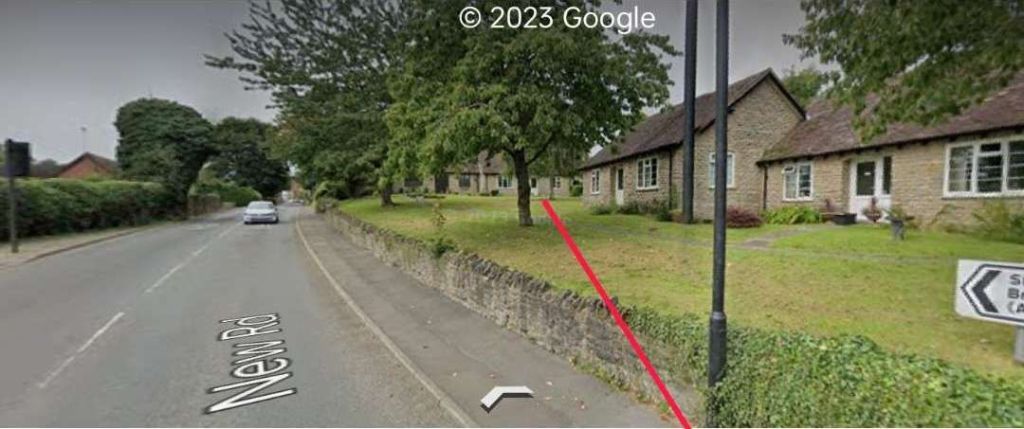
This is the view when the camera is turned through 180°. The approximate line of the old railway is marked, in this case, by the red line. New Road and the route of the railway diverged and provided space for what became the Goods Yard and for a coal depot which, in the early 21st century is occupied by a builders merchant (Travis Perkins). [Google Streetview, August 2023]
Looking Southwest along Southfield Road. The hedge line on the left of this image is approximately on the line of the old railway. [Google Streetview, 2009]
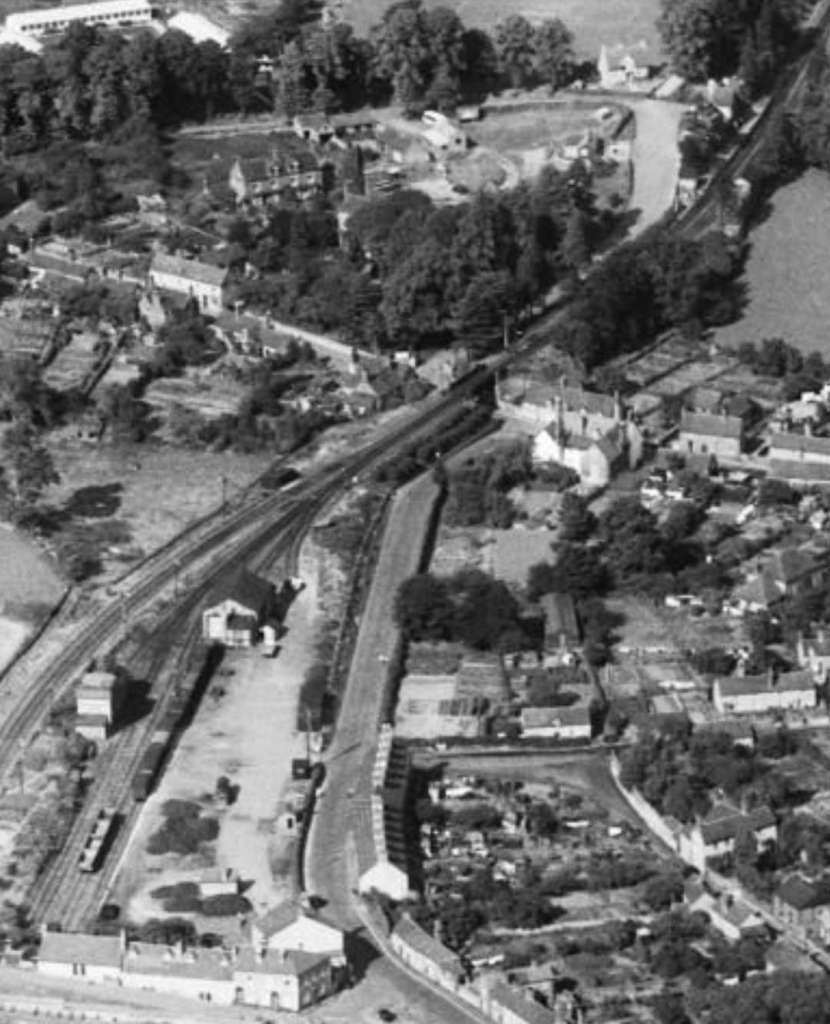
Much Wenlock Goods Yard. Centre-left are the cattle pens and grain store. The grain store is attached to the good shed. On the right is the engine shed with the water tank. The water tank was fed by a reservoir further Southwest along the line – about halfway to the next halt, Westwood Halt, © Shropshire Museum Service [1: p101]
The goods yard, viewed from the Southwest the line in the foreground is the main running line which claims along the flank of Wenlock Edge. The good yard was, for a short time, the terminus of the line after the partial opening on 1st February 1862 © Pat Garland. [1: p101]

Trains began the climb towards Wenlock Edge. The pictures above show the climb had already begun alongside the goods yard. Neither the goods shed nor the engine shed remain in the 21st century.

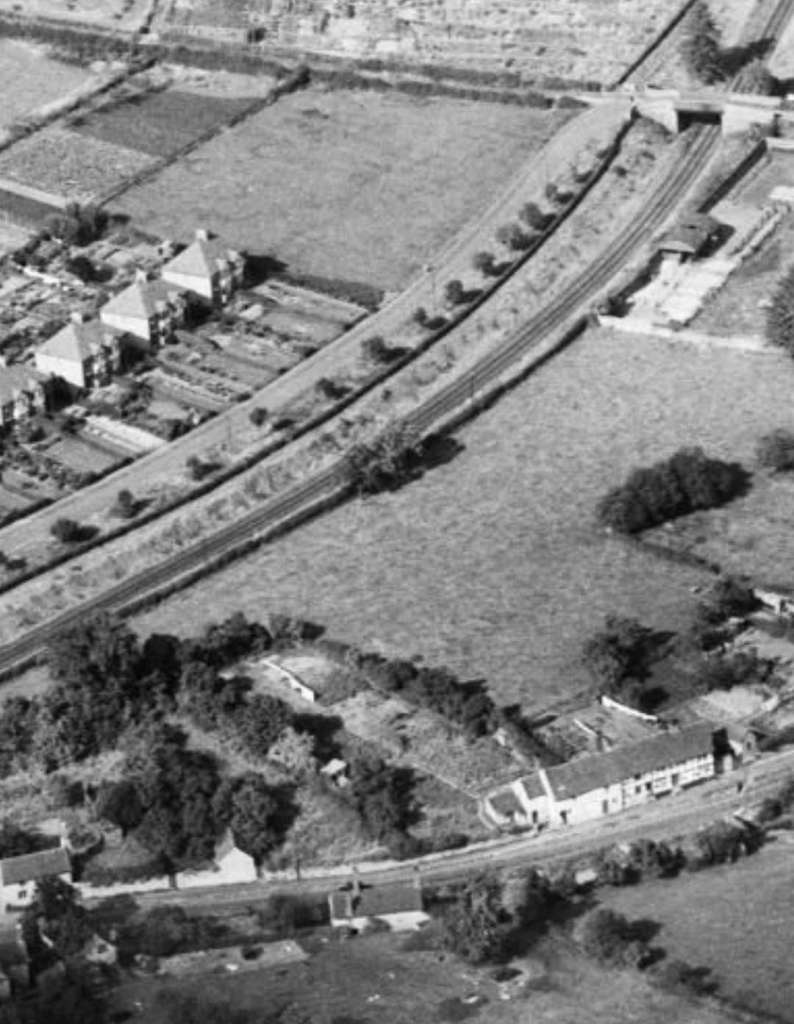
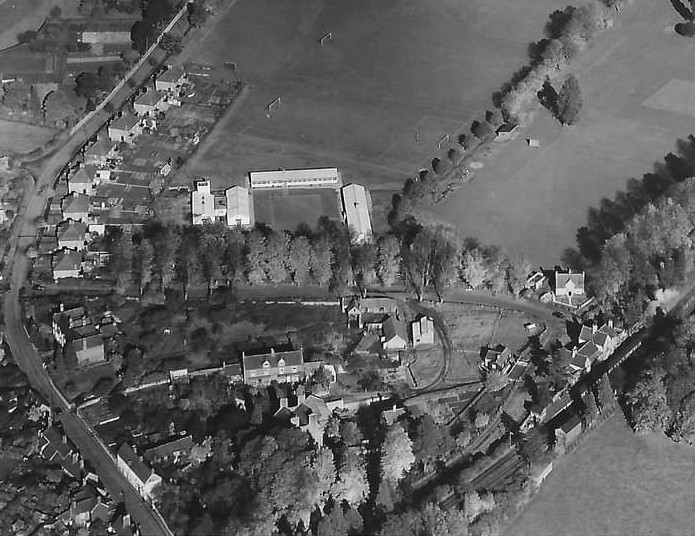
This aerial view is taken looking North across Much Wenlock (EAW046197 © Heritage England). The station goods yard is prominent approximately at the centre of the image, with Sheinton Street and the railway bridge separating the yard from the passenger facilities in the top-right of the image, and the bridge carrying Bridge Road over the line at the bottom-left. [3]
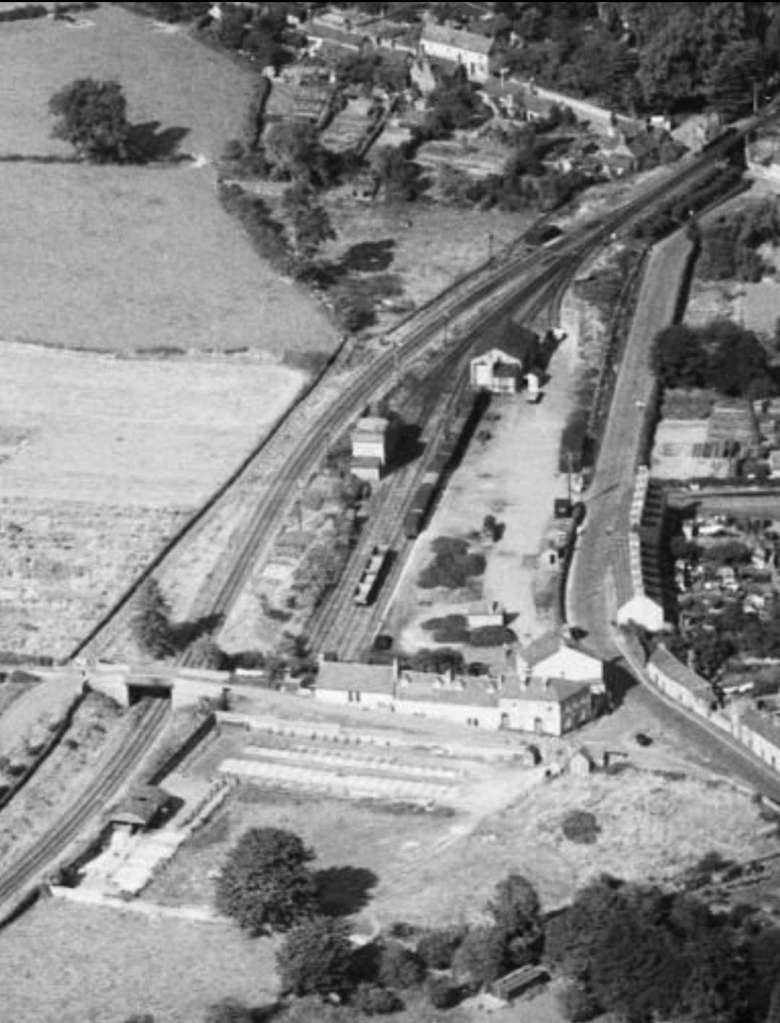
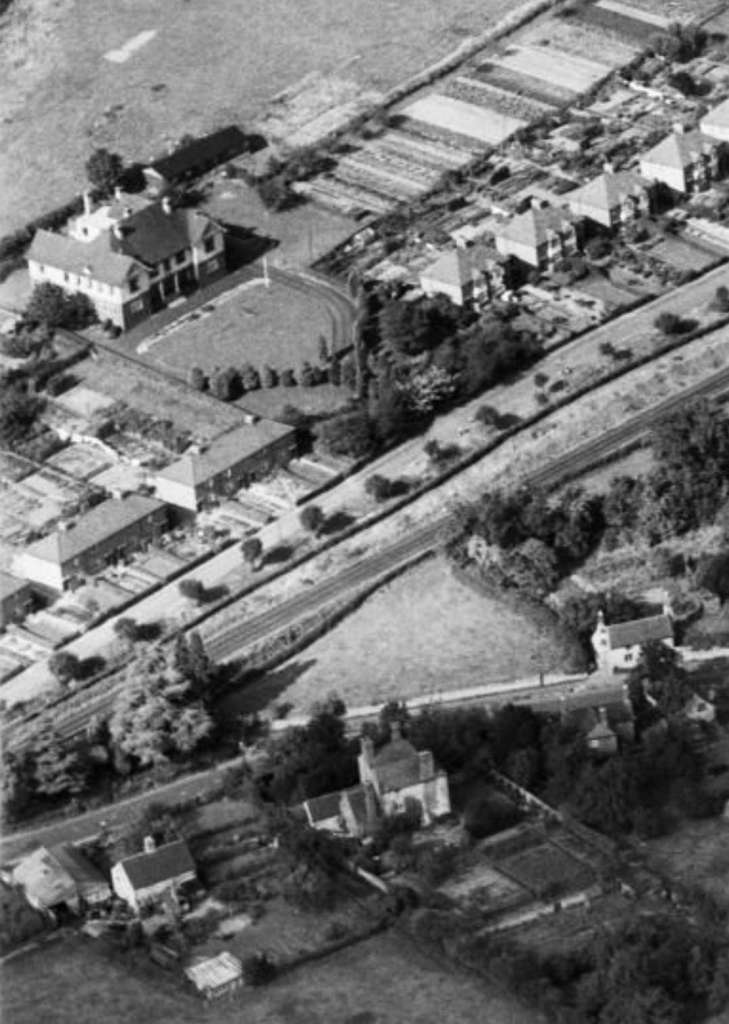
This extract from an aerial image (EAW046196 © Heritage England) shows the full length of the station facilities at Much Wenlock. The passenger Station building is visible top-right, the goods yard and engine stabling facilities, bottom-left. Between the two Sheinton Street passed under the railway. [2]
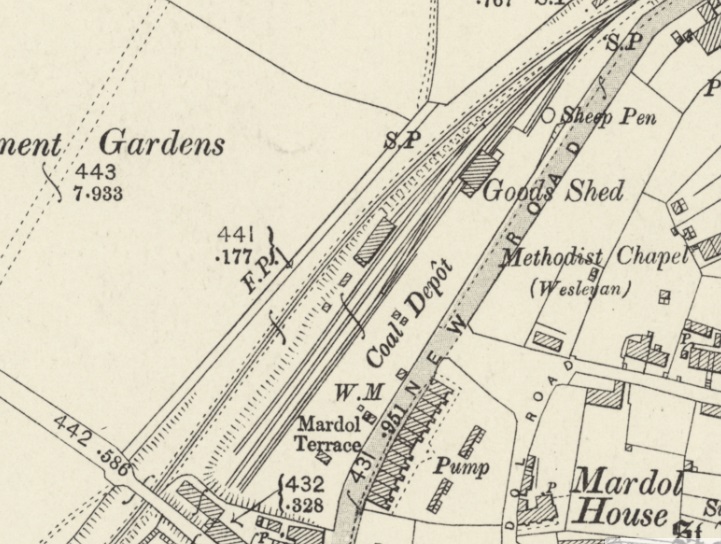
New Road ran along the Southeast side of the Goods Yard. The Goods Shed and the Engine Shared appear on this additional extract from the 25″ Ordnance Survey of 1901. A coal depot sat between the road and the sidings in the yard. The road bridge is at the top-right of the map extract. Bottom-left as the running line leaves the map extract it passes under Bridge Road. The bridge here was simply-supported cast iron beams on masonry abutments. [6]
Another extract from the same aerial image centres on the goods yard with the running line to the left and passing under the cast iron bridge carrying Bridge Road. New Road runs down the right side of the picture. [2]
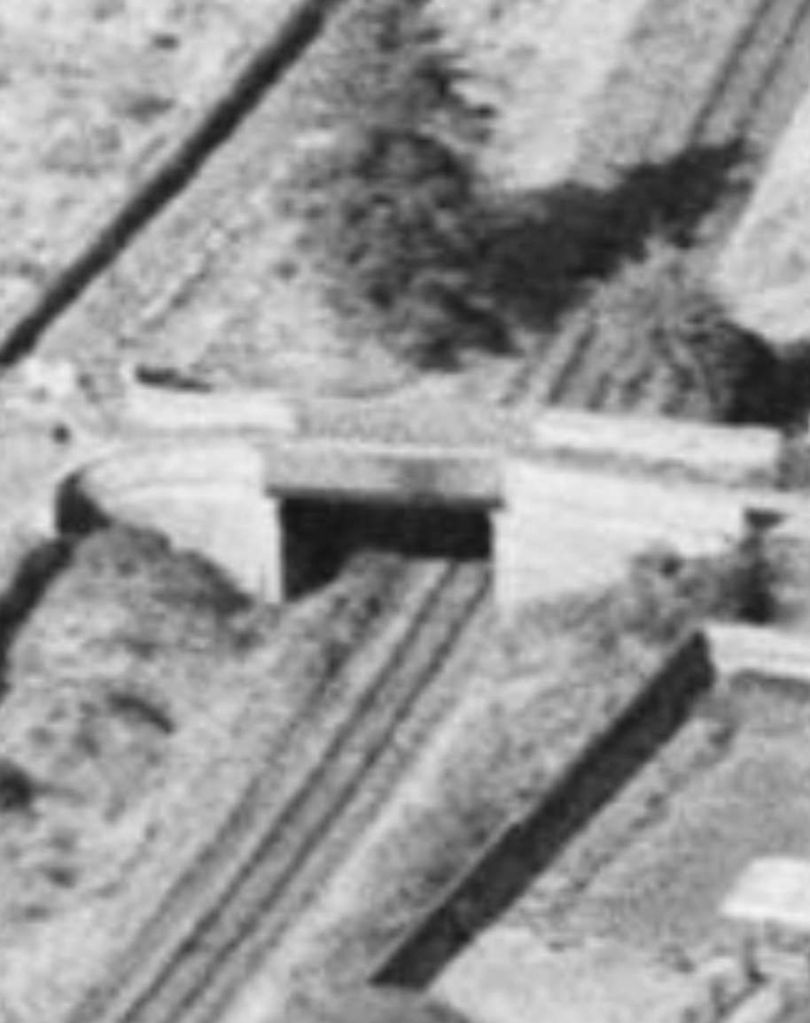
A closer view of the cast iron bridge carrying Bridge Road over the railway. This is an enlargement from the same aerial image. [2]
Looking Southwest from Southfield Road. The main structure of the bridge is still evident in the early 21st century. [Google Streetview, 2009]
Looking Southeast at the other elevation of the cast-iron bridge. The partial infill is much closer to the soffit on this side of the bridge. [Google Streetview, 2009]
Looking North over the bridge parapet from Bridge Road. The old railway ran parallel to Southfield Road in the grass area at the centre of the image. [Google Streetview, 2009]
Looking West over the bridge parapet from Bridge Road. The old railway ran parallel to Southfield Road in the grass area at the centre of the image. [Google Streetview, 2009]
Southwest of Bridge Road, Southfield Road ran parallel to the old railway as it climbed along the Northwest side of the town. Victoria Road can be seen at the bottom of this image. [2]
The line continued in a southwesterly direction. Southfield Road ran alongside it. Victoria Road can be seen at the bottom of this image. It passed under the railway a short distance beyond the edge of the aerial image which is also the left edge of this extract. [2]
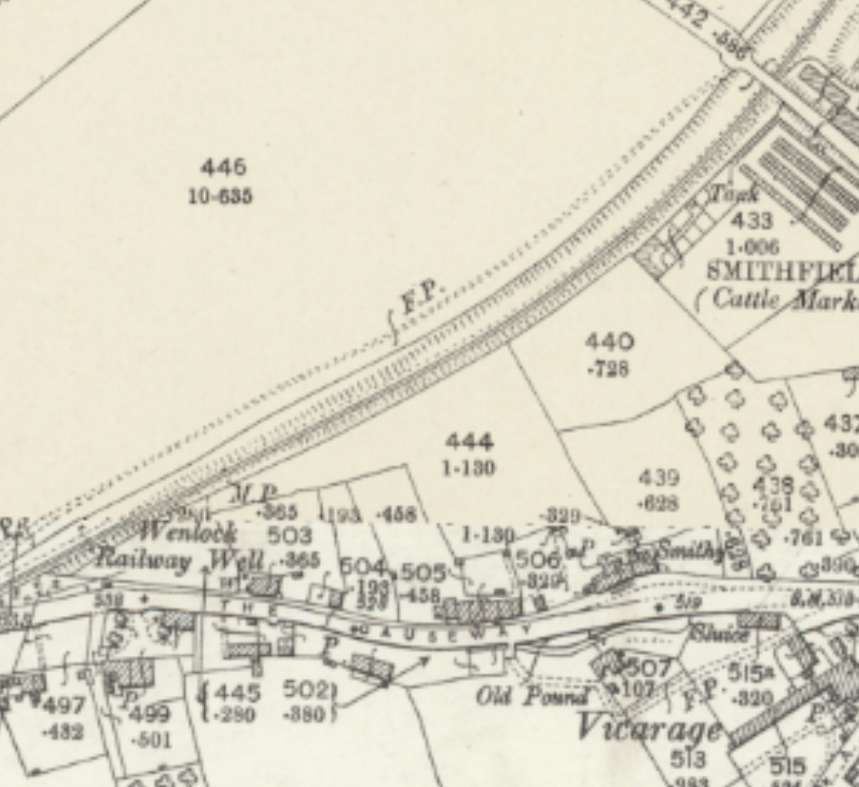
The next length of the railway appears on this extract from the 25″Ordnance Survey of 1901. Bridge Road bridge is top-right and the road to Shrewsbury runs East-West across the bottom half of the image. In 1901, this was known as ‘The Causeway’. It became the A458, Victoria Road. [14]
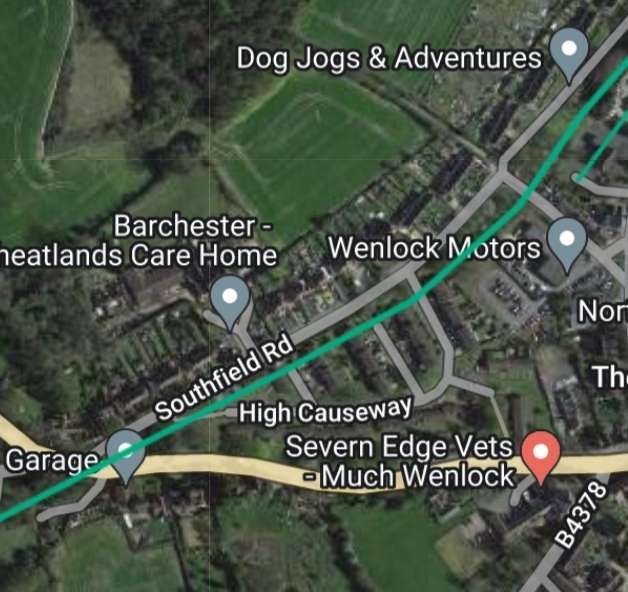
Approximately the same length of the railway as shown in the map extract above, but now on the satellite imagery from ralmaponline.com. The primrose yellow line shows the route of the A458, Victoria Road. [12]
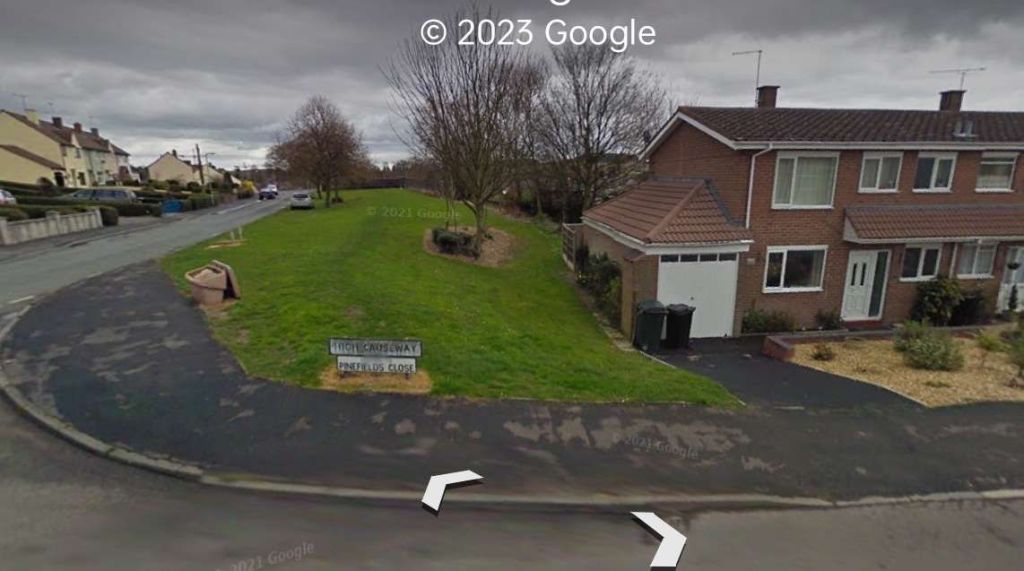
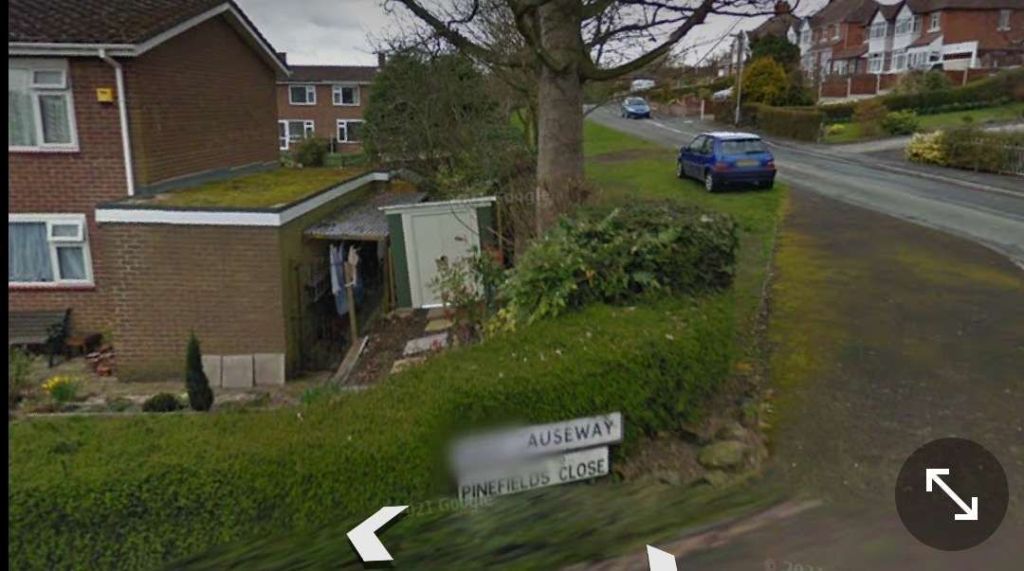
Looking back Northeast towards Much Wenlock Railway Station from High Causeway. Southfield Road is on the left. The housing estate has been built over the Goods Yard. [Google Streetview, 2009]
Looking Southwest along the line of the old railway. Southfield Road is on the right. The railway
This and the next three OS map extracts cover the first part of the climb out of Much Wenlock the bridge over the A458 is at the top-right of this map extract. [15]
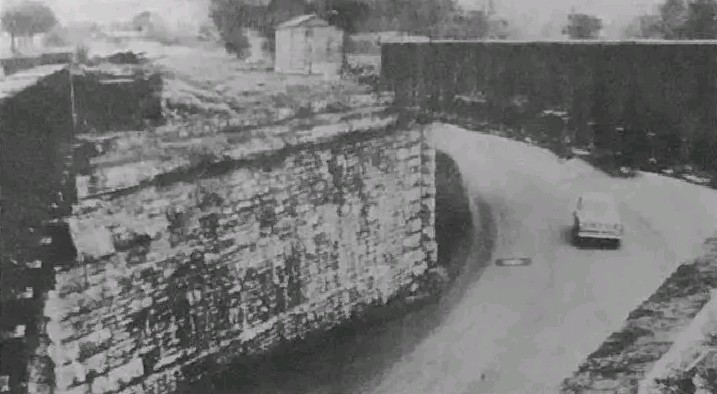
The bridge over what is now the A458 in the midst of its demolition at the end of the 1960s. This image looks Northeast along the railway formation towards Much Wenlock Station and Goods Yard. It was shared on the Much Wenlock History Facebook Group by Linda West on 2nd April 2020. [18]
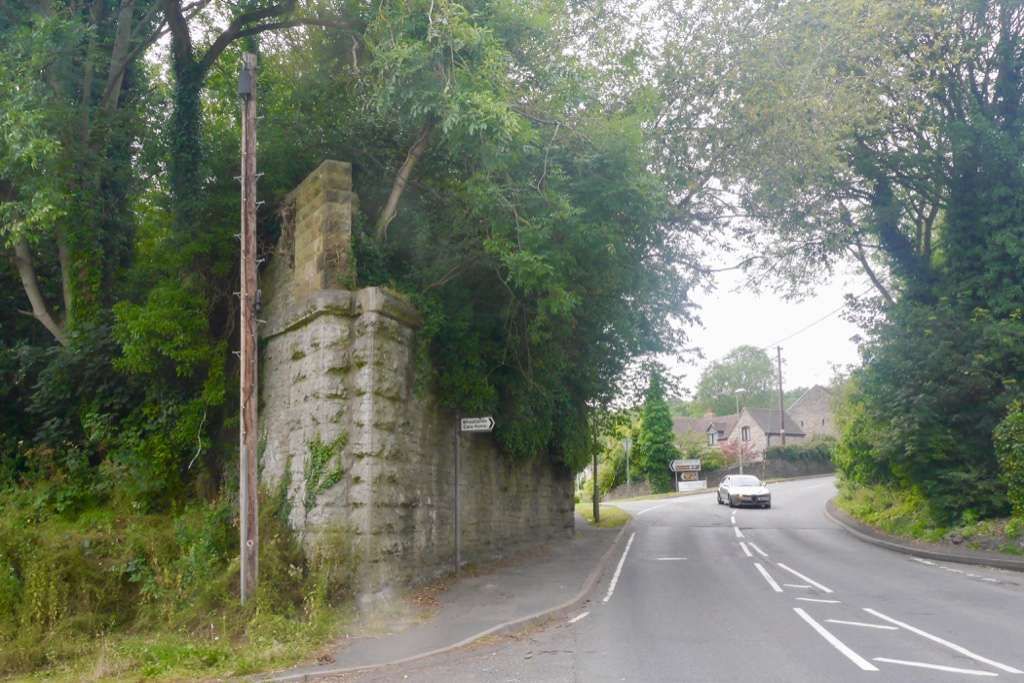
The remaining abutment of the bridge which carried the Wenlock Branch over Victoria Road (A458), © Richard Webb and licenced for use under a Creative Commons Licence (CC BY-SA 2.0 DEED). [20]
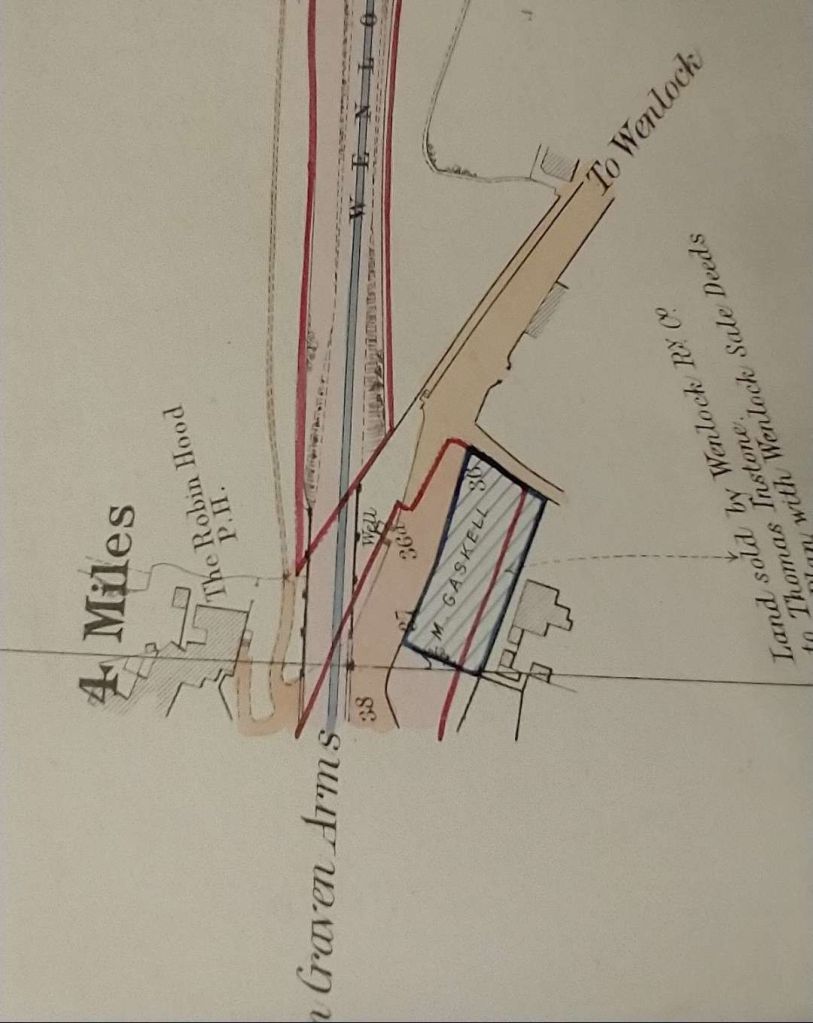
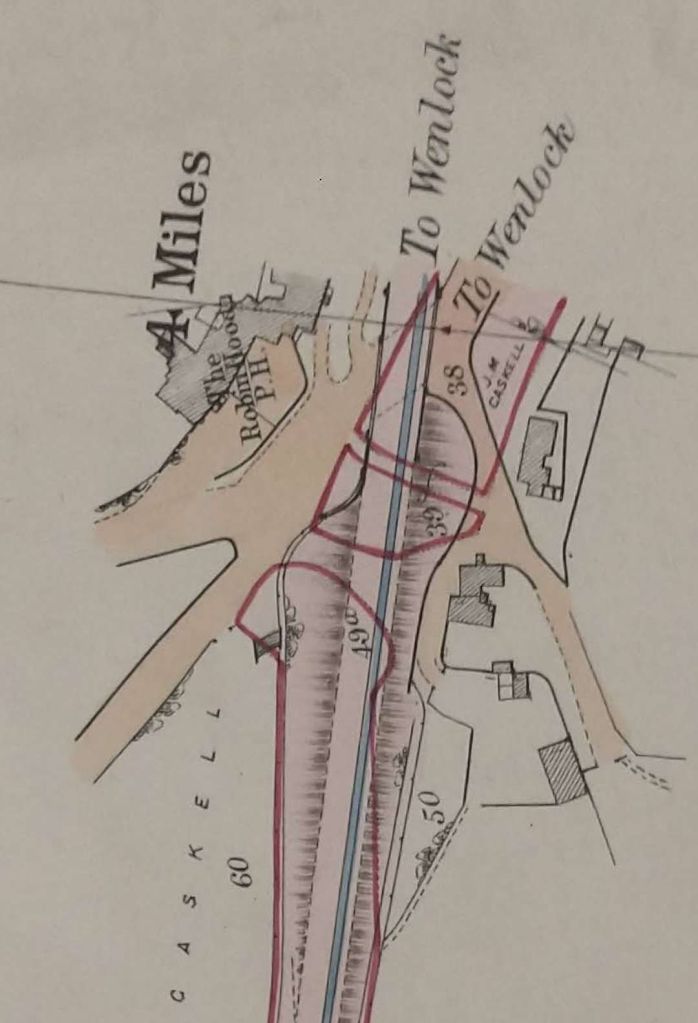
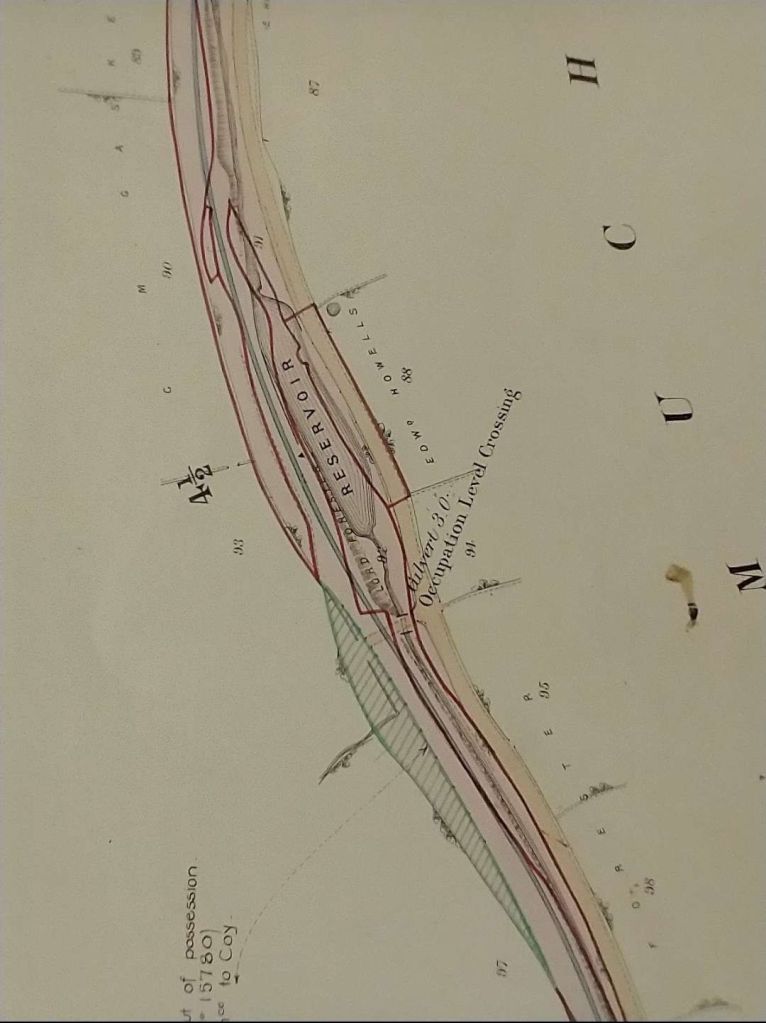
These two images are extracts from the pre-contract drawings of the Wenlock Branch. The girder bridge which spanned the road at this location was almost exactly 4 miles from Buildwas Junction and fell, in these drawings at the edges of two drawings. Both are reproduced here because they have something to contribute to local information. Perhaps of greatest significance for the railway was the fact that the bridge was constructed allowing for the possibility of providing an additional line, if traffic volumes made it worthwhile. These pre-contract plans were orientated in respect to the North point so as to get the greatest possible length of the proposed railway onto each sheet, © Shropshire Archives Ref. No. 6008/26 copyright reserved, used by kind permission. [9][My photograph of the plan, 5th August 2022]
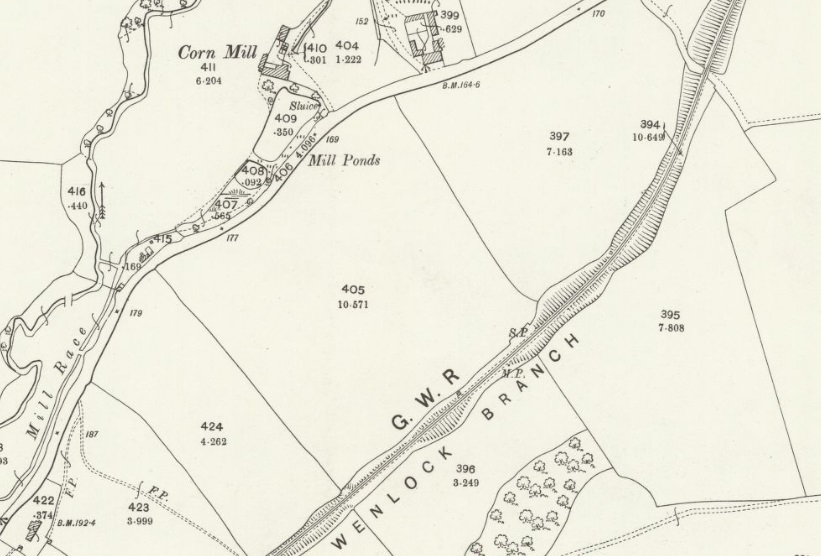
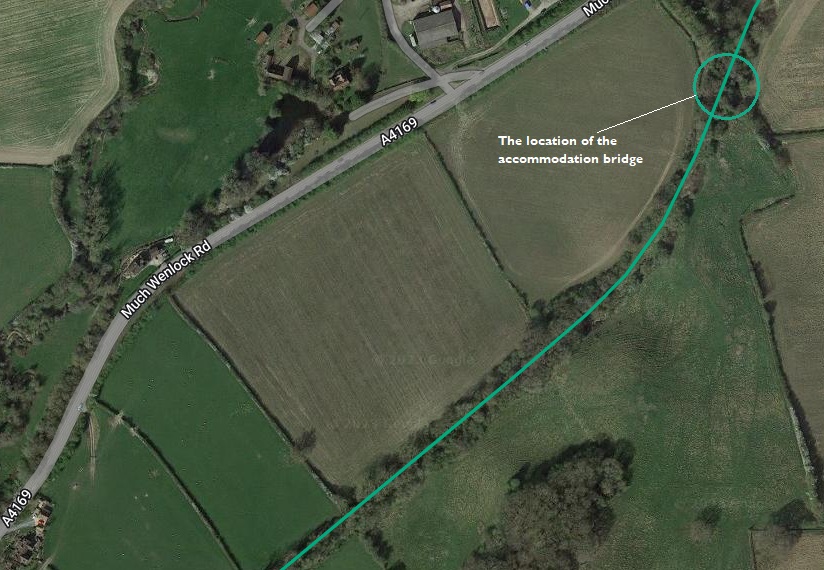
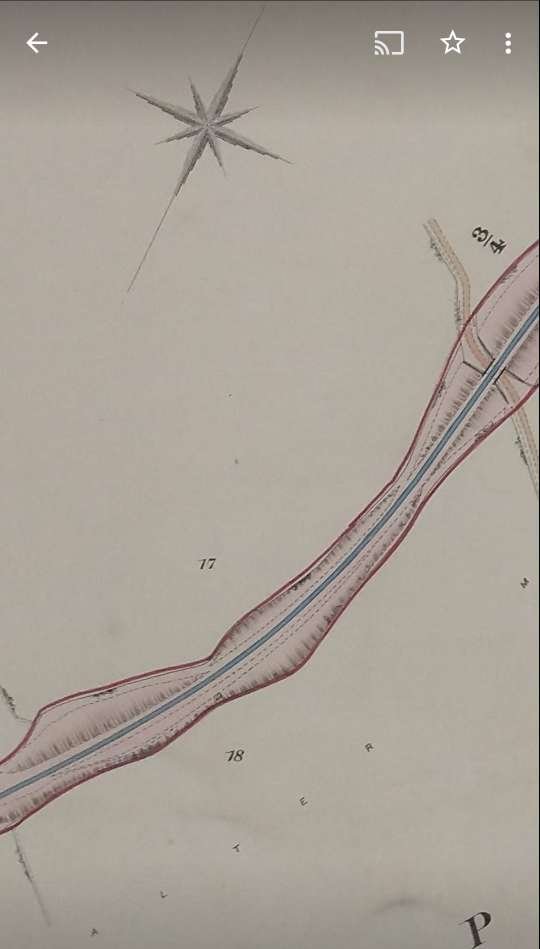
The next length of the line continued in a Southwesterly direction. After passing under an accommodation bridge, it began to turn to the South. [13]
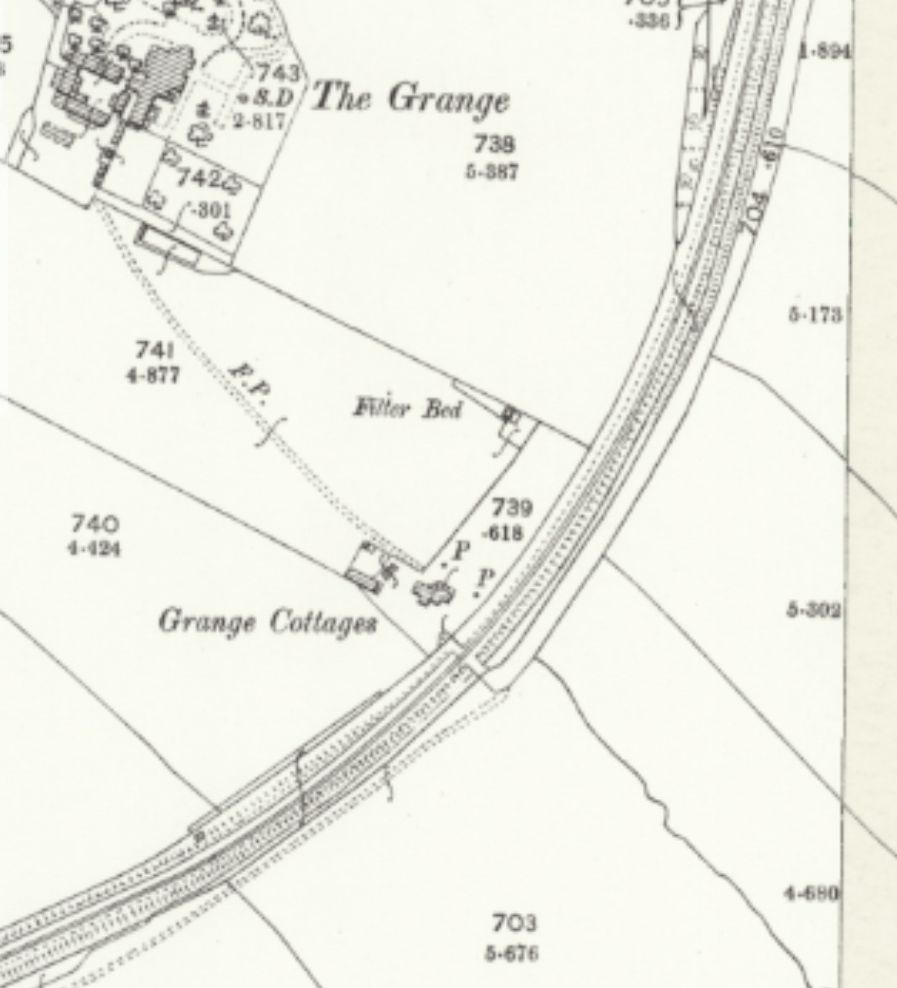
The reservoir which appears on this OS map extract on the East side of the line was used to provide water for the column at Much Wenlock Station. [1: p97] [16]
The reservoir which supplied the water column at Much Wenlock Station was around half a mile beyond the bridge over the A458. These pre-contract plans were orientated in respect to the North point so as to get the greatest possible length of the proposed railway onto each sheet, © Shropshire Archives Ref. No. 6008/26 copyright reserved, used by kind permission. [9][My photograph of the plan, 5th August 2022]
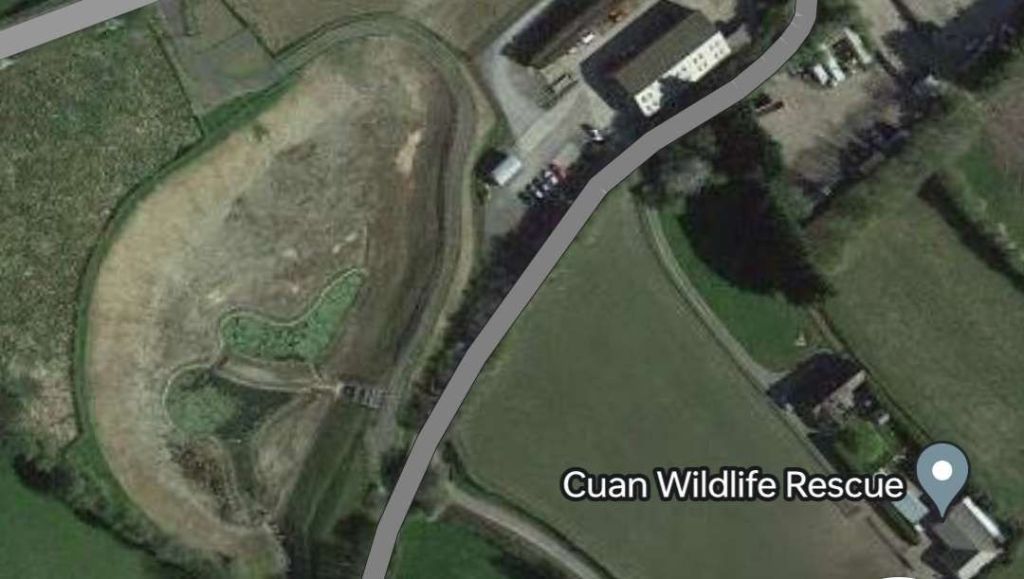
The reservoir as it appears in the 21st century. It has been extended and has varying levels over time suggesting that it may be used as a balancing pond to moderate the flow on the stream which follows the old railway line and which appears to now follow the old railways route in an improved channel to the Southwest of the reservoir. The track shown in this extract from Google Maps continues a short distance to the South before crossing both the stream and the old railway route.A footpath continues alongside the old line to the East. [Google Maps, 13th January 2024]
Curving round again towards the Southwest, the line passed Grange Cottages. [17]
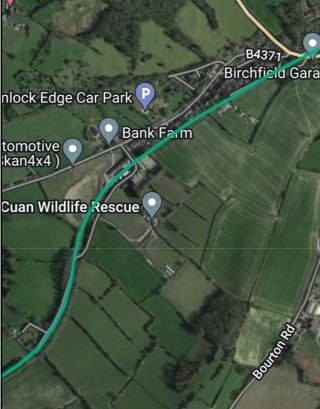
This railmaponline.com satellite image covers the same length of line as the last four OS Map extracts. [12]
The first road overbridge to the West of Much Wenlock. This view looks Southwest along the line of the old railway. The bridge carries a track which leaves the B4371, Stretton Road in a southerly direction and provides access in the 21st century to the Cuan Wildlife Centre. [My photograph, 12th January 2024]
The view Northeast from the overbridge. The old railway route is now followed by a line of conifers on its North side. [My photograph, 12th January 2024]
The view Southwest over the parapet of the same bridge. The warehouse is built over the old railway line. [My photograph, 12th January 2024]
Looking Northeast again for a point beyond the warehouse in the last picture. The warehouse sits over the line of the old railway which continued Southwest to the left of the green palisade fencing on the left side of this image. The track in the centre of the image runs parallel to and to the South of the line of the railway. [My photograph, 12th January 2024]
Looking back Northeast along the route of the old railway. The gate towards the back of this photo straddles the centre-line. The gardens associated with Grange Cottages now extend across the line of the railway. [My photograph, 12th January 2024]
Looking Southwest along the line of the old railway from the fence line of Grange Cottages garden. The gate across the line of the old railway indicates that the next length is also in private hands. A public footpath runs to the left of the tree line
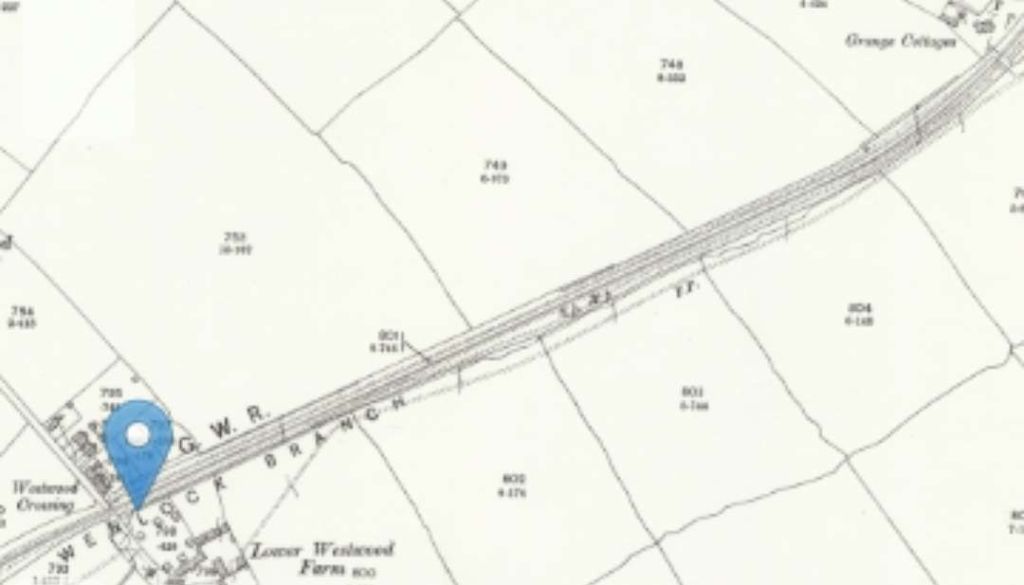
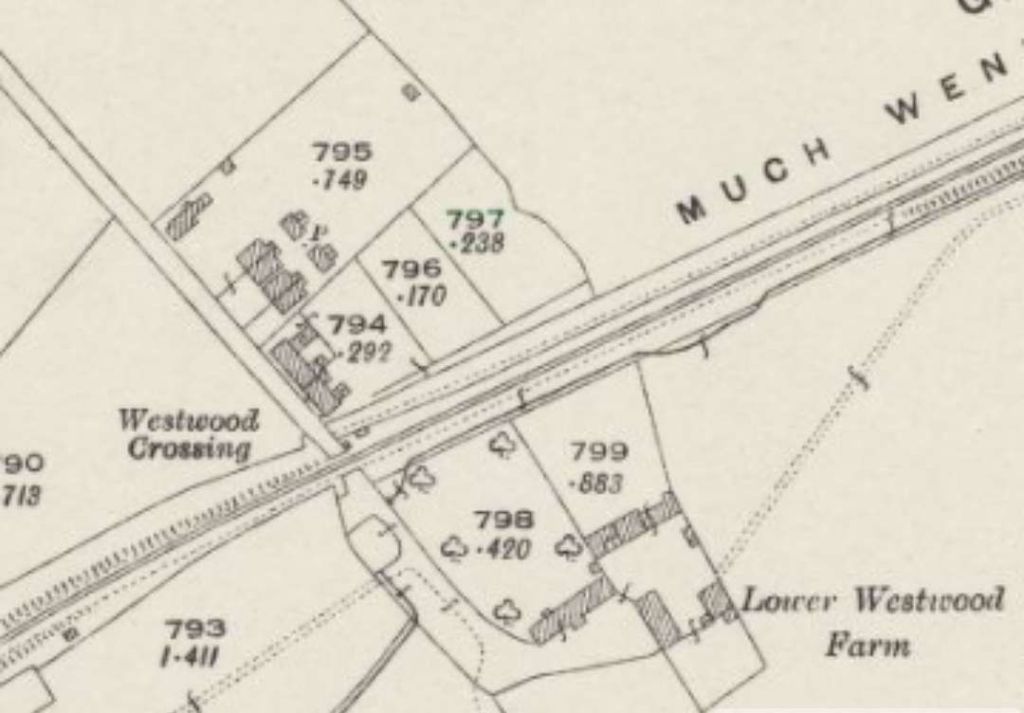
This next extract from the OS mapping of 1901 takes the line as far as the location of Westwood Halt which was at the location marked by the blue flag above. [21]
A closer view of the location of the Halt in 1925. The 25″ OS mapping indicates that the Halt was not built by 1925. [22]
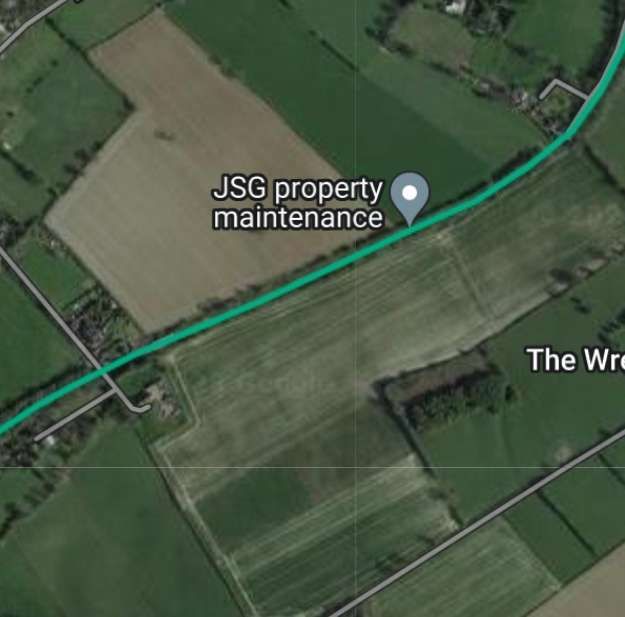
The length of the old railway between Grange Cottages and Westwood Halt as shown on the satellite imagery from railmaponline.com. [12]

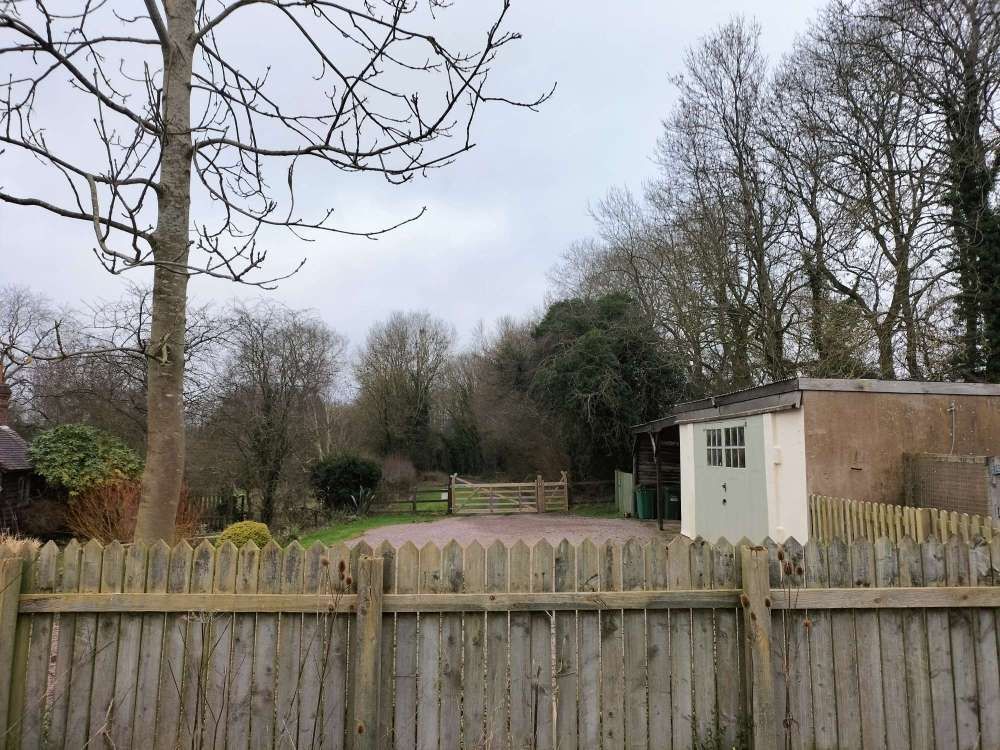
That length is in private hands with a significant length in use as a paddock for horses and a small holding.

Westwood Halt in around 1960 – seen from the East. The single platform sat on the North side of the line immediately to the East of Westwood Crossing. It was not until 7th December 1935 that the Halt opened. It closed to passenger traffic on 31st December 1951. This picture was shared on the Much Wenlock Memories Facebook Group by Judith Goodman on 8th December 2020. The photographer is not known and the image is used under a Creative Commons Licence (CC BY-SA 4.0). [19]
Google Maps image of the site of Westwood Halt. [Google Maps, 12th January 2024]
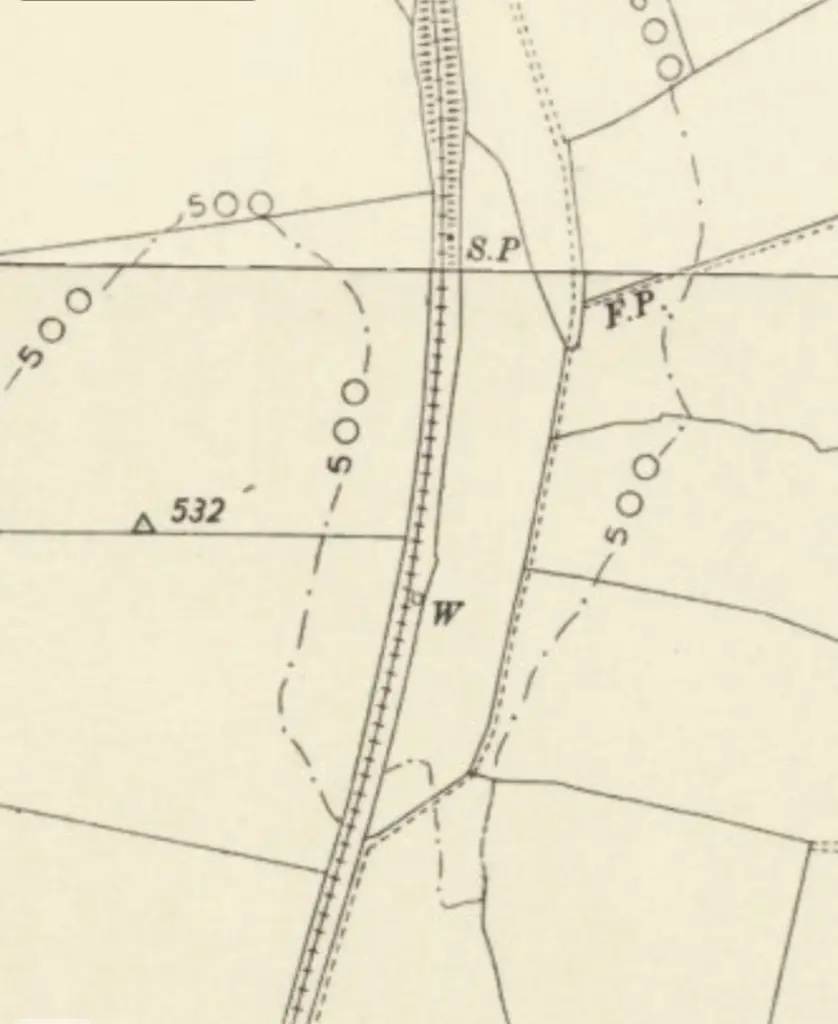
Westwood Crossing seen from the North. The red line marks the approximate centre-line of the old railway. The Halt would have been off to the left of this image. [Google Streetview, 2009]
Looking Northwest from Westwood Crossing towards the B4371. [My photograph, 12th January 2024]
Looking Southeast from the location of Westwood Crossing. It is not possible to follow the route of the old railway to the West of this location as it is in private hands. To continue following the route requires a diversion along the footpath ahead, across one field to join another track and then heading back Northwest towards the olod line. [My photograph, 12th January 2024]
The line leaving Westwood Crossing and heading towards Presthope. [My photograph, 12th January 2024]
Westwood Crossing to the next overbridge, as shown on the 25″ Ordnance Survey of 1901. [22]
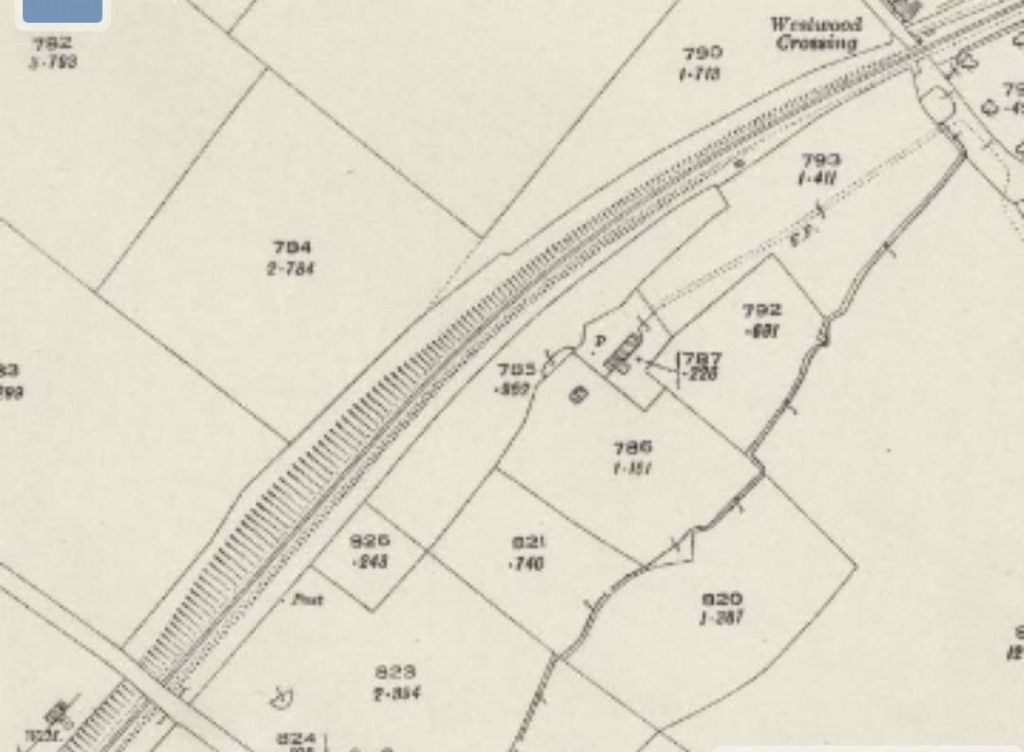
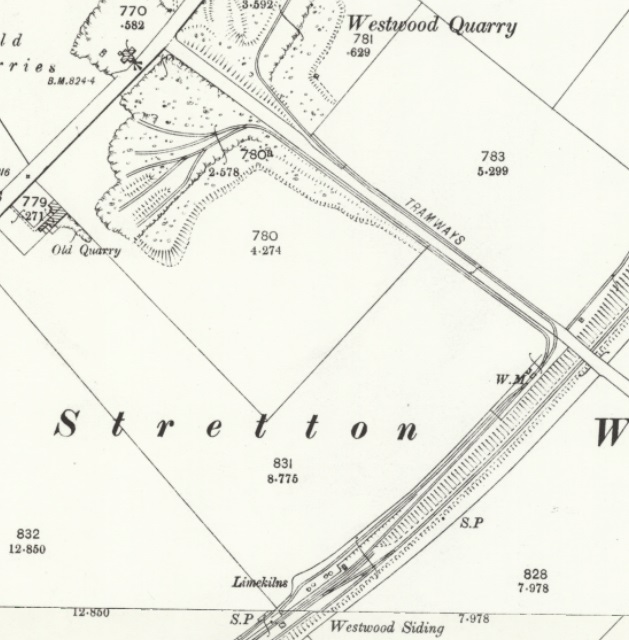
Within a couple of hundred yards, trains passed Westwood Sidings. The sidings served Westwood Quarry. There were ground frames controlling access at each end of the siding. [23]

When the Wenlock Branch opened “limestone was being extracted [at Westwood Quarry] for use in the Madeley Wood Company’s furnaces. Horse-drawn tramways ran from the quarry on to a loading ramp above the sidings.” [1: p97]

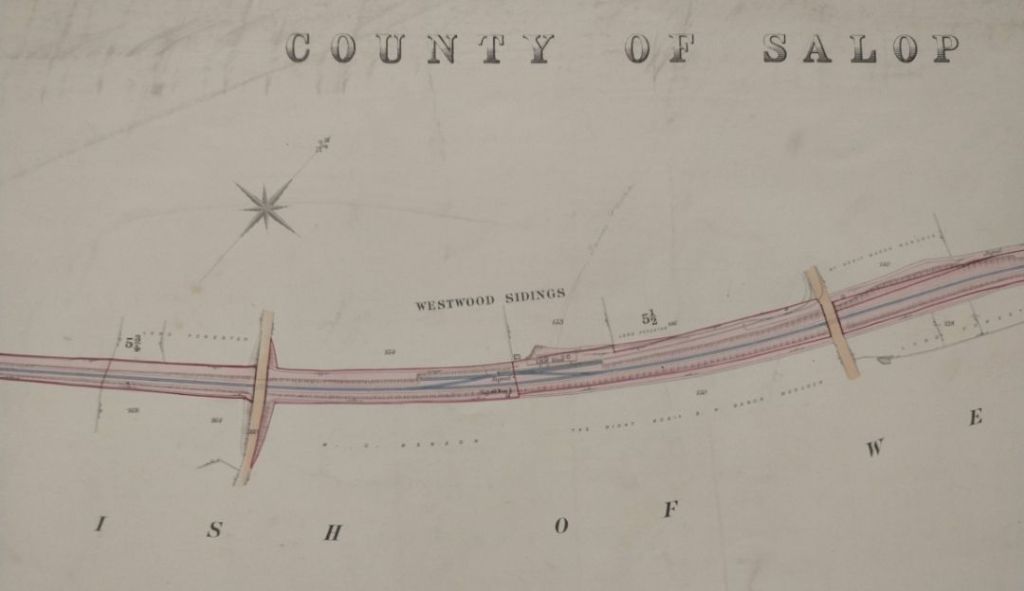
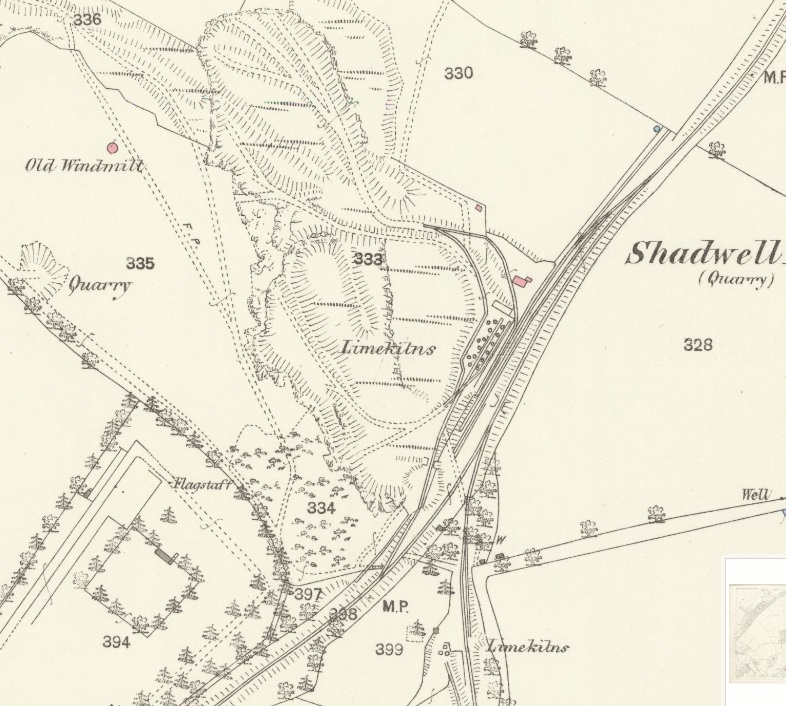
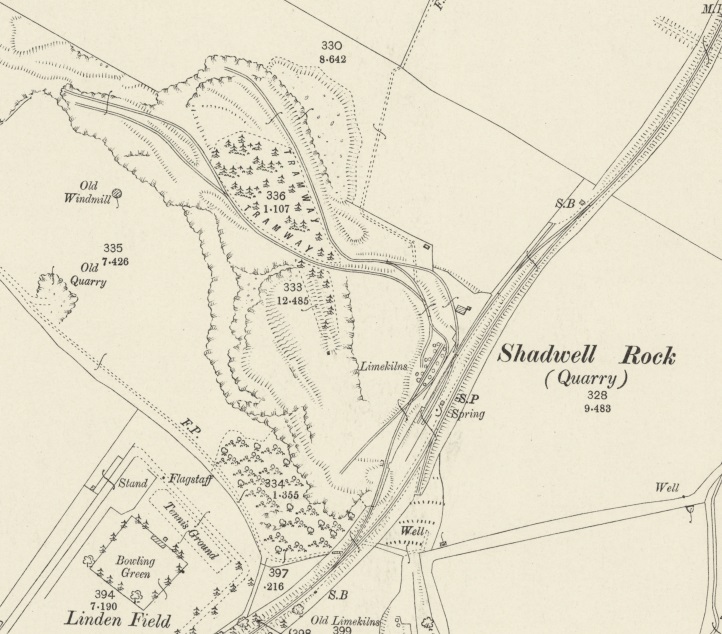
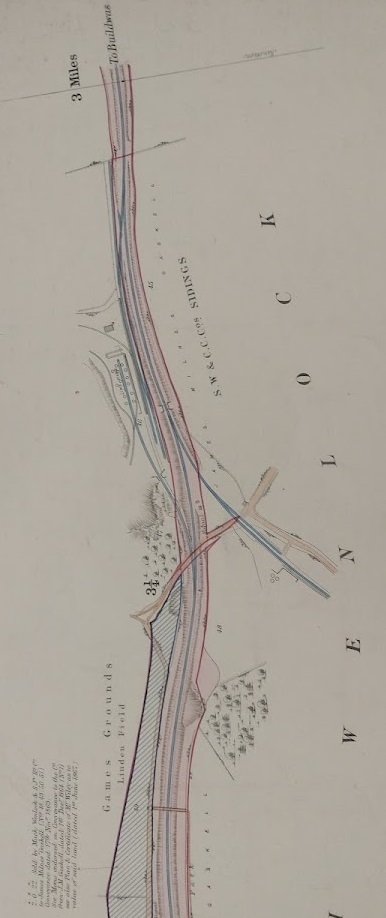
The immediate vicinity of the line close to Westwood Quarry. A tramway track ran from the quarry to the old railway. A sharp 90° turn took horse-drawn trams alongside the old railway to a wharf/loading ramp alongside the siding, © Shropshire Archives Ref. No. 6008/26 copyright reserved, used by kind permission. [9][My photograph of the plan, 5th August 2022]
Westwood Sidings as they appear on the pre-contract drawings for the construction of the Wenlock Branch, the tramway serving the Quarry ran alongside the Wenlock Branch from East to West, © Shropshire Archives Ref. No. 6008/26 copyright reserved, used by kind permission. [9][My photograph of the plan, 5th August 2022]
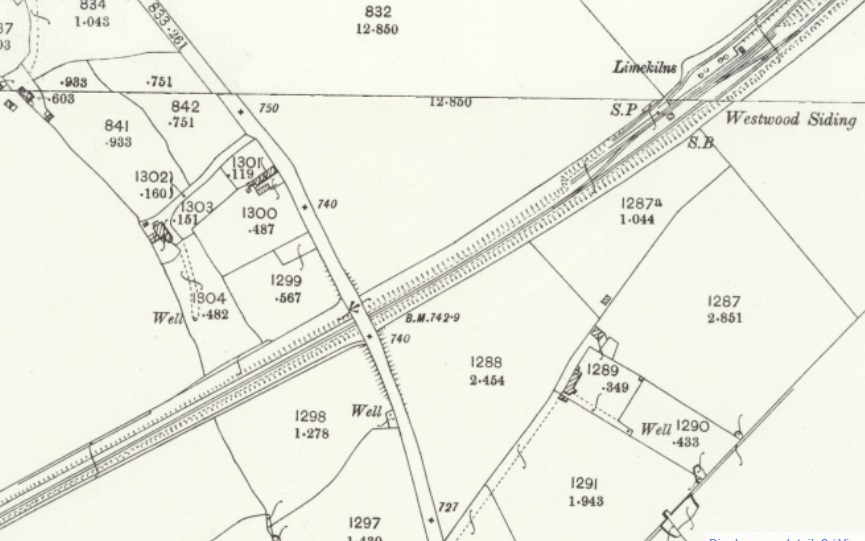
This extract from the 1901 25″ Ordnance Survey shows the length of the old railway immediately to the West of Westwood Sidings. [25]
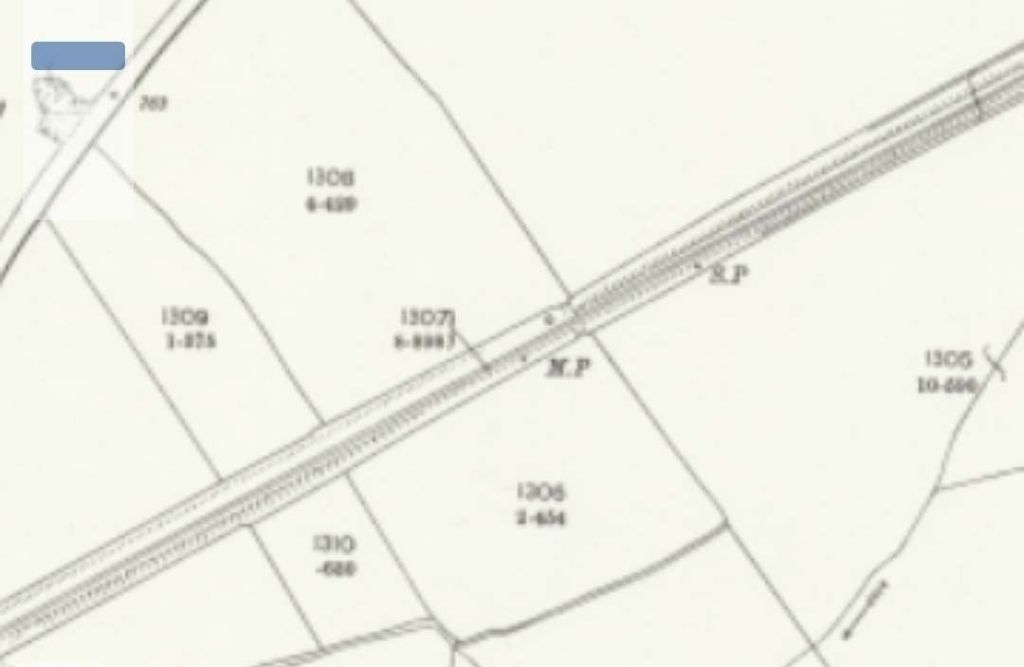
And a little further to the Southwest. [26]
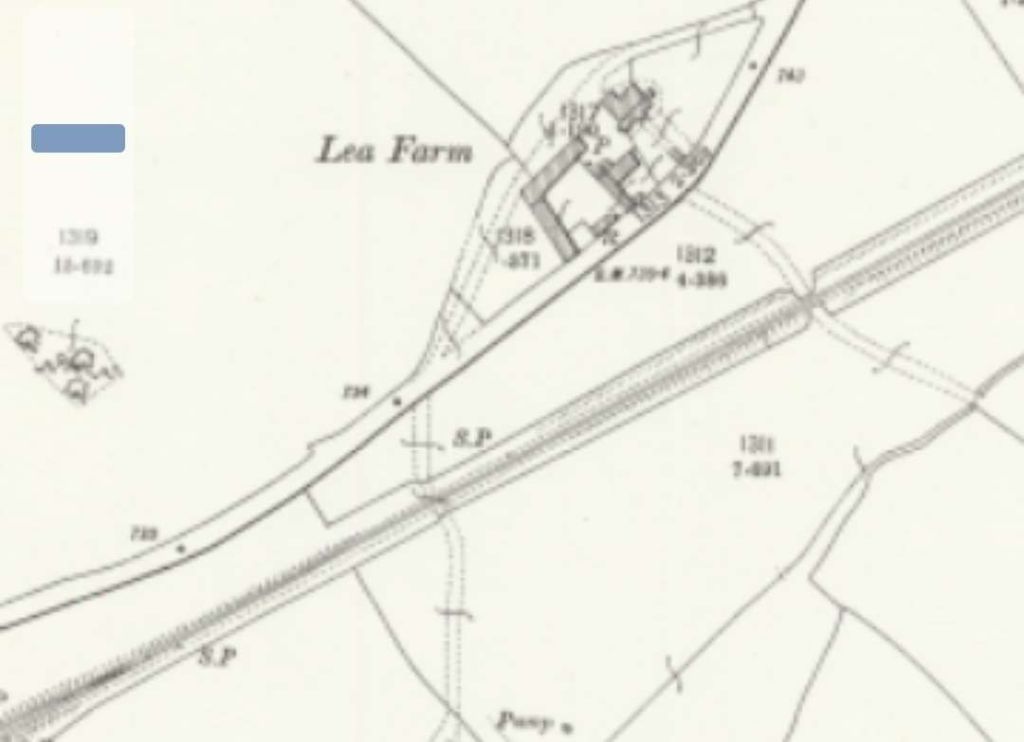
The 25″Ordnance Survey of 1901 again. Close to Lea Farm the B4371 and the Wenlock Branch run close to each other. [27]
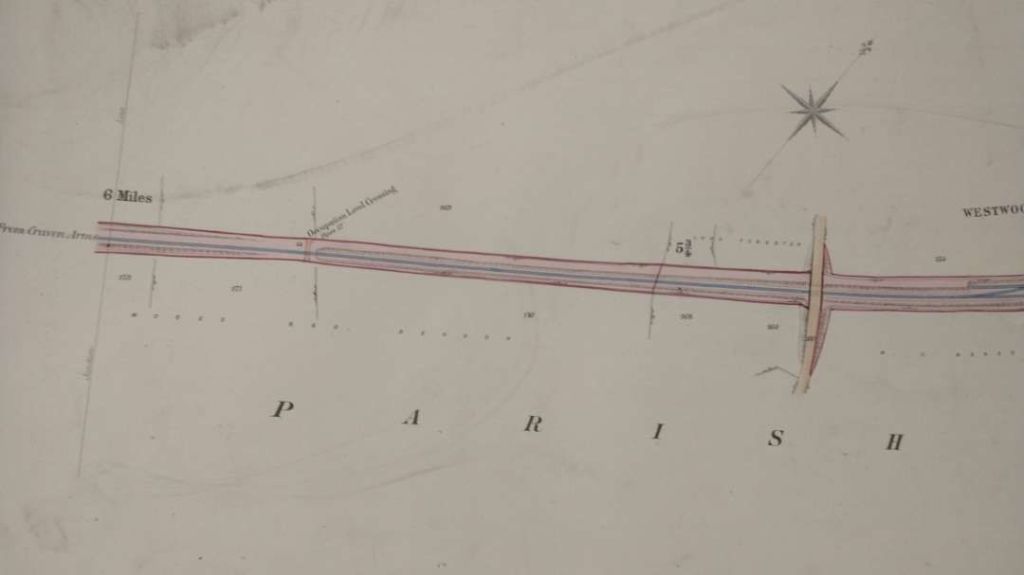
This extract from the pre-contract drawings covers the same length of the Wenlock Branch as the three OS map extracts above, © Shropshire Archives Ref. No. 6008/26 copyright reserved, used by kind permission. [9][My photograph of the plan, 5th August 2022]
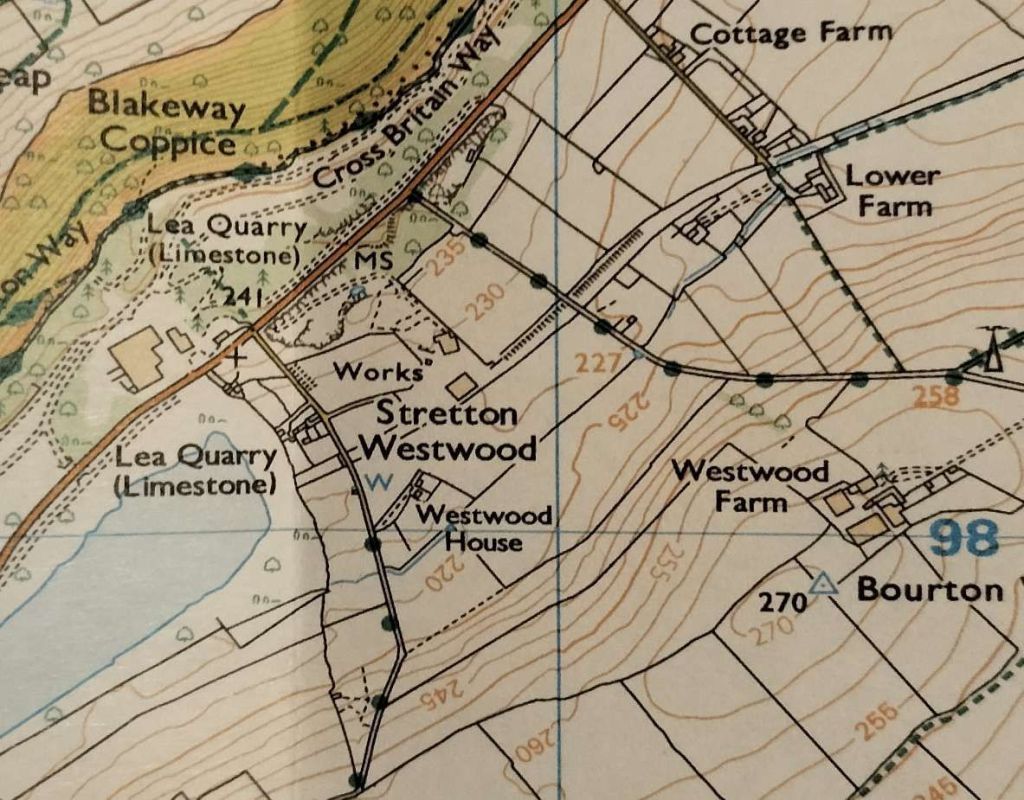
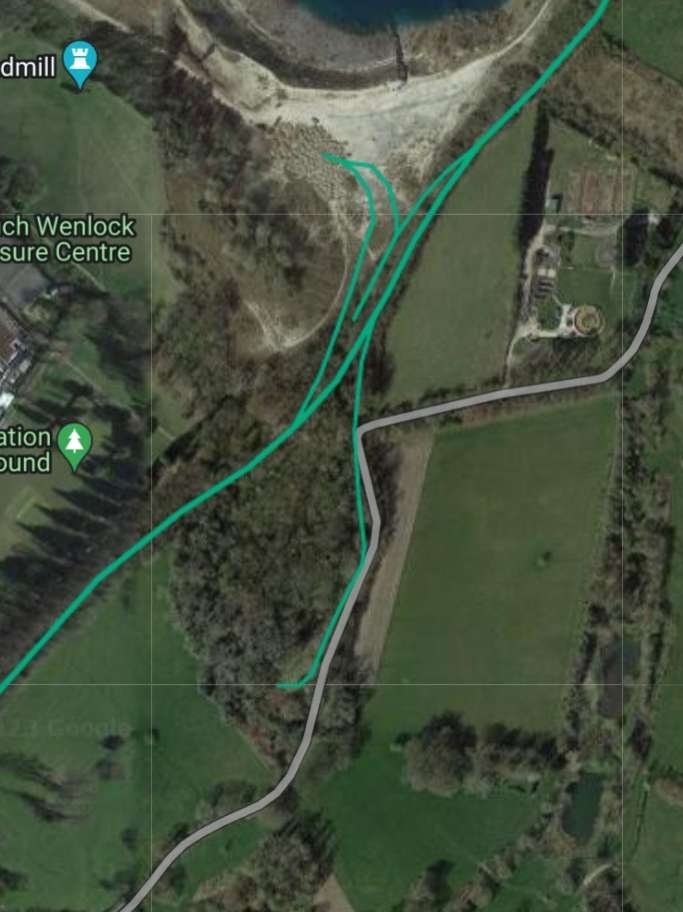
The immediate vicinity of the old Westwood Sidings as shown on modern Ordnance Survey mapping (OS Explorer No. 217). The route of the old railway can easily be picked out entering top-right and running across the North side of Lower Farm, a public footpath follows the line as far as the location of Westwood Crossing. The route of the old line is then crossed by an unmetalled track (which, on the North side of the line, was once a horse-drawn tramway) before it encounters the bridge illustrated below which, in the 21st century, is crossed by a metalled track. Westwood Sidings sat between these two tracks. Continuing Southwest, the route of the old line encounters quarry workings which postdated the closure of the railway and which in the 21st century are now flooded. [24]
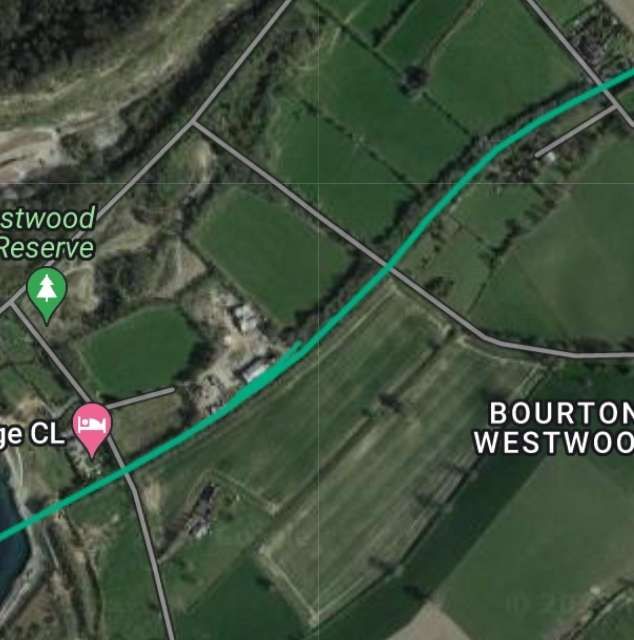
The length of the old line from Westwood Crossing to the Eastern edge of the flooded workings of Lea Quarry which straddle the old rail route. [12]
Looking back towards Westwood Crossing from the first overbridge to the West. [My photograph 12th January 2024]
The bridge viewed from the top of the cutting to the West of the bridge. [My photograph, 12th January 2024]
The view from the Southeast along the track over the bridge. Westwood Sidings were along the old railway to the left. A tramroad climbed the track in front of the camera towards Wenlock Edge and the B4371. Thetramway served Westwood Quarries which were between the railway and the B4371. [My photograph, 12th January 2024]
The old railway ran ahead towards Presthope in cutting towards the next overbridge. [My photograph, 12th January 2023]
The next accommodation bridge which spanned the line was just a little further to the West, beyond of the Westwood Sidings. This photograph looks South along the road over the bridge. [Google Streetview, August 2021]
The same bridge which This photograph looks South along the road over the bridge. [Google Streetview, August 2021]
Looking back towards Westwood Halt from the next overbridge. Heavy winter rain means that the cutting floor is flooded. Westwood Sidings were between the last overbridge and this one. [My photograph, 12th January 2024]
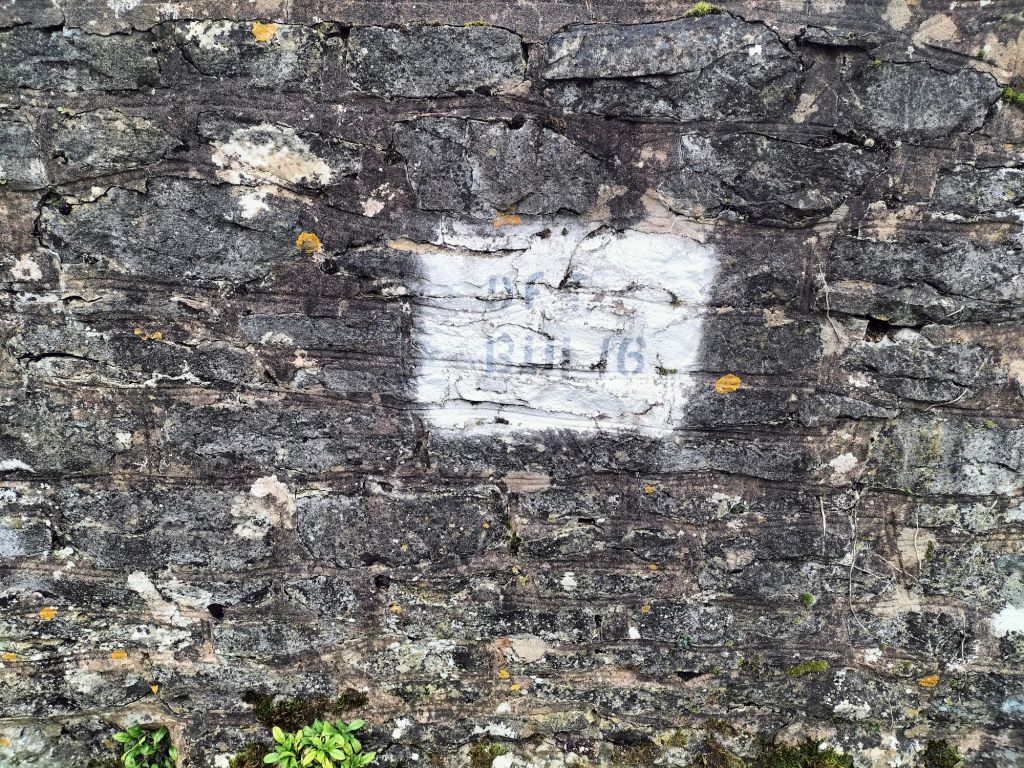
Each of the bridges on the old line are numbered. It is probably sometime since the stenciled numbers were renewed. Is this Bridge No. 16?
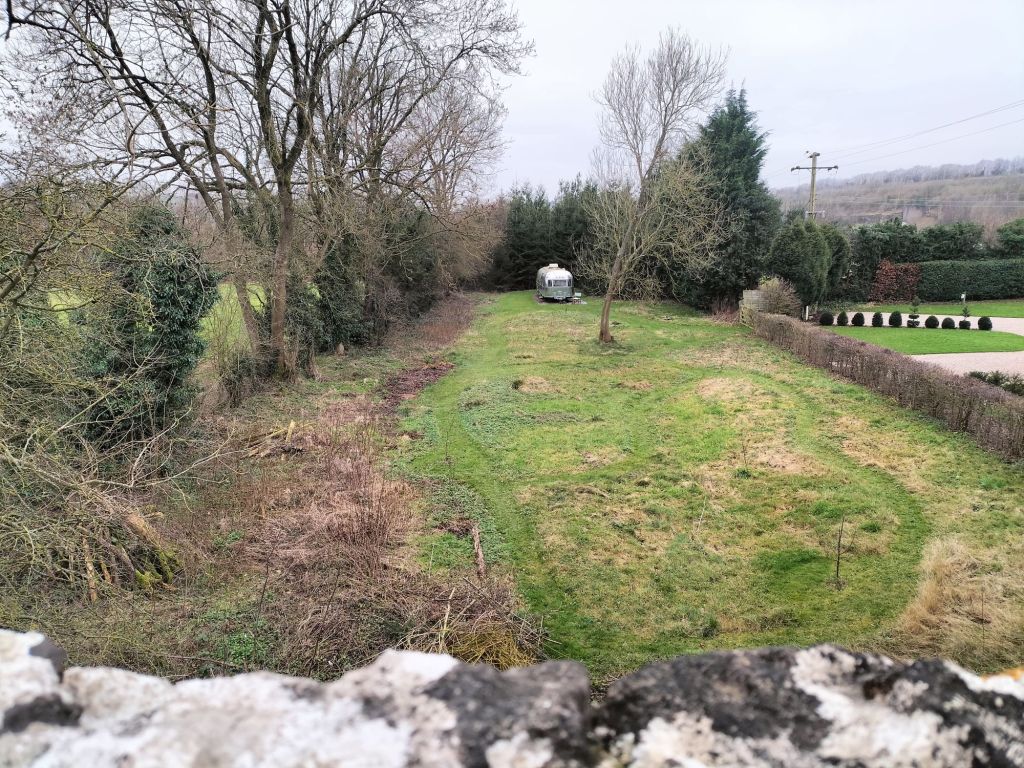
The view to the Southwest from the bridge. A small caravan site occupies the formation here. Immediately beyond the conifers ahead are the flooded workings of Lea Quarry. [My photograph, 12th January 2024]
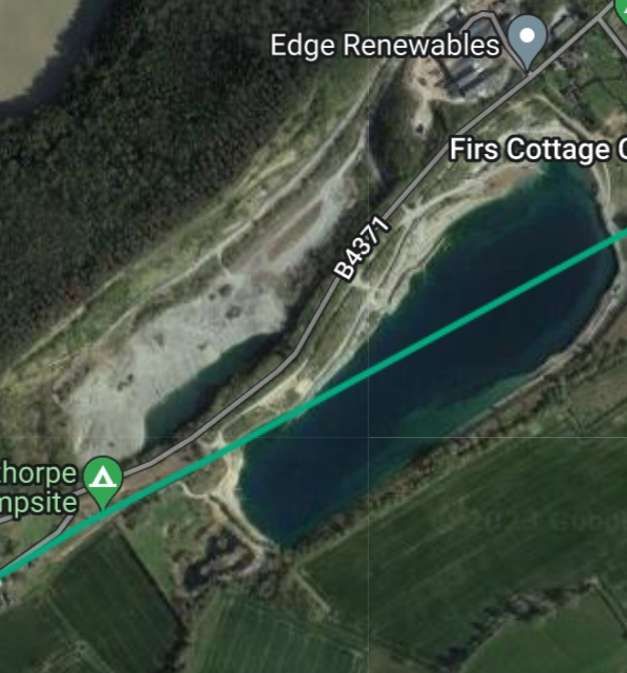
Lea Quarry was only a short distance from the location of Westwood Quarry. Lea Quarry’s flooded workings appear in full on this extract from the railmaponline.com satellite imagery. The flooded workings to the North of the B4371 sit where once Lea Farm would have been found. It is not obvious when travelling along the road that it is effect on a causeway between two lakes! Edge Renewables was founded in 2011 and is active in the part of Lea Quarry to the North side of the road.[12]
Another extract from the 25″ Ordnance Survey of 1901. This extract focuses on Presthope Station which sat just to the South of the B4371 accessed by a dedicated approach road. [28]
This next extract from the railmaponline.com satellite imagery shows Presthope Grange Campsite and Residential Park sitting over the route of the old Wenlock Branch on the site of Presthope Station. The branch from Presthope Station into what were Presthope quarries is illustrated leaving the main running line as it continues to climb toward the short tunnel close to the top of Wenlock Edge. [12]
The 18.00 hrs Craven Arms – Much Wenlock – Wellington train leaving Presthope Station on 21st April 1951, heading for Much Wenlock. This image was shared on the Telford memories Facebook Group by Metsa Vaim EdOrg on 8th October 2019. [30]
Presthope Station after the removal of the passenger facilities. This photograph was taken by J. Langford in April 1962, the signal box and presumably the station master’s house remain. This image was shared on the Much Wenlock Memories Facebook Group by Judith Goodman on 9th February 2023. [31]
A view North across Presthope Grange Residential Park which sits on the site of Presthope Railway Station. [32]

References

  1. Ken Jones; The Wenlock Branch; The Oakwood Press, Usk, Monmouthshire, 1998.
  2. https://www.britainfromabove.org.uk/image/EAW046196, accessed on 1st November 2023
  3. https://www.britainfromabove.org.uk/image/EAW046197, accessed on 1st November 2023.
  4. https://www.british-history.ac.uk/vch/salop/vol10/pp399-447, accessed on 25th December 2023.
  5. https://maps.nls.uk/geo/explore/#zoom=17.5&lat=52.59954&lon=-2.55716&layers=168&b=1, accessed on 25th December 2023.
  6. https://maps.nls.uk/geo/explore/#zoom=16.9&lat=52.59775&lon=-2.56049&layers=168&b=1, accessed on 25th December 2023.
  7. https://en.m.wikipedia.org/wiki/Much_Wenlock_railway_station, accessed on 25th December 2023.
  8. https://www.geograph.org.uk/photo/2268995, accessed on 25th December 2023.
  9. The photographs of the pre-contract drawings for the line were taken by myself and show extracts from the construction plans held in the Shropshire Archive. There is a standard charge of £10 per visit for taking photographs of their records.
  10. https://www.facebook.com/photo?fbid=871714362892537&set=pcb.1583276891885898, accessed on 13th October 2023.
  11. https://en.m.wikipedia.org/wiki/File:Much_Wenlock_railway_station.jpg, accessed on 14th October 2023.
  12. https://railmaponline.com/UKIEMap.php, 14th October 2023.
  13. https://maps.nls.uk/geo/explore/#zoom=16.5&lat=52.59360&lon=-2.57210&layers=168&b=1, accessed on 27th December 2023.
  14. https://maps.nls.uk/geo/explore/#zoom=16.5&lat=52.59611&lon=-2.56444&layers=168&b=1, accessed on 27th December 2023.
  15. https://maps.nls.uk/geo/explore/#zoom=16.5&lat=52.59513&lon=-2.56857&layers=168&b=1, accessed on 27th December 2023.
  16. https://maps.nls.uk/geo/explore/#zoom=16.5&lat=52.59146&lon=-2.57500&layers=168&b=1, accessed on 27th December 2023.
  17. https://maps.nls.uk/geo/explore/#zoom=16.5&lat=52.58847&lon=-2.57795&layers=168&b=1, accessed on 27th December 2023.
  18. https://www.facebook.com/groups/1532191000361509/permalink/2624088597838405/?app=fbl, accessed on 27th December 2023.
  19. https://m.facebook.com/groups/1470137459866509/permalink/3158174324396139, accessed on 27th December 2023; and https://commons.m.wikimedia.org/wiki/File:Westwood_halt.jpg, accessed on 28th December 2023.
  20. https://www.geograph.org.uk/photo/6220870, accessed on 27th December 2023.
  21. https://maps.nls.uk/geo/explore/#zoom=15.5&lat=52.58777&lon=-2.58269&layers=168&b=1&marker=52.58420,-2.58663, accessed on 28th December 2023.
  22. https://maps.nls.uk/view/121151366, accessed on 28th December 2023.
  23. https://maps.nls.uk/geo/explore/#zoom=16.2&lat=52.58321&lon=-2.59431&layers=168&b=1, accessed on 28th December 2023.
  24. Ordnance Survey Explorer Map No. 217.
  25. https://maps.nls.uk/geo/explore/#zoom=16.4&lat=52.58031&lon=-2.59601&layers=168&b=1, accessed on 30th December 2023.
  26. https://maps.nls.uk/geo/explore/#zoom=16.4&lat=52.57873&lon=-2.60143&layers=168&b=1, accessed on 30th December 2023.
  27. https://maps.nls.uk/geo/explore/#zoom=16.4&lat=52.57772&lon=-2.60633&layers=168&b=1, accessed on 30th December 2023.
  28. https://maps.nls.uk/geo/explore/#zoom=15.9&lat=52.57594&lon=-2.61148&layers=168&b=1, accessed on 2nd January 2024.
  29. https://maps.nls.uk/geo/explore/#zoom=15.9&lat=52.57503&lon=-2.61667&layers=168&b=1, accessed on 2nd January 2024.
  30. https://scontent.fbhx4-2.fna.fbcdn.net/v/t1.6435-9/72309512_205899980403678_7031472482779398144_n.jpg?_nc_cat=106&ccb=1-7&_nc_sid=3ba11c&_nc_ohc=emwNw6dTtOEAX98lstF&_nc_oc=AQltLJN6CydIE1iwVeZIhsh7FebhgpjYSXj4bSzrDzZFN1GkxA9MgvTWDIpb8u77FAIVOOqJDbVO3NSZWciOhtxl&_nc_ht=scontent.fbhx4-2.fna&oh=00_AfBnQj18_fNuJPC8cc8S55O0uoHKcfFj4B4xt0r1e4TwTA&oe=65BB609F, accessed on 2nd January 2024.
  31. https://www.facebook.com/photo/?fbid=10219517828553747&set=a.10201009954868472, accessed on 13th January 2024.
  32. https://fb.watch/pjIctGeJKI/, accessed on 2nd January 2024.

The Garstang to Knott End Railway again. …

The featured image above is a picture of the Pilling Pig. It was shared by Mandy Sharpe on the Visions of Trains and Tracks of the North West of England Facebook Group on 19th August 2017. [6]

One of six postcards produced by Dalkeith. This card shows the full length of the line. [16]

In the past, I have written two articles about the Garstang to Knott End Railway, those articles can be found on these two links:

The Garstang and Knott End Railway – Part 1

The Garstang and Knott End Railway – Part 2

Reading some back copies of Railway Bylines, I came across an article in the March 2002 edition of the magazine about this short rural line.  The article was written by R. Supwards with photographs by Douglas Robinson.

The line had a hesitant start and always struggled financially, but it remained independent until being taken over by the LMS at the Grouping but lost its passenger service in 1930. It was closed to goods traffic beyond Pilling at the end of 1950. In the summer of 1963, the line beyond Garstang Town was closed. The remainder of the branch did not last long. It was closed by the end of August 1965.

A ‘Cauliflower’ 0-6-0 locomotive in LMS colours sits at Knott End before setting off towards Pilling and Garstang. This image was shared by Steve Scott on the Visions of Trains and Tracks of the North West of England Facebook Group on 27th August 2017. Permission to use here has been applied for. [7]
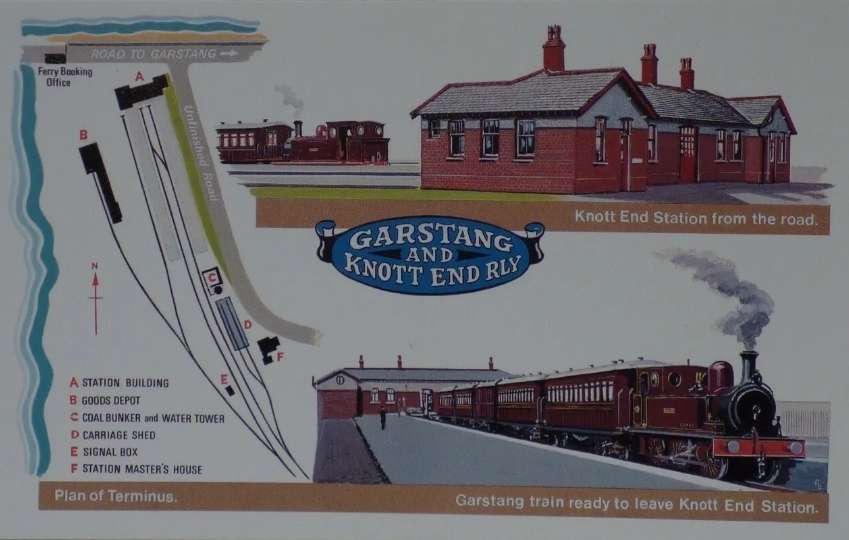
One of six postcards produced by Dalkeith. The station at Knott End is shown from two different angles on the right of the card. The station layout is shown on the left. [16]

Supwards’ article highlighted the different locomotives used on the line: “until about 1950 the engine was usually a ‘Cauliflower’ 0-6-0 from Preston.” [1: p196] These were followed by “Ivatt Class 2 2-6-0s, with the line being worked on the ‘one engine in steam’ principle. On weekdays the ‘Pilling Pig left Preston (North Union Yard) a little before midday and returned from Pilling at 3.10pm, whereas on Saturdays it left Preston at 7.37am and started back from Pilling at 10.17am. The return trips went to Farington Junction in Preston.” [1: p196]

By the mid-50s, the Ivatt locos were replaced by ex-L&YR 0-6-0s, which in turn were soon replaced by ex-LNWR 0-8-0 locomotives and then, by the late 1950s, Stanier Black 5 4-6-0s.

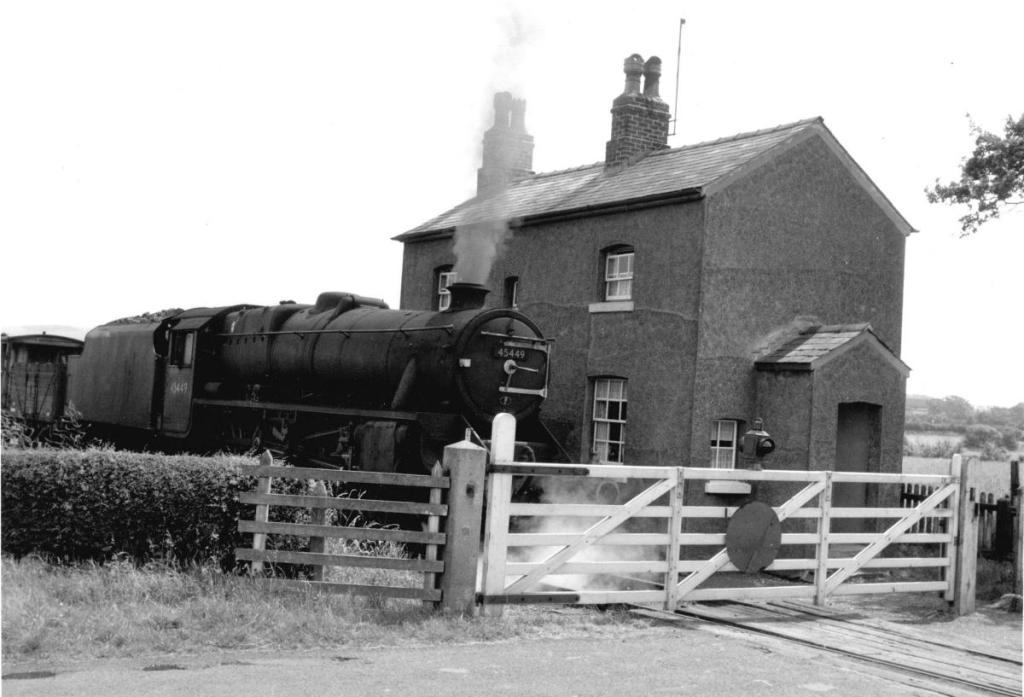
A Black 5 heading the daily goods service on the line, possibly at Cogie Hill Crossing. This picture comes from an article in the North West Evening Mail, © North West Evening Mail. [2]

Supwards’ also records enthusiasts visits to the line. The first he records was on 1st May 1954 (when a joint Stephenson Locomotive Society/Manchester Locomotive Society tour visited Pilling as part of a tour of several ‘goods only’ lines in the area, hauled by 2-6-4T No.42316). [1: p196]

Another railtour took place on 29th May 1958 (a Manchester Locomotive Society brake van trip, which comprised a single brake van attached to the usual branch working in the care of an LMS Black 5 Class 4-6-0 locomotive, No. 45438). [1: p196] By that time Black 5s were the standard motive power on the line and remained so until its closure. [1: p196/198]

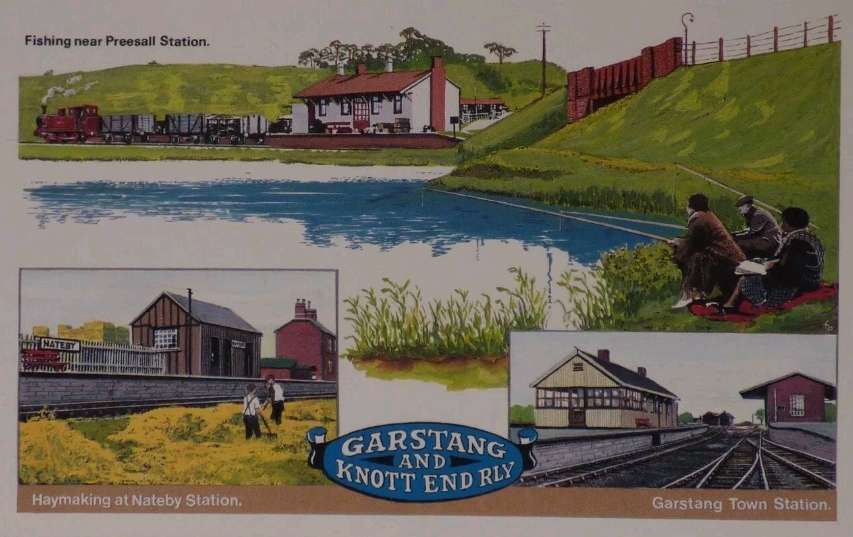
Various sites along the length of the branch line. This is another of the six postcards produced and sold by Dalkeith. [16]
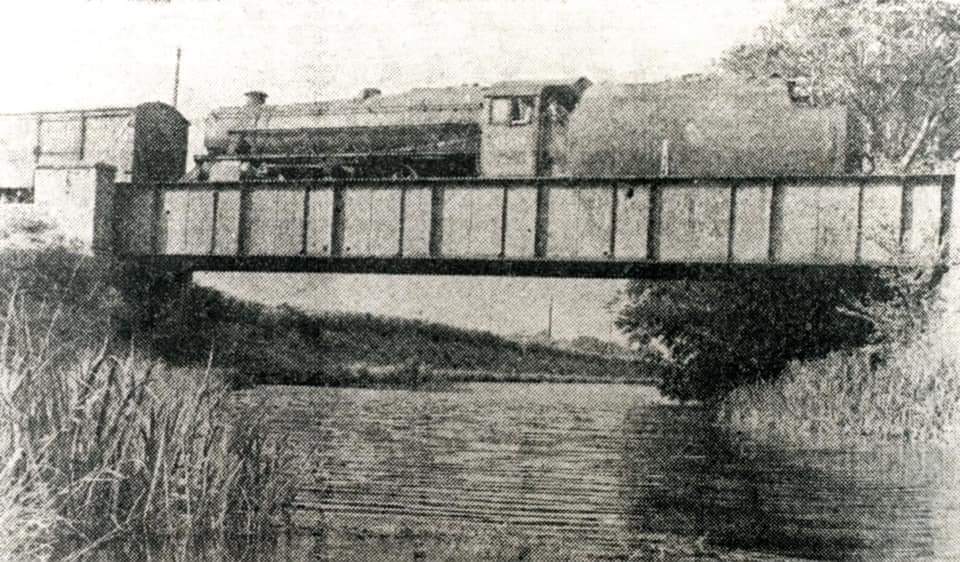
The Pilling Pig crossing the canal bridge at Nateby near Garstang in the mid-20th century. This image was shared on the Visions of the Trains and Tracks of the North West of England Facebook Group by Ian Gornall on 21st September 2021. It is used by kind permission from Ian Gornall. [3]

Supwards’ short article is supported by a series of photographs taken by Douglas Robinson which are not reproduced here for copyright reasons.

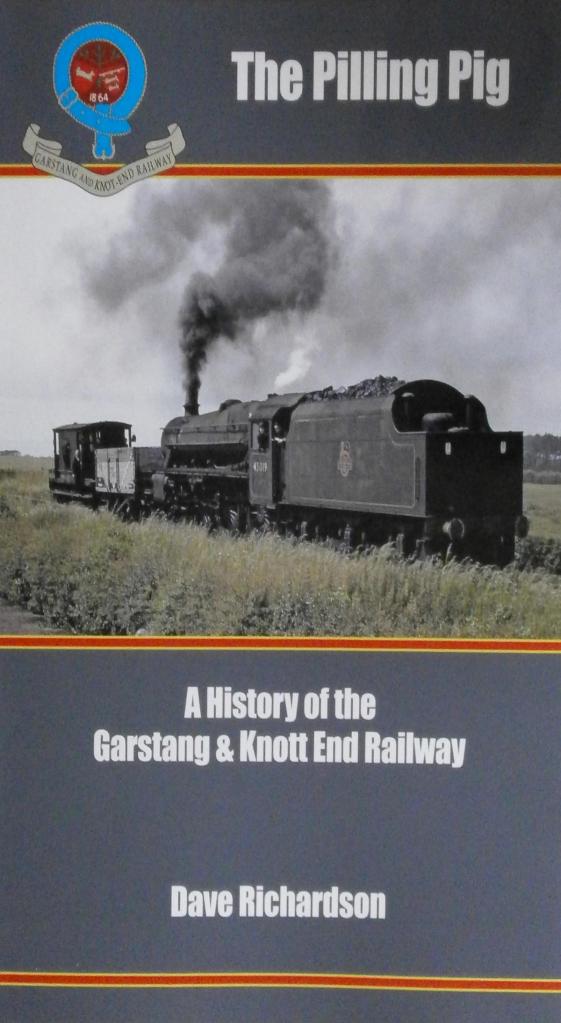
An excellent book about the line was written by  Dave Richardson, published by the Cumbrian Railways Association. [4]

The Pilling Pig: A History of the Garstang & Knott End Railway. [4]

There is a superb set of photographs of the branch collated by Paul Johnson on smugmug.com. [5]

Locomotives

As promised in an earlier article about this line, here are some details of the locomotives that served the line in its early years before it was absorbed by the LMS. The basic details come from the Wikipedia article about the line: [8]

1870: Black, Hawthorn 0-4-2ST Hebe

The line opened on December 5, 1870, running with a single locomotive, Black Hawthorn 0-4-2ST Hebe, passengers boarding any point along the line by request. … In 1872, Hebe broke down, with all services suspended, and soon the company was in rent arrears. The locomotive was repossessed, and for the next three years only occasional horse-drawn trains were run.” [9]

1874: Manning Wardle 0-4-0ST Union

Services resumed in 1875 using a new locomotive, Manning Wardle 0-4-0ST Union.” [9]

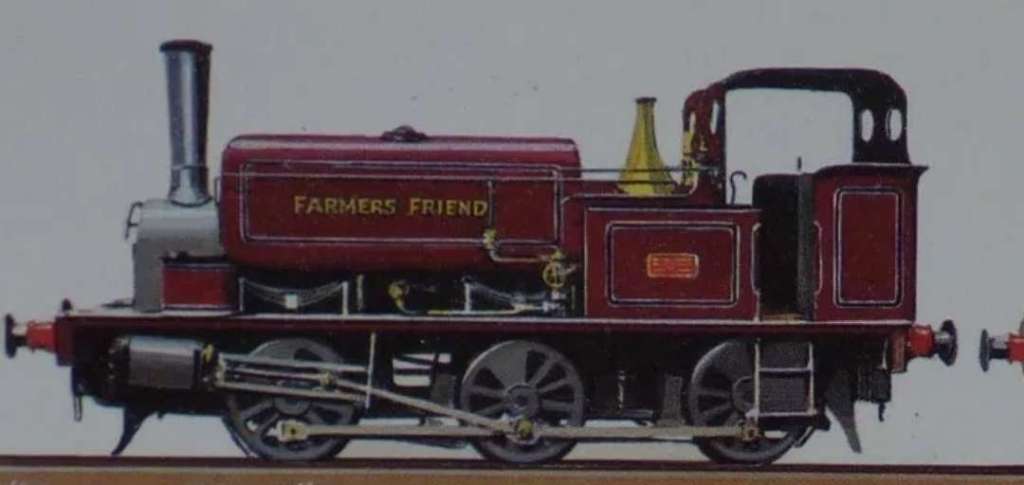
1875: Hudswell Clarke 0-6-0ST Farmer’s Friend (alias “Pilling Pig”) [10: p73]

In the late 1870s, Farmer’s Friend, was given the nickname ‘Pilling Pig’ “because of the squeal made by its whistle. This name became colloquially applied to all of the line’s locomotives and even the railway itself.” [9] This locomotive was operational until 1900. [11]

Hudswell Clarke 0-6-0ST ‘Farmer’s Friend’. This is an extract from one of six postcard images printed and sold by Dalkeith. [16]

1885: Hudswell Clarke 0-6-0ST Hope

This locomotive had larger cylinders than Farmer’s Friend (13×20 in rather than 11×17 in) but operated at the same boiler pressure (120 psi). [12]

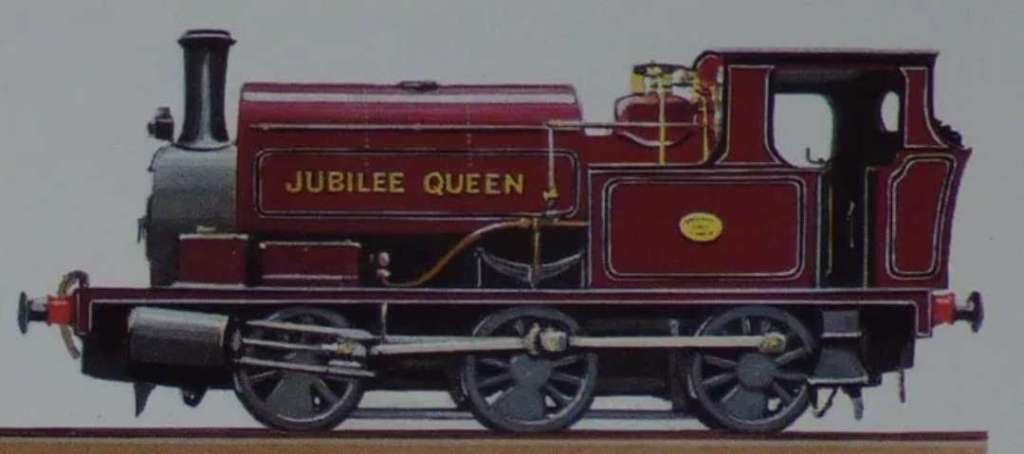
1897: Hudswell Clarke 0-6-0ST Jubilee Queen

Hudswell Clarke 0-6-0ST ‘Jubilee Queen’. This is another extract from one of six postcard images printed and sold by Dalkeith. [16]

This locomotive had larger cylinders than Hope (15×20) and operated at a higher boiler pressure (140 psi). [12]

1900: Hudswell Clarke 0-6-0ST New Century

This is an enlarged extract from one of the six Dalkeith postcard images. It shows ‘New Century‘ at Garstang Engine Shed. [16]

This loco was a sister loco to Jubilee Queen, and is recorded by Wells [14] as having been purchased at the same time.

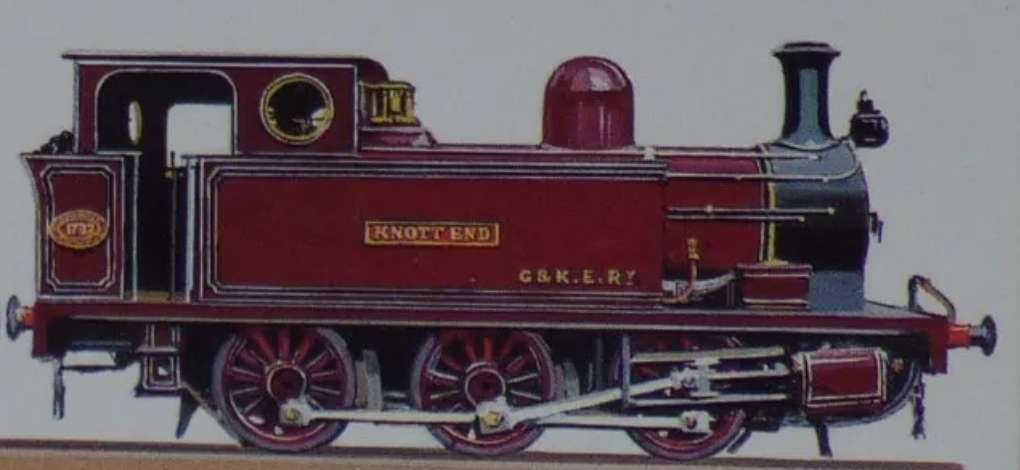
1908: Manning Wardle 0-6-0T Knott End

Hudswell Clarke 0-6-0ST ‘Knott End’. This is a third extract from one of six postcard images printed and sold by Dalkeith. [16]

This locomotive had 14×20 in cylinders and operated at 150 psi. [12]

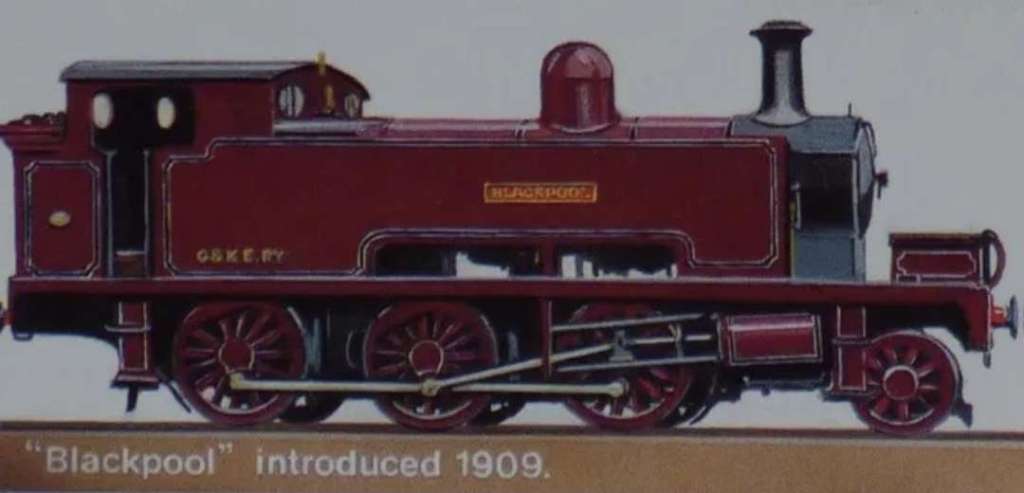
1909: Manning Wardle 2-6-0T Blackpool

Manning Wardle 2-6-0T ‘Blackpool’. This is a fourth extract from one of six postcard images printed and sold by Dalkeith. [16]

This loco had 16×22 in cylinders, operated at 150 psi, and had larger diameter driving wheels (48 in). It was fitted with Isaacson’s patent valve gear. [12][13][14] It was Works No. 1747. Isaacson, together with Edwin Wardle and Charles Edward Charlesworth took out payments for the valve gear in 1907 (patents No’s. 17533 and 27899 of 1907). Atkins is quoted by steamindex.com as saying that “The 2-6-0T was rare on British standard gauge railways. The only other was on the Wrexham, Mold and Connahs Quay Railway – a rebuild from an 0-6-0.” [15]

Other Rolling Stock

Railmotor

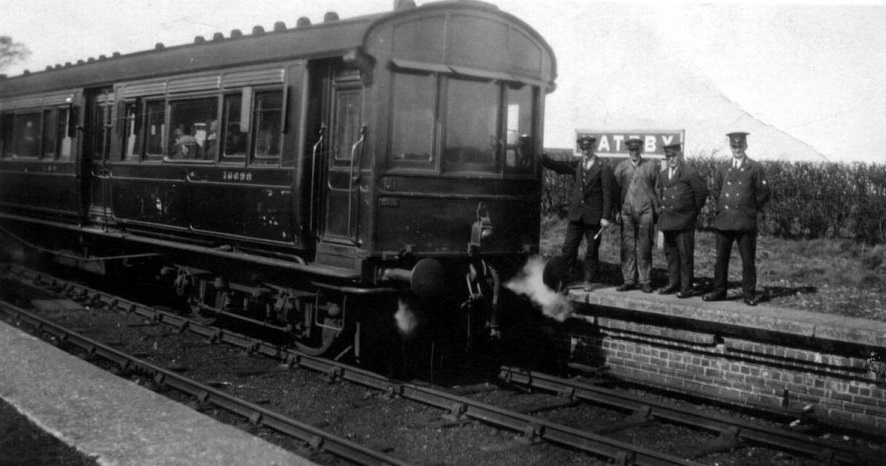
In 1920, just a couple of years before the line was absorbed by the new LMS, a railmotor was hired by the G&KE from the LNWR. It was still running on the line in March 1930 when the passenger service ceased. [22: p22] It looked after the majority of passenger services on the line. “Seating 48 third class passengers, this vehicle originally operated in LNWR colours, but was later repainted in LMS red with the number 10698.” [22: p24-25] The last passenger service actually ran on Saturday 29th March, although the formal closure took effect before traffic started on Monday 31st March 1930. [22: p25]

Ex-LNWR Railmotor, LMS No. 10698, paused at Nateby whilst working a passenger service between Knott End and the main line at Garstang & Catterall. No. 10698 was renumbered as 29988 in 1933 and became the last of its type in service running through the war until withdrawal in 1948. (c) Knott End Collection. The photograph is used here by kind permission and can be accessed on the Railscot website, here. [23]

Coaches

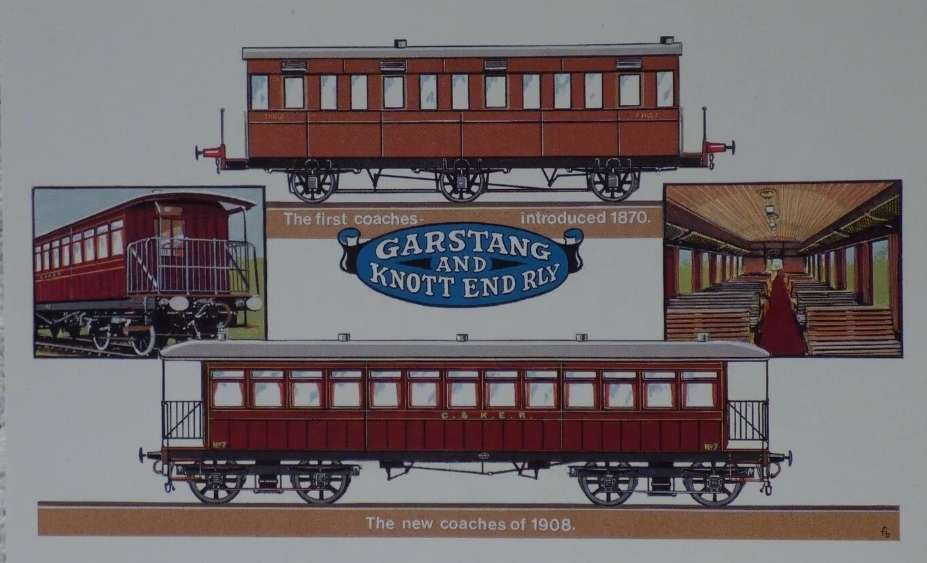
The six postcards published by Dalkeith [16] include one showing coaching stock on the line. It is shown below:

Another of the Dalkeith postcards. as with the other postcard images, this appears to be a reproduction is of a Garstang & Knott End Railway poster from 1908. [16]

When the full line was completed to Knott End, eight bogie coaches were supplied by Birmingham Carriage and Wagon Co. Ltd. Since the bogie coaches had no guards compartment they originally worked with the goods brake vans, but in 1909 two new passenger brake vans were introduced.

After the removal.of passenger service from the Garstang to Knott End (G&KE) Railway, it seems that one or two items of rolling stock were transferred to the Wanlockhead branch of the Caledonian Railway in the 1930s. That line was originally the ‘Leadhills and Wanlockhead Light Railway’. [17] A thread on the Caledonian Railway Association Forum [18] explores what is known by members of that Forum.

Apparently, “In the early 1930s a composite coach with end roofed platforms was transferred from the Garstang and Knott End Railway to the Wanlockhead branch. Its LMS number was 17899.” [18]

It appears that “a G&KE 4 wheeled passenger brake van transferred at the same time.” [17]

It was scrapped at the same time as the bogie coach when the Wanlockhead line closed in 1939.[20]

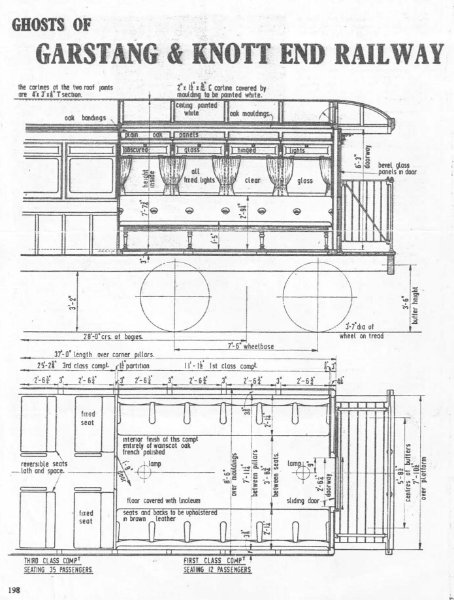
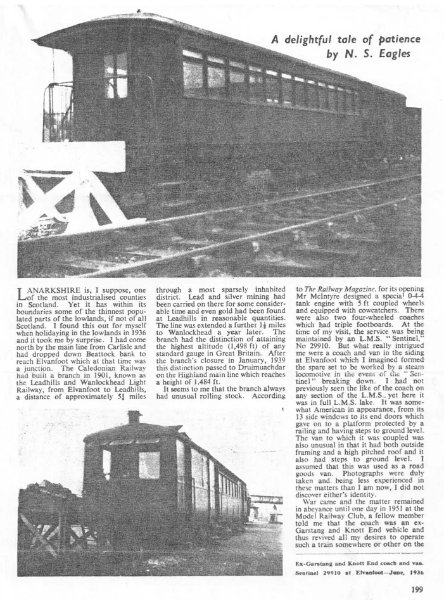
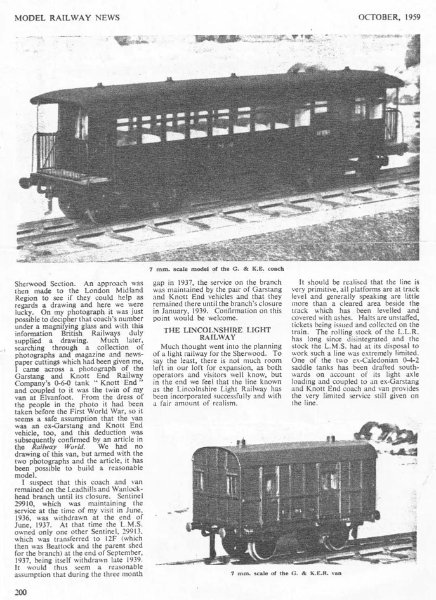
There was an article about the construction, in 7mm/ft (O Gauge), of the two carriages in Model Railway News in October 1959. That article is produced in full below. [19]

A three-page article by N.S. Eagles in Model Railway News, October 1959 features his models of the two coaches. [19]
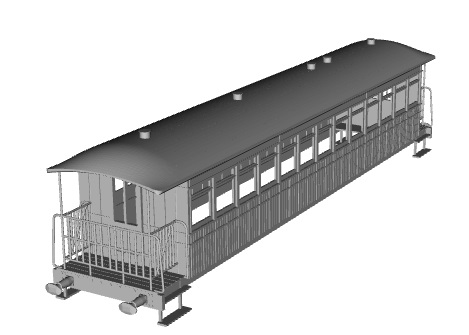
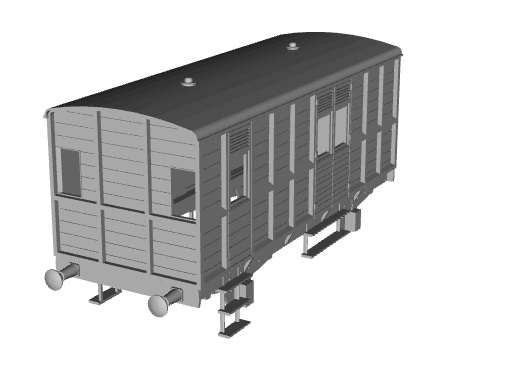
3D images of the two coaches produced for 3D printing. [20]

Apparently, 6 of the 8 G&KE coaches  “fetched up at the LMS Carriage depot at Slateford, where they were used as offices and stores until at least 1959.” [17]

Wagons

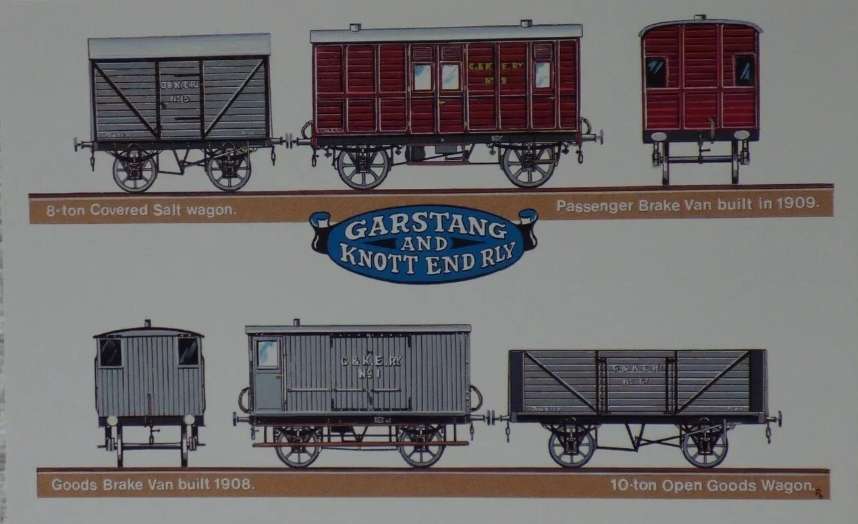
One of the postcards in the Dalkeith series shows wagons used on the line. One of these is covered above. There were two dedicated coaching brake wagons. In the image below the goods wagons are in grey and the coaching brake in deep red. [16]

The goods wagons on the line are featured on this last image, another of the Dalkeith postcard images. [16]

Drawings of G&KE Railway wagons can be found here. [21]

References

  1. R. Supwards and Douglas Robinson; A Pig of a Job; in Railway Bylines; The Irwell Press, March 2002, p196-200.
  2. https://www.nwemail.co.uk/features/17492880.new-book-tells-story-garstangs-pilling-pig-railway, accessed on 7th December 2023.
  3. https://m.facebook.com/groups/428057400895737/permalink/1459373981097402, accessed on 7th December 2023.
  4. Dave Richardson; The Pilling Pig: A History of the Garstang & Knott End Railway; Cumbria Railways Association, 2019.
  5. https://transportsofdelight.smugmug.com/RAILWAYS/LOCOMOTIVES-OF-THE-LMS-CONSTITUENT-COMPANIES/GARSTANG-KNOTT-END-RAILWAY, accessed on 7th December 2023.
  6. https://m.facebook.com/groups/428057400895737/permalink/471089033259240, accessed on 7th December 2023.
  7. https://m.facebook.com/groups/428057400895737/permalink/474074486294028, accessed on 7th December 2023.
  8. https://en.m.wikipedia.org/wiki/Garstang_and_Knot-End_Railway, accessed on 9th December 2023.
  9. https://www.heritagerailway.co.uk/2796/group-embarks-on-garstang-knot-end-revival, accessed on 9th December 2023.
  10. T.R. Perkins; The Garstang & Knot-End Railway; in The Railway Magazine, January 1908, p72–77.
  11. https://www.steamlocomotive.com/locobase.php?country=Great_Britain&wheel=0-6-0&railroad=gke#20440, accessed on 9th December 2023.
  12. https://jdhsmith.math.iastate.edu/term/slgbgker.htm, accessed on 9th December 2023.
  13. Frank K. Walmesley; The Garstang & Knot-End Railway; in The Railway Magazine Volume 22, December 1959, p859–864
  14. Jeffrey Wells; The Pig and Whistle railway: a Lancashire backwater; in BackTrack Volume 7, September 1993, p257–265; a summary is provided on steamindex.com: https://steamindex.com/backtrak/bt7.htm#1993-5, accessed on 9th December 2023.
  15. Philip Atkins; Blackpool – Britain’s most obscure locomotive; in Backtrack Volume 10, January 1996, p40-42; a summary is provided on steamindex.com: https://steamindex.com/backtrak/bt10.htm#10-40 accessed on 9th December 2023.
  16. Dalkeith prodiced a series of 6 postcards. A set all 6 cards was for sale on eBay: https://www.ebay.co.uk/itm/195276709484?mkcid=16&mkevt=1&mkrid=711-127632-2357-0&ssspo=eqi-iQs2SYu&sssrc=4429486&ssuid=afQhrar7TGK&var=&widget_ver=artemis&media=COPY, accessed on 9th December 2023.
  17. Alastair Ireland; The Leadhills and Wanlockhead Light Railway; privately published in 1996.
  18. https://www.crassoc.org.uk/forum/viewtopic.php?t=1608, accessed on 9th December 2023.
  19. N.S. Eagles; Ghosts of Garstang & Knott End Railway; in Model Railway News, October 1959, p198-199.
  20. https://www.rue-d-etropal.com/3D-printing/passenger-stock-lt/3d_printed_light-railway-stock.htm#garstang,vaccessed on 9th December 2023.
  21. https://igg.org.uk/rail/00-app2/lms/gker.htm, accessed on 10th December 2023.
  22. W. Rush & M.R. Connor-Price; The Garstang & Knott End Railway; Oakwood Press, 1985.
  23. https://www.railscot.co.uk/img/60/981/, accessed on 11th December 2023.

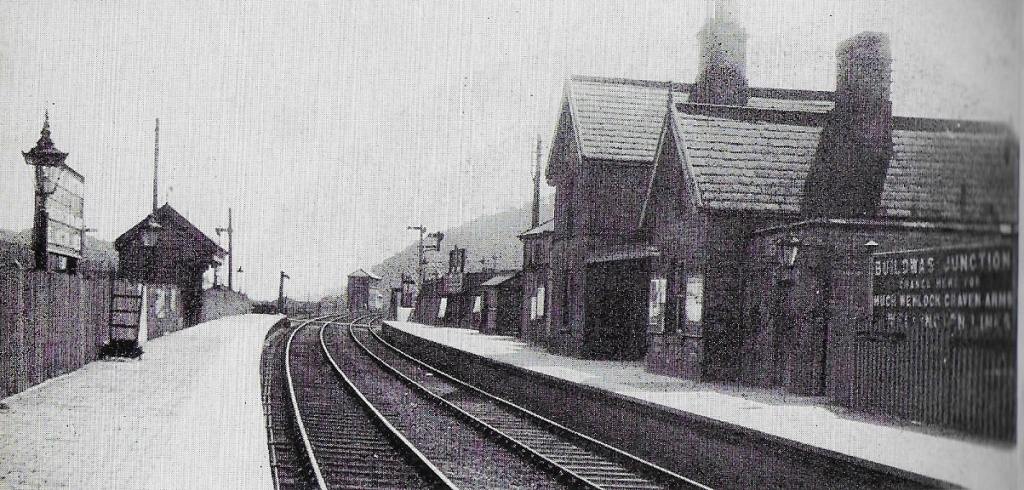
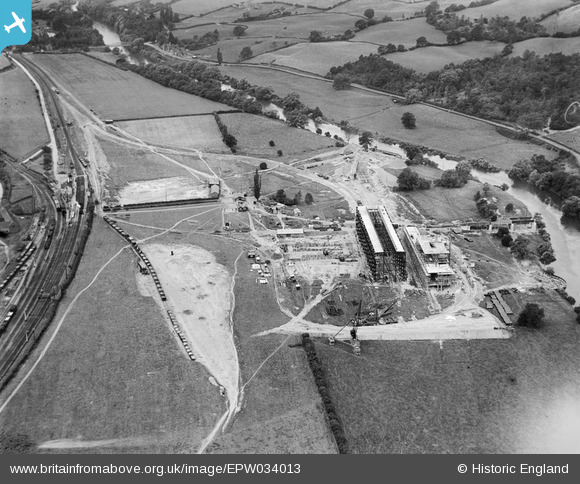
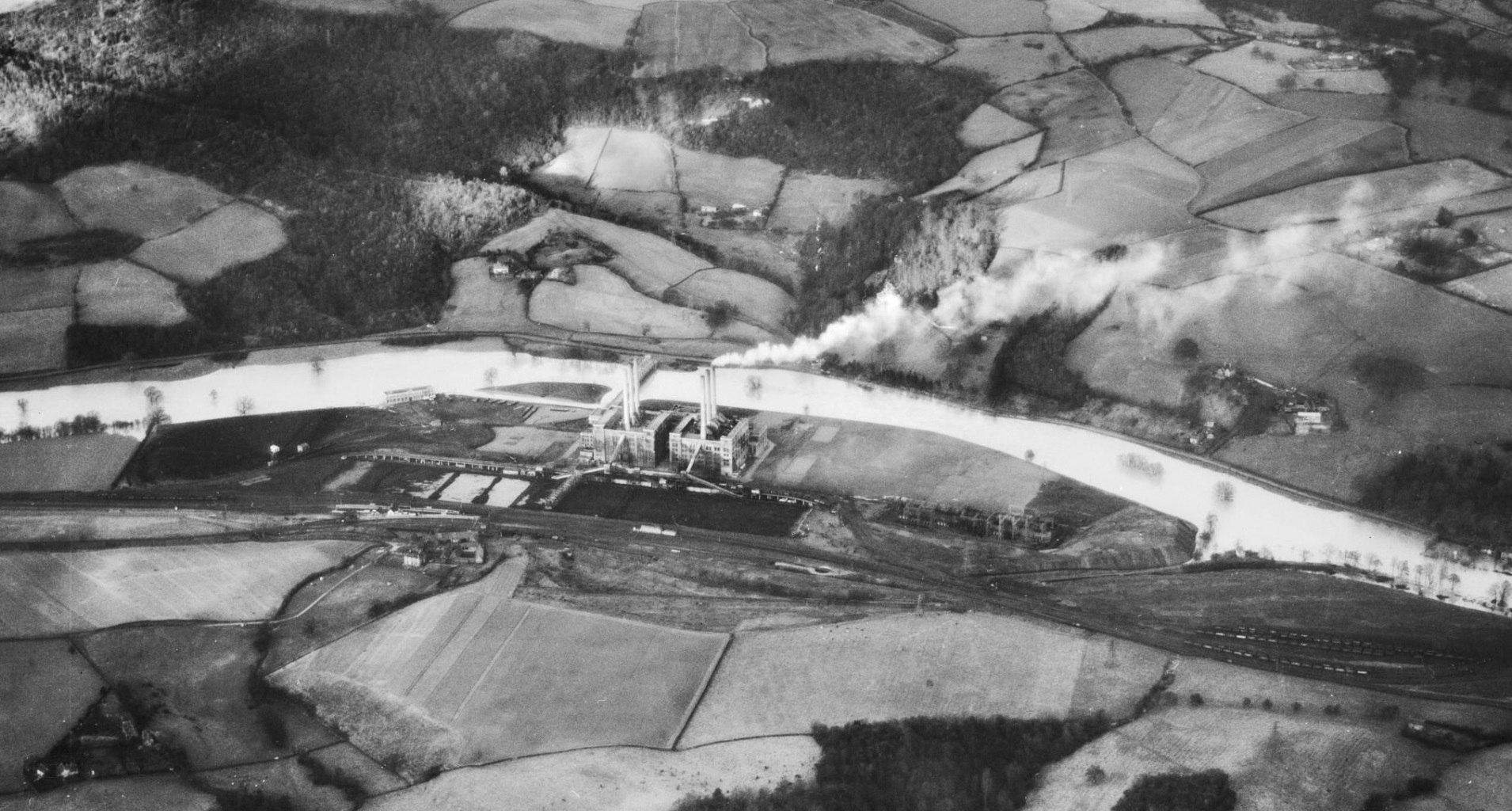
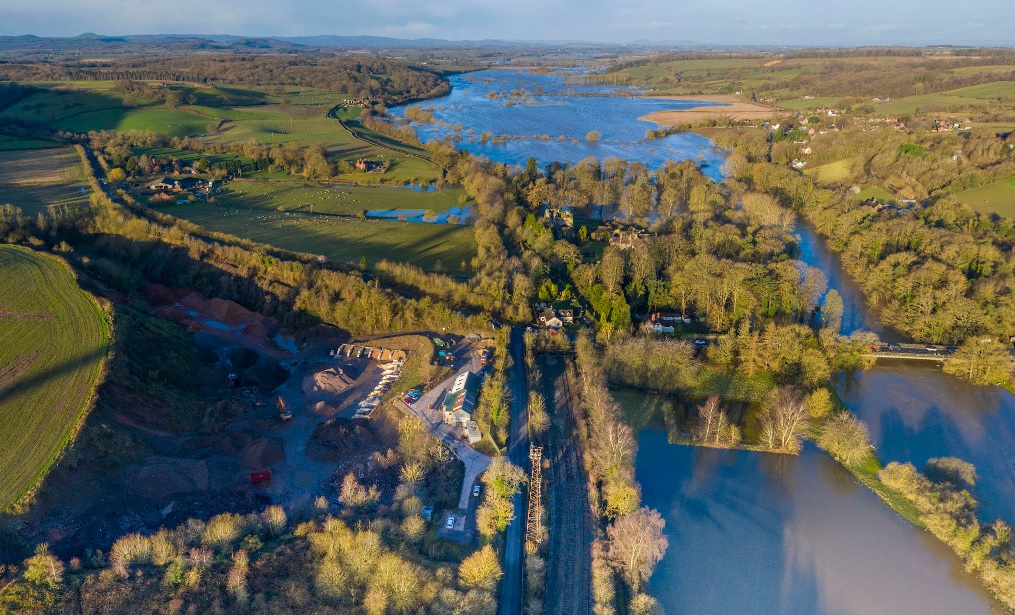
The Railways of East Shropshire (and Telford) – the Much Wenlock and Severn Junction Railway, Buildwas to Much Wenlock.

This article follows on from three other articles which covered the Wellington to Severn Junction Railway and which reached as far along the line as Buildwas. Those articles can be found on these links:

https://rogerfarnworth.com/2022/07/07/the-railways-of-telford-the-wellington-to-severn-junction-railway-wsjr-part-1-wellington-to-horsehay

https://rogerfarnworth.com/2022/07/12/the-railways-of-telford-the-wellington-to-severn-junction-railway-wsjr-part-2-horsehay-to-lightmoor-junction

https://rogerfarnworth.com/2022/07/18/the-railways-of-telford-the-wellington-to-severn-junction-railway-wsjr-part-3-lightmoor-junction-to-buildwas

In this article we follow the line from Buildwas to Much Wenlock which was initially the Much Wenlock and Severn Junction Railway, “established by the Much Wenlock and Severn Railway Company. The company itself was formed on 21 July 1859. The railway was later constructed between 1860 and 1862 forming part of the Wellington to Craven Arms Railway.” [1]

The Wellington to Craven Arms Railway was formed by a group of railway companies that eventually joined the Great Western Railway family, and connected Wellington and Shifnal with Coalbrookdale, Buildwas, Much Wenlock and a junction near Craven Arms on the route between Shrewsbury and Hereford. It’s purpose was particularly focussed on the iron, colliery and limestone industries around Coalbrookdale.

The line was built over a number of years by what started out as a number of different independent ventures:

The Wenlock branch, with its four original constituent companies passed through areas as complex and diverse as its original organisation: from the slag tips and pennystone pit mounds of the East Shropshire coalfield to the wooded crest of Wenlock Edge and Ape Dale. The one central strand however on which the companies focused their attention was the ironworks nestling in the tree-lined Coalbrookdale valley, the success of their venture depending solely on the support which they would receive from the Coalbrookdale Company.” [61: p5]

The railways were opened to traffic between 1854 and 1867. The railways local to Coalbrookdale were heavily used by mineral traffic; the hoped-for trunk hauls to and from South Wales via Craven Arms were not realised. Passenger traffic was never heavy, and was sparse between Much Wenlock and Craven Arms. Passenger traffic closures took place from 1951 and ordinary goods traffic closed down in the 1960s. Ironbridge B Power Station generated significant volumes of merry-go-round coal traffic between 1967 and 2015. The line is now entirely closed to ordinary traffic, but the heritage Telford Steam Railway operates on a section between Lawley and Doseley. [2]

The immediate location of the railway station at Buildwas disappeared under the redevelopment of the power station.

These first few maps are taken from StreetMap.co.uk [17] and show the route of the railway South from Buildwas through Much Wenlock as it appears on 21st century Ordnance Survey mapping. …..

Buildwas to Much Wenlock – The Route

Buildwas Junction Station was on the South side of the River Severn close to what was Abbeygrange Farm. The Village of Buildwas was on the North side of the river. The Station was a relatively busy junction The Severn Valley line was met by the line from Wellington and the line via Much Wenlock to Craven Arms. A short goods line left the station to serve a pumping station on the South bank of the Severn. This extract is from the 1901/2 6″ OS Map. [3]
This 25″ Map provides greater clarity and is taken from the 1901 25″ Ordnance Survey. [4]
This aerial image was taken in 1968 a short while before Ironbridge B Power Station was commissioned and linked to the national grid. Ironbridge A Power Station is on the left of the image and is still operational. The railway as it remained in 1968 can be seen snaking across the centre of the image (c) E-ON. [18]
The site is unrecognisable in 21st century. The power stations on the site have both been consigned to history (2023) at different times. This ESRI satellite image as supplied by the National Library of Scotland (NLS) does show remnants of the railway still in place. [5]
An aerial view of the site taken from the East after the demolition of the cooling towers. The railway enters on the bottom right and runs up the centre of the image to the South of the River Severn. In this image, the site has yet to see any major redevelopment. [19]
Buildwas Junction Railway Station in 1962. This view looks West towards Bridgenorth on the Severn Valley line. The junction for services to Wellington via Coalbrookdale was a few hundred meters beyond the station in this view. The line to Much Wenlock is indicated by the platform name board which can be seen just to the left of the water tower on the right of the image. This picture was shared on the Telford Memories Facebook Group on 11th May 2017 by Paul Wheeler. He comments: “The station was closed on 9/9/63 on closure of the Severn Valley line. Passenger services from Craven Arms had ceased on 31/12/51, from Much Wenlock and from Wellington on 23/7/62, but the line to Buildwas remained open from Longville for freight until 4/12/63 and from Ketley on the Wellington line until 6/7/64. However, coal traffic for Ironbridge Power Station (B Station built on site of Buildwas railway station) … continued from Madeley Junction, on the main line between Shifnal and Telford Central” until 2016. The Power Station in this photograph was Ironbridge A. This image is reproduced under a Creative Commons Licence [Some Rights Reserved] © Copyright Ben Brooksbank and licensed for reuse (CC BY-SA 2.0). [6]
A service for Much Wenlock sits at the station platform in 1957 in the capable hands of 0-6-0PT No 7744 . The line to Much Welock went through the combined station at a higher level than the Severn Valley line. Buildwas Junction Station was overshadowed by the Ironbridge ‘A’ power station. Note the ‘fire-devil’ next to the water column to the left of the picture, in front of the water tower. The Fire Devil is the container with a long chimney which is beneath the water tower. It is used in freezing conditions to prevent the water column from freezing. This picture was shared on the Telford Memories Facebook Group by Metsa Vaim EdOrg on 17th October 2020, © G.F. Bannister. [7]
A similar view from 1954, this time with a service for Wellington at the branch platform. This was shared by Metsa Vaim EdOrg on the Telford Memories Facebook Group on 2nd March 2020, (c) G.F. Bannister. [8]
This image of Buidwas Railway Station comes from 1961. This time the image shows the Severn Valley lines. The photographer has chosen to focus tightly on the railway station which avoids including the power station in the image. This picture was shared on the Telford Memories Facebook Group by Marcus Keane on 20th May 2019. [9]
This image from 1959 was shared by Metsa Vaim EdOrg on the Telford Memories Facebook Group on 24th February 2020. It shows an ex-GWR railcar in the East-bound platform on the Severn Valley line and a service for Wellington arriving from Much Wenlock on the branch. The relative levels of the platforms can easily be seen in this image. [10]
This image from 1932 was shared by Metsa Vaim EdOrg on the Telford Memories Facebook Group on 24th February 2020. [11]
A Westbound SVR passenger service at Buildwas, with service that has arrived from Much Wenlock in the higher branch line platforms in the background. Taken 9 June 1961. From the Sellick collection, hosted online by the National Railway Museum, © National Railway Museum and included here under a Creative Commons Licence, Attribution 4.0 International (CC BY 4.0). [12]
A particularly busy moment at Buildwas Junction Station on 9 June 1961. On the right, two Severn Valley passenger services cross, whilst on the left, a passenger service stands at the single platform for the Much Wenlock branch, with a goods train for Much Wenlock standing in the branch loop waiting to depart. From the Sellick collection, hosted online by the National Railway Museum, © National Railway Museum and included here under a Creative Commons Licence, Attribution 4.0 International (CC BY 4.0). [13] .
This aerial image is embedded from Historic England’s Britain from Above site. It shows the construction of Ironbridge Power Station. It was taken in 1930. Buildwas Station can be seen on the left of the image which has been taken facing West and the line to Much Wenlock curves away to the left from what was the old Severn Valley Line.  [14]
Ironbridge Power Station, Buildwas Junction Station and associated sidings in 1948 (EAW012667) © Historic England (Britain from Above). Both the Severn Valley line and the line to Craven Arms via Much Wenlock leave the image on the left (West) with the Much Wenlock line just to the South of the Severn Valley line. [15]
Looking West along the River Severn in a time of flood. Buildwas Abbey is close to the centre of the screen. The sidings associated with the power station can be seen running from bottom centre to the mid-point of the image, The Much Wenlock Branch curved away to the left of the image and its route is marked by the modern field boundary. (c) xerdnA. [Google Streetview, February 2020]
Looking East through the power station site from the same elevated location, (c) xerdnA. [Google Streetview, February 2020]
A view of the Power Station sidings in 2020. [20]
Google Maps satellite imagery is used by RailMapOnline.com as a background to its mapping of old railway lines. This image shows the area around the two power station sites with the railways of the past shown by the turquoise lines. The route of the Severn Valley Line enters from the left near Buildwas Abbey and runs off the image to the bottom-right. The line to Wellington and Madeley Junction leaves the image mid-right. The Much Wenlock branch leaves the image in the bottom-left corner. [16]
Looking Northwest from the access road to Poolview Caravan Park. For a short distance, that access road runs immediately beside the Power Station sidings. [Google Streetview, March 2009]
Looking Northeast from the access road to Poolview Caravan Park  just before the point where it turns away to the South from the power station sidings. [Google Streetview, March 2009]
The area to the West of Buildwas Junction Station as shown on the 1901 25″ Ordnance Survey. Note the station approach road which widens out into an open area between the the two railway lines and the access road to Abbeygrange Farm which passes under the line to Much Wenlock towards the West of the image. [4]
This very grainy image is a significant enlargement of a small section of the aerial image held by Heritage England on their Britain from Above website which is shown above, (EPW034013). It shows the point where the access road to Abbeygrange Farm passed under the line to Much Wenlock. The view is from the East. [14]
The similarly grainy image is also an extract from a Britain from Above aerial image, (EAW012578), which is taken looking South in 1948. Ironbridge Power Station is off the left of this extract. The Severn Valley line is in the foreground with the River Severn to the North (off the bottom of the extract). The Much Wenlock line runs across the centre of the image. The access road to Abbeygrange Farm enters the image from the right and passes under the line at the centre of the image. [21]
This is a first extract from the plans of the Much Wenlock line which are held in the Shropshire Archives in Shrewsbury. It shows the accommodation underbridge which permits access to Abbeygrange Farm which effectively defines the rail approach to Buildwas Junction Station, © Shropshire Archives Ref. No. 6008/26 copyright reserved, used by kind permission. [22][My photograph of the plan, 5th August 2022]
Looking South along the access road to Poolview Caravan Park at the point where the old railway line crossed the line of that road. [Google Streetview, March 2009]
Another extract from the 25″ Ordnance Survey of 1901. The red line superimposed on the image is the route of the modern access road to the Poolview Caravan Park. [4]
Approximately the same area as that covered by the map extract above but shown on the modern satellite imagery provided by the NLS. The modern access road is visible under the tree canopy. The superimposed red lines indicate the approximate position of the station approach road and the alignment of the farm access road. The superimposed turquoise line is the approximate route of the Much Wenlock line. [23]
This next extract from the archived plans shows the length from the accommodation underbridge to a first crossing of the railway on the line of a public footpath just beyond the half-mile point. This is approximately the same length as shown on the map extract and satellite images above, © Shropshire Archives Ref. No. 6008/26 copyright reserved, used by kind permission. [22][My photograph of the plan, 5th August 2022]

The footpath shown on the map extract above was accessible from the old station access road as far as the field boundary on the North side of railway land but not beyond that point. A public footpath runs East-West across the field shown to the West of the access road and to the South side of the old railway. In 2023, the field was in use to grow potatoes. Walking West along that path brings one to the first remaining significant structure on the line to Much Wenlock. The map extract below shows the line curving round to the South before crossing a farm access road.

A further extract from the 25″ Ordnance Survey of 1901 shows the line to Much Wenlock turning away to the South-southwest. An underbridge is shown in the bottom-left of the extract. [4]
The same area in the 21st century with the line of the railway and the location of the underbridge superimposed on the satellite image. [24]
The construction plan shows the curve towards the South, please note that the construction plans are drawn with the North point oriented so as to get significant lengths of the line shown on each plan. The occupation crossing referred to above is at the right side of this image, © Shropshire Archives Ref. No. 6008/26 copyright reserved, used by kind permission. [22][My photograph of the plan, 5th August 2022]
An enlarged extract of the construction plans for the line shows the location of the accommodation bridge which was just beyond the three-quarters of a mile point on the line, © Shropshire Archives Ref. No. 6008/26 copyright reserved, used by kind permission. [22][My photograph of the plan, 5th August 2022]
The first accommodation underbridge on the branch is a significant stone-arched structure. This photograph shows it from the East. [My photograph, 24th May 2023]
A closer image, also from the East. [My photograph, 24th May 2023]
The same structure seen from the West. [My photograph, 24th May 2023]

A steep track alongside the underpass leads South-southwest alongside the old railway route to allow field access and it is possible, at the top of that access road, to step onto the old railway formation and follow it for a short distance to the Southwest through increasingly dense vegetation. Walking Northeast along the formation over the accommodation bridge was not feasible because vegetation obstructed the route over the bridge.

After following a track South-southwest alongside the accommodation bridge which led up to the level of the old railway, this is the view back to the North along the route of the railway. [My photograph, 24th May 2023]
The line to Much Wenlock continues in a Southwesterly direction. [25″ 1901 Ordnance Survey as supplied by the NLS. The underbridge appears in the top-right of the extract. [4]
Approximately the same area as shown on the map above as supplied by RailMapOnline.com. [16]
This image and the one below taken together also show a similar length of the old railway to that on the 1901 25″ Ordnance Survey above. These two extracts from the archived construction plans get us to the one mile post on our journey along the line to Much Wenlock, © Shropshire Archives Ref. No. 6008/26 copyright reserved, used by kind permission. [22][My photograph of the plan, 5th August 2022]
For a short distance it was possible to walk along the old railway route Southwest of the accommodation bridge, however undergrowth encroached to such an extent that it was nigh impossible to continue to follow the railway formation. This picture shows the route a hundred metres, or so, Southwest of the underbridge. [My photograph, 24th May 2023]

As the picture above shows, the trackbed from a point just to the West of the accommodation bridge is inaccessible. The next location where access is possible is at the next minor road on the East side of the A4169.

This next map extract takes the railway line to the bottom edge of the the 25″ OS Map Sheet. The road and the railway are running in parallel over the bottom half of this extract. [4]
A narrow lane can be seen entering this map extract in the bottom-right. It passes under the old railway and meets the old road. The bridge deck is long-gone but the abutments remain in an overgrown condition. [25]
This extract from RailMapOnline shows that the tight bends in the old road have been removed by realignment and widening. The A4169 turns away from the line of the old Much Wenlock Road and starts to run on the formation of the old railway. As the new road drifts East towards the route of the old railway it meets the side road which approaches from the East. As we have just noted, the bridge abutments are still present. [16]
This image is a length of the construction plan which shows the length of the line from the 1mile post to the under bridge noted above, © Shropshire Archives Ref. No. 6008/26 copyright reserved, used by kind permission. [22][My photograph of the plan, 5th August 2022]
Looking Southeast from the A4169. The South abutment of the old bridge is hidden in the shadows close to the road junction. The old railway ran on alongside the new road alignment to the left. Comparison of this photograph with the preconstruction plan above shows that the new road alignment is taking much closer order to the route of the old railway by this point. [Google Streetview, June 2022]
Looking Northwest from the minor road, the South abutment of the old railway bridge can be made out easily on the left. The North abutment is more camouflaged by vegetation. [My photograph, 8th August 2023]
The face of the North abutment peeks out from the undergrowth on the left of this image. The East abutment wall-return can be made out on the right of the image. [My photograph, 8th August 2023]
The South abutment face is considerably less covered by vegetation. [My photograph, 8th August 2023]

After clearing the bridge the old line was on embankment for a short distance with the minor road rising to the same height and continuing then on an upward grade. The next two pictures show the old railway formation at the point where the minor road and the old railway formation were at a similar height.

Looking North towards the old bridge abutment. [My photograph, 8th August 2023]
Looking South along the line of the old railway. In a matter of around 100 metres, the climbing modern A4169 occupies the same space as the old railway. [My photograph, 8th August 2023]
Looking North along the A4169. In the distance the old railway route was on the right of the area now occupied by the modern road. Closer to the camera the newer road encroaches into the space occupied by the old railway. [Google Streetview, June 2022]
This extract from the precontract drawings for the Much Wenlock line takes us as far as the bottom edge to the last RailMapOnline.com image above, © Shropshire Archives Ref. No. 6008/26 copyright reserved, used by kind permission. [22][My photograph of the plan, 5th August 2022]

The next two extracts from the 1901/1902 OS mapping take us as far as Farley Halt.

These two map extracts from the 1901/1902 Ordnance Survey show the old railway curving to the Southwest and for a short distance running immediately adjacent to the Much Wenlock Road. [26][27]
This extract from RailMapOnline covers the same length of the old railway as the two map extracts above. For a distance, the modern Much Wenlock Road (A4169) follows the same line as the old railway formation, pulling away from it at the point where the old road and railway were closest. The lane to Farley Mill can be seen leaving the modern road in the bottom-left of this image. [16]
Looking Southwest along the A4169. Along this length the road occupies the formation of the old railway. [Google Streetview, June 2022]
Also looking Southwest along the A4169. The road curves away from the line of the railway which ran straight ahead. [Google Streetview, June 2022]
This next extract from the precontract drawings takes us to the 2 mile point on the old railway, just short of Farley Halt, © Shropshire Archives Ref. No. 6008/26 copyright reserved, used by kind permission. [22][My photograph of the plan, 5th August 2022]
This enlarged extract from the precontract plans shows the area around Farley Mill. Farley Halt was provided at a much later date and was sited about 400 metres South of the Mill close to what was Bradley Rock Quarry, © Shropshire Archives Ref. No. 6008/26 copyright reserved, used by kind permission. [22][My photograph of the plan, 5th August 2022]

Farley Halt was opened in 1934 and closed in 1962. It had a short timber edged platform with a wooden shelter on the west side of the line behind the former Rock House Inn. The halt could be accessed by steps down from a road over bridge to the south. On the other side of the overbridge was an access siding to Bradley Rock Quarry. The halt has been demolished, but its nameboard can be found displayed 400 metres to the north of the site on a stone barn adjacent to the A4169 Much Wenlock Road. [28]

This next extract from the 1901/1902 Ordnance Survey takes the line as far as Farley Halt which was just on the North side of the road overbridge shown close to Rock House Inn. On the South side of the bridge were the sidings which served Bradley Rock Quarry. It is worth noting the tramways/tramroads associated with the Quarry and the incline and lime kilns to the East. Landowner Liquid Fertilisers now occupy the site of the sidings. [29]
This map extract shows the full length of the sidings and most of the tramway/tramroad network on the East side of the old railway as surveyed in 1901. [30]
This RailMapOnline extract covers the same length of line as the two map extracts above. [16]
Farley Halt before the closure of the line to Much Wenlock. The access road bridge is visible beyond the locomotive. The shelter was made of timber, as can be seen, was the platform edge. [39]

Adrian Knowles

The building shown in this photograph used to Rock House Inn. The railway ran to the East of the Inn and Farley Halt was to the East of the Inn and to the North of the access road to Bradley Rock Quarry. Steps led down from that access road to the wooden-platformed halt. [Google Streetview, June 2022]
The Northern Parapet of the bridge over the old railway at the entrance to what was Bradley Rock Quarry. Farley Halt was on the North side of the bridge. [Google Streetview, June 2022]
Looking North over the Northern parapet of the bridge. Farley Halt’s platform was on the right-hand (West) side of the line. [My photograph, 19th August 2023]
Looking South over the Southern parapet of the bridge towards Much Wenlock. The railway formation between here and the next minor road is overgrown. Bradley Rock Sidings were alongside the railway on this side of the bridge. [My photograph, 19th August 2023]

On the South side of the accommodation bridge were Bradley Rock Sidings. They can be seen clearly on the precontract plan below.

This next extract from the precontract drawings takes us to just South of the 2.5 mile point and brings us to the same location as the bottom edge of the RailMapOnline image above.. It covers the full length of the Bradley Rock Quarry sidings and indicates the presence of the quarry’s internal system of tramways. The transhipment wharf is shown with tramways parallel to the Standard-gauge siding. This indicates that at the time of the construction of the line in the early 1860s, the tramways were already present or were at least being constructed, © Shropshire Archives Ref. No. 6008/26 copyright reserved, used by kind permission. [22][My photograph of the plan, 5th August 2022]

Bradley Rock Quarry appears to have been a relatively significant operation at the turn of 20th century. The Quarry is also known as Farley Quarry and it is under this name that more details can be found online. Much Wenlock is situated in the area of a Limestone outcrop. Kent Geologists Group comment on the Quarry: “The strata exposed in Farley Quarry consist mainly of Wenlock Reef Facies interbedded with nodular and tabular limestones of Silurian age and display clearly the particular feature known as “ball stones”. In the deeper parts of the quarry the strata gradually pass downwards into the Farley member. … The Wenlock Series was subdivided by Bassett et al (1974) into bio-zones based on graptolite fauna and the Farley Member is placed at the top of the Coalbrookdale Formation. Within the Coalbrookdale formation, the uppermost mudstones of the underlying Apedale strata grade upwards over some ten metres into an alternating sequence of grey, shaley mudstones and thin, nodular, buff to blue-grey limestones – the Farley Member.” [31]

The two images above were taken in Farley Quarry/Bradley Rock Quarry and illustrate the kind of rock encountered, © Richard Law and licensed for reuse under a Creative Commons Licence (CC BY-SA 2.0). [32][33]

It is worth pausing our journey along the Much Wenlock & Severn Junction Railway to wonder what might have been the way in which stone and lime from Bradley Rock Quarry was exported to the probable primary users along the River Severn and to its immediate North. There appears to be no evidence of a tramway along the line of the Much Wenlock & Severn Junction Railway. This suggests that transport from the quarry followed one of two possible routes. The first option was to use the old road from Much Wenlock to Buildwas, and that would have been the original route used. An alternative option was to gain access in some way to the Gleedon Hill Tramroad. John Wooldridge tells us about the tramways/tramroads which served this area. [34]

“In the early 18th century Abraham Darby brought Wenlock stone for iron smelting in Coalbrookdale. As the local iron industry expanded, quarries between Much Wenlock and the River Severn were acquired by ironmasters operating in the southern part of the East Shropshire coalfield. The Wenlock-Buildwas road (now A4169) led to a wharf on the River Severn downstream (East) of Buildwas bridge from where stone was carried downriver to the ironworks. In 1780 William Ferriday of Lightmoor leased stone quarries near Gleedon hill and the Coalbrookdale Company leased quarries nearby. In 1800 William Reynolds leased quarries at Tickwood and Wyke. In the early 19th century the Madeley Wood Company succeeded to the Wenlock quarries of Richard and William Reynolds (probably the quarries at Tickwood and Wyke) and also to the Coalbrookdale Company quarries (probably near Gleedon Hill). The late 19th-century decline of Shropshire’s iron industry curtailed demand for Wenlock stone and Gleedon Hill quarries closed between 1882 and 1901.

The first stone carrying railway may have been built some time after 1800 – the date when William Reynolds took a lease on quarries at Tickwood and Wyke – to transport stone north eastwards, probably to a Severnside wharf on the Buildwas-Benthall boundary (perhaps the area now occupied by Buildwas power station). This railway had gone by 1833 and I have found no other reference to it, nor indeed any trace of it on the ground. Between 1824 and 1833 the Madeley Wood Company built a railway north from Gleedon Hill to a Severnside wharf [a short distance] upstream (west) of Buildwas bridge. In 1862, mainly to improve the transport of limestone to the Severn, and of coal from there to the kilns at Much Wenlock, a steam railway was opened from Buildwas to Much Wenlock [35].” [34]

The railway built by the Madeley Wood Company between 1824 and 1833 was probably the route which was known as the Gleedon Hill Tramroad. This did not follow the valley in the way that the later railway did but ran South from wharves on the River Severn to the West of Buildwas. Bertram Baxter noted that this was about 1.75 miles in length. [34]

The route of the tramway can be followed on the 25″ Ordnance Survey of 1881/1882. Doing so, is beyond the scope of this article but one extract from the 1881/1882 Ordnance Survey will illustrate its relative proximity to the Bradley Rock Quarry.

It should be noted that, while there is clear evidence for the existence of the Gleedon Hill Tramroad and of the red line drawn onto this extract from the 25″ 1881/182 Ordnance Survey being correct, the suggested possible tramway routes are speculative. They do illustrate, however, that they were possibly used to access the Much Wenlock Road by the owners of Gleedon Hill Quarry before the construction of their tramroad. It is possible that they were also able, later, to take materiel from Bradley Rock Quarry to the Gleedon Hill Tramroad. To be able to firm up this possibility, further research would be required. [36]

Adrian Knowles, in his excellent book about the line, “The Wellington, Much Wenlock and Craven Arms Railway, that quarrying ceased at the Bradley Rock Quarry in 1927, “and this ended a quaint tradition. Each morning, just before 10.00am, the quarry timekeeper had stood at the connection to Bradley Sidings from where the crossing keeper’s cottage at Farley could just be seen down the line. The crossing keeper would stand at the door with his arm raised and at the instant he dropped his arm the quarry man would know that the Greenwich time signal had been relayed by telephone. Thus, for many years, railway time was quarry time.” [40: p105]

Apparently, “The redundant quarry buildings were later purchased by the Midland Counties Dairy for conversion to a creamery, mainly engaged in cheese production, which opened in April 1934 under the name ‘Dingle Dairy’. Bradley Sidings were left intact but were seldom used as the Midland Counties Dairy operated its own lorries to collect milk from surrounding farms and despatch the finished cheeses. Even the small tramway, which ran into the old quarry from Bradley Sidings, was left in place but was not used.” [40: p105]

The dairy was active until the mid-to late 1930s, but after its closure the newly formed Railway Executive Committee brought about an agreement for the Sidings to be taken over by the Air Ministry “which cleared most of the old buildings in 1938 and installed 16 large underground oil storage tanks. The original quarry tramway, which had been left in place while the dairy had occupied the site, was removed at this time, but the standard gauge siding and connection to the branch were retained. The establishment of the Air Ministry fuel depot was to have dramatic and exciting implications for the Much Wenlock branch and a hint of what was to come was given when strengthening work was undertaken on an occupation bridge near Farley.” [40: p115-116]

When, on 1st September 1939, the Railway Executive Committee took control of the railways, weight restriction on the Much Wenlock line were substantially lifted. “All ‘red’ engines (except ’47xx 2-8-0s and the ’60xx King’ Class) were now permitted to run from Madeley Junction and Ketley Junction to Builders and as far South as Much Wenlock, subject to a 20mph overall maximum speed limit.” [40: p116]

Local airfields were supplied by the oil stored at Bradley and regularly ’63xx’ Moguls and ’28xx’ heavy freight 2-8-0s were seen on the branch. There may even have been the occasional ‘USA’ 2-8-0 as well.

The next length of the railway shows a road crossing and a small disused quarry. The Much Wenlock Road is now moving away from the railway. [37]
The road is further away still on this extract from the 1901/1902 25″ Ordnance Survey. This shows the area that inn the 21st century has a lagoon  [38]
This extract from the RailMapOnline.com satellite imagery shows the same length of line as the two map extracts above. The most notable feature other than the location of the minor road crossing is the presence of a lagoon in the bottom-left of this image. [16]
The crossing in use. This image was shared by Linda West on the Much Wenlock History Facebook Group on 13th March 2018. [54]
Looking Southeast from the A4169 along the minor road which crossed the old railway on the level. [Google Streetview, June 2022]
Looking Northwest along the same minor road. The crossing-keepers cottage features in this and the last image above. Southwards from this point the line of the old railway is now a public footpath. [Google Streetview, June 2022]
The view North along the route of the old railway towards Farley Halt. The area between this point and the bridge over the line noted earlier is overgrown. [My photograph, 19th August 2023]
This photograph was taken from the line of the old railway, looking towards Much Wenlock. The crossing cottage is much as it was when the line was active. There is a small canopy over the doorway which was not present in the past and the land levels were adjusted with a slight realignment of the road carriageway so that wooden steps were no longer need to access the cottage door. This photograph was taken pon 11th July 2012, © Christine Johnstone and included here under a Creative Commons Licence (CC BY-SA 2.0). [41]
An oblique view of the crossing-keeper’s cottage in 2023. The porch at the North end of the cottage is an addition (as are the solar panels). [My photograph, 19th August 2023]

Since completing this article, I have been contacted by Eddie Challoner. His grandfather had time as the crossing-keeper at this location in the mid-1950s. This article brought back a series of memories for him and he very kindly provided two photographs from that time ….

This first picture shows a pannier tank approaching the crossing from the South and gives an excellent view of the front face of the signal cabin, © Eddie Challoner.
This picture shows a small family group which Eddie says “includes my father, a railwayman for 51 years, myself and later an engineering student on the railways, sister and grandfather the crossing keeper at Farley Crossing in the mid 50s, © Eddie Challoner.
This extract from the precontract plans shows the location of the crossing-keeper’s cottage and the road crossing. © Shropshire Archives Ref. No. 6008/26 copyright reserved, used by kind permission. [22][My photograph of the plan, 5th August 2022]

The next few images were taken along the length of the line to the South of the cottage which is now a public footpath and part of the Jack Mytton Way.

The line runs South passed a lagoon to its right which was not present when the line was built.

This extract from the pre-contract drawings take us to the 3 mile point, © Shropshire Archives Ref. No. 6008/26 copyright reserved, used by kind permission. [22][My photograph of the plan, 5th August 2022]
Shadwell Rock Quarry appears on this next extract from the 1882 25″ Ordnance Survey. [42]
Shadwell Rock Quarry appears again on this extract from the 25″ Ordnance Survey of 1901. The layout of the tramways associated with this area seems to have been relatively fluid. [43]

Shadwell Rock Quarry  was located at the South side of the modern lagoon. It grew significantly in size during the 20th century and its workings have now formed the lagoon which remains into the 21st century.

This aerial image of the quarry is taken looking South towards Much Wenlock in 2002. the line of the old railway is very clear on the East (left-hand) side of the quarry with the Much Wenlock Road (A4169) on the West (right-hand) side of the quarry. The original quarry area was to the South (the far side) of the modern quarry. [44]
This extract from the RailMapOnline satellite imagery shows the route of the line to Much Wenlock as well as the various sidings which were in use when the line was active. [16]
This extract from the precontract drawings shows approximately the same length as the RailMapOnline image above. The elbow in the minor road to the East of the line is evident in both. These precontract plans were orientated in respect to the North point so as the get the greatest possible length of the proposed railway onto each sheet, © Shropshire Archives Ref. No. 6008/26 copyright reserved, used by kind permission. [22][My photograph of the plan, 5th August 2022]

The various maps above and below show ‘Games Grounds’ or ‘Recreation Ground’. This were called Linden Field. This was the site of the very earliest revival of the World Olympic Movement. the field was immediately to the North of Much Wenlock Railway Station. The first Olympic games were held in 1850 on this field and continue to be held in the 21st century. The 130th games were held in July 2016.

The Olympic Memorial celebrates the use of these fields for the first modern revival of the Olympic Games. [45] More information can be found here: https://wp.me/p2zM3f-67v [46]
This extract from RailMapOnline.com includes the full length of the site of Much Wenlock railway station. [16]
An extract from the 25″ Ordnance Survey of 1882. The Station building and forecourt are at the top-right of this extract, the road bridge is at the bottom, just left of centre. [47]
Another extract from the same 25″ Ordnance Survey sheet of 1882. The goods shed is central to the extract. The yard is framed at the bottom-left by a road bridge. The running line climbs away from the passenger station towards Wenlock Edge on the North side of the yard and passes under that bridge. [47]
An aerial view of Much Wenlock Railway Station and the A4169 from 1955. This image was shared on the Much Wenlock Memories Facebook Group by Janet Jones on 8th September 2022. [52]
This next extract from the precontract drawings shows approximately the same length as the RailMapOnline image above. The Station building was on the West side of the line and North of the bridge which carried the line over what became the A4169. The goods yard was South of the bridge on the East side of the line. … As we have already noted, these precontract plans were orientated in respect to the North point so as to get the greatest possible length of the proposed railway onto each sheet, © Shropshire Archives Ref. No. 6008/26 copyright reserved, used by kind permission. [22][My photograph of the plan, 5th August 2022]
Much Wenlock Station in 1868. [51]
Much Wenlock railway station around the turn of the 20th century. This view looks Northeast along the single platform towards Buildwas. [50]
Another view of the station, this time looking to the Southeast. This image was shared on the Much Wenlock Memories Facebook Group by Shane Leavesley on 8th September 2014. [53]
The platform side of Much Wenlock Station Building. This image was shared on the Much Wenlock History Facebook Group by Linda West on 27th May 2020. [55]
The street side of Much Wenlock Station Building. This image was shared on the Much Wenlock History Facebook Group by Linda West on 27th May 2020. [55]
A DMU at Much Wenlock Station. This image was shared on the Much Wenlock Memories Facebook Group by Shane Leavesley on 8th September 2014. [53]
Much Wenlock Station Building seen from the Northwest on Station Road,© John Winder and licensed for reuse under a Creative Commons Licence (CC BY-SA 2.0 DEED). [58]
Much Wenlock Railway Station seen in 2012 from the Southwest on Station Road © Nigel Thompson and licensed for reuse under a Creative Commons Licence (CC BY-SA 2.0 DEED). [59]

Travelling Southwest from the passenger station, trains crossed Sheinton Street at high level and the either entered the goods yard or continued on towards Craven Arms rising up above the town and along the flanks of Wenlock Edge.

The railway bridge in Much Wenlock in 1901 as shown on the 25″ Ordnance Survey of that year, published in 1902. [60]
The view looking Southwest from Much Wenlock Railway Station towards the goods yard. The parapets of the bridge crossed Sheinton Street are visible in the foreground. The signals control access to the different lines in the yard. The line on towards Craven Arms can be picked out to the right in front of the housing. It climbs away from the facilities in Much Wenlock, © D Chandler Collection. [57]
A view Northwest along Sheinton Street taken outside number 19 Sheinton St. It is included here for the view of the railway bridge over the road and was taken in the first half of the 1960s. This image was shared on the Much Wenlock Memories Facebook Group by Lynne Steele on 10th April 2021. [48]
A view Southeast along Sheinton Street showing one of the carnival walks in Much Wenlock probably in the mid-60s. It is included here for the view of the railway bridge over the road. This image was shared on the Much Wenlock Memories Facebook Group by Colin Onions on 2nd February 2015. [49]
Looking South along Sheinton Street in 2023. One bridge abutment remains (immediately behind the pedestrians in the picture. The a4169 was realigned and in this image runs away to the right. The main road used to run down Sheinton Street and into Much Wenlock with what is now New Road meeting it at a T-junction just beyond the old bridge and in front of the black and white timbered building in the photograph. [Google Streetview, May 2021)
Looking North along Sheinton Street with the remaining bridge abutment on the right of the image. [Googl;e Streetview, September 2021]
Looking Northeast along New Road (A4169) towards the remaining bridge abutment. The realigned road runs through the location of the more southerly of the abutments to the old bridge. [Google Streetview, May 2021]

The station goods yard and engine shed were immediately to the Southwest of the railway bridge. We finish this part of our journey along the Wellington to Craven Arms railway in the goods yard at Much Wenlock.

Much Wenlock Engine Shed. This image was shared by Linda West on the Much Wenlock History Facebook Group on 13th March 2018. [54]
The goods yard and engine shed at Much Wenlock. This image was shared on the Much Wenlock Memories Facebook Group by Shane Leavesley on 8th September 2014. The line towards Craven Arms runs behind the Engine Shed. [53]

References

  1. https://en.m.wikipedia.org/wiki/Much_Wenlock_and_Severn_Junction_Railway, accessed on 2nd March 2023.
  2. https://en.m.wikipedia.org/wiki/Wellington_to_Craven_Arms_Railway, accessed on 2nd March 2023.
  3. https://maps.nls.uk/view/101594479, accessed on 4th March 2023.
  4. https://maps.nls.uk/view/121150853, accessed on 18th July 2022.
  5. https://maps.nls.uk/geo/explore/#zoom=17&lat=52.63304&lon=-2.51557&layers=168&b=1, accessed on 18th July 2022.
  6. https://www.facebook.com/photo/?fbid=1844651349192200&set=gm.1655719937779336, accessed on 18th JUly 2022.
  7. https://www.facebook.com/photo/?fbid=409683050025369&set=gm.4793839370634028, accessed on 18th July 2022.
  8. https://www.facebook.com/photo/?fbid=255663442093998&set=gm.3788208897863752, accessed on 18th July 2022.
  9. https://www.facebook.com/photo?fbid=10205802893027076&set=gm.2905708482780469, accessed on 18th July 2022.
  10. https://www.facebook.com/photo/?fbid=251261995867476&set=gm.3765229570161685, accessed on 18th July 2022.
  11. https://www.facebook.com/photo/?fbid=251261115867564&set=gm.3765224093495566, accessed on 18th July 2022.
  12. http://www.nrm.org.uk/ourcollection/photo?group=Sellick%20collection&objid=1997-7219_RJS_SV_46, sourced from https://www.svrwiki.com/File:Buildwas-SVR-Wenlock-1961-06-09.jpg, accessed on 4th March 2023.
  13. http://www.nrm.org.uk/ourcollection/photo?group=Sellick%20collection&objid=1997-7219_RJS_SV_43, sourced from https://www.svrwiki.com/File:Buildwas-4-trains-1961-06-09.jpg, accessed on 4th March 2023.
  14. https://www.britainfromabove.org.uk/en/image/EPW034013, accessed on 18th July 2022.
  15. https://www.britainfromabove.org.uk/image/EAW012667, accessed on 4th March 2023.
  16. https://www.railmaponline.com/UKIEMap.php, accessed on 23rd May 2023.
  17. https://www.streetmap.co.uk, accessed on 25th May 2023.
  18. https://www.bbc.co.uk/news/uk-england-shropshire-34876922, accessed on 25th May 2023.
  19. https://www.investinshropshire.co.uk/locations/former-ironbridge-power-station, accessed on 25th May 2023.
  20. https://www.shropshirestar.com/news/local-hubs/telford/ironbridge/2020/11/04/hi-tech-railcars-idea-for-new-ironbridge-park-and-ride-service, accessed on 25th May 2023.
  21. https://www.britainfromabove.org.uk/en/image/EAW012578, accessed on 26th May 2023.
  22. These photographs were taken by myself and show extracts from the construction plans held in the Shropshire Archive. There is a standard charge of £10 per visit for taking photographs of their records.
  23. https://maps.nls.uk/geo/explore/#zoom=17.0&lat=52.63386&lon=-2.52054&layers=168&b=1, accessed on 26th May 2023.
  24. https://maps.nls.uk/geo/explore/#zoom=17.0&lat=52.63327&lon=-2.52504&layers=168&b=1, accessed on 26th May 2023.
  25. https://m.facebook.com/groups/352799184389/permalink/10158618389784390, accessed on 8th April 2023.
  26. https://maps.nls.uk/geo/explore/#zoom=17.3&lat=52.61992&lon=-2.53764&layers=168&b=1, accessed on 14th August 2023.
  27. https://maps.nls.uk/geo/explore/#zoom=17.3&lat=52.61696&lon=-2.53998&layers=168&b=1, accessed on 14th August 2023.
  28. https://en.wikipedia.org/wiki/Farley_Halt_railway_station, accessed on 14th August 2023.
  29. https://maps.nls.uk/geo/explore/#zoom=17.3&lat=52.61423&lon=-2.54290&layers=168&b=1, accessed on 14th August 2023.
  30. https://maps.nls.uk/geo/explore/#zoom=17.3&lat=52.61163&lon=-2.54320&layers=168&b=1, accessed on 14th August 2023.
  31. https://www.kgg.org.uk/farleyh.html, accessed on 14th August 2023.
  32. https://www.geograph.org.uk/photo/1841547, accessed on 14th August 2023.
  33. https://www.geograph.org.uk/photo/1841545, accessed on 14th August 2023.
  34. http://www.telford.org.uk/tramways/gleedon_hill.html, accessed on 14th August 2023.
  35. A History of the County of Shropshire, Volume 10: Munslow Hundred (part), The Liberty and Borough of Wenlock, 1998, p339-477: http://www.british-history.ac.uk., accessed on 14th August 2023.
  36. https://maps.nls.uk/view/121151300, accessed on 14th August 2023.
  37. https://maps.nls.uk/geo/explore/#zoom=17.0&lat=52.60946&lon=-2.54796&layers=168&b=1, accessed on 15th August 2023.
  38. https:/https://www.geograph.org.uk/photo/3042155/maps.nls.uk/geo/explore/#zoom=17.0&lat=52.60637&lon=-2.54931&layers=168&b=1, accessed on 15th August 2023.
  39. https://www.shropshirestar.com/news/nostalgia/shrewsbury-nostalgia/2021/07/16/memories-of-a-1960s-train-journey-never-to-be-repeated, accessed on 15th August 2023.
  40. Adrian Knowles; The Wellington, Much Wenlock and Craven Arms Railway; Lightmoor Press, Lydney, Gloucestershire, 2022.
  41. https://www.geograph.org.uk/photo/3042155, accessed on 17th August 2023.
  42. https://maps.nls.uk/view/121151333, accessed on 30th August 2023.
  43. https://maps.nls.uk/geo/explore/#zoom=17.0&lat=52.60319&lon=-2.55248&layers=168&b=1, accessed on 30th August 2023.
  44. https://historicengland.org.uk/services-skills/education/educational-images/shadwell-quarry-near-much-wenlock-4267, accessed on 30th August 2023.
  45. https://www.muchwenlock-tc.gov.uk/property-and-assets/the-gaskell-recreation-ground, accessed on 30th August 2023.
  46. https://wp.me/p2zM3f-67v, accessed on 13th October 2023.
  47. https://maps.nls.uk/view/121151333, accessed on 13th October 2023.
  48. https://scontent.fbhx4-1.fna.fbcdn.net/v/t1.6435-9/171398056_5264731283601330_7585531238603702981_n.jpg?_nc_cat=104&ccb=1-7&_nc_sid=bd3046&_nc_ohc=tjiydGZcDfcAX-DYKVT&_nc_ht=scontent.fbhx4-1.fna&oh=00_AfBZDkK_GfCn6WMHmKJ0ASZWiMiwyiHjEE0dM8Vxgk47nA&oe=65511915, accessed on 13th October 2023.
  49. https://www.facebook.com/photo?fbid=871714362892537&set=pcb.1583276891885898, accessed on 13th October 2023.
  50. https://en.m.wikipedia.org/wiki/File:Much_Wenlock_railway_station.jpg, accessed on 14th October 2023.
  51. https://www.shropshirestar.com/news/features/2019/12/02/final-days-of-wenlock-station, accessed on 14th October 2023.
  52. https://m.facebook.com/groups/1470137459866509/permalink/3753567794856786, accessed on 15th October 2023.
  53. https://m.facebook.com/groups/1470137459866509/permalink/1482470245299897, accessed on 15th October 2023.
  54. https://www.facebook.com/groups/1532191000361509/permalink/2075425426038061/?app=fbl, accessed on 16th October 2023.
  55. https://m.facebook.com/groups/1532191000361509/permalink/2670607383186526, accessed on 17th October 2023.
  56. https://m.facebook.com/groups/1532191000361509/permalink/2624088597838405, accessed on 17th October 2023.
  57. https://www.facebook.com/groups/1532191000361509/permalink/3363056680608256, accessed on 17th October 2023.
  58. https://www.geograph.org.uk/photo/4879308, accessed on 19th October 2023.
  59. https://www.geograph.org.uk/photo/4354465, accessed on 19th October 2023.
  60. https://maps.nls.uk/geo/explore/#zoom=19.0&lat=52.59812&lon=-2.55899&layers=168&b=1, accessed on 19th October 2023.
  61. Ken Jones; The Wenlock Branch; The Oakwood Press, Usk, Monmouthshire; 1998.

The Penrhyn Quarry Railway – Part 1

A short history of the line is followed by some information about the locomotives used on the line. This first article then focusses primarily on the horse-powered tramroad which preceded the later Penrhyn Quarry Railway.

Penrhyn is the Welsh word for ‘promontory’.

“The history of Port Penrhyn can be traced back as early as 1713 when it was recorded that 14 shipments totalling 415,000 slates had been sent to Dublin. In 1720, another 8 shipments totalling 155,000 slates were sent to Dublin, two to Drogheda (20,000) and one to Belfast (35,000). Two years later, a shipment of 80,000 slates were sent to Dunkirk. After these few shipments only coastal traffic left from Aber-Cegin (Port Penrhyn) until Richard Pennant took over the ownership of Penrhyn Estates and appointed Benjamin Wyatt in 1786 as agent.” [23]

Porth Penrhyn in the mid- to late- 19th century. [23]

The Penrhyn Railway opened as a tramroad in 1801 which ran from quarries a few miles inland from Bangor in North Wales to the coast at Port Penrhyn. The gauge of the tramroad was 2ft 0.5in. It was constructed by Lord Penrhyn at a cost of around £175,000. [1][2] The alignment was as shown on the map immediately below.

The Penrhyn Railway 1801 to 1878: rendered with Maperitive, text and integration: Pechristener Wales in United Kingdom.svg: TUBS United Kingdom location map.svg: NordNordWest • CC BY 3.0. [1]

It was thought that there was an earlier line which ran between Port Penrhyn and Llandegai. That tramway, if it existed, was constructed in 1798. Its route paralleled that of the northern end of Lord Penrhyn’s tramroad. One theory is that this earlier tramway was operational until 1831. [1] There appear to have been two inclines on the Llandegai Tramway, one close to the port and the other directly adjacent to Llandegai Penlan Mill at Llandegai at the Southern end of that line. Both are shown on the image below.

The Llandegai Tramway: rendered with Maperitive, text and integration: Pechristener Wales in United Kingdom.svg: TUBS United Kingdom location map.svg: NordNordWest • CC BY 3.0. [1]

Research in 2021 suggests that the earlier tramway did not exist. [2]. If it did, it is likely that it was subsumed into the tramroad built by Lord Penrhyn. There is also research, undertaken in 2019, which suggests that a tramway was probably constructed in 1798 in connection with the Penrhyn Mills on the lower Ogwen. [35] My thanks to David Elis-Williams for providing a link to this research by Barrie Lill.

Lill comments that the Penrhyn Mills at Llandegai had a part in the development of the tramway/tramroad which eventually served the Penhryn Quarry: “The mill had what David Gwyn believes to be part of the first iron-railed overland edge railway of any length in the world, and the first iron edge railway built for the mass movement of stone. However, whereas James Boyd conjectures that originally the Penlan railway only extended from Port Penrhyn to the mill at Llandegai, pre-dated the Penrhyn Quarry Railway by three years, and was only later extended to the Quarry, [36] Gwyn does not agree. Instead he believes that the Penlan line merely was an off-shoot from the Quarry Railway. [37] At present there is no available evidence to confirm either theory, although there is a belief that prior to publishing his book on the Penrhyn Quarry Railways, Boyd had obtained supporting documents which no longer are publicly available. Irrespective of the above it seems unlikely that the mill would have opened without an adequate transportation system such as some simple form of tramway being in place, and in this scenario it is likely that the problems encountered with the working of this system are what prompted Wyatt to adapt the system and introduce the iron-railed edge railway to which David Gwyn refers.” [35]

Lord Penrhyn was persuaded by William Jessop to build the tramroad. “Jessop and his partner Benjamin Outram were then constructing the Little Eaton Gangway in Derbyshire. Samuel Wyatt was also involved in the construction of the gangway, and his brother Benjamin was the Penrhyn estate manager.” [1][2]

“Benjamin Wyatt was put in charge of building the tramway. Construction started on 2 September 1800, with the first slate train travelling on 25 June 1801. … The track used oval rails designed by Benjamin Wyatt, and their quoted gauge of 2 ft 1⁄2 in (622 mm) was measured between the centres of the rails. The railroad was operated by horse power along with gravity and three balanced inclines – “Port” (sometimes called “Marchogion”), “Dinas” north east of Tregarth and “Cilgeraint” a short distance north of Coed-y-Parc workshops in Bethesda. The longest was 220 yards (200 m).” [1]

Before the tramroad was constructed, slate was transported to the port by horses along mountain paths. After the tramroad was brought into service the local costs of transport fell from 4 shillings/ton to 1 shilling/ton. [1][4: p42-43]

In 1832, “Wyatt’s oval rails were replaced with more conventional … rails. The gauge of this new track was 1ft 10.3⁄4in (578 mm), measured between the inner edges of the rails – the conventional way of measuring track gauge.” [1][3]

In 1876 the tramroad was “rebuilt on a new course with steel rails laid on wooden sleepers. Steam locomotives were introduced, supplied by De Winton & Co. Engineers of Caernarvon.” [5]

Thomas Middlemass tells us that De Winton supplied ten locomotives to the line. “Seven were to be used at the quarries, three were to work the ‘main line’ to the coast, and all* were vertical-boilered 0-4-0 tanks.” [6: p16] They had two cylinders secured below the running plate with direct drive to one axle. The total weight varied between 4 and 5 tons. [7]

* … It appears that Middlemass has overlooked the fact that 3 of the 10 locomotives were fitted with horizontal boilers and were 0-4-0ST locos. They were named ‘Edward Sholto’, ‘Hilda’ and ‘Violet’, and were supplied in 1876, 1878 and 1879 respectively. [34]

Between 1882 and 1909 the Hunslet Engine Company of Leeds supplied sixteen four-wheeled locomotives for use in the quarry and on the line to Port Penrhyn.” [5]

One surviving Penrhyn locomotive is 0-4-0 vertical-boiler tank engine “George Henry,” which was built in 1877 and still looks good 140 years later at the Narrow Gauge Railway Museum in Tywyn, Wales.

‘George Henry’: a vertical-boilered 0-4-0 locomotive now on display in the Narrow Gauge Museum at Tywyn, Wales once played it’s trade in the Penrhyn Quarries. Both pictures © rlkitterman. [7]

The new route to suit steam-power obviated the need for the inclined planes, maintaining the easiest possible gradients. “Between coast and quarry it rose 550 feet, and, allowing for a stretch of 1/4 mile at 1 in 37 and 3 miles at 1 in 40, the average gradient emerged as 1 in 91. Flat bottomed rails were laid at first, but these were replaced in 1894 by the 50 lb bullhead variety.” [6: p15-16]

The new route of the Penrhyn Railway which opened in 1879: rendered with Maperitive, text and integration: Pechristener Wales in United Kingdom.svg: TUBS United Kingdom location map.svg: NordNordWest • CC BY 3.0. [1]

“The first locomotives used on the new railway were three De Winton’s. … Although successful, these locomotives were not powerful enough for the substantial traffic that passed down the line.” [1]

In 1882 the railway ordered ‘Charles’, a large 0-4-0ST from Hunslet. Charles proved very successful and was followed by ‘Blanche’ and ‘Linda’ in 1893 to the same basic design. These locomotives were the mainstay of the railway for the rest of its life.

In 1882 Penrhyn switched to more conventional locomotion, ordering “‘Charles’, a large 0-4-0ST from Hunslet. Charles proved very successful and was followed by ‘Blanche’ and ‘Linda’ in 1893 to the same basic design. These locomotives were the mainstay of the railway for the rest of its life.” [1]

“Between then and 1909 a positive spate of tank locos flowed, new, from Hunslet Engine Co. All were 0-4-0 saddle tanks, with weight and power variations introduced to meet specific Penrhyn requirements. Three were designed to work the ‘main line’, three were employed shunting at Port Penrhyn. Four of the smallest were confined to quarry work, and these were supplemented a few years later when six larger tanks arrived. As it happened, the latter were the last new purchases by Penrhyn.” [6: p16]

Among the Hunslet locomotives were the Penrhyn Port Class of three locomotives “built for the Penrhyn Quarry Railway (PQR). These locomotives were built by the Hunslet Engine Company between 1883 and 1885 and supplied specifically to work at Port Penrhyn near Bangor, North Wales. They were a variant of the standard Dinorwic Alice Class design.” [8]

Quarry Hunslet Lilian (No. 317, 1883) at the Launceston Steam Railway (June 2010) ©FritzG This file is licensed under the Creative Commons Attribution-Share Alike 3.0 Unported license – CC BY-SA 3.0.

“The Penrhyn Main Line class was a class of three narrow gauge steam locomotives built for the Penrhyn Quarry Railway (PQR). These locomotives were built by the Hunslet Engine Company between 1882 and 1893 and supplied specifically to work the railway that connected the Penrhyn Quarry near Bethesda in north Wales to Port Penrhyn on the Menai Strait.” [9]

“All three locomotives were preserved after the closure of the PQR. Charles was donated to the Penrhyn Castle Railway Museum. Linda was loaned to the nearby Ffestiniog Railway in July 1962. For the 1963 season the locomotive was re-gauged to the Ffestiniog’s 1 ft 11.5 in (597 mm) and purchased, along with Blanche at the end of the year. Both have since received extensive modifications including tenders, pony trucks and superheating.” [9]

Ex-Penrhyn Ffestinog Railway 0-4-0 saddle-tank Linda at Blaenau Ffestiniog railway station (2004) ©Thryduulf This file is licensed under the Creative Commons Attribution-Share Alike 4.0 International license – CC BY-SA 4.0.

The post-First World War years brought such economic instability that second-hand locos were not hard to find. Penrhyn bought 15 such from 1922 onwards. [5]

In 1923, three ex-US Army Baldwin 2-6-2Ts were also imported for ‘main line’ use, but, as happened elsewhere in Britain, they were never popular, and their working life was short.

The railway was private, providing no public service for either goods or passengers. Quarrymen’s trains were run, paid for by the quarrymen themselves.” [5]

“Today Porth Penrhyn in Bangor still serves the Penrhyn Quarry at Bethesda. Although today slate production and exports are not at 19th century levels it continues to be a key part of the business of slate. Exports of crushed slate (aggregate) by Penrhyn Quarry, through Porth Penrhyn  currently to Rotterdam, or ports along the south coast of England, have grown to become a significant proportion of Welsh Slate sales in addition to several containers  of roofing slates being shipped every month to Australia alone (taking approximately 45 days).” [23]

“Welsh slate is now covering the roofs of buildings as prestigious as the New South Wales Supreme Court and historic as Unwin’s Stores, both in Sydney Australia, as well as the Arts Centre in earthquake-hit Christchurch, New Zealand 2012. Europe also is a prime destination for Welsh slate with shipments of slate and decorative aggregate within Europe continuing to grow and evolve in particular.” [23]

All rail connections to the quarry disappeared in the mid-20th century under competition from road transport

The Post-1879 Route of the Railway

We start at the North end of the old railway at Porth Penrhyn. Porth Penrhyn) is a harbour located just east of Bangor in north Wales at the confluence of the River Cegin with the Menai Strait.

We follow the route on the Ordnance Survey 6″ Maps from around the turn of the 20th century as supplied by the National Library of Scotland (NLS). [10]

The railway layout at Porth Penrhyn on the 6″ OS Maps from around the turn of the 20th century. [11]
Approximately the same area as shown on the OS Map above, this time on the ESRI satellite imagery provided by the NLS [11]
This photograph was taken from a point Northeast of University College (shown on the 6″OS map extract above. [21]
Linda departing with a train of empties from Porth Penrhyn in September 1961. The standard-gauge line is on the right, © Jim Fraser. [16]
A little further North, this picture shows a Standard Class 2MT (41200) on the standard-gauge and two narrow-gauge locomotives. The one almost hidden by the 2MT is a Ruston Diesel locomotive
(ex-works May 1953, no. 383820). It is a 40HP, Ruston 0-4-0 with 3VRH diesel engine. The narrow-gauge steam locomotive is ‘Blanche’, © Eric Foulkes. [17]
The view looking South from the port area at Porth Penrhyn along the line of the old railway which is now the Sustrans Cycle Route No. 82. [Google Streetview, 2015]
The view looking South from the road bridge at Porth Penrhyn along the line of the old railway which is now the Sustrans Cycle Route No. 82. [Google Streetview, 2022]
The view looking South along the line of the old railway from about 100metres South of the road bridge, © Ian S and licenced for reuse under the Creative Commons Attribution-ShareAlike 2.0 Generic Licence (CC BY-SA 2.0) [12]
The railway layout Southeast of Cegin Pool on the 6″ OS Maps from around the turn of the 20th century. [15]
The same area as shown on the OS 6″ Map above. The alignment of the old tramroad is illustrated by the red line. The newer railway is shown light-blue. Parallel and immediately adjacent to the East of the Penrhyn Quarry Railway was the standard-gauge LNWR line. The two lines began to separate to the Southwest of the A5 road. [15]
The Old Railway Bridge close to Cegin Pool: Originally carried the Standard-Gauge Branch and Penrhyn Quarry lines to Port Penrhyn. Now a footpath/cycle path. In the foreground is part of the earlier bridge carrying the horse tramway from Penrhyn Quarry, © Copyright Chris Andrews and licensed for reuse under the Creative Commons Attribution-ShareAlike 2.0 Generic (CC BY-SA 2.0) [13]
Cegin viaduct: A view from the cycle track of the viaduct crossing the Afon Cegin just on the Southeast side of Cegin Pool, on the original line of the Penrhyn Quarry Railway. This view is taken from the Southern end of the viaduct. The re-engineered line took a more gently inclined route that avoided the rope-hauled incline just to the south. The abutments of the more recent bridge are much wider than the modern path because it carried the parallel tracks of both narrow gauge and standard gauge lines to Port Penrhyn, © Copyright Jonathan Wilkins and licensed for reuse under the Creative Commons Attribution-ShareAlike 2.0 Generic (CC BY-SA 2.0) [14]
My sketch of the Tramroad route and its two bridges over the Afon Cegin based on a drawing in James Boyd’s book. The old main road crossed the Cegin at the same location as the tramroad. [36]
The old Tramroad Arch Bridge over the Afon Cegin to the South of the bridges above. The picture is taken from the later bridge which carried the two railways. Just to the right of this image was the bottom of the tramroad incline, © Ian S and licenced for reuse under the Creative Commons Attribution-ShareAlike 2.0 Generic Licence (CC BY-SA 2.0) [20]
Looking Southwest towards the modern Llandudno Road (A5) bridge spanning the cycleway which follows the route of the old Railway. At this point the old Railway alignment is also part of the Coastal Path, © Copyright Ian S and licenced for reuse under the Creative Commons Attribution-ShareAlike 2.0 Generic Licence (CC BY-SA 2.0) [16]
The same location on the A5 London to Holyhead road as it appeared prior to the construction of the modern bridge, when both the standard-gauge line and the quarry railway were still in place. The photograph comes from the Railway Magazine of October 1961, © J.M. Dunn.
This picture was taken in late 1963. The Penrhyn Quarry Railway bridge looking North, also at Maesgierchen. The standard-gauge line is out of sight to the right above the line, the Afon Cegin to the left below the line. A year later the rails had gone to the Ffestiniog Railway and the whole embankment was destroyed and rebuilt as part of a road-widening scheme, © M. Costello (courtesy of the Ffestioniog Railway Archives (where it is mislabelled as a photograph of the Welsh Highland Railway trackbed). [18]
The routes of three railways can be seen on this extract from the 6″ OS Maps from around the turn of the 20th century. It shows the area South of the A5 road bridge referred to above. On the right of the image, running South from the Incline Cottage at the top of the extract, field boundaries define the alignment of the old Tramroad.  To the West of the A5, which runs down the centre of the extract, are two lines which were in use when the survey was undertaken. Running closest to the A5 is the be LNWR standard-gauge branch. The narrow-gauge Penrhyn Quarry Railway is to the West of the standard-gauge line and follows the East bank of the Afon Cegin. [19]
The same area as shown on the OS 6″ Map above. The alignment of the old tramroad is illustrated by the red line. The newer narrow-gauge railway is shown light-blue. Parallel and immediately adjacent to the East of the Penrhyn Quarry Railway was the standard-gauge LNWR line. The two lines began to separate to the Southwest of the A5 road. The approximate alignment of the standard-gauge line is shown in purple. The A5 runs down the centre of the image. [19]
The approximate location where the old tramroad crossed the line of the modern A5.  The A5 is, here, viewed from the South looking toward Bangor. [Google Streetview, 2022]

Before the future A5 was developed as a turnpike in 1820, the tramroad ran within the width of the old highway from this point for a few hundred yards. When the turnpike was created, the road level was lifted and the tramroad crossed beneath the renewed highway and ran along the Southwestern side. The sketch below shows this.

The old tramroad which was operational until 1879 was diverted to accommodate the construction of the turnpike. We start following the route of that old Tramroad. This sketch is based on a drawing in James Boyd’s book. [36: p11] He refers to the diversion in the text of the book as well.[36:p22]
In this extract from the 6″ Ordnance Survey from around the turn of the 20th century, the short standard-gauge branch meets the mainline. The route of the old tramroad has now crossed the A5. The Penrhyn Quarry Railway only appears fleetingly in the top left corner if the map extract.  [24]
The same area as shown in the 6″ OS map above, as recorded on the ESRI satellite imagery provided by the NLS. The colour coding remains the same as in previous satellite images. [24]

A. The old tramroad

Beyond this point, we first follow the line of the old Tramroad to Penrhyn Quarries. …..

This next extract from the 6″ Ordnance Survey shows the route of the old tramway flanked by walls and passing in front of the Grand Lodge of Penrhyn Castle at Llandegai. [25]
The same area now shown on the ESRI satellite imagery provided by the NLS. The lodge can be made out just to the Northeast of the red line which shows the approximate route of the old tramway crossing the roundabout on the A5 at Llandegai. [25]
The approximate route of the old tramway is marked on this picture, as before, with a red line. The photograph is taken from the roundabout on the A5 at the entrance to Llandegai Industrial Estate which is in the top left of the satellite image above. The line ran just a few metres to the Southwest of what is now the A5. [Google Streetview]
The approximate line of the old tramway runs across the next roundabout on the A5 before curving round to the South. [Google Streetview]
Looking along the line of the old Tramroad from the modern roundabout, with the A5 heading South on the right. [Google Streetview]
This is a repeat of the sketch shown earlier which is based on a drawing from James Boyd’s book. [36: p11] After being diverted from its original route, the tramroad ran on the Southern side of the highway before turning away to the South. The Smithy shown in the sketch appears on the 6″ map extract below. Just to the North of the Smithy there was a branch from the old tramroad which served the bottom of the Llandegai Incline which connected the Upper Penrhyn Mill to the tramroad. There were two level crossings at this location, one of which became an over ridge when the turnpike was built in 1820.
The route of the old tramway continues on this next extract from the 6″ Ordnance Survey. At the top of the extract it is just to the left (West) of the Smithy. It crosses the standard-gauge line which is in tunnel at this point the Llandegai Tunnel). Further the south the formation, at the time of the survey was being used as an accommodation road to access ‘Bryn’ and then even further South, it was being used as a footpath. [26]
This is an extract from ‘RailMapOnline’ which shows the route of the old railway plotted on modern satellite imagery. The purple line close to the top of the image is the line of the Llandegai Tunnel on the standard-gauge mainline. [27]
Just to the South of the underground route of the standard-gauge mainline (Llandegai Tunnel), the old tramroad alignment crosses the access road to the A5 and runs South along the accommodation road visible to the left of the road in this image. [Google Streetview]
The old tramroad route followed this lane South. [Google Streetview]
At the end of the lane, a footpath can be seen running South. The hedge ahead in this image partially blocks the route but allows pedestrian access. [Google Streetview]
The route of the old tramroad and the later footpath remain on the same alignment as far as the top corner of the woods shown in this map extract. From that point southwards the Tramroad route crossed the fields in a Southeasterly direction. [28]
The same area as shown on the 6″ Ordnance Survey extract above. The North Wales Expressway is the notable modern addition to the image [27]
The obvious features on this next extract from the 6″ Ordnance Survey which mark the line of the tramroad are the walls to the rear (West) of the cottages at Tyddyn-Iolyn. South of these properties the tramroad ran alongside the road for a very short distance. After which it curved away to the Southwest before curving back towards the Southeast to a point to the South of Llan-isaf Cottage. [29]
The route described in the notes to the 6″ map extract immediately above are illustrated on this satellite image. [27]
Facing South along the lane to the South of Tyddyn-Iolyn, showing the approximate line of the old tramroad in red. [Google Streetview]
Looking back to the North along the lane to Tyddyn-Iolyn showing the point at which the old tramroad crossed the line of the lane. To the East of this point the Tramroad turned to the South and then to the West. [Google Streetview]
The walled route of the Tramroad can still easily be picked out on the 6″ Ordnance Survey. After a short distance travelling in an West to East direction and before reaching the banks of the Afon Ogwen at a point to the North of Tyddyn-Dicwn it turned once again towards the South. [30]
On the modern satellite imagery from RailMapOnline, the tramroad route appears to be within the width of the modern A5. There are signs that the actual formation of the old tramroad runs through the woodland to the South of the A5. Boyd shows this diversion on his map of the route. [36: p11] Its route can be picked out some metres to the South of the A5 but then rather than following a curving hedge line to the North and the East of Tyddyn-Dicwn at the bottom right of this satellite image. It continued towards the road junction, crossing the Southbound road just to the South of the junction. [27]
The probable route of the old tramroad at the point where it crossed the road South towards Tregarth. From this point it travelled South between the road and the Afon Ogwen for a few hundred yards. [Google Streetview]
The route of the old tramroad can again be picked out easily on the West Bank of the Ogwen passing an old quarry and then running immediately adjacent to Pen-isa’r-allt and on to meet Lon Ddinas. [31]
RailMapOnline shows the tramroad crossing fields to the South of Lon Ddinas to join the route of the later Penrhyn Quarry Railway. This extract shows that route. Looking at the gradients involved and the 6″Ordnance Survey, it seems possible that this was the case only if an incline was used. There is no evidence of this on the ground. It seems more likely that Lon Ddinas runs along the line of the old Tramroad and may well, in times past have shared the same formation. The gradient along Lon Ddinas would have been much more suitable. However, records indicate that there was an incline at this location – known as the Ddinas Incline. [27]
The lane which can easily be confused with the route of the old tramway is clearer on the 6″ Ordnance Survey. However, the Ddinas Incline followed the present field boundaries from close to Ddinas Farm up the relatively steep escarpment to meet the later Penrhyn Quarry Railway route. [32]

The Ddinas Incline was one of three gravity-worked inclines on the original line of the Penrhyn Railway, built 1800-1801 to transport slate from the Penrhyn quarries to Port Penrhyn. … About half-way up the incline was an overbridge carrying a minor road, now widened and straightened at this point. To the north a cutting can still be seen, but the lower part of the incline has been destroyed by construction of a sewage works. To the south the line is visible as a terrace in the field. A ruined wall constructed of large roughly squared stone blocks near the top of the incline may be a surviving fragment of the winding house.” [33]
W J Crompton, RCAHMW, 5 November 2009.

From this point on, the old Tramroad and Penrhyn Quarry Railway followed approximately the same route. The second article about these lines will follow the Penrhyn Quarry Railway to this point at Tregarth.

References

  1. https://en.m.wikipedia.org/wiki/Penrhyn_Quarry_Railway, accessed on 27th December 2022.
  2. Dan Quine; The development of Port Penrhyn, Part One: 1760-1879; Archive. No. 110. Lightmoor Press, June 2021.
  3. James I.C. Boyd; Narrow Gauge Railways in North Caernarvonshire, Volume 2 The Penrhyn Quarry Railways; The Oakwood Press, Usk, 1985. (The British Narrow Gauge Railway No. 5.)
  4. Susan Turner; The Padarn and Penrhyn Railways; David & Charles; Newton Abbot, 1975.
  5. https://narrowgaugerailwaymuseum.org.uk/collections/industrial-railways/penrhyn-quarries, accessed on 27th December 2022.
  6. Thomas Middlemass; Encyclopaedia of Narrow Gauge Railways of Great Britain and Ireland; Patrick Stephens Ltd., Sparkford, Yeovil, 1991.
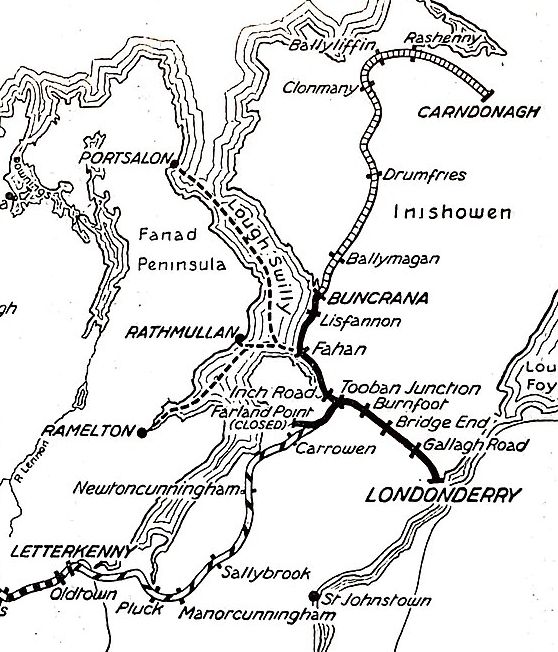
  7. Both these photographs can be found on the DeviantArt website: https://www.deviantart.com/rlkitterman, accessed on 27th December 2022.
  8. https://en.wikipedia.org/wiki/Penrhyn_Port_Class, accessed on 27th December 2022.
  9. https://en.wikipedia.org/wiki/Penrhyn_Main_Line_class, accessed on 27th December 2022.
  10. https://maps.nls.uk/os/6inch-england-and-wales/index.html, accessed on 27th December 2022.
  11. https://maps.nls.uk/geo/explore/#zoom=15.8&lat=53.23498&lon=-4.11253&layers=6&b=1, accessed on 27th December 2022.
  12. https://www.geograph.org.uk/photo/4180528, accessed on 27th December 2022.
  13. https://www.geograph.org.uk/photo/6960097, accessed on 27th December 2022.
  14. https://www.geograph.org.uk/photo/6554213, accessed on 27th December 2022.
  15. https://maps.nls.uk/geo/explore/#zoom=16.0&lat=53.22925&lon=-4.11044&layers=6&b=1, accessed on 28th December 2022
  16. https://m.facebook.com/groups/418992338717208/permalink/1139980376618397, accessed on 28th December 2022.
  17. https://m.facebook.com/groups/narrowgauge/permalink/6708832335795404, accessed on 28th December 2022.
  18. https://m.facebook.com/groups/narrowgauge/permalink/5131244703554183, accessed on 28th December 2022.
  19. https://maps.nls.uk/geo/explore/#zoom=16.0&lat=53.22458&lon=-4.11050&layers=6&b=1, accessed on 28th December 2022.
  20. https://www.geograph.org.uk/photo/4180575, accessed on 28th December 2022.
  21. https://m.facebook.com/groups/417502465072892/permalink/2232508116905642, please see the comments on this thread. Accessed on 28th December 2022.
  22. https://m.facebook.com/groups/417502465072892/permalink/529969163826221, accessed on 28th December 2022.
  23. https://m.facebook.com/groups/417502465072892/permalink/1512499952239799, accessed on 28th December 2022.
  24. https://maps.nls.uk/geo/explore/#zoom=16.0&lat=53.21987&lon=-4.10971&layers=6&b=1, accessed on 28th December 2022.
  25. https://maps.nls.uk/geo/explore/#zoom=16.0&lat=53.21884&lon=-4.10291&layers=6&b=1, accessed on 28th December 2022.
  26. https://maps.nls.uk/geo/explore/#zoom=16.0&lat=53.21309&lon=-4.10235&layers=6&b=1, accessed on 29th December 2022.
  27. https://www.railmaponline.com/UKIEMap.php, accessed on 29th December 2022.
  28. https://maps.nls.uk/geo/explore/#zoom=16.0&lat=53.20823&lon=-4.10044&layers=6&b=1, accessed on 29th December 2022.
  29. https://maps.nls.uk/geo/explore/#zoom=16.0&lat=53.20527&lon=-4.09580&layers=6&b=1, accessed on 29th December 2022.
  30. https://maps.nls.uk/geo/explore/#zoom=16.0&lat=53.20204&lon=-4.09043&layers=6&b=1, accessed on 29th December 2022.
  31. https://maps.nls.uk/geo/explore/#zoom=16.4&lat=53.19818&lon=-4.08442&layers=6&b=1, accessed on 29th December 2022.
  32. https://maps.nls.uk/geo/explore/#zoom=15.9&lat=53.19386&lon=-4.08259&layers=6&b=1, accessed on 29th December 2022.
  33. W J Crompton, RCAHMW, 5 November 2009, accessed via: https://coflein.gov.uk/en/site/409718, accessed on 31st December 2022.
  34. https://en.m.wikipedia.org/wiki/De_Winton, accessed on 3rd January 2023.
  35. Barrie K Lill; Richard Pennant, Samuel Worthington and the mill at Penlan: a history of the Penrhyn Mills on the Lower Ogwen; Bangor University, 2019, accessed via https://research.bangor.ac.uk/portal/files/22801787/2019_Lill_B_PhD.pdf, accessed on 5th January 2023.
  36. J.I.C. Boyd; Narrow Gauge Railways in North Caernarvonshire, Vol.II, The Penrhyn Quarry Railways; The Oakwood Press, Usk, 1985.
  37. Personal correspondence dated 20th November 2017 alluded to by Barrie Lill in reference [35]
  38. Permission sought to share some further photographs of Porth Penrhyn (https://www.ebay.co.uk/itm/293353217633?mkcid=16&mkevt=1&mkrid=711-127632-2357-0&ssspo=vFhrxofnRnO&sssrc=2349624&ssuid=afQhrar7TGK&var=592202447151&widget_ver=artemis&media=CO)

2018-2022: Railway News from Kenya

This post includes a selection of news items about Kenya Railways in the period from 2018 to the Autumn of 2022. The items included are by no means exhaustive but they might be of interest! ……..

The Birth of a Nation: preserving records on the Kenya-Uganda railway line (EAP1143)

In 2018 the British Library funded a small pilot project undertaken in Nairobi Railway Museum’s archive. This was a low cost 6 month pilot which identified the condition of the archived documents and photographs and improved storage and access to them.

The photographs which were digitised all seem to predate the construction of the railway and document the life and times of people who lived on its route. [1]

The Standard-Gauge Line

In 2018, NPR reported that the “Standard Gauge Railway station in Nairobi is easily the most impressive public building in Kenya.” [8] The station is “adventurous. It’s all gray and modern. Geometric shapes form an abstract locomotive, and red neon announces the “Nairobi Terminus.”” [8]

The Standard-gauge Railway Station at Nairobi. [8]

NPR continues: “The train runs 293 miles from Kenya’s capital city to the port of Mombasa and back twice a day and represents the biggest infrastructure project since Kenya’s independence 54 years ago. The Chinese financed it; a Chinese company built it; and the Chinese will operate it for many years to come. … The project, which launched in the summer of 2017, has not only come to signify Kenya’s ambitions, but also China’s ambitions on the African continent. In the past decade, China has become the biggest lender to governments in Africa. The money has helped build ports, roads, bridges, airports and trains. But critics warn the loans are full of traps that could leave African countries in the lurch. Kenya alone owes $5.3 billion to China.” [8]

On 16th October 2019, VOA News reported that Kenya opened the second phase of the Standard Gauge Railway Project: “Kenya’s President Uhuru Kenyatta officially opened on Wednesday the second phase of his flagship infrastructure project: a Chinese-funded and built railway that will eventually link the port of Mombasa to Uganda. … The latest stretch of track cost $1.5 billion and runs from Nairobi to the Rift Valley town of Naivasha.” [9]

After the official opening, the president then joined the first ride along the line. … “The train stopped at every station, where a cheering crowd awaited the president. He promised them that the new railway will bring prosperity. … Kenyatta said that if the railway comes here, development also comes here.” [9]

The new track is 120 kilometers (75 miles) long and has 12 stations. Passengers can ride the trains, but the railway is mainly for cargo. The track will eventually lead to an inland container depot, (see below) from where containers will be distributed to Uganda and Rwanda, and to South Sudan. [9]

On 20th August 2021 the Ugandan newspaper, ‘The Independent’ reported that Kenya’s Standard-gauge railway line transported 2.31 million tons of cargo between January and the end of May that year: “an increase of about 45 percent from the similar period in 2020, according to data released on Thursday from the Kenya Railways Corporation.” [10]

“The rise in cargo volumes saw an increase in revenue generated during the months to 6.2 billion shillings (about 57 million U.S. dollars), up from 41.4 million dollars generated from January to May in 2020, it said. … The number of passengers using the train during the first five months of 2021 nearly doubled amid COVID-19 pandemic. … Some 601,201 passengers were ferried between the capital Nairobi and the coastal city of Mombasa during the period, up from 330,232 in 2020 when the country grappled with COVID-19 pandemic, the corporation said. … This generated revenue of 5.9 million dollars, up from 3.3 million dollars generated between January and May in 2020.” [10]

Refurbishment of Nairobi Central Station

Major renovations at Nairobi Central Station began on 27th July 2020. By January 2021, the work was well-advanced. Kenya Railways reported that the work would facilitate the use of the new DMUs due to arrive in the country.

Renovation work at Nairobi Central Station in January 2021. [5]

Kenya Railways stated on 13th January 2021 that, “as the rehabilitation works continue[d], stringent measures [were] put in place to safeguard daily commuters as they access[ed] the station.” [5]

Designated boarding points were set for various trains to facilitate safe movement of passengers within the Nairobi Central Station. For instance, Kikuyu and Ruiru trains, the boarding point was designated on the Western end of the Nairobi Central Station and it was to be accessed from Railways Police station. While passengers boarding Syokimau & SGR Link trains boarded the trains from the Eastern end of the station with the access point being adjacent to Guava restaurant.

Kenya Railways stated that, “The rehabilitation of Nairobi Central Station will not only give it a new face but also show KR is dedicated in making transportation better.” [5]

Plans for the full renewal of Nairobi Central Station were published in May 2022. The project has been sponsored by both the British and Kenyan Governments.

Design office view of the proposed renewed Central Station. [6]

THE British and Kenyan governments unveiled the final design of Nairobi’s new Central Railway Station and surrounding public area, which has been developed as part of the Nairobi Railway City redevelopment programme. [6]

The IRJ reported that, “The design was developed by SNC-Lavalin subsidiary Atkins and submitted to Kenya Railways and the Ministry of Transport. … The station is designed to accommodate up to 30,000 passengers per hour at peak periods, and will have 6000m2 of concourse space. The station will offer a new covered public space for the city with retail outlets and other amenities …. It features separate entrance and exit routes to avoid conflicting flows and ensure passengers can get to and from the platforms efficiently. … Three existing platforms will be joined by six additional passenger platforms, and four dedicated freight lines will be built. Two platform bridges will be built, with one for passengers entering the station and one for passengers exiting.” [6]

A few design office perspective views are shown below:

The SGR to MGR link at Naivasha

In July 2022, President Uhuru Kenyatta officially commissioned the Standard Gauge Railway – Metre Gauge Railway Passenger Rail Link at the Kenya Railways Mai Mahiu Station in Naivasha, Nakuru County. The ceremony took place on Tuesday, 26th July 2022.

The 5km link will enable passengers traveling to Western Kenya by train to switch from the standard-gauge service to that of the metre-gauge and vice versa. Kenya Railways reported that it would as a result be possible to travel exclusively by rail from Mombasa through Kilifi, Kwale, Taita Taveta, Makueni, Machakos, Kijiado and Nairobi onwards to Nakuru, Kisumu, Eldoret, Kitale, Nyahururu, Nanyuki, Malaba and Bungoma. [2]

Naivasha Inland Container Depot

On the same day (26th July 2022) the Naivasha Inland Container Depot (ICD) was officially opened by President Uhuru Kenyatta.

The Naivasha ICD facility which incorporates both the Standard Gauge Railway and the Metre Gauge Railway line will handle mainly transit cargo to the Great Lakes Region including Uganda, South Sudan, DR Congo, Northern Tanzania, Rwanda, and Burundi, which account for around 30% of imports and exports through the Port of Mombasa.

The SGR/MGR Link referred to above will greatly facilitate the transshipment process. All Transit cargo can now be delivered to the facility straight from the Port of Mombasa as either Through Bill of Lading (TBL) or merchant haulage (Non-TBL), while exports and empty containers can also be consolidated at the Naivasha ICD and railed to the Port of Mombasa for onward shipping.

Kenya Railways reported that, “The depot is linked to the Mombasa Port container terminal by a rail-tainer service on the Mombasa to Suswa Standard Gauge Railway line. It will serve to bring port services closer to customers and reduce congestion at the Port of Mombasa, Nairobi Inland Container Depot and on the roads. It is convenient for East African partner states who will not have to cover an entire 572 kilometres by road between Mombasa and Naivasha. From Naivasha ICD to Malaba Railway Yard, cargo will be transported over 36 hours and it will cost $860.”

Kenya Railways also affirmed that, “The Naivasha ICD includes a one-stop centre for ease of operations and efficient service delivery. The port houses all the Government agencies involved in handling of cargo namely Kenya Railways, Kenya Ports Authority, Kenya Revenue Authority, Kenya Bureau of Standards, Port Health (Public Health) and Revenue Authority officers from partner states of Uganda, Rwanda and Tanzania.” [3]

Nakuru Railway Station

President Uhuru Kenyatta officially commissioned the revitalized 217km Nakuru-Kisumu Metre-Gauge Railway (MGR) and the 465km Longonot–Malaba segment as well as the refurbished Nakuru Railway Station.

Kenya Railways reported on 28th July 2022 that the re-commissioning had taken place: “The iconic Nakuru Railway Station is a key transit station for cargo and passenger train services to and from Western Kenya, and is the aggregation hub for farm produce from the agriculturally rich Central Rift region for onward freight to the Coast for export.” [4]

“Nakuru town started as a railway station on Kenyan-Uganda railway line at the turn of 20th century. It was built in 1900 and later expanded in 1957. It sits on the east side of the centre of Nakuru. The town is part of the famous ‘White Highlands settlement’ areas established by the British during the colonial era. The areas surrounding Nakuru town are mainly known for their vast agricultural potential especially cash-crop farming i.e wheat, barley, pyrethrum, sisal, maize and beans. Nakuru Railway Station was built in order to serve the rapidly growing economy of the town.” [4]

Refurbished Nakuru Railway Station [7]

“Later branch lines were built to link the station to farming areas. Among these was the line linking the station to the sisal producing Solai area. Just 6.9 kilometres from Nakuru town lies Nakuru Junction station. This is the point at which the lines to Malaba and Kisumu diverge.” [4]

Suburban Services in Nairobi

Nairobi Commuter Rail Services now run regularly to Ruiru, Embakasi Village, Limuru, Syokimau and Lukenya in Kitengela. There is also a Madaraka Express Commuter Service that operates between Nairobi Terminus and Ngong station and a link service between Nairobi Central Station and the Standard-gauge Station runs at 0630hrs, 1200hrs and 2010hrs each day. [11]

References

1. https://eap.bl.uk/project/EAP1143, accessed on 9th September 2022.

2. https://krc.co.ke/sgr-mgr-passenger-rail-link-officially-opened, accessed on 12th October 2022.

3. https://krc.co.ke/h-e-president-uhuru-kenyatta-commissions-the-standard-gauge-railway-metre-gauge-railway-lines-passenger-rail-link, accessed on 12th October 2022.

4. https://krc.co.ke/rehabilitated-nakuru-railway-station-officially-open, accessed on 12th October 2022.

5. https://krc.co.ke/nairobi-central-station-gets-a-face-lift, accessed on 11th October 2022.

6. https://www.railjournal.com/passenger/main-line/design-unveiled-for-new-nairobi-central-railway-station, accessed on 11th October 2022.

7. https://www.capitalfm.co.ke/news/2021/09/kenya-railways-to-commence-mgr-passengers-operations-to-kisumu-in-december, accessed on 12th October 2022.

8. https://www.npr.org/2018/10/08/641625157/a-new-chinese-funded-railway-in-kenya-sparks-debt-trap-fears, 12th October 2022.

9. https://www.google.com/amp/s/www.voanews.com/amp/africa_kenya-opens-second-phase-massive-railway-project/6177699.html, accessed on 12th October 2022.

10. https://www.independent.co.ug/kenyas-modern-railway-transports-2-31-mln-tons-of-cargo-between-january-and-may, accessed on 12th October 2022.

11. https://m.facebook.com/story.php?story_fbid=pfbid0eJvJuK7FVebaLxcuouXFSBviZhHu5yAE5ySPC4kRDoimGvyx5BG5QtGkVLN87KjQl&id=100064281415632, 12th October 2022.

The Railways of Telford – the Wellington to Severn Junction Railway (W&SJR) – Part 1 – Wellington to Horsehay

The featured image shows a 1950 service to Much Wenlock and Craven Arms entering Horsehay and Dawley Railway Station. Details of the photograph are given towards the end of this article.

“The Wellington and Severn Junction Railway … was built between 1857 [and] 1861 and formed part of the Wellington to Craven Arms Railway. For much of its working life, it was operated by the Great Western Railway and subsequently the Western Region of British Railways.” [1]

Wikipedia tells us that “Its route included the following stations: – Wellington, Ketley, Horsehay and Dawley, Doseley Halt, Lightmoor Platform and Coalbrookdale.” [1] That list on Wikipedia is not exhaustive: Ketley Town Halt was opened by the GWR in March 1936 a little to the South of the Sinclair Iron Foundry; [17] New Dale Halt opened in 1934 to serve Newdale; [18] Lawley Bank Station was set in a relatively rural area; [19] Green Bank Halt (close to Jigger’s Bank, between the bridge over Jigger’s Bank and that over Cherry Tree Hill) opened in 1934 and closed in 1962. [16]

The necessary Act of Parliament, the Wellington and Severn Junction Railway Act, was promulgated in 1853. [3]

The images below show the developing standard-gauge rail network around the River Severn. By 1957 the W&SJR linked Ketley Junction to Lightmoor. It was a little longer before the line made a connection with the Severn Valley Railway and eventually the route through to Craven Arms opened.

Ketley Junction to Lightmoor was open by 1857. [4]
The Severn Valley line was open by the time covered by this map. [4]
The complete route of the Wellington, Much Wenlock & Craven Arms Railway was in use by 1867. [4]
The railways in the area around what was the Wellington & Severn Junction Railway (W&SJR) as shown on the OpeRailwayMap. OpenRailwayMap (previously called “Bahnkarte”) is a detailed online map of the world’s railway infrastructure, built on OpenStreetMap data. It has been available since mid-2013 at OpenRailwayMap.org [40]

Adrian Knowles [2] tells us that it was always intended that there would be a standard-gauge railway serving “the western side of the coalfield – particularly the ironworks at Ketley and Horsehay – and indeed the main Coalbrookdale Company works following the cutback of the original Shrewsbury & Birmingham (S&B) scheme to Lightmoor in 1851.” [2: p19]

In 1851/52, Dickson & Co. built a short line from Waterloo sidings on the Shrewsbury & Birmingham Railway close to Wellington to the Ironworks at Ketley. The Coalbrookdale Co. became major backers of an initiative to extend that short line down into the Severn Gorge.

Knowles tells us that “the route was surveyed during 1852 by John Barber of Wellington and initial plans were drawn up by John Mackenzie.” [2: p19]

In an effort to keep the LNWR out of the area around Coalbrookdale the S&B board granted running rights over their line between Wellington and Ketley and part-funded the parliamentary process required to allow the line to progress.

The Act received Royal Assent on 20th August 1853, the same day as the Severn Valley Railway Act. [2: p20] It “dictated that the S&B, LNWR and SUR should allow free passage to all traffic to and from the W&SJR and that the W&SJR should reciprocate in accommodating traffic from those companies.” [2: p20]

Knowles tells us that the estimated cost of the new railway was £60,000. The share uptake was slow but enough was raised to make headway on purchase of land. Nothing was spent on construction until all the land had been acquired. By mid-1855 funds were still inadequate to allow a start on construction along the full length of the line. The board decided to start work on the heaviest engineering works, which began on 25th August 1855. [2: p20] A start was made on the length of the line between Ketley Junction and Horsehay which included Horsehay Tunnel.

By 1st May 1857 the line between Ketley Junction, including Heath Hill Tunnel, was ready to open for goods and mineral traffic. [2: p22-23] It is interesting that because the branch “was being used largely to serve Horsehay Works, and the GWR was withholding any revenue payments pending a formalised working agreement which would set the amount, the Coalbrookdale Company sympathised with W&SJR shareholders who were receiving no returns on their money. The Coalbrookdale Company therefore agreed to pay a five per cent annual dividend while negotiations with the GWR over operating the line continued. The first such payment was made to shareholders on 1st July 1958.” [2: p24]

Steady progress was being made on the remainder of the line to Lightmoor. “During the winter of 1857-8, £5,732 was spent on the work, all subscribed by the Coalbrookdale Company which by this time had a 75% stake in the W&SJR.” [2: p24]

Knowles goes on to mention arrangements made at Lightmoor to cope temporarily with the unfinished connection to the GWR (Shrewsbury & Birmingham) Madeley Branch. “All trains passing from the W&SJR to the GWR and vice versa had to reverse at Lightmoor.” [2: p 24]

Passenger services between Wellington, Lightmoor and Shifnal eventually started operating on 2nd May 1859.

Soon after the opening of the W&SJR proposals were developed by the Wenlock Railway to pass through Coalbrookdale and Brosley and led to a significant enhancement in the value of the W&SJR as it would become part of a through route. [2: p25]

“Almost as soon as the Wenlock Railway Bill received Royal Assent in July 1861 the GWR, now eager not only to have control of the railways to Coalbrookdale, but also to ensure that a line was actually built, offered to assume responsibility for construction of the Lightmoor-Coalbrookdale section. With the blessing of the Wenlock Railway the GWR gained powers for this by including the line in their next ‘omnibus’ Bill later in 1861.” [2: p26]

It seems reasonable to include the line through Coalbrookdale in our review of the W&SJR. It was about 1.5 miles in length and gave the GWR direct access to Coalbrookdale. It included the cutting of a ledge from the steep hillside and a 26-arch brick viaduct which carried the line through the Coalbrookdale Company’s works and over Upper Furnace Pool. Knowles says that the biggest obstacle was “‘New Pool’ at the head of Coalbrookdale. There was no alternative but to drain the pool temporarily and build a massive retaining wall to hold back the water, after which the new track-bed was laid on the strip of reclaimed land.” [2: p65]

The line from Lightmoor Junction onwards was double-track and generally fell at 1:50 towards the River Severn.

The Route

Wellington Railway Station was the junction station for the Coalbrookdale line (W&SjR). The bay platform on the South side of the station site was shared with the Coalport branch passenger services – the 6″ OS Survey of 1881/82, published in 1888. [5]
Approximately the same area as it appears on the 25″ OS Map of 1901, published in 1902. The station is on a relatively confined site and little has changed in the twenty years between 1881 and 1901. [6]
The same area in the 21st century as shown on the ESRI World Mapping provided by the National Library of Scotland. The station layout is much rationalised. The Goods yard is a casualty of progress and development! A single bay platform line remains. [7]
The immediate station area as it appears on Google Maps in 2022. The bay platform can more easily be seen on this image. Platform 3, the bay platform, is now out of regular use following the withdrawal of the Wellington to Walsall local service and its subsequent replacement with through Shrewsbury to Birmingham New Street local services. Traces of another defunct platform face (the outer side of the old up island platform) can be seen from the car park behind platform 1. [Google Maps][13]
Wellington Railway Station in June 2022, (c) Kylxa, authorised for reuse under a Creative Commons Licence (CC BY-SA 4.0) [13]
The bay platforms at Wellington Railway Station in July 1950. Small Prairie No. 4406 is about to work the 4.30pm to Much Wenlock running down the W&SJR. The loco to its right is LNWR 0-6-2 No. 58904 with the 3.53 to Coalport (east) using the LNWR Coalport Branch. [14]
Wellington Railway Station in July 2018, looking West from the overbridge. [Google Streetview, July 2018]
Looking East from the same overbridge in July 2018. The arched-bridge ahead is King Street Bridge. [Google Streetview, July 2018]
The view West, back towards Wellington Railway Station from King Street Bridge. [Google Streetview, May 2021]
The view East from King Street Bridge. The bridge in the distance is Junction Bridge and it marks the Western extent of Wellington Junction. In the 2st century that bridge carries Mill Lane. [Google Streetview, May 2021]
The length of the line between King Street Bridge and Wellington Junction on the 6″ 1881/82 OS Map. [5]
Wellington Junction in 1881/82 on the 6″ OS Map. [5]
Wellington Junction in 1901 on the 25″ OS Map [8]
The same area in the 21st century [Google Maps]
The view East from Mill Lane Bridge in 2011. The railway junction has been rationalised with only a single line following the old LNWR Shropshire Union Railway Line. The old Shrewsbury and Birmingham Line (GWR) remains as a double-track mainline. [Google Streetview, March 2011]
The line passed to the South of Haybridge Iron Works, 1881/82 on the 6″ OS Map. [5]
Ketley Junction followed after the mainline crossed Ketley Brook, 1881/82 on the 6″ OS Map. [5]
Trains for the W&SJR left the mainline and followed the single line round to the South before entering Ketley Station, 1881/82 on the 6″ OS Map. [5]
As we are now on the W&SJR route, the line of the railway is shown approximately on this modern satellite image. Ketley Station was just to the South of what was once the A5 but is now the B5061, Holyhead Road. The line can be seen on the OS Map above passing under an accommodation bridge on the curve round towards Ketley Station. That bridge remains in the 21st century carrying an extension to Copper Beech Road. [Google Maps, 2022]
The refurbished accommodation bridge seen from Copper Beech Road. [Google Streetview, June 2015]
The view Northwest from the accommodation bridge. A red line shows the route of the railway. [Google Streetview, May 2011]
The view Southeast from the accommodation bridge. The route of the line is much more easily picked out than on the photograph above! However, by 2022 the grass route close to the accomodation bridge had become overgrown. A narrow footpath leads down the embankment on the East side of the bridge to track level. [Google Streetview, May 2011]
The track-bed of the W&SJR about 100 metres South of the accommodation bridge above. [My photograph, 2nd July 2022]
A short distance further south a stepped path from Copper Beech Road leads down to the old track bed which is maintained as a Greenway. [My photograph, 2nd July 2022]
Just a little further to the South, this image shows the old railway line in cutting alongside a footpath which leads off Copper Beech Road to the old level-crossing at what was once A5. [Google Streetview, June 2015]
The route of the railway approaching the old A5. [My photograph, 2nd July 2022]
The view North from Station Road, Ketley looking back along the route of the railway which was in cutting to a point relatively close to the road. [Google Streetview, September 2021]
The Ketley Station site in 1901 as shown on the 25″ OS Map. [11]
Postcard view of Ketley Railway Station from the West. The Methodist Chapel is visible in the distance on the left. Shared on the Telford Memories Facebook Group by Marcus Keane. [21]
Ketley Station viewed from the Northwest in May 1957. Shared on the Telford Memories Facebook Group by Metsa Vaim EdOrg. [22]
Ketley Station from the Southwest. Shared on the Telford Memories Facebook Group by Peter Wheeler. [23]
A view from the South along the platform at Ketley Station with crossing gates closed to allow traffic through on the A5 on 18th February 1967. Shared on the Telford Memories Facebook Group by Carol Anne Huselbee. [24]
The view South through Ketley Railway Station site from Station Road in September 2021. The redline gives the approximate alignment of the railway. [Google Streetview]
The remains of Ketley station platform and trackbed, looking due south toward Horsehay in May 2008. The photographer comments that the trackbed is now a public footpath and the picture is taken from the former site of a level crossing across what in railway days was the A5 trunk road, © Copyright Peter Whatley and licensed for reuse under this Creative Commons Licence (CC BY-SA 2.0). [12]
Looking back North from the location of Ketley Station towards what was once the level crossing. [My photograph, 2nd July 2022]
The 6″ OS Map 1881/82 survey as published in 1888, shows Ketley Station and the line continuing to the South. [5]
Approximately the same area on the modern satellite images provided by the National Library of Scotland. There is no need to highlight the route with a red line as the route is tree-lined and runs down the centre of the image. [27]
The 25″ OS Map as revised in 1937 shows private sidings to the Iron Foundry and Ketley Town Halt which can be seen to the South of Sinclair Gardens. [25]
Ketley Town Halt in 1936. Shared on the Telford Memories Facebook Group by Metsa Vaim EdOrg. [26]
Looking South through the location of Ketley Town Halt. [My photograph, 2nd July 2022]
Looking North through the location of Ketley Town Halt. [My photograph, 2nd July 2022]
The 6″ OS Map shows the line continuing to the South. Ketley Town Halt was at the point where the signal post is shown on this extract. The modern M54 is shown on the satellite image below, it crosses the line travelling East-West at approximately the ‘GT’ of ‘ WELLINGTON’. [5]
The route of the old line continues to be delineated by woodland as it approaches and crosses the M54. [28]
The footpath following the W&SJR diverts away from the line South of the location of the Halt. This view looks South down the alignment of the W&SJR towards the modern M54. [My photograph, 2nd July 2022]

The M54 forms a significant barrier if one intends to follow the line. Walking North to South, the route requires one to head Northeast from the old railway along Sinclair Gardens passed Littlefords Garden Centre to Waterloo Road and then turn South to pass under the M54. Just beyond the motorway a footpath leaves Waterloo Road heading West to meet the route of the old railway again.

South of the motorway, there is no need again to highlight the line of the old railway as once again trees line the route. [Google Earth]
The line of the W&SJR regained. [My photograph, 9th June 2022]
Pannier Tank no. 3732 in charge of a short pick-up goods service between Ketley and Lawley Bank in 1953. This photograph was shared by Metsa Vaim EdOrg on the Telford Memories Facebook Group in March 2020. [37]
Further South, close to the location of New Dale Halt. [My photograph, 9th June 2022]
The W&SJR continues South passed Newdale. A small settlement that has now disappeared. The road shown crossing the line at that point is also the line of an old tramway. Just to the West of the line is an old two arch tramway bridge crossing Ketley Dingle. (Details of the bridge can be found here.) [5]
New Dale Halt in the 1930s. Shared by Metsa Vaim EdOrg on the Telford Memories Facebook Group. The halt served the hamlet of Newdale and was located a little to the North of the point where the old tramway route crossed the W&SJR. [26]
New Dale Halt is shown on the 25″ OS Map as revised in 1937. [25]
Just beyond the location of the Halt, the way-marker post marks the location of the path down to the tramway bridge and therefore the point where the W&SJR crossed the older tramway. [My photograph, 9th June 2022]
Newdale Tramway Bridge in the middle of the 20th century, shared on the Telford Memories Facebook Group by Metsa Vaim EdOrg. [29]
South of Newdale, this is the next length of the line on the 6″ OS Map of 1881/82. We are now on the next map sheet (No. 101594458). [9]
Looking back to the North along the W&SJR towards Newdale. [My photograph, 9th June 2022]
Looking forward to the South along the line of the W&SJR. Its approximate line is highlighted by the red line. [My photograph, 9th June 2022]
Looking ahead, once again with the approximate line of the W&SJR highlighted. [My photograph, 9th June 2022]
Looking back to the North over open ground with the route of the old line highlighted. [My photograph, 9th June 2022]
Facing South once again, a footpath follows the old line. [My photograph, 9th June 2022]
And again, looking South. [My photograph, 9th June 2022]
Much of the landscape has changed dramatically over the years. Much of the development in the area has occurred since the millennium. We are approaching the location of what was once Lawley Bank Railway Station. [My photograph, 9th June 2022]

South of New Dale Halt, the next station was ‘Lawley Bank’. Major development has taken place in recent years. New housing and a shopping area have replaced open fields. The site of the station is covered by new development.

The satellite image from the National Library of Scotland of the northern approach to of what was Lawley Bank Station. The approximate line of the W&SJR is shown by the red line. [31]
Modern housing dominates the route of the old line.[My photograph, 13th June 2022]
Lawley Village Day Nursery straddles the line of the old railway. [My photograph, 13th June 2022]
Looking back to the North along the line of the old railway from the car park of Morrison’s Supermarket. [My photograph, 13th June 2022]
Morrison’s Supermarket also straddles the line of the old railway. [My photograph, 13th June 2022]
The South side of Morrison’s Supermarket, the old line ran to the left hand side of this picture. [My photograph, 13th June 2022]

At the time that the 1881/82 maps were drawn, this was a relatively rural area. The 6″ 1881/82 survey is immediately below. It shows very little detail close to the railway station. The later 1901 6″ survey follows below and appears to show the remnants of a tramway running on the West side of the W&SJR. This would need further investigation, particularly since it does not appear on the 1881/82 survey.

The satellite image which follows the two 6″ maps shows the position of the station overlaid on the modern satellite image of the location provided by the National Library of Scotland.

Lawley Bank Station on the 6″ OS Map of 1881/82. Again, the surroundings either side of the line were, at that time, essentially rural. [9]
The 25″ OS Map from 1901 showing the location directly around Lawley Bank Station. An interesting feature is the shepherd’s crook to the West of the line which is very suggestive of a tramway. It may not be a tramway, but it certainly will warrant further investigation. It is worth noting that it does not appear on the 1881/82 6″ Survey and that it is not marked on this extract as a tramway. [30]
The area around the site of Lawley Bank Station has been radically altered by new development. [30]
Looking North through the crossing gates at Lawley Bank Station on 18th February 1967. The rural nature of the surrounding landscape is evident. This image was shared on the Telford Memories Facebook Group by Carole Anne Huselbee in September 2014. [36]
Lawley Bank Station in 1962 taken from a train standing at the platform. This image was shared by Stuart Geoffrey Davis on the Memories of Shropshire Facebook Group in September 2018, (c) Stuart Geoffrey Davis. [33]
Lawley Bank Station again, taken from a Southwesterly direction, a wider angle taken from track level, shared by Metsa Vaim EdOrg on the Telford Memories Facebook Group on 22nd February 2021. [34]
The location of Lawley Bank Station in 1987. This view looks North across Station Road. It was shared by Metsa Vaim EdOrg on the Telford Memories Facebook Group in November 2020. Metsa comments: “The railway route has more or less vanished in 1987. Probably the last time I walked the line with my mum’s dog. The stream is now a trickle, that once flowed faster and deeper from Horsehay Common. Gone are the Hares, Curlews, Green Plover, Grey Partridge, Skylarks and Snipe from the fields either side of the track. Gone are the fruit trees, especially a large pear tree that was hidden behind some Silver Birches, a field away from our house. Gone are the dragonflies that patrolled through the Horsehair Ferns either side of the track-bed.” [35]
The approximate line of the railway South of Lawley Bank Station is shown on this NLS satellite image. The rectangular white building straddling the old line in both these last two images is Lawley Village Primary Academy. [32]
Standing in front of Morrison’s Supermarket on the North side of West Centre Way looking South along what was the route of the old railway. [My photograph, 13th June 2022]
Lawley Village Primary Academy sits over the line of the old railway. This photograph looks along the side of the building parallel to the line of the railway, North, towards the location of the erstwhile Lawley Bank Station. [My photograph, 13th June 2022]
Turning through close to 180°, this photograph looks along the side of the school again but this time to the South. At this point, the old railway route runs at the back of the school building. [My photograph, 13th June 2022]
Looking South across the level crossing at Lawley Bank Station with a service for Wellington at the station platform. This image was shared by Lin Keska on the Telford Memories Facebook Group on 12th February 2017. [42]
Looking North from the area of the School car park. Morrison’s Supermarket can be seen in the distance. The School is the white and grey building on the left of the image. The approximate line of the old railway is marked by the red line imposed on the photograph. [My photograph, 13th June 2022]
Looking South from the fence-line at the edge of the School carpark. The red line approximates to the line of the old railway. [My photograph, 13th June 2022]
Looking back to the North from adjacent to the housing in the [picture immediately above. Lawley Village Primary Academy is in the centre of the image and the approximate line of the railway is, again, shown as a red line. [My photograph, 13th June 2022]
This satellite image provided by the NLS (National Library of Scotland) had been edited to show the line of the railway as a red line. At the bottom edge of the image on the East side of the redline the current extent of the preservation line ‘Telford Steam Railway can be seen. [38]
Looking South from the location of the photograph above, the old line entered a cutting. The tree growth is in that cutting. [My photograph, 13th June 2022]
The surrounding land is rising and the cutting is deeper as the line heads South, the red line at the left of this image shows its route. A contractors compound is just evident on the right skyline in this picture. [My photograph, 13th June 2022]
This image shows a view from the estate road looking East towards what was the route of the railway. The red line to the right side of this image provides an indication of the railway alignment, which was East of the fenced compound. [My photograph, 13th June 2022]
Around 100 metres to the South the new Lawley Station on the Telford Steam Railway’s preservation line. A typical GWR ‘pagoda’ platform shelter has been erected on the relatively new platform. [My photograph, 13th June 2022]
This Google Earth Satellite image shows the old railway alignment just a few metres to the West of the alignment of the preservation line and its Lawley Station. Railway rolling-stock can be seen stored on one of the two tracks at the station. [Google Earth]
Heath Hill Tunnel is the next location to note. This is the 1881/82 6″ OS Map. It passes under the line of Dawley Road. [9]
An photograph of Lawley Station while it was being built. The pagoda platform building has still to be constructed. This image was shared on the Telford Memories Facebook Group by Marcus Keane. There appears to be significant foreshortening which has the effect of bringing buildings to the North much closer to the station. This suggests that the picture was probably taken from close to the northern portal of Heath Hill Tunnel. More about Telford Steam Railway can be found on their website. [39]
Google Earth shows a DMU either setting off from or arriving at Lawley Station. [Google Earth]
Class 108 DMU North of Heath Hill Tunnel on Telford Steam Railway. [46]
The northern portal of Heath Hill Tunnel as it appears in a video on YouTube. [44]
Looking North from the northern portal of Heath Hill Tunnel on 5th September 2010. The new line and Lawley Station are not yet open, © Copyright L.S. Wilson and licensed for reuse under a Creative Commons Licence (CC BY-SA 2.0). [43]
South of Heath Hill Tunnel, the modern preservation line of Telford Steam Railway follows the route of the W&SJR. As it leaves the tunnel it is in relatively deep cutting. [Google Earth]
A relatively grainy photograph of the Southern portal of Heath Hill tunnel after clearance work was completed by Telford Steam Railway, taken on 5th September 2010, © Copyright L.S. Wilson and licensed for reuse under a Creative Commons Licence (CC BY-SA 2.0).. [41]
The cutting between Heath Hill Tunnel and Horsehay & Dawley Station. Shared on the Telford Memories Facebook Group by Metsa Vaim EdOrg.  [20]
The 6″ OS Map from 1881/82 shows the tightly curved approach to Horsehay & Dawley Station from the North. [9]
The 1881/82 OS Map gives some sense of the industrial lines associated with the Horsehay Works. More details can be found in an article about the Coalbrookdale Tramroads. Both the old goods shed and the Coalbrookdale Company’s transshipment shed appear on this map extract. Both are on the North side of Station Road. The transshipment shed is the more westerly of the two. It is known locally as the ‘Old Loco Shed’. [9]
Shared on the Telford Memories Facebook Group by Metsa Vaim EdOrg, who comments: “The station yard, Horsehay in 1971. Now the site of Horsehay Steam Trust, this was the site we played, or trespassed on in the sixties. Above the loco is the roof of the Cub/Scout Hut on Fence Road, and further to the right was the derelict rolling stock and the large two storey building that we played football in. On the first floor avoiding the holes in the floor. Horsehay Works is also to the right. The picture shows a ‘Horsehay Special’ load on its way to Scotland via Lightmoor and Madeley Junctions,” © G.F. Bannister. [54]
The Old Loco Shed. [My photograph, 20th April 2022]
Dawley Hamlets Parish Council erected this blue plaque on ‘The Old Loco Shed’. It reads ‘Built in 1863, as an exchange point for good for the Coalbrookdale Company plateways, narrow gauge system to the standard gauge line of the Great Western Railway, that ran from Wellington to Craven Arms. The loco shed has been the base for the Telford Steam Railway, a voluntary group, operating a section of the GWR line since 1976 with services to the public beginning in 1984. [My photograph, 20th April 2022]
The Old Loco Shed. The base of the Telford (Horsehay) Steam Trust. The picture was taken in 1978. Shared by Metsa Vaim EdOrg on the Telford Memories Facebook Group on 10th May 2021. Metsa writes:
“The Horsehay locomotive shed has the Adamson-Butterley engineering works in the background.
The number of times I walked my mother’s dog down these tracks – probably trespassing at some time. The other shed is to the left out of shot – I think. In the late sixties and seventies this line to Lawley Bank was alive to the birdsong of warblers, linnets, yellowhammers and the like. [47]
Horsehay & Dawley Good Shed, now demolished. The lines to the left head for the ‘Old Loco Shed’ which was the transshipemtn shed for the Coalbrookdale Company, and towards the main Horsehay Works. This image was shared by Lin Keska and Tom Cooper on the Telford memories Facebook Group on 13th February 2017. [48]
The Horsehay and Dawley Station looking South towards the road over-bridge early in the 20th century. This image was shared by Lin Keska and Tom Cooper on the Telford memories Facebook Group on 13th February 2017. {53]
Horsehay & Dawley Railway Station in the early 20th century, shared on the Telford Memories Facebook Group by Metsa Vaim EdOrg on 12th December 2020. [49]
Horsehay and Dawley railway Station in 1950. The photograph was taken from the over-bridge looking to the Northwest. Shared by Metsa Vaim EdOrg on the Telford Memories Facebook Group on 7th July 2022. [50]
Horsehay and Dawley station on 5th May 1957. Shared by Metsa Vaim EdOrg on the Telford memories Facebook Group on 25th July 2021. Metsa writes: “When the trains were no more, the perfect walk with the dog. From Lawley Bank, under the tunnel, past the smouldering coal seams under the heather, past numerous singing warblers, past the back of Kevin Rollins’s house to the Horsehay station. Through the goods yard, around the pool, up unto Horsehay Common, across to New Works wood. Down to the Forge pools, along the path to the Newdale packhorse bridge. Along the track back to Lawley station and back alongside the stream that emanated on Horsehay Common. Good job the Steam Trust now operates otherwise they probably would have concreted over/filled in the Heath Hill Tunnel by now. I will always treasure those walks with my mothers collie in the late 60’s and early seventies,” © G.F. Bannister. [51]
Horsehay & Dawley station. The signal in the middle distance marks the junction of the spur into Spring Village station and the yard, which is to the left. Refurbishment is incomplete. The station sign board still has to be fixed to its supporting uprights. The station building still have to be built. [45]
Horsehay & Dawley Railway Station with the now very popular Polar Express which the preservation company puts on in the Winter each year, and has done so since 2016, embedded from an article on the Shropshire Star’s website. The station is in its finished form with the new platform building. [55]
The view from the station access path, looking to the South and the road bridge at Horsehay and Dawley Station. [My photograph, 20th April 2022]
A view of the road bridge from behind the station building at Horsehay and Dawley Station. [My photograph, 20th April 2022]
The view North from the road bridge with the station building in the foreground and the Telford Steam Railway Yard (the old Goods yard) in the background. [My photograph, 20th April 2022]
These two pictures are a ‘then & now’ study. They are both taken looking West across the road bridge across the W&SJR at Horsehay. The first picture shows the old works which were Adamson Alliance Works before becoming home to AB Cranes. The second is after the demolition of the main factory buildings. These two pictures were shared on the Telford Memories Facebook Group by Andy Rose on 21st December 2021. [52]

References

  1. https://en.m.wikipedia.org/wiki/Wellington_and_Severn_Junction_Railway, a ceased on 26th June 2022.
  2. Adrian Knowles; The Wellington, Much Wenlock and Craven Arms Railway; Lightmoor Press, Lydney, Gloucestershire, 2022.
  3. https://vlex.co.uk/vid/wellington-and-severn-junction-808032237, accessed on 26th June 2022.
  4. https://hyperleap.com/topic/Wellington_and_Severn_Junction_Railway, accessed on 26th June 2022.
  5. https://maps.nls.uk/view/101594296, accessed on 29th June 2022.
  6. https://maps.nls.uk/geo/explore/#zoom=17&lat=52.70121&lon=-2.51629&layers=168&b=1, accessed on 30th June 2022.
  7. https://maps.nls.uk/geo/explore/#zoom=17&lat=52.70121&lon=-2.51629&layers=6&b=1, accessed on 30th June 2022.
  8. https://maps.nls.uk/geo/explore/#zoom=17&lat=52.70036&lon=-2.50296&layers=168&b=1, accessed on 30th June 2022.
  9. https://maps.nls.uk/view/101594458, accessed on 30th June 2022.
  10. https://maps.nls.uk/view/101594482, accessed on 30th June 2022.
  11. https://maps.nls.uk/geo/explore/#zoom=18&lat=52.69612&lon=-2.48378&layers=168&b=1, accessed on 30th June 2022.
  12. https://www.geograph.org.uk/photo/804810, accessed on 30th June 2022.
  13. https://en.m.wikipedia.org/wiki/Wellington_railway_station_(Shropshire), accessed on 30th June 2022.
  14. https://www.shropshirestar.com/news/features/2020/06/01/new-queens-stay-in-deepest-south-shropshire, accessed on 30th June 2022.
  15. https://maps.nls.uk/geo/explore/#zoom=16.560351011060174&lat=52.64292&lon=-2.48610&layers=168&b=1, accessed on 1st July 2022.
  16. https://www.wikiwand.com/en/Green_Bank_Halt_railway_station, accessed on 1st July 2022.
  17. https://www.wikiwand.com/en/Ketley_Town_Halt_railway_station, accessed on 1st July 2022.
  18. https://en.m.wikipedia.org/wiki/New_Dale_Halt_railway_station, accessed on 1st July 2022.
  19. https://en.m.wikipedia.org/wiki/Lawley_Bank_railway_station, accessed on 1st July 2022.
  20. https://www.facebook.com/groups/674238619260811/permalink/5358295114188448, accessed on 1st July 2022.
  21. https://m.facebook.com/groups/674238619260811/permalink/2905700199447964, accessed on 1st July 2022.
  22. https://m.facebook.com/groups/674238619260811/permalink/6120237234660895, accessed on 2nd July 2022.
  23. https://m.facebook.com/groups/674238619260811/permalink/1658359617515368, accessed on 2nd July 2022.
  24. https://m.facebook.com/groups/674238619260811/permalink/846348998716438, accessed on 2nd July 2022.
  25. https://maps.nls.uk/view/121150310, accessed on 2nd July 2022.
  26. https://m.facebook.com/groups/674238619260811/permalink/3024958504188799, accessed on 2nd July 2022.
  27. https://maps.nls.uk/geo/explore/#zoom=16.478660506218784&lat=52.69402&lon=-2.48370&layers=6&b=1, accessed on 2nd July 2022.
  28. https://maps.nls.uk/geo/explore/#zoom=17&lat=52.69048&lon=-2.48447&layers=168&b=1, accessed on 2nd July 2022.
  29. https://m.facebook.com/groups/674238619260811/permalink/3023720624312587, accessed on 3rd July 2022.
  30. https://maps.nls.uk/geo/explore/#zoom=17&lat=52.67576&lon=-2.48151&layers=168&b=1, accessed on 5th July 2022.
  31. https://maps.nls.uk/geo/explore/#zoom=17&lat=52.67816&lon=-2.48176&layers=168&b=1, accessed on 5th July 2022.
  32. https://maps.nls.uk/geo/explore/#zoom=17&lat=52.67474&lon=-2.48158&layers=168&b=1, accessed on 5th July 2022.
  33. https://www.facebook.com/photo/?fbid=2208000166151460&set=pcb.1648058645323490, accessed on 6th July 2022.
  34. https://www.facebook.com/photo/?fbid=492524151741258&set=pcb.5358300260854600, accessed on 6th July 2022.
  35. https://www.facebook.com/photo/?fbid=431533454506995&set=gm.4918250424859588, accessed on 3rd July 2022.
  36. https://www.facebook.com/photo/?fbid=350926448418731&set=gm.846919291992742, accessed on 6th July 2022.
  37. https://www.facebook.com/photo/?fbid=255763268750682&set=gm.3788716084479700, accessed on 3rd July 2022.
  38. https://maps.nls.uk/geo/explore/#zoom=17&lat=52.67249&lon=-2.48130&layers=168&b=1, accessed on 7th July 2022.
  39. https://www.facebook.com/photo/?fbid=10201031066934406&set=gm.1060353237316012&cft[0]=AZV_yliKbIqlO8QzxgHLhCOGNDzl2q0JXz5sxj3DqnQvD0DDaeoXaxNVv24KosDWAQnnbtiDfyZQc7ou1TSNLtuS1FE-av5agWpNMlHyZuJmcYpbHRH7WTRyA0vgoRPmmhQdfbqbQrowrwZIZcePiFpL&tn=EH-R, accessed on 7th July 2022.
  40. https://www.openrailwaymap.org, accessed on 7th July 2022.
  41. https://www.geograph.org.uk/photo/2055888, accessed on 7th July 2022.
  42. https://www.facebook.com/photo/?fbid=1394210450623388&set=pcb.1533300770021254, accessed on 7th July 2022.
  43. https://www.geograph.org.uk/photo/2055924, accessed on 7th July 2022.
  44. https://youtu.be/TFCnvUg91hc, accessed on 7th July 2022.
  45. https://upload.wikimedia.org/wikipedia/commons/8/85/Horsehay_%26_Dawley_station_on_the_Telford_Steam_Railway.jpg, accessed on 7th July 2022.
  46. https://www.facebook.com/455639901281038/posts/pfbid0zgjgUvUWoXJz5CUVxNaLCT9JU3uaadGceZ6CYWGLwJ3kjQKMthg3XmH9MsyUYKMwl/?app=fbl, accessed on 7th July 2022.
  47. https://www.facebook.com/photo/?fbid=536113694048970&set=gm.5750220041662618, accessed on 7th July 2022.
  48. https://www.facebook.com/photo/?fbid=1394447547266345&set=pcb.1533901016627896, accessed on 7th July 2022.
  49. https://www.facebook.com/photo/?fbid=451145022545838&set=pcb.5046193635398599, accessed on 7th July 2022.
  50. https://www.facebook.com/photo?fbid=792862381707432&set=gm.7989826267701973, accessed on 7th July 2022.
  51. https://www.facebook.com/photo/?fbid=580770409583298&set=gm.6120294991321786, accessed on 7th July 2022.
  52. https://www.facebook.com/photo?fbid=3069342153301946&set=gm.6951096261574984, accessed on 7th July 2022.
  53. https://www.facebook.com/photo/?fbid=1394447307266369&set=pcb.1533901016627896, accessed on 7th July 2022.
  54. https://www.facebook.com/photo/?fbid=253270635666612&set=gm.3775392372478738, accessed on 7th July 2022.
  55. https://www.shropshirestar.com/news/local-hubs/telford/2021/12/16/telford-steam-railways-polar-express-experience-brings-christmas-magic-to-telford, accessed on 7th July 2022.

The Micklehurst Loop – Part 1A

Just after I posted my first article about the Micklehurst Loop, I was sent a series of photographs by an online acquaintance, Tony Jervis. In February 1981, he visited the same length of the Micklehurst Loop as covered in that article. Tony’s pictures show the line before removal of the two viaducts but after the lifting of the length of line retained to serve the Staley and Millbrook Sidings opposite Hartshead Power Station.

Tony also pointed out a further YouTube video from Martin Zero which is embedded towards the end of this addendum. …..

My first article on the Micklehurst Loop can be found using this link:

The Micklehurst Loop – Part 1

At the time of Tony Jervis’ visit on 14th February 1981, only one section of the Spring-Grove Viaduct had been removed – a simply supported span which  took the line over the Spring-Grove Mill. Toney was very happy for me to share these pictures as an addendum to my original article and he very kindly provided some notes to go with a number of the photographs. I have provided some annotated OS Maps to go with the pictures.

I have retained the reference numbers of the photographs used by Tony Jervis. I find the images fascinating. The first three photographs speak for themselves and are centred on Knowl Street Viaduct at the bottom end of the loop immediately adjacent to Stalybridge New Tunnel.

The 25″ OS Map showing the area to the East of Cocker Hill where the Micklehurst Loop broke out of Stalybridge New Tunnel and immediately spanned the River Tame. The locations of three of Tony’s photographs marked. [1]

Photograph 15, 1981, (c) Tony Jervis. [2]

Photograph 632-16, shows the length of the viaduct and is taken from above the Eastern Portal of Stalybridge New Tunnel, 1981, (c) Tony Jervis. [2]

Photograph 632-17,shows the skew span over the Huddersfield Narrow Canal looking towards the Centre of Stalybridge, 1981, (c) Tony Jervis. [2]

The next few pictures were taken in and around the Staley and Millbrook Station. The software I use allows me to add arrows which are vertical or horizontal but not at an angle, so the locations of the pictures shown on the OS Map immediately below are approximate.

25″ OS Map of Staley & Millbrook Station site at the turn of the 20th century. [1]

Photograph 632-18 shows Spring-Grove Mill was spanned by a simply-supported girder bridge which had already been removed when Tony Jervis visited in 1981, (c) Tony Jervis. [2]

Tony comments about the above image: this picture shows “the gap in the viaduct over the roof of Spring Grove Mill.  I assume the gap was spanned by a horzontal girder bridge, which would have been easier to lift away for scrap than demolish a viaduct arch.  In the background, the power station’s coal conveyor and bunkers are still intact, though the station had been closed about 18 months earlier.  The goods shed … was still in the hands of Firth Hauliers.” [2]

The Goods shed and part of the conveyor are still in place. The viaduct, the mill chimney,the section of the mill visible to the extreme left of the image, the coal handling facilites are long-gone in the 21st century.

Photograph 632-19A, 1981, the portion of the mill on this (West) side of the viaduct and the mill chimney, still present in 1981, were demolished along with the viaduct in the later part of the 20th century (c) Tony Jervis. [2]

Tony Jervis, writing in 1981, comments: “the station platforms were up to the right at the top of the grassy bank but would not have been accessible for passengers from this side.  Beyond the third arch was a span across the top of Spring-Grove Mill, which was presumably modified to allow the railway to be built.  I assume the span was some sort of flat girder bridge which has since been craned away.” [2]

Photograph 632-20A, 1981, (c) Tony Jervis. [2]

He continues: “Passengers for the northbound platform would have climbed a covered passage from the booking office and come through this subway (picture 632-20A) whence another short covered ramp or steps would have led up to the platform waiting room. Note the glazed white tiles designed to slightly lighten the subway’s gloom. Since I appear not to have photographed them, I assume that the station platforms had long been swept away.

Photograph 632-21A, 1981, (c) Tony Jervis. [2]

Tony Jervis says: “Picture 632-21A (below) is taken from the middle of Grove Road east of the viaduct.  The red brick wall would have been the end of the booking office; the station master’s house would have been out of shot to the left.  In the distance is the entrance to the subway. There are marks of the platform retaining wall, which is partly of red brick at the bottom and blue engineering brick further up, that suggest a flight of stairs with an intermediate landing led up the southbound platform and that a lower ramp alongside followed the grass bank up to the subway.  One might wonder, thinking of travel a century ago, whether there might have been a need for sack trucks or even a four-wheeled luggage trolley to reach  the platforms.  The white notice forbidding tipping and trespassing is not in the middle of the road but at the edge of the triangular station forecourt; it won’t show up on the posted picture but above the words is the BR “kinky arrow” symbol. Looking at the 25-inch OS plan, it is interesting to note that the formal entrance to nearby Staley Hall was from Millbrook village to the south but from the back of the building a footpath dropped down to Grove Road alongside the the stationmaster’s house, a tradesmen and servants’ entrance maybe?”

Tony has also provided photographs which were taken late in the evening on 14th 1981 of the Goods Yard across the river and canal from Hartshead Power Station. Their locations are again  marked on the 25″ OS Map immediately below ……

25″ OS Map of the Staley & Millbrook Coal Sidings site. The extract does not show the full extent of the sidings which were in place in the mid-20th century..[1]

Photograph No. 632-21B        9-644    14 Feb 1981    SD 976000 S    Former coal drops at Staley & Millbrook Goods Depot alongside Spring Grove Viaduct. The ruined structure on the horizon is Staley Hall. These drops were just to the North of Spring-Grove Viaduct, (c) Tony Jervis, 1981 – [Tony comments: The “B” suffix is because I managed to give two slides the same number when I numbered them back in 1981.] [2]

Tony Jervis comments: “These coal drops are near the end of the two sidings on the 25-inch OS map closest to the running lines.  They are not marked on the map but the road approach for coal merchants’ lorries is clearly shown.  I did wonder if the apparent tramway in Grove Road in one of [the photographs in the previous article] was a way of transferring coal from here round to the mill’s boiler house (below the chimney, one presumes) but I have seen no indication of it on any map.  The viaduct over Spring Grove Mill starts by the rusty car.  The building on the hill is Staley Hall and the “tradesmen’s” footpath I mentioned in a previous description can be seen descending the bank.” [2]

Photograph No. 632-22        9-646    14 Feb 1981    SD 976001 N    Staley & Millbrook Goods Warehouse and the former Hartshead Power Station coal conveyor, (c) Tony Jervis, 1981. [2]

Tony comments: This picture shows “the goods shed when in use by Firth Transport.  The cleaner ballast in the foreground was the southbound running line and the smoother patch to left of that is presumably where the walkway is today.  In the background is the part of the coal conveyor that remains in situ today.” [2]

Photograph No. 632-23        9-645    14 Feb 1981    SD 977002 NW    Hartshead Power Station Sidings and start of coal conveyor, Staley & Millbrook Goods Depot, (c) Tony Jervis, 1981. [2]

Tony comments: “One of the two towers on the edge of the power station coal sidings.  I presume the “stepped” areas fenced in orange surrounded conveyor belts lifting the coal from siding level up to the high-level conveyor.” [2]

Photograph No. 632-24        9-647    14 Feb 1981    SD 977002 WNW    Site of Hartshead Power Station Sidings and coal conveyor, Staley & Millbrook Goods Depot, (c) Tony Jervis, 1981. [2]

Tony comments: “Swinging left about 45 degrees from the previous photo, I’m not sure what purpose this building served.  There is a capstan in front of it, suggesting that locomotives were not allowed to traverse the length of surviving track and wagons thereon were moved by cable.  Could it have been an oil depot of some sort? The tall pipes at the far end could have been used to empty rail tank cars. Some power stations could burn oil as well as coal; was Hartshead one of them?” [2]

Photograph No. 632-25A      9-648    14 Feb 1981    SD 978002 WSW    Staley & Millbrook Goods Warehouse; Hartshead Power Station beyond, (c) Tony Jervis, 1981 [2]

Tony comments: that it was really too dark by the time this picture was taken, none-the-less  by screwing the contrast control to its maximum a grainy image of the shed and power station  appears reasonably clear but very grainy. [2]

Flicking back and forth between this short article and the latter part of my first article about the Micklehurst Loop (https://rogerfarnworth.com/2021/01/31/the-micklehurst-loop-part-1), will allow a comparison with images of the Staley and Millbrook Station and Goods Depot Sites early in their life and in the 21st century.

To complete this short addendum to my first post here is another video from Martin Zero.

Tony Jervis comments: [4] “After watching the half-hour video, I read some of the comments by other viewers, some of whom had worked on the site.  The tunnel turned out to be the power station’s engine shed and the steps led down to a conical underground coal hopper from which conveyor belts took the coal onwards or, perhaps, removed fly-ash.” 

Martin also found on the surface a length of surviving rail track with a lump of iron between the rails that might have been a “mule” or “beetle” for moving wagons slowly past an unloading point.  It was mentioned by some people that there had also been an “oil conveyor” — surely a pipeline? — leading from the sidings owards the power station. That makes me wonder if my postulation that the low building in my “S & M Goods 4” posting (slide 632-24) may have been a tank wagon unloading station was in fact correct.

Martin did also show a circular object buried in the ground nearby which could perhaps have been the base of the capstan that appears in my photo.  But the area is nowadays so afforested that it was impossible to work out accurately how the various items and buildings he found related to one another.”


References

  1. https://maps.nls.uk, accessed on 2nd February 2021.
  2. Photographs taken by an acquaintance on the “bygoneLinesUK@groups.io” group, online, Tony Jervis. They are reproduced here with his kind permission.
  3. https://youtu.be/IL6yY5UFTPI, accessed on 6th February 2021.
  4. From an email dated 6th February 2021.

The Micklehurst Loop – Part 1

I am indebted to Alan Young for a number of the images in this and the following articles about the Micklehurst Loop. This is his drawing of the Loop which appears at the head of his article about the Loop on the ‘Disused Stations‘ website. It is used with his kind permission, (c) Alan Young. [7]

During January 2021, my wife and I walked the majority of the length of the Micklehurst Loop from Stalybridge to Diggle. This was the goods relieving line for the main Stalybridge to Huddersfield railway line. It had been hoped to alleviate congestion by making the mainline into a 4-track railway but the geography mitigated against this and a route on the other side of the Tame Valley was chosen instead.

The maps used in this sequence of articles are predominantly 25″ OS Maps from 1896 through to 1922 and have been sourced from the National Library of Scotland. [1] There are a number of websites which focus on the Loop which are excellent. The sites concerned are noted immediately below and the relevant link can be found in the references section of this page or by clicking on the highlighted text here:

  1. The most detailed treatment of the line and its stations can be found on the Disused Stations – Site Records website. The particular pages on that site which cover the Loop were provided by Alan Young. One page covers the route and pages covering each of the stations can be accessed from that page. [7]
  2. Particularly good for old photographs of the Loop is the Table 38 webpage about the railway. [12]
  3. 28DL Urban Exploration has pages about Stalybridge New Tunnel under Cocker Hill [19] and about Hartshead Power Station. [20]

Part 1 – Stalybridge to Staley & Millbrook Station and Goods Yard

This first map extract shows the Western end of the Micklehurst Loop. It left the mainline at Stalybridge Station which can be seen on the left side of the extract. Both the mainline and the loop entered tunnels under Stamford Street, Stalybridge. [1]This modern satellite image covers approximately the same area of Stalybridge as the map extract above. The route of the former Micklehurst Loop is highlighted by the red line.Looking west towards Stalybridge Station circa 1960 from Stamford Street BR standard Class 5 No.73162 takes the Micklehurst Loop as it pulls away from Stalybridge Station with a Huddersfield-bound freight and approaches Stalybridge New Tunnel. Photo by Peter Sunderland courtesy of Alan Young. [7]

The Western portal of Stalybridge New Tunnel sits just to the East of the Bridge that carries Stamford Street over the route of the Loop. It is difficult to photograph and access is not easy. While search for images of the line I came across a video on YouTube:

This video shows the Western end of the tunnel and then covers a walk through the full length of the tunnel and a glance out of the Eastern Portal. [8]

This next map extract shows the Micklehurt Loop emerging from the tunnel under Cocker Hill. The main line is in tunnel further North. Just South of the tunnel mouth Old St. George’s Church can be picked out, an octagonal church building which has now been replaced by St. George’s Church which is off the map extract to the North. Immediately to the East of the tunnel entrance, the Loop crossed the course of the River Tame and the Huddersfield Narrow Canal on a Viaduct.Much has changed in the satellite image above which covers approximately the same area. The canal basin can just be picked out, as can Knowl Street. The course of the River Tame is unchanged. Old St. George’s is long-gone. There is no evidence left of the Viaduct which carried the line.

Old St. George’s Church was located almost directly over the tunnel. It was an unusual church building and over its life was rebuilt twice on essentially the same plan. “The first was built in 1776. It was the first recorded church in Stalybridge and it did fall down shortly after it was built. The next church was demolished around a hundred years later because of structural problems and the last church was demolished in the 1960’s as it was no longer used.” [3]The last incarnation of Old St. George’s Church on Cocker Hill. This coloured monochrome image is held in the archives of Tameside MBC. The Micklehurst Loop can be seen exiting the tunnel below the church to the right and immediately crossing the River Tame on Knowl Street Viaduct. [4]This monochrome image is provided with permission,  courtesy of Alan Young, once again. [7] He comments: “looking north up the River Tame the western end of Knowl Street Viaduct in Stalybridge is seen in this undated view. Having crossed this 16-arch viaduct the Micklehurst Loop promptly plunged into Stalybridge New Tunnel through Cocker Hill (left). This section of line ceased to handle traffic in 1972, when coal movements to Hartshead Power Station (near Staley & Millbrook) ceased, and the line was taken out of use in July 1976, but it was not until 1991 that the viaduct was demolished.” [7]

The Eastern Portal of the tunnel, which was directly below the church can still be reached with a little careful clambering. The image below has a Creative Commons Licence. (CC BY-SA 2.0).The East Portal of Stalybridge New Tunnel which is directly below the site of Old St. George’s Church © Copyright Tom Hindley and licensed for reuse under a Creative Commons Licence. (CC BY-SA 2.0). [5]

Knowl Street Viaduct carried the Loop over the River Tame, Knowl Street and the Huddersfield Narrow Canal and a series of arches in between. There were 16 arches in all.This photograph taken from the East alongside Knowl Street Viaduct is included with permission, courtesy of Alan Young. [7] Alan comments: “The Micklehurst Loop diverged from the original Huddersfield-Manchester line a short distance east of Stalybridge station, entered Stalybridge New Tunnel (about 300yd in length) then promptly crossed the broad valley of the River Tame on Bridge No.3 (also known as Knowl Street Viaduct). This impressive curving viaduct, in the blue engineering brick used by the LNWR on the Loop’s major structures, was 330yd in length with 16 arches. In addition to crossing the River Tame, the viaduct also strode across Huddersfield Narrow Canal and three roads. In this undated westward view, the viaduct and Stalybridge New Tunnel through Cocker Hill are shown. Coal trains that served Hartshead Power Station ceased to run over the viaduct in 1972, but it was not until July 1976 that the line was officially taken out of use. Fifteen years elapsed before the viaduct was demolished in 1991.” [7]A further image used with permission, courtesy of Alan Young. [7]  Alan comments: “Looking north-east from a point close to the eastern portal of Stalybridge New Tunnel. The Knowl Street Viaduct, 330yd in length and with 16 arches, is seen crossing the River Tame then curving away towards the next station of Staley & Millbrook. The local passenger service on the Micklehurst Loop, on which this viaduct was located, ceased in 1917, but occasional passenger trains and many freight workings continued into the 1960s; coal traffic continued to pass over the viaduct until 1972 en route to Hartshead Power station near Staley & Millbrook station and the line was officially taken out of use in 1976. Nature is taking over the former trackbed as seen on this undated photograph. The viaduct was demolished in 1991.” [7]A modern view of Knowl Street taken from Google Streetview. Knowl Street Viaduct crossed Knowl Street at this location. The spandrel walls on the North side of the Viadct passed very close to the gable end of the terraced building to the East of Knowl Street, the righthand side in this view.

After crossing the Huddersfield Narrow Canal the Loop line regained the embankment shown on the next OS Map extract below. Just to the North of the point where the viaduct crossed the canal is a stone bridge carrying what is now (in the 21st century) the canal-side walk. That bridge is shown at the centre of the Google Streetview image below and at the bottom left of the OS Map extract. It is named Knowl Street Bridge and carries the number 97. [8]

After crossing the Canal the line was carried on embankment, passing to the West of Brookfield House and running North by Northeast parallel to the Canal with Huddersfield Road a distance away to the South. Across the valley of the River Tame to the West were Riverside Mills.The approximate line of the railway, shown in red, runs parallel to the canal. We parked in a small car park just off the south of this satellite image, as illustrated below. The image shows that the site of the Riverside Mills is now occupied by the premises of Smurfit Kappa, Stalybridge. [9]Stalybridge and the Southwest end of the Micklehurst Loop.

Brookfield House was  “a large detached house built in the early 19th century for James Wilkinson, and shown on the 1850 Stayley Tithe Map. All that remains is the former mid-19th century lodge house at 93, Huddersfield Road, with the entrance to the former drive with stone gate piers on its south side. The grounds of Brookfield House are clearly shown on the 1898 OS Map, and included an oval lake and glasshouses, …. Brookfield House was demolished and the lake filled in between 1910-1933. The grounds are now overgrown with self-set woodland.” [2]This next OS Map extract illustrates, at the the top right, how tightly the river, railway and canal follow each other at times up the Tame Valley. The railway sits above the canal which in turn sits a little above the river. Also evident is the name used on this series of OS Maps for the Loop Line – the “Stalybridge and Saddleworth Loop Line.”

Alan Young explains: “Although described as both the ‘Stalybridge & Saddleworth Loop‘ and ‘Stalybridge & Diggle Loop‘ on Ordnance Survey maps, the line is more commonly known as the ‘Micklehurst Loop’.” [7]

River Meadow Cotton Mills were owned by Henry Bannerman who was a successful farmer in Perthshire, Scotland At the age of 55 in 1808 he “moved with his family to Manchester, determined to get involved in the burgeoning Lancashire cotton industry.” [10]

At one time the company had “four cotton mills in the Manchester area: Brunswick Mill in Ancoats, Old Hall Mill in Dukinfield and the North End Mill and River Meadow Mill, both in Stalybridge.” [10]

In 1929, the Lancashire Cotton Industry was struggling. It had not regained its markets after the First World War. In an attempt to save the industry, the Bank of England set up the ‘Lancashire Cotton Coroporation’. Bannermans’ mills were taken over a few years later. The mills were acquired by Courtaulds in 1964 and all production ceased in 1967.” [10] After closure the four-storey mill which was Grade II Listed “was used by Futura before they moved to Quarry Street and then S. A. Driver warp knitters, dyers , printers and finishers.” [11] As can be seen in the satellite image below, the Mill is now demolished.Souracre and River Meadow Cotton Mill and Souracre in the 21st century .

North of Souracre and visible at the bottom left of this next OS Map extract were Hartshead Calico Print Works East of Printworks Road and close by Heyrod Hall. Also visible on this map extract are Stayley Hall and the first Station on the Micklehurst Loop – Stayley and Millbrook Station.

Hartshead Print Works – is visible just below centre-left on the OS Map extract above. The works was listed in the Stalybridge Directory of 1891 as owned by John L. Kennedy &Co. Ltd, Calico Printers. lt was purchased in 1899 by the Calico Printers Association. [18]

Heyrod Hall – is shown on the top left of the OS Map extract above.

Stayley Hall – is a Grade II* Listed Building which dates back to at least the early 15th century.[14] The first records of the de Stavelegh family as Lords of the Manor of Staley date from the early 13th century. Stayley Hall was their residence. [15]

It came into the possession of the Assheton family through marriage and united the manors of Stayley and Ashton and thence into the family of Sir William Booth of Dunham Massey. In the middle of the 16th century. [15]

Stayley Hall 1795. [21]

In the middle of the 18th Century the Earldom of Warrington became extinct and the Hall, alonng with all the Booth’s estates passed to Harry Grey, 4th Earl of Stamford. Stayley Hall was owned by the Booth family until the death of  Roger Grey, 10th Earl of Stamford in 1976. [15]

Wikipedia concludes its history of the Hall as follows: “In 2004 the Metropolitan Borough Council announced that they had granted permission to a developer to build 16 homes next to Stayley Hall. A condition of the planning consent was that the hall be restored.[3] The developer has converted the hall and outbuildings into houses and apartments, most of which are now occupied.” [15]

Early 25″ OS Map covering the length of the passenger facilities and most of the goods facilities at Staley & Millbrook Station. [1]

Staley and Millbrook Station – Alan Young’s on his webpage about the Station comments as follows: “Staley & Millbrook station stood on a steep slope immediately south of Spring Grove Viaduct.  The two facing platforms were equipped with waiting rooms, most likely of timber construction, with glazed awnings, as is thought to have been the building style at all four of the Loop’s stations. The platforms, too, were most likely of timber construction as that material was used for the platforms at Micklehurst, where they were also on an embankment, and timber would be a much lighter load than masonry for an embankment to support. The stationmaster’s house and adjoining single-storey office range to its west faced Grove Road across a small, triangular forecourt. The station house was constructed of dark red brick with string courses of blue engineering brick and pale stone lintels.” [18]Staley & Millbrook Station building and the Sprong-grove Viaduct take from the East on Grove Road in the early 20th century. The picture shows a clean and relatively well maintained site, very different to what remains in the 21st century, please see the pictures below. [18]Staley and Millbrook Railway Station and Spring-grove Mill. [16]

Staley and Millbrook Station buildings have long-gone as has the Viaduct, the first arch of which spanned Grove Road and looked to be a graceful structure. Also of interest in the monochrome picture of the Station and Viaduct above is what appears at first sight to be evidence of a tramway or industrial railway in the cobbles of Grove Road. I have not as yet been able to find out anything about what this feature actually is. The feature is not marked on the map extract immediately above. Closer examination of the picture above suggests that rather than being part of a short industrial line the cobbles may have been laid to facilitate a particular movement around the Spring-grove Mill.

In the 21st century, this length of Grove Road has been tarmacked – a thin layer of tarmac covers the original sets. The next two pictures were taken on 30th January 2021 on a second visit to the site after walking the route of the Loop.

Taken from East of the route of the Micklehurst Loop, this photograph shows the location of the old station building. It sat facing the road on the left-hand side of the panorama. The Southern abutment of the viaduct sat adjacent to the station building, in the area of trees between the 5-bar field gate and the stone wall towards the right of the picture. The masonry wall is in the location of what were terraced houses between the canal and the railway viaduct. (My photograph, 30th January 2021)Another panorama, this time taken from the canal bridge to the West of the Loop. What is left of Spring-grove Mill can be seen on the left side of the image. Grove Road, heading towards Millbrook is central to the image. The masonry wall is the location of the terraced houses mentioned above. The first trees beyond it mark the line of the viaduct. The station building was sited beyond to the West. (My photograph, 30th January 2021)

Spring-grove Mill – As we have already noted, Spring-grove Mill is shown straddled by the viaduct on the OS Map extract above. When Staley & Millbrook station opened, “there was already some population and industry in the immediate neighbourhood. Spring Grove Cotton Mill faced the station across Grove Road, and map evidence suggests that the railway’s viaduct sliced through the existing mill building. A terrace of three cottages, also pre-dating the railway, stood immediately north of the platforms, and Stayley Hall was about 100yd south of the station. Millbrook village, with three cotton mills, was about ten minutes’ walk uphill east of the station.” [16] [18]The remaining buildings of Spring-grove Mill. The lighter (cream painted) brickwork is the part of the mill shown on the map extracts as being on the East side of the viaduct. The portion of the Mill to the West of the viaduct has been demolished. The red-brick portion of the remaining building would have been under the arches of the viaduct. The Western spandrels of the viaduct arches would have followed a line running from the intersecting kerb-stones in the right-foreground over the redbrick part of the present building. (My own photograph – 30th January 2021)

Spring Grove Mill was a cotton mill from 1818 to 1868 and then was a woollen mill for 100 years, it was the last steam-powered mill in the area. [17] The image of Hartshead Power station below, includes Spring-grove Mill in the bottom right-hand corner. By the time the aerial photograph was taken Grove Road appeared to extend across the Canal and the River Tame towards Heyrod.

Hartshead Power Station was also located North of Souracre to the West of the River Tame. It was a coal-fired station and was served by trains on the Micklehurst Loop up until the 1970s. The picture immediately below was posted by Tameside Council on their Facebook page in 2015.An aerial picture of Hartshead Power Station taken before the Second World War. It was opened by the Stalybridge, Hyde, Mossley and Dukinfield (SHMD) Joint Board in 1926 and the cooling towers were erected in the 1940s. The station closed in 1970 and was demolished in the 1980s. Although the Good Shed visible to the top right of the image still stands. The Micklehurst Loop curves from the bottom right to the top left of the picture. [13]This enlarged extract from the image above show the coal transfer facilities and railway sidings associated with the power station . [13] The resolution of the image is not wonderful but it does highlight the traffic which was brought to the site throughout the middle 50 years of the 20th Century.

OS 1:25,000 Map form the early- to mid-20th century, sourced from the National Library of Scotland – Hartshead Power Station. One of the two cooling towers is not shown in full as it crosses the map join. [14]

The full extent of the Hartshead Power Station site at Souracre can be seen on the adjacent OS Map extract from the middle of the 20th century, which also shows the location of Stayley Hall and the Stayley and Millbrook Station build just North-northwest of Stayley Hall.

Approximately the same area is shown below on a relatively recent extract from the ESRI World Image website which is the satellite mapping used by the National Library of Scotland. [13]

The Good Shed which is considered further below is visible on both the map extract and the satellite image and the extent of the railway sidings on the East side of the Loop line is evident.

ESRI Satellite Image extract showing the current status of the Hartshead Power Station site with the approximate route of the Micklehurst Loop Line shown in red. The Goods Shed is still standing and can be seen just to the right of the red line. Along with the Loop line all of the lines in the sidings have ben lifted. [13]A view from the East looking across the power station site with the Good Shed and coal transshipment facilities in the foreground. the lack of trees compared with the satellite image and all other pictures of the site in the 21st century is striking, © Copyright David Dixon and licensed for reuse under this Creative Commons Licence. [23]

The substantial Goods Shed was built at the same time as the Loop initially with two sidings to its East. These sidings were expanded with the advent of the power station in the early 20th century. The site is now overgrown and is returning to nature. The only exception being the Goods Shed itself. There is an excellent video showing its current condition on ‘Martin Zero’s’ YouTube Channel which is embedded below. My own pictures of the site also follow below.

The Goods shed at Stayley and Millbrook Station presided over a large expanse of sidings which served Hartshead Power Station on the opposite side of the Huddersfield Narrow Canal and the River Tame. [22]Looking South towards the location of the passenger facilities at Staley and Millbrook Station. The Goods shed is on the left (the East side of the Loop line). (My photograph, 18th January 2021).The Goods Shed taken from the same location as the last photograph – a substantial three-storey structure. (My photograph, 18th January 2021).

The next part of this walk following the line of the Micklehurst Loop sets off from this goods shed traveling North.

References

  1. https://maps.nls.uk, accessed on 18th January 2021.
  2. Copley Conservation Area Appraisal and Management Proposals; Tameside MBC, March 2013, p9-10.
  3. https://cockerhill.com/2010/07/06/old-st-georges-church-cocker-hill, accessed on 23rd January 2021.
  4. https://public.tameside.gov.uk/imagearchive/Default.asp & https://cockerhill.com/2010/07/06/old-st-georges-church-cocker-hill, accessed on 23rd January 2021.
  5. https://www.geograph.org.uk/photo/3119673, accessed on 22nd January 2021.
  6. http://nwex.co.uk/showthread.php?t=6918, accessed on 27th January 2021.
  7. http://disused-stations.org.uk/features/micklehurst_loop/index.shtml, accessed on 25th January 2021.
  8. https://canalplan.org.uk/waterway/cjdf & https://canalplan.org.uk/place/1hv4, accessed on 27th January 2021.
  9. https://www.smurfitkappa.com/uk/locations/united-kingdom/smurfit-kappa-stalybridge, accessed on 28th January 2021.
  10. http://cosgb.blogspot.com/2010/12/henry-bannerman-sons-limited.html, accessed on 28th January 2021.
  11. https://en.wikipedia.org/wiki/List_of_mills_in_Tameside#Mills_in_Stalybridge, accessed on 28th January 2021.
  12. http://www.table38.steamrailways.com/rail/Micklehurst/micklehurst.htm, accessed on 24th January 2021.
  13. https://scontent.fman2-1.fna.fbcdn.net/v/t1.0-9/10923473_10152970711638376_5311634515634523408_n.jpg?_nc_cat=102&ccb=2&_nc_sid=9267fe&_nc_ohc=TvOmLmn5KTcAX_Ayq7O&_nc_ht=scontent.fman2-1.fna&oh=2306db45618ba15e6bc27d582f00e643&oe=6037BA9F, accessed on 29th January 2021.
  14. Mike Nevell; Tameside 1066–1700; Tameside Metropolitan Borough and University of Manchester Archaeological Unit. p. 112 & 141, 1991.
  15. https://en.wikipedia.org/wiki/Stayley_Hall, accessed on 29th January 2021.
  16. https://m.facebook.com/story.php?story_fbid=784689891661955&id=121283594669258, accessed on 29th January 2021.
  17. https://www.google.com/url?sa=t&source=web&rct=j&url=https://www.tameside.gov.uk/countryside/walksandtrails/lowerbrushes.pdf&ved=2ahUKEwjXrum3xMHuAhVMTBUIHYmQAeQ4ChAWMAJ6BAgSEAI&usg=AOvVaw2DR5SZ9N3AM7__DD-ZN0Bv, accessed on 29th January 2021.
  18. https://gracesguide.co.uk/John_L._Kennedy_and_Co, accessed on 29th January 2021.
  19. https://www.28dayslater.co.uk/threads/stalybridge-new-tunnel-stalybridge-july-2012.72653, accessed on 26th January 2021.
  20. https://www.28dayslater.co.uk/threads/hartshead-power-station-heyrod-and-millbrook-2015-2019.119500, accessed on 29th January 2021.
  21. https://www.ebay.co.uk/itm/1795-Antique-Print-Stayley-Hall-Stalybridge-Greater-Manchester-after-E-Dayes-/292642997239, accessed on 29th January 2021.
  22. https://youtu.be/VdmWydx4VBw & https://www.facebook.com/martinZer0/?comment_id=Y29tbWVudDoxNTU4MjI2MDIxMDExNzUxXzE1NjA0NDMwMjQxMjMzODQ%3D, accessed on 31st January 2021.
  23. https://www.geograph.org.uk/photo/2204271, accessed on 31st January 2021.