Category Archives: Uganda and Kenya Railways

Various posts about railways in East Africa

East Africa Railway News – November/December 2025

A. Uganda to begin construction of its Standard Gauge railway network in April 2026.

In August 2025, Rogers Atukunda wrote of the construction of Uganda’s Standard Gauge railway network commencing in April 2026. His article can be found here. [1]

B. Uganda is to use electric traction for the Kampala to Malaba Standard Gauge Railway Line.

Uganda has recently confirmed that its Standard Gauge line from Malaba/Tororo to Kampala will operate with electric traction to European standards rather than diesel traction to Chinese standards.

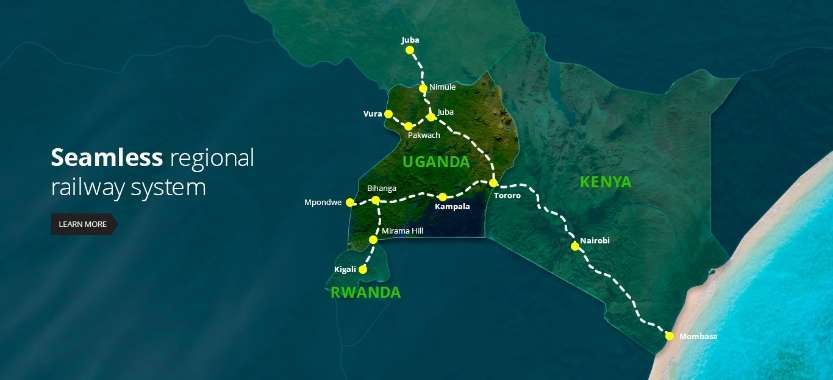
The planned regional standard-gauge network includes two lines separating inside the Eastern border of Uganda at Tororo. These then diverge further in the West (at Bihanga) and in the North (at Gulu). The total route length will be 1,724 kilometres subject to change due to design modifications and additional sidings and/or branch lines. [3]

Kabona Esiara of ‘The East African‘ explained in November 2025 that this required detailed negotiations between the railway authorities in Kenya and Uganda. These negotiations commenced in mid-November 2025. [2]

Uganda and Kenya were working on a raft of technical and policy measures to facilitate a seamless SGR system between the two countries as they work in the next few years on parallel finishing of their SGR lines.

Kenya says it will start constructing the Naivasha-Kisumu-Malaba line early in 2026 while construction of Uganda’s Kampala-Malaba should commence in the second quarter of 2026.

Further details can be found here. [2]

C. A series of mis-steps in the development of railways in Kenya and Uganda.

Mary Serumaga, in 2018, said that “the building of standard gauge (SGR) railways in both Uganda and Kenya and the predictable sagas that have ensued are reminiscent of the controversies surrounding the building of the Uganda and Rhodesian Railways in the late 19th and early 20th centuries. Both present a framework within which it is possible finally to understand the limited achievements in development in all sectors (and frankly, underdevelopment in many) and regression in Uganda’s primary education, copper mining and agricultural sectors. Both SGR projects are tainted with suspicion of shady procurement which, if taken together with the track records of the implementers, points to corruption. It would be irresponsible to say otherwise.” [4]

The route, design, level of service and all other decisions of the Uganda Railway of 1990 were dictated by potential profits for foreign investors (both public and private) and their local agents, and not by notions of public service and the common good of those who would bear the ultimate cost. Return on investment is not a bad thing but the Imperial government also claimed to be acting in the interests of the indigenous populations. … The difference now is that there is no pretence about whether the railways are serving the interests of the general population. The different financial implications presented by the procurement process itself, the selection of routes and the relative cost of engineering in the different terrains, plus the cost of compensating displaced landowners, provide scope for long-running, energy-depleting corruption scandals. From the outset, there has been a lack of confidence that procurement processes for the necessary services would prioritise the interests of the public over the interests of the contractor and would actively exclude the personal interests of the public servants commissioning the works. This is what is triggering the anxiety surrounding the SGRs.” [4]

Moreover, the choice over whether to upgrade the old railway or to start afresh was not adequately debated publicly. Ditto the options on financing. For the Kenyan SGR, the most costly of the potential routes were reportedly selectively chosen. Several cheaper routes on land allegedly already in possession of the government are said to have been rejected. … There are also questions surrounding passenger service. Do the railways only serve trade or are passengers entitled to this alternative to dangerous road transport?” [4]

Uganda owns one half of the old East African Railway. Together with the Kenyan leg, it was put under a 25-year management contract. The new owners renamed their new toy Rift Valley Railways (RVR). In 2017, after only twelve years, the governments cancelled the contracts in a move the RVR called an illegal takeover. On the Ugandan end, there were allegations of asset-stripping by previous European concessionaires as well as unpaid concession fees and massive salary arrears caused by RVR. If RVR were to successfully sue the government for cancellation of the contract, their compensation would be the first budget overrun. … The government of Uganda then signed a Memorandum of Understanding in 2014 with the China Civil Engineering Construction Corporation (CCECC), which had submitted a study. It abandoned those negotiations in favour of a second Chinese entity, the China Harbour Engineering Company. In justifying its action, the government questioned the quality of the CCECC’s study, which it said was cut and pasted from pre-existing feasibility studies (something that could have been avoided by following proper procurement procedures). CCECC insists it was a pre-feasibility study requiring less detail than a full-blown feasibility study. Whatever the case, if CCECC had followed through with its suit for US$8 million in compensation, which would have been another massive blow to the budget at inception. Whatever compensation they have agreed to has not been made public but as matters stand, the budget for the eastern leg of the SGR has gone up from CCECC’s proposed US$4.2 billion to CHEC’s US$6.7 billion.” [4]

The remainder of Mary Serumaga’s article which looks back at colonial construction work and draws parallels with 21st century procurement and construction in East Africa can be found here. [4]

D. President Yoweri Museveni’s State of the Nation Address in June 2025.

In June 2025, President Museveni highlighted significant rail developments, advancing the Standard Gauge Railway (SGR) project to link with Kenya and the region, aiming to cut costs and boost trade, while discussing financing for the $2.8 billion Kampala-Malaba SGR and emphasizing participation in the development of the new rail infrastructure. In essence, the 2025 address signalled a push for comprehensive road and railway modernization and expansion, leveraging oil revenues and debt financing to build a robust network for economic transformation. [5] Museveni said, “we are soon finalizing the construction of the 1,443km East African Crude Oil Pipeline (EACOP) from Buliisa to Tanga in Tanzania. The construction of the SGR, which I launched last year, is soon starting,” [5] and “the NRM Government has prioritized infrastructure development especially roads, railways and electricity.” [5] In addition, the government will be focusing on revitalizing metre-gauge lines (like Tororo-Gulu, Kampala-Malaba).

E. Kenya – Additional Madaraka Express Trains for the Christmas period.

Kenya Railways announces additional Madaraka Express trains from 8th December 2025, to 5th January 2026, to meet increased festive season demand. The Nairobi-Mombasa train departs Nairobi at 9:40 AM, arriving in Mombasa at 3:35 PM, while the Mombasa-Nairobi train leaves at 4:30 PM, reaching Nairobi at 10:55 pm. [6]

The railway operator said the move comes in response to increased demand during the holiday period, when thousands of Kenyans and tourists journey along the scenic Nairobi-Mombasa route. … ‘We are committed to providing a safe and convenient travel experience, and the additional services will help ease congestion while maintaining punctuality’ reads the notice dated 2nd December.” [7]

References

  1. Rogers Atukunda; Uganda to Begin Construction of Standard Gauge Railway in April 2026; in SoftPower News, https://softpower.ug/uganda-to-begin-construction-of-standard-gauge-railway-in-april-2026, accessed on 24th November 2025
  2. Kabona Esiara; Uganda prefers European standard for SGR, throwing off Kenya; in The East African, 25th November 2025; via https://www.zawya.com/en/world/africa/uganda-prefers-european-standard-for-sgr-throwing-off-kenya-j9zxxa2r, accessed on 24th November 2025.
  3. https://www.sgr.go.ug, accessed on 24th November 2025.
  4. Mary Serumaga; The New Lunatic Express: Lessons not learned from the East African Railway; in The Elephant – African Analysis, Opinion, and Investigation; https://www.theelephant.info/analysis/2018/06/16/the-new-lunatic-express-lessons-not-learned-from-the-east-african-railway; accessed on 7th December 2025.
  5. https://parliamentwatch.ug/wp-content/uploads/2025/06/STATE-OF-THE-NATION-ADDRESS-HE-VERY-FINAL-2025_250605_160027.pdf, accessed on 7th December 2025.
  6. The Kenya Times; https://www.facebook.com/groups/thekenyatimes/posts/1532674321328248, accessed on 8th December 2025.
  7. https://www.the-star.co.ke/news/2025-12-02-kenya-railways-adds-extra-madaraka-express-train, accessed on 8th December 2025.

Three Beyer-Garratts in East Africa in the 1950s

The December 1958 issue of The Railway Magazine featured three photographs of Beyer Garrett locomotives at work in East Africa. These were giants of the metre-gauge that grappled with long loads on steep inclines and at times sharply curved track radii. [1]

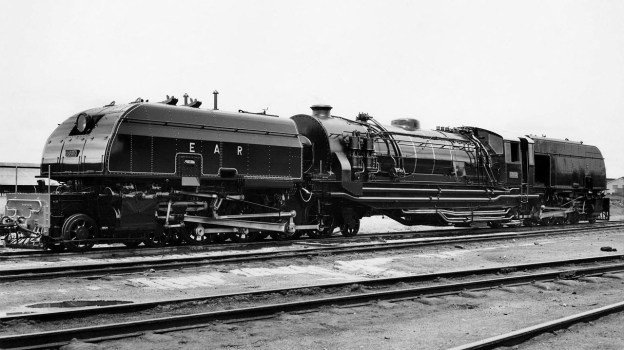
1. EAR Class ’55’ Garratt No. 5504 at Diva River

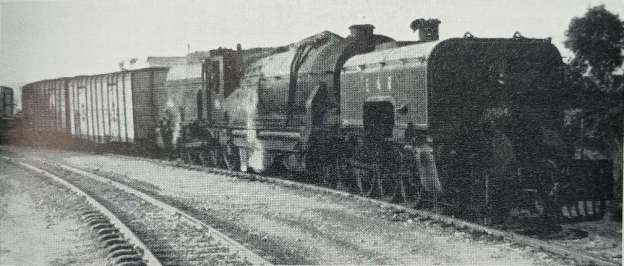
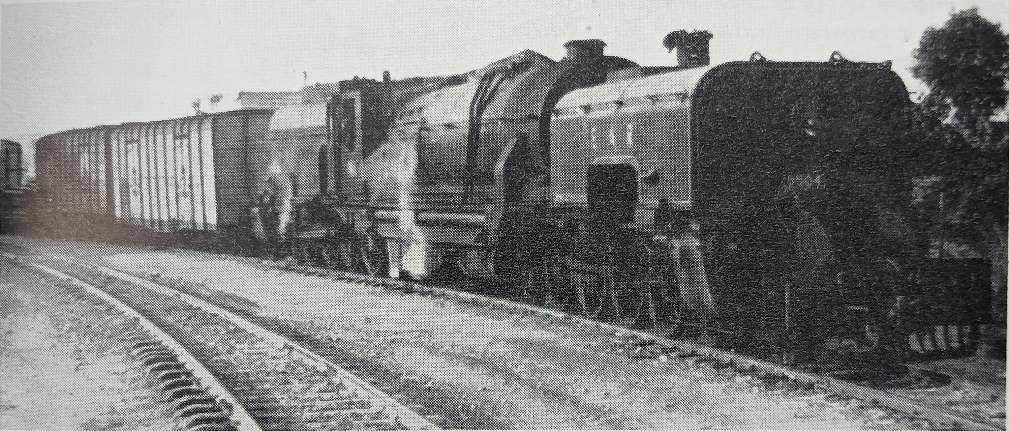
Class ’55’ Garratt No. 5504 on the up mixed train at Dura River. [1: p849]

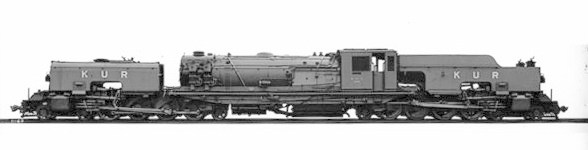
The KUR EC5 class was a class of 1,000 mm (3 ft 3 3⁄8 in) gauge 4-8-2+2-8-4 Garratt-type articulated steam locomotives built during the latter stages of World War II by Beyer, Peacock & Co. in Gorton, Manchester for the War Department of the United Kingdom. The two members of the class entered service on the Kenya-Uganda Railway (KUR) in 1945. They were part of a batch of 20 locomotives, the rest of which were sent to either India or Burma. [2: p64]

The following year, 1946, four locomotives from that batch were acquired by the Tanganyika Railway (TR) from Burma. They entered service on the TR as the TR GB class. [2: p64]

In 1949, upon the merger of the KUR and the TR to form the East African Railways (EAR), the EC5 and GB classes were combined as the EAR 55 class. In 1952, the EAR acquired five more of the War Department batch of 20 from Burma, where they had been Burma Railways class GD; these five locomotives were then added to the EAR 55 class, bringing the total number of that class to 11 units. [2: p64]

This locomotive was Works No. 7151, War Department No. 74235, War Department India No. 423. It was one of the two that went to Burma Railways (their No. 852) from where it was purchased by Tanganyika Railways in 1946 and became their No. 751. It came to the EAR in 1949 and received the No. 5504. [3]

Sister locomotives in Class 55 can be seen here [7] and here. [8]

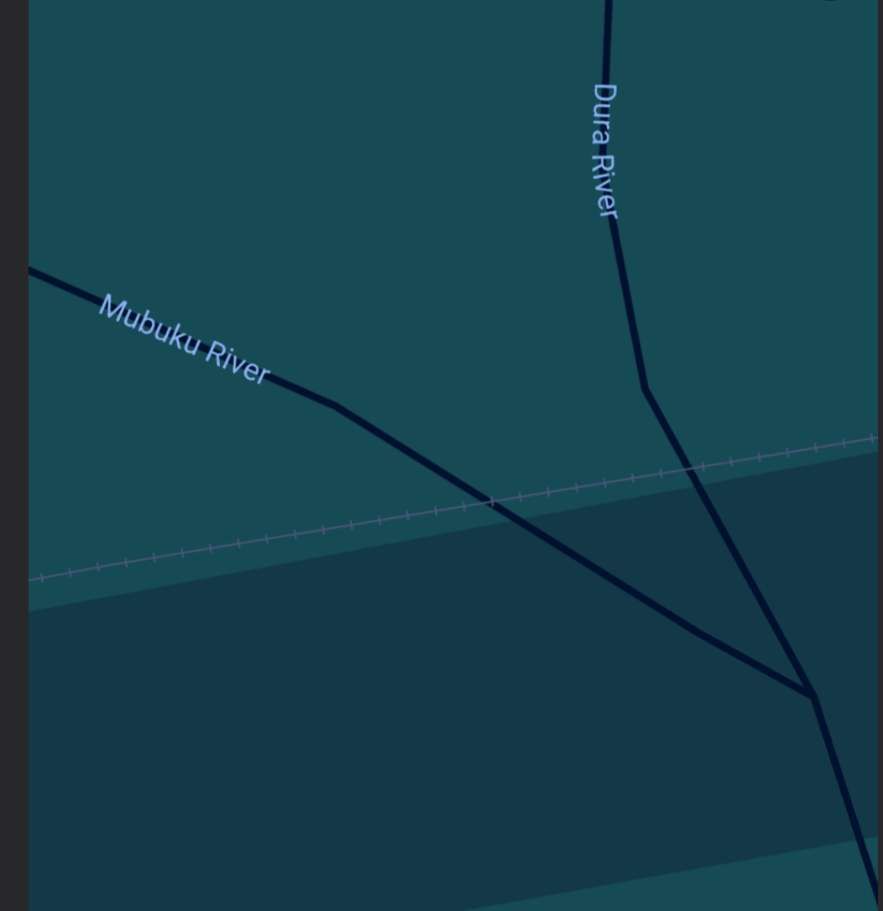
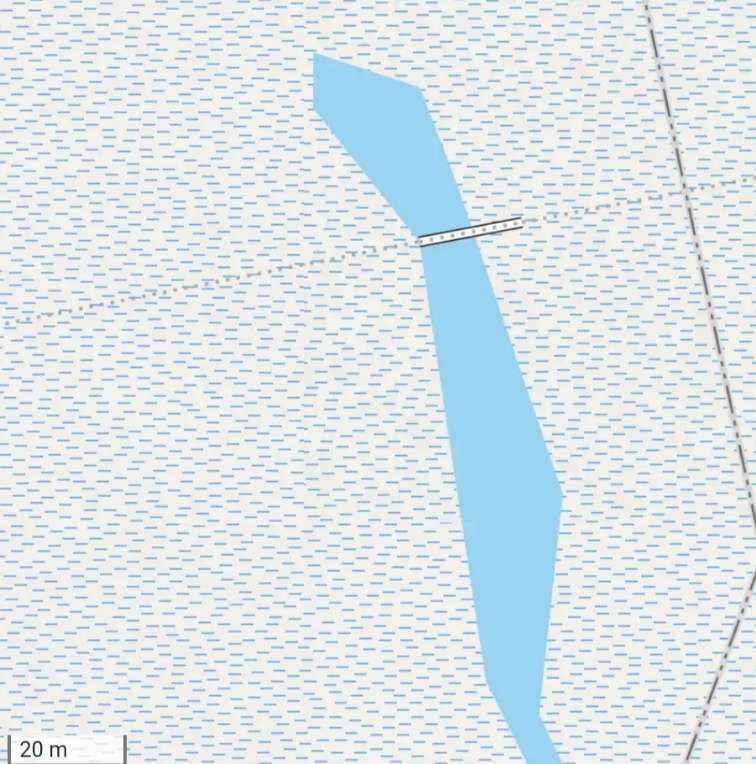
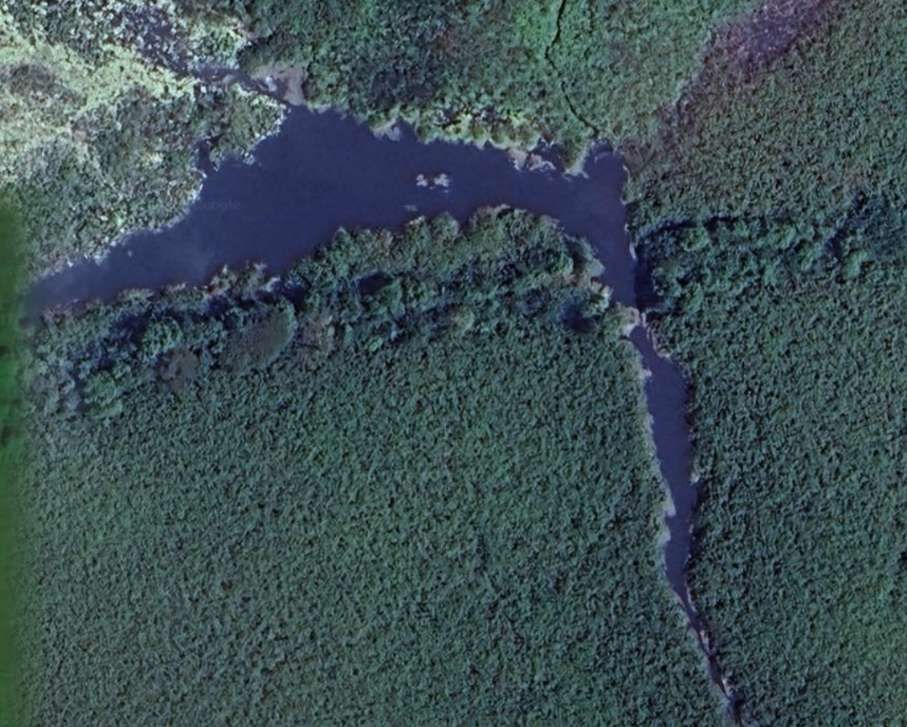
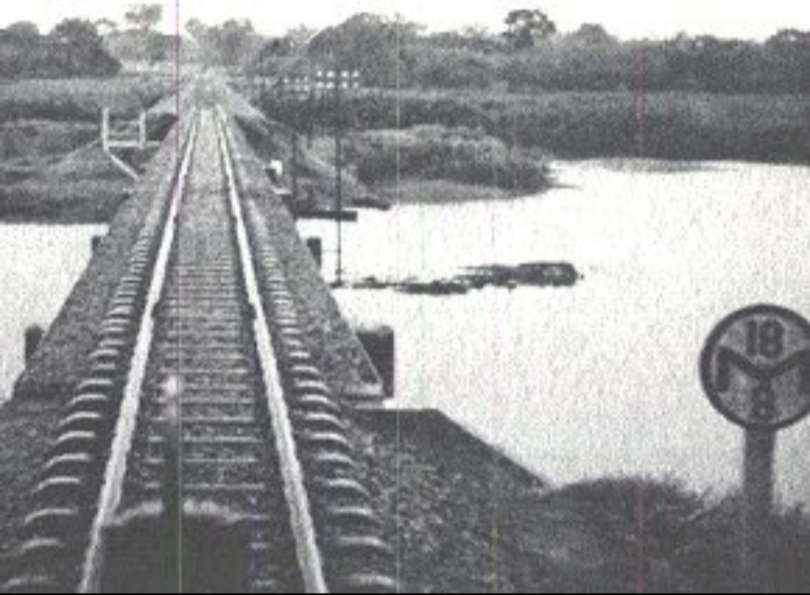
Dura River was the last station on the Western Extension before the end of the line at Kasese, Uganda. The River flowed North to South towards Lake George and was crossed by the railway at the Eastern edge of the Queen Elizabeth National Park. Mapping and satellite imagery in the area are not highly detailed – the following images are the best I can provide. …

The mapping which appears on the Google search engine when searching for the National Park. This enlarged extract focuses on the railway bridges which cross the Mubuku and Dura rivers. The line of the railway is shown in grey. [4]
The OpenStreetMap view of the same location, highlighting the bridge over the river. [5]
Google Maps satellite imagery focussed on the same location. The line of trees which sit above the swampy ground mark the line of the railway embankment. [Google Maps, July 2025]
Crossing the Dura River/Swamp. The sign is a Momentum Board, which refers to the opposing gradient being steeper than the ruling gradient. The figures mean that the driver should achieve a speed of 18 mph at a distance of 4 furlongs (8 half furlongs) from the sign. The train’s maximum speed was 25 mph, © Geoffrey Parsons. [6]

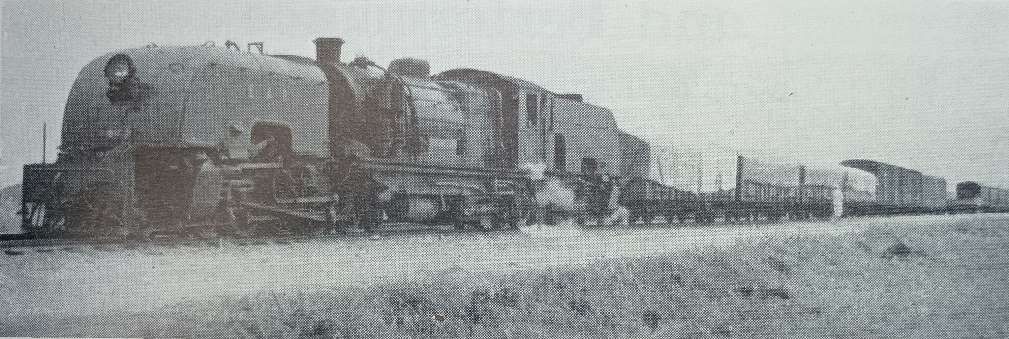
2. EAR Class ’58’ Garratt No. 5804 near Kikuyu

Nairobi-Kisumu train near Kikuyu with a ’58’ class Garratt No. 5804, © C. W. Stuart. [1: p849]

The EAR 58 class was a class of 1,000 mm (3 ft 3 3⁄8 in) gauge, 4-8-4+4-8-4 Garratt-type articulated steam locomotives built by Beyer, Peacock & Co. in Manchester, England, in 1949. [9]

Another view of No. 5804, apparently it was the only one of the class to bear the lettering ‘EAR&H’, all others in the class bore ‘EAR’, © gruntie916 and licenced for reuse under a Creative Commons licence (CC BY 2.0). [10]

The eighteen members of the class were ordered by the Kenya-Uganda Railway (KUR) immediately after World War II, and were a slightly modified, oil-burning version of the KUR’s existing coal-fired EC3 class. By the time the new locomotives were built and entered service, the KUR had been succeeded by the East African Railways (EAR), which designated the coal-fired EC3s as its 57 class, and the new, oil-burning EC3s as its 58 class. [2: p66][9]

No. 5804 was built in 1949 (Works No. 7293) and originally given the KUR No. 92. Its sister locomotive No. 5808 (Works No. 7297, given KUR No. 96 but never carried that number) was the first to enter service with the EAR. [9]

EAR ‘Class 58’ Locomotive No. 5803 (a sister to 5804) is seen here at Changamwe, Kenya, with the Mombasa–Kampala mail train, circa 1950-51. [9]

Other locomotives in the class can be seen here, [11] here, [12] and here. [13]

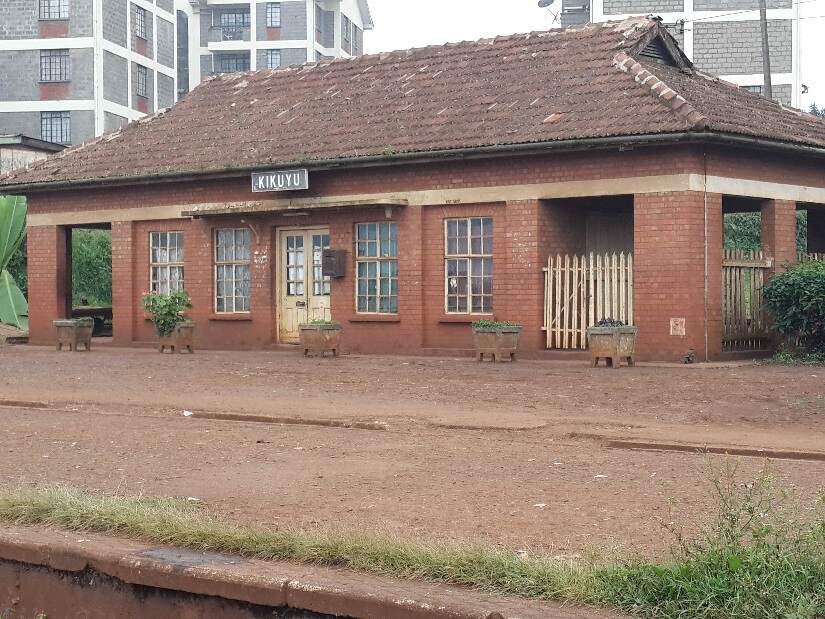
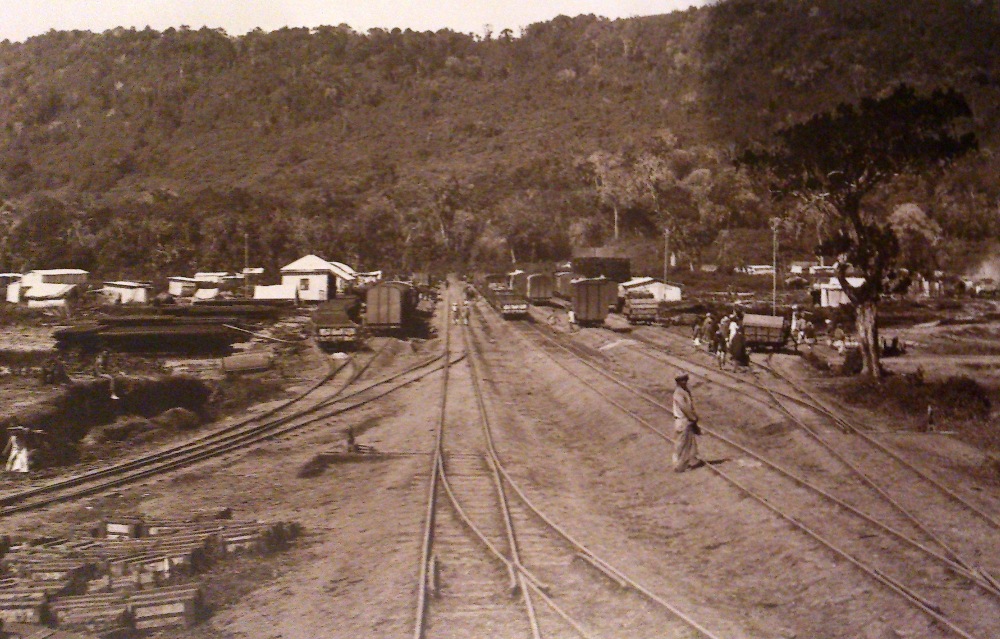
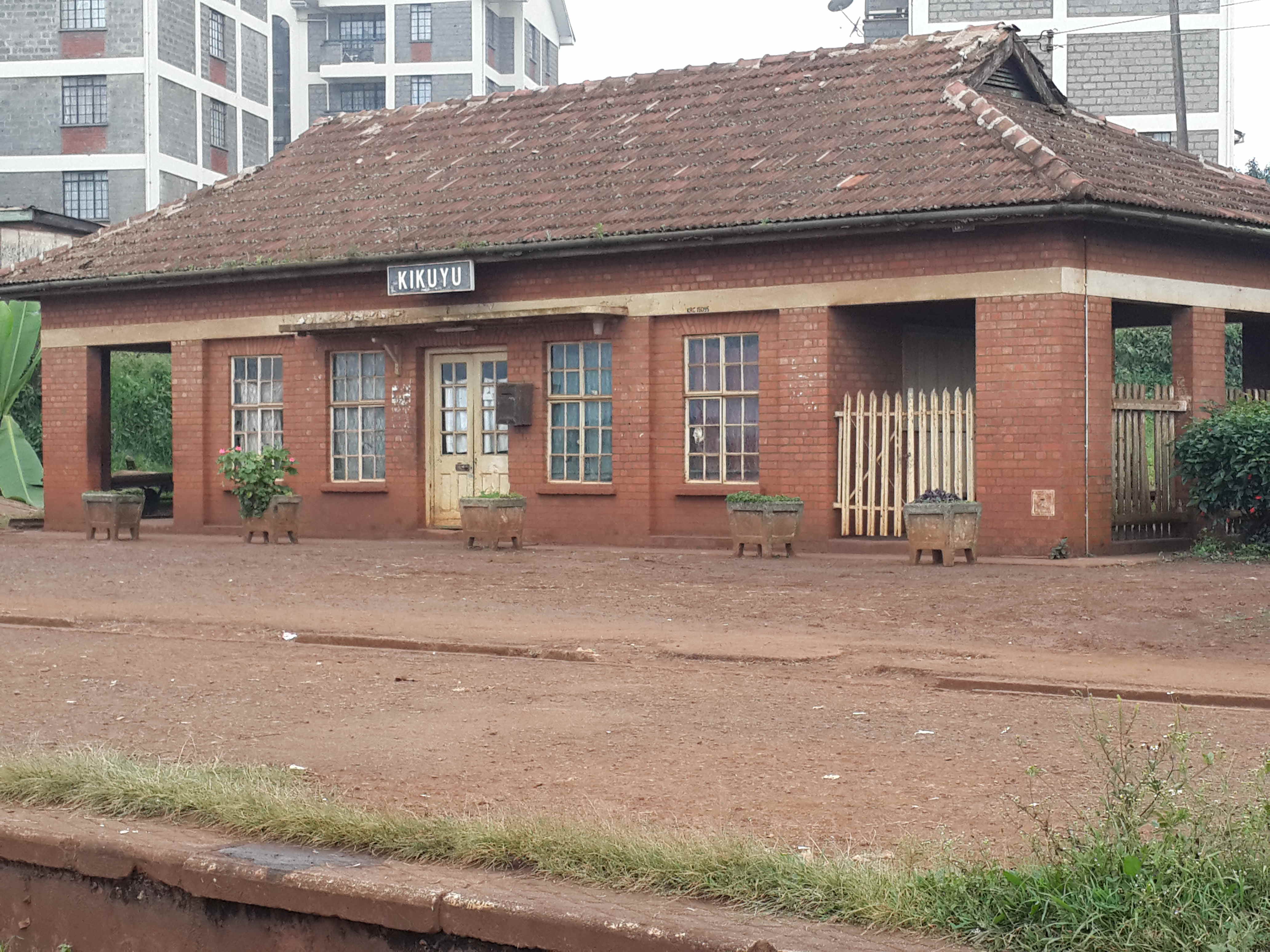
Kikuyu Station is 20 kilometres or so from Nairobi, during construction of the railway, railway officers established a temporary base in Kikuyu while they supervised work on the laying of the track down at the rift valley escarpment.

Kikuyu Railway Station while construction in the Rift Valley was ongoing, © Public Domain. [14]
Kikuyu Railway Station in modern times, © Unknown. [15]

3. EAR Class ’60’ Garratt No. 6021 at Kasese

Daily mixed train, headed by class ’60’ Beyer-Garratt locomotive No. 6021, Sir William Gowers,” about to leave Kasese, terminus of the East African Railways & Harbours Western Extension in Uganda. [1: p849]

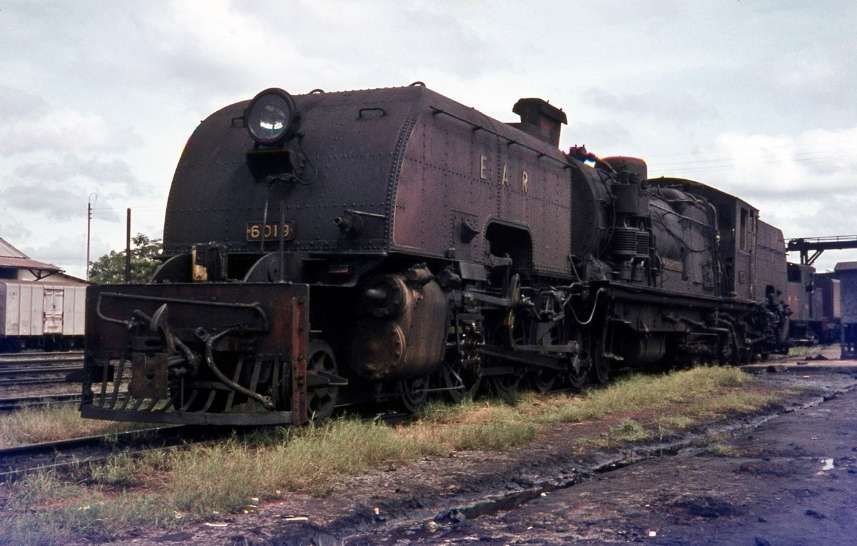
The EAR 60 class, also known as the Governor class, was a 1,000 mm (3 ft 3 3⁄8 in) gauge 4-8-2+2-8-4 Garratt-type articulated steam locomotives built for the East African Railways as a development of the EAR’s existing 56 class. [2: p77]

The 29 members of the 60 class were ordered by the EAR from Beyer, Peacock & Co. The first 12 of them were built by sub-contractors Société Franco-Belge in Raismes (Valenciennes), France, and the rest were built by Beyer, Peacock in Gorton. The class entered service in 1953-54. [2: p77]

Initially, all members of the class carried the name of a Governor (or equivalent) of Kenya, Tanganyika or Uganda, but later all of the Governor nameplates were removed. [2: p77]

No. 6021 was built by Beyer Peacock (Works No. 7663). It was not one of the class built by sub-contractors Société Franco-Belge. It was given the name ‘Sir William Gowers’ when first put into service, losing the name along with other members of the class in the 1960s after independence. …

Sister locomotive, EAR Class 60 locomotive No. 6019 at Tabora Depot in Tanzania, © Basil Roberts and licenced for reuse under a Creative Commons Licence (CC BY-SA 4.0). [16]

Other members of the class can be seen here, [17] here, [18] and here. [19]

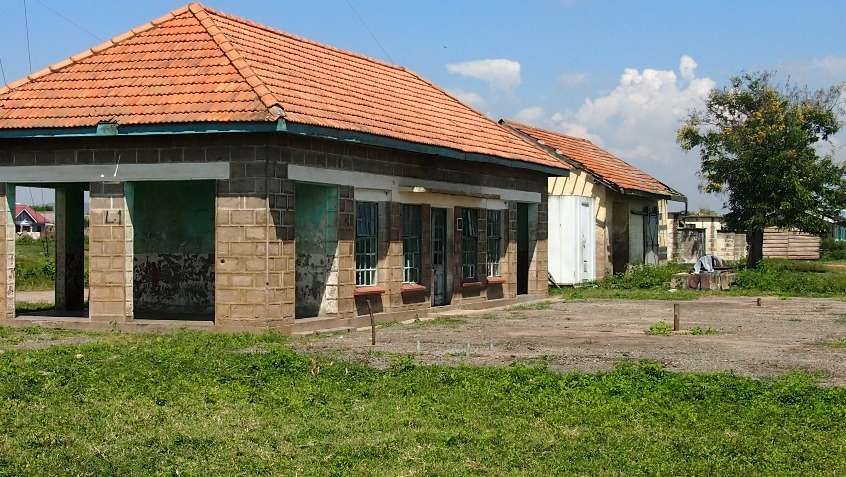
Kasese Station only became part of the rail network in Uganda in 1956. The construction costs of the whole line from Kampala were very greatly affected by the difficult nature of the country in the final forty miles before Kasese. Severe problems were presented by the descent of the escarpment, which involves a spiral at one point, while from the foot there is an 18-mile crossing of papyrus swamp through which a causeway had to be built, entailing a vast amount of labour. The extension to Kasese was built primarily to serve the Kilembe copper mines. Construction of the line from Kampala to Kasese took approximately five years. [21]

The station building at Kasese in the 21st century, © Michael Branz and authorised for reuse under a Creative Commons Licence (CC BY-SA 2.0). [20]
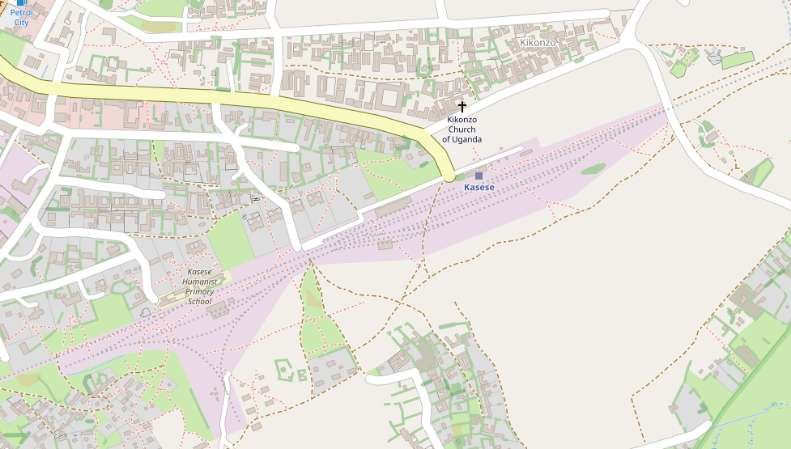
An extract from OpenStreetMap’s mapping showing Kasese Railway Station and turning triangle. The station was not the end of the line as it continued a short distance to the Kilembe Mines that it was built to serve. [21]

References

  1. Garratts in East Africa; in The Railway Magazine Volume 104 No. 692, December 1958, p849.
  2. Roel Ramaer; Steam Locomotives of the East African Railways. David & Charles Locomotive Studies; David & Charles, Newton Abbot, 1974.
  3. https://en.m.wikipedia.org/wiki/KUR_EC5_class, accessed on 7th July 2025.
  4. https://www.google.com/search?q=queen+elizabth+yganda&oq=queen+elizabth+yganda&gs_lcrp=EgZjaHJvbWUyBggAEEUYOTIJCAEQABgNGIAEMgkIAhAAGA0YgAQyCAgDEAAYFhgeMggIBBAAGBYYHjIICAUQABgWGB4yCggGEAAYCBgNGB4yCggHEAAYCBgNGB4yCggIEAAYCBgNGB4yCggJEAAYCBgNGB4yCggKEAAYCBgNGB4yCggLEAAYCBgNGB4yCggMEAAYCBgNGB4yCggNEAAYCBgNGB4yCggOEAAYCBgNGB7SAQkxMzQ4NmowajmoAg6wAgHxBe8kU7h2wyh58QXvJFO4dsMoeQ&client=ms-android-motorola-rvo3&sourceid=chrome-mobile&ie=UTF-8#ebo=0, accessed on 8th July 2025.
  5. https://www.openstreetmap.org/relation/192796#map=19/0.228157/30.289528&layers=P, accessed on 8th July 2025.
  6. http://mccrow.org.uk/EastAfrica/EastAfricanRailways/UgandaBranches.htm, accessed on 1st June 2018.
  7. https://www.flickr.com/photos/124446949@N06/32890286408, accessed on 8th July 2025.
  8. https://www.flickr.com/photos/124446949@N06/48996173961, accessed on 8th July 2025.
  9. https://en.wikipedia.org/wiki/EAR_58_class, accessed on 8th July 2025.
  10. https://commons.wikimedia.org/wiki/File:Engine_unit_of_East_African_Railways_and_Harbours_Corporation_(EAR%26HC)_58_class_Garratt_locomotive_no_5804.png, accessed on 8th July 2025.
  11. https://www.world-railways.co.uk/general-photo-408, accessed on 8th July 2025.
  12. https://www.flickr.com/photos/124446949@N06/29100559308, accessed on 8th July 2025.
  13. https://www.flickr.com/photos/124446949@N06/47072893354, accessed on 8th July 2025.
  14. https://rogerfarnworth.com/wp-content/uploads/2018/05/kikuyu-station.jpg
  15. https://rogerfarnworth.com/wp-content/uploads/2018/05/kikuyu-railway-station.jpg
  16. https://commons.m.wikimedia.org/wiki/File:Basil_Roberts_(680730_EAR).jpg, accessed on 8th July 2025.
  17. https://www.flickr.com/photos/124446949@N06/51744782399, accessed on 8th July 2025.
  18. https://www.world-railways.co.uk/general-photo-667, accessed on 8th July 2025.
  19. https://www.flickr.com/photos/124446949@N06/31824271347, accessed on 8th July 2025.
  20. https://commons.m.wikimedia.org/wiki/File:Old_Kasese_Train_Station.jpg, accessed on 8th July 2025.
  21. https://rogerfarnworth.com/2018/06/11/uganda-railways-part-21-kampala-to-kasese.

October 2024 – News about Railways in East Africa

Standard Gauge Railway (SGR) for Uganda

A report from The EastAfrican, 21st October 2024. [1]

On Monday 14th October 2024, Uganda signed a deal with Turkish firm Yapi Merkezi for the construction of the standard gauge railway (SGR) from Malaba to Kampala, after a 16-year wait.

When completed, the $2.9 billion-dollar electric rail project is expected to reduce transportation costs and increase the efficiency of the rail transport system in Uganda.

Construction of Uganda’s 273km SGR line, expected to be completed in four years, has started without a lender bankrolling the project, and authorities say it will be commissioned in the first week of November.

The EastAfrican has learnt that in this financial year, the SGR was allocated $40.8 million for compensation of project-affected persons. Canon Perez Wamburu, coordinator of Uganda’s SGR Unit, said the total budget is close to $49 million.

The Finance ministry has identified American lender Citi Bank to syndicate a loan of about $3 billion.

Uganda is under pressure from Tanzania and Kenya, which have SGR systems, to build its section to facilitate a synchronised regional rail network. Kenya is also working on extending its SGR line from Naivasha to Kisumu and on to Malaba.

The two systems will be connected and will be seamless. We support our Kenyan friends in doing that. And the timelines agreed on with the Kenya brothers will be met,” said Gen Katumba Wamala, Uganda’s Works and Transport minister.

He explained that the two countries agreed that by the time the Malaba-Kampala SGR section reaches Kampala, the Naivasha-Kisumu-Malaba section will also be ready.

Uganda plans to develop 1,700km of SGR network covering Tororo to Gulu and Nimule at the South Sudan border, with a spur from Gulu to Pakwach and Vurra at the Democratic Republic of Congo border.

A western line will run from Kampala to Bihanga and Kasese-Mpondwe at the DR Congo border, with a spur southward from Bihanga to Mirama Hills at the Uganda-Rwanda border and another to Muko, Kabale.

Wikipedia tells us that the Ugandan SGR network will be part of a much wider SGR rail network in East Africa:

The Uganda Standard Gauge Railway is a planned railway system linking the country to the neighboring countries of Kenya, Rwanda, Democratic Republic of the Congo and South Sudan, as part of the East African Railway Master Plan. The new Standard-gauge railway (SGR), is intended to replace the old, inefficient metre-gauge railway system. The entire 1,724 kilometres (1,071 mi) SGR in Uganda will cost an estimated $12.8 billion.” [3]

This 1435 mm (4 ft 8 1⁄2 in) railway line is intended to ease the transfer of goods between the port of Mombasa and the Ugandan capital of Kampala, and subsequently to Kigali in Rwanda, and to Beni in the Democratic Republic of the Congo and to Nimule and Juba in South Sudan. Goods would travel from Mombasa along the Kenya Standard Gauge Railway to Malaba, at the border with Uganda, and transfer on to this railway system.” [2]

In March 2019, during a state visit to Kenya, President Yoweri Museveni of Uganda and his host, President Uhuru Kenyatta of Kenya, jointly publicly committed to extend the Kenyan Standard Gauge Railway to Uganda. Completing the critical missing link to the Kenyan SGR would then unlock the funding for Uganda’s Malaba–Kampala line. As of October 2023, the Naivasha–Malaba section of Kenya’s SGR has not been constructed.” [2] It seems that, in October 2024, a renewed commitment has been made to complete the SGR to the border with Uganda.

In Uganda the SGR network will consist of four main sections:

Malaba–Kampala Section

Also referred to as the Eastern Line, this section will stretch from the border with Kenya at Malaba, through Tororo and Jinja, to end at Kampala. The distance of this section is approximately 219 kilometres (136 mi).[5] The entire Malaba–Kampala section, measuring 273 kilometres (170 mi) with associated train stations and railway yards, is budgeted to cost US$2.3 billion. Once funding is secured, the construction of the Eastern Line is expected to last 42 months.

Tororo–Gulu Section

Also referred to as the Northern Line, this section will extend from Tororo, through Mbale and Lira to Gulu, a distance of approximately 367 kilometres (228 mi). From Gulu, one spur will continue north to Elegu and on to Nimule and Juba in South Sudan. The section in Uganda measures approximately 106 kilometres (66 mi). Another extension stretches from Gulu southwestwards through Pakwach to end at Goli at the Border with the Democratic Republic of the Congo, a distance of approximately 187 kilometres (116 mi).

Kampala–Mpondwe Section

This is referred to as the Western Line. It will start in Kampala and pass through Bihanga in Ibanda District, continuing on to Mpondwe at the border with DR Congo, a distance of about 430 kilometres (267 mi).

Bihanga–Mirama Hills Section

This is also referred to as the Southwestern Line. It will stretch from Bihanga through Ibanda and Mbarara to end at Mirama Hills, at the border with Rwanda, a distance of about 191 kilometres (119 mi).” [2]

The Wikipedia article continues:

The construction was expected to be financed by the government of Uganda, using borrowed money from the Exim Bank of China. However, the lender has been unwilling to approve the loan until Kenya finalizes the funding arrangement for the Naivasha–Kisumu–Malaba section of its SGR.

In January 2023, the Ugandan government terminated the contract that it had signed with China Harbour Engineering Company (CHEC) to build the Kampala–Malaba section of the Ugandan SGR, on account of ‘failure to execute’ for eight consecutive years.

In May 2023, the government identified Yapı Merkezi Group from Turkey as the new engineering, procurement and construction (EPC) contractor. Funding is expected to be sourced from European banks. Works are expected to commence in 2024 starting with the 273 kilometres (170 mi) Kampala–Malaba section. The funding bank was later identified as Standard Chartered Plc of the United Kingdom.

In July 2023, the Ugandan and Kenyan cabinet ministers of transportation met in Mombasa. The communique issued at the end of the two-day consultations announced that going forward, the two countries will jointly explore funding sourcing for the Naivasha–Kisumu–Malaba portion of the Kenya Standard Gauge Railway.  Together, the two countries are seeking at least $6 billion in new funding for their SGR projects from financiers in Europe and the Middle East.

In February 2024, both countries reaffirmed their commitments to build the Naivasha-Kisumu-Malaba section in Kenya and the Malaba-Kampala section in Uganda, starting in 2024. The Ugandan government has contracted the Yapı Merkezi Group from Turkey to build the 273 kilometres (170 mi) section between Malaba and Kampala at a contract price of US$2.9 billion. Work was expected to start in August 2024. As of August 2024, the Uganda government was working on finalizing the engineering, procurement and construction (EPC) documentation and obtaining approvals from relevant government bureaucrats. The construction distance from Malaba to Kampala is now reported as 332 kilometres (206 mi). Construction is expected to begin in [late] 2024.

On 14th October 2024, the government of Uganda signed the EPC documents with Yapı Merkezi to build the Malaba-Kampala section of the Uganda Standard Gauge Railway at a contract price of €2.7 billion (approx. USh10.8 trillion). Construction is expected to take four years and conclude in [late] 2028.” [2]

6th December 2024 Update: Mark Hambly has kindly sent me the latest news – please see this report from the Railway Gazette: https://www.railwaygazette.com/infrastructure/president-launches-construction-of-ugandan-standard-gauge-railway/67904.article?utm_campaign=RG%20-%20Railway%20Gazette%20International%20WEEKLY%20Rail%20Baltica%20061224-DE&utm_medium=email&utm_source=email&utm_content=newsletter

Other Railway News

A. The Uganda Railway Museum

The Cross-Cultural Foundation of Uganda (CCFU) a non-governmental, not-for-profit organisation that promotes and appreciation of culture as vital for human development that responds to our diverse identities, with support from the European Union and SOGEA SATOM and the Uganda Railways Corporation established the Uganda Railway Museum. [4]

The museum highlights the important role that railways played in Uganda’s history and nation building. It is located along the Jinja-Iganga Highway at the Railway Station in Jinja City. It offers a varied programme that includes heritage theme nights, exploring a locomotive and coach, film recollections/stories, guided tours and access to a cafeteria. Part of the museum has been designed with young people in mind to support their learning and appreciation of Uganda’s history.

Welcome to Uganda’s Railways Museum! This image was posted on the Museum’s Facebook Page  on 17th September 2024. [11]

The Museum’s formal opening ceremony took place in March 2022. It is now open for public visits every Tuesday to Sunday, 11:00am – 6:00pm at 5000 Ugandan shillings for adults and 2000 shillings for children.

While there are ongoing government efforts to revamp the railway transport with the rehabilitation of the northern line and the construction of the Standard Gauge Railway. The establishment of the railway museum complements the government of Uganda’s efforts to highlight the importance of railway transport by reinvigorating its interest among Ugandans.

B. Ugandan Old Railway Line Rehabilitation on Track

Uganda’s Railways are metre-gauge. This image is one of a series of U.S. Army photographs taken in September 2010, © John Hanson and made available for reuse under a Creative Commons Licence (CC BY 2.0 Generic). [12]

In January 2024, The EastAfrican reported that Uganda’s planned overhaul of the metre gauge railway to cut transport costs on the Northern Corridor and improve trade competitiveness had entered its final stages, even as the country faced a shortage of equipment, wagons, and trains.

The EastAfrican reported in January 2024 that Spanish firm Imathia Construction had completed replacing steel sleepers with concrete sleepers on the Namanve-Kampala section of the line, which was handed over to the Uganda Railways Corporation (URC) at the beginning of 2024. The contractor then embarked on the final section, Namanve-Mukono.

This would be the second section of the track to be completed after rehabilitation of the Tororo-Namanve line, including the line to Jinja Pier, which was completed a year ago.

While the Malaba-Namanve metre gauge track is now in fair condition, importers, exporters, and shippers remain sceptical about switching to rail, citing a shortage of rolling stock and inefficiency, which has resulted in 90 percent of traffic on the Northern Corridor being carried by road and only about seven percent is carried by rail because of the poor state of rail infrastructure. [5]

Uganda’s General Motors GL30 Locomotives

C. Restoring Uganda’s Railways: The Long Road Ahead.

Rothschild Jobi; Restoring Uganda’s Railways: The Long Road Ahead; in Infrastructure, Travel and Tourism, Uganda, 9th August 2024. [10]

“The Uganda Railways Corporation (URC) is now focusing on restoring railway infrastructure in up-country areas, a step taken months after the successful resumption of limited passenger services on the Kampala-Mukono route. This move comes as part of an effort to address the deteriorating state of the country’s railway system.

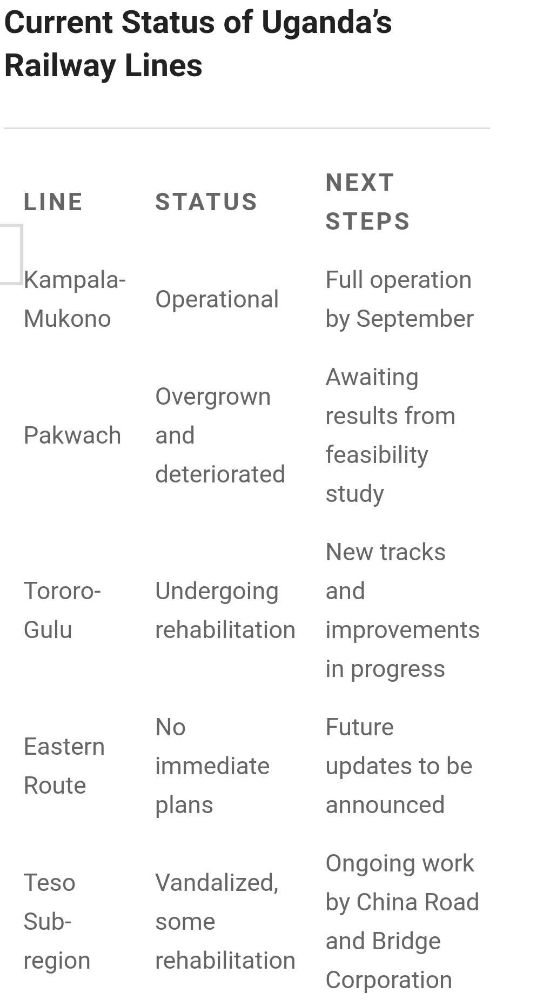
Table: Status of Uganda’s main railway lines in August 2024.

In April, the Kampala-Mukono route was reopened, offering passengers a 40-minute journey from Namanve to Kampala in the morning, with a return trip available in the evening. This was seen as a positive development, but it also highlighted the need for broader improvements across the railway network.

URC’s Head of Communications, Mr. John Linnon Sengendo, stated in an interview on Monday that the focus is now shifting to the up-country lines. He emphasized that the aim is to complete the railway network by restoring these lines, which have suffered from neglect over the years.

One such line is the Pakwach railway, which was originally constructed in 1964. It played a crucial role in transporting goods and passengers from Nebbi District. However, by the 1980s, the line fell into disrepair. Despite plans announced in 2005 to repair the Gulu-Pakwach line, it remains overgrown with vegetation, and the infrastructure has deteriorated significantly.

Mr. Daudi Onencan, a 68-year-old farmer in Pakwach, reminisced about the line’s past significance. He noted that the railway provided a cost-effective way for farmers to transport goods to markets in distant districts.

Pakwach District Chairperson, Mr. Robert Omito Steen, highlighted ongoing efforts to revive the railway line due to its importance for transporting bulky goods. Discussions with various line ministries have been ongoing, with the hope that these efforts will lead to the line’s restoration.

In 2016, feasibility studies and bush clearance were carried out to assess the state of the railway lines. These efforts raised hopes for the line’s revival, but the overgrowth has since returned.

Mr. Sengendo mentioned that the study results will inform the government’s next steps. He noted that the Ministry of Works and Transport has sanctioned a company to undertake the study, and the restoration of the railway line is a key objective. The broader SGR (Standard Gauge Railway) project also includes the Tororo-Gulu-Pakwach line.

In Mityana District, residents in several villages are resisting eviction from the railway reserve despite numerous warnings. The railway reserve, now occupied by residential and commercial buildings and gardens, faces challenges as some residents claim they unknowingly purchased land in the reserve from individuals who have since relocated.

Mr. Ssande Kafunda, Chairperson of Bbuye Village, reported that affected residents are seeking advice on how to handle the situation, as they were misled about the land’s status.

Mityana municipal mayor, Mr. Faustine Mukambwe, supports the railway rehabilitation and believes it will boost local development. He urged residents to embrace the project and mentioned that the municipal council is exploring new land for constructing a new abattoir, as the current one is situated in the railway reserve.

In 2014, over 80,000 encroachers on railway reserves in various areas were given 28 days to vacate to allow for railway transport revitalization. Despite these orders, many encroachers remain, although some have relocated.

Progress is being made on the Tororo-Gulu line, with rehabilitation efforts underway. The previously non-existent track is now being upgraded with new tracks, improved drainage systems, and enhanced level crossings.

Regarding the Eastern route, Mr. Sengendo indicated that there are no immediate plans to work on this line but assured that the public will be informed if the need for restoration arises.

Mr. Sengendo also mentioned that the government, through URC, is committed to enhancing both land and water railway infrastructure to improve service for Ugandans. The aim is to reduce transportation costs for both exports and imports, thereby lowering prices for goods and increasing export earnings.

Passenger services are nearing completion on the Kampala-Mukono route, which is expected to be fully operational by September. Work will soon commence on the Kampala-Kyengera and Port Bell routes, funded by the African Development Bank.

For cargo transport, new locomotives and wagons are being acquired to support the expanding network. Plans include procuring multipurpose wagon ferries for routes between Kisumu and Mwanza. The goal is to have both the Metre Gauge Railway and Standard Gauge Railway networks complement each other, as part of the East African Community’s efforts to improve the railway system.

In the Teso Sub-region, Kumi Resident District Commissioner, Mr. Ahamada Washaki, stressed the importance of rehabilitating the railway line. However, much of the railway line in Teso remains vandalized, with key stations deserted. URC’s Mr. Sengendo explained that the line has been non-operational for over 30 years, contributing to its current state. Rehabilitation work by China Road and Bridge Corporation is ongoing on a 375km stretch, with completion expected in two years.” [10]

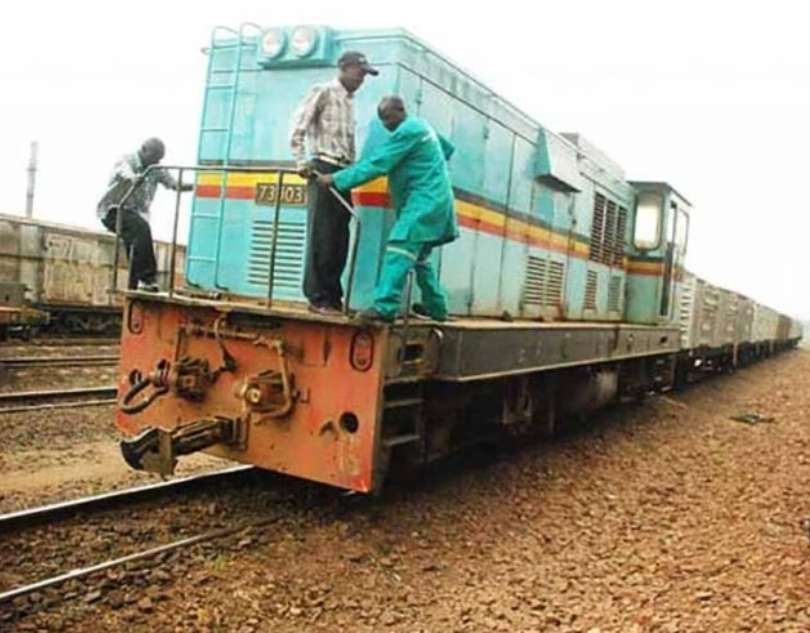
Uganda Railways Corporation locomotive. [13]

D. Uganda Railways Projects to be Implemented in the Financial Year 2024/2025.

On 21st June 2024, infrastructure.go.ug [6] reported that the Ugandan government was working on their objective of reducing the cost of doing business in Uganda by making improvements to the rail network.

They note the then imminent completion of the Kampala-Namanve project. They highlight ongoing work on the line between Tororo & Gulu, funded entirely by the Ugandan government. They talk of work on the African Development Bank project, which will address some of the unfinished portions of the Kampala-Malaba route. They mention work on the route between Port Bell and Kyengera in Kampala and plans for the acquisition of better passenger carriages and locomotives.

URC board technical committee chairperson, Andrew Muguluma commented in an interview with New Vision that, “Even though Uganda is developing its standard gauge railway at a different pace than other countries,  … the country is catching up to the current infrastructure.” [6]

The article on infrastructure.go.ug’s website continues:

The government has made significant investments in the rail industry, according to Leonard Kerezya, senior principal auditor in the Office of Auditor General, who urged URC top management to conduct engineering audits in order to address risks.n … KAccording to him, due to inadequate infrastructure driving up transportation costs along the northern corridor (the Malaba-Kampala rail line), only 7% of traffic in Uganda travels by rail. This means that over 90% of traffic in Uganda moves by road.” [6]

The government committed to building a multimodal transportation infrastructure as part of NDP III (FY2020–2025) in order to increase the nation’s competitiveness through investments in better and more affordable transportation.” [6]

In respect of the SGR, they say:

The Democratic Republic of the Congo, Uganda, Kenya, Rwanda, and other partner states of the Northern Corridor Integration Projects (NCIP) decided last month (May 2024) to pool resources to expedite the Standard Gauge Railway (SGR) project’s development. … The Joint Ministerial Committee on SGR met in Mombasa, Kenya, and decided to take this action. … The transportation ministers restated their determination to finish the remaining SGR portions as soon as possible, from Kenya’s Naivasha to Rwanda, Uganda, South Sudan, and the Democratic Republic of the Congo.” [6]

Kenya pledged to restart building on the Naivasha-Kisumu-Malaba and Kisumu-Malaba SGR sections, respectively, beginning in July and September of 2024. … Subject to the availability of resources, Uganda is also anticipated to begin building on Malaba-Kamppala in September. The country is currently nearing the conclusion of discussions with Yapi Merkezi, the prospective contractor.” [6] An agreement which, in October 2024, now appears to be in place.

URC is a business entity that answers to the Ministry of Transportation and Works. It was founded to carry out railway, marine, and road services for the carriage of goods and passengers both inside and outside of Uganda, as required by the Uganda Railways Corporation Act, Cap 331. URC’s network of tracks spans 1,266 kilometers in total.

E. Uganda Railways Brochure

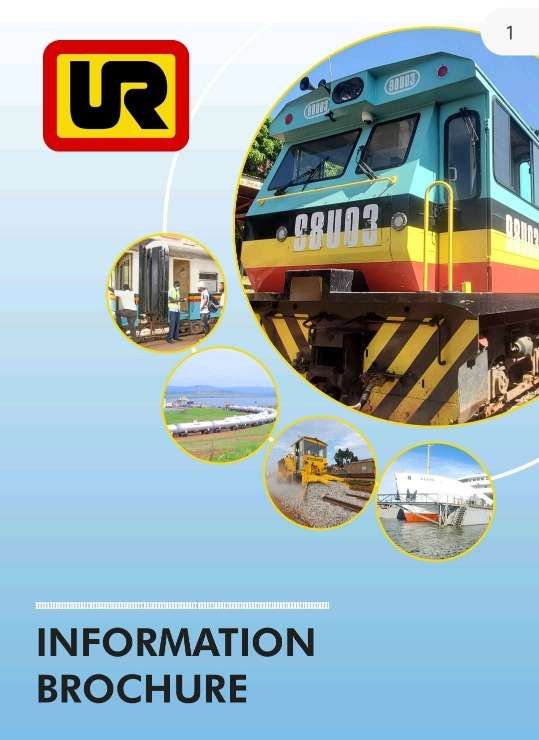
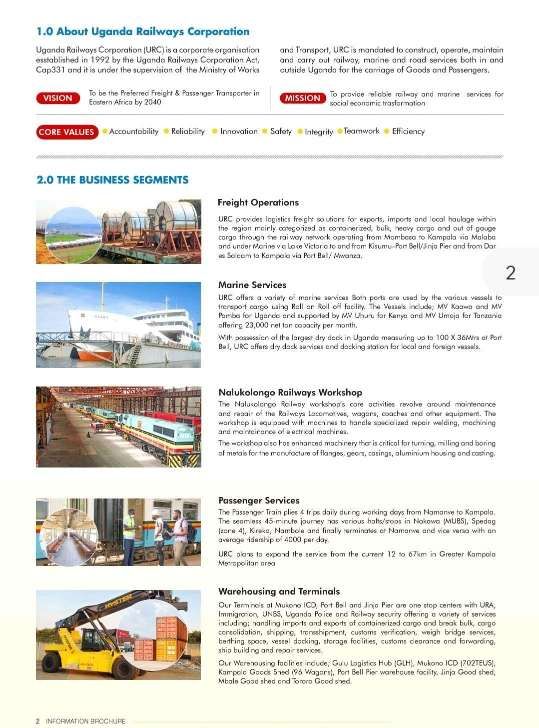
Uganda Railways Corporation has produced a glossy 4 page .pdf brochure. [7]

F. A Journey on Kampala’s Newly Reopened Commuter Train

By Kabona Esiara, Correspondent in Kampala, Uganda Nation Media Group [8]

“Five O’clock found me at the station ready for the 5.30pm train, which leaves Kampala city heading eastwards to Namanve, 16 kilometres away.

The Kampala train station, established in the 1920s, hosts the offices, service centre, and waiting and boarding areas, and has worked as the main office for passenger and cargo trains over the years.

Located in the central business district convenient for departing and incoming goods and passengers the station has recently become a beehive of activity after the return of the train.

Booking for tickets is done here. Mornings and evenings are busy, as dozens of passengers throng the station to get a trip worth Ush2,000 ($0.52), much cheaper than the fare of the commuter taxis for the same journey, which is Ush4,000 ($1.05) or more.

On the day I took the train, the line was long and the ticketing officers were picking out people who had smaller denominations of the Ugandan currency – 1,000; 2000 and 5,000 leaving those with big ones to wait.

As 5.30pm approached, the train hooted, sending an echoing sound into the city and signalling the start of the journey. The people in the queue rushed in to find seats.

Inside the coach, the once-tattered seats are now covered in brown leather and thin-inch sponge cushions making them more comfortable than the metal seats of the past.

The fans mounted above the dash of the coaches have been fixed, sending fresh air circulating and improving travellers’ experience. Before they were fixed, a frequent rider on the train says the heat in the coaches was unbearable.

The old, five-coach train snaked through Nakawa, Kireka, Namboole and terminated at Namanve.

For the 16km ride to Namanve, the train spent only 45 minutes, a huge difference from an average of two hours that vehicles, especially public commuter taxis, spend from the CBD to Kazinga near Namanve.

However, Uganda Railways Corporation (URC) is operating old rolling stock, and most of it is in disuse.

There are only five coaches to transport passengers in a city of four million people.

In order not to miss the train, many passengers reach the station early, some by 5.00am for the morning trip and 4.00pm to catch the train that departs at 5.30pm for the evening return journey.

With the market yearning for train services and Kampala struggling to achieve its ambitious plan to shift 20% of the freight and passenger bases to rail, Paul Power, a transport sector commentator based in Kampala, says the city needs $200 million to invest in rail passenger transport.

The money will be pumped into buying rolling stock, constructing stations and improving the safety and security of the railway system in the Kampala commuter railway networks.

‘My understanding is that at least 20% of the market share for rail transport is needed to make the planned standard gauge railway project viable and bankable. I don’t know the latest cost estimate, but I have heard anything from $3 billion to over $12 billion, with electrification’, Mr Power said.

He, however, noted that achieving a 20% market share for railway transport would be challenging, as currently rail transport on the metre gauge railway is less than one per cent of the freight transport market, and passenger services resumed on 1st May 2024, after almost a one year of absence due to track rehabilitation.

‘The rolling stock needed to transport 20 percent of the freight and passenger markets by rail is enormous’, he said.

The government has also to come up with deliberate policies to encourage private investment in the railway to achieve the significant shift from road to rail transport, some of which include subsidies, enforcement of tighter road weight restrictions, restrictions on the type of goods that can be transported on roads.

Uganda’s railway sector is described as not well organised. There is no safety regulator. Laws need to be updated, and there is no sustainable funding model for implementing a modern rail transport system.

According to Power, in Uganda, a strategic direction for the sector is missing, sector targets and objectives need to be defined, and a need to separate infrastructure management from train operations and safety regulation.

‘These challenges are mostly ‘soft.’ Institutional and private investors need clarity on the ‘operating environment’ – that is, rules – before significant investor interest can be mobilised’, he explained.

Uganda’s plan to grow rail freight and passenger traffic got a boost recently, when Italian investors, led by Ambassador Mauro Massoni, expressed interest in constructing a 64km railway line from Tororo to Majanji.

This alternative route on the Northern Corridor is meant to reduce congestion and increase efficiency in the region’s transportation network, as it links to water, railways, and roads.

The planned investment complements the SGR linking Kenya to Kampala, whose construction works are yet to begin. The details of the investment in the proposed route, funding, and implementation timelines have not been made public.

President Yoweri Museveni welcomed the proposal, highlighting the potential for the railway line to cater to traffic from northern Uganda and neighbouring countries, bypassing Kampala.

‘That traffic doesn’t have to come to Kampala. It can go straight either to Kenya or to Tanzania’, the President said, emphasising the project’s strategic importance.

The Italian investors also proposed establishing an academy to train Ugandans in cutting-edge railway construction and maintenance technology, ensuring skills transfer and job creation for the local workforce.

But, amid the challenges, signs that URC is fighting for a piece of the big commuter transport market share are clear. Lately, the train and coaches have been repainted.

Margret Nantume, one of the frequent users of the commuter train, said many people have not embraced the train because of the cost.

‘While I use the train to escape the daily traffic gridlock on the Kampala-Jinja highway, the increase in the train ticket from Ush1,000 ($0.26) to Ush2,000 ($0.52) for every stop is discouraging passengers’, she said.

‘Many people are opting for taxis and boda boda, which are flexible in pricing and charge fares per stop, while others walk to their destinations’.

Recently, URC acting managing director David Musoke Bulega revised the fares upwards to hedge his ticket sale revenues against fuel costs.

The train stops are located at far distances from the main road, which inconveniences passengers and adds to the transport costs to their destinations.

Passengers who live in Seeta and Mukono incur an additional Ush2000 ($0.52) to reach their destinations by taxi, in addition to the train ticket of the same amount, bringing the total to Ush4,000 ($1.05).

Besides, they have to walk 500 metres from the Namanve railway station to the nearest taxi stage.

The walk-to-work measure many households in Uganda have adopted to reduce pressure on their home budgets is also contributing to the reduced number of passengers travelling by train.

When the train stops at Namanve railway station, factory employees in Kampala’s Business and Industrial Park walk for either night shifts or to their homes. A 2021 study commissioned by Friedrich-Elbert-Stifting says 50 percent of workers in Uganda walk to and from work.

But John Leon Sengendo, URC publicist, says every inch of the train coach will be occupied in the coming days, when schools open for the second term.

He also expects passengers who opted for other transport modes to return and new ones recruited, especially when the Namanve-Kyetume line is completed in August [2024].

The Namanve-Mukono section will be the third track to be completed, after the rehabilitation of the Tororo-Namanve line, including the line to Jinja Pier, which was completed two years ago. The Namanve-Kampala section, which was handed over in January this year, was the second to be completed by Spanish firm Imathia Construction, after replacing steel sleepers with concrete beams.

After Uganda Transport Company, a public passenger transportation firm, folded in the 1980s, Kampala was plunged into a disorganised and unreliable transport service run by unprofessional private players.

The government, under pressure to reduce traffic gridlocks, is betting on an efficient railway system to address this challenge. A 2017 World Bank study estimated that traffic jams cost Uganda more than $800 million annually in lost productivity, wasted fuel and increased emissions.

The ultimate plan of URC is to extend passenger services to Mukono, Kyengera, and Port Bell Kampala.

‘We want to alleviate the problem and stress people face with road transport. Our roads are still highly congested, and people spend a lot of time in traffic jams for short distances. With the train service, it will be far smoother and faster. It is a worthwhile endeavour’, said Minister of Works and Transport Katumba Wamala. [8]

F. Uganda Railways Rules Out Electric Locomotives For Now

URN – 24th October 2024. [9]

“The Uganda Railways Corporation (URC) has no immediate plans to deploy electric trains, despite growing calls for a more modern railway system.

Instead, the focus remains on restoring the existing rail network and expanding services, particularly with diesel-powered trains, as part of the country’s railway revitalization strategy according to John Lennon Sengendo, URC’s senior public relations and communications officer.

URC recently completed upgrades on the Kampala-Mukono Meter Gauge Railway (MGR), primarily catering to passenger services. Plans are underway to introduce cargo services soon, while ongoing projects, including the Tororo-Gulu line, aim to enhance the rail system across key regions like Mbale, Kumi, Soroti, and Lira, culminating at the Gulu Logistics Hub.

Additionally, there is significant progress toward the construction of the Standard Gauge Railway (SGR) line between Kampala and Malaba, which will eventually extend to borders with the Democratic Republic of Congo, Rwanda, and South Sudan.

Unlike the planned SGR project, which will be electric, all upgrades on the MGR will continue using diesel-powered trains. According to URC, procurement is underway for diesel multiple units (DMUs), which are trains powered by onboard diesel engines and do not require a separate locomotive.

This decision has sparked debate, particularly as Uganda now generates electricity far beyond current demand. Many question why the country isn’t transitioning to electric trains, given its increased electricity capacity.

“For the improvements we are doing on the MGR network, specifically for the passenger service component, there will not be electrification, at least for now. Electrification will be purely on the SGR,” said Sengendo.

He emphasized that DMUs and electric multiple units (EMUs) are the same. The only difference is that one is electric and the other is Diesel,” he says, adding that the DMUs to be deployed will be able to move at speeds of 120 kilometres per hour, “which is relatively good.”

Furthermore, Sengendo pointed out that cost is a major factor behind the preference for DMUs. While Uganda has abundant electricity, the infrastructure needed for electrification is expensive. “A lot of work and money goes into the installation of the infrastructure, which may not make sense to do on the MGR, yet the government is constructing an SGR, which will be electric,” he explained.

Uganda plans to incorporate feedback from citizens to ensure the DMUs offer both comfort and efficiency, with the manufacturer tailoring them to the country’s specific requirements.

A potential challenge to seamless rail transport across the region lies in Kenya’s SGR, which remains diesel-powered. This could hinder smooth operations between Mombasa and Kampala. Sengendo, however, expressed optimism that by the time Uganda’s SGR is complete, the two countries will have aligned their strategies, possibly considering hybrid rolling stock that can operate on both diesel and electric tracks if Kenya doesn’t electrify its SGR.

Many countries worldwide continue to use DMUs, including the USA, Canada, the UK, Australia, Japan, and several European nations like Germany, Belgium, and Russia. Recent technological advancements have produced diesel-hydraulic engines, which can alternate between diesel and hydraulic power, reducing emissions, noise, and fuel consumption.

Experts note that DMUs offer more flexibility since they can run on electrified tracks, whereas electric trains can only operate on dedicated electric railways. While electrified systems may prove more cost-effective in the long run – typically after about 30 years, depending on electricity costs – DMUs remain a practical and affordable solution for Uganda’s immediate rail needs.” [9]

References

  1. https://www.theeastafrican.co.ke/tea/business-tech/uganda-s-funding-headache-for-eacop-sgr-projects-4797968, accessed on 22nd October 2024.
  2. https://en.m.wikipedia.org/wiki/Uganda_Standard_Gauge_Railway, accessed on 22nd October 2024.
  3. Julius Barigaba; Uganda refocuses on metre gauge rail as Kenya delays SGR; in The EastAfrican, Nairobi, 6th January 2018.
  4. https://crossculturalfoundation.or.ug/railway-museum, 23rd October 2024.
  5. https://www.icafrica.org/en/news-events/infrastructure-news/article/ugandan-old-railway-line-rehabilitation-on-track-672768, accessed on 23rd October 2024.
  6. https://infrastructure.go.ug/upcoming-fiscal-year-are-established-by-uganda-railways-corporation, accessed on 23rd October 2024.
  7. https://urc.go.ug, accessed on 23rd October 2024.
  8. https://www.theeastafrican.co.ke/tea/magazine/inside-the-new-kampala-train–4642982/, posted on 1st June 2024 and accessed on 24th October 2024. It is possible that this link may not be direct to the relevant article. If this is the case, then searching to site gir the article title will work.
  9. https://www.observer.ug/index.php/news/headlines/82768-uganda-railways-rules-out-electric-trains-for-now, accessed on 24th October 2024.
  10. Rothschild Jobi; Restoring Uganda’s Railways: The Long Road Ahead; in Infrastructure, Travel and Tourism, Uganda, 9th August 2024, via, https://kawundo.com/archives/news/travel-and-tourism/2413, accessed on 24th October 2024.
  11. https://images.app.goo.gl/GpDn2XS9HuFcDwHJA, accessed on 24th October 2024.
  12. https://commons.m.wikimedia.org/wiki/File:Uganda_railways_assessment_2010_-_Flickr_-_US_Army_Africa_(6).jpg, accessed on 24th October 2024.
  13. https://businesstimesug.com/the-railway-system-in-uganda, accessed on 24th October 2024.

Mallet Locomotives in East Africa

Ethiopia/Eritrea

The 950mm-gauge line from Massawa on the coast, inland to Agordot, was built during colonial occupation by the Italians with some steep gradients which meant that Mallets were considered to be suitable motive power.

The line should not be confused with the metre-gauge line running from Djibouti to Addis Ababa. A metre-gauge railway that was originally built by the French from 1894 to 1917 which has since been replaced by a Chinese built standard-gauge line. [5]

In 1907, Maffei built three 0-4-4-0T locomotives for the Massawa to Agerdot line.

Ansaldo the “supplied twenty five further engines of the same class between 1911 and 1915, and in 1931 and 1939 Asmara shops assembled a nominal three new engines from d components of earlier withdrawn engines. All these were standard European narrow-gauge Mallet tanks, saturated, slide-valved and with inside frames.” [1: p64]

In the mid-1930s, a series of fifteen larger 0-4-4-0T locomotives were built. These were “built to a superheated, simple expansion design, of which ten had piston valves and Walschearts gear and the other five, Caprotti poppet valves driven from outside cardan shafts.” [1: p65] A later series of “eight engines built by Analdo in 1938 reverted to compound expansion, retaining the superheater and piston valve features.” [1: p65]

The last of the Eritrean Mallets was built in their own shops in 1963, making it the last Mallet built in the world. [6]

The line closed in 1975. Eritrea was occupied by Ethiopia for many years. After gaining independence in 1993, some of the former railway staff started to rebuild their totally destroyed railway. Some of the Mallets, built by Ansaldo (Italy) in 1938, were brought back to life. Also one of the small Breda built shunters, two diesel locos and two diesel railcars (one from 1935) were put back into working order. [7]

A section of the line, between Massawa, on the coast, and Asmara, was reopened in 2003 and has offered an opportunity for Mallet locomotives to be seen in operation in East Africa. Indeed, an internet search using Google brings to light a list of videos of locomotives heading tourist trains in the Eritrean landscape.

Wikipedia notes that the line has a track-gauge of 950mm and that locomotives operate over a 118 km section of the old line. Italian law from 1879 officially determined track gauges, specifying the use of 1,500 mm (4 ft 11 1⁄16 in) and 1,000 mm (3 ft 3 3⁄8 in) gauge track measured from the centre of the rails, or 1,445 mm (4 ft 8 7⁄8 in) and 950 mm (3 ft 1 3⁄8 in), respectively, on the inside faces. [4]

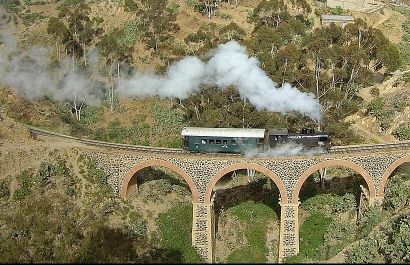
Between Arbaroba and Asmara in November 2008, a single coach is headed by one of the surviving Mallet locomotives. This is an extract from an image on Wikimedia Commons (public domain). [13]

Steam operation on the line is over, no regular services are provided but occasional tours still take place with plenty of caveats about the availability of any form of propulsion. An example is a German-speaking tour planned (as of 24th March 2024) for November 2024. [8]

Tanzania (Tanganyika)

The metre-gauge line inland from Dar-es-Salaam was built by the Ost Afrika Eisenbahn Gesellschaft (East African Railway Co.). A.E. Durrant tells us that its first main line power “was a class of typical German lokalbahn 0-4-4-0T Mallets, built by Henschel in 1905-7. These were supplemented in 1908 by four larger 2-4-4-0Ts from the same builder, after which the railway turned to straight eight-coupled tank and tender engines.” [1: p67]

R. Ramaer notes that the first locomotives used by the Usambara Eissenbahn (UE) on the Tanga Line were five 0-4-2 locos which arrived on the line in 1893. Rising traffic loads led the UE “To look for something more substantial and in 1900, Jung supplied five compound Mallet 0-4-4-0T’s as numbers 1-5, later renumbered 6-10. … To provide enough space for the firebox and ashpan, the rigid high-pressure part, comprising the third and fourth axles, had outside frames, whereas the low-pressure part had inside frames.” [9: p19]

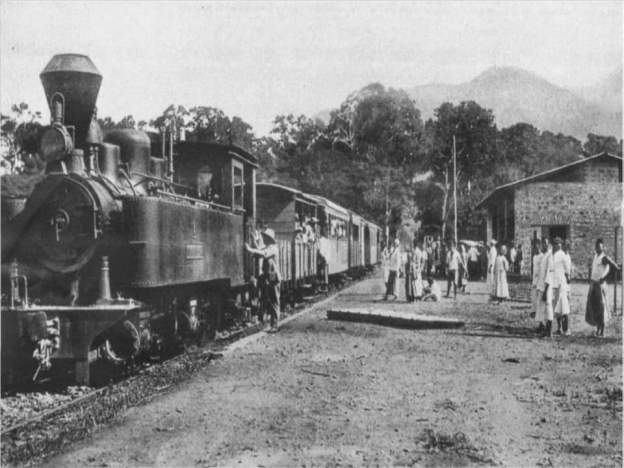
UE engine No. 1 (0-4-4-0T – supplied by Jung) with an early passenger train ready for departure at Tanga station in 1890. This image was posted on the Urithi Tanga Museum Facebook Page [10] and is also reproduced in R. Ramaer’s book. [9: p19]
UE Mallet 0-4-4-0T No. 8 heading a passenger train at Mombo. This image was shared in error on the Old Asmara Eritrea Facebook Page.  [11] It also appears in R. Ramaer’s book. [9: p20]

On the Central Line (Ost Afrikanische Eisenbahn Gesellschaft – or OAEG) which ran inland from Dar-es-Salaam, construction work started in 1905 and the first locomotives used by the OAEG were four 0-4-0T engines built by Henschel, a further four of these locomotives were supplied in 1909. These small engines had a surprisingly long life. Mallets were first supplied in 1905 by Henschel and were suitable for both coal and oil firing. These were 0-4-4-0T locos (four supplied in 1905 and one supplied in 1907). “The problem with this type of engine was the restricted tractive effort and running was not satisfactory because of the lack of a leading pony truck. … Therefore Henschel supplied a second batch of four locomotives in 1908 as 2-4-4-0Ts with larger boilers and cylinders. They also had a higher working pressure of 14 atmospheres (200lb/sq in) in comparison to 12 atmospheres (170lb/sq in)  for the earlier engines, while the bunker capacity had been increased from 1.2 to 2.2 tonnes of coal. (Oil fuel had been discarded).” [9: p21-23]

OAEG 2-4-4-0T No. 27, in the last Mallet class to be built for German East Africa. This locomotive appears in the Wikipedia list of Henschel steam locomotives. [12] It also appears in R. Ramaer’s book [9: p23] and A.E. Durrant’s book. [1: p66]

Kenya-Uganda

An ‘MT’ class locomotive in ex-Works condition at the Queen’s Park works of the North British Locomotive Co. [1: p66]

Mallets were the first articulated locomotives to operate in East Africa. Mallets were introduced on the Uganda Railway in 1913. A.E. Durrant notes that they consisted of “a batch of eighteen 0-6-6-0 compound Mallets to what was the North British Locomotive Co’s standard metre-gauge design, as supplied also to India, Burma, and Spain. They had wide Belpaire fireboxes, inside frames and piston valves for the high pressure cylinders only. Built at Queens Park works in 1912-1913, these locomotives entered service in 1913-14 and remained at work until 1929-30, when they were replaced by the EC2 and EC2 Garratts.” [1: p66]

North British Class ‘MT’ Mallets arrived in Kenya just before the start of WW1. [2]

These locomotives were given the classification ‘MT’ within the Uganda Railway fleet. Disappointing performance and high maintenance costs led to them being relegated to secondary duties and eventually being scrapped in the late 1920s as the Beyer Garratt locomotives began to arrive. [2] Their presence on the system was heralded by, “Railway Wonders of the World,” with the picture shown below. [3]

An ‘MT’ class Uganda Railway locomotive as illustrated in ‘Railway Wonders of the World’. [3]

References

  1. A.E. Durrant; The Mallet Locomotive; David & Charles, Newton Abbot, Devon, 1974.
  2. Kevin Patience; Steam in East Africa; Heinemann Educational Books (E.A.) Ltd., Nairobi, 1976.
  3. http://www.railwaywondersoftheworld.com/uganda_railway2.html, accessed on 1st June 2018.
  4. https://en.m.wikipedia.org/wiki/Eritrean_Railway, accessed on 22nd March 2024.
  5. https://en.m.wikipedia.org/wiki/Addis_Ababa%E2%80%93Djibouti_Railway, accessed on 22nd March 2024.
  6. https://en.m.wikipedia.org/wiki/0-4-4-0, accessed on 22nd March 2024.
  7. https://www.farrail.net/pages/touren-engl/eritrea-mallets-asmara-2010.php, accessed on 24th March 2024.
  8. https://ecc–studienreisen-de.translate.goog/historische-eisenbahn-und-strassenbahnreisen-mit-peter-1/8-tage-eritrea-mallets-in-den-bergen-afrikas?_x_tr_sl=de&_x_tr_tl=en&_x_tr_hl=en&_x_tr_pto=sc, accessed on 24th March 2024.
  9. R. Ramaer; Steam Locomotives of the East African Railways; David & Charles, Newton Abbot, 1974.
  10. https://www.facebook.com/urithitanga.museum/photos/pb.100063540805743.-2207520000/2336640756358366/?type=3, accessed on 24th March 2024.
  11. https://www.facebook.com/photo/?fbid=2169593963301193&set=pcb.2169594269967829, accessed on 24th March 2024.
  12. https://de.m.wikipedia.org/wiki/Liste_schmalspuriger_Lokomotiven_von_Henschel, accessed on 24th March 2024.
  13. https://commons.m.wikimedia.org/wiki/File:Eritrean_Railway_-_2008-11-04-edit1.jpg, accessed on 24th March 2024.

February 2024 – Recent & Relatively Recent News About the Railways of Kenya and Uganda – Metre-Gauge and Standard-gauge. …

Uganda revives colonial-era railway after Chinese funds fall through

8th July 2023 – RFI with Reuters (https://www.rfi.fr/en/africa/20230807-uganda-east-africa-railway) [5]

Uganda has begun restoring a disused branch of a railway line built under the British Empire, which it hopes will offer a cheaper way to transport goods to neighbouring countries. … Work has begun to restore nearly 400 kilometres of the tracks between Tororo in eastern Uganda, near the border with Kenya, and Gulu in the north, near South Sudan.

“Our ambition is to move all long-distance bulk cargo transportation onto rail from roads in a few years because rail is cheaper in terms of cost and time,” a spokesperson for for state-run Uganda Railways Corporation, John Linnon Sengendo, told Reuters news agency.

Uganda decided to revamp the old network after plans to build a separate, modern line failed to secure funding from China.

The government cancelled its contract with a Chinese firm earlier this year and is now seeking a new contractor for the project, which would see the construction of a standard gauge railway linking the Ugandan capital Kampala to the Kenyan border, where it would join up with Kenya’s modern lines.

Another Chinese contractor, China Road and Bridge Corporation, will repair the old line over two years at a cost of 200 billion shillings (50.6 million euros) to the Ugandan government, Sengendo said.

Uganda’s railway network fell into disrepair during the country’s economic collapse in 1970s and early ’80s.

Ugandan officials hope once the link is restored, rail will replace trucks in shipping transit goods to South Sudan and north-eastern Democratic Republic of Congo.

Under its East African Railway Master Plan, the East African Community regional bloc is aiming to revive lines serving Tanzania, Kenya, Uganda and extend them to Rwanda and Burundi. Ultimately it hopes to add South Sudan and Ethiopia to the network too.

Ugandan old railway line rehabilitation on track

14th January 2024 – The EastAfrican (https://www.theeastafrican.co.ke/) [1]

Article by Kabona Esiara

A recently relaid section of metre-gauge track in Kampala, (c) Sylvia Katushabe

Uganda’s planned overhaul of the metre gauge railway to cut transport costs on the Northern Corridor and improve trade competitiveness has entered its final stages, even as the country faces a shortage of equipment, wagons, and trains.

The EastAfrican has learnt [that] Spanish firm Imathia Construction has completed replacing steel sleepers with concrete beams on the Namanve-Kampala section of the line, which is expected to be handed over this month, Uganda Railways Corporation (URC) publicist John Lenon Sengendo said, adding that the contractor will then embark on the final section, Namanve-Mukono.

This will be the second section of the track to be completed after rehabilitation of the Tororo-Namanve line, including the line to Jinja Pier, which was completed a year ago.
While the Malaba-Namanve metre gauge track is now in fair condition, importers, exporters, and shippers remain sceptical about switching to rail, citing a shortage of rolling stock and inefficiency, which has resulted in 90 percent of traffic on the Northern Corridor being carried by road and only about seven percent is carried by rail because of the poor state of rail infrastructure.

As a result, transport costs are comparatively high on the Northern Corridor, ranging from 20 cents to 25 cents per tonne per kilometre for road transport, while the cost for rail transport ranges from US cents 6 to US cent 12 per tonne per kilometre, depending on the type of cargo.

The shortage of rolling stock is partly blamed on URC. A June 2022 Uganda’s Auditor General after reviewing URC’s asset register, had 521 wagons located in different parts of Kenya.

But only 128 wagons exist, leaving a balance of 393 wagons unaccounted for, raising fears of a possibility of URC overstating its asset values in the financial statements.

[A] URC accounting officer explained that “there were many wagons left in Kenya by RVR (U) Ltd upon concession termination. A repatriation exercise to return these assets to Uganda commenced in July 2021 and by December 2021, a total of 243 wagons had been brought back.”

Under this project, Uganda is to buy 3,000 horsepower locomotives by 2026.
The number of Uganda government-owned wagon ferries is also expected to increase from the current two to four, a development set to help URC meet the growing traffic demand on Lake Victoria.

The other financiers are the African Development Bank, which will provide $233.2 million, and the African Development Fund to provide $100.7 million – both concessional loans to finance the construction and purchase of rolling stock, which includes locomotives, wagons and coaches.

URC’s target is to move cargo from road to rail, and we expect to be moving six million tonnes a year.

In its efforts to revamp the metre gauge railway, Uganda is also reviving the route from Tororo in Eastern Uganda to Gulu City in the north. The line is currently under construction. Significantly, the city also hosts the Gulu Logistics Hub, whose phase one is also under construction. … The hub – which will be rail-linked – was planned as a strategic location connecting to the growing markets of Congo and South Sudan.

Kenyan government to spend $731m on new trains, SGR revamp

11th May 2023 – The EastAfrican (https://www.theeastafrican.co.ke/) [2]

Article by Business Daily

An SGR cargo train at the Naivasha Inland Container Depot in Kenya. Kenya’s National Treasury report shows Transport ministry will receive $714.7 million for the “Development of Standard Gauge Railway” between July this year and June 2026. [2]

The government of Kenya has stepped up expenditure on the Nairobi-Mombasa standard gauge railway (SGR) with a plan to hit Ksh100 billion ($731.53 million) in the next three years to revamp the line, build new sidings and buy more locomotives and cargo wagons.

A report by Kenya’s National Treasury shows that the country’s Transport ministry will receive an additional Ksh97.7 billion ($714.7 million) for the “Development of Standard Gauge Railway” between July this year and June 2026.

This reverses a trend where the previous government had cut allocations to the SGR and will push the spending related to this line beyond KSh780 billion ($5.7 billion) by June 2026.

Beginning July, the Kenyan government has allocated Ksh37.4 billion ($275.79 million) from the Railway Development Levy Fund (RDLF) for the Nairobi-Mombasa SGR.

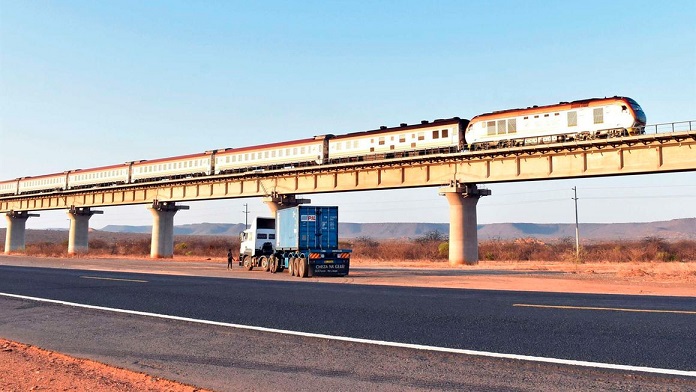
A Mombasa-bound SGR passenger train on the extended viaduct in the ‘Maneaters Area’. The line is set at high level to allow the safe passage of wildlife, (c) Wachira Mwangi. [2]

The bulk of the allocation, according to the breakdown shared with the Business Daily from transport, has been earmarked for the acquisition of additional locomotives and freight wagons at a cost of Ksh11.9 billion ($87.1 million).

Kenya last bought its 1,620 locomotives and wagons from China in 2018.

State had no plans for extension – The allocations to transport ministry show that the government had no plans to extend the SGR beyond Naivasha to Kisumu and finally Malaba in the next three years.

The rest of the funds, which have been allocated under the “Mombasa to Nairobi SGR” vote will largely be used to build new feeder lines and rehabilitate the old metre gauge railway (MGR) lines.

Charged at the rate of two percent, the Railway Development Fund (RDF) is levied on all goods imported into the country for home use.

“The purpose of the levy shall be to provide funds for the construction of a standard gauge railway network in order to facilitate the transportation of goods,” reads part of the Miscellaneous Fees and Levies Act which establishes the kitty.

Budgetary allocations for the acquisition of locomotives and wagons are projected to increase to Ksh16 billion ($117 million) in Financial Year 2024/25 and Ksh22.2 billion ($162.4 million) in the Financial Year 2025/26 taking the total allocations for the three years to Ksh50.1 billion ($366.5 million).

Another Ksh5.9 billion ($43.16 million) will be spent on the rehabilitation, remanufacturing or overhaul of locomotives, wagons and coaches, according to a breakdown of the Ksh37.4 billion ($273.6 million) allocation.

The new feeder lines will link some of the sections of the modern railway such as the Mombasa SGR Terminus to critical urban centres.

This includes Ksh4.48 billion ($32.77 million) for the construction of the Riruta-Lenana-Ngong Railway Line and Ksh2.96 billion ($21.65 million) for the construction of a Railway Metro Line linking Embakasi Station and Ruai town.

In the next 12 months, the government will also build a new 2.8-kilometre Metre Gauge Railway (MGR) link from Mombasa SGR Terminus to Mombasa MGR station at a cost of Ksh2.5 billion ($18.29 million).

These funds will also be used to construct a railway bridge across the Makupa causeway that links Mombasa Island to the Kenyan mainland.

New MGR line – A new Metre Gauge Railway (MGR) line linking the Naivasha Inland Container Depot to the existing Longonot Railway Station has been allocated Ksh1.6 billion ($11.7 million) in the next financial calendar.

The construction of a Railway Metro Line connecting Athi River Station to the East African Portland Cement has been allocated Ksh400 million ($2.93 million).

This is projected to rise to Ksh1.17 billion ($8.56 million) in the Financial Year starting July next year and Sh1.36 billion in Financial Year 2025/26.

Another Railway Metro Line connecting Athi River Station to NSSF and Mavoko will absorb Ksh450 million ($3.3 million), a figure that is set to increase to Ksh1.56 billion ($11.4 million) and Ksh1.89 billion ($13.83 million) in 2024/25 and 2025/26.

The money will also be used to rehabilitate the line between Longonot and the Western border town of Malaba, which is aimed at facilitating the movement of cargo from the port city of Mombasa to Uganda.

Also in this border town, which is prone to congestion, the State plans to build Malaba Cargo Handling Yard. Around Ksh474 million ($3.45 million) has been set aside for this project.

Other spending items will be the acquisition of plant and equipment, which shall take up Ksh3.8 billion ($27.8 million) in the next fiscal year, Sh1.1 billion in Financial Year 2024/25 and Ksh600 million ($4.4 million) in the Financial Year 2025/26.

Logistics Hub – A logistics hub is planned for Athi River with the state putting aside Ksh1.125 billion ($8.23 million).

The allocation for this planned logistics hub will reduce to Ksh375 million ($2.74 million) in the year ending June 2025.

Initial plans were to extend the SGR to Uganda; however, this has since stalled with the Treasury not getting funds for the extension to Kisumu and finally to Malaba.

Murkomen at the beginning of this year said the Kenya Kwanza administration in partnership with the Chinese government is keen on extending the SGR from Naivasha’s Mai Mahiu to the border of Uganda through a five-year plan that will see the multibillion-dollar railway line run through Narok, Bomet, Nyamira, Kisumu, and Malaba.

“In the long run, we would like to complete the connection of the SGR from Suswa to Kisumu through Bomet, Nyamira, parts of Kisii and later to Malaba. Later, we can think of upgrading the existing MGR via Nakuru to Kisumu and via Eldoret to Malaba,” he said on December 15, 2022.

With the additional expenditure, the government hopes the country’s most expensive piece of infrastructure will help to grow the economy and improve the standard of living for Kenyans.

The administration of former President Uhuru Kenyatta borrowed Ksh656.1 billion ($4.8 billion) in three tranches for the construction of the two phases of the SGR, contributing to a major build-up of Kenya’s stock of debt.

Kenya will use Ksh11.9 billion ($87 million) to acquire rolling stock that will be used to ferry cargo on the SGR from Mombasa to Naivasha.

Grand $15 billion plan to expand Kenya SGR to Kisumu, Malaba, Isiolo

15th May 2023 – The EastAfrican (https://www.theeastafrican.co.ke/) [3]

Article by Business Daily

The standard gauge railway line at the Naivasha Inland Container Depot, a transhipment hub for Kenya’s SGR from Mombasa, which is to extend to the proposed Malaba railway line in Uganda. [3]

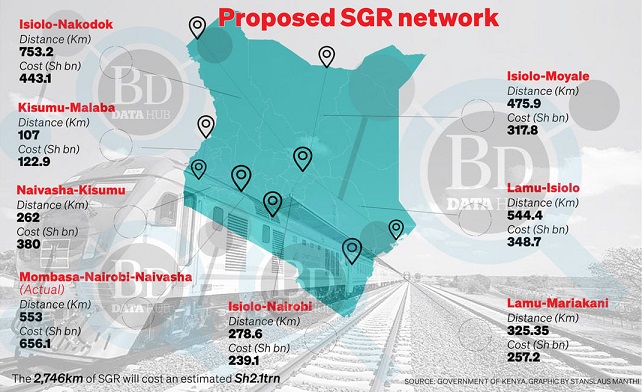
Kenya has set sights on a Ksh2.1 trillion ($15.3 billion) plan to extend the standard gauge railway (SGR) to Kisumu, Malaba and Isiolo by the end of June 2027, a government document seen by the Business Daily shows.

According to the plan, the State Department of Transport will build another 2,746 kilometres of the SGR at $15.3 billion, a move that will push the total spend on the modern railway to more than Ksh2.75 trillion ($20 billion).

The plan, lifted from the Jubilee Government’s grand scheme on SGR (so far Kenya’s most expensive project), is part of the Ksh3.42 trillion ($24.9 billion) Lamu Port South Sudan-Ethiopia Transport (Lapsset).

Lapsset is aimed at opening up northern Kenya and revamping the northern corridor by spurring movement within Kenya, South Sudan and Ethiopia.

It is an ambitious scheme that will not only see the modern railway reach the border town of Malaba via Kisumu, as it was initially envisioned, but also Isiolo, Moyale and the island of Lamu.

The line will move from Mariakani in Mombasa County to Lamu to Isiolo. From Isiolo, the SGR will be connected to the northeastern town of Moyale which borders Ethiopia.

From Isiolo, the government will extend the SGR to Nairobi, connecting the country’s capital city and commercial hub to northern Kenya and finally to Ethiopia.

From Naivasha, the SGR is extended to Malaba through Kisumu.

The bulk of the financing for these additional kilometres of the SGR, around Ksh1.8 trillion ($13 billion), will be from external financiers that the document has not revealed while the rest will come from the Kenyan government.

So far, the SGR from Mombasa to Naivasha has been financed by the Chinese at a total cost of Ksh656.1 billion ($4.7 billion)

The longest stretch of the planned SGR, 753.2 kilometres, will be from Isiolo to Nakodok, a small town near the border between Kenya and South Sudan.

The Transport Ministry, headed by Kipchumba Murkomen, has cost this phase of the SGR at Ksh443.2 billion ($3.2 billion).

From Lamu to Isiolo, a distance of 544.4 kilometres, the Ruto administration plans to build the rail line at Ksh348.7 billion ($2.5 billion).

From Isiolo to Moyale, a distance of 475.9 kilometres, the country is expected to use Ksh317.8 billion ($2.3 billion) to build a new SGR line.

The line connecting Mariakani to Lamu of 325.3 kilometres will cost Ksh257.3 billion ($1.8 billion).

Locations on Kenya’s planned SGR network. [3]

There will be another line of 278 kilometres connecting Nairobi to Isiolo that will consume Ksh239.2 billion ($1.7 billion).

Phase 2B of the SGR from Naivasha to the lakeside city of Kisumu will cost Sh380 billion while the last leg, 2C, from Kisumu to Malaba bordering Uganda will take another Ksh122.9 billion ($896 million).

The document from the State Department of Transport reveals what appears like a near-impossible feat of the government wanting to complete the entire transport circuit in four years from 2023 to 2027.

Although the ministry’s document indicates that construction of these railway lines is to begin at the start of July this year, no budgetary allocation has been made for the SGR for the next three financial years.

In 2014, the government entered into a tripartite agreement with the governments of Rwanda and Uganda to construct a standard gauge railway from Mombasa through Kampala to Kigali, Rwanda.

However, the SGR ended abruptly in Naivasha with China reportedly declining to finance the last leg of the modern railway after failing to strike an agreement with Uganda.

The new administration of President Ruto has rekindled plans to complete the SGR.

Through a partnership with the Chinese government, Mr Murkomen said earlier this year the government wanted to extend the SGR from Naivasha’s Mai Mahiu to the border of Uganda through a five-year plan that will see the multibillion-dollar railway line run through Narok, Bomet, Nyamira, Kisumu, and finally Malaba.

“In the long run, we would like to complete the connection of the SGR from Suswa to Kisumu through Bomet, Nyamira, parts of Kisii and later to Malaba. Later, we can think of upgrading the existing MGR via Nakuru to Kisumu and via Eldoret to Malaba,” the CS said in a statement on December 15 last year.

The Transport Ministry has been allocated Ksh100 billion ($729 million) from the Railway Development Levy Fund (RDLF) for the next three years to revamp the existing SGR line from Mombasa to Naivasha via Nairobi and build new sidings.

The money will also be used to buy more locomotives and cargo wagons, which are aimed at improving the freight capacity of the modern railway which is still facing cut-throat competition from trucks.

Plans to revamp the SGR involve mostly building new metre gauge railway (MGR) or rehabilitating them.

New Concrete Sleepers for the Metre-Gauge in Uganda

New Vision reported that, on 1st September 2023, President Yoweri Museveni opened a new Concrete sleeper making facility at Kawolo, Buikwe District, Kampala. The sleepers are to be used in the rehabilitation of the metre-gauge railway line.

The traditional steel sleepers are no longer in favour. Thefts and vandalism mean that alternatives have had to be sought. [6]

The old steel sleepers on the right. The new concrete sleepers in ballast on the left. [7]

The sleepers are being used on the Kampala to Namanve line before being rolled out to other projects. The construction of the factory valued at over 19 million Euros (about 76 billion Uganda Shillings) started in June 2020.

On-going work on the Kampala to Namanve line. [8]

The use of concrete sleepers on the suburban lines will be supplemented by the procurement of diesel multiple units and additional coaches.

In August 2020, URC said the Government had secured funding from the Spanish government and African Development Bank (AfDB) to the tune of shillings 1.3 trillion to revamp the Metre Gauge Railway by rehabilitating about 250 kilometres from Malaba to Kampala.” [6]

On 1st February 2024, work on the Kampala to Namanve line was close to completion and a predicted opening in March 2024. [9]

Kenya Railways puts proposed Lapsset SGR costs at $16 billion: bulk on Isiolo-Nakodok line


Monday 22nd January 2024 – The EastAfrican

(https://www.theeastafrican.co.ke/) [4]

Kenya will need at least Ksh 2.4 trillion ($16 billion) to construct a proposed Standard Gauge Railway (SGR) on the Lamu Port-South Sudan-Ethiopia-Transport (Lapsset) corridor, according to projections by the Kenya Railways Corporation.

According to the parastatal, it would cost Ksh 523.05 billion ($3.49 billion) to build a 544.4 km SGR link to connect Lamu and Isiolo and a further Ksh 476.7 billion ($3.178 billion) to extend the line from Isiolo to Moyale over a distance of 475.9 km.

The largest spending would be on constructing the SGR line from Isiolo to Nakodok town on the border between Kenya and South Sudan over a distance of 753.2 km at a cost of Ksh664.65 billion ($4.431 billion).

Kenya Railways has estimated that a further Ksh 358.8 billion ($2.392 billion) will be required to link Isiolo and Nairobi via SGR over a distance of 278.6 km and a further Ksh 385.95 billion ($2.573 billion) for the 325.35 km stretch between Lamu and Mariakani.

The entire stretch will cover a total of 2,377.45 km, translating into a cost of Ksh 1 billion ($6.667 million) for every kilometre of the SGR.

But the cost of undertaking such a colossal venture, which would be by far the most expensive in Kenya’s history, will be far higher than Kenya Railways’ estimates considering the company did the costing at an exchange of Ksh150/US dollar.

The parastatal has nonetheless expressed confidence in raising Ksh275.9 billion ($1.84 billion) or 11.4 percent of the total project cost by the financial year 2027/28 through funding from the government, collections from the Railway Development Levy Fund (RDLF) and loans.

Kenya in 2014 began construction of Phase 1 of the SGR line between Mombasa and Nairobi covering 472km. Phase 2A Nairobi-Naivasha (120km) was constructed in 2017. The project was funded by a $5.08 billion loan from China.

The SGR line has led to expansion of the Inland Container Depot (ICD) in Nairobi at Embakasi, and construction of the ICD – Naivasha at Mai Mahiu,” said Kenya Railways.

The firm added: “This has contributed to decongestion of the seaport of Mombasa and facilitated seamless transit of goods destined to Western Kenya and neighbouring countries.”

Already, two studies have been undertaken to explore the feasibility of a Lapsset corridor railway by Japan Port Consultants in 2009 and China Civil Engineering Construction Company (2015). The latter study estimated the cost of the project at $10.4 billion with a financial rate of return of between nine percent and 12 percent.

The proposal to build an SGR line along the Lapsset corridor is however not feasible yet as the Lapsset project has failed to take off due to lack of funding as well as insecurity. Kenya is also facing a huge debt pile which has been worsened by the rapid depreciation of the Kenyan shilling leading to a surge in foreign currency external loans.

References

  1. https://www.theeastafrican.co.ke/tea/business/ugandan-old-railway-line-rehabilitation-on-track-4490790, accessed on 15th January 2024.
  2. https://www.theeastafrican.co.ke/tea/business/kenyan-government-to-spend-731m-on-new-trains-4230714, accessed on 15th January 2023.
  3. https://www.theeastafrican.co.ke/tea/business/usd15bn-plan-to-expand-kenya-sgr-to-kisumu-malaba-isiolo-4235152, accessed on 15th January 2024.
  4. https://www.theeastafrican.co.ke/tea/business/kenya-puts-proposed-lapsset-sgr-cost-at-16b-4498058, accessed on 23rd January 2024
  5. https://www.rfi.fr/en/africa/20230807-uganda-east-africa-railway, accessed on 28th January 2024.
  6. https://newvisionapp.page.link/AnZKJYD8UVVMesj46, accessed on 10th February 2024
  7. https://metrospy.net/tag/president-museveni-commissions-ugandas-first-railway-concrete-sleeper-factory, accessed on 10th February 2024.
  8. https://twitter.com/IMATHIA_/status/1732763129472250220?t=gIdF9LI4kbCV89rYCs0MGg&s=19, accessed on 10th February 2024.
  9. https://youtu.be/Hf1Rr-2FPuU?si=NTFqVs7UgqeoASR3, accessed on 10th February 2024.

Railways in Colonial Times in what was known as ‘British East Africa’ …

John R. Day wrote two volumes in the early 1960s about the railways of Africa. The first was about the southern area of the continent and entitled, unsurprisingly, ‘Railways of Southern Africa’. [1] The second volume was entitled ‘Railways of Northern Africa’ and dealt with the remainder of the continent. [2]

An on-line acquaintance very kindly sent me a copy of the chapter from that second volume which covers British East Africa. Today, the chapter title would give cause for some concern, but colonial attitudes still held sway in the 1960s. [2: p24-41]

Reading that chapter piqued my interest and I managed to pick up a secondhand copy of the book at a reasonable cost.

I have written a series of articles about the Uganda Railway and its successors in Uganda and Kenya. Those articles  can be found here on my blog (rogerfarnworth.com). [3] These articles begin with a history of the mainline and then follow the route of the railway West from Mombasa. Later articles pickup on one of the volumes about the history of the railways in East Africa which were written by M.F. Hill. [4]

Day begins his chapter on British East Africa by quoting from Sir Winston Churchill’s My African Journey, which highlights what was very true in the very early years of the 20th century, “that the Uganda Railway did not pass through Uganda. It was a railway to it, not of it. ‘It stops short of the land from which it takes its name, and falls exhausted by its exertions and vicissitudes, content feverishly to lap the waters of the Victoria Nyanza.'” [4: p24][5]

The Uganda Railway: this map of the route of the line is included in Winston Churchill’s My African Journey. [5]

Day also remarks on the level of vitriol which was directed at the Uganda Railway during its construction, quoting The Railway Gazette of 1911, “It is doubtful whether any project has been so roundly abused and so soon proved successful as the Uganda Railway. Politicians of all shades of opinion had their fling at it in turn, and it was condemned as a permanent money-sink. Yet it went on being built, slowly but surely, and in the second year of full public operation earned a profit over its working expenses.” [6]  Day goes on to state boldly that it was this railway from Mombasa to Lake Victoria which created modern Kenya!

In Day’s book a short note follows about the thinking which brought the Railway into being: “The Imperial British East Africa Company, formed in 1888 from the British East Africa Association, played an important part: one of its main objects was to suppress the slave trade. In 1890, the Company arranged for 60 miles of narrow-gauge railway to be built. From England came 65 miles of 2 ft. gauge track and from India came labourers: only seven miles were built, but it was named the “Central Africa Railway”. Later it was pulled up and the material re-used for a tram-line in Mombasa.” [2: p24][7]

Apart from the desire for good communications with Uganda, which, besides being a desirable territory in itself, controlled the head-waters of the Nile and thus much of the economy of Egypt and the Sudan, it was thought that the railway would end the slave trade. The argument was that the slaves travelled with the caravans, but once the railway was built it would so speed up and cheapen travel that the caravans would cease.” [2: p24]

Robert Clemm argues that “the territory of what would become the British colony of Kenya was little regarded by Europeans during the mid-to-late 19th century. At that time, it served as little more than a barrier to cross to places more renowned and important. For explorers who wished to verify if the reports of a snow-capped mountain in Africa were true, it was simply a land to traverse on the way to Mount Kilimanjaro. For British officials in the aftermath of the Berlin Conference of 1884–1885, it was a land necessary to possess not for its own intrinsic worth, but only as a means to stabilize “effective occupation” and to preserve British dominance. For officers of the Imperial British East Africa Company, it was an obstacle to surmount to gain access to the much richer lands of Uganda. The construction of the Uganda Railway, however, radically changed the perception, and, by extension, the nature and history of Kenya. … The Uganda Railway was a piece of technology crafted to solve the joint political and economic concerns of the British Government in eastern Africa. In linking the coast firmly to Uganda it would solidify British control over a region contested by German colonial enthusiasts, and would ensure the prosperity of the region through the expected transport of cash crops to the coast. … As much as the Uganda Railway seems to present yet another example of the importance of technology generally, and the railway specifically, to the process of imperialism, it goes well beyond that. The “Lunatic Express,” as the Uganda Railway was nicknamed, illustrates the power of technology to create and transform well in excess of our own intentions. While its creators simply wished to solve the technical question of linking important regions via a stable transportation network, the railway fundamentally transformed the land over which it crossed. The transformation went beyond that of the physical land-scape, which would be leveled and etched with rails and ties, and extended to the very understanding of what Kenya was.” [8: p133f]

Mervyn Hill’s first volume, [4] demonstrates the way in which the Uganda Railway fulfilled the role that Clemm describes.

Day continues, in his chapter on British East Africa, to outline the survey work of a team of three Royal Engineers led by Captain J.R.L. Macdonald which sought the best route to Lake Victoria. Day comments that Macdonald “was concerned only to find the quickest and cheapest way from the coast to Lake Victoria: no one at that time was bothered about the highlands of Kenya.” [2: p25]

Day notes that the election of Lord Salisbury’s Conservative government in Britain in 1895 finally resulted in a decision to build the railway. He describes the decision taken in 1896 to build the line to metre-gauge as ‘unfortunate‘. It was a decision “based on the assumption that, as many Indian railways were of this gauge, rolling stock could be obtained quickly if needed in an emergency.” [2: p26] Day does not state why he sees the decision as unfortunate. It may possibly be because other railways on the continent were being built to a gauge of 3ft 6in, rather than metre-gauge.

Construction started with a 1,700ft timber viaduct connecting Mombasa Island to the mainland. This remained in use until an iron bridge was opened to traffic in July 1901. Day reports that relatively quick progress was made in 1896 with the railhead being 23 miles from the coast by the end of the year.

The story of the construction work in 1896-1898 was, however, a troubling one. “By the end of 1896, the number of Indian labourers had risen to about 4,000; but more than half suffered from malaria, which also attacked the European staff. Troubles continued to dog the work in 1897 and 1898. An outbreak of bubonic plague in India dried up the labour supply for months. All the camels and all but six of the 800 donkeys used to carry supplies died, as did over a third of the mules and more than nine-tenths of the oxen. Water had to be brought by train to supply the labourers. Transport beyond railhead was eased later by the importation of four traction engines and trailers.” [2: p27]

A revolt in Uganda and a mutiny by Sudanese troops saw the incomplete railway transporting large numbers of troops about 100 miles from the coast and it was the successful use of the railway by the military which gave greater impetus to the construction work.

The first 100 miles of the line has been opened to freight at the end of 1897, and to passengers early in 1898. In December 1898, a delay of three weeks with work completely shut down was caused by attack on workers by two lions. These attacks continued into 1900 and meant that the pace of the work was slower than it might have been. Nonetheless, by the end of 1897 rails were 256 miles from the coast.

By the end of May 1899 the rails had reached what became Nairobi and the railway headquarters were built there. “By the end of 1899, more than 18,000 Indian labourers were at work and the line was pressing on from Nairobi toward the escarpment and the site of the inclines. The first few months of 1900 brought heavy rains and partly washed away the earth- works east of Nairobi, causing delays. By this time the survey had been completed to the lake by a shorter route than that first envisaged, the locomotive stock had increased to over 90, and there were about 175 passenger vehicles and 900 wagons of various types.” [2: p29]

Day comments that a “new route had been found into the Rift Valley which avoided the reversing stations which Macdonald had thought necessary. At first, however, the Chief Engineer decided to use a funicular railway to carry material down into the Rift Valley so that the railway could be continued towards Lake Victoria without wait- ing for the permanent line. The vertical height of the funicular was just over 1,500 ft. and it was in four sections. The top section was at 1 in 6, the two middle sections at 1 in 2 and the bottom section at about 1 in 11.” [2: p28f]

On the top and bottom inclines, full wagons going down pulled the empty ones up again. On the centre sections, built to a gauge of 5 ft. 6 in., wagons were carried on special trucks so built as to have a horizontal deck on which were metre-gauge tracks for the railway wagons. These special trucks were hauled by a 1 in. dia. steel wire rope passing round a power-driven drum at the top of the incline. All four inclines were double track, but the lower portions of the 1 in 2 section were of gauntletted track, i.e. the two tracks were interlaced. A temporary railway led from the foot of the incline to the permanent line of route at a point 375 miles from Mombasa. The inclines enabled the railway to advance another 170 miles before the permanent alignment was finished into the valley and the funicular was taken out of use in November, 1901.” [2: p29]

March 1901 saw the railhead having reached 483 miles West of Nairobi, 17 miles behind the earthworks. The line reached Port Florence (later Kisumu) on 19th December 1901. It cost around £5.5 million and climbed more than 6,000ft en-route from Mombasa. Very soon minds turned towards extending the line to Uganda to avoid the need for the transshipment of goods onto and off lake steamers. Uganda was a different world to Kenya. “Sir Charles Eliot wrote in 1903: ‘To cross the lake [to Uganda] is like visiting another continent. The country is cultivated and thickly populated. There are good roads, fences and houses all constructed by the natives. The people are all clothed, and it is a reproach not to be able to read and write.’ The contrast with Kenya as it them was could not have been greater.” [2: p30] It is easy to see why Uganda was a target for colonial powers.

Winston Churchill continued his advocacy for an extension of the railway into Uganda. A deep water pier at Killindini was funded by the British government by means of a loan and £60,000 was allocated for the construction of a ‘tramway’ between Nairobi and Thika in Kenya. The ‘tramway’ was built to the same gauge as the railway and with gradual improvement over the years, became a defacto branch line.

An extract from a map produced by East African Railways and Harbours which shows the branch line heading away from the main line at Nairobi and running through to Thika and beyond. [2: p23]

Churchill’s advocacy resulted in the construction of a line between Jinja on Lake Victoria and Kakindu on the Nile and permitting access to Lake Kioga. The terminus was relocated during construction to Namasagali. The line was given the name, ‘The Busoga Railway’ and opened in 1912. I have written about this line and the article can be found here. [9]

A branch line to Lake Magadi was also constructed, running from Konza (282 miles from Mombasa) to the lake. It was around 100 miles in length. The Lake Magadi Soda Co. was formed in 1911 and later acquired a 99-year lease of the area and powers to build a pier at Kilindini. The branch line was complete in 1915. The line is referred to here and a pictorial record of a visit in the 1990s is included in that linked article. [10]

Another extract from a map produced by East African Railways and Harbours which shows the branch line heading away from the main line at Konza and running through to Magadi. [2: p23]

In the early years of the 20th century traffic on the mainline increased significantly. “In 1902, there were three or perhaps four trains a week in each direction. In 1912 there were 50 or 60: the working profit was £134,000.” [2: p32]

After WW1 the possibility of a line to the Uasin Gishu plateau was reconsidered. It was hoped that this line might eventually result in a further extension into Uganda. There was some heated argument about the best route for this line before work commenced on the new line from a junction at Nakuru in the the last few weeks of 1921. By 1923, a line as far as Sabatia was in use.

Another extract from a map produced by East African Railways and Harbours which shows the new line heading away from what was the main line at Nakuru and running through Sabatia, Equator and Timboroa. [2: p23]

The network continued to develop. The Thika line was extended to Nyeri. Work in the West of Kenya was also moving forward, decisions were taken to: extend the Usain Gishu line; create a branch to Mbale (in Uganda) from Tororo on the border; build a line from Rongai to Solai in Nakuru District; and a branch from Leseru to Kitali. All of these, bar the Mbale branch, were under construction by the end of 1924.

In 1926, the name of the railway was changed from the Uganda Railway to the Kenya and Uganda Railway, and at the end of that year 1,128 miles of railway were open.” [2: p34] By January 1928 the line reached the River Nile and an extension to Kampala from Jinja was under consideration.

In 1927, a further name change to ‘Kenya and Uganda Railways and Harbours’ was in place and more powerful locomotives were introduced with an increase in rail weight to 80lbs/yard on the length from Mombasa to Makindu. A new causeway was under construction to link Mombasa Island to the mainland. The causeway made room for both road and rail and was completed by a 5-span bridge. The Nyeri Branch was completed mid-year. The Branch to Mbale, extended to Soroti, was under construction and a branch from Gilgil to Thomson’s Falls was agreed.

A further extract from the East African Railways and Harbours map which shows the branch from Rongai to Solai, the branch from Gilgil to Thomson’s Falls and a length of the Nyeri branch. [2: p23]

Construction of the Thomson’s Falls Branch commenced at the beginning of 1928 and was completed by August 1929. The Soroti Branch was completed by September 1929 and the branch from Kisumu to Yala by November 1930. The Naro Moru Branch was extended to Nanyuki (visible to the right side of the image above) by October 1930.

The Jinja-Kampala line was started in early 1929 and the 58-mile line made such progress that track-laying was finished in January 1930. The inauguration has to wait for the completion of the bridge across the Nile, opened by the Governor of Uganda on 14th January 1931.” [2: 35f]

A portrait of East African Railways 59 class Garratt locomotive no. 5902, before it was named ‘Ruwenzori Mountains’. East African Railways and Harbours – A.J. Craddock’s personal collection of EAR&H publicity photos given to him during a visit to the Nairobi HQ in 1954 (EAR&H negative 961/1) – Public Domain. [11]

Engineers and surveyors were at work in Western Uganda in the 1930s looking for ways to connect through to the Congo but the world depression of the 1930s hampered any significant expansion of the network. Only a short length from Yala to Butere was completed. Trade improved in the late 1930s and new passenger and rolling stock arrived by 1939, along with six powerful Beyer Garratt Locomotives. WW2 brought a reevaluation of priorities, railway workshops were turned over to military uses. New lines were considered if they would enhance the war effort. One of these was an extenion of the Nairobi-Thika Branch to the North. A great deal of effort was put into the building of this line which in the end proved of little value as its intended use was overtaken by the speed of the military advance North from Kenya.

After the war, a line to the Kilembe Copper Mine was deemed essential. A route had been surveyed before WW2 and the idea was resurrected in 1950. Kilembe was expected “to produce 20,000-25,000 tons of copper and 1,500 tons of cobalt a year. The Government of Uganda came to the conclusion that a line would be justified and that the area through which it would run would be suitable for crop growing and cattle ranching.” [2: p37] The project was approved in January 1952, work began in the same month. The line was open to Mityana by August 1953 and to Kasese in August 1956. The construction work was demanding. Day tells us that “up to 5,000 men at a time worked on the new line, which ran in places through thick forest and in others demanded heavy earthworks. Embankments were needed to cross the papyrus swamps which the line traverses for some 40 miles of its route, and there are 24 bridges. The Lake George swamp demanded a four-mile earth embankment containing 18 million cubic feet of earth and included gaps spanned by three 60 ft. bridges. The swamp is fed by streams from the Rift escarpment and from the Ruwenzori Mountains, and concrete piers had to be sunk 40 ft. into the swamp to support the ends of the bridge spans.” [2: p38]

Where the railway drops down into the Western Rift Valley a great spiral was built to take the line down part of the 1,000 ft. difference in level. Apart from excavation and moving 60 million feet of earth on this and other parts of the escarpment stretch of line, blasting had to be undertaken where rock barred the way. When the rails reached Kasese, with the Ruwenzori Mountains just beyond, railhead was 1,080 miles from the sea. Traffic was flowing from the mines over the £5 million line to the smelting plant at Jinja, 263 miles away, by the end of the year.” [2: p38]

In 1950 a main line realignment between Nakuru and Nairobi (113 miles) was completed at a cost of £2.25 million, shortening the journey by 10 miles and easing gradients. “It included the 2,500ft Limuru tunnel and another at Gilgil in the side of the Great Rift Valley.” [2: p38]

In 1955, the railways in East Africa had their most successful year. Day tells us that the annual report for 1957 reviewed the decade since the war and the formation (in 1947) of the larger East African Railways and Harbours Co. with the inclusion of what were originally German colonial lines in Tanganyika (Tanzania): “Public goods on the inland transport services had increased from 2.6 million tons a year in 1948 to 3.8 million tons in 1957, and ton-mileage from 769 million to 1,454 million. (in 1962 traffic had risne to4.15 million tons and 1,661 million ton-miles.) The tonnage of imports and exports passing through East African ports rose from 3.1 million to 4.4 million. The locomotive stock rose from 234 in 1948 to 461 in 1957 and the number of wagons rose from 5,764 t0 9,594. The route mileage increased from 2,930 to 3,375.” [2: p39]

At the end of 1957, locomotive stock consisted of, “129 Beyer-Garratt, 222 tender, and 58 tank locomotives as well as 46 diesels. There were 994 coaching vehicles.” [2: p39]

1957 was a pivotal year for traction on the network. The Southern section (Tanganyika) was primarily run by diesel locomotives and railcars and some diesels were in use on the Magadi branch. 1958 saw ten new diesels (1,850h.p.) ordered and over the next few years significant expansion continued. Independence for Tanganyika (Tanzania) in 1961 put in doubt the continuing use of the Southern section as the new state would need to fund at least £200,000/year to keep the system.

In May 1963, an international committee of inquiry recommended that all steam motive power should be replaced by standardised diesel-hydraulic locomotives. Days final comment is that this would be a major undertaking as at the time 406 steam locomotives remained against 56 diesels(of which some of the largest were diesel-electrics) [2: p41]

It is at this point that Day’s history of the East African lines comes to a halt. He was unable to catalogue events of the later 1960s and beyond. His book was published in 1964.

A more detailed history can be found in M.F. Hill’s book Permanent Way: the story of the Kenya and Uganda Railway. [4] This book can cost significant sums on the secondhand market. I have produced a series of articles on it which begin here. [12]

References

  1. John R. Day; Railways of Southern Africa; Arthur Barker, London, 1963.
  2. John R. Day; Railways of Northern Africa; Arthur Barker, London, 1964.
  3. https://rogerfarnworth.com/category/railways-blog/africa/uganda-and-kenya-railways, scrolling to the bottom of the page will lead to the earliest articles in the series.
  4. M.F. Hill; Permanent Way: the story of the Kenya and Uganda Railway; 1950.
  5. Winston Churchill; My African Journey; Clay & Sons, Bungay, Suffolk, 1909. There is an e-book available on line on this link: https://www.gutenberg.org/files/43035/43035-h/43035-h.htm, accessed on 12th April 2023.
  6. The Railway Gazette, 1911.
  7. I have covered the tramway in Mombasa in, “Mombasa, Kenya – A very early tramway?”, https://rogerfarnworth.com/2018/05/21/mombasa-kenya-a-very-early-tramway.
  8. Robert H. Clemm; The Uganda Railway and the Fabrication of Kenya; in Technology, Violence, and War; p133-154.
  9. https://rogerfarnworth.com/2018/06/12/uganda-railways-part-22-jinja-via-mbulamuti-to-namasagali.
  10. https://rogerfarnworth.com/2018/05/22/uganda-railways-part-6-ulu-to-nairobi.
  11. https://en.wikipedia.org/wiki/EAR_59_class#/media/File:EAR_5902_left_three_quarter.jpg, accessed on 15th April 2023.
  12. https://rogerfarnworth.com/2020/12/18/uganda-at-the-end-of-19th-century-and-the-events-leading-up-to-the-construction-of-the-uganda-railway.

2018-2022: Railway News from Kenya

This post includes a selection of news items about Kenya Railways in the period from 2018 to the Autumn of 2022. The items included are by no means exhaustive but they might be of interest! ……..

The Birth of a Nation: preserving records on the Kenya-Uganda railway line (EAP1143)

In 2018 the British Library funded a small pilot project undertaken in Nairobi Railway Museum’s archive. This was a low cost 6 month pilot which identified the condition of the archived documents and photographs and improved storage and access to them.

The photographs which were digitised all seem to predate the construction of the railway and document the life and times of people who lived on its route. [1]

The Standard-Gauge Line

In 2018, NPR reported that the “Standard Gauge Railway station in Nairobi is easily the most impressive public building in Kenya.” [8] The station is “adventurous. It’s all gray and modern. Geometric shapes form an abstract locomotive, and red neon announces the “Nairobi Terminus.”” [8]

The Standard-gauge Railway Station at Nairobi. [8]

NPR continues: “The train runs 293 miles from Kenya’s capital city to the port of Mombasa and back twice a day and represents the biggest infrastructure project since Kenya’s independence 54 years ago. The Chinese financed it; a Chinese company built it; and the Chinese will operate it for many years to come. … The project, which launched in the summer of 2017, has not only come to signify Kenya’s ambitions, but also China’s ambitions on the African continent. In the past decade, China has become the biggest lender to governments in Africa. The money has helped build ports, roads, bridges, airports and trains. But critics warn the loans are full of traps that could leave African countries in the lurch. Kenya alone owes $5.3 billion to China.” [8]

On 16th October 2019, VOA News reported that Kenya opened the second phase of the Standard Gauge Railway Project: “Kenya’s President Uhuru Kenyatta officially opened on Wednesday the second phase of his flagship infrastructure project: a Chinese-funded and built railway that will eventually link the port of Mombasa to Uganda. … The latest stretch of track cost $1.5 billion and runs from Nairobi to the Rift Valley town of Naivasha.” [9]

After the official opening, the president then joined the first ride along the line. … “The train stopped at every station, where a cheering crowd awaited the president. He promised them that the new railway will bring prosperity. … Kenyatta said that if the railway comes here, development also comes here.” [9]

The new track is 120 kilometers (75 miles) long and has 12 stations. Passengers can ride the trains, but the railway is mainly for cargo. The track will eventually lead to an inland container depot, (see below) from where containers will be distributed to Uganda and Rwanda, and to South Sudan. [9]

On 20th August 2021 the Ugandan newspaper, ‘The Independent’ reported that Kenya’s Standard-gauge railway line transported 2.31 million tons of cargo between January and the end of May that year: “an increase of about 45 percent from the similar period in 2020, according to data released on Thursday from the Kenya Railways Corporation.” [10]

“The rise in cargo volumes saw an increase in revenue generated during the months to 6.2 billion shillings (about 57 million U.S. dollars), up from 41.4 million dollars generated from January to May in 2020, it said. … The number of passengers using the train during the first five months of 2021 nearly doubled amid COVID-19 pandemic. … Some 601,201 passengers were ferried between the capital Nairobi and the coastal city of Mombasa during the period, up from 330,232 in 2020 when the country grappled with COVID-19 pandemic, the corporation said. … This generated revenue of 5.9 million dollars, up from 3.3 million dollars generated between January and May in 2020.” [10]

Refurbishment of Nairobi Central Station

Major renovations at Nairobi Central Station began on 27th July 2020. By January 2021, the work was well-advanced. Kenya Railways reported that the work would facilitate the use of the new DMUs due to arrive in the country.

Renovation work at Nairobi Central Station in January 2021. [5]

Kenya Railways stated on 13th January 2021 that, “as the rehabilitation works continue[d], stringent measures [were] put in place to safeguard daily commuters as they access[ed] the station.” [5]

Designated boarding points were set for various trains to facilitate safe movement of passengers within the Nairobi Central Station. For instance, Kikuyu and Ruiru trains, the boarding point was designated on the Western end of the Nairobi Central Station and it was to be accessed from Railways Police station. While passengers boarding Syokimau & SGR Link trains boarded the trains from the Eastern end of the station with the access point being adjacent to Guava restaurant.

Kenya Railways stated that, “The rehabilitation of Nairobi Central Station will not only give it a new face but also show KR is dedicated in making transportation better.” [5]

Plans for the full renewal of Nairobi Central Station were published in May 2022. The project has been sponsored by both the British and Kenyan Governments.

Design office view of the proposed renewed Central Station. [6]

THE British and Kenyan governments unveiled the final design of Nairobi’s new Central Railway Station and surrounding public area, which has been developed as part of the Nairobi Railway City redevelopment programme. [6]

The IRJ reported that, “The design was developed by SNC-Lavalin subsidiary Atkins and submitted to Kenya Railways and the Ministry of Transport. … The station is designed to accommodate up to 30,000 passengers per hour at peak periods, and will have 6000m2 of concourse space. The station will offer a new covered public space for the city with retail outlets and other amenities …. It features separate entrance and exit routes to avoid conflicting flows and ensure passengers can get to and from the platforms efficiently. … Three existing platforms will be joined by six additional passenger platforms, and four dedicated freight lines will be built. Two platform bridges will be built, with one for passengers entering the station and one for passengers exiting.” [6]

A few design office perspective views are shown below:

The SGR to MGR link at Naivasha

In July 2022, President Uhuru Kenyatta officially commissioned the Standard Gauge Railway – Metre Gauge Railway Passenger Rail Link at the Kenya Railways Mai Mahiu Station in Naivasha, Nakuru County. The ceremony took place on Tuesday, 26th July 2022.

The 5km link will enable passengers traveling to Western Kenya by train to switch from the standard-gauge service to that of the metre-gauge and vice versa. Kenya Railways reported that it would as a result be possible to travel exclusively by rail from Mombasa through Kilifi, Kwale, Taita Taveta, Makueni, Machakos, Kijiado and Nairobi onwards to Nakuru, Kisumu, Eldoret, Kitale, Nyahururu, Nanyuki, Malaba and Bungoma. [2]

Naivasha Inland Container Depot

On the same day (26th July 2022) the Naivasha Inland Container Depot (ICD) was officially opened by President Uhuru Kenyatta.

The Naivasha ICD facility which incorporates both the Standard Gauge Railway and the Metre Gauge Railway line will handle mainly transit cargo to the Great Lakes Region including Uganda, South Sudan, DR Congo, Northern Tanzania, Rwanda, and Burundi, which account for around 30% of imports and exports through the Port of Mombasa.

The SGR/MGR Link referred to above will greatly facilitate the transshipment process. All Transit cargo can now be delivered to the facility straight from the Port of Mombasa as either Through Bill of Lading (TBL) or merchant haulage (Non-TBL), while exports and empty containers can also be consolidated at the Naivasha ICD and railed to the Port of Mombasa for onward shipping.

Kenya Railways reported that, “The depot is linked to the Mombasa Port container terminal by a rail-tainer service on the Mombasa to Suswa Standard Gauge Railway line. It will serve to bring port services closer to customers and reduce congestion at the Port of Mombasa, Nairobi Inland Container Depot and on the roads. It is convenient for East African partner states who will not have to cover an entire 572 kilometres by road between Mombasa and Naivasha. From Naivasha ICD to Malaba Railway Yard, cargo will be transported over 36 hours and it will cost $860.”

Kenya Railways also affirmed that, “The Naivasha ICD includes a one-stop centre for ease of operations and efficient service delivery. The port houses all the Government agencies involved in handling of cargo namely Kenya Railways, Kenya Ports Authority, Kenya Revenue Authority, Kenya Bureau of Standards, Port Health (Public Health) and Revenue Authority officers from partner states of Uganda, Rwanda and Tanzania.” [3]

Nakuru Railway Station

President Uhuru Kenyatta officially commissioned the revitalized 217km Nakuru-Kisumu Metre-Gauge Railway (MGR) and the 465km Longonot–Malaba segment as well as the refurbished Nakuru Railway Station.

Kenya Railways reported on 28th July 2022 that the re-commissioning had taken place: “The iconic Nakuru Railway Station is a key transit station for cargo and passenger train services to and from Western Kenya, and is the aggregation hub for farm produce from the agriculturally rich Central Rift region for onward freight to the Coast for export.” [4]

“Nakuru town started as a railway station on Kenyan-Uganda railway line at the turn of 20th century. It was built in 1900 and later expanded in 1957. It sits on the east side of the centre of Nakuru. The town is part of the famous ‘White Highlands settlement’ areas established by the British during the colonial era. The areas surrounding Nakuru town are mainly known for their vast agricultural potential especially cash-crop farming i.e wheat, barley, pyrethrum, sisal, maize and beans. Nakuru Railway Station was built in order to serve the rapidly growing economy of the town.” [4]

Refurbished Nakuru Railway Station [7]

“Later branch lines were built to link the station to farming areas. Among these was the line linking the station to the sisal producing Solai area. Just 6.9 kilometres from Nakuru town lies Nakuru Junction station. This is the point at which the lines to Malaba and Kisumu diverge.” [4]

Suburban Services in Nairobi

Nairobi Commuter Rail Services now run regularly to Ruiru, Embakasi Village, Limuru, Syokimau and Lukenya in Kitengela. There is also a Madaraka Express Commuter Service that operates between Nairobi Terminus and Ngong station and a link service between Nairobi Central Station and the Standard-gauge Station runs at 0630hrs, 1200hrs and 2010hrs each day. [11]

References

1. https://eap.bl.uk/project/EAP1143, accessed on 9th September 2022.

2. https://krc.co.ke/sgr-mgr-passenger-rail-link-officially-opened, accessed on 12th October 2022.

3. https://krc.co.ke/h-e-president-uhuru-kenyatta-commissions-the-standard-gauge-railway-metre-gauge-railway-lines-passenger-rail-link, accessed on 12th October 2022.

4. https://krc.co.ke/rehabilitated-nakuru-railway-station-officially-open, accessed on 12th October 2022.

5. https://krc.co.ke/nairobi-central-station-gets-a-face-lift, accessed on 11th October 2022.

6. https://www.railjournal.com/passenger/main-line/design-unveiled-for-new-nairobi-central-railway-station, accessed on 11th October 2022.

7. https://www.capitalfm.co.ke/news/2021/09/kenya-railways-to-commence-mgr-passengers-operations-to-kisumu-in-december, accessed on 12th October 2022.

8. https://www.npr.org/2018/10/08/641625157/a-new-chinese-funded-railway-in-kenya-sparks-debt-trap-fears, 12th October 2022.

9. https://www.google.com/amp/s/www.voanews.com/amp/africa_kenya-opens-second-phase-massive-railway-project/6177699.html, accessed on 12th October 2022.

10. https://www.independent.co.ug/kenyas-modern-railway-transports-2-31-mln-tons-of-cargo-between-january-and-may, accessed on 12th October 2022.

11. https://m.facebook.com/story.php?story_fbid=pfbid0eJvJuK7FVebaLxcuouXFSBviZhHu5yAE5ySPC4kRDoimGvyx5BG5QtGkVLN87KjQl&id=100064281415632, 12th October 2022.

2020-2022: Railway News from Uganda

A New Book about the Railways of Uganda

Over lockdown, I played a very small part in the production of a new book about the railways of Uganda. As a result, I was sent a free copy of that book, “Our Railways. Our History.”

“The book tells the story of the birth and growth of the railways, and includes terrific visual archives shared by custodians worldwide. It also includes recent oral histories celebrating the very unique people and skill-sets that worked the rails.” https://www.plantain.me/uganda-railway-history

Early in 2021, the Cross-Cultural Foundation of Uganda (CCFU) alongside a number of partners sought to capture the history of Uganda’s railways in a high quality, large format book. This book was published by Plantain (plantain.me) [1]

Uganda Railway Museum

On 16th March 2022 Uganda Railway Museum formally opened its doors to the public. Reports appeared in a variety of different sources. This is one example: https://www.muzungubloguganda.com/travel/uganda-railway-museum-jinja/

The Uganda Railway Museum is located in Jinja, close to the Railway Station. [7]
Our Railways, Our History: details of the Uganda Railway Museum. [8]

The National Railway Museum (York)

On the 50th anniversary of the Ugandan Asian expulsion order, Sophie Vohra and William Law look into the history of South Asian communities in East Africa and Britain, and how their paths have crossed with British owned and operated railways. The article is entitled: Beyond the ‘Lunatic Line’ Ugandan Asians and British Railways. It was published on 4th August 2022: https://blog.railwaymuseum.org.uk/tag/uganda/

3.6 trillion Uganda Shillings Uganda Railways Revamp To Spur Trade

In April 2022, David Mwanga wrote of the ambitious revamping exercise which the Uganda Railways Corporation (URC) has embarked on with the intention of fast-tracking development and spurring on regional trade. [9] it is also hoped that the planned 3.6 trillion Uganda Shillings ($1 billion) will open up mineral-rich regions, agricultural production and markets to the Democratic Republic of Congo and South Sudan.

Four fully refurbished locomotives from Grindrod Rail, South Africa were received in September 2021. The locomotives have a haulage capacity of between 750 to 1500 tons and will last between 35 to 40 years if recommended maintenance practices are followed. They have an axle load of 18 tons. [10]

The proposed programme of investment includes: [9]

  • The 42 billion Shillings investment in September 2021 in four new locomotives which would operate on the line between the Kenyan border at Malaba and Kampala. It seems these locomotives have already contributed to a reduction in journey times from 24 hours to 11 hours. [10]
  • A reduction in tariffs of 50%.
  • A re-launch of cargo services between Dar-es-Salaam Port and Kampala following a more than decade period of dormancy.
  • A ferry service (MV Pamba) plying between Mwanza and Port Bell. This service has already reduced transit times between Dar-es-Salaam and Port Bell to 18 hours. By road the journey takes 3 days! It has reduced a traders costs from $35 per ton to $20 per ton. This has now been further subsidised for exports to $12 per ton. This supplements the service already provided by MV Kaawa.
  • Refurbishment of the rail link between Tororo and Gulu (costing 75 million Euros) which was already underway in April 2022 and should be completed by the end of 2023.
  • Renewal of the Gulu to Pakwach line ($100 million) and the Kampala to Kasese line ($400 million) with work expected to commence in the later half of the 2020s.
  • A 28 million Euro project supported by Spain to develop a passenger train service to operate between Kampala and Mukono.
  • Services between Kampala and Port Bell and Kampala and Kyengera funded by the African Development Bank (AfDB)
  • Within 10 years a Light Railway network for Kampala, the Kampala Metro (Greater Kampala Light Rail) [11] This will be a joint enterprise between Kampala City Council Authority and the URC.
  • An allowance of 50 billion Shillings to cover compensation to what the government and the URC term ‘encroachers’ onto railway land (thought to be around 20,000 people) with the intention of having historic railway land vacated during 2022. (Please note the item below about the human cost of railway development.)
  • A planned process of renewal of wagons, carriages and locomotives which have essentially been idle for 15 years
  • Automation of technology, development of skills and management to ensure best practice across the railway network.

The Human Cost of Revamping Uganda’s Railway Line

We have noted above that officials want to revitalize the country’s ailing railway system. But it seems that it might come at a cost for the people who live in the way.

A report from the Global Press Journal talks of the extensive repairs necessary as a result of the railways falling into a serious state of disrepair. Only 330 kilometers (205 miles) of the 1,266 kilometers (787 miles) of the network’s lines were operational as of 2019. But it seems clear that without the land next to the rail network cleared of people who have set up home, many of the planned upgrades can’t go ahead. [2]

It seems that many people paid good money to purchase land from Uganda’s railways but that the necessary paper did not follow their purchases. There are a number of people who are facing eviction from the land that they believe they own. Kichoncho Scovia is one example, she has lived on railway land in Kiswa parish for more than 14 years but now faces eviction. She says: “I bought this land from Uganda railway staff for 2 million Ugandan shillings [$565], which took me seven years to save. Since 2014, we have been told our purchases are not valid and we are not entitled to refunds.” [2]

Joel Ssenyonyi, a member of Parliament and chairperson of the Public Accounts Committee for the Parliament of Uganda, which scrutinizes the financial expenditures of the government, is heading an investigation into the land sales. He says 69.5 billion shillings ($19.6 million) worth of land belonging to the railway corporation was sold but “not a single coin has gone into the account of URC.” [2]

The government has provided equivalent support to the Uganda Railway Corporation (URC) which it believes covers the Corporation for any missing finances. [2] However, the issue of appropriate compensation for those living on what was railway land remains unresolved.

In 2021, 14,000 people living on land owned by the railway corporation were given six months’ notice to leave. After just 5,000 people left, the eviction deadline was extended to 31st March 2022, because the government didn’t have the 40 billion Ugandan shillings ($11.3 million) required to compensate those who do have the necessary documentation to prove they bought the land. [2]

Refurbishment of Metre-gauge Railways in Uganda

Work is ongoing to improve the condition of the old metre-gauge lines in Uganda. The Uganda Ministry of Works & Transport reports relatively regularly on Facebook about work which is being undertaken. [3]

On 20th August 2022, the Minister for Works and Transport, Hon.Gen. Katumba Wamala and the Director of Transport, Benon Kajuna inspected the rehabilitation works of the Tororo-Kampala Metre-gauge line being undertaken by the China Road & Bridge Corporation (CRBC) & The National Enterprise Corporation (NEC). On that date, 65% of the construction works complete. A completion date of October 2022 was re-affirmed. [4]

The Director of Transport, Benon Kajuna, explained that the metre-gauge railway rehabilitation will increase the cargo tonnage carried by rail to at least 60,000 tons/month. The government were, at that time, negotiating with the African Development Bank, for funding to procure more locomotives, wagons and coaches to move cargo from Kisumu, Mwanza to Port Bell. [5]

In addition to the improvement works on the Tororo-Kampala line, work is now complete on the Gulu Logistics Hub. The hub will serve as a consolidation center for cargo to be moved by rail. A crucial component for growth in Northern Uganda. [6]

The Gulu Logistics Hub which was completed in May 2022. [6]

Greater Kampala Light Rail

Greater Kampala Light Rail will be a Chinese-built light rail rapid transport system. A memorandum of agreement was signed between the Chinese and Ugandan governments in 2015 covering its planned construction. [11][12]

At a cost of 1.5 trillion Uganda Shillings ($440 million), the initial 35-kilometre stretch which shall be constructed by China Civil Engineering Construction Cooperation is aimed at de-congesting traffic in the country’s capital and surrounding areas. [12]

It is envisaged that the 35km first phase will eventually be extended to a route length of 240km including:

  • Kampala-Namanve via Nakawa, Kinawataka, Banda, Kireka and Bweyogerere (12 km east);
  • Kampala-Lubowa via Kibuye, Najjanankumbi and Zana (7 km);
  • Kampala-Kyengera via Katwe, Kibuye, Ndeeba, Nalukolongo and Natete (7 km);
  • Kampala-Kawempe via City Square, Buganda Road, Wandegeya, Mulago, Kubbiri and Bwaise (9 km north).

Ultimately the lines will extend to: Entebbe (37 km southwest); Nsangi (20 km west); Wakiso (20 km) and other surrounding towns. [11]

References

1. https://www.plantain.me/uganda-railway-history, accessed on 8th September 2022.

2. https://globalpressjournal.com/africa/uganda/human-cost-revamping-ugandas-railway-line, accessed on 8th September 2022.

3. https://www.facebook.com/MoWT.UG, accessed on 8th September 2022.

4. https://m.facebook.com/story.php?story_fbid=pfbid0CCNj2NJHvVbpswcssGRLiSw2aN2fahKyNRRdTHbA3tnmqXF8WdGxkR9p277nGCqyl&id=100068231353818, accessed on 8th September 2022.

5. https://m.facebook.com/story.php?story_fbid=pfbid02u23rCDh9PFCa6PxbhHARJQj9N6pTQkQVqxMu1hky898uReaodyMrFheLmS8s62Pil&id=100068231353818, accessed on 8th September 2022.

6. https://m.facebook.com/story.php?story_fbid=pfbid0H7rHg9BAgP77prHUeAFts6X1Kc697XRkUus4Y5QiUtHX9HqUj8Gm3sD9mdFSufcNl&id=100068231353818, accessed on 8th September 2022.

7. https://m.facebook.com/story.php?story_fbid=pfbid0aFzPM2XbdUodo8m71JTXomyFrr81q75fdB73Gh8jM56R8FGRfCCTnkxWtp38sRLtl&id=100069204730052, accessed on 8th September 2022.

8. https://www.facebook.com/349298391884294/posts/pfbid02LtpGjGX8dUgDHygb3dxD5iioYR3HybKEfKQEYdNH9vovHHqNQTE85NwiMWc4FCx2l, accessed on 8th September 2022.

9. https://www.busiweek.com/ugx-3-6t-uganda-railways-revamp-to-spur-trade, accessed on 8th September 2022.

10. https://www.independent.co.ug/uganda-railways-receives-4-locomotives, accessed on 8th September 2022.

11. https://en.m.wikipedia.org/wiki/Greater_Kampala_Light_Rail, accessed on 9th September 2022.

12. https://eturbonews.com/uganda-modern-light-railway-transport-system-kampala, accessed on 9th September 2022.

The Kampala to Bombo Railway

017406I first came across this ‘railway’ completely by accident.

In a listing from a Google search for another matter, I came across the article by Henry Lubega below. I have discovered quite a bit more about the design philosophy since then. The system used for the line, the Stronagh-Dutton Roadrail System, is referred to elsewhere – particularly in “Narrow Gauge Steam … and other railway curiosities, Volume 1,” a ‘bookazene’ published by Kelsey Publishing [1] and in a relatively short publication by the Narrow Gauge Society. [2]

At first look, it seems quite an ingenious idea – removing the weight of the locomotive from the rails enabled much lighter rails to be used. In practice, however a whole series of factors rendered the idea impracticable.

There are a number of sources listed in the references at the end of this article, but it is worth drawing attention to http://dave-mills.yolasite.com/stronach-dutton-road-rail.php which has a significant number of images relating to this system and its use around the world. [7]

A film of theStronach Dutton system at work [12] … https://player.bfi.org.uk/free/film/watch-the-stronach-dutton-road-rail-tractor-1925-online

Henry Lubega speaks, in 2015, of ‘interesting colonial tractor trains that failed to take off in the 1920s and he talks initially of the death of this railway in the 1930s not long before the commencement of World War II. [3] Although later in his article he talks of it being operational until 1926. (The article is repeated almost word for word in the Daily Monitor of 14th March 2015.) [4]

Henry Lubega talks of two railways which were constructed in Uganda as feeder railways for the main Uganda Railway. There were actually three railways constructed in advance of the appearance the Uganda Railway.

One line ran from Jinja alongside the Nile to Namasagali, another ran from Port Bell into Kampala and the third was the railway from Kampala to Bombo.

The line to Namasagali (the Busoga Railway) is covered in  an article which can be found on this link:

The Uganda Railway – Part 22 – Jinja via Mbulamuti to Namasagali

and in the history of the line on this link:

The Uganda Railway at the beginning of 20th century.

The route between Port Bell and Kampala had two different incarnations in the early years. The first was a monorail which is covered in the article you can find on this link:

A Monorail in Kampala?

The second was a metre-gauge line built some time before the Uganda Railway reached into Uganda. It superseded the monorail and  provided for the transport of goods which had crossed Lake Victoria from Kisumu, the original terminal of the Uganda Railway. You can find out a little more about this line by following this link:

The Uganda Railway – Part 19 – Jinja to Kampala

The section referring to Port Bell comes towards the end of the linked article.

In addition, references are made to the line from Port Bell to Kampala in the historical account of the Uganda Railway based on M.F. Hill’s book, ‘Permanent Way’. For example:

The Uganda Railway at the beginning of 20th century.

The Kampala to Bombo line is not mentioned in the histories of the Uganda Railway. This is perhaps not surprising, as in many ways it was the pet project of the Governor of Uganda and was managed by the Director of Public Works. [2: p13]

Henry Lubega dates the Monorail from 1909-1914 and the Bombo line from 1923 to 1926. The Uganda Railway did not effectively extend beyond Jinja until the 1930s when the Nile Bridge was completed.

Lubega says that “the construction of the Kampala- Bombo road-rail was as a result of the consistent demand from the Uganda Chamber of Commerce and the Planter’s Association to the legislative council. A trial stretch was laid in 1920 from Kampala to Kawempe though the line from Kampala to Bombo did not operate commercially until 1st April, 1923. The following year, a branch of the Kampala–Bombo line to Gayaza was opened.” [3][4][5: p61]

This line was built mainly to facilitate the transportation of cotton from Bulemezi to Kampala, Although Lubega says that “there are speculations that it was built to ease transportation of military hardware to Bombo, hence it being known in some circles as the military railway.” [3][4][5: p61]

Writing in the Uganda Journal of March 1963, W. J. Peal says that “the railway used the ‘Loco-Tractor’ system invented by Frank Dutton of the South African Railways Motor Transport Department. [5: p61] Dutton patented the system in partnership with General Stronach of the Royal Engineers.

“The introduction of a novel form of light railway, cheap to construct and operate, aroused considerable interest. ” [5: p61]

“The major feature of these tractors was their large driving wheels which operated outside the rails on the roadway,” Peal says, and goes ahead to explain that the people behind these Loco-Tractors “claimed that it was capable of handling heavy loads on considerably steeper gradients than could be achieved by conventional railway locomotives.”

After the demonstration on 26th August 1920, of how the Loco-Tractor was to work, the Uganda Herald newspaper praised the new transport venture, saying: “Thus in a simple way has come what will in all probability prove to be the solution of the transport problems in the protectorate for if the tractor will do only half what is claimed for it, the results will be far reaching indeed. To H.E (His Excellency) who originated the idea of this form of transport in the protectorate are due the thanks of the community.” [5: p61-62]

The Development and Use of the Railway

While going for his annual leave in 1919, governor Sir Robert Coryndon left instructions with the then director of public works (the equivalent of a Minister of Works) Mr Claude Espeut to go ahead with experiments on the railway as soon as possible. Tracks were bought from the War Salvage Board for experimental purposes and a 300-yard (274-metre) track was laid near the Kampala station for the trials which were carried out in February 1920.

Trials were so unsatisfactory and public opposition so strong that the acting governor reported back to the colonies office saying: “The trials should be discontinued as they will take a much longer time to bear fruits yet the country’s transport needs were immediate.” [5: p62]

The governor, however, “insisted on having the project continue and he directed the director of public works to go ahead with the construction of a five-mile track, against the advice of all those concerned with the improvement of transport system in the country.” [5: p62]

The Governor, according to Peal, listened to two people whose advice he relied on in making his decision: “First was Frank Worthington, the governor’s brother-in-law, acting on behalf of road-rail Company in Uganda, who in September 1920 had applied to have his company construct the Mbale-Majanji railroad. The other was Major E. A. T. Dutton, the secretary to the governor and a relative to Frank Dutton, the inventor of the railway system.” [1: p62]. R.G. Cash, however, considers the two Duttons to be unrelated and of significantly different social standing. [2: p12]

By the time of Coryndon’s return from leave, the track from Kampala to Kawempe was complete and the trial run was done in August 1920. The experiment’s locomotive was a converted Ford Box motorcar from which the front axle and wheels had been removed to fit a rail bogie. The experiment journey from Kampala to Kawempe was covered in 12 minutes with a cotton cargo of three tons. [3]

Commenting on the experiment, The Uganda Herald of September 24, 1920, reported: “Perhaps more important, it convinced the members of the Chamber of Commerce of the potential of the road-rail.” [3]

In the Chamber of Commerce’s next sitting after the experiment from Kampala to Kawempe, it was resolved that “the chamber approves of the decision of the government to order a further 50 miles to be laid along Bombo Road. The chamber would welcome the opportunity of giving its opinion on the most suitable routes for any extension to be placed”. [3]

“One of the main attractions of the railway was how it was laid along the edge of the existing roads, for it to serve the public better by going through existing towns and villages. Some sections of the public were disappointment when government decided to reroute the Bombo railway along the Kitante valley from South Street because some sections of the drainage on Bombo road were badly affected during the rainy season. … Another reason was that it was better for the railway not to run through the centre of Kampala in order to avoid traffic distraction and the necessity to maintain level crossings.” [3][5: p64]

Upon completion of the construction of the track, two tractors were imported in mid-1922, however, in a joint report by the directors of public works and transport — G.N. Loggin and Major R.B. Hill respectively — entitled “The Stronach-Dutton system of road rail transport as in operation in the Uganda protectorate,” they stated: “As these two tractors were the first to be constructed much trouble and expense had been incurred locally in remedying the defects in both engines and chassis.” [3] [5: p64]

The first two tractors did not perform well. Replacements were ordered which arrived in May 1924. The Uganda Herald was skeptical. It predicted their failure. At first it seemed to be vindicated as without adaption, the tractors could not operate efficiently on wood fuel. It was the intervention of the foreman from the Busoga Railway which resulted in changes to operating procedures that they started performing to expectations.

However, in service, the railway did not perform well. In 1924 an average of 100 tons of cotton were produced in the Bombo region. The most that could be transported in one trip was 15 tons and only 46 trips occurred in the whole of that cotton season between March and May.

A commission of inquiry headed by Major Rhodes, the chief engineer of the Uganda Railway was set up. That commission concluded that the tractors would have been far more efficient using coal as fuel rather than wood or parafin and that maintenance of the permanent way required improvement. [5: p65]

“In 1925, the Uganda railway recorded its highest transport tonnage, but the following year it nosedived to its lowest. The fall was due to handling procedures at Kampala station, forcing ginners to resort to sending their cotton direct to Port Bell by motor vans than the railway.” [3][5: p65]

On 31st December 1926, the line was closed. Its performance is summarised by Peal in a small table which he gleaned from a letter sent by F. J. Hopgood: [5: p65]

b

The route followed by the line is illustrated on an sketch map which Peal included in his article in The Uganda Journal [5: facing p62] and which is reproduced below:

a

The Kampala to Bombo Railway. The loops of track shown on the enlarged view were required because the locomotives were unable to reverse! [5: facing p62]

The Road-Rail system was unable to pay its way. Despite providing attractive rates, customers were not willing to entrust their product to the railway because it was unable to function with sufficient reliability to compete with road transport. Peal provides income and expenditure figures [5: p68] which he extracted from the Director of Public Works’ final report on the line: [6]c

Locomotives

Peal provides details in his article in The Uganda Journal [5] of the ‘locomotives’ used on the line. He provides 4 illustrations which cover: first, in figures 2 & 3, the Guy-engined tractors [5: facing p66] and secondly, a prototype of the William Beardmore supplied steam tractors. [5: facing p67] 

Locomotives used on the line were: [5: p65-67]

  1. A Lacre 2-Ton van (1920 trials – locally converted road vehicle [2: p44])
  2. A Ford box car (1920 trails – locally converted road vehicle [2: p44])
  3. An Albion 32h.p. Lorry (converted locally, used for short journeys and shunting).
  4. Two Guy-engined Tractors (each had two 25h.p. internal-combustion engines).
  5. Two Steam Tractors (built by William Beadmore with Sentinel boilers [2: p46]).

R.G. Cash tells us that the two Guy-engined tractors were provided with bogies made by John Fowler & Co of Leeds. [2: p44] By the time these were supplied William Beardmore had become the sole supplier of Stronach-Dutton locomotives. [2: p24-25, p46]

Rolling Stock

Peal tells us [5: p67] that the Kampala to Bombo line had:

  • 10 No. 6 ton covered bogie wagons.
  • 2 No. 6 ton covered bogie wagons.
  • 2 No. bogie passenger cars each with a 28-person capacity
  • 20 No. 8 ton bogie platform wagons

Stations and Signalling

Peal notes that three locations were provided with lockable sheds which served as stations and goods yards. These could be found at Kampala, Gayaza and Bombo. they allowed goods and rolling stock to be stabled overnight. Each was 116ft x 25ft in size and in each case the line passed through one side of the structure, leaving the remaining 16ft width for the handling of goods. [5: p67]

Signalling was felt unnecessary as traffic was controlled by a self-contained telephone system. [5: p67].

Bombo 2The Route of the Line ……

Bombo 3I have been unable to find much in the way of records of the route of the line. However, based on Peal’s sketch map above, The line appears to have run Northeast along the modern Station Approach and Station Rd in Kampala to the junction between Station Road and what is now Yusuf Lule Road. The line seems to have followed the verge of Yussuf Lule Road, crossed the modern Kira Road at what is now Mulago Roundabout. There was a short branch at this location noted on Peal’s sketch plan as Mulago siding. At the end of the siding closest to the Bombo Road, there was a turning loop. That siding is not shown on the adjacent satellite images as its location is at the junction of the first two images.

I have endeavoured to transfer the probable/ possible route of the line to the adjacent satellite images. In some places the route seems relatively obvious and road alignments seem to support the existence of the old line at those points – these lengths are shown as a solid red line imposed on the satellite images sourced from Google Maps. However, even though shown as solid lines, the route should be considered probable rather than likely and others with better local knowledge my need to correct my assumptions.

Bombo 4In other locations, the route of the is shown with red dashes. At these points on the line, I cannot be sure of the route taken by the line, only that the line traveled through the area. At these locations the line shown should be considered as possible rather than probable. Again, I should be delighted if others with greater knowledge can correct my assumptions.

Please note, also, that the mapping follows the line South to North, rather than North to South. This means that the top of the first image will marry with the bottom of the second image … and so on.

Bombo 5It is worth noting that in Kampala and its suburbs, even if any remnant of the line existed as long as the middle of the 20th century, the modern intensive use of tarmac on main roads in the city and its suburbs will have completely covered any possible remnants of the narrow gauge line.

Bombo 6The line then followed the verge of what is now the Binaisa Road, passing Mulago Hospital and on towards the junction with the Bombo Road. There is now a roundabout at that point. The line did not, however, follow the Bombo Road, it seems to have more closely followed what is now the Gayaza Road on the East side of the Kalelwe River. It seems to have crossed the Gayaza Road in the vicinity of Kalerwe Market.

Bombo 7A short siding ran close to what is now the line of the Kampala Northern Bypass Highway, west towards the Bombo Road. This branch was known as the Kawempe Siding. It terminated in a loop adjacent to the Bombo Road. From this point Northwards the Bombo Road is marked on current maps as the Kampala-Gulu Highway or the Kampala-Masindi Highway.

North of the Kawempe siding the mainline followed a course between the Gayaza Road and the old Bombo Road. The route drawn by Peal approximates to the line of the Ttula Road. This appears on the third and fourth satellite images.

Bombo 8On the fifth image, a longer branch can be see diverging from the mainline to Bombo. As noted earlier, I have shown the first length of this branch-line in red dashes because it is impossible to tell what the alignment may have been over the first few hundreds of yards until the branch reached the Kampala-Gayaza Road.

Bombo 9The next few satellite images follow the assumed route of the branch-line alongside the Gayaza Road. On his sketch map (above), Peal shows the line following the road through to Gayaza.

There is little to note about this branch-line except perhaps its length. It was about 7 miles long, according to Cash. [2: p30]

Bombo 10Wikipedia tells us that in the early 20th century, Gayaza started as a road junction, where the road to Gayaza High School branched off the main road from Kampala to Kalagi.

Shops began to appear in the middle of the century when the Uganda Ministry of Agriculture opened an agricultural research center at Namulonge. Later, Makerere University opened a crop and animal farm at Kabanyolo to cater for the faculties of Agriculture and Veterinary Medicine.

Bombo 10AToday, the township continues to grow and is continuous with Kasangati, a short distance to the south-east. [8] included in the run of satellite images is a typical Google Streetview image of the main road approaching Gayaza. The old narrow gauge branch line was alongside the old road which would have been much narrower.

Bombo 6Returning to the mainline, I have repeated the satellite image which shows the approximate location of the junction between the Gayaza line and the Bombo line. That appears just below the Streetview image of Gayaza.

It is difficult to be sure that the line I have chose to illustrate is the actual line of the Bombo railway. It seems from examination of the staellite images and Peal’s sketch (above) to be the most likely. I have, as elsewhere in this article assumed that, in general, the road alignment followed by the line will have survived, or that the presence of the line in the 1920s would have established a more widely used right-of-way which  over the decades has become more established.

The mainline continued North along the West side of Mpererwe. Even in the 21st century its surroundings are increasingly rural and we are approaching the limits of the Streetview images available through Google Maps.

Bombo 6AThat the alignment of the railway shown on the satellite images is at best tentative is perhaps best illustrated by a further Streetview image of what I think was the route of the line back in the 1920s. The image was captured in 2015. It shows the North-South road on the satellite image just to the north of the probable location of the junction between the Bombo and Gayaza lines.

Wikipedia tells us that Mpererwe is a trading centre that is gradually turning into a busy commercial area. Schools, gas stations, small-scale factories, hospitals, and a cinema hall are in this neighborhood. In up to 50 percent of homes, backyard urban agriculture is practiced. Because of the rapid urbanisation rate coupled with high unemployment, particularly among young people, the area is prone to crime. Despite those challenges, the neighborhood remains close-knit, with a modest cost of living compared to other areas of the city. [9]

Bombo 11The mainline probably continued in a generally Northerly direction through Kiteezi, which had a large landfill site to its Southeast. The Uganda Observer carried a short article about the landfill site in 2013, written by one of the site managers. [10]

Bombo 12It then turned more to the Northwest beginning to drift towards the Bombo road from Kitagobwa.

Bombo 12A These areas seem quite built-up on the Satellite images but much development is single storey and dispersed.

Bombo 13The next Google Streetview image shows the location of the junction between the Kigaga Road and the road to Kiti in the village of Kitagobwa. If I have the line of the railway correct, it followed the left fork in the Streetview image – to the left of the large tree in the centre of the picture.

Bombo 13AThe line passed to the Southwest of Kiti. The village/town is off to the right of what appears to be the alignment of the old narrow gauge railway. The railway followed the right fork in the Streetview photograph – essentially straight-on from the camera.

Beyond this point Google has not yet provided Streetview images and we will have to rely on just the satellite images from Google Maps.

Bombo 14The next district along the presumed route of the old railway is Buwambo which appears at the top of the next segment of the satellite imagery.

Bombo 15North of Buwambo, running through Migadde, there is much more uncertainty over the line followed by the old Railway, There are no roads following the approximate route shown in Peal’s sketch map above.

Bombo 16The old railway route is represented by red dashes through this area as it approaches the main Bombo Road – the Kampala – Gulu Highway.

Bombo 17North of Migadde, which straddled the Kampala-Gulu Highway, the narrow gauge Road-Rail line followed the verge of the old main road. Before branching away to the East-Northeast towards Bombo Town.

Bombo 18Bombo was the ultimate destination of the line. It has been a relatively significant centre since the formation of the Uganda protectorate.

It was an important cotton growing area at the time that the Kampala to Bombo Railway was operational. It was cotton growers need for good transport that  saw the railway built and it was its failure to meet the needs of the cotton growers which meant its failure and its closure were sealed.

Wikipedia carries details of the history of Bombo, but only from the 1960s. [12] ……

The area in which Bombo town is a main township became Bombo District, one of the first regions that initially received district status when Uganda became independent in October 1962.

In 1967, the district was renamed East Mengo. In 1974, Uganda reorganized from districts into provinces, and East Mengo became the Province of Bombo.

Provinces were reorganized into districts in 1980, and the district of Luwero was created, with Bombo town as one of the main town councils.

Many officers and soldiers of the Uganda Army (UA) settled in Bombo upon their retirement during the Second Republic of Uganda (1971–79). At the time, many inhabitants were Nubians, an ethnic group whose members were viewed as supporters of President Idi Amin.

The town also hosted the barracks for the UA’s Malire Regiment. As a result, Bombo was affected by the Uganda–Tanzania War. After Idi Amin’s government had been factually overthrown and Kampala been captured by the Tanzania People’s Defence Force (TPDF) as well as allied Ugandan rebels on 11 April 1979, UA soldiers of Nubian origin as well as their families began to terrorize other locals in Bombo.

After several killings, many younger soldiers fled the town, but the retired officers set up defenses to oppose the TPDF’s 201st Brigade that was approaching the town from the south. … The Battle of Bombo in April 1979 resulted in a Tanzanian victory. Several Ugandan defenders were killed, much weaponry was captured by the TPDF, and the town suffered substantial damage. Many Nubian, Kakwa, and Lugbara locals subsequently fled the town, fearing reprisals by anti-Amin groups.

Following the war’s conclusion, Bombo was not provided with relief aid like other settlements, as the new Ugandan government suspected its large Nubian population. Many buildings in the town continued to display damage suffered during the 1979 battle for decades.

Bombo’s barracks continued to be used during the Ugandan Bush War, and the Uganda National Liberation Army was known to imprison civilians there from 1981.

In the 1980s, Kenya forced many former Nubian inhabitants of Bombo to return to Uganda. They were denied refugee status, and often fell into poverty.

In 1995, Bombo was also stripped of its municipality status. Since then, locals have struggled to regain this status.

Encyclopedia Britannica  notes that Bombo, town is located in south-central Uganda about 23 miles (37 km) north of Kampala. Located in an agricultural region, it is a centre of trade for cotton, coffee, and bananas. Industries produce plywood and other wood products, footwear, beverages, textiles and apparel, rope and twine, glass, and structural clay products. The Encyclopedia records the population in 2008 as  19,400. [11]

As we noted above, the Stronach-Dutton Roadrail system was only in use in Uganda  for a few years in the 1920s. The route shown on the satellite images above assumes that Peal’s sketch map can be accepted as drawn and assumes that for the major part of the route of the line existing highways were followed, or the presence of the railway resulted in a public right of way becoming established. There are, however, gaps in the suggested line which may mean that too many assumptions have been made about the route followed. If other people have more, or better, information, it would be good to hear from them and then to adjust this article.

References

  1. Derek Rayner; The Stronach-Dutton Roadrail System; in ed. Paul Appleton, Narrow Gauge Steam … and other railway curiosities, Volume 1, Kelsey Publishing Ltd, Yalding, Kent, 2020, p72-79
  2. R.G. Cash; The Stronach-Dutton Roadrail System; in series ed. Alan Burgess; The Narrow Gauge; Special Issue No. 234; The Narrow Gauge Railway Society; Autumn 2015.
  3. http://www.kabakayekkaonline.com/entambula.html, accessed on 16th March 2021.
  4. https://www.monitor.co.ug/uganda/news/insight/death-of-the-kampala-bombo-railway-1603892, accessed on 16th March 2021.
  5. W.J. Peal; The Kampala to Bombo Railway; in The Uganda Journal, Volume 27 No. 1, March 1963, p61-70, via https://www.wdl.org/en/item/13842/view/1/65, accessed on 16th March 2021.
  6. Entebbe Archives No. 6085 (Loco-Tractor) Part III, via via https://www.wdl.org/en/item/13842/view/1/65, accessed on 30th March 2021.
  7. http://dave-mills.yolasite.com/stronach-dutton-road-rail.php, accessed on 20th March 2021.
  8. https://en.wikipedia.org/wiki/Gayaza, accessed on 2nd April 2021.
  9. https://en.wikipedia.org/wiki/Mpererwe, accessed on 2nd April 2021.
  10. https://www.observer.ug/viewpoint/guest…/23761-heres-the-truth-about-kiteezi-landfi…, accessed on 2nd April 2021.
  11. https://www.britannica.com/place/Bombo-Uganda, accessed on 2nd April 2021.
  12. https://en.wikipedia.org/wiki/Bombo,_Uganda, accessed on 2nd April 2021.
  13. https://player.bfi.org.uk/free/film/watch-the-stronach-dutton-road-rail-tractor-1925-online, accessed on 3rd April 2021.

The Kenya and Uganda Railways and Harbours – The Second World War ….. and after. ….

I recently picked up a copy of each of the two volumes of ‘Permanent Way‘ written by M.F. Hill and published in 1949. The first volume [1] is a history of ‘The Uganda Railway’ written in the 1940s when the railway company was known as ‘The Kenya and Uganda Railways and Harbours’ and published at the end of that decade under the jurisdiction of the new ‘East African Railways and Harbours’ which was formed to formally include the infrastructure in the modern country of Tanzania.

Hill’s first volume provides a detailed history of the Uganda Railway until just after the end of World War II.

This is the last article based on Hill’s book. Previous articles in this series based on Hill’s 1949 book are:

Uganda at the end of 19th century and the events leading up to the construction of the Uganda Railway.

The Uganda Railway at the beginning of 20th century.

The Uganda Railway during the First World War

The Uganda Railway in the first 5 years after World War 1

The Uganda Railway: the Gilded Years 1924-1928

The Kenya and Uganda Railways and Harbours – The Great Depression and Years of Argument

The Second World War

It was anticipated that, given the international situation in the first 8 months of 1939, followed by the first 4 months of the War, trade would decline significantly to the detriment of the railway. In fact it only declined 2% on the record levels of 1938. [1: p531]

Rates were pushed down to support the economy, but the railway still made a surplus of £208,422. The position was satisfactory with the one exception, provision to cover outstanding loans meant that the railway’s free reserves were only £155,045. This sum was clearly inadequate for the size of the undertaking. [1: p531]

“The railway was not called upon to undertake any major troop movements immediately upon the outbreak of war, because there were few troops to move.” [1: p532]

Initial fears in the British sphere of East Africa were allayed when it was discovered that the feared invasion by Italian forces was not going to happen soon. Mussolini decided to remain ‘non-belligerent’ during the first nine months. This gave East Africa important time to prepare.

“The railway had 3,000 goods wagons and 175 passenger coaches, of which 54 were derelict four-wheelers rescued from the scrap heap. Throughout the war there came no reinforcement of coaching stock, ships or lighters, and only thirteen new engines and 380 goods wagons – in terms of the work done, it was a very small reinforcement. During September and October all the obsolete engines, lying idle and waiting to be sold as scrap-iron, were quickly reconditioned, re-equipped and made ready for service. Fortunately the stock of coal was sufficient for eight months.” [1: p532]

“In general terms, the work of the railway went on in the normal manner, and there was no reduction of African and Asian staff. The earthworks on the realignment between Uplands and Naivasha has been started in August and the work was allowed to proceed. By the middle of 1941 the earthworks, retaining walls and the culverts of the new alignment were completed beyond Naivasha as far as Gilgil. Due to the general shortage of materials, completion of the realignment was then postponed until after the war.” [1: p532]

A reconnaissance survey  for the extension of the Nanyuki branch-like into the Northern Frontier Provence was finished by the end of September 1940.

“The total available European man-power in Kenya was 8,998, and soon more than 3,500 men were serving in the armed forces. Of the remainder, rather more than 3,000 were retained in occupations essential to the community. The great majority of the thousand or so European farmers left alone on farms were elderly or of low medical category. They were nobly reinforced by more than 800 European women, many of whom were left alone on farms and many of whom looked after more than one farm. About 6,500 European women, between the ages of sixteen and sixty, were registered for essential service in one form or another, and more than half of them were soon engaged in war-work outside their own homes.” [1: p533]

The railways made a significant contribution to the war effort. “The Nairobi workshops became the Ordnance Main Base Workshops of the East Africa Command. There was a wide range of excellent machinery and skilled men to run it. The shops were the only well-equipped mechanical workshops of any size in East Africa. … In the last 6 months of 1940 more than half the shops’ capacity was devoted to the equipment of the forces. During these months, the maintenance of the railway took second place to an extent which later made it difficult to cope with the arrears of repair. … [At the end of 1939,] the workshops were asked to design and build bodies for 22 motor ambulances, the first of 250 which were eventually built; to manufacture 72 three-inch mortars, 25,000 screw pickets for barbed-wire entanglements, 600 four-gallon water tanks; to make hundreds of stretchers, target frames, supports for anti-tank guns, and to undertake repairs to scores of Bren guns.” [1: p534]

Four Kenyan and seven Tanganyikan coaches were converted to form an ambulance train.

The list goes on and does not need to be repeated here. It is worth noting that in addition to the work at Nairobi, the railway workshops at Mombasa were proving of great value to the Royal Navy and to the Mercantile Marine. A variety of marine repairs were undertaken before the Navy installed their own dockyard facilities. [1: p536]

The transportation and engineering departments began to experience added strain because of the war effort. Between 2nd September and 2nd November 1939, 473 Eritrean deserters and 7,000 Abyssinian refugees had to be moved in 15 train loads, away from potential conflict areas in the North of Kenya. Throughout the war, dramatic increases in both traffic and passengers occurred. “By 1944, the goods traffic had soared to more that 2,000,000 tons, double that of record ore-war years, while the number of passenger journeys, exclusive if special troop movements, rose from about 1,000,000 in 1938 to 2.75 millions in 1944.” [1: p536]

The first clash of arms of the East African Campaign occurred at Notable, in the far North of Kenya. A force of 150 men held the British position in the first of ‘Beau Geste’ against overwhelming odds, around 10 times the ground force strength and Italian Air Power. The eventual retreat of the British force was achieved by stealth and guile.

The Italians began their advance into the Northern Frontier Provence, occupying Dobel and Buna. Another Italian force attempted to invade the Sudan without success. The Italian bombers were billeted within range of both Nairobi and Kilindini, but made no attempt to to bomb either target. [1: p540]

In the Northern Frontier Provence, highly trained British commanded troops soon gained the upper hand. “In Kenya, as in Libya and the Sudan, bluff was a potent secret weapon in the British armoury. The Italian intelligence reports presented a fantastic exaggeration of the real land and air strength. … A few technicians with carefully manipulated wireless sets … so deceived the Italian command that they were convinced of the arrival of an Australian division.” [1: p541]

By the autumn of 1940, the British forces main preoccupation had moved from defence to the mounting of an offensive against Italian Somaliland with The port of Kismayu as a target. [1: p541]

In November 1940, it was decided that the projected offensive “against Italian Somaliland required the building of a railway from Thika, on the Nairobi-Nanyuki line to Garba Tulla, a point in the Frontier Provence roughly halfway between the northern bend of the Tana River and the Uaso Nyiro which flows into the great Lorian Swamp. … The railway was called upon to build the new line, nearly 250 mike’s long, through grim country, as quickly as possible. … By the end of March 1941, when work was stopped due to the unexpected speed of … [the[ offensive, 217 miles of the line had been surveyed, and 117 miles staked out; 81 miles of earthworks had been completed, 7 major bridges were nearly finished, and 12 miles of track had been laid.” [1: p544]

The figures for 1940 were: “including the balance of £119,325 brought forward from 1939, there was a surplus of £554,433 for the year. … Of this sum, £21,000 was allocated as a reserve for the Superannuation Fund, £120,000 was contributed to the Betterment Fund, £300,000 was devoted to be a remission of charges on military traffic and £113,433 was carried forward.” [1: p544]

The rates charged on military traffic were radically reduced. Very low rates for troop movements were introduced. Speaking in 1946, the General Manager said that these rate reductions amounted to a saving to the British taxpayer of over £2 million. In addition, early in the war, a direct gift from the railway of £655,000 was made and an interest-free loan was made to the British Government of £500,000.

“On the other side of the ledger, Kenya colony and the railway were relieved of the contingent liability of £5,592,592 in respect of the original cost of the Uganda Railway on 21st May 1940.” [1: p545]

Total first- and second-class journeys rose firm 46,601 in 1938 to 77,089 in 1940. Increases in the population through settling refugees, the presence of the army, and petrol rationing all contributed to an increase in travel by train. Goods traffic in the year rose to 1,257,158 tons. This produced revenue of £2,184,752, only marginally above the receipts from 1935 which were achieve on transporting 849,795 tons of goods.

Although ton-milesbwere down on both 1939 and 1938 figures, wagon-miles increased from 68 million in 1939 to 74.5 million in 1940. [1: p545]

Public traffic was more evenly spread over the year but instead of significant amount of long-haul goods, there was intensive military traffic with frequent short-hauls and uneconomic wagon loads. [1: p545]

By the end of the year, the strain on the railways increased immensely.  In December, 46 special troop trains were run. In addition to the building of the railway towards Garba Tulla, the demands of the Army for sheds and sidings, stores and offices, were so large that a special engineering section had to be set up to cope with military work. [1: p545]

The military campaigns of 1941 which entered the Italian sphere and routed their forces was a great success. According to Hill: “In strategic conception the campaign was bold; in terms of organisation and execution it deserved all praise; and the most remarkable feature was the triumph of the engineers and of transport over immense distances and great natural difficulties.” [1: p550]

In comparison to the battles fought in “Russia, in northern Africa, in Italy and western Europe, the East Africa Campaign was a small thing. But it was the first complete success of British arms on land,band it had a far greater influence on the outcome of the war than us often realised. Of events had turned out otherwise … as once seemed possible and even probable – would it have been possible to hold the Middle East, or the Indian Ocean? If those two vital zones had been lost, the Germans and the Japanese might well have linked hands and the war would have been immeasurably prolonged.” [1: p551-552]

The railway was a major contributor to the war effort, between August 1940 and September 1941, “the railway carried 670,600 tons of military supplies, … special troop trains moved nearly 155,000 soldiers and 22,000 Italian prisoners of war. … Thousands of military passengers travelled by the ordinary train services.” [1: p552]

In 1941, traffic was greatly increased over the figures for 1940: freight ton-miles increased by 87 million; passenger traffic increased to 1,614,156 excluding military passengers (204,522); goods traffic increased to 2,257,761 tons; Kilindini Harbour dealt with 2,101,970 tons (cf. 1938 – 1,261,812 tons).

For the first time railway earnings exceeded £4 million, the surplus including carry forward was £1,217,083 (of which: £365,539 was devoted to remission of charges on military traffic, £321,214 was allocated to the Betterment Fund; £20,000 to the Superannuation Fund; £160,000 to the Rates Stabilisation and Relief Fund; and £350,330 to the General Reserve). [1: p552]

A wagon shortage was a serious problem, exacerbated by a concentration of wagons at depots awaiting shipments; demands for export cargoes at the coast at short notice; uncertain arrival dates for ships; the cancellation of shipments already notified; the use of covered wagons for troop movement; carriage of prisoners of war, third class passengers and livestock. Every effort was made to increase wagon turn-round times which resulted in shorter trains, over-use of coal, increased use of wood (which resulted in the use of less powerful engines0. [1: p552]

Six new Garratt engines in December 1940 and throughout 1941, was a  welcome improvement in haulage power but the Garratts were unable to operate with wood fuel. The rapid increase in passenger traffic could not be efficiently accommodated, rolling stock was aging  and available coaching stock was always given to the miltary as a priority. Public criticism grew. [1: p553]

Closer cooperation between the railway and Sudan Railways and the marine services on Lake Victoria became essential, as did better connections with the Tanganyika rail system. The General Manager (Brig.-General Sir Godfrey Rhodes was seconded to the Army in October 1941. He was transferred to Iran and as a result he finally resigned his post as General Manager in June 1942, after being absent for some 8 months. [1: p553]

His replacement was not appointed, even on a temporary basis, until May 1942. 1942 saw a further increase  in goods traffic and passenger numbers. Although military goods traffic fell slightly to 667,000 tons, “the total goods traffic increased to 1,808,624 tons and the passenger journeys by 42 per cent, to 2,333,033. The goods traffic would have been greater still if the short rains had not failed int eh later part of teh year, a misfortune which was partly responsible for the food shortage of 1943.” [1: p555]

Great difficulties were experienced in sourcing spare parts for the railway which were normally imported. The workshops had to rely much more on their own resources. Many engines had missed their intermediate 60,000 mile repairs and repair intervals were extended to 120,000 miles. Despite this the railways we able to meet the increases in engine mileage from 4,071,238 miles in 1939 to 5,546,577 in 1944. The workshops performed admirably, especially as they were still being called on to meet military needs as well as those of the railway. [1: p556]

During 1942, the railway placed a substantial order for new engines and rolling stock. In order to finance the deal, £500,000 was temporarily transferred from the  Renewals Fund to the Betterment Fund. Half of which was covered by an allocation from the 1942 surplus. At the end of the year, the railway was left with a surplus of £893,620, (of which £447,626b was paid to the Betterment Fund; £250,000 was repaid to the Renewals Fund; £26,369 to the Superannuation Fund; and £69,625 to the General Reserve). [1: p557]

Despite significant increases in income, the massive increase in traffic resulted in a rapid deterioration in the general condition of the railway infrastructure and rolling stock. All non-urgent work was deferred.

“By the end of 1944 the railway’s Capital Account amouted to £24,255,938, of which sum £14,139,229 was interest-bearing capital and £10,116,709 was free of interest,” coming from Parliamentary Grants and the railway’s own revenue streams. [1: p559]

in 1943, military traffic increased to 889,000 tons. Rainfall was was short of expectations, navigational difficulties began to be experience on the Great Lakes and a plague of locusts and famine once again threatened. Exports decreased in imports rose. The total goods traffic on the railway increased to 2,024,238 tons. Passenger journeys rose to 2,745,229. [1: p560]

In December 1943, the workshops had to  build 250 covered wagons and 130 high-sided open wagons which had been delivered as parts from the USA.

There was another large surplus at the end of 1943, (of this, £270,743 went to the Betterment Fund; £250,000 was used to wipe out the loan from the Renewals Fund; £29,500 went to a Gratuity Reserve Account; £100,000 to the Rates Stabilisation and Relief Account; £11,1430 to the Wartime Contingency Fund, and £152,831 was carried forward.

1944 brought no respite to the railway. Military traffic fell to 688,000 tons but the total goods carried rose to 2,084,594 tons. Passenger journeys rose to 2,752,647.[1: p561]

Seven new Barratt engines arrived – the ‘EC4’ class, as shown below, “although they were far less satisfactory than the engines of the ‘EC3’ class. The design of the new engines was imposed by the exigencies of war, and they gave a lot of trouble with hot axles and other defects. Due to unsatisfactory design, they required an intermediate overhaul sooner than was expected, and so they gave less assistance in hauling the heavy traffic than had been estimated.” [1: p562]

EC4

The official works photograph of a EC4 Class Garratt. [5]

“Although the machine shop was run night and day it could not produce enough finished parts to cope with the needs of incoming locomotives, which had generally run a greater mileage than was considered permissible before the war, in many cases without intermediate repair.” [1: p562]

Locomotives ran an average of 41,835 miles per engine. Very high mileages for Metre-gauge locos!

Both staff and stock were over the limits of their capacity/endurance. [1: p563]

“On paper the railway again earned a large surplus of £821,027; after adding the balance brought forward from 1943, £624,613 was allocated to the Betterment Funds, £267,245 to the Rates Stabilisaton and Relief Fund, £29,500 to the Reserve for Gratuities, and £52,500 to a Passages Equilibrium Reserve which was created to meet the heavy expenditure on passages for staff travelling on overseas leave, which was to be expected after the war.” [1: p563]

As is clear from these notes, the financial position of the railway was essentially no where near as good as the above figures suggest. The railway was rundown but because of the war it did not have the personnel resources to make use of surpluses in maintaining the railway. It was living off its capital! “The introduction of large engines and heavy and long trains … made it imperative to replace the present type of coupling and to effect improvements and alterations in the braking system if the standard of safety [was] to be maintained.”[1: p563]

The large surpluses of the war years  would not be sustained indefinitely. Further problems would need to be addressed so as to secure the future of the rail network. Hill points out that providing an adequate water supply and an adequate fuel supply was paramount. “The shortage of water [had] resulted in damage to and repeated failures of locomotive. …. Progressive steps [needed to] be taken to re[place wood as a lcomotive fuel. Apart from the fact that it [was] a comparatively inefficient for the production of motive power in a steam locomotive, there [was] always the ever-present risk of causing fires on land adjoining the railway, with consequent economic loss to the country.” [1: p564]

1945 was the fiftieth anniversary of the railway. “Bay 11th December 1945, the achievements of the railway had far surpassed the most optimistic dreams of its creators. By that time, also, the demands made upon it were creating a situation which grew the more difficult as the moths slid by.” [1: p564]

Strenuous arguments were made back in the UK in favour of radical action to increase the number of engines, rolling-stock, general equipment and staff. The entreaties fell on deaf ears and only two light Garratt engines were procured during the year. These were Class EC5 locomotives as shown below. The railway demanded 443,00 engine miles per month, the workshops had such a backlog of work that a reduced mileage had to be agreed. A guarantee of 390,000 miles per month was negotiated. In the end, through all manner of means, an average locomotive mileage of over 465,000 per month was sustained throughout 1945. [1: p564]

Kenya_Uganda_Railway_class_EC5

EC5 Garratt locomotive. ” of these were supplied to the network after WW2. [4]

The rolling-stock position was greatly hampered by the failure of wheel sets obtained in the USA – by the end of the year 160 bogie wagons were out of service. [1: 564]

Passenger traffic increased once again to 2,838,250 journeys. Freight traffic dropped as a result of a significant decrease in military traffic after the end of the war. However, there was a marked decrease in the goods carried which attracted significant subsidies. The result was a record revenue form goods traffic of £3,106,671. [1: p364-365]

“Despite attempts to tap new sources of supply, a shortage of water again proved a serious handicap. The rainfall was generally below average, and the lack of water caused grave anxiety in many directions besides the railway. In Nairobi the situation was critical, and it was patent that drastic measures to increase the supply were essential.” [1: p365]

Labour difficulties in Uganda adversely affected the running of all trains into the protectorate. Those difficulties and some lesser issues in Kenya led to a significant re-evaluation of wages and war bonuses. [1: p365] The administration of the rialway also needed to enhance productivity and sought ways to incentivise increased output. [1: p566-567]

Towards the end of 1945, it was agreed that the 1921 loan should be redeemed at the earliest opportunity. In December 1945, the complete amalgamation of the Kenya and Uganda Railway and Harbours with the Tanganyika Railway and Ports Services was proposed. [1: p567] Political expediency placed this proposal on hold. [1: p568]

From a financial perspective the railway did far better in 1946 “than had been expected, for earnings were £896,750 above the estimate. … The surplus amounted to £745,992 compared with an estimated deficit of £59,522. In 1947, there was much the same story to tell. The railborne tonnage incrased by 6.08 percent. over 1946, and the ton-mile figure for March was the highest ever achieved. The earnings were more than £1,000,000 above the estimate and the surplus amounted to £888,214. [1: 569]

“The shortage of materials of all kinds, especially wagon tyres, exacerbated the problems of coping with the increased traffic, and a series of coal crises made matters worse. … The difficulties of ensuring an adequate coal supply impelled a decision to change over from coal to oil, which would also cause a reduction in the fuel bill.” [1: p570]

During 1947, “32 third-class bogie coaches [arrived] and enabled an end of the practice, enforced by the war, of carrying some third-class passengers in goods vehicles. A Diesel rail-car service was introduced on the Kisumu-Butere branch in August, and proved very popular with the local population.” [1: p570] Two examples of these Wickham rail-cars are shown below.

41904741772_ec4d81feae_c

Metre gauge 200hp Wickham Rail Car No. 3, one of the three 58 seater railcars built for the Kenya & Uganda Railways Kisumu-Butere branch line. Works Nos. 2828-2830 ordered in January 1939 and finally delivered in May 1946. Fitted with Saurer BXDL engines. (Public Domain [2]

42611529222_254dbc0e84_c

Metre gauge 200hp Wickham Rail Car No. 2, numbered 2829 and delivered after WW2. (Public Domain) [3]

“Work on the Nairobi-Nakuru realignment, which had been held up during the war … was resumed” and eventually completed. [1: p570]

And over the period to the 1st May 1948, negotiations were undertaken to amalgamate the two railway systems in East Africa. This negotiations concluded on 1st May 1948 and Hill’s story of the old Uganda Railway ends at that point. He was, after all writing in 1949. We need to look elsewhere for the ongoing story of the railway network in East Africa from 1948 on through the gaining of independence by Kenya, Tanganyika and Uganda up to the present day.

References

  1. M.F. Hill; Permanent Way – The Story of the Kenya and Uganda Railway – Volume 1; Hazel, Watson & Viney Ltd, Aylesbury & London, 1949.
  2. https://www.flickr.com/photos/29903115@N06/41904741772, accessed on 29th March 2021.
  3. https://www.flickr.com/photos/29903115@N06/42611529222/in/dateposted, accessed on 29th March 2021. 
  4. https://commons.wikimedia.org/wiki/File:Kenya_Uganda_Railway_class_EC5.jpg, accessed on 21st March 2021.
  5. https://rogerfarnworth.com/2018/06/19/uganda-railways-part-24-locomotives-and-rolling-stock-part-b-1927-to-19 and https://en.m.wikipedia.org/wiki/KUR_EC4_class, accessed on 19th June 2018.