Railways Around Bridgnorth – Part 2

Highley and Billingsley

South of Bridgnorth in the valley of the River Severn were:

  • Alveley Sidings and Alveley Colliery with a private railway/aerial ropeway;
  • Highley Station;
  • Highley Colliery & Sidings;
  • The Billingsley Railway & Collery; and
  • Kinlet Colliery and Sidings.

These locations were all within the Wyre Forest Coalfield. All were connected to the GWR Severn Valley Railway (SVR)

Alveley Sidings, Alveley Colliery, Private Railway and Aerial Ropeway.

Of the locations looked at in this article the Alveley Sidings and Colliery were the closest to Bridgenorth. It was situated east of the River Severn, a little way north of Highley Station in the area now forming the Alveley section of the Severn Valley Country Park. [8][9]

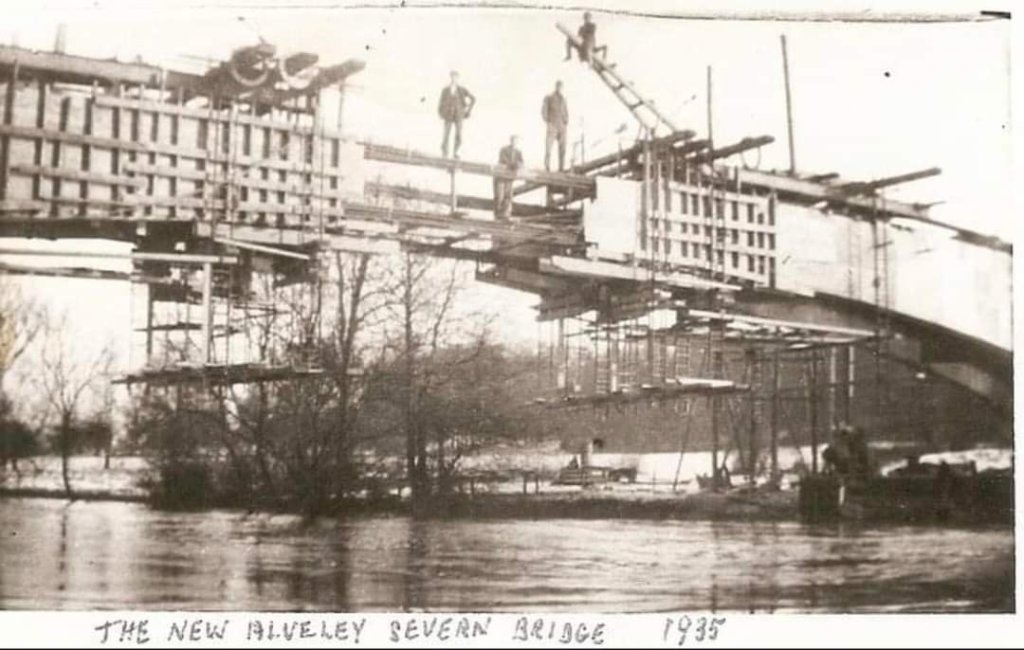
The shaft at Alveley was sunk in 1935 to a depth of 360 yards by the Highley Mining Company. It was connected to their Highley shaft by underground workings which passed under the River Severn. Production started at the colliery in 1938. The shaft at Highley was then closed in 1939, only being retained for ventilation and as an emergency evacuation route. Alveley’s workings were very modern, with full use being made of electrical power and mechanical working at the coal face.

Coal was brought across the Severn by a rope-worked tramway across a bridge built to serve the mine, which was later replaced with an aerial ropeway in 1961. The colliery was connected to washeries, screens and sidings adjacent to the Severn Valley Railway by an endless cable-worked narrow gauge tramway which crossed the river on a concrete bridge bringing coal to the screens. The tramway was replaced later by an aerial ropeway. The sidings eventually became the location of Country Park Halt on the Severn Valley railway.

Colliery production reached “full output in 1944 with 275,000 tons raised, with that year’s record being 5,547 tons in one week, and a peak of 300,000 tons per year reached in the late 1950s. The colliery became part of the National Coal Bard (NCB) on nationalisation in 1947; at that time employment was 741, rising to over 1,250 in the mid-1950s, and falling to around 700 by the mine’s closure. A major expansion was undertaken in the late 1950s and early 1960s, completed in 1962, after large reserves of coal were found to the East of the current workings. These were purported to be enough to last the mine between 50 and 100 years, but a drop in the quality of coal combined with a reduction in demand due to a national over supply forced the closure of the mine in 1969, with the last coal being lifted on 31 January.” [8]

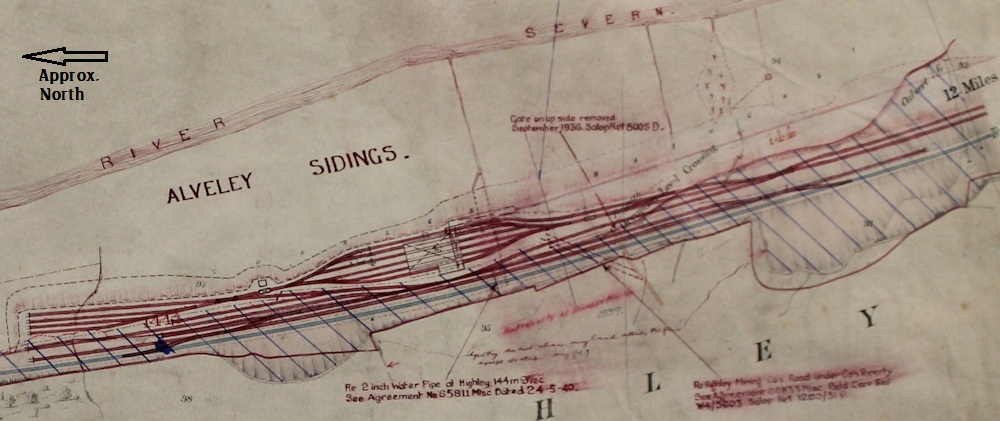
GWR Plan of Alveley Sidings. The GWR Severn Valley Line is shown in blue, with the sidings shown in red. The image is included here under a Creative Commons Licence, Attribution-ShareAlike 3.0 Unported (CC BY-SA 3.0). [8]
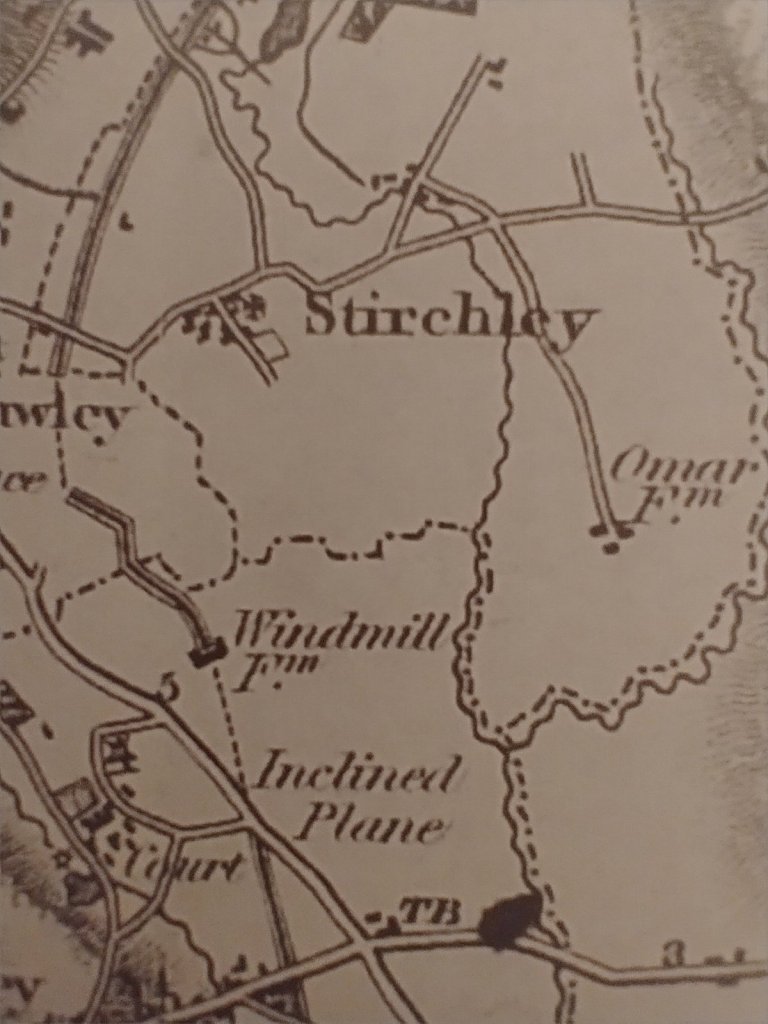
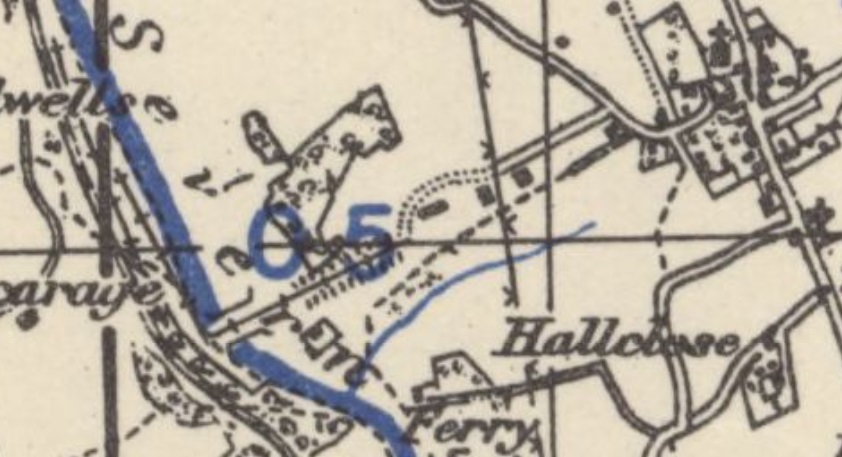
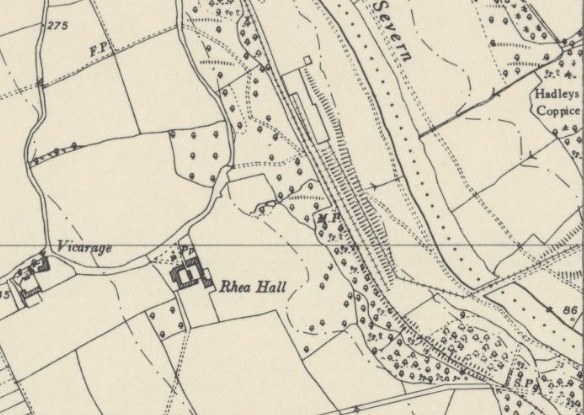
The 1943 revision of the Ordnance Survey of 1916, shows inclined plane crossing the River Severn. Alveley Village is to the right side of the map extract. The mine’s sidings can be picked out on the left of the image, to the West of the River Severn. Mine building appear not to have been recorded in any detail. [11]
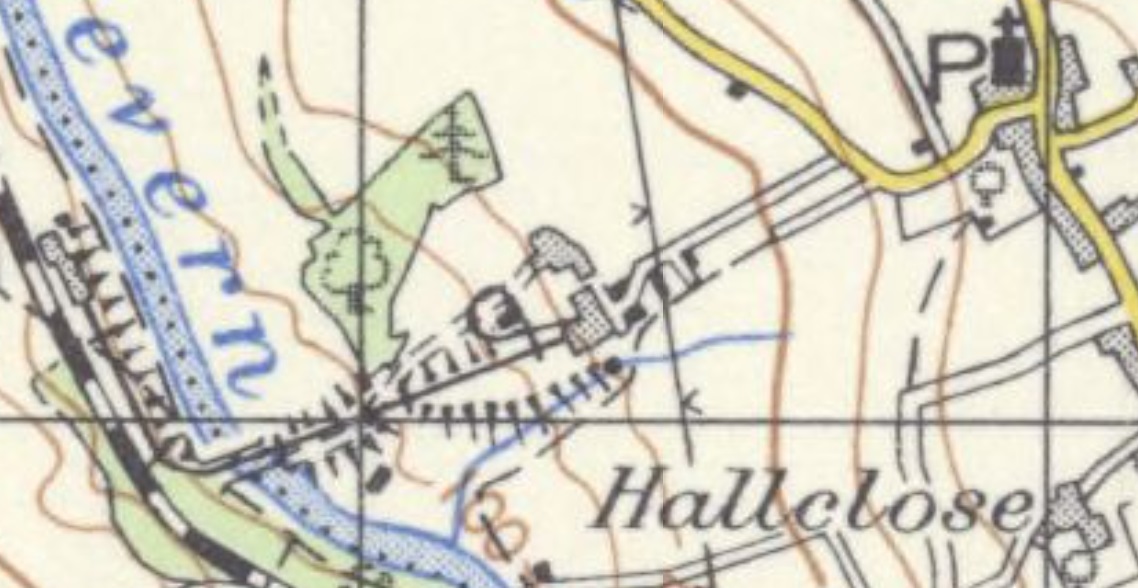
The same area as it appears on the 1″ Ordnance Survey of 1963. The screens/washing plant can be seen adjacent to the Severn Valley Railway on the left of the map extract. The pithead and associated buildings are at the centre of the image. The aerial ropeway is shown operating between the two locations. [12]

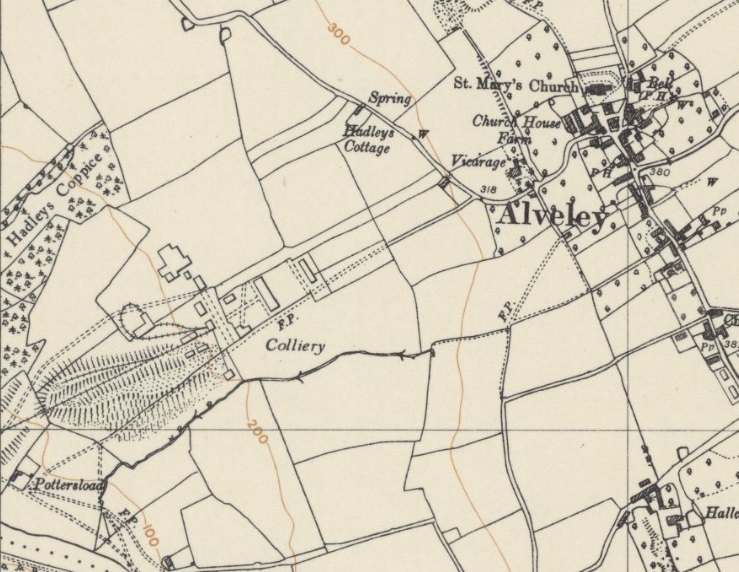
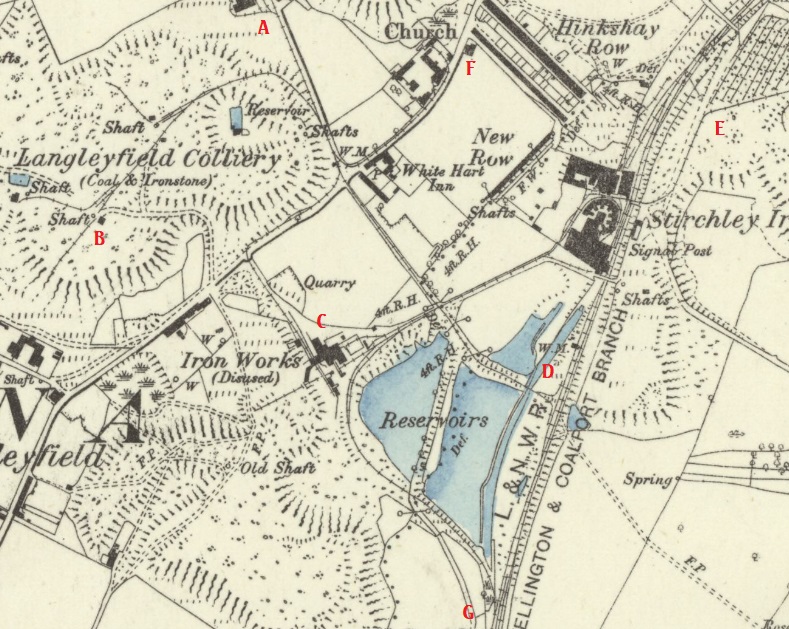
A closer focus is provided on the National Grid Maps, two extracts follow, as the location runs across map boundaries. The Inclined Plane was not replaced by an aerial ropeway until 1960. [15: p16-18]

This extract is taken from Ordnance Survey SO78SE – A, Surveyed/Revised: Pre-1930 to 1954, Published: 1954. It shows the colliery site in more detail and highlights a loop of lines serving the colliery site as well as the inclined plane running down towards the River Severn. [13]
This extract is taken from Ordnance Survey SO78SW – A, Surveyed/Revised: Pre-1930 to 1954, Published: 1954. It shows the site of the screens and sidings for Alveley Colliery in more detail. [14]

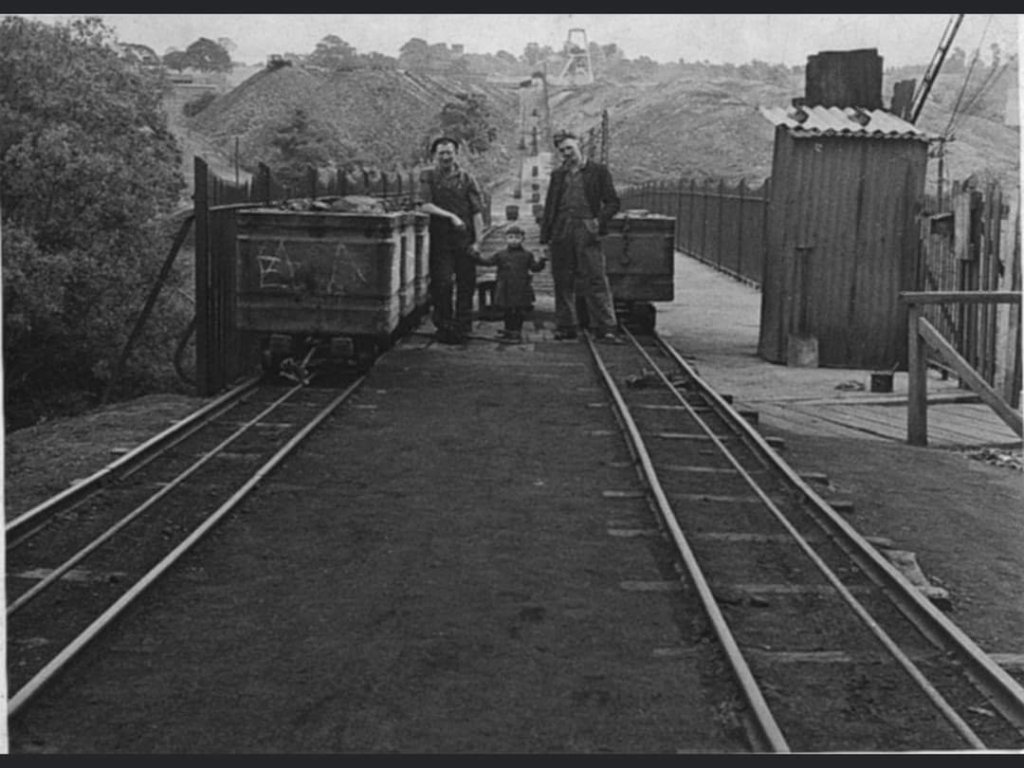
George & David Poyner tell us that the “surface haulage used a 7/8th inch rope. The length of the track was 1100 yards so the endless rope was 2200 yards long. The railway was 21″ gauge with wooden sleepers 3′ apart; 9″ rollers fixed in wooden boxes supported the rope. There were eight tubs to each journey: the tubs were made of wood and later of iron and held 10 cwt of coal. The rope took the tubs to the Barker Screens.” [15: p16]

At the pit head, tubs were clipped to the haul-rope in gangs of eight. The first and last tubs, being attached to the rope and the wagons were coupled together. There was an haulage engine at the top of the incline. Initially a skilled operative manned the engine, but later it was worked by signals. when the wagons reached the creeper at the screens, the tubs were unclipped and “they were sent up the creeper into the tippler on the screens and then returned down the retarder. The chalk numbers were removed and the tubs were clipped back onto the haulage rope to go back to the colliery.” [15: p17]

The empties were sent back up the incline to the pit head where they were “unclipped off the rope and sent up creepers to the top and bottom decks of the cage. The supplies were also brought by rail so there were six men loading the tubs with pit props and unloading railway wagons. The rails needed quite a lot of maintenance, during hot weather they would expand and buckle, requiring the joints to be loosened.” [15: p17]

As the Incline became too old for continued use, a case was made for the replacement of the incline with an aerial ropeway. This was considered in 1958 by the colliery reconstruction committee. Apparently, the rope worked incline “required 54 men from the pit to the washery. It was estimated that an aerial ropeway would require 15 mean and would cost £160,568. … Figures are not available to show how much money was actually saved by the aerial ropeway. However, at least in its early days it was plagued by breakdowns.” [15: p18]

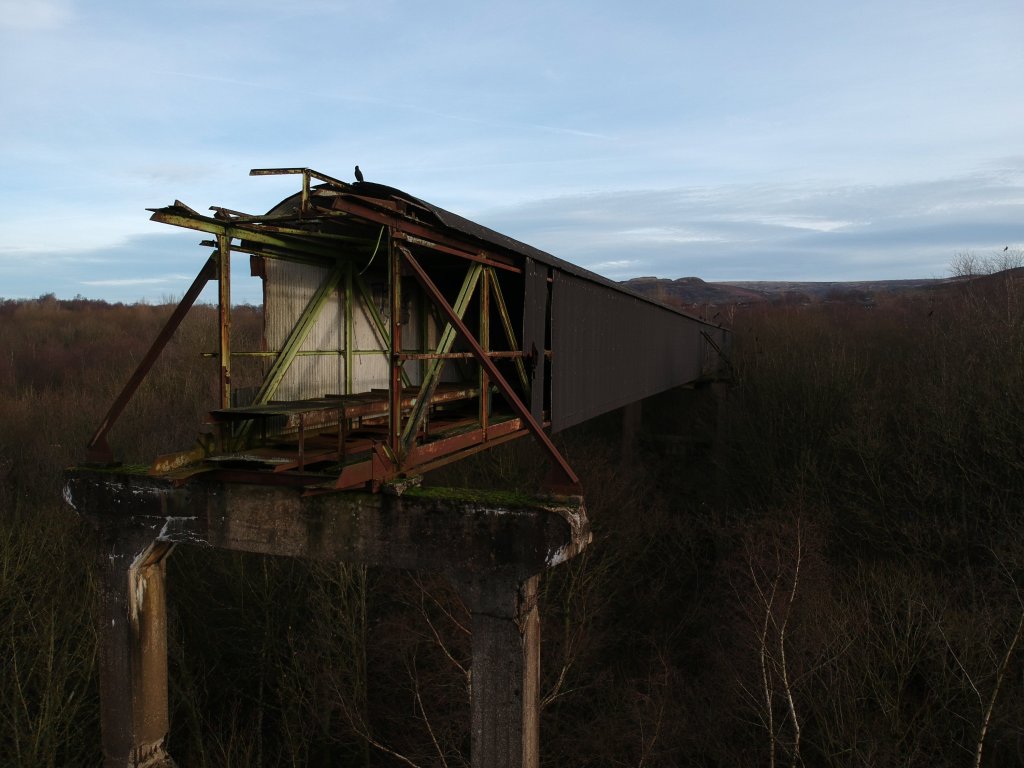
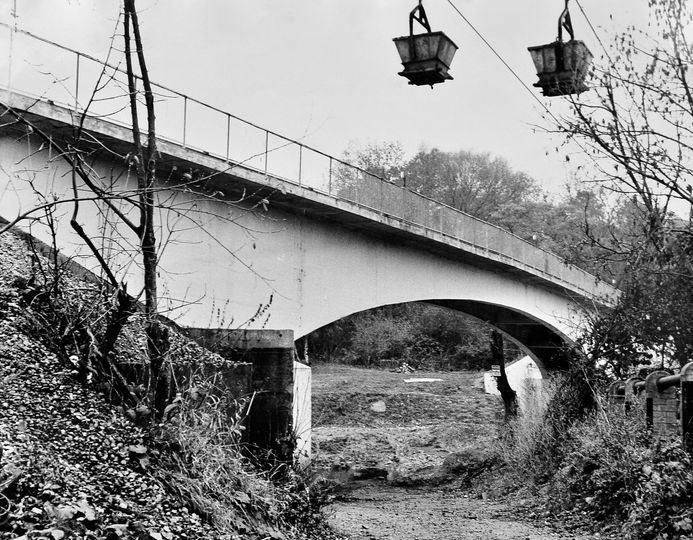
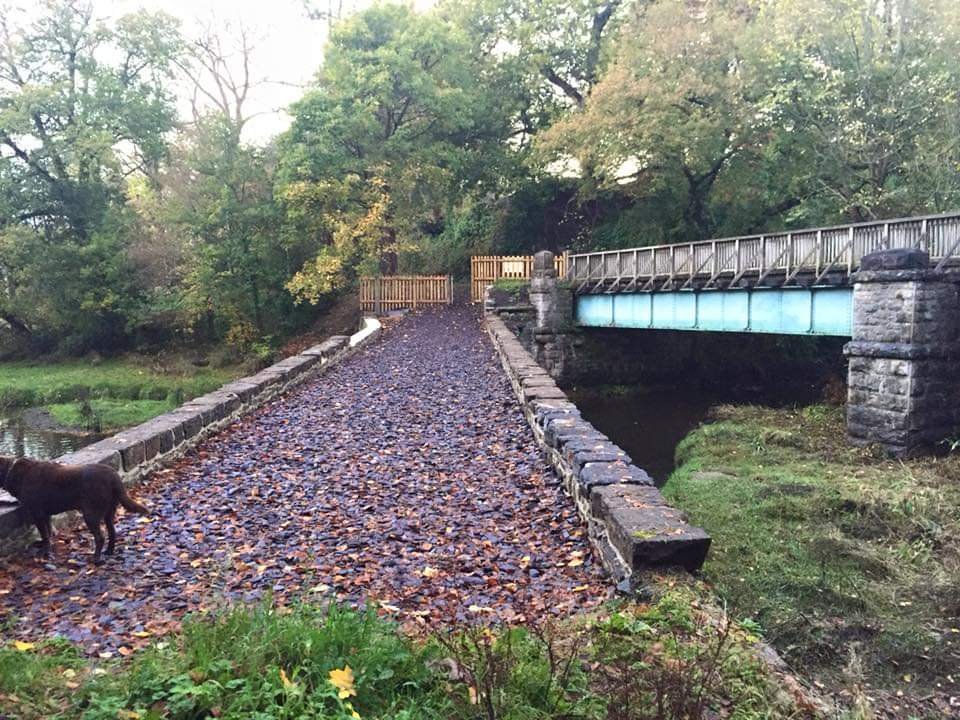
The bridge was constructed to carry the tramroad and it’s incline which linked the pit head at the Colliery to the screens and railway sidings on the West Bank of the River Severn. This photograph was shared by Margaret Sheridan on the Alveley History Bridgenorth Shropshire Facebook Group on 21st January 2023. [16]
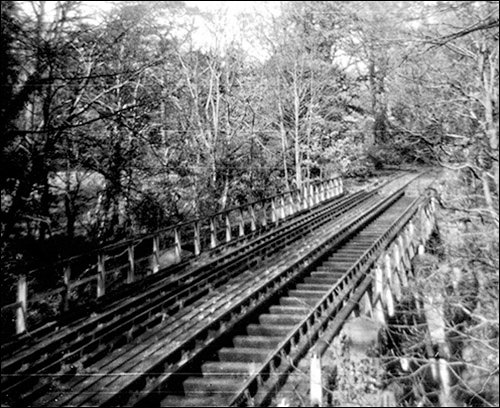
A view from the West Bank of the River Severn looking East towards the colliery. The bottom of the old Incline Plane is ahead. The line was rope-worked throughout from pit head to screens. This photograph was shared by Margaret Sheridan on the Alveley History Bridgenorth Shropshire Facebook Group on 21st January 2023. [16]
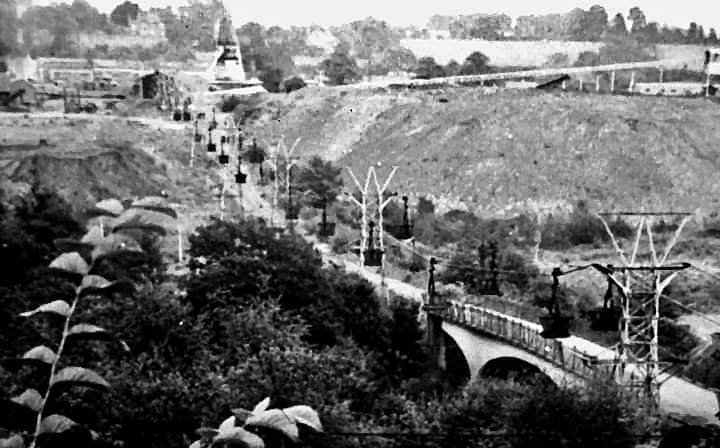
A view from the West Bank of the River Severn, possibly from the colliery screens, which shows the 1935 bridge and the aerial ropeway which was installed in 1960. The pit head and winding gear is visible towards the rear of the photo. This image was shared by Bill Scriven in a comment on the Alveley History Bridgenorth Shropshire Facebook Group on 21st January 2023. [16]
The Seven Valley Railway, Alveley Colliery screens and sidings on the West side of the Severn. This photograph was shared by Margaret Sheridan on the Alveley History Bridgenorth Shropshire Facebook Group on 21st January 2023. [16]
The Alveley Colliery bridge across the River Severn with the aerial ropeway in use above. This picture was shared by the Shropshire Star on their Facebook Page on 28th November 2022. [38]

Further photographs can be found on the Alveley Historical Society web page:

http://www.alveleyhistoricalsociety.org/mining.html [10]

Highley Station

The Station at Highley was just a short distance to the South of the Alveley Colliery sidings.

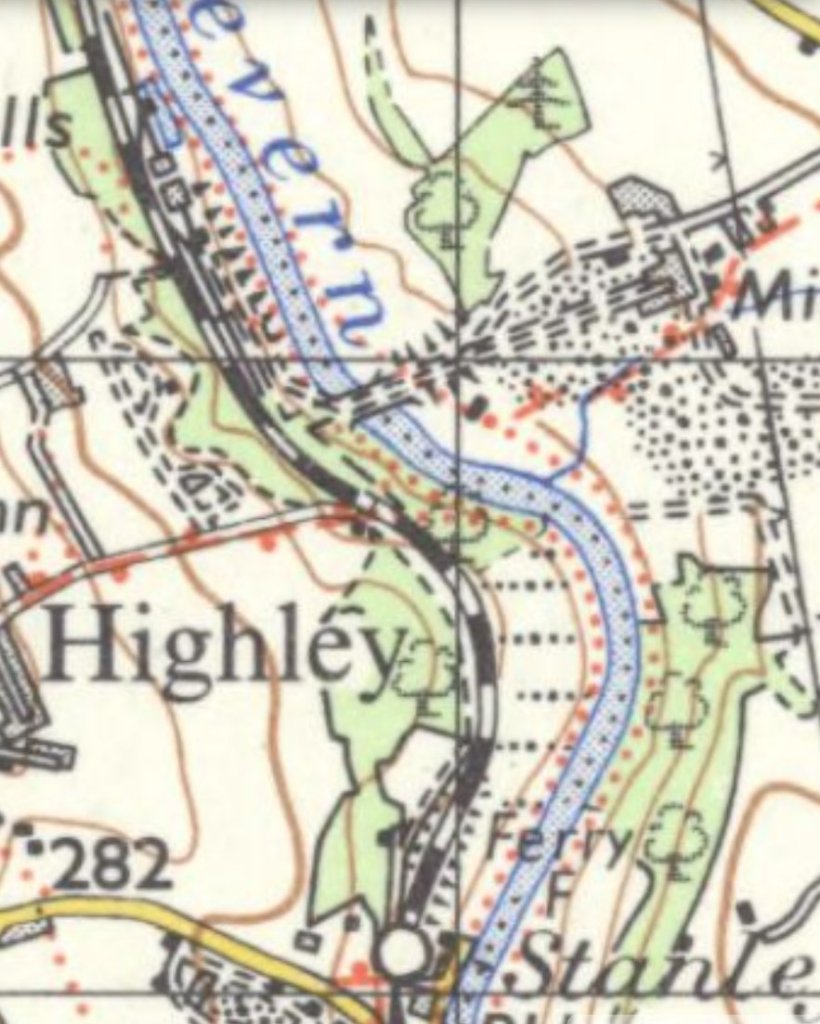
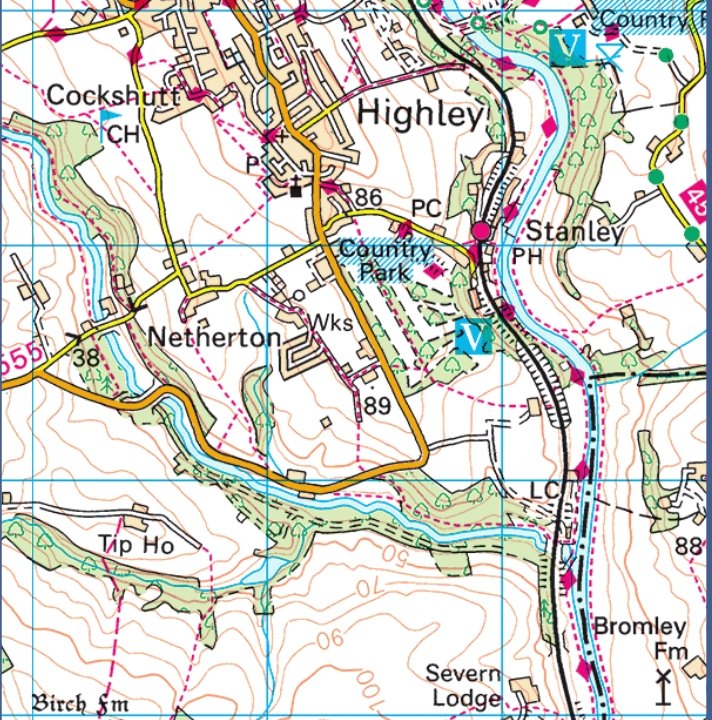
On this extract from the 1″ Ordnance Survey of 1967 (Sheet 130: Kidderminster – B Edition
Publication date:  Revised: 1949 to 1967, Published: 1967), the mine at Alveley, the 1935 bridge over the Severn, the sidings and screens on the West side of the river are clearly shown well within a mile to the North of Highley Station. [17]

The Station was built and opened at the same time as the Severn Valley line. It “opened to the public on 1 February 1862 and closed on 9 September 1963, before the Beeching axe closures.” [18]

The Station was important as “the transport hub of a colliery district, with four nearby coal mines linked to the Severn Valley line by standard and narrow gauge lines, cable inclines and aerial ropeways . There were extensive sidings along the line, and wagon repair works at Kinlet, half-a-mile south.” [18]

The station was too far from the village of Highley to be convenient. The advent of reliable bus services and better roads soon resulted in passenger use dwindling. However, the signal box at the station remained in use until the closure of Alveley Colliery in 1969. The site of the Station remained disused until it was rejuvenated by the preservation movement.

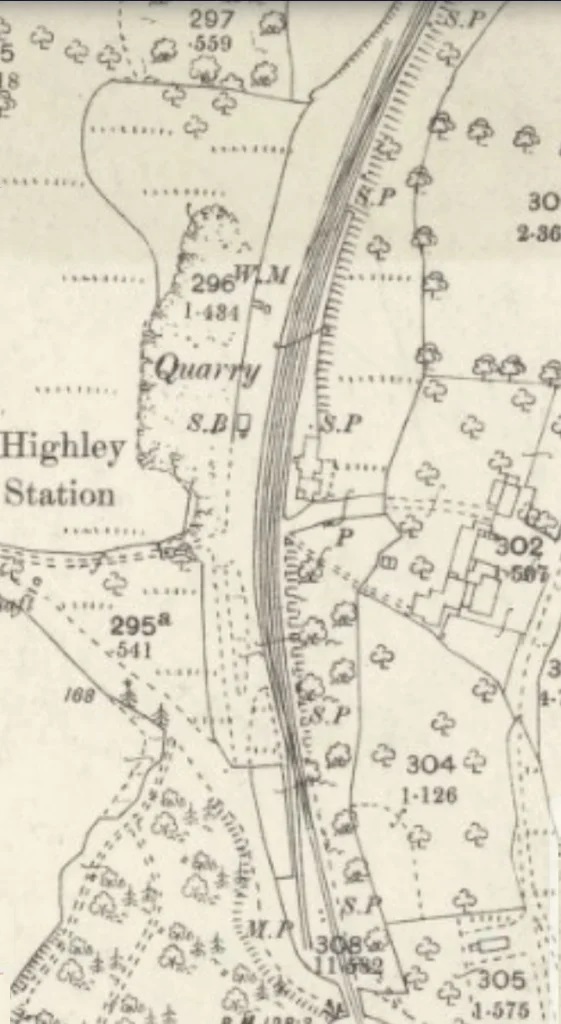
The map extracts below show the Station in 1882 and then at around the turn of the 20th century.

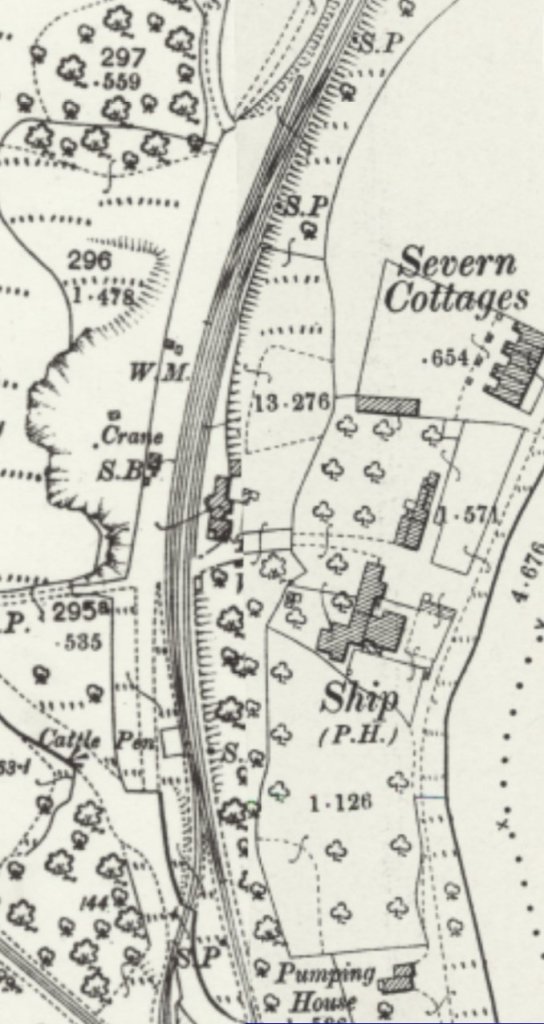
Henley Station on the 25″ Ordnance Survey of 1882 published in 1884. The junction for the Colliery exchange sidings has been installed. [4]
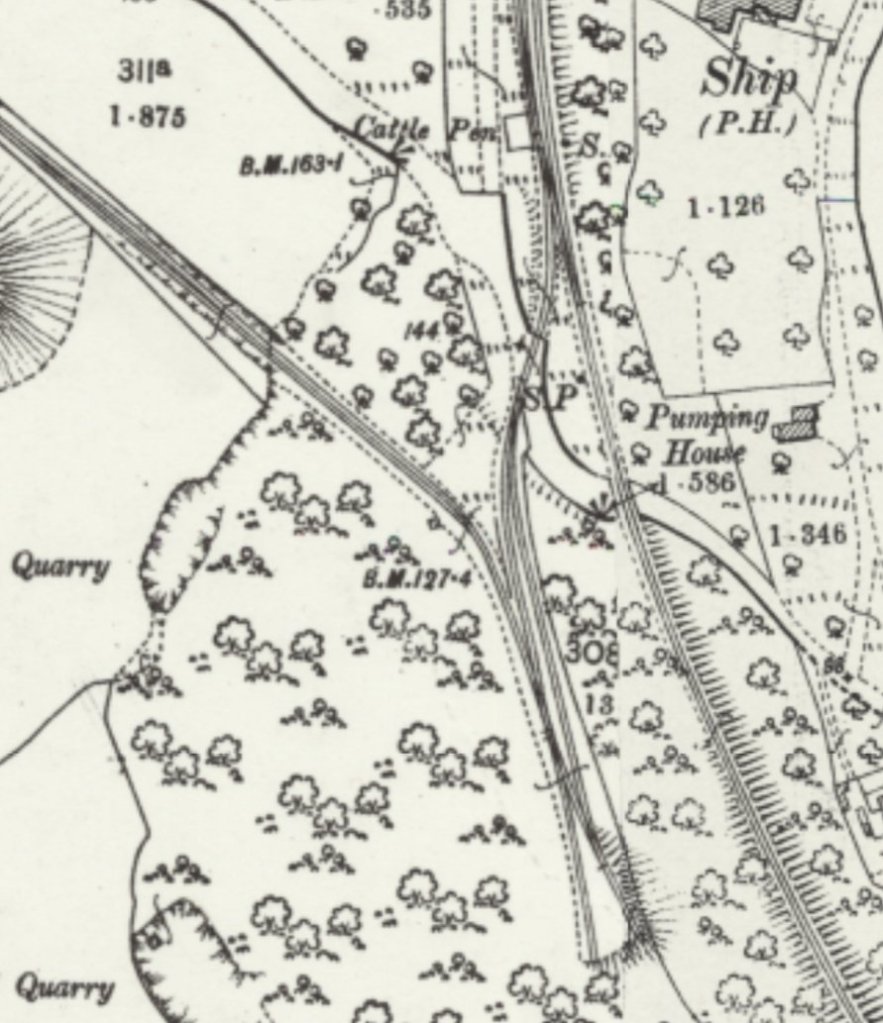
Highley Station on the 25″ Ordnance Survey from the turn of 20th century. The junction for the colliery sidings appears to the South of the station, just beyond the Cattle Pen. [5]
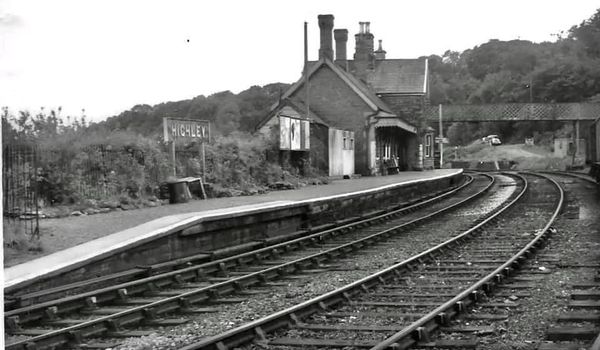
Looking South through Highley Station in the years prior to preservation. Shared on the Closed Railways Facebook Group on 10th July 2021 by Chris Chiverton. [36]
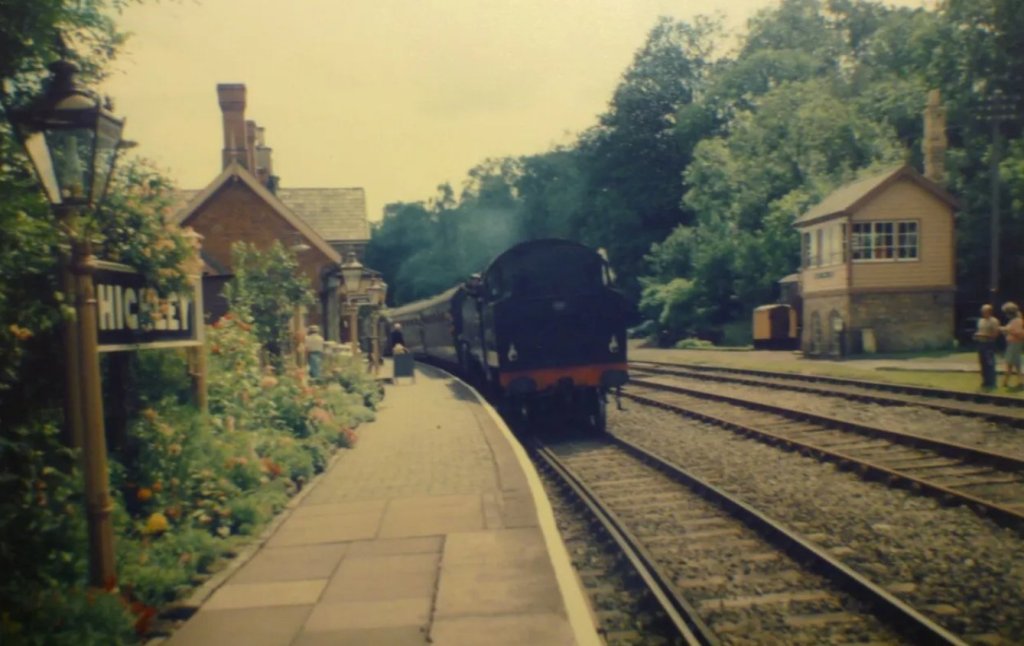
Highley Railway Station & Signal Box: photo taken in association with the BBC Drama ‘The Signalman’ in the mid-1970s after the opening of the SVR heritage line. The photograph is taken looking to the South. [53]
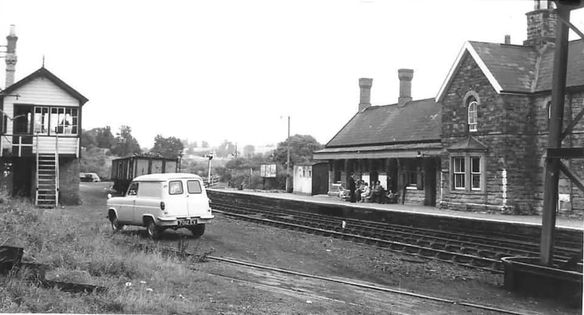
Looking North through Highley Station in the years prior to preservation. Shared on the Closed Railways Facebook Group on 10th July 2021 by Chris Chiverton. [35]
Highley Railway Station buildings viewed from the Southwest across and engineers train. [Google Streetview]
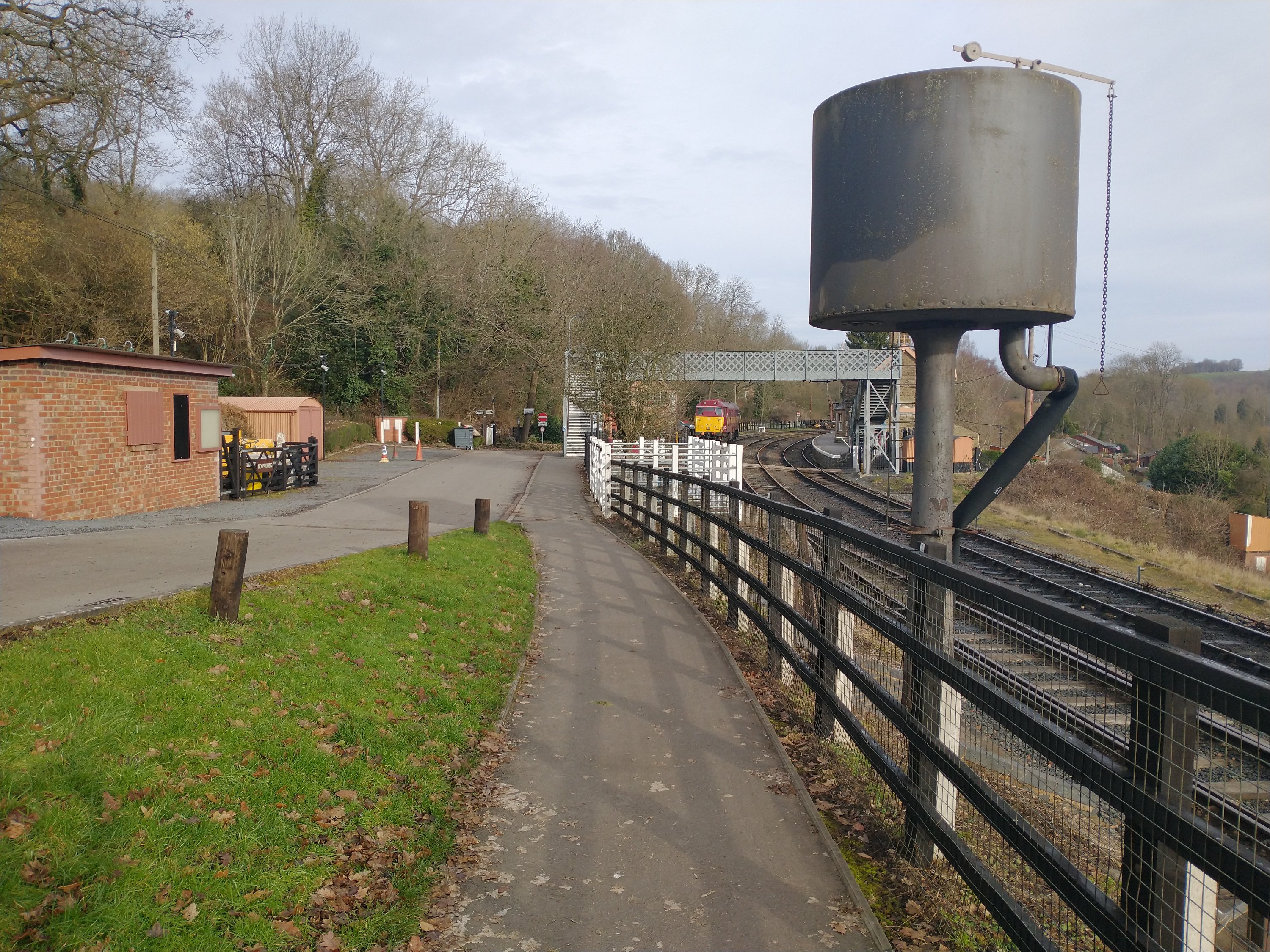
Highley Railway Station, photographed from the South end of the station adjacent to the water tower with a Class 31 diesel locomotive standing in the Station. [My photograph, 10th February 2023]
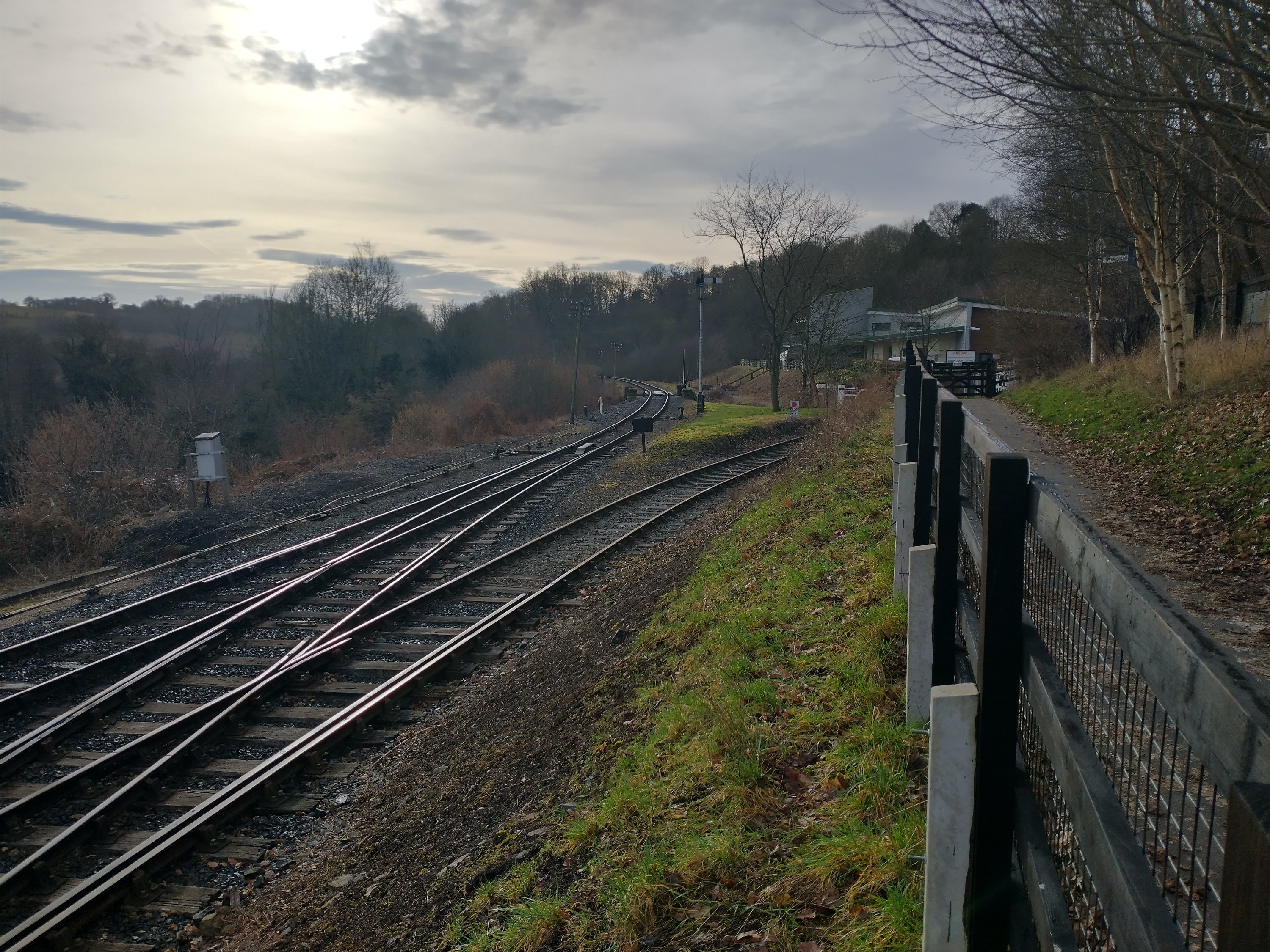
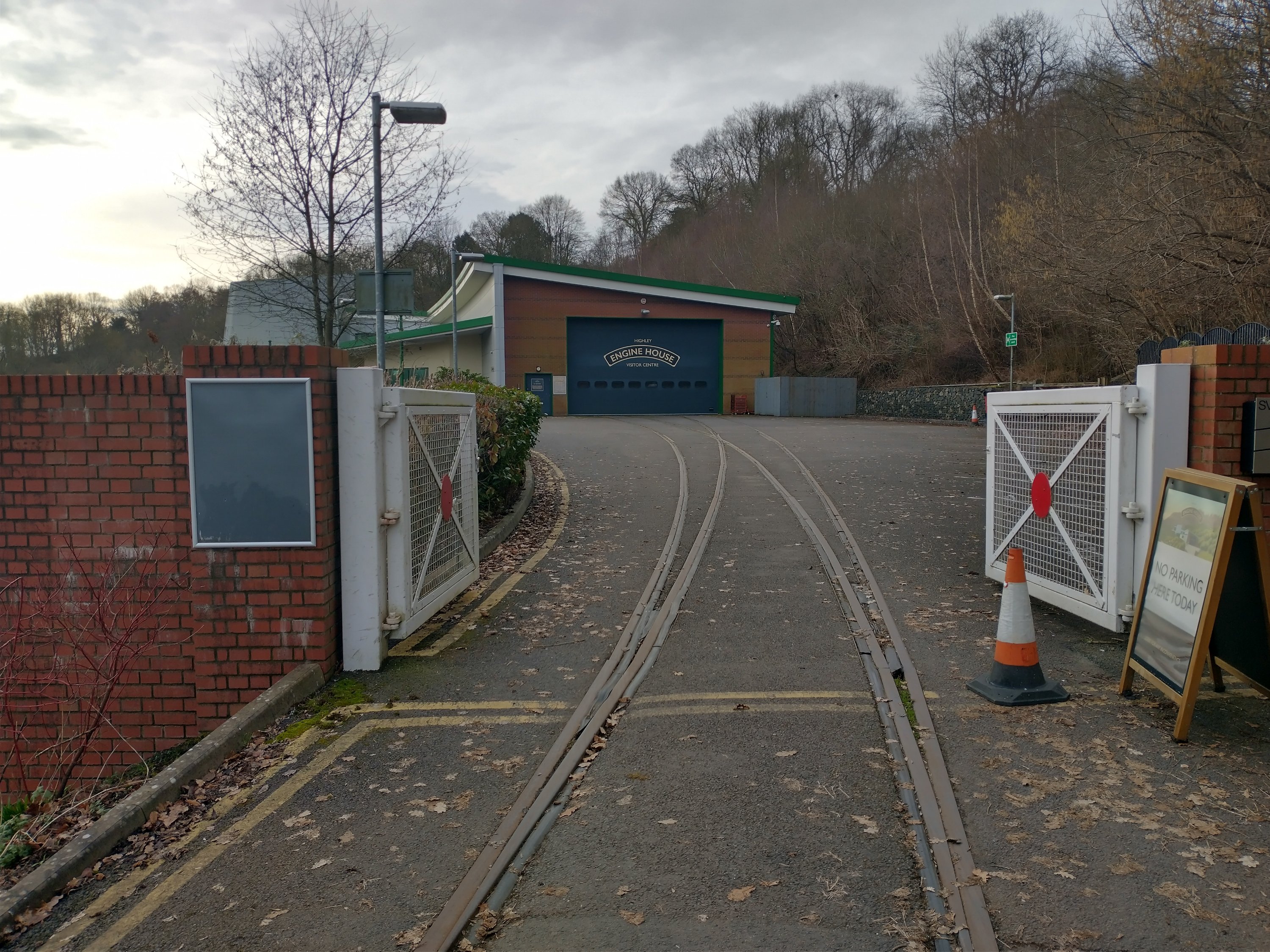
The view South from the same point as the picture above. The modern Engine House which sits on the site of the old colliery sidings can be seen top-right. This illustrates the proximity of the old colliery sidings to the Station. [My photograph, 10th February 2023]
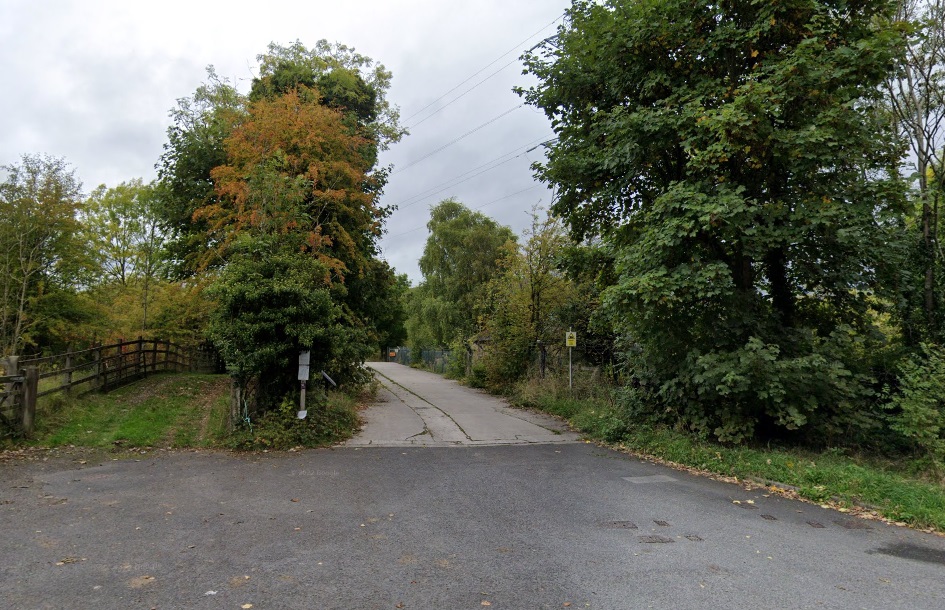
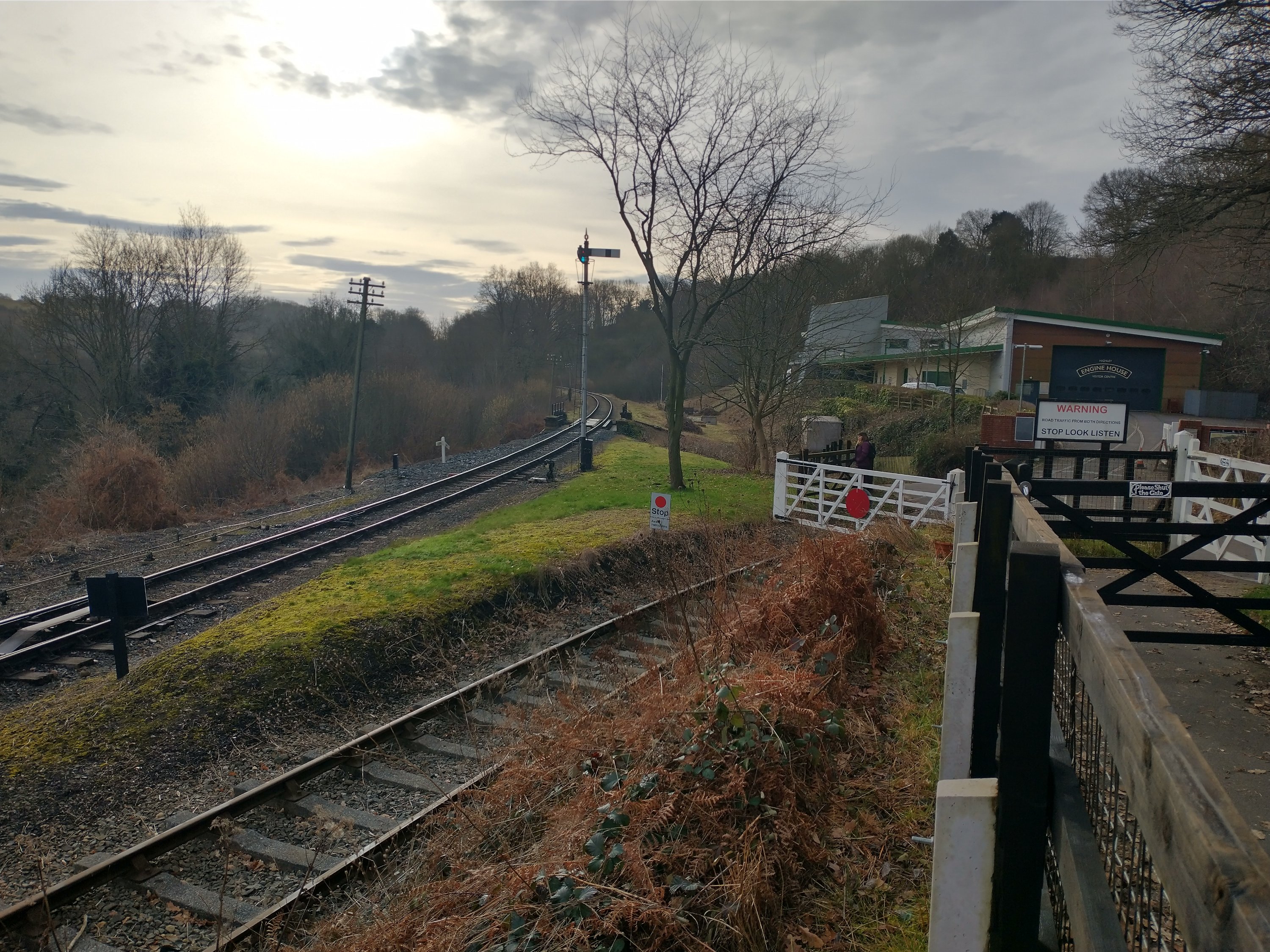
Just a few steps further South, we can see the gate to the road crossing at the entrance to the sidings. [My photograph, 10th February 2023]
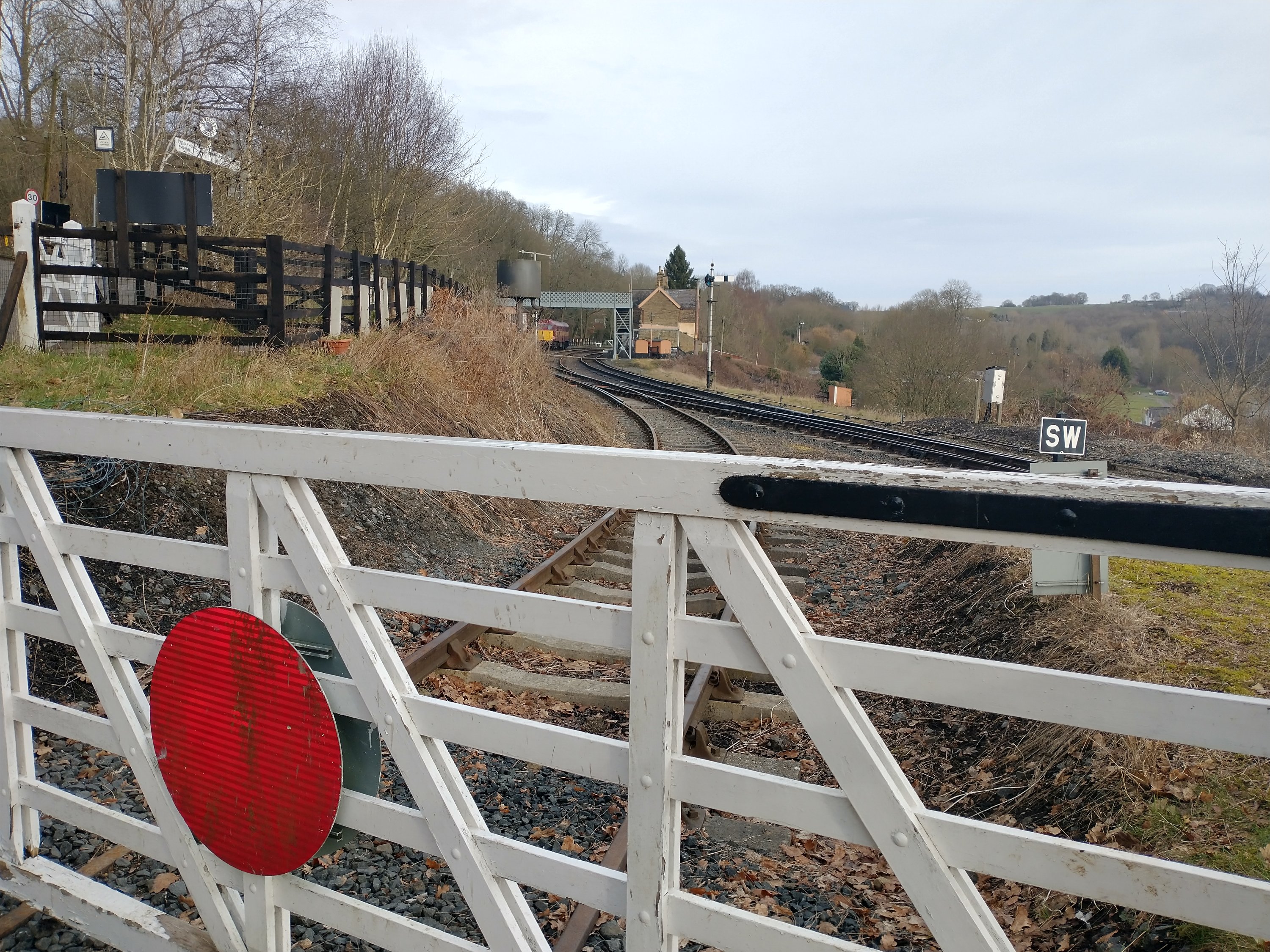
The view from the crossing gate North towards the station. The close proximity of the sidings to the railway station is once again emphasised. [My photograph, 10th February 2023]
The gated entrance to the modern Engine House on the site of the Highley Colliery Sidings. [My photograph, 10th February 2023]
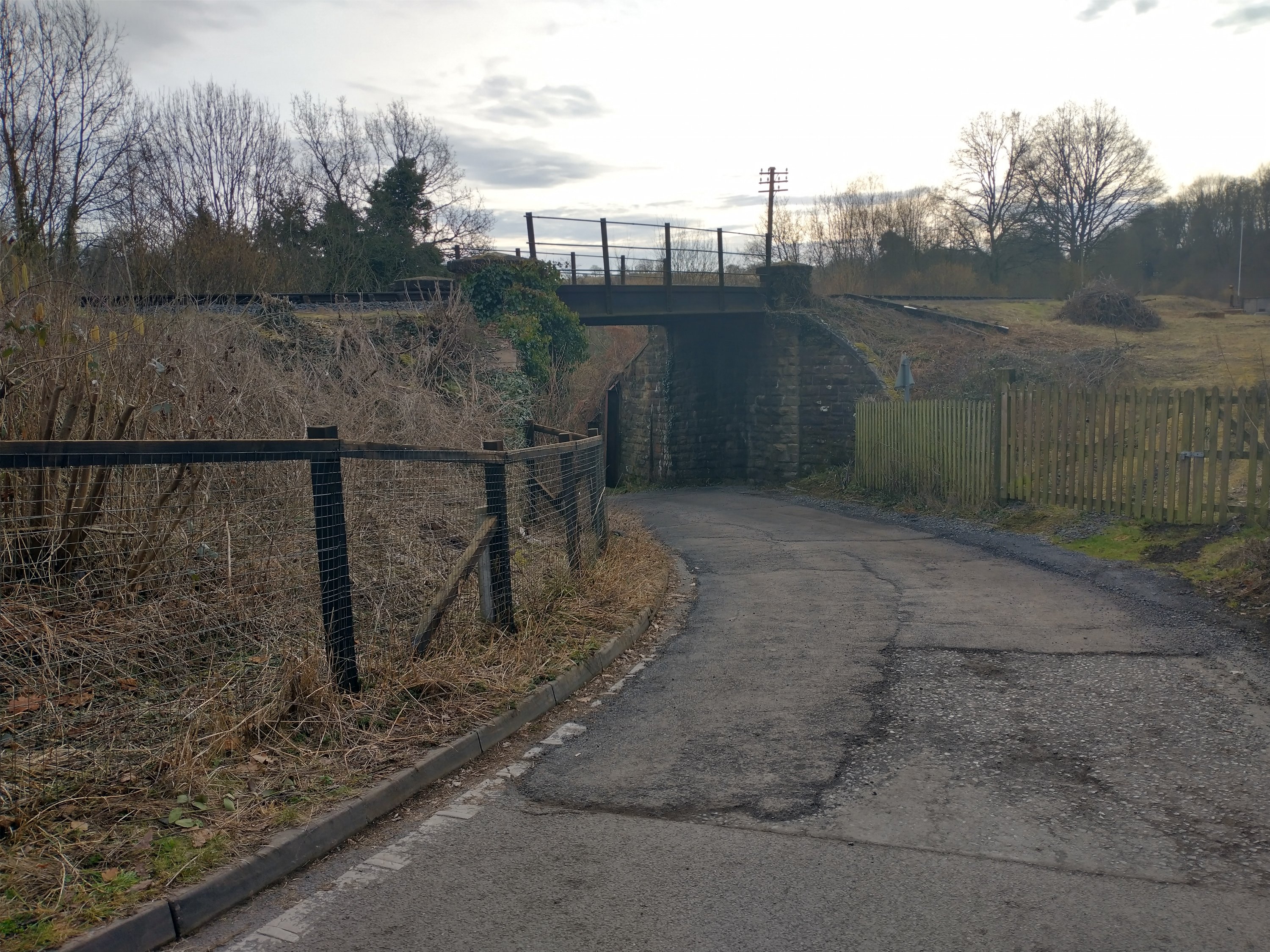
The lane crossed by the siding at the entrance to the yard is shown in this Southward facing image. The lane passes under the SVR with the line being carried by a steel girder bridge with stone abutments. Just under the bridge the lane provides access to the West bank of the River Severn. [My photograph, 10th February 2023]
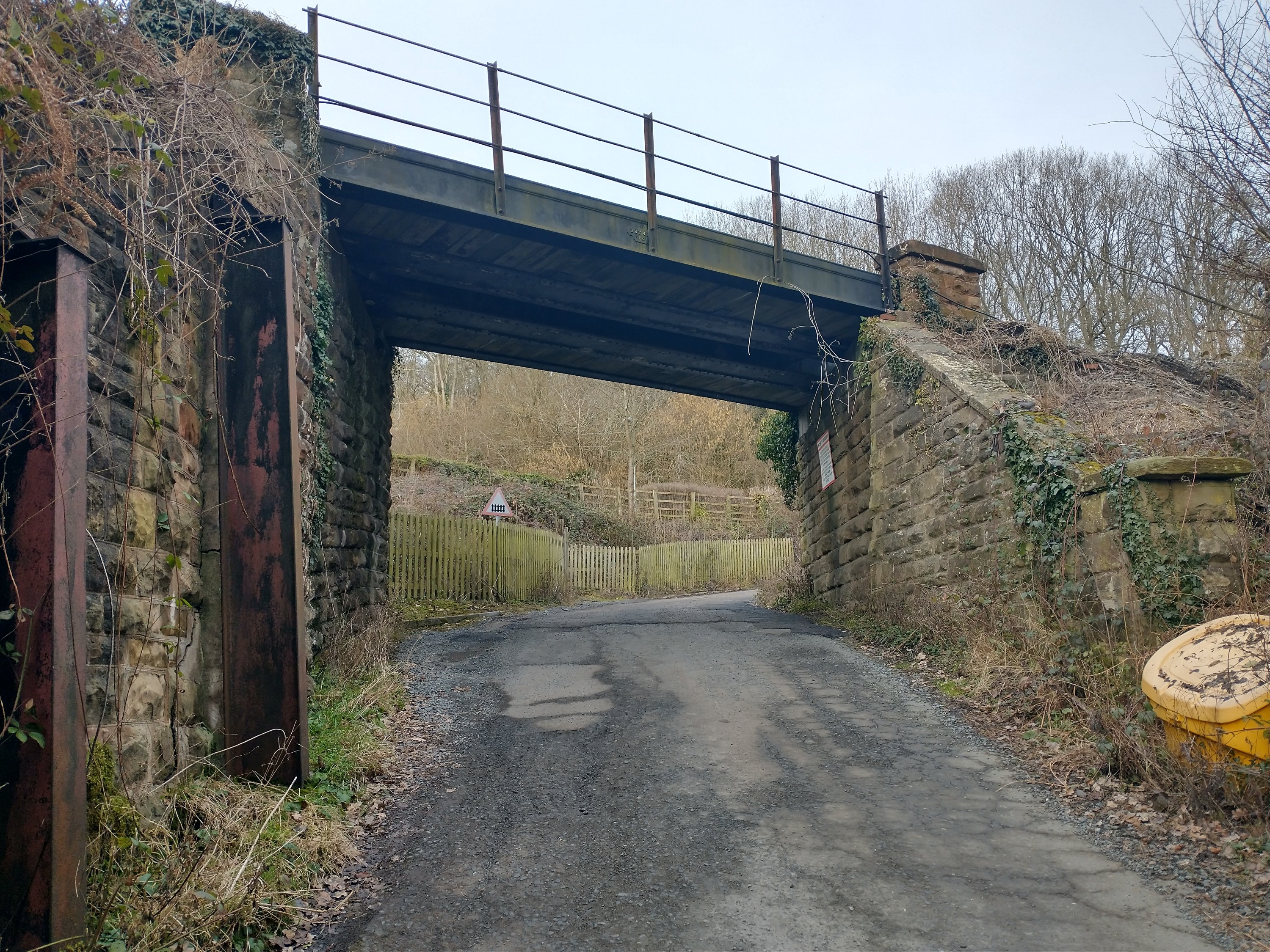
A view of the bridge from close to the West bank of the River Severn. [My photograph, 10th February 2023]

Highley Colliery and the Highley Mining Company

John Tennent tells us that in early days (1883), Highley Colliery was connected to the Severn Valley Railway (SVR) at Highley Station via a standard-gauge self-acting rope-worked incline with 3 rails splitting into four at the halfway-point to allow rakes of wagons to pass. A loco may have been used at the top of the incline. [1] There is no evidence of this incline at the station site on the 1883 Ordnance Survey. It may well be that the Incline referred to is that which is shown of the later Ordnance Survey from the turn of the 20th century. That incline just sneaks onto the bottom left of the map extract from the later survey above.

By 1892, the Hindley Mining Co. opened a site a short distance to the Southwest of Highley Station. This became Kinlet Colliery and its link to the SVR was completed by 1895. An agreement between the Company and the GWR dated 27/05/1895 which required the GWR to construct a junction and sidings at the expense of the Hindley Mining Company. John Tennent tells us that these sidings “became known as Kinlet Sidings and survived as a wagon repair yard long after the colliery railways had closed.” [1: p9]

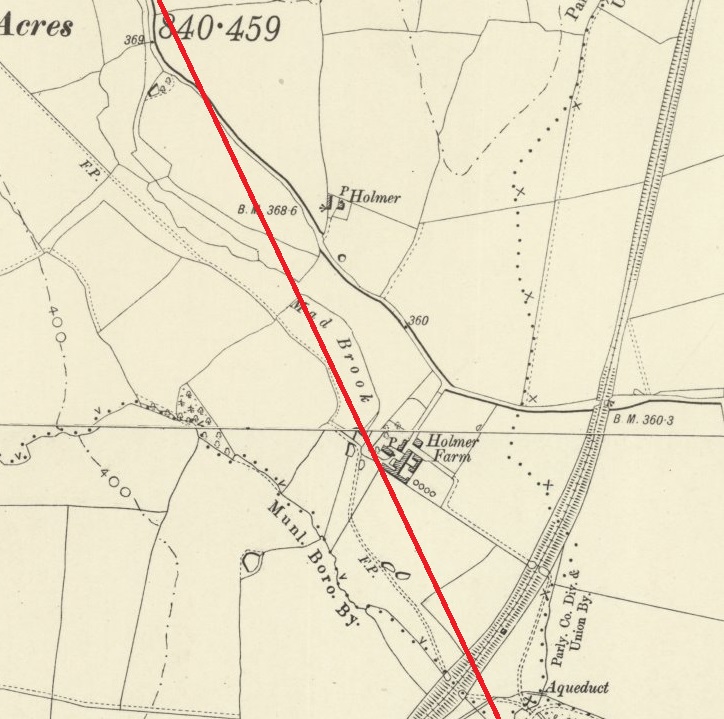
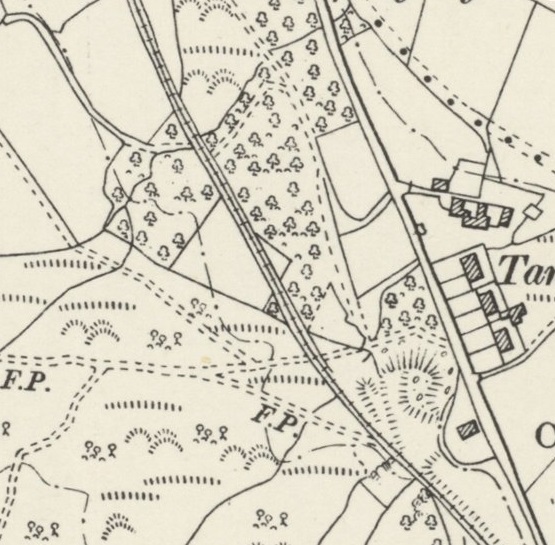
The exchange sidings for the Colliery as shown on the 25″ Ordnance Survey from the turn of 20th century.. [6]
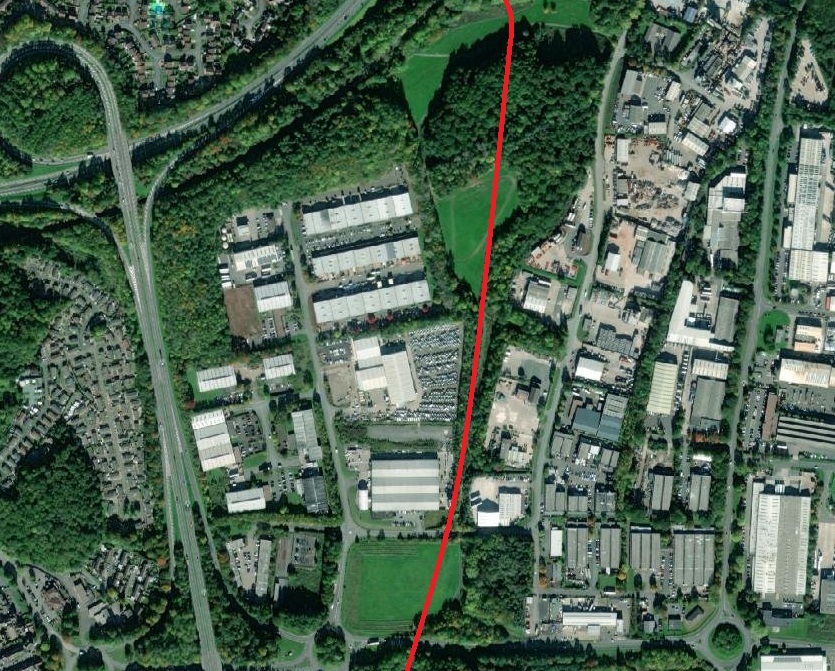
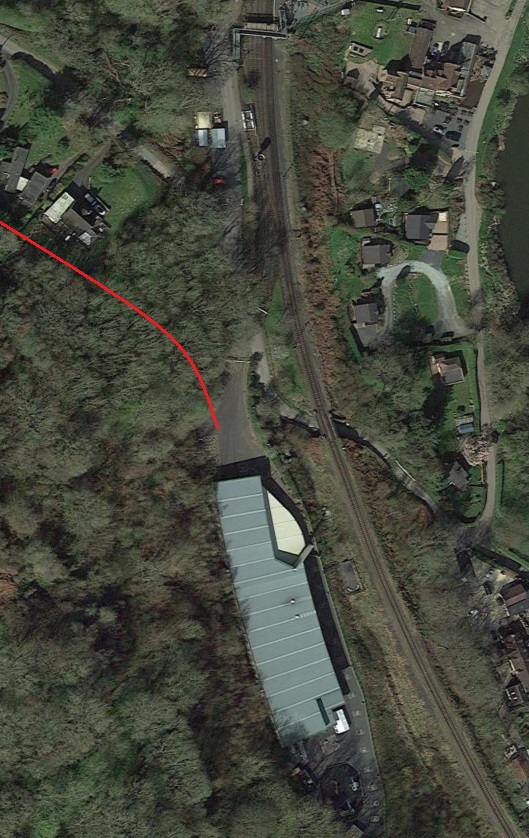
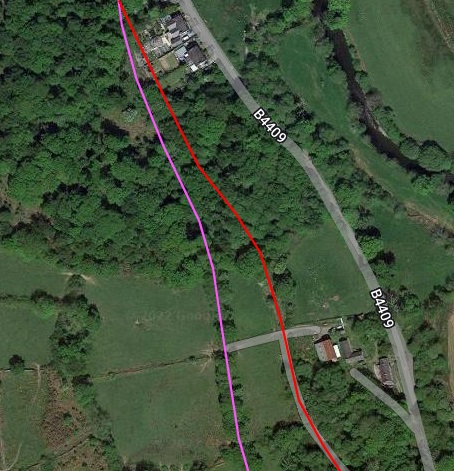
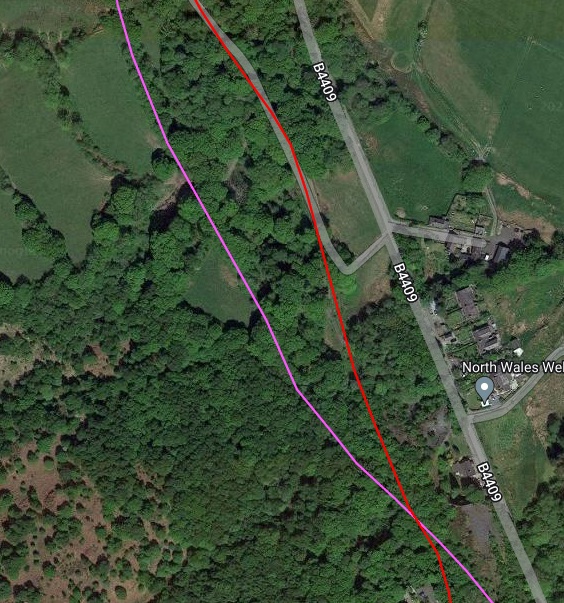
Approximately the same area on Google Earth in 2023. The approximate route of the incline from the sidings to Highley Colliery is marked by the red line. [Google Earth, 10th February 2023]
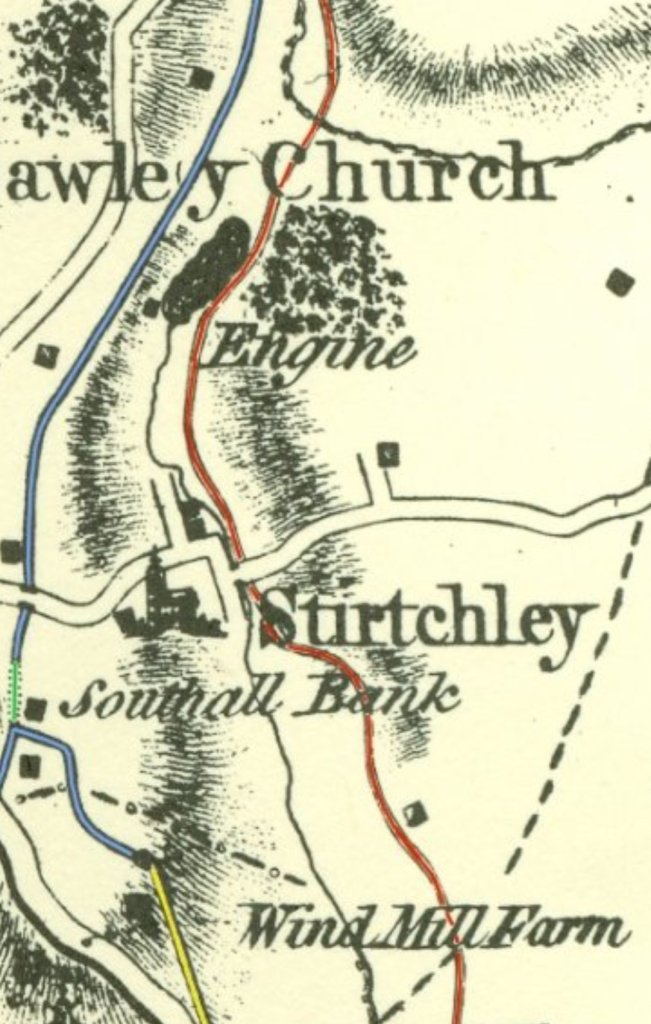
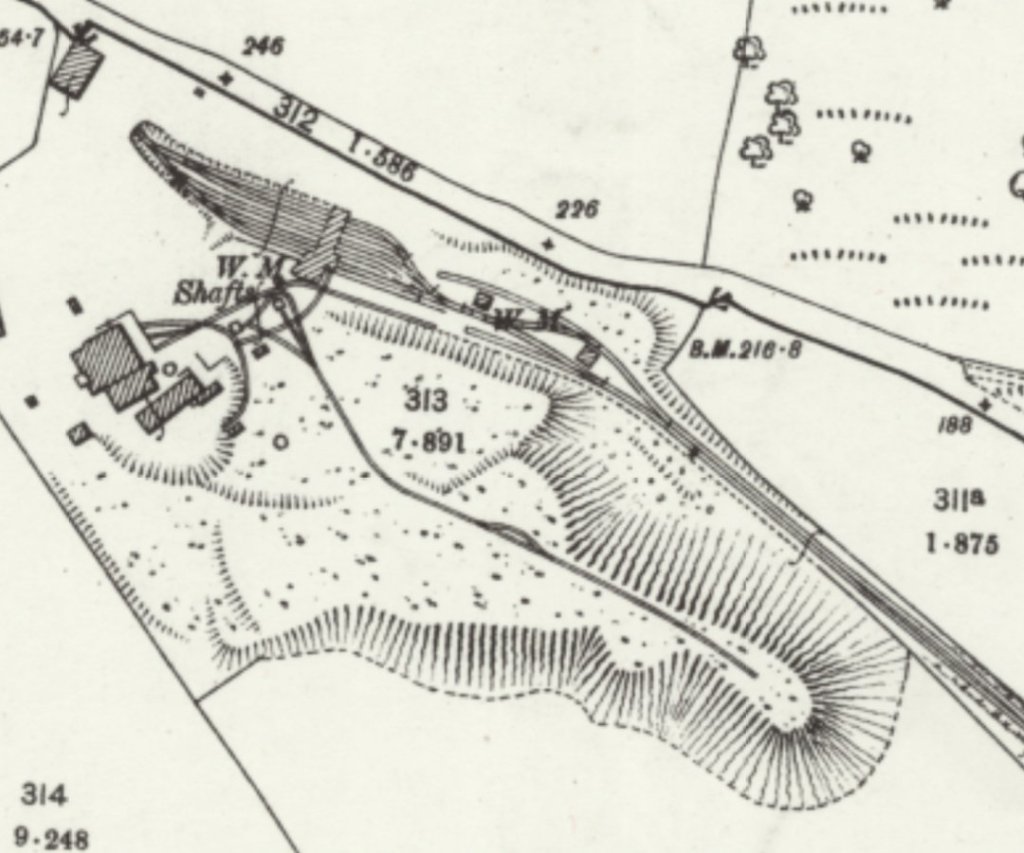
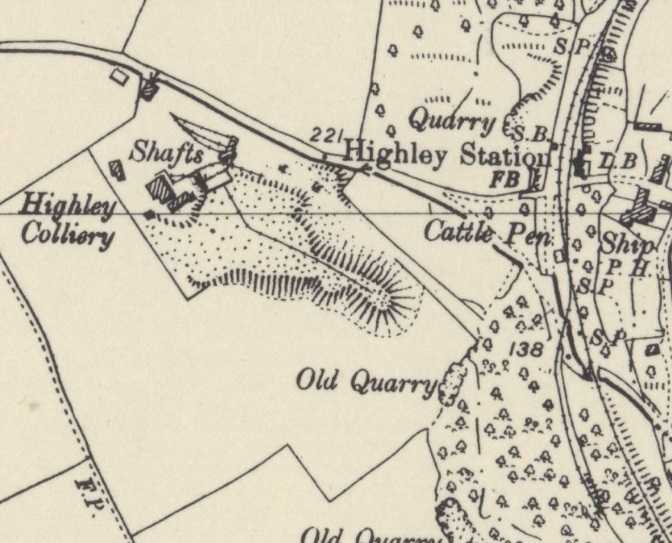
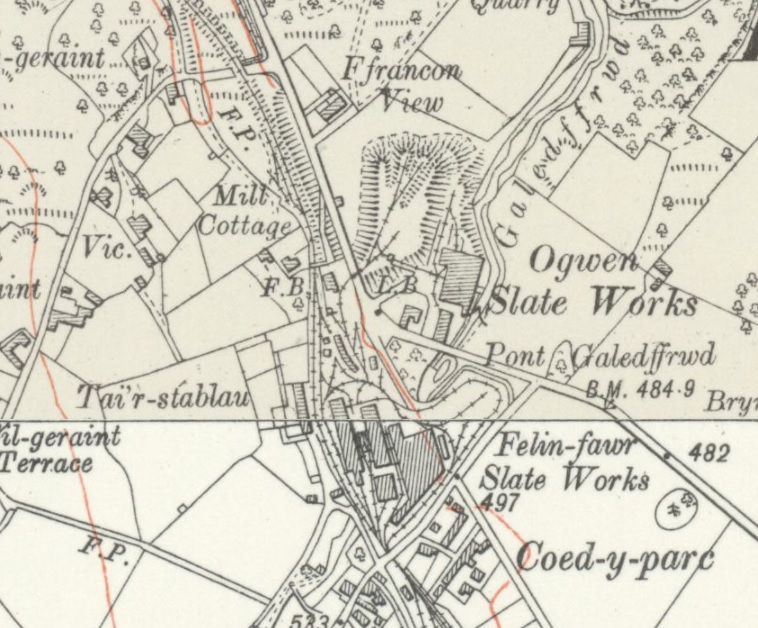
The Colliery as shown on the 25″ Ordnance Survey from the turn of 20th century. [7]
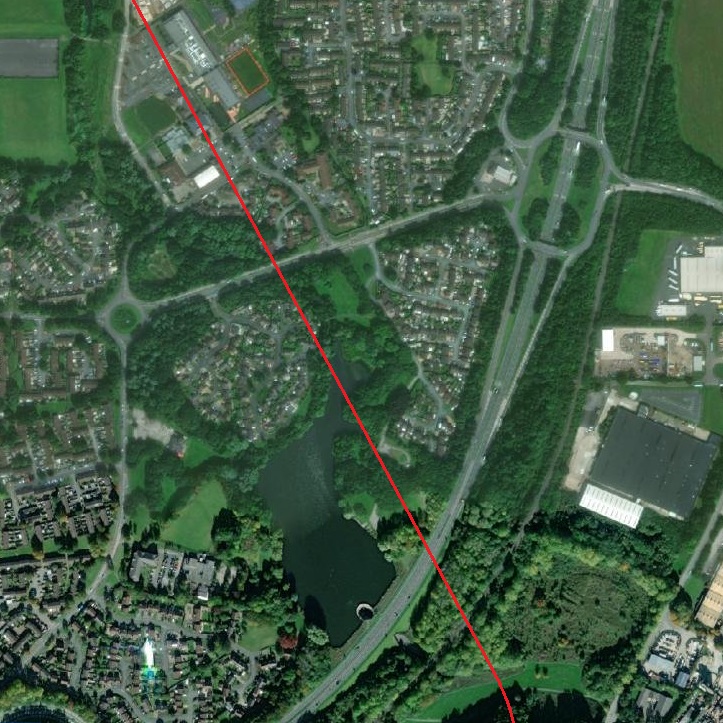
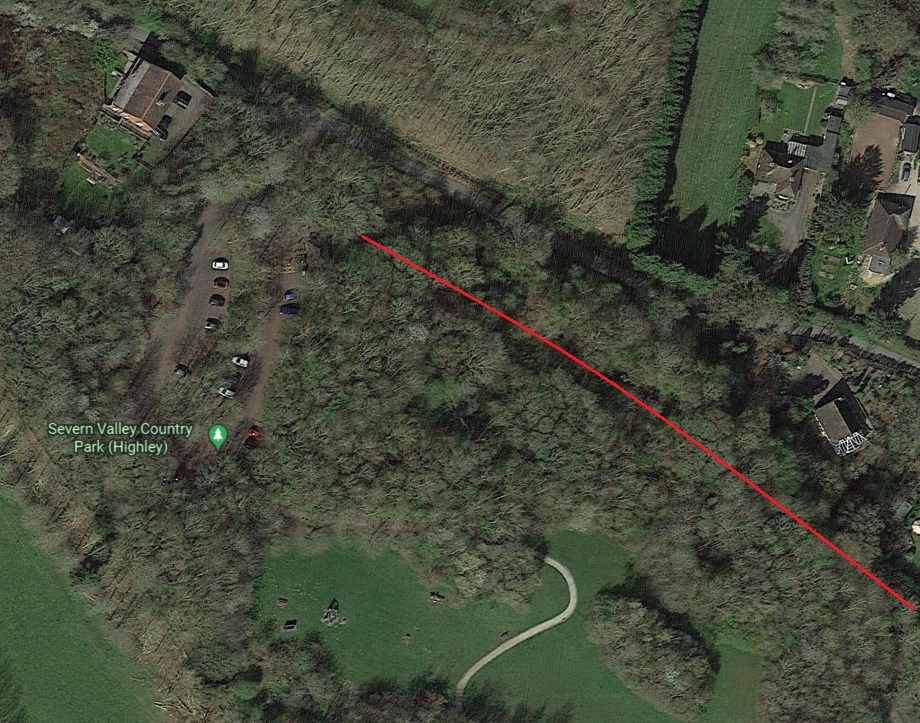
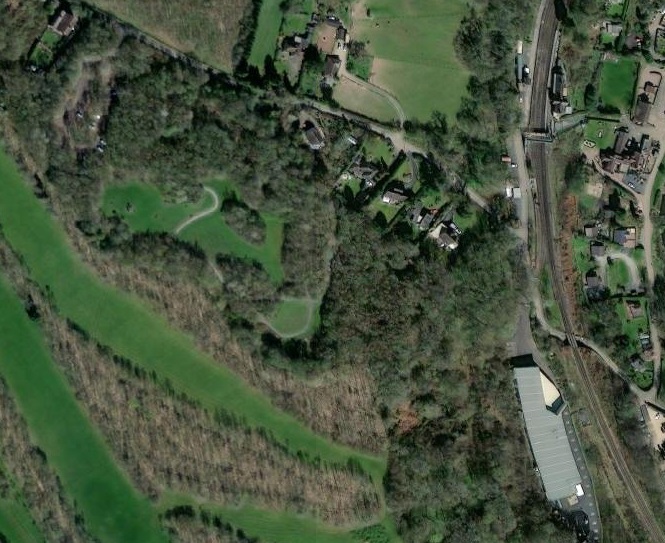
Approximately the same area on Google Earth in 2023. The approximate route of the incline from the sidings to Highley Colliery is marked by the red line. [Google Earth, 10th February 2023]
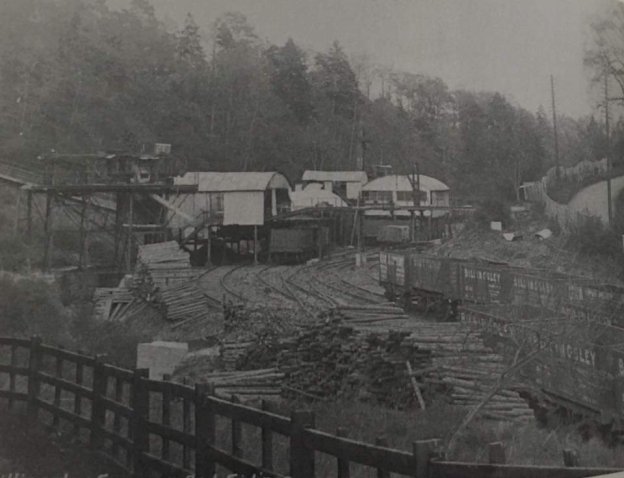
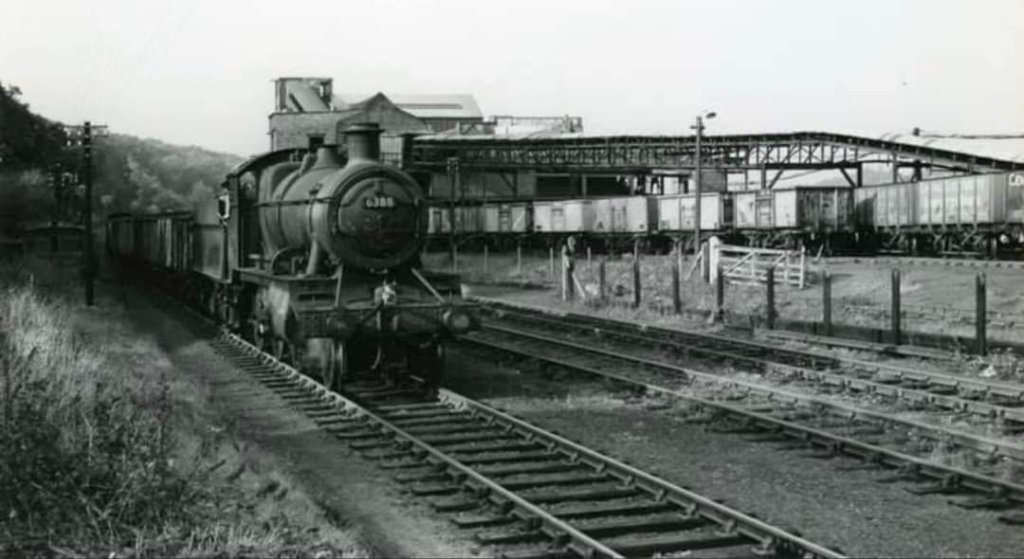
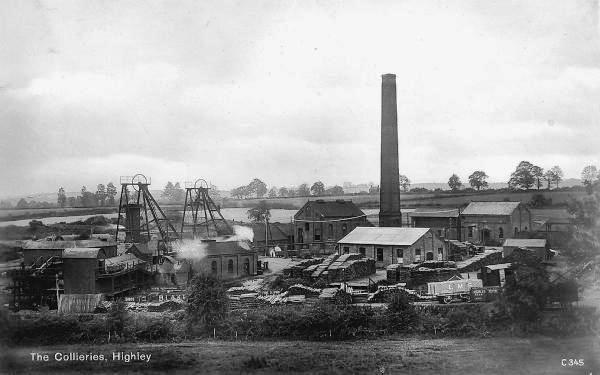
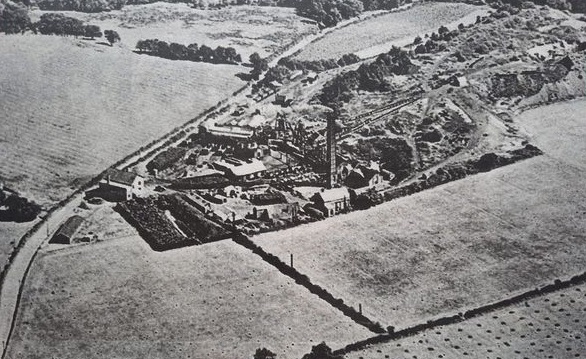
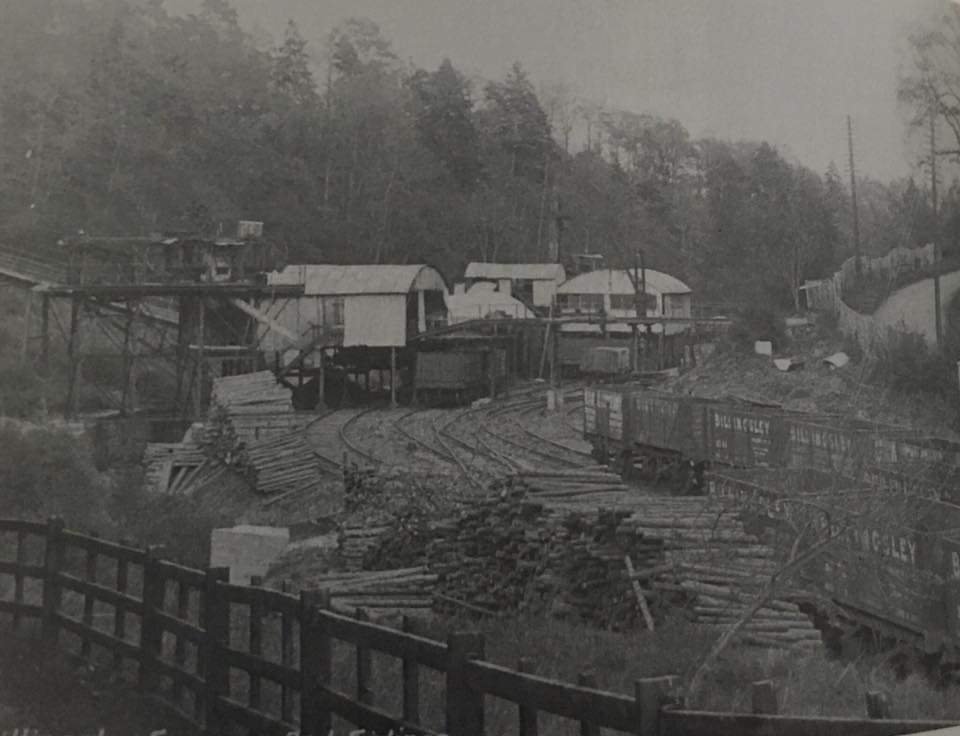
An early image of Highley Colliery. [19]
Highley Colliery in 1942. This image was shared on the Telford & Shropshire History Facebook Group by Caren Craft on 26th January 2023. [37]
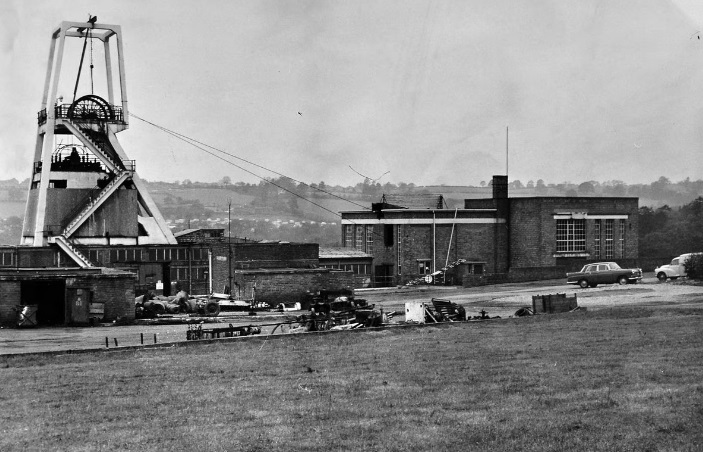
Highley Colliery pit head and buildings shortly before final closure in 1969. By this time the colliery was only in use as a ventilation and emergency egress point to  allow the escape of underground staff at Alveley Colliery. [20]

By 1900, about 240 men and boys were employed. … Main line railway trucks were filled with coal at the colliery, and then run down a standard gauge incline to the sidings, the layout of which can be seen on the extract from the Ordnance Survey Map, 1888-1913 series [above]. One of the main destinations of the coal was the carpet factories of Kidderminster.” [21]

The Highley Mining Company ran the colliery successfully for many years, with the workforce increasing to 670 by 1937. As the workings moved under the River Severn towards Alveley, a new shaft was opened at Alveley. Once the Alveley and Highley workings had joined up in 1937, men and equipment were transferred to Alveley, and by 1940 Highley Colliery itself had closed, although the pithead remained open for ventilation. The former colliery sidings then became the landsale yard for Alveley Colliery.” [8]

This extract from the National Grid Ordnance Survey mapping of 1954 shows the much reduced railway infrastructure serving Highley Colliery. The Incline has been removed a single siding serve the landsale yard referred to above. Some small elements of the internal tramway at the pit head remain, as doe a short line out onto the spoil heap. [22]

The area of the former sidings was eventually bought by the SVR and is now the site of The Engine House.

This modern satellite image shows a very similar area to that on the map extract above. The preserved station on the SVR is visible at the top-right of the extract. The SVR’s Engine Shed sits on what were once the colliery sidings and much of the Colliery site has reverted to nature. There is a modern carpark on the site of the old colliery in the top-left of this image [23]
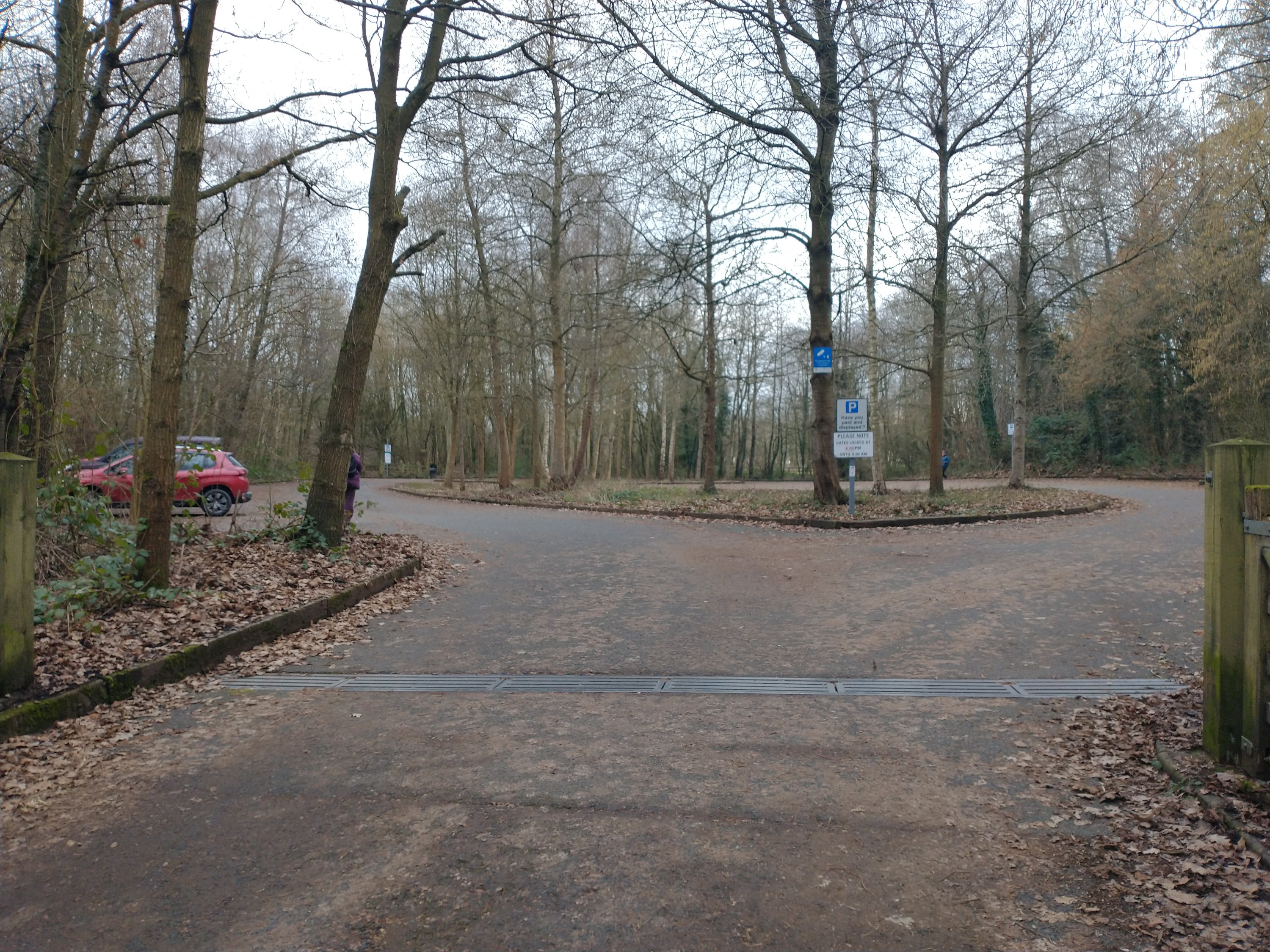
The view South into what was the Highley Colliery site which has been utilised as a car park for the SVR and the local nature reserve. To the left of this image, off scene are the carpark facilities which include a display board about the colliery site. [My photograph, 10th February 2023]
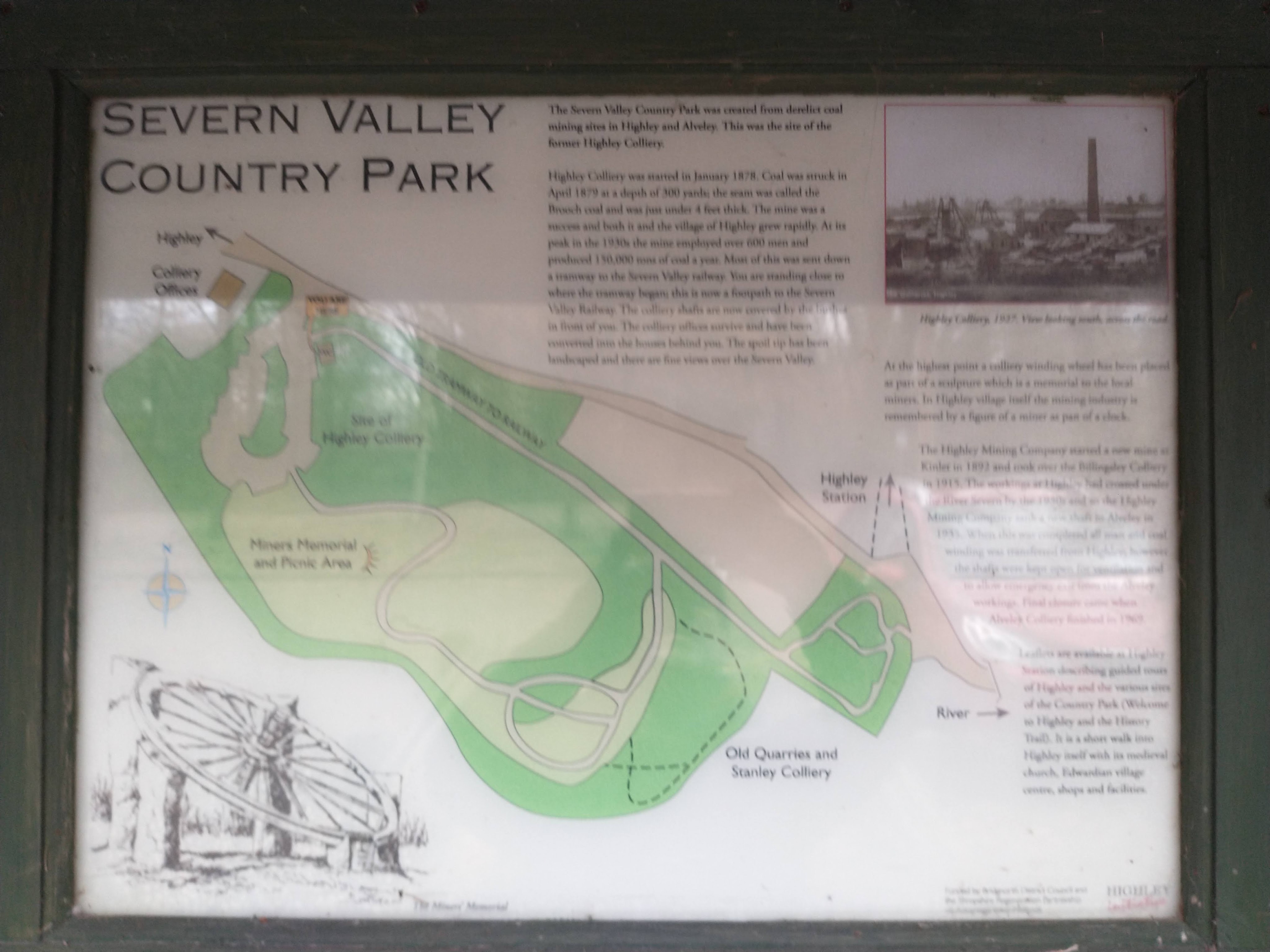
The Severn Valley Country Park display board at the Highley Colliery site. The car park is to the left of the display and the line of the incline down to the colliery sidings is shown in a sandy colour. [My picture, 10th February 2023]

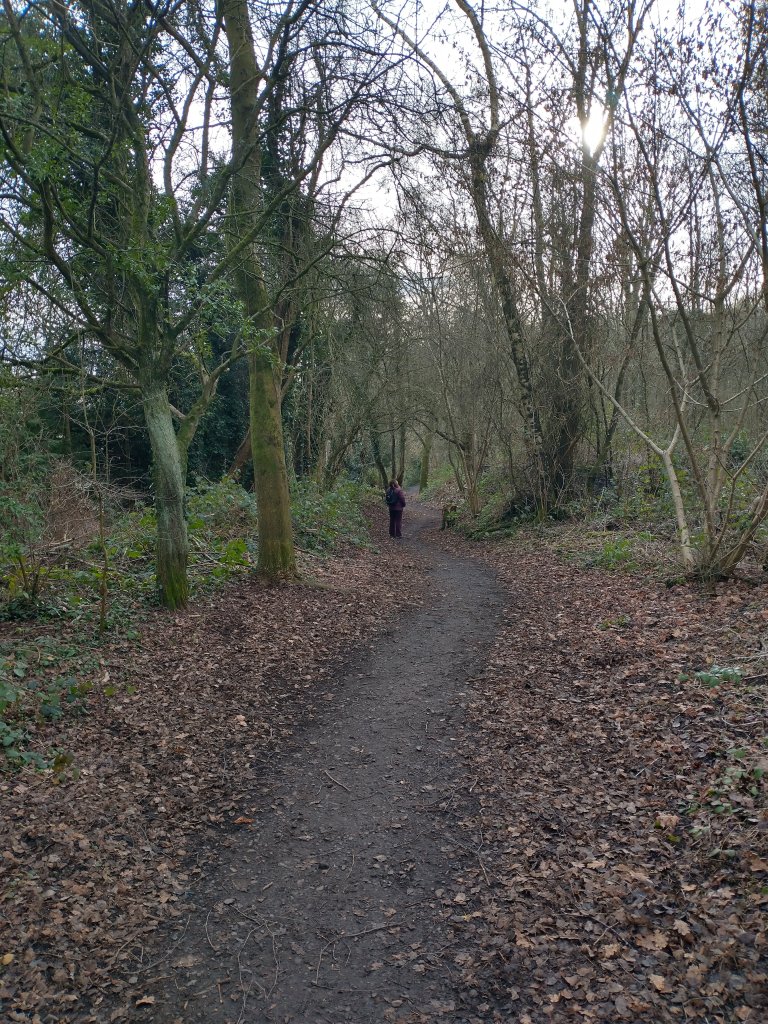
The next sequence of photographs show the path which follows the incline between Highley Colliery and the colliery sidings adjacent to the SVR.

The incline leads away Southeast from the Colliery site. [My photo, 10th February 2023]
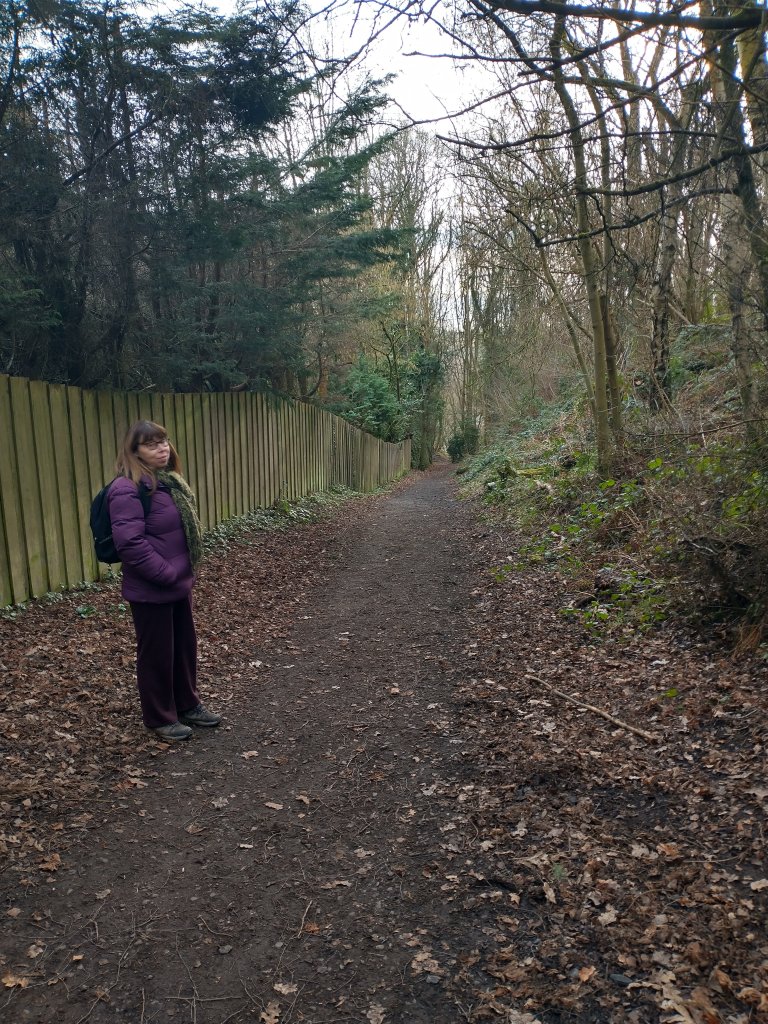
The incline continued towards the Southeast. [My photo, 10th February 2023]
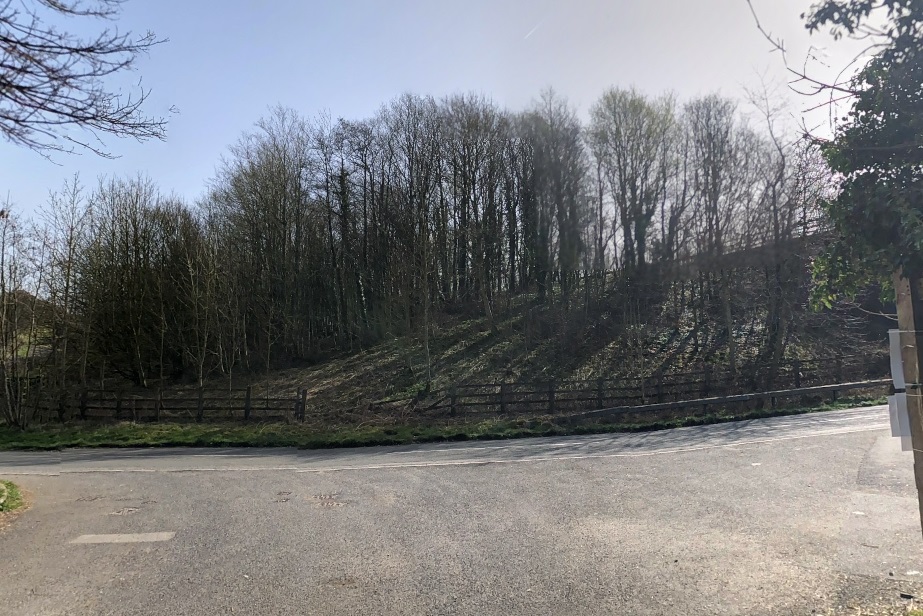
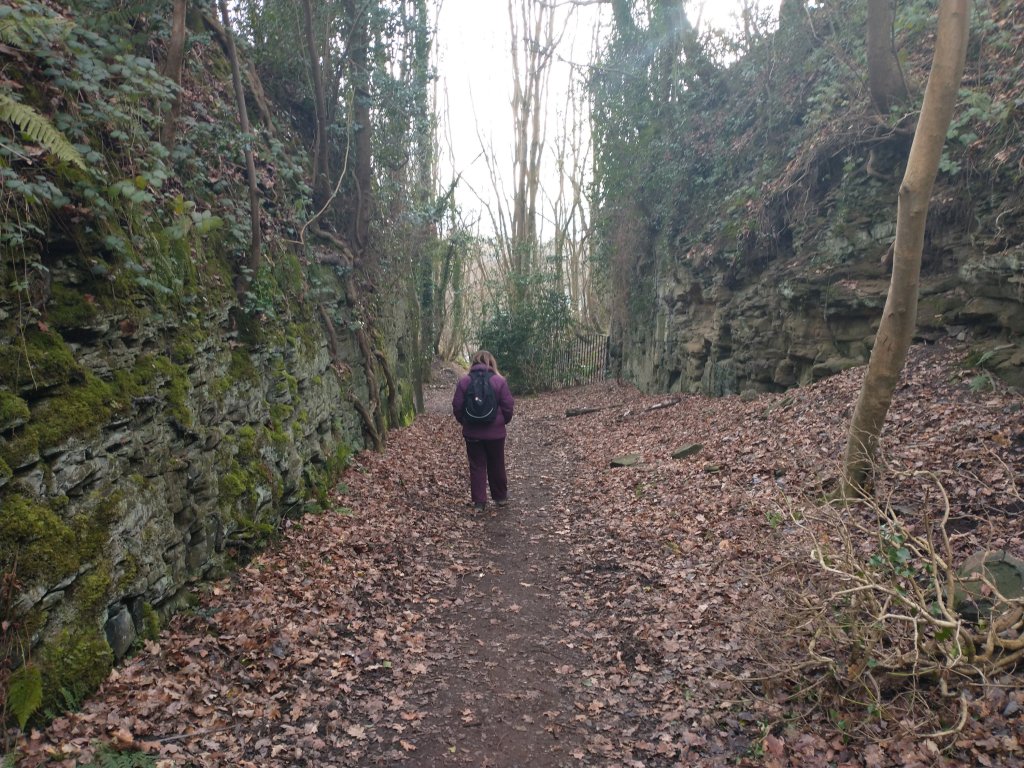
Creating the incline required excavation through the rock walls which flanked the valley of the Severn. [My photo, 10th February 2023]
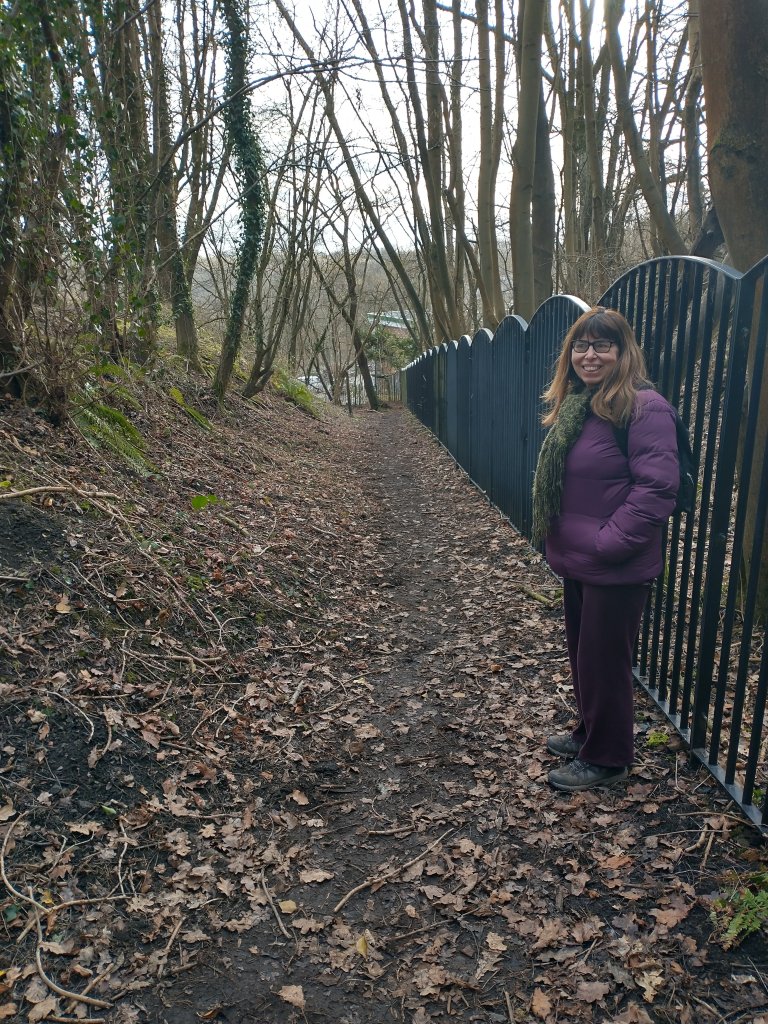
Beyond the valley side, the incline continued to fall steeply to the exchange sidings. [My photograph, 10th February 2023]

The Billingsley Railway

Highley, and the area immediately around, it has a long industrial history and the remains of numerous railways and tramways can be seen today. At the end of the 18th century coal mines and a blast furnace were opened in Billingsley. The coal and iron were brought alongside the Borle Brook through Highley by a horse-worked tramway to the River Severn where they were sent downstream in boats. The “tramway worked for no more than 15 years, but its route can still largely be traced on the North side of Borle Brook, running via shallow embankments and cuttings. A little later the Stanley Colliery (1804-1823) opened close to the site of the present Highley Station and this was also served by tramways, as were the numerous sandstone quarries by the river.” [26]

Stanley Colliery was just to the South of Highley Station. It was worked for that short period at the beginning of the 19th century in the sulphur coal at a depth of about 100 yards; the Brooch seam worked by the Highley Colliery was a further 200 yards below this. Stanley Colliery “is partially overlain by the trackbed of the Severn Valley Railway and sidings built by the HMCo. [Highley Mining Company] There are also extensive remains of the stone quarries which worked in this area from perhaps the Middle Ages to the 19th Century.” [21]

The old plateway/tramway/tramroad route is covered in an earlier article in this short series about railways to the South of Bridgenorth:

Railways Around Bridgnorth – Part 1

The tramroad was the first transport venture alongside the Borle Brook. It was some time before industrial development at Billingsley warranted the construction of another railway. In the early 1870s, a new mine had been sunk at Billingsley. The mine site was to the East of the Cape of Good Hope Inn. It “reached ‘Sweet Coal’ at 160 yards depth by Christmas 1872 (Sweet coal is low sulphur coal).” [24]

In the 1875 a public limited company, the Billingsley Colliery Company, was formed to work the mine and a decision was taken to link Billingsley Colliery to the Severn Valley Railway (SVR). [31]

Progress was slow, but eventually, in March 1877, a lease permitting the railway to cross land belonging to the Duke of Cleveland between the mine and the River Severn was signed. Further access rights were granted over land in Kinlet by February 1878 and, in December 1878, the GWR agreed a connection could be made to the SVR. [31]

The mine suffered significant cashflow problems in the late 1870s and the Company was bought out in 1878 by “Samuel Norton Dimbleby. The next year Dimbleby renamed it the Severn Valley Colliery Company and by various means … he raised enough money to allow construction of the railway to begin.” [31]

Work commenced in October 1880. The line was to follow the Borle Brook on its South side as far as New England. There it was to continue alongside the Borle Brook for a short distance “before striking due west to reach the colliery by a chain-worked incline, over half a mile long.” [31]

The line was due to be completed by the end of January 1881 and open by 31st March. This was an ambitious target but the contractors, Messrs Drewitt and Pickering of Stoke on Trent, seem to have made good progress, quickly constructing all the earthworks as far as New England. Then work stopped.” [31] It seems likely that “Dimbleby and the company never had enough money to pay for the completion of the line.” [31]

For two years, Dimbleby strove to complete the railway but without success. “Finally, in October 1882, the materials on the line were sold, probably by Drewitt and Pickering in an attempt to get some of their money back.” [31]

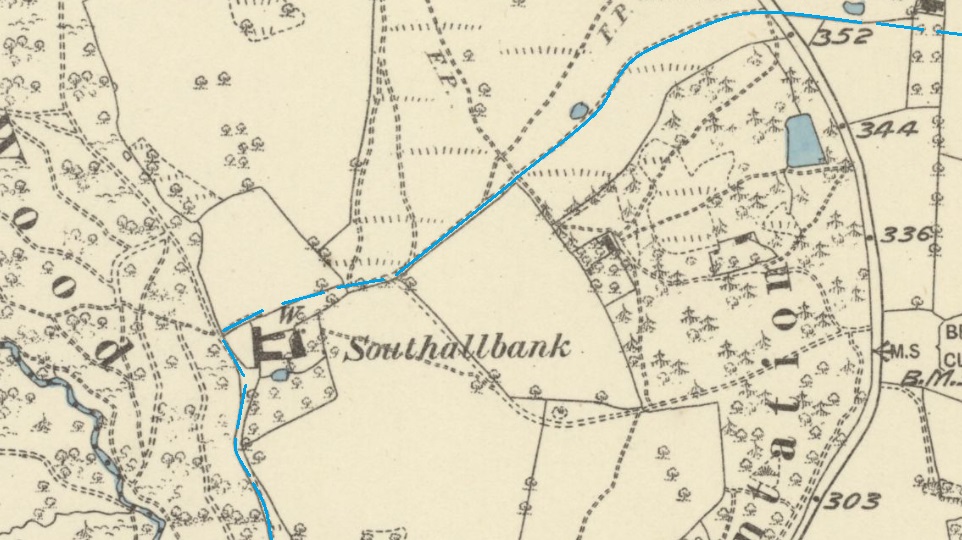
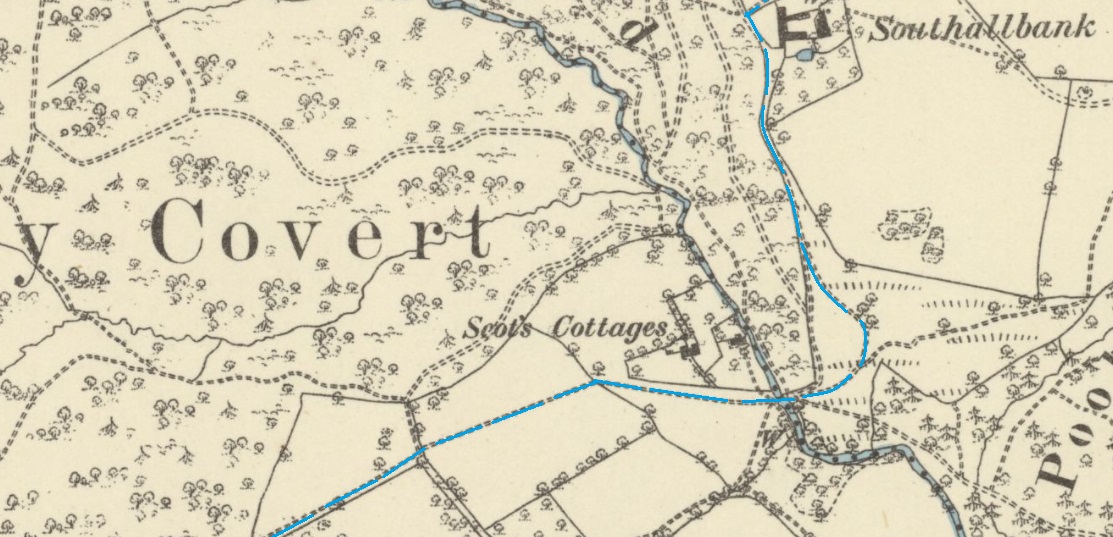
Dimbleby’s endeavours left a local landscape scarred by embankments and cuttings. The fruit of his labours is illustrated below on another series of extracts from the 6″ Ordnance Survey published in 1883.

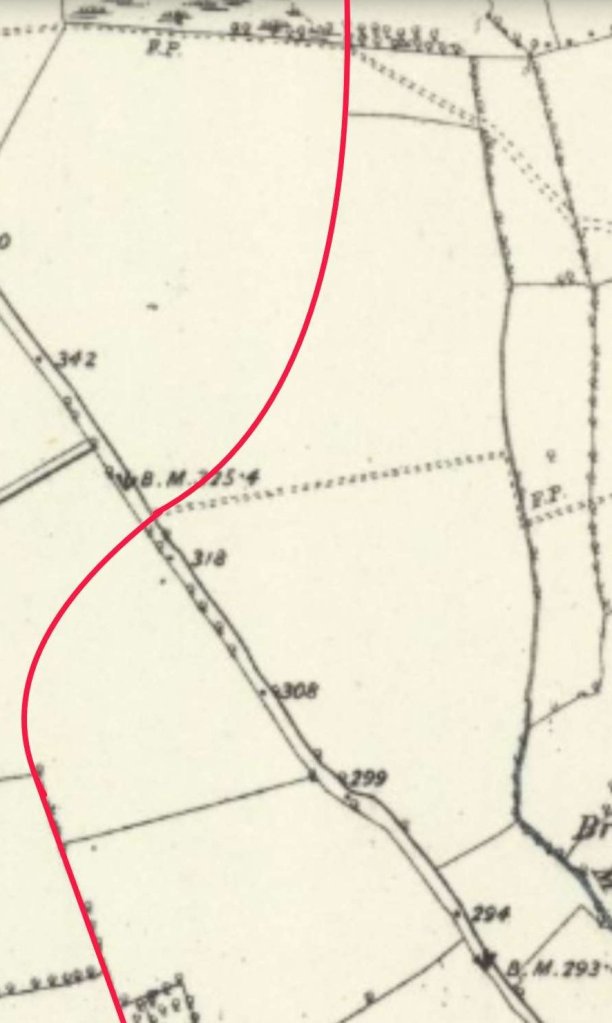
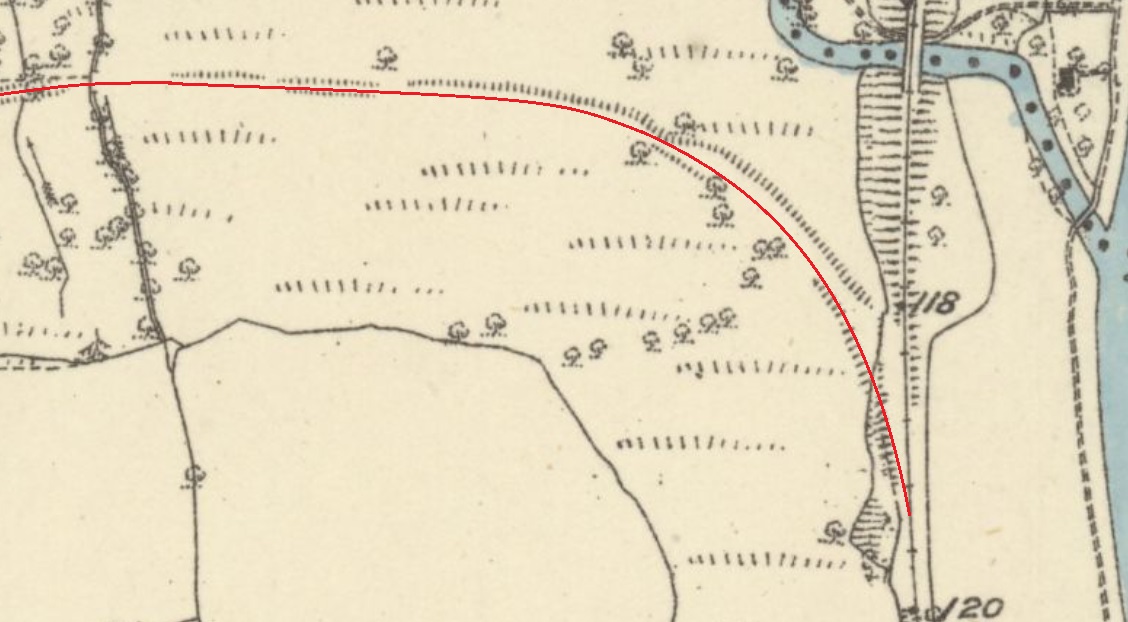
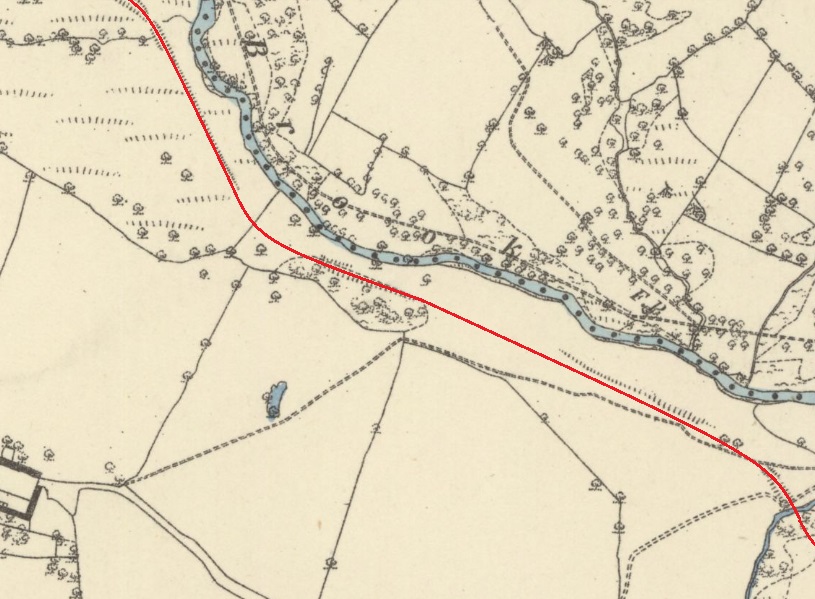
The 6″ OS Map (published in 1883), shows the remnants of Dimbleby’s intended railway at it’s planned junction with the SVR. Some embankments and cuttings remain along the proposed railway alignment heading West away from the River Severn. [27]
The planned route continued West away from the River Severn. [27]
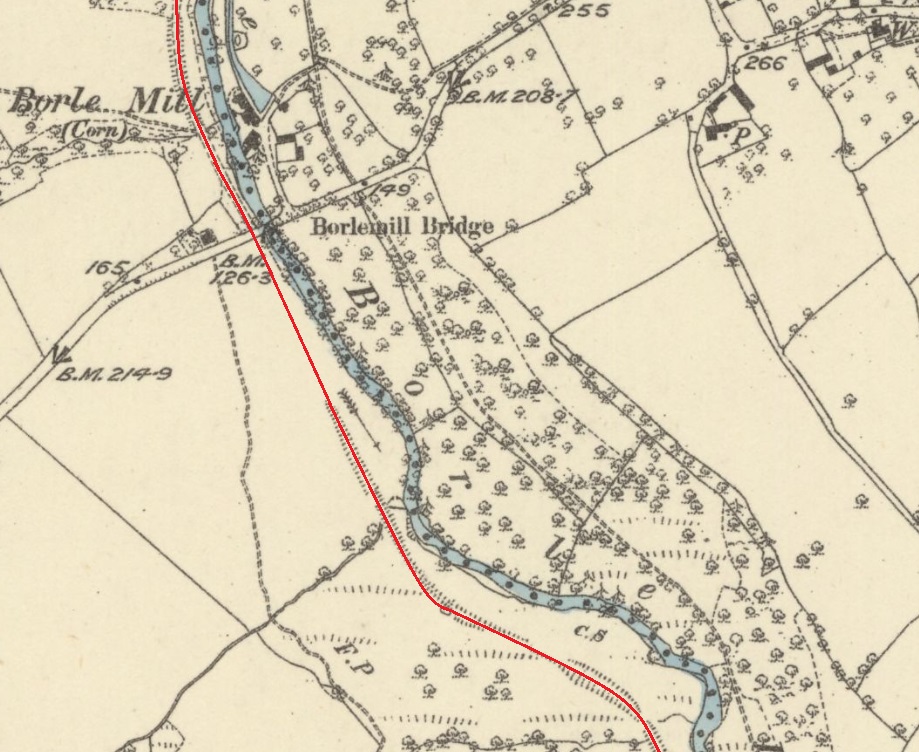
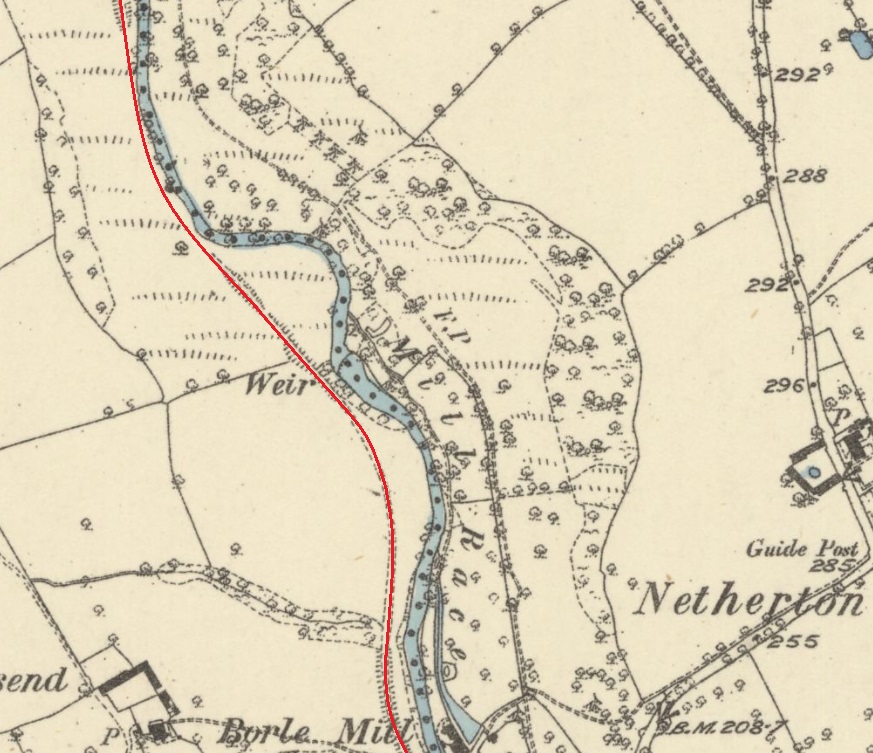
The intended line followed the Borle Brook as its valley ran to the Northwest. [27]
The route of the intended railway ran close to Borle Brook as it turned to the North near Borle Mill. [27]
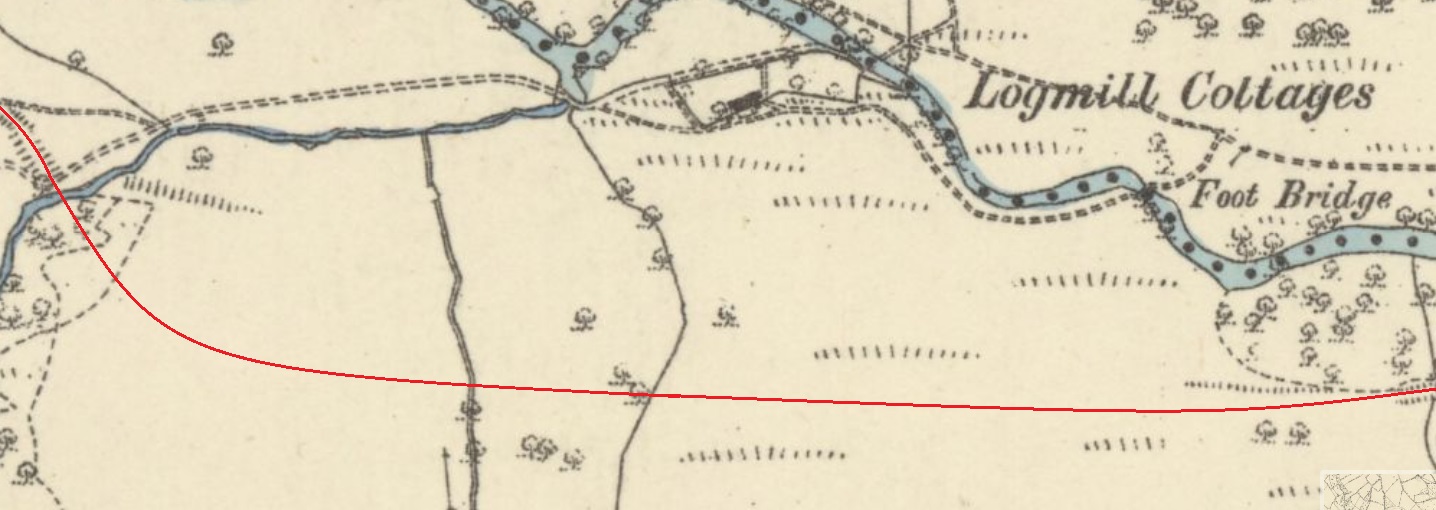
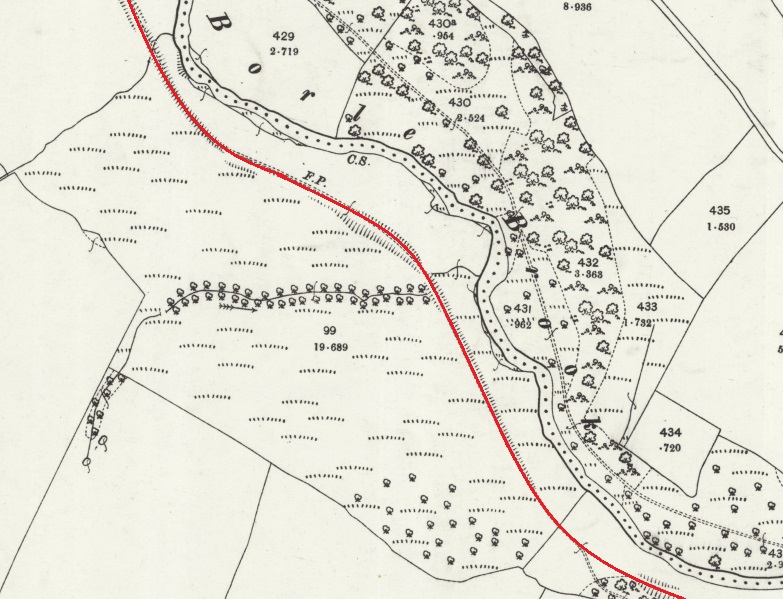
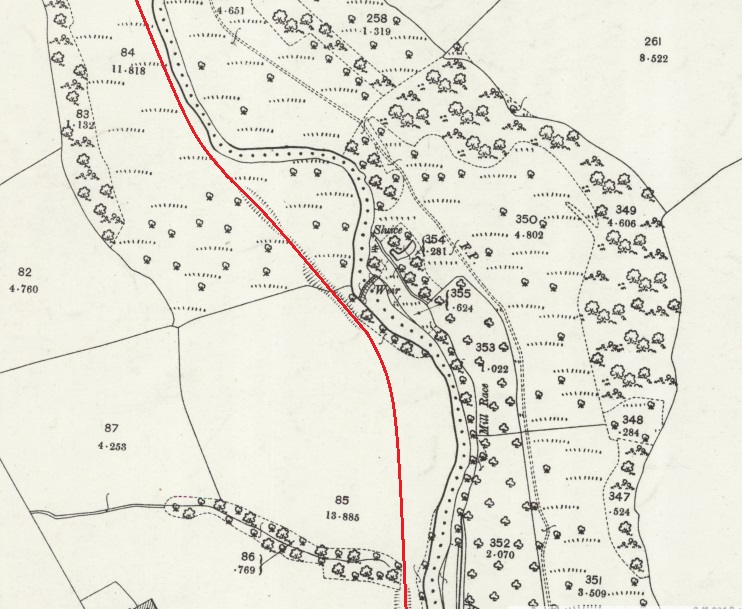
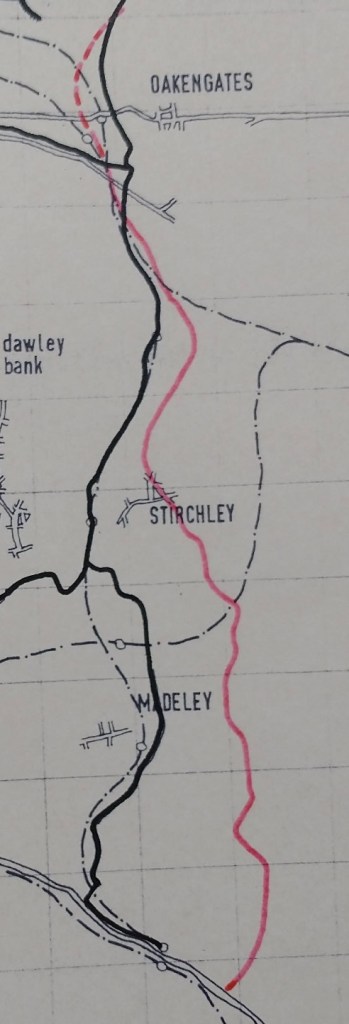
The line of Dimbleby’s railway continues to be marked by the red line imposed on the 6″ Ordnance Survey published in 1883. [27]
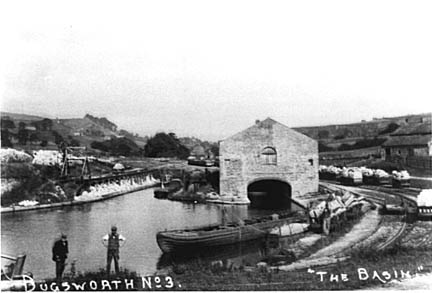
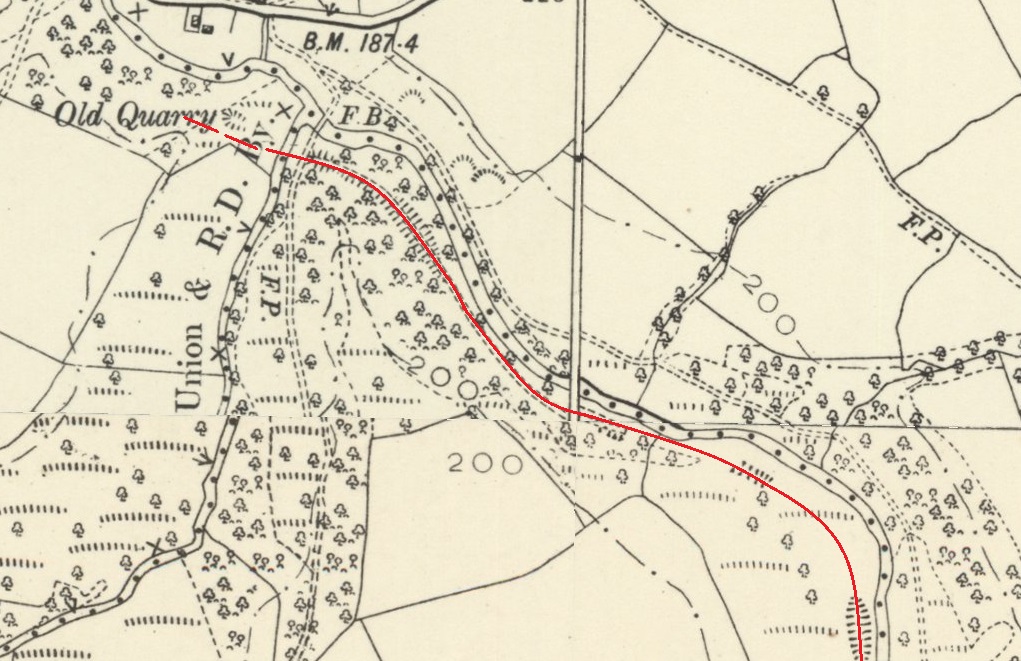
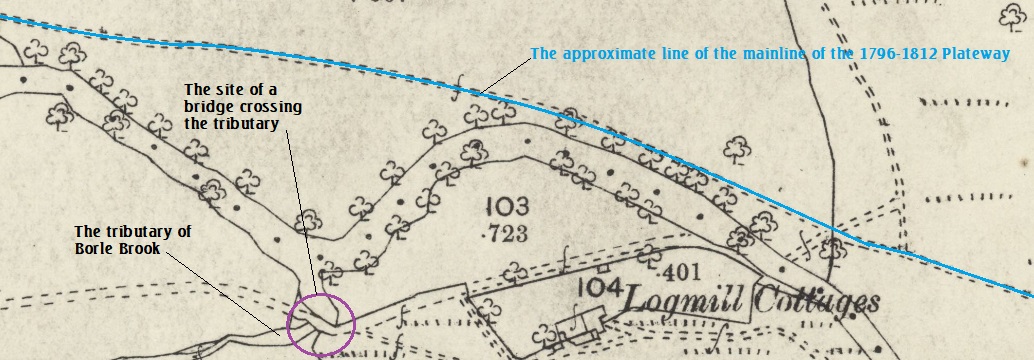
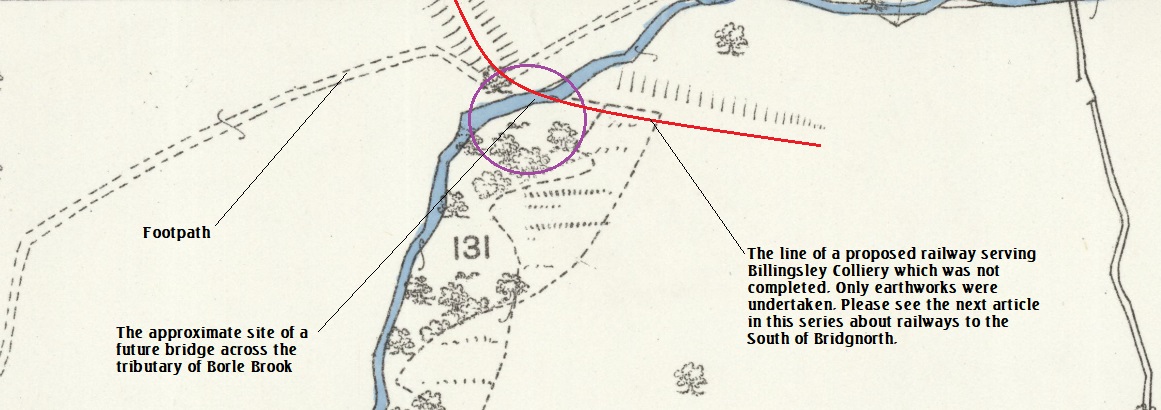
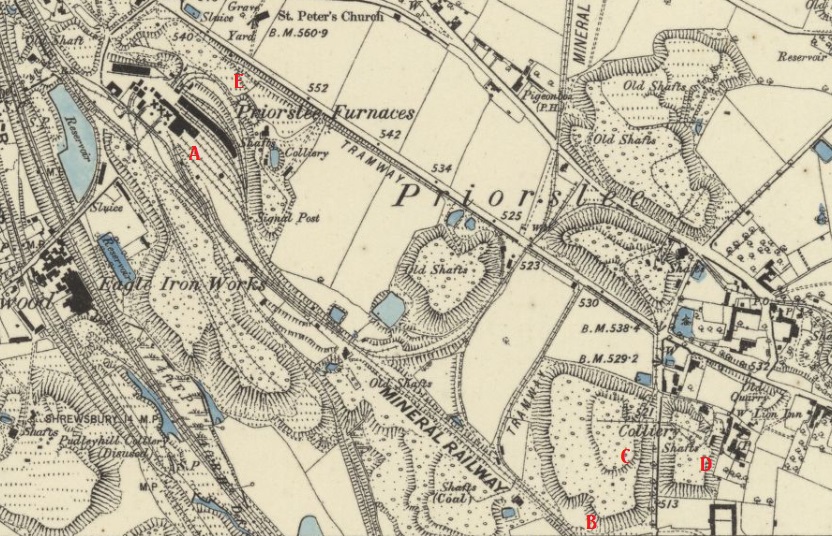
The proposed railway’s alignment crossed the corners of four different Ordnance Survey sheets. I have resorted to using the later Ordnance Survey of the turn of the 20th century to show its route as the NLS (National Library of Scotland) kindly pieces the sheets for that series together. The different 6″ map sheets were published in 1904 and 1905. The route of the line becomes indistinct after it crossed the tributary of the Borle Brook into an old quarry. [28]
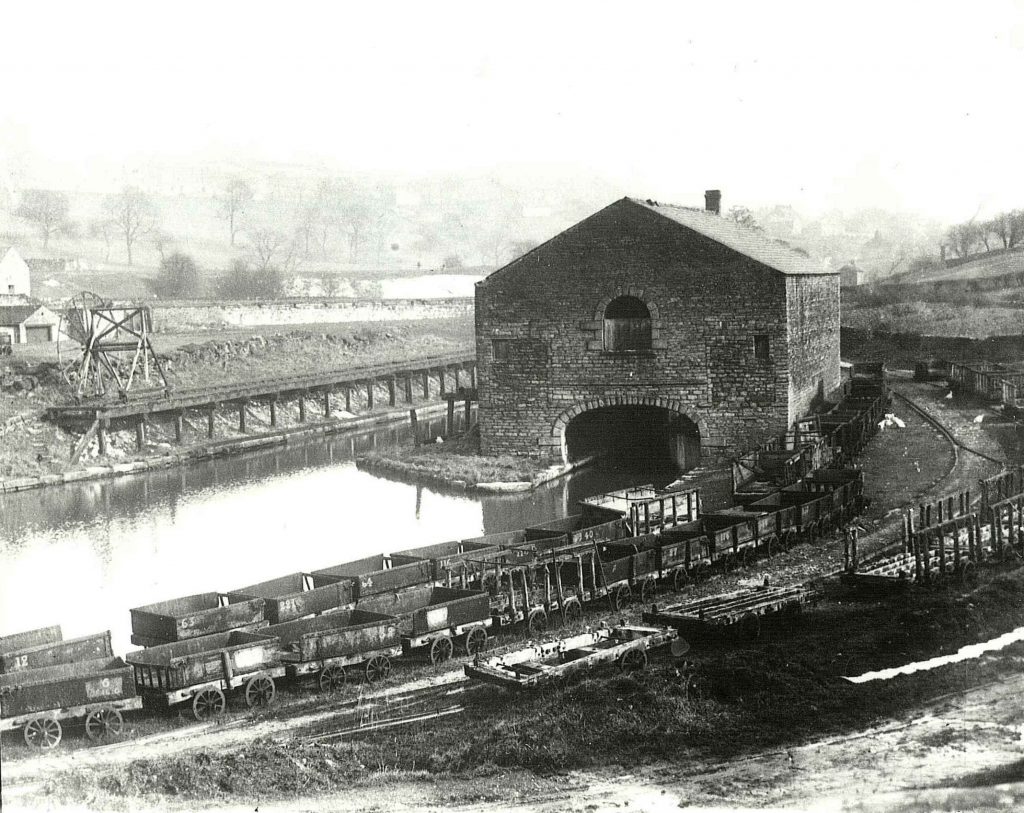
Dimbleby’s efforts were, ultimately, not to be wasted. The mine was purchased, along with Dimbleby’s Severn Valley Colliery Company, in 1882 by Alfred Gibbs. He continued to operate the mine successfully on a small scale until, after the turn of the 20th century, a new company, the Billingsley Colliery Company, was created. [24]

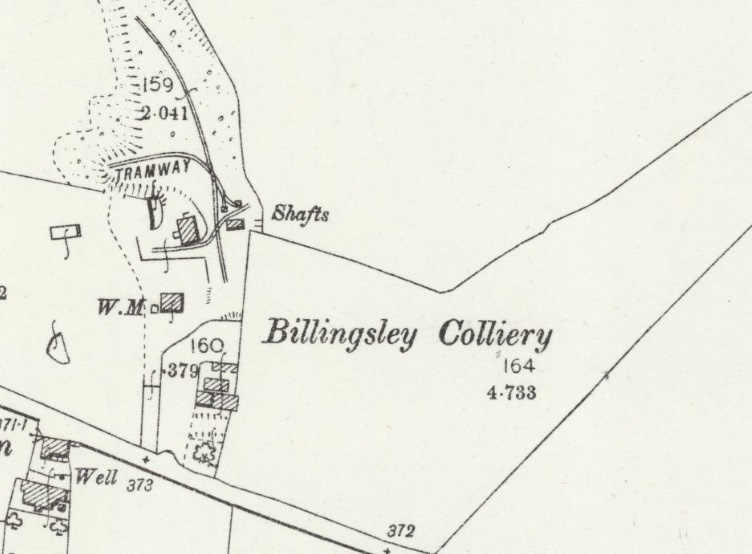
The Billingsley Colliery on the 1902 25″ Ordnance Survey which was published in 1903. [25]
This new company brought great optimism and quickly sought to establish the mine as a significant local player. A connection to the SVR once again became paramount in their plans for the Colliery and a light railway order was sought under the 1896 Act.
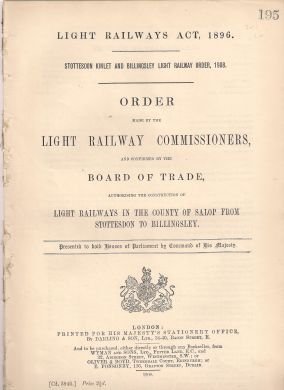
The cover of the Order under the Light Railways Act 1896 for the Stottesdon, Kinlet and Billingsley Light Railway, which was made in 1907. [29]

Billingsley Colliery Co. “undertook a major transformation of the mine, including a complete reconstruction of the surface buildings and alteration of the layout – adding a fan-house, lamp room, an electrical powerhouse, carpenters and fitters shops. Electric haulage was installed underground and a rope-hauled narrow gauge tramway built to drop coal tubs down to new railway sidings in a valley at Priors Moor about half a mile away and 300ft lower than the mine site. A new Garden Village was also built for the miners at Highley.” [24]

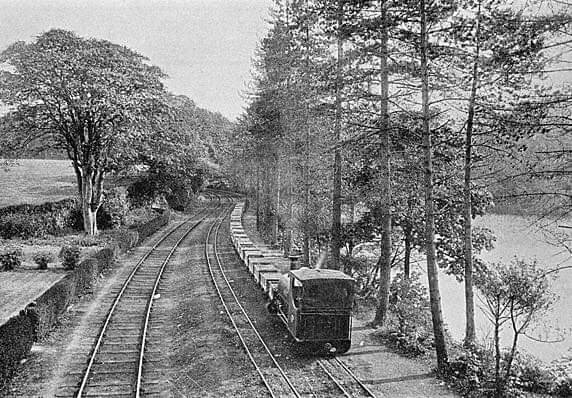
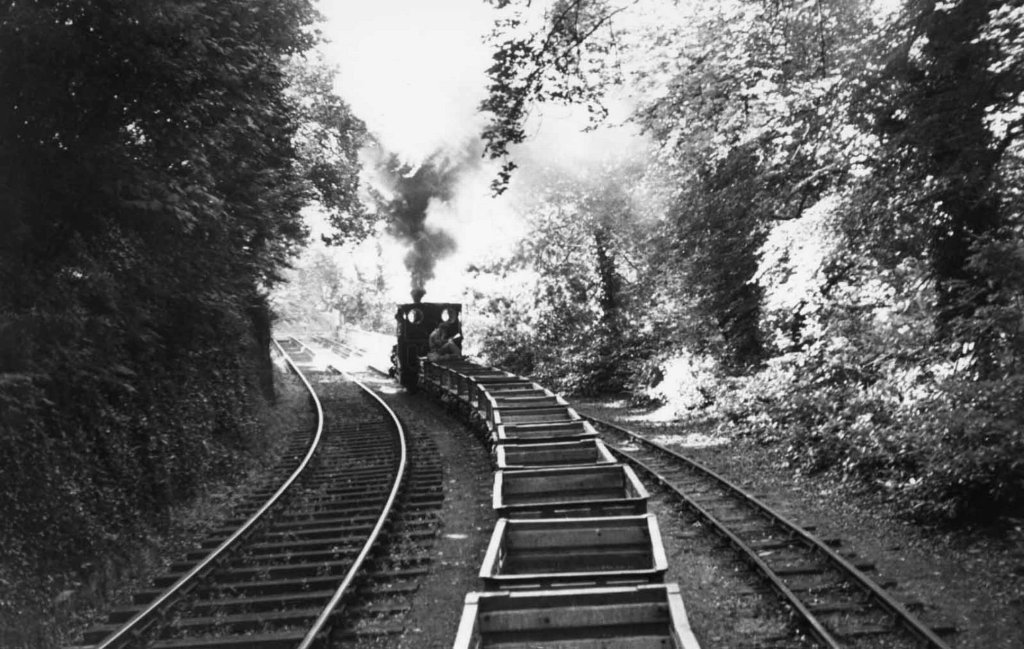
The Railway was built by 1913. The colliery screens were built at the head of the railway at Priors Moor. Coal came down the Incline was processed and loaded onto wagons. Waste from the screens and pit materials were sent up the Incline to the mine. [24][31]

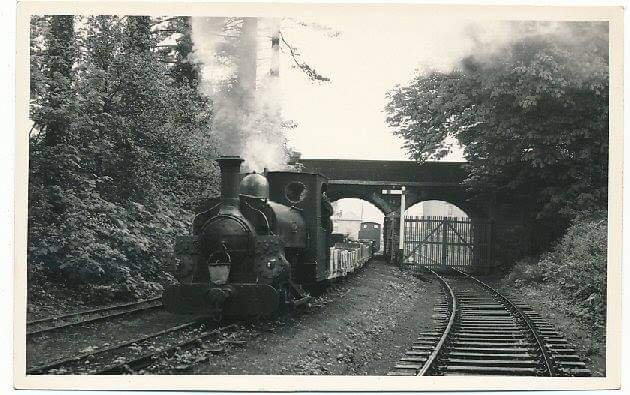
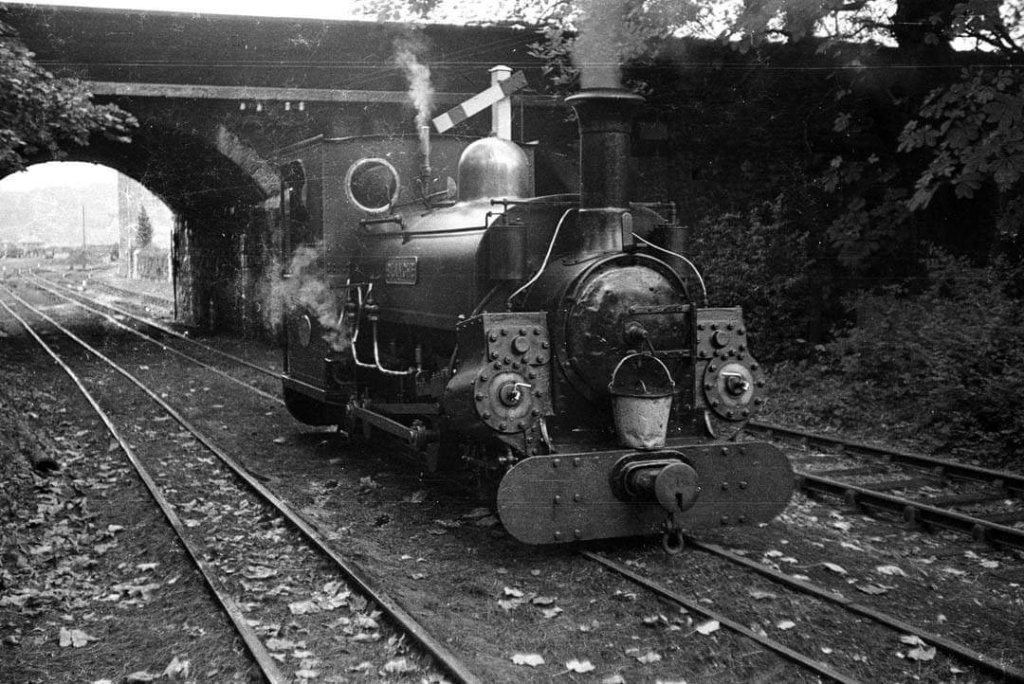
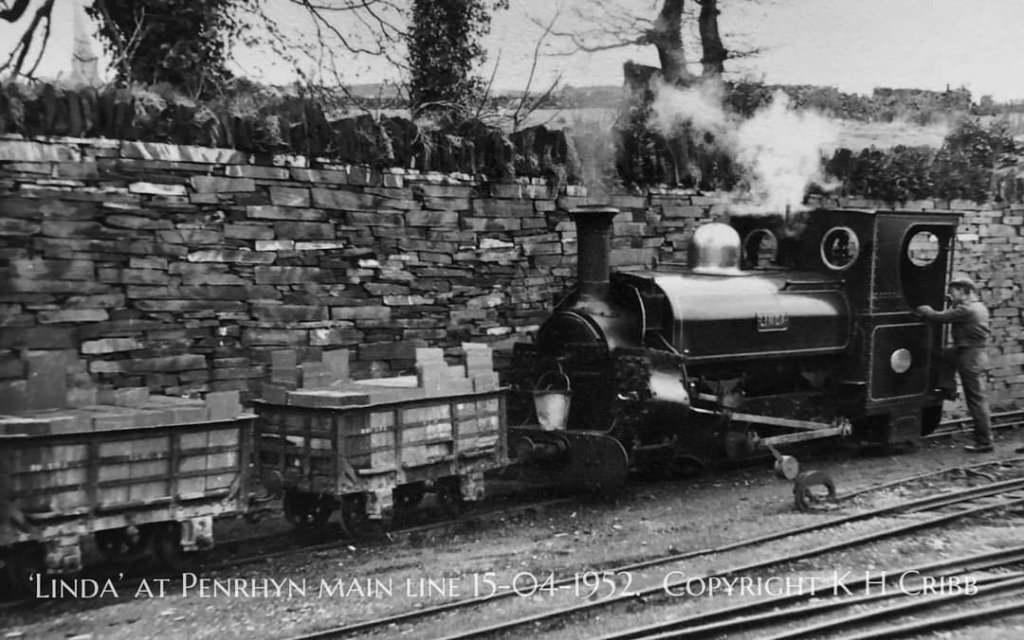
Leaving the sidings alongside the SVR, the line initially ran parallel to the Kinlet railway, but continued for an extra 1½ miles to the colliery screens at Prior’s Moor. “This had no severe gradients although it did have a number of sharp curves. To work this railway, the Billingsley Colliery Company purchased a second-hand 0-4-0 saddle tank. No 599 built by Peckett’s of Bristol.” [41: p13]

In 1915. Billingsley Colliery was taken over by the Highley Mining Company, this means that they inherited No. 599. As we will see later in this article, they favoured No. 599 over their own locomotive ‘Kinlet’.

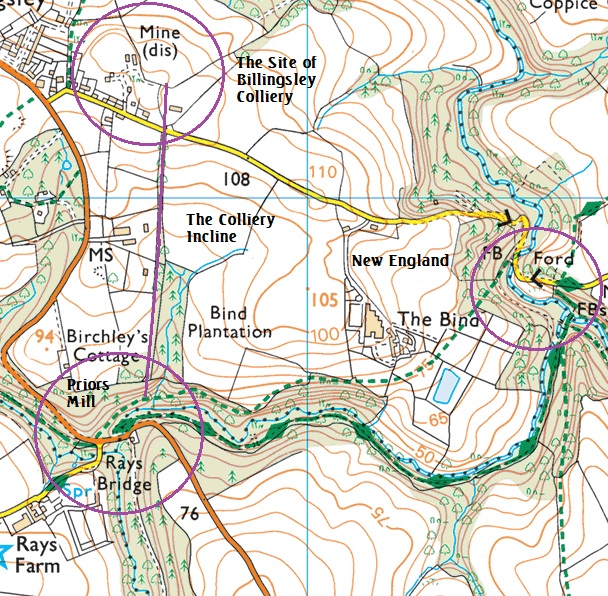
Much of the Railway from Kinlet to New England used the earthworks built by Drewitt and Pickering. From New England a spur was created which followed Bind Brook to Priors Moor where it met the narrow gauge ropeway. [31]

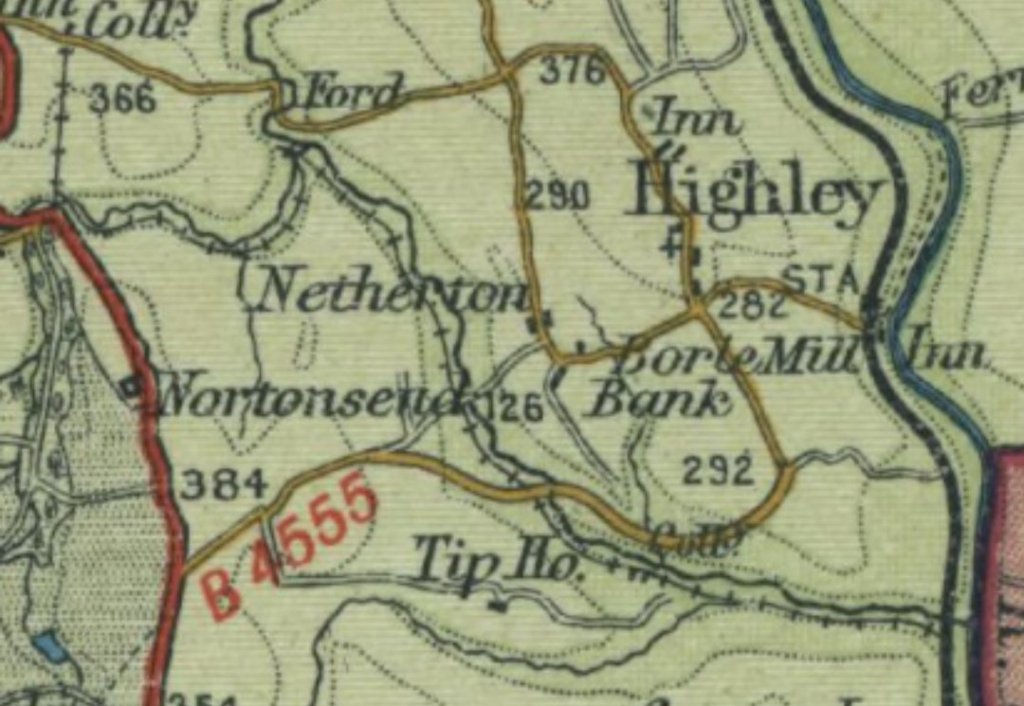
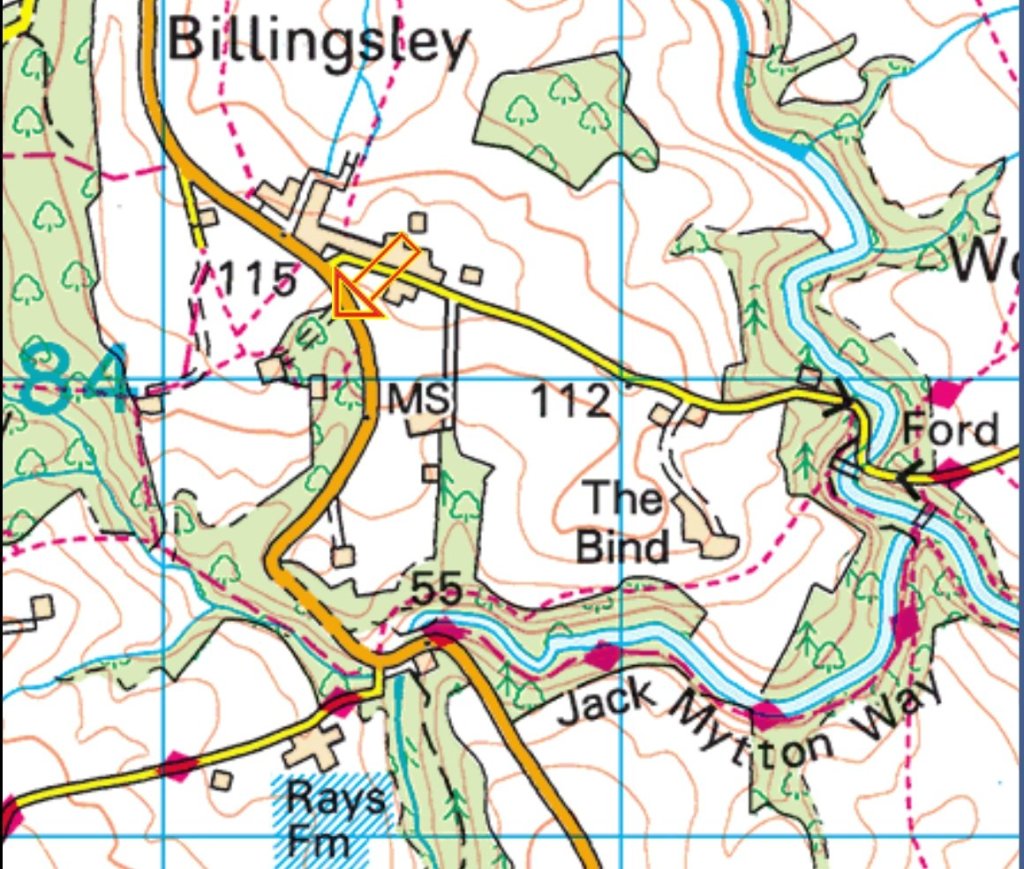
This extract from the Bartholomew 0.5 inch to the mile mapping shows the full extent of the Billingsley line. The reversing point at New England can be picked out close to the ‘Ford’ and Billingsley Colliery is at the extreme top-left of the image. There is little detail on the map, which is unsurprising given its scale. [33]

A brickworks opened in Billingsley in the late 1860s and was in use until the start of WW1. An aerial ropeway from the brickworks brought bricks, tiles and other products down to the sidings with coal for the kilns going back to the brickworks. [24][34]

The Colliery itself was relatively prosperous in the years around WW1. It was employing more than 200 men at that time. This prosperity was short-lived, Billingsley Colliery was taken over in 1915 by the Highley Mining Company after it had, had a number of financial and geological difficulties – they also took over the Garden Village housing development in Highley. [24]

The Colliery closed very early in the 1920s. The railway to Priors Moor remained in use until the late 1930s, serving a landsale yard at its terminus near the colliery screens close to Priors Moor. A few of the mine buildings survive and have been turned into farm buildings. The track bed of this railway and some of the bridges survive largely intact. [24]

The landsale yard closed in the 1930s and the railway had been dismantled by the end of 1938. Much of the Billingsley line is now a public footpath; the stretch from Billingsley to New England in Highley forms part of the Jack Mytton Way, a long-distance bridleway. [24][32]

Although initially separate, the Billingsley and Kinlet (see further below) railways were later connected and worked until the closure of Kinlet Colliery in 1937, when the railway was closed. [24]

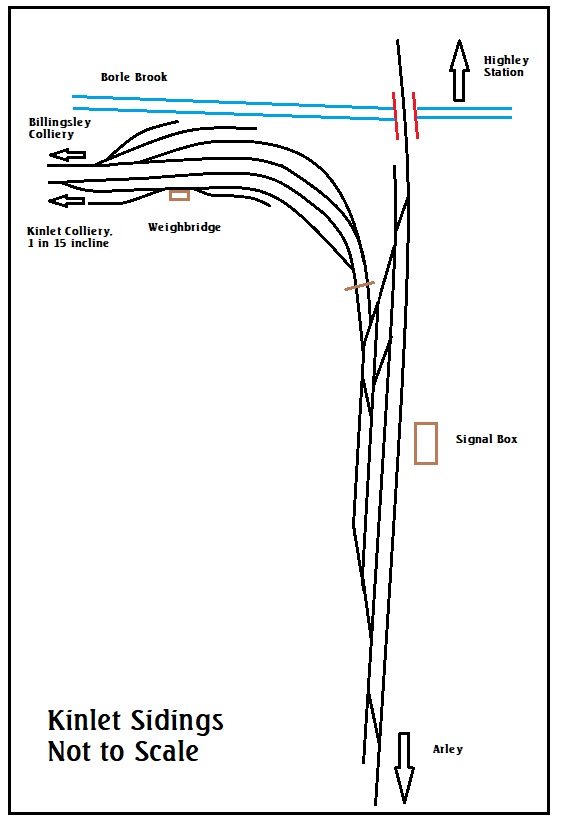
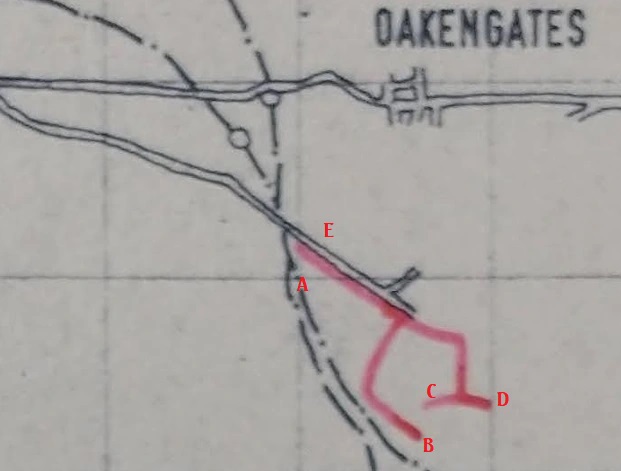
The Billingsley Railway was about 3 miles in length. It ran along the valley of Borle Brook as far as New England. For much of its life the first section of the line followed the Kinslet line only a metre or two to the North, closer to Borle Brook. The sketch map below is based on a map provided by John Tennent [1: p8] Both the Billingsley Railway and the Kinlet line were gated close to the sidings.

My sketch, based on a segment of a drawing in Tennent’s article. [1: p8]

In its latter years the loop and sidings shown above were removed and along with the branch mainline and a connection was made to the Kinlet line closer to the point at which the steepest gradient of the Kinlet line commenced.

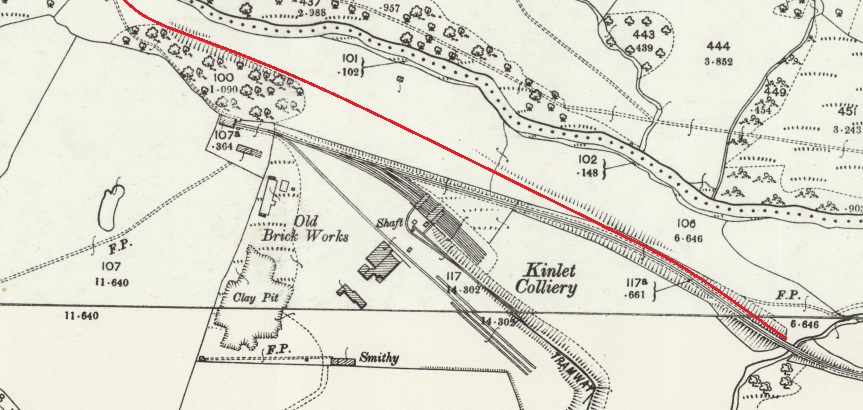
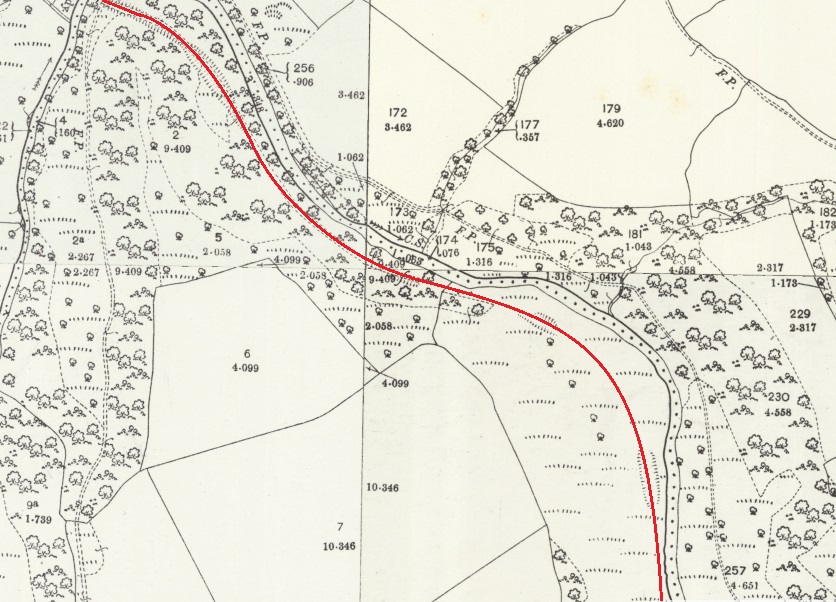
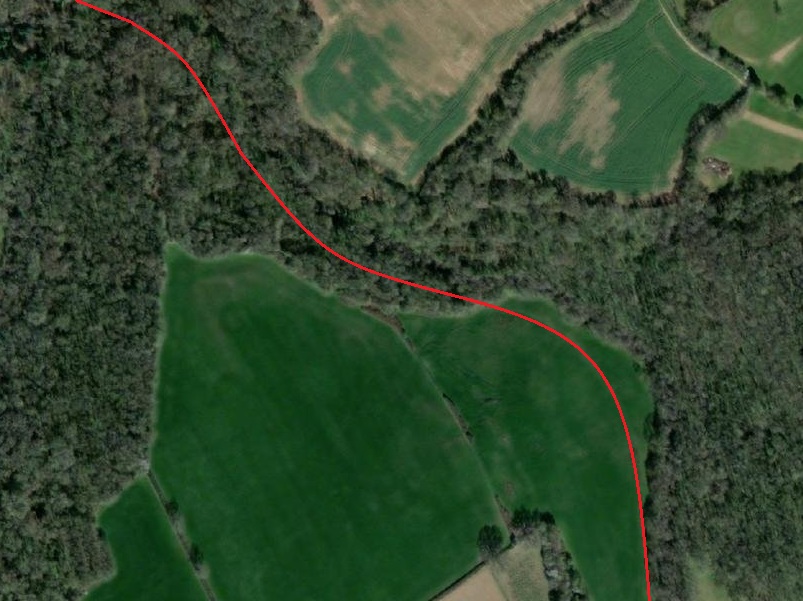
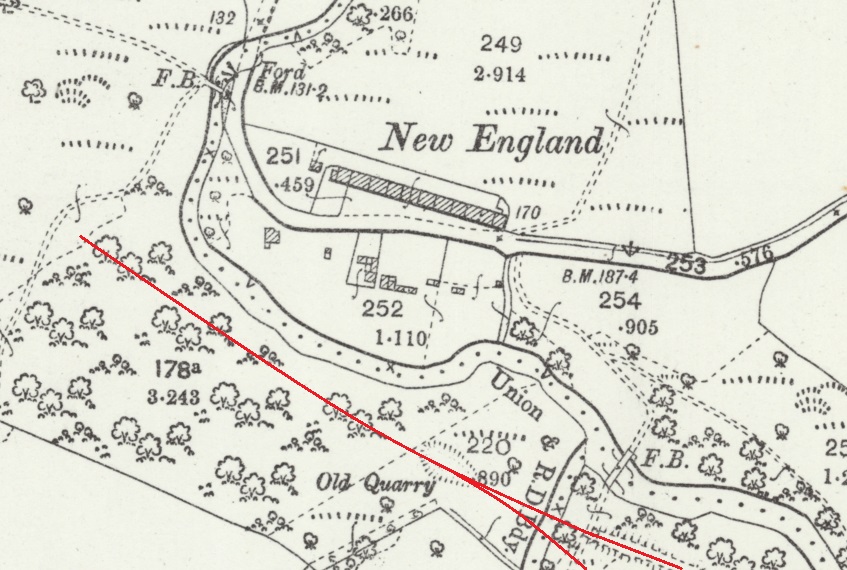
The Billingsley Railway is not shown on any of the extracts from the 25″ (1901/1902) and 6″ Ordnance Survey of 1925 shown in the notes about the Kinlet Colliery further below. I have imposed the approximate route of the line on the 25″ Ordnance Survey of 1901, published in 1902. A red line is shown on the 25″ Ordnance Survey extracts below.

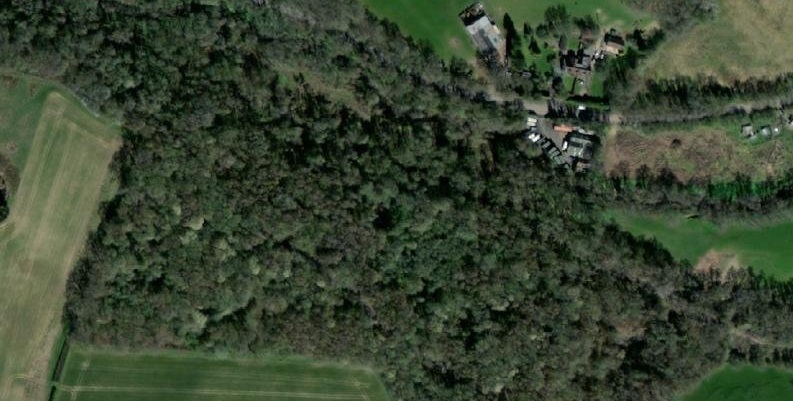
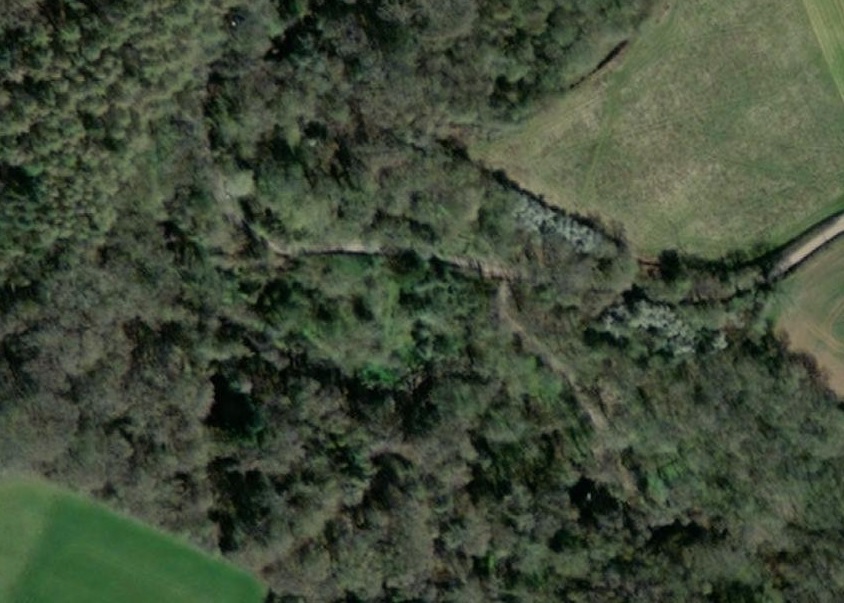
The 25″ OS map extract above shows Kinlet Colliery and its line, the red line imposed on it is the approximate line of the Billingsley Railway. The modern day satellite image shows that the Colliery site and the railway routes are now shrouded in woodland. It is difficult to make out any features. The tributary of Borle Brook which passed under the railway, can just about be made out on the satellite image in the bottom-right. [43]
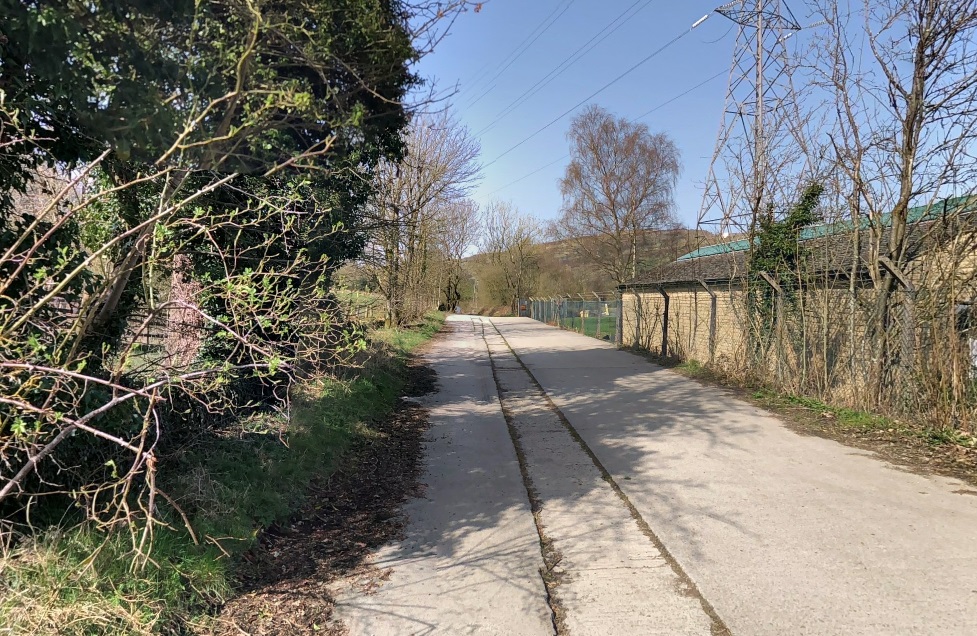
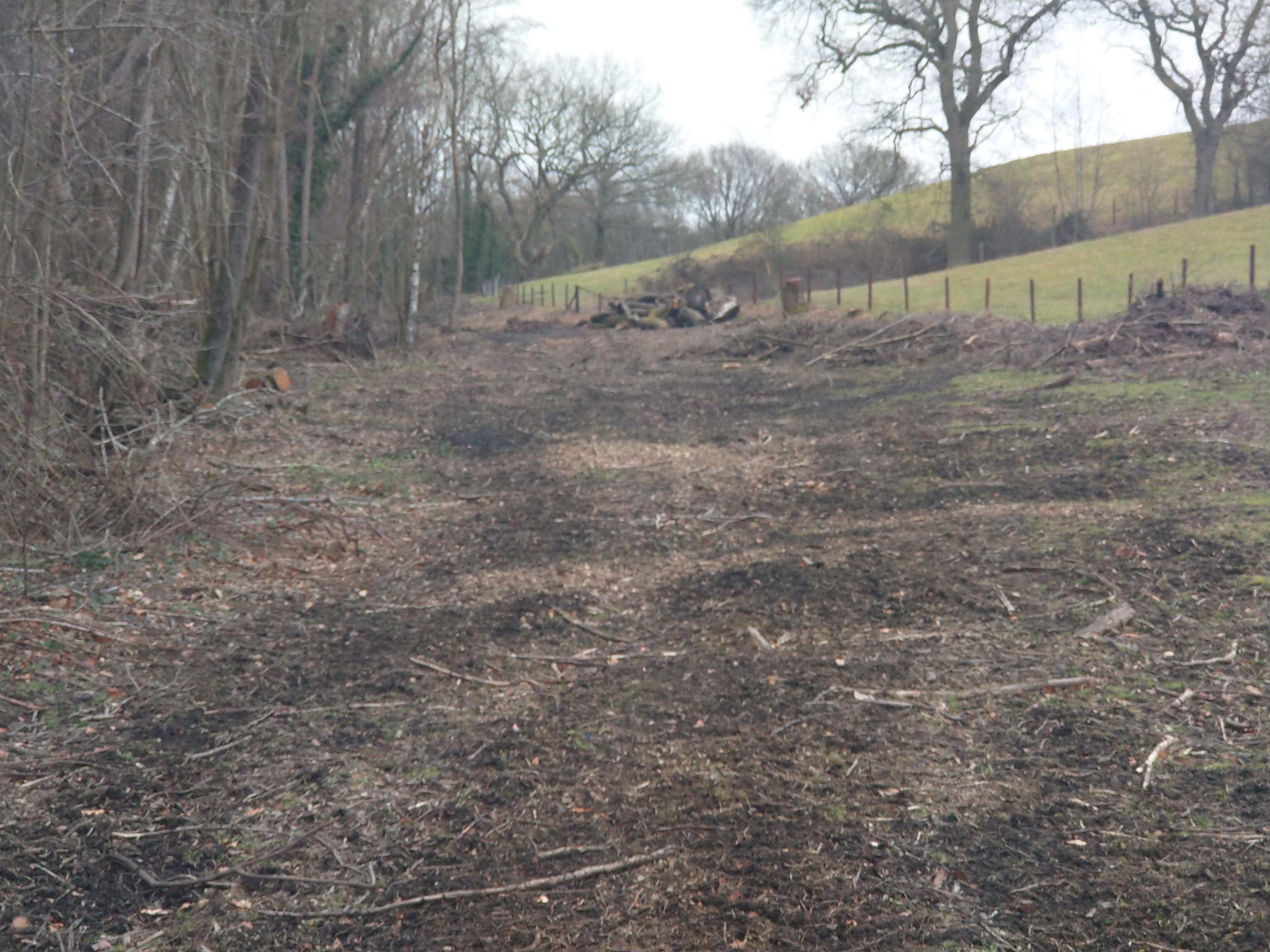
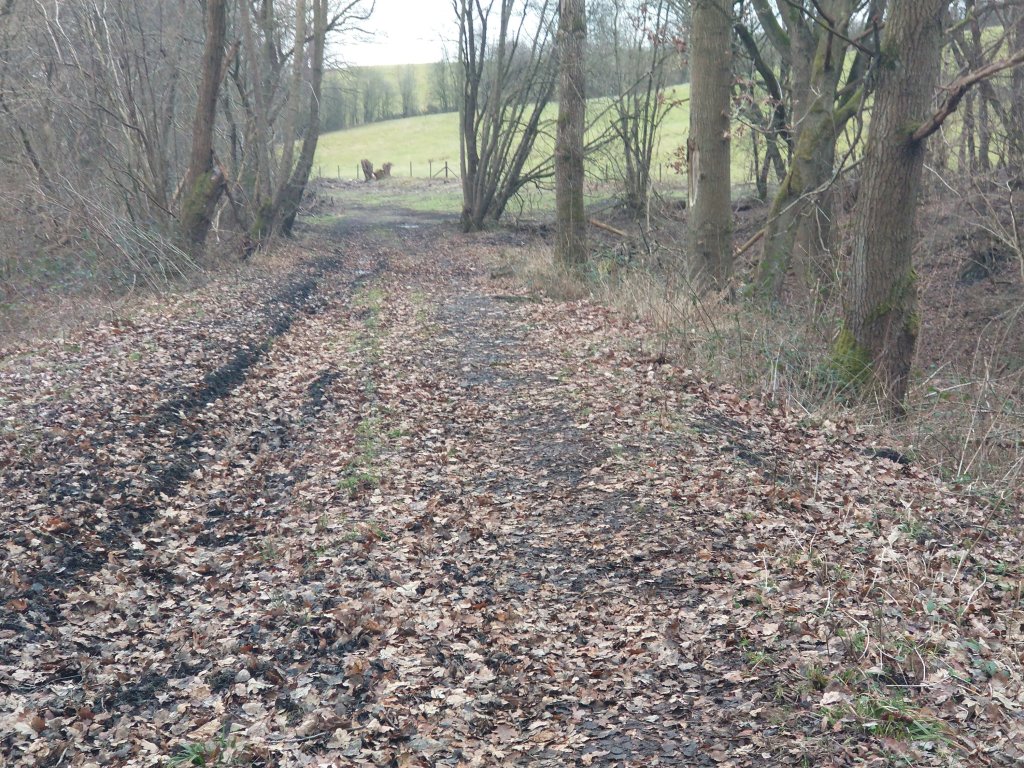
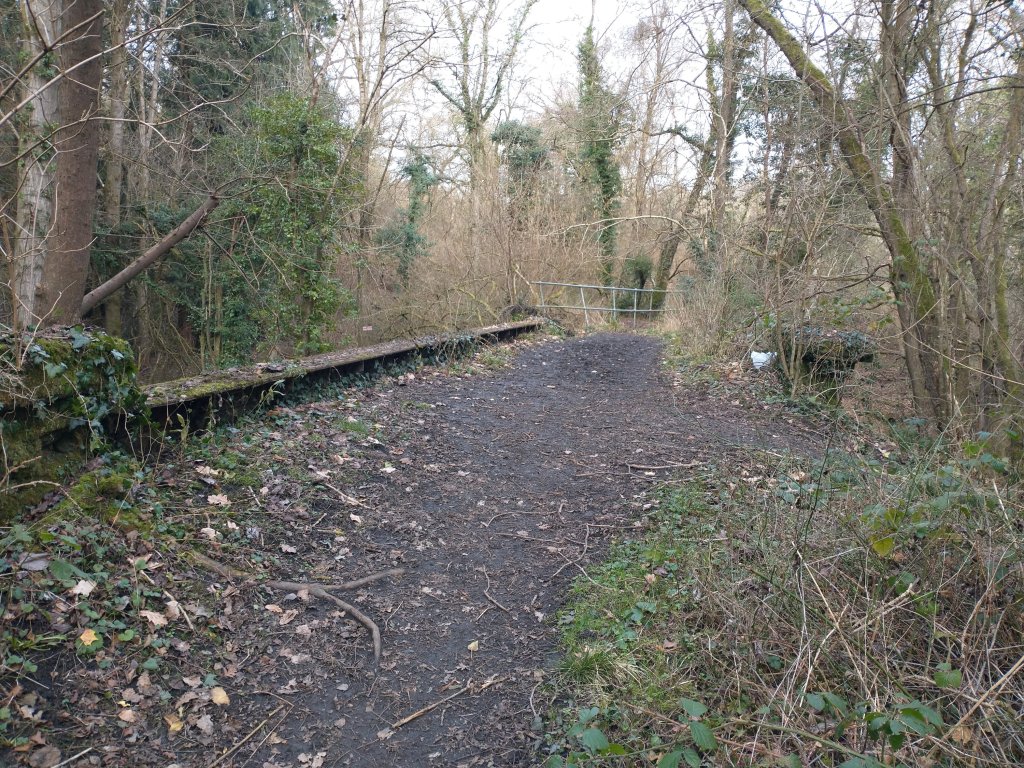
The view East along the line of the old railway from the point where the Billingsley Colliery line and the Kinlet Colliery line diverged. At the time of the photograph, the area had only very recently been cleared of trees and undergrowth. [My photograph, 10th February 2023]
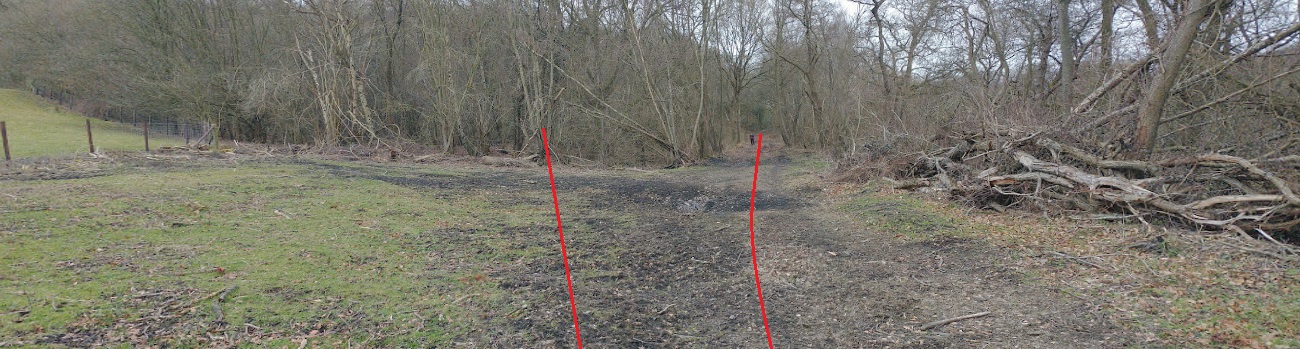
The line to Billingsley Colliery is indicated by the red line to the right, that to Kinley Colliery by the red line to the left. The line to Kinlet Colliery climbed steeply from this point. [My photograph, 10th February 2023]
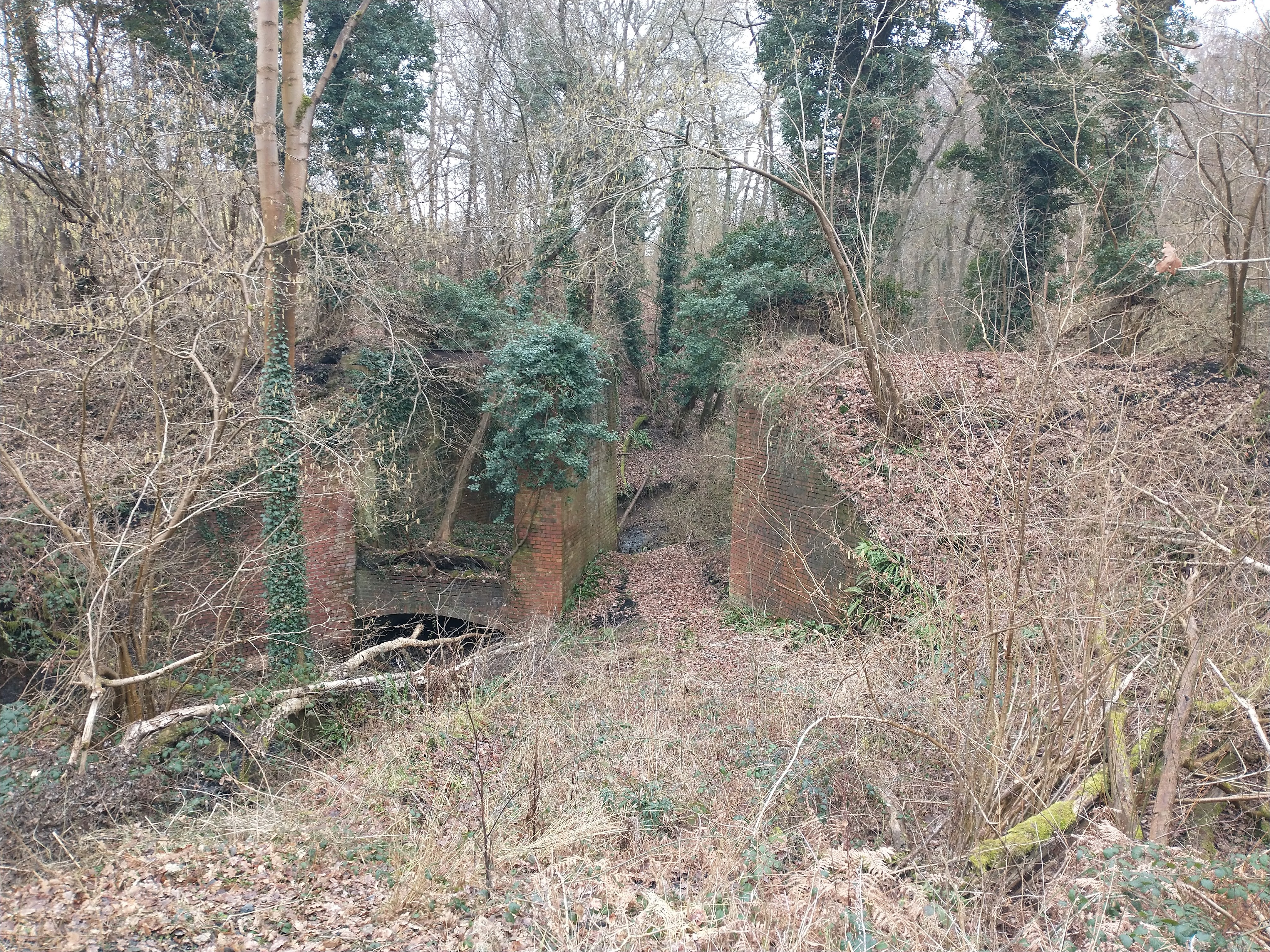
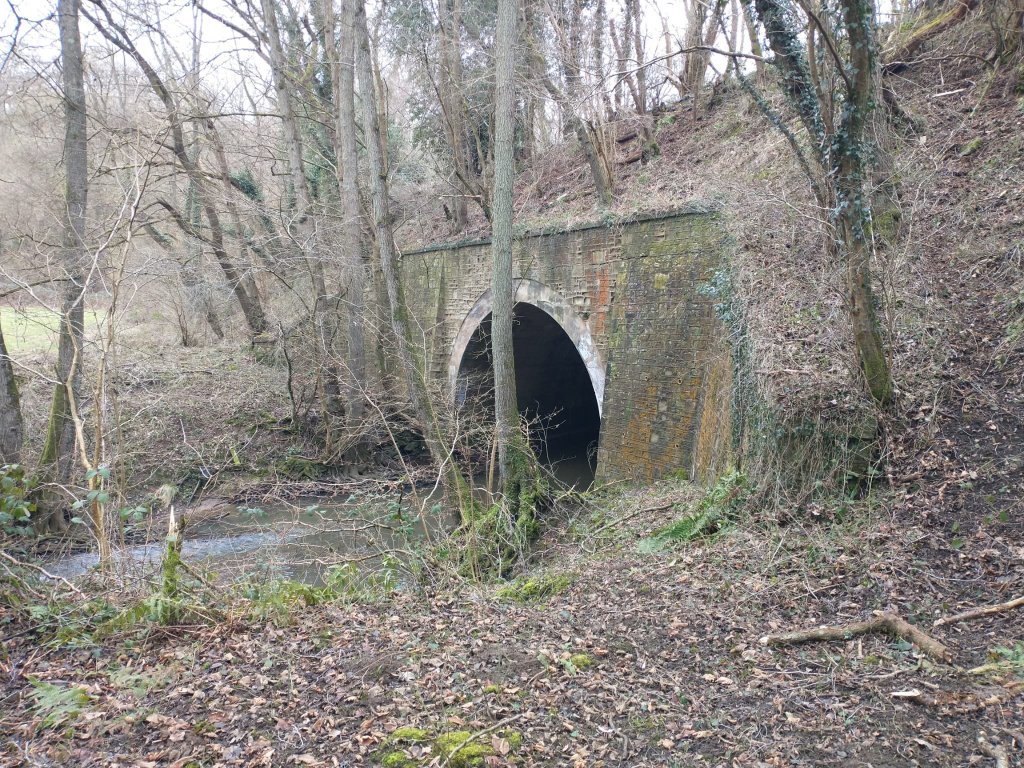
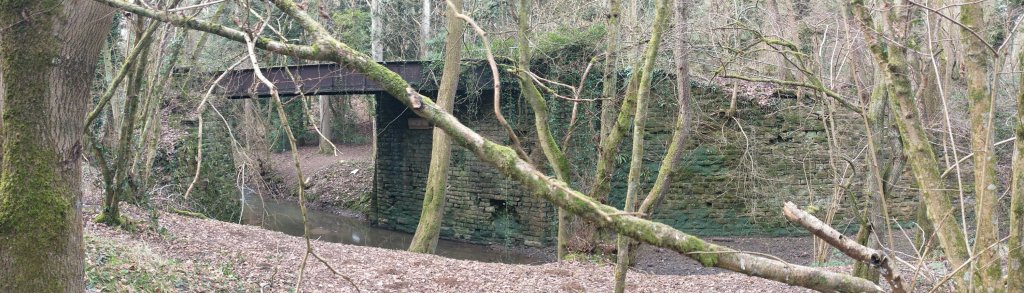
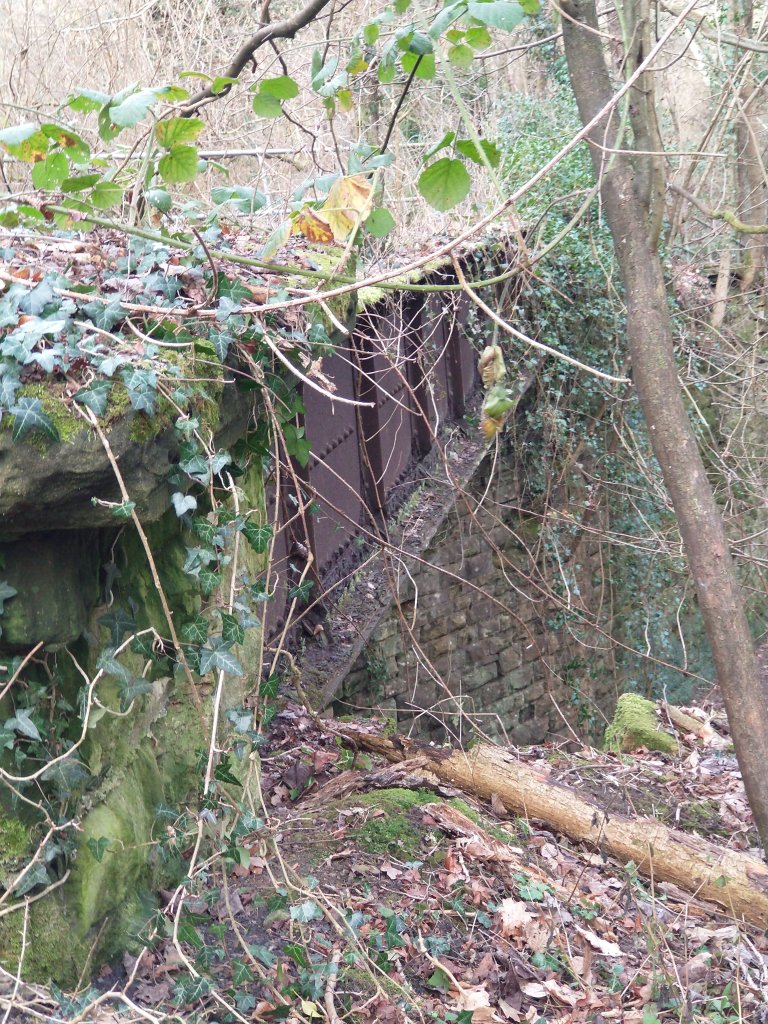
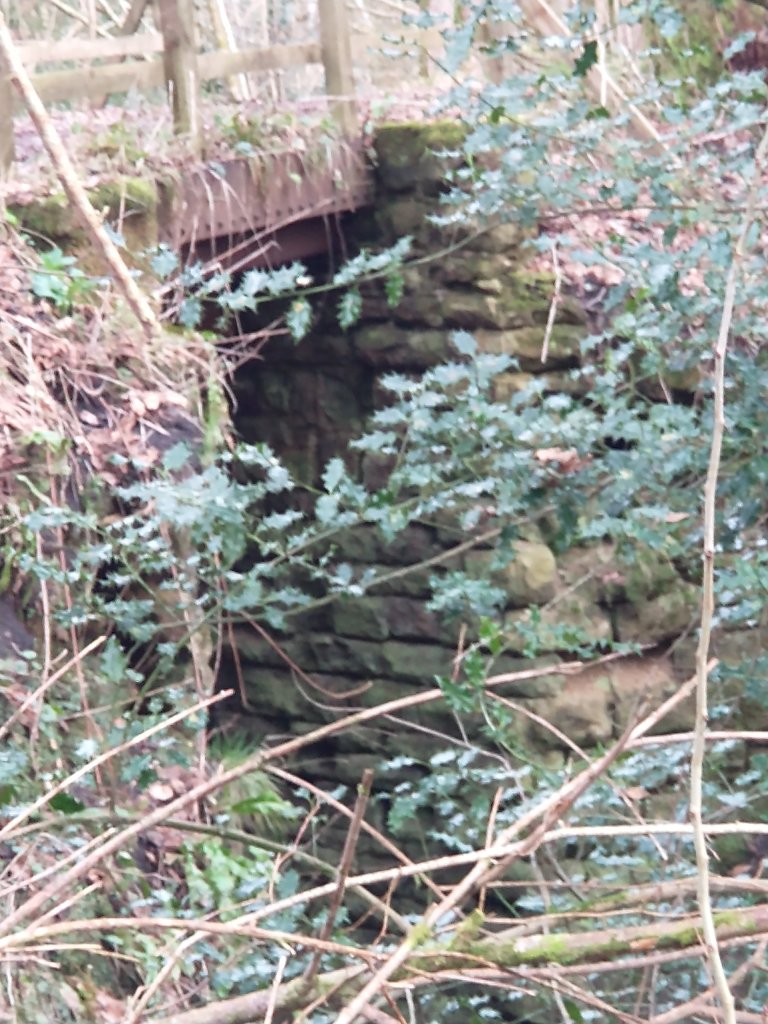
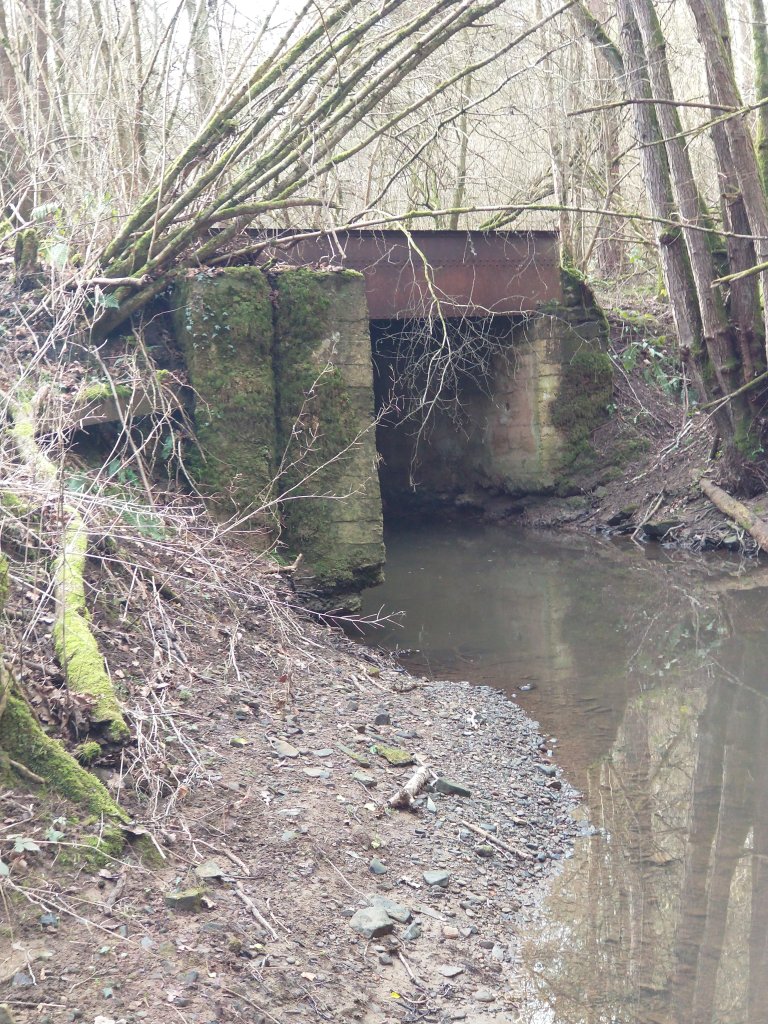
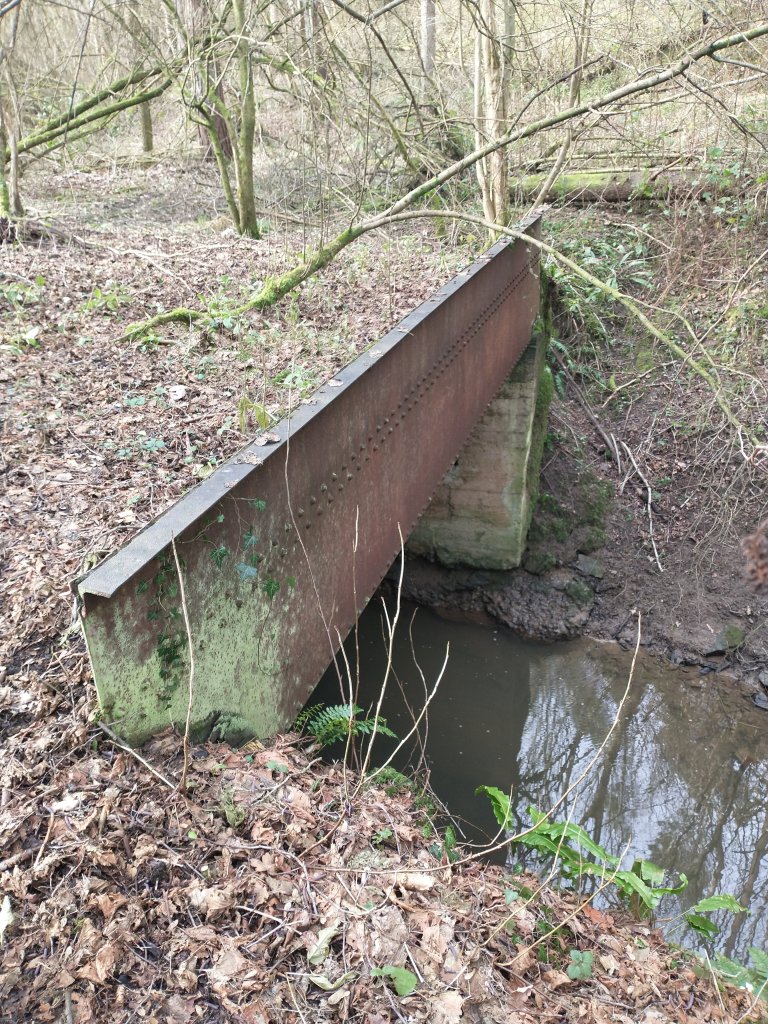
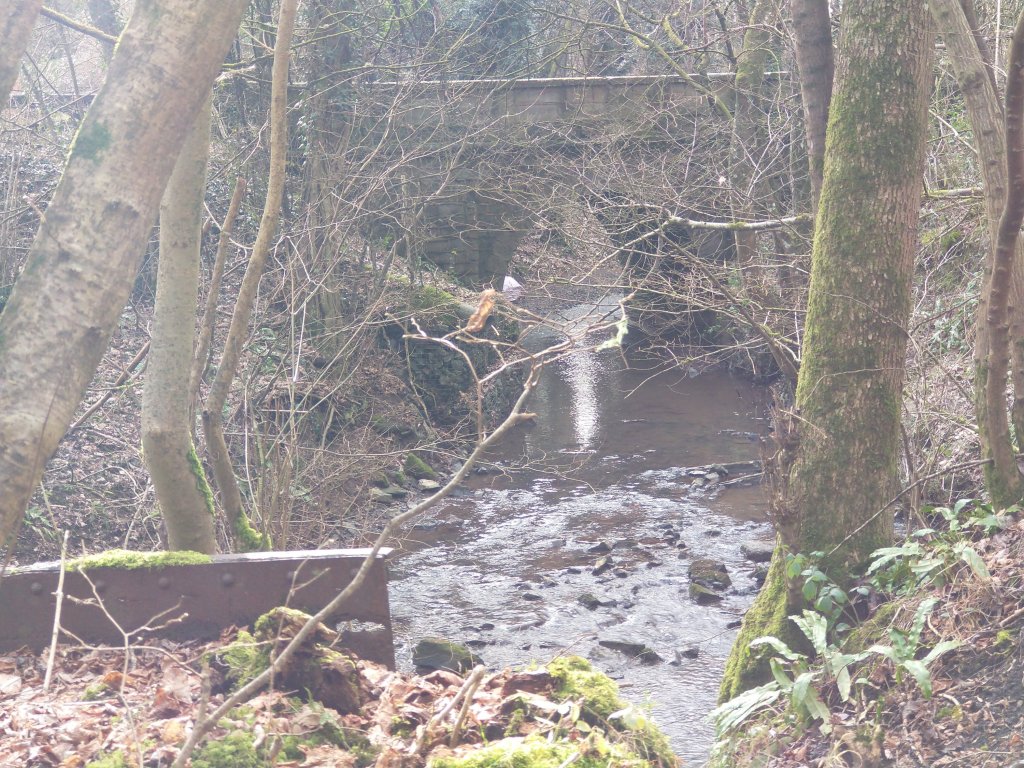
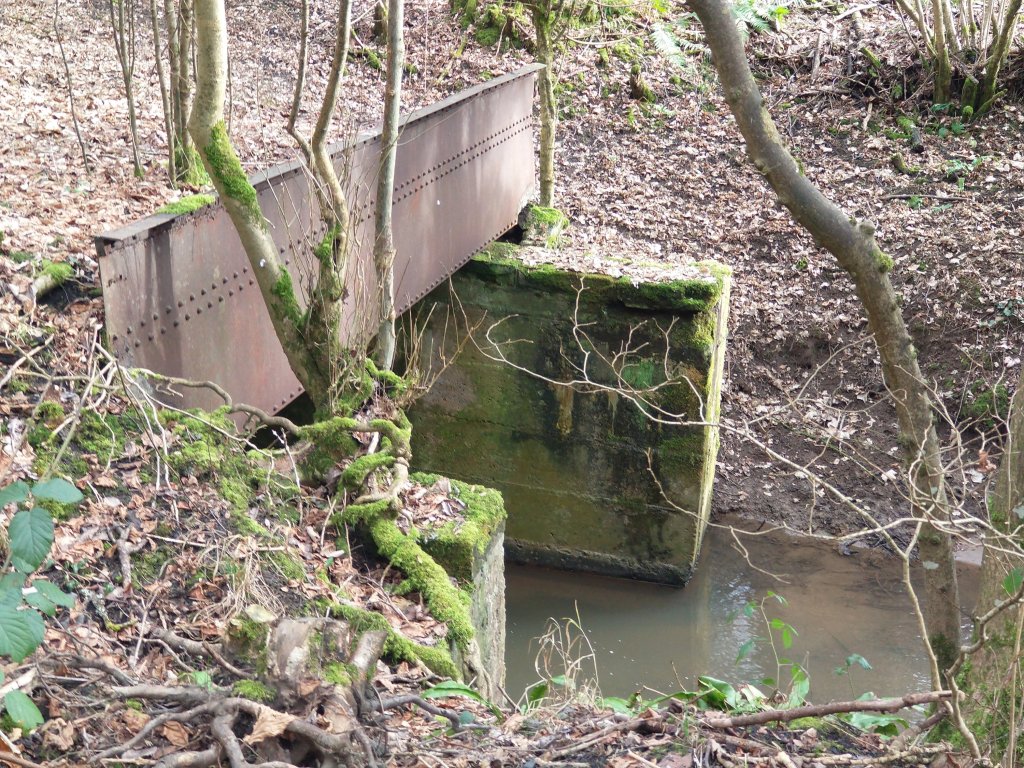
A short distance to the West as the Kinlet Colliery line begins its climb to the colliery, it crosses a tributary of Borle Brook. This is the remaining bridge structure (the abutments and pier and a single iron beam (as the picture below shows). This is the structural remains as seen looking South from the formation of the Billingsley Railway. [My Dolton John Smith, 10th February 2023]
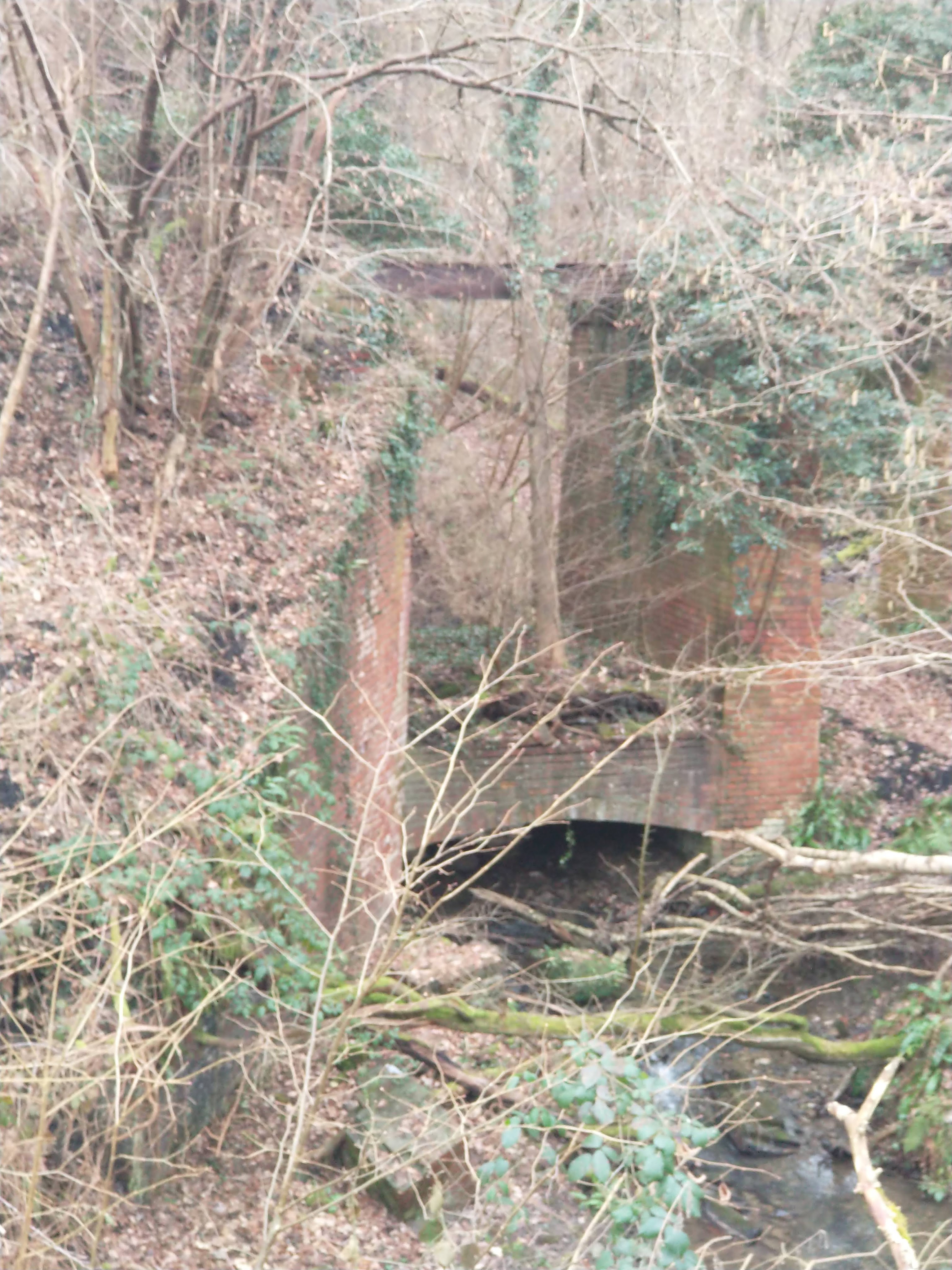
A closer view of the East abutment and the central pier of the bridge. It seems to have been strengthened by a lower brick arch close to the level of the stream. The remaining bridge beam can be seen in this image. [My photograph, 10th February 2023]
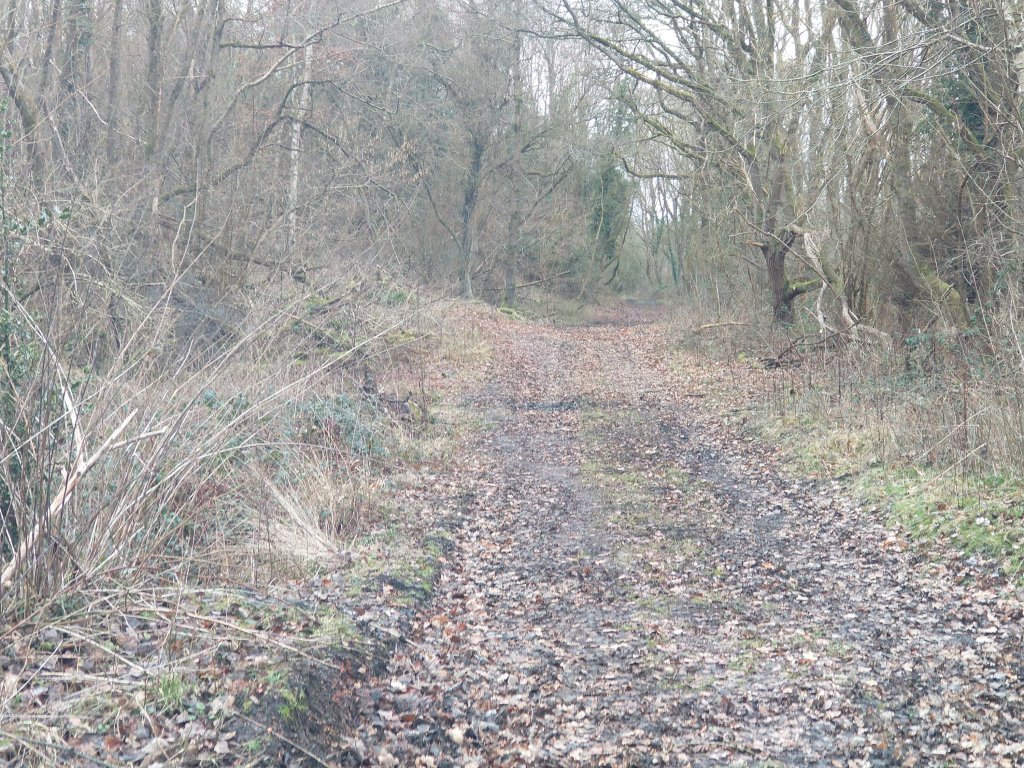
Looking back to the East along the line of the Billingsley Railway from a point on the line adjacent to the bridge pictured above. [My photograph, 10th February 2023]

There was a culvert provided for this stream when the Billingsley Railway was built. A photograph of the culvert can be seen by following this link. [59]

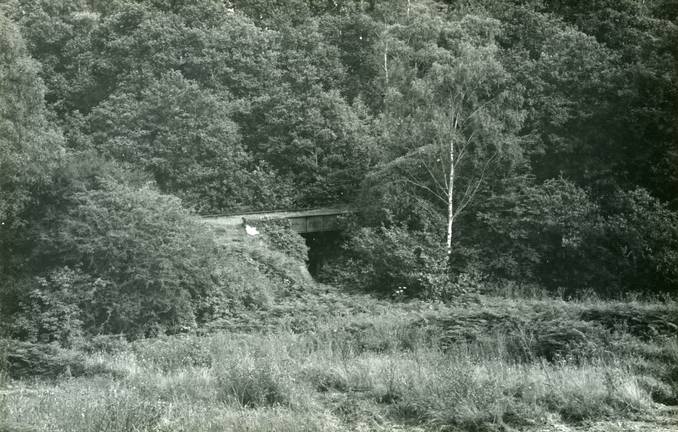
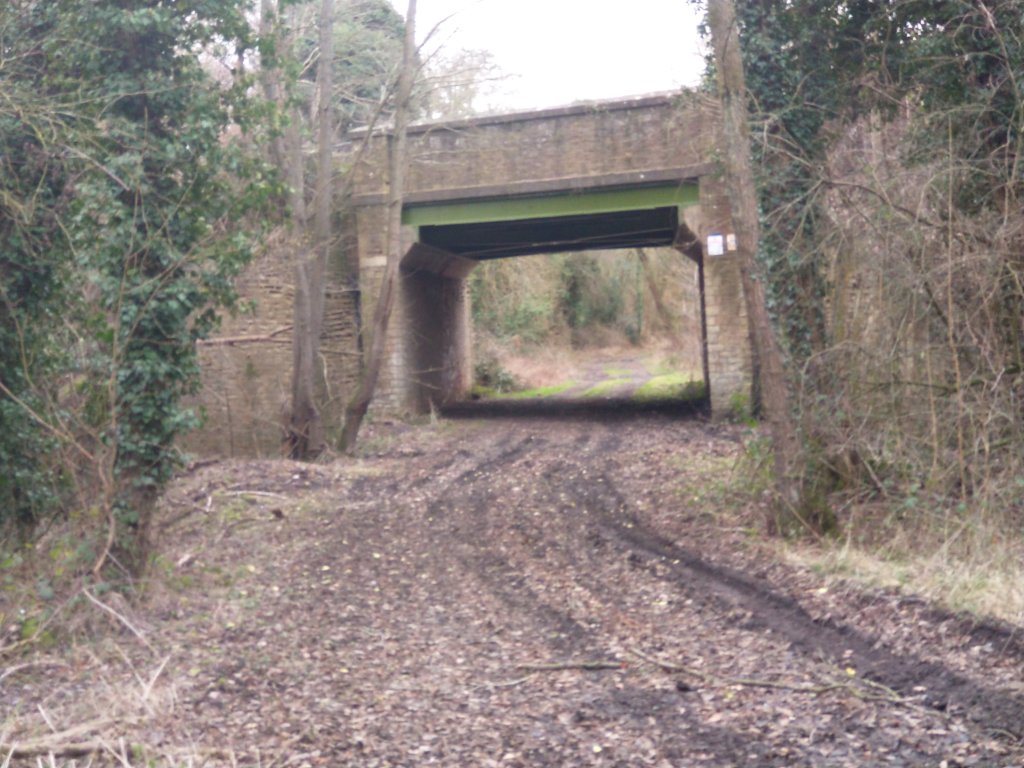
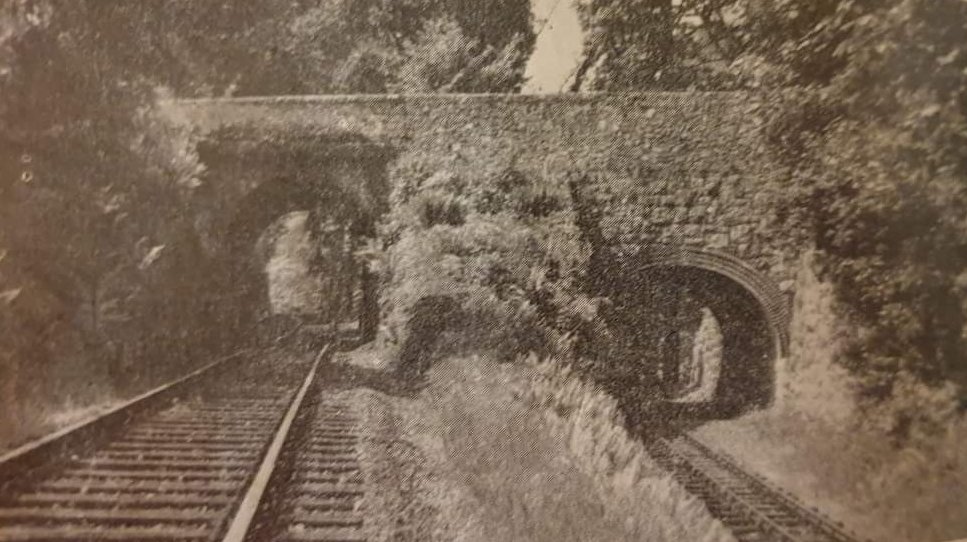
The SVRWiki website has this picture of a bridge on the line of the Billingsley Railway. I initially thought that this was at this location but the link above indicates that this must be at another location on the line. I have not been able to establish where. The topography does not appear to suit the significant bridges at New England. I’d appreciate any further information that anyone can offer which will allow the location of this photograph to be confirmed. It shows the bridge in 1963 with the trackwork lifted, © Copyright The Selleck Collection and used here under a Creative Commons Licence (CC BY-SA 3.0). [57]
The view ahead to the West from the same point. [My photograph, 10th February 2023]
The old railway route can be picked out easily on the next 25″ OS Map extract (above) – there are earthworks from the much earlier attempt to build a line to Billingsley and the track/footpath which follows the line of the railway can be picked out on the map and on the modern satellite image. The most prominent feature on the satellite image however, does not appear on the map extract – New Road (B4555). [44]
As can be seen on the map extract and the satellite image above, the railway continued but curved round to a northwesterly direction. [My photograph, 10th February 2023]
Further to the Northwest and looking in the same direction. [My photograph, 10th February 2023]
Again, further Northwest the line begins to turn West-Northwest. [My photograph, 10th February 2023]
The approach to the bridge under New Road.
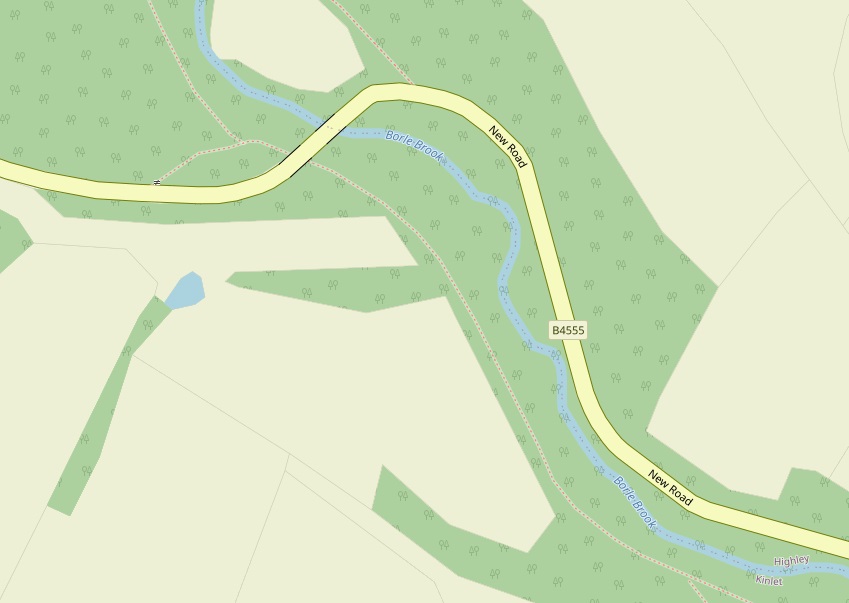
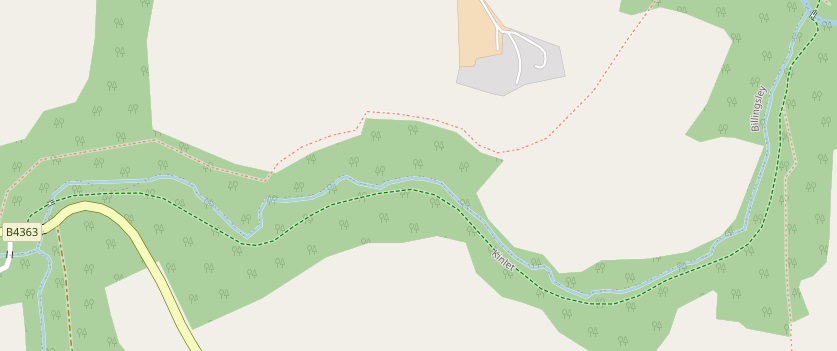
This OpenStreetMap extract, also provided by the NLS, shows the footpath (which follows the railway route), Borle Brook and New Road. The OpenStreetMap also shows the two bridges which carried New Road over Borle Brook and the railway. Neither can be seen easily from the road. [44]

Tennent tells us that there was a single siding on the South side of the line before the railway passed under a concrete bridge built for New Road. [1: p9] There is, unsurprisingly, no evidence of the sliding at the location in 2023!

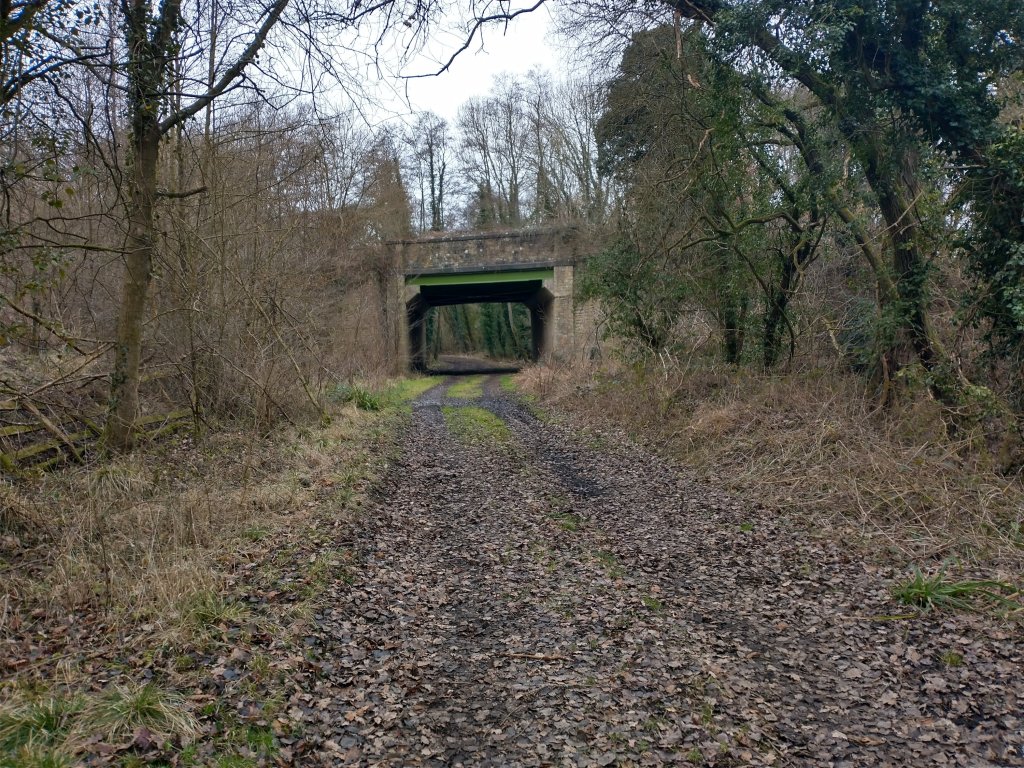
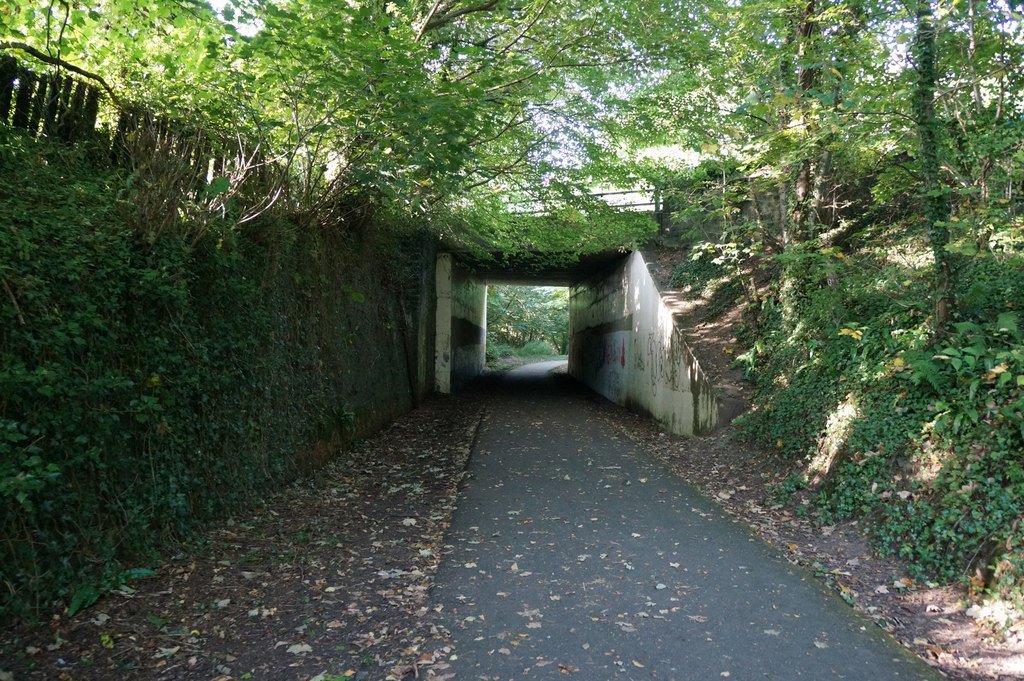
Looking Northwest on the approach to the relatively modern overbridge which carried New Road over the old railway. Borle Brook flows off to the right of the image. [My photograph, 3rd February 2023]
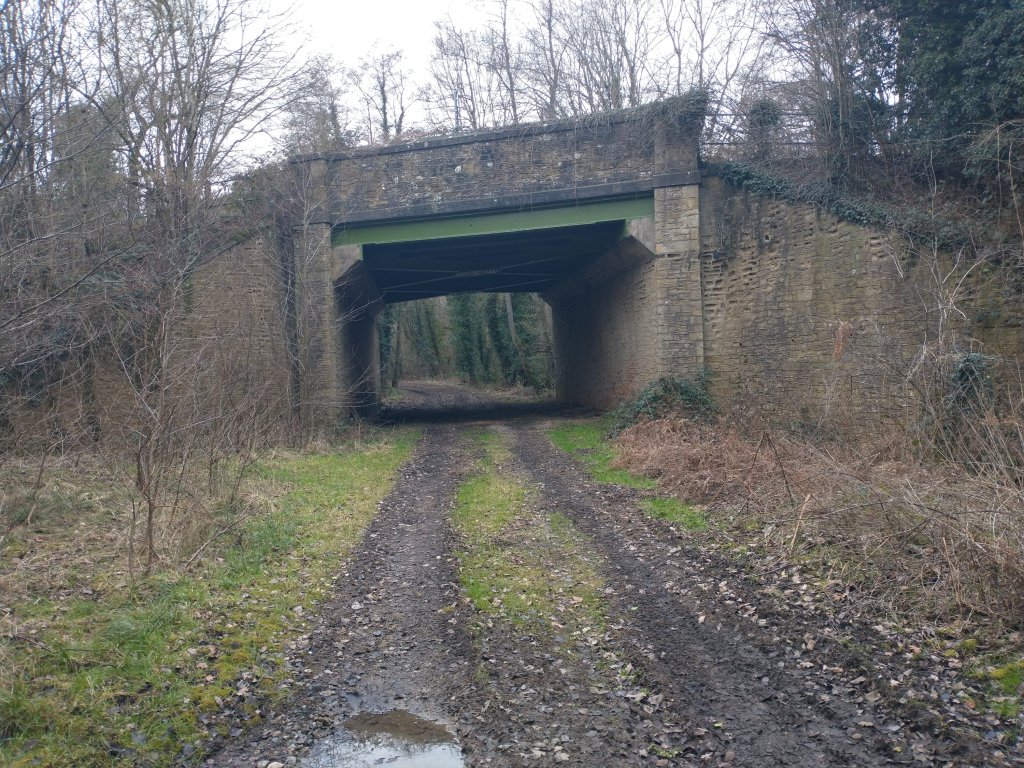
Looking back to the Southeast under the road bridge. [My photograph, 3rd February 2023]
This photograph shows the culverted Borle Brook as it passes some distance below New Road. The photographer is standing close to the track bed of the old railway on the Northwest side of New Road and looking East, but perhaps 3 metres lower than the line of the Billingsley Railway. [Photograph taken by J.H. Farnworth on 10th February 2023 and included here with kind permission]
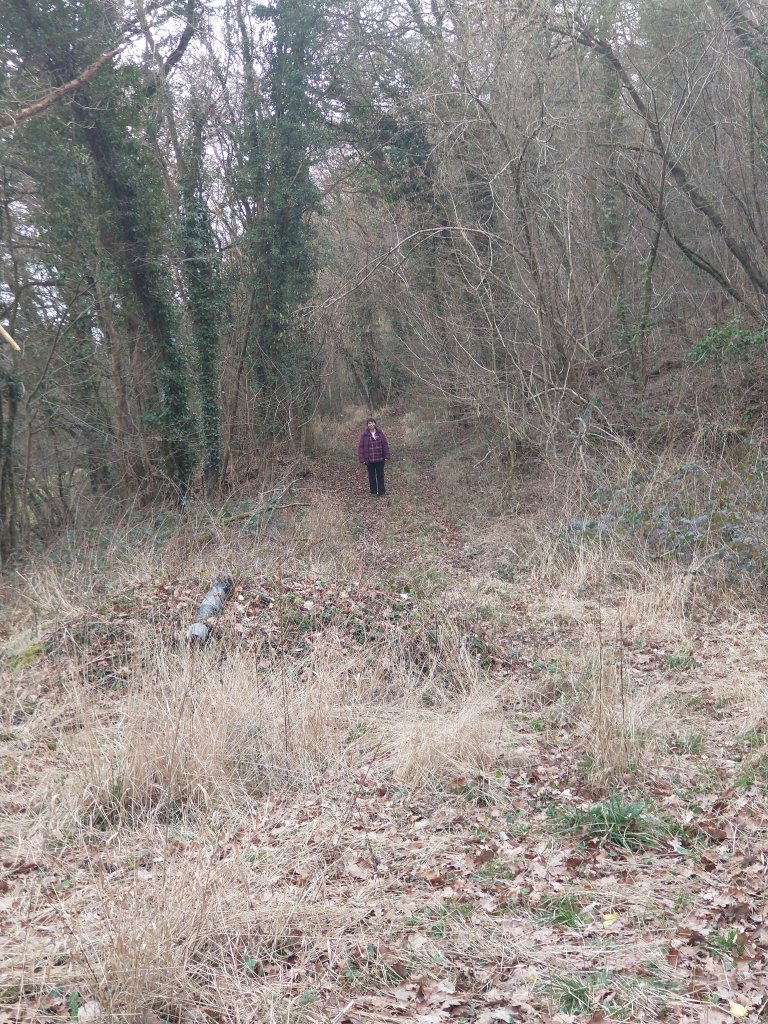
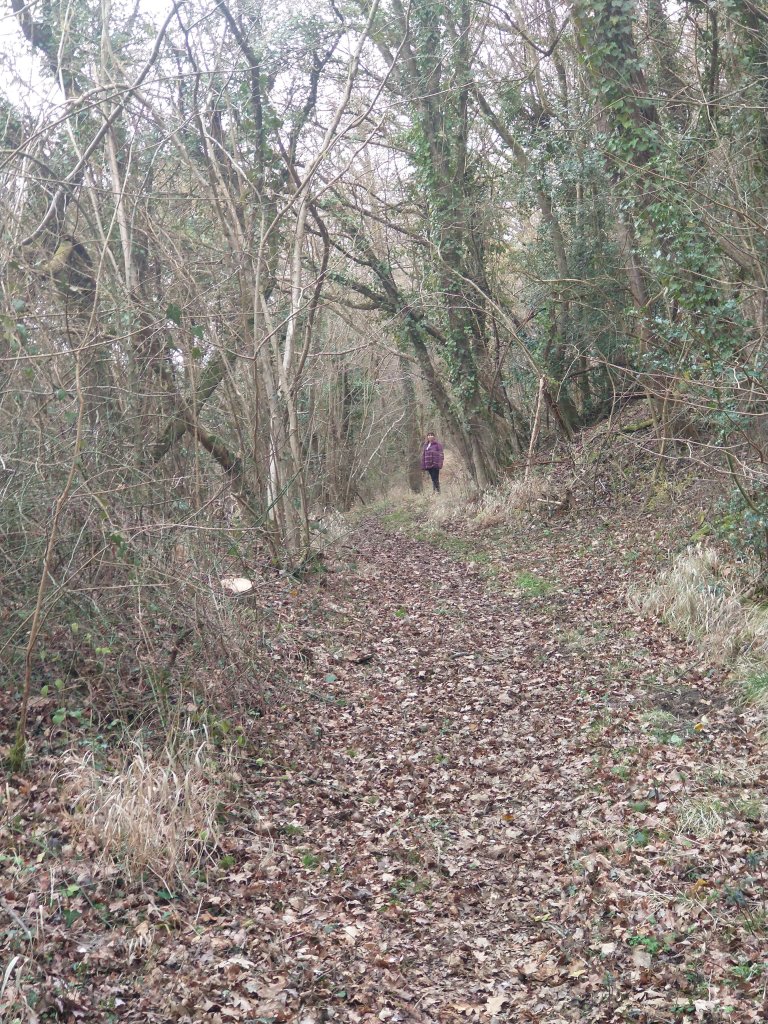
About a third of the way along the trackbed between the New Road and Borlemill Bridge, looking North. [My photograph, 3rd February 2023]
Approaching Borlemill Bank and Borle Mill Bridge along the line of the railway. [My photograph, 3rd February 2023]
Looking South along the route of the old railway from Borle Mill Bank. [My photograph, 3rd February 2023]

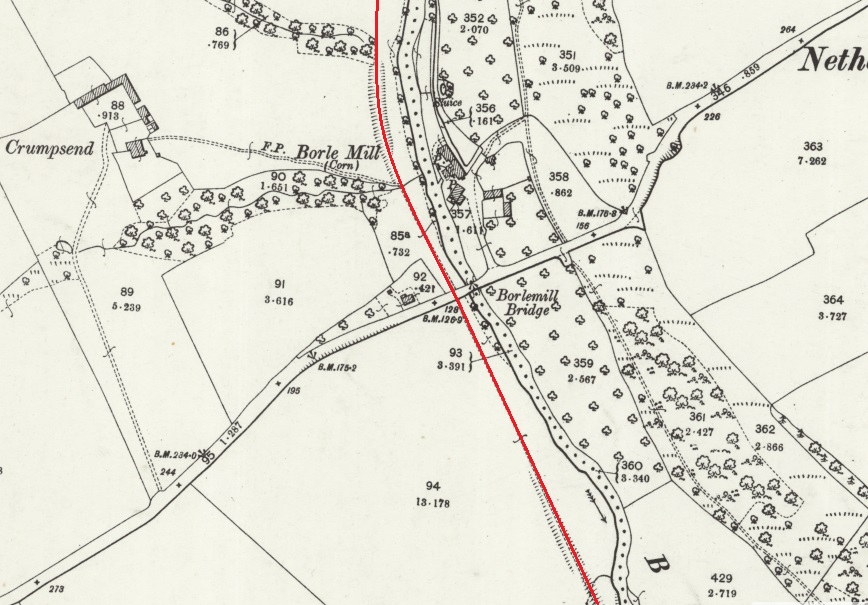
The railway encountered the old road a few hundreds of yards to the Northwest of New Road. It crossed the road on the level. The old road, Borle Mill Bank, was very steep at either side of Borle Brook’s valley. Tennent says that, “the crossing gates were linked by wires to two semaphore signals at the top of the gradients on each side of the valley. When the gates closed to the road, the signals went to danger and road users stayed at the top of the hill if they had any doubts about the effectiveness of their brakes. Strangely, the signal arms were painted white or grey but not the usual red. They did, however, display the usual red or green lights at night. The west one was level with the top of Borle Mill Cottage garden and the east one was by the bend in the road near the house at the of the hill.” [1: p9]

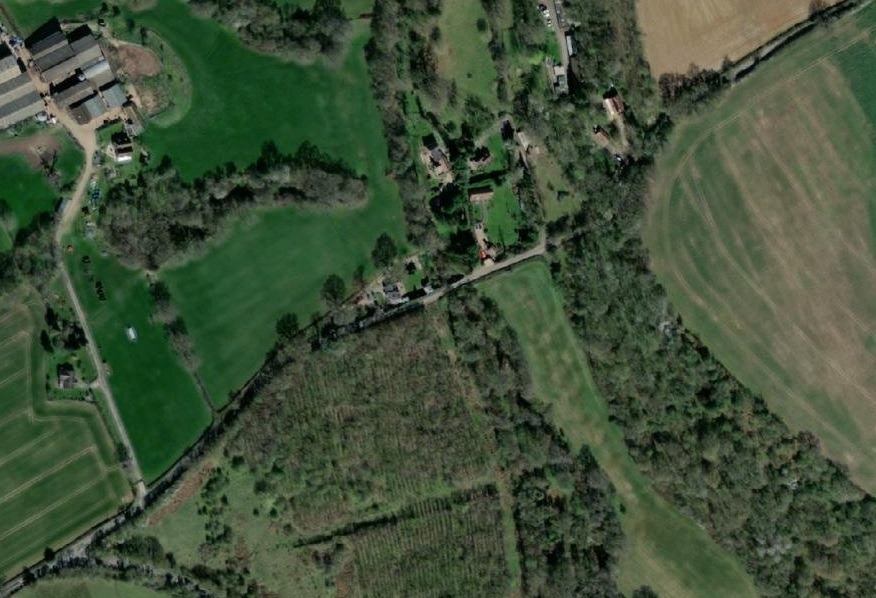
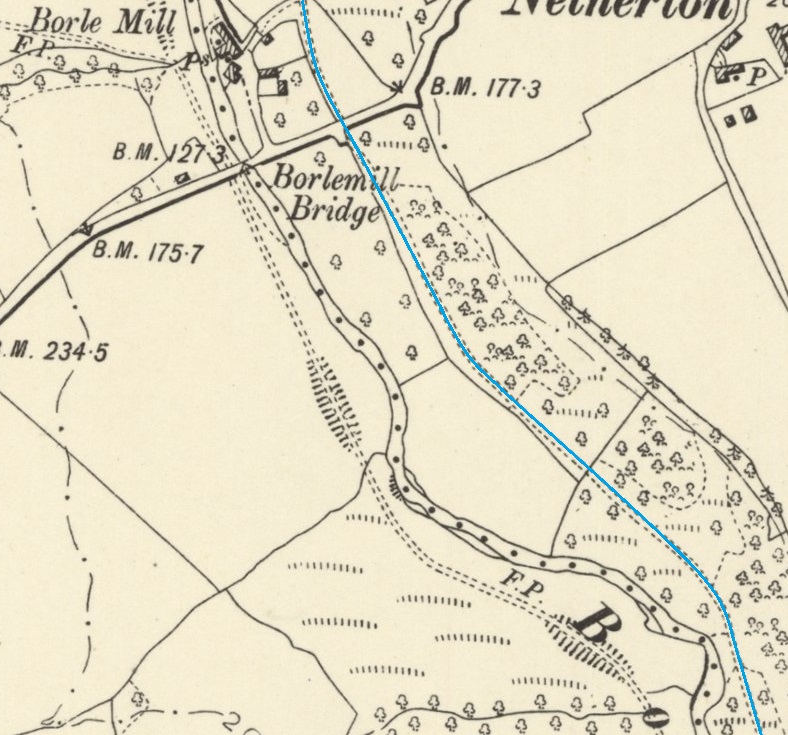
This next segment of the mapping and satellite imagery shows the railway crossing Borlemill Bank close to Borle Mill and Borlemill Bridge. [45]
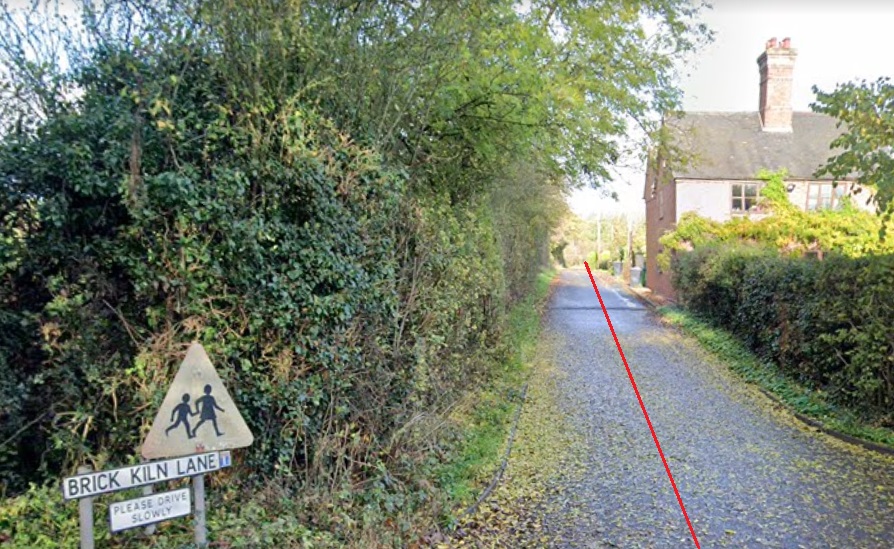
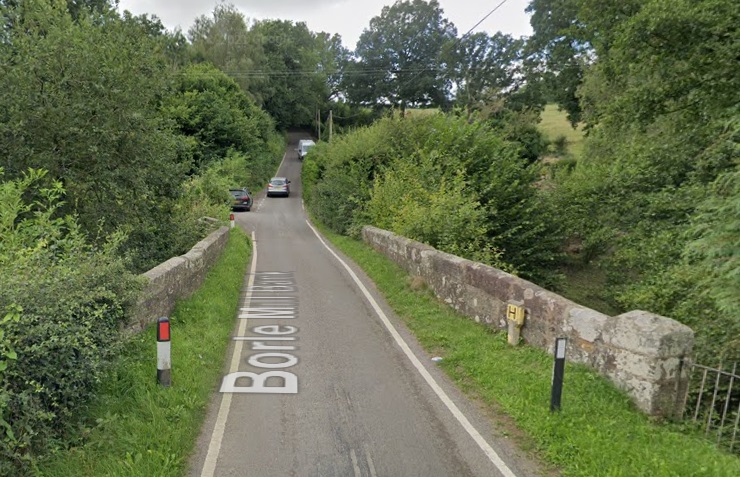
Looking West-southwest along Borl Mill Bank across Borlemill Bridge towards the location of the Billingsley Colliery Railway Crossing which was just to the West of the Bridge. [Google Streetview]
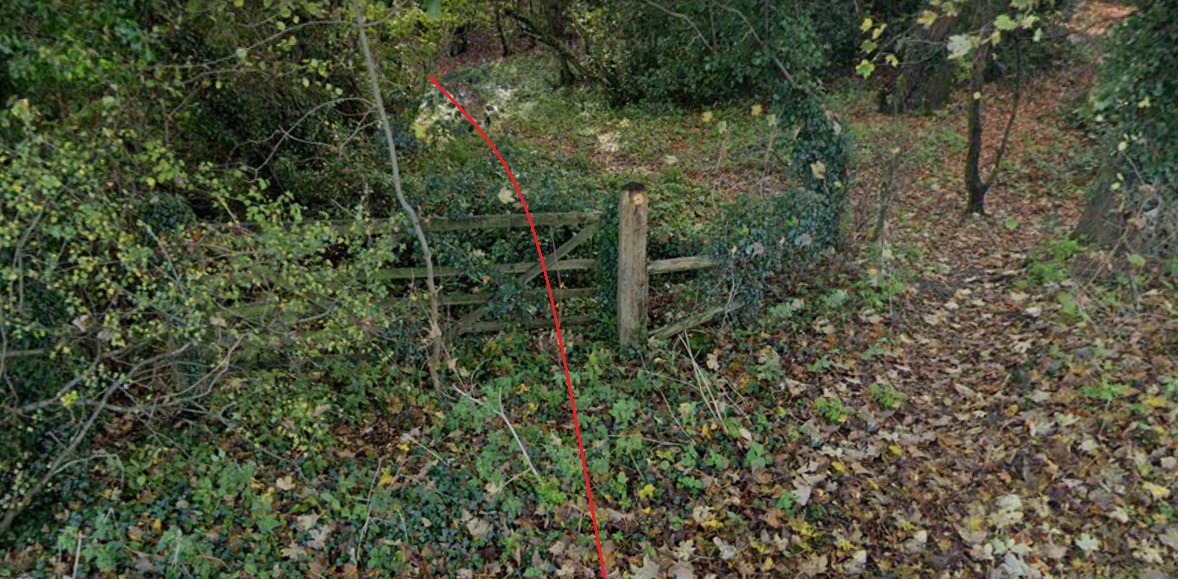
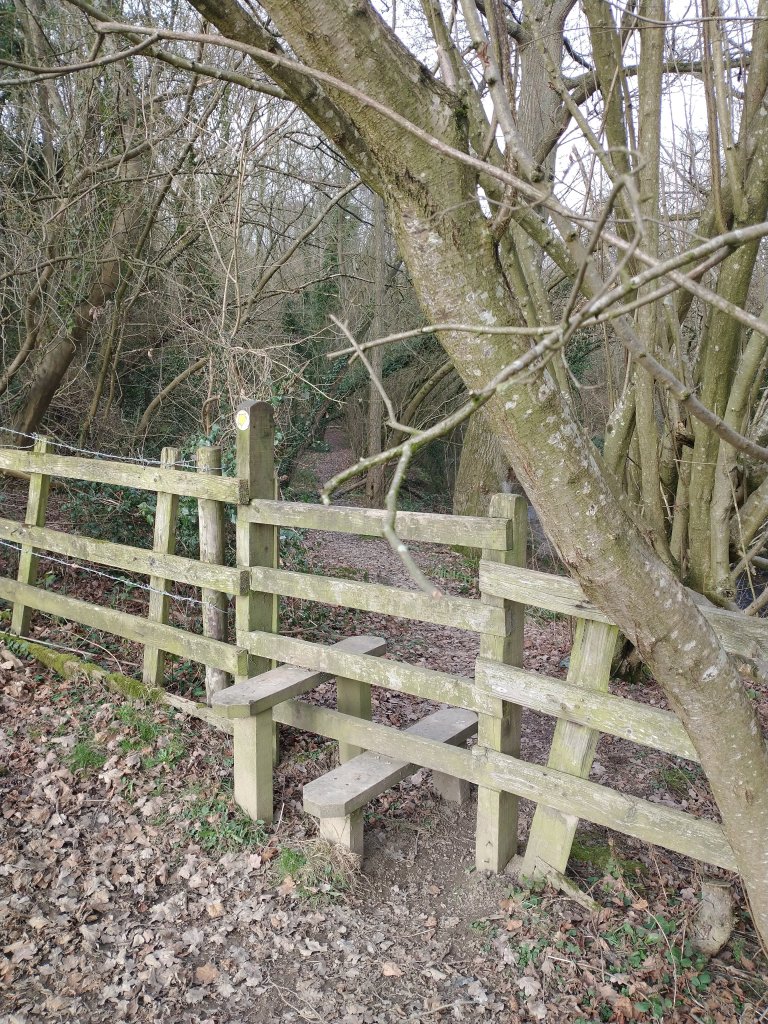
Still looking West-southwest, the red line shows the route of the old railway which is followed by a public footpath. There is a styal for the footpath just this side of the vehicle closest to the camera. [Google Streetview]
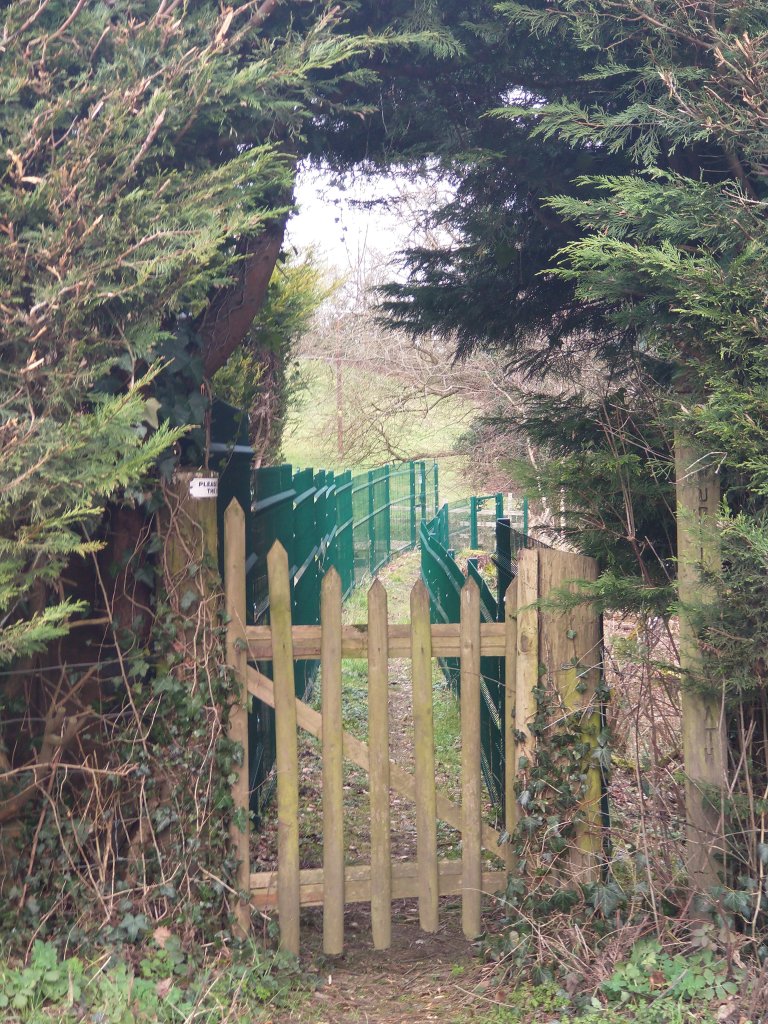
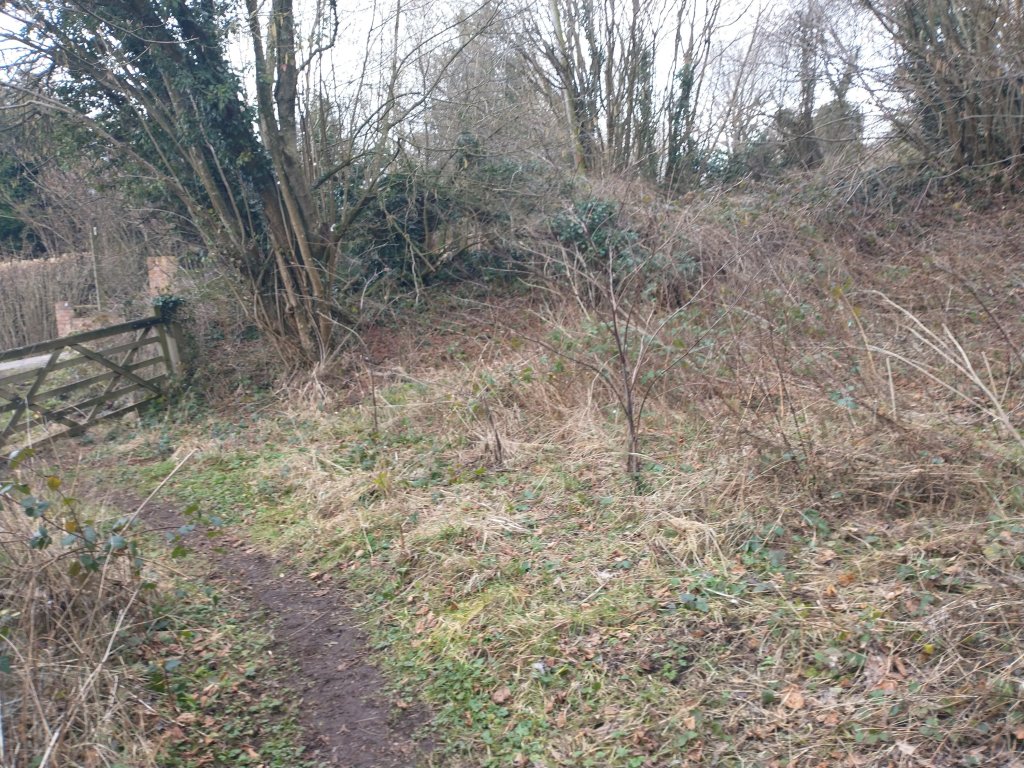
A gate protects the footpath as it heads North away from Borle Mill Bank on the line of the old railway. [My photograph, 3rd February 2023]

The railway continued North alongside Borle Brook.

North of Borle Mill the line of the old railway crosses what is now open farmland. I have shown the approximate line of the railway on the satellite image as well as the 25″ Ordnance Survey as the route is indistinct. One of the short cuttings is still visible on the satellite image at the third point from the top of the image. [46]
The first field boundary along the line of the old railway. [My photograph, 3rd February 2023]
The line cut across the fields, alternately running close to the brook and then further away. [My photograph, 3rd February 2023]
Borle Brook from the line of the old railway. [My photograph, 3rd February 2023]
The line of the old railway follows Borle Brook closely on the way to New England, a small hamlet which was located just off the North West corner of these map and satellite extracts. [47]
The styal at the entrance to the woodland shown above. The formation of the old railway runs ahead, now close to the brook. [My photograph, 3rd February 2023]
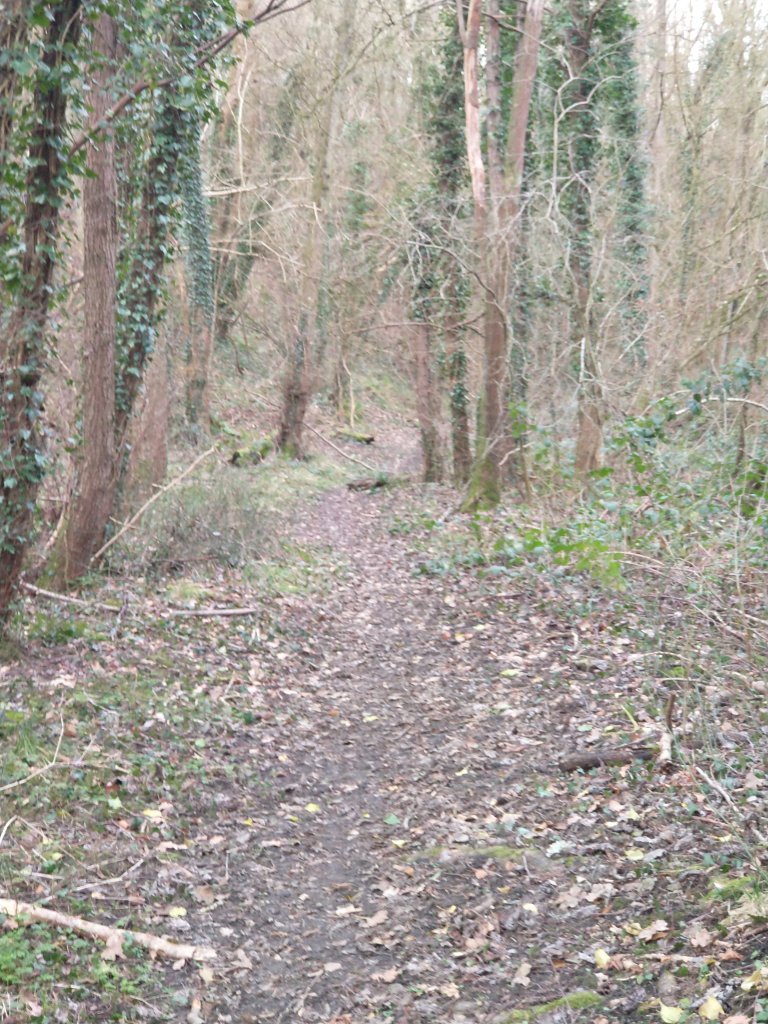
The railway route alongside Borle Brook as it approached New England. [My photograph, 3rd February 2023]

About a mile from Borlemill Bridge, the line crossed a tributary stream and entered a short reversing line. Two bridges crossed the tributary and the ongoing line needed to curve sharply to the South to follow the tributary. The location was known as New England.

An enlarged extract from the 1901 25″ Ordnance Survey which was published in 1902. Note the ford across Borle Brook, the tributary to the South and the row of terraced cottages. This was a reversing point on the line to Prior’s Mill. [48]
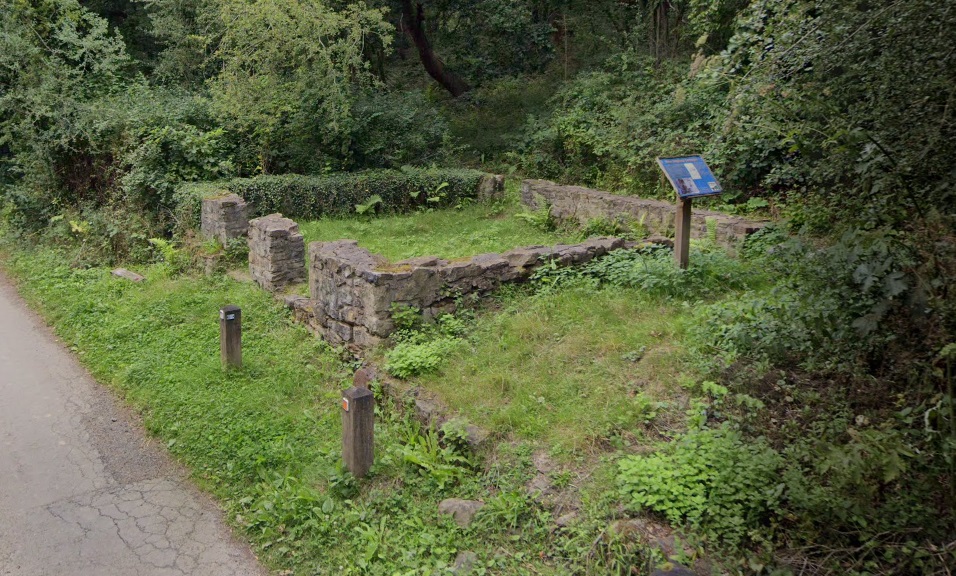
The area remains deeply wooded. Most of the evidence of the terrace of cottages has gone, the quarry workings and the route of the old railway are completely hidden by vegetation. An archaeological unit undertook a dig at the site and uncovered the remains of one of the end cottages. The remains are still on display. [48]
The remains of New England Cottages. the reversing point was a few 10s of metres to the South of the lane at this location. [Google Streetview, August 2021]

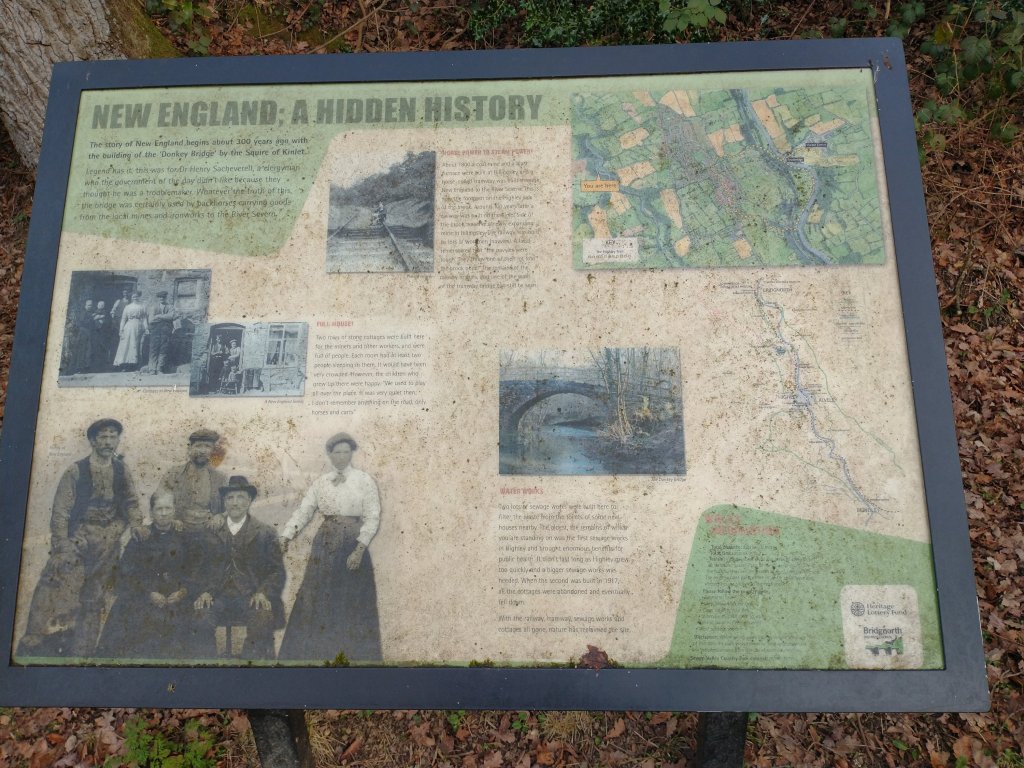
In 1807 two rows of stone cottages were built at right angles to each other. The cottages were occupied by colliers, woodsmen and labourers. There was also a brick washhouse on the site. By 1918 the cottages were empty and demolished. The footprint of one of the cottages can still be seen,” (as shown in the Google Streetview image above). [49]

The ford on New England Lane crossing Borle Brook. [Google Streetview, August 2021]

In addition to the cottages, there is a ford near the location and the remains of Highley’s first sewage works. The ford by which New England Lane crossed Borle Brook can be seen above. The site of the sewage works can be seen immediately below.

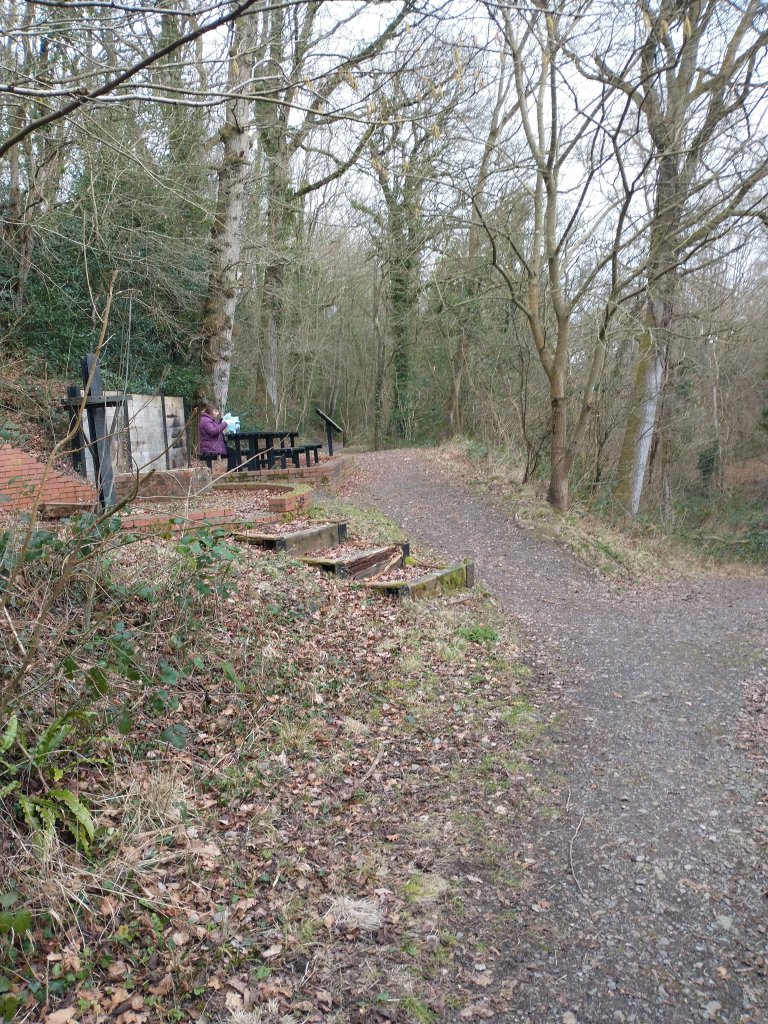
Picnic benches sit at what was the site of the Highley Sewage Works! [My photograph, 3rd February 2023]
The information board at the picnic site. [My photograph, 3rd February 2023]

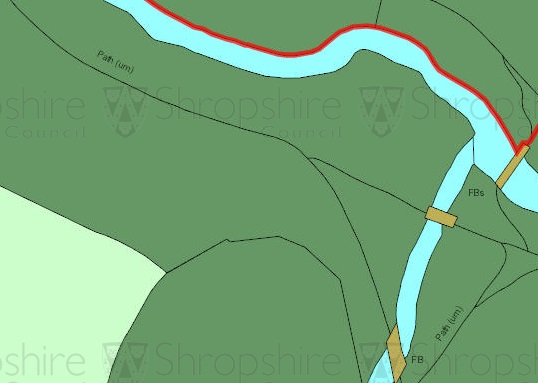
Three bridges at this location are shown on the Ordnance Survey below. All are shown with footpaths crossing them. The footpaths over the bridges crossing the tributary are now closed.

The location on Ordnance Survey Digital Mapping in 2023. The footpaths shown follow the old railway’s routes, entering the extract from the right, trains would have crossed the tributary before then reversing up the line to the South. Borle Brook flows from the top-left to the centre-right of this image, the tributary flows from the south towards a confluence with Borle Brook © Crown Copyright. [49]
The Donkey Bridge over Borle Brook. This is the bridge shown on the modern digital OS Map extract above close to the right side (east) of the extract. This bridge carries the Jack Mytton Way and South of it the Jack Mytton Way follows the old railway formation, © Copyright Noisar and licensed for reuse under a Creative Commons Licence (CC BY-SA 2.0). [50]
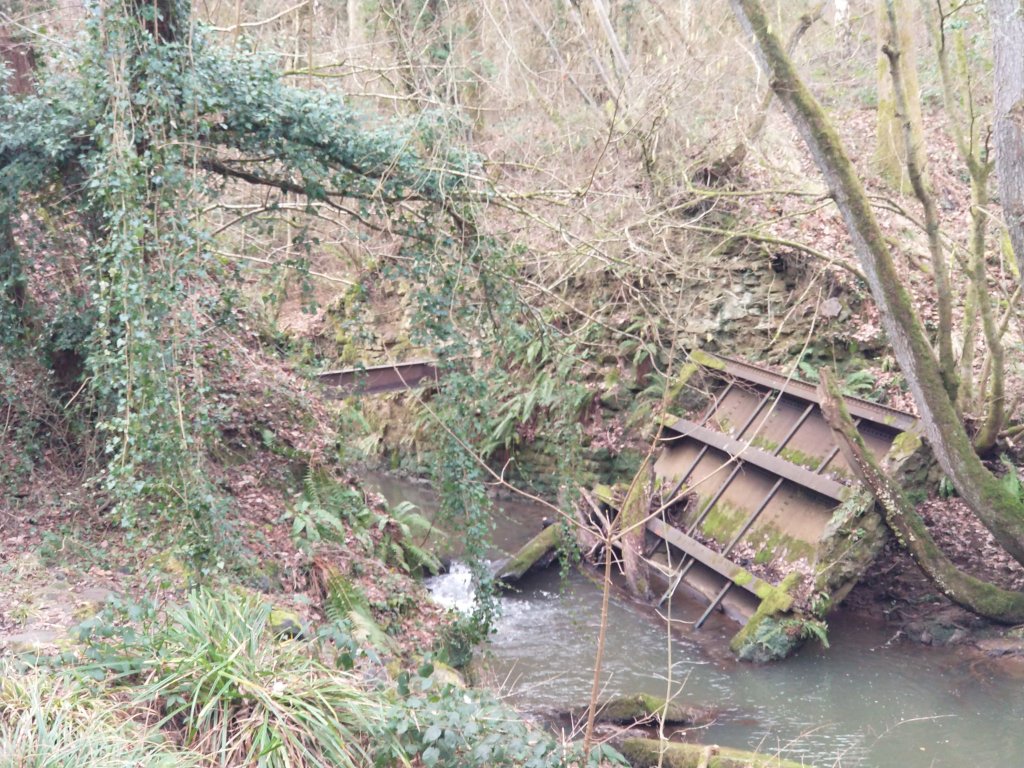
The more northerly of the two rail bridges over the tributary. The deck has collapsed and is now partially blocking the stream. The short length of footpath which crossed the bridge is now closed! [My photograph, 3rd February 2023]

A sequence of three photos of the second bridge follows …..

A view from the footpath to the East of the stream, facing Southwest. [My photograph, 3rd February 2023]
A view along the Eastern edge-girder of the bridge deck taken from the South. My photograph, 3rd February 2023]
A view from the South across the bridge deck. The footpath beyond the bridge, to the North, is barriered-off but it remains possible to walk out over the bridge to look up and down the stream. [My photograph, 3rd February 2023]

After reversing at New England, trains crossed the tributary stream and followed its East bank to Priors Moor. There it terminated at the colliery screens.

The green dotted line on this extract from the OpenStreetMap shows the approximate line of the public footpath which follows the old railway formation. The detail at the confluence of Borle Brook with its tributary stream (top-right) does not quite match the Ordnance Survey extract above. This length of the railway formation now carries part of the Jack Mytton Way. [51]
Ths extract from the OpenStreetMap website shows the main areas of interest on this section of the line. [54]
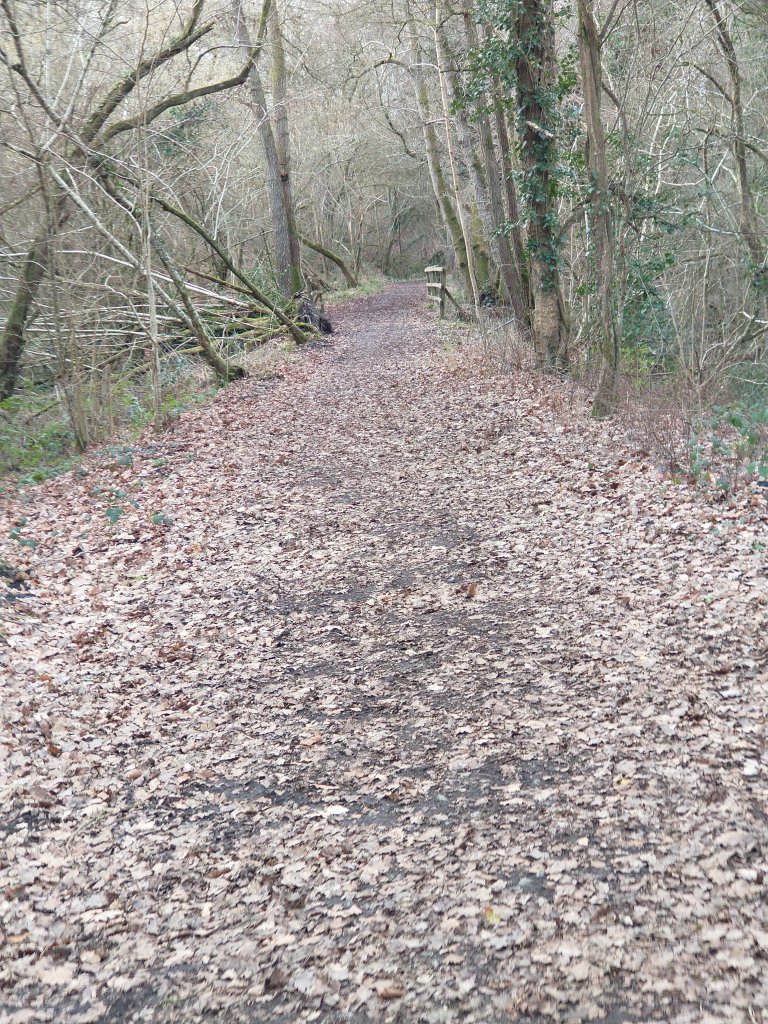
After running to the South, the line turned to the West, heading toward Priors Mill. [My photograph, 3rd February 2023]
For a time, the footpath along the route was no more than a narrow path, but it widened out to cover the full width of the formation of the old railway. Ahead, the formation crosses the line of a stream on the bridge shown below. [My photograph, 3rd February 2023]
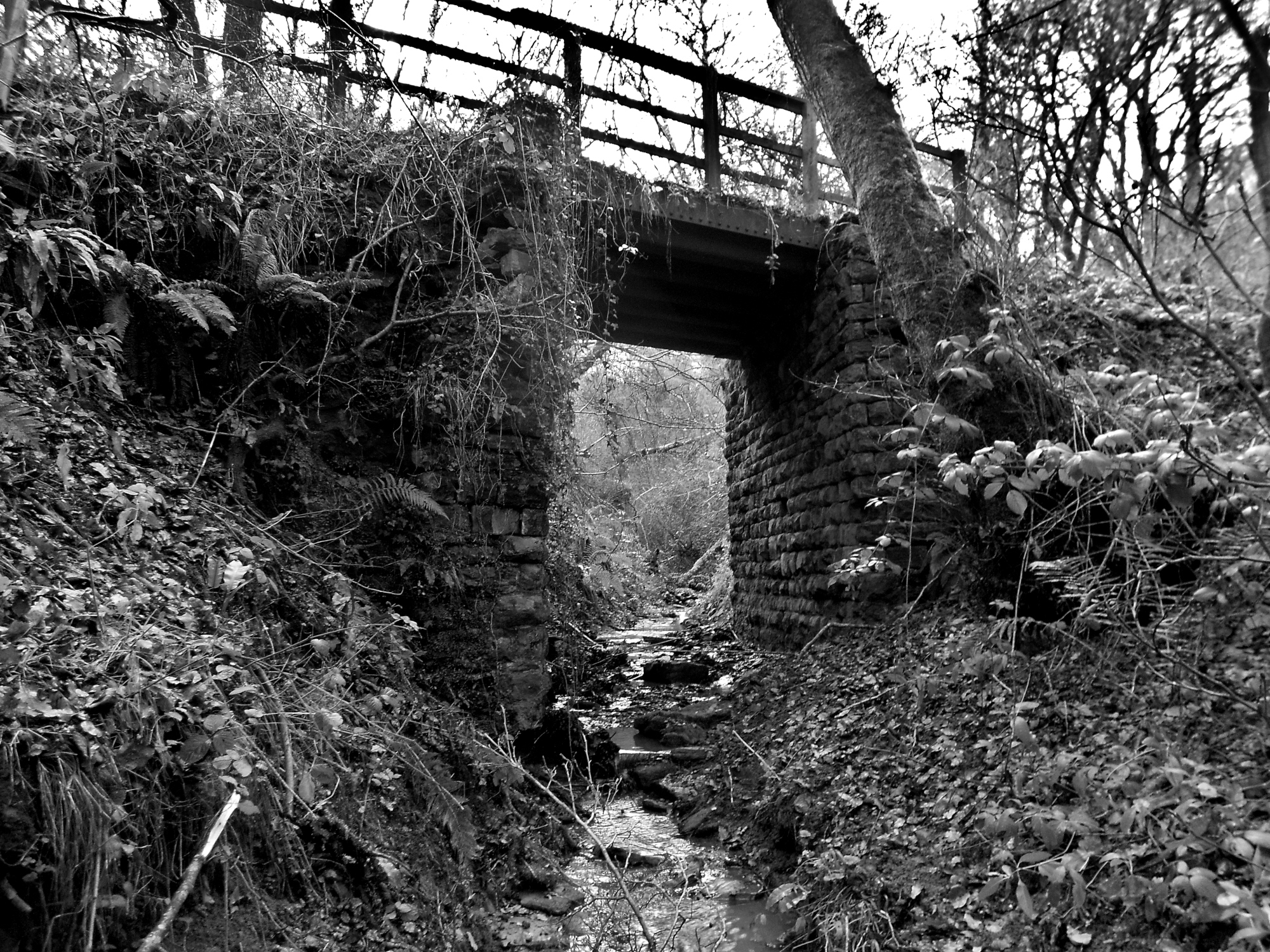
A small-span girder bridge which carried the old railway over a minor stream. [My photograph, 3rd February 2023]
The same bridge in monochrome, shared on the Highley Forum by ‘badgerbrad’ and included here by kind permission of the photographer. [61]
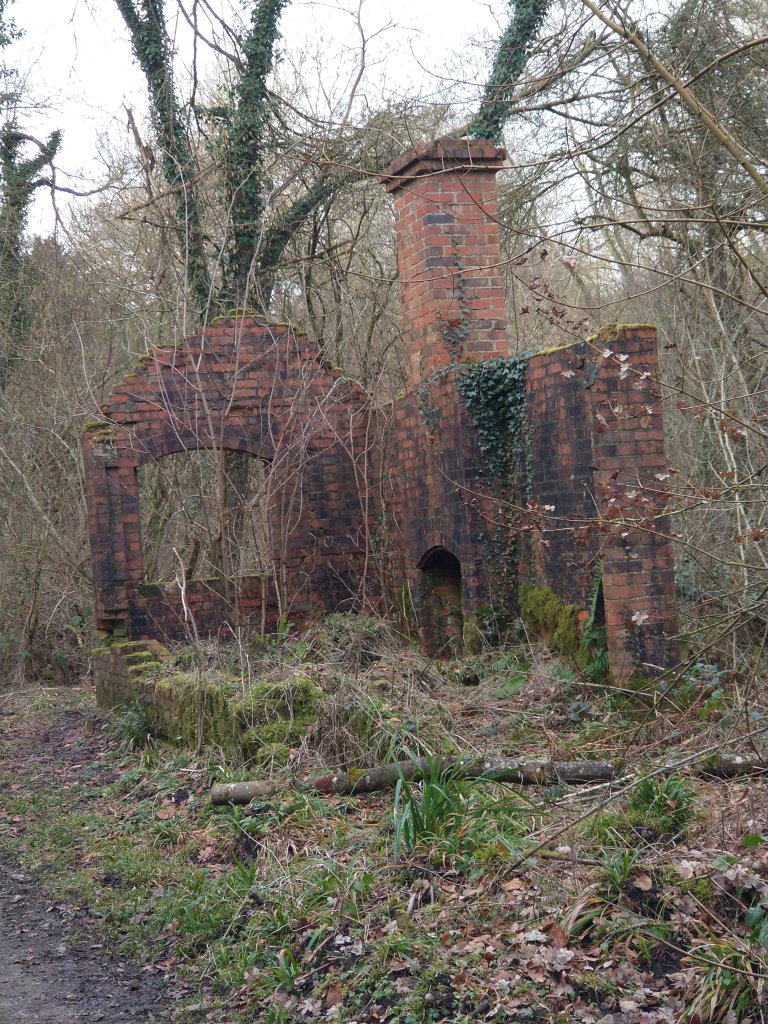
Approaching the Priors Mill site near Ray’s Bridge the line passed over the site weighbridge. This is what remains of the weighbridge office. [My photograph, 3rd February 2023]
After the weighbridge, the line curved to the right. [My photograph, 3rd February 2023]
The line then curved round to run alongside the screens. [My photograph, 3rd February 2023]

Priors Moor, the terminus of the standard-gauge Billingsley Railway: The railway terminated at the Billingsley Colliery screens at Priors Moor. Tennent tells us that “just before the terminus, a single road engine shed was passed on the right. The colliery was situated some 200 feet above the valley near Billingsley village and was connected to the screens by means of a rope-worked narrow-gauge tramway incline. The screens and railway yard were partly constructed on a girder bridge above the stream and this structure can still be seen from the adjacent road.” [1: p9-10]

We did not see any remnants of the engine shed on our site visit on 3rd February 2023. We found the channelled length of the stream and the culvert which carried the stream under the screens.

The walled channel of the diverted stream. [My photograph, 3rd February 2023]
Another view of the walled channel of the diverted stream. [My photograph, 3rd February 2023]
The East end of the culvert which supported the screens. The walled channel of the diverted stream. [My photograph, 3rd February 2023]
Another view of the East portal of the culvert. [My photograph, 3rd February 2023]
A view across the far end of the culvert towards Ray’s Bridge. [My photograph, 3rd February 2023]
The West end of the culvert which supported the screens, seen from the North. [My photograph, 3rd February 2023]

The yard was also the terminus of a short-lived aerial ropeway serving a brick works near the Cape of Good Hope Inn. It seems that the brickworks were reopened in 1914. Tennent tells us that this was intended to “provide bricks for miners’ houses at the “New Village” at Highley … [The ropeway had a short working life as, following a dispute with the local council, building work ceased and the ropeway closed just a year after opening. It was not dismantled until 1937-38 when the railway was lifted. … The delivery of bricks was unbelievably complicated – ropeway to Priors Moor, Billingsley Railway to Kinlet Sidings, GWR to Highley Station and steam lorry to the building site. The latter caused complaints as it cut up the roads.” [1: p11]

The AditNow website has a number of photographs of the Priors Moor location, all of these were provided by I.A. Recordings. Rather than showing the images here, links are provided to the most relevant pictures to the Priors Moor site: [52]

Tennent provides an excellent monochrome postcard view of the Priors Moor site [1: p10] which shows that the sidings had four lines. The same image (below) was shared on the Bewdley Past Facebook Group in 2018.

Billingsley Colliery screens and sidings in around 1915. This image was shared by Andy Pye on the Bewdley Past Facebook Group on 29th March 2018. The image was published as a postcard in 1916. The screens and aerial ropeway were driven by electric motors powered by a steam generator at the colliery, © Reg Southern. [55]

Steam on the Billingsley Railway

Peckett & Sons Ltd. W4 Class 0-4-0ST (Works No. 599)

This locomotive was built in May 1895 for “Christopher Rowland, a shunting contractor of Swansea Docks: the works photograph shows that it carried “R No. 4” on its tank indicating that it was his fourth locomotive. In August 1891 Rowland was given a contract by the Swans Harbour Trust to load and discharge ballast and cargoes at the docks. … His business continued until his death in 1910 when it is probable that his work was taken over by Powesland and Mason, the main shunting contractors at the docks.” [41: p13]

No. 599 seems to have become surplus to requirements at this time and “was sold to C.D. Phillips, an engine dealer of Newport. … [by] May 1913 … the engine had probably been acquired by the Billingsley Colliery Company. William Foxlee, a director of the Billingsley Colliery Company was also a railway engineer who admired the products of Peckett’s Atlas works; he may have recommended purchase of [No.] 599.” [41: p13]

Several hundred of Peckett’s W4 Class locos were built over a period of 20 years from 1886. “As built, it was of peculiar appearance as it was adapted for extensive street running. … The wheels and coupling rods were hidden behind hinged panels and the exhaust steam from the cylinders was not discharged into the air but was led back by pipes to the tank where it was silently condensed. It is likely that, if these modifications still exited in 1913, they were removed by the Billingsley Colliery Company. The cab had no side panels above waist height as originally built, it is possible that more protection would have been offered to the crew when the engine ran to Billingsley.” [41: p13]

The Highley Mining Company bought Billingsley Colliery in 1915. When Billingsley Colliery closed in 1921. Poyner suggests that they favoured the 0-4-0ST which it seems was more than capable of managing the 1 in 15 incline and was more able to negotiate the sharp curves on the Billingsley Colliery line. It was retained and ‘Kinlet’ was sold.

Kinlet Colliery and Railway

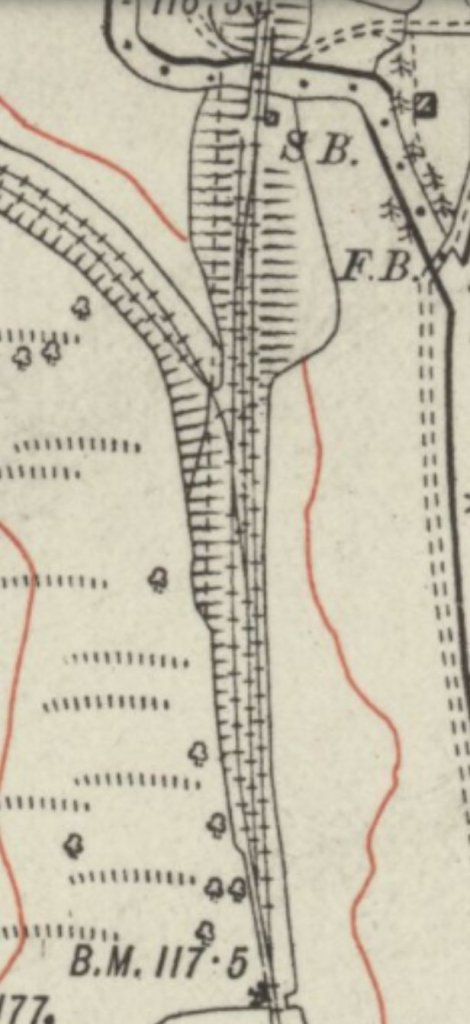
Kinlet Sidings as shown on the 6″ Ordnance Survey as revised in 1925 and published in 1929. The line running to the West at the top of the extract serves the Colliery. The bridge shown at the top of this map extract is the Viaduct over Borle Brook which is illustrated in the section of this article about the Billingsley Railway. There is a signal box shown immediately South of the Viaduct and to the East of the SVR. [30]

The first siding for the Highley Mining Company’s Kinlet Colliery was sanctioned for use by the Board of Trade on 9 October 1895. It was situated a short distance south of Borle Viaduct, and had a single south-facing connection to the main line. The GWR subsequently entered into a contract for coal from the colliery, and in 1899 the sidings were greatly enlarged and connected to a 320 yard loop off the main line, accessed by a ground frame at each end. The Kinlet Sidings North ground frame was located on the left (west of the line) at 142 miles 9 chains, and Kinlet Sidings South ground frame on the right (east of the line) at 142 miles 3.9 chains.” [58]

When the New Billingsley Colliery Company applied to the GWR for siding accommodation in 1911. This was provided at the point where Kinlet traffic was already dealt with.

To handle the increased traffic from both collieries, a new signal box was opened in December 1913. Unlike all other signal boxes on the line, it was able to switch out, presumably only being open when required. The Signalling Record Society holds a document (SRS200701006) dated 16/08/1911, which references the new connection to Billingsley Colliery, including the provision of the new signal box. There are records of new tablet machines being provided in Arley and Highley signalboxes, used for long section working (short section working was by staff). The tablet machines on the long section were later replaced by token instruments. The box is recorded by the SRS as having 38 levers, making it one of the largest on the SVR. Of these, 32 were operational and 6 were spare. Presumably the existing ground frames were removed when the signal box was commissioned.” [57][58: p133]

Both of the lines to Billingsley Colliery and Kinlet Colliery “were removed at some time before 1941. The Highley Mining Company established a wagon repair works at the location, so when the signal box was closed in March 1943, it was replaced by two ground frames, once again referred to as Kinlet Sidings North ground frame and Kinlet Sidings South ground frame. These were locked by the electric train token for the Arley-Highley section. There was also an intermediate token machine provided in a cabin in the middle of the loop. Working Time Tables from 1948, 1949 and 1960 refer to these arrangements.” [57][58: p97]

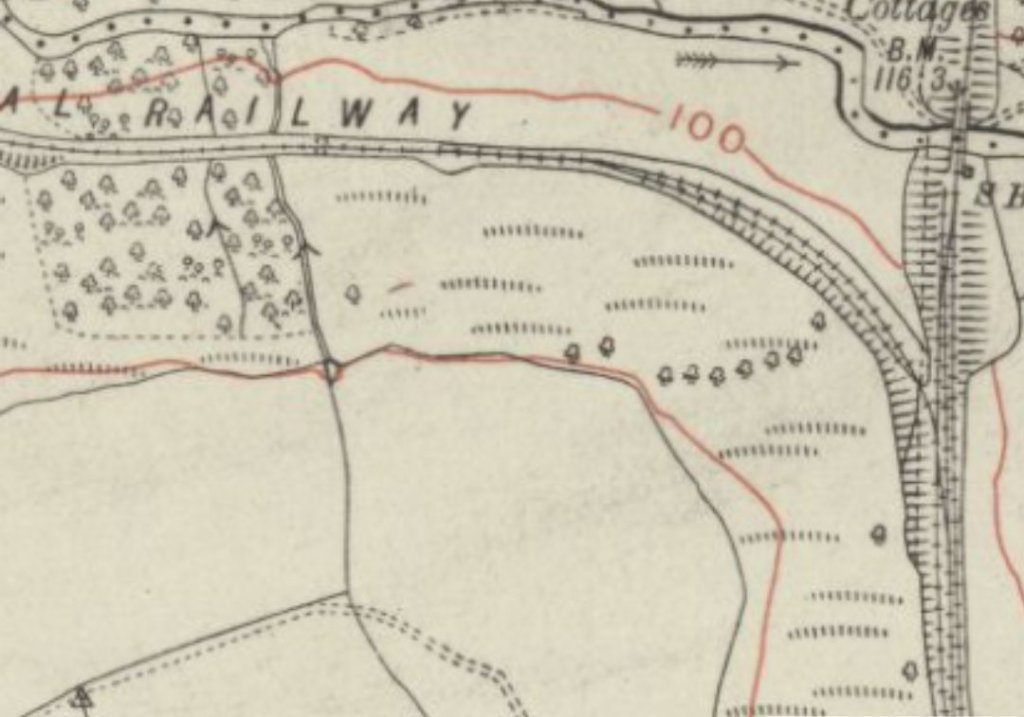
The Kinlet Colliery Railway followed the line of the abortive earlier railway to Billingsley an reuses the groundworks highlighted on the 1883 Ordnance Survey as discussed ib the section about the Billingsley Railway above. This extract is also from the 1925 Survey. [30]
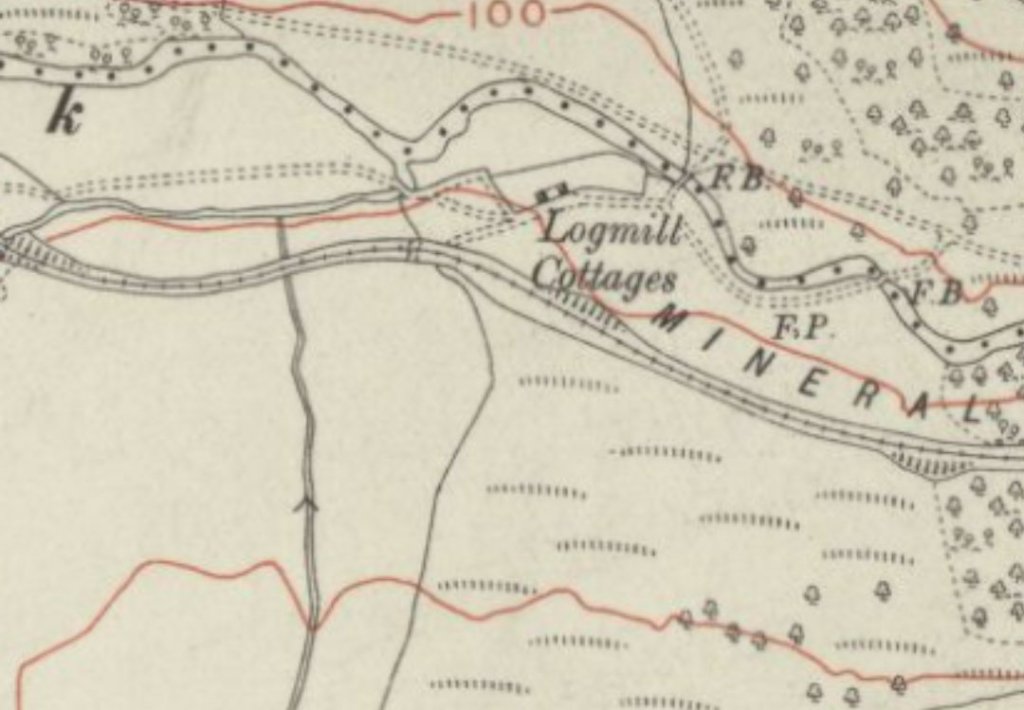
Passing to the South of Logmill Cottages the Colliery Light Railway continues westward towards Kinlet Colliery. [30]
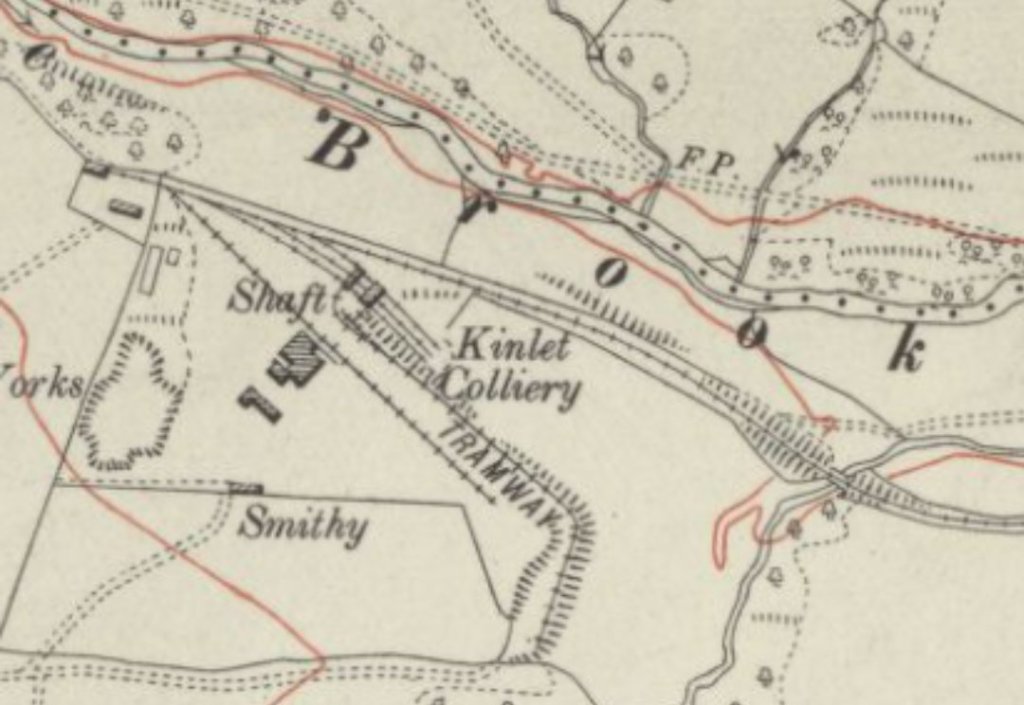
The site of Kinlet Colliery as shown on the 1925 6″ Ordnance Survey. For some reason there is no record on this map series of the line to Priors Mill which was still in place until the mid- to late-1930s! The colliery incline started to the East of the bridge shown on the right of this map extract. [30] My pictures of this bridge are included in this article in the section about the Billingsley Railway above.

Further pictures of the bridge in the map extract above and of Kinlet Colliery buildings as they were in 2013 can be found by following this link and then scrolling through to the relevant pictures. [60]

In June 1885, agreement was reached with the Kinlet Estate of William Lacon Childe to bore for coal at the site of the proposed colliery. But it was not until 1892 that a shaft reached “the Brooch Seam – a good quality coal seam about 3ft. 9in. thick. Production started in the late 1890s, with the completion of the railway.” [39]

The Aditnow website records that “a large horizontal steam winding engine house was built in 1896, which wound from the Upcast shaft. Steam was provided by 4 Lancashire boilers. A fan house at the rear of the large winder house worked on the Downcast or ‘Back’ shaft – a small horizontal winder also worked this shaft.” [40]

Screens were erected around the upcast shaft, with coal being loaded into railway wagons and sent down an incline to join the branch line from Billingsley Colliery and eventually the GWR main line of what is now the Severn Valley Railway.” [40] David Poyner notes that the 300-yard length of the colliery line closest to the pit was at a gradient of 1 in 15. [41: p13] He further suggests that the locomotive ‘Kinlet’ (see below) was able to bring empty wagons up the 1 in 15 gradient. [41: p13]

‘Aditnow’ also notes that “there was a brickworks on the West side of the large horizontal winding engine house, with the colliery loco shed at the top of the incline with a spur running round the hillside between the winder and headframe.” [40]

There were hopes of finding additional seams, but these never materialised. Much of the seam consisted of basalt, which formed a hard rock mass difficult to cut through and destructive of the colliery screens.  Conditions did eventually improve to the north of the shafts, but working Kinlet was never easy. Nevertheless it grew from employing about 150 men at the turn of the century to twice that by the start of the First World War with an output of about 50,000 tons a year.” [39]

The colliery closed in 1935 [1: p12] and was subsequently abandoned “in September 1937, when the leases on the Kinlet Estate expired. The mine had proved impossible to mechanise, and there were continued problems with basalt having burnt out the coal; ironically, at the time of closure, the workings entered some of the best ground ever encountered at the mine.”  [39]

Steam at Kinlet

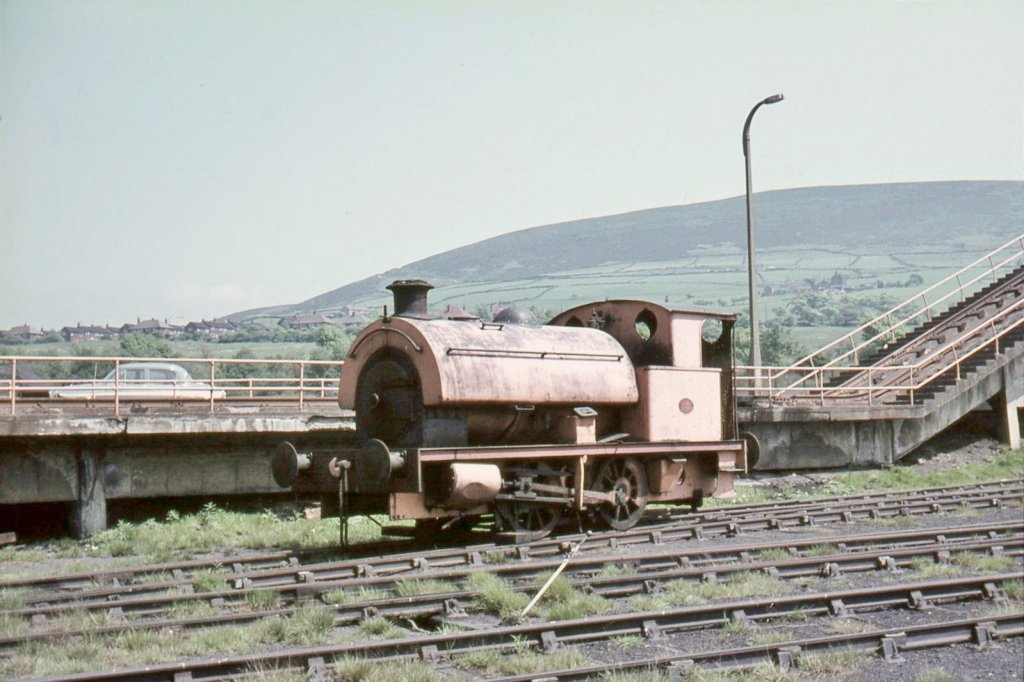
‘Kinlet’ – Andrew Barclay 0-6-0ST (Works No. 782)

Andrew Barclay 0-6-0ST (Works No. 782) ‘Kinlet’ (1896) at Blists Hill, Ironbridge Gorge Museum in 2009,
(c) Copyright Gillett’s Crossing, authorised for use here under a Creative commons Licence (CC BY 2.0) [56]

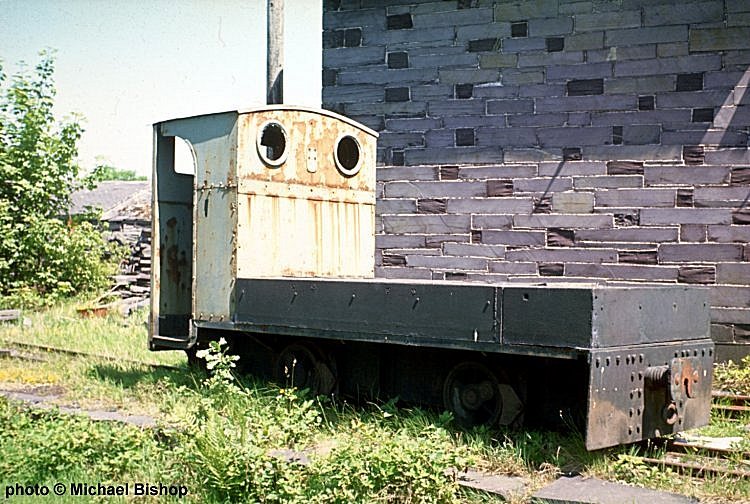
Andrew Barclay built a locomotive in 1896 which was supplied to Kinlet Colliery and named ‘Kinlet’ it was an 0-6-0ST loco (Works No. 782). In the 21st century, it is held undercover at Blists Hill.  

The locomotive was sold to H S Pitt & Co at Pensnett near Dudley and moved there in 1938 to work at the coal depot. It worked there until around 1966 when it was replaced by a Rushton diesel. Whilst at Pesnett the locomotive carried the name Peter.” [39]

Tennent is less sure about the date when the locomotive moved to H S Pitt and Co. suggesting that the date might have been earlier since he records the purchase of a replacement engine in 1929. [1: p13]

Poyner suggests that the date of sale was probably the end of December 2021. [41: p14]

Peckett & Sons Ltd. W4 Class 0-4-0ST (Works No. 599)

This locomotive (see the details provided above under the heading ‘Steam on the Billingsley Railway’) was inherited by the Highley Mining Company when they took over the Billingsley Colliery in 1915. It worked alongside ‘Kinlet’ until ‘Kinlet’ was sold and No. 599 then continued working for the Company until 1929 when a Hawthorn Leslie 0-4-0ST was purchased.

Hawthorn Leslie 0-4-0ST (Works No. 3424)

It seems that No. 599 was replaced by this locomotive which probably remained in service until the closure of the colliery. This loco was built in 1919 and “obtained,” says Tennent, “from Thos W. Ward in 1929. Later, this locomotive went to the Steel Company of Scotland via Thos W. Ward. Possibly it was about when the colliery closed but another engine was acquired from Ward’s Charlton Works at Sheffield in 1937.” [1: p13]

The history of the locomotive is interesting. I was sent new “to India, to work on a railway system belonging to the City of Bombay Improvement Trust. When this was wound up it was returned to the UK probably being purchased by Wards for resale. … it had very similar specifications to the Peckett. The probability is that by 1929, the Peckett was considered to be at the end of its working life: its fate is not known but it may have been scrapped after over 15 years service at Billingsley and Kinlet. An added consideration is that from 1929-30 the Billingsley railway saw extra traffic connected with the construction of a new road following the valley of the Borle Brook by Shropshire County Council. It may be that [No.] 3424 was purchased with one eye on these extra duties. It probably had a short tenure at Kinlet. For, in 1933, Ward supplied another engine to the Highley Mining Company.” [41: p14]

Hudswell Clarke 0-4-0ST (Works No. 1401)

This locomotive was built in 1920 and worked at first for the Darton Main Colliery Company in Yorkshire It was purchased by the colliery from Thos W. Ward. Tennet indicates that this purchase took place in 1937. Tennent suggests that it may have been required for the clearance of the railway and colliery “because it left in 1941 for W. Gilbertson & Co Ltd, Pontardawe in Glamorganshire.” [1: p13] Poyner’s view, above, is that this locomotive replaced No. 3424 as early as 1933. [41: p14] He goes on to suggest that No.1401 may well have left Kinlett in 1937, rather than 1941. Poyner provides details of a further locomotive which saw employment with the Highley Mining Company at Kinlet.

Andrew Barclay 0-6-0ST (Works No. 1113)

This locomotive was built in 1907 for the Shelton Iron and Steel Company in Stoke and named ‘Bowood’. Poyner says that “the existence of this locomotive at Kinlet is known only from a photograph, showing the engine with a footplate crew of Highley Mining Company staff, and the associated oral evidence.” [41: p14]

Poyner goes on to explain that ‘Bowood’ must have arrived at Kinlet after May 1936, as it was photographed at the previous owners premises on 16th May 1936. [41: p14][42] He goes on to relate how the locomotive arrived at Kinlet: “The Shelton Iron and Steel Company operated the nearby Holditch Colliery via a subsidiary. In July 1937, this was put out of use by an explosion. This may have resulted in the steel company having surplus locomotives at exactly the time the Highley Mining Company was looking for a new engine to work their salvage trains. The board of the Highley Mining Company was mostly made up of individuals from north Staffordshire, and so they may have had links with the Shelton company, making it easy for them to either purchase or, more likely, hire the engine, Bowood was substantially more powerful than any machine that had previously worked at Kinlet. … It is possible it was obtained specifically to work heavier than usual trains to help the dismantling work. This stretched well into 1938; hard core was used from Kinlet pit mound for earthworks at the new screens being built for Alveley Colliery. It is not known what happened to 1401 after Bowood arrived: it may have been left straight away although it is possible that it was retained to work alongside Bowood to help with salvage. perhaps allowing recovery work to take place simultaneously on both the Kinlet and Billingsley lines. In 1938 Bowood returned to North Staffordshire, arriving at the Florence Colliery of the Florence Coal & Iron Co Ltd. a subsidiary of the Shelton company. It eventually [was] transferred to Holditch Colliery in March 1960 by the National Coal Board, where it was scrapped in 1964.” [41: p14-15]

The Later Years of Highley Mining Company

In the late 1920s, the Highley Mining Co was looking for new reserves of coal in the area. It established that the coal beyond the River Severn at Alveley was of good quality. A single shaft was  (11) sunk there in 1935 but the Highley Colliery shafts were retained for ventilation and emergency access because there was good underground communication between the two pits. Alveley Colliery involved the use of modern equipment with coal cutters, electricity and underground conveyors progressively replacing pit ponies. It was connected to a new set of screens next to the Severn Valley Railway by an endless cable-worked narrow gauge tramway which crossed the river on a concrete bridge. The tramway was replaced later by an aerial ropeway. All coal and men haulage transferred to Alveley in 1940 marking the end of Highley Colliery.

Kinlet Colliery had closed in 1935 and been abandoned in September 1937 when the lease on the estate had expired. It had proved difficult to modernise the colliery and there were geological problems. The railway was lifted about 1940 and it had all gone by July 1941.

Kinlet Sidings had consisted of three parallel loops to the west of the Severn Valley Railway line just south of the bridge over the Borle Brook. A signal box was provided on the east side of the layout and the Kinlet and Billingsley railways had separate exits at the north end of the yard. Each exit was provided with a gate. The lines then ran parallel to each other along the valley of the Borle Brook. Both became double on leaving the yard but soon singled again. There was latterly one, possibly two, connections between the lines hereabouts and a weighbridge on the Kinlet track. The Kinlet railway soon began to climb the south side of the valley, while the Billingsley railway remained on the valley floor alongside the brook. The One Inch Ordnance Survey map of the period mistakenly shows only one line here. The Billingsley Railway suffers the indignity of not appearing on large scale maps as it came and went between two surveys; the One Inch detail being taken from a corrected earlier large scale sheet, now destroyed. The Kinlet Railway soon reached Kinlet Colliery perched high on the valley side and terminated at a single-road engine shed, the various sidings trailing back from a point just short of the shed.

As to the locomotives used on the Kinlet line, the Highley Mining Co purchased the new Andrew Barclay six-coupled saddle tank number 782 in 1896 presumably for the opening of the colliery. It had the following inscription painted on its tank – HIGHLEY MINING CO LD “KINLET”. The apostrophes appear to indicate that it was named KINLET and that the word was not just part of the address. It was sold to Guy Pitt & Co Ltd of Shutt End, Staffordshire at some date, being noted there by November 1946. Named PETER, it remained at Shutt End for the rest of its working life before being transferred to the Ironbridge Gorge Museum for preservation. It was replaced at Kinlet by Hawthorn Leslie 0-4-0 saddle tank, maker’s number 3424 of 1919, obtained from Thos W. Ward in 1929. Later, this locomotive went to the Steel Company of Scotland via Thos W. Ward. Possibly it was about when the colliery closed but another engine was acquired from Ward’s Charlton Works at Sheffield in 1937. This was a four-coupled saddle tank, Hudswell Clarke 1401 of 1920; it may have been needed for the site clearance because it left in 1941 for W. Gilbertson & Co Ltd, Pontardawe in Glamorganshire.

The loss of Highley and Kinlet Collieries was not felt by the mining company as, by 1945, Alveley was producing almost 250,000 tons of coal, more than the output of the earlier two combined. With the market for coal contracting, Alveley Colliery closed in January 1969, but remained active until March for clearance operations and so ended coal production in the area. The waste tips at Alveley have been landscaped into a country park and, amongst the relics on display, are two tramway tubs, one old wooden type and one modern metal one.

References

  1. John Tennent; The Railways of the Highley Mining Company; in ‘The Industrial Railway Record’ No. 250, September 2022, p7-13.
  2. D. Poyner & R. Evans: The Wyre Forest Coalfield; Tempus, Stroud, Gloucestershire, 2000.
  3. M. Shaw, D. Poyner & R. Evans; Aerial Ropeways of Shropshire; Shropshire Caving & Mining Club, 2015.
  4. https://maps.nls.uk/view/121153529, accessed on 17th January 2023.
  5. https://maps.nls.uk/geo/explore/#zoom=17.1&lat=52.44523&lon=-2.37060&layers=168&b=1, accessed on 17th January 2023.
  6. https://maps.nls.uk/geo/explore/#zoom=17.1&lat=52.44363&lon=-2.37060&layers=168&b=1, accessed on 17th January 2023.
  7. https://maps.nls.uk/geo/explore/#zoom=17.1&lat=52.44510&lon=-2.37402&layers=168&b=1, accessed on 17th January 2023.
  8. https://www.svrwiki.com/Collieries_served_by_the_Severn_Valley_Railway#Alveley_Colliery, accessed on 24th January 2023.
  9. https://www.tripadvisor.co.uk/Attraction_Review-g2056585-d6612408-Reviews-Severn_Valley_Country_Park-Alveley_Shropshire_England.html, accessed on 24th January 2023.
  10. http://www.alveleyhistoricalsociety.org/mining.html, accessed on 24th January 2023.
  11. https://maps.nls.uk/view/239291761, accessed on 24th January 2023.
  12. https://maps.nls.uk/view/197236508, accessed on 24th January 2023.
  13. https://maps.nls.uk/view/189234258, accessed on 24th January 2023.
  14. https://maps.nls.uk/view/189234249, accessed on 24th January 2023.
  15. George & David Poyner; The Surface Haulage at Alveley Colliery; in ‘Below’, the quarterly journal of the Shropshire Caving and Mining Club, Winter Issue 2002.4, 2002; viewed online at https://www.shropshirecmc.org.uk/below/2002_4w.pdf, accessed on 24th January 2023.
  16. https://m.facebook.com/groups/238304664346000/permalink/715859019923893, accessed on 24th January 2023.
  17. https://maps.nls.uk/view/197236505, accessed on 24th January 2023.
  18. https://en.m.wikipedia.org/wiki/Highley_railway_station, accessed on 24th January 2023.
  19. https://www.nmrs.org.uk/mines-map/coal-mining-in-the-british-isles/shropshire, accessed on 26th January 2023.
  20. https://www.shropshirestar.com/news/local-hubs/bridgnorth/2019/01/19/history-day-marks-50-years-since-pit-closure, accessed on 26th January 2023.
  21. https://www.shropshirecmc.org.uk/below/2004_1w.pdf, accessed on 26th January 2023.
  22. https://maps.nls.uk/view/189234249, accessed on 26th January 2023.
  23. https://maps.nls.uk/geo/explore/#zoom=17.0&lat=52.44415&lon=-2.37124&layers=193&b=1, accessed on 26th January 2023.
  24. https://www.aditnow.co.uk/Mines/Billingsley-Coal-Colliery_9556, accessed on 26th January 2023.
  25. https://maps.nls.uk/view/121152875, accessed on 26th January 2023.
  26. http://www.highley.org.uk/railhist.html, assessed on 26th January 2023.
  27. https://maps.nls.uk/view/101595358, accessed on 27th January 2023.
  28. https://maps.nls.uk/geo/explore/#zoom=17.0&lat=52.44943&lon=-2.40133&layers=6&b=1, accessed on 27th January 2023.
  29. https://transportpasttimes.co.uk/railway-light-railway-orders/stottesdon-kinlet-billingsley-light-railway-order-1908.html, accessed on 28th January 2023.
  30. https://maps.nls.uk/view/101585827, accessed on 28th January 2023.
  31. http://www.highley.org.uk/page27.html, accessed on 28th January 2023.
  32. https://en.m.wikipedia.org/wiki/Jack_Mytton_Way, accessed on 28th January 2023.
  33. https://maps.nls.uk/geo/explore/#zoom=14.5&lat=52.45071&lon=-2.39843&layers=192&b=1&marker=53.260932,-2.4960864, accessed on 28th January 2023.
  34. https://en.m.wikipedia.org/wiki/Billingsley,_Shropshire, accessed on 28th January 2023.
  35. https://www.facebook.com/photo?fbid=10222540093745946&set=pcb.3020627781514789, accessed on 12th February 2023.
  36. https://www.facebook.com/photo?fbid=10222540093505940&set=pcb.3020627781514789, accessed on 12th February 2023.
  37. https://www.facebook.com/photo/?fbid=3370620066526324&set=gm.1787159831657761&idorvanity=1515738962133184, accessed on 12th February 2023.
  38. https://www.facebook.com/ShropshireStar/photos/a.10150113631596009/10159206874136009, accessed on 12th February 2023.
  39. https://preservedbritishsteamlocomotives.com/works-no-782-kinlet-0-6-0st, accessed on 31st January 2023.
  40. https://www.aditnow.co.uk/Mines/Kinlet-Colliery-Coal-Colliery_9453 accessed on 31st January 2023.
  41. David Poyner; Railway Locomotives of the Highley Mining Company and Billingsley Colliery Company; in ‘Below’, the quarterly journal of the Shropshire Caving and Mining Club, Autumn Issue 2013.3, 2013, p13-15; viewed online at https://www.shropshirecmc.org.uk/below/2013_3w.pdf, accessed on 31st January 2023.
  42. Industrial Locomotive No. 4, 1977 – backcover.
  43. https://maps.nls.uk/geo/explore/#zoom=17.0&lat=52.43491&lon=-2.38261&layers=168&b=1, accessed on 31st January 2023.
  44. https://maps.nls.uk/geo/explore/#zoom=17.0&lat=52.43788&lon=-2.39153&layers=168&b=8, accessed on 31st January 2023.
  45. https://maps.nls.uk/geo/explore/#zoom=17.0&lat=52.44155&lon=-2.39486&layers=168&b=1, accessed on 31st January 2023.
  46. https://maps.nls.uk/geo/explore/#zoom=17.0&lat=52.44495&lon=-2.39721&layers=168&b=8, 1st February 2023.
  47. https://maps.nls.uk/geo/explore/#zoom=17.0&lat=52.44875&lon=-2.40118&layers=168&b=1, accessed on 1st February 2023.
  48. https://maps.nls.uk/geo/explore/#zoom=18.0&lat=52.45139&lon=-2.40514&layers=168&b=1, accessed on 1st February 2023.
  49. http://www.shropshiresgreatoutdoors.co.uk/site/new-england, accessed on 1st February 2023.
  50. https://www.geograph.org.uk/photo/5964987, accessed on 1st February 2023.
  51. https://www.openstreetmap.org/#map=16/52.4483/-2.4129, accessed on 1st February 2023.
  52. https://www.aditnow.co.uk/Photos/Mine/Billingsley-Coal-Colliery_9556, accessed on 1st February 2023.
  53. https://www.ebay.co.uk/itm/184659247141?mkcid=16&mkevt=1&mkrid=711-127632-2357-0&ssspo=y1qm-Gs2Qtu&sssrc=2349624&ssuid=afQhrar7TGK&var=&widget_ver=artemis&media=COPY, accessed on 2nd February 2023.
  54. https://www.openstreetmap.org, accessed on 3rd February 2023.
  55. https://www.facebook.com/groups/942854255808092/permalink/1645176155575895, accessed on 3rd February 2023.
  56. https://commons.wikimedia.org/wiki/File:Andrew_Barclay_0-6-0ST_782_%27Kinlet%27_(1896)Blists_Hill,_Ironbridge_Gorge_Museum_19.08.09_222795_031_06(10253536205).jpg, accessed on 4th February 2023.
  57. https://www.svrwiki.com/File:Billingsley-Line-Abandoned-1963-08-14.jpeg, accessed on 13th February 2023.
  58. John Marshall; The Severn Valley Railway; David St John Thomas, Nairn, Scotland,1991.
  59. https://www.aditnow.co.uk/Photo/Billingsley-Colliery-Branch-Line-Culvert_85758, accessed on 13th February 2023.
  60. https://www.aditnow.co.uk/Photo/Kinlet-Colliery-Branch-Railway-Bridge_85757, accessed on 13th February 2023.
  61. https://www.mylocalforum.co.uk/area/highley-shropshire-2418/general-highley-discussion-168/billingsley-colliery-railway-remains-149673, accessed on 3rd February 2023.

Railways Around Bridgnorth – Part 1

The Billingsley Plateway

Highley, and the area immediately around, it has a long industrial history and the remains of numerous railways and tramways can be seen today. At the end of the 18th century coal mines and a blast furnace were opened in Billingsley. The story is recounted by Poyner and Evans in their history of the Wyre Coalfield: [13: Chapter 5]

“By the late 1770s, coal mining was well established in Billingsley with a water wheel being used to drain the mines … but unfortunately the owners of this colliery have not been recorded. There then follows a brief unrecorded period until the start of the 1790s, by which time much of Billingsley was owned by Sir William Pulteney, M.P. for Shrewsbury; a man with land-ownings over much of the country. Pulteney was an able politician and keen businessman; the patron of Thomas Telford, he would have been well aware of the potential value of the coal beneath his lands. As a national figure, he would have been able to obtain the advice of the best mining engineers in the country, and this must have led him to Newcastle to obtain the services of George Johnson.”

Johnson was one of the premier colliery viewers in the land, with international experience as a consultant. Thus by 1794, Johnson had put together a consortium of Newcastle-based landowners and professionals to go into partnership to lease the coal under Pulteney’s land. His backers included William Chapman, a noted engineer, Sir John Gray, an M.P. and most significantly Henry Gray MacNab, his brother-in-law. Trained at St. Andrews University as a physician, by the early 1790’s MacNab was established as an influential figure in the North-Eastern coal trade, with a number of pamphlets to his name. In June 1794 the draft leases were signed, and soon work began at Billingsley, initially using at least some men brought down especially from the North-East.

One of the first problems the partnership had to overcome was the lack of effective transport in the area. Billingsley was on the Bridgnorth-Cleobury Turnpike, but that was in no condition to take heavy coal traffic. A way had to be found to move the coal onto the River Severn. The first idea was for a canal, partly along the Borle Brook, possibly with an extension all the way to the limeworks at Oreton. It was at this point that a future thorn in the side of the works first became apparent, with the implacable opposition of William Lacon Childe to the mine. Childe’s property bordered Pultney’s estate on the south; more significantly he controlled the only practical route from Billingsley to the Severn at Highley. The canalisation of the Borle needed his wholesale co-operation, and this was not forthcoming. Childe’s motives for opposing the mines are not entirely obvious; he was not against collieries per se, as he had small working mines on his own estate. He claimed that the large mine at Billingsley could force these to close, ultimately forcing up the price of coal in the district. Childe was also a committed countryman. He was in the forefront of agricultural improvement, and also was a keen huntsman. He may have feared the impact of large-scale mining on all of this. Whatever his motives, he succeeded in killing off the canal. Instead the partners constructed a horse-operated plateway, following the line of the Borle Brook but as far as possible on the opposite side of the bank from Childe’s land. Even this was not entirely possible, for in Highley they did have to cross through a short section of his land. Childe drove a hard bargain, for he made the Partners lease the Birch Colliery and connect it to their plateway by means of a branch. As the Birch was a small mine working the Sulphur Coal (see above), it was of no value to Johnson & Co., but they had little choice in the matter.

The coal and iron were brought alongside the Borle Brook through Highley by a horse-worked tramway to the River Severn where they were sent downstream in boats. The “tramway worked for no more than 15 years, but its route can still largely be traced on the North side of Borle Brook, running via shallow embankments and cuttings. A little later the Stanley Colliery (1804-1823) opened close to the site of the present Highley Station and this was also served by tramways, as were the numerous sandstone quarries by the river.”

[13: Chapter 5 (of ‘The Wyre Forest Coalfield’) – quoted here with the kind permission of David Poyner]

As we have noted, Stanley Colliery was just to the South of Highley Station. It was worked for that short period at the beginning of the 19th century in the sulphur coal at a depth of about 100 yards; the Brooch seam worked by the Highley Colliery was a further 200 yards below this. Stanley Colliery “is partially overlain by the trackbed of the Severn Valley Railway and sidings built by the HMCo. [Highley Mining Company] There are also extensive remains of the stone quarries which worked in this area from perhaps the Middle Ages to the 19th Century.” [1]

Ray Shill also mentions the tramroad/plateway to Billingsley: “Billingsley Coal and Iron
works was … served by an iron railway laid with iron rails and sleepers. The Billingsley
railway, owned by iron master George Stokes, was about two miles long and included an incline to the Severn, a sale of 1818 mentioned the incline
.”[8][9]

The old tramroad/plateway/tramway/railway route is shown below on a series of extracts from the 6″ Ordnance Survey revised in 1925 and published in 1929. Where possible I have also provided photographs taken on site.

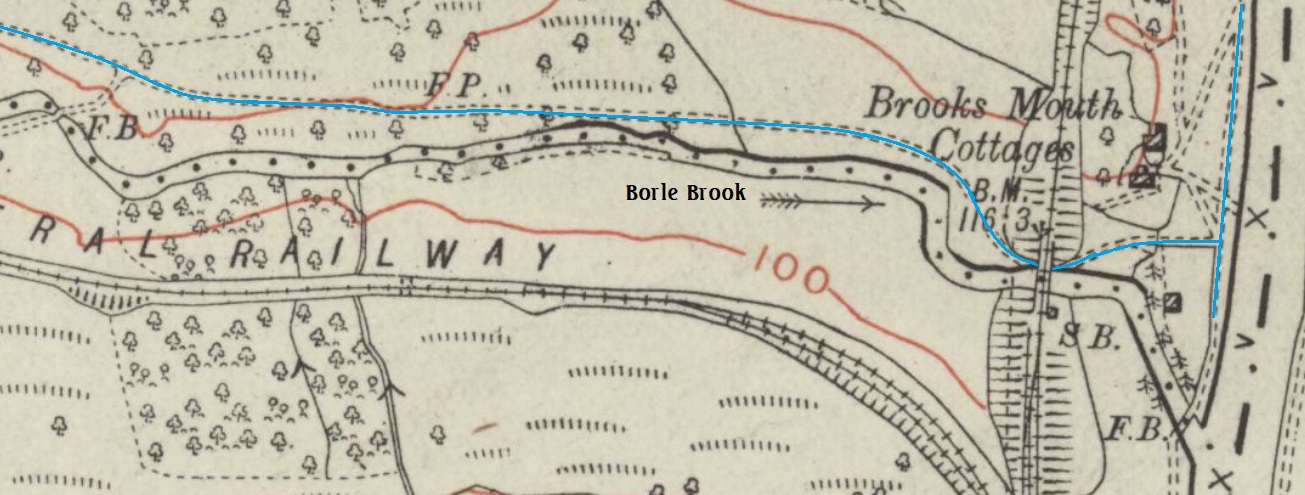
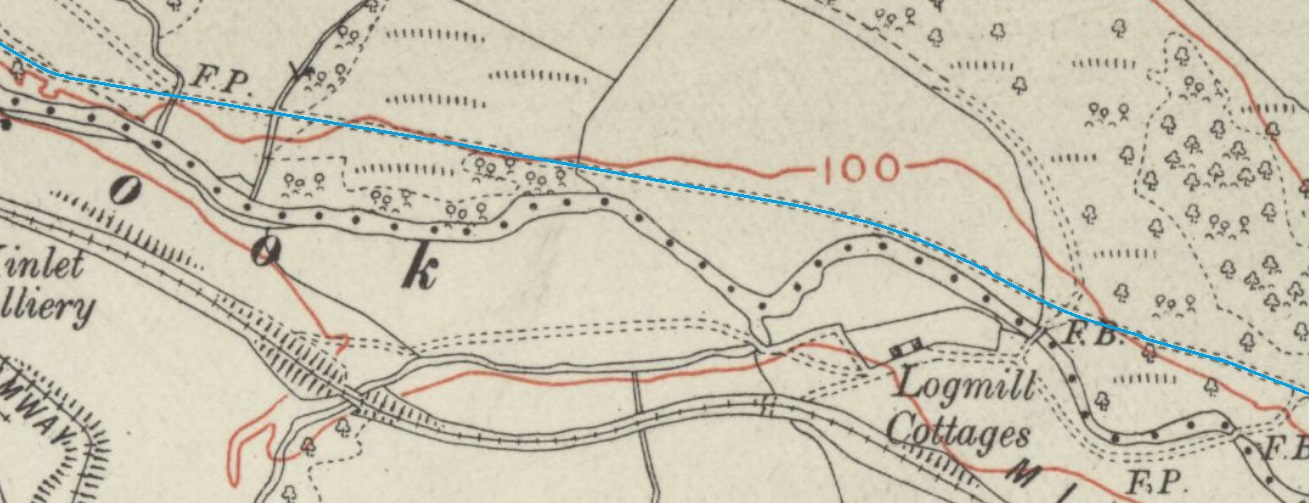
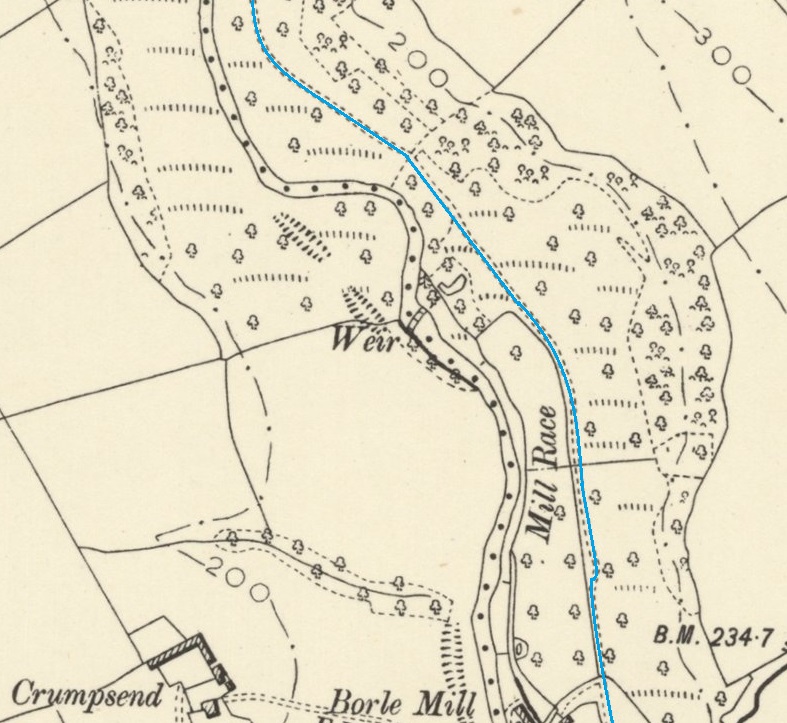
The old tramroad route is now a footpath on the North side of Borle Brook. It is highlighted on this 6″ OS Map extract by the light blue line. South of Borle Brook. the later mineral railway serving Kinlet Colliery is also shown on the base maps. [3]
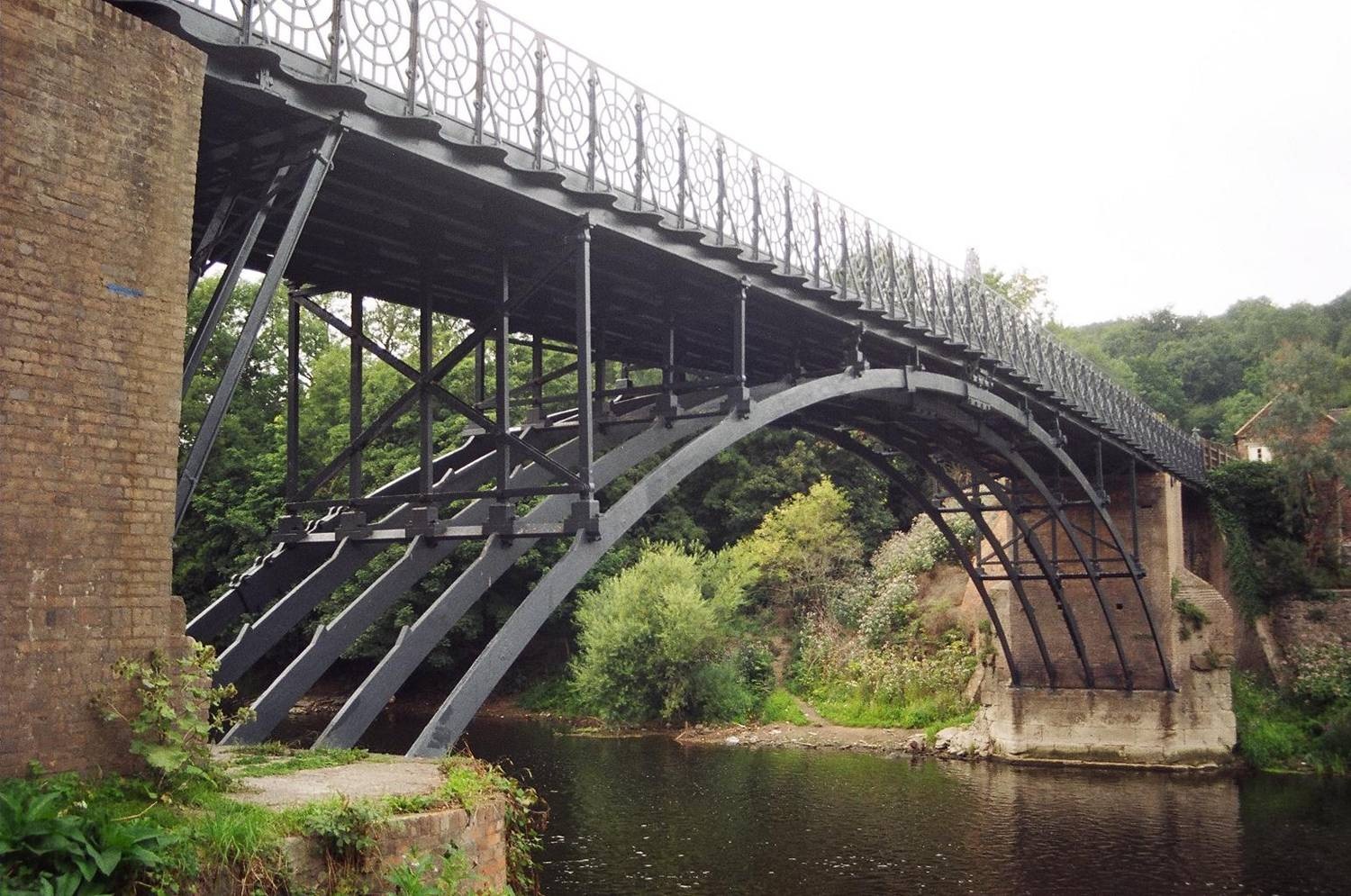
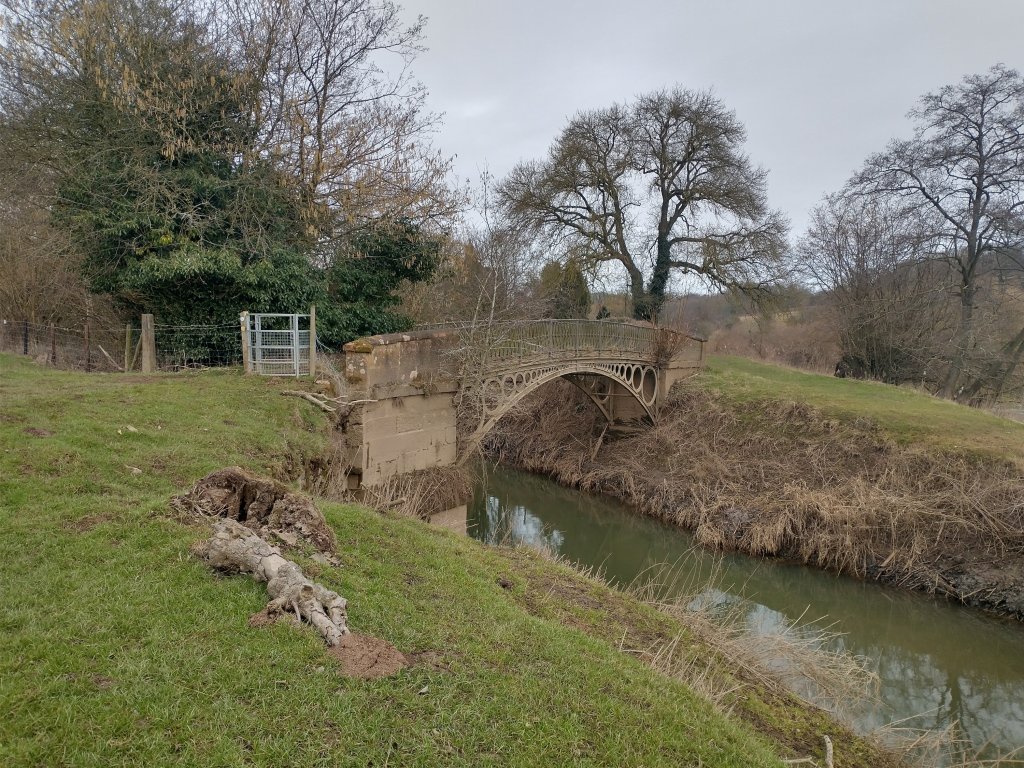
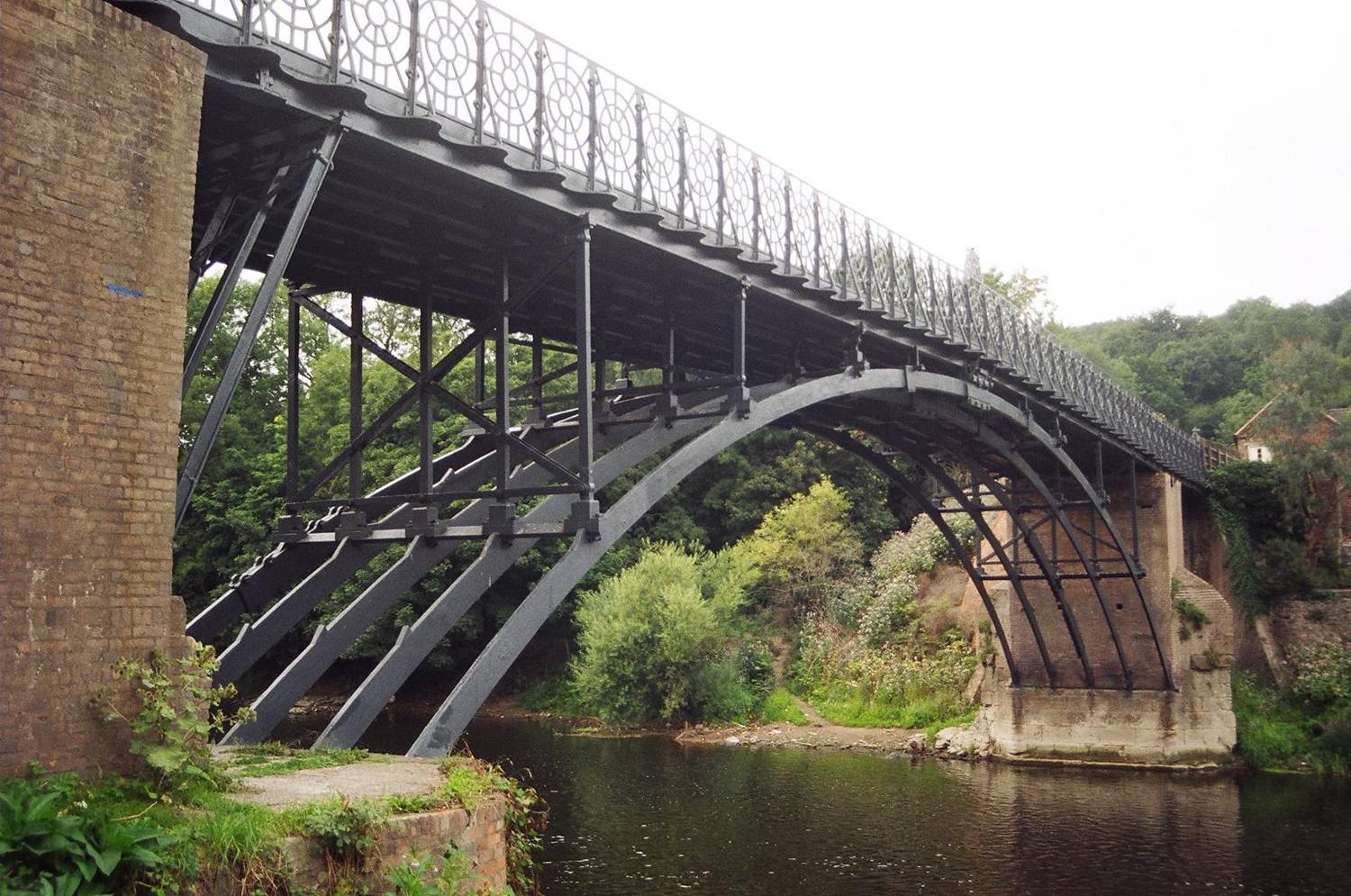
Brooksmouth: the cast-iron arched bridge across Borle Brook just upstream of its confluence with the River Severn. This view looks to the North alongside the Severn. The wharf for the old tramway would have been beyond the bridge. The bridge is shown at the bottom right of the OS map extract above, close to the River Severn. [My photograph, 10th February 2023]

Brooksmouth Bridge is a small cast iron footbridge, via which the towpath on the west bank of the River Severn crosses Borle Brook downstream from Borle Viaduct. It is a Grade II Listed Building under the name ‘Footbridge over Borle Brook.’” [23]

The bridge consists of an elliptical arch with a slightly curving path, the spandrels being filled by conjoined diminishing circles. The balustrades, half of one side of which has been renewed, have an elongated diamond pattern. The stretcher bars across the main arch are inscribed ‘Coalbrookdale Company 1828’. The cast-iron foot plates appear to remain intact. The abutments are of sandstone with string courses and parapets, one side of both of the latter replaced in brick.” [23][24]

The bridge was built by The Coalbrookdale Company of Ironbridge in 1828, pre-dating the building of the Severn Valley Railway by more than 30 years. At that time goods traffic was transported on the River Severn in barges called Severn Trows. These were hauled upstream against the current by horses, or by men known as ‘bow hauliers’, making use of the towpath.” [23]

Facing downstream alongside the River Severn towards the confluence of Borle Brook and the Severn. this photograph shows part of the area which would have encompassed the wharf which allowed transfer of loads to and from Billingsley to barges on the Severn. [My photograph, 10th February 2023]
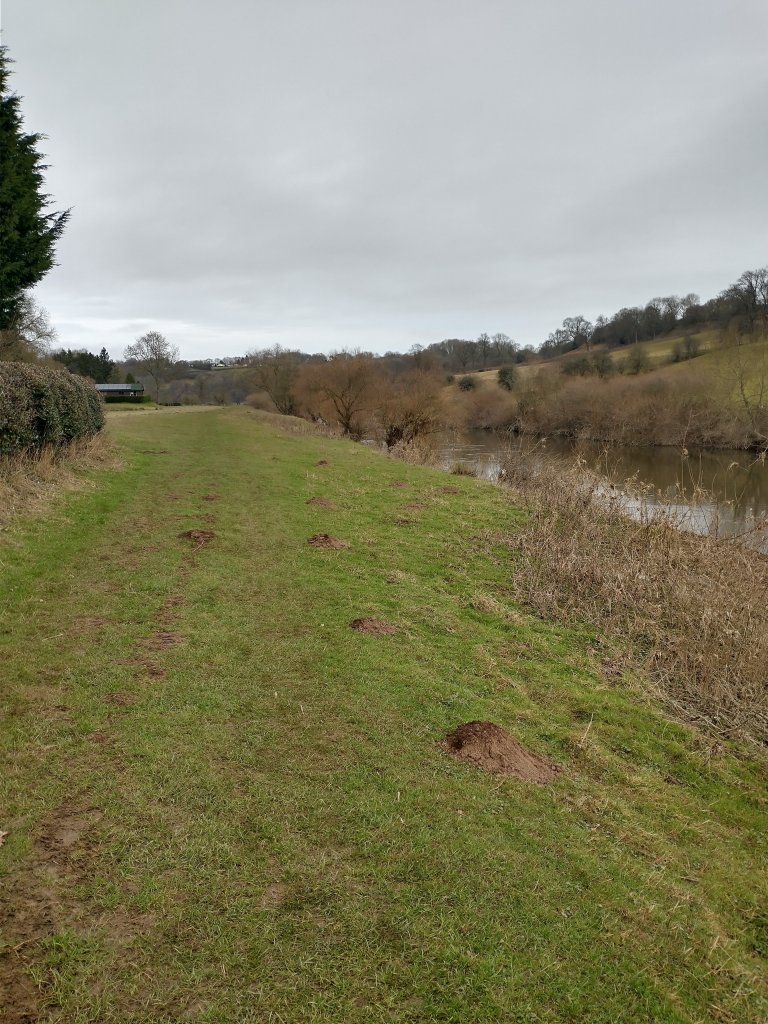
Looking North alon the West bank of the River Severn. This area will have been busy in the distant past with waggons from Billinsley unloading at the wharf onto Severn trows. [My photograph, 10th February 2023]
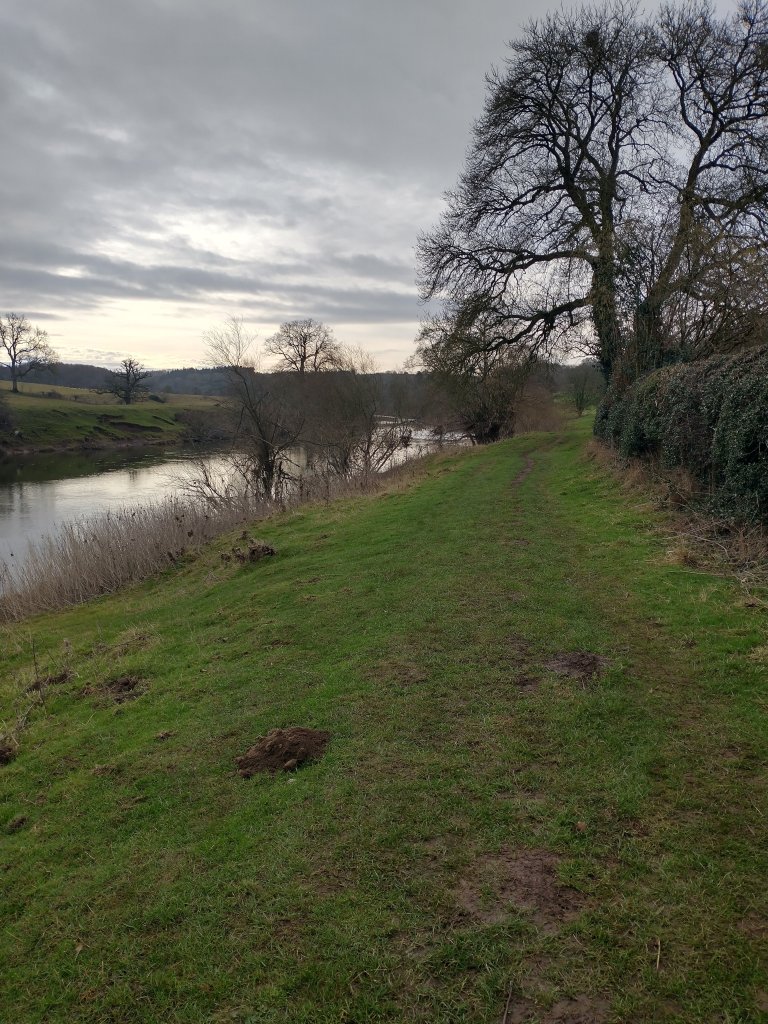
Standing on the West bank of the River Severn looking along the line of the old plateway/tramroad which curved to the right beyond the field gate. [My photograph, 10th February 2023]
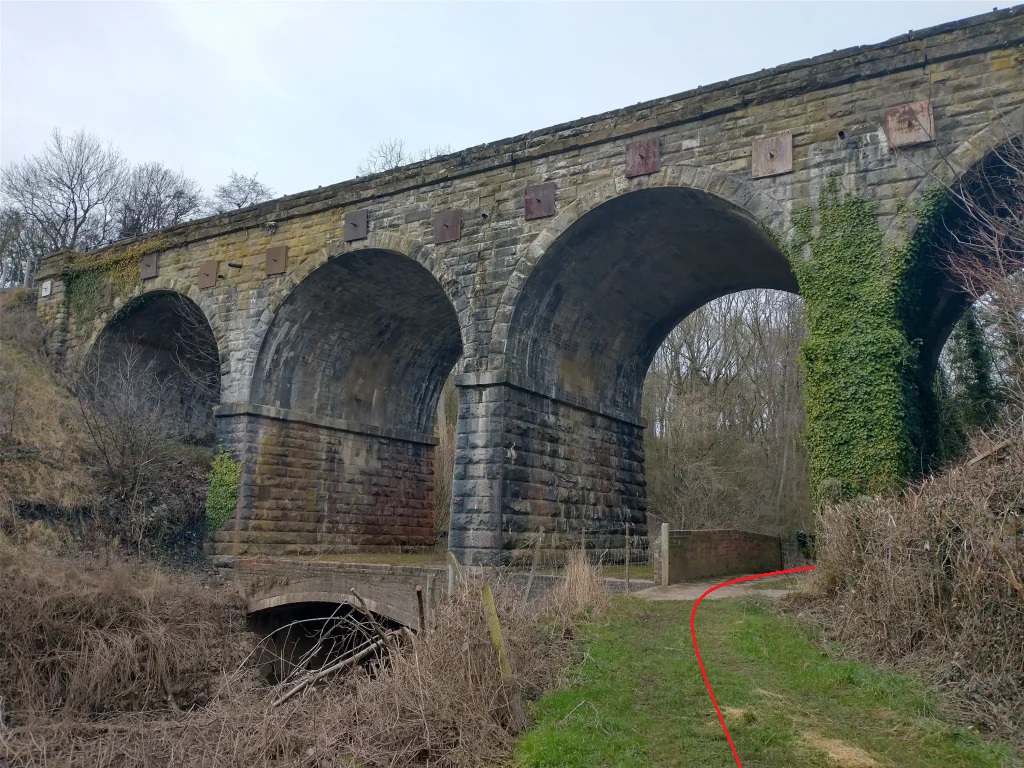
The old tramroad curved round to follow the North bank of Borle Brook, passing under the viaduct as shown by the red line. [My photograph, 10th February 2023]

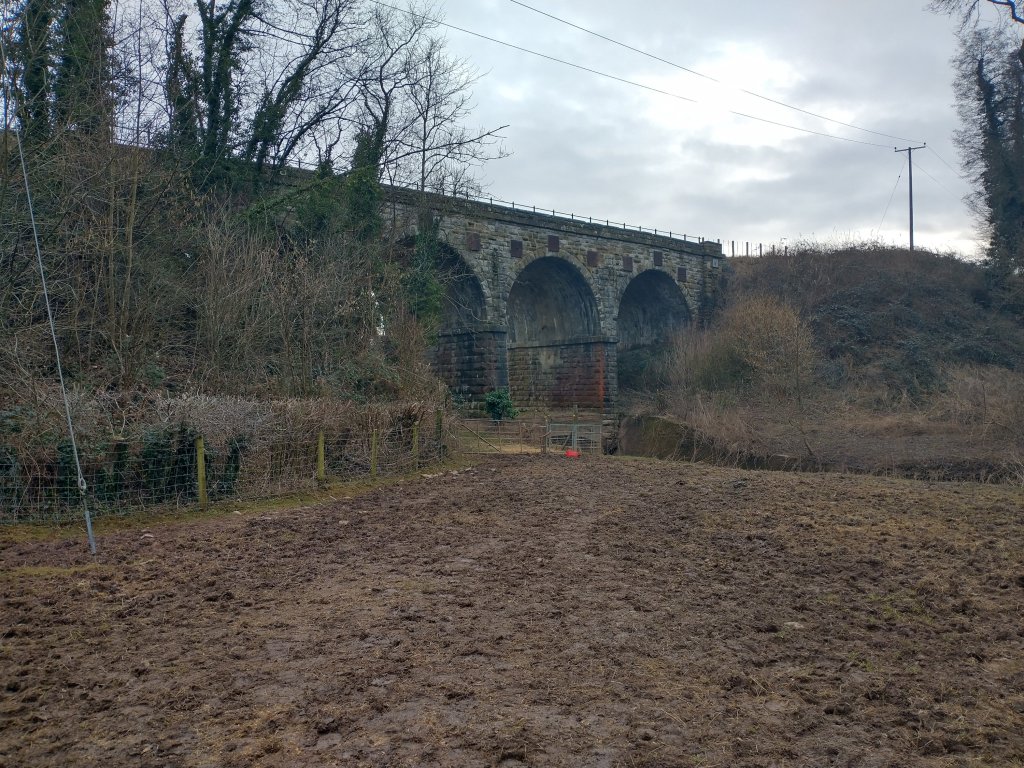
The old tramroad predated the Severn Valley Railway by many years. “Like other bridges on the Severn Valley Railway, it was built with the capacity for dual tracks but only ever installed for single line running. The viaduct is 42 yards in length, with four arches of 25ft span. Fishermen’s Crossing lies a few yards to the north, with the site of the former Kinlet and Billingsley Sidings a similar distance to the south. … The viaduct has suffered from mining subsidence over the years. Regular re-ballasting to overcome this … resulted in the line being above the original parapet walls.” [25] No edge protection on the viaduct was provided prior to preservation but post and rail fencing were added in the years after the viaduct was taken over by the preservation society. Significant maintenance was undertaken in preservation, first in 1977 and then in 2019.

Looking back towards the viaduct along the line of the old tramroad. [My photograph, 10th February 2023]
Lookinf West along the line of the tramroad from the same position as the picture immediately above. [My photograph, 10th February 2023]
Leaving the field close to the Severn Valley Railway, we were glad that we were walkign the line in the winter months with vegetation much less dense than in warmer times. We had to clamber over an old wooden gate which was held shut by barbed wire and not in good condition. The route of the old tramroad was difficult to determine in places. This picture looks West and shows a very shallow embankment along the line of must have been the route of the tramroad. [My photograph, 10th February 2023]
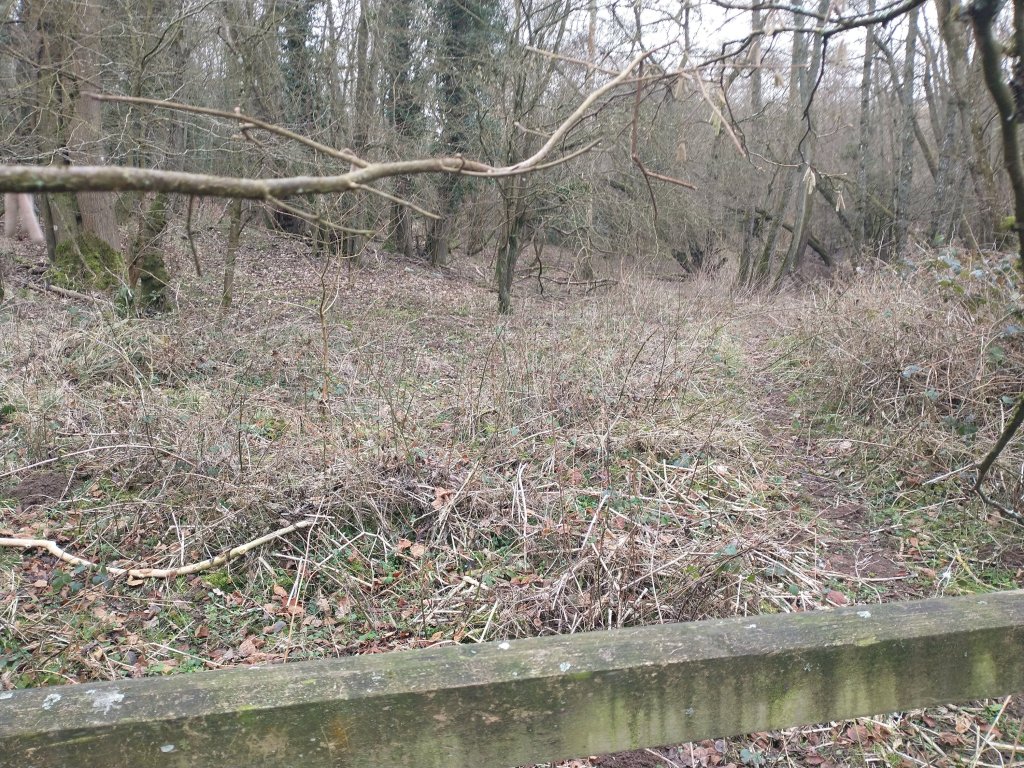
Looking West again, some sections of the old tramroad route through the first length of woodland were easier to walk. [My photograph, 10th February 2023]
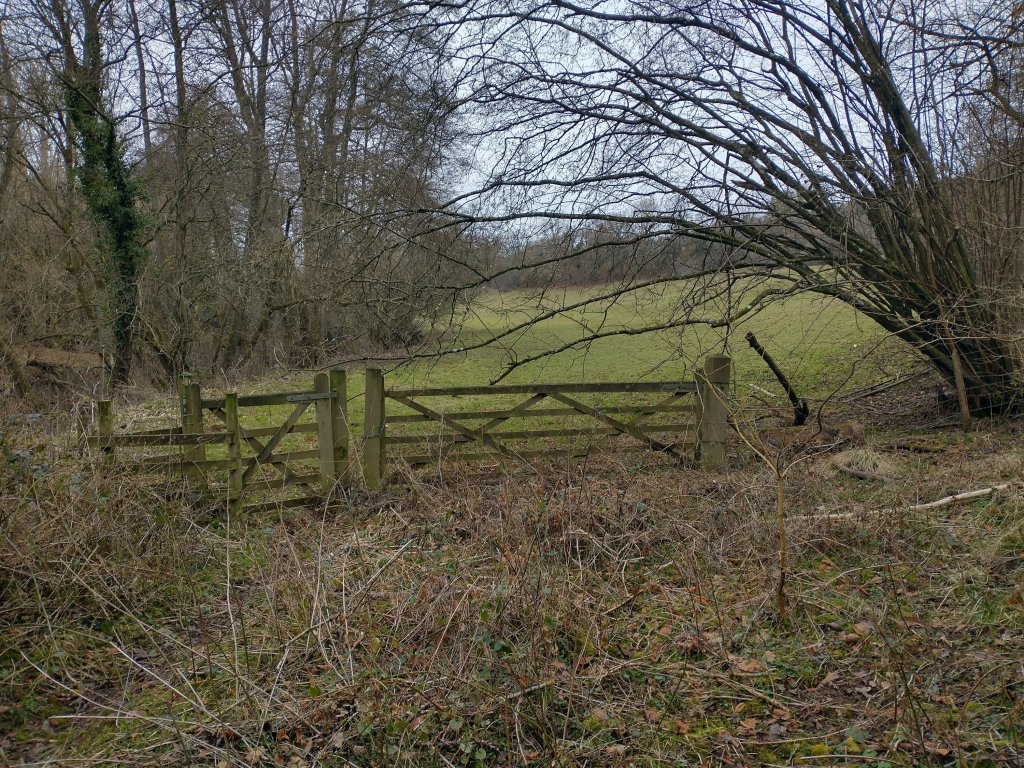
Again looking West, the field gate provides access to a riverside meadow. The gate is approximately on the line of the old tramroad. [My photograph, 10th February 2023]
Looking East along the line of the tramroad from the field gate in the picture above. The lightly used footpath follows the line. [My photograph, 10th February 2023]
The route continues to the West running very close to the North bank of Borle Brook. This 1925 Survey show the location of Kinlet Colliery at the lefthand (West) side of the extract.  [3]
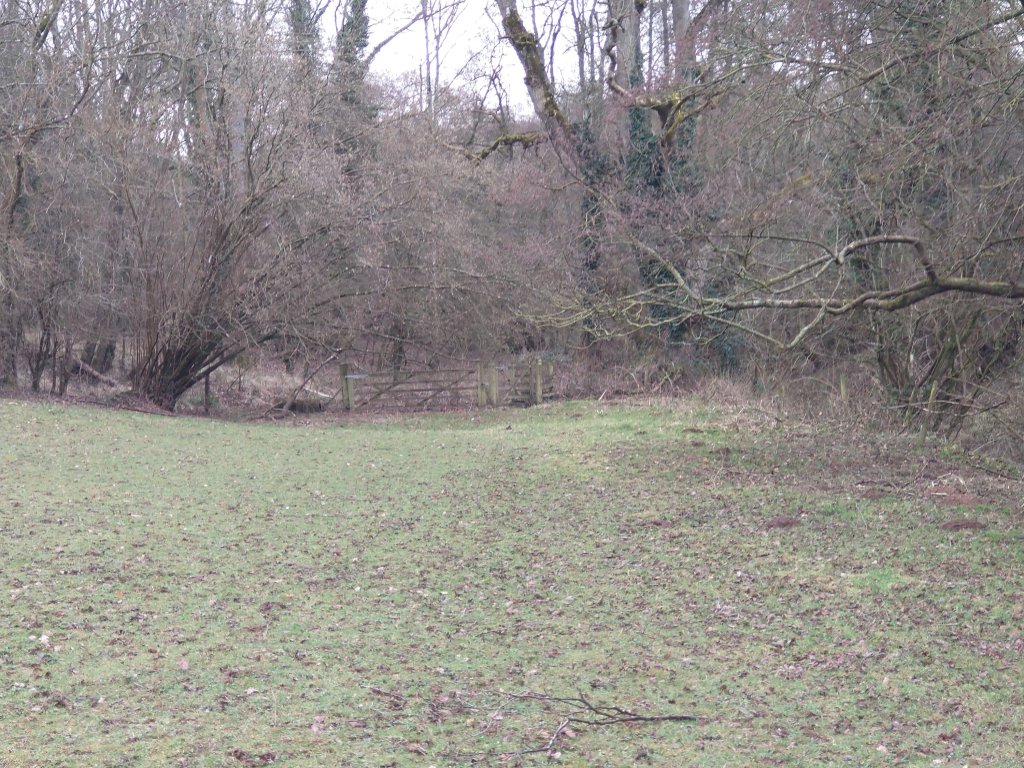
Just a little further West, this photo shows the field gate which appears in the pictures immediately above and shows the woodland that we had just traversed. [My photograph, 10th February 2023]
Much easier going following the line to the West, at least while we were in the meadow. [My photograph, 10th February 2023]
At the end of the meado, the kissing gate gave access to an area of significantly disturbed ground which may have suffered some movement towards Borle Brook in the past. [My photograph, 10th February 2023]
Looking back East from within what would be dense vegetation in the Summer. The ground was soft and significantly broken up. [My photograph, 10th February 2023]
Looking West again. The tramroad route heads to the right of the compound visible ahead and at that point joins New Road. [My photograph, 10th February 2023]
This OpenStreetMap extract, provided by the NLS shows New Road which over the area of this extract follows the line of the old tramroad as far as the footpath (shown grey on the map extract) which itself follows the line of the old tramroad. [22]
Looking Southeast along New Road with the aforementioned compound on the right. The old tramroad route is followed by New Road from this point for a few hundred metres. [My photograph, 10th February 2023]
Looking Northwest along New Road. [My photograph, 10th February 2023]
Just as New Road swings sharply to the left to cross first Borle Book and then the line of the later Billinsgley Railway, the tramroad diverged to the right into what is now heavy undergrowth. The red line shows its approximate route. At the centre of this image, to the right of the road, the footpath sign can be seen leaning against a tree. [My photograph, 10th February 2023]
The old tramroad followed the North bank of Borle Brook as the course of the brook heads northwards. [3]

The images below show the route of the tramroad approaching Borle Mill from the Southeast.

The tramroad passed to the East of Borle Mill near Borlemill Bridge. [4]
This first photograph was taken a little to the North of the point where New Road crosses the line of the old tramroad. It looks North towards Borle Mill. New Road does not appear on the Ordnance Survey of 1925. [My photograph, 3rd February 2023]
This photo looks North along the old tramroad from a point much closer to Borle Mill. [My photograph, 3rd February 2023]
The old tramroad crossed Borle Mill Bank directly ahead of the camera and ran along the valley side. The footpath turns away from the line of the tramroad from this point for a few hundred metres so as to avoid private land. [My photograph, 3rd February 2023]
The tramroad continued in a northerly direction to the East the Mill Race. The footpath has been diverted to run closer to Borle Brook as far as the weir shown on this map extract. It returns to the tramroad alignment at that point. [5]
Facing to the South along the route of the old tramroad at the point where the footpath leaves the old tramroad. [My photograph, 3rd February 2023]
Looking North along the line of the tramroad from the same point. [My photograph, 3rd February 2023]
Facing South towards the field boundary which crosses the line of the old tramroad to the North of the weir. [My photograph, 3rd February 2023]
We were walking South along the tramroad rather than Northwards. Just after the photograph above was taken, we were joined by two gentle friends. [My photograph, 3rd February 2023]
Looking South into the field in which the sheep live, from the North side of the field boundary at the bottom-right of the next map extract. [My photograph, 3rd February 2023]
Looking Northwest from the same point. [My photograph, 3rd February 2023]
The tramroad continued alongside Borle Brook in a Northwesterly direction. [6]
Looking in a Northwesterly direction along an embankment which carried the tramroad to a bridge over a small tributary of Borle Brook. All that is left of the bridge is a gap in the embankment. [My photograph, 3rd February 2023]
Another Northwesterly facing photo looking along the line of the tramroad. For much of the length between Borle Mill and New England the footpath is wide enough to occupy the full width of the formation of the old tramroad. [My photograph, 3rd February 2023]
Looking Northwest and approaching New England the old tramroad passed through a narrow but relatively shallow cutting. [My photograph, 3rd February 2023]
Looking Southeast along the line of the tramroad from close to New England. This is the Northwestern end of the cutting in the last photograph. [My photograph, 3rd February 2023]
The line of the old tramroad can relatively easily be followed as far as New England, where for a very short diatance the tramroad followed the verge of the road before turning away to the West as the lane dropped down to ford Borle Brook. There is archaeological evidence, close to the Ford shown on this map extract, of a tramroad bridge over Borle Brook which indicates that the tramroad continued along the line of the footpath shown on this extract from the 1882 Ordnance Survey, published in 1883, to the West of Borle Brook. [7]
The old bridge abutment is in the undergrowth to the left side of this image. Borle Brook is further to the left. Close to the level of the tramroad and roughly at road level today is an information board. It can be seen here towards the top-right of the image [My photograph, 3rd February 2023]
The information board mentioned above. At the centre top of the board is a photograph of the historic abutment taken when heritage work was undertaken at the site. To the right of that picture is a schematic map of the tramroad/plateway. Below that is an illustration of the traffic which would have used the tramroad. [My photograph, 3rd February 2023]
A closer view of the illustration of tramroad traffic. This picture raises a few questions in my mind. The wagon shown has flanged wheels and the rails seem to be continuous edge- rails. A plateway would usually be made up of short sections of rail and would most often have had L-shaped rails with wagons having flangeless wheels. [My photograph, 3rd February 2023]

The wagon illustrated on the information board at the site of the bridge abutment has flanged wheels and the rails seem to be continuous edge- rails. A plateway would have usually been made up of short sections of rail and would in many cases in Shropshire have had L-shaped rails with wagons having flangeless wheels. during the period that the plateway/tramroad was active (circa. 1796 – 1812). This is supported by David Poyner’s discoveries along the line of the old tramroad which he reported in the journal of the Shropshire Caving and Mining Club in 2010. He first describes the plateway:

In the Wyre Forest Coalfield, a plateway was constructed from a wharf on the River Severn in Highley to a colliery at Billingsley in 1796; about this time or shortly afterwards a spur was constructed to more mines at Birch Farm in Kinlet. … The mines had all closed by 1812 and it is unlikely that the plateway saw much use after this. It was amongst the materials of Billingsley Colliery and associated blast furnace that was offered for sale. In 1814 “about 30 tons of straight and turned iron rails, and sleepers in proportion” with 43 railway wagons were put up for auction. This sale may have been a failure as the complex was offered again in 1817; lot VII included “about 50 tons of cast iron rails, sleepers etc now upon a rail road”. This suggests that the plateway had not yet been taken up. It appears that this sale was more successful as no more is heard about the mine, furnace or plateway after this date.” [10]

Poyner continues to describe his finds in the vicinity of the plateway – some years prior to his article, he found “a broken section of plate rail from this system whilst putting some steps into an embankment along the former track. Subsequently more pieces of rails and a chair were found by Simon Cowan and Hugh McQuade who were tracing its route.” [10] More recently, he came across a chair “from the system on the Kinlet bank of the Borle Brook at Logwood Mill. SO 740820 (Figure 1). It is cast iron, and approximately 6½” x 5″. At the one end there is 1″ high flange: at the other is a curled lip about ½” high which extends for only half the length of the plate; however, it is extended as a slight ridge in the casting which terminates in an inverted L-shape. There is a ½” diameter hole in the centre of the chair and two in projecting lugs at either end. There are also 4 lugs which extend beneath the chair.” [10]

The rail he found “from the plateway is 3½” x 24″; the casting is ½” thick. It has clearly been broken at the one end and may also have been fractured at the other.” [10]

The schematic map of the tramroad route included on the information board is enlarged here and in an image below. This first enlargement shows the route of the tramroad/plateway closer to the River Severn and shows a branch tramroad/plateway to Birch. [My photograph, 3rd February 2023]

The Birch Branch

The thematic or sketch map on the information board at New England shows a branch extending to Birch Farm, South of Borle Brook. For this line to form a junction with Borle Brook it would have needed to bridge the ‘river’. It then followed a tributary to Borle Brook before striking off to the South towards Birch Farm. The line was unnecessary in purely engineering and mining terms. It was constructed as part of a ‘quid-pro-quo’ arrangement between the Colliery Company and William Lacon Childe who owned all the land on the South side of Borle Brook and a parcel of land to the North of the Brook which the Colliery Company needed for wharves alongside the River Severn. Ultimately he granted access to the River Severn, conditional upon the Colliery Company building a plateway link to one of his small collieries, that at Birch Farm. [13: Chapter 5]

This image shows the location of Logmill Cottages, close to the confluence of the tributary and Borle Brook, on the 25″ Ordnance Survey of 1882, published in 1884. It shows no bridge existing over Borle Brook at this point towards the end of the 19th century. It does however show a bridge crossing the tributary. [11]
A little to the Southeast of Logmill Cottages and on the next Ordnance Survey Sheet to the South, a footbridge is marked. Might this have been the location where the plateway crossed Borle Brook? Perhaps it served the mill, close to Logmill Cottages, which by the time of this Ordnance Survey had disappeared? [12]
The tributary, once again. The 1882 mapping, published in 1884, shows some earthworks at various points on the South side of Borle Brook. One location where these are apparent is the possible location of a future bridge across the tributary. Might this be relevant to the seacrh of the route of the plateway branch to Birch Farm? Looking more widely at the 1882 mapping South of Borle Brook, there appears to be no residual evidence of a plateway immediately at this location. [12]

We have noted in the above map extracts that it is difficult to be specific about the route of the tramroad/plateway close to Borle Brook. The mapped details in the vicinity of Logmill Cottages show no real evidence of the tramroad.

A wider view of the 1882 Ordnance Survey showing the possible route of the plateway/tramroad between Borle Brook and Birch Farm. There is a track marked on the map, extending from the bottom-left corner of the extract to the second minor stream met along the route, travelling to the Northeast. The presence of the track is an indicator of the probable alignment of the tramroad. Across the rest of the map the blue line indicating the tramroad route is shown dotted over this length as there is nothing to confirm its actual route on the Ordnance Survey. [12]
The 1882 Ordnance Survey once again. The plateway/tramroad branch continued to travel in a southerly direction. [12]
The terminus of the tramroad/plateway was close to Birch Farm where William Lacon Childe had a small colliery. [12]

The line to Birch Farm is entirely on private land and access to its route is not possible. The best that I can offer is extracts from satellite images. These are those from the National Library of Scotland (NLS). …

Borle Brook is at the top of this extract from satellite imagery. Its tributary flows to the North of the dotted blue line which indicates the possible route of the tramroad/plateway to Birch Farm. [14]
The line curved away from the stream and headed South towards Birch Farm. [15]
Birch Farm and the location of the Colliery. [16]
This second enlarged view shows the upper reaches of the tramroad which clearly continued some distance beyond New England. [My photograph, 3rd February 2023]

The Billingsley Area

Access to the length of tramroad/plateway beyond New England is just as difficult as access to the branch to Birch Farm, although is does come close to the public highway at one location and crosses it at another. Immediately to the West of Borle Brook there was an incline which brought the tramroad/plateway out of the valley and into the open fields above its scope. All of this, through to ‘Scot’s’ (the spelling on the OS Mapping) is on private land.

The blue line on these side-by-side images show the approximate line of the tramroad/plateway through New England and on to the West. Immediately on the West side of Borle Brook there was a rope-worked incline. [17]
It is possible that the tramroad followed the route of Bind Lane which would have taken the tramroad closer to Billingsley Colliery and the Cape of Good Hope Inn, but the presence of the curved track at the West edge of this extract from the 1882 Ordnance Survey suggests that at least at that point the line was fixed a little to the South of Bind Lane. The dotted blue line follows approximately the line shown on the information board at the New England bridge abutment. [18]
The junction of the B4363 and Bind Lane as shown on Google Maps Satellite Imagery in early 2023. The blue line represents the approximate line of the tramroad. The route of the line to the West of the B4363 becomes a matter of conjecture. [19]
The approximate line of the tramraod has been imposed on this Google Streetview image looking North-northwest on the B4363. Bind Lane meets the B4363 at the junction ahead and runs in front of the new-build property to the right middle of the image. [Google Streetview, November 2021]

From the tentative line of the tramroad shown on the information board near the bridge abutment at New England (above) it appears that the old tramroad ran in a roughly Southwesterly direction as far as Southhallbank Farmhouse as suggested on the 1882 6″ Ordnance Survey map extract below.

Britishlistedbuildings.co.uk lists the Farmhouse. as a Grade II listed building predominantly constructed in the 17th century, perhaps with earlier origins, and with some 19th century rebuilding. It is “Timber-framed with red-brick infill and red brick. Plain-tile roofs.” [20]

If the tramroad ran as close to the farmhouse as is suggested in the map extract below, It is very likely that the owner of the building at the turn of the 19th century had a strong interest in the tramroad.

The continuing tramroad route shown on the 1882 Ordnance Survey. The tight bend at the Northwest corner of the farmyard of Southallbank Farm is shown on the information board close to the bridge abutment near New England. [18]
Southwest of Southallbank Farm buildings I can only guess at the route of the tramroad and its length. My guess is shown on this extract from the 1882 6″ Ordnance Survey. It reflects the line drawn on the information board at the bridge abutment near New England and the fact that close to Scot’s Cottages there is a packhorse bridge which has been retained as a footbridge. [21]

Looking Forward

The tramroad was the first transport venture alongside the Borle Brook. It was some time before industrial development at Billingsley warranted the construction of another railway. The later history of railways in and around Borle Brook can be found in an article about the railway connections to the Severn Valley Railway in the area South of Bridgnorth. … To view this article please follow this link. …

Railways Around Bridgnorth – Part 2

References

  1. https://www.shropshirecmc.org.uk/below/2004_1w.pdf, accessed on 26th January 2023.
  2. http://www.highley.org.uk/railhist.html, accessed on 26th January 2023.
  3. https://maps.nls.uk/view/101585827, accessed on 28th January 2023.
  4. https://maps.nls.uk/geo/explore/#zoom=17.0&lat=52.44044&lon=-2.39178&layers=6&b=1, accessed on 29th January 2023.
  5. https://maps.nls.uk/geo/explore/#zoom=17.0&lat=52.44495&lon=-2.39508&layers=6&b=1, accessed on 29th January 2023.
  6. https://maps.nls.uk/geo/explore/#zoom=17.0&lat=52.44910&lon=-2.40330&layers=6&b=1, accessed on 29th January 2023.
  7. https://maps.nls.uk/view/101595139, accessed on 29th January 2023.
  8. Aris’s Gazette April 18th, 1814 and Aris’s Gazette 20/04/1818.
  9. Ray Shill; The Long Road to the Permanent Way [part 9]; RCHS Occasional Paper 23 from the Railway History Research Group, the Railway & Canal Historical Society, Newsletter No. 33, December 2021.
  10. David Poyner; An Early Chair from the Billingsley Colliery Plateway; in ‘Below’, the Quarterly Journal of the Shropshire Caving and Mining Club, Volume 2010.2, Summer 2010, p8-9.
  11. https://maps.nls.uk/view/121153529, accessed on 6th February 2023.
  12. https://maps.nls.uk/view/121153547, accessed on 6th February 2023.
  13. David Poyner & Dr. Robert Evans; The Wyre Forest Coalfield; The History Press Ltd, Cheltenham, Gloucestershire, 2000.
  14. https://maps.nls.uk/geo/explore/side-by-side/#zoom=17.0&lat=52.43311&lon=-2.37885&layers=168&right=ESRIWorld, accessed on 6th February 2023.
  15. https://maps.nls.uk/geo/explore/side-by-side/#zoom=17.0&lat=52.43112&lon=-2.38544&layers=168&right=ESRIWorld, accessed on 6th February 2023
  16. https://maps.nls.uk/geo/explore/side-by-side/#zoom=17.0&lat=52.42708&lon=-2.38963&layers=168&right=ESRIWorld, accessed on 6th February 2023.
  17. https://maps.nls.uk/geo/explore/side-by-side/#zoom=17.0&lat=52.45254&lon=-2.40705&layers=168&right=ESRIWorld, accessed on 6th February 2023.
  18. https://maps.nls.uk/view/101595139, accessed on 7th February 2023.
  19. https://www.google.co.uk/maps/place/Billingsley,+Bridgnorth+WV16+6PF/@52.4543135,-2.4233002,338m/data=!3m1!1e3!4m6!3m5!1s0x4870624ff705e501:0x8cfda65ba0240fb1!8m2!3d52.454348!4d-2.422812!16s%2Fg%2F1q67q74s0, accessed on 7th February 2023.
  20. https://britishlistedbuildings.co.uk/101367585-southallbank-farmhouse-billingsley#.Y-I3d3bP2Uk, accessed on 7th February 2023.
  21. https://www.shropshirecmc.org.uk/below/2019_1w.pdf, accessed on 7th February 2023.
  22. https://maps.nls.uk/geo/explore/#zoom=17.0&lat=52.43788&lon=-2.39153&layers=168&b=8, accessed on 31st January 2023.
  23. https://www.svrwiki.com/Brooksmouth_Bridge, accessed on 11th February 2023.
  24. https://historicengland.org.uk/listing/the-list/list-entry/1254137, accessed on 11th February 2023.
  25. https://www.svrwiki.com/Borle_Viaduct, accessed on 11th February 2023.

Early Tramroads near Telford – Part 8 – Malinslee Part 4 – the East side of Malinslee in the vicinity of the later Coalport (LNWR) and Stirchley (GWR) Branches

The area covered by this article is the area on the East side of Savage & Smith’s tracing [1: p164] and is as shown in the adjacent extract.

They included the line of the Coalport Branch on their plan (the continuous thin black line with circular dots). The Stirchley Branch was a little to the East of the Coalport Branch. It ran down past the Randlay Brickworks towards Old Park Ironworks which were South of the bottom end of Randlay Pool. Savage & Smith grouped the two ironworks in the vicinity under one title of ‘Stirchley Furnaces’.

It should be noted that the Shropshire Canal pre-dated the Coalport Branch but was on very much the same line as the railway. Small deviations in the alignment remain visible in the 21st century, particularly the length close to Hinkshay Pools and that close to Wharf and Lodge Collieries.

Tramroads on the remainder of the tracing [1:p164] are covered in previous articles, particularly those noted below.

The tramways alongside first the old Shropshire Canal and the later LNWR Coalport Branch were not all operational at the same time. However, Savage and Smith were highly confident of the routes of most of these tramways. Only a few lengths are shown as dotted on these plans. The solid red lines are those which they could locate relatively precisely.

As can be seen on these drawings, the lines associated with the Shropshire Canal Coalport Branch and the later LNWR Coalport Branch railway are shown as solid red. The lines shown with the longer red dashes are translated from the 1836 Shropshire Railway Map. The scale of that map is relatively small – just ½” to a mile. The shorter red dashes denote lines as drawn on the 1833 1” Ordnance Survey. Enlarging from both of these maps leaves room for discrepancies to be introduced.

Savage and Smith highlight many of these lines on a 1″ to the mile map representing tramway additions between 1851 – 1860. During that decade their 1″ plan shows the Shropshire Canal as active to the North of Stirchley but without a northern outlet to the wider canal network. At the southern end of the active canal, the Lightmoor branch to the South of Dawley Magna suggests that much of the movement of goods on the canal was related to the Lightmoor Ironworks and the Lightmoor Brick and Tile Works. Unless there was only local movements during this period, perhaps associated with the Priorslee Furnaces and any other works in that immediate area.

Tramway/Tramroad changes in the 1850s. [1: p95]
An enlarged extract from Savage & Smith’s 1″ to a mile plan of the Malinslee area (1851-1860), showing some of the tramroad routes alongside the Shropshire Canal. [1: p95]
The Ordnance Survey of 1881/1882 published in 1888. The lettered locations match those on the Savage & Smith extract above. Further details are provided below. [2]

Savage & Smith provide notes about the Tramways/Tramroads close to the line of the LNWR Coalport Branch (and the Shropshire Canal Coalport Branch). They comment: “By 1856, there is a considerable amount of industry along the canal from Hinkshay to Shedshill. The upper reservoir at Hinkshay had appeared before 1833, but the site of the lower reservoir was in 1856 just a small canal basin with a line running to it probably from Langleyfield Colliery. A line from Jerry Furnaces to the ironworks at the rear of New Row crosses it at right angles and a common type and gauge of rail cannot be assumed. This second railway from Jerry Furnaces reverses and continues in to Stirchley Furnaces. … To the north of Stirchley Furnaces the line runs on the west side of the canal on the towpath. There is a branch near Stone Row, perhaps to pits; to Randley Brickworks and perhaps to pits to the north of the brick- works; to Wharf Colliery and Lodge Colliery; past Dark Lane Foundry; to old Darklane Colliery and Lawn Colliery with a branch to old Darklane Brickworks. After a reverse the line carries on to Dudleyhill Colliery and Hollinswood Ironworks ” [6: p166]

The tramroads marked are:

  • A: Tramroads in the immediate area of Stirchley Ironworks.
  • B: A line to the North of Stirchley Ironworks on the West side of the Canal, on or alongside the towpath.
  • C: a branch near Stone Row which probably extended further than shown by Savage & Smith to Wood Colliery to the Northwest of Stone Row.
  • D: a looped branch probably serving Wharf Colliery, Darklane Foundry, Lodge Colliery, Little Darklane Colliery and Lawn Colliery.
  • E: a short branch to pit heads to the Southwest of Randlay Brickworks, perhaps also serving the Brickworks.
  • F: Tramways around Old Darklane Colliery.
  • G: a short branch serving the Brickworks at Hollinswood.
Another enlarged extract from Savage & Smith’s 1″ to a mile plan of the Malinslee area (1851-1860), showing their remaining tramroad routes close to the Shropshire Canal. The red letters match those on the 6″ Ordnance Survey plan immediately below [1: p95]
An extract from the 1881/1882 Ordnance Survey published in 1888. The redlines drawn on the extract match those drawn by Savage & Smith on their plan above. In the period from 1855 through to 1880 the profile of theland in this vicinity was markedly altered by the construction of the railways shown on the map. Lines to A, B, C and D have all gone by 1881. The line to E connects with the line running East-southeast from Priorslee Furnaces and shown on plans below. [2]

By the 1860s, Savage & Smith show that the Shropshire Canal was no longer in use. Between the 1870s and the turn of the 20th century, some further minor additions to the network in the immediate are of Stirchley and just to the South of Oakengates associated with the Priorslee furnaces can be seen on their 1″ to the mile

Tramway/Tramroad changes between 1876 and 1900. [1: p99]

The later changes to the tramroad/tramway network relate partly to the coming, in 1861, of the Standard-Gauge LNWR railway branch to Coalport. Stirchley and Jerry Furnaces – on the 1876-1900 map, have tramroad links to the railway.

The tramroad/tramway network changes to permit access to the LNWR line close to Stirchley. The locations marked with red letters match those on the OS map extract below. [1: p99]
The Ordnance Survey of 1881/1882 published in 1888. The lettered locations match those on the Savage & Smith extract above. [2]
  • A: Langley Fields Brickworks, at on e time this line extended Northwest towards St. Leonard’s, Malinslee to serve Little Eyton Colliery.
  • B: Langleyfield Colliery.
  • C: Jerry Ironworks – serve by two different lengths of tramroad, one at high level and one at low level.
  • D: A connection which crossed the old Shropshire Canal to a wharf running alongside the LNWR Branch.
  • E: a line connecting Stirchley and Oldpark Ironworks to the network and so providing access to the wharf at D.
  • F: access to an ironworks to the Northwest of Hinkshay Row.
  • G: A line which curved round the West side of Hinkshay Pools to provide access to another length of wharf alongside the LNWR branch close to Dawley & Stirchley Railway Station. This is not shown on the plan drawn by Savage & Smith.

The lines noted above were all walked when I was looking at the immediate area for an earlier article (https://rogerfarnworth.com/2022/06/15/ancient-tramroads-near-telford-part-4-malinslee-part-1).

The other changes between 1876 and 1900 relate to Priorslee, where tramroads are shown to the Southeast of Priorslee Furnaces. The 6” Ordnance Survey of 1903 shows the bottom arm at this location linking Darklane Colliery to the Furnaces. The upper arm is shown on the 6” Ordnance Survey of 1885 as serving a colliery adjacent to the Lion Inn. The tramroad link to the colliery is not shown on the later survey.

The tramroad/tramway network changes associated with Priorslee Furnaces. The locations marked with red letters match those on the Ordnance Survey extract below. [1: p99]
The 1880/1882 Ordnance Survey published in 1885 showing the Oakengates/Priorslee area. The locations marked by red letters match those highlighted on the Savage & Smith extract above. [3]
  • A: Priorslee Furnaces.
  • B: Darklane Colliery.
  • C & D: tramroads serving a colliery adjacent to the Lion Inn..
  • E: the tramroad access from Priorslee Furnaces.

Telford in the 21st century

The area covered by these maps has been dramatically altered by the construction of Telford Town Centre. The centre of Telford sits directly over the area covered by this article. This is demonstrated by the side-by-side image provided below. 21st century satellite imagery is set alongside the 1901 Ordnance Survey.

The National Library of Scotland provides a version of its mapping software that allows two different images to be placed side by side and geographically related to each other. The image on the right covers the same area as that on the left. [4]

There is nothing to be gained by attempting to walk most of the routes covered in this article. However, some limited areas can still be seen (topographically) roughly as they were. That is true of the Priorslee area, Northeast of the town centre and the area North from Stirchley to the North end of Randlay Pool. Most of the second of these two areas is the subject of earlier articles (https://rogerfarnworth.com/2022/06/15/ancient-tramroads-near-telford-part-4-malinslee-part-1, https://rogerfarnworth.com/2022/06/24/ancient-tramroads-near-telford-part-6-malinslee-part-2-jerry-rails, and https://rogerfarnworth.com/2022/08/11/ancient-tramroads-near-telford-part-7-malinslee-part-3). The remainder of this article focusses on the area around Priorslee Furnaces. (NB: these tramroads really fall into another series but we will pick them up again when we look at the area around Oakengates and Priorslee)

The area around Priorslee Furnaces in 1901 and in the 21st century. By 1901 the Furnaces made use of the Mineral railway to their Southside rather than access to the tramroad along Holyhead Road. On the 1901 mapping the tramroad link into the works ahs been cut. This suggests that the line along Holyhead Road was probably no longer active by 1901. [5]
Facing Northwest along Holyhead Road in June 2022. The access road from the A442 Queensway is ahead on the left. The old tramroad would have run roughly where the footpath is on the left. [Google Streetview]
Turning through 180 degrees and now looking Southeast, the tramroad was on the south side of the road. [Google Streetview, June 2022]
A little further to the Southeast and the tramroad was still alongside Holyhead Road (B5061). [Google Streetview, June 2022]
we are now running alongside the site of what were Priorslee Furnaces. There was a tramroad access from the site to the tramroad running alongside Holyhead Road. [Google Streetview, June 2022]
Further Southeast the tramroad continued to follow the verge of Holyhead Road. [Google Streetview, June 2022]
East of Priorslee Furnaces the tramroad ran on the South side of Holyhead Road. A branch headed South towards Darklane Colliery. The ‘mainline’ only contiued a short distance further East. [6]
Further Southeast and now approaching the modern roundabout shown on the side-by-side image from the NLS above. [Google Streetview, June 2022]
Looking Southeast across the roundabout towards Shiffnal Road. The tramroad alignment remains on the south side of the road. [Google Streetview, June 2022]
On the other side of the roundabout and now on Shiffnal Road. The tramroad ‘mainline continues Southeast toward Stafford Colliery, the branch heads towards Darklane Colliery and, as it is under modern buildings cannot be followed on the North side of theM54. Photos of the area it travelled on the South side of the M% can be found further below [Google Streetview, June 2022]
Both the Darklane branch and the ‘Mainline’ terminate in these images. The DarkLane route cannot easily be found on site, apart from the approximate location of what would have been its at-level crossing of what was once a road and is now a footpath. That to the Stafford Colliery near the Red Lion Pub can still be followed! [7]
For a short distance further the tramroad remained alongside the old road before turning sharply to the South along what is now a footpath and cycleway. [Google Streetview, June 2022]
Looking South from Shiffnal Road along the footpath/cycleway which follows the route of the old tramroad to Stafford Colliery. [Google Streetview, June 2022]
Looking South from a point 100 metres or so along the footpath/cycleway which follows the route of the old tramroad to Stafford Colliery. [My photograph, 2nd February 2023]
The approximate limit of the tramroad heading South. [My photograph, 2nd February 2023]
This view from the Eastbound carriageway of the M54 shows the footbridge which carries the path that followed the line of tramroad. The Stafford Colliery was on the North side of what is now the motorway. Somewhere close to the top of the motorway cutting is the location of two tramroad arms which ran approximately East-West serving the Stafford Colliery site. [Google Streetview, November 2022]
Looking North along the line of the footbridge which crosses the M54. Shiffnal Road is ahead beyond the site of the old Stafford Colliery. The redlines are indicative of the tramroads serving the colliery. [Google Streetview, March 2021]

The tramway/tramroad route which led to Darklane Colliery crossed the line of the M54 a short distance to the West of the modern footbridge.

Looking North across the M54, on the approximate line of the old tramroad/tramway. [My photograph, 2nd February 2023]
Looking approximately in a northerly direction. The old tramway ran approximately as shown by the red line. [My photograph, 2nd February 2023]
Turning through around135 degrees to the East this is the view along the line of the tramway/tramroad. The alignment is roughly as shown by the red line. [My photograph, 2nd February 2023]
The tramroad ran on a line which now runs from the rear of Syer House towards the Volkswagen dealership on Stafford Park 1. It would have passed the spoil heaps from Darklane Colliery as it did so. Darklane Colliery straddled the line of Stafford Park 1.
Sketch of the old tramroad route on the modern ‘Street Map’ of the immediate area. [8]
The footbridge over Stafford Park 1 sits over the site of Darklane Colliery. [My photograph, 2nd February 2023]
Looking East along Stafford Park 1 which is spanned by a modern footbridge. The photograph is taken from within the site of Darklane Colliery. [My photo, 2nd February 2023]
Two views looking South over the site of Darklane Colliery from the footbridge spanning Stafford Park 1. [My photo, 2nd February 2023]
This final photograph looks North along the footpath/cycleway and shows the approximate route of the tramway/tramroad which terminated a short distance to the East of the modern footpath. [My photograph, 2nd February 2023]

References

  1. R.F. Savage & L.D.W. Smith; The Waggon-ways and Plateways of East Shropshire; Birmingham School of Architecture, 1965. Original document is held by the Archive Office of the Ironbridge Gorge Museum Trust.
  2. https://maps.nls.uk/view/101594470, accessed on 1st February 2023.
  3. https://maps.nls.uk/view/101594308, accessed on 1st February 2023.
  4. https://maps.nls.uk/geo/explore/side-by-side/#zoom=15.0&lat=52.67809&lon=-2.44688&layers=6&right=ESRIWorld, accessed on 1st February 2023.
  5. https://maps.nls.uk/geo/explore/side-by-side/#zoom=17.0&lat=52.68634&lon=-2.44238&layers=6&right=ESRIWorld, accessed on 1st February 2023.
  6. https://maps.nls.uk/geo/explore/side-by-side/#zoom=17.0&lat=52.68432&lon=-2.43633&layers=6&right=ESRIWorld, accessed on 1st February 2023.
  7. https://maps.nls.uk/geo/explore/side-by-side/#zoom=17.0&lat=52.68130&lon=-2.43190&layers=6&right=ESRIWorld, accessed on 1st February 2023.
  8. https://streetmap.co.uk/map?x=505180&y=249173&z=0, accessed on 2nd February 2023.

The Penrhyn Quarry Railway – Part 2

This is the second article about the tramroad and railways which served Penrhyn Quarries. The first provided a short history of the line and then followed the tramroad which was first used to replaced pack horses carrying slate and other goods between the quarries and Porth Penrhyn. That article can be found at:

https://rogerfarnworth.com/2022/12/29/the-penrhyn-railway-part-1

The featured image at the top of this second article about the Penrhyn Quarry railways comes from the camera of K.H. Cribb and is included here with the kind permission of his son Russ Cribb.

The first picture is an embedded link to a photograph on Ernie’s Railway Archive on Flickr and is general view of Porth Penrhyn looking South towards the port headquarters.

Ind 1955-CA Port Penrhyn, Bangor, Penrhyn railway.
Porth Penrhyn in 1955, showing both loaded and unloaded slate wagons, and at least one workmen’s coach, © Copyright Ernie’s Railway Archive and embedded here with their kind permission. [43]

The second image shows the port headquarters in 1961, a few years before final closure of the line. The photograph appears to have been taken from the bridge over the line and looks North into the port area.

The headquarters building at Port Penrhyn, Bangor, and part of the quay photographed in August 1961. The last narrow gauge train to carry slates ran on 28th June 1964. The Penrhyn quarry route is now a public path. [41]
R0708  BLANCHE Port Penrhyn Aug1961
Hunslet 0-4-0ST ‘Blanche’ at Porth Penrhyn preparing to depart South to the Quarry in August 1961, © Copyright Ron Fisher and used by kind permission of the photographer. [44]

The Penrhyn Quarry Railway (PQR) left Porth Penrhyn running alongside a standard-gauge LNWR branch which also served the port and linked it with the national rail network.

In this picture ‘Linda’ one of the PQR steam locomotives passes under the estate road bridge at South side of the port facilities. The standard-gauge line is visible alongside the narrow-gauge lines. The PQR had parallel tracks here which required a wider arch. The arch seems to match the standard-gauge one for size. The port gates are closed on the standard-gauge line. [1]
‘Blanche’ running light engine just outside Porth Penrhyn. The bridge in the background is the same as that in the picture above, © James King and used by kind permission of the photographer. The image was shared on the Narrow Gauge Enthusiasts Facebook Group by James King in a comment made about a post by Mark Temple on 22nd July 2018. [32]

The older tramroad occupied the same formation area as the two later lines of the PQR. The standard-gauge line was built while the horse-drawn tramroad was operating.

The PQR and the standard-gauge line ran in close proximity for some distance after leaving the port. Both used the same bridges over the Afon Cegin.

Loaded slate wagons being hauled by ‘Blanche’ between Penrhyn Quarries and Porth Penrhyn in the 1920s. The train is close to the bridge at the entrance to the port. This image was shared on the History of Bangor Facebook Group by Margaret Lewis on 17th February 2018. [31]
Blanche leaves Port Penrhyn in August 1953, and will soon pass under the A5. The rail tracks were bought by Festiniog Railway in 1965, and relaid, mostly above Tan-y-Bwlch, © Copyright North Wales Live. [41]
Looking back towards Porth Penrhyn along the old tramroad viaduct with the more modern bridge to the East of it, © Daniel Richard Goodman, 2015. [2] The bridge carrying the PQR and the standard-gauge is a critical part of the Lon Las Ogwen cycle-route. It is of steel spans of 46ft 6in, 53ft and 43ft. The girders are 4ft 2in deep and they are carried on 5ft stone piers giving an average clearance above the river of 10ft. The width is 24ft 6in and the track over the bridge is essentially level. The gradient being only 1 in 580. [29: p61]
The girder bridge when in use as a railway bridge, also taken looking towards Porth Penrhyn, © Eric Foulkes. [3]

The two railways ran on different gradients after a second crossing of the Cegin. The next photograph shows the two lines passing under the old A5. As illustrated, the Shrewsbury to Holyhead road (A5) crossed the PQR and the standard-gauge line. Each line had its own bore in a tall stone embankment. “The Penrhyn bore being 36ft long and of its basic loading gauge Viz. 15ft wide and 11ft 10in. height from rail to top of arch with 7ft horizontal clearance at the foot of the walls.” [29: p60]

The A5 road passed over the top of the two lines. The level difference between the two lines is now obvious. This image was included in the Railway Magazine of October 1961, © J.M. Dunn.

The old structure shown above was later replaced by a more modern structure spanning only the PQR, as shown below. The structure now carries the A5 over the Lon Las Ogwen cycle-route.

Looking Southwest towards the modern Llandudno Road (A5) bridge spanning the cycleway which follows the route of the old Railway. At this point the old Railway alignment is also part of the Coastal Path, © Copyright Ian S and licenced for reuse under the Creative Commons Attribution-ShareAlike 2.0 Generic Licence (CC BY-SA 2.0) [39]

After passing under the A5, the LNWR line rose to join the main Chester to Holyhead line west of Llandygai tunnel. The PQR ran on its own course as it travelled on from the A5 at Maesgierchen.

The Penrhyn Quarry Railway opened in 1879. Its route is shown as a red line, this map is rendered with Maperitive, text and integration: Pechristener Wales in United Kingdom.svg: TUBS United Kingdom location map.svg: NordNordWest • CC BY 3.0. [4]
The routes of three railways can be seen on this extract from the 6″ OS Maps from around the turn of the 20th century. It shows the area South of the A5 road bridge referred to above. On the right of the image, running South from the Incline Cottage at the top of the extract, field boundaries define the alignment of the old Tramroad. To the West of the A5, which runs down the centre of the extract, are two lines which were in use when the survey was undertaken. Running closest to the A5 is the be LNWR standard-gauge branch. The narrow-gauge Penrhyn Quarry Railway is to the West of the standard-gauge line and follows the East bank of the Afon Cegin. [5]
The same area as shown on the OS 6″ Map above. The alignment of the old tramroad is illustrated by the red line. The newer narrow-gauge railway is shown light-blue. Parallel and immediately adjacent to the East of the Penrhyn Quarry Railway was the standard-gauge LNWR line. The two lines began to separate to the Southwest of the A5 road. The approximate alignment of the standard-gauge line is shown in purple. The A5 runs down the centre of the image. [5]

The old tramroad is covered in the first article in this short series:

The Penrhyn Quarry Railway – Part 1

This article follows the Penrhyn Quarry Railway which was operational from the 1870s. Motive power was given some consideration in the earlier article.

In this extract from the 6″ Ordnance Survey from the turn of the 20th century we see the two routes diverging on their way South. [6]
Approximately the same area as appears in the 6″ Ordnance Survey above but focussing on the PQR. Shown, this time, on the RailMapOnline satellite imagery. The route of the Penrhyn Quarry Railway is shown in pink. [7]

At a gradient of 1 in 209 the PQR left the Nant Maes-y-Geirchen gorge crossed the occupation crossing to Felin-Esgob and approached the fine spectacle of the Chester & Holyhead Railway’s Cegin Viaduct.

The PQR runs roughly North to South across this extract on the East bank of the Afon Cegin. The mainline along the North coast of Wales crosses the map from West to East at high level, crossing the Afon Cegin on a viaduct. at Bethesda Junction a LNWR branch-line curved away to the South. Initially the PQR and the Bethesda Branch ran in parallel up the valley of the Cegin. [8]
This is the same area as on the 6″ Ordnance Survey above. The PQR is shown in pink and the LNWR branch and mainline are shown in purple. The Cegin Viaduct appears in the picture below. [7]
The Cegin Viaduct which carries the mainline over the Afon Cegin. The PQR formation was used for the footpath/cycle-track visible on the valley floor, © Copyright Meirion and licensed for reuse under a Creative Commons Licence – Attribution-ShareAlike 2.0 Generic (CC BY-SA 2.0). [18]

The Cegin Viaducthas seven semi-circular arches each of 35ft span – it has masonry piers but the stone arches are faced in brick (Ref: Public Record Office, M.T. 27/49.).” [29: p60]

As an aside, The Bethesda Branch which runs along a similar route to the PQR was a 4.25mile (6.8 km) line between Bangor and Bethesda in Gwynedd, North Wales. Its primary purpose was to bring quarried slate down to the main line for onward transport. It existed in competition with the private PQR. It opened in July 1884, and a local passenger service was run as well as trains for the mineral traffic.

Competition with the PQR was healthy and the two lines managed to co-exist until increasing road competition led to the cessation of ordinary passenger services on the branch in 1951; goods traffic and occasional passenger excursion journeys kept the line going until its complete closure in October 1963. [19]

Wikipedia tells us that the line climbed all the way from the main line, rising for much of the way at 1 in 40. Major features on the branch included the Ogwen Viaduct and the Tregarth Tunnel which was 279yards (255metres) long. Apart from the terminus at Bethesda, there were two intermediate stations on the route – at Felin Hen and at Tregarth. [19]

The Bethesda Branch formation now provides a cycle and walking route to Bethesda from Porth Penrhyn – known as the Ogwen Trail, part of the Sustrans 82 cycle-route.

Continuing to look at the Penrhyn Quarry Railway …. we head South from the Cegin Viaduct.

Looking South along the route of the PQR, through one of the arches of the Cegin Viaduct, © Copyright Toxteth O’Grady. [Google Streetview, 2022]
A short distance further down the PQR, © Copyright Nigel Williams and licensed for reuse under aCreative Commons Licence (CC BY-SA 2.0). [20]
A little further along the line of the PQR, © Copyright Eric Jones and licensed for reuse under a Creative Commons Licence. (CC BY-SA 2.0). [21]

At about 70ft above sea-level, there was a halt for the Workmen’s Train adjacent to Lon Cefn Ty. The bridge here (once just a footbridge) carried the road over the PQR. To the West of the bridge, the Lon Cefn Ty crossed the Afon Cegin by means of a ford (with a footbridge for pedestrians) and then passed under the Bethesda Branch which was on a steep falling grade from its junction with the mainline just to the East of Bangor Tunnel.

The PQR and the Bethesda Branch of the LNWR continue South down the Cegin valley in these two successive extracts from the 6″ Ordnance Survey. [9 & 10]
The same area as covered by the two extracts from the 6″ Ordnance Survey above. [7]
The view South along the line of the PQR as it approaches Lon Cefn Ty. The PQR passed under the road, as does the modern cycle-route. The road is shown at the top of the satellite image above. Interestingly, to the West of this location the road crosses the Afon Cegin by means of a ford and then under a girder bridge which used to carry the Bethesda branch, © Copyright Toxteth O’Grady. [Google Streetview, 2022]
Looking back North along the PQR at the arch bridge under Lon Cefn Ty. [23]
South of Lon Cefn Ty on the line of the PQR, © Copyright Eric Jones and licensed for reuse under a Creative Commons Licence. (CC BY-SA 2.0). [22]
The two lines continue to run parallel to each other passing Coed-Howel Mill. The LNWR branch then crosses the Afon Cegin and the Mill Race on a gently curving viaduct and drifts closer to the PQR. [11]

The PQR left the East side of the Afon Cegin and crossed the Glas-yn-Fryn embankment, passing Coed-Hywel-Uchaf Farm on its left then passed 15ft below the LNWR Bethesda Branch by means of an acutely-skewed bridge. Boyd tells us that the LNWR retrieved this bridge from another site and cut it down “to a 31ft span for re-use here; it formed a ‘tunnel’ almost 43 ft long for the narrow gauge and gave generous vertical clearance of 14 ft and 14 ft horizontal!” [29: p59]

‘Blanche’ leading a train of empty wagons up towards the Quarry on 5th September 1957. The exact location is not known, © Copyright Ken Cribb and used with the kind permission of his son Russ Cribb. [Supplied direct to me by Russ Cribb]
The LNWR branch is running at a higher level than the PQR and has no trouble crossing over it before running immediately alongside it to the East. [12]
Both lines are again highlighted in pink and purple on this matching extract from the satellite imagery on RailMapOnline. North of Glasinfryn, the A55 dual-carriageway disturbs the modern satellite image and cuts the old PQR line meaning that the cycle trail has to turn West and pass under the same bridge as the road South to Glasinfryn. From this point southwards the cycle-track leaves the PQR and follows the Bethesda branch formation. [7]
Looking East along the A55, the parapets of the road viaduct over the Afon Cegin, the cycle-route and an access road can picked out at the near side of each carriageway (to the left and right of the road). [Google Streetview]
The underpass by which the Glasinfryn road passes under the A55, seen from the North. [Google Streetview]
The same underpass seen from the Southwest. [Google Streetview]

As the satellite image above shows, to the South of the A55, the alignments of the PQR and the LNWR Bethesda branch converged and ran parallel to each other at different levels. Immediately South of the A55, the PQR formation ran across what is now an open field. before passing under the Bethesda branch. On the adjacent map extract, to the East of Glasinfryn. The Bethesda Branch is highlighted in purple and the PQR in pink.

If you follow the link below, you will see a superb picture, © R.K. Walton and held by Amgueddfa Cymru – the National Museum Wales. The photographer is sitting on a locaded slate wagon behind one of the PQR’s locomotives, Blanche or Linda, which was taking a loaded train down the PQR towards Porth Penrhyn in 1959, passing under the Bethesda Branch at this location. ….

https://museum.wales/collections/online/object/861fc496-8fba-3f06-b2ab-ad1a0fd3b59d

The Bethesda branch Felin-hen station was Immediately to the South of this point. It appears at the top of the 6″ Ordnance Survey map extract below. The PQR can be seen drifting away to the Southwest alongside the A4244 (Felin Hen Road).

The PQR runs in a large arc round to the East passed a Gravel Pit which had its own connection to the line. [13]
This satellite image covers the same area as the map extract above. [7]

The line curved to the right and then to the left left and crossed the Felin-Hen Road on a 17ft lattice ironwork span and the Felin-Hen stopping point before passing through a heavily wooded area in cutting.

The view along Felin Hen Road from the Northeast. The Bethesda Branch was carried over the Felin Hen Road on a girder bridge. The PQR ran alongside the road in a Southwesterly direction for a short distance before crossing the road at its junction with the B4409. [Google Streetview]
The route of the PQR crosses the Felin Hen Road at its junction with the B4409. [Google Streetview]

Continuing to curve to the left, trains passed a short siding alongside on the left which did not have a permanent connection to the PQR. This siding served “a small gravel pit and connection was made as required – and probably since 1881 – by a set of portable Spoon Points which were lifted off after use. On Mondays a wagon was manhandled down to here from Coed-y-Parc, pushed through the narrow curved cutting into the working and loaded up as required; output was small being only about 150 tons a year, with 1912-14 being the best period. An embarrassing accident occurred to the Up Workmen’s Train here one Monday morning, when, the Spoon Points having been inadvertently left in position, the train engine tried to enter the gravel pit and was derailed. The Engineer’s diary records the date, 3rd February, 1941, that the engine was CEGIN – an unusual choice – and that the train ‘Arrived Mill 10.30 a.m’.” [29: p59]

The PQR then continued to sweep round in a wide arc towards the East, gaining height as it travelled. Completing the curve to the left the PQR was then running West-northwest and to the North of Moel-y-ci Farm which is now, in the 21st century, the site of a Farm Shop (Blas Lon Las). The route of the PQR crosses the access road to the Farm Shop and gradually converges with the line of the Bethesda branch. There was an overbridge carrying the Moel-y-ci Farm lane.

Close to Tyddyn-sarn the two lines run parallel once again The PQR now being at high-level to the South of the cutting which accommodated the Bethesda Branch. [14]
‘Blanche’ with that train of empties on 5th September 1957, again, the location is uncertain, clues might be the slight curvature of the line and the housing in the top-left of the image, © Copyright Ken Cribb and used with the kind permission of his son Russ Cribb. [Supplied direct to me by Russ Cribb]
The same area as it appears on the satellite imagery from RailMapOnline. [7]

James Boyd says that along this section of the PQR there was a long (250 yard) loop together with a long siding on the North side. “trains passed each other on the right. Unusually, iron railings fenced the route here, whereas elsewhere the ubiquitous estate fence made of slabs stuck into the ground on edge and wired together near the top, was (and is) a feature of the district. [42][36: p58]

Clicking here will take you to an image of ‘Linda’ on a PQR main line up train a few years before closure in 1961 which includes the slate slab and wire fencing mentioned by Boyd. [40]

Until the reduction in trade made the running of but one train (from 4th May, 1928) sufficient to move stocks, trains passed here regularly. There was a water tank used by Up trains which stopped if required. … There was no signalling. The loop, Pandy (or sometimes Tyn-y-Lon) was an original stopping point for the Workmen’s Train and boasted one of the four Waiting Huts, but a stone throwing incident during the Great strike so displeased His Lordship that the stop was removed.” [36: p58-59]

The two railways may be running very close together on the map or satellite image but the vertical separation was significant with the LNWR line in deep cutting.

A little further to the East the PQR entered Tregarth alongside Shiloh Chapel. [15]
The same area as in the 6″ Ordnance Survey extract showing the approaches to Tregarth. The PQR (in pink) enters the village to the South of the large Chapel (Shiloh Chapel) and close to Waen-Y-Pandy. [7]
Blanche again, with the train of empties that we have already seen, on 5th September 1957. In February 2023, thanks to Robin Willis, I was able to confirm the location of this photograph in Tregarth, © Copyright Ken Cribb and used with the kind permission of his son Russ Cribb. [Supplied direct to me by Russ Cribb]
These notes and this drawing were sent to me by Robin Willis on 3rd February 2023. … He comments: “The location is difficult to identify as it has changed beyond recognition as much of the foliage has been cleared and the cutting infilled, but a row of cottages to the right of the picture, and out of sight, still exist.   
Fortunately, a friend of mine is an absolute mine of information about the railway and he has identified the location. A marked-up copy of the 1889 25″ OS map is attached. The photographer was standing on the bridge over the PQR in Tregarth where the B4409 road crossed the trackbed. To the extreme left of the photo can be seen a pair of double doors in a shed. These can be seen on Google Maps as the image is from 2009 but were recently demolished to make way for a new house.” [Email on 3rd February 2023]

Boyd comments that the Workmen’s Train Halt in Tregarth was behind Shiloh Chapel, it was “linked with the nearby road by footpath and wicket gate. No trains ever seemed actually to stand there, for it was sufficient for the Workmen’s rake to run slowly past as the men jumped on or off!” [36: p58]

It appears from the annotated map extract sent to me by Robin Willis, that the Workmen’s Halt was on the East side of the main road rather than behind Shiloh Chapel. Nonetheless the quote from Boyd remains apposite.

Looking from the South along the B4409 in Tregarth: the approximate line of the PQR is shown by the pink line. It passed under the road at this point. There is a footpath/cycleway at the right side of this image running away to the East which appears to be on the line of the old PQR. This is the Lon Las Ogwen and is shown on the next Streetview image below.  [Google Streetview]
The Lon Las Ogwen again at the point where the PQR crossed under the main street in Tregarth. At the rear of the gardens of the adjoining properties, the Lon Las Ogwen bears left, heading back to the old Bethesda Branch, while the line of the PQR continues in an East-northeast direction. The land level dropped down to the level of the PQR and then the line was on embankment for a short distance as the map extract below shows. [Google Streetview]
Tregarth Station on the Bethesda Branch of the LNWR is shown on this extract from the 6″Ordnance Survey. The PQR can be seen crossing the map extract to the South of the LNWR line. [16]
The next length of the PQR crosses open ground in a East-northeast direction. the satellite image is once again provided by RailMapOnline. [7]

The PQR passed under the main road in Tregarth through what James Boyd describes as “the ‘standard’ form of road overbridge, stone with brick facings.” [36: p58]

After crossing over the Bethesda Branch the route of the PQR is shown on the 6″ Ordnance Survey looping tightly round following the contours to run due South. It is high enough to cross the metalled lane to the East of Tregarth. The Bethesda line is shown in tunnel on this map extract with the PQR crossing it’s line once again above the southeastern end of the tunnel. [17]
This small extract from satellite imagery shows an area one-third down the left side of the extract above from the 6″ Ordnance Survey. The lane to the East of Tregarth was crossed by the PQR after the PQR ( pink line) crossed the LNWR branch at high-level. [Google Maps]
The bridge that carried the Penrhyn railway track over the standard gauge line on the Bethesda side of the short tunnel
The bridge by which the PQR crossed the Bethesda Branch is still in place in the 21st century. This image is embedded here from Flickr, © Copyright Martin Pritchard [37]
The bridge by which the PQR crossed the Bethesda Branch is still in place in the 21st century, © Copyright Mike Hardisty [37]

The bridge was a skew single arch structure in brick and was funded by the LNWR.. the Bethesda Branch was 31ft below the PQR at this point. [36: p58] Details of the bridge over the lane can be found below. Immediately below are two pictures taken from road level of the 21st century remains of the bridge over the lane.

Facing Southeast along the lane referred to above. The abutments of the girder bridge which used to carry the PQR are clearly visible. [Google Streetview, November 2022]
Facing Northwest along the same lane. [Google Streetview, November 2022]
The satellite imagery provided by RailMapOnline covering the same area as the 6″Ordnance Survey above shows the significant loop in the line of the PQR and its relation to both the older tramroad route (red line) and the LNWR branch (purple line). The Tramroad alignment meets the newer PQR at the top of the Ddinas Incline and then follows the same route South. [7]

After crossing the LNWR, which was in deep cutting, the PQR ran along a very short embankment before bridging the Tal-y-Cae to Hen-Durnpike road which climbed steeply beneath it. The bridge was originally a 25ft timber span (which was replaced in steel) on stone abutments. Just beyond the bridge was the Corrig-Llwydion Workmen’s Train halt, then a shallow cutting followed by an equally shallow causeway. The line was now climbing at 1 in 93 and at approximately 400ft above sea level.

As both the 6″ OS map extract and the satellite image above show, the line turned very sharply to the right round the flanks of Pen-Dinas. Apparently, the tightest radius on the line was at this location (85ft) and the Baldwin locomotives purchased by the PQR were known to derail here on occasions. The line here was supported on low walls. Boyd tells us that the right of way of the PQR widens out at the head of the old Incline. There used to be stabling loops for the Incline at this point. [36: p58]

Between the old tramroad incline and Hen-Durnpike in Bron-Ogwen the newer PQR followed the line of the old Tramroad. Boyd describes this section: “the line was carried on a stone shelf. … Parallel and below, the old road to the Quarry kept company.” [36: p57]

This excellent Google Streetview image, facing South, comes from their survey in January 2022. It shows the Bethesda Branch at low level, visible because it is now a surface cycle-route (Lon Los Ogwen), the highway (Lon Ddinas) at the level of the camera and, on the right, the retaining wall which supported the PQR on a stone shelf above the road. [Google Streetview]
This enlarged extract from the 6″Ordnance Survey from around the turn of the 20th century shows the Bethesda Branch tunnel portal on the East side of Lon Ddinas which runs parallel to but below the PQR. On leaving the tunnel the Bethesda Branch immediately crossed the Afon Ogwen on a viaduct which now carries the Lon Las Ogwen. [24]
A view, looking West from the deck of the viaduct during the work to create the Lon Las Ogwen and showing the tunnel portal and parapet (which ran alongside Lon Ddinas). [25]
A similar view after completion of the work, © Daily Post Wales. [26]
Continuing South the 6″ Ordnance Survey shows the PQR following the line of the older Tramroad. Just off the bottom of this extract, the two routes diverge for a short distance. [27]
A similar area on the modern satellite imagery from RailMapOnline. [7]
The line of the PQR as it crossed what is now the B4409 at Hen Durnpike. [Google Maps]

Boyd describes this road crossing as: “a close-walled road and rail intersection with protective tall semaphore signal (its signal hut perched on the walling, the enceinte of successive Mrs. Parry – gatekeepers) and twin road gates, made all the more risky as several roads met hereabouts. The hut, wooden walled and slate roofed, survived the closure. Here the line was 420 ft above sea level, and there were ‘Whistle’ boards on each side of the gates; this was a most dangerous and narrow place, more especially for the road-user! The position of the approaching train could be determined quite exactly by long forewarning of its steam hooter, each main line engine having an individual tone.” [36: p57]

R0716.  BLANCHE, PQR Level Crossing.  Aug, 1961.
This photograph looks North along what is now the B4409. Blanche is heading down past Hen Durnpike towards Port Penrhyn in August, 1961. © Copyright Ron Fisher. The image is embedded here from Flickr with his kind permission. [38]
The view South along what was the line of the PQR. [Google Streetview]
The route of the PQR to the South of the point it crossed the B4409. [Google Streetview]

Behind the road crossing and running along the backs of the properties in Bron-Ogwen on the B4409, initially on a shallow grade, then climbing at a gradient of 1 in 36 the PQR reached open land. Here, at first, it ran on a causeway spanning a footpath, and then it passed through a series of rock cuttings, one being only 8ft wide at formation level. [36: p57]

As we noted above the route of the PQR and the earlier Tramroad diverge close to the top of this extract from the 6″ Ordnance Survey. The PQR was still in use at the turn of the 20th century and it appears as an active line. The route of the old tramroad passed through the bottom of the garden of the properties to the East of the PQR and then followed the route first delineated by the dotted lines. The route is shown on the following satellite image. [28]
The same area shown on satellite imagery which includes the two routes as plotted on RailMapOnline. [7]

Over open land to the West of the modern B4409 the PQR ran on a high embankment/causeway, 18ft high and 10ft wide. The outer walls of which were formed of stone slabs which were then back filled with earth/arisings from the Quarry.

The two separate routes continue onto this next map extract and cross to the bottom right of the image. The later PQR was carried through this area on a slate-slab embankment crossing the footpath at high level by means of a 5ft span bridge. [36: p56] [29]
The same area as above as it appears on the satellite imagery from RailMapOnline with the two routes plotted. [7]
For a short distance the old tramway route runs to the West of the PQR, as the lines drawn on the satellite image below demonstrate. [30]
This satellite image brings the PQR to the industrial complex at the North end of the Quarry site. [7]
The view West from the B4409 along St. Ann’s Hl. The pink line shows tha approximate alignment of the PQR which crossed St Ann’s Hl on a bridge. The red line marks the route of the old tramway. Both the lines were at high level over the road which was in a deep cutting, as over the years the spoil heaps either side of the road had built gradually built up to levels that required high retaining walls. Once the rails had gone the bridges could be removed and road levels raised on St. Ann’s Hl and the main road. Boyd tell us that the bridge carrying the PQR “was formed in the ‘standard’ method used elsewhere viz. a square-section timber beam supported on slab piers, 4-hole chairs being used thereon to carry each rail. And this was not all, as an adjacent tip line also had its own bridge over the road until the site was full and the tip abandoned. Here too a junction in the tipping system had once thrown off a spur line which passed off the top of the ‘fortress walling’ and crossed the old turnpike road by a wooden span; it led on to further spoil banks on the east side of this road, which at a later date were linked by an incline which dropped a tramway into the Ogwen Tile Works.” [36: p56] On the North and South sides of St. Ann’s Hl the PQR was carried on a slate-slab embankment which held it above the growing spoil heaps. [Google Streetview]
Looking North, back along the line of the old tramroad towards Porth Penrhyn. [Google Streetview]
Looking South along the line of the old tramroad towards Penrhyn Quarry. [Google Streetview]

After crossing St. Ann’s Hl the old Tramroad continued on to the South towards the Felin-Fawr Slate Works and the Quarry. The later PQR route and the Tramroad route meet once again just before a footbridge. Felin-Fawr House was just beyond the footbridge to the left and Mill Cottage was on the right. James Boyd notes that the footbridge was constructed by John Foulkes in 1823 and framed wooden gates to close off access along the line to the Slate Works.[36: p55]

A short distance beyond the footbridge the trains reach the summit of the line. At that point they had climbed 550ft from Porth Penrhyn. [36: p56]

The summit was close to a point where a standpipe was on the retaining wall which ran down the West side of the Slate Works site, to the right of the line. It was along this length of the line that loaded slate trains were prepared for their journey down to the port.

The mainline stayed close to the wall which can still be seen on site in 21st century. The photograph below shows a port-bound slate train being prepared to for the journey North with ‘Linda’ in charge.

Hunslet ‘Linda’ with a train of loaded slate wagons just about to leave Felin Fawr on the Penrhyn main line. Photo taken on 15th April 1952.
Photo (B12) © K H Cribb and included here by kind permission of his son Russ who shared the photograph on the Narrow Gauge Enthusiasts Facebook Group on 9th November 2023. [45]
R0647  Departing Penrhyn June 1961
Linda’s brass dome glints in the afternoon sunlight as she starts the journey down to Port Penrhyn in June 1961. The locos in the scrap line wait patiently for rescue. Notice the footbridge ahead which formed the northern limit of the Felin-Fawr site, © Ron Fisher and included here with his kind permission. [35]
Looking South towards Penrhyn Quarry from within the Felin-Fawr site. A train is being assembled which ‘Blanche’ will take down to Porth Penrhyn. The road bridge ahead was built in 1900 and marks the southern limit of the Felin-Fawr site. Before 1900 the road crossed the PQR lines at level and must have been frequently obstructed by shunting movements © Ron Fisher and included here with his kind permission. [54]

To the East of the mainline there were three sidings between it and the original slate-slab mill. One of these sidings was increasingly used for locomotives which had been taken out of service. The mainline continued South beyond the slab mill and then, once it has been built in 1900, under an overbridge which, like the footbridge’ was gated to control access to the site of the Quarry. Beyond the overbridge were the main sidings where slate wagons were marshalled either for their journey to the coast (if they were full).

We finish this portion of our journey with a look at some of the locomotives which were stored at Felin-Fawr and some of the rolling stock in the immediate area.

Penrhyn Quarry on 2nd August 1955 showing ‘Eigiau’, ‘Stanhope’ and ‘Kathleen’ on the scrap line, © Copyright K H Cribb and used by the kind permission of his son Russ who shared the photo on the Narrow Gauge Enthusiasts Facebook Group on 10th November 2021. [46]
A colour image of the same location taken on 10th June 1962, © Copyright Terry Dorrity and included here with his kind permission. Terry shared this image on the Narrow Gauge Enthusiasts Facebook Group on 1st March 2020. [47]

Terry Dorrity writes of the photograph above: “This was the bitter-sweet sight that met visitors to the Coed y Parc Penrhyn Works at Bethesda in Snowdonia. The sad line of withdrawn locomotives resting and rusting, apparently beyond saving, in a sort of mini Barry scrapyard must have encouraged many a daydream but fortunately every one of them, except SKINNER, has been preserved.” [47]

The Locomotives are: “EIGIAU; STANHOPE; the de Winton, KATHLEEN; JUBILEE 1847; frames wheels and part of the cab of SKINNER; LILLA, and SGT MURPHY await their fate with LILLIAN, which was next in line but out of sight.” [47]

Terry Dorrity continues: “EIGIAU is an Orenstein and Koppel 0-4-0 well tank built in 1912 (works number 5668) which was originally supplied to C L Warren contractors in Cheshire and named SUNLIGHT. In 1916 it was sold to the Aluminium Corporation of Dolgarrog for use in building Cowlyd reservoir and renamed EIGIAU after a lake in Snowdonia. It became a Penrhyn locomotive in 1928. It was taken out of service in 1949 and was bought for preservation by Mr G J Mullis and removed in pieces to Droitwich in January and February 1963 and restored to working order. It ran at Bressingham Gardens for some time but it is now part of the Bredgar and Wormshill Light Railway collection.” [47]

A number of photos taken by Barry Fitzpatrick, Ron Fisher and Ken Cribb, included here follow, all of locos on the line at Felin-Fawr. All pictures used by permission of the photographers or, in Ken’s case, with permission from his son Russ.

‘Eigau’, ‘Stanhope’ and ‘Kathleen’ in 1955,© Copyright Ken Cribb and used with the kind permission of his son Russ Cribb. [Supplied direct to me by Russ Cribb]
‘Lilla’ and other locos stored at Felin-Fawr on 5th September 1957,© Copyright Ken Cribb and used with the kind permission of his son Russ Cribb. [Supplied direct to me by Russ Cribb]
This image and the next three make up a set of four monochrome photographs of locomotives on the “Scrap Line” at the Quarry in 1962, © Copyright Barry Fitzpatrick and used by kind permission. [48]
Lilian © Copyright Barry Fitzpatrick and used by kind permission. [48]
Sgt. Murphy © Copyright Barry Fitzpatrick and used by kind permission. [48]
Lilian at Felin Fawr in colour in 1961. Built in 1883, Lilian was saved for preservation and is now at the Launceston Steam Railway in Cornwall, © Copyright Ron Fisher and used by kind permission. [49]
Eigiau in 1962 © Copyright Barry Fitzpatrick and used by kind permission. [50]
Stanhope in 1962, © Copyright Barry Fitzpatrick and used by kind permission. [50]
The ‘de Winton’ vertical boiler locomotive, ‘Kathleen’ in 1962 © Copyright Barry Fitzpatrick and used by kind permission. [50]
Jubilee 1847l in 1962 © Copyright Barry Fitzpatrick and used by kind permission. [50]
Lilla in 1962 © Copyright Barry Fitzpatrick and used by kind permission. [50]
Penrhyn No. 24, a Ruston & Hornsby 4wheel drive Diesel Mechanical locomotive in 1962, in the 21st century, this loco resides at the Great Bush Railway, © Copyright Barry Fitzpatrick and used by kind permission. [51][53]

These next two pictures were taken inside the workshops.

Blanche in the workshops in 1962 © Copyright Barry Fitzpatrick and used by kind permission. [48]
Ogwen, under repair in 1962 © Copyright Barry Fitzpatrick and used by kind permission. [48]

A few further pictures of items of rolling stock at Felin-Fawr. These photographs were taken in 1962, 1963 and 1967.

This photograph shows the brakevan built on the frames of the former Bagnall ‘Sandford’ The small building behind with the blocked up arched entrance was formerly the de Winton shed and the building to the right is the foundry, © Copyright Barry Fitzpatrick and used by kind permission. [51]
The same brake van stands adjacent to one of the Felin-Fawr buildings, © Copyright Michael Bishop. Michael Bishop visited Penrhyn Quarry at Bethesda on the 17th of June 1967. By that date the quarry had finished using rail transport and the remaining locomotives and wagons were being scrapped. Tracklifting of the remaining lines was underway. This image is included here by kind permission of the photographer. [52]
In this photograph, the building behind the brakevan was being used as the diesel loco shed with the foundry to the top left, © Copyright Barry Fitzpatrick and used by kind permission. [51]

References

  1. https://historypoints.org/index.php?page=porth-penrhyn-bridges-bangor, accessed on 29th December 2022.
  2. https://m.facebook.com/groups/417502465072892/permalink/529969163826221, accessed on 28th December 2022.
  3. https://historypoints.org/index.php?page=old-cegin-railway-bridges-near-bangor, accessed on 29th December 2022.
  4. https://en.m.wikipedia.org/wiki/Penrhyn_Quarry_Railway, accessed on 27th December 2022.
  5. https://maps.nls.uk/geo/explore/#zoom=16.0&lat=53.22458&lon=-4.11050&layers=6&b=1, accessed on 28th December 2022.
  6. https://maps.nls.uk/geo/explore/#zoom=16.1&lat=53.22305&lon=-4.11369&layers=6&b=1, accessed on 29th December 2022.
  7. https://www.railmaponline.com/UKIEMap.php, accessed on 30th December 2022.
  8. https://maps.nls.uk/geo/explore/#zoom=16.3&lat=53.21826&lon=-4.11724&layers=6&b=1, accessed on 30th December 2022.
  9. https://maps.nls.uk/geo/explore/#zoom=16.3&lat=53.21392&lon=-4.11798&layers=6&b=1, accessed on 30th December 2022.
  10. https://maps.nls.uk/geo/explore/#zoom=16.3&lat=53.20751&lon=-4.11986&layers=6&b=1, accessed on 30th December 2022.
  11. https://maps.nls.uk/geo/explore/#zoom=16.3&lat=53.20311&lon=-4.11783&layers=6&b=1, accessed on 30th December 2022.
  12. https://maps.nls.uk/geo/explore/#zoom=16.0&lat=53.19744&lon=-4.11425&layers=6&b=1, accessed on 30th December 2022.
  13. https://maps.nls.uk/geo/explore/#zoom=16.0&lat=53.19212&lon=-4.11133&layers=6&b=1, accessed on 30th December 2022.
  14. https://maps.nls.uk/geo/explore/#zoom=16.0&lat=53.19052&lon=-4.10407&layers=6&b=1, accessed on 30th December 2022.
  15. https://maps.nls.uk/geo/explore/#zoom=16.0&lat=53.19173&lon=-4.09659&layers=6&b=1, accessed on 30th December 2022.
  16. https://maps.nls.uk/geo/explore/#zoom=16.0&lat=53.19282&lon=-4.08909&layers=6&b=1, accessed on 30th December 2022.
  17. https://maps.nls.uk/geo/explore/#zoom=16.0&lat=53.19380&lon=-4.08241&layers=6&b=1, accessed on 30th December 2022.
  18. https://commons.wikimedia.org/wiki/File:A_view_of_the_viaduct_carrying_the_railway_track_over_Afon_Cegin,_Llandegai_-_geograph.org.uk_-_2297711.jpg, accessed on 30th December 2022.
  19. https://en.wikipedia.org/wiki/Bethesda_branch_line, accessed on 30th December 2022.
  20. https://www.geograph.org.uk/photo/110406, accessed on 2nd January 2023.
  21. https://www.geograph.org.uk/photo/813242, accessed on 2nd January 2023.
  22. https://www.geograph.org.uk/photo/813245, accessed on 2nd January 2023.
  23. https://tentop.co.uk/family-friendly-cycle-from-bangor-to-tregarth, accessed on 2nd January 2023.
  24. https://maps.nls.uk/geo/explore/#zoom=17.8&lat=53.19062&lon=-4.08136&layers=6&b=1, accessed on 3rd January 2023.
  25. https://www.ogwentrail.co.uk/archive/tregarth-tunnel-developments, accessed on 3rd January 2023.
  26. https://www.dailypost.co.uk/news/north-wales-news/gallery/gallery-tynal-tywyll-in-tregarth-22744539, accessed on 3rd January 2023.
  27. https://maps.nls.uk/geo/explore/#zoom=16.2&lat=53.18896&lon=-4.08235&layers=6&b=1, accessed on 3rd January 2023.
  28. https://maps.nls.uk/geo/explore/#zoom=17.0&lat=53.18437&lon=-4.08030&layers=6&b=1, accessed on 3rd January 2023.
  29. https://maps.nls.uk/geo/explore/#zoom=17.0&lat=53.18107&lon=-4.07799&layers=6&b=1, accessed on 3rd January 2023.
  30. https://maps.nls.uk/geo/explore/#zoom=17.0&lat=53.17791&lon=-4.07503&layers=6&b=1, accessed on 3rd January 2023.
  31. https://m.facebook.com/groups/417502465072892/permalink/951135008376299, accessed on 2nd January 2023.
  32. https://m.facebook.com/groups/narrowgauge/permalink/2300296016649080, accessed on 3rd January 2023.
  33. https://m.facebook.com/groups/narrowgauge/permalink/2300296016649080, accessed on 3rd January 2023.
  34. https://www.facebook.com/groups/narrowgauge/permalink/6666183926726912, accessed on 6th January 2023.
  35. https://flic.kr/p/bss3ND, accessed on 22nd January 2023.
  36. J.I.C. Boyd; Narrow Gauge Railways in North Caernarvonshire, Vol.II, The Penrhyn Quarry Railways; The Oakwood Press, Usk, 1985.
  37. https://flic.kr/p/27HkcTe and https://mikehardisty.wordpress.com/2019/12/01/ogwen-valley-trail, accessed on 10th January 2023.
  38. https://www.flickr.com/photos/train-pix/5559300185/in/album-72157626307752104, embedded in this article on 22nd January 2023.
  39. https://m.facebook.com/groups/418992338717208/permalink/1139980376618397, accessed on 28th December 2022.
  40. https://www.festipedia.org.uk/wiki/Penrhyn_Quarry,_Bethesda, accessed on 14th January 2023.
  41. https://www.dailypost.co.uk/news/north-wales-news/gallery/look-nostalgic-pictures-show-north-7946482, accessed on 8th January 2023.
  42. James Boyd’s note: “Originally held by heather roots twisted into a rope, this form of fence is said to have originated in France.”
  43. https://flic.kr/p/2nSJxFS, embedded in this article on 22nd January 2023.
  44. https://flic.kr/p/9tfMN6, accessed on 22nd January 2023.
  45. https://www.facebook.com/photo?fbid=10208680298081618&set=gm.6666183926726912, accessed on 23rd January 2023.
  46. https://www.facebook.com/groups/narrowgauge/permalink/6670527566292548, accessed on 6th January 2023.
  47. https://www.facebook.com/groups/narrowgauge/permalink/3797233390288661, accessed on 7th January 2023.
  48. https://m.facebook.com/groups/narrowgauge/permalink/5202311949780791, accessed on 5th January 2023.
  49. https://flic.kr/p/9siVrJ, accessed on 23rd January 2023.
  50. https://m.facebook.com/groups/narrowgauge/permalink/5193673200644666, accessed on 6th January 2023.
  51. https://m.facebook.com/groups/narrowgauge/permalink/5180454721966514, accessed on 6th January 2023.
  52. http://www.penmorfa.com/Slate/Penrhyn-1967.htm, accessed on 8th January 2023.
  53. https://en.wikipedia.org/wiki/Great_Bush_Railway, accessed on 23rd January 2023.
  54. https://www.flickr.com/photos/train-pix/5559877382, accessed on 22nd January 2023.

Early Tramroads Near Telford – Part 10 – An overview of the East Shropshire Area’s Historic Tramroad Network

I have recently undertaken a detailed review of a book by R.F. Savage and L.D.W. Smith entitled, The Waggon-ways and Plate-ways of East Shropshire. [1] This was a research paper produced in 1965. The original document is held in the Archive Office of the Ironbridge Gorge Museum Trust. It was a timely document. Large parts of the area surveyed by the authors were changed almost beyond recognition as the Development Corporation got to work on creating what became the new town of Telford, where (in 2023) I now live. Their work included a detailed series of drawing produced by hand, tracing as best they could the lines of tramroads from smaller scaled plans onto 6″ to the mile and 1″ to the mile drawings. There are two examples of their 6″ to the mile plans below.

Savage & Smith’s 6″ to the mile plan of the Madeley Wood and Bedlam Furnace Area on the North side of the River Severn Gorge. [1]
Savage & Smith’s 6″ to the mile plan of the Madeley Court Area to the North of the River Severn Gorge. [1]

Savage & Smith were diligent in their research and careful in their documenting of the historic sources and information gleaned on site. The resulting document is wonderful and I have enjoyed engaging with it. This document alone would justify a research visit to the Ironbridge Gorge Museum Trust Archive. My thanks to the Archive for the welcome offered to me and their generous agreement to my using the material from this resource.

As a result of undertaking this and other research at the Archive, I was asked to give a talk at one of the meetings of the Friends of the Ironbridge Gorge Museum Trust. The detailed notes associated with the talk and a PowerPoint presentation can be downloaded using the links below.

These detailed notes are the background information for a talk given on 18th October 2023.

The PowerPoint presentation used on 18th October 2023.

I hope that these notes and slides are of interest to some. It is possible that you may read them and find things in the notes that are incorrect. If so, please do let me know. I will be using this material for future talks. I would really appreciate any comments that you might have.

References

  1. R.F. Savage & L.D.W. Smith; The Waggon-ways and Plate-ways of East Shropshire, Birmingham School of Architecture, 1965. An original document is held by the Archive Office of the Ironbridge Gorge Museum Trust.

A Time for Change?

There seems to be a growing feeling within the Church of England that it is time for change. There is increasing evidence that many, both clergy and laity, see a need for change over the Church’s position on human sexuality. [13]

Three Church of England Bishops now say that Church of England clergy should be able to conduct and bless gay marriages. The Bishop of Oxford, The Right Reverend Dr. Steven Croft, wrote an essay in the late Autumn where he apologised for his views being “slow to change” and any hurt he had caused. [14] He was joined by the Bishops of Worcester and Dudley, the Right Reverend Dr. John Inge, and Right Reverend Martin Gorick respectively.

In his essay, titled Together in Love and Faith, Croft writes that gay clergy should also be able to marry partners. He identifies the debate around same-sex marriage as “what seems to me to be the most pressing question requiring resolution”. [20]

The increasing sense that change is needed is a cause of much angst for those arguing for the traditional position on human sexuality to remain the Church’s commitment and doctrine.

Over the winter of 2022/2023, the Bishops in the UK continued their discussions which have followed on from the latest listening exercise ‘Living in Love and Faith’. But the structures of the Church of England mean that decisions over this kind of issue are made by the General Synod advised by the Bishops, not, ultimately, by the Bishops themselves. In February 2023, the Bishops plan to bring the discussion back to the General Synod for debate.

It seems somewhat invidious to try to talk about the issues involved in an objective, theological way. As, ultimately, this is a discussion about people’s lived experience and about their very being.

I have, however, recently been drawn into discussion about human sexuality. I am all too aware of the strength of feeling among those who are committed to the traditional position and I have been seeking to revisit the debate in the light of ‘Living in Love and Faith‘, which is the current relevant discussion material produced by the Church of England. This has been a time for reconsidering the conclusions I have reached, in a less structured way, in the past. 

‘Inclusion’ or ‘Exclusion’? ‘Affirmation’ or ‘Rejection’? These are the essential dynamics of the debate, at least as I understand they are perceived by those who are members of LGBTQI+ communities. Within the Church of England and the Anglican Communion, the issues generally revolve around fealty to the Bible and the inherited traditions of the Church. The ‘orthodox’ position and whether it is reasonable to revisit it.

In February 2017, the Archbishops of Canterbury and York announced a decision to begin a project that would become Living in Love and Faith, they coined a powerful and controversial phrase. “The work that they were proposing on sexuality and marriage would, they said, reflect a radical new Christian inclusion in the Church. This must be founded in Scripture, in reason, in tradition, in theology and the Christian faith as the Church of England has received it; it must be based on good, healthy, flourishing relationships, and in a proper 21st century understanding of being human and of being sexual.” [11]

That proposal begs the question of what ‘radical new Christian inclusion’ might mean. The call to a ‘holy life’ could lead to forms of exclusion. A tension between inclusion and exclusion is evident in the pages of the Old Testament. Moabites, for instance are unambiguously excluded from God’s people (Deuteronomy 23:3-6), yet Ruth, the Moabite, is included and becomes the great-grandmother of King David. Two distinct voices exist in the Old Testament and it is no stretch to argue that the story “of Ruth stands closer to the overall moral and spiritual heart of the Old Testament, and of the faith rooted in it, than does the paragraph in Deuteronomy 23.3-6. It lines up, for instance, with the prophecy in Isaiah, in which God promises to bring foreign peoples ‘to my holy mountain, and make them joyful in my house of prayer …. for my house shall be called a house of prayer for all peoples’ (Isaiah 56.7). The judgement that Christians should privilege Ruth over the paragraph in Deuteronomy looks to be in line with the priorities of the Old Testament itself, quite apart from that of the New Testament.” [12: p225]

The question then perhaps arises whether, if the law in Deuteronomy 23 is relativized in the book of Ruth, there might be a similar relativizing or deprivileging of the Levitical prohibition of same-sex intercourse? Or does the absence of any texts commending what Leviticus condemns challenge such relativization?” [12: p225]

It is worth noting that “Exclusion in the New Testament is not about policing the boundary around a community that consistently achieves and maintains some standard of excellence. Rather, exclusion is reserved for those who reject and work against the Church’s calling, and who persist in that despite all attempts to win them round (Matthew 18.15-18; 1 Corinthians 5.3-6,11-13; 2 Thessalonians 3.6; Titus 3.9-11). The Church is a community called to stand against those forces in the wider world that reject and betray the love of God. It is called to recognize those forces and tendencies, to speak out against them, and to call its neighbours away from them. It is called to keep itself from falling into them – and to ask God’s forgiveness and help whenever it fails. … There is therefore, an unavoidable negotiation of inclusion and exclusion in the life of the Church of England which has often handled this negotiation very badly. It has all too often taken to policing its boundaries – refusing people welcome unless they measure up. It has often practised exclusion in ways that line up all too well with the forms of marginalization and oppression that mar the wider world.” [12: p226]

The church has sometimes made those whose marriages end in divorce feel unwelcome, and has often made LGBTI+ people feel that they don’t and can’t belong, simply because of who they are. We have, all too often, defined inclusion and exclusion by some standard other than the holiness, glory and love of God.” [12: p226]

Some believe that “the Church has failed to live up to its calling to inclusion, that it is being challenged to do much better by voices both from within and from wider society, and that it needs to rethink the images of sin and holiness that it proclaims, recognizing the ways in which they have been used to exclude. They believe that the Church needs to be much more inclusive, to better reflect the loving holiness of God. Others, while agreeing that there are undoubtedly issues of injustice and wrongful discrimination that call for repentance and redress, believe that the Church is called to uphold a distinctive way of life in the areas of sexuality and gender. They believe the Church is called to uphold forms of holy living that cut across many of our society’s understandings of what is permissible or desirable – and that might well conflict with understandings of inclusion widespread in our society. They believe that this distinctive way of life is profoundly good for human beings, and that upholding it is itself a way of displaying the love of God.” [12: p227]

Christians … agree that the Church ought to be a community where everyone is welcome. No one should be made to feel excluded simply because of who they are. The Church is meant to be a community that welcomes the poor, the marginalized, the excluded and the deprecated. We agree that the Church often fails in this calling and needs to repent of those failings. The Church is a community of people all of whom fail to follow God’s way consistently. We misunderstand. We harm ourselves and one another. We don’t live up to the standards that we proclaim. The Church should be a community of mercy. It should be a place where the weakness of our wills and the failures of our understanding can be acknowledged. It should be a community where we can face up to the harm that we have done and are doing, as well as recognizing the harm that has been done to us. The Church should be a community of grace. It should enable us to confess our sins to God, in confidence of forgiveness. It should help us to repent – to turn, and to keep on turning, towards the life God has called us into. It should be a community in which every person is enabled to follow this pattern of acknowledgement, confession and repentance, and to keep on following it.” [12: p228]

In the areas of identity, sexuality, relationships and marriage, however, we disagree about the patterns of behaviour that are consistent with this community’s calling. We disagree, therefore, about the kinds of change called for from the people who are welcomed into this community. We disagree about what it would look like for someone to work persistently against the life to which this community is called.” [12: p228]

‘Identity’ complicates matters. When we say to people whose very identity is that of a trans man or who have experience great liberation when they transitioned or a lesbian in a long and faithful relationship, ‘You are welcome, but we think that the way that you describe yourself is seriously mistaken, while you continue to live this way your involvement will be limited and you certainly will not be able to exercise leadership in this community’ How can we really expect them to agree that the Church is actually willing to welcome them as the person they believe themselves to be. Our welcome is very likely to be experienced as rejection and exclusion, “especially if [they] notice that no such questions about sexual activity are asked of [their] straight friends, and that nobody criticizes those friends when they say how central those relationships are to their identity and their well-being.” [12: p229]

Yet for those of us who do believe sexual relationships between people of the same sex are sinful, or that transitioning gender is a rejection of God’s good intention for us, the making of distinctions like this is unavoidable. It is a normal and necessary feature of the welcome that the Church extends to all. If the Church is understood as the community of those who follow the way of Christ, and if that way truly is incompatible with these behaviours, then it is necessary at some point to communicate that such ways of life are sinful and subject to God’s judgement. That means communicating God’s call to repentance as the means of being fully included in the life and ministry of the Church.” [12: p229]

Others of us disagree. We believe that there is nothing about same-sex sexual relationships, or about transitioning, that is incompatible with the life of Christ’s body. We therefore believe that placing limits on people’s full involvement in the life of the Church because of these things is a betrayal of the Church’s calling and identity. If the Church is the community of those who follow the way of Christ, and if that way truly is incompatible with this kind of exclusion, then people need to be challenged to leave behind behaviour that perpetuates these exclusions.” [12: p229]

How are Christians to discern what is compatible, and what is incompatible, with the life of Christ’s body? How are we to discern what is holy – what embodies and communicates the loving kindness of God?” [12: p229]

How is the Church of England to handle deep disagreements about these matters – disagreements about which forms of life are to be commended as holy and fitting for those in Christ, and which named as sins from which one needs to seek God’s grace and power to turn away?” [12: p229]

As part of the debate the Church of England has sought to listen to those for whom the matters being discussed are their lived experience and to those who seek to follow Christ as people in same-sex relationships, or who have transitioned from one gender identity to another.

I have discovered an illuminating book, written by Marcus Green and published by Kevin Mathew, entitled, “The Possibility of Difference: A biblical affirmation of inclusivity.” He is gay and I am not, but his words give me a sense of hope. I pray that there might be more who express similar views from both a traditionalist and a progressive perspective in the Anglican Communion as the months and years unfold. His position, it seems to me, is at one with the history of the Anglican Communion when it has been at its very best – a place where difference is acknowledged and talked about and where every effort is made to remain united as one family.

Green says: “As an evangelical and as a gay man, I want to be able to open my Bible and talk to others with open Bibles without there being no-go areas. I want to be able to disagree with traditionalist, conservative takes on sexuality without calling other people homophobes and without them doubting my commitment to Christ. I don’t want or need everyone to agree with me; though that would be nice for them… And I really don’t want the Church I belong to and love to split because people who are actually my friends think I’m worth splitting the Church over.Seriously, I’m not worth splitting the Church over. … So I want to find a way of looking at the Scriptures that is fair and biblical, and which lets those who disagree with me understand that we have the same heart and follow the same Lord. We just disagree. Sometimes quite strongly. But hope we’re trying (in Archbishop Justin Welby’s wonderful phrase) to disagree well.” [5: p65]

Green’s expressed hope remains out of reach. Our disagreements are probably just not amenable to that kind of discussion, however much we want them to be. Some disagreements are just too divisive. Living in Love and Faith is helpful in enabling us to understand more about the those disagreements. [12: p230-234] It suggests that it is helpful to think in terms of there being three broad types of disagreement:

  • First, there are disagreements in which each group believes the other to be advocating something simply incompatible with the good news of Jesus. They think the other group is teaching something that amounts to a rejection of Jesus’ call on one’s life. Some will say that the people involved are no longer serious about living as Jesus’ disciples, and that they cannot be considered Christians in any meaningful sense. Others will say that the people involved might still be Christians, but that their teaching is not- and perhaps that they are putting their own and others’ eternal salvation at risk.” [12: p231]
  • Second, there are disagreements that don’t cut right to the heart of our understanding of the gospel In this way, but that do undermine our ability to live and work together as one church. They make it hard to worship together, to share sacraments, to have a single structure of ministry, oversight and governance. A lot of ecumenical disagreements take this form. We recognize one another’s communities as Christian churches, teaching the gospel, but we disagree about matters that impair our ability to live and work together as one church.” [12: p231]
  • Third, there are disagreements that don’t make us think that those who disagree with us are rejecting the gospel, and that don’t prevent us working together as one church, even though we do think them wrong about something that matters.” [12: p231]

It seems that in the arguments over homosexuality, different parties understand their differences in very different ways. If I am to be honest, I probably want to place this issue in the third category above. I know, however, that for many others, these issues fall in the first category.

For some of us, the Church of England’s received teaching that the only proper place for intimate sexual activity is marriage between a man and woman is an integral part of Christian discipleship. Those who not only doubt that teaching but encourage other people in the name of the church to disregard it are advocating a path that leads away from following Christ.” [12: p232]

For others of us, a refusal to include LGBTI+ people in the life and ministry of a because of their sexual activity is itself incompatible with the way of Jesus Christ. Those who not only. persist in thinking this way themselves, but who are determined to perpetuate this exclusion in the authoritative actions of a church, cannot be recognized any longer as teachers of Christ’s gospel. They have betrayed the bonds of love and put themselves out of Christ’s company.” [12: p232]

Change?

A preliminary question might be: What constitutes ‘legitimate’ change in the Church?

Why should one kind of change not represent a fundamental betrayal of the gospel, when another kind does? Some people have tried to outline explicit criteria to evaluate legitimate developments – Cardinal Newman … was one – but the problem with most attempts to do so is that they depend on a prior discussion of arguments that have already taken place in the Church. It is much more difficult to stretch them to accommodate a completely unforeseen development in knowledge or understanding. That problem is particularly acute in questions of sexual morality, because the rapidity with which our knowledge of human physiology and psychology has developed in the last hundred years or so has completely outpaced many of the traditional lines of Christian moral reflection. But it is important, nevertheless, to hold on to a base distinction between what we regard as the essence of the gospel, and more secondary or derivative questions.” [7: p56]

Logically, this would seem to be a sensible way through this debate, but, sadly, it is also something which, in the context of this debate, is of limited assistance. The debate actually takes us directly into questions about what issues are central to the Gospel. One side of the debate, in all integrity, is convinced that the the issues in this debate are about the essence of the Gospel and cannot be treated as ‘secondary or derivative’. If this were not the case, there would be considerable room for what we call “reconciled diversity” below.

It seems to me that four questions must be considered as part of a debate on any matter of substance. These are:

  1. The interpretation of key Bible passages and the wider emphasis of scripture;
  2. The place of experience (and modern knowledge);
  3. The guidance of the Holy Spirit; and
  4. Jesus prayer for unity in John 17 that we ‘will be one as he and the father are one’.

The first of the matters listed above is a hermeneutical question and is answered with great integrity by different groups of people in the UK, the Church of England and the wider Anglican Communion in very different ways.

The answer to the second depends on our understanding of the role of the Holy Spirit in the world today and the hermeneutical process. There have been examples throughout history of increasing knowledge and experience challenging traditional understandings of issues and ultimately being accepted by the church. The one highlighted most clearly in the New Testament is the controversy over Gentiles being accepted into the church family without first being circumcised as Jews. [Acts 10 – 15] Peter calls into question what was an accepted position, primarily though his own encounter with the Holy Spirit and the Holy Spirit then falling on Cornelius’ household. Paul later brings the issue to the Council of Jerusalem. God is seen to be at work among the Gentiles and the then commonly accepted understanding of God’s will is challenged, renewed and, thankfully for us in the Gentile world, changed significantly.

The third depends on what we believe Jesus meant when he talked in John’s Gospel of ‘the Spirit leading us into all truth’. Is he talking of the Spirit as a guardian of historic truths, or as a creative improviser who takes what has been revealed and reinterprets it anew in each generation?

The fourth factor is, I believe, pivotal. It is the nature of Jesus’ prayer in John 17 that we ‘will be one as he and the father are one’. I have already written about this. The article can be found here. [1]

Jesus’ prayer suggests that the unity of the Church is of supreme importance. It is not “a merely practical arrangement. It is not just a question of finding mechanisms or rules that will enable us to hold together – though those things are often important in themselves. The unity of the Church is a moral unity, a unity that calls us out of our particular preoccupations, our tendencies to assume egoistically that we are entirely correct, and invites us to recognize our fellowship in Christ with all those who also seek to follow him.” [7: p57]

Because of Jesus’ prayer, we cannot rest in our own inner certainty that we are right, whether we hold a traditional position, or are convinced that we have discovered a new perspective on the implications of Christian faith. “We are bidden – if we take Christ’s call to unity seriously – to interpret the unity of the Church as a unity of charity, a unity that holds on as much as it can to the respect and love of our fellow Christians even when we are convinced that they are profoundly wrong.” [7: p57]

1. The interpretation of key Bible passages and the wider emphasis of scripture.

In a speech at the 2022 Lambeth Conference, Archbishop Justin Welby encouraged those on all sides of the debate about human sexuality to recognise the integrity and fidelity to Scripture of the other participants in the discussion.

He spoke of “profoundly different perspectives within the Anglican Communion about equal marriage, each the fruit of patient and faithful wrestling with scripture: ‘For the large majority of the Anglican Communion the traditional understanding of marriage is something that is understood, accepted and without question, not only by Bishops but their entire Church, and the societies in which they live. For them, to question this teaching is unthinkable, and in many countries would make the church a victim of derision, contempt and even attack. For many churches to change traditional teaching challenges their very existence. …….. For a minority, we can say almost the same. They have not arrived lightly at their ideas that traditional teaching needs to change. They are not careless about scripture. They do not reject Christ. But they have come to a different view on sexuality after long prayer, deep study and reflection on understandings of human nature. For them, to question this different teaching is unthinkable, and in many countries is making the church a victim of derision, contempt and even attack. For these churches not to change traditional teaching challenges their very existence.'” [3]

Justin Welby was recognising that both a traditional approach to the issue of human sexuality and thinking which challenges and questions the traditional position have strong claims to fidelity to Scripture. The critical question is hermeneutical, it is about interpretation, about how we approach the Scriptures with integrity, valuing them for what they are, the Word of God.

Ted Grimsrud, in an essay devoted to reviewing different perspectives on the debate about ‘Homosexuality’, makes a similar, very valid, point. In the conclusion to that essay, he asserts that, “to the extent that the controversy over sexuality lends itself to rational resolution, we would do well to devote more energy to trying to find common ground in relation to biblical interpretation. I do not believe the differences are so much based on different understandings of biblical authority as they are simply on different people finding different meanings in the texts. Hence, in theory we should be able to progress toward some common ground.” [4]

He goes on to say that, “to do so, we need to take each other’s good faith attempts to grapple with the Bible seriously. Perhaps our biggest challenge is to make the effort to understand one another before launching into our critique. Rather than treating this controversy as an argument to win or lose, we would do much better to think more in terms of a puzzle to solve – and that we all have a contribution to make to such a solution. No one is benefiting from the acrimony of the current impasses in which the churches find themselves.” [4]

The difficulty with both Justin Welby’s statement and the suggestion made by Ted Grimsrud is, it seems to me, that those who have the strongest commitment to the views that they espouse are apparently not happy with seeking common ground. Ultimately, they believe, with great integrity, as Justin Welby suggests, that they are being faithful to Scripture and to the God of the Bible and that anyone holding a different position cannot be being faithful to Scripture or to God’s intentions for his people.

Having read through a number of different arguments, I can see the case for both readings of the texts concerned and for both approaches to the wider biblical resource. This leaves me feeling that both sets of arguments are culturally conditioned in some way. The problem is not the text of Scripture itself, but our fallible efforts at interpretation.

There is a strong case for a literal reading of the text of the Scriptures. It rests on the eternal applicability of the words written under the guidance of the Holy Spirit. That case, however, demands something significant from those who argue it. It requires a consistent approach to the text of the Scriptures. Unless that approach is consistent then what is accepted as having eternal applicability becomes culturally determined. Essentially it becomes a matter for the interpreter to determine which texts have eternal applicability as written and which, while still being God’s Word, spoke primarily to the culture of the day and which need interpretation before seeking to apply them to new situations.

It seems to me that the stronger hermeneutic is one which accepts, first of all, that all scripture was written in a particular culture and that its application within that culture needs first to be understood. This requires the greatest possible attention to the cultures within which the bible was written. It then requires us to understand the message to that culture and only then to apply that message to our own. That same hermeneutic asks us to look first at the major themes of the Scriptures and then to place individual texts within those themes.

I have sought elsewhere to consider both what are considered the important proof texts for a traditional view on same-sex sex and what is said in Scripture as a whole that might also relate to this matter. You can find some discussion of the biblical material here. [6]

If we all accept that our interpretation of the text of the Bible is just that, an interpretation, then we are on better grounds to consider the meaning of the text and it’s interpretation for today. Our discussion and our arguments are then about different interpretations of the text, rather than being about loyalty to the revealed Word of God or the rejection of its message.

This brings me back to the Archbishop of Canterbury’s statement at the Lambeth Conference in 2022 which calls on us to accept the good faith of all parties in the debate. And it leaves me asking whether there are possibly other approaches which might enable us to grapple with these matters.

The discussion below highlights one way to consider these matters which is faithful to Scripture. It relies on the events which are portrayed for us in the middle chapters of the Acts of the Apostles. ….

2. The place of experience (and modern knowledge).

The use of this title probably seems, at least at first, to be a step away from the Scriptural debate. But I don’t believe that it is. I believe that it is about taking seriously the story brought to us in the middle of the Acts of the Apostles a story which is about the Gospel being set free to speak clearly in the Gentile world.

Perhaps first we should set the scene. …..

In the early chapters of Acts we see a new movement within Judaism developing rapidly. It clearly begins to include Hellenic Jews within its scope and we become aware of tensions which existed within this new community. It becomes necessary for the Apostles to appoint deacons to ensure a fair distribution of the community’s resources.

We also see the Holy Spirit at work in including Jews from the diaspora within this new community of faith. Philip’s encounter with the Ethiopian Eunuch leads to the Gospel reaching far beyond the immediate confines of the Eastern end of the Mediterranean. (Incidentally, it is the first introduction into the New Testament story of someone who had an uncertain sexual status and who was welcomed into the new community of faith.)

These things seem gently to push at accepted boundaries. The more significant changes are still to come.

The Holy Spirit intervenes once again. This time in the story of Peter’s stay in Joppa. This is, first of all, a personal encounter for Peter in the form of a dream/vision which encourages him to think beyond the confines of his inherited beliefs and the traditional guidance of his Jewish scriptures. He wakes with these words ringing in his ears, “Do not call anything impure that God has made clean.” [Acts 10:15] and as he does so there is a shout from the front door of the house where emissaries from Cornelius (a Roman centurion) stand waiting to take him to Caesarea, to Cornelius’ home.

As Peter speaks at Cornelius’ house, the Holy Spirit preempts any possible appeal by Peter and falls on all those present. We are told that, “While Peter was still speaking these words, the Holy Spirit came on all who heard the message. The circumcised believers who had come with Peter were astonished that the gift of the Holy Spirit had been poured out even on Gentiles. For they heard them speaking in tongues and praising God.” [Acts 10:44-46]

Peter, and those with him, were taken beyond the provisions of their own traditional understanding of their scriptures. They saw God at work among people that they thought God would not accept without them first becoming Jews.

In Acts 11, Peter explains to the gathered church in Jerusalem and we then read these words: “When they heard this, they had no further objections and praised God, saying, ‘So then, even to Gentiles God has granted repentance that leads to life.’” [Acts 11:18]

Apparently, this was not enough to resolve the matter, because in Acts 15 we read that, “Certain people came down from Judea to Antioch and were teaching the believers: ‘Unless you are circumcised, according to the custom taught by Moses, you cannot be saved.’ [Acts 15:1]

Paul and Barnabas challenge this teaching and a Council is convened in Jerusalem to consider the case. The result is a confirmation that Gentile believers do not need first to become Jews before they can encounter the grace and love of God in their lives. [Acts 15:1-35]

The result of a Council set up in Jerusalem was a recognition that traditional understandings needed to be set aside when challenged by the work of the Holy Spirit in the lives of people who came to faith through the witness of those who loved Jesus.

Peter, Paul and Barnabas are named, but others too, experienced God at work and as a result changed their inherited theological position and their understanding of the way God worked in the world.

The convincing factor was not a detailed treatise on the words of their scriptures, known to us as the Old Testament. The convincing factor was the work of the Holy Spirit in the lives of others who once were outside of the community of faith but who were now members of that community.

This process in Acts seems to offer us a biblical model for the resolution of major issues, a model which relies on the experience of God’s work in the world.

I have suggested elsewhere that this is, in fact, essentially the way the church makes decisions of this nature. Light is shed on a significant issue which seems to call into question cherished thinking and the Church then has to return to the Scriptures and review its theology. You can find some further discussion of this here. [6]

3. The guidance of the Holy Spirit.

Part of change and continuity is the way in which the Church has to rely on the Holy Spirit as its guide in all things. The Spirit will lead us into all truth:

When the Spirit of truth comes, he will guide you into all the truth, for he will not speak on his own but will speak whatever he hears, and he will declare to you the things that are to come.” [John 16:13]

One of the ways in which we allow the Holy Spirit to speak to us is through listening to the stories of others: “Listening in this way also allows us to begin to perceive where the Spirit is at work in those different from us, much as the early church listened to Peter and others in the controversies at the heart of the stories in the Acts of the Apostles.” [12: p49]

Part of any process of discernment must include listening to the stories of those whose lived experience is being discussed. This involves both to listening to their stories and allowing them to participate in any debate. Stories help us to “to step out of ourselves, out of our own world and concerns into those of another. They invite us to listen actively and attentively, laying down for a moment our own anxieties and fears in order to be present to another. In so doing we create a space for the work of God’s Spirit in us. We are exercising faith in the reality of Christ in each person, and in the possibility of Christ addressing us through the life of another. By paying attention to the stories of people who have different, and even opposing, understandings of abundant life, we are taking a first step towards something that we do not yet see and cannot perhaps even imagine: a community of believers whose love for one another testifies to the living Christ.” [12: p48]

This kind of attentive listening is an act of holy love through which the Holy Spirit can speak. It requires of us a willingness to examine ourselves to understand how and why we react to what we hear.  Pastoral Principles of Living Well Together gives some guidance “which will help us to discern together what the Spirit is saying to the churches (Rev. 2.11,17,29; 3.6,13,22).” [10: p4] Examining ourselves will help us to: address areas of our own ignorance; acknowledge prejudice (by welcoming people as they are, loving them unconditionally, seeking to see Christ in them and nurturing respect between people who disagree); admit hypocrisy (by not condemning certain behaviours and attitudes while turning a blind eye to others, remembering that we are all fallible, broken and equally in need of God’s grace are all are weak); cast out fear (by consciously demonstrating and living out what it means for perfect love to cast out fear even in situations of disagreement and by modelling openness and vulnerability as each of us wrestles prayerfully with the costliness of Christian discipleship); speak into silence (by remembering that we are the Body of Christ, called to relate deeply and openly with one another, sharing what is on our hearts as well as in our minds, and by practising deep listening, without a hidden agenda, that encourages conversations about questions of human identity, sexuality, relationships and marriage); pay attention to power (by being alert to attempts to control others, remembering that God’s Spirit alone can bring transformation into our lives and the lives of others, and through following Christ’s example of service and compassion as we accompany one another in following the way of the cross). [12: p4-5][cf. 10]

This kind of listening is Spirit-filled and, through it, each of one of us can be changed by God’s Holy Spirit.

4. Jesus prayer for unity in John 17.

This fourth matter is of paramount significance for the Church. It is part of our primary calling. It is something that the Church of England and the wider Anglican Communion has always sought to honour. It has been a ‘cultural’ position within the Church of England, part of its DNA, and seems to have governed our discussions on many issues throughout the centuries. It was deliberate policy in the production of the King James Bible. A translation which was deliberately placed in the hands of a range of scholars representing a range of positions within the Church of England and which  was intended to provide a ‘scriptural umbrella’ under which all could shelter. [8] Most recently it has given rise to the ‘mutual flourishing’ intended by steps forward first to the ordination of women to the priesthood and then again to their ordination to the episcopate.

However, that innate intention to remain as one seems now to be threatened. “The question of homosexuality does seem to strike at the very foundation of church unity. There’s something asymmetrical about the arguments within the Church. The problem is that homosexuality seems to overturn the moral witness of the whole of scripture. On the traditional view, homosexual behaviour is a sin, and the Church cannot compromise with sin. In effect it is a renunciation of the gospel. On that basis there can be no compromise on the question, because any admission that Christians could afford to disagree on this matter (or rather could afford to diverge in moral practice) would be to cancel out the Church itself, to abolish the Church.” [7: p57] This view, to some, seems narrow, but it is being loyal to centuries of practice and belief.

Those who favour change do not accept that homosexual behaviour is in itself sinful. They do accept “that there can be many sinful forms of homosexual behaviour, just as there can be of heterosexual behaviour. They do not on the whole deny their opponents their moral legitimacy, though of course they presuppose that their own understanding is the superior one. They do plead for a broader, more generous and inclusive interpretation of scripture. But generally they presume that the argument can be sustained at a reasoned, moderate level in the Church. One side cannot compromise with a sin; the other side assumes sin is not the issue.” [7: p58]

Given these asymmetric positions, the hope that we can all agree to differ within a kind of “reconciled diversity” [7: p58] is seemingly unsustainable.

Change?

So what can we say about a way forward, in this particular case, that accepts that unity is Christ’s prayer for us?

We have to accept that the question of the Church’s acceptance of everyone as a fundamental issue for the Gospel. Both sides in the debate are actually saying that this is the fundamental issue, even if they try to ameliorate their stance with generous words about each other’s attempts to be faithful to the Gospel.  Traditionalists see inclusion/exclusion of sexually active same-sex partners as fundamental to the Gospel, a Communion-breaking issue. But so too do those with more liberal views, they might want to talk about a broad church but this is also for them an issue which is fundamental to the Gospel. Both can argue their positions from Scripture.

This will mean that the two sides are essentially arguing over the same thing – a fundamental understanding about the Gospel of Christ.

Although attempting to be pragmatic will be very unlikely, at least in this case, to provide a way for those who most strongly argue their positions to be drawn together sufficiently to accept ‘reconciled diversity’ in the generous, Christ-like way that would be a sign of God’s grace and love to our world.

The unity that Christ prays for, ultimately, cannot be sacrificed because all who follow Christ are actually (ontologically, if you like) united. We believe that the word’s spoken by God achieve the purpose for which they were spoken. So we are united. Despite everything that the Church has done down the years to try to negate this, despite appalling battles between denominations and integrities, despite us burning each other at the stake, despite one side’s belief that its doctrines are superior to the other. We are still one. We share the same DNA as followers of Christ, no matter how ugly our difference get, no matter how much we shun or exclude each other. We are still one. No matter how little we love each other. We are still one.

This is true within our denominations and Communions, and it is true across those denominations. We are one. Our behaviour might not look as though this is the case, and to all intents and purposes we may be completely estranged and so appear disunited, but we are still one. Jesus prayer for us is that the unity for which he prays will become evident in our shared lives and the lives of our denominations. He prays that we will live the truth of our ‘oneness’ and that people will be amazed by how much we love each other even when the divisions we face are so great.

I would like us to be able to say, as the statement from ‘Integrity‘ says: “We believe in a Church which welcomes and serves all people in the name of Jesus Christ; which is scripturally faithful; which seeks to proclaim the Gospel afresh for each generation; and which, in the power of the Holy Spirit, allows all people to grasp how wide and long and high and deep is the love of Jesus Christ.” [9] I’d like us not to have to qualify this in any way. But I know that this is extremely unlikely to happen.

We are just not there yet. We are in a very different place. We are still at loggerheads and are unable to generously recognise that those who most strongly argue against us have integrity and are, like us, seeking God’s best for us all.

I suspect that the only thing that could possibly, hopefully, happen across the whole Anglican Communion in the medium-term is for there to be a grace-filled acceptance that different provinces must be free to make their own decisions which apply the Gospel as faithfully as they can within their own cultures. This will probably mean that there are dramatic differences between different parts of the Anglican Communion. There would need to be a way of regularising the intrusions of episcopal oversight into other provinces. There would need to be a generous willingness on the part of those travelling between different provinces to accept the oversight of the relevant Archbishop and Bishops. There would also need to be a generous willingness to accept the ministry of those who journey to be with us. It might be necessary in conservative provinces to provide some form of alternative oversight for churches/Christians who struggle with the prevailing position of the province just as there may need to be provision for alternative oversight for more conservative churches/Christians in more liberal provinces.

This will, however, require very significant change for both those who most strongly affirm inclusion, and for those who argue the traditional position. In the short-term its seems unlikely, if not impossible.

If it were to occur, there would continue to need to be an international forum (or forums) where these substantive issues are debated in depth, sometimes in anger, but at all times accepting that in God’s eyes we are one.  This will need to be a place (or will need to be places) which is/are seen to be able to hold our disagreements in tension and where our common status as loved and fallen children of God is strenuously affirmed. Because to deny our unity is, in itself, to deny our Lord.

That same level of active listening and debate would probably also need to be held, honoured as a safe place, in every province of the Anglican Communion. Living in Love and Faith provides a model for that ongoing listening and discussion

In Living in Love and Faith, The Archbishops of Canterbury and York say that: “Our vision must be that which Jesus prays for in John 17.21, ‘that they may all be one. As you, Father, are in me and I am in you, may they also be in us, so that the world may believe that you have sent me!’ Being one is not in the sense of being the same, but being one in love and obedience and holiness, so that the world may find the knowledge of Christ as Saviour and the peace of God in the experience of God’s Kingdom. There will probably never be a time when we all agree exactly what that looks like, but our prayer for the Church through this work is that collectively we demonstrate the same love to one another that we have experienced from God; the grace that includes everyone whom Jesus Christ is calling to follow him; the holiness that changes the world and the unity that calls others to faith in Christ. The gift of that kind of love for God, for each other, and even for those who oppose us, is, in the words of 1 Peter, a love that covers a multitude of sins and thus leads us to be holy as God is holy (1 Peter 4.8 and 1.16).” [2: pX]

It seems that all of us will need to be willing to accept that the core arguments will not be solved in the short or medium term. We will need to pray continually that the Holy Spirit will increase a generous sense of love, unity and trust in us as time goes by, leading us into all truth. [John 16:13]

But, and this is a big ‘but’, this is not a matter that can be parked for as long as it takes. This is about people’s lives. The Church of England has made some very significant pragmatic and pastoral moves. Essentially it has accepted that, while it currently continues to hold an orthodox position on sexuality and same-sex marriage, it can be pastorally more sensitive.

In February 2014, in their letter introducing the House of Bishops’ Pastoral Guidance on Same Sex Marriage, the Archbishops of Canterbury and York wrote that “the gospel demands that we all listen, speak and act with integrity, self discipline and grace, acknowledging that as yet our knowledge and understanding are partial.” [15]

They went on to say that the Bishops were all, “conscious that within both Church and society there are men and women seeking to live faithfully in covenanted same sex relationships. … The proposition that same sex relationships can embody crucial social virtues is not in dispute.  Same sex relationships often embody genuine mutuality and fidelity…., two of the virtues which the Book of Common Prayer uses to commend marriage.  The Church of England seeks to see those virtues maximised in society.” [15]

In the House of Bishops’ Guidance reference was made to Issues in Human Sexuality where the House of Bishops’ “affirmed that, while the same standards of conduct applied to all, the Church of England should not exclude from its fellowship those lay people of gay or lesbian orientation who, in conscience, were unable to accept that a life of sexual abstinence was required of them and who, instead, chose to enter into a faithful, committed sexually active relationship.” [16]

Consistent with that, the House of Bishops’ said in their “2005 pastoral statement that lay people who had registered civil partnerships ought not to be asked to give assurances about the nature of their relationship before being admitted to baptism, confirmation and holy communion, or being welcomed into the life of the local worshipping community more generally.” [17]

They also reinforced guidance that “the clergy could not lawfully refuse to baptize children on account of the family structure or lifestyle of those caring for them, so long as they and the godparents were willing to make the requisite baptismal promises following a period of instruction. [an recognised] many reasons why couples wish their relationships to have a formal status: … the joys of exclusive commitment and … the importance of legal recognition of the relationship. To that end, civil partnership continues to be available for same sex couples. Those same sex couples who choose to marry should be welcomed into the life of the worshipping community and not be subjected to questioning about their lifestyle. Neither they nor any children they care for should be denied access to the sacraments.” [17]

More recently, the House of Bishops’ has issued guidance on ‘Pastoral Principles of Living Well Together‘ [10] which encourages careful thought about how we relate when we disagree and how we acknowledge our own prejudices, ignorance, fear, hypocrisy and abuse of power. 

None of this addresses the underlying and, for some, overwhelming sense of rejection, that the formal position of the Church continues to engender.

One of the books that I have been reading is a collection of essays entitled, ‘An Acceptable Sacrifice? Homosexuality and the Church‘. [18] It raises the question of whether it is fair and reasonable that doctrinal development and a reconsideration of the issues should be allowed to continue without some clear sense of a real horizon ahead. “As things stand at the moment, the Church if England is asking of gay men and women an immense sacrifice. Is it an acceptable sacrifice?” [19: p7]

References

  1. https://rogerfarnworth.com/2022/11/19/john-17-a-pivotal-passage-in-scripture-and-its-implications-for-current-debates-in-the-church.
  2. Archbishop of Canterbury, Justin Welby and Archbishop of York, Stephen Cottrell; Forward; in House of Bishops of the Church of England; Living in Love and Faith; Church House Publishing, 2020, pvii-x.
  3. Quoted by Revd Dr William Lamb, Vicar of the University Church of St Mary the Virgin, Oxford, an Associate Member of the Faculty of Theology and Religion, University of Oxford, and a Fellow of Harris Manchester College; A Serious Call to a Devout and Holy Life: A Reprise; https://viamedia.news, accessed on 30th October 2022.
  4. Ted Grimsrud; The “Homosexuality” Debate: Two Streams of Biblical Interpretation; https://peacetheology.net/homosexuality/the-homosexuality-debate-two-streams-of-biblical-interpretation, accessed on 31st October 2022. Versions of this essay were published in C. Norman Kraus, To Continue the Dialogue (Cascadia Publishing House), and in Ted Grimsrud and Mark Thiessen Nation, Reasoning Together: A Conversation on Homosexuality (Herald Press).
  5. Marcus Green; The Possibility of Difference: A biblical affirmation of inclusivity; Kevin Mathew, Stowmarket, Suffolk, 2018.
  6. https://rogerfarnworth.com/2023/01/06/can-we-be-faithful-to-scripture-and-affirm-faithful-monogamous-same-sex-relationships.
  7. Jeremy Morris; The church and change: tradition and development; in Duncan Dormor & Jeremy Morris .eds; An Acceptable Sacrifice? Homosexuality and the Church; SPCK, London, 2007, p46-61.
  8. Adam Nicolson; Power and Glory: Jacobean England and the Making of the King James Bible; HarperCollins, London, 2003.
  9. https://www.inclusive-church.org/the-ic-statement, accessed on 21st December 2022.
  10. Church of England; Pastoral Principles of Living Well Together; Church House Publishing, London, 2019 and available at https://www.churchofengland.org/about/leadership-and-governance/general-synod/bishops/pastoral-advisory-group/pastoral-principle, accessed on 20th December 2022.
  11. Justin Welby and John Sentamu; Letter from the Archbishops of Canterbury and York following General Synod (Church of England, 2017); available at https://www.churchofengland.org/news-and-media/news-and-statements/letter-archbishops-canterbury-and-york-following-general-synod, accessed on 24th December 2022.
  12. House of Bishops of the Church of England; Living in Love and Faith; Church House Publishing, 2020.
  13. https://www.attitude.co.uk/news/church-of-england-bishops-support-gay-marriage-417523, accessed on 5th January 2023.
  14. https://oxford.anglican.org/news/same-sex-marriage-in-cofe.php, accessed on 5th January 2023.
  15. https://www.churchofengland.org/news-and-media/news-and-statements/house-bishops-pastoral-guidance-same-sex-marriage, accessed on 5th January 2023.
  16. House of Bishops of the Church of England; Issues in Human Sexuality; Church House Publishing, 1991.
  17. House of Bishops of the Church of England; Civil Partnerships: A Pastoral Statement; Church House Publishing, 2005.
  18. Duncan Dormor & Jeremy Morris .eds; An Acceptable Sacrifice? Homosexuality and the Church; SPCK, London, 2007.
  19. Duncan Dormor & Jeremy Morris; Introduction; in Duncan Dormor & Jeremy Morris .eds; An Acceptable Sacrifice? Homosexuality and the Church; SPCK, London, 2007.
  20. https://anglican.ink/2022/11/03/together-in-love-and-faith-the-bishop-of-oxfords-case-for-gay-marriage, accessed on 5th January 2023.

Can we be faithful to Scripture and affirm faithful, monogamous same-sex relationships?

There are many who believe that this cannot possibly be the case in the light of a number of specific texts in both the New and the Old Testament which appear to be conclusive.

Others argue that a careful reading of the Scriptures will lead anyone with an open mind to the conclusion that the Bible does not condemn faithful, monogamous same-sex relationships.

While so many in the Anglican Communion agree about so much and even when we disagree we seem generally to be able to hear other people’s perspectives. This is the one issue that we make into the contemporary test of orthodoxy and seem unable to make room for difference. It is an issue which “is not in any early church statement of faith, and it is absent from the Reformers’ great debates. Luther did not make any great play on this. Calvin didn’t seem to care. The Westminster Shorter Catechism forgot to focus here. …” [1: p19] But this has become the touchstone in our assessment of each other.

It seems that neither side in the debate finds it easy, or even possible, to acknowledge the integrity and scriptural loyalty of the other. So, we sit at a crossroads with different parts of the church pulling in different directions, and, no doubt, many in the church looking back and forward between the two, not sure which way to turn.

Somewhere between the extremes of these polarized sentiments probably lie the vast majority of churchgoers, with people uncertain what to make of it all, or people opposed to a change or supportive of it, who nevertheless do not regard it as a church-breaking issue.” [2: p1]

In the light of this ‘stalemate’ it seems likely, to me at least, that there will be a significant and possibly permanent split in the Anglican Communion unless things change significantly.

Duncan Dormor and Jeremy Morris comment that “the possibility of a permanent split [hangs] over the Anglican Communion. … These divisions are not of course confined to Anglicanism. They can be found in Methodism, in churches of the Reformed and Lutheran traditions, and in Roman Catholicism. But they have perhaps never been as bitter there, or as destructive, as they have in Anglicanism. Advocates of a change in the Church’s policy towards homosexuality and their opponents have traded insults and claimed the moral high ground.” [2: p1]

The Archbishop of Canterbury’s speech at the Lambeth Conference 2022 included a reminder of the reality of the current situation, and the need to care for each other: “So let us not treat each other lightly or carelessly. We are deeply divided. That will not end soon. We are called by Christ himself both to truth and unity.” [3]

My linked article (below) tries to address, carefully, the question raised in the title to this short blog. It shows that it is possible, depending on your approach to Scripture to argue with integrity for both the traditional position and the progressive position when approaching Scripture. It highlights the importance of listening to modern knowledge, experience and culture and then returning to the text of Scripture with an open mind. When we do this we engage in a similar process to that which Peter and the early Church encountered, led by the Holy Spirit which we have received, in the middle chapters of the Acts of the Apostles in the New Testament.

I do believe that it is possible to remain faithful to Scripture and affirm faithful, monogamous, same-sex relationships.

However, I also believe that this should not be an issue over which the Church of England should allow itself to become divided. This is a matter of interpretation of Scripture, rather than one about loyalty to Scripture.

We are called to be ‘one’ (John 17), whether or not we agree. The Anglican Communion is deeply divided, but we are called to unity and we are called to truth. Integrity and Unity. It is our love for each other, even in the midst of the greatest disagreement, that will draw others to faith. At least that seems to be what Jesus believed!

By this everyone will know that you are my disciples, if you love one another.” (John 13:35)

I offer the linked article below as a careful wide-ranging discussion of the arguments which surround this important question. It is not a light read.

I greatly appreciate the way in which Living in Love and Faith [4] has been presented. Of the different books that I have read recently, this is the one which best allowed me to engage openly with the issues.

I feel happier with where my instincts have lead me over recent years. I feel affirmed in my desire for a fully inclusive Church which is truly so, accepting and valuing each other even when we strongly disagree.

So, this is who I am. This is what I believe. Inclusion is a Gospel imperative. If we fail to include all, we fail in following our Lord. Even then God’s grace is sufficient, he still loves and accepts us when we struggle to be inclusive. God includes all, everyone, within the scope of God’s love.

Being inclusive is the very embodiment of the Gospel. We are all sinful and we all sin, we all struggle to love as God loves us, we are all defensive at times, we are all selfish at times. Often unconsciously, we can all be biased against someone different from us. We are all called to grow more into the character and nature of our Lord.

Towards the end of Living in Love and Faith, there is a series of encounters with different churches in the UK. The examples used are actually all attractive in their own way, but the one that I warm to most is St. Mildred, Upper Mallowpool:

St Mildred’s Church serves the small town of Upper Mallowpool with a population of nearly 15,000. Six parishioners had gathered at the back of the church to take part in the conversation: Richard, the vicar; Duncan and Miriam, an older couple who also attend a Baptist church; Jenny, a lesbian woman in a partnership; Owen, a gay youth worker; and Noah, a heterosexual married man. In the background a group was clearing up after the midweek coffee and craft session.

Richard got the conversation going. ‘So, my theology has changed over time. As an evangelical, I’m quite clear on the need for the Scriptures to lead the way. But my thinking has changed. Being divorced and remarried, the theology I take for myself on divorce is that divorce is not God’s ideal plan but that when I read the Scriptures, it’s allowable. And when I look at the Scriptures’ teaching on sexuality, the conclusion I’ve come to is that same-sex relationships are not God’s ideal plan, but that they are allowed. And so, I feel like I’m in a position to say that because I’m willing to criticize myself over divorce and remarriage. That has enabled me to reach out so we have gay people involved in positions of responsibility within our church family. We have to find a way, though, of including those who see it differently. Noah chipped in, ‘It’s interesting, we’re not out for overt inclusion. But we welcome anybody. and we don’t exclude anybody.’

It soon became apparent that not only did everyone agree that being truly inclusive meant including people with opposing views, but this little group embodied this very reality. Although Duncan and Miriam were clear that same-sex marriage was not an option, they were happy to join in the conversation – a conversation that combined deep and overt affection with spontaneous honesty.

Owen pitched in with his story: ‘As someone who is gay, my theology has been left, right and centre. I’ve gone, is abstinence the correct way? But then, come to the conclusion that if God is love, then it says, “Whoever does not love, does not know God.” And therefore, I must be able to love, to know God. But yeah, I can understand both sides, because my theology has gone all the way round. I love this sort of conversation.’

Jenny spoke movingly about how difficult she had found it to cross the threshold of the church eight years ago and what it meant for her to be welcomed in by Richard. She had been thrown out of her Christian family home at the age of 16 when she came out. Even now, only one sister is willing to be in touch with her.

But the conversation kept coming back to how each of them had come to their convictions. ‘Is there actually any gender in the afterlife, in heaven? Is gender only a concept for a tiny fraction of our existence? And that, maybe, puts it a little bit in perspective,’ said Noah. ‘By trying to say that we know all of the rights and wrongs, I’d say we’re putting ourselves almost in the position of God over humanity. God tells us to let him judge, because it’s in our nature to get things wrong.’ Richard agreed: ‘But he will judge, and, therefore, it’s important that if we become convinced that something we thought before wasn’t right, then we must change. As long as we’re open to the possibility that we might be wrong, then I think that’s what will qualify us, when we meet God.’“[4: p417-418]

References

  1. Marcus Green; The Possibility of Difference: A biblical affirmation of inclusivity; Kevin Mathew, Stowmarket, Suffolk, 2018.
  2. Duncan Dormor and Jeremy Morris; Introduction; in Duncan Dormor and Jeremy Morris (eds); An Acceptable Sacrifice? Homosexuality and the Church; SPCK, London, 2007.
  3. Quoted by Prof. Helen King; Over to the bishops? Finding ways to respect differences; https://www.inclusive-church.org/2022/10/19/over-to-the-bishops-finding-ways-to-respect-differences, accessed on 30th October 2022.
  4. House of Bishops of the Church of England; Living in Love and Faith; Church House Publishing, 2020.

Horse-Drawn Tramways of the Wye Valley

A great Christmas purchase from Rossiter Books in Leominster! (£12.99, ISBN 978-1-910839-60-7, Paperback, 176 pages, 242 x 171mm). NB: The images in this article are sourced from the internet.

Horse-Drawn Tramways of the Wye Valley [1] by Heather Hurley, published by the Logaston Press in Novber 2022, is an excellent introduction to the early tramways in the Wye Valley. A short-lived transport system of horse-drawn waggons on rails, operating from the late eighteenth century to the introduction of steam locomotives in the middle of the nineteenth century, primarily used for transporting goods such as coal and wood.

Heather Hurley explores all of the tramways known to have existed in and around the Wye Valley from Kington, through Brecon and Hay to Abergavenny, Monmouth, the Forest of Dean and Hereford; the routes taken, the companies that built and ran them, and the people who used them. She draws on extensive research of Tramway Company archives, Acts and ledgers, maps and plans, newspapers and journals, archaeological reports, books and illustrations, as well as detailed fieldwork.

As the back cover states, Hurley’s book is richly illustrated and offers captivating insights into early nineteenth-century transport history, trade routes and the beginnings of the steam railways on the Welsh border.

Heather Hurley has a keen interest in local history. She has written several books, including ‘The Scudamores of Kentchurch and Holme Lacy’, ‘The Story of Ross’ and ‘Landscape Origins of the Wye Valley’. She is planning to produce a parallel volume about the railways of the Wye Valley in due course.

Horse-Drawn Tramways of the Wye Valley is an easy to read but well-researched introduction to tramways in the Southern Marches. Evidence of Hurley’s detailed research can be found in the extensive notes which support each chapter. Solid research does not, however, mean that this is primarily a dry academic book. It is accessibly produced with appropriate illustrations and a confident narrative.

The first chapter gives an overview of transport systems which predated the introduction of tramways. A chapter is devoted to the development of the horse-drawn tramways which includes an important section focussing on the horses used, before the more usual engineering matters of waggons, rails and stone ‘sleepers’ are covered.

The Monmouth Tramroad (or Railway),
© Afterbrunel and licenced for use under a Creative Commons Licence (CC BY-SA 4.0). [2]

Individual chapters are devoted to the major networks which developed along the Wye Valley:

  • The Monmouth Tramroad
  • The Severn and Wye Tramroad
  • The Bishopswood, Scott and Teague Tramways
  • The Hay Railway
  • The Kingston Railway
  • The Abergavenny and Hereford Rail Road.
Brecon – the longest railway in the world: … This ‘diorama’ was installed by British Waterways in the ‘noughties’ beside the canal at Brecon. It commemorates the one-time ‘longest railway in the world’ which ran from Brecon to Kington via Hay-on-Wye. It was actually two horse-drawn tramways which met end-on at Eardisley – The Hay Railway and the Kingston Railway. The combined length exceeded 36 miles and claimed the title of the longest railway between 1820 and 1837, © Copyright Alan Bowring and licensed for reuse under a Creative Commons Licence (CC BY-SA 2.0). [3]
Grosmont Tramroad: Behind Werngifford are the remains of a tramroad built in the early 19th century. It formerly connected with the Llanfihangel Tramroad to form a through route between Abergavenny and Hereford until replaced by the modern railway in 1854, © Copyright Alan Bowring and licensed for reuse under a Creative Commons Licence (CC BY-SA 2.0). [4]

Two further chapters cover some local tramways of interest and the coming of steam-power.

The history of each of the major lines is recounted is some detail, each route is surveyed and details of goods carried are provided. For each line, some notes are provided on remains visible in the 21st century and on where documents recording its life can be found.

The extent of the coverage in a paperback book of 176 pages is to be commended. No doubt some readers will want to look at one or more of the routes portrayed in more detail than is possible in a book of this nature. The book might have benefitted from the addition of maps to support the detailed route descriptions provided towards the end of each of the major chapters. The book is, however, a wonderful introduction to its subject and has been an excellent post-Christmas read!

I wholeheartedly recommend this book to anyone interested in the industrial history of the Welsh Marches and the Forest of Dean. Anyone interested in the history of tramways/tramroads in the UK would do well to purchase a copy, not only for the informative narrative and illustrations but also for the detailed endnotes.

The Logaston Press takes its name from the hamlet of Logaston, in the beautiful countryside of rural north-west Herefordshire. It was here that Logaston Press was set up by Andy Johnson in 1983, and later run by Andy together with his wife Karen.

In 2018 Andy and Karen handed over the reins to Richard and Su Wheeler, who now run Logaston Press from the nearby village of Eardisley.

Logaston Press publishes books on local history, landscape, archaeology, architecture, and a range of walks guides – all focussed on the ‘Logaston heartlands’ of the Southern Marches: Herefordshire, Shropshire, Worcestershire and Gloucestershire, Radnorshire, Breconshire and Montgomeryshire.

In almost four decades, Logaston Press has published more than 350 titles, with more than 100 books currently in print. Its books are beautifully produced, ethically printed and reasonably priced. They are are a pleasure to own.

Logaston Press is rooted in the people and places of the Southern Marches and is dedicated to publishing books that explore and illuminate this extraordinary part of the world.

References

  1. Heather Hurley; Horse-Drawn Tramways of the Wye Valley; Logaston Press, Eardisley, 2022.
  2. https://en.wikipedia.org/wiki/Monmouth_Railway, accessed on 1st January 2023.
  3. https://www.geograph.org.uk/photo/757089, accessed on 2nd January 2023.
  4. https://www.geograph.org.uk/photo/635820, accessed on 2nd January 2023.

The Penrhyn Quarry Railway – Part 1

A short history of the line is followed by some information about the locomotives used on the line. This first article then focusses primarily on the horse-powered tramroad which preceded the later Penrhyn Quarry Railway.

Penrhyn is the Welsh word for ‘promontory’.

“The history of Port Penrhyn can be traced back as early as 1713 when it was recorded that 14 shipments totalling 415,000 slates had been sent to Dublin. In 1720, another 8 shipments totalling 155,000 slates were sent to Dublin, two to Drogheda (20,000) and one to Belfast (35,000). Two years later, a shipment of 80,000 slates were sent to Dunkirk. After these few shipments only coastal traffic left from Aber-Cegin (Port Penrhyn) until Richard Pennant took over the ownership of Penrhyn Estates and appointed Benjamin Wyatt in 1786 as agent.” [23]

Porth Penrhyn in the mid- to late- 19th century. [23]

The Penrhyn Railway opened as a tramroad in 1801 which ran from quarries a few miles inland from Bangor in North Wales to the coast at Port Penrhyn. The gauge of the tramroad was 2ft 0.5in. It was constructed by Lord Penrhyn at a cost of around £175,000. [1][2] The alignment was as shown on the map immediately below.

The Penrhyn Railway 1801 to 1878: rendered with Maperitive, text and integration: Pechristener Wales in United Kingdom.svg: TUBS United Kingdom location map.svg: NordNordWest • CC BY 3.0. [1]

It was thought that there was an earlier line which ran between Port Penrhyn and Llandegai. That tramway, if it existed, was constructed in 1798. Its route paralleled that of the northern end of Lord Penrhyn’s tramroad. One theory is that this earlier tramway was operational until 1831. [1] There appear to have been two inclines on the Llandegai Tramway, one close to the port and the other directly adjacent to Llandegai Penlan Mill at Llandegai at the Southern end of that line. Both are shown on the image below.

The Llandegai Tramway: rendered with Maperitive, text and integration: Pechristener Wales in United Kingdom.svg: TUBS United Kingdom location map.svg: NordNordWest • CC BY 3.0. [1]

Research in 2021 suggests that the earlier tramway did not exist. [2]. If it did, it is likely that it was subsumed into the tramroad built by Lord Penrhyn. There is also research, undertaken in 2019, which suggests that a tramway was probably constructed in 1798 in connection with the Penrhyn Mills on the lower Ogwen. [35] My thanks to David Elis-Williams for providing a link to this research by Barrie Lill.

Lill comments that the Penrhyn Mills at Llandegai had a part in the development of the tramway/tramroad which eventually served the Penhryn Quarry: “The mill had what David Gwyn believes to be part of the first iron-railed overland edge railway of any length in the world, and the first iron edge railway built for the mass movement of stone. However, whereas James Boyd conjectures that originally the Penlan railway only extended from Port Penrhyn to the mill at Llandegai, pre-dated the Penrhyn Quarry Railway by three years, and was only later extended to the Quarry, [36] Gwyn does not agree. Instead he believes that the Penlan line merely was an off-shoot from the Quarry Railway. [37] At present there is no available evidence to confirm either theory, although there is a belief that prior to publishing his book on the Penrhyn Quarry Railways, Boyd had obtained supporting documents which no longer are publicly available. Irrespective of the above it seems unlikely that the mill would have opened without an adequate transportation system such as some simple form of tramway being in place, and in this scenario it is likely that the problems encountered with the working of this system are what prompted Wyatt to adapt the system and introduce the iron-railed edge railway to which David Gwyn refers.” [35]

Lord Penrhyn was persuaded by William Jessop to build the tramroad. “Jessop and his partner Benjamin Outram were then constructing the Little Eaton Gangway in Derbyshire. Samuel Wyatt was also involved in the construction of the gangway, and his brother Benjamin was the Penrhyn estate manager.” [1][2]

“Benjamin Wyatt was put in charge of building the tramway. Construction started on 2 September 1800, with the first slate train travelling on 25 June 1801. … The track used oval rails designed by Benjamin Wyatt, and their quoted gauge of 2 ft 1⁄2 in (622 mm) was measured between the centres of the rails. The railroad was operated by horse power along with gravity and three balanced inclines – “Port” (sometimes called “Marchogion”), “Dinas” north east of Tregarth and “Cilgeraint” a short distance north of Coed-y-Parc workshops in Bethesda. The longest was 220 yards (200 m).” [1]

Before the tramroad was constructed, slate was transported to the port by horses along mountain paths. After the tramroad was brought into service the local costs of transport fell from 4 shillings/ton to 1 shilling/ton. [1][4: p42-43]

In 1832, “Wyatt’s oval rails were replaced with more conventional … rails. The gauge of this new track was 1ft 10.3⁄4in (578 mm), measured between the inner edges of the rails – the conventional way of measuring track gauge.” [1][3]

In 1876 the tramroad was “rebuilt on a new course with steel rails laid on wooden sleepers. Steam locomotives were introduced, supplied by De Winton & Co. Engineers of Caernarvon.” [5]

Thomas Middlemass tells us that De Winton supplied ten locomotives to the line. “Seven were to be used at the quarries, three were to work the ‘main line’ to the coast, and all* were vertical-boilered 0-4-0 tanks.” [6: p16] They had two cylinders secured below the running plate with direct drive to one axle. The total weight varied between 4 and 5 tons. [7]

* … It appears that Middlemass has overlooked the fact that 3 of the 10 locomotives were fitted with horizontal boilers and were 0-4-0ST locos. They were named ‘Edward Sholto’, ‘Hilda’ and ‘Violet’, and were supplied in 1876, 1878 and 1879 respectively. [34]

Between 1882 and 1909 the Hunslet Engine Company of Leeds supplied sixteen four-wheeled locomotives for use in the quarry and on the line to Port Penrhyn.” [5]

One surviving Penrhyn locomotive is 0-4-0 vertical-boiler tank engine “George Henry,” which was built in 1877 and still looks good 140 years later at the Narrow Gauge Railway Museum in Tywyn, Wales.

‘George Henry’: a vertical-boilered 0-4-0 locomotive now on display in the Narrow Gauge Museum at Tywyn, Wales once played it’s trade in the Penrhyn Quarries. Both pictures © rlkitterman. [7]

The new route to suit steam-power obviated the need for the inclined planes, maintaining the easiest possible gradients. “Between coast and quarry it rose 550 feet, and, allowing for a stretch of 1/4 mile at 1 in 37 and 3 miles at 1 in 40, the average gradient emerged as 1 in 91. Flat bottomed rails were laid at first, but these were replaced in 1894 by the 50 lb bullhead variety.” [6: p15-16]

The new route of the Penrhyn Railway which opened in 1879: rendered with Maperitive, text and integration: Pechristener Wales in United Kingdom.svg: TUBS United Kingdom location map.svg: NordNordWest • CC BY 3.0. [1]

“The first locomotives used on the new railway were three De Winton’s. … Although successful, these locomotives were not powerful enough for the substantial traffic that passed down the line.” [1]

In 1882 the railway ordered ‘Charles’, a large 0-4-0ST from Hunslet. Charles proved very successful and was followed by ‘Blanche’ and ‘Linda’ in 1893 to the same basic design. These locomotives were the mainstay of the railway for the rest of its life.

In 1882 Penrhyn switched to more conventional locomotion, ordering “‘Charles’, a large 0-4-0ST from Hunslet. Charles proved very successful and was followed by ‘Blanche’ and ‘Linda’ in 1893 to the same basic design. These locomotives were the mainstay of the railway for the rest of its life.” [1]

“Between then and 1909 a positive spate of tank locos flowed, new, from Hunslet Engine Co. All were 0-4-0 saddle tanks, with weight and power variations introduced to meet specific Penrhyn requirements. Three were designed to work the ‘main line’, three were employed shunting at Port Penrhyn. Four of the smallest were confined to quarry work, and these were supplemented a few years later when six larger tanks arrived. As it happened, the latter were the last new purchases by Penrhyn.” [6: p16]

Among the Hunslet locomotives were the Penrhyn Port Class of three locomotives “built for the Penrhyn Quarry Railway (PQR). These locomotives were built by the Hunslet Engine Company between 1883 and 1885 and supplied specifically to work at Port Penrhyn near Bangor, North Wales. They were a variant of the standard Dinorwic Alice Class design.” [8]

Quarry Hunslet Lilian (No. 317, 1883) at the Launceston Steam Railway (June 2010) ©FritzG This file is licensed under the Creative Commons Attribution-Share Alike 3.0 Unported license – CC BY-SA 3.0.

“The Penrhyn Main Line class was a class of three narrow gauge steam locomotives built for the Penrhyn Quarry Railway (PQR). These locomotives were built by the Hunslet Engine Company between 1882 and 1893 and supplied specifically to work the railway that connected the Penrhyn Quarry near Bethesda in north Wales to Port Penrhyn on the Menai Strait.” [9]

“All three locomotives were preserved after the closure of the PQR. Charles was donated to the Penrhyn Castle Railway Museum. Linda was loaned to the nearby Ffestiniog Railway in July 1962. For the 1963 season the locomotive was re-gauged to the Ffestiniog’s 1 ft 11.5 in (597 mm) and purchased, along with Blanche at the end of the year. Both have since received extensive modifications including tenders, pony trucks and superheating.” [9]

Ex-Penrhyn Ffestinog Railway 0-4-0 saddle-tank Linda at Blaenau Ffestiniog railway station (2004) ©Thryduulf This file is licensed under the Creative Commons Attribution-Share Alike 4.0 International license – CC BY-SA 4.0.

The post-First World War years brought such economic instability that second-hand locos were not hard to find. Penrhyn bought 15 such from 1922 onwards. [5]

In 1923, three ex-US Army Baldwin 2-6-2Ts were also imported for ‘main line’ use, but, as happened elsewhere in Britain, they were never popular, and their working life was short.

The railway was private, providing no public service for either goods or passengers. Quarrymen’s trains were run, paid for by the quarrymen themselves.” [5]

“Today Porth Penrhyn in Bangor still serves the Penrhyn Quarry at Bethesda. Although today slate production and exports are not at 19th century levels it continues to be a key part of the business of slate. Exports of crushed slate (aggregate) by Penrhyn Quarry, through Porth Penrhyn  currently to Rotterdam, or ports along the south coast of England, have grown to become a significant proportion of Welsh Slate sales in addition to several containers  of roofing slates being shipped every month to Australia alone (taking approximately 45 days).” [23]

“Welsh slate is now covering the roofs of buildings as prestigious as the New South Wales Supreme Court and historic as Unwin’s Stores, both in Sydney Australia, as well as the Arts Centre in earthquake-hit Christchurch, New Zealand 2012. Europe also is a prime destination for Welsh slate with shipments of slate and decorative aggregate within Europe continuing to grow and evolve in particular.” [23]

All rail connections to the quarry disappeared in the mid-20th century under competition from road transport

The Post-1879 Route of the Railway

We start at the North end of the old railway at Porth Penrhyn. Porth Penrhyn) is a harbour located just east of Bangor in north Wales at the confluence of the River Cegin with the Menai Strait.

We follow the route on the Ordnance Survey 6″ Maps from around the turn of the 20th century as supplied by the National Library of Scotland (NLS). [10]

The railway layout at Porth Penrhyn on the 6″ OS Maps from around the turn of the 20th century. [11]
Approximately the same area as shown on the OS Map above, this time on the ESRI satellite imagery provided by the NLS [11]
This photograph was taken from a point Northeast of University College (shown on the 6″OS map extract above. [21]
Linda departing with a train of empties from Porth Penrhyn in September 1961. The standard-gauge line is on the right, © Jim Fraser. [16]
A little further North, this picture shows a Standard Class 2MT (41200) on the standard-gauge and two narrow-gauge locomotives. The one almost hidden by the 2MT is a Ruston Diesel locomotive
(ex-works May 1953, no. 383820). It is a 40HP, Ruston 0-4-0 with 3VRH diesel engine. The narrow-gauge steam locomotive is ‘Blanche’, © Eric Foulkes. [17]
The view looking South from the port area at Porth Penrhyn along the line of the old railway which is now the Sustrans Cycle Route No. 82. [Google Streetview, 2015]
The view looking South from the road bridge at Porth Penrhyn along the line of the old railway which is now the Sustrans Cycle Route No. 82. [Google Streetview, 2022]
The view looking South along the line of the old railway from about 100metres South of the road bridge, © Ian S and licenced for reuse under the Creative Commons Attribution-ShareAlike 2.0 Generic Licence (CC BY-SA 2.0) [12]
The railway layout Southeast of Cegin Pool on the 6″ OS Maps from around the turn of the 20th century. [15]
The same area as shown on the OS 6″ Map above. The alignment of the old tramroad is illustrated by the red line. The newer railway is shown light-blue. Parallel and immediately adjacent to the East of the Penrhyn Quarry Railway was the standard-gauge LNWR line. The two lines began to separate to the Southwest of the A5 road. [15]
The Old Railway Bridge close to Cegin Pool: Originally carried the Standard-Gauge Branch and Penrhyn Quarry lines to Port Penrhyn. Now a footpath/cycle path. In the foreground is part of the earlier bridge carrying the horse tramway from Penrhyn Quarry, © Copyright Chris Andrews and licensed for reuse under the Creative Commons Attribution-ShareAlike 2.0 Generic (CC BY-SA 2.0) [13]
Cegin viaduct: A view from the cycle track of the viaduct crossing the Afon Cegin just on the Southeast side of Cegin Pool, on the original line of the Penrhyn Quarry Railway. This view is taken from the Southern end of the viaduct. The re-engineered line took a more gently inclined route that avoided the rope-hauled incline just to the south. The abutments of the more recent bridge are much wider than the modern path because it carried the parallel tracks of both narrow gauge and standard gauge lines to Port Penrhyn, © Copyright Jonathan Wilkins and licensed for reuse under the Creative Commons Attribution-ShareAlike 2.0 Generic (CC BY-SA 2.0) [14]
My sketch of the Tramroad route and its two bridges over the Afon Cegin based on a drawing in James Boyd’s book. The old main road crossed the Cegin at the same location as the tramroad. [36]
The old Tramroad Arch Bridge over the Afon Cegin to the South of the bridges above. The picture is taken from the later bridge which carried the two railways. Just to the right of this image was the bottom of the tramroad incline, © Ian S and licenced for reuse under the Creative Commons Attribution-ShareAlike 2.0 Generic Licence (CC BY-SA 2.0) [20]
Looking Southwest towards the modern Llandudno Road (A5) bridge spanning the cycleway which follows the route of the old Railway. At this point the old Railway alignment is also part of the Coastal Path, © Copyright Ian S and licenced for reuse under the Creative Commons Attribution-ShareAlike 2.0 Generic Licence (CC BY-SA 2.0) [16]
The same location on the A5 London to Holyhead road as it appeared prior to the construction of the modern bridge, when both the standard-gauge line and the quarry railway were still in place. The photograph comes from the Railway Magazine of October 1961, © J.M. Dunn.
This picture was taken in late 1963. The Penrhyn Quarry Railway bridge looking North, also at Maesgierchen. The standard-gauge line is out of sight to the right above the line, the Afon Cegin to the left below the line. A year later the rails had gone to the Ffestiniog Railway and the whole embankment was destroyed and rebuilt as part of a road-widening scheme, © M. Costello (courtesy of the Ffestioniog Railway Archives (where it is mislabelled as a photograph of the Welsh Highland Railway trackbed). [18]
The routes of three railways can be seen on this extract from the 6″ OS Maps from around the turn of the 20th century. It shows the area South of the A5 road bridge referred to above. On the right of the image, running South from the Incline Cottage at the top of the extract, field boundaries define the alignment of the old Tramroad.  To the West of the A5, which runs down the centre of the extract, are two lines which were in use when the survey was undertaken. Running closest to the A5 is the be LNWR standard-gauge branch. The narrow-gauge Penrhyn Quarry Railway is to the West of the standard-gauge line and follows the East bank of the Afon Cegin. [19]
The same area as shown on the OS 6″ Map above. The alignment of the old tramroad is illustrated by the red line. The newer narrow-gauge railway is shown light-blue. Parallel and immediately adjacent to the East of the Penrhyn Quarry Railway was the standard-gauge LNWR line. The two lines began to separate to the Southwest of the A5 road. The approximate alignment of the standard-gauge line is shown in purple. The A5 runs down the centre of the image. [19]
The approximate location where the old tramroad crossed the line of the modern A5.  The A5 is, here, viewed from the South looking toward Bangor. [Google Streetview, 2022]

Before the future A5 was developed as a turnpike in 1820, the tramroad ran within the width of the old highway from this point for a few hundred yards. When the turnpike was created, the road level was lifted and the tramroad crossed beneath the renewed highway and ran along the Southwestern side. The sketch below shows this.

The old tramroad which was operational until 1879 was diverted to accommodate the construction of the turnpike. We start following the route of that old Tramroad. This sketch is based on a drawing in James Boyd’s book. [36: p11] He refers to the diversion in the text of the book as well.[36:p22]
In this extract from the 6″ Ordnance Survey from around the turn of the 20th century, the short standard-gauge branch meets the mainline. The route of the old tramroad has now crossed the A5. The Penrhyn Quarry Railway only appears fleetingly in the top left corner if the map extract.  [24]
The same area as shown in the 6″ OS map above, as recorded on the ESRI satellite imagery provided by the NLS. The colour coding remains the same as in previous satellite images. [24]

A. The old tramroad

Beyond this point, we first follow the line of the old Tramroad to Penrhyn Quarries. …..

This next extract from the 6″ Ordnance Survey shows the route of the old tramway flanked by walls and passing in front of the Grand Lodge of Penrhyn Castle at Llandegai. [25]
The same area now shown on the ESRI satellite imagery provided by the NLS. The lodge can be made out just to the Northeast of the red line which shows the approximate route of the old tramway crossing the roundabout on the A5 at Llandegai. [25]
The approximate route of the old tramway is marked on this picture, as before, with a red line. The photograph is taken from the roundabout on the A5 at the entrance to Llandegai Industrial Estate which is in the top left of the satellite image above. The line ran just a few metres to the Southwest of what is now the A5. [Google Streetview]
The approximate line of the old tramway runs across the next roundabout on the A5 before curving round to the South. [Google Streetview]
Looking along the line of the old Tramroad from the modern roundabout, with the A5 heading South on the right. [Google Streetview]
This is a repeat of the sketch shown earlier which is based on a drawing from James Boyd’s book. [36: p11] After being diverted from its original route, the tramroad ran on the Southern side of the highway before turning away to the South. The Smithy shown in the sketch appears on the 6″ map extract below. Just to the North of the Smithy there was a branch from the old tramroad which served the bottom of the Llandegai Incline which connected the Upper Penrhyn Mill to the tramroad. There were two level crossings at this location, one of which became an over ridge when the turnpike was built in 1820.
The route of the old tramway continues on this next extract from the 6″ Ordnance Survey. At the top of the extract it is just to the left (West) of the Smithy. It crosses the standard-gauge line which is in tunnel at this point the Llandegai Tunnel). Further the south the formation, at the time of the survey was being used as an accommodation road to access ‘Bryn’ and then even further South, it was being used as a footpath. [26]
This is an extract from ‘RailMapOnline’ which shows the route of the old railway plotted on modern satellite imagery. The purple line close to the top of the image is the line of the Llandegai Tunnel on the standard-gauge mainline. [27]
Just to the South of the underground route of the standard-gauge mainline (Llandegai Tunnel), the old tramroad alignment crosses the access road to the A5 and runs South along the accommodation road visible to the left of the road in this image. [Google Streetview]
The old tramroad route followed this lane South. [Google Streetview]
At the end of the lane, a footpath can be seen running South. The hedge ahead in this image partially blocks the route but allows pedestrian access. [Google Streetview]
The route of the old tramroad and the later footpath remain on the same alignment as far as the top corner of the woods shown in this map extract. From that point southwards the Tramroad route crossed the fields in a Southeasterly direction. [28]
The same area as shown on the 6″ Ordnance Survey extract above. The North Wales Expressway is the notable modern addition to the image [27]
The obvious features on this next extract from the 6″ Ordnance Survey which mark the line of the tramroad are the walls to the rear (West) of the cottages at Tyddyn-Iolyn. South of these properties the tramroad ran alongside the road for a very short distance. After which it curved away to the Southwest before curving back towards the Southeast to a point to the South of Llan-isaf Cottage. [29]
The route described in the notes to the 6″ map extract immediately above are illustrated on this satellite image. [27]
Facing South along the lane to the South of Tyddyn-Iolyn, showing the approximate line of the old tramroad in red. [Google Streetview]
Looking back to the North along the lane to Tyddyn-Iolyn showing the point at which the old tramroad crossed the line of the lane. To the East of this point the Tramroad turned to the South and then to the West. [Google Streetview]
The walled route of the Tramroad can still easily be picked out on the 6″ Ordnance Survey. After a short distance travelling in an West to East direction and before reaching the banks of the Afon Ogwen at a point to the North of Tyddyn-Dicwn it turned once again towards the South. [30]
On the modern satellite imagery from RailMapOnline, the tramroad route appears to be within the width of the modern A5. There are signs that the actual formation of the old tramroad runs through the woodland to the South of the A5. Boyd shows this diversion on his map of the route. [36: p11] Its route can be picked out some metres to the South of the A5 but then rather than following a curving hedge line to the North and the East of Tyddyn-Dicwn at the bottom right of this satellite image. It continued towards the road junction, crossing the Southbound road just to the South of the junction. [27]
The probable route of the old tramroad at the point where it crossed the road South towards Tregarth. From this point it travelled South between the road and the Afon Ogwen for a few hundred yards. [Google Streetview]
The route of the old tramroad can again be picked out easily on the West Bank of the Ogwen passing an old quarry and then running immediately adjacent to Pen-isa’r-allt and on to meet Lon Ddinas. [31]
RailMapOnline shows the tramroad crossing fields to the South of Lon Ddinas to join the route of the later Penrhyn Quarry Railway. This extract shows that route. Looking at the gradients involved and the 6″Ordnance Survey, it seems possible that this was the case only if an incline was used. There is no evidence of this on the ground. It seems more likely that Lon Ddinas runs along the line of the old Tramroad and may well, in times past have shared the same formation. The gradient along Lon Ddinas would have been much more suitable. However, records indicate that there was an incline at this location – known as the Ddinas Incline. [27]
The lane which can easily be confused with the route of the old tramway is clearer on the 6″ Ordnance Survey. However, the Ddinas Incline followed the present field boundaries from close to Ddinas Farm up the relatively steep escarpment to meet the later Penrhyn Quarry Railway route. [32]

The Ddinas Incline was one of three gravity-worked inclines on the original line of the Penrhyn Railway, built 1800-1801 to transport slate from the Penrhyn quarries to Port Penrhyn. … About half-way up the incline was an overbridge carrying a minor road, now widened and straightened at this point. To the north a cutting can still be seen, but the lower part of the incline has been destroyed by construction of a sewage works. To the south the line is visible as a terrace in the field. A ruined wall constructed of large roughly squared stone blocks near the top of the incline may be a surviving fragment of the winding house.” [33]
W J Crompton, RCAHMW, 5 November 2009.

From this point on, the old Tramroad and Penrhyn Quarry Railway followed approximately the same route. The second article about these lines will follow the Penrhyn Quarry Railway to this point at Tregarth.

References

  1. https://en.m.wikipedia.org/wiki/Penrhyn_Quarry_Railway, accessed on 27th December 2022.
  2. Dan Quine; The development of Port Penrhyn, Part One: 1760-1879; Archive. No. 110. Lightmoor Press, June 2021.
  3. James I.C. Boyd; Narrow Gauge Railways in North Caernarvonshire, Volume 2 The Penrhyn Quarry Railways; The Oakwood Press, Usk, 1985. (The British Narrow Gauge Railway No. 5.)
  4. Susan Turner; The Padarn and Penrhyn Railways; David & Charles; Newton Abbot, 1975.
  5. https://narrowgaugerailwaymuseum.org.uk/collections/industrial-railways/penrhyn-quarries, accessed on 27th December 2022.
  6. Thomas Middlemass; Encyclopaedia of Narrow Gauge Railways of Great Britain and Ireland; Patrick Stephens Ltd., Sparkford, Yeovil, 1991.
  7. Both these photographs can be found on the DeviantArt website: https://www.deviantart.com/rlkitterman, accessed on 27th December 2022.
  8. https://en.wikipedia.org/wiki/Penrhyn_Port_Class, accessed on 27th December 2022.
  9. https://en.wikipedia.org/wiki/Penrhyn_Main_Line_class, accessed on 27th December 2022.
  10. https://maps.nls.uk/os/6inch-england-and-wales/index.html, accessed on 27th December 2022.
  11. https://maps.nls.uk/geo/explore/#zoom=15.8&lat=53.23498&lon=-4.11253&layers=6&b=1, accessed on 27th December 2022.
  12. https://www.geograph.org.uk/photo/4180528, accessed on 27th December 2022.
  13. https://www.geograph.org.uk/photo/6960097, accessed on 27th December 2022.
  14. https://www.geograph.org.uk/photo/6554213, accessed on 27th December 2022.
  15. https://maps.nls.uk/geo/explore/#zoom=16.0&lat=53.22925&lon=-4.11044&layers=6&b=1, accessed on 28th December 2022
  16. https://m.facebook.com/groups/418992338717208/permalink/1139980376618397, accessed on 28th December 2022.
  17. https://m.facebook.com/groups/narrowgauge/permalink/6708832335795404, accessed on 28th December 2022.
  18. https://m.facebook.com/groups/narrowgauge/permalink/5131244703554183, accessed on 28th December 2022.
  19. https://maps.nls.uk/geo/explore/#zoom=16.0&lat=53.22458&lon=-4.11050&layers=6&b=1, accessed on 28th December 2022.
  20. https://www.geograph.org.uk/photo/4180575, accessed on 28th December 2022.
  21. https://m.facebook.com/groups/417502465072892/permalink/2232508116905642, please see the comments on this thread. Accessed on 28th December 2022.
  22. https://m.facebook.com/groups/417502465072892/permalink/529969163826221, accessed on 28th December 2022.
  23. https://m.facebook.com/groups/417502465072892/permalink/1512499952239799, accessed on 28th December 2022.
  24. https://maps.nls.uk/geo/explore/#zoom=16.0&lat=53.21987&lon=-4.10971&layers=6&b=1, accessed on 28th December 2022.
  25. https://maps.nls.uk/geo/explore/#zoom=16.0&lat=53.21884&lon=-4.10291&layers=6&b=1, accessed on 28th December 2022.
  26. https://maps.nls.uk/geo/explore/#zoom=16.0&lat=53.21309&lon=-4.10235&layers=6&b=1, accessed on 29th December 2022.
  27. https://www.railmaponline.com/UKIEMap.php, accessed on 29th December 2022.
  28. https://maps.nls.uk/geo/explore/#zoom=16.0&lat=53.20823&lon=-4.10044&layers=6&b=1, accessed on 29th December 2022.
  29. https://maps.nls.uk/geo/explore/#zoom=16.0&lat=53.20527&lon=-4.09580&layers=6&b=1, accessed on 29th December 2022.
  30. https://maps.nls.uk/geo/explore/#zoom=16.0&lat=53.20204&lon=-4.09043&layers=6&b=1, accessed on 29th December 2022.
  31. https://maps.nls.uk/geo/explore/#zoom=16.4&lat=53.19818&lon=-4.08442&layers=6&b=1, accessed on 29th December 2022.
  32. https://maps.nls.uk/geo/explore/#zoom=15.9&lat=53.19386&lon=-4.08259&layers=6&b=1, accessed on 29th December 2022.
  33. W J Crompton, RCAHMW, 5 November 2009, accessed via: https://coflein.gov.uk/en/site/409718, accessed on 31st December 2022.
  34. https://en.m.wikipedia.org/wiki/De_Winton, accessed on 3rd January 2023.
  35. Barrie K Lill; Richard Pennant, Samuel Worthington and the mill at Penlan: a history of the Penrhyn Mills on the Lower Ogwen; Bangor University, 2019, accessed via https://research.bangor.ac.uk/portal/files/22801787/2019_Lill_B_PhD.pdf, accessed on 5th January 2023.
  36. J.I.C. Boyd; Narrow Gauge Railways in North Caernarvonshire, Vol.II, The Penrhyn Quarry Railways; The Oakwood Press, Usk, 1985.
  37. Personal correspondence dated 20th November 2017 alluded to by Barrie Lill in reference [35]
  38. Permission sought to share some further photographs of Porth Penrhyn (https://www.ebay.co.uk/itm/293353217633?mkcid=16&mkevt=1&mkrid=711-127632-2357-0&ssspo=vFhrxofnRnO&sssrc=2349624&ssuid=afQhrar7TGK&var=592202447151&widget_ver=artemis&media=CO)

John 17: A Pivotal Passage in Scripture, … and its implications for current debates in the Church

I have long felt that, in understanding God’s call on our lives, the pivotal passage in the New Testament of the Christian Bible is John 17.

I have discovered more recently, in early retirement, just how significant that chapter of the Bible is for me personally. In discussions around difficult issues I have found myself returning to Jesus’ prayer in John 17. The call for unity embodied in that prayer pulls at my heart strings and provokes a surprisingly strong emotional response. …

Professor David Ford seems to have a similar sense of the profound importance of that chapter to the overall message of John’s Gospel, and, as a consequence, to the whole New Testament story. He speaks of John 17 as the point at which John’s Gospel, “sounds its greatest depths, reaches its greatest heights, opens up its innermost secret of intimate mutual indwelling, and orients the desires of readers toward union with the ultimate desire of Jesus.” [1: p9]

If we are to take Jesus’ prayer in John 17 seriously, that ‘we will be one, as he and the Father are one’, we have to take our differences over many issues seriously, address them and, in the midst of our disagreement, then seek unity — that is the challenge of John 17.

In this respect, Loveday Alexander writes that: “We shall need (as Pilling frequently reminds us in the report about human sexuality, [2]) ‘a complex process of theological discernment, a process that begins with the discipline of listening, which requires the ability to move outside the limitations of our own experience to pay attention to what God is doing in the experience of others.’” [3: p48]

Let’s take this particular issue as an example of the challenge posed by the prayer of Jesus in John 17. Loveday Alexander was writing in 2014 about the ongoing debate within the Church of England over human sexuality. We are now, at the time of writing, in 2022, and that process of listening in relation to human sexuality has been going on in the Church of England over the past 8 years.

We are probably more aware of the issues, in this particular context, than we ever were, but as far as I can see, we are no closer to a way forward that will hold us all together in unity and that will satisfy, not only those with different views within the Church of England, but also those in the wider Anglican Communion.

Indeed, a number of us in the wider Anglican Communion still see the very process of listening to be too great a compromise. For some of us, Scripture is clear, the matter is determined by the text of Scripture and the traditional teaching of the church. There must be no equivocation over the issues involved. The firm belief of parts of the Anglican Communion is that the Church of England and a number of other provinces in the Anglican Communion need to repent and return to the tenets of Scripture. That view, held with great integrity and commitment, says that unity is just not possible while parts of the Communion are so manifestly in error.

Others of us cannot accept that position. For us, a careful study of Scripture and the cultures in which it was written and our own lived experience lead us to a very different conclusion. Many in this other part of our church family are just as resolute as those in the first group.

In reality, we are not united but divided, and it seems that we hold each other to account as responsible for that division.

And yet, in this particular context, we are not so very far apart. We see many of the of the possible perversions in all sexual relationships as sinful. We are not happy to condone engagement in physical sexual acts outside of committed, faithful, monogamous relationships. We strongly condemn abuse in all its forms whether inside or outside of a marriage and family life. We see no place for promiscuity, no place for selfishness. I hope we also have a strong commitment to mutuality in marriage and in relationships.

But, we do not agree on one key issue relating to who can participate in a committed, faithful, monogamous sexual relationship. And for so many of us, on whichever side of the argument we sit, this matter is essentially insurmountable, either because of our view of about what scripture says, or because of our essential identity as human beings. It seems as though neither side in the debate can see any grounds for hope and both seem to agree that this issue takes us beyond the remit of Jesus’ prayer for unity in John 17.

As I have already said, that prayer in John 17 is, for me, a pivotal point in scripture. And it provides the context for Jesus’ later commission in John 20:21-22. “Peace be with you. As the Father has sent me, so I send you.” When he had said this, he breathed on them and said to them, “Receive the Holy Spirit…”’ (John 20:21-22)

As we have noted, Professor David Ford (the author of a new (in 2022) commentary on St. John’s Gospel [1]) agrees with this assessment. He talks of Jesus’ prayer in John 17 being “the most profound and far-reaching chapter in the Bible” [4]. Jesus “prays (John 17:18) about what he later does in the pivotal verse John 20:21, and pours out his ultimate desire for all of us later believers: that we be united in love with each other and with him, ‘as’ he is united in love with his Father, and that this might overflow into the world God loves (John 17:20-26). It is a mission of inspired loving, for the sake of the whole world, including (since Jesus is the one through whom ‘all things came into being’ – John 1:3) the whole of creation.” [4]

All through John’s Gospel readers have been prepared for the death of Jesus (beginning with John 1:29), and for the resurrection of Jesus (beginning with John 2:22), and for the giving of the Holy Spirit (beginning with John 1:33). Now, climactically [in John 20:21-22], the crucified and resurrected Jesus actually gives the Holy Spirit. The words that accompany this give all of us Christians our core vocation and mission. We are sent ‘as’ Jesus was sent.” [4]

But,” says Ford, “theas’ does not mean exact repetition. We are not in first century Palestine. His Spirit is breathed into us so that we can both learn from how he was sent and also improvise endlessly upon it. We are to be inspired in our learning together (the Holy Spirit guides us into ‘all the truth’ – John 16:13, so our learning is never to stop), in our loving like Jesus, and in our praying like Jesus (try praying the Lord’s Prayer in the light of John 17!).” [4]

In his commentary, Ford says that the thrust of John’s Gospel is towards “doing life-giving signs for all who are in need, daringly crossing deep divisions, seeking more and more truth, engaging critically and constructively with the civilization of which it is a part, prophetically challenging the pathologies of power, modeling servant leadership, and building communities of prayer, love, and friendship that serve God’s love for all people and all creation, seeking to be part of the fulfillment of the desire of Jesus in his final prayer.” [1: p11]

“The essentials,” he says, “are summed up in John 20:21-22. Jesus gives us the deep ‘peace’ of knowing we are utterly loved, at home abiding in the love at the heart of all reality; the deep purpose of being ‘sent’ to love as he was sent by his Father; and, amazingly, the ‘Holy Spirit’—breathed into us minute by minute as he lives in us, we live in him, and we are energised and inspired to learn, pray, love, and serve as never before.” [4]

One significant element of John’s gospel message is the way in which “it nurtures in readers a global horizon that can unite them with the desire of Jesus for an ultimate unity of all people and all creation in love and peace.” [1: p11]

This means, as we have already noted, that we are to be inspired in our learning together, in our loving like Jesus, and in our praying like Jesus. … Jesus prayer is pivotal to our corporate life as his Church.

As Professor David Ford says: we are to be inspired by Jesus’ prayer in John 17 which calls us to a unity with each other which reflects the unity of the Godhead. We are called to reflect in our relationships the “innermost secret of intimate mutual indwelling,” [1: p9] that characterises the relationship between the three members of the Trinity. Indeed, Ford entitles the chapter in his commentary which focusses on John 17, ‘The Summit of Love’.

Our missionary calling as disciples of Jesus is a call, primarily, to unity. This is to be one of our ultimate values, it is to define us as followers of Jesus. It is to be at the very core of who we are. For me, this increasingly means an emotional, almost visceral, commitment to unity.

Whatever our differences in theology and practice, whatever different denominations we might form, we are called first and foremost to a loving unity which surmounts all barriers. We are to be ‘like Jesus’ who prayed, with what was close to his dying breath, that we would be one ‘as he and the Father are one’.

John’s gospel is indeed irrefutable in its clear, concise and transparent yearning for authentic Christlike discipleship today and always, to exemplify human love one for another, unconditionally, non-selectively, non-judgementally – just as Jesus did, so also should we do similarly.” [5: p24]

While commenting on John 1:29, Ford offers us a definition of sin: “This also is a pointer to the meaning of the sin of the world. [John 1:29] The basic sin indicated in the Gospel of John is lack of faith/trust/belief, inevitably involving lack of love. The desire/will of God is for a love inseparable from trust. The ultimate desire of Jesus, expressed above all in his climactic prayer in John 17, is for people to be united in trust and love with God and one another through him, a unity in which the whole of creation is embraced. This is the “summit of love,” the joy, the “eternal life,” the peace, for which people are created and into which they are invited, and whatever prevents or distorts or falsifies or opposes this is sin.” [1: p48-49]

Essentially, nothing pertaining to our faith should be allowed to take us outside of the scope of Jesus’ prayer for unity. Historically, the Church has allowed many things to take priority over that prayer. In doing so, each time, it places itself outside of Jesus’ desire for it.

At the moment, I find it nigh impossible to envisage the reconciliation of people holding divergent views on human sexuality within the Church of England and the Anglican Communion. I am grateful that others are ultimately responsible as the guardians of our unity and our faithfulness to the canon of scripture. My fervent prayer is that the Spirit will continue to lead us into all truth and that we will be able to fully accept our differences and fully embrace the unity for which Jesus prayed.

References

  1. Professor David Ford; The Gospel of John: A Theological Commentary; Baker, Grand Rapids, Michigan, 2021.
  2. The Pilling Report was published by Church House publishing on 28/11/2013. Its full title is The Report of the House of Bishops Working Group on Human Sexuality.
  3. Revd Canon Professor Loveday Alexander; Homosexuality and the Bible: Reflections of a Biblical Scholar; in Grace and Disagreement: Shared Conversations on Scripture, Mission and Human Sexuality; The Archbishops’ Council, 2014, p24-51.
  4. Professor David Ford; Improvising in the Spirit: Lessons from the Gospel of John; Re-Source Wednesday Lecture; Re-Source Autumn Newsletter 2022, Scargill House, p10-11; https://www.resource-arm.net/files/uploads/Autumn%202022%20Newsletter%20(Online).pdf, accessed on 4th November 2022.
  5. Jenny Plane Te Paa; Theology and the Politics of Exclusion: An Indigenous Woman’s Perspective; in Terry Brown .ed; Other Voices, Other Worlds; Church Publishing, New York, 2006, p15ff.