Tag Archives: Great Western Railway

Didcot Railway Station Through the Years.

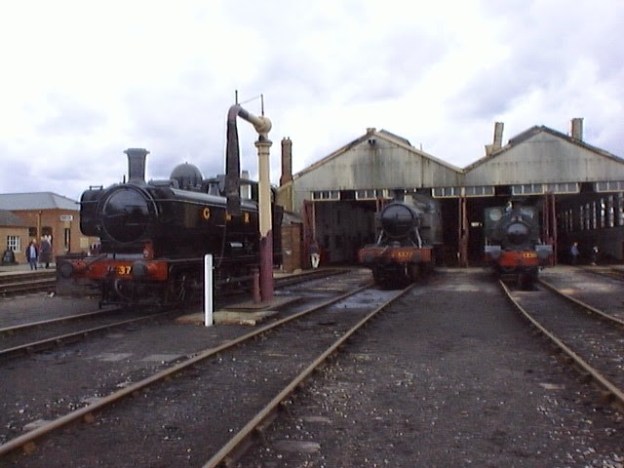
The featured image for this article is a photograph of the engine shed at Didcot Railway Centre taken in 2003. [My photograph, May 2003]

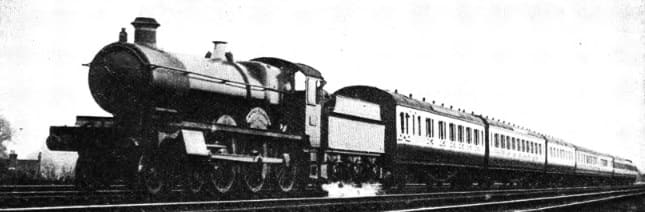
We start this article with a couple of photographs from the late 1920s/early 1930s showing express services from Paddington to Didcot.
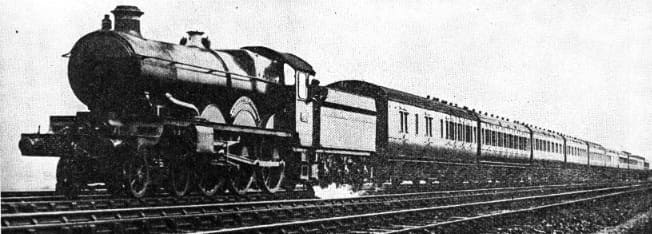
A Paddington to Didcot train in the capable hands of 4-6-0 locomotive ‘Star’ Class No. 4016, ‘Knight of the Golden Fleece’, in 1928. This image was carried in the Great Western Railway Magazine, Volume XL No. 6 of June 1928, p231. The photograph was taken by M. W. Earley, © Public Domain. [4]
Another Paddington to Didcot train in behind 4-6-0 locomotive ‘Saint Martin’ of their 2900 ‘Saint’ Class, in 1928. This image was carried in the Great Western Railway Magazine, Volume XL No. 11 of November 1928, p429. The photograph was taken by M. W. Earley, © Public Domain. [5]
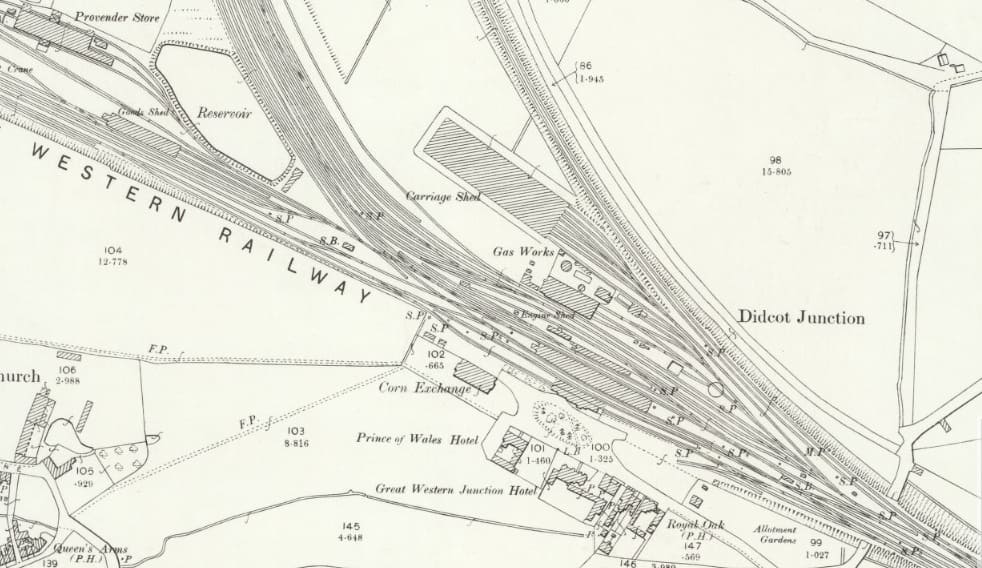
Didcot Railway Station in 1898, as it appears on the 25″ Ordnance Survey published in 1899. Note the small number of buildings opposite the station across Station Road. Didcot itself, just intrudes into the bottom-left of this map extract. [12]
Embed from Getty Images
Didcot Junction, Oxfordshire, 1904. View looking from the east at a signal box towards the junction station, with an engine approaching and a line of carriages to the left. The Branch Junction to Oxford and the erection of Isambard Kingdom Brunel’s covered station was completed in 1844, Artist Henry Taunt. (Photo from English Heritage/Heritage Images/Getty Images), Public Domain. [2]

Didcot Railway Station sat at the point where the line to Oxford diverged from the London-Bristol main line. It was an important interchange. The railway reached Didcot in 1839 and the station opened in 1844. It was rebuilt after fire in 1855. The timber island platforms in this view date from that rebuilding. The two-storey brick booking office in the image below was a later addition, dating from the early years of the 20th century. The booking office was rebuilt in the 1980s when the station was renamed Didcot Parkway. Only in the latter half of the 20th century has the town itself grown to match the importance of its railway station.
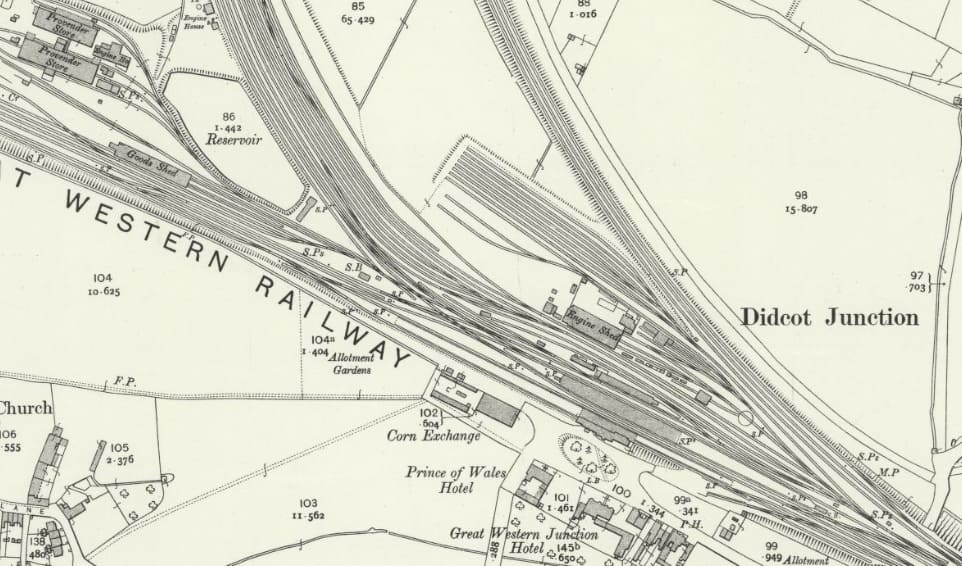
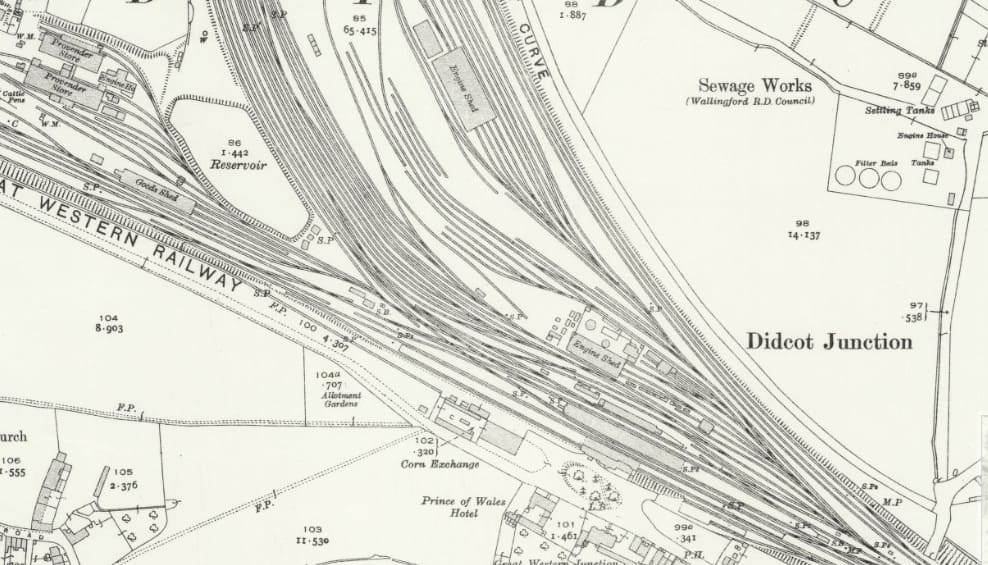
Didcot Railway Station as shown on the 25″ Ordnance Survey of 1910, published in 1912. The carriage shed appears to have been removed although the sidings are still present. The provender store top-right has become a complex of three significant buildings. [13]
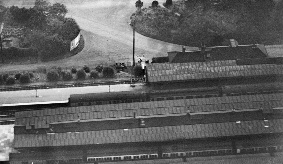
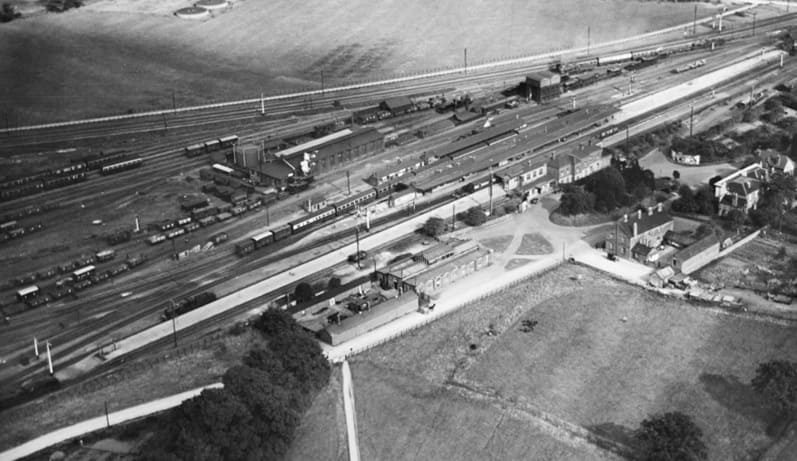
Didcot Railway Station, seen from the air in 1928. This is an excellent study of the station. The original locomotive depot which is seen beyond the station has changed significantly. It underwent a complete rebuild just a few years after this photograph was taken, in 1932. It was closed in 1965 and eventually it was sold to the Great Western Society to be redeveloped as their Didcot Railway Centre. The London-Bristol line runs right to left across the photograph – top-right to bottom-left. The East to North avoiding line is in the background beyond the depot. Trains from London to Oxford can pass through the station and then sweep round to the North immediately beyond the station of they can take the avoiding line. Trains from the Swindon direction can turn North at Foxhall Junction before reaching the station, but if scheduled to call at Didcot they would need to reverse to gain the Oxford line. Various 0-6-0s, 2-6-0s and 4-4-0s can be seen in the image. One 4-4-0 has left several coaches in the down platform and is running round its train, (c) Historic England (1928) EPW024646. [1]

This extract from another aerial image, this time facing South and looking across the site of Didcot Railway Station. The station buildings are in the top-right quadrant of the image (c) Historic England (1928) EPW024648. [8]
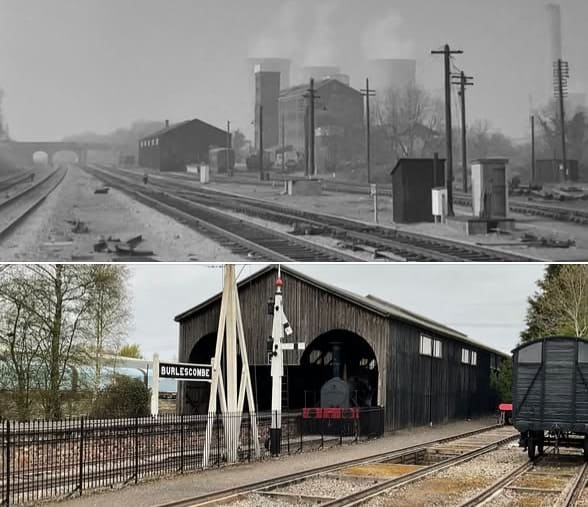
The first of these two images is a view looking west from the west end of Didcot Station around 1970 The down main line is furthest left. The bridge in the distance is Foxhall Road. The building in the middle distance on the right side of the main line is the old broad gauge/standard gauge goods transfer shed. In the heyday of Brunel’s broad gauge goods to and from the GWR system had to be laboriously transferred between GWR wagons and those of the standard-gauge. That building was preserved by relocating it on the Great Western Society’s Didcot Railway Centre site, where it has been recreated (apparently in a shortened form) as Burlescombe Shed (second photo), complete with mixed gauge track. The view in the first photo has changed in almost every way possible since I took it: transfer shed relocated, provender store (right of transfer shed) demolished, power station closed and demolished, main lines overhead electrified, bridge rebuilt. It all seemed so permanent at the time! These two photographs were shared by Vaughan Snook on the 19th Century Railway Enthusiasts’ Facebook Group in March 2026 © Vaughan  Snook. [3]
This extract comes from the 25″ Ordnance Survey of 1932, published in 1933. The new engine shed is in place. The number of sidings has increased again. The old engine shed has not yet been removed and the coaling stage has yet to be built. [14]

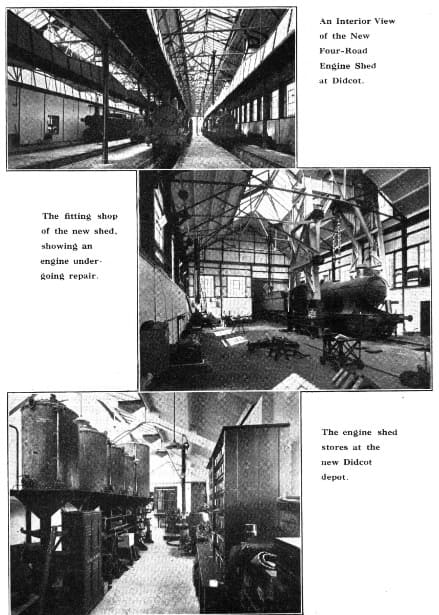
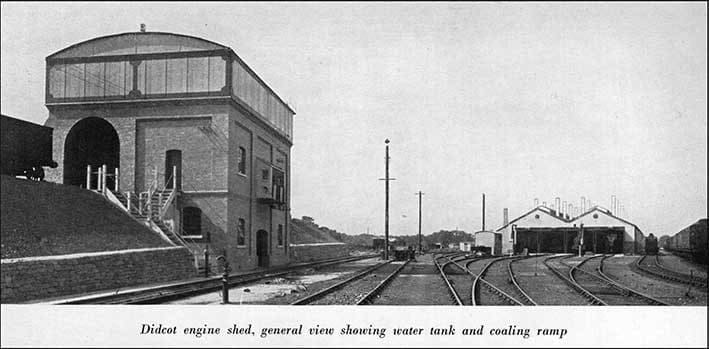
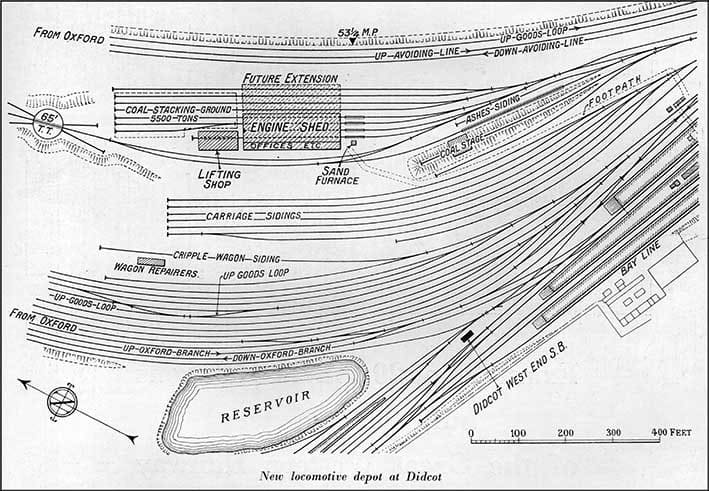
In 1932, a large four-road engine shed (210ft x 67ft) was built which could accommodate sixteen to twenty-four locomotives. In addition to the shed, a new lifting shop, with 50-ton hoist, has been provided, together with a large coaling stage with an overhead 74,250-gallon water-tank (44ft x 36ft). There was also new boiler-washing apparatus and plant for calcinating sand.

Following on the standardisation of locomotives, The GWR also sought to streamline and improve its maintenance facilities. It provided a number of new locomotive depots incorporating arrangements for enabling repairs and maintenance to be efficiently carried out. One of these was at Didcot, where the old locomotive depot was swept away and an entirely new depot provided on the triangle between the western main line and the line to Oxford and the North.
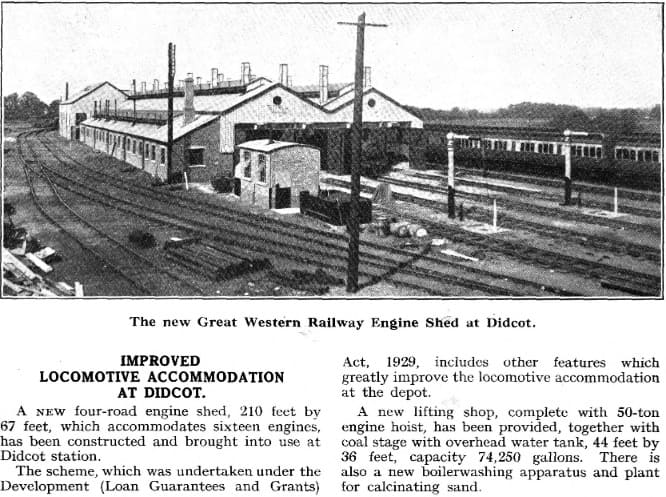
932: The New Engine Shed at Didcot. This unattributed image was carried in the Great Western Railway Magazine, Volume XL IV No. 10 of October 1932, p371. © Public Domain. [5]
A plan of the engine shed, coaling stage and carriage sidings at Didcot in 1933. Great Western Railway Development Works – Supplement to THE RAILWAY GAZETTE – 8th December 1933. [10]
1932: three images showing the interior of the New Engine Shed and Stores at Didcot. These unattributed images were carried in the Great Western Railway Magazine, Volume XL IV No. 10 of October 1932, p370. © Public Domain. [6]
A general view of the locomotive facilities at Didcot, featuring the new coaling stage on the left of the image. [10]

The 1932-built locomotive shed also included offices, stores and enginemen’s rooms, arranged along the south-west side of the building. They are commodious, well-lighted and warmed, and washing facilities are provided for enginemen, chargemen, fitters, mechanics, cleaners and shedmen. All the enginemen’s notices, instructions and roster sheets are contained in glass cases by which means they are kept flat, clean and easily discernible, and are posted up in a lobby between the stores and the offices. [10]
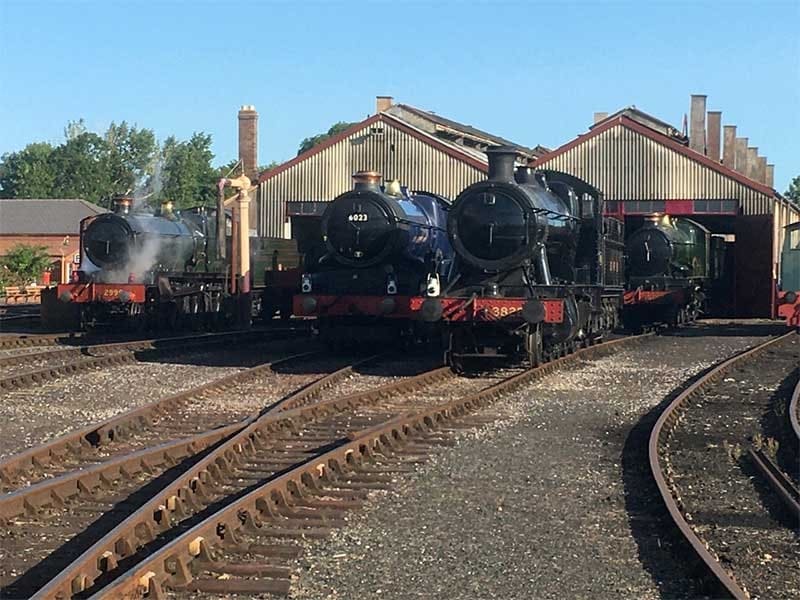
Various locomotive on shed in the 21st century. More can be found here. [11]

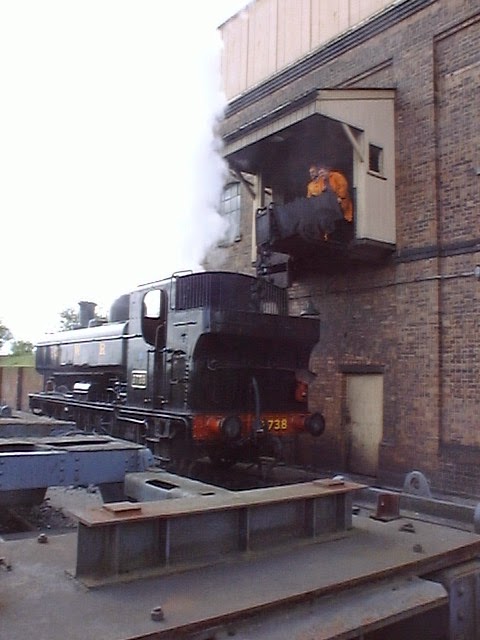
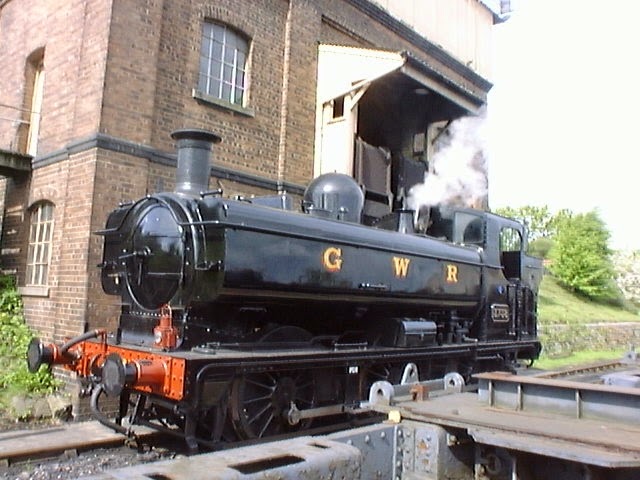
Photographs of the Coaling Stage at Didcot in May 2003. [My photographs, May 2003]
1932-1985

Little changed at Didcot in the years after WW2. The whole site remained virtually unchanged during the nationalised ownership of British Railways, but for the engine shed taking on the new code of 81E. The standard allocation of locomotives remained much the same as before nationalisation, with Halls, Dukedogs and Panniers making up the bulk of the depot’s fleet.

The gradual replacement of steam by diesel traction resulted in the closure of the locomotive facilities in June 1965.

In 1967, the Great Western Society took over the 1932 engine shed and surrounding infrastructure to establish a living railway museum – Didcot Railway Centre.

Didcot Parkway

Didcot Railway Station was renamed ‘Didcot Parkway’ in 1985. “A new main building for the station was built along with a new 600-space car park on the site of the former provender store to the west of the station for Park and Ride use. These were opened on 29th July 1985 by David Mitchell MP, Parliamentary Under Secretary of State for Transport, and on that date the station was renamed Didcot Parkway.” [9]

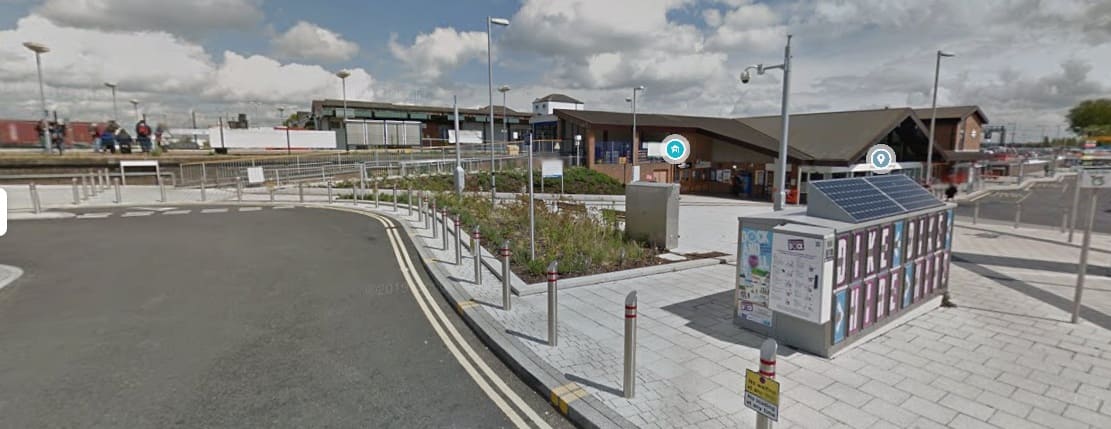
More recently, in 2018, a multi-storey car park was opened, costing £20 million and increasing the number of spaces by 65% to 1800. The car park also has a sheltered footbridge. In 2021, a new cycle storage hub was constructed, providing 600 covered spaces, LED lighting, CCTV cameras and a bike repair station. The project cost £1m, and was completed by a partnership of GWR, DfT and Network Rail. The station was served by some ‘Cross Country’ services until 2003, when Virgin ‘Cross Country’ ceased to call at the station, with all services using the Didcot East curve to and from the Oxford line. As at December 2018, one late night ‘Cross Country’ service from Reading to Birmingham New Street passed through Didcot Parkway to allow drivers to retain route knowledge. Passenger services on the West Curve ceased for a time after Thames Trains’ Oxford to Bristol Temple Meads service was withdrawn in 2003 but was reinstated on Saturdays in 2024. [9]
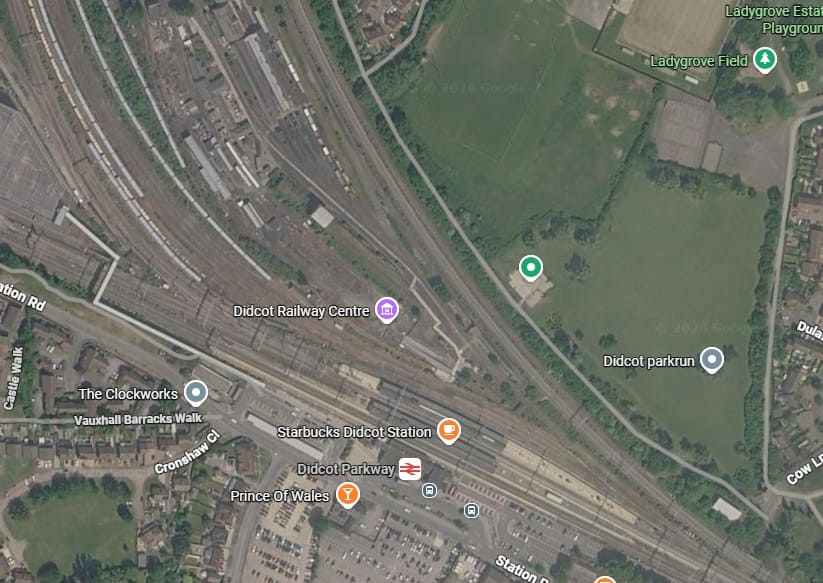
A 21st century satellite image showing the modern station at Didcot – Didcot Parkway and the Southern end of the Didcot Railway Centre. The avoiding line can be seen running from the bottom-right to the top-middle. The carriages sit on sidings alongside the line for Oxford which leaves the main line to the West of the station. [Google Maps, September 2026]
Didcot Parkway Railway Station, seen from the Southwest. [Google Streetview, April 2015]

References

  1. https://www.britainfromabove.org.uk/en/image/EPW024646, 9th September 2026.
  2. https://www.gettyimages.com/detail/961476136, accessed on 11th September 2026
  3. https://www.facebook.com/groups/1614960195255335/posts/26251905641134115, accessed on 11th September 2026.
  4. https://www.greatwesterntrust.org.uk/PDFViewer/web/viewer.html?file=%2fFilename.ashx%3ftableName%3dta_journals%26columnName%3dfilename%26recordId%3d469%26page%3d12%26end%3d13, accessed on 11th September 2026.
  5. https://www.greatwesterntrust.org.uk/PDFViewer/web/viewer.html?file=%2fFilename.ashx%3ftableName%3dta_journals%26columnName%3dfilename%26recordId%3d474%26page%3d12%26end%3d12, accessed on 11th September 2026.
  6. https://www.greatwesterntrust.org.uk/PDFViewer/web/viewer.html?file=%2fFilename.ashx%3ftableName%3dta_journals%26columnName%3dfilename%26recordId%3d547%26page%3d8%26end%3d8, accessed on 11th September 2026.
  7. https://www.greatwesterntrust.org.uk/PDFViewer/web/viewer.html?file=%2fFilename.ashx%3ftableName%3dta_journals%26columnName%3dfilename%26recordId%3d547%26page%3d7%26end%3d7, accessed on 11th September 2026.
  8. https://www.britainfromabove.org.uk/image/epw024648, accessed on 11th September 2026.
  9. https://en.wikipedia.org/wiki/Didcot_Parkway_railway_station, accessed on 11th September 2026.
  10. https://didcotrailwaycentre.org.uk/article.php/310/the-1932-engine-shed-when-new, accessed on 11th September 2026.
  11. https://didcotrailwaycentre.org.uk/article.php/17/1932-engine-shed, accessed on 11th September 2026.
  12. https://maps.nls.uk/view/104196166, accessed on 11th September 2026.
  13. https://maps.nls.uk/view/104196163, accessed on 11th September 2026.
  14. https://maps.nls.uk/view/104196160, accessed on 11th September 2026.
Steam Railmotors – Part 3 – The Great Western Railway (GWR)

In addition to the references referred to in the text below, a significant study of the GWR Railmotors can be found in John Lewis’s book, “GWR Railmotors.” [13]

After borrowing a LSWR railmotor/railcar in the early years of the 20th century and running trials between Stroud, Chalford and Stonehouse on the ‘Golden Valley Line’, the GWR embraced this new technology. In fact, out of a total of 197 purpose-built steam railmotors/railcars built in the period from 1902 to 1911 across the UK, the GWR had 99 and was by far the largest user. [1: p9] These 99 units “represented the only truly serious attempt by a major British company to persevere with this particular solution to the fundamental operating problem.” [1: p13]

Talking of the Stroud Valley line M.G.D. Farr had a very short illustrated article about the GWR railmotors/auto-trains on that line carried by the Ian Allan journal, ‘Railway World‘ in January 1965. It followed the closure of the railcar/Railmotor/auto-train service in the valley on 31st October 1964. [14: p30]

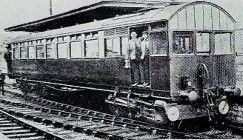
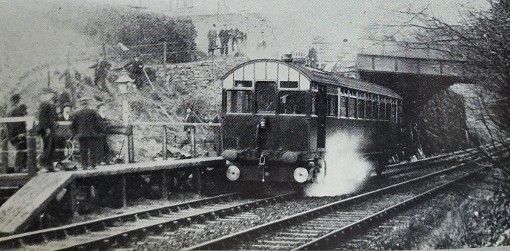
GW steam railmotor No. 1 leaving Chalford in 1903. [14: p30]
GW steam railmotor No. 2 leaves Brimscombe Bridge Holt for Stonehouse in 1903. [14: p30]

The GWR separated its Railmotors into 2 different types: ‘Suburban’ and ‘Branch line’. The principal difference being the provision of a luggage compartment on those designed for branch line use which was not provided in those intended for suburban use. The first 16 units built did not have luggage space and were designated ‘suburban’. [6]

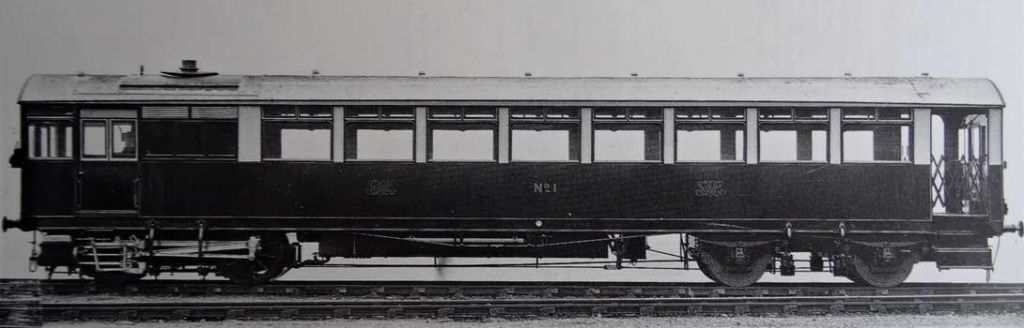
The majority of the GWR Railmotors were rigid framed with no articulation. Just two exceptions were articulated (No. 15 and No. 16). The remaining examples fell into two different variants. The first had an austere slab-sided appearance with matchboard side panels below the waist. They were flat-ended, as can be seen below. “Two ‘prototypes’ were built in 1903, followed by the main batch in 1904 (Nos. 3-14, 17-28).” [1: p13]

One of two ‘prototypes’, GWR Railmotor No. 1 at Stonehouse, © Public Domain. [7]
Manufacturers photograph of GWR Railmotor No. 1 © Public Domain, NRM Collection. [8]

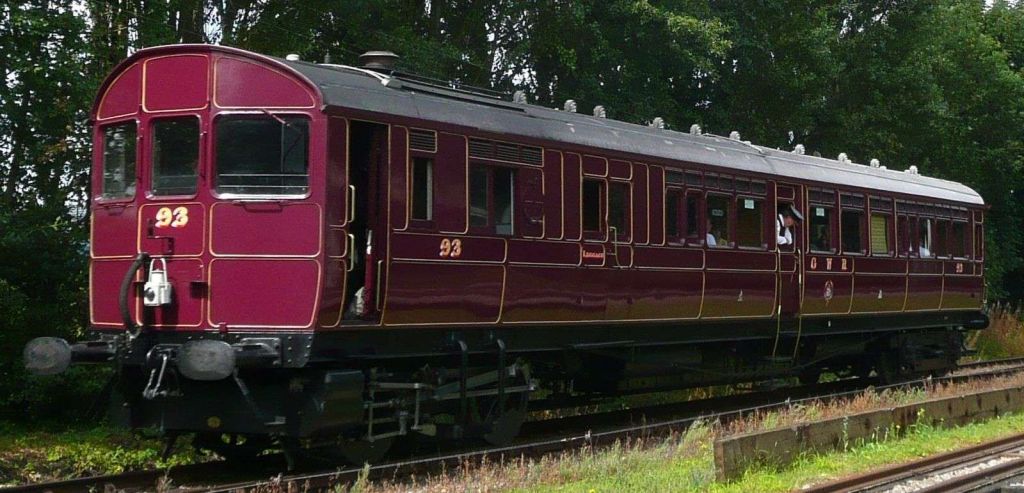
Later GWR Railmotors (Nos. 29-99) were built between 1905 and 1908, were bow-ended and were of a much more attractive design. They had higher waist-lines than contemporary locomotive-hauled coaching stock on the GWR and retained those lines when ultimately converted to auto-trailers. [1: p13]

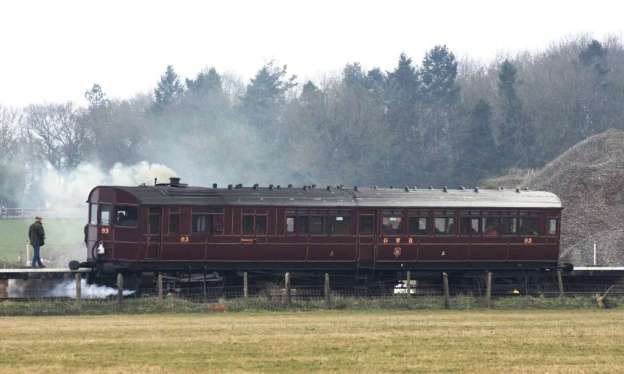
Restored Great Western Railway steam railmotor No. 93 at Norton Fitzwarren during a visit to the West Somerset Railway, © Geof Sheppard and licenced for use here under a Creative Commons Attribution-Share Alike 4.0 International Licence (CC BY-SA 4.0), 25th March 2013. [6]
Another view of GWR Railmotor No. 93, this time at Didcot Railway Centre, © S P Smiler, cropped by Edgepedia and included here under a Creative Commons Licence (CC0 1.0 Universal Public Domain Dedication), 22nd August 2012. [10]

GWR Railcar No. 93 has been reproduced in model form by Kernow Model Railway Centre. Details can be found here. [12]

GWR Railmotor No.45 at Penzance in circa. 1915, © Public Domain. [6]

The GWR Railmotors were generally successful in developing patronage on the lines where they were used. Often generating sufficient traffic to warrant the provision of a passenger trailer car.

The first trailer built had the same flat-ended design as the early GWR Railmotors. The remaining trailers were built to the bow-ended format.

Gibbs tells us that “Such was the demand for trailers that in 1906 existing selected coaching stock was introduced to the conversion programme. Conversion was applied to six 1890s clerestory and two four-wheelers dating back to the 1870s, the 1870s-1900s supplying some of the first conversions, with demand increasing and later periods supplying more examples for conversion, each with varying seating patterns and internal format. Thus the two four-wheel, 28.5ft-long 1870 versions were running with the new 70ft latest additions to the fleet.” [9]

The design of the GWR Railmotors had not anticipated their success. While being adequately powered as single cars they were generally, particularly which had anything but shallow gradients, “incapable of pulling an extra trailer to carry the new customers which their success had generated.” [1: p13]

Inevitably, when passenger loads increased, alternatives to the Steam Railmotors had to be found. “The emerging ‘auto train’ was showing its usefulness and adaptability. Thus we find that, from 1915, the steam railmotors themselves were on the downward path to becoming trailers, and a serious conversion programme was initiated. These were dealt with year by year in varying sized batches, not strictly in order of age, but the match-boarded designs preceded those of wood-panel format, and it will be noted that conversions were not applied to all railmotors and nor were such activities an annual event.” [9]

Generally, the powered-bogie end of each unit was converted to a luggage compartment while the drivers position at the other end of the unit was retained “with controls for regulator and brakes connected through to the tank locomotive, suitably modified.” [9]

GWR Articulated Steam Railmotors

As we have already noted, the vast majority of GWR Steam Railmotors were rigid-bodied. Just two (GWR Nos 15 and 16) were articulated.

Articulated units had the advantage of being relatively easily separated for maintenance purposes and allowed for the possibility of providing more powerful locomotive sections. Throughout the UK, where articulated Railmotors were provided the locomotive section looked more like a small standard locomotive.

Often, additional power units were purchased to allow the immediate replacement of a unit in need of maintenance. An example of this practice was the deployment of articulated railmotors on the Taff Vale Railway. The Taff Vale railmotors were built between 1903 and 1905 “in the form of one prototype and three main batches. There were 18 engine units and 16 carriage portions, thus permitting stand-by power units to be available. …  The pioneer power unit came from the company’s own workshops (the last ‘locomotive’ to be built by the TVR in its shops at West Yard, Cardiff), followed by six each from Avonside and Kerr-Stuart and a final five from Manning Wardle.” [1: p21]

GWR Steam Railmotors No. 15 and 16 were ordered from Kerr Stuart. They were built in 1905 to Kerr Stuart’s design. Bristol Wagon and Carriage Company were subcontractors, providing the bodywork for each unit. [1: p32] There being only two units, exchangeable power sections was not an option fiscally.

In 1920 No. 15 was sold by the GWR to J.F. Wake and sold on, in 1921, to the Nidd Valley Light Railway (NVLR). [1: p32]

Ex-GWR steam railmotor No. 15 was known as ‘Hill’ on the NVLR. This image shows the railmotor alongside the signal box at Pateley Bridge where the NVLR made connection to the NER branch from Harrogate via Ripley Junction. The NVLR was wholly owned by Bradford Corporation Waterworks and operated in connection with the construction of new reservoirs at the head of Nidderdale. The power unit on both GWR Nos. 15 and 16 had a transverse boiler. This feature was retained after transfer onto the NVLR. The sliding screens visible at the top of the driver’s access onto the footplate were a post-GWR alteration, © Public Domain. [11][1: p32]

References

  1. David Jenkinson & Barry C. Lane; British Railcars: 1900-1950; Pendragon Partnership and Atlantic Transport Publishers, Penryn, Cornwall, 1996.
  2. https://en.m.wikipedia.org/wiki/British_steam_railcars, accessed on 14th June 2024.
  3. R.M. Tufnell; The British Railcar: AEC to HST; David and Charles, 1984.
  4. R.W. Rush; British Steam Railcars; Oakwood Press, 1970.
  5. https://victorianweb.org/victorian/technology/railways/locomotives/27.html, accessed on 16th June 2024.
  6. https://en.m.wikipedia.org/wiki/GWR_steam_rail_motors, accessed on 17th June 2024.
  7. https://didcotrailwaycentre.org.uk/zrailmotor93/history/pictures/sub_gubbins.html, accessed on 17th June 2024.
  8. https://www.nrmfriends.org.uk/post/motoring-in-1903, accessed on 17th June 2024.
  9. Ken Gibbs; The Steam Railmotors of the Great Western Railway; The History Press, Cheltenham, 2015.
  10. https://commons.m.wikimedia.org/wiki/File:GWR_Steam_Railmotor_No_93_At_the_Didcot_Railway_Centre,_cropped.jpg, accessed on 17th June 2024.
  11. https://www.flickr.com/photos/29903115@N06/51337152220, accessed on 17th June 2024.
  12. https://www.kernowmodelrailcentre.com/pg/144/KMRC-Locomotive—GWR-Steam-Railmotor, accessed on 23rd June 2024.
  13. John Lewis; Great Western Steam Rail Motors and their services; Wild Swan Publications, Bath, 2004.
  14. M. G. D. Farr; Stroud Valley Railcars; in Railway World, January 1965, Ian Allan Publishing.