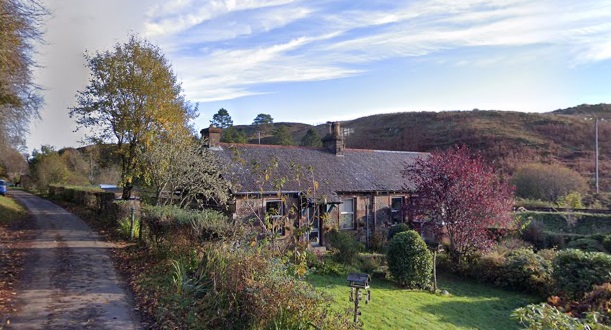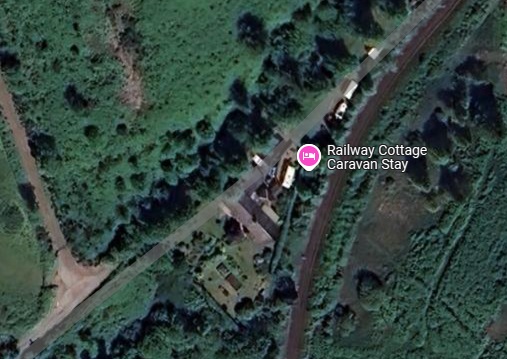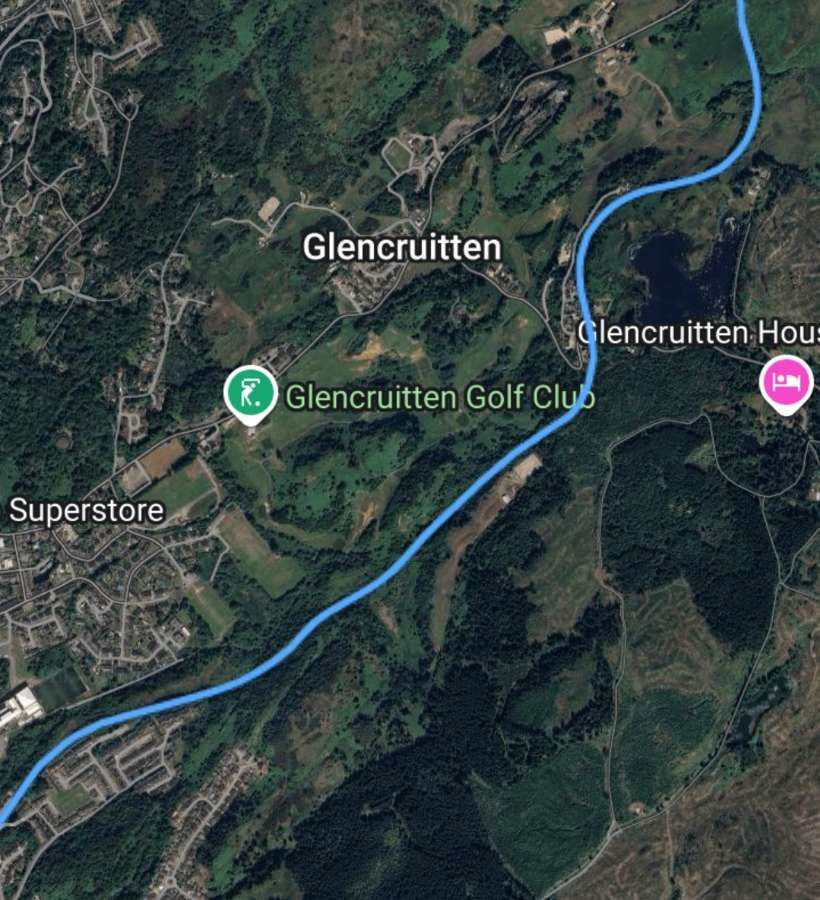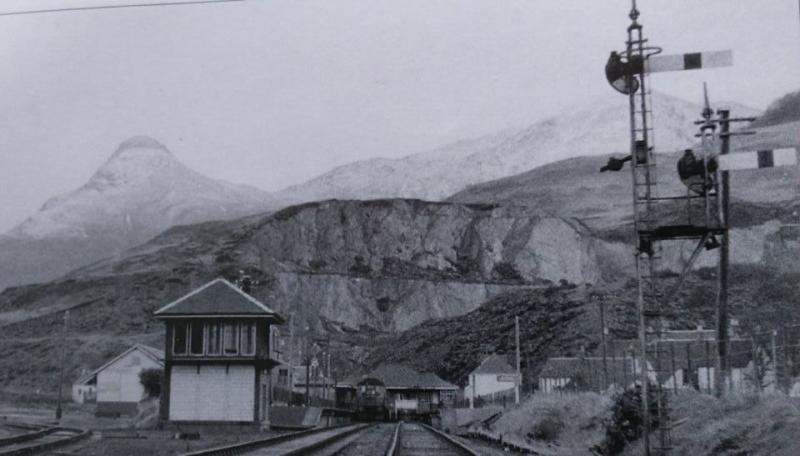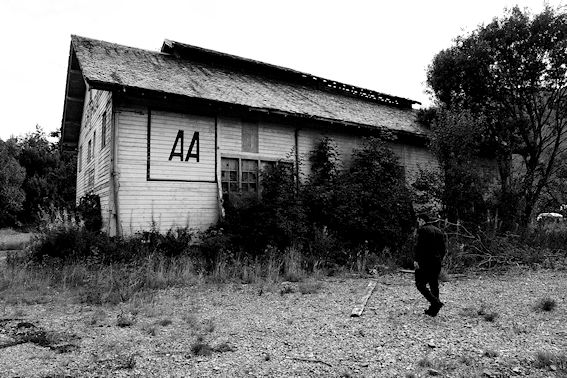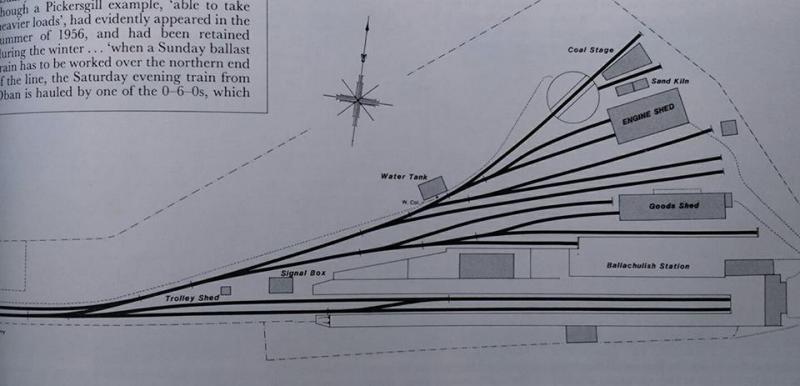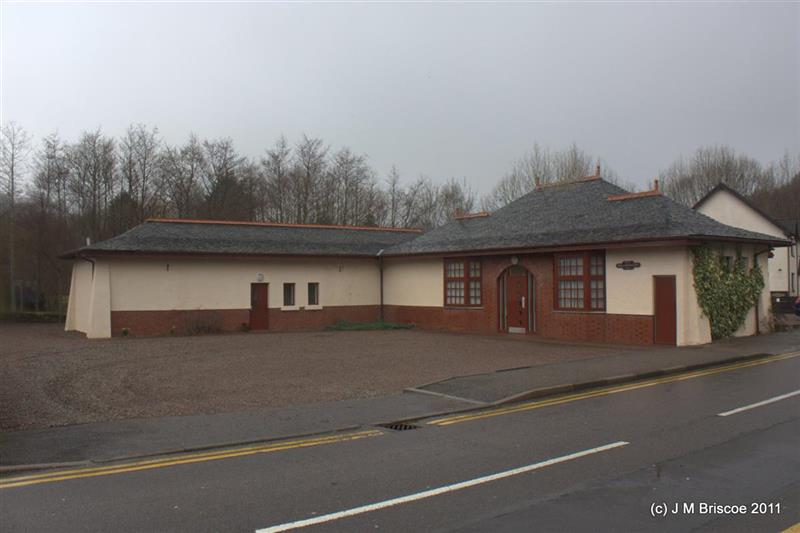
Category Archives: Scottish Railways

The Callander and Oban Railway

In July 1923, The Railway Magazine carried an article about the Callander & Oban Railway (C&O) written by G.F. Gairns. [1]

Gairns commented that the C&O constituted the third of the three great mountain lines: the Perth-Inverness line of the Highland Railway; the West Highland Line of the North British Railway; and the Callander & Oban Railway (including the Ballachulish Extension).
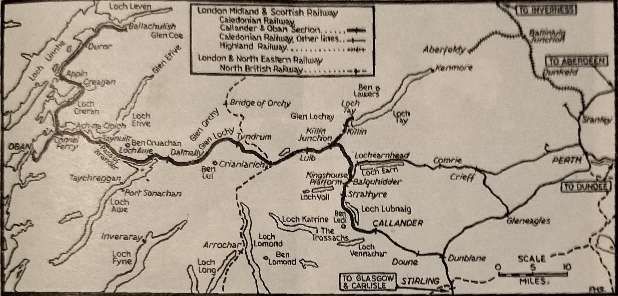
The Callander & Oban Railway. [1: p11]

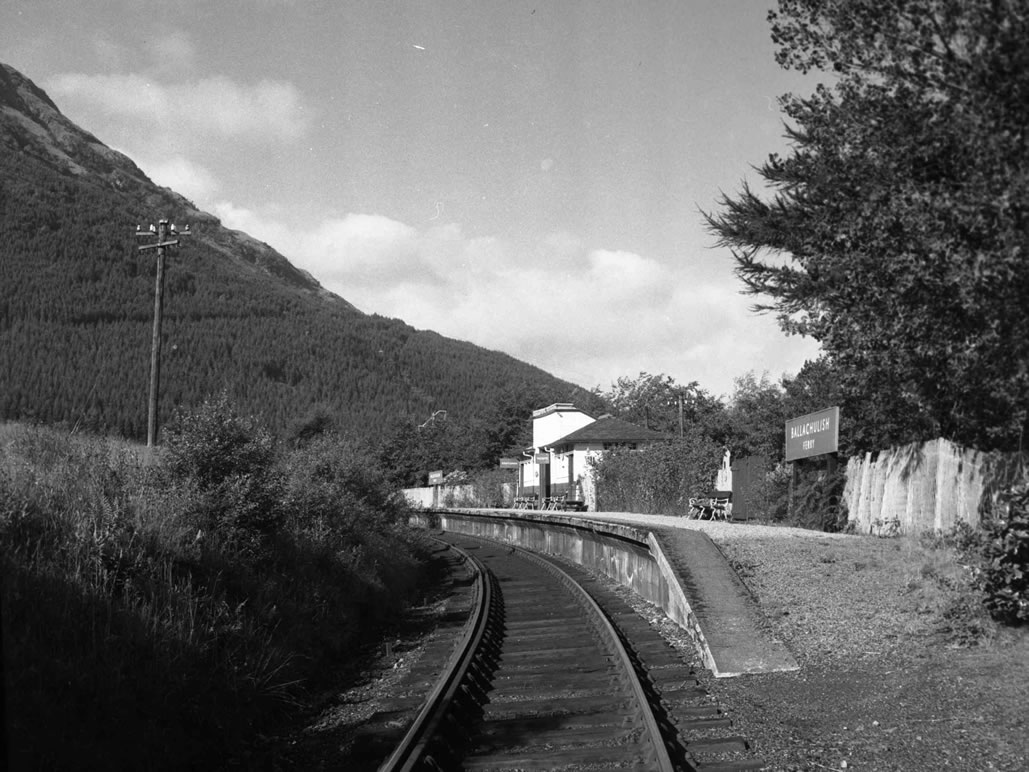
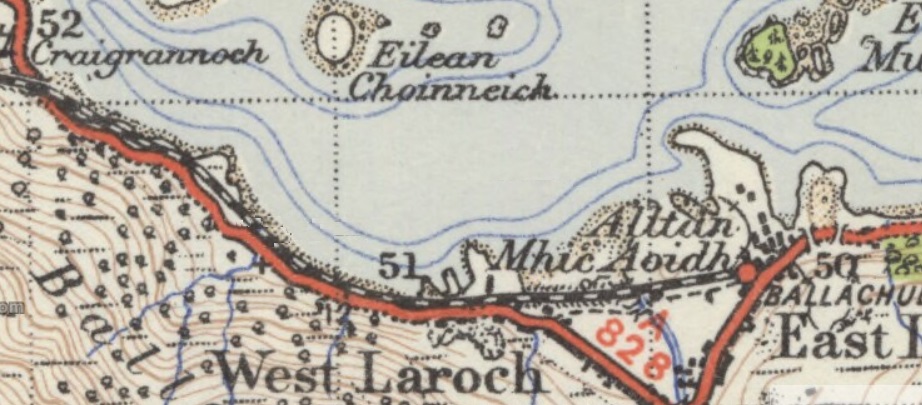
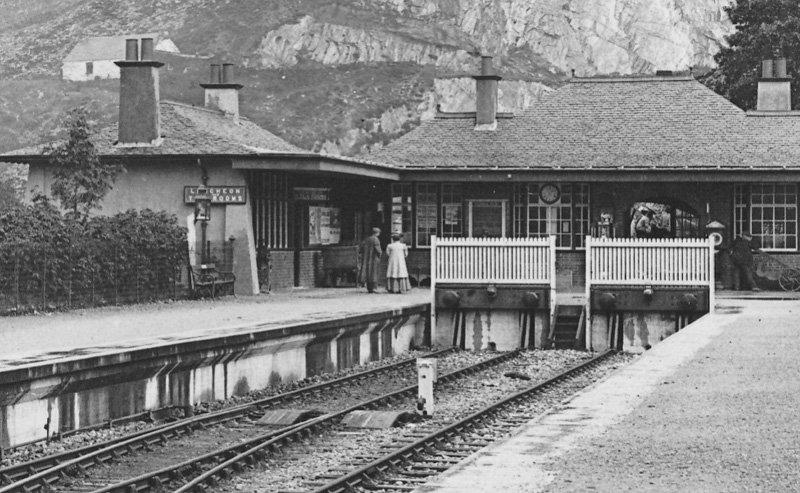
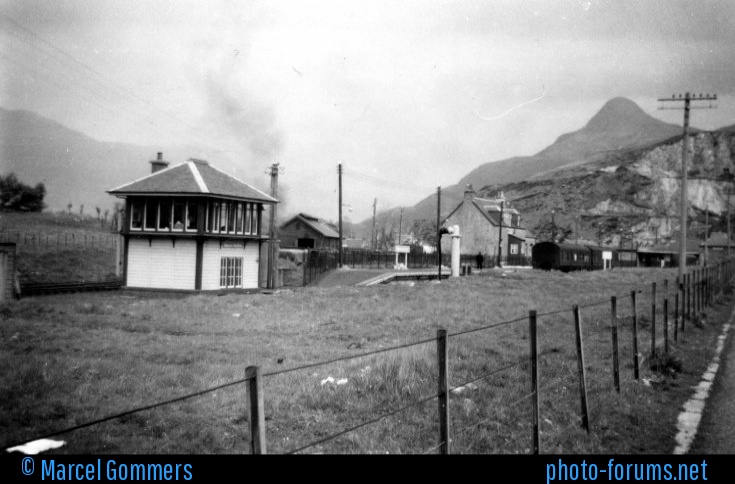
A short series of four articles about the Ballachulish line can be found here, [2] here, [3] here, [4] and here. [5]

The C&O had previously been written about in the Railway Magazine, specifically in the issues of September 1903, August 1904, and August and September 1912. Gairns leaves the detailed history to those previous articles, apart from a brief introduction, and focusses in 1923 on a journey along the line from Stirling to Oban and to Ballachulish.

An excellent presentation of the various scenes which preceded the Callander & Oban Railway can be found in the early pages of John Thomas’, ‘The Callander & Oban Railway‘. [62: p1-26]

Ultimately, an agreement was signed between the Scottish Central Railway (SCR) and the Callander & Oban (C&O) was signed on 17th December 1864 which affirmed that the SCR would subscribe £200,000 to the scheme. “The C&O was to have nine directors, five appointed by the Scottish Central and four by the promoters. The line was to be ‘made, constructed and completed in a good, substantial sufficient and workmanlike manner, and without the adoption of timber bridges and culverts’. … The rails were to weigh 75 lb per yard and were to be laid in 24 ft lengths on larch sleepers placed at an average distance of 3 ft.” [62: p26-27]

As part of the agreement, once at least 20 miles of line directly connected to the Dunblane, Doune & Callander Railway had been constructed and passed by the Board of Trade, the Scottish Central Railway undertook work it in perpetuity, on the basis that it would receive half of the gross revenue.

The Callander & Oban Railway bill was drawn up and presented in Parliament in January 1865. … The bill sought:

First, a Railway commencing about Five Furlongs South-westwards from the Schoolhouse in the Town of Oban called the Oban Industrial School, and terminating by a Junction with the Dunblane, Doune and Callander Railway, about One and a Half Furlongs Eastward from the Booking Office of the Callander Station of the Railway.

Secondly, a Tramway commencing by a Junction with the Railway above described about One Furlong South-westwards from the said Schoolhouse, and terminating on the Pier on the East Side of the Harbour of Oban about Two Chains Eastward from the South-western end of the said Pier.” [62: p27]

148 railway bills were passed in a two-day session of Parliament on January 1865. These included the C&O and the Dingwall & Skye Railway.  Both these schemes had a similar primary purpose – to reach ports on the West Coast of Scotland to give the fishing trade access to markets in the rest of Scotland and further South.

Thomas comments: “The Callander & Oban Railway Act was passed on 8th July 1865. The  first sod was not cut for over fourteen months. Five years were to pass before a revenue-earning wheel was to turn on the line (and on only 17½ miles at that), and it would be fifteen years before a train entered Oban. … But even before the Act was passed sweeping changes had transformed the railway political scene. Ten days earlier, on 29th June, the Scottish Central had won permission to take over the Dunblane, Doune & Callander as from 31st July 1865; and the Central had enjoyed its new-found gains for one day. On 1st August 1865 the Central itself had been absorbed by the Caledonian, which acquired all its assets and liabilities including the obligation to finance and operate the Callander & Oban. At the outset the C & O directors found themselves with formidable new masters.” [62: p28]

As much as the Callander & Oban had looked attractive to the Scottish Central. “It was not at all attractive to the Caledonian, whose shareholders, had no stomach for squandering cash among the Perthshire hills. … The 1861 census had shown that Oban and Callander between them possessed fewer than 3,000 inhabitants, and the scattered hamlets between the two could produce barely a thousand more. The certain dividends lying in the coal and iron traffic of the Clyde Valley were infinitely preferable to the nebulous rewards from the fish and sheep of the West Highlands.” [62: p29]

From the beginning there was a faction on that Caledonian board which wished to drop expansion towards Oban at the earliest opportunity, “but the terms of the SCR-Caledonian amalgamation agreement forbade such a course. And there was another reason, if a negative one, why the Caledonian should use caution. The amalgamations of 1865 had given the Edinburgh & Glasgow to the North British, which as the result had now penetrated deep into traditional Caledonian territory – Glasgow and the Clyde coast; and the North British already possessed and exercised running powers into Callander. If the Caledonian abandoned its awkward foster-child on the Callander doorstep, it was reasonable to suppose that the North British would attempt to pick it up.” [62: p29]

The Callander & Oban directors had undertaken to find £400,000 along the route of the railway. This proved to be a monumental task. Their first attempts brought in 201 individual shareholders who subscribed for a total of £56,360 worth of shares! The C&O may well have been stillborn had it not been for the appointment of John Anderson as the Secretary to the C&O.

Given palpable hostility between the directors, Anderson “was left to conduct the line’s affairs single-handed.” [62: p32] Thomas goes on to describe in some detail the different methods he used to achieve progress. The machinations involved need not, however, detain us here

Gairns writes:

The Callander and Oban Railway Company was constituted in 1865. The Dunblane, Doune and Callander Railway was already in existence, having been opened in 1858. The Callander and Oban line was opened: Callander to Killin Junction, 1870; Killin Junction to Tyndrum, August, 1873; thence to Dalmally, May, 1877; and to Oban, July, 1880. At Balquhidder, at first known as Lochearnhead, the line from Crieff makes connection. This route, with connecting lines, was opened, Perth to Methven, 1838; Methven Junction to Crieff, 1866; Gleneagles (previously Crieff Junction, 1856; Crieff to Comrie, 1893; Comrie to St. Fillans, 1901; St. Fillans to Balquhidder (Lochearnhead), 1905. The Callander and Oban line has always been worked by the Caledonian Company, and is now [1923] included in the London Midland and Scottish Railway.

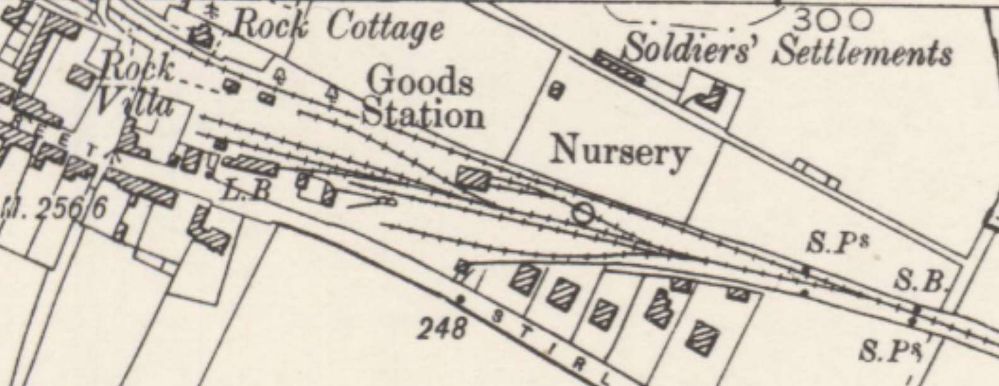
Dunblane is the ordinary junction for the Callander and Oban line, but trains which are not through to or from Glasgow use Stirling as their southern terminus. In some instances, ordinary Caledonian main line engines work the trains to and from Callander, the special C. and O, engines being attached or detached there, though this is mainly a traffic arrangement, convenient in the case of certain trains. At Dunblane there is an island platform on the down side, thus enabling branch trains to wait on the outer side to make connections. To Doune is double track, and the country mainly pastoral. Thence to Callander is single line, controlled by electric train tablet, as is the whole of the Callander and Oban line. The scenery continues to be of lowland character, though picturesque, but signs of the mountain country beyond show themselves. Between Doune and Callander is an intermediate crossing place – Drumvaich Crossing – to break up the long section of nearly 7 miles between stations. The original line diverged into what is now the goods station at Callander, the present station having been built when the Oban line was made. Callander station is distinctly picturesque, an ornamental clock tower surmounting the footbridge, and the station buildings being neat and attractive, while the platforms are decorated florally. It also has refreshment rooms on the platforms. On the up and down sides there are short bay lines from which locals can start as required. For down trains there is also a ticket platform, half a mile or so short of the station, but this is now used only by a few trains.” [1: p10]
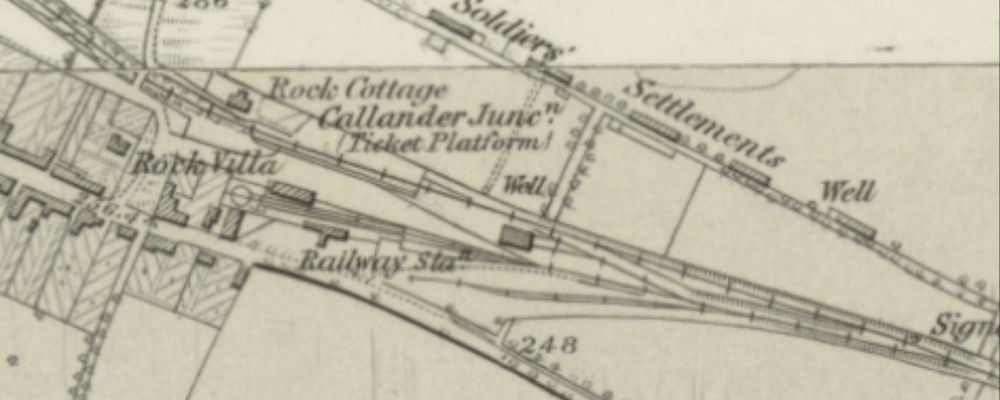
The original location of Callander Railway Station as shown on the 6″ Ordnance Survey of 1862, published in 1866.  [6]
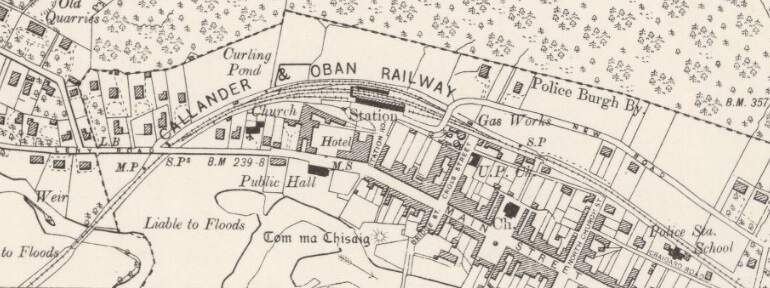
The original location of Callander Railway Station as shown on the 6″ Ordnance Survey of 1899, published in 1901. By this time the site had become Callander’s Goods Station. [7]
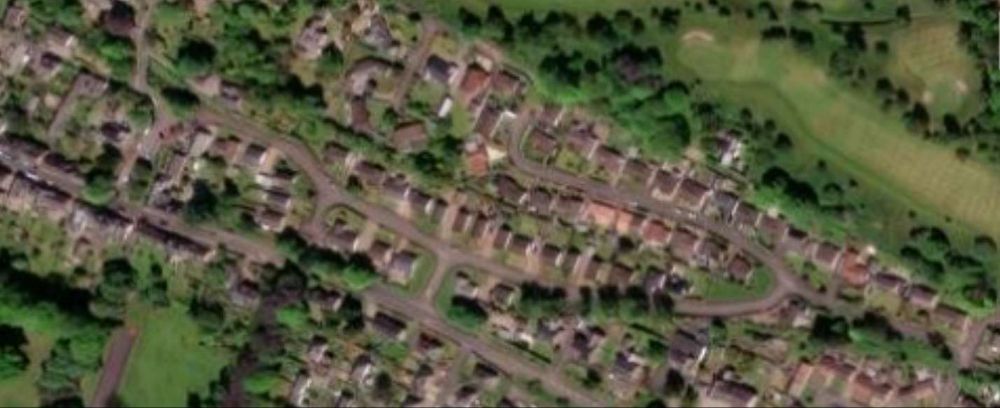
The location of Callander’s first Railway Station in the 21st century, as it appears on the ESRI satellite imagery provided by the National Library of Scotland (NLS). [6]
Callander Railway Station as shown on the 6″ Ordnance Survey of 1899, published in 1901. [9]
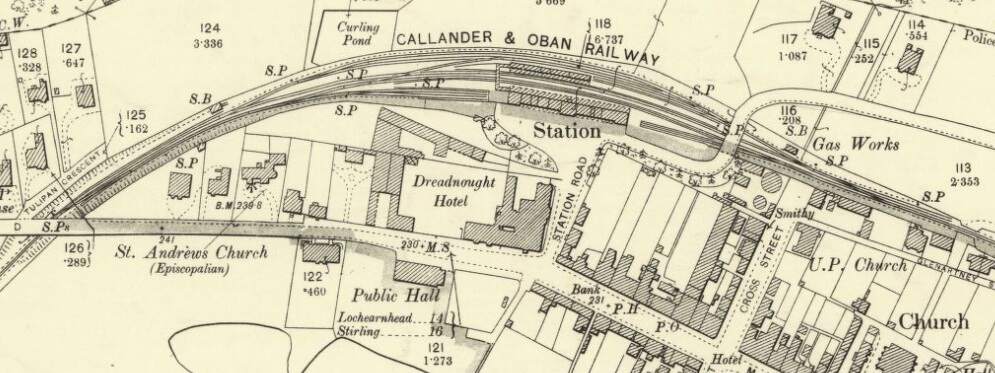
Callander Railway Station as shown on the 25″ Ordnance Survey of 1899, published in 1901. [13]
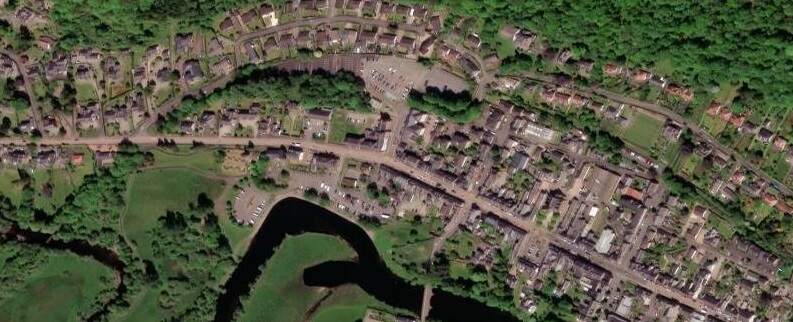
The location of Callander Railway Station in the 21st century as shown on the ESRI satellite imagery provided by the NLS. [9]
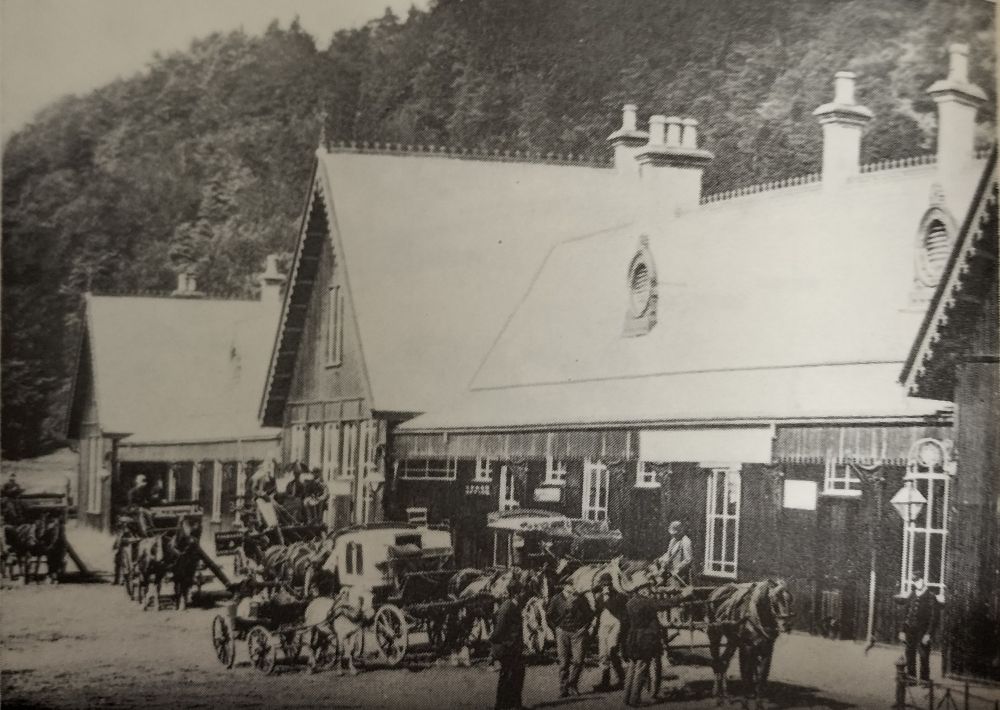
Coaches awaiting the arrival of the train, about 1895, © Public Domain. [62: p48]
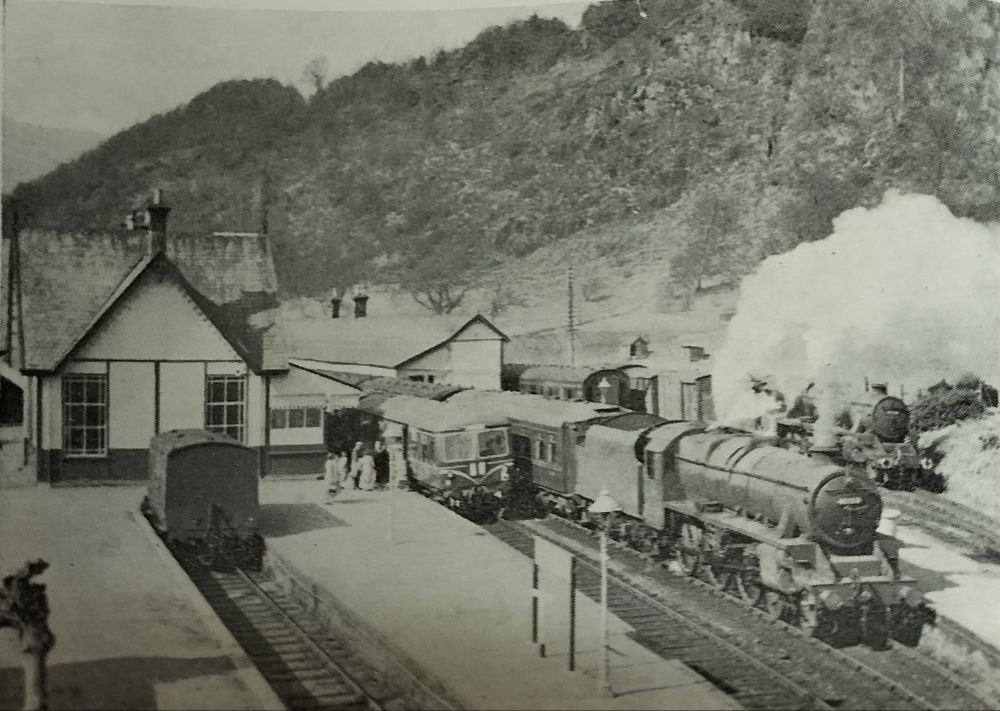
A busy morning in 1959. A diesel excursion, No. 45153 on 9.18 am Oban -Glasgow, and No. 45213 on an up freight, © Public Domain. [62: p48]

Wikipedia tells us that “closure [for Callander Station] came on 1st November 1965, when the service between Callander and Dunblane ended as part of the Beeching Axe. The section between Callander and Crianlarich (lower) was closed on 27th September that year following a landslide at Glen Ogle.” [8]

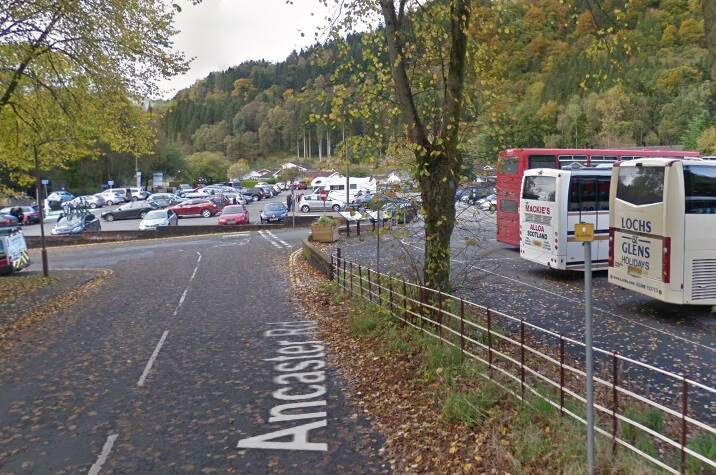
Callander Station from the roadbridge Mar'73.
This is an embedded link to a Flickr image of Callander Railway Station (seen from the road bridge at the East end of the Station) in 1973, (c) David Christie. [10]
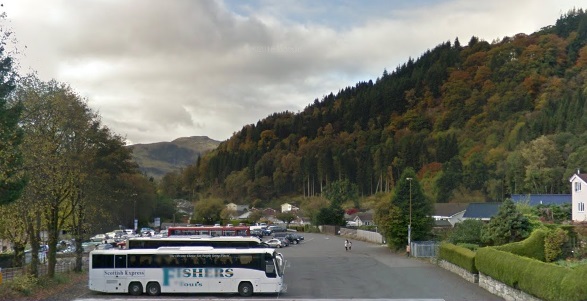
A very similar view in the 21st century. [Google Streetview, October 2016]
The road bridge at the East end of Callander Raiway Station in 1967 (Ancaster Road Bridge). (c) J.R. Hume, Public Domain [11]
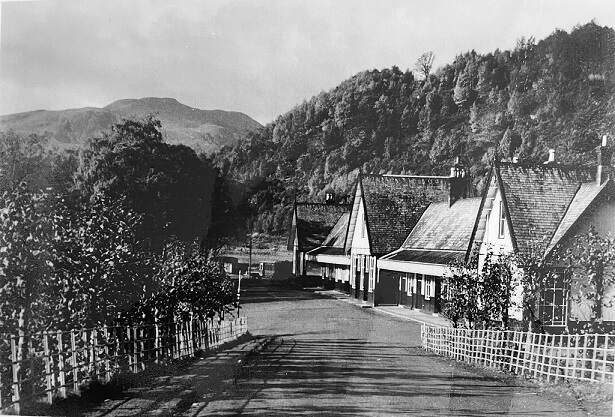
Callander Railway Station forecourt in the 1940s, seen from the East. This image was shared on the Callander Heritage Society Facebook Page on 18th December 2023, (c) Public Domain. [12]
A similar view in the 21st century. [Google Streetview, October 2016]
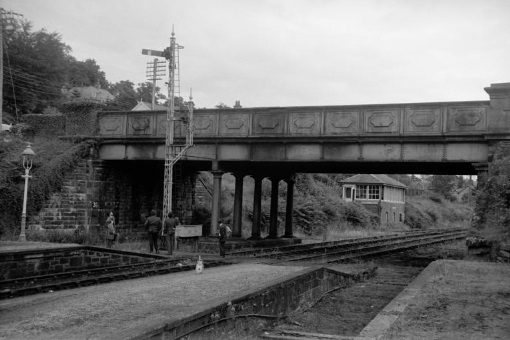
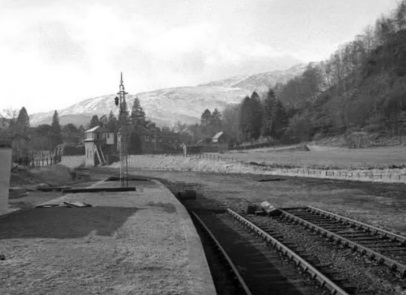
Lookin West from Callendar Railway Station after the lifting of the rails. The tall signal box allowed for visibility beyond Leny Road Bridge which is just off the scene to the left. This image was shared on the Callendar Heritage Facebook Page on 27th September 2023. [14]

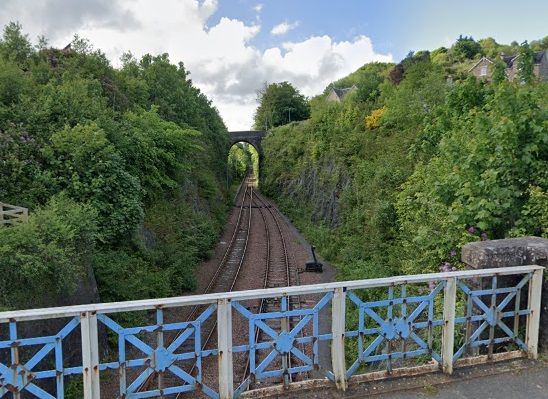
The old railway passed under Leny Road, Callander at the western end of the station site. The first image below shows the alignment of the railway looking Northeast from Leny Road. The pelican crossing marks the location of the old bridge. The second image shows the public footpath which follows the old railway to the South side of Leny Road.
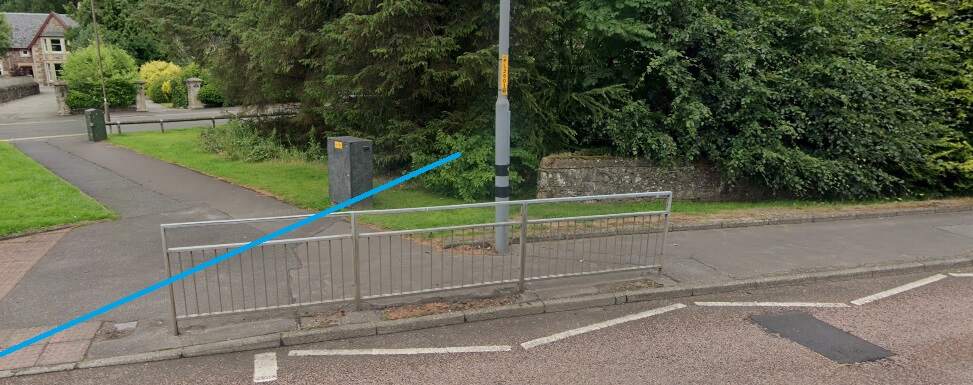
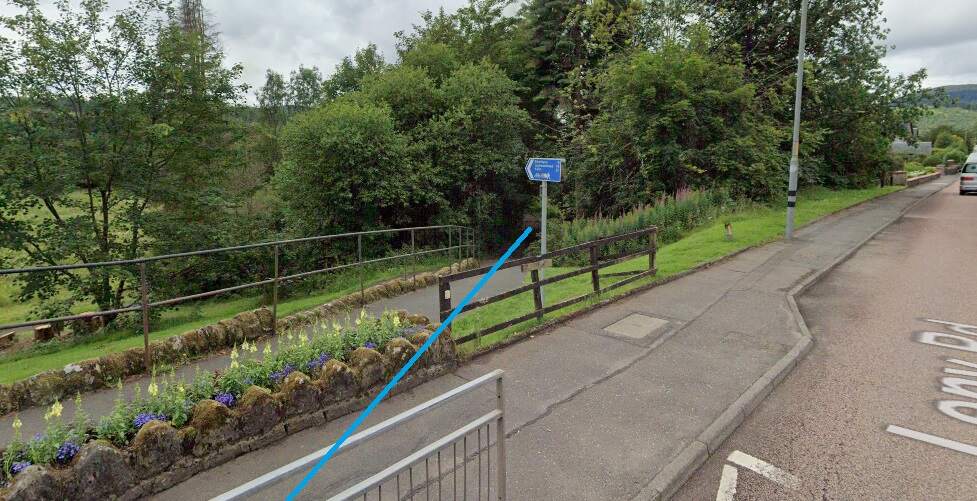
The first length of the railway to the West of Callander is shown on the RailMapOnline.com image below.
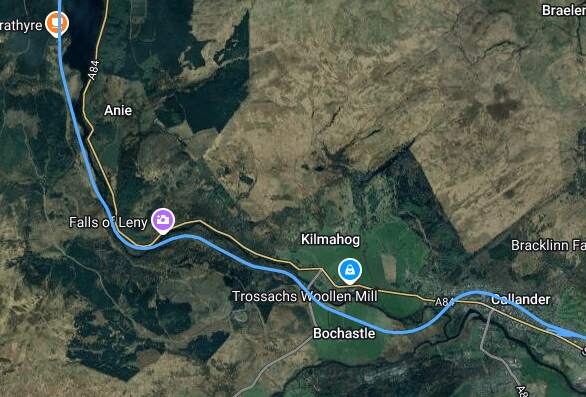
The route of the Callander & Oban Railway to the West of Callander as shown on the satellite imagery provided by RailMapOnline.com. Loch Lubnaig is at the top-left of this image. [15]
This embedded image from the Canmore National Record of the Historic Environment looks Northeast along the Callander & Oban railway towards Callander Railway station. The Bowstring Girder Bridge in the foreground is mentioned by Gairns below. The stone-arch bridge in the distance is the bridge that carried Leny Road over the old railway, (c) J.R. Hume. [16]

Gairns mentions the Pass of Leny and the Falls of Leny, below. The falls are shown on the map extract immediately below. The Falls can be seen in the right half of the extract.
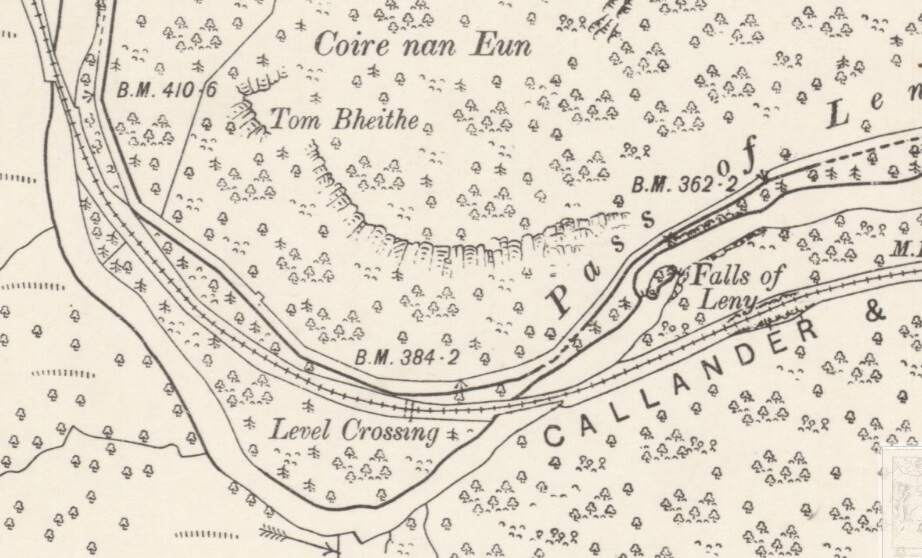
The Falls of Leny and the Callander & Oban Railway. Note that the river – Garbh Uisge – is crossed twice by the railway. These bridges were bowstring Girder bridges like that seen above. [17]
Pair of BRCW Type 2's.River Leny bridge. 7th August 1965.
This image is embedded from Flickr and shows one of the two girder bridges shown on the map extract above. The photograph was taken shortly before the closure of the line. (c) locoman1966. [18]

Gairns continues:

“Crossing the River Leny [Garbh Uisge] by a bowstring girder bridge, mountain country is entered in the Pass of Leny, and Ben Ledi and Ben Vane on the one side (the former skirted by the line), Ben Each, and, in the distance, Ben Vorlich, on the other, give evidence of the nature of the country traversed. The Falls of Leny can be seen on the right providing the intervening foliage is not too full. St. Bride’s Crossing, at the head of the Pass of Leny, is now only used as a crossing place at periods of special pressure. For nearly two miles the line then proceeds along the western shore, and almost at the water’s edge  of Loch Lubnaig ‘the crooked lake’. A short distance beyond St. Bride’s Crossing is Craignacailleach Platform, used by children of railway servants going to school in Callander the 5.40 a.m. from Oban and the 6.45 pm from Callander, daily except Saturdays. At the picturesque little station of Strathyre, both platforms are adorned by ornamental shrubs, and on the up side there is a fountain, rockeries, rustic gate ways, etc.. lending further interest to this pretty station among its beautiful natural surroundings.

Before reaching Strathyre station the River Balvag is crossed. It keeps close company with the railway until near Kingshouse Platform, where a glimpse is had of the hills encircling Loch Val.  Kingshouse Platform is used as a halt, trains calling as required, for the convenience of visitors to the Braes o’ Balquhidder.” [1: p10-11]
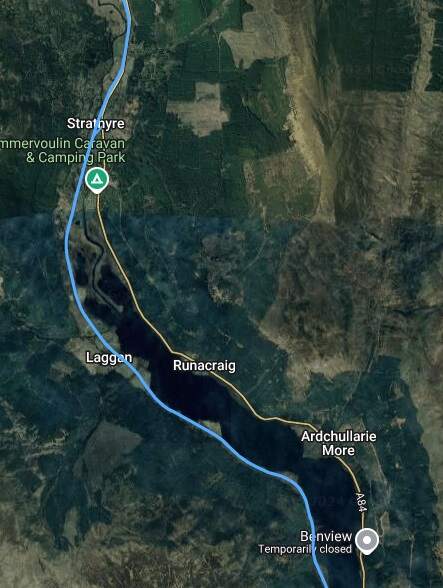
The adjacent RailMapOnline.com satellite image shows the railway running up the West side of Loch Lubnaig. Strathyre, mentioned by Gairns above, can be seen to the North of the Loch.

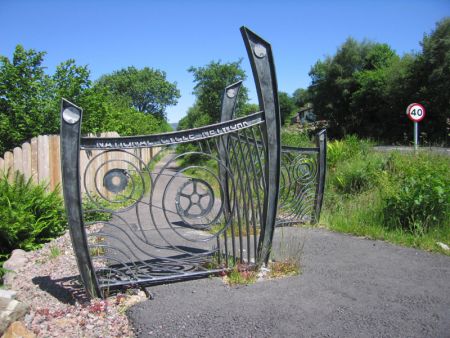
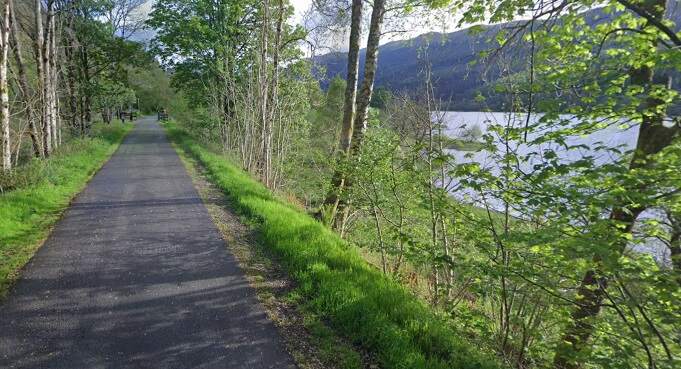
This portion of the old railway has been metalled to support its use as National Cycleway No. 7. South of the Loch, there is now a car park close to the upstream of the two bridges noted above.
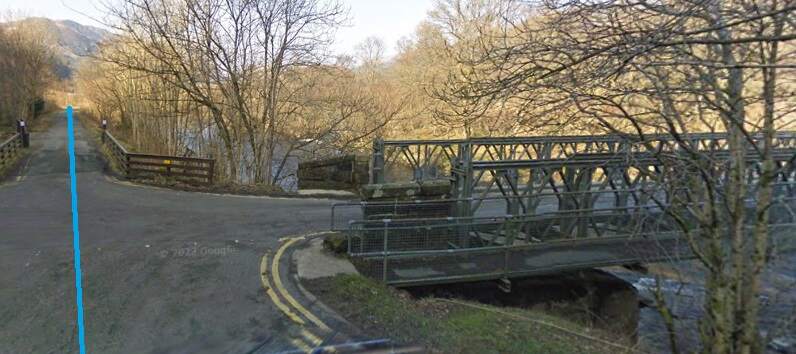
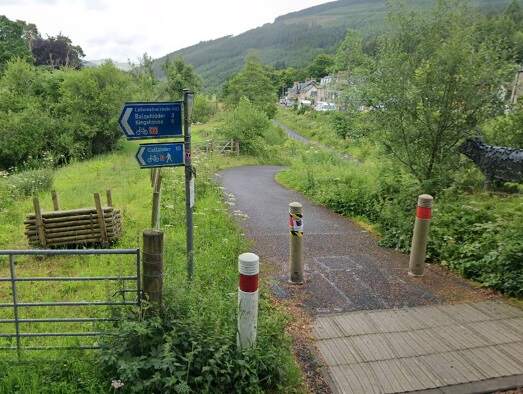
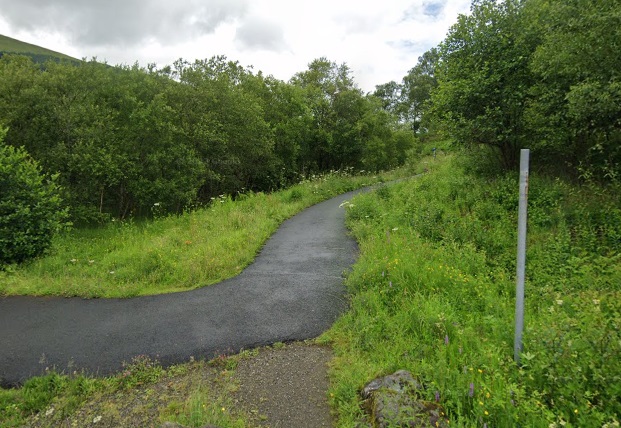
The old railway formation is now the National Cycle Route No. 7. The blue line marks the route of the railway. The River Garbh Uisge is to the right of this North facing photograph. [Google Streetview, March 2009]
Another North facing view, this time alongside Loch Lubnaig. The tarmacked cycle route follows the line of the old railway. [Google Streetview, May 2022]

North of Loch Lubnaig, the old railway ran North through Strathyre, first crossing the river to the East bank and few hundred metres short of the Railway Station.

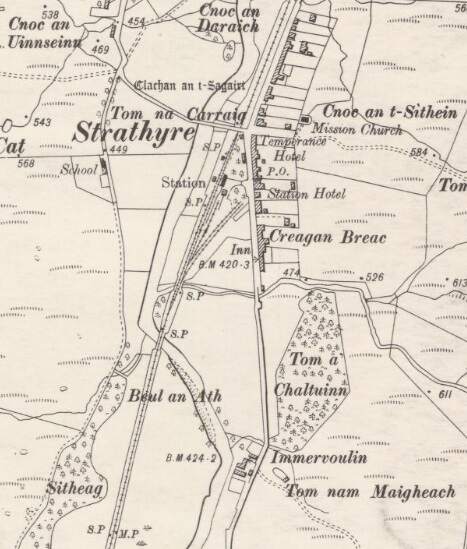
This extract from the 6″ Ordnance Survey of 1898, published in 1901 [19] shows the small village of Strathyre, its railway station and the bridge over the River Leny [Garbh Uisge].
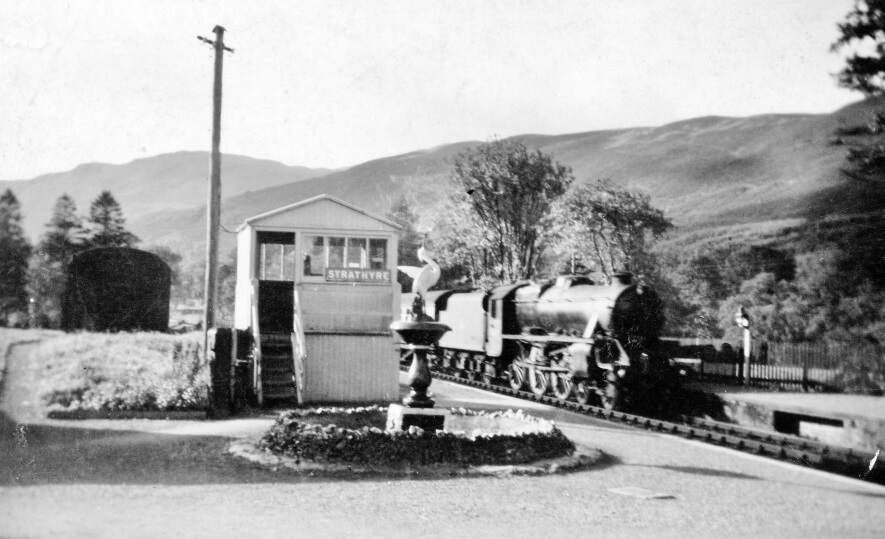
Looking South from the main platform at Strathyre Railway Station towards Callander in September 1956, (c) T. Morgan and made available for use here under a Creative Commons Licence (CC BY-SA 2.0). [20]

North of Strathyre the line continued North-northeast towards Balquhidder.
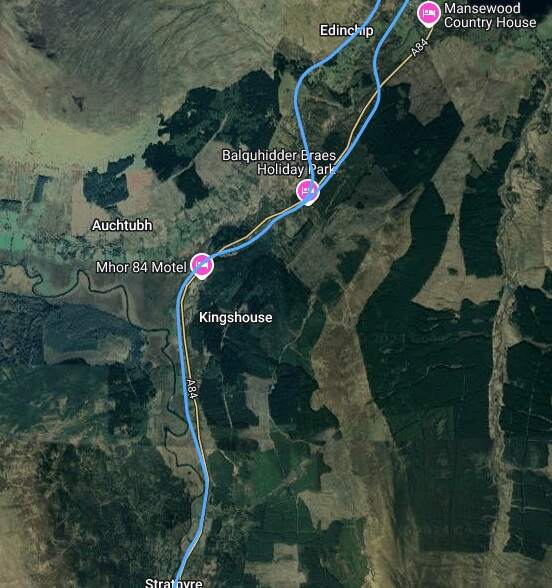
RailMapOnline.com again – the satelitel image shows the route of the line North from Strathyre through Balquidder. [15]

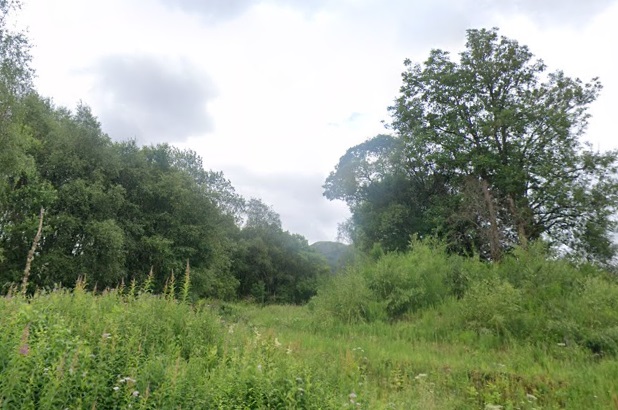
King’s House Inn on the modern A84 had its own Halt – Kingshouse Platform. This was a request halt serving both King’s House Inn (just to the east of the line) and the road to Balquhidder Glen (to the west). The halt was built at the expense of the King’s House Inn. It was a single platform, on the east side of the line, with a waiting shelter. Both platform and building were built in timber. Traffic handled included passengers, children using the school train and milk churns. As can be seen below, the halt was located south of the road to the glen.
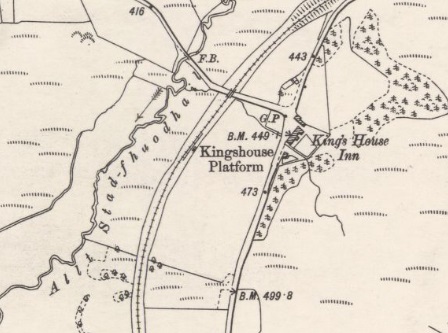
Kingshouse Platform (Halt) as shown on the 6″ Ordnance Survey of 1898, published in 1901. [21]

A short distance Northeast of Kingshouse Platform was Lochearnhead Railway Station sited some distance South of the community of the same name.
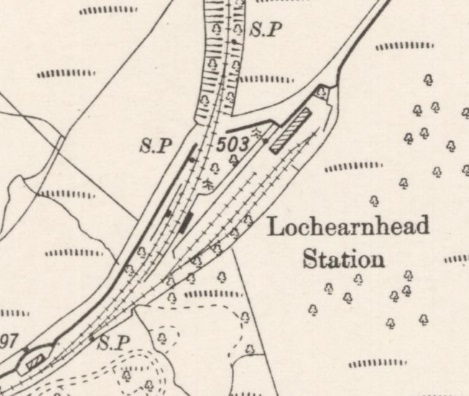
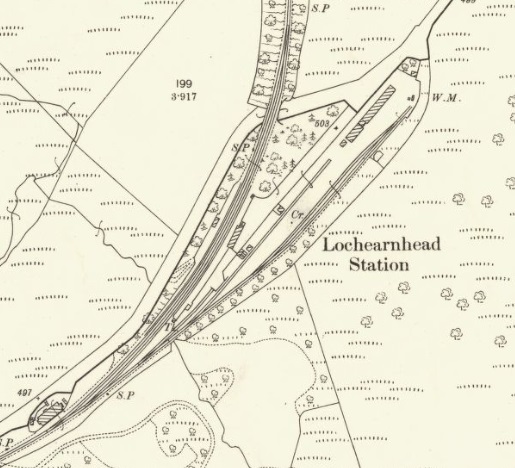
Lochearnhead Railway Station. [22]
Lochearnhead Railway Station as it appears on the 25″ Ordnance Survey of 1898, published 1901. [23]
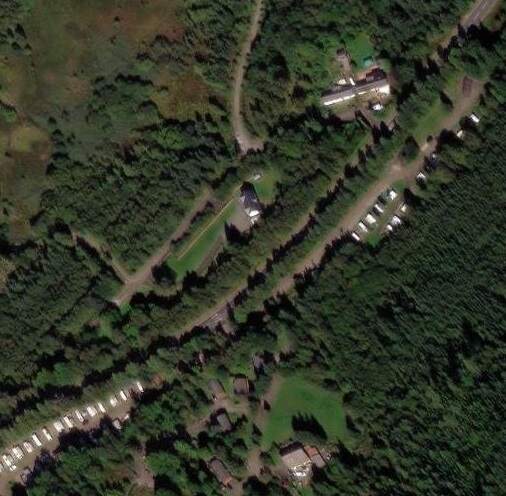
The same location in the 21st century, as it appears on the ESRI satellite imagery provided by the NLS. The old railway ran from bottom-left to top-middle of this extract. [24]

The station was renamed Balquhidder Station on 1st July 1904, when the line to Crieff, Gleneagles and Perth was completed. The station then became the junction station. The branch came in from the North, paralleled by the Oban line for some distance, from the head of Loch Earn. Balquhidder station had an island platform on the up side to provide for connecting trains. A new station was built on the branch to serve Lochearnhead village. [25]
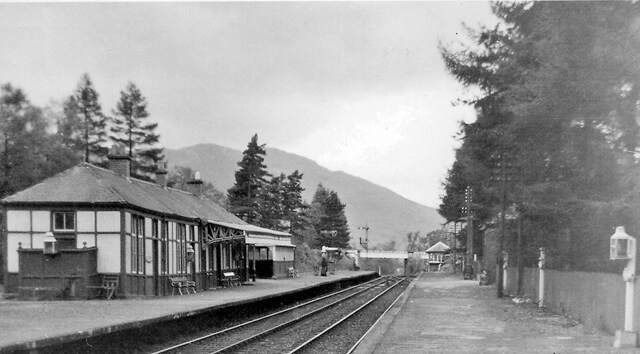
Balquhidder Railway Station looking Southwest towards Callander on 27th September 1961. The branch line was off to the left of this image, (c) Ben Brooksbank and authorised for reuse under a Creative Commons Licence (CC BY-SA 2.0). [26]

Gairns continues:

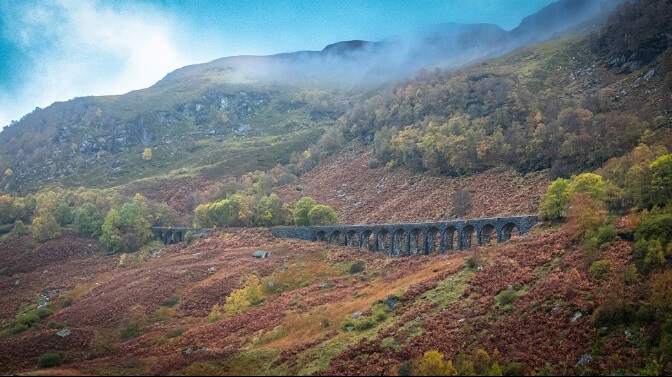
Leaving Balquhidder the Oban line climbs steeply along the hillside as it finds its way up Glen Ogle, overlooking, in the ascent, the Crieff line as it follows the shores of Loch Earn eastward, and giving views over the waters of the Loch, amidst their mountain setting, which are said to be the finest in the British Isles. … Nearly 8 miles separate Balquhidder and Killin Junction stations, though there is an intermediate crossing – Glenoglehead. This was the site of the original Killin station, before the opening of the Killin Branch Railway. The whole length of ‘gloomy’ Glen Ogle – a wild rocky valley, four miles in length, described as the Khyber Pass of Scotland – is traversed, with its rocky boulder-strewn slopes, the railway being carried in places on brick or masonry viaducts around the face of the rock where the cutting of a ledge was well-nigh impossible. For most of the ascent the view from the train is down almost precipitous slopes, continued upwards on the other side.” [1: p11]
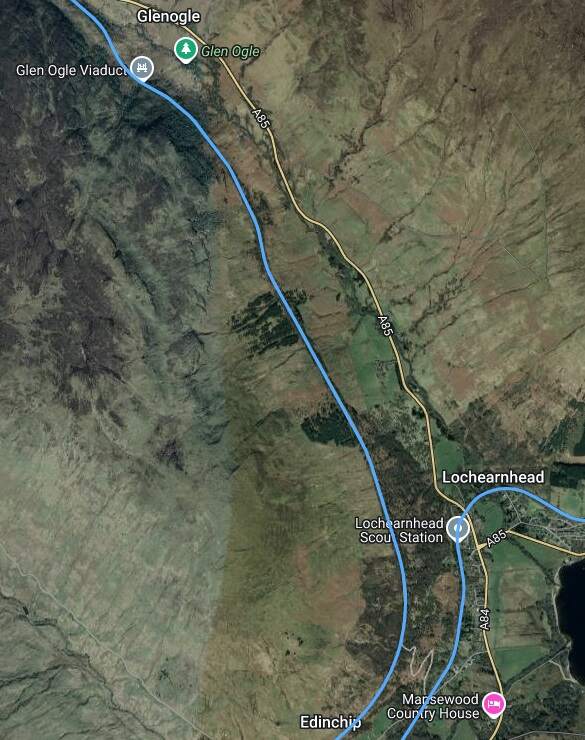
The Oban line runs South to North on this extract from the RailMapOnline.com satellite imagery. The branch turns away to run East along the North side of Loch Earn which just peeps into this satellite image at the bottom-right. [15]
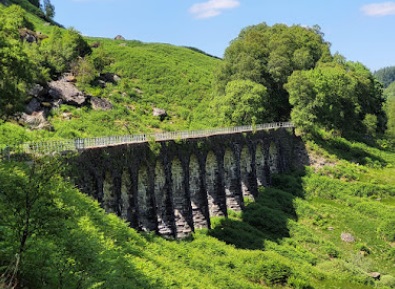
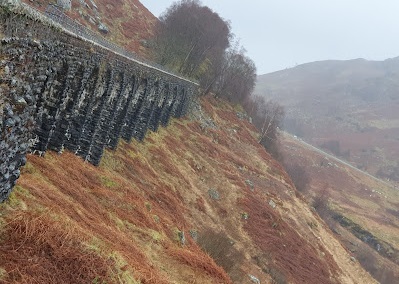
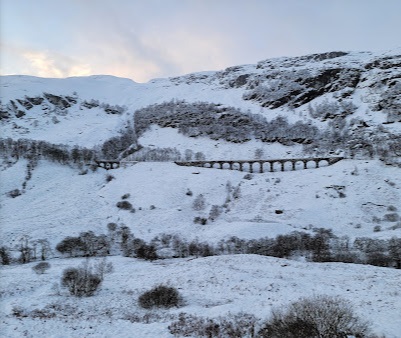
Four pictures of Glen Ogle Viaduct. The first was taken from the opposite side of the valley, (c) Euan Reid, Octobr 2024. [Google Maps, November 2024]
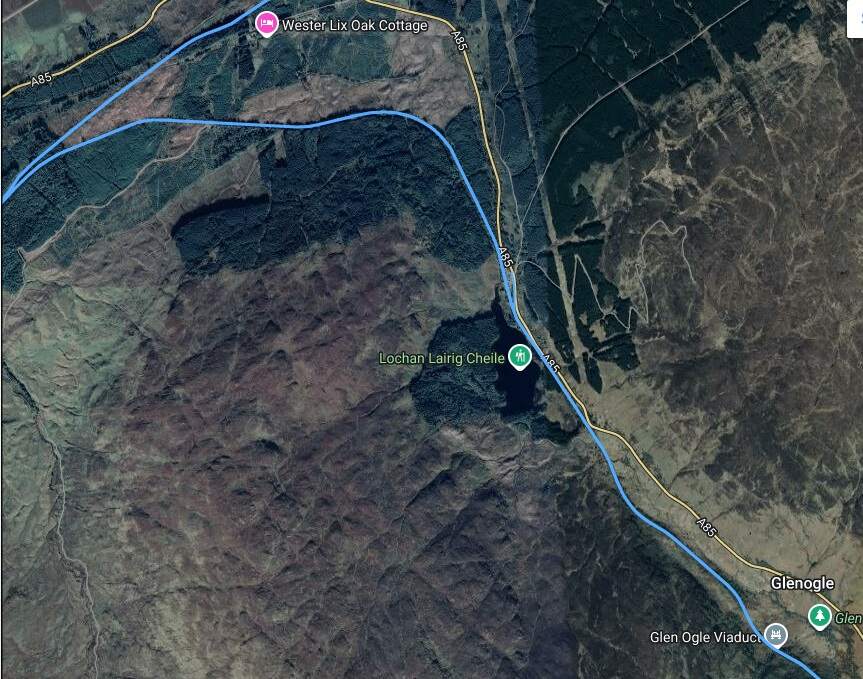
This next extract from RailMapOnline.com’s satellite imagery shows that to the North of Glen Ogle the old railway turned to the West. The line entering the extract from the top and meeting with the Callander & Oban Railway is the Killin Branch. [15]

Gairns continues:

“At the northern end of the Pass the line curves westward, overlooking the Loch Tay branch which runs from Killin Junction to the little town of Killin, with an extension of about a mile to a pier on Loch Tay to connect with the railway steamers which serve the whole length of the Loch, glimpses of which are had from the Oban train. The branch is on a lower level and its track can be seen for a long distance from the main line. The branch railway is one of very heavy gradients. At Killin Junction it makes connection with the main line which has descended from Glenoglehead to meet it. The station here has the usual island platform on the up side, to accommodate the branch trains clear of the main line.” [1: p11-12]
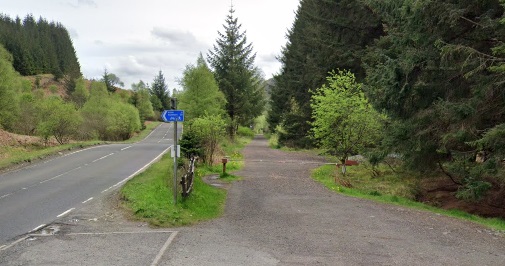
Looking South towards Lochearnhead, the A85 and the route of the old railway run immediately adjacent to each other alongside Locham Lairig Cheile which is just off the right side of this photograph. [Google Streetview, May 2022]
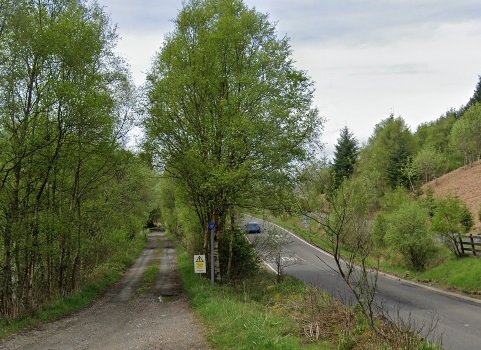
Looking North towards Glenoglehead Crossing at the smae location as the image above. Lochan Lairig Cheile ican be picked out on the left of the image. [Google Streetview, May 2022]

Glenoglehead Crossing permitted two trains on the line to pass each other.
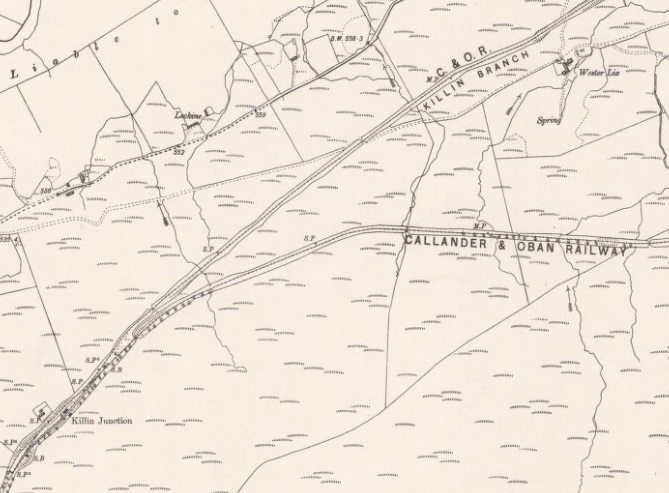
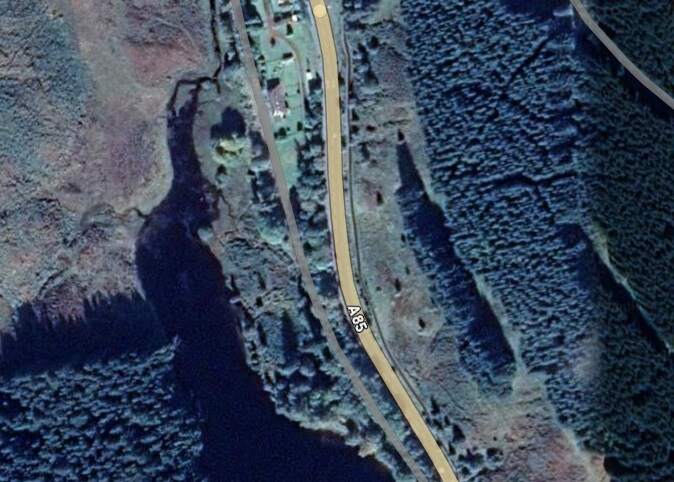
A Google Maps satellite image extract showing the location of Glenoglehead Crossing in the 21st century. It was once known as Killian Railway Station (even though over 3 miles from Killin) and was at that time the northern terminus of the Callander & Oban Railway. [Google Maps, November 2024]

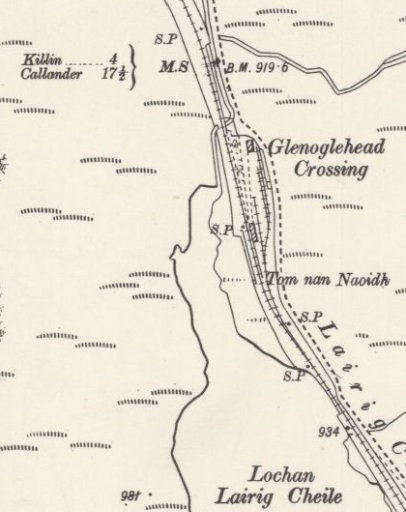
From Glenoglehead the line dropped down to Killin Junction. The two map extracts above come from the same 6″ Ordnance Survey sheet surveyed in 1899 and printed in 1901. [27]
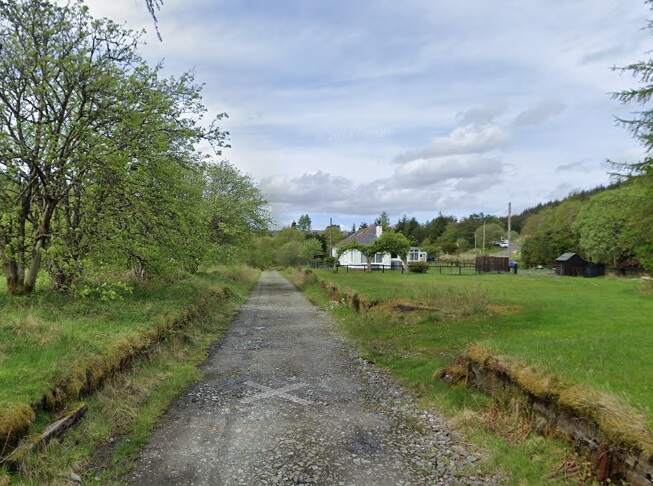
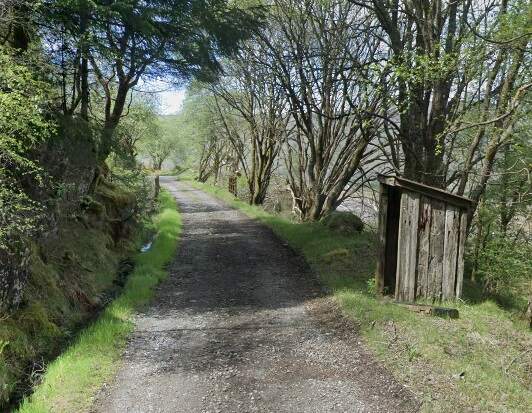
The location of Glenoglehead Railway Station with the original station building in private hands. [Google Streetview, May 2022]
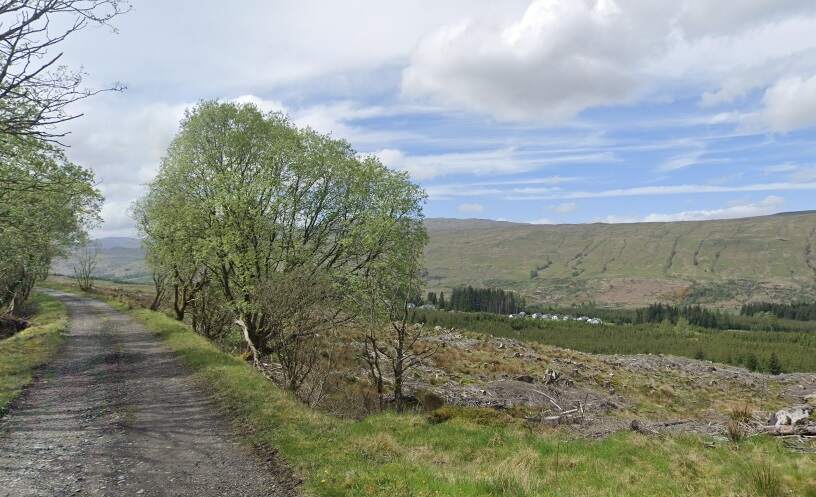
The route of the old railway descending from Glenoglehead. [Google Streetview, May 2022]
The line ran West on the Southern slopes of Glen Dochart. {Google Streetview, May 2022]
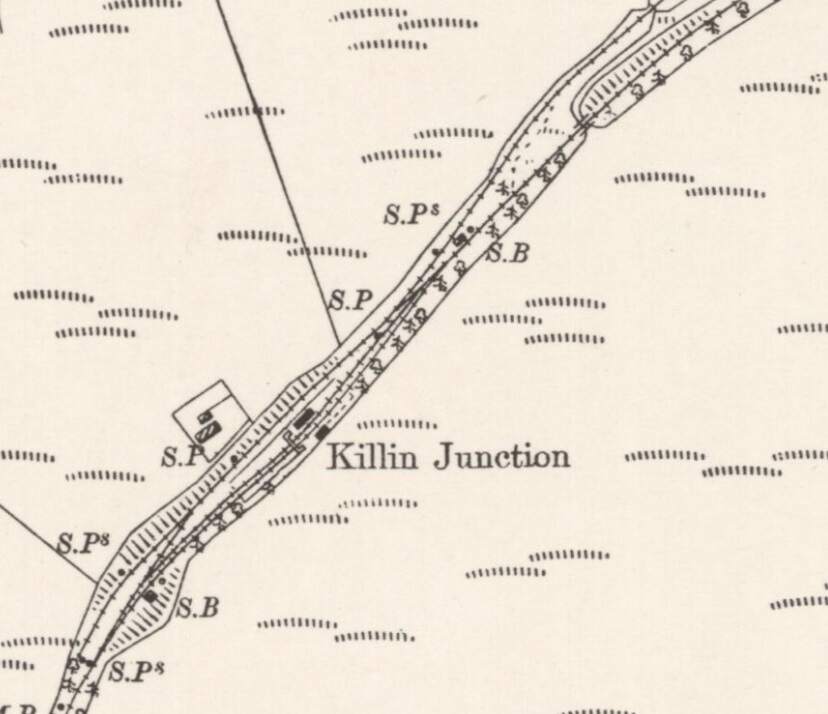
An enlarged extract from the 6″ Ordnance Survey of 1899 showing the location of Killin Junction. [27]
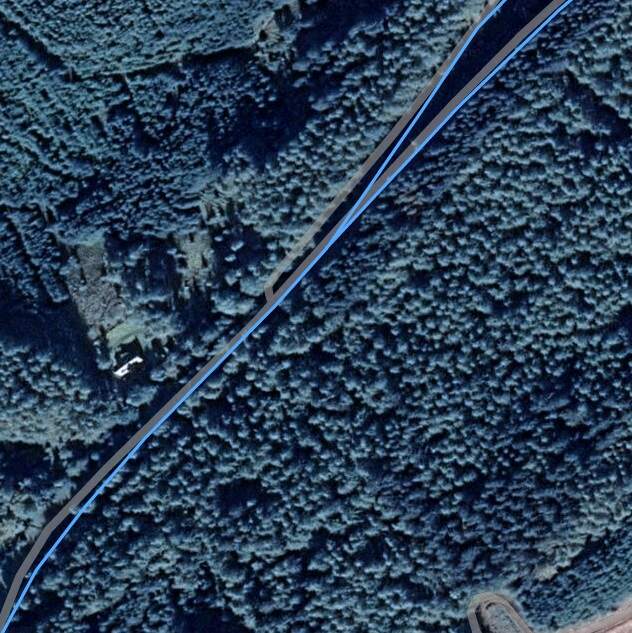
A similar length of the line on the RailMapOnline.com satellite imagery. [15]
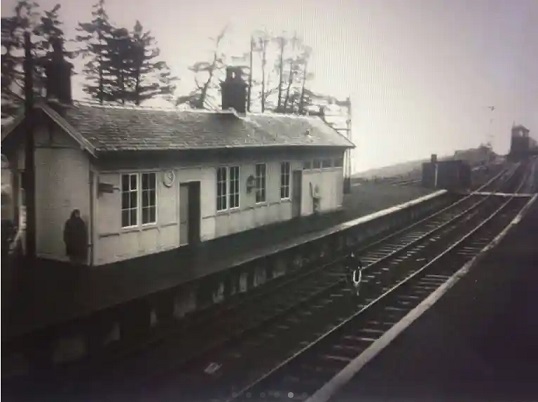
Killin Junction Railway Station and Signal Box. This view looks Southwest through the station towards the Signal Box. This image is one of a number which scroll across the screen on [28]
Killin Junction Railway Station. This view looks Northeast. The image is one of a number which scroll across the screen on https://railwaycottagekillin.co.uk/history [28]

Just to the Southwest of Killin Junction the line was carried over the Ardchyle Burn on a stone viaduct – Glendhu Viaduct.
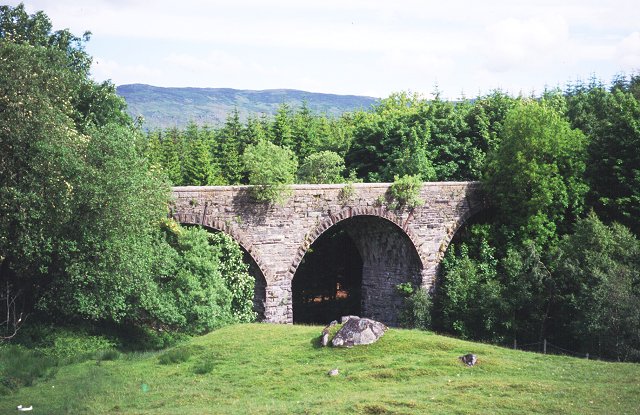
Glendu Viaduct carried the old railway over the Ardchyle Burn, (c) Richard Webb and made available for resue under a Creative Commons Licence (CC BY-SA 2.0), [29]

A short distance to the West of the viaduct, a farm acess track was carried over the railway on a stone arched bridge.
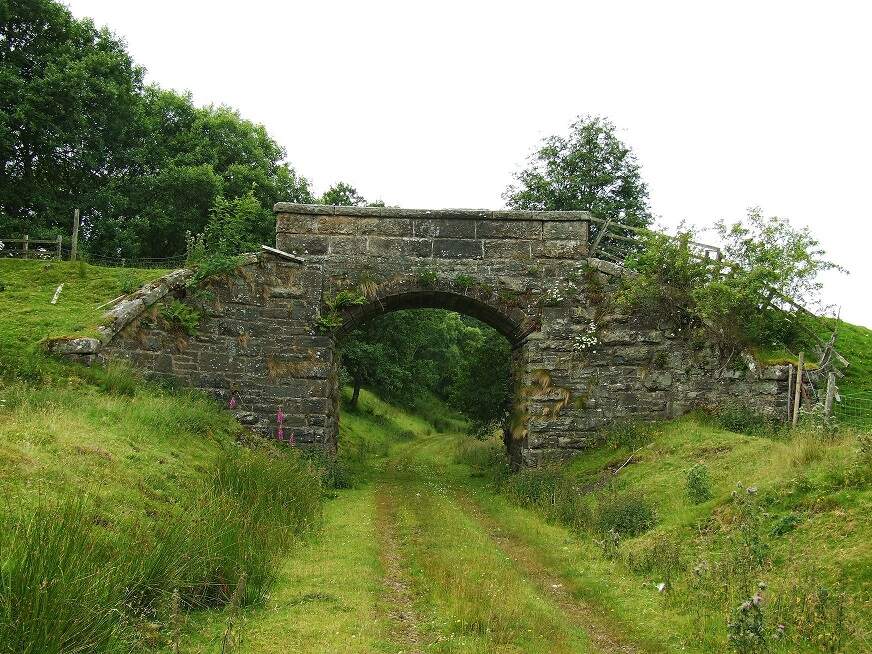
Farm access bridge over the old railway. This image was shared on the Re-Appreciate the Callander & Oban Line Facebook Group by John Gray on 6th October 2018. [32]

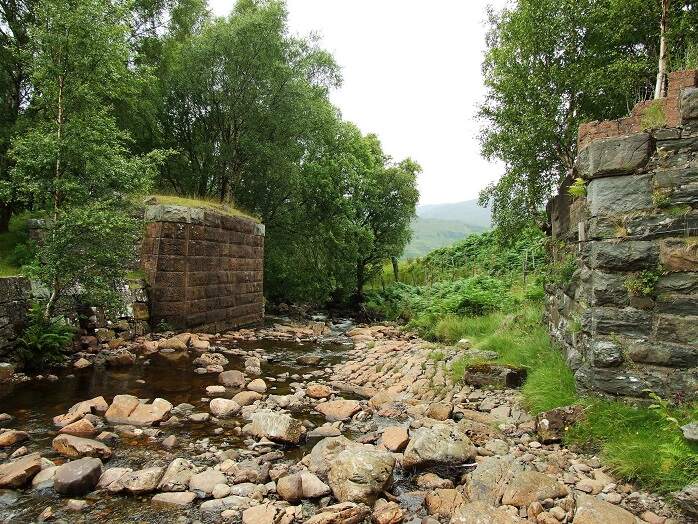
Along the length of the old railway between Killin Junction and Luib Railway Sation two more structures are worthy of note. First, Ledcharrie Viaduct at around the half-way point between Killin Junction and Luib spans the Ledcharrie Burn. [33] The second is Edravinoch Bridge which was a girder bridge which once spanned the Luib Burn. The aboutments remain but the girders were removed for scrap on closure of the line. [34] Bothe the pictures below were taken by John Gray and shared by him on the Re-Appreciate the Callander & Oban Line Facebook Group on 4th October 2018. John Gray’s photographs are reproduced here with his kind permission.
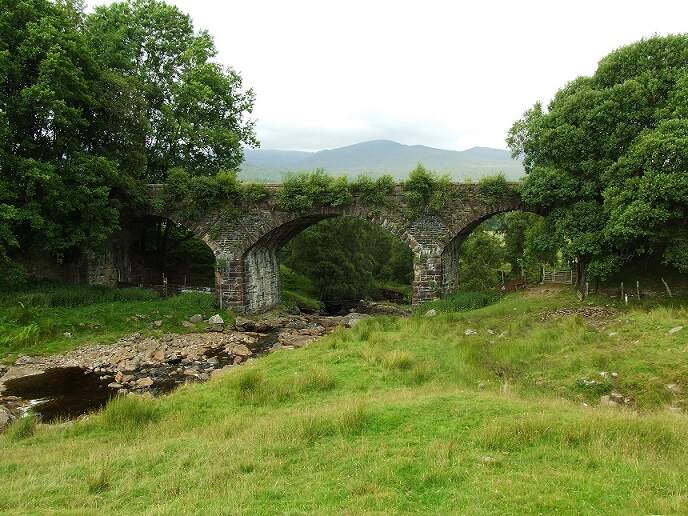
The next station on the old railway was Luib Railway Station in Glen Dochart.
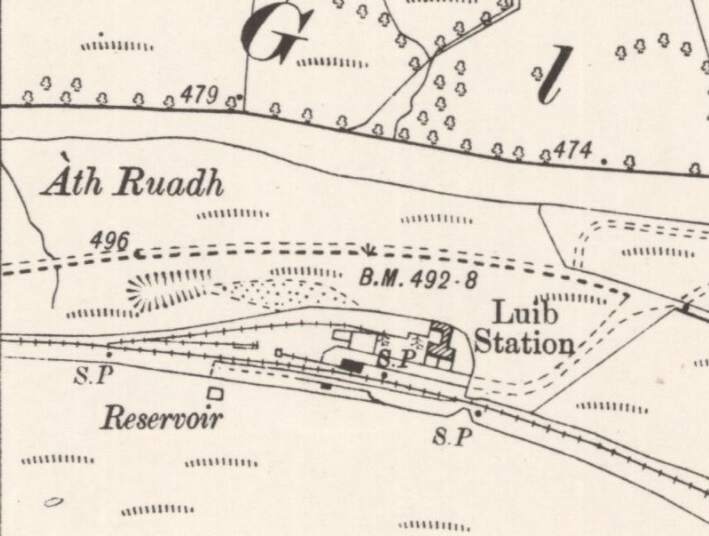
River, road and railway in close proximity at Luib Railway Station. The 6″ Ordnance Survey of 1898, published in 1901. [30]
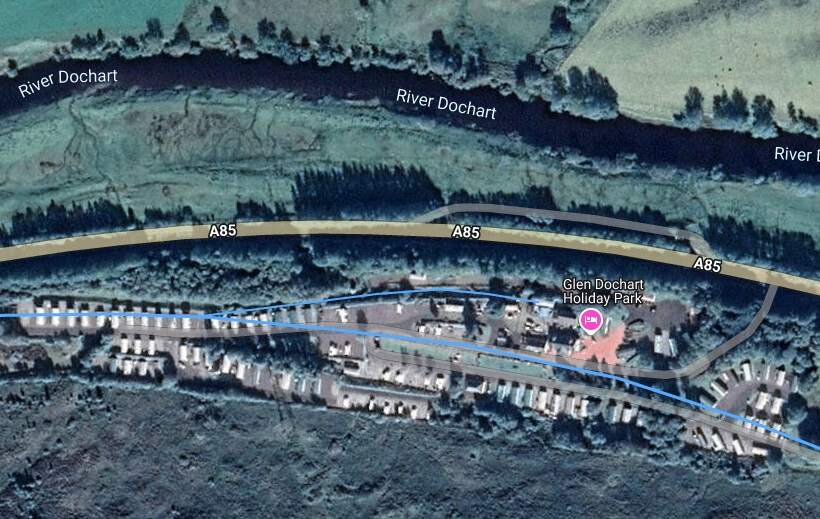
The site of Luib Railway station is, in the 21st century, Glen Dochart Holiday Park. [15]
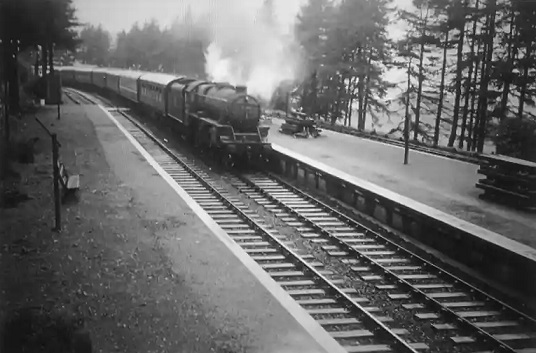
This view looking West from Luib Railway Station is embedded from Ernie’s Railway Archive on Flickr, (c) J.M. Boyce. Note the signal box and the stone water tower base. [31]
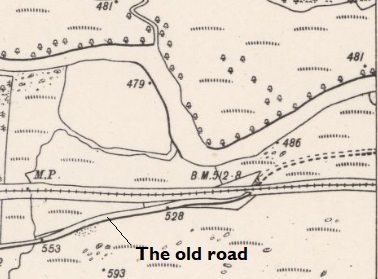
The old road alignment and under bridge to the West of the Luib Railway Station site. [35]
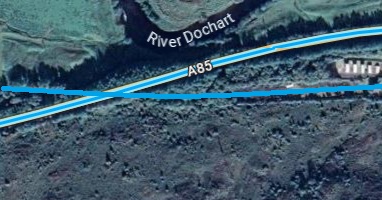
Just to the West of Luib Railway Station the line crossed what became the A85. There is no clear indication on the groud of the location of the bridge as road improvements have swept away the vestiges of the old railway in the immediate vicinity. [Google Maps, November 2024]

Gairns continues:

“Westward past Luib to Crianlarich, Glen Dochart is traversed, with the River Dochart, until it merges into Loch Iubhair, succeeded in turn by Loch Dochart, and the public road, for company close alongside. Here splendid views are hard on both sides, bare mountain slopes being relieved by wooded areas, while rushing burns and streamlets add further interest. On both sides are peaks of considerable height, notably Ben Dheiceach (3,074 ft.) to the North, Ben More (3,843 ft.) immediately ahead, and Stobinian (3,821 ft.) to the South, with many others in the distance.

Crianlarich is important as it provides for interchange traffic with the West Highland line to Fort William and Mallaig, which here crosses. The stations are within a short distance, and there is siding connection for interchange goods traffic. The Callander and Oban station is a neat double-platformed station with rather attractive buildings on the down side, Just beyond the station the North British Railway crosses by an overbridge, and Crianlarich Junction is then reached, this controlling the connection with the West Highland line.” [1: p12-13]
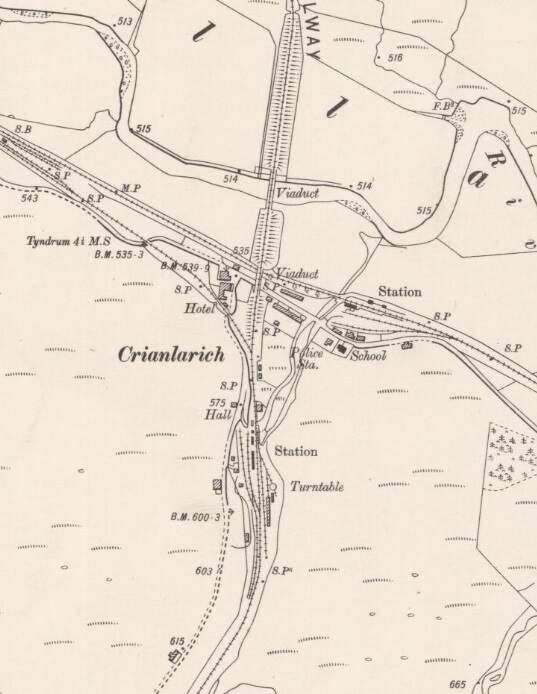
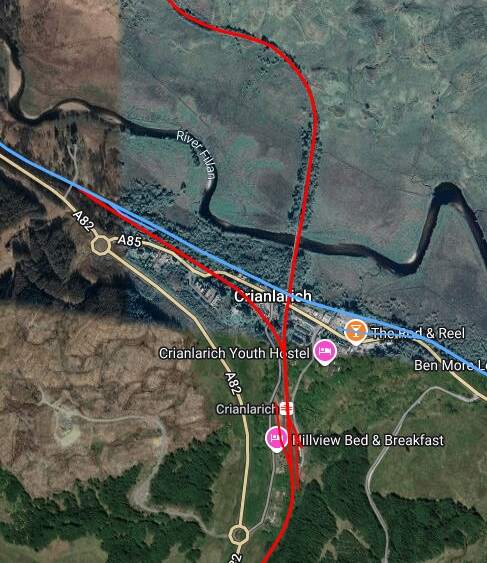
Two different railways crossed at Crianlarich. The Callander & Oban Railway ran East-West. The West Highland Line ran North-South. The East-West line and station were opened on 1st August 1873 by the Callander and Oban Railway. This was the first railway station in Crianlarich. The station was originally laid out with two platforms, one on either side of a crossing loop. There were sidings on the south side of the station. After the West Highland Railway opened in 1894, Crianlarich could boast two railway stations. The West Highland Railway crossed over the Callander and Oban Railway by means of a viaduct located a short distance west of the Lower station. The West Highland Railway’s Crianlarich station was (and still is) located a short distance south of this viaduct. [36]
The two lines plotted on the modern satellite imagery provided by RailMapOnline.com. The blue line being the Callander and Oban Railway, the red line being the West Highland Line. The link line between the two stations/railways was put in by the West Highland Line and is shown in red. [15]

Crianlarich Junction was situated half a mile west of Crianlarich Lower station. Opened on 20th December 1897, the junction was located at one end of a short link line that ran to Crianlarich station on the West Highland Railway. There were two signal boxes: “Crianlarich Junction East” (32 levers) and “Crianlarich Junction West” (18 levers). Following closure of the line east from Crianlarich Lower, the line between there and Crianlarich Junction was retained as a siding, with the link line becoming the main line for trains to and from Oban. [37]
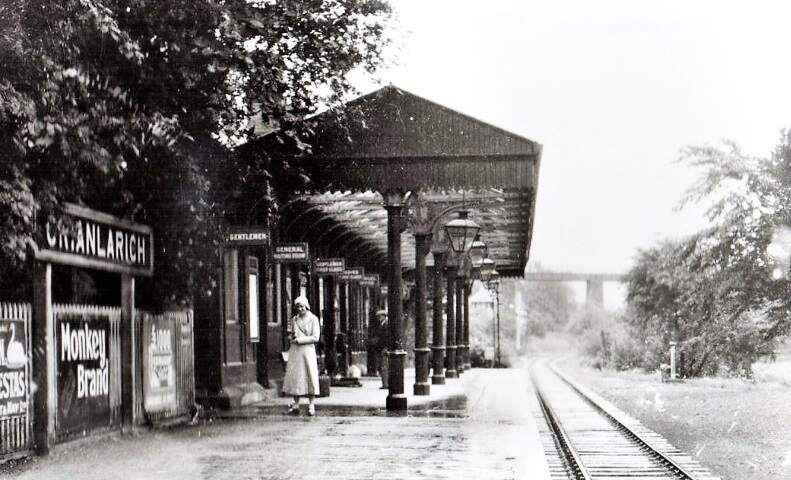
Crianlarich Lower Railway Station on the Callander and Oban Railway. The picture appears to have been taken in circa. the 1920s. Note that by this time the second platform and the loop had been removed. It is also [possible to see the high level viaduct which carried the West Highland line over the road (A85), the Callander and Oben Railway and the River Fillan. This image was shared by Brian Previtt on the Disused Stations Facebook Group on 25th October 2024, (c) photographer not known, Public Domain. [38]

The line to the West of Crianlarich Junction remains in use in the 21st century.

Gairns continues his description of the line:

Onwards through Strath Fillan magnificent views are had, and for some miles the West Highland line runs parallel, but on the opposite side of the valley, climbing up the hillside, after crossing the viaduct over the River Fillan until both lines are almost on the same level, with the valley between. Both lines have stations at Tyndrum (a favourite mountain resort), though these are some half-a-mile apart. The Callander and Oban station is a neat tree-shaded [location], with the goods yard at a lower level.” [1: p13]
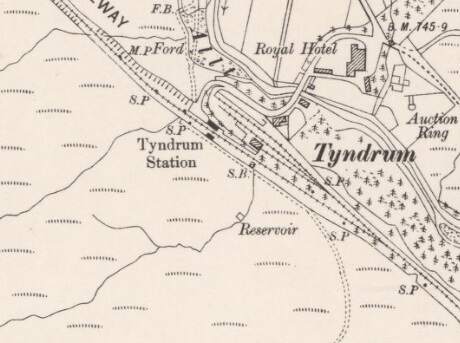
The Callander & Oban Railway’s Tyndrum Railway Station sat to the South of the Hotel which the West Highland Line’s station to the North. [39]

Wikipedia tells us that Tyndrum Lower Station “opened on 1st August 1873 as a terminal station. This was the first railway station in the village of Tyndrum. Until 1877, it was the western extremity of the Callander and Oban Railway. In 1877, the Callander and Oban Railway was extended from Tyndrum to Dalmally. Concurrently, the station was relocated 301 yards (275 m) west, onto the new through alignment. The new station was on a higher level, as the line had to climb steeply to reach the summit about 0.6 miles (1 km) to the west. The old terminus then became the goods yard. The through station was originally laid out with two platforms, one on each side of a passing loop.” [40]
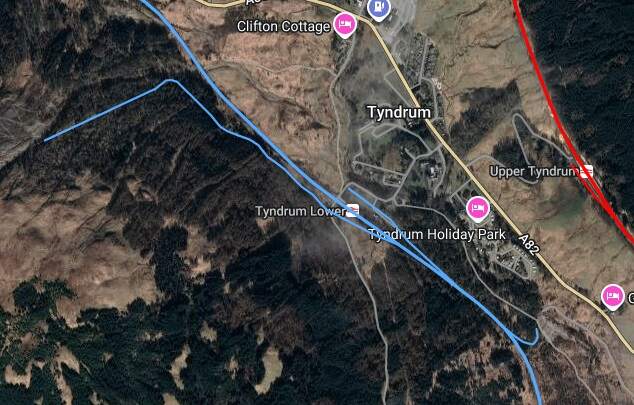
Tyndrum Lower and Upper Tyndrum Railway Stations can be seen on this extract from RailMapOnline.com’s satellite imagery. The image shows the route(also in blue) of a tramroad which served Tyndrum Lead Mines and Glengarry Lead Smelter (a little to the East of Tyndrum). After the closure of the smelter transfer to wagons of the Callander & Oban Railway took place at Tyndrum Lower Railway Station. [15]
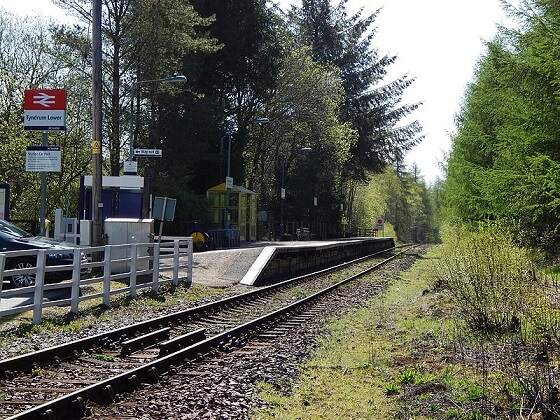
Tyndrum Lower Railway Station in 2015 – a single platform Halt. The platform is on the North side of the line. This view looks East toward Crianlarich, (c) Alex17595 and made available under a Creative Commons Licence (CC BY-SA 4.0). [41]
Looking West along the line from the access road/carpark at Tyndrum Lower Railway Station. [Google Streetview, April 2011]

Gairns’ description of the line continues:

“Passing Tyndrum station a final view is had of the West Highland line [before] it turns its course northwards, while the Callander and Oban line makes a long sweep southwesterly through Glen Lochy, wild and bare. An intermediate crossing, Glenlochy breaks the 12-mile run from Tyndrum to Dalmally. Approaching the rather pretty station at the latter place, Glen Orchy is joined, fine views being had along it. Dalmally, at the foot of Glen Orchy, has been described as ‘the loveliest spot in all that lovely glen’. A short run of less than 3 miles crossing the Orchy and rounding a bay on Loch Awe, and incidentally giving beautiful views up the Loch, and Loch Awe station is reached, right on the water side, and with a pier alongside for the steamers which ply along the Loch. For four miles or so the line runs high on the base at Ben Cruachan and follows the shores of the Loch through the gloomy Pass of Brander in which the waters of the loch merge into the brawling River Awe most turbulent of Highland salmon streams, Three miles beyond Loch Awe station the Falls of Cruachan Platform is a convenience for visitors to the celebrated Falls, a glimpse of which is had from the train in passing. The crossing place is, however, Awe Crossing, a mile or so beyond. A further run of 41 miles and Taynuilt is reached, beyond which the shores of Loch Etive are followed to Connel Ferry, a run of 64 miles, with one intermediate station – Ach-na-Cloich – and providing lovely views over the loch and the hills and mountains. beyond.” [1: p13]
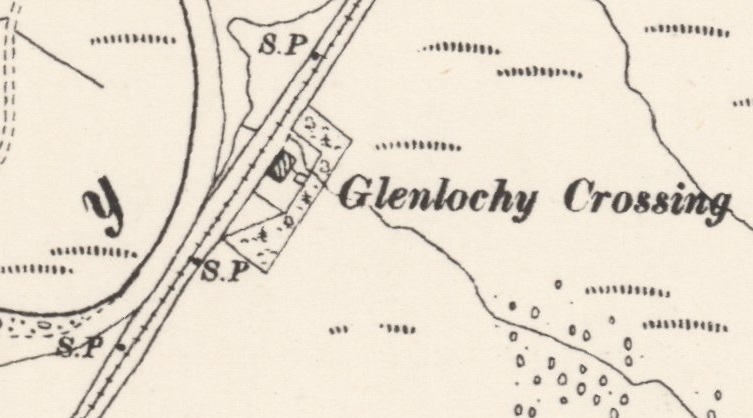
Glenlochy Crossing, which Gairns describes as “An intermediate crossing, Glenlochy breaks the 12-mile run from Tyndrum to Dalmally.” This image shows what is recorded on the 6″ Ordnance Survey of 1898, published in 1900. [41]
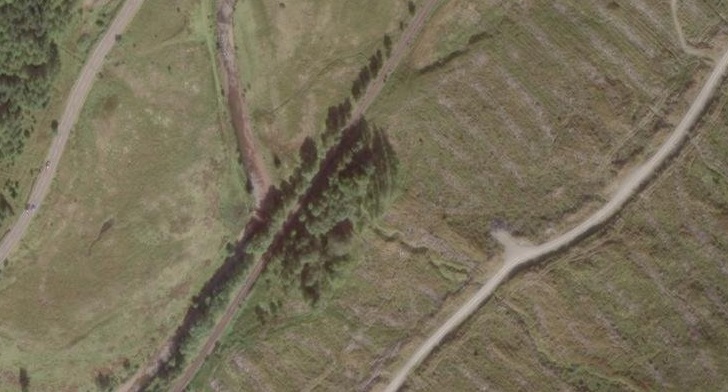
The same location as it appears in the 21st century on the ESRI satellite imagery provided by the NLS. The site of Glenlochy Crossing is in the trees close to the centre of this image. which runs diagonally down the centre portion of the imageof this image. The A85 runs to the West of the old railway’s route which runs diagonally down the centre portion of the image. The River Lochy passes immediately to the West of Glenlochy Crossing (left of centre). [41]

Glenlochy Crossing was a passing loop opened in 1882 to increase the capacity of the line. It broke the singl-track section between Tyndrum Lower and Dalmally. The building shown just to the East of the line was similar to that found at other crossings (such as Drumvaich Crossing and Awe Crossing0. It combined a railway cottage with a signal cabin. When first built the loop had two trailing sidings one at each end of the loop. We know that the loop was lifted in 1966 when the building was also demolished. There is still a footbridge across the River Lochy which gave access to the Crossing but that is now locked against public access. [42]

The Callander & Oban Railway closely followed the South bank Of the River Lochy, only turning away to the South to cross Eas a Ghaill (a tributary which approached the River Lochy from the South) by means of Succoth Viaduct.

Succoth Viaduct. This is an embedded link to an image on the GetLostMountaineering.co.uk webpage. The viaduct carries what was the Callander & Oban Railway over Eas a Ghaill. [43]

The line runs almost due West from Succoth Viaduct at a distance from the River Lochy until it reaches Dalmally Railway Station.
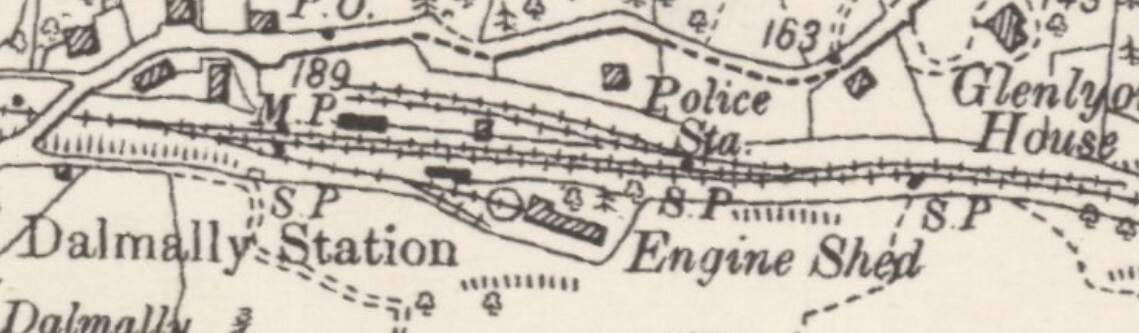
Dalmally Railway Station as it appears on the 6″ Ordnance Survey of 1897, published in 1900. [44]
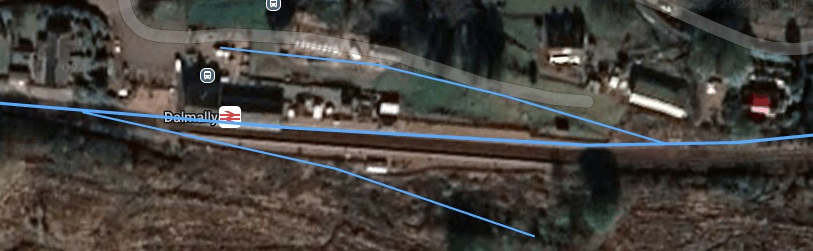
Dalmally Railway Station as it appears on the satellite imagery provided by RailMapOnline.com. [15]
Looking West through Dalmally Railway Station, this mage was shared by Donald Taggart on Google Maps, (c) Donald Taggart (March 2020)
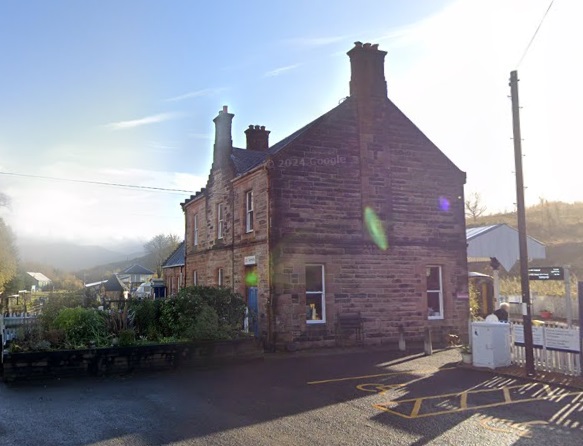
A similar view of the station buildings at Dalmally from Platform No. 2, (c) Anna-Mária Palinčárová. (June 2017), shared by her on Google Maps.

This photograph was taken from the Road overbridge at the West end of Dalmally Railway Station site, (c) inett (November 2017) and shared on Google Maps.
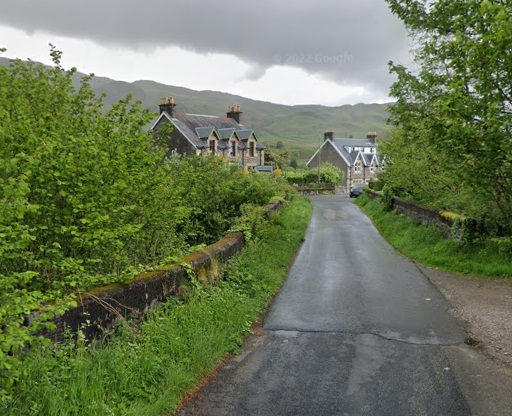
the road overbridge at the West end of Dalmally Station site seen from the ned of Platform No. 1, (c) Marian Kalina (November 2017) and shared on Google Maps.
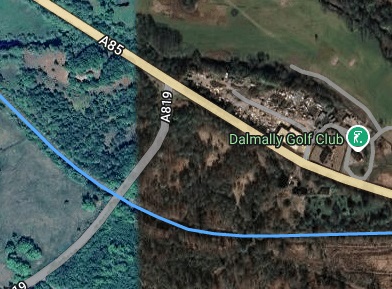
West of Dalmally the line ran on towards a viaduct which crossed the River Lochy at Drishaig. However, we need to note that the road layout in this immediate area is considerably different to what was present at the turn of the 20th century.
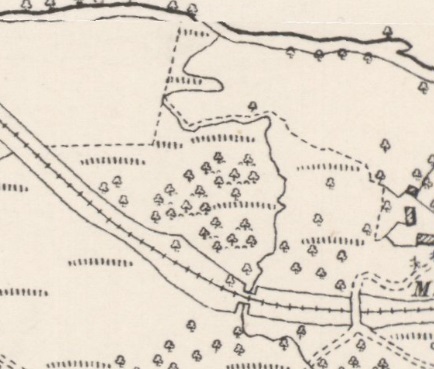
The Southeast approach to the viaduct over the River Orchy as it appears on the 1897 Ordnance Survey, published in 1900. [46]
The smae area as it appears on the 21st century RailMapOnline.om satellite imagery with two roads appearing where non were evident at the turn of the 20th century. [15]
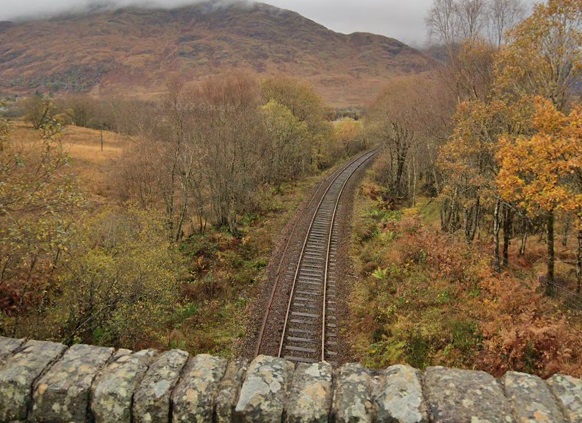
Just a short distance to the West, the line crossed the River Orchy at the East end of Loch Awe.
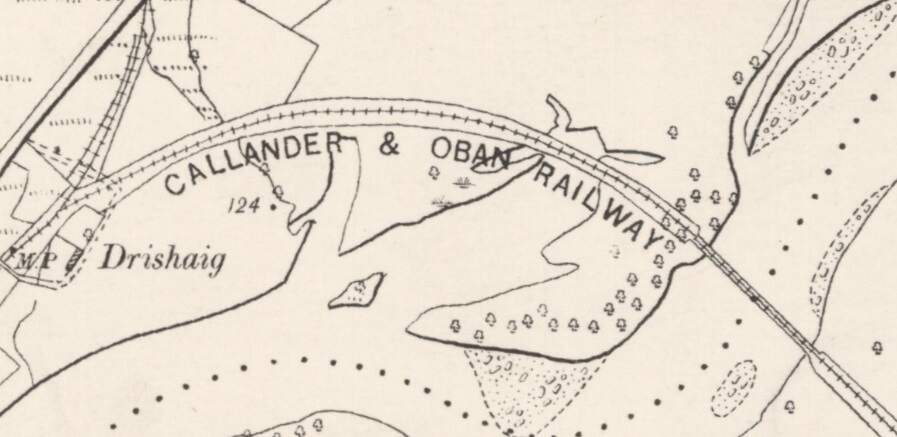
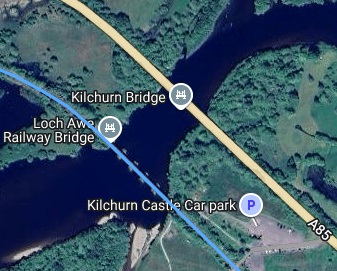
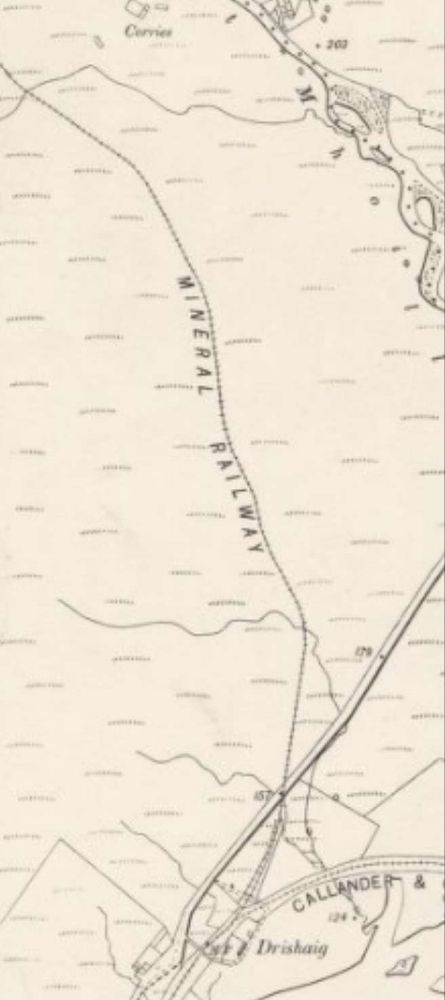
Further West of Dalmally, the line bridged the River Orchy at Drishaig. The mineral Railway which branched off the Callander & Oban Railway at Drishaig served the Ben Chruachan Quarry which was high on the East flank of Ben Chruachan. [45]
The same location as it appears in satellite imagery in the 21st century. [15]
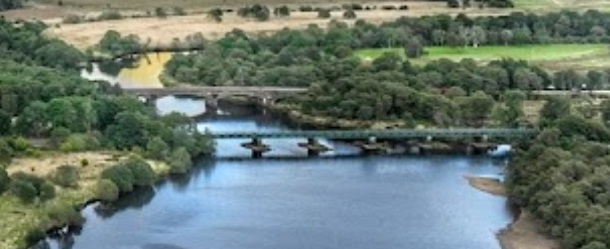
An aerial image of Lochawe Railway Bridge with the A85 bridge behind. This aerial image was shared on Google Maps in September 2022, (c) Kevin Newton. [Google Maps, November 2024]
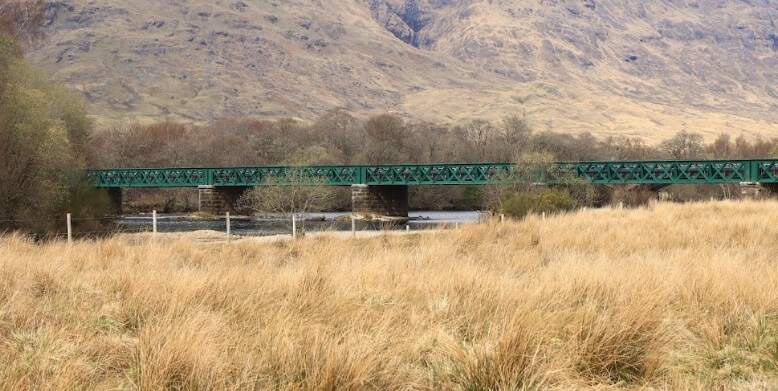
Lochawe Railway Bridge seen from ground level. This image was shared on Google Mpas in April 2021, (c) Wojciech Suszko. [Google Maps, November 2024]

The Ben Cruachan Quarry Branch was standard-gauge and ran North from Drishaig. It is shown here as it appears on the 6″ Ordnance Survey of 1897, published in 1900. The line North from Drishaig appears on the map extract on the left. [47]
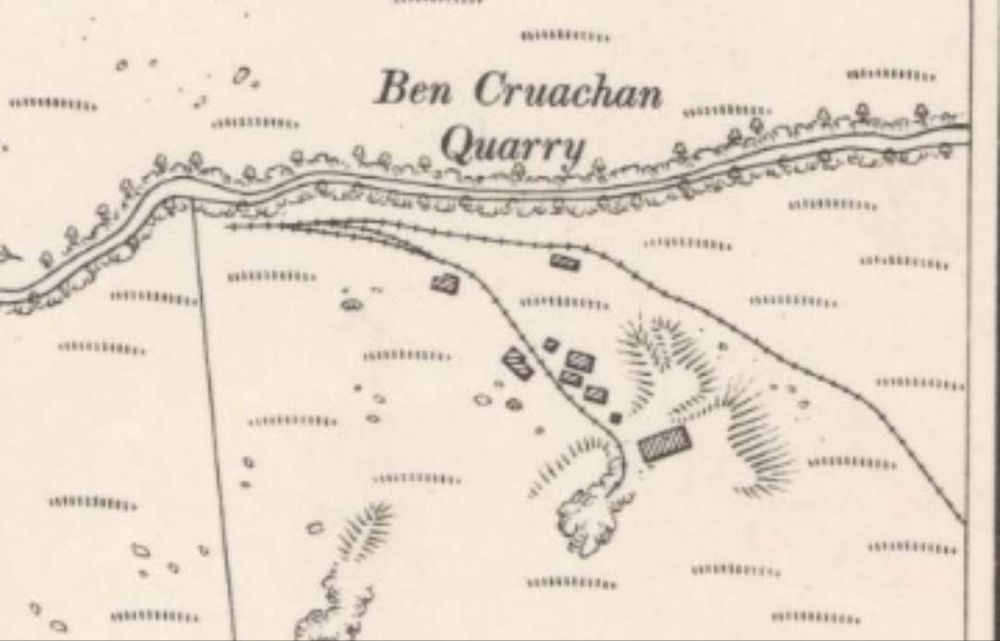
Ben Cruachan Quarry itself, shown on the next 6″ OS Map Sheet. The quarry was on the eastern slopes of Ben Cruachan. The full extent of the quarry’s internal railways is not shown. [48].

Ben Cruachan Quarry was multi-levelled and was accessed by the railway which zig-zagged to gain height. The RailScot website rells us that”The ground frame for this short Ben Cruachan Quarries Branch (Callander and Oban Railway) was released by a tablet from Loch Awe station for the section to Dalmally. The quarry had its own pair of 0-4-0ST locomotives.” [49]

Just a short distance Southwest of Drishaig was the Lochawe Hotel which had its own railway station alongside the Loch.
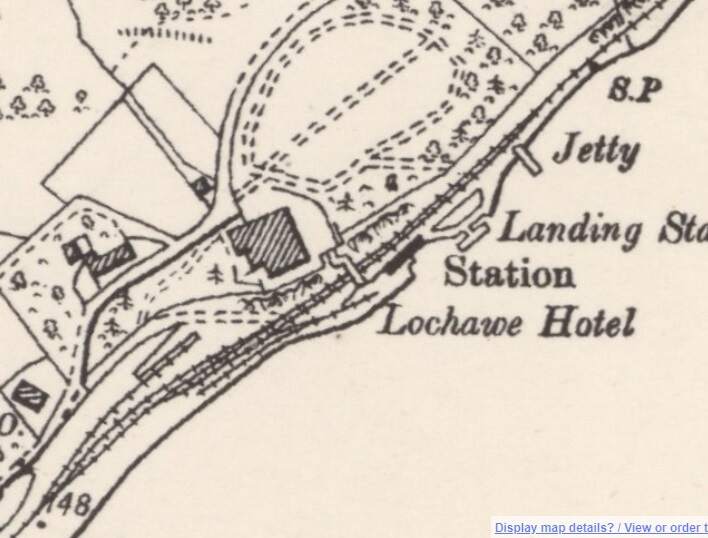
Lochawe Railway Station and Hotel in 1897 as shown on the 6″ Ordnance Survey sheet of that year. [50]
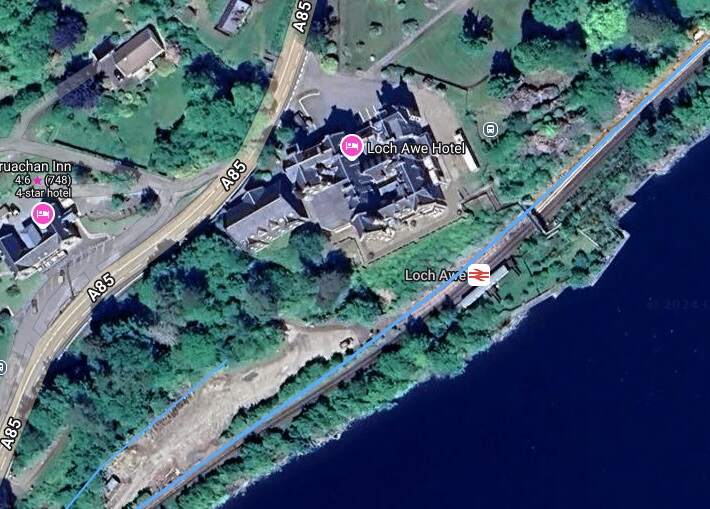
The same location as shown on the satellite imagery of RailMapOnline.com. [15]
A postcard view of Lochawe Railway Station and Hotel, (c) Public Do9main. [52]
Lochawe Railway Station in 2015. The removed second platform can be seen easily, (c) Tom Parnell and licenced for reuse under a Creative Commons Licence (CC BY-SA 2.0). [51]

The line ran across the North shore of Loch Awe to a Halt named for the Falls of Cruachan – Falls of Churachan Platform.
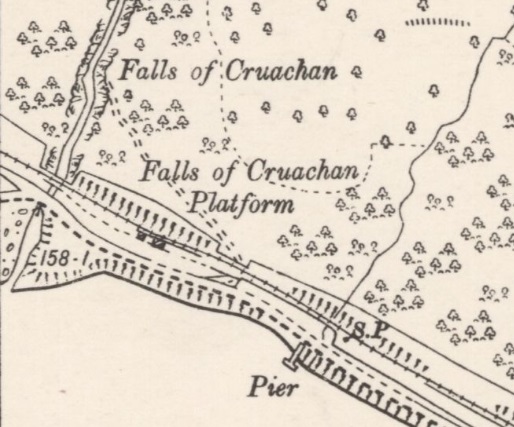
The Falls of Cruachan Platform as shown on the 6″ Ordnance Survey of 1897. [50]
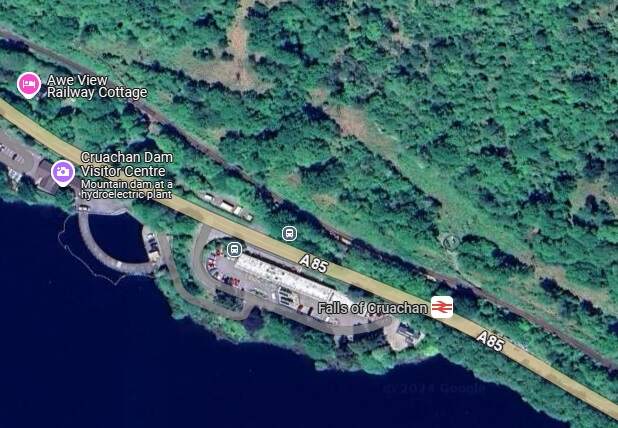
The same location in the 21st century. There is a significant hydro electric scheme at this location which has a visitor centre and its own Railway Station – Falls of Cruachan Railway Station. [15]

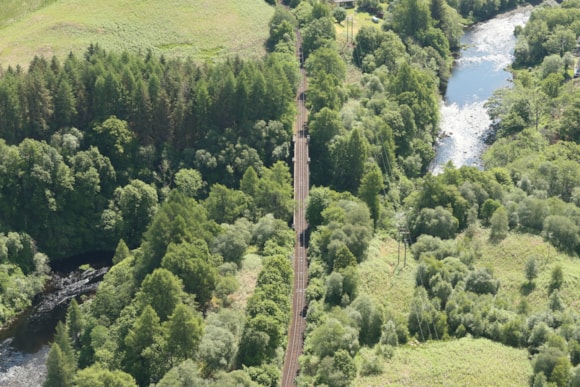
The line continues West/Northwest along the Northside of the River Awe. It crosses the river just North of The Bridge of Awe. Just prior to reaching the Viaduct the line bridged the minor road which served properties on the North side of the River Awe.
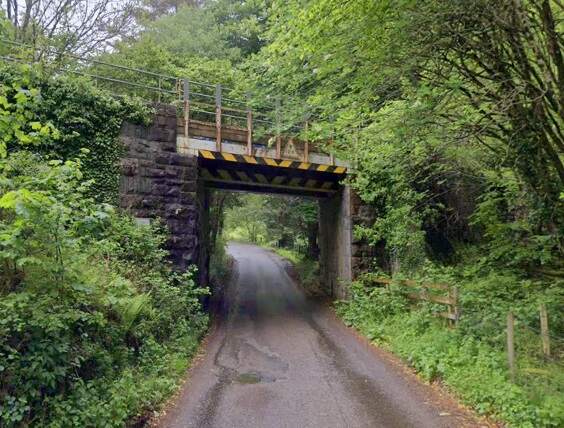
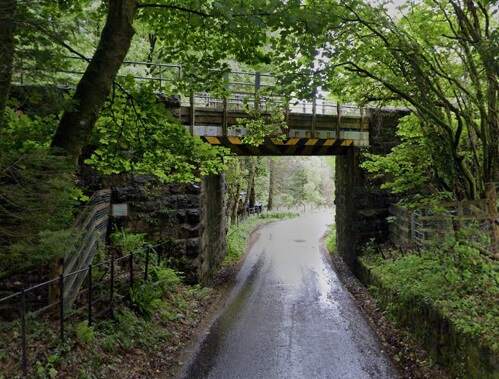
A matter of not much more than a couple of hundred metres to the West of the minor road, the line bridges the River Awe.
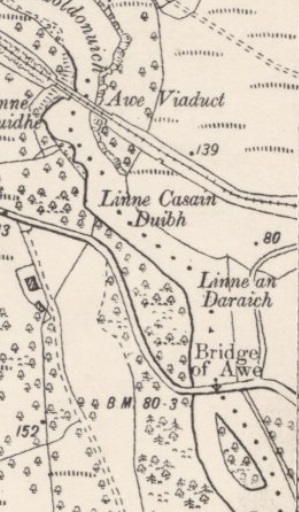
The Bridge of Awe with the Railway Viaduct just to the North, as they appear on the 6″ Ordnance Survey of 1897, published in 1900. [53]
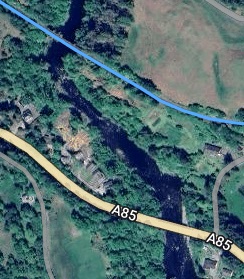
The same location on RailMapOnline.com’s satellite imagery. [15]
An aerial image of the railway viaduct. [54]
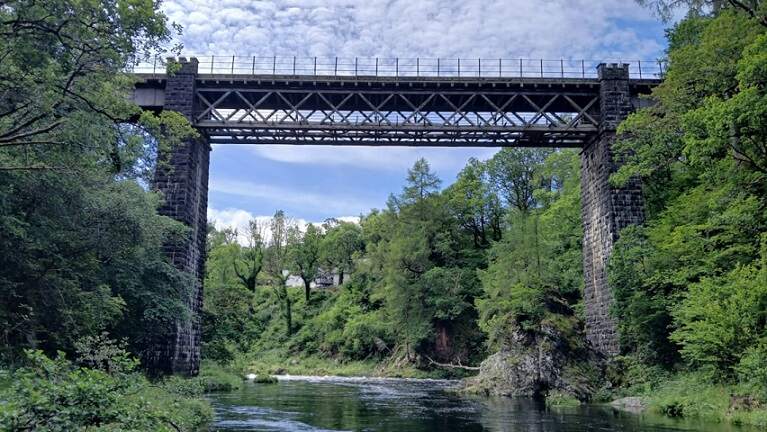
The railway viaduct over the River Awe. Network Rail Undertook a £3.5m project to refurbish Awe viaduct in 2024/25. The viaduct is a three-span wrought iron viaduct, completed in 1879. During the 7-month project, engineers replaced the timber deck (which supports the track). They removed the old paint, carry out repairs to the metallic parts of the structure and repainted those parts of the structure to protect against rusting. [54]

Over the river, the line heads for Taynuilt.
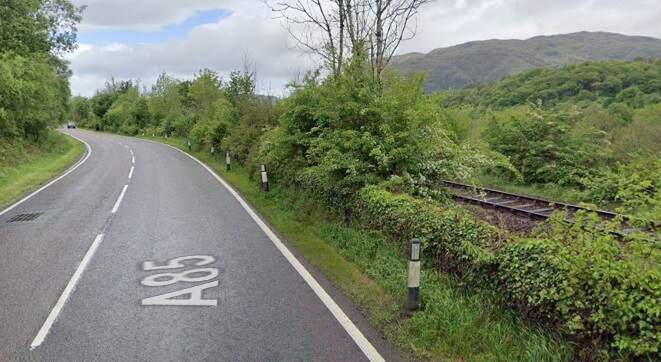
The A85 runs directly alongside the line on the approach to Taynuilt. This photograph looks Northwest along the road/railway. [Google Streetview, May 2022]
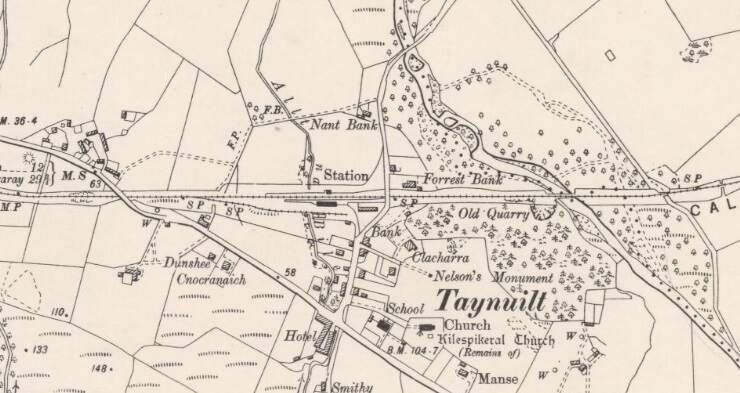
Taynuilt village and Railway Station as they appear on the 6″ Ordnance Survey of 1897. [53]
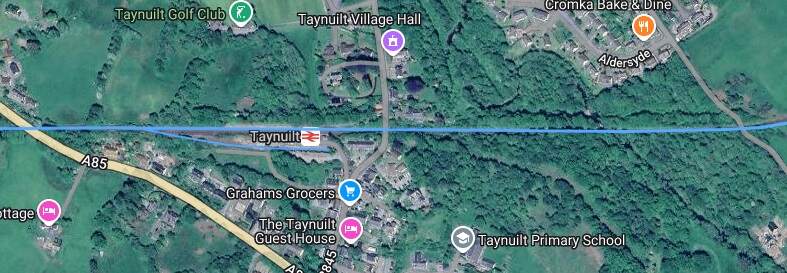
The same length of the line as it is shown on the RailMapOnline.com satellite imagery. [15]

On the way into Taynuilt the line crosses a minor road which serves the East end of the village. That road can be seen at the righthand side of the satellite image and the map extract above.
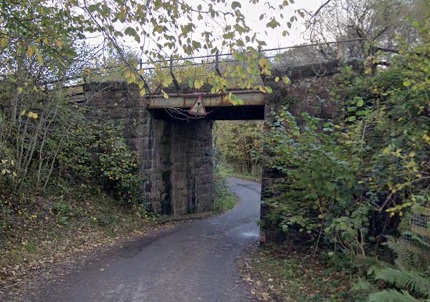
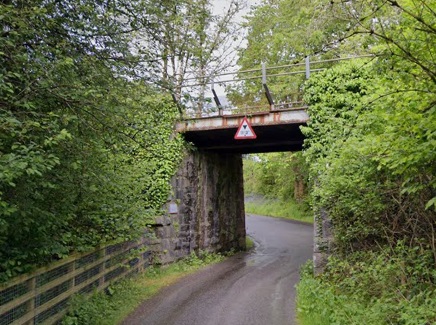
The next bridge spans the railway adjacent to Taynuilt Railway Station it carries the B845.
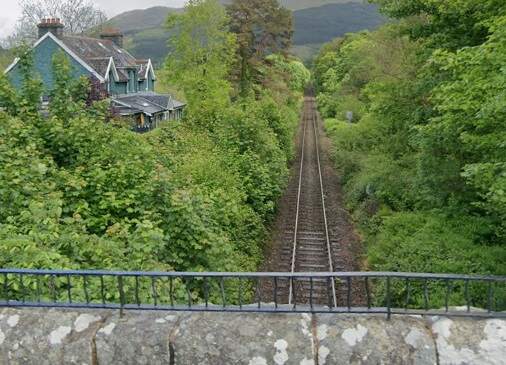
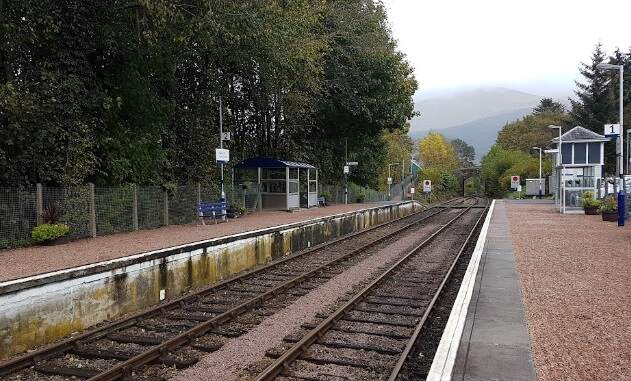
The view East from Taynuilt Railway Station to the bridge carrying the B845 over the line, (c) Robert Hamilton (October 2017). [Google maps, November 2024]
Taynuilt Railwaty Station forecourt. [Google Streetview, November 2021]

A little further to the West the railway passes under the A85 again.
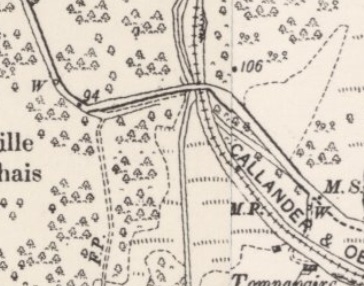
Looking West along the A85 showing the parapets of the bridge over the Callander & Oban Railway. {Google Streetview, November 2021]

The line now drops down to the shores of Loch Etive and in due course arrives at Auch-na-Cloich.
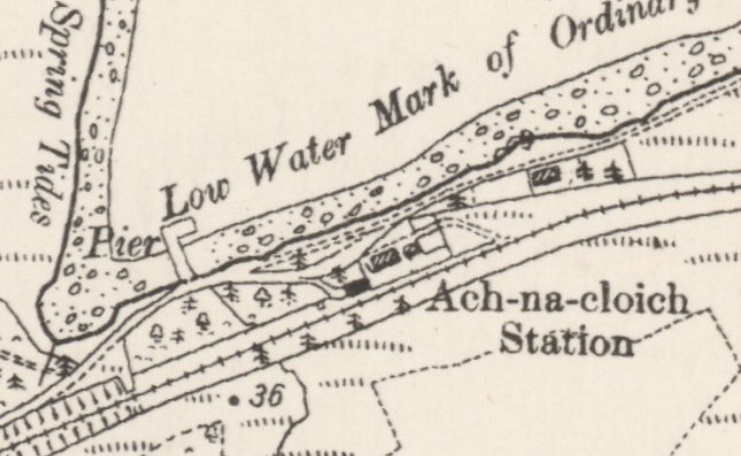
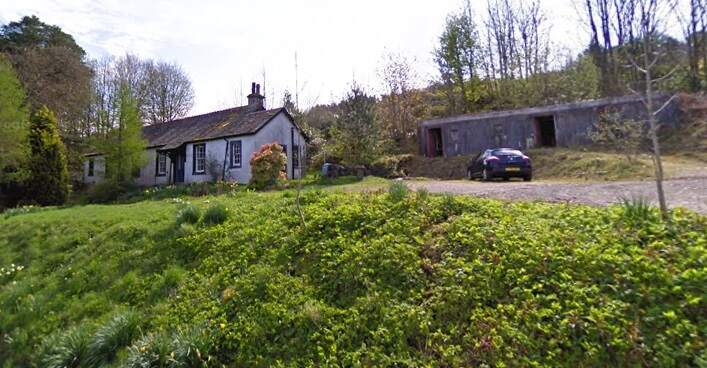
In 1897, the station at Auch-na-Cloich bore the name ‘Ach-na-Cloich, as the 6″ OS map extract shows. It bore that name right through to closure on 1st November 1965. [55][56]
The remaining buildings at Ach-na-Cloich, seen from the public road adjacent to Loch Etive. [Google Streetview, April 2011]

The line continues to hug the shore of Loch Etive passing over the A85 a couple of local roads on its way to Connel Ferry Railway Station.
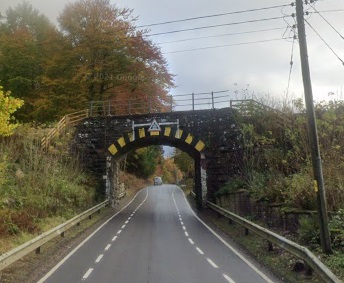
The next bridge over the A85,seen from the Northwest. [Google Streetview, November 2021]

The next image comes form Gairns’ article in The Railway Magazine and shows a train approaching Connel Ferry from the East.
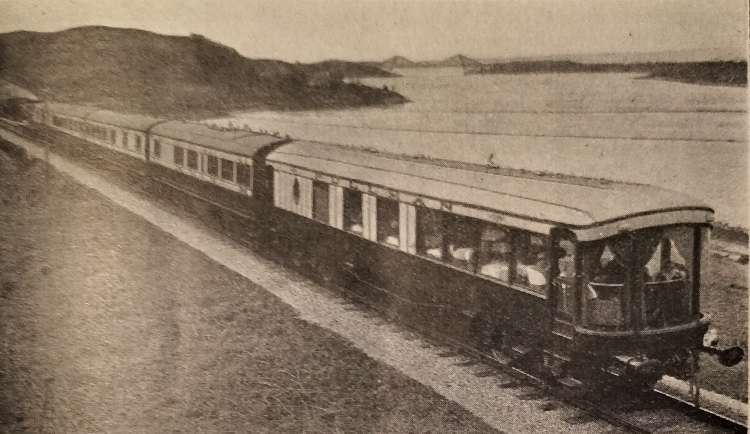
This photograph shows the Pullman viewing car in use on the line alongside Loch Etive with the iconic Connel Ferry Bridge as a backdrop. [1: p16]
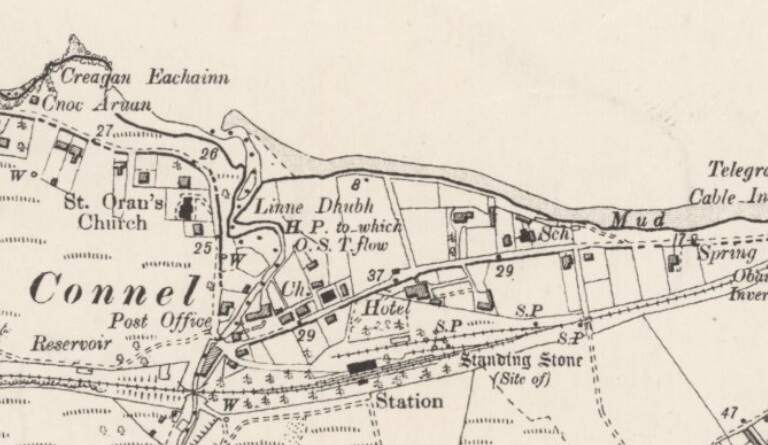
Connel Ferry Village and Railway Station in 1897. [57]
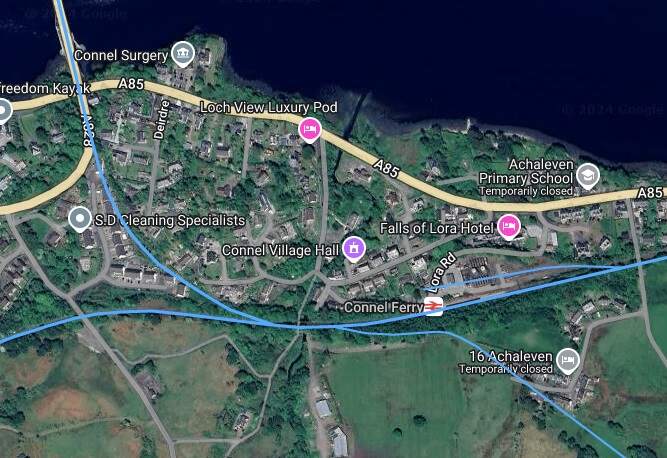
The same location as shown by RailMapOnline.com on their modern satellite imagery. The single blue line heading Southeast from the West end of the station site represents extensive wartime sidings – Achaleven Sidings which were installed in 1940 and lifted in 1948. This group of railway sidings were identified from vertical air photographs taken in 1947 (CPE/Scot/UK 247, frames 4028-4029, flown 31 July 1947), running for about 484m SE from the S boundary of the station. Only two sidings with rails in situ are visible on the air photographs. [15][59][60]
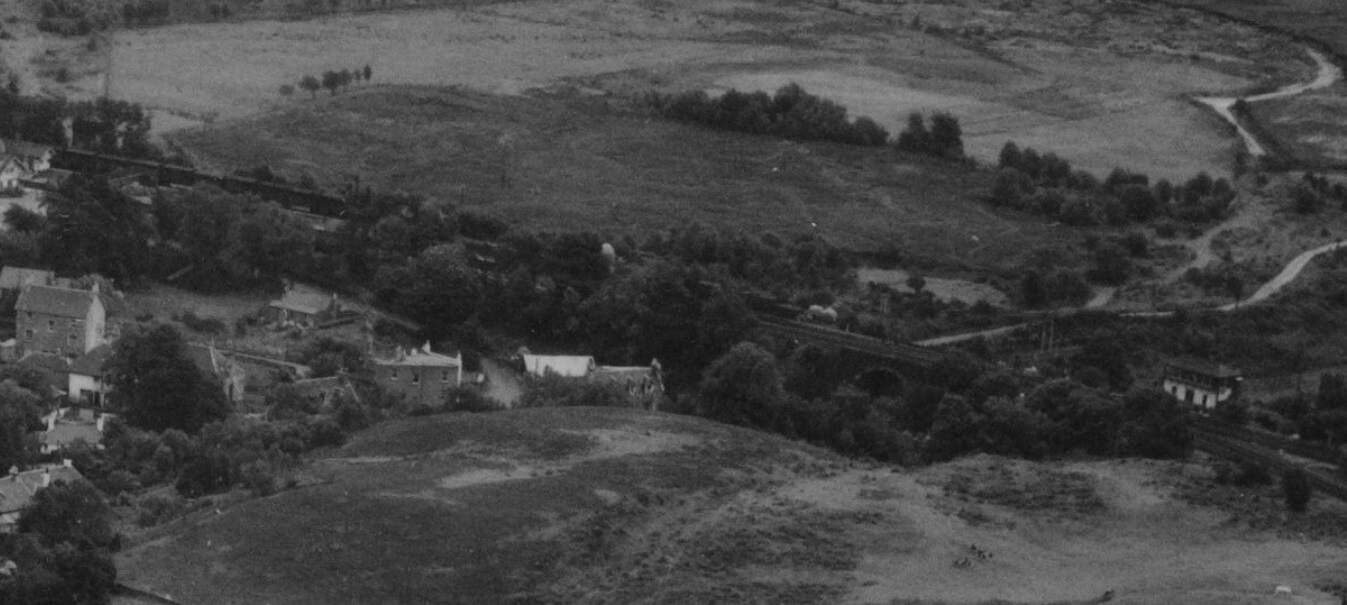
An aerial view of Connel Ferry Railway Station and signal box looking Southeast from above Connel Ferry Bridge. This is an extract from No. SAW039391, (c) Historic Scotland. [61]
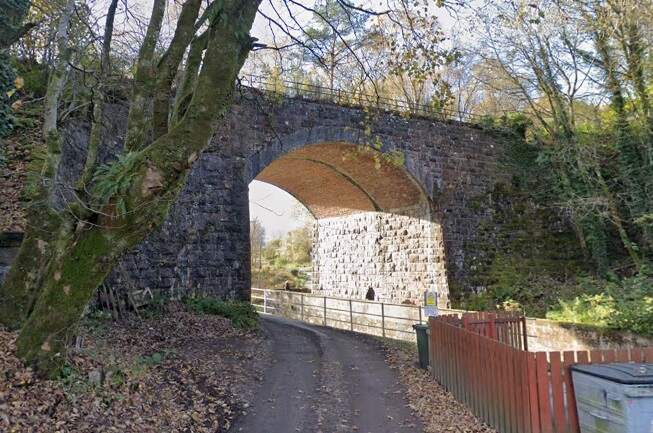
The substantial stone-arched bridge visible on the extract from the Aerial image above carried the railway over Lusragan Burn. [Google Streetview, November 2021]
Connel Ferry Railway Station, looking West towards Oban, © G.F. Gairns, Public Domain. [1: p14]
Connel Ferry Railway Station looking East in the 1950s. [58]

In its heyday when it served a branch to Ballachulish, Connel Ferry Railway Station had three platforms, a goods yard and a turntable. Later this was reduced to just the single platform, after the branch closed in 1966, [64] as it remains today. [63][65]

As we have already noted, the journey along the branch can be followed by reading articles elsewhere on this blog. We will continue our journey with Gairns along the main line to Oban. ….

Gairns continues

At Connel Ferry, junction for the Ballachulish line, there is a wide island platform serving the up and down main lines, and a single platform on the up side designed for branch trains, though generally these use the main platform to facilitate passenger and luggage transfer. The station has sidings and [a] goods yard. Its height above the village entails high viaducts both on the Oban line and on the approach to the famous Connel Ferry bridge, crossed by Ballachulish trains. Fine views are had of the bridge from the Oban line as it pursues its course high up on the hillside until it cuts inland to attain the summit of Glencruitten. This is at the top of the 3-mile incline at 1 in 50 by which the line zig-zags down to reach the shore at Oban, giving views now over Oban and the landward hills above it, and then, with final sweep round, over the Kerrera Sound and Kerrera Island, to the mountains of Mull and the Firth of Lorne.

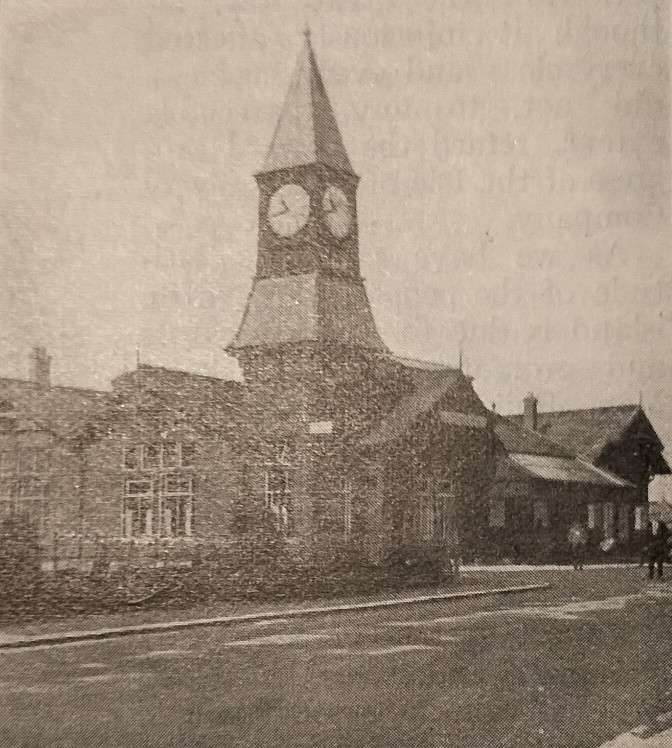
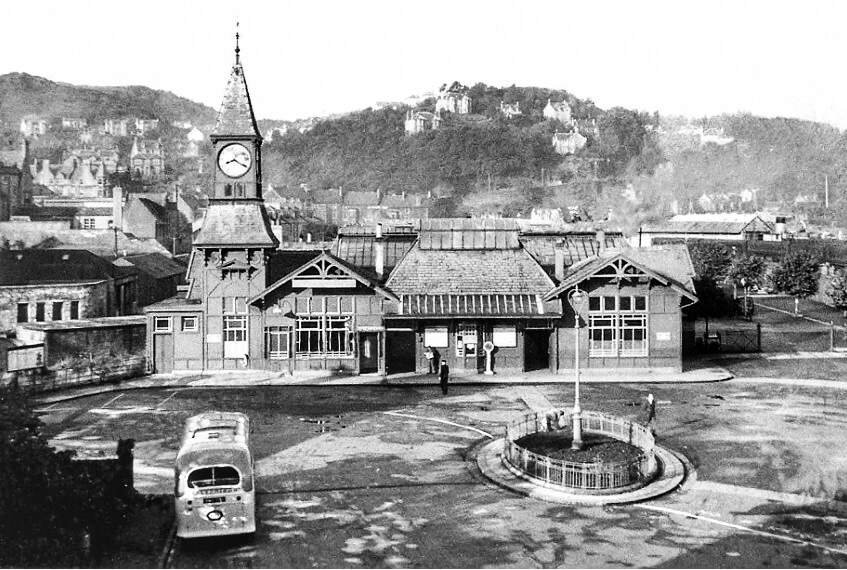
Before reaching the terminus a stop is usually made at Oban ticket platform, adjacent to the goods yard and engine shed. Oban station has picturesque build ings surmounted by a clock tower, and the circulating area is adorned with hanging flower baskets. Refreshment and dining rooms are provided. The three main platforms are partly covered by a glazed all-over roof, though their outer curved portions are open. Alongside are two open arrival platforms permitting cabs, &c., to come directly alongside the trains, The station is immediately alongside the steamer pier and harbour premises, the location being peculiarly convenient to the principal hotels, the sea front, and the Corran Esplanade.

Oban – ‘a little bay’ – so widely favoured as a holiday resort, as a boating and yachting centre, and as headquarters for touring the Highlands and the Hebrides in all directions, has been described as the ‘Charing Cross of the Highlands’. Whether readers will agree with this as a happy choice or not, it certainly justifies it as a great steamer traffic and touring centre. Messrs. David MacBrayne, Ltd., operate steamers between Oban, the Sound of Mull and Tobermory to Castlebay and Lochboisdale (‘Inner Island Service’), Ardrishaig via the Crinan Canal, to Staffa and Iona, to Ballachulish, Kentallen and Fort William, and thence via the Caledonian Canal to Inverness, besides many local trips and excursions.” [1: p13-15]

Connel Ferry is the last station before Oban. The railway line runs behind (South of) Connel and then turns away from the coast and the A85.
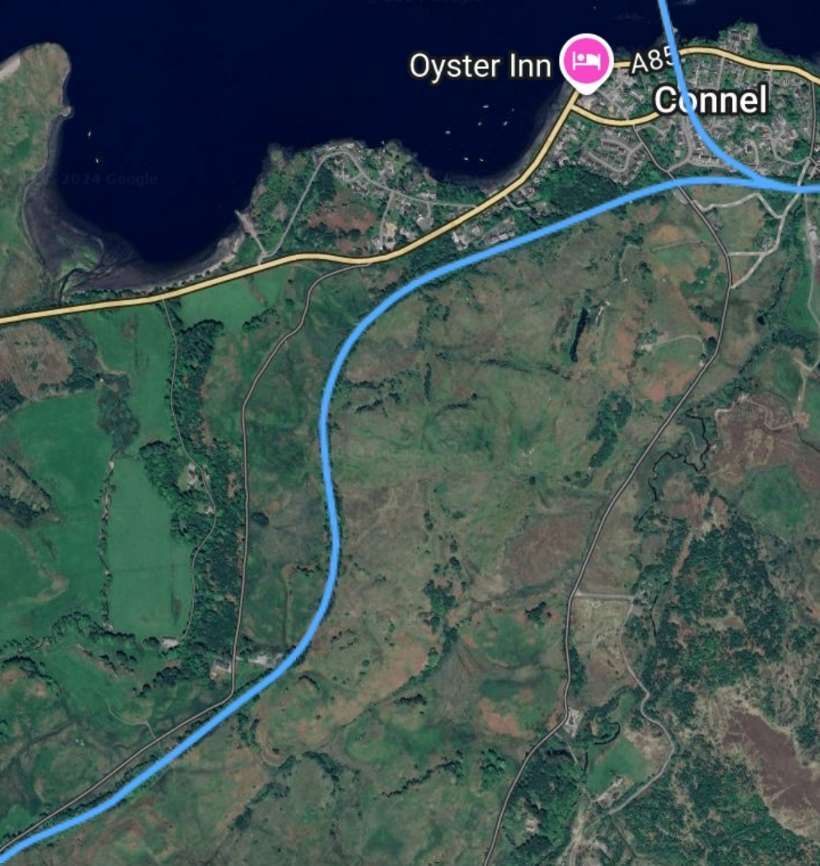
The line Southwest of Connel Ferry Railway Station, as shown on railmaponline.com’s satellite imagery. [15]
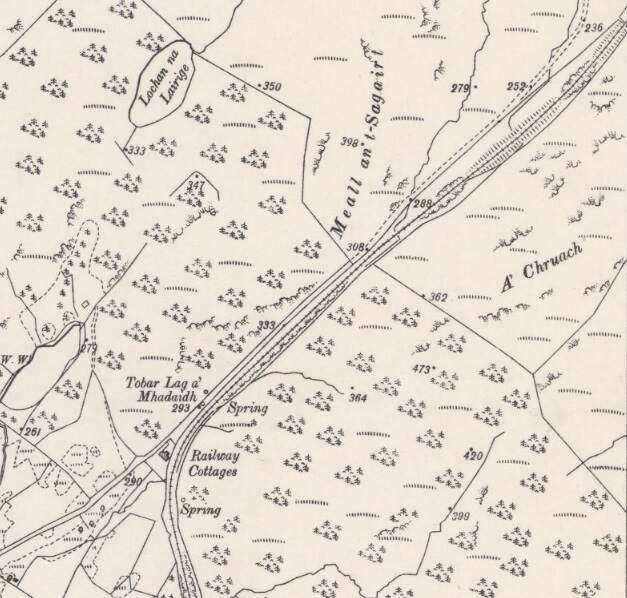
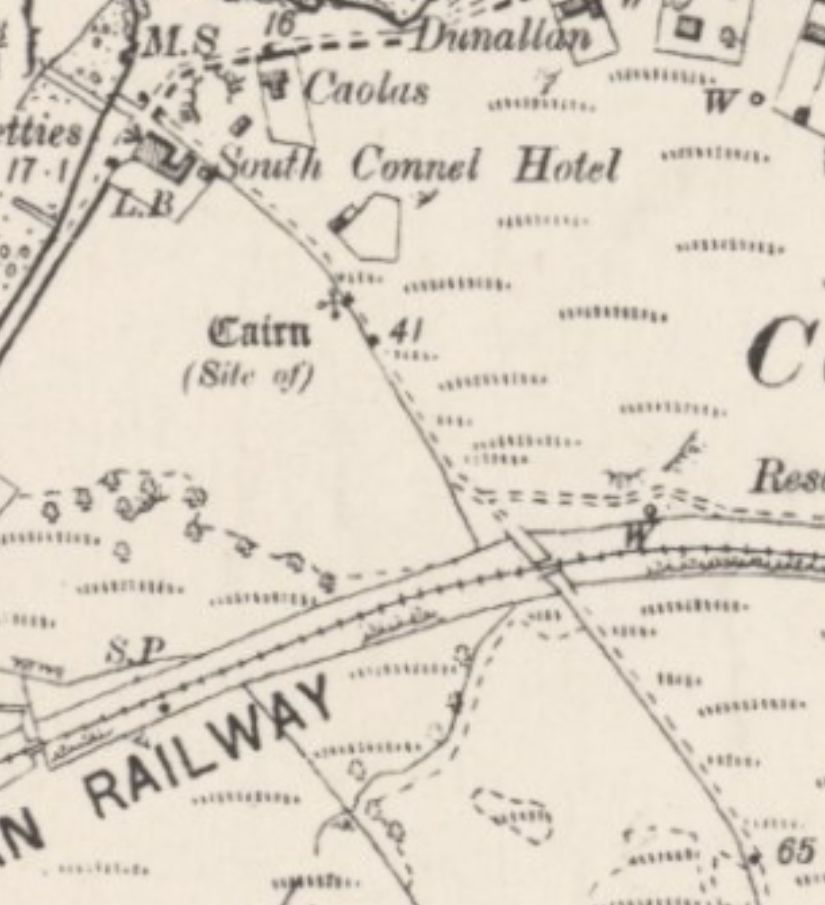
This extract from the 6″ Ordnance Survey of 1897, published in 1900 shows the next bridge on the line where a local road passes under the railway. [66]
A similar area in the 21st century. [Google Maps, December 2024]
The bridge shown on the Ordnance Survey extract and on the modern satellite image from Googlee Maps.  This view looks Northwest along the lane under the bridge from the Southeast. [Google Streetview, November 2021]
Looking Southeast along the lane this time. Google Streetview, November 2021]
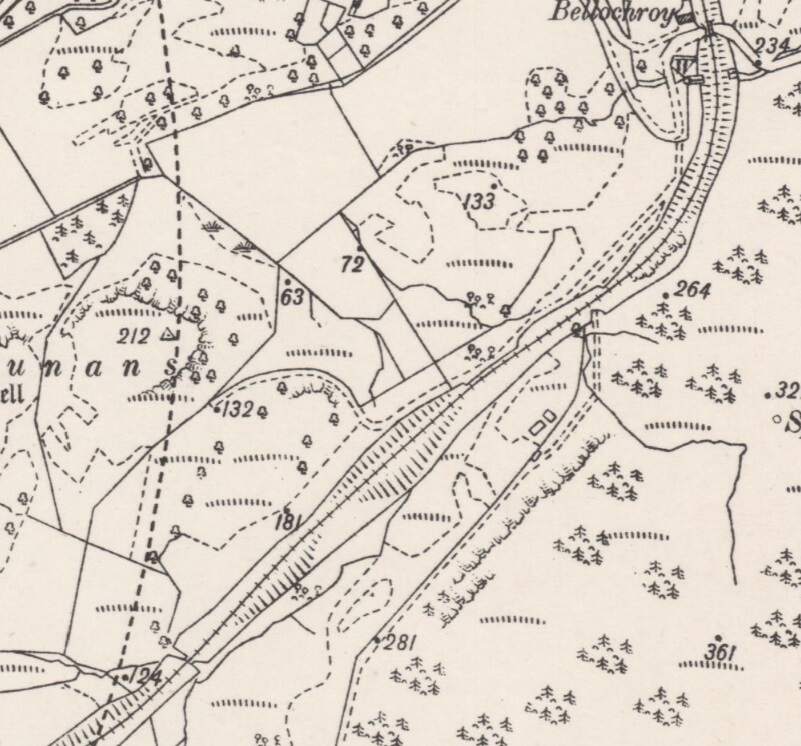
The next length of the line as shown on the 6″ Ordnance Survey of 1897, published in 1900. [66]

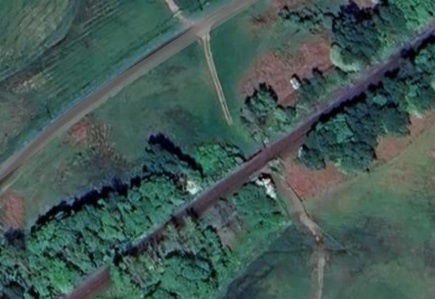
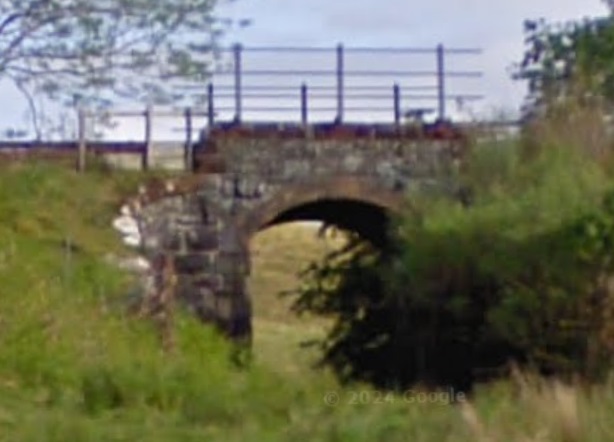
Trains encounter a number of accommodation bridges/underpasses which allow field access under the line of the railway. The one shown below, at the highest magnification possible from the public highway, is typical of one type of culvert.
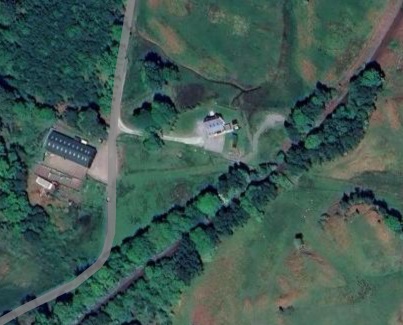
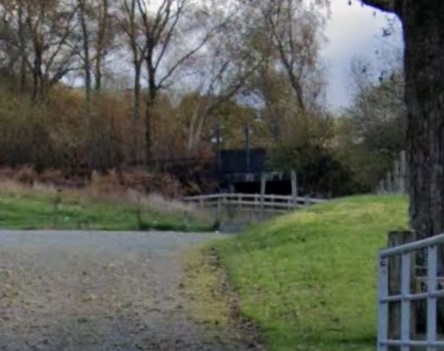
Just a short distance Southwest is another underpass, this time of stone arch construction.
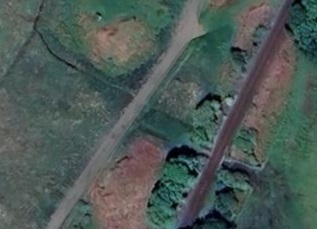
The next length of the line as shown on railmaponline.com’s satellite imagery. [15]

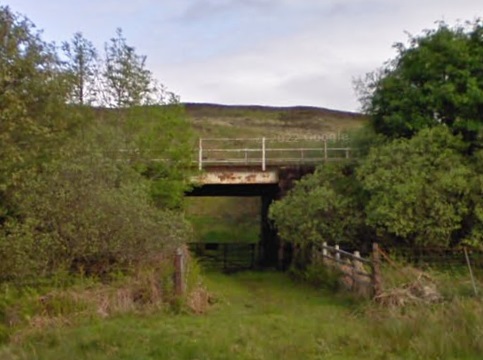
Another few hundred metres to the Southwest a further underpass is a girder bridge.
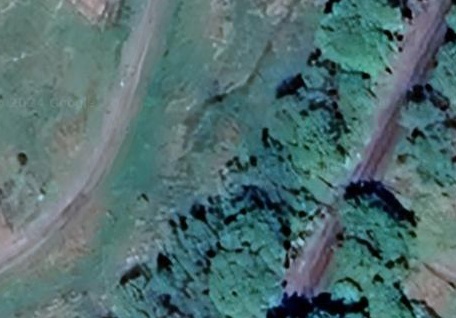
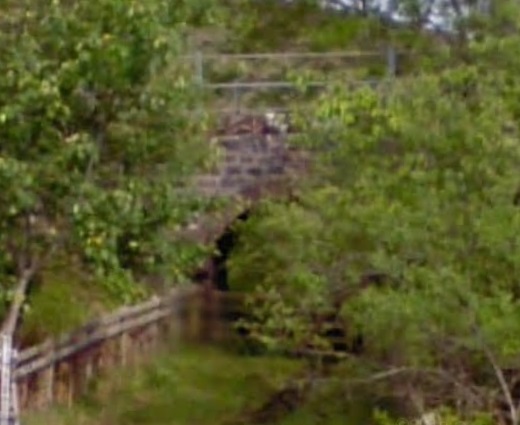
The next underpass is a stone arched structure.
These two locations appear on the 6″ Ordnance Survey of 1897. …
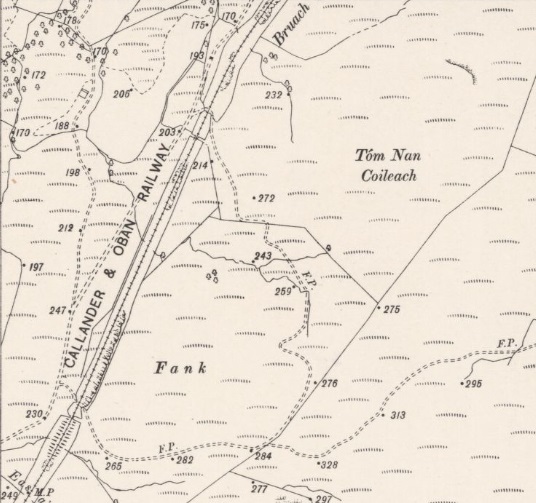
The next length of the railway as shown on the 6″ Ordnance Survey of 1897, published 1900. [67]
These two extracts (this and the one above) from the 6″ Ordnance Survey take us as far along the railway as the last railmaponline.com satellite image above. [68]
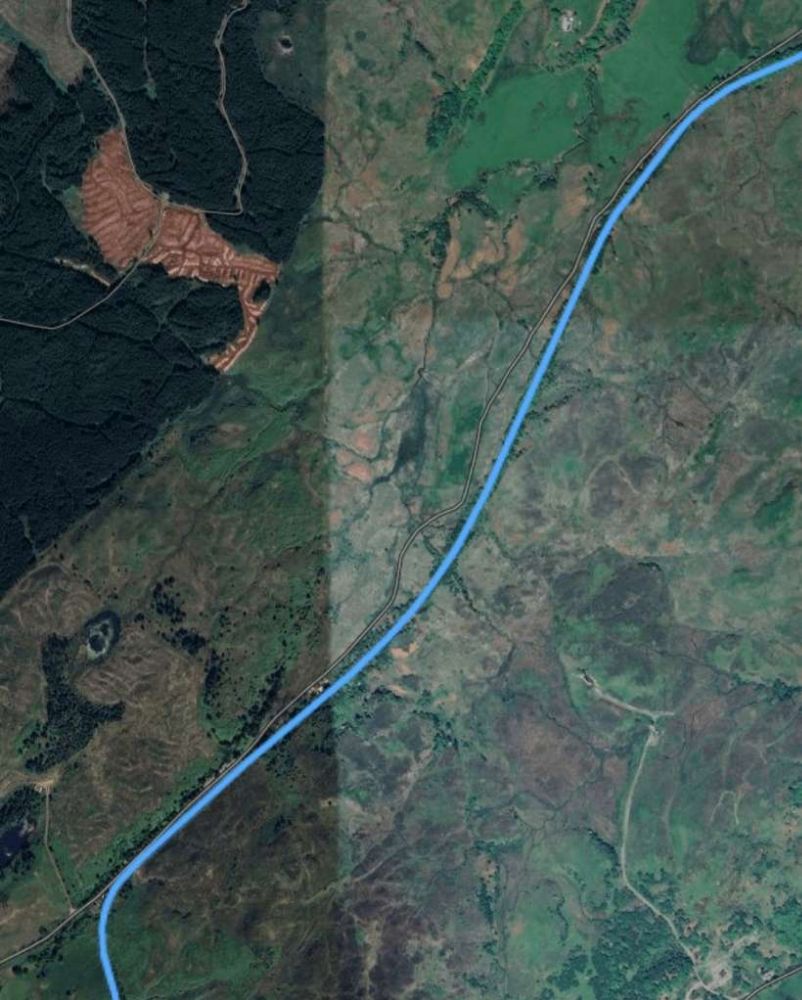
The next loength of the line as it appears on railmaponline.com’s satellite imagery. The outskirts of Oban can be seem on the left of the image. [15]
Two extracts from the 6″ Ordnance Survey take us almost as far at the length of line on the railmaponline.com satellite imagery above. [68]
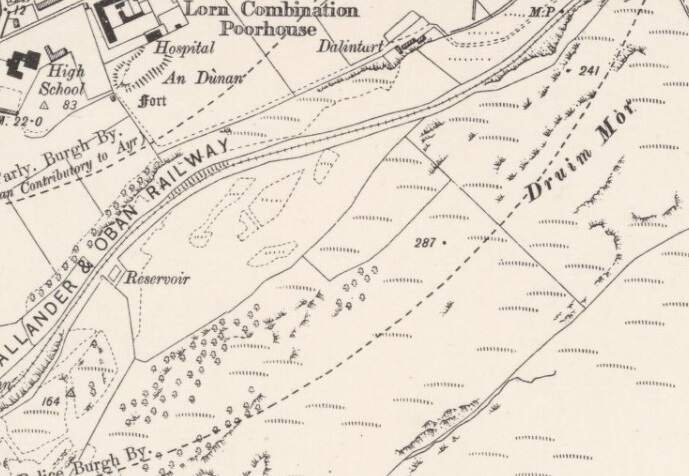
This third extract from the 6″ Ordnance Survey completes the length covered by the railmaponline.com satellite image above and covers the length on the right on the satellite image below. [69]
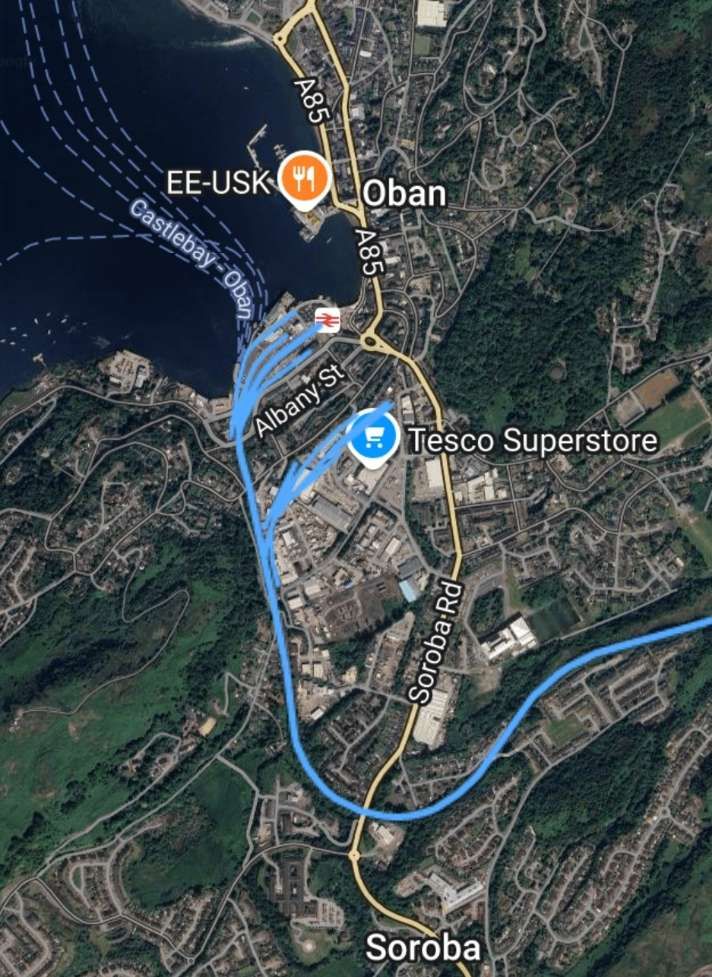
The final length of the line into Oban as shown by railmaponline.com. [15]
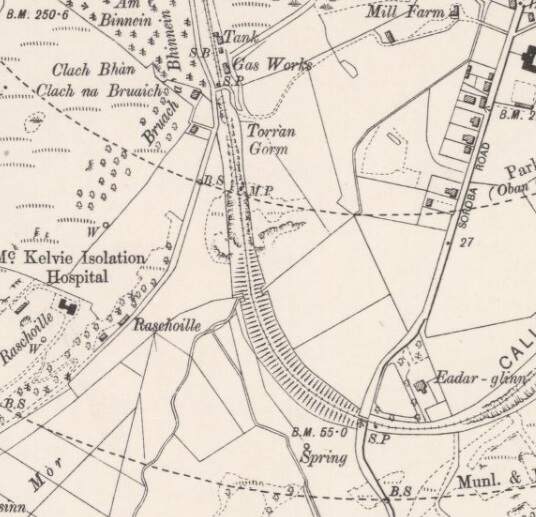
This extract from the 6″ Ordnance Survey of 1898 covers the length of the line on the bottom half of the satellite image above. [69]
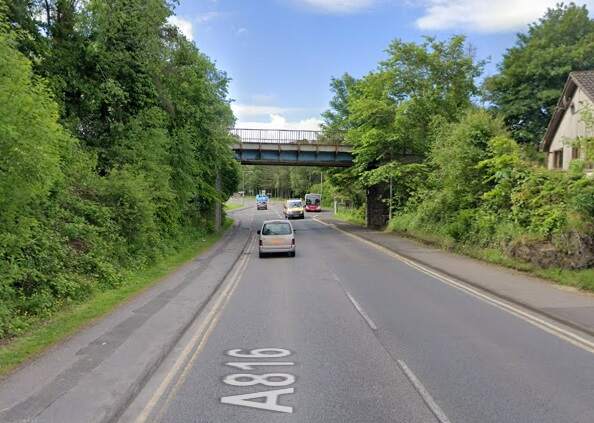
Looking South out of Oban along the A816, Soroba Road, The railway crosses the road on a simply supported girder bridge. [Google Streetview, May 2022]
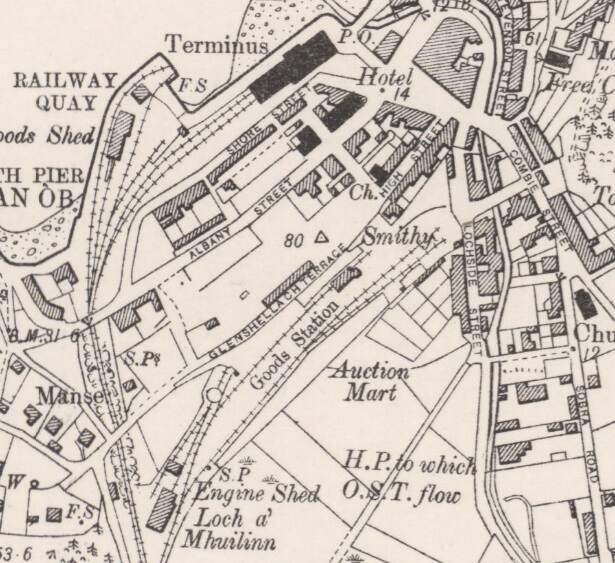
This extract from the 6″ Ordnance Survey of 1898 shows the final length of the line and the two stations (passenger and goods) which existed at the turn of the 20th century. [69]
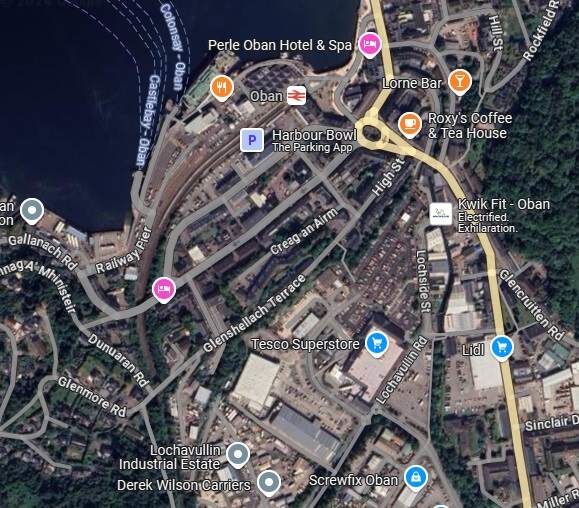
The same area as it appears on Google Maps in the 21st century. Glenshellach Terrace marks the north side of what was the Goods Station. [Google Maps, December 2024]

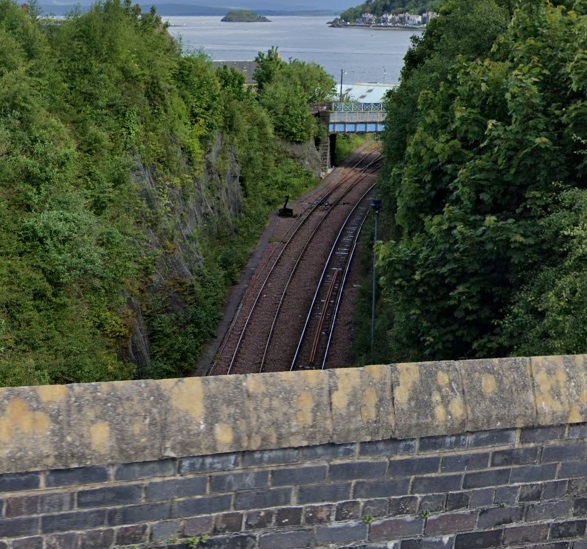
Running into Oban the line is crossed by three road bridges:
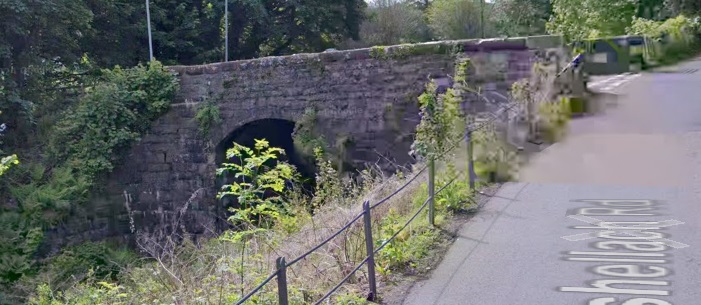
The first of these is a stone-arch bridge which carries Lochavullin Road. [Google Streetview, May 2022]
The second was the stone-arch bridge which carried Glenshellach Terrace on which the photographer is standing. The third is Albany Street bridge which can be seen in the middle distance in this photograph. [Google Streetview, May 2022]
Looking back South from Albany Street bridge towards Glenshallach Terrace bridge. [Google Streetview, May 2022]
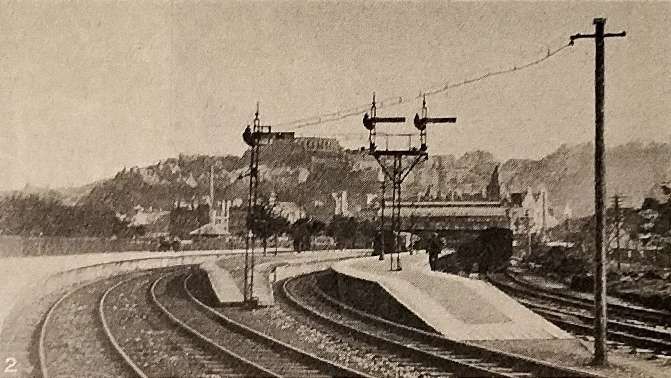
The Station Throat, Oban, © G.F. Gairns, Public Domain. [1: p14]
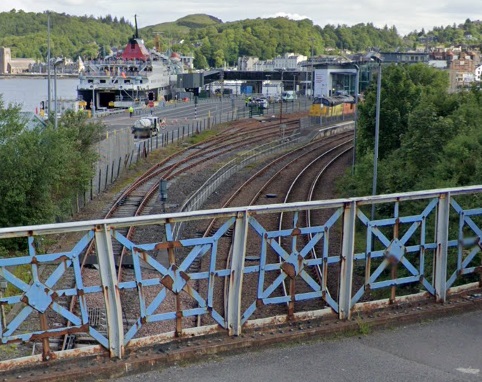
The view from Albany Street bridge into Oban Station. The bridge sits over the station throat. [Google Streetview, May 2022]
Oban Railway Station Building. [1: p10]
Oban Railway Station passenger facilities in the mid-20th century (c) Public Domain. [70]
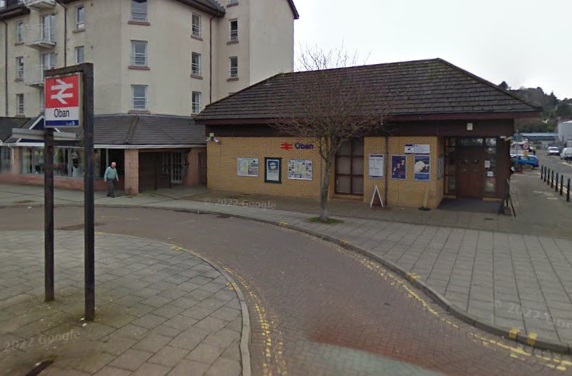
Oban Railway Station building in the21st century. [Google Streetview, April 2011]
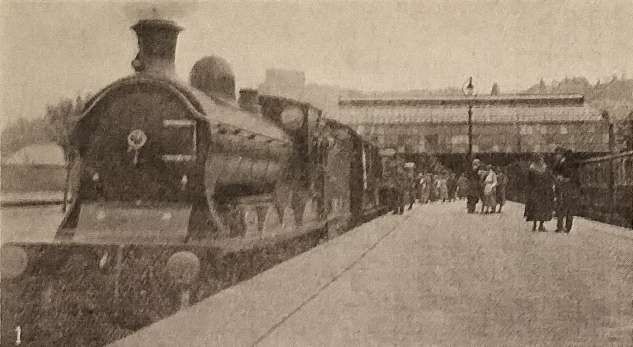
Oban Railway Station showing the railside of the terminus and platforms, © G.F. Gairns, Public Domain. [1: p14]

For the sake of completeness, we note that Gairns’ narrative returns to Connel Ferry for commentary on the Ballachulish Branch.

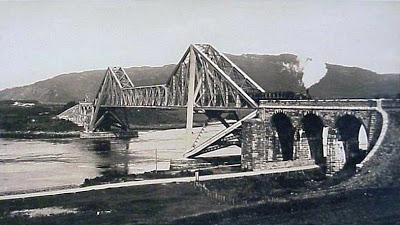
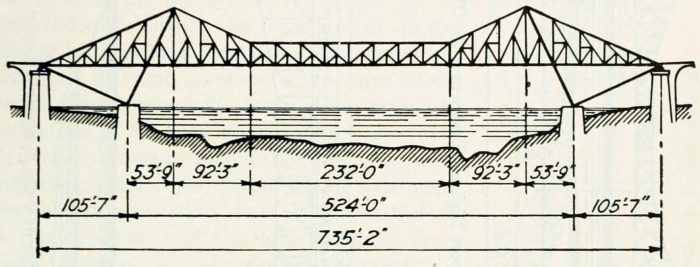
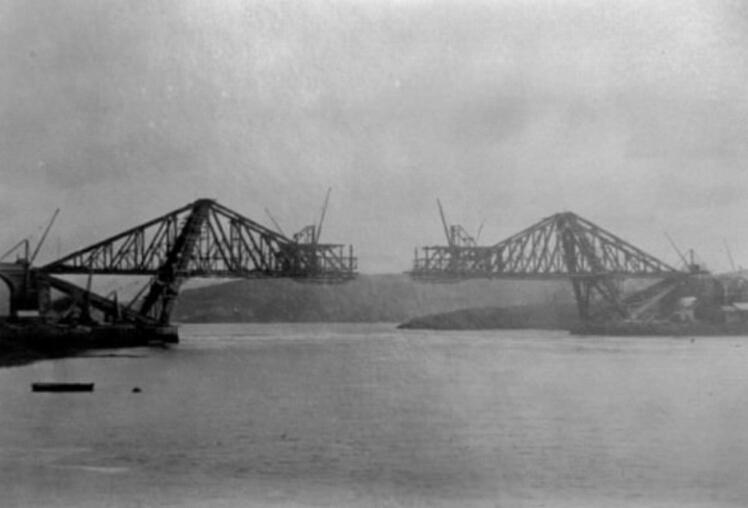
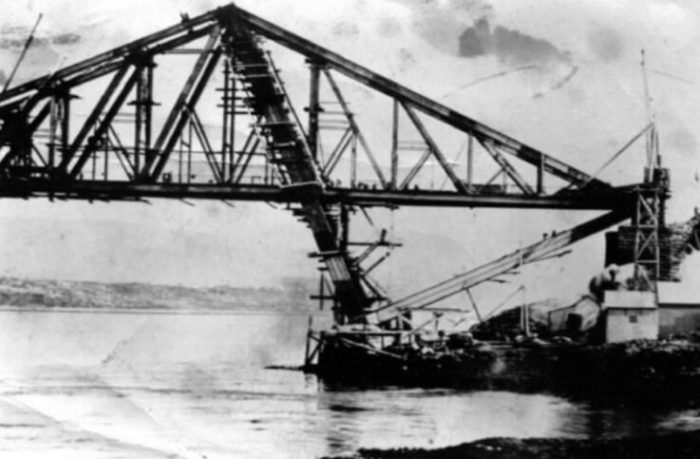
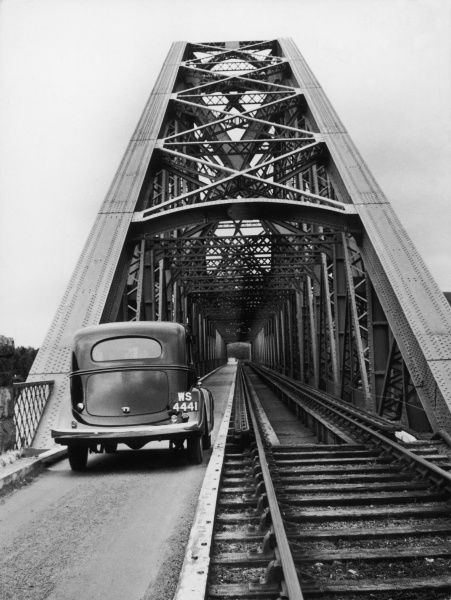
Commencing at Connel Ferry station, the branch train reaches the famous bridge by a viaduct approach over the village of Connel Ferry. The Connel Ferry bridge, claimed to be the Forth Bridge’s ‘biggest British rival’, was opened for traffic on 21st August 1903. The bridge, which is of cantilever type (hence the analogy suggested with the Forth Bridge), has a length of 524 ft. between the two piers, the clear span being 500 ft., and the headway above high-water level, 50 ft. Extreme height from high water to the topmost point of the bridge is 125 ft., while the middle span, carried by the two cantilever spans, has a length of 232 ft. This bridge not only enabled a district hitherto most inconveniently situated in regard to rail traffic to be placed in communication with the Callander and Oban Railway at Connel Ferry, but provided a means of crossing Loch Etive, where previously a very lengthy detour had to be made to get from one side to the other, the only alternative being a very uncertain ferry service,

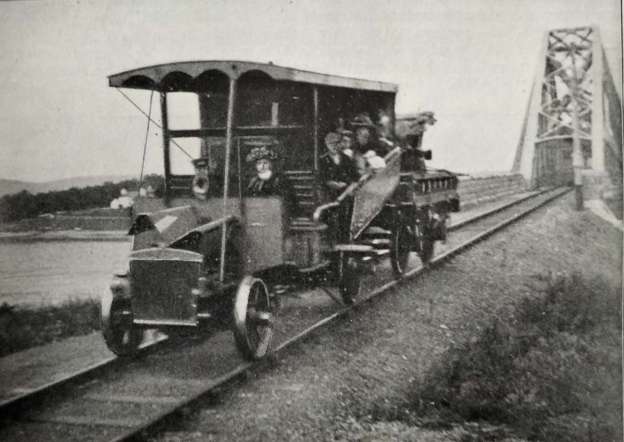
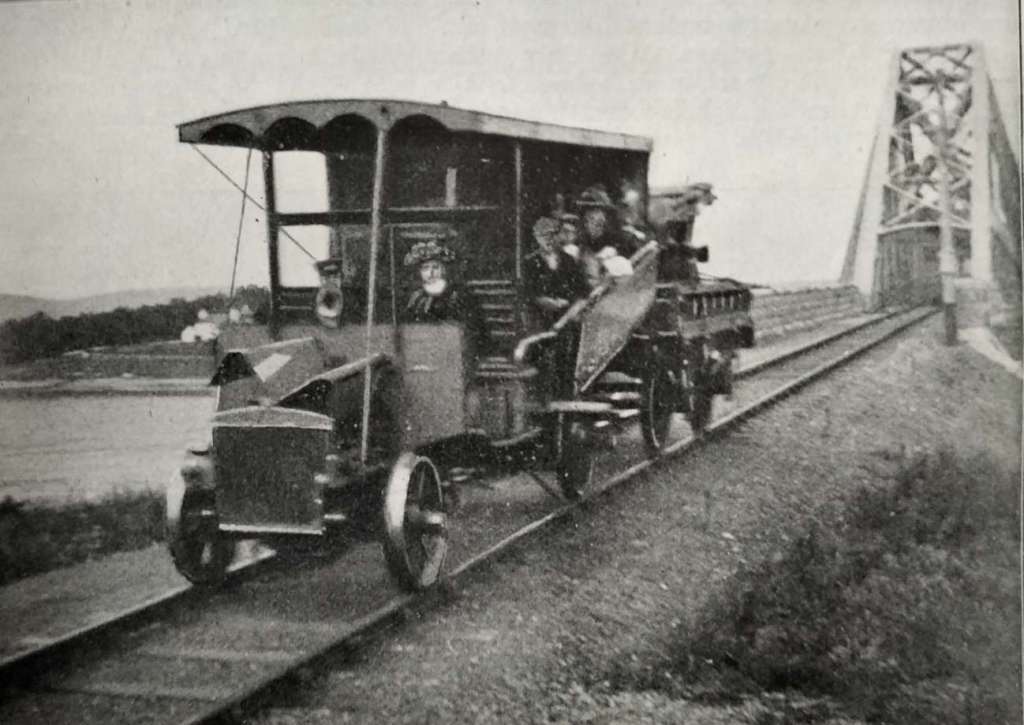
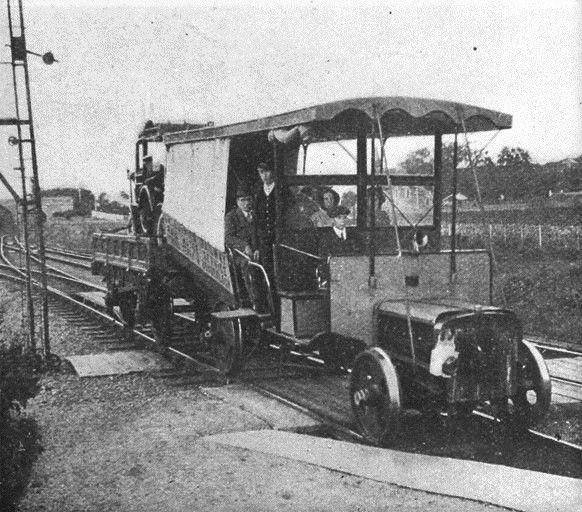
The difficulty having been solved from the railway point of view, there still remained the problem of providing for the transit of motor-cars and other road vehicles across the Loch, and for several years after the opening of the bridge the Caledonian Railway Company conveyed private motor-cars across the bridge by placing them on flat trucks and hauling them, passengers included, by road motor vehicles adapted to run on rails across the bridge.

This … was continued for a considerable time, but, several years ago, the Caledonian Railway Company adopted the alternative method of adapting the bridge also for the passage of motor vehicles, cycles, etc., under their own power. There is not, however, sufficient room for a roadway clear of the railway track, so that it is necessary to restrict the passage of road vehicles to periods when no train is signalled. At each end of the bridge, therefore gates under the control of the bridge keeper, are provided to close the bridge to road traffic when a train is due, and the tablet instruments are controlled by electric circuits in connection with the road gates, to ensure that unless the gates are properly closed, a tablet cannot be used. The roadway over the bridge comes close up to the rails, there being just sufficient room for a vehicle to pass between the rails and the side of bridge, and the bridgekeeper has to see that vehicles from both directions are not allowed on the bridge at the same time. These facilities apply only to private motor-cars and horse-drawn vehicles, and not trade vehicles, of either class. Cyclists and pedestrians also use the bridge. In each case the crossing of the bridge is subject to toll, the men in charge at the Connel Ferry and Benderloch ends acting as toll-keepers. … In August [1922], the bridge was used by 6,009 foot passengers, by 852 motor-cars, and by 290 cycles. [1: p15-16]

Gairns continues:

Passing North Connel halt, at the North end of the bridge, the line follows the shore to Benderloch station. At Barcaldine Crossing a platform is provided, where trains call as required. So far, the country traversed has been ‘comparatively’ flat and uninteresting, but as it crosses a peninsula to reach the shores of Loch Creran, mountain vistas again open up. Short of Creagan station the line crosses the Narrows to the Loch by a two-span girder bridge with approach viaducts, fine views being had on both sides.

Again crossing a peninsula. Appin is reached, and for the remainder of the journey the line follows closely the shores of Loch Linnhe. As it curves round after leaving Appin station, a good view is had of the ruins of Castle Stalker. Alongside the Loch splendid views are had, and Duror and Kentallen stations are sufficiently picturesque to harmonise with the general character of the scenery. At Ballachulish Ferry station tickets are collected, and the line then curves round to follow the shores of Loch Leven to the terminus at Ballachulish. This is a neat two-platformed station, with dining and refreshment rooms, and the district is impressively mountainous. A short distance from the station is a small harbour, whence a David MacBrayne steamer used to ply three times daily to and from the Kinlochleven wharf of the British Aluminium Company, for goods, passenger and mail traffic. This steamer service has now been withdrawn, a road having been built by German prisoners during the [First World War] and opened for traffic at the end of [1922].” [1: p16]
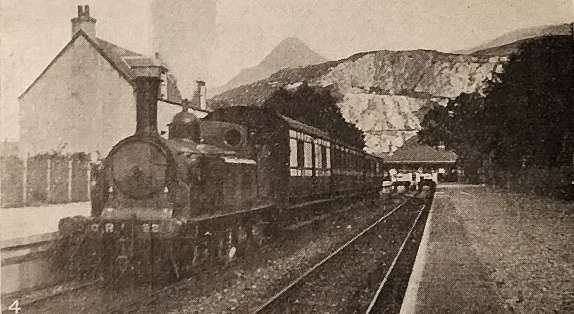
The Branch terminus at Ballachulish, © G.F. Gairns, Public Domain. [1: p14]

As noted close to the start of this article, the Ballachulish Branch has been covered extensively in an earlier series of articles which can be found here, [2] here, [3] here, [4] and here. [5]

Gairns goes on to reflect on the use of the Callander and Oban line. He says that its use is “complicated by the fact that its gradients are systematically so severe.” [1: p16] Indeed 1 in 50 gradients occurred:

several times for considerable distances, curves are numerous, and in several places reduced speed is necessary owing to the danger of tumbling rocks, notably alongside Loch Lubnaig in Glen Ogle and the Pass of Brander, and automatic alarm wires are erected on some stretches, a fall of rock encountering them causing warnings to be given in adjacent signal cabins and watchmen’s huts, and putting the special signals to danger. On the steep grades both goods and passenger trains are operated under special restrictions, stops being made at the summits and brakes tested, or, on goods trains, a proportion pinned down before descending. Mountain mists and fogs, occasional torrential rainstorms or cloudbursts and other ‘episodes’ peculiar to mountain lines, also complicate the working at times. But even in winter there is a steady traffic in meeting the transport needs of the wide areas rendered accessible by this line, of the various townships and villages (many are centres for other places within a considerable radius), country houses, castles and large estates, and in carrying mails, supplying coal and, in due season, conveying cattle and other live stock.

The winter train services are, naturally, much reduced as compared with those of the summer, but even the winter service provides four through trains each way daily, a local each way between Oban and Dalmally, and several additional trains between Callander and Glasgow. Sleeping cars and through carriages are provided between Euston and Oban in winter on Fridays only from London, returning on Mondays. The down vehicles are conveyed on the 8.25 a.m. from Stirling, due in Oban at 12.15 p.m. It is also possible to reach Oban at 4.45 p.m. from London by the 11 p.m. from Euston the night before, and by the 5 a.m. from Euston at 9.50 p.m., the same night, though not, of course, with through carriages.” [1: p16-17]

Gairns goes on to cover train movements on the line in some detail. While the copious detail he provided need not detain us here, it is worth noting the care with which connections to the various railway branches, steamer and motor-coach services associated with the main line were arranged. There were also a significant number of excursions and tours to suit passenger’s differing budgets.

Gairns’ final paragraph concentrated on the motive power in use on the line in the early 1920s and is worth recording here:

The locomotives generally employed are the well-known ‘Oban’ 4-6-0s, with 5-ft. coupled wheels, together with Mr. Pickersgill’s new ‘Oban’ class recently introduced, though odd trips are taken by 0-6-0 goods engines, which also render assistance on the steep grades. On the Killin branch and the Ballachulish extension 0-4-4 tank engines of the 4 ft. 6 in. class are used. Between Dunblane and Callander main line 4-4-0 locomotives from Glasgow or Stirling and 0-6-0 goods engines are used, as well as the Oban 4-6-0s on the through trains, a change being sometimes made at Callander. The Callander and Oban line and the Ballachulish extension are controlled by electric train tablet apparatus. Ordinary train staff is used on the Killin branch.” [1: p18]

References

  1. G.F. Gairns; The Callandar and Oban Railway; in The Railway Magazine, London, July 1923, p10-17
  2. https://rogerfarnworth.com/2019/01/01/the-ballachulish-railway-line-part-1
  3. https://rogerfarnworth.com/2019/01/02/the-ballachulish-railway-line-part-2
  4. https://rogerfarnworth.com/2019/01/05/the-ballachulish-railway-line-part-3
  5. https://rogerfarnworth.com/2024/07/16/the-caledonian-railway-rail-motor-car
  6. https://maps.nls.uk/geo/explore/#zoom=15.9&lat=56.24212&lon=-4.20521&layers=257&b=ESRIWorld&o=100, accessed on 2nd November 2024.
  7. https://maps.nls.uk/view/75656127, accessed on 2nd November 2024.
  8. https://en.m.wikipedia.org/wiki/Callander_railway_station, accessed on 2nd November 2024.
  9. https://maps.nls.uk/view/75656013, accessed on 3rd November 2024.
  10. https://www.flickr.com/photos/david_christie/5764782485, accessed on 3rd November 2023.
  11. https://canmore.org.uk/collection/682143, accessed on 3rd November 2024.
  12. https://www.facebook.com/callanderheritage/photos/callander-railway-station-looking-west-no-date-around-1940s/760225246144844, accessed on 3rd November 2024.
  13. https://maps.nls.uk/view/82899621, accessed on 3rd November 2024.
  14. https://www.facebook.com/reel/655973169967306, accessed on 4th November 2024.
  15. https://railmaponline.com/UKIEMap.php, accessed on 4th November 2024.
  16. https://i.rcahms.gov.uk/canmore/l/SC00682139.jpg, accessed on 4th November 2024.
  17. https://maps.nls.uk/view/75655998, accessed on 4th November 2024.
  18. https://www.flickr.com/photos/96915808@N03/53340427048, accessed on 4th November 2024.
  19. https://maps.nls.uk/view/75655856, accessed on 4th November 2024.
  20. https://www.geograph.org.uk/photo/6564414, accessed on 4th November 2024.
  21. https://maps.nls.uk/view/75655850, accessed on 4th November 2024.
  22. https://maps.nls.uk/view/75655673, accessed on 4th November 2024.
  23. https://maps.nls.uk/view/82899030, accessed on 4th November 2024.
  24. https://maps.nls.uk/geo/explore/#zoom=17.0&lat=56.36156&lon=-4.30648&layers=168&b=ESRIWorld&o=0, accessed on 4th November 2024.
  25. https://en.wikipedia.org/wiki/Balquhidder_railway_station, accessed on 4th November 2024.
  26. https://www.geograph.org.uk/photo/1749724, accessed on 4th November 2024.
  27. https://maps.nls.uk/view/75655499, accessed on 4th November 2024.
  28. https://railwaycottagekillin.co.uk/history, accessed on 4th November 2024.
  29. https://www.wikidata.org/wiki/Q116203468#/media/File:Glendhu_Viaduct.jpg, accessed on 6th November 2024.
  30. https://maps.nls.uk/view/75655490, accessed on 6th November 2024.
  31. https://www.flickr.com/photos/irishswissernie/36542360150, accessed on 6th November 2024.
  32. https://www.facebook.com/photo/?fbid=980038522183226&set=pcb.800198413666581, accessed on 6th November 2024.
  33. https://www.facebook.com/photo?fbid=978725508981194&set=pcb.799156517104104, accessed on 6th November 2024.
  34. https://www.facebook.com/photo?fbid=978725332314545&set=pcb.799156517104104, accessed on 6th November 2024.
  35. https://maps.nls.uk/view/75655487, accessed on 6th November 2024.
  36. https://maps.nls.uk/view/75655649, accessed on 6th November 2024.
  37. https://en.wikipedia.org/wiki/Crianlarich_Lower_railway_station, accessed on 6th November 2024.
  38. https://www.facebook.com/photo/?fbid=10160616125076909&set=gm.28307289845525004&idorvanity=1730959503584733, accessed on 6th November 2024.
  39. https://maps.nls.uk/view/75655466, accessed on 6th November 2024.
  40. https://en.wikipedia.org/wiki/Tyndrum_Lower_railway_station, accessed on 6th November 2024.
  41. https://maps.nls.uk/geo/explore/#zoom=17.0&lat=56.42498&lon=-4.83030&layers=6&b=ESRIWorld&o=100, accessed on 7th November 2024.
  42. https://www.railscot.co.uk/locations/G/Glenlochy_Crossing, accessed on 7th November 2024.
  43. https://getlostmountaineering.co.uk/walks.php?id=1253, accessed on 7th November 2024.
  44. https://maps.nls.uk/geo/explore/#zoom=17.6&lat=56.40080&lon=-4.98135&layers=6&b=ESRIWorld&o=100, accessed on 7th November 2024.
  45. https://maps.nls.uk/geo/explore/#zoom=16.6&lat=56.40862&lon=-5.02492&layers=6&b=ESRIWorld&o=100, accessed on 7th November 2024.
  46. https://maps.nls.uk/geo/explore/#zoom=16.6&lat=56.40455&lon=-5.01399&layers=6&b=ESRIWorld&o=100, accessed on 7th November 2024.
  47. https://maps.nls.uk/view/75483093, accessed on 7th November 2024.
  48. https://maps.nls.uk/view/75483090, accessed on 7th November 2024.
  49. https://www.railscot.co.uk/locations/B/Ben_Cruachan_Quarry, accessed on 7th November 2024.
  50. https://maps.nls.uk/view/75483096, accessed on 7th November 2024.
  51. https://commons.wikimedia.org/wiki/File:Loch_Awe_Railway_Station_(22837896929).jpg, accessed on 7th November 2024.
  52. https://www.forgottengreens.com/forgotten-greens/argyllshire-acharacle/loch-awe-dalmally, accessed on 7th November 2024.
  53. https://maps.nls.uk/view/75483078, accessed on 7th November 2024.
  54. https://www.networkrailmediacentre.co.uk/news/awe-inspiring-works-taking-place-to-restore-200-year-old-viaduct-in-the-highlands, accessed on 7th November 2024.
  55. https://maps.nls.uk/view/75482830, accessed on 7th November 2024.
  56. https://en.wikipedia.org/wiki/Ach-na-Cloich_railway_station, accessed on 7th November 2024.
  57. https://maps.nls.uk/view/75482821, accessed on 7th November 2024.
  58. https://www.ebay.co.uk/itm/204060151459, accessed on 7th November 2024.
  59. https://www.railscot.co.uk/locations/A/Achaleven_Sidings, accessed on 7th November 2024.
  60. https://canmore.org.uk/site/299480/connel-ferry-station-sidings, accessed on 7th November 2024.
  61. https://www.britainfromabove.org.uk/image/SAW039391, accessed on 7th November 2024.
  62. John Thomas; The Callander &Oban Railway: The History of the Railways of the Scottish Highlands – Vol. 4; David St. John Thomas Publisher, Nairn, Scotland, 1966, 1990 and 1991.
  63. https://en.m.wikipedia.org/wiki/Connel_Ferry_railway_station, accessed on 1st December 2024.
  64. https://www.undiscoveredscotland.co.uk/connel/connel/index.html, accessed on 1st December 2024.
  65. https://www.scottish-places.info/features/featurefirst91901.html, accessed on 1st December 2024.
  66. https://maps.nls.uk/view/75482821, accessed on 21st December 2024.
  67. https://maps.nls.uk/view/75483058, accessed on 22nd December 2024.
  68. https://maps.nls.uk/view/75483043, accessed on 22nd December 2024.
  69. https://maps.nls.uk/view/75483055, accessed on 22nd December 2024.
  70. https://thisisoban.com/24-incredible-images-of-the-old-oban-railway-station, accessed on 22nd December 2024.
The Border Counties Railway – Part 2 – Chollerton to Redesmouth Junction

This is the second article in a series about the Border Counties Railway. The first can be found here. [3]

An online acquaintance pointed me to a film made in the mid-1980s, ‘Slow Train to Riccarton’ which records something of the lives of people associated with this railway line:

https://youtu.be/cUOVM8ENOIg?si=f4sjHHSNsjn6qYm2 [2]

The film shows different lengths of the line and records a number of people speaking about their life on and around the line.

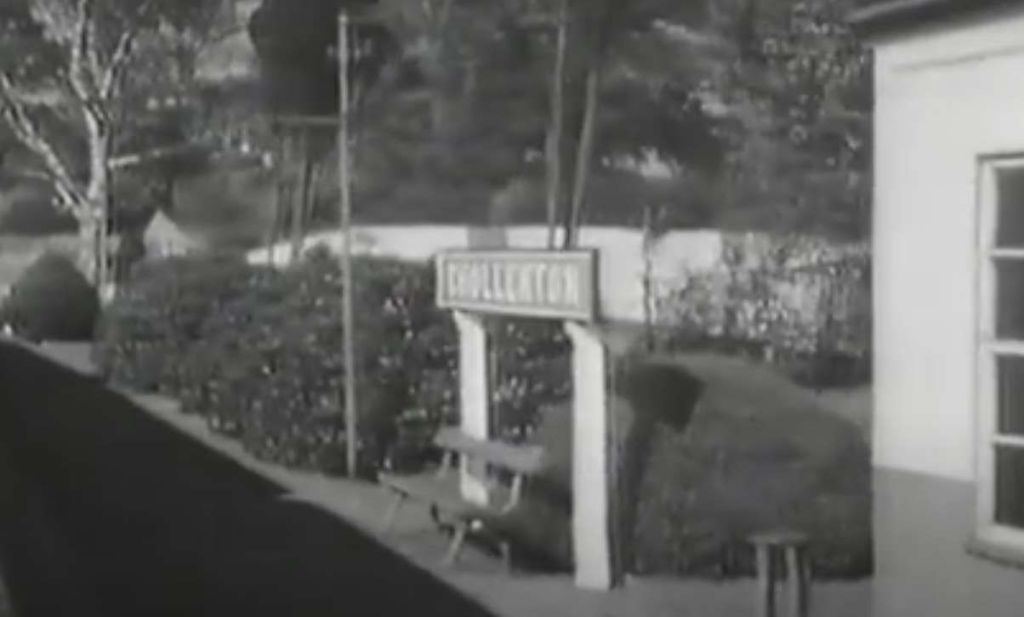
This first image is a still from the film which denotes where we are starting this next length of the journey along the line. A few more ‘stills’ will help to locate us as we travel along the line.

Chollerton Railway Station name-board. [2]
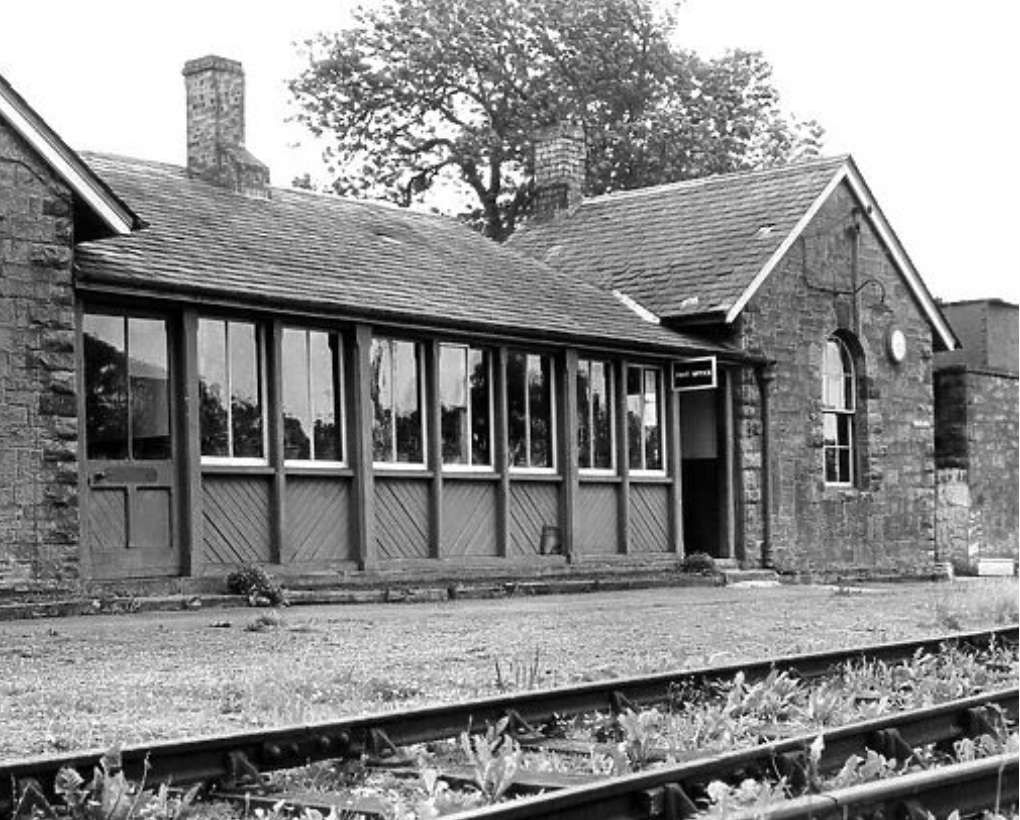
Chollerton Station Waiting Room on 25th August 1959. By then, the railway lines at Chollerton were becoming overgrown with weeds and grass. What was once the station waiting room was now the village Post Office. Media ID 21635767 © Mirrorpix [1]
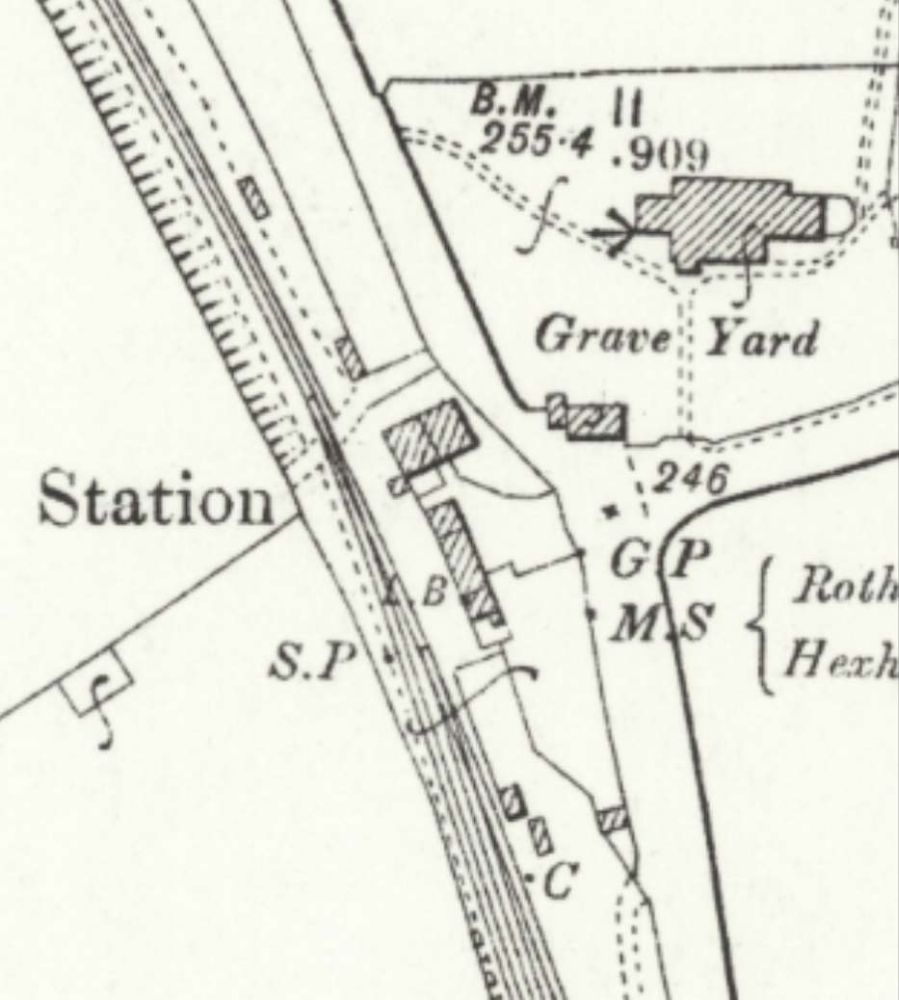
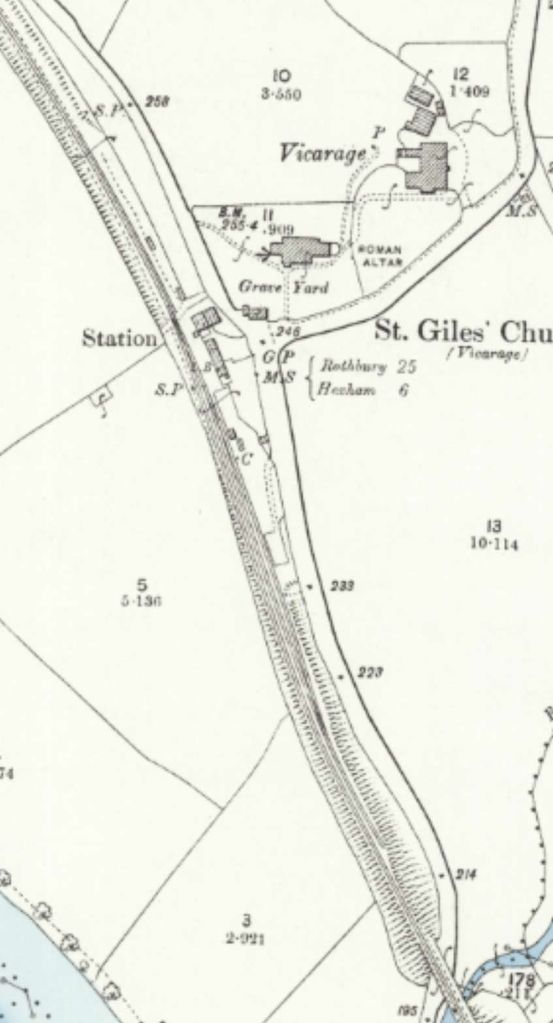
Chollerton Railway Station and St. Giles’ Church. [5]
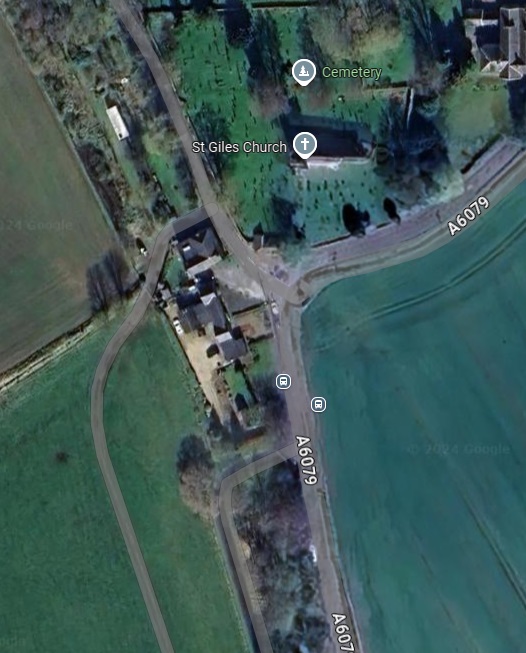
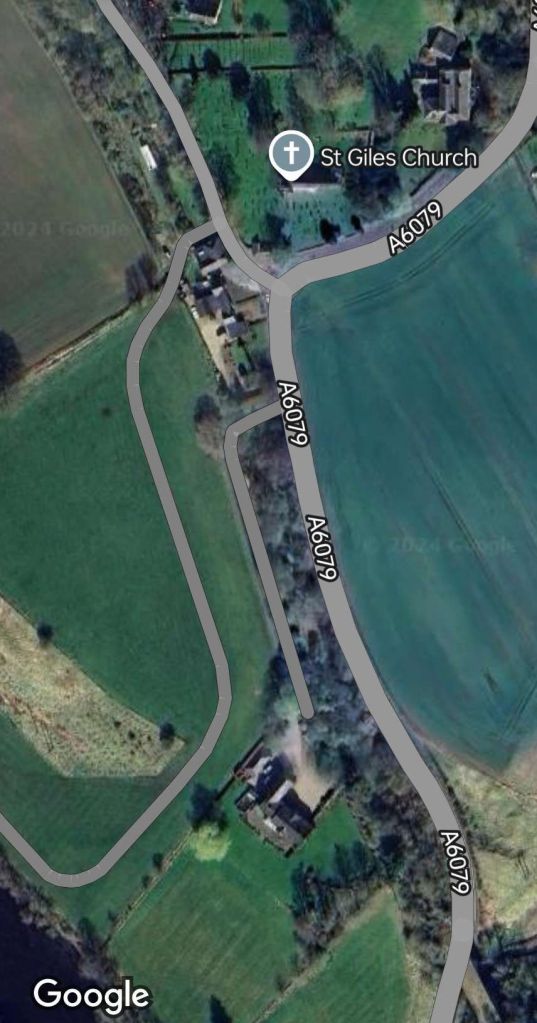
The same area in the 21st century. [Google Maps, October 2024]
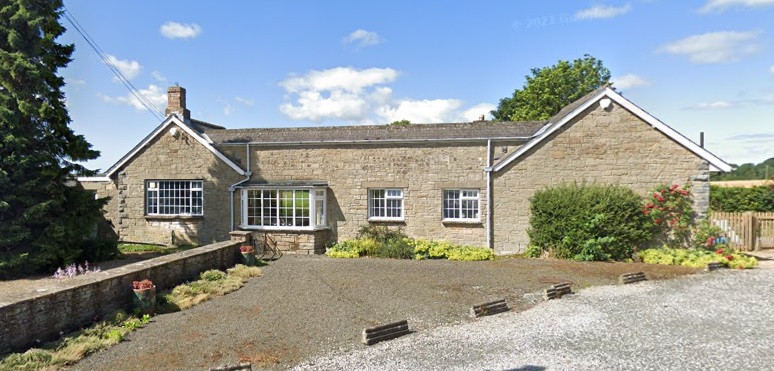
Chollerton Railway Station building in the 21st century, now a private dwelling. [Google Streetview, July 2021]

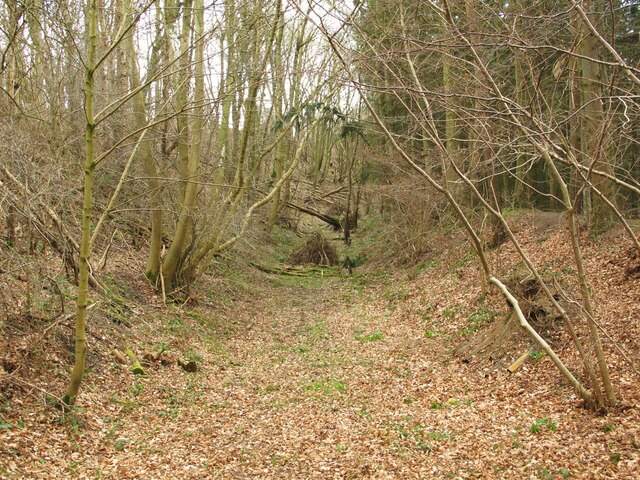
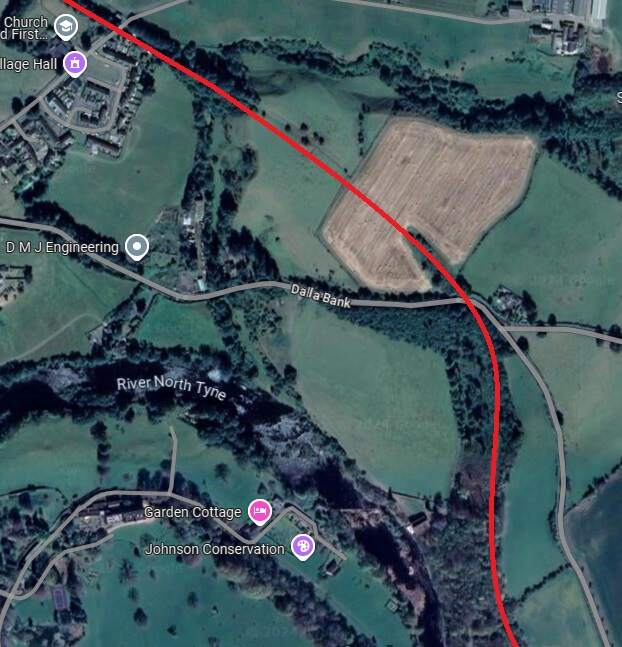
The line travelled on, Northwest from Chollerton, much of the time in deep cutting as far as Dallabank Wood, by which time it was running on a northerly course. Soon after the wood, the line turned towards the Northwest, passed under the local road (Dalla Bank), crossed a short but high embankment under which Barrasford Burn was culverted, and entered Barrasford Railway Station.

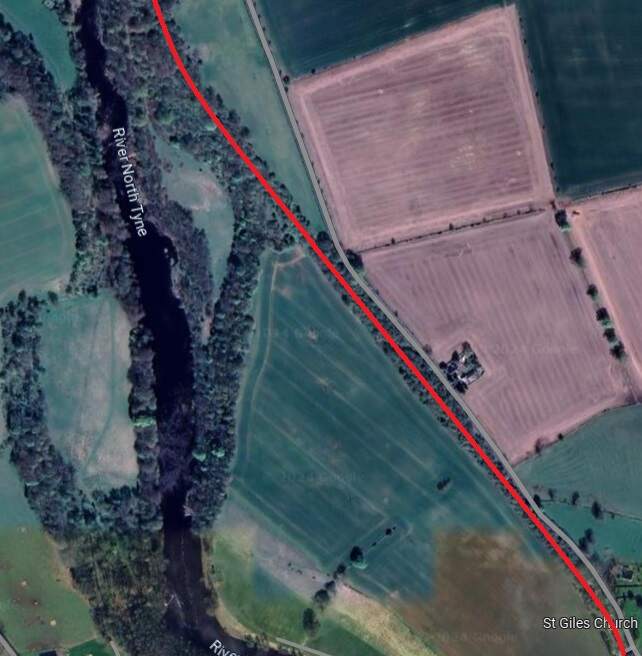
The red line shows the route of the old railway immdiately to the North of Chollerton Railway Station. [Google Maps, October 2024]
The cutting South of Dalla Bank, Facing towards Chollerton in 2013, (c) Mike Quinn and licensed for reuse under a Creative Commons Licence (CC BY-SA 2.0). [15]
The line continued on as marked by the red line under Dalla Bank and on to Barrasford Station which was located at the top left of this extract from Google’s satellite imagery. [Google Maps, October 2024]
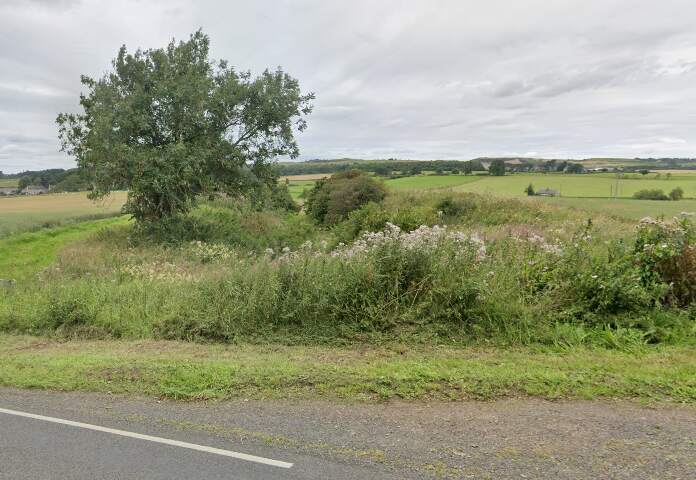
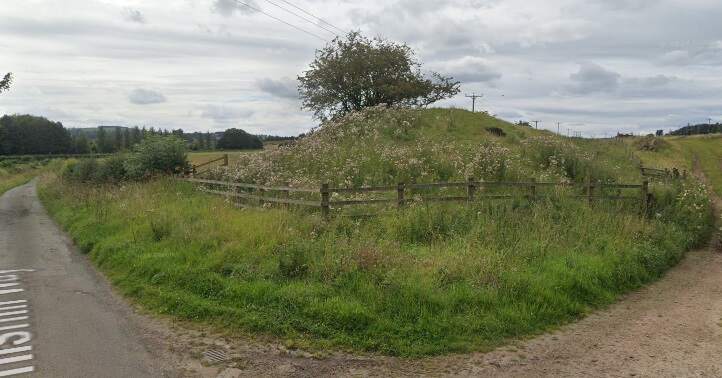
The view along the old railway line North-northwest from Dalla Bank. [Google Streetview, August 2023]
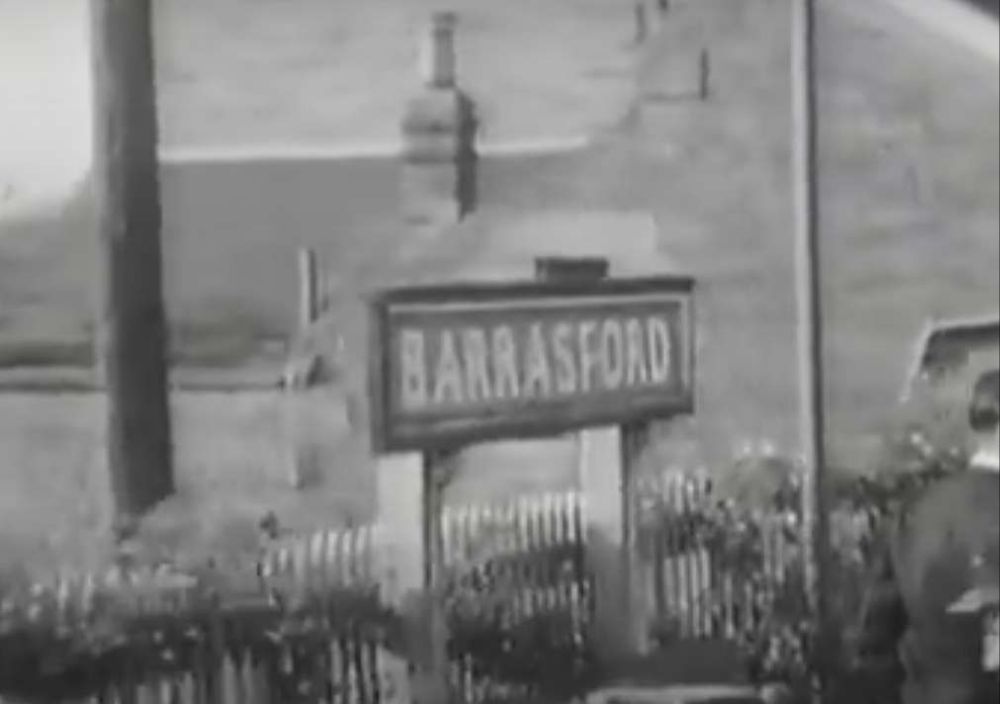
Barrasford Railway Station name-board. [2]

Barrasford Railway Station opened on 1st December 1859 by the North British Railway. The station was situated on a lane to Catheugh, around “200 yards northeast of the centre of Barrasford village. A siding adjoined the line opposite the platform and there was a further loop to the northwest. Both of these were controlled by a signal box, which was at the northwest end of the platform. The station was host to a camping coach from 1936 to 1939.” [4]

Barrasford station was closed to passengers on 15th October 1956 but remained open for goods traffic until 1st September 1958, although it was downgraded towards an unstaffed public siding.” [4]

The trackbed of the old railway looking back to the Southeast close to Barrasford Railway Station in December 2013, (c) Mike Quinn and licensed for reuse under a Creative Commons Licence (CC BY-SA 2.0). [11]
Barrasford Railway Station in 1962, 4 years after the final closure of the line, © Ben Brooksbank and authorised for reuse under a Creative Commons Licence (CC BY-SA 2.0). [4]
Barrasford Railway Station building in the 21st century – in private hands. [Google Streetview, August 2023]
Barrasford Railway Station was just a few hundred yards to the Northeast of the village of Barrasford. [6]
The same location in the 21stcentury. [Google Maps, October 2024]
The former Barrasford Station building seen from the East in 2013, (c) Mike Quinn and licensed for reuse under a Creative Commons Licence (CC BY-SA 2.0). [10]
Barrasford Railway Station in 2010, (c) Steve Wright and licensed for reuse under a Creative Commons Licence (CC BY-SA 2.0) [12]
Looking back Southeast towards Chollerton. A footpath follows the line of the old railway. [Google Streetview, August 2023]
The line ahead to the Northwest is marked by the red line. [Google Streetview, August 2023]

A short distance Northwest of Barrasford Railway Station, was Barrasford Quarry which was provided with its own siding.

The line Northwest of Barrasford Railway Station. [Google Maps, October 2024]
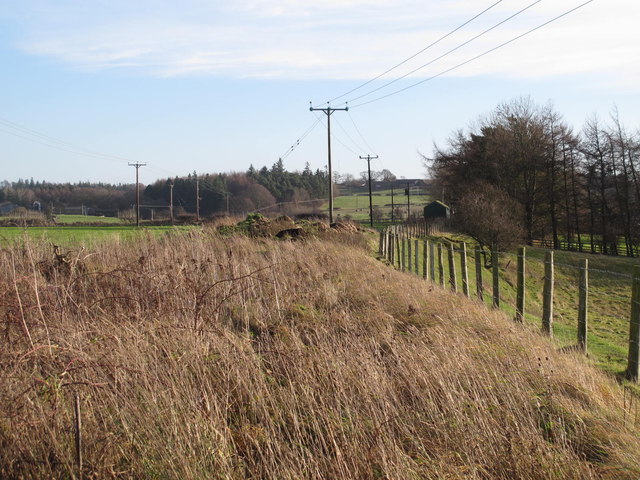
The track bed of the old railway a little to the Northwest of Barrasford Railway Station, looking back along the line towards the station in December 2013, (c) Mike Quinn and licensed for reuse under a Creative Commons Licence (CC BY-SA 2.0). [12]
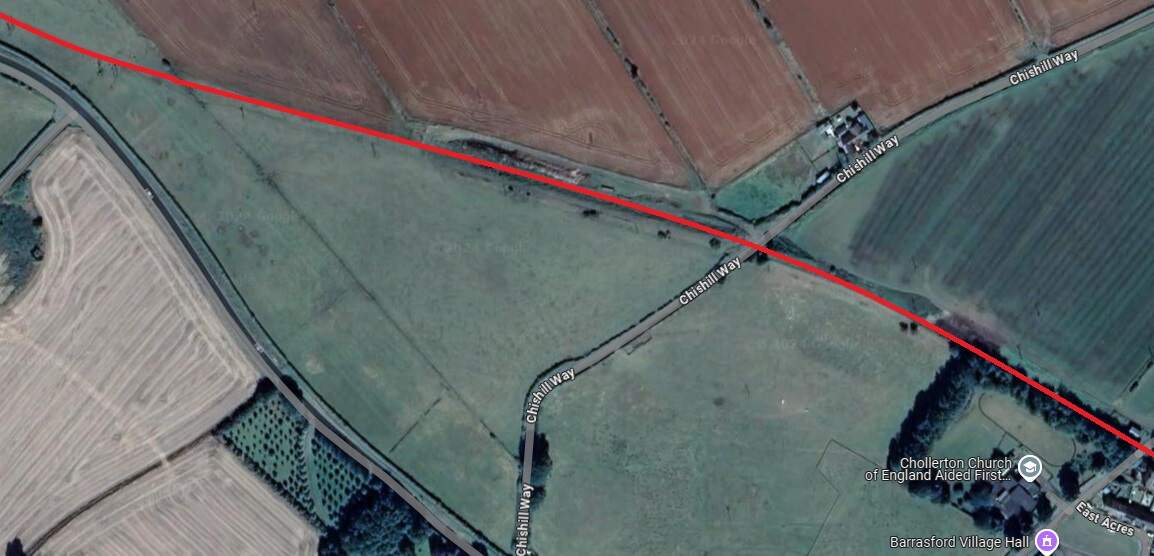
Looking back towards Barrasford Station from Chishill Way. The line was carried at high level over the road. Only the embankments remain. [Google Streetview, August 2023]
A wintertime view along the old railway to the West from the East side of Chishill Way, in December 2013, (c) Mike Quinn and licensed for reuse under a Creative Commons Licence (CC BY-SA 2.0). [13]
Looking West from Chishill Way. The railway embankment is to the right of the trees. [Google Streetview, August 2023]
The track bed further West from Chswell Way, in December 2013, (c) Mike Quinn and licensed for reuse under a Creative Commons Licence (CC BY-SA 2.0). [14]
Barrasford Quarry Sidings and Tramway. [7]
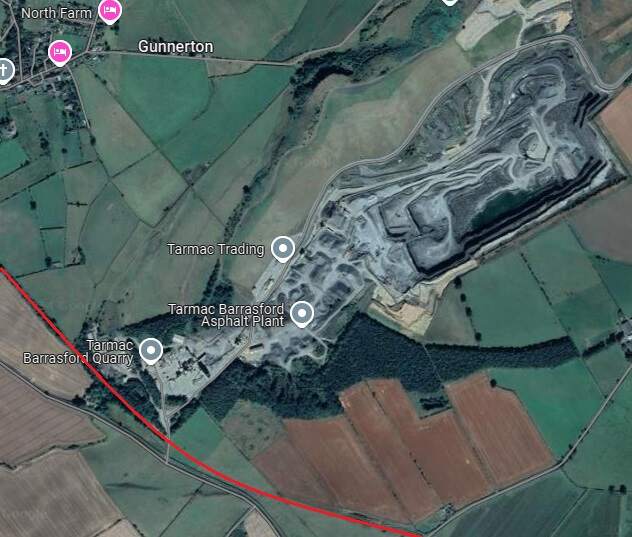
Tarmac’s quarry at Barrasford is a much larger affair in the 21st century. [Google Maps, October 2024]
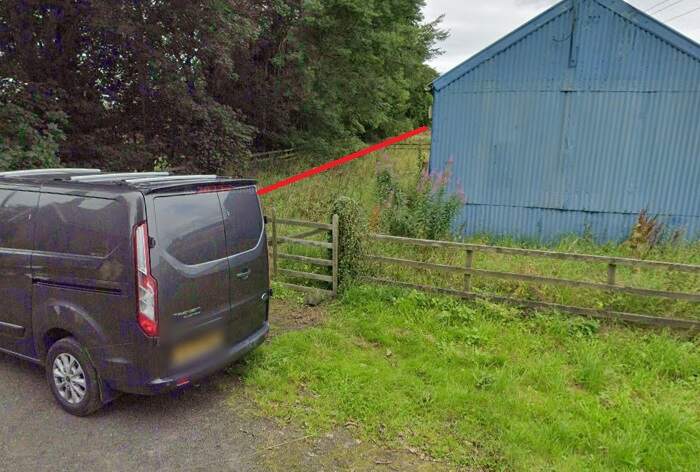
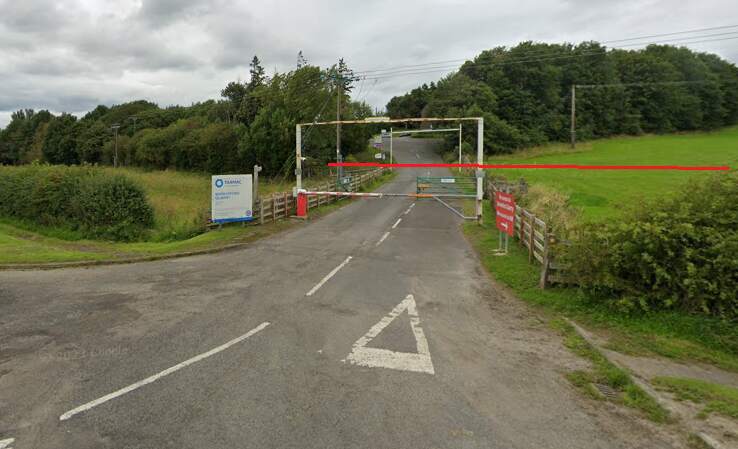
The entrance to Barrasford Quarry. The red line indicates the approximate route of the old railway which is treelined to the West of the quarry road and through open fields to the East of the quarry road. The siding was on the North side of the line. [Google Streetview, August 2023]
Just to the Northwest of Barrasford Quarry Siding was a branch line to Camp Hill, Gunnerton Quarry.This branhc was about 2 miles in length and is recorded on some maps as an old Waggonway. [8]
The same location in the 21st century with the old railways superimposed. [Google Maps, October 2024]

The Camp Hill Branch as shown on satellite imagery from Railmaponline.com. The branch was a short industrial line serving a relatively small quarry to the North of Barrasford Quarry. It appears to have been disused by 1920 as one of the local OS Map sheets across which the line travels shows the line lifted by that time and referred to as an ‘Old Waggonway”. The line is present on map sheets surveyed in 1895.

A short section of the Camp Hill Branch Line as shown on the 1920 25″ Ordnance Survey which was published in 1922. [18]
The view South along the line of the Clay Hill Branch towards the Border Counties Railway in February 2023, © Les Hull and licensed for reuse under a Creative Commons Licence (CC BY-SA 2.0). [30]
The Border Counties Railway to the Northwest of the junction with the Camp Hill Branch. [17]
The road overbridge on the road South from Gunnerton as shown in the Google Streetview image below. There was an adjacent siding with a crane at this location in 1920. This is an extract from the 1920 25″ Ordnance Survey. [19]
Looking to the Southwest along the road South from Gunnerton at the point where it bridged the Border Counties Railway in December 2013, (c) Mike Quinn and licensed for reuse under a Creative Commons Licence (CC BY-SA 2.0). [16]
The view Southeast from the bridge in the image above in December 2013, (c) Mike Quinn and licensed for reuse under a Creative Commons Licence (CC BY-SA 2.0). [22]

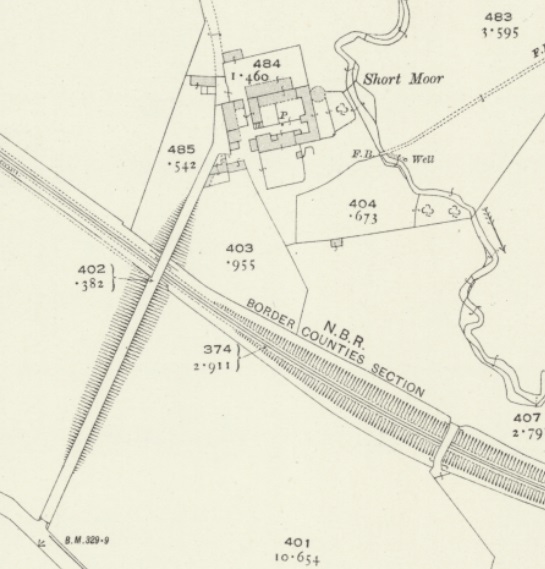
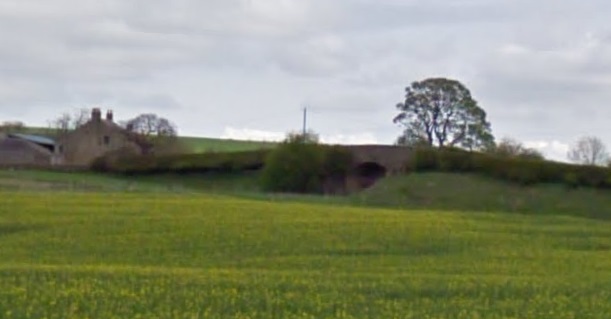
A little further to the Northwest, the access road to Short Moor crossed the old railway. Just before that lane there was another stone bridge which gave access between fields either side of the line.

Stone bridge Southwest of the Short Moor access road in December 2013, (c) Mike Quinn and licensed for reuse under a Creative Commons Licence (CC BY-SA 2.0). [28]
Two bridges crossed the line close to Short Moor. [29]

A distant view from the Southwest of the bridge carrying the access road to South Moor which is on the left of this image. The stone-arched bridge is just to the right of centre. [Google Streetview, April 2011]

Further to the Northwest, the line as shown on the railmaponline.com satellite imagery. {17}
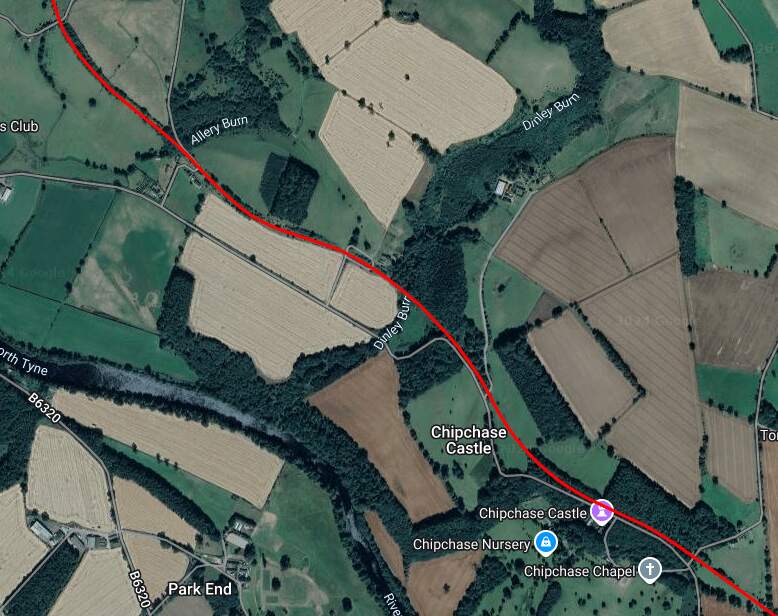
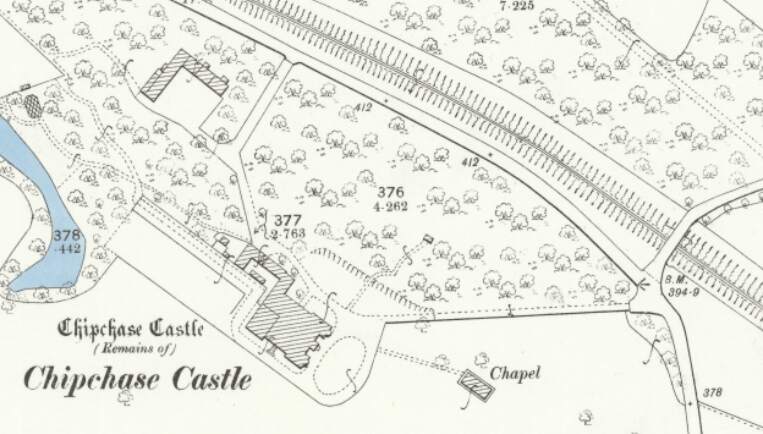
The line ran on to the Northwest and this is the next significant point on the old railway. Close to Chipchase Castle the line was bridged by a minor road. [20]
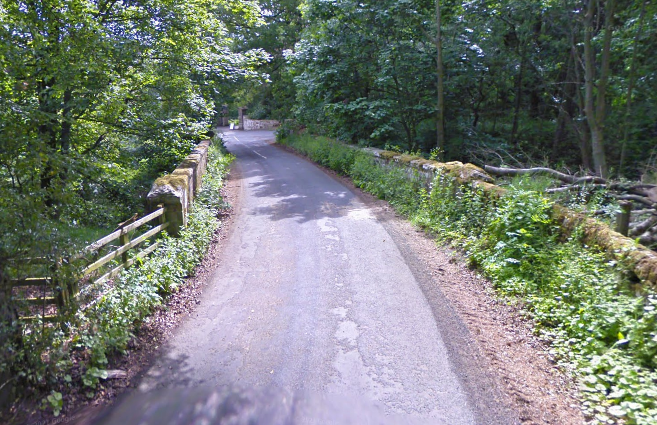
The view across the old railway bridge from the Northeast. [Google Streetview, June 2009]
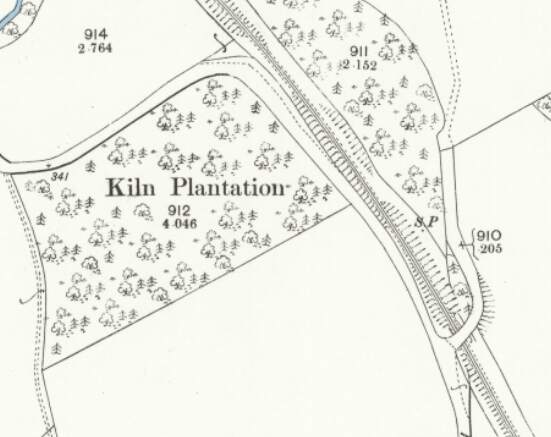
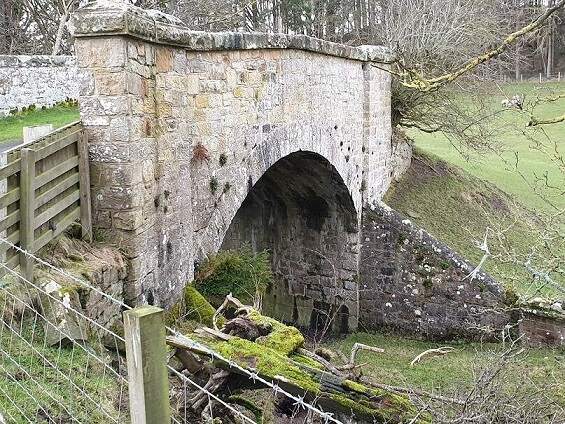
This next roadoverbridge carries an access road over the Border Counties Railway close to Kiln Plantation shortly before the highway turns away from the railway to the West along the North side of the plantation. [21]
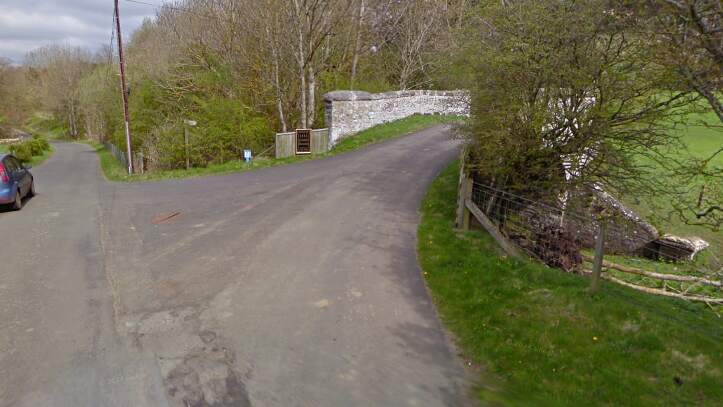
The view from the South of the road bridge in the map extract above. [Google Streetview, April 2011]
The same structure in a photograph taken by Paul Hill and shared by him on the Border Counties Railway Facebook Group on 17th August 2020. [23]

A short distance to the Northwest another access road runs off the highway and crosses the Border Counties Railway.

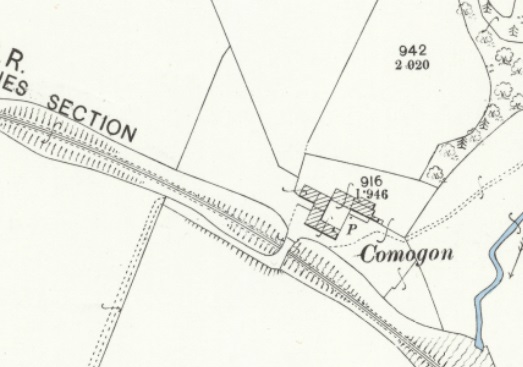
This map estract shows the lane leading to Comogon in 1920, which was carried over the old railway by means of a private access bridge. [24]
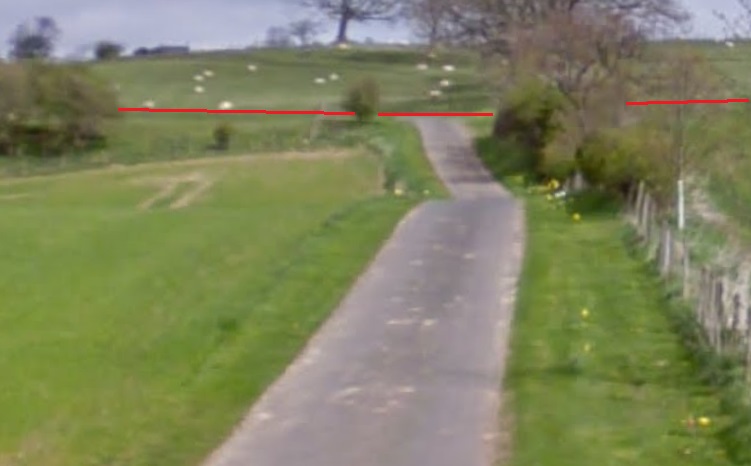
The access road is private and this is the closest view of the old line at this location that is possible. The red lines show its route which was in a slight cutting to the right of the access road and a slight embankment to the left of the road. [Google Streetview, April 2011]
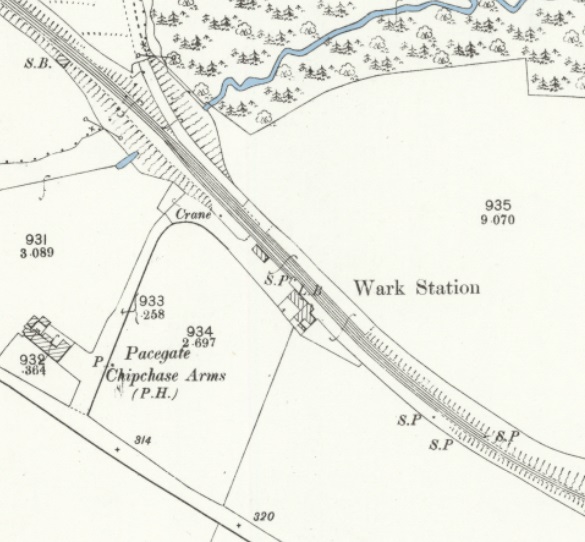
Wark Railway Station as shown on the 25″ Ordnance Survey of 1895. [25]
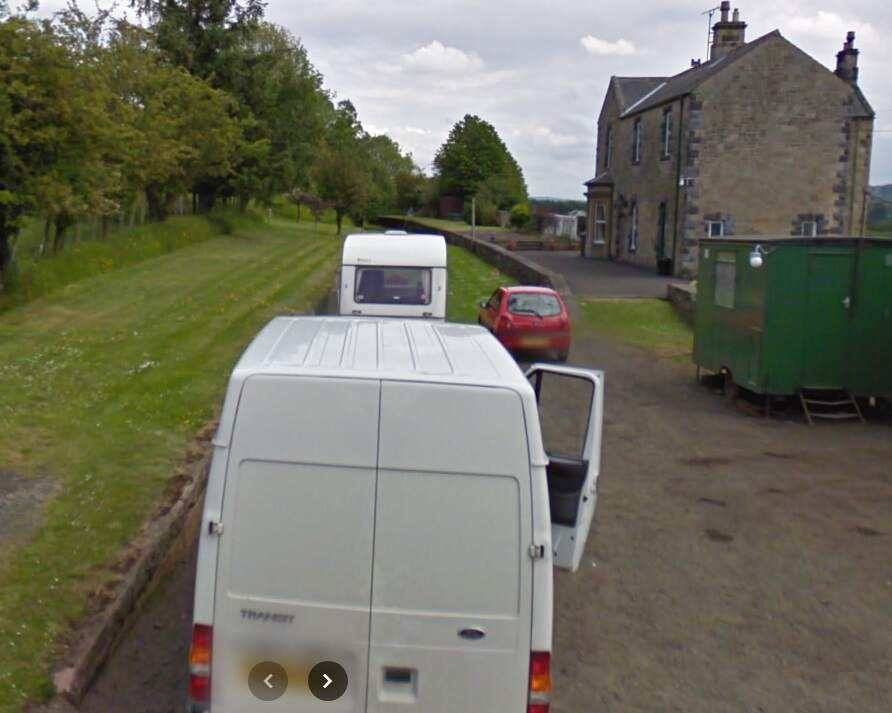
The view Southeast along the Border Counties Railway through Wark Railway Station. [Google Streetview, June 2009]
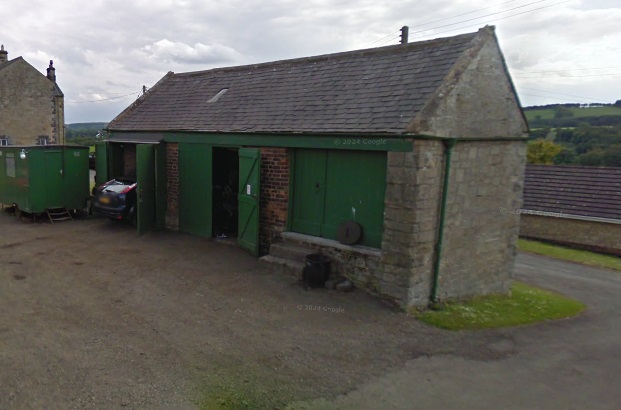
The Goods Shed at Wark Railway Station. [Google Streetview, June 2009]
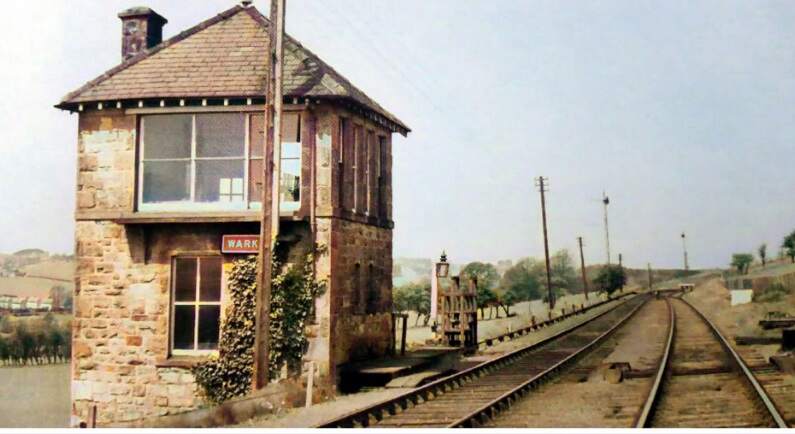
Wark Signal Box when still in use. It sat just Northwest of the station platforms. This image was shared by Ian Farnfield on the Border Counties Railway Facebook Group on 6th April 2022. The provenance of this image is not known. [26]
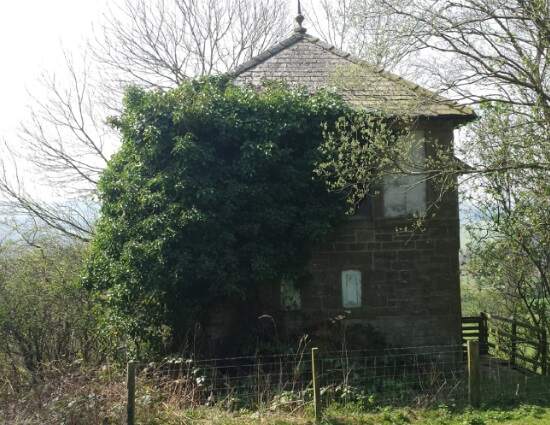
Wark Signal Box in the 21st century. This image was taken by Ian Farnfield and shared by him on the Border Counties Railway Facebook Group on 6th April 2022. [26]

A short distance Northwest from Wark Railway Station the Border Counties Railway passed under another minor road.

This next extract from the 1895 25″ Ordnance Survey shows that bridge mentioned above crossing the old railway. [27]
The bridge mentioned above. [Google Streetview, July 2023]

From this point, the line turns to a more northerly direction as this next extract from the railmaponline.com satellite imagery shows. An accommodation track and Blind Burn next passed under the line of the railway. The image below shows the location.

The view Northeast along Piper Gate towards what was a bridge carrying the Border Counties Railway over the Burn and road. [Google Streetview, Aril 2011]

Northwest of Piper Gate a private access road follows the track bed to a private dwelling. Further North another access track passed underneath the line (shown in the first map extract below)

The access road to what is now R.D. Archer & Son. [31]
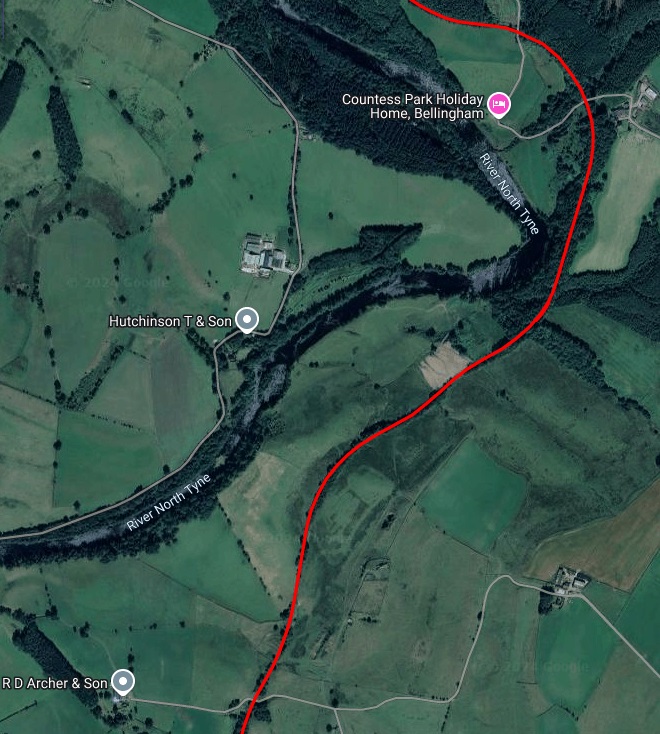
Over the next length of the line it ran quite close to the River North Tyne swinging to the East and then relatively sharply to the West Much of this length of the line was on embankment and a series of cattle-creeps were needed for access between farm fields. [17]
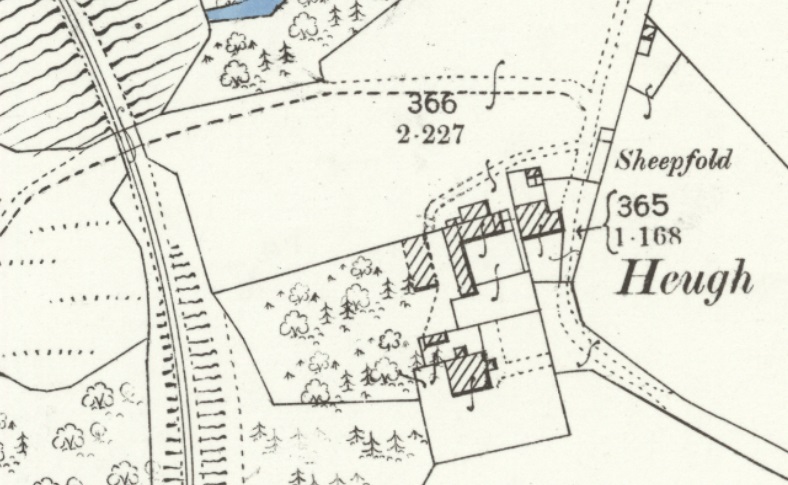
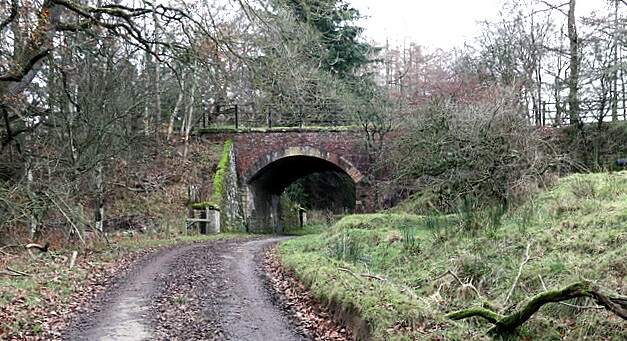
Close to Heugh, the line bridged a track which led West towards Countess Park at the river’s edge. [32]
The bridge adjacent to Heugh seen from the West in November 2020, © Andrew Curtis and licensed for reuse under a Creative Commons Licence (CC BY-SA 2.0). [35]
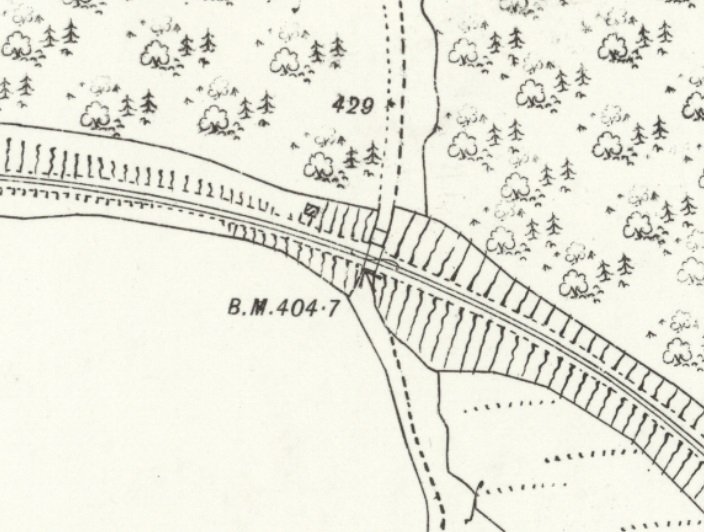
A second access road to Countess Park ran North-South and was also bridged by the old railway. [33]
The bridge shown on the map extract immediately above, seen from the North in May 2019, © Russel Wills and licensed for reuse under a Creative Commons Licence (CC BY-SA 2.0). [34]

Continuing North from Countess Park alongside the River North Tyne, the Border Counties Railway reaches Redesmouth Railway Station which was a junction station.

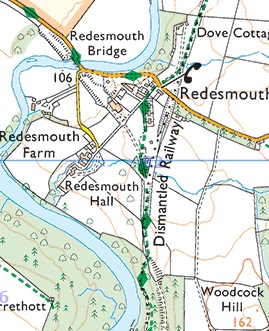
Redesmouth as shown on the OS Explorer Map Sheet. The dismantled railways can easily be seen. The Border Counties Railway bears Northwest from the Station and crosses the River North Tyne.

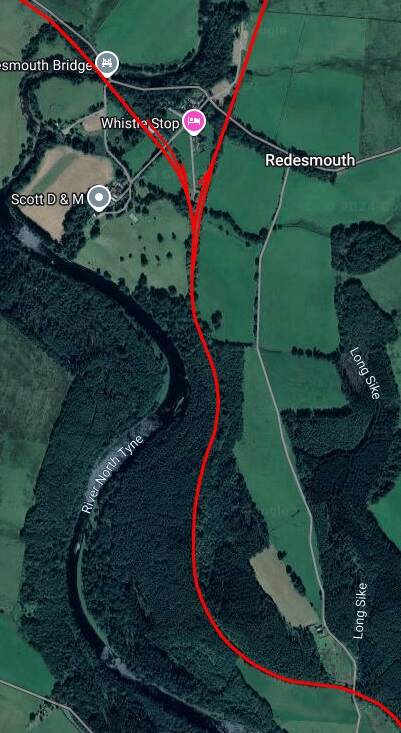
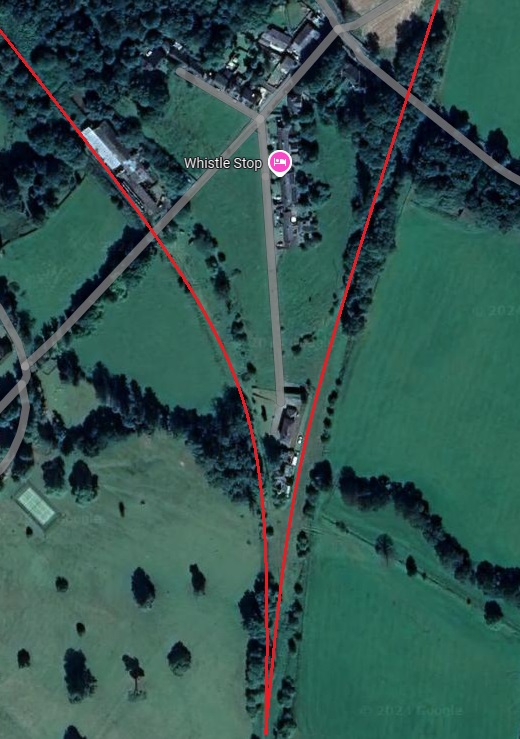
The two images immediately above focus on the railway infrastructure at Redesmouth which spreads over quite a large site surrounding the hamlet of Redesmouth. [Google Maps, October, 2024] [36]

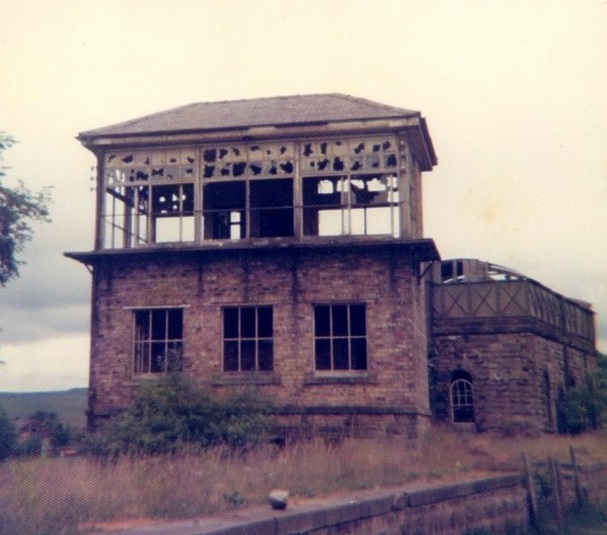
The Signal Box and Waiting Room/Water Tower at Redesmouth Junction. [39]
The Signal Box and Water Tank (with waiting room beneath) at Redesmouth Station, seen from the South in May 1975 after closure and before renovation as a private home, © pt and licensed for reuse under a Creative Commons Licence (CC BY-SA 2.0). [37]
The renovated signal box and waiting room at Redesmouth as seen in May 2007, © Les Hull and licensed for reuse under a Creative Commons Licence (CC BY-SA 2.0). [38]
Redesmouth Railway Station seen from the North. The waiting room and signal box can be seen on the right of this image. [Google Streetview, April 2011]
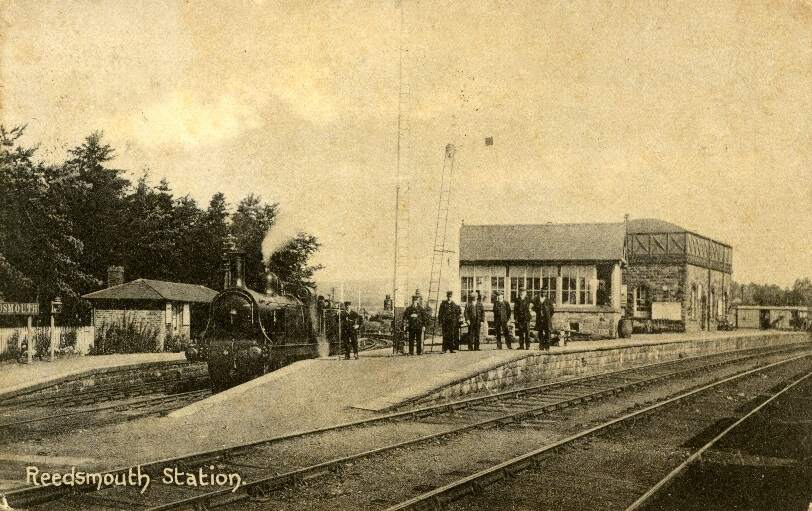
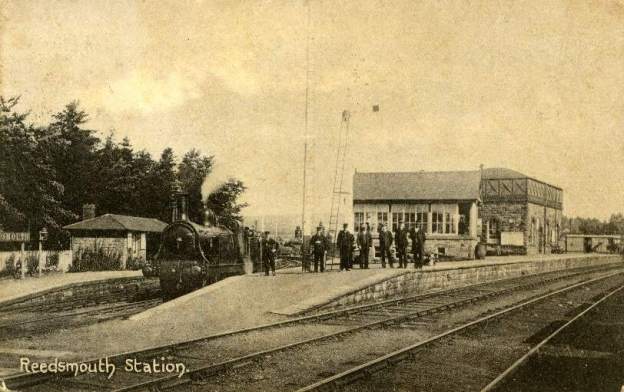
A postcard image of Redesmouth Station in the very early years of its existence before the Signal Cabin was rebuilt to give a better view of the lines approaching the station. This image was shared on The Whistle Stop Facebook Page on 9th July 2017, (c) Public Domain. [40]

We finish this segment of our journey on the Border Counties Railway here at Redesmouth.

References

  1. https://shop.memorylane.co.uk/mirror/0300to0399-00399/railway-lines-chollerton-rapidly-overgrown-weeds-21635767.html
  2. https://youtu.be/cUOVM8ENOIg?si=f4sjHHSNsjn6qYm2, accessed on 24th September 2024.
  3. https://rogerfarnworth.com/2024/09/16/the-border-counties-railway-part-1-hexham-to-chollerton
  4. https://en.m.wikipedia.org/wiki/Barrasford_railway_station, accessed on 4th October 2024.
  5. https://maps.nls.uk/geo/explore/#zoom=17.6&lat=55.04171&lon=-2.11022&layers=168&b=ESRIWorld&o=100, accessed on 4th October 2024.
  6. https://maps.nls.uk/geo/explore/#zoom=17.3&lat=55.05695&lon=-2.12850&layers=168&b=ESRIWorld&o=100, accessed on 4th October 2024.
  7. https://maps.nls.uk/geo/explore/#zoom=17.3&lat=55.06153&lon=-2.14428&layers=168&b=ESRIWorld&o=100, accessed on 4th October 2024.
  8. https://maps.nls.uk/geo/explore/#zoom=17.1&lat=55.06274&lon=-2.14638&layers=168&b=ESRIWorld&o=100, accessed on 4th October 2024.
  9. https://www.geograph.org.uk/photo/2270834, accessed on 21st October 2024
  10. https://www.geograph.org.uk/photo/3788974, accessed on 21st October 2024.
  11. https://www.geograph.org.uk/photo/3788972, accessed on 21st October 2024.
  12. https://www.geograph.org.uk/photo/3788954, accessed on 21st October 2024,
  13. https://www.geograph.org.uk/photo/3788955, accessed on 22nd October 2024.
  14. https://www.geograph.org.uk/photo/3788956, accessed on 22nd October 2024.
  15. https://www.geograph.org.uk/photo/3579114, accessed on 22nd October 2024.
  16. https://www.geograph.org.uk/photo/3800747, accessed on 22nd October 2024.
  17. https://railmaponline.com/UKIEMap.php, accessed on 22nd October 2024.
  18. https://maps.nls.uk/geo/explore/#zoom=17.3&lat=55.06702&lon=-2.14178&layers=168&b=ESRIWorld&o=100, accessed on 22nd October 2024.
  19. https://maps.nls.uk/geo/explore/#zoom=18.3&lat=55.06677&lon=-2.15418&layers=168&b=ESRIWorld&o=100, accessed on 22nd October 2024.
  20. https://maps.nls.uk/geo/explore/#zoom=17.3&lat=55.07628&lon=-2.18538&layers=168&b=ESRIWorld&o=100, accessed on 22nd October 2024.
  21. https://maps.nls.uk/geo/explore/#zoom=17.3&lat=55.08081&lon=-2.19234&layers=168&b=ESRIWorld&o=100, accessed on 22nd October 2024.
  22. https://www.geograph.org.uk/photo/3785588, accessed on 22nd October 2024.
  23. https://www.facebook.com/photo/?fbid=176492280689846&set=pcb.2762530180657885, accessed on 22nd October 2024.
  24. https://maps.nls.uk/geo/explore/#zoom=17.3&lat=55.08364&lon=-2.19673&layers=168&b=ESRIWorld&o=100, accessed on 22nd October 2024.
  25. https://maps.nls.uk/geo/explore/#zoom=17.3&lat=55.08580&lon=-2.20367&layers=168&b=ESRIWorld&o=100, accessed on 22nd October 2024.
  26. https://www.facebook.com/photo/?fbid=10166275293725524&set=gm.4430757023690820&idorvanity=1005511202882103, accessed on 22nd October 2024.
  27. https://maps.nls.uk/geo/explore/#zoom=18.3&lat=55.08941&lon=-2.21047&layers=168&b=ESRIWorld&o=100, accessed on 22nd October 2024.
  28. https://www.geograph.org.uk/photo/3801813, accessed on 22nd October 2024.
  29. https://maps.nls.uk/geo/explore/#zoom=17.3&lat=55.07066&lon=-2.16799&layers=168&b=ESRIWorld&o=100, accessed on 22nd October 2024.
  30. https://www.geograph.org.uk/photo/7404692, accessed on 22nd October 2024.
  31. https://maps.nls.uk/geo/explore/#zoom=18.3&lat=55.10369&lon=-2.21770&layers=168&b=ESRIWorld&o=100, accessed on 22nd October 2024.
  32. https://maps.nls.uk/geo/explore/#zoom=18.3&lat=55.11812&lon=-2.20251&layers=168&b=ESRIWorld&o=100, accessed on 22nd October 2024.
  33. https://maps.nls.uk/geo/explore/#zoom=18.3&lat=55.12010&lon=-2.20643&layers=168&b=ESRIWorld&o=100, accessed on 22nd October 2024.
  34. https://www.geograph.org.uk/photo/6160483, accessed on 22nd October 2024.
  35. https://www.geograph.org.uk/photo/6691232, accessed on 22nd October 2024.
  36. https://maps.nls.uk/geo/explore/#zoom=16.4&lat=55.13241&lon=-2.21384&layers=168&b=ESRIWorld&o=100, accessed on 22nd October 2024.
  37. https://www.geograph.org.uk/photo/697704, accessed on 22nd October 2024.
  38. https://www.geograph.org.uk/photo/1699167, accessed on 22nd October 2024.
  39. https://maps.nls.uk/geo/explore/#zoom=18.4&lat=55.13217&lon=-2.21256&layers=168&b=ESRIWorld&o=100, accessed on 22nd October 2024.
  40. https://www.facebook.com/photo?fbid=1871550826442636&set=pcb.1871554073108978&locale=en_GB, accessed on 23rd October 2024.

The Border Counties Railway – Part 1 – Hexham to Chollerton

The featured image above was included in a Steam Days article in September 2021. Crossing the River Tyne on approach to Border Counties Junction is Gresley ‘K3’ class 2-6-0 No 61897, a St Margarets allocated locomotive that has worked through, and the stock is different too, ex-LNER and cascaded down from main line work. In due course the condition of the Border Counties Bridge and the predicted cost of repairs was a major factor in the abandonment of this ex-NBR route, with passenger trains ceasing to run on 13th October 1956, although the passage of goods trains continued through to 1 September 1958. [37]

At the end of August 2024, we visited Kielder Water Reservoir, passing through Bellingham on the way. We noticed a disused railway for which a good number of structures and embankments/cuttings remained in place.

This was the Border Counties Railway (BCR), a line connecting Hexham in Northumberland, with Riccarton Junction on the Waverley Route in Roxburghshire. [1]

The BCR was also known as the North Tyne Railway as it ran beside the River North Tyne for much of its length.

The line between Kielder and Falstone is now under the waters of the Kielder Water Reservoir.

In 1844 the North British Railway (NBR) was authorised to build a line from Edinburgh to Berwick to join an English line there. The NBR line ran close to the coast avoiding most high ground and opened in 1846. In 1845 the Caledonian Railway was authorised to construct a line from both Glasgow and Edinburgh to Carlisle, crossing the Southern Uplands at Beattock Summit, 1,033 ft (315 m) above sea level.” [1][2][3][4]

In 1853, talk was of a significant coal seam around Plashetts and in 1854, Robert Nicholson was engaged to survey a railway route to serve this coalfield. “His line was to run from Hexham, … through Reedsmouth to Bellingham, and on to the coal deposits at Falstone. His work was remarkably quickly done, for a bill for the Border Counties Railway was submitted to Parliament for the 1854 session. … The scheme was authorised when the Border Counties Railway (North Tyne Section) Act 1854 (17 & 18 Vict. c. ccxii) was given royal assent on 31st July 1854. The capital was to be £250,000.” [1]

The line was built as a single line, but land was acquired for later doubling, and all the bridges except the Hexham bridge, were built for double-track The full length of the authorised line was initially not built before “a public train service started on 5th April 1858; there were four passenger trains each way Monday to Saturday, and two on Sunday. They ran from Hexham to Chollerford, with an intermediate station at Wall.” [1]

It was to be only a further 16 months before the remaining length of the line was authorised when the Border Counties Railway (Liddesdale Section and Deviations) Act 1859 (22 & 23 Vict. c. xliii) got royal assent on 11th August 1859. The authorised capital for the whole line was increased by £100,000. The North British Railway were authorised to make a working arrangement with the BCR.

From Wark, the line approached Reedsmouth, and there was a temporary goods terminus at Countess Park there while the river bridge was completed. The passenger service terminated at Wark. There was a demonstration train from Newcastle to Countess Park run on 1st December 1859. Public opening was expected ‘within the week” but this proved to be inaccurate, and the opening throughout to Falstone was delayed until 2nd September 1861.”

By 1860 the BCR was seriously short of cash; “the authorised capital had never been fully raised and the hoped-for coal reserves at Plashetts were disappointing. There seemed little chance of raising more capital now. The North British Railway was expansive, and was happy to take over the local line, and the result was the North British and Border Counties Railways Amalgamation Act 1860 (23 & 24 Vict. c. cxcv), passed on 13th August 1860; … the act regularised the use by BCR trains of Hexham station of the Newcastle and Carlisle Railway. The BCR network was known now as the NBR (Border Counties Section).” [1]

The construction of the line throughout to Riccarton was completed by mid-April 1862, but the opening of the line to Riccarton did not take place until 24th June 1862 for goods, and 1st July 1862 for passengers. [1]

On 1st May 1865, “the Wansbeck Railway was opened, between Morpeth and Reedsmouth. The Wansbeck Railway had been promoted independently but was taken over by the North British Railway in 1863.” [1]

Wikipedia provides this sketch map © Afterbrunel and licensed for reuse under a Creative Commons Licence (CC BY-SA 4.0). This image does not show the Wansbeck Railway from Morpeth which met the line at Reedsmouth. [1]

From Hexham to Riccarton Junction

Hexham Railway Station

Hexham sits on what was once the Newcastle to Carlisle Railway (NCR) and which is, in the 21st century, known as the Tyne Valley Line.

Hexham Station was opened on 9th March 1835 by the NCR which became part of the  North Eastern Railway (NER) in 1862.

The original station was probably designed by the architect Benjamin Green of Newcastle-upon-Tyne. It was altered and extended between 1835 and 1871 and again by 1901. It is now a Grade II listed structure and stands in a conservation area. The station was restored in 1998/1999. [5]

After the NCR had been absorbed by the NER, the station became a junction, with the opening of the first section of the BCR, between Hexham and Chollerford in April 1858. The first section of a second branch, the Hexham and Allendale Railway, was opened for goods in August 1867. Initially promoted to serve lead mines, that line opened for passengers in March 1869. [6][7]

Since the closure of the Hexham and Allendale Railway to passengers in 1930 (completely in 1950), as well as the BCR in 1956 (completely in 1958), the station has diminished in size and importance. Both lines met with the Tyne Valley Line to the West of the station. [6][7][8: p134]

The Disused Stations website covers Hexham Station in some detail. [9]

Hexham Railway Station at the turn of the 20th century. The station was on the Newcastle to Carlisle mainline within commuting distance of Newcastle. It was the junction station for two lines, the Border Counties Railway and the Allendale line. [11]
The immediate vicinity of Hexham Railway Station in the 21st century as it appears on Google Maps. [Google Maps, September 2024]
Hexham Overhead Signal Cabin as seen from the Southeast end of Hexham Station platforms, © Mike Quinn and licensed for reuse under a Creative Commons Licence (CC BY-SA 2.0). The gantry signal cabin was built around 1896 and is Grade II listed. [12]
Hexham Railway Station in 2009, © Nigel Thompson and licensed for reuse under a Creative Commons Licence (CC BY-SA 2.0). [10]
Hexham Railway Station looking Southeast from the A6079 in 2024. The footbridge can be seen beyond the platform canopies and even further, beyond the footbridge, the signal cabin mounted on its own steel structure over the running lines. [Google Streetview, March 2024]
Looking Northwest from the A6079 overbridge. The line to Carlisle heads away into the distance. [Google Streetview, March 2024]

A straight length of line brings the railway to the banks of the Tyne. The line curves round toward the West and follows the South bank of the Tyne as far as Border Counties Junction where trains for Riccarton Junction and Hawick left the Borders Railway and crossed the Tyne on an angled viaduct.

Border Counties Junction

An extract from the 25″ Ordnance Survey from the turn of the 20th century which focusses on the Border Counties Junction and the viaduct across the River Tyne. [15]
The same area as it appears on the ESRI satellite imagery provided by the National Library of Scotland (NLS). [15]
The Border Counties Junction in 1939, the Newcastle & Carlisle main line runs ahead with the incoming Allendale (left) and Border Counties (right) lines. The BCR crosses the bridge in the right foreground. The Allendale route was by now goods only. Note the timber crossing for the bridleway alongside the main line. This photo appears to have been taken from a footbridge over the line. It also appears in R.R. Darsley & D.A. Lovett’s book about the line. [12][13: p11]
A track-level.view of Border Counties Junction from the East, under the footbridge adjacent to the signal box. [14]
The Border Counties Viaduct over the River Tyne seen from the South. As well as being carried by the Hexham Courant, the photograph appears in R.R. Darsley & D.A. Lovett’s book about the line. Class 3MT 2-6-0 No. 77011 is crossing the bridge with a train for Hexham. The bridge was demolished in 1959. As can be seen on the ESRI satellite image above, the cut-waters and iron base of the piers still remain, © A.J. Wickens. [14][13: p12]
The piers/cut-waters from the Border Counties Viaduct as they appeared in the 1980s. [14]
A postcard view of the Border Counties Viaduct from the West. [14]

Acomb Colliery

A short distance beyond the viaduct on the Border Counties Railway was a private colliery line which served Acomb Colliery.

Mining at Acomb seemed to stop and start between the mid 19th century until 1909, when a larger complex opened until 1952.” [20]

There were various owners before the pit was taken on at nationalisation by the NCB. … Messrs. Stobart & Co. (1840s), J. Morrison & Co. (1860s), Messrs. Morrison (1880s), Tynedale Coal Co. Ltd. (1910s), Acomb Coal Co. Ltd. (1920s), National Coal Board (1947). [20]

For more information about the coal workings on the site, please consult the Durham Mining Museum. [21]

It is worth noting that the half-mile long line was worked by one engine, Black Hawthorn 0-4-0ST No. 1068 for over 30 years until closure of the mine in 1952. [13: p12]

An extract from the 6″ Ordnance Survey of 1920, published in 1922. The most southerly length of the Acomb Colliery Railway is shown on the OS map. The full length has been sketched onto the map extract. The line ran parallel to the Border Counties Railway which provided a loop line to allow transfer of coal (and other loads) to and from the private line. [27]
Approximately the same area as it appears on modern satellite imagery. Note the modern A69 which crosses the North Tyne just South of the location of the Southern terminus of the Acomb Colliery Railway. [Google Maps, September 2024]
The route of the Acomb Colliery Railway which is now a footpath from the village down to the River North Tyne. This photo was taken looking West in July 2020, © Mike Quinn and licensed for reuse under a Creative Commons Licence, (CC BY-SA 2.0). [16]
The route of the Acomb Colliery Railway which is now a footpath from the village down to the River North Tyne. This photo was also taken looking West in July 2020, © Mike Quinn and licensed for reuse under a Creative Commons Licence, (CC BY-SA 2.0). [17]
The route of the Acomb Colliery Railway which is now a footpath from the village down to the River North Tyne. This photo was taken looking East in July 2020, © Mike Quinn and licensed for reuse under a Creative Commons Licence, (CC BY-SA 2.0). [18]
Pit tub, former Acomb Colliery: this pit tub commemorates the former Acomb Colliery which operated until 1952. The site was taken over and restored by Northumberland County Council in 1980. This photo was taken in March 2023, © Oliver Dixon and licensed for reuse under a Creative Commons Licence, (CC BY-SA 2.0). [19]

Howford Brick and Tile Works

These works sat alongside the line, just a few hundred metres North of the Acomb Colliery Railway.

Howford Brick & Tile Works. [23]
The location of Howford Brick & Tile Works hosts Heidelberg Materials Ready mixed Concrete plant in the 21st century. The route of the old railway is shrouded in trees. [Google Maps, September 2024]

North Tyne Colliery

Some distance further North, North Tyne Colliery sat adjacent to the line.

North Tyne Colliery was served by a 500yd. loop off the Border Counties Railway, it also had a tramway linking it to the road network (A6079). Messrs Walton & Cooper worked a drift mine here from 1906 to 1922. This extract comes from the 25″ Ordnance Survey of 1921. [13: p13][23]
Approximately the same area as shown on the OS map extract above. The site of the colliery is now heavily wooded. [Google Maps, September 2024]

For further information about this colliery, please consult Durham Mining Museum. [22]

Wall Railway Station

Wall Railway Station was 1/3 mile from the village. It sat alongside the River North Tyne on its East bank a few hundred metres North of North Tyne Colliery.

Wall Railway Station alongside the River North Tyne. [23]
A similar area on modern satellite imagery. [Google Maps, September 2024]
Wall Station seen from the South, © John Mann Collection and used here with the kind permission of Nick Catford. [25]
Wall Railway Station: the old buildings as seen from the West (from Homer’s Lane), © Peter McDermott and licensed for reuse under a Creative Commons Licence (CC BY-SA 2.0). [24]
Wall Railway Station seen from the A6079. [Google Streetview, June 2016]
The Old Signal Box at Wall Railway Station has been refurbished as self-catering accommodation. [26]

There is good coverage of Wall Railway Station on the Disused Stations website. [25]

Humshaugh Railway Station

North of Wall Railway Station there was little to interest us until the BCR reached Humshaugh Railway Station. Darsley & Lovett say that “the station was opened as Chollerford on 5th August 1858 and was the BCR’s first temporary terminus. Sidings once led to a lime depot, where a tramway, inclined at 1 in 5, led to Brunton kilns. Another tramway led to the quarry. They closed in 1895.” [13: p18]

Historic England say that the grade II listed kilns were located North of Brunton Bank near Chollerford were probably built in the early 19th century. [29] Nearby was Brunton Bank Quarry. There is no evidence of a tramway, in the immediate vicinity of the station, leading to these two sites on the Ordnance Survey of 1896.

Humshaugh Railway Station, as shown on the 25″ Ordnance Survey just before the turn of the 20th century. [28]
The railway station site as it appears on modern satellite imagery. [Google Maps, September 2024]
Looking North-northwest along the B6318 towards Chollerford. The parapets of the bridge carrying the road over the old railway can be seen in the photo. Little is visible either side of the road as the old line has been reclaimed by vegetation. [Google Streetview, August 2023]
Humshaugh Railway station seen from the B6318 in 1957.  The line was closed to passengers in 1956 but open for goods traffic until 1958. This was the occasion of a Special run for the Institute of Transport of a new Metropolitan-Cammell four-car DMU, © Walter Dendy, deceased and licensed for reuse under a Creative Commons Licence, (CC BY-SA 2.0). [31]
Humshaugh Railway station site in private hands, seen from the B6318 in 1997, © Ben Brooksbank and licensed for reuse under a Creative Commons Licence (CC BY-SA 2.0). [30]

Only a short distance beyond Humshaugh Railway Station, the old railway passed under what became the A6079 and then passed a Limekiln at the bottom of a tramroad which served Cocklaw Quarry.

Another extract from the 25″ Ordnance Survey completed before the turn of the 20th century. Shows both the location of the road bridge and the Limekiln. [28]
The same location on 21st century satellite imagery. The line of the BCR can easily be made out, as can the location of the limekiln at the junction of the tramroad and railway. [Google Streetview, September 2024]
An enlarged extract from the 25″ Ordnance Survey which shows the loop provided by the NCR at the limekiln. [28]
This extract from the 25″ Ordnance Survey at a small scale than the previous extracts shows the full length of the tramroads serving Cocklaw Quarry. This was a 3ft gauge tramroad with an incline. [28]

A short distance further North the line bridged a road and stream at the same location. …

An enlarged extract from the 25″ Ordnance Survey of 1895/6 which shows the next significant structure on the BCR. [32]
The same location in the 21st century. [Google Maps, September 2024]
The line bridged both road and stream by means of a stone-arched structure. This photo of the bridge is taken from the Southeast. [Google Streetview, July 2021]
Another extract from the 25″ Ordnance Survey. Another bridge, this time spanning both the road which became the A6079 and a tributary to the River North Tyne. [34]
The same area on 21st century satellite imagery. [Google Maps, September 2024]
The viaduct which carried the BCR over what became the A6079. [Google Streetview, July 2023]
The view from the North on the A6079 of the same viaduct. [Google Streetview, July 2023]

Chollerton Railway Station

The station was opened on 1st December 1859 by the North British Railway. It was on the west side of the A6079 at the junction with an unclassified road and immediately southwest of Chollerton village. A goods loop and a coal depot were to the south. A small goods shed was sited at the south end of the platform. Instead of extending the platform, the NBR built a new one to the north with a wooden waiting shelter. The original buildings remained in use and the siding was adjusted so that one of the two docks used the old platform. There was a three-ton crane in the goods yard. The station closed to passengers on 15th October 1956 and closed completely on 1st September 1958.” [33]

Shortly after crossing the viaduct above the line entered Chollerton Railway Station. The station sat opposite the village church, St. Giles. [35]
The same area on modern satellite imagery. [Google Maps, September 2024]
The northern end of Chollerton Railway Station looking North. [36]
A view of the site of Chollerton Railway Station from the East on the A6079. [Google Streetview, July 2023]

Chollerton Railway Station is the end of this first part of the journey along the Border Counties Railway.

References

  1. https://en.m.wikipedia.org/wiki/Border_Counties_Railway, accessed on 30th August 2024.
  2. G.W.M. Sewell; The North British Railway in Northumberland; Merlin Books, Braunton, 1991
  3. David St. John Thomas; The North British Railway. Vol. 1; David & Charles, Newton Abbot, 1969.
  4. Dr. T.  Bell;. Railways of the North Pennines: The Rise and Fall of the Railways Serving the North Pennine Orefield; The History Press, Stroud, 2015.
  5. https://www.hexham-courant.co.uk/news/23638422.celebrating-188th-anniversary-hexham-train-station, accessed on 31st August 2024.
  6. https://newcastlephotos.blogspot.com/2013/02/hexham-railway-station.html?m=1, accessed on 31st August 2024.
  7. https://en.m.wikipedia.org/wiki/Hexham_railway_station, accessed on 31st August 2024.
  8. Geoffrey Body; Railways of the Eastern Region. Vol. 2: Northern Operating Area. Patrick Stephens, Wellingborough, 1988.
  9. http://disused-stations.org.uk/h/hexham, accessed on 31st August 2024.
  10. https://www.ebay.co.uk/itm/324957581085, accessed on 1st September 2024.
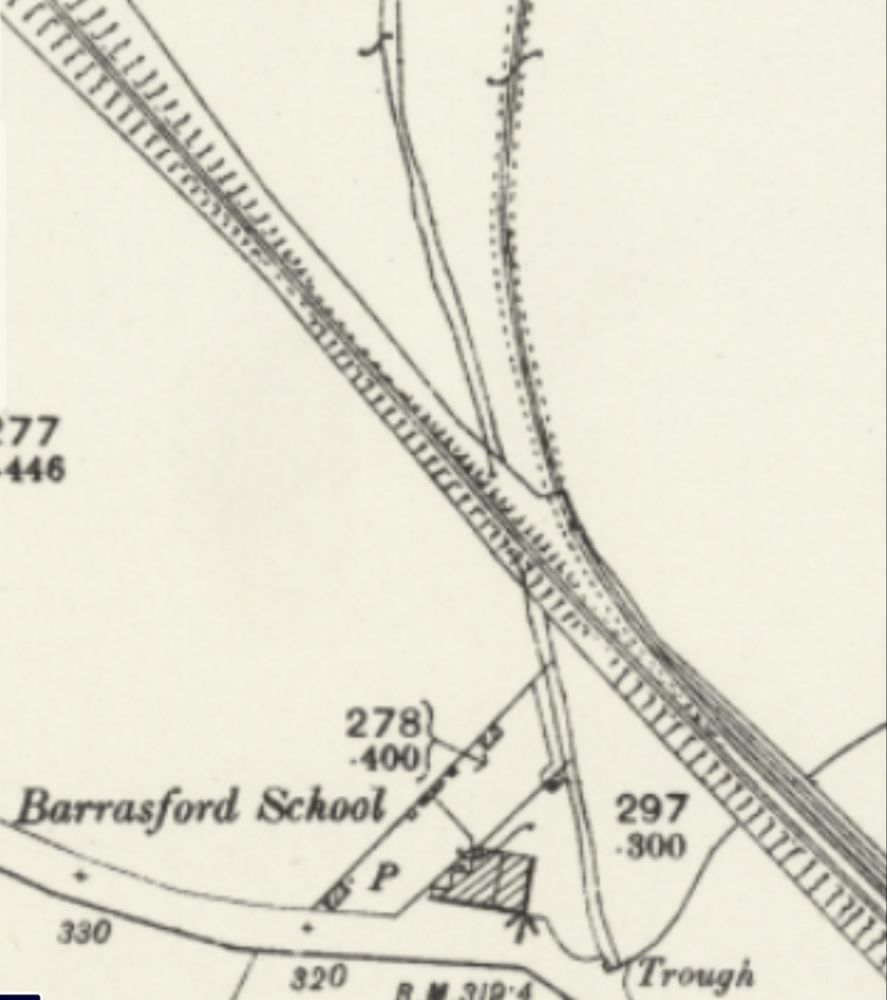
  11. https://maps.nls.uk/geo/explore/#zoom=15.7&lat=54.97493&lon=-2.09430&layers=168&b=1&o=100, accessed on 5th September 2024.
  12. Swedebasher; The Borders Railway: an Operating Review; in Steam Days, 14th September 2021, via https://www.pressreader.com/uk/steam-days/20210914/281560883923116, accessed on 5th September 2024.
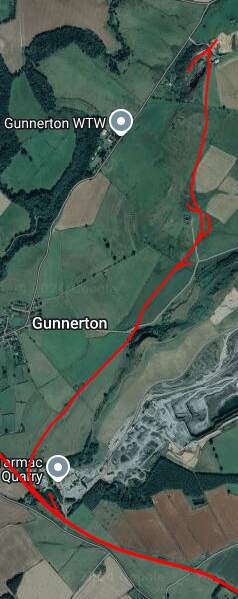
  13. R.R. Darsley & D.A. Lovett; Hexham to Hawick: The Border Counties Railway; The Middleton Press, Midhurst, West Sussex, 2011.
  14. https://www.hexham-courant.co.uk/news/16614029.celebrating-age-steam, accessed on 6th September 2024.
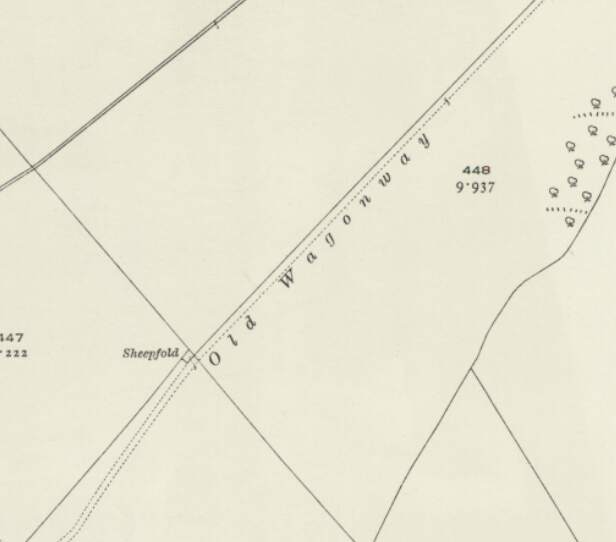
  15. https://maps.nls.uk/geo/explore/#zoom=17.0&lat=54.98194&lon=-2.12117&layers=168&b=1&o=100, accessed on 6th September 2024.
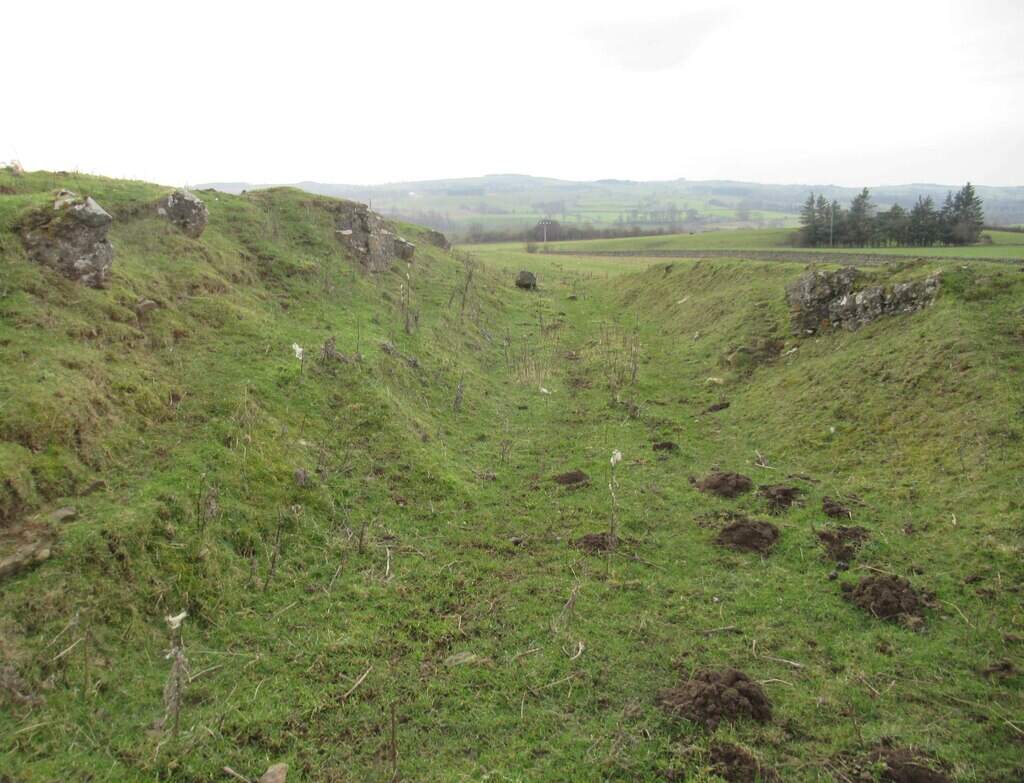
  16. https://www.geograph.org.uk/photo/6554258, accessed on 6th September 2024.
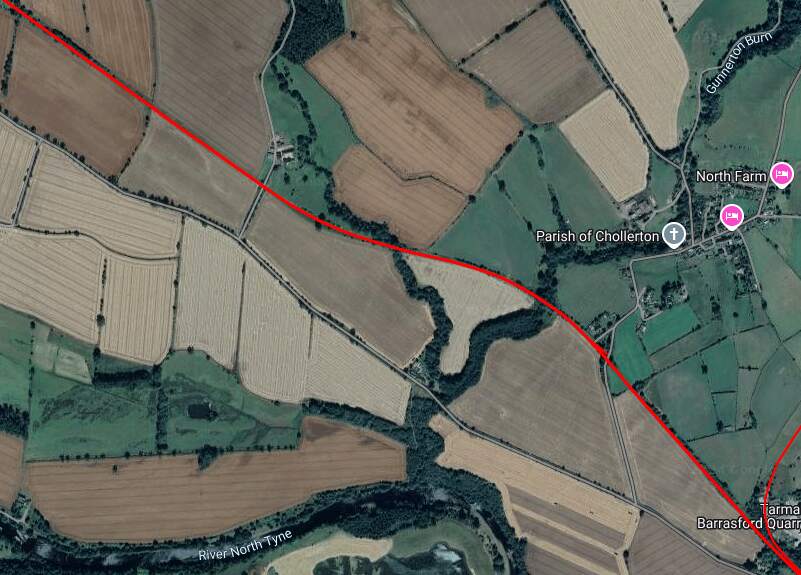
  17. https://www.geograph.org.uk/photo/6554261, accessed on 6th September 2024.
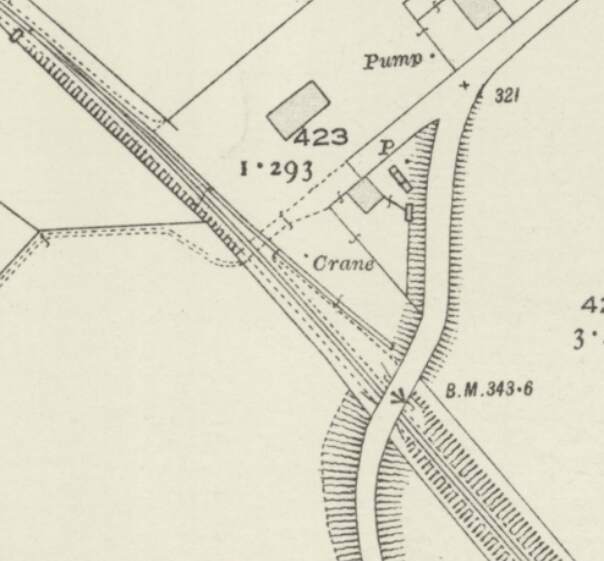
  18. https://www.geograph.org.uk/photo/6554273, accessed on 6th September 2024.
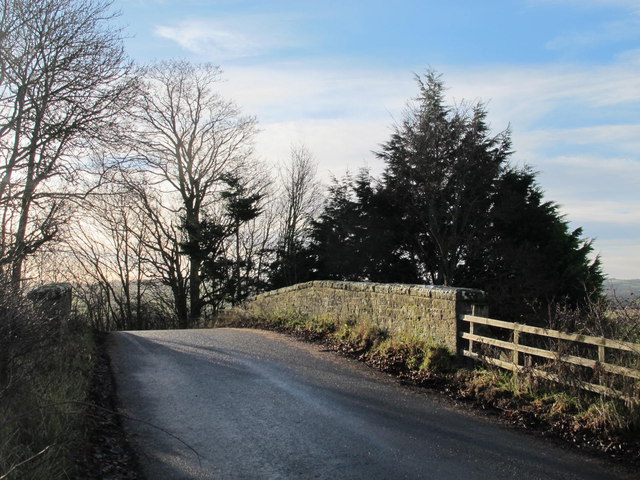
  19. https://www.geograph.org.uk/photo/7435432, accessed on 6th September 2024.
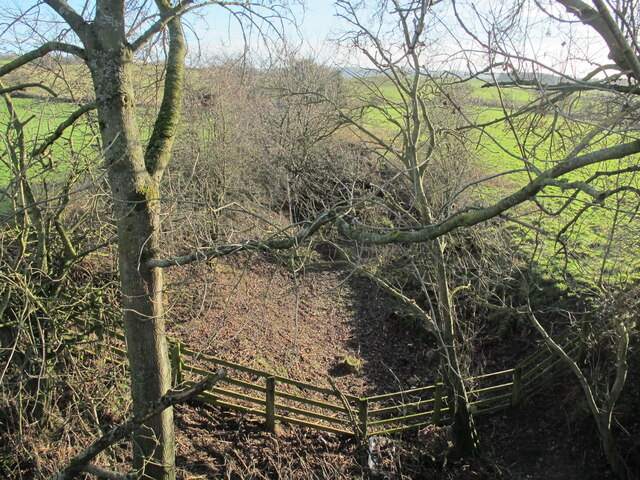
  20. https://www.northeastheritagelibrary.co.uk/coalsarchive/hex01a/acomb-colliery, accessed on 6th September 2024.
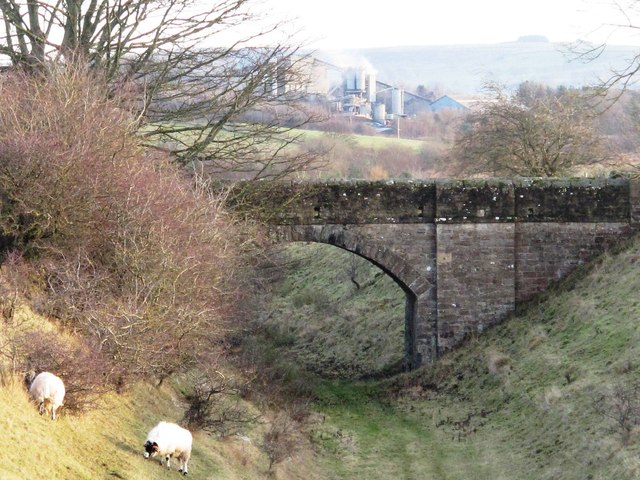
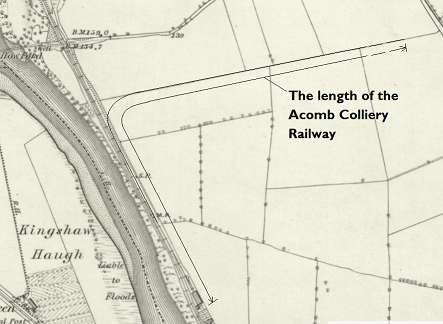
  21. http://www.dmm.org.uk/colliery/a005.htm, accessed on 6th September 2024.
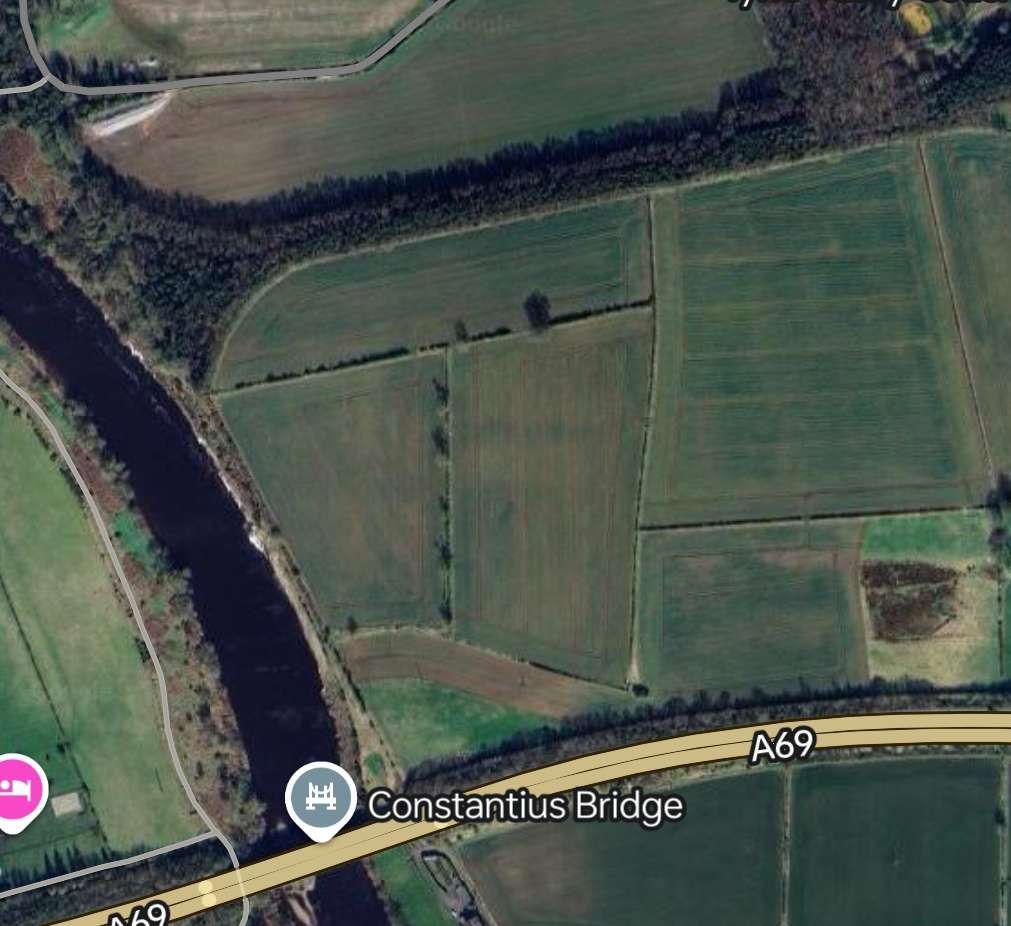
  22. http://www.dmm.org.uk/colliery/n031.htm, accessed on 6th September 2024.
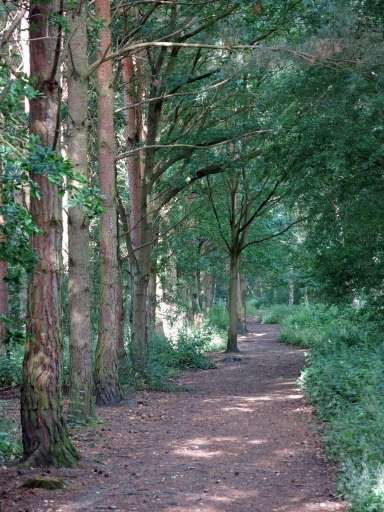
  23. https://maps.nls.uk/view/132279821, accessed on 6th September 2024.
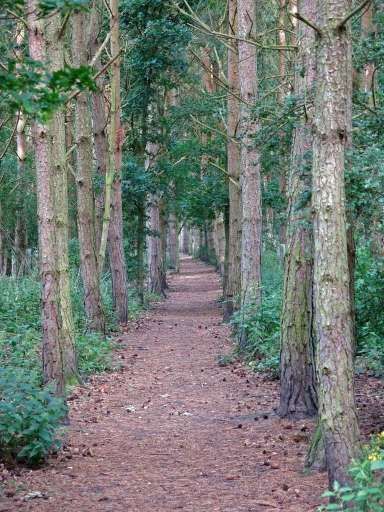
  24. https://www.geograph.org.uk/photo/3099951, accessed on 6th September 2024.
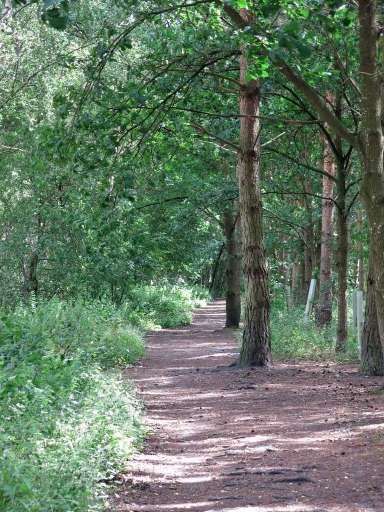
  25. http://disused-stations.org.uk/w/wall/index.shtml, accessed on 6th September 2024.
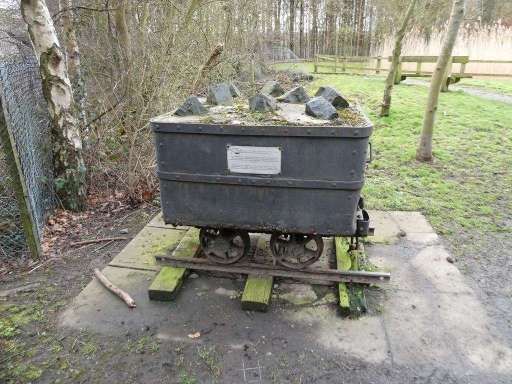
  26. https://theoldsignalbox.co.uk, accessed on 6th September 2024.
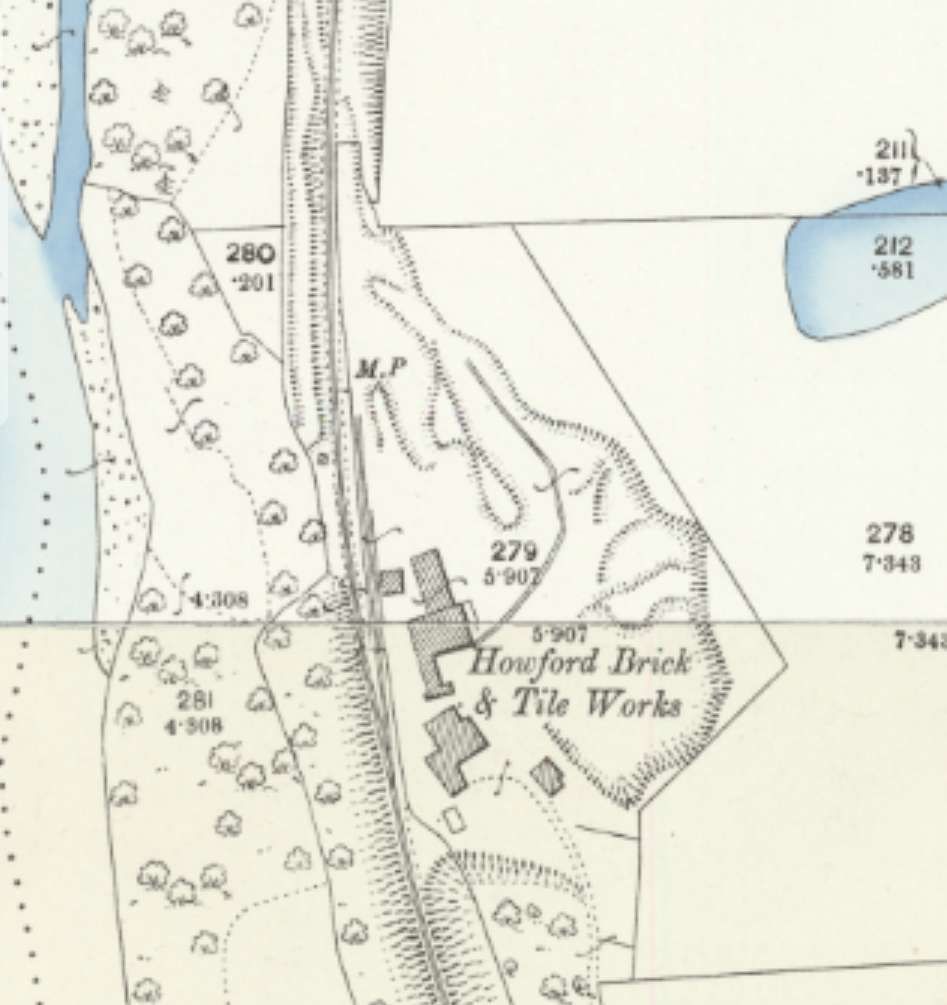
  27. https://maps.nls.uk/geo/explore/#zoom=15.3&lat=54.98913&lon=-2.12172&layers=257&b=1&o=100, accessed on 7th September 2024.
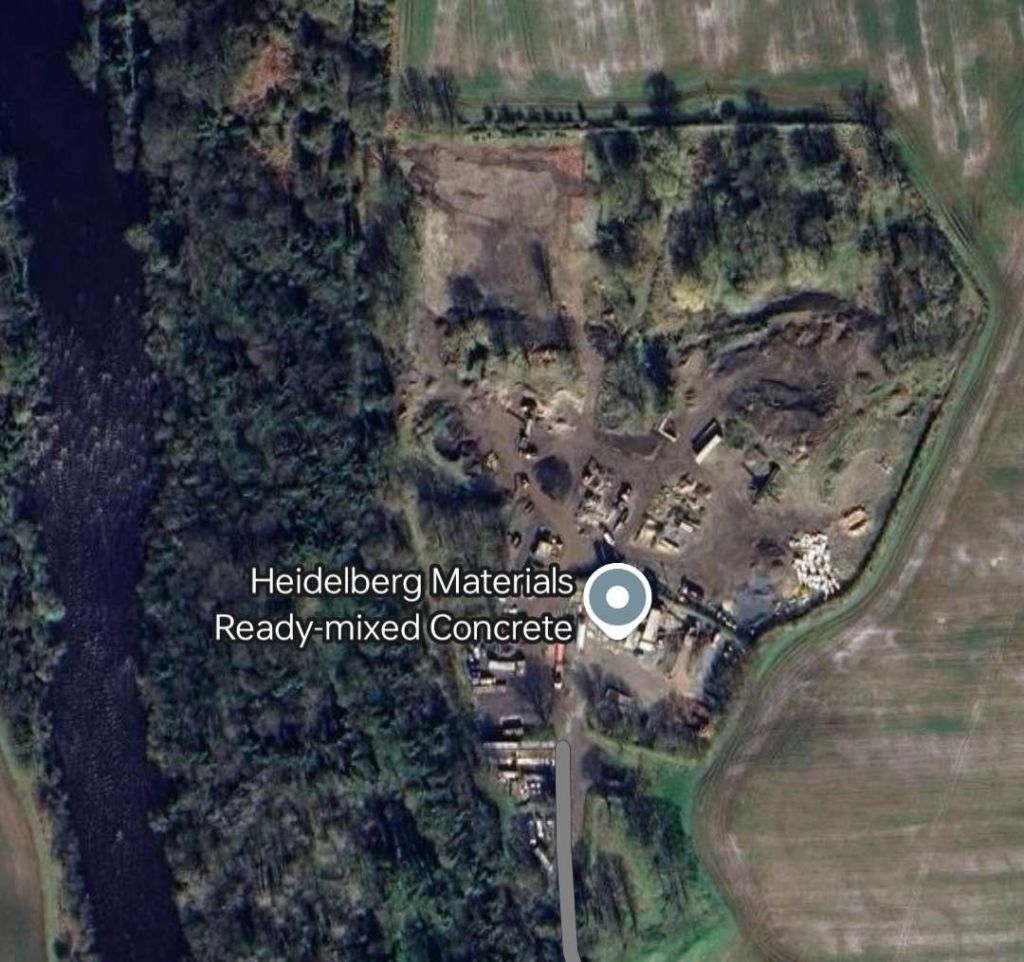
  28. https://maps.nls.uk/view/132268229, accessed on 7th September 2024.
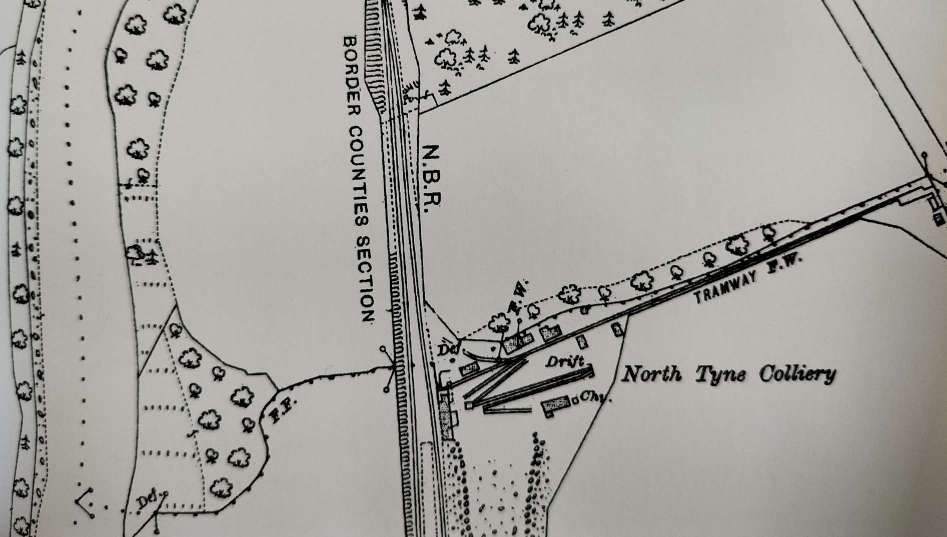
  29. https://www.gooseygoo.co.uk/site/brunton-bank-limekilns, cf. https://historicengland.org.uk/listing/the-list/list-entry/1156634, accessed on 7th September 2024.
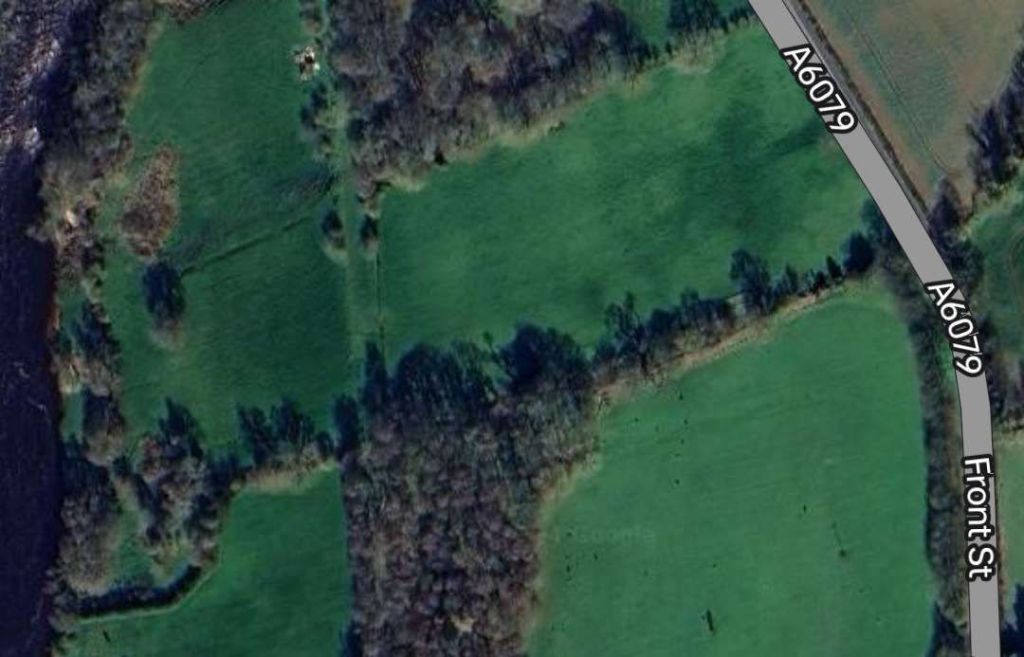
  30. https://www.geograph.org.uk/photo/3695106, accessed on 7th September 2024.
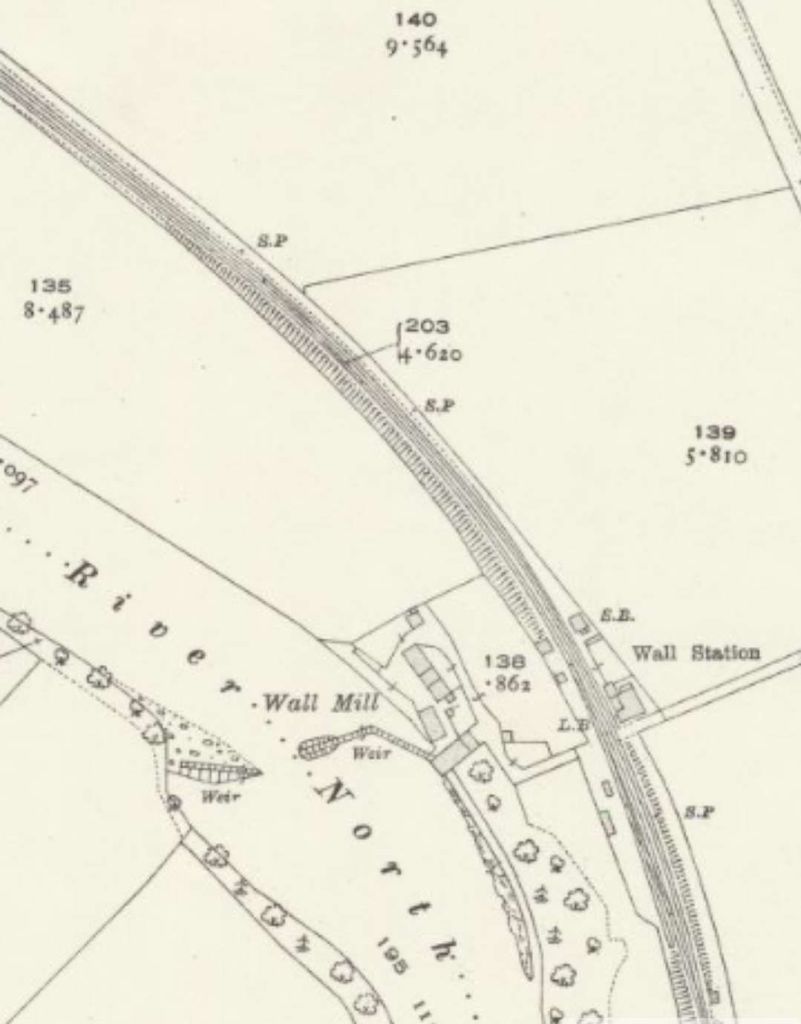
  31. https://www.geograph.org.uk/photo/5081121, accessed on 7th September 2024.
  32. https://maps.nls.uk/view/132268217, accessed on 7th September 2024.
  33. https://en.m.wikipedia.org/wiki/Chollerton_railway_station, accessed on 8th September 2024.
  34. https://maps.nls.uk/geo/explore/#zoom=16.5&lat=55.03813&lon=-2.10817&layers=168&b=1&o=100, accessed on 8th September 2024.
  35. https://maps.nls.uk/geo/explore/#zoom=16.5&lat=55.04086&lon=-2.10998&layers=168&b=1&o=100, accessed on 8th September 2024.
  36. https://shop.memorylane.co.uk/mirror/0300to0399-00399/overgrown-tracks-shrubs-flowers-platform-21635871.html, accessed on 8th September 2024.
  37. https://www.pressreader.com/uk/steam-days/20210914/281560883923116, accessed on 16th September 2024.

Water Troughs, Major Works, Campbeltown & Machrihanish Light Railway, Welsh Highland Railway and other snippets from The Railway Magazine, January 1934

Water Pick-Up Troughs

Some superb diagrams showing the operation of water troughs were included on page 4 of the January 1934 edition of The Railway Magazine.

The effective operation of water troughs. [1: p4]

The Railway Magazine commented: “Long non-stop runs necessitate either the use of large tenders, such as are used in America … or the provision of track water troughs from which the tender can be replenished while the train is travelling. As long ago as 1859, … locomotive engineer, John Ramsbottom, … designed the type then and ever since used, with but minor modifications, such as the substitution of metal for wood in their structure.” [1: p5]

Figure 1 shows a typical cross-section. The length was been 0.25 and 0.5 miles and had to be on a completely level  length of track.

Figure 2 “shows diagrammatically the arrangements made for rapidly refilling a trough after a locomotive has taken water from it. The familiar ball-valve control is used to regulate the flow from a tank alongside the track to the trough. When the water in the trough reaches the correct level, the ball valve, in a small tank at rail level, rises and cuts off the supply. Steam heating has to be used to prevent freezing in frosty weather where traffic is infrequent and the troughs are in exposed positions.” [1: p5]

Figure 5: Section through a LNER eight-wheel tender which shows the arrangement of the water pick-up gear. [1: p6]

I love some of the diagrams in these early editions of The Railway Magazine. The one above is no exception, Figure 5 illustrates a typical form of water pick-up apparatus on a LNER eight-wheel tender. “The inclined delivery shoot will be seen to have a hinged foot-like scoop, curved to face the direction of travel and capable of being held clear of, or depressed into the troughs – which are centrally placed between the rails – by means of the system of rods, cranks and levers shown, these being under the control of the fireman. Warning boards are erected to enable him to be prepared to lower the scoop as the trough is approached, speed seldom being appreciably reduced over the troughs. The scoop is usually lowered before the trough is reached, a slight gradient being arranged in the track, by which the scoop drops below the water level, and is similarly raised at the far end of the trough, should the crew not have lifted it out earlier. To aid in raising the scoop when the tender gauge shows the tank in it to be full, steam or compressed air is often used.” [1: p5]

A speed through the toughs of 25 mph was sufficient to ensure the take-up of water, although higher speeds were more effective. But express speeds tended to waste water and could result in damage to the permanent way. Maintenance costs with the amount of flooding which occurred were high.

The LMS made use of a tender which had an observer’s compartment to study what happened at water troughs and, as a result, designed a simple device which significantly reduced the spilling of water. “Briefly, the passage of the scoop through the trough causes the water in it to pile up and overflow at each side, and to neutralise this a pair of slightly converging deflector vanes are fixed 1 ft. 4 in. in advance of the scoop, which force the water towards the centre of the trough and make it pile up there instead of at the sides (Figures 3 and 4). Some 400 gallons are saved every time these deflector vanes are used, and the quantity of water required is reduced by about 20 per cent.” [1: p5]

Figure 6: Water Pick-up Troughs on the East Coast Main Line (LNER) [1: p7]

Figure 6 is a map showing the distribution of water troughs along the main LNER. route to Scotland, and Figure 7, those on the LMS, both on the LNWR (West Coast) and the Midland routes.

Figure 7:The Water Troughs on the two LMS routes to Scotland. [1: p7]

The water troughs on these long distance routes obviated the need for larger tenders and the need for time-wasting water stops. 3,500 to 5,000-gallon tenders were more than adequate.  It also appears to have been true that the use of water troughs generally meant that water purity was higher which minimised boiler maintenance and also reduced the need for water-softening plants. [1: p5]

The GWR Capital Programme

The Railway Magazine noted, “A special programme of extensions and improvements, involving a cost of over £8,000,000, was put in hand by the GWR under the Development (Loan Guarantees and Grants) Act, 1929, in anticipation of its future requirements, for the purpose of assisting in the relief of unemployment. … The Railway Gazette, issued on [8th December 1933] a profusely illustrated Special Supplement dealing comprehensively with these works. A notable feature of this supplement is the wealth of drawings, including a double-page map of the G.W.R. system, with inset detail plans of the new works.” [1: p74]

Earlier in the January 1934 edition, The Railway Magazine carried an advert over two pages from The Railway Gazette for the supplement to their magazine (which, when bought separately, cost the princely sum of 1s).

The first page of the advert about the GWR Capital works programme and the Railway Gazette supplement. [1: pXIV]
The second page of the advert about the GWR Capital works programme and the Railway Gazette supplement. [1: pXV]

The Campbeltown & Machrihanish Light Railway

The Campbeltown and Machrihanish Light Railway was one of only four 2 ft 3 in (686 mm) narrow gauge railways in the UK. The other three were/are in Wales: the Corris Railway, the short-lived Plynlimon and Hafan Tramway and the Talyllyn Railway. [3]

In its January 1934 edition, the Railway Magazine reported that “an Order dated [7th November 1933], by the Minister of Transport, appeared in The London Gazette of 7th November, declaring that the Campbeltown & Machrihanish Light Railway Company shall be wound up.” [1: p74] The line, which was closed about eighteen months earlier was 6 miles 29 chains in length and of 2ft 3in gauge. The rolling-stock comprised three locomotives, six passenger and and two goods vehicles. “The company was incorporated on 8th May 1905, and the line opened on [17th August 1906] of the following year. This isolated railway, in the Mull of Kintyre, suffered particularly severely from road motor competition,” [1: p74] and, a few years previously, an attempt was made to meet road competition with its own bus service, but that failed.

‘Atlantic’ was the last locomotive built for the Campbeltown and Machrihanish Light Railway. It was an Andrew Barclay 0-6-2T, built in 1907. Seen here in charge of a train of four coaches leaving Campbeltown for Machrihanish. [2]

A canal was first constructed to bring coal from pits close to Machrihanish to Campbeltown. It was in use from 1794. There were no locks as the canal traversed relatively flat terrain. It was three miles in length, running from Mill Dam in the West to Campbeltown. Only two barges plied its length which carried around 40 cartloads of coal each day to Campbeltown. However, “the extent to which the canal was used or cared for seems doubtful. … It had fallen into disuse and been virtually abandoned by 1856 and when, about 1875 the colliery changed hands, the new owners … found it choked with weeds and difficult to clear. … In the Company’s prospectus of 1875 it was stated that a railway was to be built.” [4: p7-8]

The new railway was a little over 4 miles in length at first, running between the pits and a coal depot on Argyll Street, Campbeltown. In 1881 the length was extended to 4.7 miles. “There were a number of level crossings, all originally gated but subsequently left open, protected only by cross trenches to keep cattle and sheep off the line.” [4: p8]

At first, only a single loco worked the line, an Andrew Barclay 0-4-0T engine named ‘Pioneer’. After the line was extended to a new colliery business “became so brisk that in 1885 a second locomotive was bought from Barclays, an [0-4-0ST initially, later altered to an 0-4-2ST] named ‘Chevalier’.” [4: p9]

In 1901 and 1902, two high-speed turbine steamers brought “increasing numbers of day trippers to Campbeltown where … many of them were conveyed to Machrihanish … by horse-drawn carriages.” [4: p11]

The railway saw significant changes as a result. Both to carry passengers and to enhance the delivery of coal to boats at the New Quay in Campbeltown, the line was extended East to New Quay and West to the Golf links at Machrihanish. A new company, the ‘Argyll Railway Company’, was formed to manage the line.

The new railway was to be close to 6.4 miles in length and was opened to passenger traffic in 1906. By “August 1913 there were seven trains each way daily. … The war naturally led to a curtailment of services, … until the early months of 1917 saw the line’s minimum service of one daily train in each direction. … After the war … the tourist trade soon picked up again and before long the summer months saw eight regular trains a day in each direction. … Although the 20s saw increasing competition from buses, the time tables continued to show eight trains daily in each direction right up until the withdrawal of services in 1931.” [4: p23]

Commenting on the closure of the line, A.D. Farr says: “When the railway finally closed the prime reason was the loss of revenue following the closure of the colliery in 1929, but a major factor was also the bus competition. To meet this second-hand buses had been bought by the railway, but the experiment was to no avail and they were soon sold to the competing road transport concern.” [4: p23]

The line owned a total of five locomotives at different times: ‘Pioneer’, a Barclay 0-4-0T; ‘Chevalier’, a Barclay 0-4-0ST which may have been converted to an 0-4-2ST; ‘Princess’, a Kerr-Stuart 0-4-2T; ‘Argyll’, a Barclay 0-6-2T; and ‘Atlantic’, another Barclay 0-6-2T. [4: p41]

Six passenger coaches were employed on the line, all built by R.Y  Pickering & Co., of Wishaw, Lanarkshire. All were bogie ‘cars’ and “were externally very attractive models of the tramways type, 43 ft 6 in long and with two 4-wheel bogies, 30 ft centre to centre carrying 1ft 11in diameter wheels. At each end was a covered platform, guarded by a wrought-iron balcony and ‘telescopic gates’, and with steps on either side to within a foot or so of the ground.” [4: p43]

The coal company owned a series of wagons which carried the ‘C.C.C’ lettering. But it seems as though the railway company owned only a heavy goods brake van and one other wagon, although little is known about that vehicle. [4: p45]

The Welsh Highland Railway

The Railway Magazine reported that the “Joint Committee representing the local authorities with investments in the Welsh Highland Railway has decided to ask the debenture-holders to close down the line. Carnarvonshire County Council has £15,000 in the venture, Portmadoc Urban District Council £5,000, and the Gwyrfai, Glaslyn and Deudraeth Rural District Councils £3,000 each. At a recent meeting of the Portmadoc Council, Mr. Oswald Thomas said it was important that if the railway were closed, the rails should not be taken up, particularly between Portmadoc and Croesor Bridge, as it was hoped before long to see quarries in the district working again. Captain Richard Jones said it might be arranged for the Portmadoc Council to take over that part of the railway.” [1: p74]

West Monkseaton Railway Station Waiting Shelter

The Railway Magazine picked a rather modest platform building at West Monkseaton for praise.

West Monkseaton Railway Station, LNER – a new waiting shelter – January 1934. [1: p75]

Here is precise repetition used rhythmically; the units are a nine-light window and a half-glazed door; the rhythm is 2-door-2-door-2-door-2. The designer is to be congratulated in that he has been careful to keep the horizontal glazing bars of doors in line with those of the windows; the horizontal effect of the windows; therefore unbroken. The portions of the window panes are The proportion good, being about 5 to 3. The key-note of the design is the restful cornice band running round the structure; unpretentiously it ties in the whole composition; its horizontality is repeated by the edges of the weather-boarding under the windows, and is balanced by the white base upon which the building stands; this cornice band also sets off, and is set off, by Mr. Eric Gill’s standard LNER lettering. Thought has evidently been expended upon the design of this shelter, and it gives us pleasure to illustrate such a satisfactory and pleasing little piece of station architecture, especially when we consider what the perpetuation of railway custom might have produced.” [1: p75]

Check Rails and Ramps

By 1934, it was common practice “to provide safety devices at viaducts and other important bridges to reduce to a minimum the risk of vehicles, which may have become derailed, falling over the edge. Special guard rails, fixed either inside or outside the running rails and usually at a slightly higher level, are laid across the viaduct, with some splayed arrangement at both ends to direct derailed vehicles from the edge toward the rails. An ingenious elaboration of this is shown in the accompanying illustration. It consists of converging rails with a steel ramp between them rising to rail level. Any derailed wheels would run up this and should automatically become re-railed at the top.” [1: p74]

The steel-ramp approach to a short viaduct at Midfield. [1: p74]

References

  1. The Railway Magazine; Westminster, London, January 1934
  2. https://www.ebay.co.uk/itm/353145047017?mkcid=16&mkevt=1&mkrid=711-127632-2357-0&ssspo=VG76xMQ6St6&sssrc=4429486&ssuid=afQhrar7TGK&var=&widget_ver=artemis&media=COPY, accessed on 6th August 2024.
  3. https://en.wikipedia.org/wiki/Campbeltown_and_Machrihanish_Light_Railway, accessed on 7th August 2024.
  4. A.D. Farr; The Campbeltown and Machrihanish Light Railway; (First Reprint) Oakwood Press, Headington, Oxford, 1987.

The Caledonian Railway Rail-motor Car

In June 2024, I picked up a few copies of the Railway Magazine from the early 20th century.

In July 1909, the Railway Magazine noted that the Caledonian Railway had inaugurated a motor car service on its rails. Just a short journey was involved crossing the Connel Ferry Bridge and running from Connel Ferry to either North Connel or Benderloch.

In September 1909 the Railway Magazine carried a photograph of the rail-motor car.

The Caledonian Railway rail-motor car, with wagon attached. The wagon is carrying a road-motor car.  It has just left the Connel Ferry Bridge. [1]

The Caledonian Railway purchased an ordinary road-motor car, and under the superintendence of Mr. J. F. McIntosh, this was converted, at St Rollox Works, into the rail-motor car. … The car performs, daily, several journeys from Connel Ferry across the bridge to North Connel, and four of these trips in each direction are extended an additional 2.25 miles beyond North Connel to Benderloch, and it is on these longer journeys that road motor cars are conveyed on the carriage truck provided for the purpose, which is attached as a trailer to the rail-motor car.” [1]

The vehicle was a Durham-Churchill Charabanc. It originally operated as a road vehicle between Clarkston railway station and Eaglesham. It was converted to rail use in 1909 at the cost of £126!

The journey from Connel Ferry to North Connel took 5 minutes and the trip to Benderloch, 15 minutes in total.

Sunday trains were few and far between in Scotland but an exception was made for this service with 5 crossings of the bridge in each direction. Surprisingly more often than on weekdays!

The Railway Magazine notes that, “in the past, this portion of Argyllshire [was] somewhat of a closed district to motorists, owing to the long arms of the sea which intersect the land and the numerous ferries that have in consequence to be crossed. Access to the very charming district that lies between Loch Etive and Lochleven, has been particularly difficult, as the ferries have become unserviceable since the opening of the Ballachulish Railway, whilst the comparative infrequency of the trains upon the Ballachulish line, and the restrictions on the conveyance of motor cars by the ordinary trains made crossing at Connel Ferry both inconvenient and unreliable.” [1] 

Motorists either avoided the area altogether or had to make a long journey via Tyndrum and Glencoe.

The charge for conveying motors across Loch Etive was 15 shillings.

Another view of the same vehicle and wagon. The rail-motor car was more of a charabanc having a number of rows of seats. [2]
This view shows the rail-motor car only offered passengers very rudimentary protection from the weather. The vehicle is entering one of the stations it served. Is this Connel Ferry, North Connel or Benderloch Railway Station? [3]

The Ballachulish Branch of the Caledonian Railway which crossed the Bridge at Connel Ferry is covered in other WordPress articles:

The Ballachulish Railway Line – Part 1

The Ballachulish Railway Line – Part 2

The Ballachulish Railway Line – Part 3

Revisiting the ballachulish railway………

References

  1. Novel Traffic on the Caledonian Railway; in The Railway Magazine, September 1909, p195.
  2. https://x.com/MrTimDunn/status/1042859151192477702?t=5hla6WJtvo1DnfZLPHflAw&s=19, accessed on 16th July 2024.
  3. https://x.com/TurnipRail/status/1400768455012388865?t=W3rRakfcxeS6GIsPsfNayQ&s=19, accessed on 16th July 2024.

The First Permanent Electric Railway in Scotland – The Carstairs House Tramway.

The July 1962 issue of ‘Modern Tramway’ included a short article about the Carstairs House Tramway, written by Christopher T. Harvie. [1]

Wikipedia states that the Carstairs House Tramway operated between Carstairs railway station and Carstairs House between 1888 and 1895. [2] Railscot has slightly different information. It indicates that the tramway opened in 1889 as an electric tramway but reverted to being horse-powered by 1896. It continued operating in this way until 1925. [3]

Carstairs Junction Station as it appears on the 6″ Ordnance Survey of 1896/1898. The tramway can be seen on the left of the map extract running from close to the Hotel. [4]
The full length of the tramway appears on this smaller scale extract from the OS mapping. Carstairs House appears bottom-left. [5]

The two RailMapOnline extract below show the full length of the line superimposed on Google Maps satellite imagery. [7]

The route of the tramway is shown by the pink line on these extracts. [7]
Looking Southwest along St. Charles Avenue in Carstairs. The drive to Monteith House is directly ahead. The tramway route ran under the modern properties on the right. [Google Streetview, October 2010]

Carstairs House is now known as Monteith House. It overlooks the River Clyde and sits “about one mile from the main Glasgow-London line of the Caledonian Railway at Carstairs West Station, and in 1886 the owner decided to build a tramway from the railway station to carry passengers to the house, agricultural implements and supplies to the Home Farm, and the great amount of coal then needed for heating the mansion. Accordingly plans were made for a line of 2 ft. 6 in. gauge, electrified at 250 volts, the current being generated by a turbine driven by a waterfall on the Clyde. … The positive and negative conductors were wires running alongside the tracks, supported by insulated posts about a foot high. On the car there was a double shoe to pick up current.” [1: p226]

At Carstairs House there were a few short branches serving a carriage shed and stores/outhouses. Between the House and the railway station was Carstairs Mains Home Farm where there were two further branch lines, one into the yard and the other to a sawmill. The sawmill provided the Caledonian Railway “with a considerable traffic in timber, the area being well forested. Leaving the Farm, the line cut across wooded country to rejoin the road and run alongside it to the main gates of the Estate where, at a lodge immediately opposite the railway, the terminal for passengers was situated. Shortly before it reached the lodge a branch diverged to the left, to run to a transfer siding with the Caledonian Railway.” [1: p226]

This extract from the 25″ Ordnance Survey of 1896/1897 shows the terminus of the line at the roadside opposite the Caledonian Railway station and the siding which ran Northwest alongside the Caledonian Railway to a transfer platform. [6]

There were three electric cars used for passenger services, “the first was a saloon four-wheeler built at the House in 1886. The other two were probably obtained second-hand from the electric railway demonstrated at the 1886 Edinburgh Exhibition and may have been built by the North Metropolitan Tramway Company of London.” [1: p227]

The small six-seat 2ft 6in gauge tram constructed locally for the Carstairs House tramway can be seen below. Different sources give different information about the year in which electric operation ceased. Most probably electric operation ceased in 1905 but the tramway itself survived for a further 30 years in order to ship coal and other freight from Carstairs station to the house and to export sawmill products from the estate, through the use of horse-drawn wagons. The tram, which was powered through electricity generated by a hydro-electric plant, drew its current from raised conductor rails, as clearly visible in the photograph below.

One of the Carstairs electric trams in action on the Tramway. The conductor rails can clearly be seen in this photograph. This image was shared on the I Belong to Carstairs Facebook Group on 21st July 2020 by Mark Allison. [8]

A further image showing one of these trams can be found in a book by Peter Waller, Lost Tramways of Scotland: Scotland West. [9]

In 1905, apparently, the owner was electrocuted by falling on the live electrical contacts. The result was that the electrical equipment was removed, the electric cars were placed in storage in their dedicated shed. They remained there until the final closure of the line.

Harvie tells us that:

“After the removal of the electrical equipment, horses took over the working of the line and its history continued uneventfully until the first world war, when it saw a period of intense activity as a transporter of spagnum moss, or bog-cotton, which was used as a substitute for American cotton during the period of unrestricted submarine warfare.

The line continued in use until around 1935, when the Montieth family left Carstairs House. Apparently the electric cars were then scrapped, after over thirty years of disuse. As the coming of the motor-car had ended its passenger services the agricultural tractor and motor-lorry meant the end of its usefulness as a freight carrier.

Shortly after the opening of the line there was put forward a plan for the construction of a network of local electric railways to serve the towns of Motherwell, Hamilton and Wishaw, after the same pattern as the Carstairs House Tramway, with power generated by the Falls of Clyde, near Lanark. Although this scheme remained a proposal, both parts of it were later carried out independently, a conventional electric tramway of 4 ft. 7 in. gauge being built to link these towns with Glasgow in 1903 and a generating station being built on the Falls of Clyde by the Clyde Valley Power Company.” [1: p227]

Two photographs of the information board near Carstairs Railway Station, Carstairs Junction. The Information Board stands near the junction of Strawfrank Road and St. Charles Avenue, close to where the tramway would have started. These photos were sent to me by Steve Pearce and are included here with his kind permission, © Steve Pearce.

References

  1. Christopher T. Harvie; The Carstairs House Tramway; in Modern Tramway and Light Railway Review, Volume 25 No. 295, Light Railway Transport League and Ian Allan Hampton Court, Surrey, p226-227.
  2. https://en.m.wikipedia.org/wiki/Carstairs_House_Tramway, accessed on 8th August 2023.
  3. https://www.railscot.co.uk/companies/C/Carstairs_House_Tramway, accessed on 8th August 2023.
  4. https://maps.nls.uk/geo/find/#zoom=15.4&lat=55.69277&lon=-3.66831&layers=298&b=11&z=0&point=0,0, and https://maps.nls.uk/view/75651318 accessed on 8th August 2023.
  5. https://maps.nls.uk/geo/find/#zoom=14.7&lat=55.68984&lon=-3.67589&layers=298&bk=11&z=0&point=0,0, and https://maps.nls.uk/view/75651318, accessed on 8th August 2023.
  6. https://maps.nls.uk/view/82893909, accessed on 8th August 2023.
  7. https://www.railmaponline.com/UKIEMap.php, accessed on 8th August 2023.
  8. https://m.facebook.com/groups/352799184389/permalink/10158618389784390, accessed on 8th August 2023.
  9. Peter Waller; Lost Tramways of Scotland: Scotland West; Graffeg, Llanelli, October 2022.

The Ballachulish Railway Line – Part 3

Part 3 of our study of the Ballachulish line will include material from some present day pictures from along the National Cycleway which follows the line together with parts of a description of that journey from another website, the completion of the journey along the line from Kentallen to Ballachulish Station, and a study of the slate mining at Ballachuish which probably was the main justification for the construction of the branch-line.

The Railway Magazine November 1950

My spare time over Christmas 2018 has been spent looking at a few older magazines which have been waiting my attention for some time. I have discovered an article in “The Railway Magazine” November 1950 edition. The article was written by H.A. Vallance and entitled ‘From Connel Ferry to Ballachulish’.

A copy of that article can be found in the Railway Magazine Archive which grants access on payment of an additional sum over and above the annual subscription to the magazine. [26]

Kentallen to Ballachuish

We finish our journey along the line from Kentallen to Ballachuish ……

Initially we continue our look around the station at Kentallen.This image provides an overview of the station site. The footbridge, station buildings, signal box and water tank are all visible as well as the siding on the northeast corner of the site. [8]Ex-Caledonian Railway ‘439’ Class (LMSR Class 2P) 0-4-4T 55230 enters Kentallen Station from the South during July 1959 with an Oban – Ballachulish train. [9]

The following images were all taken in the mid-1970s by J.R. Hume, after closure of the railway but before re-development. A Mk 3 Cortina is visible in two images which for the officionados may well date the pictures more definitively. They are all available on the Canmore website. [8]The station from the road-side. [8]The railway cottages and water tank on the southeast side of the A828. [8]The station buildings from the Northeast. [8]The waiting shelter on the west side of the station with Loch Linnhe behind. [8]Unidentified ex-Caledonian Railway (LMSR Class 2P) 0-4-4T, the morning Ballachulish to Oban train crosses a Ballachulish-bound train at Kentallen Station during July 1959, (c) Kelvin Hertz. [11]The water tank at Kentallen, still standing in May 2015. [10]

The water tank in 2014. [13]

Moving on from Kentallen, the next two images are taken just to the north-east of the station.Local passenger train approaching Kentallen in 1961 from Ballachulish, (c) H.B. Priestly. [7]Local pick-up goods approaching Kentallen from Ballachulish in the mid-1960s . [6]

The next station along the line was Ballachulish Ferry, it was reached after a the line had travelled East along the south side of Loch Leven. Close to Ballachulish Pier the A828 crossed the railway on a bridge and then hugged the shoreline as far as the ferry and the hotel.In 2014, we stayed in a bed and breakfast  along this length of the A828 and walked a distance along the track-bed on the old railway line. These next few images show the B&B and the cycleway/path. As you will see below the cycleway/path is marked characteristically along its full length by ornate ironwork.Part 1 of this short series of posts carried a video of the ferry. Please follow this link:

https://rogerfarnworth.com/2019/01/01/the-ballachulish-railway-line-part-1

Some pictures will suffice here, three images in total, of which the third shows the Ballachulish Bridge under construction.

Ballachulish Ferry, before the bridge was started. Looking from the north side, towards Sgorr Dhonuill, © Copyright Ian Taylor. [14] Argyll postcard of Ballachulish Ferry. [15]

Ballachulish Ferry and Bridge, © Copyright N T Stobbs. [16]

Finally at this location, Ballachulish Hotel and Ferry Slipway [17]

Ballachulish Ferry Railway Station is hidden away inland south of the ferry behind the hotel. It had one platform on the North side of the railway line.Ballachulish Ferry Railway Station, looking towards the terminus at Ballachulish.[18]Ballachulish Ferry Railway Station facing West, (c) H.B. Priestley. [19]

The railway continues in an easterly direction towards Ballachulish Station, crossing the A828 and running along the shore. Close to Ballachulish, the A828 turns inland to find a good bridging point across the River Laroch. The railway continued along the shore on embankment so as to have the most convenient approach to Ballachulish.The station opened as Ballachulish on 20 August 1903 [2] with two platforms. There was a goods yard on the north side of the station. [1] Within two years it was renamed as Ballachulish & Glencoe [2] and renamed again following the opening of the ‘new’ road between Glencoe village and Kinlochleven in 1908 as Ballachulish (Glencoe) for Kinlochleven. Apart for a short closure in 1953, this latter name remained until closure in 1966. [2] In the railway timetables the name was shortened to simply Ballachulish with a note stating “Ballachulish is the Station for Glencoe and Kinlochleven”. [3]

The Callander and Oban Railway were responsible for the construction of the branch-line and for the opening of the station. That company was absorbed into the London, Midland and Scottish Railway during the Grouping of 1923. The station then passed to the Scottish Region of British Railways on nationalisation in 1948, and was closed by the British Railways Board in 1966 [2] when the entire length of the Ballachulish Branch closed.

In the early 1990s the station buildings were converted into a medical centre. Houses have been built in the station yard. The engine shed remained, being used by a local garage until 2015, when it was demolished to make way for more private housing.
Ballachulish Railway Station. [1]A close up of the station buildings. [20]Ballachulish Station in the 1950s, (c) Marcel Gommers. A google search produced this picture, but the link failed to operate and the website appears not to exist.An eye-level view into the station from West along the line. [20]Ballachulish Engine Shed, used as a garage for sometime before its demolition recently. [20]

The adjacent picture shows the shed acting as a local garage in 2012. [21]A track plan of the station. [20]The three pictures above show the old station building in use as a medical centre in 2011, (c) J.M. Briscoe. [22]

We have travelled the full length of the branch-line and done our best to get an impression of it operating as a railway. As we have done so, we have noted on a few occasions that the railway line is now in use as part of the National Cycle Network Route 78.

National Cycle Network Route No. 78

We have already seen some of the ornate ironwork which has been used to give this particular part of Route 78 an identity. These next few images highlight other locations along the route where the ironwork has been used.The cycle-way which follows much of the branch-line is marked by ornate ‘gateways’ and sculpture work as in this image and that below. Details of the cycle-way (Sustrans No. 78) can be found at the end of this post. [5]The National Cycle Network gateway close to Kentallen. [12]Similar ironwork closer to Oban. [23]

The description of the cycle route on the Sustrans website, which is an excellent way of following the route of the branch-line, follows in italics [4]:

Connel Bridge to Benderloch – two miles

Follow the Route 78 signs over the bridge and then through housing and past Connel Airfield. There is a currently a short gap in National Route 78 here. It is possible to join the main trunk road for just under a mile – but please note that this is narrow high-speed road, and it is not recommended for children or inexperienced cyclists. A footpath heads off to the left through the trees before you reach the trunk road, but in addition to being a bit muddy and overgrown this is not part of the National Cycle Network route. This joins with the beginning of the tarmac path to the south of Benderloch. This area (but not the additional path) is shown in this map link.

Benderloch to the Sea Life Sanctuary – four miles

A traffic-free path follows the line of the old railway into Benderloch village. From near the primary school, it runs alongside the A828 trunk road to the Sea Life Sanctuary, which has interesting marine displays, other wildlife such as otters, a nature trail and an adventure play area, plus a cafe.  

Sea Life Sanctuary to Appin and Dalnatrat (the Highland boundary) – 13 miles

This is a glorious, almost entirely traffic-free section that starts from the east side of the Sea Life Sanctuary car park. There are several crossings of the trunk road on this section, where you should exercise care. The route runs through woodland and then joins minor roads through the settlement of Barcaldine and the forest of Sutherland’s Grove, and along railway path to above Creagan road bridge. Here you will see signs for the Loch Creran Loop, a six mile route on quiet road. Route 78 continues over the bridge. A traffic-free path runs alongside the road to Inverfolla and then the route rejoins the line of the old railway past Appin and Castle Stalker. Look out for the signs for the Port Appin Loop, which takes you down to Port Appin where you can catch the passenger ferry to the Isle of Lismore. After passing Castle Stalker, there’s a bit under a mile where the route shares a quiet access road with road traffic and skirts a layby, followed by more traffic-free path and less than a mile on very quiet minor road. A further two miles of entirely traffic-free path ends at Dalnatrat, near the foot of Salachan Glen.

Dalnatrat to Duror – two miles

Between Dalnatrat and Duror is currently a gap of almost two miles in the National Route 78. It has not yet been possible to build a path here and to continue a northbound journey temporarily using the busy trunk road is unavoidable. Please note that this is narrow high-speed road, and it is not recommended for children or inexperienced cyclists, or those on foot. Look out for the cycle route signs to the right as you enter Duror village to take you back onto the National Cycle Network.

This area is shown here on Sustran’s mapping.  There are some rough paths and tracks in nearby woodland to the southeast of the road – but these are not part of the National Cycle Network, they don’t bridge the gap entirely, and the loose surfaces and steep inclines make them relatively challenging even if on an unladen mountain bike or on foot. Please note that current Google based mapping shows a bridge which no longer exists. Openstreetmap currently (Sept 2017) shows the correct details.

Duror to Ballachullish – six miles

Traffic-free path runs from the south of Duror village and loops round on minor road to rejoin the line of the old railway. The path over the hill to Kentallen takes you to the highest point on the route where you get a seat and a wonderful view over Loch Linnhe. The path then heads down to Kentallen, across the road and onto one of the most scenic sections as the railway path hugs the coastline for a couple of miles, before heading inland and emerging just to the south of Ballachulish Bridge. At this junction, you can continue right for another three miles on a traffic-free link path to the village of Glencoe, or turn left to continue on Route 78 over Ballachulish Bridge to North Ballachulish.

Ballachulish Quarries

Ballachulish Slate Quarries before the arrival of the Railway (1897 OS Map).

Just to the south of the A82 and at the east end of the village of Ballachulish are the fascinating  remains of the Ballachulish slate quarries, which employed up to 300 men at any given time for over two and a half centuries until 1955. Today the quarries have been opened up as a scenic attraction in their own right, and are well worth a visit. [24]

The story of slate quarrying in what was originally known as East Laroch began in 1693, just the year after the Glen Coe massacre took place, a little over a mile and a half to the east. The quarries grew dramatically during the 1700s and slate from here was shipped out to provide roofing for Scotland’s rapidly growing cities. It is recorded that in one year alone, 1845, some 26 million Ballachulish slates were produced.

The arrival of a branch railway from Oban in 1903 gave the quarries a further boost, as it made overland transport of the slates both possible and cheap. The Railway’s arrival was, however, unfortunate timing in one sense, as a major industrial dispute was under way in the quarries at the time over the provision of medical care, which involved the workforce being locked out for a year. Further trouble flared up in 1905, but the quarries remained in business until finally closing in 1955.

Ballachulish slate had one major drawback compared with some of its competitors. The presence of iron pyrite crystals within the slate meant that rust spots and holes were prone to appear in slates exposed to the weather, which of course is a drawback on a roof. Because of this, only about a quarter of the slate actually extracted could be used for roofing, with the remainder finding less lucrative uses or being wasted.

The adjacent images come from the Undiscovered Scotland Website as does the text above, although it has been edited slightly. [24]

Some further images of the quarries have been provided below. They have been sourced from the Canmore Website. [25] Canmore contains more than 320,000 records and 1.3 million catalogue entries for archaeological sites, buildings, industry and maritime heritage across Scotland. Compiled and managed by Historic Environment Scotland, It also contains information and collections from all its survey and recording work, as well as from a wide range of other organisations, communities and individuals who are helping to enhance this national resource. The old road used to pass under the incline. [25] An aerial image of the quarries. The route of the railway line is clearly visible. [25]The quarrying operation was of a significant size and lasted for well over two centuries employing around 300 men. [25]

And finally … a video of travel along the branch-line in the 1960s.

References

  1. https://en.m.wikipedia.org/wiki/Ballachulish_railway_station, accessed on 1st January 2019
  2. R. V. J. Butt; The Directory of Railway Stations: details every public and private passenger station, halt, platform and stopping place, past and present (1st ed.). Sparkford: Patrick Stephens Ltd., 1995, p23.
  3. Table 33, British Railways, Passenger Services Scotland summer 1962, quoted in https://en.m.wikipedia.org/wiki/Ballachulish_railway_station, accessed on 1st January 2019.
  4. https://www.sustrans.org.uk/ncn/map/route/oban-to-fort-william, accessed on 3rd January 2019.
  5. https://cuilbay.com/2014/07, accessed on 1st January 2019.
  6. https://hollytreehotel.co.uk/facilities/history, accessed on 5th January 2019.
  7. https://www.highlandtitles.com/blog/highland-reserve-interviews-lord-douglas-lady-penelope, accessed on 4th January 2019.
  8. https://canmore.org.uk/site/107540/kentallen-station?display=image, accessed on 5th January 2019.
  9. https://www.pinterest.co.uk/amp/pin/382031980881862868, accessed on 5th January 2019.
  10. https://wildaboutscotland.com/2015/05/28/lejog-day-11-connel-to-fort-augustus/amp, accessed on 5th January 2019.
  11. https://www.pinterest.nz/pin/382031980881872965/?lp=true, accessed on 4th January 2019.
  12. http://www.scottishanchorages.co.uk/kentallen-bay/4532986587, accessed on 5th January 2019.
  13. http://www.boydharris.co.uk/w_bh14/140818.htm, accessed on 5th January 2019.
  14. http://www.geograph.org.uk/photo/362353, accessed on 5th January 2019.
  15. https://www.ebay.co.uk/itm/BALLACHULISH-FERRY-Argyll-postcard-C31111-/253269532962, accessed on 5th January 2019.
  16. https://www.geograph.org.uk/photo/753925, accessed on 5th January 2019.
  17. https://www.undiscoveredscotland.co.uk/ballachulish/ballachulish/index.html, accessed on 5th January 2019.
  18. https://en.wikipedia.org/wiki/Ballachulish_Ferry_railway_station, accessed on 5th January 2019.
  19. http://myrailwaystation.com/FORMER%20LOCATIONS/index.htm, accessed on 5th January 2019.
  20. http://www.rmweb.co.uk/community/index.php?/topic/122717-kentra-bay-a-what-might-have-been-caley-west-coast-terminus, accessed on 5th January 2019.
  21. http://www.petesy.co.uk/2012/09/28, accessed on 5th January 2019.
  22. https://her.highland.gov.uk/Monument/MHG346, accessed on 5th January 2019.
  23. https://www.glencoescotland.com/see-do/mountain-biking/sustrans-to-oban, accessed on 5th January 2019.
  24. https://www.undiscoveredscotland.co.uk/ballachulish/slatequarries/index.html, accessed on 5th January 2019.
  25. https://canmore.org.uk/site/23552/ballachulish-slate-quarries, accessed on 5th January 2019.
  26. H.A. Valance; From Connel Ferry to Ballachulish; The Railway Magazine, November 1950.

The Ballachulish Railway Line – Part 2

In Part 1 we covered much about the history of the line between Connel Ferry and Ballachulish. We start Part 2 with a few reminders of what was covered in Part 1 and provide some additional material from various sources before continuing our journey North along the branch.

Several sea lochs made road travel between Oban and Fort William difficult, and Argyll County Council had indicated that it would co-operate with the Callandar & Oban Railway (C&OR) if the railway were to build dual-use bridges; the C&OR was considering an ambitious railway from Oban to Inverness by way of Fort William. The C&OR decided to decline the idea, and to make the railway on its own, and to undertake the work it itself. The C&OR had difficulty in raising enough money for a survey of the proposed line, but undaunted, it presented a Parliamentary Bill for the line in September 1894, for the following year’s session. [1]

The C&OR made this move without consulting with its parent company, the Caledonian Railway (CR). When the CR heard of the plan, they announced that they would oppose the Bill in Parliament. The Bill was swiftly withdrawn. [1]

The C&OR converted their proposal into a branch line to Ballachulish from Connel Ferry. Ballachulish had a population of 1,800 at the time, and its industry was chiefly quarrying. The branch was authorised by Act of Parliament on 7 August 1896. [3] The C&OR line was to have a triangular junction a Connel Ferry, and to cross Loch Etive by Connel Bridge which was second in Britain only to the Forth Bridge in the length of the main span, and it was the largest single-span steel bridge in Britain. [5] The route approved north of the bridge was later changed substantially, a hotel had been built at Loch Creran to serve a proposed station there; the hotel was never opened as the railway as built did not go there. The capital was to be £210,000 of which the Caledonian Railway agreed to fund £15,000. [5]

The Route North from Benderloch

In Part 1 of this survey we travelled as far North as Benderloch. We saw at Benderloch a station very typical of the branch line with buildings (now long-gone) which matched those at other stations on the line.

Leaving Benderloch the railway and the A828 ran closely parallel to each other with the railway running closest to the loch shore. This continued until the railway approached the location of Barcaldine House.


The extract from the OS Map above shows the road turning inland at this point and crossing two rivers. The first is Death Abhainn, the second is Abhainn Teithil. The two rivers have over time created a small area of open land at the loch-side which the road avoided. The railway maintained a straighter route and was carried over each of the rivers on bridges.

Barcaldine Halt opened to passengers in 1914. It comprised a single platform on the east side of the line. A siding was installed at the same time, to the south of the platform. [9]

Barcaldine Halt in 1950. [8]

Incidentally, a search for Barcaldine on the internet produces some very interesting information about railways and tramways in Queensland, Australia. Something for another time!

I have recently received the next two images from Tony Jervis -the first is taken from a train passing through Barcaldine Halt. The second is a ticket for the journey from the Halt to Connel Ferry.

Tony comments: “The railway ticket was probably sold at Connel Ferry Station; if someone has list of station Audit numbers, 4777N against that station should confirm it. The train had just deposited the man and his bicycle.” [22]

Travelling on from Barcaldine, the A828 and the railway swapped places and the railway too a very slightly more inland trajectory and began to rise to a height which would allow it to cross the next loch – Loch Creran. The A828 was forced to take a detour to the East to follow the shore of the loch. The railway took the more direct route.


It crossed the loch at the narrowest point on a high level, Howe Truss Girder bridge. When the railway closed, the bridge remained as a pedestrian/cycle route until its foundations were used to divert the A828.

Creagan Bridge from the East, taken after closure of the railway line. [10]

The new bridge. The picture was taken in 2008 by Jack Russell from a very similar location to the one above. As can be seen, the new bridge made use of the foundations and lower piers of the previous railway structure. [11]

Creagan Station was then approached from the EastEast, as the railway turned westward along the loch-side. The railway ran on the north side of the A828. Creagan Station was the only station on the Ballachulish branch that had an island platform. There was a siding to the east of the platform, on the north side of the railway.

One platform was taken out of use on 1 April 1927. [12]

The station at Creagan when still in use. [8]

An earlier image of the station, taken when both lines were in use. [8]

The island platform building at Creagan in the 21st century. [12]

The line continued West from Creagan through the Strath of Appin to Appin Station, by which time the railway was beginning to turn to the North.

Appin Station was once again typical of the stations on the route. The station building was a substantial two story structure of the same design as elsewhere. The station was laid out with two platforms, one on either side of a crossing loop. There were sidings on both sides of the line. A camping coach was sited here for a number of years.

Appin Station building. [8]

Branch goods at Appin. [8]

Two passenger trains pass at Appin. The camping coach is just visible on the right of the picture. [8]

1920s view of Appin Station. [8]

A similar view in the 1950s. [8]

Appin Station Signal Box. [8]

The service from Ballachulish in the later years of the line. [8]

Heading out of Appin Station towards Ballachulish, the line travels Northeast along the coastline. The A828 runs alongside the railway on the landward side all the way to Duror Station.

The next two images below show Duror Station while it was still in use for its intended purpose. The signal box can be seen beyond the main station building.

Duror Railway Station. [15]

Duror Station after the closure of the loop. [16]
The station was laid out with two platforms, one on either side of a crossing loop. There was a siding to the north of the station, on the east side of the line. One platform was taken out of use on 8th April 1927 along with the crossing loop.

The station building at Duror is still standing and is a well-maintained private house. The pictures immediately below show the property taken from its access road. The station building remains almost intact, as do the platforms which lie within the garden of the private property. These are also shown below.

Google Streetview Image.

Another view of the station (c) Nigel Thompson. [17]

The station platforms in the 21st century. [16]
The line turned East for a short distance beyond Duror Station, and then turned to the Northeast. Its route is shown on the 1940s OS Map below and as a dismantled railway on the later OS Map below. On that map, Duror Station site is marked with a yellow flag.

The route North-east from Duoro took trains through a narrow valley hidden away from Loch Linnhe which brought the line and the A828 down to Kentallen and Kentallen Bay. The village was at the head of the bay, its station some distance to the North-east. By the time the station was reached the railway was on the seaward side of the A828.


The station was laid out with two platforms, one on either side of a crossing loop. Alongside the station was a pier from which interconnecting steamers operated. The main station building was on the southbound platform and still stands in much extended form. There was a goods yard at the north end, on the east side of the line. There was a smaller shelter on the northbound platform. The pier survives, in cut back form.

To the south of the station site, and across the road, are railway cottages and the former water tank.

Following closure in 1966, the station buildings were enlarged and converted into a hotel and restaurant.

Holly Tree Hotel and Restaurant on the site of Kentallen Station in 2005. [18]

The Hotel from above on the hillside. [19]

July, 1959. Ex-Caledonian Railway 439 Class (LMSR Class 2P) 0-4-4T No. 55200 stands at Kentallen Station with an Oban to Ballachulish train, (c) Keith R. Pirt. [21]

A steam train at Kentallen shortly before the line closed in 1966. [20]

Kentallen Station and Pier. [8]

Kentallen Pier. [13]

We have noted that train times and ferry times were designed to allow connections to be made between the station and the pier at Kentallen. The two pictures above show the pier in use by ferries. The ferry timetable is shown below:

The Oban to Fort William Ferry timetable. [13]

The ferry made travel between Oban and Fort William manageable with a significant road journey. The stop at Kentallen allowed a combined train and ferry journey to be made.

To finish this post and before moving on towards Ballachulish we look at a few period images of Kentallen Station.

The station immediately after closure and before conversion to a hotel commenced. [13]

Pick-up goods heading south through Kentallen. [13]

The local passenger service heading south through Kentallen. [14]

I had originally expect that there would be just one post relating to the Ballachulish line but the material has been mounting up and I have now (January 2018) discovered an article from November 1950 in “The Railway Magazine” which means that a third post is warranted. We finish this part of the journey at Kentallen and will commence again from here to complete the journey to Ballachulish in part three of the story of the line.

References

  1. https://en.m.wikipedia.org/wiki/Callander_and_Oban_Railway, accessed on 1st January 2019.
  2. https://en.m.wikipedia.org/wiki/Ballachulish_railway_station, accessed on 1st January 2019
  3. E F Carter, An Historical Geography of the Railways of the British Isles, Cassell, London, 1959
  4. http://www.rmweb.co.uk/community/index.php?/topic/126169-appin-station, accessed on 2nd January 2019.
  5. David Ross, The Caledonian: Scotland’s Imperial Railway: A History, Stenlake Publishing Limited, Catrine, 2014.
  6. R. V. J. Butt; The Directory of Railway Stations: details every public and private passenger station, halt, platform and stopping place, past and present (1st ed.). Sparkford: Patrick Stephens Ltd., 1995, p23.
  7. Table 33, British Railways, Passenger Services Scotland summer 1962, quoted in https://en.m.wikipedia.org/wiki/Ballachulish_railway_station, accessed on 1st January 2019.
  8. http://oldappin.com/ballachulish-railway-line, accessed on 26th December 2018.
  9. https://en.m.wikipedia.org/wiki/Barcaldine_railway_station, accessed on 2nd January 2019.
  10. https://www.geograph.org.uk/photo/3213543, accessed on 2nd January 2019.
  11. https://www.sabre-roads.org.uk/wiki/index.php?title=File:A828_Creagan_Bridge_-_Coppermine_-_18816.jpg, accessed on 2nd January 2019.
  12. https://en.m.wikipedia.org/wiki/Creagan_railway_station, accessed on 2nd January 2019.
  13. https://hollytreehotel.co.uk/facilities/history, accessed on 5th January 2019.
  14. https://www.pinterest.at/amp/pin/510666045218505803, accessed on 5th January 2019.
  15. https://canmore.org.uk/site/106021/duror-station, accessed on 3rd January 2019.
  16. https://railscot.co.uk/img/9/766, accessed on 3rd January 2019.
  17. https://www.geograph.org.uk/photo/5394443, accessed on 3rd January 2019.
  18. https://en.wikipedia.org/wiki/Kentallen_railway_station#/media/File:Kentallen_railway_station_in_2005.jpg, accessed on 4th January 2019.
  19. https://hollytreehotel.co.uk/about-area/station, accessed on 4th January 2019.
  20. https://www.geograph.org.uk/photo/3027899, accessed on 4th January 2019.
  21. https://www.facebook.com/groups/ScottishRailways/search/?query=galloway&epa=SEARCH_BOX, accessed on 6th June 2019.
  22. Email from Tony Jervis on 15th May 2021.

The Ballachulish Railway Line – Part 1

An old copy of Hornby Magazine fell open at a modelling idea – the creation of a model representing the Ballachulish line in Western Scotland. Having walked a length of this line in the past, the article grabbed my attention and prompted some research. [1]

Ballachulish Railway Station.[4]

Ballachulish is a village at the foot of Glencoe in the Scottish Highlands. Glencoe is a deep valley which forms the natural road route into this remote part of Scotland. During the Victorian era it’s transport links centred around a steamer connection with Fort William, about 15 miles North, and Oban, a little further in a southerly direction.

Despite its remote location, Ballachulish had extensive slate quarries and during the 1880s it was hoped that local interest would be served by a railway line from Crianlarich up Glencoe and on to Fort William. This was not to be. The Rannoch Moor route was chosen instead. Other lines, such as an Oban to Fort William Railway failed to materialise.

Instead, rather late in the day in 1896, a branch line was authorised from the Oban-Crainlarich line at Connel Ferry. It was hoped that this would meet a similar line from Fort William but, although powers were obtained, it was never built because of problems gaining permission for bridges across sea lochs. [1]

Ballachulish

Ballachulish is a slightly confusing place. It’s not unusual to find places that come in two halves. But Ballachulish comes in two halves plus another, larger, settlement two miles along the road towards Glencoe.

The name comes from the Gaelic for village of the narrows, and the first settlement to bear the name lay where North Ballachulish is today. Its twin, on the south side of the loch, rapidly followed. Loch Leven narrows dramatically here and North and South Ballachulish grew up around the slipways used by ferries crossing the loch from a very early date. A vehicle ferry started to cross the narrows in 1912, but the service finally disappeared in 1975 when the bridge opened. With it disappeared the choice facing drivers of the sometimes long ferry queues at busy periods or the nineteen mile detour via Kinlochleven.

While the ferry has long gone, the slipways that served the ferry remain: though they are by no means opposite one another. The steel truss bridge that opened here in 1975 fits nicely into its environment. Indeed, it comes as something of a surprise to find it is such a relatively recent addition to this part of the Western Highlands.

South Ballachulish largely comprises the slipway and the nearby Ballachulish Hotel. Close to the steps leading down from the bridge to the Oban road near the hotel is a memorial to James Stewart, hanged here in 1752 for the Appin Murder. This was the killing of Colin Campbell, an event used as the basis for Robert Louis Stevenson’s novel Kidnapped. Stewart’s execution was a result of the greatest miscarriage of justice in Scottish legal history. A number of the sites associated with the Appin Murder have been linked by the Last Clansman Trail.[2]

Ballachulish Bridge should not be confused with the Connel Ferry bridge closer to Oban.

North Ballachulish is a little more developed and is home to an art gallery, lochside hotel and the slipway for the old ferry.

The largest settlement carrying the name of Ballachulish lies on the south side of Loch Leven, a mile or so west of the village of Glencoe. This started life as the hamlets of East and West Laroch in the 1500s, names still attaching to parts of the village on detailed Ordnance Survey maps. In 1693, slate was first quarried here in the Ballachulish Slate Quarries (only a year after the Glencoe massacre took place nearby). By the early 1700s, this had developed into a major slate quarrying operation which continued for over 250 years until 1955, when the quarries closed. The name of Ballachulish simply seems to have attached itself to the larger village that grew out of the earlier settlements to house the 300 workers and their families.
The Ballachulish Medical Practice today stands on the site of the railway station that formed the terminus of a branch line railway running from Connel via Ballachulish Ferry. This opened in 1903 and closed in 1966. Ballachulish now has its own Visitor Centre, which comes complete with ample parking and public conveniences. Just across the road from the visitor centre are the old Ballachulish slate quarries, which now provide scenic walks. There’s no mistaking what they are, but in the half century since they closed, nature has made a start on the task of reclaiming what was once taken from it. The main settlement of Ballachulish is now largely bypassed by the A82, which passes along the Loch Leven side of the village. [2]

The Railway
Construction work on the line started in 1898 and was completed in 1903. This was one of the last branch lines to be built in the UK. [1] The following notes in italics are taken from an on-line article published on the website “Unseen Steam” on the 50th Anniversary of the closure of the line in March 2016. [5] Images used are credited where possible and taken from a variety of sources.

The authorised capital of the new line was £210,000, of which the Caledonian Railway agreed to fund £15,000. There were two major engineering structures required: the viaducts over Loch Etive and Loch Creran at Creagan. The former, constructed by the Arrol Bridge & Roofing Co, was started in 1898. The cantilever bridge that resulted was the second only in length to the Forth Bridge and was the longest steel single-span bridge in Britain.

Construction Drawing – Connel Bridge. [8]

Connel Bridge under construction. [4]

Connel Bridge under construction. [4]

Connel Bridge. [7]

Creagan Railway Bridge, Loch Creran. [6]

The Connel Ferry Bridge, the world’s 2nd largest steel cantilever bridge, Argyllshire, Scotland, opened in 1903. [9]


Although a triangular junction was authorised at Connel Ferry to permit direct Oban-Ballachulish services, in the event the north-west curve was never constructed. Originally both the viaducts had footpaths alongside; however, in order to counter a proposal by MacAlpine Downie to operate a ferry across Loch Etive in 1913, the Callendar &Oban Railway decided to make the railway bridge capable of handling road traffic. This was completed in June 1914 and saw the railway charge tolls for road users crossing the bridge; special signalling ensure the safety of the arrangement.

The 27½-mile long branch opened throughout to passenger services on 28 March 1903. There were intermediate stations at North Connel, Benderloch, Creagan, Appin, Duror, Kentallan and Ballachulish Ferry that opened with the line. Barcaldine Siding (Halt from 1960) followed in 1914; this station was closed during World War 2 and was used for summer services only for a period after reopening postwar. Ballachulish Ferry was to be closed between 1 January 1917 and 1 March 1919 as an economy measure during World War 1. The population of Ballachulish when the line opened was less than 2,000 but quarried stone represented a useful source of freight traffic.

During the summer of 1910 there were three return workings over the branch each day, making a connection with the ferry to and from Kinlochleven. Services ran to and from Oban, with reversal at Connel Ferry. Down services departed from Oban at 8.20am, 11am, 5pm (Mondays, Wednesdays and Fridays only) and 8.30pm (Tuesdays, Thursdays and Saturdays only; this was the only working that did not connect with the Kinlochleven ferry). Up workings departed at 7.15am, 11.15am and 3.45pm. A single journey from Connel Ferry to Ballachulish took about 70 minutes. There was no service on Sundays.

By the summer of 1947, the final year of the line’s operation by the LMS before Nationalisation in January 1948, there were still only three return workings per weekdays. Departures from Oban were at 8.10am, 12.5pm, 4.pm (except Saturdays) and 8.50pm (Saturdays only). Services departed from Ballachulish at 7.30am, 10.50am, 3.50pm (Saturdays only) and 4pm (except Saturdays). There was no Sunday service. A revised pattern of service was operated by British Railways (Scottish Region) during the period from September 1964 through to June 1965. There were two down departures from Oban, departing at 8.15am and 5pm with a third service starting at Connel Ferry at 12.30pm. The station at North Connel was a request halt for both the 8.15am and 12.30pm services. In the up direction there were departures from Ballachulish at 7.14am (to Oban), 10.40am (to Connel Ferry), 4.20pm (to Oban) and a Saturdays only 6.57pm (to Oban). For all, apart from the 7.14am, the station at North Connel was a request halt.

In terms of motive power over the line, the early years witnessed the operation of three generation of 4-4-0s specifically designed for the C&OR — the ‘Oban bogies’. During the war Class 5 4-6-0s are known to have operated troop trains to Benderloch. In the later years, steam passenger services were dominated by Macintosh-designed ‘19’ class 0-4-4Ts. By the end of 1961, three of the class were based at Oban — Nos 55204/217/260 — but before the final demise of steam over the branch, these were replaced by ex-LMS or BR 2-6-0s. With the dieselisation of the C&OR main line and its branches to Killin and Ballachulish, 45 steam locomotives were replaced by 23 Type 2 diesel-electrics plus four diesel shunters. It was the diesel-electrics that operated the final passenger services over the line to Ballachulish.

Whilst both the Crianlarich-Oban and Crianlarich-Fort William-Mallaig lines were not listed for closure under the Beeching Report of March 1963 — albeit a number of intermediate stations on the former were — the line to Ballachulish was not so fortunate. Passenger traffic ceased over the on 28 March 1966; with freight having ceased in June the previous year, the line was closed completely from that date.

Today many of the structures that once served the line are still extant or have been reused for new purposes. The station at Ballachulish remains, having been converted into a medical centre. Platforms remain extant at Ballachulish Ferry with a section of the line westward having been converted by Sustrans into a cycleway. At Kentallen, the platforms of the station have been incorporated into a new hotel. At Duror, the station has been converted into a private house. The station at Creagan, which was overgrown for many years, has now been restored. The piers of the bridge across Loch Creran at Creagan remain, having been used in the late 1990s for a new bridge for the A828. The bridge at Connel Ferry also survives; following the closure of the line it was converted to take road traffic exclusively. [5]

The Route of the Ballachuliush Branch. [3]

The Connel Bridge

The red ‘x’ on the plan above marks the Connel Bridge which sits just to the north of the Calendar to Oban line. The bridge was the largest cantilever span in Great Britain aside from the Forth Bridge when completed. A truly unique bridge, it features several members positioned in unusual angles and inclines, resulting in a striking appearance that looks ahead of its time and may even call to mind images of modern cable-stayed and steel rigid-frame bridges.
The bridge was originally built as a single-track railway bridge to carry the Callander and Oban Railway. In 1909, a special railway service was added that carried motor vehicles across the bridge, albeit only one car at a time. This unusual arrangement did not last long, however. By 1914, the bridge was reconfigured with a roadway along the western side of the deck and the railway on the east side of the deck. Despite this arrangement, the relatively narrow width of the bridge prevented cars and trains from crossing the bridge at the same time. When a train needed to cross the bridge, the crossing was treated like a grade crossing, with gates to keep cars off the bridge. In 1966, the railway line was closed and bridge was reconfigured as a highway-only bridge, with the rails being removed. The narrow bridge operates as a one-lane bridge, with traffic signals controlling the flow of traffic over the bridge. [8]

The distinctive design of the cantilever truss is due to the configuration of the trusses over the piers. Typically, cantilever trusses have a vertical post, sometimes called the “main post,” located directly over the pier that is also at the deepest section of the truss web. For the Connel Bridge, these posts are instead inclined, not only inward toward the center of the span, but also inward toward the centre of the roadway. As such, the inclined main posts extend out beyond the truss lines to the pier below, giving the bridge a bowed out appearance when viewed from certain angles. The inclined posts also mean that the deepest “tower” section of the truss is located not over the pier, but partway into the central span of the truss. [8]

The inclined main post is countered by what engineering periodicals described as a “back strut” extending from the bearing on the piers back to the abutment at the roadway level. The back struts angle out to meet the main post locations outside of the truss lines, adding to the bowed out appearance of the bridge. The end post of the truss, also inclined, extends all the way to the main post of the truss, meaning there is no upper chord for this entire length, an unusual design that gives the bridge a striking appearance when approached on the road. If the end post, the main post, and the back strut at each end of the bridge are looked at as a single shape, the bridge has the appearance of two giant triangles resting on their apex at the piers. Another unusual detail of the truss is found at the deck level, where a beam that may look like a lower chord of the truss to casual viewers also angles out to meet the inclined main post at the roadway level, and was described as an “outer boom” in engineering periodicals. [8]

This bridge used steel from a large variety of companies and mills. Numerous names can be found on the steel and are documented in the enormous detail in the photo gallery available for this bridge.[8]

The bridge crosses the Falls of Lora, turbulent rapids that are strongly affected by tidal flows. This is one of the reasons a cantilever truss bridge was constructed at this location. it could be erected over the waterway without the use of falsework in the fast-flowing rapids.

The Transactions of the Institution of Engineers and Shipbuilders in Scotland, 1903 had an obituary for Thomas Arthur Arrol the builder of this bridge. Thomas Arthur Arrol should not be confused with the more famous Sir William Arrol, who also built bridges.

Thomas Arthur Arrol was born in Glasgow on the 24th August, 1852, and was educated at the Collegiate and High Schools of Glasgow, and at the Glasgow University. He served his time as an engineer with Messrs P. & W. MacLellan and remained in their service till he became general manager. After spending a few months in the United States he returned to his native city and entered into partnership with his brother, the late Mr James Cameron Arrol. Together they founded the Germiston Works, at which roof and bridge building and general engineering were carried on until 1892.

The concern was subsequently converted into a Limited Company under the designation of Arrol’s Bridge & Roof Co., Ltd., with Mr T. Arthur Arrol as managing director. Under his supervision many important contracts were successfully carried out, and among others in hand at the time of his death were those for the Connel Ferry Bridge, which is the second largest cantilever bridge in Europe; the Larkhall and Stonehouse viaducts for the Caledonian Railway; and the transporter bridge across the Mersey at Runcorn, which is the first of its kind in Britain. He died suddenly at Aberdeen on 29th October, 1902. Mr. Arrol joined the Institution as a Member in 1875, and took an active interest in its affairs. He was a Member of Council for Sessions 1882-84, and a Vice-President for Sessions 1884-86. He was again elected a Member of Council in April, 1901. [8]

A striking overhead image from Google Earth showing the bridge and the Falls of Lora.

Immediately north of the bridge the railway entered the first railway station on the Branch. Road and rail first had to separate and the railway then entered North Connel railway station which was adjacent to Oban Airport.

A train approaches the bridge from the north. [10]

A train leaves the bridge and heads towards North Connel Station. [4]

This video was sent tome in January 2020 by Chris Deuchar with permission to share it in this article. It shows both the area around Connel Bridge and a car journey over the bridge. [12]

1955: North Connel. (Photo by Raymond Kleboe/Picture Post/Getty Images)

Further North the line followed the line of what is now the A828. The original road north ius now an access road for Oban Airport.

The roads crossed the line just south of North Connel Station and dropped down to meet the roads on the north side of Loch Etive before passing under the line in a westerly direction. The road then turned sharply to the north and passed over the line on a bridge at South Ledaig.

The old road and the railway ran parallel to each other heading north through North Ledaig and on to the next station at Benderloch.

Approaching Benderloch the two ran immediately next to each other as can be seen on the adjacent OS Map.

The station at Benderloch was laid out with two platforms, one on either side of a crossing loop. There were sidings on both sides of the line. There was a large two story station house in the style typical of the line, one of which still remains at Duror. There was also a standard design signal box.

The south bound track was the faster line with the north bound track forming the loop. Goods facilities/sidings were to the south of the station. The station was attractive and appears to have been cared for well.

Benderloch Station. [11]

Benderloch Station taken from a north bound train. [4]

Benderloch Station taken from the south with a branch goods heading towards Connel Ferry. [4]

References

1. Evan Green-Hughes; Ballachulish; Hornby Magazine Issue 61, July 2012, p44-46

2. https://www.undiscoveredscotland.co.uk/ballachulish/ballachulish/index.html, accessed on 1st January 2019.

3. https://www.railscot.co.uk/companies/B/Ballachulish_Branch_Callander_and_Oban_Railway, accessed on 1st January 2019.

4. http://oldappin.com/ballachulish-railway-line, accessed on 1st January 2019.

5. http://www.unseensteam.co.uk/News-spotlight/Ballachulish-closure, accessed on 1st January 2019.

6. https://www.geograph.org.uk/photo/1589044, accessed on 1st January 2019.

7. https://www.westcoasttours.co.uk/blog/2016/connel-bridge-and-the-falls-of-lora, accessed on 1st January 2019.

8. https://historicbridges.org/bridges/browser/?bridgebrowser=unitedkingdom/connelbridgeconnelbridge, accessed on 1st January 2019.

9. https://www.amazon.co.uk/Media-Storehouse-Poster-Connel-4331400/dp/B07BB5HMYH, accessed on 1st January 2019.

10. http://www.myrailwaystation.co.uk/FORMER%20LOCATIONS/pages/NORTH%20CONNEL%20STATION_%20With%20the%20station%20behind,%20the%20train%20crosses%20the%20road%20before%20moving%20on%20to%20the%20bridge_jpg.htm, accessed on 1st January 2019.

11. http://ardchattan.wikidot.com/benderloch-station, accessed on 1st January 2019.

12. https://vimeo.com/324830517, accessed on 15th January 2019.