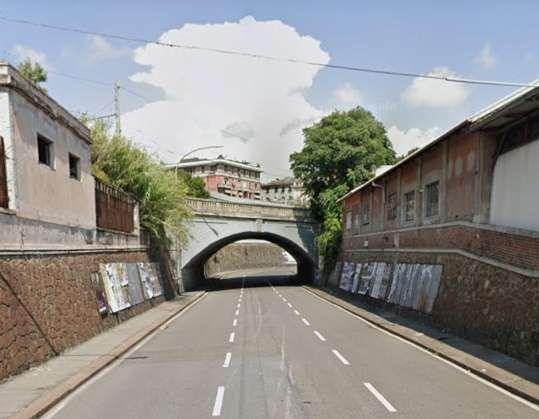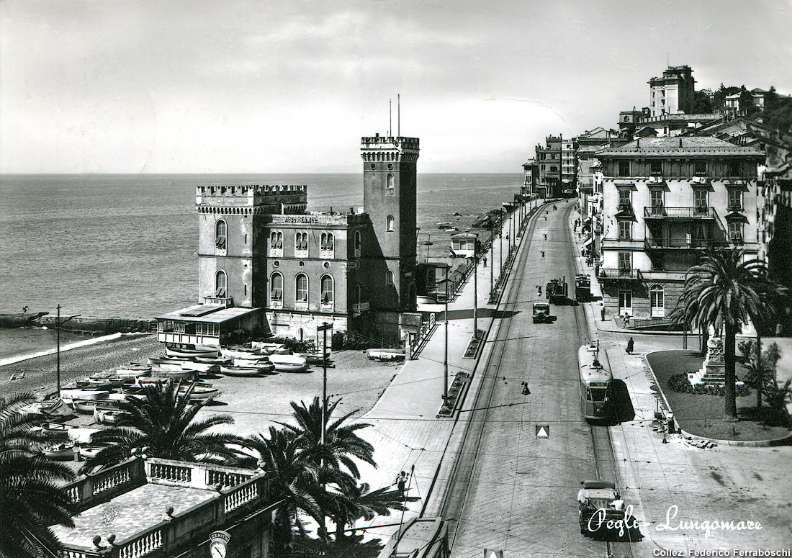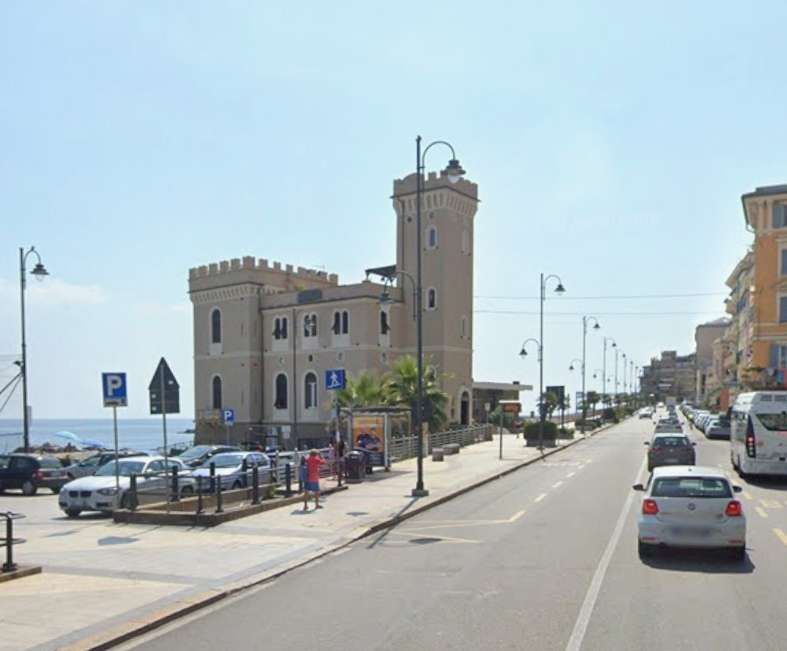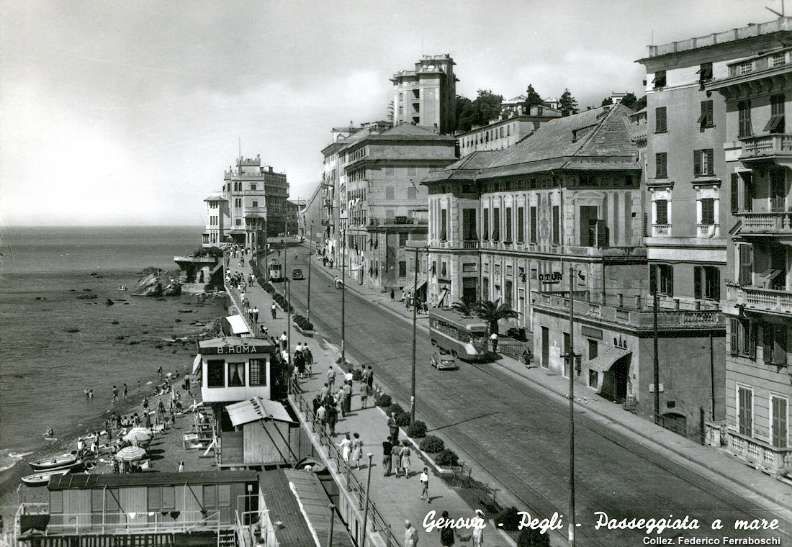
Tag Archives: Tram

Stockport’s 21st Century Trams and Transport for Greater Manchester’s Plans for the Future.

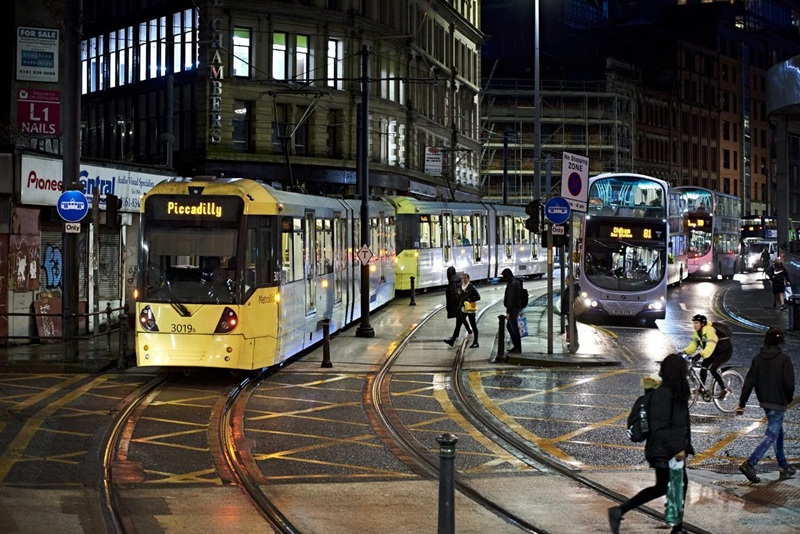
Transport for Greater Manchester (TfGM) has indicated that it is considering a plan to extending the already proposed East Finsbury to Stockport extension of the Metrolink tram network. The extension would utilise the underused railway line between Stockport and Denton.

Talk is of utilising tram-train technology on this possible new extension.

An extension to Metrolink could use the under-exploited Denton line, © Transport for Greater Manchester. [1]

Should this proposal be approved it would link Stockport to Tameside and could also provide a link to Manchester Airport

The Mayor of Greater Manchester, Andy Burnham spoke of bold plans to deliver a decade of growth for Greater Manchester. He said that “developing the Bee Network and delivering better bus, tram and train connections will be fundamental to [that] growth story.” [2]

He continued: “For too long, Denton has been overlooked and by working up the tram-train option to connect Denton and the wider area to the Metrolink is a big step toward unlocking opportunities for local residents and businesses. … We’re committed to extending Metrolink to Stockport and beyond as part of our efforts to connect all our districts to the tram network and delivering a truly integrated transport network for everyone.” [2]

TfGM is already working with Stockport Council to develop a business case for bringing trams to Stockport. The Strategic Outline Case [4] – the first step in the process – is exploring a ‘core’ extension from the existing Metrolink stop at East Didsbury to Stockport town centre. The extension through Denton is not part of those ‘core’ proposals but, “as part of the work on the business case, TfGM is also considering how this may unlock future extensions. One option being worked up includes using tram-train technology – where services can run on both tram and train tracks – to run beyond Stockport town centre along the Denton rail line, connecting the area firmly into the wider Metrolink network including links to Tameside and Manchester Airport.” [2]

Good progress has been made on the first stage of the Stockport Metrolink extension business case, with TfGM now working to complete all required technical work ahead of submission to the Department for Transport in early 2026. Construction on the ‘core’ element of the project could begin by the end of the decade, if approvals and funding are acquired.
Andrew Gwynne, MP for Gorton & Denton, said: “For years I’ve campaigned, alongside the local community, for improved transport links to Denton and across the constituency. I’m delighted that as part of the Metrolink extension plans, TfGM are looking seriously at using the rail line as an option for tram-train services. … Improved connectivity is key to opening up opportunities for our people and communities, and supporting the growth ambitions across the city region.”

Navendu Mishra, MP for Stockport, said: “Since my election to the House of Commons in December 2019, I have been pushing the Government to fund the extension of Manchester’s Metrolink tram network into my constituency of Stockport, and I thank the Secretary of State for Transport, the Chancellor and Transport for Greater Manchester for backing the extension to our town centre. … This will be a significant boost for Stockport’s connectivity and local economy, helping people to get to work, school and healthcare appointments more easily and sustainably as well as unlocking new homes and jobs.” [2]

Leader of Tameside Council, Cllr Eleanor Wills, said: “The options being developed to utilise the Denton rail line to expand Metrolink and better connect Ashton to Manchester Airport via Stockport have the potential to be truly transformational. …  The Ashton Mayoral Development Zone is an exciting and vital opportunity to unlock Ashton’s potential, providing new homes and quality jobs. With even better transport links we can set ourselves up to for good growth for many years to come.” [2]

Leader of Stockport Council, Cllr Mark Roberts, said: “I’ve always said when it comes to MetroLink that it should be ‘Next Stop Stockport not Last Stop Stockport’ to the help deliver the ambition we have -the delivery of Metrolink and improving public transport connectivity across the borough and Greater Manchester is something we can all get behind.” [2]

TfGM says: “With Greater Manchester embarking on a decade of good growth, the city region is committed through the Greater Manchester Strategy to developing a transport system for a global city region – with 90% of people within a five-minute walk of a bus or tram that comes at least every 30 minutes.” [2]

In June 2025, the government awarded Greater Manchester £2.5 billion through Transport for the City Regions funding for a pipeline of projects including a tram line to Stockport and tram-train services connecting Oldham, Rochdale, Heywood and Bury, new Metrolink stops and modern new interchanges. … The £2.5 billion is part of a package of investment Greater Manchester is seeking to deliver its growth ambitions in full – with the city region seeking to work collaboratively with Government on exploring new funding models for major transport and other infrastructure projects. [3]
As of December 2025, Metrolink is the UK’s largest light rail network, with 99 stops connecting seven of the 10 boroughs of Greater Manchester. Record numbers of people are also getting onboard, with 45.6 million trips made in 2024 – up from 33.5m trips in 2022. [2]

The £2.5 billion investment for the Greater Manchester city-region is targetted at enabling the Bee network become fully-electric, zero-emission public transport system by 2030. Local rail lines will be brought into the Bee Network by 2030, fully integrated bike, bus, tram and train travel for the first time outside London. New electric buses, tram lines, tram stops and transport interchanges are among pipeline of projects which will deliver far-reaching benefits across Greater Manchester. Mayor Andy Burnham said that further progress on the next phase of the Bee Network will now be delivered at an unrelenting pace.

Greater Manchester will create an all-electric local public transport network:

“A thousand new EV buses will form a 100% electric fleet serving its communities. Alongside trams powered by renewable energy and e-bikes for hire, it will deliver an emission-free network. This will build on progress already made to cut CO2 emissions and improve air quality.” [3] (Image, © Transport for Greater Manchester.)

Greater Manchester will bring rail into the Bee Network. “Local rail lines will be integrated with the Bee Network, … the move will see major improvements to stations, including making more fully accessible, as well as capped fares.” [3]

Greater Manchester will deliver major projects to drive green growth. “A pipeline of transport projects – including a tram line to Stockport and tram-train services connecting Oldham, Rochdale, Heywood and Bury, new Metrolink stops and modern new interchanges – will support the delivery of thousands of new homes, skilled jobs and green growth.” [3]

Greater Manchester’s current transport strategy is made up of a number of documents, including:

  • Greater Manchester Transport Strategy 2040.
  • A Five-Year Transport Delivery Plan 2021-2026 (including 10 local implementation plans).
  • Several supporting sub-strategies that all contribute to meeting regional transport ambitions and building the Bee Network.

In 2025, Greater Manchester are currently working on a new strategy – the Greater Manchester Transport Strategy 2050 – that will replace the current documents. [5]

You can find out more about the Greater Manchester Transport Strategy 2040 using these links:

Download the Greater Manchester Transport Strategy 2040. [6]

Download the Greater Manchester Transport Strategy 2040: Executive Summary. [7]

The Greater Manchester Transport Strategy 2050 has been promoted by Mayor Andy Burnham. [8]

Plans for a subway network in the city centre could become reality by 2050 if Greater Manchester makes good on ambitions set out within its latest rail strategy. … The 48-page strategy sets out a roadmap for the city region’s rail network, which needs to expand to keep pace with a growing population. … Among the highlights is the intention to develop an underground network by 2050.” [8]

Starting at Piccadilly, where the city wishes to create a subterranean through-station as part of Northern Powerhouse Rail, the underground would provide increased network capacity without significant land take. … Taking Metrolink below ground [could] also minimise the disruption that would be caused if works were to take place at street level and push Manchester towards its target of doubling the number of intercity trips made by rail.” [8]

The ripple effects of taking the network underground include easing the pressure on the Castlefield Corridor, ‘one of the most overburdened rail routes in the country’, according to the strategy.” [8]

The underground plan is just one part of the strategy for the city-region strategy that also includes upgrading stations, introducing tram-train technology on existing rail lines to widen the Metrolink’s reach, and delivering the Northern Arc – a new line between Manchester and Liverpool that would ultimately form part of Northern Powerhouse Rail. Land around rail hubs in the city region, including a huge development opportunity at Piccadilly similar in scale to that at Kings Cross, could support the delivery 75,000 new homes and unlock £90bn in economic uplift across the North West by 2050.

According to Andy Burnham,  “Greater Manchester’s rail network plays a vital role in supporting [its] communities, powering [its] economy, and opening doors to opportunity – but for long has been held back from its true potential. … The way projects and services are planned and delivered is changing, with long needed reform giving the city-region a once-in-a-generation opportunity to reshape rail for Greater Manchester.” [8]

A year after the rail vision was unveiled a more simplified fare system on the Bee Network was announced. Andy Burnham said: “Simplifying rail fares is a key first step in making train travel easier and more accessible and the key to bringing local rail services into the Bee Network from December 2026. … Greater Manchester has a proud railway heritage, and our vision, developed with the industry, is about ensuring that everyone in our city-region can benefit from better connections, more reliable services, and a transport network that meets the needs of future generations.” [8]
Sitting beneath the city-region strategy is the more local SEMMMS (South-East Manchester Multi-Modal Strategy) which was settled in 2001 and the much later SEMMMS Refresh (2018) which identified measures required to meet future transportation needs in the Southeast of the city region centred on Stockport. These measures included: Metrolink/tram-train routes to Marple, Stockport town centre, the airport and Hazel Grove; segregated bus routes and bus priority schemes; improved rail services and new/ improved rail stations; new roads e.g. A6 to M60 Relief Road; new and improved walking and cycling routes and facilities on and off the highway; improved public realm in the district and local centres; creation of connected neighbourhoods that encourage the use of more sustainable forms of transport; the provision of transportation infrastructure needed to be supported by the introduction of smarter choices to encourage the use of sustainable transport. [9][10][11]

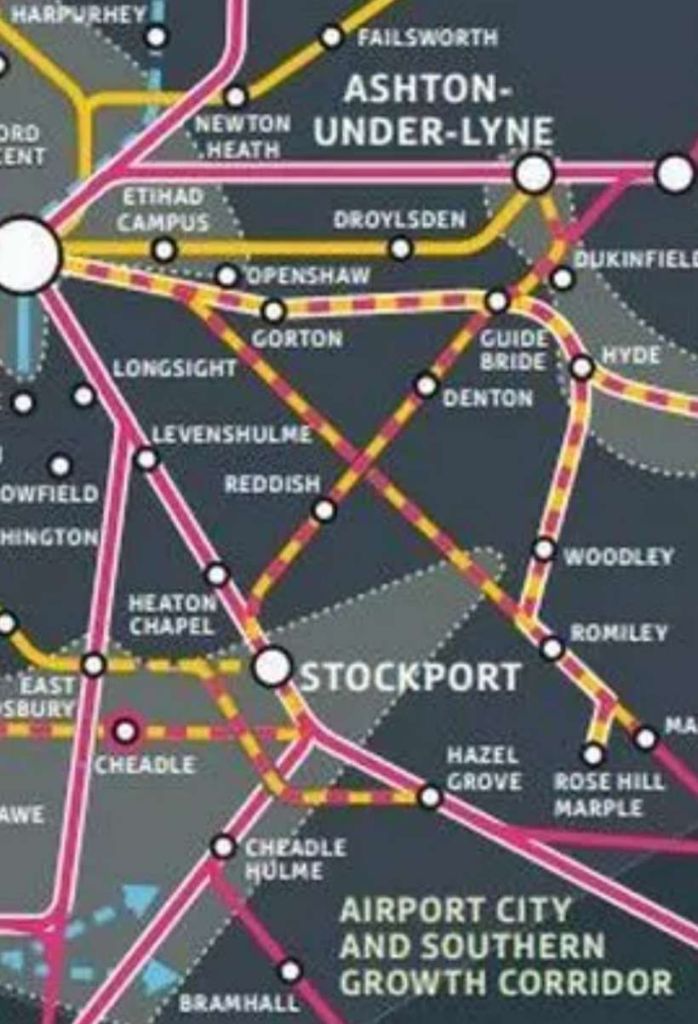
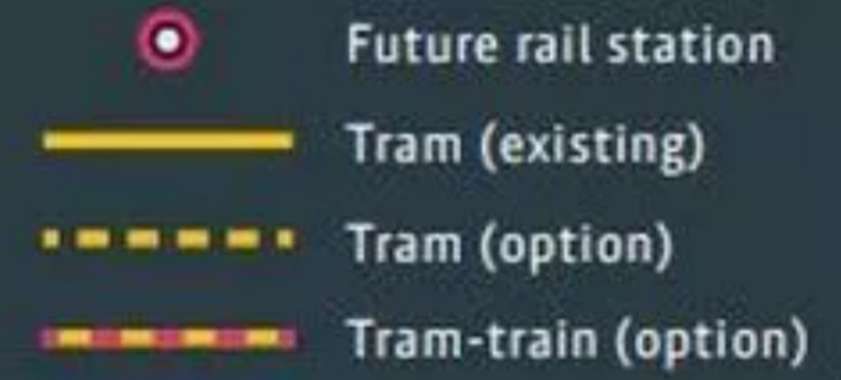
An extract from the TfGM plan for transport, looking forward towards 2040. It is intended that a tram-train service will run North from Stockport through Reddish, Denton and Guide Bridge to Ashton-under-Lyne. A similar service is planned to connect from Manchester Airport through Cheadle to Hazel Grove with a link North into Stockport to connect with the line through Denton. This schematic plan also shows the link from East Didsbury into Stockport. [12]

And finally …

Railway-News.com reported on 10th December 2025 that on 9th December 2025, TfGM Launched a Consultation on Future of Public Transport. The consultation invites people who live, work, travel, visit or study in Greater Manchester to help shape the future of the city region’s travel network by giving their views on the new GM Transport Strategy 2050, as well as the GM Transport Delivery Plan (2027-37). [13]

The proposed Plan will set out a framework “for how the Bee Network might be utilised to help Greater Manchester continue to become the growth capital of the UK through to 2050, whilst also addressing inequality and creating a greener city region.” [13]

The Consultation will run until 9th March 2026.
Backed by 2.5 billion GBP in government funding; TfGM’s plans “aim to deliver a number of transport projects through to the 2030s, resulting in what TfGM intends to be a world-class transport system. They will support both overall economic growth and the delivery of the new £1 billion Greater Manchester Good Growth Fund, which will in turn pump-prime a set of projects, drive growth and generation and ensure equal spending across the city region as a whole.” [13]

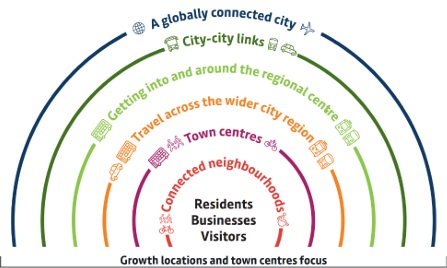
Additional development of the Bee Network, as well as a more reliable highways network, are set to underpin the new approach, which aims to better connect communities with locations, jobs and services. (Image, © Transport for Greater Manchester.) [13]

The Bee Network is set to begin incorporating rail services by 2028, with TfGM aiming to provide 90% of the city region with five-minute access to a bus or tram that arrives at least every 30 minutes.” [13]

GM transport strategy and delivery plans include keeping the local transport network safe and reliable via the renewal and maintenance of roads, Metrolink network and rail facilities; simplifying of fares, ticketing, bus services and introduction of new stops and services, as well as interchanges, Metrolink lines and expanded walking, wheeling and cycling networks; and the transformation of all local rail lines by incorporating them into the Bee Network.” [13]

A detailed delivery programme listing schemes is set out in the GM Transport Delivery Plan 2027 – 2037, which is split into three phases, along with works in the regional centre and a wider ongoing set of works across the city region.” [13]

In addition to online feedback; a series of face-to-face drop-in sessions are planned to take place across Greater Manchester. The documents which are available to read online through clicking on these links:

https://www.gmconsult.org/transport/transport2050/user_uploads/gm-transport-strategy-2050—–final-consultation-draft.pdf [14]

and

https://www.gmconsult.org/transport/transport2050/user_uploads/gm-transport-delivery-plan—–final-consultation-draft.pdf [15]

For an overview of both documents, please click here. [16]

TfGM want to hear from anyone with an interest in the future of transport in Greater Manchester. They outline how you can respond here. [17] The deadline for participation is 9th March 2026.
Returning to where this article started, this is what the consultation draft of the Greater Manchester Transport Strategy 2050 document says about Stockport:

Stockport town centre: Over the last decade, Stockport Council has spearheaded a £1bn transformation of its town centre. One of the UK’s largest town centre regeneration programmes, it has enabled the town to buck the trend of decline, with successful schemes across leisure, commercial and residential uses. Since 2019 Stockport Mayoral Development Corporation (MDC) has played a powerful role in accelerating this transformation, delivering a residential led masterplan for Stockport Town Centre West. The MDC is a radical new approach to tackling future housing need and the changing role of town centres, delivered through a unique collaboration between the GM Mayor and Stockport Council. It brings together powers devolved to the Greater Manchester Mayor, combined with strong local leadership from Stockport Council and the long-term commitment of the government’s housing agency, Homes England, to deliver an ambitious vision for the future of Stockport town centre. Over the past 6 years in collaboration with its many partner organisations the MDC moved from innovative concept to proven delivery vehicle, with over 170,000 sq. ft. new Grade A offices at Stockport Exchange, 1,200 new homes completed or on site and a state-of-the-art new transport Interchange with two-acre rooftop park. Reflecting this success and the Council’s continued growth ambitions, in 2025 the Council and GMCA agreed to expand the boundary of the MDC to cover the whole of the town centre and doubling its housing target to 8,000 homes by 2040.” [14]

References

  1. https://railway-news.com/tfgm-exploring-plans-to-bring-trams-to-stockport, accessed on 4th December 2025.
  2. https://news.tfgm.com/press-releases/c956a710-e894-49ab-b1de-1b8fb97e7859/underused-denton-rail-line-being-considered-as-part-of-case-to-take-trams-to-stockport, accessed on 4th December 2025.
  3. news.tfgm.com/press-releases/897ce680-87a9-4349-a632-b477b1a8330f/greater-manchester-s-2-5-billion-funding-boost-to-unlock-uk-s-first-fully-integrated-zero-emission-public-transport-network, accessed on 4th December 2025.
  4. A Strategic Outline Case (SOC) is the first part of developing a business case for major infrastructure projects. The two further stages are the Outline Business Case (OBC) followed by the Full Business Case (FBC). In the case of extending Metrolink to Stockport approval is required from the Department for Transport (DfT) to progress through each stage.
  5. https://tfgm.com/strategy, accessed on 4th December 2025.
  6. https://assets.ctfassets.net/nv7y93idf4jq/01xbKQQNW0ZYLzYvcj1z7c/4b6804acd572f00d8d728194ef62bb89/Greater_Manchester_Transport_Strategy_2040_final.pdf, accessed on 4th December 2025.
  7. https://assets.ctfassets.net/nv7y93idf4jq/6tfus0lbLRvTlR64knc3g7/db49b54dc2e8f3dd29416ab560e1a6fe/21-0003_2040_Transport_Strategy_Exec_Summary.pdf, accessed on 4th December 2025.
  8. https://www.placenorthwest.co.uk/burnham-sets-target-of-2050-for-manchester-underground, accessed on 4th December 2025.
  9. http://www.semmms.info, accessed on 4th December 2025.
  10. https://consultation.stockport.gov.uk/policy-performance-and-reform/semmms/supporting_documents/SEMMMS%20Report.pdf, accessed on 4th December 2025.
  11. http://www.semmms.info/wp-content/uploads/SEMMMS-Consultation-Report.pdf, accessed on 4th December 2025.
  12. https://www.manchestereveningnews.co.uk/news/greater-manchester-news/new-metrolink-map-tram-manchester-29510064, accessed on 6th December 2025.
  13. https://railway-news.com/tfgm-launches-consultation-on-future-of-public-transport/?dtt=&email_address=rogerfarnworth@aol.com&utm_source=newsletter&utm_medium=email&utm_campaign=RN-week50b-2025, accessed on 11th December 2025.
  14. https://www.gmconsult.org/transport/transport2050/user_uploads/gm-transport-strategy-2050—–final-consultation-draft.pdf, accessed on 11th December 2025.
  15. https://www.gmconsult.org/transport/transport2050/user_uploads/gm-transport-delivery-plan—–final-consultation-draft.pdf, accessed on 11th December 2025.
  16. https://www.gmconsult.org/transport/transport2050/user_uploads/gm-transport-strategy-and-delivery-plan-summary—consultation-draft.pdf, accessed on 11th December 2025.
  17. https://www.gmconsult.org/transport/transport2050, accessed on 11th December 2025.

Genoa’s Early Tram Network – Part 1 – General Introduction, Tunnels, The Years before World War One, and the Early Western Network.

Introduction and Early History

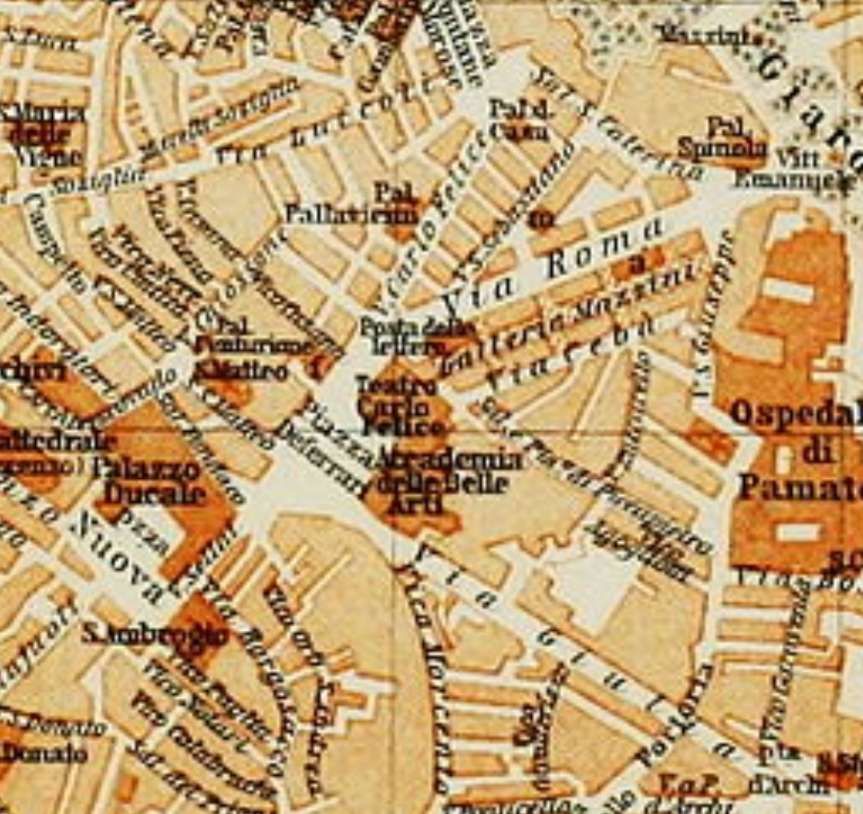
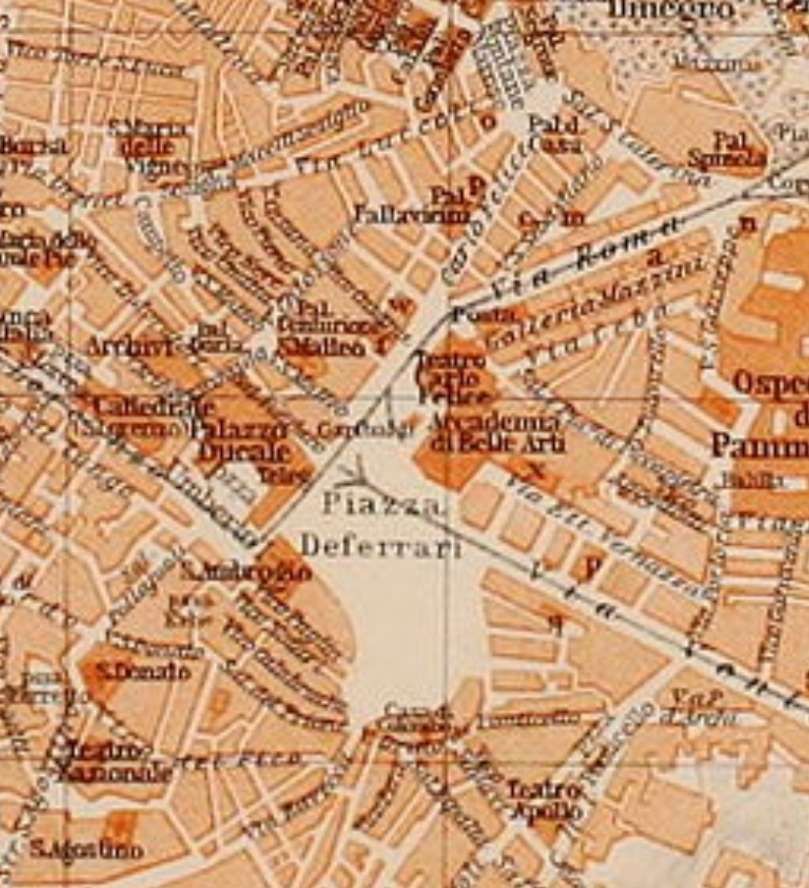
We begin this article with a look at maps of the Piazza Raffeale de Ferrari and its immediate environs over the years around the turn of the 20th century. The Piazza became one of two focal points for tramways in the city (the other was Caricamento).

I found the series of maps interesting and they provoked a desire to find out more about the network of horse-drawn and later electric trams and tramways of Genoa. ….

This map of 1886 shows the Piazza Raffeale de Ferrari a little to the left of the centre. Via Carlo Felice runs away from the Piazza to the North-northeast, Via Roma to the Northeast. The map extract is taken from the Italy Handbook for Travellers of 1886 produced by Karl Baedeker, © Public Domain. [10]
This map of 1906 is taken from Karl Baedeker’s Italy Handbook for Travellers. It shows an enlarged Piazza Raffeale de Ferrari, © Public Domain. [11]
This version of the map was produced for the 1913 Baedeker guide. This has tramways shown and the Piazza is beginning to take a shape that is more recognisable in the 21st century, © Public Domain. [12]

Italian Wikipedia informs us that: “The first public transport in Genoa was provided by a horse bus service linking the city centre and Sampierdarena, that started in 1873. In 1878, the French company Compagnia Generale Francese de Tramways (CGFT, French General Company of Tramways) began to build a horse tram system.” [16][17]

A map of the horse-drawn tramways operated by the French company Compagnia Generale Francese de Tramways, © Arbalete and licenced for reuse under a Creative Commons Licence (CC BY-SA 2.0). [19]

Towards the end of the century, the new urban plan led to the construction of new roads with wider carriageways, principal among these were:

  • Via Assarotti connecting Piazza Corvetto to Piazza Manin;
  • Via XX Settembre, built between 1892 and 1899, widening Strada Giulia and connecting the Palazzo Ducale (Piazza de Ferrari) with Porta Pila and the banks of the River Bisagno (once the eastern boundary of the city);
  • Corso Buenos Aires, once outside the city walls, was lowered to the level of Ponte Pila and the new Via XX Settembre, to form a single artery that would connect the centre with the Albaro district;
  • Corso Torino, perpendicular to Corso Buenos Aires.

After this work was done, the city began to look more modern and the widened streets made room for tramways in the centre and East of the city. The municipal administration began to plan new lines, both towards the eastern suburbs and in the central districts of the city. [19]

The city welcomed competition and set up a series of concessions which were given to different groups: the French Company kept the Western concession; Val Bisagno and the hilly areas to two Swiss businessman (Bucher & Durrer); and the east of the city was granted to a group of local businessmen. [19][20: p66]

The two parties, other than the French, formed companies:  Bucher created the Società di Ferrovie Elettriche e Funicolari (SFEF) in 1891. [20: p85] The Genoese entrepreneurs founded the Società Anonima Tramways Orientali (SATO) in 1894. [20: p120] The two companies took on the two concessions which envisaged electric traction on metre-gauge lines to accommodate running on the narrow winding streets of the city centre. [19]

By 1894, SFEF had achieved no more than a single short electric tram line between Piazza Manin and Piazza Corvetto, whilst SATO had not progressed beyond the planning stage. The CGFT system had extended through the city and the Val Polcevera, but was still horse operated.” [16][17]

In 1894, the German company Allgemeine Elektrizitäts Gesellschaft (AEG) … bought both the SFEF and SATO companies. The following year AEG created the company Officine Electrical Genovesi (OEG), … which took over the city’s existing electricity supply company, and the Società Unione Italiana Tramways Elettrici (UITE), … which purchased the CGFT’s concession. By the end of 1895, AEG had a monopoly of both electricity supply and public transport provision in the city.” [16][17] Under AEG’s “ownership, SFEF and SATO developed a tram network of more than 53 km (33 mi) reaching Nervi and Prato, whilst UITE electrified their lines to Voltri and Pontedecimo.” [16][17]

As we have already noted, the first electric traction line connected Piazza Corvetto to Piazza Manin, running along Via Assarotti. [20: p92] It was activated by SFEF on 14th May 1893 [20: p96] The single-track line was 800 metres long and ran on a constant gradient of 7% [20: p95]; the tickets cost 10 cents. The electrification (600 V DC) was via an overhead cable and was carried out by AEG of Berlin, which, as we have already seen, later acquired a significant shareholding in the company. [19][20: p86-87]

In subsequent years the SFEF network expanded rapidly; in 1895-96 the Monte line to the North of the city centre entered into service, including the Sant’Ugo spiral tunnel; in 1896 the line from Piazza Principe to Piazza Brignole was born. It included two tunnels in the Castelletto area. [21: p20] , In 1897, the Val Bisagno line up to Prato began operation. [19][21: p26]

The first SATO line entered into service on 26th July 1897, connecting Piazza Raibetta to Staglieno through the Circonvallazione a Mare, [20: p122] followed two years later by the long coastal line to Nervi. [20: p127] In 1900 the eastern trams reached the central Piazza de Ferrari, travelling along the new Via XX Settembre which was formed through widening of the old Via Giulia. [19][21: p53]

The two networks, SFEF and SATO, were technically compatible and the two companies, both controlled by AEG, soon unified the two networks. [20: p142]

Finally in December 1901, AEG merged SFEF and SATO into an enlarged UITE.” [16][17]

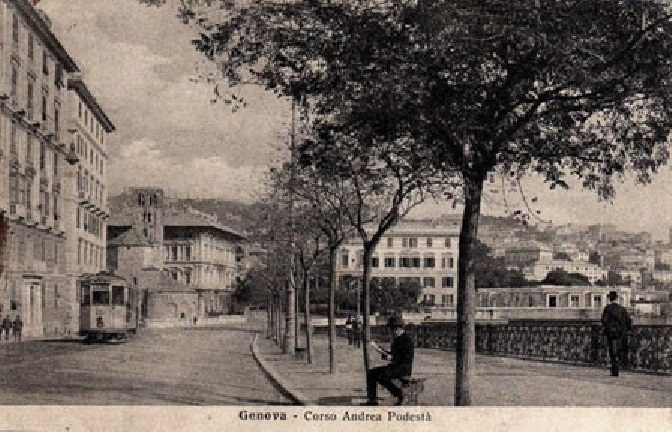
An early postcard image showing a tram at work on Corsa Andrea Podesta, © Public Domain. [19]
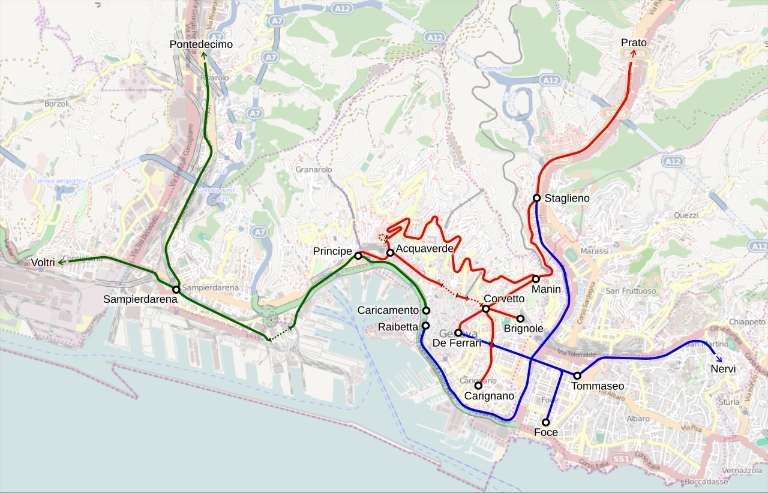
This map shows the three companies’ lines immediately prior to the date of unification under UITE. The Green lines were UITE (the former French Company). The Red lines were SFEF. The Blue lines were SATO, © Arbalete and authorisedd for reuse under a Creative Commons Licence (CC BY-SA 2.0. [19]

The enlarged UITE found itself managing 70 km of network, divided between the 30 km of the ‘Western network’: (formerly the French Company) and the 40 km of the ‘Eastern network’ (formerly SFEF and SATO). [20: p170-171] The unification of the network led to an increase in overall traffic, symbolised by the creation of the vast ring terminus in Piazza de Ferrari in 1906. [20: p129]

This seems the right time to look again at the ‘ring terminus’ in Piazza de Raffeale Ferrari. ….

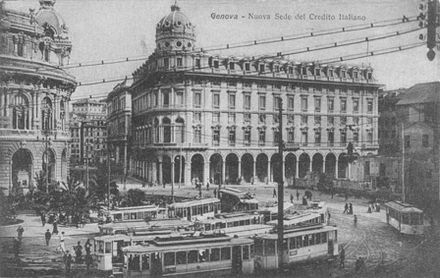
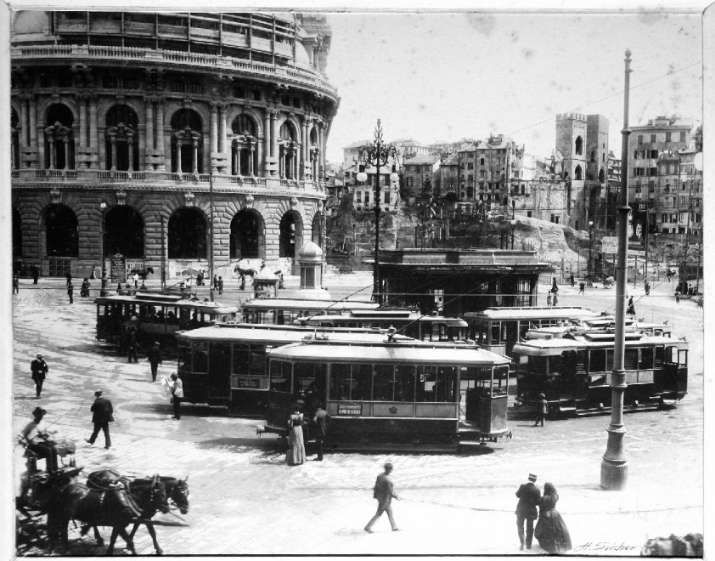
Trams on Piazza Raffeale de Ferrari Genoa (Genova), © Public Domain. [1]
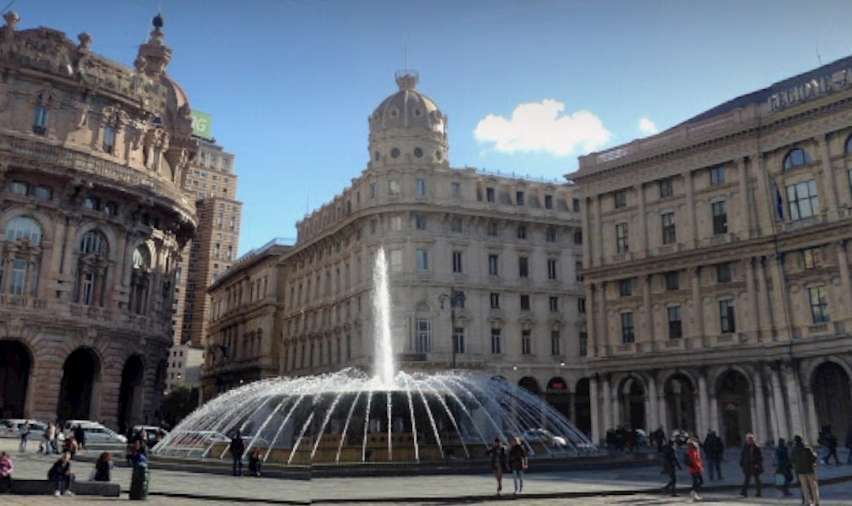
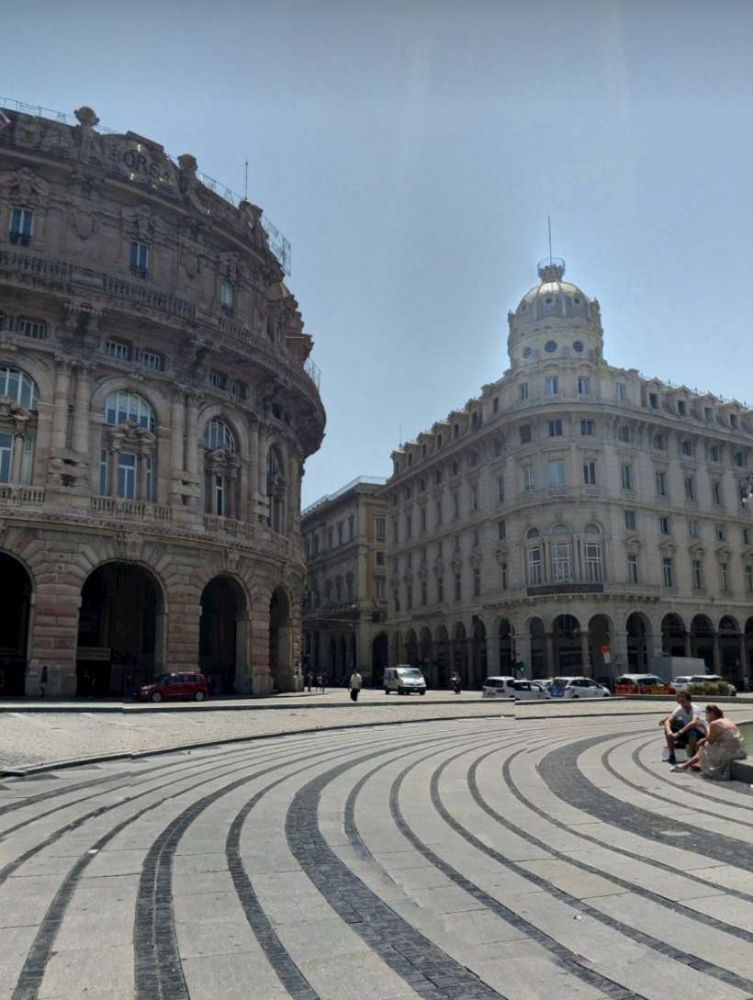
A similar view in the 21st century. [Google Streetview, 2015]
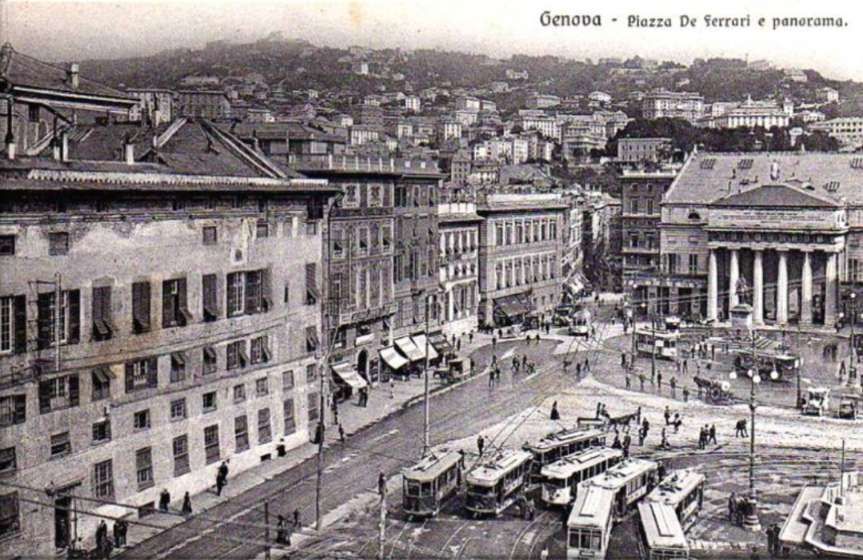
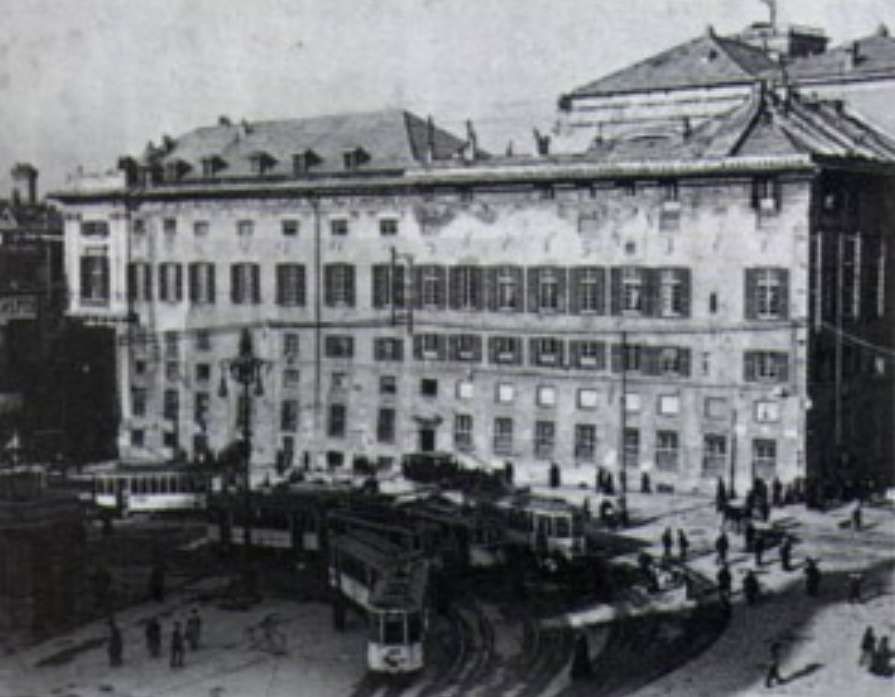
Trams on Piazza Raffeale de Ferrari, Palazzo Ducale is on the left of the photograph, © Public Domain. [7]
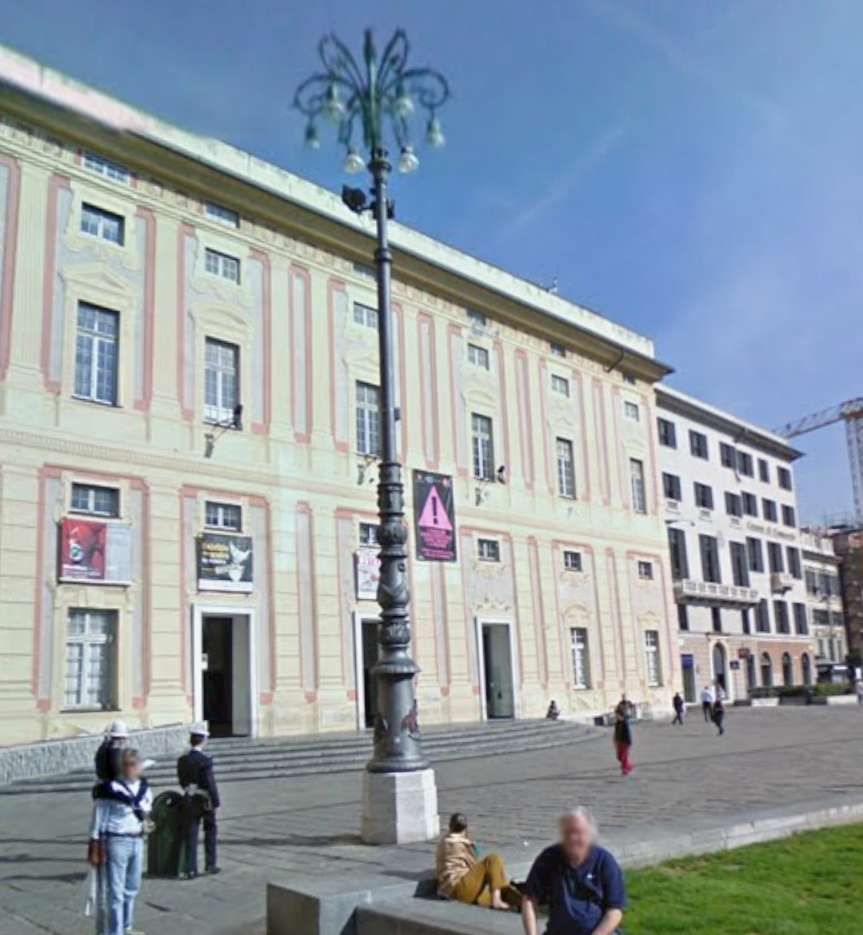
A ground-level view from a similar location.  [Google Streetview, 2009]
Another view of Piazza Raffeale de Ferrari and of Palazzo Ducale, © Public Domain. [8]
A similar view of Palazzo Scale from ground-level across the Piazza Raffeale de Ferrari. [Google Streetview, 2015]
Also on Piazza Raffeale de Ferrari, trams gather again! But when is this? The building to the right in the image below is not present in this image, yet is present in the image of the Piazza earlier in this sequence of images, © Public Domain.
From a similar direction as the image above. The building on the left is very much the same as the building on the left in the monochrome image above. Was that monochrome photo taken prior to the building on the right being built, or was the building destroyed during the First World War and then rebuilt at a later date? [Google Streetview, 2016]
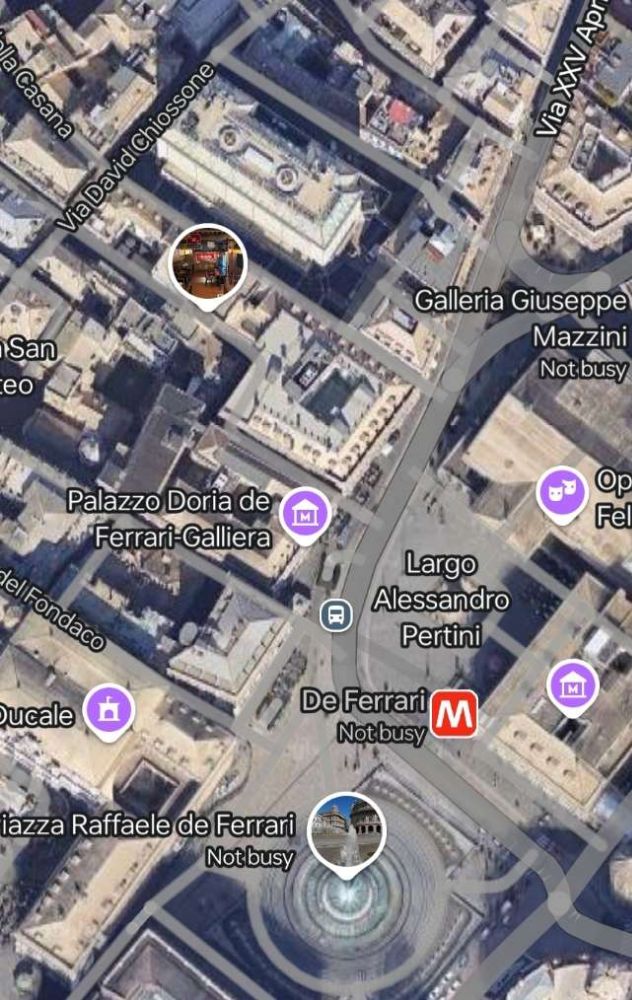
The Piazza Raffeale de Ferrari in the 21st century. North of the piazza, at the top-right of this image two streets run out of the piazza. Via Roma curves away to the Northeast and what was Via Carlo Felice (now Via XXV Aprile) heads North-northeast. [Google Maps, November 2024]
Piazza Raffeale de Ferrari, Via Roma (to the right of the building on the right side of this image), and Via Carlo Felice (now Via XXV Aprile), © Public Domain. [7]
The same location in the 21st century. Via Roma is on the right side of the building at the centre of this image. Via XXV Aprile (once Via Carlo Felice) is on its left. [Google Streetview, July 2015]

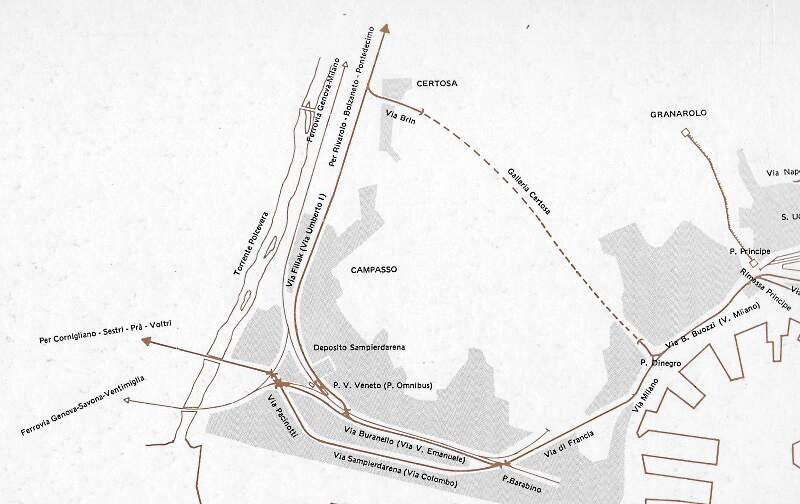
In 1908, after three years of construction work, Galleria Certosa (Certosa Tunnel) was put into use. It facilitated tram journeys to and from the Polcevera valley, avoiding the crossing of San Pier d’Arena. [19][21: p38] The tunnel connected Piazza Dinegro, in the port area, to the Rivarolo district in Val Polcevera. It was 1.76 km long. [22]

In 1934, Galleria Certosa was used every day by five lines: Tram No. 9 (San Giorgio-Rivarolo), tram No. 10 (San Giorgio-Bolzaneto), tram No. 11 (San Giorgio-Pontedecimo) and the two circular lines between San Giorgio and Sampierdarena. [22]

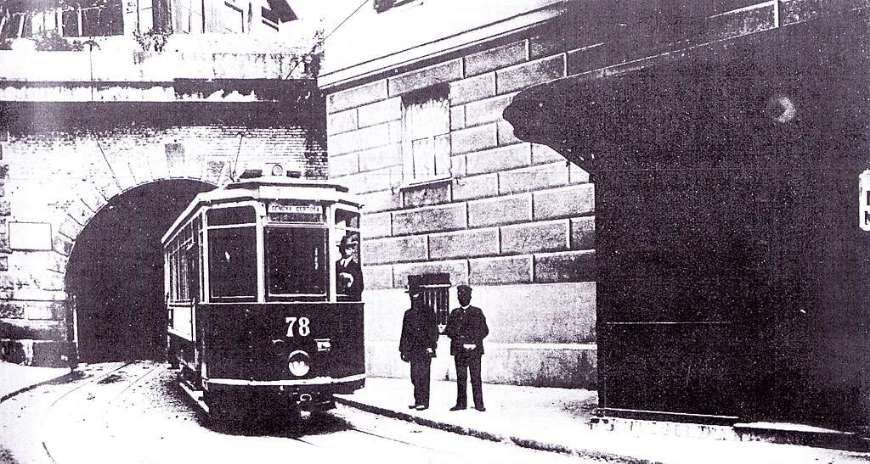
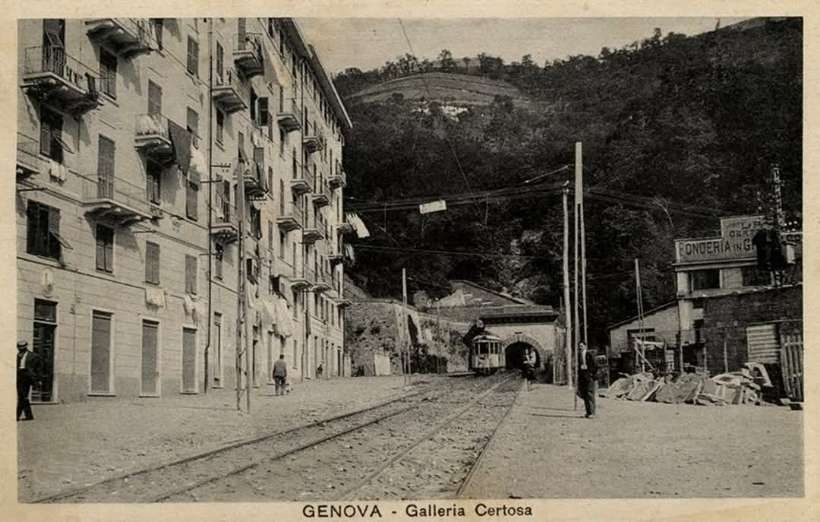
Tram No 78 at the southern entrance to Galleria Certosa, © Public Domain. [22]
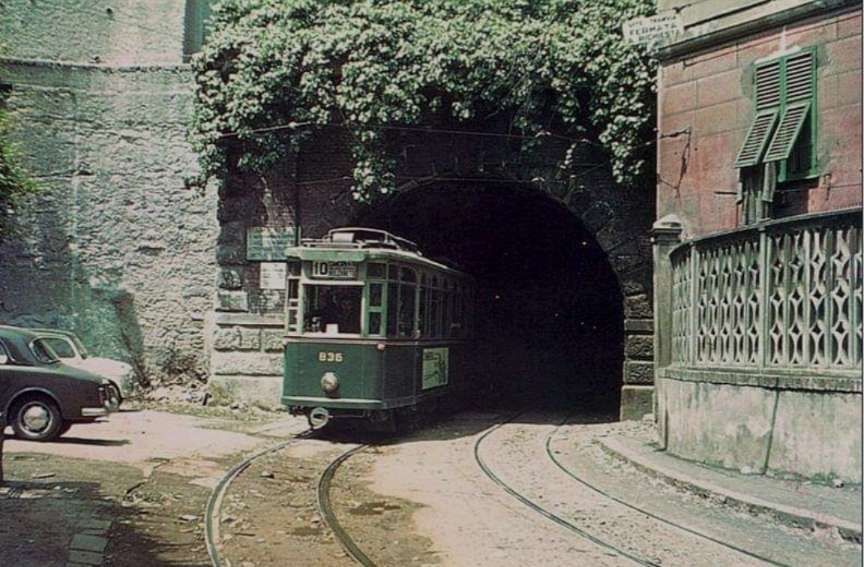
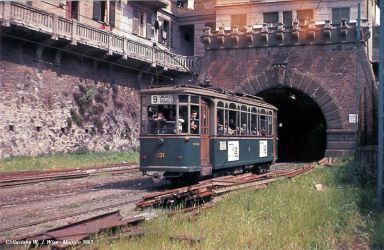
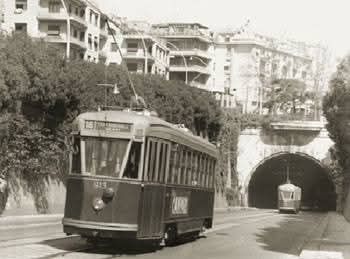
In the mid-20th century, Tram No 836 providing the No.10 service exits the South Portal of the tunnel. This image was shared by Paolo Siri on the Sei di Certosa Se … Facebook Group on 2nd February 2014. [23]
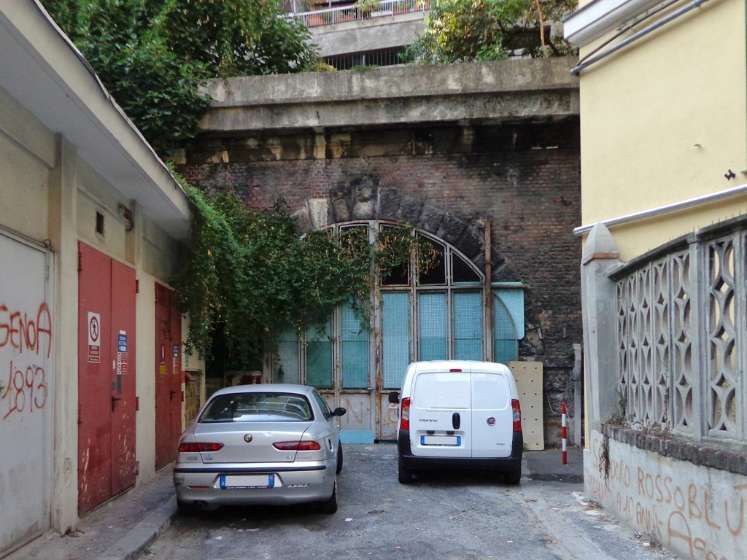
The South Portal (seen in the monochrome image above) is no longer in use, © Arbalete and authorised for reuse under a Creative Commons Licence (CC BY-SA 3.0) [22]
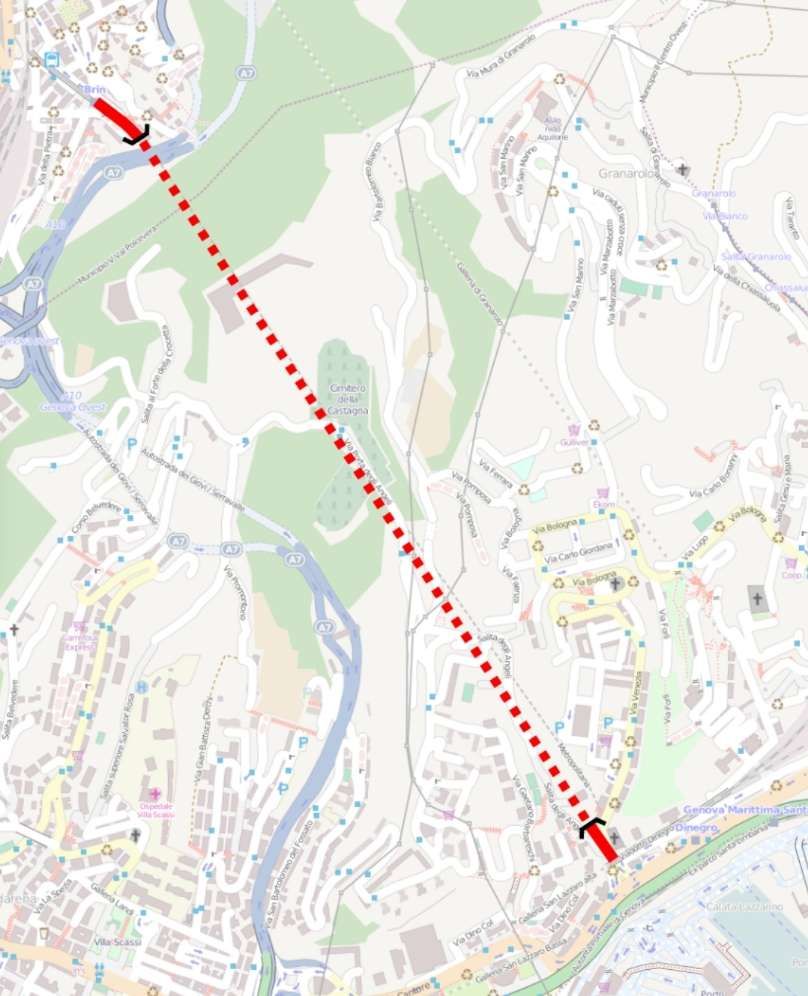
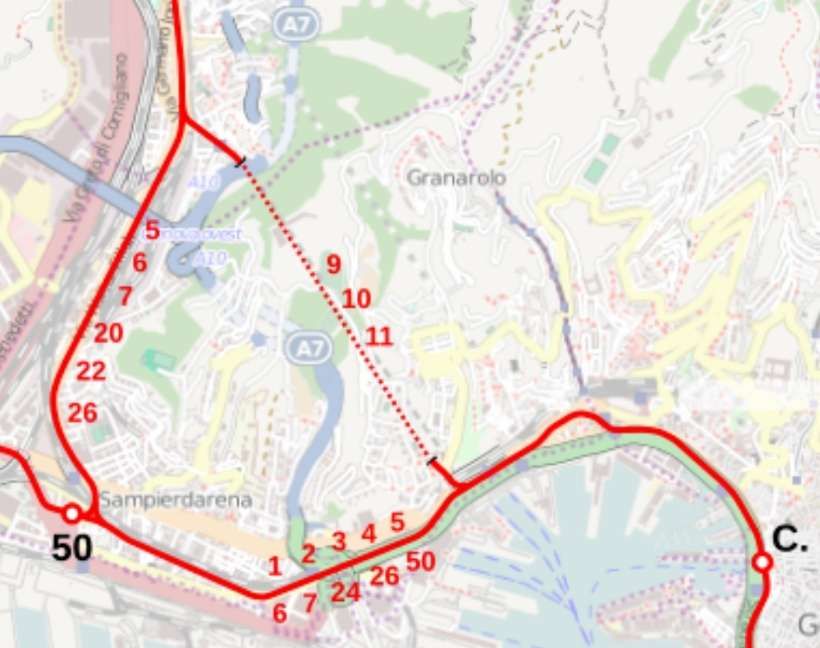
Galleria Certosa was a lengthy tunnel. It is shown here superimposed on a modern map of Genoa, © Arbalete and authorised for reuse under a Creative Commons Licence (CC BY-SA 3.0) [22]
A view looking towards Galleria Certosa from some distance to the Northwest through the site of what became Brin Metro Station. This image was shared on the Foto Genova Antica Facebook Group on 28th September 2020 by Pietro Spanedda, © Public Domain. [37]
Tram service No. 9 (Tram No. 831(?)) is about to enter the North portal of the tunnel. This image comes from the mid-20th century. [24]
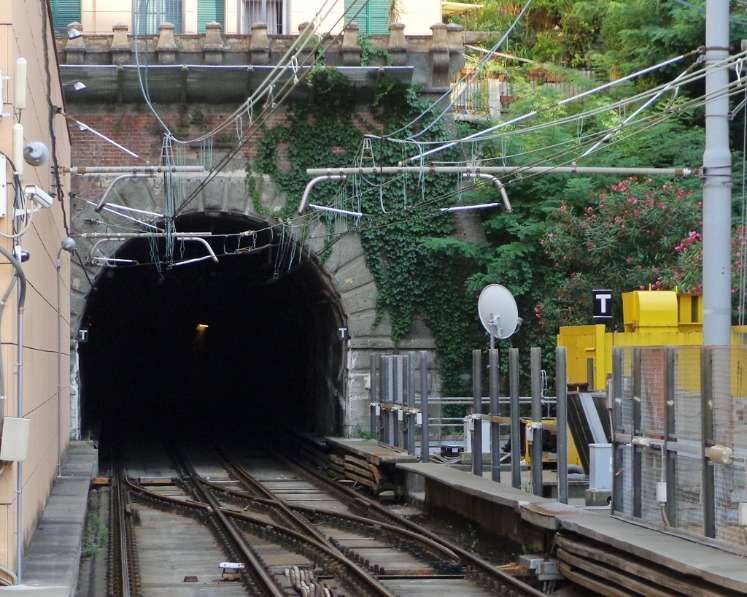
The North Portal of Galleria Certosa. Much of the tunnel is now used by the Metro. Brin Metro Station is immediately behind the camera, © Arbalete and authorised for reuse under a Creative Commons Licence (CC BY-SA 3.0) [22]

Tram Tunnels (Galleria)

Having noted the construction of Galleria Certosa in the early years of the 20th century (above), it is worth looking at some other tunnels which were built to facilitate the movement of trams.

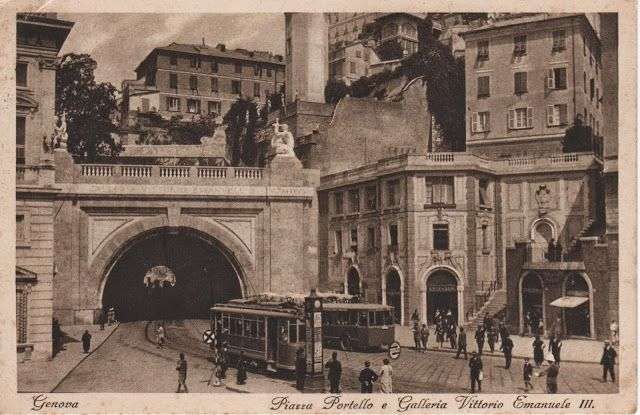
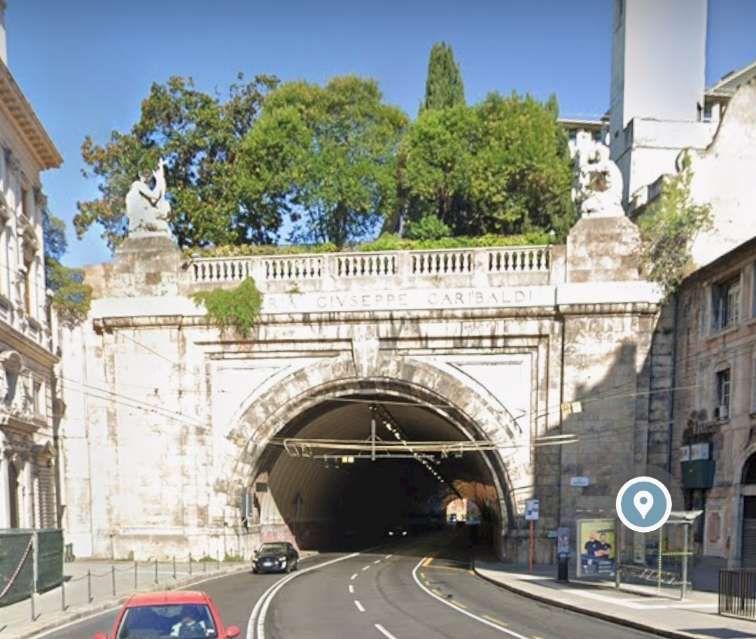
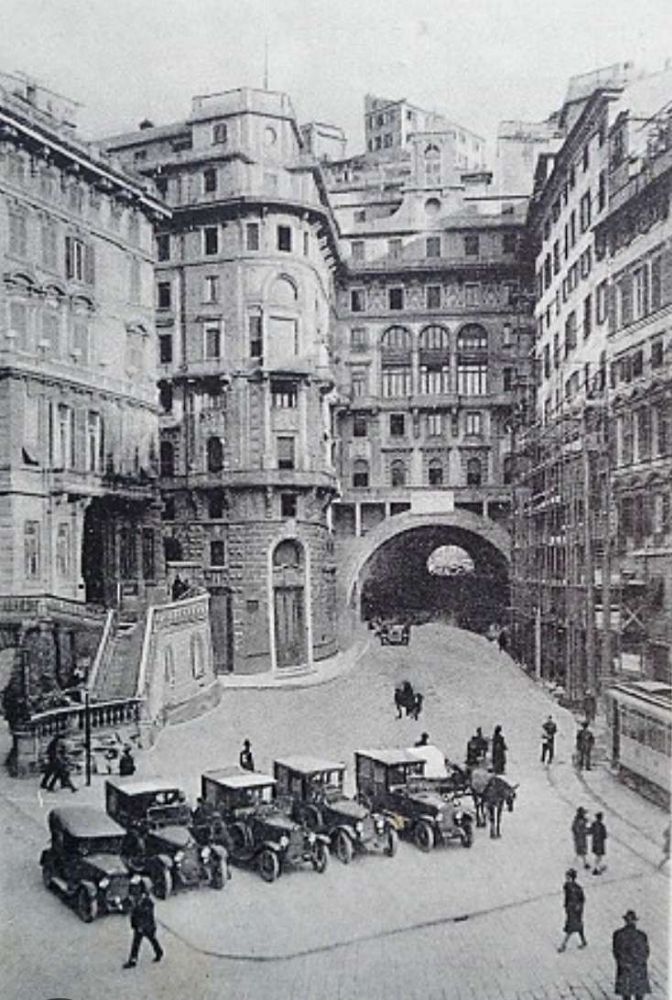
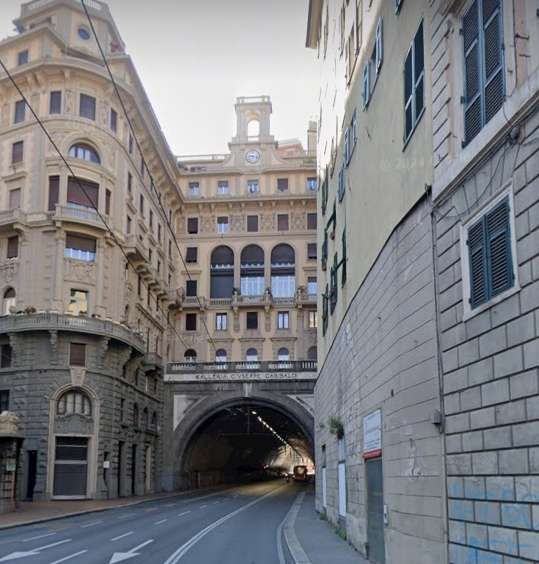
Galleria Vittorio Emanuele III (renamed Galleria Giuseppe Garibaldi on 27th November 1943)

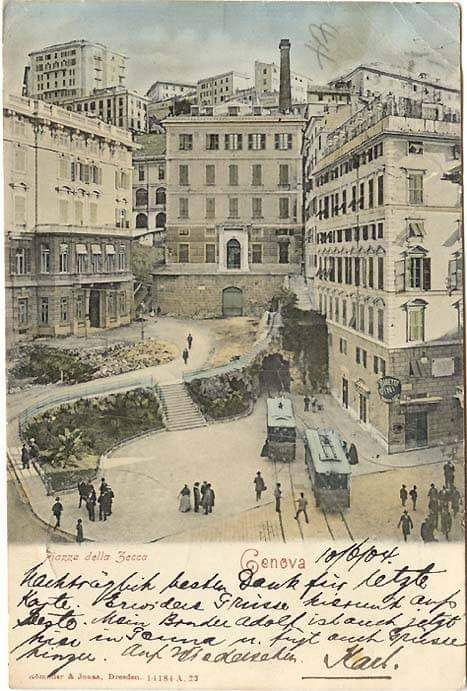
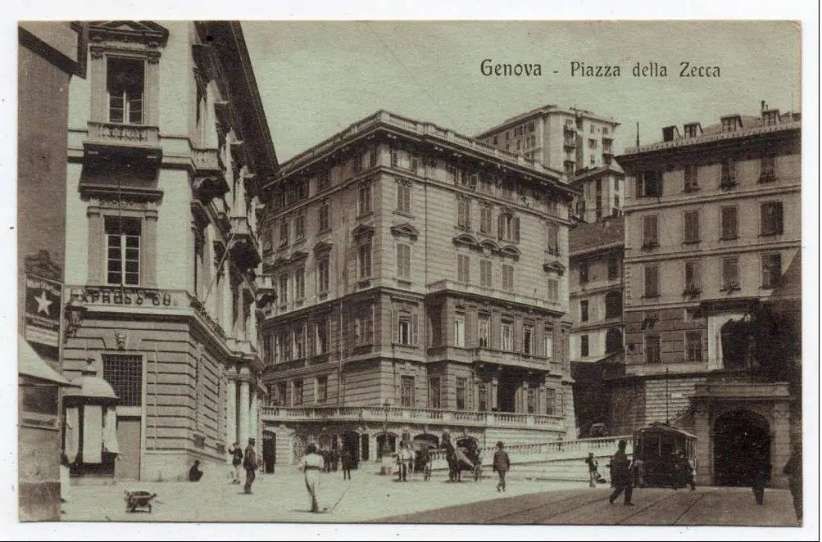
There seems to be quite a story to the life of this tunnel! The first two photographs show the first tunnel. They focus on the portal in Piazza Della Zeccan.

Piazza della Zecca with trams approaching and leaving a single track tunnel on the line of what will be Galleria Giuseppe Garibaldi. Piazza della Zecca has still not reached its fullest extent and the tunnel portal still has to be constructed, © Public Domain. [70]
Piazza della Zecca in a more complete form but still with a single track tunnel. [71]

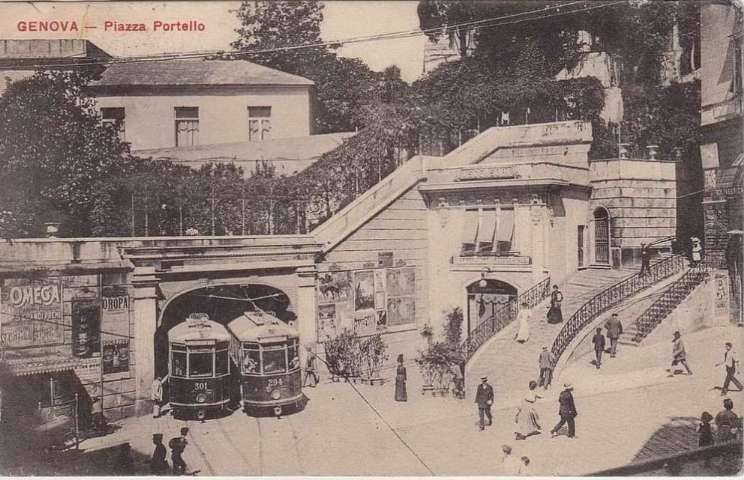
These next two photographs show the tunnel as it was first widened in the form which preceded the Galleria Vittorio Emanuele III which had a much smaller bore.

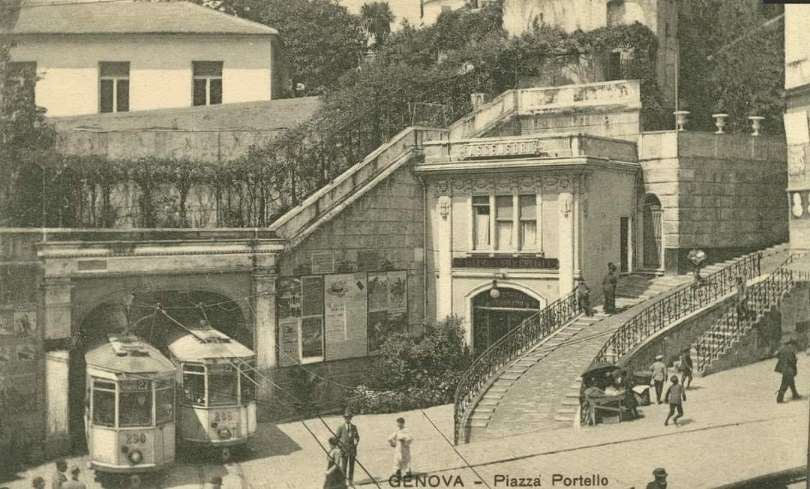
Two views of Piazza Portello with trams exiting and entering the Galleries which preceded Galleria Vittorio Emanuele III, © Public Domain. [38][39]
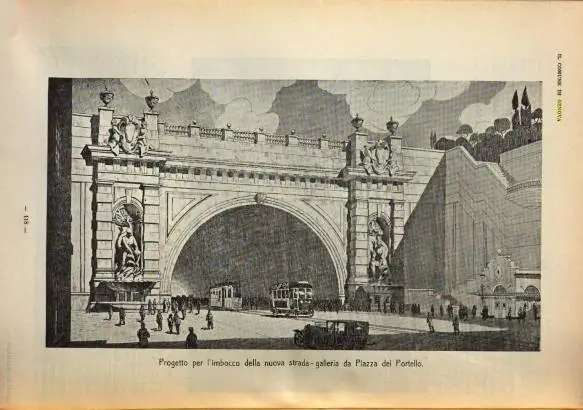
An engraving of the proposed Galleria Vittorio Emanuele III, © Public Domain. [26]
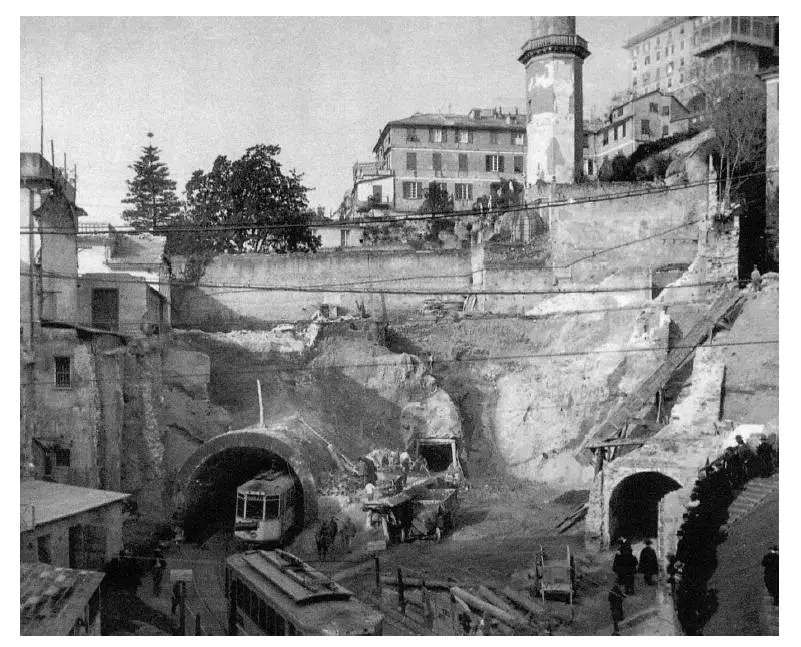
The Southeast end of Galleria Vittorio Emanuele III during construction with trams using the narrow older tunnel which preceded the larger bore seen on other photographs below, © Public Domain. [26]
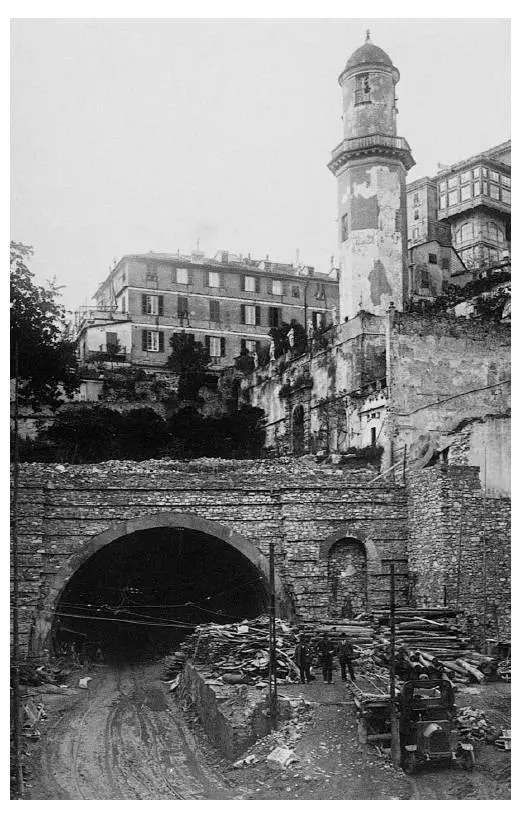
Galleria Vittorio Emanuele III later during construction work the full size bore is now complete but the decorative portal still has to be built, © Public Domain. [26]
A postcard view of the Southeast Portal of Galleria Vittorio Emanuele III (later Giuseppe Garibaldi), © Public Domain. [26]
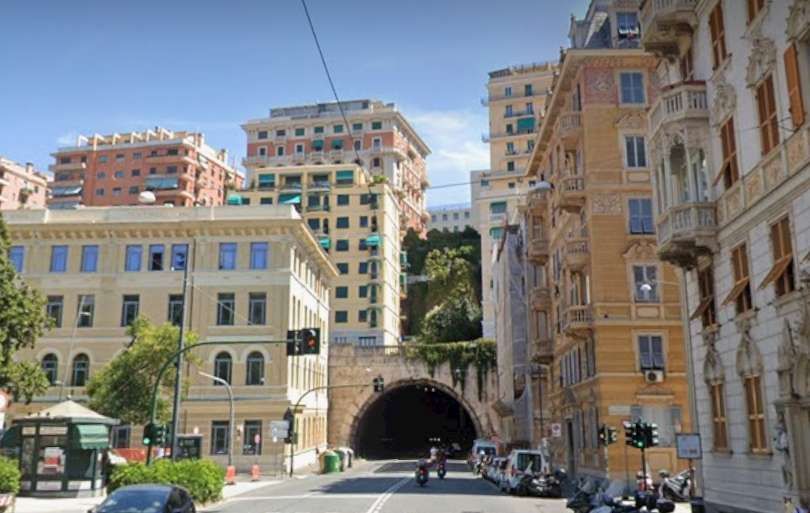
The Southeast Portal of Galleria Giuseppe Garibaldi in the 21st century. [Google Streetview, August 2024]
The Northwest Portal of Galleria Vittorio Emanuele III (later Giuseppe Garibaldi) soon after construction, © Public Domain. [25]
A 21st century view of the Northwest portal of Galleria Giuseppe Garibaldi. [Google Streetview, August 2024]

Galleria Sant’Ugo

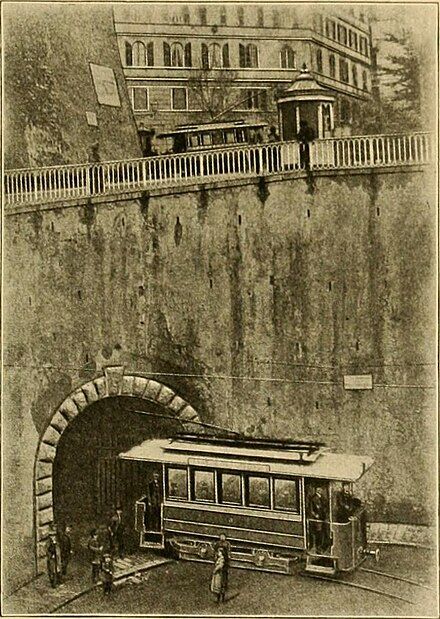
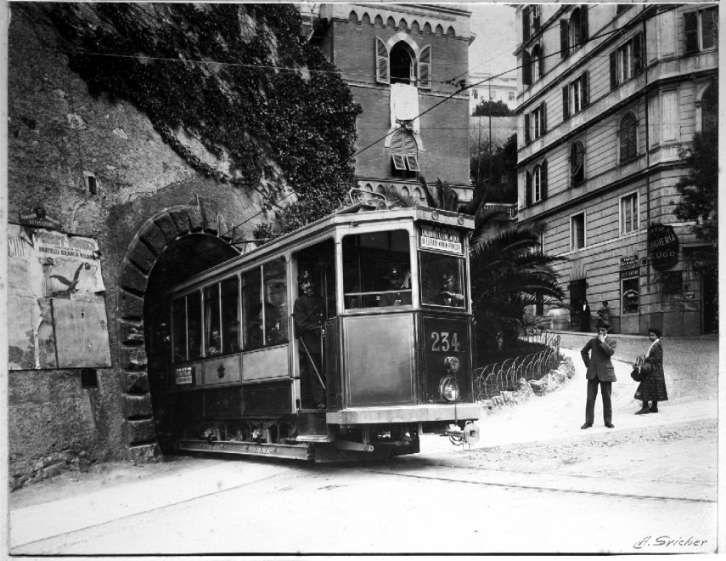
A tram at the lower Portal of Galleria Sant’Ugo, © Public Domain. [27]
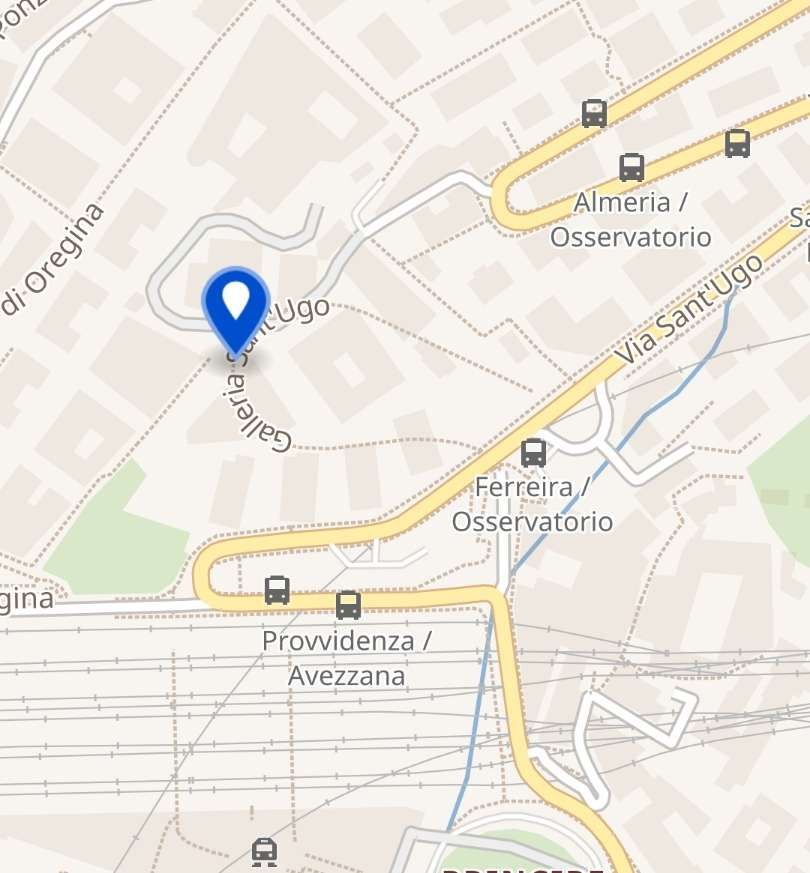
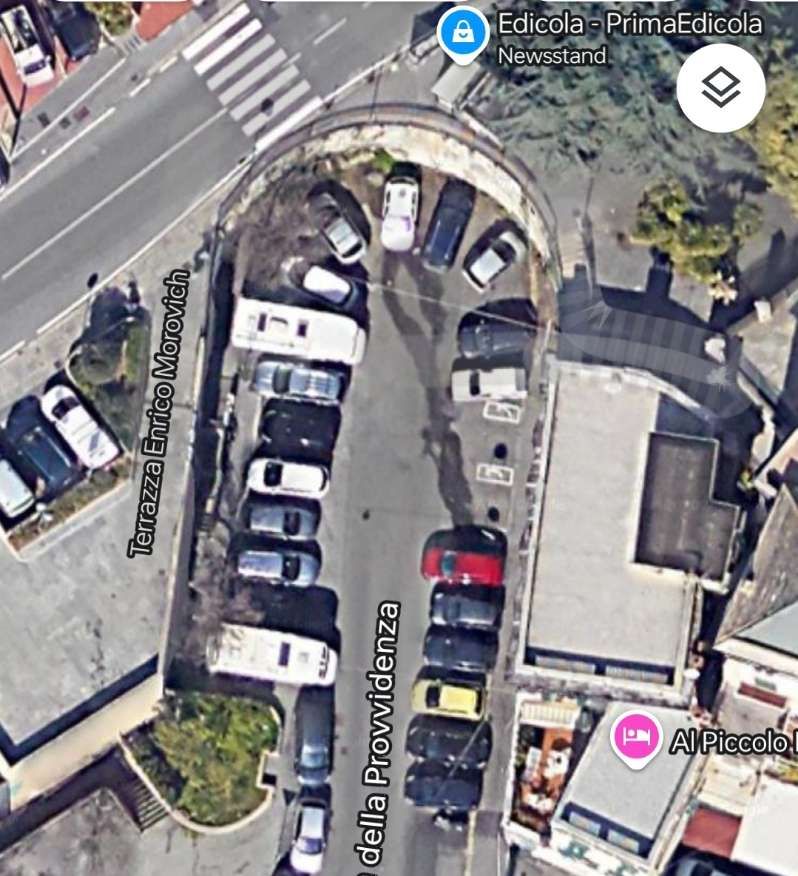
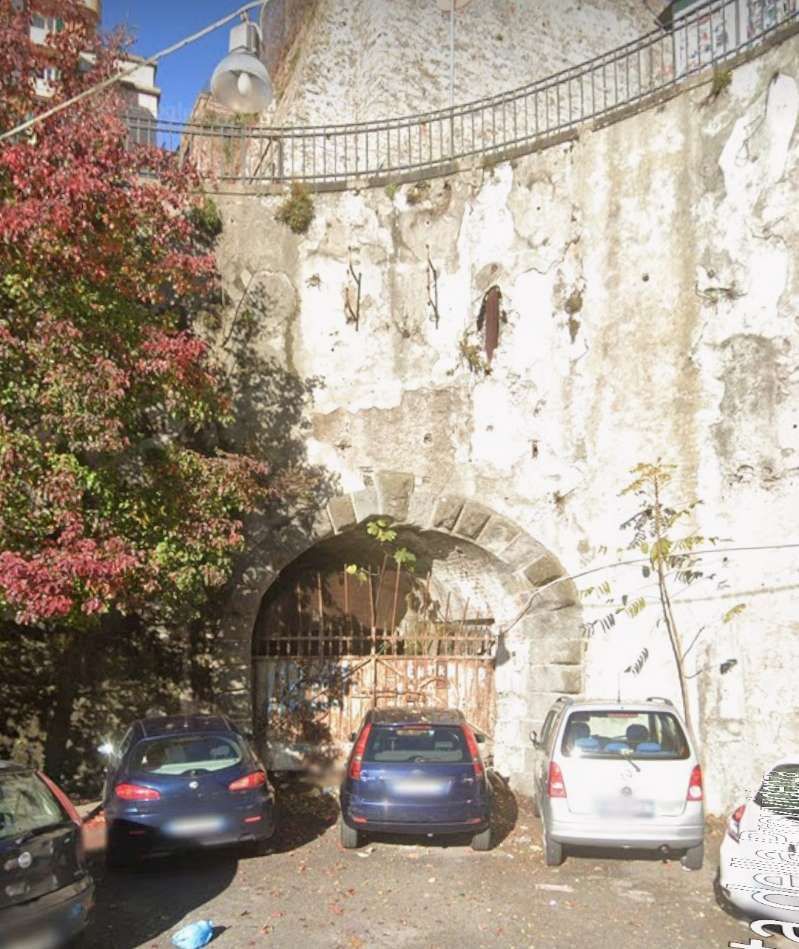
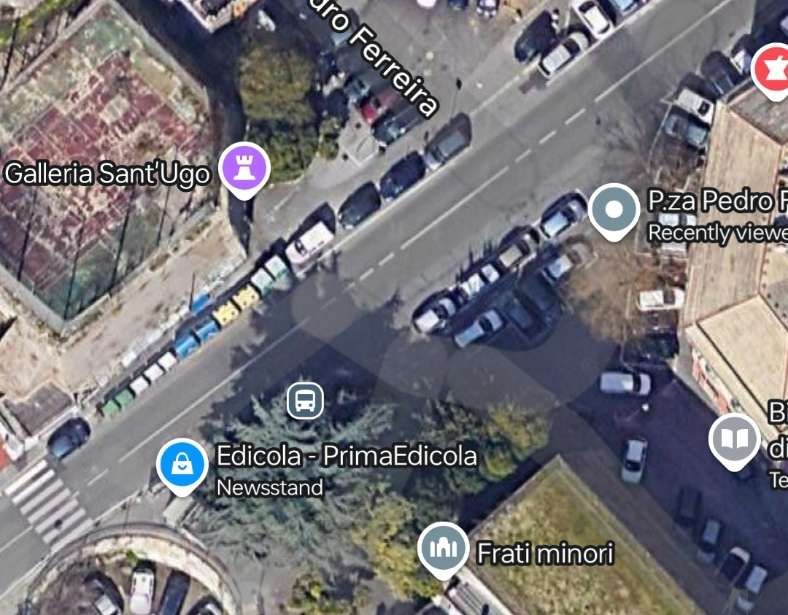
The route of Galleria Sant’Ugo appears on city centre maps North of Principe Railway Station. Its lower entrance was on Salita Della Provvidenza. Its upper entrance only a very short distance away to the Northeast but at a higher level in Piazza Ferreira. [27]
Galleria Sant’Ugo left the surface at the North end of Salita Della Provvidenza. [Google Maps, November 2024]
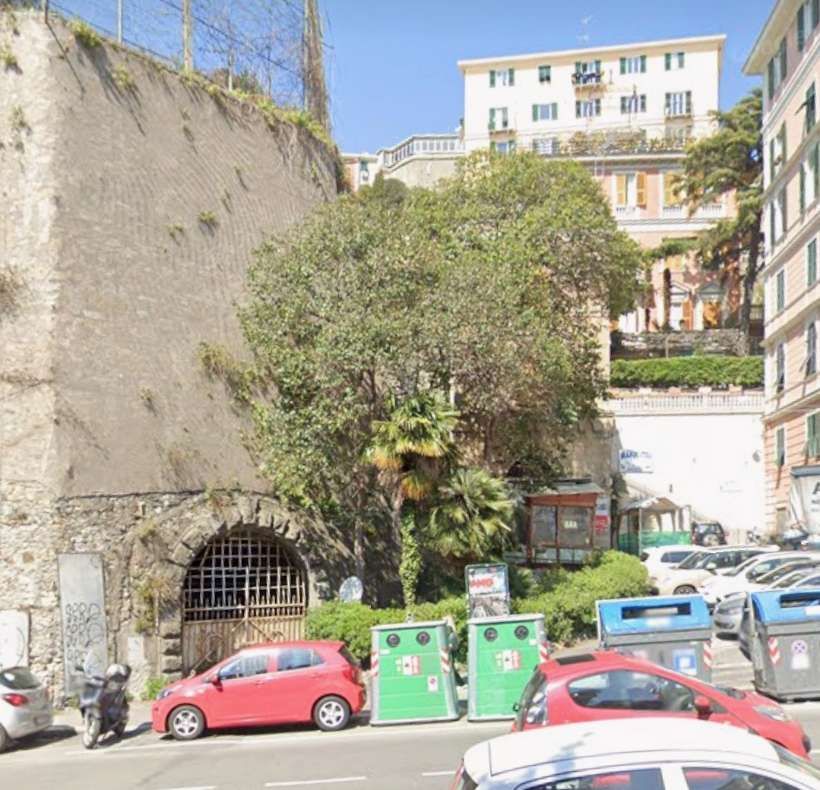
The lower entrance to Galleria Sant’Ugo in the 21st century. [Google Streetview, December 2020]
The Upper Portal of Galleria Sant’Ugo in Piazza Ferreira, © Public Domain. [28]
The upper (marked by the purple flag) and lower entrances of Galleria Sant’Ugo were geographically very close together! [Google Maps, November 2024]
The upper entrance to Galleria Sant’Ugo in Piazza Ferreira. [Google Streetview, August 2024]

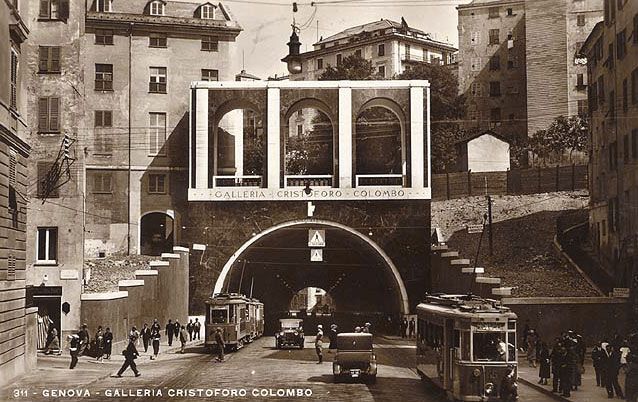
Galleria Chrisoforo Colombo

Named after Christopher Columbus, whose house was nearby, the gallery was opened to the public in the 1930s and was hailed as the city’s gateway to the sea. It connected Piazza de Ferrari and Piazza della Vittoria.

The Northwest Portal of Galleria Chrisoforo Colombo in its early years, © Public Domain. [28]
The Northwest Portal of Galleria Chrisoforo Colombo in the 21st century. [Google Streetview, August 2024]
The Southeast Portal of Galleria Chrisoforo Colombo in its early years, © Public Domain. [29]
The Southeast Portal of Galleria Chrisoforo Colombo in the 21st century. [Google Streetview, August 2024]
The blue flag points to the line of the Galleria Chrisoforo Colombo.
A closer view of the location.

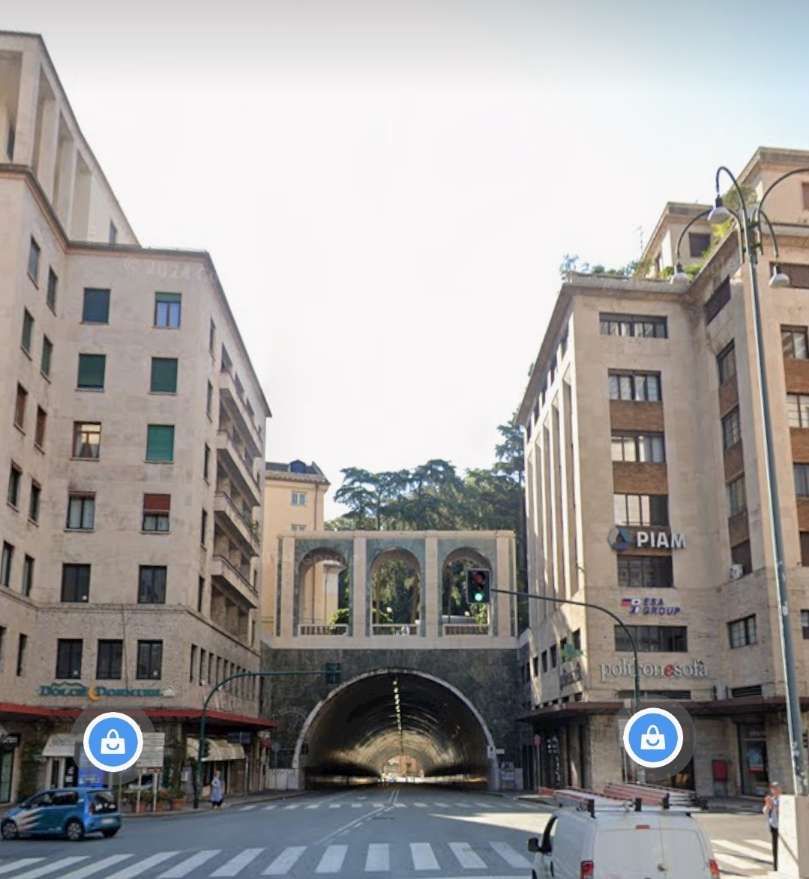
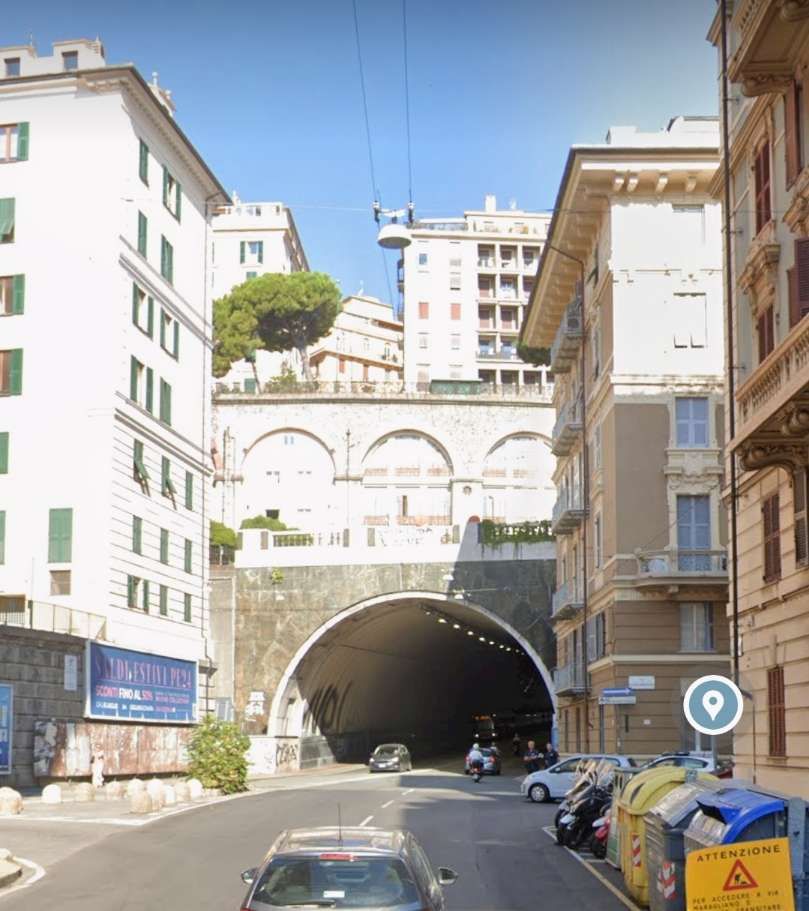
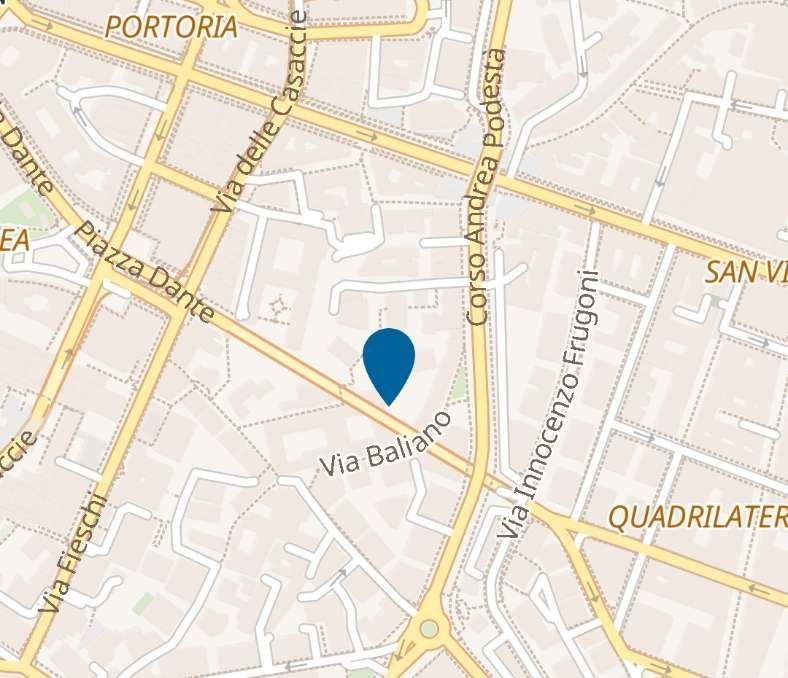
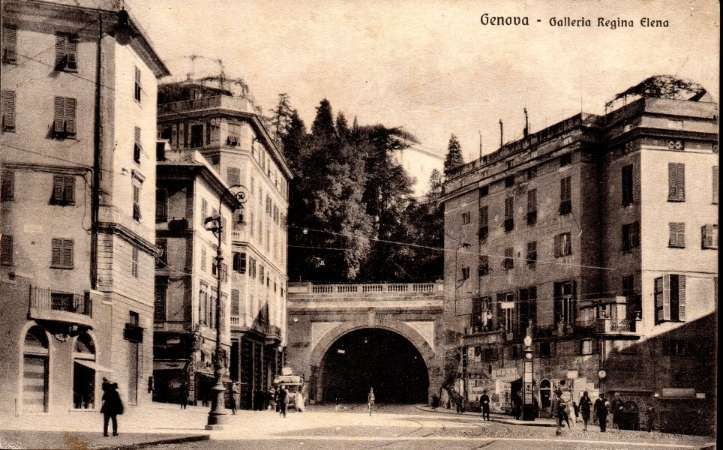
Galleria Regina Elena (today Nino Bixio)

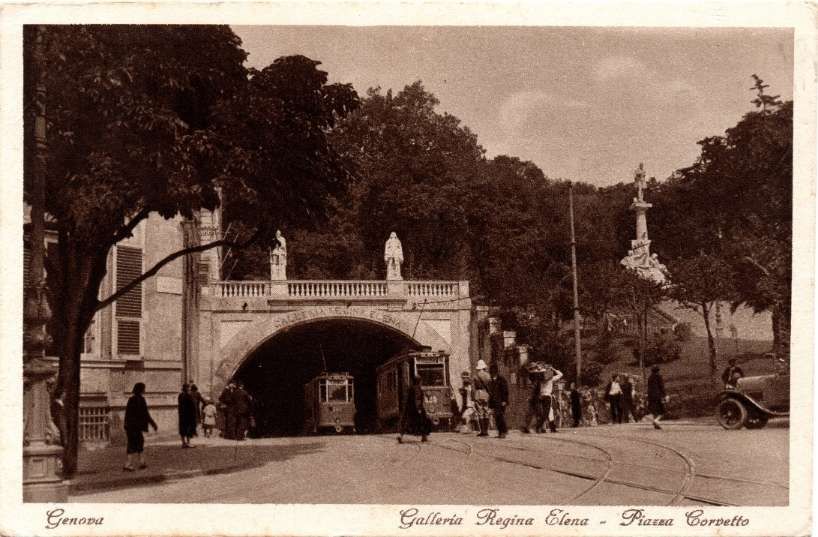
The West Portal of Galleria Regina Elena (now Nino Bixio), © Public Domain. [30]
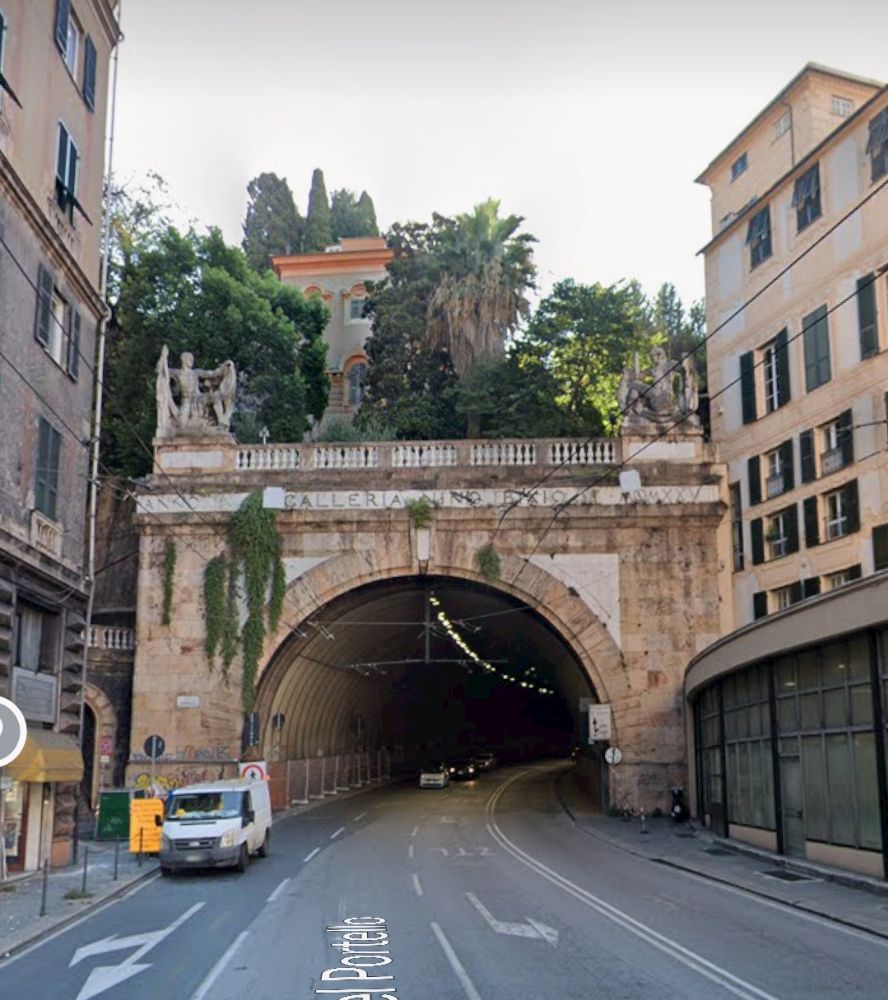
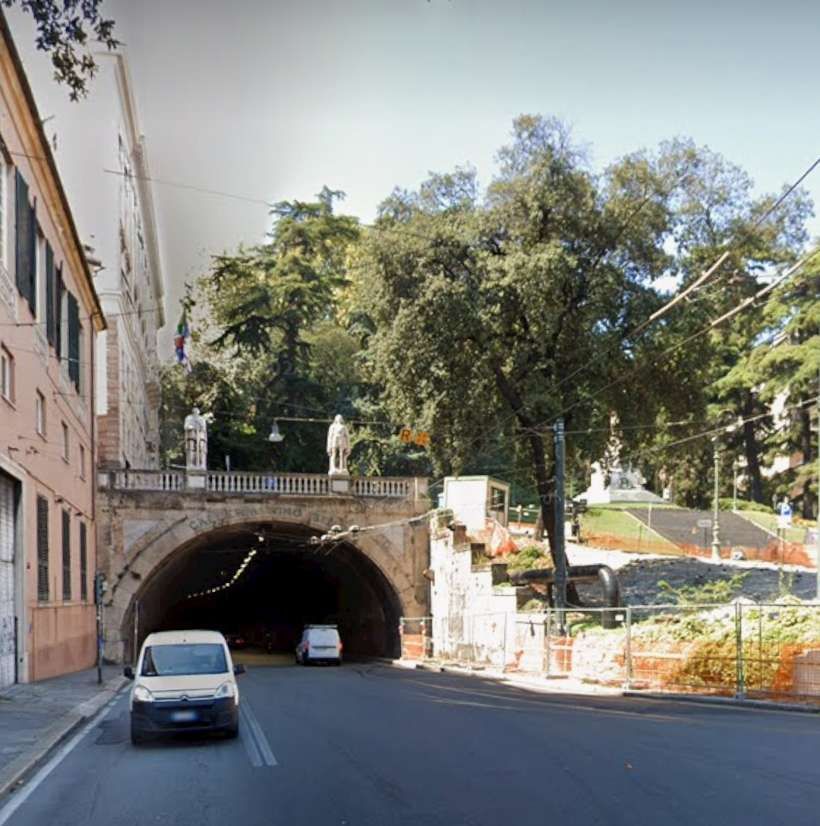
The West Portal of Galleria Nino Bixio in the 21st century. [Google Streetview, August 2024]
The East Portal of Galleria Regina Elena (now Nino Bixio), © Public Domain. [30]
The East Portal of Galleria Nino Bixio in the 21st century. [Google Streetview, August 2024]
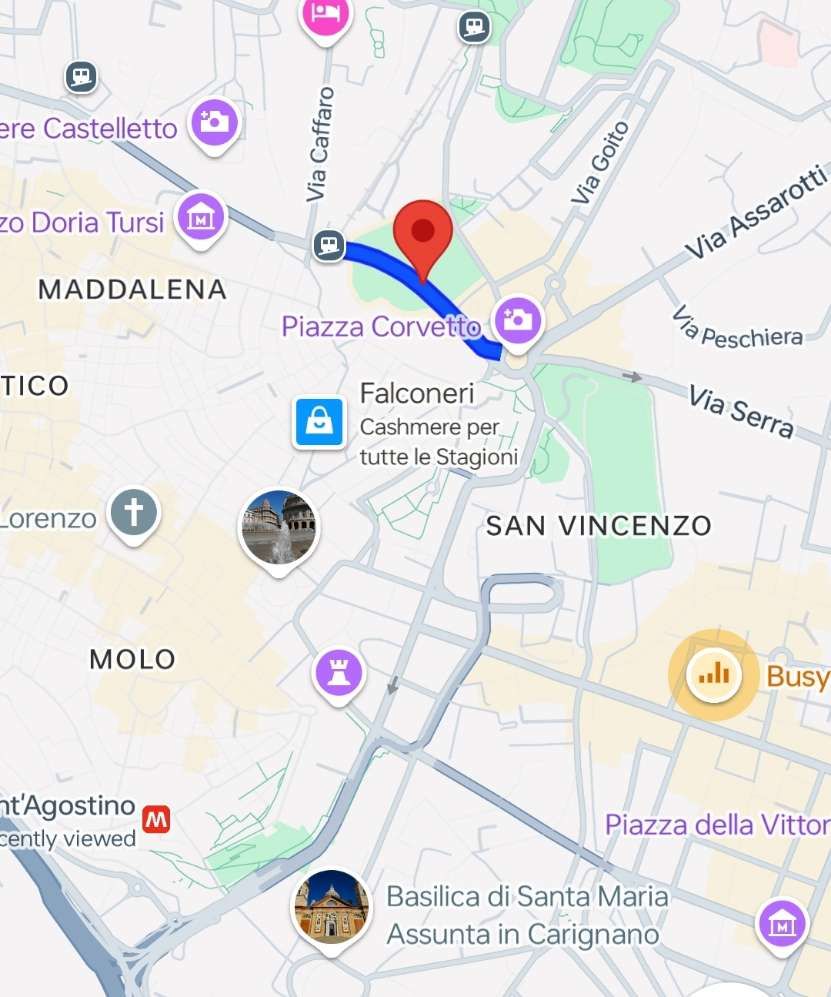
The location of Galleria Nino Bixio. [Google Maps, November 2024]

Galleria Dei Tram Via Milano

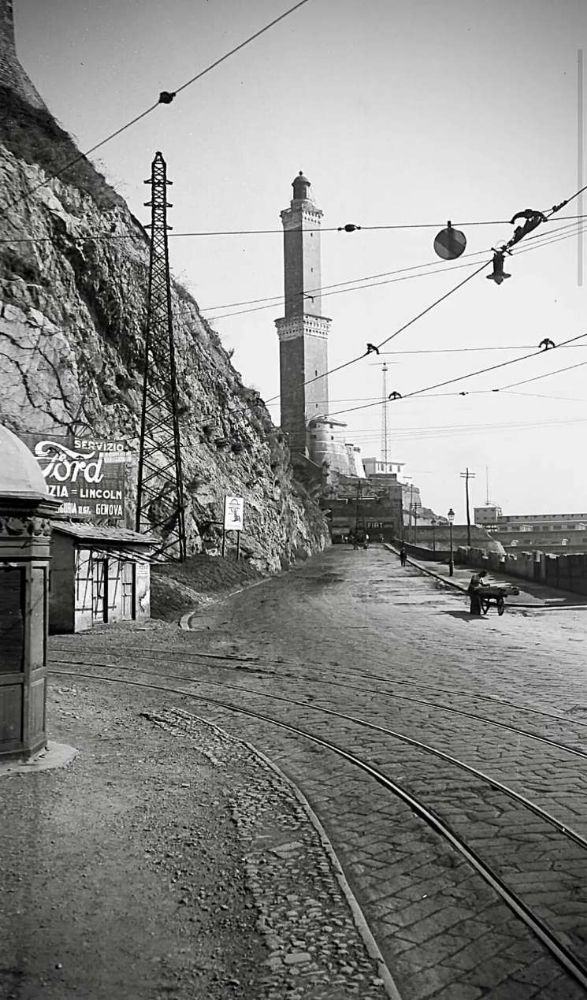
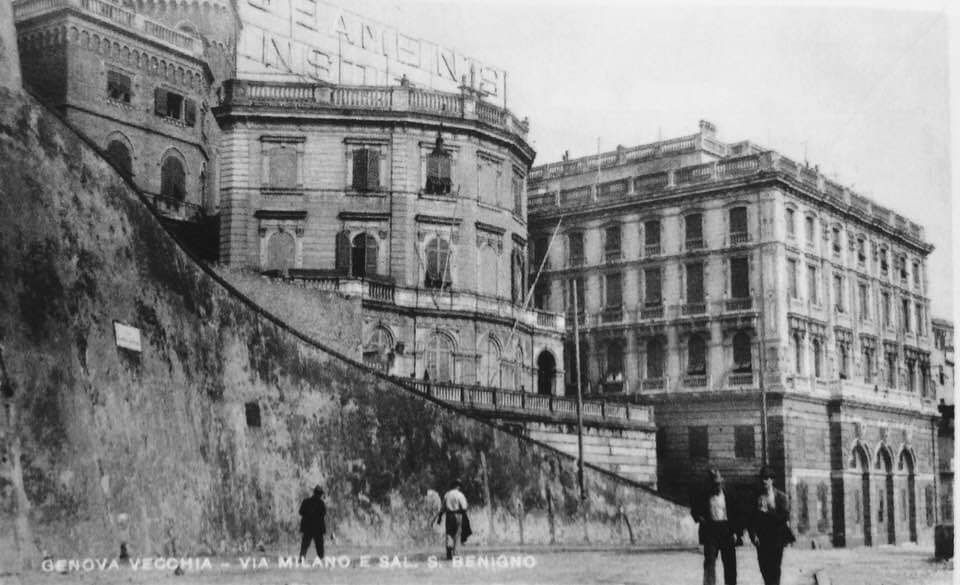
Now long gone, there was a tram tunnel on Via Milano to the Southwest of the city centre. It took the tramway (and roadway) under San Benigno Hill. It was.built in 1878 by the Compagnia Generale Francese dei Tramways for its horse-drawn trams. Its Southwest portal was in Largo Laterna. Its Northeast portal is shown in the first image below.

The Northeast portal of the Galleria on Via Milano before its demolition when the San Benigno Hill was raised to the ground. The three images below show the Southwest end of the tunnel. This image was shared by Silvia Brisigotti on the Foto Genova Antica Facebook Group on 3rd February 2024, © Public Domain. [34]
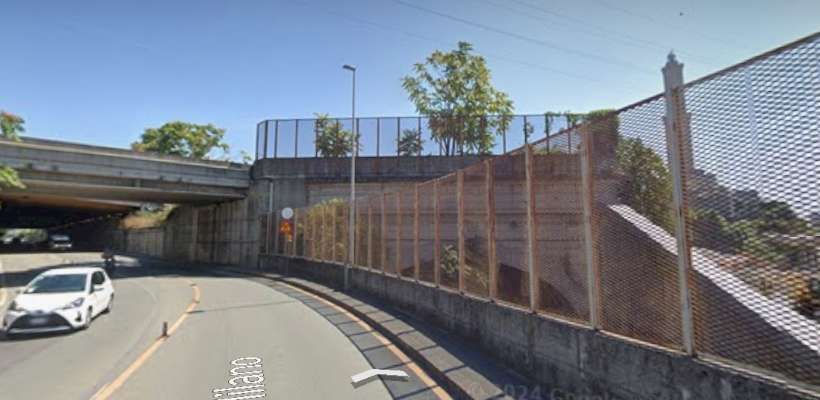
A similar location on Via Milano in the 21st century. There are no features to tie the two images together! [Google Streetview, August 2024]
Three different images showing the Southwest portal of the Galleria Via Milano and its immediate environment. The third of the images illustrates its proximity to Genoa’s (Genova’s) Lighthouse on Largo Laterna. These images were shared by Silvia Brisigotti on the Foto Genova Antica Facebook Group on 16th January 2024, © Public Domain. [35]
A similar location on Via Milano in the 21st century. The lighthouse can be seen on the right of this photograph. [Google Streetview, August 2024]

Until Galleria Certosa was constructed all tram services for the Western suburbs of the city had to pass through this tunnel.

Galleria Goffredo Mameli

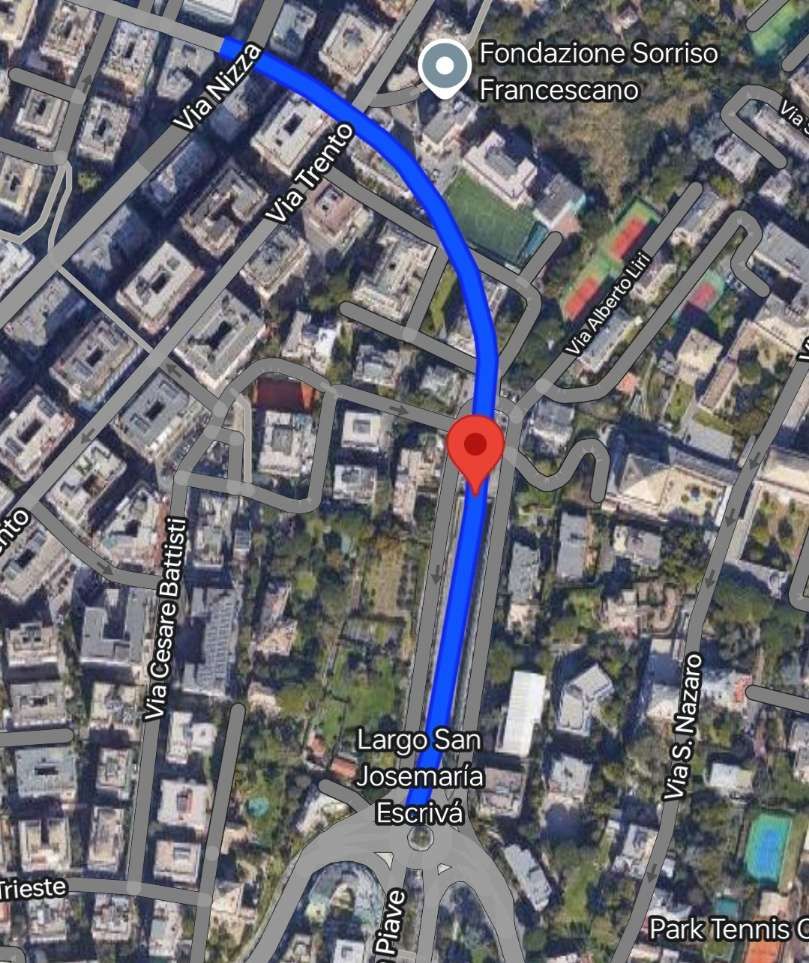
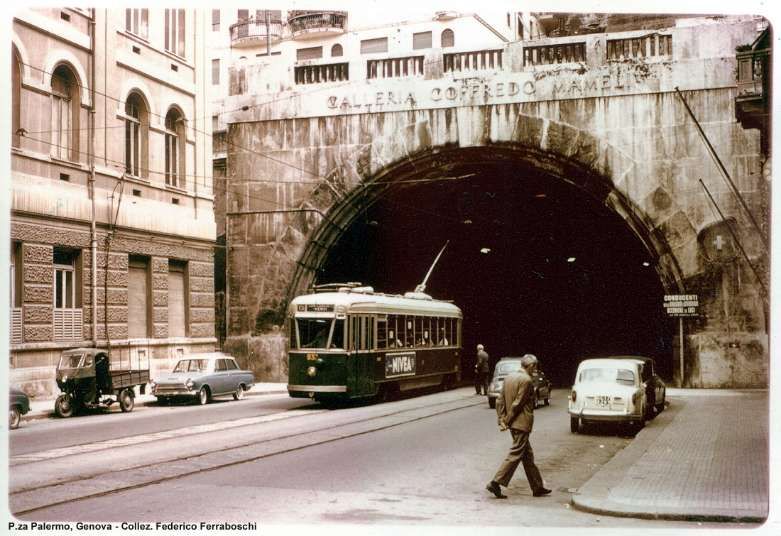
This tunnel curved through the Eastern parts of the city from Via Piave to Via Carlo Barabino at the bottom of Piazza Palermo.

Galleria Goffredo Mameli. [Google Maps, November 2024]
In Piazza Palermo, UITE No. 937 exits Galleria Goffredo Mameli in service on the Line 15, De Ferrari – Galleria Mameli – Nervi Service in the later years of the network’s life, © Public Domain. [36]
Looking East at the bottom of Piazza Palermo towards the West Portal of Galleria Goffredo Mameli. [Google Streetview, August 2024]
The South Portal of Galleria Goffredo Mameli, © Public Domain. [40]
The South Portal of Galleria Goffredo Mameli. [Google Streetview, August 2024]

The Years Before World War One

In the early years of the 20th century, the municipal administration began to consider the idea of taking control of the tram service. In anticipation of this, in 1913, it built its own line from Marassi to Quezzi, known as Municipal Line A, it was operated by UITE on behalf of the Municipality. [19][21: p44]

Before the start of World War 1, the tram network provided these services: [19]

I. Western Network:

1 Caricamento – San Pier d’Arena (Sampierdarena in other sources) – Sestri – Pegli – Voltri
2 Caricamento – San Pier d’Arena – Sestri – Pegli
3 Caricamento – San Pier d’Arena – Sestri
4 Caricamento – San Pier d’Arena
5 Caricamento – San Pier d’Arena – Rivarolo
6 Caricamento – San Pier d’Arena – Rivarolo – Bolzaneto
7 Caricamento – San Pier d’Arena – Rivarolo – Bolzaneto – Pontedecimo
8 Caricamento – Galleria Certosa – Certosa
9 Caricamento – Galleria Certosa – Certosa – Rivarolo
10 Caricamento – Galleria Certosa – Certosa – Rivarolo – Bolzaneto
11 Caricamento – Galleria Certosa – Certosa – Rivarolo – Bolzaneto – Pontedecimo

II. Eastern Network:

21 De Ferrari – Manin – Staglieno
22 De Ferrari – Manin
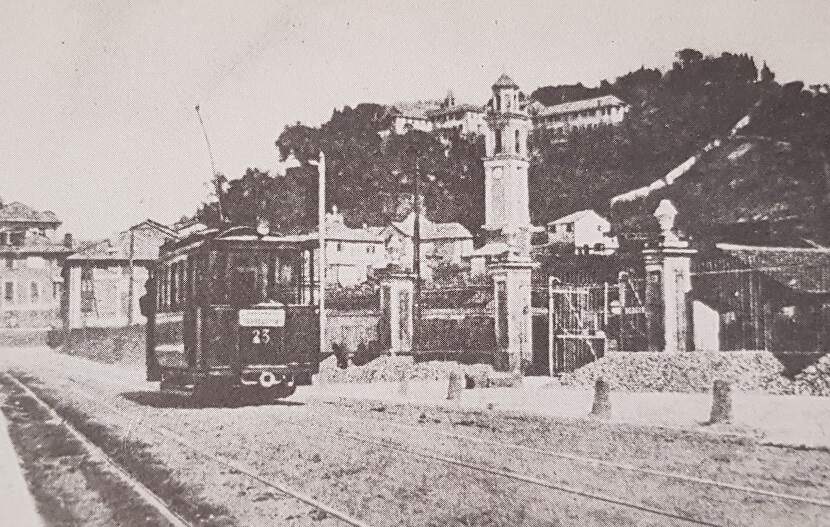
23 De Ferrari – Manin – Castelletto
24 De Ferrari – Manin – Castelletto – San Nicholo
25 Circuit in the hilly suburbs
26 Piazza Principe – Corso Ugo Bassi
27 De Ferrari – Zecca – Principe
28 Caricamento – De Ferrari – Galliera ‘Ospital
29 De Ferrari – Carignano
30 Circular Raibetta – Brignole – Corvetto – Raibetta
31 De Ferrari – Staglieno – Molassana – Prato
32 De Ferrari – Staglieno – Molassana
33 De Ferrari – Pila – Staglieno
34 Staglieno – Iassa
35 Pila – Staglieno
36 Pila – Staglieno – Molassana
37 De Ferrari – San Fruttuoso
38 De Ferrari – Foce
39 De Ferrari – San Francesco – Sturla – Priaruggia – Quinto – Nervi
40 De Ferrari – San Francesco – Sturla – Priaruggia – Quinto
41 De Ferrari – San Francesco – Sturla – Priaruggia
42 De Ferrari – San Francesco – Sturla
43 De Ferrari – Villa Raggio – Lido
44 De Ferrari – Tommaseo – San Martino – Borgoratti
45 De Ferrari – Tommaseo – San Martino – Sturla
46 De Ferrari – Tommaseo – San Martino
47 De Ferrari – Tommaseo
48 Raibetta – Pila

III. Municipal line:

A De Ferrari – Quezzi

The Western Network, particularly before World War One

Lines 1 to 11 constituted the Western Network. All of these lines had their city centre terminus at Piazza Caricamento. The Piazza is shown on the adjacent 1916 map.

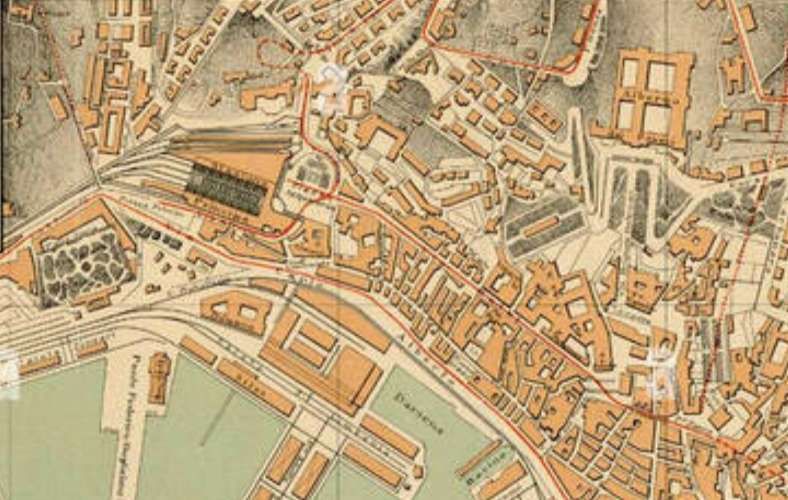
The map shows part of the Port area of Genoa (Genova) in 1916 with a significant series of standard-gauge railway sidings in evidence (black lines) and some red lines which indicate the metre-gauge tram routes. Piazza Caricamento is close to the water halfway down the map extract. [31]

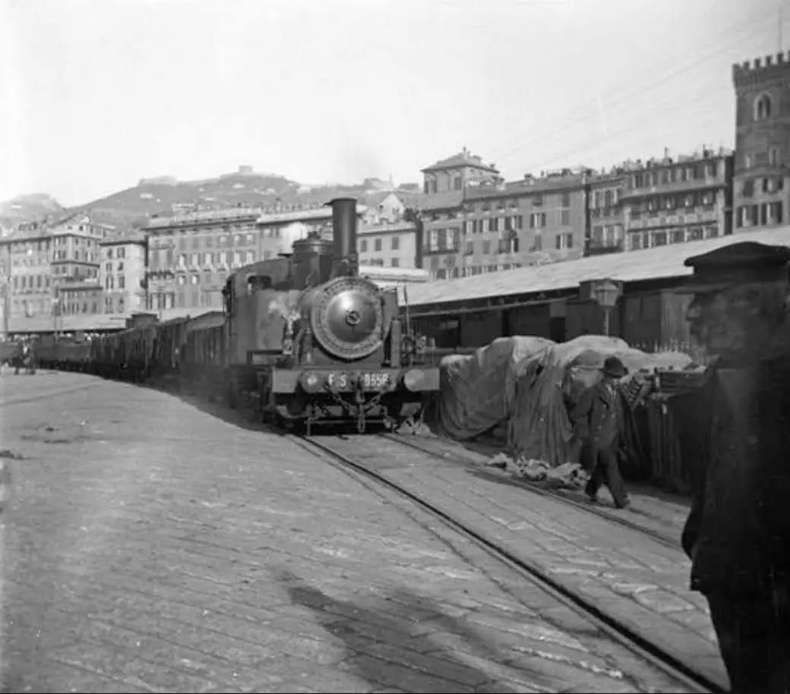
A typical photograph of a freight movement on the standard-gauge railway serving the port. The building behind the locomotive front onto Piazza Caricamento., © Public Domain and shared by Enrico Pinna on the Foto Genova Antica Facebook Group on 22nd January 2023. [33]

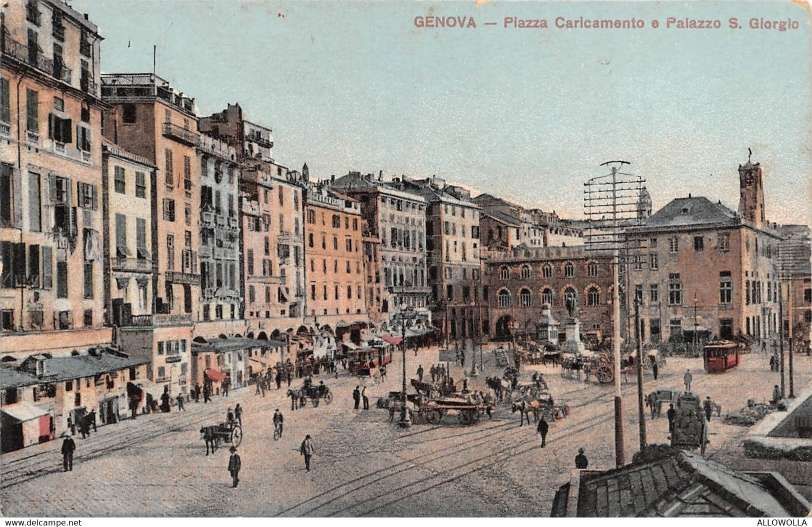
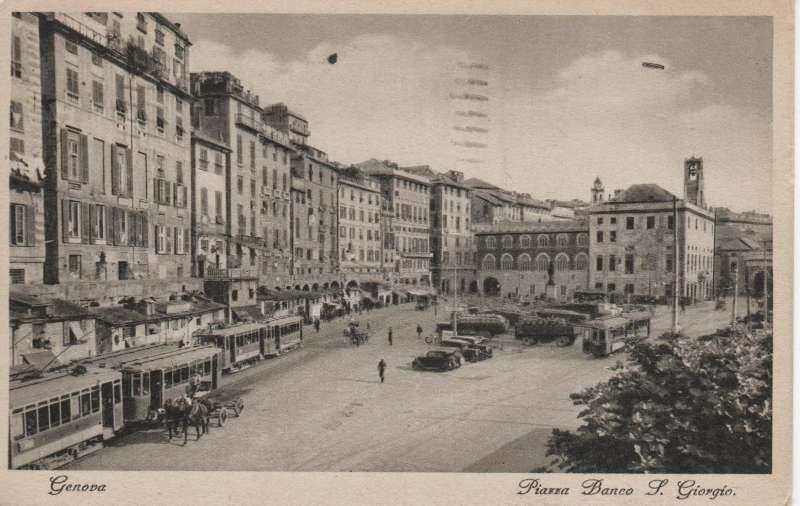
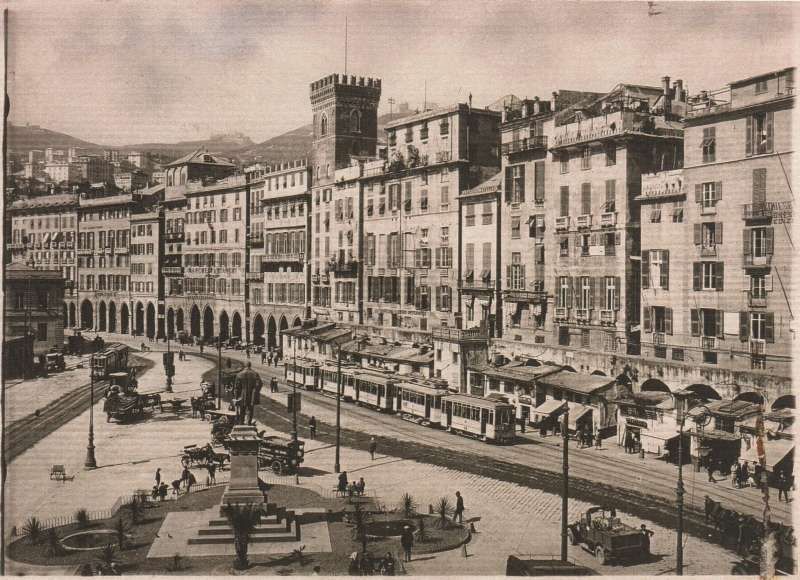
The postcard images below show trams operating in Piazza Caricamento at different times over the life of the tram network in the 20th century.

Piazza Caricamento, (postcard dated 1908), © Public Domain. [31]
Piazza Caricamento (postcard dated 1910), © Public Domain. [31]
Piazza Caricamento, (postcard dated 1936), © Public Domain. [31]
Piazza Caricamento, later than the previous view, © Public Domain. [31]
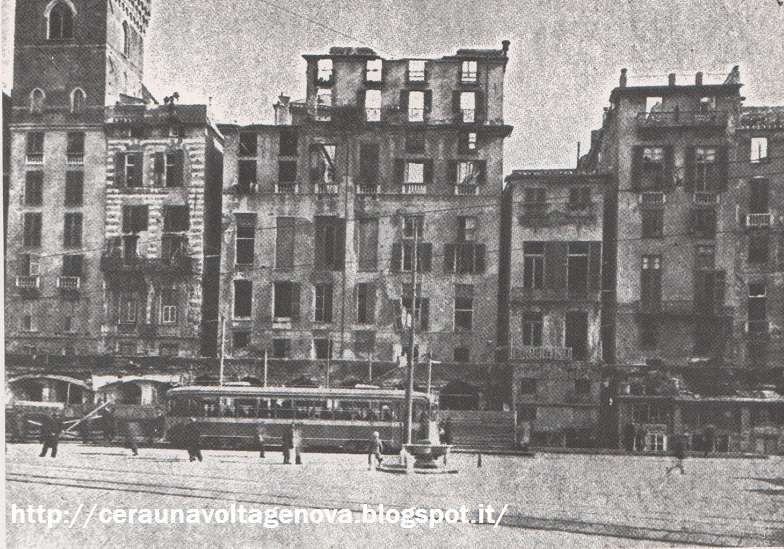
Piazza Caricamento in October 1942 sowing war damage to properties on the East side of the Piazza, © Public Domain. [32]

There were three main routes out of Piazza Caricamento, one of which followed the coast round to meet the lines on the East of the city. The other two shared the bulk of the services leaving the piazza. One of these two routes ran West through San Pier d’Arena (Sampierdarena), the other ran through Galleria Certosa.

The only tramway route serving the western suburbs before the construction of Galleria Certosa is shown here in black between Pizza Caricamento, Principe and San Pier d’Arena (Sampierdarena), © Arbalete and authorisedd for reuse under a Creative Commons Licence (CC BY-SA 2.0). [19]
The distribution of tramway routes in the West of the city after Galleria Certosa was put into use, © Arbalete and licenced for reuse under a Creative Commons Licence (CC BY-SA 2.0). [19]

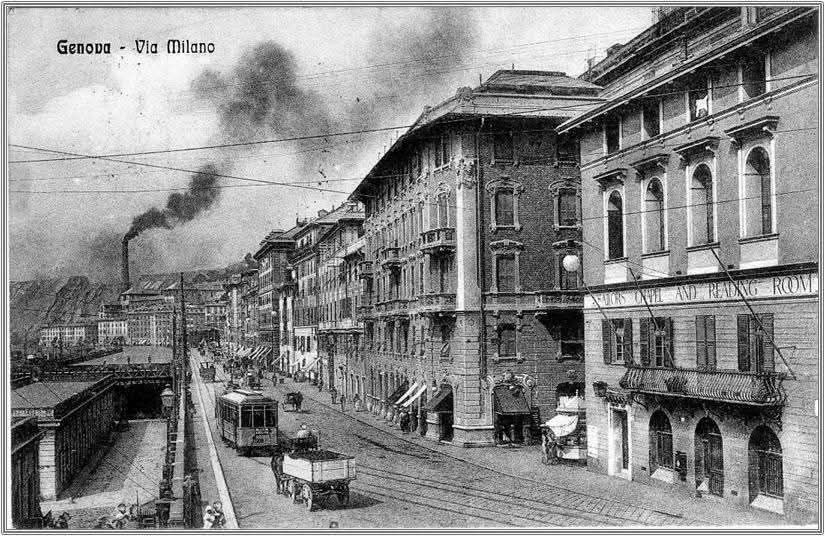
The route to San Pier d’Arena (Sampierdarena) closely follows the coast and ran through the Galleria on Via Milano before the San Benigno Hill was raised to the ground.

The 1916 map shows the first length of the tramway Northwest of Piazza Caricamento (red line) which served both the two routes mentioned above. It ran on the south side of Principe Railway Station across the top of the Port. [31]
A crowded Pizza Acquaverde, located in front of the Principe Station, dominated by the statue of Christopher Columbus. Among buses and trolleybuses there is a tram waiting at the station. Another tram (a 900) is on the route from Piazza Caricamento towards Sampierdarena. This image probably comes from the late 1950s or early 1960s, © Public Domain. [36]
The redline marking the tramway runs down the West side of the Port on this next extract from the 1916 – Via Milano, later Via Bruno Buozzi. [31]
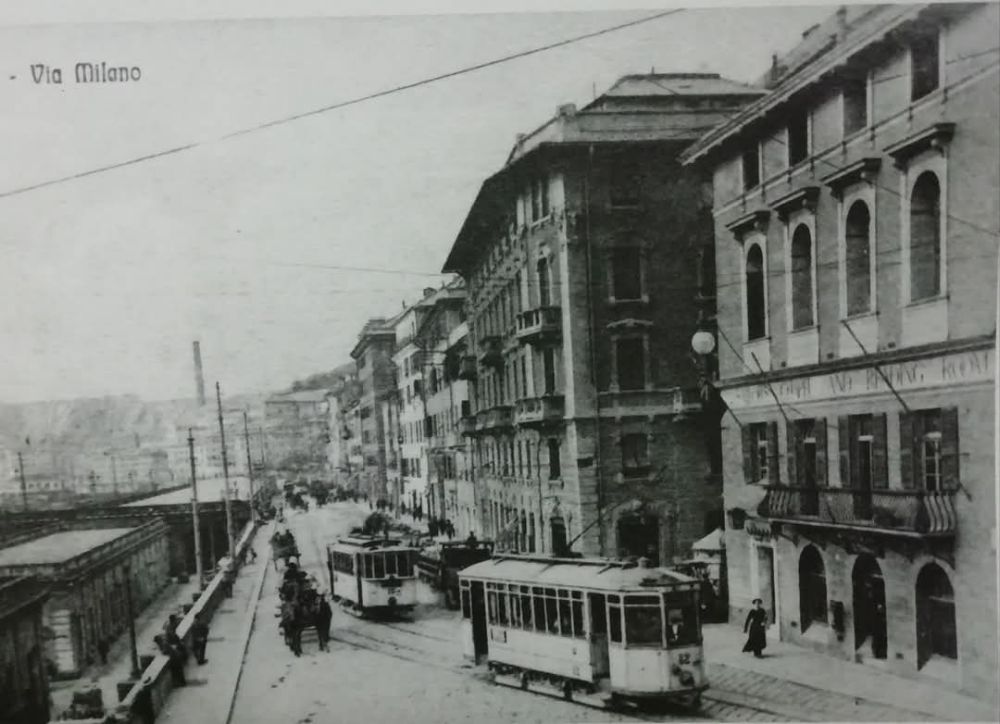
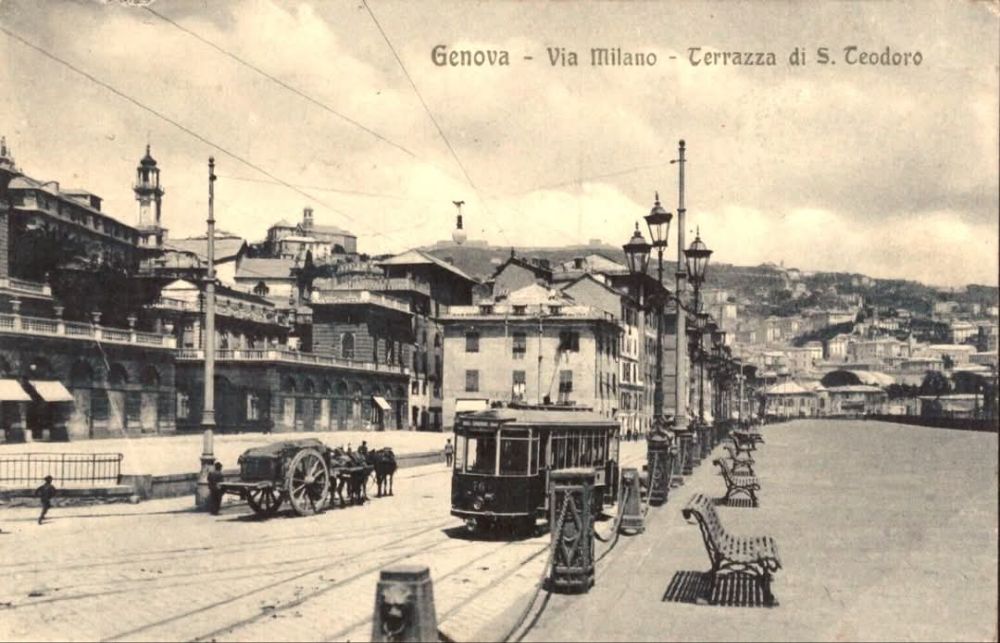
An early postcard image showing the curve from Via San Benedetto into Via Milano.[42]
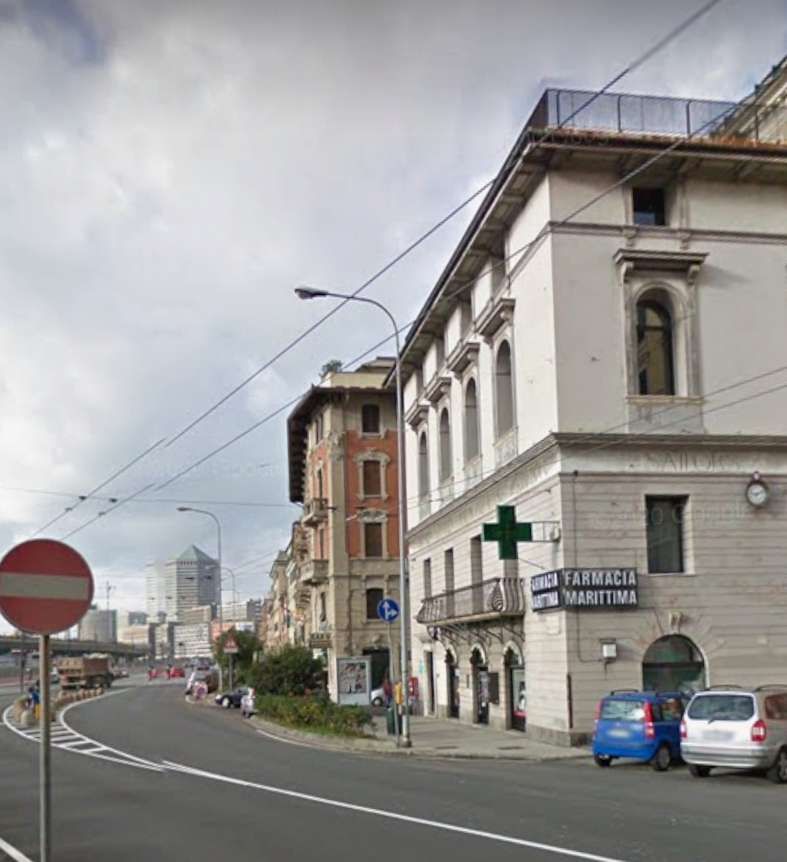
The same location, also prior to the widening of Via Milano and the renaming of the fist length ahead as Via Bruno Buozzi. [41]
The same location in the 21st century. [Google Streetview, 2010]
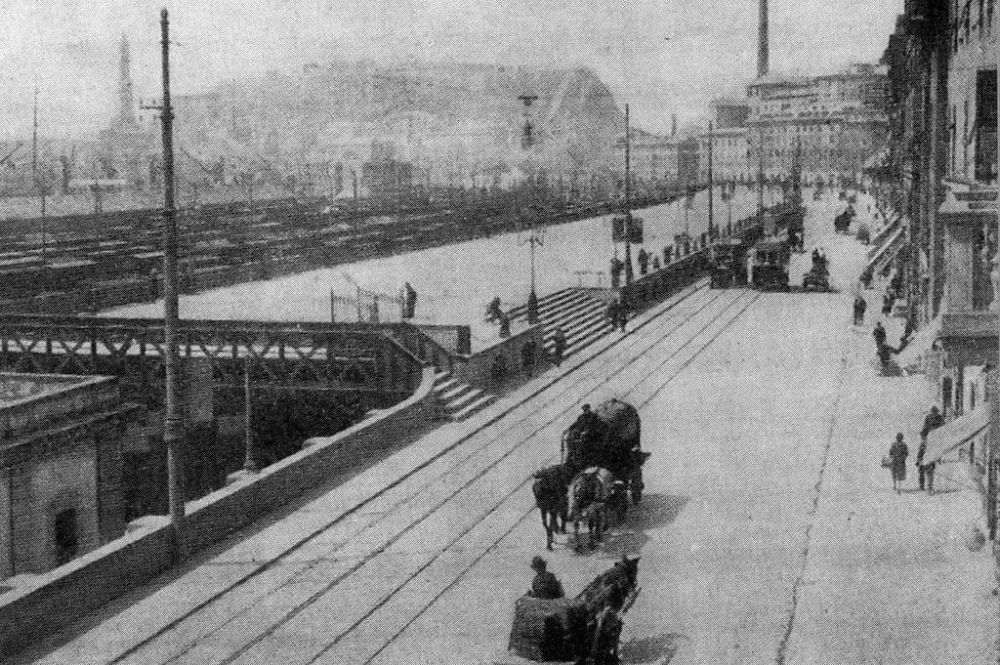
Via Milano (eventually Via Bruno Buozzi) with tram tracks on the seaward side. A promenade separates the FS sidings from the carriageway and trams, © Public Domain. [47]
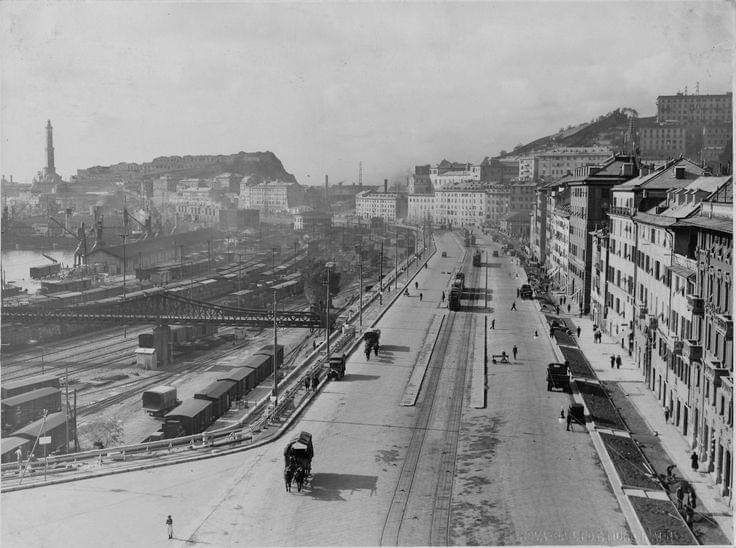
A view Northeast along Via Milano before the widening of the highway and its renaming as Via Bruno Buozzi. [49]
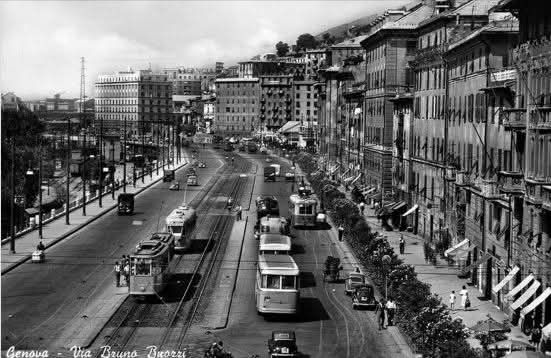
A later view of Via Milano/Via Bruno Buozzi with tramway tracks in the centre of the widened carriageway, © Public Domain. [46]
Somewhat later in the 20th century and taken a little further to the West, this postcard image shows the same centre-of-carriageway tracks the section of Via Milano seen here was renamed Via Bruno Buozzi. [45]
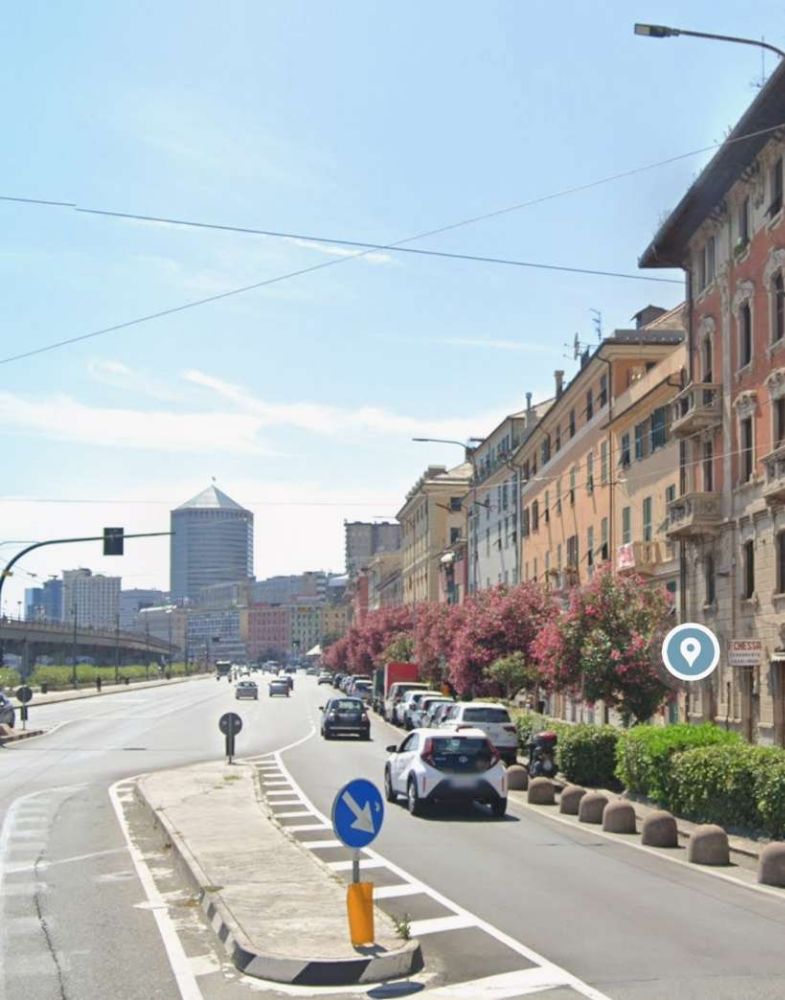
Via Bruno Buozzi in the 21st century. [Google Streetview, August 2024]
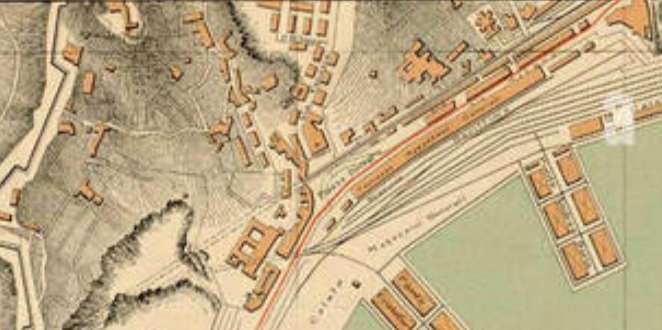
This extract from the same 1916 map shows the line of the Galleria which carried the tramway West towards San Pier d’Arena (Sampierdarena). [31]
The view back towards the centre of Genoa from the point where the tramway turned to run through the Galleria under San Benigno Hill, © Public Domain. [48]
It is difficult, given the modern layout of this area of Genoa, to be definitive about the location of the monochrome image immediately above. This image is taken from a very similar position. The skyline at the rear of this image is a very good match for that in the image above.  [Google Streetview, May 2014]
The tramway turned to the right to enter the tunnel under San Benigno Hill. The tunnel portal was beyond the end of the masonry wall behind the steeply inclined accessed road onto the hill. There is no practical modern equivalent to this view, © Public Domain.  [44]

Pictures of the Galleria can be seen earlier in this article.

West of the Galleria, the original tramway ran along what is now Via Giacomo Buranello (what was Via Vittorio Emanuele) to Sampierdarena. This route appears to the North of the SS1 on the satellite image below.

In this extract from Google’s satellite imagery Sampierdarena is marked top left. The modern SS1 runs along the line of what was Via Milano. Careful inspection of this image shows the railway sidings which remain on the South side of the SS1.
Via Vittorio Emanuele (later Via Giacomo Buranello) looking West, (c) Public Domain. [93]
The same view in the 21st century. [Google Streetview, August 2024]
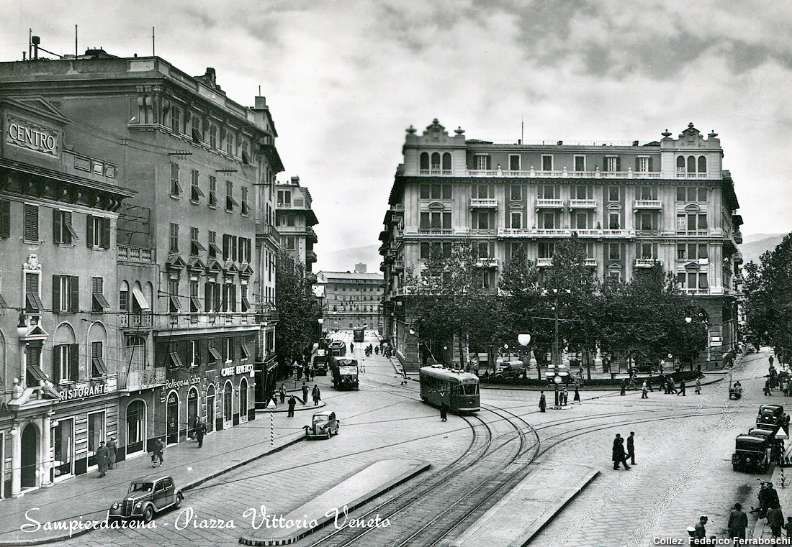
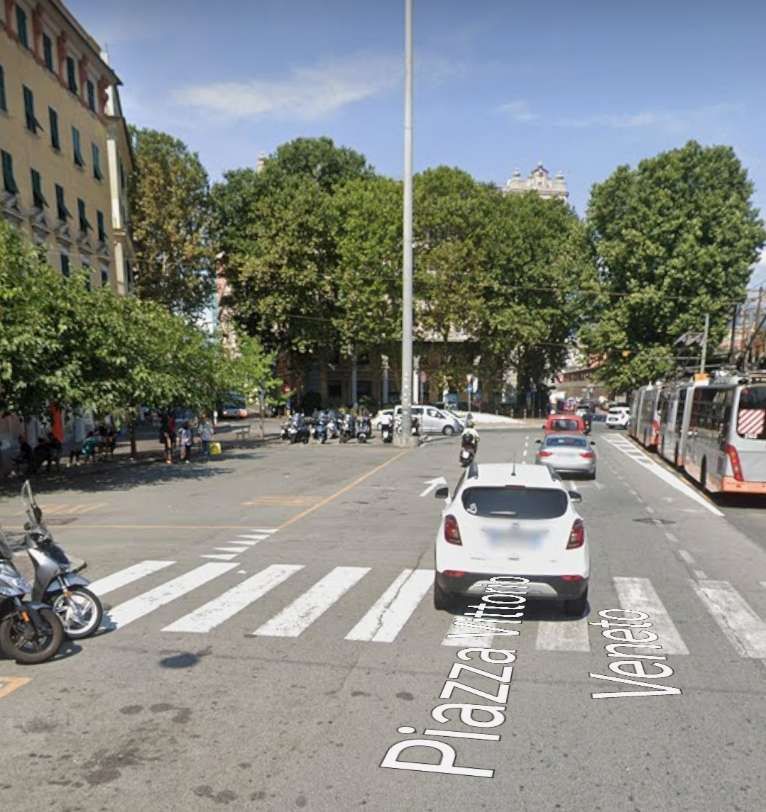
Looking West, Sampierdarena, Piazza Vittorio Veneto. A tram is arriving in the Piazza from the West. It has travelled along Via Cornigliano, © Public Domain. [50]
A view of Piazza Vittorio Veneto from a similar bearing, but this time at ground level in 21st century
  Via Cornigliano leaves the Piazza to the left rear. [Google Streetview, August 2024]

Before looking at line further West from Sampierdarena we need to note a line which was added to the network before WW1.

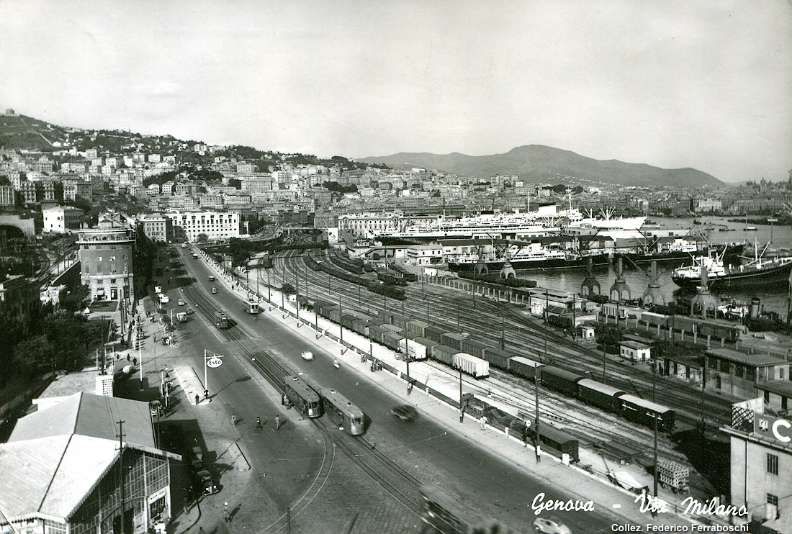
A second tramway was built which ran alongside the railway sidings on what is now the SS1, it was then Via Milano, towards Sampierdarena. The route is illustrated by the mid-20th century view below.

Trams on Via Milano/Via Sampierdarena – in this image, the tracks of the Genoese port can be seen, populated by a range of FS goods wagons. Two 900 UITE units are passing each other on tram tracks which occupy the centre of Via Milano, © Public Domain. [36]
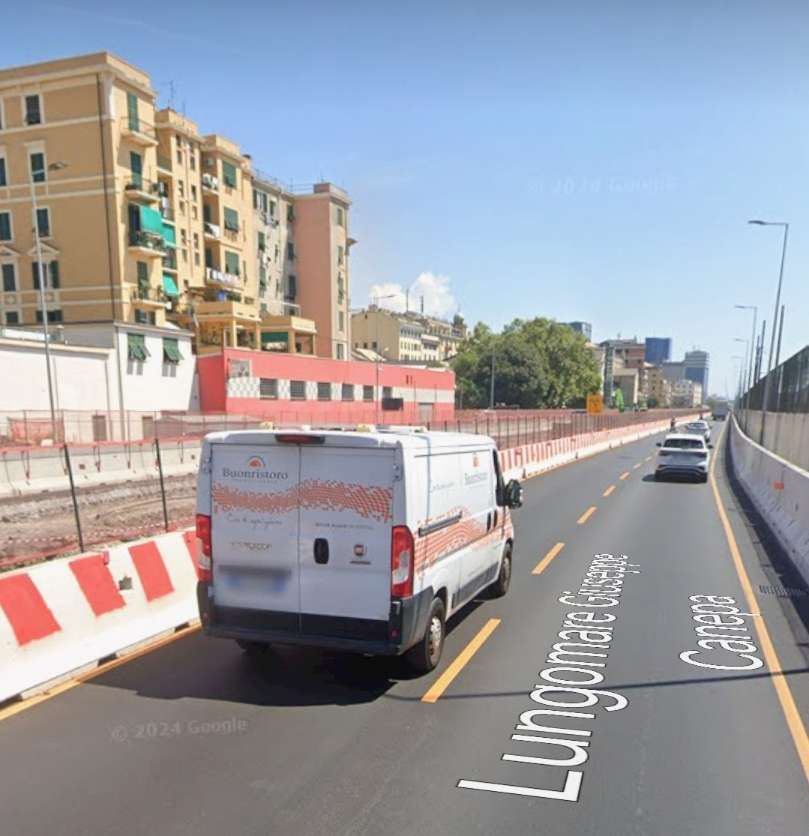
Looking East along the SS1 during some major roadworks. The railway sidings are just off to the right side of the photograph. [Google Streetview, August 2024]

That route along Via Sampierdarena (Via Milano and Via Colombo) and then Via Pacinotti is illustrated at the bottom of the map below. After running along the centre of Via Sampierdarena, trams turned inland, heading Northwest to join the earlier route, West of Piazza Vittorio Veneto on Via Pacinotti.

A map provided by the Marklinfan.com Forum which shows the new coastal tram route mentioned above. [92]

The Western Network’s Coastal Line(s)

At Sampierdarena the original lines of the Western network separated. Some lines continuing along the coast and others turning inland. The lines diverged at the West end of Piazza Vittorio Veneto. The coastal line ran along what is today Via Frederico Avio, then turned onto what is now Via Antonio Pacinotti, before turning West on what is now Via Raffaele Pieragostini, crossing the River Polcevera at Ponte di Cornigliano, running along Via Giovanni Ansaldo before joining Via Cornigliano at Piazza Andrea Massena.

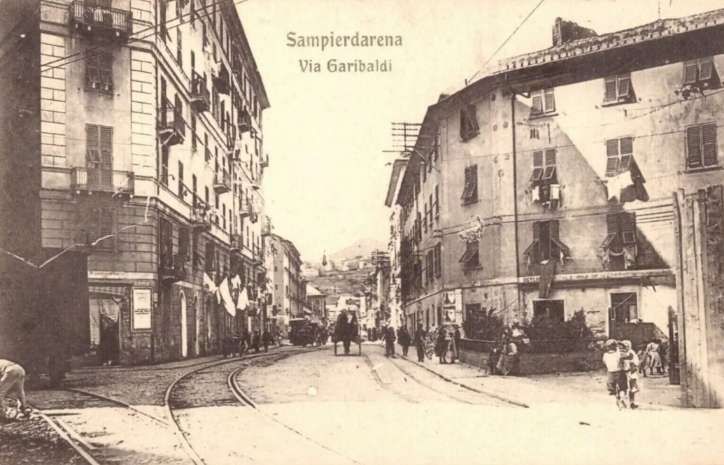
This image shows the tramway at what is now the junction between Via Frederico Avio (entering bottom right) and Via Antonio Pacinotti (which heads away from the camera). At the time this was Via Garibaldi. (c) Public Domain. [61]
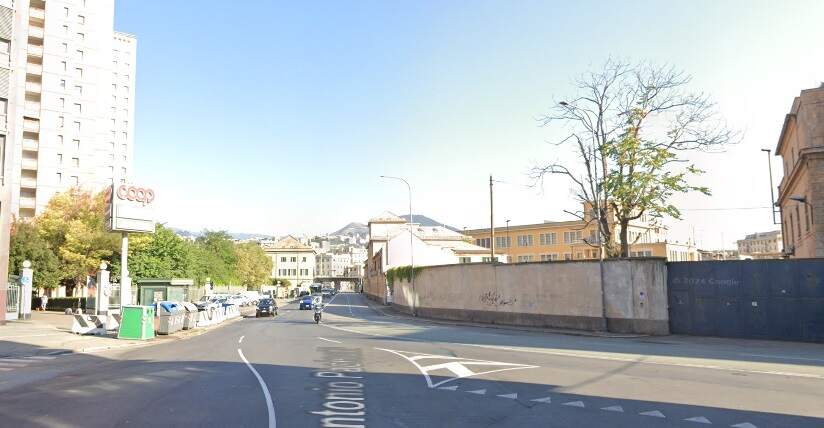
The same location in the 21st century. The vacant lot is the location of the building on the right of the monochrome image above. [Google Streetview, August 2024]
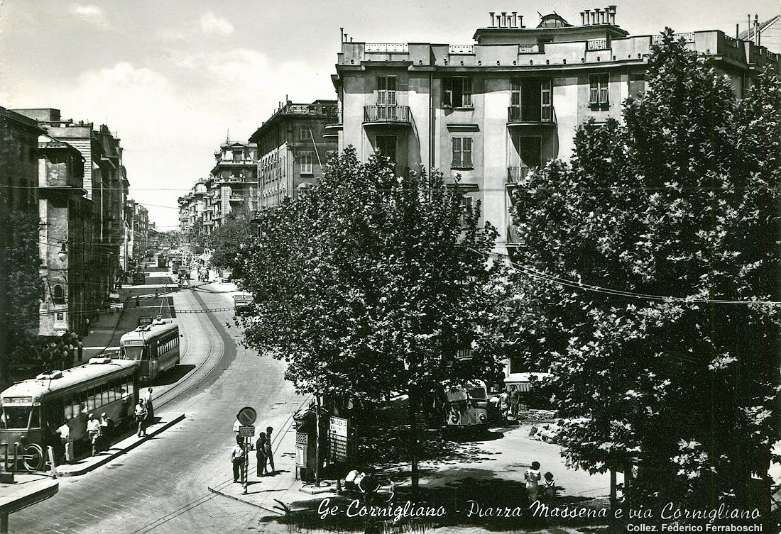
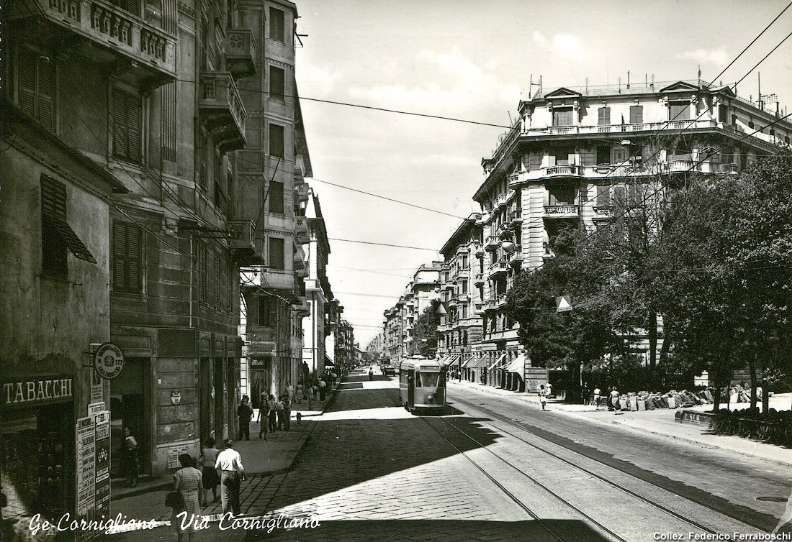
This mid-20th century postcard view shows trams following Via Cornigliano West of Piazza Massena, © Public Domain. [50]
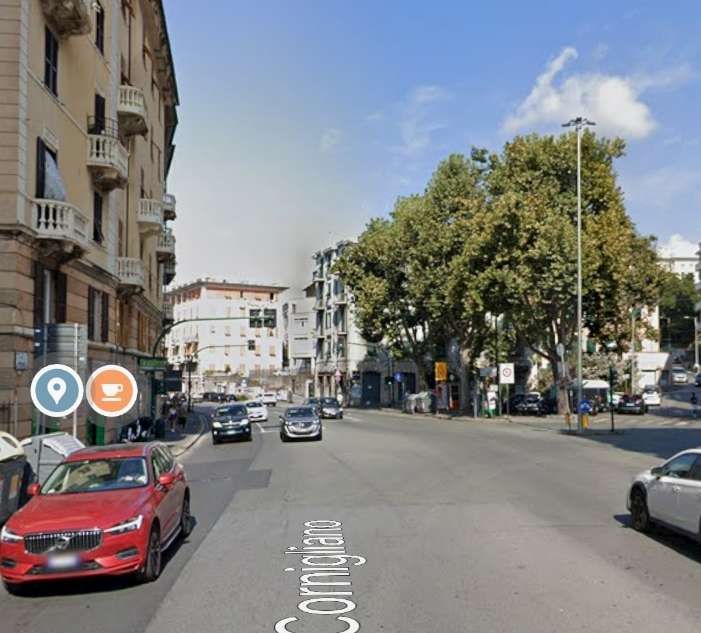
Piazza Massena at the East end of Via Cornigliano as it appears in the 21st century. The tramway followed Via Cornigliano round to the left ahead. [Google Streetview, August 2024]
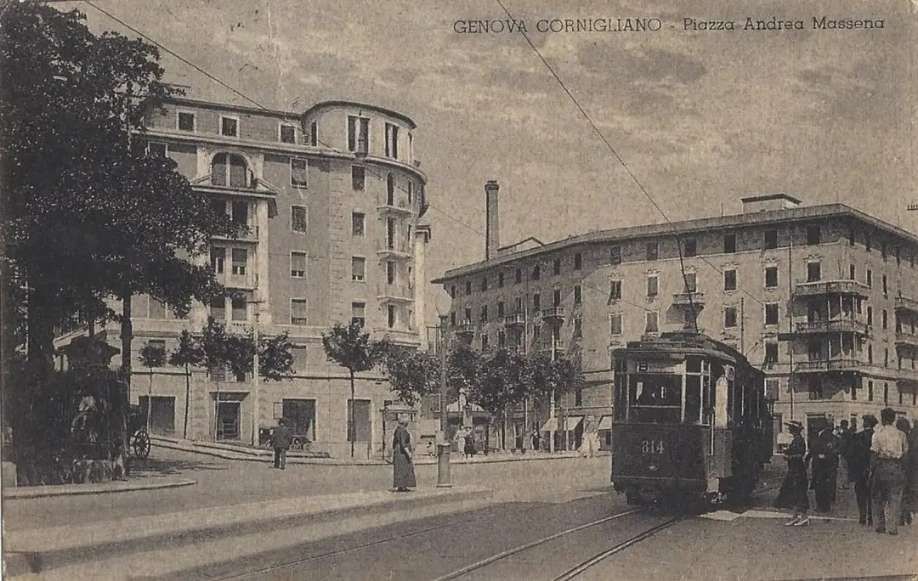
Another view of Piazza Massena in Cornigliano. This image was shared on the C’era una volta Genova Facebook Group by Gianfranco Dell’Oro Bussetti on 8th March 2017, (c) Public Domain. [2]
A similar view of Piazza Massena in 2024. [Google Streetview, August 2024]
Looking West along Via Cornigliano to the West of San Pier d’Arena (Sampierdarena), © Public Domain. [36]
The same location in the 21st century. [Google Streetview, August 2024]
The route West followed the yellow road on this extract from Google Maps satellite imagery. A modern flyover takes the present SS1 over the railway. The original route of the tramway follo
Two images which show the metre-gauge tramway crossing the standard-gauge railway, © Public Domain. [4]
The tramway/road underpass built in the 1930s. A significant amount of excavation was required to take trams under the railway, © Public Domain.[5]
Looking West along the line of the Tramway towards the underpass in the 21st century
Looking back Northeast towards the underpass in the 21st century.[Google Streetview, Aug 2024]
Tram No. 999, the last of the UITE series, is in transit on the Pegli seafront, in service on Line No. 1, Caricamento to Voltri. Miramare Castle is on the sea front. The Castle is in use as a hotel in the 21st century, © Public Domain. [50]
Lungomare di Pegli (SS1) and Miramare Castle in the 21st century. [Google Streetview, August 2024]
This photograph was taken from Miramare Castle. A 900 series tram is heading West and a tram is approaching from the West.  [50]
A similar view, taken from a point a little further to the West, in 21st century
Looking East at Pegli 1925. [58]
At ground level in the 21st century. Looking East from a similar location on the SS1( Via Pegli). [Google Streetview, August 2024]
The terminus of some tram routes at Pegli!, (c) Public Domain. [91]
The same location in the 21st century. [Google Streetview, August 2024]

Beyond Pegli, only Line No. 1 travelled on to Voltri. These next few photographs were taken in Voltri.

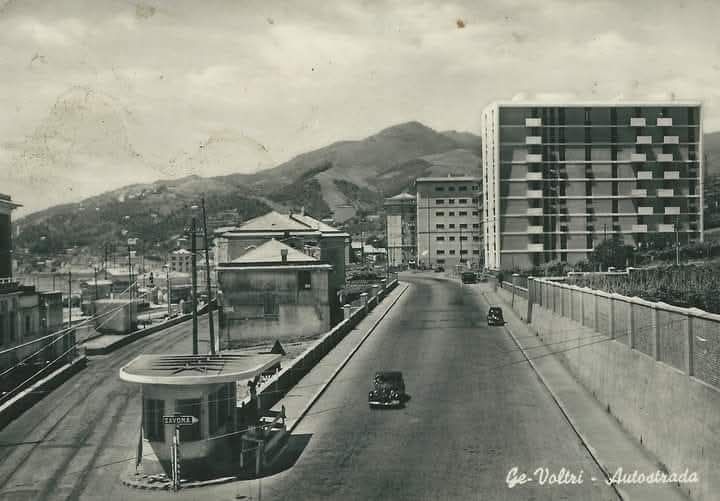
An early view West towards Voltri along Via Voltri. [52]
The same location in the 21st century. [Google Streetview, August 2024]
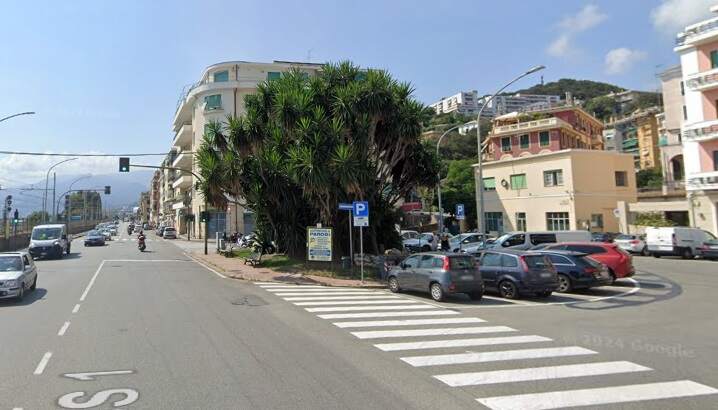
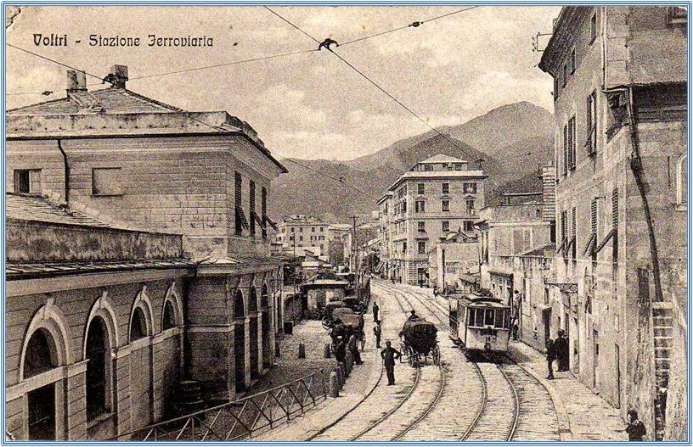
The tramway outside Voltri Railway Station, © Public Domain. [60]
The same location in the 21st century. [Google Streetview, August 2024]
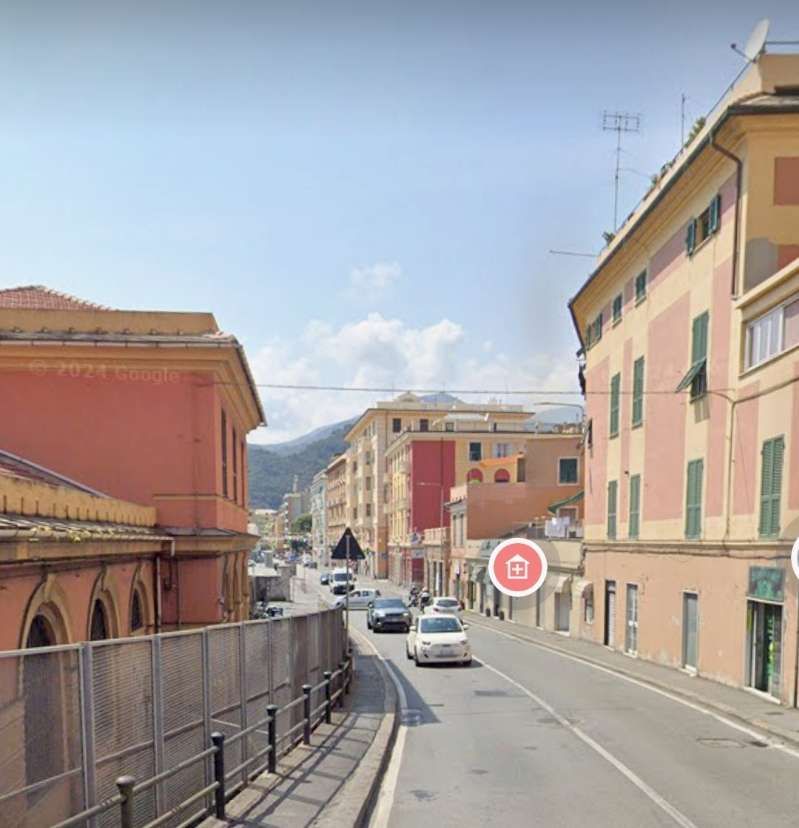
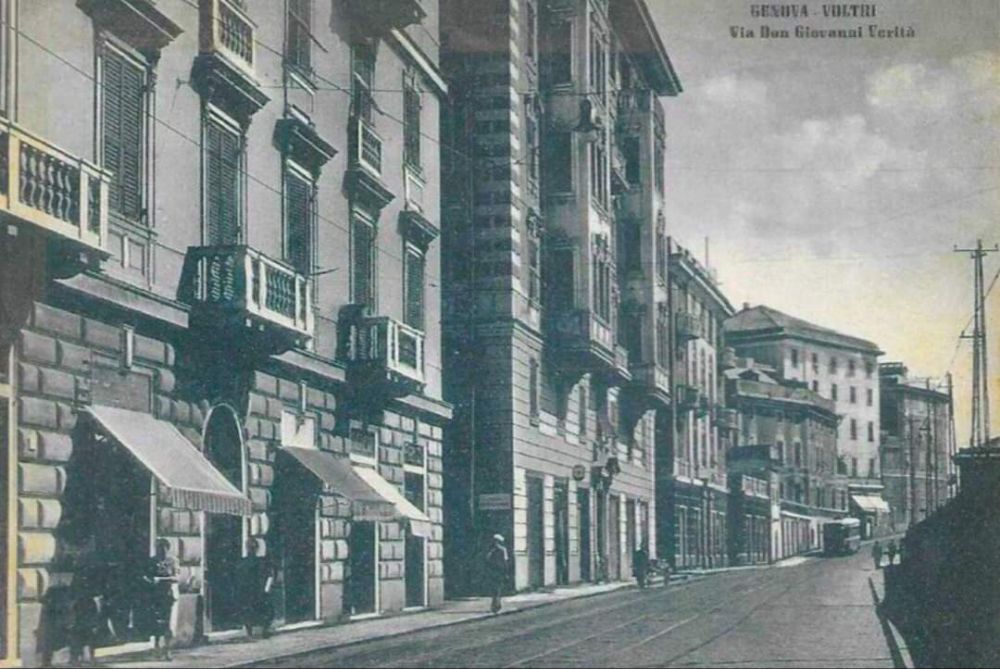
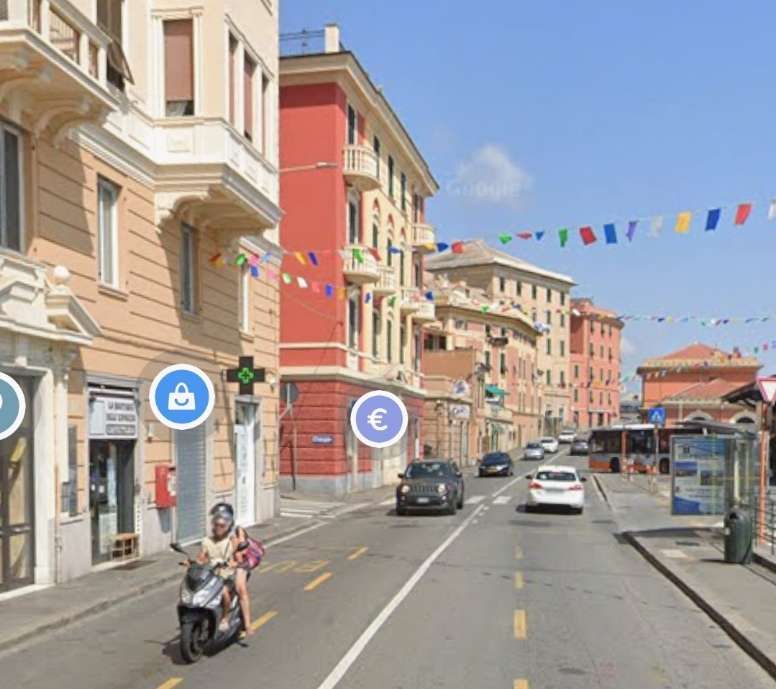
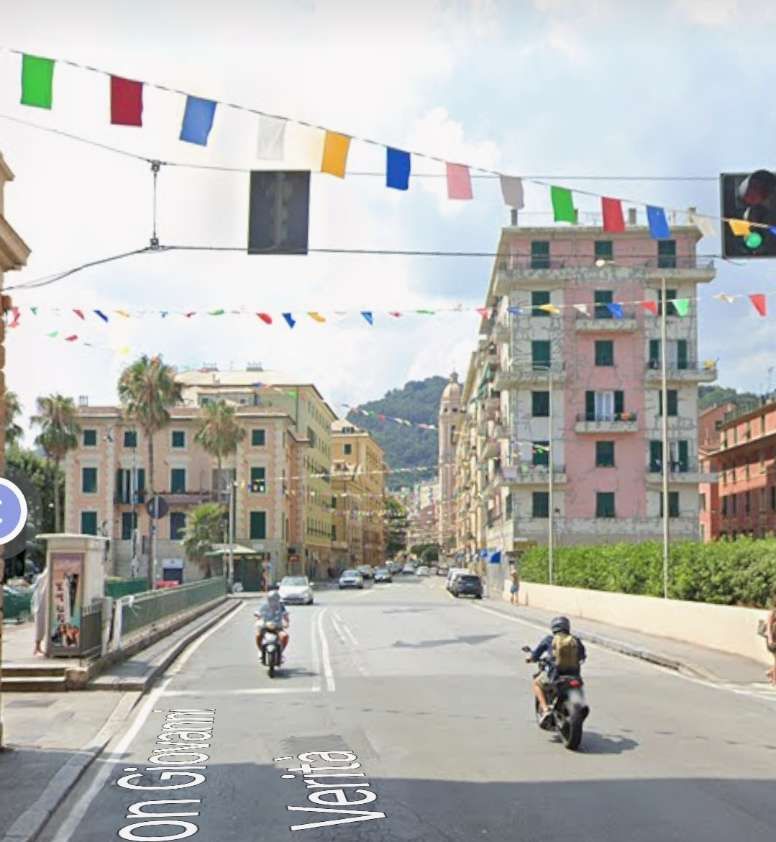
Looking East along Via Dom Giovanni Verita towards Genova, © Public Domain. [51]
The same location in 21st century. The station building can be seen on the right of the image. [Google Streetview, August 2024
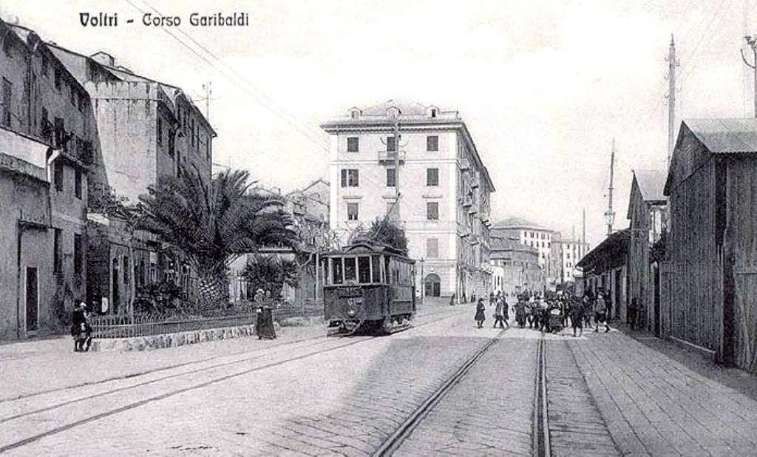
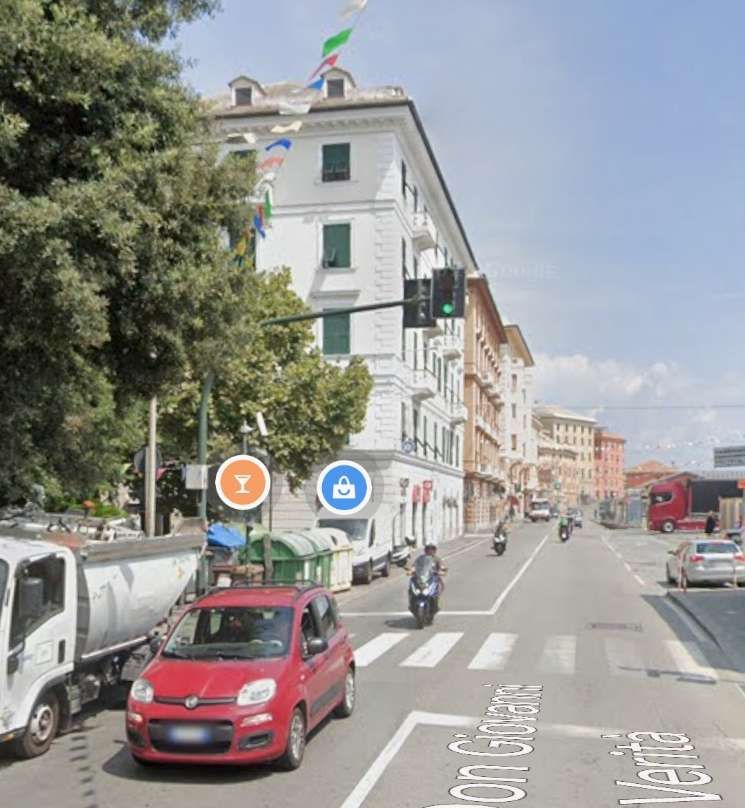
Back in the day, Via Dom Giovanni Verita was Corsa Garibaldi. This view looks East along the road towards the railway station. The buildings in the distance match those in the two images above., © Public Domain. [43]
Looking West on Via Dom Giovanni Verita, the station building is just beyond the red lorry cab. The three roofs of the furthest buildings are the same as those in the three images above. [Google Streetview, August 2024]
Looking West across the bridge on Don Giovanni Verita, Voltri, early in the 20th century, © Public Domain. [54]
The same location, looking West. [Google Streetview, August 2024]
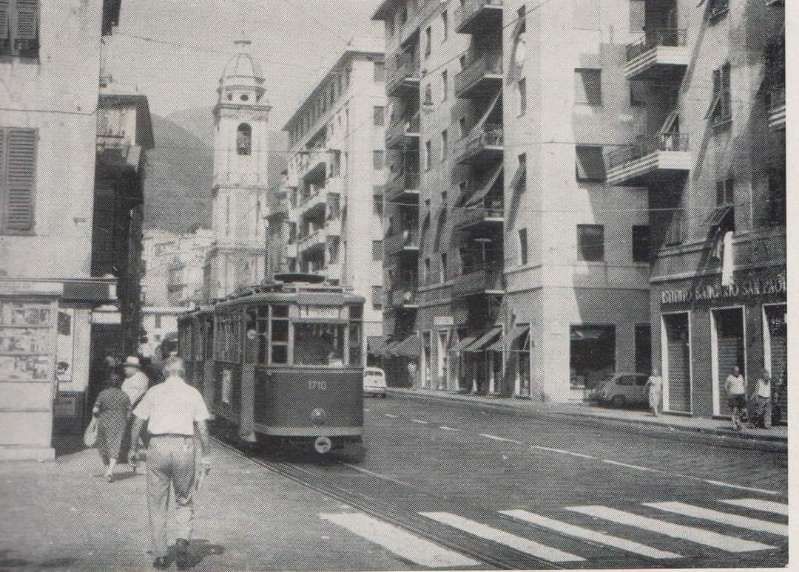
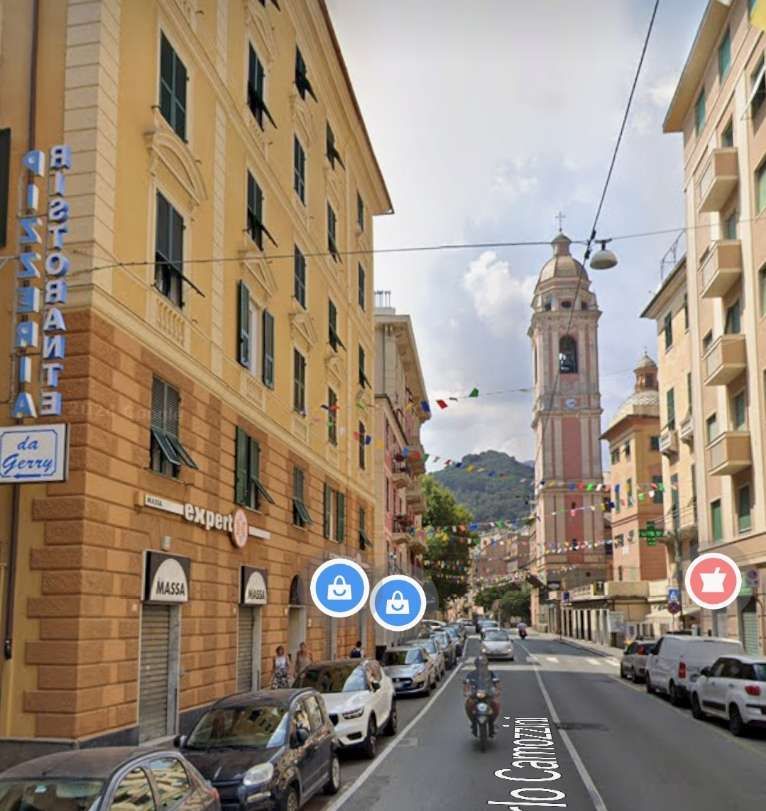
Looking West along Via Carlo Camozzini, Voltri in the mid-20th century, © Public Domain. [57]
Looking West from a very similar location on Via Carlo Camozzini. [Google Streetview, August 2024]

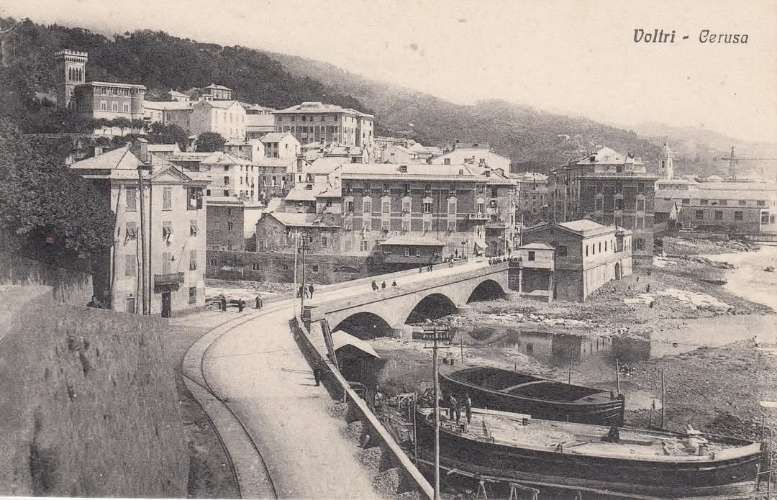
The tram depot was in Voltri close to the mouth of the River Cerusa (below).

The bridge in this image spans the mouth of the Cerusa River. The photograph looks East towards Genoa. The building just beyond the river on a platform above the beach is the Tram Depot. There are clearly tram tracks running towards the camera which suggests that the line’s terminus was to the West of the Cerusa River. [56]
The same view in the 21st century. [Google Streetview, August 2024]
The tram depot in Voltri seen from the Northeast. The bridge over the River Cerusa is off to the right o, © Public Domain. [55]

We have followed the Western Network as far as we can along the coast. We now need to look at the line(s) of the Western network which ran up the valley of the River Polcevera from Sampierdarena.

To do this we need to return to Piazza Vittorio Veneto in Sampierdarena.

The Western Network and Val Polcevera (the Valley of the River Polcevera)

The lines to the North left Piazza Vittorio Veneto at its Western end, passing immediately through an underpass under the FS Standard Gauge railway.

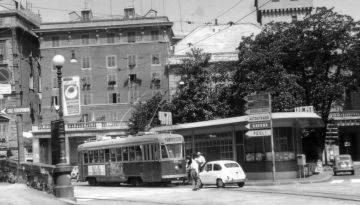
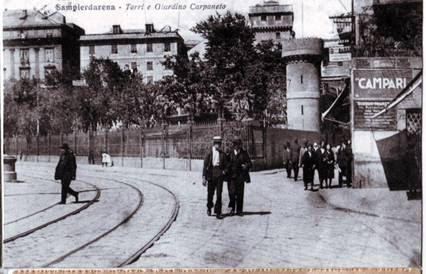
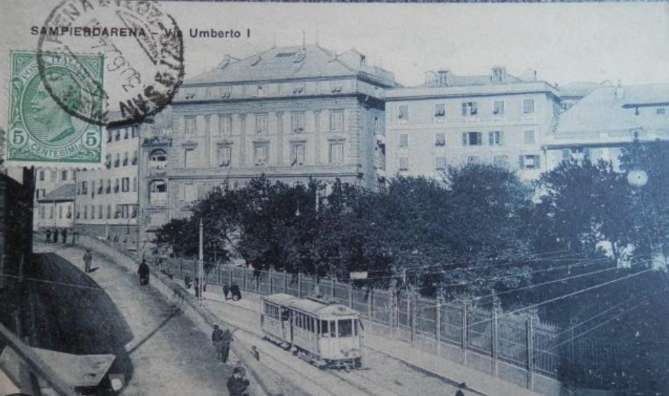
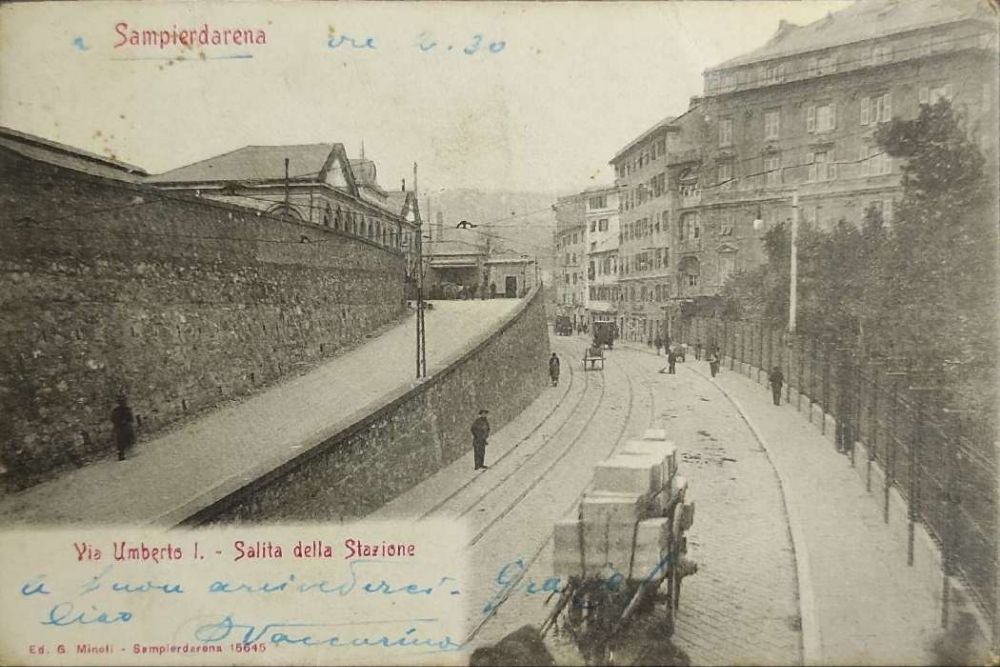
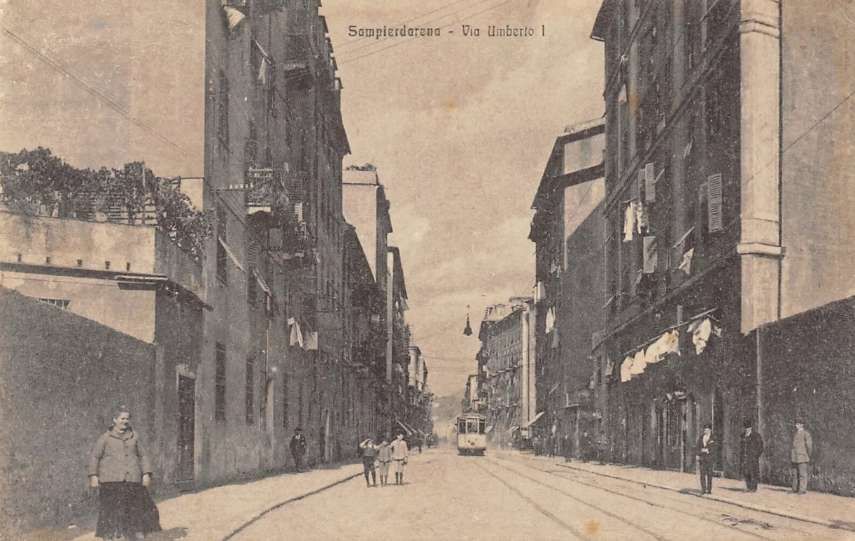
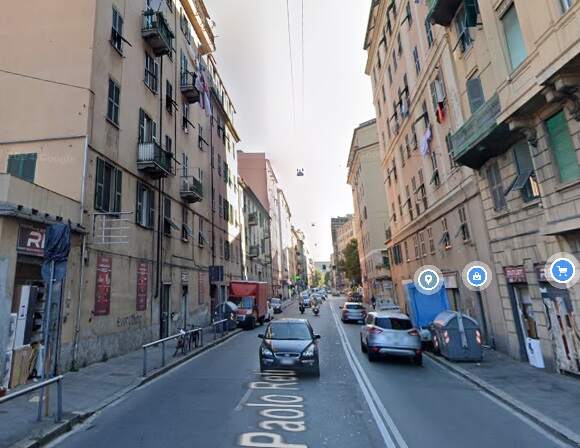
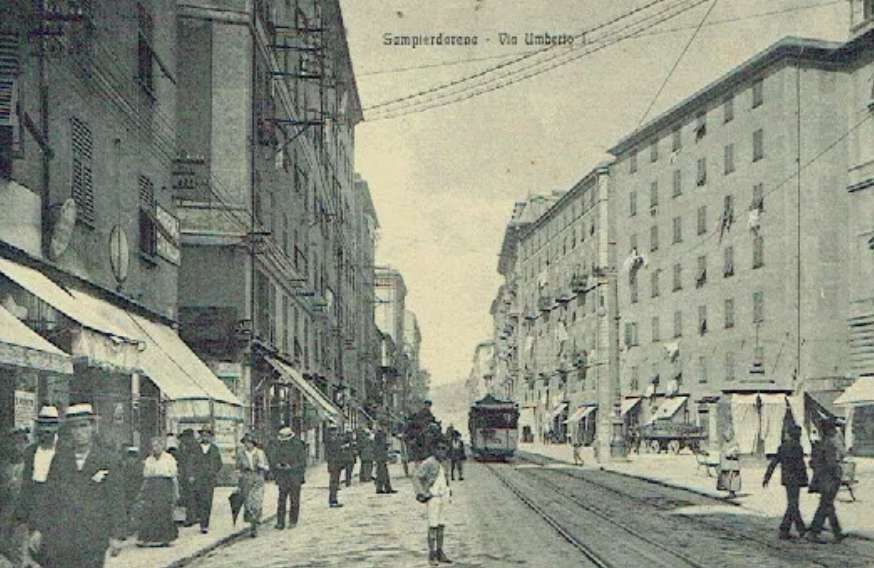
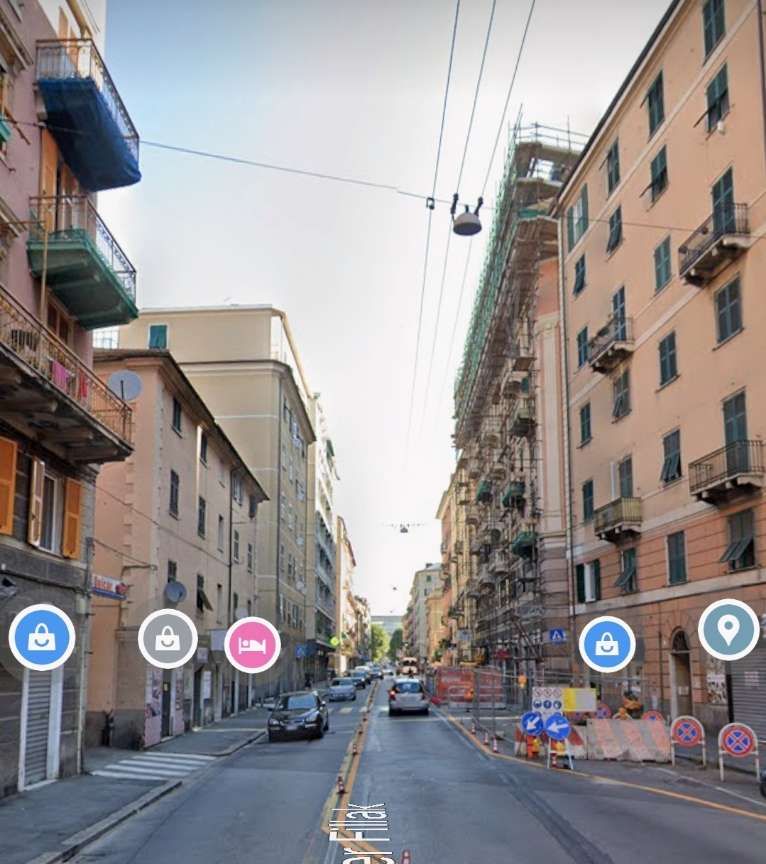
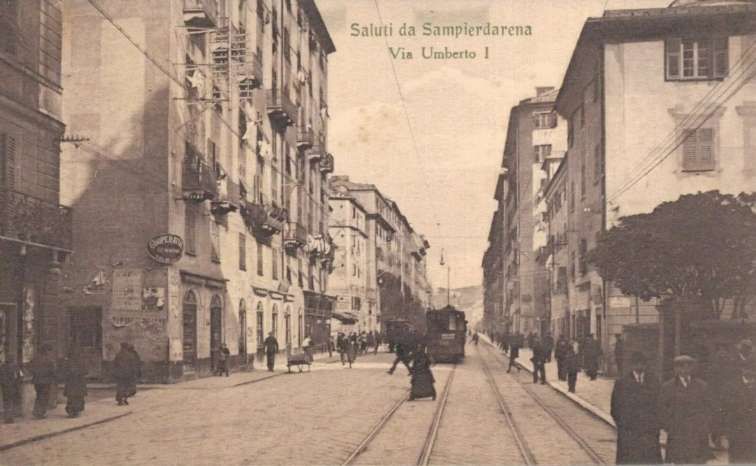
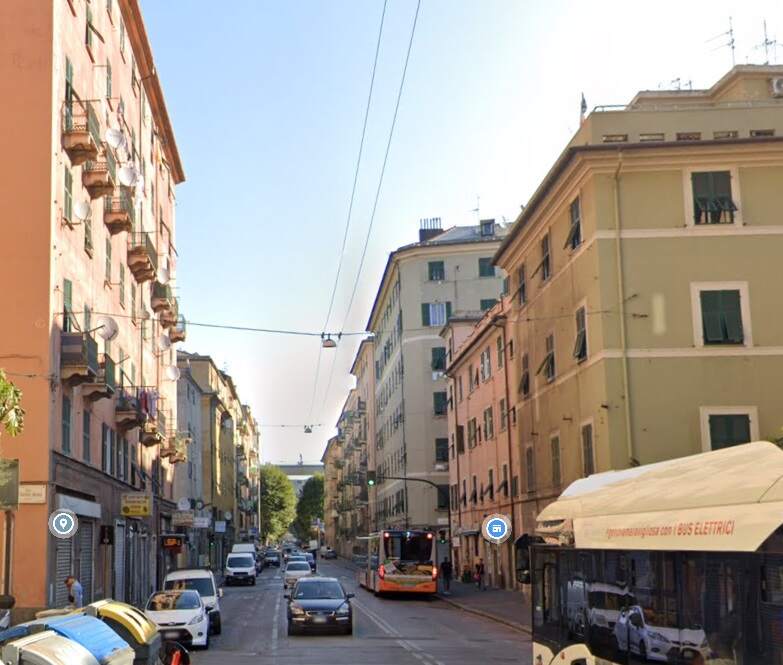
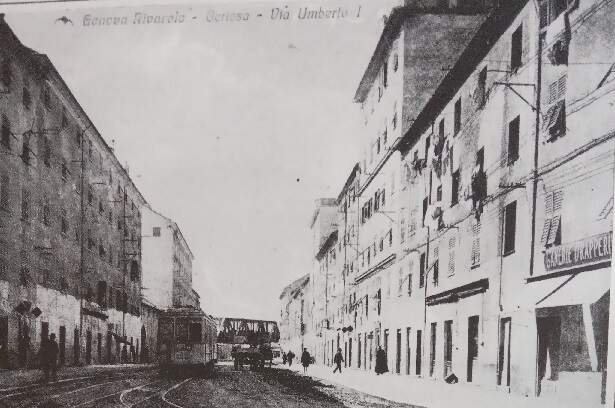
In the 19th century the route was known as ‘Via Vittorio Emanuele’. In the early years of the 20th century the road was renamed ‘Via Umberto 1’. In 1935, the city gave the road the name ‘Via Milite Ignoto’ (the Unknown Soldier). This decision appears to have been short-live as very soon the road was divided into two lengths, the more southerly length becoming ‘Via Martiri Fascisti’, the remaining length, ‘Via delle Corporazioni’. After the end of Word War Two renaming again occurred. In 1945 the names which continue to be used in the 21st century were chosen – ‘Via Paolo Reti’ and ‘Via Walter Fillak ‘. Fillak and Reti were partisans in WW2. [59][66]

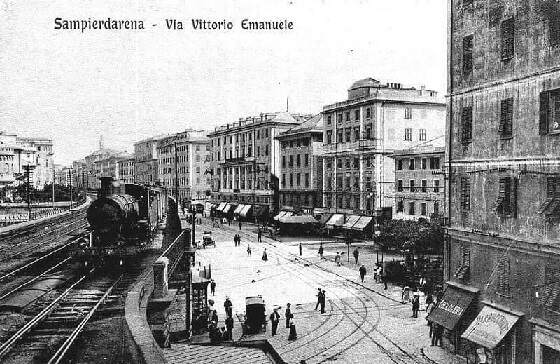
A view from above … This is Piazza (Via) Vittorio Emanuele seen from the West. The tram tracks can be seen heading away through the underpass in the foreground. [75]

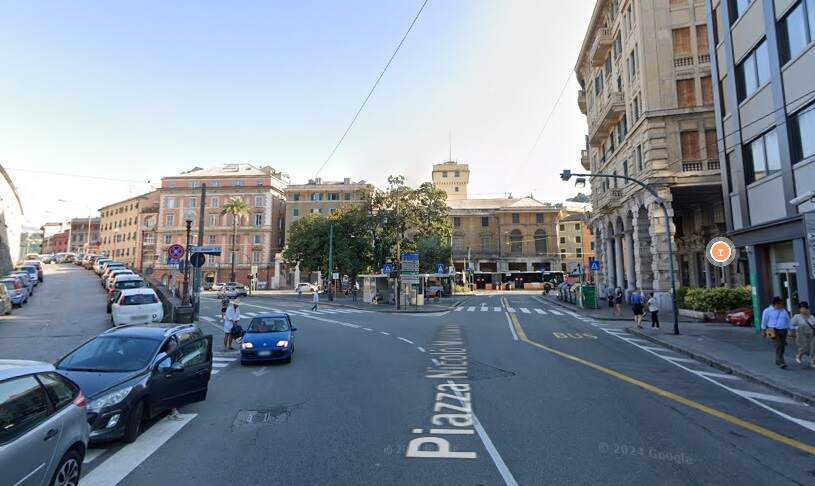
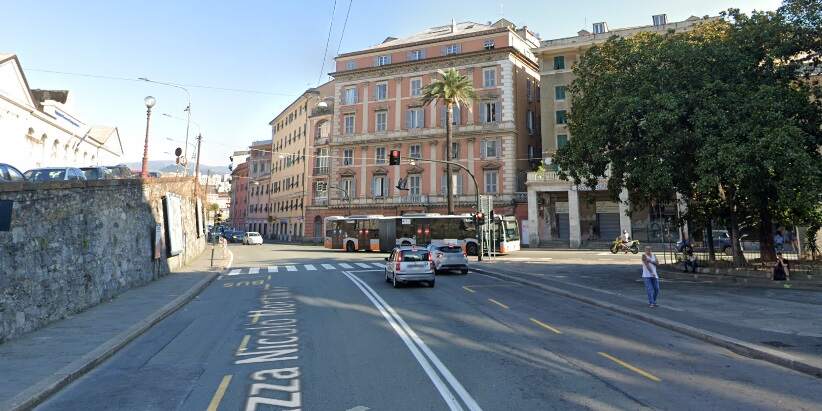
The route of this part of the old tramway network begins at this rail underpass (where the street is now named, ‘Piazza Nicolo Montano’, having once been Via Nino Bixio), [65] before running along Via Paolo Reti and then Via Walter Fillak. Just beyond the underpass the railway station access left the road on the left. The first old postcard views below show this location.

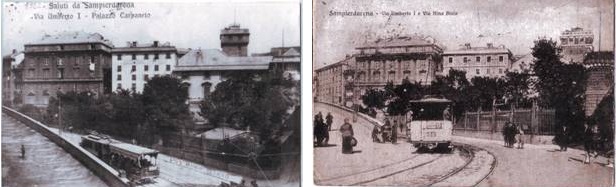
Two pixelated, low definition images showing the bottom end of what was Via Umberto 1. One the left in both images is the incline leading to the Sampierdarena Railway Station forecourt. [59]
A tram sits at a stop at Piazza Montano. This image was shared on the Foto Genova Antica Facebook Group by Annamaria Patti on 22nd May 2022. [3]
Three further postcard views, of better quality, of the bottom end of Via Umberto 1, (c) Public Domain. [59][62][63]
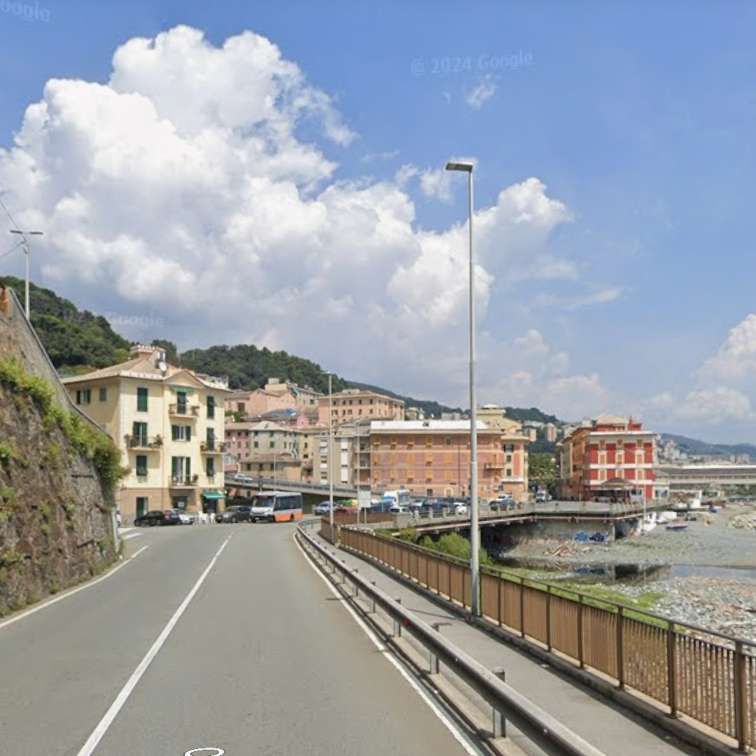
The view to the Northeast from the rail underpass in 2024. The station approach is on the left. The old tramway curved round to the left below the station approach’s retaining wall. [Google Streetview, August 2024]
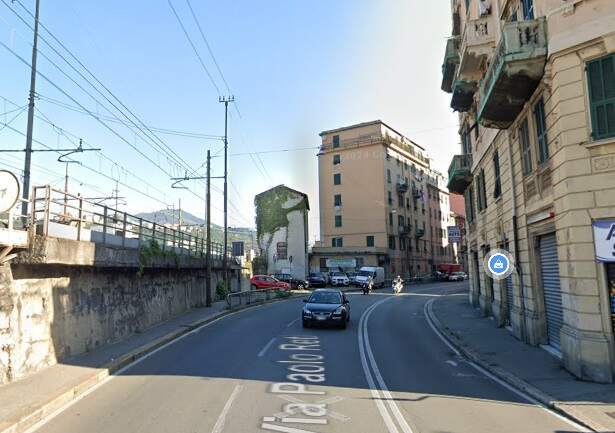
Just a little further along the old tram route. The retaining wall on the left supports the station approach road. The tramway ran on along what is now Via Paolo Reti. For some distance the road was flanked by a retaining wall supporting the FS standard-gauge railway. [Google Streetview, August 2024]

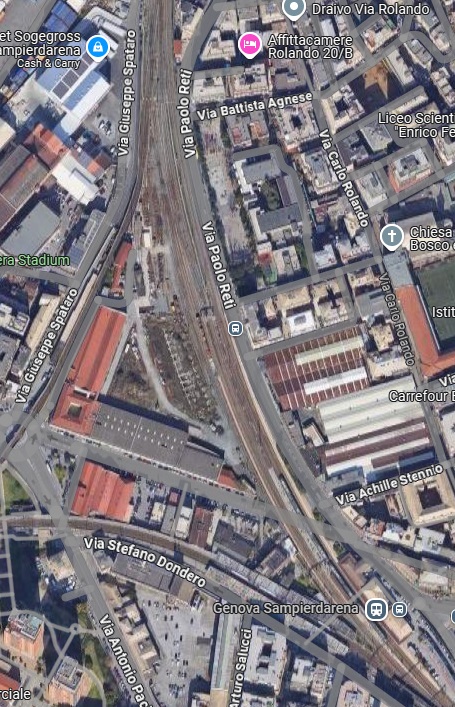
The adjacent Google satellite image shows roads over which the old tramway ran. In the bottom right is Piazza Nicolo Montano. It is also possible to make out the station approach ramp which has a number of cars parked on it. In the immediate vicinity of the passenger railway station, railway buildings can be seen separating Via Paolo Reti from the railway but very soon the road and the railway run side-by-side with the railway perhaps 2 to 3 metres above the road. Via Eustachio Degola passes under the railway just to the North of the station buildings. Towards the top of the satellite image, Via Paolo Reti can be seen turning away from the railway wall. [Google Maps, December 2024]

Via Paolo Reti (the former Via Umberto 1) turns away from the railway wall which is now much lower than it was near the station buildings. [Google Streetview, August 2024]
Via Umberto 1, looking North from the bend visible in the photograph above where the road leaves the side of the railway, (c) Public Domain. [68]
Via Paolo Reti (once Via Umberto 1) at the same location as the monochrome image above. [Google Streetview, August 2024]

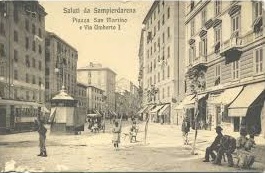
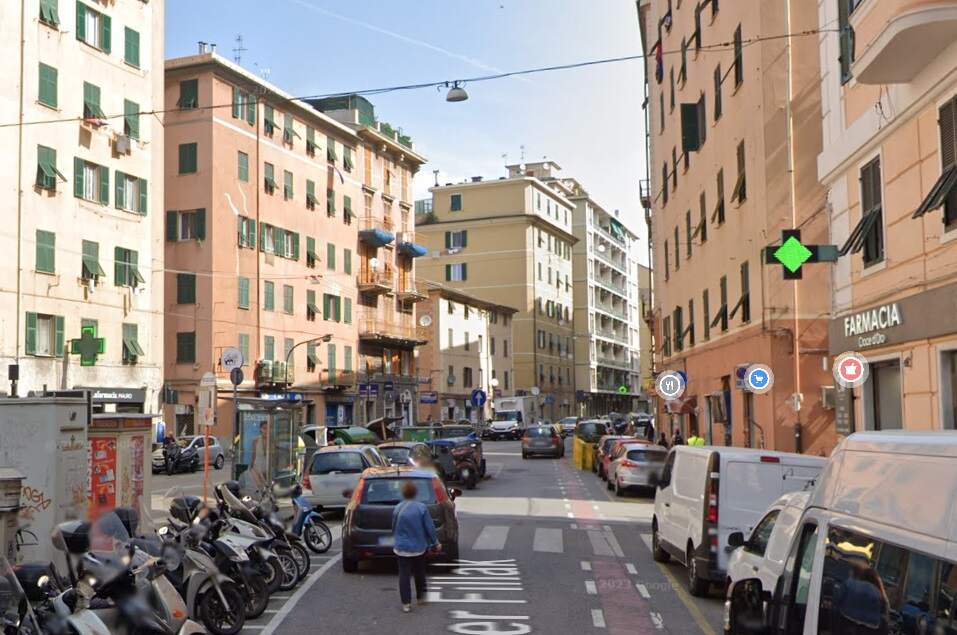
The monochrome image below purports to show Piazza San Marino. As far as I can work out the piazza was historically, ‘Piazza Vittorio Emanuele III’ and later renamed for another partisan from World War 2 – ‘Piazza Ricardo Masnata’.

A relatively low quality image of Piazza San Marino and Via Umberto 1. The piazza later became Piazza Ricardo Masnata. This view looks North with a tram visible on the left, (c) Public Domain. [64]
Piazza Ricardo Masnata, looking North. There is little to link this image from 2024 with the monochrome image above, other than the alignment of the roads and the shape of the piazza. However, at the centre of this image is a lower building which also appears in the monochrome image. [Google Streetview, August 2024]
Via Umberto 1 looking North from what became Piazza Ricardo Masnata, (c) Public Domain. [67]
The same location in the 21st century. [G
Via Umberto 1, now Via Walter Fillak with a tram heading towards Genoa. [69]
The same location on Via Walter Fillak in the 21st century. [Google Streetview, August 2024]

The line from Sampierdarena ran towards Certosa where, once Galleria Certosa was completed, it met the line through the tunnel.

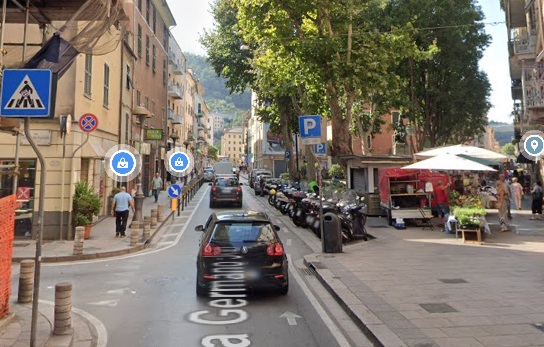
A satellite view of Certosa. Trams approached the centre of Certosa from the South-southwest on Via Walter Fillak, from the Southeast on Via Beedetto Brin and from the Northnorthwest on Via Germano Jori. [Google Maps, December 2024]
Galleria Certosa can be seen in the right background of this image. The tram is turning towards the underpass beneath the FS standard-gauge railway, © Public Domain. [72]
A similar view in the 21st century. The Metro station at Brin is at the high level. [Google Streetview, October 2020]
A tram has just passed under the railway (on Via Benedetto Brin) and is approaching the junction with Via Germano Jori (then Umberto 1) and Via Teresio Mario Canepari, © Collection of Stefano Finauri, Public Domain. [73]
A very similar view in the 21st century. [Google Streetview, August 2024]
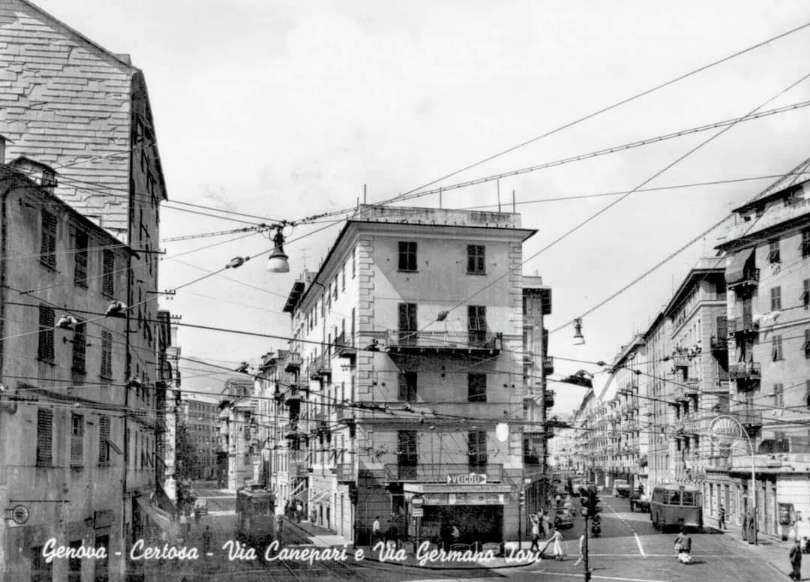
A mid-20th century postcard view, looking North from junction between Via Germano Jori and Via Teresio Mario Canepari. A tram is heading South along Via Germano Jori, © Public Domain. []
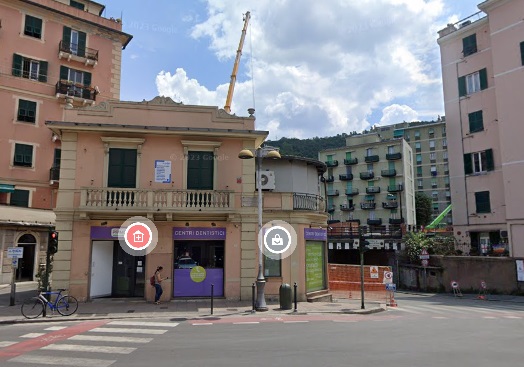
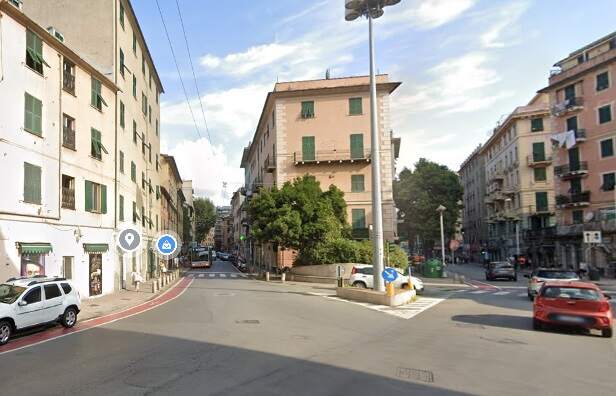
The same view in the 21st century, at the junction of Via Germano Jori, Via Teresio Mario Canepari and Via Benedetto Brin. [Google Streetview, August 2024]
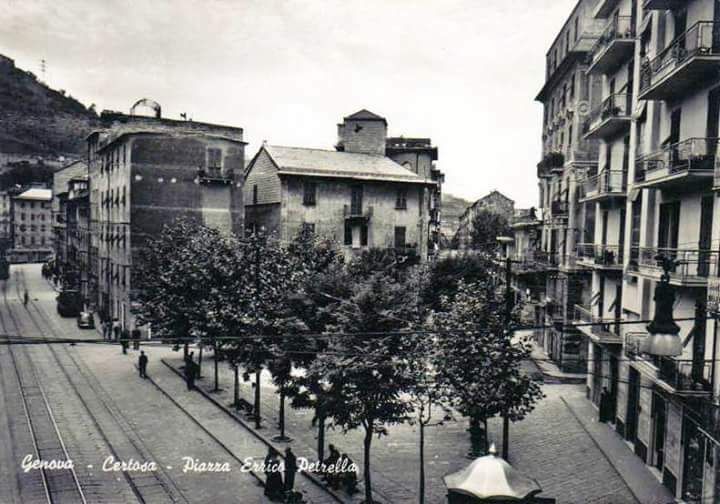
Piazza Errico Petrella looking South, Via Germaon Jori is on the left, Via Certosa on the right. A tram can be seen in the distance at the junction of Via Germano Jori with Via Benedetto Brin and Via Walter Fillak. [74]
Looking South from Piazza Errico Petrella with Via Germano Jori ahead and Via Certosa behind the white canopies to the right. [Google Streetview, August 2024]
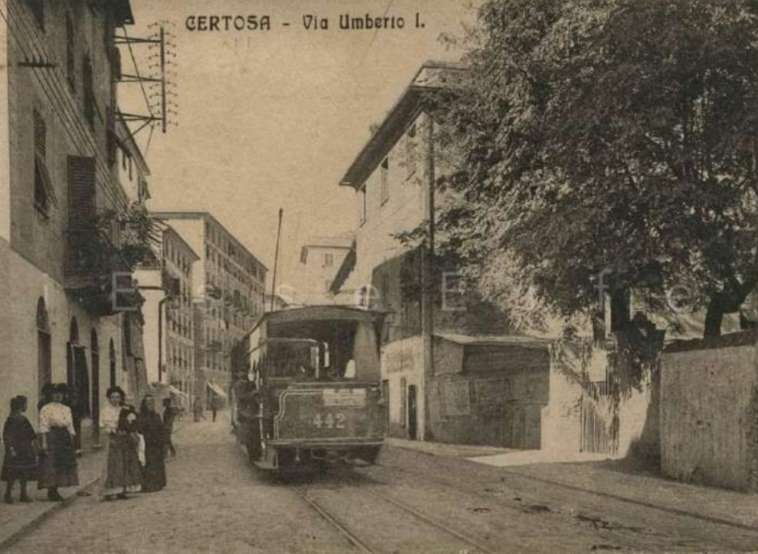
A tram on Via Umberto 1 in Certosa. It is difficult to locate this photograph in the 21st century as much of the built environment has changed but it is most likely a view North from Piazza Errico Petrella, © Public Domain. [53]
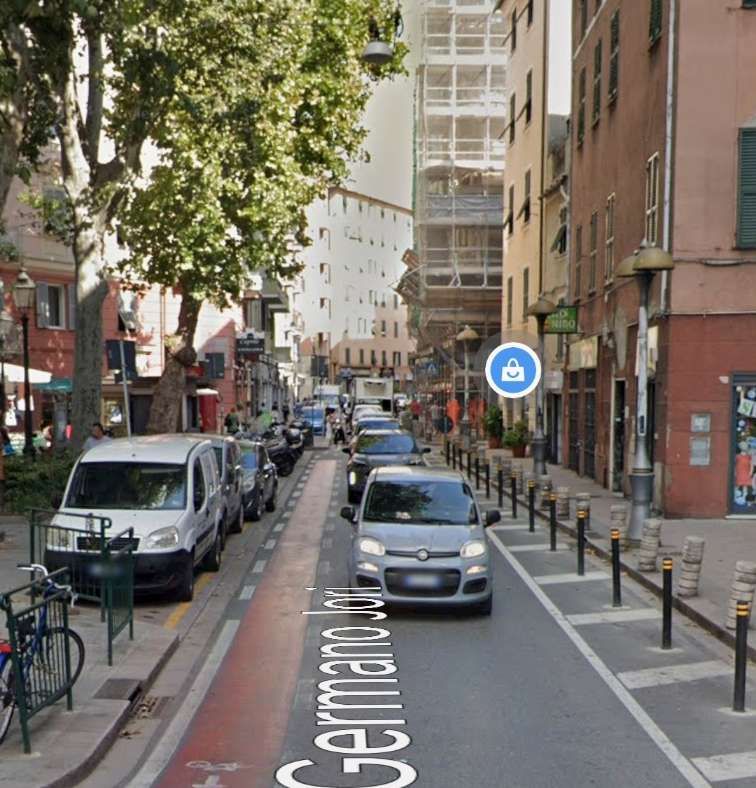
This is a possible location for the monochrome image above. This view looks North from Piazza Errico Petrella, the street geometry is similar, but the buildings do not match. In Certosa, northbound and southbound traffic is separated. This is Via Germano Jori. [Google Streetview, August 2024]
Looking South from the bridge over the River Torbella. The building on the right is the
Biblioteca Civica – Cervetto Rivarolo. Trams ran over this bridge and along Via Germano Jori which is the right fork in the road ahead. [Google Streetview, August 2024]
Looking North from the bridge over the Torbella river which separated Certosa from Rivarolo (Superior). This image was shared on the C’era una volta Genova Facebook Group by Luca Dasso on 17th December 2020, (c) Public Domain. [76]
A tram at the same location in the early 20th century. This image was shared on the C’era una volta Genova Facebook Group by Robert Cito on 19th October 2023, (c) Public Domain. [78]
A similar view North from the bridge over the River Torbella in the 21st century. [Google Streetview, August 2024]
This is a 1905 photograph looking North on Via Gioachino Rossini close to its junction with Via alla Stazione di Rivarolo (on the left). This image was shared on the C’era una volta Genova Facebook Group by Luca Dasso on 24th July 2018, (c) Public Domain. [81]
Continuing North through Rivarolo on what was still in the early years of the 20th century, Via Umberto 1. Tram No. 6 is heading for Bolzaneto. This image was shared on the C’era una volta Genova Facebook Group by Robert Cito on 18th October 2023. It is again difficult to accurately locate this image. A bridge similar to that shown on this photo remains but the landscape around it seems much altered, (c) Public Domain. [77]
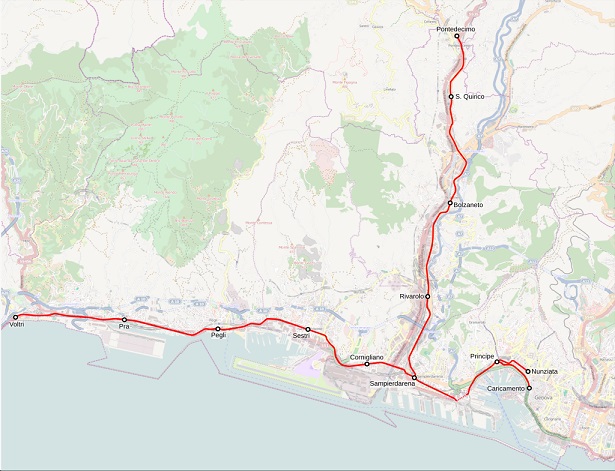
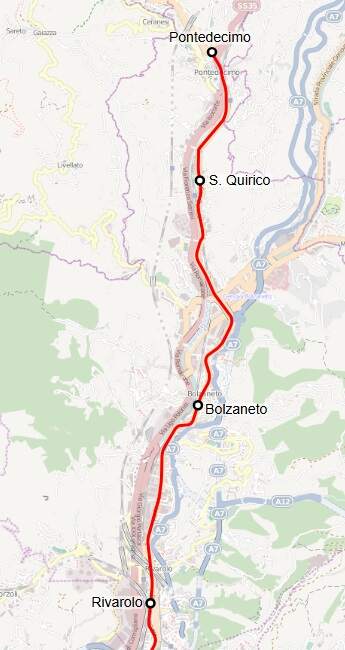
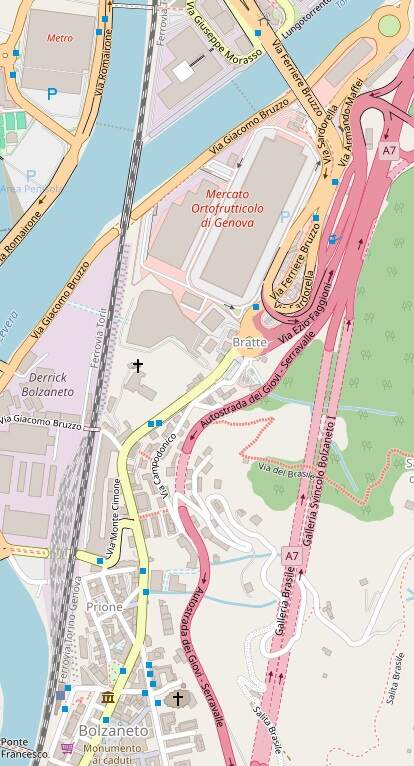
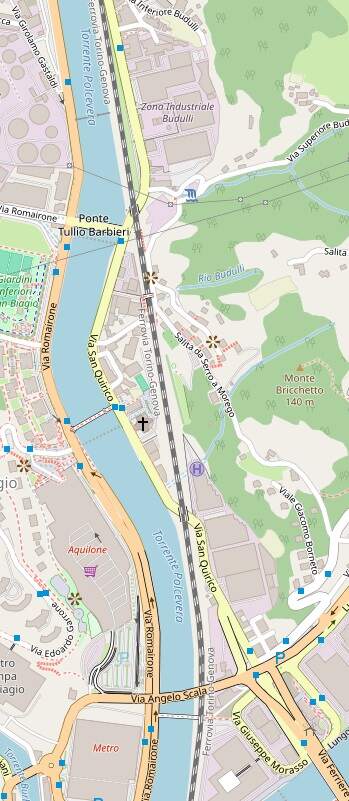
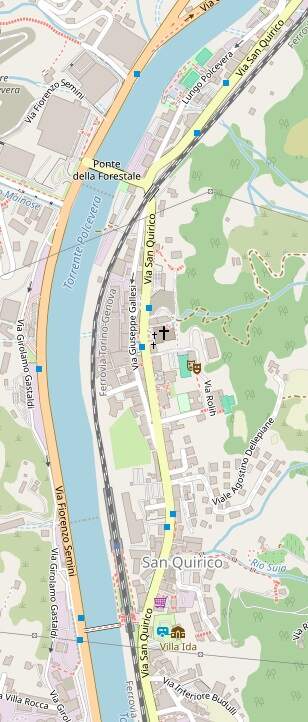
This extract from a file based on openstreetmap.org shows the remaining length of the tramway, from Rivarolo through Bolzaneto and San Quirico to Pontedecimo, (c) Arbalete, and authorised for reuse under a Creative Commons Licence (CC BY-SA 3.0). [19]

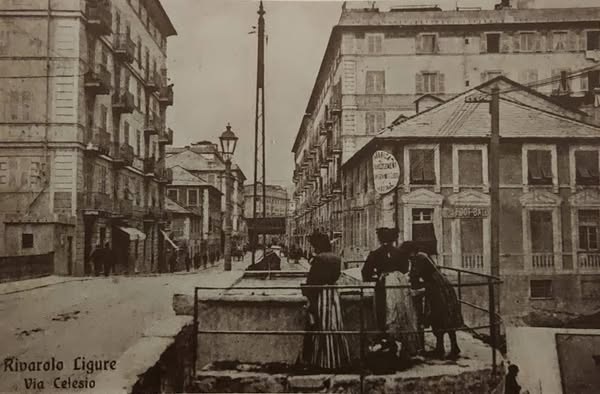
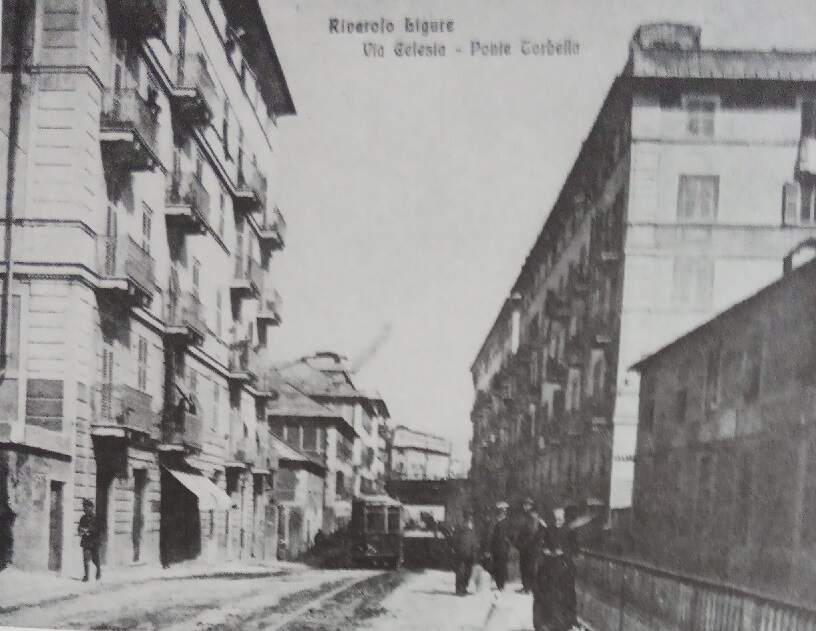
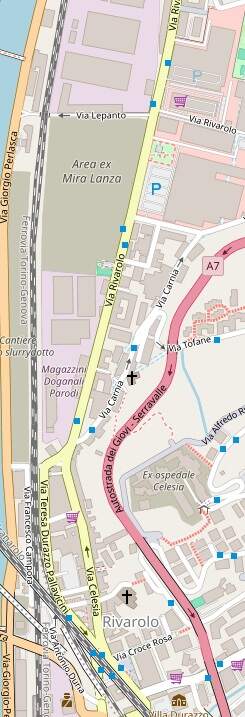
The tramway followed Via Celesia through Rivarolo (Superior). Rivarolo and Via Celesia can be seen at the bottom of this extract from openstreetmap.org. [79]

This image from the early 20th century looks North along Via Celesia. Space on the street was clearly at a premium! [80]
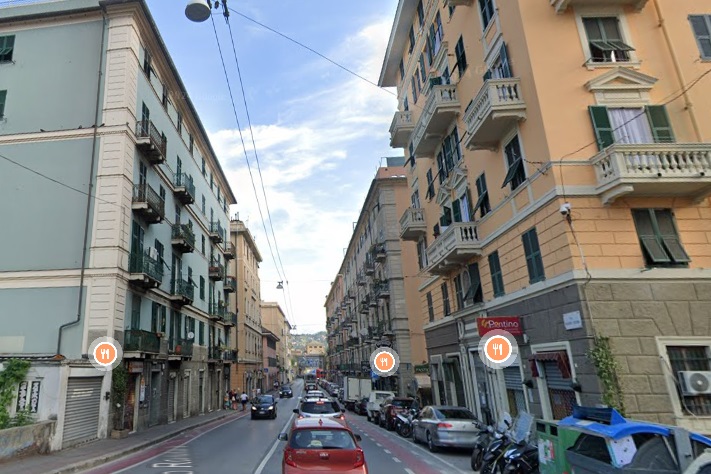
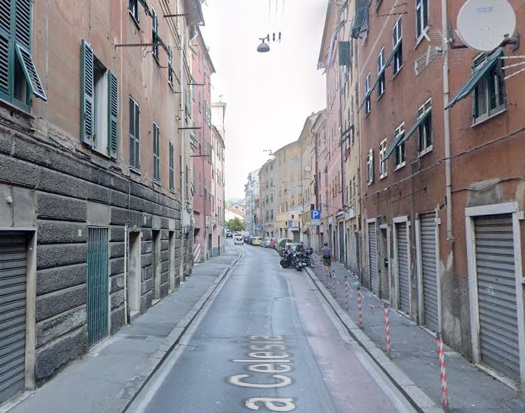
Via Celesia in the 21st century. [Google Streetview, August 2024]

North of Via Celesia, the tramway ran along Via Rivarolo.

This postcard shows the junction at the North end of Via Celesia, circa. 1920s. Via Rivarolo is ahead. This image was shared on the C’era una volta Genova Facebook Group by Mario Vanni on 18th August 2019, (c) Public Domain. [82]
The smae location in the 21st century. [Google Streeetview, August 2024]
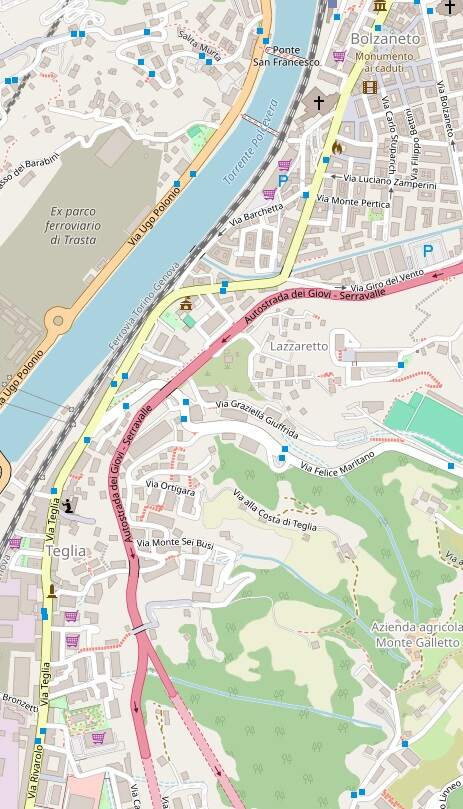
This next extract from openstreetmap.org shows Via Rivarolo entering bottom-left. Trams ran on into Teglia on Via Teglia and continued on to Bolzaneto (in the top-right of this extract) along Via Constantino Reta. [79]
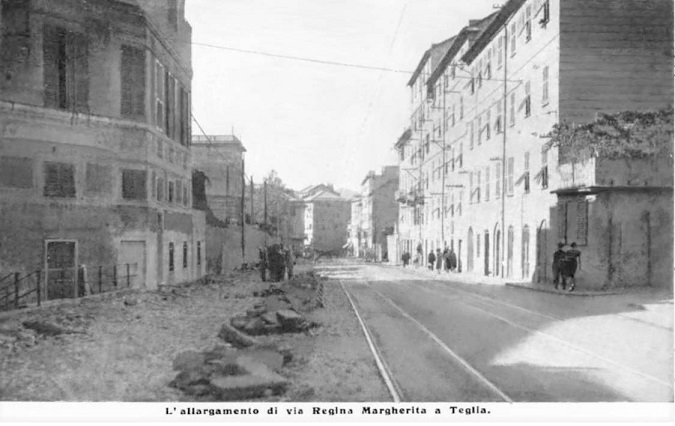
This postcard view looks South along what is now Via Teglia (then Via Regina Margherita. This image was shared on the C’era una volta Genova Facebook Group by Elio Berneri on 19th October 2020, (c) Public Domain. [83]
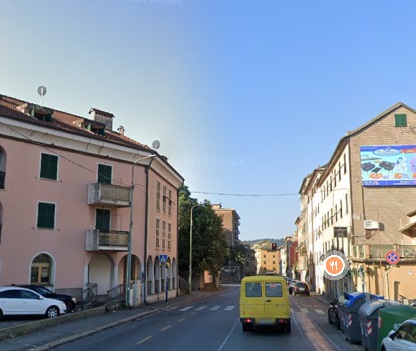
A very similar view at the same location in the 21st century. [Google Streetview, August 2024]
Car 906 in service on line 7 Caricamento – Pontedecimo, one of the longest of the UITE, is seen here running in Bolzaneto. The photograph was taken facing North. In the background you can see another Tramcar, as well as a third on the track in the opposite direction, (c) Public Domain. [84]
A similar North facing view in Bolzaneto in the 21st century. [Google Streetview, August 2024]
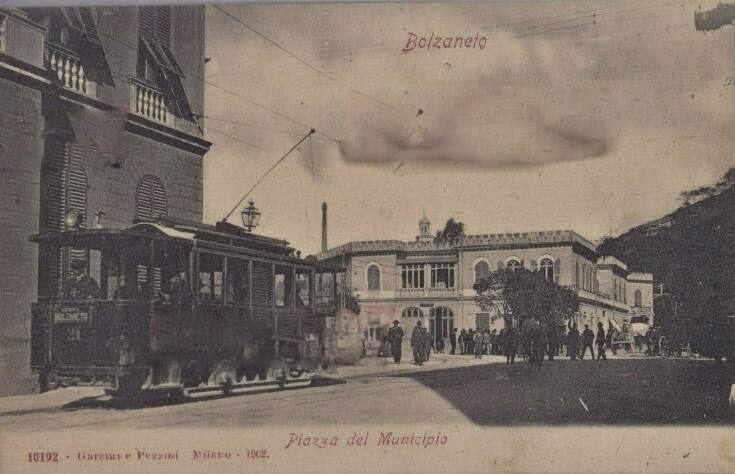
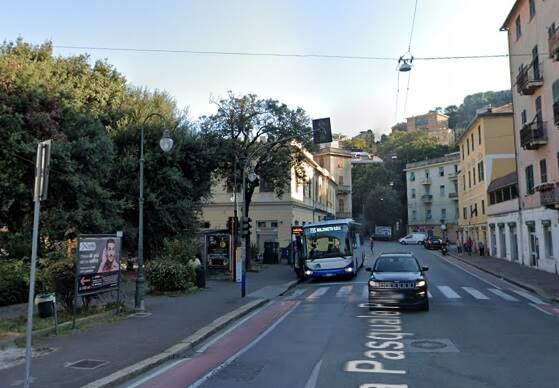
A tram waits at Piazza del Municipio in Bolzaneto. This image was shared by Mario Vanni on the C’era una volta Genova Facebook Group on 8th July 2021, (c) Public Domain. [85]
A very similat view of the same location in the 21st century. The road on which the bus is standing is now known as Via Pasquale Pastorino. [Google Streetview, August 2024]
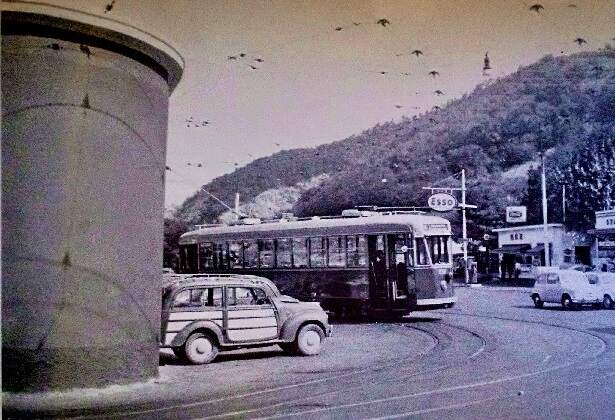
A few hundred metres to the Northeast is the area known as ‘Bratte’. A tram waits in the mid-20th century to set off for Caricamento. This image was shared on the C’era una volta Genova Facebook Group by Roberto Della Rocca on 12th December 2020. [86]
A similar view at the same location in the 21st century. [Google Streetview, August 2024]

North of Bratte, Trams crossed the River Secca, a tributary of the Polcevera, following Via Ferriere Bruzzo and then continued North alongside the River Polcevera on Via San Quirico.

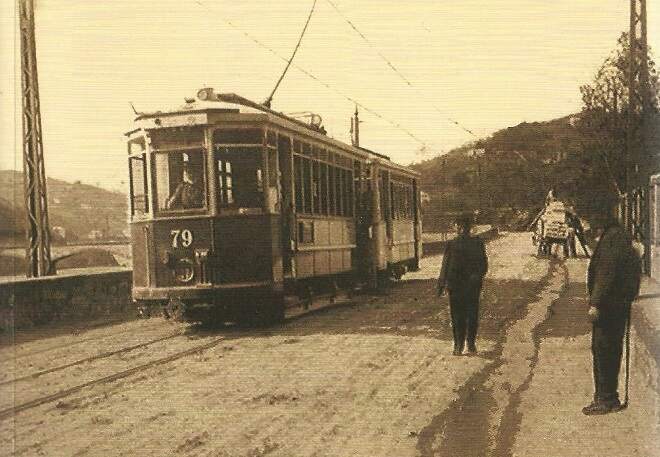
Tram No 79 leads a trailer car South on Via San Quirico in the first decades of the 20th century. It seems as though Ponte Tullio Barbieri can be seen behind the tram. This image was shared by Sergio De Nicolai on the C’era una volta Genova Facebook Group on 21st October 2018. [88]
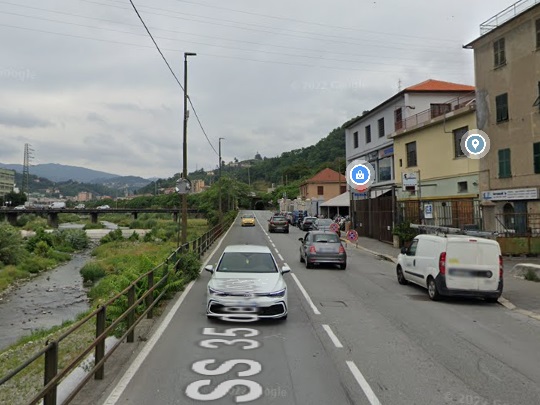
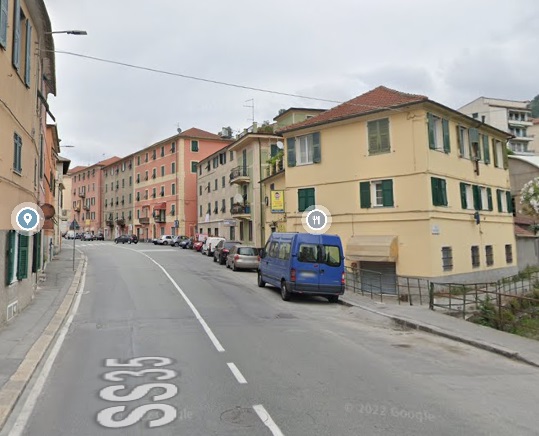
A similar location on Via San Quirico in the 21st century. [Google Streetview, July 2022]

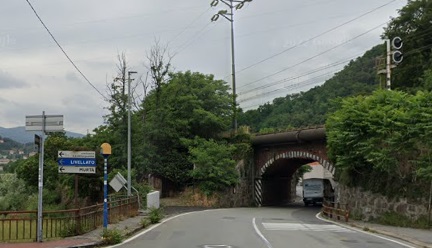
Trams passed under the FS Standard-gauge lines close to Ponte Tullio Barbieri. [Google Streetview, June 2022]
Trams ran on through the centre on San Quirico on Via San Quirico.
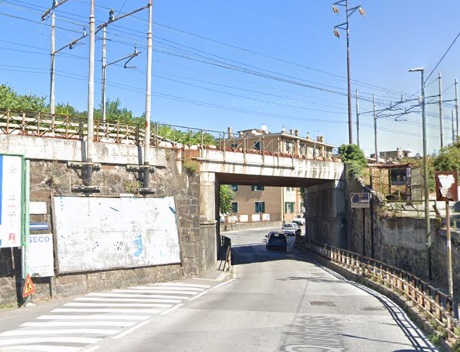
Before returning to the side of the river, passing under the railway again. [Google Streetview, July 2022]

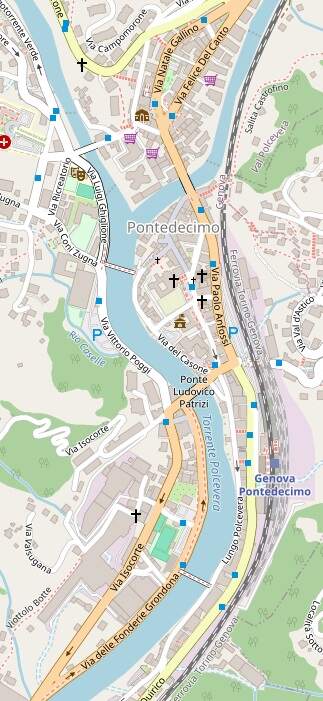
The next length of the journey is the last. Trams terminated at Pontedecimo. [79]

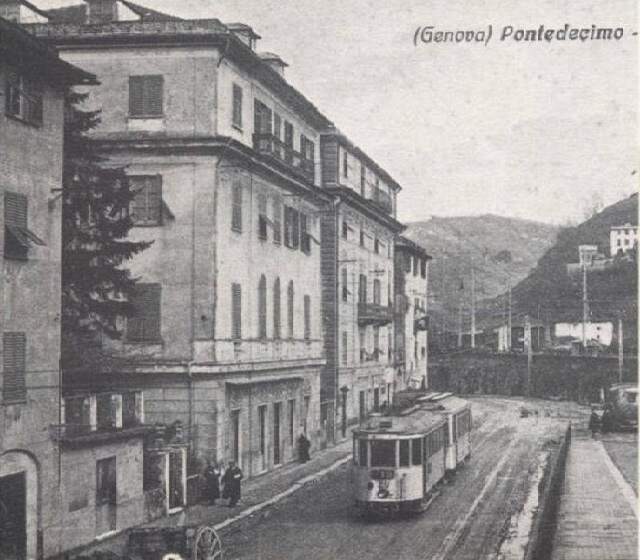
A tram and trailercar on Lungo Polcevera in Pontedecimo close to Pontedecimo Railway Station, This image was taken looking South along the river bank and was shared by Giorgio Gioli on the C’era una volta Genova Facebook Group on 4th November 2020. [89]
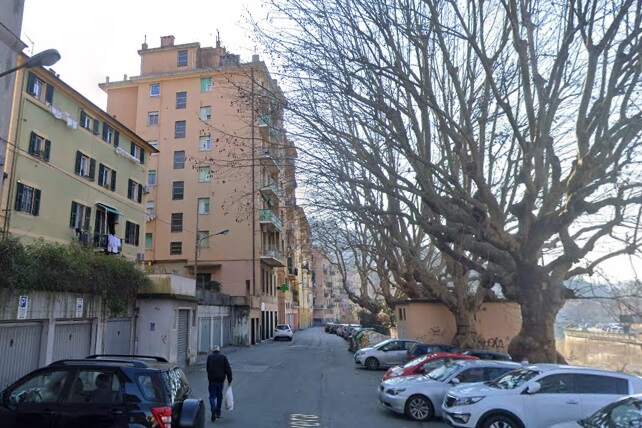
This view looks South along the bank of the River Polcevera at a location similar to that in the image above. [Googler Streetview, January 2021]
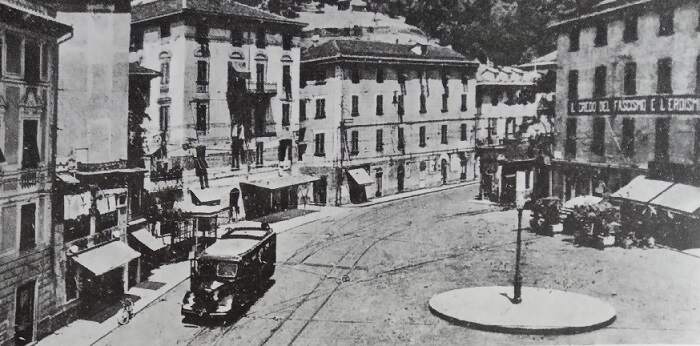
The central piazza in Pontedecimo. The terminus of the tram service. This image was shared on the C’era una volta Genova Facebook Group by Roberto Cito on 29th October 2023. [87]
Trams terminated in Pontedecimo. [Google Streetview, July 2022]
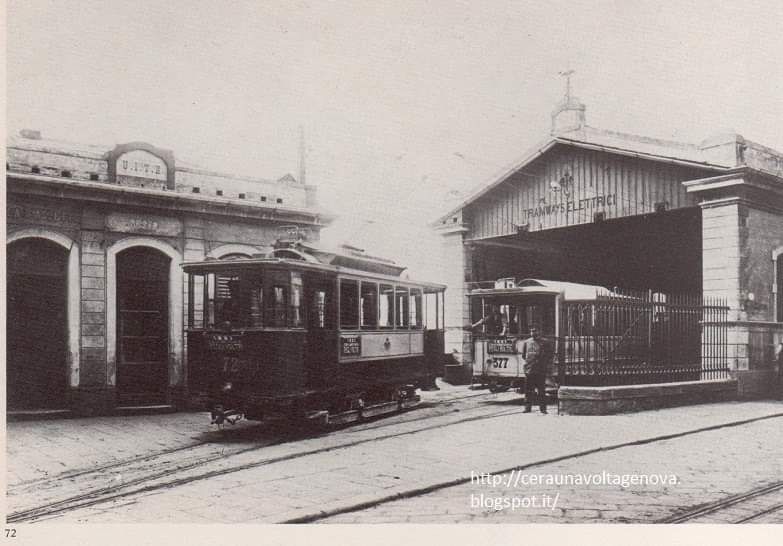
The tram depot at Pontedecimo. This image was shared on the C’era una volta Genova Facebook Group by Alessandro Lombardo on 30th October 2019. [90]

References

  1. https://commons.m.wikimedia.org/wiki/File:Genova,_piazza_De_Ferrari_with_tram.jpg, accessed on 10th November 2024.
  2. https://www.facebook.com/photo/?fbid=1401973673209093&set=gm.1438159026228377, accessed on 4th December 2024.
  3. https://www.facebook.com/photo/?fbid=10225181204176020&set=pcb.4980915058674284, accessed on 4th December 2024.
  4. https://www.facebook.com/share/p/uff2Q5eUj27cv1zK, accessed on 4th December2024
  5. https://www.facebook.com/share/p/XS39hojRUKuee7Fk, accessed on 4th December 2024.
  6. Not used
  7. https://www.guidadigenova.it/storia-genova/portoria-piccapietra, accessed on 14th November 2024.
  8. http://www1.palazzoducale.genova.it/storiche/storica10, accessed on 14th November 2024.
  9. https://www.facebook.com/groups/gianfranco.curatolo/permalink/4283487231695528/?app=fbl, accessed on 14th November 2024.
  10. https://commons.m.wikimedia.org/wiki/File:Genoa_1886_-_Italy_handbook_for_travellers.jpg, accessed on 15th November 2024.
  11. https://commons.m.wikimedia.org/wiki/File:Genoa_1906_-_Italy_handbook_for_travellers.jpg, accessed on 15th November 2024.
  12. https://commons.m.wikimedia.org/wiki/File:Genova_italy_1913.jpg, accessed on 15th November 2024.
  13. https://www.stagniweb.it/foto6.asp?File=tram_ge&Inizio=1&Righe=1&InizioI=1&RigheI=50&Col=5, accessed on 15th November 2024.
  14. https://www.collectoravenue.it/index.php/en/shop/cartolinagenovapiazzacorvettotram194033892-detail, accessed on 15th November 2024.
  15. https://www.ebay.co.uk/itm/152214705370?mkcid=16&mkevt=1&mkrid=711-127632-2357-0&ssspo=JNiy4OlNSAG&sssrc=4429486&ssuid=afQhrar7TGK&var=&widget_ver=artemis&media=COPY, accessed on 15th November 2024.
  16. https://en.m.wikipedia.org/wiki/AMT_Genova, accessed on 15th November 2024.
  17. Storia [History] (in Italian). AMT Genova; https://www.amt.genova.it/amt/amt-istituzionale/storia, accessed on 15th November 2024.
  18. http://www.uwrbancenter.comune.genova.it/sites/default/files/quaderno_arch_2011_03_21.pdf, accessed on 16th November 2024.
  19. Rete tranviaria di Genova; https://it.wikipedia.org/wiki/Rete_tranviaria_di_Genova, accessed on 26th November 2024.
  20. AMT (ed.); History of public transport in Genoa; Genoa, SAGEP Editrice, 1980.
  21. Paolo Gassani; Photo history of the tramway in Genoa , Genoa, Nuova Editrice Genovese, 1982.
  22. https://it.m.wikipedia.org/wiki/Galleria_Certosa, accessed on 27th November 2024.
  23. https://www.facebook.com/share/yMAPjmu6yE9CdhCt, accessed on 27th November 2024.
  24. https://www.lapolcevera.it/news/id/2352/cat/0/tip/1/Quando-da-Certosa-si-arrivava-a-Dinegro-con-il-tram-.html, accessed on 27th November 2024.
  25. https://dearmissfletcher.com/tag/galleria-giuseppe-garibaldi, accessed on 27th November 2024.
  26. https://www.facebook.com/groups/gianfranco.curatolo/permalink/8064067336970813/?app=fbl, accessed on 27th November 2024.
  27. https://m.wikidata.org/wiki/Q57466295, accessed on 28th November 2024.
  28. https://uk.pinterest.com/mantero1059, accessed on 28th November 2024.
  29. https://pastvu.com/p/720638, accessed on 28th November 2024.
  30. https://www.genovacollezioni.it/Default.aspx?q=CARTOLINE%20PAESAGGISTICHE&t=GALLERIA%20REGINA%20ELENA, accessed on 28th November 2024.
  31. https://ceraunavoltagenova.blogspot.com/2014/10/piazza-caricamento.html?m=1, accessed on 28th November 2024.
  32. https://ceraunavoltagenova.blogspot.it, accessed on 28th November 2024
  33. https://www.facebook.com/groups/fotogenovaantica/permalink/5685345834897866/?app=fbl, accessed on 28th November 2024.
  34. https://www.facebook.com/groups/fotogenovaantica/permalink/6981769868588783/?app=fbl, accessed on 28th November 2024.
  35. https://www.facebook.com/share/p/drRbQXEGcmKJdz6A/?, accessed on 28th November 2024.
  36. https://www.stagniweb.it/foto6.asp?File=tram_ge&Inizio=1&Righe=10&InizioI=1&RigheI=50&Col=5, accessed on 29th November 2024.
  37. https://www.facebook.com/share/p/FMgB1iVAaWiPNnKh, accessed on 29th November 2024.
  38. https://jenikirbyhistory.getarchive.net/topics/tram+transport+in+genoa, accessed on 29th November 2024.
  39. https://www.facebook.com/share/p/d9oFanfv5vD5WaiNhttps://www.facebook.com/share/p/d9oFanfv5vD5WaiN/, accessed on 29th November 2024.
  40. https://www.facebook.com/share/p/wYt15NoX8Mr9ypWg, accessed on 30th November 2024.
  41. https://images.app.goo.gl/gsrU1q3rJALvZngS7, accessed on 30th November 2024.
  42. https://www.guidadigenova.it/en/museums-genoa, accessed on 30th November.
  43. https://uk.pinterest.com/antoniettasatta48, accessed on 30th November 2024.
  44. http://www.sanpierdarena.net/Miani.htm, accessed on 30th November 2024.
  45. https://www.stagniweb.it/foto6.asp?File=l_cart&righe=1&inizio=31&InizioI=1&RigheI=50&Col=5, accessed on 30th November 2024.
  46. https://genovaquotidiana.com/2019/01/18/via-buozzi-il-civ-fa-capitozzare-gli-oleandri-e-rivendica-il-gesto-su-facebook-ma-e-un-reato, accessed on 30th November 2024.
  47. https://www.facebook.com/share/p/ZWYfrGt7G1939S9u, accessed on 30th November 2024.
  48. https://it.pinterest.com/pin/484981453600622954, accessed on 30th November 2024.
  49. https://www.genovacollezioni.it/Default.aspx?q=CARTOLINE%20PAESAGGISTICHE/LE%20VIE%20%28GENOVA%29, accessed on 30th November 2024.
  50. Not used
  51. https://www.ebay.co.uk/itm/115763406405?mkcid=16&mkevt=1&mkrid=711-127632-2357-0&ssspo=Fbvtwm00Q0S&sssrc=4429486&ssuid=afQhrar7TGK&var=&widget_ver=artemis&media=COPY, accessed on 1st December 2024.
  52. https://picclick.it/GENOVA-VOLTRI-Autostrada-355749405047.html, accessed on 1st December 2024.
  53. https://www.facebook.com/groups/fotogenovaantica/permalink/8344927118939711/?app=fbl, accessed on 1st December 2024.
  54. https://www.facebook.com/share/p/6tSJoFzSasA4xmu3, accessed on 1st December 2024.
  55. https://www.facebook.com/share/p/zEf2KTXYZhPjguZX, accessed on 1st December 2024.
  56. https://www.facebook.com/share/p/4hRGt2WPmqNiZVbp, accessed on 1st December 2024.
  57. https://www.facebook.com/share/p/aGd9JKEJxxSRn9ia, accessed on 1st December 2024.
  58. https://www.facebook.com/share/p/idwwKc9CdoGfQZJw, accessed on 1st December 2024.
  59. http://www.sanpierdarena.net/Umberto%20I%20via.htm, accessed on 1st December 2024.
  60. https://www.facebook.com/share/p/HHN7WWEPXs9oNcEo, accessed on 1st December 2024.
  61. http://www.sanpierdarena.net/Garibaldi%20%20via.htm, accessed on 2nd December 2024.
  62. https://en.todocoleccion.net/postcards-europe/italia-sampierdarena-tranvia-via-umberto-i-postal-ano-1924~x354863523, accessed on 2nd December 2024.
  63. https://www.ade-commerce.com/genova/11488-444.html, accessed on 2nd December 2024.
  64. https://www.ebay.it/itm/174536201862, accessed on 2nd December 2024.
  65. http://www.sanpierdarena.net/Bixio%20Nino.htm, accessed on 2nd December 2024.
  66. http://www.sanpierdarena.net/MASNATA%20piazza%20.htm, accessed on 2nd December 2024.
  67. https://www.ebay.it/itm/224002923884, accessed on 2nd December 2024.
  68. https://www.ebay.it/itm/254349164553, accessed on 2nd December 2024.
  69. https://www.ebay.it/itm/393235493801, accessed on 2nd December 2024.
  70. https://www.facebook.com/share/p/An4Vodj6noSjruUM, accessed on 2nd December 2024.
  71. https://www.facebook.com/share/p/CYT3Wkb6YWLbAT24, accessed on 2nd December 2024.
  72. https://www.ebay.co.uk/itm/350908506772, accessed on 3rd December 2024.
  73. https://www.facebook.com/share/p/DXjPiBiqC7sCL643, accessed on 3rd February 2024.
  74. https://picclick.it/44459-Genova-Certosa-Rivarolo-Panorama-151828747218.html, accessed on 3rd December 2024.
  75. https://www.facebook.com/photo/?fbid=10232988450560527&set=gm.7724149347629282&idorvanity=903038299740455&__cft__[0]=AZVr5xtKCXiMxS-c4pGOUE3YGYCwwYGpM43-lfcKbcKTSCD-BJe-fmJqn0qZfyk9TQED9y_VPuVRzq39J0bFbkLKoFGz6kOLg0891_K6_MOv0Iq1Ppxm6nLu6CcX01puDbgn7DQaGoOiSU3LQ-XfdPP8CaXDW7hbVVaj06T_R6VqX7IqYNr9LOS5PfXk2EZygGbITURlAhuoWhjV1VaQ1mLb&__tn__=EH-R, accessed on 3rd December 2024.
  76. https://www.facebook.com/photo?fbid=3861773430513069&set=pcb.3821731724537750, accessed on 3rd December 2024.
  77. https://www.facebook.com/photo?fbid=299207253067928&set=pcb.7027731573937733, accessed on 3rd December 2024.
  78. https://www.facebook.com/photo/?fbid=299896119665708&set=pcb.7032010463509844, accessed on 3rd December 2024.
  79. https://www.openstreetmap.org/search?query=genova#map=13/44.47342/8.90957, accessed on 3rd December 2024.
  80. https://www.facebook.com/share/p/qf1DLAhNoiuB3JbA, accessed on 3rd December 2024.
  81. https://www.facebook.com/photo/?fbid=2032824086741355&set=gm.1992781060766168, accessed on 3rd December 2024.
  82. https://www.facebook.com/photo/?fbid=1285825284920697&set=gm.2607205412657060, accessed on 3rd December 2024.
  83. https://www.facebook.com/photo/?fbid=3732530906786449&set=gm.3658399444204313, accessed on 3rd December 2024.
  84. https://www.stagniweb.it/foto6.asp?File=tram_ge&Inizio=5&Righe=10&InizioI=1&RigheI=50&Col=5, accessed on 3rd December 2024.
  85. https://www.facebook.com/photo?fbid=1877966582373228&set=pcb.4394846693892914, accessed on 3rd December 2024.
  86. https://www.facebook.com/photo/?fbid=10218412266399363&set=gm.3808759165835006, accessed on 3rd December 2024.
  87. https://www.facebook.com/photo/?fbid=306188622369791&set=pcb.7071692396208317, accessed on 3rd December 2024.
  88. https://www.facebook.com/photo/?fbid=469944593414846&set=gm.1813515448747610, accessed on 3rd December 2024.
  89. https://www.facebook.com/photo/?fbid=10217065604864645&set=gm.3704153626295561, accessed on 3rd December 2024.
  90. https://www.facebook.com/photo/?fbid=2406380456348447&set=gm.2755847204459546, accessed on 3rd December 2024.
  91. https://commons.wikimedia.org/wiki/File:Genova_Pegli,_tramway_terminus.jpg, accessed on 10th December 2024.
  92. https://www.marklinfan.com/f/topic.asp?TOPIC_ID=4530&whichpage=1, accessed on 16th December 2024.
  93. https://www.facebook.com/photo/?fbid=851357163339749&set=gm.6796097163822722&idorvanity=574539035978597, accessed on 16th December 2024.

Genova (Genoa) Addendum – Light Rail & Modern Tramway, August, September & October 1995 – including La Guidovia del Santuario della Guardia

After completing a series of articles about Genova’s transport system at the end of 2024, beginning of 2025, I came across a series of three articles in the ‘Light Rail & Modern Tramway Journal’ dating from 1995. This article covers those three pieces. …

Written, 30 years ago, Barry Cross’ articles help us to engage with the changes to the transport systems in Genova over the decades.

Part 1: August 1995 – The Demise of the Old Tram Network and the Development of the Metro

Barry Cross says that “as far as tramway enthusiasts are concerned, the city lost most of its attractions in the 1960s, when the remaining interurban tram routes were abandoned, and public transport became synonymous with travelling by diesel bus. … Nevertheless, the curious topography of the city, which to all intents and purposes is built on a narrow coastal enclave, has meant that some rather curious forms of public transport have survived. Flying the tramway flag during the lean years has been the Granarolo rack tramway, whose two cars resemble both tramway and funicular vehicles. … Then there are the two conventional funiculars: the Sant’Anna and Zecca-Righi, which provide rapid access from the port to the residential districts in the hills above. Finally, the Genova-Casella electric light railway offers one of the most scenic and exhilarating rides to be found anywhere on the European continent.” [1: p251]

In the years prior to 1995, the municipality once again “decided to embrace tramway technology, in a desperate effort to improve public transport because of the severe deterioration in traffic conditions. The result [was] the construction of an entirely new light metro, recreating in part the coastal tramway abandoned in the 1960s. Despite only three stations having so far [in 1995] opened, patronage of the line already exceed[ed] expectations.” [1: p251]

In May and June 1964, Modern Tramway carried a two-part article on the tramways and light railways of Genova by Joachim von Rohr. Barry Cross attempts, in his articles, to show developments in the city up to 1995. This will provide an opportunity to compare the situation in the mid-1990s with that in 2024/2025.

In the 1960s, many Italian cities felt the urge to ‘modernise’ their public transport systems, a term which all too often meant the closure of efficient, if rather run-down tramway networks. Genova was no exception. Unusually, it was the urban routes that closed first, these being abandoned in the late 1950s, although the interurban routes continued to operate (and decline) well into the 1960s. … The interurban system essentially consisted of four metre-gauge routes emanating from the central Genova Caricamento terminus. Two of the routes ran along the coast, one west to Voltri (16.9 km) and the other east to Nervi (approximately 12 km), while the other two served inland destinations, along the Polcevera valley to Pontedecimo (15.1 km) and to Prato (13.6 km), situated in the Bisagno valley.” [1: p251]

Cross continues: “On 25th May 1964, the so-called ponente route to Voltri was abandoned to the west of Sampierdarena, involving the withdrawal of seven separate services. Worse still, tram tracks in Via Francia were also lifted to permit construction of a connection with the strade soprelevata (elevated roadway), in which the municipal authorities had placed so much faith as a means of decongesting the city’s narrow and winding streets. … As a direct result of this, route 7 had to be cut back from Caricamento to Sampierdarena and route 26 entirely abandoned on 27th June. Furthermore, the survival of the Pontedecimo route had become ever more precarious given that its only connection to the rest of the system was henceforth via the Certosa tram tunnel.” [1: p251]

The Pontedecimo route survived until 1st October 1964. On that day, “tramway operation through the Certosa tunnel ceased. All remaining routes were replaced by motor buses on 27th December 1966, the last tram to run in public service being car 935 on route 12 to Prato.” [1: p251]

By the 1960s, trams in the 700 and 800 series were the oldest on the network, dating from 1931 and 1934, both bogie cars. All were very much at the end of their working lives and were the first to be scrapped. Two of the 700 series trams are shown below. The first is No. 762, the second is No. 766. Trams No. 751-800 were bidirectional bogie-cars built in 1931. These were known as ‘long Casteggini’ type trams. [4][5]

The 800 series were numbered from 801 to 820 (UITE) were bidirectional bogie-cars built by Piaggio in 1932. These were known as ‘short Casteggini’ type trams. [4] Tram No. 821 is shown below at the tram terminus at Bratte in Bolzaneto. This image was shared on the Foto Genova Antica Facebook Group by Enrico Pinna on 14th October 2023. [6]

There were three types of articulated car on the network at that time. Cross says that “the most numerous of these were the 78 cars of the 1600 series, which were single-ended and the result of rebuilding from older stock, while the 15 cars of the 1700 were double-articulated vehicles ‘two-rooms-and-a-bath’ variety, also rebuilt from older cars in 1954-5, Maintenance of all of these cars was poor in their final years in service. … Genova’s most modern interurban cars were the six-axle 1100 series, built in 1942, of which there were only four examples, and the streamlined bogie cars of the 900 series. Both were bi-directional, with the articulated cars carrying two trolleys. The 900-series cars were the backbone of the interurban service and predominantly worked routes 10, 11, 16, 24 and 26. Both series were well maintained. with an eye to resale once the interurban network had been closed.” [1: p251]
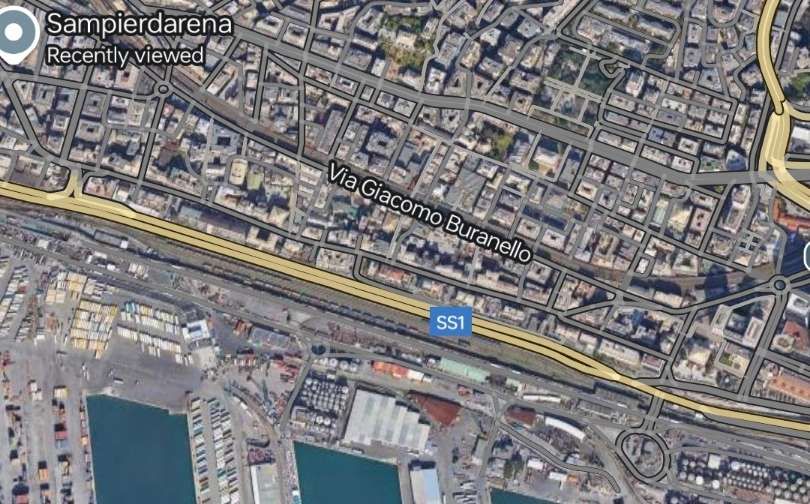
Details of these four tram types can be found here. [7]

It was hoped that first, Beograd and then Zagreb might purchase the 900 series, even Madrid seems to have made enquiries, but “two and a half years after the Genova tramways closed, [the 900 series] cars were still to be found standing in their depots and were eventually broken up, with no buyer having been found.” [1: p251]

Cross recorded that “two cars, 962 and 973, were preserved, and in 1989 a scheme emerged to use them to provide passenger services on a metre-gauge heritage tramway, linking Piazza Caricamento and Piazza Ferrari along a pedestrianised Via San Lorenzo. However, in true Italian style, nothing [had] yet been decided.” [1: p252] I have not been able to find any evidence that the heritage service was brought into operation.

Cross goes on to say that “Articulated cars 1101-4 were sold to the Neuchâtel tramway (TN) in Switzerland, with car 1104 arriving on 29th March 1966 for a set of preliminary trials. These were so successful that TN bought all four and put them into service on route 5 in Autumn 1966. The Genova trolley poles were replaced by pantographs, and heating also had to be fitted, since this had been totally unnecessary in the balmy Mediterranean climate.” [1: p252]
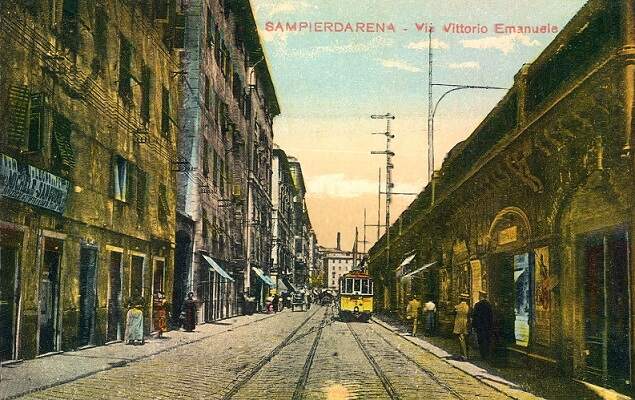
Interurban trams were replaced by FS multiple-unit, rapid-transit trains along the coast between Nervi and Voltri or Pontedecimo in order to reach the centre of Genova. Withdrawal of the city centre trams “left Genova with 130 trolleybuses as its only means of electric urban public transport, but even these eventually succumbed to replacement by diesel bus. However, as time passed, it became ever more obvious that a huge mistake had been made in withdrawing the trams. … The elevated roadway did not prove the panacea that its planners had wished for, while motor buses did nothing to improve the traffic flow … their stops on Genova’s narrow, winding and steep roads effectively blocked the flow of all traffic!” [1: p252]
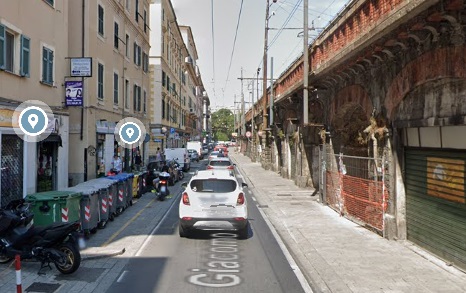
The municipality decided to reopen the Certosa tram tunnel for use by diesel buses. This required forced air ventilation to maintain reasonable air quality in the tunnel.  It “reopened for bus operation on 1st October 1967, although width restrictions made it impossible for two-way working. … Instead, a token block system had to be introduced, with buses passing through the tunnel in alternate directions at nine-minute intervals. This resulted in a serious capacity problem during the rush hour, which could be overcome only by sending convoys of three instead of single buses through the tunnel. … Unfortunately, the tunnel’s ventilation system simply could not cope with the upsurge in exhaust emissions. Indeed, the Il Lavoro’ newspaper shocked the general public when it featured a photograph of a bus on route 10 leaving the tunnel with its driver clearly seen wearing a gas mask!” [1: p252]

Other solutions had to be found. “In the 1920s, Genova had been tempted to undertake construction of a conventional heavy metro, influenced by the developing trend in some other European cities. However. successful implementation of the proper scheme had been undermined by its daunting cost.” [1: p252]

A study by the Marron Institute of Urban Management looking at possible urban transit solutions considered a number of Italian cities including Genova. It comments:  “Despite several attempts in the interwar period to develop metro rail networks in Rome, Milan, Genoa and Naples, the first proper metro line opened only in the mid-1950s. Metro construction finally gained momentum during the postwar years, characterized by fast urbanization and dramatic economic growth, but was hindered by the lack of a national transit policy, which finally emerged in the late 1980s, and by an essentially car-oriented transport policy.” [8: p15]

The idea of Metro for Genova was resurrected in 1972. “Trial borings were undertaken as a prelude to the construction of an 18-km two-line metro system. Ironically, the first line would run along the coast from Multedo in the west to Sturla in the east. duplicating in part the withdrawn coastal tramway! … The economics of building even a single cross-city line with, at most, two branches, proved beyond the financial capability of a city with a population of only 800,000. The decision not to proceed with the scheme was inevitable, leaving the city’s transport planners with little option but to continue with the status quo until a viable alternative could be found. … In the early 1970s, an alternative plan [was] put forward … to reuse old railway tunnels abandoned in the post-war period to provide a metro-style suburban rail service. The success of this scheme relied upon FS permitting metro cars to share tracks with conventional trains on the existing harbour line. But this it was not prepared to do. … After a change of political control in 1975, the Comunale di Genova set up a joint FS-AMT (Azienda Municipalizzata Trasporti) commission to examine the possibility of reusing previously-abandoned railway infrastructure to provide some sort of metro service. … A visit was paid to the Grazie tunnel, linking Brignole with Piazza Cavour, to assess its suitability, and also to the former Certosa tramway tunnel.” [1: p252]

Use of the Certosa tunnel by diesel buses had proved to be a failure. Instead of converting it for use by trolleybuses “it was proposed to build a Metropolitana Leggera (light metro) linking Rivarolo with Brignole by means of the tunnel. … Phase 1 would involve the construction of the Rivarolo Principe section. A reserved alignment would be built along Via Iori and Via Canepari, from where the trams would run through the tunnel to Dinegro. Here, traffic-light priority would allow the cars to cross Via Venezia and move to a further surface reservation along Via Buozzi. Finally, at Principe FS station, there would be a turning circle formed by Via Adua and Via San Benedetto. The Board of Directors of the AMT gave the project its full backing, with the Comunale following suit shortly afterwards. On 24th February 1981, the municipality, doubtless with an eye on the forthcoming June elections, approved an ITL 8000 M grant for the rehabilitation of the Certosa tunnel. although inflation eventually pushed this up to ITL 11 000 M. The central government also became involved, pledging investment worth ITL 165 000 M to build the entire 7.645-km Rivarolo-Brignole line. Ansaldo Trasporti was subsequently awarded a turnkey contract to both build and equip the line.” [1: p252-253]

Cross continues: “On 8th February 1982, the Certosa tunnel was closed to bus traffic for the last time. …  In all, 540 days were spent on rehabilitating the tunnel structure, although much more work was required before tram services could start. … In 1985, work on the project proceeded very slowly, while some drastic changes were made to the eventual alignment. In the revised plan, none of the surface sections of the line had survived. From Rivarolo to Brin, the line would be on an elevated alignment, crossing the double-track FS railway line via the Compasso park. Trams would then pass through the Certosa tunnel and cross under Via Venezia and Piazza Dinegro via a new 300-m cut-and-cover subway, continuing to Principe entirely in subway. The Principe-Brignole section would still run on the dock railway as planned, then via the Grazie tunnel to Brignole FS.” [1: p253]

The municipality set a “theoretical capacity of 36 000 passengers per hour and direction [for] the line, whose trains would draw current from a 750-volt de overhead contact wire. However, curves of 150-m radius would have to be negotiated, and rolling stock would have to be designed to operate on tunnel gradients as steep as 4%. The track design would require sleepers to be enclosed in rubber sleeves to absorb noise and vibration, following successful use of such a system in Wien (Vienna).” [1: p253]

This was a much heavier metro than had originally been planned, and would be both more expensive and slower to implement – the first phase costing ITL 1150,000 M and taking 9 years to build! It was hoped to start passenger services by the end of 1989, in the end it opened in June 1990. The first phase was 2.6 km in length and had cost ITL 100,000 M/km! The line proved to be very popular. “One and a half years later, 3.5 million passengers had used the line. … It had been hoped that the line would be extended from Dinegro to San Giorgio in 1992. However, more delays ensured that only the 900m Dinegro-Principe section would be ready in time. This was duly inaugurated on 27th July 1992, and was expected to increase substantially the initial line’s patronage, since Principe is Genova’s main long-distance railway terminus and a new suburban station, San Tomaso, was being built nearby. A further two ‘metro’ sets were put into service to cope with the expected increase in traffic.” [1: p253]

Cross was writing in 1995 and reported that work was ongoing on the next length of the Metro. In the end, work on that next section of the line to Caricamento was not completed until 2003. The next section to De Ferrari (underground station at Piazza De Ferrari) was completed in 2005, and that to Brignole in 2012. [9][10]

More about the Metro can be found here. [11]

Part 2: September 1995 – Casella Line Begins to Realise Tourist Potential

Cross notes the significant delays which affected the first scheme promoted by the ‘Societédi Ferrovie Elettriche Liguri‘ (SFEL) in 1915, which meant that It was not “until 1926 that construction was able to start on the metre-gauge line, which was to be electrified at 2.4 kV DC by the ‘Societé Ernesto Breda, which won contracts to supply the overhead and sub-stations, as well as the initial rolling stock.” [2: p295]

He also comments on the use of the contractor’s steam locomotive “to power the first train between Genova and Casella Deposito on 24th June 1929; then, on 31st August, the operating company laid on a special train for the Archbishop of Genova’s pastoral visit to Pino, with a regular passenger service starting the following day. However,” he says, “the line’s official inauguration had to wait until 28th October 1929.” [2: p295]

The line was notable for 60-metre radius curves and maximum gradients of 4.5%, imposed on engineers by the need to cross steep gradients between the Bisagno, Polcevera and Scrivia valleys. cross continues: “A non-counterweighted catenary was preferred over most of the line, although a simple transversal suspension overhead sufficed in stations, depot area and between the upper terminus and the depot. Very light 27 kg/m rail was standard throughout. The initial fleet of Breda vehicles operated by SFEL was:

  • 3 Bo-Bo motor baggage cars (001-003) rated at 270 kW, featuring the novel Breda-Somaini energy recuperation system;
  • 4 3rd-class bogie trailers (50-53);
  • 3 1st/3rd-class trailers (20-22);
  • 16 assorted goods wagons.

The Casella Deposito-Casella Paese section, originally planned in 1930, eventually opened in 1952, crossing the Scrivia river via a new combined road/rail bridge. Trains shared the road with cars, and the 1 km line terminated in mid-highway on the village outskirts.” [2: p295]

Cross comments that, throughout its life, the line made use, primarily, of second-hand rolling stock. “The first items acquired as early as 1935. In that year, three railcars came from the Montebelluna-Asolo and Montebelluna-Valdobbiadene lines operated by the former ‘Societé Veneta’, which ceased trading in 1931. These vehicles had been built at Padova by MAN in 1913 for operation at 975 V DC, but had to be modified at Genova. They had distinctive match-boarded sides, maximum-traction trucks, and retained original fleet numbers 054-056. With only two motors per car, they were rather slow, particularly with trailers.” [2: p295]

Cross notes that “World War II did little permanent damage, although rolling stock was worn out after almost continuous use evacuating families from Genova city while under bombardment. The Government Commission, which assumed managerial responsibility for the line in 1949, acquired supplementary stock from the 950-mm ‘Sangritana’ light railway (SFAA), almost totally destroyed in the war.” [2: p295] Of these, two electric locomotives were re-gauged, they were numbered 28 & 29, had 360-kW motors which “drew power via two pantograph-style bow collectors, one leading and one trailing, and could reach speeds of 50 km/h. They kept their original numbers when put on the Casella line in the 1950s and later acquired bus-type seats for 16 passengers.” [2: p295]

In January 1963, the line acquired significant amounts of stock and fixtures of the Ferrovia Elettrica Val de Fiemme (FEVF), which operated the Ora-Predazza metre-gauge line “three Bo-Bo baggage locomotives [B51-52, A2] driven by 310 kW motors and capable of a maximum speed of 60 km/h; three three-bogie rail cars … which drew power via a single rhomboidal pantograph to feed a 310 kW motor permitting speeds of 60 km/h; 36 bogie-trailers, of which C101-2 were long vehicles and C103-6 short; and … several goods wagons.” [2: p295] Of the fixtures, “the FEVF provided two static converters, replacing the FGC’s original generating equipment. These were installed at Vicomorasso and raised the line voltage from 2.4 kV DC to 2.6 kV. Unfortunately, this new equipment did not permit recuperation of energy and resulted in withdrawal of all earlier rolling stock, except that acquired from Sangritana lines.” [2: p295]

Furthermore, “in 1968, the recently-closed Spoleto-Norcia (SSIF) electric light railway yielded four 950-mm gauge railcars, built by Carminati & Toselli/TIBB in 1926 and later rebuilt by Casaltra/TIBB in 1957 with new electrical equipment, with 360-kW motors permitting maximum speeds of 60 km/h. They arrived at Genova in 1970 and entered revenue service a year later, the delay being for regauging. … Although originally numbered A1-4, they were altered to A4-7 to avoid conflict with earlier-acquired FEVF stock.” [2: p295]

Cross talks of the line struggling through the last 40 years of the 20th century. “When Joachim von Rohr visited the FGC in 1963, he noted Casella depot was particularly run down. Although renewal of the ballast was taking place, the use of short, not welded rails, plus a tendency to bend rail at joints, made for some eventful running. … On 17th January 1974, railcar A3 was derailed on poor track. On 31st October, a judge ordered closure on safety grounds, so urgent repairs were undertaken to permit a limited reopening between Genova and Sant’Antonino, and Campi SL and Casella in early 1975. Full operation resumed on 2nd March, with railcars now fitted with speedometers. … Money was not forthcoming to repair damaged A3, and the poor mechanical state of locomotive 28 also prompted its withdrawal. However money was made available to replace original rail with heavier 36-kg/m lengths, a task not completed until 1979. Maximum speeds were raised slightly, to reduce journey times from 1 hr to 55 min. In 1980-1, Casella Paese terminus was relocated from street to reserved track, and a new depot built at Vicomorasso. … In early 1990, Ansaldo Trasporti was awarded a contract to upgrade FGC installations. Overhead was replaced at a cost of ITL 5500 million, with original masts replaced by standard fitments. Voltage was raised to 3 kV DC, and a 1987 government grant allowed replacement of two sets of manual points in stations by electric ones.” [2: p295]

A gradual programme of rolling stock modernisation began in the early 1970s, “two-tone blue livery replaced the original red and cream, replaced in turn in 1980 by brown and cream. This new livery was to grace nine trailers rebodied by the Mantovana-based company ‘Gleismac’ in the early 1980s. However, C103-4 were not included, whilst C22 had already been rebuilt into a bar car at the end of the 1960s. Then, in 1985, damaged railcar A3 was completely rebuilt with a newly-designed body, chopper-controlled electronics from EEA of Genova, and two pantographs. At the same time, two Faiveley double-bracket pantographs were experimentally fitted to B51 and A4. … ‘Gleismac’ also supplied a BB diesel-hydraulic locomotive for works trains and insurance against power failure. Built by Gmeinder of West Germany in 1964, it was sold to ‘Gleismac’ from the ‘Sudwestdeutsche Eisenbahn Gesellschaft’ (SWEG) in 1986, and is now numbered D1. More recently, the bogies of disused locomotives B51-2 have been used by ‘Firema-Cittadella’ to build two new electric railcars, identical in appearance to existing railcar A3. The first, A8, was handed over to the FGC on 28th June 1993, with A9 following on 28th October. Unlike A3, both new cars can operate in multiple.” [2: p 295-296] Writing in 1995, Cross expressed the hope that if new bogies could be found, B51 might return to traffic. As far as I can tell, this did not occur. He also noted that Ferrocarril Genova Casella (FGC) was planning to buy two entirely new railcars similar to A3, A8 and A9 and three new trailers with a baggage compartment and a lift for the disabled. Two were built in 1998 (A11 and A12).

Cross also suggests that FGC planned “to rebuild railcar Al, with only A2 to be left in its original Carminati & Toselli 1920s condition. Both [were] reported fitted with modernised bogies. As for the four ex-Spoleto-Norcia railcars, at least one [was to] be de-motored to become a trailer. A4 [had] been given a new coat of cream and brown, and trailer C21, rebuilt by ‘Gleismac’ in the early 1980s, a curious livery of cream and blue.” [2: p296]

More information about railcars on the line can be found here. [12]


Looking forward from late-1995, Cross anticipated the purchase by the FGC of surviving rolling-stock from the closed Rimini-San Marino light railway. That line was operational for only twelve years between 1932 and 1944. “A significant engineering feat of its time, it included seventeen tunnels, three bridges, and three viaducts to negotiate the steep terrain. During the Second World War, the line was bombed and closed, after which its tunnels sheltered refugees during the Battles of Rimini and San Marino. After the war, the railway was abandoned in favour of the SS72 state road, San Marino Highway, and Funivia di San Marino. … In 2012, an 800-metre (1⁄2-mile) section was reopened as a heritage railway in San Marino, running between Piazzale della Stazione and near Via Napoleone.The restored section comprises the original railway’s final horseshoe turn through the 502-metre (1,647-foot) Montale tunnel.” [13] Cross anticipated that the FGC would buy the “four electric railcars, five trailers and 14 wagons, most for revenue service in Genova,” [2: p296] that were not required for the planned heritage line.

Cross comments that the distance of the Genova terminus at Piazza Manin from the central area of the city, means that the walk is quite daunting in summer months, but an extension into the heart of the city would be impractical because of the difference in height between the city centre and Piazza Manin. The terminus is situated high above the Bisagno valley which means that passengers see some fine views of the city soon after leaving the station. In describing the route, Cross speaks of a long viaduct “at Sant’Antonino which has four 10-metre arches. Departing services climb Sunday me 271 m in 9 km to reach Trensasco, located at 364 m above sea level. The line is cut into a ledge on the valley wall and near Cappuccio runs around the so-called ‘Colombo curve’ over the Viminate slope. The sharp bends give an exhilarating ride and are testament to the fact that the line engineers chose to bend with valley contours and even enter side valleys to avoid major tunnelling and expensive viaducts. … The line passes only through areas of sparse population, and former station buildings are so dilapidated it is often impossible to make out their names. Just before arriving at Campi (10 km), a small tunnel takes the line away from the main valley and shifts interest to the other side of the line. At Campi itself, up and down trains generally pass, and the guard of the ascending train has to advise control of his train’s arrival via a lineside telephone.” [2: p296]

Having arrived at 365 m above sea level, the line then descends towards Torrazza (11 km) and Vicomorasso (15 km), where the only sub-station is located and a spur line gives access to a small car shed. Withdrawn rolling stock has also been dumped here in recent years, while the station also provides passing facilities. Thereafter, the real assault begins and the line passes through some spectacular mountain scenery by means of loops and a spiral tunnel, climbing 100 m in a mere 2km before emerging into the Polcevera basin, with its notable chestnut and acacia woods. For one brief instant it is possible to see tracks below at three different levels! Another passing point is the small halt of Sant’Olcese Tullo.” [2: p296]

Cross continues his anecdotal account of a journey North along the line. He says that “the line continues to climb, although less dramatically in the mountainous terrain. There is one particularly dramatic hairpin bend near Sant Olcese, and near the following halt of Busalletta, fine views can be obtained of Monte Sella, 811 m. The railway summit is reached at Crocetta halt, 458 m above sea level and 22 km from Genova. It is possible to see the parallel road, which has done much to abstract traffic away from the line in recent years. There are also many small level crossings along the length of the line; the insignificant ones remain unprotected, while major crossing points are guarded by either automatic half-barriers and warning tones or simply flashing lights and audible tones.” [2: p296]

Casella Deposito (24 km) is just before the main depot site and has only an anonymous raised concrete platform to betray its whereabouts. The main line leads into a three track fan at the depot, where maintenance equipment is located and vehicle overhauls carried out. Nearby is the site of a quarry which supplied the FGC’s ballast. Appreciable goods traffic (now all lost), led to a ramp being built at Piazza Manin station to permit stone to be directly off-loaded from wagons into lorries in the street below.” [2: p296]

Trains must reverse to gain the Casella village line, sometimes achieved with a second railcar. On the last leg of the journey, the 1952-built combined road and rail bridge has the railway track on reserved and fenced aligament to one side. Thereafter, it is less than 1 km to the terminus, on the outskirts of the small village of Casella. Two-track Paese station is unmanned, although there is a small bar to welcome thirsty passengers. … The village has no special tourist attractions other than a few bars and restaurants, all mentioned in the FGC timetable. However, the cool mountain air makes a change from the oppressive heat of the coast, and an important magnet for day-trippers.” [2: p296]

Cross notes his sources for his article of which two are articles in the predecessor journal to the Light Railway and Modern TramwayModern Tramway. He quotes the news pages of that magazine from 1962 onwards and a specific article by Joachim von Rohr. [14] He also consulted an article in Mondo Ferrovario. [15]

As a separate note within his article, Cross comments on what he records as ‘The FGC’s First Serious Efforts to Attract New Traffic‘. …

At the start of the 1970s, the FGC began its first serious attempts to attract excursion traffic. While Genova municipal authorities were doing their best to dissuade unnecessary car journeys in the city, the light railway offered free parking at Genova Piazza Manin station to holders of return tickets. … This certainly offered scope for development, given the dramatic and beautiful countryside and ancient churches and forts within reasonable walking distance of stations.

This initiative has developed quite dramatically, and the policy of the FGC is now oriented towards the tourist market. It has put together a Belle Epoque train, formed of ‘heritage’ stock. The three-car train made its inaugural run on 5th November 1989 and is powered by the oldest surviving electric locomotive in Italy, No. 29 of the former Sangritana railway. … Passenger accommodation consists of ex-Val di Fiemme trailers C101 and C104, which retain original wooden furniture and bronze and brass fittings, accompanied by bar car No. C22. A major overhaul on No. C22 was undertaken in 1990, considerably upgrading its interior and also increasing capacity. … In expectation of an increase in visitors for the 1992 Columbus anniversary celebrations, the historic train had a regular Saturday working during June, July and August. The train has proved popular with both wedding and communion parties.

Near both Campi and Sardorella stations, the FGC has created playgrounds and picnic areas; the facilities at Sardorella can only be reached via the FGC. In 1990-1, the FGC began a bicycle transport service using a specially converted wagon; alternatively, customers can hire bicycles at cheap rates in Casella village.” [2: p296]

The images below show Locomotive D1 which operates the tourist train. …

Locomotive D1 responsible for a single coach. [18]

And here with two coaches. [18]

And here, escaping from a tunnel portal. [19]

Locomotive D1 was built in 1964 on behalf of the German railways by the manufacturer Gmeinder & Co. by adapting the MaK V100 standard-gauge locomotive to metre gauge, it was numbered V52 902 (later 252 902) and used on the 28 km long Mosbach-Mudau metre-gauge line. When it’s service on that line came to an end (2nd June 1973), it was first converted to standard-gauge by Gmeinder and used by Sudwestdeutsche Eisenbahngesellschaft (SWEG) which put it to work on the Breisach-Endingen-Riegel line (numbered VL46-01). In 1986, it was sold to the Gleismac company which converted it to metre-gauge and then sold it to the FGC. It was used to haul construction and passenger trains during the renovation of the overhead line. It was then set aside at Casella Deposito for over 10 years until in 2008 it was sent to Monopoli where it was rebuilt by 2014 and it returned to service on the line in November 2015.” [12][16][17]

Sadly, when we stayed in Genova in November 2024, the line was not operational and undergoing significant maintenance.

Part 3: October 1995 – Granarolo, Funiculars and the Guidovia

Cross’ third article about Genova begins by looking at the rack railway which ran from Piazza Principe, adjacent to Genova’s principal railway station to the small hilltop community of Granarolo. … Cross says: “The project was approved on 15th February 1896 and the line opened as an electric rack tramway on 1st January 1901, although the SGFM subsequently passed into liquidation on 2nd March 1902. Management of the line was then transferred to the Societé De Bernardi & Co (DBC), but this lasted only until 1907, when the concession passed to one Luigi Parodi, a former director of DBC. Upon his death in 1918, the municipality assumed control of the line, overhauled it and handed day-to-day management over to the Consorzio Nazionale Cooperative Combattenti, which stayed in control until 30th November 1934. On the following day, the Azienda Autonoma Autobus became the new owner of the line, this being then absorbed by the Unione Italiana Tranvie Elettriche! Despite the bewildering number of owners in the early years, the line has somehow managed to remain open ever since with no change in ownership.” [3: p333]

The 1.1-km tramway was built to the unusual gauge of 1200 mm, entirely on reservation. The lower station is at Salita di San Rocco (24 m above sea level) and the upper at Granarolo (220 m). The maximum gradient is about 23.5%. The Riggenbach rack system was chosen, with the rack at railhead level. Rail came from the Ilva company, 21 kg/m in 10.5 m lengths. … In 1950, the line was slightly extended at the upper station to permit a combined depot and workshop to be built. The lower station was also rebuilt, but still contains the inscription Ferrovia Principe Granarolo. The lower terminus is just to the west of Principe FS station and was built between two long tunnels. The lower part of the line runs through the city’s busy San Rocco district. At the passing loop, there is a station for ascending cars only. Beyond, the line has been laid directly on the slope of the Granarolo hill.” [3: p333]

Cross reports that: “The earliest recorded rolling stock was rebuilt in 1929 by Piaggio of Genova with CGE electrical equipment and two 38-kW Ansaldo traction motors. The bodies are unusual, with longitudinal seating, stepped floors and an inclined roof at the upper end, not unlike funicular cars. The two cars are 7.8 m long, 1.9 m wide and have four external doors, two per platform, and two interior doors. Service speed is 7 km/h, both ascending and descending, and capacity is 45 passengers. … The tramway uses a 550 V dc overhead contact wire, with current supplied from a sub-station which also supplied the urban trams. Each car has two trolleys, although during the day descending cars require no current, since the main braking system does not use the trolley; cars descending at night are obliged to raise one trolley to provide on-board illumination. … An interesting safety feature that persisted until recently was the fitting of two small wheels to the lower end of each car to extend the wheelbase and prevent their overturning in the event of an emergency stop. At the end of each journey, the driver wound up a counterweight, to activate an emergency braking system. This unusual device required the driver to keep his hand on a special wheel to hold off the brakes while the car was in motion. The cars had a conventional rheostatic brake which effectively operated on the cogwheel. Since there was no moveable paintwork, the cars were also fitted with double-flanged wheels on my new side and unplanned broad rollers on the other to permit negotiation over the midway passing place.” [3: p333]

Cross continues: “When both the urban and suburban tramways closed, the municipality had to make a decision on the rack line. Rather than scrap a substantial tourist asset, it was decided to undertake a major overhaul of the line and also rebuild the first of the two tramcar-type vehicles. From August 1975 to July 1976, services were suspended while all the rail was renewed and the two cars lost some of their idiosyncratic features. Two-tone green livery was replaced by orange. … In 1981, the service was modified to reflect completion of a parallel road, which at last made it possible for the AMT to put on a parallel bus service. The rack tram now [in 1995] runs every 30 minutes and its 15-minute journey time normally requires only one car, the other being stationed either at the upper terminus or near the Via Bari halt, where there is an inspection pit.” [3: p333]

Cross notes that “The Granarolo rack tramway has always suffered from a lack of traffic. In the early 1960s, it only carried 1000-1200 passengers per day and, today [in 1995] the situation is little changed. However, long-term plans for the line envisage its extension down to the coast and also further up into the mountain, where it will connect with the Genova-Casella light railway, rerouted to serve the planned upper terminus. … Older plans proposed converting the line into a funicular, reducing the current four staff to three, even two if the whole line were automated. However, in 1989, consultants MTC-Italia proposed upgrading the line whilst maintaining it as a rack tramway, suggesting replacement of the Riggenbach system by ‘something easier to maintain’ and widening the gauge to 1435mm.” [3: p333]

Cross reported that plans would have included “two new standard-gauge bogie cars, 24.5 m long and 2.2 m wide, with a maximum permitted axle load of 8 tonnes. Each car would accommodate 36 seated and 172 standing passengers. An acceleration of 1 m/s² was proposed, with a surprisingly high maximum speed of 75 km/h. The traction supply would have to be upgraded to 750 V DC. Although approved by the AMT in November 1990, no finance [had] yet been released to enable it to be implemented. In 1994, both cars were painted in red, bringing their livery into line with that [of] the two urban funiculars.” [3: p333]

Wikipedia notes that “In 2002, car 2 was sent away for an overhaul, but the bankruptcy of the original contractor and the involvement of a replacement in an alleged bribery scandal meant that the overhaul was not completed and the car returned to the line until March 2019. The overhaul included the replacement of the car floor, lighting, safety systems, electric drive, air conditioning and a new driver’s seat. Between 2002 and 2019, service was provided by car 1 operating alone. AMT now [2019] plans to use the rebuilt car to double the service frequency to every 15 minutes. ” [21]

Forward to 2024/2025 and our visit to Genova in November 2024. … When we were in Genova, we found this rack railway closed for maintenance work. Fabio Canessa reported in 20th May 2024 [20] on endless inconvenience for the inhabitants of Genova, with the line to Granarolo to be closed for major works for 2 years and the principality still waiting for news on an additional car for the line. [The notes from his report below have translated into English by Google Translate.]

Canessa noted that a series of interventions that would “force the closure of the system between the valley terminus and the stop on Via Bari for the entire duration of the construction site. …  It [would] involve replicating the same interventions carried out in 2012 on the upstream section. … The project, includes the consolidation of the historic walls, which are no longer up to standard, the creation of a lateral walkway to allow passengers to move away safely in the event of a breakdown, a sort of overflow pipe that runs parallel to the railway and discharges the water collected by the canal, the reconstruction of the pylons with the same look as the upper section and the reconstruction of the overhead line. …In addition, the stop on Via Centurione , which is currently unusable on the downstream side, will be fixed.” [20]

For the works, just over 2 million euros [were] allocated by the Region under an agreement with the Ministry of Infrastructure dating back three years. However, these resources are not yet available to AMT [on 20th May 2024], …the contract is being awarded, … but …. the works cannot be assigned until the Region … [provides] the money. The situation should be unblocked by June [2024] so that the construction site can be opened in the summer. In the meantime, the expropriations are being defined , which will concern small portions of private land necessary to move back the pylons and make room for the walkway.” [20]

The bottom line, for the residents of San Teodoro and Granarolo who often have no alternatives to the rack railway except walking, is that until 2026 the service will be limited to the via Bari-Granarolo section . Initially there was talk of 12-18 months, then the forecasts worsened. Unfortunately not all the work can be done at the same time, safety must be guaranteed.” [20]

The same section of the rack railway was closed for six months in 2021 to replace the tracks, sleepers, pylon plinths and also part of the contact line. The odyssey began in the early 2000s with the start of restyling work  on one of the two cars , a story that lasted almost twenty years. … Speaking of carriages, it is not yet certain what the timing will be for the third one: the Region had allocated 3.5 million euros for the construction.  … The contract was awarded to SVI of Lucignano (Arezzo) with a contractual expiry date set for September 2028. Even in this case, however, the Region must first unlock the necessary resources.” [20]

The Principe – Granarolo Rack Railway. [22]

The Zecca Righi Funicular

Cross tells us that plans to build “the Zecca Righi rack-braked funicular were first brought to the attention of the Genova public by a Mr Bucher on 30th June 1891. This was to start in Piazza della Zecca and proceed northwards in tunnel for 700 m. A station at Carnonara would have public access in an open shaft at 348 metres, while Montegalletto station was to be located at the upper entrance to the tunnel. Here, a transfer would be made to a second line, 820 m long and built entirely above ground. This would feature two intermediate stations, at Fossato and San Simone, with the upper terminus situated at the Chiappe wall on Righi mountain, from where tremendous views can be obtained of the Bisagno valley.” [3: p333]

Cross notes that Abt rack braking was preferred. ABT rack braking utilises two or even three different rack profiles, each half offset from each other. Trackopedia says that, “The tooth spacing is larger than with the other rack systems (120 mm). The advantage is that the profiles are always installed offset, so there are no full joints. Due to the low thickness of the profiles, they can be fitted or rotated much more easily by hand, which makes maintenance easier. In the curve, the outer profile should theoretically be longer. With short profiles, the difference in length is equalized at the joint.” [23]

Initially, a 900-mm track gauge was chosen for the line, “but this was later changed to metre gauge. The project was given the go-ahead and construction of what was classed as a secondary railway was begun. The upper line opened on 30th April 1895, while the steeper gradients encountered on the lower line delayed its opening until 13th February 1897.” [3: p333]

The two lines gave trouble-free operation for the next 70 years, but were rebuilt into a single funicular during a much-needed modernisation programme instigated by AMT, the new owner. Bell of Luzern undertook the conversion, with two high-capacity metal-bodied cars replacing the original wooden rolling stock. The new funicular cars had rigid suspension and driving gear consisted of 2 x 125-kW motors, permitting a speed of 4.4 m/s. Each car could accommodate 100 passengers, restricting the maximum one-way traffic flow to 400 passengers per hour, with a 15-minute journey time.” [3: p333-334]

Cross continues: “A second modernisation programme was announced in 1985. It was decided to introduce partial automation to reduce staff costs, with Ansaldo Trasporti and Nuova Agudio awarded the contract. The line was closed on 3rd August 1987 and replaced by substitute buses. The old track was replaced by heavier 50 kg/m rail mounted on rubber to reduce noise emission, while the winding motors, electrical equipment, telephone system and safety equipment were also replaced. The modern day line is 1.4 km long with a difference in height of 278 m between the two termini. Average gradient is 19.9%, with some sections as steep as 34%. … The new twin-car units, driven by 2 x 458-kW winding motors, and with sliding doors, have a speed of 6 m/s, cutting the journey time to 10 minutes and increasing the one-way passenger capacity to about 1800/hour, each train holding up to 156 passengers (16 seated) on seven stepped levels. Modern suspension has also greatly improved the ride quality, while electricity for car lighting is picked up by a mini-pantograph from a simple overhead.” [3: p334]

Cross concludes his notes about this funicular: “The two-car trains, which have been painted in a striking red livery with an orange zig-zag stripe outlined in white, can call at all seven stations, although the intermediate stops at Carbonara, Santa Nicola (urban bus connection), Madonnetta (religious shrine), Preve and San Simone are request stops signalled both by passengers waiting on station platforms and those inside the cars. The starting sequence is automatic, but cars are nevertheless, single-manned. No tickets are sold on any funicular premises, although ticket cancellers are provided on cars, and the tariff is that of the urban bus network.” [3: p334]

The Sant’ Anna Funicular

The Sant’ Anna Funicular on 18th May 2015 – Car No. 1 at the summit station, (c) Tiia Monto and licenced for reuse under a Creative Commons Licennce (CC BY-SA 3.0). [29]

Cross offers two short paragraphs about this line. …

There are not many rail lines offering an end-to-end journey time of around one minute, but this is all that is necessary to travel on the 353 metres between Piazza Portello and Corso Magenta on the Sant’ Anna funicular. So short is the line that it is possible to see both cars from either station. The present day installations were supplied by Agudio Poma of Torino and consist of two small red cars, driven by a 42-kW motor, with bodywork from Merighi, Neri & Roversi.” [3: p334]

Operation is automatic, although each car has a driving cab, and the 54-m height difference, starting at 20 m above sea level at Piazza Portello, is undertaken at a track speed of 4 m/s, with the passing place at a relatively flat location. Each car has eight seats on two stepped levels with a nominal total capacity of 30, giving a capacity of 180 passengers per direction per hour, with departures every ten minutes. Entry to the funicular is controlled by a turnstile, with boarding and alighting passengers segregated. The line is operated by AMT, so one day FS-AMT passes can be used.” [3: p334]

La Guidovia del Santuario della Guardia

In my survey of the different lines serving Genova, I missed this line completely. This is perhaps not surprising as it closed in October 1967!

A 1934 advertising poster for the line. [26]
The sanctuary of the Madonna della Guardia, on Mount Figogna, in the Polcevera Valley, is frequented by believers from all over Liguria. Around 1490 the apparition of the Virgin to a peasant gave rise first to a simple chapel and then, between 1528 and 1530, to a true sanctuary. In 1890 there was a further renovation with the construction of the current church. A hospice was built next to it and the complex covered the entire summit of the mountain. [27]
This map of the line can be found on the Marklinfan.com website and is embedded here The terminal at Serro can be seen in the bottom-right of the image. The shrine is towards the top-left of the sketch map. [26]
A watercolour sketch of one of the Cars used on the line. [27]

Cross says: “Some 250,000 visitors per year are attracted to the religious shrine on Monte Figogna, 817 m above sea level and from where spectacular views can be obtained over the Polcevera valley and the Mediterranean. The idea of providing a fixed link emerged in 1891, although a Belgian initiative dating from 1906 stalled for want of finance. It was not until 1926 that the Ferrovia Santuario della Guardia company was founded and subsequently undertook construction. … On 29th July 1929, the company inaugurated an initial 8.8-km section, linking the lower station of Serro di San Quirico, halfway between Bolzaneto and Pontedecimo and at 66 m above sea level, with a temporary upper terminus at Ca’Bianca (676 m). From Genova, it was possible to reach Serro, nestling between two steelworks and some oil refineries, via the UITE tramways. The remaining 1.7-km section was finally opened on 23rd June 1934. In all, there was a 130-m height difference between upper and lower termini with maximum gradients of 8.3% (the average was 6.5%) and minimum curve radius of 25 m. The line was single-track, with seven passing points and 10 Intermediate stations.” [3: p334]

Cross comments: “The Guidovia was highly unusual in that it featured petrol-engined solid-rubber-tyred vehicles which followed two parallel 200-mm wide concrete tracks. Inside these, conventional metre-gauge Vignole 9 kg/m rails acted as a guide path for flanges located on the inside of the wheels. … Iron tie-rods separated the rails at a fixed gauge, with conventional sleepers unnecessary since the weight of the vehicles was placed off the rails and on the concrete pathways. Known as the Laviosa guidance system, it was invented by the Corazza brothers, who owned the line. Rubber tyres were chosen because they gave twice the adhesion of steel wheels acting on steel rails, and made it possible for the vehicles to overcome the numerous steep gradients on the slopes of Monte Figogna.” [3: p334]

Annotated in Italian, this sketch shows the construction of the permanent way. [26]
Construction work showing the light Vignole rails and the ties which maintained the guage. This image is embedded from the marklinfan.com website. [26]
This image shows the size of the concrete bed on which the rubber-tyred wheels would run. [26]

This is probably the earliest form of guided bus technology used across the world and should be seen as the precursor of a number of other systems. [25]

Cross continues: “Both freight and passengers were carried, with passenger cars often hauling goods wagons. The journey was usually accomplished in 45 minutes at a speed of 12 km/h, although the cars had a theoretical maximum speed of 18 km/h. … The weekday timetable consisted of five return journeys, ten at weekends, although many other specials were put on for groups of visitors. Indeed, it was not unknown for the Guidovia to carry 3000 passengers in one day. In all, 30-35 staff operated the line, of which 11 were drivers, each responsible for the upkeep of his own vehicle. The depot and workshops were next to the lower terminus, which was equipped with a small turntable; others also at the upper terminus and at Gaiazza.” [3: p334]

The Cars were unidirectional and required turning at both terminii of the line. Staff called the turntables used ‘giostre‘ (carousels).

A Car being turned at the Serro terminus. [26]
A Car being turned at the upper terminus. [26]
A superb view of the Santuario della Guardia and the summit station of the Guidovia. [28]
This image shows both an unidentified Car and the Santuario della Guardia. It is embedded here from the stagniweb.it website. [28]

“The original fleet consisted of five bi-directional 90-hp petrol-engined cars (1-5), built by Officine Laviosa of Piacenza, with bodies made of waterproof oil-cloth. There were two Giardiniera trailers. In 1936, three single-cab cars (6-8) of slightly higher capacity were added. Changes were made to cars 1-5: their rear cabs were removed and a more powerful, 120-hp diesel engine fitted. In 1952, the two existing trailers were motored, using MAN diesel engines, to cater for rising patronage. An eleventh aluminium-bodied car also existed.” [3: p334] Cross was unable in his article to provide details of that aluminium-bodied car. More details have come to light since he wrote his article.

This picture of aluminium-bodied Car No. 11 is embedded from the marklinfan.com website. No. 11 was the last Car built for the line. Built in 1955 to cope with the increase in users, it was made of aluminum
and had different windows, double lights, and was equipped with automatic compressed air doors. It was built in the company’s Serro Workshops. [26]
Another photograph of Car No. 11 taken at the summit station. This image is displayed on one of the explanatory panels at the station. [28]
A drawing of one of the earlier Cars also from the display boards at the summit station. [28]

1:200,000 Touring Club Italiano map from 1964 shows the route of the line. The Guidovia is drawn from Madonna della Guardia to Bolzaneto. [28]

Cross says that at about the same time as Car No. 11 was built, Cars No. 2 and No. 4 underwent a complete revision, involving a livery change from light green to two-tone green. Ultimately, “the line closed in October 1967 with the expiry of the company’s concession. Track and superstructure had been allowed to deteriorate, and rolling stock was also life-expired. In the 1970s, the company laid on a bus service on a new road that had opened up the Santuario.” [3: p334]

A few pictures follow which have been embedded from the stagniweb.it website. They give a good idea of the condition of the line in the 21st century. …

The tie-bars and rails. [28]
The concrete platform. [28]
Approaching the summit. [28]
The display boards at the summit are housed in a shelter which simulates one of the old cars used on the line. [28]

Cross acknowledged the following sources for his notes on the rack railway, the funiculars and the Guidovia line;

Ferrovia Principe-Granarolo by A. Sasso & C. Serra (Mondo Ferroviario, October 1991).

The Tramways and Light Railways of Genova by J. von Rohr (Modern Tramway, June 1964)

Nuova Funicolare per Genova by Alessandro Sasso (Mondo Ferroviario, April 1990).

News pages of Modern Tramway 1962 et seq Guidovia della Guardia by A. Sasso & C. Serra Mondo Ferroviario, December 1990).

The Tramways and Light Railways of Genova byl von Rohr, (Modern Tramway, June 1964)

References for this full article

  1. Barry Cross; Genova: Back in the Tramway Business Part 1: The Interurbans and the ‘Light Metro’; in Light Rail & Modern Tramway, August 1995, p251-253.
  2. Barry Cross; The Tramways of Genova Part 2: Casella Line Begins to Realise Tourist Potential; in Light Rail & Modern Tramway, September 1995, p295-296.
  3. Barry Cross; The Tramways of Genova: Concluded: Granalaro, Funiculars and the Guidova; in Light Rail & Modern Tramway, October 1995, p333-334.
  4. Rete tranviaria di Genova; https://it.wikipedia.org/wiki/Rete_tranviaria_di_Genova, accessed on 26th November 2024.
  5. https://www.marklinfan.com/f/topic.asp?TOPIC_ID=4530&whichpage=2, accessed on 21st December 2024.
  6. https://www.facebook.com/share/p/4KDeRr6gMdLiv86E, accessed on 20th December 2024.
  7. https://rogerfarnworth.com/2024/12/21/genoas-early-tram-network-part-5-world-war-2-to-its-decline-and-closure-in-the-1960s-and-the-rolling-stock-used-on-the-network
  8. Marco Chitti, Eric Goldwyn, Elif Ensari and Alon Levy; Transit Costs Project: The Italian Vase Study Report; The New York University (NYU) Marron Institute of Urban Management, New York, via https://www.google.com/url?sa=t&source=web&rct=j&opi=89978449&url=https://transitcosts.com/wp-content/uploads/Italian_Case_Study.pdf, accessed on 23rd March 2025.
  9. HOME – Rete e orari – Metropolitana Azienda Mobilità e Trasporti S.p.A. (AMT). 2013, via https://www.amt.genova.it/amt, accessed on 23rd March 2025.
  10. Tramways & Urban Transit; Ian Allan Ltd/Light Rail Transit Association, April 2005, p149.
  11. https://rogerfarnworth.com/2024/11/26/genoas-metro
  12. https://rogerfarnworth.com/2024/11/25/genoa-casella-narrow-gauge-railway-part-2-sardorella-to-casella
  13. https://en.m.wikipedia.org/wiki/Rimini%E2%80%93San_Marino_railway, accessed on 24th March 2025.
  14. Joachim von Rohr; The Tramways & Light Railways of Genova; in Modern Tramway, June 1964.
  15. Roberto Cocchi & Alessandro Muratori; Ferrovia Genova-Casella; in Mondo Ferrovario, October 1993.
  16. Maria Vittoria Cascino; Il trenino di Casella arranca in ritardo tra guasti e amianto; on ilgiornale.it, 20th March 2008; accessed on 24th November 2024.
  17. Andrea Martinelli, La D1 è tornata!, in iTreni N° 388, January 2016, p24-26.
  18. https://www.ferroviagenovacasella.it/geca/la-seconda-guerra-mondiale, accessed on 19th November 2024
  19. https://www.mentelocale.it/genova/57212-ferrovia-genova-casella-dal-6-settembre-il-servizio-avverr-con-bus-sostitutivo.htm, accessed on 23rd November 2024
  20. Fabio Canessa; Granarolo Rack Railway, two years of stoppage coming for works between Principe and via Bari; in Genova24, 20th May 2024; via https://www.genova24.it/2024/05/cremagliera-di-granarolo-in-arrivo-due-anni-di-stop-per-lavori-tra-principe-e-via-bari-386640, accessed on 25th March 2025.
  21. https://en.wikipedia.org/wiki/Principe%E2%80%93Granarolo_rack_railway, accessed on 25th March 2025.
  22. https://www.reddit.com/r/InfrastructurePorn/comments/qg6cme/principegranarolo_rack_railway_genoa_italy, accessed on 25th March 2025.
  23. https://www.trackopedia.com/en/encyclopedia/infrastructure/superstructure/rack-railways, accessed on 25th March 2025.
  24. https://it.m.wikipedia.org/wiki/Autoguidovia_della_Madonna_della_Guardia, accessed on 25th March 2025.
  25. https://cs.m.wikipedia.org/wiki/Autobusov%C3%A1_dr%C3%A1ha, accessed on 25th March 2025.
  26. https://www.marklinfan.com/f/topic.asp?TOPIC_ID=4179, accessed on 25th March 2025.
  27. https://sentieridautore.it/2018/02/03/la-guidovia-della-guardia, accessed on 25th March 2025.
  28. https://www.stagniweb.it/mguardia.htm, accessed on 25th March 2025.

San Sebastian’s Urban Tramway, Funicular and Aerocar, and the ‘Spanish Aerocar’ at Niagara Falls.

Trams

The first tramway in San Sebastian (Donostia in Basque), owned by La Compañía del Tranvía de San Sebastián (TSS), opened on 18th July 1887 as a metre-gauge horse-powered line. “It provided a service from the eastern suburb of Ategorrieta to and from the town centre and beach. The tramway was then extended beyond Ategorrieta to the town of Herrera, including 2.1 km of reserved track and a 100-metre tunnel, avoiding the severe gradients of the Miracruz hill. The single-track-and-loop line eventually reached Rentería in 1890.” [1: p185]

The Compañía del Tranvía de San Sebastián (CTSS) was founded on 28th August 1886 and is one of the oldest businesses in Gipuzkoa. At first, it provided Horse-powered services in the city. [2]

The horse trams, known as ‘motor de sangre’ (literally blood engines), soon showed their limitations and for this reason the heads of the Company studied ways to modernise the transport system.” [2] It hoped to upgrade services by using steam trams but environmental concerns resulted in the local authority refusing the Company’s application. Instead, the Genèva-based Compagnie de l’Industrie Electrique et Mécanique was awarded the contract to build a line across the city. “A partial electric service was inaugurated on 22nd August 1887, and through running between San Sebastián and Rentería became a reality on 30th October. The rolling stock was built in Zaragoza using Thury (later Sécheron) electrical equipment, and consisted originally of motor trams 1-10 capable of hauling two trailers at 24 km/h. Several extensions were added to the tramway system until there were nine numbered services (1-9) all of which started from Alameda in the centre of San Sebastian.” [1: p185]

San Sebastian’s tramways were built to metre-gauge.

On 22nd August 1897, the first electric trams began to circulate between Rentería and Ategorrieta and the electrification of the city was completed on 22nd October of that same year. Donostia became the second city in Spain to have electrical trams (after Bilbao whose first line was up and running in 1896) and the first to electrify all its services (the Basque capital still had horse trams on some lines until 1909). [2]
A tram at the Monte Ulia tramway terminus. [3]
San Sebastian, Gros district and Mount Ulia, circa 1919. [3]

Barry Cross says: “Given the success of the urban tramways, it came as no surprise when the local entrepreneur, Vicente Machimbarena y Gorgoza, applied for the concession to build a 3.09-km ‘railway’ up the side of Monte Ulía, in 1893. The relevant legislation came into effect in 1895 and specified electric traction with overhead supply and the use of a rack to surmount a maximum gradient of 6%. However, when the engineer, Narciso Puig de la Bellacasa, was asked to undertake the initial surveys in 1896, they were for an adhesion line only. It was not until 1900 that sufficient money (ESP 530 000) had been raised to form the company, ‘Ferrocarril de Ulía’. Work on its construction began the same year, and the line opened on 9th July 1902. Although conceived as a railway, the completed metre-gauge line was merely an extension of the town tramways, with which it connected at Ategorrieta. As built, the continuous gradient varied between 4.5 and 5.5%, the only flat section being the mid-point passing loop.” [1: p185]

Cross continues: “The composition of the initial tramcar fleet accurately reflected the line’s tourist nature, since both the three two-axle motor trams and six trailers were of an open crossbench design known as ‘jardineras’. All cars were built in Zaragoza by Carde y Escoriaza, which equipped the motor cars with 2 x 52-kW motors and both rheostatic braking and electromagnetic track brakes. The early success of the line prompted the company to buy a further three motors and six trailers of the same design in 1907.” [1: p185]

The original tram service ran every 30 minutes. This was improved to 15 minutes from 1907. There were no intermediate stops on the climb up Monte Ulia. The tourist tram’s main purpose was to reach the summit.

Aerocar

The ‘Ferrocarril de Ulía’ Company, while paying a 2% dividend in 1904 also increased its capital to ESP 1 million with a view to building “something variously described as a ‘Tranvía Aereo’ and as a ‘Transbordador Funicular’. It opened on 30th September 1907 and proved to be one of the world’s first passenger suspension cableways, similar in concept although not in design to the aerial cableway across the Devil’s Dyke near Brighton, which had been built 13 years earlier. It began near the Monte Ulía tram terminus and rose gently just above the tree-tops to the Peña de las Aguilas, from where visitors could obtain impressive views along the Cantabrican coast.” [1: p186]

A close view of the fragile-looking passenger car of the Tranvia Aereo’. [4]

The next four images are postcard views of the Monte Ulia Aerocar. ….

“The world’s first aerial tram was probably the one built in 1644 by Adam Wiebe. It was used to move soil to build defences. Other mining systems were developed in the 1860s by Hodgson, and Andrew Smith Hallidie. Hallidie went on to perfect a line of mining and people tramways after 1867 in California and Nevada. Leonardo Torres Quevedo built his first aerial cableway in 1887. His first for passengers was this one at San Sebastian Donostia in 1907.” [3] Wikipedia’s Spanish site suggests that the cableway closed in 1912. [4] certainly, “Monte Ulia’s tramway and cableway were to be seriously threatened from 1912 onwards by the creation of rival attractions on Monte Igueldo, the mountain across the bay. Earlier but unrealised schemes had envisaged running a tramway around the base of this impressive mountain on a sort of Marine Drive, and taking it out to sea on a jetty to the island of Santa Clara, where a casino was to be built. However, so ambitious a project never materialised, and it was later decided to build a funicular instead. This would run from Ondarreta to the top of Monte Igueldo and be provided with a connecting tram service via a short branch line from the Venta-Berri Alameda tramway operated by the TSS.” [1: p186]

After 1912, the Monte Ulia line became progressively more unprofitable and closed down in 1916. However the ‘Aerocar’ story does not end in 1916 in San Sebastian. For a little more, please head through this article beyond the next section about a funicular railway. …

The Funicular de Igueldo

Cross tells us that “The main promoter of this new scheme was Emilio Huici, and the engineer in charge of the funicular project was Severiano Goni, who later built the Artxanda funicular in Bilbao. The Swiss firm of Von Roll supplied the electrical and mechanical equipment, leaving it to a local workshop to manufacture the funicular car bodies. Each car had five compartments with 30 seats and room for 20 standing. The line was 312 metres long and climbed 151 metres at gradients between 32 and 58%, making it the steepest of its kind in Spain.” [1: p186]

The funicular opened for business on 25th August 1912, offering visitors to the summit the chance to dine at its restaurant until midnight, or to take “five o’clock tea” on a terrace overlooking San Sebastián. A return trip to the summit cost ESP 0.50, while from 5th September 1912 onwards the mountain enjoyed a through tram service from Alameda to the lower station of the funicular.” [1: p186]

The travelling distance of 320 metres connected Ondarreta Beach at the bottom, with the popular Monte Igueldo Amusement Park at the top, offering spectacular coastal views of La Concha Bay along the way. [3]

The next four images are postcard views of the funicular railway. …

The Spanish Aerocar in North America!

Cross points us to a similar but larger ‘Aerocar’ which was opened in 1915 in North America. It crossed the Whirlpool Rapids on the Canadian side of Niagara Falls. “It was built by the Spanish engineer, Leonardo Torres Quevedo, who, undaunted by the financial failure of his first cableway on Monte Ulía, had been persuaded to build a second. Its success can be measured by the fact that it survives to this very day.” [1: p186]The Canadian has been upgraded several times since 1916 (in 1961, 1967 and 1984).[1] The system uses one car that carries 35 standing passengers over a one-kilometre trip.[2]

The Canadian has been upgraded several times since 1916 (in 1961, 1967 and 1984). The system uses one car that carries 35 standing passengers over a one-kilometre trip. [5]

Three images of the Canadian ‘Spanish Aerocar’ follow below. …

Three images of the Aerocar’. [6]

The ride on the ‘Aerocar’ is featured on the Niagara Parks website. [7]

References

  1. Barry Cross; The Spanish Aerocar; in Light Railway and Modern Tramway, July 1992, p185-186.
  2. https://dbus.eus/en/the-company/background, accessed on 22nd March 2025.
  3. https://www.simplonpc.co.uk/SanSebastian.html#trams, accessed on 22nd March 2025.
  4. https://es.m.wikipedia.org/wiki/Tranv%C3%ADa_a%C3%A9reo_del_Monte_Ul%C3%ADa, accessed on 22nd March 2025.
  5. https://en.m.wikipedia.org/wiki/Whirlpool_Aero_Car, accessed on 22nd March 2025.
  6. http://www.ebpm.com/niag/regpix/glry_niag_aero.html, accessed on 22nd March 2025.
  7. https://www.niagaraparks.com/visit/attractions/whirlpool-aero-car, accessed on 22nd March 2025.

Stockport Corporation Tramways – Part 2 (Modern Tramway Vol. 12 No. 138, June 1949)

P.W. Gentry wrote about Stockport’s trams in the July 1949 issue of Modern Tramway.

He says: “Besides possessing several interesting features of its own, the Stockport system today commands added attention as the last last surviving member of that once network of standard gauge undertakings encircling Manchester. It is an unusually pleasing system by virtue of its compact and simple arrangement, its focal point being Mersey Square.” [1: p123]

The article in Modern Tramway caught my attention because for about 9 years I worked in Stockport as a highway engineer.

This is a second article looking at Stockport Corporations Tramways. The first article which looked at the history of the network and followed one axis of that network can be found here. [2]

Mersey Square was the main hub of Stockport’s tramway network and appeared as a schematic plan in Gentry’s article in The Modern Tramway. …

Mersey Square was the hub of the Stockport Corporation tramways. Mersey Square Depot and Heaton Lane Depot are shown clearly on this sketch plan drawn in 1949. The modern A6 runs left-right across the lower half of the plan. © P.W. Gentry, Public Domain. [1: p123]
An extract from Map: Lancashire CXII.9; Ordnance Survey, 25 inch to 1 mile; revised: 1934; published: 1936, showing Mersey Square as it was in 1934. The tram depot had, by this time, been enlarged and the additional depot on Heaton Lane constructed. Heaton lane Depot is accessed via the branch West off Wellington Road. [8]

Stockport Corporation’s Trams

Before looking at the remaining tram routes operated by Stockport Corporation it is worth noting the trams which Stockport Corporation used to operate the network. P.W. Gentry listed these as follows:

This table is taken from Gentry’s article. [1: p126]

Gentry provided basic details in his article, more details can be found here. [8] The same website provides a history of the network [9] and a Trolleybus/Bus Fleet List 1913-1969. [10]

Stockport’s Tram Routes

The Stockport Corporation Tramway Network (1901-1951), © Rcsprinter123 and licenced for reuse under a Creative Commons Licence (CC BY 3.0) [3]

Edgeley to Mersey Square and Mersey Square to Reddish and Gorton

This first axis of the network was covered in my first article about Stockport Corporation Trams, here. [2] Two further axes are worth our attention: the first, below, that between Gatley and Bredbury; the second that between Manchester and Hazel Grove.

Gatley to Mersey Square and Mersey Square towards Bredbury

We start with the tram terminus in Gatley.

Gatley Green and the terminus of the Stockport Corporation Tramway as shown on the 25′ Ordnance Survey of 1907, published in 1935. [11]
The same location in the 21st century. [Google Streetview, January 2025]
The Gatley tram terminus was outside the Horse and Farrier Pub. This view looks East from Gatley Bridge, © Public Domain. [5]
A similar view along the A560 in the 21st century, with the Horse and Farrier Pub on the left. [Google Streetview, August 2024]
A tram at the same location viewed from another angle, this time from the South, © Public Domain. [6]
A similar view from Church Road in the 21st century. [Google Streetview, August 2024]
To the East, the tramway passed under Gatley Road Railway Bridge. 25′ Ordnance Survey of 1907, published in 1935 the railway as being under construction but with the bridge in place. [11]
Gatley Road Railway Bridge seen from the West, looking East along the A560. [Google Streetview, August 2024]
This satellite image shows the length of the A560 from just West of Gatley Railway Bridge to just East of Greenhall Bridge. The dominant feature at the centre of the image is the A34, Kingsway, one of the main arterial routes on the South side of Manchsterer.  [Google Maps, January 2025]
Looking West towards Gatley Road Railway bridge in the 1910s with a tram heading for Stockport, © Public Domain. [16]
A similar location on Gatley Road in the 21st century. [Google Streetview, August 2024]
This extract from the 25′ Ordnance Survey of 1907, published in 1935, shows a location further to the East – Greenhall Bridge carried the road and tramway over Micker Brook. On this map the political boundary has taken precedence over the tramway. The tramway ran along the road from left to right. [11]
Looking East Long the A560 towards Cheadle. The bridge over Micker Brook was one which we needed to replace during the 1990s when I was responsible for the maintenance of highway bridges for Stockport MBC. [Google Streetview, August 2024]
It is somewhat easier to appreciate the layout of the bridge with 3D image. This bridge was rebuilt during my time at Stockport Council in the 1990s. [Google Earth (3D), January 2025]

Gatley Road ran through to the junction at the West end of the Cheadle High Street.

The tramway ran through from Gatley Road onto High Street, Cheadle as the 25′ Ordnance Survey of 1907, published in 1935, shows. [11]
The same junction in the 21st century. [Google Maps, January 2025]
Looking West along Gatley Road, Cheadle in 1908, from the West end of Cheadle High Street, © Public Domain. [7]
A very similar view looking West from Cheadle High Street in the 21st century. [Google Streetview, August 2024]
The tramway ran West to East along Cheadle High Street and on to Stockport Road. This extract is taken, again, from the 25″ Ordnance Survey, this sheet was surveyed in 1916 and published in 1922. [12]
Looking West along Cheadle High Street, © Public Domain. [15]
The same view in the 21st century. [Google Streetview, August 2024]
The junction of Cheadle High Street with Stockport Road and Manchester Road, looking West. The passing loop at the junction can be seen in this image, © Public Domain. [13]
A view of the same road junctionfrom Stockport Road in the 21st century. [Google Streetview, August 2024]
an early image looking East from the junction. The tram is heading for Stock port on Stockport Road, Cheadle Green is behind the tram, © Public Domain. [14]
A similar view in the 2020s. [Google Streetview, August 2024]
Further East on the same OS map sheet, the tramway can be seen continuing East on Stockport Road. [12]
The last section of Stockport Road on this particular OS map sheet shows the tramway and road running Northeast and approaching the railway bridge. [12]
The next 25″ Ordnance Survey sheet ( surveyed in 1916 and published in 1922) shows Stockport Road and the tramway heading Northeast under the railway bridge into Cheadle Heath. Top-right in this map extract is Cheadle Heath Railway Station. The junction with Edgeley Road is just above the centre of the image. [17]
Looking Southwest along Stockport Road Cheadle Heath with the railway bridge on the right side of the image. This image comes from Stockport Image Archive, © Public Domain. [20]
A similar view in the 2020s looking across the motorway slop road roundabout and under the railway bridge, West towards Cheadle. [Google Streetview, August 2024]
Laying the tram tracks at the junction of Stockport Road and Edgeley Road, Cheadle Heath in 1903. This image comes from the Stockport Image Archive and faces towards Stockport, © Public Domain. [21]
The same location in the 1940s, again facing towards Stockport. This is another image from the Stockport Image Archive, © Public Domain. [22]
The view along Stockport Road towards Stockport in the 2020s. [Google Streetview, August 2024]
Continuing Northeast, the road and tramway began the descent into the River Mersey valley. The road took the name Brinksway. [17]
The tramway followed Brinksway as it ran East on the South side of the River Mersey. One of Stockport’s road bridges over the river, Brinksway Bridge, can be seen towards the right of this map extract. [17]
Looking down Brinksway towards Stockport town centre. This image is held in the Stockport Image Archive, © Public Domain. [23]
A similar view in the 2020s. [Google Streetview, August 2024]
Looking up Brinksway to the location of the photograph above. The houses on the distance in this view are those on the left of the last image. This image is held in the Stockport Image Archive, © Public Domain. [24]
Approximately the same location on Brinksway, facing the same direction. [Google Streetview, August 2024]
Further East down Brinksway this view shows one of the significant rock outcrops. This view is held in the Stockport Image Archive, © Public Domain. [25]
A very similar location on Brinksway, facing in the same direction. [Google Streetview, August 2024]
An extract from Britain from Above image EPW036823, Brinksway and Brinksway Bridge in 1931, © Historic England. [26]
Trams on Brinksway.in 1931. This view looks towards Stockport town centre, © Public Domain. [26]
A similar location in n Brinksway, looking towards the town centre. [Google Streetview, August 2024]
Continuing East Brinksway became Chestergate as trams approached the centre of Stockport, passing under Stockport’s iconic viaduct which can be seen in the extreme top-right of the map extract. [17]
Just a very short length of Chestergate (and the tramway) intrudes into the next map sheet to the North (25″ Ordnance Survey of 1916, published in 2922). [18]
Trams then passed under the A6, Wellington Road South into Mersey Square (an extract from the 25″ Ordnance Survey of 1917, published in 1922). [19]
Looking East towards Mersey Square, a tram heads West towards Gatley/Cheadle, Public Domain. [4: p94]
Looking West-southwest under Wellington Road along Chestergate with the Beckwith Steps to the right. This image was shared on the Memories of Stockport Facebook Group by Dave Moran on 23rd April 2024 [28]
A tram turns out of Mersey Square onto Chestergate, heading for Cheadle/Gatley, while another, older trams heads towards St. Peter’s Square, © Public Domain. [31]

Tram services entered Mersey Square and crossed the Mersey. Services to the West of the town commenced here and ran along Princes Street to Bridge Street. That length of the network is covered in an earlier article which can be found here. [2]

We resume this article at the Northeast end of Princes Street and its junction with Bridge Street and then follow the route to Hyde.

A tram at the junction of Tiviot Dale, Princes Street and Bridge Street. Bridge Street runs off the picture to the right. This image was shared on the Memories of Stockport Facebook Group by Dave Moran on 24th August 2023, © Public Domain. [27]
A similar view from the end of Princes Street. [Google Streetview, August 2024]
The views above look Northeast from Princes Street, the two immediately below face Northwest from Bridge Street and the two further below face Southeast along Bridge Street. [35]
Looking back from Bridge Street to its junction with Princes Street ,(on the left) and Tiviot Dale (on the right). A tram is pictured on the corner of Tiviot Dale and Princes Street. Several shot fronts are pictured in the background including the Co-operative Insurance, Leonard Aaron, opthalmic opticians as well as shops selling musical instruments and a chemist. This image was shared by Dave Moran on the Memories of Stockport Facebook Group on 23rd April 2024, © Public Domain. [32]
The same location in the 2020s. [Google Streetview, August 2024]
Looking Southeast from the junction of Tiviot Dale, Princes Street and Bridge Street, a tram heads along Bridge Street towards the junction. The tram has just turned right onto Bridge Street from Warren Street. [33]
An earlier monochrome image from Stockport Image Archive which shows Tram No. 28 turning from Warren Street onto Bridge Street before crossing Lancashire Bridge. This image was shared by Marilyn Ann Cronshaw on the Memories of Stockport Facebook Group on 14th August 2015, © Public Domain. [44]
A similar view in the 21st century. [Google Streetview, August 2024]
An overhead view looking East across Lancashire Bridge and Warren Street This is an extract from image No. EPW013110, © Historic England. [36]
Warren Street cut across a peninsula of land between the River Goyt and the River Mersey with the confluence between the River Goyt and the River Tame to the North. [35]
An accident in the 1930s on Warren Street between a tram and a lorry, © Public Domain. [34]
Park Bridge is bottom left on this extract from the 25″ Ordnance Survey of 1917, published 1922. [35]
A shorter stretch of Great Portwood Street in the 21st century. [Google Maps, January 2025]
A tram passes the Queen’s Public House on Great Portwood Street on its way East. This image was shared on the Memories of Stockport Facebook Group by Julian Ryan on 20th November 2022, © Public Domain. [38]
The same location in the 2020s. [Google Streetview, August 2024]
Further Northeast along Great Portwood Street on the same OS Map sheet as the extract above. [35]
A similar length of Great Portwood Street. It now has one of the major M60 junctions.on the North side. [Google Streetview, January  2025]
The tramway turns Southeast onto Carrington Road and runs down to the River Goyt at Carrington Bridge before continuing West on Stockport Road West. [35]
A similar length of the road/tramway as appears on the map extract above. St. Paul’s School and Church at the junction of Great Portwood Street and Carrington Road are long gone and Carrington Road has been diverted to meet the large motorway roundabout. [Google Maps, January 2025]
St. Paul’s Church, Great Portwood Street, seen from the Southwest on Great Portwood Street. The junction with. Arrington Road is behind the tram. This image was shared on the Stockport Memories Facebook Group by Niall Dorsett on 24th November 2024, © Public Domain. [49]
This view looking West from Portwood Roundabout is from approximately the same location. Everything in the monochrome image above has gone. [Google Streetview, September 2023]
Carrington Road, Portwood, looking Northwest close to it junction with Great Portwood Street which is just at the far end of the St. Paul’s School site. The school is to the left of the tram. The churchyard is on the right with the church building just off the picture to the right, © Public Domain. [37]
Looking Northwest along what was Carrington Road. The wall beyond the lamp post is what was the churchyard boundary wall. The line of the road ran through the planted beds with the location of the Scholl to the left of the planting. [Google Streetview, September 2023]
This next extract from the 25″ Ordnance Survey takes the tramway to the West edge of the OS Sheet, over New Bridge, along Stockport Road West. [35]
The same length of Stockport Road West on modern satellite imagery. Notice the shortening of the loop in the River Goyt which was required to allow construction of the M60. [Google Maps, January 2025]
Stockport Road West as it appears on the 25″ Ordnance Survey of 1917, published in 1922. [39]
A very similar length of Stockport Road West which, rather than running through a rural landscape, now runs through a residential area. [Google Maps, January 2025]
Stockport Road East through Bredbury as it appeared on the 1917 Ordnance Survey. [39]
A short molar length of Stockport Road East in the 21st century. [Google Maps, February 2025]
An interesting arrangement of under and over bridges appears in the bottom-left of this next extract from the 25″ Ordnance Survey of 1917. Trams passed over the Cheshire Lines Committee (Great Central and Midland Joint Railway) from Bredbury Junction, and then under the same company’s lines through Bredbury Railway Station. Woodley village can be seen top-right and on the next map extract. [40]
St. Mark’s Woodley appears bottom-left in between Stockport Road East and Redhouse Lane. [40]
This image shows a similar length of the A560 as it appears towards the end of the first quarter of the 21st century. [Google Maps, February 2025]
Hyde Road Woodley looking Northeast from St. Mark’s Church. This image was shared on the Stockport Memories Facebook Group by Ian Scottson on 8th October 2024, © Public Domain. [50]
Looking Northeast along the A560 from adjacent to St. Mark’s Churchyard. Redhouse Lane joins the A560 from the right. [Google Streetview, April 2015]
Stockport Tram No.10 outside the Lowes Arms in Woodley in 1947, heading for Hyde. This image was shared on the Stockport Memories Facebook Group by Dave Eccles on 10th June 2024, © Public Domain. [48]
A similar view looking North from the A560 at the location of the Lowes Arms in Woodley. [Google Streetview, June 2023]
Woodley village continues Northeast along Hyde Road. [40]
Woodley Railway Station is in the upper-right quadrant of this extract from the 25″Ordnance Survey. Hyde Road runs bottom-left to top-right. [40]
A similar length of the A560/A627 as in the map extracts immediately above. Woodley Railway Station is at the top-right of the image. [Google Maps, February 2025]
An early 20th century photograph looking Northeast along Stockport Road, Woodley. The railway station is on the right with the railway passing under the road ahead. As can be seen here and on the map extract above, there was a passing loop which allowed trams to pass each other immediately outside Woodley Railway Station. This image was shared on the Stockport Memories Facebook Group by Ian Scottson on 5th October 2024, © Public Domain. [47]
Now the A627, Hyde Road runs past Woodley Railway Station. This view is from a similar location to the monochrome image above. [Google Streetview, June 2023]
Stockport Road/Hyde Road continues Northeast from Woodley towards Gee Cross. [41]
The same length of Hyde Road/Stockport Road in the 21st century
This view Southwest along Stockport Road shows a tram heading for Woodley along Pole Bank (Stockport Road, A560 in the 21st century), © Public Domain. [46]
The same view in the 21st century. [Google Streetview, June 2025]
The 25″ Ordnance Survey shows that trams turned East along Stockport Road towards Gee Cross. [41]
Dowson Road runs North and Stockport Road heads East at the junction on the left side of this satellite image. Trams turned East along Stockport Road. [Google Maps, February 2025.
Looking Northeast from the Gerrards, close to the left edge of the map extract and satellite image above, along Stockport Road towards Dawson Road in Gee Cross. In the middle distance trams heading for Hyde turned right on Stockport Road, © Public Domain. [30]
A view Northeast from a camera location closed to the location of the tram in the monochrome image above. [Google Streetview, June 2023]
In Gee Cross, the main road on which the trams were travelling (Stockport Road) gave way to Mottram Old Road – both now lengths of the A560. Trams branched off what is now the A560 along another length of Stockport Road. Today, this is the B6468.  [42]
A similar length of Stockport Road, Gee Cross. [Google Earth, February 2025]
This image shows a tram travelling along Stockport Road, Gee Cross at the very bottom of the map extract above, © Public Domain. [29]
A similar location in the 21st century looking Northeast. [Google Streetview, June 2023]
Probably dating from the 1920s, This photograph shows the tramlines running along Stockport Road towards Hyde. Mottram Old Road is on the right side of the image. There was a passing loop at the junction. The old sign post remains at the junction but has lost an arm. The lamp on the top of the pole remains. The houses behind it have gone leaving a grassy embankment. © Public Domain. [45]
A view Northeast from a similar location in the 2020s. The lamppost can easily be made out beyond the car turning onto the A560. [Google Streetview, June 2023]
This next extract from the 25″ Ordnance Survey shows the tram tracks running North along Stockport Road (B6468), bridging the Cheshire Lines Committee railway and then Northwest into Hyde along Market Street. [42]
A similar length of Stockport Road and Market Street in Hyde. The old railway in cutting is now a footpath/cycleway. A roundabout now marks the bend from Stockport Road into Market Street and a housing estate now sits on the site of the Slack Cotton Mills. [Google Maps, February 2025]
Trams from Stockport continued Northwest along Market Street, Hyde. Terminating close to the Market ground, seen here in the top-left of the extract from the 25″ Ordnance Survey of 1917, published 1922. [42]
The final length of the route covered by Stockport’s trams which reached as far as the Market ground which can be seen in the top-left of this satellite image [Google Earth, February 2025]
Market Street, Hyde in around 1930. A tram on the Stockport Edgeley service waits at the Town Hall terminus as a bus departs for Romiley from the Market. This image was shared on the Hyde Past and Present Facebook Group by Lee E. Brown 8th November 2024. © Public Domain. [51]
A tram on Market Street, Hyde, © Public Domain. [52]
A view Northwest along Market Street in the 21st century. [Google Streetview, June 2023]
A photograph from around 1930 of the tram terminus on Market Street outside the Town Hall. The leading tram is a Manchester Corporation car on the No 19 service to Manchester Exchange. In the centre is an SHMD car and at the far end is a Stockport car and going off the position of the poles, they are both on the Edgeley run. Across the market there is a rare glimpse of the Norfolk Hotel. The photographer was standing on the corner of Greenfield Street, looking across to the market ground. Market Street goes away behind the trams. The top of the Midland Bank is visible above the trams. This length of tramway may be unique in the UK being served by four different tram companies/services, SHMD, Ashton, Manchester and Stockport trams. This image was shared on the Hyde Past and Present Facebook Group by Lee E. Brown on 23rd November 2019. [53]
A view from a similar location in the 21st century. [Google Streetview, June 2023]

This completes the length of the tramway from Stockport to Hyde. The next article in this short series will cover the line from Manchester to Hazel Gri

References

  1. P.W. Gentry; Stockport Corporation Tramway; Modern Tramway, Vol. 12 No. 138, June 1949, p123-126.
  2. https://rogerfarnworth.com/2025/01/15/stockport-corporation-tramways-modern-tramway-vol-12-no-138-june-1949-part-1
  3. https://en.m.wikipedia.org/wiki/Stockport_Corporation_Tramways, accessed on 3rd January 2025.
  4. Harry Postlethwaite, John Senior & Bob Rowe; Super Prestige No. 14, Stockport Corporation; Venture Publications, Glossop, Derbyshire, 2008. This document is made freely available by MDS Books as a .pdf: https://www.mdsbooks.co.uk/media/wysiwyg/Stockport_Download_1.pdf, accessed on 14th January 2025.
  5. https://www.ebay.co.uk/itm/361890923297?mkcid=16&mkevt=1&mkrid=711-127632-2357-0&ssspo=ibGa9k_VTo6&sssrc=4429486&ssuid=&var=&widget_ver=artemis&media=COPY, accessed on 15th January 2025.
  6. https://www.ebay.co.uk/itm/361906909095?mkcid=16&mkevt=1&mkrid=711-127632-2357-0&ssspo=ibGa9k_VTo6&sssrc=4429486&ssuid=&var=&widget_ver=artemis&media=COPY, accessed on 15th January 2025.
  7. https://fr.m.wikipedia.org/wiki/Fichier:Gatley_Road,_Cheadle_1908.png, accessed on 15th January 2025.
  8. https://localtransporthistory.co.uk/fleetlists/stockport2, accessed on 16th January 2025.
  9. https://localtransporthistory.co.uk/fleetlists/stockport1, accessed on 16th January 2025.
  10. https://localtransporthistory.co.uk/fleetlists/stockport3, accessed on 16th January 2025.
  11. https://maps.nls.uk/view/114581923, accessed on 16th January 2025.
  12. https://maps.nls.uk/view/126523838, accessed on 19th January 2025.
  13. https://www.facebook.com/photo/?fbid=521382444623405&set=a.454578394637144&locale=eu_ES, accessed on 20th January 2025.
  14. https://www.facebook.com/photo/?fbid=521383347956648&set=a.454578394637144&locale=eu_ES, accessed on 20th January 2025.
  15. https://www.cheadlephotos.net/contents/en-uk/d2_1900s.html, accessed on 20th January 2025.
  16. https://www.cheadlephotos.net/contents/en-uk/d8_1910s.html, accessed on 20th January 2025.
  17. https://maps.nls.uk/view/126523844, accessed on 20th January 2025.
  18. https://maps.nls.uk/view/126523814, accessed on 20th January 2025.
  19. https://maps.nls.uk/view/126523904, accessed on 20th January 2025.
  20. https://imagearchive.stockport.gov.uk/Home/Photograph?accessionno=34735&searchString=Tram&searchOption=Title&searchArea=All&first=False&last=False, accessed on 20th January 2025.
  21. https://imagearchive.stockport.gov.uk/Home/Photograph?accessionno=10854&searchString=Tram&searchOption=Title&searchArea=All&first=False&last=False, accessed on 20th January 2025.
  22. https://imagearchive.stockport.gov.uk/Home/Photograph?accessionno=25483&searchString=stockport%20road&searchOption=Title&searchArea=9&first=False&last=False, accessed on 20th January 2025.
  23. https://imagearchive.stockport.gov.uk/Home/Photograph?accessionno=35263&searchString=Brinksway&searchOption=Title&searchArea=All&first=False&last=False, accessed on 20th January 2025.
  24. https://imagearchive.stockport.gov.uk/Home/Photograph?accessionno=42132&searchString=Brinksway&searchOption=Title&searchArea=All&first=False&last=False, accessed on 20th January 2025.
  25. https://imagearchive.stockport.gov.uk/Home/Photograph?accessionno=2201&searchString=Brinksway&searchOption=Title&searchArea=All&first=False&last=False, accessed on 20th January 2025.
  26. https://www.britainfromabove.org.uk/en/image/epw036823, accessed on 20th January 2025.
  27. https://www.facebook.com/share/p/14edX1aoxB, accessed on 20th January 2025.
  28. https://www.facebook.com/share/p/18R2xVHgGe, accessed on 20th January 2025.
  29. https://www.ebay.co.uk/itm/163654326560?mkcid=16&mkevt=1&mkrid=711-127632-2357-0&ssspo=7o9wvntyQeW&sssrc=4429486&ssuid=afQhrar7TGK&var=&widget_ver=artemis&media=COPY, accessed on 21st January 2025.
  30. https://images.app.goo.gl/PgmXAz92FPtaD7Qa9, accessed on 21st January 2025.
  31. https://stockportheritagetrust.co.uk/gallery, accessed on 21st January 2025.
  32. https://www.facebook.com/share/p/1GiD3aC5Ku, accessed on 21st January 2025.
  33. https://www.reddit.com/r/stockport/comments/1896toe/bridge_st_1900s/#lightbo, accessed on 21st January 2025.
  34. https://imagearchive.stockport.gov.uk/Home/Photograph?accessionno=35206&searchString=Tram&searchOption=Title&searchArea=All&classSearch=False, accessed on 21st January 2025.
  35. https://maps.nls.uk/view/126523904, accessed on 21st January 2025.
  36. https://www.britainfromabove.org.uk/image/EPW013110, accessed on 21st January 2025
  37. https://www.facebook.com/share/p/158MXnGX2o, accessed on 21st January 2025.
  38. https://www.facebook.com/share/p/1YU8yCcRz2, accessed on 21st January 2025.
  39. https://maps.nls.uk/view/114581242, accessed on 22nd January 2025.
  40. https://maps.nls.uk/view/126523886, accessed on 22nd January 2025.
  41. https://maps.nls.uk/view/126523892, accessed on 22nd January 2025.
  42. https://maps.nls.uk/view/126523865, accessed on 23rd January 2025.
  43. Not used.
  44. https://www.facebook.com/share/p/15sGQpHa5e, accessed on 23rd January 2025.
  45. https://oldhyde.blogspot.com/2008/01/tramlines-at-gee-cross.html?m=1, accessed on 31st January 2025.
  46. https://www.ebay.co.uk/itm/126400306855?mkcid=16&mkevt=1&mkrid=711-127632-2357-0&ssspo=IfOvO8v2Tu-&sssrc=4429486&ssuid=afQhrar7TGK&var=&widget_ver=artemis&media=COPY, accessed on 31st January 2025.
  47. https://www.facebook.com/share/p/19wVpLgfFs, accessed on 31st January 2025.
  48. https://www.facebook.com/share/p/15J8AoAWM5, accessed on 1st February 2025.
  49. https://www.facebook.com/share/p/19NgP1hLD7, accessed on 1st February 2025.
  50. https://www.facebook.com/share/p/18ABuv2goR, accessed on 2nd February 2025.
  51. https://www.facebook.com/share/p/19kyFJiqkS, accessed on 5th February 2025.
  52. https://www.ebay.co.uk/itm/394065476691?mkcid=16&mkevt=1&mkrid=711-127632-2357-0&ssspo=VG76xMQ6St6&sssrc=4429486&ssuid=afQhrar7TGK&var=&widget_ver=artemis&media=COPY, accessed on 5th February 2025.
  53. https://www.facebook.com/share/p/1E8S164umA, accessed on 5th February 2025.

The Giants’ Causeway and Portrush Tramway – The Modern Tramway, Vol. 13 No. 153

In the Summer of 2024, my wife and I visited Giants’ Causeway as part of a few days meandering along the North coast of Ireland. When reading a series of older copies of the Modern Tramway, I came across an article written in 1950. … The Modern Tramway of September 1950 featured an article by D. G. Evans about one of the very early electric tramways – The Giants’ Causeway and Portrush Tramway. His article is quoted in full in this article.

Wikipedia tells us that The Giants’ Causeway, Portrush, & Bush Valley Railway & Tramway was a “pioneering 3 ft (914 mm) narrow gauge electric railway operating between Portrush and the Giant’s Causeway on the coast of County Antrim, Northern Ireland. The line, 9 1⁄4 miles (14.9 km) long, was hailed at its opening as ‘the first long electric tramway in the world’. [2] The Giant’s Causeway and Bushmills Railway today operates diesel and steam tourist trains over part of the Tramway’s former course.” [3]

The Giants’ Causeway, Portrush, & Bush Valley Railway & Tramway. [24]

Writing in 1950, Evans says that:

“The recent decision of the shareholders to close down the Giant’s Causeway tramway was sad news to those who knew the line and can recall the pleasure of breezy rides along the cliff tops in the qua’nt cars that had seen but little change since their first day of operation. The line was the first tramway in the United Kingdom to be operated by electricity and the current was produced by a hydro- electric power station at Walkmills, one mile from the Bushmills terminus. A waterfall on the river Bush was the source of the hydro-electric power.

Opened from Portrush station to Bushmills in January, 1883, the line was extended to the ultimate terminus at Giant’s Causeway in 1887. The original current collection was from a side conductor rail 17in. above ground and 22in. from the inside running rail. This method was of course unsuited to a street tramway and the portion of the line which ran in the centre of the street through the town of Portrush was therefore worked by steam tram engines of the usual vertical boiler pattern. This method of operation of the first half-mile of the tramway persisted until 1899, when a change over to the overhead trolley system was made. From that date until 1915 the steam tram engines were retained for use during the peak traffic periods in the summer at which time the original power station proved inadequate for the needs of the system.” [1: p185]

The Giants’ Causeway, Portrush, & Bush Valley Railway & Tramway Company. [1: p 185]
The Portrush Railway Station in the 1890s. The tramway terminus is in the foreground and on the left of this image, © W. Lawrence, Public Domain. [4]
A similar view in the 21st century. [Google Streetview, July 2023]

Wikipedia gives some of the background to the opening of the line: “The Giant’s Causeway Tramway came about through the enthusiasm of William Atcheson Traill, M.A.Ing., of Ballylough (1844–1934), together with his brother Dr Anthony Traill, who between them undertook most of the promotion and fundraising for the line. W.A. Traill was a man with not only an interest in railways but also a keen interest in technological developments in engineering. The Act of Parliament incorporating ‘The Giant’s Causeway, Portrush, and Bush Valley Railway and Tramway Company’ was passed on 26th August 1880. It authorised a tramway from Portrush to Bushmills and a railway from there to join the Ballycastle Railway (also 3 ft. gauge) at Dervock. The only section of the railway never built was a short spur at Dervock. [5] The Dervock section was abandoned by an 1885 Act, which authorised extension from Bushmills to the Causeway.” [3][6]

At the Berlin Trade Fair of 1879 Siemens was demonstrating the first railway electrification system and it was that which led the British branch of the firm to be commissioned to incorporate this new technology into the Giant’s Causeway Tramway venture. Sir William Siemens (1823–83) was briefly a Director and Siemens Brothers of London were appointed electrical engineers to the company, their representative being Dr Edward Hopkinson, who later went on to work on the Bessbrook and Newry Tramway and the City & South London Railway. Surveying and civil engineering work was carried out by Edward Price, son of the eminent Irish civil engineer James Price.” [3]

The line was the world’s first to be powered by hydroelectricity, something that was later developed at Bessbrook and in Switzerland. Traill built a generating station at Walkmill Falls (24 feet (7.3 m)) head), near Bushmills, installing 104 horsepower (78 kW) Alcott water turbines to produce up to 250 volts at 100 amps of electrical power for his line. Later 160 horsepower (120 kW) turbines were installed. [8] This building, although without its equipment, is still in existence.” [3]

The hydroelectric scheme at Walkmills, © Unknown. [25]
A diagrammatic representation of the hydro electric scheme as included in The Engineer, Vol. 56, 1883,© Public Domain. [25]

Because of legal problems over water rights, erection of the Walkmills turbines was delayed and when the first section of the tramway, from Portrush to Bushmills, was opened on 29th January 1883 some of the timetabled passenger traffic was handled by steam tram engines which were in any case necessary on the town section in Portrush where it was impossible to provide electric power since this was originally fed to the trains via an elevated third rail which ran alongside the line. Therefore, a 25 horsepower (19 kW) steam generator was installed at the Portrush depot, [9] (by 1936 replaced by a 550 volt diesel generator for the Portrush-Dunluce section).” [3]

The tramway at Portrush – a steam tram can be seen on the right ▶️ f this week mage, © Public Domain. [18]

“The ceremonial opening, using electric traction, took place on 28th September 1883 although a full scheduled electric service did not begin until 5th November and steam locomotives remained available for use until at least 1926.” [3] In 1897, of the annual mileage travelled, “17,797 miles (28,641 km) were steam operated and 4,721 miles (7,598 km) electric. In 1901 the figures were 7,423 miles (11,946 km) and 23,550 miles (37,900 km) respectively. Very little use of steam was made after 1916.” [3]

Evans tells us that:

In 1915, the Portrush power plant was installed and the two remaining steam engines were kept as stand-by equipment for use in the event of electricity failures. They were finally sold in 1930 to a public works contractor.

The voltage was 550 d.c., the Portrush plant supplying the Portrush-Dunluce section and the original station outside Bushmills the remainder of the line. Laid to the 3ft. gauge, the line was 7.5 miles in length, single track throughout with loops at irregular intervals.

The loops were normally run through on the landward line, the other line being used only when it was necessary to pass another car. All points (except those at the Portrush terminus which were tramway section) were of light railway type, controlled by dolly-weighted point levers which normally held the rails set for the direct (or landward) line.” [1: p185]

Wikipedia tells us that “the section from Bushmills to the Giants’ Causeway opened on 1st July 1887. In 1895, a cyclist died of electric shock after coming into contact with the conductor rail. At the subsequent inquiry it was revealed that the line voltage varied from an average of 290 V up to 360 V, and the company agreed to a temporary reduction in the voltage, which limited the number of services that could be electrically worked. The third rail was replaced by overhead electric wire using side poles from 26th July 1899, apparently initially at 250 V. Voltage drop remained a problem and the tram was the subject of a song by the Irish Rovers which comments on its slow speed. The song was written by Hugh Speers of Bushmills. [10] After upgrading of the Bushmills generating station in 1907 it was possible to produce a 550 V output.” [3]

Evans continues:

As the wiring was double and followed the rails through the gantry type standards at loops, it followed that the trolley pole had to be changed from the wire normally used (the landward wire) to the seaward wire when a loop was to be used pass another tram. The writer has often seen this trolley changing performed whilst the cars her were at full speed on a downward grade and has marvelled at the dexterity with which the trolley wheel was placed on the opposite wire. The operation was also seen when the cars were descending the long hill outside Portrush. It seemed usual to lower the trolley bo boom west of White Rocks loop to the Holyrood Hotel. and coast from a point just West of White Rocks loop to the Holyrood Hotel.

The Portrush terminus was outside the N.C.C. (formerly B. & N.C.R.) station and consisted of a run-round loop and lay-by siding in Eglinton Street. At one time there was a short branch which diverged just beyond the loop and ran down to the Harbour, but this was taken up about 1893.” [1: p185-186]

The main line station at Portrush appears in this map extract from the 6″ Ordnance Survey revised 1931 and published in 1934. The tramway terminus can be seen in Eglington Street. A harbour tramway can be seen on the West side of the Station. The Giants’ Causeway tramway ran North on Eglington Street before turning sharply to the right.[19]
The sharp turn to the right can be seen at the bottom of this extract from the 6″ Ordnance Survey. This is a different map sheet to the one above, also revised in 1931 but published in 1935. The tramway ran Southeast on Causeway Street. [20]
The area of Portrush covered by the map extracts above, as it appears on 21st century satellite imagery. The station is on the left, alongside Eglington Street, Causeway Street runs Southeast from close to the top-centre of the image. [Google Maps, January 2025]
Eglington Street looking North with the railway station on the left and a tram in the centre of the image, © Public Domain. [21]
Looking North along Eglington Street with the railway station on the left. [Google Streetview, July 2023]
The tramway turned sharply to the right at the junction shown in this photograph. The road beyond the memorial and leaving the right side of the image, is Causeway Street which the tramway followed out of town. [Google Streetview, July 2023]
A tram negotiating the tight curve close to the Methodist Church in Portrush, © Unknown. [21]
A very similar view in the 21st century. [Google Streetview, July 2023]
Looking Southeast along Causeway Street in the 21st century. [Google Streetview, July 2023]
Causeway Street led out of Portrush to the Southeast. The Gas Works sat on the North side of the tramway with the tramway depot just to the East. The depot was provided with two connections to the tramway. [19]
Looking North from Causeway Street at the tram depot building, © Public Domain. [21]

Evans continues:

For a short distance, the line ran due north before turning in a 75-degree curve into Causeway Street. The single track was of tramway section rails as far as the outskirts of the town. From a point near the depot the line was laid on flat-bottom light railway track on the seaward side of the Portrush-Bushmills road. The depot consisted of a dead end road with a permanent way yard at one side. The auxiliary power station was also here. This power station had a modern diesel plant installed in latter years.

After leaving the depot the line ran through open country on its roadside reservation. Climbing steadily, it passed the famous Royal Links and at White Rocks gained the cliff tops. Onward to Dunluce, the trams ran close to the sea and in places the cliffs fell almost sheer from the trackside. There can be no doubt that the tramway, with its open toast-rack cars, was the best means of appreciating this wild and rugged coast.” [1: p186]

The tramway depot can be seen on the left side of this extract from the 6″ Ordnance Survey revised in 1931 and published in 1934. Top-right of the extract the tramway is back very close to the coast. [19]
White Rocks and the coast are just to the North of the edge of the map sheet. [22]
The junction on the left of the map extract is shown in this view which looks Northeast towards the sea. [Google Streetview, September 2022]
The tramway ran East along the coast and the White Rocks.[20]
Beyond the White Rocks it ran a little further from the cliff edge passing on the landward side of Dunluce Castle and Dunluce House and then on the seaward side of Gallows Hill. [20]
A steam-powered tram runs towards the Causeway and is seen here passing Dunluce Castle in 1890, © W. Lawrence, Public Domain. [3]

Evans continues, again:

Before reaching Dunluce, the tramway climbed to its highest point at Clooney Hill. This section, nearly 200ft, above the sea, abounded in sharp curves, gradients of 1 in 40 and even a short stretch of 1 in 30.

Beyond Dunluce, the line ran inland for a short distance below Gallows Hill, reaching the coast again at its most spectacular point. Here one could gaze down 140ft. to the foam-covered rocks below. From this point the line again ran inland and after three more passing loops reached Bushmills, a village known for its whisky. Bushmills had a light railway station provided with waiting room, luggage office and lavatories.” [1: p,186-187]

The tramway dropped back to the cliff edge at Gortnabane Cove and Peggy’s  Hole before turning inland. [20]
Gortnabane Cove and Peggy’s Hole as they appear on Google Maps. [Google Maps, January 2025]
The view out to sea from the sharp bend on the A2 which appears on the satellite image above. The tramway ran along this section of road. [Google Streetview, September 2022]
Turning away from the coast the tramway headed for Bushmills. This is the next 6″ OS Sheet to the East. It was revised in 1921 and published in 1935. [23]
A close up of the station at Bushmills (bottom-right). The branch to the Giants’ Causeway runs away North at the West end of the station site. The road to the South side of the station became the A2. [23]
The same location in the 21st century. The station occupied the area between the A2 and Ballaghmore Road. The tramway serving the Giants’ Causeway headed away to the North on a curve just to the West of the station building which is now a private home. The building show under the lilac flag for a Red Phone Box straddles the line of the old tramway. The tramway then crossed Ballaghmore Road before turning the Northwest to run adjacent to the road. [Google Maps, January 2025]
A tram on the curve heading off to the left of the door image for Giants’ Causeway, the original station was located off to the right of this image alongside the modern A2, © Public Domain. [21]
The location of the old Bushmills Tram Station. The station buildings are now a private home. [Google Streetview, June 2023]

Evans continues:

At one side of the station yard is a small tram shed with accommodation for two cars. The line to the car shed is of interest in that it was to have formed the beginning of an extension to Dervock on the 3ft. gauge Ballycastle Railway. It was with a view to through running with the latter railway that the narrow gauge was adopted for the electric line. The owners wisely decided that an extension to the Causeway would probably be more remunerative.

From Bushmills the line was completely private right-of-way and negotiated cuttings and embankments of railway proportions. After passing a loop, the Bushfoot Golf Links request halt was reached. Soon after this, the line crossed the Bush river by the impressive Victoria Jubilee Bridge, a three-span structure so named because it was erected in 1887.” [1: p187]

Looking North from Ballaghmore Road along the line of the old tramway. A modern standard gauge tourist line makes use of the formation of the old tramway from this level caution to its old terminus close to the Giants’ Causeway. The station platform for this modern railway can be seen on the right side of this image.  The tourist line was still in operation in December 2024. [Google Streetview, June 2023]
The line North of Bushmills ran on an independent formation over private land. For a distance it ran on the Northeast side of Ballaghmore Road before turning to the Northeast. It ran on the Northwest side of Bush River to the Victoria Jubilee Bridge. This is the 6″ Ordnance Survey again, revised in 1921 and published in 2935. [23]
The line ahead, at the end of the modern station car park. A footpath closely follows the line of the railway. [Google Streetview, June 2023]
For a few hundred metres the line runs parallel to Ballaghmore Road. It then turns away to the Northeast running across open country. [Google Streetview, June 2023]
The Victoria Jubilee Bridge was a fine lattice girder structure, carried on masonry piers, the centre span was 70 feet long and about 25 feet above the river. The extension to the Causeway opened in 1887 and as this was Queen Victoria’s golden jubilee year, Mr Traill named the bridge ‘The Victoria Jubilee Bridge’. It was constructed by P & W MacLennan at their Clutha Iron Works in Glasgow, the bridge withstood the test of time facing as it did Atlantic storms and sea spray.  It was finally demolished by the army in the 1970’s and replaced by a footbridge – now since itself replaced – by a new railway bridge for the heritage railway,© Public Domain. [21]
The relatively new replacement bridge over the River Bush as it appears on Google Earth (3D). The heritage line has a passing loop  on the North side of the river. [Google Earth, January 2025]
The 11.30am on 14th August 2012 from Bushmills passing the little-used (and rusty) Bushfoot Golf Links loop bound for the Causeway. This section, close to the public path and Bushfoot golf course is passed at walking pace, © Albert Bridge and licensed for reuse under a Creative Commons Licence (CC BY-SA 2.0). [26]

And, Evans again:

On the other side of the bridge the line passed through sandhills and rabbit warrens, reaching the coast again and following it for a short distance before finally turning inland for the last time. There were two loops between the Victoria Bridge and the terminus; the layout at this latter point consisted of a run-round loop and a siding. The passenger accommodation was unpretentious, consisting merely of a shelter. The tourist had still almost a mile to walk before reaching the Causeway itself, and here, as is usual in such places, he has to pay for admission.” [1: p187]

This extract from the 6″ Ordnance Survey shows the remaining length of the line. The terminus is shown in the top-right of the image. [23]

Discover Portrush describes the last part of the journey, thus: “the tram would run behind Black Rock Strand for about half a mile before turning right and climbing towards the Causeway Terminal. On the left passengers would see Runkerry House, a fine red sandstone house constructed in a striking location. Then part of the McNaughten Estate, occupied by two unmarried McNaughten ladies – later it became a home for the elderly after being passed to the government in lieu of death duties. Later still, it became an outward bound centre and is now divided into apartments.” [21]

An enlarged detail from the OS map above showing the Causeway terminus of the line. [23]
The terminus of the modern preservation line sits on the site of the old terminus. It has a slightly more significant footprint! [28]
A number of carriages/trailers standing at the Causeway Hotel terminus of the line, © W. Lawrence, Public Domain. [7]
Another view of the terminus. The unique tramway terminal building was constructed of corrugated iron (known locally as ‘wriggly tin’) and served as both booking office and waiting room. It had a steeply pitched roof curving up to a sharp point when viewed on the gable and had been purchased in and brought from Switzerland at a cost of £400, © Public Domain. [21]

The next three views show the modern preservation line’s buildings in the early 21st century.

The first of these three views shows the approach to the stationary from the Southwest.vThe second is a panorama of the station site and the third looks into the Station site from the East. [Google Streetview, September 2011]

Operation

Evans describes the operation of the original line:

The somewhat tortuous route along the cliff tops gave the line a reputation for scenery rather than speed, but high speeds were frequently attained on the long falling gradient between White Rocks and the Portrush depot.

When the full summer service was operating, the lengthy sections between passing loops rendered operation difficult, and, as some of the loops were not visible from each other, boy signallers were employed. These boys were supplied with white and red flags which they would display to the drivers from a convenient vantage point, the red flag calling on an eastbound car and the white a westbound

The small shed at Bushmills was used by the morning tram from the village which left, with a load of school children and others, to journey into Portrush before the main service started from the depot The winter service was extremely meagre and did not continue beyond Bushmills out to the Causeway unless three or more passengers booked through to that point. During the summer peaks five sets (of one motor car and two trailers) were often in operation at one time.” [1: p187-188]

Wikipedia tells us that “Traill, a former geological surveyor, expected a considerable mineral traffic between quarries along the line and Portrush harbour, and there was originally a goods branch into the main square of Bushmills. However, this traffic fell away, the narrow gauge harbour branch being taken up when the Northern Counties station was opened in 1893, [11] and for most of its life the line primarily served tourists visiting the Causeway. From 1925/26 the line was closed down during each winter.” [3]

Increased patronage, partly from military traffic, during World War II meant a brief revival of winter services, but receipts were becoming inadequate to support maintenance of the company’s ageing assets, and the line did not reopen after the end of the 1949 season (last day of regular service 30th September 1949), [12] and was subsequently dismantled.” [3]

Rolling Stock

The original power on the line was a series of four steam locomotives built by Wilkinsons. This is their Steam Tramway Locomotive ‘Dunluce Castle’ (No. 3) which served on the line until well into the first half of the 20th century. Delays to the construction of the hydroelectric plant meant that in the first instance steam needed to be used on the tramway Indeed, the need for steam remained significant in to the 29th century as water use for generating sufficient electricity to meet demand could not be fully guaranteed, © Public Domain. [21]

Evans provides details of the rolling-stock used on the line:

The steam locomotives were Nos. 1 and 2 (1883) (scrapped 1910 and 1899 respectively), Nos. 3 and 4 (sold 1930).

The electric stock was all single deck, single truck:

Nos. 1, 2, 10 (closed trailers with end platforms).

Nos. 4-7, 11, 13, 15, 16 and 19 (toast-rack trailers with canopies).

No. 9 (vestibuled motor-car 2 x 20 h.p. B.T.H. motors. Peckham truck),

Nos. 20-23 (toast-rack motor-cars with canopies, originally completely open).

No. 24 (vestibuled motor-car, Peckham pendulum truck, originally double deck 3ft 6in. gauge car and purchased as such from Dunfermline and District Traction Co., August, 1937. It had longitudinal cushioned seats).” [1: p188]

A typical consist on a loop on the tramway, © J. H. Meredith, most probably now Public Domain. [1: p188]

Wikipedia expands somewhat on the rolling-stock record provided by Evans: “the original cars were built by the Midland Railway Carriage and Wagon Company and were later followed by 5 examples from GEC, each with 2 x 20 horsepower (15 kW) British Thomson-Houston motors, and also a Peckham car. There were a maximum of six electric power cars owned at any one time, all being single-truck, single-deck vehicles with both enclosed and “toast rack” examples; typically these would haul several 4-wheel “toast rack” trailers, of which there were 15. There were four steam tram engines, ordered from Wilkinson of Wigan. They had vertical boilers, weighed 7 tons and burnt coke. No.2 was scrapped in 1899, No.1 converted to a ballast wagon in 1910 and Nos. 3 (Dunluce Castle) and 4 (Brian Boroihme) were sold in 1930 for the River Bann Navigation works near Portstewart.” [3][11]

In 1938 a final electric tram was added to the stock as number 24. This vehicle was formerly a double deck Dunfermline and District Tramways car which was both re-gauged and extensively modified to become a single decker with enclosed ends for the Giants Causeway route.” [3][14]

The modified Dunfermline tram which was given the number 24. It was once a double-deck tram and ran originally on a different gauge. [21]

A power car and trailer are restored at the Ulster Folk and Transport Museum, Cultra and another power car is in the care of the National Transport Museum of Ireland at Howth.” [3]

A motorised tramcar on display at Cultural, © Milepost98 and licenced for use here under a Creative Commons Licence (CC BY-SA 4.0). [15]
A trailer car on display at Cultural, © Milepost98 and licenced for use here under a Creative Commons Licence (CC BY-SA 4.0). [16]

Full details of the steam locomotives can be found here. [17]

Evans concludes:

“The disappearance of this historic tramway, which changed so little in its 66 years of operation, yet provided a useful amenity, and an attraction for tourists, will be mourned by many and the line will be greatly missed by holidaymakers who have in previous years enjoyed rides along its scenic coastal route.” [1: p188]

The editor of The Modern Tramway commented: “We understand that a conference of local authorities is being held to urge the Government to subsidise the Giants Causeway line to the amount of £2,000 a year, so that it may be carried on as a tourist attraction. This is a move that commands our support, but we submit that the modernisation of the line might after a while actually render the subsidy unnecessary.” [1: p188]

Preservation

The Giants’ Causeway and Bushmills Railway was later constructed over the final two miles (3.2 km) of the Tramway and carried its first passengers at Easter 2002. Trains were running at least until the end of 2024. [3][13]

The Giant’s Causeway and Bushmills Railway (GC&BR) is a 3 ft (914 mm) narrow gauge heritage railway operating between the Giant’s Causeway and Bushmills. It “uses equipment originally assembled by Lord O’Neill for a tourist line at Shane’s Castle, Country Antrim, which closed in 1994. The idea of using this to revive part of the Tramway was largely conceived and promoted by David Laing. The Giant’s Causeway and Bushmills Railway Company is a not-for-profit organisation with charitable status. Clearance of the trackbed commenced at the end of 1999 and the railway carried its first passengers at Easter 2002.” [27]

On 10th July 2010 the railway took delivery of a specially customised 4 coach diesel multiple unit capable of accommodating up to 90 passengers. Manufactured by Severn Lamb UK Ltd., it was designed to enhance the visitor experience to the North Antrim Coast and to recreate, in so far as was possible, the passenger experience of the original hydro electric tram. Commissioning of the new rolling stock by the manufacturers began on Monday 12 July with the inaugural journey three days later. The DMU is powered by a Kubota V3600-E3 engine and shares the line with the previous steam rolling stock. All vehicles run on bogies. The power vehicle is on the Causeway side and is shorter (4 windows) than the three trailers (5 windows).” [27]

Rolling Stock

In addition to the 4-coach DMU, the line has three locomotives and a number of coaches.

The Locomotives owned by the preservation line. [27]

References

  1. D. G. Evans; The Giants’ Causeway and Portrush Tramway; in The Modern Tramway Vol. 13 No. 153, London, September 1950, p185-188.
  2. Railway Times; 22nd September 1883. (Cited by the article at Reference No. 3)
  3. https://en.m.wikipedia.org/wiki/Giant%27s_Causeway_Tramway, accessed on 17th January 2025.
  4. https://commons.m.wikimedia.org/wiki/File:Portrush_Rly_Station,_1890s.jpg, accessed on 16th January 2025.
  5. Railway Magazine. May 1936. p. 355. (Cited by the article at Reference No. 3)
  6. Railway Magazine. May 1936. p. 360. (Cited by the article at Reference No. 3)
  7. https://commons.m.wikimedia.org/wiki/File:Giant%27s_Causeway_tram,_Causeway_Hotel.jpg, accessed on 17th January 2025.
  8. Railway Magazine. May 1936. p. 359. (Cited by the article at Reference No. 3)
  9. Railway Magazine. May 1936. p. 356. (Cited by the article at Reference No. 3)
  10. David Hammond; The Singer’s House. Greenhays GR702, 1980, sleeve note.
  11. Railway Magazine. May 1936. p. 361. (Cited by the article at Reference No. 3)
  12. Irish Railway Record Society Journal, no. 9; Smmer 1951, p140.
  13. https://m.facebook.com/profile.php/?id=100063607388865, accessed on 17th January 2025.
  14. https://discoverportrush.com/buildings/transport-travel/giants-causeway-tramway, accessed on 17th January 2025.
  15. https://commons.m.wikimedia.org/wiki/File:Cultra_a7.jpg, accessed on 17th January 2025.
  16. https://commons.m.wikimedia.org/wiki/File:Cultra_a12.jpg, accessed on 17th January 2025.
  17. http://www.trainweb.org/i3/lbld_wi.htm#loco_wi_c, accessed on 17th January 2025.
  18. https://itoldya420.getarchive.net/amp/media/the-giants-causeway-tram-at-portrush-in-built-up-areas-was-initially-the-steam-6740ac, accessed on 17th January 2025.
  19. https://maps.nls.uk/view/247678121, accessed on 17th January 2025.
  20. https://maps.nls.uk/view/247678106, accessed on 17th January 2025.
  21. https://discoverportrush.com/buildings/transport-travel/giants-causeway-tramway, accessed on 17th January 2025.
  22. https://maps.nls.uk/geo/explore/#zoom=16.5&lat=55.20428&lon=-6.60729&layers=6&b=ESRIWorld&o=100, accessed on 18th January 2025.
  23. https://maps.nls.uk/view/247678112, accessed on 28th January 2025.
  24. https://www.mediastorehouse.co.uk/fine-art-finder/artists/english-school/new-electric-tramway-portrush-bushmills-23543986.html, accessed on 18th January 2025.
  25. https://www.ulstertransportmuseum.org/collections/causeway-tram, accessed on 18th January 2025.
  26. https://www.geograph.org.uk/photo/3083952, accessed on 19th January 2025.
  27. https://en.m.wikipedia.org/wiki/Giant%27s_Causeway_and_Bushmills_Railway, accessed on 19th January 2025.
  28. https://maps.nls.uk/geo/explore/#zoom=18.0&lat=55.23149&lon=-6.51811&layers=6&b=ESRIWorld&o=0, accessed on 19th January 2025.

Sudan – Khartoum Again – The Modern Tramway, Vol. 13 No. 156 – December 1950.

The Modern Tramway reported in December 1950 on the purchase by the Sudan Light & Power Company of the new 4-motor bogie tramcars. The bogies and equipment were being “supplied by the English Electric Company and the underframes and bodies by Charles Roberts and Company Ltd., under sub-contract to the English Electric Company. All motor tramcars and trailers [were to] be fitted with air brakes. As will be seen from the drawing reproduced, the body design [was] a pleasing example of modern British practice. The trailer cars [were] of similar outline.” [1: p270]

One of these tram sets operating in 1958 in Khartoum/Omdurman, © American Geographical Society Library, University of Wisconsin-Milwaukee, Sudan Memory ID:
UWM-1000054. [6]
General Arrangement of the New Motor Car built in 1959 for Khartoum Tramways (Anglo-Egeyptian Sudan) by Charles Roberts & Co. Ltd., Morebury Junction, JCQ-9’50

I published an article about the railways/tramways of Sudan in May 2022. That article can be found here. [7] This present article should be seen as an addendum to that article.

The early electric trams supplied by the English Electric Company were single truck motor trams with 4-wheel trailers, © Public Domain. [2]
A side-view of a tram at the same location. This image was shared on the  صور سودانية تاريخية ونادرة Facebook Page on 7th December 2010, © Public Domain. [3]
Embed from Getty Images
The image is embedded from Getty Images. It is a high-angle view of pedestrians, cars and an EEC tram &n trailer at the tram terminus in Omdurman, Sudan, circa 1955. The tramline connects Omdurman, on the west bank of the River Nile, with Khartoum. (Photo by Three Lions/Hulton Archive/Getty Images). [4]

The Modern Tramway continues:

Electric tramway operation in Khartoum began on 16th January, 1928 when the line from Khartoum North to Omdurman via Khartoum and the White Nile Bridge was opened. The Khartoum Tramways were the first electric tramways in the Sudan and transport in the city and outskirts had been previously provided by two steam tramway lines, which were closed on the opening of the electric line.” [1: p270]

The historic steam-powered tramway in Khartoum employed 0-4-2 steam locomotives to haul lengthy trains. In this image, No 6 (Orenstein & Koppel D 2220 of 1907) is in charge of a tram train at Omdurman Railway Station tram terminus, © Public Domain. [5]

The Modern Tramway describes the electric tramway which replaced the steam-powered trams:

The present rolling stock of the 3ft. 6 n. gauge Khartoum tramways consists of 16 single-truck motor trams, 15 4-wheel trailers, one 4-wheel electric locomotive and 30 goods trucks. All the stock was built by the English Electric Company Ltd. Four passenger services are operated, viz:

  • Khartoum Central Station Omdurman Central Station (5 miles).
  • Khartoum Central Station Khartoum North (3) miles).
  • Omdurman Central Station Abu Rouf (14 miles).
  • Circle (12 miles).” [1: p270]

Headways are 18, 20, 20 and 30 minutes respectively. In addition a freight service is operated between Khartoum railway station and Omdurman. The main Iine begins at Khartoum North (where it made end on junction with a steam tramway to Shabat Reach, a service now operated by motor buses) and shortly turns south to cross the Blue Nile; on gaining the other bank, the line turns east, passing through the main part of Khartoum and running parallel to the Blue Nile. On this section there is the main depot and a large loop which runs round to the Central Station and the back of the city before turning north to rejoin the main line. At Mogren Point, the main line crosses the White Nile and immediately turns north towards Omdurman; this city stretches for 6 miles along the river and during the régime of the Mahdi it became the capital of his empire. The city is memorable for the battle fought outside its walls in 1898 between the followers of the Mahdi and the British. Some distance after turning north, there is another depot at Zaptia, on the western side of the line. At Omdurman Central Station the tramway turns east, back towards the river Nile, which it reaches at Abu Rouf, the final terminus. From this point, there is a ferry service to the terminus of the former steam tramway at Shabat Reach on the other side of the Nile. The tramways are all single-line-and-loop and there are several goods sidings. In 1948, 8,883,851 passengers were carried, whilst goods traffic averages 12,000 tons yearly.” [1: p270-271]

At the time of the inauguration of the electric tramways it was thought that due to the very dry nature of the ground in Khartoum, satisfactory earth points could not be obtained for earthing the track for a track return system. It has since been established that it is possible to provide earth points, and the new trams will operate on the normal single overhead and track return system.” [1: p271]

The Modern Tramway acknowledged the help of the Sudan Light and Power Company Ltd., who provided the information on which these notes are based.

References

  1. Modern British Tramcars for Khartoum; in The Modern Tramway Vol. 13 No. 156, London, December 1950, p270.
  2. https://repozytorium.biblos.pk.edu.pl/redo/resources/28651/file/suwFiles/HassanS_UrbanPlanning.pdf, accessed on 18th January 2025.
  3. https://www.facebook.com/share/p/19xqvF71bT, accessed on 18th January 2025.
  4. https://www.gettyimages.fr/photos/bank-of-khartoum , accessed on 18th January 2025
  5. https://boudewijnhuijgens.getarchive.net/amp/topics/rail+transport+in+sudan, accessed on 18th January 2025.
  6. https://www.sudanmemory.org/image/UWM-1000054/1/LOG_0000, accessed on 18th January 2025.
  7. https://rogerfarnworth.com/2022/05/31/railways-of-khartoum-part-1-the-3ft-6in-1067mm-gauge.

Stockport Corporation Tramways – Modern Tramway Vol. 12 No. 138, June 1949 – Part 1

P.W. Gentry wrote about Stockport’s trams in the July 1949 issue of Modern Tramway.

He says: “Besides possessing several interesting features of its own, the Stockport system today commands added attention as the last last surviving member of that once network of standard gauge undertakings encircling Manchester. It is an unusually pleasing system by virtue of its compact and simple arrangement, its focal point being Mersey Square.” [1: p123]

This article in Modern Tramway caught my attention because for about 9 years I worked in Stockport as a highway engineer.

We know that tramways arrived in Stockport in the 1880’s from the Manchester direction when “the Manchester Tramways and Carriage Co, Ltd., [opened] a horse-car service into Mersey Square via Levenshulme.” [1: p123]

In 1889, the Stockport and Hazel Grove Carriage and Tramway Co. Ltd. was formed and “instituted horse car services southwards to Hazel Grove and Edgeley at Easter 1890.” [1: p123]

Stockport tramcar No. 5, dating from 1901, is preserved at the Heaton Park Tramway. The lower saloon of tramcar No. 5 was recovered from a field, where it had been used as a hen house, in 1971. It was restored by the ‘Stockport 5 Tramway Trust’. It now runs on the Heaton Park Tramway, a tramway museum in Heaton Park, Manchester. [2]

Stockport Corporation began tramway operations when, in 1890, “an Order under the Tramways Act was obtained for the construction and operation of electric tramways. Work commenced in Sandy Lane on 12th February 1901 and the three routes projected were opened in stages.” [1: p123]

Woodley Route: to Woodley Station by 26th August 1901; and Pole Bank by 30th May 1902.

Reddish Route: to Sandy Lane by 3rd September 1901; to Holdsworth Square by 30th May 1902; and to the Bull’s Head in Reddish by 25th November 1903.

Cheadle Route: to the Robin Hood on Brinksway by 23rd January 1902; to Cheadle Heath Bridge by 25th July 1903; to Cheadle Green by 5th May 1904; and to the Horse & Farrier, Gatley Green by 24th May 1904.

In parallel, negotiations secured the purchase of the horse tramways. First, the Levenshulme line (which was electrified by Manchester Corporation by 1903 and maintained by them). The Stockport & Hazel Grove undertaking was purchased in 1994 for £14,000 and electrified by 5th July 1905.

Tram service No. 35 was by then running from Manchester to Hazel Grove.

Mersey Square was the main hub of Stockport’s tramway network. …

Mersey Square was the hub of the Stockport Corporation tramways. Mersey Square Depot and Heaton Lane Depot are shown clearly on this sketch plan drawn in 1949. The modern A6 runs left-right across the lower half of the plan. © P.W. Gentry, Public Domain. [1: p123]

The National Library of Scotland retains three digital versions of the OS 25″ mapping:

An extract from Map: Cheshire X.15; Ordnance Survey, 25 inch to 1 mile; revised: 1907; published: 1932 which shows Mersey Square as it was in 1907. It seems as though publication of this map was delayed for 25 years! [6]
An extract from Map: Lancashire CXII.9; Ordnance Survey, 25 inch to 1 mile; revised: 1917; published: 1922, which shows Mersey Square as it was in 1917. [7]
An extract from Map: Lancashire CXII.9; Ordnance Survey, 25 inch to 1 mile; revised: 1934; published: 1936, showing Mersey Square as it was in 1934. The tram depot has been enlarged and the additional depot on Heaton Lane constructed. Heaton lane Depot is accessed via the branch West off Wellington Road. [8]

The sequence of extracts from the Ordnance Survey’s 25″ series of maps shows the development from 1907 to 1934. The most significant changes in that period were: the dualling of the trackwork on the A6 South of the Square; and the development of the Tram Depot. As can be seen from the map extracts, the main depot building was widened to reach the river bank and then extended Southwest towards Mersey Square. A surprising change appears in the latest extract – the conversion of the dual track work on Chestergate where it passes under the A6, Wellington Road to a stretch of single track.

Mersey Square in 1932, seen from the West. This image was shared on the Memories of Stockport Facebook Group on 19th January 2021 by Chris Paul. [13]

The 1930s to the 1970s saw major changes to the centre of Stockport. The River Mersey was culverted from Mersey Square, Northeast to Bridge Street and a dual carriageway road was created along the line of the River Mersey. This new road was not used by trams but it altered traffic arrangements at Mersey Square while it was in use.

The construction of Merseyway in the 1930s is nearing completion in this photograph which was shared on the Memories of Stockport Facebook Group on 18th October 2020 by Dave Moran. [12]
The view Southwest from Bridge Street, showing the dual carriageway over the River Mersey in the mid-20th century. This image was shared on the Memories of Stockport Facebook Group on 26th June 2020 by Julian Ryan. [9]
Merseyway was built on a series of reinforced concrete portal frames spanning the river. Given the positioning of the vehicles on the structure, this image probably comes from while the road was closed. The image was shared on the Memories of Stockport Facebook Group on 26th September 2018 by Marilyn Ann Cronshaw. [11]
Merseyway is seen from the Southwest, looking Northeast in the mid-20th century. The tram depot is on the left. This image was shared on the Memories of Stockport Facebook Group on 10th August 2020 by Keith Povey. [10]
A final view of Merseyway as a road across the roundabout at its Southwest end in Mersey Square. The photograph was taken from Wellington Road and it was shared on the Memories of Stockport Facebook Group on 6th October 2020 by Mark Lloyd. [14]
Mersey Square seen from the Southeast in 1948. The oddly shaped roundabout at the end of Merseyway is on the right with the old fire station above it. This image was shared on the Memories of Stockport Facebook Group on 28th August 2023 by Michael  Sidebottom. [15]
Traffic emerging from Mersey Square onto Wellington Road (A6). Manchester is away to the right, Hazel Grove to the left. Heaton Lane Tram Depot is beyond Wellington Road on the right of the image. This photograph was shared by Marilyn Ann Cronshaw on 24th June 2015. [16]
Mersey Square, Stockport in the 21st century. [Google Maps, January 2025]

By July 1905, the network was “in its final shape, with a total route mileage of 19.46. Of this, however 2.51 route miles (Vernon Park Pole Bank) was the property of Bradbury and Romiley Urban District Council, 1.64 miles (Cheadle Heath Bridge Gatley Green) belonged to Cheadle and Gatley U.D.C. and 0.88 miles to Hazel Grove and Bramhall U.D.C., all these sections being leased to Stockport Corporation for operating purposes. The total length of track over the system as a whole was 34.03 miles, and the cost of track construction averaged the modest figure of £7,227 per route mile.” [1: p124]

In addition to joint working with Manchester Corporation, a similar arrangement was made with “The Stalybridge, Hyde, Mossley and Dukinfield Transport and Electricity Board, Pole Bank being the point of connection between the two systems. Stockport cars were operated through to Hyde Town Hall from 1st January, 1903, when the Pole Bank Hyde line was the property of the Oldham, Ashton and Hyde Electric Tramways, Ltd., a B.E.T. subsidiary, but it was not until 1923, when this undertaking sold out to local authorities and the Hyde – Pole Bank section was taken over by the Joint Board, that mutual through running could be started. A joint S.H.M.D.-S.C.T. service was introduced in March 1925, between Hyde and Edgeley via Mersey Square and continued until the Joint Board ceased to operate trams on 26th May, 1945. Thereafter, Stockport maintained the service unaided until 2nd March, 1947, when buses took over and the trams were cut back to Vernon Park.” [1: p124]

The withdrawal of the through services into Manchester occurred in the late 1940s but, Gently says, “luckily, only one section of the purely local system [had] suffered likewise, that being the Cheadle-Gatley section, on which buses were substituted on 21st September 1931. An early trolleybus route to Offerton was given up as impracticable many years [earlier].” [1: p124]

Wikipedia tells us that the fleet of tramcars steadily increased, with the Corporation owning a total of 87 double-deck electric tramcars through the life of the system, [3] although the highest number at any one time was 85 [4] and numbers  settled down at 82, “all of which [were] of the single-truck top-covered vestibuled type with an average seating capacity of 60. Only 26 cars [had] open balconies, and these [were] used only at peak periods; ten of them [had] reversed staircases. The 56 totally enclosed cars [included] 30 which [were] fully upholstered on both decks, the seats being particularly deep and comfortable. The car [equipment comprised] Westinghouse, DK.30 or DK.35 motors and Dick, Kerr DB.1 (form K3) controllers, and hand-operated track brakes [were] fitted on account of the steep gradients. In 1944, the fleet numbering was re-arranged with the primary object of grouping together between 1 and 29 all those cars which, on account of a low bridge near Bredbury, had low-built top-covers, these being identified by a large H (denoting “Hyde,” the route concerned) on either side of the headlamp.” [1: p124] This was needed until abandonment of the lines beyond Vernon Park rendered this unnecessary. [5]

Three photographs of Stockport Corporation Trams. The first photograph shows Tram No. 35 at Cheadle Heath. The second, Tram No. 54 at Hazel Grove. The third shows Trams Nos. 59 and 60 at Cheadle Heath, © V. E. Burrows but very probably in the Public Domain. [1: p125]

Most of the network survived the Second World War but was progressively closed in 1950 and 1951, only surviving for a short while after the Modern Tramway article of 1949. … “The Crossley Road to Hazel Grove route was the first to go, on 14th January 1950, followed by the Edgeley to Vernon Park route on 3rd March 1951, the Cheadle route on 10th April 1951 and finally the Reddish line on 25th August 1951.” [3]

Wikipedia also explains that: “The Corporation also ran a small trolleybus line, using three vehicles which collected current from the overhead lines using the German Lloyd-Kohler system, the only use of this system in Britain. The route opened in 1913, but the onset of the First World War made obtaining spare parts from Germany impossible, and it ran intermittently, due to maintenance problems. It was replaced by motor buses in 1920.” [3]

It is interesting to note that the deals made with adjacent networks “allowed long journeys to be made by tram, with the route from Hazel Grove to Seaforth Sands near Liverpool being 51.5 miles (82.9 km). One lady is known to have travelled between Liverpool and Stockport for pleasure on several occasions, although it took almost a whole day to reach her destination.” [3]

Gentry noted that Stockport’s track was “double throughout on the Levenshulme, Cheadle Heath, Edgeley and Hazel Grove routes and mostly so on Reddish except between the top of Lancashire Hill and Clare Road; this latter section, together with Princes Street and most of the Vernon Park route [was] single-and-loop. The rail used [weighed] 101 lbs. per yard. The chief depot [was] located in Mersey Square, with a subsidiary depot nearby in Heaton Lane.” [1: p124]

Stockport’s Tram Routes

The Stockport Corporation Tramway Network (1901-1951), © Rcsprinter123 and licenced for reuse under a Creative Commons Licence (CC BY 3.0) [3]

Edgeley to Mersey Square and Mersey Square to Reddish and Gorton

The first axis that we will look at is tram movements from Edgeley through Mersey Square and then North from Mersey Square to Reddish and beyond.

The tram terminus in Edgeley was on Castle Street just East of Dale Street and opposite a small Mission Church and Institute. It is shown here on an extract from the 25″ Ordnance Survey of 1916 (published 1922). This length of Castle Street is part of the B5465. [19]
A tram at the terminus on Castle Street, Edgeley, Stockport. This image faces West and was shared on the Memories of Stockport Facebook Group on 26th March 2020 by Jim Rooney, © Public Domain. [18]
The same location on Castle Street in Edgeley (B5465). Looking West, as above, Dale Street is on the left, on the near side of the half-timbered building. [Google Streetview, August 2023]
Looking East from Castle Street’s junction with Caroline Street. The Wesleyan Chapel, seen on the left, has been demolished and the road pedestrianised. This image was shared by Marilyn Ann Cronshaw on the Memories of Stockport Facebook Group on 14th April 2018, © Public Domain. [22]
A similar view East along Castle Street in the 21st century. [Google Streetview, January 2021]
Castle Street, Greek Street and Shaw Heath junction with dual tram tracks running along Castle Street and Greek Street. This is an extract from the 25″ Ordnance Survey of 1934 (published in 1936). [20]
A tram running towards Edgeley leaves Greek Street and crosses Shaw Heath before running along Castle Street, Edgeley. This image was shared on the Memories of Stockport Facebook Group by Marilyn Ann Cronshaw on 25th May 2016, © Public Domain. [23]
The Castle Street, Greek Street and Shaw Heath junction is now a roundabout. The armoury building still stands. This view shows the location in the monochrome image above as it appears in the 21st century. [Google Streetview, January 2021]
The line from Edgeley met that from Hazel Grove at the junction between the A6 and Greek Street1907 (published 1932). [21]
Looking North from the junction of Greek Street and Wellington Road South. This image was shared by Barry Tasker on the Memories of Stockport Facebook Group on 11th January 2019, © Public Domain. [26]
The same view in the 21st century. [Google Streetview, September 2023]
Now further North, looking South along Wellington Road South from its junction with St. Petersgate. This image was shared on the Memories of Stockport Facebook Group by Barry Tasker on 14th May 2021. It is held in Stockport Image Archive, © Public Domain. [24]
Looking South on Wellington Road South from a similar location in the 21st century. [Google Streetview, September 2023]
Trams ran North up Wellington Road South, turned right into St. Petersgate, then right into St. Peter’s Square and down the ramp into Mersey Square. [21]
Wellington Road South (A6), St. Petersgate, St. Peter’s Square and Mersey Square in the centre of Stockport in the 21st century. The large disturbed area either side of the A6 is the construction site for the new transport interchange. [Google Earth, January 2025]
The view North down Wellington Road South from a point South of St. Petersgate. A then brand new Brush-built tramcar No. 38 purchased in 1905 for the new Edgeley and Hazel Grove routes is standing in Wellington Road South and facing towards Mersey Square. In the left hand middle distance the shape of the gasometer which would be demolished to make way for the Heaton Lane complex can just be discerned.  This car would be top covered two years later. [38: p21]
Looking Northeast along St. Petersgate with the Public Baths on the left. This image was shared on the Memories of Stockport Facebook Group by Marilyn Ann Cronshaw on 20th February 2019. [28]
A similar view Northeast on St. Petersgate in the 21st century. [Google Streetview, January 2021]
St. Peter’s Square looking Southwest along St. Petersgate towards Wellington Road South. Trams from Hazel Grove and Edgeley turned of Wellington Road South at St. Petersgate. Those travelling towards Hazel Grove and Edgeley turned left into Duke Street/Lord Street and then right into Wellington Street to find their way to Wellington Road South. This image was shared on the Memories of Stockport Facebook Group by Marilyn Ann Cronshaw on 31st May 2016, © Public Domain. [30]
A similar, ground-level view in the 21st century. [Google Streetview, July 2021]
Two trams pass at the junction of St. Petersgate and St. Peter’s Square. This image was shared on the Memories of Stockport Facebook Group by Keith Povey on 8th July 2020, © Public Domain. [29]
A very similar camera position shows an earlier view with a new Manchester electric tram passes a Hazel Grove-bound horse tram in St Peter’s Square. This photograph was taken in 1902 soon after Manchester’s electric cars reached the town, but it would be another 20 or so years before Stockport’s cars could reach Manchester due to the complicated boundaries and various leasing agreements pertaining at the time. [38: p13]
A similar view in the 21st century. [Google Streetview, July 2018]
The Theatre Royal on St. Petersgate with a tram about to turn North into St. Peter’s Square. The image was shared in the Memories of Stockport Facebook Group by David Henthorne on 25th June 2024, © Public Domain. [27]
One of the buildings at the centre of the monochrome image above, that on the left, has been replaced.  That on the right survives. [Google Streetview, July 2024]

Trams ran through St. Peter’s Square and down the ramp into Mersey Square. The tram stop was in the centre of the paved area with both the Tram Depot and the Fire Station close by.

Tram No. 63 on the service from Edgeley to Reddish is about to leave Mersey Square. The tram depot is behind on the right, the fire station behind on the left. The tram will leave the tram stop, turn right onto Wellington Road and immediately right again into Princes Street. This image was shared on the Memories of Stockport Facebook Group on 26th July 2023 by Dave Moran.  [17]
The location is vastly different today. The Tram Depot and fire station now replaced by Merseyway Shopping Centre. [Google Streetview, 2018]
The main entrance to the Tram Depot. This image was shared on the Memories of Stockport Facebook Group by Marilyn Ann Cronshaw on 22nd May 2016. [32]
The interior of Stockport Tram Depot, © Public Domain. [31]
An extract from an image earlier in this article. It shows the tram route out of Mersey Square onto Wellington Road and the route then taken by trams from Reddish and East of the town centre up Princes Street. We noted earlier that the image shows Mersey Square in 1932. The fire station and the main Tram Depot are at the top of the extract. The building which just transgresses on the image in the bottom left is Heaton Lane Tram Depot, © Public Domain. [13]
An early view South from Wellington Road North showing trams leaving/entering Mersey Square. The tram at the centre of the image is turning left into Princes Street. Mersey Square was enlarged by removing the buildings on the left of this image. [38: p18]
Also looking South along Wellington Road South from Wellington Road North. The entrance to Mersey Square is on the left. The town hall is in the far distance, © Public Domain. [25]
The same view in the 21st century. The Town Hall is just visible in the distance. [Google Streetview, September 2023]
Princes Street in the early 20th century, seen from Mersey Square/Wellington Road. This image was shared on the Memories of Stockport Facebook Group by Barry Tasker on 9th October 2024. [33]

The Northeast end of Princes Street. The 25″ Ordnance Survey of 1934 (published in 1936). [34]
The Northeast end of Princes Street. Bridge Street is to the right, Tiviot Dale to the left. Trams for Brinksway and the East side of Stockport turned right at the junction, those for Reddish and beyond turned up Tiviot Dale. This image was shared on the Memories of Stockport Facebook Group by Dave Moran on 14th April 2024, © Public Domain. [35]
The same view in the 21st century. [Google Streetview, January 2021]
Beyond Tiviot Dale trams ran up Lancashire Hill and then along Sandy Lane. This is the junction of Lancashire Hill and Sandy Lane as shown on the 25″Ordnance Survey of 1934. [34]
After running along Sandy Lane, trams headed Northeast on Reddish Road. The 25″ Ordnance Survey of 1934. [34]

Reddish Road then turns to the North and later to the Northwest.

Another extract from the 25″ Ordnance Survey of 1934 (this sheet published in 1935). The tram tracks turned with Reddish Road as the road ahead led to Reddish Station forecourt. [36]
As this next extract from the 25″ Ordnance Survey of 1934 shows, trams followed Reddish Road over the railway via Reddish Bridge and on to Holdsworth Square. [36]
North of Holdsworth Square trams ran North along Gorton Road crossing the LMS & LNER Joint Railway between Manchester and Hayfield adjacent to that line’s Reddish Station. The location is shown on this extract from the 1934 25″ Ordnance Survey. [37]

The next map extract and photograph show the terminus of the route we have been following from Mersey Square to Gorton. …

The tramway from Stockport enters this map extract from the South along Reddish Lane. The terminus was in Reddish Lane close to the junction with Hyde Road. [39]
The tram terminus on Reddish Lane, Gorton, © Public Domain. [40]

This first article has looked at the history of Stockport Corporation’s Tramways and has highlighted two of the tramway routes operated by Stockport Corporation. The line from Edgeley to Mersey Square and the line from Mersey Square to Gorton. Subsequent articles will look at other routes operated by the Corporation.

References

  1. P.W. Gentry; Stockport Corporation Tramway; Modern Tramway, Vol. 12 No. 138, June 1949, p123-126.
  2. https://en.m.wikipedia.org/wiki/Stockport_Corporation_Tramways#/media/File%3AStockport_Number_5%2C_Heaton_Park_Tramway_Museum_(Geograph-4167219-by-David-Dixon).jpg, accessed on 3rd January 2025.
  3. https://en.m.wikipedia.org/wiki/Stockport_Corporation_Tramways, accessed on 3rd January 2025.
  4. Modern Tramway, June 1943.
  5. Modern Tramway, June 1944.
  6. https://maps.nls.uk/view/114581263, accessed on 5th January 2025.
  7. https://maps.nls.uk/view/126523904, accessed on 5th January 2025.
  8. https://maps.nls.uk/view/126523907, accessed on 5th January 2025.
  9. https://www.facebook.com/share/p/15pVSz4uTy, accessed on 5th January 2025.
  10. https://www.facebook.com/share/p/18ZGQQZQZZ, accessed on 5th January 2025.
  11. https://www.facebook.com/share/p/1AfqEejxmr, accessed on 5th January 2025.
  12. https://www.facebook.com/share/p/1AfB1qbnNG, accessed on 5th January 2025.
  13. https://www.facebook.com/share/p/1B5P32GLvD, accessed on 5th January 2025.
  14. https://www.facebook.com/share/p/1H1x6AYNkX, accessed on 5th January 2025.
  15. https://www.facebook.com/share/p/1DUQnYgBCr, accessed on 5th January 2025.
  16. https://www.facebook.com/share/p/15jXGS5iBm, accessed on 5th January 2025.
  17. https://www.facebook.com/share/p/1UnsoASBSk, accessed on 5th January 2025.
  18. https://www.facebook.com/share/p/15BPGZntyH, accessed on 5th January 2025.
  19. https://maps.nls.uk/geo/explore/#zoom=17.7&lat=53.40069&lon=-2.17069&layers=168&b=ESRIWorld&o=100, accessed on 5th January 2025.
  20. https://maps.nls.uk/view/126523934, accessed on 6th January 2025.
  21. https://maps.nls.uk/view/114581263, accessed on 6th January 2025.
  22. https://www.facebook.com/share/p/1HC6JcC1R1, accessed on 6th January 2025.
  23. https://www.facebook.com/share/p/1Qt37wW3hZ, accessed on 7th January 2025.
  24. https://www.facebook.com/share/p/1ApajVt82q, accessed on 7th January 2025.
  25. https://www.prints-online.com/framed-prints/new-images-july-2023/stockport-wellington-road-probably-1930s-32362390.html, acceessed on 7th January 2025.
  26. https://www.facebook.com/share/p/12DgqRHQ9dt, accessed on 7th January 2025.
  27. https://www.facebook.com/share/p/1G5sDeVFFy, accessed on 8th January 2025.
  28. https://www.facebook.com/share/p/19e1r8C26L, accessed on 8th January 2025.
  29. https://www.facebook.com/share/p/18W4BiYa6P, accessed on 8th January 2025.
  30. https://www.facebook.com/share/p/1TwNeXjxWq, accessed on 9th January 2025.
  31. https://www.facebook.com/share/p/165N1bS3t4, accessed on 9th January 2025.
  32. https://www.facebook.com/share/p/1CqDfJmzea, accessed on 9th January 2025.
  33. https://www.facebook.com/share/p/15koactRA9, accessed on 9th January 2025.
  34. https://maps.nls.uk/view/126523907, accessed on 9th January 2025.
  35. https://www.facebook.com/share/p/15qvo1w4d6, accessed on 9th January 2025
  36. https://maps.nls.uk/view/126523880, accessed on 9th January 2025.
  37. https://maps.nls.uk/view/126523853, accessed on 9th January 2025.
  38. Harry Postlethwaite, John Senior & Bob Rowe; Super Prestige No. 14, Stockport Corporation; Venture Publications, Glossop, Derbyshire, 2008. This document is made freely available by MDS Books as a .pdf: https://www.mdsbooks.co.uk/media/wysiwyg/Stockport_Download_1.pdf, accessed on 14th January 2025.
  39. https://maps.nls.uk/view/126522992, accessed on 14th January 2025.
  40. https://www.ebay.co.uk/itm/186869629144?mkcid=16&mkevt=1&mkrid=711-127632-2357-0&ssspo=FqgD3SOfROO&sssrc=4429486&ssuid=&var=&widget_ver=artemis&media=COPY, accessed on 14th January 2025.

The Tramways of Marseilles – The Modern Tramway, Vol. 13, No. 150, June 1950

The June 1950 issue of The Modern Tramway carried a report by A. A. Jackson on the tramways in the French port of Marseilles.

Marseilles sits in a natural basin facing West into the Mediterranean and surrounded by hills on three sides. Jackson’s article was based on personal observations in 1945 and later information provided by D. L. Sawyer and N.N. Forbes. He writes:

“The suburbs extend to the lower slopes of these surrounding hills and they are connected to the centre of the city by a tramway system that is now the largest in France. The original operator was the Compagnie Genérale Française des Tramways (Réseaux de Marseille) but the tramways have been under sequester since 1946. The route mileage at the present time is kilometres and the gauge is standard (i.e. 1.44 metres).

The important dates in the history of the system are:

1873: First horse tramway. (This date is questioned by other sources with 1876 being quoted for the first use of horse-drawn trams. The French Wikipedia entry talks of planned routes dating from 1873 but the concession only being awarded in 1876.) [2][3][16]

1876: C.G.F.T. acquired the tramways (excluding the Aix interurban).

1890: Electrification begun.

1904: C.G.F.T. acquired and electrified the steam railway, L’Est-Marseille.

1907: Allauch (12 km.) and La Bourdonnière (12 km.) routes opened.

1910: Electrification completed. Le Merlan route opened.

1922: First rolling stock modernisation began.” [1: p134]

An engraving of an example of Marseilles’ early horse-drawn tramway, © Public Domain. [25]
The horse-tram depot at Chartreux in 1878, © Vieux Marseille. [25]
Trams on La Cannebière in Marseilles, © Public Domain. [15]
Tramcar No. 734 on Rue de Noailles.
Scanned by Claude_villetaneuse, © Public Domain. [14]

These dates are not comprehensive. Jackson was writing at the end of the 1940s and could not be expected to cover later events. It is worth noting Wikipedia’s comment that, “Unlike most other French cities, trams continued to operate in Marseilles, even as through the 1950s and beyond trams disappeared from most cities around the world. The original tram system continued to operate until 2004, when the last line, Line 68, was closed. Trams remained out of operation for three years between 2004 and 2007, in advance of the effort to renovate the tram network to modern standards.” [2]

The Tramways of Marseilles in 1949. [1: p134]

Wikipedia says that “the network was modernised by the constant introduction of newer tramcars, to replace the older ones. In 1938, thirty-three trailers were recovered from Paris. These meant that reversible convoys could be operated. In 1939, the tramway company owned and operated 430 tramcars, 350 trailers and 71 lines.” [2]

A 1943 proposal would, if it had been realised, seen tunnels provided in the centre of Marseilles, the busiest lines would have been brought together in two tunnels. This project did not come to fruition.

Wikipedia continues: “In 1949 a further modernisation occurred. The first articulated tramcars was designed and built (Algiers tramway possessed articulated SATRAMO tramcars). These were created by joining two older tramcars. These tramcars remained unique [in France] until 1985 when Nantes tramway opened.” [2]

The city council did not want to keep its network of trams. The haphazard modernisation of tramcars was evidence of the council’s  intentions. “The process of replacing tramways with trolleybuses and buses began after World War II in 1945 and accelerated from 1950. The first closures meant that Canebière was tramway-free from 1955. The last closure occurred on 21st January 1960.” [2] But not all lines closed. …

Line No. 68 opened in December 1893 and is the only tramway line to remain in service during the later part of the twentieth century. It “stretched from Noailles to Alhambra, serving La Plaine, the Boulevard Chave, the La Blancarde railway station and Saint-Pierre cemetery. The central terminus [was] situated in a tunnel. This tunnel, built in 1893, [was] unique in France and was built to give access to the city centre, avoiding the narrow streets of some of Marseille’s suburbs. Because of the problems involved in converting the line to bus use it was decided to keep the line operational.” [2]

Line 68 [was] 3 km (1.9 mi) long and was out of use for a few years. The decision to modernise it was taken in 1965 and the line had reopened by 1969 when twenty-one PCC tramcars were purchased and the whole track relaid. “The first of the PCC cars arrived on 26th December 1968 and the first tram went into service on 20th February 1969. The last of the old tramcars was withdrawn that spring. Modernisation resulted in an increase in passengers. Numbers increased from 4,917,000 passengers in 1968 to 5,239,000 in 1973.” [2]

A schematic representation of Line No. 68., © Gregory Deryckère, and authorised for use here under a Creative Commons Licence (CC BY 2.5).
Typical PCC tram cars in the USA. The picture shows Tram No. 42 of the Shaker Heights Rapid Transit in Cleveland at Shaker Square in the 1960s. No. 42 is running in multiple unit (MU) mode with another Shaker Heights Rapid Transit P.C.C., © Robert Farkas. [20]

PCC trams in Marseilles had a different loading gauge and had a different look, as the images below show. …

Marseille RTM SL 68 (B&N-PCC 2002) at Saint-Pierre on 27th July 1979, © Kurt Rasmussen, Free use permitted. [19]
Marseille RTM SL 68 (B&N-PCC 2003) Boulevard Chave on July 27, 1979. – In 1979, there was only one tram line in Marseille, the SL 68, Saint-Pierre – Noailles. This three-kilometre-long line was the only one of the more than 70 lines that survived because it had the highest passenger numbers and was able to use a 700-meter-long tunnel (dating from 1893!) between Boulevard Chave and Noailles in the city centre. Since there was no turning loop in the underground terminus at Noailles, line 68 had to be served by bidirectional railcars. In connection with the modernization of the tram, La Régie des Transports de Marseille (RTM) ordered 21 new bidirectional PCC railcars from the company La Brugeoise & Nivelles in Belgium, which were delivered in 1969, © Kurt Rasmussen, Free use permitted. [21]

The PCC cars were later modernised in 1984. Three new cars were delivered and all cars made into double cars. The line operated successfully until 2004 when it closed for reconstruction. After refurbishment, “the short section between La Blancarde and Saint Pierre was reopened as part of a new network on 30th June 2007. The section along Boulevard Chave to Eugène Pierre [reopened later the same year] … the tunnel to Noailles was … [reopened in] …summer 2008.” [2]

Returning to Jackson’s article of 1949/50, he continues:

“The longest route is that to the industrial town of Aubagne, 17 km. inland (service 40) and this is further extended 14 km. eastwards by an original trolley-bus route (to Gémenos and Cuges). The Aubagne tram line, which also carries the associated service 12 to Camoins les Bains (12 km.) and a short working to St. Pierre (service 68), begins at the Gare Noailles, a sub-surface tramway station in the centre of the city and the trams leave this station in tunnel, proceeding thus for 1 km. with no intermediate stop, to emerge on a quiet, broad boulevard before branching, (service 12 to Camoins, 40 to Aubagne). After the junction, each of these two lines continues outwards on roadside reserved track for most of its length. The origin of these important suburban arteries was the steam railway L’Est Marseille which was constructed in 1892 from the Gare Noailles to St. Pierre, and converted to an electric tramway by the C.G.F.T. in 1904. Bogie cars and trailers provide a fast service on these routes and the local services to St. Pierre are worked by single-truck cars, One so often hears aesthetic criticism of tramways that it is interesting to note that a well-known League member once explored the Marseilles system and left the city, blissfully unaware of the existence of this interesting sub-surface terminus.” [1: p134-135]

The entrance to Gare Noailles. [23]
The tunnel from Gare Noailles’ outlet on Chave Boulevard, modernized and still in service, © IngolfBLN and authorised for reuse under a Creative Commons Licence (CC BY-SA 2.0). [22]
This second map concentrates on the central area of Marseilles. [1: p135]

Jackson continues:

“The other City termini are in side streets off the main thoroughfare La Canebiere (Boulevard Garibaldi, Alliées Leon Gambetta, Cours Belsunce, Cours Joseph Thierry) also opposite the Préfecture, and on the two main streets leading north out of the city (Place Jules Guesde and Place Sadi-Carnot). To cross the city involves a change of cars in all but one instance, the sole remaining cross-city service being No. 41, Chartreux St Giniez. Coastal lines extended to L’Estaque in the north-west and to La Madrague in the south, the latter serving the popular beach and pleasure resort La Plage du Prado (rather similar to Sunderland’s Sear burn route). Other lengthy routes (mostly with rural termini) are: Chateau Gom bert (5), La Bourdonnière (1) Allauch (11), Les trois lucs (7), Le Redon (24) and Mazargues (22 and 23). The circular service, No. 82, serves the residential and coastal areas to the south of the city and enjoys wide roads and unrestricted run ning over most of its length; it traverses the scenic Corniche for part of its run. This is one of the few routes on which cars may be seen running without the almost inevitable trailer. In the older parts of the city many of the streets are narrow, but the greater part of Marseilles is planned on the usual French pattern and therefore possesses wide streets and boulevards well suited to tramway operation. As in Italy, the track in the boulevards is often placed against either curb, well away from the main traffic stream, and in such places the parking of cars is strictly controlled to ensure that tramway operation is unrestricted. At boulevard intersections such as the Rond Point du Prado there are well planned circular layouts joining all tracks. Four-wheeled trolleybuses of standard design and small oil buses have replaced the trams on a number of strictly urban routes unsuitable for tramway operation (the oil bus substitutions are presumably an intermediate stage with the eventual intention that they be replaced by trolleybuses). These trolleybus and oil bus substitutions retain the old tramway services numbers although in certain cases the original tramway route has been extended or slightly modified. Mr. D. L. Sawyer, who was in Marseilles recently, reports that the trolleybuses are not unaffected by the daily shaking up they receive from the rough, uneven street surfaces which gives one cause to reflect that an effective trolleybus installation in many European cities would prove to be a very expensive business as the traditional street surfaces would need to be completely replaced with a surface rather more kind to the not-so-sturdy trolleybus. The tram tracks, which suffered badly from war time neglect, were very noisy in 1945, but they have now been put in excellent condition.” [1: p135-136]

Line No. 68 was the only remaining tram service in Marseilles in the later part of the 20th century. Trams 1261 and 1269 are seen just outside the underground length of that line in 1964. The tunnel mouth can be seen more easily in the colour photograph above, © Unknown. [29]

Jackson continues:

The “Régie Départmentale des Chemins de Fer et Tramways des Bouches du Fer et Tramways des Bouches du Rhône formerly operated a reserved-track roadside electric tramway from Marseilles to the university and cathedral city of Aix en Provence, 29 km to the north. This line was physically connected, by end-on junction, with the Marseilles system, and its Marseilles terminus was at the Place du Change, by the Vieux Port. The dark blue and silver bogie cars, towing one or more heavy bogie trailers, operated an hourly service with a journey time of just under 90 minutes. The Aix terminus was at the extreme end of the main street, the Cours Mirabeau, at the Place Forbin, and the depot and works were situated at the Pont de l’Arc, Aix. This line was converted to trolleybus operation during the winter of 1948-49 and the main trunk road has thus been burdened with additional vehicles. Mr. Sawyer states that the trolleybuses have reduced the journey time considerably; this is hardly surprising as the trams they have replaced were not modern and the number of stops on the tram route was unnecessarily large. New tramcars and a certain amount of track re-alignment would probably have produced an even greater improvement than the trolleybuses it is certain that they would have been a better investment.” [1: p136]

Marseilles Tramcar No. 806, a 4-wheel car, on the circular 82A route, © N.N. Forbes, Public Domain. [1: p137]
Marseilles Bogie-car No. 1208, with a bogie-trailer on the Noailles-Camoins les Bains route, © E. Percy, Public Domain. [1: p137]

Rolling-stock

Jackson reports on the rolling-stock in use on the network:

“The rolling stock of the Marseilles system is an interesting mixture of semi-modern and modernised cars, painted blue and cream and mostly of single-truck design. The trailers approximately equal the motor cars in number and are of even greater variety; one type, a covered toastrack, is known locally as ‘Buffalo’ and is very popular during the hot Mediterranean summer. Extensive use is made of twin-units in Marseilles thus obviating the necessity of shunting at termini. The cars are fitted with deep throated hooters and the sound of these, together with the clanging of the bells that announces the changing of the traffic lights is a characteristic of the city. The rolling stock is housed in five depots, all marked on the map, viz., Arenc, Les Catalans, Les Chartreux, La Capelette and St. Pierre. The repair and construction workshops are at Les Chartreux. The high price of materials and the financial situation forbid the purchase of new trams under present conditions and the current programme is therefore concerned with the rehabilitation of existing equipment. A fine and bold beginning has been made in car No. 1301, placed in service in the summer of 1949. This is an articulated car, built from two of the more modern motor cars and the result is a vehicle of pleasing and efficient appearance, 21 metres in length with a passenger capacity of 175 (35 seats) and a maximum speed of 50 km. per hour. One driver and one conductor only are needed (a saving of 35 per cent on personnel against the motor car and trailer type of unit); loading is through the front entrance, unloading through centre and rear exits. The car is double-ended and the doors are pneumatically controlled, one by the driver and the other two by the conductor. The tram cannot start until the central door is closed.

The tickets are issued on the usual carnet system and the books of tickets can be purchased at a reduced price at kiosks and tobacco shops, a book of twenty 5-franc tickets costing 85 francs. Two tickets are taken by the conductor for one section, three for two sections, and four for three sections or over. After 9 p.m. and on Sundays the rate is increased by one ticket and on special journeys to the Sports Stadium and Race Course, a minimum of five tickets is taken. The length of the sections is short and it is only on the longer suburban routes that the all-over fare becomes cheaper. Many cars are equipped for “pay as you enter” (although to use the word “pay” is not entirely accurate as the carnet system means that the conductor rarely handles money). On the Aubagne route (No. 40) a special fare tariff is in force; the complete journey requires five tickets costing eight francs each. Transfer tickets are not used as they have been declared unsuitable for Marseilles.” [1: p136-137]

The new articulated car No. 1301 near the Les Chartreuse Depot in August 1949, © E. Benois, Public Domain. [1: p137]

The French Wikipedia entry for the trams of Marseilles gives some significant detail relating to the trams used on the network. The original, early, rolling-stock delivered between 1891 and 1925 was “cream-coloured, the colour adopted by the CGFT on all the company’s networks. All the motor cars had open platforms and could be transformed in summer, with the glass frames on the side walls being replaced by curtains. The numbers were painted in large figures on the four sides of the vehicles.” [16]

Two axle trams: [17]

  • No. 501 to 524, “Saint Louis” motor car, 1891-95, power: 2 × 12 hp , empty weight 6.7 tonnes, ex No. 201 to 224 before 1900; (Drawings can be found here. [18])
  • No. 525, prototype “K” engine, 1891-95, power: 2 × 27 hp, ex No. 301 before 1900;
  • No. 526-530, “P”, 1898, power: 2 × 27 hp, ex No. 1 to 5 Marseille Tramways Company
  • No. 531-541, “L”, 1898, power: 2 × 27 hp;
  • No. 542-567, “Series A”, 1899, power: 2 × 27 hp;
  • No. 568-642, “Series D”, 1899, power: 2 × 27 hp, empty weight 9.1 tonnes;
  • No. 643-676, “Series D”, 1899, power: 2 × 36 hp, empty weight 9.1 tonnes;
  • No. 677-751, “Series B”, 1900, power: 2 × 36 hp, empty weight 10.6 tonnes;
  • No. 752, “U”, 1900, power: 2 × 27 hp, luxury, reserved for special occasions;
  • No. 753-878, “Series B”, 1901, 1904-6, power: 2 × 36 hp;
  • No. 879-933, “Series B”, (BGE-57), 1923-25, power: 2 × 57 hp;
  • No. 934-944, reconstruction of old 1925 engines, power: 2 × 57 hp.
Tram No. 646 (D Series) on Quai des Belges. [26]

Bogie Trams: [17]

  • No. 1000, “R”, 1899, “Maximum traction” bogies, power: 2 × 35 hp, empty weight 9.1 tonnes;
  • No. 1002-1033, “C” 1905, “Maximum traction” bogies, power: 2 × 54 hp, empty weight 13.7 tonnes;
  • No. 1034, bogies, prototype developed from a trailer, power: 4 × 27 hp, empty weight 12.5 tonnes.
The tramway along the Corniche at the beginning of the 20th century, © Public Domain. [27]

2-axle trams: [17]

  • No. 1035-1044, 1923, power: 2 × 50 hp, empty weight 11.5 tonnes;
  • No. 1045, 1923, power: 2 × 50 hp, empty weight 11.5 tonnes,

Later rolling-stock (1923 to 1960)

From 1925, the engine bodies were modernized. They were rebuilt with closed platforms and their capacity was increased. The trucks (chassis) remained original, but the electrical equipment was reinforced to gain power. This fleet was completed by two series of new engines. All modifications were made according to the criteria of the “Standard” type, a standard defined for vehicles to use the future tunnel network. [17][24]

Bogie trams: [17]

  • 1200, prototype of a closed platform tram;
  • 1201-1231, 1924, transformation of the “C” trams, 1002-1033, power: 4 × 32 hp, empty weight 16.4 tons;
  • 1232-1243, 1925, delivered new, power: 4 × 32 hp, empty weight 16 tonnes;
  • 1251-1271, 1944, “Standard”, reconstruction of 1232-1243, power: 4 × 42 hp, empty weight 17.2 tons;
  • 1291-1294, 1954, “Standard”, reconstruction of 1232-1243, power: 4 × 42 hp, empty weight 17 tons;
  • 1301, 1949, “Standard”, prototype articulated train, power: 4 × 42 hp, empty weight 23 tons.

2-axle trams: [17]

  • 1501-1526, 1928, ABD tram conversion, power: 2 × 50 hp, empty weight 11.6 tons;
  • 1531-1560, 1930, ABD tram conversion, power: 2 × 50 hp, empty weight 11.7 tons;
  • 1701-1781, 1933, LADB tram conversion, power: 2 × 50 hp, empty weight 11.6 tonnes;
  • 1800, prototype “Standard”, conversion of “A” trams, power: 2 × 45 hp, empty weight 10.8 tonnes;
  • 1801-1819, 1939, LAB tram conversion, power: 2 × 50 hp, empty weight 10.8 tons;
  • 1831-1847, 1940, “Standard”, LAB tram conversion, power: 2 × 45 hp, empty weight 10.8 tons;
  • 1850-1860, 1940, “Standard”, tram conversion, power: 2 × 45 hp, empty weight 10.8 tons;
  • 1861-1886, 1941, “Standard”, AB tram conversion, power: 2 × 45 hp, empty weight 10.8 tonnes;
  • 1888-1898, 1943, “Standard”, tram conversion, power: 2 × 36 hp, empty weight 10.8 tons.

Bogie Trams: [17]

  • 2001-2004, 1929, known as “Pullmann”, delivered new, power: 4 × 42 hp, empty weight: 21.5 tonnes.

Trailers

The number of trailers varied between 400 and 500 depending on the period. The majority of trailers had 2 axles and were numbered in the series 1 to 500. These included: open trailers called “Badeuse” with side access to the rows of transverse benches; and closed trailers with access via end platforms. [17]

In addition there were a number of bogie trailers:

  • 138-153, 1899, transformed into tram cars;
  • 2051-2054, 1928, accompanying the “Pullmann” engines 2001-2004;
  • 2201-2233, 1937, purchased from the STCRP (Parisian network) and coupled to the 1200 locomotives;
  • 2551-2572, 1944, of the “Standard” type, coupled to the 1200 motor cars. [17]

Jackson continues:

“In 1945, overcrowding of trams had reached a peak as there then existed no other means of public transport and the number of cars in service had been reduced by the shortage of electricity and lubricants and the ravages of war-time lack of maintenance. Passengers were then to be seen riding on the steps, on the bumpers, on the roofs and even standing tightly jammed between the trailer and the motor car, precariously balanced on the couplings; indeed it was often difficult to see the cars for the passengers. This is only mentioned as a tribute to the sturdiness and reliability of electric tramways which here, as in many other cities all over the world, continued to operate and bear the brunt of all the city’s passenger traffic long after war conditions had forced other means of transport out of service.” [1: p137]

The tramway on the Fausse-Monnaie viaduct, built in 1863, © Public Domain. [28]

Looking forward, Jackson comments:

“With regard to the future, it is encouraging to know that the main tramway routes will be retained and modernised and that modern tramway equipment and reserved track routes of the electric light railway type will be a feature of the Marseilles of the future-a fine tribute to the planners of the original tramway system. It is officially recognised that trolleybuses would be unable alone to cope with the heavy traffic of this great French port, and only a small number of tram routes remain to be converted to trolleybus operation. Further tramway subways, including one under the Canebière, were proposed some years ago and it may be that these will, after all, be built as they would be considerably less expensive than the tiny network of underground railways that is part of the current plans.” [1: p138]

It is worth a quick look at the development of Marseille Metro further below.

Jackson also provides details of the different services in place in 1949 (his list was correct as at May 1949, but omitted some all-night services and short workings):

“1. Cours Joseph Thierry – la Bourdonnière.

4. Cours Joseph Thierry – les Olives.

5. Cours Joseph Thierry – Chateau Gombert.

6. Alliées Léon Gambetta – Montolivet.

7. Alliées Léon Gambetta – les Trois Lucs.

7. Alliées Léon Gambetta – St. Julien.

9. Alliées Léon Gambetta – St. Barnabé.

10. Alliées Léon Gambetta – les Caillols.

11. Cours Joseph Thierry – Allauch.

12. Noailles – les Camoms.

15. Boulevard Garibaldi – la Barasse.

18. Boulevard Garibaldi – St. Loup

19. Préfecture – Madrague.

20. Préfecture – Pointe Rouge.

22. Préfecture – Mazargues (via Bd. Michelet).

23. Préfecture – Mazargues (via St. Anne).

24. Préfecture – le Redon.

25. Place Jules Guesde – St. André P.N.

28. Cours Belsunce – St. Louis.

29. Cours Belsunce – le Canet.

30. Place Jules Guesden – les Aygalades.

31. Cours Joseph Thierry – St. Joseph.

33 Cours Joseph Thierry – St. Barthélemy.

34. Cours Joseph Thierry – le Merlan.

35. Place Sadi Carnot – l’Estaque (Plage).

36. Place Sadi Carnot – 1’Estaque (Gare).

40. Noailles – Aubagne.

41. Chartreux – St. Giniez.

68 Noailles – St. Pierre.

70. Cours Belsunce – la Calade.

82a. Circular: Préfecture, Prado, Corniche, Préfecture.

82b. Circular: Préfecture, Corniche, Prado, Préfecture.

Line 23, Tram No. …34 (first digit not visible) in Place Castellane. This image is made available under a Creative Commons Licence (CC BY-NC-SA 2.0). [30]

The 21st Century

Marseilles modern tram network was inaugurated on 30th June 2007. The first phase of the new Marseille tram network opened on that date. It consists of one line linking Euroméditerranée in the northwest with Les Caillols in the east. Between Blancarde Chave and Saint-Pierre stations, it runs on part of the former Line 68.

In November 2007, the portion of the old Line 68 between Blancarde Chave. and E-Pierre (near the entrance to the tunnel) reopened, and two lines were created. Line 1 links E-Pierre and Les Caillols, and Line 2 runs from Euroméditerranée to La Blancarde, where a transfer between the two lines was created. La Blancarde train station is a transit hub: a station on Line 1 of the Marseille Metro opened in 2010, and it has long been served by TER regional trains to and from Toulon.” [2]

In September 2008, Line 1 was extended to Noailles via the tunnel formerly used by line 68. This tunnel now carries a single track since the new trams are wider than the [PCC trams]. In March 2010, Line 2 was extended 700 metres North from Euroméditerranée-Gantes to Arenc.” [2]

In May 2015, the 3.8 km (2.4 mi) Line 3 was inaugurated. It shares Line 2 tracks between Arenc and la Canebière where Line 2 turns west. Line 3 continues South on new track through Rue de Rome to Place Castellane. Line 3 extensions south, 4.2 km (2.6 mi) to Dromel and la Gaye, and 2 km north to Gèze are planned. Tram Line 3 will therefore continue to run parallel to the Dromel-Castellane-Gèze Metro Line 2, which may limit its ridership.” [2]

The three lines appear on this © OpenStreetMap extract. [5]

Rolling-stock:Customized Bombardier Flexity Outlook trams are used on the new tram line[s]. Composed of five articulated sections, they were 32.5 m (106 ft 8 in) long and 2.4 m (7 ft 10 in) wide. Twenty-six were delivered in 2007.[2][3] They were extended by 10 m (32 ft 10 in) by adding two additional articulated sections in 2012. [6] In 2013, six new Flexity were ordered for the T3 line.” [2]

A Bombardier Flexity Outlook tram on depot in Marseilles, © Sandy1503, Public Domain. [8]

Their exterior and interior appearance was designed by MBD Design. [6] The exterior resembles the hull of a ship, and the driver’s cabin resembles the bow. A lighted circle displays the colour of the line the tram is on. Inside the tram, the floor, walls, and ceiling are coloured blue, and seats and shutters are made of wood.” [2]

The tram network is run by Le Tram, a consortium of Régie des transports de Marseille and Veolia Transport. The proposal to privatize the operation of public transit was unpopular, and resulted in a 46-day transit strike.” [7]

Marseilles Metro

The Marseilles Metro is independent of the tram network. It consists of two different lines, partly underground, serving 31 stations, with an overall route length of 22.7 kilometers (14.1 mi). [10] Line 1 opened in 1977, followed by Line 2 in 1984. Two stations, Saint-Charles and Castellane , each provide interchange between lines. [11]

The Marseilles Metro, © Superbenjamin and licenced for reuse under a Creative Commons Licence, (CC BY-SA 3.0). [9]
MPM 76 train on Line No. 2, © Florian Fèvre and licenced for reuse under a Creative Commons Licence (CC BY-SA 4.0). [12][13]

References

  1. A. A. Jackson; The Tramways of Marseilles; in The Modern Tramway, Vol. 13, No. 150, London, June 1950, p134-138.
  2. https://en.m.wikipedia.org/wiki/Marseille_tramway, accessed on 11th January 2025.
  3. https://jedsetter.com/the-urban-form-and-transport-of-marseille, accessed on 11th January 2025.
  4. https://en.m.wikipedia.org/wiki/Marseille_tramway#/media/File%3ATramway_de_Marseille_-_plan_ligne_68.png, accessed on 11th January 2025.
  5. https://en.m.wikipedia.org/wiki/Marseille_tramway#/map/0, accessed on 11th January 2025.
  6. François Enver; Un navire sur rail; in Ville & Transports, No. 427, p34.
  7. L’alliance avec Veolia, un partage des risques et des bénéfices; in Ville & transports, No.427, p35.
  8. https://en.m.wikipedia.org/wiki/Marseille_tramway#/media/File%3AMarseille1.jpg, accessed on 11th January 2025.
  9. https://commons.m.wikimedia.org/wiki/File:M%C3%A9tro_de_Marseille.svg, accessed on 11th January 2025.
  10. https://www.rtm.fr/nous-connaitre/qui-sommes-nous, accessed on 11th January 2025.
  11. https://en.m.wikipedia.org/wiki/Marseille_Metro, accessed on 11th January 2025.
  12. https://en.m.wikipedia.org/wiki/Marseille_Metro#/media/File%3AMPM76_n%C2%B033_RTM_Bougainville.jpg, accessed on 11th January 2025.
  13. https://en.m.wikipedia.org/wiki/MPM_76, accessed on 11th January 2025.
  14. https://fr.m.wikipedia.org/wiki/Ancien_tramway_de_Marseille#/media/Fichier%3AZZ_59_-_MARSEILLE_-_Rue_Noailles.jpg, accessed on 11th January 2025.
  15. https://fr.m.wikipedia.org/wiki/Ancien_tramway_de_Marseille#/media/Fichier%3AINCONNU_-_Marseille_-_La_Cannebi%C3%A8re.JPG, accessed on 11th January 2025.
  16. https://fr.m.wikipedia.org/wiki/Ancien_tramway_de_Marseille, accessed on 11th January 2025.
  17. Jacques Laupiès & Roland Martin; Marseille’s tramways are one hundred years old ;Tacussel, 1990, 2nd ed. (1st ed. 1975)
  18. https://gallica.bnf.fr/ark:/12148/bpt6k55290313.pleinepage.f40.pagination.langFR, accessed on 11th January 2025.
  19. http://www.bahnbilder.de/bild/Frankreich~Stadtverkehr~Marseille+Strasenbahn/716065/marseille-rtm-sl-68-bn-pcc-2002.html, accessed on 11th January 2025.
  20. https://akronrrclub.wordpress.com/tag/shaker-heights-rapid-transit-lines, accessed on 2nd January 2025.
  21. https://commons.m.wikimedia.org/wiki/File:Marseille-rtm-sl-68-bn-pcc-719236.jpg, accessed on 11th January 2025.
  22. https://fr.m.wikipedia.org/wiki/Gare_de_Noailles#/media/Fichier%3AMarseille_-_Tramway_-_Boulevard_Chave_(7668208458).jpg, accessed on 12th January 2025.
  23. https://www.hotels-in-marseille.com/en/property/noailles-experience-centre-marseille-vieux-port.html, accessed on 12th January 2025.
  24. Jean Robert; Histoire des transports dans les villes de France; Chez l’Auteur, 1974.
  25. https://madeinmarseille.net/28499-histoire-tramway-aix-aubagne, accessed on 12th January 2025.
  26. https://www.wikiwand.com/fr/articles/Ancien_tramway_de_Marseille#/media/Fichier:LR_-_MARSEILLE_-_Un_coin_du_Quai_des_Belges.jpg, accessed on 12th January 2025.
  27. https://commons.m.wikimedia.org/wiki/File:INCONNU_-MARSEILLE-_La_Corniche.JPG, accessed on 12th January 2025.
  28. https://commons.m.wikimedia.org/wiki/File:MARSEILLE_-_Quartier_de_la_Fausse_Monnaie.JPG, accessed on 12th January 2025.
  29. https://www.ebay.co.uk/itm/375224018302?mkcid=16&mkevt=1&mkrid=711-127632-2357-0&ssspo=CZ702YEYSaO&sssrc=4429486&ssuid=afQhrar7TGK&var=&widget_ver=artemis&media=COPY, accessed on 12th January 2025.
  30. https://www.geneanet.org/cartes-postales/view/7672471#0, accessed on 13th January 2025.

A Lickey Light Railway – Modern Tramway Vol. 13 No. 146

The mention of ‘Lickey’ in the railway press usually conjures up thoughts of the Lickey Incline and the bankers needed to enable steam-powered trains to make the climb.

In an article written in 1949 (Modern Tramway’s Prize Article of 1949) and published in February 1950, B.J. Pridmore prophetically proposed a Light Rail solution to anticipated traffic issues on the transport corridor centred on the Bristol Road.

Would cities in the UK which already had some reserved tram tracks have benefitted from forward thinking that sustained the use of trams through the latter years of the 20th century on tracks and routes which would be suitable for the current wave of Light Rapid Transit/Modern Tramway provision?

A schematic representation of the tramways in the centre of Birmingham in 1930, © Voogd075 and licenced for use here under a Creative Commons Licence (CC BY-SA 3.0).  [4]
The line from Birmingham to Rednal and Rubery, © Voogd075 and licenced for use here under a Creative Commons Licence (CC BY-SA 3.0). [4]

Here is Pridmore’s article in full (illustrations are from a variety of referenced sources):

Summary

There are few cities with a passenger transport route so convenient for conversion to a rapid-transit light railway as is the Birmingham route to the Lickey Hills. In this article is submitted a scheme for such a conversion, describing the route, the alterations required to the track and vehicles, the attractive services which could be operated, and the possibility, in the future, of the possession by Birmingham of a true rapid-transit installation giving a public passenger transport system freed from the delays due to street congestion.

Introduction

The Lickey route of the Birmingham tramways extends about eight miles Southwest of the city, connecting it to the suburb of Edgbaston (2 miles) and the almost separate entities of Selly Oak (4 miles), Northfields (6 miles) and Longbridge (7 miles and location of the Austin Works), bifurcation at this point giving two termini at the dormitory villages of Rednal and Rubery on the edge of the Lickey Hills.

The traffic on this route is partly of a business character, with a morning peak to the city, two small mid-day peaks, outward and inward, from the city to Selly Oak, and the evening peak of outward-bound traffic. Superimposed upon this are the industrial peaks, of a general nature to and from the city, and of a concentrated nature in the opposite directions to and from the Austin Works at Longbridge. Further traffic is of an interurban nature: between each of the shopping centres of Northfields and Selly Oak as well as from each of these to Birmingham there is appreciable miscellaneous traffic. There is also considerable holiday traffic to the Lickey Hills on non-working days.

Services are operated from the city to Rubery and Rednal, with many short workings to Selly Oak, and extra mid-day journeys from Longbridge to Northfields and Selly Oak, whilst services on the inner (and suburban) section of the route are amplified by the superposition of those to and from Pershore Road (Cotteridge). which share the Bristol Road with the Lickey routes for the first two miles or so to the junction at Pebble Mill Road.

This trunk route with large and varied traffic and high load factor has already about three-quarters of its length constructed as reserved track. Much of this has recently been relaid “solid” on a concrete foundation, instead of on the ballasted sleepers as originally.

It has only two short gradients of any magnitude, and would thus seem ideal for gradual conversion towards an interurban light railway giving ample capacity on the route and removing public transport from the road proper, hence also reducing congestion in the bigger Birmingham of tomorrow for it is along this route that Birmingham seems ripe for the next phase of expansion.

In the remainder of this article it is suggested how, ultimately, this route should be converted to a light railway as a contribution towards ideal transport in the greater Birmingham of the future.

The Track and the Route

The present Navigation Street terminus loop should be improved to give loading islands outside two parallel tracks at the terminal loading point; the track layout should include crossovers to enable Pershore Road cars to be separated from Lickey cars, and Selly Oak and other short working cars to be separated from through cars (as will be needed for peak-hour services, q.v.). The one-way streets forming the loop are amply wide enough to permit the tram tracks to be relocated at the sides and be totally reserved; public transport would thus be segregated from the rest in this most congested section of the route.

Tram No. 842 sits at the Navigation Street terminus of the route from Birmingham to Rednal and Rubery. [3]
The Navigation Street terminus of the tram service to and from the Lickey Hills. Tram services No. 70 and No. 71 circulated round the loop shown on this extract from the 25″ Ordnance Survey of 1913 (published in 1918). [6]

The Bristol Road as far as Pebble Mill Road will ultimately have to be widened if traffic increases much more; but taking in part of the footways and front gardens would in general give room for the central eighteen feet of reservation which would suffice for the tramway. Alternatively, the reservation could be at the side and a three-lane road be left for the remainder of the traffic. As an interim measure local road-widening and the provision of loading islands with queue barriers, the former combined with pedestrian crossings, at the few important stops, should be undertaken.

The narrow road through Selly Oak and under the railway bridge presents the greatest obstacle; track reservation should be made when this is widened, while the provision of loading islands would seem the only present practicable measure.

The roads through Northfields and Longbridge are amply wide enough for a narrow track reservation (lacking the wide grass borders of the present reservations) and conversion of these sections to dual carriageway with central reservation for the tramway should be done as soon as the conversion scheme is commenced.

The tracks at present reserved can remain as now except that it would be wise to convert the remainder of the sleeper track to ‘solid’ track before high-speed running is commenced.

The Cars

Pending the acquisition of new cars (possibly like those at Llandudno, which show what can be done on 3ft. 6in. gauge if the spirit is willing), conversion of about 20 cars of the ‘800’ class for the base service and its reserves, and rehabilitation of another forty air-braked cars, would enable the Department to put the scheme into operation with the minimum of delay.

The cars to be converted should have their roofs and ends removed and the body sides made straight (instead of waisted). The roofs and ends should be renewed and the cars at the same time lengthened about two feet each end. The new ends and roofs should be on the lines of those of the post war Glasgow cars: platform doors should be added and the stairhead doors and bulkheads omitted. Large destination and route number blinds should be fitted below the top-deck windows. Interior decoration should be as modern and attractive as in any other vehicle of early 1950s – brown ceilings are out of place to-day.

To reduce noise the short coil springs on the bogies might be replaced by rubber pads. The long coil springs should be shortened and stiffened (to reduce noise) and have rubber pads above them, again to reduce noise. The motor gear ratio should be decreased by about 10 per cent and helical gears fitted. Automatic but optional field shunting, giving 66 per cent of normal field, should be added. This should give free-running speed of up to 35 m.p.h., yet, by reason of the large amount of free-running possible on such a route, should not unduly stress the motors thermally. The present controllers would suffice for the more arduous duty if a lineswitch contactor were added to perform circuit breaking; the cost and complexity of contactor control would not, in such a conversion, be justified. The present brake installation could be retained if rubber bushed joints were used in the rigging to reduce noise.

The cars to be rehabilitated should be given straight sides, new roofs, rubber rods in the springing, automatic optional weak field, and lineswitch circuit breakers. These alterations would render them comparable in appearance and performance with No. 843, which in good condition, is still an advertisement for 3ft. 6in. gauge possibilities.” [1: p37-38]

Close to Longbridge Railway Station and Longbridge Works the two tram services down Bristol Road (No. 70 & No. 71) separated. One turning to the West along the A38 (to Rubery), the other continuing along the B4120 to Rednal. [8]
The tram is turning left to follow the A38 into Birmingham having travelled from Rubery along the A38. The road ahead on the left side of this photograph is Lickey Road which heads towards Rednal, © D.J. Norton and used with the kind permission of his son (donation made to Asthma UK). [5]
The Rubery tram terminus was closed to the Rubery Mental Hospital which sat just to the North of the A38. The central reservation of the Bristol Road widened to give space for the terminus. [8]
Tram No. 759 at the Rubery terminus in 1952, © D.J. Norton and used with the  kind permission of his son (donation made to Asthma UK). [5]
The Rednal tramway terminus is a loop which straddles the join between two 25″ Ordnance Survey map sheets, that which cover the Longbridge Works and the sheet to the South. This is the element of the terminus which sits at the top of the more southerly OS map sheet. [9]
Tram No. 777 at the Rednal terminus in 1952, © D.J. Norton and used with the  kind permission of his son (donation made to Asthma UK). [5]
Tram No. 843 sitting at the Rednal terminus, © Public Domain. [2]

Pridmore continues:

“The Stops

These should be spaced as widely as possible, on the theory of ‘greatest good for greatest number’, even if the short-distance passenger suffers during peak hours. It is more important that the many living in Selly Oak and beyond should have a fast journey home than that an Edgbaston passenger should be set down at the end of his turning. There should be three stops only between Navigation Street and Pebble Mill Road, located where they will be of most use to peak-hour passengers. These stops should have loading islands and queue barriers as described earlier. Other stops, convenient for short distance passengers, clearly labelled ‘not used in peak hours’,  should be provided to attract the extra revenue, so useful to any undertaking, which accrues from the casual off peak travel which is a consequence of an attractive service being available.

Beyond Pebble Mill Road, peak-hour stops at each outskirts and the centre of Selly Oak, Northfields, and Longbridge, should be the main points for loading and unloading; there should be some additional stops between these centres at places where the need is obviously great. None of these additional stops should be separated by less than a quarter of a mile, however, but additional stops ‘not used in peak hours’ should also be provided where considered appropriate.” [1: p38-39]

The junction of Pebble Mill Road and Bristol Road, Birmingham as shown on the 25″ Ordnance Survey  of 1939 which was published in 1945. [7]
Looking Southwest along Bristol Road through its junction with Pebble Mill Road. The trams for The Lickey Hills stopped just beyond the junction. Pebble Mill Road central reservation was at times used to store trams and particularly after the closure of the network before there was room for them at the Depot. [Google Streetview, June 2024]

Pridmore continues:

Services

A base frequency of 12 cars per hour from Navigation Street, half of which would run to Selly Oak only, would probably suffice. Pershore Road should be symmetrically superimposed. The equal service to

During peak hours, however, a different technique would facilitate traffic flow and give quick travel to long-distance passengers; it is suggested that 12 packets of departures per hour be arranged. The first of each packet would be a fast to Rednal or Rubery, running non-stop to Pebble Mill Road. The second would be a duplicate of the first, but routed to the alternative terminus, stopping only at the peak hour stops to Pebble Mill Road to pick up only. Thence both these cars, would continue, using peak hour stops only (as is presumed in all peak hour services), to their respective termini. The third car would be the triplicate, running as the duplicate but probably to Selly Oak, Northfields or Longbridge only, as the traffic for the extremities of route dictates. Fourth would be the Pershore Road car, stopping also to set down at intermediate points to Pebble Mill Road, and fifth would be its duplicate performing similar duties as necessary.

If a less or more frequent service should prove necessary its pattern should be similar to that indicated above, as the suggested total frequency of 60 cars per hour is well within the capacity of a single line of tramway, whilst the use of packet departures will facilitate the through-running of the long-distance cars.

Inwards peak hour working, when with the load, would be arranged so that cars from Bristol Road would stop only to set down between Pebble Mill Road and Navigation Street, and that such cars should be given priority at the Pebble Mill Road junction.”

The necessity for large destination blinds on the cars, a point mentioned earlier, is now appreciated; the indication of “limited stop” must be given, as well as the destination, and regular users will wish clearly to be aware of both whilst a car approaches their stop.” [1: p39-40]

A P.C.C. tram at work in Cleveland, Ohio. Pridmore suggests trams of this type as being suitable in the longer term for his proposed Lickey (Bristol Road) Light Railway. The picture shows Tram No. 42 of the Shaker Heights Rapid Transit in Cleveland at Shaker Square in the 1960s. No. 42 is running in multiple unit (MU) mode with another Shaker Heights Rapid Transit P.C.C., © Robert Farkas. [10]

Again, Pridmore continues:

Future Development

The success of a scheme such as that described above would commend its application to the similar but not quite so heavily trafficked routes to Pype Hayes and Erdington on the east of Birmingham.

When the full conversion to reserved track had been completed in the less near future, consideration should be given to the provision of a third track to Pebble Mill Road to permit the regular operation of peak hour expresses both ways, and for the ultimate operation of two or three-car trains of single deck high-speed vehicles much as the P.C.C. cars on metre gauge lines in the U.S.A. and elsewhere.

The use of such trains would then render possible the economic construction of cross-town subways in further effort to remove passenger transport from the sorely congested central streets of Birmingham.

The transport problem of Birmingham, as of many large cities, is becoming increasingly severe. The author is of the opinion that such problems can only be solved by the provision of an urban transport installation, and not by the use of supposedly flexible vehicles on the existing network of roads; it is the attempt to solve the problem by this latter means that is responsible for the congestion in the centre of Birmingham at the present time. An embryo specialised installation exists in Birmingham to-day; it is recommended that it be developed as far as possible for its specialist purpose while there is still time and before the traffic of the future swamps the Bristol Road completely, as it will do if numberless small vehicles are expected to cope with it in competition with the many others who regard themselves as having equal claim to the surface of a public road.” [1: p40]

References

  1. B. I. Pridmore; A Lickey Light Railway; in Modern Tramway Vol. 13 No. 146, London, p37-40.
  2. https://www.birminghamforum.co.uk/index.php?topic=710.9, accessed on 10th January 2025.
  3. https://www.birminghamforum.co.uk/index.php?topic=710.99, accessed on 10th January 2025.
  4. https://en.m.wikipedia.org/wiki/Birmingham_Corporation_Tramways#/media/File%3ABirmingham-1930.png, accessed on 10th January 2025.
  5. http://www.photobydjnorton.com/TramsBristolRoad.html, accessed on 10th January 2025.
  6. https://maps.nls.uk/view/115633314, accessed on 10th January 2025.
  7. https://maps.nls.uk/view/115633266, accessed on 10th January 2025.
  8. https://maps.nls.uk/view/120223278, accessed on 10th January 2025.
  9. https://maps.nls.uk/view/120899500, accessed on 10th January 2025.
  10. https://akronrrclub.wordpress.com/tag/shaker-heights-rapid-transit-lines, accessed on 2nd January 2025.