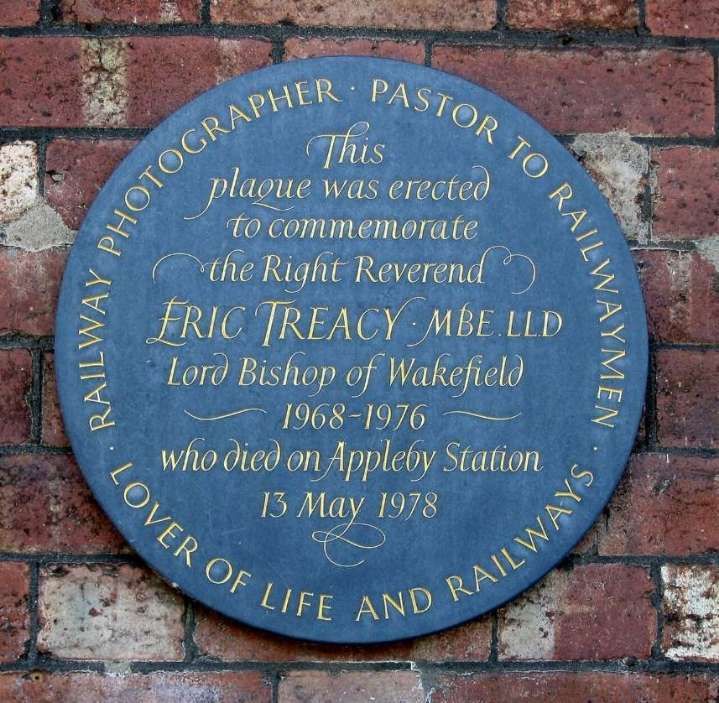
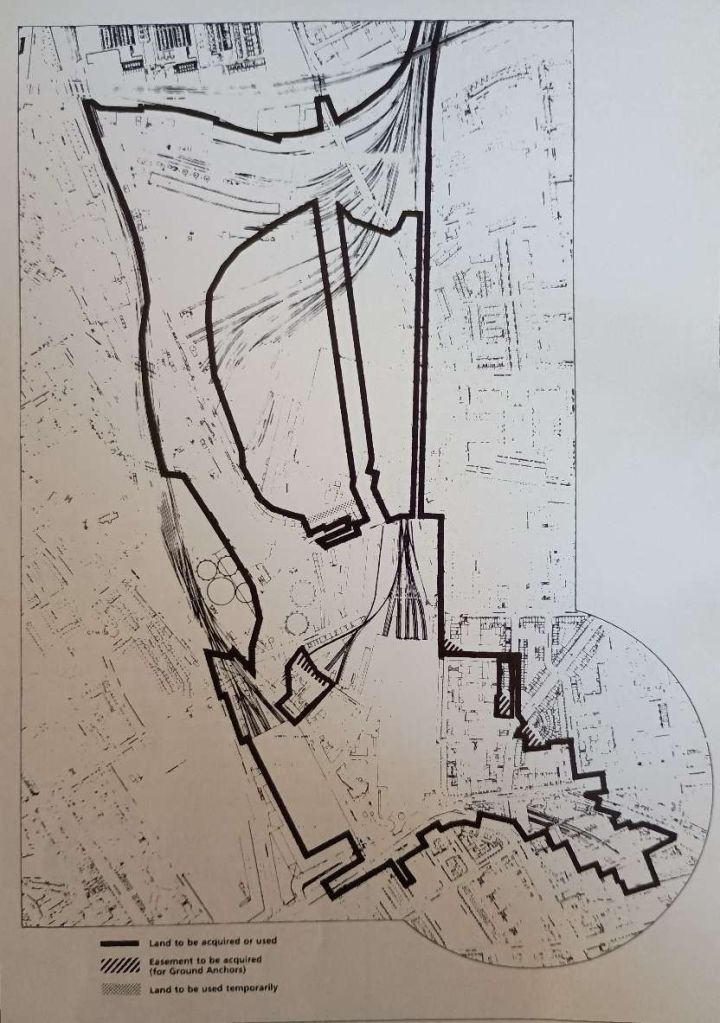
The featured image for this article is a stained glass window in Emneth Parish Church which is a memorial to Revd. Wilbert Vere Awdry who served as the incumbent of the parish from 1953 to 1965. [9]
In his book ‘The World the Railways Made’, in a chapter entitled ‘The Habits the Railways Changed’, and after a discussion of the dramatic effect the railways had on the consumption of different foodstuffs, Nicholas Faith talks of the food the railways carried not only being physical:
“It was also spiritual, enabling pilgrims to travel far more easily. But there were natural hesitations before God-fearing folk were prepared to use such an obviously secular phenomenon. The Russian bishops, for instance, were afraid that ‘pilgrims would come to the monastery [Sergiev Posad (now Zagorsk), site of the sacred Troitsk monastery] in railway cars, in which all sorts of tales can be heard, and often dirty stories, whereas now they come on foot and each step is a feat pleasing to God’. Despite this reluctance, the Metropolitan himself opened the line from Moscow to the holy spot, and by the time the Trans-Siberian was opened, the church was happy to commission a splendid ‘church car’ to minister to the congregations en route. [2]
“The pattern was repeated with different religions throughout the world. The first railway in what was then called Persia was a narrow-gauge line which ran six miles from Tehran to a shrine in the village of Shah Abdul Azim. [3] In Japan at least two railways served important shrines, at Ise and a special line from Oji to the temples at Nara. By the 1890s there was a convenient stop for pilgrims to pay their homage to Mount Fuji.
“Some of the promoters of the first railways in India had hoped to spread Christianity, others were afraid that pilgrims would not use them to travel to their sacred shrines. According to Herbert Spencer, Robert Stephenson referred the matter ‘to the Dhurma Subha of Calcutta, the great sanhedrin of orthodox Hindoos, who, after consulting the sacred texts and the learned pundits, delivered it as their opinion that the devotee might ride in a railway carriage to the various shrines without diminishing the merit of the pilgrimage.’ The result was an amazing growth in pilgrimages, to the mutual advantage of the ‘Hindoos’ and the railway companies. (Quarterly Review, 1868).
“Railways could also be used for secular worship. As late as 1968 the pious Chinese built a railway sixty miles from Hangsha, the capital of Hunan province, to Shao-sha, the birthplace of Mao-Tse-Tung. Over the next decade, before the cult of Mao’s personality waned, three million passengers took the leisurely four-hour journey every year.
“Railways were obviously most suitable for mass religious movements and so concentrated attention on a small number of famous shrines, leading to the neglect of older sites. The most obvious beneficiary was Lourdes, which can truthfully be described as ‘The Shrine the Railway Made’. [cf. 19]
“Bernadette Soubirous’ visions had started in the late 1850s, before the route of the line from Bayonne to Toulouse had been decided. So the town council seized with both hands the opportunity to ensure that the line passed by Lourdes.
In October 1862, the council agreed to compensate any land-owners who suffered, even from the railways’ surveys. In May 1863, councillors asked the railway to site its station as close as possible to the centre of town and complied with every one of the company’s requests. They admitted the navvies and railway workers to the local hospital and ignored their riotous behaviour.
“Their reward came in 1866 with the simultaneous opening of the grotto and the railway from Tarbes, which connected with trains to Bordeaux and far-off Paris. Between 1870 and 1878 a total of 958 pilgrimages to Bernadette’s shrine brought 661,000 pilgrims to Lourdes, 100,000 of them on a single day, 3rd July 1876, to rejoice in the newly-proclaimed doctrine of the Immaculate Conception and affirm the idea of la France Catholique.
“At much the same time similar ideas were being spread throughout France by another railway-based religious order, the Assumptionists, who exploited the railways to assemble mass rallies, largely of the most humble of folk. The Assumptionists were a strange, and in their time highly important, sect, founded by the scion of a rich land-owning family, who acquired considerable political influence through their ability to mount mass rallies.
“But the railway’s most dramatic influence was not on Christianity, but on Islam. Throughout the 19th century increasing numbers of pilgrims had made the difficult and dangerous journey to Mecca. In September 1900, Sultan Abdul Hamid proposed to build a railway to Mecca as a pious gesture on the twenty-fifth anniversary of his accession to the Ottoman throne. The idea was immediately greeted as an important affirmation of Muslim values.
“The Sultan naturally insisted on building a purely Muslim railway. He decreed that, ‘only Muslim workers and Muslim materials ought to be employed; timber from the vast forests of Anatolia and Macedonia; ballast from the country being crossed, rails and wagons from the Imperial workshops; engineering regiments would provide the workforce, the schools of Constantinople the engineers and the foremen.’ [4]
“In the event, much of the material had to be bought in Europe, together with some skilled labour, supervised by the German engineer who had built most of the railways in the Levant. The combination of ferocious piety, the Sultan’s will-power and German organising ability ensured that this railway, nearly a thousand miles in length, was built within eight years.
“Meissner Pasha, the German chief engineer, was simply given the two terminals, Damascus and Mecca, and told to connect them by rail as best he could. He was a genius. He had to handle a huge construction force composed of a dozen nationalities. The line was built across some of the bleakest, hottest, most implacable terrain in the world, without natural resources of any kind. His worst problem was with the Bedouin, furious at being deprived of the pilgrims who had been their prey, ruffians eventually hunted down by an implacably efficient Turkish general, Kaisim Pasha.
“Meissner was not allowed to complete his work. Neither he, nor any other infidel, was allowed to venture beyond Medina Saleh, the 587th mile-post on the line. Fortunately he had trained up a highly-accomplished Turkish engineer, Muktar Bey, who brought the line into Medina in August, 1908. But then the Bedouin took their revenge, wiping out a whole construction camp, and thus scotching any idea of building the railway the final 300 miles to Mecca itself. Unfortunately the line ran for a mere eight years, until T. E. Lawrence blew it up. Since then it has lain abandoned, the break-up of the Ottoman Empire signalling the end of any hope of cooperation between the peoples along the lines.
“In Anglo-Saxon countries deep religious faith produced, not railways, but strong hostility to the very idea of running them on the Sabbath, as a serious challenge to the fundamental Sabbatarianism which was as much a feature of the age as the railways themselves.
“The famous Versailles accident of 1842 was naturally exploited by the Sabbatarians as an awful lesson meted out to the Godless foreign travellers who had dared desecrate the day. After an equally appalling accident in Clayton tunnel just outside Brighton twenty years later ‘plenty of people rushed about proclaiming the accidents as a judgment of God.’ In between times the railways’ Sunday excursions were denounced as ‘trips to Hell at 7s 6d.’ [5]
“But it was not the excursionists (who included such devout souls as Thomas Cook) who forced the railway companies to break the Sabbath. According to Michael Robbins in The Railway Age, it was the absolute need for mail trains to run on a Sunday which broke the resistance of the Sabbatarians in both Scotland and Wales. They were never as powerful as was made out, and most clerics probably reacted like Dr Grantley in Trollope’s Barchester Towers: ‘If you can withdraw all the passengers the company I dare say will withdraw the trains. It is merely a question of dividends’.
“Nevertheless the argument rumbled on. In 1883 the inhabitants of a small Highland village managed to prevent a load of fish from leaving on the Sabbath and were greeted as heroes when they returned from serving the jail sentence to which they were sent-enced. Six years later ‘the anti-Sunday Travel Union’ had 58 branches with some 8,000 adherents. Partly owing to its activities, trains on suburban lines normally ceased running on Sundays during the hours of Divine service.
“Similar battles were fought in the United States. In Galesburg, the railroad was the blunt instrument which broke the power of the Sabbatarians. The first Sunday train was boarded by the impressive figure of President Blanchard of Knox College, who was told to go to Hell when he ordered the engineer to take the engine back to the roundhouse. And that, wrote Ernest Elmo Calkins, was the end of the powerof ‘the little group of pious men who had founded Galesburg to be a Christian town after their own ideal’. [6]
In South Africa, the Reverend Van Lingen managed to prevent any Sunday trains from desecrating the Sabbath at the settlement of Paarl. After denouncing the railway from the pulpit, he founded a Sunday stage coach service for passengers from Cape Town which successfully kept the railway at bay for half a century.
“There was, and remains, a strong counter-current, a positive railway-worship among clergymen of the Church of England. Bishop Eric Treacy and Canon Roger Lloyd were famous railway writers; Canon Reginald Fellows wrote a history of Bradshaw, founding father of railway timetables (which Archbishop William Temple was reputed to know by heart); and more recently the Reverend Wilbert Awdry made a fortune by recounting the adventures of Thomas the Tank Engine and his friends.” [1: p266-270]
In 1979 LMS Stanier Class 5 4-6-0 number 45428 was named Eric Treacy. It is now preserved on the North Yorkshire Moors Railway. The Treacy Collection of 12,000 photographs forms part of the National Railway Museum’s archive of over 1.4 million images. [25]
In the 19th century, the rapid expansion of railways in the UK was met with both profound spiritual revival and fierce religious resistance. While some religious leaders initially condemned trains as ‘rank infidelity’ and decried Sunday travel, railways ultimately revolutionized religious life, opening up previously remote pilgrimage sites like Glastonbury to the masses.
The massive influx of migrant workers, known as ‘navvies’, who built the complex rail lines had squalid living conditions. In response, religious groups established dedicated missions. In the Western Dales, the construction of the Settle-Carlisle line and West Coast Mainline left behind a trail of small chapels, churches, and meeting houses dedicated to these workers. [11][12]
The Railway Mission, founded in 1881, continues to provide support and solace to everyone associated with the railways. [21]
The Railway Mission was founded in 1881. It was a Christian philanthropic organization designed to combat the ‘sinful behaviour’ of railway workers. It provided spiritual guidance, reading rooms, and temperance advocacy to railway employees. [13][14]
Spiritual Metaphors: The advent of steam engines gave birth to rich new religious vocabulary. Preachers and poets of the era often invoked railways as metaphors for salvation. In popular broadsides like ‘The Spiritual Railway’, repentance was the ‘station’, the Word of God was the ‘first engineer’, and Faith was the passenger train! [15]
Nikolaus Pevsner transcribed the following lines from a memorial in the cloister of Ely Cathedral to two victims of an accident on the Norwich to Ely railway line in 1845. Pevsner finds it “eminently characteristic of the earnestness with which this new triumph of human ingenuity was still regarded.” [9]
“The line to Heaven by Christ was made, With heavenly truth the Rails are laid, From Earth to Heaven the Line extends, To Life Eternal where it ends. Repentance is the Station then, Where Passengers are taken in ; No Fee for them is there to pay, For Jesus is himself the way. God’s Word is the first Engineer, It points the way to Heaven so clear, Through tunnels dark and dreary here. It does the way to Glory steer. God’s Love the fire, his Truth the Steam, Which drives the Engine and the Train; All you who would to Glory ride, Must come to Christ, in him abide. In First, and Second, and Third Class, Repentance, Faith, and Holiness, You must the way to Glory gain, Or you with Christ will not remain. Come then poor Sinners, now’s the time, At any Station on the Line, If you’ll repent, and turn from sin, The Train will stop and take you in.” [10]
Dedicated Chapels in entirely new settlements, such as Tebay in Cumbria, sprang up around major railway junctions. The influx of workers forced the Church of England and Nonconformists to erect new places of worship (like the 1885 Methodist chapel in Tebay) specifically to serve the growing railway community. [16]
Tebay Methodist Chapel built in 1885 to serve the railway community. [Google Streetview, September 2024]
Michael Ainsworth wrote an article in 2015 which reflected on Railways, Clergy, Religion and the Law. [17] In it he said:
“The coming of the railways in the 19th century excited deep passions among churchmen, as many novels of the time illustrate. The manner in which building was legally driven through, line-by-line, has been exhaustively documented. For some the speed, the smoke, the ‘blot on the landscape’, were unnatural and diabolical – particularly when Sunday trains broke the sabbath commandment. The vast church of St Bartholomew Brighton was built on a commanding site, and allegedly on the dimensions of Noah’s Ark, as a witness to those travelling down for ‘dirty weekends’. However, one of the most ‘proper’ films ever, Brief Encounter, takes place in a railway station … at Carnforth,” [17]
“Clergy joined with landowners in resisting encroachment. (They had limited success – note, for example, how the line curves round Sacred Trinity Church in Salford.) The perils of rail travel were brought home early by the first railway fatality, in 1830, of William Huskisson MP at the opening of the Liverpool to Manchester line: a memorial at the site, still clearly visible on the line over Chat Moss, was erected in 1913. The dangers were confirmed by the Tay Bridge disaster of 1879 which evoked what has been widely hailed as the worst poem in the English language (but curiously enjoyable) by William McGonagall.” [17]
“But others hailed railways as a godsend and a sign of divinely-blessed progress (despite blighting the urban landscape) … By the latter part of the century, they had certainly revolutionised episcopal ministry. The late 19th-century renewal of enthusiasm for confirmation would not have been possible without the railways. For example, of James Fraser, Bishop of Manchester 1870-85, it was written he spent the week travelling through his diocese, so that there were few days in which he was not somewhere on the railways.” [17]
James Fraser, Bishop of Manchester, 1870-1885, consecrated 99 new parish churches across Manchester Diocese.. He was a frequent railway passenger. [24]
Michael Ainsworth moved on to reflect on clergy interest in railways (model, real or fictional). He said:
“Among clergy who have been ‘keen on railways’, perhaps Eric Treacy, Bishop of Wakefield from 1968-76, significantly described in his Google entry as railway photographer and Anglican bishop, in that order, was pre-eminent. He died in 1978 on Appleby station awaiting a rail-tour arrival. One of the few lapses in Alan Bennett’s chronicling of northern life is in his … Bed Among the Lentils where ‘Mrs Vicar’, the alcoholic wife of a Leeds incumbent (in the diocese of Ripon, as it then was) entertains the bishop who leaves on the pretext of having to bless a steam engine in Keighley (then in another diocese: Bradford, as it then was). However both – plus Treacy’s diocese of Wakefield – are now within the diocese of West Yorkshire and the Dales, aka Leeds (whichever it has decided to call itself), so no harm is done. Appleby remains in Carlisle diocese.
“It has often been said that the reason why some clergy – probably male rather than female – and others, including church musicians, are keen on railways is because they are reassuringly ‘closed systems’, and Awdry’s setting of his railways on the Isle of Sodor confirms this. Lines and boundaries are set, detailed timetables can be pored over, structures are clear: a joy for those who run model railways in their attics for their own pleasure, or larger versions in their gardens to raise funds – both, according to various reports, threatened from time to time by health and safety regulations.
“This joy is less pronounced now that the real railways have been franchised and fragmented. Responsibility for trains, track, signalling, stations and all else is dispersed among many bodies – providing more benefit to lawyers than to passengers, or ‘customers’. Connections, where they exist at all, cannot be held because they will incur a fine for stopping too long in the station. Problems are always someone else’s fault.” [17]
In their book, ‘The Railway Station: A Social History‘, Jeffrey Richards & John M. McKenzie also make connections between Religion, the Clergy and the Railway (particularly the Railway Station):
“Many … have come to the conclusion that the role and atmosphere of the station large and small is essentially ecclesiastical. G. K. Chesterton, a self-confessed station saunterer, celebrated the station as a temple of tradition, a comforting source of continuity in a world increasingly dedicated to change:
“The only way of catching a train I have ever discovered is to miss the train before. Do this, and you will find in a railway station much of the quietude and consolation of a cathedral. It has many of the characteristics of a great ecclesiastical building; it has vast arches, void spaces, coloured lights, and above all, it has recurrence of ritual. It is dedicated to the celebration of water and fire, the two prime elements of all human ceremonial. Lastly, a station resembles the old religions rather than the new religions in this point, that people go to it. In connection with this it should also be remembered that all popular places, all sites actually used by the people, tend to retain the best routine of antiquity very much more than any localities or machines used by any privileged class. Things are not altered so quickly or coarsely by common people as they are by fashionable people. … If you wish to find the past preserved, follow the million feet of the crowd. At the worst the uneducated only wear down old things by sheer walking. But the educated kick them down out of sheer culture. I feel this profoundly as I wander about the empty railway station, where I have no business of any kind. I have extracted a vast number of chocolates from automatic machines; I have obtained cigarettes, toffee, scent, and other things that I dislike by the same machinery; I have weighed myself with sublime results; and this sense not only of the healthiness of popular things, but of their essential antiquity and permanence is still in possession of my mind.” [26: p11-12][27: p219-224]
Richards & Mackenzie note that a similar sense of ecclesiastical peace was detected by Karel Čapek in Czech country stations:
“There are little stations threaded on the lines like beads on a rosary; they stand in the solitude like places of pilgrimage, far from the profane noises of the world; they are the real chapels dedicated to the silent ceremony of Waiting. They are led to as a rule by a country lane with a straggling row of trees; the longer it is the more profound and lasting is the silence which embraces the pilgrim who comes to the station to wait. … We who are waiting, shuffle from one foot to the other and cough under our breath like worshippers in a chapel; we are dressed in clean clothes and depressed in a Sunday sort of way. … ‘Mummy!’ says the piping voice of a little girl. ‘Be quiet’, her mother reproves her in a whisper. ‘Mummy, when will the train come?’ Be quiet, little girl, we have to wait for the train to come. If you aren’t as good as if you were in church, the train won’t come, and we shan’t go away in it to the ends of the earth.” [28: p99-101]
Ricahrds & Mackenzie comment that it is appropriate that Canon Roger Lloyd spoke of the quietude of Marylebone Station:
“It is essentially peaceful and when some rather fussy penitent told his father confessor that he could find nowhere in London where he could meditate in quiet and peace, he was astonished to hear the caustic answer: ‘Have you tried Marylebone, my son?'” [29: p99]
Richards & Mackenzie argue that it is possible to extend the metaphor ad infinitum:
“For if the station is seen as cathedral or chapel, it can also be seen to possess in its heyday a Bible every bit as imposing and sometimes even as impenetrable as the Authorized Version (Bradshaw), incense (steam), and liturgical chanting (‘The train now standing at platform 3 is …’, ‘Close the doors and stand clear’, ‘All change’). In some countries nature imitates art and makes this fancy reality. In Tsarist Russia, icons were often placed in railway-station waiting-rooms and in Greece there were shrines at stations where the traveller could light candles to protect him on his journey. The ceiling of the Great Hall at the old Euston Station was deliberately modelled on that of the church of St. Peter extra muros in Rome.” [26: p12-13]
So, they go on to note that:
“Somehow sensing this connection, clerics have been drawn as if by a magnet to the rails. Bishop Eric Treacy of Wakefield, who had an engine named after him, was a tireless photographer of and writer about railways. Similarly prolific and passionate in their dedication were Canon Roger Lloyd, author of, among other works, The Fascination of Railways, Canon Reginald Fellows, researcher into the history of Bradshaw, Canon Victor Whitechurch, creator of the fictional railway detective Thorpe Hazell, and Revd Wilbert Awdrey, author of the much-loved children’s books about Thomas the Tank Engine and his friends. Archbishop William Temple when headmaster of Repton had a complete mental recall of Bradshaw and would set as an imposition for an errant boy the best way of travelling from Great Yarmouth to Exeter or Penrith to Ipswich without touching London, complete with changes and times. He would then correct it from memory. It was therefore entirely fitting that, in the celebrated Ealing comedy about the last age of steam, The Titfield Thunderbolt should be driven by the local vicar and fired by a visiting bishop.” [26: p13]
Richards & Mackenzie also talk of trainspotters taking up their hallowed places at the end of station platforms and holding well-thumbed copies of the Ian Allan Guide: “the Bible of their cult.” [26: p13]
They reflect too on the use of railways on pilgrimages, particularly in India:
“The religious metaphor is never very far from the pen of the writer on railways and stations. But railways have also had a powerful literal effect upon religious movements around the world. Stations everywhere took on the role of the Tabard Inn at Southwark, where Chaucer’s pilgrims assembled for their journey to Canterbury. Muslims flocked to the stations of Russian Central Asia, up-country India, Malaya, and North Africa to commence their long journeys to Mecca. The leaders of Eastern religions which had resisted the appearance of the railway, as in China and Japan, soon found that their co-religionists swiftly took to the rails to visit temples and shrines. The stations of the South African Boer Republics, themselves huge concessions to the modern world which the Boers would originally much rather have done without, took on some of the dour, flinty character of Dutch Reformed Calvinism.
“But it was in India that the railways produced their most dramatic religious effect. Hinduism is one of the most mobile of all religions and Hindus found in the railways a hitherto unimaginable opportunity to travel to shrines, pilgrim centres, and important ceremonies. The Murray’s Handbooks to India are punctuated with references to stations much used by pilgrims. In 1906, the Chief Superintendent of the East India Railway provided readers of the Railway Magazine with a graphic description of a pilgrimage to Allahabad. [26: p172-174][32: p326-328] Every twelve years, a ceremony known as the Kumbh mela took place at the confluence of the Jumna (Yamuna) and Ganges rivers just outside Allahabad. The ceremonies lasted for a month and millions attended, many coming only for a few days.
For the duration of the mela as many as twenty pilgrim trains a day, each carrying a thousand passengers, might be brought into Allahabad in addition to the normal traffic. It was necessary to use all the Allahabad stations, Naini, Kotaparcha, Kyogunge, Allengunge, as well as the Main and Fort stations to distribute the tremendous pressure of passengers. Temporary booking-offices, thatched and constructed of railway sleepers, were built near the site of the mela itself to sell tickets to returning pilgrims. At the station barriers, barricades and pens had to be constructed to separate ‘up’ from ‘down’ passengers and avoid crushing and injury. Most of the special pilgrim ‘rakes’ were made of goods wagons with a mat on the floor to sit on, and an oil lamp hung from the roof for illumination. Superintendent Huddleston assured his readers that pilgrims found this accommodation perfectly comfortable and never made any complaints. Pilgrims, he went on, were the most patient of passengers. But even they had been known to take direct action when driven to desperation. Some years earlier a train carrying pilgrims had been so seriously held up that its journey had taken twenty-four hours rather than seven or eight. Towards the end of the journey the pilgrims discovered that their train had been shunted into a siding at a station in order to give precedence to the mail train:
“They thought it time to take action on their own account. Several of them thereupon left their carriages and placed their heads on the rails vowing that, rather than allow another train to pass by they would sacrifice their lives. After this demonstration it is needless to say which train got away first, but, of course, there was an outcry because the Mail ran late!” [32: p328]
Sometimes the lack of co-ordination among the different Indian railway companies made things difficult for pilgrims. There were, for example, no through trains from the East India Railway to the Oudh and Rohilkan railway, and pilgrims together with other travellers had all to change trains at Moghalsarai junction, a mere ten miles from the great pilgrim city of Benares (now Varanasi). Huddleston described the scene:
“During pilgrim rushes, surging, struggling crowds filled the platforms and the waiting halls, and while the masses changed from one train to another the station was a Babel. The delays between connecting trains often being considerable, it is needless to remark that the position was one of intolerable discomfort, though it was accepted by both passengers and railway staff as part of the day’s work.” [32: p501-502]
Through trains were eventually provided, and ‘the convenience to pilgrims and relief to Moghalsarai station is immense’.
The complexities of the arrangements made for pilgrimages is borne out in a number of ways. The Government Health Department sent men to examine pilgrims alighting from trains. Their job was to watch out for cases of smallpox and cholera. The railway also had its own medical department, which attempted to take action when cases of plague, small-pox, or cholera were reported:
“During the mela a slight outbreak of cholera occurred at a small station called Manickpore on the Jubbulpore line. The company’s doctor was on the spot in no time, attended the patients, examined the sanitary arrangements, disinfected and closed the station well, and arranged for tanks of pure water to be conveyed from 62 miles away.” [32: p425-426]
The traffic arrangements for the Kumbh Mela in 1906 were entrusted to the same officer who had made all the arrangements for the Great Delhi Durbar organized by the Viceroy Curzon in 1904. He was provided with 450 employees to help. The earnings from the pilgrims, who travelled at very low fares, amounted to £53,500 in 27 days. Superintendent Huddleston noted with evident self-satisfaction that ‘everything worked without a hitch, and there was not a single accident of any kind’. [26: p172-174]
‘The Railway Age’, according to Richards & Mackenzie had many faults. But:
“But it was an age which saw the slow, sure, and steady progress of social improvement and it was an age of hope, of optimistic belief in the future, unashamed aspiration for better days and better conditions in the world. The great stations stand, if they do still stand, as towering monuments to that belief, public meeting-places where faith in the perfectibility of man by his own ingenuity and the blessing of a divine providence was daily affirmed. In this respect, the oft-quoted cathedral metaphor is not inapt. Stations were cathedrals of the new technology. They were also places of hope, faith, and inextinguishable humanity, embodiments of that spirit that Charles MacKay captured so well in his poem ‘Railways 1846’. [26: p17]
John MacKay’s poem reads:
‘Railways 1846’ by John MacKay. [30: p69]
For a more about Clergy and Railways, please click here. [7]
It is also worth listening to Railway Mania Podcast Episode 19 to gain an understanding of the way in which Christian non-conformists in the UK were so instrumental in the development of the railways in the UK. [8]
Railway Chaplains
As we have already noted, The Railway Mission is a British mission devoted to the rail industry. It was founded in 1881 based in mission halls, and now operates a chaplaincy service across the rail network in the UK.
In the early days of the Railway Mission there were a number of mission halls at railway stations throughout the country. These days Railway Chaplains cover hundreds of miles by train. Lorraine Worsley-Carter points to one of these chaplains – Revd. Mike Roberts: “Mike works under the auspices of the Railway Mission. He covers a vast area in the North West from Stafford to Carlisle, Blackpool to the Pennines. This includes 11 Passenger and Freight Operators; Network Rail; 11 depots; over a hundred stations and 50 signal boxes. He is also a chaplain to the British Transport Police.” [20]
The Railway Mission is committed to making a real difference to the lives of people in the “railway family.” [21] The Railway Mission says this about its work on the railways:
“Every day, rail colleagues keep passengers and freight moving safely. When something difficult happens a fatality, a serious incident, an assault, a sudden death in the team – it is people who carry it home. … Railway Mission chaplains are present across the network. We offer calm, confidential pastoral support in the moment, and we stay alongside staff and managers as they take the next steps. Sometimes that is a quiet conversation at a depot or station. Sometimes it helps a manager hold a team together after devastating news. … In 2025, our chaplains recorded 9,157 support interactions across the industry. 23.5% were requested by a manager or director, a sign that chaplaincy is valued not only for individual care, but also for coordinated, time-critical support after incidents. …
“Independent social value work using RSSB’s Rail Social Value Tool has estimated that for every £1 invested in Railway Mission chaplaincy, around £3.13 of social value is generated. That is why partner support matters. It keeps chaplains present where and when staff need them most.” [22]
Lorraine Worsley-Carter says: “The introduction of railway chaplains in the United Kingdom has been a significant development in the provision of spiritual and emotional support to both railway employees and passengers. These dedicated individuals serve a crucial role in an industry that operates around the clock, often under stressful and challenging conditions. … One of the primary attributes of railway chaplains is their ability to provide emotional support to railway employees. Working in the railway industry can be physically and mentally demanding, with long hours and often unpredictable schedules. Railway chaplains offer a listening ear and a supportive presence, helping employees cope with the stresses and challenges of their jobs. They provide a safe space for employees to discuss their concerns, anxieties, and personal issues, which can have a positive impact on mental health and job satisfaction.” [20]
What About Patron Saints?
Some are highlighted by John Bull (inspired by writer Anne Thériault). [18] Here they are!
Saint Christopher – Patron Saint of Travellers – St Christopher’s sainthood is based on his, allegedly, having carried the baby Jesus across a river. As such he is the generic Patron Saint for travellers. He is also Saint Patron of Truck Drivers!
Saint Montague – Patron Saint of Railways – Montague was the abbot of a monastery, but died when he was hit by a locomotive. This is likely another of the Catholic Church’s canonisations to keep up with new transport technologies.
Saint Galthus – Patron Saint of Steam Engines – Saint Galthus is the patron of steam engines. Having run the Pope’s private rail line, he was martyred by a faulty boiler. His body was found to be incorruptible after death and he was duly canonized. Although, it is said his Pope just really loved trains.
4. Saint Catherine of Alexandria – Patron Saint of Railway Workers – Catherine was a 4th century martyr, was well educated, and is also the patron saint of philosophers and preachers. It is not clear why she was anointed Patron Saint of Railway Workers, although the social media posts of some railway workers do point to a degree of philosophising and preaching! [18]
Painting by Caravaggio (1598–99) in the Thyssen-Bornemisza Museum in Madrid. [31]
According to John Bull there are other patron saints who can be considered as being closely allied to railways. [18] Here are a few:
St Dominic de la Calzada– Patron Saint of Civil Engineers – worked on building bridges and paved causeways to help pilgrims in Spain – calzada means causeway in Spanish. [18]
St Bénézet – Patron Saint of Bridge Builders – Bénézet saw a vision during the eclipse of 1177 that propelled him to build a bridge over the River Rhône at Avignon. He built the bridge single-handedly, as church and civil authorities refused to help him, thus becoming an early advocate for community based transport planning. [18]
Saint Barbara – Patron Saint of Tunnellers (and Mining Engineers) – Saint Barbara, has often been invoked to protect diggers and mine engineers in such dangerous work, and so is also the patron saint of miners. And by extension the patron saint of railway tunnels and tunnellers. To this day, tunnels under construction often have a small alcove in which a small statue of her is placed, for her divine protection. The medieval miners also named digging equipment after women in her honour, and this tradition is still followed to the present – tunnel boring machines (TBMs) are still given female names! [18]
In addition to religious saints, John Bull also provides some suggestions for ‘Secular Saints’, including these. [18]
Thomas Rammell – Patron Saint of Pneumatic Railways – Engineer Thomas Rammell had a single-minded obsession with pneumatic railways, beginning with his London Pneumatic Despatch Railway … Although this seems more like a case for Saint Jude, the Patron Saint of Hopeless Causes.
Antonio Gaudí – Patron Saint of Trams – Architect Antonio Gaudí was struck & killed by a tram right next to his under-construction La Sagrada Familia Basílica. Unfortunately he looked quite dishevelled, so passersby thought he was a vaigrant and he didn’t get the medical help that could have saved his life.
Saint Harriet – Patron Saint of the Underground Railroad – some Anglicans consider Harriet Tubman a saint, as she was the conductor of the Underground Railroad in the US. Whilst not a physical railroad, but more a concept, Harriet deserves inclusion.
And finally … Having Faith in the Rail Industry (A Muslim Perspective)
CPMS-Egis Scheme Project Manager Farah Sajwani on the challenges to make the railways inclusive to all religions. As a Middle Eastern Muslim Farah Sajwani never thought she’d be working in the railway for a company in England. Farah’s journey into the industry began when she left Oman to pursue an undergraduate degree in chemical engineering in Australia. She then moved to Manchester, where she completed her postgraduate degree in engineering project management. It was from here that she moved to London and joined the graduate scheme at CPMS-Egis where she has been for nearly three years. [June 2021]
This is an article from RailDirector magazine: [23: p46-47]
“Landing a job in a railway-focused company was very exciting, yet overwhelming, as I came from a country that did not have a railway,” said Farah. “I was a little apprehensive at first as I was concerned about being credible and having a successful career there, not knowing much about rail, but everyone has been very welcoming and helpful and I’m really enjoying it. Another pleasant surprise was getting a graduate placement in a company that is understanding and inclusive of other cultures and religions. I’d often heard friends saying that the working environment can be tough and that people from a different ethnicity, religion, education and national origin can sometimes feel left out in the workplace, but I have been fortunate at CPMS-Egis. I have felt included from the outset of my placement and am now Scheme Project Manager. I am also actively involved in the company’s EDI and Community Kindness Groups.”
In February [2021], Farah was invited by Women in Rail (WR) to join the Equality Diversity and Inclusion (EDI) Charter Working Group created by Women in Rail (WR) and the Railway Industry Association (RIA) following its launch last November. “I’ve joined the Charter Working Group because I want to make a difference and help organisations understand better how to attract a more diverse workforce and be more inclusive,” she said. “I think every person, regardless of their ethnicity, religious beliefs and background should be able to contribute equally to the growth and wellbeing of the organisation they work for, thrive in their job and realise their full potential.”
The EDI Charter has already been signed by more than 160 organisations which demonstrate the industry’s commitment to the equality, diversity and inclusion agenda. The EDI Charter Working Group comprises young professionals in rail chosen by WR and RIA on the basis of their personal commitment and qualities and the fact that they represent a spectrum of the backgrounds, ages, genders and identities and various grades, roles and companies within the UK rail industry at this particular point in time.
“Being part of the working group is the opportunity to share my experiences and to help organisations understand better what may be holding them back from attracting a diverse workforce and being more inclusive,” she said. “It is also a way for me to be the voice of the people who share my background who may be facing challenges in the workplace but are not able or prepared to speak out. Each member of the group brings a different perspective on EDI and the challenges to inclusion so the group is not only about sharing my experiences, explaining how companies can be more inclusive of Muslim women, but also about learning about others, listening to their experiences, their challenges, and understanding how I can myself help foster better inclusion in the workplace and the railway.”
Farah is using her voice to inform the industry about what can be done to encourage more Muslims into the rail sector. Like nearly all industries in the UK, Muslims face universal barriers to employment, with prejudice believed to be a contributor as to why unemployment rates are more than double that of any other community. … “I am keen to use my voice to raise awareness to the need to create more flexibility around the working environment in the railways for people like me,” she said. “For instance, as a Muslim, I don’t celebrate Christmas and I don’t do anything special on Boxing Day, yet as an employee, it is automatically assumed that I will take those days off because it is a bank holiday. It would be good to be able to work those days and use that credit to take time off on the days I celebrate my religion such as Eid-al Fitr (Festival of Breaking the Fast) which follows Ramadan (a month of fasting).”
“Again, with Ramadan it would be good if organisations could make people more aware that they have colleagues fasting and ask them to be a little bit more understanding. I have found my colleagues at CPMS-Egis to be really supportive, but I am aware that it is not always the case for other Muslim people. … In the long term, it would be good to see employers make prayer space available for everyone. I pray five times a day so it would be nice to have a personal space to do this, but this space could also be used as a meditation room for individuals or just somewhere where anyone who needs to take a moment can decompress, … I am pregnant at the moment and flexibility is important to me, to go to hospital appointments for instance. As long as I am doing my job right and making up the working hours, that should be the main focus.”
It is these sorts of ideas that Farah hopes to promote and move forward as part of her role in the working group of the EDI Charter. “When I first joined the rail industry, I did feel a little awkward when I was taking time off to celebrate my faith and during Ramadan when I was fasting,” she said.“Organisations could look at offering more flexible hours for employees during these times, because for example I don’t take a lunch break when fasting. … A lot of it comes down to raising awareness, which is a priority for me with the EDI Charter Working Group. Inclusion is not a case of one size fits all and what works for one organisation. might not work for another. Employers need to connect with their employees, open the discussion and both need to work together to make it work for them.”
“Our role as the EDI Charter Working Group is about understanding our respective challenges and come up with ideas and suggestions as to how employers can address them so they can attract a more diverse workforce and create better inclusion. … I have really enjoyed my time in the rail industry so far and I really want to play my part in making sure I help everyone feel included, whilst at the same time encouraging others to join the industry. … Based on my overall experiences so far, I would recommend the rail industry to everyone and I would encourage everyone to speak up if they face challenges. … There are lots of opportunities to work in the railways. You just need to understand the industry and make sure the industry understands you.” [23: p46-47]
References
Nicholas Faith; The World the Railways Made; Pimlico, London, 1990, 1994, p259-270.
J. N. Westwood; A History of Russian Railways, George Allen and Unwin, London, 1964.
Michael Ainsworth; Thoughts on railways, clergy, religion and the law; in Law & Religion UK, 17th April 2015; via https://www.lawandreligionuk.com/2016/04/17, accessed on 8th July 2026.
John Eade; The Changing Role of Railways in the Life of a European Pilgrimage Shrine; via Researchgate; https://www.researchgate.net/publication/289637979_THE_CHANGING_ROLE_OF_RAILWAYS_IN_THE_LIFE_OF_A_EUROPEAN_PILGRIMAGE_SHRINE, accessed on 9th July 2026. This paper examines the changing role of the railway in the development of one of the most important Roman Catholic shrines – Lourdes in France. During the second half of the nineteenth and the first half of the twentieth century, trains were vital in establishing Lourdes’ position as a major national and international shrine. Although the expansion of car ownership and tourism after the Second World War have vastly increased, the numbers visiting the shrine, the importance of the railway has declined. This paper examines the changing role played by the railway in the shrine’s development, the declining importance of organised pilgrimage groups and the growth of individual choice and the flexibility provided by diverse modes of transport. It concludes with a consideration of the relevance of this case study to the study of pilgrimage and tourism in Europe and beyond.
In June 1990, The Railway Magazine issued a supplement entitled ‘King’s Cross Renaissance: The History, Development and Future of Two Great Stations’ by P. W. B. Semmens MA, CChem, FRSC, MBCS, MCIT.
Semmens introduces the supplement by highlighting first the 1846 ‘Royal Commission on Railway Termini Within or in the Immediate Vicinity of the Metropolis’ which recommended that “surface railways should remain towards the outskirts, and fixed a ring of roads around the city, beyond which they should not penetrate.” [1: p3]
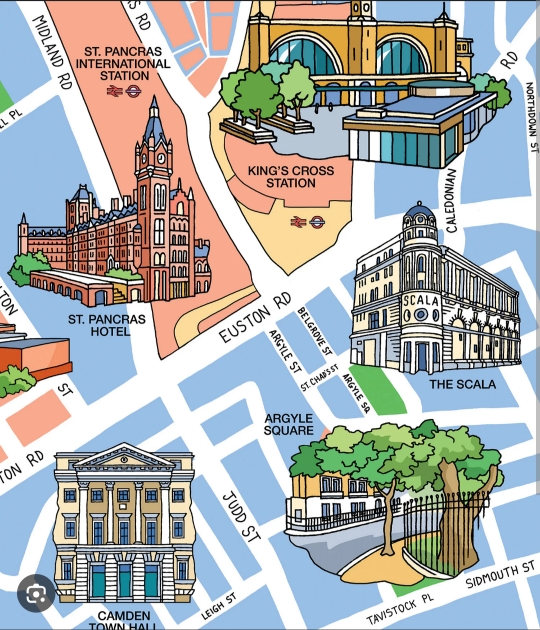
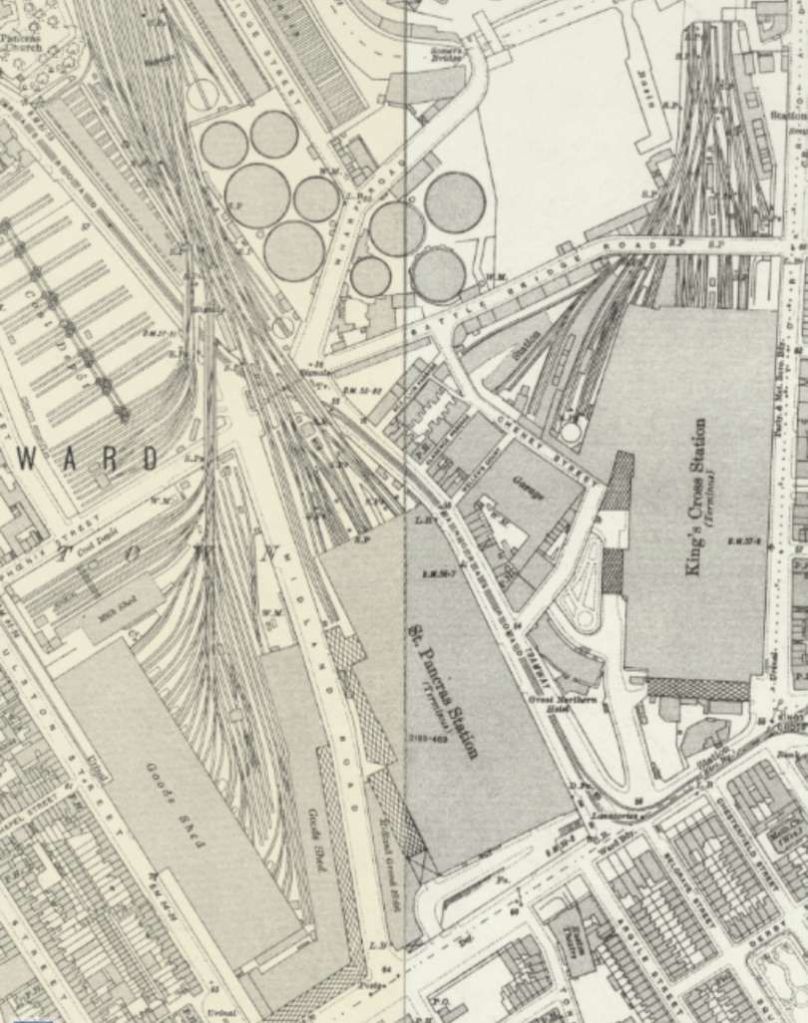
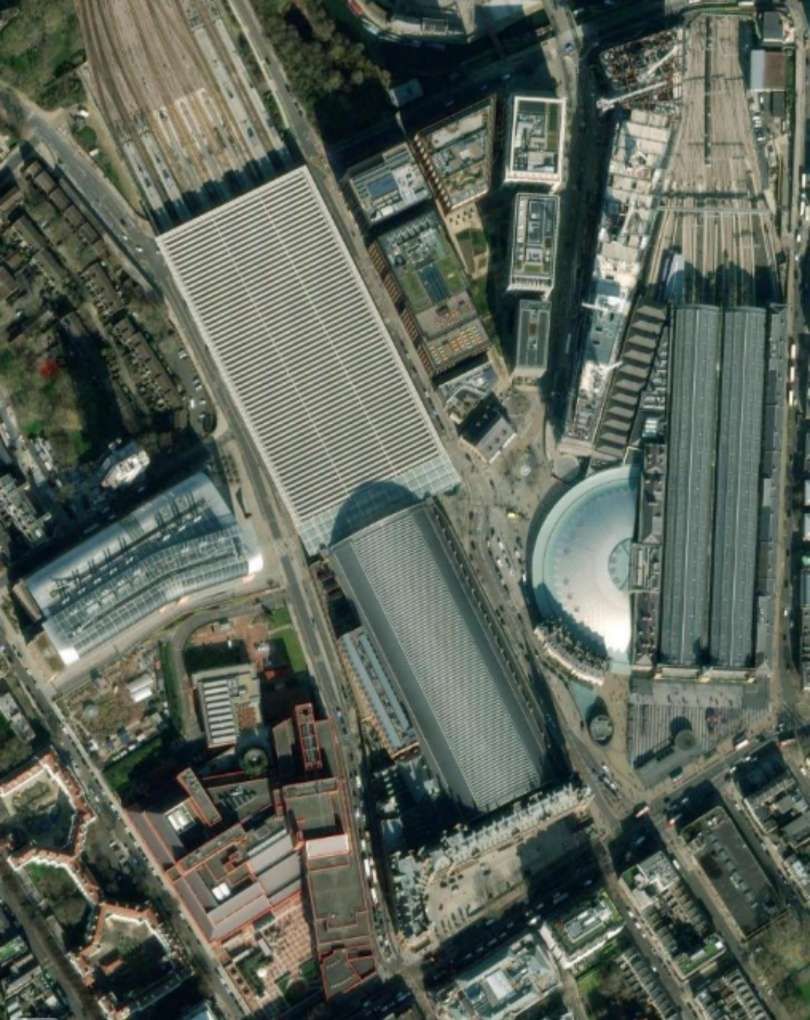
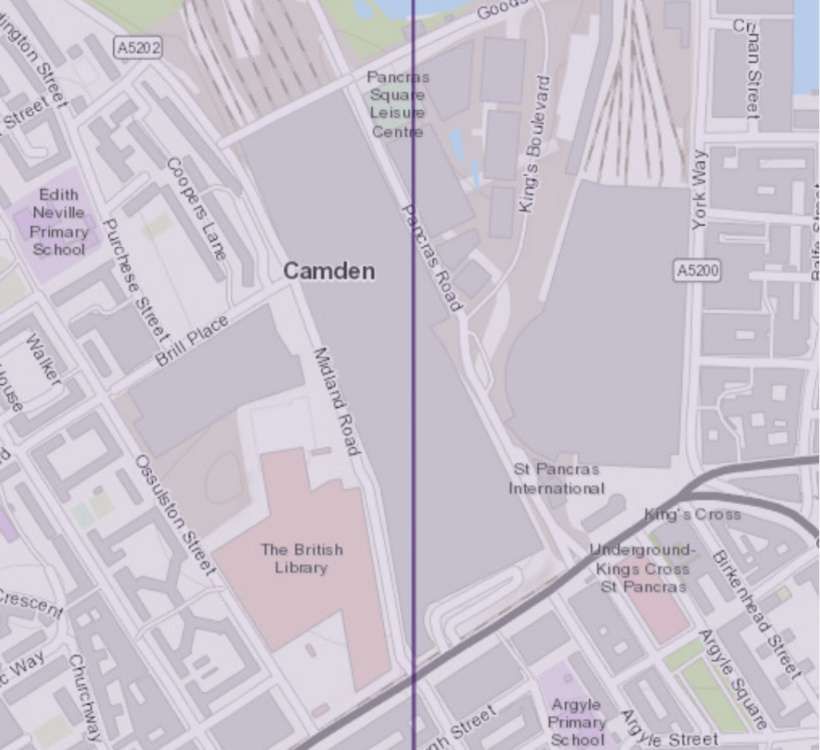
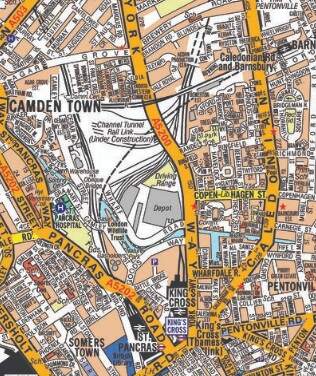
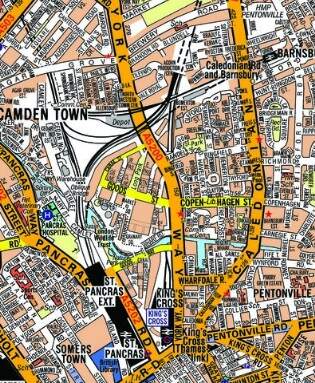
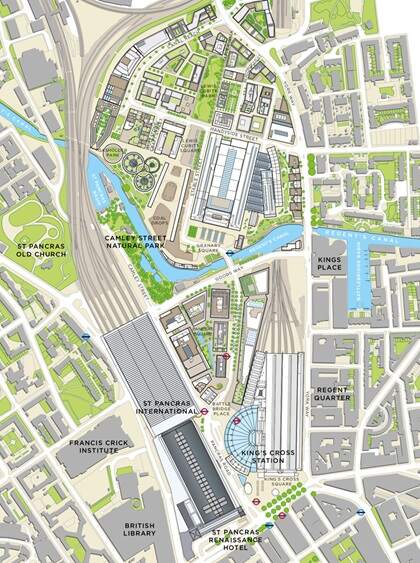
The Midland Goods Sheds, Midland Road, St. Pancras & King’s Cross Passenger Stations as shown on the 25″ Ordnance Survey of 1914, published 1916. [2]The same area as it appears on the modern ESRI satellite imagery in March 2025. [2]Camden/St. Pancras/King’s Cross as shown on ESRI World Topography provided by the National Library of Scotland (NLS). [3]
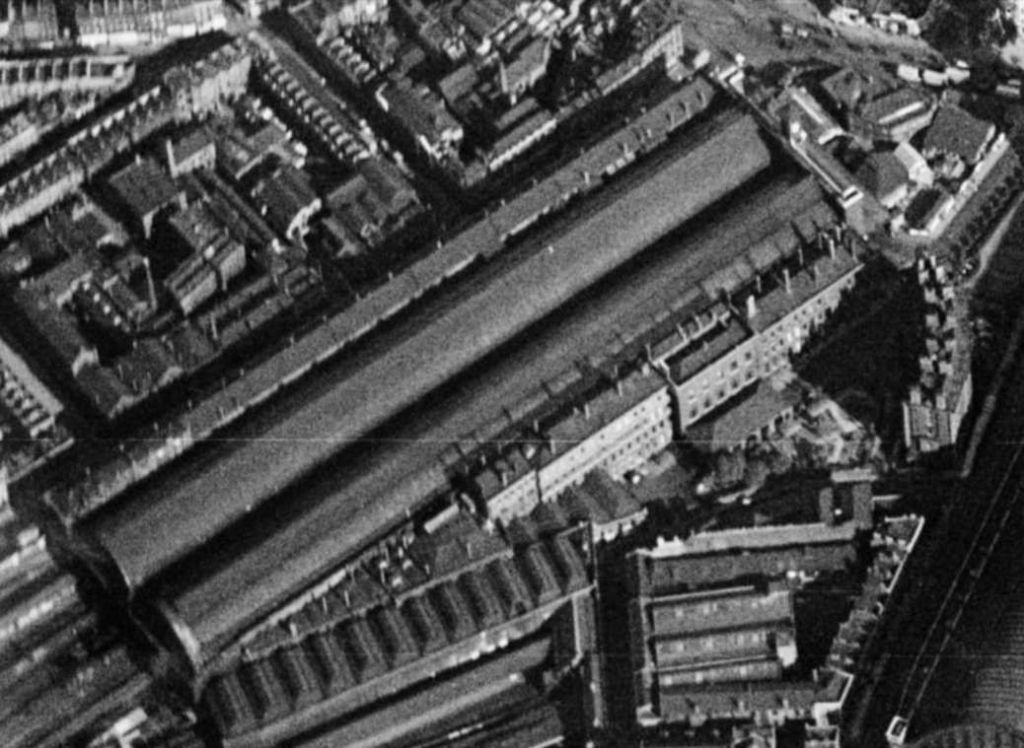
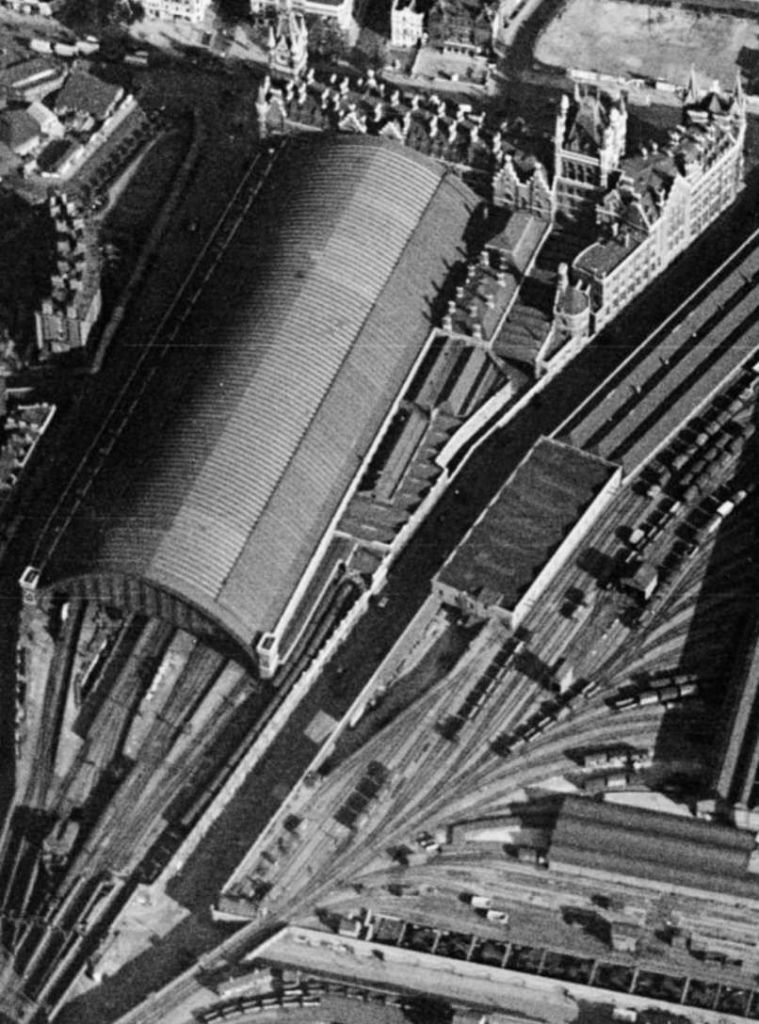
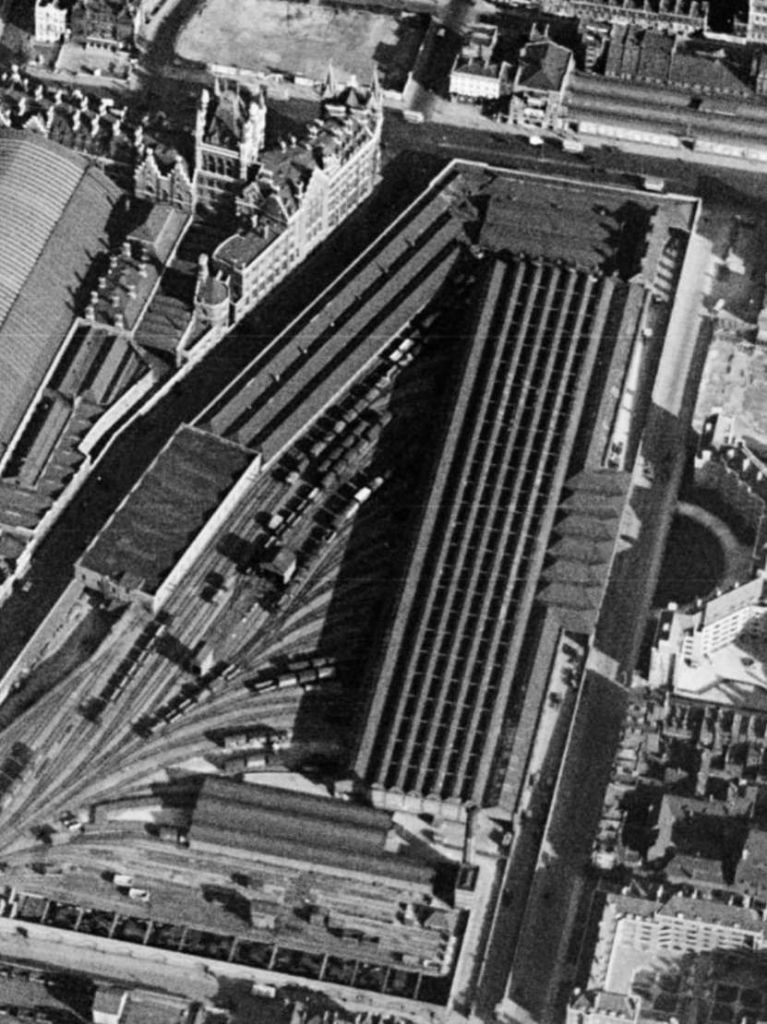
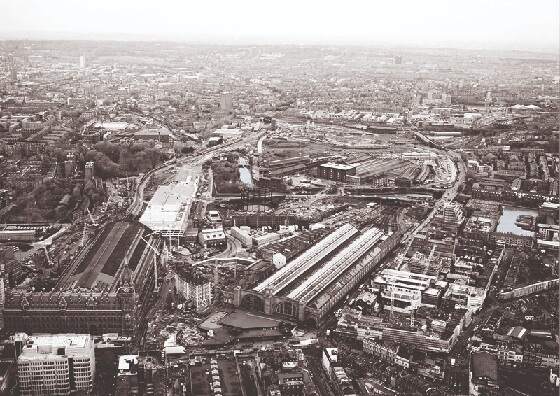
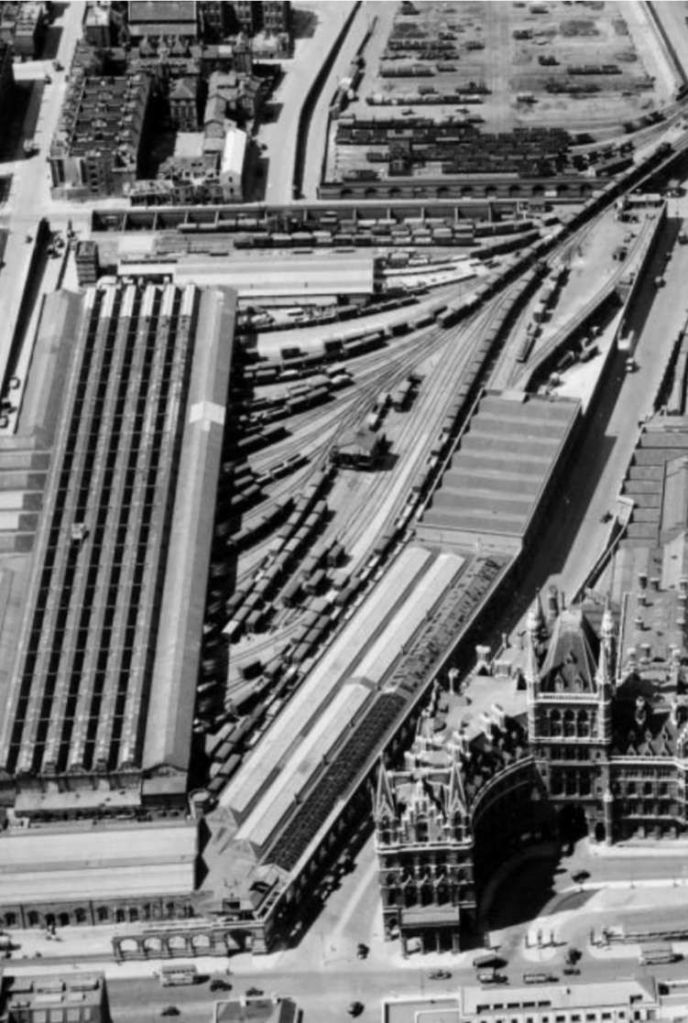
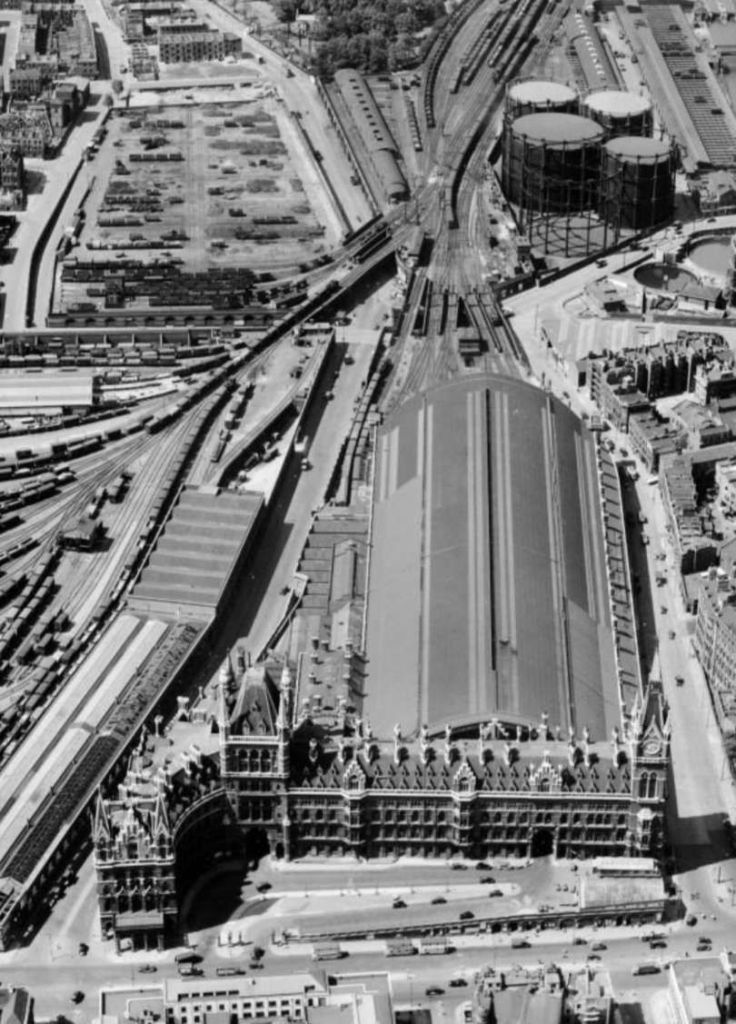
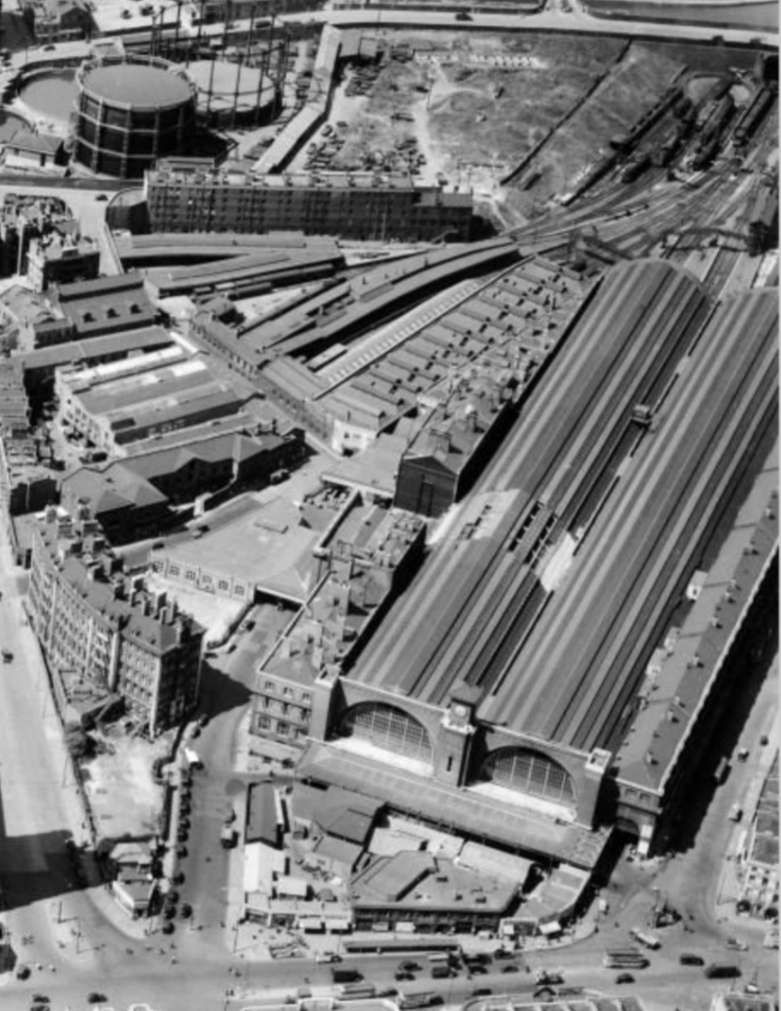
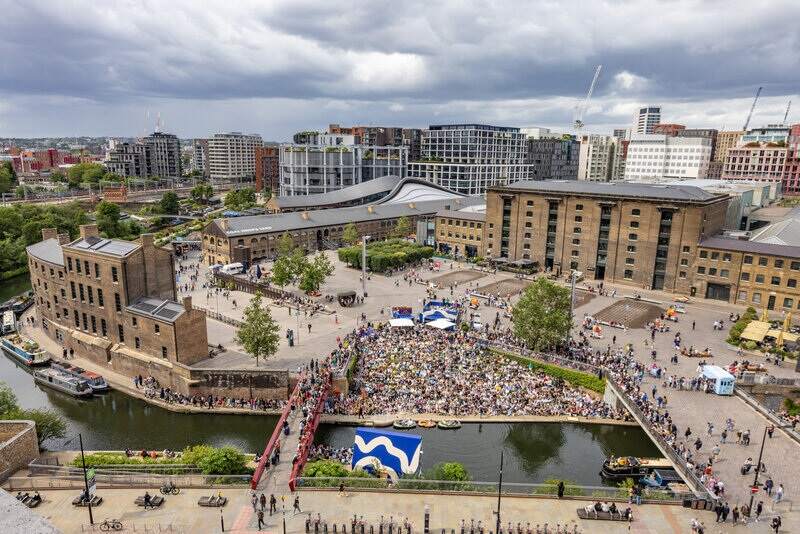
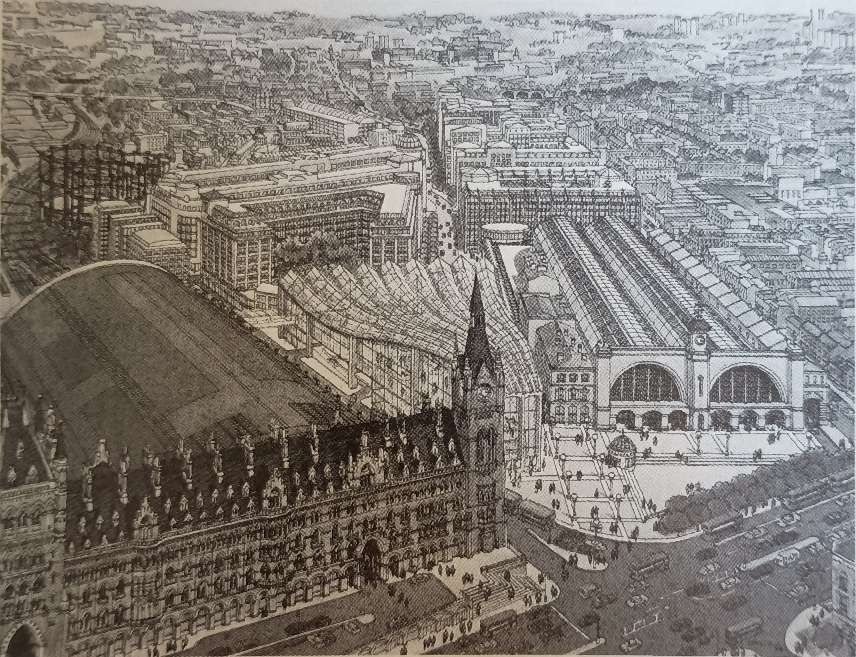
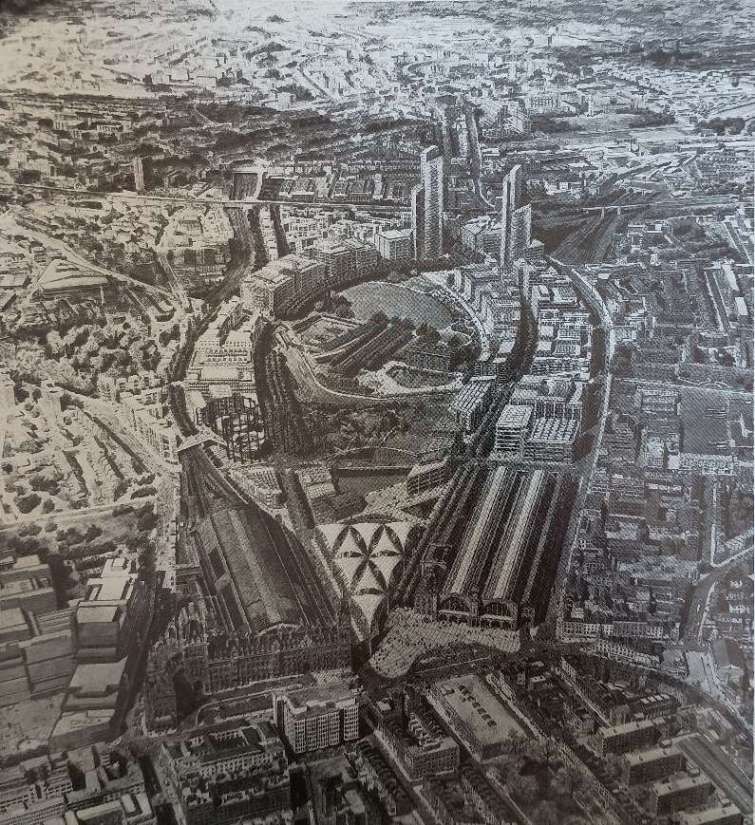
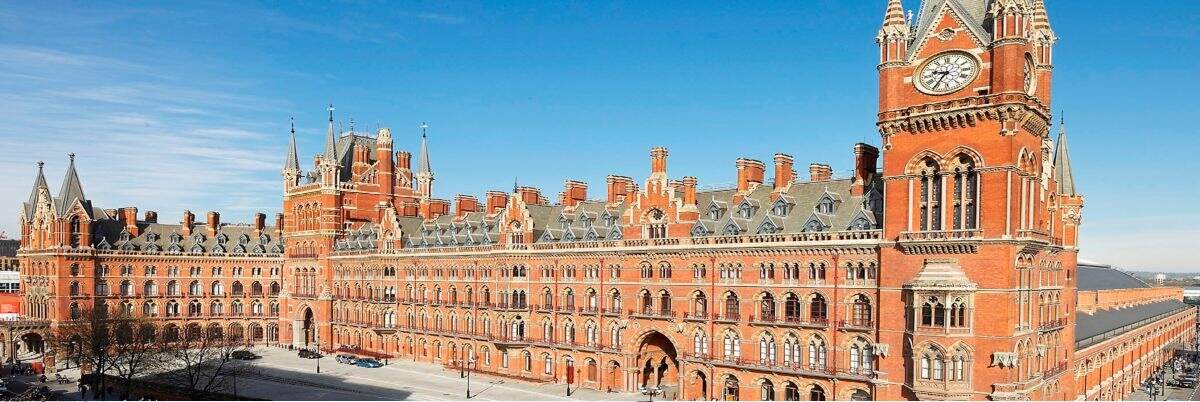
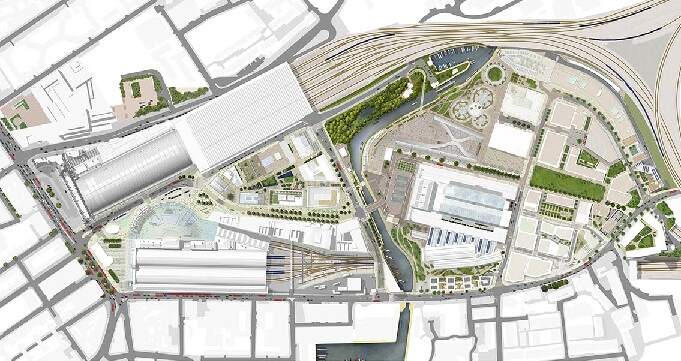
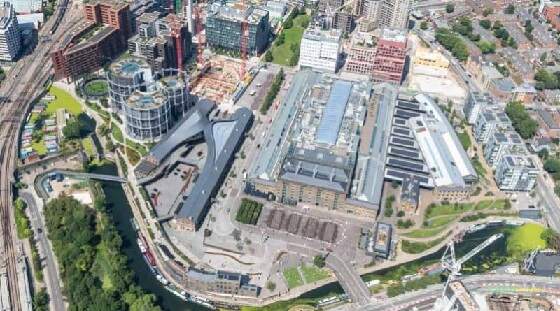
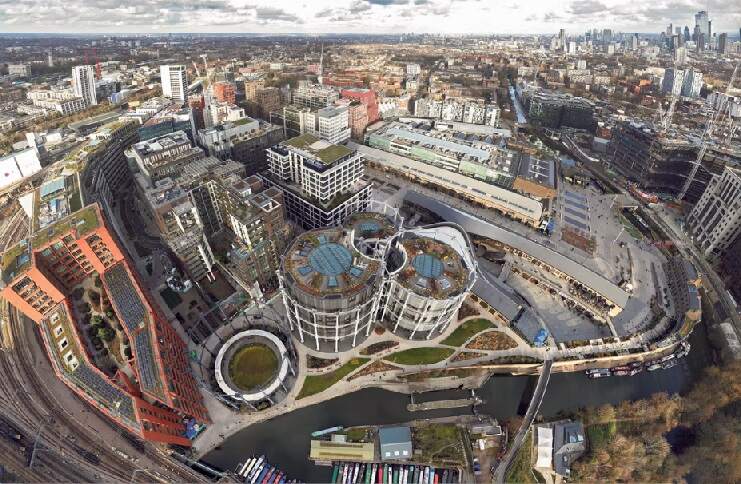
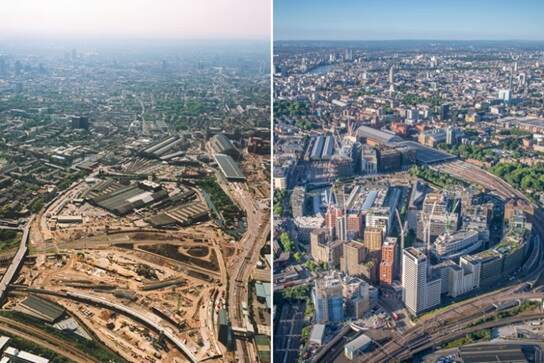
The next few images show these buildings from the air. …
By 1990, the main line railway still barely penetrated the central core of London “and only Thameslink crossed the built up area to provide a through route.” [1: p3] The impact of the Royal Commission was most obvious “in the North of the city, where five of our main line termini … situated in a virtually straight line along one major road, stretching from Paddington in the West to the twin stations of St. Pancras and King’s Cross five miles away to the East.” [1: p3] As a result passengers heading into the centre of London still have to change to other forms of transport even if limited subsurface onwards extensions were provided by three of the termini.
In the latter half of the 20th century, developments in service industries and improved electronic communication systems have allowed companies, which originally needed to be closely situated in the centre of the city, to look for alternative, better locations. “The railway termini, with their built-in transport facilities for staff, thus provide excellent sites at which to build new offices, and BR [was] extensively involved in many such developments, after its initial office plans for the new Euston had been thwarted by the government of the day. Some of the London termini, however, are of such outstanding architectural merit that it is not acceptable for them to be swept away and replaced by office blocks on top of improved station facilities for trains and customers. Notable among these are St. Pancras and King’s Cross, both Grade I listed buildings, whose proximity to each other makes them unique in London. (Broad Street was never really a main-line terminus, as its services were virtually all of a suburban nature.)” [1: p3]
In addition, “Extensive goods activities were also developed by the railways close to many of their London main-line termini. This was particularly apparent in the vicinity of King’s Cross and St. Pancras, where there were vast areas devoted to the vital job of keeping the country’s capital provisioned, fuelled, and even ‘mucked out’, as arrangements had to be made for the removal of refuse by rail.” [1: p3]
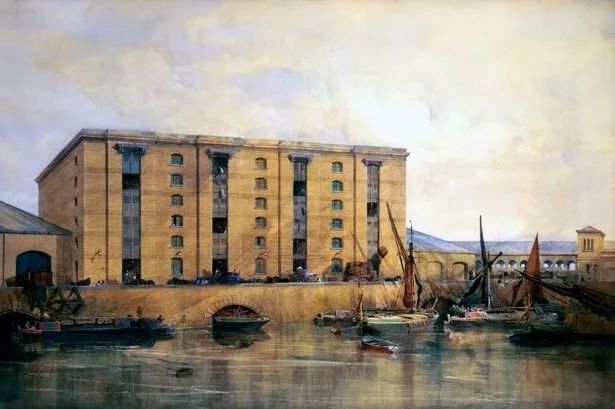
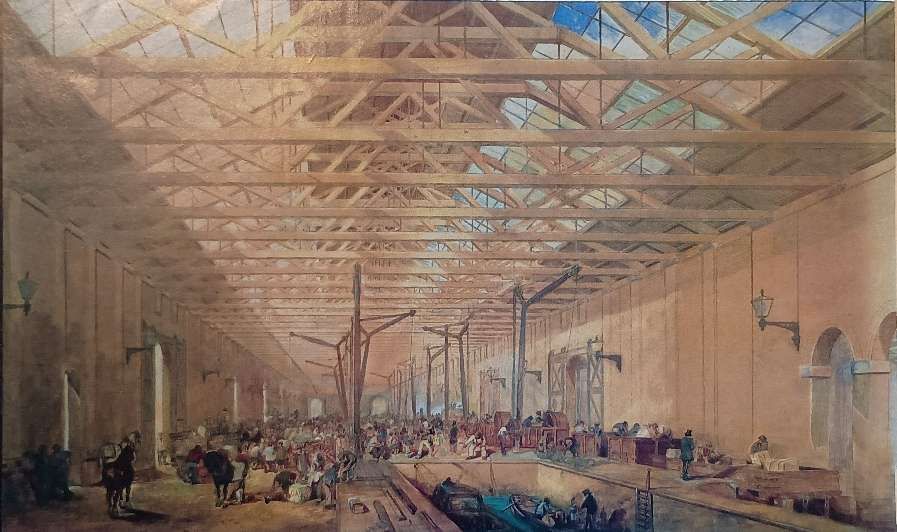
The Great Northern Railway’s “Goods Yard complex, designed by Lewis Cubitt, was completed in 1852. The complex comprised the Granary Building, the Train Assembly Shed, and the Eastern and Western Transit Sheds. The buildings were aligned to the axis of the Copenhagen tunnel through which the trains arrived from the north. … The Granary building was mainly used to store Lincolnshire wheat for London’s bakers, while the sheds were used to transfer freight from or to the rail carts. Off-loading from the rail carriages was made easier by cranes and turntables powered by horses and, from the 1840s, hydraulic power. … Loaded and unloaded carts were moved into the Train Assembly Shed and formed into trains for departure northwards. Stables were located under the loading platforms – some of these remain in the Western Transit Shed. … In the 1860s, offices were added on either side of the Granary to provide more clerical workspace. Dumb waiters were used to transport papers up and down and windows between the offices and sheds allowed traffic to be monitored.” [6]
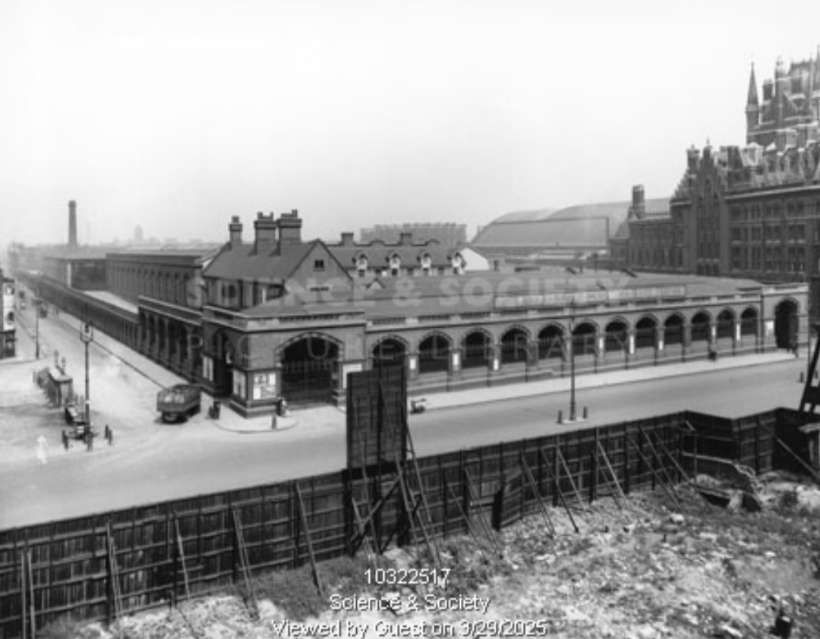
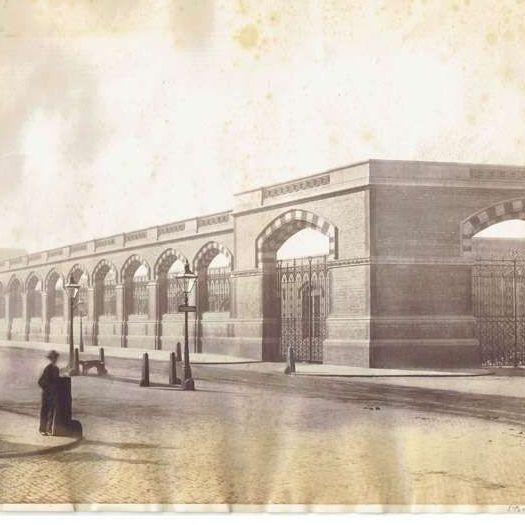
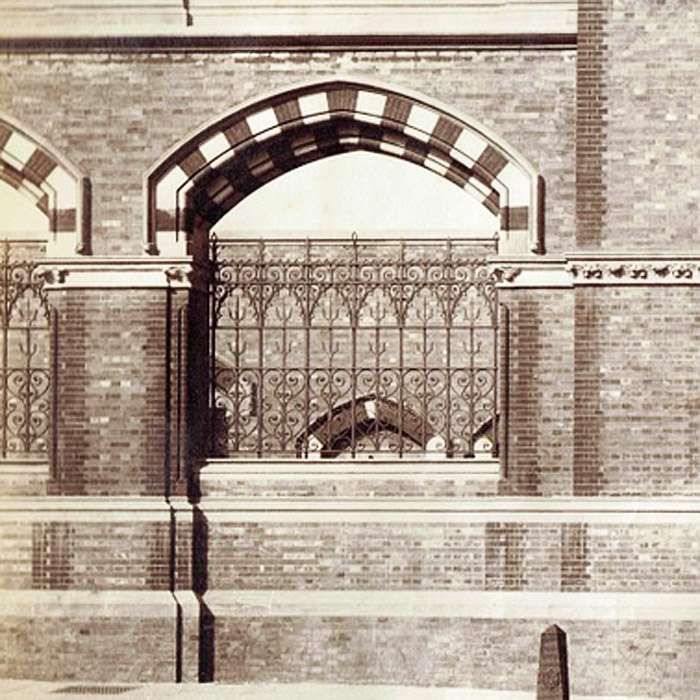
The Midland Railway’s Somers Town Depot sat adjacent to St. Pancras Station on the West side of Midland Road. The next two images give an idea of the detailed brickwork used on the boundary walls of the depot.
Detail of the wrought iron railings and brickwork in the vast Somers Town Goods Yard walls. [12]
Somers Town Depot was an ambitious two-deck goods yard that differed from neighbouring King’s Cross to the east in that the tracks and platforms were raised. “This enabled the tracks to traverse above the Regents Canal to the north and arrive at their terminus before the Euston Road at that high level (conversely, the Great Northern Railway tracks to Kings Cross passenger station tunnelled underneath the canal and stayed low). Beneath, loading bays were envisioned – a logistics hub for triage, trade and distribution on to the horse-drawn road network. With its own independent hydraulic system, 20ton loaded railway wagons could be dropped to the lower level on lifts for unloading.” [12]
The technical design was accompanied by carefully developed aesthetical design work in order to – to compliment Sir George Gilbert Scott’s passenger terminus next door. “A vast decorative screen wall would contain and secure the goods depot – necessarily tall to both encompass the raised sidings within, and the perimeter access roadway around them, but essentially horizontal in format – emphasising the soaring vertical spires of The Midland Grand Hotel beyond.” [12]
The screen wall was 3250 feet or about three-quarters of a mile in length, 30 feet high and nearly 3 feet thick and surrounded the whole site. It required “about 8,000,000 bricks of a peculiarly small size, rising only 11 inches in four courses, which greatly improved the appearance of the work. It [was] faced with Leicestershire red brick, the inner portion being entirely of Staffordshire blue bricks, set in cement, no lime having been used in this or any other work on the depot. … The elevation on the Euston Road [was] tastefully ornamented with Mansfield stone, whilst the large arched openings, left in the wall to assist in lighting the roadway which runs around the enclosure, [were] protected by hammered iron screens, 11 feet by 8 feet, and weighing about 12 cwt. Each, of beautiful workmanship.” [12][13]
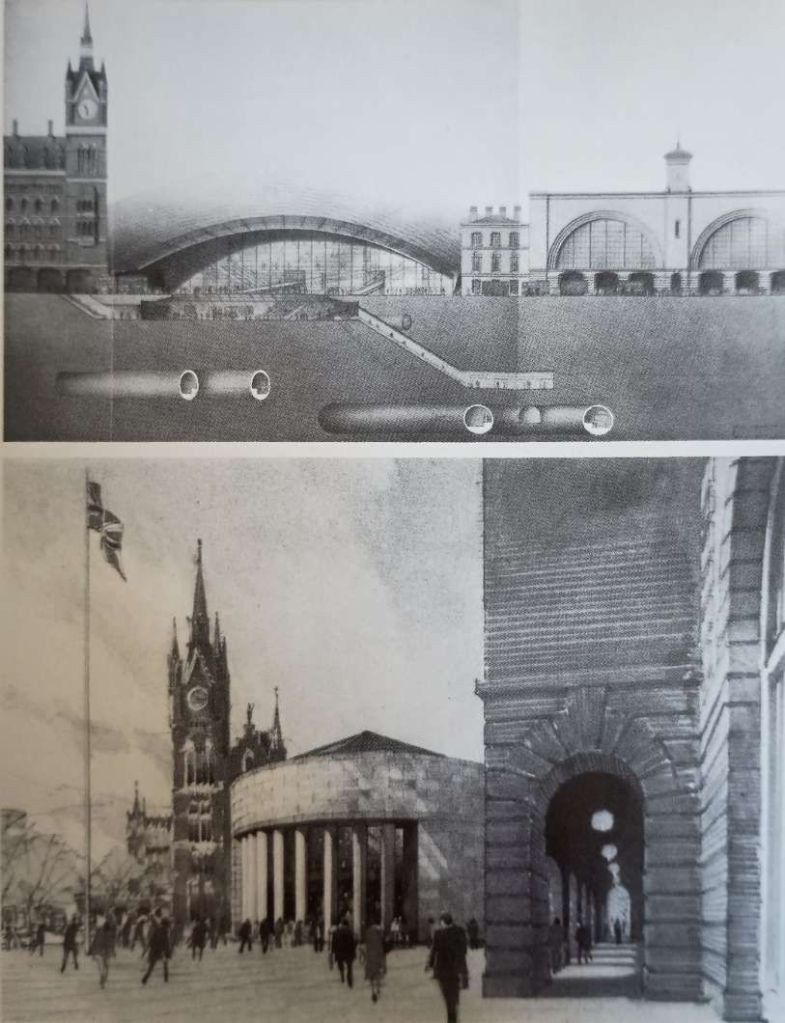
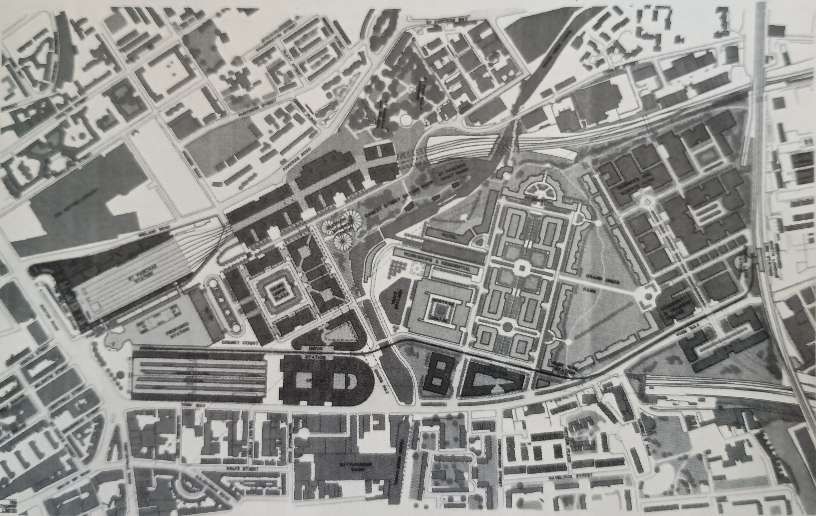
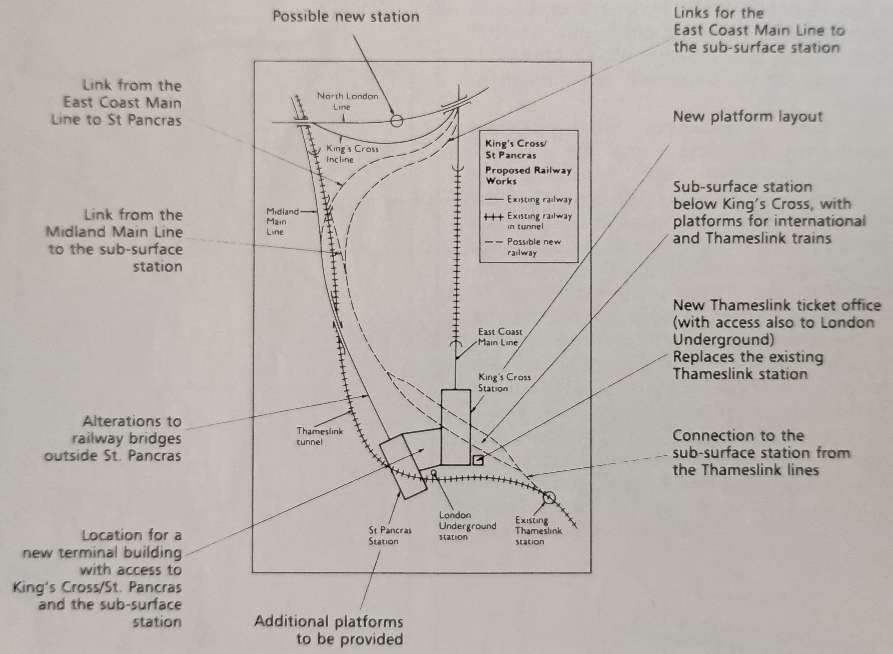
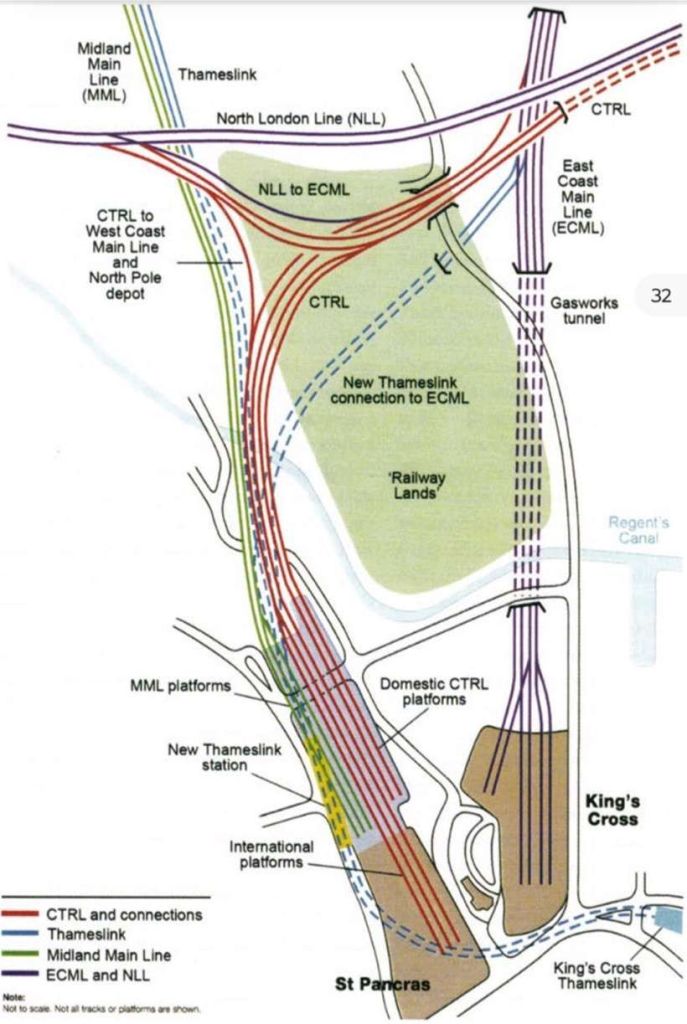
“While the Midland [Railway] developed some of its goods facilities alongside the passenger station, the Great Northern [Railway] adopted a different strategy. Its corresponding activities were carried out to the north of King’s Cross terminus, in an area lying mainly to the west of the main lines, although some of them were actually situated above the tracks through Gas Works Tunnel. Much of this land [in 1990] is now derelict or only partially used, and the idea of making use of it has been carefully studied during recent years. The first intention was just to make better use of the area for housing, offices and leisure, but the upsurge in rail travel during the last few years, plus the building of the Channel Tunnel, has provided the incentive to include additional and better facilities for those who travel to and from the two main-line stations by train.” [1: p3]
However, the major switch from rail to road transport in the later half of the 20th century saw a steady decline in the need for such significant goods handling facilities. And as the end of the century approached these areas were repurposed to help regenerate inner city areas and improve transport infrastructure.
Writing in 1990, Semmens tells us that “A large proportion of the Midland’s goods activities used to be carried out in its Somers Town Depot, situated immediately to the west of the passenger station, on the other side of Midland Road. The need for this from the railway’s operational point of view ceased many years ago, and after the site had been cleared, it was used for the new British Library. After years of work, which started at a great depth below street level, the £450 million building is now well on the way to completion. It is expected to be fully in use by 1996, although the first public access to the new facilities will be three years earlier.” [1: p3]
The British Library was created on 1st July 1973 as a result of the British Library Act 1972. [7] Prior to this, the national library was part of the British Museum, which provided the bulk of the holdings of the new library, alongside smaller organisations which were folded in (such as the National Central Library,[13] the National Lending Library for Science and Technology and the British National Bibliography). [7]. In 1974 functions previously exercised by the Office for Scientific and Technical Information were taken over; in 1982 the India Office Library and Records and the HMSO Binderies became British Library responsibilities. In 1983, the Library absorbed the National Sound Archive, which holds many sound and video recordings, with over a million discs and thousands of tapes. [8]
For many years the British Library’s collections were dispersed in various buildings around central London, in places such as Bloomsbury (within the British Museum), Chancery Lane, Bayswater, and Holborn, with an interlibrary lending centre at Boston Spa, 2.5 miles (4 km) east of Wetherby in West Yorkshire (situated on Thorp Arch Trading Estate), and the newspaper library at Colindale, north-west London. [7][8]
The St Pancras building was officially opened by Her Majesty the Queen on 25th June 1998. [10]
Library stock began to be moved into the new building on 25th October 1997 By the end of 1997, the first of eleven new reading rooms had opened and the moving of stock was continuing. [8] The library continued to expand, from 1997 to 2009 the main collection was housed in the new building and the collection of British and overseas newspapers was housed at Colindale. In July 2008 the Library announced that it would be moving low-use items to a new storage facility in Boston Spa in Yorkshire and that it planned to close the newspaper library at Colindale, ahead of a later move to a similar facility on the same site. [9] From January 2009 to April 2012 over 200 km of material was moved to the Additional Storage Building and is now delivered to British Library Reading Rooms in London on request by a daily shuttle service. Construction work on the Additional Storage Building was completed in 2013 and the newspaper library at Colindale closed on 8th November 2013. The collection has now been split between the St Pancras and Boston Spa sites. The Library previously had a book storage depot in Woolwich, south-east London, which is no longer in use. [8]
But, in looking at the British Library in the 21st century, we are getting ahead of ourselves! …
1: Two Great Stations and their Goods and Locomotive facilities
A: King’s Cross Station to 1990
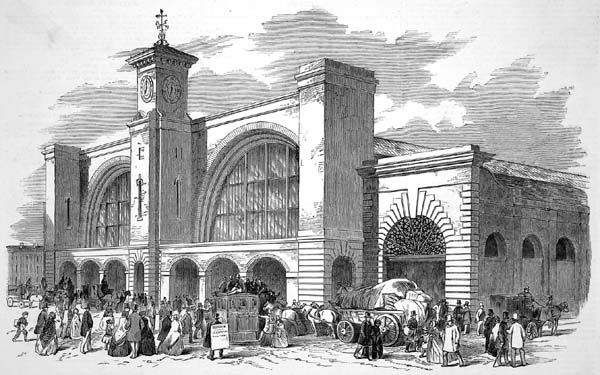
The earliest of the two stations was the Great Northern Railway’s King’s Cross. It was shared with the Midland Railway for 20 years while St. Pancras Station was being built. The building which appears on the aerial images near the head of this article was completed in 1852. It was preceded by a temporary GNR building situated between Copenhagen Tunnel and Gas Works Tunnel.
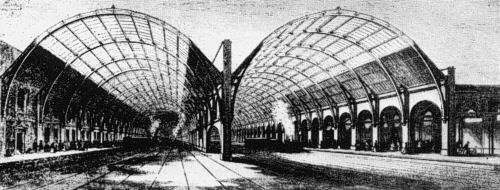
King’s Cross Railway Station in 1852 as it appeared in the Illustrated London News in 1852. [14]The twin train sheds, seen from the Northeast. [15]King’s Cross Railway Station Structure Plan 1852. [15]
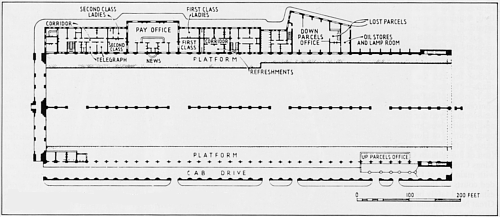
Semmens tells us that “The 1852 station was a striking building, designed by Lewis Cubitt, with twin train-sheds linked at the South end by a brick façade. It was surmounted by a tower in Italianate style, complete with a clock, which had been on show at the Great Exhibition, and a bell. When built it was the largest station in Britain, and this moved certain shareholders to complain of extravagance. The building was, however, a fairly simple one, with only two platforms being provided originally, one for arrivals and the other for departures, set against the two outer walls. Between them were no fewer than 14 carriage roads, inter-connected by turntables and cross-tracks, as the four-wheeled vehicles of those days were small enough to be shunted like this, even by manpower, from one place to another within the confines of the station.” [1: p4]
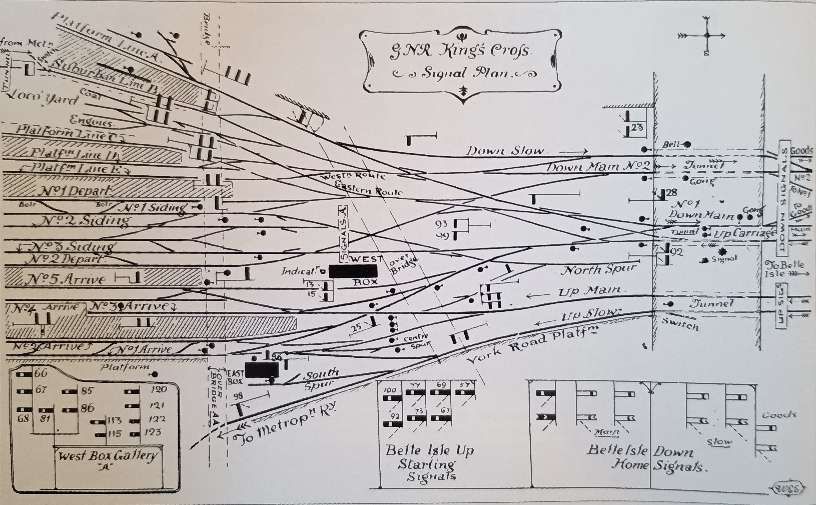
Semmens continues: “Many changes took place during the station’s first half-century of operation, and its layout had altered considerably by 1905, when it featured in a series on signalling in The Railway Magazine.” [1: p4]
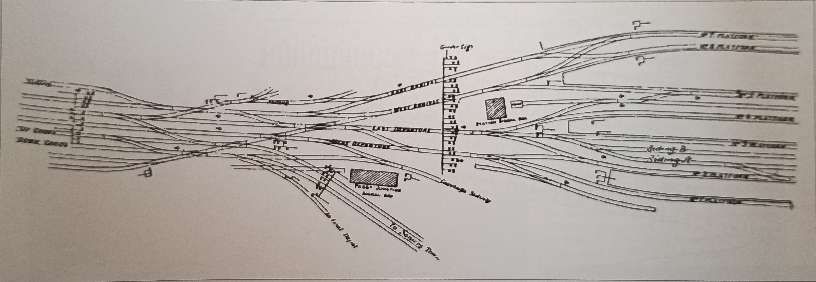
This diagram of King’s Cross station layout was provided in the March 1905 issue of The Railway Magazine. It shows the platform arrangements at that time as well as the signalling. The original double-track Gas Works Tunnel had by then been joined by two similar parallel bores, while there were connections on both sides of the ‘throat’ to the Inner Circle, complete with platforms for the through trains to and from the City. Although other additional platforms had been provided, many of them had been constructed outside the train-sheds. As the era of bogie coaches had begun by then, the turntables and cross-tracks had gone, but there were still four carriage sidings alongside the main departure platform (now No. 8). This feature was to continue into the days of the Grouping. Two of the arrival platforms (Nos 3 and 4) were only half-length ones, and this unusual arrangement did not disappear until 1934. [1: p4][16]
The Great Northern Railway opened its connection to the Inner Circle of the Metropolitan Line in 1863. In 1865, the York Road Platform was constructed to allow trains bound for the City to stop before heading into the tunnel which took them down to the Inner Circle. “Northbound trains were not provided with a similar platform on the down side until 1878, even though what was to become the semi-detached Suburban station had come into use three years earlier. The use of these curves at King’s Cross was considerably extended after 1866 when the Snow Hill connection was completed between Farringdon and Holborn Viaduct, as it became possible to run through trains from the Great Northern to destinations south of the Thames. Considerable amounts of freight were also worked this way, and the provision of a banker to help loose-coupled trains up the steep incline from Farringdon lasted until after nationalisation. The passenger trains, however, were withdrawn before the first world war, as travellers had opted to use the better connections then being provided by the Underground.” [1: p5]
Semmens notes that, “Gradients on Hotel Curve, as the line up from the Metropolitan was called, were as steep as I in 35, and the station stop at the top caused endless difficulties with the operation of these through services.” [1: p5]
He continues, “It will be seen from the 1905 diagram that at that time there was a small locomotive yard, complete with turntable, between the suburban and main-line stations. In 1923 this was moved to its better-known position on the west side of the lines where they entered Gas Works Tunnel. The railway had purchased some of the land formerly used by this utility, and installed a 70ft turntable there to cope with the new Pacifics which were starting to emerge from Doncaster. Although the main locomotive activities at King’s Cross were centred on Top Shed, situated further to the north in the middle of the Goods Yard, there were obvious advantages in providing facilities closer at hand for turning and refuelling incoming locomo-tives before they took up their return workings. The end of the main departure platform (for many years No. 10, but now No.8) provided generations of enthusiasts with a grandstand view of these activities, which continued through the diesel era until the East Coast workings became monopolised by the HSTs.” [1: p5-6]
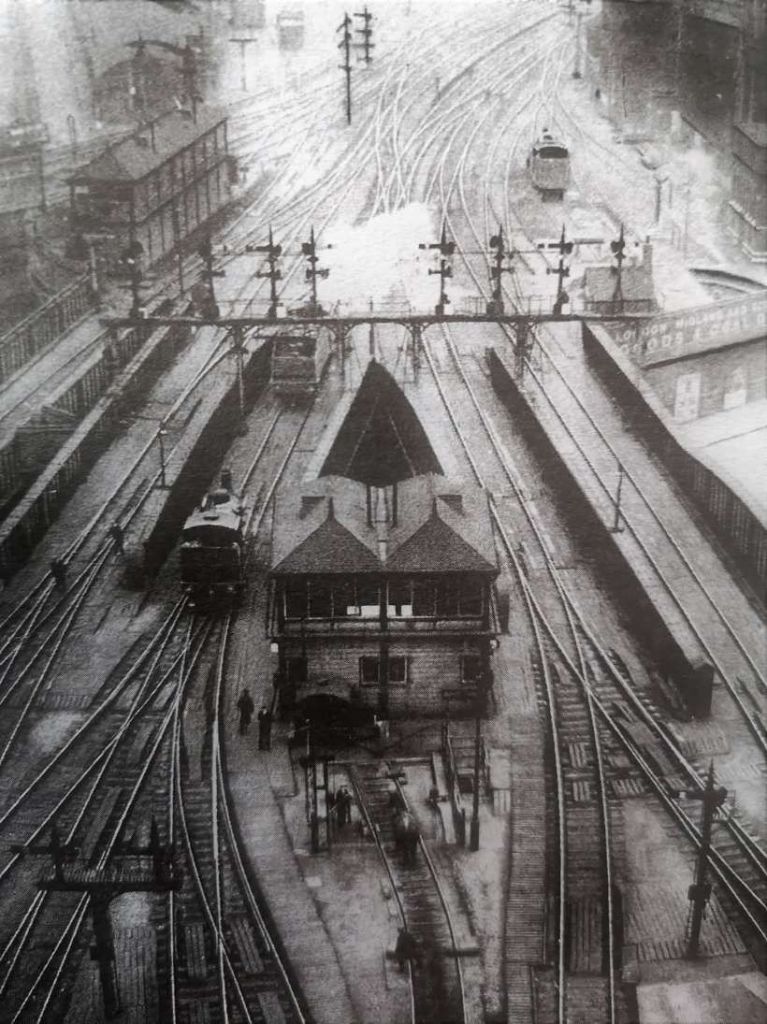
As well as a cramped layout and the proximity of the tunnels to the station throat, there were two overbridges. One served the Gas Works and was removed in 1912, the other was removed in 1921 when an alternative access route, ‘Goods Way’ was built South of Regents Canal over the mouth of the tunnels. Sightlines from the signal cabins were poor. As a result rudimentary track circuits were installed as early as 1894. [1: p6]
Semmens reported in 1990 that, “Since 1905 there [had] been three major changes in the signalling for the King’s Cross area. The first took place just before the Grouping, when a number of three-position upper-quadrant semaphores were installed, with roller-blind route indicators. In 1932 there was a much bigger change in the station area, with colour lights replacing the semaphores, and the points being worked electrically. The distinctive roller-blind route indicators were to remain until 1977, which saw the commissioning of the modern power box, situated on the up side immediately south of Gas Works Tunnel, While the previous all-electric box had just controlled the approach lines and those in the station itself, the present panel interface[d] with the Peterborough one at Sandy, 44 miles away. For good measure it also control[ed] the Hitchin-Cambridge line as far as Royston. … This latest change was part of two major developments on the East Coast Main Line in the 1970s, the Great Northern suburban electrification and the introduction of the Intercity 125s.The first of these resulted in an appreciable reduction of movements in the terminus, as the inner suburban services, worked by the dual-voltage class 313 units, were mainly diverted from Finsbury Park to Moorgate through the large-bore tunnels which were built in 1904 as the Great Northern & City Railway. From this there is now an excellent cross-platform interchange at Highbury & Islington with London Transport’s Victoria Line, giving frequent connections to and from King’s Cross Underground. They supplement those at Finsbury Park off the outer-area EMUs operating from King’s Cross suburban station, which has recently had a fourth platform added. Under the refurbished roofs of the train-sheds there [was] a straight-forward eight-platform layout for main-line trains, but the connections to the Inner Circle [were] severed, as the new inner-suburban trains now reach[ed] the City directly from Finsbury Park.” [1: p7]
Semmens also comments: “As part of this electrification scheme, the old freight flyover north of Copenhagen Tunnel was rebuilt to take passenger trains, and rails were removed from the most easterly bores of Gas Works and Copenhagen Tunnels. All this resulted in a much simpler layout at King’s Cross, and it was possible to improve the speed restrictions, which increased the station’s capacity, as well as reducing journey times. The 25 kV overhead catenary was put up [and] provide[d] power for the electric Intercity services which [were] already running as far as Leeds and York, and [would] be extended to Edinburgh and Glasgow in May 1991. … At the opposite end of the station, a considerable improvement in the passenger amenities was introduced in the early 1970s. When King’s Cross was built, the south end of the train sheds lay alongside St. Pancras Old Road, but the changes that followed the building of the Midland station produced a triangle of spare land between the station and Euston Road. Over the years this became cluttered with an assortment of completely uncoordinated buildings, known as the ‘Indian Village’. In 1973 the last of these was swept away, and the present [in 1990] single-storey concourse built in their place. It include[d] the BR ticket office and travel centre, which had previously been situated, somewhat inconveniently, halfway along No. 8 Platform. The new concourse also provide[d] other amenities, but even the vastly increased space often [became] crowded as a result from f the greater numbers [by 1990, travelling] on the frequent Intercity services.” [1: p8]
Finally in respect of King’s Cross station, Semmens notes that planning permission for the single story concourse was only granted on a temporary basis and was due to expire in 1996.
B: St. Pancras Station to 1990
At first, the Midland Railway reached London over the Great Northern Railway’s tracks from Hitchin. “Its services by this route began in 1858, but the minimal facilities at King’s Cross made it difficult to accommodate the increasing number of trains being operated by the two companies. Not surprisingly, the Great Northern gave its own trains priority, and the Midland became increasingly frustrated, with no fewer than 3,400 of its services being delayed in 1862 when the Great International Exhibition at South Kensington attracted a lot of special workings. Many of the trains off the Midland were made to use King’s Cross goods yard, and then, in the middle of the summer, the [Great Northern] moved some of the Midland’s wagons out of the way after the latter had been slow to commission their own coal yard. As a result the Midland decided it had had enough, and there was nothing for it but to build its own extension from Bedford into London.” [1: p9]
In the few years that had elapsed since the Great Northern had built its line into King’s Cross urban sprawl had magnified, and the Midland was presented with the immense task of finding a route for its own tracks. “To accommodate its proposed facilities, the Midland was able to buy a large area of land from Lord Somers on the north side of Euston Road, and a suitable reorganisation of the roads in the area could be made to accommodate its new terminus close to King’s Cross. The company was actually able to site it right on the other side of the new Pancras Road, with only the Great Northern Hotel in between.” [1: p9]
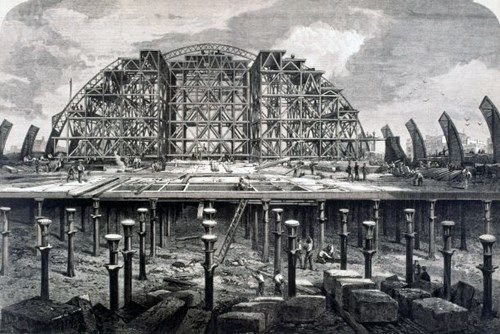
The Midland coped with the barrier presented by the Regent’s Canal by crossing it at high level and maintaining that high level through to the station buffers. This created space under the platforms to store goods brought to London by the railway. Semmens says that “there was one commodity … which had its own special containers, and these formed the new unit of measurement which was adopted for this part of the station. The platforms and tracks were thus supported on a two-dimensional grid of columns, sited 29ft 4in apart, which was chosen because it maximised the storage capacity for barrels of Burton beer.” [1: p9]
“To get the beer into the cellars, beer-laden wagons were pulled into the station, then reversed onto a hydraulic lift just outside the trainshed that took them down. Below, two railway lines ran the length of the stores and there were three wagon turntables, so that wagons could be manoeuvred throughout.” [17]
“St. Pancras has had a long and close relationship with the brewing industry and beer consumption in London. Throughout the nineteenth and first half of the twentieth century, beer came from all over the country, and particularly from Burton-on-Trent, to supply thirsty Londoners. A major arrival point was St Pancras where beer was stored in a massive warehouse and in the vaults under the passenger station.” [17]
“Burton’s high-quality attractive pale ales – a contrast to the darker porter beers drunk in London – were well-renowned in the 1820s and 1830s, but getting them to London was very costly and could take three weeks. The railway’s arrival in Burton in 1839 changed that and soon Burton brewers opened rail-supplied agencies nationwide and their trade expanded rapidly. Bass, a major Burton brewer, output rose from just over 30,800 barrels in 1839 to 850,000 in 1879, its biggest market being London where its beers grew in popularity.” [17]
“Before the late 1860s, Burton brewers supplied London by sending their beer via the Midland Railway’s competitors. However, when the Midland planned its main line to London in the early 1860s, Bass agreed to send all their beer with the company as a far as possible, for a fixed price. In return the Midland would provide “Ale Stores and Offices sufficient for the business” at St Pancras. The railway built a dedicated warehouse adjacent to the Regent’s Canal which was connected to St Pancras’s northern goods yard. This held 120,000 barrels and employed 120 men. Bass subsequently became the world’s largest railway customer, and in 1874 it sent 292,300 barrels of beer to London, 36% of its total output.” [17]
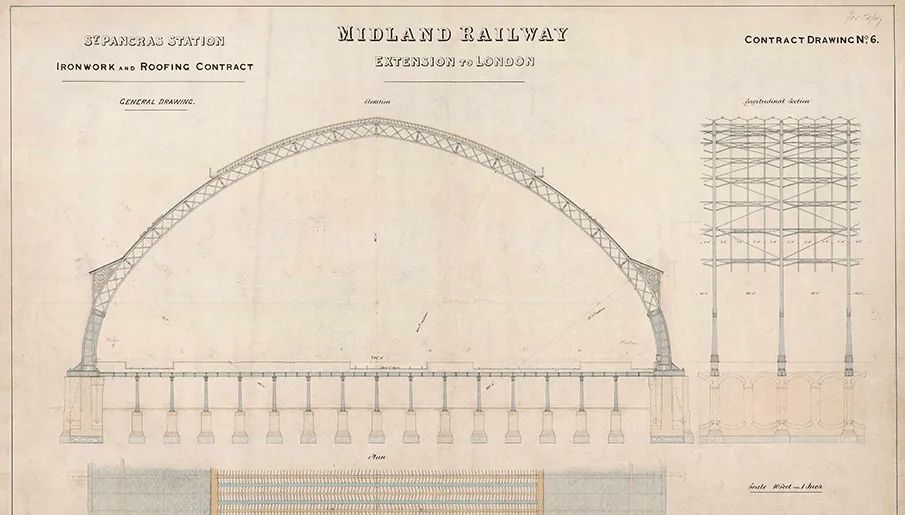
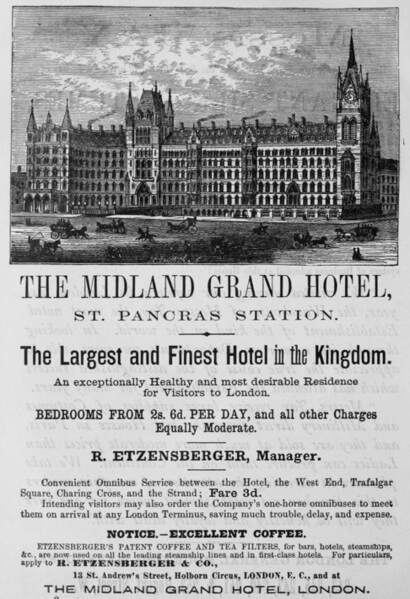
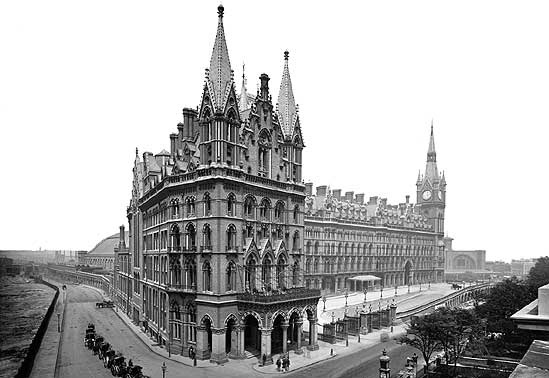
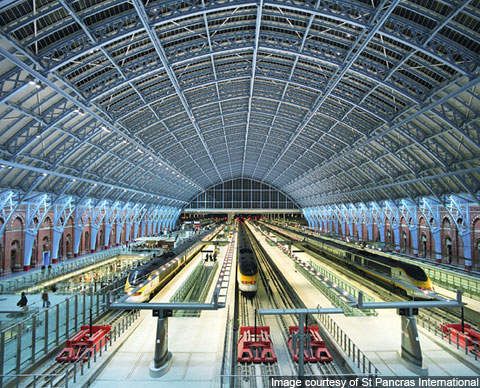
Network Rail says that, “In 1865, a competition was held to design the front façade of the station including a new hotel. George Gilbert Scott, the most celebrated gothic architect of his day, won the competition even though his design was larger than the rules allowed. Construction of the hotel started in 1868 however the economic downturn of the late 1860s meant that the hotel, named the Midland Grand, was only completed in 1876. Striking and self confident, the station and hotel completely dominated its Great Northern neighbours.” [19]
The location chosen for the station was known as Agar Town. It was an area of slum dwellings. The powers-that-be saw an opportunity to clear the area. Semmens tells us that, “several thousand homes of one sort or another were demolished, which resulted in the eviction of an estimated 10,000 people, while hundreds of cats took to the wild, marking out their own new territories in the railway works. There were still more complications, as the Fleet River ran through the site by then little more than a sewer, so it was enclosed in a pipe-while corpses had to be cleared from part of the burial ground for the old St. Pancras church. Another church, St. Luke’s King’s Cross, had to be demolished, and a replacement was built at the Midland’s expense in Kentish Town. Provision was also made for a connection to the Metropolitan Railway, to permit through services to the city. This diverges from the eastern side of the main lines at Dock Junction (originally St Paul’s Junction), nearly three-quarters of a mile from the buffer-stops. It then swings to the west before passing diagonally beneath the terminus on its way to join the Metropolitan at Midland Junction, roughly in line with the end of King’s Cross.” [1: p9]
It is difficult to imagine the upheaval caused to many of the poorest residents of London by the clearance of the slums.
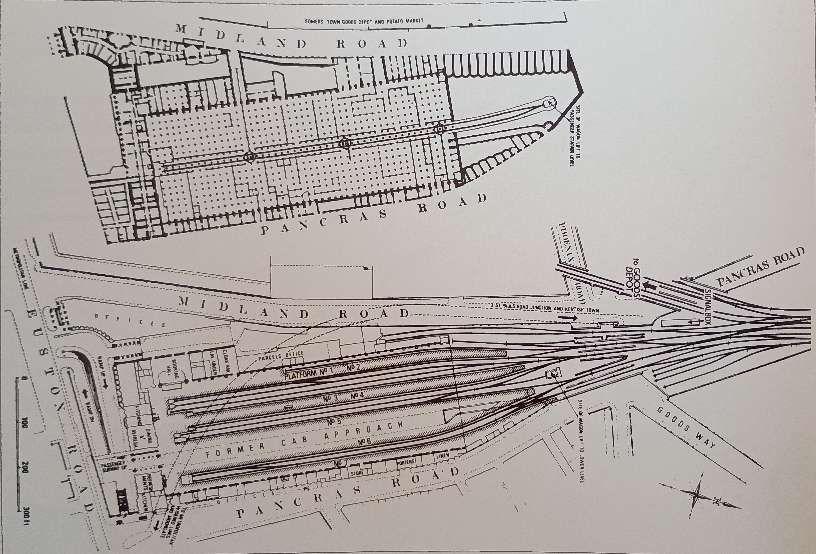
When it was built, St. Pancras Station had “five platforms with a further six carriage roads, which put it ahead of what King’s Cross had at the time. In 1892 the layout was modified when some of the carriage roads were replaced by two more full-length platforms, making the total up to eight, plus the shorter one on the down side. Further changes took place in the early years of nationalisation, and from 1968 there were just six full-length ones, plus the bay.” [1: p10]
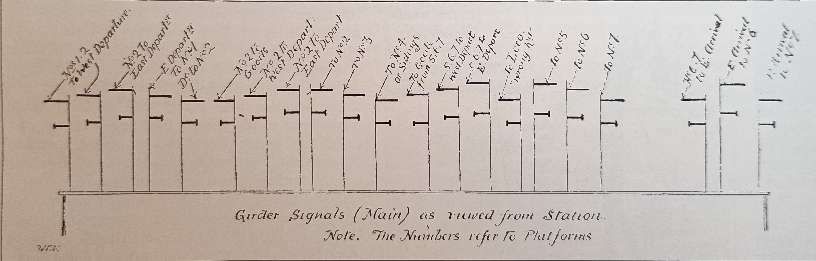
The track diagram for St. Pancras in 1905, published in The Railway Magazine, November 1905. [1: p11][21]Details of the signal gantry at the station throat, published in The Railway Magazine, November 1905. [1: p11][21]
“In 1923 St Pancras was transferred to the management of the London Midland & Scottish Railway; the LMS focused its activities on Euston, and so began the decline of St Pancras over the next 60 years. In 1935 the Midland Grand was closed as a hotel due to falling bookings and profit, blamed on the lack of en suite facilities in the bedrooms. It was used instead as office accommodation for railway staff and renamed St Pancras Chambers.” [19]
During WWII, the station played an important role for troops departing for war and children being evacuated from London. Although the station was hit hard during the blitz, there was only superficial damage and the station was quickly up and running. [19]
Throughout the 1950s and 1960s, BR allowed the condition of St. Pancras Station to deteriorate and then sought to close and demolish it. “John Betjeman spearheaded a campaign to save the station and hotel, and in November 1967 was successful in getting the buildings declared Grade 1 listed just days before demolition was due to begin.” [19]
Although the buildings were saved, their decline was allowed to continue; the hotel building was mothballed in 1985 and the train shed roof fell into a state of serious disrepair. [19]
Semmens tells us that, “Under the BR Modernisation Plan, diesels took over the main-line and suburban services out of St. Pancras. For many years the former were in the hands of the ‘Peaks (class 45s), hauling rakes of air-conditioned Mark II coaches, but in the autumn of 1982 the first Intercity 125s were drafted to the line. This was slightly earlier than had been envisaged in the original BR plans of 1973, but those arrangements had been based on the Bristol and South Wales sets being cascaded to the Midland after the arrival of APTs on the Western. After the protracted development of the light-weight tilting trains, the position changed, and there were no plans for HSTs on the Midland, but this altered as BR sought to maximise the revenue from its high-speed diesels.” [1: p10]
Writing in 1990, he continues: “Since 1982 the number of these units deployed on the Midland main line has increased, the latest unit having been drafted in after the arrival of the first Intercity 225 set for the ‘Yorkshire Pullman’ on the East Coast Route in October last year. It is of interest that the Eastern Region provides the HST sets for the Midland main line, some from Bounds Green and the others from Neville Hill.” [1: p10]
“For the suburban services out of St. Pancras a special type of diesel multiple-unit was provided. These four-car seats, later to become Class 127, were introduced in 1959, and had Rolls-Royce engines with hydraulic torque converters. They improved the frequency of services on the line, as well as the overall speeds, but by the end of their working lives they had become rather unreliable. They had to continue in passenger operation somewhat longer than intended, because the introduction of their electric successors was held up by the protracted dispute over Driver-Only Operation. The new Class 317 EMUs finally went into service in the summer of 1983, the overhead wires having already been installed into St. Pancras for some considerable time.” [1: p11]
These new EMUs lasted only 5 years in service before being replaced by Class 319 units which were able to operateboth from the 25kV North of St. Pancras and the Southern region’s third rail, to offer a cross-river Thameslink service which was inaugrated by Princess Anne in May 1988. The Thameslink service led to the majority of trains from the North not entering St. Pancras Station. St. Pancras lost most of its suburban services, and by 1990, was primarily an Intercity station. Semmens notes that under the regeneration proposals current in 1990, that role would partly reverse again. [1: p11]
C: Goods & Locomotive Facilites
Semmens notes in 1990 that much of the planned regeneration would be concerned with “the future use of the land that was once occupied by former goods yards and locomotive sheds.” [1: p12] We have already noted these facilities:
The Somer Town Goods Station of the Midland Railway and its facilities further to the North would not be part of planned regeneration work as they were set aside for the British Library development which we have highlighted above.
The one-time Great Northern Goods Yard – would become the core of planned regenertion activites – an 85-acre “area situated between the Great Northern and Midland main lines, … bounded on the North by the electrified North London Line and by Regent’s Canal on the South.” [1: p12]
King’s Cross Top Shed – sat in a small area at the heart of the Great Northern Railway’s goods facilities. It closed in June 1963.
Semmens goes on to describe the area: “potato market occupied much of the east and south-east sides of the yard. It consisted of 40 covered ‘runs’, set at right angles to the main sidings, and each of them could accommodate three or four wagons while they were unloaded by the various merchants. Standage elsewhere in the yards would be required for up to 400 additional loaded wagons awaiting their turn to be shunted into place, and each of these movements would require the use of capstan and turntables, in addition to the yard pilot. Lying to the west of this area were the dispatch roads where wagons and vans could be positioned under cover while being loaded by traders. One of the tracks led down a steep incline to the underground area, which was used for ‘vulnerable’ traffic. Nearby was a building known as the Midland Shed, being. a relic from the time between 1858 and 1867 when that company’s trains reached London over the Great Northern from Hitchin. More tracks served the one-time Grain Warehouse, although it had lost its canal connections” [1: p12] which are shown in the NRM images above.
Semmens continues his description: “Continuing clockwise, the coal area was reached, which had two lines of drops inside the confines of the yard. From one of these, a pair of tracks crossed Regent’s Canal to serve Camley Street Coal Yard, where over 200 wagons could be positioned for unloading using the electric transporter. Earlier still, when the gas works alongside King’s Cross passenger station was operating, that had its own connection across the canal for the delivery of coal straight into the retort-house. Along much of the western boundary of the yard, after the canal has passed under the Midland [Railway], the property of the two railway companies came [1: p12] together. The tracks in the King’s Cross yards finished at right-angles to the lines out of St. Pancras, and were separated only by a wall and the width of the perimeter road. It was here in 1980 that the NRM’s replica of Rocket was transferred from road to rail when it worked the last steam train into St. Pancras, to publicise the Post Office’s commemorative stamps that year.” [1: p12-13]
“Between Top Shed and the North London Line were more sidings, some of which were under cover and handled Sundries, while bricks from the numerous works at Fletton, alongside the East Coast Route near Peterborough, were dealt with in the open. Hereabouts too was the smelly part of the yards, where manure from the railway’s own cartage stables was loaded for dispatch, in addition to some of London’s refuse. Even in 1965 some 40 wagons a day of rubbish from the Chapel and Hoxton Markets were being moved from here to Holwell Sidings on the branch from Hatfield to St. Albans.” [1: p13]
Semmens appears to have the wrong location for Holwell Sidings. Rather than being on the Hatfield to St. Alban’s, they were, in fact in Leicestershire. [50]
Additionally, a single-track line climbed steeply from these yards “to a dead-end parallel to Copenhagen Tunnel, from where there was a trailing connection across all the tunnels to serve the Caledonian Road goods yard away to the east.” [1: p14] While this short branch was still in use in 1965, another facility, which disappeared much earlier, was Cemetery Station, “the remains of which could be seen until the mid-1950s. Like the better-known facilities at Waterloo, this formed the starting point for funeral trains. Those in North London used to run to the graveyard on the east side of the East Coast Main Line, just north of New Southgate, the junction there being controlled by Cemetery Signalbox, now demolished. The final traces of the station opposite King’s Cross Goods Yard were swept away during the construction work that went on here for the Victoria Line.” [1: p14]
In 1965, King’s Cross Goods Yard still employed more than 1,000 men. The main terminal close in 1974 and by 1990 much of the yard’s activities had ceased. Semmens noted in 1990 that, “Freightliners ha[d] come and gone, but three separate aggregate/concrete facilities still operate[d] in the area to the north of the Top Shed. They [were] served by regular Railfreight workings, usually hauled by a pair of class 31s. There [were] also sufficient other operations to justify the presence of an unofficial caravan close to the Grain Warehouse providing food and drinks for those who work[ed] in the area. The various listed buildings and structures remain[ed], but many of the others ha[d] deteriorated since closure.” [1: p14]
2: Regeneration: First Thoughts
Back in Victorian times St. Pancras Station was built alongside King’s Cross because of the commercial competition between two different railway companies. This position was not changed by the Grouping, as, in 1923, their ownership passed to the LMS and LNER respectively, which were still rivals, particularly for the Anglo-Scottish business. Semmens notes that in 1990, the two stations were still operated by two different regions, but their common ownership during since 1948 had nevertheless provided opportunities for rationalisation and cooperation. [1: p15]
“In 1966, the year after Lord Beeching had returned to ICI, proposals for combining King’s Cross and St. Pancras were first aired, with the latter being closed. Its suburban services would have worked through the tunnels to the City, while the main-line trains were to have been diverted into King’s Cross, where one scheme envisaged a heliport on the roof. A two-storey concourse building was to have been constructed across the front of King’s Cross, while a new 300ft tower to the north-west of the station would have become the new BR headquarters. The St. Pancras hotel would have been demolished and replaced with a new office block.” [1: p16]
These early plans were stymied when St. Pancras Station and the Hotel were ‘listed’ in 1967. Suggestions that it should be a sports centre or a transport museum with trains diverted elsewhere, came to nothing in 1968 when rationalisation of railway facilities was abadoned.
Semmens says that, “a decade and a half later, other, much more friendly, proposals were to materialise for the two stations, which would enable them to become the nucleus for the regeneration of the whole area. … It was in the latter half of the 1980s that British Rail offered potential developers the opportunity to submit ideas on how to revitalise the whole 130 acres of their land around King’s Cross. … The developer’s brief was the regeneration of the land North of the two stations, which was to be fully co-ordinated with new station facilities and railway works. In particular, provision was to be made for a sub-surface station below the existing platforms at King’s Cross, which would ultimately benefit the Thameslink services due to be inaugurated in May 1988.” [1: p17]
Two consortia were invited by British Railways to submit plans which the public could study at an exhibition held in the St. Pancras Undercroft at the beginning of 1988. They were:
1. Speyhawk, working in conjunction with Sir Robert McAlpine & Sons (Speyhawk/McAlpine).
2. London Regeneration Consortium (LRC), working with two separate groups of architects, Foster Associates, and Skidmore, Owings & Merrill.
Semmens notes that “although only open for a relatively short time, the exhibition drew the public’s attention to the plans, and created considerable interest in architectural circles. In addition to the displays, which included models of the main proposals, both consortia produced some effective printed material which enables us to recall what was being planned at this stage of the project.” [1: p17]
Semmens says that “the individual styles of the two Victorian stations made it difficult to link them together architecturally, and three very different proposals for the new concourse resulted, as shown in the illustrations. Speyhawk/McAlpine, who were already involved with BR in the redevelopment of the hotel at St. Pancras, went for a ‘solid’ design. with a classical, stone-built, rotunda serving as the main public entrance. On the other hand, the LRC’s two architectural partners both came up with proposals that included much more glass in their construction. Foster Associates proposed a huge glazed vault, filling the whole gap between the two stations, while Skidmore, Owings & Merrill’s plans were for a much smaller, fan-shaped, structure with an unusual roof profile.” [1: p17]
These were only outline schemes, but suggested very different ways in which the area around and to the North of the two stations could be developed. “All three schemes involved covering in the railway tracks out of King’s Cross, between the twin train-sheds and Gas Works Tunnel, which would have meant that trains would have first emerged into daylight at the north end of this tunnel. Speyhawk/McAlpine also proposed building over the Midland’s tracks for some distance alongside Pancras Road, and included a monorail link from their proposed concourse to a new Maiden Lane station on the North London Line.” [1: p17]
The proposals submitted by the London Regeneration Consortium were preferred by British Rail, and they became the designated developers. However, the brief that they began working to was altered significantly as the 1980s gave way to the 1990s because of a significant “upsurge in railway travel … sweeping across Europe in response to modern attitudes to mobility and the environment. In particular the significance of the Channel Tunnel began to be perceived, and the need for a second London terminal/interchange to serve those parts of the country north of the Thames emerged.” [1: p17]
Semmens supplement to The Railway Magazine was effectively a position statement, outlining the state of play at the beginning of the 1990s. New proposals were before Parliament, designed to enhance the railway facilities of the UK considerably, in addition to creating a whole new urban area out of the wastelands of the former goods yard at King’s Cross. [1: p17] That redevelopment was given greater significance by the need to accommodate the Channel Tunnel Rail Link (HS1), which would bring high-speed rail services to London. [31]
In 1990, the UK Parliament considered and approved the British Rail development plans, including the merging of the stations and the creation of a new low-level station. [32] The Select Committee drew attention to the financial links between the proposed office and commercial developments on the railway lands behind King’s Cross and St. Pancras stations and the proposal for the new station to go ahead. [33]
In 1991, 1992 and 1993, the King’s Cross Railways Bill was debated in the House of Commons and the House of Lords [34] but development did not take place at that time. In 1996, the decision was taken to locate the HS1 terminal at St. Pancras (a change from the original intention for it to be at Waterloo Station).
3: The SchemeCurrent in 1990
Semmens tells us that in November 1988, the British Railways Board and London Underground Limited lodged their private ‘King’s Cross Railways’ Bill with Parliament, seeking authority “to construct works and to purchase or use land at King’s Cross in the London boroughs of Camden and Islington; to confer further powers on the Board and the Company; and for other and related purposes”. While this may sound quite modest, its passing will set in operation the second most important railway project in Britain this century, and encourage urban redevelopment of 134 acres, worth some £3 billion, as well as providing 1,800 new homes and creating the potential for up to 30,000 jobs. Remarkably little detail of how this will be achieved emerges from the four parts, 31 sections and five schedules of the Bill itself, but this was supplemented by 35 days of evidence presented by BR to the MPs considering it at the start of its committee stage.” [1: p17]
“King’s Cross, St. Pancras, Thameslink and the London Underground interchange connected with these stations are currently used by some 270,000 passengers every weekday. Many of these travel by the BR Intercity services using both the main line stations, with Anglo-Scottish trains arriving and departing every half hour for considerable periods of the day. The popularity of the East Coast Route … increase[d] still further with the travelling public after the full electric services [came] into operation in May 1991, when many of the trains [began to] run through to Glasgow.” [1: p17-18]
Long-distance passengers were “supplemented by those using the Network SouthEast suburban trains, including the Thameslink services running right across the heart of London. From King’s Cross Underground it is possible to travel to more than 60 per cent of the Underground stations without changing trains, and all the other BR main-line termini can be reached direct, except Waterloo, which requires one change. All five London airports [were soon to] be within one hour’s journey by train from King’s Cross, either direct or with easy changes, and the rail link right into Stansted [was due to] begin operations in March 1991. … The King’s Cross area [also] serve[d] as a significant bus interchange.” [1: p18] Towards the end of the 1980s, there had been a steady increase in the number of passengers using all these services.
In 1993, “the biggest step-change in British and European-transport history [was due to] take place when the Channel Tunnel open[ed] that June, following on the heels of the start of the Single European Market six months earlier. When first thoughts were being given to the King’s Cross regeneration project, predictions about the impact of both these factors suggested that provision should be made eventually for additional facilities to be developed at King’s Cross. The need for them was not expected to arise, however, until into the 21st Century. The position was changing rapidly, though, and in July 1988, British Rail published its report on the long-term route and terminal capacity for its Channel Tunnel train services. which indicated that both could become congested appreciably before the year 2000.” [1: p18]
“This radically changed the emphasis on the ideas for the new railway facilities required at King’s Cross, which became the obvious location for the second terminal for the through trains to Europe. Unlike the first terminal, to be opened at Waterloo in 1993, it would provide direct interchange with domestic Intercity trains serving the whole of the northern half of Britain … and could also be made to facilitate the workings of the through trains to and from the Continent. Any such scheme for a new major set of platforms would be extremely expensive, but an additional advantage of the King’s Cross site is that the regeneration possibilities could provide welcome finance.” [1: p18]
This diagram shows the changes to the railway connections envisaged as part of the King’s Cross proposals current in 1990. ][1: p17]A plan of the land affected by the King’s Cross proposals of 1988/1990. [1: p18]
“The … proposals … included in the 1988 Bill, provide[d] for eight new sub-surface platforms, set diagonally below the main station at King’s Cross, four of which would be for the Channel Tunnel services. To reach these from the north, a new connection [would be] required, swinging westwards in a wide curve from Belle Isle, at the south end of Copenhagen Tunnel, as it descends. Just north of the point at which it passes under Regent’s Canal, it is joined by a connection off the Midland main line, so trains from both routes can use the new platforms. At present the sharp curves through the tunnel under St. Pancras impose major restrictions on the type of rolling stock that can use the Thameslink route, and the new arrangements will remove these.” [1: p18]
In addition, “this curve [would] enable Thameslink services off the Great Northern suburban lines which [could not then be operated]. Even if the York Road and Hotel Curves were to be reopened at King’s Cross, the tight clearances caused by the tunnels and curvature would necessitate the provision of even smaller rolling stock than the [then] present class 319s. BR also ha[d] a Bill going through Parliament for the construction of a new chord at West Hampstead, which [would] provide a connection between the lines out of St. Pancras and the West Coast Route, enabling Thameslink services to be extended that way too if required. The through Channel Tunnel trains serving the northern part of Britain [would] also be able to use these links to reach the East and West Coast Main Lines. At the south-east end of the new King’s Cross sub-surface station, the platform roads [would]. converge into the two tracks which form the present Thameslink route.” [1: p18]
Realignment work then underway in “the Ludgate Hill area [would] remove the existing clearance restrictions at that end of the link, and only minimal widening work [would be] necessary between King’s Cross and Farringdon to enable the passage of the largest coaches on BR. The present King’s Cross (Thameslink) station [would] disappear, and passengers using it [would] also benefit from the change. The main entrance to this [was] situated a considerable distance away along Pentonville Road, and require[d] a long walk to reach it, either through underground passageways or across busy roads. Although the passenger facilities there [had been] recently improved, the platforms [were] short and comparatively narrow, and there [was] no room for them to be extended in any direction. A sub-surface ticket hall for the new Thameslink platforms [would] be built on the corner of York Way and Pentonville Road, beneath the Bravington block of shops, right opposite the south-east corner of the main station at King’s Cross.” [1: p19]
“Commuter traffic on the Great Northern lines [was] also expected to continue to grow. The [then] present suburban platforms [would] not accommodate 12-coach trains, and already in peak periods outer suburban sets [could] be found competing with Intercity trains for platform space in the main station. To deal with this problem, it [was] planned to switch all the Network SouthEast trains into St. Pancras by a new surface connection which [would] run across King’s Cross Goods Yard, and join the Midland’s tracks just behind the site of Top Shed. To accommodate these extra workings in St. Pancras, the number of platforms [would] be increased to ten, a task that [would be] comparatively straightforward, thanks to the method of construction adopted back in the 1860s. Bridge No. 1, immediately outside the station, [would] have to be widened, and as this [was] situated over what amounts to a six-road intersection, it [would] involve some clever engineering.” [1: p19]
The existing platforms at King’s Cross would need to be lengthened to accommodate the longer East Coast Route trains needed to meet demand. At King’s Cross, as at St. Pancras the station layout would need improvement to allow higher arrival and departure speeds to be achieved. Track would need to be relaid through Copenhagen and Gas Works tunnels.
“New platforms and tracks are of little use unless better facilities are also provided for the passengers, and considerable thought [had] been given to this aspect of the proposals as well. The idea for the new concourse beside King’s Cross Station [had] been developed, and a new design for it [had] been produced by Richard Paul of Norman Foster Associates. Like the earlier London Regeneration Consortium proposals, it [would] be clad in glass, and the triangular roof, covering 8,300 square metres, [would] be supported by just nine columns, all except one of them situated along the walls. People entering the station from the street [would] approach the concourse down a wide semi-circular ramp from the south-east. Escalators [would] connect with the improved interchange arrangements for the London Underground’s five lines, which [would] be constructed to take into account the long-term recommendations of the Fennell Report on the 1987 escalator fire. Passengers arriving by car or taxi [would] use a special area to the north of the new concourse, … equipped to deal with the different types of flow involved.” [1: p19]
Great care had been taken to ensure that the concourse was user-friendly; due allowance being made for ‘meeters and greeters’ and the dwell-times that will result. As shown in one of the illustrations, the ticket office and travel centre would be set across the wide north end, “with the main catering facilities at mezzanine level above them. The usual forecourt retailing activities [would] be located along the walls, and kept low so that views of the two main station buildings through the glass walls [were] not obscured. The floor of the concourse [would] be below street level, to facilitate the connections required to the various platforms.” [1: p20]
“Four of the new sub-surface platforms [would] be dedicated for use by the international services to and from the Continent, and they [would] have their own inward and outward Customs and immigration facilities, although these activities [were expected to] take place on the trains in the case of the through services between the Continent and the northern parts of the country. When the Channel Tunnel open[ed] in June 1993, the schedule from Edinburgh to Paris [was expected to] be approximately eight hours. To reach the West London Line through Olympia, these services [would] use either the ‘King’s Cross Link’ with the North London Line … or the Harringay curve. After the new low-level station [had] been completed at King’s Cross, which would be in 1996 at the earliest, half an hour would be cut from the timings of all the through international trains using the East Coast Route.” [1: p20]
“The international trains would then still be using the existing lines through Kent, but the completion of the European Rail Link, after 1998, [would] enable an additional 30-minute cut in timings to be made, to the great advantage of the millions of international passengers who [would] use the route each year thereafter. Its opening [would] bring Edinburgh within seven hours of Paris, and 6 hours from Brussels, the former being only an hour longer than the ‘Coronation’s’ London-Edinburgh timing, which was the fastest ever scheduled in the days of steam. From 1996, it [was] expected that there [would] be one international train an hour in each direction from Waterloo and the same number from King’s Cross, but this represents only about a quarter of the long-term capacity of both terminals. From King’s Cross, St. Pancras and Euston stations up to ten Intercity trains an hour [in 1990 departed] for the Midlands, Northern England and Scotland.” [1: p20]
“The completion of the Channel Tunnel Rail Link [would] signal the start of the high-speed domestic services from King’s Cross to the towns and cities in Kent. With the eight-coach Class 342 ‘Kent Express’ units running at up to 125 mph, the journey to Dover could take as little as 60 minutes. … Cross-London Intercity trains [might also run] this way, although they might presumably have [had] to be hauled by dual-voltage electric locomotives, as it is unlikely that the diesel fumes from the shortened Cross-country HSTs would be welcome in King’s Cross Low Level.”
Provisions were made within the Bill for the purchase of land outside British Rail’s ownership. Some temporary road diversions were envisaged as was the need to remove and later replace the listed lock-keeper’s cottage alongside the canal. A ‘listed’ gas-holder would need to be dismantled and rebuilt. A nature reserve would need to be removed and replaced by a larger one. semmens noted that only 29 homes would be demolished and the development would provide 1800 new dwellings. He noted too that a period on at least 20 years would be likely to relapse from the Act receiving Royal Assent before the scheme would be completed.
British Rail was given the green light by MPs to carry out a multi-million pound redevelopment of King’s Cross and St Pancras stations and as the 1990s unfolded, the UK Government established the King’s Cross Partnership to fund regeneration projects in the area. London and Continental Railways (LCR) was formed to construct the railway and received ownership of land at King’s Cross and St Pancras stations in 1996. After the millennium, work on High Speed 1 (HS1) began, providing a major impetus for other projects in the area.
4: St. Pancras Midland Grand Hotel
St. Pancras Renaissance Hotel in the 21st century. [35]
Before going on to consider developments after Semmens was writing in 1990, it would be good to hear what Semmens had to say about the hotel which fronts Barlow’s trainshed. Designed by Gilbert Scott, the hotel was no more than a series of foundations when the station opened in 1868. Five years would elapse before the building was complete.
The Midland Railway over stretched its finances in building its extension into London. It downsized the design of the hotel, removing an eighth floor which would have housed the headquarters of the railway company after an intended move from Derby. The project programme was allowed to drift to aid the company’s cashflow. Semmens describes the hotel as “the finest example of non-religious Victorian Gothic in Britain, … much of the detail was adapted from the architect’s plans for offices in Whitehall which never materialised.” [1: p22]
Construction of the Midland Grand Hotel took place between 1868 and 1876 and was completed in various stages with the East Wing opening on 5th May 1873 and the rest followed in Spring 1876. Altogether, the hotel fabric had cost £304,335, decoration and fittings £49,000 furnishings £84,000, adding up to a not-inconsiderable £437,335. [37]
The completed building had used 60 million bricks and 9,000 tons of ironwork including polished columns of fourteen different British granites and limestones.
Midland Grand Hotel Advertisement of 1885, Public Domain [36]The Midland Grand Hotel in 1873
Despite all its magnificence, “the building had a number of serious drawbacks, which in time were to prove its downfall as a hotel. Although it was equipped with hydraulic lifts-receiving their power from the high-pressure water mains that used to run below the main highways in London and the first revolving door in the capital, an examination of the ridge of the Mansard roof above the dormer windows will reveal rows of chimneys. These came from the open fires in the various rooms, private as well as public, which were neither easy to service nor particularly efficient as sources of heat. … Only 12 years after the Midland Grand Hotel had been completed, work started on a rival hotel in another part of London which was to eclipse it in comfort and appointments. Funded in part from the profits of the theatre of the same name, the Savoy Hotel in the Strand was completed in 1889. During its construction, the builder asked whether, in the light of the number of bathrooms being installed, the management were expecting to entertain amphibians. While not all the bedrooms originally had their own bathroom, no fewer than 67 were provided initially. … The Midland [Grand] did not have bathrooms on anything like this scale, and not many decades were to pass before those who used hotels of this standing expected such facilities in every room. In the same way as the Midland Grand Hotel could not install central heating at an economic price, they were unable to provide all their bedrooms with baths ‘en-suite’.” [1: p22]
The Midland Grand was taken over by the London, Midland and Scottish Railway in 1922, its facilities were already outdated and it had become too expensive to run and refurbish. the demand for high-class hotel accommodation in the King’s Cross/St. Pancras area declined in the 1930s and the hotel closed in 1935. [1: p23][37]
Now renamed St Pancras Chambers, the premises settled down to a somewhat less glamourous existence as railway offices. It retained this role until 1983. [1: p23][37]
The building survived the bombing raids of the Second World War but found itself threatened with complete demolition in the 1960s. As we have already noted, in 1967 it was awarded Grade 1 listed status in recognition of its importance as an example of high Victorian Gothic architecture. [37]
In 1983, the building failed its fire certificate and was closed down, remaining empty for many years.
Semmens continues: “the Speyhawk/McAlpine development proposals for the St. Pancras Grand Hotel, as it [was to] be titled, predated the main King’s Cross Regeneration Project. They [involved] the original hotel buildings … [and] the undercroft.” [1: p23] No Act of Parliament was required but by 1990 the plans had already received outline planning permission from the local authority. “Their implementation, however, depend[ed] closely on the larger BR scheme, not only because of the general upgrading of the area that will then result, but because the links from the new concourse to the two main-line stations will require ‘corridors: through the undercroft.” [1: p23]I
Included in the Speyhawk/McAlpine scheme, and sited in the undercroft were:
a leisure centre;
a shopping precinct (St. Pancras Plaza);
a cat park; and
a multi-screen cinema.
Above ground the scheme allowed for:
the conversion of the station booking hall into a hotel brasserie or coffee shop;
the conversion of the original hotel entrance into a night club;
the meeting of fire regulations by isolating the grand staircase to make it a self-contained area;
the installation of a modern central heating system; and
the provision of en-suite bathroom facilities (a challenge in a listed building).
These developments had to be set alongside significant work to the fabric of the building. [1: p23]
Planning permission was granted in 2004 for the building to be redeveloped into a new hotel. [38]
The main public rooms of the old Midland Grand were restored, along with some of the bedrooms. The former driveway for taxis entering St. Pancras station, passing under the main tower of the building, was converted into the hotel’s lobby. In order to cater for the more modern expectations of guests, a new bedroom wing was constructed on the western side of the Barlow train shed. [38][39]
As redeveloped the hotel contains 244 bedrooms, two restaurants, two bars, a health and leisure centre, a ballroom, and 20 meeting and function rooms. [37][38] The architects for the redevelopment were Aedas RHWL. At the same time, the upper floors of the original building were redeveloped as 68 apartments by the Manhattan Loft Corporation. [38][40]
The St. Pancras Renaissance Hotel opened on 14 March 2011 to guests; however, the formal Grand Opening was on 5 May – exactly 138 years after its original opening in 1873.[38][41]
The building as a whole including the apartments is still known as St Pancras Chambers. [38] Its clock tower stands at 76 m (249 ft) tall, with more than half its height usable. [38][42]
5: Bringing Things Up-to-date (2025)
By 2025, the redevelopment of the King’s Cross area has been completed. The final form of the development and of the railway provision is somewhat different from that described by Semmens.
Two street maps of London illustrate the changes to the site between the late 1980s and 2025. [30]
King’s Cross before regeneration. [30]King’s Cross after regeneration. [30]
Particularly different from earlier plans, is the way in which the international high-speed and Channel Tunnel railway traffic has been accommodated within the overall project and we will come back to those changes later in this article.
It is first worth noting that King’s Cross has undergone a substantial renaissance, one that has been described as “one of the most exciting and vibrant urban regeneration schemes in Europe.” [25]
King’s Cross Central has evolved from an idea on paper to one of the most sought after places in London. The routes and spaces within the development provided a flexible framework for sequential development on the site, and have successfully created a sense of place during each phase of the development. Significantly, those routes and spaces link the railway stations to the former derelict Granary Building and beyond. [30]
The site as redeveloped with significant open spaces and carefully planned cycle and pedestrian routes. [26]
The plan above shows the revised concourse design which was finally adopted. It is attached to King’s Cross Station building and not to St. Pancras Station building. Redevelopment of King’s Cross Station commenced in 2008, the contract duration was 42 months with completion in 2012. The contract cost £550 million. [23]
The contract involved: constructing a 1,700 tonne geodesic steel and glass dome over the top of the London Underground ticket hall; reconstruction of platforms 1 and 8 and shortening of platforms 5 to 8 to enlarge the concourse; a new glass footbridge and escalators serving platforms 1 to 8; a new 12 car platform (300m); 4,000 m² of refurbished office space; 20,000 m² of renewed main shed roof; and 2,500m² of photovoltaic panels to generate 10% of the station’s power needs. All of which was undertaken without impacting normal station operations. [23] The main objective of the project was to provide station capacity to handle projected peak hour passenger demand within a more attractive retail and transport interchange environment.
The new concourse alongside King’s Cross Station. [23]A second view of the same roof structure. [24]
The main outputs were: a new western concourse, four times the size of the existing one (from 2,000m² to 8,000m²); a wider range and quality of commercial outlets; better interchange with London Underground and St Pancras International Station; renewed main shed roof to provide better lighting. [23] “The historically accurate restorations and modern architectural and servicing interventions won 35 international design awards, including the coveted Europa Nostra prize for cultural heritage. Internationally, the station is widely regarded as one of the most successful large-scale historic building transformations of recent times, and is a fitting gateway to the 35ha regeneration scheme immediately to the north.” [24]
Islington Gazette comments: King’s Cross is now ‘vital piece’ of London economy after regeneration. [27] The area North of the two railway stations is now “a haven for offices, chain shops and restaurants.” [27] A study, by Regeneris, “was commissioned by Argent, one of the two companies behind the redevelopment. Regeneris said the project has helped create 10,000 jobs and £600million for the economy per year.” [27]
King’s Cross is the largest mixed-use development in single ownership to be developed in central London for over 150 years. The 67-acre site has a rich history and a unique setting – and it is adjacent to the best-connected transport hub in London. Post World War II the area declined from being an industrial and distribution services district to a rundown post-industrial area. What is emerging at King’s Cross is a vibrant new city quarter of offices, homes, community facilities, schools, a world-renowned university in Central Saint Martins as well as a host of shops, restaurants, bars and cultural venues. When complete, there will be 50 new and refurbished buildings set in an exciting and inspiring network of new streets, squares, parks and public space. 2,000 new homes, 3 million square feet of offices and hundreds of new shops are being delivered as part of the scheme. Universal Music Group, Google, YouTube, and Facebook are some of the high-profile tenants that will have offices and buildings in the area. The development is circa 85% complete with an estimated completion date of around 2025. … Coal Drops Yard is a spectacular reinvention of Victorian industrial railway sheds creating a unique public and retail destination within Kings Cross’s heart. This was a highly complex and challenging project because of its unique “kissing roof” and its Victorian heritage; data capture was difficult but this challenge was overcome. “BAM’s innovative use of digital was instrumental in the delivery of the scheme allowing us to improve the accuracy of repairs; map survey images to elevations and schedule the works required to give a clear scope of works and cost. In addition, our use of 3D Rhino software allowed BAM Design, Heatherwick Studio and Arup to refine the complex roof form and structure.” Coal Drops Yard is an amazing structure; there are many other architecturally impressive buildings on the site. [29]A ‘fish-eye’ lens aerial view of the site from the West. [28]Aerial views over the King’s Cross site in 2004, left, and 2022 right. [28]
Rowan Moore comments that, “The two-decade transformation of the industrial site north of King’s Cross station in London, once notorious, now a pleasant enclave of offices, homes, shops, bars and boulevards, is essentially complete. It’s a huge success. … The near quarter-century, kilometre-long, 67-acre project to redevelop King’s Cross in London is a monument of its age. It is the urban embodiment of the Blair era in which it was conceived, of the third way, of the idea that market forces, wisely guided by light-touch government, can be a power for good. It will get into the history books about cities (if such things are written in the future), representing its time in the same way that John Nash’s Regent’s Park represents the Regency and the Barbican represents the 1960s.” [28]
“The development runs from the terminuses of St Pancras and King’s Cross through a central open space called Granary Square, to a dense cluster of blocks and towers at its northern end, formed around a long oblong lawn with [Alison] Brooks’s building at its head, which includes most of the most recent additions. It is phenomenally successful, both commercially and at achieving its stated aims. Its developers, Argent (selected in 2001), set out to achieve somewhere like the sort of cities where you might want to go on holiday, with open spaces that one of its architects calls “incredibly pleasant”, and – contemplating children from surrounding areas playing in its fountains, or office workers and art students lounging in its open spaces – it has certainly done that. It has created, in its 50 new and restored buildings, about 1,700 homes, more than 40% of them affordable, 30 bars and restaurants, 10 new public parks and squares, 4.25m sq ft of offices and capacity for 30,000 office jobs.” [28]
6. St. Pancras Internationaland Rail Decisions& Developments
This drawing illustrated the high concentration of vital rail infrastructure in or under the King’s Cross development area. [43: p21]
The strategic decision was taken to focus international and domestic high-speed services at St. Pancras. The decision to have St Pancras as the terminus for the CTRL was heavily driven by the ambition to regenerate East London.
HS1 (previously the Channel Tunnel Rail Link, or CTRL) is a high-speed line which connects the Channel Tunnel with London, via Stratford, Ebbsfleet and Ashford in Kent. Eurostar services began serving St. Pancras on opening. Prior to the opening of the high-speed line, Eurostar services operated from Waterloo International. Domestic high-speed services between St. Pancras and Kent were introduced in December 2009.
HS1 was initially planned to tunnel through south-east London to an underground King’s Cross international station much as discussed by Semmens. However, in 1994 this plan was rejected, and the decision was taken to approach London from the east, terminating at St. Pancras. [43: p21-22]
In 1994, St. Pancras station was seen as not realising its full potential as a station. The original route involved expensive tunnelling under listed buildings, a medieval hospital and the King’s Cross gasworks, while the route into St. Pancras could follow the existing North London Line. [43: Appendix B]
“As a result of the decision to locate HS1 at St. Pancras, the station was extended to hold extra platforms and extend existing platforms to the required length for Eurostar. On completion there were 13 platforms: 4 for Midland Main Line services on the western side, 6 for international services in the central train shed, and 3 for HS1 domestic services to Kent on the eastern side. On opening, HS1 could carry up to 8 Eurostar services per hour as well as up to 8 domestic high-speed services per hour, along with two open access paths. … Once St. Pancras opened to international services in 2007, Eurostar moved their operations to St. Pancras and stopped serving Waterloo. Domestic HS1 services launched in 2009 using new Class 395 ‘Javelin’ trains, as part of a major revision of the Southeastern timetable in December 2009.” [43: p22]
“As a result of the work to bring HS1 to St. Pancras and the increased services this would bring to the area, the King’s Cross Thameslink station and King’s Cross St. Pancras underground station needed to be expanded to handle the additional passenger traffic. The decision to relocate the King’s Cross Thameslink station to St. Pancras was originally intended to accommodate the Thameslink Programme, which would introduce additional and longer trains connecting North and South London through the Snow Hill tunnel. … When the new Thameslink station was constructed, it was driven by three purposes: to accommodate the expanded Thameslink network, to improve safety and passenger experience at the station, and to serve the new Eurostar/HS1 terminal at St. Pancras. The new St. Pancras Thameslink station opened in December 2007, separately from and in advance of the wider Thameslink Programme. … Regarding the Underground station, a key recommendation of the Fennell report following the 1987 King’s Cross Fire was taking action to improve passenger flow, ease congestion and improve safety at the King’s Cross St. Pancras Underground station. In response, the London Underground (King’s Cross) Act was passed in 1993. Two new ticket halls were constructed: the western ticket hall and northern ticket hall. The western ticket hall was opened in 2006, doubling the station capacity at the time to serve HS1, Thameslink and visitors to the 2012 Olympics. The northern ticket hall opened in 2009, further doubling station capacity and reducing congestion. It also allowed step-free access to the Underground platforms and was described as essential to effectively managing future passenger numbers. This ticket hall also connects directly to the HS1 domestic station via a direct subway link.” [43: p22-23]
The interior of the redeveloped St. Pancras trainshed looking North from the back of the hotel. [47]A view, looking South through the refurbished St. Pancras trainshed towards the hotel. [47]
Refurbishment of St. Pancras to receive Eurostar services required a highly complex programme of expansion, modernisation and restoration. St. Pancras Interational Station became a key urban hub leading to the redevelopment of the surrounding area through added retail and hospitality. The project included the full restoration of the existing Grade I listed station, incorporating the technical requirements of a transport interchange fit for the 21st century.
Throughout construction and restoration of this complicated scheme, London Midland connections were kept almost entirely operational with minimal inconvenience to both staff and passengers throughout the design. The result is a thoroughly modern transport interchange with over 45 million passengers passing through the zone every year. [48]
Rail services operate at the high level under the trainshed roof with retail sited in the undercroft. [49]
Shops and cafés occupy what was formerly a Victorian store for beer brewed in the Burton-on-Trent breweries. Within the Grade 1 listed building, The design of the undercroft exposed the original brick arches to the former beer vaults within new fully glazed shop fronts. Opening up the platform level to expose the undercroft revealed a naturally lit main concourse that acts as the main thoroughfare connecting different parts of the complex. The designers say that “the cafés and bars on the main concourse connect via escalators and lifts to the hotel and restaurants at the platform level, providing intuitive connectivity throughout the public areas.” [49]
Developments after the completion of HS1 and St. Pancras International illustrate just how rapid change has been over the years. They have included:
A. The East Coast Main Line Upgrade which began in 2019 and which includes:
the construction of a new platform and track at Stevenage – which encompassed a 126 metre-long platform (featuring amenities like a passenger lift and ticket vending machines), and 2 km of new track, permitting more frequent services between Hertford and Stevenage North and which opened in August 2020;
work at Werrington (North of Peterborough) to improve capacity and reliability of passenger services – a new two track line and tunnel separating freight and passenger movements and eliminating the delay caused by freight trains crossing the East Coast Main line;
improvements to power supply infrastructure to enable the use of electric trains; and
King’s Cross Expansion – renewing and expanding tracks, signalling and overhead equipment serving King’s Cross Station, particularly the reopening of the third tunnel (‘King’s Uncrossed’ – December 2020 – June 2021) enabling increased service frequency.
For the sake of completeness, Wikipedia also lists further major works to improve services on the East Coast Main Line which include: [44]
Power supply enhancement on the diversionary Hertford Loop route;
Re-quadrupling of the route between Huntingdon and Woodwalton (HW4T), which was rationalised in the 1980s during electrification (part of the ECML Connectivity programme);
Enhanced passenger access to the platforms at Peterborough and Stevenage;
Replacement of the flat crossing at Newark with a flyover;
Upgrading of the Down Fast line at Shaftholme Junction from 100 mph to 125 mph and higher-speed associated crossovers (part of the ECML Connectivity programme);
Modified north throat at York station to reduce congestion for services calling at platforms 9 – 11 (part of the ECML Connectivity programme);
Freight loops between York and Darlington (part of the ECML Connectivity programme);
Darlington station up fast line platform and future station remodelling as part of HS2;
Fitment of TASS balises and gauging/structure works proposed by the open-access operator GNER (Alliance Rail) to enable tilt operation of Pendolino trains north of Darlington station, supporting its aspirations for express 3 hr 43 min London to Edinburgh services;
Power supply upgrades (PSU) between Wood Green and Bawtry (Phase 1 – completed in September 2017) and Bawtry to Edinburgh (Phase 2), including installation of static frequency converter (Frequency changer) technology at Hambleton Junction and Marshall Meadows Bay area.
Level-crossing closures between King’s Cross and Doncaster: As of July 2015 this will no longer be conducted as a single closure of 73 level crossings but will be conducted on a case-by case basis (for example, Abbots Ripton Level Crossing will close as part of the HW4T scheme)
Increasing maximum speeds on the fast lines between Woolmer Green and Dalton-on-Tees up to 140 mph (225 km/h) in conjunction with the introduction of the InterCity Express Programme, level-crossing closures, ERTMS fitments, some overhead line ewuipment (OLE) rewiring and the OLE PSU – estimated to cost £1.3 billion (2014). This project is referred to as “L2E4” or London to Edinburgh (in) 4 Hours. L2E4 examined the operation of the IEP at 140 mph on the ECML and the sections of track which can be upgraded to permit this, together with the engineering and operational costs.
In June 2020 it was reported that the UK government would provide £350 million to fund the UK’s first digital signalling system on a long-distance rail route. The signalling is to be fitted on a 100-mile (161 km) section of the East Coast Main Line between King’s Cross, London, and Lincolnshire, which will allow trains to run closer together and increase service frequency, speed and reliability. The first trains are expected to operate on the East Coast Main Line using this digital signalling technology by the end of 2025, with all improvements scheduled for completion by 2030. [45]
B. Upgrades to the Midland Main Line into St Pancras which were first proposed in 2012 as part of the High Level Output Specification for Control Period 5, to include electrification of the line between London and Sheffield, but paused in 2015 along with the rest of the HLOS plans in order to carry out a review. Work was restarted later in 2015, then cancelled again in 2017, and were finally re-announced in 2021 as part of the Integrated Rail Plan. [43: p24][46]
C. Rail and Tube service changes since 2000: various changes to the Rail and Tube services which call at King’s Cross and St Pancras over the past quarter century. As of November 2022, these changes included:
Eurostar – 2007 – Services moved from Waterloo to St Pancras; 2015 – Introduced direct London-Lyon/Avignon/Marseille service in summer season; 2018 – 2 train per day London-Amsterdam service introduced; 2019 – Third daily service to Amsterdam introduced; 2020 – Direct Amsterdam-London services introduced;
Southeastern High Speed – 2009 – Domestic HS1 services began; 2012 – Operated high speed ‘Javelin’ services between St Pancras and Stratford during London Olympics;
East Midlands Railway – 2003 – 1 train/hour (tph) St Pancras-Manchester ‘Project Rio’ service introduced while WCML underwent engineering work (ended 2004); 2007 – East Midlands Trains franchise created, merging Midland Mainline and Central Trains; 2008 – 1 tph introduced to Corby; 2009 – 2 tph introduced to Sheffield by extending 1 tph London-Derby; 2019 – Franchise awarded to EMR;
Thameslink – 2007 – Thameslink platforms open at St Pancras; 2009 – 15 tph peak hour service introduced on core section; 2018 – A large timetable change in May reintroduced cross-London services via London Bridge and many new services; 2019 – Cambridge-Brighton service doubled to 2 tph in each direction;
London North Eastern Railway – Early 2000s – Increased Leeds services from 37 trains/day (tpd) to 53 tpd as Class 373s were moved to GNER; 2011 – ‘Eureka’ timetable change simplified stopping patterns and introduced 1 tpd London-Lincoln service; 2015 – VTEC awarded franchise; introduced daily services to Stirling and Sunderland; 2016 – Newcastle services extended to Edinburgh; 2018 – Franchise awarded to London North Eastern Railway (LNER); 2019 – ‘Azuma’ trains enter service; expanded service to Lincoln and Harrogate by extending existing services every other hour;
Great Northern/Thameslink – 2007 – King’s Cross Thameslink station closes with through services moved to St Pancras; 2018 – Great Northern route connected to Thameslink, resulting in several services moving to St Pancras and continuing through London;
Grand Central – 2007 – Services begin with 1 tpd London-Sunderland; 2008 – Introduced a 3 tpd service to Sunderland; 2009 – Introduced a 4th daily service to Sunderland; 2010 – Introduced 3 tpd between London and Bradford; 2012 – Added a 5th Sunderland service; 2013 – Added a 4th Bradford service;
Hull Trains – 2000 – Services begin with 3 tpd London-Hull: 2002 – 4th daily service to Hull; 2004 – 5th daily service to Hull; 2005 – 6th daily service to Hull; 2006 – 7th daily service to Hull; 2015 – 1 tpd extended to Beverley; 2019 – 2nd daily service extended to Beverley;
Lumo – 2021 – Service commenced;
Tube – Circle – 2009 – Broke the ‘circle’ with extension to Hammersmith; 2014 – New S Stock trains;
Tube – Hammersmith & City – 2012 – New S Stock trains
Tube – Metropolitan – 2010 – New S Stock trains;
Tube – Northern (Bank branch) – Automatic Train Operation (ATO) introduced, permitting up to 26 tph (up from 20 tph);
Tube – Piccadilly – 2008 – Heathrow T5 extension opened; 2016 – Night Tube begins (6 tph); and
Tube – Victoria – 2009 – New rolling stock; 2013 – New signalling permitting 33 tph (up from 27 tph); 2016 – Night Tube begins (6 tph); 2017 – New timetable of 36 tph. [43: Appendix C]
References
P. W. B. Semmens; King’s Cross Renaissance: The History, Development and Future of Two Great Stations; in The Railway Magazine (Supplement); London, June 1990.
Gerard Peet; The Origin of the Skyscraper (PDF); Council on Tall Buildings and Urban Habitat Journal No. 1, 2011, p18–23. via JSTOR, http://www.jstor.org/stable/24193146; accessed 3rd April 2025.