
Gaining an understanding of what was happening at a particular time and place, or within a specific organisation, can be helped by hearing what those looking on from outside of the organisation or circumstances believed was happening. I read an article entitled Reorganisation of British Railways the February 1961 issue of The Railway Magazine with this in mind. [1]
The article considered government proposals for the future of the nationalised road, rail and water transport undertakings announced in a White Paper published in December 1960. [2]
The Railway Magazine reported that,
“In reaching these conclusions, the Government has been assisted by the advice received from the Special Advisory Group on the British Transport Commission, and full account has been taken of the report on British Railways from the House of Commons Select Committee on Nationalised Industries, and the views of the British Transport Commission and the trade unions.
It is emphasised that the heart of the problem is in the railways. They are a great national enterprise and a vital basic industry. They employ half a million people and represent an investment of nearly £1,600 million, which is growing by more than £100 million each year. A railway system of the right size is an essential element in our transport network and will remain so for as long as can be foreseen. The development of other forms of transport and new techniques have faced British Railways, like the railways in other countries, with problems of competition and adaptation to modern circumstances and public demand. The railways are now in a grave financial plight. They are a long way short (by about £60 million a year) of covering even their running costs. This is quite apart from the problem of meeting their interest charges, whether on the price paid for the undertakings or on the money since borrowed for modernisation and other purposes. These interest charges now total some £75 million a year.
The activities of the British Transport Commission as at present constituted are so large and so diverse that it is virtually impossible, the Government considers, to run them effectively as a single undertaking. The size and difficulties of British Railways have understandably tended to preoccupy the Commission and have undoubtedly affected its outlook over the whole range if its activities.” [1: p98]
The Railway Magazine continues:
“This has been particularly apparent in financial and commercial matters, in the consideration of which there has been a tendency for technical and operating factors to prevail over others. There has also been, as the Select Committee pointed out in its report, a ‘confusion in judging between what is economically right and what is socially desirable‘.
“The commercial capability of the railways is circumscribed by outmoded statutory obligations and restrictions on their trading operations. Mounting deficits, the size of capital debt in relation to the earning capacity of the assets and the increasing burden of interest as modernisation proceeds, present situation detrimental to the morale of management and workers, to financial control, and to hopes of recovery.
“In these circumstances, the Government has decided to replace the British Transport Commission and the existing organisation by a new structure designed to overcome the main defects and dis-advantages of the present organisation; to reconstruct the finances of the Commission and, in particular, those of the railways; and give the various under-takings the maximum practicable freedom of operation in their commercial affairs.
“The Government proposes that each of the main activities of the Commission should be managed by a separate board holding its own assets and responsible for its own capital debt. This should lead to – concentration of effort and to devolution and definition of responsibility, and thus secure more effective management and = foster financial discipline. The object is to provide each board and management with a clearly-defined task within a set field. The administration of such diverse activities as British Railways, ports, waterways, and London Transport, presents special problems, each of which calls for particular qualifications and experience. The boards for British Railways, London Transport, British Transport Docks and British Waterways will each be incorporated under statute with the appropriate duties and powers necessary to the efficient conduct of those undertakings.” [1: p98-99]
So, the British Railways Board would take on the responsibility for the whole national railway undertaking and the capital debt of the railways as a whole. However, the system was set up to be managed by Regional Railway Boards. In practical terms this meant that British Railways Board would handle: national staff and wages negotiations; overall finance & investment; policies for safety, training and research; and the determination of the future size and shape of the rail network.
Fully responsible for the management and operation of the regional railway system, each regional board would be “autonomous in all matters which concern its region alone. They [would] this continue the process of devolution of authority and decentralisation of management. Each Regional Railway Board [would] maintain a regional trading account as a means of assisting it to secure the highest level of efficiency and economy of operation.” [1: p99]
The Railway Magazine described the proposed arrangements relating to: the new London Transport Board and its interaction with the overground network; the distinction between the packet ports and shipping services related to the railways (which would remain under British Railways Board control) and the remaining port and dock facilities which would be under the new statutory Docks Board; the waterways would be managed by the Inland Waterways Authority; a new Holding Company which would assume control of British Road Services, Tilling (Buses) Group, Scottish Omnibuses Group, Hotels, Road Freight Shipping Services, Thomas Cook & Son Ltd and various other holdings.
The Minister of Transport was to coordinate policy between the new boards and the allocation of funds for new investment. The Minister would be assisted by a new ‘ Nationalised Transport Advisory Council which would have no executive functions. The Council was to consist of the chairs of all the new boards and the holding company and others from outside the national transport undertakings, with the Minister as Chair.
The Railway Magazine also highlighted a section of the White Paper devoted to finance. Financial reconstruction was considered essential. This was particularly true for the railways which would require large-scale support from the Exchequer.
The White Paper proposed that: £400 million of the BTC’s capital debt (about one fifth of the total) should be written off; and £800 million should be placed in a suspense account, relieved indefinitely of interest or repayment obligations.
The Railway Magazine also noted that the effect would be to take from the railways, “the whole burden of accumulated losses, and the greater part of the liability relating to their capital value before the beginning of modernisation in 1955, except insofar as, at a later date, the undertaking [might] be able to resume the burden. But these heavy liabilities, though removed from the railways, [would] not have ceased to exist. They [would] only have been transferred to the public in another form as they [would] fall on the Exchequer.” [1: p100]
The proposed financial provisions would relieve the railways of over £40 million annual interest. This capital reorganisation would provide an immediate relief to the railways of over £40 million annual interest. A liability for interest on a reduced capital liability of £400 million (and for any new borrowing for capital expenditure.
The Railway Magazine noted that:
“The Government recognises that the task before the railways is a very formidable one. The railways must try to eliminate their operating loss, now running at about 60 million a year, and to move over the next five years into a position in which they can meet interest charges out of their own revenues. The Government will therefore keep the financial position of the railways under very close scrutiny, and will make a special review of the position at the end of the five years. It is clear that large sums will have to be provided from the Exchequer during the interim period to meet railway deficits, including interest, and increases in railway fares and charges must, where and when appropriate, make their due contribution towards meeting railway costs.
“The Select Committee on Nationalised Industries suggested that uneconomic services which the railways were required to provide on grounds of the national interest or of social needs should be met by specific grant from public funds. This question also affects other nationalised undertakings, and the Government will consider it in that general context and in the light of the Select Committee’s comments. For the time being, railway losses on any such services will in practice be covered by the contributions proposed from public funds.
“In the new circumstances, it [was] not considered reasonable to leave the railways subject to out-of-date restrictions on their commercial activities. present restrictions on the ability of the railways to adjust quickly and adequately their freight charges and passenger fares [were], in the Government’s view, no longer justified in [the then] present competitive conditions. The railways [would] therefore be freed from statutory control over their charges, except for fares in the London Passenger Transport Area where the London Transport Executive and British Railways have a virtual monopoly of public passenger transport. This change [would] substantially reduce the functions of the Transport Tribunal.” [1: p124]
The Government proposals required major legislation. The necessary Bill was to be introduced in the next session of Parliament, but it was not expected that the measures could come fully into effect before the summer of 1962, although the new structures began to take shape under the British Transport Commission.
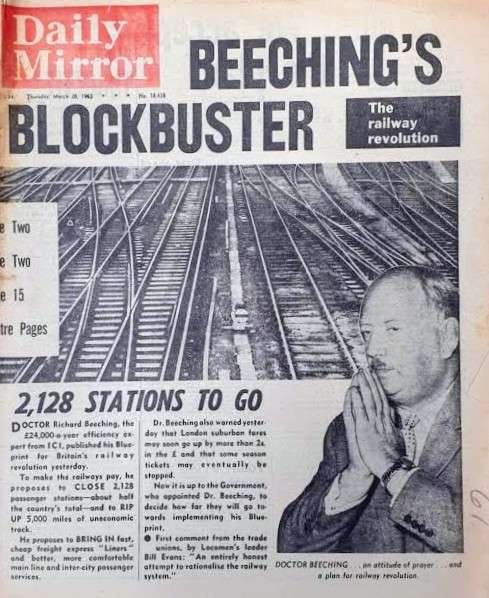
In the end, the changes outlined in the White Paper took effect on 1st January 1963, following the passing of the Transport Act 1962. The Act officially dissolved the British Transport Commission (BTC), which had previously managed the railways, canals, and road freight. The British Railways Board formally took over operations on 1st January 1963. This new board and its chairman, Dr. Richard Beeching, subsequently published the Reshaping of British Railways report on 27th March 1963, which set the actual line and station closures into motion. It is clear that the substance of the report was decided prior to the British Railways Board being formed!
An interesting reflection on the circumstances that brought about the changes which affected the railways of Britain in the middle decades of the 20th century was written in 2023 by Gareth Dennis. It was entitled, The Reframing of Beeching’s Legacy.
Dennis re-evaluates the 1963 Beeching Report, arguing that its legacy extends beyond rural closures to lay foundations for modern intercity and containerised freight systems. The Beeching Report both responded to (and precipitated) ongoing network contraction and financial deficit, ultimately shaping efficient long-distance and freight operations while misjudging future suburban rail demand.
References
- Reorganisation of British Railways; in The Railway Magazine, Volume 107, No. 718, February 1961, p98-100 & p124.
- Reorganisation of the Nationalised Transport Undertakings; H. M. Stationery Office, London, 1960; via https://www.railwaysarchive.co.uk/documents/MoT_Reorg1960.pdf.
- https://garethdennis.medium.com/the-reframing-of-beechings-legacy-70486eb8a0bc, accessed on 23rd October 2026.
Appendix
Timeline: Beeching closures
December 1960: Reorganisation of the Nationalised Transport Undertakings – The White Paper which proposed the splitting of the British Transport Commission into a number of bodies, with the railways being run by the new British Railways Board. It also set financial targets for the railways, which would lead to the Beeching cuts a few years later. This document was written by the Ministry of Transport and published in December 1960 by H. M. Stationery Office. https://www.railwaysarchive.co.uk/documents/MoT_Reorg1960.pdf.
27th March 1963: The Reshaping of British Railways – Part 1: Report – The ‘Beeching Report’ is one of the most notorious government reports of the 20th century. The failure of the modernisation plan to stem BR’s losses led the author, Dr. Beeching, to propose wholesale route closures in an attempt to concentrate resources on the core routes. … Many closures went ahead; some sensible, others far less so. The report often adopted an overly-simplistic analysis of the economics of the routes, failing to recognise how the branches contributed traffic to the core network. The Beeching closures failed in their attempt to eliminate BR’s losses, and led to the belated recognition that the railways serve a social role which should be financially acknowledged. Written by the British Transport Commission, this document was published by H. M. Stationery Office. https://www.railwaysarchive.co.uk/documents/BRB_Beech001a.pdf.
27th March 1963: The Reshaping of British Railways – Part 2: Maps – Written by the British Transport Commission, this document was also published by H. M. Stationery Office. https://www.railwaysarchive.co.uk/documents/BRB_Beech001b.pdf.
2nd May 1963: The Economics and Social Aspects of the Beeching Plan – The House of Lords Record of a speech given by Lord Stonham, in which he outlines his opposition to large parts of the then-just-published Beeching Report. It was written by Lord Stonham and published by the Parliamentary Archives. https://www.railwaysarchive.co.uk/documents/Hans_Beeching02051963.pdf.
1963: Its Up to YOU! Save your Railways – A pamphlet from the NUR protesting about the proposed Beeching closures and suggesting ways for the public to fight the closure notices.
This document was written and published in 1963 by National Union of Railwaymen. https://www.railwaysarchive.co.uk/documents/NUR_UpToYou1963.pdf.
1963: The Mis-Shaping of British Railways – Part 1: Retort – A typically blunt response by the NUR to the Beeching Report of 1963 It was written and published by the National Union of Railwaymen. https://www.railwaysarchive.co.uk/documents/NUR_Misshaping1963.pdf.
1965: Review of Dr. Beeching’s Report: The Reshaping of British Railways – One of many pamphlets pointing out some of the flaws in the Beeching Report. Attention is drawn to the folly of examining the railways in isolation from other forms of transport and ignoring the contribution to the trunk lines’ traffic made by the branch lines. This document was written by Prof. E. R. Hondelink and published by the Great Central Association. https://www.railwaysarchive.co.uk/documents/GCA_Rep001.pdf.
February 1965: The Development Of The Major Railway Trunk Routes – The second (and lesser-known) ‘Beeching Report’; this one concentrated on stimulating traffic on the core routes rather than branch line closures. This document was written and published in by British Railways Board. https://www.railwaysarchive.co.uk/documents/BRB_Beech002.pdf.
February 1965: The Transport Conflict by Dr Beeching – The transcript of a lecture, and two newspaper interviews, given by Dr Beeching as part of his effort to explain the purpose and justification for his about-to-be-published report, “The Development Of The Major Railway Trunk Routes”. This document was written and published by The Observer. https://www.railwaysarchive.co.uk/documents/Obs_Beech001.pdf.

