Author Archives: Roger Farnworth

Unknown's avatar

About Roger Farnworth

A retired Civil Engineer and Priest

Monaco to La Turbie Rack Railway (Chemins de Fer de Provence 15)

The first railway in Monaco was completed in 1869 by the French PLM railway company as part of an international route between France and Italy. There were two stations, Monaco and Monte Carlo. The PLM company became part of SNCF in 1938.

In 1893, a metre-gauge rack railway was constructed to connect Monaco with La Turbie, a medieval village perched on the hills above Monaco. There were a number of different schemes considered before the final version was agreed. These can be seen on the sketch plan which has been provided on http://cremallierturbie.canalblog.com%5B1%5D.
The first scheme was proposed in 1882. The line was promoted by Amédée Brousseau with financial backing from a Parisian banker, Eugene Hubert. The planned line left Moneghetti district on the northern border of the principality and travelled straight up the valley of Sainte-Dévote, with a stop at Le Cros. It would have been 1,860 metres long with one tunnel of 100 metres in length and a viaduct of 60 metres in length (with 5, ten-metre arches), crossing the valley at a height of 8 to 10 m . The costs were estimated at 950,000/1,000,000 francs.[1]

The mayor loved the scheme and it was accepted at the end of 1882 by the local authorities. On 11th April 1883, a public inquiry was ordered.On 16th July 1883 the municipality of La Turbie granted a concession to the Compagnie du Chemin de Fer à crémaillère d’intérêt local de Moneghetti-Monte Carlo à la Haute-Turbie. However, the military authorities opposed the rout and suggested an alternative on the left bank of the River Sainte-Dévote which was 500 metres longer.

The project was reviewed, and in 1884 a second project was proposed, leaving Monegasque and running along the Carnier plateau, along the side of the Mont des Mules, with a halt at Bordina to end 250 metres east of La Turbie. Teh costs were considerably higher: 1,600,000 francs. This route was agreed on 30th July 1884 and the concession was granted on 31st May 1885.  Before work commenced, the banker, Eugene Hubert went bankrupt.

His partner, Brosseau, contacted a new banker, Abel Neveu and the new company (Compagnie du chemin de fer d’intérêt local à crémaillère de La Turbie ou le Righi d’hiver) was formed with statutes being deposited on 22nd December 1886. The company was based in Basel. The board was made up of Swiss and Alsatian financiers and industrialists including the locomotive manufacturer Koechlin, and the Swiss engineer Nicolas Riggenbach who invented the rack railway traction system.

The new company was beset with problems, not the least of these being a series of disputes between Brosseau and the other directors. In 1889, before any work commenced, Brosseau withdrew from the company. On 21st June 1889, the company was dissolved and stripped of its concession.[1]

The saga continued. On 13th February 1891 the engineer, Charles Lornier requested a concession, but the Municipality of La Turbie favoured the earlier applicants and on 9th March 1891 a new company was formed by former shareholders, Compagnie du chemin de fer d’intérêt local à crémaillère de La Turbie (Righi d’hiver). Its head office was in La Turbie and it succeeded in getting a public inquiry started on 20th November 1891.
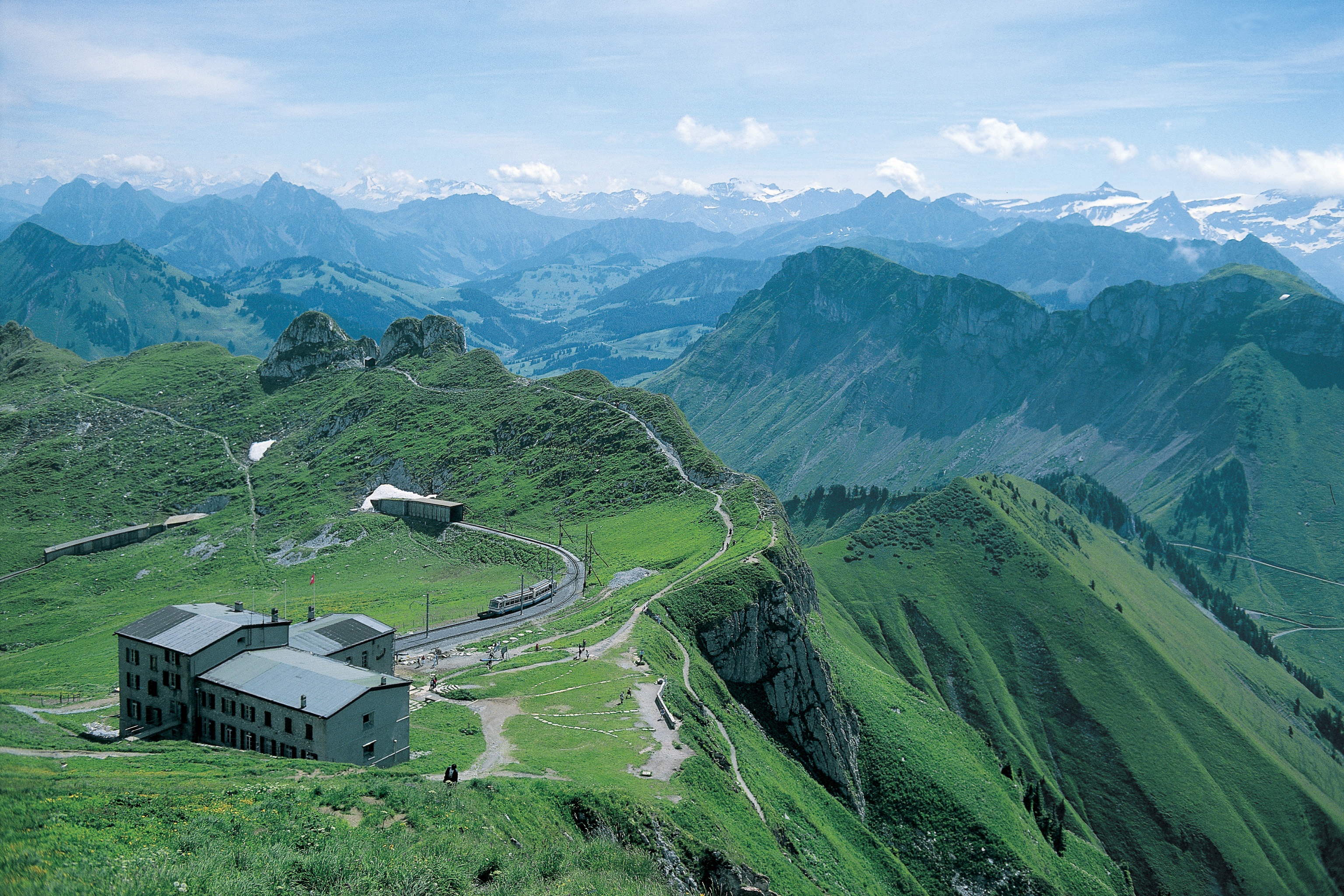
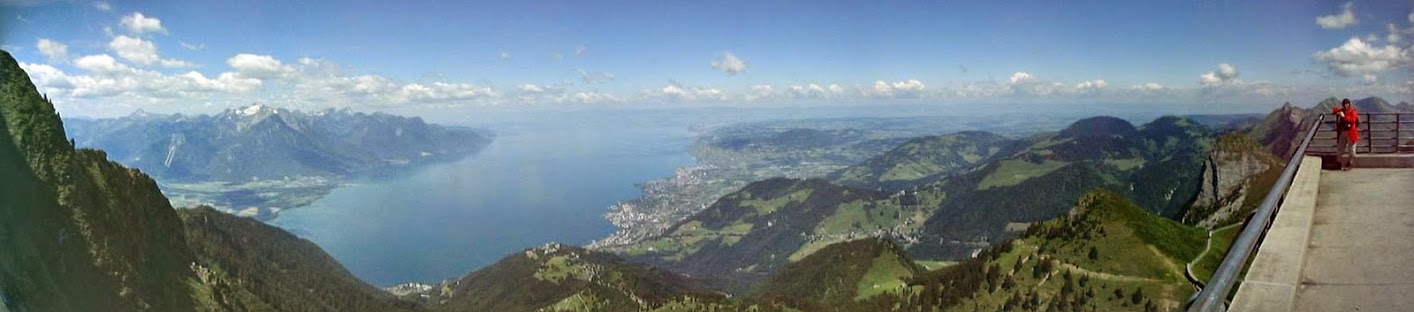
In 1892, a Swiss engineer, Mr. Stockalper plotted a new route for a metre- gauge Riggenbach rack-rail line. The specification, including all rails, gradients, locomotives, coaches and wagons was drawn up.The project cost was estimated at 1,400,000 francs – 200,000 francs less than the 1884 project.

Finally, in 1893, the local authorities approved the project and the line was declared of public utility. The engineer for the works was Chatelanat and the contractors were Mombelli, Thus and Crovetto. In December 1893, the first two locomotives, manufactured in the workshops of the Société Alsacienne de Constructions Mécaniques in Belfort, were delivered.[1]

The final route is shown on the map below [2]. The line did not enter the Principality , it terminated on French soil in the suburb of Beausoleil.

At 7.00am on 10th February 1894, the line was opened to its first travellers.[3] Traffic grew steadily until 1920. [4, 5, 6, 7] Electrification projects were envisaged in 1926 and 1929 but they did not come to fruition.[8, 9] The line closed in 1932.

The Company had the following equipment:[10]

  • four 020T steam locomotives , the main feature of which was their design that countered the slope;
  • five passenger cars with 60 seats to 2 classes;
  • two goods wagons.

All items were manufactured in Belfort by Société Alsacienne de Constructions Mécaniques (SACM) [11] and delivered in December 1893.

This blog has a series of pictures of the line at the end of the text, below the poster.

We note for completeness that electric trams came to Monaco in 1898 with a line from the Place d’Armes to Saint Roman. Several other lines followed within the Principality. In 1900, the tram system was connected to that of Nice and in 1903 extended to Menton. It has also been pointed out to me (19th March 2018 by BG1000 on the Passions Metrique et Etroite Forum) that there was a short-lived tramway which used the route of the Funicular.

At the beginning of the 20th century an electric tram service connected the Rue des Iris in Monte-Carlo to the Riviera-Palace Hotel. The lifespan of the service was short – just 10 years from 1903 to 1913. The service became redundant as auto-bus and car usage rose in the period before the Great War. The Riviera-Palace Hotel and the tramway that served it are the subject of a book by Jean-Paul Bacscoul and Jean-Claude Volpi entitled: “Le Riviera Palace: 1897-1904, La Turbie, 1904-1936, Monte-Carlo Superieur- Beausoleil.”[12]

The last trams ran in Monte Carlo and the principality in 1931.

There was a main line station on coast but pressure of land use in the Principality has always been a problem, and in the 1950s a new tunnel was built from the original Monaco station, through the hills behind Monte Carlo, bypassing Monte Carlo station. The latter station was closed and the land occupied by it and the railway released for other uses. In the 1990s, a similar exercise was performed replacing the remaining line through the original Monaco station with a new line and station entirely underground.

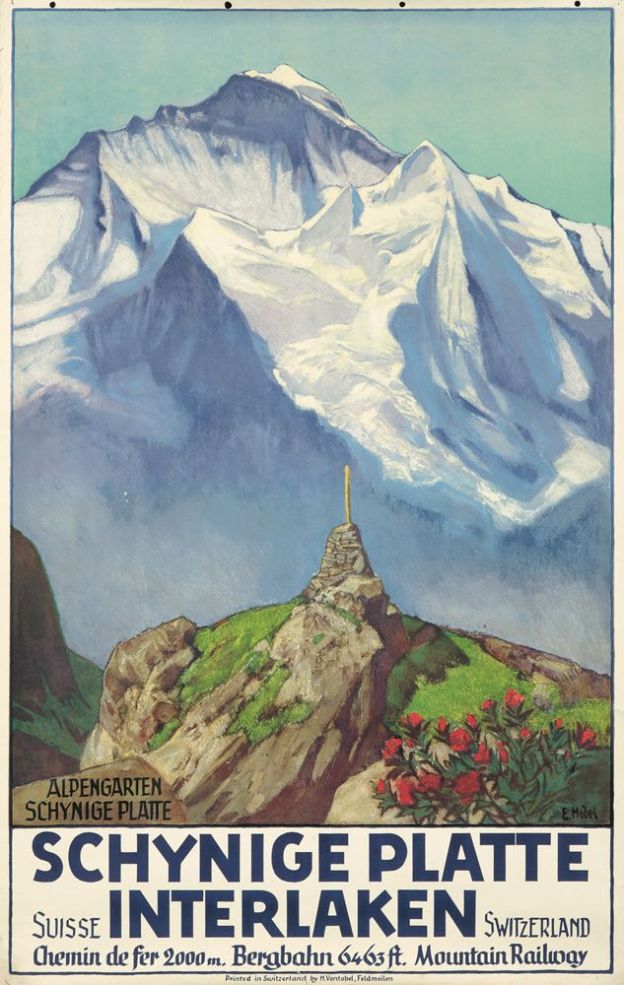
There are some great postcard images of the Monte-Carlo to La-Turbie Railway below, after a poster for the La Turbie Line.

As a late addendum: Yves of the Passions Metrique and Etroite! Forum[13] provided this link:

https://photos.google.com/share/AF1QipN1FvO322HUemoyzNSRc5UVwfyKyiRpAzo7Q3Z3XhW3SFg_bYu1sdzVlUznOgns1Q?key=M2RPeFh3SV9WRl9KMTQ3WXlCSDVZV29jVjh1UDRB

There are a lot more images and text relating to the Monaco-La Trurbie line.

References

  1. Un Train de Legende: La Cremaillere de La Turbie; http://cremallierturbie.canalblog.com, accessed 18th March 2018.
  2.  Chemin de fer à crémaillère de La Turbie à Monte-Carlo; Wikipedia; https://fr.wikipedia.org/wiki/Chemin_de_fer_%C3%A0_cr%C3%A9maill%C3%A8re_de_La_Turbie_%C3%A0_Monte-Carlo, accessed 19th March 2018.
  3. Journal des Mines No. 7, 25th February 1894, p6.
  4. Rapports et délibérations : Conseil général des Alpes-Maritimes, Nice, Conseil général des Alpes-Maritimes; September 1914 2nd Ed. p132.
  5. Rapports et délibérations : Conseil général des Alpes-Maritimes, Nice, Conseil général des Alpes-Maritimes, 1916, 2nd Ed. p73.
  6. Rapports et délibérations : Conseil général des Alpes-Maritimes, Nice, Conseil général des Alpes-Maritimes, 1917, 2nd Ed. p74.
  7. Rapports et délibérations : Conseil général des Alpes-Maritimes, Nice, Conseil général des Alpes-Maritimes, 1918, 2nd Ed. p59.
  8. Le Temps Financier; Le Temps, no 259,‎ 2nd May 1932, p2.
  9. Rapports et délibérations : Conseil général des Alpes-Maritimes, Nice, Conseil général des Alpes-Maritimes, 1920, 1st Ed. p149, p211.
  10. Annuaire des Chemins de fer et des Tramways (ancien Marchal) : Édition des réseaux français, Paris, 1928, 43rd Ed. p1334.
  11. Bulletin des lois de la République française, t. 31, Paris, Imprimerie nationale, 1885 “Chemins de fer” p657, p1073-1080, p1980.
  12. Jean-Paul Bacscoul & Jean-Claude Volpi; Le Riviera Palace: 1897-1904, La Turbie, 1904-1936, Monte-Carlo Superieur- Beausoleil.
  13.  See: http://www.passion-metrique.net/forums/viewtopic.php?p=414373#p414373, accessed 22nd March 2018.

Ligne de Central Var – Part 2 – Saint-Jeannet to Vence (Chemins de Fer de Provence 14)

We continue a journey along the line of the Central Var metre-gauge railway. We travel from Saint-Jeannet to Vence!

2. Le Tunnel de Les Champignonnieres, Saint-Jeannet to Vence Station

Map of the railrways of Provence in 1924

lignes-cfsf

This next section of the follows the contours towards Grasse the centre of the perfumery industry in South East France. The route into Grasse itself will be for another post in this series.

A little more history

The Freycinet plan launched in 1879 by the minister of public works of the same name, Charles de Freycinet, provided for the construction of 8,700 km of lines of local interest. These lines were intended to promote economic development and open up communes which up until that date had been seriously isolated. The plane proposed more than a hundred projects including routes to Digne, Draguignan, Castellane, Cagnes, Barjols, Puget Théniers and Cuneo.

For economic reasons, the majority of secondary lines constructed in the South East of France were metre-gauge lines. This choice allowed the lines to follow existing contours utilising tight curves, minimising the use of steep grades and expensive structures. Main secondary routes which would end up being secured were these:

From Nice to Digne by Puget-Théniers (150 km) – this line continues in use and has been thoroughly modernised (http://tourisme.trainprovence.com/accueil-english).

From Nice to Meyrargues by Grasse and Draguignan (200 km) – the subject of this series of posts. The first of which can be found by following this link: https://wp.me/p45mBO-GX.

From Toulon to Saint-Raphaël by the coast (103 km) – a further series of posts are due at the end of 2017.

From Nice to Cuneo (standard-gauge line) – still existing (see for example, http://www.tendemerveilles.com/train-des-merveilles, https://www.ter.sncf.com/paca/loisirs/lignes-touristiques/train-des-merveilles).

From Saint-Jeannet to Le Bar de Loup

Another view of Saint-Jeannet Station.

Immediately after leaving the Tunnel de les Champignonnieres the railway crossed the River Cagnes. This steep valley provided the necessary water powers for a series of mills and the road, at this point in the valley was named Chemins de Moulins – the Road of Mills. The mills were predominantly Olive Oil Mills.

b1

b2

b3

In the maps above, two show the line of the railway. The lower map is dated 1833. The railway, in both cases has been added to the map by hand. There are 8 mills shown and further details can be found on this link: http://sentiers.village.free.fr/Photos/Moulins/Moulins.htm.

The viaduct was built by 1892 and is known as the Viaduct de Cagnes. It is curved and of 90 metres in length (12 traditional stone arched spans – 43° 44’ 45”N, 7° 07’ 58” E). The larger picture below gives an interesting insight into the use of the line as it shows dual gauge track. This allowed the line to take some standard gauge rolling stock.

b4

b6

b5

b8

b7

After the viaduct, the line quickly disappeared once again into tunnel – Le Tunnel des Canons. The tunnel was just 30 metres long (43 ° 44 ’35 “N, 7 ° 08′ 00” E) and opened out onto a short section of line travelling in an approximately southerly direction before another short tunnel was encountered – Le Tunnel des Fonts – 53 metres long (43° 44′ 09″ N, 7° 07′ 37″ E). The route between these tunnels is now a local road named Avenue de Provence. The first four pictures below look back along the line towards Saint-Jeannet. The fourth is the Tunnel des Fonts taken in the direction of travel and looking approximately South West. The final picture below is of the Tunnel des Fonts looking back along Avenue de Provence to the North West.

b9

b10

b11

b12

b13

b14

b15

After the Tunnel des Fonts the line travelled for a short distance along the old N210 (now the D2210) immediately
before reaching another viaduct just under 1.5 kilometres from the tunnel. On the way it passed under the small accommodation bridge shown in the picture here. The next viaduct is Viaduct of Lubiane (43 ° 43 ’30 “N, 7 ° 06′ 28” E). It is a short viaduct of no more than 50 metres in length.

The screenshot from Google Earth shows both the length of the N210 that was traversed and the viaduct. The viaduct is now on Avenue de Henri Matisse and carries traffic leaving Vence to head towards Saint-Jeannet.

b16

b18

After crossing the valley of the Lubiane the railway travelled on the streets of Vence, first along the line of the N210 and then on into what is now the main square of the town. Another screenshot from Google Earth shows the square as it is now. The line in Vence travels East-West.

b17

What is now an open plaza was once Vence station. The following pictures give some insight into what the station was like when the railway was still active and show rails on the streets of the old town!

1371740113-06-Vence-380 (1)

b20

b21

b22

b23

And finally, for this post ……. the station in Vence was bracketed to the West by a girder bridge which still carries a road over the route of the line. As the line leaves Vence it now forms the Avenue Rhin et Danube.

b24

Ligne de Central Var – Part 1 – Colomars (La Manda) to Saint-Jeannet (Chemins de Fer de Provence 12)

As part of our holiday in Nice in 2017 my wife and I investigated the line between Nice and Meyrargues which closed at the beginning of the 1950s. Almost all of the route is can be accessed on foot and surprisingly much is accessible by car.

This blog covers the history of the line up to 1925 and the first length of the route from La Manda near Colomars on the Nice to Digne line to Saint-Jeannet.

History of the Line to 1925

The Treaty of Turin was signed on 24th March 1860. In it Nice was ceded by the King of Sardinia to Napoleon III. This needed to be ratified by the local population and a vote on 15th and 16th April produced an overwhelming majority in favour of the change. Consequently the department of Les Alpes Maritimes was created by decree on 24th October 1860. To accelerate the acceptance of the new department, and secure improvements to the local economy, significant grants were made by the French government to the department.

Nice was made the capital of the department much to the chagrin of Grasses. Grasses was part of the old France and assumed a priority over Nice. When it lost out to Nice as the capital of the new department it made strenuous efforts to develop local infrastructure improving local roads and seeking a place on the line of the new railway running East along the coast to Nice. That battle was lost and when the Emperor visited Nice on August 18, 1860, Grasse demanded and obtained a branch line from the main coastal line, insisting that “Grasse must inaugurate its railway on the same day that Nice inaugurate its railway.” However that branch-line and the costal railway took thirty years to complete!

Map of the railroads of Provence in 1924

The focus of the main coastal railway on standard gauge left the towns and villages of Central Var needing to promote their own line or lines. The fall of the Second Empire delayed the work. It was to be some time before proposals could be resurrected.

Eventually, Les Chemins de Fer du Sud was promoted as two separate lines during a period when France became particularly concerned about its more remote regions. Two lines were of approximately 350 kilometres in total length – Digne to Nice and Nice (Colomars) to Meyrargues. A metre gauge line powered by steam, sometimes called “Le Train des Pignes”. It was given this name because, it is said, travellers had time together off the train and pick up pine cones by the track when the train encountered a significant gradient. A metre-gauge was adopted which was complementary to many other lines being built throughout France and which provided for cheaper construction, steeper grades and tighter curves that the standard gauge – much more suited to the terrain through which it would travel. The project cost was, as a result, half that if standard gauge had been used.

Construction proceeded quickly. The 211 kilometre network was divided into sections entrusted to different contractors. The sections were of around 10 kilometres in length. Land was purchased by 1890 and work commenced immediately on all sections of the line. The line was completed in 1892.

These large sites made good use of local workforce.

By 1925, Les Chemins de Fer du Sud had been formed bringing the two lines together in one Company.

The Route

1. Colomars (La Manda) to Saint-Jeannet Station

The Ligne de Central Var left the Nice to Digne line at La Manda close to Colomars on the River Var. The station building at Colomars Station remains as evidence of the line. The line branched off the current Digne line just to the north of the hamlet of La Manda.
The station construction is typical of many of the stations still evident on the route of the line. A few historic postcards are reproduced here to give an idea of the station in the early years of the 20th century.

The second of these postcard views has been ‘adapted’ by Jean Giletta the photographer to include a hand drawn train. While it is a pity that the photographer did not wait for a train to cross the bridge, the picture illustrates the nature of the river crossing. The railway line crossed the river on the top of the truss girders with provision between the trusses for road traffic!

The destruction of several structures on 24th August 1944 led to the closure of the Colomars – Grasse – Tanneron section of the Central Var Line. The service was never restored. The western part of the line, between Tanneron, Draguignan and Meyrargues, was to survive a few more years with a rather limited service, closing on 2nd January 1950.
Although seriously damaged in 1944 the bridge at La Manda was repaired and reopened, but only for road traffic. The current bridge, inaugurated on 27th November 1967, was built just downstream from the previous one, which probably remained open during construction.

A link follows to photos taken in 1966 just prior to the building of the new structure. The photographs were taken by Jean-Henri Manara and are available on Flickr.

JHM-1966-afh-001 - Nice, France, ancien pont de la Manda de la ligne CP de Meyrargues

According to these photos, it seems that at least two bays on the east bank of the River Var, were not recoverable and were replaced by temporary bays lighter. These notes about La Manda bridge have been kindly provided by ‘Jeanmi67’ and ‘242TE66’ on Les Forums de Passions Métrique et Etroite!! (www.passionmetrique.net/forums).

Once the line had crossed the river it was carried on embankment across the wider flood plain as can easily be seen in the last of the post cards of the station at La Manda. The railway line is long gone but the bridge remains in use as a major road crossing of the Var. The current bridge was built in 1967, as a replacement of the former bridge which had been damaged in August 1944. Jose Baraudo (Le Siecle du Train des Pignes) says that a commando unit of the retreating German army blew up three major viaducts on the morning of 24th August 1944, (La Siagne, Le Loup and La Pascaressa) However, they did not need to blow the bridge at La Manda up. The Meyrargues line had been cut off from Nice already, three weeks earlier, when the bridge at La Manda was bombed by the Allied forces on 2nd August 1944, prior to the Provence landing. Two spans at the East end were destroyed and a third one is said to have suffered damage only.

Other bridges across the Var river at Nice – St Laurent-du-Var and Pont Charles-Albert were also destroyed or severely damaged by bombing, as were several bridges and viaducts along the Nice – Digne line (La Vésuvie…etc…) but those would be repaired and/or rebuilt, eventually. (Thanks to 242T66 for the english translation of part of Banaudo’s book on which these last two paragraphs are based).

Although this commentary starts from the Eastern end of the line. It seems strange writing about the line and starting in the East as when we travelled along the route in November 2017 we started from the West. Most of our own photographs of the route were taken from the Westerly direction looking East towards Nice.

getresizedimage

a31.jpg

Once firmer ground had been reached to the West of the river, the line set off to the South-west around the South side of Gattieres toward Saint-Jeannette. The picture below looks back towards the bridge across the Var along Boulevard de la Colle Belle at Carros. The bridge is hidden behind the vegetation on the modern roundabout.

The next picture looks back along the line of the old railway again a little further to the Southwest on Rue des Grillons in Carros. This picture and some of the others that follow are courtesy of Google Street view.

Leaving Carros, the line immediately headed out onto the Viaduct of the Enghièri (130 metres long, made up of 6 arches, 5 of which span 16 metres (43° 46’ 00” N, 7° 11’ 22”E). It is a traditionally built arch viaduct with a first wider span for the road below. The first picture is from Google Street view. The second is taken from a car window.

Much of the Ligne Central Var is still in use for transportation, often the old track formation has been used at its original width, in some places significant widening has taken place. Where original structures were damaged in the conflicts of the 20th Century, these have not been replaced and the ability to follow the line in a vehicle is interrupted. There are areas usually in the forested areas along the route where pedestrian access is possible, or the route can be traversed by a 4×4 vehicle. The Viaduct of the Enghièri has been preserved as a highway as the Google Street view picture shows. The route has been given the name, Chemin de Provence.


The plan view is also taken from Google Streetview. The red line is the plotted route of the railway which can be viewed with this link:

http://ollivier.haemmerle.free.fr/LigneColomarsMeyrargues.kmz.
Google Earth will be needed to open it. The plotting of the route was undertaken by Claudio Capaccio.

From the Viaduct of the Enghièri the route of the line follows what is now the Chemin de Provence in south-south-westerly direction crossing a small bridge at 43° 45’ 32”N, 7° 11’ 00” before turning to a more westerly trajectory on the North side of the Vallon des Trigands and South of Saint-Jeannet.

A couple of pictures along the way:

A Crossing Attendants House (43° 44’ 55”N, 7° 10’ 12”E) Further along the line.

The next substantial structure on the route is shown as a blue dotted line on the map of Saint-Jeannet above – The Tunnel of Saint-Jeannet. Just before reaching the tunnel the line turns in a north westerly direction. The route cannot be followed by car as it continues beyond the concrete blocks in the picture here. It is however possible to get along the line to the tunnel mouth.

The tunnel is 860 metres long running in a predominantly westerly direction (from 43° 44’ 22”N, 7° 09’ 21”E to 43° 44’ 31”N, 7° 08’ 32”E) and the line appears again South of the D2210 road, south-west of Saint-Jeannet close to Le Peyron. From the tunnel mouth at the West end of the tunnel (visible below right) there is a short section of the route accessible with care and known as the Chemin de la Champignonniere. A high retaining wall (below left) carries the old line above the Ancienne Route de Vence which falls away to the West and meets the line at grade just behind the camera and then climbing away above the old line on its way towards Saint-Jeannet.

A quick nip up the Ancienne Route de Vence above the old line allows a glimpse of the old Saint-Jeannet station off to the right of the road. This accurately places the station on the map. The next image is a postcard of the station in the early 20th Century.

After the station, the line travelled a short distance (along what is now the Chemin de La Champignonniere) before reaching another tunnel entrance. This tunnel’s official designation is Tunnel de Cagne, however it is apparently known locally as the Tunnel de Champignonniere. The tunnel is used to farm mushrooms.

Chemins de Fer de Provence 11: The Levens Tramway via Saint Blaise??!!??

Health Warning!! This blog of 2017 is based on some mis-information!! It must be considered to be a ‘Might Have Been’ Scenario!!

In this scenario, the route of the Levens tramway running North from Tourrette-Levens surprisingly did not follow the main road. Instead it diverted to St. Blaise before following the St. Blaise to Levens road into Levens.

The most startling structure to be built on the route was an 80 metre long suspension bridge just outside St. Blaise. Built for the tramway in 1908 it also carried the St. Blaise to Levens road.

This graceful suspension bridge was destroyed during the Second World War.zoom_311

It was not rebuilt until 1953. The new bridge was similarly striking although a concrete arch construction. By this time the tramway was long-gone.


For the first part of the route from Nice, please see the following link:

https://rogerfarnworth.wordpress.com/2018/03/20/the-nice-to-levens-tramway-part-1-chemins-de-fer-de-provence-54

The tramway route from the southern outskirts of Tourrette-Levens probably followed approximately the route of  Chemin de la Gorghette and Chemin de Saint Sebastien before rejoining the present M19. To get to St. Blaise the tramway would have had to follow the M719, the road to Aspremont. Any other route to St. Blaise would require extreme gradients. Sadly, however, I can find no evidence to support the assumption that Aspremont would have been included in the tramway system.

The route from Saint-Blaise to Levens would have been shown by some of the pictures below.


800px-Giletta_3205_-_LEVENS_-_Excursion_en_Tram_-_Environs_de_...

103820183The final photograph shows the terminus at Levens. The location of this picture is however not clear in my own mind. I believe that the first terminus at Levens was probably on the Avenue General de Gaulle. The line was, however, extended into the centre of the village, it is highly possible that this is a view of that location, which is the point at which the Nice to Levens bus terminates right next to the heart of the perched village. I’d appreciate any comments readers are able to make on this.1367773723-06-Levens-3255- (1)

For a re-interpretation of this story, this time based on better evidence, please see my later blog from March 2018!

Nice Tramway: Ligne 2

We got the bus to Eze today (14th November 2017) and then walked for a few kilometres along the Moyenne Corniche before dropping down one of the side roads to the Basse Corniche and sitting on the beach at Eze-sur-Mer eating Baguette and cheese for lunch. We then got on the Ligne d’Azur 100 bus back to Nice.

The terminus for the 100 is in the Port of Nice, which is now dominated by two large grey steel buildings which house the concrete plant for the underground works for Ligne 2 of the Nice tramway. Eventually the location of these buildings will be the terminus of the line, right at the head of the Port and a very quick journey from the Port to the Airport.

Ligne 2 will drastically reduce traffic volumes in the city as the East-West/West-East movements dominate traffic flows in the city. There is an amazing amount of detail to be found on-line! Try some of these links:

http://tramway.nice.fr/ligne-ouest-est/projet-ouest-est/tout-sur-le-projet; (retrieved 14th November 2017) – this site includes a series of links to a variety of material including the environmental impact study.

https://www.intelligenttransport.com/transport-news/18414/tram-design-revealed-for-the-east-west-line-of-the-nice-cote-dazur-metropole; (retrieved 13th November 2017) – details are provided of the Alstrom trams to be used on the route.

http://tramway.nice.fr/ligne-ouest-est/projet-ouest-est; (retrieved 13th November 2017) – the official site for the project.

In addition to the grey steel buildings at Nice Port, major sites are active as new stations are formed either above or below ground. Examples include the stations at Garibaldi and Alsace Lorraine.

The new line cuts across Nice from west to east (or east to west, if you like). The underground section will run from Nice Port underneath the Old Town to Garibaldi, following onto Durandy (adjacent to Place Wilson). There will also be a station located at Jean Medecin (where it intersects with the ligne 1), and at Alsace Lorraine (the garden in Musiciens) before the line remerges above ground at Grosso. From here it will continue towards the airport, running parallel to the Promenade des Anglais.

carte_nouvelle_charte_vecto_Fev15_legende_HD

The project began in October 2013. First, various excavations had to be undertaken around the route of the underground line to ensure that sensitive archaeological sites were properly evaluated and protected. At the western end of the project a series of enabling engineering works were required including significant work on the St. Augustine railway bridge, a new access bridge to the airport; the diversion of underground utilities.

In November 2013, contracts were drawn up and following a public procurement procedure, both the tunnel and underground station engineering construction were awarded to TBM of the Thaumasia Group, led by construction giant Bouygues TP- a name you may recognise, they are also one of the biggest mobile phone networks in France. It took over 4 months for the contract to be signed. It was April 2014 before the design-build contactor started work on the design drawings for the underground tunnel and the stations. It was September 2014 when the excavation work for the tunnel started.

By spring 2015, the maintenance and development strategy for the tram service had been completed by the local government body, the CADAM Nikaia. In April 2016, work commenced on the Place Durandy station. September 2016 saw engineers starting on the new Place Garibaldi station.

est-ouest-original.730.330.s

Tunnel works continued with the input shaft started in December 2015 and the tunnel boring machine at work by May 2016.

IMAGE_20160127_31220211

The stations at Jean Medecin and Victor Hugo were started in late 2015. Above ground rail construction is now well underway (November 2017) and a new tramway maintenance depot is nearing completion. It is still likely that by November 2018 the overground element of Ligne 2 will be operational with the underground section operational by early 2019.

The implementation of the tramway project has already drawn in significant investment to the Riviera. When up and running, the line will reduce the journey time from Nice Port to the Airport to just 26 minutes.


A First Tramway for Nice since 1953 and the Closure of the Cote d’Azur’s vast Tram Network.

It is evident as soon as you leave the terminal building at Nice Airport that something big is going down. Nice is well on the way to getting two new tramways – Ligne 2 and Ligne 3. Like many cities, Nice is building a modern tramway system. Also like many cities across Europe and the UK, Nice once had a significant tramway system not just in the immediate city environment but also spread out along the Cote d’Azur and inland in places into Les Alpes Maritime.

Details of the wide tramway network that existed in the early 20th Century can be found in a series of articles on my blog:

https://rogerfarnworth.wordpress.com/category/railways-blog. The early (December 2013) articles below have been greatly expanded by more recent articles:

Sospel to Menton Tramway

https://rogerfarnworth.wordpress.com/2013/12/10/sospel-to-menton-tramway

This article was revisited, extended and updated as: https://rogerfarnworth.wordpress.com/2018/02/23/the-sospel-to-menton-tramway-revisited-chemins-de-fer-de-provence-51

Chemins de Fer de Provence

https://rogerfarnworth.wordpress.com/2013/12/10/chemins-de-fer-de-province

https://rogerfarnworth.wordpress.com/2013/12/11/chemins-de-fer-de-provence-2

https://rogerfarnworth.wordpress.com/2013/12/12/chemins-de-fer-de-provence

Chemins de Fer de Provence 4: Tramways Near Nice

https://rogerfarnworth.wordpress.com/2013/12/13/chemins-de-fer-de-provence-4-tramways-near-nice

Chemins de Fer de Provence 5: More Tramways Around Nice

https://rogerfarnworth.wordpress.com/2013/12/14/chemins-de-fer-de-provence-5-more-tramways-around-nice

Chemins de Fer de Provence 6: More Tramways Still!

https://rogerfarnworth.wordpress.com/2013/12/15/chemins-de-fer-de-provence-6-more-tramways-still

Chemins de Fer de Provence 7: The Line to St. Martin Vesubie

https://rogerfarnworth.wordpress.com/2013/12/16/chemins-de-fer-de-provence-7-the-line-to-st-martin-vesubie

Chemins de Fer de Provence 8: Tramway in the Tinée Valley

https://rogerfarnworth.wordpress.com/2013/12/19/chemins-de-fer-de-provence-8-tramway-in-the-tinee-valley

Chemins de Fer de Provence 9: Tramway to Roquestron

https://rogerfarnworth.wordpress.com/2013/12/20/chemins-de-fer-de-provence-9-tramway-to-roquesteron

The Decline of the Network

Old-TramwaySadly that network went into very rapid decline with the improvement in road transport. It reached its zenith at the end of the 1920s, but by 1934 many lines had closed. By the late 1930s only lines within Nice itself remained open. The remaining lines in Nice finally gave way to competition and the last trams ran on the network in January 1953.

The love affair of the Cote d’Azur and Les Alpes-Martimes with Trams was over, permanently. Other forms of transport were faster and more flexible. The trams had hard their day. ….. Or had they? ….

Before the turn of the Millennium things were beginning to change. The city centre of Nice was gridlocked with traffic. Nice had major traffic problems. To overcome these problems, various studies were undertaken, the earliest in 1987 only 44 years after the last trams had run in the city. It wasn’t until 1997 that dedicated bus lanes were implemented and a further study was launched, looking at the implementation of a tram line. The study recommended trams as being less subject to the vagaries of traffic but not as expensive as a subway.

thumb_1556_ckeditor_big

The first tramway, Ligne 1, was confirmed in 2003 and work started in the same year. The line came into service on 24 November 2007 after several weeks of technical trials, even though construction was not fully completed.

Oakwood and Dike’s Tramways

To the West and South of Parkend there was an extensive network of privately owned narrow gauge tramways that were not part of the Severn and Wye owned system. These were known as the Dike’s and Oakwood Tramways.

download5b931bdb_mulated_2f0_2fPictures_2fimage_crop__2017_09_29_14_35_56_798

In later years the Severn and Wye Joint Railway provided transhipment facilities at the Parkend wharf. The feeder tramway was the Oakwood tramway. Confusedly, the Oakwood branch of the Severn and Wye left the main line at Tufts junction south of Whitecroft, and followed the route of the Dike’s tramway as far as Princess Royal Colliery at Whitecroft/Bream.

Both Flour Mill and Princess Royal Collieries were served by this system, as were a whole series of quarries, ironworks and chemical factories. It is difficult to credit how extensive this system was when visiting the area today. The two tramways are marked in pink and blue on the 1880s OS Map above. The Oakwood Branch of the Severn and Wye Railway can just be picked out in the bottom right of the map excerpt.
The transhipment wharves at the North East end of the system, at Parkend, remained in use until the late 20th Century and were used to transfer lorry loads to railway wagons long after the Oakwood Tramway was abandoned.

Parkend

Parkend had quite a concentration of tramways associated with local collieries and iron works as well as hosting the terminus of the Oakwood Tramway at Marsh Sidings. The extract from the 1880s OS Map shows them clearly.

image_crop__2017_09_29_15_53_53_068

Prior to the construction of the Severn and Wye railway, the Oakwood Tramway connected directly to the Severn and Wye Tramway just to the south of the location of Parkend Station.

Parkend dates back to the early 17th century. During the 19th century it was a busy industrial village with several coalmines, an ironworks, stoneworks, timber-yard and a tinplate works, but by the early 20th century most had succumbed to a loss of markets and the general industrial decline.

More about Parkend can be found at: http://wp.me/p45mBO-zI

Marsh Sidings, Parkend

Marsh Sidings are clearly visible on the left in the sketch below, which can be found on the Deanweb Parkend page. Like many of the other transhipment wharves in the Forest, tramway wagons arrived on rails set at a higher level that the railway tracks making it easier to transfer a load either by hand or by tipping the tramway wagon.

img1Bl (1)


Route to the Flour Mill Colliery

From Marsh Sidings the tramway followed the Coleford road out of Parkend until it reached the end of Whitemead Park. At this point the Coleford road separated from the road to Bream.

img21l

This picture of the turnpike cottage was taken in 1888. Crossing the Coleford road, and to the right of the Bream road which was constructed by the Turnpike Trust in the early 1820s, is the narrow-gauge Oakwood tramway built by David Mushet in 1826. In the length that runs parallel with the Bream road, many of the track’s foundation stones are still visible today.


The tramway followed the route of the turnpike road to Bream, hugging its western side until the road diverted marginally to the south to pass through Knockley Quarries. Tramway continued generally on a South-south-westerly path in the valley below the quarries. South of the quarries the tramway turned more to the south-east generally following the turnpike road before turning sharply back to the southwest to approach the Flour Mill Colliery.

The Flour Mill Colliery

Today, one of the Flour Mill Colliery buildings is still in use as ‘The Flour Mill Ltd’. The company is engaged principally in the repair and overhaul of steam locomotives, although it undertakes other railway-related activities such as the valuation of historic locomotives and luxury train operations. Owned and managed by William Parker, who had previously kept working engineering alive at Swindon after British Rail Engineering Ltd closed, the business occupies a workshop converted from a historically-listed colliery electricity generating station.

The colliery was known as the Flour Mill, presumably because the way to it from the village of Bream passed the Oakwood water mill. There is no evidence of a flour mill ever being on the site, and no known association with flour or milling. However the colliery was at one time the largest employer in Bream, and most families originating from the village have one or more relative or ancestor who worked there. For more on the Colliery please see … https://rogerfarnworth.wordpress.com/2017/09/30/the-flour-mill-colliery

image_crop__2017_09_30_20_28_41_950

After about the turn of the century, the future of the Flour Mill Colliery became intricately tied to the future of the Princess Royal Colliery.

In 1855 Thomas Dyke took on the lease of the Princess Royal gale. It was stated that he had begun to drive a level into the upper coal measures of the Princess Royal gale seeking the Yorkley seam and he applied to the Crown for permission to build a tramroad from the level to the main line of the Severn & Wye at Tufts. That tramroad was extended to the Whitecroft to Bream road by his tenant, William Mullinger Higgins in 1856.

In 1876 the Severn & Wye extended their Oakwood branch along the course of Dyke’s tramway to Dyke’s Level, now also known as Whitecroft Level. In February 1887, Princess Royal, Flour Mill and Prince of Wales gales were in the hands of William Camm and Richard Watkins, both of Bream. The Princess Royal gale had been opened but was not being worked, Flour Mill was being worked to a limited extent whilst Prince of Wales was unopened. Watkins was hoping that the Crown would remove the barriers between the three gales and allow him to work them as one.

A rope incline tramroad operated between Flour Mill and Princess Royal collieries.

In 1890 new sidings on the Oakwood branch of the Severn and Wye were constructed alongside Park Gutter pits and the branch was extended. In 1897 further sidings were added at Park Gutter and again in 1902 when a weighing machine was installed.

In 1906 increasing traffic from Princess Royal made further extensions to the siding accommodation necessary. The loaded wagon road was extended to hold fifty vehicles, the screen roads were altered to provide an extra machine for weighing empties, and the wagon storage sidings were also lengthened to give a capacity of ninety-six. All of these alterations were completed in 1908.

Oakwood Tramway Beyond Flour Mill Colliery

image_crop__2017_09_30_23_26_10_133
For a time Flour Mill Colliery was the site of Oakwood Chemical Works as the plan above shows. The tramroad licence of 1855 extended the Oakwood tramway through to the China Engine (SMR 5629) and New China level iron mines, a distance to the west of the Flour Mill Colliery.

As the tramway left the site of the colliery it passed to the South East of the pond before turning west-northwest on the south side of Oakwood Corn Mill and travelling on to a series of branches in the Nixon area, serving China Engine pit (SMR 5629), Princess Louise pit (SMR 10812), Oakwood Foundry (SMR 9936) and a series of iron ore mines. The tramroad beyond the Foundry (SMR 10834) was removed by 1901, traffic continuing on the remaining section until 1907-8, the remaining track was removed before 1914.

image_crop__2017_10_01_19_38_28_703.PNG

MillHill1950s

The picture shows the valley in the 1950s and is taken from the SunGreen website. The white building is Oakwood Mill Inn and the Foundry was sited off the left side of the picture. The Inn closed in 1969.

References
1. https://en.m.wikipedia.org/wiki/Parkend
2. https://en.m.wikipedia.org/wiki/Parkend_Ironworks
3. http://www.deanweb.info/parkend.html
4. http://www.theflourmill.com
5. Gloucester County Council Historic Environment Report Monument No. 5826.
6. Gloucester County Council Historic Environment Report Monument No. 15249.
7. http://lightmoor.co.uk/forestcoal/CoalFlourMill.html
8. http://lightmoor.co.uk/forestcoal/CoalPrincessRoyal.html
9. http://www.sungreen.co.uk/_Bream/MillHill1950s.htm


The Flour Mill Colliery

Today, one of the Flour Mill Colliery buildings is still in use as ‘The Flour Mill Ltd’. The company is engaged principally in the repair and overhaul of steam locomotives, although it undertakes other railway-related activities such as the valuation of historic locomotives and luxury train operations. Owned and managed by William Parker, who had previously kept working engineering alive at Swindon after British Rail Engineering Ltd closed, the business occupies a workshop converted from a historically-listed colliery electricity generating station.

Bream-Flour-Mill-01

The colliery was known as the Flour Mill, presumably because the way to it from the village of Bream passed the Oakwood water mill. There is no evidence of a flour mill ever being directly on the site of the colliery, and no known association with flour or milling. However the colliery was at one time the largest employer in Bream, and most families originating from the village have one or more relative or ancestor who worked there.

The site, and subsequently the building, have been used for a multitude of activities. It was originally part of a royal hunting forest. Later no doubt oaks for the Royal Navy were grown, although the villagers kept sheep and pigs in the woods, legally or illegally. With the arrival of the industrial revolution the site was used first for distilling chemicals from wood and later in the 1860’s a coal mine, which in due course took over the chemical works’ buildings. After coal mining ceased in the 1960s, various oil businesses took over, and recycling and refining has taken place on the site ever since. However the colliery’s former power station was eventually sold to a plastics recycling firm, operated by Brian Yarworth and then by Brian Bennett. Having escaped a dubious fate as a BSE incinerator, it was bought by William Parker in 1994 for restoration and conversion to a steam railway workshop.

The building was in a near ruinous state, with trees growing out of the walls and much of the floor missing. Bob (Rob) Haddock of Lydney and John Harris of Alvington worked tirelessly and bravely for over two years to make it fit for its new use, rebuilding the tops of the walls and replacing the cast iron gutters and downspouts, re-rendering the inside walls, cleaning and treating the magnificent pitch pine roof boarding, and repointing the external stonework. Ken Habgood and Vic Clemm, two Swindon-trained coachbuilders, built a splendid pair of wooden doors 17’ high, using the floor as a bench, which were installed in a new doorway made from an enlarged window opening by Hodson & Co of Coleford.

The property was opened as a railway workshop on 1 July 1996 by Swindon Railway Workshop Ltd, which had previously operated the old GWR works in Swindon after its closure by British Rail Engineering Ltd. Considerable confusion resulted from SRWL operating so far from Swindon, and once it became apparent that there was no chance of returning it the company ceased trading and the premises are now operated by The Flour Mill Ltd. The Flour Mill Ltd website says that, “This of course is just as confusing, if not more so, but at least it is technically correct!”

Bream-Flour-Mill-03

History

Sixteen years after the construction of the Oakwood tramway by David Mushet, in August 1843 William Jones applied to the Crown for permission to mine at the site now occupied by the Flour Mill, but soon sold his interest to George Skipp, who opened a wood distillery or chemical works, thought to have made “pyroligneous acid”, lead acetate, wood-tar and wood-pitch. This was sold in 1854 to Isaiah Trotter of Coleford, a well known Forest businessman, who ran the business at least until 1887. After several more owners it eventually closed in 1900.

Meanwhile Ralph and Arthur Price leased two acres nearby from the Crown for 31 years at a rent of £5 p.a. and began to sink a shaft in 1866, which was presumably completed by 1870, if not before, as they then applied for a connection to the Oakwood tramway, which ran past the site. The Flour Mill Colliery Company Ltd was formed in December 1873, but was in liquidation by January 1875, probably due to water problems, although ‘good coal’ was sold in 1874 at the colliery for 17s (85p) per ton.

Evidently mining was carried on, because by November 1886 the colliery was owned by William Camm and Richard Watkins, who owned the nearby Princess Royal (also known as Park Gutter) colliery, which also had water problems. In 1892 a rope-hauled tramway was built to take Flour Mill coal for cleaning and sorting by new screens at Princess Royal, necessitating the construction of a broad bridge or ‘tunnel’ over the Oakwood Tramway.

Another shaft, 140 yards deep and 14’ in diameter, was sunk in 1904, but proved to be very wet. The new shaft necessitated another cut and cover bridge/tunnel to be built over the Oakwood tramway, to the north of the first tunnel, to enable trams of coal to be pulled to Princess Royal.

Flour Mill colliery was taken over by the Princess Royal Colliery Company in 1906.

As a result of the water flowing into the mine, massive pumping was required, and in 1908 construction of a new building at the Flour Mill commenced, 100’ long, 40’ wide and 25’ high to the eaves. This housed two sets of Bellis & Morcom triple-expansion “high speed electrical engines”, one reportedly of 750kw running at 250 rpm and one of 350kw running at 333 rpm, powered by four Lancashire boilers in another building adjoining, now gone. It is probable that the building was doubled in length during construction, as some window details differ in the second four bays from the first four. Completed in 1909, this is the building that now houses the locomotive repair operations of The Flour Mill Ltd. The building has bolted iron roof trusses with diagonal bracing.

The use of electrical power at this date was still something of a novelty. Trafalgar Colliery, also in the Forest of Dean, was the first colliery in the world to use electrical power underground for motive power, in 1882, while the City of Gloucester only received its first general supply, on a very limited scale in 1900.

The two collieries, Flour Mill and Princess Royal, were connected underground in 1916 to improve ventilation and safety, and to permit larger-scale production. However the stables for the pit ponies remained at the Flour Mill – the cages were so small that the ponies had to sit on their haunches going down or up the shaft! The Flour Mill colliery had a long and interesting life: there was a strike in 1909, when the pit ponies were sold, and then the bitter national strike of 1912. Several men were killed in the pit, one during the sinking of the first shaft. The main shaft was used as an emergency second way out, but after the war the pit was connected to the National Grid and the power station no longer needed.

The whole area around the Colliery holds a wealth of interesting material. North of the colliery buildings, the colliery spoil heap is relatively small. It sits alongside the old tramroad route (SMR 15249), with some fine stonework in the form of sidings and 2 tunnels in basically sound condition. This tramroad continues north running alongside a stream which then forms a pond. This area is a Gloucestershire Wildlife Trust botanical site. The tramroad doubles as a path and continues north. The mine shaft has been capped, while a depression near the buildings suggests a second filled shaft.

A rope-worked tramway was laid in 1891 from Flourmill Colliery to Princess Royal Colliery (Park Gutter) (SMR 5844), enabling coal to be brought to the new screens there and link with the Severn and Wye Railway.

The colliery was connected underground to the Princess Royal Colliery (aka Park Gutter)and also through that colliery to Norchard Colliery nr Lydney and New Norchard Colliery at Pillowell.Flour Mill had 3 shafts and in later years was only used for ventilation and maintenance of Princess Royal Colliery. Most of this whole complex of collieries was closed in 1961/62 although some coal from the New Norchard Colliery was still processed at the Princess Royal site up until 1965. The 2 ‘small’ shafts at Flour Mill were filled around that time (1965/66) but the impressive main shaft was capped and left forgotten until 2007. It was finally filled and recapped by the close of 2008.

References

1. http://www.theflourmill.com

2. Gloucester County Council Historic Environment Report Monument No. 5826.

3. http://www.SunGreen.co.uk

4. http://www.forestprints.co.uk

5. http://lightmoor.co.uk/forestcoal/CoalFlourMill.html

Parkend, Forest of Dean

Parkend had quite a concentration of tramways associated with local collieries and iron works as well as hosting the terminus of the Oakwood Tramway at Marsh Sidings. The extract from the 1880s OS Map shows them clearly.

Prior to the construction of the Severn and Wye railway, the Oakwood Tramway connected directly to the Severn and Wye Tramway just to the south of the location of Parkend Station. Parkend dates back to the early 17th century. During the 19th century it was a busy industrial village with several coalmines, an ironworks, stoneworks, timber-yard and a tinplate works, but by the early 20th century most had succumbed to a loss of markets and the general industrial decline. Wikipedia records the history of Parkend as follows:

In 1278 the first record of a hunting enclosure called ‘Wistemede’ – later known as Whitemead Park has been found. The village’s location, at one end of this park, is how Parkend derived its name. In 1612 James I built a charcoal-fired blast furnace and forge at ‘Parke End’, bringing with it the first real settlement, however, ‘The King’s Ironworks’ proved horrendously inefficient and it closed in 1674. It would seem that occupation of the village then ceased until new dwellings appeared from 1747 onwards.

Part of the Fountain Inn dates back to 1767 and is the oldest surviving building in Parkend. The first record of a coal mine in Parkend dates back to 1718, although the remains of several bell pits, possibly dating back to the 1600s, are visible in the woods south-west of St Paul’s church.

With the advent of coke-fired furnaces, Parkend, and its many coal mines, was once again considered an ideal location for the production of iron. In 1799 a new ironworks was constructed near the site of the current post office. Initially it suffered from technical problems, but by the early/mid-1800s it had triggered a major industrialisation of the village.

The need for improved transport links was instrumental in the construction of a horse-drawn tramroad by the Severn & Wye Railway Co in 1810, connecting the village with the docks at Lydney. Demand for coal at the ironworks also lead to the appearance of several large coal mines in the village during the early 1800s, the most notable being ‘Castlemain’.

In 1818/9 another ironworks was also built at Darkhill, just to the west of Parkend, and in 1845 Robert Forester Mushet took over management of the site. One of his greatest achievements was to perfect the Bessemer Process by discovering the solution to early quality problems which beset the process. In a second key advance in metallurgy Mushet invented ‘R Mushet’s Special Steel'(R.M.S.) in 1868. It was both the first true tool steel and the first air-hardening steel. It revolutionised the design of machine tools and the progress of industrial metalworking, and was the forerunner of High speed steel. The remains of Darkhill are now preserved as an Industrial Archaeological Site of International Importance and are open to the public.

In 1825, the lower pond at Cannop and a 1½ mile leat were constructed to provide a constant supply of water to a waterwheel at Parkend Ironworks. Despite the enormous effort expended in creating this supply, it proved inadequate and an engine house and steam engine were added in 1828. A second pond at Cannop was also constructed a year later.
The school and St Paul’s church were built in 1822 and Henry Poole, who had designed both, became Parkend’s first vicar. He moved into the new vicarage in 1829, but the school developed structural problems and was rebuilt, on the same site, in 1845.

A stone works opened in 1850 and a tinplate works was constructed in 1853. It stood to the left of the ironworks, and further along was built a row of terraced houses, known as ‘The Square’, which were used to accommodate the workers there.

In 1864 the Severn and Wye Railway Company began operating steam locomotives on the existing tramway. This proved to be unsatisfactory and 1868 the company also added a broad-gauge steam railway line, but both were removed and replaced with standard gauge tracks by 1874. At around the same time, a loading wharf, known as Marsh Sidings, was constructed and Parkend railway station opened in 1875, allowing the company to also operate passenger trains alongside its freight operations.

Parkend Ironworks

In 1871 a third furnace was added at Parkend Ironworks, but the optimism behind this investment was to be short-lived. During the mid-1870s, industry in the Forest, and across the country as a whole, quickly began to slide into a deep recession. Parkend Tinplate Works, and the ironworks that had dominated the village for 90 years, succumbed to a loss of markets and both closed in 1877. Just a few years before, these two businesses alone had been employing 500 people between them, but even this was overshadowed by the closure of the Parkend coal pits in 1880, which went into voluntary liquidation with the loss of 700 jobs.

By the mid-1880s, the industrial decline that had gripped the Forest was beginning to ease. The mines, which had closed in 1880, reopened in 1885 and by the 1890s they were prospering once again. The ironworks did not re-open and were demolished by 1909, although the imposing engine-house survived to become the country’s first Forester Training School in 1910.

photos from St Marys Sept 05 012

The 1920s proved to be another difficult period for the residents of Parkend. The high demand for coal, that had been created by the First World War, was followed by a slump and industrial unrest. Matters were made worse as the local mines were now finding it difficult to access coal easily, and some had been worked out completely. There were major strikes in 1921 and 1926, and all the village mines, except New Fancy, finally closed for the last time in 1929. There was a considerable knock-on effect for other industries too and the railway closed to passengers in the same year. Parkend stone works closed in 1932, marking the end of heavy industry in the village.

post-1103-0-60828900-1397488354

References

1. https://en.m.wikipedia.org/wiki/Parkend
2. https://en.m.wikipedia.org/wiki/Parkend_Ironworks