
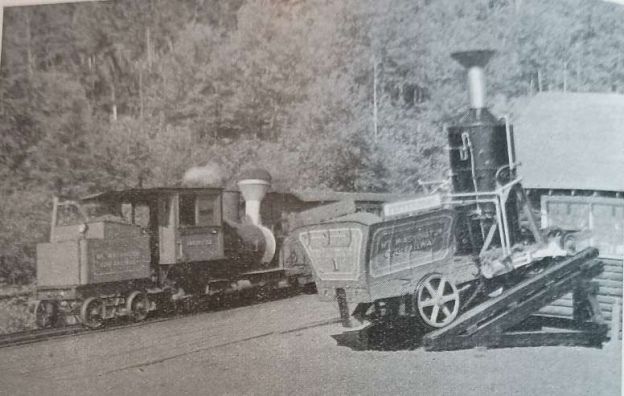
The featured image (above) shows original locomotive, ‘Old Peppersass’, exhibited at the base station of the railway. Locomotive No. 2, ‘Ammonoosuc’, is to the left of the image © R.F. Legget, Public Domain. [1: p788]
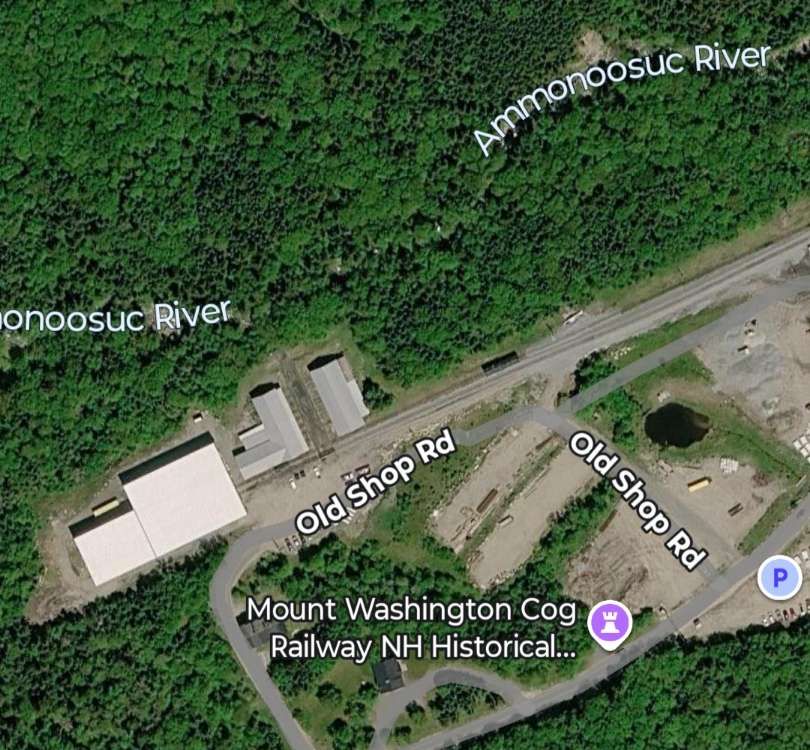
[Google Maps, April 2026]
The November 1954 edition of The Railway Magazine contained an article by Robert Legget about the Mount Washington Cog Railway in New Hampshire. He was surprised to find that in 1954 it was claiming to be ‘the first mountain climbing railway in the world’.
It is beyond doubt that it is among the pioneer mountain railways of the world, but the first?
Here (below) are a few of the lines highlighted by a number of different AI searches all of which included the words ‘mountain railway’ in the search parameters. They are all interesting examples of engineering developments over time. No claim is made that this is an all-inclusive list! And, looking at the lines highlighted, it seems the search term, ‘mountain railway‘ might have been interpreted quite widely! ….
- 1460: Reisszug (Austria) – a very early, steep funicular railway serving the Hohensalzburg Fortress. A wall for its protection was erected in 1461 and a source mentions it in 1515. [7][8]
- 16th Century: (Central Europe) – The earliest documented railways were steep wooden wagonways in mining areas. Georgius Agricola’s De Re Metallica (1556) illustrates “Hund” carts with unflanged wheels operating on wooden planks to move ore, often with vertical guide pins, used in hilly terrain. I am not convinced that this warrants inclusion as a ‘mountain railway‘. [9]
- 1604: Wollaton Wagonway (UK): One of the earliest British surface wagonways ran from Strelley to Wollaton. It operated over difficult terrain, utilizing wooden tracks to haul coal. Surely Nottinghamshire is not mountainous territory! [10]
- 1725: Tanfield Wagonway (UK) – Constructed to connect coal pits to the River Tyne, this was a massive engineering project for its time. It featured steep grades, early masonry bridges and substantial embankments, although I could not describe this as a ‘mountain railway‘. [13]
- 1764: Montresor’s Tramway (USA) – A gravity-powered railway, built by British engineers to navigate the steep terrain near Niagara Falls. Located in Lewiston, New York, it utilized wooden rails to transport supplies up the steep Niagara Escarpment. It is seen as one of North America’s first mechanized railways. [4]
- 1800-1880s: Welsh Narrow Gauge Railways (UK) – a significant range of narrow-gauge lines of which some at least were operated downhill by gravity and initially saw horses drawing wagons back uphill. Many later became steam-powered. [11][12]
- 1804: Penydarren Railway – I am not convinced that this qualifies as a mountain railway as it followed a river valley, but it featured in a number of different ‘mountain railway‘, searches on Google. More about this line can be found here [5] and here. [6]
- 1799-1805: Mount Vernon Tramway (USA) – A gravity railroad constructed in Boston to help lower a hill and fill in marshland. [4].
- 1809: Thomas Leiper’s Railway (USA) – A 60-foot test track in Pennsylvania, later expanded, which used wooden rails to manage a 1:24 gradient from a quarry. [4]
- 1827: Summit Hill & Mauch Chunk Railroad (USA) – this was a 9 mile long industrial mountain railway in Pennsylvania. It was a gravity railroad transporting coal, with wagons being returned to the top of the line by mules. A later railway operating on 3 ft 6 in (1,067 mm) gauge track, was laid on top of the original wagon road. The railway operated for more than half a century as a tourist attraction after it ceased day-to-day operations as a freight railroad in 1872. The onset of the Great Depression resulted in its eventual closure. [2]
- 1836: Whitby & Pickering Railway (UK) – A steep, horse-drawn line built to connect inland areas to the coast, featuring significant early engineering through difficult terrain, but not really a ‘mountain railway’. [14]
- 1848-54: Semmering Railway (Austria) – this was the first true mountain line. It conquered the Semmering Pass with 15 tunnels, 16 viaducts, and 100+ curved stone bridges, showing that locomotives could climb steep Alpine terrain. [3]
- 1868/9: Mount Washington Cog Railway (USA) – the world’s first mountain-climbing cog railway opened, in 1868 and reached its full length in 1869. [1]
- 1871: Vitznau-Rigi-Bahn (Switzerland): The first standard-gauge cog railway in Europe, opening up the Alps to passenger tourism. It runs from Vitznau on Lake Lucerne to the Rigi Kulm summit, offering 30-minute scenic rides with panoramic views of the Alps. It operates year-round and is owned by Rigi Railways. [15]
- 1892: Breinz-Rothorn Bahn (Switzerland): An early example of a rack-and-pinion line allowing steam locomotives to conquer high Alpine slopes. [16][17]
- 1896: Snowdon Mountain Railway (Wales): Utilizes the Abt rack system to climb toward the summit of Yr Wyddfa (Snowdon). [18]
- 1898: Gornergrat Bahn (Switzerland): One of the early electric mountain railways, operating from Zermatt (1,604m) to the Gornergrat summit (3,089m) in about 33 minutes. As Europe’s highest open-air cogwheel railway, it offers year-round panoramic views of the Matterhorn and 29 other 4,000-meter peaks. [19]
- 1899-1912: Jungfraubahn (Switzerland): Work began on this iconic railway, which famously tunnels through the Eiger mountain to reach the highest station in Europe. It connects Kleine Scheidegg to Jungfraujoch. “On 7th March 1899, ground was broken at Rostock station, which was operated only temporarily. … On 7th March 1899, workers at the head of the tunnel reached the intended site of the Eigerwand station. … It was 28th June 1903 before the Eigerwand station in the middle of the north face of the Eiger (2,865 m above sea level) could be officially opened. Passengers were subsequently able to enjoy a view towards Grindelwald from the terrace. Two years later, on 25th July 1905, it was possible to open the section to the stop at Eismeer, some 3,160 metres above sea level, providing guests with a stunning glacier view. … It was not until 1912 that the section to the Jungfraujoch, 3,454 metres above sea level, was completed – nine years later than originally planned. [20]
This limited survey of early ‘mountain railways‘ has done nothing to challenge an assertion that the Mount Washington Cog Railway was the first ‘cog’ railway in the world. However, it clearly was preceded by a number of railways operating by gravity (primarily goods lines) in mountainous areas. But the narrow gauge (4ft 8in) [56] Mount Washington Cog Railway has no rightful claim to being the first ‘mountain railway‘. The Semmering Railway in Austria, if not others, tackled mountainous terrain before the Mount Washington line.
The Mount Washington Cog Railway began operations in 1868 and was fully opened in 1869. It uses a Marsh rack system to climb a 37% grade. It is “Three-and-a-half miles long, it conveys passengers to the top of the highest peak in the Presidential Range of the White Mountains of New Hampshire. It has been in continuous operation since [1869], except only for one year during the first world war and for three years during the last war. In this long period it has operated without a fatality to a single passenger. … Mount Washington, rising to a height of 6,293 ft., is the highest peak in New England. It was given its name in July 1784, by the members of the first party to climb to its summit for scientific purposes; its first recorded ascent was in 1642. … A cabin was built on the summit in 1823. In 1852, a simple hotel was constructed on the north side of the peak. Twice rebuilt, following fires, it was the beginning of the group of structures which now surround the upper terminus of the cog railway.” [1: p786]
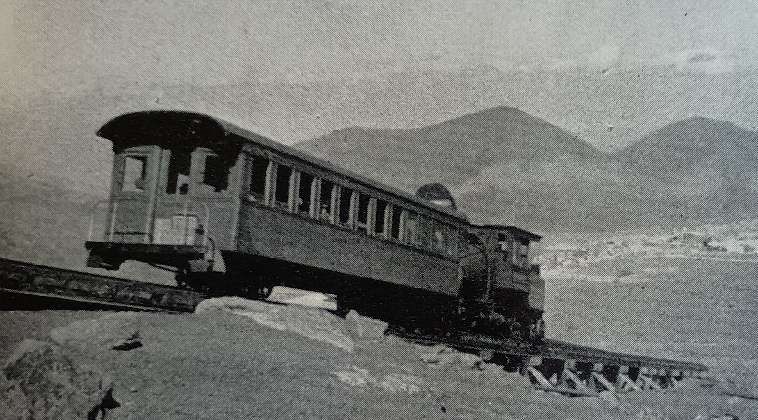
In 1858, industrialist and inventor Sylvester Marsh exhibited a model he thought suitable for climbing mountains “to the New Hampshire Legislature and applied for a charter to build mountain railways. … The charter was granted with permission to build railways to the tops of Mounts Washington and Lafayette.” [1: p787]
“The model engine (still preserved, in Concord, New Hampshire) was demonstrated, with about 20 ft. of inclined model track, in Marsh’s office in Boston for promoting the idea of the railway and in raising funds. It weighed 17 lb. and would push a load of 50 lb. up the track. It was fitted with Marsh’s patented ‘atmospheric brake’.” [1: p787]
Cog Railway Patents, Sylvester Marsh
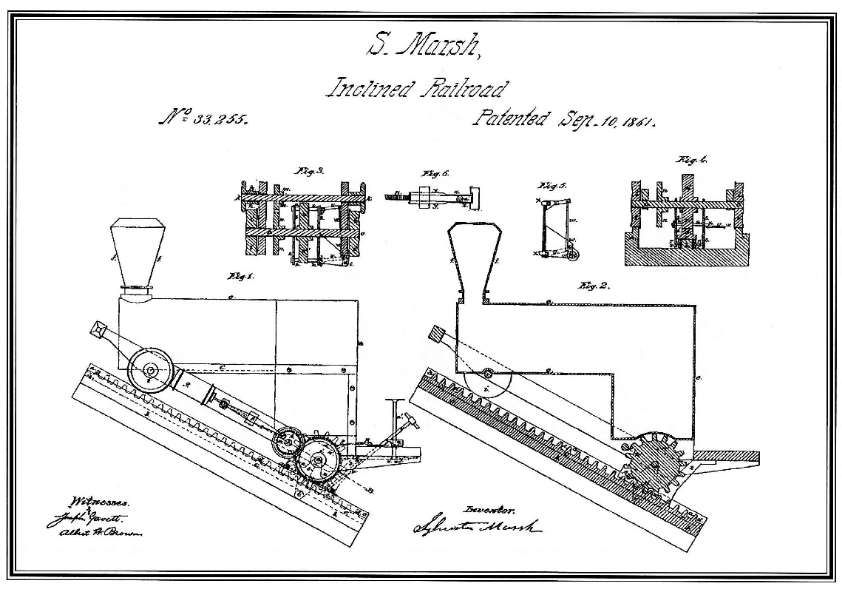
In 1858, picking up on an idea by John Blenkinsop in England twenty years before, Sylvester Marsh applied for US patents for a cog-driven inclined railway. His first patent is dated 10th September 1861, No. 33,255. [21][22]
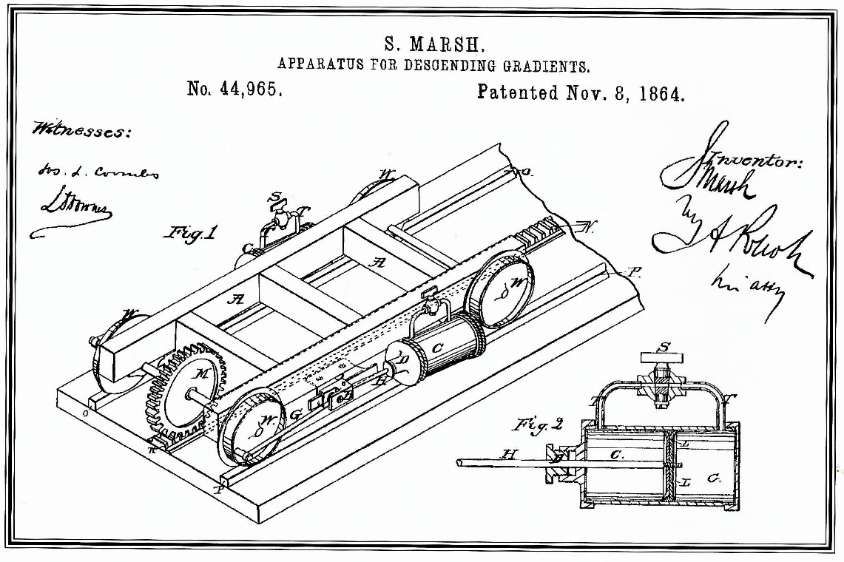
He later, in 1864, applied for and was granted a patent for “an ‘Apparatus for Descending Gradients’ an adjustable, frictionless brake that utilized compressed air to slow a train’s movement, while eliminating the wear and tear on a locomotive’s (and/or carriage’s) wheels.” [23] The patent was No. 44,965, granted on 8th November 1864.
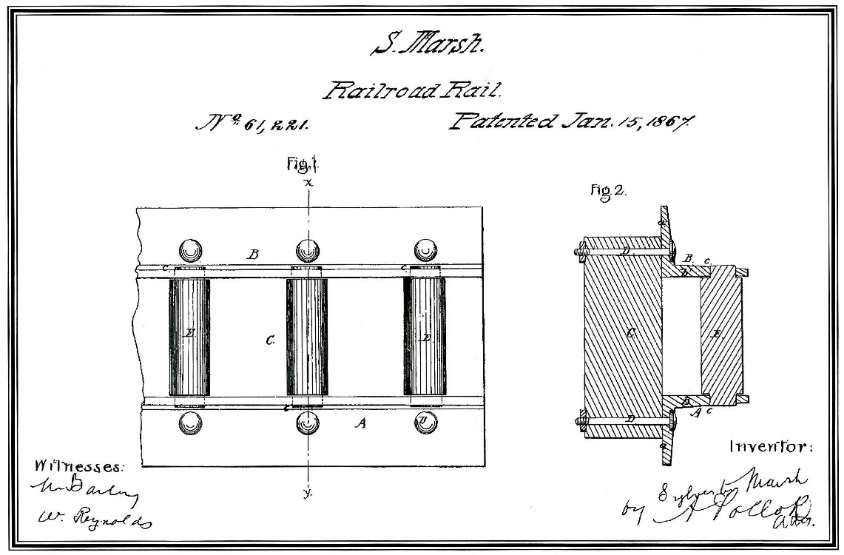
Later still Sylvester Marsh applied for and was granted a patent in January 1867 for “an enhanced design for the original cog rail. Marsh’s device was ‘open’ between the individual pins along the rack, and this allowed ice, snow, or dirt to fall through the spaces, rather than clog and potentially impede the works.” [23]
Construction of the Line
Legget tells us that “After failing to raise funds publicly, Marsh himself paid for the building of a full-scale locomotive and a section of experimental track on Cold Spring Hill, a shoulder of Mount Washington. There, on 29th August 1866, he gave a public demonstration of his idea, which was quite successful. One of these sections is the start of the railway as it exists today. … Following the demonstration of 1866, others came to share the promoter’s enthusiasm for his idea. A company was organised and, although he lost financial control of it, Marsh was elected its President. Construction started in May, 1867, and was completed as far as the foot of “Jacob’s Ladder” (now the steepest section) and formally opened on 14th August 1868. Work continued, and the railway was opened to the summit by July of the following year.” [1: p787]
Legget continues: “Much of the wood required for the construction was cut from the forest which covered the lower slopes of the mountain, using oxen for hauling, A tollroad had to be built to connect the outside world with the location chosen for the start of the railway, now called Marshfield. This was for long known as the Mount Washington Turnpike, but is now a public highway. Apart from the timber required for the trestle and ties, all other material had to be hauled over primitive roads from Littleton, 25 miles way, where was then located the nearest railway station.” [1: p789]
‘Old Peppersass’
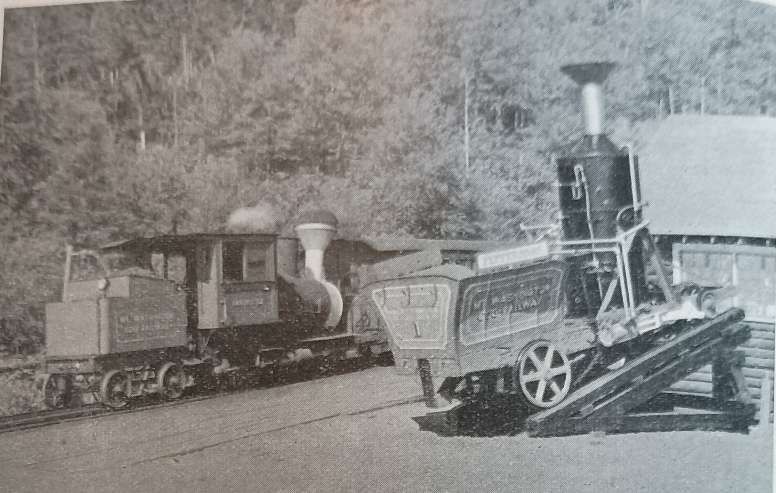
Old Peppersass (No.1 ‘Hero’), Marsh’s original locomotive for the line is plinthed at the base station. “The odd name comes from the resemblance to the type of pepper-sauce bottle used in American homes at the time of the opening. The vertical boiler gives the engine a most unusual appearance, but it operated satisfactorily for twelve years before being replaced by improved types. It cost only £3,000 to construct, and weighed 8 tons. After withdrawal from service, the old engine was shown at a number of exhibitions throughout the United States, and eventually passed into the keeping of the Baltimore & Ohio Railroad.” [1: p789]
Later, in July 1929, a refurbished ‘Old Peppersass’ was steamed again on a gala day, successfully chugging up the mountain again. Sadly on the descent, a tooth broke on one of the gear wheels. Legget tells us that this “caused the locomotive to jump from its normal position, contact was lost with the rack, and it started to rush down out of control. So quickly did it gather speed that the hand safety devices could not be applied fast enough. The driver told the other riders to jump off, but did not see a photographer who was hidden by the bunker. Why he did not jump off until much later will never be known, but it was too late when he did decide to leap, and he fell to his death. This unfortunate accident marred an otherwise perfect day, and is the only fatality which has occurred in ordinary operations on the railway.” [1: p789]
‘Devil’s Shingles’
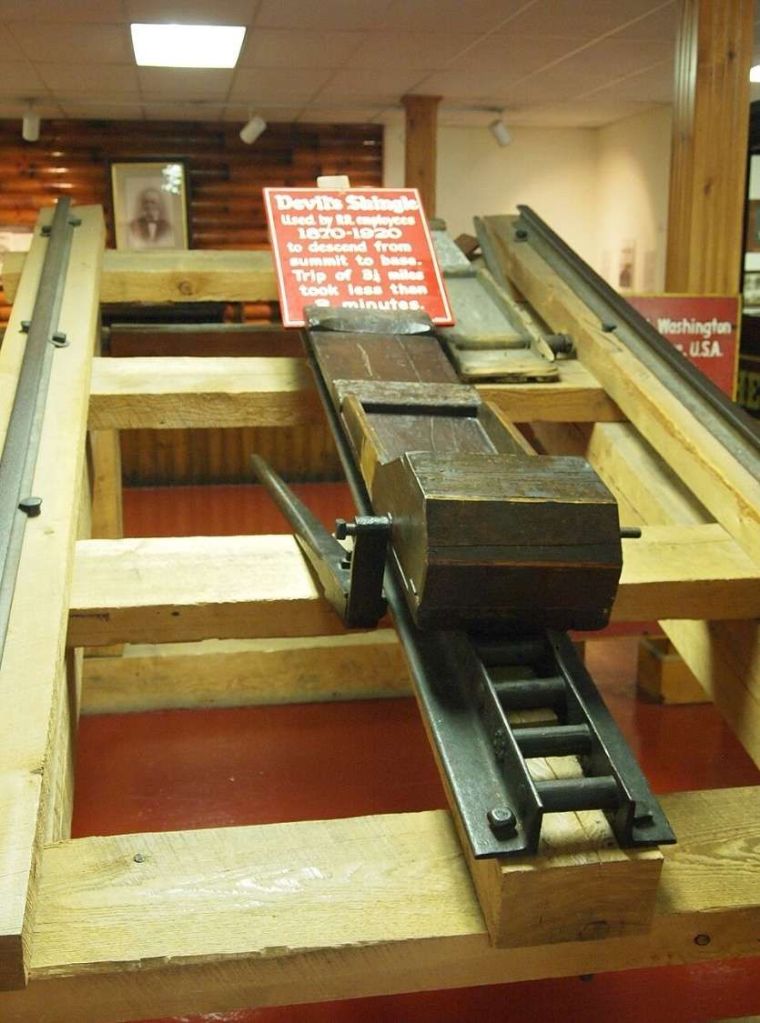
There was a dare-devil practice undertaken by employees of the railway which “must have been one of the most sensational rail journeys in history. This was achieved by riding on ‘slide-boards’ (or ‘Devil’s Shingles’) – wood and metal seats, measuring about three feet by one, which fitted over the rack rail, and were equipped with crude hand-actuated brakes. Seated on one of these contraptions, members of the track crew could save much time in descents. The record time for the 3.25-mile trip, from the summit to Base Station, was 2 min. 45 sec., which speaks for itself. Following the death of an employee and the serious injury of another, this unorthodox method of transport was banned.” [1: p789]
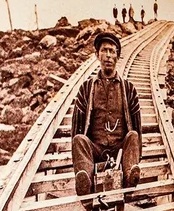
An employee of the railway is sitting posed on one of the slideboards (Devil’s Shingle) in an illustration on the wall of the railway museum at the Mount Washington Cog Railway. [31]
An example is on display in the museum and is shown in the photograph below.
A Journey Along the Line
The line was approached by a winding road from the nearest railway station, Bretton Woods, on the Maine Central Railroad line from Portland, Maine, to St. Johnsbury, Vermont.
That railway route is now closed and the journey to the Mount Washington Cog Railway has to be undertaken by road. Maine Central’s Mountain Division witnessed its last through freight between St. Johnsbury and Portland in September of 1983. The passenger service had already been suspended in 1960. [24][27]
West of the Marshfield base station the line extended a couple of hundred metres to serve workshops (where locomotives were serviced) and the timber coaling stage. Legget tells us that at the coaling stage, “coal, which [had] been delivered by motor lorry, [was] moved on to a simple wooden trestle by a light mobile scraper, which also dump[ed] the coal into the hoppers on the little locomotives.” [1: p790]
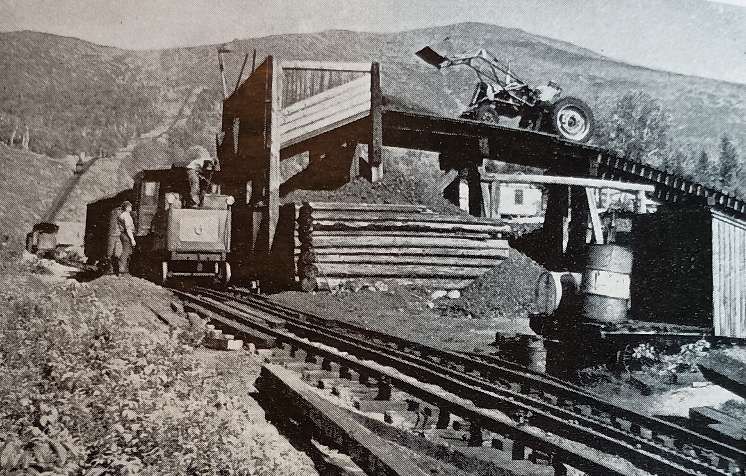
The original workshops remained in place for well over a century. A series of photographs appear below. …
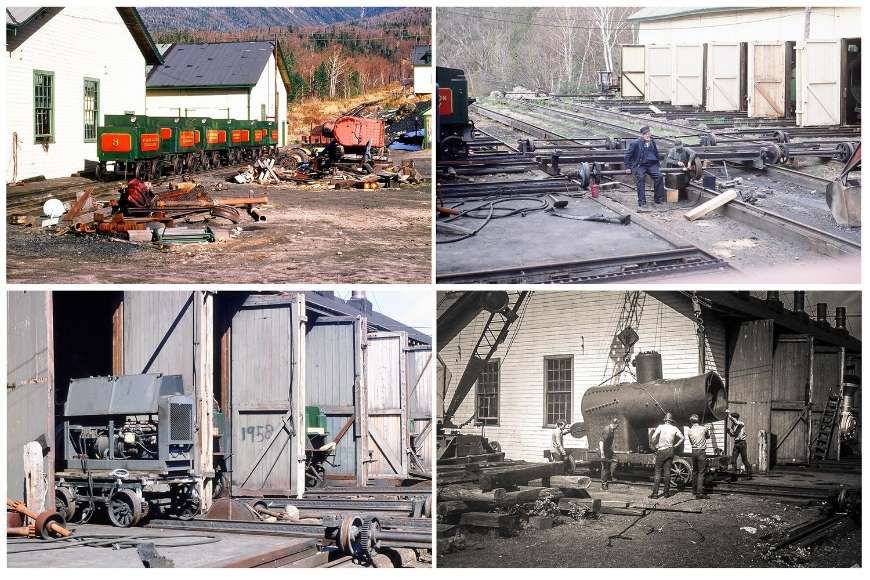
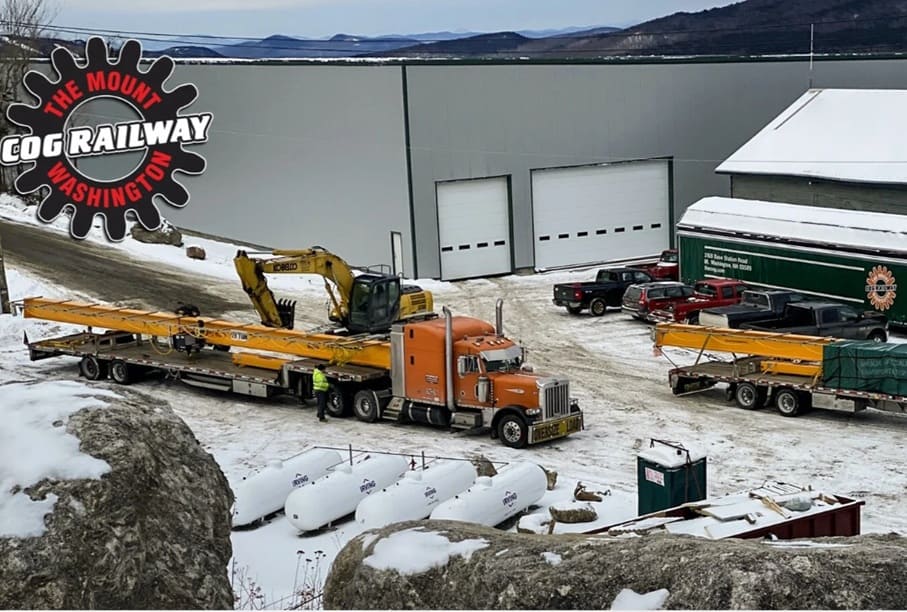
In the spring of 2020, ground was broken for a new, 35000 sq.ft. state-of-the-art workshop facility, located just below the old engine shop. The building was opened in 2021 and is large enough to accommodate: the railway’s entire fleet, 7 biodiesel locomotives, 2 steamers, … 9 passenger coaches; track maintenance equipment; and space to undertake servicing indoors, on-site, over the long winter. Dual overhead cranes facilitate heavy repair and fabrication work, and locomotives can be pushed around the shop floor by hand on air casters, [30] maximizing floor space and eliminating the need for fixed tracks inside the building! [29]
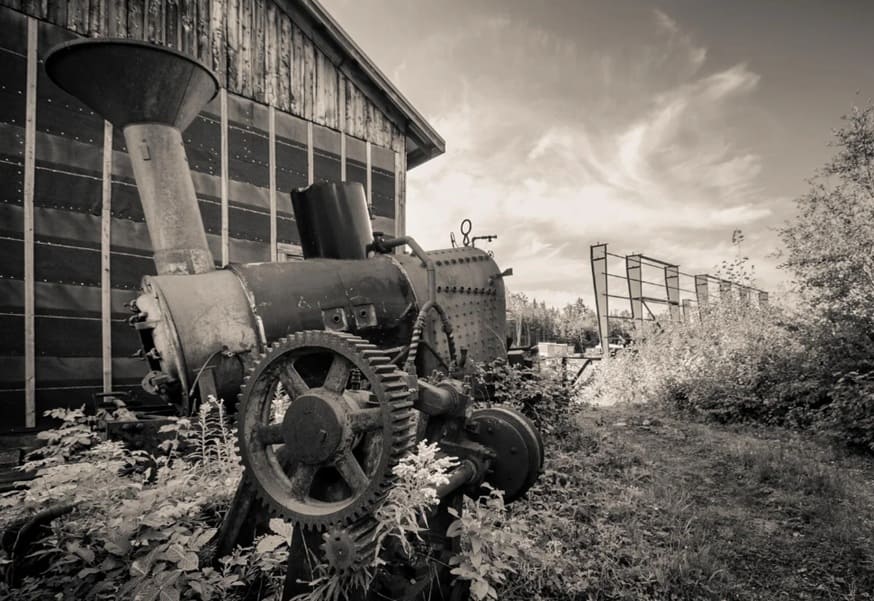
Heading Northeast along the line, in a couple of hundred meters the line enters Marshfield Base Station.
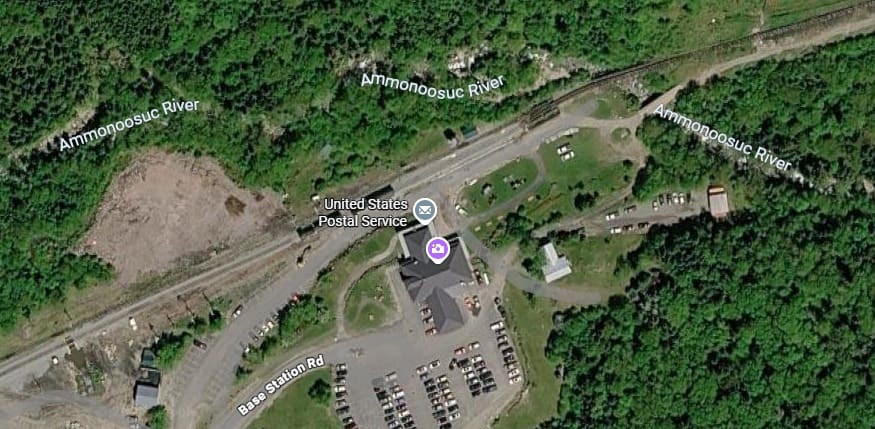
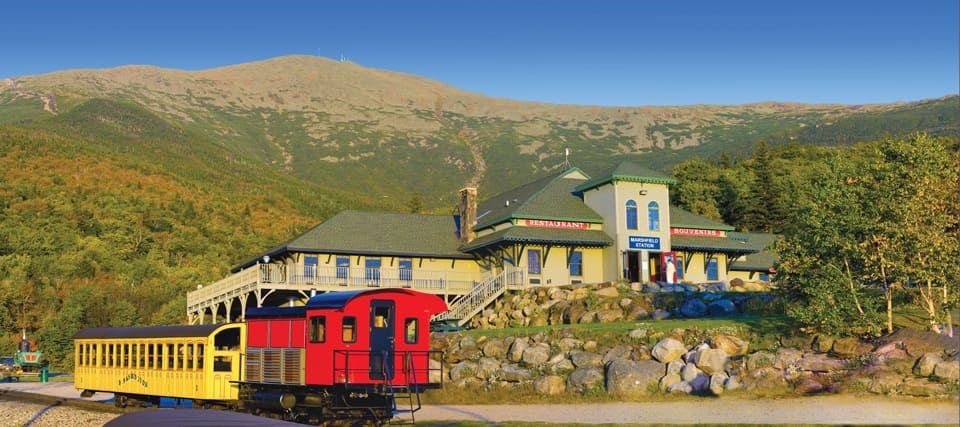
Each train consists of a locomotive pushing a single carriage. The locomotives are designed to handle steep gradients which means that, at rest on the level, their sloping boilers look a little odd.
The cog boilers are mounted at an angle of 25%. This is the average grade of the line. When they are on the steepest section of line (Jacobs ladder) they are at 37 %. There is a flat section at the workshops. An explanation of how the water levels were managed with the different gradients can be found here. [28]
Just beyond Base Station, the Ammonoosuc River is crossed on a simple trestle bridge. After rounding a slight curve a straight stretch of about a mile lies ahead, at the end of which the train will stop for water at the Waumbek tank.
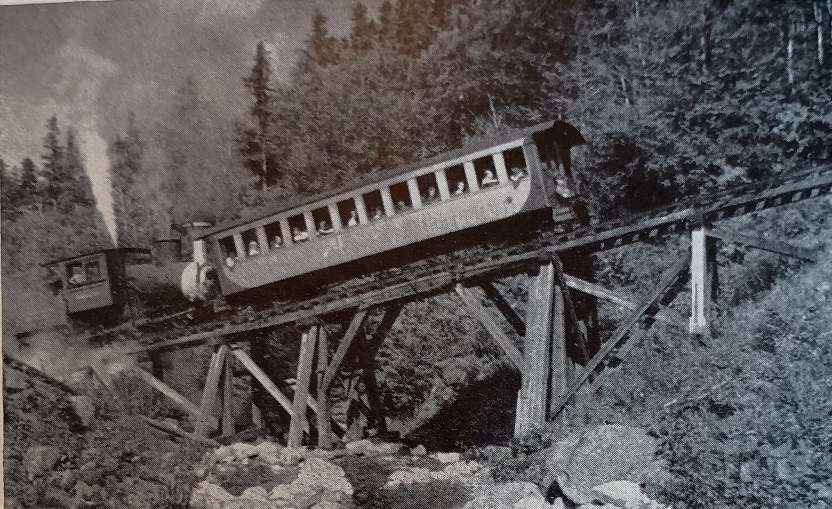
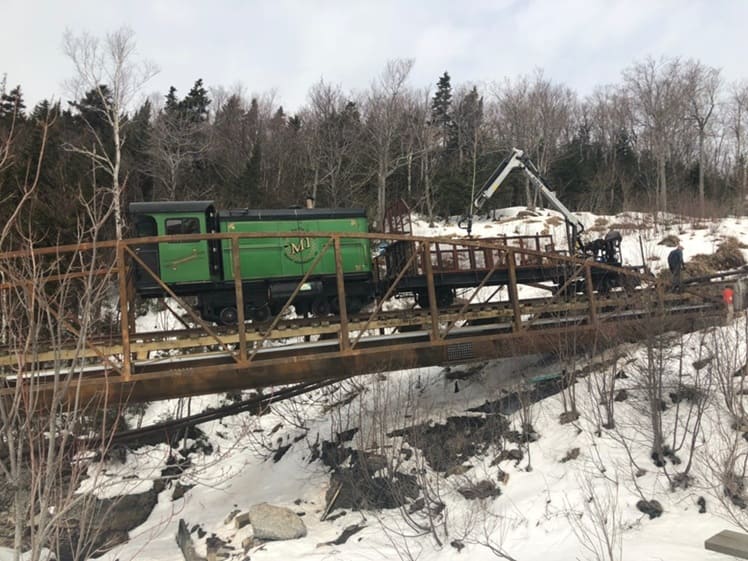
In the autumn of 2017, the railway’s season ended early when flood damage occurred to the old trestle bridge over the Ammonoosuc River. A replacement bridge was ordered on 15th December and installation was completed on 6th March 2018. The bridge, sporting faux trusses, was designed and built off-site by Big R Bridge, based in Greeley, Colorado. It was delivered by truck and set in place by Cote Crane of Auburn, ME. After delivery it only took 3.5 days to assemble and install the bridge. The new bridge spans 107 ft.
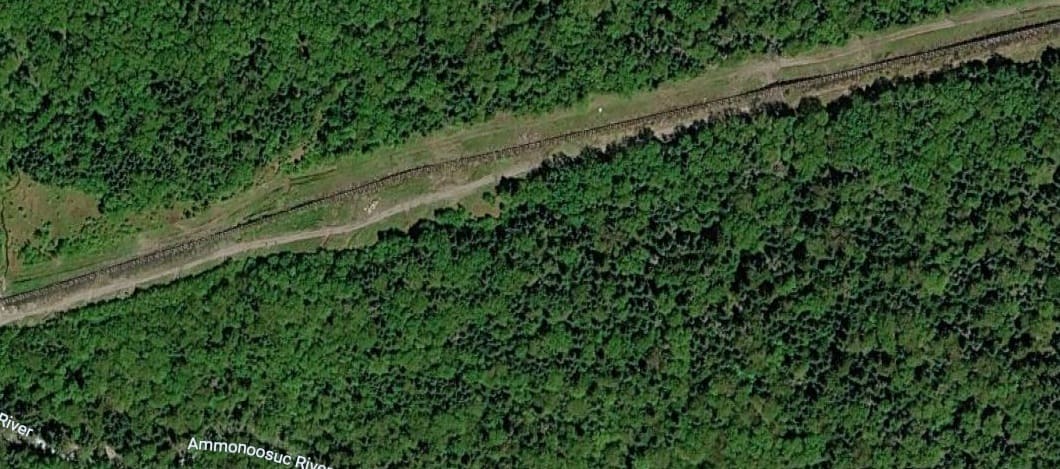
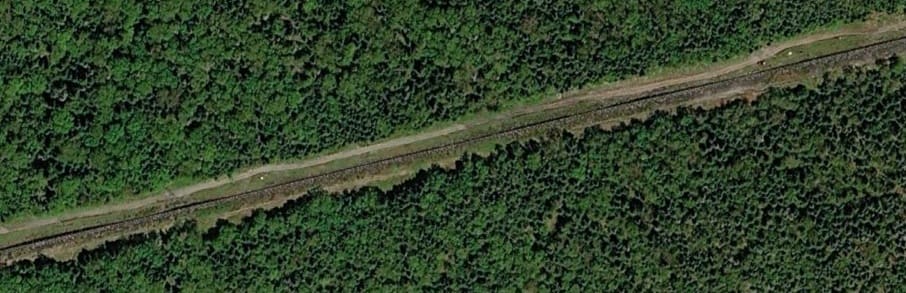
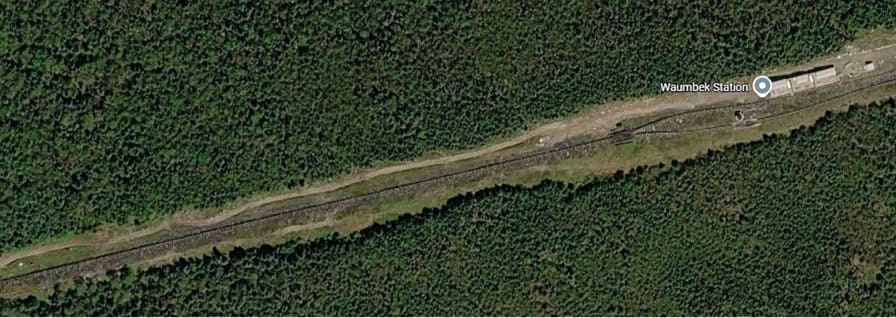
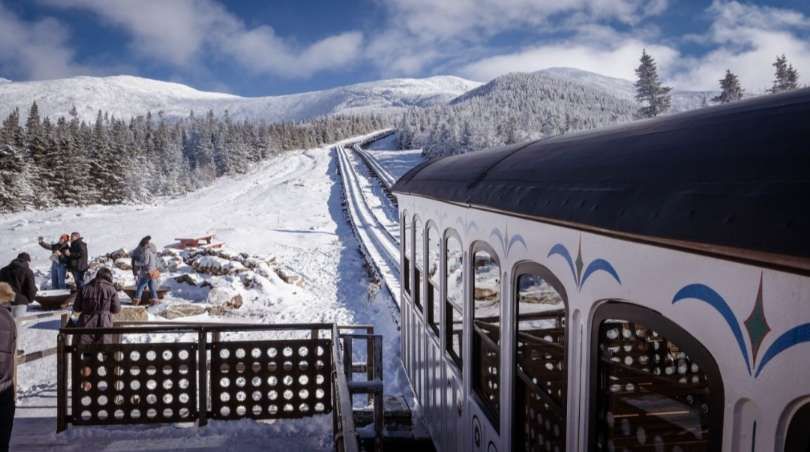
Waumbek Station is a winter destination on the Railway, located at 4,000 feet in an alpine meadow, serving as the terminus of the railway from November to early May. The 1-hour round trip features heated coaches, a 25-minute stop with elevated viewing decks, fire pits, and hot drinks, offering scenic views below the inhospitable summit. [33]
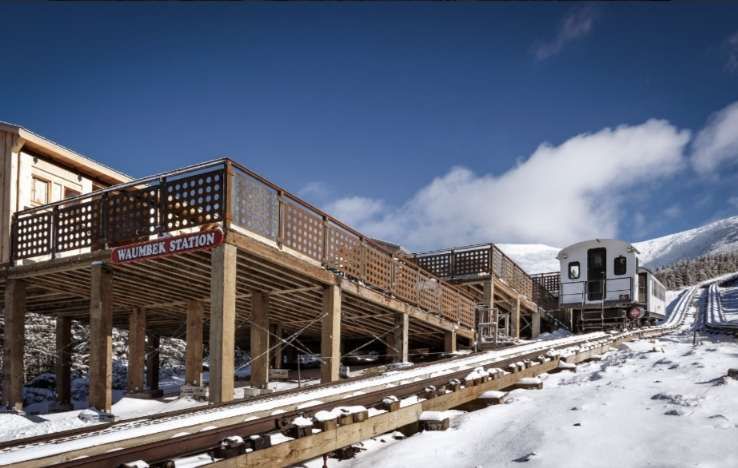
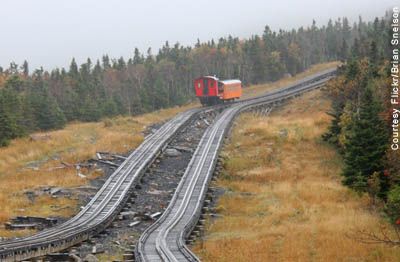
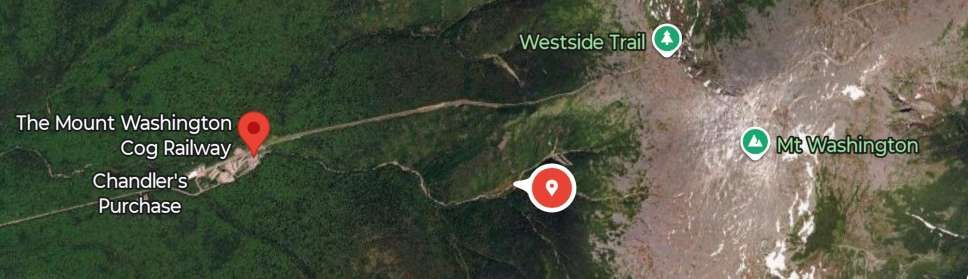
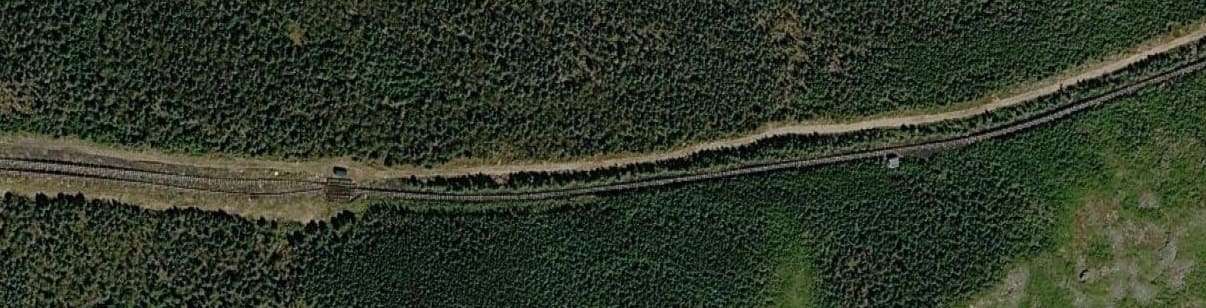
This image shows the view up towards the summit from Waumbek Station on a damp day in the summer. Just to the West of Waumbek Station the single line from the base Station becomes two lines running in parallel. The point at which this occurs can be seen on the left of the satellite image immediately below. [36]

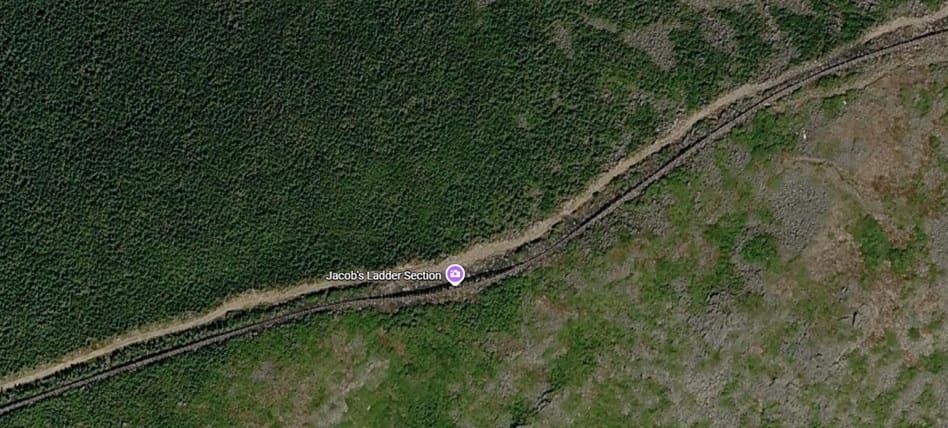
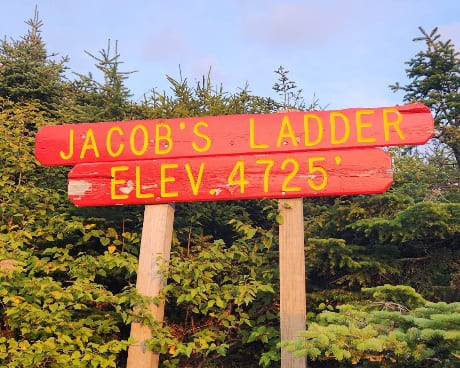
“Marsh’s chosen route for the railway “closely followed a trail blazed nearly 50 years earlier by a young settler named Ethan Allen Crawford. At 4725’, track crews faced the daunting challenge of building a left-curving high trestle to span a boulder strewn gap. Crawford referred to this part of the mountain as ‘Jacob’s Ladder’, and the ambitious new structure would become its namesake.” [38]
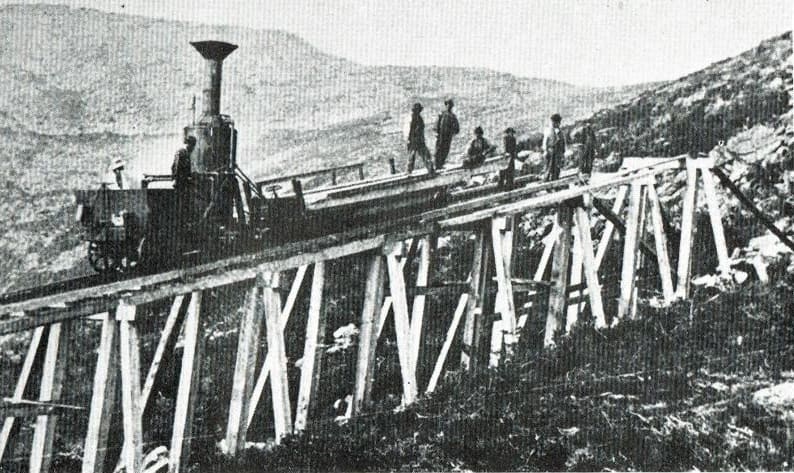
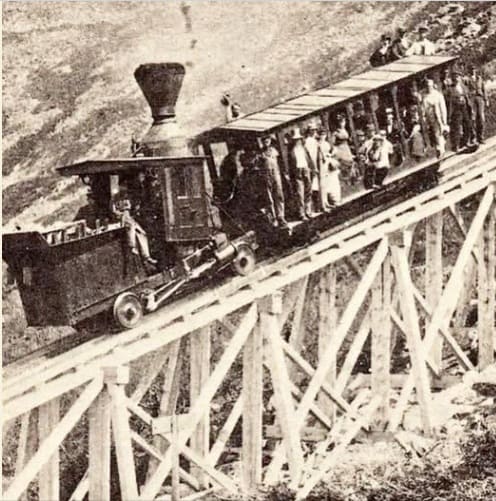
A later view of the trestle in service with a well-loaded passenger coach. This image was shared on THE RAILWAY TO THE MOON! The Mt Washington Cog RY (NH)& Alumni Facebook Group by Chuck Killian on 1st July 2025, (c) Public Domain. [43]

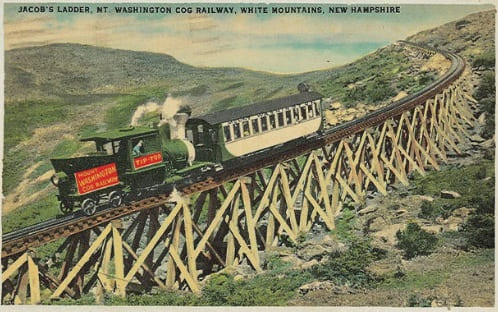
“At nearly 300’ long, 25’ above the surface of the mountain, and ascending at a 37.41% grade, [this trestle] would eventually enter the record books as the steepest and second highest railroad trestle in the world, and by far the steepest portion of Marsh’s railway.” [38]
The marker board in August 2025, (c) Kelton Ricker and shared on Google Maps. [Google Maps, April 2025]
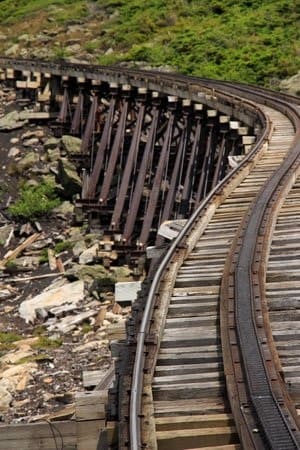
Jacob’s Ladder trestle seen looking East up the gradient towards the summit of the railway line. Of all the images of the trestle in this article, this, perhaps, gives the best impression of the gradient and curve of the line over the trestle. [41]
Legget says: “More water can be taken on at the Gulf tanks, which are at an elevation of 5,800 ft. above sea level. (Marshfield is 2,700.) Before this has come the quite awe-inspiring climb of Jacob’s Ladder: the trestle is perched seemingly on the edge of a steeply-sloping rocky hillside, the line curving out of sight sharply to the right at the upper end, thus adding greatly to the unusual experience of riding this part of the line.” !: p790]
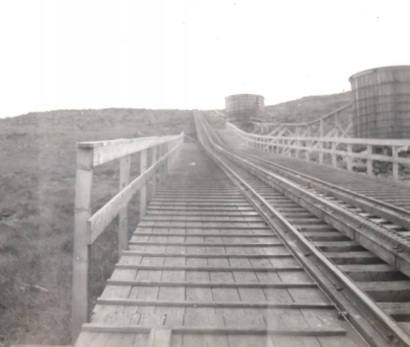
Gulf Tanks – the second watering place on the climb – this photograph was taken in August 1937. It was shared on THE RAILWAY TO THE MOON! The Mt Washington Cog RY (NH)& Alumni Facebook Group by Conrad Ekstrom on 31st August 2024, (c) Public Domain. Note the trough bringing water to the nearest tank in the photograph and the impression that water in the trough will be running uphill! It is the steepness of the gradient of the railway which gives this impression. [44]
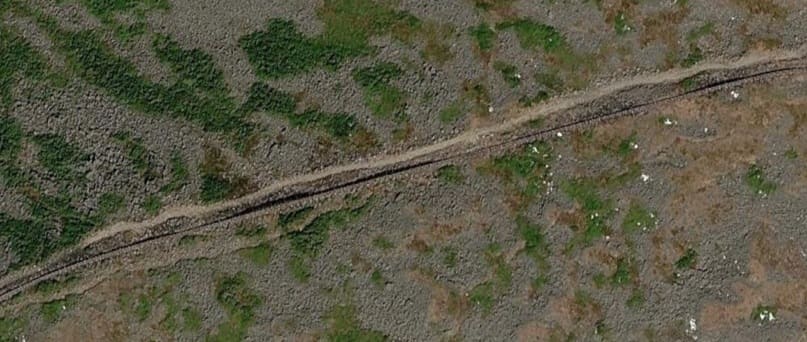
For a photograph of the trestle please click here. [43]
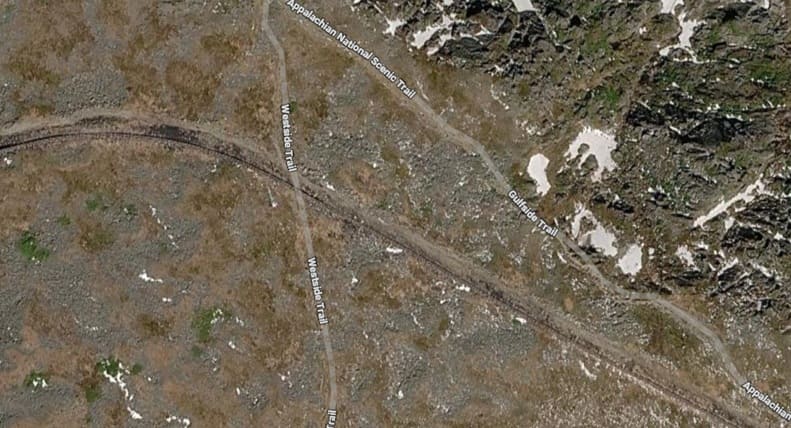
[Google Maps, April 2026]
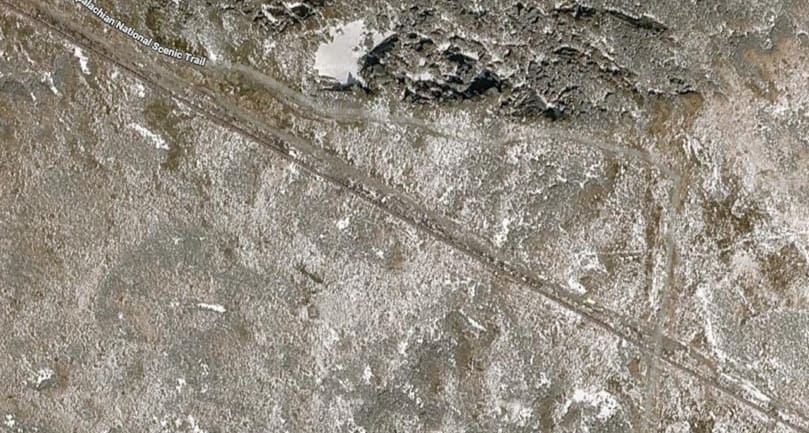
[Google Maps, April 2026]
Legget continues: “The tree line has now been passed and the surface has become rocky with a remarkable scattering of Arctic plant life. Almost two hundred species of Sub-Arctic and Arctic plants have been identified on the mountain.” [1: p790]
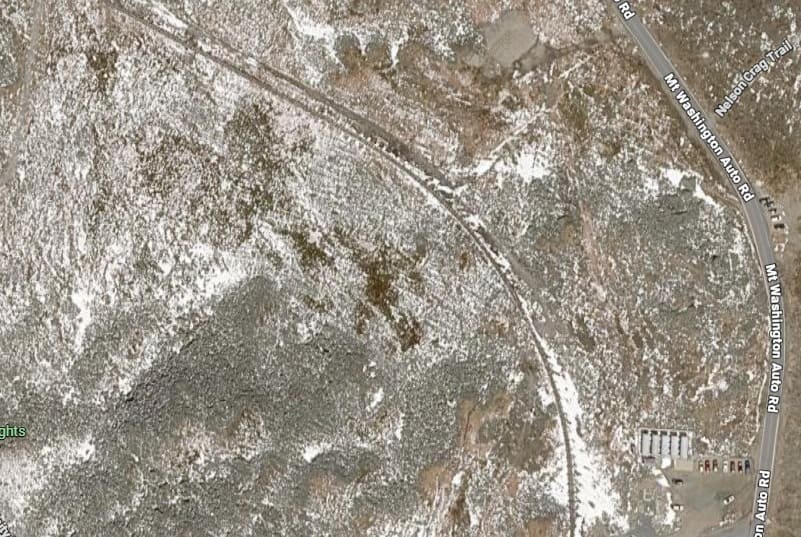
[Google Maps, April 2026]
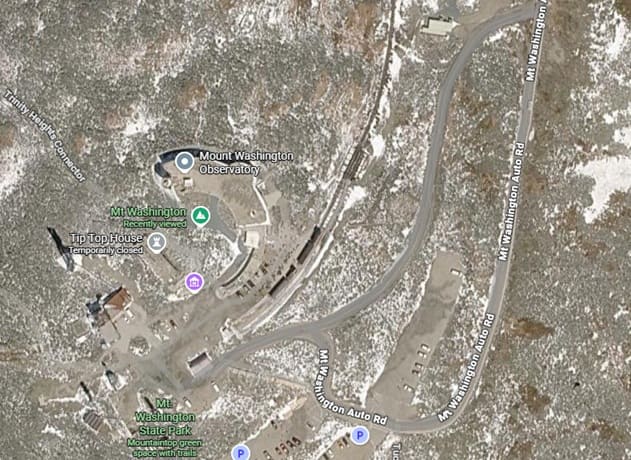
[Google Maps, April 2026]
Legget, writing in 1954, continues: “The line curves quite considerably, finishing in almost a semi-circle as Summit Station is approached. At the top, the railway now maintains the famous Summit House, at which it is possible to stay overnight. A special observatory building is located here also, and it is now occupied throughout the winter, despite weather conditions which include winds up to velocities of 230 mph. Weather observations were started in 1870, and the top of Mount Washington has been well-known in meteorological circles since that time. Military installations have been added in recent years.” [1: p790]
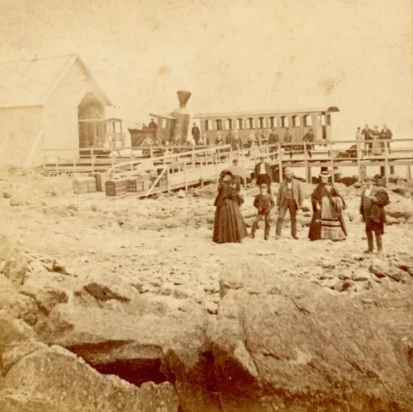
The arrival of a train at the first summit station, circa 1872-1873, (c)Public Domain. This image was shared on THE RAILWAY TO THE MOON! The Mt Washington Cog RY (NH)& Alumni Facebook Group by Conrad Ekstrom on 3rd August 2024, (c) Public Domain. [42]
Trackwork
In 1954, the track consisted of relatively light running rails spiked and bolted to cross-ties, with a central steel rack securely bolted to the ties by steel angles. The line was single throughout, but passing spurs were provided at the water tanks. This arrangement no longer applies. As we have already seen, a relatively long dual track section has been provided which begins before (West of) Waumbek Station and continues some distance towards the summit of the line.
Initially, there was no way for two trains to pass one another on the line. In 1941, a nine-motion switch was invented, and two spur sidings were added, each long enough to divert two descending trains so that climbing trains could continue to the summit, enabling more round trips per day. [55]
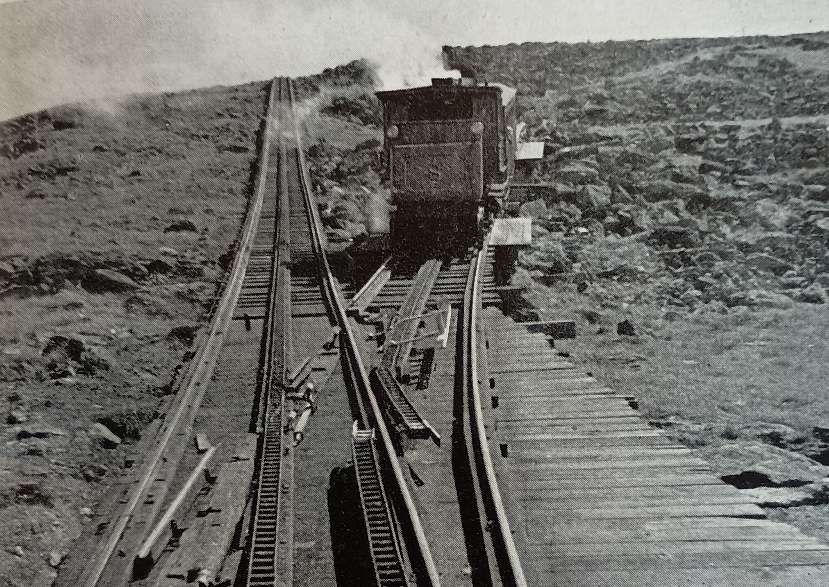
Leggit tells us that in 1954 on busy summer days as many as six trains may be on the mountain at once. The points (switches) were remarkable. To access each of the spurs required “the movement of seven pieces of rail and the operation of two levers. The points/switches are changed by the brakemen and firemen on each train.” [1: p791] One of these spurs and its point-work are illustrated in the monochrome image immediately above.
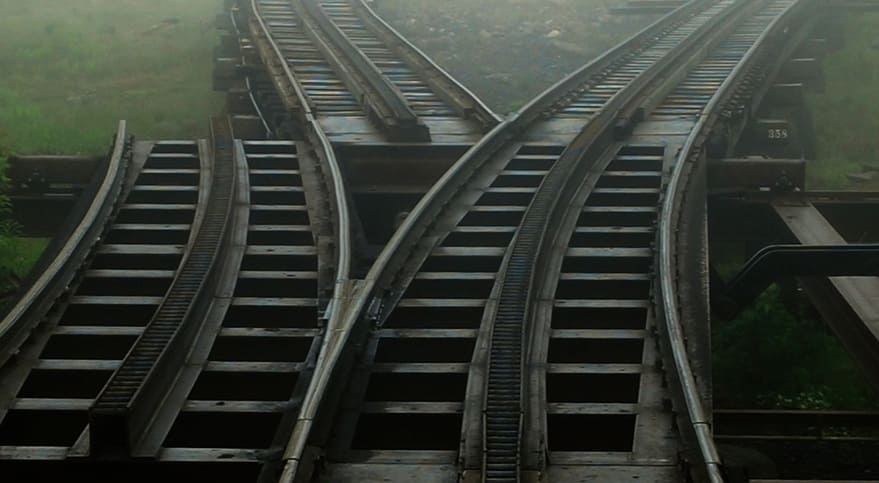
Much later, the two spurs were replaced by an extended passing loop. As late as 2004, work was completed replacing the lower Waumbek Switch and Siding with an 1,800-foot (550 m) passing loop equipped with electric and hydraulically powered automated switches. These switches are powered by batteries and recharged by solar panels. One switch is located at each end of the loop, allowing ascending and descending trains to pass one another. The mechanism slides a curved section of track into position to suit the intended traffic movement. [55]
Locomotives
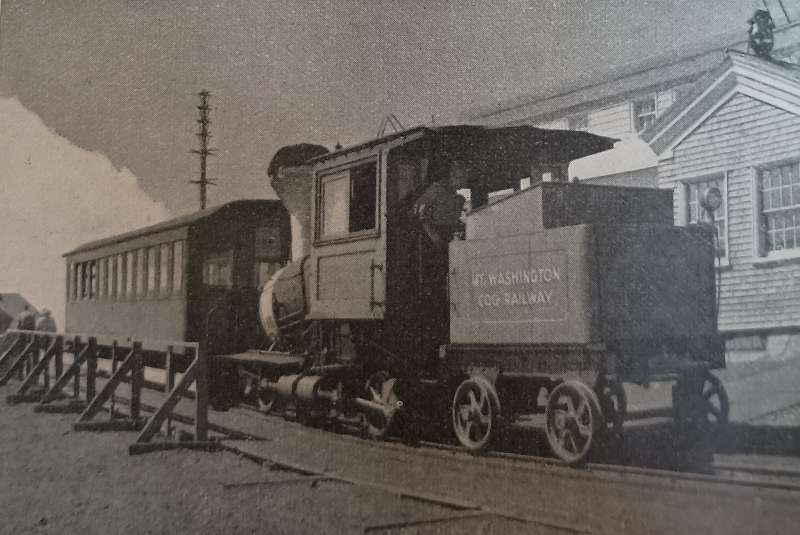
In 1954, Leggit tells us that “the locomotives were simple and ancient, yet relatively efficient and undoubtedly safe, … most [had] worked this line for well over half-a-century the newest [was] 45 years old! They [could not] be described by any conventional wheel arrangement, as all [had] two pairs of cylinders, each pair operating independently of the other on to its own cog wheel. There [were] also control cog wheels on the passenger cars, and large friction wheels which provide safe and sure braking such that the cars [could] be stopped independently of the locomotives.” [1: p791]
Leggit noted that “four separate braking devices [were] in use during the descent. It [was] sometimes possible to see the locomotive and car descending separately if the brake operator in the car [used] his brakes a little too severely. This [was] unusual, however, so skilled [had] the operating staff become with their simple equipment.” [1: p791]
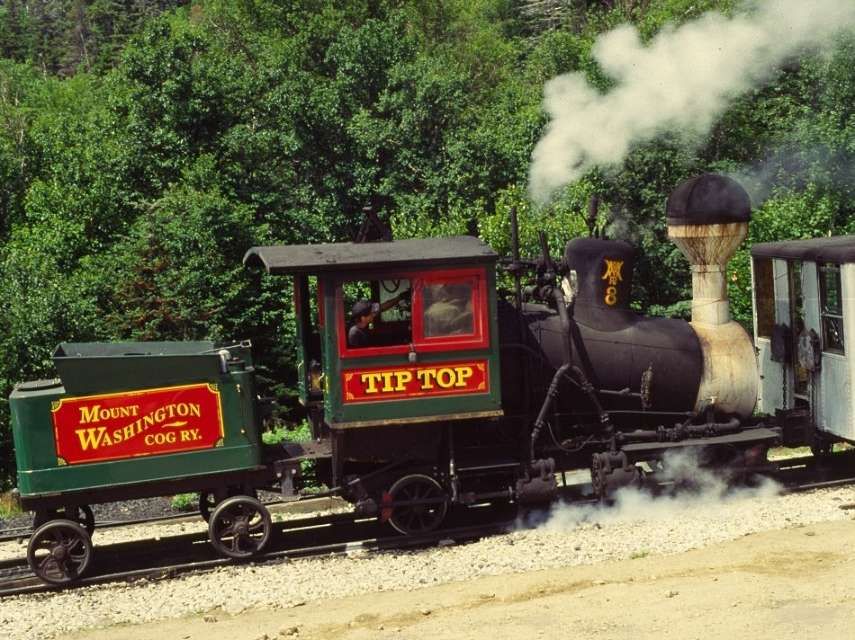
“Seven locomotives [were] regularly in use during summer months, and on a busy day all [were] in steam. An average of 35,000 passengers [was] carried each year. The engines all [carried] names, each with some local connotation: Nos. 1, Mount Washington; 2, Ammonoosuc; 3, Base Station; 4, Summit; 6, Great Gulf; 8, Tip Top; and 9, Waumbek. They [were] maintained in spotless condition, and consume[d] about 1,000 gal. of water and one ton of coal on each ascent, for which a schedule of 70 min, is allowed.” [1: p791]
[52]
Speed was not important! Leggit says that “on one famous occasion, an employee of the railway managed to climb from Base Station to Summit in less time than the train.” [1: p797]
The locomotive fleet has changed since 1954!
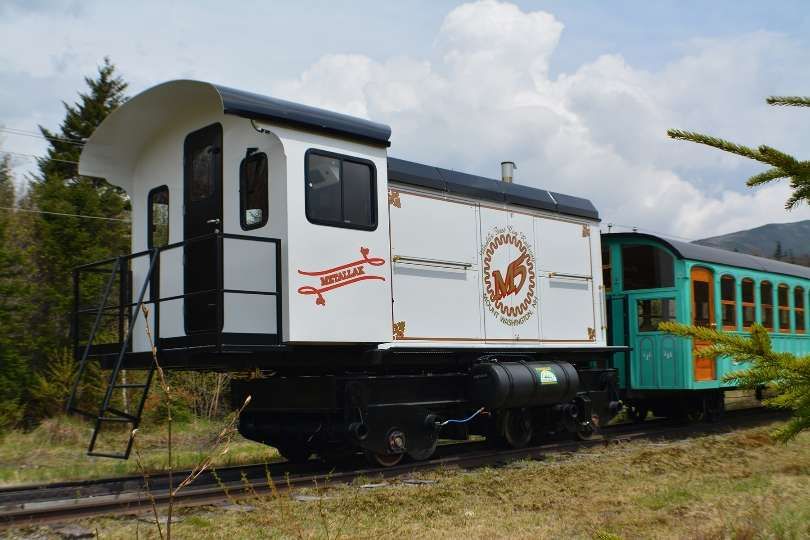
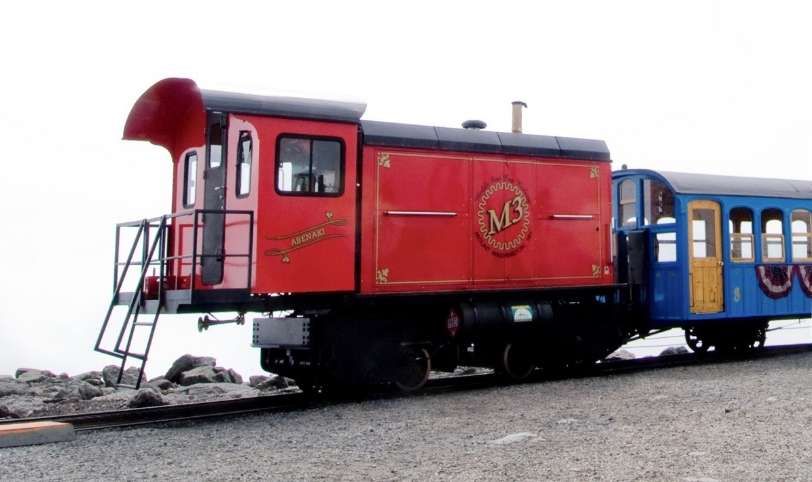
The Mount Washington Cog Railway now operates with a mix of classic steam and modern biodiesel locomotives.
From 1868 until 2008, the line was a steam railroad. While it was primarily designed to build the railway, Old Peppersass saw passenger service until it was retired in 1878. More locomotives were added over time, wood-fired engines gave way to coal-fired locos, vertical boilers were exchanged for more conventional horizontal ones (albeit tilted significantly to compensate for the steep gradients on the line.
A quarter of the way through the 21st century, the line retains two steam locomotives “(both manufactured in New Hampshire at the Manchester Locomotive Works): … MW2 (Ammonoosuc) built in 1875; and MW9 (Waumbek), built in 1908.” [46] Maintenance work over the years probably means that virtually none of the original mechanical components have been retained. “But in essence, these treasures of 19th century technological wizardry look and feel every bit as authentic as the day they were first fired.” [46]
While the line is committed to maintaining MW2 and MW9 in tip-top operating condition for as long as possible, the steamers needed some help. In 2008, that help arrived in the form of biodiesel locomotive No. M1.
The loco was designed and built in-house at a cost of $750,000. Its successful introduction heralded the start of production of further locomotives. On average, the workshop has produced “one new locomotive every 18 months. In 2019, [it] completed construction of M7, [the] seventh biodiesel locomotive.” [47]
“Each of these robust machines is powered by a 600hp John Deere marine engine governed by a computerized operating system. Hydraulic pressure delivers a maximum of 30,000 ft-lbs. of torque to each of two drive cogs beneath the locomotive, pulling the train up the mountain. A redundant air brake system ensures positive braking and parking when needed, but in normal operations, hydraulic pressure is also used to bring the train back down to Marshfield Base Station.” [47]
These new machines are “More economical, easier to maintain and environmentally friendlier, it takes anywhere from 18-22 gallons of biodiesel fuel to complete the nearly 7 mile round trip. By comparison, our steam locomotives consume 1000 gallons of water and a ton of coal to make the same trip.” [47]
Construction of M8 is already underway.
But there is a little more to the story than what appears on the line’s website …
The full story of the development work undertaken to use biodiesel in the steam locomotives can be found here. [48]
In essence, No. 9 Waumbek became an experimental locomotive. …
“Mount Washington No. 9 ‘Waumbek’, affectionately referred to as Vicki (as in victim!) [became] the first steam railway locomotive in the world fired on biodiesel, thus becoming effectively carbon neutral.” [48]
It was a matter of embracing a significant “jump in technology … to go from a ‘normal’ type of coal burning loco to a modern design of liquid fuel burner. … The Mount Washington line [had] previously, unsuccessfully, experimented with liquid fuels showing how difficult it can be to make a liquid fuel system work effectively on steam locomotives. … The extremely high combustion rates required to match the demand for steam, [were a problem.] … For locomotives of this size the evaporative rates are somewhat higher than for adhesion locomotives. A combustion system to match these requirements in the small volume firebox needs to be very carefully designed if it is to burn cleanly and without waste, if it can meet the requirements at all. In practical terms the system has to be better than any other conventional system.” [48]
By May 2006, No.9, still on test, could set off smokelessly and smoke free combustion continued to the summit of the line.
Ultimately, however, a change of direction brought about the production of the line’s own bespoke biodiesel locomotives and Waumbek was returned to tradition coal firing. The video below is a montage made up of short lengths of film of the biodiesel locomotives in action: [49]
And finally, a video about the railway: [35]
References
- Robert F. Legget; The Mount Washington Cog Railway; in The Railway Magazine, November 1954, Tothill Press, London, 1954, p786-791, 797.
- https://en.wikipedia.org/wiki/Mauch_Chunk_Switchback_Railway, accessed on 10th April 2026.
- https://www.britannica.com/place/Semmering#ref208770, accessed on 10th April 2026.
- https://en.wikipedia.org/wiki/Oldest_railroads_in_North_America, accessed on 10th April 2026.
- https://rogerfarnworth.com/2019/02/02/the-penydarren-tramroad-south-wales-part-1
- https://rogerfarnworth.com/2019/02/06/the-penydarren-tramroad-south-wales-part-2
- https://en.wikipedia.org/wiki/Reisszug, accessed on 10th April 2026.
- https://www.funimag.com/funimag10/RESZUG01.HTM, accessed on 10th April 2026.
- https://www.gutenberg.org/files/38015/38015-h/38015-h.htm, accessed on 10th April 2026.
- https://en.wikipedia.org/wiki/Wollaton_Wagonway, accessed on 10th April 2026.
- https://en.wikipedia.org/wiki/British_narrow-gauge_slate_railways, accessed on 11th April 2026.
- https://en.wikipedia.org/wiki/List_of_tramroads_in_South_Wales, accessed on 11th April 2026.
- Rob Langham; Tanfield Waggonway; Amberley Publishing, Stroud, Gloucestershire, 2025.
- https://en.wikipedia.org/wiki/Whitby_and_Pickering_Railway, accessed on 12th April 2026.
- https://www.rigi.ch/en/experience/mountain-railways/cogwheel-train-vitznau-rigi-kulm, accessed on 12th April 2026.
- https://www.erih.net/i-want-to-go-there/site/brienz-rothorn-bahn, accessed on 12th April 2026.
- https://rogerfarnworth.com/2018/04/11/the-brienz-rothorn-bahn-switzerland
- https://snowdonrailway.co.uk, accessed on 12th April 2026.
- https://en.wikipedia.org/wiki/Gornergrat_Railway, accessed on 12th April 2026.
- https://www.jungfrau.ch/en-gb/corporate/jungfrau-railways/jungfraubahn-holding-ag/jungfraubahn-ag, accessed on 12th April 2026.
- https://progress-is-fine.blogspot.com/2022/11/cog-railway-patents-sylvester-marsh.html?m=1, accessed on 12th April 2026.
- https://patents.google.com/patent/US33255A/en, accessed on 12th April 2026.
- https://www.facebook.com/share/p/18oSH6sGvx, accessed on 12th April 2026.
- https://www.american-rails.com/mec.html?fbclid=IwdGRjcARId-RjbGNrBEh29WV4dG4DYWVtAjExAHNydGMGYXBwX2lkDDM1MDY4NTUzMTcyOAABHlao02zs7lFsfQakqbiCDXmFJ9xZaC4a_IwL-cUUE5d_IG-Cyr-IY-KMiANY_aem_F4baQNiKIjtbSiI7ffD4og, accessed on 12th April 2026.
- https://commons.wikimedia.org/wiki/File:%22Devil%27s_shingle%22_slideboard.JPG, accessed on 12th April 2026.
- https://hawkinsrails.net/preservation/cog/cog.htm, accessed on 12th April 2026.
- https://digitalcommons.library.umaine.edu/etd/3543, accessed on 12th April 2026.
- https://www.rypn.org/forums/viewtopic.php?f=1&t=36722, accessed on 12th April 2026.
- https://www.thecog.com/marshfield-shop-update, accessed on 12th April 2026.
- https://en.wikipedia.org/wiki/Air_caster, accessed on 12th April 2026. An air caster is a pneumatic lifting device used to move heavy loads on flat, non-porous surfaces. Its operation is similar to a hovercraft, as it uses a thin layer of air as a way to float a very small distance off the ground. Compressed air enters an airbag shaped like a torus, and when the bag is filled it creates an airtight seal with the ground, and forces more air into the center of the torus, eventually causing the air to flow over the bag and to raise the load above the ground.
- https://www.thecog.com/marshfield-base-station, accessed on 13th April 2026.
- https://indepthnh.org/2018/04/10/mount-washington-cog-railway-unveils-new-base-bridge-with-april-21-opening, accessed on 13th April 2026.
- https://www.thecog.com/the-cog-in-winter, accessed on 13th April 2026.
- https://westernwhitemtns.com/project/mount-washington-cog-railway, accessed on 13th April 2026.
- https://youtu.be/SrlQM-PyYqM?si=yDJIDT5JESG9Jywu, accessed on 13th April 2026.
- https://www.asce.org/about-civil-engineering/history-and-heritage/historic-landmarks/mount-washington-cog-railway, accessed on 13th April 2026.
- https://mountwashington.org/the-cog-railway, accessed on 13th April 2026.
- https://www.thecog.com/jacobs-ladder, accessed on 14th April 2026.
- https://www.unionleader.com/nh/travel/top_10_things/mt-washington-cog-railway-celebrates-150th-anniversary/article_d83363e6-05b4-5e3e-9683-56d93e34d107.html, accessed on 14th April 2025.
- https://www.etsy.com/uk/listing/231698074/mount-washington-jacobs-ladder-cog?utm_source=affiliate_window&utm_medium=affiliate&utm_campaign=uk_location_buyer&utm_content=57434&sv1=affiliate&sv_campaign_id=57434&awc=6091_1776156716_aa05e3e43d3987d15ed2dedf992dba41&sn=1, accessed on 14th April 2026.
- https://www.tripadvisor.co.nz/LocationPhotoDirectLink-g46031-d116318-i105829998-The_Mount_Washington_Cog_Railway-Bretton_Woods_New_Hampshire.html, accessed on 14th April 2026.
- https://www.facebook.com/photo?fbid=8657024724327341&set=gm.7938276682958459, accessed on 14th April 2026.
- https://www.facebook.com/photo/?fbid=874919832140163&set=gm.25399238549769002&idorvanity=982345131885017, accessed on 14th April 2026.
- https://www.facebook.com/groups/982345131885017/permalink/8101202679999191, accessed on 14th April 2026.
- https://wxtoad.com/index.php/railroad-photos/steam-tourist/mt-washington-cog-railway, accessed on 14th April 2026.
- https://www.thecog.com/classic-steam-and-modern-biodiesel-locom, accessed on 14th April 2026.
- https://www.thecog.com/diesel-debut, accessed on 14th April 2026.
- https://www.martynbane.co.uk/modernsteam/nday/mw/ndaymw-biodiesel.html, accessed on 14th April 2026.
- https://youtu.be/-kGL1HywRpw?si=OTK3IzAiprC3sCaa, accessed on 14th April 2026.
- https://commons.wikimedia.org/wiki/File:Mount_Washington_Cog_Railway%27s_%22Metallak%22,_biodiesel_engine_number_5.jpg, accessed on 14th April 2026.
- https://commons.wikimedia.org/wiki/File:Mount_Washington_Cog_Railway,_biodiesel_engine_Abenaki_at_the_Summit_of_Mount_Washington,_2012.jpg, accessed on 14th April 2026.
- https://commons.wikimedia.org/wiki/File:Mount_Washington_Cog_Railway_No_8_%288062044554%29.jpg, accessed on 14th April 2026.
- https://youtu.be/2PcaUncoln8, accessed on 15th April 2026.
- https://en.wikipedia.org/wiki/Mount_Washington_Cog_Railway#/media/File:A_switch_of_Mount_Washington_Cog_Railway.jpg, accessed on 15th April 2026.
- https://en.wikipedia.org/wiki/Mount_Washington_Cog_Railway, accessed on 15th April 2026.
- A 4ft 8in gauge is strictly a narrow gauge as it is 0.5 inches less than standard-gauge (4ft 8.5in).


