
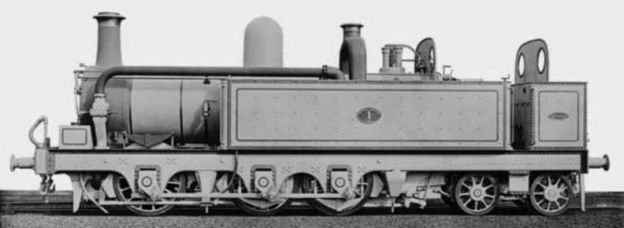
The featured image for this article shows a brand new standard-gauge locomotive – 0-6-4T Mersey Railway No. 1 ‘The Major’. It had not yet received its nameplates when it posed in ‘works grey’ at the Beyer, Peacock works at Manchester in 1885. The locomotive served on the Mersey Railway until that line decided on electrification. Four engines from the line, including ‘The Major’ found employment in Australia, on John Brown’s private light railway – the Richmond Vale Railway in New South Wales. The image comes from “Light Railways – Australia’s Magazine Industrial and Narrow Gauge Railways.” It is included here as an example of a standard gauge locomotive employed on an industrial line recognised as a light railway by ‘The Light Railway Research Society of Australia’. Not all ‘Light railways’ were narrow gauge, nor were their locomotives small 0-4-0T or 0-6-0T locomotives. [7]
W.J.K. Davies tells us that in the 1870s, it became apparent both in the UK and other countries that “many districts, while they would benefit immensely from the facilities afforded by a railway, just could not maintain a line built and operated to main line standards. And so, gradually, during the 1870’s and 1880’s, the concept of the light railway was formulated; a sub-standard means of bringing the advantages of rail transport into rural districts with the deliberate intention of opening them up and improving them. It must be made clear that this concept was different both from the idea of a standard gauge branch line which, although single track, was built and equipped in such things as signalling, stock and staffing to the same standards as the main lines, and from those narrow gauge lines already in existence which had been constructed in difficult country for a specialized purpose, normally the carriage of minerals; the best example of which was the Ffestiniog Railway, in Wales. These lines were not light railways in the true sense of the term.” [1: p24]
“The true light railway developed first beyond the confines of the UK, “while at home even the minor railways, both standard and narrow gauge, were still largely restricted by custom which demanded such things as raised station platforms, separate goods yards and elaborate signalling arrangements; and by Board of Trade regulations framed for more ambitious projects. Even abroad, ideas developed in various ways in different countries, usually by trial and error methods, and it was not until the 1890’s, when the International Railway Congress debated the situation at several of their annual conferences, that anything resembling a clear picture of what constituted a light railway emerged.” [1: p24-25]
“The term, as might be expected, proved difficult to define, for what was a light railway in one country, might be considered main line in another; it might be of standard or narrow gauge depending on the circumstances. In Britain, a light railway usually meant a light branch line of an average length of about ten miles, while on the other hand, in France, metre gauge lines substantially built with considerable engineering works and often fifty miles or more in length were also classed as light railways as indeed they were in comparison with the cost of building and maintaining a standard gauge line in the same circumstances. Perhaps the best definition is that a light railway is a line of railway constructed deliberately below the standard of a country’s main line railways for the sake of economy in construction and working and intended to open up a poor district, at the same time producing additional traffic for the main lines. It must, if it is to obtain all the advantages of being a light railway, be freed from many restrictions imposed on main lines for safety reasons, such as elaborate signalling, manning of level crossings, etc. It must be able to throw off sidings at convenient points and even perhaps have portable tracks laid right into the farms. In order to have these advantages, it will also have to put up with some restrictions the imposition of a low maximum speed, the need often for special light locomotives and rolling stock so as not to strain a light trackbed, a lower standard of comfort, and problems of interchange of goods with the main line.” [1: p25]
In the 1890s, a light railway was seen as having desirable and undesirable features. “It must be borne in mind that some of the theories have been disproved in practice over the years and also that subsequent developments in road-motor transport particularly have invalidated many of the points put forward as advantageous for instance, no minor line could now tolerate the somewhat slow and leisurely method of operation which some of the ideas presupposed – but, nevertheless, at the time all the arguments for light railways had validity and much construction was based on them. Even now in remote, hilly districts such as one finds in Austria, or under special conditions (e.g. concentrated agricultural traffic such as sugar beet) they may have relevance.” [1: p25]
“The basic tenet of all light railway theory was that the line must be suited to the traffic it was to carry initially and for a period of some years after the opening. Remember that, ipso facto, light railways were to open up poor districts – if the district was rich it could support a full-scale railway from the beginning – and so traffic would have to be generated by the railway. Thus, the argument ran, if a district was estimated to support a traffic of, say, 10,000 tons a year, then it was foolish initially to lay down a railway with a capacity of 50,000 tons a year. Track and equipment would be uneconomically used and, more important, the original capital outlay with its interest charges would be unnecessary and perhaps even fatally large, whereas if the line was constructed in a manner suited to the traffic available it stood a much better chance of paying its way and building up a strong reserve. Then, if and when the increase in traffic caused by its construction warranted the improvement of the railway to higher standards, perhaps even to main line standards, this could be undertaken with evidence of a solid backing, and a considerable amount of goodwill already gained; while if no development occurred, the capital loss was smaller.” [1: p25-26]
The question of suitability for the traffic expected, prompts a consideration of the type of railway required. “Once the traffic was estimated, the best and most economical way of handling it had to be considered, and immediately the problem of track gauge arose. Now this comes only third in the International Railway Congress’s [IRS] table of conditions influencing the cost of railways in easy country.” [1: p26] The conditions were:
- the axle-load, on which the weight of rail depends;
- the speed of trains;
- the gauge;
- the station accommodation. [1: p26] cf. [2]
“Nevertheless the gauge is a very important factor and in hilly or otherwise difficult country its importance becomes paramount. There were two schools of thought, the supporters of the standard gauge (of the country concerned, whether it was 5ft 3in, 4ft 8lin, or 3ft 6in) and those of the narrow gauge, the latter being somewhat divided among themselves by the multiplicity of gauges in use. The proponents of the standard gauge suggested that this was most convenient in all respects, particularly in ‘easy’ country where extensive earthworks were unnecessary. The railway, they said, could at first be laid with light rail and worked by specially designed light locomotives and stock until traffic had increased sufficiently for it to be brought up to ordinary branch line standard. To the objection that such stock would not remove the need for transhipment since light waggons could not be worked in with main line equipment, they suggested that the line could be made just strong enough so that the lighter types of main line stock, in particular goods waggons, could be worked over it, and then, when the time came for upgrading, the trackbed was already there. They pointed out that the narrow gauge had several major disadvantages. First there was the problem and expense of transhipment of goods; then there was the problem of maintaining enough rolling stock for peak periods without too much lying idly by at other times; and thirdly there was the need to maintain expensive separate workshops to service the line’s equipment.” [1: 26]
“The narrow gaugers retorted that there was a considerable difference in capital cost, which might often mean the difference between success and failure; that the transhipment bogey was greatly overrated; that, especially in agricultural country, the narrow gauge had the advantage of being able to use sharper curves and thus to run right into the very farms and warehouses it served, and down the streets of towns if necessary; and that with small railways extensive workshops were not required. Running repairs could be carried out by a competent fitter and the engine crews, and for all heavy repairs it would be more economical to send the stock away to a main line depot. They pointed out, moreover, that the standard gauge had an additional disadvantage that its users might demand an improvement in standards without the necessary traffic to justify these and public opinion might force the railway company to comply. This did in fact happen in several places such as South Australia, where feeder lines were constructed on the standard gauge of 5ft 3in with 40 lb rails, a maximum axle load of 7 tons, 20-ton locomotives and a maximum speed of 20 mph; a set of conditions eminently satisfactory for economical working. Unfortunately, public opinion forced successive increases in weight and speed until the railways were running 35-ton locomotives with a 9-ton axle-load at speeds of up to 35 mph on the original track, which was certainly not a satisfactory state of affairs! As the narrow gauge protagonists said, this was unlikely to happen on the narrow gauge where customers would cheerfully put up with conditions which, on a standard gauge line, would draw forth howls of wrath.” [1: p26-27]
No clear-cut conclusions were possible. The International Railway Congress concluded after meetings over several years, that, “while light railways on the standard gauge might very well serve for fairly short distances over easy ground, there was nothing to be lost from a break of gauge should circumstances require it and indeed in many cases it would be advantageous, through leading to a substantially lower capital cost with consequently lower interest charges and lower maintenance costs. The following Table drawn up by the Congress may be of interest.” [1: p27]

The cost difference rises rapidly under certain conditions. This is particularly true as the length of line increases or the topography becomes more difficult. Davies notes that Mackay [2] quotes instances of construction costs from: the Indian Sub-continent (one, 17 miles in length) and Australia (one, 6 miles in length and one, 16 miles in length).
India:
- Standard-Gauge (5ft 3in): £2,927 per mile
- Metre-Gauge: £1,969 per mile
- 2ft 6in-Gauge: £1,817 per mile
Queensland, Australia:
- Standard-Gauge (4ft 8.5in): £46,000 per mile
- 3ft 6in-Gauge: £15,000 per mile
Davies observes: “there is not a very great difference in the lndian figures, though the difference will become more important as the line lengthens, ln the case of the Queensland line, however, the adoption of a narrower gauge with its sharper curves and smaller road-bed allowed a tremendous reduction in initial cost which would, no doubt, be also reflected in the maintenance costs. If this is considered to be rather an extreme example, then the case of the Styrian Local Government railways in Austria may be of interest. Here the light railway on the standard gauge from Cilli to Woollan cost £9,000 per mile, while the cost of several narrow gauge lines constructed by the same concern in similar terrain averaged under £4,000 per mile and even the 750mm gauge railway from Kapfenberg to Seebach (still in service [in 1964] for goods) which ran through very difficult country cost only £4,265 per mile, including the provision of stock.” [1: p28]
The figures quoted “could of course only be realized if the narrow gauge line was planned to take full advantage of economies in route layout and construction. The IRC pointed out that not too much notice need be taken of laying out the track for easy conversion to a standard gauge railway for, if the expected traffic materialized, then capital could be found to make any modifications to the route that were found necessary; thus if a district would only support a narrow gauge line, it would be folly to make the substructure similar to that of a standard gauge one.” [1: p28]
“The IRC also pointed out, and its opinion was endorsed by many authorities, that even the lightest standard gauge line would often be of too great capacity for the needs of a district and that by adopting a gauge in accordance with the estimated capacity required, all interests would be better served. The Indian railway system, then being extensively developed, is a good example of the sound reasoning behind this theory. In India, the main arteries were built to a gauge of 5ft 6in. Larger areas which were poorly developed but which had a definite potential, were served by metre gauge lines substantially laid and worked to high standards but with a considerable saving in costs these were secondary systems rather than true light railways. Poor or isolated districts, or those in which difficult country made a broader gauge financially impossible, were served either by sub-standard metre gauge lines or by what were termed ‘special gauge’ railways, normally on the military 2ft 6in gauge but occasionally, if conditions warranted it, on the 2ft gauge. It is interesting to note that, except where military expediency decided the gauge (not always 2ft 6in) the gauges chosen seemed well proportioned to their work. A survey in 1895-96 showed that in practice traffic and costs decreased proportionally with each narrowing of gauge, as long as each railway worked within its calculated capacity, and most of the railways are still in use at the present time; [1964] many indeed having been extended and otherwise improved.” [1: p28-29]
The IRC did, however, disapprove of the wide variety of narrow gauges being put into operation. It was considered that: “in order to encourage the development of light lines, the greatest possible liberty should be left them to choose the width of their gauge. … But, it is also advantageous to keep to certain recognised patterns which practice has already approved. … The four ordinary standards, 4ft 8.5in; metre;2ft 6in; and 2ft are only ones which ought to be recommended.” [1: p30]
Davies points out that “It was considered that this would help to increase standardization in the event of lines connecting or the authorities concerned wishing to re-use material. This latter possibly requires a little explanation. One of the points put forward in support of building the smallest possible line to start with was that, if traffic developed to the extent where the railway had to be rebuilt, the original material could be taken away and used again to open up a new district; this of course presupposed some kind of central or local authority control over the construction and working of light railways.” [1: p30]
Davies notes that, “in common with many engineers of the time, members of the International Railway Congress considered that the 2ft gauge was really too narrow, leading to unnecessary slowness and problems of stability. (Those who cited the Festiniog in reply were told quite truly that this was not really a good example; it merely proved that the gauge could, if the need arose, bear a heavy traffic but that no one would suppose it to be ideal for a heavily engineered line carrying some 150,000 tons a year.) The gauge had its champions, however, particularly the Decauville Company in France, who advocated it as very suitable for light roadside tramways, in particular in agricultural areas where sharp curves and many side lines were desirable. This company later built up several quite extensive systems. … It was also used further afield, a typical example being the Darjeeling-Himalaya line in India. The South African Railways especially have shown that the 2ft gauge is by no means a toy [cf. 3] if properly handled.” [1: p30]
Davies says that a narrower gauge was advocated by some for specialized purposes such as estate railways or agricultural lines. Decauville produced the 500mm gauge (about 16in) and in England Sir A. P. Heywood’s pioneering work with the 15in gauge is noted by Davies. Smaller gauges did not, however, catch on and 2ft/600mm remained the smallest gauge in general use. [1: p30]
Whatever the width of the narrow gauge, there was one thing which exercised the minds of all light railway theorists in the 1880s and into the 1890s – “that of transhipment of goods between main line and light railway. It was, of course, a major argument for those who advocated light standard gauge lines but, after considerable study, the experts, both amateurs like Sir Arthur Heywood and professionals like the members of the International Railway Congress came to the conclusion that the problem was not nearly so serious as it seemed. They pointed out that transhipment was taken as a matter of course in other circumstances, that goods were freely transferred from waggons to railway trucks and vice versa without any complaints. A survey of methods in various countries showed that at that time (mid-1890’s) it could be economically done for between 1 1/2 d and 3d a ton; where rates were higher than this, they considered that the procedure should be overhauled and greater co-operation secured between the companies concerned. Co-operation, in fact, was rightly considered the most important factor in transhipment. It was emphasized that the main line concern should encourage the light railways in every possible way since it was to their own advantage to stimulate as much traffic as possible. Several continental countries, such as Austria and Hungary, wrote into their light railway Acts clauses which compelled the main line concerns to give their smaller neighbours every facility and encouraged the initiation of partnership arrangements.” [1: p31]
As to the actual arrangements for transhipping goods, the IRC considered that: “Several special cases may justify the erection of special transhipment fittings but apart from these exceptional cases, as a general rule the most ordinary and most simple methods of transhipment from waggon to waggon, on roads at the same level, should be recommended.” [1: p31]
Davies says that, “A transhipment shed with the lines so arranged that waggon floors were on the same level with a platform between them, or even with the light railway on a slightly higher level so that the interchange platform sloped gently down to the standard gauge, was thought to be the most sensible arrangement and was widely adopted. Considering the basic idea behind a light railway, that it was intended for a comparatively light, general traffic in both directions and including much agricultural produce which would be difficult to tranship in bulk anyway, this was undoubtedly a sound idea, since the capital cost of gantry cranes, tipplers, etc., would only be justified if there was a fairly large, one-way flow of bulky traffic. This did apply in many cases, particularly overseas and when mineral traffic was an important feature of the railway’s economy. Our own Glyn Valley Tramway, for example, although very much a rural steam-worked light railway as far as general traffic was concerned, had a big outgoing granite and slate traffic which justified the installation of fairly elaborate loading banks and two waggon tipplers.” [1: p31]
The considerations around this subject were very different depending on ‘light railway’ practice in any particular country. French metre-gauge light railways could be many kilometres in length and were at least equivalent to a busy shorter branch line in the UK. Traffic generated could be significant. Davies notes: “Here the cost of transhipment became a more important factor than the theorists of the 1890’s realized, especially as road transport with its ‘door-to-door’ capabilities became more competitive. They had advocated the container system as the most suitable but somehow this idea was never widely adopted, while the transporter waggon which allowed standard gauge trucks to be ferried over narrow gauge lines and which had been thought uneconomical because of the time a standard gauge waggon was out of traffic, saw a great development in the [1920s and 1930s]. ” [1: p32-33]
“Success appears to depend largely on the relationship between the gauges involved; 2ft is too narrow to take a 4ft 8 in gauge waggon safely, but with 2ft 6in and metre gauge the system is quite satisfactory and has been extensively used in Belgium, Germany, Austria and other continental countries. Provided the main line is well equipped with rolling stock, the ‘time-out-of-traffic’ problem has not proved important. Its main drawback is that the narrow gauge railway must have sufficient clearances to enable standard gauge stock to pass over it, and this means that many earthworks and all bridges, tunnels, etc., must be to the main line loading-gauge or even slightly larger. In practice this has restricted the use of transporters to lines passing through fairly easy country where such obstructions are at a minimum and the extra cost involved is therefore low. In hilly districts even such considerable systems as the French Vivarais system must keep to the traditional methods with straightforward interchange sidings.” [1: p33]
“The gauge to be used and its associated problems were, however, only one of the factors that had to be taken into account. There were many other considerations, particularly with regard to where economies could safely be practised; and most of these were greatly influenced by the second basic tenet of light railway theory which was that the line should serve the district it ran through otherwise its potentialities would be largely wasted. This axiom may appear self-obvious but it was often neglected with dire results, especially in this country. If it was heeded, it largely determined the theoretical course of a railway, for such a line might well not be able to follow the most direct course or the easiest one from the engineering point of view. For example, a line might be projected to join A and B, some 50 miles apart by the most direct route. Then the promoters would have to consider whether a deviation to serve C, involving about 4 miles extra track mileage would be justified from the point of view of the additional traffic it would create, or the benefit it would give to the district. If it was being sponsored by a local authority specifically to open up a district the line would probably go the long way round but if it was being privately financed this was a major problem, for mileage was inevitably an important factor in determining the cost of the line. The IRC needless to say had very definite views on the subject. A light railway, in its opinion, should provide transport virtually from door to door, or at least from farm to market, and should be laid out to facilitate this in every possible way.” [1: p33]
“But if this was to be done, other problems immediately arose. Laying out a line on the route best calculated to serve the countryside inevitably meant that obstacles that could otherwise have been avoided had to be surmounted. Steep gradients, river and road crossings, sharp curves, particularly where the railway followed a road, were all likely to occur more frequently. Here, incidentally, the narrow gauge scored on all counts; it could take sharper curves, it took up less space on a roadside verge, the proportion of dead to live weight hauled was lower than on a standard gauge line, so that better payloads could be hauled up the gradients, and it was easier to run off both permanent and temporary sidings. Whatever gauge was to be used, however, the problems remained. Was it better to have a shortish, steep gradient or to make a deviation round the rise? Should the railway run along a public road or on its own right of way? Opinions differed, but obviously the need for economy often dictated the final decision. Quite elaborate Tables were calculated to show the effect of varying gradients on working and one is given below.” [1: p33-34]
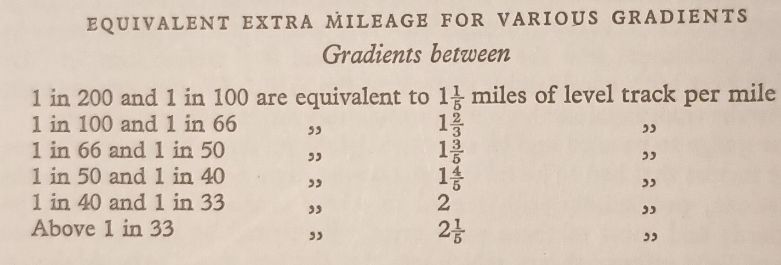
“Thus one or two fairly steep gradients could be tolerated providing, first, that they were short enough to be rushed, and second that the ruling gradient was sufficiently gentle so as not to exhaust the steaming powers of the locomotives. A ruling gradient of not more than 1 in 80 was recommended but 1 in 50 was, it appears, more often accepted as the maximum in practice.” [1: p34]

Roadside running “was recommended wherever possible, especially for the smaller lines, both because it was economical in first cost, the land involved already being in most cases the property of the local authority, and because it was the route most likely to serve the community.” [1: p34]
Davies goes on to say that, “On one thing … all were agreed whatever was done about the route, economies should not be practised on the track itself. The initial cost of a well-built trackbed, with an adequate weight of rail, would pay for itself many times over in reduced maintenance costs and smoother running; and an interesting sidelight – many authorities, from Decauville to Sir A. P. Heywood, recommended steel sleepers rather than the usual wooden ones, as being stronger and longer lasting. This last suggestion was not widely adopted, although it proved its worth on light lines but the consequences of neglecting the earlier warning soon became all too plain. Minimum recommended rail-weights per yard for the various gauges were:” [1: p34-35]
- 2ft gauge: 25 lb
- 2ft 6in gauge: 30 lb
- Metre gauge: 50 lb [1: p34-35]
“These proved satisfactory in practice providing that adequate sleeper spacing and ballasting was provided, since these two factors have a considerable influence on the axle-load a given weight of rail will safely bear. The troubles of many light railways in their later years sprang from a parsimonious outlook when they were built, which compelled their constructors to use too few sleepers and very inferior ballast, often containing a high proportion of earth. … The main economies which it was felt could be effected came under three headings: accommodation, working arrangements, and manning, the first one of these being the most controversial, especially in this country. Collectively they make up the third tenet of light railway theory as propounded in the 1890s, which might well be summed up in Henry Ford’s famous slogan ‘Simplify and add Lightness’. All unnecessary frills were to be omitted. Complex signalling, interlocking of points and signals, gated level crossings, fencing, even the normal staff and token system used on single line railways, virtually all the safety measures so dear to the administrators, should be ignored and, indeed, were forgotten in most countries where the light railway idea took firm root. A system of train orders and, later, telephone communication, proved perfectly satisfactory for the slow and infrequent trains of such lines and could well have functioned over here, as was proved by the Glyn Valley Tramway which was a roadside light railway of continental type but which profited by its official classification to run its operations in a very free and easy manner without any serious mishap. As for gated level crossings, when these theories were being worked out, there was, of course, very little traffic on the roads and many lines were roadside anyway; even now [1964] the majority of continental lines do without gates. They have the occasional accident but rarely one sufficient to disturb anyone’s equanimity for long.” [1: p35-36]
“This urge for economy extended, too, to the lineside buildings which, it was stressed, should be of the simplest and of a limited number of standard patterns. … Such things as raised platforms were considered unnecessary and, indeed, an encumbrance as, in order to increase the economy of working at wayside stations, goods and parcels sheds were often combined with the station house and the very sensible plan adopted of having a siding or loop directly in front of these for goods waggons, the main running line being a short distance away.” [1: p36]
The diagrams below illustrate the difference between UK practice and that on the continent.

“Places of little importance were to have halts only, which, on the Continent at least, were and are often just a nameboard at a level crossing, with the possible addition of a small shelter.” [1: p36]
There was also the question of staffing. The IRC claimed that, in effect, railwaymen should be able to put their hands to almost everything. Among other things they suggested:
- The possibility of giving up the fireman, or, at all events, being enabled to make him assist in other work apart from the engine, and engaging him as a simple fireman apprentice.
- The use of carriages with a central gangway which allows of their being looked after by a single guard to examine tickets even in trains of as many as eight carriages.
- Allowing the train staff (brakesmen of goods trains and firemen) to share in working points, handling baggage, etc., at the stopping places and intermediate stations.
- People other than railway employces being engaged to look after stopping places of small importance.
- Station-houses could be inhabited by men employed at various jobs on the railway, the stations being looked after by their wives, and it was even proposed that the wives should issue and collect tickets on trains. (In practice many light railways employed far too large a staff, although in later years, as competition grew, and conditions worsened, the staff numbers were of necessity reduced. Davies says that “Regrettably, it was often in the essential posts such as gangers that economies were made rather than in the more expendable administrative personnel.”) [1: p37]
- In respect of the trains, “economies could, it was considered, be obtained by such devices as composite carriages for the lesser used classes, reduction of the number of classes, waggons of similar capacity to those on the main line if this was practicable, and particularly by careful study of the maximum axle-load and the maximum speed required, both of which, if kept to a reasonably low figure, would ease maintenance all round. A prominent supporter of this view was E. R. Calthrop, who advocated a uniform axle-load for all vehicles on a railway, adopting in practice a maximum load of 5 tons for a 2ft 6in gauge line laid with 30 lb rail, with a relatively low maximum speed of 15 mph; that his theory was sound is indicated by its success on the Barsi Light Railway in India; and by the Leek & Manifold Valley Light Railway in Staffordshire, the track of which needed no replacement at all during the thirty years life of the line.” [1: p37
However, that the track of many light railways lasted as long as it did was due not so much to careful planning as to infrequency of traffic. “Generally speaking it was considered that two trains a day would meet the requirements of most districts. ‘Transport‘ commented in 1894: ‘Almost all the places where light lines are asked for have at present only two connections by public vehicle each way daily, one in the morning and one in the evening. It would therefore be reasonable for poor lines to have only two trains each way daily’.” [1: p37]
Davies goes on to note that “it is of interest … that the same Journal also advocated the introduction of ‘motor trains’ or, as the French call them, ‘trains legères’ if circumstances justified additional services over busy parts of the line. These in practice, in the early years, usually consisted of an engine hauling one or two coaches but later on, of course, railcars were used. When one considers cases like that of the all-stations mixed train on the ‘Le Blanc-Argent’ line in Touraine, which took 14 hours to cover its 191 kilometres and was indicated on the public timetables as three separate trains, one realizes why such trains legères were considered desirable. Admittedly the [Le Blanc-Argent] train had to struggle through no less than four standard gauge junctions with their attendant complications but it was by no means alone in its tardiness. Even in the 1890s, however, the disadvantages of mixed trains had been recognized and the IRC recommended that, as soon as traffic on a line justified it, they should be abolished.” [1: p37-38]
Davies concludes that the theorists’ arguments of the 1890s, before the Light Railway Act of 1896 were that a line should be:
- suitable for the traffic expected;
- of service to the community; and
- simple in construction and operation.
The theorists thought “of light railways as sub-standard lines designed to open up a district and to contribute traffic to the main line railways; they were to be constructed on the simplest pattern compatible with operating efficiency. This … entailed a number of restrictions in carrying power, train size and speed, but did not mean that the railway should be a ramshackle concern. If it was properly suited to its traffic there should be sufficient capital to build it substantially in comparison with that traffic it was to carry. Economies were to be realized mainly through throwing overboard all the elaborate trappings and working practices of the main lines and, depending on its circumstances, a line classed as a light railway might range from a 2ft gauge steam tramway only a few miles long to a fully equipped metre or 3ft 6in gauge line up to or even exceeding 100 miles in length. Standard gauge lines rarely came within this category unless they were of feeble length and laid with very light rails and equipment, since narrow gauge lines offered economies in capital cost which out-weighed their disadvantages.” [1: p38]
In practice, the UK was a relatively late adopter of light railway schemes. “A fair amount of legislation for, and, indeed, construction of local railways had already taken place by the end of the 1880s in various countries. But development was very patchy and the lines that had been built tended to adhere to the physical conditions governing the main line railways in their own country, more from lack of fresh thoughts on the subject than for any other reason. Thus, in Britain, for example, minor lines had high platforms, and goods sheds detached some distance from the main station buildings, neither of which practices, as we have seen, was considered necessary by the theorists. Indeed as late as 1902 there was so little clearly formulated planning on the subject in Britain that an eminent practising engineer found it necessary to write a manual to inform his colleagues of the practical principles involved in laying a light railway.” [1: p39][3]
There was “a surprising amount of agreement among existing continental light railway builders as to the basic requirements of a light railway except, of course, in the always invidious matter of gauge; and it was on the basis of existing practice that the theorists of the 1890’s were able to formulate their ideas. Nor was the considerable body of light railway theory so built up entirely the work of amateurs. The professional ‘International Railway Congress Association’,† an official body set up by most European and some other countries, maintained a standing committee to consider the subject of light railways and to sift out the best elements of existing practice.” [1: p39]
The recommendations relating to light railways by the 19th century theorists were followed to a significant extent. A good example is the case of railway gauges, always a thorny problem. Before the 1890’s there was a multitude of gauges in use, but very few light railways built after about 1895 did not conform roughly to one of the IRC’s four recommended gauge groups. There was general agreement over fencing, signalling and standardisation, although the rigour with which standardisation was persued depended on the country concerned. Davies highlights a problem experienced in France during WW1. … “France, merely laid down general rules and left individual companies to produce their own detailed specifications. The disadvantages of this were not apparent while vehicles remained on their home lines, but became plain when they had to run on other railways, as the French found out when the 1914-18 War forced them to strengthen their north-eastern light railways with stock from lines all over the country. The variations in coupling and braking systems in particular were numerous and severely taxed the ingenuity of the operating staff; while the Austrians, who had standardized with just this eventuality in mind, were able to reinforce their military railways with no trouble at all. The disadvantages also showed in peace-time when railways started to close down and other lines wished to buy their equipment.” [1: p40]
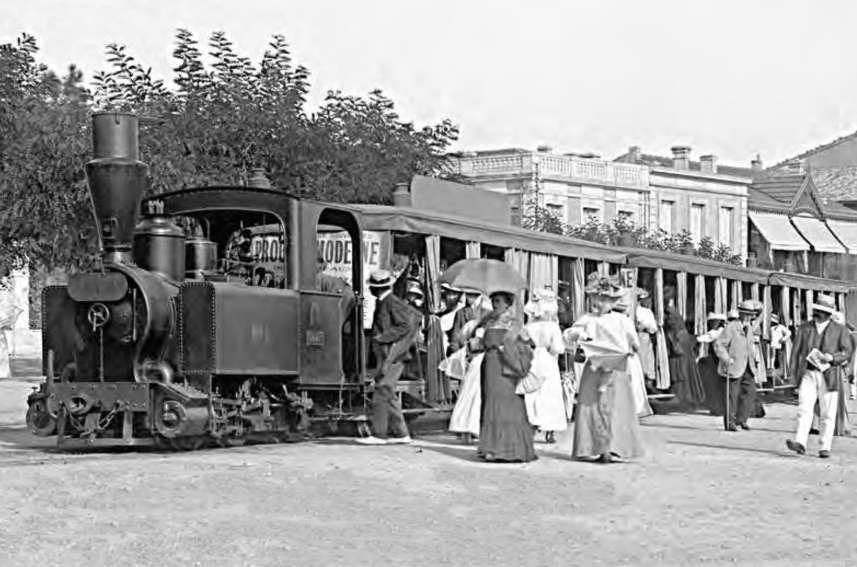
Davies highlights a few interesting matters:
A. Rather hazy distinctions between ‘light railways’ and ‘tramways’ – Tramways were usually lines of only local interest and running for the most part alongside public roads, these were typically exempt from state railway laws. Promotion and control were usually left in the hands of local authorities. “Yet these lines might not be ‘tramways’ in the generally accepted sense of the term today, but true light railways which just happened to run by the roadside. Indeed some considerable systems of what were officially classed as tramways arose, a typical example being the Tramways de la Sarthe in France, operating 20 connected lines of metre-gauge track, with a total length of 406.1 kilometres. Such lines usually had … wayside stations, … steam traction, and carried goods as an integral part of their traffic.” [1: p40,42] Ultimately, the only distinction between such tramways and a ‘light railway’ would be the likelihood that the light railway probably mainly kept to its own right-of-way.
B. The use of ‘concessions’ in most countries in Europe for their light railways – this practice was unusual in the UK in respect of light railways. It was, however, relatively commonplace in respect of tramways built in local roads in the UK. These were granted a fixed length of operation by a contractor with a first refusal for the local authority when the term came to an end.
In Europe, almost every country used some form of ‘concession’ system, “whereby companies did not simply go out and buy land with the right to build a railway on it and use it in perpetuity after an initial authorization, but were simply given powers to build a railway and run it for a fixed period as contractors, after which the position would be reviewed. Alternatively they might operate a railway already constructed by the state or by some other organization; and often the state reserved to itself the right to purchase the line at a specific time after construction. These concessions were of two main types which may conveniently be referred to by their French titles of ‘concessionaire’ and ‘fermier’.” [1: p42]
Davies tells us that “The ‘concessionaire’ company normally undertook to work a railway or railways ‘at their own risks and perils’. In other words. it had to pay its way or close. This was not quite so bleak a prospect as it might seem since the operation of the railway was often subsidized by a state or local authority and guaranteed interest might even be paid on the capital of the railway company concerned. Such companies often built their railway(s) in the first place and provided their own rolling stock.” [1: p42]
“The ‘compagnie fermière’ on the other hand, was solely an operating company and worked a railway on behalf of an owning organization, usually a local or municipal authority. It worked either as a completely controlled subsidiary to the authority, in which case profit did not come into the matter, or else contracted to operate the line for a fixed percentage of the gross receipts. This type of concession was used frequently in later years when the railway concerned was almost certain to make a loss but was considered of sufficient benefit to the community for its continued operation to be worth while.” [1: p42]
Davies continues: “It was in the granting of these concessions and in the various ways by which the concessionary companies were helped, that the attitudes of different countries showed themselves; and it was the terms under which such concessions were granted that often determined whether the light railway network of a country was a success or a failure. Where the state organized its secondary rail system, either by judicious financing or by direct control, lines were built sensibly and with reasonable success; a fruitful co-operation grew up between the State and the concessionaries. But where the State was not quite sure what it wanted, or where local authorities were allowed to have the major say in authorizing and constructing systems of any importance, the results, generally speaking, were not so good. This was probably due mainly to over-enthusiasm and to the desire to meet the demands of poor districts which felt the need of a railway as much as their more prosperous neighbours. The result in both cases was that promoters tended to be offered unduly favourable terms, with insufficient security on their part in return. Hence many lines were built that were of very doubtful viability under any circumstances and certainly unlikely to be a paying proposition. The construction of these uneconomic lines was often justified by the explanation that they were not expected to pay their way, initially at any rate, but were designed to benefit a region by opening up new districts, the local authority being quite willing to pay a subsidy to achieve this end. This argument was possibly valid where the operating company did not make a considerable profit out of the situation but such lines inevitably had to be offered under guaranteed terms which cost the local authority dearly. Moreover, the lines concerned were naturally very vulnerable to any improvements in road transport.” [1: p42-43]
C. Other Factors – affecting the viability of ‘light railways included:
- Prestige: “The local company usually had its pride, and this led to considerably more expenditure on lineside fittings than was strictly necessary. In particular, station buildings tended to be substantial, … often of brick and stone, and of two stories where a simple hutment would have sufficed. Too often, also, unnecessarily elaborate workshops were provided for each small company although big private concerns, to give them their due, often had a central workshop where all heavy repairs were done.” [1: p43]
- An operational problem: often ignored by early theorists. For “minor railways which formed dead-end branches, the obvious place for the operational headquarters and running sheds was at or near the junction with a main line railway. Yet traffic flow usually required the first train out in the morning to be from the far terminus to the junction. Hence a sub-shed, capable of storing one or two locomotives, and equipped with fuelling facilities, and even at times living accommodation, had to be provided at the far terminus. On a system with several branches this could well be a considerable expense.” [1: p43]
- Staffing: was often on a more lavish scale than the theorists or IRC would have liked. Dvvies, in 1964 writes: “It was far more lavish in many cases than was strictly necessary, as has been shown by a number of French minor lines in recent years. Such lines as the CFD du Vivarais, or the late-lamented CFD du Tarn have, since the war, cut their personnel by almost half; and for a 55 miles system like the Tarn this meant a decrease of some forty men. It is being wise after the event, but it is plain that the fortunes of some minor concerns would not have been so bad, had they controlled their staffing ratios more realistically in the first place.” [1: p43]
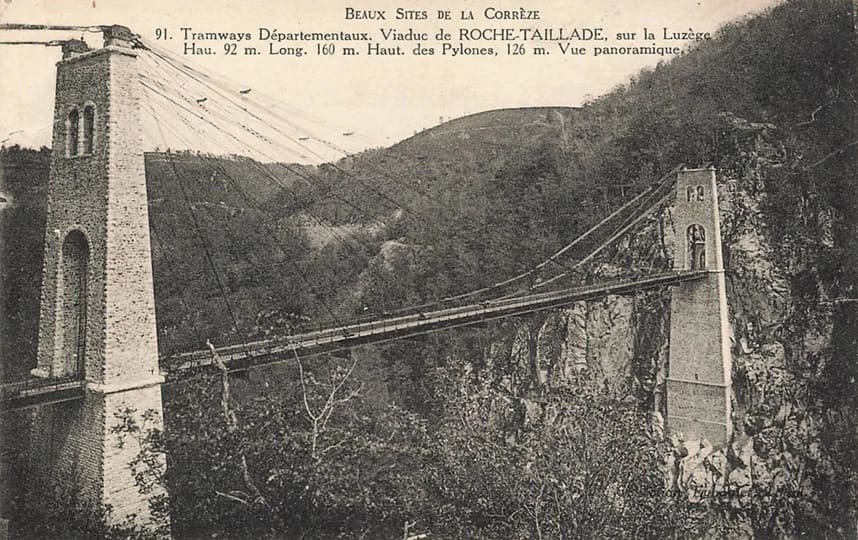
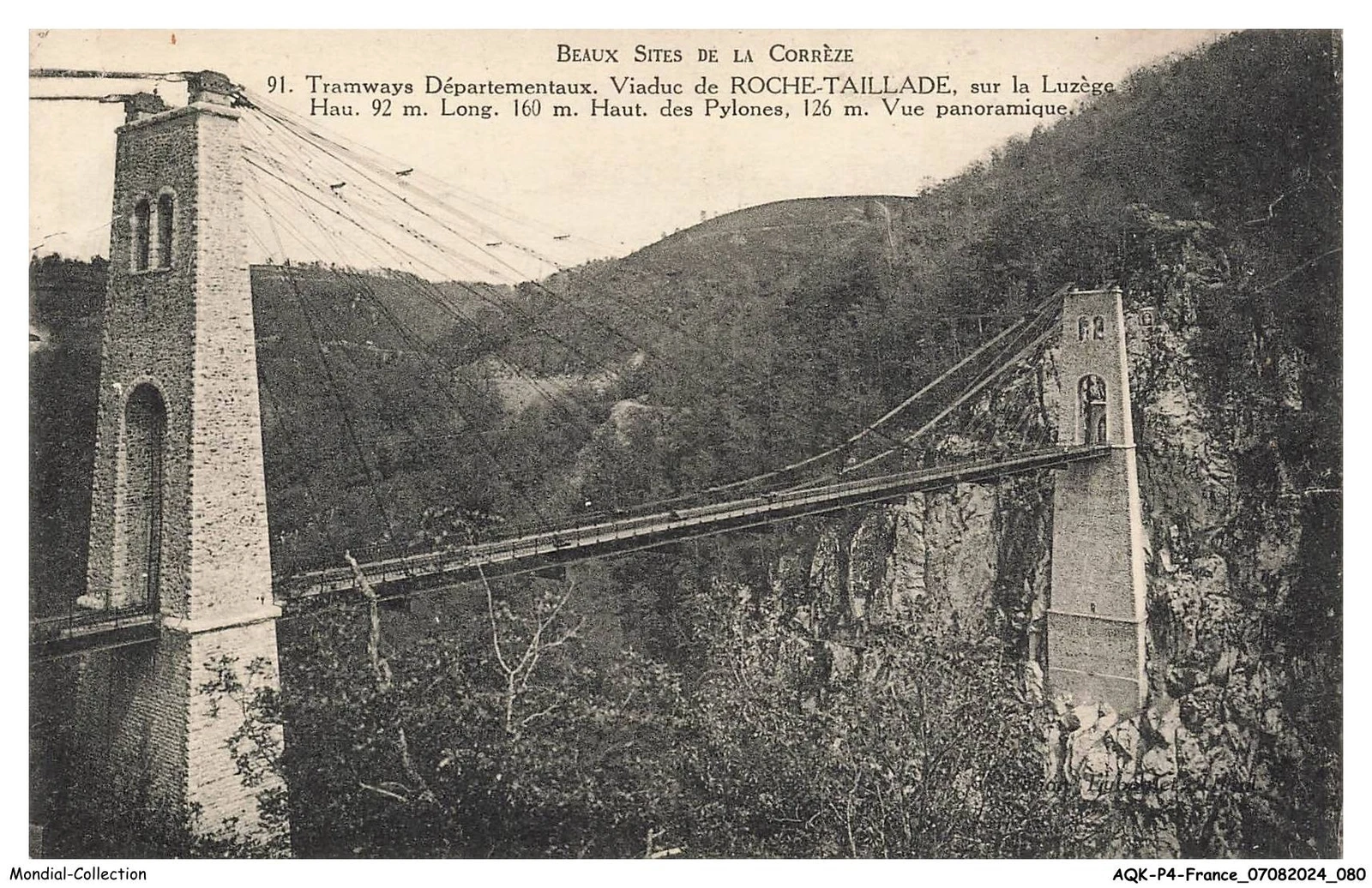
- Dual Effects of Traditional Ideas of Railway Building: Davies sees these as a ‘standard gauge mentality’ and a failure to appreciate the results of improvements in road transport. Both, he says, led to stagnation of ideas: “The standard gauge mentality was, as the name implies, a fixed idea among officials involved in planning light railways, to avoid the, as they saw them, disruptive effects of a multiplicity of gauges and standards. It implied a large degree of conformity with main line standards in signalling and other matters as much as conformity in the actual gauge. It was by no means always destructive but in many cases a railway built on these principles meant one far too large and elaborately equipped, hopelessly uneconomic for the traffic it was to carry and for the revenue which could be expected. In extreme cases it simply meant that no railway was built at all.” [1: p44] … Davies goes on to say that on the Continent and in Britain from about 1910, the “light railway builders of the period often stuck too closely to the mass of theoretical dicta which had appeared about the turn of the century. In France especially, but also in other countries they went on planning tortuous roadside lines, designed for slow and infrequent trains, without realizing that road competition was becoming even then a very real factor. The theorists had not visualized motor transport; the builders of the 1910’s seem to have ignored its presence to a surprising degree. The result was the construction and operation of such systems as the Tramways de la Corréze in central France. This was an extensive system of no less than five separate lines on the metre gauge, totalling 179.5 km and opened as late as 1913-14. Yet it was for the most part roadside, serving small communities, laid with light rail and equipped with 4-wheel stock of a pattern already outdated. Even the locomotives were small 0-6-0T’s designed for the haulage of light trains at slow speed. Even after the 1914-18 War some of the light railways that were promoted then followed much the same pattern and it is all the odder that, while sticking religiously to what were becoming, in the circumstances, outmoded concepts, the builders of such lines were not afraid of constructing considerable engineering works if the need arose. The TC [Tramways de la Corréze] mentioned above had, for example, the viaduct of La Roche Taillade, a huge suspension bridge noted throughout France for its superb design, … while the Côtes du Nord system, which was building such lines as late as 1925, was also a pioneer in the use of pre-stressed concrete structures and used the material extensively for viaduct work.” [1: p44]
Conclusions
The success of a light railway was likely to vary in practice with the conditions it encountered rather than its adherence to a particular set of ideas. Davies concludes that “in virgin territory overseas, the light railways had ideal conditions for survival; long hauls; great potential for traffic development; and a fair chance of expansion provided the ‘standard gauge mentality’ of colonial administrators could be overcome. On the Continent and at home, on the other hand, they were more hidebound by traditional ideas, problems of prestige, etc., and were far more subject to competition which developed from other forms of transport. ” [1: p45]
A short article picks up on a short piece in The Railway Magazine of August 1905 which reflected on the early years of Light Railways after the 1896 Act. This can be found here. [6]
References
- W. J. K. Davies; Light Railways: their rise and decline; Ian Allan, London, 1964.
- J. C. Mackay; Light Railways for the United Kingdom, India and the Colonies; Institution of Civil Engineers (facsimile ed.), London, 2011.
- R. M. Parkinson; Light Railway Construction; Longmans, Green & Co., London and New York, 1902; via https://archive.org/details/lightrailwaycon00parkgoog/page/n3/mode/2up, accessed on 4th July 2026.
- https://i.ebayimg.com/images/g/EV8AAOSwsRpneCcF/s-l1600.webp, accessed on 6th July 2026.
- https://de.wikipedai.org/wiki/Datei:Locomotive_vapeur_de_Tramway_de_Royan.jpg, accessed on 6th July 2026.
- https://rogerfarnworth.com/2024/09/17/light-railways-in-the-uk-the-early-years-after-the-1896-act-the-railway-magazine-august-1905
- https://media.lrrsa.org.au/irok230/Light_Railways_230.pdf, accessed on 6th July 2026.



You have raised a subject which is of great interest to me.
As you say, there is no clear definition of “light railway?.” The term has been used over a long period of time to describe various forms of railways which had different characteristics to those that were considered to be “normal”.
The use of the term goes back at least as far as 1866. (See the Hobart Mercury 19 April 1866 http://nla.gov.au/nla.news-article8838838.) The definition as used at that time meant that all aspects of a railway’s construction was scaled down so that costs were reduced to a level the traffic could support.
The concept described in the Hobart Mercury article goes back to the work of four Norwegian government engineers who undertook an investigation in 1857 to find a way of building railways which the Norwegian economy could bear. (Reference: L. Segelcke, “Om det smale Spor for Jernbaner hertillands [About narrow-gauge railways for this country]” in Polyteknisk Tidsskrift; Udgivet af den polytekniske Forening i Christiania [Polytechnic Journal; Published by the Polytechnic Association in Christiania]; No.15, 15 August 1858 pp.225 ff; No.16, 31 August 1858 pp 241 ff; and No.17, 15 September 1858 pp. 257ff.)
In that year they decided to adopt the 3 ft 6 in gauge for most future railways in Norway. This decision was made against the advice of British railway engineers, who did not think such a narrow gauge was practical for public railways. This was the first time anywhere in the world that such a narrow gauge light railway system was to be used for a national railway system. It affected subsequent railway developments throughout the world, starting with Queensland in 1865.
W.J.K. Davies in his 1964 book “Light Railways” makes no mention of Norway’s pioneering work in using 3 ft 6 in gauge railways. Davies saw light railways as being local railways performing roles supplementary to “heavy” railways. He specifically excluded railway systems like that in Queensland. In fact the railways of Queensland as built, despite their vast mileage, were classic examples of light railways, with 41 lb/yd rails and very light axle loads. They had to be light, as the long distances and very low population could not support anything better.
Your mention of the Light Railway Research Society of Australia (LRRSA) is interesting. I was its foundation president (in 1961). and was very much involved in arriving at a name for the new organisation. We were looking at a simple term which could cover anything except the government owned public railway systems. The term “light railways” never had any legally defined meaning in Australia, and seemed sufficiently vague to cover anything we might like it to. John Brown’s railway in New South Wales, where the ex_Mersey Railway 0-6-4T locos worked, was not really a “light railway”, but it was a private industrial railway – and private industrial railways were very much of interest to the LRRSA.
Hello Frank
It is really good to hear from you. Thank you for your reply and for pointing out the significance of practice in Norway and the decisions taken there.
Best wishes
Roger