Tag Archives: Tram

The Secret of Laxey Siding

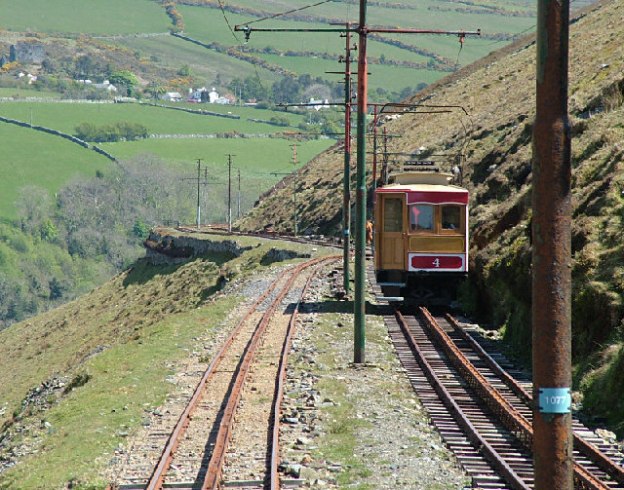
‘Modern Tramway’ in January 1964 carried an article by J.H. Price about the process involved in getting Snaefell rolling-stock to Derby Castle for maintenance. [1] The featured image for this article shows Snaefell Car No. 4 on the Mountain Railway in May 2005, © John Wornham and included here under a Creative Commons Licence, (CC BY-SA 2.0). [3]

In the early 1950s, Price tells us, “A considerable stir was caused in railway circles by the news that the Russian and Czech railways had introduced a service of through sleeping-cars between Prague and Moscow, overcoming the break of gauge at the Russian frontier. It appeared that the cars could be lifted on jacks, complete with their passengers, while the standard-gauge bogies were run out and replaced by others of the wider Russian gauge. This method was later extended to other routes, and the accompanying photograph, taken in 1957, shows the cars of the Moscow-Berlin Express raised up on electric jacks in the gauge-conversion yard at Brest-Litovsk, on the frontier of Russia and Poland. … Unknown to the Ministry of Communications of the U.S.S.R., something very similar has been going on quite unobtrusively here in these islands, not just in the last decade, but ever since 1933. The place is Laxey, Isle of Man, and the cause is the six-inch difference in gauge between the Manx Electric Railway’s Douglas-Ramsey line and the Snaefell Mountain Railway. The coastal tramway was constructed to the usual Manx gauge of 3 ft. 0 in., but on the Snaefell line this would not have left sufficient room for the centre rail and the gripper wheels and brake-gear, with the result that the mountain line uses a gauge of 3 ft. 6 in. instead.” [1: p19]
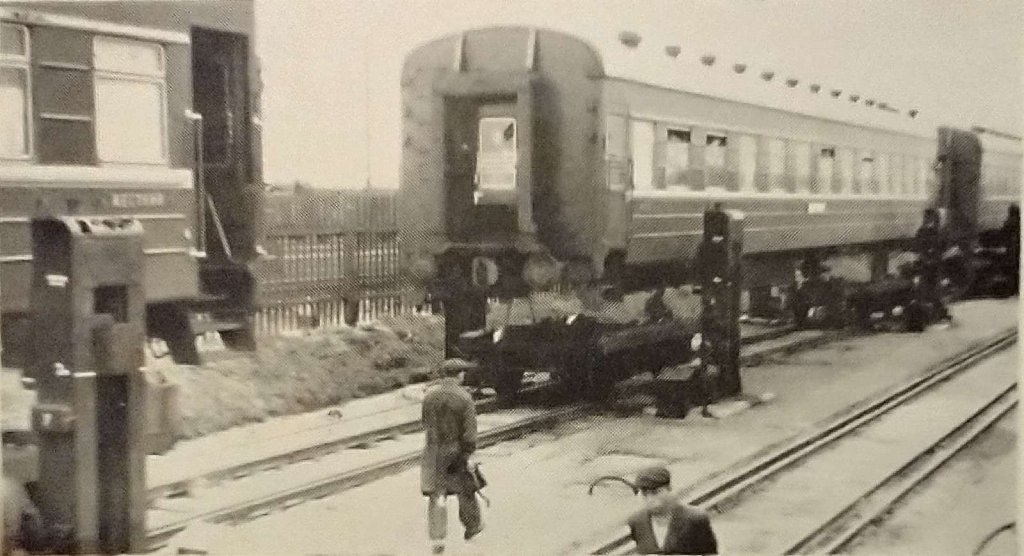
How the Russians do it! The bogie-changing installation at Brest, on the frontier of Russia and Poland. A description of this and of a newer method with sliding axle-sleeves was given in J. O. Slezak’s book ‘Breite Spur und Weite Strecken’, © J. H. Price. [1: p19]

Both the MER and the Snaefell lines “have always been under a common management, and in past years, repainting of Snaefell cars was carried out at the mountain line’s car shed by staff who travelled up each day from Derby Castle. Since Snaefell car shed at Laxey is narrow and rather dark, the work was mostly done out of doors, the car being run in and out of the shed each time it rained. After the 1933 fire at the other Laxey car shed had created a float of spare plate-frame bogies, the management decided to use a pair of these to bring Snaefell cars due for overhaul down to the principal Manx Electric workshops at Derby Castle, Douglas. Controller overhauls and motor repairs were already carried out at Douglas, and since 1933 work at Laxey has therefore been confined to routine maintenance, running repairs and truck overhauls.” [1: p19]

The result of this decision was that every now and again (once or twice a year) a Snaefell car had to be lifted off its 3 ft. 6 in. gauge trucks and mounted on 3 ft. gauge bogies to be towed down to Douglas, returning by the same means when its overhaul was completed. This operation was rarely seen by visitors to the Isle of Man as it took place out-of-season.

The Snaefell 1963 operating season ended on Friday 13th September, and the moving operation started soon after eight o’clock next morning, when Snaefell car No. 4 was brought down from the car shed and run on to the dual-gauge siding. With it came a set of traversing-jacks, various tools, and the necessary wooden packing, kept in the Snaefell car-shed for this twice-yearly operation and any other less foreseeable. eventualities. Four … men then set to work … following a sequence which, like many other Manx Electric operations, is handed down from one generation to the next without ever having found its way into print.” [1: p22]

J.H. Price continues:

“First, the brake-gear and bogie-chains are disconnected, and the bow-collectors roped to the trolley-wire so that the pins can safely be removed, after which the collectors are untied again and lowered to the ground. Once this is done, no part of the car’s circuit can become ‘live’, and next the motor and field connections are broken at their terminals in the junction-boxes, which are housed under the seats and above the motor positions. The body is now merely resting on its two bogies, with no connection between them.

The next stage is to lift the car and exchange the 3 ft. 6 in. gauge bogies for others of 3 ft. 0 in. gauge. In the case of the Russian sleeping-cars mentioned earlier, the two gauges are concentric and the car. bodies need only a straight lift and lowering, but Laxey siding has three rails (not four), and the car body therefore has to be traversed laterally by three inches from the centre-line of the 3 ft. 6 in. gauge to the centre-line of the 3 ft. 0 in. To do this, the staff use a pair of special traversing-jacks with a screw-thread in the base that enables the load to be moved sideways; similar jacks are used by the Royal Engineers to re-rail locomotives, and were also used by them to place Newcastle tram No. 102 on rails at Beaulieu in March, 1959.

Considerations of safety make it preferable to keep one end of the car resting on a chocked bogie, so the Manx Electric use only one pair of jacks, tackling first one end of the car and then the other. First the Snaefell end of the car is lifted, and the 3 ft. 6 in. gauge bogie is pushed out; in this case, it was then towed up to the car shed by Snaefell car No. 1. Meanwhile, two men fetch a 3 ft-gauge plate-frame trailer bogie from Laxey Car Shed and push it by hand along the northbound running line to Laxey station, where it is shunted on to the three-rail siding and run in under the Snae- fell car. The body is then lowered to the horizontal, traversed to suit the centre of the 3 ft. gauge bogie, and landed on the bogie baseplate. A king-pin is then inserted, the loose retaining-chains are secured, and the jacks taken out and re- erected at the other end of the car.

Now comes the turn of the Laxey end (the two ends of the mountain cars are referred to as Laxey end and Snaefell end, not as No. 1 and No. 2, or uphill and down). The car body is raised again on the jacks, and the other Snaefell bogie pushed to the end of the siding. A second plate-frame trailer bogie is then brought up to a nearby position on the northbound Douglas-Ramsey road, derailed with pinch-bars, and manhandled across the tarmac on to the three-rail siding. Once re-railed, the bogie is then run in under the car end, which is lowered, traversed and secured in the same way as before. The Snaefell car is now ready for its trip to Douglas, and as soon as it has been towed away, another Snaefell car collects the remaining 3 ft. 6 in. gauge bogie and takes it up to the Snaefell car-shed, together with the ladder, tools, packing and jacks. [1: p22]

At the suggestion of ‘Modern Tramway’ a member of staff of the MER agreed to make a photographic record of the whole process. The images were then reproduced in ‘Modern Tramway’. The sequence of images appears below, starting with the Snaefell car No.4 being  run into the three-rail siding.
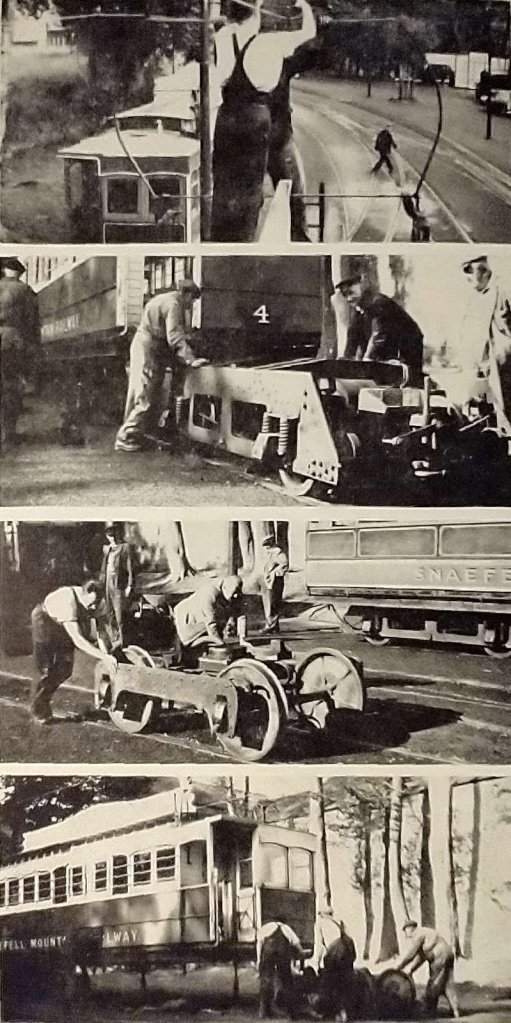
In sequence, these four photos show part of the process of preparing Snaefell car No. 4 for its journey from Laxey to Douglas in September 1963. Notes on these photographs follow below, © A.R. Cannell: [1: p20]

Photograph 1: Snaefell No. 4 “is run on to the three-rail siding at Laxey Station; linesmen tie each bow collector to the trolley wire to take the strain off the mountings, then remove the pins from the spring bases, untie the bow and lower it to the ground.” [1: p20]

Photograph 2: The car body is disconnected from the trucks (electrically and mechanically) and raised on jacks, and the first 3 ft. 6 in. gauge motor bogie pushed out and towed by another car to the Snaefell depot.” [1: p20]

Photograph 3:A 3 ft. gauge plateframe trailer bogie is brought up by hand from Laxey Car Shed, ready to be placed beneath the mountain end of No. 4.” [1: p20]

Photograph 4:The trailer bogie is run in under the car, and the body lowered and traversed sideways on to the bogie centre-plate, then secured by a king-pin and side chains.” [1: p20]
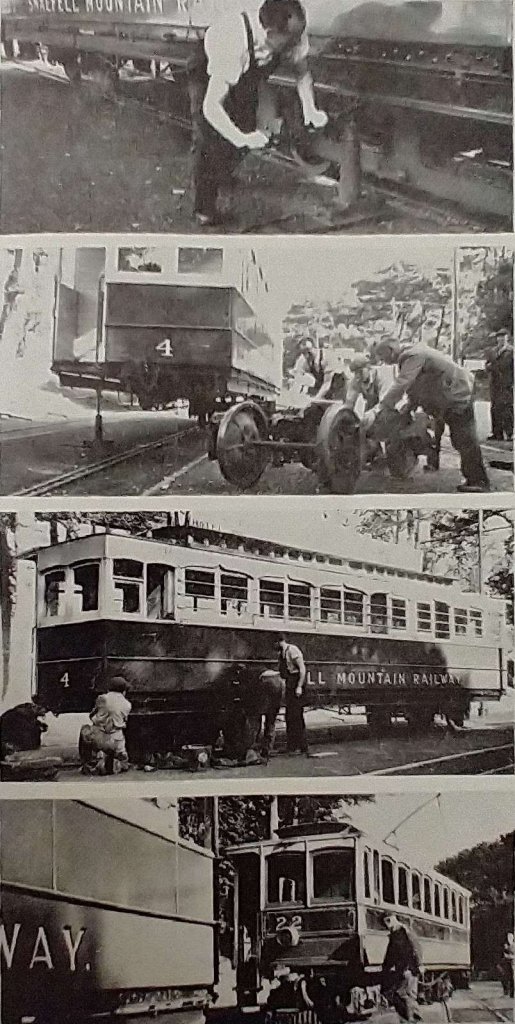
These four photos show the next stages in the process of preparing Snaefell car No. 4 for its journey from Laxey to Douglas in September 1963. Notes on these photographs follow below, © A.R. Cannell: [1: p21]

Photograph 5: The traversing jacks are re-erected at the other end of the car, the body lifted off the second motor bogie which is then pushed on to the end of the three-rail siding.

Photograph 6: A second plate-frame trailer bogie brought up on to the running line, derailed with crow-bars, and pushed across the tarmac to the three-rail siding.

Photograph 7: The bogie is run in under the Laxey end of No. 4, and the body lowered, tra- versed and secured. The conversion from 3 ft. 6 in. gauge to 3 ft. gauge is now complete.

Photograph 8: MER. saloon No. 22 enters the transfer siding by the rarely-used 3 ft. gauge crossover and is coupled by bar and chain to Snaefell No.4, ready for the trip to Douglas.

With this work taking place on a Friday, Snaefell car No. 4 was taken to Laxey car shed and then moved on Monday 16th September to Douglas.
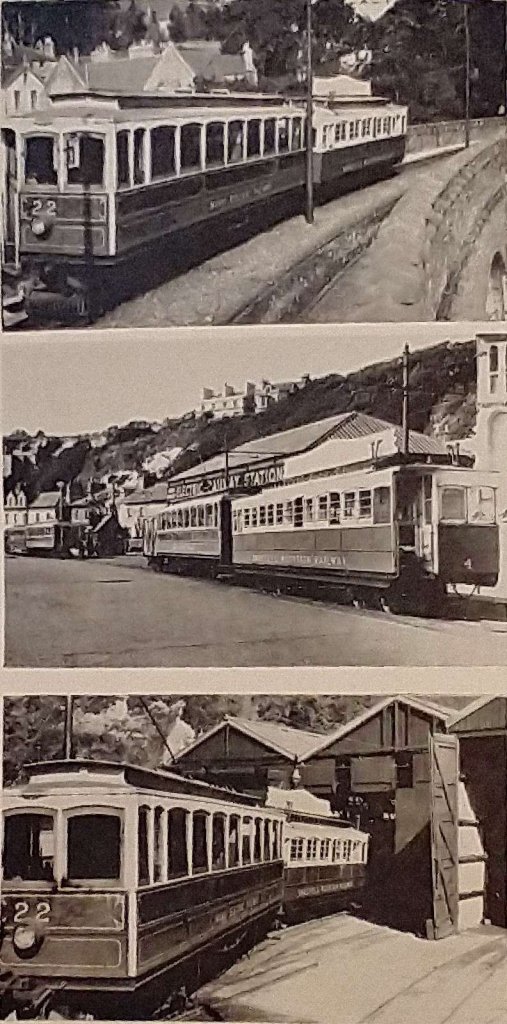
These three photos show the move to Derby Castle Station in Douglas. The first photo shows MER car No. 22 taking Snaefell car No. 4 across Laxey Viaduct to Laxey Car Shed. The second photo shows the two cars arriving at Douglas Castle Station, and the third shows No. 22 shunting No. 4 into the workshops for overhaul and repainting, © A.R. Cannell. [1: p23]

Snaefell Car No. 4 was built in 1895 as the fourth of a batch of 6 cars and arrived at Laxey in the spring of 1895. MER’s website tells us that, “Power for the Car was by Bow Collectors with Mather and Platt electrical equipment, trucks and controllers, and Braking using the Fell Rail system. As new, the cars were delivered without glazed windows and clerestories. Both were fitted in Spring 1896 (following complaints of wind, as the original canvas roller blinds did not offer much protection).” [2]

Car No.4 was one of two Snaefell Cars (Car No.2 the other) to carry the Nationalised Green livery, applied from 1958. No.4 became the last car/trailer in the MER/SMR fleets to carry the scheme, it being moved to Derby Castle Car Sheds for repaint and overhaul during September 1963.” [2]

Car No. 4’s last trip on the MER for overhaul was during Winter 1993, moving back by Spring 1995. After this all maintenance on Car No. 4 was undertaken at Laxey. Laxey was significantly remodelled in 2014. The dual-gauge siding is no longer used and in the remodelling a token 3-raol length was included for effect.

References

  1. J.H. Price; The Secret of Laxey Siding; in the Modern Tramway and Light Railway Review, Volume 27, No. 313; Light Railway Transport League and Ian Allan, Hampton Court Surrey, January 1964, p19-23.
  2. https://manxelectricrailway.co.uk/snaefell/stocklist/motors/snaefell-no-4, accessed on 30th August 2023.
  3. https://www.geograph.org.uk/photo/31454, a ceased on 30th August 2023.
Going “Piggy-Back” in 1899!

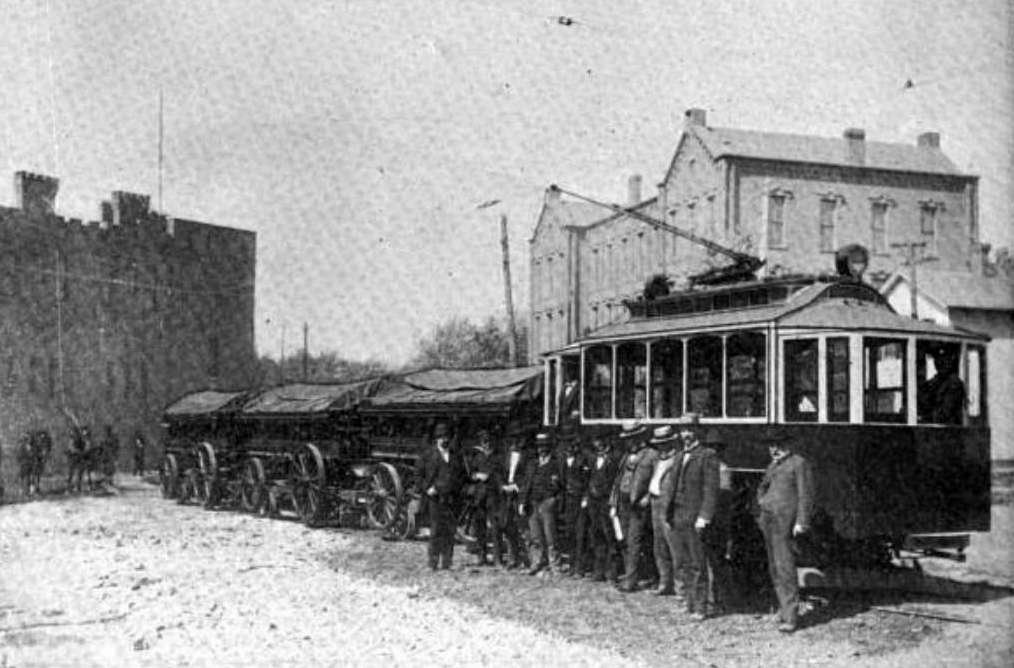
Modern Tramway Journal included a short article in October 1963 about developments in 1899 on the Isle of Man, and particularly about the use of ‘Bonner Wagons’ by the Isle of Man Tramways and Electric Power Company Limited. [1]

An item about ‘Bonner Wagons’ in the “American technical Press attracted the attention of Mr. Alexander Bruce, Chairman of the Isle of Man Tramways and Electric Power Company Limited, the predecessors of the Manx Electric Railway. Mr. Bruce was engaged in promoting and constructing a 10-mile extension of the coastal tramway from Laxey to Ramsey, and this line was intended to enter Ramsey along the seafront and possibly terminate at the pier, where freight could have been transhipped direct to and from cargo steamers without the expensive carriage necessary at Douglas. The new line also involved a rail-side steam power station at Ballaglass remote from road access. But the Ramsey Town Commissioners would not allow the sea-front route, and Mr. Bruce was forced to adopt instead the inland route and terminus which we know today. This line was opened to Ballure on 5th August, 1898, and into Ramsey on 24th July, 1899.” [1: p350-351]

Included in the tramway promotion was a granite quarry at the Dhoon, “purchased in 1895 and staffed partly by skilled Scottish sett-makers brought over from Dalbeattie, the centre of the Scottish granite industry. Setts from Dhoon Quarry were used for paving the Upper Douglas Cable Tramway, and setts and roadstone were produced both for the island’s roads and for export to the mainland. The export trade would provide an excellently balanced freight traffic on the electric line, the rail wagons taking the setts to Ramsey harbour and returning laden with coal for the power station at Ballaglass.” [1: p351]

After the Town Commissioners had prevented the extension of the tramway to Ramsey harbour, Mr. Bruce ordered several 3 ft. gauge ‘Bonner Wagons’ from the USA, which would “travel over the tramway to the outskirts of Ramsey, and could then be transferred to road by a removable ramp at one of the several level crossings. These wagons also came in very handy to counter a demand from the Ramsey Commissioners early in 1899 for 5 per cent of the gross receipts earned on the portion of the line in their area; Mr. Bruce threatened to turn the cars back at the town limits, and pointed out that by using the Bonner Wagons in the town the Company could carry on their freight traffic as they pleased. The Ramsey Commissioners soon gave way, and in return were treated on 9th June, 1899, to a special trip from Ballure to Snaefell Summit and back.” [1: p351-352]

Increasingly after the Second World War, the practice of hauling laden road trailers and semi-trailers on flat rail carsdeveloped in North America. “In this way, the railways of North America are attracting to that share of the long-distance freight that would normally move by road, quoting long-haul charges sufficiently low to represent to the haulier a clear saving over sending the load by road throughout, with its own tractive unit and crew.” [1: p350]

In the early years of railway travel “private carriages (with or without their occupants) were often conveyed on railway-wagons in the early years of railways, and in the days when motor-cars were less reliable than they are now they would quite often cover long distances in motor car vans attached to the train in which their owner travelled a forecast of today’s car-carrier trains. This method was also used for freight vehicles such as the pantechnicons of furniture-removal firms and (of course) by the circus, but the more usual method was for freight consignment to be bulked in railway wagons or vans, the railway company providing carriage services in the towns served, with transhipment in its own terminal warehouses.” [1: p350]

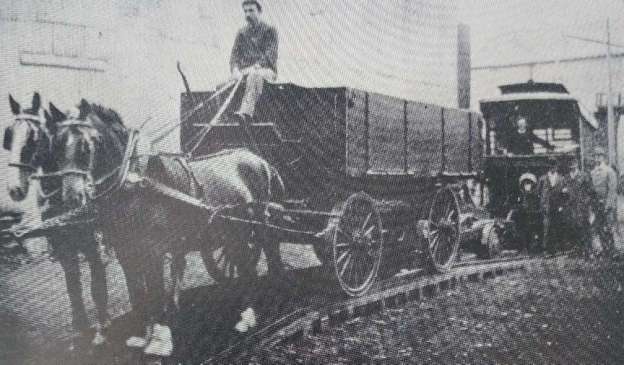
In competition with the mainline railways there were interurban services which predominantly carried passenger traffic but additionally sought freight traffic if it could be handled efficiently. Often such movement attracted significant transshipment costs. “In an effort to reduce these handling costs and quote competitive rates for collection-and-delivery traffic, a few American interurbans adopted a device known (after its inventor) as the Bonner Railwagon. The Bonner Wagon was in fact two separate vehicles which could be combined in one for the rail journey. The main portion was a substantial spring-axle high-sided cart of about four tons capacity, mounted on four spoked road wheels and designed to be drawn by horses when running on the streets; the second, smaller portion was a small axle-carrying truck on four flanged solid disc type wheels, on which the cart would ride for the rail journey, and which supported the cart’s axles at a height sufficient to bring the road wheels well clear of the tracks and pointwork.” [1: p350]

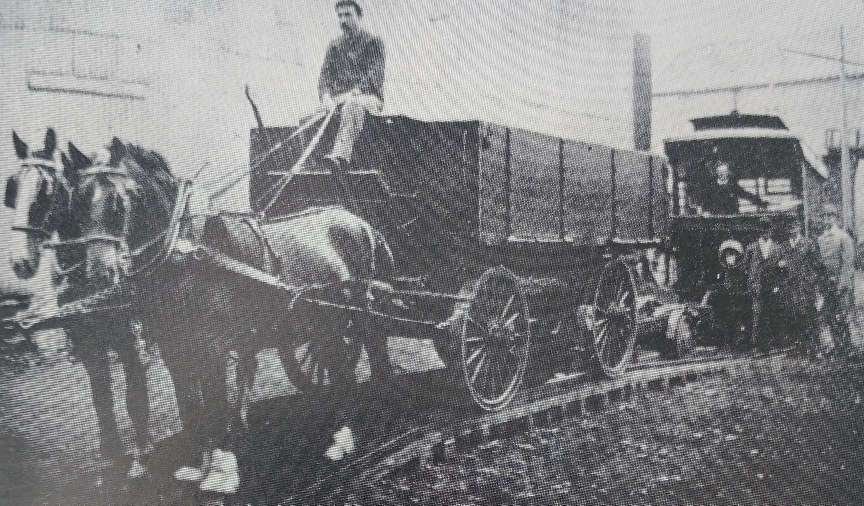
The first demonstration of the Bonner Railwagon system using horse-drawn wagons in Toledo in 1898. [4]

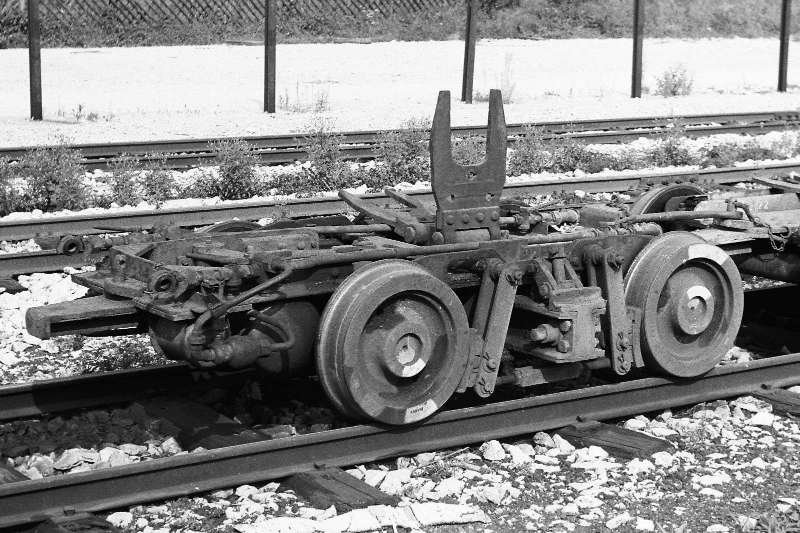
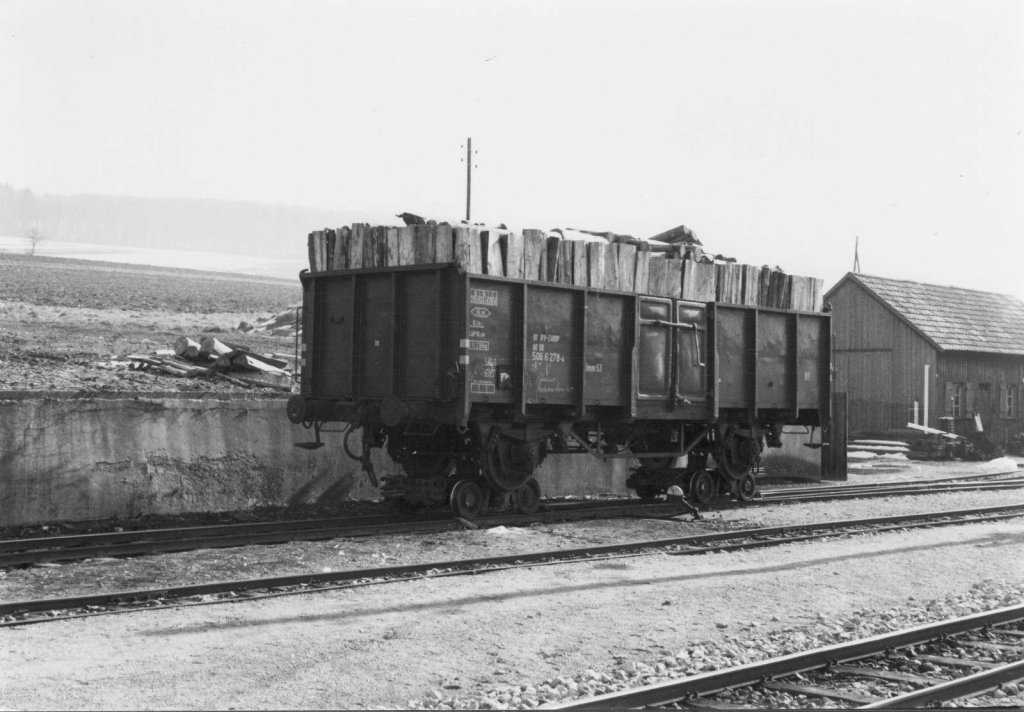
The mechanism was similar to the practice espoused by some European narrow-gauge railways where standard-gauge wagons could be carried over narrow-gauge lines. A typical example would be the practice as used on the Brünig Railway in Switzerland or on the Hartsfeldbahn in Bavaria which made use of Rollbocken in the mid-20th century.

The Rollbocke was an invention by Director Langbein of the Saronno branch of Maschinenfabrik Esslingen, which supplied many European narrow-gauge railways with it. The Härtsfeldbahn had up to 28 units, but then in connection with the expansion of the Rollbocke traffic to the Aalen-Ebnat section in 1950, 16 rental vehicles from the WEG-Bahn Amstetten-Laichingen were added. In 1960 another 16 units followed from the DB route Nagold-Altensteig. [2]

A typical Rollbocke (or dollie). [2]
A standard-gauge freight wagon on ‘dollies’ (rollbocken) at the ramp in Neresheim, around 1970. (Photo: Kurt Seidel Collection)[2]

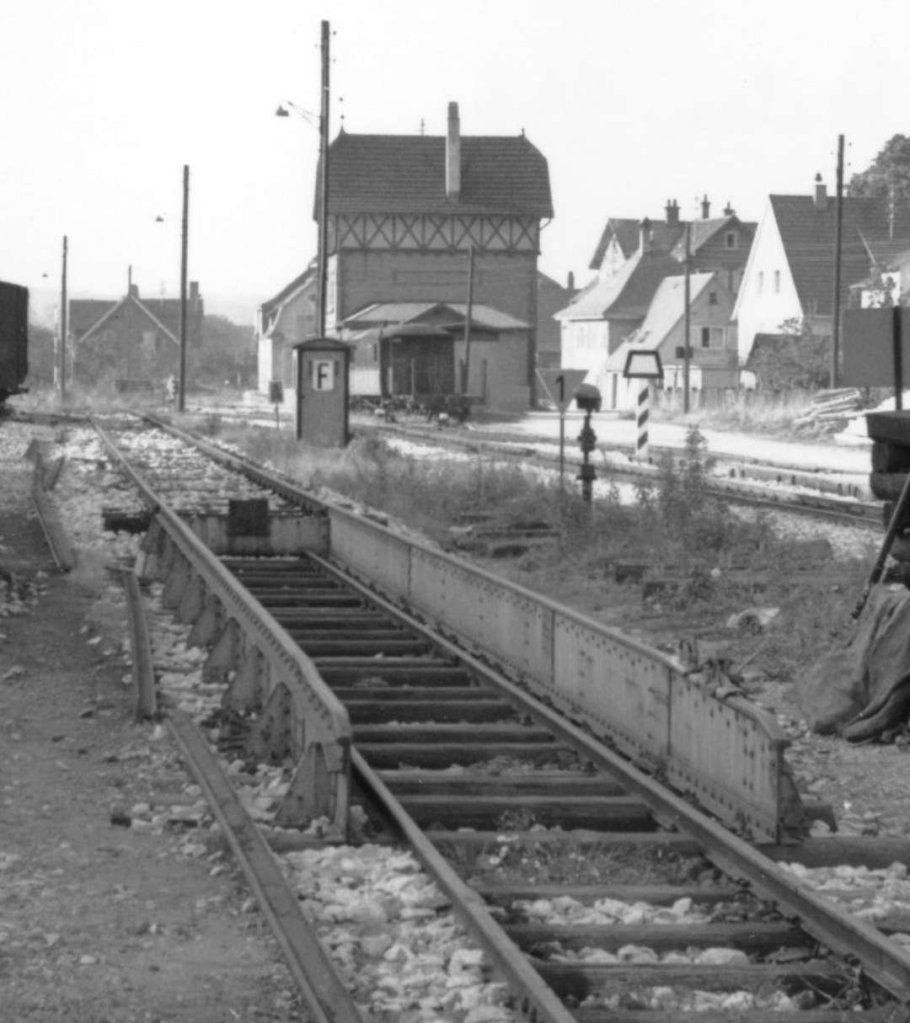
The use of these Rollbocken was somewhat different in nature to the use of Bonner wagons as separate units were used for each axle of a larger-gauge wagon. Pits were provided to allow the Rollbocken to pass under the larger-gauge wagons.

Rollbock pit in Gbf Aalen in 1967. (Photo: Winkler / Härtsfeld Museumsbahn archive). [2]

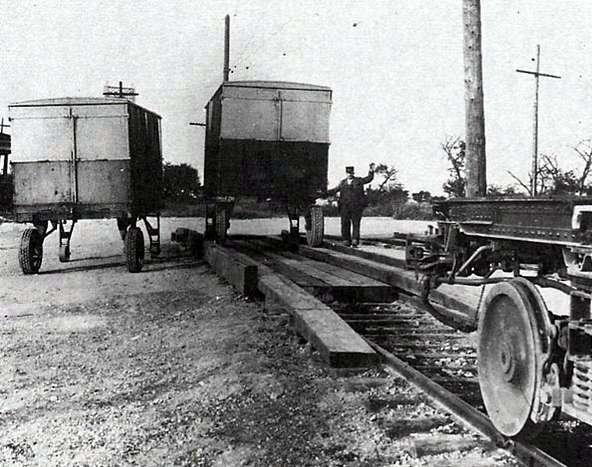
The transfer of a Bonner Wagon between road and rail was done by means of a ramp at each side of the rails. In the USA, “the interurban car would shunt the wagon towards this ramp, the sides of which would offer support to the road wheels and as the move proceeded would cause the road wagon to rise clear of the rail vehicle; the latter would then be drawn out from underneath, after releasing appropriate locking devices, leaving the road wagon to be hauled by horses to its destination in the town.” [1: p350]

The transfer taking place in North America. Typically, Bonner wagons had wide-spaced wheels and no cross axles, and were parked astride the railway tracks on small ramps. A specially designed rail car was then run underneath them. Pneumatic jacks lifted the trailer wheels off the ramps slightly and clamped them securely in place. The transfer from road to rail could be accomplished in as little as four minutes. The system promised great efficiency and cost savings as high as 50% by eliminating the re-handling of freight between trucks and rail cars. Nor would cars have to sit idle waiting to be loaded or unloaded. [3]

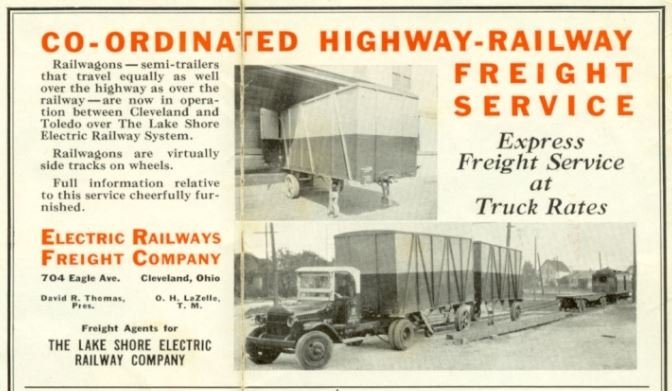
Although the use of Bonner Wagons “was not widespread, even in America, the method sur- vived long enough to be used in the late 1920s in conjunction with motor tractors by the Lake Shore Electric Railway, with transfer ramps in the outskirts of Cleveland and Toledo at either end of an 85-mile main-line run. Bonner Wagons could be run in trains of any reasonable length, bar couplings being provided between the projecting ends of the rail units.” [1: p350]

An advert in North America from the Electric Railways Freight Company who were freight agents for the Lake Shore Electric Railway Company (1931). [3]

Returning to the Isle of Man, “when the line to Ramsey was fully operative, the Bonner Wagons settled down to a regular routine; granite setts from the Dhoon to Ramsey harbour, coal to Balla- glass power station, empty to Dhoon, and so on. The loading ramp was a removable installation, apparently used at Queens Drive crossing and not at the Ramsey Palace terminus, though even out at Queens Drive local residents often complained of the nocturnal noises caused by the shunting and transfers. It seems from this that the ramp could only be installed and used after the last passenger car had gone past at night, to be removed again before the first car in the morning. … Another ramp was installed at Derby Castle (Douglas) to perform the same rites as at Ramsey for journeys to and from Douglas harbour, and also for general freight traffic in the town.” [1: p352]

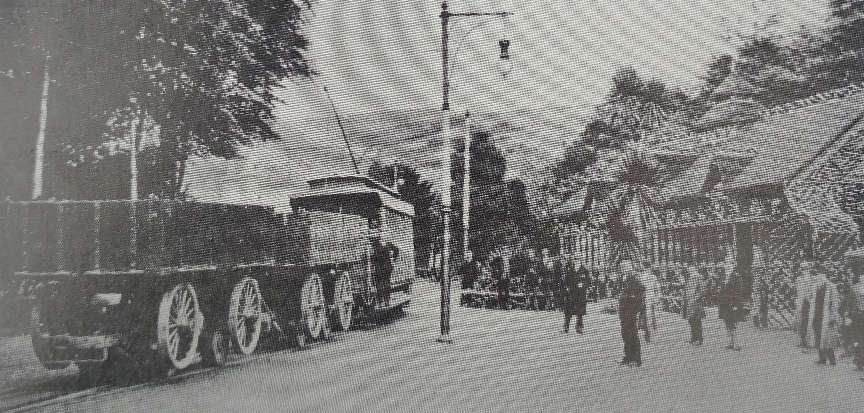
Transferring a Bonner Wagon from rail to road on the ‘Bonner siding’ at Derby Castle, Douglas, showing the ramps which supported the road wheels while the rail carrier was being moved. [1: p351]
A train of Bonner wagons hauled by a Manx Electric cross-bench car of the 14-18 series, at Laxey Station in 1899. The building on the right was later lost to fire. [1: p351]

So far as we know, the three Bonner Wagons on the Manx Electric Railway, survived for about 20 years. They were probably the only example of ‘Piggy-back’ vehicles on any British tramway or electric railway. Pearson & Price commented in 1963 that, at that time, the Bonner Wagon name “live[d] on … in an unexpected way, for the Derby Castle layout include[d] one siding that [ran] all alone behind the car shed nearest to the sea-front, and … that piece of track [was] known to the staff as the ‘Bonner siding’. The Dhoon granite quarry finally closed down in 1961, having belonged to the Highways Board for many years.” [1: p352]

References

  1. F.K. Pearson & J.H. Price; ‘Piggy-Back’ in 1899; in Modern Tramway and Light Railway Review, Volume 26 No. 2, Light Railway Transport League and Ian Allan, Hampton Court, Surrey, October 1963, p350-352.
  2. https://www.hmb-ev.de/fahrzeuge/rollbock-2, accessed on 24th August 2023.
  3. http://justacarguy.blogspot.com/2018/07/bonner-road-rail-wagons-something-ive.html?m=1, accessed on 24th August 2023.
  4. https://www.lakeshorerailmaps.com/clevelandfreight_3.html accessed on 24th August 2023.

The First Permanent Electric Railway in Scotland – The Carstairs House Tramway.

The July 1962 issue of ‘Modern Tramway’ included a short article about the Carstairs House Tramway, written by Christopher T. Harvie. [1]

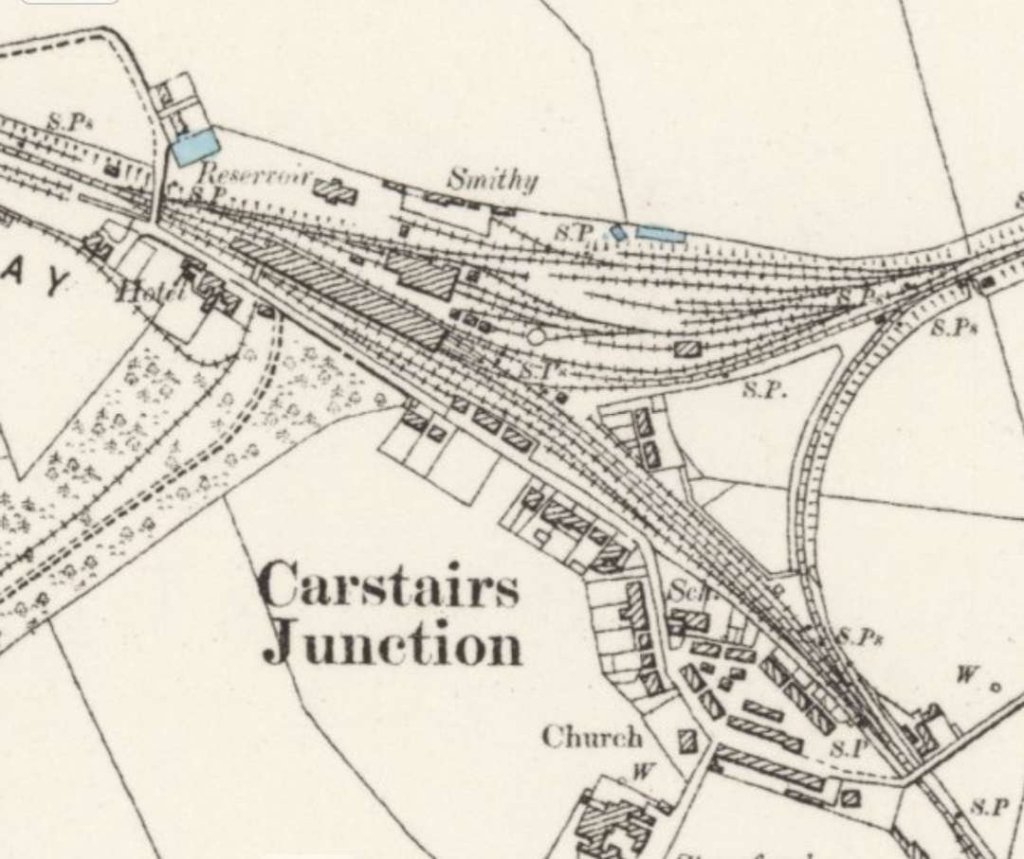
Wikipedia states that the Carstairs House Tramway operated between Carstairs railway station and Carstairs House between 1888 and 1895. [2] Railscot has slightly different information. It indicates that the tramway opened in 1889 as an electric tramway but reverted to being horse-powered by 1896. It continued operating in this way until 1925. [3]

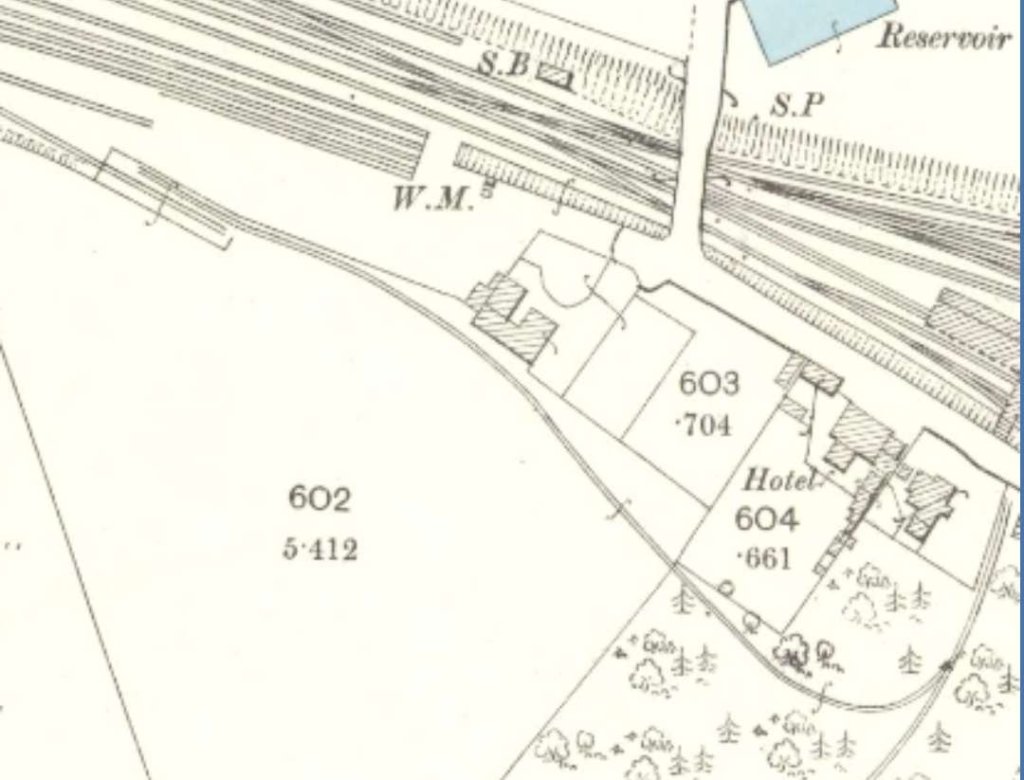
Carstairs Junction Station as it appears on the 6″ Ordnance Survey of 1896/1898. The tramway can be seen on the left of the map extract running from close to the Hotel. [4]
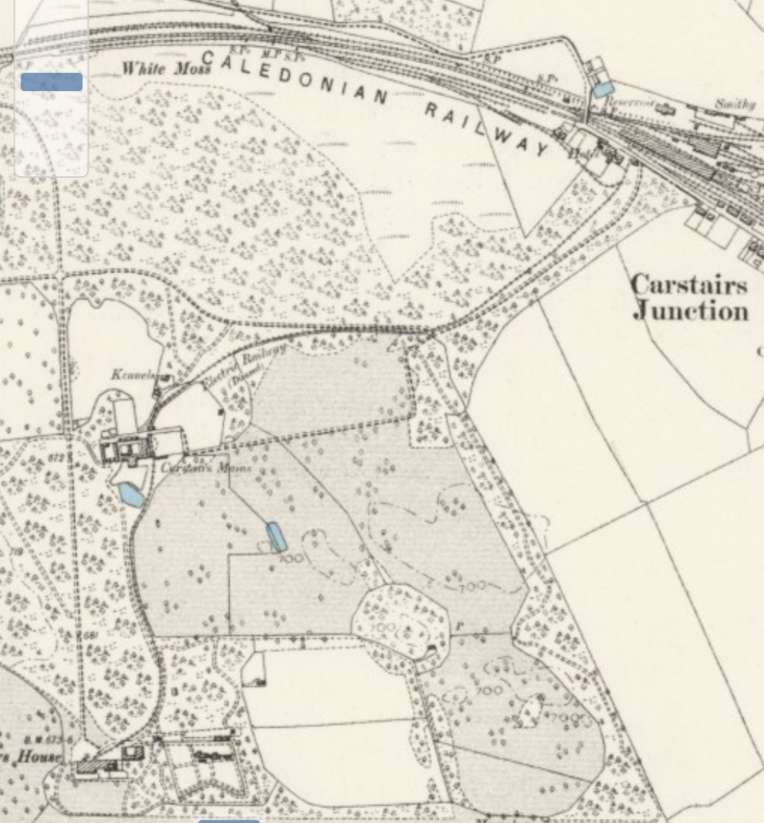
The full length of the tramway appears on this smaller scale extract from the OS mapping. Carstairs House appears bottom-left. [5]

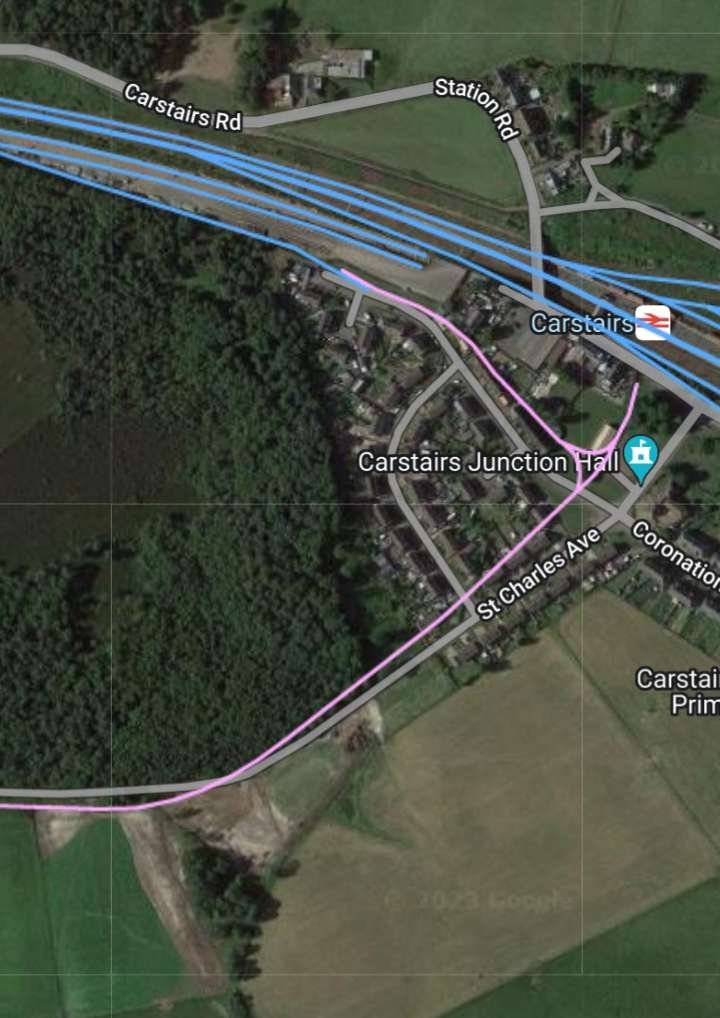
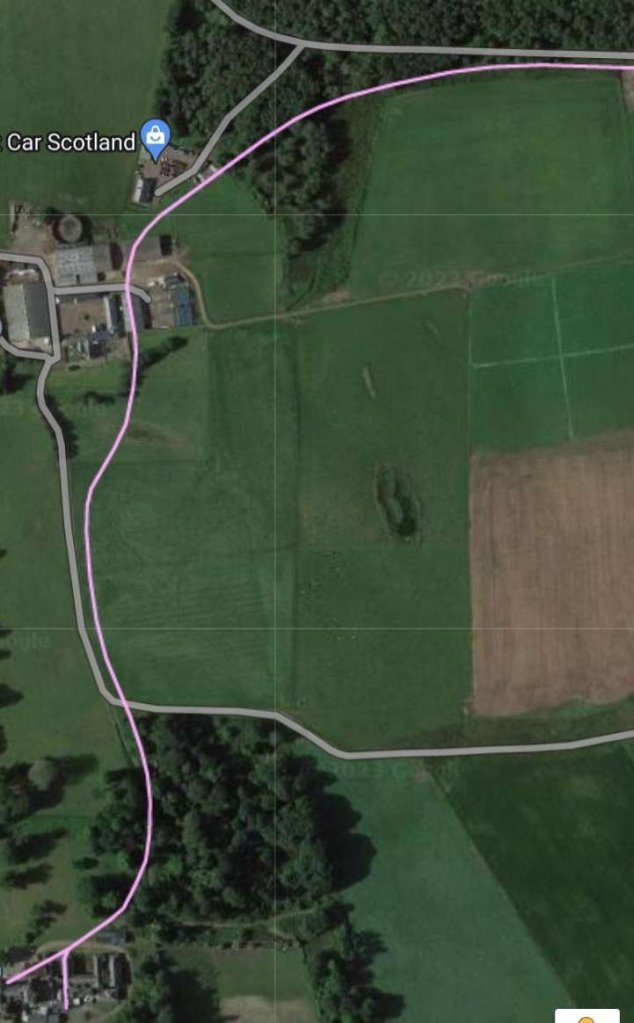
The two RailMapOnline extract below show the full length of the line superimposed on Google Maps satellite imagery. [7]

The route of the tramway is shown by the pink line on these extracts. [7]
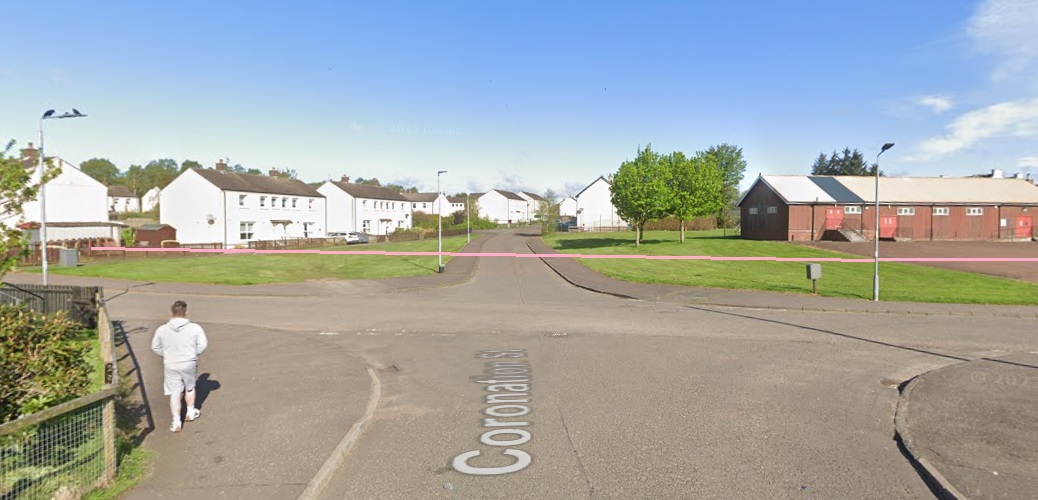
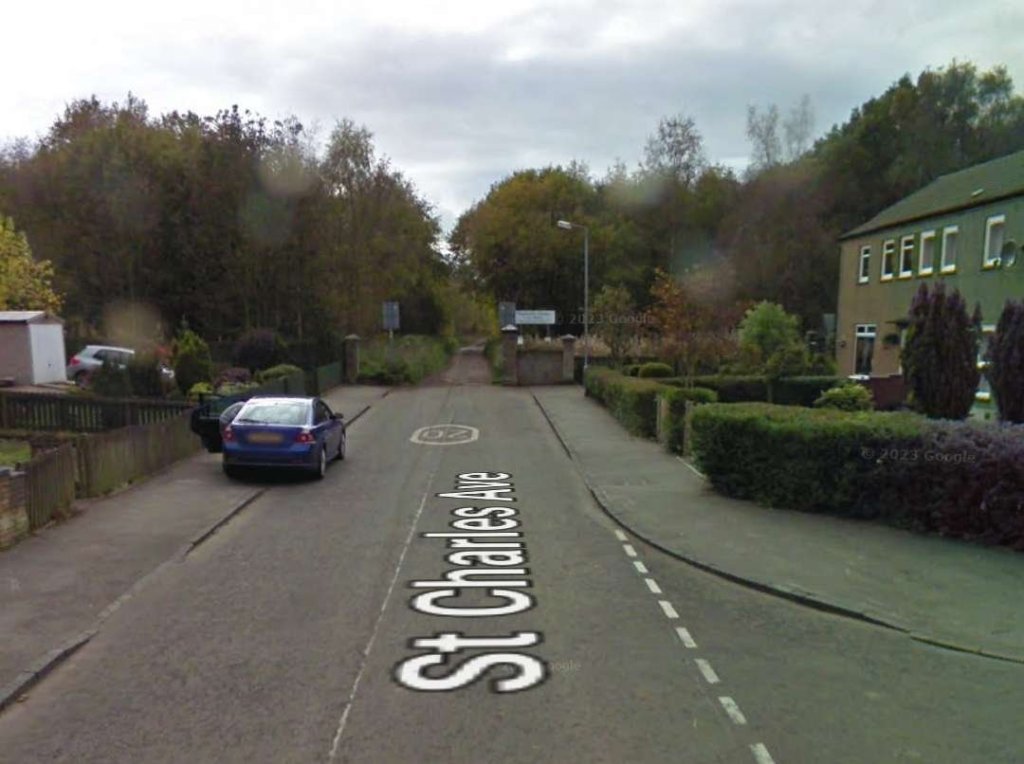
Looking Southwest along St. Charles Avenue in Carstairs. The drive to Monteith House is directly ahead. The tramway route ran under the modern properties on the right. [Google Streetview, October 2010]

Carstairs House is now known as Monteith House. It overlooks the River Clyde and sits “about one mile from the main Glasgow-London line of the Caledonian Railway at Carstairs West Station, and in 1886 the owner decided to build a tramway from the railway station to carry passengers to the house, agricultural implements and supplies to the Home Farm, and the great amount of coal then needed for heating the mansion. Accordingly plans were made for a line of 2 ft. 6 in. gauge, electrified at 250 volts, the current being generated by a turbine driven by a waterfall on the Clyde. … The positive and negative conductors were wires running alongside the tracks, supported by insulated posts about a foot high. On the car there was a double shoe to pick up current.” [1: p226]

At Carstairs House there were a few short branches serving a carriage shed and stores/outhouses. Between the House and the railway station was Carstairs Mains Home Farm where there were two further branch lines, one into the yard and the other to a sawmill. The sawmill provided the Caledonian Railway “with a considerable traffic in timber, the area being well forested. Leaving the Farm, the line cut across wooded country to rejoin the road and run alongside it to the main gates of the Estate where, at a lodge immediately opposite the railway, the terminal for passengers was situated. Shortly before it reached the lodge a branch diverged to the left, to run to a transfer siding with the Caledonian Railway.” [1: p226]

This extract from the 25″ Ordnance Survey of 1896/1897 shows the terminus of the line at the roadside opposite the Caledonian Railway station and the siding which ran Northwest alongside the Caledonian Railway to a transfer platform. [6]

There were three electric cars used for passenger services, “the first was a saloon four-wheeler built at the House in 1886. The other two were probably obtained second-hand from the electric railway demonstrated at the 1886 Edinburgh Exhibition and may have been built by the North Metropolitan Tramway Company of London.” [1: p227]

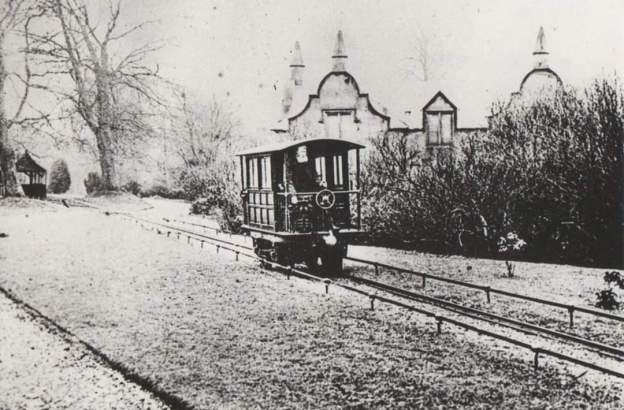
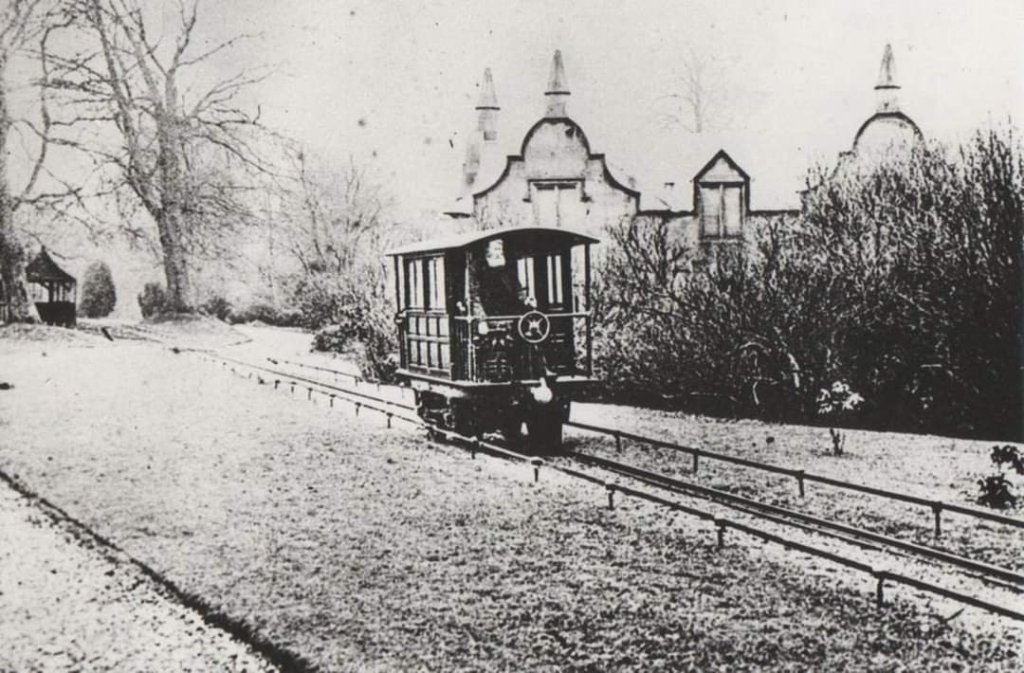
The small six-seat 2ft 6in gauge tram constructed locally for the Carstairs House tramway can be seen below. Different sources give different information about the year in which electric operation ceased. Most probably electric operation ceased in 1905 but the tramway itself survived for a further 30 years in order to ship coal and other freight from Carstairs station to the house and to export sawmill products from the estate, through the use of horse-drawn wagons. The tram, which was powered through electricity generated by a hydro-electric plant, drew its current from raised conductor rails, as clearly visible in the photograph below.

One of the Carstairs electric trams in action on the Tramway. The conductor rails can clearly be seen in this photograph. This image was shared on the I Belong to Carstairs Facebook Group on 21st July 2020 by Mark Allison. [8]

A further image showing one of these trams can be found in a book by Peter Waller, Lost Tramways of Scotland: Scotland West. [9]

In 1905, apparently, the owner was electrocuted by falling on the live electrical contacts. The result was that the electrical equipment was removed, the electric cars were placed in storage in their dedicated shed. They remained there until the final closure of the line.

Harvie tells us that:

“After the removal of the electrical equipment, horses took over the working of the line and its history continued uneventfully until the first world war, when it saw a period of intense activity as a transporter of spagnum moss, or bog-cotton, which was used as a substitute for American cotton during the period of unrestricted submarine warfare.

The line continued in use until around 1935, when the Montieth family left Carstairs House. Apparently the electric cars were then scrapped, after over thirty years of disuse. As the coming of the motor-car had ended its passenger services the agricultural tractor and motor-lorry meant the end of its usefulness as a freight carrier.

Shortly after the opening of the line there was put forward a plan for the construction of a network of local electric railways to serve the towns of Motherwell, Hamilton and Wishaw, after the same pattern as the Carstairs House Tramway, with power generated by the Falls of Clyde, near Lanark. Although this scheme remained a proposal, both parts of it were later carried out independently, a conventional electric tramway of 4 ft. 7 in. gauge being built to link these towns with Glasgow in 1903 and a generating station being built on the Falls of Clyde by the Clyde Valley Power Company.” [1: p227]

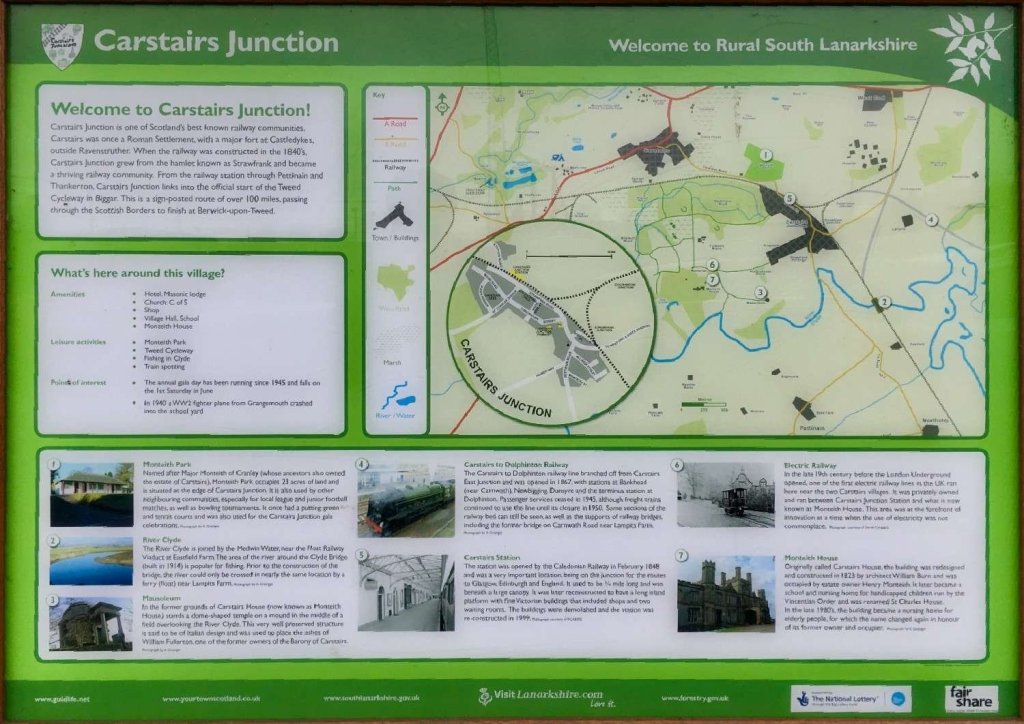
Two photographs of the information board near Carstairs Railway Station, Carstairs Junction. The Information Board stands near the junction of Strawfrank Road and St. Charles Avenue, close to where the tramway would have started. These photos were sent to me by Steve Pearce and are included here with his kind permission, © Steve Pearce.

References

  1. Christopher T. Harvie; The Carstairs House Tramway; in Modern Tramway and Light Railway Review, Volume 25 No. 295, Light Railway Transport League and Ian Allan Hampton Court, Surrey, p226-227.
  2. https://en.m.wikipedia.org/wiki/Carstairs_House_Tramway, accessed on 8th August 2023.
  3. https://www.railscot.co.uk/companies/C/Carstairs_House_Tramway, accessed on 8th August 2023.
  4. https://maps.nls.uk/geo/find/#zoom=15.4&lat=55.69277&lon=-3.66831&layers=298&b=11&z=0&point=0,0, and https://maps.nls.uk/view/75651318 accessed on 8th August 2023.
  5. https://maps.nls.uk/geo/find/#zoom=14.7&lat=55.68984&lon=-3.67589&layers=298&bk=11&z=0&point=0,0, and https://maps.nls.uk/view/75651318, accessed on 8th August 2023.
  6. https://maps.nls.uk/view/82893909, accessed on 8th August 2023.
  7. https://www.railmaponline.com/UKIEMap.php, accessed on 8th August 2023.
  8. https://m.facebook.com/groups/352799184389/permalink/10158618389784390, accessed on 8th August 2023.
  9. Peter Waller; Lost Tramways of Scotland: Scotland West; Graffeg, Llanelli, October 2022.

Articulated Tramcars for Basel & Zurich – Modern Tramway, June 1962.

Modern Tramway and Light Railway Review, June 1962 carried an article based on notes by H.J. Bertschmann, G.A. Meier and M. Frei about then new articulated trams in these two Swiss cities. [1]

Both the Basler Verkehrs-Betriebe and the Verkehrsbetriebe der Stadt Zürich had taken delivery, in the months prior to the article being written, of the first prototypes of a new design of articulated tramcar. The design was a new departure, a double-articulated tram on three trucks. Earlier models of articulated cars had  two sections on two or three trucks, or three sections on two or four trucks, but never before three sections on three trucks.

“Wages costs represent a very high pro- portion of the total costs in the operation of public transport, and in both Basel and Zürich reach[ed] 80 per cent of the total expenditure. Economy in staff [was] therefore the only way in which undertakings [could] remain solvent, and the rapid increase in traffic oblige[d] transport undertakings to use high-capacity vehicles in order to minimise utilisation of the road surface. The development of bogie cars was the first step in this direction, and the delivery of the first articulated cars carries this a stage further.” [1: p19]

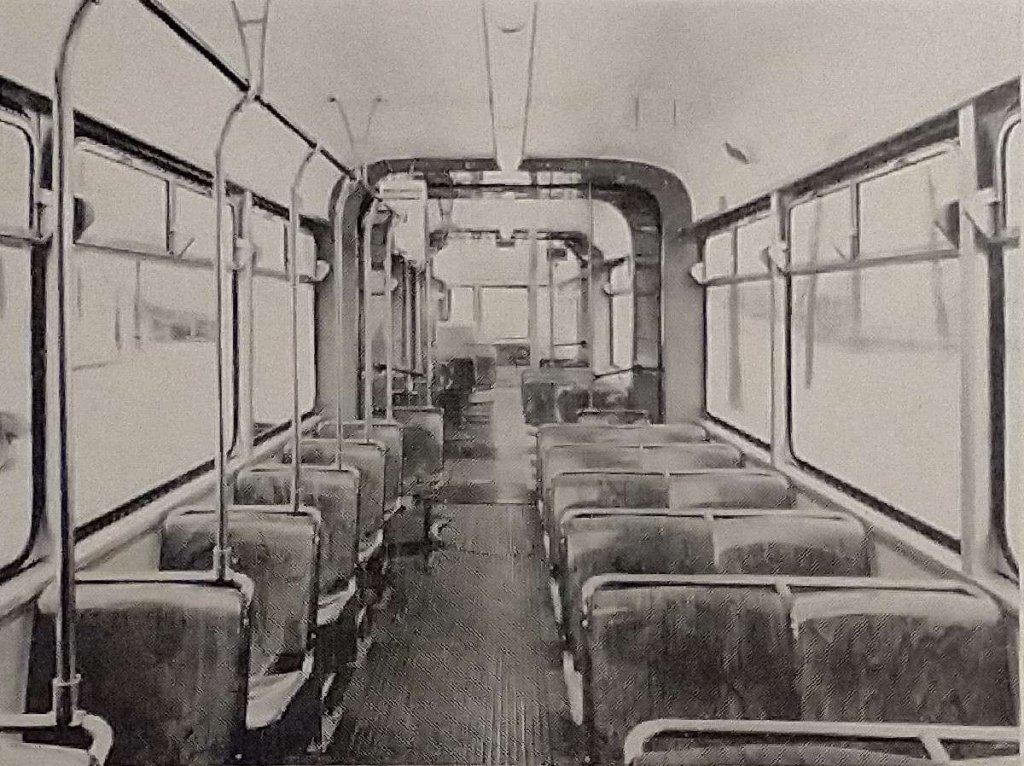
The interior of Zürich Tramcar No. 1801. Modern Tramway commented in 1962.”Its clean lines are very attractive, and the styling is in accord with the latest Swiss designs. The Basel cars differ only in minor details such as the arrangement of grab-rails and in the provision of upholstered seats. Even in 1962, Zürich trams have hard seats of moulded reinforced plastic; their riding is so smooth that upholstery is unnecessary! © Verkehrsbetriebe der Stadt Zürich. [1: p19]
Zurich Tram Car No. 1801 sits outside Irchel Depot © Ernst B. Leutwiler Verlag. Entrances to the tram were at either end. Egress was via the two central doors. Number 1801 was built in 1961 as a prototype for the large batch of, what Zurich would call, Mirages that came later in the 1960s. It was scrapped in December 1999. [3]

The very different technical requirements of the Swiss urban transport undertakings had often hindered the development of a Swiss standard tramcar, one of the difficulties was caused by differences in the topography of the towns.

“This … led to a unified effort by the Basel and Zürich undertakings, the two largest tram- ways in Switzerland, to design an articulated car whose basic design was suitable for both undertakings. Whilst a classical (by German standards) two-section single-articulated six-axle car was built for Zürich by SWS (Schlieren), the co-operation between the two systems to find the most advantageous design resulted in an order for three articulated cars, two for the BVB (Basel) and one for the VBZ (Zurich), being placed with SIG (Neuhausen). SIG conceived a new style of construction, departing from the customary articulation over the central bogie (known as a Jacobs bogie) in favour of a short middle section on a two-axle non-rigid truck with an articulation at each end.

There [we]re so many common features in the design for both BVB and VBZ that practically the only differences [we]re in the number of motors and their electrical connections. Basel cars [had] four motors totalling 264 kW, whilst Zürich cars [had] six motors rated at a total of 396 kW. Motor bogie wheels ha[d] a diameter of 720 mm against the 660 mm of the Basel middle bogie wheels. Whilst the Basel cars [would] normally each haul a bogie trailer and the Zürich prototype car will also do this, the production batch of Zürich cars [would] run in multiple-unit pairs, and … (like Basel) have only two power trucks. Zürich has still to decide whether the two leading trucks will be motored, as distinct from the end trucks as at Basel. By confining the differences to these features (apart from minor differences in interior styling), the cars [could] achieve the maximum economy whilst ensuring the best use of the adhesion weight. By means of special mechanisms, it was possible to arrange the axle loadings so that the load on the driving axles was the same in both the four-motor and six-motor cars. Variations in the axle-load on the middle truck induce[d] horizontal forces in the upper part of the articulations; these induce[d] turning movements in the vertical plane, with consequent transfer of load between the outer and inner trucks. As a result of this design, the car [was] better able to start from rest on hills. [1: p19-21]

The advantages of the new design were:

  • The middle truck is not under the articulation mechanisms – so maintenance is much easier.
  • Rotation over each of the two mechanisms is half of that for one mechanism.
  • The body did not obstruct the drivers view of the exit doors which are in the middle section of the tram.
  • Double articulation permits wider front and end designs which allows doors to be built in the parallel sides of the tram.
  • A minimising of internal obstructions for passengers was achieved by the lesser amount of articulation required.
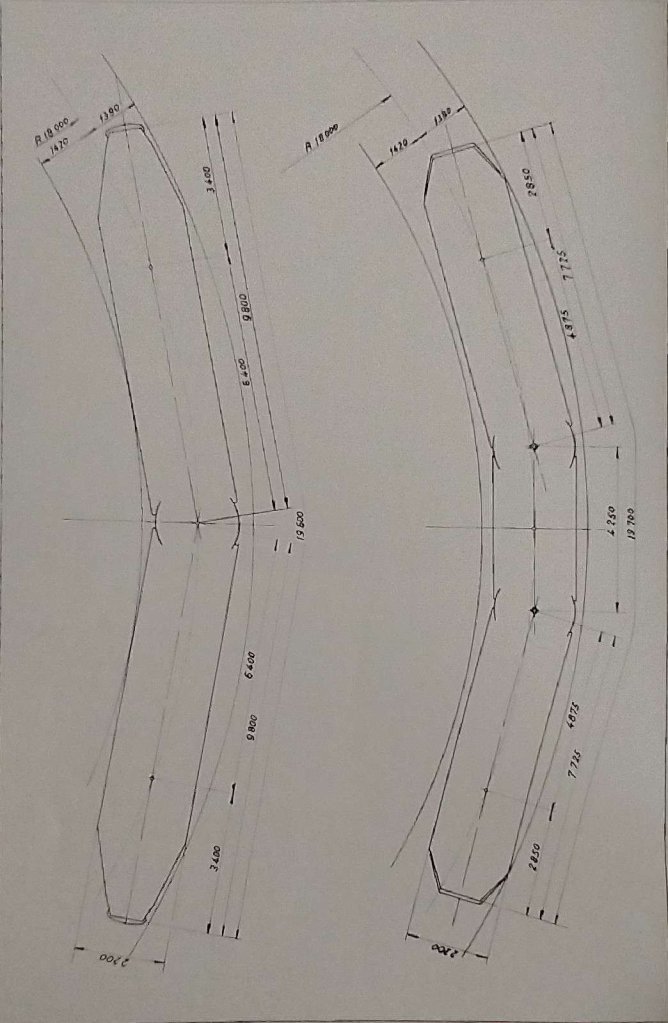
These two diagrams enable a comparison to be made between the conventional articulated car (left) and the new Swiss double-articulated design. The left-hand diagram shows the extensive end-tapering necessary to prevent overhang, whilst the right-hand diagram shows how “squarer” ends are possible and that much less relative movement takes place at the articulations, © Der Stadtverkehr. [1: p188]
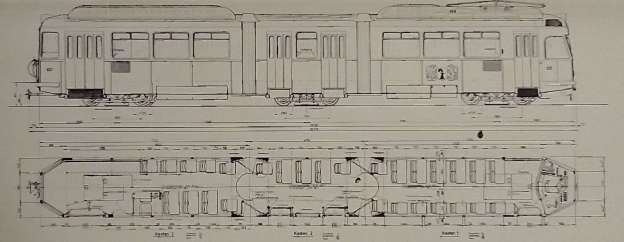
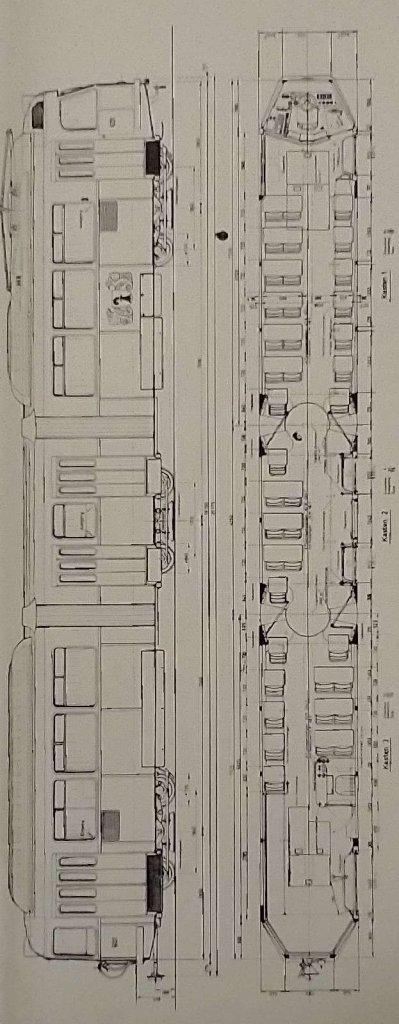
Plan and elevation of Basel  Tramcar No. 601. Apart from the livery, the external appearance of the Zürich car differs mainly in the addition of a front coupler, © Der Stadtverkehr. [1: p189]
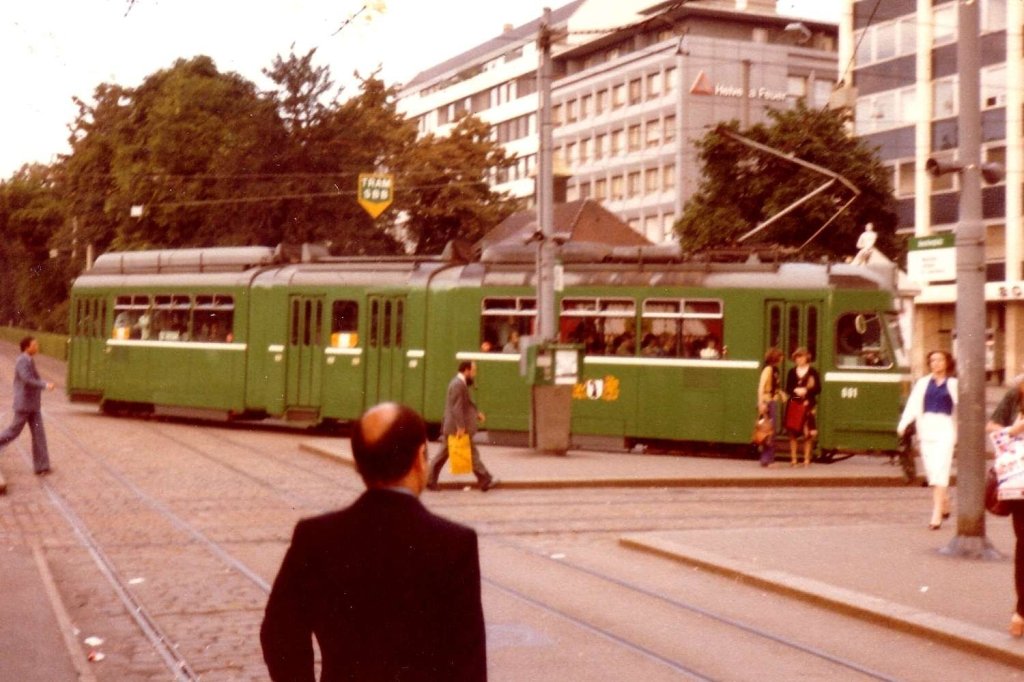
Basel Articulated Tram No. 601 on Aeschenplatz in 1981, © Henrik Boye and used here by kind permission of the photographer. This tram survived in service until 1991. Its last journey in service was on 5th May 1991 and it was written off on 13th June 1991. [2][4]

Trams travelled at a maximum speed of 60km/h and had a capacity of 42 seated and 123 standing. The empty car weighed 28.3 tonnes. The significant dimensions of the tramcars were:

  • Overall length between couplings: 20.45m
  • Length of body: 19.7m
  • Height of roof over rails: 3.385m
  • Width: 2.2m
  • Distances between king-pins: 7.0m
  • Overhangs: 2.85m
  • Wheelbase of motorised truck: 1.86m
  • Wheelbase of non-motorised truck: 1.7m

The article describes the trucks, braking systems and control systems as follows:

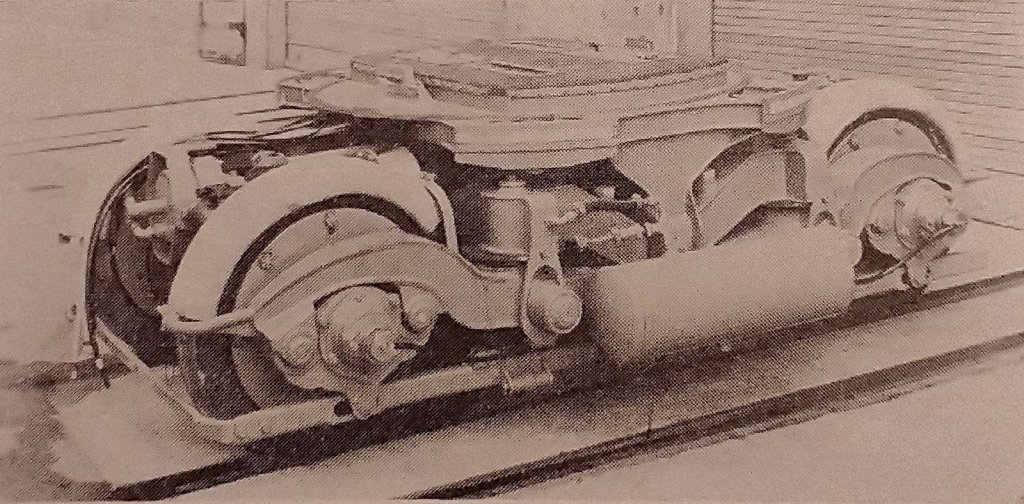
“The motor trucks are swing-link trucks with outside frames and torsion-bar springing. The springing of the torsion bar and the swing-links is combined into a single springing system, and this contributes considerably to noise reduction, in conjunction with the resilient wheels. The longitudinally-mounted motors are held by a three-point suspension to the truck frames, using rubber inserts.

The braking system: … The service brake is rheostatic, augmented with an air-operated disc-brake. A Charmilles brake handle is fitted under the controller wheel (a Volkswagen steering-wheel), … the air brake automatically supplements the electrical brake as the regenerative current dies out, and excessive braking through combined electric and air braking applications is eliminated. In an emergency, the braking effort can be supplemented with magnetic brakes. The parking brake is a hydro-mechanical hand brake. An Electro-pneumatic valve proportions the application of air to the trailer and (on the Basel cars) to the un-motored truck.

The control system has 22 running notches, of which the last three are field-weakening notches; there are 23 notches for rheostatic braking and a 24th emergency notch for magnetic braking in addition. The motors are connected in series pairs, each motor operating at half-voltage, and every effort has been made to keep the number of power cables crossing an articulation to a minimum.” [1: p190-191]

The truck design adopted for the, then, new Basel and Zurich cars, © Der Stadtverkehr. [1: p190]
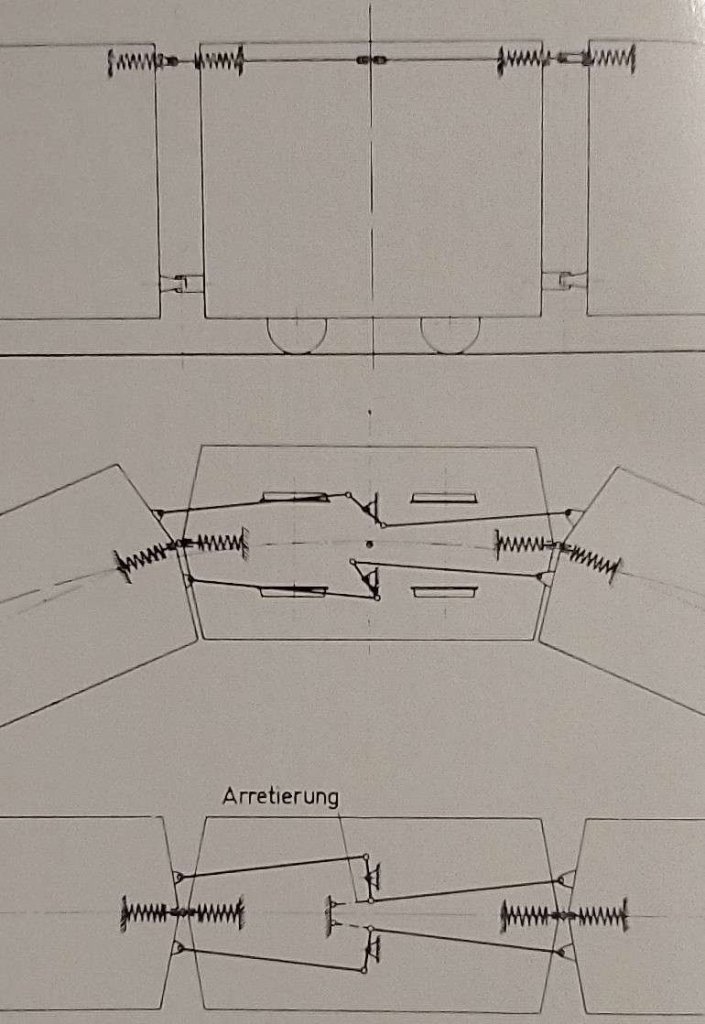
This schematic drawing illustrates the, then, ingenious link mechanisms at the articulations whereby the load was distributed in the most efficient manner. The upper diagram shows an elevation of the central section, and the two lower diagrams show plans of the car on a curve and on straight track, © Der Stadtverkehr. [1: p190]

The Modern Tramway Journal also reported on a number of other features:

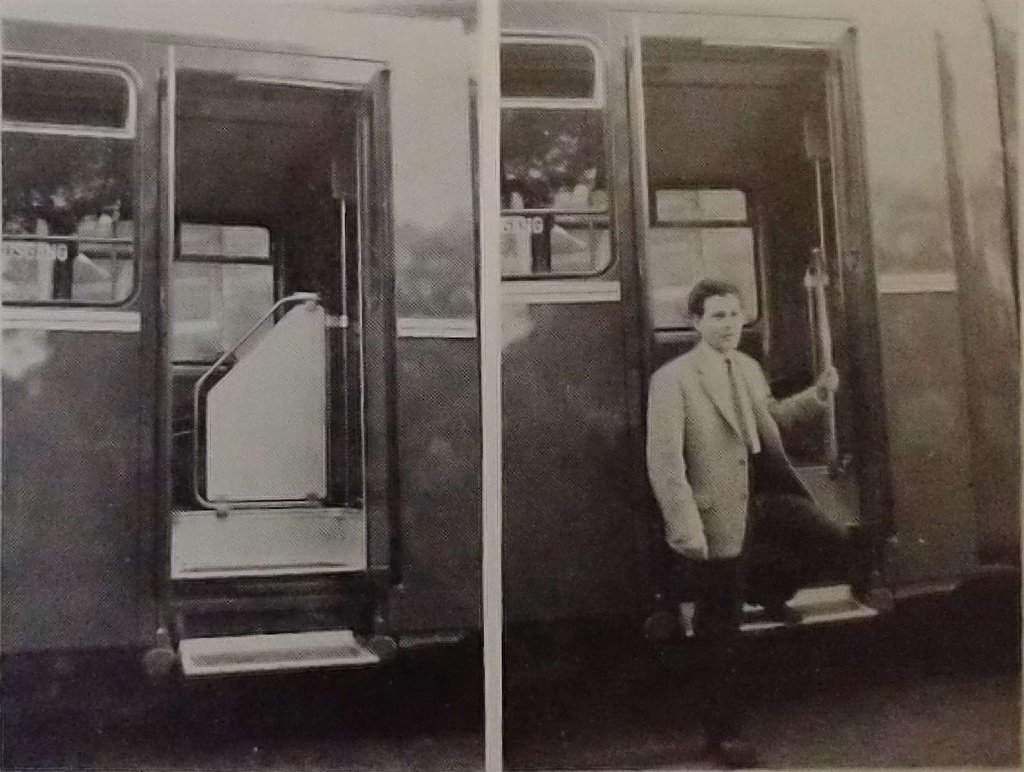
“The exit doors incorporate a device similar to that on the Stuttgart articulated cars. They are operated by the passengers through a push-button, and the opening of a light inner door by the passenger in order to gain access to the step holds the main doors open. The other function of the inner door is to prevent the entry of passengers at the exit doors. In Zürich, passengers would press the push-button to signal to the conductor to open the doors, whilst Basel had intended that passengers should open the doors themselves. However, as Basel experienced some confusion with this arrangement, they changed over to the Zürich system.

Particularly interesting features of the new cars include a “Hesomat” indicator blind, driven by an electric motor. The driver merely presses a “tens” button and a “second digit” button for the code number of the desired destination, and this is automatically set-up. Another innovation is the point-changing button enabling the driver to simulate a “power” signal whilst coasting past the detector. To prevent the current taken by auxiliaries causing a false “power” signal, a push-button in the centre of the controller wheel can cut off all auxiliary power as the detector is passed.

The Zürich undertaking needs new cars urgently and it is hoped that the number of articulated cars will ultimately rise to 200; they are intended to be the basic unit for the planned Tiefbahn (subway) services. The Basel plans are less ambitious for the present, but they hope to operate route 6 entirely by these cars at some date in the future. This route, from Allschwil to the German border at Riehen, is one of the fastest urban routes in Switzerland, and these cars should be particularly suitable.” [1:p191]

In addition to the external jack-knife doors, the exits have a single leaf internal door. The action of the passenger in holding this open keeps the main doors open, and it also serves as a handrail. Its main purpose, however, is to deter passengers from entering by the exits, © Basler
Verkehrs-Betriebe.[1: p191]

Ultimately, tram No. 1801 was a success as a prototype in Zurich. A series of these vehicles were purchased later in the 1960s and were called ‘Mirages’. [4] An online acquaintance tells me that a number of these trams were later sold to the city of Vinnytsia in Ukraine. Details can be found here, [6] and in the YouTube video below. [7]

Ukraine passes trams to Vinnytsia. [7]

Tram No. 601 and its partner were less of a success in Basel. As a result, the two trams ordered by Basel were not followed by a larger order. They remained the only Basel trams of their specific type. [5] Basel did purchase further articulated trams but from different a different source.

References

  1. H.J. Bertschmann, G.A. Meier & M. Frei; New Articulated Tramcars for Basel and Zurich; in Modern Tramway, Light Railway Transport League and Ian Allan, Hampton Court, Surrey, June 2022, p187-191.
  2. https://en.sporvognsrejser.dk/foto/s/basel-articulated-tram-601-on-aeschenplatz-1981.jpg, accessed on 2nd August 2023.
  3. https://en.sporvognsrejser.dk/foto/postcard-zurich-articulated-tram-1801-at-the-depot-tramdepot-irchel-1975, accessed on 2nd August 2023.
  4. https://transphoto.org/vehicle/276178/?lang=et, accessed on 3rd August 2023.
  5. https://ba.e-pics.ethz.ch/catalog/ETHBIB.Bildarchiv/r/690998/viewmode=infoview, accessed on 3rd August 2023.
  6. https://en.m.wikipedia.org/wiki/Trams_in_Vinnytsia, accessed on 10th August 2023.
  7. https://www.youtube.com/watch?v=Gh7sMfSNK08, accessed on 10th August 2023.
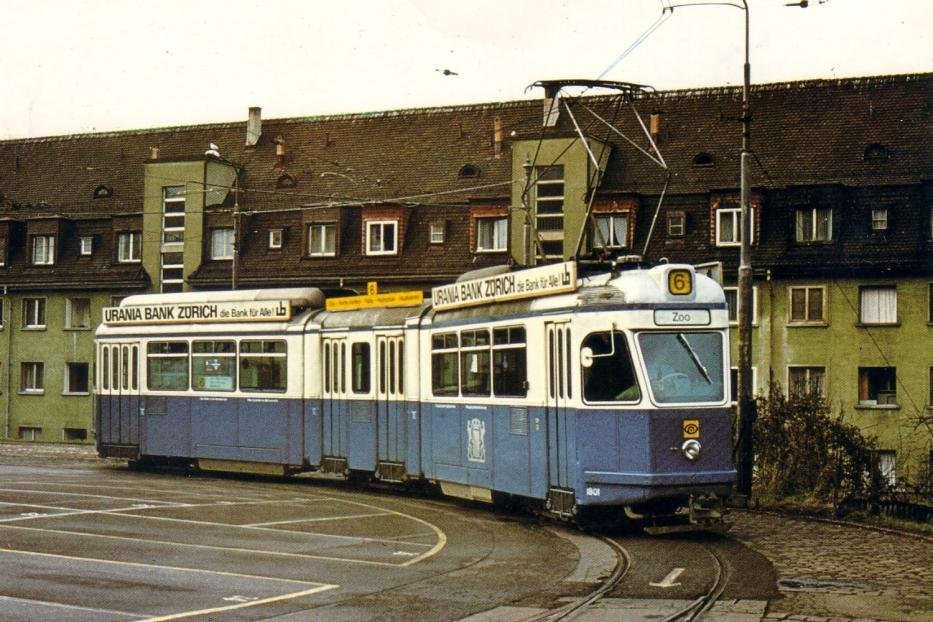
‘Modern Tramway’ – Blackpool: The Marton Experiment …

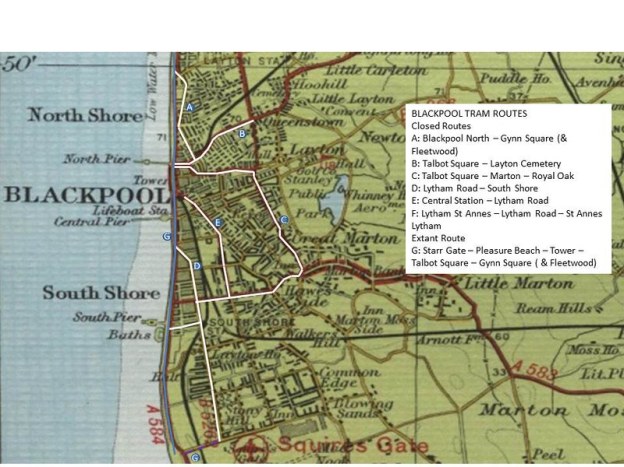
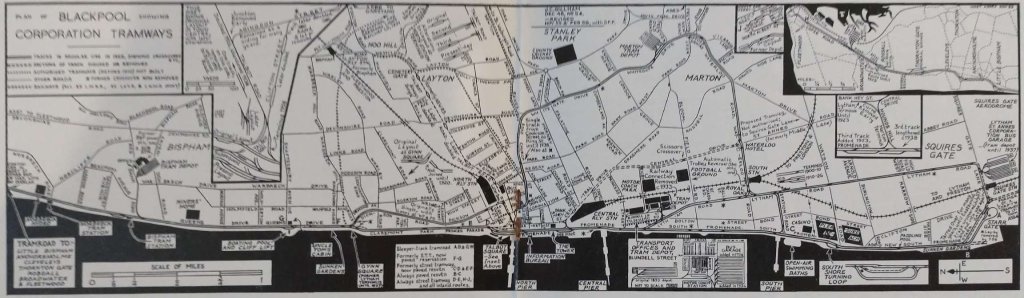
The ‘Modern Tramway’ reported in January & February 1963 on a relatively short lived experiment on Blackpool’s trams. The Marton route was an inland route through Blackpool which complemented the promenade route. It is route ‘C’ on the featured image above. [11]

The two articles were written by F.K. Pearson who suggested that his articles could perhaps have been entitled, ‘The Experiment That Didn’t Quite …‘ [1]

The Marton Route opened in 1901 but by 1938 it was approaching the end of it’s useful life, needing relaying and requiring a new fleet of 15 trams. A decision to undertake the work was deferred by Blackpool Town Council. War intervened and the existing trackwork was patched up to last a few more years.”By the time relaying could be considered again, technical progress had rendered the 1938 plan out of date, and the Marton route was chosen for one of Britain’s most interesting public transport experiments, the only attempt ever made to provide a tram service which by its sheer frequency, comfort and riding qualities could compete not just with the bus but with its future competitor, the private car.” [1: p14] Pearson’s article reports on that experiment, how near it came to success. and where it eventually failed.

Pearson continues:

“The story begins with the acquisition in 1945 by Crompton Parkinson Ltd. of a licence to manufacture in Britain certain equipment similar to that in the American PCC-car, the patents of which were held by the Transit Research Corporation in the USA. The experiments which followed were aimed at producing a vehicle which in silence, comfort, performance and soothness of riding would outshine any existing public service vehicle and rival that of the best private car. Blackpool already had modern trams, plenty of them, designed for the straight, open, track on the Promenade where even orthodox cars could give a smooth and quiet ride, but what was promised now was a tram with silent ‘glideaway’ performance even on grooved street track with frequent curves These route conditions, frequently met with in other towns, existed in Blackpool only on the Marton line, and Mr. Walter Luff the Transport Manager, made no secret of the fact that he hoped to persuade the Town Council to let him use the Marton route for a large-scale experiment that might have considerable repercussions on the future of tramways elsewhere in Britain; in short, to make it a show-piece.

The question of relaying the route was reopened as soon as the war ended, and the Town Council asked for comparative estimates for trams, buses and trolleybuses. Mr. Luff reported that to keep trams would cost £136,380 (£61,360 for new track £75,000 for 15 new cars), buses would cost £56,940 including road reinstatement and depot conversion, and trolleybuses would cost £87,360. He made no secret of his belief that the experiments then in progress would result in a vehicle superior to be existing tram, bus or trolleybus, and the Town Council, wishing to await the outcome of the trials, postponed a decision and asked that the track be patched up for a few more months.

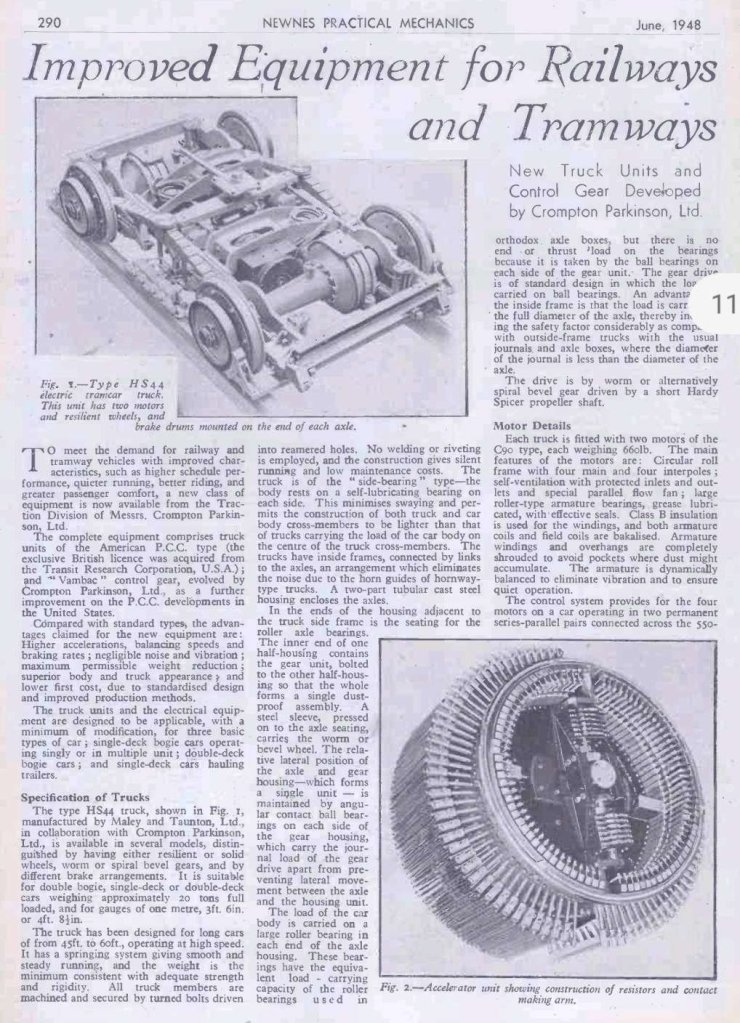
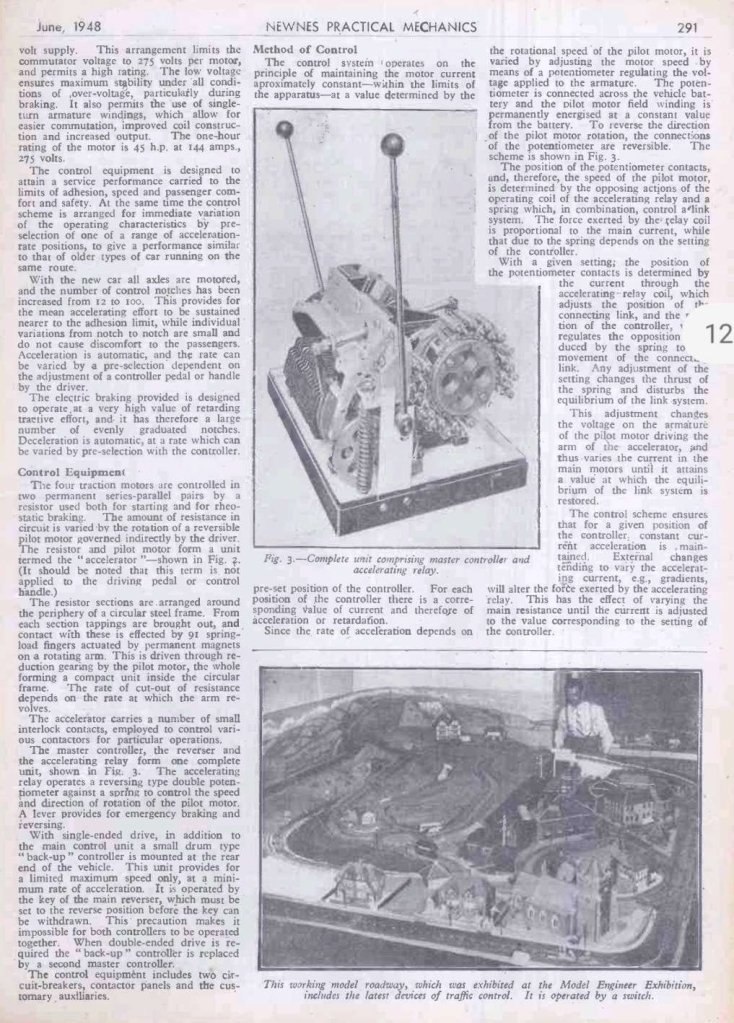
The first objective of the new equipment was silent running on grooved street track. This was achieved by using resilient wheels with rubber sandwiches loaded in shear between the tyre and the wheel hub, which would absorb small-amplitude vibrations arising from irregularities in the track instead of transmitting them through the springing to the rest of the car, and in the process would achieve virtual silence. Furthermore, the resilient wheel allows slight lateral flexibility and reduced side friction between flange and rail, eliminating the usual scrub on curves and incidentally reducing flange wear to an extent which eliminated the need for re-turning the tyre profile between successive re-tyrings. These rubber-sandwich wheels could be unbolted and changed like those of a bus, necessitating a newly-designed inside-frame truck (type H.S. 44) produced by Maley & Taunton, Ltd., who also designed and supplied a “silent” air-compressor to eliminate another source of noise. The experimental trucks were placed under car No. 303, and on 26th April 1946, the B.B.C. took sound-recordings on street track on this and an older car, with the microphone only three feet from the wheels.

With the old-type car the noise was considerable but with No. 393 it was practically nil.

Another traditional source of tramcar noise is the straight spur-gear drive, and this was replaced in the new truck by a right-angle spiral bevel drive, completely silent in operation, and requiring the two motors to be placed fore-and-aft in the truck. In many towns this alone would have led to a remarkable reduction in noise level, but Blackpool also knows how to keep spur gears quiet, and one wonders whether a right-angle drive (less efficient mechanically) can be justified by noise reduction alone. However, these and similar gears had been developed to such a pitch of efficiency for motor vehicles by their manufacturers (David Brown, Ltd.) that their use in a tram presented little difficulty. The technical and metallurgical problems had long since been overcome, and the only question was that of expense.

The other main objective was complete smoothness of acceleration and braking with private-car performance, and for this experiments were carried out by Crompton Parkinson, Ltd., using Blackpool car No. 208 to which the experimental trucks were transferred from No. 303 later in 1946. All four axles were motored, giving a possible initial acceleration rate of 3.5 mph. per second, and a smooth rate of change was achieved by arranging the motors in permanent series-parallel pairs and feeding them through a resistance having 94 steps instead of the usual eight. This resistance, mounted on the roof for ease of ventilation, was built around a circular steel frame with contacts on a rotating arm, turned by a small pilot motor, and the master control was by a joystick control by which the driver could select the rate of acceleration or braking required. Acceleration was automatic, for if the lever were left in a constant position the traction motors would accelerate or decelerate at constant current, yet it could also be varied by moving the stick, which explains the trade-name “Vambac” (Variable Automatic Multi-notch Braking and Acceleration Control) used for this equipment. Although inspired by that of the American PCC-car, it differed in several important respects, notably in that it enabled the car to coast. A car with this equipment, operating at the limit of its potential, was expected to consume about 4.5 units per car per mile (about 2.5 times the Blackpool average), but provision was also made to give a lower performance comparable to that of older trams if the two had to provide a mixed service on the same route. This reduced performance later became the Blackpool standard.” [1: p14-15]

Two pages from Newnes Practical Mechanics which give details of the type H.S. 44 bogies produced by Crompton Parkinson Ltd. and Maley & Taunton, Ltd. [4]

It transpired that the complete car was ready to begin trials in December 1946, and the Town Council were very soon invited for a demonstration. The track was now in an awful condition requiring a relay or abandon decision.

“After considerable debate, the Transport Committee recommended that it be relaid, and the Town Council on 8th January, 1947, decided by the narrow margin of 25 votes to 21 to instruct the Borough Surveyor to proceed with the reconstruction of the track. Blackpool Town Council, then as now, included some shrewd business-men, and the fact that they were prepared to spend twice as much on keeping trams than would have been needed for buses is the most eloquent testimonial to car No. 208 and the impression which its revolutionary equipment and performance had made. For the first time, they realised, it was possible for a public service vehicle to offer a performance as good as the private car, and it was bound to be popular.

Work began straight away, using rail already in stock, followed by 600 tons of new rail and Edgar Allen pointwork to complete the job. Other traffic was diverted, with single-line working for the trams, and by the autumn of 1948 new Thermit-welded asphalt-paved track extended throughout the 3-mile route, save only for a short section held back until 1950 because of an anticipated new road layout. …

Meanwhile, the experiments with prototype car No. 208 continued, and by mid-1947 the car (specially equipped with fluorescent lighting) was ready for regular service, though frequently in demand for demonstration runs with visitors from other undertakings. The car was not used on Marton, for the Marton schedules were based on 78-seat instead of 48-seat cars, and for its first three years the new Marton track was traversed by the same cars that had worked the service since the mid-twenties, the gaunt, upright standard-type double-deckers, some of them with open balconies. These had no part in the Marton Experiment, and were due to disappear as soon as the heralded 15 new cars made their appearance.

At this point, compromises were made. Inflation meant that the planned new cars could no longer be obtained at anything like the estimated figure. Blackpool decided, for the sake of economy, to fit the new equipment to existing trams. Twelve surplus modern single-deckers were seen as suitable.

One of the twelve cars that were. Built cheaply in 1939 for use during the holiday season. It had a sunshine roof, secondhand electrical equipment, wooden seats, no partition between driver and passengers, the minimum of interior lighting, waste-high sliding doors, and the upper half of the windows permanently open. The twelve cars were originally built by English Electric. This photograph, which was included with Pearson’s article, shows the tram on 30th August 1939. It shows both the sunshine roof and the wooden seats to good advantage, © Fox Photos Ltd. [1: p17] The copyright of the photograph is now held by ‘Getty Images’ and a link to the original photograph can be found here.

“These cars (10 to 21) had been built cheaply in 1939 for use during the holiday season only, with second-hand electrical equipment, wooden seats, no partition between driver and passengers, the minimum of interior lighting, waist-high sliding doors, and the upper half of the windows permanently open. … Scarcely had they entered service than war intervened and they were put in store, emerging in 1942 with full-length windows, doors and cabs for use on extra workings such as troop specials.

Late in 1947, the Corporation ordered 18 sets of H.S. 44 trucks and Vambac equipment, to enable them to equip sufficient cars to work the entire Marton service, including spares. Rigby Road Works set to work rebuilding the 10-21 series into a new silent-running fleet, soon to become known as the ‘Marton Vambacs’. … Internally, the cars were given soft fluorescent lights, comfortable seats upholstered in brown moquette, new floor-coverings, and tuneful bells. The first car, No. 21, appeared in December, 1949, and its lack of noise when running was quite uncanny, the only remaining sounds being the soft buzz of the “silent” compressor, the hissing of the motor brushes, the clicking of the accelerator contacts, and the sound of the trolley wheel. Even this latter was to have been eliminated in due course, for when the Marton overhead next needed renewal the round wire was to be replaced by grooved wire suitable for use with silent-running carbon skids, of the type used on trolleybuses.” [1: p17-18]

Pearson tells us that, “Conversion of the 12 cars, took just over two years, and during this period the “new” cars could be seen side by side with the older double-deckers. In the eyes of the tramway enthusiast, the “vintage” year of the Marton route was undoubtedly 1951, when about half the service was still in the hands of the venerable but never decrepit standard cars, and mingled with these like gazelles among heavier quadrupeds (a purist might say ‘octopeds’) were the first half dozen Marton Vambacs’.” [1: p18-19]

The map of Blackpool’s trams included in Pearson’s article. [2: p54-55]

In the second installment of the story, Pearson moves on from the Autumn of 1951 to the early months of 1952, when conversion of trams No.10-21 was complete. With No. 208, this meant that there were 13 tram cars serving the Marton route which had to be supplemented at times by older double-deckers. The Council’s resources were by this time dedicated to introducing Charles Roberts cars on the Promenade.

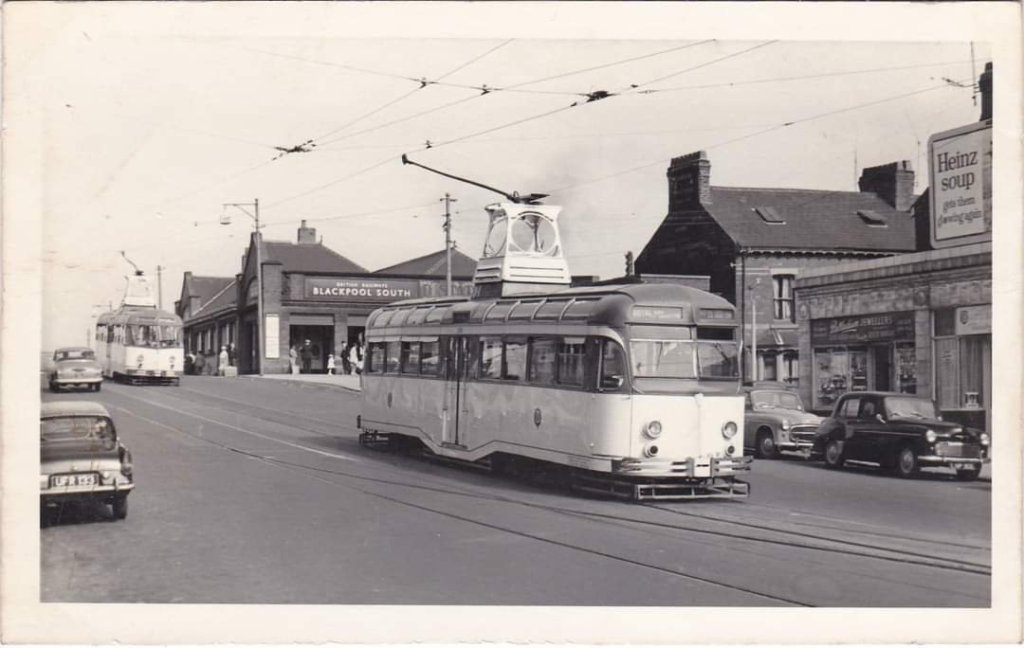
Two of the Marton Vambac trams in Blackpool South. The nearest Vambac Railcoach No. 208 was prototype test bed for the new type of controller & inside frame bogies. Behind is one of the twelve Marton Vambac’s, rebuilt from 1939-built sun saloons. This image was shared on the History of Blackpool Facebook Group on 6th February 2021 by Pete Dumville. [5]

From 1954, when the double-deckers had been withdrawn from service. The Marton route was worked by the 13 Vambac cars and, usually, three pre-war English Electric rail coaches.

It was unfortunate that rising crew costs began to become a significant issue for the Council.

“It may perhaps have been overlooked that the success of the PCC-cars on the street routes in the USA was nearly always coupled with one-man operation. … If passengers were satisfied with the new equipment, so we’re the platform staff.

The manufacturer’s claims were fully borne out, for the automatic acceleration and the provision of simple joystick and pedal control made the cars delightfully simple to drive, reducing fatigue to a minimum and eliminating some of the finer points of instructional training, since “notching up” no longer depended on the driver’s skill. However, it was rather curious to observe the use which different drivers made of the two braking systems, due, perhaps, to the admixture of pre-war and Vambac cars. The Vambac equipment provided a smooth and reliable brake effective down to a speed of less than two miles per hour, and was intended as the main service brake, the air brake being used only for the final stop, brake-shoe life being increased accordingly. This theory can be seen in everyday application on the Promenade, with the post-war cars, yet on the Marton Vambacs many drivers seemed to prefer the familiar air brake for service use, leaving what they termed the “stick brake” in reserve for emergencies. The smoothness of braking was thus dependent once again on the skill of the driver, and the smooth automatic deceleration purchased at such expense was wasted. Other drivers would use the Vambac brake to commence deceleration but would then change to air at a speed higher than intended by the designers for the final stop, and at least one journey made by the writer was marred by the Vambac deceleration being “interrupted” each time while the driver remembered to “put on the air.” One wonders why they were so fond of the air brake, but a possible reason lies in the fact that both terminal approaches were on slight gradients, where the air brake had in any case to be applied to hold the car on the grade, unlike the flat expanses of the Promenade.” [2: p51-52]

Another factor associated with the trial was that of maintenance of the tram cars.

On the one hand, the provision of automatic acceleration and electric braking with minimum and controlled current peaks certainly eliminated the possibility of mishandling the electrical equipment, and must have reduced routine maintenance on the control gear, while the use of cardan shafts and totally-enclosed spiral bevel drives eliminated the troubles associated with the servicing of motor-suspension bearings and reduced the shopping periods. The service availability of the Vambac cars, judging from their daily appearances has been quite as high as that of the orthodox cars, and from this one can safely say that the new equipment must have been fully adequate in avoiding excessive servicing requirements. Moreover, while new and somewhat revolutionary equipment in any field has to cope with the burden of tradition on the part of older generation staff (human nature being what it is), this hurdle seems to have been surmounted with conspicuous success. On the other hand, obtaining spare parts must have been very awkward quite apart from the cost aspect for apart from Blackpool’s own 304-class cars no one else used the same equipment, despite all the hopes that were placed in it. In 1947 the potential British market for modern tramway equipment still included Leeds, Sheffield, Glasgow and Aberdeen, and anyone who had sampled the new equipment could be forgiven for seeing in it a germ of resurgence for tramways and a hope of further orders; but this was not to be. From this aspect, one begins to understand why the five extra sets of trucks and equipments were used as a source of spares rather than to equip further cars.” [2: p52, 54]

An interesting claim made for the new resilient-wheeled trucks was a saving in track costs. Although the track was abandoned before claims of a 30-year life could be tested, the track, “certainly stood up very well to 15 years’ life, and even at the end much of the track and paving was still of exhibition standard, Some of the sharper curves had been renewed, but this was only to be expected, for grooved rail generally lasts four times as long on straight track as on curves. On the sections with non-welded joints (usually) curves), there has been none of the usual deterioration of joints through hammer-blow … [found in] towns using heavy double-deck cars. The one unexpected phenomenon [was] the appearance of a few patches of corrugation.” [2: p54]

Pearson spent a short while alongside a corrugated stretch in Whitegate Drive, listening to sounds made by different types of car. He comments: “The passage of a Vambac car, even on the corrugations, was a process of exemplary quiet, but the occasional pre-war solid-wheeled car produced a roaring noise that told its own story.” [2: p54]

In his opinion, it was the “periodic traverse of the Marton tracks by these few pre-war solid-wheeled railcoaches (and by cars going to and from the Marton depot) that ha[d] given rise to the corrugations, and Whitegate. Drive residents who wrote to the papers in complaining terms can only have had these cars in mind. From the track aspect, it is therefore a pity that the original plan to equip 18 cars was not carried out, for the pre-war Blackpool cars, lacking track brakes, beget corrugations wherever they encounter solid foundations.” [2: p54-55]

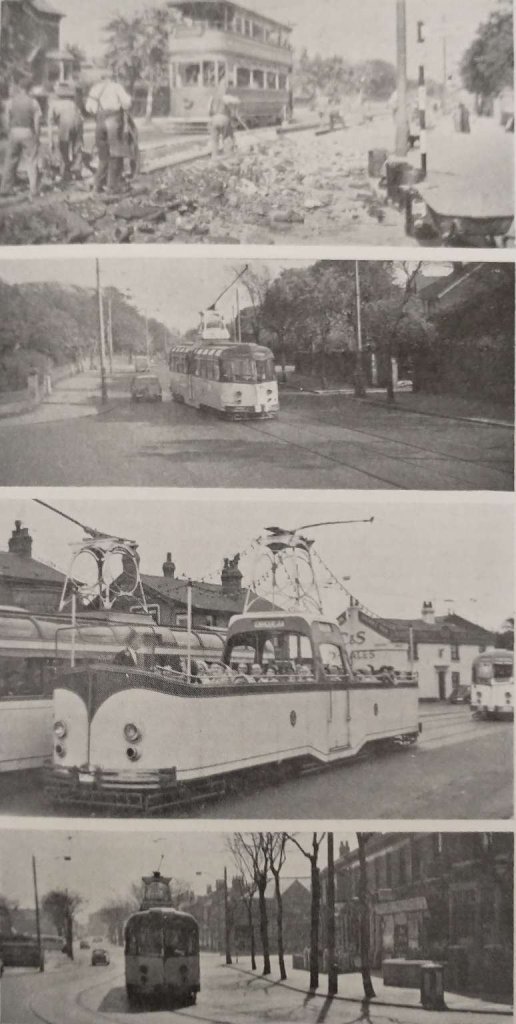
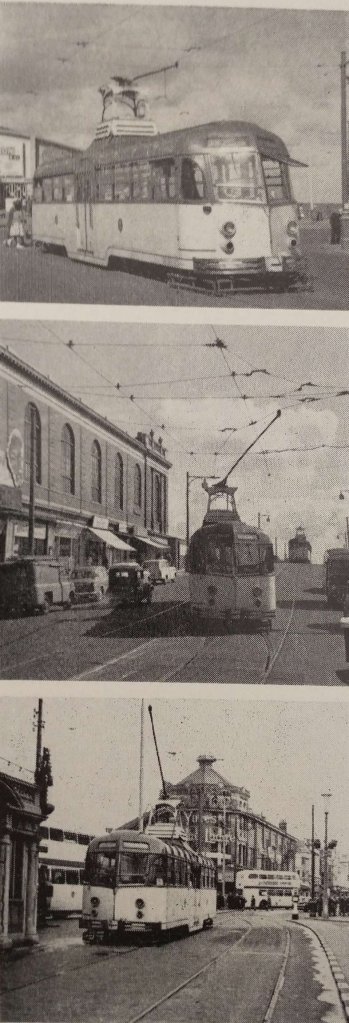
A sequence of monochrome photos which were published as part of Pearson’s articles are shown below. The first four show something of the lifespan of the experiment. The following three show Marton Vambac trams at the various termini of the Marton Route.

The four pictures above span the life of the experiment (1947-1962). The top photograph, taken in 1947, shows the new outward track being laid in Whitegate Drive, with balcony car No. 144 passing on the wrong track. The second photograph shows the finished job some years later, with a Vambac car not far from the same spot, and the third shows one of the pre-war solid-wheeled cars which Pearson blamed for the Whitegate Drive corrugations – 1934 open “boat” car No. 227 on the Circular Tour duty at Marton Depot in 1959, one of the two post-war seasons in which the Department ran a genuine “Circular Tour” via Squires Gate Lane and Marton, loading in Talbot Square. The fourth view, taken only a few weeks before abandonment, shows the track and paving at Devonshire Square, still in good-as-new condition. © C. G. Stevens, R. P. Fergusson, C. E. Macleod. [2: p53]
The three pictures above show the three termini of Blackpool’s Marton route, showing 10-21 series Vambac cars. Top, No. 16 at South Pier, the point to which the service was extended in summer (until 1961). Centre, a car reverses on the crossover at Royal Oak in 1960. Bottom, the town-centre terminus at Talbot Square, © K. M. Chadbourne. [2: p52]

Pearson states that:

“From the various engineering aspects – performance, silent running, case of control, routine maintenance, track wear, and availability – the Marton Experiment was therefore a success, even though it did not induce any other tramways to invest in similar equipment. The new equipment did all that the manufacturers claimed for it, and once the teething troubles were overcome ha[d] continued to function smoothly and efficiently for more than 10 years, with no further modifications of any importance. The Crompton Parkinson/Maley & Taunton Vambac/H.S.44 combination represented the ultimate development of street tramway practice in this country.” [2: p55]

Pearson considered that the VAMBAC trams had infinitely superior qualities both in riding and silence, so far as solid track was concerned. They were popular with the public – when abandonment was first proposed there was a significant outcry from customers who said that the VAMBAC trams were the finest transport service they had known. “Marton residents organised a massive petition to the Town Council for its retention, without any prompting from tramway-enthusiasts, in fact without their even knowing of it. The campaign was headed by Alderman J. S. Richardson, now the Mayor of Blackpool, and it is a sad coincidence that in his mayoral capacity Alderman Richardson himself had to preside at the closing on 28th October, 1962.” [2: p55]

It is Pearson’s view that the main reason for the failure of the experiment and the closure of the Marton tram route was the economic impossibility of two-man operation with only 48 seats per tram. While this was the main reason, there were at least three subsidiary factors: the cost of spare parts; the high energy cost of starting from rest; awkward relationships with other road users as visiting road users were no longer used to mixing with trams in their own communities.

He notes that crew costs in the 1960s accounted for an average of about 75% of a transport budget. Tram costs were higher than buses, the only way to offset that difference was to maximise the customer load-factor (this was effective on the Promenade) or to use tramway units of higher capacity than the largest available bus, so as to bring the cost per seat-mile down to a competitive figure. Had articulated cars been available that would have addressed the issue. “The 48-seat Marton Vambacs were below the minimum economic size … and throughout the experiment the route … had to be increasingly subsidised from the receipts of others. The Marton residents … enjoyed a superb service at considerably less than cost, and were naturally loth to lose it, but any suggestion of passing on the cost by raising the fares to a scale above that of the inland bus routes (as is done in summer on the Promenade) would clearly have been politically out of the question.” [2: p56]

Pearson’s own opinion, expressed in his article, is that the 12 year experiment proved that “revolutionary new concepts in tramway engineering [could] be applied to a normal street route as well as on the special field of the Blackpool Promenade, and Marton’s disappearance [was] a sad occasion for all who [saw] in the tramcar a still only partially-exploited form of transport. Looking back, it seems a repeat of a sadly familiar pattern; the engineering profession has delivered the goods, but the confused pattern of public transport in this country has never made full use of the potential made available by the engineers, electrical and mechanical, who gave practical expression to what [was], for most of us, still a composite dream.” [2: p56]

The Blackpool Trams website tells us that, “the first VAMBAC was withdrawn in 1960 as car 10 suffered accident damage and was scrapped soon after. The second VAMBAC withdrawn was 21 in 1961, which was withdrawn as a source of spare parts for the remaining trams, while 14 was also withdrawn for use as a driver training car. The writing was on the wall for the Marton Route, which had been isolated and lost it’s summer services to South Pier following the closure of the Lytham Road route in 1961, however, the remaining VAMBACS remained in use until October 1962 when the Marton route closed, with 11, 13, 15, 17 and 18 operating on the last day. The VAMBACS remained in Marton Depot and were joined by other surplus trams for scrapping in 1963. … One VAMBAC did manage to survive however, VAMBAC 11 was requested for a tour of the remaining parts of the tramway early in 1963 and was extracted from Marton Depot and made it’s way to Rigby Road. Following the tour, 11 was eventually preserved and found its way into preservation and is now at the East Anglia transport museum, where it still sees regular use today.” [3]

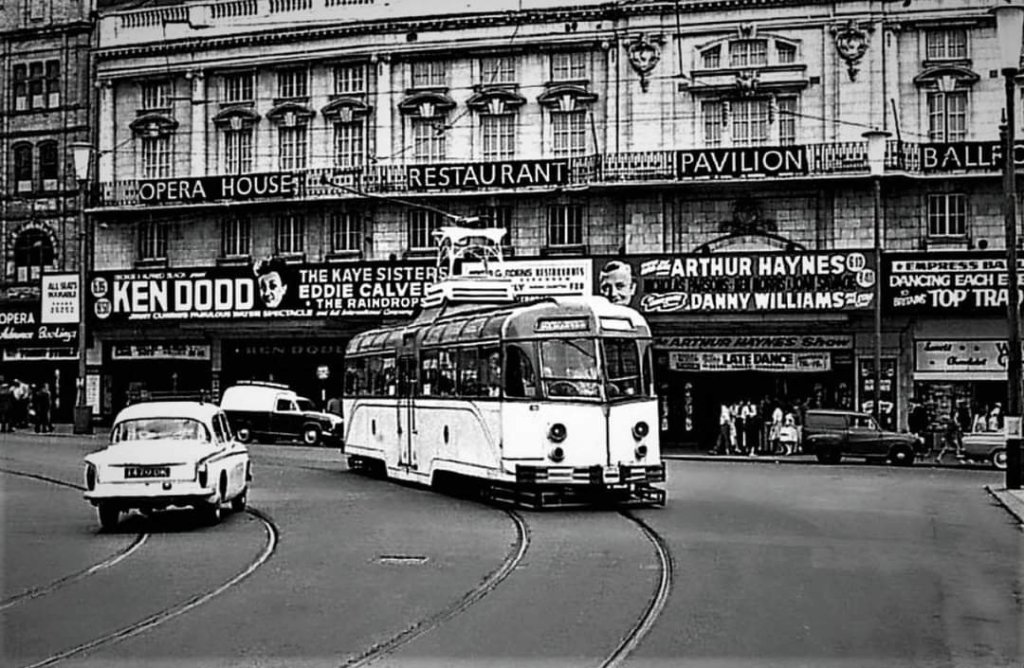
One of the Martin Vambacs in service in Blackpool in the late 1950s or early 1960s. This image was shared on the History of Blackpool Facebook Group on 7th April 2017 by Tony Latham. [6]
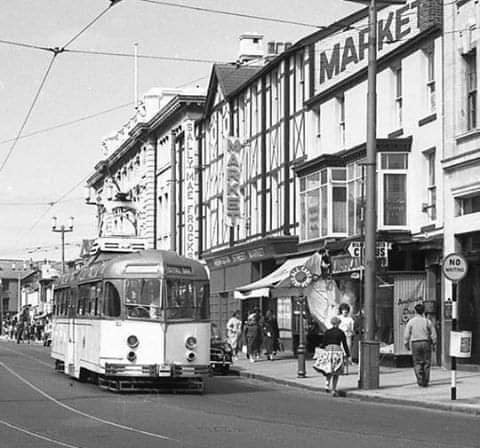
Another Marton Vambac outside Abingdon Street Market. This photograph was shared on the History of Blackpool Facebook Group on 18th May 2023 by Jess Tulloch. [8]
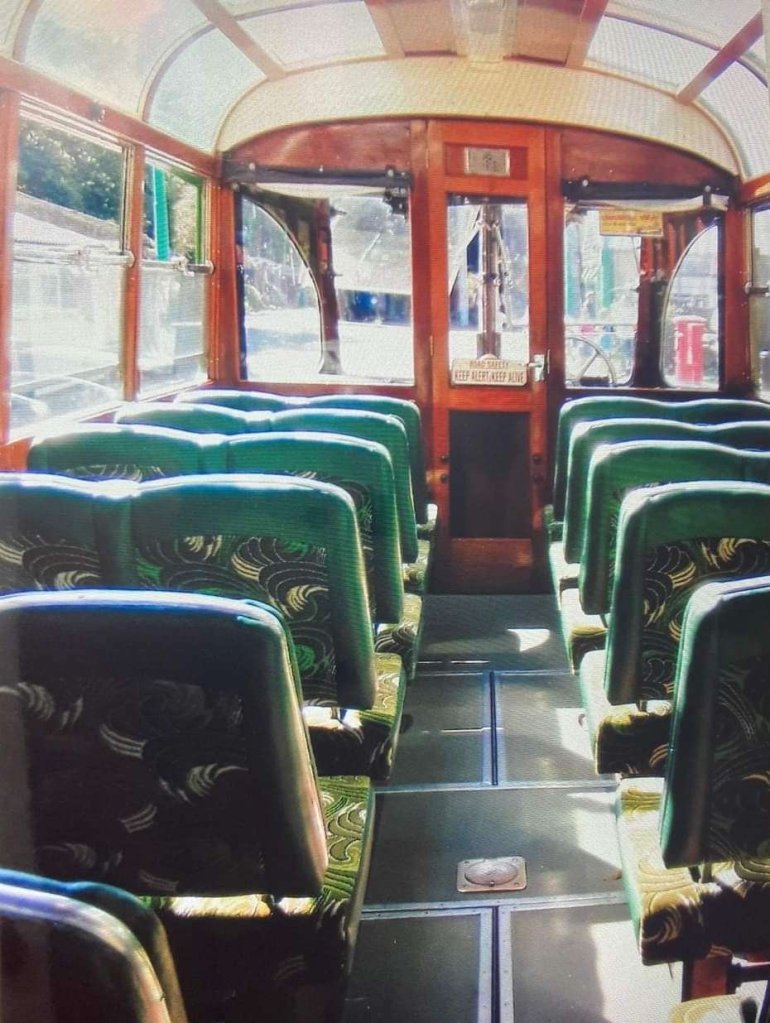
The interior of Marton Vambac No. 11 in its preserved condition at the East Anglia Transport Museum near Lowestoft. This image was shared on the History of Blackpool Facebook Group on 23rd February 2023 by Col Macloud. [7]
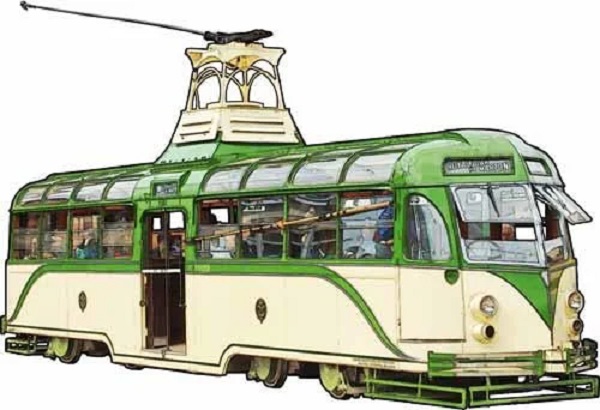
A composite image of Marton Vambac No. 11 as used by ‘Videoscene’ in their range of transfers applied to mugs. [9]
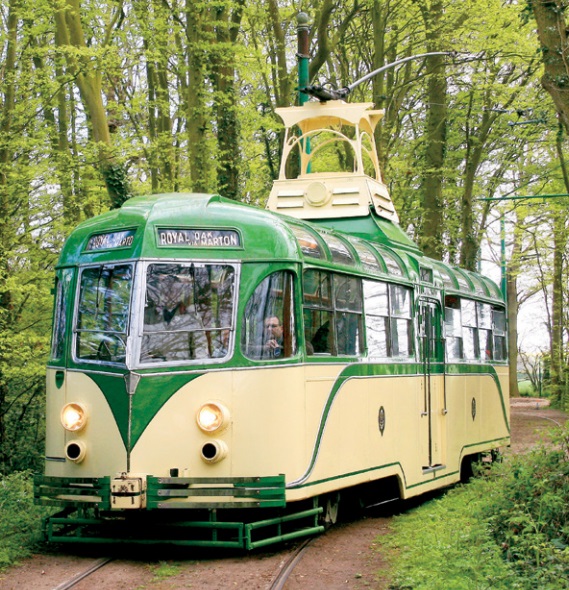
Marton Vambac No. 11 at its present home – the East Anglia Transport Museum. [10]

References

  1. F.K. Pearson; The Marston Experiment; in Modern Tramway, Volume 26 No.301; Light Railway Transport League & Ian Allan, Hampton Court, Surrey, January 1963, p14-19.
  2. F.K. Pearson; The Marston Experiment …. ; in Modern Tramway, Volume 26 No.302; Light Railway Transport League & Ian Allan, Hampton Court, Surrey, February 1963, p51-56.
  3. https://blackpool-trams.yolasite.com/vambac-trams.php, accessed on 28th July 2023.
  4. Newnes Practical Mechanics June 1948, p290-291; via., https://www.google.com/url?sa=t&source=web&rct=j&opi=89978449&url=https://worldradiohistory.com/UK/Practical-Mechanics/40s/Practical-Mechanics-1948-06-S-OCR.pdf&ved=2ahUKEwiRjbjumbKAAxVUmFwKHYifAcUQFnoECB0QAQ&usg=AOvVaw24PI5xxITo516frkIf-ZsM, accessed on 28th July 2023.
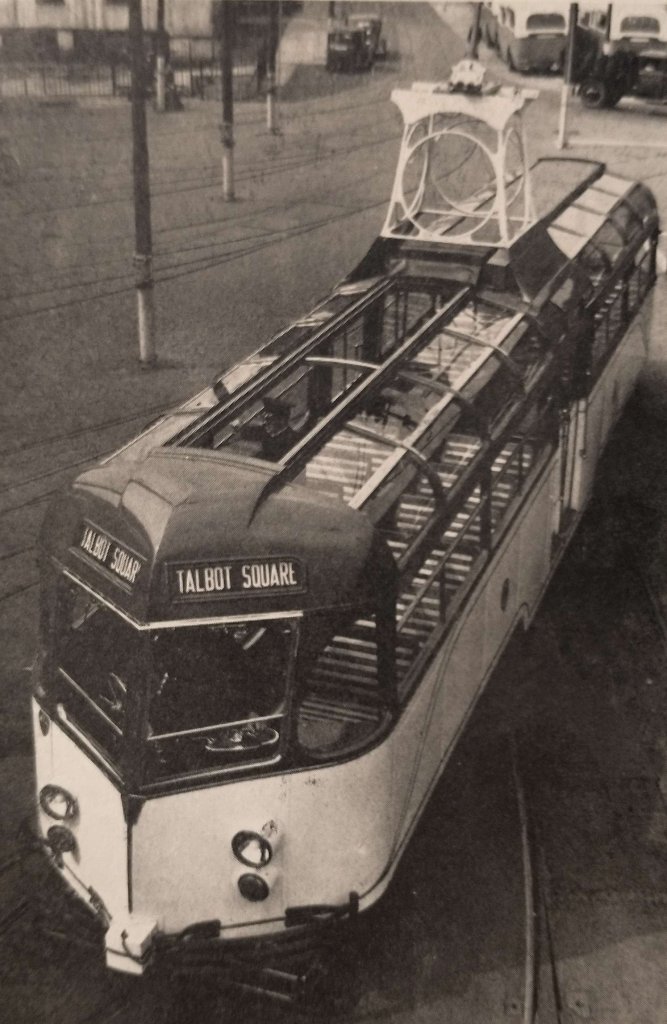
  5. https://m.facebook.com/groups/blackpoolhistory/permalink/1632707573581243, accessed on 29th July 2023.
  6. https://m.facebook.com/groups/blackpoolhistory/permalink/691364481048895, accessed on 29th July 2023.
  7. https://m.facebook.com/groups/blackpoolhistory/permalink/2196698053848856, accessed on 29th July 2023.
  8. https://m.facebook.com/groups/2251377838346012/permalink/2713552708795187, accessed on 29th July 2023.
  9. https://www.videoscene.co.uk/blackpool-tram-mug-collection-2011-vambac-11, accessed on 29th July 2023.
  10. https://www.eatransportmuseum.co.uk/wp-content/uploads/2021/04/Leaflet2021Web.pdf, accessed on 29th July 2023.
  11. https://www.skyscrapercity.com/threads/blackpool-tram-system-u-c.572141/page-33, accessed on 29th July 2023.

London Tramways – 1950, 1951 and 1952

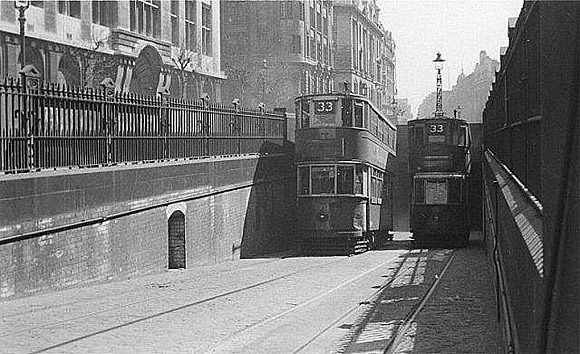
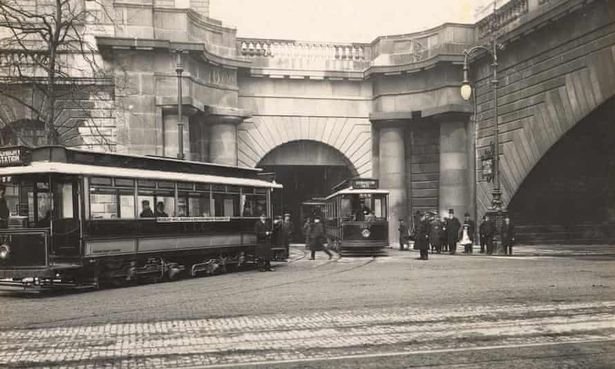
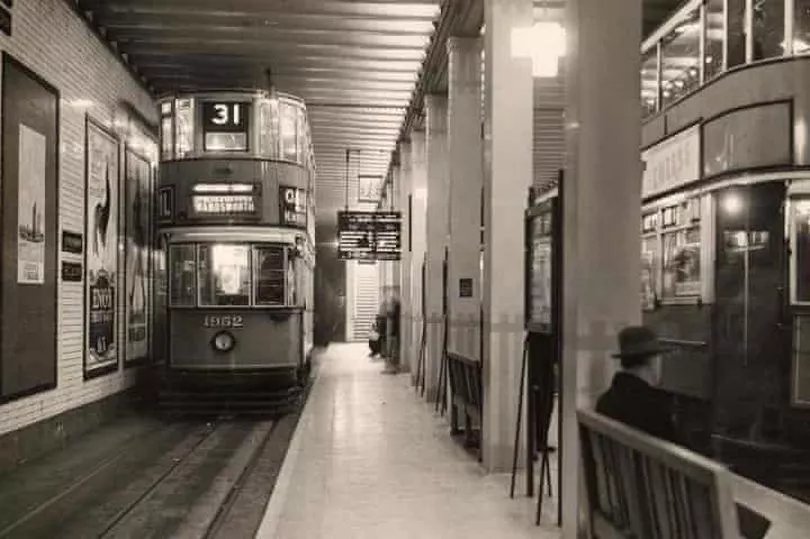
The featured image above shows two No. 33 trams using Kingsway Tunnel which was closed in the early 1950s, © Stories of London. [6]

Robert J. Harley begins his chapter on 1950 with these words:

The dawn of 1950 brought new hope to Londoners. It was an important psychological divide – hardship, war, destruction, austerity and the harsh winters of the 1940s seemed to belong to a more distant age. Prosperity was returning, and the advent of antibiotics, the National Health Service and new employment laws had begun to exorcise the scourges of disease and poverty which had characterised pre-war years. People could look forward to the future, and to the new showcase of British achievement, the Festival of Britain, which was due to open in 1951 on the South Bank opposite Victoria Embankment.

The trams were still running, and indeed the rumble of cars over Westminster Bridge had a deceptive air of permanence. But the reality of tramway abandonment was just round the corner, and the planners at London Transport intensified their efforts to complete the programme within the allotted timespan.” [1: p50]

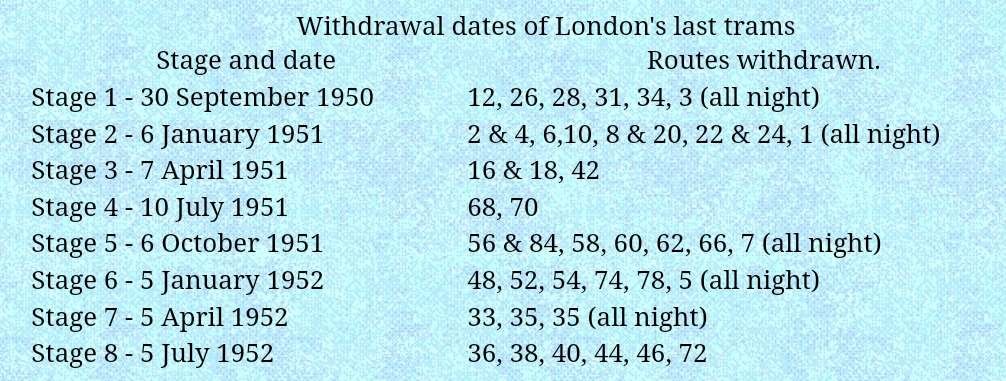
January 1950 saw the closure of Thornton Heath Depot with trams diverted across Croydon to Purley Depot. Tram Scrapping sidings were laid out next to Penhall Road, Charlton and we’re in use by 12th February.

In February, London Transport (LT) heralded the arrival of 259 new buses to take the place of the first four tram routes, promising shorter queues and more comfort. The closed routes served Wandsworth, Clapham, Battersea and Vauxhall.

New Tramroads, were still being built! It was recognised that the 1951 Festival of Britain would require the diversion and improvement of tramways in the vicinity of County Hall. Harley says that:

Throughout February, the preliminary works in connection with the Festival of Britain roundabout at County Hall were continuing. It was noted that, on a bombed site between Addington Street and Westminster Bridge Road, conduit track and points were taking shape. The opportunity of witnessing the construction of new conduit tracks was not lost on many enthusiasts, and the progress on this, London’s last tramway extension, was subject to much scrutiny. Construction work of another kind had, by 14th February, lowered Wandsworth Depot’s fleet strength to a mere 36 trams.” [1: p53]

In March 1950, damage to Battersea Bridge by an errant coal barge closed the bridge to all but pedestrian use. The result was the early abandonment of that length of Route 34.

As March progressed,

speculation about proposed fare rises was never far from the surface. Public relations people at LT preferred the expression ‘fare adjustments’, but whatever the terminology, it became increasingly obvious that it would be more expensive to ride on a bus or a tram. These changes were set to start on 1st Octo- ber and included, amongst other things, the complete abolition of workmen’s fares. On 7th March, F. K. Farrell wrote: ‘The national press report that London Transport fares are to be increased next October to offset the cost of conversion from trams to buses.’

Local authorities and other organisations representing community interests were also concerned about the issue, and doubts were raised whether passengers would get a fair deal on the replacing buses. It was calculated that those who travelled to work in London would pay another £3.5 million a year for transport. On 22nd March, the TUC joined in the fight and its Special Economic Committee broached the topic of the 4.5 per cent fare rise in a meeting with Sir Stafford Cripps, the Chancellor of the Exchequer.” [1:p54]

The first batch of motormen left Wandsworth on 12th June to train as bus drivers. Those at Clapham depot soon joined them. Most ex-tram men ultimately passed muster for their new roles.

In July it was announced that the first phase of closures would happen on 1st October with a rolling programme of closures following with the last closure expected to take place in October 1952.

A temporary closure of immediately adjacent tram routes allowed the construction of a Bailey Bridge across the Thames to allow better access to the Festival of Britain site on the South Bank.

As a publicity stunt, LT invited the press to a funeral on 28th July 1950. It was actually a cremation. Car 1322 was burnt at Penhall Road. Penhall Road was known locally as the ‘Tramatorium’! Harley says: “It was calculated that almost two trams a day could be disposed of by this method. … Throughout September the tramatorium was made ready. On 6th September, cars 020, 1383, 1385, 1654 and 1762 were noted in the yard. Car 1385 was burnt on the afternoon of 26th September. On the next day, cars 1727, 1744 and accident victim 1396 appeared at Penhall Road.” [1: p57]

At the end of September fare rises were publicised. They came into effect on 1st October 1950. “In general, fare rises look moderate by modern standards; for instance ticket values below 7d went up by a halfpenny, and in the range from 7d to 1s 2d, by a penny. The real blow fell on transfer, workmen’s and return fares, which were abolished. … The last link with the old regime was severed when crews were instructed not to use the word ‘WORKMAN’ on the destination blinds.” [1: p59-60]

Late in October 1950, the new trackwork close to County Hall and St. Thomas’ Hospital was commissioned while contractors were at removing rails in the Wandsworth/Battersea areas. Harley tells that:

As an interim measure tramlines were filled with an asphalt mixture, but the conduit slot was left visible. Depending on the work load, a gang would arrive days or sometimes weeks later to cordon off one side of the carriageway so that either the up or the down track could be lifted. Many frontagers complained about the noise of pneumatic drills as they sliced into large chunks of the road surface. Granite setts were normally lifted with the old surface, but at certain locations track, conduit and setts were all buried under a new asphalt layer. Rails were generally cut up on site and then carted away by lorry to be sold as scrap metal. Pointwork which contained large amounts of recoverable steel was particularly valuable. Wood blocks were sold as logs for open fires. Well tarred, they burnt well! Wandsworth Borough Council was quoted as needing to spend £428,000 on removing 11.5 miles (18.4 km) of track and reinstating the carriageway.” [1: p61]

Late in 1950, LT began their preparations for the second round of closures due in early January 1951. “The process of abandonment had acquired a lethal momentum, and 1951 would see a substantial proportion of the remaining system swept away.” [1: p61]

The final night for routes 2, 4, 6, 8, 10, 20, 22, 24 and all night service no. 1 (between Streatham Library and Victoria Embankment) came on 6th January 1951. 101 trams in total were withdrawn and 20 miles (32km) of track removed. Routes 2 and 4 ran between Wimbledon and Victoria Embankment (via Westminster Bridge and Blackfriars Bridge respectively). Route 6 ran between Tooting and Southwark Bridge. Route 8 was a circular from Victoria Station through Clapham and Streatham.  Route 10 ran from Tooting Broadway to Southwark. Route 20 was the reverse of Route 8. Routes 22 and 24 ran from Tooting Broadway to Victoria Embankment (via Balham/Clapham and Streatham/Brixton respectively.

As the year continued, Harley tells us that February and March saw a number of minor permanent way renewals. 7th/8th April saw the next round of closures, this time in the Croydon area – Route 16 (Purley to Victoria Embankment via Westminster Bridge), Route 18 (Purley to Victoria Embankment via Blackfriars Bridge) and Route 42 (Croydon (Coombe Road) to Thornton Heath).

The Festival of Britain was opened by King George VI on 4th May 1951. Harley tells us that:

London Transport had putout much publicity for visitors, but the men- tion of tram services was only very cursory. The emphasis was now firmly on the bus side and eight special bus routes were inaugurated in connection with the Festival. It was obviously a hectic time for King George and Queen Elizabeth, because on Tuesday 8th May, the King and Queen of Denmark paid a state visit. The processional route caused some disruption to tram traffic, but trams continued to use Vauxhall Bridge Road. In order to shift the crowds afterwards, trams were despatched, fully loaded – 74 seats per car, four at a time. Also at times of street closures for state visits, cars could be turned short on the new County Hall roundabout. This was not without its dangers, as an official notice to drivers explains: ‘Several accidents have occurred recently where Addington Street, Lambeth adjoins Westminster Bridge Road. A Tram Pinch sign has recently been erected in this vicinity, but all drivers, particularly those operating tramcars, are requested to exercise special care when traversing this thoroughfare’.” [1: p80]

The next tranche of tram-route closures took place on Tuesday 10th July when Route 68 (Greenwich Church to Waterloo Station) and Route 70 (between Greenwich Church,  Bermondsey and London Bridge Station) were closed. After these closures, the system had shrunk to 65.5 route miles (104km) and 129 track miles (206km).

Harley tells us that The Star on 2nd August 1951 maintained that, “that the removal of London’s trams had given rise to more congestion, because to match the seating capacity of the trams, more buses were needed. At the same time London Transport had issued a set of figures showing the average speed of trams, including stops, to be 10.25 mph (16 kmh) – just one mile per hour short of the central bus average. [The] Modern Tramway noted that, even under adverse conditions imposed by track layout and age of the rolling stock, London’s trams still held their own in the face of LT propaganda about the alleged greater speeds of the replacing buses.” [1: p82]

Harley comments further that, “On the face of it, the conversion scheme seemed to be going well, and London Transport was in self congratulatory mood, when in the October issue of London Transport Magazine it published a leader on the half way mark of Operation Tramaway. Headed A First Class Job, it mused on the fact that 200 miles (320 km) had been abolished in a year and that everything reflected ‘the high standard of efficiency that London Transport has set for such major traffic operations’.” [1: p85] He says that there were, of course, contrary views. A letter to The Modern Tramway expressed those sentiments:

The buses on service 185 run every ten minutes in off peak periods, whereas the trams had a four minute headway … A London Transport regulator remarked that people are sometimes unable to board vehicles at midday, a state of affairs hitherto unprecedented. A tramcar, he said, acts like a dredger and eliminates the queue. . .’ It would seem from this letter that the RT and RTL type diesel buses were still lacking in their ability to transport crowds and to clear the queues.” [1: p85]

Over 1951, the number of trams operating on the network reduced from 650 at the beginning of the year to 323 by 31st December 1951. [1: p85]

On 5th January 1952, Routes 48 (between West Norwood and Southwark via Elephant & Castle), 52 (Grove Park Station to Southwark), 54 (Grove Park Station to Victoria Station), 74 (Grove Park Station to Blackfriars), 78 (West Norwood to Victoria Station) and night service 5 (between Downham and Victoria Embankment) were withdrawn with the loss of 109 trams. [1: p93]

The state funeral of King George VI took place on 15th February 1952. Later in February, “Lewisham Borough Council revealed that it was having some qualms about tram track removal. John Carr, the Lewisham Borough Engineer, was quoted as saying that it cost £10 to tear up every yard of disused double tram track. He also estimated that the council might have to pay £10,000 for the removal of tramlines in London Road, Forest Hill. Although he went on to state that payment by London Trans-port plus money from the sale of scrap steel would cover the £168,000 Lewisham was obliged to spend on track lifting in the borough, he intimated that the council was still concerned that it would be have to fund any shortfall.” [1: p95]

The entrance to Kingsway Tram Tunnel on the Embankment prior to its alterations to accommodate double-deck trams, © London Transport Museum. [8]

On Sunday 2nd March LT imposed a further fare increase. April 1952 saw the closure of the Kingsway Subway and Routes 33 (between West Norwood and Manor House Station) and 35 (between Highgate (Archway Tavern) and Forest Hill), including the 35 night service (Highgate (Archway Tavern) to Bloomsbury and Westminster).

Among others, Tram Route No. 31 ran through Kingsway Tunnel. This image shows what appears to be Tram No. 1952 stopped at the underground Holborn stop in the Tunnel. The Tunnel was first built to accommodate single-deck trams but was improved to accommodate double-deck trams by the early 1930s, © London Transport Museum. [7]

The remaining routes were lost at the beginning of July 1952. A schedule of route closures is kindly provided on yellins.co.uk/transporthistory, the table is reproduced below:

This schedule of route closures can be found on the yellins.co.uk/transporhistory website. [9]

London’s last tram week, the last full week of operation of London’s first-generation street tram system, from 29 June to 5 July 1952. Wikipedia tell us that “it was the culmination of the three-year programme, known as Operation Tramaway, that saw the replacement of south London’s entire tram network with a fleet of modern diesel buses, at a cost of £10 million. The trams had been very popular among Londoners, and in south London they accounted for the majority of local journeys by public transport. Many people regarded their demise as a particularly momentous event. On the last day of operation, large crowds gathered to see the last trams in service and to take a final ride. On arrival at its depot, the very last tram was ceremoniously received by a group of dignitaries, watched by a large number of spectators.” [2]

Many Londoners regarded the disappearance of the trams as a particularly momentous event. On the final day, the trams were crowded with passengers wanting to take a last ride, with many more people lining the routes to say goodbye to the vehicles. Souvenir hunters stripped everything that could easily be removed from the cars.” [2][3]

Crowds turned out to watch a d travel on the final trams during their last week of operation. [4]

The very last tram was car no. 1951, running on the five-mile Route 40 from Woolwich to New Cross via Charlton and Greenwich. From New Cross to Greenwich it was driven by Driver Albert Fuller. At Greenwich, the Mayor of Deptford, Mr F. J. Morris, took over the controls. And John Cliff, a former tram driver from Leeds who was now deputy chairman of London Transport, drove the car for the final leg of the route into the New Cross depot. The journey was delayed by crowds of cheering spectators (20,000 of them, according to one report) who surrounded it along its route and followed it to the depot.” [2][3][4]

Last tram week in Woolwich New Road the terminus for the Eltham routes 44 and 46. Unlike the two Cars behind it, Tramcar No. 312, an ex-West Ham Car doesn’t have room for the ‘Last Tram Week’ poster on its side panel. [9]
Another of the last trams to run on the network. This appears to be tram No. 1864 on Route 46, overcrowded and thronged by cyclists! [10]

What is, perhaps, surprising about the Wikipedia article is that it talks relatively positively about the removal of the first generation trams with little in the way of caveats. So, the article says, “The withdrawal of tram services in London was generally considered successful in reducing traffic congestion, at least in the short term. According to various press reports, traffic now flowed freely at what had previously been the worst bottlenecks. Some journeys by public transport were also noticeably faster. Lord Latham wrote, ‘The changes in traffic conditions at a number of key points are little short of dramatic.’ A decrease in road accidents was also reported.” [5: p101-103]

Our recent look at articles from editions of ‘The Modern Tramway‘ from the 1950s suggests that the benefits were far from clear, that proper statistical measurement and analysis was not respected by LT not by the press of the day, and that the costs of the transition were probably under-reported. It is also evident that, had LT chosen to invest in trams as part of postwar modernisation of transport in the capital, some considerable benefits to the urban environment would have accrued.

We have discovered, no doubt with the benefit of hindsight, that the change was a relatively ill-conceived decision based on the prevailing dogma of the times that individual freedoms were paramount and that the car was the future. It is also possible that these decisions were made by those who had little understanding of the general public’s needs and who did not depend on public transport for their daily lives.

No doubt some change was necessary and public opinion demonstrated a frustration with the trams (resulting primarily on underinvestment in the network). The conduit system may well have been a significant issue. However, most of the difficulties and objections could have been resolved with a political will to do so.

The demise of trams elsewhere in the UK could be seen as, perhaps, a greater injustice/travesty, partially in places were reserved tracks were in use.

In further articles in this series we will looked at the renamed ‘Modern Tramway‘ of the 1960s which was published jointly by Ian Allen and the Light Railway Transport League.

References

  1. Robert J. Harley; London Tramway Twilight: 1949-1952; Capital Transport Publishing; Harrow Weald, Middlesex, 2000.
  2. https://en.m.wikipedia.org/wiki/London%27s_last_tram_week, accessed on 17th July 2023.
  3. London’s Last Tram; The Times, London, 7th July 1952; https://go.gale.com/ps/anonymous?id=GALE%7CCS35999463, accessed on 17th July 2023.
  4. http://news.bbc.co.uk/onthisday/hi/dates/stories/july/6/newsid_2963000/2963092.stm, accessed on 17th July 2023.
  5. James Joyce; Operation Tramaway; Ian Allan Publishing, 1987.
  6. https://www.strandlines.london/2021/08/18/kingsways-ghost-station, accessed on 17th July 2023.
  7. https://www.ianvisits.co.uk/articles/kingsway-tram-tunnel-to-start-public-tours-in-august-45111, accessed on 17th July 2023.
  8. https://www.timeout.com/london/news/the-london-transport-museum-is-doing-an-underground-tram-tunnel-tour-030822, accessed on 17th July 2023.
  9. http://www.yellins.co.uk/transporthistory/trolley/ltw.html, accessed on 17th July 2023.
  10. https://shop.memorylane.co.uk/mirror/0100to0199-00199/tram-run-london-21484067.html, accessed on 17th July 2023.

Glasgow Tramcar No. 1005

In the 1950s, a tram Glasgow purchased some years before, a ‘one-off’, unidirectional double decker car which it numbered 1005 and which was sometimes known as the ‘Blue Devil’ for its unconventional three tone blue colour scheme, was put forward by the LIght Railway Transport League as an option for trails that the League hoped might happen in London. The tramcar sat on PCC type trucks [1] and was sleek and streamlined. It can be seen in its later standard colour scheme in the bottom-right of the featured image above (Public Domain). [6]

The link to Flickr below takes us directly to Frederick McLean’s page on Flickr which focusses on this tram. Frederick McLean’s notes say that the reverse of the photograph was stamped with the photographer and/or negative owner name C. W. Routh and with the date 25 May 1955. He notes too that, in the photograph, the tram was heading South-east at St. George’s Cross.

https://www.flickr.com/photos/fred_bear/51714105647

The next link to Frederick McLean’s Flickr feed shows Tram No. 1005 on, probably, a tram enthusiast tour, so showing a ‘Reserved’ destination blind.

https://flic.kr/p/2jCYDsr

In Washington DC a conduit system was in use, like that in London, and PCC cars were in use. The Light Railway Transport League (LRTL) proposed a trial on London’s streets of a modern PCC tram. They were even prepared to pay for the exercise.

Glasgow’s No 1005 was one of two cars considered a suitable vehicle for the trial by the LRTL. It was “equipped with up-to-date VAMBAC [3] electronic control, which promised smoother starting and braking, thus allowing higher schedule speeds with safety and comfort for passengers. In addition the trucks were fitted with improved motors, and more importantly, resilient wheels which gave a much quieter ride.” [2: p45]

Sadly the obstacles to the trial in London were too great. Harley lists these: [2: p46]

  • Single-ended cars needed turning loops. There was only one route (between Beresford Square and Well Hall Roundabout on Route No. 44) which might accommodate the trial.
  • Glasgow trams used bow collectors rather than trolley poles and we’re not fitted out for conduit working.
  • The Glasgow network was in fact a narrow-gauge network, three quarters of an inch (19mm) narrower than the standard-gauge in use in London. [5]

With a will to do so, these obstacles might have been overcome at LRTL expense, but ultimately there was no desire among the authorities in London to countenance the trial. Harley quotes the letter sent by the Operating Manager (Trams and Trolleybuses), dated 23rd March 1950: “Work on the replacement of the remaining trams is proceeding rapidly, and it is expected that the first stage of the conversion scheme will be completed before the end of the year, and that the scheme as a whole will be finished within a period of three years. You will see, therefore, that the Executive are committed to a policy of substituting oil-engined buses for the tramway system, a policy which they consider to be right and proper. In these circumstances the Executive regret that they cannot avail themselves of the offer you have made.” [2: p46]

The parallel offer of a similar trial using a, then, modern single deck Blackpool tram was also rejected by the authorities in London. Their minds were fully made up.

In Glasgow, Car No. 1005, foundered in use. Trams Today tells us that “when initially built in 1947 it featured Vambac controllers, a unique livery of three tone blue and was single ended but progressively both the livery and the control equipment had been standardised with the rest of the fleet. This still left the unusual loading arrangements which made 1005 unpopular with the general public amongst a fleet of more than a thousand more orthodox trams. Consequently it had for several years been restricted operation to use only at peak times whilst much older trams bore the brunt of all day service.” [4]

In an attempt to rectify this situation and make better use of 1005 it entered the workshops during 1955 for rebuild that dispensed with the single ended arrangement. A drivers cab and full controls were provided in the rear. …. The work was carried out on a strict budget and, although successful in making 1005 more standardised, it still saw only infrequent use when it tram, generally appearing only during rush hour period until 1962 when it was finally withdrawn and disposed of for scrap.” [4]

References

  1. PCC type bogies were first used on PCC cars in New York. The PCC car was “a revolutionary vehicle – a streamlined, single deck Tramcar which ride on superbly engineered trucks, giving a quiet and comfortable ride. When, on 1st October 1936, Mayor Fiorello H. La Guardia of New York, inaugurated service of Brooklyn and Queens Transit Car 1009, a new era in rail transportation opened. Orders followed from American and Canadian cities and eventually almost 5,000 cars rolled off the production line. This figure was augmented by the 15,000 PCC cars or vehicles built under PCC patents which appeared in Europe and Asia. The concession for England was snapped up by Crompton-Parkinson. They produced an advanced VAMBAC system (Variable Automatic Multinotch Braking and Acceleration Control), compatible with PCC technology, and 42 sets of equipment were used by London Under- ground in the late 1930s. In 1937, W Vane Morland, the Leeds manager, visited Boston to see the new design. He then returned home with the blueprints of the PCC, but the outbreak of war put paid to any more progress.” [2: p45]
  2. Robert J. Harley; London Tramway Twilight: 1949-1952; Capital Transport Publishing, Harrow Weald, Middlesex, 2000.
  3. VAMBAC was the acronym used to refer to Variable Automatic Multinotch Braking and Acceleration Control. It was in use in the UK as early as the late 1930s on London Underground. [2: p45]
  4. Trams Today Facebook Page on 9th January 2016: https://m.facebook.com/144002195699684/photos/a.733720253394539/736060386493859/?type=3, accessed on 8th July 2023.
  5. Glasgow Corporation Tramways; Wikipedia; https://en.m.wikipedia.org/wiki/Glasgow_Corporation_Tramways: “Glasgow’s tramlines had a highly unusual track gauge of 4 ft 7+3⁄4 in (1,416 mm). This was to permit 4 ft 8+1⁄2 in (1,435 mm) standard gauge railway wagons to be operated over parts of the tram system (particularly in the Govan area) using their wheel flanges running in the slots of the tram tracks. This allowed the railway wagons to be drawn along tramway streets to access some shipyards. The shipyards provided their own small electric locomotives, running on the tramway power, to pull these wagons, principally loaded with steel for shipbuilding, from local railway freight yards.”
  6. http://parkheadhistory.com/heritage-transport/images-transport-3, accessed on 8th July 2023.
  7. https://www.flickr.com/photos/fred_bear/51714105647, accessed on 8th July 2023.
  8. https://flic.kr/p/2jCYDsr, accessed on 9th July 2023.

‘The Modern Tramway’ – a quick look back at 1949 in London. ….

The featured image at the head of this article shows trams which served Route 34 in Clapham in 1949, the photographer is not recorded. [2] Route No. 34 ran from Chelsea (Kings Road) via Clapham and Camberwell Green to Blackfriars. [1: p122]

Robert Harley, in his book ‘London Tramway Twilight: 1949-1952 has chapters focussing, among other subjects on the years 1949, 1950 & 1951. [1]

In the chapter which considers 1949, [1: p32-41] Harley tells us that in May 1949, forty members of the Light Railway Transport League (LRTL) undertook a tour in Feltham car No. 2094. “It was noted that this particular car was resplendent in fresh paint and in excellent mechanical condition, having recently passed through Charlton Works. Chief Inspector Perry was ‘on the handles’, and he drove Car 2094 from Victoria to Southcroft Road. Tour participants were then transported to Purley, before returning to Victoria. The journey from Purley to Victoria was timed at 55 minutes.” [1: p36]

Harley goes on to say: “Perhaps many of the 40 members realised that an era of stability was about to end, for on 8th June space was made free in Wandsworth and Clapham depots to allow construction of garage facilities for diesel buses. This work would include filling tramway inspection pits, providing new bus docking pits, sinking fuel oil storage tanks in the ground and installing fuelling points. The old tramway traversers which were used to shift trams sideways, would also go. It was indeed the beginning of the end, and a tangible sign that progress towards the inevitable extinction of electric traction was now unstoppable.” [1: p36-37]

Harley also notes that, ‘The Modern Tramway’ for July 1949 “contained a number of details under the headline ‘London Depot Changes’. According to the correspondent, Wandsworth Depot had been converted to overhead wire and a change pit constructed at the entrance. Removal of the conduit equipment within the depot made for an easier and safer conversion. Fleet changes included seventeen cars of the 1700 series E/1 which were shifted to Clapham Depot to work route 26. Fifty-one other E/1s were transferred from Clapham to Camber- well and New Cross. The 1500 series E/1 cars were now mostly stabled at New Cross. Six E/3 cars were moved from Thornton Heath to Norwood, which also received some rehabs from New Cross. Route 34 was now worked by Camberwell Depot and was operated mainly by E/3 cars, with the odd HR/2 and E/1 taking a turn. New Cross took over route 66 from Camberwell; Norwood worked most of route 10, although Telford Avenue still supplied one Feltham for this route. Telford Avenue took over Clapham’s share of route 10 and part of the allocation of cars on routes 22 and 24.” [1: p37]

The reality was that, from its formation in 1937 by J.W. Fowler to seek the modernisation and retention of electric tramways [1: p42], the LRTL was fighting against entrenched views in London Transport (LT). “Lord Ashfield, Frank Pick, Sir Henry Maybury and the other board members were firmly convinced that the sooner they got rid of the trams there better.” [1: p42]

Although there was a genuine affection for tramways amongst many LT employees, it is safe to say that the attitude of LT, the Labour Government and the TGWU was fairly consistent. New and better road vehicles, in the form of the RT bus, would provide a flexible, more integrated service thus in this sense, the post-war abandon- ment programme was never a party political issue. It was the consensus of transport experts that trams had had their day. Arguments such as the danger of relying on imported oil and rubber found little support in the corridors of power. As for the growth of motor vehicles, it was confidently predicted that the average speed of London’s traffic would increase after the removal of the trams. Parking was not foreseen as a problem, and the use of American style parking meters was discounted as unBritish! Concerns about pollution mainly centred on burning smokeless fuels, which would ease the fog situation. The possible harmful effects of exhaust fumes from the thousand or so new buses were given the same short shrift as American parking meters.” [1: p43]

References

  1. Robert. J Harley; London Tramway Twilight: 1949-1952; Capital Transport, Harrow Weald, Middlesex, 2000.
  2. https://www.ebid.net/ca/for-sale/london-clapham-photo-of-trams-1949-photographer-issued-card-1959-182740294.htm, accessed on 7th July 2023.

The Modern Tramway, May 1957 – Rotterdam’s Trams in the 1950s

This short article could be entitled, ‘The Modern Tramway takes on the Manchester Guardian‘. In. Its May 1957 journal the Light Railway Transport League asks whether its readers had read the Manchester Guardian on 22nd January. The featured image shows trams in Rotterdam in May 1957. [3]

In an article entitled ‘A Twisted Tale’, The Modern Tramway Journal is surprised to see the Manchester Guardian being taken in by the spirit of the current age which was decidedly anti,-Tram. [1: p83]

Did you read the ‘Manchester Guardian’s’ account of the re- building of Rotterdam in the issue of 22nd January? It was a good article, catching the spirit of the modern conception of town planning, and making you feel that the writer had not only visited Rotterdam but had been genuinely inspired by the creat- ive talent of its designers until you got to his last sentence, which pro- vided so violent a contrast that it might have been written by a different person. It read: “It is odd to see trams still clanking through the city and to hear that there is no intention as yet of scrapping them.”

Whatever was the writer [on] about? Rotterdam’s trams are among the finest and most modern in Europe, as well as some of the quietest, a system that conforms to the League’s highest ideals and amply attains its motto of “Vlug, veilig en goedkoop (fast, safe and cheap).””

[1: p83]

As the article goes on to explain, “nothing about a Rotterdam tram could remotely be described as clanking; they run on track entirely free from dropped joints and corrugations, and their noisiest feature is the click of the controller ratchet. As for the town planning aspect, if you have visited Rotterdam during the last 10 years you will have seen how the rebuilding of the city went hand in hand with the rebuilding of the transport system; the tramways in the main streets in the city centre are now sited on central reservations, free from other traffic, and the busiest stops are laid out with a foresight rare else- where, the track dividing so that each group of routes has its own stop and shelter side by side. The service the trams give is one of the finest a city could have, a smooth, effortless flow of high-capacity vehicles operating at the cheapest fares in Holland, and how any trained observer could visit the city and fail to be impressed by it is difficult to understand.” [1: p83]

While it may have been true that the oldest tramcars on the Rotterdam network were contemporaries of the HR2s in London they were actually almost silent! Indeed, The Modern Tramway expressed surprise that the city’s tram company(Rotterdamse Ekectrische Tram (R.E.T.)) considered those vehicles due for retirement. Apparently the company had already ordered a first batch of replacement single, and two car articulated sets. Pointedly The Modern Tramway comments:

As for the other post-war cars, their equipment came from Trafford Park, and the ‘Guardian’s’ outburst is hardly calculated to further the export trade of Metropolitan-Vickers who made them.”

[1: p84]

So, what might have been the explanation for the Manchester Guardian’s faux-pas? The Modern Tramway thought that it had an explanation which might be charitable:

Perhaps the writer, putting his impressions on paper some time after his visit, searched in his mind for the sound of Rotterdam’s trams (and failed, since they are noiseless), and unconsciously completed his mental picture by substituting the tram noises he knew in Manchester, the home of groaning motors, rattling windows, dropped joints, broken check-rail, lifeguard trays tied up with string, four-wheel cars with odd bearings, bogie cars with odd trucks and all the rest of it. Either this, or he deliberately set out to mislead and based his words on three quite erroneous assumptions, to wit:

(a) A modern city with trams is odd;

(b) Trams, including Rotterdam ones, clank;

(c) Rotterdam’s trams will ultimately be scrapped, but not as yet.

We had always looked on the Manchester Guardian as a factual paper with a liberal outlook, a traditional supporter of oppressed minorities, and free of the bigoted outlook that is so often present elsewhere. We did not expect a paper that devoted page after page to the horrors of shipping live horses to Antwerp to show the customary English attitude of ignorance and intolerance towards tramcars; trams, after all, are a persecuted minority without the means of defending themselves.”

[1: p84]

I suspect that The Modern Tramway editor had his/her tongue firmly in his/her cheek as they penned that last paragraph!

The article continues:

If the contributor had written about St. Malo or Douai or Maubeuge or some other of those French towns whose trams were capable of racing a tortoise on equal terms then we might have felt a glimmer of sympathy, but the article was on Rotterdam, and it is possible only to say that the remarks were inappropriate, misleading and absolutely untrue.

Of course, we wrote to the ‘Guardian’; on enquiring among our readers who know Rotterdam, we found that they too had not been slow to refute this smear against the R.E.T., and we believe that some of the Guardian’s’ overseas readers wrote as well. Last (but by no means least), our friend Ir. Bogstra, the General Manager of the R.E.T., was so surprised by the Guardian’s remarks that he sent the paper a set of photographs of the newest trams and a coldly factual analysis of the reasons why Rotterdam prefers trams to buses. From all this, we might have expected to read at least one “Letter to the Editor” disagreeing with the contributor, but all that happened was the appearance of a childish note of defiance in the “Miscellany” gossip-column a fortnight or so later, expressing surprise that there were such things as silent modern trams; because the word “tram” rhymed with “slam” you expected it to be noisy, and so on in the same vein. There are newspapers from which we should have expected unenlightened comment, but we never thought that we should have to include the Manchester Guardian’ among their number.”

[1: p84]

Rotterdam’s Trams remain an integral part of the city’s transport provision. “Opened in 1879, the network currently has nine regular tramlines, and three special or seasonal tramlines. It has been operated since 1927 by Rotterdamse Elektrische Tram (RET). The tram network is the city’s more extensive public transport system, while the rapid transit Rotterdam Metro is the more utilized system.” [2]

Trams in Rotterdam in the 21st century. These two were both built by Alstrom. The image shows two generations of Alstom Citadis trams; the older one is on the left and the newer on the right, © Maurits90 (Public domain). [2]

References

  1. A Twisted Tale; in The Modern Tramway, the Journal of the Light Railway Transport League; May, 1957, p83-84.
  2. https://en.m.wikipedia.org/wiki/Trams_in_Rotterdam, accessed on 1st July 2023.
  3. https://commons.m.wikimedia.org/wiki/File:Centraal_Station_in_Rotterdam,_exterieurs_en_interieurs,_Bestanddeelnr_908-6089.jpg, This is an image from the Nationaal Archief, the Dutch National Archives, donated in the context of a partnership program, © Herbert Behrens/Anefo, it is shared here under the Creative Commons CC-0-1.0 Universal Public Domain Dedication.

‘The Modern Tramway’ – April 1957 – “Down the ‘Goldmine'”

The Modern Tramway Journal of April 1957 included a nostalgic look at one of the Glasgow tram network’s successes. [1] An ‘out-boundary’ route, No. 28, which at one time was part of the longest tram route in the UK, almost 23 miles in length. End to end it was a 2 hour tram journey. At that time, the early 1930s, the route from Renfrew Ferry to Milngavie was numbered 14. “In 1943 it was cut at Spiersbridge and renumbered 28, and on 3rd April 1949, the Glenfield – Cross Stobs section was closed.” [1: p61] The truncated line (No. 28) ran from Renfrew Ferry to Glenfield – a distance of 5.24 miles.

For some general information about Glasgow’s trams, please look towards the end of this article. First, we focus on Line No. 14 which was renumbered 28. …

The route of Line No.14 passed through the following ‘stations’/stops:

Renfrew (Ferry Road, High Street, Paisley Road); Paisley (Renfrew Road, Gilmour Street Station, Causeyside Street, Neilston Road); Barrhead (Cross Arthurlie Street, Main Street, Darnley Road); Nitshill Road; Jenny Lind; Thornliebank Main Street; Mansewood; Pollokshaws Road; Shawlands Cross; Strathbungo; St Andrew’s Cross; Laurieston; Glasgow Bridge; Union Street; Renfield Street; Sauchiehall Street; Cambridge Street; Gartnethill; St George’s Cross; Queen’s Cross; Wyndford; Maryhill (Maryhill Road); Bearsden (Milngavie Road); Milngavie (Main Street). [4]

Line 28 was much reduced in length, as we have noted, it still ran from and to Renfrew Ferry but the locations mentioned by Coonie in his article do not appear in the list above.

Glenfield Road and Caplethill Road met close to the Glenfield Terminus of the No. 28 route. The image below shows the terminus in use.

The Glenfield tram route terminus. This photograph was shared on the Paisley Oor Wee Toon & Environs Facebook Group on 27th May 2016, © Frank Ross. [10]
The Glenfield Terminus was on Caplethill Road between Glenfield Road (on the left) and the entrance to Thorscrag House (on the right). [Google Earth, June 2023]

The old No. 14 continued beyond this terminus following Caplethill Road to Barrhead and then left Barrhead along Athurlie Street continuing on through the centre of Glasgow. As you will see below Coonie talks of the Glenfield Terminus being ‘out in the wilds’. [1: p63] Even in 2023 this appears to be the case!

The Elderslie Depot mentioned by Coonie below is, of course, long-gone. Elderslie itself remains, South of the A737 to the West of Paisley and also immediately to the South of the railway line from Paisley to Johnstone. The tram depot was on Main Road, Enderslie. It was opened in 1904 by Paisley District Tramways, it was acquired by Glasgow City Transport in 1923. It was also used as as bus garage between 1932 and 1955 and eventually closed in 1957. The entrance was just before the railway bridge.

Elderslie Tram Depot. This image was shared on the Paisley Heritage Facebook Page on 1st March 2020. [11]

The nickname for the No. 28 route was ‘The Goldmine’ as the pence-per-mile average was well above the city average!

In his article, Coonie talks first of the old line (No. 14):

It is a rare “double-ended” service, taking the crowds both ways at once, shipyard workers to the Clyde, engineering workers to Porterfield Road, shop and office workers into Paisley, factory workers to the south side, workmen’s business and shopping traffic all up and down the same five- mile stretch, with busy two-way peaks but without the awkward tidal traffic flow so common in city transport and yet so uneconomic. Of all the out- boundary routes, the 28 is probably the only one they are sorry to lose; the others lost £80,000 a year, but not the “Goldmine.” It has a history too. In the days of Paisley District Tramways it ran from the Ferry through Renfrew and Paisley burghs to Barrhead and beyond, and after the 1923 take-over Glasgow made it part of Britain’s longest tram route-22.9 miles and two hours, the No. 14 from Renfrew Ferry to Milngavie.  … The weekday service is every six minutes (73 before mid-day), with two and three-minute intervals at rush hours and extra cars on Saturdays, so that you get 48 cars in the two-hour morning rush, including ten coming round from Elderslie. There are buses too, for Glasgow Corporation have no monopoly in Paisley or Renfrew and four bus companies are on the same road, red, green and blue- and-white buses racing green-and-orange trams, and most of the buses bought second-hand at that. Patons, Western S.M.T. and Cunninghams run from the Ferry to Paisley, McGills and Western from Paisley to Barrhead, all competing with the trams, … but this is the one place where the trams fought back and held their ground.”

[1: p61-62]

Coonie tells the story of the ‘battle’:

Up to 1949, Elderslie had only six modern cars (Nos. 1266-1271) and since one of the loops on the Glenfield- Barrhead section was a bit short, only 4-wheel cars were used there. But with that obstacle removed, things be- gan to warm up; the road-widening scheme north of Paisley gave the trams a real speed-track, a new lye at Porter- field Road kept rush-hour cars clear of the main line, a new crossover at Lochfield Road allowed economical short-workings, and then they brought over twelve more Coronations and five modern 4-wheelers from the city to work the base service, kept the old cars on the 21 or in the depot (except at rush hours) and sat back to watch the fun. It was worth watching; the comfort, the headway and the rapid acceleration soon brought passengers back to the trams and kept them, the average speed including stops was 2 m.p.h. above the city’s average, and although the 28 modernisation was expensive, it paid off. The “Goldmine” was a fine example of what you can do with modern trams if you try – even in 1950 – and although the boundary agreement means that its days are numbered now, that’s politics and no fault of the trams.

Most trips are busy and uneventful, with the accent on good timekeeping and good service, but (keep it dark) the “Goldmine Handicap” is still run two or three times a month, depending on the rosters, the weather, and whether anyone is around. My last race was on [Car No.] 1272 just before Christmas, with Dennis up front … We left the Ferry dead on time, but were held at Renfrew Cross, and the pride and joy of Cunningham’s Bus Service (second-hand ex-London R.T. 1481) got away in front, driven by tram-hater Duncan who once called Coronations a “pile of junk.” Dennis decided to show ’em; he opened her up, but passengers were already leaving the tram stop at Robertson Park to get on the bus, which always gets his goat, and with strange oaths, half-Irish, half-Glasgow, he went on gaining ground to Renfrew South. The road widened out; the Coronation was put on the last notch, traction motors whining, lamp-shades swinging, Rosie the clippie squealing ‘Whit ur you playin’ et?’ as we tore up Moorpark, over the hill, down past the boundary sign and round the curve till at Sandyford Fire Station the R.T. gasped and called it a day. Dennis whined past, picked up six passengers, and kept right on at full power to Paisley North, the 17-year-old tram beating London’s wonderful post-war bus as usual. Officially these things don’t happen, and the names in this story are fictitious, but that’s how the insulator suffered at Moorpark.”

[1: p62-63]
Trams at Elderslie Depot. This photograph was shared on the Paisley Heritage Facebook Page on 1st March 2020. [11]

Apparently, it was important, if one wanted to make a claim to have done the ‘Goldmine’ properly, to start at Enderslie Depot. Coonie describes the route in detail:

The cars for [Route No.] 28 are all shedded at Elderslie; Coronations 1266 to 1283, older hex- dash and round-dash cars, and the five single-truck experimentals 1001-4 and No. 6, dating from 1939-41. No. 6 is “The Coffin”; once a standard car, it was destroyed in the Clydeside blitz of March, 1941, rebuilt as a modern car, burnt out at Newlands Depot in 1948, rebuilt, sandwiched between 1280 and 1282 in 1951 and rebuilt again. But ours is flagship 1279, a Phoenix with a 1954 Coronation body, running number eight due out 6.20 am. On the dark winter’s morning, the wind blows across the railway and the jungle that was once a garden, tended by the staff of Paisley District Tramways; we enter the main road, reverse, cross over, and roar down through Paisley and the darkened High Street, picking up the “regulars” for the south side starch and textile-finishing works. At the Cross, the driver changes the points (no points- man till 7 a.m.), then we take the curve into Gilmour Street, and the passengers rise and swing the seats unasked as we reverse in County Square for the ten-minute run south through the waking town to Glenfield.

Glenfield terminus is almost out in the wilds. A few derelict standards remind you that eight years ago you I could travel by a “Saxby” down the narrow country road to Barrhead, with sharp turns into the loops and the power a bit on the weak side, though that didn’t prevent No. 1005 taking a League party down there in 1947. But we turn the seats, wait for a minute and then head north again; down the grade, past the road from Glenburn housing estate whose people are forever complaining at their bus service, up again through Potterhill where the “nobbery” live and, over the goods line at the old Potterhill station. If you look back now, you see the majestic skyline of the Gleniffer Braes, made famous by the Paisley poet Robert Tannahill.

Things begin to warm up now, with customers at every stop. Over Lochfield Road crossover and Neilston Road, we pass Brown and Polson’s cornflower works and the line becomes a real town tramway with tenements, 3-story buildings and the Royal Alexandra Infirmary. The final descent, Causeyside Street, is rather wider, and then we pass a crossover round a curve, and ride up the 1 in 12 St. Mirren Street Brae to stop more often than not at the Paisley Cross traffic lights. Despite the grade there is no record of any tram accident here, though a bus ran away in a heavy frost some years back. Later in the day, at 9 a.m., 12 noon, 3, 6 or 9 p.m. you can hear the carillon of Paisley Town Hall across the garden in Dunn Square, old Scottish tunes with hymn-tunes on Sundays. At Christmas, the square is a fairyland of coloured lights.

The lights change, we rattle over the points and crossings of the 21 route (Paisley’s best-known sound), and pull up in narrow Gilmour Street, the main loading point for the “Goldmine” to Renfrew. On Saturday, the scene in Gilmour Street has to be seen to be believed, with long queues at both north and southbound stops and never a wasted journey. Then we pass Paisley Municipal Buildings and the old jail, all turreted and crenellated like a medieval fortress, facing on County Square and harmonising with the G.P.O. and the railway station built to the same style. There is a crossover, and a small loop, once connected at both ends to the northbound line but now a fossilised remnant; it was once the terminus of the Abbotsinch service worked latterly by oneman single-deck car No. 92 from Finnieston until it closed on 26th March 1933. The loop was still used for short-working 28s until about five years ago.

Under Gilmour Street bridge we turn into Old Sneddon Street, cross the River Cart by Abercorn Bridge and see on our left the red-brick Abercorn Street sub-station of G.C.T., its siding connected to our northbound track by a trailing point. Excluded from the frequency-change scheme, Abercorn Street is the last sub-station working at 25 cycles, and since its closure will complete the change to industrial frequency at Pinkston this explains why the Department are pre- pared to give up serving Paisley. Just past here, a tenement block juts out and causes the track to become single for twenty feet in Weir Street, the only single track on the Glasgow system, and then we turn left into Renfrew Road, pass some engineering works and Paisley (Abercorn) station, and gain the open road again. There are several schools here, and until 1953 a special school car was run from Elderslie.

Next come Sandyford Road crossover (“Paisley North”), the terminus of the long No. 4 from Springburn. At the fringe of the New Gallowhill housing scheme is a small cairn, marking the spot where Marjorie Bruce, mother of Robert the Bruce, was thrown from her horse and fatally injured. In contrast, there is nothing at all to mark the site of Renfrew tram depot at Newmains Road, which was swallowed up completely by a housing scheme in 1949 after being used for 13 years as a store. We are now on a stretch of road which until 1949 was just a dusty cobbled lane with no pavement and the “Saxby” cars brushing the hedges; to-day it is a fine broad tarmac road, on which the Elderslie Coronations and Govan Cunarders can really show their paces. When the road was widened, the track was completely realigned. Beyond, on the right, we can see the runways of Renfrew Airport, and on the skyline the shipyard cranes of the Clyde and the tower of Glasgow University.

From here, we climb over the hill and down to Porterfield Road (“Renfrew South” on the screens). One of the sights of the “Goldmine” is the 5.30 p.m. scene on the Porterfield Road lye, a new track (with a double-track triangle junction) put in in 1950 to cater for the Babcock and Wilcox engineering works traffic. As the hour approaches, specials arrive from both north and south, from Elderslie and from Govan, to line up on the works track; then at 5.28 the whistle blows, the crowds stream out to the waiting cars, and from 5.31 to 5.38 a queue of packed special cars moves off nose- to-tail, some for Paisley (Causeyside Street), some to Lochfield Road, and some to take the curve at the Cross for Elderslie. The sight is warmly recommended to all tram-lovers.

Passing the Robertson Park (second finest in Scotland) we reach Renfrew Cross and the turreted Town Hall, six times the height of a tram. Away to the right swing the tracks of the 4 and 27, linking Renfrew with Glasgow via Shieldhall and Govan, and we are on our own again, round a slight curve, under the goods railway and past some shipyards on our right, perhaps with a dredger fitting out. Ahead lies the end of the line, the slipway of Renfrew Ferry, and the towering mass of the Clyde Valley Power Station across the water. Originally the terminus was nearer the ferry gates and consisted of a trailing crossover, but this was cut back to ease congestion in 1954 and replaced by a single line in the middle of the road. The slack wire used to facilitate the bow reversal here is one of the longest on the system.

The car comes to a stand; the crew turn the seats, and the passengers walk down to the diesel-electric chain ferry and float slowly across to where other trams – standards, Coronations, Kilmarnock bogies, and strange beasties like 1809 and 1100 – run up and down between cranes and shipyard walls to Whiteinch, Clydebank and Dalmuir. And as we pay the penny toll to enter Dunbartonshire, we can look back at the grid pylon reflected in the water, to the chain of the ferry vanishing into the depths, and to the Coronation standing in Ferry Road beyond, almost out of sight, waiting for another good payload and another run “Down the Goldmine,” the route where the tram hit back – and won.”

[1: p63-65]
A “Coronation” tram in Trongate, in June 1962, three months before the final closure of the system, © Chris Coleman and licenced for use under a Creative Commons Licence (CC BY-SA 2.0) [4]

Glasgow Corporation Tramways were formerly one of the largest urban tramway systems in Europe. [2] Over 1000 municipally-owned trams served the city of Glasgow, Scotland, with over 100 route miles (160 route kilometres) by 1922. [3] The system finally closed in 1962 and was the last city tramway in Great Britain (prior to the construction of new systems in the 1990s). [4]

From a maximum of more than 1,200 trams in 1947, the system was gradually wound down from about 1953 in what proved to be a lingering death.” [8]

Wikipedia tells us that the Glasgow system’s initial network of a few lines expanded greatly in the early years of the 20th century, [5] extending to burghs and rural areas outside the city boundaries which were soon incorporated into it as well as outlying neighbouring towns [6]

The Glasgow Tram Network in 1938. [6]

Glasgow Corporation Tramways

The image above is embedded directly from Flickr. Clicking on this low grade image will take you directly to the image on Flickr. It shows a schematic diagram of the Tramway Network in Glasgow in 1938, © The Magnificent Octopus. [7]

The time of the 1938 Empire Exhibition held in the city’s Bellahouston Park is viewed by some as the apex of the system’s timeline, [6][7] with new cars recently put into service [8] and special routes added for the exhibition, while the city was as yet undisturbed by World War II and subsequent redevelopments, with the trams winding through the dense network of tenements and factories which characterised industrial Glasgow in the first part of the 1900s, [9] but also into some new ‘garden suburb’ developments with widened streets to accommodate the tracks. After the war the trams began to be phased out, although periodic reviews of routes were still conducted. Tellingly, the routes were not extended to any of the large 1950s peripheral housing schemes nor to the new towns being developed outside the city. [4]

References

  1. Ian M. Coonie; Down the ‘Goldmine’; in The Modern Tramway, The Light Railway Transport League, April 1957, p61-65.
  2. https://www.scotsman.com/arts-and-culture/scottish-flashback-glasgow-corporation-tramways-1519953, accessed on 29th June 2023.
  3. https://www.glasgowlife.org.uk/libraries/family-history/stories-and-blogs-from-the-mitchell/times-past-blogs/glasgow-tramways-golden-jubilee-1922-times-past, accessed on 29th June 2023.
  4. https://en.m.wikipedia.org/wiki/Glasgow_Corporation_Tramways, accessed on 28th June 2023.
  5. The Glasgow Municipal Tramways System (extracts from The Tramway and Railway World, 7 September 1911) C Glasgow Transport 1871-1973 (archived version, March 2019); https://web.archive.org/web/20190323045631/http://www.semple.biz/glasgow/gcthistory1911.shtml, accessed on 29th June 2023.
  6. Tram routes, 1938 (Museum of Transport), The Glasgow Story; https://www.theglasgowstory.com/image/?inum=TGSE00122&t=2, accessed on 28th June 2023.
  7. This stunning map shows just how big Glasgow’s tram network used to be . It was sourced  from Glasgow Live, 21 May 2019.
  8. Ian Stewart; Glasgow ‘a city that loved trams’; BBC News, 4th September 2012; https://www.bbc.co.uk/news/uk-scotland-glasgow-west-19474957, accessed on 29th June 2023.
  9. No Mean City: 1914 to 1950s – Everyday Life, The Glasgow Story; https://www.theglasgowstory.com/story/?id=TGSEA, accessed on 29th June 2023.
  10. https://m.facebook.com/paisleyoorweetoon/photos/a.300846973361677/947838858662482/?type=3, accessed on 29th June 2023.
  11. https://m.facebook.com/190989774408411/posts/elderslie-tram-depot-the-location-of-the-tram-depot-in-main-road-elderslie-opene/1483987731775269/#, accessed on 29th June 2023.