Tag Archives: Rotterdam

The Modern Tramway May 1952 – Metrovick Electrical Equipment

This short article follows on from an earlier article about the adverts placed in the 1951 issues of The Modern Tramway.

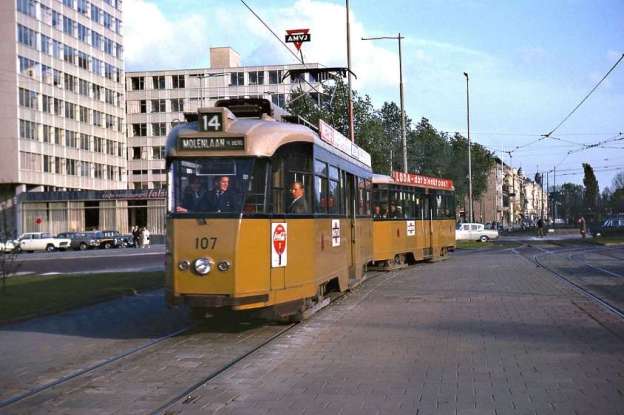
The featured image for this article shows Allan Tram No. 107 at work on the streets of Rotterdam, © Voogd075 and licensed for reuse under a Creative Commons licence (CC BY-SA 3.0). [6]

Metropolitan-Vickers, – Metrovick – was a British heavy electrical engineering company of the early-to-mid 20th century formerly known as British Westinghouse. Highly diversified, it was particularly well known for its industrial electrical equipment such as generators, steam turbines, switchgear, transformers, electronics and railway traction equipment. Metrovick holds a place in history as the builders of the first commercial transistor computer, the Metrovick 950, and the first British axial-flow jet engine, the Metropolitan-Vickers F.2. Its factory in Trafford Park, Manchester, was for most of the 20th century one of the biggest and most important heavy engineering facilities in Britain and the world. [1]

Stuart Yearsley tells me that “The Metrovick (English Electric/AEI/GEC) trams were not actually produced at the Trafford Park works, on Westinghouse Road, but at the Dick Kerr works, on Strand Road in Preston. This factory continues production of rail vehicles, under the Alstom brand, since the collapse of GEC” – see the comments below.

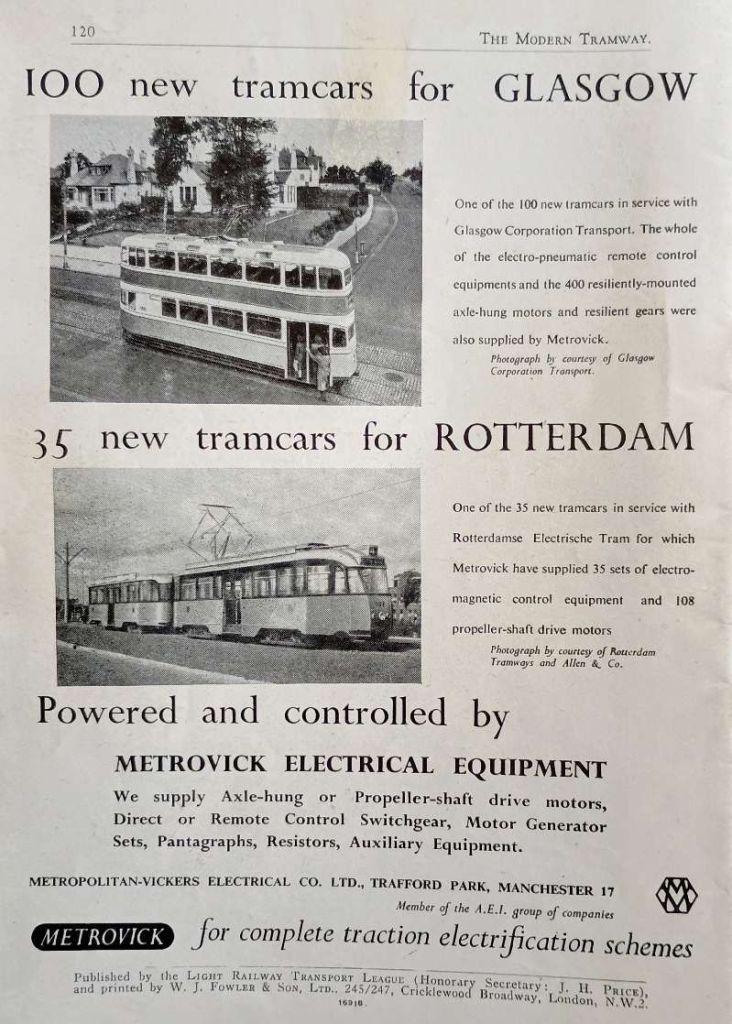
Metrovick took out a full page advert in The Modern Tramway Volume 15 No. 173, May 1952 [2] and no doubt in other journals as well. Its advert celebrated two significant contracts with which it had been involved:

  • 100 new tramcars for Glasgow; and
  • 35 new tramcars for Rotterdam.
The Metrovick advertisement in The Modern Tramway. [2]

100 New Tramcars for Glasgow

Glasgow Corporation Transport placed an order for 100 new streamlined “Coronation Mk II” (or “Cunarder”) tramcars in May 1946. These iconic double-deck trams, built at the Coplawhill works, began entering service in December 1948. The last of these trams entered service in 1952. They were the last double-decker trams built in Britain and we’re still in service when the Glasgow tram network was finally closed in 1962.
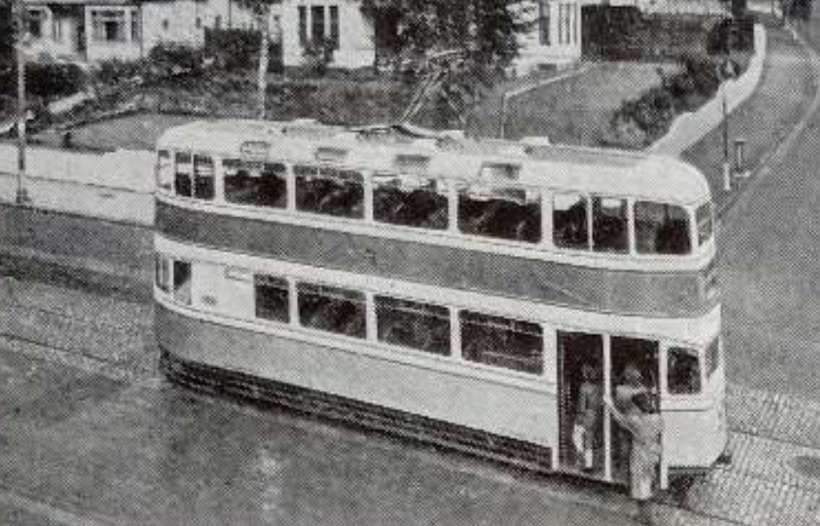
A Glasgow Coronation Mk II (or Cunarder) tram at work in Glasgow in 1952. [2]

Developed from the pre-war Coronation Mark I class, they were slightly longer to allow extra seating. Each car seated 70 passengers (40 upper, 30 lower). They were dubbed “Cunarders” because their sleek, rounded, aerodynamic styling and luxurious interiors resembled the famous Cunard ocean liners. They featured Maley & Taunton bogies, Metropolitan Vickers (Metrovick) electrical equipment, and Fischer bow collectors.

In their advert, Metrovick says that the whole of the electro-pneumatic control equipment and the 400 resiliently-mounted axle-hung motors and resilient gears were supplied by Metrovick.

Electro-pneumatic control equipment combines the precision of electrical controls with the power of pneumatics. When paired with resiliently-mounted axle-hung motors and resilient gears in railway or heavy transit applications, this system effectively isolates track vibrations and minimizes shock damage, significantly extending the lifespan of the drivetrain.” [5]

Two Mark II Coronation cars survive in preservation:

No. 1297: Preserved and frequently operational at the National Tramway Museum at Crich, Derbyshire.
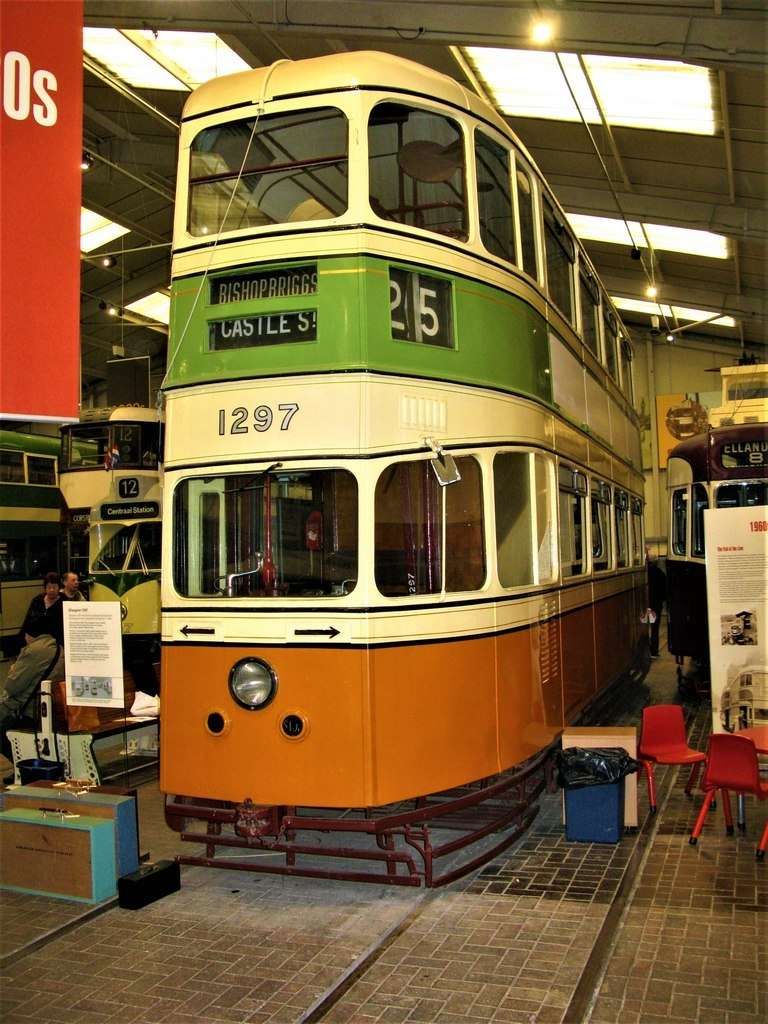
Glasgow No. 1297 was built by Glasgow Corporation Tramways at their Coplawhill workshop in 1948. It is now on display as a static exhibit at Crich. Returning it to an operable condition would be highly expensive as specialist contractors would need to remove asbestos covered wiring, © G Laird and licensed for reuse under a Creative Commons Licence (CC BY-SA 2.0]. [3]

No. 1392: The final tram of the batch and the last new double-decker built in Britain is preserved as part of the collection at the Riverside Museum in Glasgow.
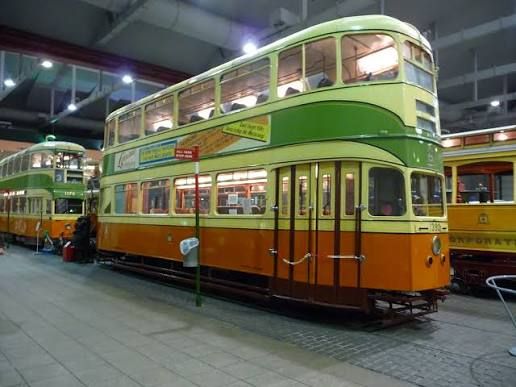
Glasgow Corporation Tramways ‘Cunader’ tram No. 1392 at the Glasgow Museum of Transport. Behind it is Glasgow Coronation Mark I tram No. 1173. The Cunader trams were a post-war development of the pre-war Coronation design © SimonQ and licenced for reuse under a Creative Commons licence (CC BY 2.0). [4]

35 New Tramcars for Rotterdam

Between 1950 and 1952, the Rotterdam Electric Tram (RET) modernized its fleet by taking delivery of 35 new single-directional tramcars (numbered 102–135) and 36 matching trailers. Built by the Rotterdam-based manufacturer Allan of Rotterdam, these iconic post-war vehicles were affectionately nicknamed ‘Allans’ by locals.
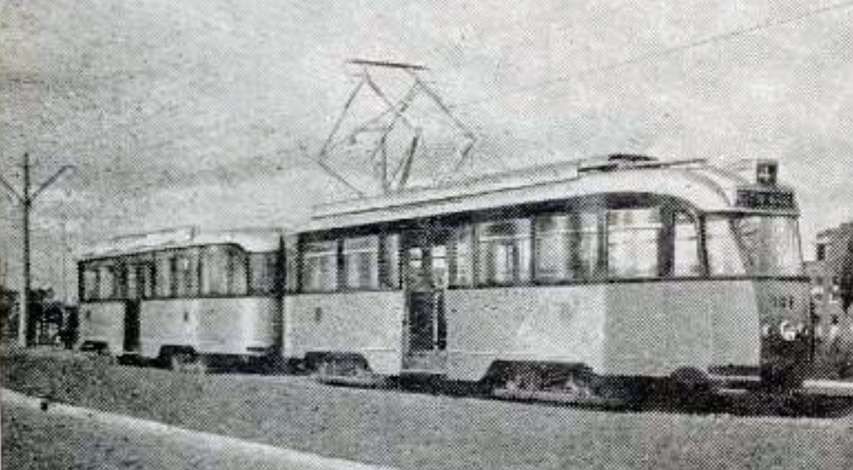
Unlike older hand-operated cars, they were fitted with modern electrical controls. They were the first series of trams in Rotterdam to provide a designated seat for the driver. They retained the classic design with open central platforms to help with passenger flow. The units’ electrical systems were supplied by the British firm Metropolitan-Vickers (Metrovick). [6]

Most of the 1950-1952 Allan cars were retired around 1970. However, a few preserved units survive today as functioning museum trams, which are occasionally showcased by transit enthusiasts. Four of this series are in the collection of the Rotterdam Public Transport Museum – Nos. 109, 115, 123 and 130. [7]
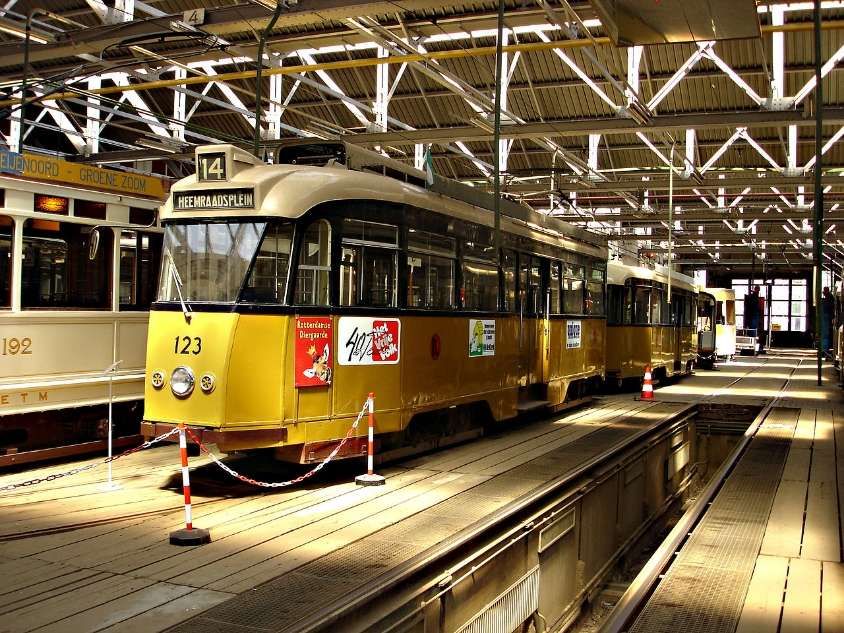
Four-axle Allan motor car No. 123 from 1951 in the Tram Museum Rotterdam, © Voogd075 and licensed for reuse under a Creative Commons licence (CC BY-SA 3.0). [8]

References

  1. https://en.wikipedia.org/wiki/Metropolitan-Vickers, accessed on 21st May 2026.
  2. Metrovick Advertisment; in The Modern Tramway Volume 15, No.173, May 1952, p120.
  3. https://www.geograph.org.uk/photo/6126710, accessed on 21st May 2026.
  4. https://commons.wikimedia.org/wiki/File:TRAM_no.1392_Glasgow_Transport_Museum.jpg, accessed on 21st May 2026.
  5. https://www.smc.eu/en-gb/products/electro-pneumatic-control-equipment~134571~nav, accessed on 21st May 2026.
  6. https://en.wikipedia.org/wiki/Allan_of_Rotterdam, accessed on 21st May 2026.
  7. https://nl.wikipedia.org/wiki/Rotterdamse_Allanstellen, accessed on 21st May 2026.
  8. https://nl.wikipedia.org/wiki/Rotterdamse_Allanstellen#/media/File%3ARET123.a.Kootsekade.jpg, accessed on 21st May 2026.
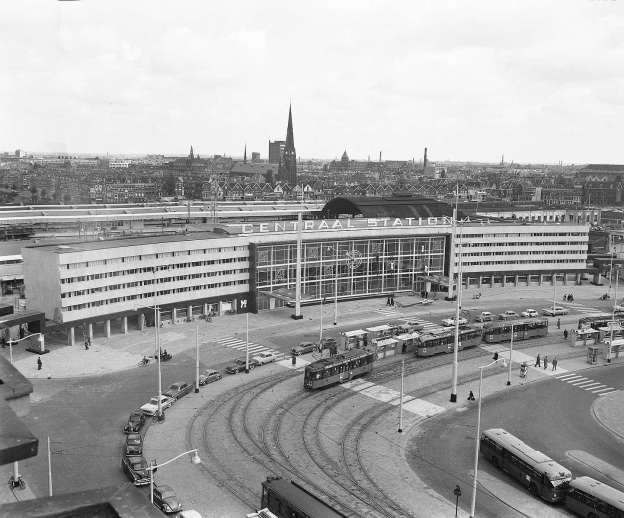
The Modern Tramway, May 1957 – Rotterdam’s Trams in the 1950s

This short article could be entitled, ‘The Modern Tramway takes on the Manchester Guardian‘. In. Its May 1957 journal the Light Railway Transport League asks whether its readers had read the Manchester Guardian on 22nd January. The featured image shows trams in Rotterdam in May 1957. [3]

In an article entitled ‘A Twisted Tale’, The Modern Tramway Journal is surprised to see the Manchester Guardian being taken in by the spirit of the current age which was decidedly anti-Tram. [1: p83]

Did you read the ‘Manchester Guardian’s’ account of the re-building of Rotterdam in the issue of 22nd January? It was a good article, catching the spirit of the modern conception of town planning, and making you feel that the writer had not only visited Rotterdam but had been genuinely inspired by the creat- ive talent of its designers until you got to his last sentence, which pro- vided so violent a contrast that it might have been written by a different person. It read: “It is odd to see trams still clanking through the city and to hear that there is no intention as yet of scrapping them.

Whatever was the writer [on] about? Rotterdam’s trams are among the finest and most modern in Europe, as well as some of the quietest, a system that conforms to the League’s highest ideals and amply attains its motto of ‘Vlug, veilig en goedkoop (fast, safe and cheap)’.”

[1: p83]

As the article goes on to explain, “nothing about a Rotterdam tram could remotely be described as clanking; they run on track entirely free from dropped joints and corrugations, and their noisiest feature is the click of the controller ratchet. As for the town planning aspect, if you have visited Rotterdam during the last 10 years you will have seen how the rebuilding of the city went hand in hand with the rebuilding of the transport system; the tramways in the main streets in the city centre are now sited on central reservations, free from other traffic, and the busiest stops are laid out with a foresight rare else- where, the track dividing so that each group of routes has its own stop and shelter side by side. The service the trams give is one of the finest a city could have, a smooth, effortless flow of high-capacity vehicles operating at the cheapest fares in Holland, and how any trained observer could visit the city and fail to be impressed by it is difficult to understand.” [1: p83]

While it may have been true that the oldest tramcars on the Rotterdam network were contemporaries of the HR2s in London they were actually almost silent! Indeed, The Modern Tramway expressed surprise that the city’s tram company(Rotterdamse Ekectrische Tram (R.E.T.)) considered those vehicles due for retirement. Apparently the company had already ordered a first batch of replacement single, and two car articulated sets. Pointedly The Modern Tramway comments:

As for the other post-war cars, their equipment came from Trafford Park, and the ‘Guardian’s’ outburst is hardly calculated to further the export trade of Metropolitan-Vickers who made them.”

[1: p84]

So, what might have been the explanation for the Manchester Guardian’s faux-pas? The Modern Tramway thought that it had an explanation which might be charitable:

Perhaps the writer, putting his impressions on paper some time after his visit, searched in his mind for the sound of Rotterdam’s trams (and failed, since they are noiseless), and unconsciously completed his mental picture by substituting the tram noises he knew in Manchester, the home of groaning motors, rattling windows, dropped joints, broken check-rail, lifeguard trays tied up with string, four-wheel cars with odd bearings, bogie cars with odd trucks and all the rest of it. Either this, or he deliberately set out to mislead and based his words on three quite erroneous assumptions, to wit:

(a) A modern city with trams is odd;

(b) Trams, including Rotterdam ones, clank;

(c) Rotterdam’s trams will ultimately be scrapped, but not as yet.

We had always looked on the Manchester Guardian as a factual paper with a liberal outlook, a traditional supporter of oppressed minorities, and free of the bigoted outlook that is so often present elsewhere. We did not expect a paper that devoted page after page to the horrors of shipping live horses to Antwerp to show the customary English attitude of ignorance and intolerance towards tramcars; trams, after all, are a persecuted minority without the means of defending themselves.”

[1: p84]

I suspect that The Modern Tramway editor had his/her tongue firmly in his/her cheek as they penned that last paragraph!

The article continues:

If the contributor had written about St. Malo or Douai or Maubeuge or some other of those French towns whose trams were capable of racing a tortoise on equal terms then we might have felt a glimmer of sympathy, but the article was on Rotterdam, and it is possible only to say that the remarks were inappropriate, misleading and absolutely untrue.

Of course, we wrote to the ‘Guardian’; on enquiring among our readers who know Rotterdam, we found that they too had not been slow to refute this smear against the R.E.T., and we believe that some of the Guardian’s’ overseas readers wrote as well. Last (but by no means least), our friend Ir. Bogstra, the General Manager of the R.E.T., was so surprised by the Guardian’s remarks that he sent the paper a set of photographs of the newest trams and a coldly factual analysis of the reasons why Rotterdam prefers trams to buses. From all this, we might have expected to read at least one “Letter to the Editor” disagreeing with the contributor, but all that happened was the appearance of a childish note of defiance in the “Miscellany” gossip-column a fortnight or so later, expressing surprise that there were such things as silent modern trams; because the word “tram” rhymed with “slam” you expected it to be noisy, and so on in the same vein. There are newspapers from which we should have expected unenlightened comment, but we never thought that we should have to include the Manchester Guardian’ among their number.”

[1: p84]

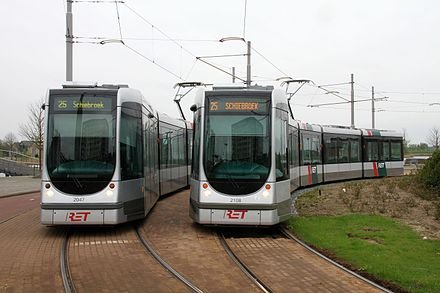
Rotterdam’s Trams remain an integral part of the city’s transport provision. “Opened in 1879, the network currently has nine regular tramlines, and three special or seasonal tramlines. It has been operated since 1927 by Rotterdamse Elektrische Tram (RET). The tram network is the city’s more extensive public transport system, while the rapid transit Rotterdam Metro is the more utilized system.” [2]

Trams in Rotterdam in the 21st century. These two were both built by Alstrom. The image shows two generations of Alstom Citadis trams; the older one is on the left and the newer on the right, © Maurits90 (Public domain). [2]

References

  1. A Twisted Tale; in The Modern Tramway, the Journal of the Light Railway Transport League; May, 1957, p83-84.
  2. https://en.m.wikipedia.org/wiki/Trams_in_Rotterdam, accessed on 1st July 2023.
  3. https://commons.m.wikimedia.org/wiki/File:Centraal_Station_in_Rotterdam,_exterieurs_en_interieurs,_Bestanddeelnr_908-6089.jpg, This is an image from the Nationaal Archief, the Dutch National Archives, donated in the context of a partnership program, © Herbert Behrens/Anefo, it is shared here under the Creative Commons CC-0-1.0 Universal Public Domain Dedication.