
This short article follows on from an earlier article about the adverts placed in the 1951 issues of The Modern Tramway.
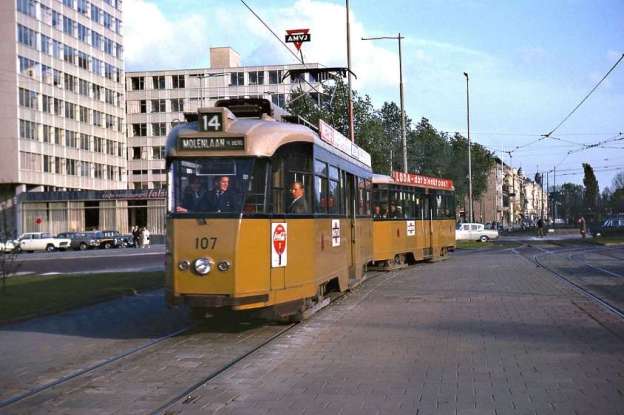
The featured image for this article shows Allan Tram No. 107 at work on the streets of Rotterdam, © Voogd075 and licensed for reuse under a Creative Commons licence (CC BY-SA 3.0). [6]
Metropolitan-Vickers, – Metrovick – was a British heavy electrical engineering company of the early-to-mid 20th century formerly known as British Westinghouse. Highly diversified, it was particularly well known for its industrial electrical equipment such as generators, steam turbines, switchgear, transformers, electronics and railway traction equipment. Metrovick holds a place in history as the builders of the first commercial transistor computer, the Metrovick 950, and the first British axial-flow jet engine, the Metropolitan-Vickers F.2. Its factory in Trafford Park, Manchester, was for most of the 20th century one of the biggest and most important heavy engineering facilities in Britain and the world. [1]
Stuart Yearsley tells me that “The Metrovick (English Electric/AEI/GEC) trams were not actually produced at the Trafford Park works, on Westinghouse Road, but at the Dick Kerr works, on Strand Road in Preston. This factory continues production of rail vehicles, under the Alstom brand, since the collapse of GEC” – see the comments below.
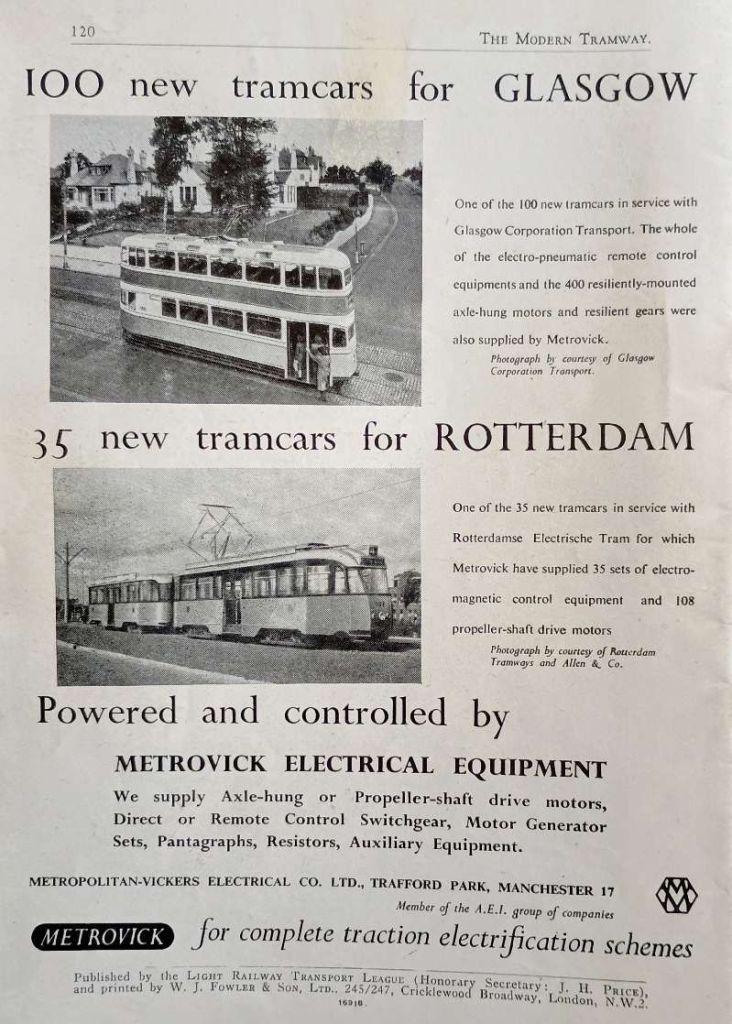
Metrovick took out a full page advert in The Modern Tramway Volume 15 No. 173, May 1952 [2] and no doubt in other journals as well. Its advert celebrated two significant contracts with which it had been involved:
- 100 new tramcars for Glasgow; and
- 35 new tramcars for Rotterdam.
100 New Tramcars for Glasgow
Glasgow Corporation Transport placed an order for 100 new streamlined “Coronation Mk II” (or “Cunarder”) tramcars in May 1946. These iconic double-deck trams, built at the Coplawhill works, began entering service in December 1948. The last of these trams entered service in 1952. They were the last double-decker trams built in Britain and we’re still in service when the Glasgow tram network was finally closed in 1962.
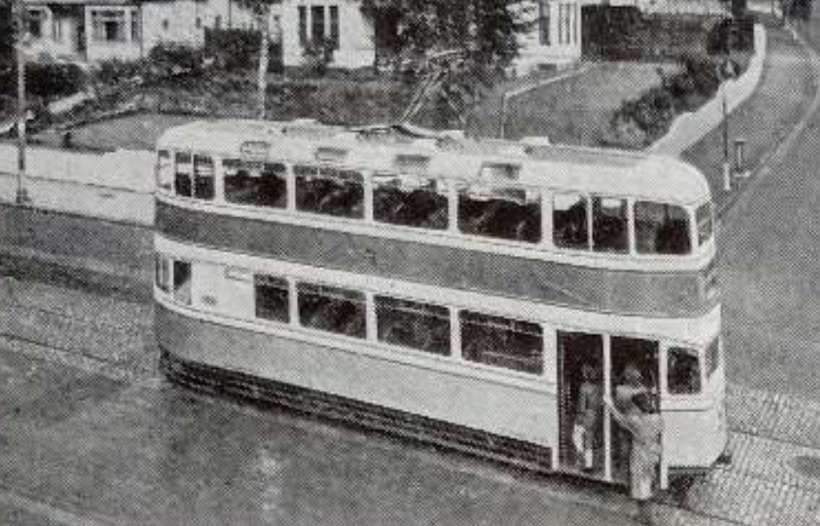
Developed from the pre-war Coronation Mark I class, they were slightly longer to allow extra seating. Each car seated 70 passengers (40 upper, 30 lower). They were dubbed “Cunarders” because their sleek, rounded, aerodynamic styling and luxurious interiors resembled the famous Cunard ocean liners. They featured Maley & Taunton bogies, Metropolitan Vickers (Metrovick) electrical equipment, and Fischer bow collectors.
In their advert, Metrovick says that the whole of the electro-pneumatic control equipment and the 400 resiliently-mounted axle-hung motors and resilient gears were supplied by Metrovick.
“Electro-pneumatic control equipment combines the precision of electrical controls with the power of pneumatics. When paired with resiliently-mounted axle-hung motors and resilient gears in railway or heavy transit applications, this system effectively isolates track vibrations and minimizes shock damage, significantly extending the lifespan of the drivetrain.” [5]
Two Mark II Coronation cars survive in preservation:
No. 1297: Preserved and frequently operational at the National Tramway Museum at Crich, Derbyshire.
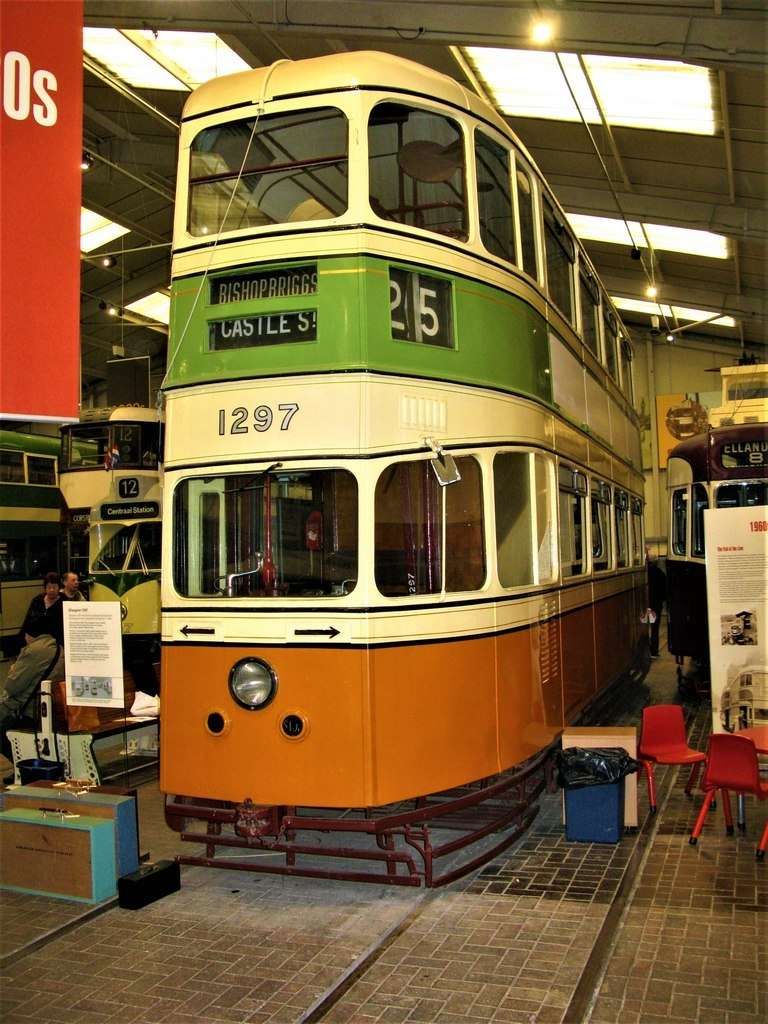
Glasgow No. 1297 was built by Glasgow Corporation Tramways at their Coplawhill workshop in 1948. It is now on display as a static exhibit at Crich. Returning it to an operable condition would be highly expensive as specialist contractors would need to remove asbestos covered wiring, © G Laird and licensed for reuse under a Creative Commons Licence (CC BY-SA 2.0]. [3]
No. 1392: The final tram of the batch and the last new double-decker built in Britain is preserved as part of the collection at the Riverside Museum in Glasgow.
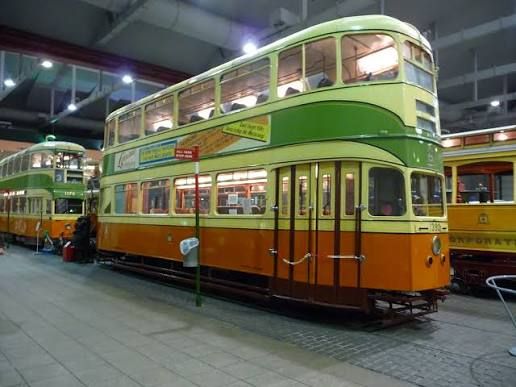
Glasgow Corporation Tramways ‘Cunader’ tram No. 1392 at the Glasgow Museum of Transport. Behind it is Glasgow Coronation Mark I tram No. 1173. The Cunader trams were a post-war development of the pre-war Coronation design © SimonQ and licenced for reuse under a Creative Commons licence (CC BY 2.0). [4]
35 New Tramcars for Rotterdam
Between 1950 and 1952, the Rotterdam Electric Tram (RET) modernized its fleet by taking delivery of 35 new single-directional tramcars (numbered 102–135) and 36 matching trailers. Built by the Rotterdam-based manufacturer Allan of Rotterdam, these iconic post-war vehicles were affectionately nicknamed ‘Allans’ by locals.
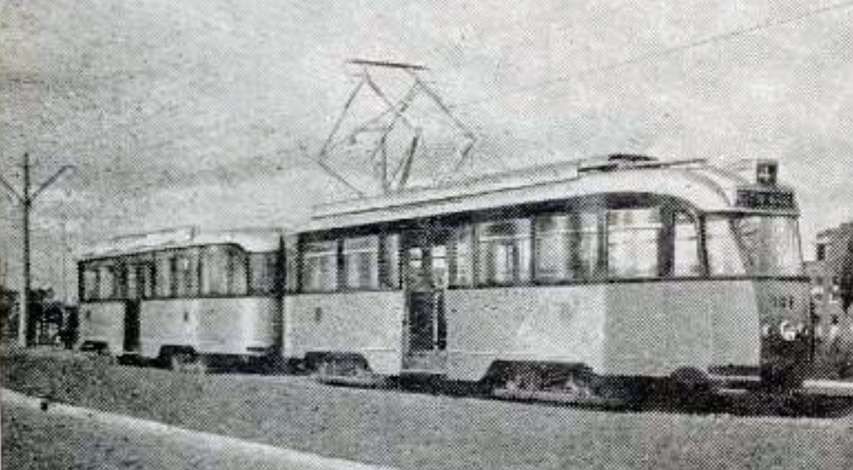
Unlike older hand-operated cars, they were fitted with modern electrical controls. They were the first series of trams in Rotterdam to provide a designated seat for the driver. They retained the classic design with open central platforms to help with passenger flow. The units’ electrical systems were supplied by the British firm Metropolitan-Vickers (Metrovick). [6]
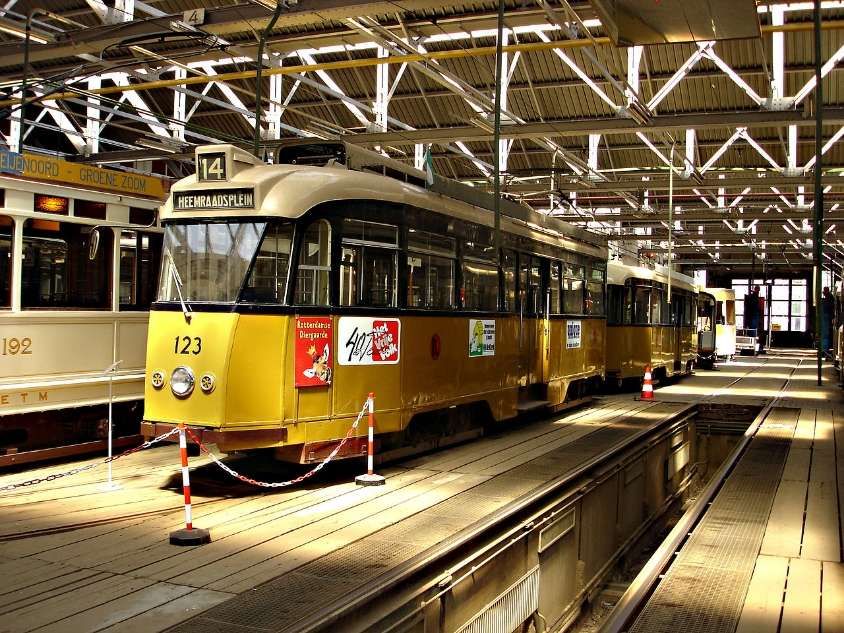
Most of the 1950-1952 Allan cars were retired around 1970. However, a few preserved units survive today as functioning museum trams, which are occasionally showcased by transit enthusiasts. Four of this series are in the collection of the Rotterdam Public Transport Museum – Nos. 109, 115, 123 and 130. [7]
References
- https://en.wikipedia.org/wiki/Metropolitan-Vickers, accessed on 21st May 2026.
- Metrovick Advertisment; in The Modern Tramway Volume 15, No.173, May 1952, p120.
- https://www.geograph.org.uk/photo/6126710, accessed on 21st May 2026.
- https://commons.wikimedia.org/wiki/File:TRAM_no.1392_Glasgow_Transport_Museum.jpg, accessed on 21st May 2026.
- https://www.smc.eu/en-gb/products/electro-pneumatic-control-equipment~134571~nav, accessed on 21st May 2026.
- https://en.wikipedia.org/wiki/Allan_of_Rotterdam, accessed on 21st May 2026.
- https://nl.wikipedia.org/wiki/Rotterdamse_Allanstellen, accessed on 21st May 2026.
- https://nl.wikipedia.org/wiki/Rotterdamse_Allanstellen#/media/File%3ARET123.a.Kootsekade.jpg, accessed on 21st May 2026.


