
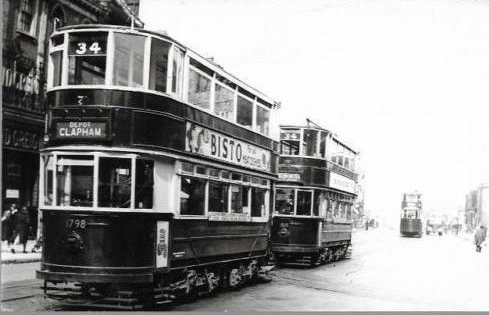
The featured image at the head of this article shows trams which served Route 34 in Clapham in 1949, the photographer is not recorded. [2] Route No. 34 ran from Chelsea (Kings Road) via Clapham and Camberwell Green to Blackfriars. [1: p122]
Robert Harley, in his book ‘London Tramway Twilight: 1949-1952 has chapters focussing, among other subjects on the years 1949, 1950 & 1951. [1]
In the chapter which considers 1949, [1: p32-41] Harley tells us that in May 1949, forty members of the Light Railway Transport League (LRTL) undertook a tour in Feltham car No. 2094. “It was noted that this particular car was resplendent in fresh paint and in excellent mechanical condition, having recently passed through Charlton Works. Chief Inspector Perry was ‘on the handles’, and he drove Car 2094 from Victoria to Southcroft Road. Tour participants were then transported to Purley, before returning to Victoria. The journey from Purley to Victoria was timed at 55 minutes.” [1: p36]
Harley goes on to say: “Perhaps many of the 40 members realised that an era of stability was about to end, for on 8th June space was made free in Wandsworth and Clapham depots to allow construction of garage facilities for diesel buses. This work would include filling tramway inspection pits, providing new bus docking pits, sinking fuel oil storage tanks in the ground and installing fuelling points. The old tramway traversers which were used to shift trams sideways, would also go. It was indeed the beginning of the end, and a tangible sign that progress towards the inevitable extinction of electric traction was now unstoppable.” [1: p36-37]
Harley also notes that, ‘The Modern Tramway’ for July 1949 “contained a number of details under the headline ‘London Depot Changes’. According to the correspondent, Wandsworth Depot had been converted to overhead wire and a change pit constructed at the entrance. Removal of the conduit equipment within the depot made for an easier and safer conversion. Fleet changes included seventeen cars of the 1700 series E/1 which were shifted to Clapham Depot to work route 26. Fifty-one other E/1s were transferred from Clapham to Camber- well and New Cross. The 1500 series E/1 cars were now mostly stabled at New Cross. Six E/3 cars were moved from Thornton Heath to Norwood, which also received some rehabs from New Cross. Route 34 was now worked by Camberwell Depot and was operated mainly by E/3 cars, with the odd HR/2 and E/1 taking a turn. New Cross took over route 66 from Camberwell; Norwood worked most of route 10, although Telford Avenue still supplied one Feltham for this route. Telford Avenue took over Clapham’s share of route 10 and part of the allocation of cars on routes 22 and 24.” [1: p37]
The reality was that, from its formation in 1937 by J.W. Fowler to seek the modernisation and retention of electric tramways [1: p42], the LRTL was fighting against entrenched views in London Transport (LT). “Lord Ashfield, Frank Pick, Sir Henry Maybury and the other board members were firmly convinced that the sooner they got rid of the trams there better.” [1: p42]
“Although there was a genuine affection for tramways amongst many LT employees, it is safe to say that the attitude of LT, the Labour Government and the TGWU was fairly consistent. New and better road vehicles, in the form of the RT bus, would provide a flexible, more integrated service thus in this sense, the post-war abandon- ment programme was never a party political issue. It was the consensus of transport experts that trams had had their day. Arguments such as the danger of relying on imported oil and rubber found little support in the corridors of power. As for the growth of motor vehicles, it was confidently predicted that the average speed of London’s traffic would increase after the removal of the trams. Parking was not foreseen as a problem, and the use of American style parking meters was discounted as unBritish! Concerns about pollution mainly centred on burning smokeless fuels, which would ease the fog situation. The possible harmful effects of exhaust fumes from the thousand or so new buses were given the same short shrift as American parking meters.” [1: p43]
References
- Robert. J Harley; London Tramway Twilight: 1949-1952; Capital Transport, Harrow Weald, Middlesex, 2000.
- https://www.ebid.net/ca/for-sale/london-clapham-photo-of-trams-1949-photographer-issued-card-1959-182740294.htm, accessed on 7th July 2023.

