
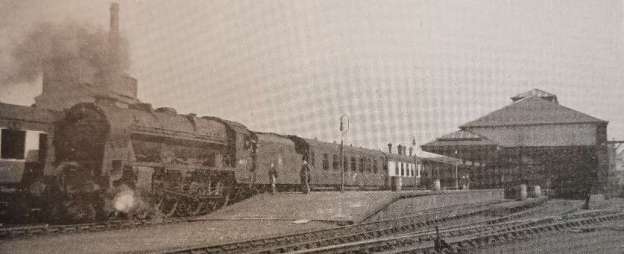
The November 1954 issue of The Railway Magazine included an article by C. A. Knight about the railways between Sellafield and Maryport and inland as far as Cockermouth and Kelton Fell.
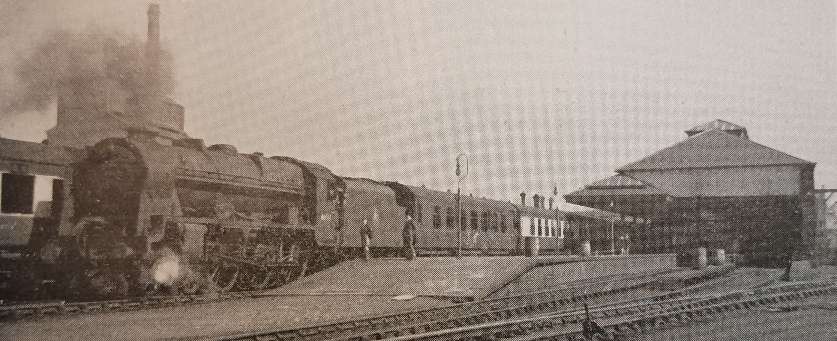
The featured image at the head of this article (and the article by C. A. Knight) shows an early 1950s image of Workington Station with a train to Euston ready to depart behind a ‘Royal Scot’ loco. [1: p757]
Reading Knight’s article encouraged me to begin a review of the different railways and tramways of the area. This article is the first of a series. …
Knight says: “Travellers to Keswick by the ‘Lakes Express’ during the summer [of 1954] may have speculated on the country to the west of that delectable town which is served by the train in the final stages of its journey. Some may venture as far as Cockermouth, but few will follow the train to its terminus at Workington, that product of Victorian enterprise in industry, as there is little in the area to attract the tourist from the delights of the Lake District. To the student of railway history, however, its tangle of intersecting railways holds promise of interest.” [1: p757]
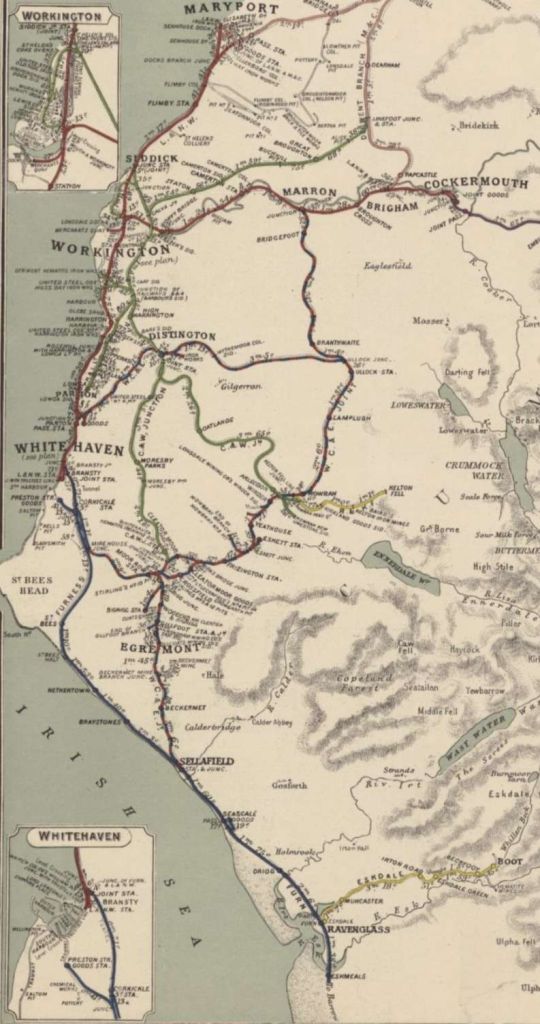
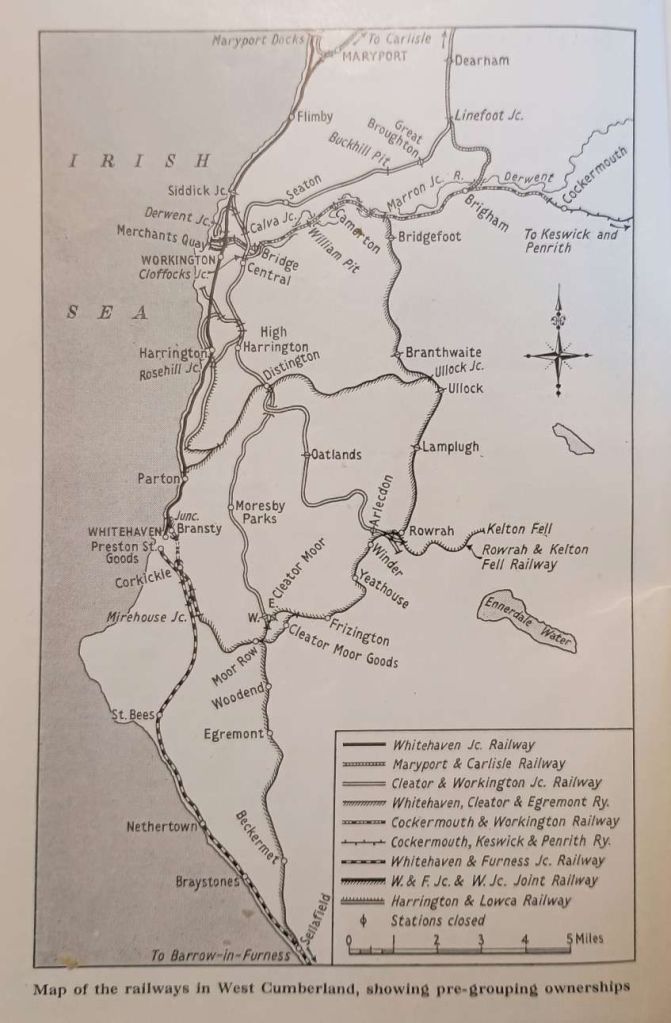
Knight tells us that, “The early evolution of the railways of West Cumberland was not marked by the contentious episodes which frequently characterised railway development in the mid-nineteenth century; rather [it could] be described as a process of peaceful penetration. … The narrow belt of agricultural land on the western edge of Cumberland was for many years practically isolated by the difficulties of travel through the mountains of the Lake District. The discovery of rich seams of coal, and the improvement of mining technique which enabled coal to be won from under the sea-bed, led to development of shipping facilities, and the economic factor became the distance from the port of shipment. Tramways in various forms were installed to enable coal to be brought from more distant pits, and on these, horse-drawn vehicles were no doubt used.” [1: p757]
The Early Tramways of West Cumberland
Early tramways in West Cumberland were primarily focused on moving industrial goods—specifically coal and iron ore—rather than passengers. Online references to Industrial Waggonways and Tramways in the 19th Century include:
- Woodagreen Pit to Whitehaven Harbour: a crude wooden waggonway built at the Ginns as early as 1683. [9]
- Seaton Tramroad: A 3 mile wooden waggonway built from Seaton pit to Workington, in the early 1730s. [6]
- Harrington Harbour/Bain’s Tramway (c. 1760/1840s): A wagonway was established at Harrington Harbour as early as 1760. Later, it became known as “Bain’s Tramway,” which is shown on an 1864 OS map connecting Harrington Harbour with mines at John Pit and Hodgson Pit, passing through Rose Hill.
- Whitehaven Harbour: A horse-drawn tramway was completed in 1854, authorized by the Whitehaven and Furness Junction Railway Amendment Act 1853. It allowed goods wagons to travel from Preston Street to the south end of the harbour.
- Mr. Curwen’s Waggonway: A significant waggonway owned by Henry Curwen of Workington, which necessitated a bridge for the Whitehaven Junction Railway to pass over it in 1844.
- Colliery Lines: These include: Waggonways from Lonsdale Collieries on Broughton Moor; Howgill Colliery Waggonway; and Whingill Colliery Waggonway.
- Whitehaven Mineral Lines: The rapid development of haematite deposits in the Cleator Moor and Egremont districts in the 1840s led to numerous industrial lines and tramroads, later absorbed by the Whitehaven, Cleator & Egremont Railway (opened in parts from 1857).
- The First Howgill Incline: constructed by 1813 in Whitehaven. [22]
- Rowrah & Kelton Fell Mineral Railway: A significant line developed to serve the limestone quarries and iron ore mines near Rowrah, with development occurring through the 1860s and 1870s.
- Jane Pit to Quayside (Workington): saw horses towing basic coal trucks from the pit down and over the railway, along to Chapel Bank and on to the Quayside. [8]
- Cleator & Workington Junction Railway (1879): While technically a later railway, it was built to connect the existing iron and coal mining infrastructure (early pits and associated wagonways) with the coast to break existing transport monopolies.
- Harrington and Lowca Light Railway: (commonly known as the Lowca Light Railway or LLR)
- Lowca: An early locomotive works was established at Lowca, lasting until 1926, its business was fatally undermined by a disastrous fire in which the wooden patterns used during manufacture were burned. [5]
- Corkickle Brake: A standard-gauge rope-worked incline survived as late as 1986, which was a remnant of early industrial transport methods, handling 500,000 tons of traffic at its peak.
These early, often private, waggonways generally used iron rails (replacing wooden ones) to connect pits to collieries or directly to the rapidly developing ports of Workington, Harrington, and Whitehaven.
Main Line and Branch Line Railways
There were a surprising number of standard-gauge railway companies operating in West Cumberland, as the maps above show.
The Whitehaven Junction Railway
The Whitehaven Junction Railway (WJR) was a historic English railway company sanctioned in 1844 to connect the town of Whitehaven with the Maryport and Carlisle Railway, facilitating industrial growth in West Cumberland. It played a crucial role in linking local coal mines and ironworks to broader transport networks. [10]
The Whitehaven & Furness Junction Railway
The Whitehaven & Furness Junction Railway (W&FJR) was established to connect the town of Whitehaven with the Furness Railway at Broughton-in-Furness. [11]
The Whitehaven, Cleator & Egremont Railway
The Whitehaven, Cleator and Egremont Railway (WC&ER) was built to open up the hematite orefield to the south-east of Whitehaven. It opened for goods traffic in 1855 and for passenger traffic in 1857. [12]
The Maryport & Carlisle Railway
The Maryport and Carlisle Railway (M&CR) was incorporated in 1837 to connect the two towns of Carlisle and Maryport. George Stephenson was the engineer of the line, which opened fully on 10th February 1845. [13]
The Cleator & Workington Junction Railway
The Cleator and Workington Junction Railway (C&WJR) served the towns of Cleator Moor and Workington and intermediate villages. It was mainly used for coal, limestone and iron ore traffic for the local industries. [14]
The Cockermouth & Workington Railway
The Cockermouth and Workington Railway (C&WR) was established by act of Parliament in 1845. The railway opened for service in 1847, and ran from the Whitehaven Junction Railway station at Workington to a station at Cockermouth near the bridge over the Derwent. [15]
The Cockermouth, Keswick & Penrith Railway
The Cockermouth, Keswick and Penrith Railway (CK&PR) was incorporated by Act of Parliament on 1st August 1861, to build a line connecting the town of Cockermouth with the London and North Western Railway (LNWR) West Coast Main Line at Penrith. [16]
The Whitehaven & Furness Junction & Whitehaven Junction Joint Railway
While they were separate companies, the W&FJR and the WJR worked together, particularly around Whitehaven. By 1852, a connecting line (including the Bransty tunnel) linked the W&FJR from the south with the WJR from the north. From the mid-1850s, the two companies merged their efforts to focus passenger traffic at Whitehaven Bransty Station (jointly managed) and goods traffic at Preston Street. [17]
The Harrington & Lowca Light Railway
The Harrington and Lowca Light Railway (commonly known as the Lowca Light Railway or LLR) was a short railway close to the coast on the South side of Harrington. Rosehill Junction was the junction between Bain’s Tramway (later known as the Harrington and Lowca Light Railway) and the Cleator and Workington Junction Railway’s Harrington Branch (later known as the Rosehill Branch). [18][19
Tramways
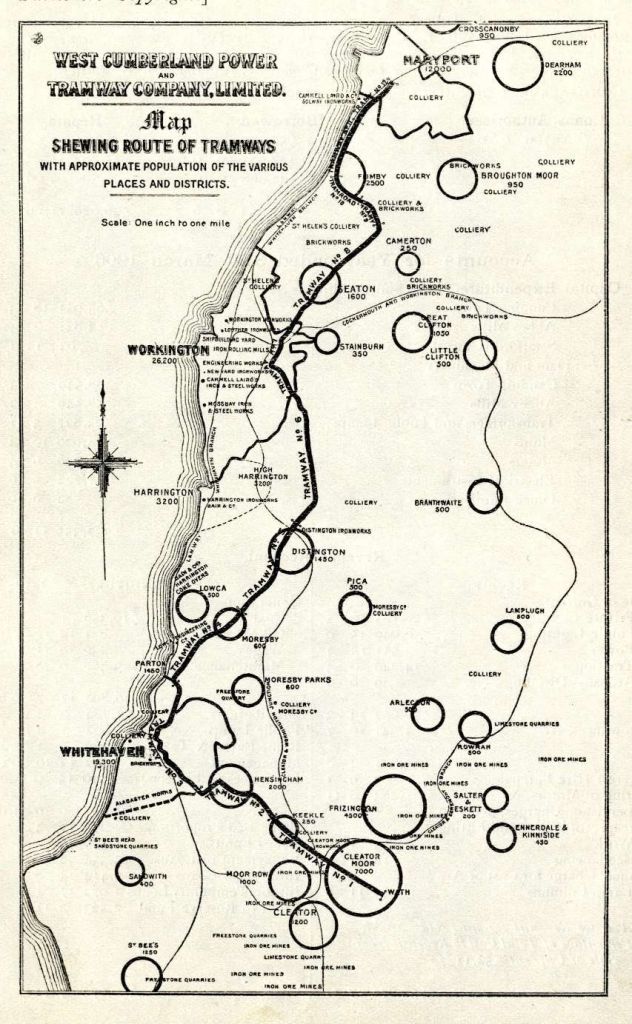
A Proposed Electric Tramway for West Cumberland – 1901
At the turn of the 20th century, the Cleator Moor Electric Tramway was planned and Acts of Parliament were sought for its construction. [3] Sadly, this standard-gauge tramway was not built, even though three different enabling Acts of Parliament were sought and passed (1901, 1903 and 1905). [3]
Later Industrial Railways
These railways include:
- The CORUS Works Tramroad: a 3 ft-gauge works railway. [7]
- Whitehaven Harbour: by the late 19th century, almost all of the harbour had a rail network. Locomotives were first introduced in 1848, the last locomotive being disposed of in 1986. [20]
- Various Inclines and Other Lines: in addition to the Corkickle Break mentioned above (which lasted until 1986) there was a second Howgill Incline built by 1923 and of which remains can be found adjacent to Wellington Lodge. The Howgill Incline(s) have been out of use since 1972. [23][24]
References
- C. A. Knight; Railways of West Cumberland; in The Railway Magazine, November 1954; Tothill Press, London, 1954, p757-765.
- The Railway Clearing House, London, 1921; via, https://maps.nls.uk/view/245959305, accessed on 3rd April 2026.
- https://www.littleireland.co.uk/2019/10/cleator-moor-electric-tramway.html?m=1, accessed on 3rd April 2026.
- Emile Garcke (Ed.); The Manual of Electrical Undertakings, 11th Edition; Electrical Press, London, 1907, p997; via, https://www.lakesguides.co.uk/html/maps/GRK1.htm, accessed on 3rd April 2026.
- https://www.lococarriage.org.uk/cumbria_rail.html, accessed on 3rd April 2026.
- https://www.lakesguides.co.uk/html/lgaz/LK39356.htm, accessed on 3rd April 2026.
- https://www.lakesguides.co.uk/html/lgaz/LK02667.htm, accessed on 3rd April 2026.
- https://www.facebook.com/share/p/18HqJFu9h8, accessed on 3rd April 2026.
- https://www.whitehavennews.co.uk/news/17161961.a-fascinating-delve-into-towns-rail-history, quoting from Howard Quayle; Whitehaven: The Railways and Waggonways of a Unique Cumberland Port; Cumbrian Railways Association, Pinner, Middlesex, 2007.
- https://wp.me/p3J9rW-11F, accessed on 6th April 2026.
- https://transportsofdelight.smugmug.com/RAILWAYS/LOCOMOTIVES-OF-THE-LMS-CONSTITUENT-COMPANIES/LOCOMOTIVES-OF-THE-FURNESS-RAILWAY/i-Ls4ZZF3%23, accessed on 6th April 2026.
- https://en.wikipedia.org/wiki/Whitehaven,_Cleator_and_Egremont_Railway, accessed on 6th April 2026.
- https://www.gracesguide.co.uk/Maryport_and_Carlisle_Railway, accessed on 6th April 2026.
- https://en.wikipedia.org/wiki/Cleator_and_Workington_Junction_Railway, accessed on 6th April 2026.
- https://en.wikipedia.org/wiki/Cockermouth_and_Workington_Railway, accessed on 6th April 2026.
- https://en.wikipedia.org/wiki/Cockermouth,_Keswick_and_Penrith_Railway, accessed on 6th April 2026.
- https://en.wikipedia.org/wiki/Preston_Street_railway_station, accessed on 6th April 2026.
- https://en.wikipedia.org/wiki/Harrington_and_Lowca_Light_Railway, accessed on 6th April 2026.
- https://www.railscot.co.uk/companies/H/Harrington_and_Lowca_Light_Railway, accessed on 6th April 2026.
- https://www.whitehavenhc.org.uk/about-the-harbour, accessed on 6th April 2026.
- https://railwaymatters.wordpress.com/fell-type-mountain-railways, accessed on 2nd May 2026.
- https://www.facebook.com/share/p/1E7do6dbMy, accessed on 2nd May 2026.
- https://www.facebook.com/share/p/18tB4qhxPW, accessed on 2nd May 2026.
- https://www.facebook.com/share/p/1BugADHZGo, accessed on 2nd May 2026.

