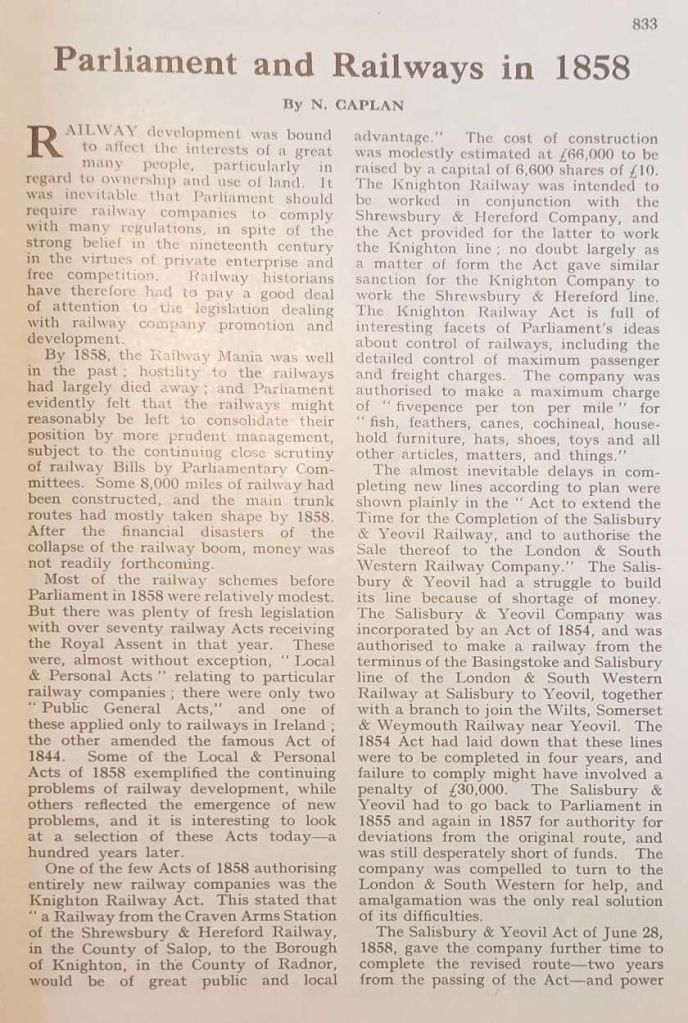
N. Caplan reviewed parliamentary activity relating to railways in 1858 in The Railway Magazine of December 1958. His aim was to encourage research into railway history through the various Acts of Parliament relating to railways.
The Railway Magazine, December 1858, page 833. [1: p833]
“By 1858, the Railway Mania was well in the past, hostility to the railways had largely died away, and Parliament evidently felt that the railways might reasonably be left to consolidate their position by more prudent management, subject to the continuing close scrutiny of railway Bills by Parliamentary Committees. Some 8,000 miles of railway had been constructed, and the main trunk routes had mostly taken shape by 1858. After the financial disasters of the collapse of the railway boom, money was not readily forthcoming.
Most of the railway schemes before Parliament in 1858 were relatively modest. But there was plenty of fresh legislation with over seventy railway Acts receiving the Royal Assent in that year. These were, almost without exception, ‘Local & Personal Acts’ relating to particular railway companies, there were only two ‘Public General Acts’, and one of these applied only to railways in Ireland, the other amended the famous Act of 1844.” [1: p833]
Prior to reading Caplan’s article I was unaware of the distinction made in Parliament between ‘Local & Personal Acts’ and ‘Public General Acts’,
It appears that UK Acts of Parliament Acts of Parliament can be divided into two types: public acts and private acts. …
“Public actsare legislation of universal application and change the general law. Private acts (also known as local and personal acts) affect the powers of individual groups,such as companies or local authorities.Prior to 1798, all acts, both public and private, were published together with private acts listed as ‘local and personal acts declared private’. Since 1798, printed acts have been divided into two series: ‘public general acts’ and ‘local and personal acts’.” [2: p2]
The picture after 1798 is relatively complex:
According to the House of Commons information Office, [2: p3-4] Private Acts are listed as:
(a) Private Acts (until 1802); (b) Local and Personal Acts, not printed (1802-1814); Private Acts (1815-date) (titled Personal Acts from 1948).
All private acts have been printed since 1922.
Local and Personal Acts include:
(c) Public Local and Personal Acts (1798-1802);
(d) Local and Personal Acts to be judicially noticed (1803-1814); Local and Personal Acts declared public and to be judicially noticed (1815-1867);
(e) Provisional Order Confirmation Acts (regarded as public acts of a local character) (1867-1963);
(f) Local and Personal Acts (1868);
(g) Local and Private Acts (1869);
(h) Local Acts (1870 onwards).
The House of Commons Information Office comments: “The differences between all these series can often be set aside, except in searching out the actual texts from library shelves. However, it is normal to cite acts in a standard way, despite what may appear on the document itself.” [2: p4]
“It is now usual to cite public acts of all periods with arabic figures and post-1797 non-public acts with roman numerals. Personal Acts have italic arabic figures, and it is a service to the reader to supply the information (Not Printed) after the citation of any such act known never to have been printed. The [Chronological Table of the Statutes](CTS) is a useful guide for citing public acts of whatever age.” [2: p4-5]
The House of Commons Information Office goes on to provide specific details of how citations should be structured and then gives examples of how this should be done, note that ‘cap’ is short for ‘chapter’:
For Public Acts examples are: [2: p5]
Disorderly Houses Act 1751 (25 Geo 2 cap 36) Debtors Act 1869 (32 & 33 Vict cap 62) County Courts (Penalties for Contempt) Act 1983 (cap 45)
For Local Acts, examples are: [2: p5]
Aberbrothwick Harbour Act 1839 (2 & 3 Vict cap xvii) Epping Forest Act 1878 (41 & 42 Vict cap ccxiii) British Railways (Liverpool Street Station) Act 1983 (cap iv)
For Personal and Private Acts, examples are: [2: p5]
Marquess of Abergavenny’s Estates Act 1946 (9 & 10 Geo 6 cap 1) Hugh Small and Norma Small (Marriage Enabling) Act 1982 (cap 2)
Returning to Caplan’s article: he speaks of just two Public Acts relating to railways in 1858, it appears that these are:
An Act to continue “The Railways Act (Ireland), 1851.” UK Public General Acts 1858 cap. 34 (Regnal. 21_and_22_Vict). [3]
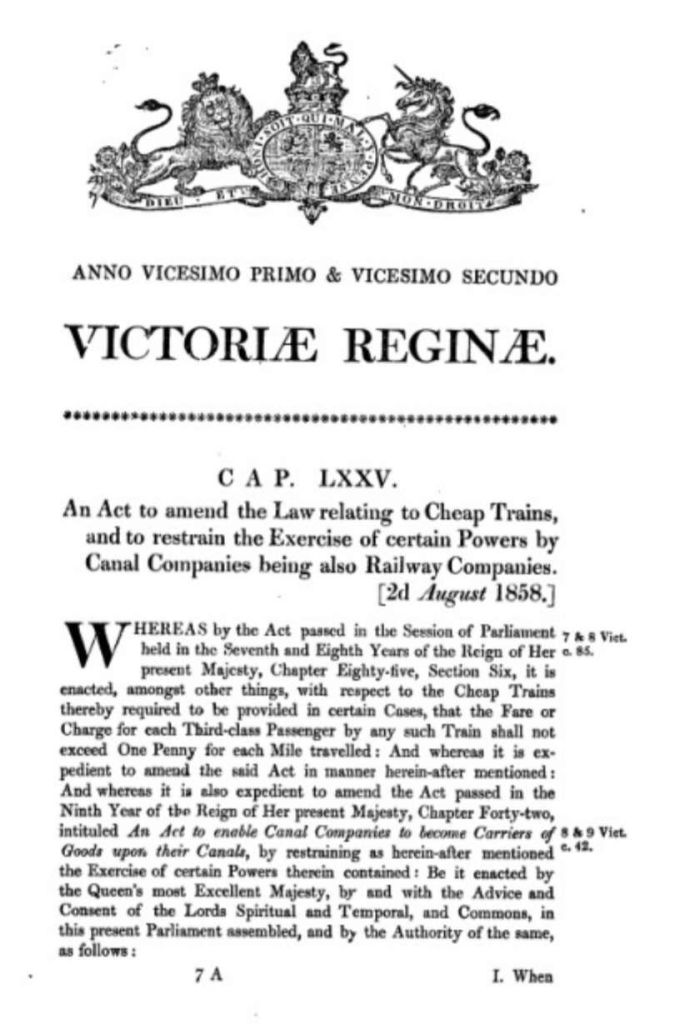
The Cheap Trains and Canal Carriers Act 1858 (21 & 22 Vict. cap. 75), which amended earlier regulations regarding passenger duty and company liabilities. [4]
Caplan has more to say about the second of these two Acts. His comments can be found later in this article. …….
There is a summary, available online, of the clauses in the railways Acts of the 1858 session of Parliament giving powers to the Board of Trade. [7] That Summary may well be of interest here and is reproduced as Appendix 1 to this article (after the References below).
In his article, Caplan goes on to look at a number of specific ‘Local and Personal Acts’, he says: “Some of the Local & Personal Acts of 1858 exemplified the continuing problems of railway development, while others reflected the emergence of new problems, and it is interesting to look at a selection of these Acts.” [1: p833] Those he looked at included:
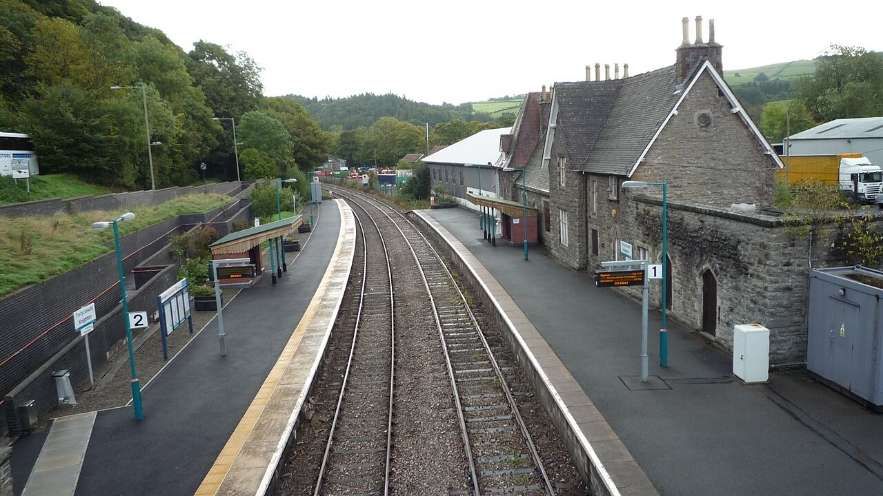
The Knighton Railway Act – one of the few in 1858 relating to an entirely new railway company. This Act, dated 21st May 1958, incorporated the Knighton Railway Company to construct a 9-mile line from Craven Arms to Bucknell, later extending to Knighton. It was a key component of the Central Wales line development, aiming to connect the industrial Midlands with Welsh border towns, eventually being absorbed by the LNWR. [5][6] The Act stated that:
“a Railway from the Craven Arms Station of the Shrewsbury & Hereford Railway, in the County of Salop, to the Borough of Knighton, in the County of Radnor, would be of great public and local advantage. The cost of construction was modestly estimated at £66,000 to be raised by a capital of 6,600 shares of £10. The Knighton Railway was intended to be be worked in conjunction with the Shrewsbury & Hereford Company, and the Act provided for the latter to work the Knighton line. No doubt largely as a matter of form the Act gave similar sanction for the Knighton Company to work the Shrewsbury & Hereford line.” [1: p833]
It is worth noting the powers reserved to the Board of Trade in respect of this railway which appears in Appendix 1 to this article below. [7][Appendix 1]
Caplan points out that the Knighton Act was full of interesting facets of Parliament’s ideas about the control of railways, such as: the detailed control of maximum passenger and freight charges; and the maximum charge of fivepence per ton per mile “for fish, feathers, canes, cochineal, house-hold furniture, hats, shoes, toys and all other articles, matters, and things.” [1: p833]
Caplan also highlights the delays in completing new lines such as the Salisbury & Yeovil Railway and the need to authorise the sale of that line to the London & South Western Railway:
The Salisbury & Yeovil Railway Act
The Salisbury & Yeovil had a struggle to build its line because of shortage of money. The Salisbury & Yeovil Company was incorporated by an Act of 1854, and was authorised to make a railway from the terminus of the Basingstoke and Salisbury line of the London & South Western Railway at Salisbury to Yeovil, together with a branch to join the Wilts, Somerset & Weymouth Railway near Yeovil. The 1854 Act had laid down that these lines were to be completed in four years, and failure to comply might have involved a penalty of (30,000. The Salisbury & Yeovil had to go back to Parliament in 1855 and again in 1857 for authority for deviations from the original route, and was still desperately short of funds. The company was compelled to turn to the London & South Western for help, and amalgamation was the only real solution of its difficulties.
The Salisbury & Yeovil Act of 28th June 1858, gave the company further time to complete the revised route – two years from the passing of the Act and power to transfer the undertaking of the company to the L.S.W.R. Under the “South-Western Railway (Works and Capital) Act, 1858,” of 12th July 1858, the L.S.W.R. received power to lease or purchase the Salisbury & Yeovil Company and the way was cleared for the L.S.W.R.’s through main line from London to Exeter. [1: p833-834]
Railway Construction Costs
Caplan notes that railway construction costs almost inevitably exceeded estimates made by companies and thus the provision made for financing the construction and operation of a line by Parliament. Troubles arose:
“because of unforeseen engineering problems, … [and/or] the high costs of acquiring land and fighting rival promoters. … It is worth recalling that the costs of railway construction in Britain were strikingly high; it was stated in Parliament in 1858 that the average cost had been ₤33,000 a mile, compared with only £9,000 a mile in the United States, where land was so cheap and built-up areas so few. [1: p834]
Many of the 1858 Acts were designed to deal with money matters. This was true of:
“the Cromford & High Peak Railway Company to raise further Sums of Money; and for other Purposes. This unique railway was incorporated in 1826, and the company was given power in 1855 to raise more money, and to re-organise its capital structure. The 1858 Act referred to the ‘improvement of their railway, and they have laid out considerable sums of money upon that portion of the line which is situate between the junction of the Stockport, Disley & Whaley Bridge Railway and the station near the town of Buxton, and such expenditure has been beneficial to the company and the public and a considerable increase of traffic has arisen upon the railway’. The 1858 Act authorised the Cromford & High Peak to raise another £60,000 capital in the form of 3,000 more 6% preference shares of £20, and to raise £20,000 by mortgage.” [1: p834]
Interestingly, Caplan states, “All of the Acts dealing with financial powers of railway companies contained a clause of great … importance in relation to the Railway Mania of the 1840s, and the chequered career of George Hudson, the ‘Railway King’.“[1: p834] This clause stated:
“It shall not be lawful for the company, out of any money by this Act authorised to be raised by calls in respect of shares or by the exercise of any power of borrowing, to pay to any shareholder interest or dividends on the amount of the calls made in respect of the shares held by him in the capital by this Act authorised.” [1: p834]
Caplan explains that “The Hudson Empire had been built up only at the expense of the integrity of the various companies’ capital, and there had been cases of dividends being paid out of capital instead of out of genuine net earnings. It was these irregular dividend payments which helped to stimulate the public demand for railway shares, and thus led to the fantastic boom of 1845-46 in which railway promoters were offering the public the prospect of even 14 or 15 per cent. interest. The collapse of the boom, and the investigation of company accounts, led Parliament to insist on this standard clause to prohibit dividend payments out of capital.” [1: p834]
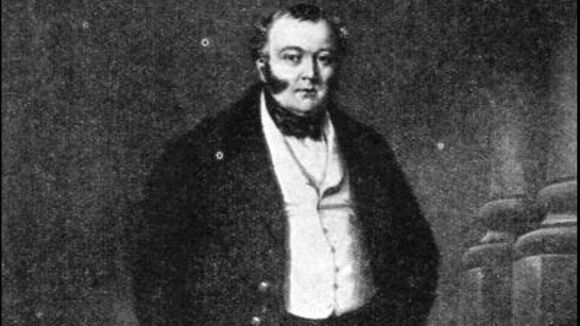
George Hudson controlled a significant part of the railway network in the 1840s. He had the title “The Railway King” conferred on him by Sydney Smith in 1844. He played a major role in linking London to Edinburgh by rail. He also formed the first significant merger of railway companies, creating the Midland Railway, and developed his home city of York into a major railway junction. He represented Sunderland in the House of Commons. However, his “success was built on dubious financial practices and he frequently paid shareholders out of capital rather than money the company had earned.” [8]
There were a series of railway mergers over the 1850s. Caplan say that “the process of railway amalgamation continued in 1858, as some of the smaller and financially-weaker companies found it impossible to carry on, and a number of Acts provided for amalgamation by outright purchase or for such close financial and working arrangements that the companies concerned lost all effective independence.” [1: p834] Caplan mentions one in particular:
The Inverury & Old Meldrum Junction Railway
On 11th June 1858, this railway was authorised “to be leased in perpetuity to the Great North of Scotland Railway for a rental of £650 per year, payable half-yearly. … A very modest sum for the lease of a railway but the Inverury & Old Meldrum Junction was a very small railway.” [1: p834]
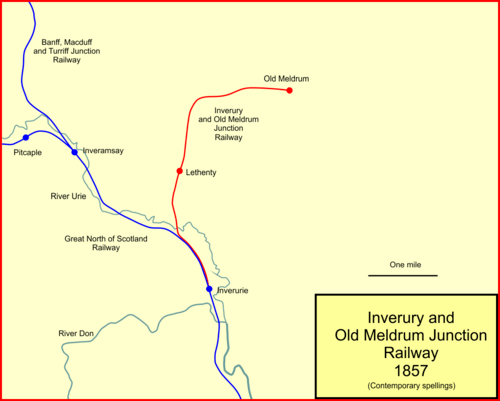
The route of the Inverury & Old Meldrum Junction Railway. [9]
The authorising Act for the Inverury and Old Meldrum Junction Railway received the Royal Assent on 15th June 1855, a necessary capital of £22,000 was authorised. The line was “5 miles 1194 yards in length, from a junction at Inverurie. The station at that time was some distance south of the present one; the Old Meldrum branch line ran alongside the main line for nearly a mile before diverging. The engineer was John Willet. There were few engineering complications in constructing the line, the biggest work being a 50-foot girder bridge over the River Ury.” [9][10: p7-9][11][12]
The capital was raised mainly locally, and construction was completed quickly and cheaply, being ready by June 1856 at a low cost of about £5,000 per mile. The opening to passengers took place on Thursday 26th June 1856. [9][10: p7-9][13]
In 1866 the Great North of Scotland Railway (GNoSR) set about incorporating several branch line leases into the parent company; the Oldmeldrum company was one of them. The £650 annual lease rental was converted to £13,810 of new GNoSR Old Meldrum preference stock. Parliament authorised the change on 1 August 1866. Ordinary shareholders got £3 of GNoSR stock for their £10 shares. [9][10: p7-9][13]
In 1930 passenger receipts had totalled £243, which represented a loss in working of £718. It was hardly sustainable to continue such an operation, and the LNER closed the passenger service from 2 November 1931. [9][10: p58][18: p315]
The basic goods service to Oldmeldrum continued, but it too became unsupportable in the 1960s, and it was closed on 3 January 1966.[18: p315] It was later used for a while for wagon storage.[9][10: p65]
The Manchester South Junction & Altrincham Railway
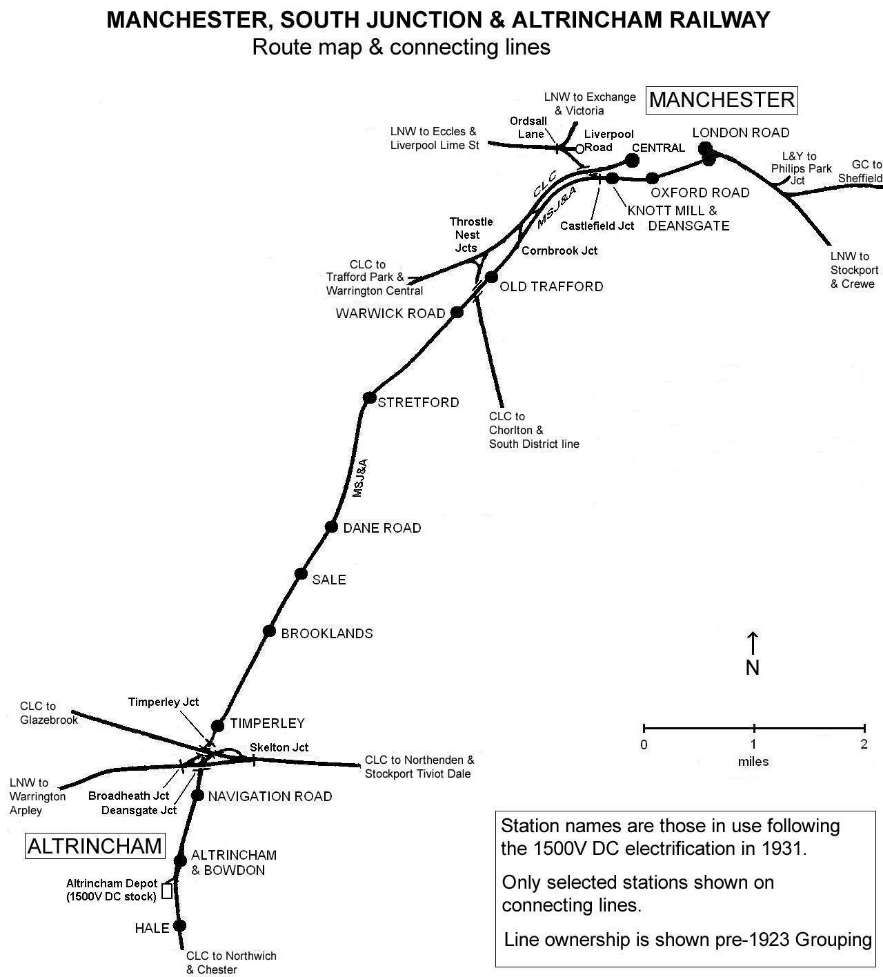
This railway was authorised by Parliament in 1845 and was jointly owned by the London & North Western and the Manchester, Sheffield and Lincolnshire railways.
Caplan says that:
“It is not surprising that the railway companies concerned in the operation of joint lines did not always see eye to eye, and one Act of 1858 brings clearly above the surface some of the difficulties which arose. This was the ‘Act to improve the management of the Manchester South Junction & Altrincham Railway’. …. The M.S.J.A.R. …. was managed by a board of six directors, three nominated by each company, and two chairmen, each company appointing one. The chairmen were to preside alternately at board meetings and the presiding chairman had a casting vote in the event of a tie.
“Such an arrangement was bound to cause trouble at times and as the preamble to the 1858 Act said ‘it has been found that in cases where the interests of the London & North Western and the Manchester, Sheffield & Lincolnshire Railway Companies differ the said provisions with respect to the chairman of the board of directors produce great inconvenience and delay, and that resolutions passed by the said board under one chairman are often rescinded by a subsequent board under another chairman.” The preamble went on to refer to the competition between the parent companies: inasmuch as the two companies work over and are competitors for much of the traffic which is or may be conveyed over the South Junction Railway, and the questions therefore between them are likely to be multiplied, it is essential to the public convenience and to the proper use of the South Junction Railway…
“The Act provided that in future the chairman presiding over any board meeting should not have a casting vote. Instead, the parent companies were to appoint each December an arbitrator and, in the event of failure to agree on an arbitrator, the Board of Trade was to make this appointment. The arbitrator’s term of office was fixed at one year, though he could be re-appointed. The arbitrator was given the power to decide disputed matters in cases where there was a tie in voting at the board of the South Junction Railway. [1: p834-835]
A Station near Victoria Street, Pimlico and a Railway to Connect it with the West End of London & Crystal Palace Railway at Battersea
Caplan says that the continued growth of towns and passenger traffic required big changes in station arrangements, and a particularly interesting Act of 1858 concerned London. This was:
“‘An Act to authorise the construction of a station near Victoria Street, Pimlico, in the County of Middle-sex, and of a railway to connect the same with the West End of London & Crystal Palace Railway at Battersea in the County of Surrey, in order to afford improved communication between certain of the railways south of the Thames and the western districts of the Metro-polis; and for other purposes’.
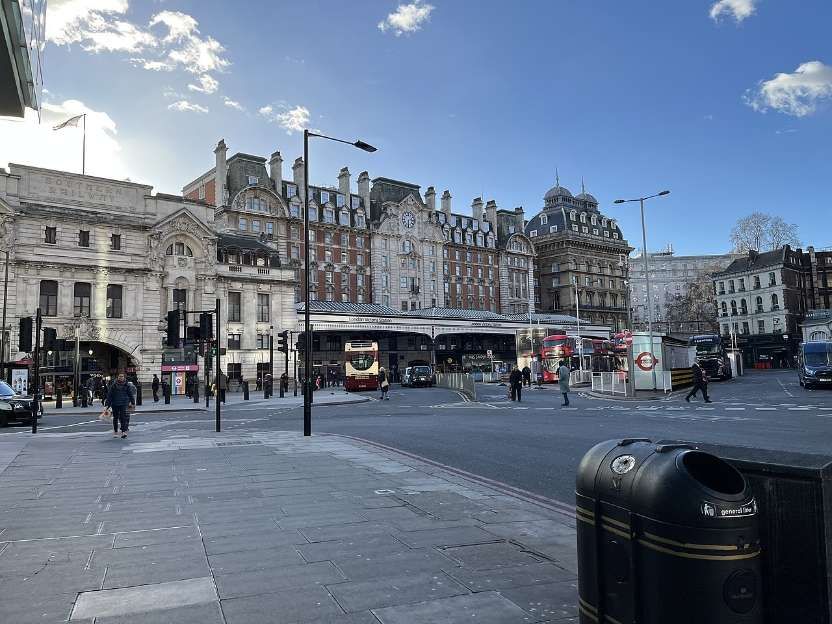
This was indeed a major scheme of passenger traffic improvement – the authorised capital was £675,000. The existing terminus of the West End of London & Crystal Palace Railway was South of the Thames at Battersea – it was, however, called ‘Pimlico’ – and this was not at all convenient for the West End. Pimlico Station was opened in March, 1858, and the new Victoria Station authorised by the 1858 Act was opened in October, 1860, so that the ‘West End Terminus’ south of the River had the shortest of lives.” [1: p835][20]
The Victoria Station and Pimlico Railway (VS&PR) was by the Victoria Station and Pimlico Railway Act 1858 on 23 July 1858. to build Victoria Station, Grosvenor Bridge over the River Thames, and a length of line to Connect with the London & Crystal Palace Railway. The company later leased its lines and stations to the LB&SCR and the London Chatham and Dover Railway (LC&DR) but continued in existence until December 1922 when it was very briefly amalgamated with the South Eastern Railway before becoming part of the Southern Railway as a result of the Railways Act 1921, which created the Big Four on 1 January 1923.
In 1844, ‘Gladstone’s Act’ was passed ‘to attach certain Conditions to the Construction of future Railways’. Although about the general regulation of the railways, Gladstone’s Act was known as the charter of third class passengers who suffered a miserable time travelling on those railways that thought it worthwhile recognising their existence!
Caplan says that:
” Parliament’s aim in Clause VI of the 1844 Act was to ‘secure to the poorer class of travellers the means of travelling by railway at moderate fares, and in carriages in which they may be protected from the weather’ and at least one train a day in each direction on all main, junction and branch lines was to provide such facilities. Parliament specified the fare to be charged: ‘The fare or charge for each third class passenger by such train shall not exceed one penny for each mile travelled’.
“However, there was room here for disagreement about the proper basis of charging for fractions of a mile travelled. Hardened as we are by the course of inflation, we may be tempted to smile at the thought of Parliament moving in all its majesty in 1858 to lay down that fractions of a mile must be charged for at a specific rate, but farthings and halfpennies were real money a hundred years ago. The Victorians-individuals and railway companies were unlikely to dismiss farthings and halfpennies as insignificant quite apart from the question of the principle of the thing.
“So it was that Clause 1 of the Cheap Trains Act, 1858, prescribed the method of charging for fractions of a mile on journeys by the ‘Parliamentary Trains’: ‘When the distance travelled by any third class passenger by any train run in accordance with the provisions [of the 1844 Act] is a portion of a mile, and does not exceed one mile, the fare for such portion of a mile may be one penny, or when such distance amounts to one mile, or two or more miles, and a portion of another mile, the fare or charge for each such portion of a mile, if the same amounts to or exceeds one half mile, may be one halfpenny’.” [1: p835, p860]
The first page of the Act referred to as the ‘Cheap Trains Act’. It is worth noting that the Act sought not only to amend the law relating to Cheap Trains but also to restrain the Exercise of certain powers by Canal Companies being also Railway Companies. [22]
The ‘Cheap Trains Act’ was actually also intended to curb railway companies from monopolizing transport by abusing their control over acquired canal networks. It regulated the leasing of canals by railway companies, ensuring they couldn’t stifle competition, while also addressing railway pricing.
The Act specifically addressed concerns that railway companies, having bought up canals, would allow them to fall into disrepair or charge prohibitive tolls to force traffic onto the rails.
It also restricted any ‘Canal or Navigation Company, being also a Railway Company’ from leasing other canals or railways without parliamentary authority, preventing the massive consolidation of transport networks by a few rail companies.
It sought to maintain the viability of independent canal carriers against ‘Railway and Canal Companies’.
It also sought to strengthen the provisions of the Railway and Canal Traffic Act 1854 which forced canal and rail companies to provide ‘reasonable facilities’ for transport.
The 1858 Act was later made perpetual by the Cheap Trains Act 1860. It acted as a protection mechanism for the waning canal industry against aggressive railway competition during the expansion of the UK’s rail network.
However, the 1860 Act was not Parliament’s last word on the subject of Cheap Trains. A further Act was passed in 1883. It was known as the ‘Cheap Trains Act’. The 1883 spurred the expansion of affordable ‘workmen’s trains’. It abolished or reduced passenger duty (duty not fares) for companies charging less than a penny a mile, requiring them to provide sufficient services for working-class commuters, particularly in urban areas. [23] It obliged the railway companies to operate a larger number of cheap trains. [24]
That 1883 Act also consolidated the Law relating to the conveyance of the Queen’s Forces by Railway. [23]
“Some railways in London were already operating workmen’s trains although they were often overcrowded and inconveniently timed. Although the act was opposed by some railway officers, notably Sir Edward Watkin of the Manchester, Sheffield and Lincolnshire Railway, the number of cheap suburban services increased greatly. During the 20th century, the appearance of competing road services meant that the railways were forced to reduce their fares. So few services eventually attracted duty that the act was abolished in the Finance Act 1929.” [24]
Further Acts of Parliament relating to railways were not considered worth noting by Caplan, some of these are covered in Appendix 2.
Returning to Caplan’s article, he concludes by saying that, “No railway enthusiast should be deterred from the thought of looking into Acts of Parliament by the mistaken impression that they are dry as dust. Many of them bring the ‘Railway Age’ before us in the most vivid way.” [1: p860]
Hopefully this review of his article has further emphasised the value of reading through relevant Acts of Parliament to gain a better understanding of railway history.
References
N. Caplan; Parliament and Railways in 1858; in The Railway Magazine, December 1958; Tothill Press, London, 1958, p833-835 & p860.
Duncan McLeish; Rails to Banff, Macduff and Oldmeldrum: Three Great North of Scotland Railway Branch Lines; Great North of Scotland Railway Association, 2014, p7-9.
Donald J Grant; Directory of the Railway Companies of Great Britain; Matador, Kibworth Beauchamp, 2017, p278.
H A Vallance; The Great North of Scotland Railway; David and Charles, Dawlish, 1965, p59-60.
David Ross; The Great North of Scotland Railway: A New History; Stenlake Publishing, p40, 83, 222 & 223.
The Clauses in the Railways Acts of the 1858 Session of Parliament giving Powers to the Board of Trade are to the following effect:
Construction of Works
Alyth Railway Act, 1858, c. 43. s. 28., &c. —Provides that the junction with the Scottish North-Eastern Railway, in case of difference, is to be made according to a plan approved of by an engineer appointed by the Board of Trade previously to the commencement of such work; and any difference as to the nature or necessity of the signals and other works at the junction, the same to be referred to arbitration or the decision of an engineer, to be appointed by the Board of Trade, at the option of the Scottish North-Eastern Company.
Andover and Redbridge Railway Act, 1858, c. 82. s. 22., &c. — Provides that the Company are not to proceed with any works affecting the Bishopstoke and Salisbury Railway, or any of the works of the London and South-Western Railway Company, until they shall have delivered to that Company a plan, &c. of the proposed works, and obtained the approval thereof of the principal engineer; but if he shall not certify his approval within one calendar month of the delivery of such plan, &c., and shall fail to furnish within such period a plan of executing the works satisfactory to that Company, the Andover Company may submit a plan, &c., to the Board of Trade, and on the same being certified, proceed to the execution of the works, &c.
The Company shall also so make and maintain the Branch Railway as to enable the London and South-Western Company to make a convenient junction between it and the Southampton and Dorchester Railway; and any difference with reference thereto is to be settled by the arbitrator of the Board of Trade, and the Company are not to open the railway between Romsey and Redbridge, or any part thereof, for public traffic, unless they simultaneously open for traffic the branch railway.
Banbridge, Lisburn, and Belfast Railway Act, 1858, c. 46. s. 32. — Provides that in case of difference with respect to any works for effecting the communication with the Ulster Railway and the Banbridge Junction Railway, the same is to be determined by an engineer, to be appointed by the Board of Trade.
Caledonian Railway (Branch to Port Carlisle Railway) Act, 1858, c. 66. s. 5. — Provides that all communications between the Branch Railway authorized by this Act and the Port Carlisle Railway, in case of difference, are to be effected by means of connexion rails, and points of such construction, and laid in such manner as shall he determined by an engineer to be appointed by the Board of Trade.
Devon Valley Railway Act,, 1858, c. 122. s. 26., &c. — Provides that in case of difference, the junctions of the railway with the Tillicoultry Branch of the Stirling and Dunfermline Railway, and with the Fife and Kinross Railway, are to be made according to a plan to be approved of by an engineer to be appointed by the Board of Trade; and any difference as to the nature or necessity of the works to be constructed at such junctions shall be referred to arbitration, or the decision of an engineer to be appointed by the Board of Trade, at the option of the Stirling Company or the Fife and Kinross Company respectively. A certain road in the parish of Dollar is to be carried over the railway by a stone bridge, to the satisfaction of the engineers of the Company and the landowners named in the Act, or in case of difference, of an engineer to be appointed by the Board of Trade.
Dublin and Meath Railway Act, 1858, c. 119. — Provides that communications between the railways authorized by the Act and the railway of any other Company, shall be made to the satisfaction of the engineer of the Company with whose line such communication is to be made: and if such Company shall have no engineer, or the engineers shall differ, then such communications shall be made in the manner directed by an engineer to be appointed by the Board of Trade.
East Kent Railway ( Western Extension) Act, 1858, c. 107. s. 7., &c. — Provides that all communications between the railway and the Mid-Kent Railway (Bromley to St. Mary Cray), in case of dispute, shall be made in such manner as shall be directed by an engineer to be appointed by the Board of Trade. Before the Company open the railway for public traffic, they are to make a station at Sole Street at which all trains are to stop (except on Sundays), for the purpose of taking up and setting down passengers, goods &c., special or express, or mail trains, only excepted.
East Suffolk Railway (Branch and Capital) Act, 1858, c. 47. s. 10. — Provides that in case of difference as to the mode of making the communications with the Lowestoft Railway, or as to the works necessary or convenient for effecting the same, the matter is to be settled by the Board of Trade, or its arbitrator.
Eden Valley Railway Act, 1858, c. 14. s. 28. — Provides that in case of disputes as to the nature or necessity of the works at the junctions of the railway authorized by this Act with the Lancaster and Carlisle Railway, or the South Durham and Lancashire Union Railway, the matter shall be referred to arbitration, or to the decision of an engineer to be appointed by the Board of Trade, on the application of either of the Companies.
Exeter and Exmouth Railway Act, 1858, c. 56. s. 46. — Provides that if any carriageway be made across the railway on the level for the benefit or convenience of any person interested in the shore or river bank adjoining the railway, the mode of making and watching such crossing shall be subject to the approval of the Board of Trade.
Fife and Kinross and Kinross-shire Railways Junction and Joint Station Aci, 1858, c. 65. s. 5. &c. — Provides that the junction between the railways of the two Companies and the joint station at Kinross, and the bridge for carrying the Great North Road, &c. over the Kinross-shire Railway and the levels of the two railways, are to be made to the satisfaction of the engineers for the time being of the Companies, and in case of difference, of an engineer to be appointed by the Board of Trade, on the application of either Company.
Either of the Companies, on giving three months’ notice, may construct the joint station at Kinross, and will be entitled to recover from the other Company one moiety of the expense, as the same shall be certified by the engineers, or in case of difference, by an engineer to be appointed by the Board of Trade.
Formartine and Buchan Railway Act, 1858, c. 108. s. 45., &c. — Provides that the Branch Railway to Ellon is to be constructed simultaneously with the main line from Dyce to Old Deer, and no part of the main line is to be opened to the public until the branch has been opened, and no part of the railway is to be opened until a double line of rails shall have been laid down upon the Great North of Scotland Railway between the point of junction at Dyce and Kittybrewster. Any difference as to the mode of effecting the communication with the Great North of Scotland Railway is to be determined by a referee, to be appointed by the Board of Trade.
Knighton Railway Act, 1858, c. 19. s. 22. — Provides that any difference as to the mode of effecting the communications with the Shrewsbury and Hereford Railway is to be determined by a referee, to be appointed by the Board of Trade.
Midland Great Western Railway o f Ireland (Clare Deviation) Act, 1858, r. 94. s. 9. —Provides that in case of difference with reference to any works for effecting the communication between the railway authorized by the Act and the Great Southern and Western Railway, the same is to be determined by an engineer, to be appointed by the Board of Trade.
Newport, Abergavenny, and Hereford Railway Act, 1858, r. 126. s. 7., &c. — Provides that a deviation is to be made in the Aberdare Canal, at the expense of the Company, and to be maintained and repaired by them during a period of five years; and if any dispute shall arise between them and the Canal Company touching the said matters, the same is to be determined by an engineer, to be appointed by the Board of Trade.
North British Railway Consolidation Act, 1858, c. 109. s. 49. — Provides that this Act repeals the prohibition against the use of locomotive engines on the Old Leith Branch Railway, and empowers the Company to stop up such of the roads or accesses across the railway in the parish of South Leith as they may think fit, and to make provision for the crossing of the railway, at two or more points, by means of occupation or other roads, and to execute such works as may be necessary for adapting the railway to the use of locomotive engines, and to run the same thereon.
Portsmouth Railway Amendment Act, 1858, c. 101. s, 7., &c. — Provides that if any difference shall arise respecting the communication between the Portsmouth Railway and the railways belonging either jointly or separately to the Brighton and South- Western Companies, or as to the erection of signals at, and other matters connected with such junctions, the same is to be determined by arbitration, in the manner provided by the Railways Clauses Consolidation Act, 1845, section 21. The Company are prohibited from appropriating any part of a certain road, called Blackfriars Road, belonging to the Landport and Southsea Commissioners; but they may and shall, for the purpose of forming a communication between their railway and the line of the Brighton and South-Western Companies at Landport, make sidings, with two lines of rails, within the limit of deviation, across and on the level of the said road, subject to the usual provisions in reference to crossing roads on the level, and to such other reasonable regulations as may be agreed on between them and the surveyor, or, in case of dispute, as shall be settled by an officer to be appointed by the Board of Trade.
Redditch Railway Act, 1858, c. 137. s. 36. — Provides that the bridge for carrying the railway over the Worcester and Birmingham Canal is to be constructed, as to its position, form, and dimensions, to the satisfaction of the engineer of the Railway and Canal Companies, and, in the event of disagreement, to the satisfaction of an engineer to be approved by the Board of Trade.
Symington, Biggar, and Broughton Railway Act, 1858, c. 15. s. c25., &c. —Provides that in case of difference as to the mode of effecting the junction with the Caledonian Railway, the same is to be made according to a plan approved of by an engineer, to be appointed by the Board of Trade previously to the commencement of the works; and any question as to the nature or necessity of works at the junction, in case of dispute, is to be referred to arbitration, or to the decision of the Board of Trade, at the option of the Caledonian Company.
Whitehaven Junction Railway (New Branches) Act, 1858, c. 127. s. 27. — Provides that if the Company shall be required by the Lords of the Admiralty, under the provisions of this Act, to make any carriageway across the railway on the level, for the purpose of affording access to the seashore, then the manner of making and watching such level crossing shall be subject to the approval of the Board of Trade, and the Company shall not be liable for the expenses of watching such level crossing.
Additional Rails
East Suffolk Railway (Branch and Capital) Act, 1858, c. 47. s. 27. — Provides that the main line from the Leiston Junction to Halesworth, and the part from Halesworth to Haddiscoe, are to be completed, so that two lines of railway may be laid down when and as the Company think proper; and if the Company shall not lay down two such lines of rails, then when it shall appear to the Board of Trade that another line of rails, in addition to the single line of rails on such portions, is required for the public accommodation.
Portsmouth Railway Amendment Act, 1858, c. 101. — Provides that if the gross annual proceeds of the traffic on the line between Godalming and Havant for three consecutive years shall average £45,000, the Company, on request of the Board of Trade, shall lay down an additional line of rails, raising such an amount of additional capital as may be necessary for that purpose.
Lease, Sale or Amalgamation
East Suffolk Railway Companies Amalgamation Act, 1858, c. 111. s. 3. and s. 43., &c. — Provides that from the passing of the Act the undertakings of the East Suffolk Company, the Yarmouth and Haddiscoe Company, and the Lowestoft and Beccles Company were united and consolidated into one undertaking.
The Company may grant a lease of their undertaking to Sir M. Peto for any term not exceeding 21 years, determinable on 12 months’ notice, after a resolution by the Company that such lease shall be determined, provided that if within three months after such notice the lessee shall apply to the Board of Trade and object to the determination of such lease, then the resolution and notice shall have no force or effect, unless the Board of Trade shall be of opinion that the lease is injurious to the public interests, and shall confirm such resolution. Any shareholder, voting against such resolution, within three months may require the Company to purchase the shares, in respect of which he voted, at par.
South Devon and Tavistock Railway Act, 1858, c. 102. s. 3. — Provides that lease to the South Devon Company, with consent of Shareholders of both Companies, the Company still remaining liable to the provisions of the 30th section, 17 & 18 Vict. c. 189, as to laying down additional rails on the narrow gauge, if required so to do by the Board of Trade: the terms and conditions of using the same by any Company, in case of dispute, are to be settled and adjusted by the Board of Trade.
Staines, Wokingham, and Woking Railway Act, 1858, c. 58. s. 19., &c. — Provides that the Company may lease all or any part of their undertaking to the South-Western Company, with consent of shareholders of both Companies. The lease, at the expiration of every ten years, to be subject to such modification as the Board of Trade may consider necessary to protect the public interests.
Ulverstone and Lancaster Railway Act, 1858, c. 98. s. 42., &c. — Provides for lease or sale to the Furness Company of all or any part of the undertaking; the terms to be approved of by the Board of Trade.
Vale of Towy Railway (Leasing) Act, 1858, c. 147. s. 3. — Provides that the Company may lease for a period of 10 years their undertaking to the Llanelly Railway and Dock Company, such lease to be approved of by the Board of Trade.
Use of Railway Station, &c.
Fife and Kinross and Kinrosshire Railways Junction and Joint Station Act, 1858, c. 65. s. 17., &c. — Declares that the management and maintenance of the joint station are in the Companies; but in the event of any difference thereon, or on any other questions relating to the use and working of such station, or as to the expense thereof, the same is to be settled by an arbitrator, to be appointed by the Board of Trade. The Companies may agree with the Edinburgh, Perth, and Dundee Company with respect to the use and working of the railways authorized by this Act on the terms of the Fife and Kinross Railway Act, 1855, and the Kinrosshire Railway Act, 1857.
London, Brighton, and South Coast Railway (New Lines) Act, 1858, c. 84. s. 27., Sec. — Provides that the Company and all persons lawfully using their railway, may likewise use the Mid-Sussex Railway Stations, &c.; and in case of dispute as to the time, conditions, and regulations respecting the use thereof, the same shall be determined by the Board of Trade, or its arbitrator.
London and North-Western Railway (Additional Works) Act, 1858, c. 131. s. 12. — Provides that the Company, and the Great Western Company may, if they shall think fit, instead of proceeding with the arbitration under the provisions of 17 & 18 Vict. c. 200., for the separation and allotment of the joint station at Wolverhampton, known as the High Level Station, or in addition thereto, so far as the same shall not extend, make and carry into effect agreements for the appropriation and allotment to and between, or to either of them, of the whole or any part of such station ; and upon such appropriation and allotment being completed and approved of by the Board of Trade, the several portions shall vest in the Stour Valley and Great Western Com panies accordingly. The portion which may be assigned to the Stour Valley Company shall be deemed to be included in the lease to the London and North-Western Company.
Portsmouth Railway Amendment Act, 1858, c. 101. s. 25. — Provides that the Company, and all other companies lawfully using the Portsmouth Railway, may pass over and use so much of the railway of the Brighton Company as will be situated between the point of junction with that railway, in the parish of Havant, and the Portsmouth Railway, and the point at or near Hilsea Redoubt, where the Brighton Railway unites with the line to Portsmouth belonging to the Brighton and South-Western Companies, and also of their line to Portsmouth between the said point at Hilsea Redoubt and the terminus of the said railway at the Landport road, in the parish of Portsea, and also so much of the line of the South-Western Company as will be situate between the point of junction therewith of the intended railway firstly described in this Act, and the before-mentioned point at Hilsea Redoubt. The terms and conditions of such user are to be settled, failing agreement between the Companies, by their principal engineers, or their umpire, or, failing such appointment, by some person to be appointed by the Board of Trade. The right of user of the joint station at Landport is limited to traffic conveyed on the public service, but the Companies may agree for the use thereof for the general traffic.
The Portsmouth Company, in working or using the railway of the Brighton and South-Western Companies, is to observe the regulations and bye-laws of the Companies in force on the railways so used, as far as the same shall be applicable to the Portsmouth Company; and in case of dispute respecting such regulations or bye-laws, or the mode in which the powers or privileges given by the Act shall be exercised, or the regulations to be adopted exclusively for the convenience or accommodation to be afforded to the traffic of the Portsmouth Company, the same shall be settled as before-mentioned, provided that neither such regulations and bye-laws, so far as they affect the Portsmouth Company, nor the award thereon of the engineers, or their umpire, shall have any force unless the same shall have been confirmed by the Board of Trade. Any award of an umpire may be reconsidered by order of the Board of Trade.
Traffic Arrangements.
Alyth Railway Act, 1858, c. 48. s. 47., &c. —Provides that a traffic agreement may be made with the Scottish North-Eastern, and Edinburgh and Perth, and Dundee Companies, or either of them. Agreement limited to ten years, and to be assented to by the shareholders of the several Companies in special meeting, and to be approved of by the Board of Trade.
Athenry and Tuam Railway Act, 1858, c. 112. s. 44., &c. — Provides that a traffic agreement may be made with the Midland Railway of Ireland Company. Agreement limited to ten years, and to be assented to by the shareholders of the Companies in general meeting, and to be approved of by the Board of Trade.
Banbridge, Lisburn, and Belfast Railway Act, 1858, c. 46. s. 44, &c. —Provides that a traffic agreement may be made with the Ulster, the Dublin and Belfast Junction, and the Banbridge Junction Companies, or either of them. Agreement limited to ten years, to be assented to by the shareholders of the Companies parties thereto, and approved of by the Board of Trade.
Caledonian Railway (Branch to Port Carlisle Railway) Act, 1858, r. 66. s. 16., &c. — Provides that a traffic agreement may be made with the Port Carlisle Company and the Carlisle and Silloth Bay Company, or either of them. Agreement limited to ten years, to be assented to by the shareholders of each Company, and to be approved of by the Board of Trade.
Cleveland Railway Act, 1858, c. 114. s. 40. —Provides that a traffic agreement may be made with the West Hartlepool Company. Agreement to be assented to by the shareholders of the Companies, and approved of by the Board of Trade. On the expiration of ten years from the commencement of any agreement, the Board of Trade may cause the same to be revised, and the Board is empowered to declare that, if any modification required by it be not agreed to by the Companies, then, at the expiration of twelve months after notice given to the Companies of such modification being required, the said agreement shall determine.
East Kent Railway (Western Extension) Act, 1858, c. 107. s. 17., &c. — Provides for the due transmission of traffic to or from any part of the railways belonging to the South-Eastern Company, to or from any part of the railways belonging to the East Kent Railway Company, and empowers the Board of Trade, in case of dispute as to the nature and extent of the accommodation to be afforded by the latter Company, and the rates of charge at which the several services required of it shall be performed, to settle the terms and conditions. The Company and the West London and Crystal Palace Company may enter into traffic arrangements. Agreement limited to ten years, to be assented to by the shareholders of both Companies, and approved of by the Board of Trade. Any question or difference which may arise between the Companies with reference to the construction of any such agreement, is to be settled by the Board of Trade, or its arbitrator.
East Suffolk Railway Companies Amalgamation Act, 1858, c. 111. s. 50. &c. — Provides that a traffic agreement may be entered into with the Eastern Counties Company, the Norfolk Company, and the Eastern Union Company. Agreement to be assented to by the shareholders of the several Companies, and approved of by the Board of Trade, and to be liable to revision by that Board at the expiration of every ten years. If the revision proposed by the Board of Trade be not agreed to, the Board may declare that the agreement, at the expiration of twelve months, shall determine.
Eden Valley Railway Act, 1858, c. 14. s. 39., &c. — Provides that a traffic agreement may be made with the Stockton and Darlington Company, the Lancaster and Carlisle Company, and the South Durham and Lancashire Union Company, or either of them. Agreement to be assented to by the shareholders of the several Companies, and approved of by the Board of Trade, and to be liable to revision by that Board on the expiration of every ten years. If the revision proposed by the Board of Trade be not agreed to, the Board may declare that the agreement, at the expiration of twelve months, shall determine. The South Durham Company are required by the Act to afford all proper facilities for the due transmission of the traffic.
Exeter and Exmonth Railway Act, 1858, c. 56. s. 63., &c. — Provides that a traffic agreement may be made with the South- Western Company. Agreement to be assented to by the share holders of both Companies, and approved of by the Board of Trade. At the expiration of ten years after the date of any such agreement, if the Board of Trade is of opinion that the agreement is adverse to the public interests, it may require the Companies to modify the terms and conditions thereof.
Formartine and Buchan Railway Act, 1858, c. 108. s. 52., &c. — Provides that a traffic agreement may be made with the Great North of Scotland Company. Agreement limited to ten years, to be assented to by the shareholders of both Companies, and approved of by the Board of Trade.
Great Northern and Manchester, Sheffield and Lincolnshire Railway Companies Act, 1858, c. 113. s. 1., &c. — Provides that the Companies from time to time during 50 years, with assent of share holders, and approval of the Board of Trade, may enter into agreement with respect to the conduct of the traffic. The Manchester Company is to afford to the London and North-Western, or any other Company on demand, all reasonable facilities for the forwarding of traffic between Liverpool and the port of Great Grimsby, and between any other station of the London and North-Western Railway and the same port, or between any station of such other Company and the port of Great Grimsby; and any difference as to the facilities to be afforded, or as to the amount of the rates, is to be settled from time to time by an arbitrator, to be appointed by the Board of Trade. It is not incumbent on the Manchester Company to afford any such facilities, unless the Company applying shall afford to them similar facilities between the same places.
Great Northern and Western (of Ireland) Railway Act, c. 96. s. 21., &c. — Provides that agreements which the Companies may enter into under the 20 & 21 Vict. c. 84., may be for such periods as the Companies think fit. Any such agreement, at the expiration of ten years from the date or revision thereof, is liable to the revision of the Board of Trade, if the Board shall be of opinion that the public interests are injuriously affected by it.
Knighton Railway Act, 1858, c. 19. s. 43., &c. —Provides that a traffic agreement may be made with the Shrewsbury and Hereford Company. Agreement limited to ten years, to be assented to by the shareholders of both Companies, and approved of by the Board of Trade.
Liskeard and Looe Railway Act, 1858, c. 1 1 . s. 33., &c. — Provides that a traffic agreement may be made with the Liskeard and Caradon Company. Agreement limited to ten years, to be assented to by the shareholders of both Companies, and approved of by the Board of Trade.
South-Western Railway (Works and Capital) Act, 1858, c. 89. .v. 33., &c. — Provides that a traffic agreement may be made with the Wimbledon and Dorking Company and the Exeter and Exmouth Company, with consent of shareholders, and approval of the Board of Trade, which Board, at the end of every ten years, may call on the Companies to modify the terms and conditions of the agreements if the Board shall be of opinion that the public interests are thereby injuriously affected.
North Yorkshire and Cleveland Railway Act, 1858, c. 134. s. 25., &c. — Provides that a traffic agreement may be made with the North-Eastern Company. Agreement limited to ten years, to be assented to by shareholders of both Companies, and approved of by the Board of Trade.
Redditch Railway Act, 1858, c. 137. s. 26., &c. — Provides that a traffic agreement may be made with the Midland Company. Agreement limited to ten years, to be assented to by the share holders of both Companies, and approved of by the Board of Trade.
Stokes Bay Railway and Pier Act, 1858, c. 50. s. 10., &c — Provides that a traffic agreement may be made with the London and South-Western Company. Agreement limited to 10 years; to be assented to by the shareholders of both Companies, and approved of by the Board of Trade.
Symington, Biggar and Broughton Railway Act, 1858, c. 15. s. 46., &c. — The Act confirms an agreement for ten years, already entered into by the Company with the Caledonian Company, and provides that during the present or any future agreement, the tolls and charges shall be those contained in the Caledonian Railway Act 1845. The agreement may be renewed with assent of shareholders and approval of the Board of Trade.
Ulverstone and Lancaster Bailway Act, 1858, c. 98. s. 42., &c. — Provides that a traffic agreement may be made with the Furness Company. Agreement to be assented to by the shareholders of both Companies, and to be approved of by the Board of Trade, and to be subject, at the end of every ten years, to be modified in such manner as the Board may consider necessary for the public interests.
Victoria Station and Pimlico Railway, Act 1858, c. 118. — Provides that a traffic agreement may be made with the Brighton Company, the Crystal Palace Railway Company, and the East Kent Company, or any one or more of them. Agreement to be assented to by the shareholders, and approved of by the Board of Trade, and to be subject, at the end of every ten years, to such revision as the Board of Trade may consider necessary. In the schedule to the Act is set out an agreement between the Company and the East Kent Company. The Act defines the west end traffic of the East Kent Company therein referred to to be traffic for which the Company’s intended station will, as regards its situation, afford convenient accommodation for the western parts of the Metropolis, and the words “West End of the Metropolis,” in the said agreement, to be that portion of the Metropolis which may be conveniently accommodated by the said station. Any dispute with reference to the matters contained in the above provision is to be determined by the Board of Trade, or its arbitrator, or as to the rate of payment per passenger to be made by the East Kent Company being unreasonable, is to be determined by the Board of Trade, or its arbitrator, if the same be not settled by the Companies themselves.
Miscellaneous.
North British Railway Consolidation Act, 1858. — Provides that certain portions of the authorized railway belonging to the Company are to be abandoned, and the Company are to make compensation to the owners of certain private roads, and to the trustees or surveyors of public roads, for the maintenance of bridges or tunnels erected by the Company under or over those roads, except when such bridges or tunnels shall, with the permission of the Board of Trade, be removed by the Company, and the roads restored to the satisfaction of the Board; sect. 48.
Appointment of Arbitrator.
Dublin and Meath Railway Act, 1858. — The Act appoints (section 25) an arbitrator in the case of certain lands required by the Company, and provides in a certain event that the Board of Trade shall appoint an arbitrator in the matter.
Manchester, South Junction, and Altrincham Railway Act, No. 2. — This is an Act to improve the management of the Manchester, South Junction, and Altrincham Railway. It enacts that the chairman of the Company shall not, in the case of an equality of votes at any meeting of the Board, have, in addition to his original vote, a casting vote; and that the London and North-Western Company and the Sheffield Company shall, in the month of December in every year, appoint an arbitrator, whose duty it will be to attend any meeting of the South Junction Board, if required so to do, and to decide upon any matter affecting the undertaking of the South Junction Company, on which there shall be an equality of votes, and which may be referred to him under the provisions of the Act. In case the Companies do not concur in the appointment of the arbitrator, upon the requisition in writing of either of them, the Board of Trade shall appoint the arbitrator.
Appendix 2
Several railway-related acts were passed in 1858 in the UK, focusing on specific company incorporations, extensions, and operational regulations.
Key examples, not referred to by Caplan, include the East Suffolk Railway Act and acts incorporating lines like the Symington, Biggar and Broughton Railway. These acts enabled the expansion of the UK rail network and facilitated improvements in infrastructure.
Numerous other local and private acts were passed, such as the Edinburgh and Glasgow and Stirling and Dunfermline Railways Act 1858 and the Staines, Wokingham and Woking Railway Act 1858.
The East Suffolk Railway Act 1858 provided regulations for connecting with other lines (such as the Lowestoft Railway) and required matters of dispute to be settled by the Board of Trade.
The Severn Valley Railway Extension Act extended the time allowed for completion of the railway.
There were some Indian Railway Acts as well. For example: the Great Southern of India Railway Company was formally established in 1858 to facilitate railway development in India. The Government of India Act 1858, while not exclusively a railway Act, transferred control of Indian territories (and their developing railway systems) from the East India Company to the British Crown.