Tag Archives: Italy

The Railway between Nice, Tende and Cuneo – Part 7 – L’Escarene to Drap-Cantaron Railway Station.

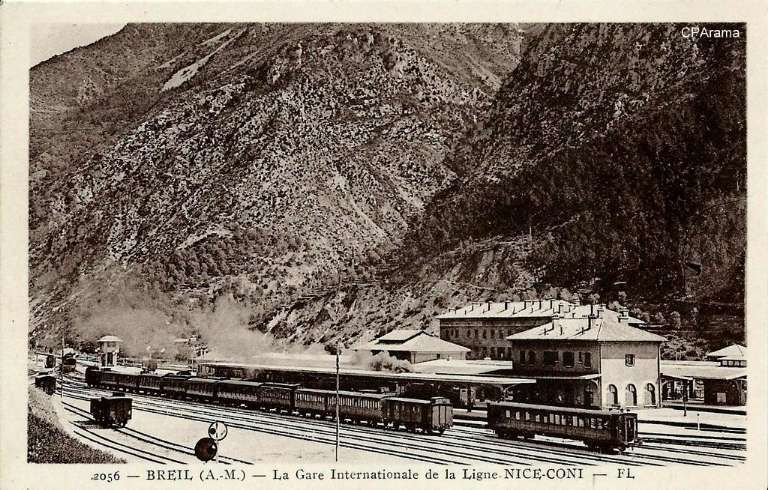
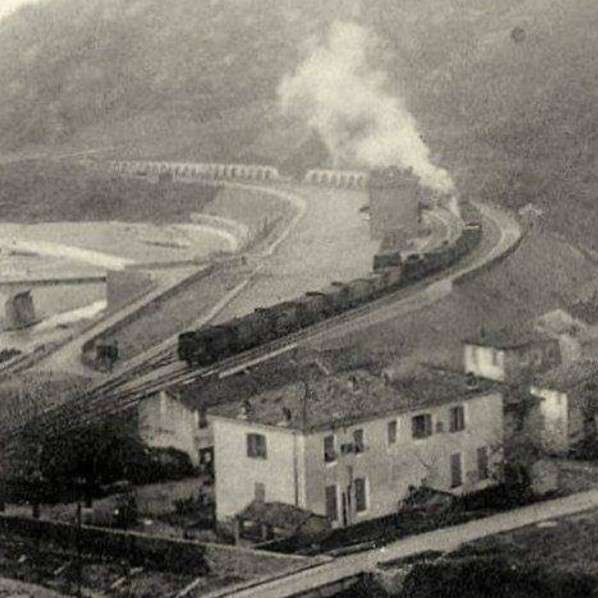
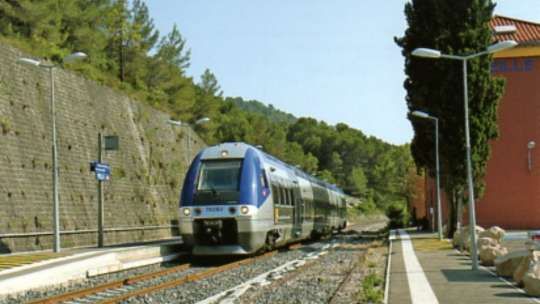
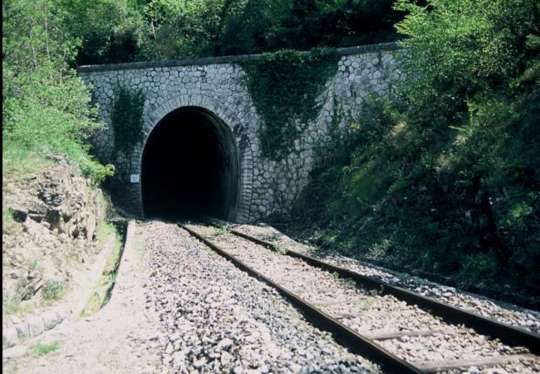
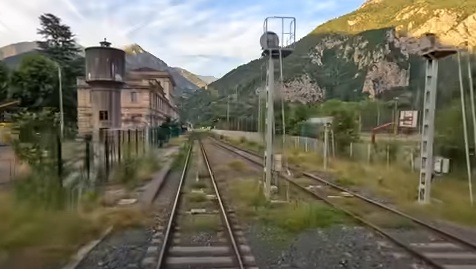
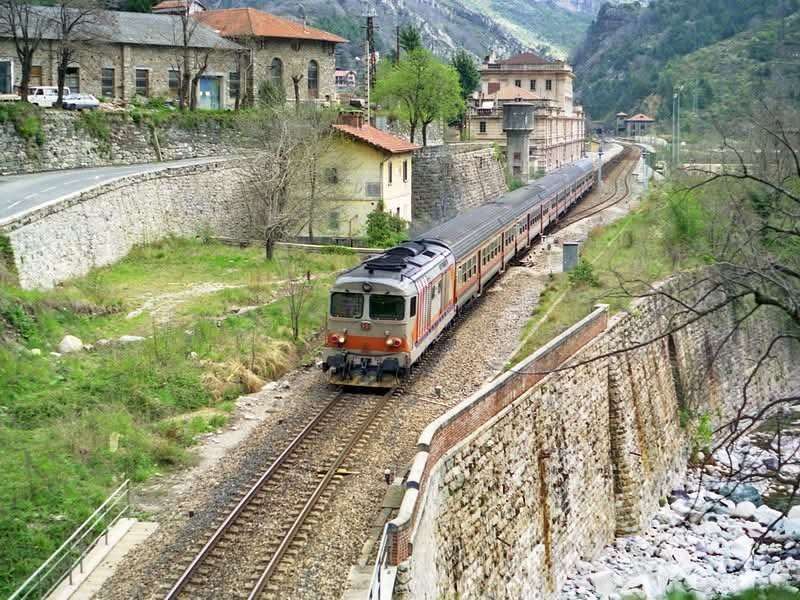
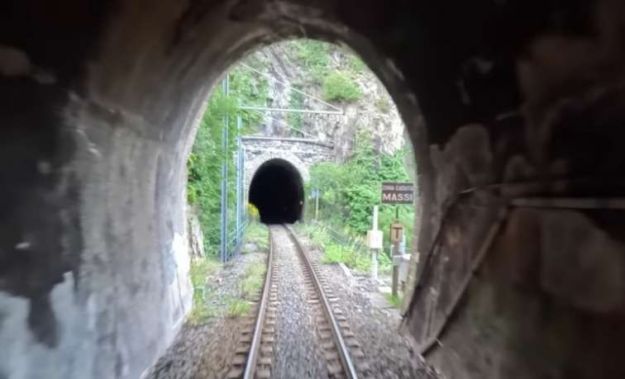
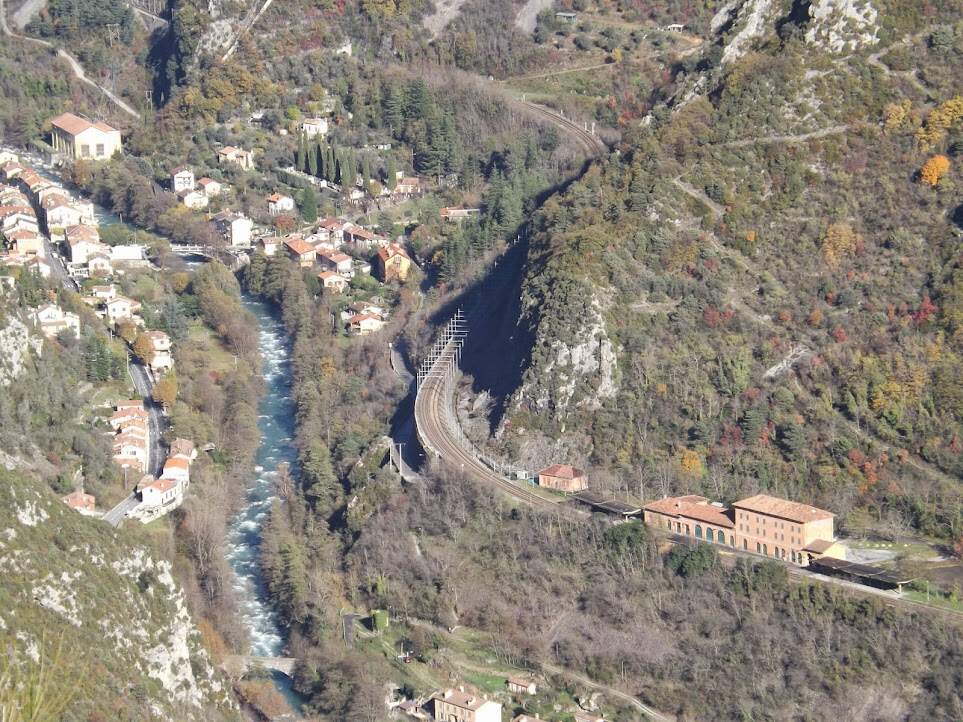
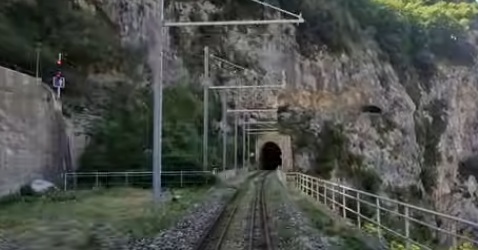
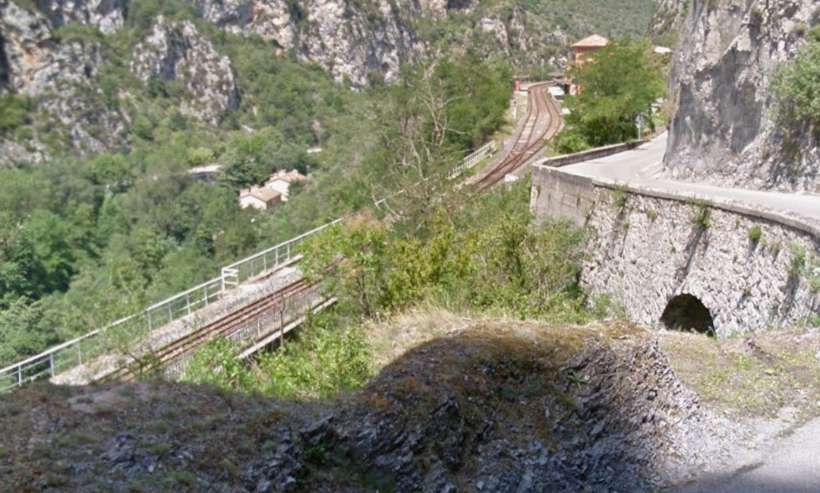
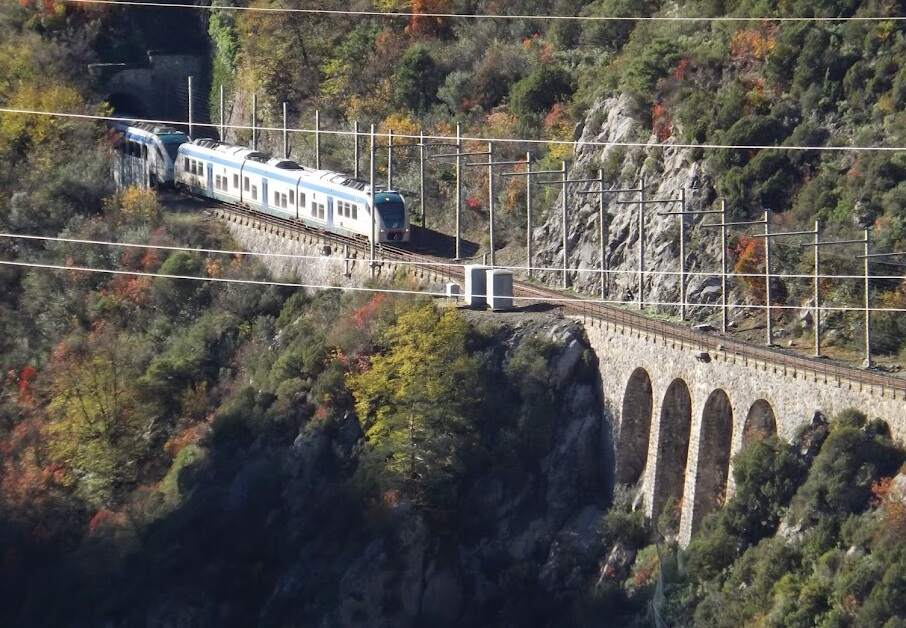
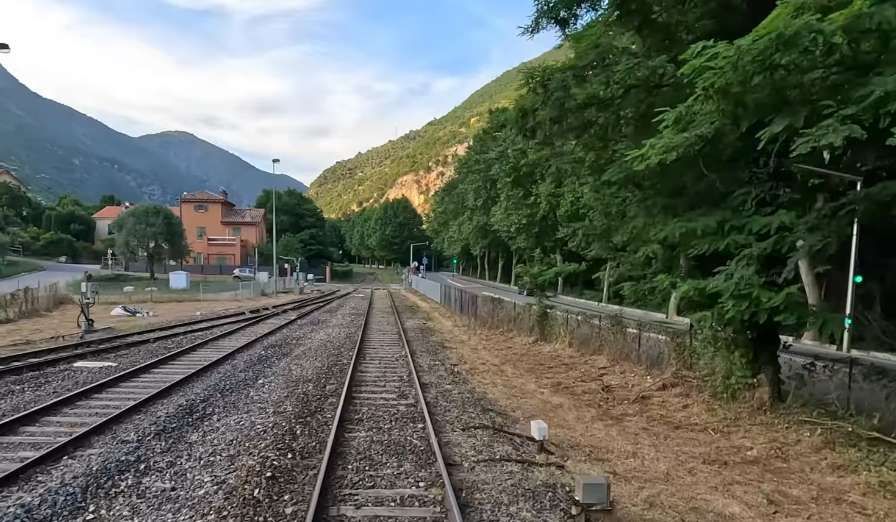
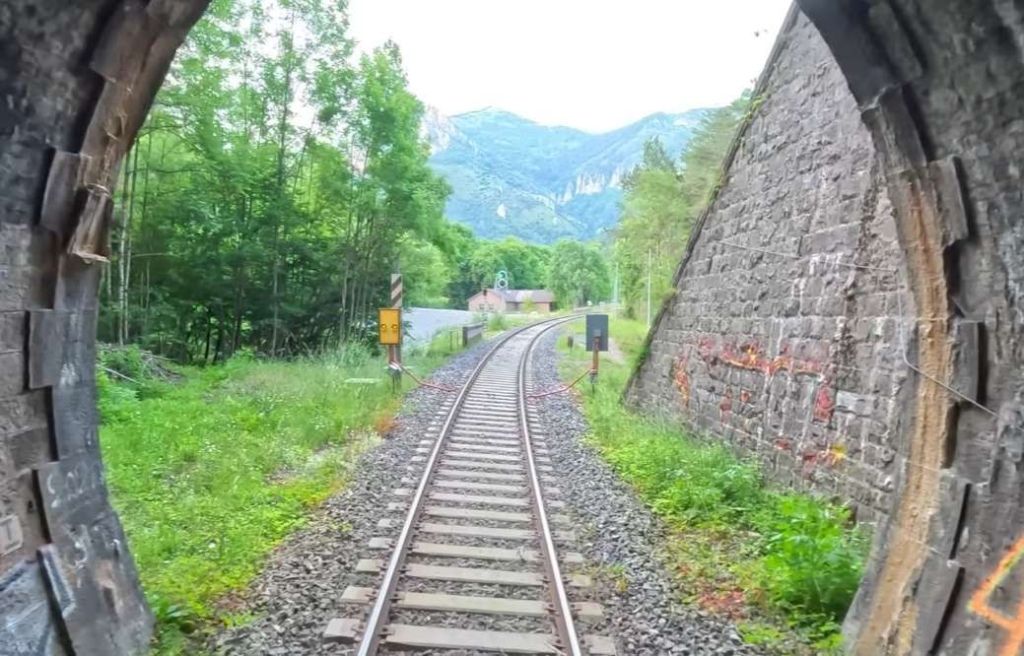
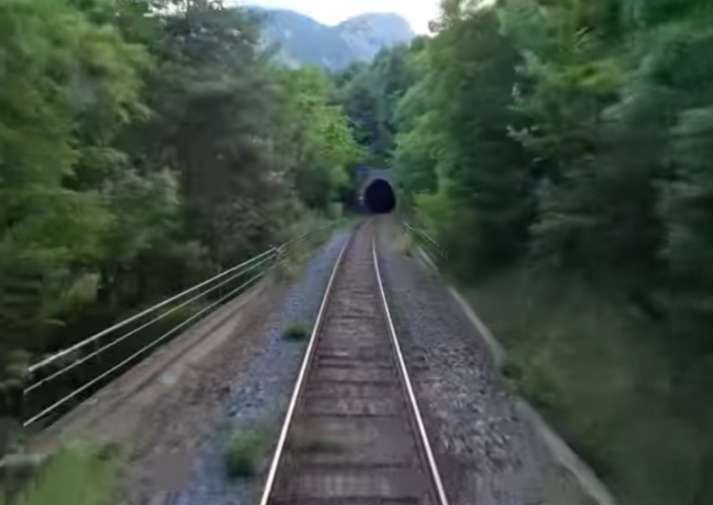
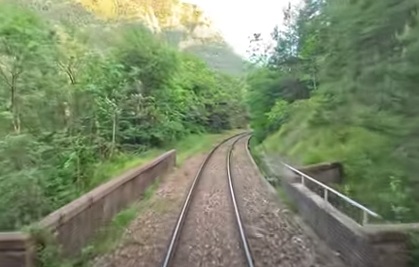
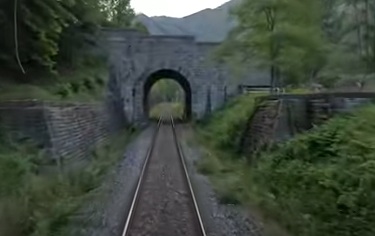
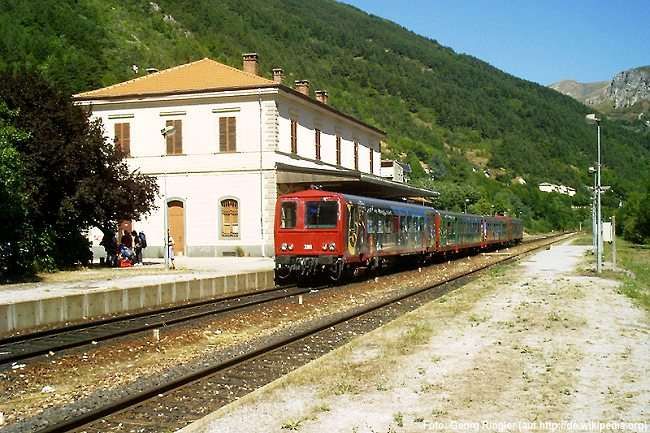
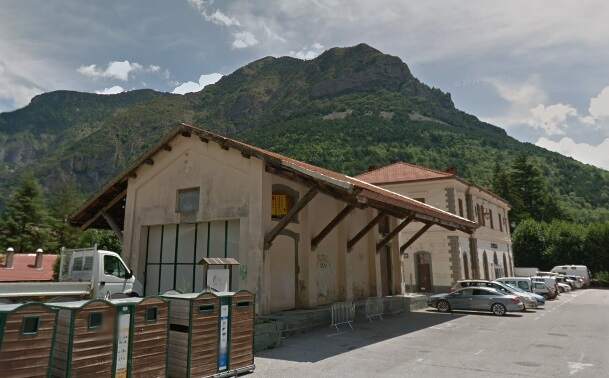
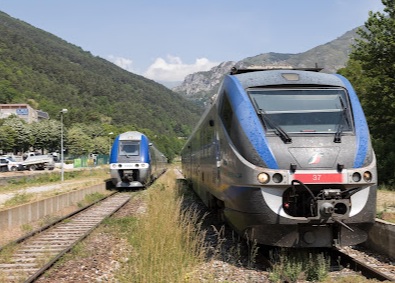
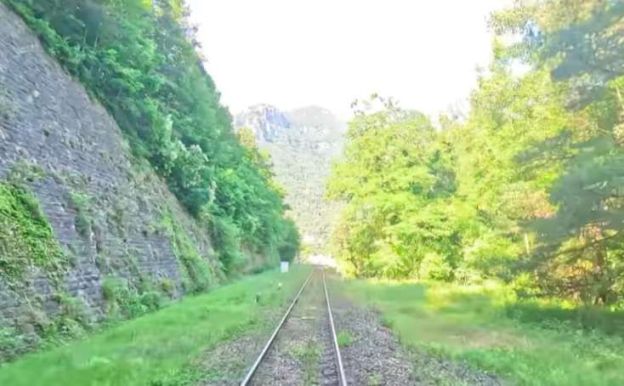
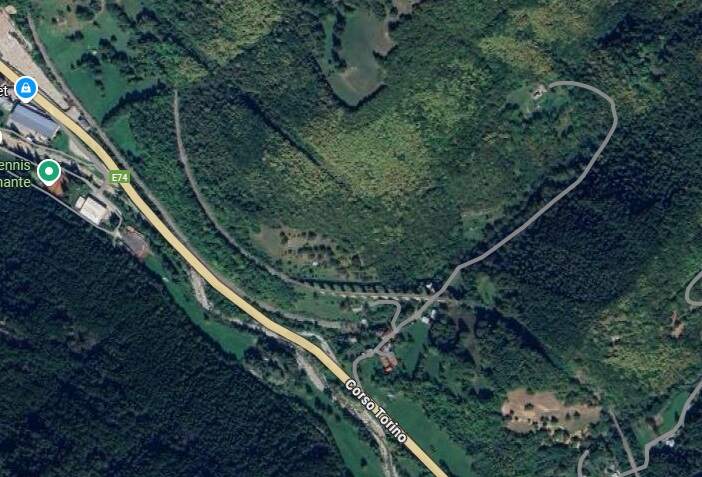
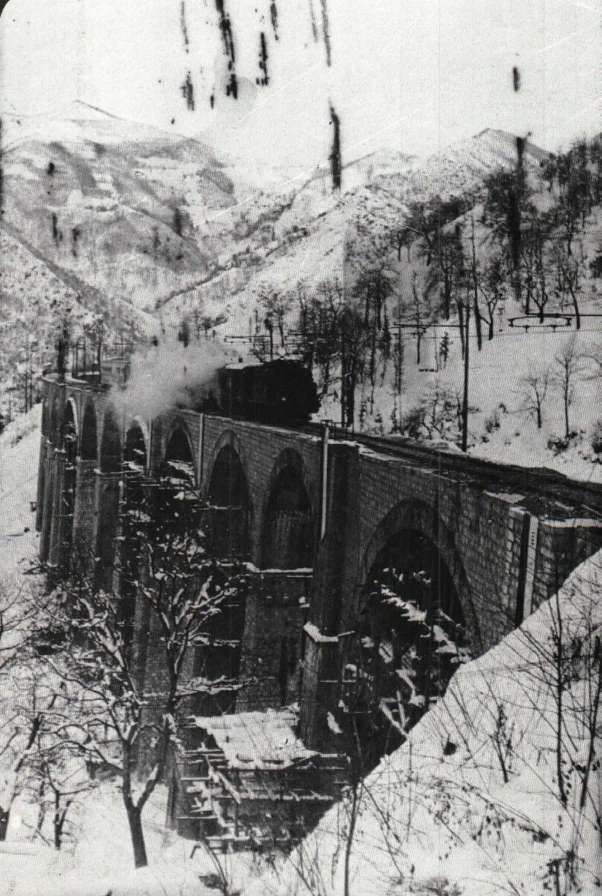
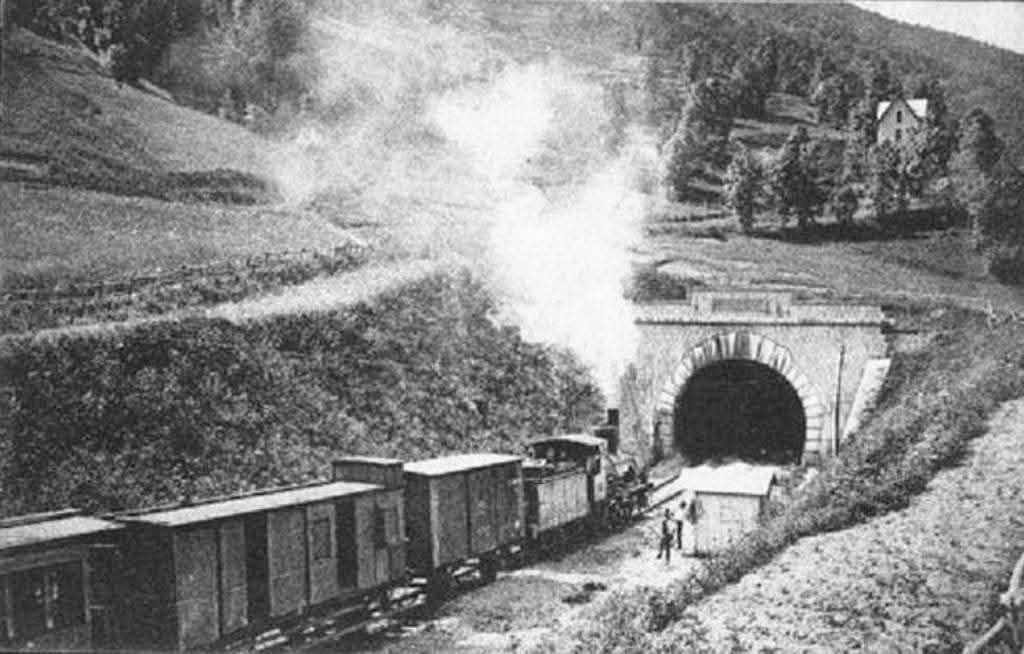
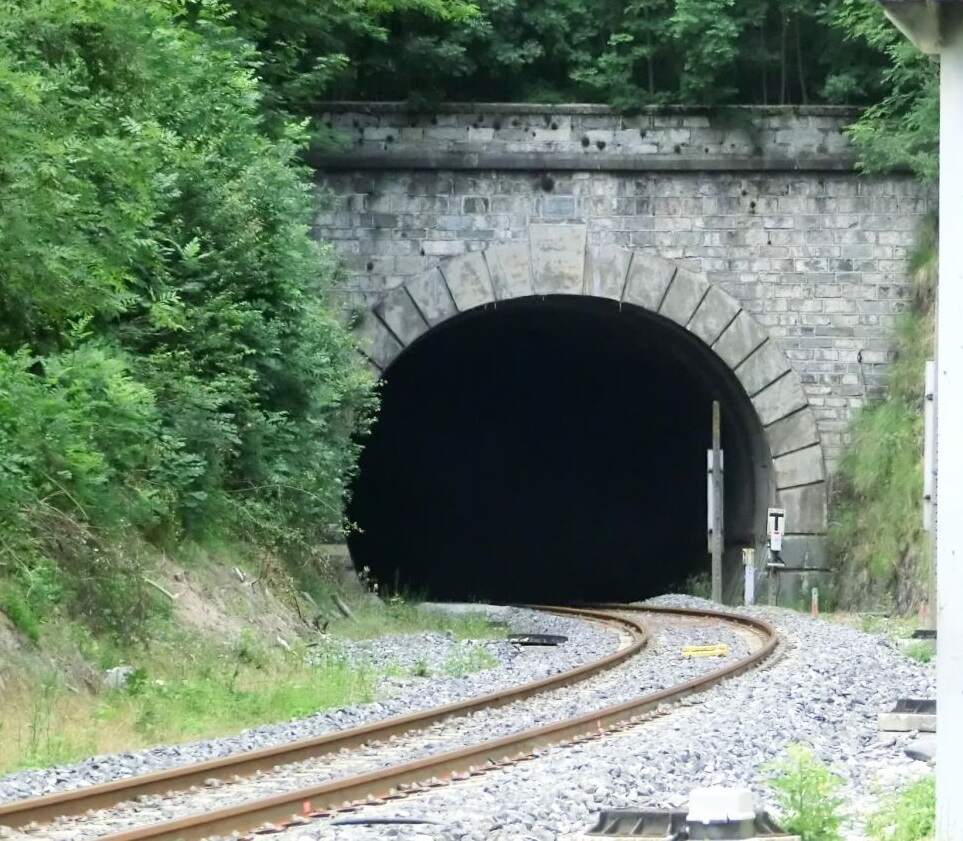
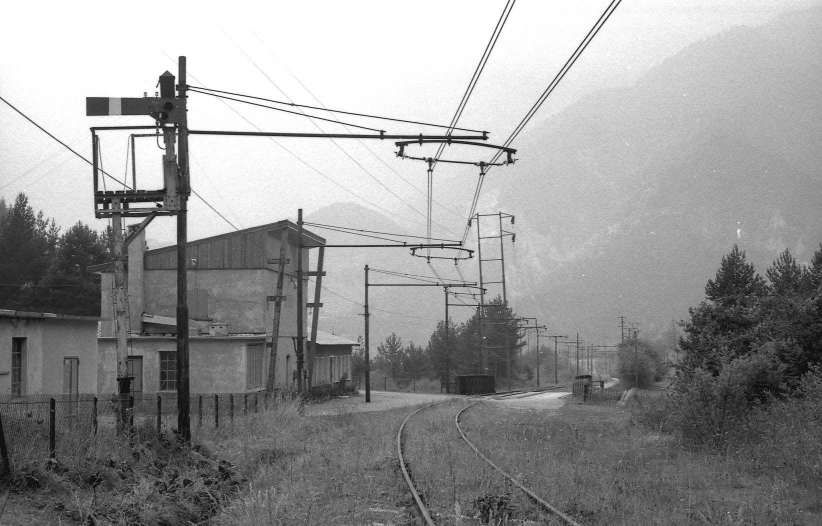
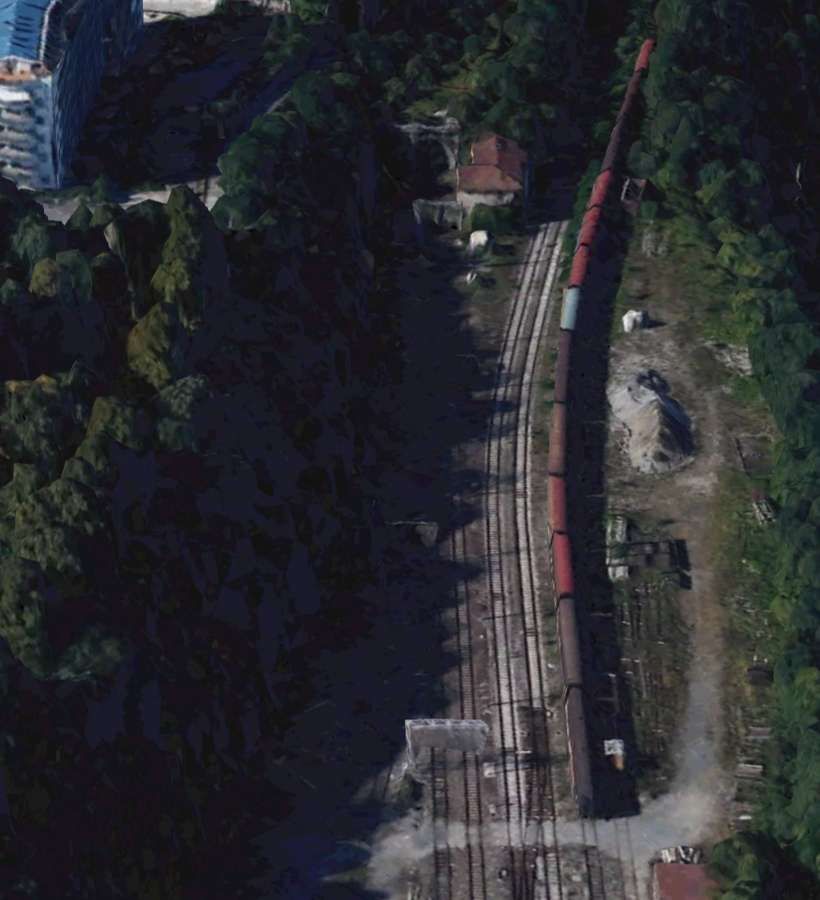
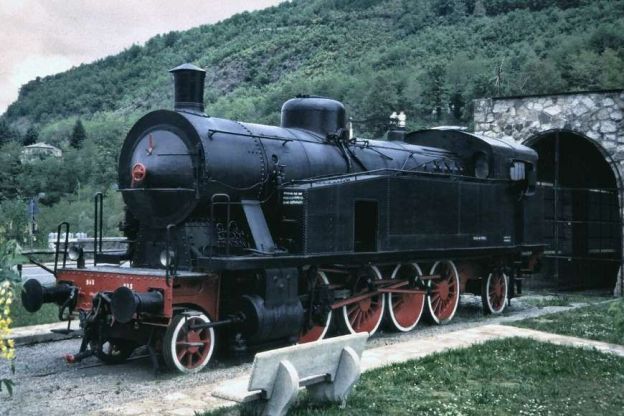
The featured image above is a rather grainy image of steam at Drap-Cantaron Railway Station.

In the first six articles about the line from Cuneo to the sea we covered the length of the line from Cuneo to Breil-sur-Roya and then to Ventimiglia. These articles can be found here, [9]  here [10] here, [11] here, [12] here, [13] and here [14]

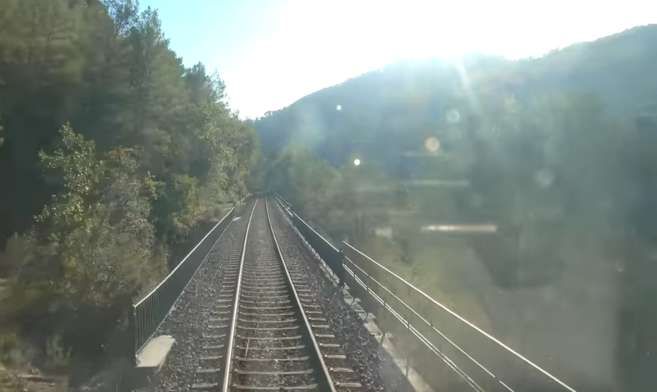
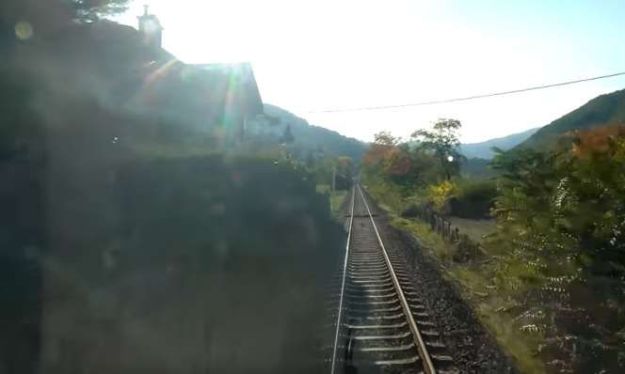
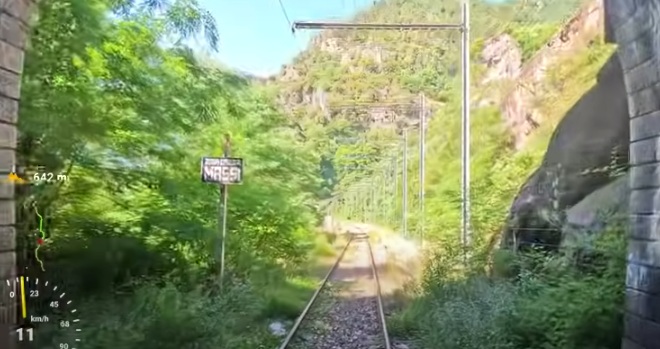
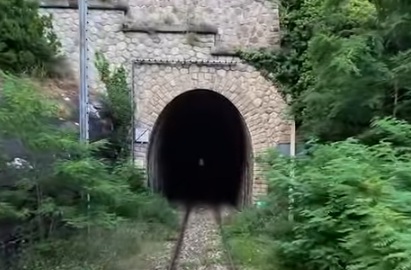
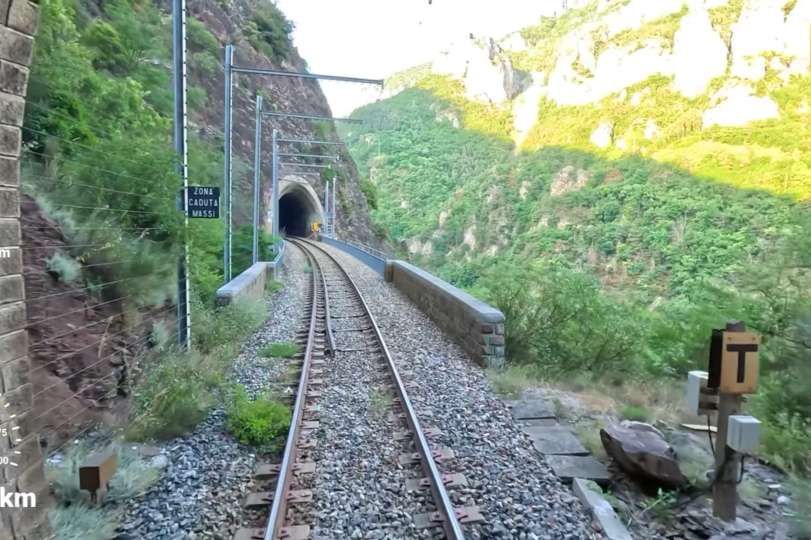
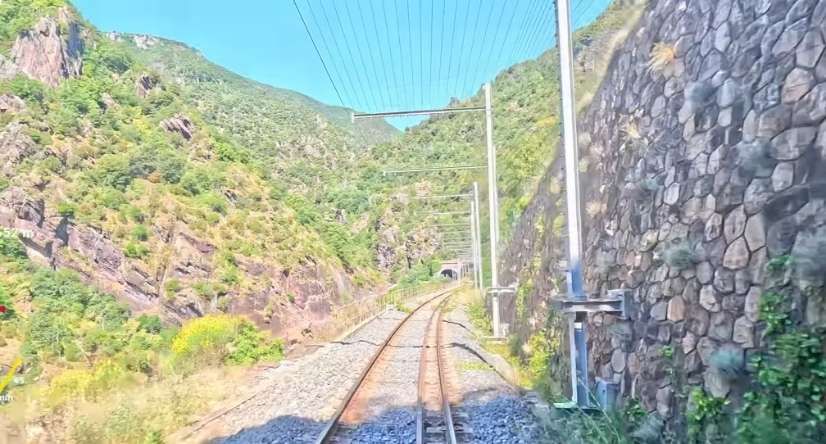
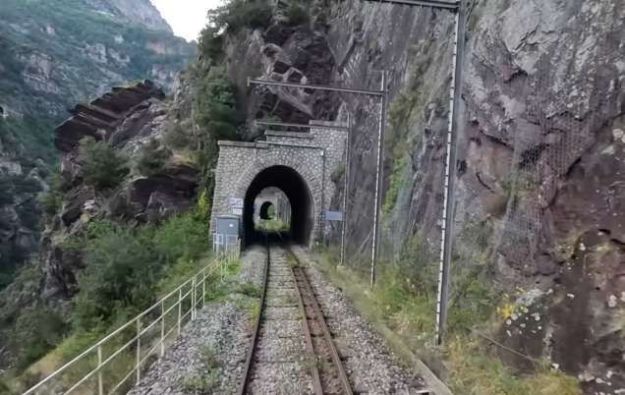
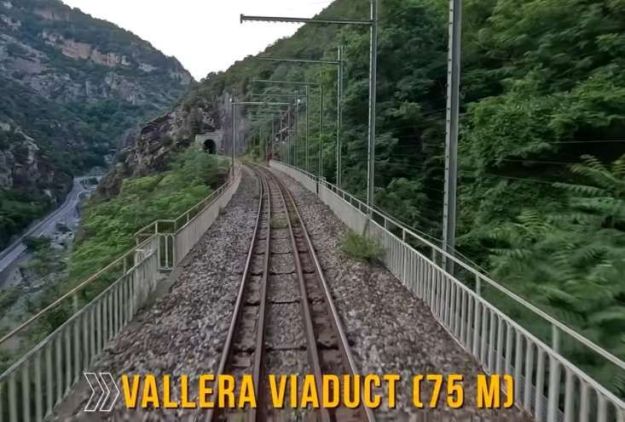
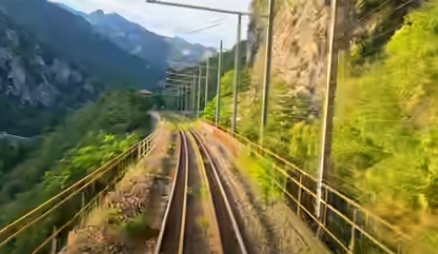
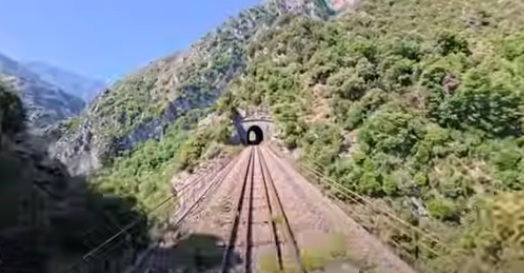
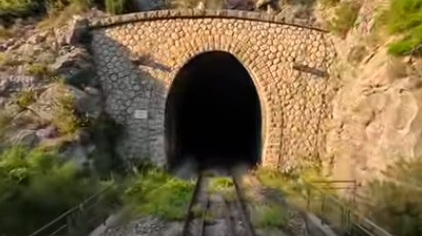
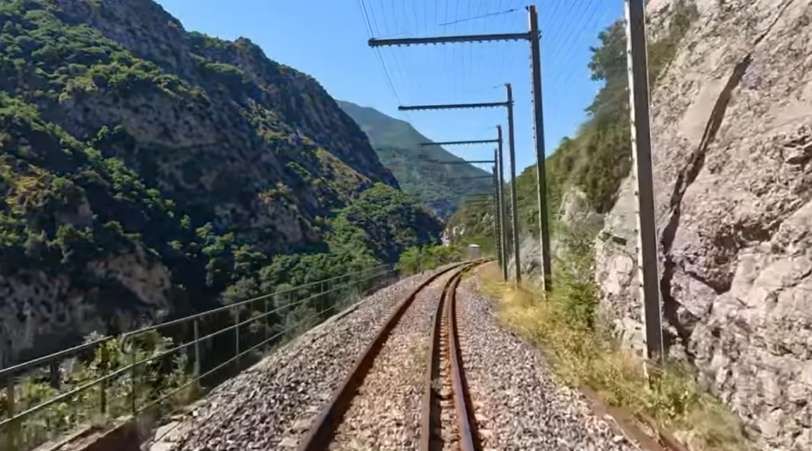
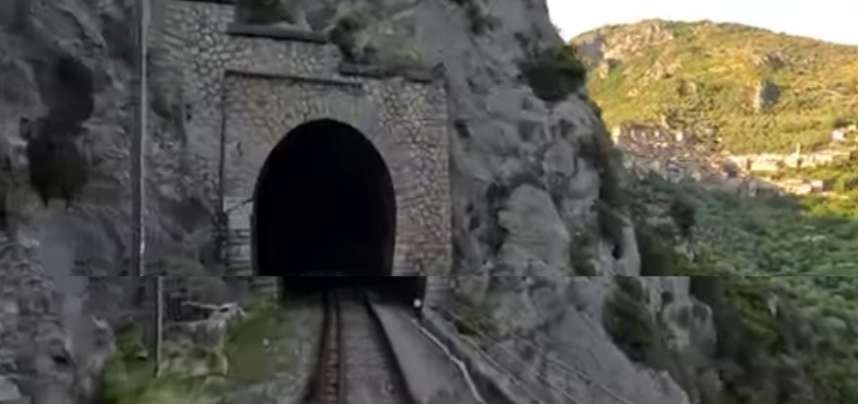
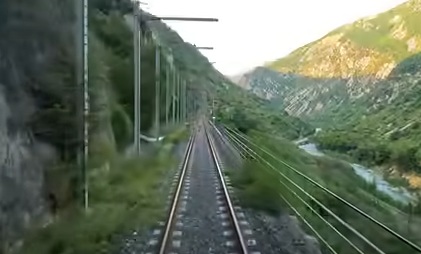
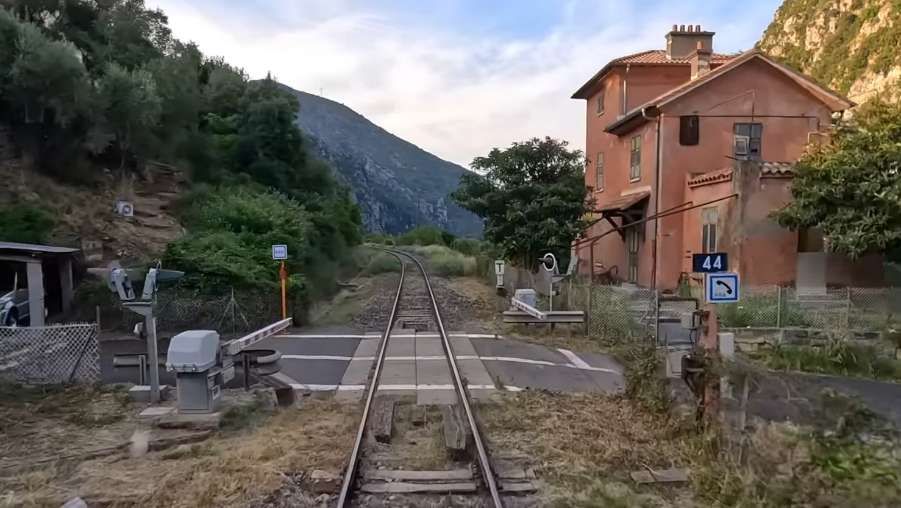
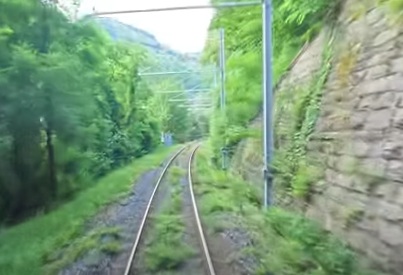
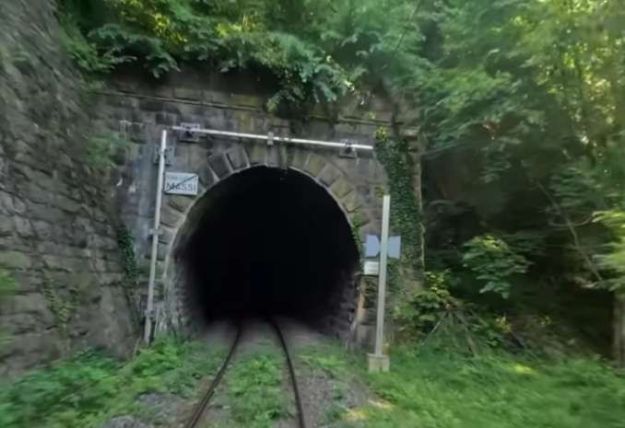
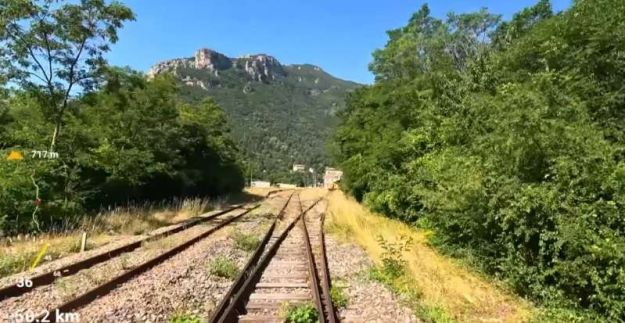
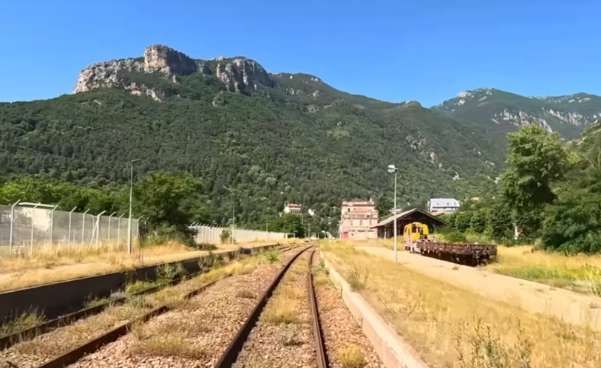
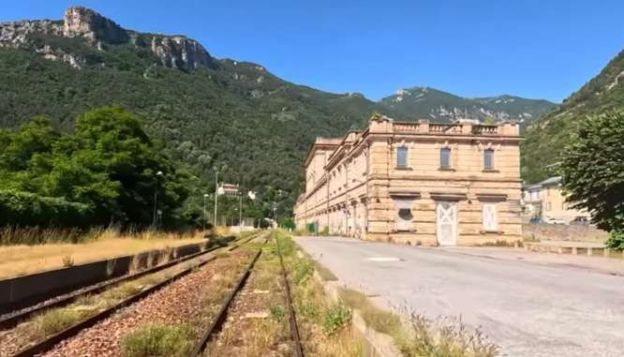
Woven into the text below are a series of stills from a video of the train journey from Breil-sur-Roya to Nice. The video can be seen here. [4]

This article begins the journey from L’Escarene.

Initially, the line heads Southeast but then gradually turns to the the Southwest through Peille, Peillon and Drap before running into Nice.

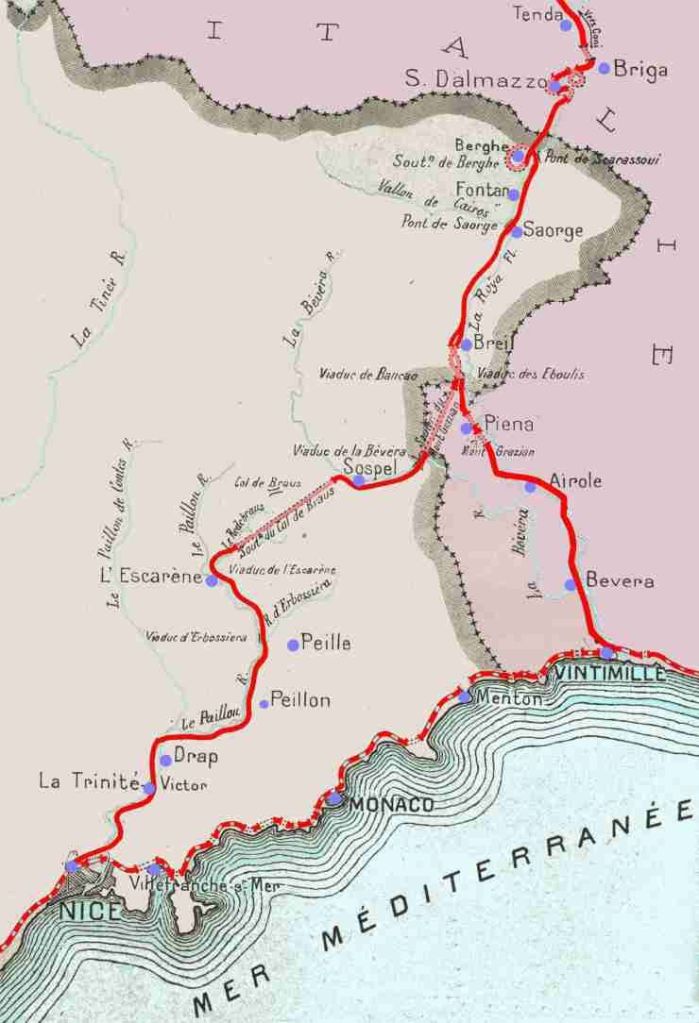
The map below shows the two routes which headed from Nice and Ventimiglia North to Cuneo, as they existed prior to the alteration of the border between France and Italy after the Second World War.

The lines Nice to Tende and Ventimiglia to Tende in the period from 1928 to the Second World War, before the annexation, in 1947, of St-Dalmas de Tende and Piene to France. [15]

From l’Escarene to Drap-Cantaron

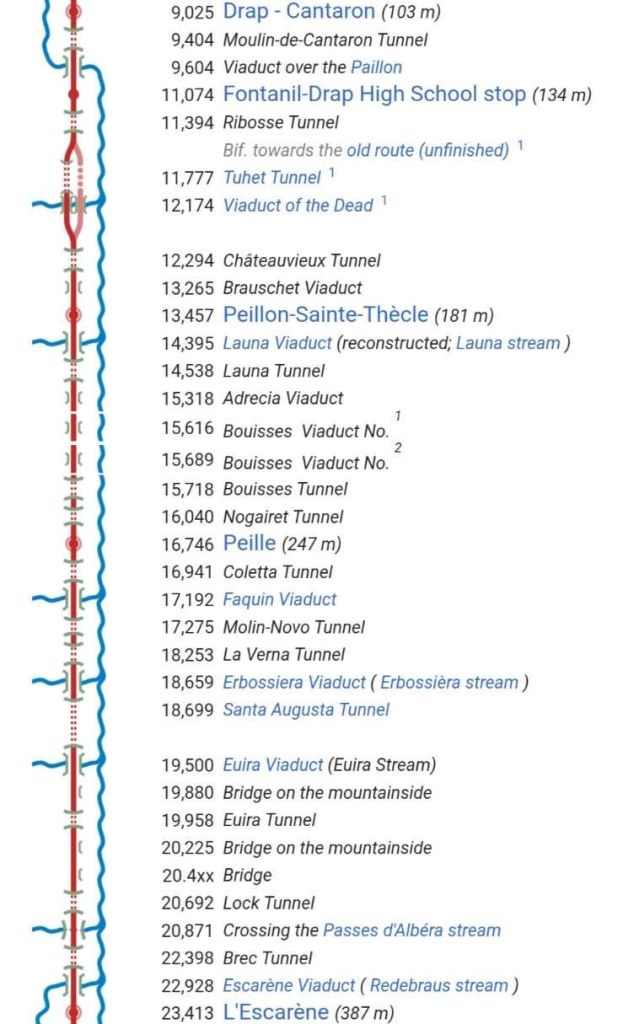
The line from L’Escarene to Drap/Cantaron. [25]

L’Escarene sits at the head of a long climb from Nice, it was one of the historic staging posts on the old royal road from Nice to Turin. Like Sospel Station, that of l’Escarene has substantial facilities which would allow the reception of military convoys in the event of conflict with neighbouring Italy. [1: p92]

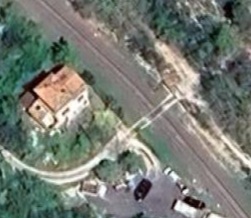
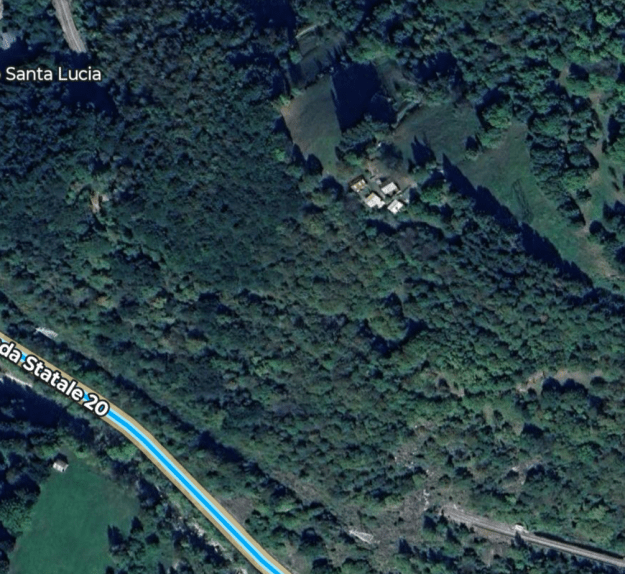
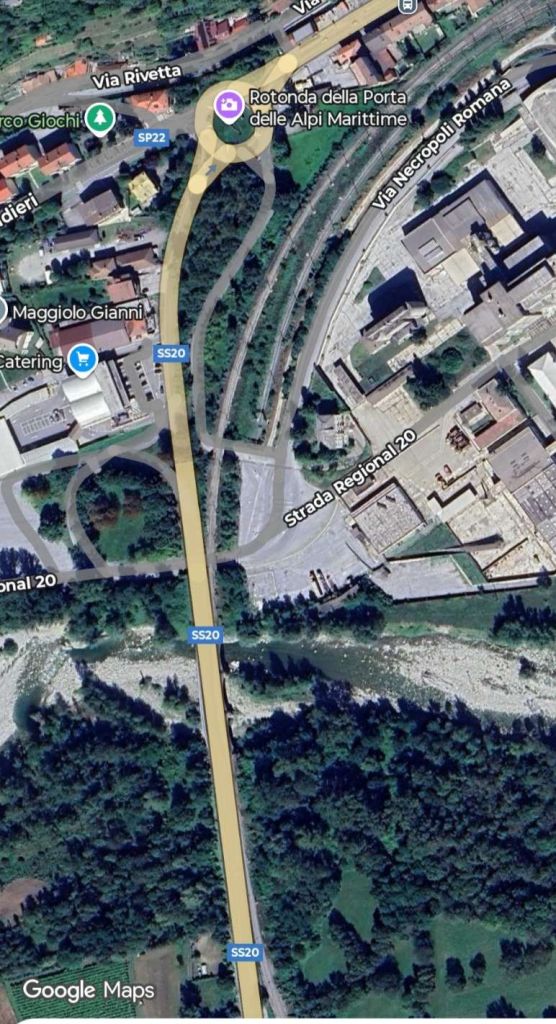
The site of l’Escarene railway station, as shown on Google’s satellite imagery. [Google Maps, September 2025]
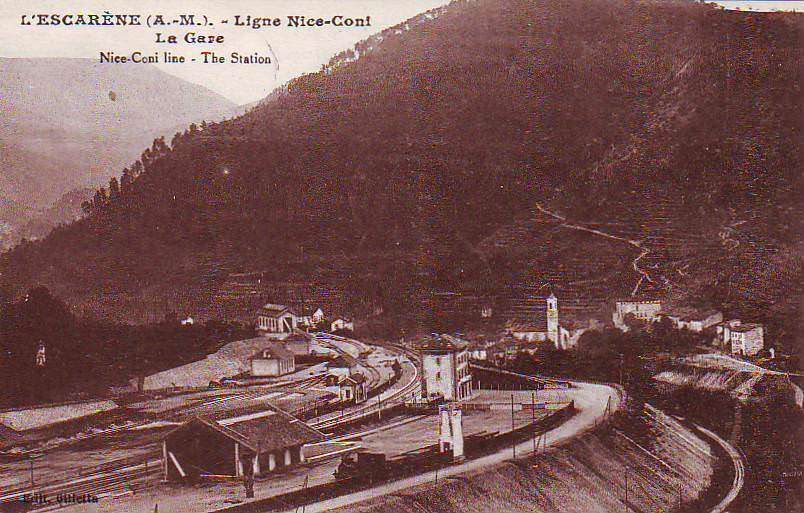
L’Escarène Railway Station, seen from the North soon after, or during, construction, © Public Domain. [17]
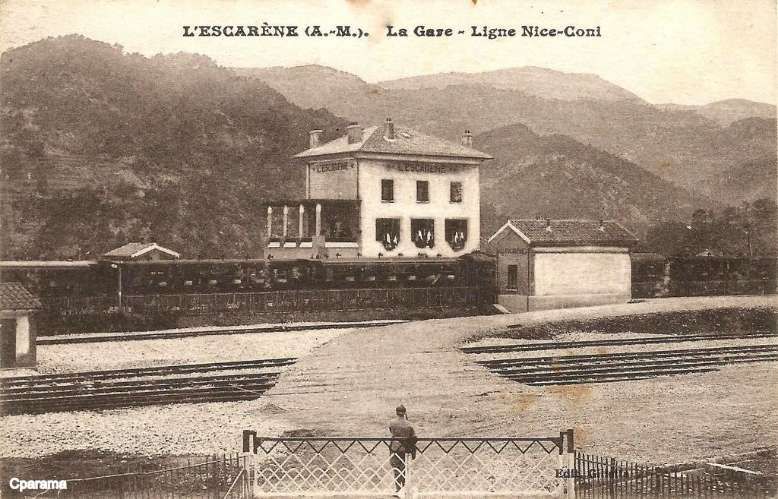
L’Escarene Railway Station © Public Domain. [17]
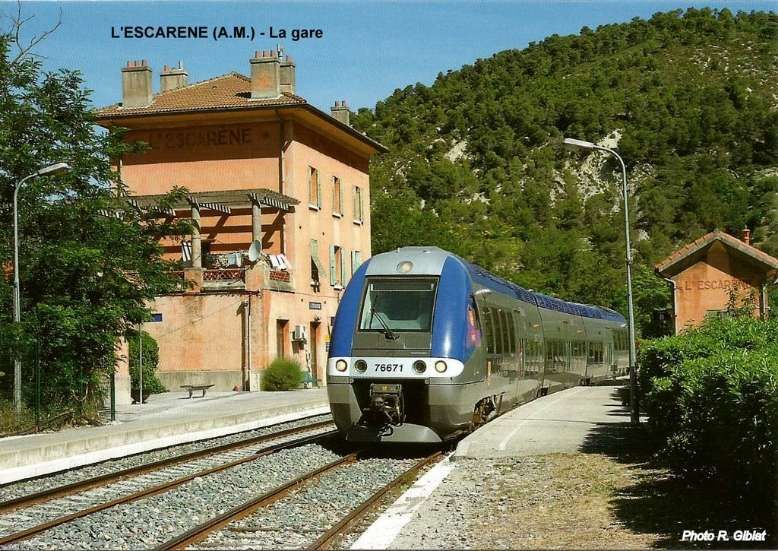
L’ Escarene Railway Station, post card image © Unknown. [17]
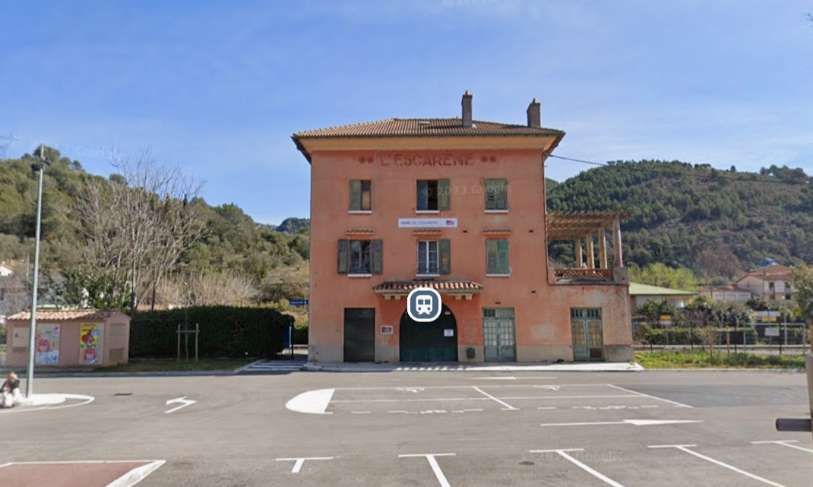
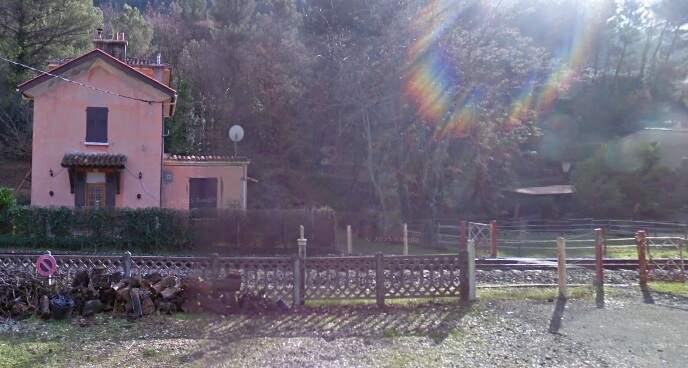
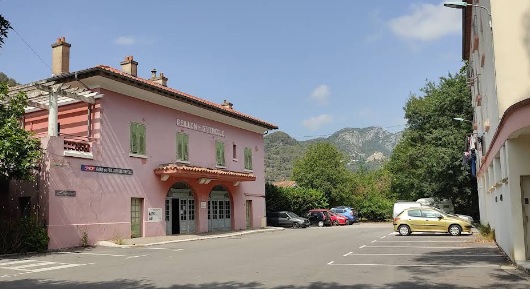
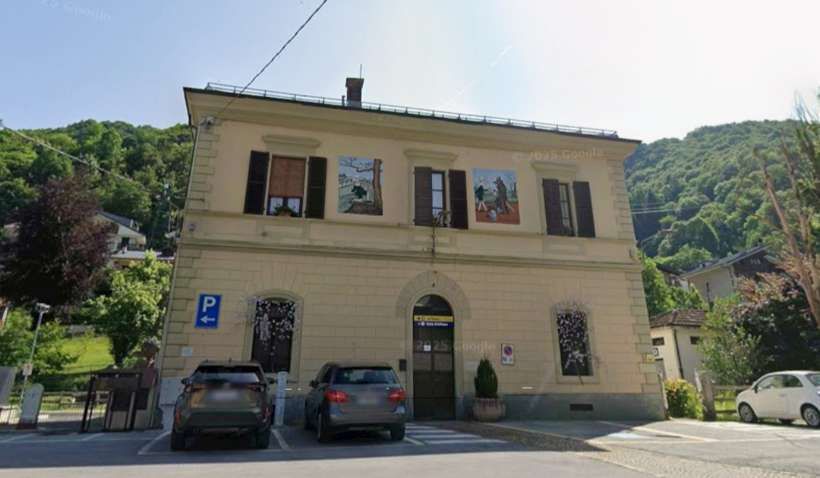
The station building at l’Escarène. Google Streetview, March 2023]
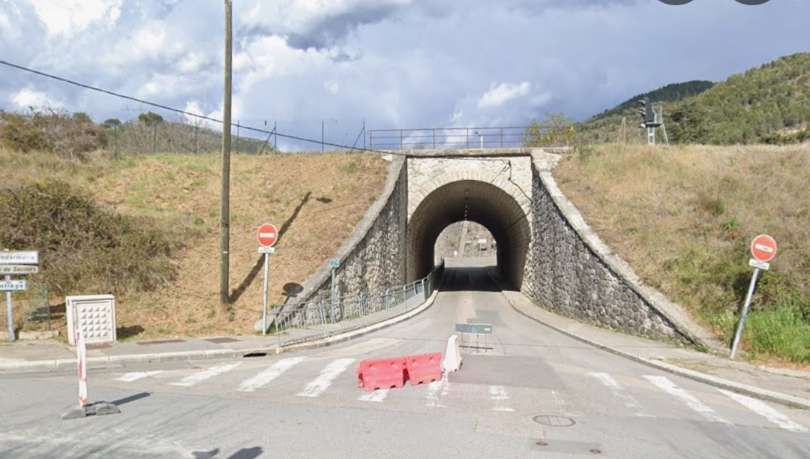
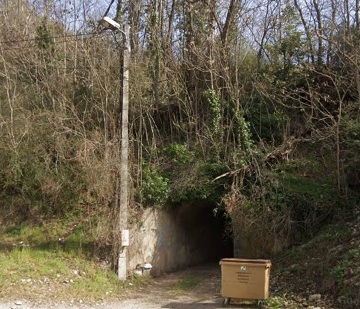
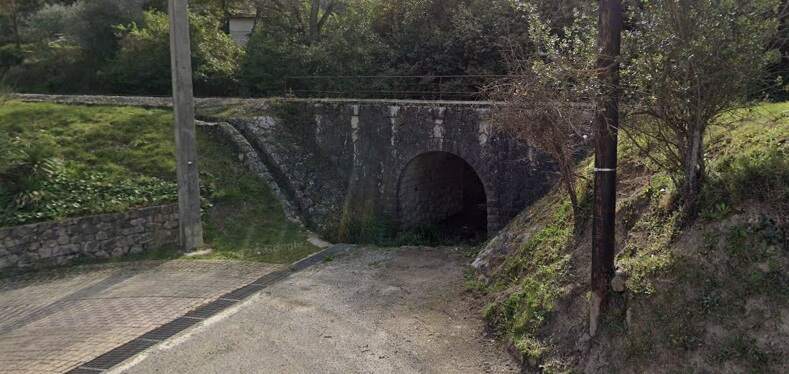
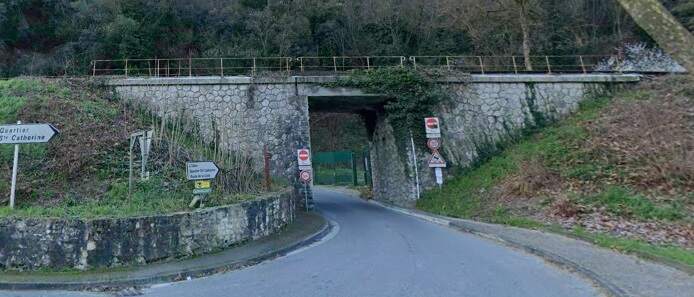
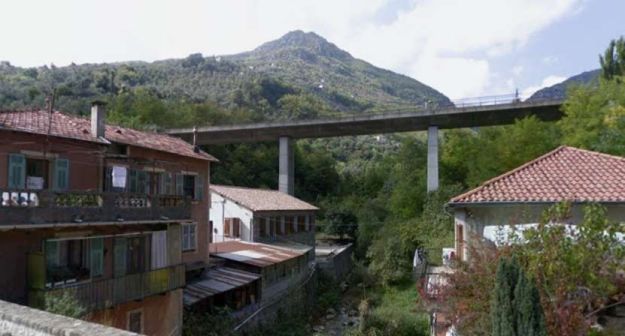
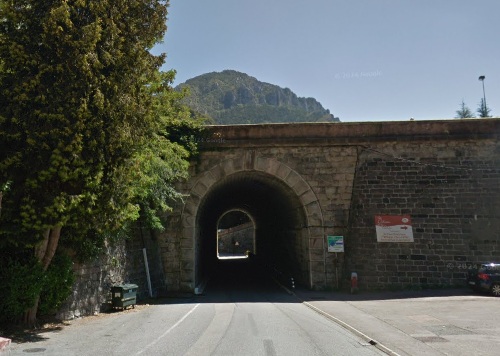
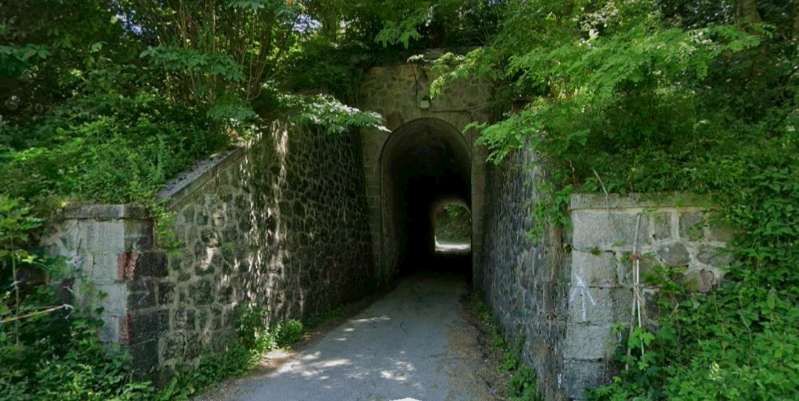
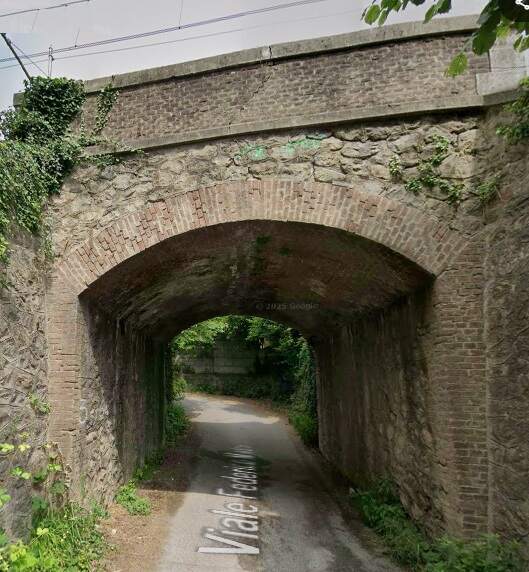
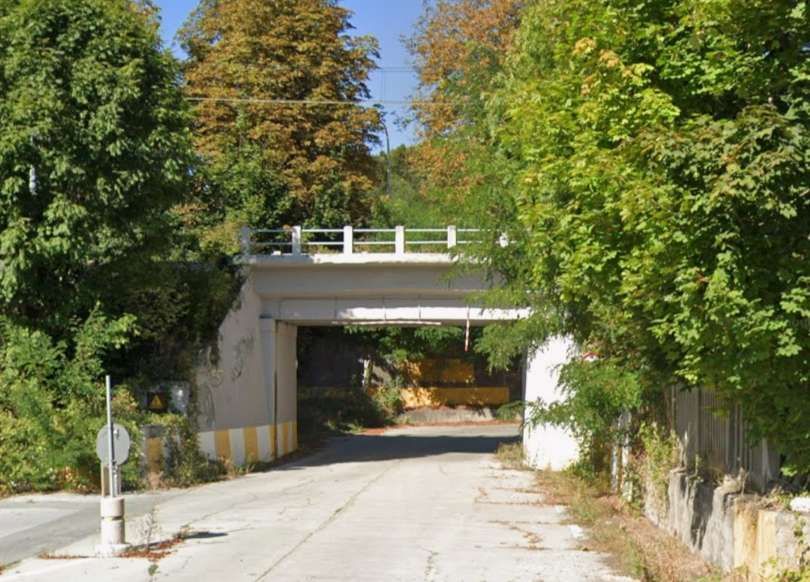
The underpass, just to the Southeast of l’Escarene railway station, seen from the D2566 to the Southwest. [Google Streetview, March 2023]
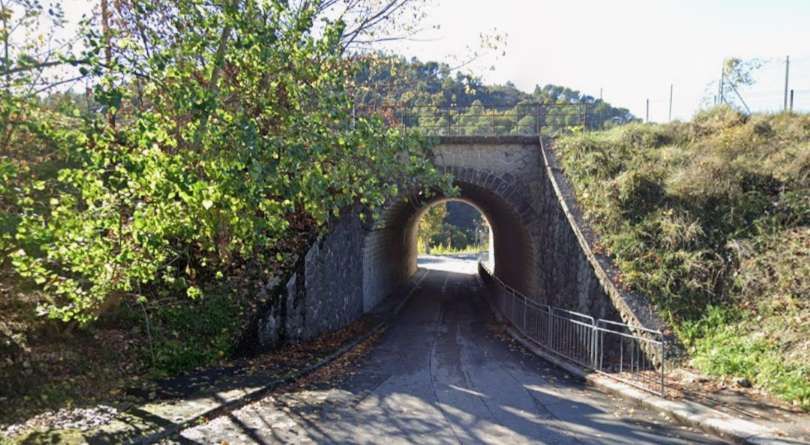
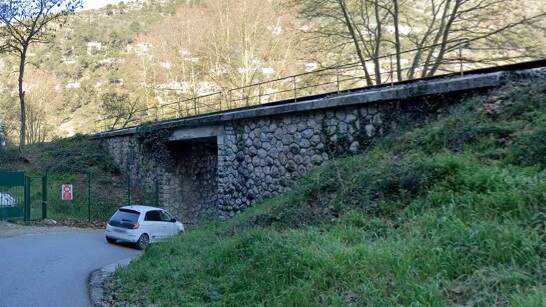
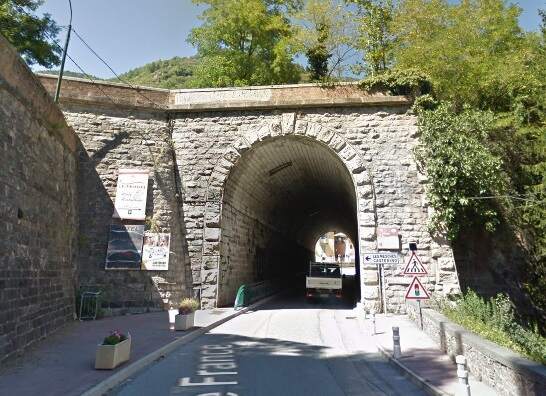
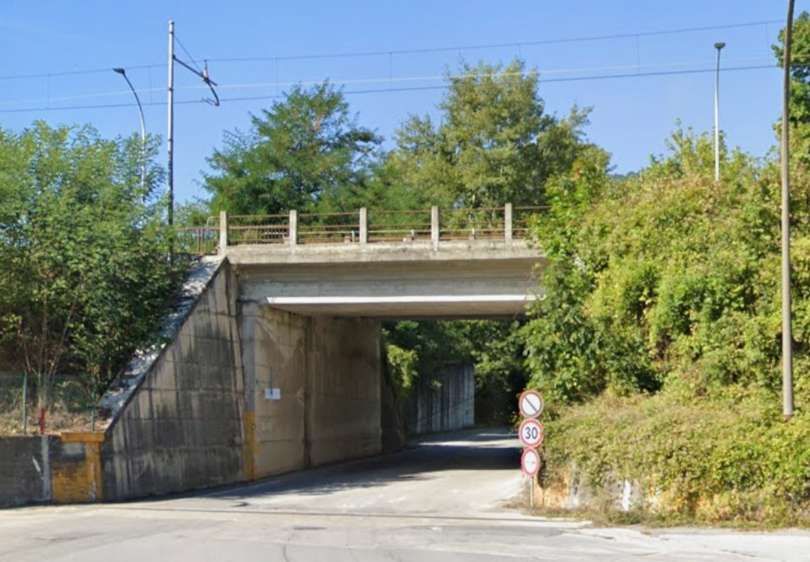
The same structure, seen from the Northeast. [Google Streetview, November 2022]
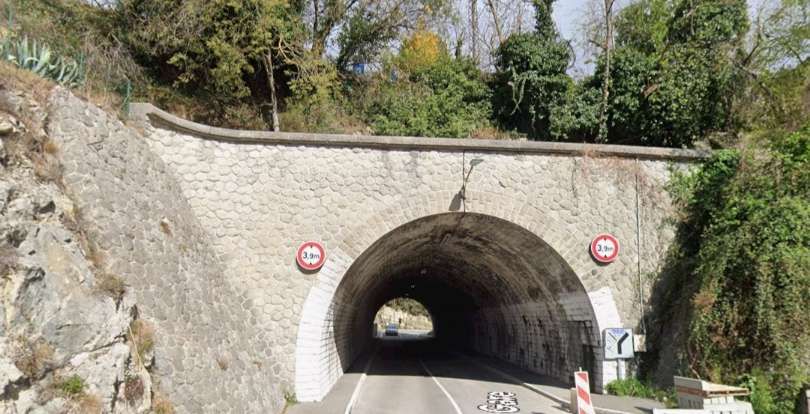
Further to the Southeast, the manmade plateau which created the Station and large Goods facilities is pierced by a tunnel which allows the D2566 to pass under the station site. [Google Streetview, April 2023]
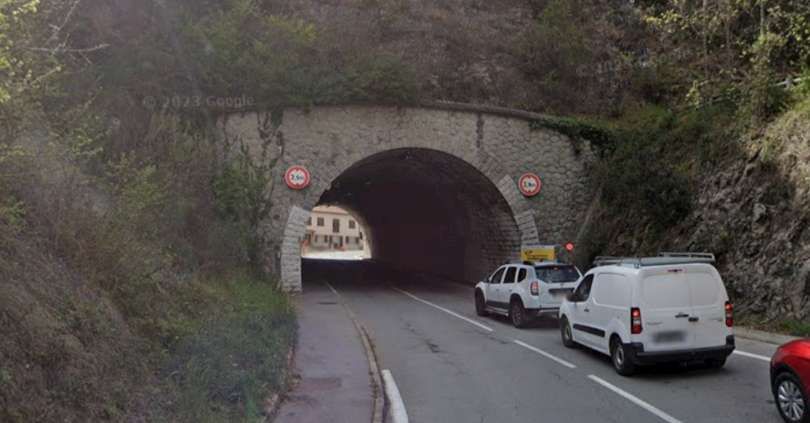
The same structure, seen from the East. [Google Streetview, April 2023]

It is only a very short distance to the abutment of the viaduct that carries the line through l’Escarene.

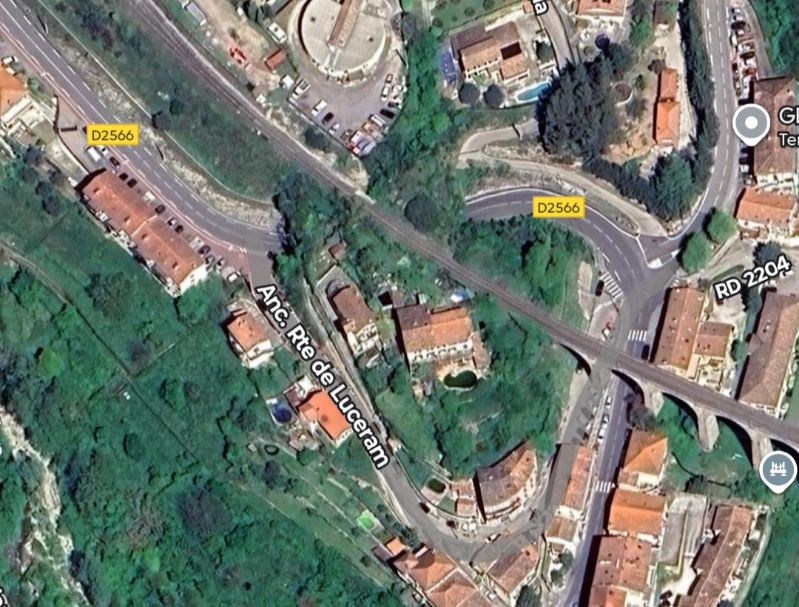
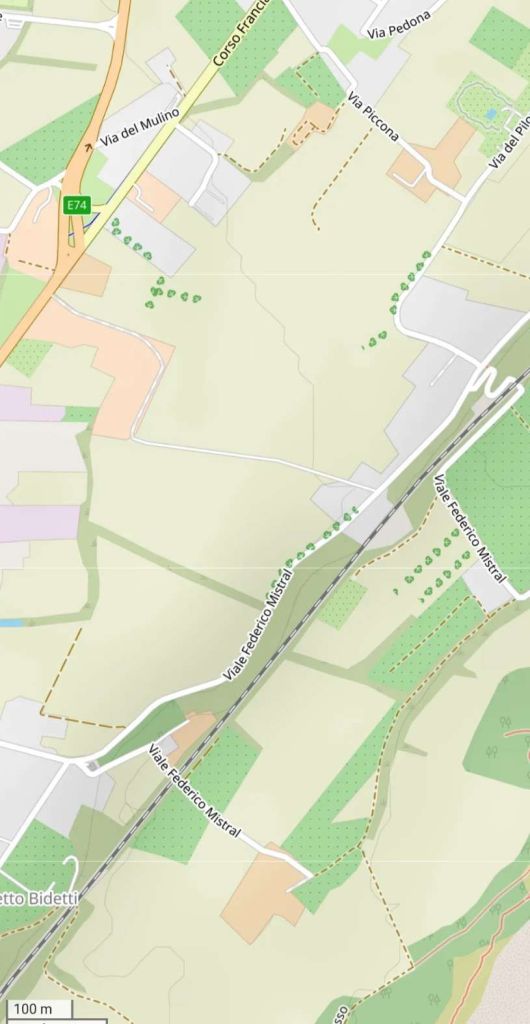
The D2566 passes West-East under the railway and then curves round to join the D2204 and pass North-South under the West end of the railway viaduct. The Anc. Rte de L’Escarène passes through the first arch of the viaduct. The D2204 passes through the second arch of the viaduct. [Google Maps, September 2025]

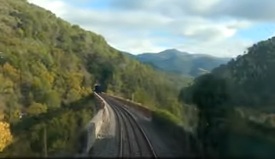
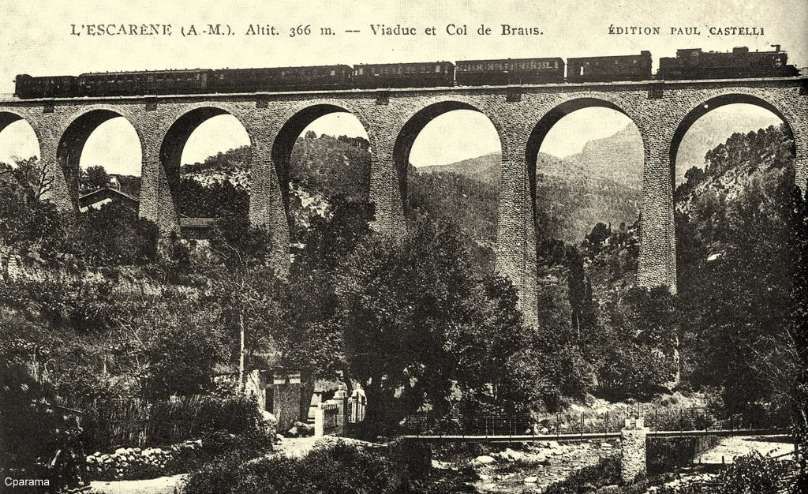
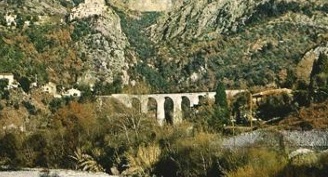
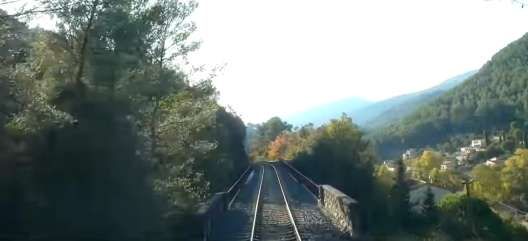
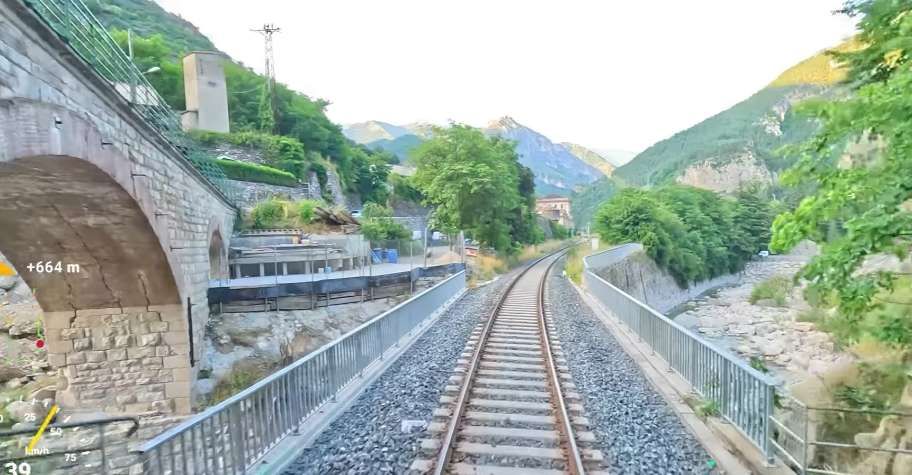
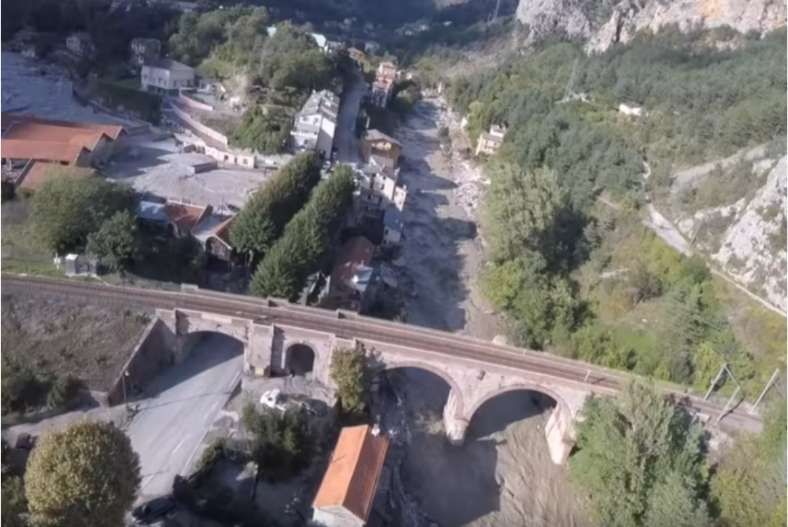
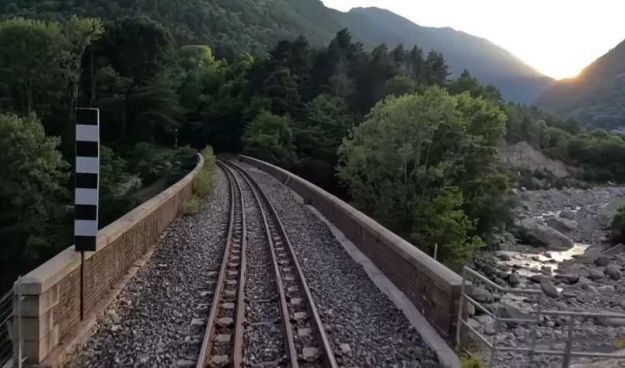
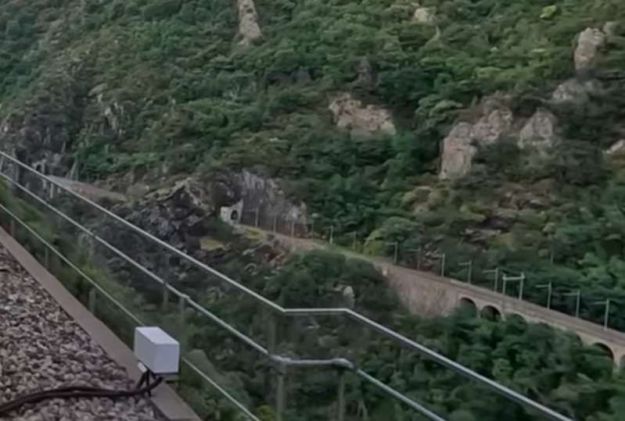
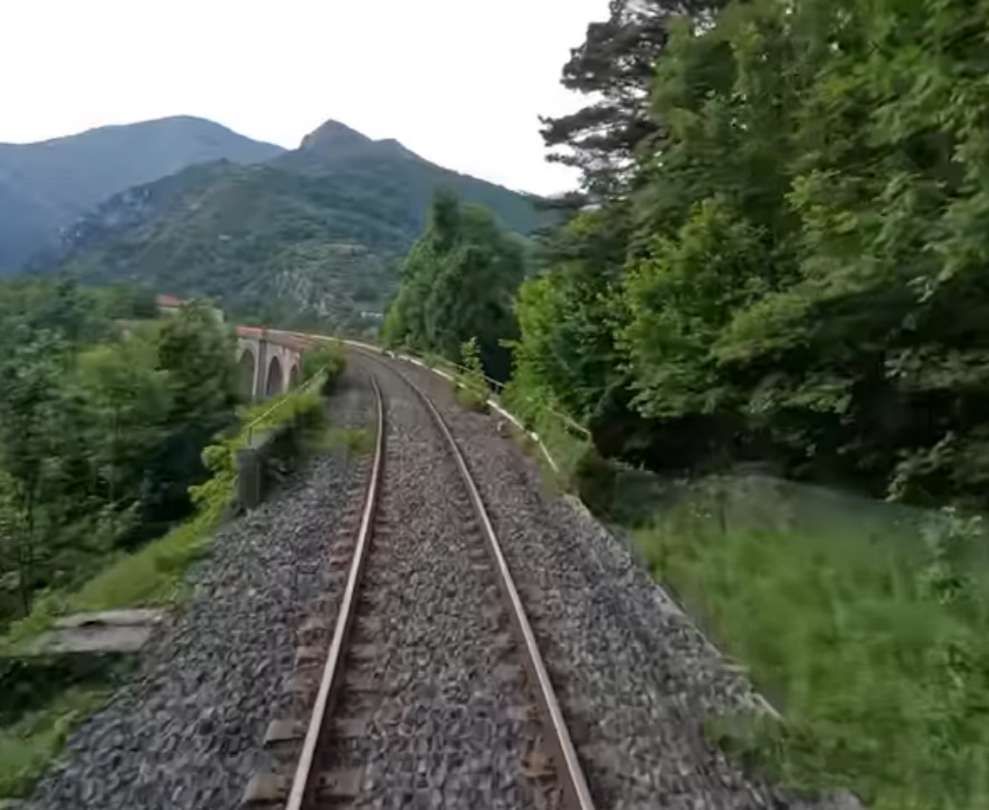
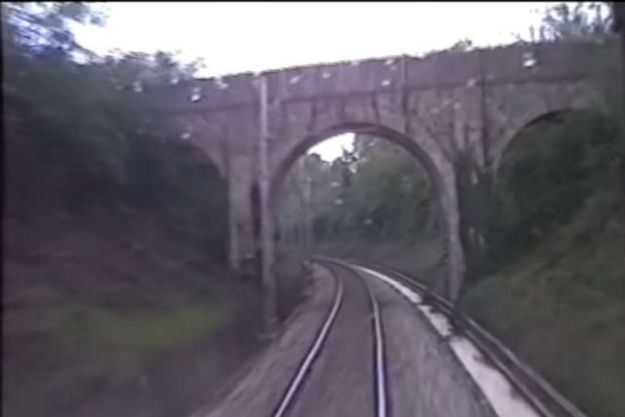
Setting off from l’Escarene Railway station, this is the first view of the l’Escarene Viaduct from the cab of a Nice-bound train. The viaduct over the Redebraus has eleven 15 metre arches. [4]

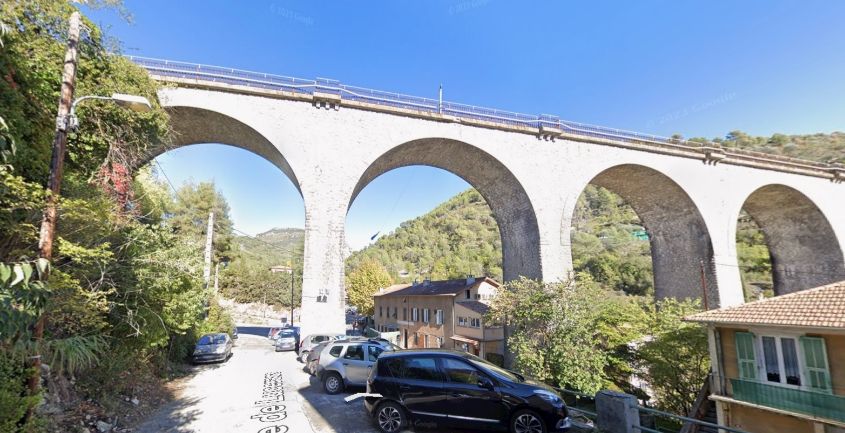
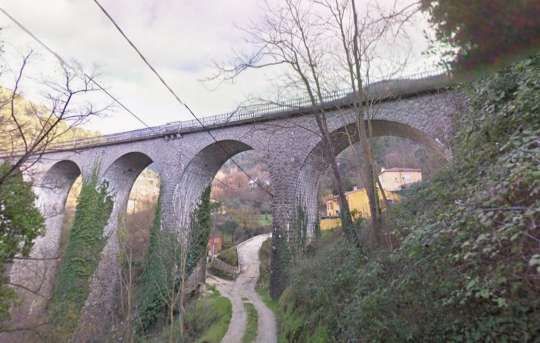
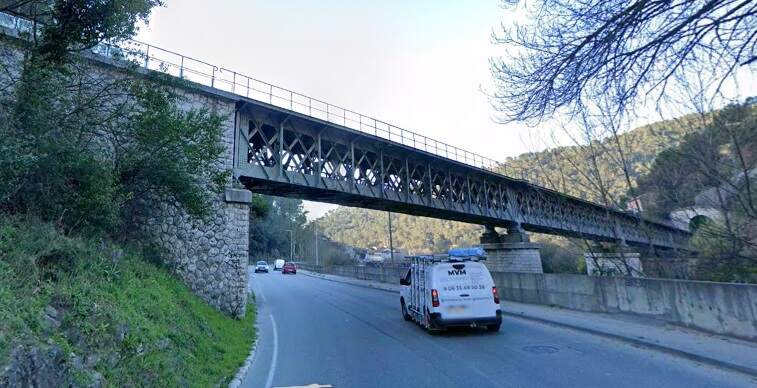
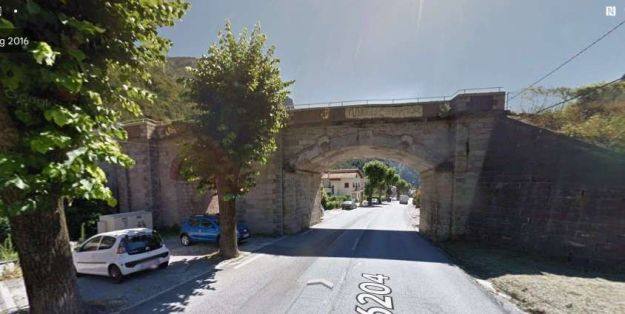
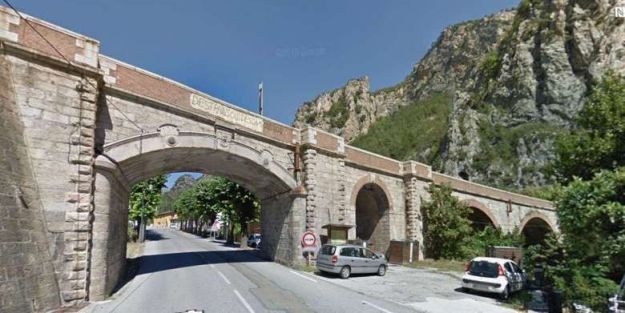
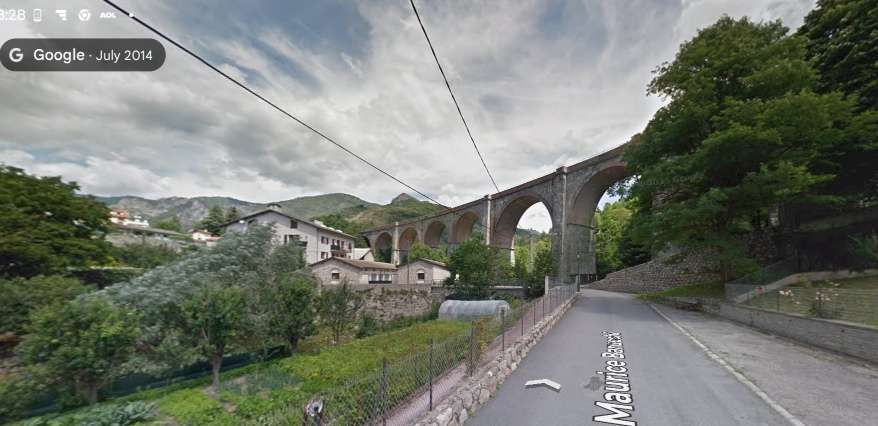
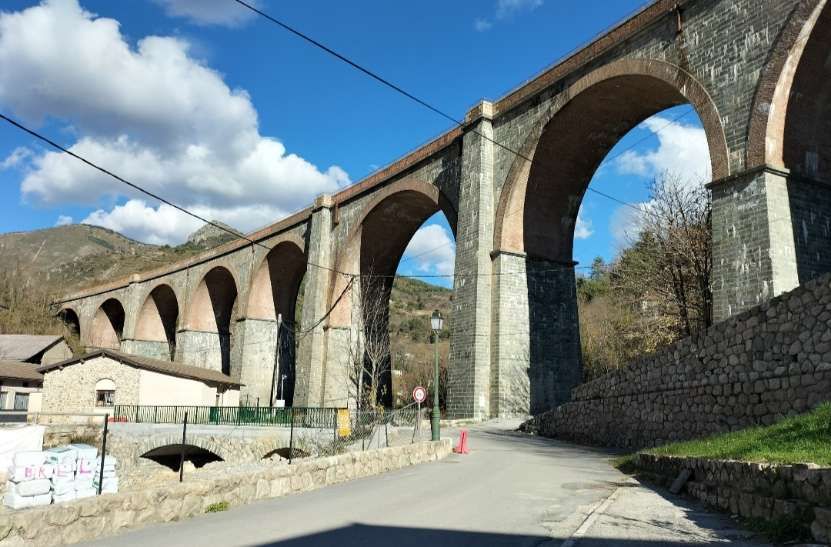
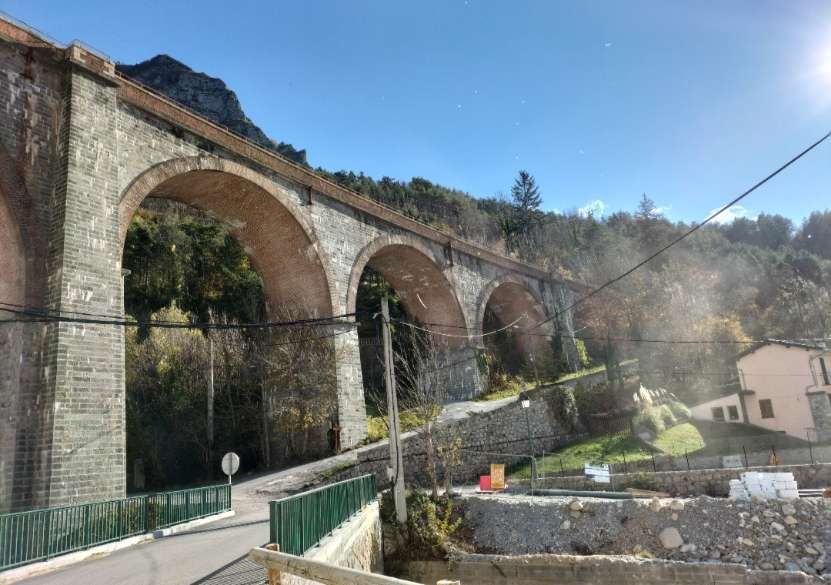
L’Escarene viaduct, seen looking North from the Anc. Rte de l’Escarene. [Google Streetview, November 2022]
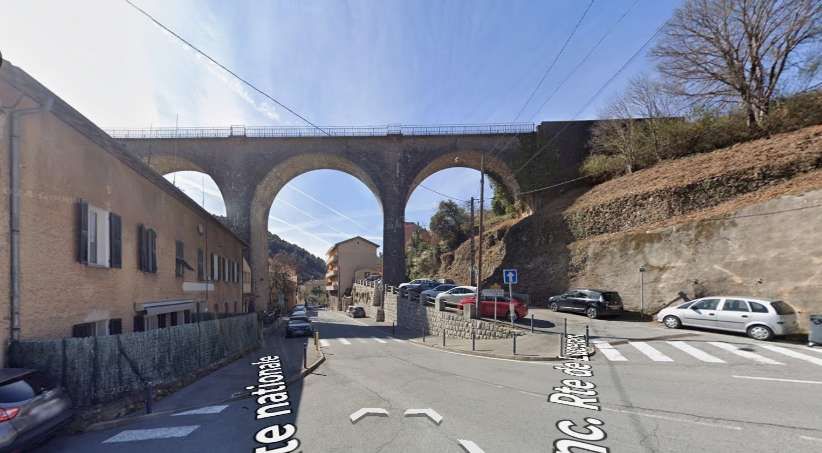
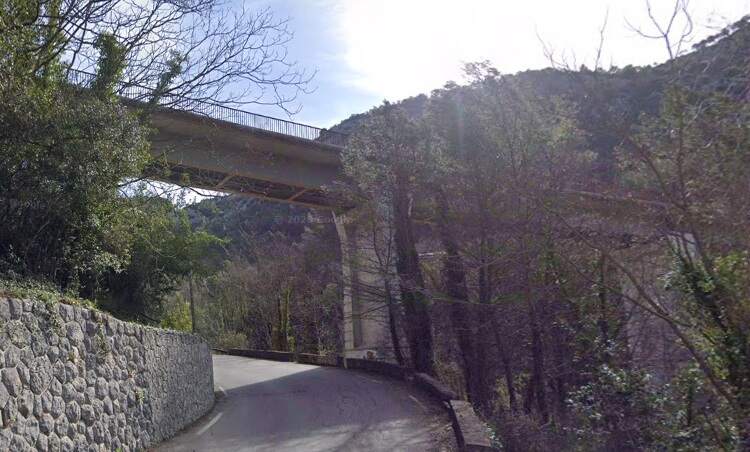
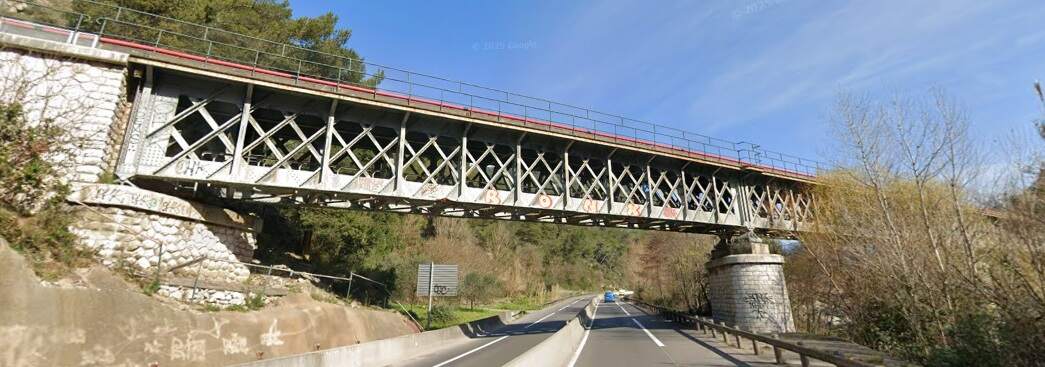
The viaduct seen from the North. The D2204 is directly ahead of the camera and to its right the Anc. Rte de l’Escarene climbs through the first arch of the viaduct. [Google Streetview, March 2023]
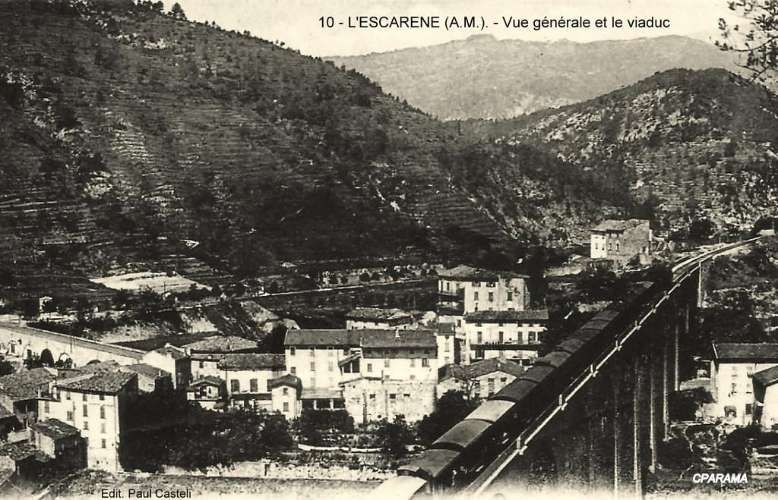
A train crosses the viaduct at l’Escarène, © Public Domain. [17]
A service from Nice approaches l’Escarene Railway Station across the viaduct, © Public Domain. [17]
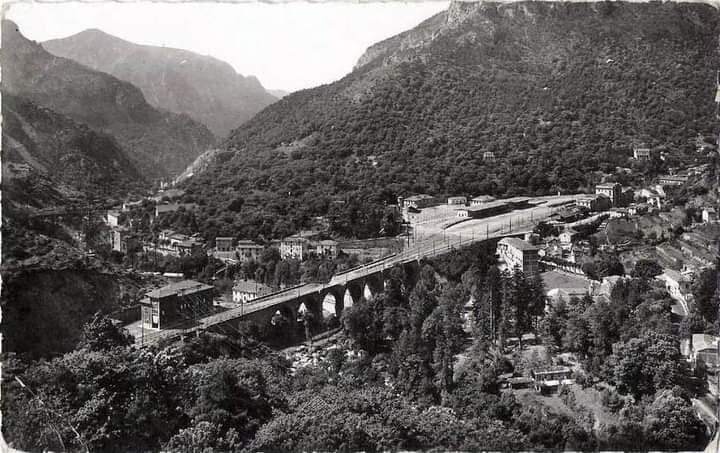
The Railway Station and viaduct at l’Escarene, © Public Domain. [16]
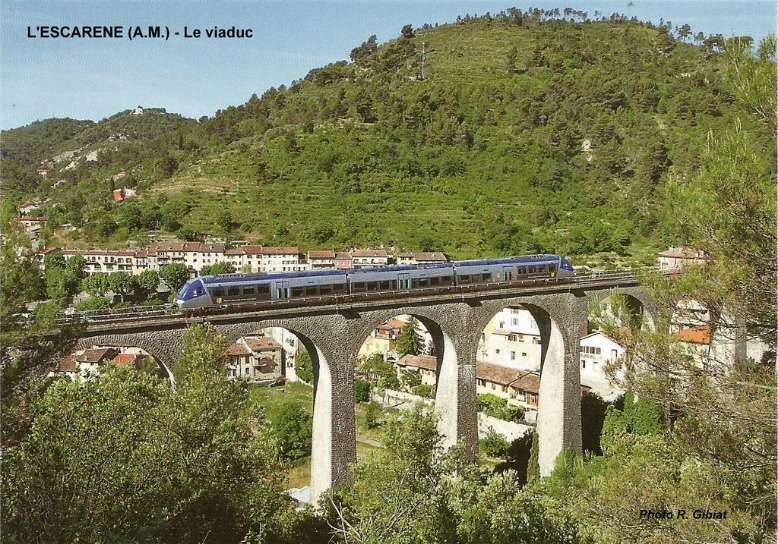
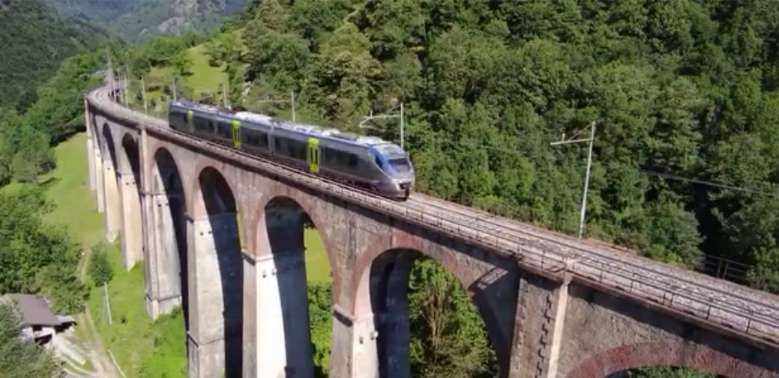
A modern train on the viaduct at ‘Escarene, © Unknown. [17]
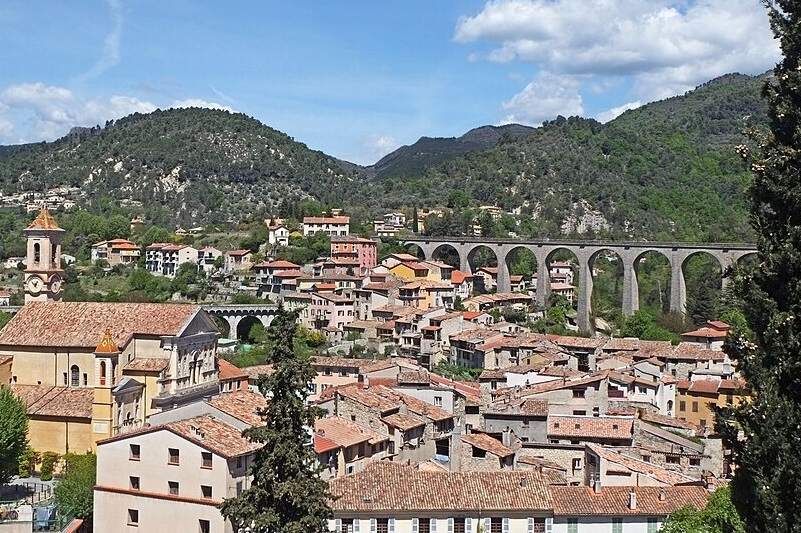
L’Escarene and its Viaduct, (c) J. P. Chevreau and licenced for reuse under a Creative Commons Licence (CC BY-SA 4.0 International). [18]
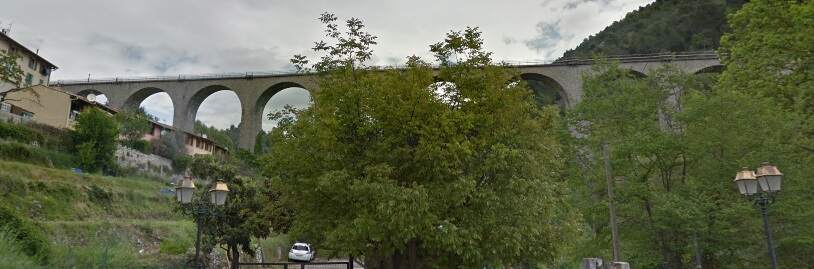
Viaduc de l’Escarene seen from the town. [Google Streetview, May 2013]

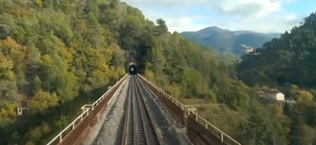
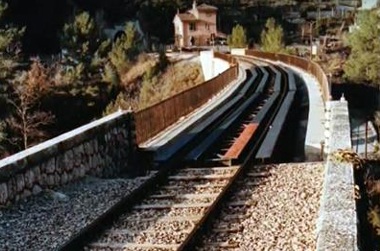
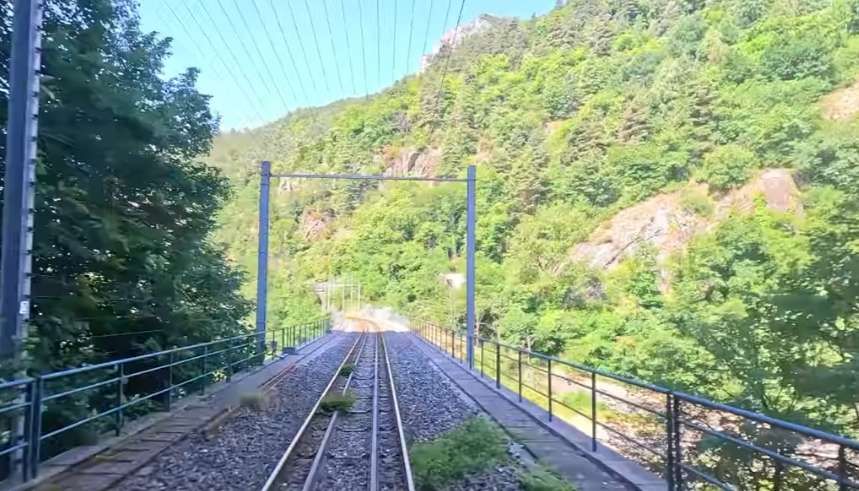
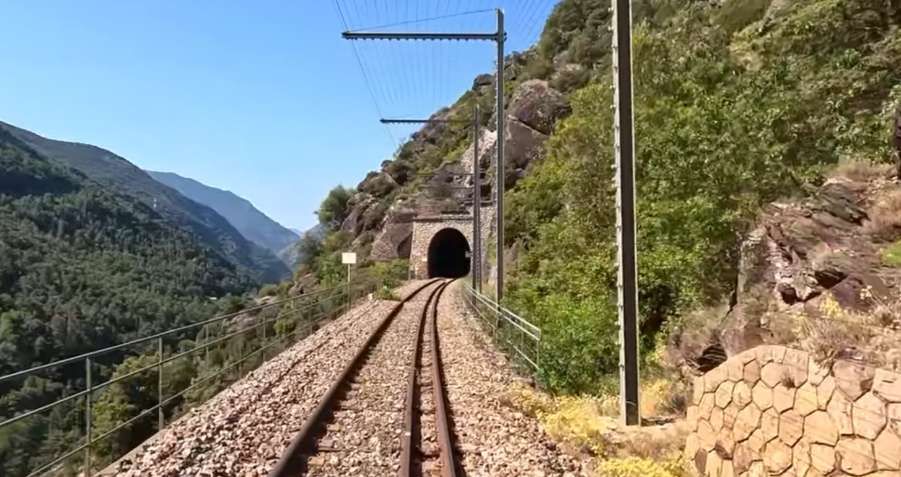
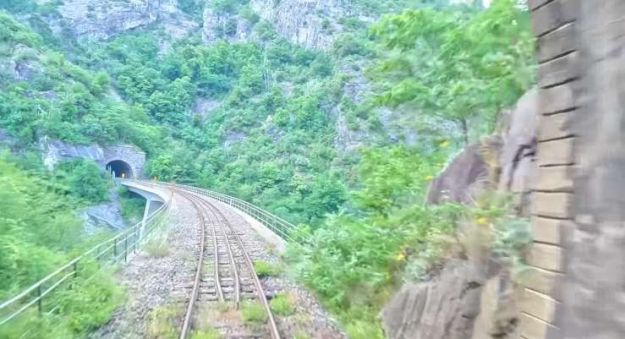
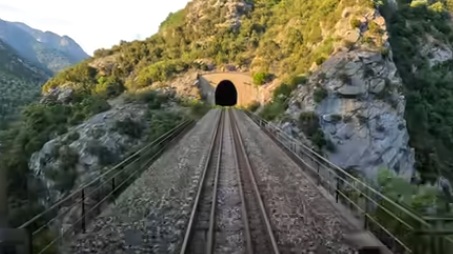
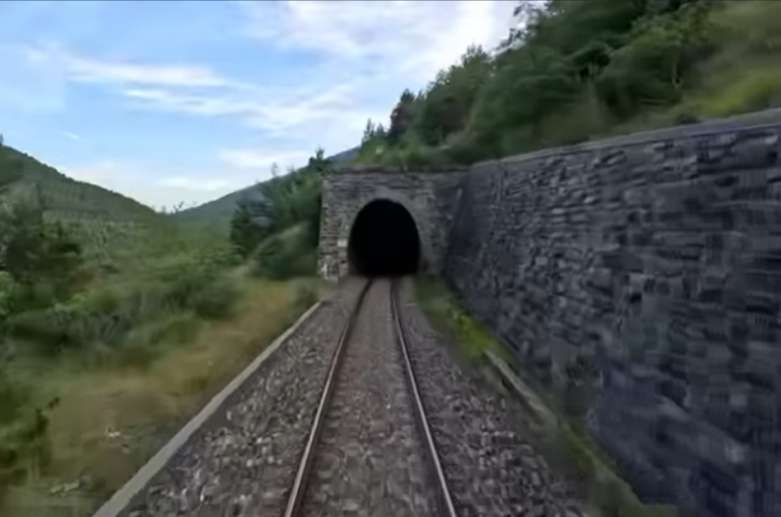
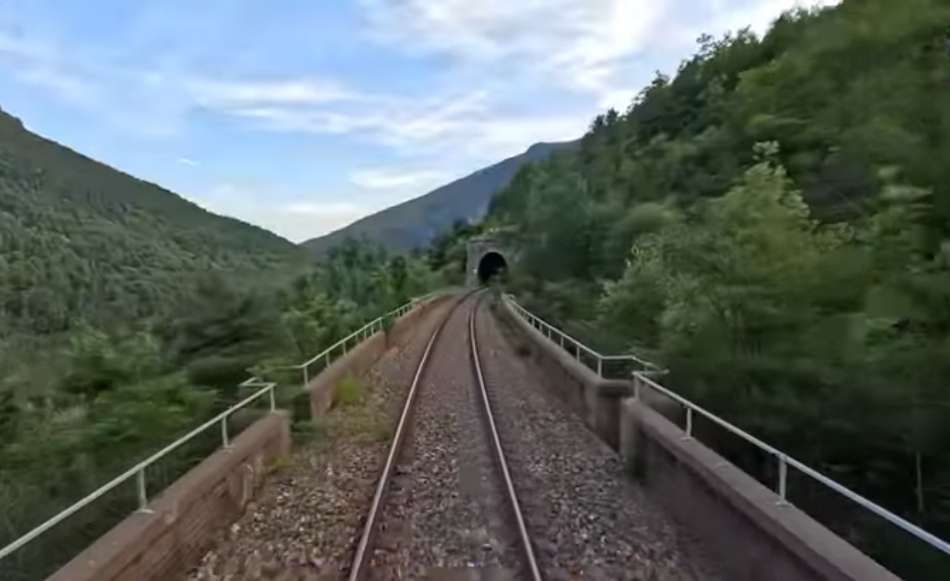
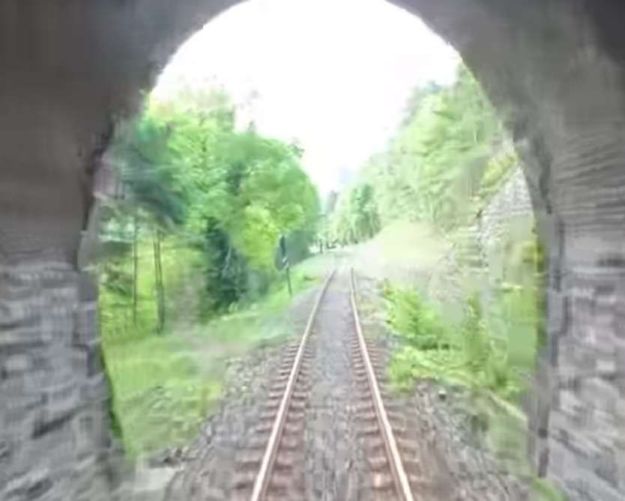
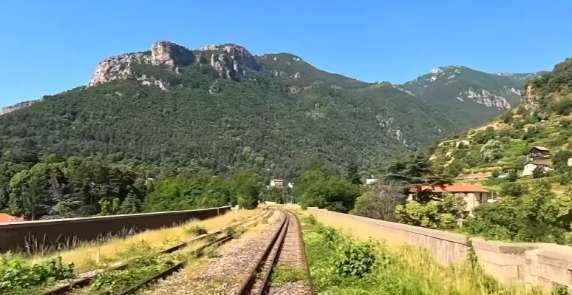
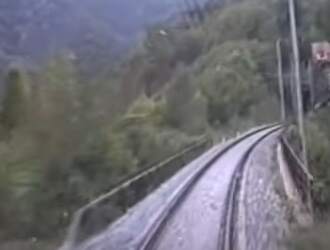
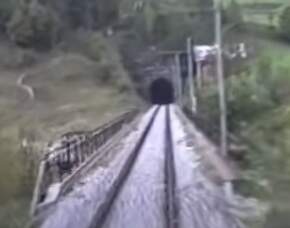
Part way across the viaduct the camera in the cab of the Nice-bound service picks up the metal parapet rails of the viaduct and the short tunnel ahead. [4]

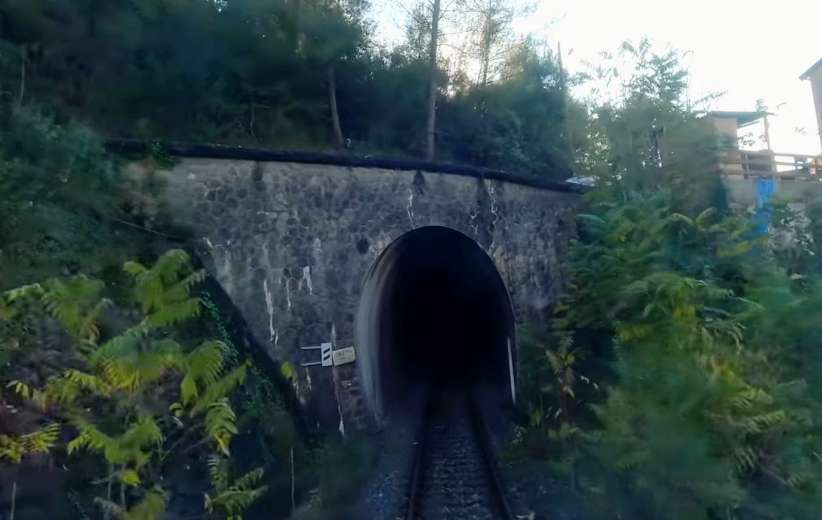
The tunnel at the Southeast end of l’Escarene Viaduct is the Tunnel de Brec (382 metres in length. [19]

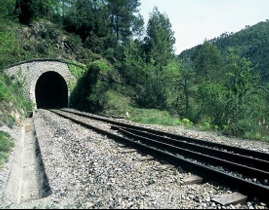
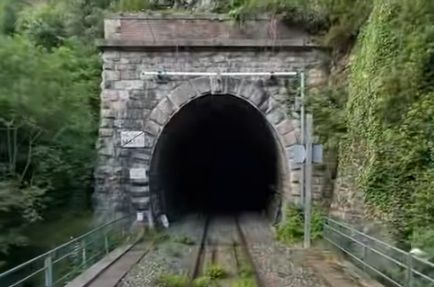
The Northwest portal of Brec Tunnel seen from alongside the line. [19]

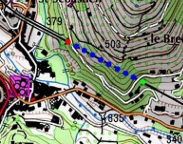
The same crossing on Google’s satellite imagery. [Google Maps, August 2025]

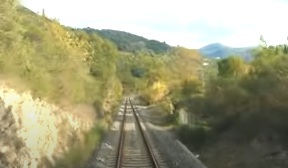
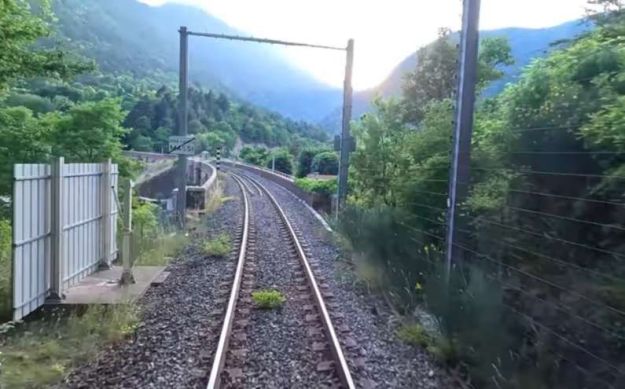
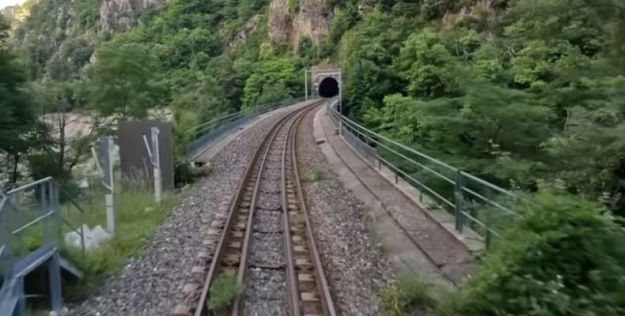
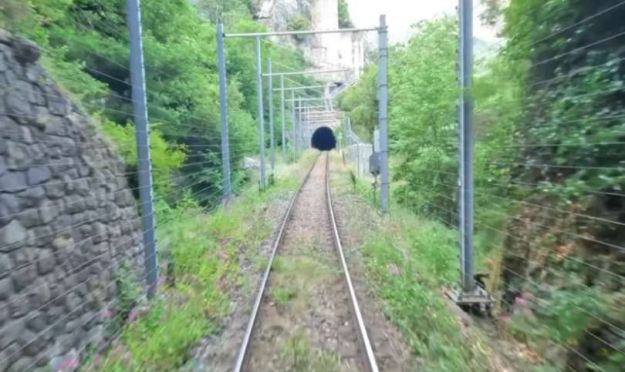
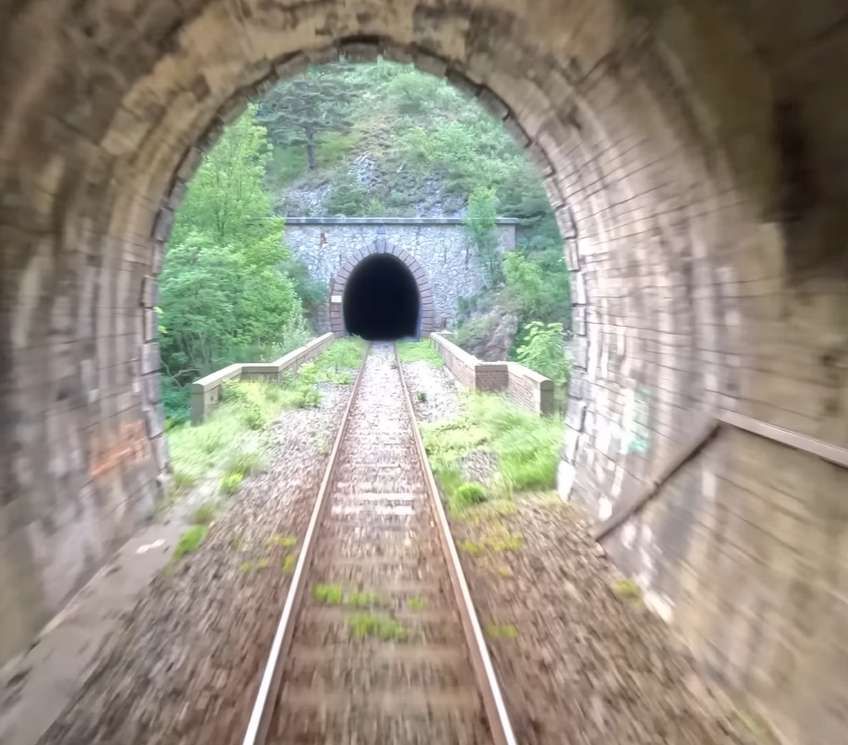
The view Southeast from the mouth of Brec Tunnel. [4]

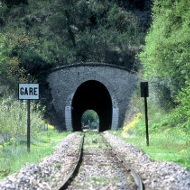
Turning through 180, provides us this view of the Southeast portal of Brec Tunnel. [19]

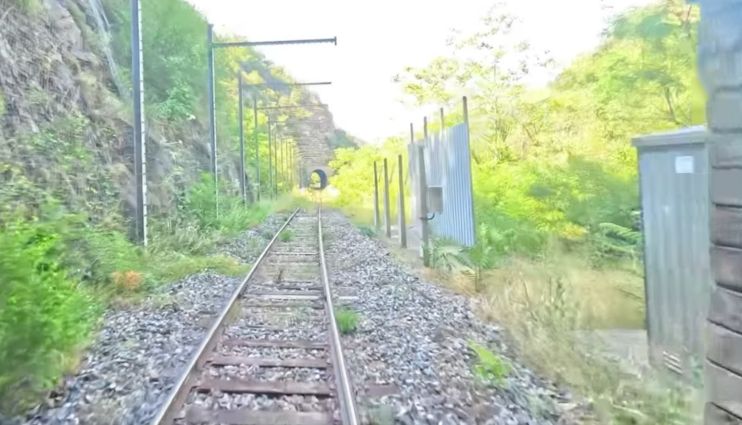
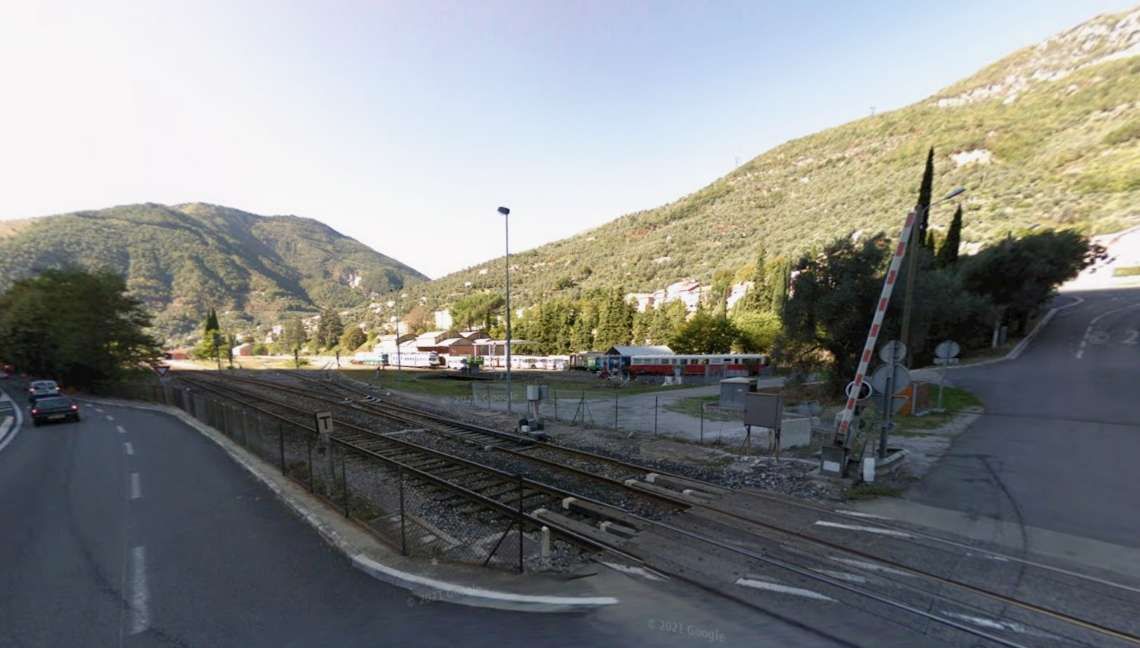
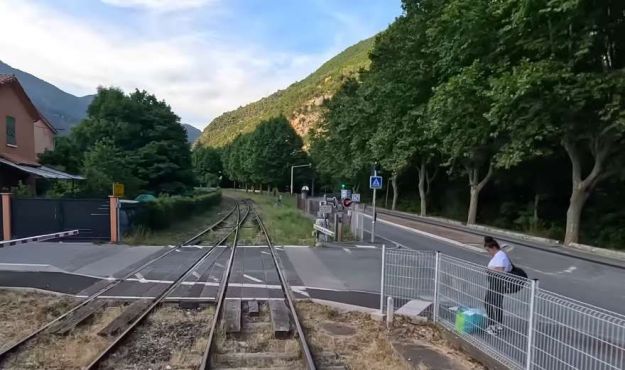
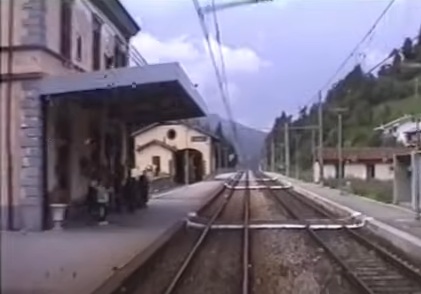
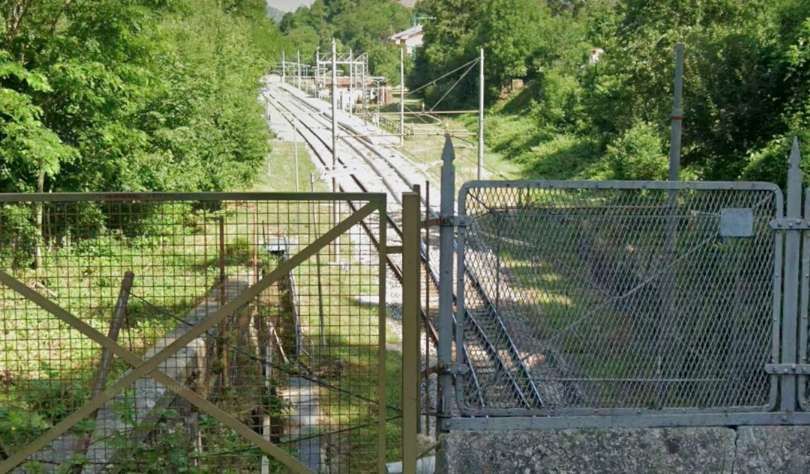
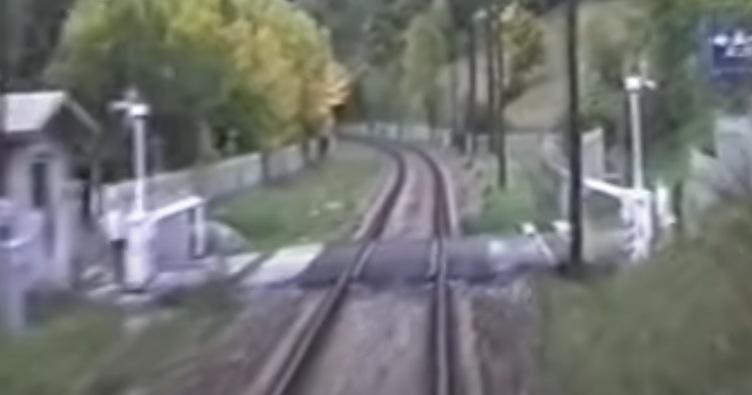
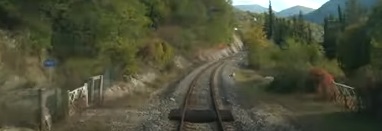
A gated crossing over the line a little further to the Southeast. [4]

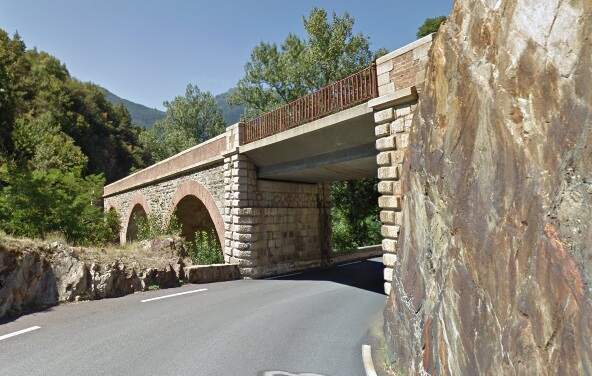
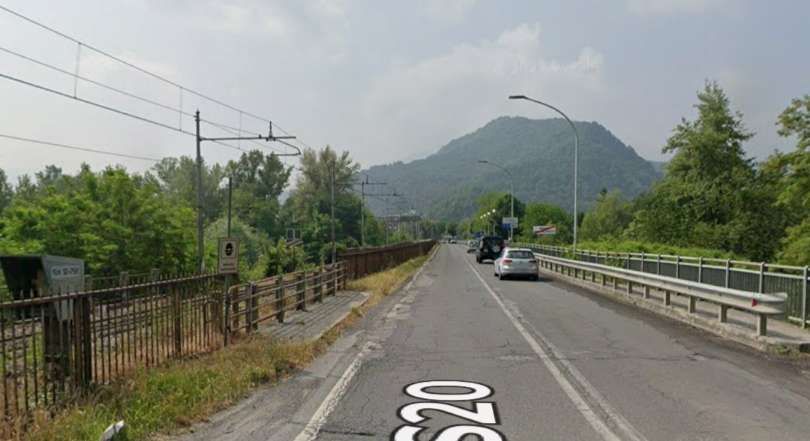
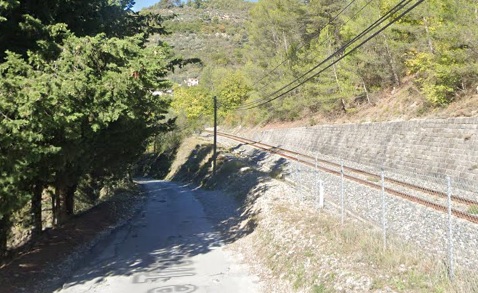
The view from Rte de Tres, looking back towards l’Escarene Railway Station. [Google Streetview, November 2022]
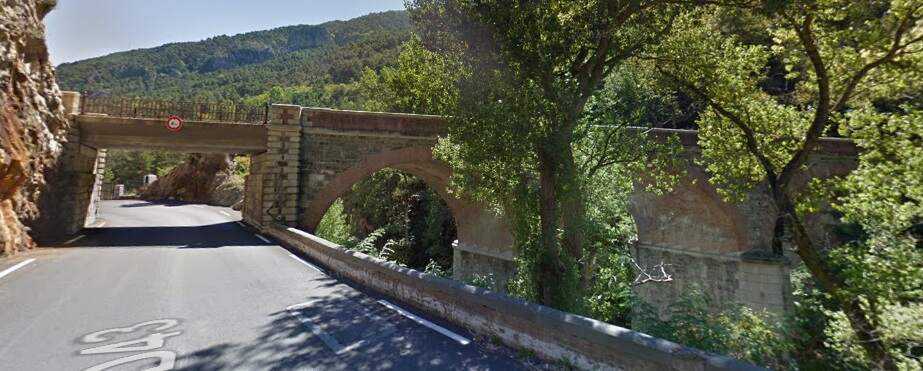
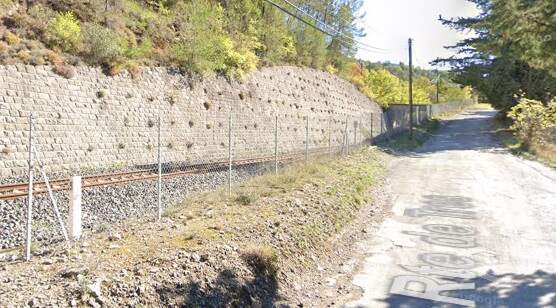
From the same location looking Southeast. Notice the bridge over the line. [Google Streetview, November 2022]

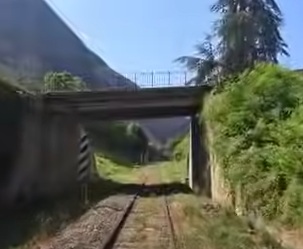
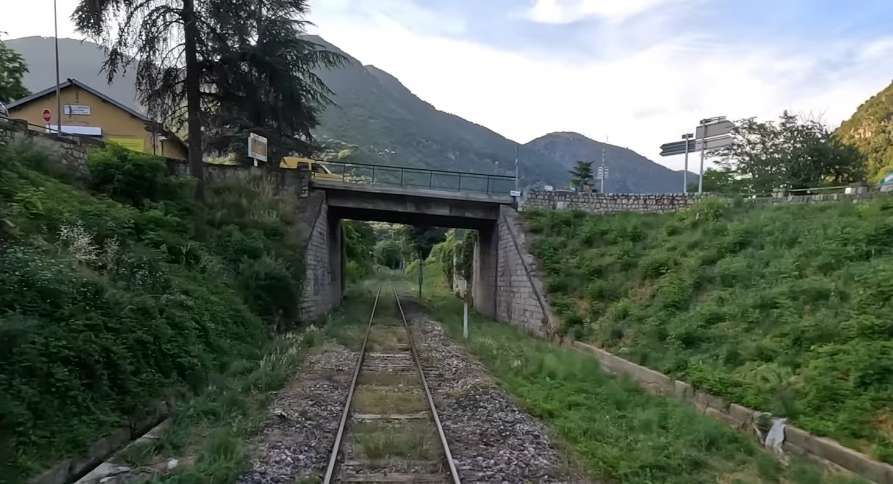
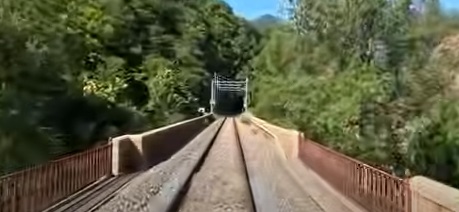
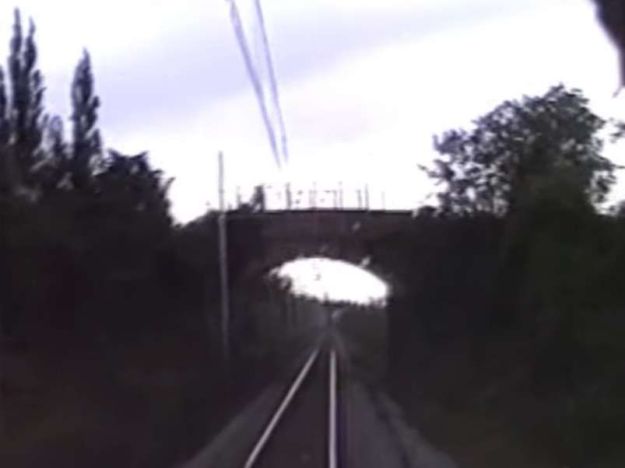
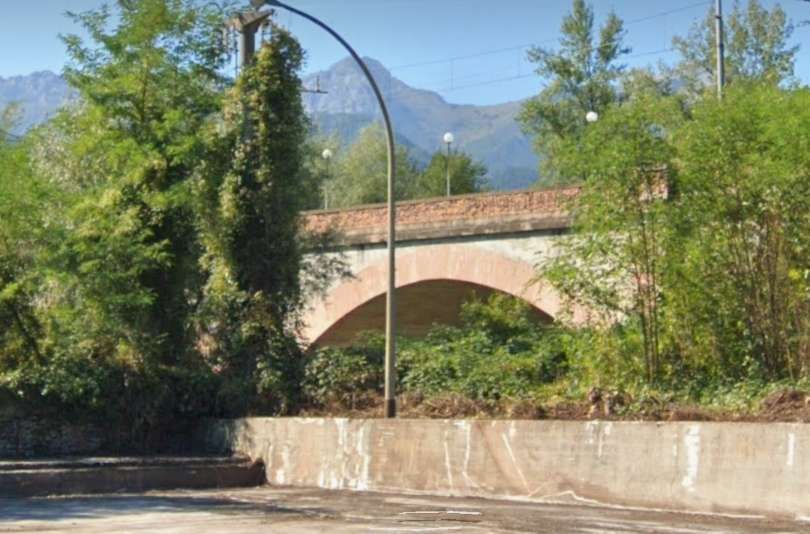
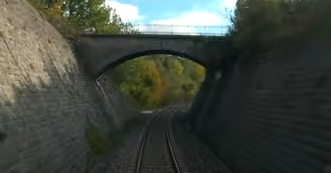
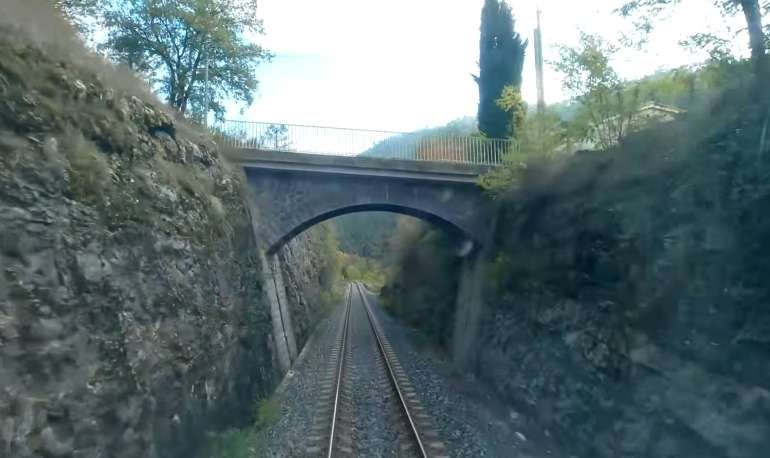
The view of the same bridge from the cab of the Nice-bound train. [4]

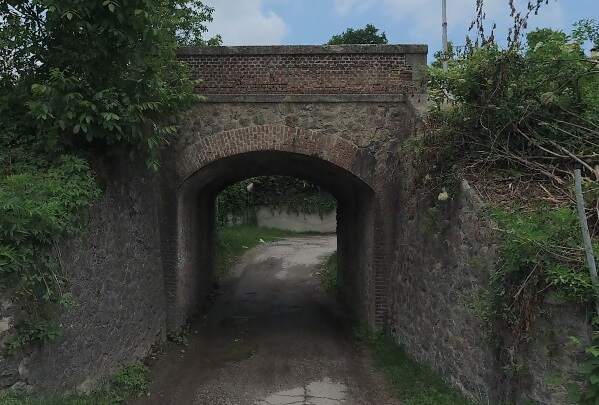
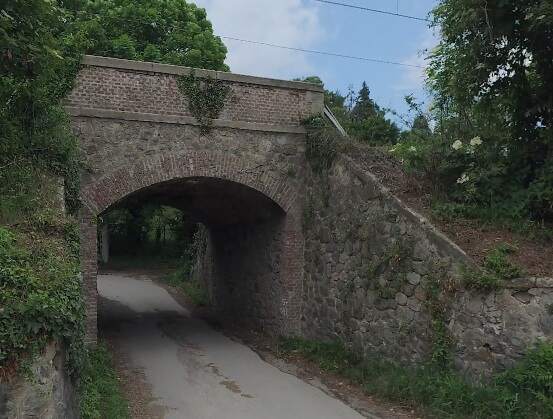
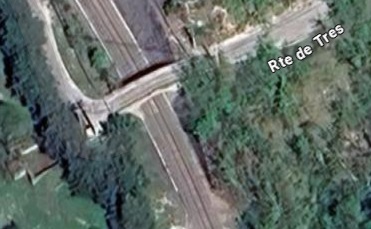
The bridge carry Rte de Tres over the line. [Google Maps, August 2025]

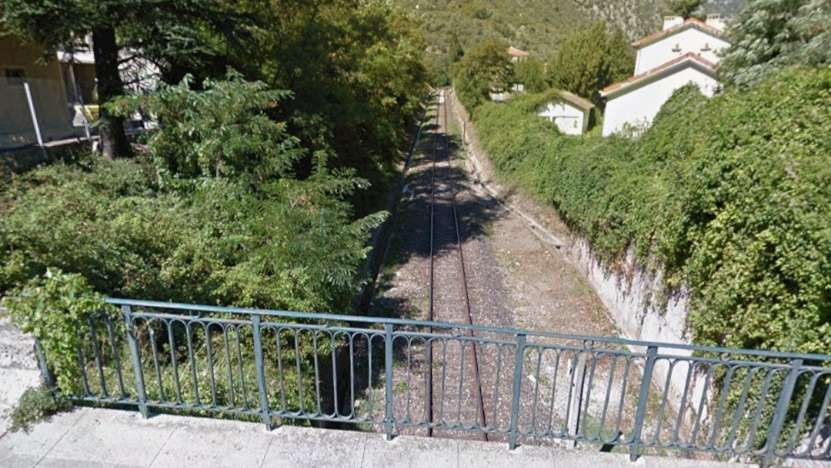
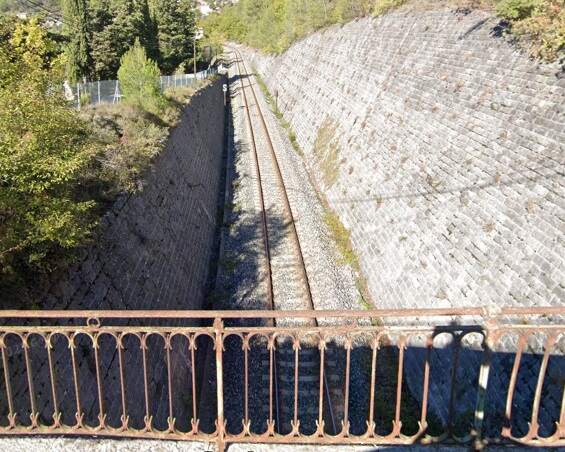
Looking Northwest along the line from the bridge carrying Rte de Tres over the line. [Google Streetview, November 2022]

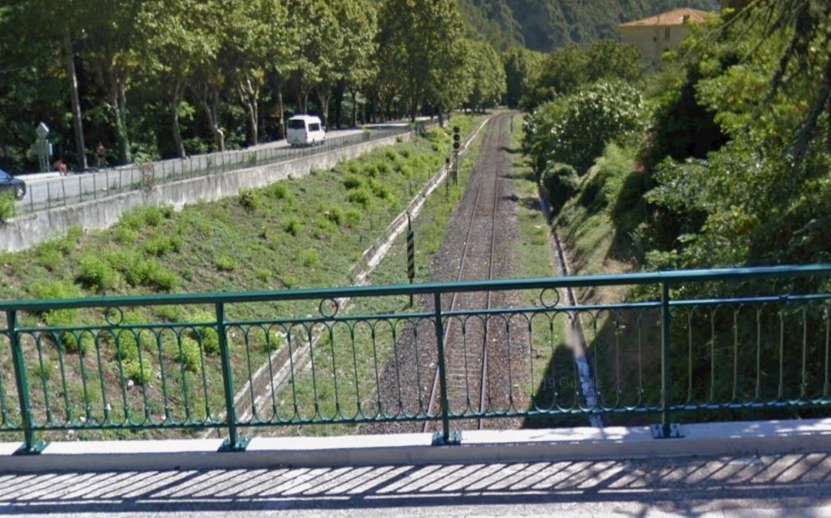
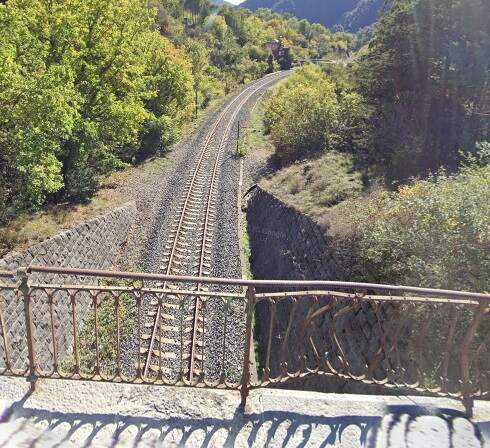
The view Southeast from the same bridge. [Google Streetview, November 2022]

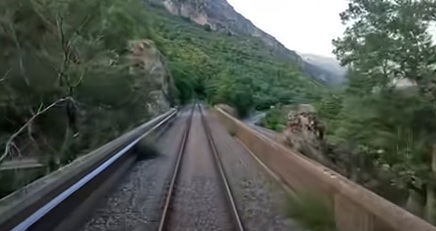
The next overbridge carries Rte de l’Eira over the line. [4]

Looking North from the bridge carrying Rte de l’Eira over the line. [Google Streetview, April 2013]

Looking South from the same bridge. [Google Streetview, April 2013]

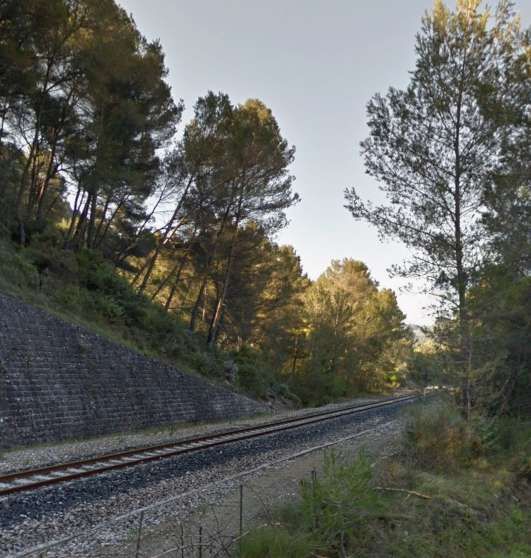
Southeast, the line enters Tunnel de Ecluse (136 metres in length). Just before this, there is a footpath access under the embankment. [34]

The underbridge mentioned above, seen from the D21. [Google Streetview, March 2023]

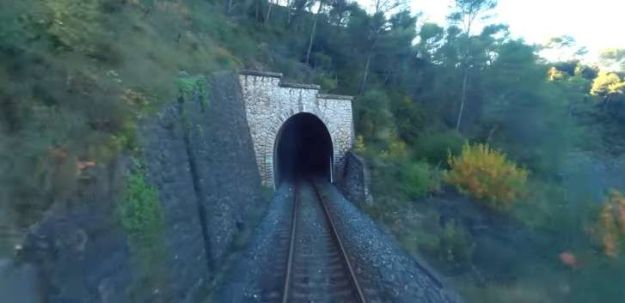
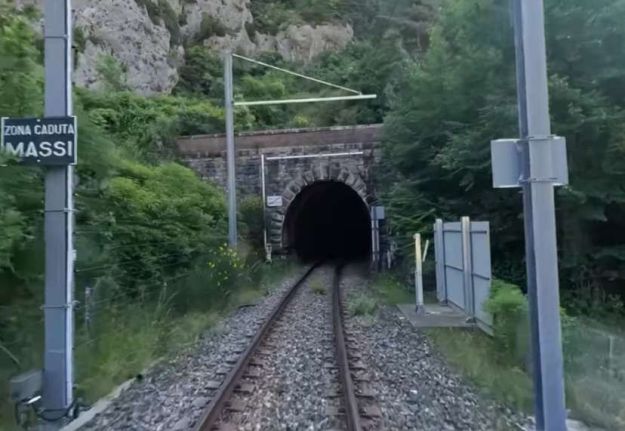
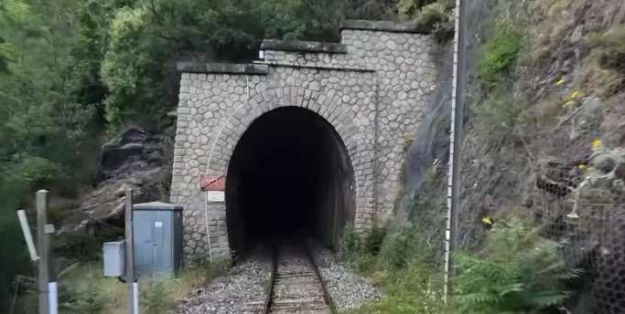
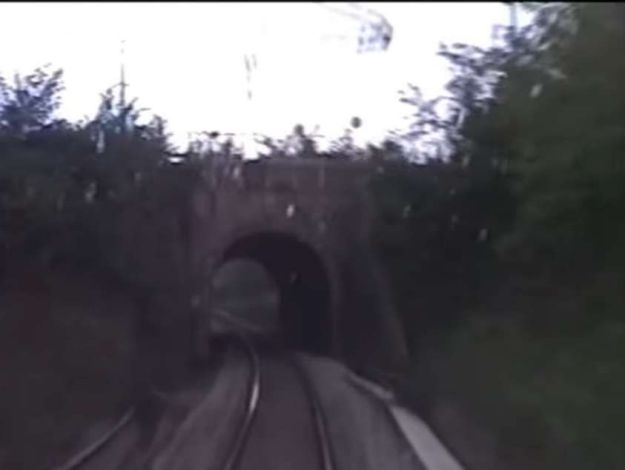
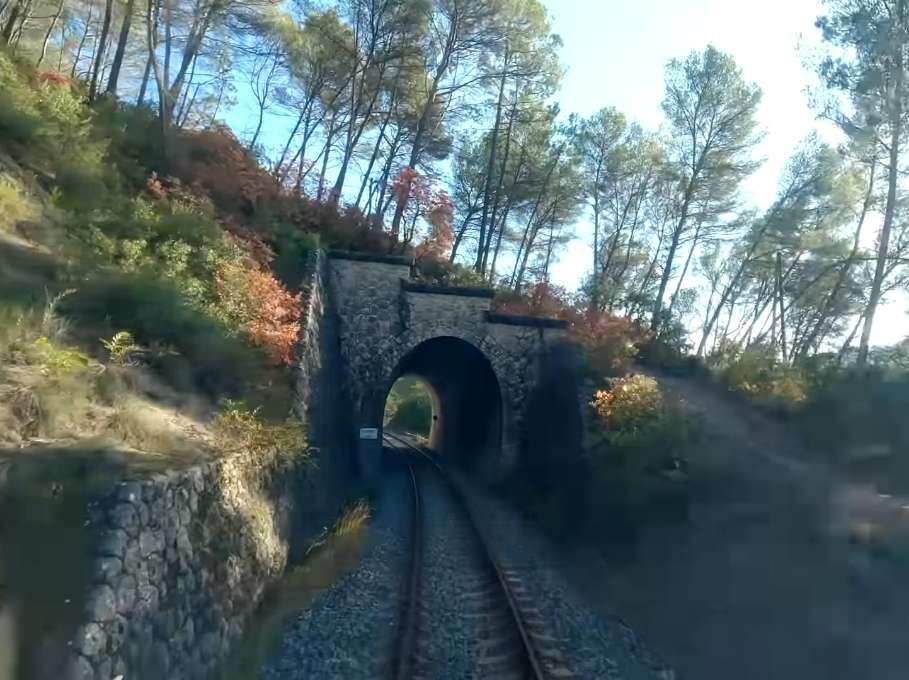
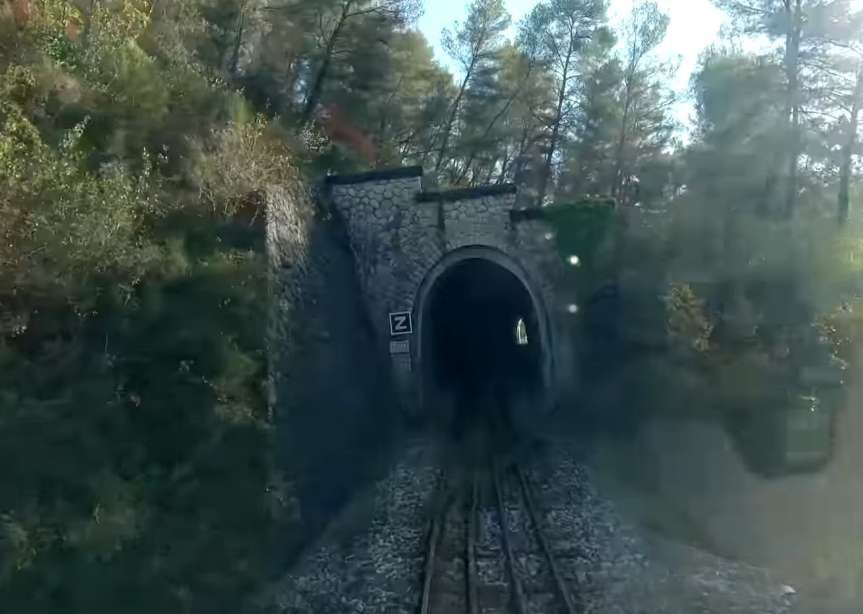
The Northwest portal of Tunnel de Ecluse, seen from the cab of a Nice-bound train. [4]

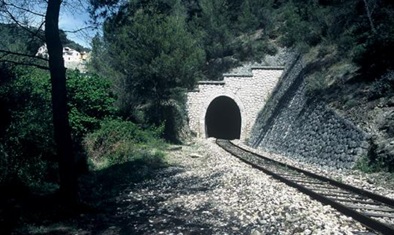
The same tunnel mouth, seen from the lineside. [34]

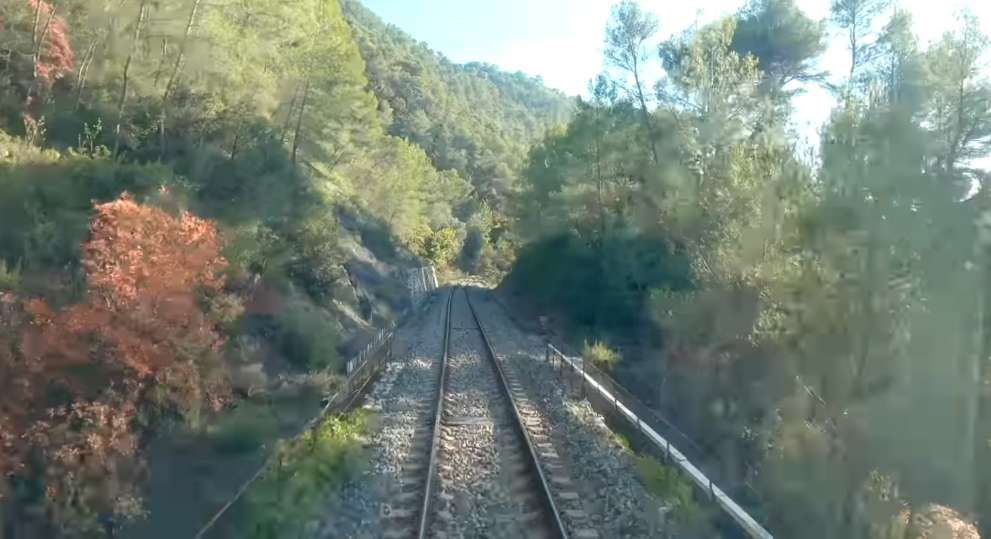
The view from the cab of the Nice-bound train at the Southeast portal of Tunnel de Ecluse. [4]

Turning to face Westnorthwest, this is the Southeast portal of the Tunnel de Ecluse. [34]

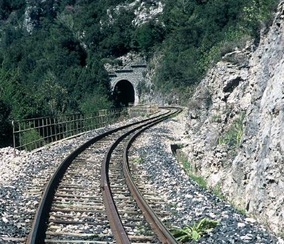
The next feature on the line is a short tunnel – Tunnel d’Euira (63 metres in length). [32]

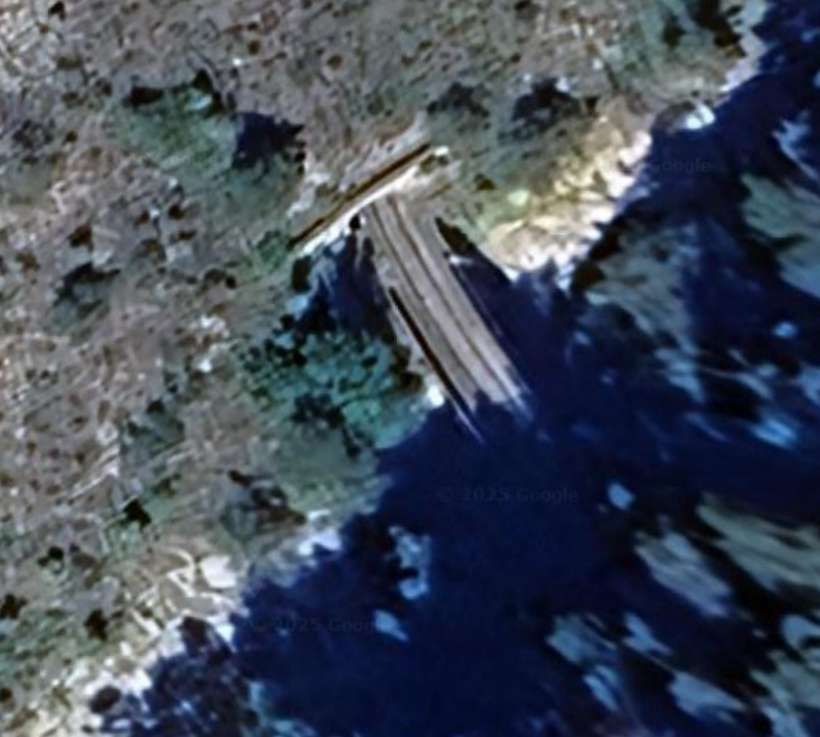
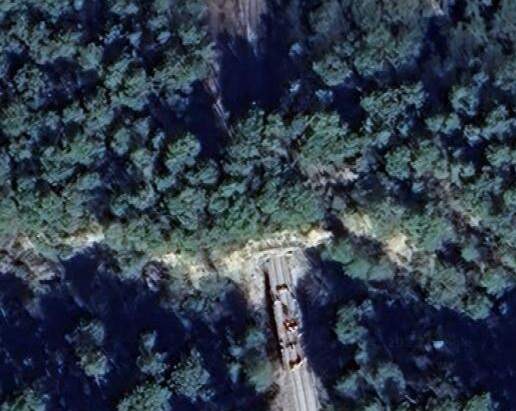
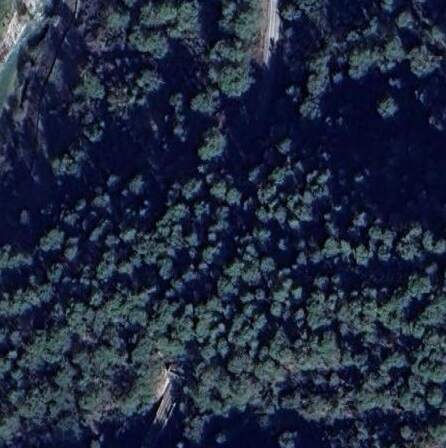
Tunnel d’Euira is on the right side of this satellite image. [Google Maps, September 2025]

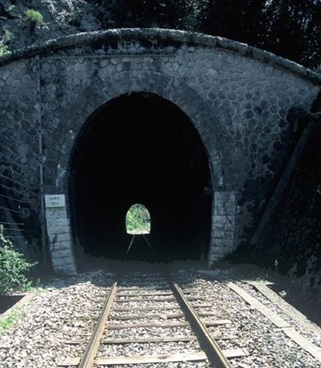
The North portal of Tunnel d’Euira. [32]

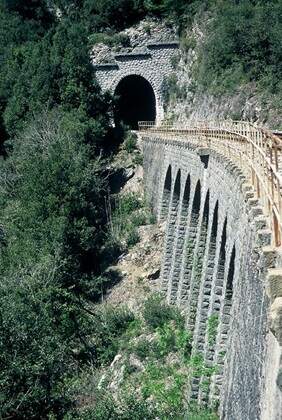
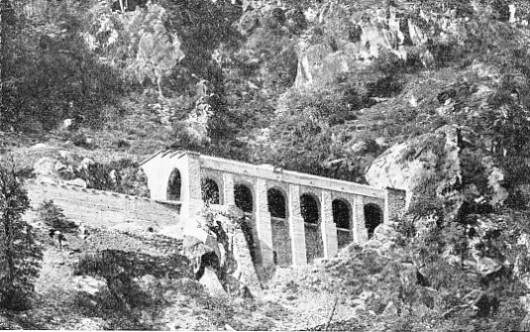
The South portal of Tunnel d’Euira and the galleried retaining structure which carries the line from a point very close to the tunnel portal. [32]

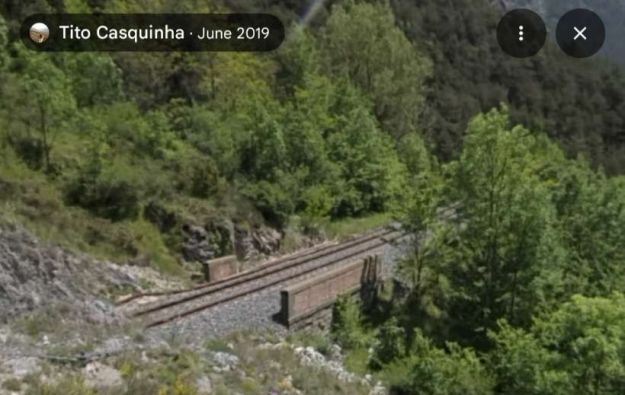
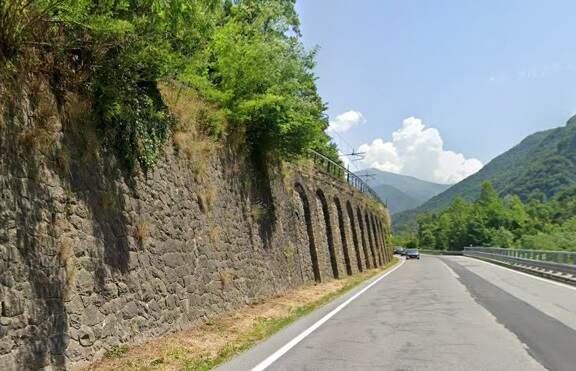
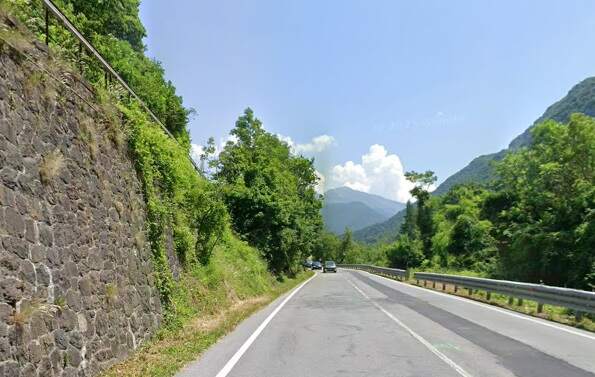
From many an angle, you would be forgiven for thinking that the railway crosses a viaduct. It appears, however, that the structure is a galleried retaining structure which creates a platform for the railway to run on while limiting the wight of the structure on the rock face beneath. [Google Maps, September 2025]

This view of the location from a little further ‘South, shows that the trackbed abuts the rockface on the East side of the line. [32]

Looking East from a short length of the D21, the galleried retaining structure, which is almost a viaduct, can be seen. [Google Streetview, March 2023]

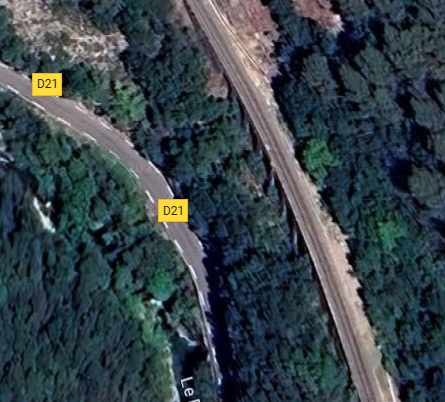
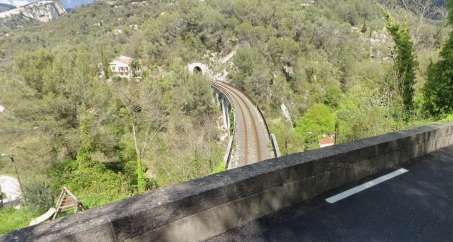
The railway continues on a ‘berm’ built out from the East face of the Paillon valley and high above the D21, until it reaches the Ruisseau d’Euira.

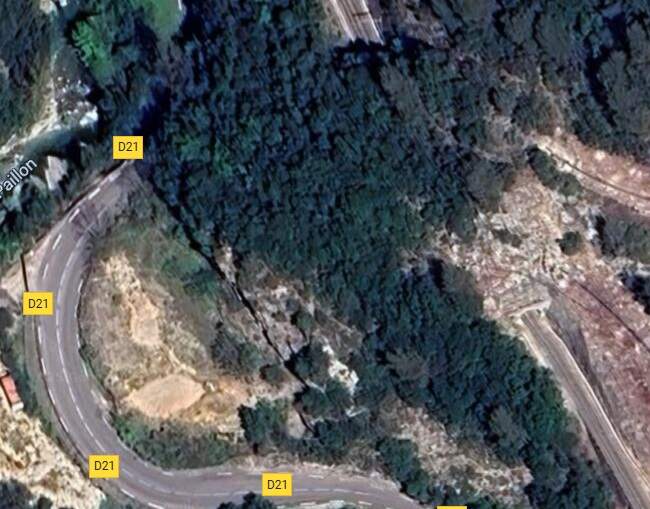
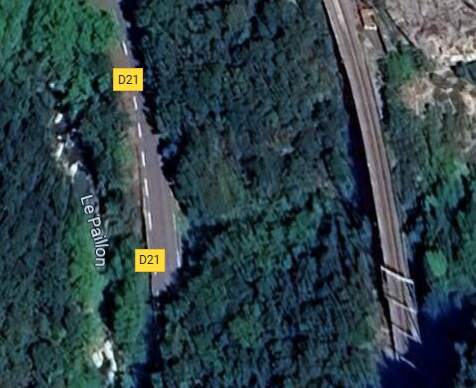
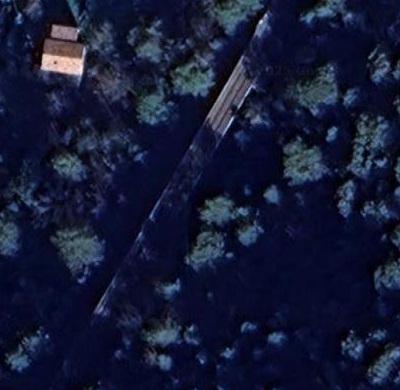
This small extract from Google’s satellite imagery shows Le Paillon, the D21 and the railway in parallel. The railway bridge over the Ruisseau d’Euira is on the right of this image. [Google Maps, September 2025]

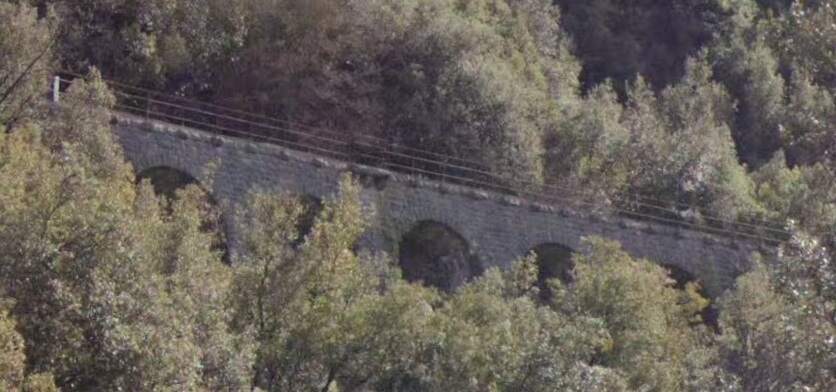
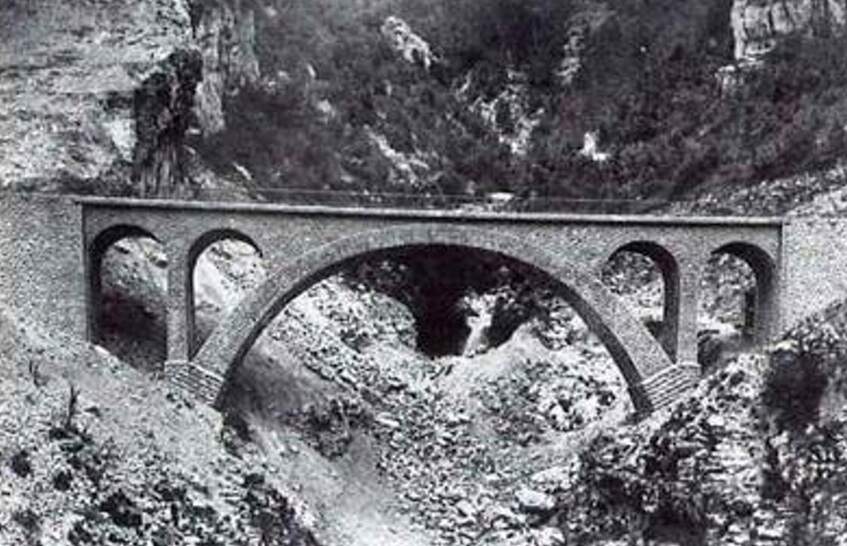
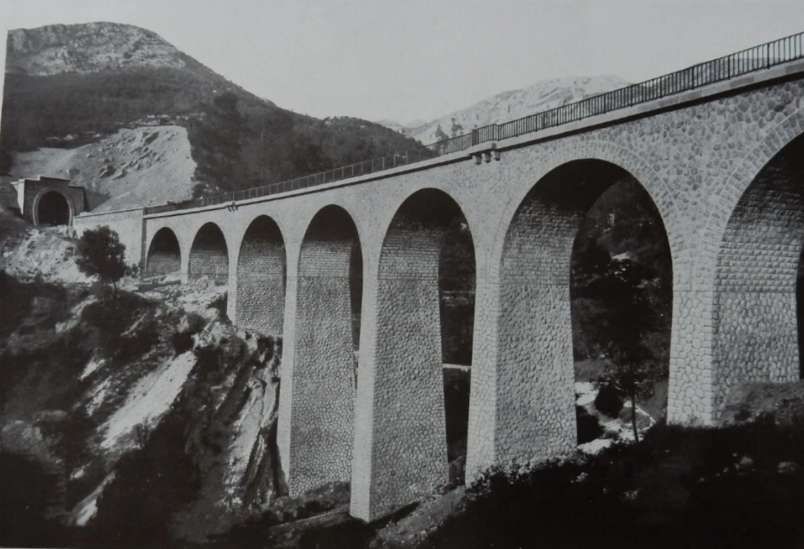
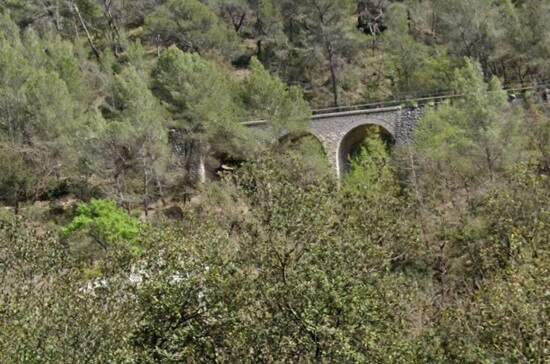
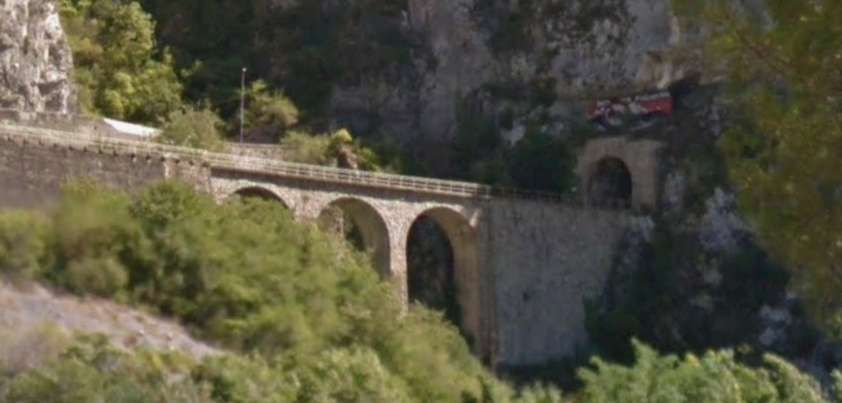
The Viaduc d’Euira crosses the valley of the Ruisseau d’Euira. The viaduct has one 30 m arch and two 5 m arches. [31]

The Viaduc d’Euira was designed by Paul Sejourne. It is a beautiful masonry arch structure which features a large central semi-circular arch framed by two smaller semi-circular arches piercing the spandrel walls, © Public Domain. [31]
The same viaduct seen in much more recent times from the West side of the Paillon valley. The tunnel mouth is the north portal of the Tunnel de Santa Augusta which is the next structure on the line. [31]

The Tunnel de Santa Augusta (754 metres in length) runs under the Ste-Augusta Chapelle. [30]

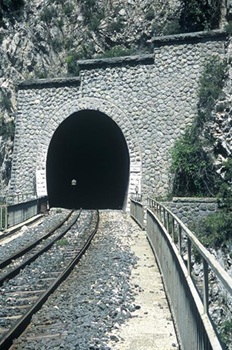
The South portal of the Tunnel de Santa Augusta. As can be seen the tunnel runs straight between the two portals, allowing the light from the North portal to be seen from outside the South portal. This photograph was taken alongside the track crossing the Viaduc d’Erbossièra. [30]

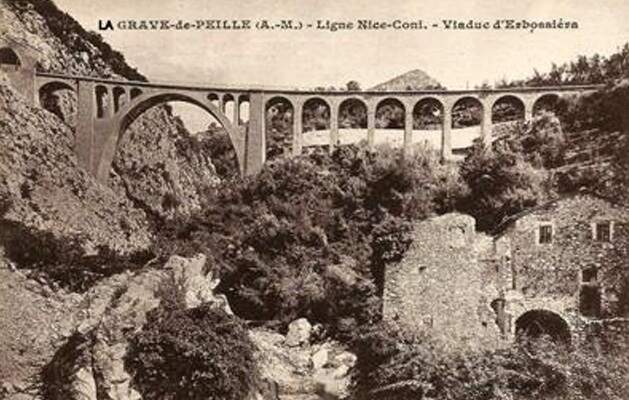
The Viaduc d’Erbossièra (205 metres in length). [29]

The Viaduc d’Erbossièra is another of Paul Sejourne’s elegant designs. It comprises 9 semi-circular arches of 8-metre span; a large 36-metre span arch across the Erbossiera torrent/stream and a final arch of 10-metre span. The spandrel walls of the arch, in this case being pierced by three small arches. The portal to the Ste-Augusta Tunnel can be seen on the left of this picture, © Public Domain. [29]
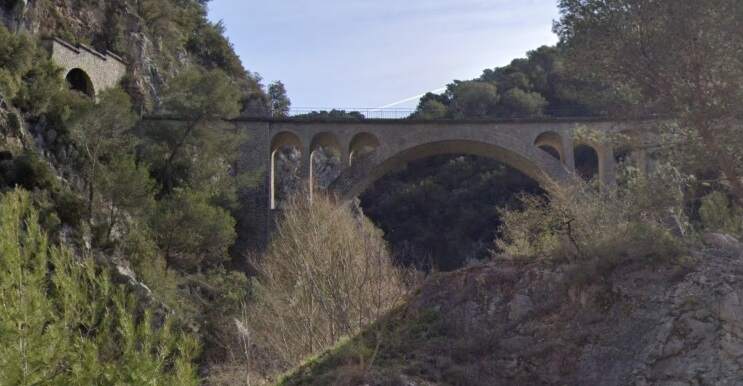
The main span of the viaduct, as seen from the D21 in the valley floor. [Google Streetview, March 2023]

More pictures of this structure, including some early photographs taken during construction can be found here. [29]

A short distance further South the line enters Tunnel de la Verna (197 metres in length). [28]

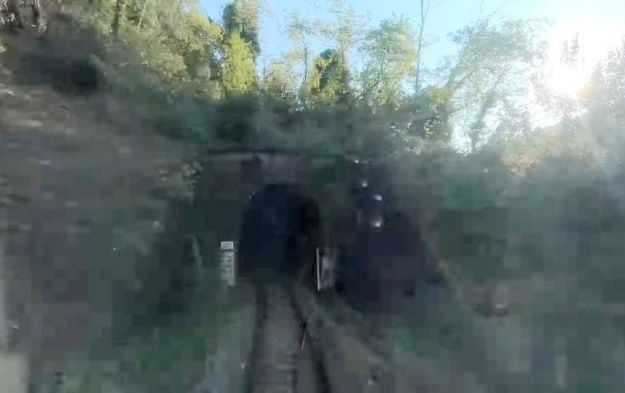
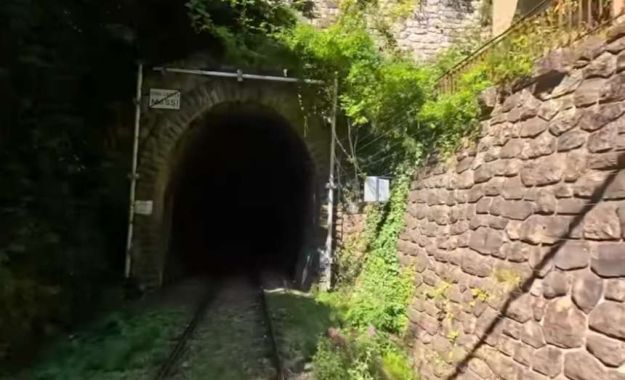
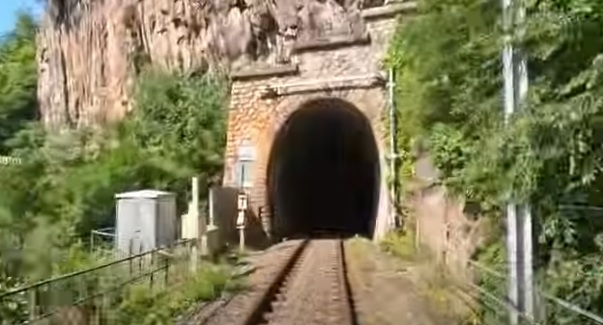
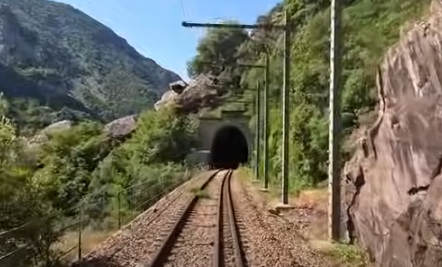
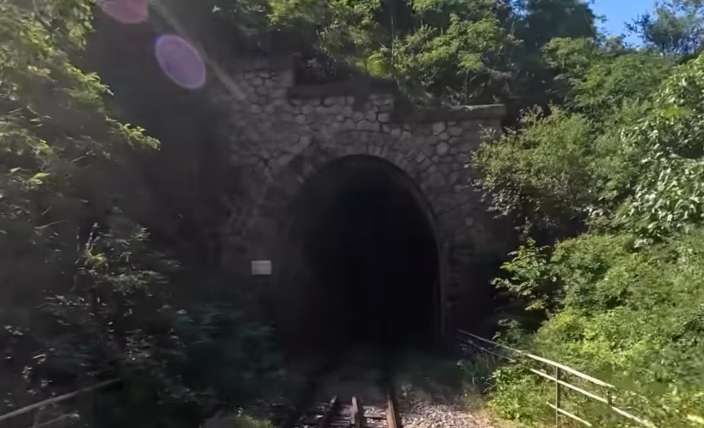
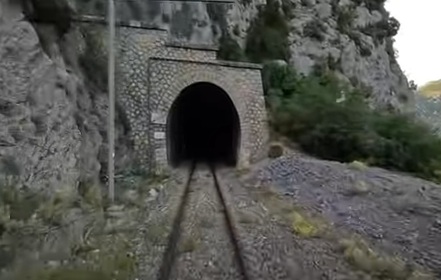
The North Portal seen from the cab of a Nice-bound service. The sun is low in the sky and the tunnel mouth is in deep shade. [4]

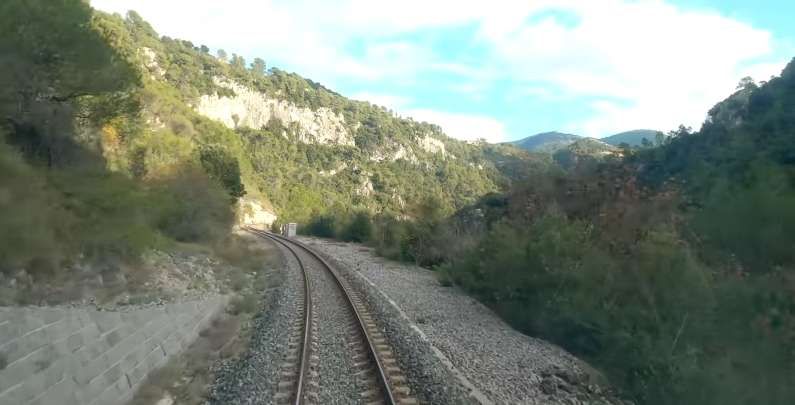
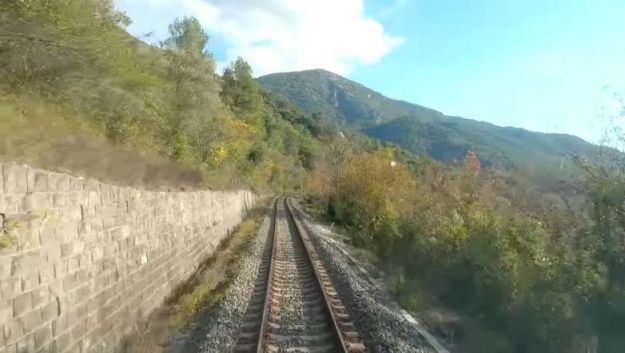
The view from the same train, looking South from the South portal of Tunnel de la Verna. [4]

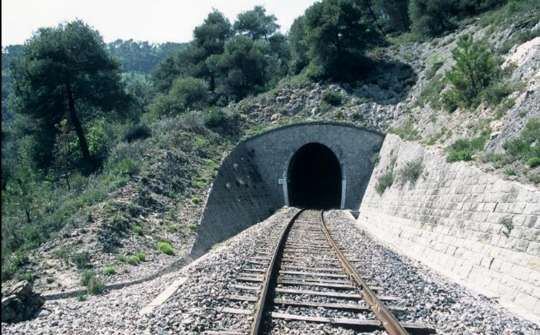
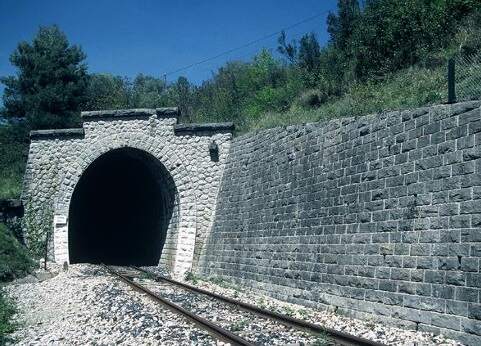
Turning round to face North, this is the South portal of Tunnel de la Verna. [28]

About a further kilometre to the South the line enters Tunnel de’Ecluse.

Tunnel de l’Ecluse (78 metres in length, sits just to the North of Viaduc de Faquin. [21]

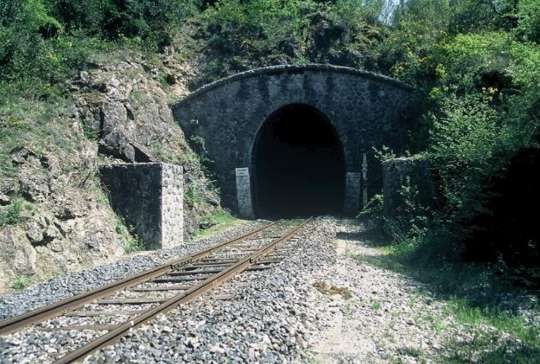
The North portal of Tunnel de l’Ecluse. [21]

The South portal of Tunnel de l’Ecluse and the Viaduc de Faquin. [21]

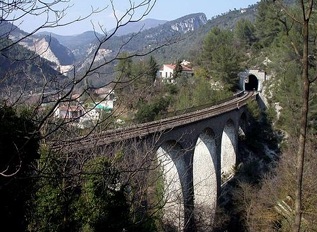
Viaduc de Faquin. [22]

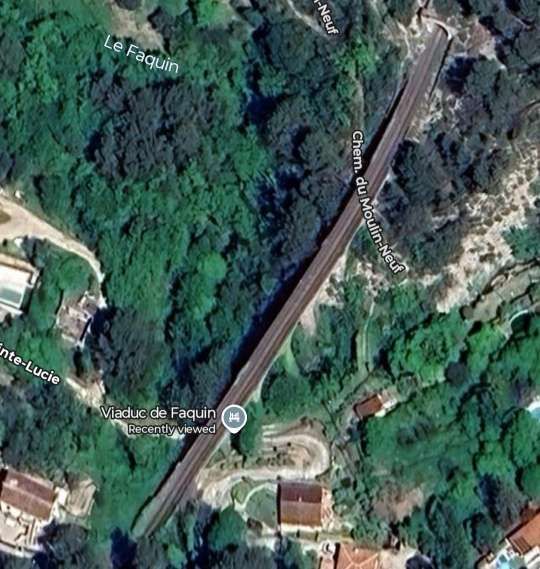
Viaduct de Faquin as seen on Google’s satellite imagery (seven 11-metre arches). [Google Maps, September 2025]

Viaduct de Faquin soon after construction, seen from the Southwest, © Public Domain. [20]

Viaduct de Faquin seen from the West on Chemin de Sainte Lucie in the valley floor. [Google Streetview, January 2011]

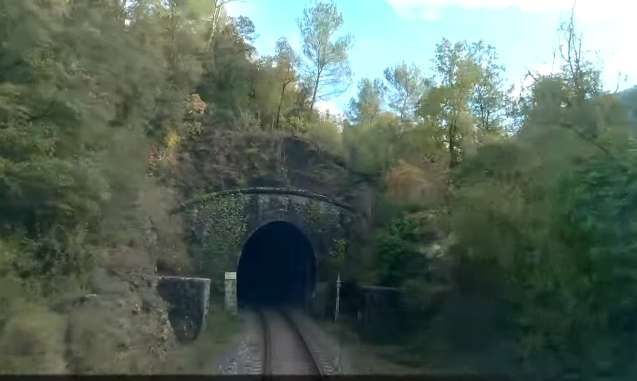
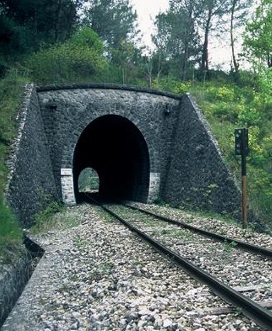
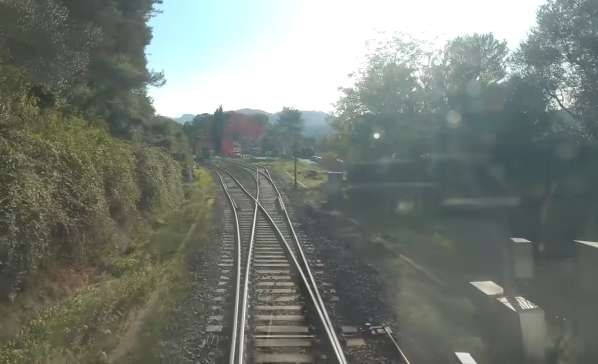
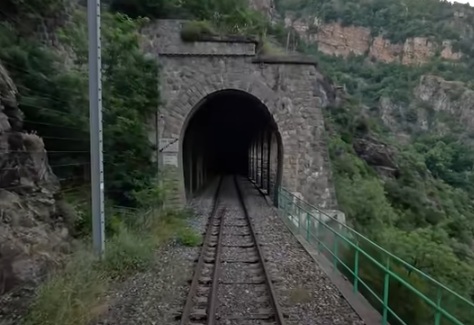
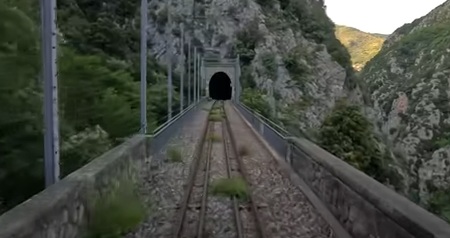
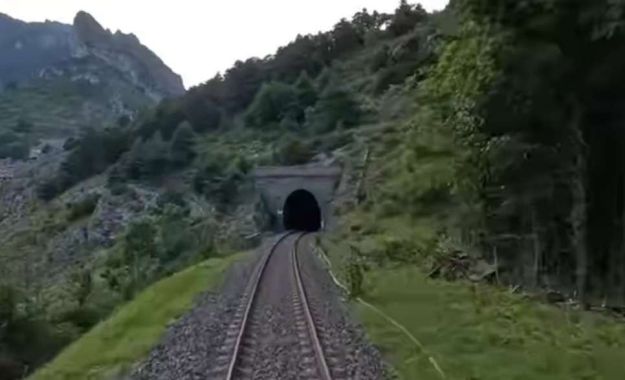
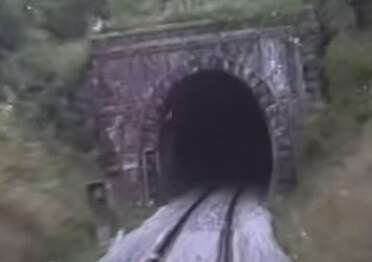
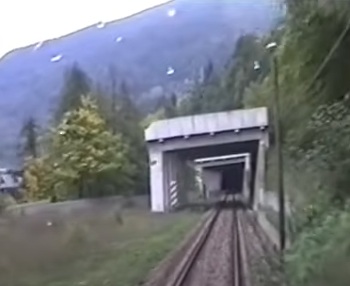
The northern mouth of Tunnel de Coletta, seen from a Nice-bound train. [4]

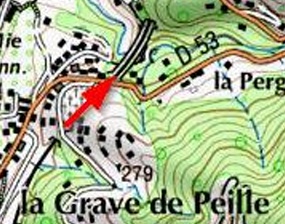
Viaduct de Faquin, seen from the D53 which crossed the line above the tunnel mouth to the South of the viaduct (Tunnel de Coletta). [Google Streetview, April 2023]

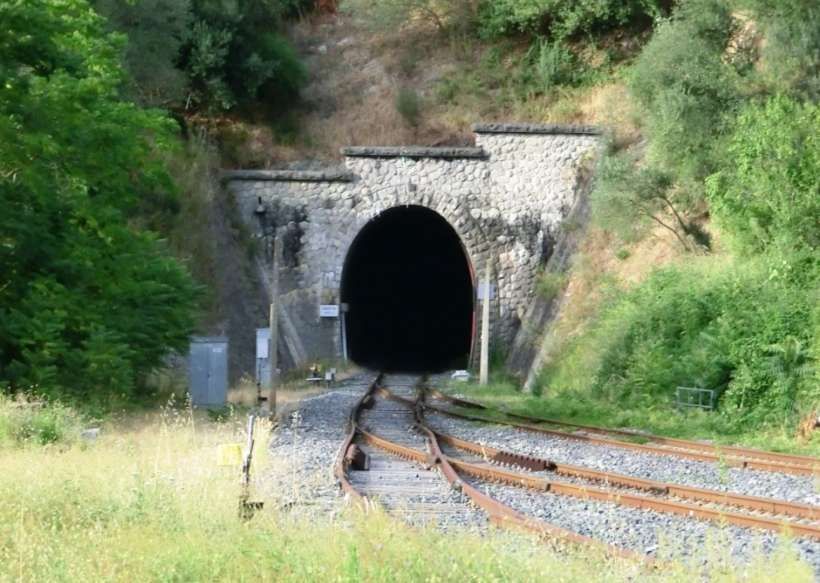
Tunnel de Coletta. [23]

Immediately to the South of Tunnel de Coletta the railway enters Peille Railway Station in Grave de Peille.

The approach to Grave Railway Station, seen from the cab of a Southbound service at the mouth of Tunnel de Coletta. [4]

The southern portal of Tunnel de Coletta, seen from the end of the platform at Peille Railway Station (Grave de Peille), © Eugenio Merzagora and carried on the Structure website. [24]

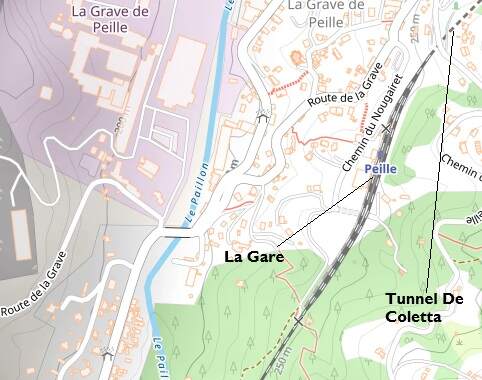
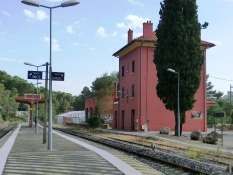
Le Gare de Peille is situated on the East bank of the River Paillon on a pan artificial plateau which was created as part of the construction of the line from Nice to breil-sur-Roya. [26]

Peille Railway Station is located 6 km from the village of the same name, and serves the La Grave district, where the Vicat company operated a quarry and cement factory from 1924. A branch of the TNL tramway network reached this point from Pont-de-Peille. [1: p92]

The view from the carriage door of a Nice-bound train of Peille Railway Station (La Gare de Peille), © Eugenio Merzagora (2019) and shared on the Structurae Website. [28]

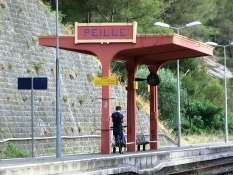
The island platform shelter, La Gare de Peille, seen from the Northwest, © Eugenio Merzagora (2019) and shared on the Structurae Website. [28]

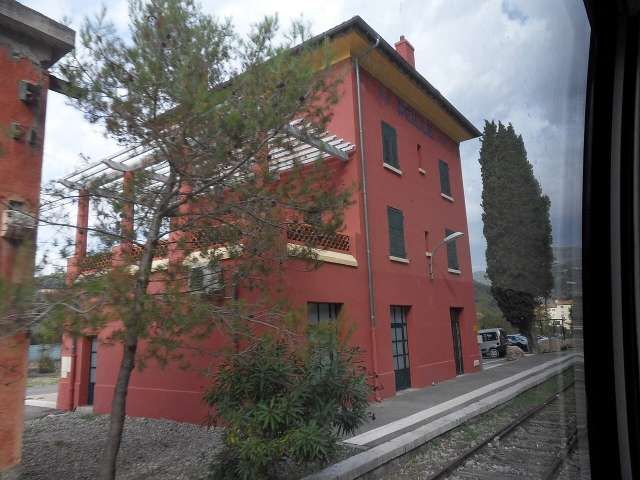
The station building at Peille, seen from the South through the window of a Breil-sur-Roya train, © G CHP, and licenced for reuse under a Creative Commons Licence (CC BY 2.5). [34]
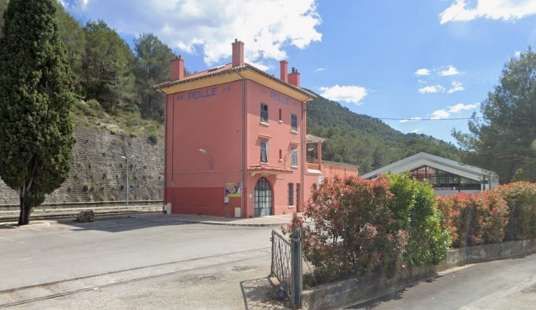
A roadside view of the Station building at Peille. [Google Streetview, April 2023]
A Briel-sur-Roya-bound service sits at Peille Railway Station. The train is an “XGC” railcar X 76583/76584, © R. Gibiat (2011) and shared on Le Rail Ussellois (Modern Postcards with Railway and Urban Transport Themes) Website. [36]
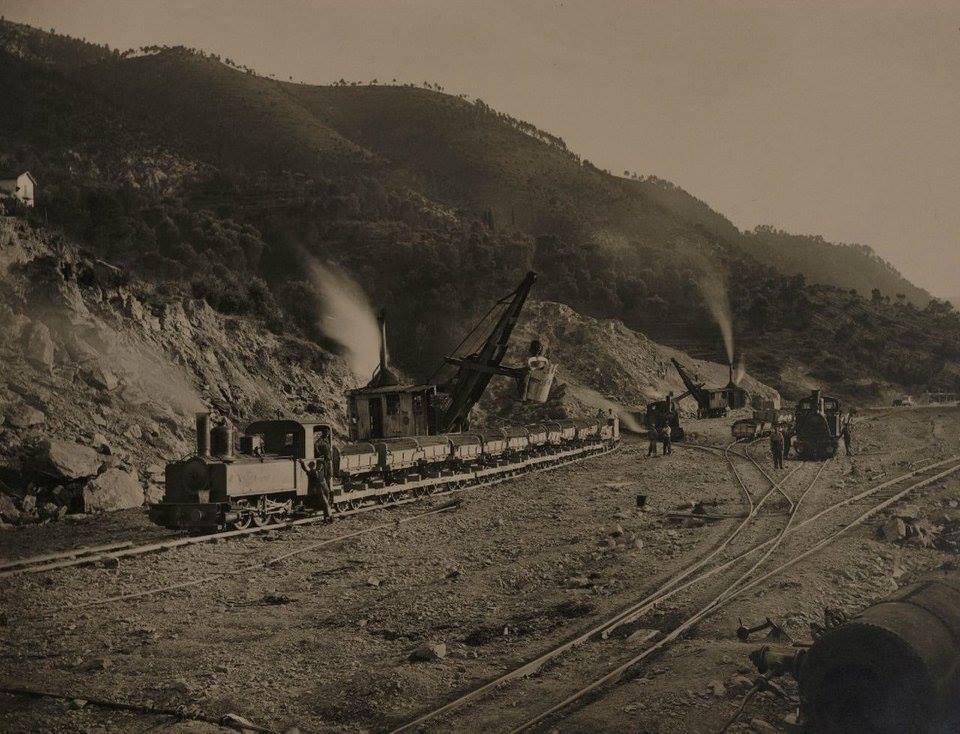
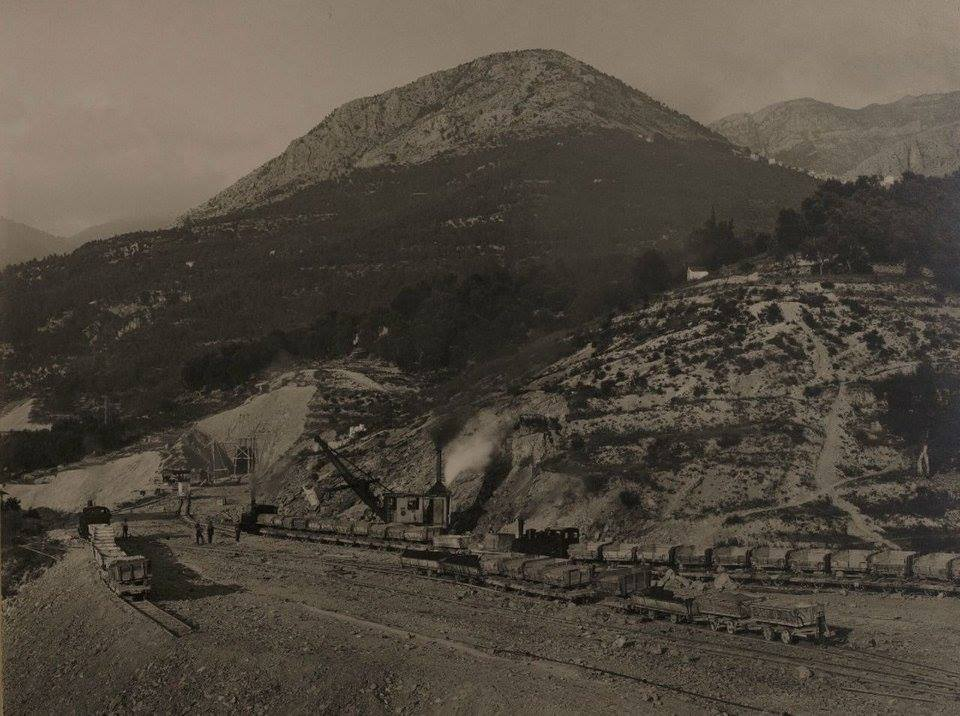
1925: Earthworks underway for the PLM Railway Station at La Grave de Peille © Public Domain. This image was shared on the L’Histoire de Menton et ses Alentours Facebook Page by Pierre Richert on 22nd November 2017. [14]
1925: Earthworks underway for the PLM Railway Station at La Grave de Peille © Public Domain. This image was shared on the L’Histoire de Menton et ses Alentours Facebook Page by Pierre Richert on 22nd November 2017. [7]
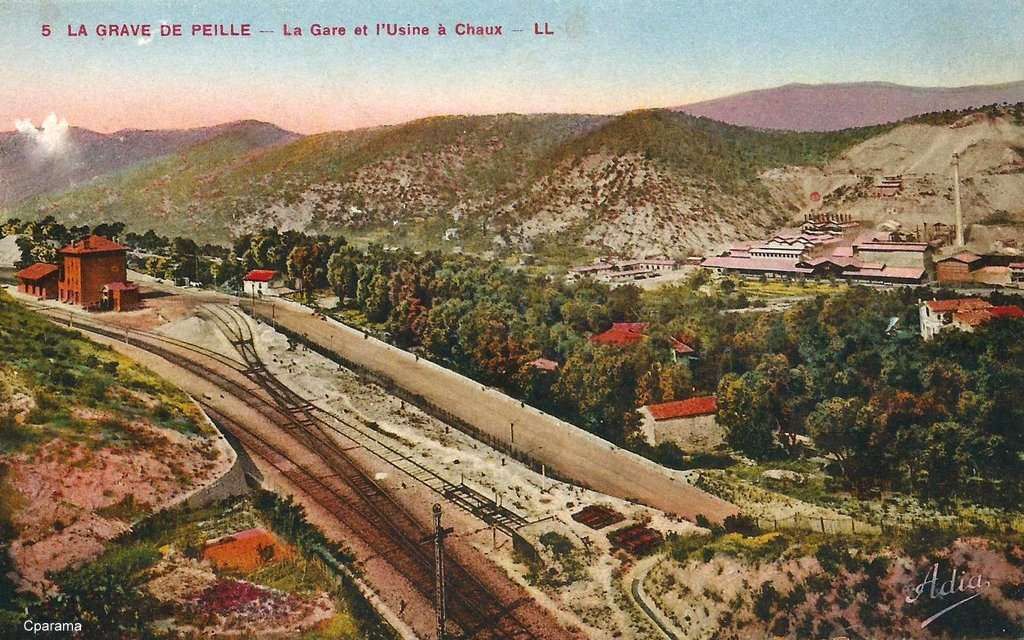
An early postcard showing the railway station at Peille with the cement works visible in the distance on the right side of the image, © Public Domain. [7]
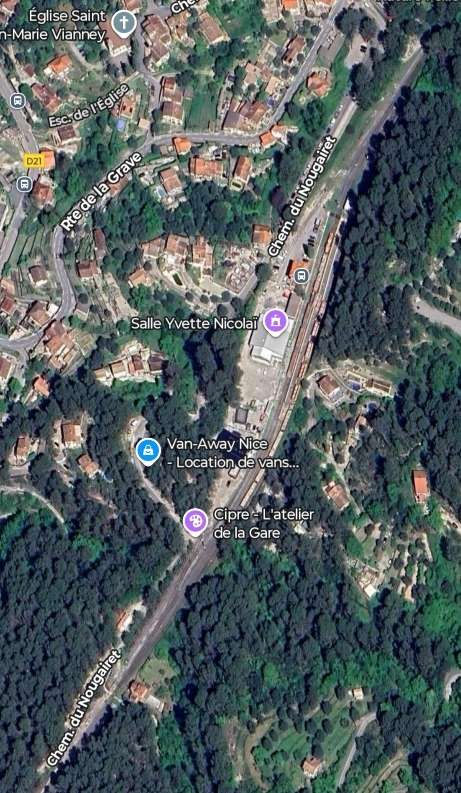
La Gare de Peille as seen on Google’s satellite imagery. [Google Maps, September 2025]
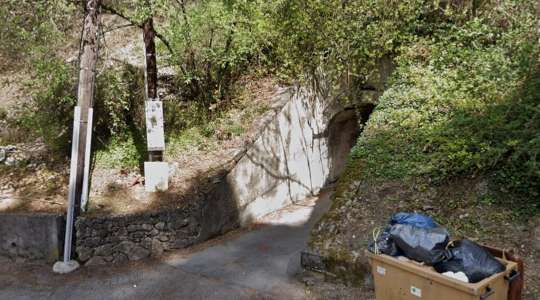
A narrow underpass under the station site, seen from the West on Chemin de Nogairet at a point adjacent to the lilac flag on the satellite image above. [Google Streetview, April 2023]

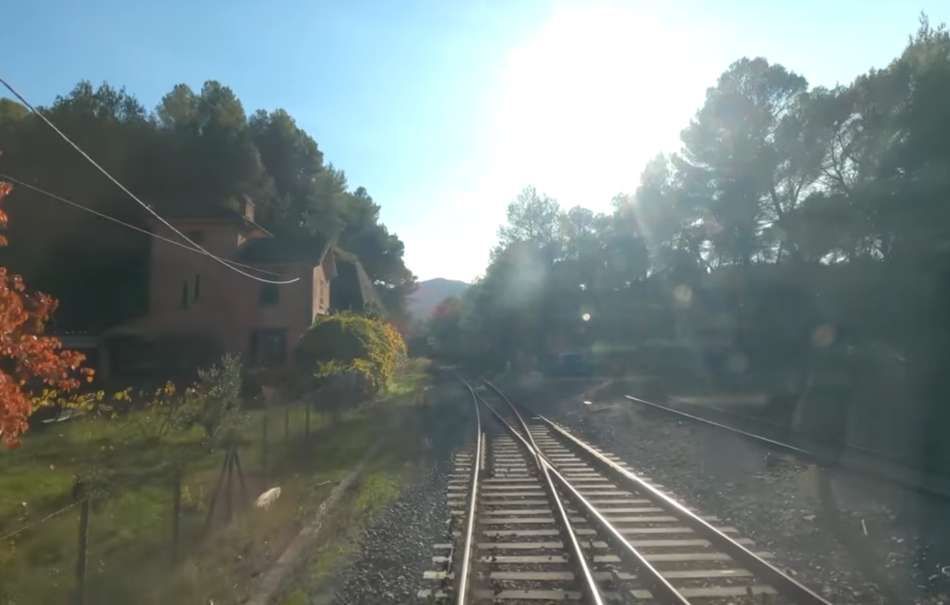
At the South end of the Station site the line becomes single track once again adjacent to a house built originally for railway staff. [4]

South of Peille Railway Station the line passes this railway-built home, usually these houses were built for railway employees, either at a nearby station or working on track maintenance. [Google Streetview, April 2013]
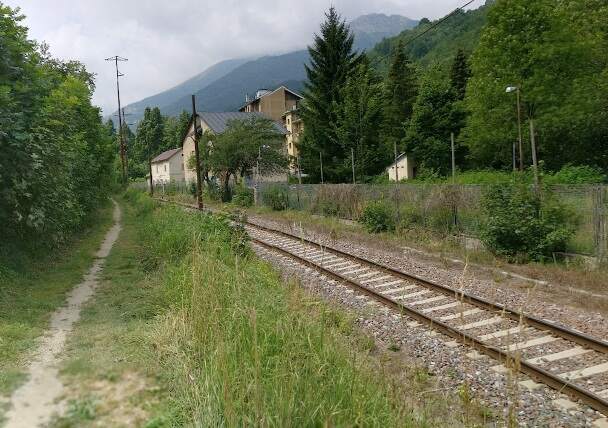
The line continues South towards Tunnel de Nogairet. [Google Streetview, April 2013]

Further South the line passes through Tunnel de Nogairet (32 metres in length). [Google Maps, September 2025]

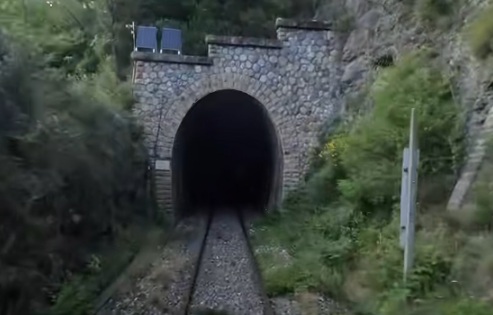
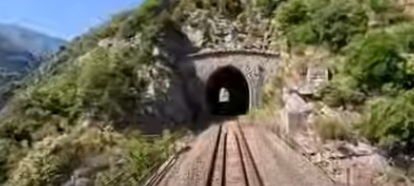
The North portal of Nogairet Tunnel, seen from the cab of a Nice-bound service. [4]

The view South from the cab of the Nice-bound train at the South portal of Nogairet Tunnel.

Turning through 180°, this is the South portal of the Tunnel de Nogairet as seen from the cab a Breil-sur-Roya-bound train in 1995. [37]

And then a short distance further South trains pass through Tunnel de Bouisses.

Tunnel de Bouisses as it appears on Google’s satellite imagery, (107 metres in length). [Google Maps, September 2025]

The North portal of Tunnel de Bouisses, seen from the cab of a Nice-bound train. [4]

Low sun shines on the cab of the same Nice-bound service as it leaves Tunnel de Bouisses and is about to cross the first of two viaducts with the name ‘Bouisses’ (Viaduc de Bouisses No. 2). [4]

Turning through 180°, this low definition view shows the South portal of Tunnel de Bouisses as seen from the cab of a Breil-sur-Roya-bound train in 1995 which is just about to cross Viaduc de Bouisses No. 2. [37]

Viaduc de Bouisses No. 2 (three 6-metre arches), as it appears on Google’s satellite imagery. [Google Maps, September 2025]

A very short distance South-southwest the line crosses Viaduc de Bouisses No. 1. …

Viaduc de Bouisses No. 1 (six 6-metre arches).[Google Maps, September 2025]

In the light of the low sun this is the view South-southwest across Viaduc de Bouisses No. 1 from the cab of the Nice-bound service. [4]

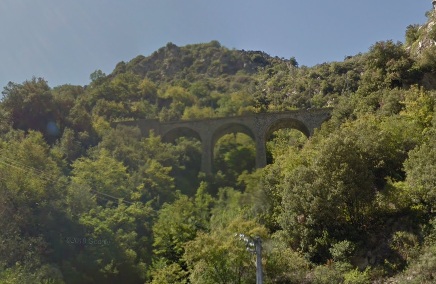
The two Bouisses viaducts seen from across the valley to the West. No. 1 is on the right, No. 2 is on the left, with the portal of Tunnel de Bouisses visible top-left. [Google Streetview, March 2023]

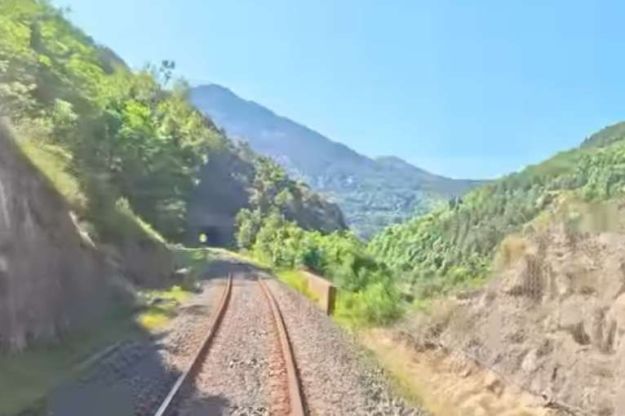
A little further to the South, after running along a trackbed supported by retaining walls trains travelling towards Nice cross the Viaduct de Adrecia, seen here from the cab of the Nice-bound service. [4]

Viaduc de Adrecia (three 6-metre arches). [Google Maps, September 2025]

Viaduc de Adrecia, seen from the D21. [Google Streetview, April 2023]

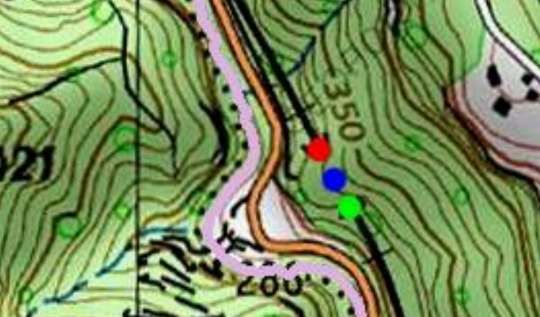
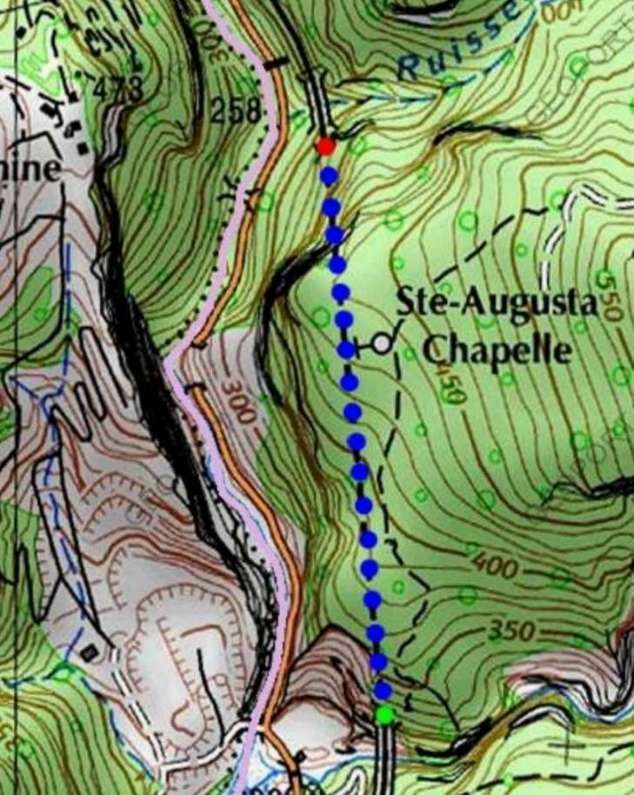
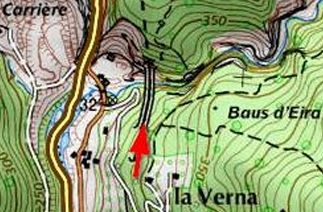
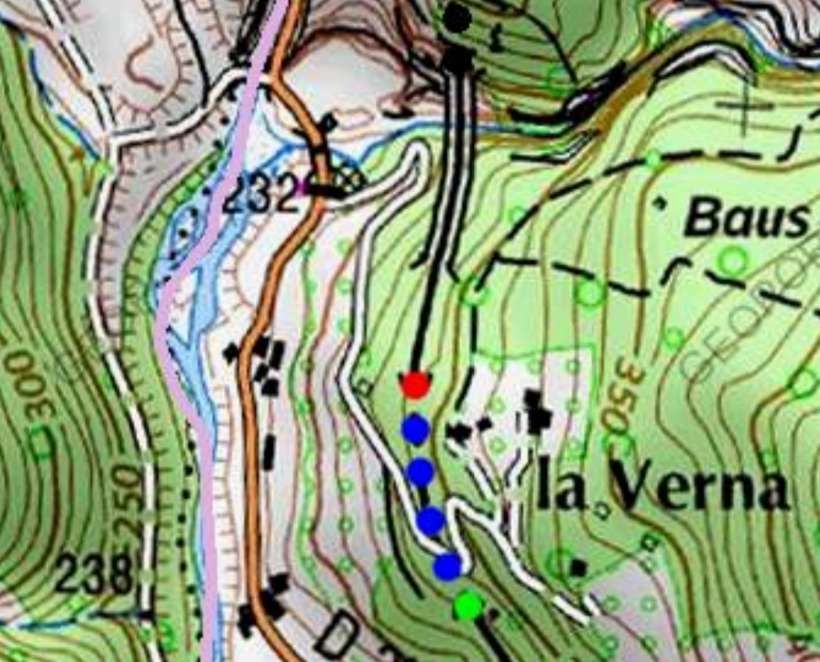
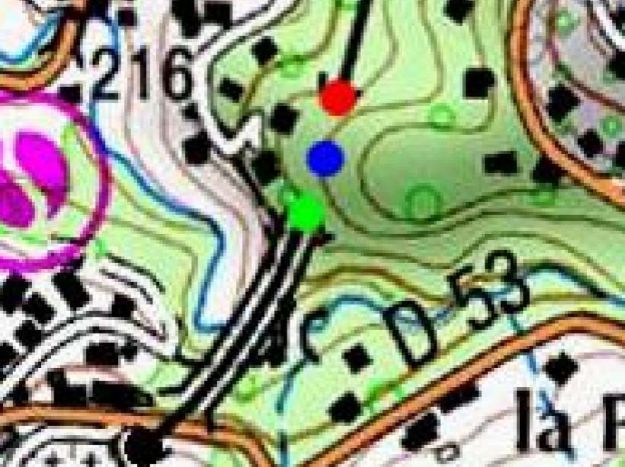
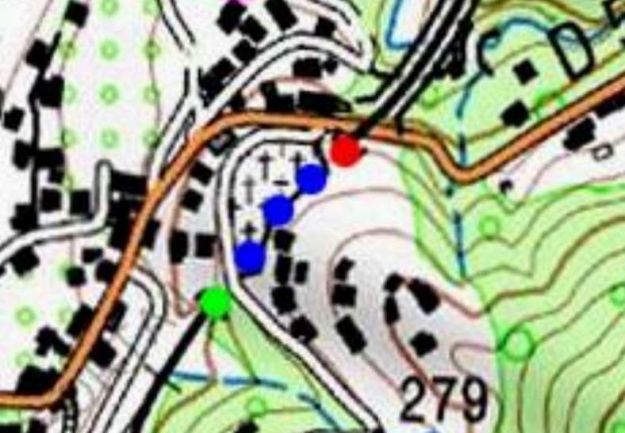
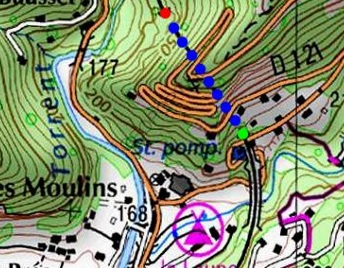
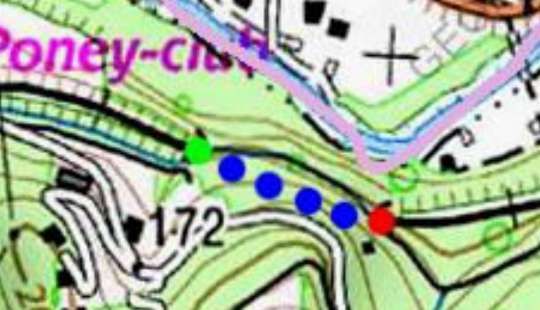
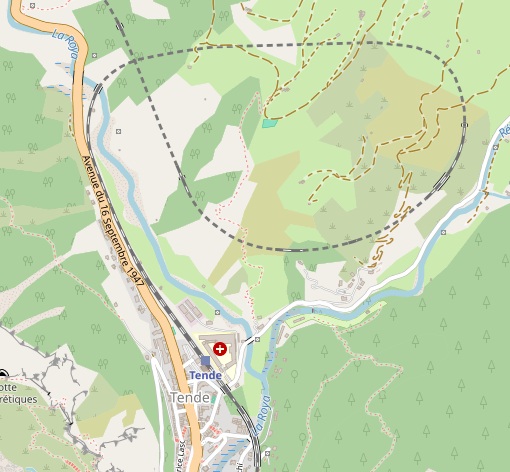
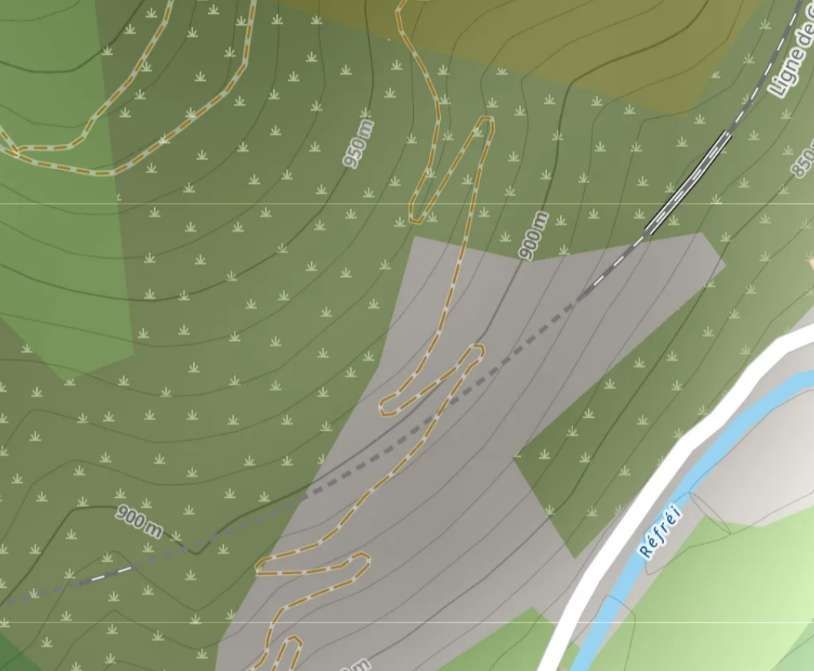
The line has curved round to the Southeast before it enters Tunnel de Launa, shown here by the red, blue and green dots. Viaduc de Launa sits immediately to the Southeast of the tunnel. [38]

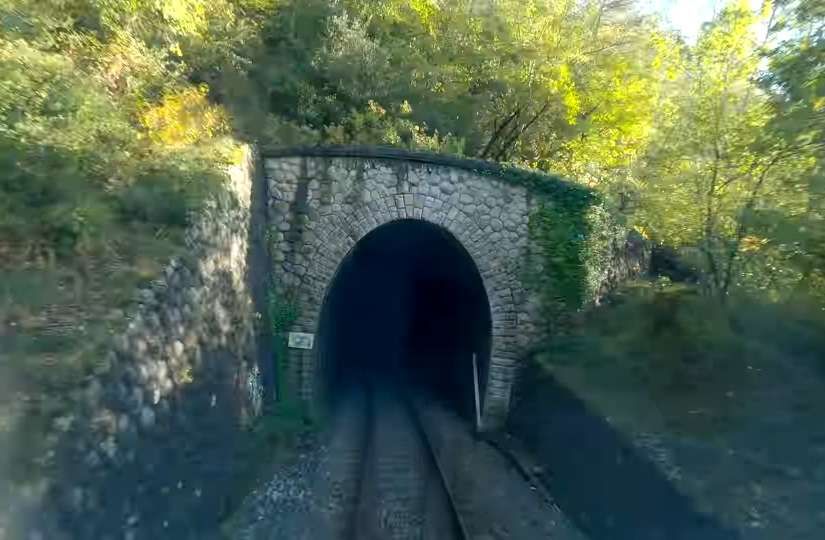
The Northwest portal of Tunnel de Launa (309 metres in length). [4]

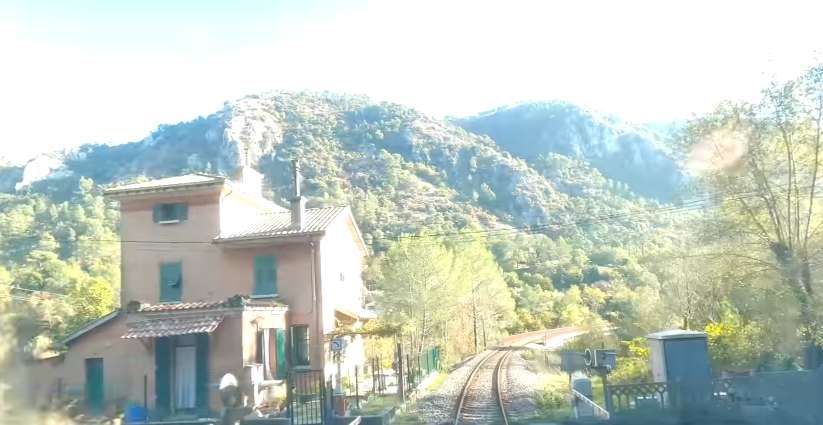
This slightly overexposed image shows the view from the cab of the Nice-bound service as it leaves the Tunnel de Launa. The Viaduc de Launa is just beyond the railway house on the left of the image. [4]

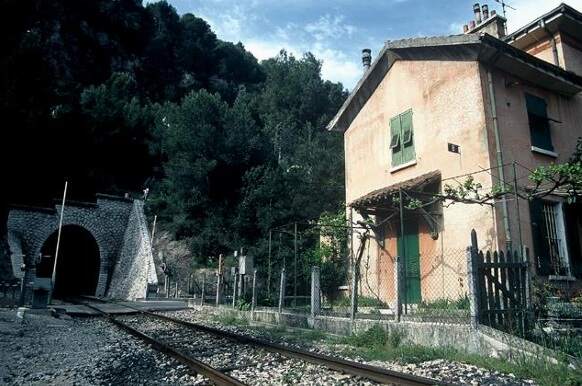
The Southeast portal of Tunnel de Launa with a railway house on the right of the image. The viaduct is immediately behind the camera. Note also the level crossing close to the tunnel mouth. [38]

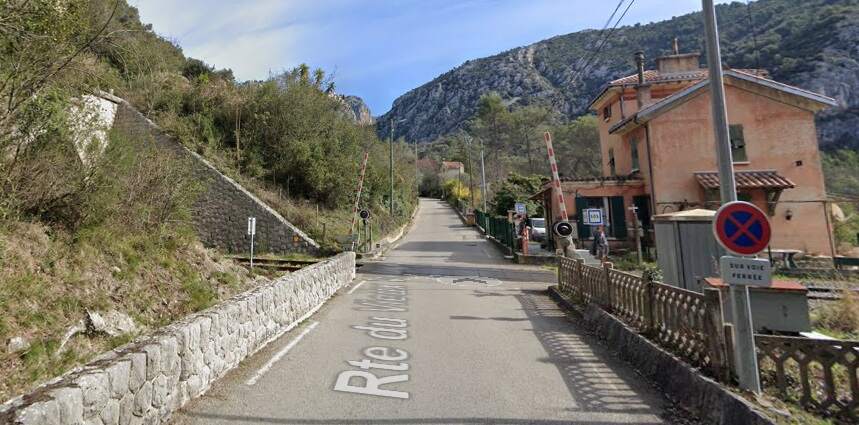
The view East across the railway on Rte du Vieux Village (D121). [Google Streetview, March 2023]
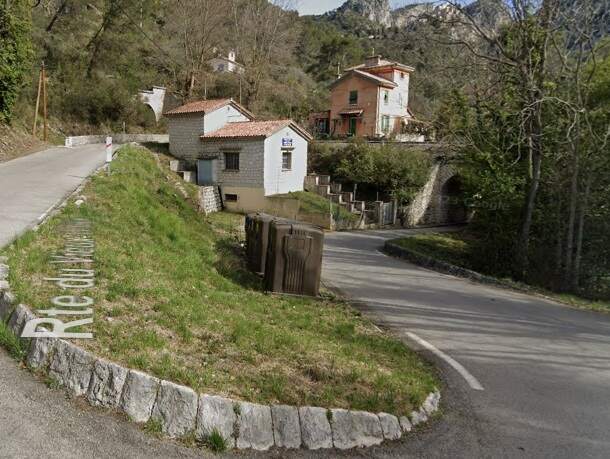
This photograph, taken at the apex of a hairpin bend on Rte du Vieux Village (D121) has the tunnel mouth top-left, the railway house just to the right of centre at the top of the image with the railway in front of it spanning a bridge which carries the road under the railway. [Google Streetview, March 2023]

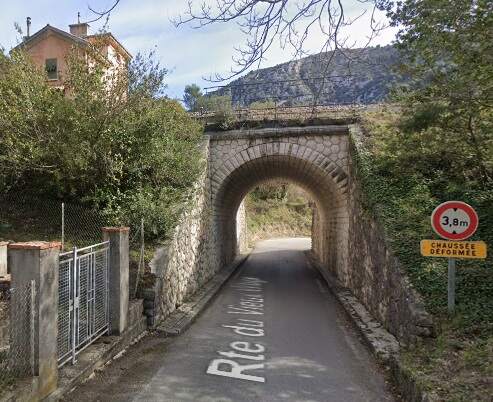
The bridge carrying the railway over Rte du Vieux Village (D121). [Google Streetview, March 2023]

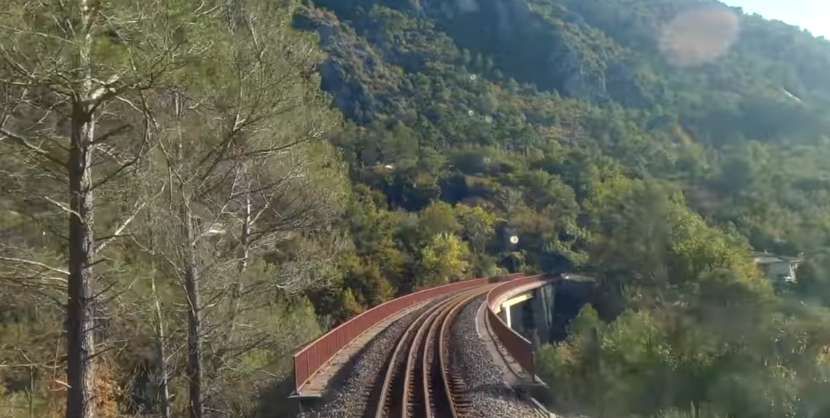
Viaduc de Launa (100 metres in length – six 12-metre arches over the Galimbert stream) seen from the cab of the Nice-bound train running through the level-crossing. The viaduct was rebuilt during 1992 and 1993 as the first viaduct suffered settlement due to ground movement. [4]

Viaduc de Launa towards the end of the construction contact circa 1928, © Public Domain. [39]
A similar view of the viaduct in the 1970s, © Unknown. [39]
Looking North along the viaduct in the 1970s, © Unknown. [39]
The replacement reinforced concrete viaduct was opened in 1993. This view looks from the West on the D121 which passes under the viaduct.

Both this and the next image of the pedestrian crossing at Chemin de Laghet – a couple of hundred metres further along the line toward Nice – are of poor quality because of bright and low sunlight. [4]

An unmetalled lane (Chemin de Laghet) used to cross the line at this location, now only pedestrian access across the line is permitted. The crossing-keeper’s cottage remains. {Google Streetview, January 2011]
A short distance further Southwest the Chemin du Canton Soubran passes under the line. The structure is only suitable for a cattle creep and pedestrian access. This view looks East toward the structure. the line heads toward Peille Railway Station on the left and to Drap-Cantaron to the right. [Google Streetview, March 2023]
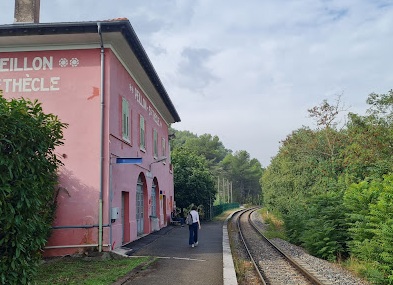
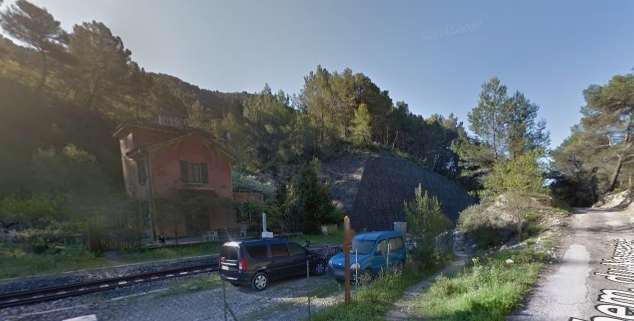
Peillon-Sainte-Thècle Railway Station building forecourt, seen from the South West, © August III Sas (July 2023. [Google Maps, September 2025]

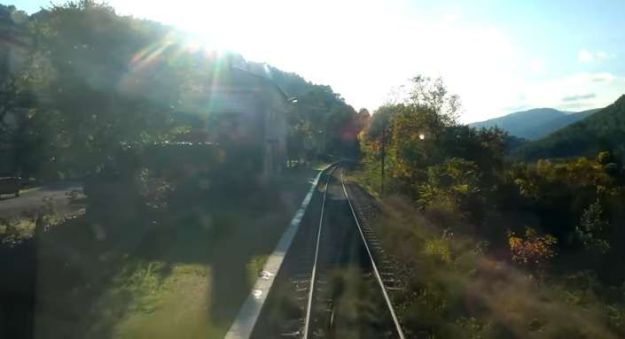
Looking directly into the sun, this is the view from the cab of a Nice-bound service coming to a halt at Peillon-Sainte-Thècle Railway Station. [4]

A better view of Peillon-Sainte-Thècle Railway Station as seen from the East along the platform, © Yann Cochois (September 2023). [Google Maps, September 2025]

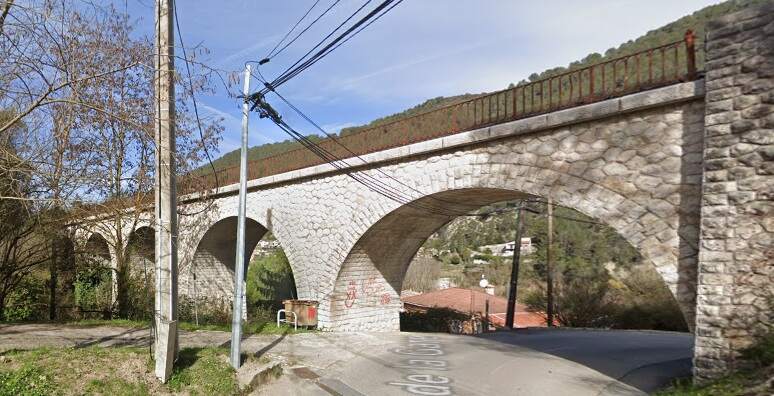
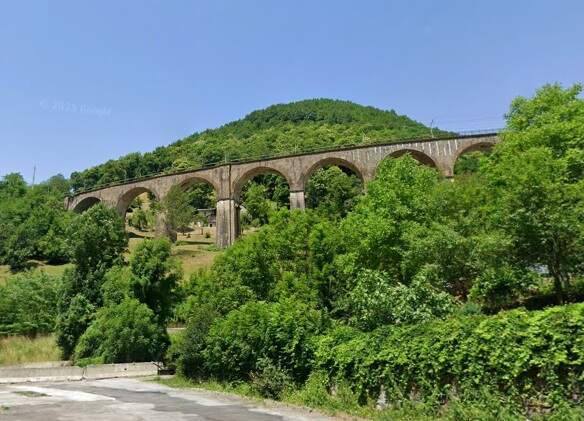
Immediately to the West of Peillon-Sainte-Thècle Railway Station, the line crosses Pont de Brauschet (five 9 metre arches), seen here from the South on Avenue de la Gare. [Google Streetview, March 2023]

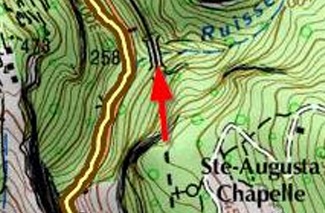
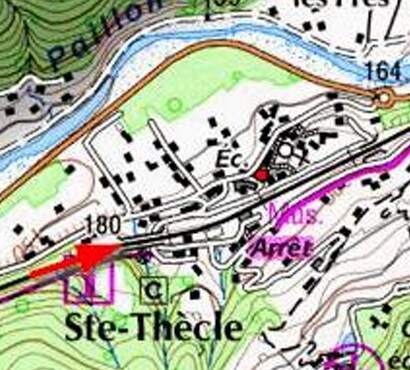
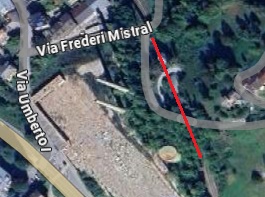
Pont du Brauschet sits just to the West of Peillon-Sainte-Thècle Railway Station and is marked on this map with a red arrow. It is 70 metres long and is a 5-arch viaduct.

Pont de Brauschet, seen from the cab of a train heading for Nice. [4]

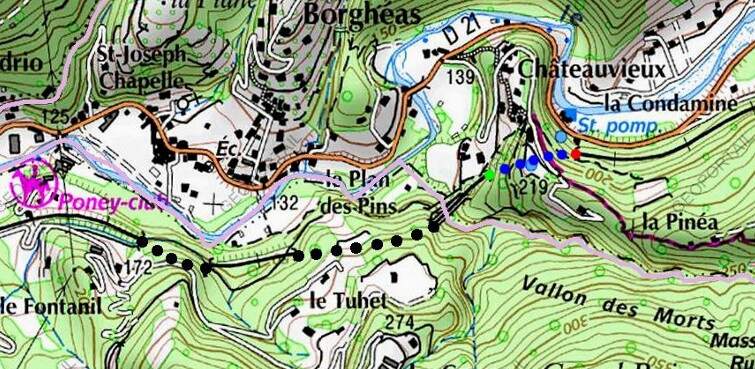
The next structure along the line is Tunnel de Châteauvieux (219 metres in length). This in the East portal of the tunnel. [4]

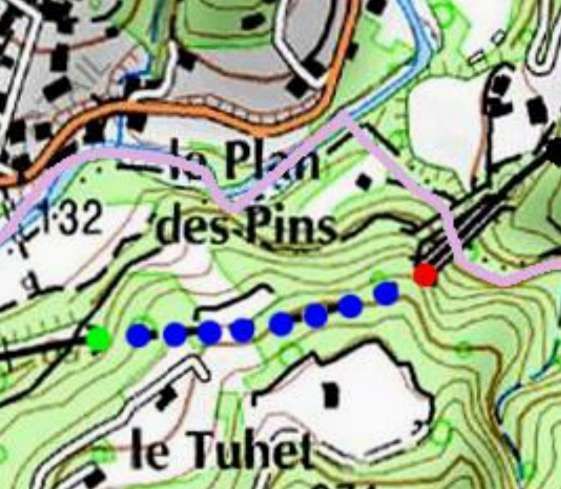
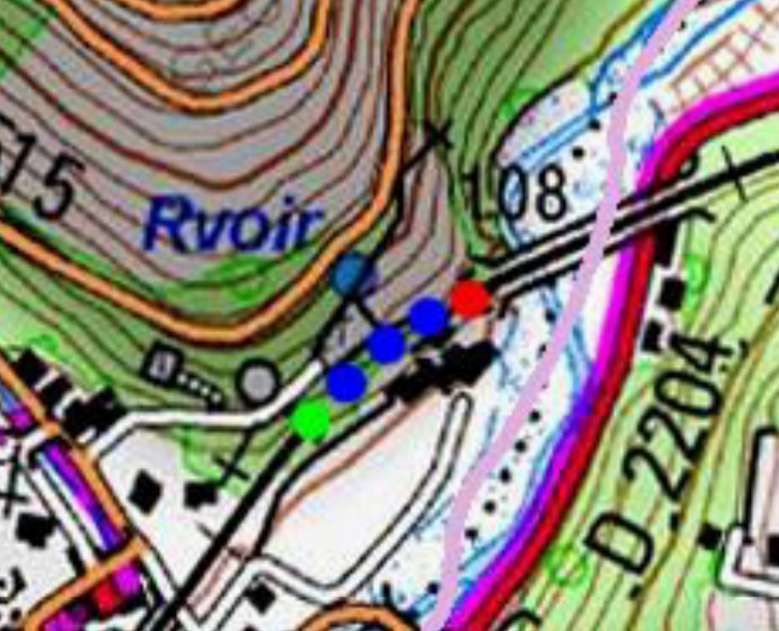
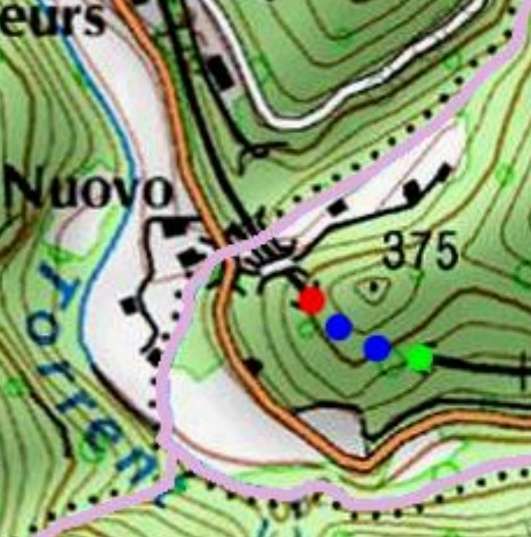
Tunnel de Châteauvieux is the first of three tunnels which Nice-bound trains now pass through. It is marked by the red, blue and green dots on this image. Immediately to the West of this tunnel are the two side-by-side Viaducs des Mortes. [40]

This is the West portal of Tunnel de Châteauvieux, seen from alongside the line between the tunnel and Viaduc des Mortes. [40]

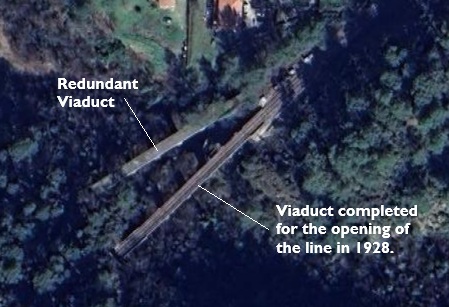
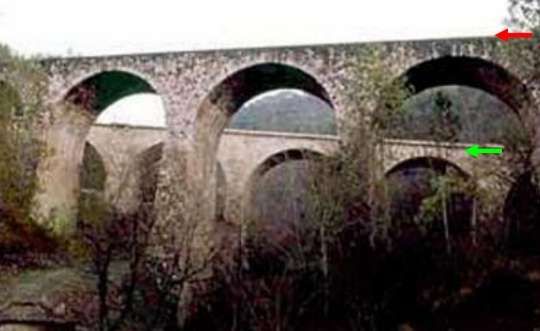
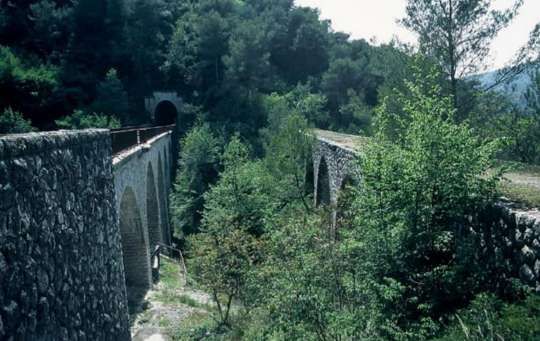
Just to the West of the Tunnel de Châteauvieux there are 2 viaducts next to each other (Viaducs des Mortes) of which only one is in service; the southern one which gives access to the Tuhet tunnel. The viaduct to the north (which has seven arches) leads to an unfinished tunnel. An accident occurred during the drilling of the original tunnel in 1925. The accident, which caused the death of 3 workers, resulted in the need to drill a new tunnel and, as a result, the construction of another viaduct in 1927 (with five 11 metre arches).  The viaducts are named, Viaducs des Mortes, not because of the accident but because the viaducts bridge a footpath which was used to take deceased inhabitants of Borghéas to the cemetery of the neighbouring village of Drap.

The two viaducts mentioned above. [Google Maps, September 2025]

The two viaducts, seen from the North. The green arrow indicates the operational viaduct, the red arrow, the redundant viaduct. [48]

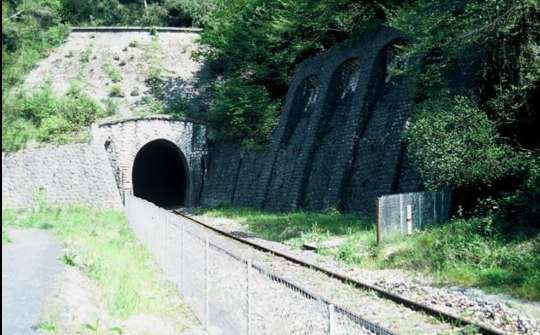
A view of both of the two viaducts and the Tunnel de Tuhet beyond. [46]

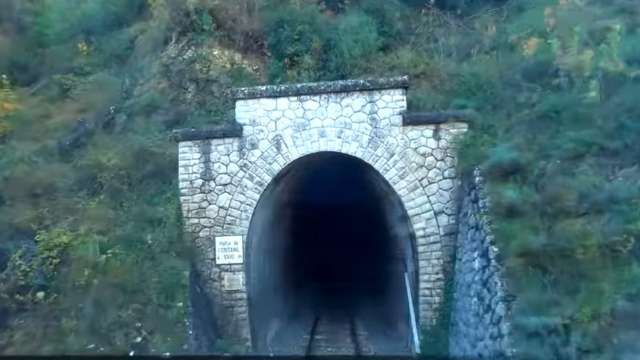
The East portal of Tunnel de Tuhet, seen from the cab of a Nice-bound service on the Viaduc des Mortes. [4]

The Tunnel de Tuhet (346 metres long). [46]

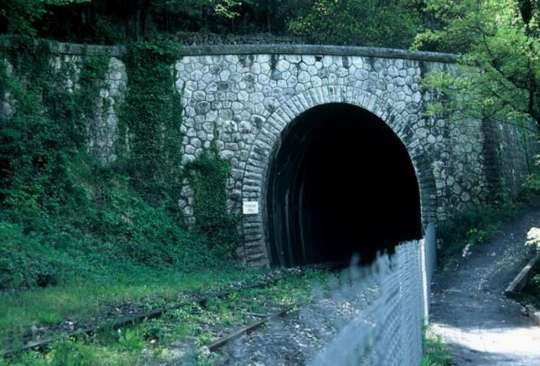
The West portal of the Tunnel de Tuhet. [46]

The East portal of Tunnel de la Ribosse. [47]

Tunnel de la Ribosse. [47]

The West portal of Tunnel de la Ribosse. [47]

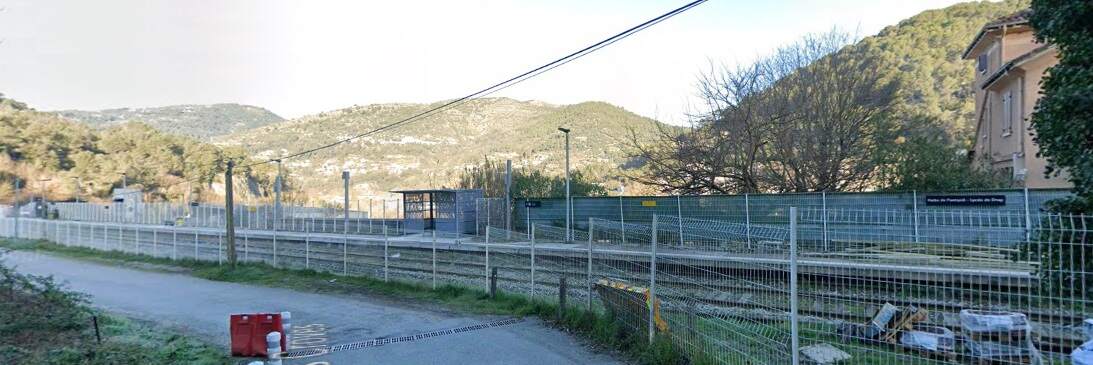
A short distance further West, the line passes through Fontanil-Drap High School Halt.

Fontanil-Drap High School Halt seen from the Southeast on Route des Croves. [Google Streetview, March 2025]

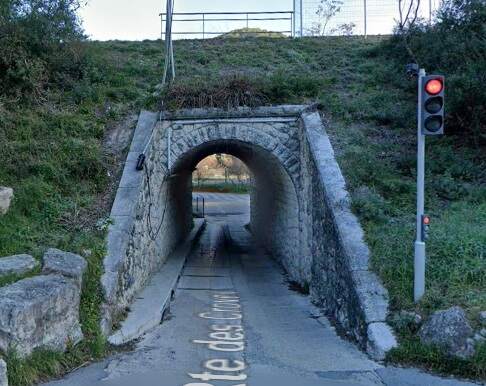
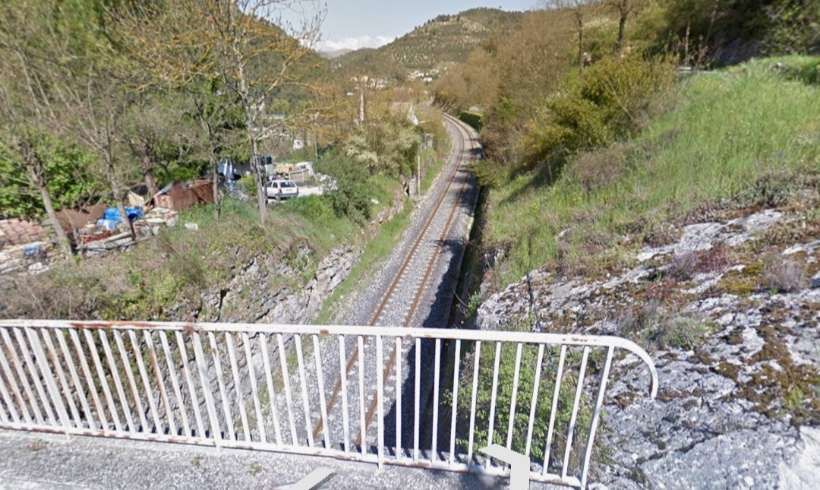
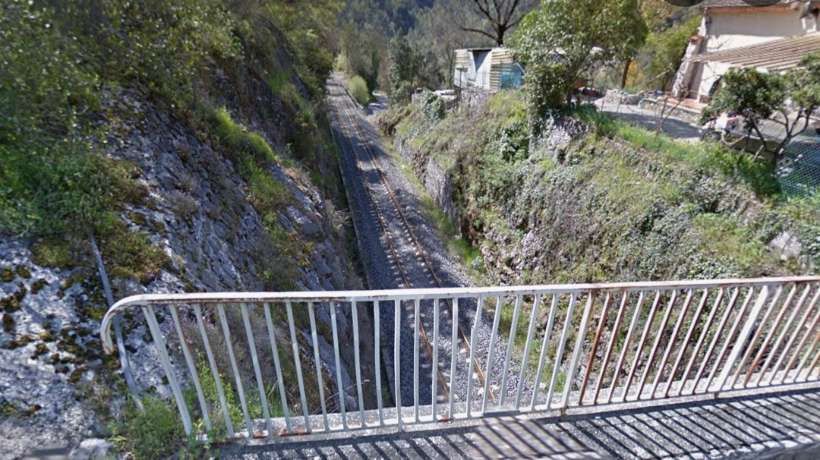
At the West end of the station/halt, the Route des Croves passes under the line. The low arch bridge seen from the South. [Google Streetview, March 2025]

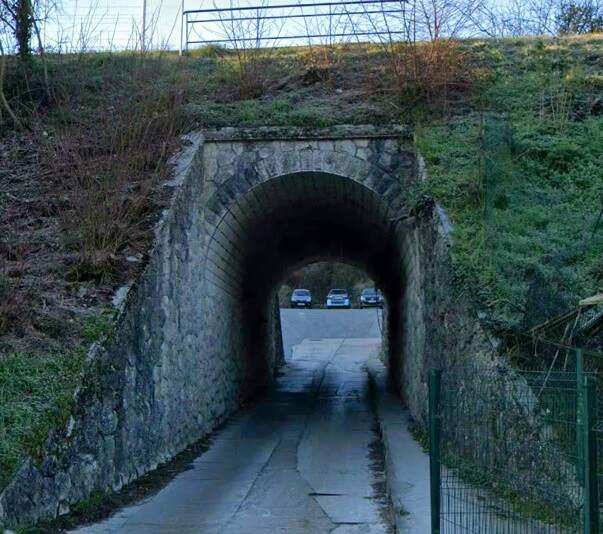
The same structure seen from the North side of the line. [Google Streetview, March 2025]

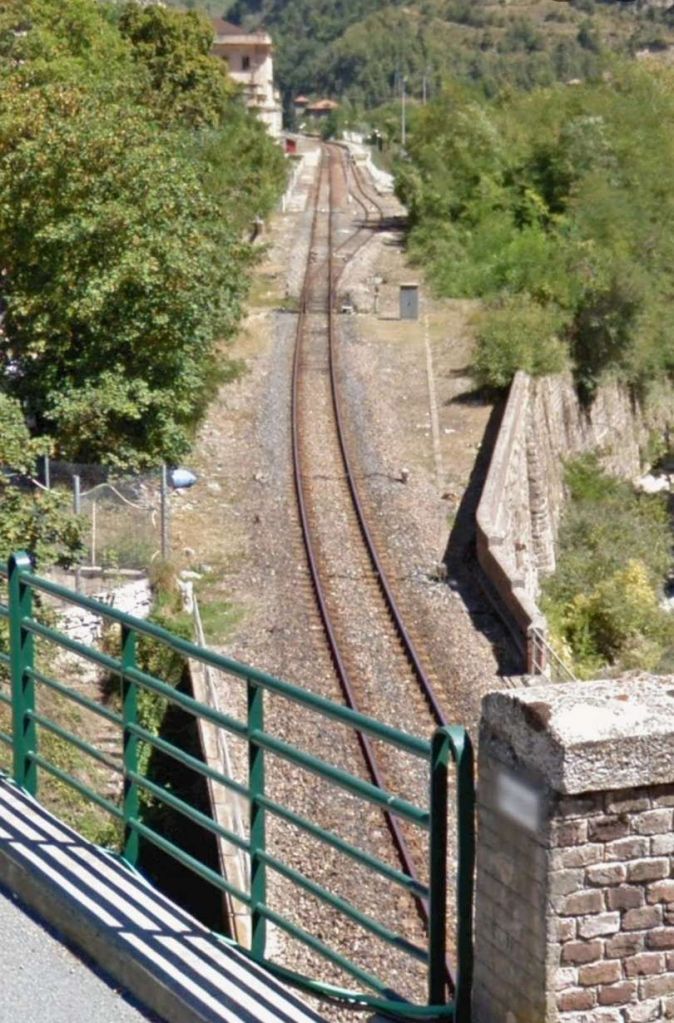
The next bridge carries the line over Chemin de de l’Ubac. [Google Streetview, March 2025]

The South side of the same structure. [Google Streetview, March 2025]

A short distance further West the line crosses the D2204, the River Paillon and the D2204B. …

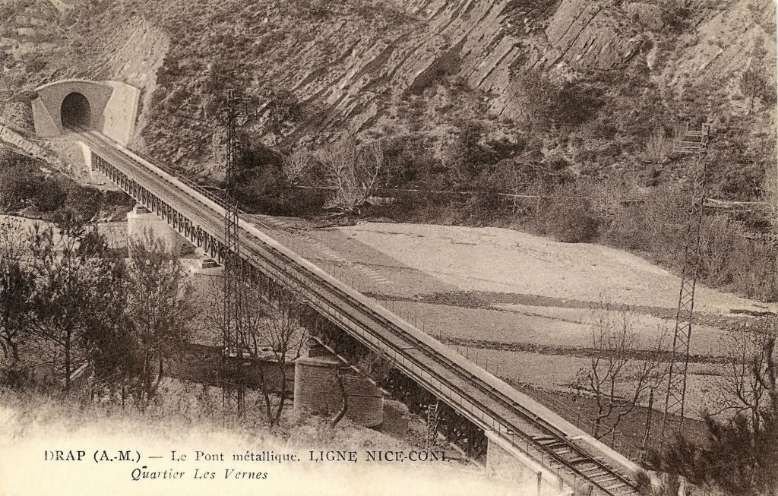
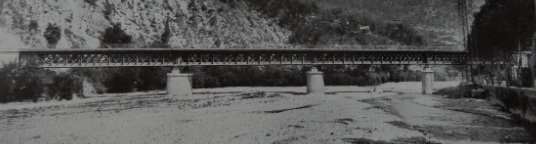
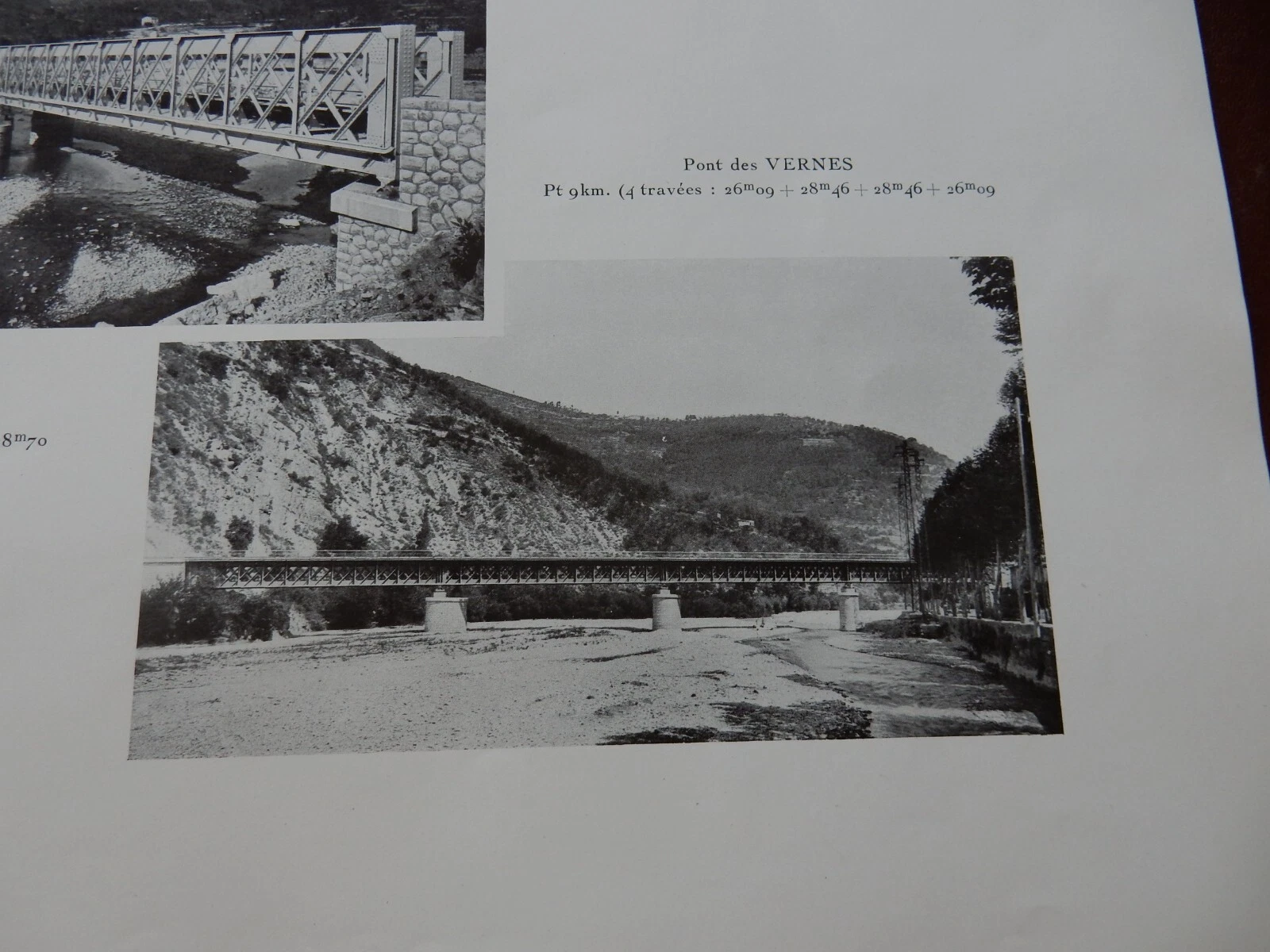
The steel girder bridge, Pont des Vernes, which now carries the line over the the D2204, the River Paillon and the D2204B, seen from the Northeast on the D2204. The bridge is made of two spans of 28.64 m and two of 26.09 m, the easternmost span of which crosses the Contes road and what was the Nice-Bendejun tramway line of the TNL. [Google Streetview, March 2025]
The same bridge seen from the South on the D2204B. [Google Streetview, March 2025]
The same bridge seen from above. The mouth of Tunnel de Moulin-de-Cantaron is in the top-left of the image. This postcard image was shared on the Comte de Nice et son Histoire Facebook Group by Jean-Paul Bascoul on 19th April 2025, © Public Domain. [50]
Pont des Vernes seen from the middle of the Paillon of its four spans the outer two were 26.1 metres in length and the middle two were each 28.5 metres long, (c) Unknown but probably Public Domain. [52]

Once across the river and adjacent roads the line enters Tunnel de Moulin-de-Cantaron.

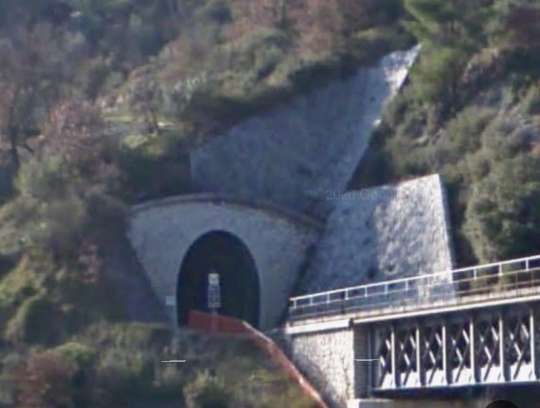
The East portal of Tunnel de Moulin-de-Cantaron. [Google Streetview,

Tunnel de Moulin-de-Cantaron. [26]

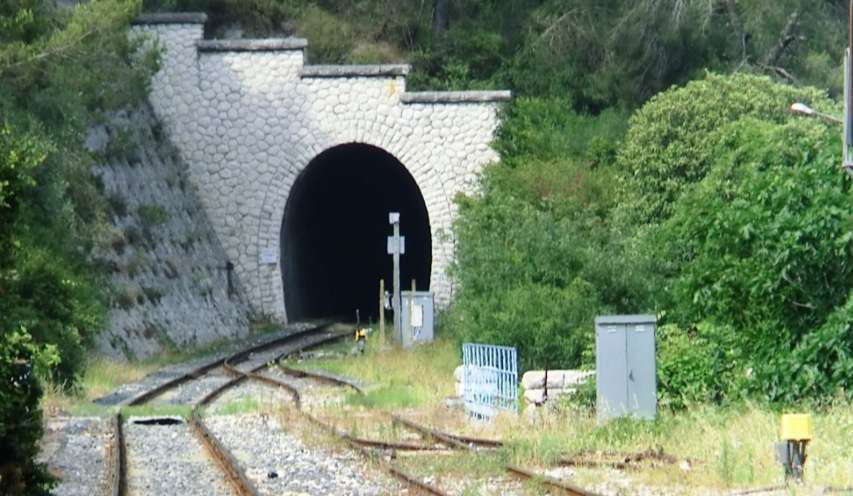
The Southwest portal of the Tunnel de Moulin-de-Cantaron, seen from the end of the platform at Drap-Cantaron Railway Station, © Eugenio Merzagora and shared on the Structure website. [51]

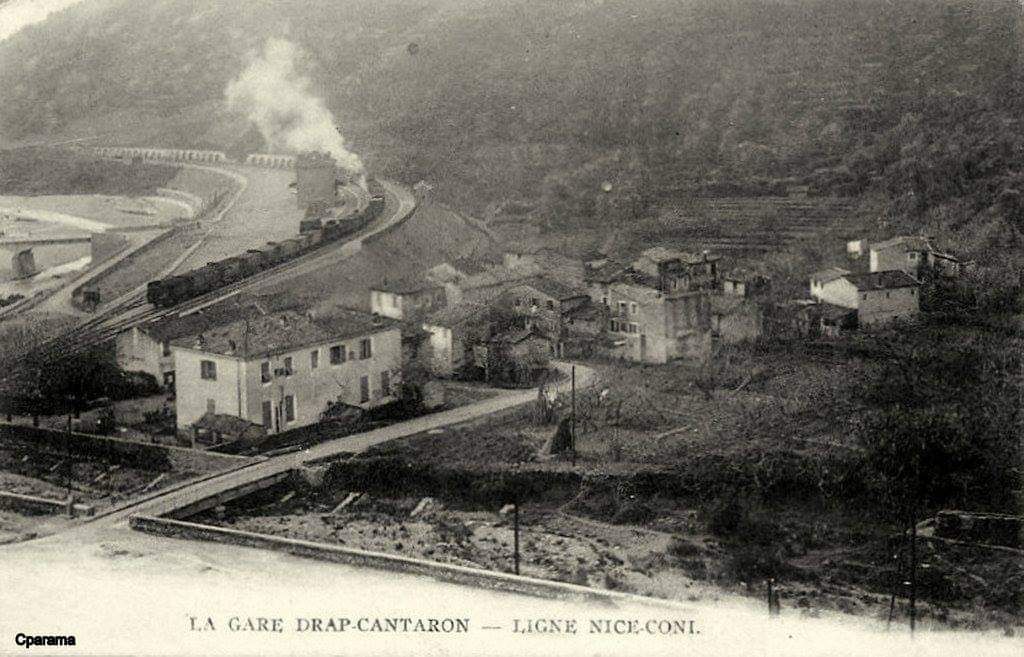
The railway station at Drap also served the village of Cantaron which was on the opposite bank of the River Paillon. This old postcard image was shared by Roland Coccoli on the Comte de Nice et son Histoire Facebook Group on 22nd January 2016. [5]
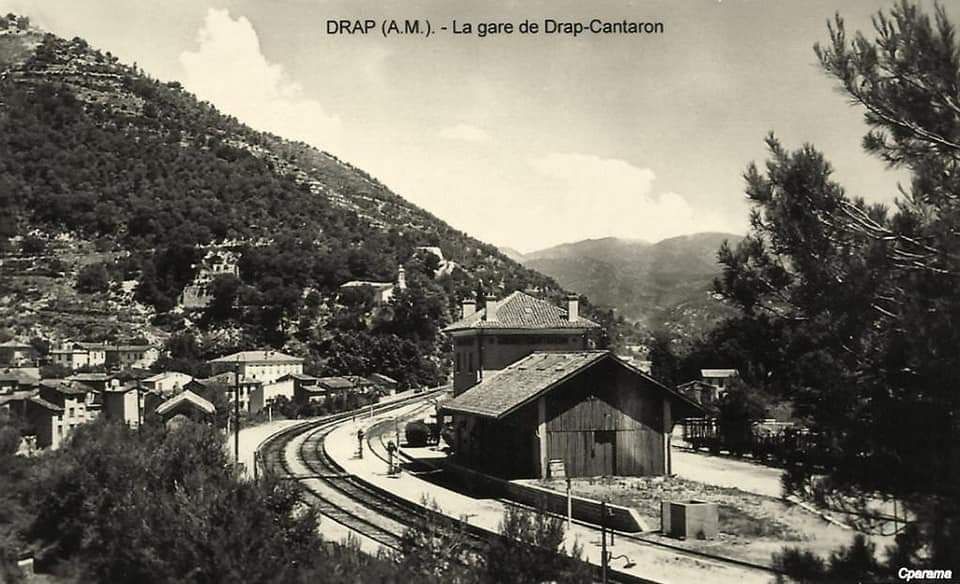
A closer view of the Station at Drap. This postcard image was shared on the Comte de Nice et son Histoire Facebook Group by Charles Louis Fevrier on 5th January 2021. [6]

This length of our journey finishes here at Drap-Cantaron Railway Station.

References

  1. Jose Banaudo, Michel Braun and Gerard de Santos; Les Trains du Col de Tende Volume 1: 1858-1928; FACS Patrimoine Ferroviaire, Les Editions du Cabri, 2018.
  2. Jose Banaudo, Michel Braun and Gerard de Santos; Les Trains du Col de Tende Volume 2: 1929-1974; FACS Patrimoine Ferroviaire, Les Editions du Cabri, 2018.
  3. Jose Banaudo, Michel Braun and Gerard de Santos; Les Trains du Col de Tende Volume 3: 1975-1986; FACS Patrimoine Ferroviaire, Les Editions du Cabri, 2018.
  4. https://youtu.be/rLXAEz-n4mM?si=RLQC31jynGeM_lQR, accessed on 26th August 2025. Permission to use these still images from the YouTube video has been sought.
  5. https://m.facebook.com/groups/ciccoli/permalink/1711973335715195, accessed on 15th December 2023.
  6. https://m.facebook.com/groups/ciccoli/permalink/2989582914620891, accessed on 15th December 2023.
  7. https://www.cparama.com/forum/viewtopic.php?f=11&t=14570, accessed on 21st December 2023.
  8. https://www.openstreetmap.org/#map=12/43.8804/7.4395&layers=P, accessed on 26th August 2025.
  9. https://rogerfarnworth.com/2025/07/22/the-railway-from-nice-to-tende-and-cuneo-part-1.
  10. https://rogerfarnworth.com/2025/07/26/the-railway-from-nice-to-tende-and-cuneo-part-2.
  11. https://rogerfarnworth.com/2025/08/06/the-railway-from-nice-to-tende-and-cuneo-part-3-vievola-to-st-dalmas-de-tende
  12. https://rogerfarnworth.com/2025/08/16/the-railway-between-nice-tende-and-cuneo-part-4-st-dalmas-de-tende-to-breil-sur-roya
  13. https://rogerfarnworth.com/2025/08/25/the-railway-between-nice-tende-and-cuneo-part-5-breil-sur-roya-to-ventimiglia
  14. https://www.facebook.com/photo/?fbid=10212672518585538&set=a.10212672512625389, accessed on 30th August 2025.
  15. Franco Collidà, Max Gallo & Aldo A. Mola; CUNEO-NIZZA History of a Railway; Cassa di Risparmio di Cuneo, Cuneo (CN), July 1982.
  16. https://cartorum.fr/carte-postale/204912/lescarene-lescarene-la-gare-et-le-viaduc-ligne-nice-coni, accessed on 30th August 2025.
  17. https://www.cparama.com/forum/viewtopic.php?f=11&t=3321#google_vignette, accessed on 30th August 2025
  18. https://commons.wikimedia.org/wiki/File:Vue_du_village_de_L%E2%80%99Escar%C3%A8ne_depuis_la_maison_de_retraite.jpg, accessed on 31st August 2025.
  19. https://www.inventaires-ferroviaires.fr/tu06/06057.1.pdf, accessed on 31st August 2025.
  20. https://ebay.us/m/yOgnpShttps://ebay.us/m/yOgnpS, accessed on 15th September 2025
  21. https://www.tunnels-ferroviaires.org/fiches/tu06/06091.2.pdf, accessed on 31st August 2025.
  22. https://www.inventaires-ferroviaires.fr/mx06/06091.02F.pdf, accessed on 11th September 2025.
  23. https://www.inventaires-ferroviaires.fr/tu06/06091.1.pdf, accessed on 10th September 2025.
  24. https://structurae.net/en/structures/coletta-tunnel, accessed on 15th September 2025.
  25. https://fr.m.wikipedia.org/wiki/Sch%C3%A9ma_de_la_ligne_de_Nice_%C3%A0_Breil-sur-Roya, accessed on 15th September 2025
  26. https://www.openstreetmap.org/#map=16/43.79305/7.37742&layers=P, accessed on 16th September 2025.
  27. https://www.inventaires-ferroviaires.fr/tu06/06031.1.pdf, accessed on 10th September 2025.
  28. https://structurae.net/fr/ouvrages/gare-de-peille, accessed on 16th September 2025.
  29. https://www.inventaires-ferroviaires.fr/tu06/06091.3.pdf, accessed on 10th September 2025.
  30. https://www.inventaires-ferroviaires.fr/mx06/06091.02M.pdf, accessed on 11th September 2025.
  31. https://www.inventaires-ferroviaires.fr/tu06/06091.4.pdf, accessed on 10th September 2025.
  32. https://www.inventaires-ferroviaires.fr/mx06/06091.02N.pdf, accessed on 11th September 2025.
  33. https://www.inventaires-ferroviaires.fr/tu06/06091.5.pdf, accessed on 10th September 2025.
  34. https://fr.wikipedia.org/wiki/Gare_de_Peille, accessed on 16th September 2025.
  35. https://www.inventaires-ferroviaires.fr/tu06/06091.6.pdf, accessed on 10th September 2025.
  36. https://rail-ussellois.fr/carte-postale-train/carte-postale-n-1196-le-rail-ussellois, accessed on 16th September 2025.
  37. https://www.youtube.com/watch?v=f5-omGzckp0, accessed on 16th September 2025. Permission to use these still images from the YouTube video has been sought.
  38. https://www.inventaires-ferroviaires.fr/tu06/06092.2.pdf, accessed on 17th September 2025.
  39. https://www.inventaires-ferroviaires.fr/kc06/06092.03J.pdf, accessed on 17th September 2025.
  40. https://www.inventaires-ferroviaires.fr/tu06/06092.1.pdf, accessed on 17th September 2025.
  41. Franco Collida, Max Gallo & Aldo A. Mola; CUNEO-NIZZA History of a Railway; Cassa di Risparmio di Cuneo, Cuneo (CN), July 1982.
  42. Franco Collidà; 1845-1979: the Cuneo-Nice line year by year; in Rassegna – Quarterly magazine of the Cassa di Risparmio di Cuneo; No. 7, September 1979, pp. 12-18.
  43. Stefano Garzaro & Nico Molino; THE TENDA RAILWAY From Cuneo to Nice, the last great Alpine crossing; Editrice di Storia dei Trasporti, Colleferro (RM), EST, July 1982.
  44. SNCF Region de Marseille; Line: Coni – Breil sur Roya – Vintimille. Reconstruction et équipement de la section de ligne située en territoire Français; Imprimerie St-Victor, Marseille (F), 1980.
  45. https://www.archeo-alpi-maritimi.com/viaducduvallon.php, accessed on 18th September 2025.
  46. https://www.inventaires-ferroviaires.fr/tu06/06054.2.pdf, accessed on 18th September 2025.
  47. https://www.inventaires-ferroviaires.fr/tu06/06054.1.pdf, accessed on 18th September 2025.
  48. https://www.inventaires-ferroviaires.fr/mx06/06054.01Z.pdf, accessed on 18th September 2025.
  49. https://www.facebook.com/share/p/14KVdcevha1, accessed on 19th September 2025.
  50. https://www.facebook.com/share/p/1Jr5MoEinB, accessed on 19th September 2025.
  51. https://structurae.net/en/structures/moulin-de-cantaron-tunnel, accessed on 19th September 2025.
  52. https://i.ebayimg.com/images/g/cV8AAOSwPONjDPCD/s-l1600.webp, accessed on 28th September 2025.

The Railway between Nice, Tende and Cuneo – Part 4 – St. Dalmas de Tende to Breil-sur-Roya

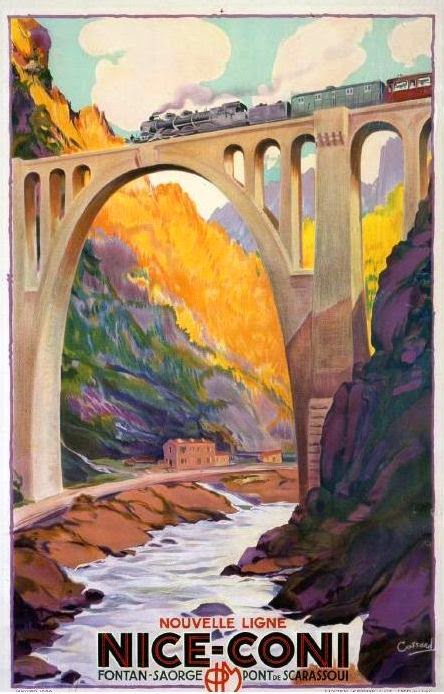
The featured image above is a poster for the Nice-Cuneo line. It shows Scarassoui Viaduct with a Northbound steam service between the wars (c) Adolphe Crossard. … Public Domain. [49]

In the first three articles about the line from Cuneo to the sea we covered the length of the line from Cuneo to St. Dalmas de Tende. These articles can be found here, [9]  here [10] and here. [11]

I also want to acknowledge the assistance given to me by David Sousa of the Rail Relaxation YouTube Channel https://www.youtube.com/@RailRelaxation/featured and https://www.railrelaxation.com and particularly his kind permission given to use still images from rail journeys that he has filmed on the Cuneo Ventimiglia railway line. [35][55]

1. The Line South from St. Dalmas de Tende as far as the French/Italian Border

St. Dalmas de Tende (San-Dalmazzo-di-Tenda in Italian) was “the last station on Italian territory, before the northern border.  This is where the French Forces would install a large-scale border station that will handle customs clearance operations in addition to the French facilities at Breil. In the first phase, a temporary passenger building and a small freight shed were built on the vast embankment created from the spoil from the tunnels upstream of the confluence of the Roya and Biogna rivers. The original layout includes four through tracks, one of which is at the platform, five sidings, three storage tracks, a temporary engine shed, a 9.50 m turntable, and a hydraulic power supply for the locomotives.” [1: p127]

It is here, at St. Dalmas de Tende, that we start this fourth part of our journey from Cuneo to the coast. Before we do set off southwards we note that the Tende to La Brigue “tranche of the work on the line was awarded to the Tuscan contractor Enrico Lévy, and the Briga to St. Dalmas de Tende tranche was executed by the Rosassa company of Alessandria. Work began in 1912 and progressed more quickly than upstream of Tende, thanks to the opening of the construction sites during public holidays and the use of new compressed air drills.” [1: p129]

The line from Tende (Tenda) to San-Dalmazzo-di-Tenda (St. Dalmas de Tende) was opened on 1st June 1915. The three of the four daily services were connected to the Southern arm of the line which by this time had reached Airole, by a coach shuttle. [1: p131]

A temporary station was provided as a terminus of the line from Cuneo. It was sited to the Northeast of the present large station building which was not built until 1928.

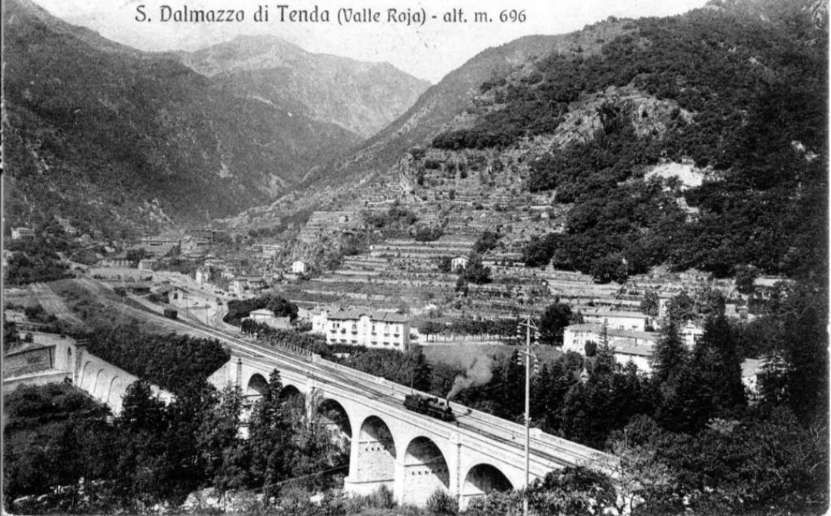
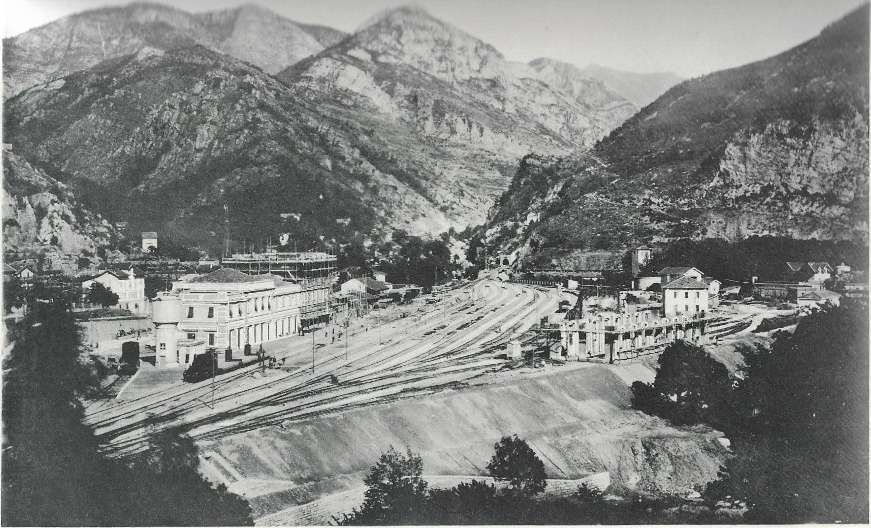
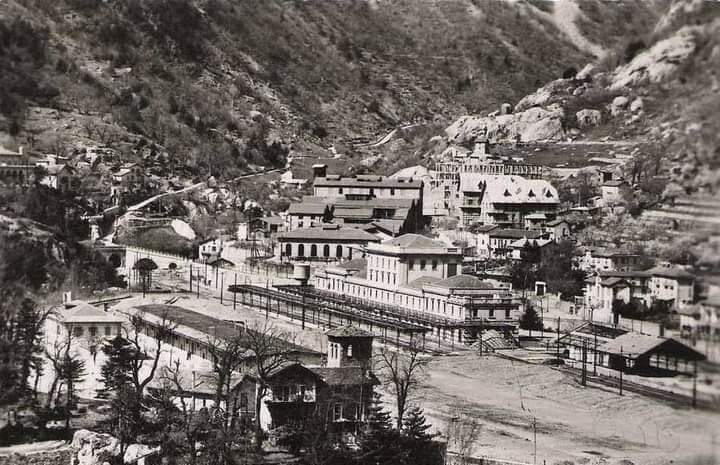
A postcard image overlooking the station site at St. Dalmas de Tende prior to the construction of the large station building. This image was shared on the Ferrovia Internazionale Cuneo-Ventimiglia-Nizza Facebook Group by Mauro Tosello on 12th June 2022. [19]
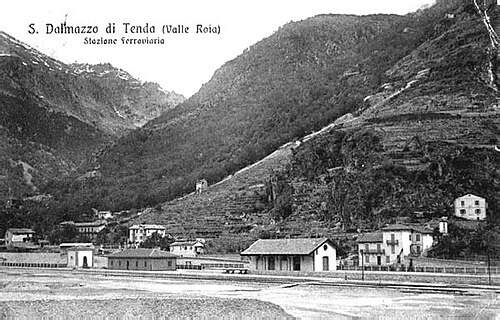
The San Dalmazzo di Tenda station before the construction of the current building. [12]
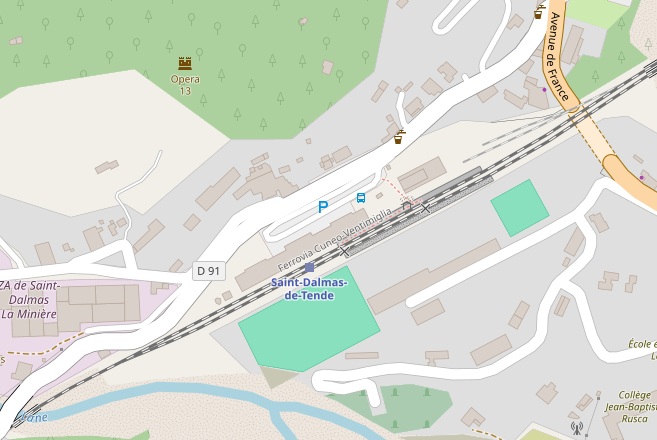
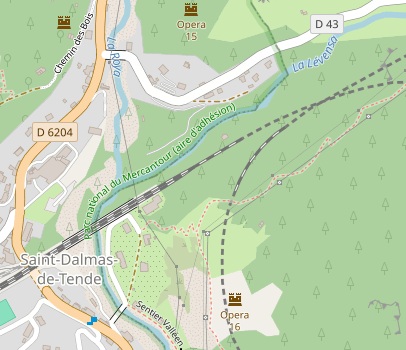
St. Dalmas de Tende Railway Station as show on OpenStreetMap. [56]
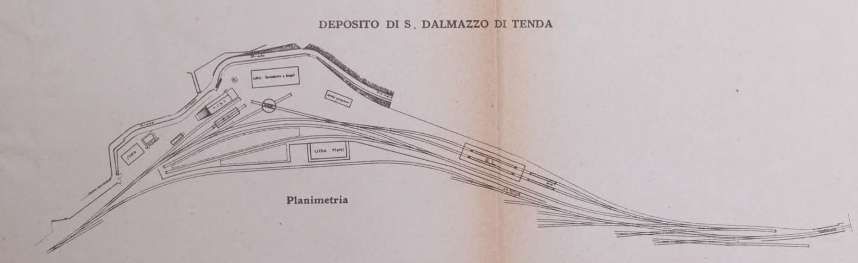
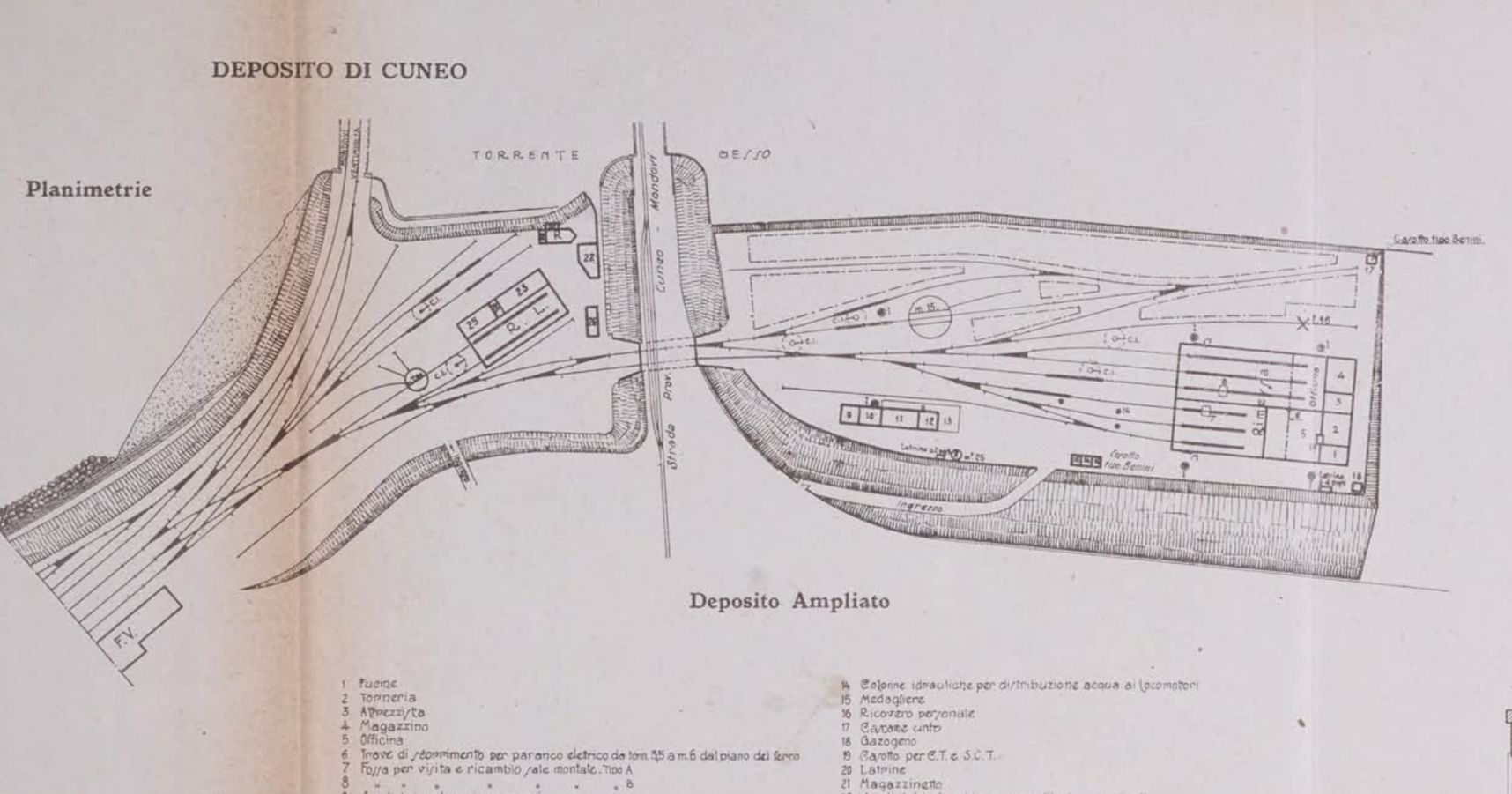
The locomotive Depot at St. Dalmas de Tende. The depot was on the Southeast side of the running lines opposite the railway Station and close to the Biogna River. The road shown on the OpenStreetMap plan of the modern station to the Southeast of the site is the road shown at the top of this plan. This drawing comes from From the December 1929 Technical Magazine of Italiane Ferrovie. It was shared on the Ferrovia Internazionale Cuneo-Ventimiglia-Nizza Facebook Group on 13th February 2024 by Francesco Ciarlini Koerner. [18]
The station during construction work. There is scaffolding on the main station building, which appears to have been built in sections with a completed length nearest to the water tower. The engine shed is under construction, centre-right. This image was shared on the Ferrovia Internazionale Cuneo-Ventimiglia-Nizza Facebook Group by Mauro Tosello on 12th June 2022. [20]
A postcard view of the Railway Station at St. Dalmas de Tende, taken from the East. The tunnel at the Southwest end of the station site can be seen on the left of the photograph. This image was shared on the Ferrovia internazionale Cuneo-Ventimiglia-Nizza Facebook Group by Luisa Grosso on 1st November 2021. [57]
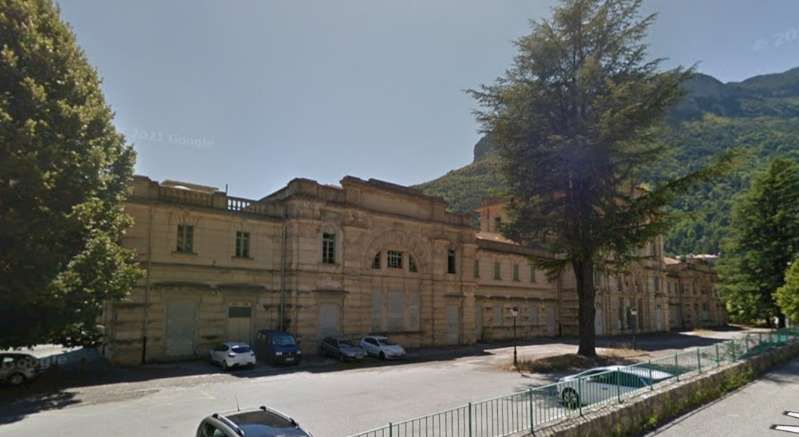
The station forecourt, seen from Avenue Martyrs de la Resistance. [Google Streetview, August 2016]
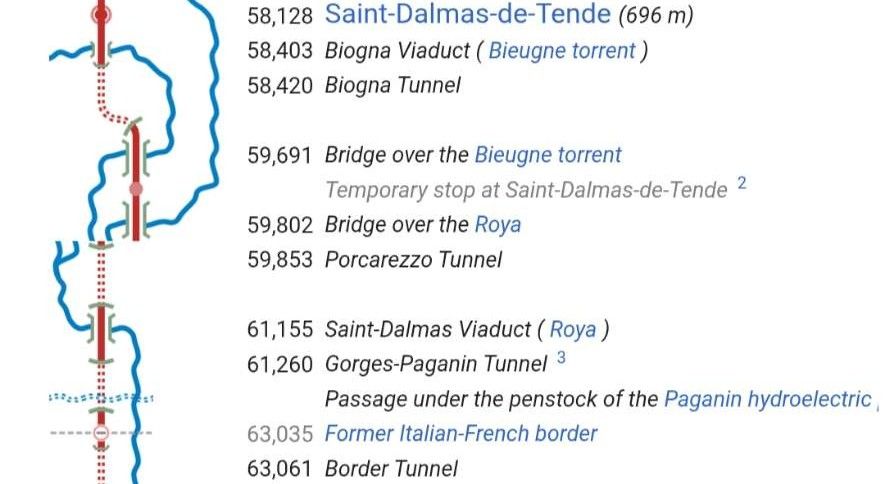
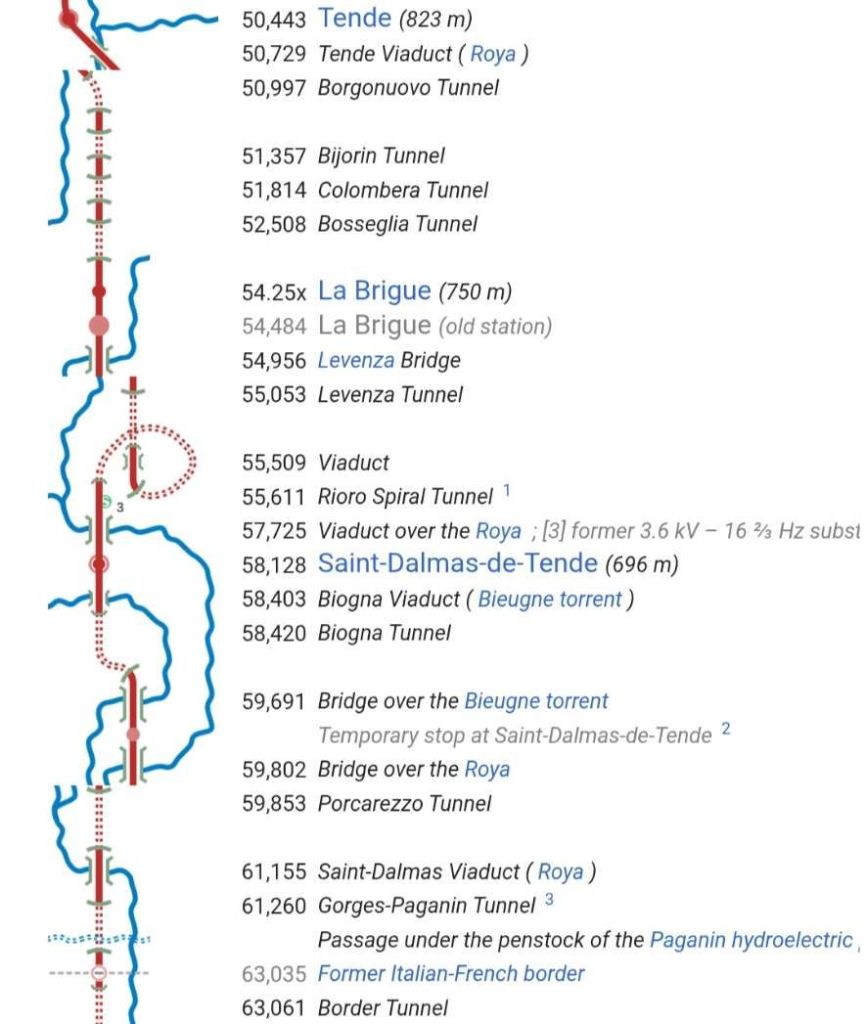
A schematic view of the line South of St. Dalmas de Tende, as far as the French/Italian border. [13]

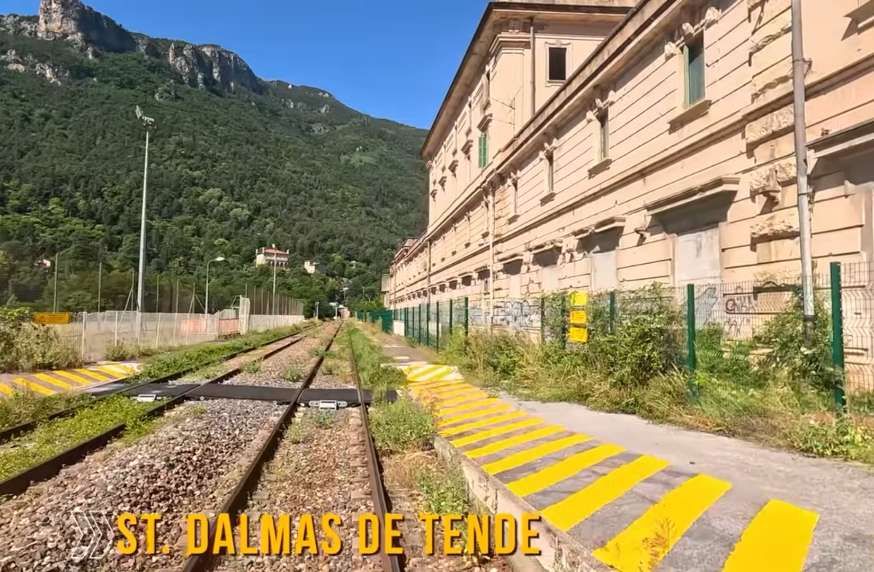
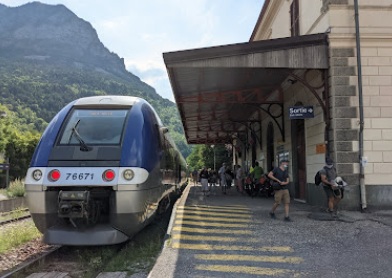
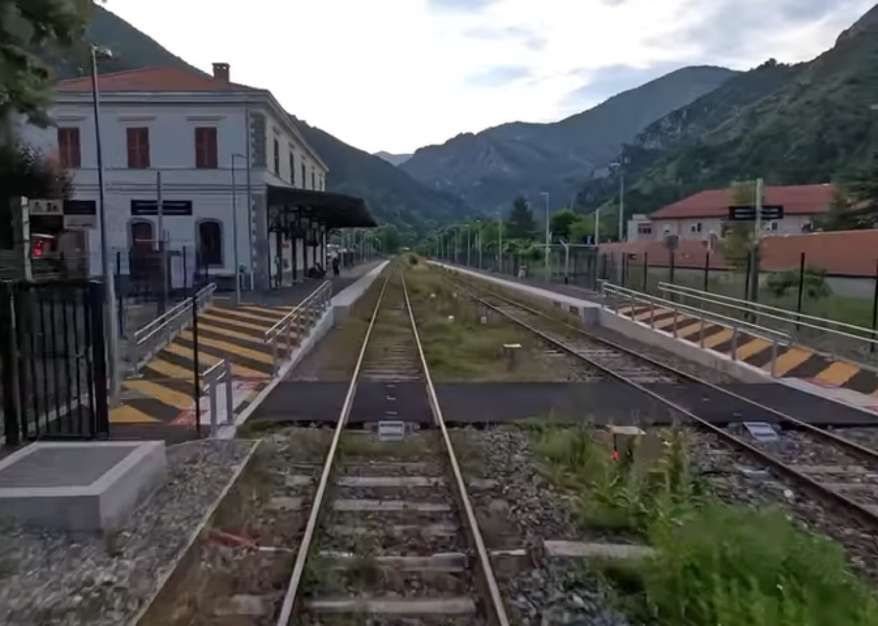
St. Dalmas de Tende Railway Station seen, looking Northeast, from the cab of a North-bound service. [35]

Looking Southwest from alongside the end of the platform of the modern railway station at St. Dalmas de Tende with the grand edifice of the 1928-built station building fenced off on the right. [55]
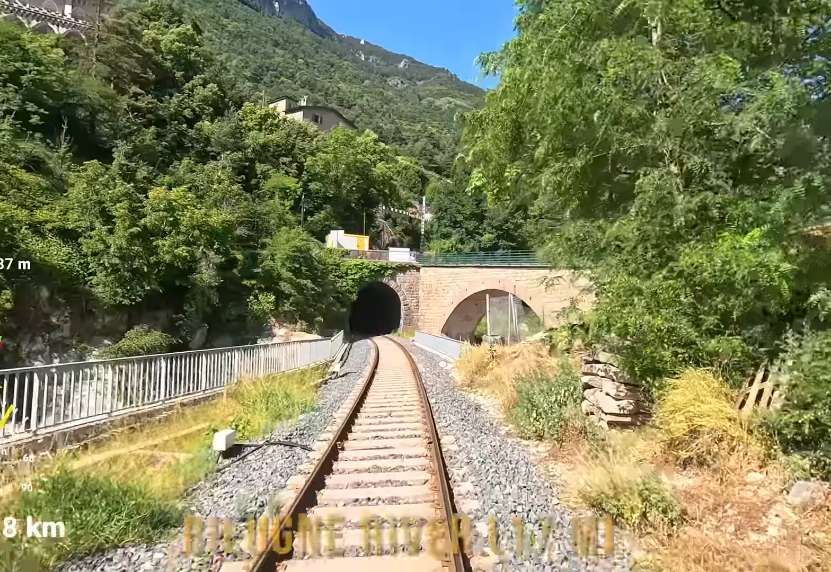
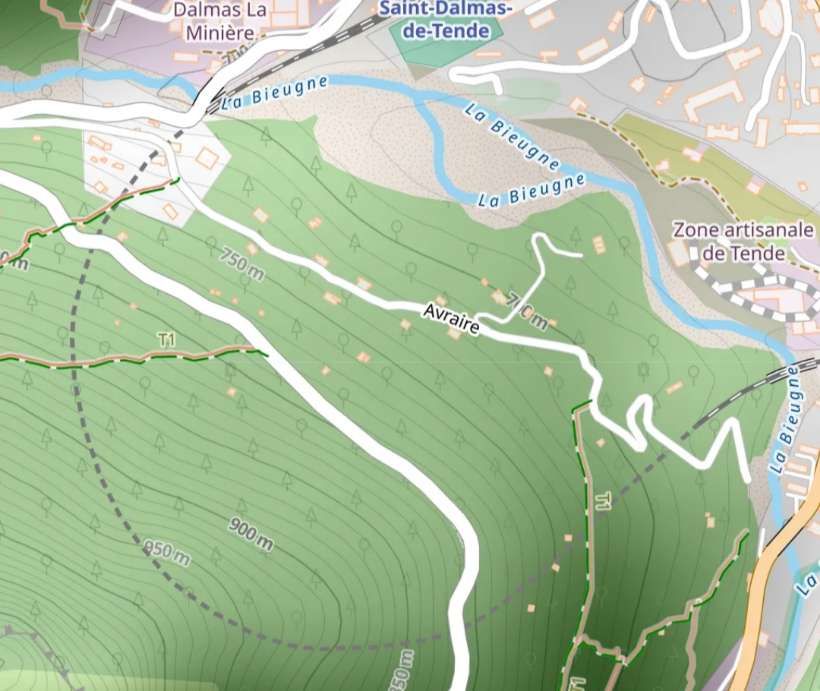
A little further to the Southwest, the line bridges the Bieugne (Biogna) River over a 15-metre arch bridge and then heads into the Biogna Tunnel. [55]
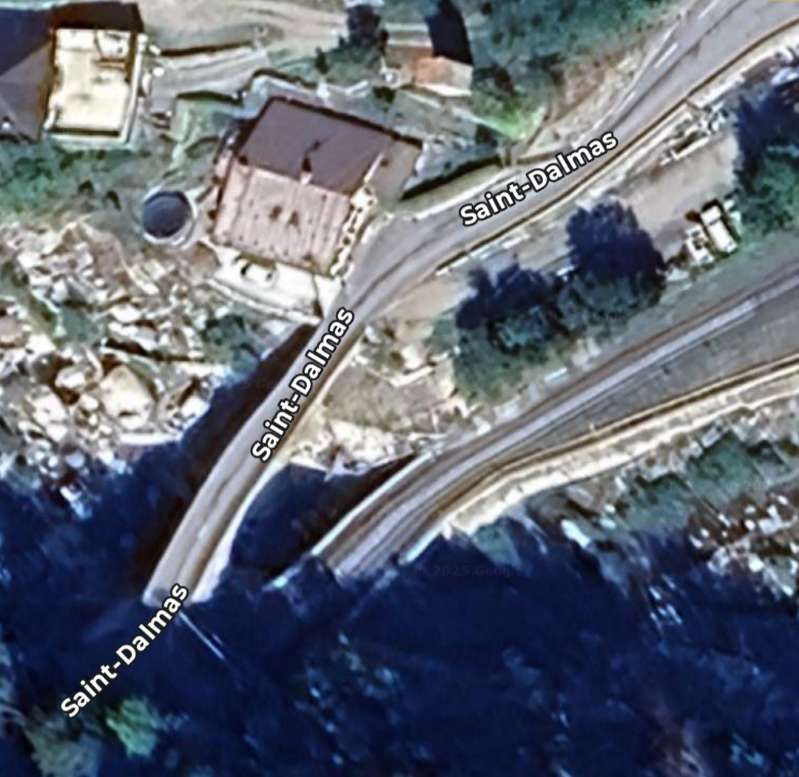
The tunnel mouth is in shadow at the bottom-left of this extract from Google’s satellite imagery. The railway bridge over the River Bieugne is centre-bottom with the road bridge (D91) to the left. [Google Maps, August 2025]
The railway tunnel mouth is on the centre- left of this view from the D91 with the rail bridge over the river bottom-left and the road bridge over the river ahead. [Google Streetview, August 2016]
Looking Northeast from the D91 through the station area. [Google Streetview, August 2016]
The view Northeast from the tunnel mouth of the Biogna Tunnel, the road bridge over the river is on the left, the rail bridge over the river is immediately in front of the camera. This photograph is a still image from a video taken from the cab of a Northbound train. [35]
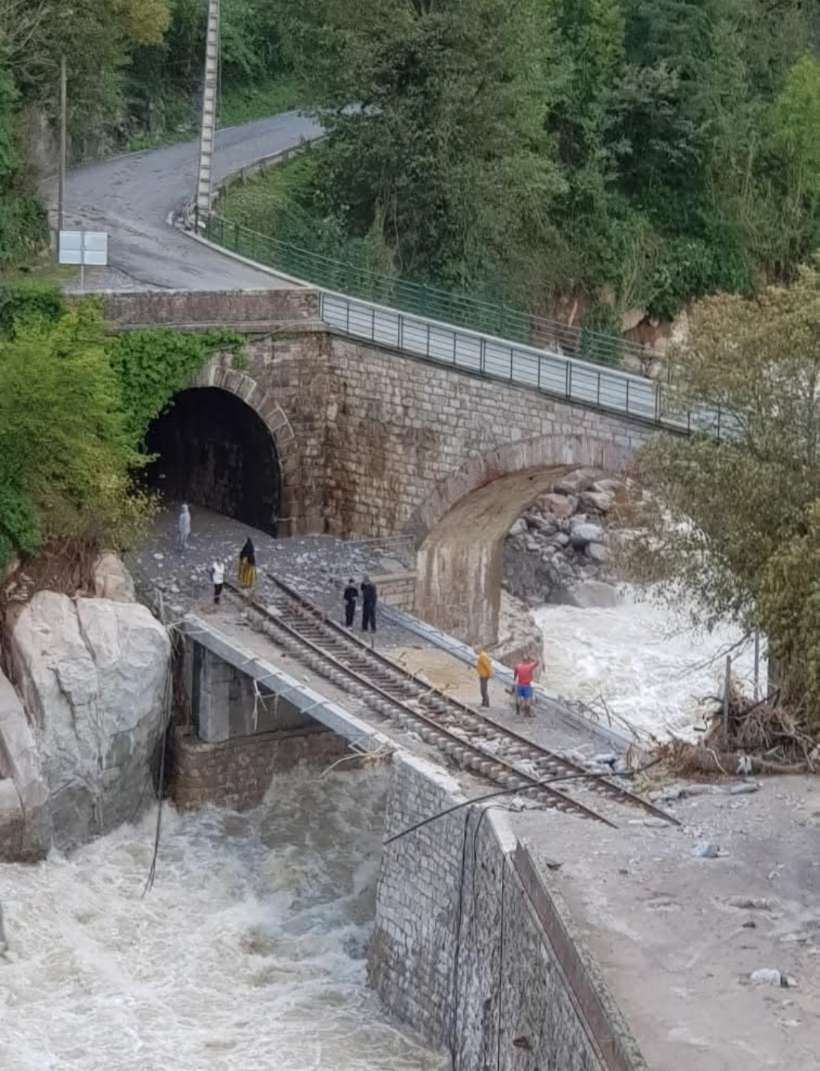
The portal of Biogna Tunnel and the bridges over the Bieugne immediately after Storm Alex in October 2020. This photograph was shared on the Ferrovia Internazionale Cuneo-Ventimiglia-Nizza Facebook Group by Mario Zauli and Olivier Woignier on 3rd October 2020. [17]
One final view of St. Dalmas de Tende railway station. This the Direct 18:83 Turin Porta Nuova – Imperia Porto Maurizio, Locomotive D445.1056 heads a train of five coaches passing through St. Dalmas de Tende on 24th April 1994. This image was shared by Andrea Richermo on the Ferrovia Internazionale Cuneo-Ventimiglia-Nizza Facebook Group on 11th April 2020. [21]

From San-Dalmazzo (St. Dalmas), the railway forms two horseshoe loops underground, crossing the Roya three times over a distance of just over a kilometre as the crow flies.

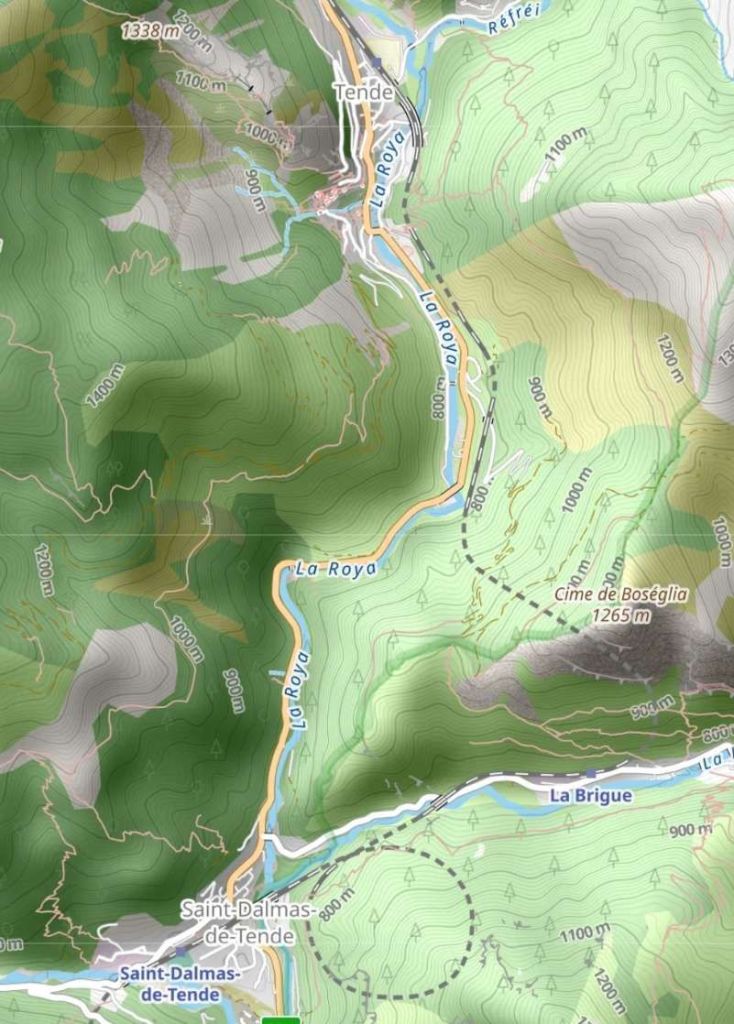
The Biogna Tunnel is the first of these horseshoe tunnels, it is 1154 metres long. We have already seen the approaches to the tunnel from St. Dalmas de Tende Railway Station. The tunnel’s horseshoe shape can be seen on the OpenStreetMap extract below. …

The Biogna Tunnel is horseshoe shaped. [14]

The view Northeast from the southern mouth of Biogna Tunnel. [55]

Turning through 180 degrees this is the mouth of the tunnel, seen from the cab of a Northbound train. [35]

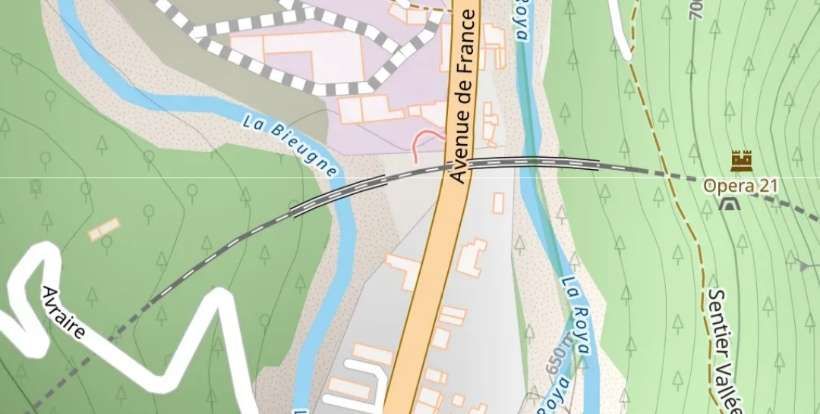
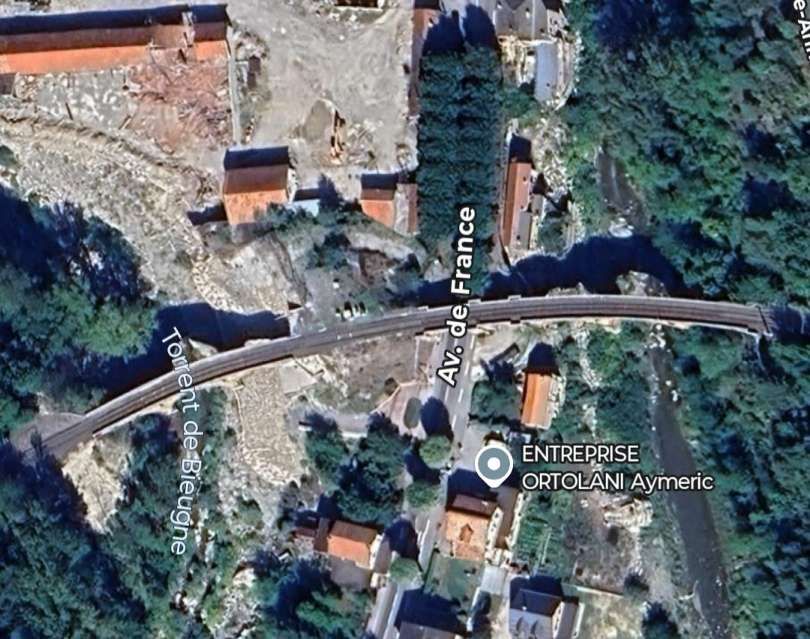
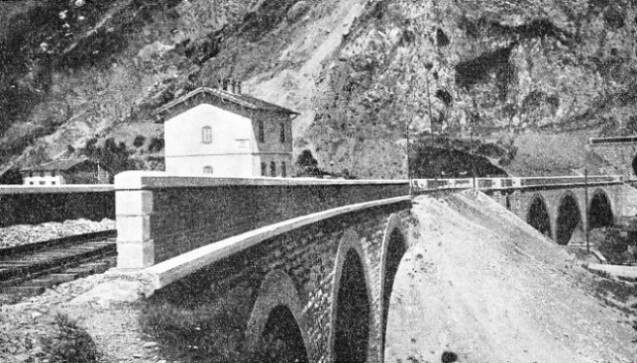
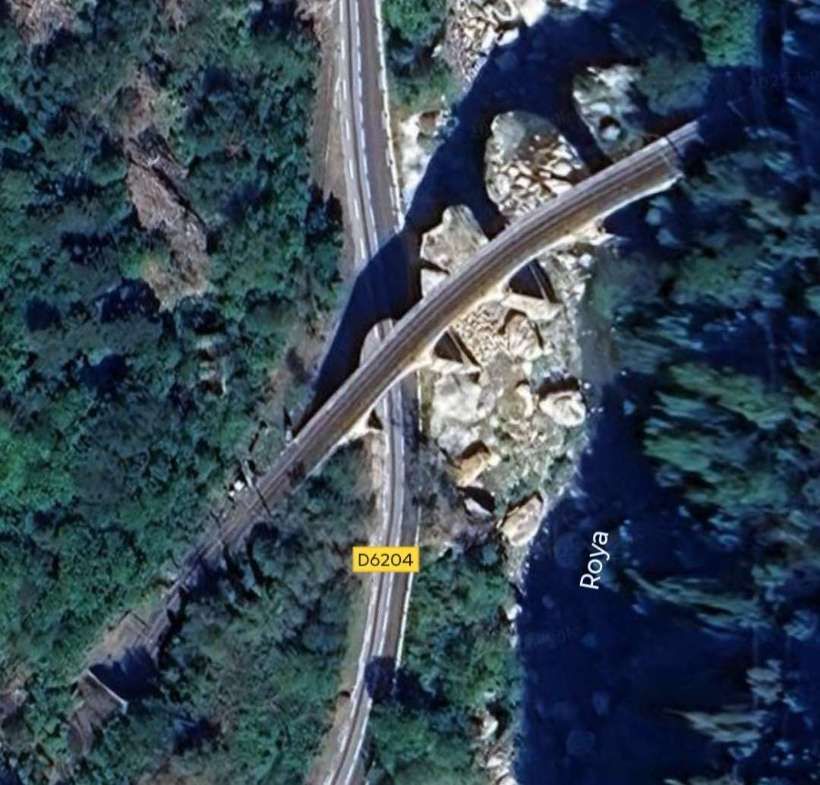
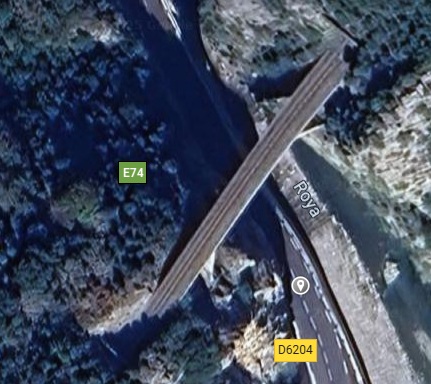
Two viaducts cross the valley off La Roya, San Dalmazzo II Viaduct crosses the River Bieugne (three arches each of 15 metres, then the San Dalmazzo III Viaduct, also three 15 metres arches bridging the Avenue de France (E74/D6204) and then La Roya, before disappearing into the Porcarezzo Tunnel. [15]
The two viaducts as they appear on Google Maps satellite imagery. [Google Maps, August 2025]
In the foreground is a viaduct over the Biogna Torrent; beyond are a viaduct over the River Roya, and then the entrance to the Porcarezzo Tunnel. This section of line is near San Dalmazzo di Tenda. This image was included in an article about the line in Railway Wonders of the World. All that is left of the building at rail level in the left half of the image is the widened surface of the embankment between the two viaducts. [24]

Looking East across San Dalmazzo II Viaduct which has three arched spans, each of 15-metres and crosses the Bieugne River. [55]

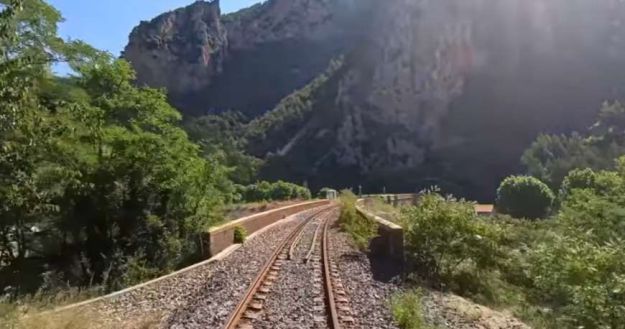
Looking East across San Dalmazzo III Viaduct which spans La Roya. This Viaduct has one opening for the road and a narrower archway for pedestrians and has three further 15-metre spans. The mouth of the Porcarezzo Tunnel is in shade. [55]

The bridge over Avenue de France seen from the North. [Google Streetview, August 2016]

The same bridge seen from the South. In this image both the secondary (narrow) arch and the viaduct over La Roya can be seen. [Google Streetview, August 2025]

San Dalmazzo di Tenda Viaduct III, seen from the South on 23rd October 2020. This image was shared on the Ferrovia Internazionale Cuneo-Ventimiglia-Nizza Facebook Group by Federico Santagati on 23rd October 2020. [22]

Reinforcement/repair works in November 2020 on San Dalmazzo di Tenda Viaducts II and III after the damage from Storm Alex on October 2 – 3, 2020. This image was shared on the Ferrovia Internazionale Cuneo-Ventimiglia-Nizza Facebook Group on 20th November 2020 by Mario Zauli, courtesy of Bernard Woignier. [23]

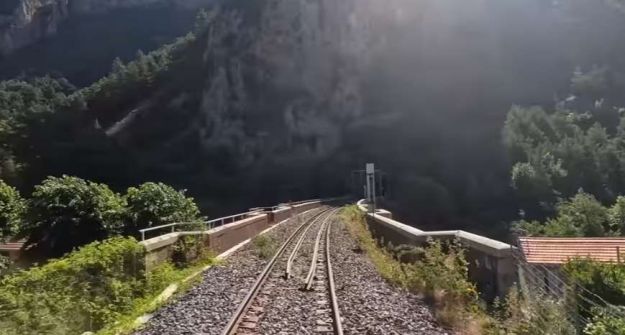
Looking West across the same viaduct towards the Biogne Tunnel. [35]

The Porcarezzo Tunnel mouth to the East of La Roya. [55]

Looking West from the Porcarezzo Tunnel mouth across the San Dalmazzo III Viaduct. [35]

The Porcarezzo Tunnel turns through 180°, continuing to drop at a gradient of 25mm/m. It is 1249 metres in length. [16]

Southbound trains leave Porcarezzo Tunnel and immediately cross San Dalmazzo di Tenda Viaduct IV. [55]

Turning through 180° we see the Southwest mouth of the Porcarezzo Tunnel which sits above La Roya and is seen here from the cab of a Northbound train on the San Dalmazzo IV Viaduct. [35]

San Dalmazzo di Tenda IV Viaduct as it appears on Google’s satellite imagery. [Google Maps, August 2025.

The approaches to the Porcarezzo Tunnel from the Southwest cross the San Dalmazzo di Tenda IV Viaduct (six 15-metre spans) over La Roya and the E74/D6402. [35]

San Dalmazzo di Tenda IV Viaduct seen from the North. [Google Streetview, August 2016]

San Dalmazzo San Dalmazzo di Tenda IV Viaduct seen from immediately below on the North side. [Google Streetview, July 2014]

San Dalmazzo IV Viaduct di Tenda seen from the South. [Google Streetview, August 2016]

Once Southbound trains had crossed La Roya, it was just a short distance before they entered Gorges Paganini Tunnel. This is the tunnel mouth. [55]

Turning through 180° this is the view from the cab of a Northbound train leaving Gorges Paganin Tunnel (1,702 metres in length). [35]

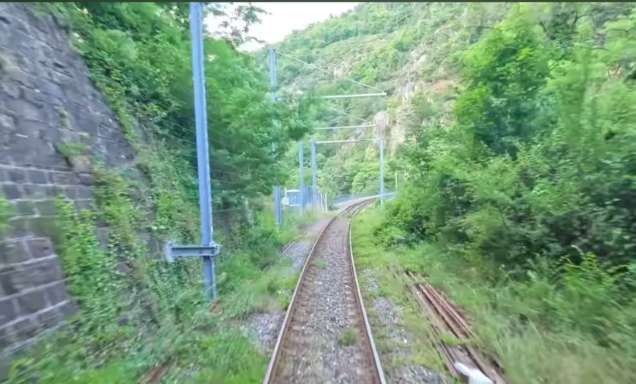
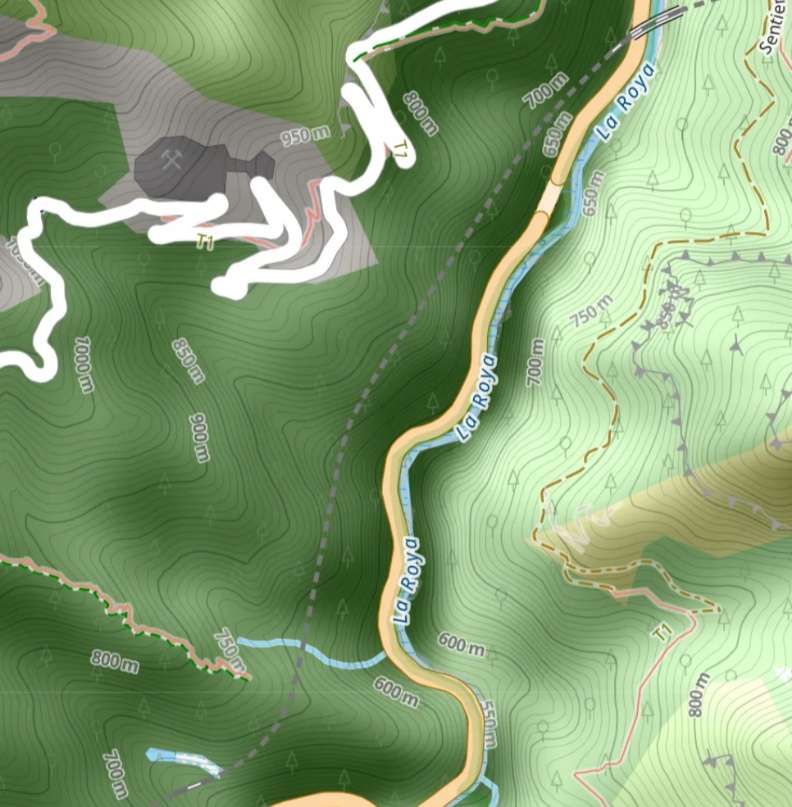
Gorges Paganin Tunnel runs South-southwest parallel to the valley of La Roya and only a few metres beyond the valleys western face, occasionally running close enough to the valley side for gallery openings to shed light into the tunnel.

Gorges Paganin Tunnel is marked by the dotted line to the West of the river valley. It is over 1700 metres in length with occasional gallery openings in the valley side. [25]

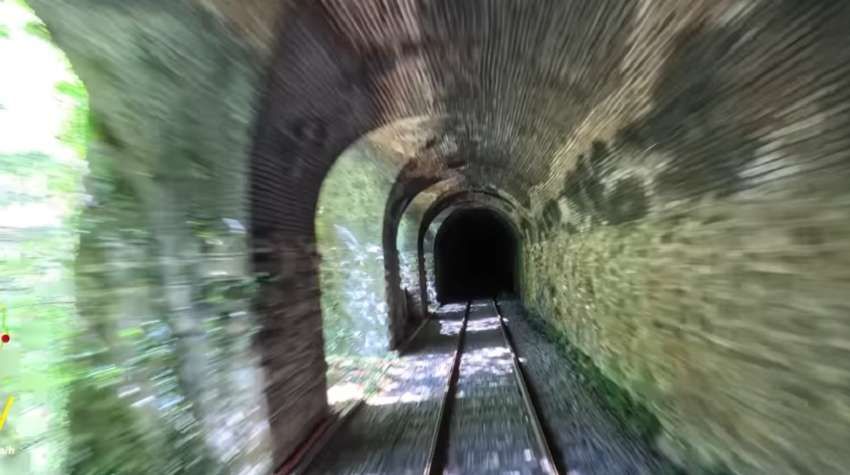
The Gorges Paganin Tunnel is actually considered to be a series of six different tunnels separated by sections of galleries with arched openings into the valley side. These tunnels are: Foce (167m long); Tornau I (270m long); Tornau II (475 m long); Ravallone I (392m long); Ravallone II (91m long; and Balma (337m long). [1: p129]

One of a series of gallery openings in the walls of Gorges Paganin Tunnel, seen from the cab of a Southbound service. [55]

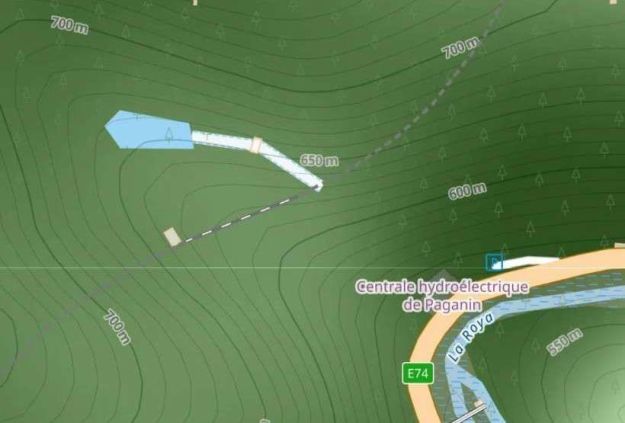
OpenStreetMap shows a short length of line within the Paganin Valley above the Hydroelectric Power Station which is next to the E74/D6204 in the valley of La Roya. [26]

Google’s satellite imagery shows the hydroelectric scheme in the Vallon de Paganin and the power station next to the road and La Roya. The railway line can be seen just to the left of centre. [Google Maps, August 2025]

Banaudo et al tell us that at “the end of the tunnel, the line opens into the Paganin Valley, which marks the northern border between Italy and France. … In this wild and steep site, where a torrent and the penstock of the Paganin Hydroelectric Power Plant tumble, the portals of the last Italian tunnel and the first French tunnel face each other, each guarded by a roadside cottage in the typical style of the FS and PLM.” [1: p129]

Having reached the old French/Italian border we can stop and take stock. We will look at the construction of the line North from the coast once our journey reaches that portion of the line. Suffice to say that by 1915 tracklaying from the coast had reached Airole.

As far as the line heading South from Cuneo is concerned track laying had reached San Dalmazzo di Tenda and the structures and track formation was in place to the Northern French /Italian border.

2. The First World War

In 1915, Italy entered the war on the side of the allies. “Leading up to WWI, Italy had formed an alliance with the Central Powers of the German Empire and the Empire of the Austria-Hungary in the Triple Alliance. Italy should have joined on the side of the Central Powers when war broke out in August 1914 but instead declared neutrality.” [27]

The Italian government had become convinced that support of the Central Powers would not gain Italy the territories she wanted as they were Austrian possessions – Italy’s old adversary. Instead, over the course of the months that followed, Italy’s leaders considered how to gain the greatest benefit from participation in the war. In 1915, Italy signed the secret Treaty of London and came into the war on the side of the Triple Entente (Britain, France, Russia). By its terms, Italy would receive control over territory on its border with Austria-Hungary stretching from Trentino through the South Tyrol to Trieste as well as other areas.” [27]

After the war ended, at the Paris Peace Conference that led to the Versailles Treaty, the Italian government struggled against the other Allied leaders, the Big Three (Britain, France and the US), to gain all that they believed had been promised to them. Although Italy did receive control of most of the European requests, they failed to gain their colonial ambitions and felt they did not get what they had been promised. This engendered resentment towards the Allied countries, especially as Italians felt they had paid a high price, in terms of men and money, fighting for the Allies. These resentments helped drive the success of Benito Mussolini and his fascist movement – four years after the war, Mussolini and his blackshirts gained power.” [27]

Ultimately, the war stopped all progress on the line. Banaudo et el tell us that “the work begun thirty-two years earlier by the SFAI, then continued by the RM until nationalization, was thus virtually completed by the FS. The construction of the 80.3 km of line in Italian territory cost nearly 85 million lire compared to the 76 million initially planned, representing an average expenditure of 1,058,500 lire per kilometre.” [1: p135]

In France, the war caused all work to be halted. An attempt was made to continue the work in 1915, but failed because of underground conditions encountered. In 1917, an attempt to continue activity using prisoners of war was unsuccessful.

During the war, Italian authorities lifted track between Piena and Airole in the South for use on the front. Work on the new Cuneo railway station halted.

French and British troops were sent to augment Italian forces on 1917. It seems as though many of these passed through San Dalmazzo di Tenda. Between 19th October and 15th December 1917, “192 military convoys departed from San-Dalmazzo, and the Col de Tende line saw up to twenty movements of all categories on some days.” [1: p136]

After the war, resources were in short supply. In France priority was given to the devastated areas in the Northeast of the country. The PLM received very little support. Contractors found recruitment a problem because of the drastic loss of life among working age men. Banaudo et al tell us that in France “tunnels, abandoned for nearly five years, had suffered serious deformation, particularly in areas with high water infiltration. In Italy, the situation was no better, and construction of the new Cuneo station was suspended, even though an arch of the large viaduct over the Stura River, which was to provide access to it, was already being erected.” [1: p138]

Nevertheless, work did resume, supplies began to head North from Menton on the tramway to Sospel and supplies were arriving from the South via the FS on the Italian side of the border at Airole. Transport via Airole proved better than via the Menton-Sospel tramway and by 1920 the two main contractors on either side of the border (Giianotti and Mercier) ceased to use the Menton-Sosel route. [1: p138]

1920 saw a significant budget reduction for the works in French territory – 104 million Francs to 75 million Francs. Only 17 million Francs were allowed in 1920. “The Mercier company alone was spending 4 to 5 million francs per month on its construction sites.” [1: p140] Layoffs were necessary and work slowed significantly to remain within budget.

In June 1920, the Inspector General of Public Works announced to companies that only 700,000 francs of credit remained to complete the year, an insignificant sum that forced construction to be suspended immediately, putting hundreds of workers out of work. Elected officials from the Alpes-Maritimes immediately rushed to Paris to meet with representatives of the ministry and the PLM management. After heated discussions, a new budget was allocated by the State for railway construction. The PLM had a credit of 41 million, 25 of which were allocated to the Nice – Cuneo line. Work could resume, but the engineers and contractors in charge of it would have to take into account the irregular arrival of funds until the end when organizing their construction sites.” [1: p140]

2. The Northern French/Italian Border South to Breil-sur-Roya

Two tranches of construction work covered the length of the line from the French/Italian border to Breil-sur-Roya. Banaudo et al tell us that this length of the line “contained the highest density of engineering structures on the French route, and, with a few exceptions, the war had interrupted work there in its early stages.“[1: p142]

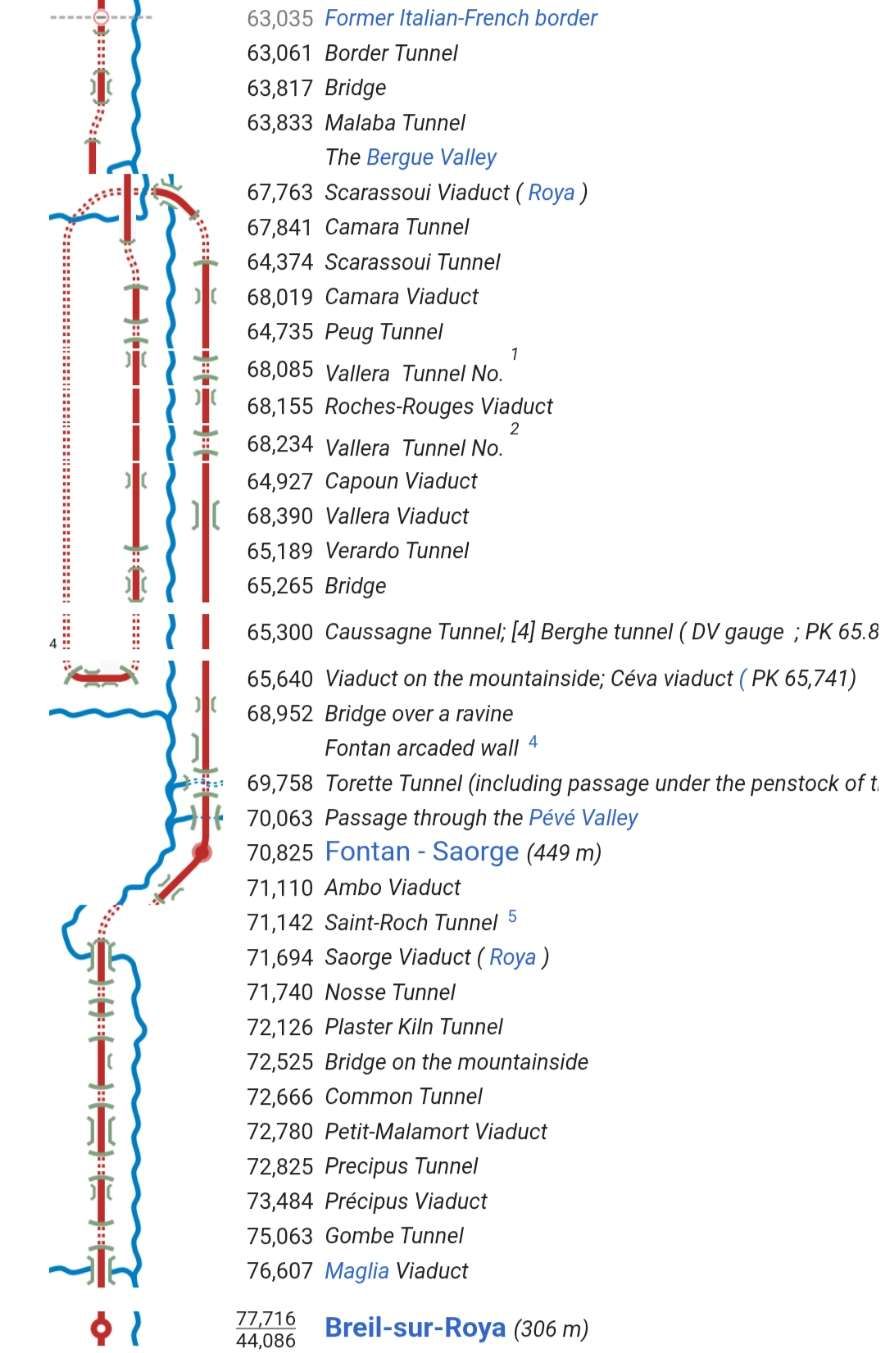
A schematic representation of the line between the historic Italian/French Border and Breil-sur-Roya. [13]

The view across the border from the North, a view from the cab of a Southbound service at the mouth of the Gorges Paganin Tunnel. [55]

Looking back North towards the southern portal of the Gorges Paganin Tunnel, a view from the cab of a Northbound train. [35]

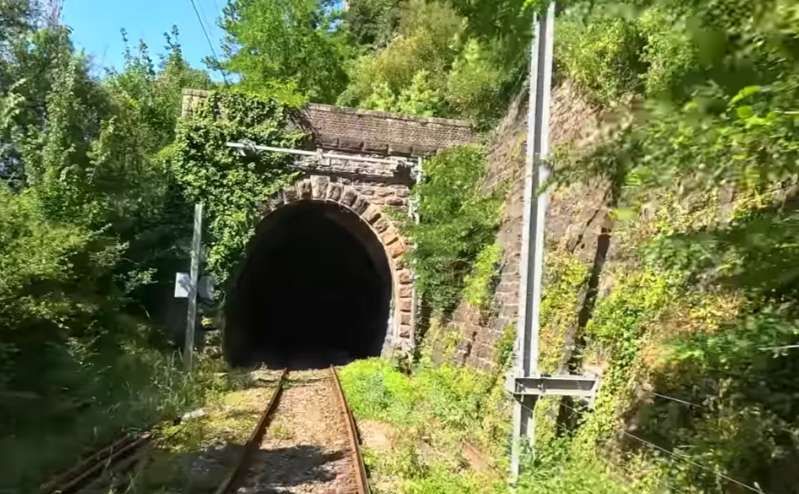
Once on the French side of the border the line immediately entered the Frontiere Tunnel. …

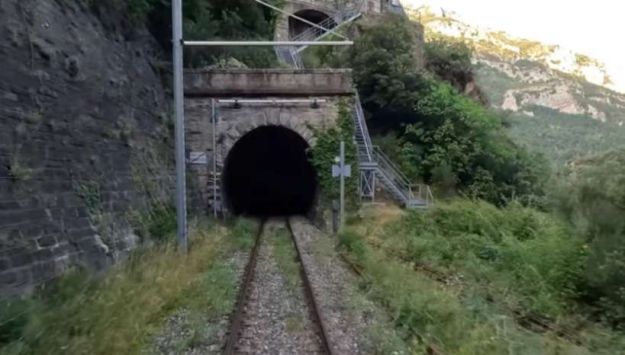
The North portal of the Frontiere Tunnel, seen from the cab of a Southbound train. [55]

Looking North across the border from the cab of a Northbound service leaving the mouth of the Frontiere Tunnel [35]

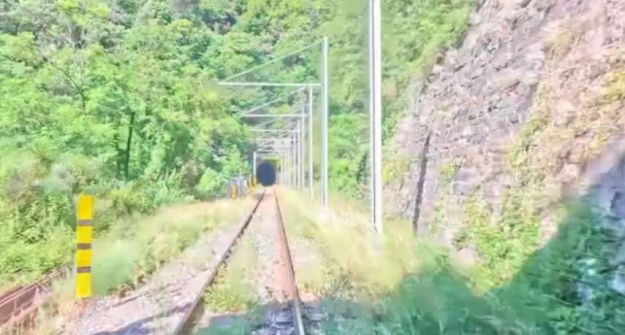
The view from the cab of a southbound train just to the Southwest of the Frontiere Tunnel mouth. [55]

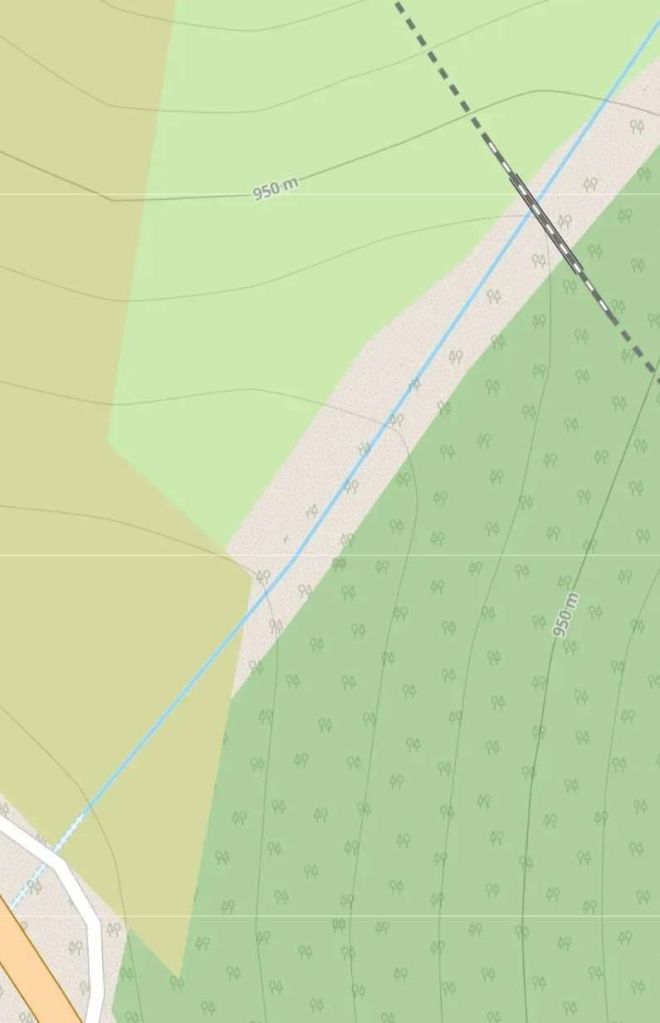
The short open section of track appears on the left of this extract from OpenStreetMap. Tree cover means it is impossible to show the short section of line on and extract from Google’s satellite imagery. [28]

The view from the cab of a Northbound train approaching the mouth of Malaba Tunnel. Ahead is the southern portal of Frontiere Tunnel. A very short length of line runs between Frontiere Tunnel and Malaba Tunnel. [35]

Malaba Tunnel is 389 metres in length. This image shows the view from the cab of a Southbound service as it leaves the tunnel. [55]

Turning through 180 degrees we see the Southwest portal of Malaba Tunnel from the cab of a Northbound train. [35]

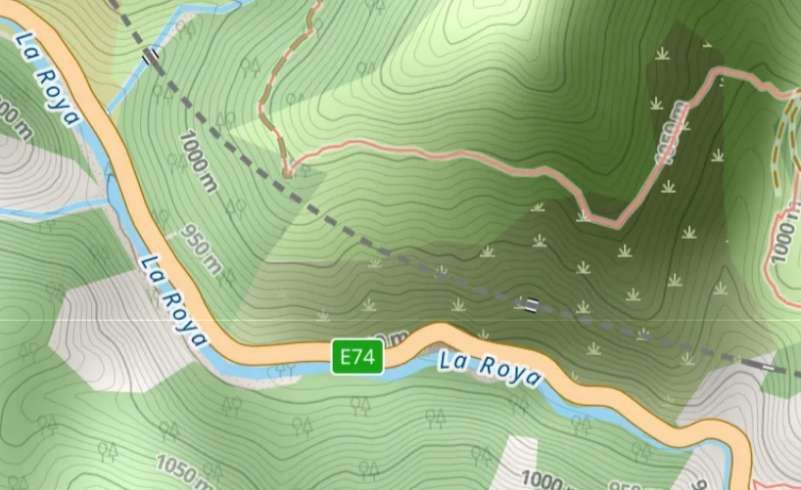
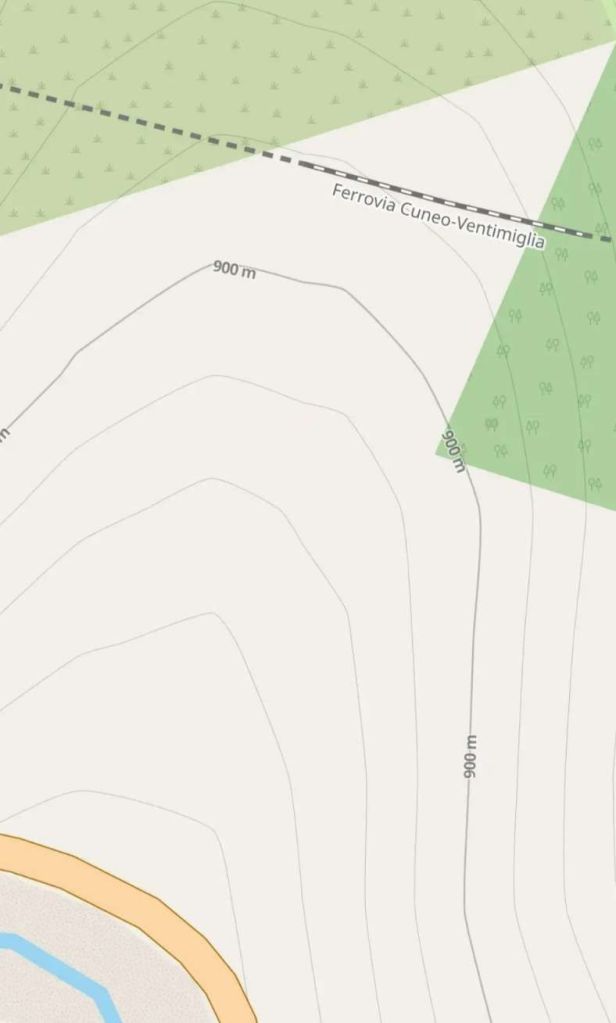
This extract from OpenStreetmap shows the next open length of track running from centre-top to bottom-left. We are just entering the first length of another spiral and can see the lower length of track in tunnel under the line and then bridging La Roya. [29]

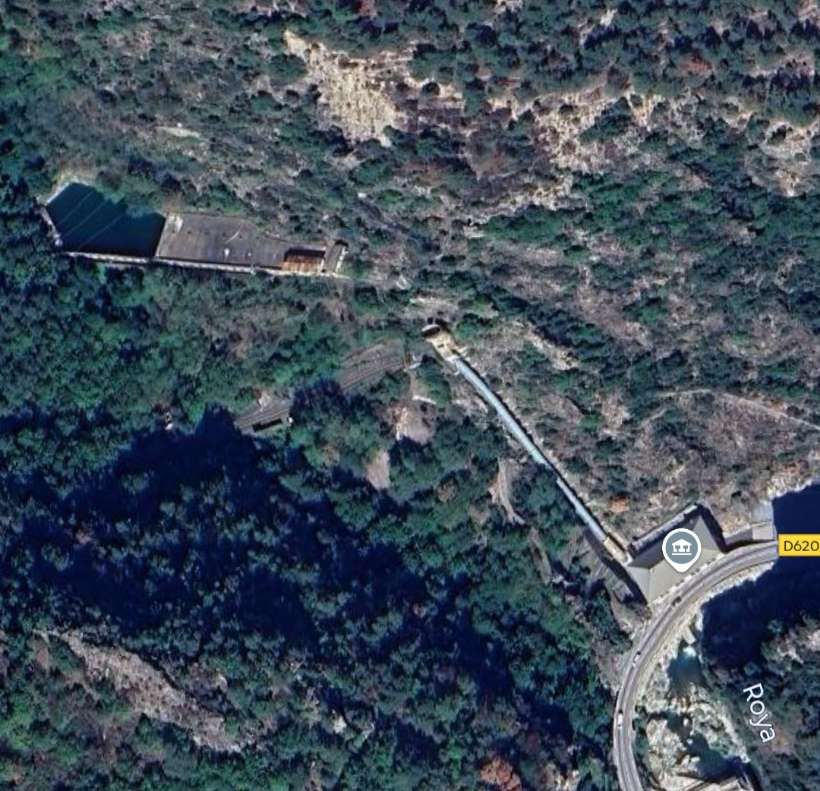
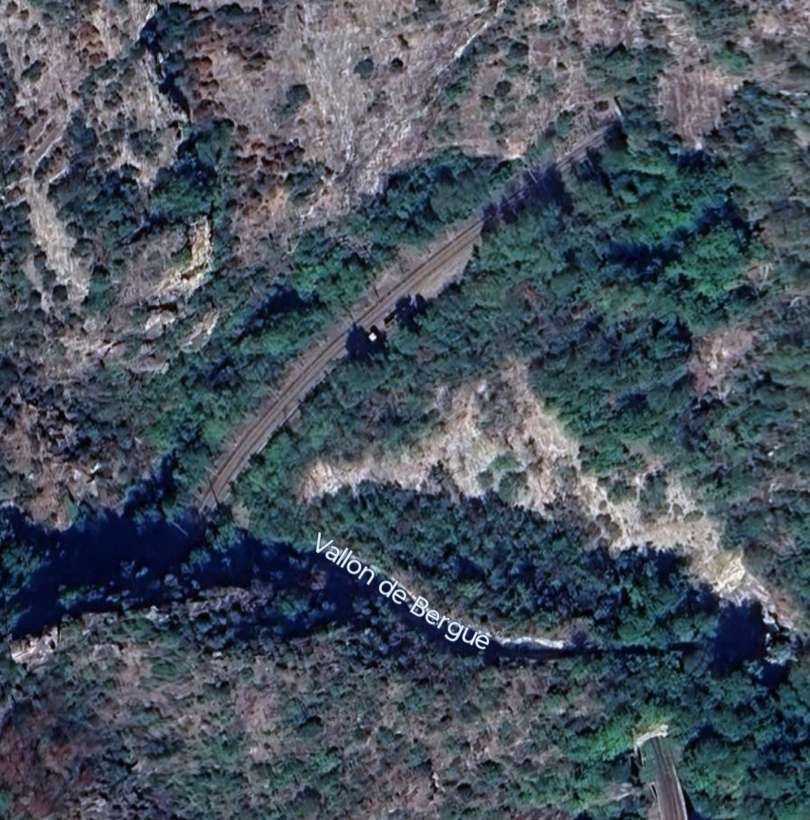
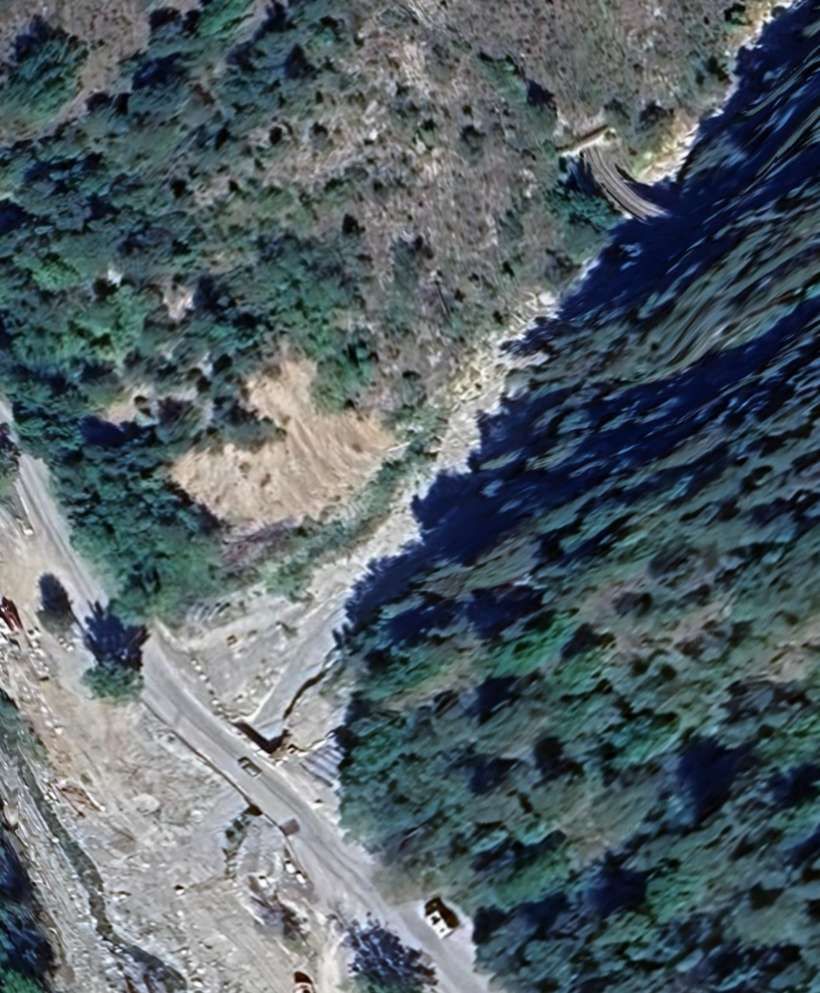
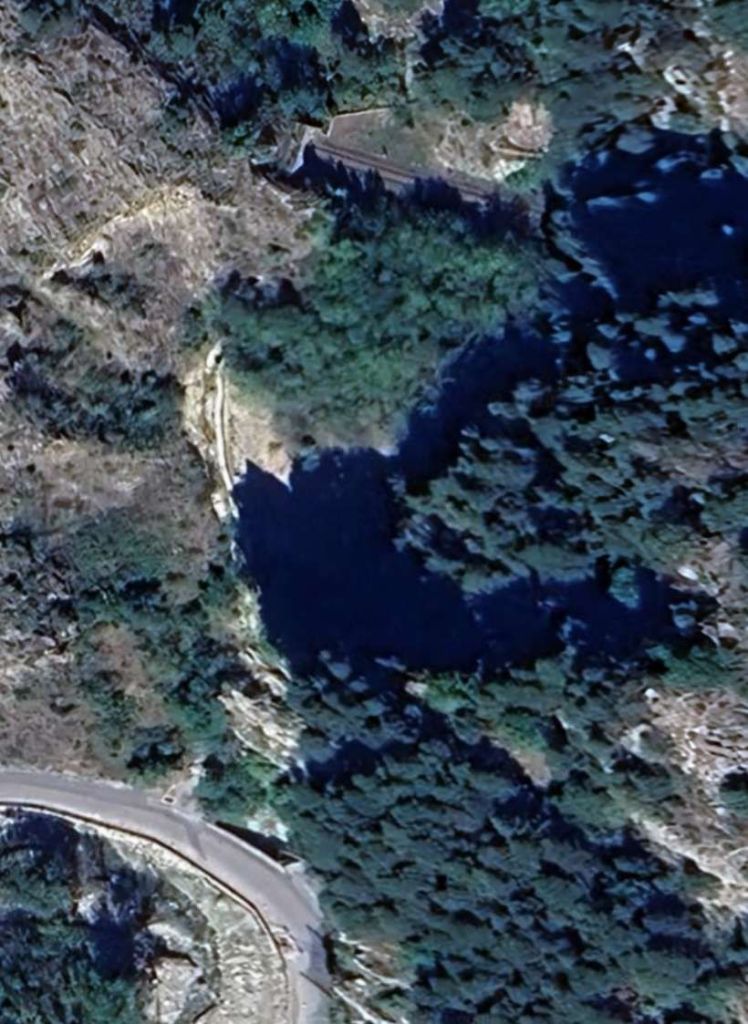
Google’s satellite imagery shows the same length of railway high above the Scarassoui Viaduct which can be seen bottom-right. [Google Maps, August 2025]

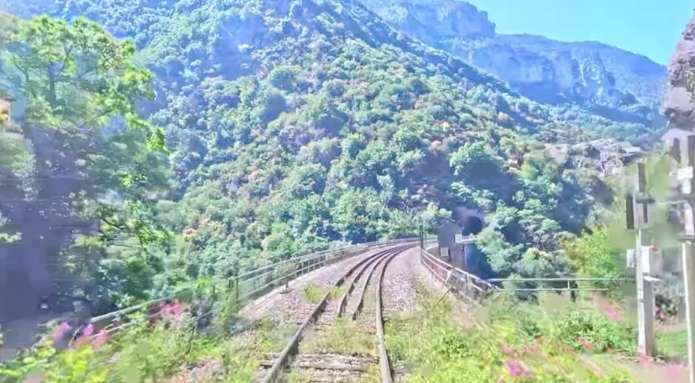
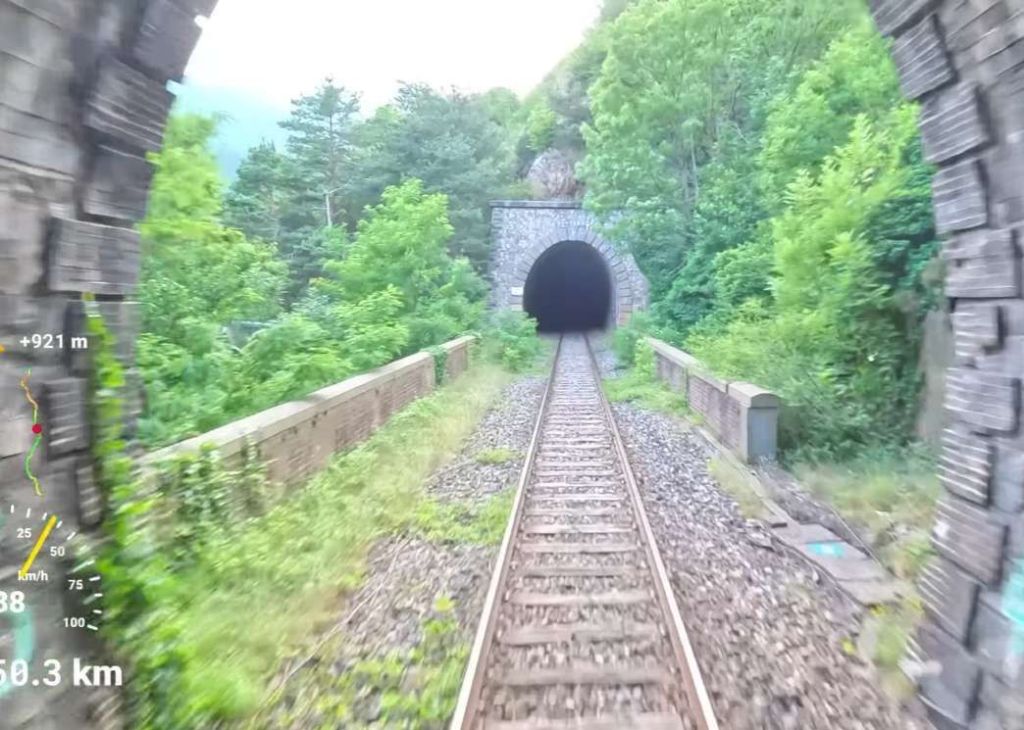
From the cab of the Southbound service, we see the mouth of Scarassoui Tunnel. The Tunnel is 181 metres in length. [55]

Turning through 180°, we look Northeast from the cab of the Northbound train as it leaves the Scarassoui Tunnel. [35]

The spiral in this location consists of a number of tunnels and open lengths of track. The first tunnel encountered travelling South is the Scarassoui Tunnel (top-right) which has a gallery of a series of arches at its southern end. A length of open track leads to Peug Tunnel, Vernardo Tunnel, Caussagne Tunnel and then Berghe Tunnel. [31]

A view North along the valley of La Roya. Top-left in this image, the line from St. Dalmas de Tende enters the image at high level and on a falling grade, through Scarassoui Tunnel. It passes through Peug Tunnel and, after running parallel to the river for a short distance, curves away to the left in tunnel. It appears again beneath Scarassoui Tunnel to cross La Roya before travelling down the East side of the river in a series of tunnels. Source not recorded. [30]

The high level tunnels of Scarassoui (its South portal can be seen at the top of this extract) and Peug. The metal frames over the open lengths of track are part of an avalanche warning system. [30]

Two views looking South inside the gallery at the southern end of Scarassoui Tunnel. [55]

A driver’s eye view of the South end of Scarassoui Tunnel. [35]

The gallery seen from below soon after it was constructed. This image appear in the Railway Wonders of the World article about the line, (c) Public Domain. [24]

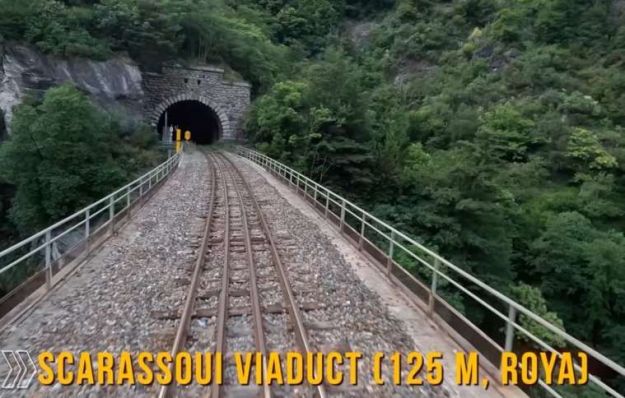
Just a short distance further South, we can look over our shoulder to see the modern Scarassoui Viaduct crossing the River Roya some distance below. In a short while we will cross that viaduct. [35]

Turning through 180°, this is the view South towards the North portal of Peug Tunnel which is just 75 metres in length. [55]

The view North from the mouth of the Peug Tunnel. [35]

A view of the length of track between the Scarassoui and Peug tunnels can be found here. [29] It is a view from the valley floor close to the river, of the length of track between Scarassoui Tunnel on the right and Peug Tunnel on the left (its portal is just visible at the extreme left of the image. The gallery at the end of the Scarassoui Tunnel was added in the 1970s, © Eugenio Merzagora, courtesy of the Structure website. [29]

This Google Earth 3D satellite image gives good idea of how far up the valley side from the river and road the railway is positioned. [Google Earth, August 2025]

The view South from the mouth of Peug Tunnel, seen from the cab of a Southbound train. [55]

The southern portal of the Peug Tunnel seen from the cab of a Northbound service. [35]

A little further South and looking South from the cab of the Southbound service across the Peug Viaduct (50 metres long). [55]

Looking across the valley of La Roya we can see the line heading South . Our train will travel along that length of the line in a short while. [35]

Further South again, a driver’s view from a Southbound service along Capuon Viaduct (45 metres long) towards the North Portal of Verardo Tunnel (53 metres long). [55]

Looking back at the southern mouth of Verardo Tunnel. [35]

The cab of the Southbound train again, looking from the southern end of Verardo Tunnel over Berghe Viaduct (30 metres long) towards the mouth of the Caussagne Tunnel (275 metres long). [55]

Caussagne Tunnel curves West into the valley of the Torrent de la Ceva. The far tunnel mouth faces West-northwest.

The view back towards Vernardo Tunnel over the Berghe Viaduct from the mouth of Berghe Tunnel. [35]

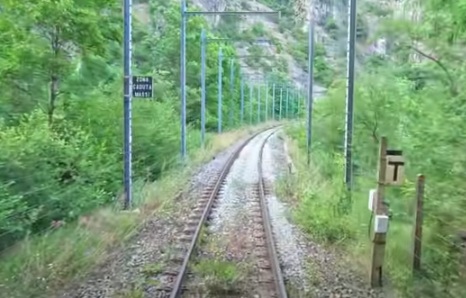
The view from the cab of the Southbound train as it leaves Caussagne Tunnel, heading Northwest up the valley of the Ceva. [55]

Turning through 180°, this is the tunnel portal, seen from the cab of a Northbound train. [35]

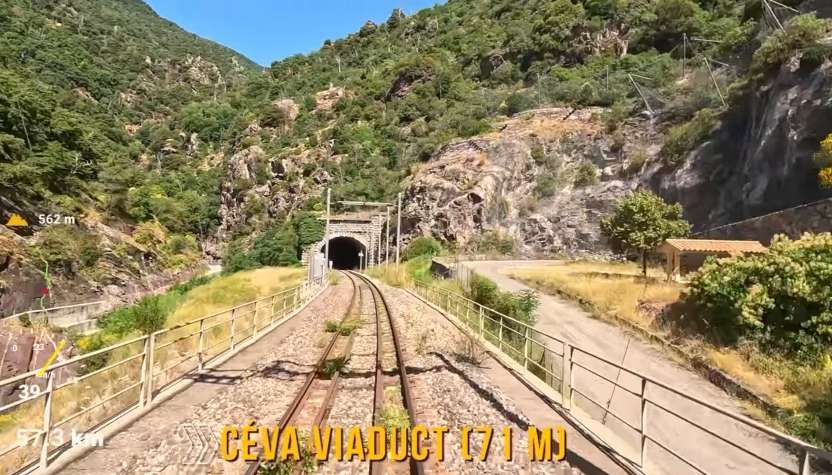
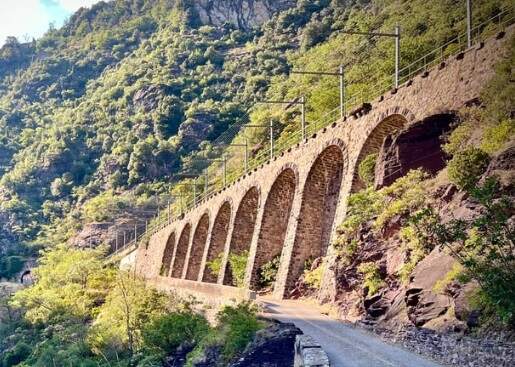
The Ceva valley is steep sided and the line sits on a narrow ledge supported above the valley floor by a retaining wall. Before entering the 1881 metre Berghe Tunnel it crosses the Ceva Viaduct (71 metres long).

The view from the cab of a Southbound train crossing Ceva Viaduct before entering the Berghe Tunnel. [55]

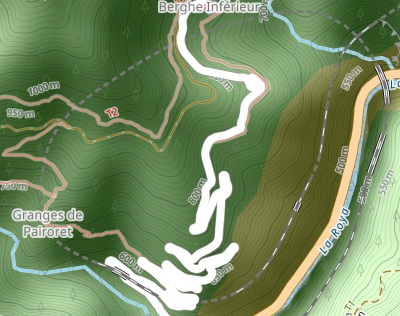
This extract from a photograph taken to illustrate the demands placed on cyclists riding up the Ceva Valley shows the retaining structure which holds the railway above the minor road. The tunnel mouth of the Berghe Tunnel can just be made out at the left of this image, (c) Cromagnon. [32]

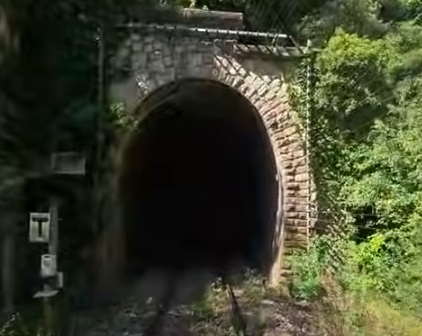
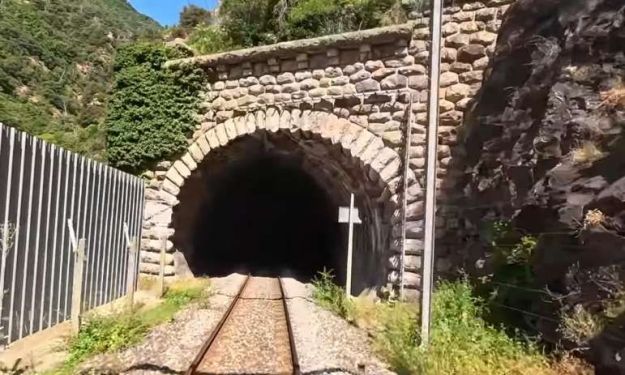
The Mouth of the Berghe Tunnel, seen from the cab of a Southbound service. The Tunnel curves back to the North and then round to the Southeast. [55]

Turning through 180°, this is the View from the mouth of the Berghe Tunnel, seen from the cab of a Northbound service. [35]

Throughout the spiral the line continues on a falling grade. It opens out, well below the level it enters the spiral, onto the Scarassoui Viaduct.

The view from the mouth of the Berghe e Tunnel across the Scarassoui Viaduct. [55]

Looking back towards the mouth of Berghe Tunnel. [35]

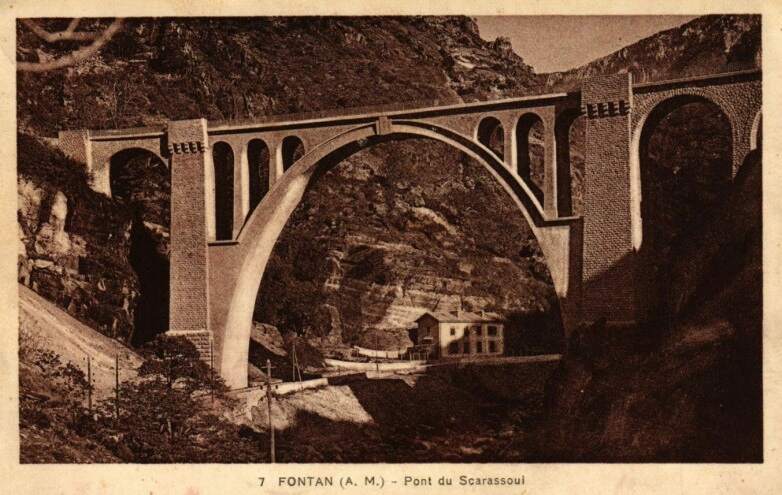
This postcard image shows the Scarassoui Viaduct as built in 1922, (c) Public Domain. [33]
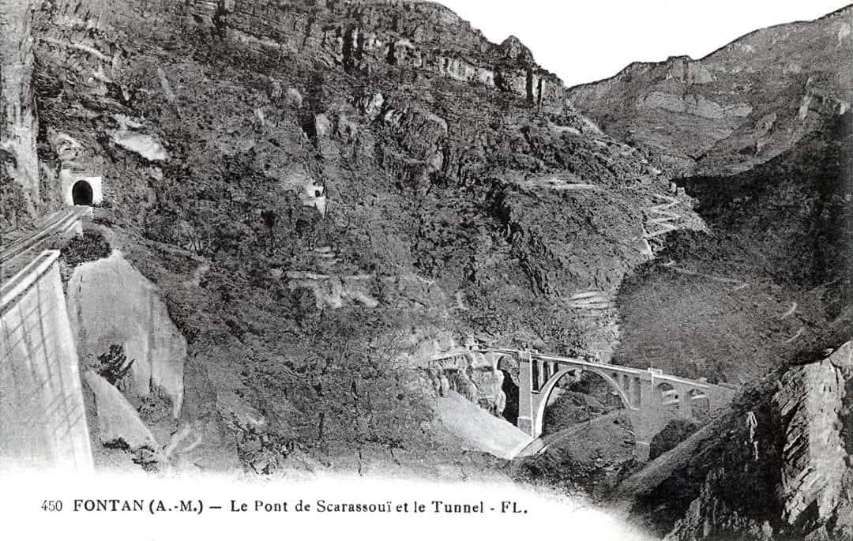
The Scarassoui Tunnel, top-left, and the Scarassoui Viaduct, bottom-right. [46]

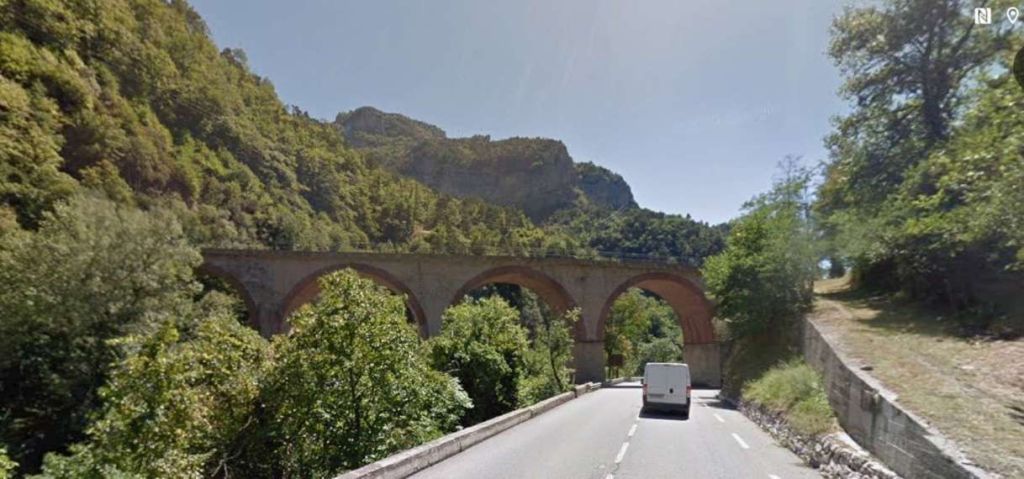
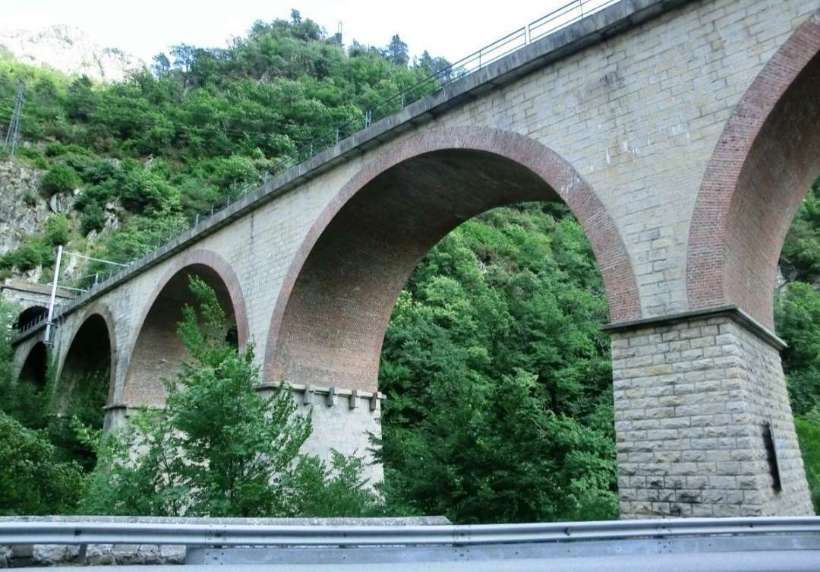
The French engineer, Paul Séjourné decided to create a significant structure at the location of the Scarassoui Viaduct. Banaudo et al quote Séjourné: “The Scarassoui Viaduct is the first French structure that one will see when coming from Italy. It is like a gateway to France; it must be worthy of it.” [1: p142] Séjourné was of the opinion that: “Of all the structures — I mean all, even the smallest — appearance matters. It is not permissible to make ugly. It is a strange opinion to consider expensive what is beautiful, cheap what is ugly.” [1: p142] The bridge Séjourné designed was a curved viaduct (radius 300 metres) carrying the railway on a falling grade of 21 mm/m. It was 125 m long, spanning both La Roya and the E74/D6204 at a height of 42 m. Banaudo et all, tell us that “two arches of 11 m on the Nice side and a 13 m arch on the Cuneo side give access to a central arch of 48 m decorated with six vaults, according to a design that Séjourné had applied on other works. … The central arch was supported by two massive pilasters with crenellated facings, whose bases were widened to compensate for the misalignment due to the curvature of the deck.” [1: p142]

Sadly this bridge was destroyed by the retreating German forces in 1944 and it was not reconstructed in any form until the 1970s. Details of this bridge and photographs of its condition prior to reconstruction can be found here. [34] The replacement 1970s structure is shown below. …

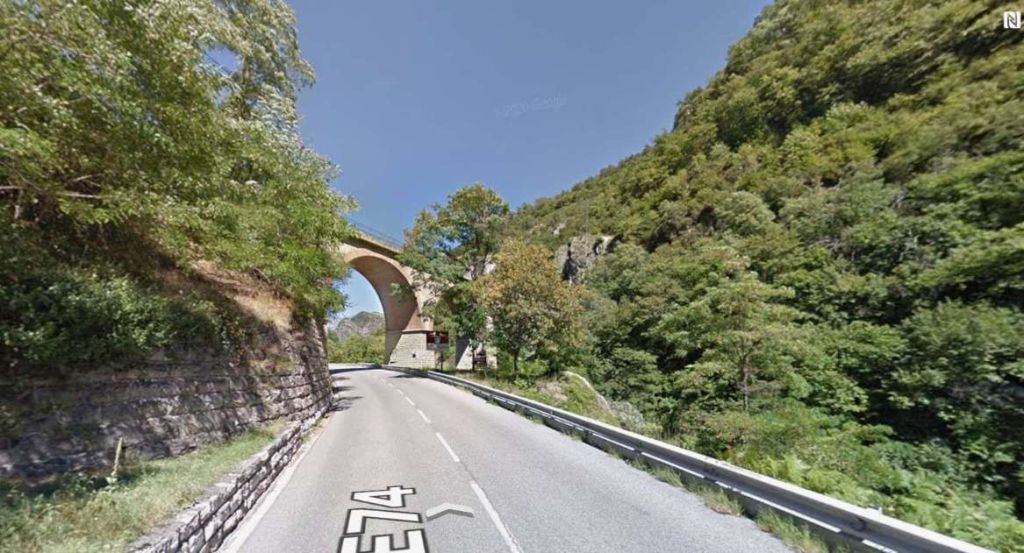
The modern Scarassoui Viaduct seen from the E74/D6204, looking South. [August 2016]
The modern Scarassoui Viaduct seen from the E74/D6204, looking North. [August 2016]
One of the regaul=ar service trains posed on the Scarassoui Viaduct in the 21st century. [36]

Scarassoui Viaduct crosses the River Roya close to the top of this image. Trains heading South then pass through a series of short tunnels following the East bank of La Roya. [30]

The northern portal of the Camera Tunnel is in deep shade. [55]

The view back across the Scarassoui Viaduct from the northern portal of the Camara Tunnel. [35]

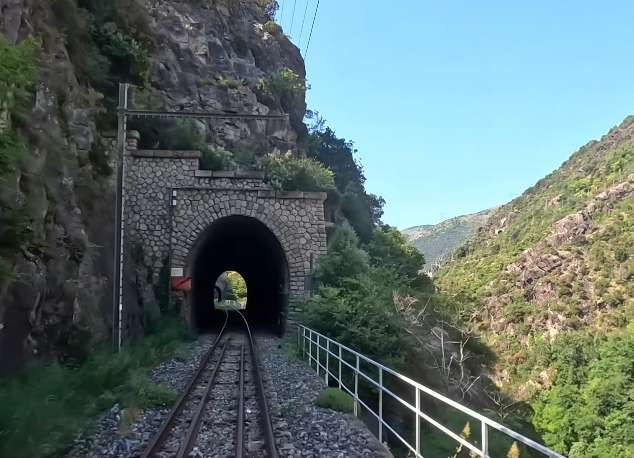
The view South from the southern portal of Camara Tunnel. [55]

Looking back at the South Portal of the Camara Tunnel. [35]

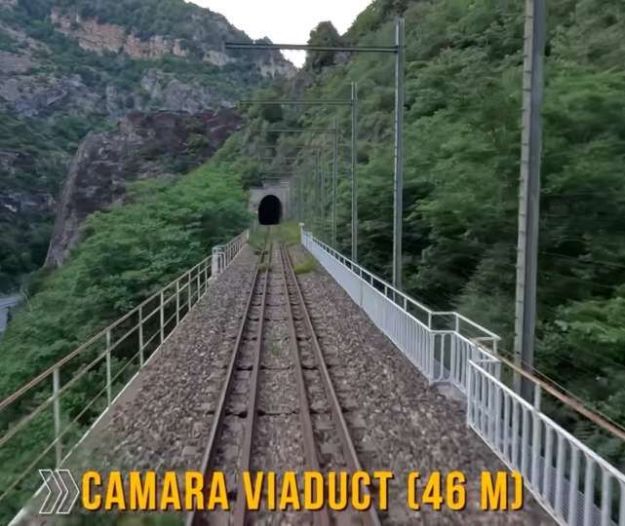
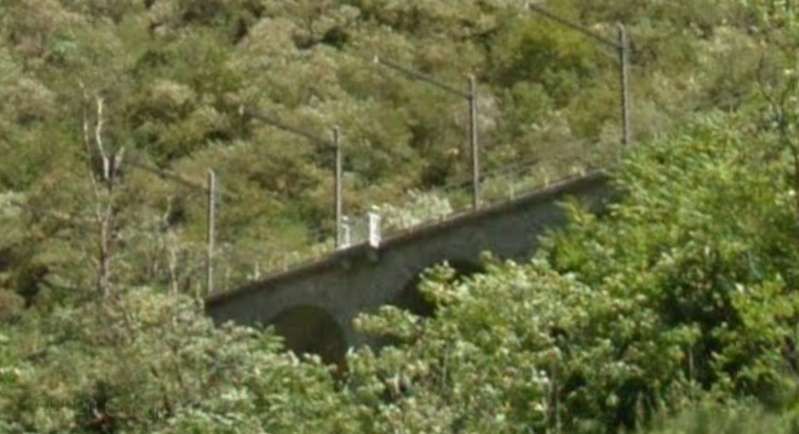
Just to the South of Camara Tunnel is Camara Viaduct, seen here from the cab of a Northbound train. [35]

While it is not possible to see the line on the West bank of La Roya over this length of the valley from the road, it is possible to glimpse the line on the East side of the valley occasionally. [Google Streetview, August 2016]

The North Portal of Vallera Tunnel No. 1. [55]

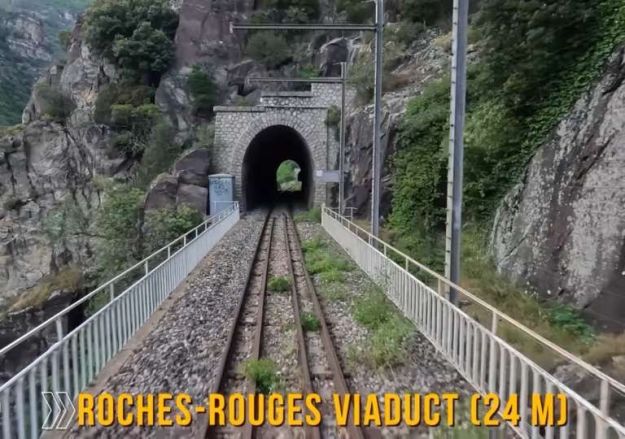
The view North from Roches-Rouges Viaduct towards the South Portal of Vallera Tunnel No. 1. [35]

The view South from Roches-Rouges Viaduct towards Vallera Tunnel No. 2. [55]

The North Portal of Vallera Tunnel No. 2. [55]

Looking North from the tunnel mouth above. [35]

Looking South from the southern tunnel mouth of Vallera Tunnel No. 2. [55]

Looking South along Vallera Tunnel No. 2 [55]

Looking back at the South Portal of Vallera Tunnel No. 2. [35]

Looking North from Vallera Viaduct towards Vallera Tunnel No. 2. [35]

The North portal of Torette Tunnel (121 metres long). The village of Fontan can be seen to the right on the valley floor, [55]

The view from the Southern Portal of Torette Tunnel. [55]

The southern mouth of Torette Tunnel seen from the cab of a Northbound train. [35]

The approach to Fontan-Saorge Railway station from the North, seen from high on the valley side to the West of the River Roya. [My photograph, 18th November 2014]

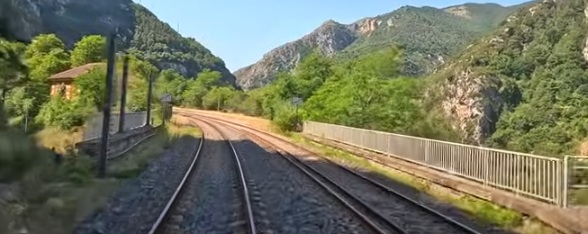
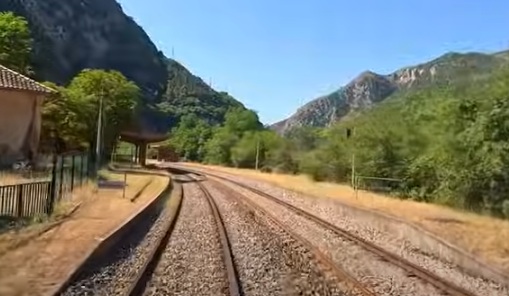
The the track duals to the North of Fontan-Saorge Railway Station. [55]

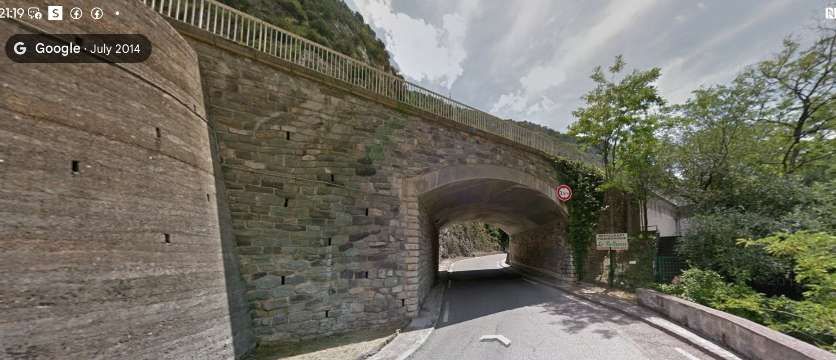
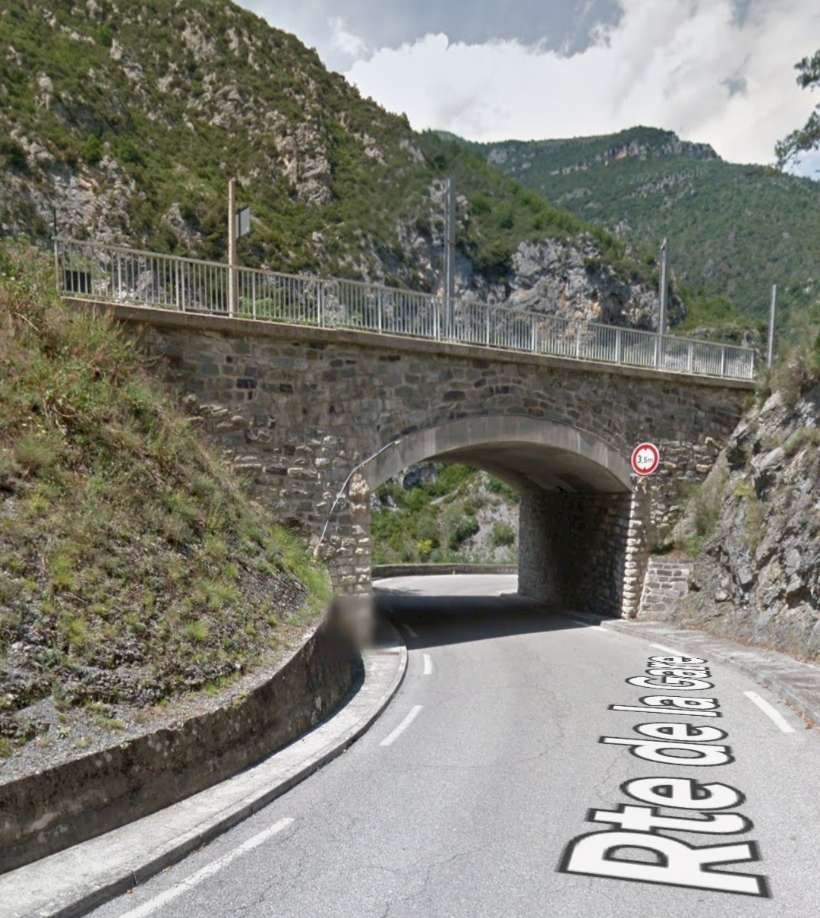
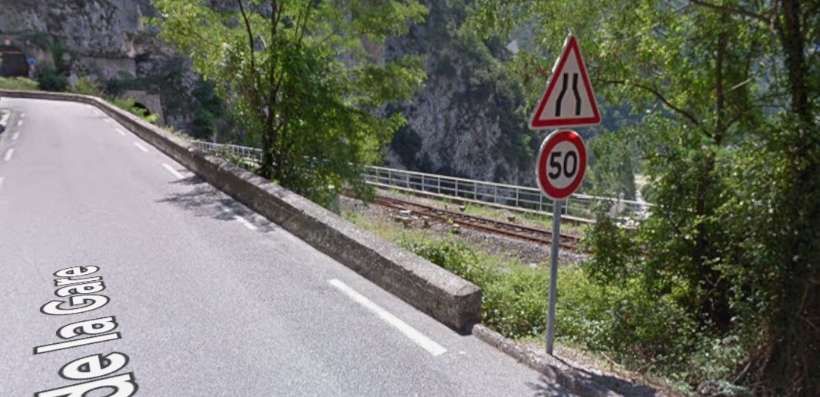
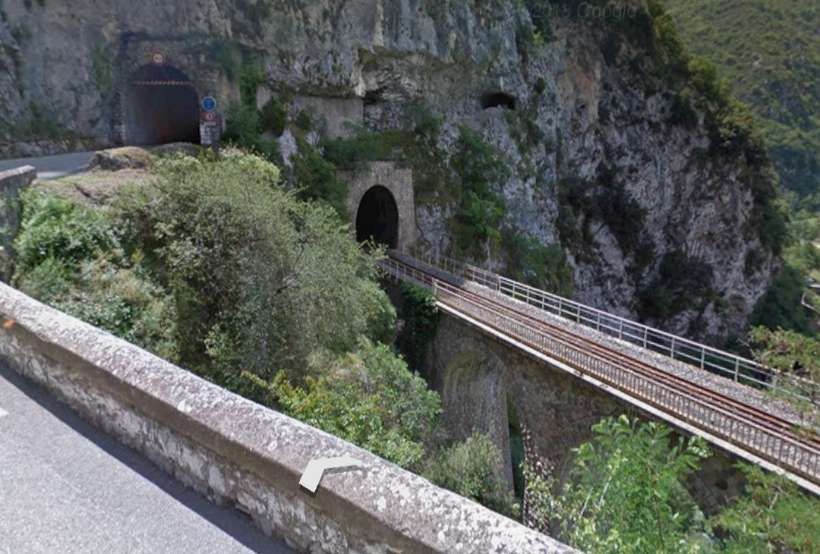
The D38 (Route de la Gare crosses the River Roya and turns South for quite a length of the road the railway towers over it, held above by a large retaining wall. [Google Streetview, July 2014]
Road and railway become much closer in height before the road passes under the railway. [Google Streetview, July 2014]
Another image from the cab of the Northbound train. Just before arriving at Fontan-Saorge Railway Station the line bridges Route de la Gare – the road between Fontan and Saorge. [55]
After passing under the railway the road continues to climb. [Google Streetview, July 2014]

The final approach to Fontan-Saorge Railway Station. [55]

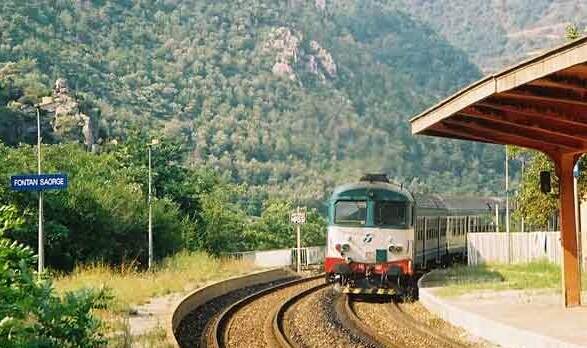
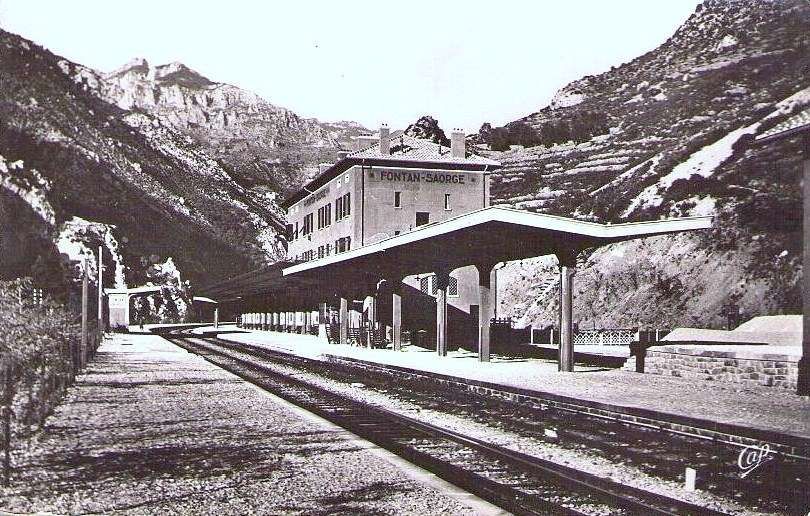
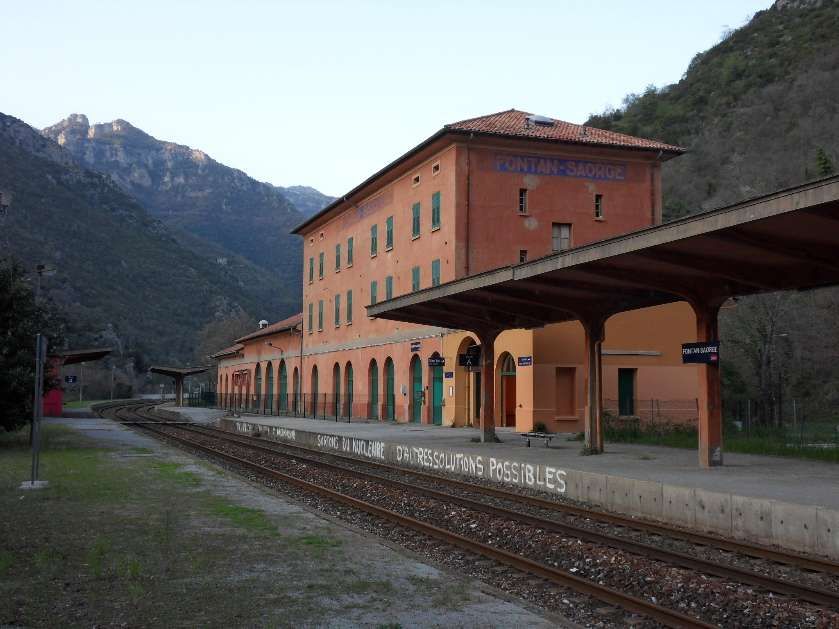
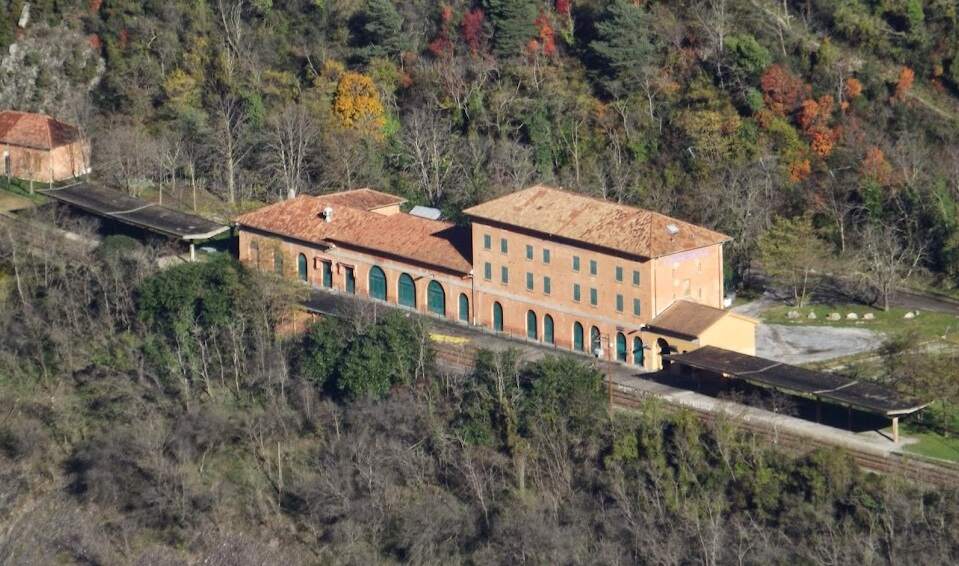
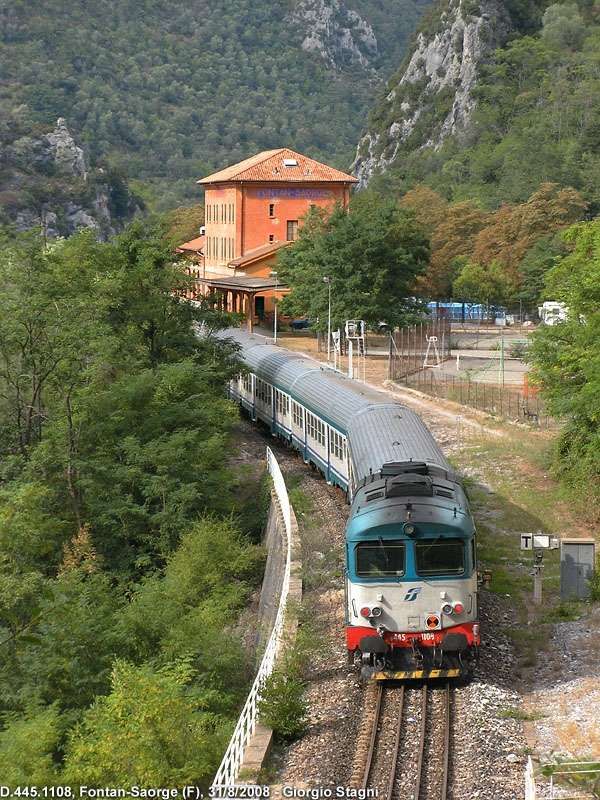
Fontan-Saorge Railway Station seen from the South, © Georgio Stagni and licensed for reuse under a Creative Commons Licence (CC BY-SA 3.0). [48]

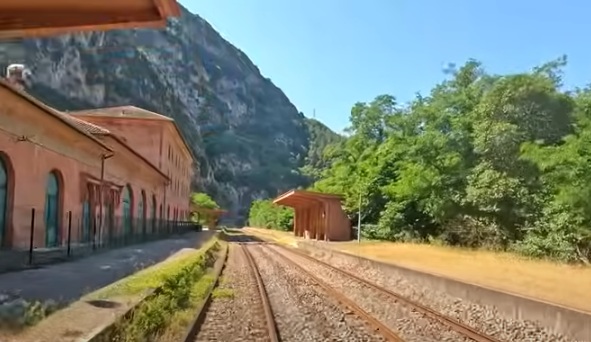
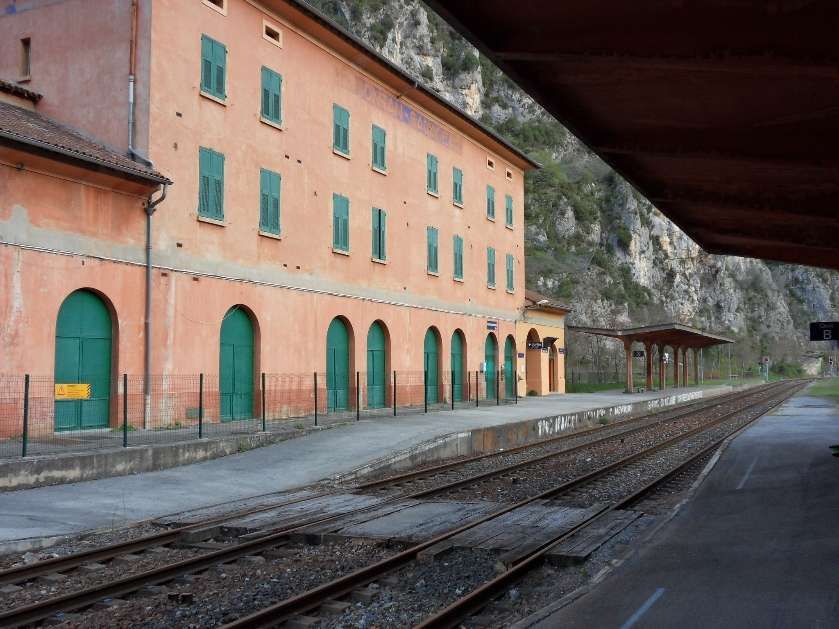
Fontan-Saorge Railway Station, seen from the cab of a Southbound train. [55]

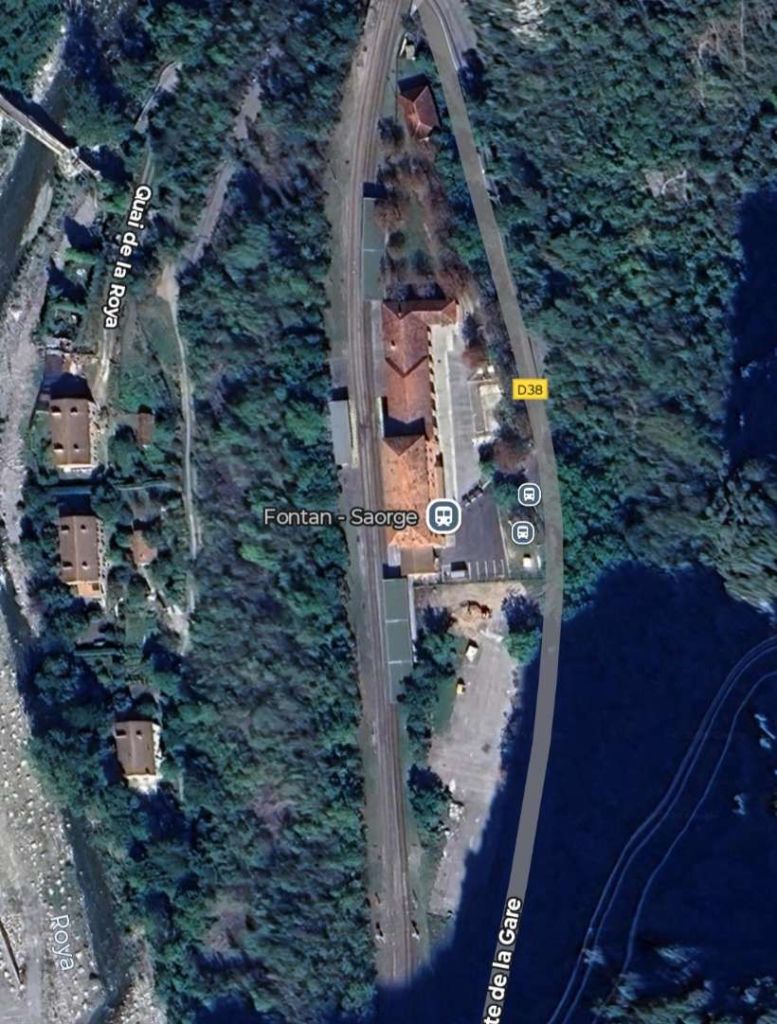
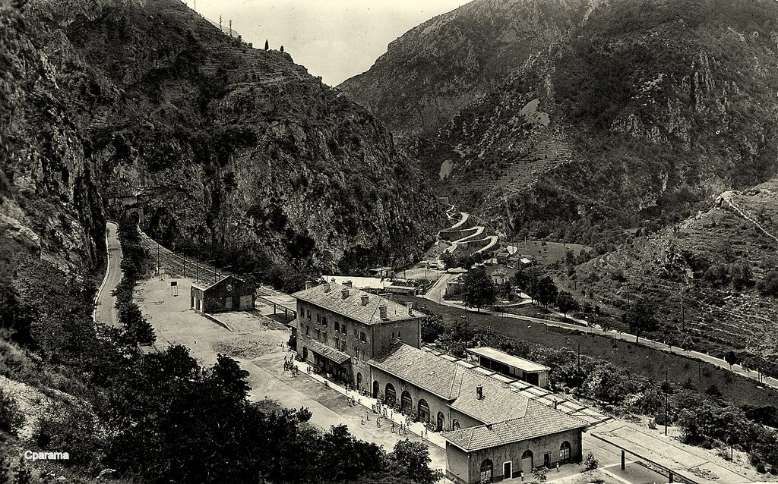
This extract from Google’s satellite imagery shows the site of the Fontan-Saorge Railway Station which sits between the two villages. It is a large site as it was designed to be a frontier station. The historic border between France and Italy was just a short distance North along the valley of La Roya. [Google Maps, August 2025]

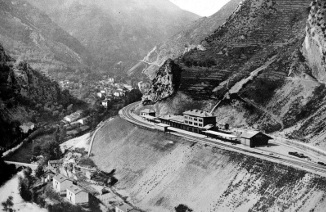
A view of the Fontan-Saorge Railway Station from high on the West flank of the valley of La Roya in 1927/1928. This image illustrates the significant earthworks needed to create a ‘plateau’ for the station (c) Public Domain. [50]

Fontan-Saorge Railway Station, seen from the D38 (Route de la Gare). [Google Streetview, July 2014]
Fontan-Saorge Railway Station from the hillside to the East. [37]
Fontan-Saorge Railway Station seen from the Southwest. [38]
A similar view of Fontan-Saorge Railway Station in 2014, © G CHP and licenced for reuse under a Creative Commons Licence (CC BY 2.5). [39]
Fontan-Saorge Railway Station, seen from the North © G CHP and licenced for reuse under a Creative Commons Licence (CC BY 2.5). [44]
A view of Fontan-Saorge Station taken with a telephoto lens, again from high on the valley side on the opposite bank of the River roya. [My photograph, 18th November 2014]

Fontan-Saorge to Breil-sur-Roya

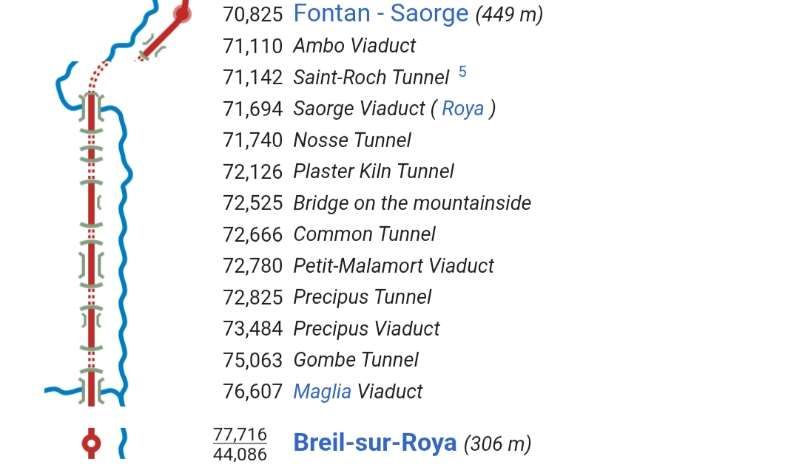
A schematic drawing of the remaining length of line to Breil-sur-Roya. [13]
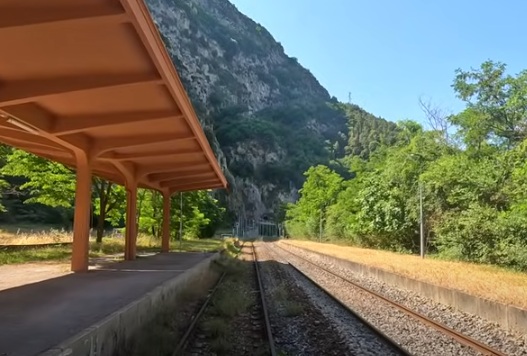
The view from the cab of a Southbound service while idling at Fontan-Saorge Railway Station. [55]
Fontan-Saorge Railway Station seen from the South, © Georgio Stagni and licensed for reuse under a Creative Commons Licence (CC BY-SA 3.0). [45]

As trains head south from Fontan-Saorge they cross Ambo Viaduct (a short viaduct – just 36 metres in length) before entering Saint-Roch Tunnel . The wall on the left carries the D38 (the road to Saorge). [55]

Ambo Viaduct and the North Portal of Saint-Roch Tunnel, seen from the E74/D6204. [Google Streetview, August 2016]

The road to Saorge climbs above the level of the railway. [Google Streetview, July 2014]

The tunnel carrying the road to Saorge runs just above the railway tunnel. Saint-Roch Railway Tunnel is named for the church close to the road as it enters Saorge. [Google Streetview, July 2014]

This is the view North along the railway towards Fontan-Saorge Railway Station from the mouth of the road tunnel on the D38. The Ambo Viaduct is in the bottom-left of the image, Fontan-Saorge Railway Station is in the top-right. [Google Streetview, July 2014]

Looking back along the line towards Fontan-Saorge Railway Station from the mouth of Saint-Roch Tunnel. The viaduct in the foreground is Ambo Viaduct. [35]

Looking Southwest across the bridge at Saorge from the cab of a Southbound service leaving the mouth of Saint-Roch Tunnel. Tracks cross the bridge 60 metres above the valley floor. [55]

Turning through 180 degrees this is the Southwest portal of the Saint-Roch Tunnel as seen from the cab of a Northbound train. [35]

The bridge at Saorge in the 21st century. It was rebuilt in the 1970s after destruction in 1944. [Google Maps, August 2025]

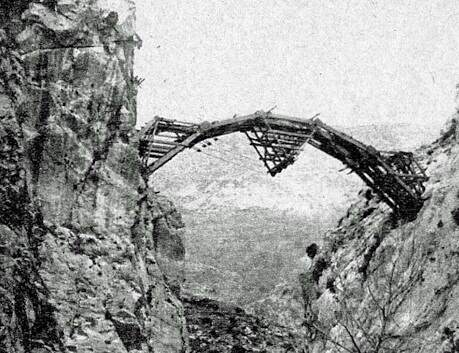
Early during the construction of the bridge at Saorge. Here we see the formwork for the arch being constructed high above the valley floor, (c) Public Domain. [50]

Work on the bridge at Saorge started “in February 1922 from the Saint-Roch and Nosse tunnels, between which a conveyor cable was stretched for the assembly of the 40 m lowered arch. A suspended footbridge was then launched over the precipice and a 0.60 m track was placed there to supply the materials onto small 500 kg load wagons, maneuvered by gasoline-powered shunters. …  The main work of the bridge was completed in March 1923.” [1: p143]

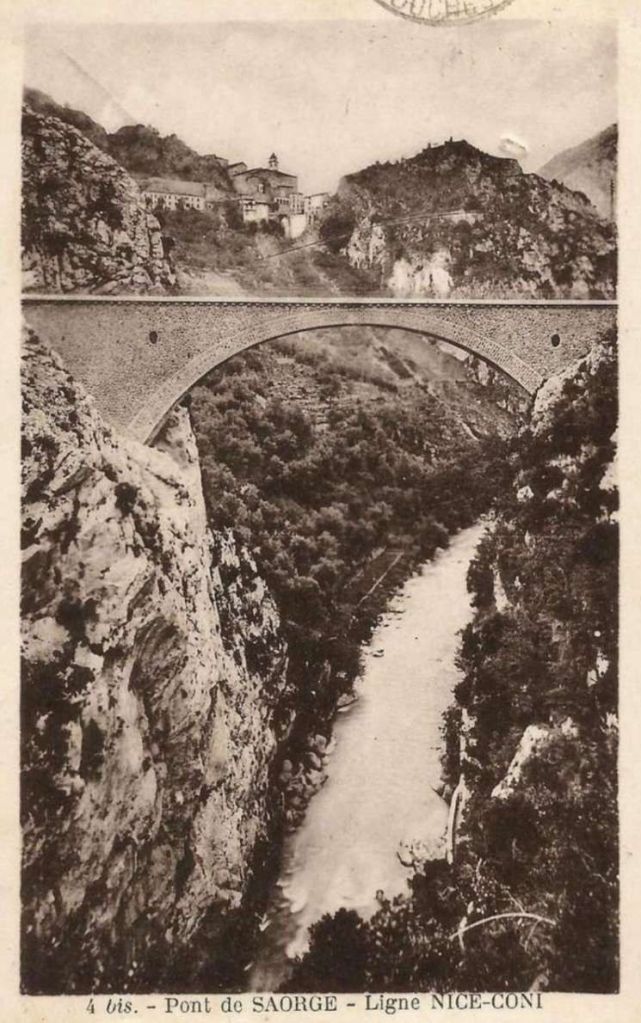
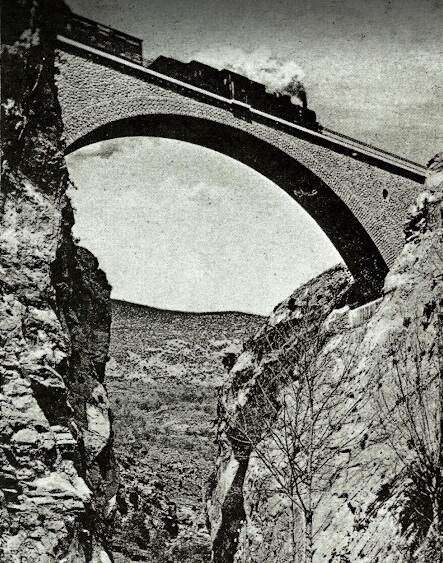
The bridge at Saorge was completed in 1922, it spanned the valley of La Roya at a particularly tight point along the gorge. The village of Saorge can be seen beyond the bridge. This bridge was destroyed by the retreating German troops in 1944. [47]
This extract from a postcard image shows the bridge in use in the early 1930s. [51]
Looking Southeast from road level, the modern bridge seems to fly between the valley walls! [Google Streetview, August 2016]
The same structure seen from the Southeast. [Google Streetview, August 2016]

Looking Northeast over the bridge at Saorge towards the Saint-Roch Tunnel from the mouth of Nosse Tunnel. [35]

Significant savings on construction costs were made (even when the cost of construction of the bridge was included) by following the right bank of La Roya down towards Breil-sur-Roya. [1: p142]

The Northeast portal of Nosse Tunnel (89 metres in length). [55]

The view Southwest from the tunnel mouth of the Nosse Tunnel. [55]

Turning through 180°, looking Northeast into the mouth of Nosse Tunnel. [35]

The open length of the line between Nosse and Four A Platre tunnels. [Google Maps, August 2025]

The North Portal of Four A Platre Tunnel (316 metres long), seen from the cab of a Southbound train. [55]

The view South from the South Portal of Four A Platre Tunnel. [55]

Turning through 180°, this is the South Portal of Four A Platte Tunnel. The village of Saorge can be seen in the sunlight on the right of the image. [35]

The length of line between Four A Platre (Plaster Kiln) Tunnel and  Commun Tunnel. [Google Maps, August 2025]

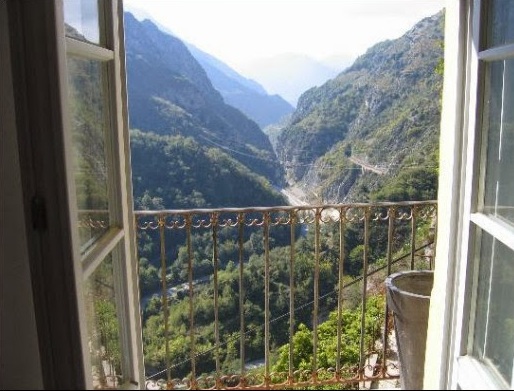
The village of Saorge is a lovely ancient perched village sitting high above La Roya. We have stayed there three times over the years renting the same small apartment each time that we have been there. Most recently, we were there post-Covid and after Storm Alex. That short holiday was in November 2023.

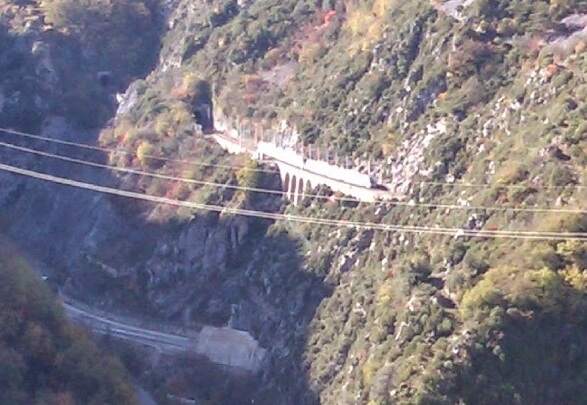
The view from our apartment window – the railway can be seen on the far bank of La Roya, high up the valley side. The visible length of railway is that to the South of Four A Platre Tunnel. [My photograph 11th November 2014]
A closer view of the line on the West bank of La Roya, seen from the apartment window. [My photograph, 20th November 2014]
An even closer view, also from the apartment. [My photograph, 19th November 2014]
Another view, focussing, this time, on the vaulted retaining wall which is typical of a number of retaining walls along the line. [My photograph, 11th November 2014]
Saorge village, seen from the road below. [My photograph, 13th November 2014]

The northern mouth of Commun Tunnel (60 metres in length), seen from the cab of the Southbound service. [55]

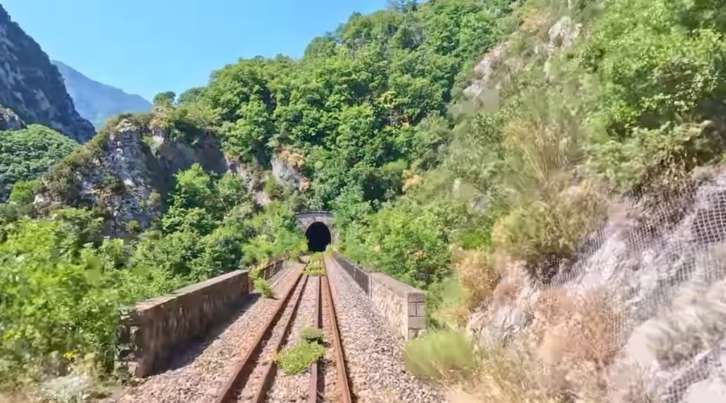
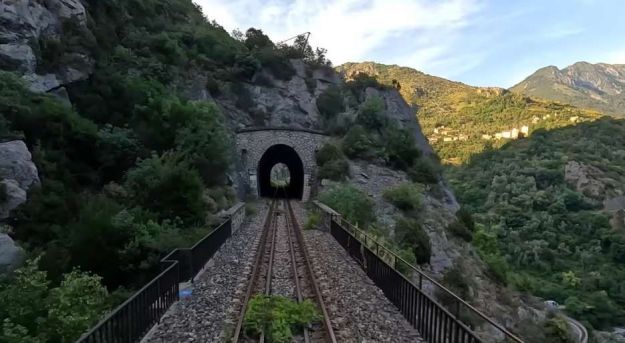
The view South from the South portal of Commun Tunnel towards Precipus Tunnel over the Petit Malamort Viaduct. [55]

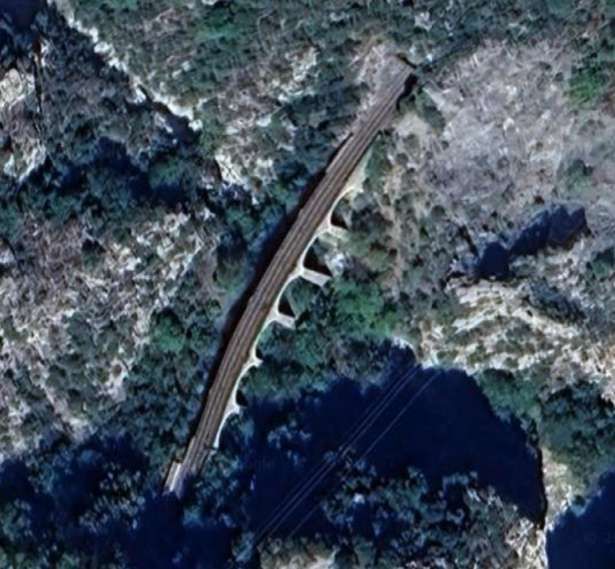
This satellite image shows Petit Malamort Viaduct which cannot easily be seen from the road network. [Google Maps, August 2025]

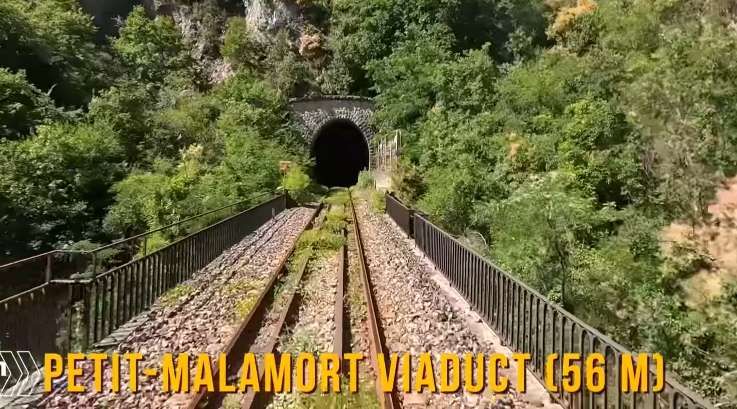
Turning though 180, just a short distance further along the line, this is the view back towards the South Portal of Commun Tunnel from the Petit Malamort Viaduct (56 metres long). [35]

Petit Malamort Viaduct and the North portal of  Precipus Tunnel (623 metres long). [55]

Between Saorge and Breil-sur-Roya construction works were delayed for a time by high pressure water ingress into tunnels. [1: p142]

Looking North across Precipus Viaduct (46 metres long) toward the South Portal of Precipus Tunnel. [35]

The Precipus Viaduct seen, looking West from the D6204 in the valley floor. [Google Streetview, August 2016]

Looking North from the North Portal of Combe Tunnel. [35]

The South Portal of Combe Tunnel. [35] 262

Looking South across a minor road crossing on the North side of Breil-sur-Roya. [55]

Looking back North across the same road crossing to the North of Breil-sur-Roya, seen from the cab of a Northbound train. The D6204 is off to the right of the image, the museum is off to the left of the camera. [35]

Maglia Bridge looking South from the cab of a Southbound train. [55]

Maglia Bridge looking North from the cab of a Northbound service. [35]

Maglia Bridge seen from Route de la Giandola. [Google Streetview, October 2008]

The bridge carrying the Route du Col de Brouis over the railway. [55]

Looking back North from the same bridge over the railway. [Google Streetview, August 2016]

Looking ahead towards Breil-sur-Roya Railway Station from the bridge which carries Route du Col de Brouis over the railway. [Google Streetview, August 2016]

Looking Back North through the same bridge. This is the view from the cab of a Northbound train. [35]

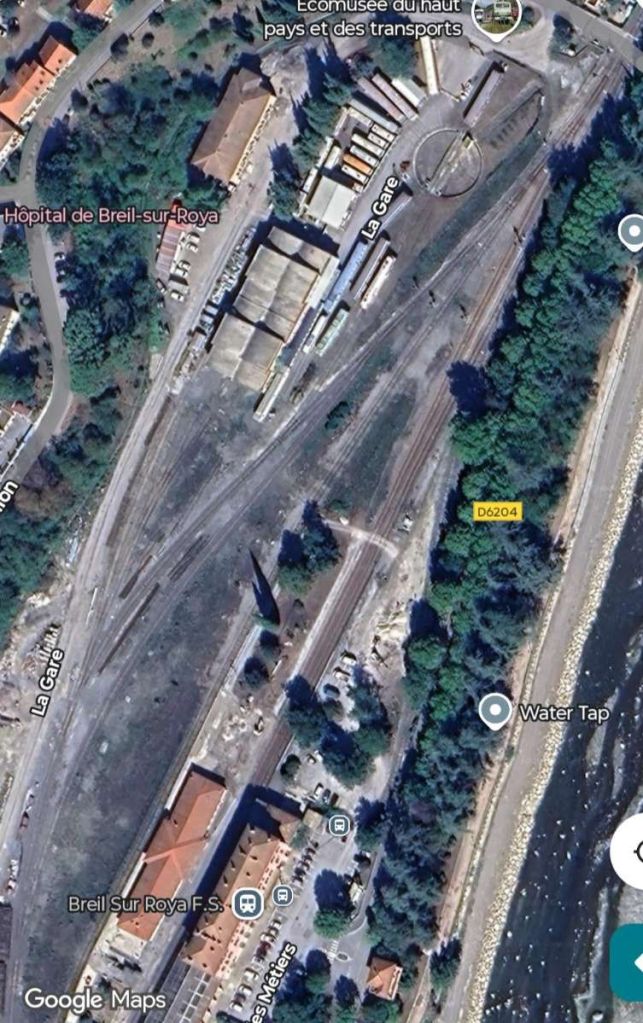
Looking South from the D6204 adjacent to the level crossing at the North end of the station site, along the line towards Breil-sur-Roya Railway Station. Beyond the crossing is the Eco Musee, Breil-sur-Roya, Haut-Pays et Transports, an exhibition of vintage trains, trams & buses. The road on the right is Avenue de l’Authion. [Google Streetview, August 2016]

The same location looking to the North. The D6204 is on the right of the picture. [35]

The Eco Musee at Breil-sur-Roya, seen from the road to its North, Avenue de l’Authion. [Google Streetview, 2009]

The Eco Museum was founded in 1989 to showcase the history and heritage of the Roya valley, it became a museum focused mostly on industrial heritage in 1991. It now houses exhibits of hydropower and transportation. The collection comprises lots of interesting locomotives, railcars, trams, postal vans and other vintage vehicles.

Looking North from adjacent to the end of the platform at Breil-sur-Roya Railway Station. [35]

Looking North at Breil-sur-Roya as a Southbound service arrives at the Station. [35]

Breil-sur-Roya Railway Station facing North.  [35]

The approach to Breil-sur-Roya from the South, seen from the cab of a Northbound train. [35]

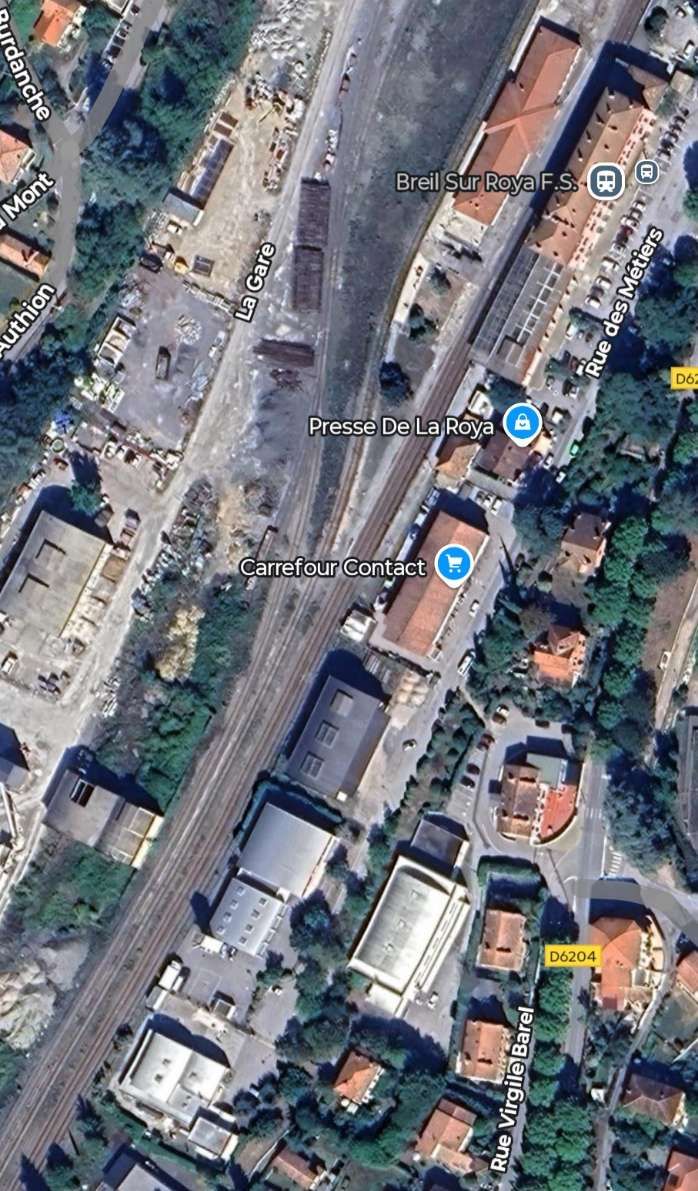
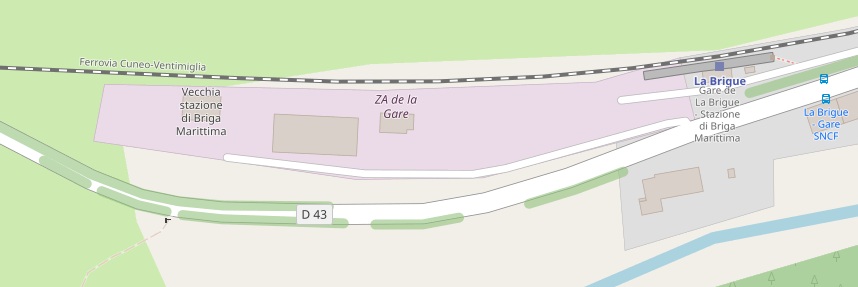
The northern end of the site of Breil-sur-Roya Railway Station. [Google Maps, August 2025]
The southern end of Breil-sur-Roya Railway Station site. [Google Streetview, August 2025]
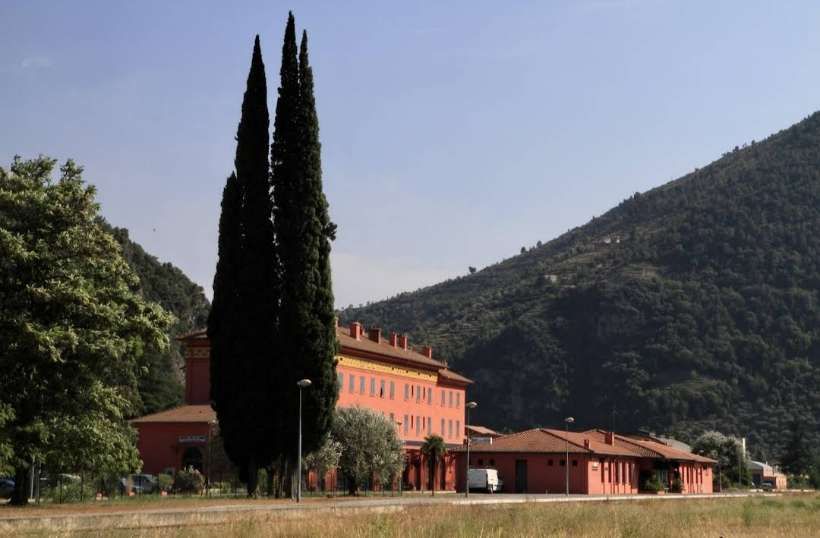
Breil-sur-Roya Railway Station, seen from the North, © Thierry Szymkowiak, 2021. [Google Maps, August 2025]

We finish this fourth length of the journey from Cuneo to the coast of the Mediterranean here at Breil-sur-Roya South of Breil, there are two routes to the coast. One heads to Ventimiglia, the other to Nice. The next article will look at the line heading South towards Ventimiglia.

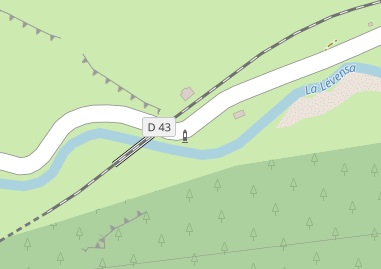
In Breil, the earthworks for the international station were constructed starting in June 1920. The area was around 1 kilometre in length and 300 metres wide. To build this the, “National Road 204 had to be diverted towards the Roya for about a kilometre, as was the Goulden power plant canal. The natural ground was cleared on the northern side and raised with excavated material from the tunnels on the southern half. At this end of the station, the modest single-arch bridge over the Lavina valley, which provides access to the Nice and Ventimiglia lines, required considerable work. The foundations for the abutment on the Nice side had to be dug into a gypsum bed sloping to a depth of 16 metres (compared to 2.20 metres on the Breil side, where hard rock quickly emerges).  and a 15.12 m high reinforced concrete cantilever to the abutment anchored it in the loose fill.” [1: p141]

The next article in this series can be found here. [4]

References

  1. Jose Banaudo, Michel Braun and Gerard de Santos; Les Trains du Col de Tende Volume 1: 1858-1928; FACS Patrimoine Ferroviaire, Les Editions du Cabri, 2018.
  2. Jose Banaudo, Michel Braun and Gerard de Santos; Les Trains du Col de Tende Volume 2: 1929-1974; FACS Patrimoine Ferroviaire, Les Editions du Cabri, 2018.
  3. Jose Banaudo, Michel Braun and Gerard de Santos; Les Trains du Col de Tende Volume 3: 1975-1986; FACS Patrimoine Ferroviaire, Les Editions du Cabri, 2018.
  4. https://rogerfarnworth.com/2025/08/25/the-railway-between-nice-tende-and-cuneo-part-5-breil-sur-roya-to-ventimiglia/
  5. T.B.A.
  6. T.B.A.
  7. T.B.A.
  8. https://youtu.be/2Xq7_b4MfmU?si=1sOymKkFjSpxMkcR, accessed on 20th July 2025.
  9. https://rogerfarnworth.com/2025/07/22/the-railway-from-nice-to-tende-and-cuneo-part-1.
  10. https://rogerfarnworth.com/2025/07/26/the-railway-from-nice-to-tende-and-cuneo-part-2.
  11. https://rogerfarnworth.com/2025/08/06/the-railway-from-nice-to-tende-and-cuneo-part-3-vievola-to-st-dalmas-de-tende
  12. https://it.wikipedia.org/wiki/Stazione_di_San_Dalmazzo_di_Tenda, accessed on 6th August 2025.
  13. https://fr.m.wikipedia.org/wiki/Sch%C3%A9ma_de_la_ligne_de_Coni_%C3%A0_Vintimille, accessed on 22nd July 2025
  14. https://www.openstreetmap.org/#map=16/44.05269/7.58357&layers=P, accessed on 6th August 2025.
  15. https://www.openstreetmap.org/#map=17/44.053045/7.588590&layers=P, accessed on 6th August 2025.
  16. https://www.openstreetmap.org/#map=16/44.04865/7.59084&layers=P, accessed on 7th August 2025.
  17. https://www.facebook.com/share/p/1BAdGi6PXQ, accessed on 7th August 2025.
  18. https://www.facebook.com/share/p/19U2VzU6gT, accessed on 8th August 2025.
  19. https://www.facebook.com/groups/FerroviaCuneoVentimiglia/permalink/5329737250380256/?rdid=6Xne0EJn2Z4xCUiE&share_url=https%3A%2F%2Fwww.facebook.com%2Fshare%2Fp%2F1C8mWmX57o%2F#, accessed on 8th August 2025.
  20. https://www.facebook.com/groups/FerroviaCuneoVentimiglia/permalink/1747294131957937/?rdid=QhA9x5D943zrICPG&share_url=https%3A%2F%2Fwww.facebook.com%2Fshare%2Fp%2F1E6w5RsWSL%2F#, accessed on 8th August 2025.
  21. https://www.facebook.com/groups/FerroviaCuneoVentimiglia/permalink/2971697712850900/?rdid=pZp8Yw6OStV8hyrR&share_url=https%3A%2F%2Fwww.facebook.com%2Fshare%2Fp%2F1BGRNJYMxk%2F#, accessed on 8th August 2025.
  22. https://www.targatocn.it/2020/10/23/leggi-notizia/argomenti/attualita/articolo/da-domani-saranno-ripristinati-i-treni-tra-limone-piemonte-e-saint-dalmas-interrotti-dopo-la-tempest.html, accessed on 8th August 2025.
  23. https://www.facebook.com/photo/?fbid=801433303751161&set=a.157399714821193&__cft__[0]=AZVgB6QBUAuJT_DsZIqZ5_2XW0bESgQUEP3m5sxA2OJLo9XgziRW311bq9dmsWjaMc5L_ePAmzHP9npOmKEubKp7ERTvP3oBmTP94pOMjZYuw_o8iiIlqIzYH2OVjBbmlDI9E2K8X6HBY-CEio542oAV074y9Ax1zJ4eTCIZRryUdlu8cF2cwBh2YnzMKY4LZAM5xt-Jx-_1z4bzNFzanPZQEsRglGr2Xs3JPNfE9V75Bw&__tn__=EH-y-R, accessed on 8th August 2025.
  24. https://www.railwaywondersoftheworld.com/link-mediterranean.html, accessed on 8th August 2025.
  25. https://www.openstreetmap.org/#map=15/44.03686/7.58127&layers=P, accessed on 8th August 2025.
  26. https://www.openstreetmap.org/#map=17/44.030812/7.575750&layers=P, accessed on 8th August 2025.
  27. https://www.history.co.uk/articles/italy-in-world-war-one, accessed on 9th August 2025.
  28. https://www.openstreetmap.org/#map=17/44.024441/7.569864&layers=P, accessed on 10th August 2025.
  29. https://structurae.net/en/media/325629-peug-tunnel-northern-portal-on-the-left-and-scarassoui-tunnel-southern-portal-with-21-m-long-artificial-section-added-in-1970-s, accessed on 19th August 2025.
  30. Sadly, I cannot find the link to the original photograph. I failed to record it when downloading the image.
  31. https://www.openstreetmap.org/#map=15/44.01911/7.55805&layers=P, accessed on 10th August 2025.
  32. https://climbfinder.com/en/climbs/berghe-inferieur-fontan, accessed on 11th August 2025.
  33. https://cartorum.fr/carte-postale/210107/fontan-fontan-pont-du-sarassoui, accessed on 11th August 2025.
  34. https://www.inventaires-ferroviaires.fr/kc06/06062.01N.pdf, accessed on 11th August 2025.
  35. https://www.youtube.com/watch?v=_qX8v5gceVU, accessed on 31st July 2025.
  36. https://lamialiguria.it/en/2023/11/10-things-you-didnt-know-about-the-railway-of-marvels, accessd on 11th August 2025.
  37. https://www.cparama.com/forum/fontan-alpes-maritimes-t24510.html, accessed on 11th August 2025.
  38. https://www.geneanet.org/cartes-postales/view/186296#0, accessed on 11th August 2025.
  39. https://commons.m.wikimedia.org/wiki/File:Gare_de_Fontan_-_Saorge-7.JPG, accessed on 11th August 2025.
  40. Franco Collidà, Max Gallo & Aldo A. Mola; CUNEO-NIZZA History of a Railway; Cassa di Risparmio di Cuneo, Cuneo (CN), July 1982.
  41. Francohttps://www.geneanet.org/cartes-postales/view/186296#0 Collidà; 1845-1979: the Cuneo-Nice line year by year; in Rassegna – Quarterly magazine of the Cassa di Risparmio di Cuneo; No. 7, September 1979, pp. 12-18.
  42. Stefano Garzaro & Nico Molino; THE TENDA RAILWAY From Cuneo to Nice, the last great Alpine crossing; Editrice di Storia dei Trasporti, Colleferro (RM), EST, July 1982.
  43. SNCF Region de Marseille; Line: Coni – Breil sur Roya – Vintimille. Reconstruction et équipement de la section de ligne située en territoire Français; Imprimerie St-Victor, Marseille (F), 1980.
  44. https://commons.m.wikimedia.org/wiki/File:Gare_de_Fontan_-_Saorge-5.JPG, accessed on 11th August 2025.
  45. https://fr.m.wikipedia.org/wiki/Gare_de_Fontan_-_Saorge#/media/Fichier%3AFontan-Saorge_staz_ferr_D.445.jpg, accessed on 11th August 2025.
  46. https://www.cparama.com/forum/viewtopic.php?p=105348, accessed on 11th August 2025.
  47. https://www.cparama.com/forum/viewtopic.php?f=11&t=1224, accessed on 12th August 2025.
  48. The link to this specific photograph has been lost (12th August 2025).
  49. https://www.amazon.com/-/es/Adolphe-Cossard-ferroviario-c-1929-8-pulgadas/dp/B09M64HCCX?th=1, accessed on 12th August 2025.
  50. https://www.vermenagna-roya.eu/wp-content/uploads/2019/07/Ferroviaire-à-Fontan-et-Saorge.pdf, accessed on 12th August 2025.
  51. https://www.cparama.com/forum/viewtopic.php?t=26208&p=110561, accessed on 12th August 2025.
  52. T.B.A.
  53. T.B.A.
  54. T.B.A.
  55. https://www.youtube.com/watch?v=Hbzk68KoRj8&t=4533s, accessed on 4th August 2025.
  56. https://www.openstreetmap.org/#map=17/44.055854/7.584440, accessed on 5th August 2025.
  57. https://www.facebook.com/groups/194416750579024/search/?q=st.%20dalmas%20de%20tende, accessed on 5th August 2025.

The Railway between Nice, Tende and Cuneo – Part 3 – Vievola to St. Dalmas de Tende

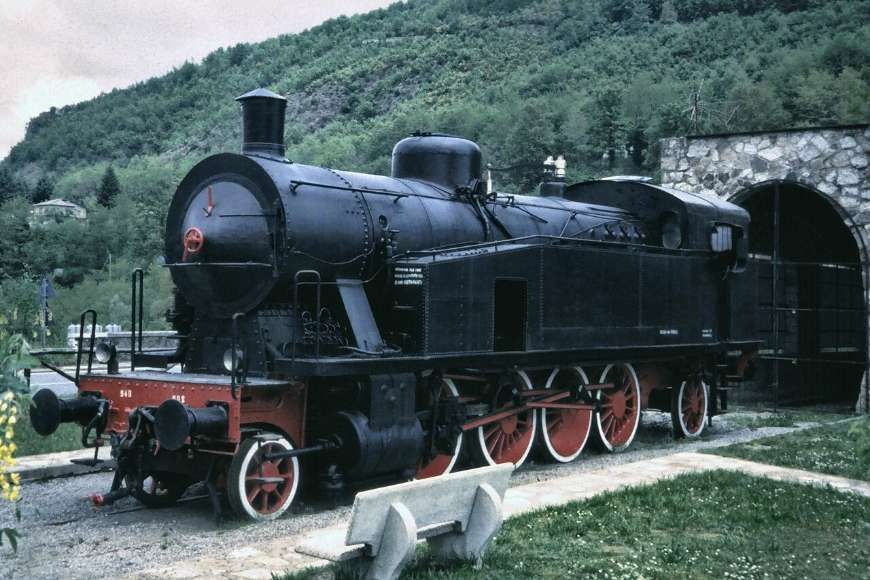
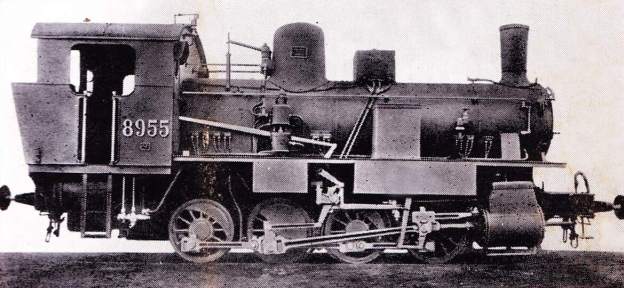
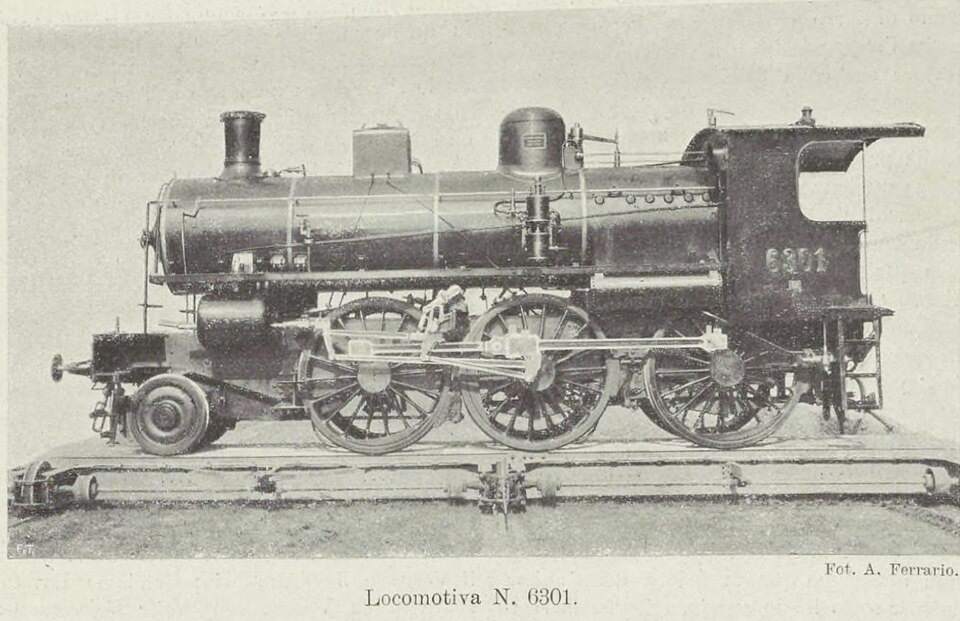
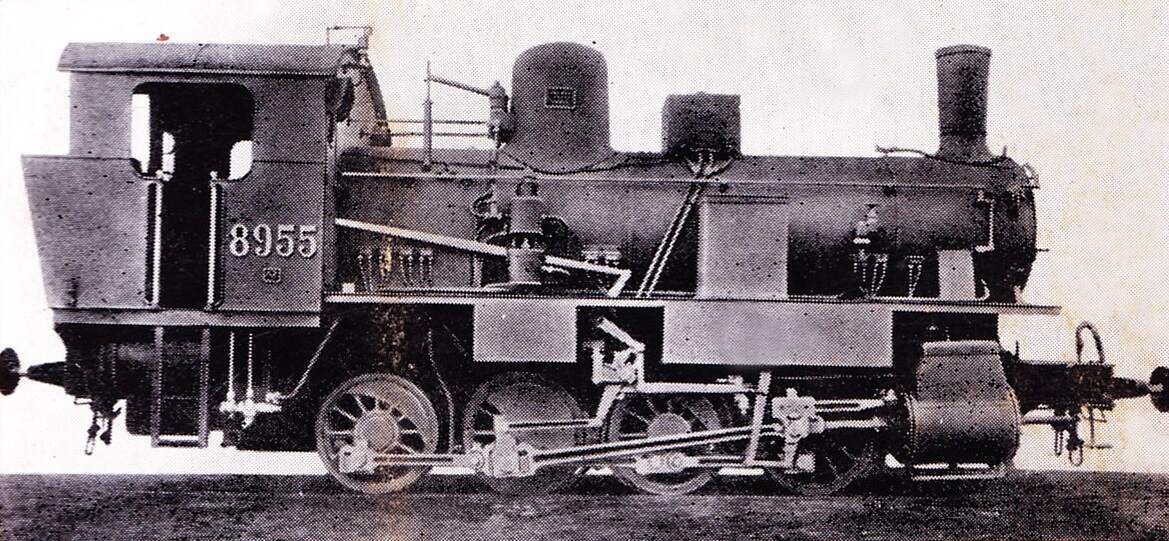
The first decade of the 20th century saw the existing roster of locomotives on the line South of Cuneo supplemented by two additional series : 130s (UK, 2-6-0) tender locos of the FS 630 series; and 040T (UK, 0-8-0T) tank locos of the FS 895 series. The featured image for this article is one of the tank locomotives of the FS 895 series. [65]

In the first two articles about the line from Cuneo to the sea we covered the length of the line from Cuneo to Vievola. These articles can be found here [9] and here. [10]

I also want to acknowledge the assistance given to me by David Sousa of the Rail Relaxation YouTube Channel https://www.youtube.com/@RailRelaxation/featured and https://www.railrelaxation.com and particularly his kind permission given to use still images from rail journeys that he has filmed on the Cuneo Ventimiglia railway line. [35][55]

The Line South from Vievola

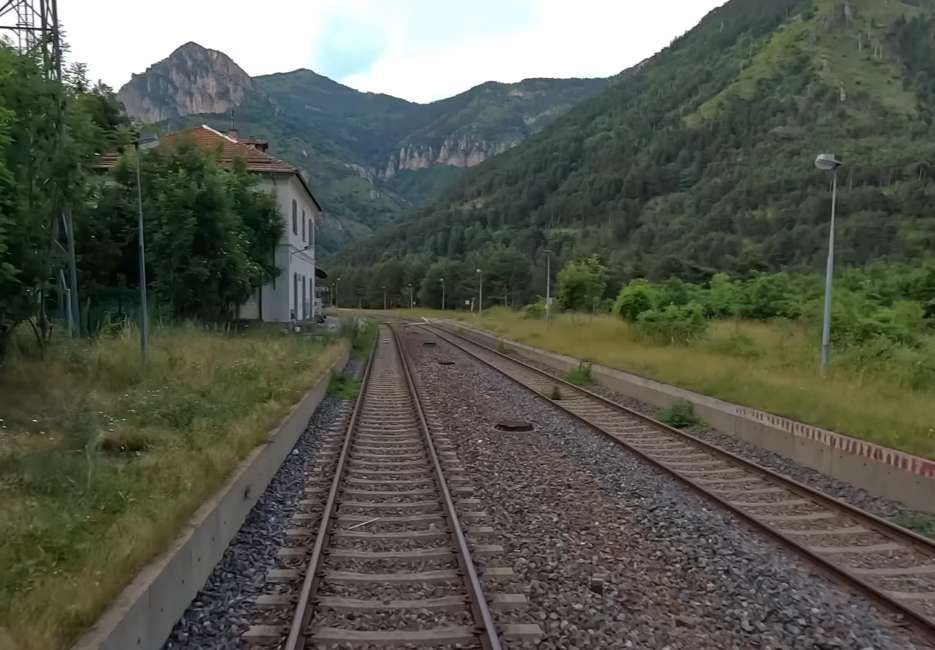
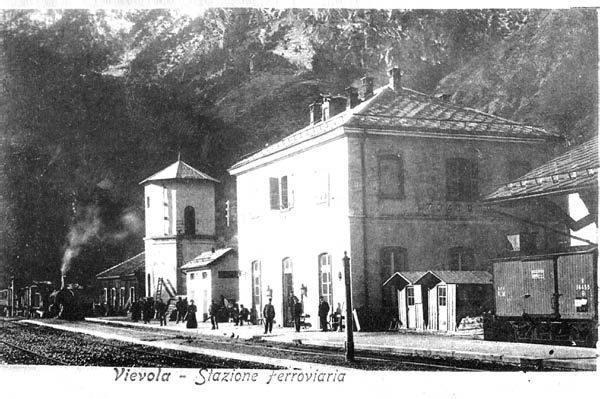
Our journey South down the line continues from Vievola. …

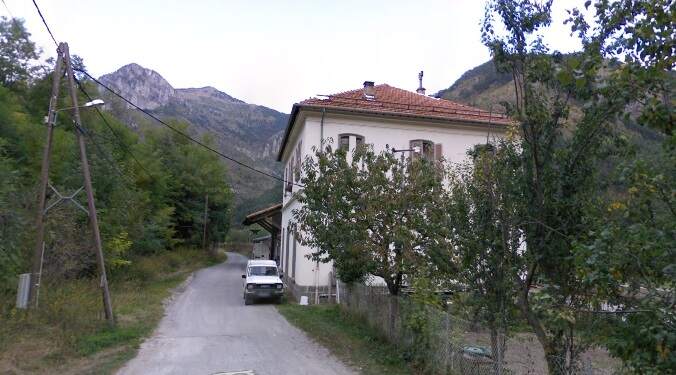
The station building, seen from the Southwest. [Google Streetview, October 2008]
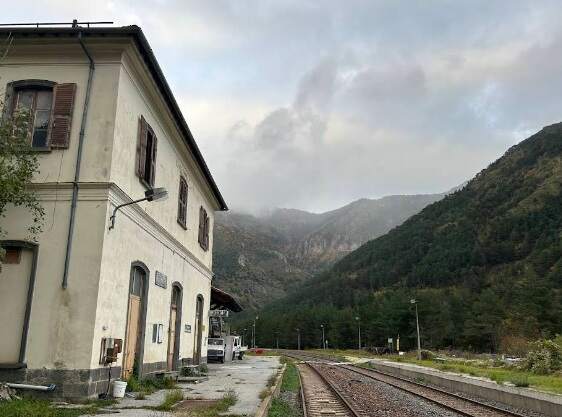
Vievola Railway Station looking North, © Diego Fernández, November 2024. [Google Maps, July 2025]
The station at Vievola, seen from the Southeast. Excavated material from the tunnel was used to create a platform for the new station. This photograph is taken looking South and shows a water column and water tower a red roofed building and a toilet block as well as the main station building and the goods shed. The three buildings nearest to the camera have gone, as has the water column. This image was shared on the Ferrovia Internazionale Cuneo-Ventimiglia-Nizza Facebook Group by Mario Zauli on 16th June 2014, © Public Domain. [12]
Vievola Railway Station looking South, © Baptiste, July 2023 and licenced for reuse under a Creative Commons Licence, (CC BY-SA 3.0). [Google Maps, July 2025][11]

Vievola Railway Station, seen from a north-bound train in the 21st century. [35]

Vievola Railway Station, seen from slightly further South from the cab of a train heading North through the station back in the 1990s. [8]

A postcard view from 1910 of Vievola Railway Station. The image faces South. [66]

Before we can head South from Vievola on the railway, it needs to have been built! This, it turns out, was dependent on international agreements and their ratification by national parliaments. This process was fraught with difficulty! It would take until 21st March 1906 for agreements to be ratified!

Banaudo et al tell us that over the final decades of the 19th century, the various interests on the French side of the border sought to persuade the French government that the line from Nice to Cuneo was an important investment which should be made. As a result, the French government “invited the PLM company to undertake a route study from Nice to Sospel in circular dated 30th September 1890, renewed on 28th January 1892, given the lack of response from the railway administration. On 12th May, a prefectural decree authorized the company’s engineers to enter properties to conduct the first surveys.” [1: p57]

Banaudo et al continue: “To meet the requirements of the Ministry of War, the route had to include Lucéram. This resulted in a 15 km extension of the direct route between Nice and Sospel. In 1895, the General Staff showed an initial sign of goodwill by agreeing to the study being extended beyond Sospel towards Italy, subject to certain conditions.  On 19th April 1898, Gustave Noblemaire (1832-1924), director of the PLM company, submitted a preliminary proposal for a line from Nice to the border via the Paillon de Contes valley, the Nice pass, L’Escarène, the Braus pass, Sospel, Mount Grazian, Breil and the Roya valley. The Lucéram service was included as a branch line from L’Escarène, other solutions were not technically feasible.” [1: p57-59]

The military response arrived on 27th September 1899, when the principle of the branch line was accepted. It was a few months, 10th January 1900, before the military confirmed their requirements, specifically: “commissioning of the Lucéram branch line at the same time as the L’Escarène – Sospel section; construction of the extension beyond Sospel after reinforcing the installations at Fort du Barbonnet and orientation of the tunnel under Mont Grazian so that it could be held under fire from the fort in the event of war; development of mine devices and defensive casemates at the heads of the main tunnels between L’Escarène and the border; and authorization for Italy to begin laying the track from San-Dalmazzo-di-Tenda to Fontan only after the completion of the Nice-Fontan section by France.” [1: p59]

Cross-border discussions took place between the French departmental Bridges and Roads Department and “its counterpart in the civil engineering department of the province of Cuneo to determine the main technical characteristics of the railway line built by the RM between Cuneo and Vievola, in order to adopt equivalent standards for the French section in terms of grades, curves, and gauge.” [1: p59]

Banaudo et al continue: “At the dawn of the 20th century, while the choice of a route from Nice to the Italian border at San-Dalmazzo via the Paillon, Bévéra, and Roya rivers was no longer in doubt in France, the same was not true in Italy. Indeed, although this solution was preferred by Piedmontese business circles, it was opposed by multiple pressure groups weary of twenty years of French policy of opposition and uncertainty. For many localities on the Riviera or in the Ligurian hinterland, as well as for a persistently Francophobic segment of the general staff, the construction of a line entirely within Italian territory appeared to be the best way to avoid diplomatic and strategic complications.” [1: p59]

In Italy, Piedmont and Liguria had differing views about the appropriate railway routes. Piedmont secured a promise, in the Italian parliament, to extend the railway to Tende and a decision to connect it to the coast soon. In Liguria, the desire was to secure a connection to Ventimiglia via either the Roya Valley or the Nervia Valley. Serious consideration was given to a tramway in the Roya Valley, the central section of which would run through French territory but this was rejected by the French military. [14]

A number of alternative schemes were put forward by Italian interests and by the city of Marseille. The city of Turin appointed a commission to look at all the options and after its report “concluded that it preferred the most direct route via the Col de Tende and the Roya, towards Ventimiglia and Nice. Similarly, the French Chamber of Commerce in Milan supported this choice in March 1900, also proposing the construction of a new 47 km line between Mondovi and Santo Stefano Belbo, designed by the engineer Ferdinando Rossi to shorten the journey between Cuneo, Alessandria and Milan.” [1: p60-61]

In 1901, French and Italian diplomats and then the Turin authorities agreed the main principles for an international agreement. On 24th January 1902 the PLM was granted the concession for the railway from Nice to the Italian border via Sospel, Breil-sur-Roya, and Fontan, as well as the beginning of the line from Breil-sur-Roya to Ventimiglia. This was ratified by law on 18th July 1902.

After this a further military inspection led to the strategic Lucéram branch being temporarily left aside with the possibility of a replacement by an electric tramway from Pont-de-Peille to L’Escarène, to be operated by the Compagnie des Tramways de Nice et du Littoral (TNL).

Banaudo et al continue: “On Monday 6th June 1904, delegations from both countries met in Rome to sign the bipartite convention regulating the terms and conditions of operation of the future line and its implementation into international service. …  In its broad outline, the agreement provided for the completion of the works within eight years (i.e. by 1912) and the possibility for the Italian railway administration to have its Ventimiglia-Cuneo trains transit French territory, with reciprocal authorization for the French operator to run its own vehicles in Italy on direct Nice-Cuneo trains and to establish a local service between Breil, Fontan and San-Dalmazzo-di-Tenda. … Initially, passenger services on the line would be provided by three direct daily connections Nice-Cuneo and Ventimiglia-Cuneo, and vice versa, offering carriages of all three classes.”

Banaudo et el describe the main points of the convention in respect of the transport of people and goods, particularly for transit between the two borders. “Police and customs controls would be simplified as much as possible for nationals of both countries. Nevertheless travelling between two Italian stations via the international section would require a passenger to have a valid passport. Italian postal vehicles would be permitted to travel duty-free on this section, as would goods and baggage in transit, provided they were placed in sealed vehicles and, for livestock, had undergone a prior health inspection at an Italian station. A special clause authorized the passage of Italian military transports of men, equipment, and animals through French territory, while conversely, the French army would be permitted to transit its consignments from Nice to Breil via Ventimiglia.  Article 20 of the convention regulated a legal situation that was probably unique in Europe, that of the Mont Grazian tunnel, whose straight route would pass over a distance of 2,305 metres in Italian subsoil, although its two portals would be in France: ‘It is understood that for the part of the Mont Grazian tunnel located under Italian territory, the Italian government delegates to the French government its rights of control over the railway and its police and judicial rights’. This unusual situation resulted from a modification of the route decided at the request of the General Council of the Alpes-Maritimes. … This more direct route passing under Italian soil was finally preferred to the entirely French route under the Brouis pass, which would have been longer and would have moved the Breil station further from the village.” [1: p62-63]

In Italy, the ratification of the agreements made at the convention took three weeks – it was all done by 28th June 1904. In France thins would be quite different. “On 27th March 1905, as the convention was about to be submitted to a parliamentary vote, the Ministry of War decided to abandon the branch line to Lucéram, which was too costly and difficult to implement. Instead, the nearest stations, L’Escarène and Sospel, would need to be equipped with facilities for the rapid disembarkation of troops and equipment. At L’Escarène in particular, the station would need to be able to accommodate ten twenty-car trains per day and would have to include a military platform opening onto a large open area, an engine shed, and several water columns/supplies.  In addition, the road from L’Escarène to Lucéram would need to be improved to facilitate access to the defensive sector of L’Authion.” [1: p63]

Banaudo et al comment: “The French Chamber of Deputies finally ratified the agreement on 3rd July 1905, more than a year after its Italian counterpart, but the Senate would continue to procrastinate until 8th March 1906. The senators demanded financial participation from the Alpes-Maritimes department in the land acquisition costs, and the French Consul in Italy, Henri Bryois, made numerous appearances in Paris to convince them. The day after the Senate’s vote, on 9th March 9, a parade, speeches, and demonstrations of sympathy for France enlivened the streets of Cuneo. … On 20th March, a final law officially ratified the agreement. … The municipality of Nice organized a grand celebration to celebrate the culmination of fifty years of effort.  On 21st March 1906, Prime Minister Giolitti and Ambassador Barrère exchanged the documents ratified by the parliaments of both countries. Work could finally begin!” [1: p63]

In Italy, the ratification of the international convention led to the money for the completion of the works being set aside (24 million lire for the length South from Vievola to the then border, and 16 million lire for the length North from Ventimiglia to the southern border). In addition, the decision was taken to build the new station in Cuneo to accommodate the increased traffic that would arise from the new line.

A year later, on 1st July 1905, the Italian state brought all nationally significant rail routes/networks under the direct authority of the Ministry of Public Works (the Ferrovie dello Stato (FS)).  This had only a limited impact on the Cuneo-Vievola line. “The 3200, 3800, and 4200 series locomotives of the Rete Mediterranea now formed series 215, 310, and 420 of the [FS}. … At that time, the Torino depot had a complement of 128 locomotives, including 20 from the 215 series and 18 from the 310 series deployed in the line, to which were added ten locos from the 320 series. These were also 030s [in UK annotation, 0-6-0s] with three-axle tenders, initially ordered by the RM as series 3601 to 3700 and gradually delivered by five manufacturers between 1904 and 1908.” [1: p64]

The first decade of the 20th century saw the existing roster of locomotives supplemented by two other series:

  • 130s (UK, 2-6-0) tender locos of the FS 630 series; and
  • 040T (UK, 0-8-0T) tank locos of the FS 895 series.
Locomotive No. 6301was a 2-6-0 (130) locomotive in the FS 630 series. [64]
Locomotive No. 8955 was an 0-8-0T (040T) locomotiv3 in the FS 895 series, [65]

In 1906, a subsidised bus service was introduced to complement and replace the various horse-drawn and motor services already in existence on the roads between Vievola, Ventimiglia and Nice. [1: p64][c.f. 14] The connection to Nice was later (in 1912) taken over by the Truchi company of Nice. [1: p64]


Vievola to Tende

Banaudo et al, again: In August 1907, the first of eleven work packages between Vievola and the [then] border were awarded: package 1 from Vievola to the Gaggeoetlen tunnel, and package 4 of the Cagnolina tunnel to Tenda. In June 1911, it was the turn of package 2, between the Gaggeo and Alimonda tunnels, and the following month, package 3 from Alimonda to Cagnolina. These contracts were signed with the Tuscan companies Sard and Faccanoni and the Ghirardi company, originally from the region of Lake Maggiore. Over 8.2 kilometres, the line crosses Triassic and Permian terrain cut by Jurassic, Cretaceous, and Carboniferous veins. There are ten tunnels covering a distance of 5.90 kilometres, or 72% of the route, as well as seven bridges and viaducts totaling seventeen masonry arches. The section has no level crossings, but seven “caselli” (houses) were built to house the road workers and their families. Some are isolated in the mountains, sometimes between two tunnels, and accessible only by railway.” [1: p64-67]

A schematic representation of the line from Vievola to Tende. [18]
A short video embedded from YouTube, taken at Vievola Railway Station in 2010. [23]
Vievola Railway Station is at the centre of this extract from Google’s satellite imagery. The hamlet is Northeast of the Station just beyond the top of the image. Trains for Tende and beyond set off to the Southwest. The railway bridge can be seen at the bottom left of this image. [Google Maps, July 2025]

From Vievola, the line begins its journey down the valley of La Roya by crossing a single-arch bridge over the Dente valley which suffered some disruption resulting from Storm Alex in October 2020.

A closer focus on the bridge spanning the River Dente. This image appears to be taken after the inundation which occurred with Storm Alex in 2020. [Google Maps, July 2025]
This pair of images are taken from a report into the majority damage caused by Storm Alex. The image on the left is the condition of the area prior to the storm, that on the right shows the situation after the storm. [15]
The bridge that spanned the Dente, in the immediate aftermath of Storm Alex in October 2020. In the view of the engineers checking the line, the bridge was unstable because of erosion. This image was shared on the Ferrovia Internazionale Cuneo-Ventimiglia-Nizza Facebook Group by Osservatorio Ferrovia del Tenda on 3rd Aprilb2924 and credited to Damien Board. [16]
The same bridge after further flooding at Easter 2024. This image was shared on the Ferrovia Internazionale Cuneo-Ventimiglia-Nizza Facebook Group by Gianluca Morelli on 4th May 2024. [17]

A short distance South of the bridge over the river, looking North towards Vievola from the cab of a north-bound train. [35]

Taken from a point a little further to the South, this photograph shows the parapets of a bridge over a small stream to the South of the Dente river. This image is also taken from the cab of a north-bound train in the 2020s. [35]

After crossing the 12 metre span bridge the line enters the 1273 metre long Branego horseshoe tunnel.

This photograph looks North from the mouth of the Branego Tunnel towards Vievola Railway Station. It is taken from the cab of the same North-bound train. [35]

The 1273 metre long Branego Tunnel. The bridge in the Dente valley is top-left  and the Vievola (Chapel) Viaduct is middle-right in this image. [19]

The tunnel opens onto the right bank of La Roya about 25 metres above the river. The Vievola Viaduct spanned the river on five 15 metre masonry arches. Banaudo et al tell us that, “this structure would later be called the ‘Chapel viaduct’ due to its proximity to the Sanctuary of the Visitation or Madonna of Vievola.” [1: p67]

The East Portal of Branego Tunnel taken from the cab of a train approaching Vievola Railway Station from the South. [35]

The Vievola (Chapel) Viaduct seen from the cab of a train approaching it from Tende. [35]

I believe that the viaduct was fatally damaged by the German forces retreating at the end of WW2. It has been rebuilt in concrete as a 5-span concrete viaduct.

Looking South along the E74/D6204 under the railway viaduct. [Google Streetview, April 2008]
Looking North along the E74/D6204 torads the railway viaduct. [Google Streetview, April 2008]
The same location on Google satellite imagery shows a denuded valley floor after Storm Alex. [Google Earth 3D, July 2025]

Now on the left bank of La Roya, the line passes through a series of tunnels with very brief open lengths spanning narrow valleys or slight depressions. The first tunnel on the Left bank is shown below. …

After crossing the Chapel Viaduct trains heading for Tende ran straight into Gaggio Tunnel (373 metres long) which curves towards the Southeast. [20]

The Southeast Portal of Gaggio Tunnel seen from the cab of a Northbound train at the mouth of Devenzo Tunnel. The parapets of the 12-metre span arched bridge over the San Pancrazio valley can be seen between the two tunnels. [35]

The Bridge over the Vallon Pancrasio (the San Pancrazio valley) is a 12 metre span arch bridge. [21]
The San Pancrazio valley as it appears on Google’s satellite imagery after the damage from Storm Alex. [Google Earth 3D, July 2025]
A closer look at the railway bridge spanning the San Pancrazio valley. [Google Earth 3D, July 2025]

The tunnel portals are generally made of local stone as are the arched bridges. The next tunnel is the Devenzo tunnel, shown below. …

The Devenzo Tunnel (732 metres long) extends Southeast from the San Pancrazio valley to the Mezzora Valley which seems little more than an ‘indentation’ in the valley side. A shorter tunnel is beyond the opening (the Mezzora Tunnel – 351 metres long) which opens out onto the Alimonda Valley at the bottom-right of this map extract. [22]

This photograph is another still from a video taken from the cab of a train travelling North from Tende. It shows the short length of open line mentioned above. The parapets are those of the viaduct of two 6 metre arches. [35]

This Google Earth satellite image shows the railway line breaking cover to cross the Alimonda valley near the top of the image. The E74/D6204 is at the bottom-left of the image. [Google Earth, July 2025]
The same location as it appears on OpenStreetMap. The bridge over the Alimonda valley is at the top-right of the image and the E74/D6204 is in the bottom-left. [24]

The Southeast portal of the Mezzora Tunnel can be seen in this image taken from the tunnel mouth of the Alimonda Tunnel. It is possible to see along the full length of this tunnel to the short opening mentioned above. In the course of travelling this short length of open line the railway crosses the Alimonda Valley. [35]

The next tunnel, the Alimonda Tunnel begins immediately the Alimonda valley has been crossed. The tunnel is 380 m long.

The Alimonda Tunnel: the bridge over the Alimonda Valley is top-left in this map extract, the bridge over the Scara Valley is bottom-right. [25]
The bridge over the Scara Valley is on the right of this map extract. There is very little of the railway open to the elements at this location. [26]

The short length of track and bridge in the Scara Valley between the Alimonda Tunnel and the Frera Tunnel, seen from the cab of a service which has just left the Frera Tunnel heading for Vievola and on to Cuneo. [35]

Before entering the Frera Tunnel, it is worth pulling back a little to see the route of the line ahead. This is the first ‘spiral’ on the line down towards Ventimiglia and Nice. A large section of the spiral is within one tunnel but the engineers made use of the Valley of the Refrei to avoid having to put the entire spiral in tunnel. [36]

The Frera Tunnel (498 m long) runs North-northwest to South-southeast passing over the line ahead which is at a lower level – both are tunneled out of the rock. There is an open length of the line and a bridge at the bottom-right. [27]

The short length of track and the bridge between the Frera and the Rio Freddo tunnels. [35]

After crossing the bridge noted above the line soon disappears into the Rio Freddo Tunnel (376 m long). The bridge is top-left. The tunnel opens out for a short length at the right of this map extract. [28]
A short length of line is open to the elements to the North of the valley of the Refrei and between the Rio Freddo and Morga Tunnels. [29]

The short length of line between the Rio Freddo and the Morga Tunnels, seen from the cab of a train just leaving Morga Tunnel. The Rio Freddo tunnel mouth is ahead. Between the two tunnel mouths is the Morga Bridge (two 8-metre arches). [35]

Banaudo et al tell us that “from the exit of the Rio-Freddo tunnel [on the North flank of the Refrei valley], the village of Tenda (Tende) appears below and the railway describes a helical loop which ends at [the lower end of] the Cagnolina tunnel. … This loop loses about sixty metres of altitude in less than 3 km of travel.” [1: p70]

After the very short open length of line to the East of the Rio Freddo  Tunnel, another short tunnel ensues – the Morga Tunnel (160 m long). [30]
Another short open length of line sits between the Morga and Gerbo Tunnels. [31]

The short open length of track between Morga and Gerbo tunnels, seen from the cab of a Cuneo-bound service and framed by the Southwest mouth of Gerbo Tunnel. [35]

Pulling back a little enables the full length of Gerbo Tunnel (279 m long) to be seen, together with the open length of line and viaduct to the East – Gerbo Viaduct. [32]

The Northeast Portal of Gerbo Tunnel seen from the cab of a Cuneo-bound train in the 2020s. [35]

A short distance further along the line, the Bazara Viaduct (of five 8 m arches) is seen here, with the Gerbo Tunnel beyond – these are seen from the cab of a Cuneo-bound service in the 21st century. [35]

After a short length of line to the Northeast or Gerbo Viaduct the line enter Cagnolina Tunnel and under many tons of rock swings round to travel West while on a downward grade. [33]

Here the Cuneo-bound train is just leaving the South Portal of Cagnolina Tunnel (at the right of the above map extract) and crossing a small bridge close to the tunnel mouth. [35]

Still in tunnel, the line passes under the line we have just travelled before breaking out into the valley of La Roya. It then bridges the river and heads down the the valley side on the left bank of La Roya to Tende Railway Station. [34]

The lower (West) portal of the Cagnolina Tunnel and the bridge over La Roya. Taken from the cab of a train heading North from Tende. The bridge over La Roya has a 12 metre span. [35]

A significant retaining wall to the West of the line, above which runs the E74/D6204. [35]

A short tunnel (Tende Galleria) part way along the length that the E74/D6402 run parallel and in close proximity to each other. The view looks North-northwest along the line. [35]

A train from Cuneo arrives at Tende Railway Station in February 2023. [37]

The Tende Railway Station today has a passenger building and two platform faces. In the past, it had three platform faces and a goods shed of classic Italian design, “the station had a number of goods tracks, two reinforced concrete water tanks supplying two hydraulic cranes, as well as an 8.50 metre turntable which was probably transferred from Vievola when the line was extended.” [1: p70]

Tende Railway Station looking Northwest, © George Ringler and licenced for reuse under a Creative Commons Licence (CC BY-SA 3.0). [38]

Wikipedia tells us that Tende Railway Station “opened on 7th September 1913. [40: p146] … Tende remained the temporary terminus for almost two years, until the opening of the Tende – Briga Marittima – San Dalmazzo di Tende section, which took place on 1st June 1915.” [39][40: p149]

The station and yard were electrified along with the line in 1931. [40: p171-172]

Tende “became isolated from the railway network after the destruction of bridges and tunnels by the retreating Germans between 15th and 26th April 1945.” [39][41: p15] .

It remained under the jurisdiction of the Italian State Railways (FS) until 15th September 1947 and was passed into the hands of the Société Nationale des Chemins de fer Français (SNCF) the following day, when the upper Roja valley was separated from the province of Cuneo and became French territory by virtue of the peace treaty with France.” [39]

After thirty-four years of inactivity, it was reopened on 6th October 1979 , the day of the inauguration of the rebuilt Cuneo-Ventimiglia line.” [39][40: p243]

The station yard was originally of a significant size. [42: p81] For the reopening of the Limone-Ventimiglia line to traffic … it was initially planned that the Tende station would be transformed into a stop equipped with only a single track, but it was subsequently decided to build a loop [43: p34] with a useful length of 560 metres and a single track serving the loading platform and the goods warehouse. [43: p29]

The Goods Shed and Passenger building at Tende seen from Avenue du 16 Septembre 1947 and looking Southeast. [Google Streetview, July 2014]

A French and an Italian train pass at Tende in 2022. The train on the right is, I believe, an ALe501 trainset commissioned by Trenitalia in the early 2000s and produced by Alstom Ferroviaria, (c) Tomas Votava. [Google Maps, August 2025]

TER No. 76671 on the Train des Merveilles service from Nice stands at Tende Station, (c) Kenta Yumoto. [Google Maps, August 2025]

We have travelled as far as Tende Railway Station and noted that the line reached the village in 1913 and remained the terminus of the line from Cuneo until 2015. While the line as far as Tende was still under construction, Banaudo et al tells us that there were continued contacts “between the Italian and French authorities to resolve the remaining issues concerning the connection between the two networks in the Roya Valley. On 3rd January 1910, the Ministers of Public Works of both countries … met to discuss the problems of Franco-Italian communications. On 15th May 1910, the Cuneo Chamber of Commerce approached the government to request the acceleration of work between Vievola and Tenda. … During the same period, … efforts were being made to produce [hydroelectric power]. … The first plants were installed in Airole and Bevera in 1906, and later in San-Dalmazzo between 1909 and 1914.” [1: p70-74]

The Roya hydroelectric power plants were intended to supply the Vallauria Mining Company and its ore processing facilities, public lighting, industries and the tramways of the Ligurian Riviera as far as Savona and Genoa.” [1: p74]

In France, two small power plants were built at the beginning of the century at Pont d’Ambo, downstream from Fontan, and in Breil. Between 1912 and 1914, a larger power plant was built opposite the village of Fontan.

Banaudo et al tell us that “In both France and Italy, the simultaneous construction of the railway and power plants turned the Roya Valley into a huge construction site for a dozen years. The companies had to house, feed, and entertain several hundred workers, most of them from other regions of Italy.” [1: p74]

After the opening of Tende Railway Station in September 1913, “the FS improved the service which had remained unchanged for a quarter of a century. Four Cuneo – Tenda return trips would now run every day, including a mixed goods-passenger one. From July to September, a fifth return trip was added. The 50 km journey took an average of 1 hour 50 minutes.” [1: p75]

Meanwhile, the project to divert the railway line and build a new station on the Altipiano in Cuneo which we noted in the first of these articles, [9] was being developed. Work began in September 1913 [1: p80] but it was to be 7th November 1937 before the new station opened! [44]

While the line was creeping southwards from Cuneo to Tenda, work had begun in Ventimiglia on the northbound line up the Roya Valley. However, by the outbreak of World War I it had only covered 20 kilometres to Airole. Meanwhile, and again interrupted by the war, another line was being built northeast from Nice to join the Cuneo-Ventimiglia line at Breil sur Roya.” [39] Progress on these two lines is covered in other posts in this series of articles. [45][46][47][48]

From Tende to St. Dalmas de Tende (San Dalmazzo di Tenda)

In the first half of 1912, calls for tenders were issued for six lots of the section between Tenda, Briga, San-Dalmazzo, and the northern border of the Paganin Valley, followed in April 1913 by the award of the seventh and final lot. Here again, the tunnels, fifteen in number, account for more than two-thirds of the route, or 8,576 metres out of 12,335 metres. There are also seven bridges and viaducts, comprising a total of thirty-five masonry arches, about ten short-span structures, and there were ten roadside houses.” [1: p127]

The length of the line from Tende to San Dalmazzo di Tenda (San Dalmas de Tende). [51]
Schematic plan of the line from Tende South to the former Italian border via La Brigue and Saint Dalmas de Tende. [18]
Tende Railway Station in the 21st century, seen from the Southeast, from the cab of a northbound train. [35]

Tende Railway Station seen from the cab of a South-bound service. [55]

Leaving Tende Railway Station, the line soon passes onto the curved viaduct spanning the Roya River opposite the village. The viaduct has one 20-metre arch and eleven 15-metre arches. 

The southern end of the station site and the viaduct which crosses the valley of La Roya. [53]

A South-bound service crosses Tende Viaduct. This is the view from the cab. [55]

An old Italian postcard view of the village of Tende, seen from the South. The viaduct features to the right of the centre of the image. [52]
The curve of the viaduct at Tender shows up well in this photograph, © Public Domain. [68]
Tende Viaduct seen from the access road to the village cemetery. [Google Streetview, October 2008]
The first of two views of Tende Viaduct from Rue General Doyen showing the northern half of the viaduct. [Google Streetview, July 2014]
The second of two views of Tende Viaduct from Rue General Doyen showing the more southerly portion of the viaduct. [Google Streetview, July 2014]
The viaduct, seen from Avenue Maurice Barucchi. [Google Streetview, July 2014]

We were in Tende in November 2023 so saw something of the major work being undertaken after Storm Alex hit the area in October 2020 and took these photographs of the viaduct

The northern half of the viaduct. [My photograph, Wednesday 22nd November 2023}
The larger viaduct arch span over La Roya. [My photograph, Wednesday 22nd November 2023]
The southern length of the viaduct. [My photograph, Wednesday 22nd November 2023]
Tende Viaduct seen from the South from the cab of a train heading for Tende Railway Station. [35]

Once across the viaduct, trains heading South ran on through three tunnels on the left bank of La Roya on a falling grade of 25mm/m. These were:

Borgonuovo Tunnel (200 metres long) …

The approach to Borgonuovo Tunnel, seen from the cab of a South-bound train. [55]

Looking North from the mouth of Borgonuovo Tunnel, from the cab of a North-bound train. [35]

The view South from the mouth of Borgonuevo Tunnel., [55]

The southern portal of Borgonuovo Tunnel, seen from the cab of an approaching train. [35]

The view from above the South portal of Borgonuovo Tunnel, (c) Tito Casquinha, June 2019. [Google Maps, August 2025]

The same length of line seen from across the valley. [Google Streetview, October 2008]

Bijorin Tunnel (248 metres long) …

The North portal of the Bijorin Tunnel. [55]

The view from the northern portal of Bijorin Tunnel. [35]

The view South from the mouth of Bijorin Tunnel. Colombera tunnel is just visible ahead. [55]

The length of line between Bijorin and Colombera tunnels, seen from the far side of the valley of La Roya. [Google Streetview, October 2008]

The South portal of Bijorin Tunnel is ahead in this still from a video taken from the cab of a North-bound train. This image also shows avalanche warning wires above the line. [35]

Colombera Tunnel (212 metres long) …

The North portal of Colombera Tunnel. [55]

The view North towards Bijorin Tunnel from the mouth of Colombera Tunnel. [35]

An over exposed view South from the South Portal of Colombera Tunnel. [55]

The South Portal of Colombera Tunnel seen from the cab of a Northbound train. [35]

This OpenStreetMap extract shows the three tunnels named above, and the lengths of open railway line between. [54]

A short distance further South the railway bridges a minor road. These are the bridge parapets seen from the cab of a South-bound train. The minor road is just visible to the left of the image. [55]

The next tunnel is Bosseglia Tunnel. The railway and the main road separate as the line heads into the tunnel which is S-shaped and 1585 metres in length. The southern portal of the tunnel opens out into the Levenza valley, a short distance to the East of La Brigue Railway Station. Banaudo et all refer to the station as Briga-Marittima station, which appears to be the name of the station in Italian. [1: p127]

The Bosselgia Tunnel (which is over 1.5 km long) and the railway station at La Brigue as they appear on OpenStreetMap. [56]

Looking South, this is the northern portal of the Bosseglia Tunnel. [55]

Looking North from the mouth of Bosseglia Tunnel. [35]

Looking West from the southern portal of Bosseglia Tunnel towards La Brigue Railway Station. [55]

Turning through 180 degrees, this is the southern portal of the Bosseglia Tunnel seen from a North-bound train. [35]

La Brigue Railway Station once comprised a passenger building, two platform faces (a third would be built during electrification), three freight tracks with a good shed and a raised platform. The modern station is situated to the East of the old station. [1: p127]

Looking West along La Brigue Railway Station platform, © Remontees, and licenced for reuse under a Creative Commons Licence (CC BY-SA 4.0). [57]

A similar view with an ALn501+502 train set in the station, © Georgio Stagni, June 2014 and authorised for reuse under a Creative Commons Licence (CC BY-SA 3.0). [57]

Looking East along the station platform, © JpChevreau and licenced for reuse under a Creative Commons Licence (CC BY-SA 4.0). [57]

Looking West from the modern La Brigue Station through the site of the original station. [55]

Further through the site of the old railway station and continuing to face West down the Levenza valley. The old goods shed is on the left. [55]

The site of the two La Brigue Railway Stations. The modern station is on the right of this map extract, the old station and goods shed are left of centre. [58]
The station at La Brigue is a short distance to the West of the village. [Google Maps, August 2025]

The original station building at La Brigue, seen from the cab of a train heading for Ventimiglia. [55]

The bridge over the D43 and the River Levenza. [59]

The bridge over the D43 and the River Levenza. [55]

The bridge which carries the railway over the D43 and the River Levenza, seen from the East. [Google Streetview, August 2016]

The bridge which carries the railway over the D43 and the River Levenza, seen from the West. [Google Streetview, August 2016]

The view back across the bridge over the River Levenza towards La Brigue Railway Station. The D43 can just be made out to the right of the bridge. [35]

Leaving La Brigue Railway Station the line resumes following a falling grade of 25 mm/m. This continues through the Levenza viaduct, which, as we have seen consists of three 8-metre arches abutting a single span road bridge. Beyond this is the Levenza tunnel (418 m long). …

The Northeastern portal of the Levenza tunnel. [55]

The view back along the line from the Northeast portal of the Levenza tunnel. [35]

This overexposed view looks Southwest from the Southwest tunnel mouth of the Levenza tunnel. [55]

The Southwest portal of the Levenza tunnel seen from the cab of a North-bound service. [35]

Beyond the Levenza Tunnels is and an unnamed viaduct of three 8-metre arches) and the line then enters the Rioro Spiral Tunnel.

The Rioro Tunnel forms a loop which describes a circle of 300-metre radius and accommodates a 30-metre drop.

Banaudo et al tell us that the tunnel “is officially divided into two sections: Rioro I (282 m) and Rioro II (1527 m), connected by an artificial tunnel with a lateral opening closed by a gate. At this opening, a ‘casello’ (a ‘hut’) was built into the mountainside to house a road worker and his family.” [1: p127]

Looking Northeast from the mouth of the Rioro spiral tunnel. [35]

The Northeastern portal of the Rioro sprial tunnel. [55]

The Rioro Spiral Tunnel between La Brigue and St. Dalmas de Tende is 1828 metres in length. [60]

Trains are within the tunnel for some minutes as they cover nearly two kilometres of turning track within the tunnel. This view comes from the cab of a South-bound train. [55]

Facing Southwest along the line at the mouth of the Rioro Spiral Tunnel. The picture is overexposed as the camera is reacting to daylight after running through the tunnel. [55]

The Southwest Portal of the Rioro Spiral Tunnel, seen from the cab of a North-bound train. [35]

The Rioro Spiral Tunnel opens onto the left bank of the Levenza River, just before its confluence with the Roya River.

To the Southwest of the tunnel, the line is carried alongside the River Levenza on a retaining wall. The parapet of this wall, protected by railings, can be seen on the right of this image. [55]

The River Roya is crossed by the San-Dalmazzo I viaduct. Banaudo et al tell us that “the seven 15-metre masonry arches of this structure were widened to carry three tracks to accommodate the approach to the station, built on a vast embankment. An underpass beneath it provides a route for the [E74/D6204].” [1: p127]

The line is retained above the Levenza River and then crosses La Roya on a viaduct of seven 15-metre masonry arches. A short tunnel under the wide embankment to the Southwest of the river allows the  D6204 to pass under the railway. [61]

A postcard view of the viaduct and station at the centre of St. Dalmas de Tende. The station building is to the right of this image, the viaduct in the centre. The photograph was taken on the hillside to the North of the village. This image was shared on the Ferrovia internazionale Cuneo-Ventimiglia-Nizza Facebook Group by Luisa Grosso on 1st November 2021. [63]

The bridge over La Roya on the approach to St. Dalmas de Tende. [55]

The bridge over the Avenue de France (the D6204/E74) seen from the North. The road is in tunnel as a large area was dedicated to the station complex at St. Dalmas de Tende as it was originally a border station in Italy. [Google Streetview, August 2016]

The same bridge/tunnel seen from the South on the Avenue de France. [Google Streetview, August 2016]

A long double-track section of the line runs through the station at St. Dalmas de Tende. A small yard remains on the North side of the line entered vis the point seen in this image. [55]

The final approach to St. Dalmas Railway Station from the Northeast. [55]

St. Dalmas de Tende Railway Station seen, looking Southwest, from the cab of a South-bound train. [55]

St. Dalmas de Tende Railway Station as show on OpenStreetMap. [62]
A postcard image overlooking the station site at St. Dalmas de Tende prior to the construction of the large station building. [5]
The station during construction work. There is scaffolding on the main station building, which appears to have been built in sections with a completed length nearest to the water tower. The engine shed is under construction, centre-right. This image was shared on the Ferrovia Internazionale Cuneo-Ventimiglia-Nizza Facebook Group by Mauro Tosello on 12th June 2022. [6]
A postcard view of the Railway Station at St. Dalmas de Tende, taken from the East. The tunnel at the Southwest end of the station site can be seen on the left of the photograph. This image was shared on the Ferrovia internazionale Cuneo-Ventimiglia-Nizza Facebook Group by Luisa Grosso on 1st November 2021. [63]
The locomotive Depot at St. Dalmas de Tende. The depot was on the Southeast side of the running lines opposite the railway Station and close to the Biogna River. The road shown on the OpenStreetMap plan of the modern station to the Southeast of the site is the road shown at the top of this plan. This drawing comes from From the December 1929 Technical Magazine of Italiane Ferrovie. It was shared on the Ferrovia Internazionale Cuneo-Ventimiglia-Nizza Facebook Group on 13th February 2024 by Francesco Ciarlini Koerner. [4]

St. Dalmas de Tende Railway Station seen, looking Northeast, from the cab of a North-bound service. [35]

St. Dalmas de Tende (San-Dalmazzo-di-Tenda in Italian) was “the last station on Italian territory, before the northern border.  This is where the French Forces would install a large-scale border station that will handle customs clearance operations in addition to the French facilities at Breil. In the first phase, a temporary passenger building and a small freight shed were built on the vast embankment created from the spoil from the tunnels upstream of the confluence of the Roya and Biogna rivers. The original layout includes four through tracks, one of which is at the platform, five sidings, three storage tracks, a temporary engine shed, a 9.50 m turntable, and a hydraulic power supply for the locomotives.” [1: p127]

It is here, at St. Dalmas de Tende, that we finish this third part of our journey from Cuneo to the coast.

Located at the confluence of the Roya River with the side valleys of the Levenza and Biogna, San-Dalmazzo-di-Tende “was built around a former Augustinian convent that became offices of the Vallauria mining company and then a spa. Since the border was established in 1860 a few kilometers downstream in the Paganin Gorges, first a few dozen, then hundreds of workers, employees, and civil servants gradually settled in San-Dalmazzo with their families. Jobs were plentiful, with the development of mining in the neighboring Val d’Inferno, the creation of a sawmill, the construction of dams and hydroelectric power plants, the emergence of tourism, and the permanent presence of a large number of police, customs, and tax guards.  This influx … was reinforced during the railway works, which attracted many workers: earthmovers, masons, stonemasons, miners, carpenters, etc. These newcomers, who mostly came from other regions, sometimes far away, slowly integrated into the local population.” [1: p130]

The line to San-Dalmazzo-di-Tende was opened on 1st June 1915. The three of the four daily services were connected to the Southern arm of the line which by this time had reached Airole, by a coach shuttle. [1: p131]

A temporary station was provided as a terminus of the line from Cuneo. It was sited to the Northeast of the present large station building which was not built until 1928.

The next length of the line can be found here. [67]

References

  1. Jose Banaudo, Michel Braun and Gerard de Santos; Les Trains du Col de Tende Volume 1: 1858-1928; FACS Patrimoine Ferroviaire, Les Editions du Cabri, 2018.
  2. Jose Banaudo, Michel Braun and Gerard de Santos; Les Trains du Col de Tende Volume 2: 1929-1974; FACS Patrimoine Ferroviaire, Les Editions du Cabri, 2018.
  3. Jose Banaudo, Michel Braun and Gerard de Santos; Les Trains du Col de Tende Volume 3: 1975-1986; FACS Patrimoine Ferroviaire, Les Editions du Cabri, 2018.
  4. https://www.facebook.com/share/p/19U2VzU6gT, accessed on 8th August 2025.
  5. https://www.facebook.com/groups/FerroviaCuneoVentimiglia/permalink/5329737250380256/?rdid=6Xne0EJn2Z4xCUiE&share_url=https%3A%2F%2Fwww.facebook.com%2Fshare%2Fp%2F1C8mWmX57o%2F#, accessed on 8th August 2025.
  6. https://www.facebook.com/groups/FerroviaCuneoVentimiglia/permalink/1747294131957937/?rdid=QhA9x5D943zrICPG&share_url=https%3A%2F%2Fwww.facebook.com%2Fshare%2Fp%2F1E6w5RsWSL%2F#, accessed on 8th August 2025.
  7. TBA
  8. https://youtu.be/2Xq7_b4MfmU?si=1sOymKkFjSpxMkcR, accessed on 20th July 2025.
  9. https://rogerfarnworth.com/2025/07/22/the-railway-from-nice-to-tende-and-cuneo-part-1.
  10. https://rogerfarnworth.com/2025/07/26/the-railway-from-nice-to-tende-and-cuneo-part-2.
  11. https://commons.m.wikimedia.org/wiki/File:Vievola_staz_ferr_ALn_663.jpg, accessed on 26th July 2025.
  12. https://www.facebook.com/photo/?fbid=1430625447210493&set=gm.755686417785385, accessed on 25th July 2025.
  13. https://commons.m.wikimedia.org/wiki/File:Stazione_Vievola_1910.jpg, accessed on 27th July 2025.
  14. https://rogerfarnworth.com/2025/07/27/a-tramway-in-the-valley-of-the-river-roya-early-20th-century
  15. http://www.lmm.jussieu.fr/~lagree/TEXTES/PDF/RK_Landslides_Vie%CC%81vola_Revised.pdf, accessed on 29th July 2025.
  16. https://www.facebook.com/share/p/16iQbYtjAB, accessed on 29th July 2025.
  17. https://www.facebook.com/share/p/1YwoXQBLiR, accessed on 29th July 2025.
  18. https://fr.m.wikipedia.org/wiki/Sch%C3%A9ma_de_la_ligne_de_Coni_%C3%A0_Vintimille, accessed on 22nd July 2025.
  19. https://www.openstreetmap.org/#map=16/44.10895/7.56098&layers=P, accessed on 29th July 2025.
  20. https://www.openstreetmap.org/#map=17/44.108596/7.571928&layers=P, accessed on 30th July 2025.
  21. https://www.openstreetmap.org/#map=19/44.106950/7.573406&layers=P, accessed on 30th July 2025.
  22. https://www.openstreetmap.org/#map=15/44.10372/7.58022&layers=P, accessed on 30th July 2025.
  23. https://youtu.be/cHWVUYznw6g?si=lGZhcr09_Lx2RIpd, accessed on 30th July 2025.
  24. https://www.openstreetmap.org/#map=19/44.102247/7.586114&layers=P, accessed on 31st July 2025.
  25. https://www.openstreetmap.org/#map=17/44.101422/7.588175&layers=P, accessed on 31st July 2025.
  26. https://www.openstreetmap.org/#map=17/44.100292/7.590059&layers=P, accessed on 31st July 2025.
  27. https://www.openstreetmap.org/#map=17/44.098049/7.591515&layers=P, accessed on 31st July 2025.
  28. https://www.openstreetmap.org/#map=17/44.094337/7.595475&layers=P, accessed on 31st July 2025.
  29. https://www.openstreetmap.org/#map=18/44.092624/7.597449&layers=P, accessed on 31st July 2025.
  30. https://www.openstreetmap.org/#map=18/44.093422/7.599427&layers=P, accessed on 31st July 2025.
  31. https://www.openstreetmap.org/#map=18/44.093468/7.600340&layers=P, accessed on 31st July 2025.
  32. https://www.openstreetmap.org/#map=17/44.095803/7.602404&layers=P, a cessed on 31st July 2025.
  33. https://www.openstreetmap.org/#map=16/44.09671/7.60013&layers=P, accessed on 31st July 2025.
  34. https://www.openstreetmap.org/#map=16/44.09483/7.59382&layers=P, accessed on 31st July 2025.
  35. https://www.youtube.com/watch?v=_qX8v5gceVU, accessed on 31st July 2025.
  36. https://www.openstreetmap.org/#map=15/44.09608/7.59520, accessed on 2nd August 2025.
  37. https://youtu.be/K6aAQ_zTWds, accessed on 2nd August 2025.
  38. https://commons.m.wikimedia.org/wiki/File:Gr_gare_de_tende_en_2004.jpg, accessed on 2nd August 2025
  39. https://it.m.wikipedia.org/wiki/Stazione_di_Tenda, accessed on 2nd August 2025
  40. Franco Collidà, Max Gallo & Aldo A. Mola; CUNEO-NIZZA History of a Railway; Cassa di Risparmio di Cuneo, Cuneo (CN), July 1982.
  41. Franco Collidà; 1845-1979: the Cuneo-Nice line year by year; in Rassegna – Quarterly magazine of the Cassa di Risparmio di Cuneo; No. 7, September 1979, pp. 12-18.
  42. Stefano Garzaro & Nico Molino; THE TENDA RAILWAY From Cuneo to Nice, the last great Alpine crossing; Editrice di Storia dei Trasporti, Colleferro (RM), EST, July 1982.
  43. SNCF Region de Marseille; Line: Coni – Breil sur Roya – Vintimille. Reconstruction et équipement de la section de ligne située en territoire Français; Imprimerie St-Victor, Marseille (F), 1980.
  44. https://en.wikipedia.org/wiki/Cuneo_railway_station, accessed on 3rd August 2025.
  45. T.B.A.
  46. T.B.A.
  47. T.B.A.
  48. T.B.A.
  49. https://ventimigliaaltawords.com/2013/10/14/all-steamed-up-about-the-ventimiglia-cuneo-rail-link, accessed on 25th July 2025.
  50. https://trainconsultant.com/2020/10/09/nice-coni-incroyable-derniere-nee-des-grandes-lignes-internationales, accessed on 17th July 2025.
  51. https://www.openstreetmap.org/#map=14/44.07112/7.59577&layers=P, accessed on 3rd August 2025.
  52. https://ebay.us/m/aao3zt, accessed on 3rd August 2025.
  53. https://www.openstreetmap.org/#map=18/44.087616/7.595785&layers=P, accessed on 3rd August 2025.
  54. https://www.openstreetmap.org/#map=16/44.08095/7.59714&layers=P, accessed on 3rd August 2025.
  55. https://www.youtube.com/watch?v=Hbzk68KoRj8&t=4533s, accessed on 4th August 2025.
  56. https://www.openstreetmap.org/#map=15/44.06722/7.59971, accessed on 4th August 2025.
  57. https://commons.m.wikimedia.org/wiki/Category:Gare_de_La_Brigue, accessed on 4th August 2025.
  58. https://www.openstreetmap.org/#map=18/44.062224/7.604105, accessed on 4th August 2025.
  59. https://www.openstreetmap.org/#map=17/44.061282/7.597185, accessed on 4th August 2025.
  60. https://www.openstreetmap.org/#map=16/44.05701/7.59374, accessed on 5th August 2025.
  61. https://www.openstreetmap.org/#map=16/44.05690/7.58934, accessed on 5th August 2025.
  62. https://www.openstreetmap.org/#map=17/44.055854/7.584440, accessed on 5th August 2025.
  63. https://www.facebook.com/groups/194416750579024/search/?q=st.%20dalmas%20de%20tende, accessed on 5th August 2025.
  64. https://commons.wikimedia.org/wiki/File:Locomotiva_N._6301.jpg, accessed on 6th August 2025
  65. https://commons.wikimedia.org/wiki/File:FS_895.jpg, accessed on 6th August 2025.
  66. https://commons.wikimedia.org/wiki/File:Stazione_Vievola_1910.jpg, accessed on 6th August 2025.
  67. https://rogerfarnworth.com/2025/08/16/the-railway-between-nice-tende-and-cuneo-part-4-st-dalmas-de-tende-to-breil-sur-roya/
  68. This image appeared on an Italian Facebook Group but I did not record which one and cannot now find the image or the group, accessed on 1st October 2025.

A Tramway in the Valley of the River Roya? (Early 20th Century)

A proposed tramway that did not get built. … The featured image is a  map showing the full length of the proposed line which followed National Route No. 204 in France.

Late in the 19th century before a link from Vievola to the Mediterranean was really on the agenda. Alongside the experimental ‘Train Scotte’, [1: p40][2][3] a “local engineer, M. Chatelanat, proposed building a tramway line between Vievola station … and Ventimiglia. He knew the region well, having just overseen the construction of the rack railway from Monte Carlo to La Turbie. [4] Here is the project he presented in an application filed on 7th February 1899.” … [1: p47]

The submission made by M. Chatelanat began, “The electric tramway for which we are requesting a concession is intended to facilitate the movement of passengers and goods in the Roya Valley through a rapid, convenient, and economical means of communication. Currently, to reach Nice and the other communes of the department, the population of the French part of this valley must either travel more than 60 kilometers along the old Nice-Cuneo road, crossing the foothills of Brouis and Braus, in unsafe conditions due to the steep slopes, the height of the passes, and, in winter, the seasonal inclement weather. Or, since the opening of the national road from Breil to Ventimiglia, travel approximately 30 kilometers and cross two customs lines to join the coastal railway line in Ventimiglia. … Between the coast and Upper Piedmont, especially the province of Cuneo, there is a very intense movement of population every year, but if you want to go by train, you have to make a long detour via Savona, which is long and expensive. The province of Cuneo sends to Nice and the coast some of its products that our region cannot obtain elsewhere. On the other hand, our particular products from the South are in demand and consumed in the upper Po Valley. Facilitating the movement of travelers and this exchange of products between Piedmont and the coast will at the same time allow the French populations of the Roya Valley to come easily and quickly to Nice to stock up and connect with the entire French coast without having to cross the Braus and Brouis passes, such is the goal we are pursuing.” [1: p47]

There were a number of projects of this nature being explored at the time. The tramway between Menton and Sospel is an excellent example. [5][6] Others in the valley of the River Var and in the valley of the River Paillon were also built.

M. Chatelanat continues to explain how up to that time it had not been possible to devise a railway scheme that enable a link between Nice and Cuneo. His proposed tramway was not claimed to be a replacement for the planned railway, but while awaiting the development of the railway scheme, the tramway would “provide great services by greatly reducing the communication difficulties between the two regions.  The project [would] not provide the speed of the railway, it [would] require two transshipments at Ventimiglia and Tende. Nevertheless, the transport of goods [would] be significantly more economical and passengers [would] find facilities and comfort there which [would] undoubtedly give the population satisfaction, if not complete, at least acceptable. The electric tramway, executed at a width of 1 metre with gradients of up to 70 mm/m and curves down to 20 metres in radius [could not] be used for the passage of standard-gauge locomotives and wagons, and therefore [could not] be used in the event of war.” [1: p48]

Concern about possible conflict was paramount in the minds of many and projects were vetted and often vetoed by the military. M. Castelanat went on to explain that power for the section of the line  would be supplied from a hydraulic plant close to Breil-sur-Roya which could easily be put out of action, and if the overhead cables were also removed no use would be possible. He was sure that no advantage would be gained by a future enemy and that “The tramway must therefore be considered a commercial means of communication with no possibility of use in the event of war.” [1: p49]

Castelanat confirmed that electrical operation would mean no problem would be encountered with gradients up to 7% without the need for any regrading of the highway. He planned stations at Breil, Giandola, Saorge, Fontan, and Berghe. The tramway would use National Road No. 204 without any deviations and would cost around 1,400,000 francs. This tramway would, strictly speaking, be only a section of an international line which would have its origin in Ventimiglia and which would go up the valley of the Roya.

A conference including all the statutory interested parties was arranged for 23rd November 1899. Differing views were expressed about whether the tramway could provide a military advantage to the enemy in the case of war. A few months after the conference, on 2nd May 1900, “Chief Engineer Aubé of the Ponts et Chaussées (Roads and Bridges Department) reached the following conclusions: ‘The establishment of the planned electric tramway has lost much of its appeal since the military authorities ceased, with certain reservations, to oppose the construction of the railway from Nice to Sospel and to the Italian border, near Fontan. This line would, in fact, provide the French population of the Roya Valley with the access to Nice they were willing to seek in an economical manner by means of the tramway connecting them to the international station at Ventimiglia‘.” [1: p50]

The effect of the military’s withdrawal of their opposition to the Nice-Sospel-Fontan line was to  render the tramway proposals obsolete. It was 1904 before “an international conference finally approved the construction of the Vievola – Breil – Ventimiglia and Breil – Sospel – Nice railway sections. … [Nevertheless] two tram lines were created [in the area]: one from Menton to Sospel, which operated from 1912 to 1931, [5][6] and a line from Ventimiglia to Bordighera, which operated from 1901 to 1936.” [1: p50]

Instead of the ‘Train Scotte’ and a tramway, from perhaps as early as 1900, but definitely by 1st September 1906, a service connecting with trains was introduced between Vievola station and Ventimiglia. The two images below show the mixture of different vehicles in use. Both focus on the road on the West side of the station building at Vievola.

The public road to the West of Vievola Railway Station building with an interesting range of vehicles preparing to travel to Ventimiglia – stagecoaches, other horse drawn carriages, modern internal combustion engined vehicles. This image was shared on the Ferrovia Internazionale Cuneo-Ventimiglia-Nizza Facebook Group by Mario Zauli on 24th November 2014, © Public Domain. [8]
A postcard view of the same location. The image looks North along the face of the station building. [9]

Banaudo et al provide details of a bus service which started on 1st September 1906. The bus service between Vievola and Ventimiglia provided two buses a day from Vievola to Ventimiglia, the first leaving Vievola at 12:15 and arriving in Ventimiglia at 17:00, the second leaving Vievola at 20:40 and arriving in Ventimiglia at 0:40. The cost of the full journey was 5 lire/person. [1: p52]

The advert in the local paper commented that, “Without making the tedious Bastia-Savona detour, travelers can reach the Nice or western Ligurian coast from Cuneo and nearby towns in just a few hours, take care of their business, and return to their hometowns the same day, if they wish, even finding enough time in Vievola to refuel. Every modern comfort will be available in the station buffet, since, with appropriate consideration, the owner, Mr. Giuseppe Borgogno, has asked the Italian State Railways Administration to expand and repurpose the space for this purpose.” [1: p52]

Banaudo et al share details of services which developed over the next few years with pictures of the various buses in use. [1: p52-56]

Other photographs of these bus services include:

This photograph shows two of these autobuses at San Dalmazzo di Tende. It was shared on the Ferrovia Internazionale Cuneo-Ventimiglia-Nizza Facebook Group by Mario Zauli on 28th April 2022, © Public Domain. [10]

References

  1. Jose Banaudo, Michel Braun and Gerard de Santos; Les Trains du Col de Tende Volume 1: 1858-1928; FACS Patrimoine Ferroviaire, Les Editions du Cabri, 2018.
  2. https://rogerfarnworth.com/2025/07/26/the-railway-from-nice-to-tende-and-cuneo-part-2
  3. https://rogerfarnworth.com/2025/07/26/miscellaneous-steam-powered-road-vehicles-scotte-steam-road-vehicles
  4. https://rogerfarnworth.com/2017/11/23/monaco-to-la-turbie-rack-railway-chemins-de-fer-de-provence-15
  5. https://rogerfarnworth.com/2018/02/23/the-sospel-to-menton-tramway-revisited-chemins-de-fer-de-provence-51
  6. https://rogerfarnworth.com/2018/06/08/the-menton-to-sospel-tramway-revisited-again-chemins-de-fer-de-provence-61
  7. https://www.openstreetmap.org/#map=11/43.9593/7.5662&layers=P, accessed on 27th July 2025.
  8. https://www.facebook.com/share/p/19YSXYvX1Y, accessed on 27th July 2023.
  9. https://www.cparama.com/forum/viewtopic.php?p=105633, accessed on 26th July 2025.
  10. https://www.facebook.com/share/p/19KFiXiVc2, accessed on 27th July 2025.

The Railway between Nice, Tende and Cuneo – Part 2 – Vernante to Vievola

The featured image above is a 0-6-0 RM Locomotive No. 3375 ‘Pracchia’, with three driven axles and a tender, built in 1883 by Vulcan of Stettin. In 1905, it joined the FS fleet as Class 215, known as a Bourbonnais, along with 400 other locomotives with similar characteristics. It ended its career with the Porretta in 1927, © Public Domain. [26][27][1: p87] This class of locomotive was the predominant Class of engine used on the line between Cuneo and Limone in the early years of the line.

In the first article about the line from Cuneo to the sea we covered the length from Cuneo to Vernante. The article can be found here. [9]

The Line South from Vernante to Limone

A schematic drawing showing the main locations on the line from Vernante to Limone. [17]

Banaudo et al write that “It was only in 1886, after the creation of the Rete Mediterranea, that the work on the fourth tranche from Vernante to Limone was awarded. It was 8,831 m long and had a gradient of 203 m, which was to be compensated for by a continuous ramp of up to 26 mm/m. This value would not be exceeded at any other point on the line. On this section, the rail remained constantly on a ledge on the steep slope on the right bank of the Vermenagna, where it was anchored by eleven bridges and viaducts totaling sixty-three masonry arches, as well as nine tunnels with a combined length of 4,416 m, or just over half the route:” [1: p28]

  • the Tetti-Chiesa tunnel which is 122 m long;
  • the Elicoidale tunnel (the Vernante Spiral tunnel) is 1,502 m long;
  • the Rivoira viaduct has fourteen 15 m arches and one 23 m arch;
  • the Rivoira tunnel is 251 m long;
  • the Santa Lucia viaduct has three 12 m arches;
  • a short span masonry arch over a minor road;
  • the Santa Lucia-Noceto tunnel is 348 m long with two openings;
  • the Noceto viaduct has six 8 m arches;
  • the Marino viaduct has two 8 m arches and two 12.50 m arches;
  • the Marino tunnel is 202 m long;
  • the Mezzavia viaduct, three 11 m arches;
  • the Mezzavia tunnel is 444 m long;
  • the bridge over the Ceresole valley has two 10 m arches;
  • the Boglia tunnel is 1,086 m long;
  • the San Bernardo viaduct over the Sottana valley has two 6 m arches and three 10 m arches;
  • the Cresta-Molino tunnel is 335 m long;
  • the Boschiera viaduct has twelve 10 m arches;
  • the Rocciaia tunnel is 126 m long;
  • the Rocciaia bridge is a single arch;
  • the first Rocciaia viaduct has four 8 m arches;
  • the second Rocciaia viaduct has eight 8 m arches.

We start this next length of the journey at Vernante Railway Station and head Southeast.

A plan of Vernante Railway Station. [10]
Vernante Railway Station: the route to Limone leaves at the bottom-right of this image. [Google Streetview, July 2025]
The view Southeast from the station car park, after demolition of the old goods shed. The main station building features at the centre of the image. [Google Streetview, June 2025]
The main station building at Vernante seen from the West. [Google Streetview, June 2025]

Photographs showing the station building and the goods shed prior to its demolition can be seen here. [58] “Inaugurated in 1889, the station served as the terminus for the Cuneo-Ventimiglia line for nearly two years, until it was extended to Limone Piemonte. The passenger building features classic Italian architecture, with two levels. It is square, medium-sized, and well-maintained. Its distinctive feature is the two murals depicting scenes from the Pinocchio fairy tale, adorning its façade. The lower level houses the waiting room and self-service ticket machine, while the upper level is closed.” [58]

A photograph from the cab of a Cuneo-bound train arriving at Vernante. The passenger building is on the left with the goods shed beyond. [8]

The view from Via Frederi Mistral which passes over the tunnel mouth at the Southeast end of Vernante Railway Station. [Google Streetview, June 2025]

The very short tunnel (Tette-Chiesa, 122 metres in length) at the Southeast end of Vernante Railway Station. [Google Maps, July 2025]

The southern portal of the Tette-Chiesa Tunnel seen from a Cuneo-bound train. Immediately beyond the far portal trains would have to stop to manually engage a point for the running line or the train would end up on the safety siding provided for runaways on the steep downward gradient. [8]

The large retaining wall on the left of this image supports the railway as it runs immediately adjacent to the E74/SS20 but at a higher level. [Google Streetview, June 2025]
The height of the retaining wall decreases as the E74/SS20 gains height. [Google Streetview, June 2025]

Banaudo et al comment: “Leaving Vernante, the track describes a complete spiral loop at Rivoira, which allows it to rise about fifty metres over a circular length of two kilometres. This loop includes the 1,502 m long ‘Elicoidale’ tunnel, which was completed on 30th December 1889, and the imposing viaduct over the Salet torrent.  With its fifteen arches, from the top of which the rail dominates the lower level of the loop by 45 m, this structure can be considered by its proportions as the most imposing of the whole of line. [25] It is built entirely of cut stone, with the exception of the intrados of the arches which are of brick, and its seven central arches are reinforced at their base by a series of arcades forming an additional level, following a technique very popular in the 19th century.” [1: p30] The lower arcades are seen clearly in the 1929 postcard below.

This photograph is taken from the road at the point that the E74/SS20 begins to turn away from the lower railway (which can be glimpsed through the undergrowth) the viaduct high above both the road and the railway comes into view. This view looks North from the E74/SS20. A spiral tunnel allows the railway to gain height at this location. [Google Streetview, June 2025]
This satellite image shows the portals of the Spiral tunnel to the East of Vernante. The line leaves Vernante Station and passes through a short tunnel before running alongside the E74 ‘Corso Torino’ to another tunnel mouth to the West of the side road. The line then climbs as it circles under that road twice and reappears high above the first length of line towards the top-left of this image. The height gained then means that the line needs to pass over a high viaduct before once again entering a tunnel (the Rivoira Tunnel) and then, at the bottom-right of the image, crossing another side valley on a bridge. [Google Maps, July 2025]
OpenStreetMap shows the same location and illustrates the spiral tunnel quite well. [44]
The lower portal of the spiral tunnel with the high viaduct (Rivoira Viaduct) visible to the left. [11]

The portal of the spiral tunnel at the top-left of the satellite image above, seen from a Cuneo,-bound train. Trains heading for Tende and beyond gained height while turning through 360 from the tunnel portal shown in the image immediately above. [8]

A 1929 postcard view of the Rivoira Viaduct in winter. This image was shared on the Ferrovia Internazionale Cuneo-Ventimiglia-Nizza Facebook Group by Nonna Nuccia on 6th March 2023. [15]
This photograph of the Rivoira Viaduct is taken from the road through the hamlet of Tetto Salet. [Google Streetview, 2012]
Closer to the viaduct it is possible to get a good impression of the height difference between the lower and higher arms of the spiral. [Google Streetview, 2012]
Rivoira Viaduct seen from a distance! [12]
A 1946 photograph of Rivoira Viaduct. This is the first train over the  viaduct after the war. The fleeing Germans blew up part of the viaduct and the scaffolding which can be seen is a remnant of the repair work undertaken. This image was shared on the Ferrovia Internazionale Cuneo-Ventimiglia-Nizza Facebook Group by Mario Zauli on 11th June 2025, © Public Domain. [13]
A similar modern view of the viaduct. This is a still image from a video shared on the Ferrovia Internazionale Cuneo-Ventimiglia-Nizza Facebook Group by Luc Gentilli on 14th July 2024. [14]

The Southeast portal of the short tunnel at the bottom-right of the satellite image above. This is the Rivoira Tunnel. [8]

The Santa Lucia viaduct just to the Southwest of Rivoira Tunnel. [8]

Between the Rivoira Tunnel and the Santa Lucia & Noceto Tunnel, the line crosses a minor road serving a few small hamlets. [Google Streetview,

The Santa Lucia & Noceto Tunnel runs diagonally across this extract from Google’s satellite imagery. [Google Maps, July 2025]

The Southeast Portal of the Santa Lucia & Noceto Tunnel seen from the cab of a Cuneo-bound train. [8]

The Noceto Viaduct to the Southeast of the Santa Lucia & Noceto Tunnel spans a local stream. [8]

This bridge is a short distance further Southeast. [8]

The Marino Viaduct further to the Southeast. All these views look towards Vernante and are taken from the cab o a Cuneo-bound train. [8]

The Southeast portal of the Marino Tunnel. [8]

Another viaduct over a short side valley to the Southeast of the Marino Tunnel, this is known as the Mezzavia Viaduct. [8]

The East portal of the Mezzavia Tunnel. [8]

Immediately to the East of the Mezzavia Tunnel the line bridges a stream before entering the Boglia Tunnel. The bridge spans the Ceresole valley. [8]

The view of the line looking West from Frazione Ceresole, above the West portal of the Boglia Tunnel. [Google Streetview, June 2025]

The Boglia Tunnel carries the line around a significant curve. This is the South-southwest portal of the tunnel from the cab of a train which has recently left Limone. Trains from Cuneo enter the tunnel traveling East and leave in a south-southwesterly direction. Just beyond the South-southwest portal the line bridges another side road serving a number of hamlets. It is the San Bernardo viaduct over the Sottana valley. [8]

The bridge shown in the image immediately above is at the centre of this satellite image. The tunnel to the North-northeast is Boglia Tunnel, that to the South-southwest is Cresta Molino Tunnel. [Google Maps, July 2025]

Looking East along the Sottana Valley, it is difficult to believe that the San Bernardo Viaduct has two 6 m arches and three 10 m arches, it is so well camouflaged by vegetation. [Google Streetview, June 2025]
Looking West along the road through the structure, it is possible to see three of the five arches. [Google Streetview, June 2025]

The Cresta Molino Tunnel curves throughout its length (see below). Towards the South portal, it has an open gallery facing out into the valley. [8]

The Cresta Molino Tunnel curves form a South-southwest bearing to just to the East of South along its length. The gallery shown above is at its southern end. [Google Maps, July 2025]

The South portal of the Cresta Molino Tunnel is the South end of the gallery. [8]

After a very short length of track open to the elements, the line enters another short tunnel, the Rocciaia Tunnel. This tunnel is also on a curve with the line leaving the tunnel heading Southeast. [Google Maps, July 2025]

The Southeast portal of the Rocciaia Tunnel. After this tunnel the line crosses a bridge and two viaduct on its way into the station at Limone. [8]

The length of the line from Rocciaia Tunnel to the station throat at Limone is shown on the satellite image below. The parapet railings associated with the Rocciaia Bridge can be seen on the image of the South portal of the tunnel above. There are then two viaducts, as shown on the satellite image below. They cast shadows onto the valley side to the east of the line.

The bridge mentioned above, seen Looking Northwest from the cab of a Cuneo-bound train. [8]
The viaduct immediately to the North of Limone Railway Station, also seen looking Northwest. [8]
Limone Piemonte as shown on OpenStreetMap. Note the bridge at the South end of the station site and the tunnel that trains enter soon after crossing that bridge. [18]

The good shed at Limone Station with the passenger facilities beyond. This image is a still from a video taken from a train heading for Breil-sur-Roya. [31]

Limone Railway Station as it appears on Google’s satellite imagery. [Google Maps, July 2025]

Looking North from the end of Via Colonello Domenico Rosetto.The goods shed is close to the centre of this image. [Google Streetview, June 2025]
Limone Railway Station building and forecourt. [Google Streetview, June 2025]
A very early view of Limone Railway Station which shows the civil engineering work necessary to make room for the station, © Public Domain. [6]
Limone Railway Station, seen from the East. This image was shared on the Cuneo-Ventimiglia-Nizza Facebook on 24th July 2024, © Public Domain. [20]
Steam at Limone! © Unknown Photographer. [7]
Limone Railway Station in 1980: this image comes from the cover of the March 1980 edition of La Vie du Rail. It was shared on the Cuneo-Ventimiglia-Nizza Internazionale Facebook Group by Limone Piemonte in Foto Color Vintage on 15th July 2024. [21]
The station of Limone Piemonte (Italy), seen from the South with all of its four tracks occupied, April 1989. Left to right, on Track 1 the Espresso 981 Torino-Nice/Imperia (formed by four ALn 663 DMUs, which were separated at Breil-sur-Roya), on Track 2 the Locale 4396 Cuneo-Ventimiglia (two ALn 663), on Track 3 some more ALn 663 parked, and on Track 4 the car shuttle for Tende (since the road tunnel was closed for a few months), with a D.345 Diesel locomotive at its head. … An interesting detail is the shape of the supports for the overhead line, still the adapted AC three-phase 3.6kV ones that had been adjusted for DC working (basically removing a wire and placing the other in the middle) in 1974, when the line was converted. Under it, it was mandated for locos and EMUs to keep both pantographs up, © Mauro Tosello. [19]
Limone Railway Station Plan. [10]

A few more photographs of Limone Railway Station can be found here, [22] here, [23] and here. [24]

Express services took 1 hour 30 minutes to travel from Cuneo to Limone, mixed goods and passenger trains were scheduled to take 2 hours. Services from Limone to Cuneo were scheduled for 1 hour 20 minutes and 1 hour 50 minutes respectively [1: p31]

Banaudo et al tell us that a single third class ticket between Cuneo and Limone cost 1.65 lire. The service was deemed to be a local service and as a result the RM allocated older stock to the line, “consisting mainly of single-axle coaches, side door stock, and brake vans acquired from other companies. Traction was provided by 030 [in the UK these would be 0-6-0] locomotives coupled to two- or three-axle tenders, from the RM 3201 to 3550 series (future 215 FS Class),” [1: p31] out-stationed to the Cuneo shed by the Turin Shed. These locos had a range of different manufacturers in Italy, France, Belgium, Great Britain, Austria and Germany. [1: p31]

The construction costs for the length of line from Cuneo to Limone “did not exceed 10 million lire, a remarkable figure given the difficulty of the work and the number of engineering structures completed over nine years: nineteen bridges and viaducts, fourteen tunnels, and a large number of culverts, aqueducts, road overpasses and underpasses, and level crossings. The buildings of the seven stations are of classical design, conforming to the standard plans with hipped roofs used in Italy, as are the twenty-four ‘caselli’, roadside houses, distributed along the line near the level crossings and the main underpasses to house the track maintenance workers and their families. The bridges and viaducts, with the exception of two brick structures, are made of stone masonry with brick arch vaults and metal angle railings. The single track tunnels are lined with brick vaults and dressed stone portals, except where the solidity of the ground allows the exposed natural rock to be preserved.” [1: p32]

Banaudo et al note that “the first years of operation were not easy, … snow and falling rocks sometimes hampered train traffic. On 2nd October 1898, following torrential rains in the high valleys of Piedmont, the Gesso overflowed and the bridge between Boves and Borgo-San-Dalmazzo was destroyed. By December, the installation of a temporary wooden bridge by contractor Salvatore Vignolo of Genova-Sampierdarena allowed service to be restored. A permanent structure would be rebuilt the following year in the form of a single-span 74-metre steel truss bridge.” [1: p32]

Limone to Vievola: Crossing the Col de Tende

The next length/tranche running South from Limone was 10.5 kilometres long and extended the line from Limone to Vievola(in the valley of the River Roya).

Looking into Limone Railway Station from the tunnel mouth South of the Station. A short two-span bridge

At the South end of the Limone Station site the railway bridged Piazza Risorgimento/Viale Valleggia at the East end of Piazza Risorgimento and the River San Giovanni (Valleggia Torrent) on two adjoining bridges. [Google Maps, July 2025]
The two bridges carrying the railway over both the road and the river. [Google Streetview, August 2011]

Omitting mention of the section of the bridge over the road, Banaudo et al tell us that, leaving Limone Station, “the line crosses the San Giovanni valley … on a 13-metre masonry single-arch bridge, then enters the 423-metre-long Limone Tunnel which passes under the San Secondo hill.  A 26 mm/m gradient leads to the tunnel under the ‘Colle do Tenda’ … where the gradient eases to 2 mm/m as far as the highest point on the line, 1040 [metres above sea level, in the tunnel]. From this point a 14mm/m gradient extends to the South portal of the tunnel … at 990 [metres above sea level]. At the Southern end of the tunnel, … a single-span 19.90 m steel truss bridge crosses the Roya River. … A short 25 mm/m slope then leads to Vievola Station.” [1: p34]

The North Portal of Limone Tunnel seen from the station platform on 10th July 2019, © Eugenio Merzagora and licenced by Structurae for non-commercial use. [28]
Limone Piemonte Tunnel: the tunnel mouths are marked by red flags. [Google Maps, July 2025]

The railway is protected by two galleries at the South end of Limone Tunnel. The first effectively extends Limone Tunnel southwards. This is the South portal seen from a train approaching Limone Railway Station. [8]

Also seen from the South from the cab of the same train, this is the South portal of the Short second gallery. The gallery entrance to the tunnel above can be seen only a very short distance beyond this gallery to the North. [8]

A level-crossing on the line just to the South of the galleries illustrated above and also seen from a Limone-bound train. [8]

The line continues South climbing towards the tunnel under the Col de Tende, © Franco Papalia, July 2017 [Google Maps]
An early postcard image of the North portal of the tunnel under the Col de Tende. This image was shared on the Ferrovia Internazionale Cuneo-Ventimiglia-Nizza Facebook Group by Mario Zauli on 10th June 2014. [45]

The northern approach to the tunnel under the Col de Tende as it appears on Google’s satellite imagery. Sadly, the tunnel mouth, in the top-left quadrant of this image, is in shade. [Google Earth 3D, July 2025]

Open Streetmap shows the line heading South into the tunnel. [32]

This image shows the North Portal of the tunnel under the Col de Tende. It is taken from the cab of a train heading for Breil-sur-Roya in the late 20th century. [31]

Interestingly, the two tunnels on this length of the line are large enough to accommodate two tracks – this facilitates ventilation but also allows room for expansion should traffic levels later require it. [1: p34]

Another schematic drawing which this time shows the main locations on the line from Limone to Vievola. [17]

While all the previous construction tranches ended up in populated locations, Vievola was just a place name in the commune of Tende with a few farms and a chapel dedicated to the Visitation of the Madonna scattered in a small green area at the confluence of the Roya and the Dente rivers. Nowhere was available to house workers on the railway. So before works began at the southern end of the tunnel under the Col de Tende, the contractor had to construct a temporary village.

After initial surveys were completed late in 1889, tunneling under the Col de Tende began at both ends. Banaudo et al explain that the 8.1 kilometre tunnel passed through  various different strata: “Jurassic, Triassic and Cretaceous limestone, Permian quartz, Liassic marly schists and Eocene sandstone. The work progressed normally until September 1893, when the works reached a dislocated gneiss bed interspersed with clayey layers made fluid by the infiltration of water from the Roya, whose bed passes three times above the axis of the tunnel.  Soon, mud floods invaded the approach tunnel with each attempt to advance over the course of ten months. The working face advanced only a dozen meters, while some forty flows of various materials obstructed the tunnel, sometimes over a length of 40 metres, while the vault suffered as much as 1.7 metres subsidence in places.” [1: p32][33]

The works from the South were suspended in July 1894 about 1.6 km from the tunnel mouth. Attempts were made to divert ground water from the route of the tunnel with little success and a further collapse occurred in October 1894. [33]

Meanwhile, work progressed from the North until at about 2.7 km from the tunnel mouth ground water started entering the tunnel at a rate of 60,000 litres/minute. The bed of the River Royal above the tunnel began to collapse. The contractor admitted defeat and refused to continue work on the line. [1: p34][33]

After a few months delay and with the work now being undertaken by the state a renewed effort was made to take the work-faces forward. The solution was to bore the tunnel using compressed air drills inside a metal shield and with water being removed by a parallel collector channel. It took 470 days to progress the works beyond the difficult strata. Banaudo et al say that once work was 43 metres beyond the critical zone, the contract was handed back to the original contractor on 31st March 1896. The total delay was 34 months at a cost of 300,000 lire! [1: p34][33]

On 15th February 1898 at 1pm, the team working from the North end of the tunnel broke through the remaining rock to meet the team working from the South.Remaining contract works would mean that opening of the line between Limone and Vievola would not take place until 1st October 1900. [33][34: p116][1: p35]

When trains left the confines of the 8 kilometre tunnel their crews were probably grateful for the fresh air. I cannot imagine what it must have been like for the crews of steam engines on the line. Electrification could not come soon enough. “The tunnel was equipped with a two-wire contact line when the electrification of Cuneo Gesso – San Dalmazzo di Tenda line in three-phase alternating current 3.6 kV – 16⅔ Hz took place with electric traction starting from 15th May 1931.” [33][35: p171-172]

The South Portal of the tunnel under the Col de Tende, © Eugenio Merzagora and licenced by Structurae for non-commercial use. [30]
In the 1960s, this was the view South from the South portal of the tunnel. This image was shared on the Cuneo-Ventimiglia-Nizza Facebook Group by Mauro Tosello on 21st April 2018. [36]

South of the tunnel, the railway crosses the River Roya before entering Vievola Railway Station.

This satellite image shows the line leaving the tunnel (at the very top of the image) and crossing La Roya (towards the bottom of the image). [Google Maps, July 2025]

It is not possible to see the tunnel mouth in this panoramic photograph taken from the E74 (D6204), nor is it possible to see the railway bridge over La Roya. The railway can be seen, as can the buildings close to the tunnel mouth on the East side of the line. The railway bridge over the river is behind the trees in blossom one a line from the camera to the red-roofed buildings. [Google Streetview, April 2008]
As the E74 (D6204) descends along the valley of the Rya, the railway bridges it, adjacent to a road (off to the right of the picture) which serves Vievola Railway Station. [Google Streetview, October 2008]

The completion of the fifth contract still required the development of Vievola station. It was to be built on a large platform created using spoil from the tunnel works on a vast embankment formed from the tunnel spoil, with an underpass provided for the then SS20 (now E74/D6204) and shown above.

Vievola Railway Station seen from the North on the minor road which links the station to the E74(D6204). The goods shed fronts onto the road and the passenger building is beyond. [Google Streetview, October 2008]
An early postcard view of the road side of the station building with horse drawn transport seating the arrival of a train from Cuneo. [4]
The station building, seen from the Southwest – a similar view to the postcard above. [Google Streetview, October 2008]
Two early postcard views of Vievola Railway Station, © Public Domain. [4]
Vievola Railway Station, a similar view to the view on the two postcard images above, © Baptiste, July 2023 and licenced for reuse under a Creative Commons Licence, (CC BY-SA 3.0). [Google Maps, July 2025][5]
Vievola Railway Station, © Diego Fernández, November 2024. [Google Maps, July 2025]
The station at Vievola, excavated material from the tunnel was used to create a platform for the new station. This photograph is taken looking South and shows a water column and water tower a red roofed building and a toilet block as well as the main station building and the goods shed. The three buildings nearest to the camera have gone, as has the water column. This image was shared on the Ferrovia Internazionale Cuneo-Ventimiglia-Nizza Facebook Group by Mario Zauli on 16th June 2014, © Public Domain. [29]

The approach to Vievola Railway Station from the South, as seen from the cab of a Northbound train. [8]

Banaudo et al tell us that, at the station, “The two platform tracks for passenger service were supplemented by two sidings and a dead-end track running alongside the goods shed and the military platform. At the western end of this section, a small wooden shed, an 8.50 m temporary turntable, a water tower, and two hydraulic cranes allowed locomotives to use this temporary terminus as they would at any terminus. In the same area, a wooden buffet building was built, which a shrewd manager, no doubt hoping to take advantage of the cosmopolitan movement of connecting passengers, dubbed a ‘restaurant’ in French.” [1: p40]

Vievola was a railway terminal for traffic to and from Piedmont and a hub for road connections onwards to Nice and Liguria. Banaudo et al point us to a magazine published in 1899, which mentions a trial of a steam-powered road vehicle which it was hoped would provide a service to Nice and the coast until such time as a railway was built. [1: p40][37] The service was a trial organised by the House of Ascenso et Cie, and ran from Vievola to Ventimiglia. The journey, lasted a total of six hours, including a 43-kilometre climb. The vehicles used were Scotte trains. The car wagon carries a 27-horsepower engine and seated 14 passengers; it also towed a second 24-seater wagon. [1: p40][38]

“Due to their slowness, the difficulties of driving cars on the narrow roads of the time and the damage caused to the cobbled and cylindered roads,” [1: p40] the ‘Trains Scotte’ were not a success, they probably did not circulate for more than a few months or weeks. ….

The next length of the line can be found here. [46]

RM 3201-3519 (FS 215) Locomotives

Banaudo et al tell us that throughout the 19th century and on into the 20th century passenger stock and freight wagons were unchanged. Improved 0-6-0 tender locomotives came available as they were delivered by the Breda and Mavag companies, these were more powerful and faster locomotives than the RM Nos. 3201 to 3519 (which became group 215.001 to 215.398 at the FS). They were given RM Nos. 3801-3868 (which became the FS 310 series).

An ex-works photograph of 0-6-0 Tender Locomotive No. 3804,© Public Domain. [40]

RM 4201-4487 (FS 420) Locomotives

Banaudo et al also comment that “genuine mountain locomotives made occasional appearances: these were 040s [ in UK annotation 0-8-0s] with a three-axle separate tender, series RM 4201 to 4487 (future series 420 FS), built from 1873 to 1905 based on an Austrian model by a dozen Italian, Belgian, German and Austro-Hungarian firms. These machines, reserved primarily for the main lines of the Alps and the Apennines, occasionally intervened on the Col de Tende line, during bridge tests for example. At this time, Cuneo still had no allocation of machines and those going up to Limone and Vievola were attached to the Torino depot and the Moretta shed, on the Cuneo Airasca line.” [1: p41]

An FS Class 420 locomotive. [41]

In the early 1870s, the SFAI needed a locomotive suitable for heavy work on the most important mountain lines, such as the Giovi railway and the Turin-Modane railway, for which the 0-6-0 locomotives were becoming increasingly inadequate. The Ufficio d’Arte di Torino chose a 0-8-0 locomotive of the Wiener Neustädter Lokomotivfabrik (then known as “Sigl”), very similar to the Südbahn Class 35 a that it already produced.” [41][42: p190][43: p31]]

The Class 420 was a typical long-boiler, inside-frame 0-8-0 locomotive of the era, that showed its Austrian derivation with its two-shutters smokebox door, and its outside Stephenson valve gear. The locomotives built before 1884 had the distinction of having curved foot plating over the wheels, while later units had straight foot plating and small splashers. Some of the locomotives were given a replacement boiler before 1914, but their performance remained mostly unchanged.” [41][43: p31]

The first 60 locomotives were built by Sigl (from which they derived the nickname with which they were known for their whole career) for the SFAI. Production continued until 1890, from both foreign (such as Maffei) and Italian firms (such as Ansaldo and Breda), for a total of 189 locomotives; all these were divided in 1885 between the Rete Adriatica and the Rete Mediterranea. Building of further locomotives for the RM resumed in 1897, and continued until 1905, bringing the total of the Class to 293.” [41][42: p190-192]

References

  1. Jose Banaudo, Michel Braun and Gerard de Santos; Les Trains du Col de Tende Volume 1: 1858-1928; FACS Patrimoine Ferroviaire, Les Editions du Cabri, 2018.
  2. Jose Banaudo, Michel Braun and Gerard de Santos; Les Trains du Col de Tende Volume 2: 1929-1974; FACS Patrimoine Ferroviaire, Les Editions du Cabri, 2018.
  3. Jose Banaudo, Michel Braun and Gerard de Santos; Les Trains du Col de Tende Volume 3: 1975-1986; FACS Patrimoine Ferroviaire, Les Editions du Cabri, 2018.
  4. https://www.cparama.com/forum/viewtopic.php?p=105633, accessed on 26th July 2025.
  5. https://commons.m.wikimedia.org/wiki/File:Vievola_staz_ferr_ALn_663.jpg, accessed on 26th July 2025.
  6. https://ebay.us/m/nYrstv, accessed on 26th July 2025.
  7. https://ebay.us/m/FMXiiC, accessed on 26th July 2025.
  8. https://youtu.be/2Xq7_b4MfmU?si=1sOymKkFjSpxMkcR, accessed on 20th July 2025.
  9. https://rogerfarnworth.com/2025/07/22/the-railway-from-nice-to-tende-and-cuneo-part-1
  10. https://www.facebook.com/share/p/1A6hv4xBsJ, accessed on 20th July 2025.
  11. https://structurae.net/en/structures/rivoira-viaduct, accessed on 22nd July 2025.
  12. https://pin.it/zVWOhZKBn, accessed on Pinterest on 22nd July 2025.
  13. https://www.facebook.com/share/p/1Rhi8V8YHV, accessed on 22nd July 2025.
  14. https://www.facebook.com/share/v/1CUGhBU5S5, accessed on 22nd July 2025.
  15. https://www.facebook.com/share/p/16uX2VPqbQ, accessed on 22nd July 2025.
  16. https://trainconsultant.com/2020/10/09/nice-coni-incroyable-derniere-nee-des-grandes-lignes-internationales, accessed on 17th July 2025.
  17. https://fr.m.wikipedia.org/wiki/Sch%C3%A9ma_de_la_ligne_de_Coni_%C3%A0_Vintimille, accessed on 22nd July 2025.
  18. https://www.openstreetmap.org/#map=16/44.20109/7.57505, accessed on 23rd July 2025.
  19. https://www.reddit.com/r/trains/comments/1hu18cw/the_station_of_limone_piemonte_italy_with_all_of, accessed on 24th July 2025.
  20. https://www.facebook.com/share/p/1CDh61WrHV, accessed on 24th July 2025.
  21. https://www.facebook.com/share/p/1AsYn4mLHB, accessed on 24th July 2025.
  22. https://www.facebook.com/share/p/1FvLCnvaUr, accessed on 24th July 2025.
  23. https://www.facebook.com/share/p/1BsP57TxDs, accessed on 24th July 2025.
  24. https://www.facebook.com/share/p/171GQxreBM, accessed on 24th July 2025.
  25. Structures on the french side of the border would, when built, compete with the dimensions of the Rivoira Viaduct. The Eboulis Viaduct is 270 metres long and the bridge at Saorge is 60 metres high. However, the combination of these two dimensions (length and height) makes Rivoira Viaduct the most imposing on the line.
  26. https://www.rmweb.co.uk/forums/topic/151308-%E2%80%9Cbeyond-dover%E2%80%9D/page/2, accessed on 22nd July 2025.
  27. https://www.fotocommunity.it/photo/locomotiva-3375-rete-mediterrane-roberto-prioreschi/35312169, accessed on 22nd July 2025.
  28. https://structurae.net/en/structures/limone-tunnel, accessed on 25th July 2025.
  29. https://www.facebook.com/photo/?fbid=1430625447210493&set=gm.755686417785385, accessed on 25th July 2025.
  30. https://structurae.net/en/structures/tende-tunnel, accessed on 25th July 2025.
  31. https://www.youtube.com/watch?v=Q6ZRqym_Dag, accessed on 25th July 2025.
  32. https://www.openstreetmap.org/#map=16/44.19247/7.57070, accessed on 25th July 2025.
  33. https://it.wikipedia.org/wiki/Traforo_ferroviario_del_Colle_di_Tenda, accessed on 25th July 2025.
  34. Franco Collidà; 1845-1979: the Cuneo-Nice line year by year; in Rassegna – Quarterly magazine of the Cassa di Risparmio di Cuneo , No. 7, September 1979; p12-18.
  35. Franco Collidà, Max Gallo & Aldo A. Mola; “Cuneo-Nizza: History of a Railway; , Cassa di Risparmio di Cuneo, Cuneo (CN), July 1982.
  36. https://www.facebook.com/share/p/1FxdJ2cugB/l, accessed on 25th July 2025.
  37. La Locomotion Automobile, 1899, p467; via https://gallica.bnf.fr/ark:/12148/bd6t53333638/f5.item, accessed on 25th July 2025.
  38. Industrialist Joanny Scotte, originally from Epernay in the Marne department, began his business in the mid-1880s producing steam-powered cars. From 1897, he offered road trains consisting of a tractor or a steam-powered car, pulling one or more trailers designed for the transport of passengers or goods. These vehicles travelled on roads using solid tyres.  They never really went beyond the experimental stage due to their slowness, the difficulties of driving the vehicles on the narrow roads of the time and the damage caused to the cobbled and cylindered roads. [1: p40] Scotte road train services were reported in the last decade of the 19th century in the Île-de-France region (Fontainebleau, Pont-de-Neuilly, Courbevoie), in the Aube region (Arcis-sur-Aube – Brienne-le-Château), in the Manche region (Pont-l’Abbé-Picauville – Chef-du-Pont), in the Drôme region (Valence – Crest), and for military use. Scotte partnered with the Lyon-based car manufacturers Buire and Audibert-Lavirotte to produce some of its vehicles. [1: p41]
  39. https://ventimigliaaltawords.com/2013/10/14/all-steamed-up-about-the-ventimiglia-cuneo-rail-link, accessed on 25th July 2025.
  40. https://www.ilmondodeitreni.it/Gr310.html, accessed on 25th July 2025.
  41. https://en.m.wikipedia.org/wiki/FS_Class_420, accessed on 26th July 2025.
  42. Giovanni Cornolò; Locomotive a vapore; in TuttoTreno (in Italian), May 2014.
  43. P. M. Kalla-Bishop; Italian state railways steam locomotives: together with low-voltage direct current and three-phase motive power; Tourret, Abingdon, 1986.
  44. https://www.openstreetmap.org/#map=16/44.24035/7.54461 accessed on 26th July 2025.
  45. https://www.facebook.com/share/p/1AuQG8SLDb, accessed on 27th July 2025.
  46. https://rogerfarnworth.com/2025/08/06/the-railway-from-nice-to-tende-and-cuneo-part-3-vievola-to-st-dalmas-de-tende/

The Railway between Nice, Tende and Cuneo – Part 1

The featured image above shows the inaugural train arriving at Breil-sur-Roya in March 1928, © Public Domain, shared by Jean-Paul Bascoul in the Comte de Nice et son Histoire Facebook Group on 25th January 2017. [15]

The railway from Nice PLM Station to Tende was completed in 1928. It was long in the gestation and in construction. The story stretches back more than a century and a half. ‘Le Chemin de fer du Col de Tende’ is historically a significant local and international line. Its inverted Y-shaped layout and its crossing of international borders means that it is known by a number of different names:

  • in Nice it is known as the Nice – Coni Line;
  • generally in Italy it is officially Ferrovia Cuneo Ventimiglia
  • in the Piedmont city of Cuneo’s economic/political circles, sitting at the top of the inverted ‘Y’, it is often referred to as the Cuneo – Nizza line in recognition of good relations with the community of Nice.

Its story is a saga of significant technical achievement: gaining 1000 metres in height ; having a dozen tunnels longer than 1 kilometre (including those of the Col de Tende (8098 m), the Col de Braus (5939 m) and the Mont Grazian tunnel (3882 m), which are among the longest structures on the French and Italian networks); having four complete helical loops,  several S-shaped loops and a multitude of bridges and viaducts (some of which, such as those of Scarassouï or Bévéra, are architecturally significant railway structures. Of a total route of 143.5 km, 6.5 km are on bridges or viaducts and over 60 km are in tunnels. This means that close to 42% of the journey along the line(s) is on or within structures.

The line warrants a comprehensive detailed treatment and Jose Banaudo, Michel Braun and Gerard de Santos have provided just such a work. The 3 volumes of their work cover three distinct periods in the life of the line:

  • Volume 1: 1858 until the completion of construction in 1928; [1]
  • Volume 2: 1929 through to 1974 [2]
  • Volume 3: 1975 to 1986. [3]

The line’s construction spanned over 40 years and as a result a variety of different structural techniques were used. The first length built in Italy in the 19th century has some substantial stone and brick structures. Later work on the length from Nice to Fontane which was built between the two world wars employs much lighter design techniques. Then even later, after sections of the line were destroyed in the second world war, prestressed concrete construction techniques were used in the rebuilding of the line. [1]

The history of the area through which the line has been built has been tumultuous. This meant that the process of developing the line was tortuous. It took more than 75 years for the line(s) to be completed and then after a few short years of operation, the lines usage was disturbed by the machinations of dictatorships and then the second world war literally destroyed the region. Post war recovery was slow but nowhere more so than the length of the line between Ventimiglia and Breil-sur-Roya which was not fully reopened until 35 years after the end of the second world war. [1]

The reopening of the line after the second world war was vital for the economic development of Piedmont, the Riviera dei Fiori, and the Côte d’Azur – between which there was no efficient road connection and where the difficult terrain favored rail access. [1]

The immediate area offered tremendous tourism potential, both the train itself and the region it served. Ski resorts became accessible, particularly Limone, excursion trains came from all over Europe. But, after just a few decades of development the approach of the 21st century saw increased bureaucracy, financial disputes between the increasing number of partners, contradictory regulations and increased journey times. The result was that the line’s value and existence was called into question and that too sparked further conflict. “Paradoxically, European unification, which should have fully promoted this symbolic communication route, marginalized it!” [1: p5]

In 2014, my wife and I stayed in the village of Saorge in the valley of La Roya for the first time. We had travelled by train from Nice to Tende in an earlier year. In 2014, we had a hire car and on one occasion we followed the old road to the Col de Tende. In subsequent years it was not possible to drive up the old road as works on the much more modern tunnel seemed to have blocked access to the old road. On a more recent visit, we stayed in Saorge a year after serious flooding had destroyed much infrastructure in the valley. Travel towards the Col de Tende from Tende was not possible.

Early attempts to create a route from Cuneo to Tende

In 2014, we drove up a road which was constructed by le duc Charles-Emmanuel 1er de Savoie (Duke Charles Emmanuel 1st of Savoy). It seems that he constructed a road over the pass between 1592 and 1616. Of this road, Banaudo et al say that, “the northern road [up to the pass] has about twenty hairpin bends, while access from the south requires an extraordinary … sixty hairpin bends.” [1: p9]

Our hire car was a very small vehicle, but nonetheless needed some careful manoeuvring at each hairpin bend. Once at the top, we were able to walk quite a distance between the different forts that stood on the ridge.

Banuado et al, tell us that since that route was constructed, a series of attempts were made to tunnel from lower points on the pass. Attempts from the North were made: in 1612 (achieved just 75m of tunnel before being halted); in 1781 which was abandoned 3 years later (164m of tunnel was achieved). [1]

In 1784, a carriage managed to traverse the pass for the first time.

Banaudo et al. Tell us that “the public works engineer Deglioli submitted an initial report on 3rd June 1852, supported by the diplomat Francesco Sauli (1807-1893), on the extension of the Marseille-Var railway, then planned in France, to Nice, Ventimiglia, the Roya Valley, and Piedmont, namely Cuneo or Mondovì.” [1: p11]

In 1854, the first train of the Società della Ferrovia Torino Cuneo arrived in Cuneo from Turin (via Trofarello, Savigliano, and Fossano).  The first terminus was built in the Cuneo suburb of “Madonna-dell’Olmo, on the left bank of the Stura below the city.  Ten months later, the time required for the completion of the viaduct over the Stura, Cavour and the Minister of Public Works, Pietro Paleocapa (1788-1869), presided over the inauguration of the new Cuneo platform/station on 5th August 1855, established in a temporary location at Basse-di-San-Sebastiano. The permanent station would not be built until 1870 on the plateau preceding the confluence of the Stura and Gesso rivers.” [1: p11]

In 1856, “Victor Emmanuel II, King of Sardinia, Cyprus and Jerusalem, Duke of Savoy and Aosta, Prince of Piedmont, Count of Nice and Tende, visited [Nice and] personally promised [a] railway to the people of Nice and distributed a lithograph depicting him, ostentatiously bearing a map bearing the dedication ‘Ferrovia  da Cuneo a Nizza. Ai Fedeli Nizzardi’. … The Minister of Public Works commissioned a Roman military engineer, Filippo Cerrotti (1819-1892), to conduct a more in-depth study. On 29th May 1856, Cerrotti submitted a preliminary design for a standard-gauge line from Cuneo, ascending the Gesso and Vermegnana valleys, crossing the Col de Tende through a 6.5 km tunnel accessible by inclined planes powered by hydraulic funiculars, to emerge in the Roya River, which it followed to Airole. From there, two tunnels successively would take it through the Bévéra Valley and then into the Latte Valley, through which it reached the coast, which it then followed to Menton, Monaco, and Nice.” [1: p11]

The Nicois authorities accepted the proposed scheme in September 1856, their counterparts in Cuneo quickly endorsed the plans in principle but asked that an alternative route via the Col des Fenestres and the Vésubie, be explored and that a modification to the initial proposal should be explored, specifically a locomotive-powered line without the use of inclined planes.  The municipality of Nice then commissioned another  survey of alternative routes by Louis Petit-Nispel, but proposals were rejected by the Ministry of Public Works on 4th March 1858. [1: p11, p14]

Nothing happened, so the Nice authorities sent a petition to the Sardinian parliament (16th July 1858) but the request got lost in the midst of political machinations which surrounded the cession of Savoy and the County of Nice to France which was eventually confirmed on 22nd April 1860.

During his first visit to the new border department in September 1860, the French Emperor promised the people of Nice a rapid connection to Marseille and the rest of the country via the Paris-Lyon-Mediterranean Railway Company (PLM) line, whose construction was then well advanced beyond Toulon.” [1: p14]

Nice got its connection to Marseille by 18th October 1864, but hopes for a Nice to Cuneo link were overshadowed by the desire to have a direct link between Marseille and Turin via Sisteron, Gap, Briançon, the Col de l’Echelle, and Bardonecchia – a plan was eventually shelved (even though it was favoured by the French government and the PLM company) as a result of the deal-making associated with the Saint-Gothard line.

In the mid-1860s the Piedmontese railway network became part of the Società per le Ferrovie dell’Alta Italia (SFAI). Its focus became developing internal infrastructure in Italy, with the exception of a very large project …  a 13.7 km (8.5 mile) long tunnel, carrying the Turin-Modane railway line under Mont Cenis, linking Bardonecchia in Italy to Modane in France under the Fréjus. [1: p17][8]

Despite this, economic and political groups in Cuneo remained committed to having a rail link and in 1868 proposed a joint commission of French and Italian engineers. The following year, “the provincial authorities granted a loan of 500,000 lire to the Lombard engineer Tommaso Agudio (1827-1893), who sought to develop the possibilities offered by funicular traction. He, in collaboration with the engineer Arnaud, recommended the construction of a narrow-gauge railway alongside the SS 20 national road, along its entire route from Cuneo to Ventimiglia. This hypothesis suggested curves with a radius of less than 50 m and gradients of 45 mm/m. The Tende Pass was to be crossed by the planned road tunnel, with two access ramps sloping at 87.5 mm/m, on which traction would be provided by a hydraulically counterweighted cable.” [1: p17]

His project was approved by the Italian parliament in 1862 but no progress was made on the French side of the border. The project failed and Tommaso Agudio moved on to other things, “experimenting with his cable traction system in 1874 in Lanslebourg, then by applying it in 1884 to the railway linking the Turin suburb of Sassi to the famous Basilica of Superga.” [1: p17]

With little progress being made on a rail link, road links became paramount, a commission chaired by the civil engineering inspector Sebastiano Grandis (1817-1892) renewed interest in 1870 in a road tunnel under the Col de Tende which Grandis imagined would obviate the need for a railway.

Following the fall of the Empire, France and Italy were finally connected by rail, first through the Fréjus Tunnel, opened between Modane and Bardonecchia on 17th September 1871, and then through the Menton and Ventimiglia on the coast on 23rd February 1872. At the same time, traffic between Piedmont and the former County of Nice was growing at an encouraging pace: the Fontan customs post recorded an annual transit of 22,000 tons of goods and 76,447 head of cattle. Under these rather favorable conditions, Nice’s business community sought to revive discussions with a view to attracting to their port a share of the benefits of the upcoming opening of the Saint-Gothard line, whose traffic, they feared, would exclusively benefit Genoa via the Via Giovi, or Marseille in the event of the construction of the Col de l’Echelle route.  In April 1871, a group of industrialists and politicians from the region, including the mayor of Nice, Auguste Raynaud (1829-1896) and his counterpart from Toulon, Vincent Allègre (1835-1899), founded a Syndicate for the Nice Cuneo Line with the support of the Alpes-Maritimes Chamber of Commerce. On 7th November, the municipal council sent a personal letter to Adolphe Thiers, the new President of the French Republic, to express the desire of the people of Nice to see this project, which had been on hold for some twenty years, realized. On 29th November, the syndicate appointed a study commission headed by engineer Joseph Durandy (1834-1912), … to establish contacts with interested Italian parties and determine the advantages and disadvantages of each proposed route.” [1: p19]

In March 1872, the engineer Henry Lefèvre (1825-1877), a public works contractor and member of parliament for the Alpes-Maritimes, published an ambitious programme comprising two railway lines, Nice – Digne and Nice – Cuneo. They would run as a common trunk up the Var valley to the confluence of the Vésubie; from there, the branch towards Piedmont would follow this river to its source, crossing the Pagari pass under a 7000 m tunnel drilled at an altitude of 1300 m, to then reach Cuneo via the Gesso valley. The gradients would not exceed 35 mm/m, which would however require several reversals from Venanson, as well as the use of articulated Fairlie locomotives.” [1: p19][9]

Lefèvre’s project was based on poor maps and went through areas with a high risk of avalanches and heavy snowfall. Durandy suggested that a longer tunnel (almost 15km long) could be employed, Delestrac suggested following the undulations/contours on the left bank of the Vésubie as much as possible to reduce the number of engineering structures and limit the gradients to 25 mm/m.” [1: p19] Both these suggestions significantly increased the costs of Lefèvre’s 120 km project.

Other projects were proposed:

  • In 1872, Séraphin Piccon proposed a “103 km long narrow-gauge route, crossing the Col de Tende through a 5100 m tunnel at a height of 1150 m. Descending the valley of la Roya to Piena, reaching the Bévéra basin and Sospel through a 1300 m tunnel under the Col de Vèscavo, then heading up the Merlanson valley to pass under Mont Méras through a new tunnel leading to Peille, and thence to Nice through down the valley of the Paillon. Access to the Col de Tende would be via two inclined planes with inclinations of 40 to 85 mm/m totaling a length of 6100 m, while a 60 mm/m gradient over 4700 m would allow the line to gain altitude north of Peille.”  [10] On these steep gradients, traction would be assisted by a rack or an auxiliary central rail (the Fell System). [11][1: p20]
  • Also in 1872, Baron A. Cachiardy de Montfleury of Breil submitted a renewed proposal to the Conseil General, based on the Narrow-Gauge route between Cuneo and Ventimiglia funicular sections developed by engineers Agudio and Arnaud. [12][1: p20]
  • Then in April 1873, Baron Marius de Vautheleret. presented a proposal for a narrow-gauge Cuneo-Ventimiglia line using the planned Col de Tende road tunnel, passing through Briga, then through a 13,000 m tunnel under the Marta peak and then along the Nervia valley to its mouth near Ventimiglia. This route aimed to simplify administrative procedures by bypassing French territory, even if it meant creating a costly underground tunnel to connect the Roya to the Nervia river valleys. Gradients would not exceed 35 mm/m except for 22 km on either side of the Col de Tende, where gradients of 38 to 40 mm/m would require the adoption of a rack or hydraulic funicular. [13][14][1: p20]

These last two projects were discarded, partly because they were narrow gauge and required steep gradients, neither of which would suit the anticipated important international traffic and partly because they only linked two Italian cities while passing through French territory and not serving Nice. Both the protagonists continued to push their case until the end of the 19th century.

The first project proposal by Piccon was also deemed incompatible with heavy traffic flows but in its favour was the intent to link the railway to Nice. The “Durandy Commission preferred this option, subject to significant technical adjustments, such as adopting the standard gauge and replacing the inclined planes with longer base tunnels. On this route, the syndicate hoped for annual freight traffic of 90,000 tons despite a higher cost per kilometre than the routes via the Tinée or the Careï, as well as a revival of passenger traffic.” [1: p20] 

The PLM had little enthusiasm for the proposed line as their experience of lines in the Alps encountered technical difficulties and had profitability problems

In 1878, the Minister of Public Works, Charles de Freycinet (1828-1923), asked regional authorities to consider possible lines  to become part of a network of secondary lines across the country. The Prefect of the Alpes-Maritimes submitted the line ‘from Nice to the Italian border’, running from Nice to Turin via the Paillon Valley, the Col de Nice, L’Escarène, the Col de Braus, Sospel, the Col de Brouis, Breil, the Roya Valley, and the Col de Tende.  This route was registered No. 142 in the network in the law of 17th July 1879, where it appeared alongside the Nice – Digne via Saint-André and Nice – Draguignan via Grasse lines. [1: p21]

While the Cuneo-Nice line was a low priority for the national government in Italy, but Piedmont and Liguria did not give up, encouraged by the interest on the French side of the border. A number of different schemes were considered (from Baron de Vautheleret, Giacomo Pisani and Domenico Santelli).

Renewed interest at a national level led, in April 1876, the ‘conseil superieur des Travaux Publics’ approved the principle of a Cuneo – Ventimiglia railway, following the Roya along its entire course, including crossing French territory. The estimated cost for the 86 km on Italian soil was 38 million lire.

Two years later, while France was preparing its “Freycinet plan”, Italy had its ‘loi Baccarini’ (law 5002) which was passed in parliament on 25th July 1879 and included for a secondary line ‘from Cuneo to the sea’, “leaving all options open South of the Col de Tende so as not to prematurely offend any interests.” [1: p23]

By the end of July 1879, the process seemed well underway but no one allowed for the political machinations that would follow.

The first disappointments emerged in France in 1880 during the budget debates, where the President of the Chamber of Deputies, Léon Gambetta (1838-1882), postponed the vote on construction funding. On 22nd July, the General Council of Bridges and Roads rejected an initial project, which included 30 mm/m gradients and 300 m radius curves, as too costly.  In November 1881, the Ministry of War was even more categorical, formally opposing the extension of the railway beyond Sospel, and demanding that it serve the village of Lucéram from L’Escarène, the supply base for the defensive sector of L’Authion, Turini and Peïra-Cava. In this case, the line would have to adopt even more severe characteristics: 40 mm/m gradients, 150 m radius curves, switchbacks to cross the Col de Nice and helical loops to reach Lucéram…” [1: p24]

In 1882, an important step towards opening up the Haute Roya region was taken with the commissioning of the Col de Tende road tunnel. … This structure, remarkable for its time, was designed for the movement of carts, horses, pedestrians and. cannons, because the defense of the Tenda and Briga area was a major concern for the Italian general staff! The journey now avoided the countless hairpin bends of the pass and the risk of snowstorms and avalanches.” [1: p24]

The Col de Tende Road Tunnel and the border between France and Italy. [17]

But while economic and emotional ties remained strong between Cuneo and Nice, they were weakening between Rome and Paris due to political, commercial, and colonial rivalries that would poison relations … for about fifteen years.  The attitude of the city of Marseille was also difficult. The business community in Marseille was hostile to a new rail link between Nice and Italy. Fearing the expansion of the port of Nice at their expense. They lobbied against any possible expansion of the port of Nice, even to the extent of thwarting standard-gauge lines from Nice to Digne and Draguignan, ensuring that the lines were built to metre-gauge (with less transport capacity and obligatory double-handling of loads). [1: p24]

Locally, in Nice, some pushed for the line to be metre-gauge, thinking that might iron out the technical difficulties and strategic objections. [1: p24] Faced by the administrative impasse which stalled the project in France , the French Ministry of Public Works decided to close its Nice design office on 1st September 1887. Italy, however,  worked unilaterally with the intention of opening up the Haute Roya without prejudging the continuation of the route towards France. [1: p24]

From 1882 until 1900 it was the Italians that took the initiative. A delegation from Cuneo secured 29.5 million lire from the Italian Minister of Public Works. The first length of the scheme received local approval on 25th March 1882. Work on site started in April 1882 on the length of the line from Cuneo to Vernante.

The first length of the line – Cuneo to Vernante

The present passenger station building in Cuneo seen from the East, © Neq00 and licenced for reuse under a Creative Commons Licence,(CC BY-SA 4.0). This railway station was built in the 1939s and opened in 1937 by the Communications Minister, Antonio Stefano Benni. At the same time the new Madonna Olmo–Plateau Cuneo–Borgo San Dalmazzo line was opened. It replaced the old Cuneo Gesso–Boves–Borgo San Dalmazzo line. [18]

The present railway station in Cuneo dates from the late 1930s the older station is known as Cuneo Gesso Statzione. At the time of the building of the Line from Cuneo towards Nice and Ventimiglia, Cuneo’s railway station sat alongside the Gesso River across the town from the present station.

The original Cuneo Railway Station from which the line to Nice and Ventimiglia left in a southerly direction. This image was taken in 1903. It was shared on the Facebook Nel dipartimento della Stura – Cuneo – pagina. [19]
This second photograph of Cuneo’s original railway station which was on the banks of the River Gesso shows both the station building and the bridge which carried the railway over the river. This image was taken in 1905. It was shared on the Facebook Nel dipartimento della Stura – Cuneo – pagina on 16th November 2017. [20]
Although dated 6th October 1979 this postcard image originated in the early years of the 20th century. It shows the Cuneo Gesso Station as it was at the turn of the 20th century. The postcard was made to commemorate the reopening of the international railway line that connects the city of Cuneo with the city of Nice. This image was shared on the Facebook Ferrovia Internazionale Cuneo-Ventimiglia-Nizza page on 11th December 2017. [21]

The railway initially arrived from Turin, via Fossano. It came as far as Madonna dell’Olmo opposite Cuneo across the Sturia River on 16th October 1854 where a small building was built to serve as a temporary station. On 5th August 1855 the inaugural train from Cuneo left for Turin. In the same year the municipality built a bridge over the Sturia (at its own expense). After the construction of the bridge over the Stura, a second temporary station was built on an embankment in the San Sebastiano plain (where Giuseppe Garibaldi had arrived to visit his “Alpine Hunters” in 1856). Only in 1870 was a significant edifice completed which became Cuneo’s railway station. It was alongside the Gesso River and it was again built entirely at the town’s expense. [19]

Cuneo Gesso Stazione in 2010, © Luciano Marco and licenced for reuse under a Creative Commons Licence (CC BY-SA 3.0). The lines curving off the right of this photograph head towards the bridge over the Gesso River. [22]

The complete opening of the Cuneo-Ventimiglia line, which took place on 30th October 1928, caused significant logistical problems for both travellers and rolling stock at Cuneo station. The old depot, dating back to 1864, soon became insufficient to house the locomotives of the new line, [23: p41] a hastily built locomotive depot was provided (because of delays creating the new line and new railway station, and in the construction of the large mixed-use viaduct over the Stura di Demonte. [24][25]

The Locomotive Depot at Cuneo Gesso Station which was used until the new depot close to Cuneo Altipiano Railway Station was opened. The site was repurposed – it became a sawmill. This plan comes from From the December 1929 Technical Magazine of Italiane Ferrovie., It was shared on the Ferrovia Internazionale Cuneo-Ventimiglia-Nizza Facebook Group on 13th February 2024 by Francesco Ciarlini Koerner. [62]

The new depot was placed beyond the embankment of the road to Mondovì. A double track arched bridge took the tracks under the road. [26][27] On 7th November 1937[24] the new Cuneo Altipiano station was opened, located to the west of the city centre and connected to the new locomotive depot built on the right side of the Stura River. [24][25]

Cuneo Gesso quickly lost importance, remaining active only as a stopping point for the lines to Mondovì and Boves , the latter closed to traffic in 1960. [23: p55-57][25]

Near the station was the terminus of the Cuneo-Dronero, [28] Cuneo-Saluzzo [29] and Cuneo-Boves [30] tramways, active for different years between 1879 and 1948 [25][31: p120]. The Cuneo Boves line opened in 1903 and closed in 1935.

Ex Stazione Ferrovia Di Cuneo Gesso as it appears on Google Maps satellite imagery. he river is the Gesso Torrent and a modern concrete bridge now spans the river. The line heading South from the station originally served a temporary Locomotive depot but now serves the sawmill that replaced the depot. [Google Maps, July 2025]
The old station buildings seen from the Southwest. The building is in use as a cafe/bar. Tracks remain in place beyond the building. [Google Streetview, May 2025]
The bridge which now carries the railway over the River Gesso. [Google Streetview, 2022]

Construction of the new line started in 1882, it left the station to the South curving sharply to the left to cross the Gesso River on a 3-arch brick viaduct (each span was 24.8 metres) shared with the line from Cuneo to Mondovi which was under construction at the same time. [1: p25]

The line to Mondovi remains today, but no passenger trains use the line any longer. The line we are following from Cuneo to Vernante, left the line to Mondovi heading Southwest and passing through the villages of Boves and Fontanelle-di-Boves. Provision for freight and passengers was made at Boves, just for passengers at Fontanelle-di-Boves.

Preparing for this article, I found a document from 1904 which included the plans and profiles of the line on the Ferrovia Internazionale Cuneo-Ventimiglia-Nizza Facebook Group. It was shared as a series of photographs by Davide Franchini on 2nd March 2022.

The 1904 document cover. [47]
The first plan shows the bridge crossing the River Gesso with the line heading for Nice and Ventimiglia bearing away from the line to Moldovi. [47]
The line heading South. [47]
The route of the old railway from Cuneo Gesso to Borgo-San-Dalmazzo, (c) Ale Sasso and licenced for reuse under a Creative Commons Licence, (CC BY-SA 4.0). [32]

As far as I can tell, the line to Boves has been built over. It seems to have followed the route of Via del Borgo Gesso South from the river bridge, then Via Bisalta, then Highway SP21 to Boves where the line curved back towards the River Gesso. Boves station was on a relatively sharp curve in the line. [33]

Boves Railway Station building. [35]
A similar view of Boves Railway Station in the 21st century. [Google Streetview, June 2025]
The altered station building as seen from the Southeast. [Google Streetview, 2012]
The goods shed/warehouse seen from the East. [Google Streetview, 2012]
The goods shed at Boves, seen from the West on the SP21. The original station building can be seen on the left of this image. [Google Streetview, June 2025]
The location of Boves Railway Station in the 21st century. Via Gastalato (SP21) runs along the old railway line. The main station building has a silver coloured roof and sits at the centre of this satellite image. The goods warehouse costs to the West of the main station building and has a red roof. [Google Maps, July 2025]

Boves station had a passing loop and two sidings. The passenger building, converted into residential housing several years ago, was adjacent to a goods warehouse, now used as a provincial warehouse. [35]

Boyes Railway Station plan. [47]
The line beyond Boves Railway Station ran through Fontanelle di Boves and then crossed the River Gesso again. [47]

The hamlet of Fontanelle di Boves was just a short distance beyond Boves Railway Station. It had its own passenger station which opened in 1942 after the line from here back to Cuneo was replaced by a new line on the other side of the River Gesso which ran into the new station at Cuneo. Just a short distance further down the line was the viaduct which took the line back over the River Gesso. Originally, this was a masonry structure of three 24.8 metre arched spans. [1: p25] The viaduct was overwhelmed and destroyed by a flood of the Gesso on the afternoon of 2nd October 1898. It was then replaced with the current 74 m metal truss girder bridge. [34]

This photograph shows the immediate aftermath of the destruction of the bridge between Fontanelle-di-Boves and Borgo San-Dalmazzo. It was shared on the Ferrovia Internazionale Cuneo-Ventimiglia-Nizza Facebook Group by Mario Zauli on 29th February 2024. As well as appearing on the Facebook Group, Banaudo et al include the picture in their book. They comment: “On 2nd October 1898, the Southern Alps suffered violent floods that swept away the three-arched masonry viaduct over the Gesso between Boves and Borgo San-Dalmazzo, built in 1883. It was rebuilt as a metal truss bridge, but initially trains used a temporary structure on wooden beams. In December 1898, this was tested by the passage of locomotive No. 4333 of type 040, series 4201 to 4493 of the Rete Mediterranea. (Photo Giacinto Garaffi – Diego Garel collection).” [37][1: p26]

The bridge is known as Ponte di Sant’Andrea, a second truss was positioned alongside the railway bridge and together the two bridges now carry the SP21.

After crossing the River Gesso and at about 12 km from Cuneo the line arrived at Borgo-San-Dalmazzo.

This schematic map shows the two rail routes. The solid line shows the original alignment that we have just been following. The dotted line shows the route built at the end of the 1930s. The two lines met to the West of Pont Sant’Andre. The 1937-built station is on the banks of the Stura River on the West side of Cuneo and on the dotted line. [34]
The bridge (Ponte di Sant’Andrea) is flagged in the bottom-right, the newer line from Cuneo enters this image middle-top and runs down to the bottom-left. The older line curved round from the SP21 and its route is marked by the curved field boundary. [Google Maps, July 2025]

Returning to the 1937-built Cuneo Railway Station, the line from that station leaves Cuneo in a South-southwest direction. It is easiest to see the route of the line on a sequence of extracts from global mapping provided by OpenStreetMap. …

Cuneo’s Railway Station in the 21st century. [OpenStreetMap, July 2025][38]

A twilight view of Cuneo railway station taken from the cab of a multiple unit entering the station from the Southwest. [45]

The line runs alongside the locomotive depot to the South of the passenger facilities at Cuneo Railway Station and then enters a tunnel which turns South under the city. [39]
The tunnel mouth to the South of Cuneo Railway Station can be made out at the centre-top of this image. [Google Earth 3D, July 2025]
This time looking North, the Southern portal of the tunnel to the South of Cuneo Railway Station can be made out below the roundabout at the centre-top of this image. [Google Earth 3D, July 2025]

A rain-spattered cab view from the South, taken in the late evening, of the Southern portal of the tunnel which sits to the South of Cuneo Railway Station. [45]

After leaving the tunnel, the line began to curve round to the Southwest passing under Via Fontanelle and then under the roundabout at the junction of Via Mellana and Viale Federico Mistral. [40]

Looking North in the evening light under a footbridge close to Via Giuseppe Scagliosi through the cab widow of a multiple unit on the line. [45]

The view North from the bridge carrying Via Fontanelle across the line. [Google Streetview, 2019]
Looking South from the bridge carrying Via Fontanelle over the line. The bridge in the distance sits underneath a roundabout at the junction between Via Mellana and Viale Federico Mistral. [Google Streetview, 2019]

A three arch bridge carries Via Fontanelle over the railway, seen again in the evening light from the South through the rail-spattered cab widow of a multiple unit. [45]

A short tunnel carries the roundabout at the meeting of Via Mellana and Viale Federico Mistral over the railway, seen again from the South through the rail-spattered cab widow of a multiple unit. [45]

Vegetation around the roundabout means that it it not possible to see into the cutting from the road.

The line continues in a Southwesterly direction running alongside Viale Federico Mistral. [41]

A brick-ringed arch bridge carries the railway over a side road off Viale Federico Mistral. This view is from the Southeast. The structure is at the top-right of the map extract immediately above. [Google Streetview, June 2025]

A very similar arch bridge carries the railway over a further side road off Viale Federico Mistral. The bridge is located in the bottom-left quadrant of the map extract above. [Google Streetview, June 2025]

Now on a more Southwesterly course the line passes under a footbridge, obscured on the map extract by the words Tetto Bidetti in the top-right corne of the extract.

Silhouetted in the evening light, this bridge crosses the line carrying a footpath over the railway. The image, again comes from the cab of a multiple unit heading for Cuneo. [45]

Close to Cascina Tallone, the line crosses Lungo Gesso by means of another brick ringed arch. This view looks under the railway from the Southeast. [Google Streetview, May 2022]

Near Cascina David another brick-arched bridge pierces the railway embankment where Via David passes beneath the railway. Again this view is from the Southeast on Via Sant’Andre. [Google Streetview, May 2022]

Near Cascina Landra another brick-arched bridge pierces the railway embankment. Again this view is from the Southeast on Via Sant’Andre. Thestructure appeasr bottom-left on the map extract above and top-right on the extract below. [Google Streetview, May 2022]

And close to where the line of the older route meets the newer route the line is heading South-southwest and turns towards the Southwest. [43]
Now in Borgo San-Dalmazzo we have reached the point where the older line curved in from the East having crossed the River Gesso. [44]

Via Sant’Andrea passes over the line. This view looks Northeast towards Cuneo. [Google Streetview, May 2022]

Also taken from the bridge carrying Via Sant’Andrea over the railway, this view looks across the road SP21 towards Borgo San-Dalmazzo. [Goog;e Streetview, May 2022]

The view Southwest from the bridge carrying the SP21 over the railway. The route of the older line is marked by the field boundary visible to the left of the line. [Google Streetview, June 2025]

The older line curved round to the Southwest and followed a straight course towards Borgo-San-Dalmazzo Railway Station. The newer line has taken its place on the approach to the Station from the Northeast.

Looking back to the Northeast towards the bridge carrying the SP21 from the bridge carrying Via Don Giovanni Minzoni. [Google Streetview, June 2025]
Looking Southwest towards Borgo San-Dalmazzo Railway Station from the bridge carrying Via Don Giovanni Minzoni. [Google Streetview, June 2025]
At the Northeast boundary of the Borgo San-Dalmazzo Railway Station site the Via Rocchiuse passes under the station throat by means of this brick-arched subway/tunnel. This is the view from the Southeast through the tunnel. [Google Streetview, June 2025]
Borgo San-Dalmazzo Railway Station in 1906. This old postcard image was shared on the Ferrovia Internazionale Cuneo-Ventimiglia-Nizza Facebook Group by Mario Zauli on 31st March 2025. [52]
Borgo San-Dalmazzo Railway Station passenger building in 2012, © Luigi Tuby and licenced for reuse under a Creative Commons Licence (CC BY-SA 3.0). [46]
Borgo San-Dalmazzo Railway Station in the 21st century. [Google Streetview, July 2025]
In the plans/profiles that we came across earlier the station is shown with the North point reversed. [47]

San-Dalmazzo is a very old trading town located at the crossroads of three valleys: the Stura, the Gesso and the Vermenagna. The station had three platforms, a goods yard, a 5.50 m turntable and a large overflow yard that could be used for the embarkation and disembarkation of military units deployed in the area. “When the railway arrived in Borgo-San-Dalmazzo, this small town had already had a rail service for several years. In fact, private entrepreneurs Ercole Belloli and Carlo Chiapello opened a 1.445 m gauge horse-drawn tramway between Cuneo and Borgo in 1877, passing through the San-Rocco-Castagnaretta district on the left bank of the Gesso.  Horse-drawn traction was replaced by steam locomotives on this modest 8-km line in 1878.” [1: p27][48]

The Cuneo-Borgo San-Dalmazzo-Demonte tramway linked the cities of Cuneo, Borgo San Dalmazzo and Demonte from 1877 to 1948. In the late 1870s, following the success of similar initiatives in the Turin area, the construction of tramways was pursued in the province of Cuneo. [48] As we have already noted, this was just one of a number of such tramways in the area.

The Cuneo Borgo-San-Dalmazzo tramway was extended in 1914 to Demonte (26.4 km) and converted on this occasion to a 1.10 m gauge to facilitate the exchange of goods with the Compagnia Generale dei Tramways Piemontesi (CGTP) which operated the Cuneo Boves line (8.3 km) from 1903.  The Boves steam tramway disappeared in 1935 and that of Borgo and Demonte in 1948. [1: p28] The story of these tramways seems worth investigating, but their histories are a matter for a different article!

The station had an ignominious place in history. During the Second World War two convoys of Jewish deportees departed from the Borgo San Dalmazzo railway station bound for Auschwitz , coming from the adjacent Borgo San Dalmazzo concentration camp. The first convoy, on 21st November 1943, completed its journey via Nizza Drancy with 329 people on board. Only 19 survived. The second convoy, on 15th February 1944, with 29 people on board, headed instead for the Fossoli transit camp where it was combined with transport no. 8 bound for Germany. Only 2 survived. [49][50]

The Deportation Memorial , with a row of cattle wagons similar to those used then (the wagons are from 1953) commemorates the names of the deportees, their age and nationality and their family relationships. [50][51]

Burgo San-Dalmazzo to Robilante: The second construction contract covered the length from Borgo San-Dalmazzo to Robilante. Work began in late 1883. From Burgo San-Dalmazzo the line leaves the plain and begins its ascent up the Vermenagna Valley, heading towards the Tende Pass. The route, was designed to accommodate heavy traffic, so the line does “not include any curves with a radius less than 300 m, with two exceptions: one at the southern end of Cuneo station and one at the exit from Borgo station, where the route curves sharply to the left in a 257-meter curve to reach the left bank of the Gesso River.  There, a 21 m three-arched masonry viaduct, shared by the railway and the SS20 road, crosses this Alpine torrent for the third and final time.” [1: p27]

This satellite image shows the sharp curve from the Railway Station at Borgo San-Dalmazzo to the viaduct across the River Gesso. [Google Maps, July 2025]

As the railway curves round towards the river its embankments are pierced twice to allow local roads to pass beneath the line.

This is the first structure. [Google Streetview, June 2025]
The second structure, closer to the River Gesso. [Google Streetview, June 2025]

The southern approach to Borgo San-Dalmazzo Railway Station, seen from the cab of a multiple unit. The line to the right of the image is a siding which terminates close to the River Gesso. [45]

The 3-span viaduct across the River Gesso carries both the railway and the SS20. [Google Streetview, June 2025]
Looking South along the SS20 as it crosses the Gesso. The railway cantenary is on the left with the tracks hidden behind the dividing fence. [Google Streetview, June 2025]

A view from the South showing the road on the left. This is a view from the cab of the multiple unit again. [45]

Once over the river the road and railway remain at a high level with an access road to the SS20 passing under both the railway and the road. [Google Streetview, June 2025]

After crossing the river the line ran on through Roccavione. …

The line bridges a minor road. The brick arch structure is seen from the Southwest. [Google Streetview, June 2025]
The line crosses Via 8 Agosto at level. The view looks Southwest over the level-crossing. [Google Streetview, June 2025]
The view North-northwest from the level-crossing, looking back along the line towards Borgo San-Dalmazzo. [Google Streetview, June 2025]
The view South-southeast from the level-crossing, looking towards Roccavione Railway Station. [Google Streetview, June 2025]
Looking Southeast from Roccavione Railway Station car park. The station building is to the right of centre, the platforms are camouflaged by the fencing to the left of the parked vehicles. [Google Streetview, September 2023]
The station building and forecourt seen from the Southwest. [Google Streetview, June 2025]
A view South along the platform of Roccavione
Railway Station © Mattia Vigano. [Google Maps, 2019]

Roccavione Station is a simple station with two public platforms and one track serving a military platform. Another level crossing sits beyond the South end of the station site.

Looking back from the level-crossing at Via Piano Sottano towards Roccavione Railway Station. [Google Streetview, June 2025]

A similar view looking North into Roccavione Railway Station from the cab of the multiple unit. The station has no passing loop. [45]

The view Southwest across the level-crossing. [Google Streetview, June 2025]
Looking South-southeast as the line continues up the Vermenagna valley. [Google Streetview, June 2025]

The line follows an easy gradient between the SP259 (which used to be the SS20) and the left bank of the River Vermenagna to Robilante Railway Station. [1: p27]

The line runs Northwest to Southeast across this extract from Google Maps satellite imagery. It runs close to the SP259 between Roccavione and Robilante. [Google Maps, July 2025]
A link road under the railway and under the SP259 beyond. It provides access from Via Piano Sottano to the SP259. [Google Streetview, June 2025]
What in the UK we might choose to call an underpass or cattle-creep under the railway. Apologies for the slight distortion of the image which comes from the way in which Google’s algorithm merges the 360° camera photographs. [Google Streetview, June 2025]

Robilante Railway Station had three platform tracks, a small goods yard, a water feed, a 8.50m turntable and an engine shed.  Beyond the station track gradients increased significantly and provision needed to be made for banking engines in steam days. [1: p27]

Robilante Railway Station. [Google Maps, July 2025]
The station building sat on the Southwest side of the line, This view looks through the station to the Southeast, (c) Gum Gum. [Google Maps: July 2023]
Robilante Station building and forecourt seen from the Northeast on Via Roma. [Google Streetview, June 2025]
This view looks Northwest through the station towards Cuneo, (c) Mattia Vigano. [Google Maps: April 2019]

A similar view to that immediately above but taken from the driver’s cab on a multiple unit. In the distance in this image the old goods shed can be seen to the left of the line. The shed is no longer present in the more modern image above. [45]

A station plan for the station at Robilante. The line is oriented Northwest to Southeast. The turntable is located at the Northwest end of the yard. The engine shed is opposite the passenger building. The goods shed was Northwest of the passenger facilities and is shown here with a single siding passing through the building. The bridge, shown in images below crosses the station throat at the Southeast end of the station site. Not shown on this early plan are five sidings added for clinker wagons from the Buzzi Unicem cement plant nearby. [47][53]

Robilante Goods Shed seem from the cab of a multiple unit. As noted above, the shed has now been demolished. [45]

This image taken from the Southeast of the station from the cab of an approaching Cuneo service gives a broader view of the station site. [45]

A broader view of Robilante Station taken from a road at the Southeast corner of the station site. [Google Streetview, June 2025]
The road overbridge at the Southeast end of the station site. [Google Streetview, June 2025]
The view Northwest from the road bridge which carries Via Luigi Emina over the line. [Google Streetview, June 2025]
The view Southeast from the same road bridge. [Google Streetview, June 2025]
The bridge which carries Via Luigi Emina over the line, seen from the Southeast. [Google Streetview, June 2025]

The second phase of the construction work on the line terminated in Robilante. “The preliminary design for the third phase from Robilante to Vernante was submitted to the Ministry of Public Works on 11th January 1884, and work began the following summer. On this 6,419-meter-long section, the railway crosses the mountain with gradients of 25 mm/m.” [1: p27]

This extract from Google Maps satellite imagery shows the length of the line from Robilante to Vernante
Via Ferrovieri runs immediately adjacent to the railway for some distance, passing under a road over bridge along with the railway. This view looks ahead up the Vermenaga valley. [Google Streetview, June 2025]
The same bridge seen from the Southeast. [Google Streetview, June 2025]

The two images immediately above were taken at the end of a road serving a small industrial area. The first looks Northeast, the second, Southeast. [Google Streetview, September 2023]

After passing under the SS20, the line runs alongside the road for a kilometre or so.

Trains can be seen passing immediately adjacent to the road. [Google Streetview, June 2025]

A short distance further South a side road from the SS20, Via Tetto Pettavino, bridges the line. The two photographs below were taken from the bridge.

Looking North towards Robilante. [Google Streetview, June 2025]
Looking ahead along the line towards the viaduct over the River Vermenagna. [Google Streetview, June 2025]
The railway crossed the Vermenagna River by means of a viaduct of 5 arched spans – three of 21 metres flanked at each end by an 8 metre span. [Google Maps, July 2025][1: p27]

A photograph of the viaduct over the Vermenagna surrounded by trees can be found here on Flickr. [54]

Banaudo et al tell us that seven further significant structures were included in the contract which covered the line as far as Vernante [1: p27] all of which sit within approximately 3 kilometres along the line:

  • the Rio Vermanera masonry viaduct, with three 8-metre arches;
  • the Ponte Nuovo Tunnel, 425 metres long;
  • the Brunet Tunnel, 161 metres long;
  • the Corte-Soprano Tunnel, 95 metres long;
  • the San Giovanni masonry viaduct, with six arches measuring 7.90 m, three measuring 13.75 m, and one measuring 6 m;
  • the San Giovanni Tunnel, 138 metres long; and
  • the Costa Tunnel, 147 metres long. [1: p27]

The first of these – the Rio Vermanera Viaduct is pictured below.

The Rio Vermanera masonry viaduct, seen from the West, one span of which crosses the Strada Vermanera, another spans the Vermaners stream. [Google Streetview, June 2025]

The same viaduct seen from the East. [Google Streetview, June 2025]

Strada Vermanera provides road access to a number of small hamlets to the East of the railway line. [Google Maps, July 2025]

The Ponte Nuovo Tunnel: this extract from OpenStreetMap shows the tunnel curving significantly. It ran from just to the South of the Rio Vermanera Viaduct to open out immediately adjacent to the SS20/E74 but at a higher level. [55]

Immediately beyond the southern portal of the Ponte Nuovo Tunnel, a masonry retaining wall supports the railway above the SS20/E74.

Looking back towards the South portal of the Ponte Nuevo Tunnel the parapet railings of the retaining wall can be seen on the left of this image. [45]

The southern portal of the Ponte Nuovo Tunnel is at the far end of this retaining wall. Immediately at the Southeast end of the retaining wall is the short Brunet Tunnel (161 metres long) [Google Streetview, June 2025]

The Brunet Tunnel is shown dotted on this extract from OpenStreetMap. [56]

The South Portal of the Brunet Tunnel. [45]

The next tunnel is only 200 metres or so along the line, the Corte-Soprano Tunnel is even shorter at only 95 metres in length. [57]

The South Portal of the Corte-Soprano Tunnel. [45]

Just to the Southeast of the tunnel portal is the next structure, the San Giovanni Viaduct. masonry viaduct, with six arches measuring 7.90 metres, three measuring 13.75 metres, and one measuring 6 metres. [Google Maps, July 2025]

It is not feasible to get a photograph of the full length of the viaduct. The three images below give a good impression of its length and height.

Two further short tunnels, the San Giovanni Tunnel (138 metres long) and the Costa Tunnel (147 metres long) follow in the next few hundred metres.

The two tunnels are only separated by a short length of the line. [Google Maps, July 2025]

The South portal of the San Giovanni Tunnel. [45]

The South portal of the Costa Tunnel. [45]

The railway continues to climb higher on the eastern slope of the Vermenagna Valley and reaches Vernante, about 23 km from Cuneo.

Another of the plans and profiles that we encountered earlier in this article. This one shows the final approaches to Vernante Railway Station. Some of the structures described above can be seen on this plan. [47]

On the final approaches to Vernante Railway Station two further structures can be seen on the plan above. They carry the line over minor roads. The first spans Via La Tina, the second spans Vicolo Castello/Strada da Castello.

Looking East through the underpass which takes Via La Tina under the railway. [Google Streetview, June 2025]
Looking East through the structure that carries the railway over Strada da Castello. [Google Streetview, June 2025]

Vernante Railway Station was the end of the third tranche of works on the railway. Vernante is “a busy centre of livestock breeding and craftsmanship where renowned knives are produced.  Vernante station … has two platform faces with a passing loop, … [a goods shed] and platform for goods traffic, a 5.50 m turntable and a curious installation, unique on the line, the “binario di salvamento”. This is a counter-slope safety [line which leaves the main running line close to the station throat] on the Limone side. The switch is permanently positioned to provide access to the safety line, so that any vehicle drifting down the 26 mm/m gradient south of the station can enter it, be slowed down by the opposite gradient and then come to a stop. Each descending train must stop before the switch, so that it can be maneuvered on site to allow normal entry into the station. This simple but effective precautionary measure applies to other steep-gradient lines on the Italian network, in the Alps and the Apennines.” [1: p27]

A plan of Vernante Railway Station. [47]
Vernante Railway Station. [Google Streetview, July 2025]
The view Southeast from the station car park, after demolition of the old goods shed. The main station building features at the centre of the image. [Google Streetview, June 2025]
The main station building at Vernante seen from the West. [Google Streetview, June 2025]

Photographs showing the station building and the goods shed prior to its demolition can be seen here. [58] “Inaugurated in 1889, the station served as the terminus for the Cuneo-Ventimiglia line for nearly two years, until it was extended to Limone Piemonte. The passenger building features classic Italian architecture, with two levels. It is square, medium-sized, and well-maintained. Its distinctive feature is the two murals depicting scenes from the Pinocchio fairy tale, adorning its façade. The lower level houses the waiting room and self-service ticket machine, while the upper level is closed.” [58]

A photograph from the cab of a Cuneo-bound train arriving at Vernante. The passenger building is on the left with the goods shed beyond. [45]

While construction work was underway on the first three tranches (Cuneo to Vernante), the Italian rail network was undergoing a major reorganization. The Law passed on 27th April 1885, placed control of the railways into the hands of “the new Società per le Strade Ferrate del Mediterraneo, more commonly known as Rete Mediterranea (RM), … including the route ‘from Cuneo to the sea’.” [1: p28]

In 1887, the time had come for the first trains! “The Cuneo-Robilante section was inaugurated on Saturday, 16th July 1887, and opened for service on Monday 18th. Less than two weeks later, Francesco Crispi became President of the Council of Ministers, and relations between Italy and France would soon be strengthened. Then came the beginning of the future Cuneo-Mondovi line, which opened on 2nd October 1887, as far as Roccadebaldi. The Roccadebaldi and Robilante lines thus formed a common section for 359 meters, starting from Cuneo [Gesso] station and crossing the Gesso River on the same viaduct. … Two years later, the Robilante-Vernante section was … opened on 1st September 1889.” [1: p28]

As footnotes to this article we note that:

  • Banaudo et al comment: “construction of the Ceva Ormea branch line began in the upper Tanaro Valley. With a terminus about 30 km from Vernante or 25 km from Tenda and Briga, this line would play an important role in the battle of interests that would unfold in the final years of the century to confirm a definitive route to the sea.” [1: p28]
  • They also give details of the locomotives used on the line in these very early years, by Rete Mediterranea (RM). The locomotives were 030s (in the UK 0-6-0s) with tenders and came from the roster of the Turin depot and loaned to the Cuneo-Gesso Locomotive depot. They belonged to just one series: “Nos. 3201 to 3519 RM, which became group 215.001 to 398 at the FS. [The series was built] between 1864 and 1892 based on a model derived from the French “Bourbonnais” locomotives of the PLM. These 450 hp engines were equipped with saturated steam, single expansion, and Stephenson internal distribution.  The [later] Cuneo depot, established in 1907, still had five type 215 locomotives in 1922, mainly operating service trains.” [1: p86] It is also worth noting that some of the locos used on the line after 1899 came from a second series of locomotives (“Nos. 3801 to 3869 RM, later 3101 to 3169, then group 310.001 to 069 at the FS, built from 1894 to 1901 [1: p86]). While these locomotives were old enough to have served in the period from 1887 to 1891, they only arrived on the line during 1901. … I anticipate there being a separate article about motive power on the line in due course.
0-6-0 RM Locomotive No. 3375 Pracchia, with three driven axles and a tender, built in 1883 by Vulcan of Stettin. In 1905, it joined the FS fleet as Class 215, known as a Bourbonnais, along with 400 other locomotives with similar characteristics. It ended its career with the Porretta in 1927, © Public Domain. [59][60][1: p87]

We finish this first part of the journey from Cuneo to the sea at Vernante. The next article about the line will begin at Vernante and head South towards Limone and Vievola. It can be found here. [61]

References

  1. Jose Banaudo, Michel Braun and Gerard de Santos; Les Trains du Col de Tende Volume 1: 1858-1928; FACS Patrimoine Ferroviaire, Les Editions du Cabri, 2018.
  2. Jose Banaudo, Michel Braun and Gerard de Santos; Les Trains du Col de Tende Volume 2: 1929-1974; FACS Patrimoine Ferroviaire, Les Editions du Cabri, 2018.
  3. Jose Banaudo, Michel Braun and Gerard de Santos; Les Trains du Col de Tende Volume 3: 1975-1986; FACS Patrimoine Ferroviaire, Les Editions du Cabri, 2018.
  4. https://m.facebook.com/story.php?story_fbid=pfbid0eumWUFwJCPBGQUUtr3Apx72qr5cUhihwxpcFzDbkms3fta5zRXYZZLUozkAMmeKvl&id=1412933345657144, accessed on 5th December 2023. The Facebook Page, “L’Histoire de Menton et ses Alentours,” is the work of Frank Asfaux, https://www.facebook.com/franckasfaux06, accessed on 4th December 2023.
  5. https://m.facebook.com/groups/ciccoli/permalink/1711973335715195, accessed on 15th December 2023.
  6. https://m.facebook.com/groups/ciccoli/permalink/2989582914620891, accessed on 15th December 2023.
  7. https://www.cparama.com/forum/viewtopic.php?f=11&t=14570, accessed on 21st December 2023.
  8. https://en.m.wikipedia.org/wiki/Fr%C3%A9jus_Rail_Tunnel, accessed on 13th July 2025.
  9. The locomotive developed by the Scottish engineer Robert Francis Fairlie (1831-1885) from 1869 on the Ffestiniog narrow gauge railway in Wales, had two boilers connected by a single central firebox. Each boiler supplies steam to a pair of cylinders driving an independent group of axles. This system was developed in France from 1888 by artillery captain Prosper Péchot (1849-1928) and engineer Charles Bourdon (1847-1933), creators of an articulated narrow gauge locomotive widely used by the French army.” [1: p21]
  10. Séraphin Piccon; Etude Comparative de Deux Lignes de Chemin de Fer Entre Nice et Coni; 1872.
  11. The Fell System which created “additional adhesion using a raised central rail, patented by British engineer John Barraclough Fell (1815-1902), was first applied in the Alps in 1868 on the railway running along the Mont Cenis route between St. Michel-de-Maurienne and Susa, pending the completion of the Fréjus Tunnel in 1871.” [1: p21]
  12. A. Cachiardy de Montfleury; Chemin de Fer de Nice a Coni; Imprimerie Cauvan, Nice, 1872.
  13. Marius de Vautheleret; Chemin de Fer Cuneo Ventimiglia – Nice Traversant le Col de Tende; Editions Giletta, Nice, 1874.
  14. Marius de Vautheleret; Chemin de Fer Cuneo – Nice par Ventimiglia et le Col de Tende; Kugelmann, Paris, 1883; Trajet direct de Londres à Brindisi par le Col de Tende; Kugelmann, Paris, 1884; Ligne directe Londres – Brindisi par le Col de Tende; Retaux, Abbeville, 1890; Le Grand Saint-Bernard et le Col de Tende Ligne Ferrée Directe de Londres à Brindisi avec Jonction à la Méditerranée; Malvano & Mignon, Nice, 1897.
  15. https://www.facebook.com/share/p/1CzKYeoPoV, accessed on 17th July 2025.
  16. https://trainconsultant.com/2020/10/09/nice-coni-incroyable-derniere-nee-des-grandes-lignes-internationales, accessed on 17th July 2025.
  17. https://cartorum.fr/carte-postale/466792/tende-col-de-tende-le-porte-frontiere, accessed on 17th July 2025.
  18. https://commons.m.wikimedia.org/wiki/File:Stazione_di_Cuneo_(2).jpg, accessed on 18th July 2025.
  19. https://www.facebook.com/share/1CP5xtb7Yx, accessed on 18th July 2025.
  20. https://www.facebook.com/share/p/17SDzaUV5x, accessed on 18th July 2025.
  21. https://www.facebook.com/share/p/1FsN8Vdact, accessed on 19th July 2025.
  22. https://it.m.wikipedia.org/wiki/Stazione_di_Cuneo_Gesso#/media/File%3AStazione_di_CuneoGesso.png, accessed on 19th July 2025.
  23. Stefano Garzaro & Nico Molino; La Ferrovia Di Tends Da Cuneoba Nizza, L’ultima Grande Traversata Alpina, Colleferro (RM); E.S.T. – Editrice di Storia dei Trasporti, Luglio, 1982, (Italian text)
  24. Ferrovie dello Stato; Circolare Compartimentale del Compartimento di Torino 54/1937, (Italian text).
  25. https://it.m.wikipedia.org/wiki/Stazione_di_Cuneo_Gesso, accessed on 19th July 2025. (Italian text translated into English by Google Translate)
  26. Franco Collidà, Max Gallo & Aldo A. Mola; Cuneo-Nizza: Storia di una ferrovia, Cuneo (CN); Cassa di Risparmio di Cuneo, Luglio, 1982, (Italian text).
  27. The locomotive depot area, left vacant after the opening of the new Cuneo station, was later reused by a sawmill connected by a siding to the Gesso station. [25]
  28. https://it.m.wikipedia.org/wiki/Tranvia_Cuneo-Dronero, accessed on 19th July 2025.
  29. https://it.m.wikipedia.org/wiki/Tranvia_Saluzzo-Cuneo, accessed on 19th July 2025.
  30. https://it.m.wikipedia.org/wiki/Tranvia_Cuneo-Boves, accessed on 19th July 2025.
  31. Nico Molino; Il trenino di Saluzzo. Storia della Compagnia Generale Tramways Piemontesi; Immagini e Parole, Torino, 1981, (Italian text)
  32. https://it.wikipedia.org/wiki/Ferrovia_Cuneo-Boves-Borgo_San_Dalmazzo#/media/File:Cuneo-Borgo_San_Dalmazzo_map.JPG, accessed on 19th July 2025.
  33. https://it.wikipedia.org/wiki/Stazione_di_Boves#/maplink/1, accessed on 19th July 2025.
  34. https://it.wikipedia.org/wiki/Ferrovia_Cuneo-Boves-Borgo_San_Dalmazzo, accessed on 19th July 2025.
  35. https://airascasaluzzocuneo.jimdofree.com/le-altre-ferrovie-cuneesi-dismesse/cuneo-gesso-borgo-s-dalmazzo, accessed on 19th July 2025.
  36. https://www.facebook.com/share/p/15Te6MP6HJ, accessed on 19th July 2025.
  37. https://www.facebook.com/share/p/1Fu9bkbK6Z, accessed on 19th July 2025.
  38. https://www.openstreetmap.org/#map=16/44.38723/7.53585&layers=, accessed on 19th July 2025.
  39. https://www.openstreetmap.org/#map=16/44.37623/7.52866&layers=P, accessed on 19th July 2025.
  40. https://www.openstreetmap.org/#map=16/44.36284/7.52769&layers=P, accessed on 19th July 2025.
  41. https://www.openstreetmap.org/#map=16/44.35447/7.52108&layers=P, accessed on 19th July 2025
  42. https://www.openstreetmap.org/#map=16/44.34602/7.51279&layers=P, accessed on 19th July 2025.
  43. https://www.openstreetmap.org/#map=16/44.33788/7.50627&layers=P, accessed on 19th July 2025.
  44. https://www.openstreetmap.org/#map=16/44.33366/7.50016&layers=P, accessed on 19th July 2025.
  45. https://youtu.be/2Xq7_b4MfmU?si=1sOymKkFjSpxMkcR, accessed on 20th July 2025.
  46. https://commons.wikimedia.org/wiki/File:Borgo_san_dalmazzo_stazione_ferroviaria.jpg, accessed on 20th July 2025.
  47. https://www.facebook.com/share/p/1A6hv4xBsJ, accessed on 20th July 2025.
  48. https://itoldya420.getarchive.net/amp/topics/cuneo+demonte+tramway, accessed on 20th July 2025.
  49. https://it.m.wikipedia.org/wiki/Campo_di_concentramento_di_Borgo_San_Dalmazzo, accessed on 20th July 2025.
  50. https://it.m.wikipedia.org/wiki/Stazione_di_Borgo_San_Dalmazzo, accessed on 20th July 2025.
  51. https://web.archive.org/web/20201006185244/http://comune.borgosandalmazzo.cn.it/citta/monumenti.html, accessed on 20th July 2025.
  52. https://www.facebook.com/share/p/19QHky9Nw2, accessed on 20th July 2025.
  53. https://it.m.wikipedia.org/wiki/Stazione_di_Robilante, accessed on 21st July 2025.
  54. https://flic.kr/p/Yqh8NC, accessed on 21st July 2025.
  55. https://www.openstreetmap.org/#map=17/44.261563/7.519197, accessed on 21st July 2025.
  56. https://www.openstreetmap.org/#map=17/44.257276/7.523800, accessed on 21st July 2025.
  57. https://www.openstreetmap.org/#map=17/44.255493/7.525206, accessed on 21st July 2025.
  58. https://www.stazionidelmondo.it/files/old_website/vernantestazione.htm, accessed on 22nd July 2025.
  59. https://www.rmweb.co.uk/forums/topic/151308-%E2%80%9Cbeyond-dover%E2%80%9D/page/2, accessed on 22nd July 2025.
  60. https://www.fotocommunity.it/photo/locomotiva-3375-rete-mediterrane-roberto-prioreschi/35312169, accessed on 22nd July 2025.
  61. https://rogerfarnworth.com/2025/07/26/the-railway-from-nice-to-tende-and-cuneo-part-2
  62. https://www.facebook.com/share/p/19U2VzU6gT, accessed on 8th August 2025.

Genoa’s Early Tram Network – Part 5 – World War 2 to its decline and closure in the 1960s and the Rolling Stock used on the Network.

The first three articles in this series covered the network as it was established by the beginning of the First World War. These articles can be found here, [1] here [2] and here. [3]

The fourth article looked at the period between WW1 and WW2. It can be found here. [4] This fifth article covers the period after WW2 to the eventual closure of the network.

The Network during World War 2

During the war period, new work was suspended and maintenance was reduced to a minimum; tunnels were used as air raid shelters, and the service schedules were redistributed to avoid the tunnels. Suburban lines acquired considerable importance for the transport of evacuees, especially in the morning and evening. The transport of goods also became important and some older trams were adapted to accommodate the service. Fruit and vegetables were transported to the central market and to the local markets. Building materials for urgent works were carried, as we’re a variety of other goods. Examples of these adapted vehicles can be found close to the end of this article. [36]

After WW2 and the Decline of the Network

The modernization of the tram network, covered in the fourth article in this series, was abruptly interrupted by the Second World War which saw significant damage to the network and rolling stock. After the War the Littorio depot-workshop was renamed for ‘Romeo Guglielmetti’, a tram driver and martyr of the partisan resistance. [19][20: p238-239] .

The poor condition of much of the network resulted in trams being restricted to main arteries and the introduction of trolleybuses on the rest of the network. Trolleybuses were trailed in 1938  but it was 1949 before planned introduction occurred. obsolescence and degradation of large parts of the network were the reasons that led to the choice of maintaining the tram only on the ‘main lines’, introducing tolleybuses as replacements for the tram on the secondary lines. In reality the project had already begun before the conflict (the first trolleybuses had been activated in 1938), [20: p227] but only in 1949 was the decision planned in detail. [21: p88]

Trams were removed from the central area of the city where trolleybuses were perceived, not being tied to tracks, to be more flexible and better able to negotiate heavy traffic. The lines in the hills were also converted to a trolleybus service (the rubber-wheeled vehicles, having greater grip, guaranteed quicker restarts and with less energy expenditure. [19][20: p255-256]

The result of these changes was effectively to create two different networks (East and West), linked only by a line along the coast as shown on the map below which shows the tram network as it existed in 1956. [19][21: p93]

Genoa’s tramway network in 1956, © Arbalete and licenced for reuse under a Creative Commons Licence (CC BY-SA 2.0). [19]

By 1956 trams served the following routes: [21: p126]

1 Banco San Giorgio – Voltri
2 Banco San Giorgio – Pegli
3 Banco San Giorgio – Sestri
4 Banco San Giorgio – Pra’ Palmaro
5 Banco San Giorgio – Sampierdarena – Rivarolo
6 Banco San Giorgio – Sampierdarena – Bolzaneto
7 Banco San Giorgio – Sampierdarena – Pontedecimo
9 Banco San Giorgio – Galleria Certosa – Rivarolo
10 Banco San Giorgio – Galleria Certosa – Bolzaneto
11 Banco San Giorgio – Galleria Certosa – Pontedecimo
12 Banco San Giorgio – Prato
13 Banco San Giorgio – Giro del Fullo
14 Banco San Giorgio – Staglieno
15 De Ferrari – Galleria Mameli – Nervi
17 De Ferrari – Prato
18 De Ferrari – Staglieno
19 De Ferrari – Borgoratti
20 Bolzaneto – Pegli
21 De Ferrari – San Fruttuoso
22 Bolzaneto – Pra’ Palmaro
23 De Ferrari – Quezzi
24 San Fruttuoso – Sestri
26 Quezzi – Rivarolo
42 De Ferrari – Galleria Mameli – Sturla
43 De Ferrari – via Giordano Bruno
44 Banco San Giorgio – Borgoratti
45 De Ferrari – San Martino – Sturla
50 San Martino – Sampierdarena
51 De Ferrari – San Francesco d’Albaro – Nervi
52 Brignole – San Francesco d’Albaro – Nervi
53 Brignole – San Francesco d’Albaro – Priaruggia

The tram terminus on Via Gordiano Bruno. This line does not appear on the map above but is included in the list of services above as Line No. 43. The road in the foreground is Corse Italia, (c) Public Domain. [5]

In the period after WW2, there was a dramatic increase in private car ownership and as a result increased congestion in the city centre and on main arterial routes. Conflicts between trams and private vehicles became regular occurrences and there was increasing wear of the rails.

Despite efforts to adapt the network to the needs of car traffic, the 1949 plan was soon overtaken by events: the economic ‘boom’ then underway was leading to an enormous increase in private motorisation, which had not originally been envisaged on such a scale.

After a few years, even the so-called ‘power lines’, which had been planned to be maintained, revealed all their inefficiency: almost the entire network ran in a mixed manner with road traffic, leading not only to continuous conflicts between trams and private vehicles, but also to an ever-increasing wear on the rails. [20: p265]

Thus in 1956 the decision was taken, despite significant opposition, to manage the decline of the network and to introduce a replacement bus network. Buses had become preferable to both trams and trolleybuses because of their unconstrained movement, not hampered by rails or overhead lines. [19][20: p265]

Bolzaneto in the 1950s: in this postcard view, UITE  No. 954 travels along via Pastorino, the main street of Bolzaneto, in service on Line No. 10 to Piazza Banco San Giorgio. Note the traffic policeman in the middle of the roadway. [7]

The removal of the tram lines began in 1964 with the closure of the Ponente and Val Polcevera lines. [21: p105] This also led to the closure of the Galleria Certosa. After a long period of disuse, Galleria Certosa was reopened in the 1990s and used by the Metro. [19]

“In 1965, the city acquired the remaining holding and the UITE’s activities were transferred to the Azienda Municipalizzata Trasporti (AMT).” [16][17]

However, “the municipalisation of the Company, … did not bring the expected results. The last UITE balance sheets showed a substantial positive balance, the subsequent AMT financial statements showed increasingly significant deficits. This was not, however, unique to Genoa, it was a phenomenon common to many public transport companies which, subordinated to the electoral needs of the parties in government in a local area, saw fare policies being dictated by political imperatives, often only partially covering operational expenses. Additionally: the speed of the general traffic, through which trams had to travel, decreased due to congestion; inflation became a significant factor; lines were established serving new residential areas; personnel costs increased significantly; and AMT were expected to acquire and run services beyond the immediate Genoa conurbation.” [17]

On 18th July 1965, lines along the coast road, which included the terminus in Piazza Caricamento, were closed and, on 10th November 1965, the last line on the East side of the city centre was closed. [21: p106]

Only two lines in the Bisagno valley remained in operation – Line 12 (Via Brigata Bisagno – Prato) and Line 13 (Via Brigata Bisagno – Giro del Fullo) which were left until last because they served as a connection to the Guglielmetti workshop, where the trams were progressively concentrated and decommissioned. Both Line 12 and Line 13 ran along the right bank of the River Bisagno. [19][21: p106]

One of the last trams in service on the Genovese tram network is at the Giro del Fullo tram terminus in December 1966. This image faces North and was shared by Renato Michelina Dore on the Foto Genova Antica Facebook Group on 9th July 2022. [6]
The same location in the 21st century. [Google Streetview, August 2024]
A tram heading for the Prato terminus of Line No. 12. This image was shared in monochrome on the
Foto Genova Antica Facebook Group by Domenico Fornara on 24th March 2021, (c) Unknown. [9]
A similar view looking Northwest on Via Struppa in the 21st century. [Google Streetview, July 2023]
The tram depot at Prato – truly the end of the line in the Bisagno valley, (c) Public Domain. [8]
The site of the depot is now the rear area behind Palazzetto Dello Sport Lino Maragliano This view looks East from Via Prato Verde. The terracotta building on the right is that sports centre. the building in the centre is the tram shed and the tall building beyond remains intact in the 21st century as well. [Google Streetview, April 2019]

Tram services in Genoa ceased definitively on the night between 26th and 27th December 1966, with the last runs of Line 12. [19][21: p110]

Genoa’s tram network was in operation from 1878 to 1966, during this time it was the main public transport service in the Ligurian capital.

Rolling Stock

AMT claims to record details of all the trams used on the network throughout its history. [20: p653-660] This list, however, does not appear to be exhaustive as photographs exist of trams with numbers not included in this list! These are noted below. ……

Trams No. 1-45 (AEG/SATO) were two-axle cars built by Grondona, Comi & Co. in 1899/1900. They were later rebuilt by the UITE between 1922 and 1927. [19]

Tram No. 7 after its rebuild by UITE, (c) Public Domain. [33]

Trams No. 46-55 (AEG/SATO) were two-axle cars built by Miani, Silvestri & Co. in 1900. These were rebuilt by Piaggio in 1926. [19]

Trams No. 56-75 (AEG/SATO) were two-axle cars built by Officine Meccaniche in 1901. These were rebuilt by Piaggio in 1926. [19]

Trams No. 76-100 (AEG/SATO) were two-axle cars built by Reggiane Boker in 1907.

Trams No. 79 was built by Reggiane Boker in 1907. [31]

Trams No. 100-110 (SFEF) were two-axle bidirectional cars built by Miani, Silvestri & Co. in 1895. The image immediately below shows one of these trams bearing the number 111. This suggests that the range of numbers taken by these trams was wider. [19]

Tram No. 111 was a two-axle bidirectional car built by Miani, Silvestri & Co. in 1895. It was operated by SFEF. Note that there is no window panel to protect the driver. These were installed after a drivers strike in 1906. This image was therefore taken before 1906. Even later weather protection for the drivers was added in the form of a canopy. Via San Lorenzo is ahead on the left. The tram is on Piazza Umberto 1 (later Piazza Matteotti), © Public Domain. [30]

Trams No. 101-110 were replacement two-axle bidirectional cars built by Bagnara in 1925. [19]

Two trams passing on Corso Torino – trams No. 25 and 197. According to AMT (as reported by Wikipedia.it), tram No. 25 was built by Grondona, Cornish & Co. in 1899 (see above) and tram No. 197 was built in 1897 (see below). [24]

Trams No. 171-200 were two-axle bidirectional cars built by Grondona, Comi & Co. in 1897. [19] Might this class be more numerous? Perhaps 111-200? Given the numbering of these trams, in the year of build quoted a little too early? [19]

Tram No. 157 appears in this relatively early photograph. It appears to be arriving at Piazza Manin having run along Via Asserotti. Its number leaves a question over the reported AMT listing of Tramcar numbering, © Public Domain. [23]
Tram No. 183 close to Piazza Sturla on Via Caprera. Again, its number does not fit with the numbering from the Wikipedia.it (AMT) article, © Public Domain. [26]
Trams No. 210 heading for Nervi is travelling along Via Albaro close to the church of San Francesco. Once again, this tram’s number does not tie in with the Wikipedia.it (AMT) article. [27]

Trams No. 221-250 (UITE) were two-axle bidirectional cars built by Clemente Nobili & Fratelli Böker in 1906. [19]

Tram No. 227 in Piazza Principe with the Miramare Hotel behind, in 1917. Note the horse-drawn omnibus to the right of the tram, © Public Domain. [29]
Tram No. 225 was another of this series of trams, (c) Public Domain. [35]

Trams No. 251-280 (UITE) were two-axle bidirectional cars built by Reggiane Boker in 1907. [19]

Trams No. 281-305 (UITE) were two-axle bidirectional cars built by Reggiane Boker in 1907. [19]

Trams No. 101-120 and 347-386 (UITE)  were two-axle bidirectional cars built by Bagnara San Giorgio/Ansaldo built in 1925 and 1927. [19]

Two trams in Piazza Raffeale de Ferrari, probably in the 1910s, perhaps 1920s The tram furthest from the camera is numbered 159. This does not seem to fit in with the numbering reported as being stated by AMT in the Wikipedia.it article. This image was shared on the Foto Genova Antica Facebook Group by Sylvia Brisigotti on 23rd October 2024. [25]
Tram No. 362 in Piazza Raffeale de Ferrari. This tram was a two-axle bidirectional car, one of a number built by Bagnara San Giorgio/Ansaldo in the mid-1920s. This image was shared on the Foto Genova Antica Facebook Group by Sylvia Brisigotti on 10th September 2024, © Public Domain. [28]

Trams No. 363, 364 (SFEF) were two-axle bidirectional cars built by Savigliano in 1893. These vehicles were converted into trailer-cars in 1900. [19]

Trams No. 387 and 388 were prototypes received in 1929/1930 along with Trailer No. 389. ………

UITE 400 Series Trailers

I have not been able to find information about this series of trailer cars.

UITE 600 Series Trams and Trailers

I have not been able to find information about tram cars in this series. However, numbers 621-650 were trailers which were used with the 700 series trams below.

UITE 700 Series Trams

Given the success of the prototypes No. 387 and  No. 388 and the trailer No. 389  of 1929 and 1930, UITE purchased 50 bogie-trams, 25 constructed by Ansaldo (Nos. 751-775) and 25 constructed by Piaggio (Nos. 776-800) and 30 trailers supplied
by Carminati & Toselli (Nos. 621-650). [36]

Trams No. 751-800 were bidirectional bogie-cars built in 1931. These were known as ‘long Casteggini’ type trams. [19]

Tram No. 766, © Unknown. [36]
Trams No. 762, © Unknown. [36]

UITE 800 Series Trams

Trams No. 801-820 (UITE) were bidirectional bogie-cars built by Piaggio in 1932. These were known as ‘short Casteggini’ type trams. [19]

Trams No. 821-850 (UITE) were unidirectional bogie-cars built by Piaggio in 1934. These were known as ‘long Casteggini’ type trams (originally built as trailer-cars). [19]

Tram No. 821 at the tram terminus at Bratte in Bolzaneto. This image was shared on the Foto Genova Antica Facebook Group by Enrico Pinna on 14th October 2023. [22]

UITE 900 Series Trams

The 900 series electric tramcars were designed  by the Unione Italiana Tramways Elettrici (UITE) and built by the UITE and other companies, also known as ‘Littorine’ or ‘Genova’ type, were a series of bidirectional, metre-gauge tramcars in service on the Genoa tram network .

The vehicles were designed in 1939 and 94 vehicles entered service on the Genovese network in 1939 and 1940. They were in service until 1966. Six (or possibly seven) other vehicles were built to the same specification and sold to Breda and used elsewhere. Five (or perhaps six) were put to use in Belgrade and one in Innsbruck.

One of the 900 series, Tram No. 928, in the centre of Genova, on Via Brigata Bisagno, © Unknown – seen, unattributed, on the http://www.amicidipontecarrega.it website. [11]

Builders were: UITE, Piaggio, Bagnara, Ansaldo, Breda; bogies were from TIBB and CGE workshops. These vehicles were 13.56 metres long, 2.15 metres wide and 3.12 metres high. They had 25 seats and could accommodate a further 85 people standing. They weighed 18.6 tonnes empty. They had 4 No. 45hp  Ansaldo LC 229 electric motors.

In exchange for the units sold to Breda in 1940, UITE received four two-bodied articulated units which went on to form the 1100 series. They were the first articulated trams used in Genova. [15]

UITE 1100 Series Trams

There were four of these articulated units (1101-1104) which were supplied to the UITE by Breda in 1942. These units operated in Genova until 1965/1966 when they were sold to Neuchâtel and continued in service there until 1988. Built by Breda with electrical parts supplied by TIBB, the units were 20.65 metres long and accommodated 33 people seated and up to 142 standing. They weighed 27 tonnes empty. [14]

1100 series Tram No. 1101 standing outside Brignole Railway Station, © AMT (Azienda Municipalizzata Trasporti Genova) from ‘Fotostoria del tramway a Genova’ by Paolo Gassani; Nuova Editrice Genovese. [10]

UITE 1200 Series Trams

These were numbered 1221-1250. They were reconstructions by UITE in 1948-1949 (in an unidirectional, articulated form) of the 221 to 250 series. They were known as ‘Lambrette’ trams. [19]

UITE 1600 Series Trams

These were numbered 1601-1678. They were reconstructions by UITE in 1949-1950 (in an unidirectional, articulated form) of 600 and 400 series cars. The old two-axle cars of the 600 series  were joined to trailers of the two-axle 400 series. The transformations were decided in order to have large-capacity vehicles with significant management savings compared to a complex consisting of a tractor and trailer, which required the presence of two ticket collectors. [13][19]

Tram No. 1653 on its way back to the depot at Sampierdarena. It was an articulated vehicle made from a 600 series tram and a 400 series trailer. This image was shared on the Foto Genova Antica Facebook Group by Renato Michelina Dote on 18th June 2019, © Unknown. [32]

These units were 16.80 metres long with a capacity of 24 seated and 104 standing passengers. They weighed 18.2 tonnes unladen and were powered by 2 No. 70hp motors. They served on routes in Ponente and the Bisagno and Polcevera valleys. They received several improvements to electrical equipment, resulting in enhanced power and speed, in 1958 and 1960. [13]

UITE 1700 Series Trams

These were numbered 1700-1715 They were reconstructions of pairs of two-axle cars in 1954 and 1955 They were bidirectional units. [19]

These units were obtained by joining two old two-axle carriages with a small suspended central body in between. The resulting configuration, quite common for the time, was nicknamed ‘two rooms and kitchen’ (‘due camere e cucina:) and allowed for large-capacity cars to be had at little expense. The transformation, designed by the engineer Remigio Casteggini of UITE, was carried out on some cars by the UITE workshops, on others by Piaggio of Sestri Ponente. The first six entered service in 1954 , followed by another nine the following year. [12]

Tram No. 1703 was one of 15 in the 1700 series. This image was shared by Giovanni Valente on the Foto Genova Antica Facebook Group on 6th April 2022, (c) Unknown. [34]

These units were 20.88 metres long and had capacity for 26 seated passengers and 127 standing. They were 26.5 tonnes unladen and were powered by 4 No. 45hp motors. [12]

The 1700 series units were employed primarily on Line No. 1 (Piazza Banco di San Georgio to Voltri. [12]

Luggage, Freight and Workmen’s Trams and Trailers

These two images are examples of adaptations made to older passenger trams to allow the carriage of goods, © Public Domain. [36]

References

  1. https://rogerfarnworth.com/2024/12/03/genoas-early-tram-network-part-1-general-introduction-tunnels-the-years-before-world-war-one-and-the-early-western-network
  2. https://rogerfarnworth.com/2024/12/08/genoas-early-tram-network-part-2-the-western-half-of-the-eastern-network
  3. https://rogerfarnworth.com/2024/12/14/genoas-early-tram-network-part-3-the-remainder-of-the-eastern-network-before-the-first-world-war
  4. https://rogerfarnworth.com/2024/12/18/genoas-early-tram-network-part-4-world-war-1-to-world-war-2
  5. https://www.facebook.com/share/p/xf71AuPv18UThcLN, accessed on 12th December 2024.
  6. https://www.facebook.com/photo/?fbid=1680392355366178&set=gm.1397702246995601, accessed on 19th December 2024.
  7. https://www.treniebinari.it/treniebinari/tram/linee-tranviarie-dismesse-liguria.html, accessed on 19th December 2024.
  8. https://www.facebook.com/photo/?fbid=10225435757056579&set=gm.7057767330989036&idorvanity=574539035978597, accessed on 19th December 2024.
  9. https://www.facebook.com/photo/?fbid=10222892964385274&set=gm.3698637050235431, accessed on 19th December 2024.
  10. https://www.marklinfan.com/f/topic.asp?TOPIC_ID=4530, accessed on 20th December 2024.
  11. https://www.amicidipontecarrega.it/2019/05/22/le-grandi-strade-piccole-di-genova-il-falso-mito-di-una-citta-troppo-stretta, accessed on 20th December 2024..
  12. https://it.m.wikipedia.org/wiki/Tram_UITE_serie_1700, accessed on 20th December 2024.
  13. https://it.m.wikipedia.org/wiki/Tram_UITE_serie_1600, accessed on 20th December 2024.
  14. https://it.m.wikipedia.org/wiki/Tram_UITE_serie_1100, accessed on 19th December 2024.
  15. https://it.m.wikipedia.org/wiki/Tram_UITE_serie_900, accessed on 19th December 2024.
  16. https://en.m.wikipedia.org/wiki/AMT_Genova, accessed on 15th November 2024.
  17. Storia [History] (in Italian). AMT Genova; https://www.amt.genova.it/amt/amt-istituzionale/storia, accessed on 15th November 2024.
  18. http://www.uwrbancenter.comune.genova.it/sites/default/files/quaderno_arch_2011_03_21.pdf, accessed on 16th November 2024.
  19. Rete tranviaria di Genova; https://it.wikipedia.org/wiki/Rete_tranviaria_di_Genova, accessed on 26th November 2024.
  20. AMT (ed.); History of public transport in Genoa; Genoa, SAGEP Editrice, 1980.
  21. Paolo Gassani; Photo history of the tramway in Genoa, Genoa, Nuova Editrice Genovese, 1982.
  22. https://www.facebook.com/share/p/4KDeRr6gMdLiv86E, accessed on 20th December 2024.
  23. https://www.facebook.com/share/p/56U5RHNiYy2iTrR6ht, accessed on 20th December 2024
  24. https://www.facebook.com/groups/fotogenovaantica/permalink/6392740554158387/?app=fbl, accessed on 12th December 2024.
  25. https://www.facebook.com/share/p/JagNiVpX1KMfGBb5, accessed on 21st December 2024.
  26. https://www.facebook.com/photo/?fbid=830015374527522&set=pcb.3715897175176085, accessed on 14th December 2024
  27. https://www.facebook.com/groups/fotogenovaantica/permalink/7107415732690862/?app=fbl, accessed on 14th December 2024.
  28. https://www.facebook.com/share/p/gBZTNL8Ex9VsvaKv, accessed on 20th December 2024.
  29. https://www.facebook.com/share/p/N2Cw4M7R4igWZmjy, accessed on 21st December 2024.
  30. https://www.facebook.com/share/p/UmobQGmrwfxs8tZp, accessed on 21st December 2024
  31. https://www.facebook.com/groups/fotogenovaantica/permalink/7150000391765729/?app=fbl, accessed on 21st December 2024.
  32. https://www.facebook.com/groups/fotogenovaantica/permalink/2174302596002225/?app=fbl, accessed on 21st December 2024.
  33. https://genova.repubblica.it/cronaca/2016/01/13/foto/dai_tram_al_metro_120_anni_di_trasporti_pubblici_a_genova-131126729/1/., accessed on 21st December 2024.
  34. https://www.facebook.com/photo/?fbid=2810624945900888&set=a.1385960088367388, accessed on 21st December 2024.
  35. https://www.facebook.com/photo/?fbid=250986243601911&set=gm.4601090983268483, accessed on 21st December 2024.
  36. https://www.marklinfan.com/f/topic.asp?TOPIC_ID=4530&whichpage=2, accessed on 21st December 2024

Genoa’s Early Tram Network – Part 4 – World War 1 to World War 2

The first three articles in this series covered the network as it was established by the beginning of the First World War. These articles can be found here, [1] here [2] and here. [3]

This map shows the three companies’ networks, that managed the Genovese tram network immediately prior to the date of unification under UITE – December 1901. The Green lines were UITE (the former French Company). The Red lines were SFEF. The Blue lines were SATO, © Arbalete and authorised for reuse under a Creative Commons Licence (CC BY-SA 2.0). [19]

We have already noted that there were changes to the network above which occurred before WW1, particularly the second line to Piazza Sturla in the East, the additional line to Sampierdarena in the West and the Municipal line to Quezzi in the Northeast.

In this article we look at the network from World War 1 to the beginning of World War 2.

After WW1 and into early WW2

In 1923, driving on the right was imposed on roads throughout the country (until then, individual cities had discretion over the matter).  Genoa complied on 31st August 1924. The change did not cause major upheavals in the tram service as it had always been undertaken by bidirectional carriages with doors on both sides. [19][21: p56]

In the mid 20s the autonomous municipalities between Nervi and Voltri along the coast, up to Pontedecimo in Val Polcevera and up to Prato in Val Bisagno, were annexed to the capital and a ‘Greater Genoa’ was formed. The entire tram network fell within the new municipal area. [19]

During this time UITE remained as a private company but the City acquired a majority of shares. [19][20: p223] and began to direct the development of the company and the network. [19][21: p62]

In 1934, major reform of the network took place. Trams ceased to use Via Roma, Via XX Settembre, and Piazza de Ferrari. The piazza saw major change – the lifting of the ‘tramway ring’ allowed, first, the planting of a large flower bed, and later (in 1936) the construction of a large fountain  designed by Giuseppe Crosa di Vergagni. The trams were diverted through Piazza Dante and Galleria Colombo which was newly opened. [20: p224] At the same time new lines crossing the city were activated, with the aim of better distributing passengers in the central areas. [19][21: p62] The following year the trams also abandoned Corso Italia, in favour of a new route further inland which also included the new Galleria Mameli. [19][21: p125]

The modernization of the network included renewal of the fleet of trams. That renewal commenced in 1927 with the introduction of ‘Casteggini’ (trolley/bogie trams – named after the UITE engineer who designed them). These were followed in 1939 by modern ‘Genoa type’ trams, [20: p657] built first as single units and then, from 1942, in an articulated version. [19][20: p660]

In 1935, the large Littorio depot near Ponte Carrega (Val Bisagno) came into operation. In 1940, workshop facilities were opened at the depot. [20: p237-238]

Italian Wikipedia tells us that after the changes made in 1934, the following list covers the tram routes on the network: [19][21: p125]

1 Banco San Giorgio – Voltri
2 Banco San Giorgio – Pegli
3 Banco San Giorgio – Sestri
4 Banco San Giorgio – Sampierdarena
5 Banco San Giorgio – Sampierdarena – Rivarolo
6 Banco San Giorgio – Sampierdarena – Bolzaneto
7 Banco San Giorgio – Sampierdarena – Pontedecimo
8 Banco San Giorgio – Sampierdarena – Campasso
9 Banco San Giorgio – Galleria Certosa – Rivarolo
10 Banco San Giorgio – Galleria Certosa – Bolzaneto
11 Banco San Giorgio – Galleria Certosa – Pontedecimo
12 Banco San Giorgio – Galleria Certosa – Certosa – Sampierdarena – Banco San Giorgio
13 The reverse of Line 12
14 Banco San Giorgio – Cornigliano
15 Banco San Giorgio – Pra
16 Brignole – Corvetto – Pegli
18 Marassi – Bolzaneto
21 Dinegro – Manin – Staglieno
22 Manin – Corvetto – Piazza Santa Sabina
23 De Ferrari – Marassi – Quezzi
24 Corso Dogali – Manin – Corvetto – Principe – Corso Dogali (circulating clockwise through the hills)
25 The reverse of Line 24  (circulating anti-clockwise through the hills)
26 Dinegro – Principe – via Napoli
27 Corso Dogali – Manin – Corvetto – Tommaseo
28 Principe – Corvetto – Via Atto Vannucci – Banco San Giorgio
30 De Ferrari – Foce
31 Banco San Giorgio – Staglieno – Prato
32 Banco San Giorgio – Molassana – Giro del Fullo

33 De Ferrari – Piazza Verdi – Staglieno
34 Piazza della Vittoria – Staglieno – San Gottardo – Doria
35 Piazza della Vittoria – Staglieno
36 Piazza della Vittoria – Ponte Carrega
37 De Ferrari – Piazza Verdi – San Fruttuoso
38 De Ferrari – Via Barabino – Boccadasse
39 De Ferrari – Sturla – Nervi
40 Banco San Giorgio – De Ferrari – Albaro – Quinto
41 Piazza Cavour – Via Barabino – Corso Italia – Priaruggia
42 De Ferrari – San Francesco d’Albaro – Sturla
43 De Ferrari – San Francesco d’Albaro – Lido
44 Banco San Giorgio – De Ferrari – Borgoratti
45 De Ferrari – San Martino – Sturla
46 De Ferrari – Tommaseo – San Martino
47 De Ferrari – San Francesco d’Albaro – Villa Raggio
48 Piazza Cavour – Piazza della Vittoria – San Fruttuoso
49 De Ferrari – Tommaseo – ‘Ospedale San Martino
50 San Martino – Brignole – Corvetto – Sampierdarena – Campasso
51 Quezzi – Brignole – Principe – Galleria Certosa – Rivarolo
52 San Giuliano – Brignole – Principe – Dinegro
53 Tommaseo – Brignole – Principe – Sampierdarena – Campasso
54 Sturla – Albaro – De Ferrari – Banco San Giorgio – Dinegro
55 Foce – Brignole – Principe – Dinegro
56 Marassi – Brignole – Principe – Dinegro

The lines marked with a red ‘X’ are those which closed in the city centre with the reorganisation of 1934, (c) Paolo Gassani. [8]

After 1934, Piazza Banco di San Georgio became the centre of the altered network (it was referred to originally as Piazza Caricamento). This was facilitated by earlier alterations to the network which included:

Piazza Railbetta, Piazza di San Georgio, Via San Lorenzo and Piazza Umberto 1

These earlier alterations included a very short line, shown on the Baedecker 1916 map of Genova, connecting Piazza Banco di San Georgio and Piazza Raibetta. In addition, a line along Via San Lorenzo and Piazza Umberto 1 made a connection from that short line to Piazza Raffaele de Ferrari which at the time was at the heart of Genova’s tram network. This three-way length of connecting tramways opened up the possibility of the significant revisions to the network which occurred in 1934.  The 1916 Baedeker map is the first I have found which shows these links, early Baedeker maps available online do not show these lines. There is photographic evidence of these lines being in use by 1906.

This extract from the Baedeker map of Genoa of 1916 shows the short additions to the network which directly connected Piazza Caricamento, Piazza Raibetta (along Via ) and Piazza de Ferrari, (c) Public Domain and provided by the stagniweb.it website under a Creative Commons Licence (CC BY-SA 3.0). [4]
Via Frate Oliviero seen looking South from Piazza Banco de San Georgio (previously Piazza Caricamento) was the link between the two piazzas, Banco de San Georgio and Raibetta. This image comes from the 1950s and was shared on the Foto Genova Antica Facebook Group by Pietro Spanedda on 4th December 2022. [23]
Via San Lorenzo, looking East from close to its Western end, © Public Domain. [12]
A similar view looking East along the pedestrianised Via San Lorenzo in the 21st century. [Google Streetview, April 2019]
Via San Lorenzo looking East towards Piazza Raffeale de Ferrari, © Public Domain. [11]
A similar view, looking East on Via San Lorenzo in the 21st century. [Google Streetview, April 2019]

Ospidal Sant Andrea

An additional short line was provided from Piazza Galeazzo Alessi at the top of Via Corsica along Mura Sant Chiara, Mura del Prato, Viale Milazzzo and Via Alessandra Volta, as shown below.

A short length of additional tramway served the are immediately adjacent to Ospedal Sant Andrea above the old city walls, © Public Domain and provided by the stagniweb.it website under a Creative Commons Licence (CC BY-SA 3.0). [4]

Corso Italia

Corso Italia was built between 1909 and 1915 [6] and the tram line to Foce was extended along Corso Italia sometime in the early 1920s. The tram line can be seen (dotted) on the map extract below.

Via Corso Italia looking East, © Public Domain. [7]
A similar view from ground-level looking East along Corso Italia in the 21st century. [Google Streetview, August 2024]
A postcard image showing a tram running along Corso Italia while the service was in operation. The photograph looks West along the shore, (c) Public Domain. [5]
A similar view in the 21st century. [Google Streetview, August 2024]
A tram is just visible on the left of this image. To the right of the tram, closer to the centre of the image is Villa Chiossone, © Public Domain. [10]
Villa Chiossone from a similar angle in the 21st century. [My photograph, November 2024]
Further East on Corsa Italia, © Public Domain. [9]
A similar view in the 21st century. [Google Streetview, August 2024]

Other links were added such as a line between Piazza Brignole and Piazza Giuseppi Verdi (outside Brignole Station). With the culverting of the Bisagno River in 1930/31, a link along Via Tolemaide from Piazza Verdi to meet the existing tramway which ran Northeast/Southwest on Via Montevideo and continued East towards San Martino, became possible.

Piazza Raffeale de Ferrari, Piazza Dante and routes East

We have already noted that Piazza Raffaele de Ferrari ceased to be the main focus of the network in 1934 and that trams were removed from Via XX Settembre and Via Roma at the time. What remained in the vicinity of Piazza de Ferrari was a single loop line were 11 lines from the East and Valbisagno terminated. The terminus was on Via Petrarca with a return loop through Via Porta Soprana and Via Antonio Meucci to
Piazza Dante and then on to their destinations. The first image below shows the revised arrangements on the South corner of Piazza Raffaele de Ferrari.

Trams which originally entered Piazza Raffaele de Ferrari from the north along Via Roma were diverted from Piazza Corvetto along Via Serra toward Piazza Brignole. More about this further down this article.

After tram lines were removed from Piazza De Ferrari in 1934, the terminus for trams from the East was in Via Fransecso Petrarca. Trams arrived through Piazza Dante( bottom-right on this image) and along Via Dante, turning left into Via Petrarca before returning by Via Porta Soprana, Via Antonio Meucci and Via Dante to Piazza Dante. [Google Maps, December 2024]
This view Northwest across Piazza Dante shows Via Dante heading towards Piazza de Ferrari on the right. Porte Soprana (city gates) are on the left, © Public Domain. [13]

A 600 series tram in Via Meucci on the return loop. The tram is approaching Via Dante where it will turn right to head East out of the centre of Genova, (c) Public Domain. [13]

Trams travelled up and down Via Dante and through Galleria Cristoforo Colombo to serve the East of the city and the coast.

This satellite image shows the tramway running along Via Dante to Galleria Cristoforo Colombo and beyond. [Google Maps, December 2024]
Tram tracks being installed in Via Dante in 1934. This image face Northwest, © Public Domain. [14]
A very similar view in the 21st century. [Google Streetview, August 2024]
This monochrome image from the 1950s/1960s shows a similar view of Piazza Dante. It comes from the collection of Frederico Ferraboschi and was shared on the http://www.stagniweb.it website. It is authorised for reuse under a Creative Commons Licence (CC BY-SA 3.0). [15]
Galleria Cristiforo Colombo during construction in the 1930s, (c) Public Domain. [22]
The Southeast Portal of Galleria Chrisoforo Colombo opened out onto Piazza del Cavalletto and Via Giuseppe Macaggi, © Public Domain. [24]
The tram route we are following runs Southeast on Via Giuseppe Macaggi. Some trams turned North on Via Brigata Liguria and then Via Fiume to run through Piazza Giuseppe Verdi, and others continued East on Via Armardo Diaz. [Google Maps, December 2024]
Looking North along Via Brigata Liguria, © Public Domain. [25]
Looking South across Brignole Station in the 1930s.. Via Fiume and, beyond it, Via Brigata Liguria are on the right. Piazza Giuseppe Verdi is in front of the station. Trams from Via Fiume turned right to run across the face of the station building joining trams running from Piazza Brignole along a newly built link between Piazza Brignole and Piazza Verdi, © Public Domain. [26]

Via Edmondo de Amicis

When trams were diverted away from Piazza De Ferrari, those which used to travel down Via Roma were diverted along Via Serra and Piazza Brignole. A new length of tramway was built along Via Edmondo de Amicis to link Piazza Brignole with Piazza Verdi and Brignole Railway Station.

The revised route from Piazza Corvette to Piaza Verdi – a new length of tramway was built along Via Edmondo de Amicis to link Piazza Brignole with Piazza Verdi and Brignole Railway Station. [Google Maps, December 2024]
Piazza Giuseppe Verdi looking West. Hotel Verdi is in the centre of the image, with Via Edmondo de Amicis heading away from the camera on the right, © Public Domain. [27]
Avery similar view in the 21stcentury. Hotel Verdi dominates the photograph with Via Edmondo Amicis on the right and running away from the camera. [Google Streetview, July 2015]
A Genovese policeman directing traffic at the West end of Piazza Verdi as a tram approaches down Via Edmondo de Amicis, © Public Domain. [28]
A similar view (without the policeman) in the 21st century with a bus in place of a tram! [Google Streetview, August 2024]

Piazza Giuseppe Verdi

The station forecourt of Brignole Railway Station and the North side of Piazza Giuseppe Verdi became a significant hub within the new network  inaugurated in 1934.

Looking East across the face of Brignole Railway Station in the 1960s with the tram station in the centre of the view. This image was shared by Gianfranco Curatolo on the C’era Una Volta Genova Facebook group on 20th August 2016. [29]
Piazza Giuseppe Verdi and Brignole Railway Station in the 21st century. [Google Maps, December 2024]

East from Piazza Verdi (Via Tolemaide)

Major work was undertaken in the 1930s along the length of the River Bisagno from the railway to the sea shore. That full length of the river was converted and a broad boulevard was created.

The area around the station and the River Bisagno as shown on the Baedeker map of 1916, © Public Domain and provided by the stagniweb.it website under a Creative Commons Licence (CC BY-SA 3.0). [4]
The area East of Brignole Railway Station in 1943, the green lines on this map extract are tramways. Via Tolemaide now makes a direct connection to Piazza Verde but this map indicates that during WW2 the link along Via Tolemaide had not been installed, © Public Domain (US War Office, 1943) and licenced for reuse under a Creative Commons Licence (CC BY-SA 3.0). [30]
Looking East along Via Tolemaide in the 1950s, a tram heading East has just passed the camera. The tunnel under the railway at this location (Via Archimede) is still in use in the 21st century. The dramatic Signal Box has gone! This image was shared on the Foto Genova Antica Facebook Group on 3rd January 2024 by Silvia Brisigotti. [31]
Via Tolemaide looking East in the 21st century. The road is now classed as highway SS1. [Google Streetview, August 2024]
This view looks West along Via Tolemaide in 1957, the rails on Via Tolemaide are being lifted after services along the route were curtailed. This image was shared on the C’era Una Volta Genova Facebook Group on 8th February 2020 by Alessandro Megna. [32]
A similar location looking West on Via Tolemaide (SS1) in the 21st century. [Google Streetview, August 2024]

Piazza Verdi (Brignole Railway Station), Viale Brigata Partigiane/Viale Brigata Bisagno, Via Barabino, Galleria Mameli, Via Carlo e Nello Rosselli and further East

The construction of Galleria Principe di Piemonte (later Galleria Mameli) allowed a further route East from the city centre to be exploited.

This is a drawing carried by Genova Rivista Municipale No. 10, October 1936. It shows the South Portal of Galleria Mameli (then known as Galleria Principe di Piemonte). The tunnel was constructed in the 1930s. The image was shared on the C’era Una Volta Genova Facebook Group by Mario Forni on 5th October 2020. [33]
Construction of Galleria Mameli took place in the early 1930s, © Public Domain. [34]
The interior of Galleria Principe di Piemonte (later Galleria Mameli) in 1936, © Public Domain. [35]
East of Galleria Mameli trams followed Via Carloe Nello Rosselli, Via Piero Gobetti, Via Renso Righetti and Via Oreste de Gaspari. [Google Maps, December 2024]
Via Carlo e Nelle Rosselli, looking South in the 21st century. [Google Streetview, August 2024]
Via Piero Gobetti looking East in the 21st century. [Google Streetview, August 2024]
Via Renzo Righetti, looking East in the 21st century. [Google Streetview, August 2021]
Via Oreste de Gaspari, looking Southeast in the 21st century. [Google Streetview, August 2024]
After Via Oreste de Gaspari, the line turner North along Via Felice Cavallotti and then made a junction with the tramlines running West-East on Via Caprera and on the Piazza Sturla. [Google Maps, December 2024]
The junction between Via Oreste deGaspari and Via Felice Cavallotti, seen from Via Oreste de Gaspari in the 21st century. [Google Streetview, August 2024]
The Junction between Via Felice Cavallotti and Via Caprere, looking North from Via Felice Cavallotti in the 21st century. [Google Streetviw, August 2024]

This map shows the route we have just followed. In later years the route was used by Line No. 16, (c) Paolo Gassani. [8]

References

  1. https://rogerfarnworth.com/2024/12/03/genoas-early-tram-network-part-1-general-introduction-tunnels-the-years-before-world-war-one-and-the-early-western-network.
  2. https://rogerfarnworth.com/2024/12/08/genoas-early-tram-network-part-2-the-western-half-of-the-eastern-network
  3. https://rogerfarnworth.com/2024/12/14/genoas-early-tram-network-part-3-the-remainder-of-the-eastern-network-before-the-first-world-war
  4. https://www.stagniweb.it/mappe/GE1916.jpg, accessed on 16th December 2024.
  5. https://www.facebook.com/photo/?fbid=2049286151810128&set=gm.1668899133209243, accessed on 16th December 2024.
  6. https://it.wikipedia.org/wiki/Corso_Italia_(Genova), accessed on 16th December 2024.
  7. https://www.facebook.com/share/p/71MjBp5D22S7ibme, accessed on 16th December 2024.
  8. Paolo Gassani; Fotostoria del tramway a Genova; Nuova Editrice Genoves; accessed via https://www.marklinfan.com/f/topic.asp?TOPIC_ID=4530&whichpage=2, on 16th December 2024.
  9. https://www.facebook.com/share/p/53eQsSsDqVQihPtB, accessed on 16th December 2024.
  10. https://www.facebook.com/share/p/5HCMHKXdKRJQy5JG, accessed on 16th December 2024.
  11. https://www.facebook.com/share/p/aDJ5a49FpFsVZrT5, accessed on 16th December 2024.
  12. https://www.facebook.com/share/p/5b2Si6VYvDKM3CWT, accessed on 16th December 2024.
  13. https://www.marklinfan.com/f/topic.asp?TOPIC_ID=4530&whichpage=1, accessed on 17th December 2024.
  14. https://www.facebook.com/share/p/WEFm8bEAFcWph8Dk, accessed on 17th December 2024.
  15. https://www.stagniweb.it/foto6.asp?File=tram_ge&InizioI=1&RigheI=50&Col=5, accessed on 17th December 2024.
  16. https://en.m.wikipedia.org/wiki/AMT_Genova, accessed on 15th November 2024.
  17. Storia [History] (in Italian). AMT Genova; https://www.amt.genova.it/amt/amt-istituzionale/storia, accessed on 15th November 2024.
  18. http://www.uwrbancenter.comune.genova.it/sites/default/files/quaderno_arch_2011_03_21.pdf, accessed on 16th November 2024.
  19. Rete tranviaria di Genova; https://it.wikipedia.org/wiki/Rete_tranviaria_di_Genova, accessed on 26th November 2024.
  20. AMT (ed.); History of public transport in Genoa; Genoa, SAGEP Editrice, 1980.
  21. Paolo Gassani; Photo history of the tramway in Genoa , Genoa, Nuova Editrice Genovese, 1982.
  22. https://www.facebook.com/photo?fbid=10232797184498995&set=pcb.7130967057002396, accessed on 17th December 2024.
  23. https://www.facebook.com/share/p/JybARrWm7GmtDD9W, accessed on 17th December 2024.
  24. https://www.facebook.com/share/p/AayVX3X524jLgmi7, accessed on 17th December 2024.
  25. https://www.facebook.com/share/p/pJjBuUeF81f3LL3i, accessed on 17th December 2024.
  26. https://www.facebook.com/share/p/BsjLWDmoNQw4QjWb, accessed on 17th December 2024.
  27. https://www.facebook.com/share/p/fVjRbNsa8RPk2SE1, accessed on 17th December 2024.
  28. https://www.facebook.com/share/p/Crw7Lje3ZcHMr4KX accessed on 17th December 2024.
  29. https://www.facebook.com/share/p/4GTuSwY8RrCxGQJh, accessed on 18th December 2024.
  30. https://www.stagniweb.it/foto6.asp?File=mappe_ge&righe=1&inizio=5&InizioI=1&RigheI=50&Col=4, accessed on 18th December 2024.
  31. https://www.facebook.com/share/p/JmLna6oRqU8HmRbg, accessed on 18th December 2024.
  32. https://www.facebook.com/share/p/s3G2sL6e8hFGfeCX, accessed on 18th December 2024.
  33. https://www.facebook.com/share/p/dkNJ4yB1F1nkHLjD, accessed on 18th December 2024.
  34. https://www.facebook.com/share/p/GwXxfKHcemQQxj9T, accessed on 18th December 2024.
  35. https://www.facebook.com/share/p/Q34Q5GXXoamj1XhX, accessed on 18th December 2024.

Genoa’s Early Tram Network – Part 3 – The Remainder of the Eastern Network before the First World War.

A summary of what was covered in the first two articles

In the previous articles in this short series we looked at the history of trams in Genoa (Genova) – both horse trams and electric trams. In the first article, we covered the story as far as the beginning of the First World War. That article can be found here. [1]

In that article we looked at the tunnels which the city created in order to facilitate access to different parts of the tram network.

That article also covered the Western Network (which is marked in green on the map below).

In the second article we looked at a large part of the Eastern Tram Network. That article can be found here. [2]

We still have to look at the remainder of the network and the history of the network through to its final closure in the mid-1960s.

This map shows the three companies’ lines immediately prior to the date of unification under UITE. The Green lines were UITE (the former French Company). The Red lines were SFEF. The Blue lines were SATO, © Arbalete and authorised for reuse under a Creative Commons Licence (CC BY-SA 2.0). [19]

In this article we look at the services provided on the route from Piazza Corvetto to Prato (via Piazza Manin and Staglieno) which appears in red on the map above and the blue lines which ran out of Piazza Raffeale di Ferrari along Via XX Settembre to Staglieno, Foce, Thommaseo and Nervi. Firstly, looking as those provided before the First World War.

The Years Before World War One – The Eastern Network

Before the start of World War 1, the Eastern network provided these services: [19]

I. Eastern Network:

21 De Ferrari – Manin – Staglieno
22 De Ferrari – Manin
23 De Ferrari – Manin – Castelletto
24 De Ferrari – Manin – Castelletto – San Nicholo
25 Circuit in the hilly suburbs
26 Piazza Principe – Corso Ugo Bassi
27 De Ferrari – Zecca – Principe
28 Caricamento – De Ferrari – Galliera ‘Ospital
29 De Ferrari – Carignano
30 Circular Raibetta – Brignole – Corvetto – Raibetta
31 De Ferrari – Staglieno – Molassana – Prato
32 De Ferrari – Staglieno – Molassana
33 De Ferrari – Pila – Staglieno
34 Staglieno – Iassa
35 Pila – Staglieno
36 Pila – Staglieno – Molassana
37 De Ferrari – San Fruttuoso
38 De Ferrari – Foce
39 De Ferrari – San Francesco – Sturla – Priaruggia – Quinto – Nervi
40 De Ferrari – San Francesco – Sturla – Priaruggia – Quinto
41 De Ferrari – San Francesco – Sturla – Priaruggia
42 De Ferrari – San Francesco – Sturla
43 De Ferrari – Villa Raggio – Lido
44 De Ferrari – Tommaseo – San Martino – Borgoratti
45 De Ferrari – Tommaseo – San Martino – Sturla
46 De Ferrari – Tommaseo – San Martino
47 De Ferrari – Tommaseo
48 Raibetta – Pila

II. Municipal line:
De Ferrari – Quezzi

The Eastern network focussed on Piazza Raffeale de Ferrari. We looked at images from that piazza in the first article [1] about the trams of Genoa (Genova). At one time, Piazza de Ferrari was full of ‘circular tramlines’ and it was congested through much of the day.

Piazza Raffeale de Ferrari was the busy hub for the Eastern network, © Public Domain. [7]

Tram lines left Piazza Raffeale de Ferrari along Via Roma, to the Northeast and along Via XX Settembre. We covered most of those which radiated from the Northeast end of Via Roma (Piazza Corvetto) in the second article. [2]

This Article: The Rest of the Eastern Network

The line running from Piazza Corvetto to Prato will be covered in this article, along with those which ran out of Piazza Raffeale de Ferrari along Via XX Settembre.

Piazza Corvetto to Prato

Looking Northeast across Piazza Corvetto from close to Via Roma, circa 1900-1910. Via Asserotti leave the piazza at the mid point of the image. A tram can be seen leaving Via Asserotti in this image,, © Public Domain. [15]
A similar view from ground level in the 20th century, again Via Asserotti leaves the piazza at the centre of this image, [Google Streetview, August 2024]

As we have already noted in the second article in this short series, at Piazza Corvetto lines diverged to Piazza Carignano, Brignole, Manin and Acquaverde and Principe. The line to Prato ran Northeast from Piazza Corvetto through Piazza Manin.

Trams ran between Piazza Corvetto and Piazza Manin along Via Assarotti. [Google Maps, December 2024]
Looking Northeast along Via Asserotti in the 1940s. Traffic is now driving on the right. Genova had vehicles driving on the left until 1923 when the national government imposed a common practice across the country, (c) Public Domain. [5]
Later roadworks at the mouth of Via Asserotti on Piazza Corvetto. Behind the tram is Via Asserotti and to the right, Via S.S Giacomo e Filippo, (c) Public Domain. [3]
A postcard view from the 1970s along Via Asserotti from Piazza Corvetto. This is an extract from an image shared on the C’era una volta Genova Facebook Group by Paolo Nuzzo on 12th July 2019. [4]
Looking Southwest along Via Asserotti towards Piazza Corvetto, (c) Public Domain. [6]
A similar view Southwest along Via Asserotti in the 21st century. [Google Streetview, August 2024]
Piazza Manin, looking East towards the city walls. Via Asserotti is behind the camera to the right, (c) J. Neer, Public Domain. [8]
A similar view in the 2st century. [Google Streetview, August 2024]
Trams ran through the city walls under Ponte di Via alla Stazione per Casella. [Google Streetview, August 2024]
Looking West toward Piazza Manin from outside the city walls. (c) Public Domain. [10]
An earlier view looking West with a tram heading towards the camera, (c) Public Domain. [11]

Just East of Piazza Manin, trams passed through the old city walls & turned North following the contours of the side of the Bisagno Valley. This extract from the Baedeker 1906 map of Genova shows the route of the tramway as it heads North. The openstreetmap.org extract shows that the route is along Via Leonardo Montaldo. [13][14]

Trams ran North along Via Leonardo Montaldo. The road was built, initially through undeveloped land, to accommodate the tram service.

Piazza Manin is about 100 metres off to the left of this satellite image. Trams ran out from Piazza Manin to hed North up Via Leonardo Montaldo. [Google Maps, December 2024]
A tram heads away from Piazza Manin up Via Leonardo Montaldo from its southern end. It has just turned left at Largo Gaetano Giardino after passing under the city walls, © Public Domain. [26]
Via Leonardo Montaldo heading away to the North from Largo Gaetano Giardino. [Google Maps, December 2024]
Via Leonardo Montaldo follows the contours as it heads North, roughly parallel to Via Bobbio (SS45). [Google Maps, December 2024]
An early South facing view of a newly built Via Leonardo Montaldo, (c) Public Domian. [22]
Major changes have occurred in the area around Via Leonardo Montaldo. A relatively rural area in the early part of the 20th century is now well-developed. [Google Streetview, August 2024]
Looking North along Via Leonardo Montaldo, © Public Domain. [24]
The view North from a similar location in the 21st century. [Google Streetview, August 2024]
Looking North up the valley of the Bisagno with Via Leonardo Montaldo (not Via Canevari) on the left, © Public Domain. [9]
The view North from a similar location in the 21st century. [Google Streetview, August 2024]
Via Leonardo Montaldo joins Via Bobbio in Staglieno. [Google Maps, December 2024]
This panorama of the Bisagno Valley sows Via Leonardo Montaldo curving round towards the river in the middle distance. [28]
This closer view shows Via Leonardo Montaldo (on the left) curving round towards the river in the middle distance. [29]
Via Montaldo in the mid-20th century. This image was shared on the C’era una volta Genova Facebook Group by Christiano Burzi on 18th October 2016. [25]
The 21st century view looking North from a similar location. [Google Streetview, August 2024]
The final run down the hill to the valley floor in Staglieno. The building on the right is da Passano School, (c) Public Domain. [27]
A very similar view in the 21st century. [Google Streetview, August 2024]
A very early view of the UITE depot at the junction of Via Leonardo Montaldo and Via Bobbio in Staglieno, © Public Domain. [23]
The junction of Via Leonardo Montaldo with Via Bobbio in Staglieno. The buildings in the centre of the photograph belong to UITE, (c) Public Domain. [12]
The same view in the 21st century. Via Bobbio is on the left, Via Leonardo Montaldo is on the right. [Google Streetview, August 2024]

Trams from the centre of Genoa arrived at the junction shown above, both along Via Bobbio and Via Montaldo and then continued North and East up the valley of the Bisagno River, passing the Cemetery on the way.

Looking North along the right bank of the Bisagno River along Via Bobbio. Not too far ahead Via Bobbio becomes Via Piacenza. [Google Streetview, August 2024]
Staglieno Cemetery sits to the Northeast. Via Piacenza is on the right of this photo, the river just off the picture to the right. To the left of the prominent cemetery walls is Piazzale Giovanni Battista Resasco. The cemetery gates can be seen at the far end of the piazzale. [Google Streetview, August 2024]
1895: A tram at the end of Piazzale Resasco at the gates of Staglieno Cemetery, (c) Public Domain. [35]
The length of Via Piacenza approaching the gasworks at Gavette, (c) Public Domain. [34]
A tram passing the entrance to the gasworks. The line which runs from the camera into the works has been covered in another article on this website, © Public Domain. [43]

The line which served the Gavette works ran up the East side of the River Bisagno, crossing the river on its approach to the works. It was primarily used for bringing coal to the works in the days when it produced town gas. The article about that railway can be found here. [44]

A panorama of the Gavette gasworks . Trams ran along the road (Via Piacenza) between the works and the river. [c] Public Domain. [39]
The gasworks site is in the bottom-left of this extract from Google Maps satellite imagery. The tram line continued North along Via Piacenza on the West side of the River Bisagno. The main road (SS45) can be seen on the East side of the river. [Google Maps, December 2024]
Looking upstream along the right bank of the Bisagno river in San Bartolomeo. I have not been able to locate this view on Google Maps/Streetview, (c) Public Domain. [38]
Looking Southwest along Via Piacenza . The River Bisagno is off the left of the image, (c) Public Domain. [37]
The 21st century view, Southwest along Via Piacenza, from approximately the same location. [Google Streetview, August 2024]
Via Piacenza in San Goffardo looking back towards Stagieno, (c) Public Domain. [36]
It is difficult to be sure, but this is approximately the same location on Via Piacenza in San Goffardo. The church is behind the camera to the left. There has been a lot of development since the monochrome photograph above was taken. What seems like gardens to the left of the road in the image above have disappeared under more recent developments/buildings. Via Emilio is now between Via Piacenza and the river. [Google Streetview, August 2024]
This next extract from the satellite imagery shows Via Piacenza on the North side of the river as it heads away from San Goffredo and through Molassana. Trams continued to follow the right bank of the river through Molassana and on towards Struppa. [Google Maps, December 2024]
This final length of the tramway runs West to East through Doria to Prato. [Google Maps, December 2024]
A panoramic view from the Southwest of the hospital buildings in Doria (in the left and middle foreground) and the highway running through Prato (to the right side of the image) in Struppa, © Public Domain. [31]
The same buildings in the 21st century – Palazzo Della Salute, ASL3 Genovese  – seen from across the River Bisagno from approximately the same direction as the postcard image above[Google Streetview, August 2024]
The same buildings with a tram stopped outside in 1966. The notes with this photo say that the tram is sitting outside the Casa di Riposo. Line No. 12 was the last tramline to close, running until 27th December 1966, © Luciano Rosselli (La Valbisagno). [30]
Taken from the middle of the road in the 21st century. The tram stop outside of the hospital is now a bus stop! [Google Streetview, August 2024]

The terminus of the tramway is a little further East from the hospital/health buildings. These next few images take us to the end of the line in Prato.

Struppa – Prato – looking West on Via Nazionale (in the 21st century, Via Struppa), © Public Domain. [32]
Looking West again, at the same location on Via Struppa. [Google Streetview, July 2024]
In 1909 a tram sits at the terminus in Prato next to the recently completed tram company building, © Public Domain. [33]
A similar post card view, © Public Domain. [41]
Looking West along Via Struppa in Prato. The large tramway building that stood at the tramway terminus is still in use in the 21st century. [Google Streetview, July 2023]

Having arrived in Prato we have now covered all the ‘green lines’ and the ‘red lines’ on the network plan provided close to the start of this article. We still have to look at most of the ‘blue lines’. …..

We have previously looked at the blue line around the coast from Raibetta and that from Piazza Raffeale de Ferrari to Pila. The next line to look at is that from Pila North to Staglieno. We then complete looking at the routes by looking at the lines on the East side of the Bisagno valley, © Arbalete and authorised for reuse under a Creative Commons Licence (CC BY-SA 2.0. [19]

Pila to Staglieno

Trams following the route North alongside the River Bisagno started and ended their journeys at Piazza Raffeale de Ferrari and travelled along Via XX Settembre and Via Luigi Cadorna to the location of Ponte Pila. What was once a bridge over the Bisagno River is now part of the culverted length of the river.

Ponte Pila bridging the River Bisagno, © Public Domain. [45]
Looking East across Ponte Pila, © Public Domain. [42]
Looking West across what was Ponte Pila, from Corso Buenos Aires towards Via Luigi Cadorna. [Google Streetview, August 2024]
Looking East from the location of Ponte Pila along Corso Buenos Aires which was the route followed by all tram services to the East of the River Bisagno. [Google Streetview, August 2024]
Looking North in the 21st century from the location of Ponte Pila. [Google Streetview, August 2024]

In the 21st century, the road North from this location is Viale Emanuele Filiberto Duca d’ Aosta (SS1). Facing North from Ponte Pila the large Piazza Giuseppe Verdi was to the left of the road. This remains as a large garden area. Further ahead on the left is Brignole Railway Station.

Ponte Pila looking Northwest. Via Luigi Cadorna is ahead across the bridge on the left. Via Canevari runs North on the far side of the river, between the river and the public gardens which can be seen in front of the large building on the right half of the image, © Public Domain. [46]
Looking North up Via Canevari with the River Bisagno on the right. This image was shared on the Foto Genova Antica Facebook Group by Asinus Natator on 7th February 2022, (c) Public Domain. [47]

The next two images are difficult to location on the modern landscape as so much has change in the are around the River Bisagno. Most probably the building shown are on the line of the dual carriageway which sits over the culverted river.

Via Canevari in the 1920s. The prominent buildings behind the tram appear in the image above, © Public Domain. [54]
Via Canevari runs North and Via  Giovanni Tommaso Invrea runs East across the River Bisagno in the 1930s, © Public Domain. [49]
A view from the North of construction work on the underpass which takes Via Canevari under the railway tracks at Brignole Railway Station in 1940, © Public Domain. [53]
The same underpass seen from the North in the 21st century, now with the Metro Station above the road. [Google Streetview, June 2022]
The junction of Via Canevari and Corso Monte Grappa to the North of the Brignole Railway Station, © Public Domain. [52]
A similar 21st century view. [Google Streetview, March 2023]
Looking downstream on the River Bisagno with Via Canevari in the centre of the picture. The Bakery is behind the camera. The main tramway route to Stagieno leaves the image bottom-right. The tramline crossing the river on Ponte Castelfidardo is not shown on the tram map of the network in 1901 above. [57]

The junction shown in the image above appears left as a satellite image [Google Maps, December 2024] and below as a Streetview image [Google Streetview, April 2023]

Via Canevari in the 1920s, © Collezione Vito Elio Petrucci, Public Domain. [51]
A similar 21st century view. [Google Streetview, August 2024]
This is the municipal bakery in 1921. e year 1921. Via Canevari runs North to the left of the bakery. The building is now a Police Stationand Via Moresco. . Now is the Local Police station.
The smoking chimney is the one of the Genoa Electric Offices (OEG), which produced electricity for the city of Genoa and its trams. It used coal as fuel. The image was included in the Municipal bulletin in 1921, (c) Public Domain. [55]
The old bakery is, in the 21st century, a police station. [Google Streetview, August 2024]
The large electricity generation station for the tramway network sat alongside Via Canevari, between Via Canevari and the river. [48]
This extract from Google’s satellite imagery shows Via Canevari running one street back from the waterfront. The blue line highlights the tramway route to Staglieno. The bakery building (now a police station) is bottom-left. The electricity buildings stretch diagonally Northeast across the image from the bakery. [Google Maps, December 2024]
Further North and looking North on Via Canevari, (c) Public Domain. [56]
A similar 21st century view. [Google Streetview, August 2024]

The satellite image shows the remaining length of the route (in blue) as far as Staglieno where it joins the route from Via Lombardo Montaldo (in red). Two views typical of this length in the 21st century are shown below.

Ponte Castelfidardo to Piazza Terralba

We saw a picture of a tram on Ponte Castelfidardo above, on a section of tramway not recorded on the map of pre-1902 tramways of Genova, but Line No. 37 is recorded as running to the area of San Fruttuosa which is the area to the East of the River Bisagno through which this tram ran so was inaugurated between the turn of the century and the start of WW1. We will also see further below that a municipally owned line crossed the bridge and ran out to Quezzi. This line was also put in service before WW1.

This North-facing view of 1910 shows a tram on Ponte Castelfidardo with substantial municipal buildings on the East bank of the River Bisagno behind, © Public Domain. [62]
A later view of Ponte Castelfidardo seen from the Southeast, © Public Domain. [63]

To the East of Ponte Castelfidardo trams entered Piazza Manzoni.. Piazza Manzoni led East into Piazza Giusti. The industrial railway from Terralba to Gavette crossed Piazza Giusti. Information about that line can be found here. [64] The photograph below shows a train of covered wagons, probably from the fruit and vegetable market on Corso Sardegna, heading into the goods yard at Terralba. In the picture is the tramway crossing the line of the railway.

A train of covered wagons, probably from the fruit and vegetable market on Corso Sardegna, heads into the goods yard at Terralba. In the picture is a tramway crossing the line of the railway. By the time of this photo, the tramway appears disused as cars are parked across it. [65]

The route of this line beyond Piazza Giusti which circulated through Piazza Terralba. This is an extract from the 1956 tram map provided by Italian Wkipedia, © Arbalete and authorised for reuse under a Creative Commons Licence (CC BY-SA 2.0). [19]

The route can easily be made out on the modern satellite imagery from Google Maps. [Google Maps, December 2024]
An early 20th century photograph (facing East) of Via Paolo Giacometti.. The building in the distance was removed when the road was extended, © Public Domain. [66]
Via Paolo Giacometti facing East in the 21st century. The buildings at the far end of the street face out onto Piazza Giovanni Martinez. [Google Streetview, August 2024]
An early photograph of Piazza Martinez with railway sidings in place, © Public Domain. [79]
Piazza Martinez seen from the Southeast. Rail tracks can still be seen crossing the piazza on the diagonal from the bottom-left of this image, remnants of the standard-gauge sidings in the image above. © Public Domain. [67]
A similar view in the 21st century. [Google Streetview, August 2024]
By 1937, the year of this photograph, the tram tracks had been removed from Piazza Giovanni Martinez. This view looks South towards the FS standard-gauge railway lines. Trams running out from the city centre passed across the far side o, © Public Domain. [68]
Looking West across Piazza Terralba in 1940, © Public Domain. [78]
Piazza Terralba, © Public Domain. [80]

Lines East of the River Bisagno – Corso Buenos Aires

Corso Buenos Aires looking West, © Public Domain. [59]
Corso Buenos Aires looking West. [Google Streetview, August 2024]
Looking East along Corso Buenos Aires, © Public Domain. [61]
Corso Buenos Aires looking East. [Google Streetview, August 2024]
The view from Corso Buenos Aires into Piazza Thommaseo in 1922, © Public Domain. [58]
A similar view from Corso Buenos Aires into Piazza Thommaseo in the 21st century. [Google Streetview, August 2024]
This photograph shows how the city of Genoa went about regrading streets to meet their aspirations as a modern, cosmopolitan city. This is Corso Buenos Aires in 1896. It was being lowered to connect it with the road axis that ran through to Via XX Settembre. As a result, the basements became shops and the shops above apartments. On the right you can still see a door, now located on the first floor. Also of interest is the use of steam power and rails to remove excavated m© Public Domain. [60]
An early view West from Piazza Thommaseo along Corso Buenos Aires, © Public Domain. [69]
A view West across Piazza Thommaseo towards Corso Buenos Aires. [Google Streetview, August 2024]

Corso Buenos Aires to Foce and beyond

Partway along Corso Buenos Aires a branch tramway ran South down Corso Torino. This was pre-1902 Line No. 38.

The line South to Foce along Corso Torino, which terminated in Piazza del Popolo. This extract comes for the pre-1902 plan of the tramways of Genova provided by Italian Wikipedia. It does no shows developments which occurred after 1902 and before WW1, © Arbalete and authorised for reuse under a Creative Commons Licence (CC BY-SA 2.0). [19]

Facing North on Corso Torino, two trams pass, © Public Domain. [71]
Looking North on Corso Torino in the 21st century. [Google Streetview, August 2024]
It seems as though this photo was taken after 1923 when the national government enforced driving on the right. A tram heading South on Corso Torino close to the route terminus  which involved a loop in streets close to Piazza del Popolo (now Via Antonio Cecchi), which also host a local market, which was off to the right of the photograph, © Public Domain. [70]
A very similar view looking North on Corso Torino in the 21st century. [Google Streetview, August 2024]
Piazza del Popolo hosted a local market and was the effective terminus of the tram line to Foce. The red line marks the tram route which looped round the streets on the South side of the piazza. This is an extract from the Baedeker map of 1927, © Public Domain. [72]

Piazza del Popolo seen from the Southeast. [73]
Via Antonio Cecchi (previously Piazza del Popolo) in the 21st century. [Google Streetview, March 2023]

After 1901 and before WW1 a significant extension was made to the route to Foce which took trams South of Piazza del Popolo to the coast and along Corso Italia. That line is illustrated (dotted) on the map extract from the Markilnfan.com Forum below.

This map extract comes form a slightly larger one on the Marklin.com Forum. That new line connected in the East with a later line which ran along Via Barabino and through Galleria Marneli. Phots of the construction work on Corso Italia show it being built immediately after WW1, so it is not strictly relevant to the period we are looking at. [111]

Piazza Thommaseo to Nervi

There were two possible routes to Nervi. That shown blue on the image below was one of these.

The line to Nervi frpm Piazza Thommaseo, © Arbalete and authorised for reuse under a Creative Commons Licence (CC BY-SA 2.0). [19]

A second route can be seen on the map of tramlines in 1956 below. It is not clear when the alternative route began offering a service. We will look at this route later when we have followed the more northerly route as far as Piazza Sturla.

A later tramway map showing more of the route to Nervi. Note that on this later map an alternative route to that via San Martino marked as the terminus of Line 50 in 1956, was the route of Lines 51,52,53 in 1956, The two routes met at Piazza Sturla which is marked as the terminus of Lines 42 and 45 in 1956, © Arbalete and authorised for reuse under a Creative Commons Licence (CC BY-SA 2.0). [19]

The more northerly route left Piazza Thommaseo along Via Montevideo.

Looking Northeast across Piazza Thommaseo and along Via Montevideo in the 1920s, © Public Domain.  [74]
A similar view in the 21st century. [Google Streetview, August 2023]
At the Northeast end of Via Montevideo (off to the left of the picture), this mid-20th century view looks East on Via Tolemaide, © Public Domain. [75]
A similar view in the 21st century. [Google Streetview, August 2024]
Looking West along Corso Giulio Cesare (now Via Aldo Gastaldi) early in the 20th century, © Public Domain. [76]
Again looking West along Corso Giulio Cesare (now Via Aldo Gastaldi) in the mid-20th century, © Public Domain. [77]
Via Aldo Gastaldi (SS1) is highlighted in yellow on this satellite image. Trams left Via Aldo Gastaldi at the left of this image, travelling along Via San Marino which can be seen on the South side of the SS1. At the bottom-right of this image the road carrying the tramway becomes Via Sturla. [Google Maps, December 2024]
Looking East along what is now Via Aldo Gastaldi. Via San Martino bears off to the right. An earlier picture at this location can be seen below, © Public Domain. [94]
The tram in this East facing image from 1929 is travelling on Via San Martino. Construction work on the SS1 is underway. That road will open in 1933. Via Aldo Gastaldi was first known as Via Nuova San Martino, then as Corso Giulio Cesare and, after WW2, it was named after the partisan Aldo Gastald, © Public Domain. [82]
Looking East at the same location in the 21st century. On the left is the SS1 . Via San Martino runs up the centre of this image. [Google Streetview, August 2024]
Looking West along Via San Marino, © Public Domain. [95]
The samw vie, looking West, as in the monochrome image above, in the 21st century. [Google Streetview, August 2024]
The tram route along Via Sturla (c) unknown but most probably Public Domain. This image was shared on the Foto Genova Antic Facebook Group by Luciano Lully Lulli on 31st March 2020. [92]
Via Sturla, San Martino, (c) Public Domain. [93]
Via Sturla, San Martino, 1956. This image was shared on the C’era Una Volta Genova Facebook Group by Maurizio Maggiali on 22nd November 2020. It it taken at the same location as the monochrome imgae immediately above. [81]
The same location in the 21st century. [Google Streetview, August 2024]
Via Sturla winds its way Southeast through th Genoa’s suburbs. [Google Maps, December 2024]
Much closer to the coast now trams leave Via Sturla to run along Via Dei Mille. [Google Maps, December 2024]
In this photo, the line from San Martino is close to Piazza Sturla where it merged
with the shorter variant coming from Via Albaro (see below). The tram is heading for Quarto, Priaruggia, Quinto and Nervi. The image is later than 1915 as the new Sturla railway station is present, (c) Public Doamin. [102]
A similar location looking North on Via Sturla in the 21st century. [Google Streetview, August 2024]
This extract from a map of the East of Genova copnurbation shows the length of the tramway running along Via Sturla, Via dei Mille and Via V. Maggio, (c) unknown but most probably Public Domain. This image was shared on the Fotto Genova Antic Facebook Group by Luciano Lully Lulli on 2nd May 2023. [18]
Piazza Sturla with Via dei Mille running away from the camera. Vis Sturla enters the image on the left, (c) Public Domain. [96]
Via Sturla looking Northwest from adjacent to Via dei Mille, (c) Public Domain. [97]
Lookin Northwest, Piazza Sturla in the 21st century. [Google Streetview, August 2024]

Before heading on towards Nervi along Via dei Mille we need to look back at the alternative route to Piazza Sturla. Trams using this route left Piazza Thommaseo. It is not entirely clear when trams began serving this route. An early, probably pre-WW1 image, shows a tram on Via Albaro near the church of San Francesco.

This satellite image shows Piazza Thommaseo on the left. The blue line shows the tram route as far as the Church of San Francesco. The image below shows a tram using the route between Genova (Genoa) and Nervi. [Google Maps, December 2024]
A tram heading for Nervi is travelling along Via Albaro close to the church of San Francesco, (c) Public Domain. [85]
The same location in the 21st century, also looking East. [Google Streetview, August 2024]
Trams continued Southeast along Via Frederico Ricci and Via Paolo Boselli. [Google Maps, December 2024]
Continuing, East-southeast trams ran along Via Pisa and Via Caprera to Piazza Sturla. [Google Maps, December 2024]
Before the first world war, a tram heads for the city centre along Via Caprera over the old viaduct, (c) Public Domain. [84]
The same view towards the city centre in the 21st century. [Google Streetview, August 2024]

Two different routes to the West of Piazza Sturla have been covered. We now go on from Piazza Sturla to Nervi, setting off along Via dei Mille.

Via dei Mille becomes Via V. Maggio. [Google Maps, December 2024]
A view West on Via dei Mille towards Piazza Sturla, (c) Public Domain. [91]
The same view in the 21st century. [Google Streetview, August 2024]
Looking Northwest from Via V. Maggio along Via dei Mille, (c) Public Domain. [98]
A more modern postcard image looking Northwest from Via V. Maggio along Via dei Mille, (c) Unknown. This image was shared by Diego Ardenghi on the Foto Genova Antica Facebook Group on 20th January 2024. [99]
Via V. Maggio wanders along beside the Mediterranean. [Google Maps, December 2024]
Looking East on Via V. Maggio, (c) Public Domain. [90]
A similar location looking East on Via V. Maggio in the 21st century. [Google Streetview, August 2024]
Via V. Maggio looking West, (c) Public Domain. [100]
Via V. Maggio looking West, (c) Public Domain. [101]
A similar location on Via V. Maggio to the two monochrome images above. [Google Streetview, August 2024]
Via V. Maggio continues East along the coast. [Google Maps, December 2024]
Quarto dei Mille looking East from Via V. Maggio to Via Quarto, (c) Public Domain. [50]
The same location in the 21st century. Via V. Maggio is about to lead into Via Quarto
Via V. Maggio gives way to Via Quarto and then Via Quinto as trams run East. [Google Maps, December 2024]
Via Qunito gives way to Via Angelo Gianelli. [Google Maps, December 2024]
Via Proveinciale, Quinto, (now Via Angelo Gianelli, (c) Public Domain. [105]
The same location, looking East on Via Angelo Gianelli in the 21st century. [Google Streetview, August 2024]
Trams ran along Via Angelo Gianelli across the full width of this satellite image. [Google Maps, December 2024]
The final length of the tramway took it along Via Guglielmo Oberdan to Piazza Antonio Pittaluga (once Piazza Virrorio Emanuele). [Google Maps, December 2024]
Tram tracks on Via Guglielmo Oberdan in the 1950s, (c) Public Domain. With the SSi running through this part of Nervi, it is very difficult to find this location on Google Streetview. The arch bridge in the distance should be a helpful indicator but, as you will see below, the built environment is very different. I have also found it impossible to match the arch bridge and the steep hill side visible in this photograph. [86]
Possibly the same arch bridge as on that image above. If so, the immediate built environment has changed dramatically. [Google Streetview, August 2024]
Looking West on Via Guglielmo Oberdan, (c) Public Domain. [107]
The same location, looking West on Via Guglielmo Oberdan in the 21st century. [Google Streetview, June 2021]
Trams in Nervi – those on the left are heading towards the camera on Via Guglielmo Oberdan. The tram seen side-on is just turning out of Viale Goffredo Franchini after running round the loop from the terminus, © Public Domain. [83]
Looking West along Via Guglielmo Oberdan from the same location in the 21st century. [Google Streetview, June 2021]
The terminus loop to allow trams to be turned. This replaced a simple terminus in Piazza Vittorio Emanuele (now Piazza Antonio Pittaluga). [Google Maps, December 2024]

The tram terminus in Nervi was in Piazza Antonio Pittaluga (once Piazza Vittorio Emanuele) Early in the life of the network the terminus was in the piazza, later it was in Viale Goffredo Franchini on the North side of the piazza.

Piazza Vittorio Emanuele (later Piazza Antonio Pitta luga), Nervi, (c) Public Domain. [104]
The tram terminus in what is now Piazza Antonio Pittaluga, Nervi, (c) Public Domain. [106]
Piazza Antonio Pittaluga, Nervi, The terminus has, by the time of this photograph, been moved into Viale Goffredo Franchini on the North side of the piazza. (c) Public Domain. [88]
Piazza Antonio Pittaluga, Nerve. Although busses have replaced trams by the time of this 1960s photograph, the tram tracks remain in place. This image was shared on the Foto Genova Antica Facebook Group by Gianfranco Dell’Oro Bussetti on 14th November 2019, (c) Unknown Photographer. [103]
The tram terminus at Nervi in the mid-20th century. This image was shared on the Foto Genova Antica Facebook Group by Giovanna Levaggi on 13th May 2022, (c) Unknown Photographer. [87]
The same location in the 21st century. [Google Streetview, May 2022]

The Line to Quezzi

Partially in anticipation of taking control of the whole tram network before WW1, the municipality constructed its own line to Quezzi which used existing tram tracks as far as Ponte Castelfidardo. The transfer of the network to the municipality did not happen and this line, while remaining in the ownership of the city authorities was operated on their behalf by the tram company.

The municipally owned route to Quezzi – Ponte Castelfidardo is in the bottom left of this extract from the network map of 1956, © Arbalete and authorised for reuse under a Creative Commons Licence (CC BY-SA 2.0). [19]
The line to Quezzi followed the left (East) bank of the River Bisagno North from Ponte Castelfidardo along Corso Galliera before heading Northeast along Via Monticelli. [Google Maps, December 2024]
Via Monticelli facing Southwest, (c) Public Domain. [89]
The same location on Via Monticelli in the 21st century. [Google Streetview, August 2024]
The route continued to the Northeast along Via Ferreggiano. [Google Maps, December 2024]
The remaining length of the tramway. [Google Maps, December 2024]
A panorama of Quezzi in circa. 1935, with a tram close to the end of the line, (c) Public Domain. [108]
Piazza Foreggiano, Quezzi – the end of the line, (c) Public Domain. [109]
Another postcard view of Piazza Foreggiano. [110]
Quezzi – the end of the line as seen in the 21st century. [Google Streetview, September 2008]

Summary

The first three articles about the trams of Genoa cover the network up until the First World War. Future articles will go on to look at the later history of the network and the rolling stock used.

References

  1. https://rogerfarnworth.com/2024/12/03/genoas-early-tram-network-part-1-general-introduction-tunnels-the-years-before-world-war-one-and-the-early-western-network.
  2. https://rogerfarnworth.com/2024/12/08/genoas-early-tram-network-part-2-the-western-half-of-the-eastern-network/
  3. https://www.facebook.com/photo/?fbid=2545146392420285&set=gm.2936759829701615, accessed on 9th December 2024.
  4. https://www.facebook.com/photo/?fbid=10217441139974434&set=gm.2542054162505519, accessed on 9th December 2024.
  5. https://www.facebook.com/photo/?fbid=573155813058901&set=gm.1864386280272314, accessed on 9th December 2024.
  6. https://www.facebook.com/photo/?fbid=965102997232334&set=gm.3437059006393238, accessed on 9th December 2024.
  7. https://commons.wikimedia.org/wiki/File:Genova,_piazza_De_Ferrari_with_tram.jpg, accessed on 3rd December 2024.
  8. https://www.facebook.com/photo/?fbid=7096985957051867&set=gm.7429651220412431&idorvanity=903038299740455, accessed on 9th December 2024.
  9. https://www.genovacollezioni.it/Default.aspx?q=CARTOLINE%20PAESAGGISTICHE&t=VIA%20MONTALDO, accessed on 9th December 2024.
  10. https://www.facebook.com/photo/?fbid=10207100780029842&set=gm.1069967196380897, accessed on 9th December 2024.
  11. https://www.facebook.com/photo/?fbid=3855888057759977&set=gm.3510466582330934, accessed on 9th December 2024.
  12. https://www.facebook.com/photo/?fbid=2653365294930575&set=gm.3430201183690808, accessed on 9th December 2024.
  13. https://www.ebay.co.uk/itm/202978505253?mkrid=710-53481-19255-0&siteid=3&mkcid=1&campid=5337134778&toolid=11800&mkevt=1&customid=211123355, accessed on 9th December 2024.
  14. https://www.tuttocitta.it/mappa-search/Genova%20(GE)%20Via%20Leonardo%20Montaldo, accessed on 9th December 2024.
  15. https://www.ebay.co.uk/itm/152214705370?mkcid=16&mkevt=1&mkrid=711-127632-2357-0&ssspo=JNiy4OlNSAG&sssrc=4429486&ssuid=afQhrar7TGK&var=&widget_ver=artemis&media=COPY, accessed on 15th November 2024.
  16. https://en.m.wikipedia.org/wiki/AMT_Genova, accessed on 15th November 2024.
  17. Storia [History] (in Italian). AMT Genova; https://www.amt.genova.it/amt/amt-istituzionale/storia, accessed on 15th November 2024.
  18. https://www.facebook.com/photo/?fbid=10229785112963156&set=gm.5994591733973273&idorvanity=574539035978597, accessed on 14th December 2024.
  19. Rete tranviaria di Genova; https://it.wikipedia.org/wiki/Rete_tranviaria_di_Genova, accessed on 26th November 2024.
  20. AMT (ed.); History of public transport in Genoa; Genoa, SAGEP Editrice, 1980.
  21. Paolo Gassani; Photo history of the tramway in Genoa , Genoa, Nuova Editrice Genovese, 1982.
  22. https://www.facebook.com/photo/?fbid=755352478566422&set=gm.3020646531367823, accessed on 9th December 2024.
  23. https://www.facebook.com/share/p/HJc9iVmefjPnhGpJ, accessed on 9th December 2024.
  24. https://www.facebook.com/share/p/MpWZL2Xgd8rPHG2G, accessed on 9th December 2024.
  25. https://www.facebook.com/share/p/LY3C1m1gfTmGifja, accessed on 9th December 2024.
  26. https://www.facebook.com/share/p/uTT5SvihLiTAtJwV, accessed on 9th December 2024.
  27. https://www.facebook.com/photo/?fbid=10233032974313593&set=gm.7302826293149804&idorvanity=574539035978597, accessed on 10th December 2024.
  28. https://www.facebook.com/share/p/2vypu5hHje72PaXU, accessed on 9th December 2024.
  29. I have lost the link to this photograph. It is likely to be in the public domain. Please let me know if this is not the case.
  30. https://www.facebook.com/share/p/NSjuD7jr1jRvqFeq, accessed on 10th December 2024.
  31. https://www.facebook.com/share/p/uNKGpntDeuV3od7Q, accessed on 10th December 2024.
  32. https://www.facebook.com/share/p/eYCuJK5CHLD53gi1, accessed on 10th December 2024.
  33. https://www.facebook.com/share/p/zBqMBE1e2UWme6TR, accessed on 10th December 2024.
  34. https://www.facebook.com/photo/?fbid=150128121309176&set=gm.6294729730571258&idorvanity=903038299740455, accessed on 10th December 2024.
  35. https://www.facebook.com/photo/?fbid=10216638691114240&set=gm.3405748586190947, accessed on 10th December 2024.
  36. https://www.facebook.com/photo/?fbid=469395820062384&set=gm.1275670705865423, accessed on 10th December 2024.
  37. https://www.facebook.com/photo/?fbid=1677991308939616&set=gm.1396100543822438, accessed on 10th December 2024.
  38. https://www.facebook.com/photo/?fbid=10217419496272900&set=gm.2241116015987549, accessed on 10th December 2024.
  39. https://www.facebook.com/photo/?fbid=216418616833610&set=gm.3626517400780730, accessed on 10th December 2024.
  40. https://www.ebay.co.uk/itm/202978505253?, accessed on 5th December 2024.
  41. https://www.facebook.com/share/p/kuAkS8ufcnFCU2Dj, accessed on 10th December 2024.
  42. https://www.facebook.com/share/p/nJQXhcW3MqUM26Zz, accessed on 11th December 2024.
  43. https://www.ilmugugnogenovese.it/ferrovia-delle-gavette, accessed on 15th November 2024
  44. https://rogerfarnworth.com/2024/11/18/genoa-la-ferrovia-delle-gavette
  45. https://www.facebook.com/share/p/XfBaKjNUfwshrpN3, accessed on 11th December 2024.
  46. https://www.facebook.com/share/p/brJsfTBmchV1YXpy, accessed on 11th December 2024.
  47. https://www.facebook.com/photo/?fbid=1827047184155064&set=gm.4694766263955833&idorvanity=574539035978597, accessed on 1st December 2024.
  48. https://www.facebook.com/share/p/2wDz9QBSZGXU2XSX, accessed on 11th December 2024.
  49. https://www.facebook.com/share/p/ergRjUYdkJs65naj, accessed on 11th December 2024.
  50. https://www.guidadigenova.it/storia-genova/quarto, accessed on 14th December 2024.
  51. https://www.facebook.com/share/p/T3bExUHBYTuoZG6r, accessed on 11th December 2024.
  52. https://www.facebook.com/share/p/giyRFnSpqudeYqtQ, accessed on 11th December 2024.
  53. https://www.facebook.com/share/p/R4RXu7YUFKbjwRXD, accessed on 11th December 2024.
  54. https://www.facebook.com/share/p/c1JkABjHseSEcvi1, accessed on 11th December 2024.
  55. https://www.facebook.com/photo/?fbid=3141815219420063&set=pcb.4735444926554633, accessed on 11th December 2024.
  56. https://www.facebook.com/photo/?fbid=915418016933663&set=gm.7237966066302494&idorvanity=574539035978597, accessed on 11th December 2024.
  57. https://www.facebook.com/photo/?fbid=839038781238254&set=gm.6707808295984943&idorvanity=574539035978597, accessed on 11th December 2024.
  58. https://www.facebook.com/share/p/Gss7qM4tzS77QGDS, accessed on 11th December 2024.
  59. https://www.facebook.com/share/p/aYM6wPCPnB2ofKYF, accessed on 11th December 2024.
  60. https://www.facebook.com/share/p/H6iHSRihjQkKktmU, accessed on 11th December 2024.
  61. https://ceraunavoltagenova.blogspot.com/2013/09/piazza-tommaseo.html?fbclid=IwY2xjawHG6VBleHRuA2FlbQIxMQABHaSswouHm8qFk1i2LgaeWUrAFpnJGB_LkiaQsgJnV0dCeuaws4smMZNFJQ_aem_ZmFrZWR1bW15MTZieXRlcw&m=1, accessed on 11th December 2024.
  62. https://www.facebook.com/share/p/yQUBtrxc6mzukwyp, accessed on 12th December 2024.
  63. https://www.facebook.com/share/p/AwYCrepQZPwxvYK1, accessed on 12th December 2024.
  64. https://rogerfarnworth.com/2024/11/18/genoa-la-ferrovia-delle-gavette
  65. https://www.facebook.com/share/p/zHMhVzAzbf21SFJr, accessed on 12th December 2024.
  66. https://www.facebook.com/share/p/sv7t9EobPd6bUjXy, accessed on 12th December 2024.
  67. https://www.facebook.com/share/p/pRtppcDKy6JxSRzX, accessed on 12th December 2024.
  68. https://www.facebook.com/share/p/jyireLyczpUQ8ipY, accessed on 12th December 2024.
  69. https://www.facebook.com/share/p/Zx69u2D2BC9hmRo7, accessed on 12th December 2024.
  70. https://www.facebook.com/share/p/nHhryhRvYJF6sBU4, accessed on 12th December 2024.
  71. https://www.facebook.com/share/p/2JxyerNd7234HjT1, accessed on 12th December 2024.
  72. https://www.facebook.com/share/p/KoUfYx4zJCE4qi62, accessed on 12th December 2024.
  73. https://www.facebook.com/share/p/ZgYhb81EDaggRf1k, accessed on 13th December 2024.
  74. https://www.facebook.com/share/p/6sQxoJhBFrkmegiq, accessed on 13th December 2024.
  75. https://www.facebook.com/share/p/nLw68kMLxJbd3kfe, accessed on 13th December 2024.
  76. https://www.facebook.com/share/p/RrdJwTjcaQYs1dY9, accessed on 13th December 2024.
  77. https://www.facebook.com/share/p/tDtkkufAQe1hBpJG, accessed on 13th December 2024.
  78. https://www.facebook.com/share/p/e3UMaGmZC9uwpXJD, accessed on 13th December 2024.
  79. https://www.facebook.com/share/p/NTFSGBDbu7nESP7D, accessed on 13th December 2024
  80. https://www.facebook.com/share/p/ZbSYiLpi3bRp59kD, accessed on 13th December 2024.
  81. https://www.facebook.com/share/p/asbjVqqwSciYTYxo, accessed on 13th December 2024.
  82. https://www.facebook.com/photo/?fbid=10232503808884788&set=gm.6923456397753464&idorvanity=574539035978597, accessed on 13th December 2024.
  83. https://www.facebook.com/share/p/H5joMxafW9CcGB2M, accessed on 13th December 2024.
  84. https://www.facebook.com/photo/?fbid=830015374527522&set=pcb.3715897175176085, accessed on 14th December 2024.
  85. https://www.facebook.com/share/p/bE35E8u2tRThi7mo, accessed on 13th December 2024.
  86. https://www.facebook.com/photo/?fbid=1749021275539733&set=gm.6774155576016881&idorvanity=574539035978597, accessed on 15th December 2024.
  87. https://www.facebook.com/share/p/ARUTyhRnXRSKP29C, accessed on 13th December 2024.
  88. https://www.ebay.com.my/itm/360699660797, accessed on 13th December 2024.
  89. https://es.pinterest.com/pin/1070801248921208097, accessed on 13th December 2024.
  90. https://it.pinterest.com/pin/320459329748473144, accessed on 15th December 2024.
  91. https://www.facebook.com/photo/?fbid=1295163664942340&set=gm.8687040024728417&idorvanity=574539035978597, accessed on 14th December 2024.
  92. https://www.facebook.com/photo/?fbid=10221847299762787&set=gm.2756177604481385&locale=en_GB, accessed on 14th December 2024.
  93. I have not been able to identify the source of this image. It was sourced on line and is likely to no longer be within copyright. Please let me know if this is not the case.
  94. https://www.facebook.com/share/p/V6xTHbjjzwnQdhj5, accessed on 14th December 2024.
  95. https://www.facebook.com/share/p/F6Z2aQxpRfNiEx98, accessed on 14th December 2024.
  96. http://ceraunavoltagenova.blogspot.com/2017/04, accessed on 14th December 2024.
  97. https://www.facebook.com/photo?fbid=5183431385063284&set=gm.3693528314079638, accessed on 14th December 2024.
  98. https://www.facebook.com/photo/?fbid=10232245247706535&set=gm.9124273784283491&idorvanity=903038299740455, accessed on 14th December 2024.
  99. https://www.facebook.com/photo/?fbid=10228634444758874&set=gm.6928343290598108&idorvanity=574539035978597, accessed on 14th December 2024.
  100. https://picclick.it/Popular/tram-genova, accessed on 14th December 2024.
  101. https://www.facebook.com/photo?fbid=2435039796642329&set=gm.3959778180733103, accessed on 14th December 2024.
  102. https://www.marklinfan.com/f/topic.asp?TOPIC_ID=4530, accessed on 15th December 2024.
  103. https://www.facebook.com/photo/?fbid=3174148302658279&set=gm.2789467474430852, accessed on 15th December 2024.
  104. https://www.facebook.com/photo/?fbid=7219539698129825&set=gm.7554523737925178&idorvanity=903038299740455, accessed on 15th December 2024.
  105. https://www.facebook.com/photo/?fbid=625509079257893&set=gm.5470138519751933&idorvanity=574539035978597, accessed on 15th December.
  106. https://www.facebook.com/groups/574539035978597/search/?q=nervi%20capolinea%20del%20tram, accessed on 15th December 2024.
  107. https://www.facebook.com/photo/?fbid=980825313545627&set=gm.7671055249660238&idorvanity=574539035978597, accessed on 13th December 2024.
  108. https://www.facebook.com/photo/?fbid=1165459913948101&set=gm.4181704171928714, accessed on 15th December 2024.
  109. https://www.facebook.com/photo/?fbid=460732799068856&set=gm.4806745552757903&idorvanity=574539035978597, accessed on 15th December 2024.
  110. https://www.facebook.com/photo/?fbid=1611654688880626&set=pcb.1387312114701281, accessed on 15th December 2024.
  111. https://www.marklinfan.com/f/topic.asp?TOPIC_ID=4530&whichpage=2, accessed on 16th December 2024.

Genoa’s Early Tram Network – Part 2 – The Western half of the Eastern Network

A Summary of what was covered in the First Article

In the previous article in this short series we looked at the history of trams in Genoa (Genova) – both horse trams and electric trams. We covered the story as far as the beginning of the First World War. That article can be found here. [1]

In that article we looked at the tunnels which the city created in order to facilitate access to different parts of the tram network.

That article also covered the Western Network (which is marked in green on the map below). We still have to look at the remainder of the network and the history of the network through to its final closure in the mid-1960s.

This map shows the three companies’ lines immediately prior to the date of unification under UITE. The Green lines were UITE (the former French Company). The Red lines were SFEF. The Blue lines were SATO, © Arbalete and authorisedd for reuse under a Creative Commons Licence (CC BY-SA 2.0. [19]

As well as looking in detail at the Western network, we noted the services provided on the whole network before the First World War. Details of the lines which formed the Western network can be found in the earlier article – here. [1]

In this article we look at the service provided on another large portion of the remainder of the network in the period up to the First World War.

The Years Before World War One – The Eastern Network

Before the start of World War 1, the Eastern network provided these services: [19]

I. Eastern Network:

21 De Ferrari – Manin – Staglieno
22 De Ferrari – Manin
23 De Ferrari – Manin – Castelletto
24 De Ferrari – Manin – Castelletto – San Nicholo
25 Circuit in the hilly suburbs
26 Piazza Principe – Corso Ugo Bassi
27 De Ferrari – Zecca – Principe
28 Caricamento – De Ferrari – Galliera ‘Ospital
29 De Ferrari – Carignano
30 Circular Raibetta – Brignole – Corvetto – Raibetta
31 De Ferrari – Staglieno – Molassana – Prato
32 De Ferrari – Staglieno – Molassana
33 De Ferrari – Pila – Staglieno
34 Staglieno – Iassa
35 Pila – Staglieno
36 Pila – Staglieno – Molassana
37 De Ferrari – San Fruttuoso
38 De Ferrari – Foce
39 De Ferrari – San Francesco – Sturla – Priaruggia – Quinto – Nervi
40 De Ferrari – San Francesco – Sturla – Priaruggia – Quinto
41 De Ferrari – San Francesco – Sturla – Priaruggia
42 De Ferrari – San Francesco – Sturla
43 De Ferrari – Villa Raggio – Lido
44 De Ferrari – Tommaseo – San Martino – Borgoratti
45 De Ferrari – Tommaseo – San Martino – Sturla
46 De Ferrari – Tommaseo – San Martino
47 De Ferrari – Tommaseo
48 Raibetta – Pila

III. Municipal line:
A. De Ferrari – Quezzi

Initially the East and West networks touched only at a location close to Principe Railway Station. Later, after a link was made between Piazza Caricamento and Piazza Raibetta (only a short length of rails) there was a coastal line which linked Piazza Caricamento to the Eastern lines through Raibetta.

The Eastern network focussed on Piazza Raffeale de Ferrari. We looked at images from that piazza in the first article about the trams of Genoa (Genova). At one time, Piazza de Ferrari was full of ‘circular tramlines’ and it was congested through much of the day.

Piazza Raffeale de Ferrari was the busy hub for the Eastern network, © Public Domain. [7]

Tram lines left Piazza Raffeale de Ferrari along Via Roma, to the Northeast and along Via XX Settembre.

The lines along Via Roma led to Piazza Corvetto where lines diverged to Carignano, Brignole, Manin and Acquaverde and Principe. A further line looped through the hills North of the city centre from Acquaverde to Manon, and a line ran North from Manin up the Val Bisagno to Staglieno and Prato. We will lookat these line in this article, those which ran out of Piazza de Raffeale Ferrari along Via XX Settembre will be for a further article.

Via Roma and Via Carlo Felice left the North side of Piazza Raffeale de Ferrari, © Public Domain. [8]
The same location in the 21st century. [Google Streetview, July 2015]
Looking Northeast from the Southwest end of Via Roma (only a few metres North of the last monochrome photograph, early in the 20th century, © Public Domain. [6]
Via Roma, © Public Domain. [6]
The same location as the two monochrome images above in the 21st century. [Google Streetview, November 2010]
Just a few metres further Northeast, Shop Canopies and Trams in Via Roma, © Public Domain. [5]
A ground level view in the 21st century from approximately the same location. [Google Streetview, November 2010]
Via Roma in the early 20th century. This image is much more difficult to locate than others because of its closer focus on the people rather than the built environment. It seems to be taken facing Northeast and was shared on the Foto Genova Antica Facebook Group on 2nd December 2024 by Luisa Torre, (c) Public Domain. [13]
Looking South West along Via Roma from outside Palazzo Doria Spinola – just Southwest of Piazza Corvetto, © Public Domain. [4]
The same length of Via Roma in the 21st century. [Google Streetview, August 2024]
Looking Northeast across Piazza Corvetto from close to Via Roma, circa 1900-1910, © Public Domain. [15]
A similar view from ground level in the 20th century. [Google Streetview, August 2024]
Piazza Corvetto, 1940, © Public Domain. [14]
Another ground level view which approximates to the monochrome image immediately above.

As we have already noted, at Piazza Corvetto lines diverged to Piazza Carignano, Brignole, Manin and Acquaverde and Principe.

Line No. 29 – Piazza Corvetto to Carignano

The line to Carignano left the piazza in a South-southwest direction. The roads used are currently named Via XII Ottobre and Viale IV Novembre, Corso Andrea Podesta (which bridges Via XX Settembre), Via Corsica, Via Galeazzo Alessi.

This extract from the Baedeker Map of Genova from 1906 shows the route of Tram No. 29 – from Piazza de Ferrari to Piazza Corvetto, then South on the East side of Ospidale di Pammatone, along Corso Andrea Podesta (which bridges Via XX Settembre), then in a loop including Via Corsica, Via Nino Bixio, Piazza Carignano and Via Galeazzo Alessi, (c) Public Domain. [40]
The route of Line No. 29 is shown dotted on this extract from Google’s satellite imagery. [Google Maps, December 2024]
This image shows a tram heading out of Piazza Corvetto in the Carignano direction down the present Via XII Ottobre. The image was shared on the C’era una volta Genova Facebook Group by Alessandro Pellerano on 23rd March 2021, (c) Public Domain. [22]
A similar view looking towards Piazza Corvetto along Via XII Ottobre in the 21st century. [Googl;e Streetview, August 2024]
If this image is prior to 1923, traffic in Genova would have been on the left. This tram would then be travelling away from the camera leaving Viale IV Novembre to run along a short length on Via XII Ottobre to Piazza Corvetto. This image was shared on the Foto Genova Antica Facebook Group by Silvia Brisigotti on 31st May 2024, (c) Public Domain. [26]
A similar view towards Piazza Corvetto from Via IV Novembre. [Google Streetview, August 2024]
Looking South along Corso Andrea Podesta with Abbazio di Santo Stefano peeping out behind the first building on the right. This image was shared on the Foto Genova Antica Facebook Group on 15th February 2020 by Enrico Pinna, (c) Public Domain. [33]
The same view in the 21st century. [Google Streetview, August 2024]
Looking North along Corso Andrea Podesta. This image was shared on the Foto Genova Antica Facebook Group on 14th March 2019 by Enrico Pinna, (c) Public Domain. [31]
A similar view facing North on Corso Andrea Podesta across the bridge over Via XX Settembre.on the left of the photograph is Abbazio di Santo Stefano. [Google Streetview, August 2024]
Looking East along Via XX Settembre with Abbazio di Santo Stefano on the left and the bridge carrying Corso Andrea Podesta ahead. [Google Streetview, August 2024]
Corso Andrea Podesta, 1906. This image was shared on the Foto Genova Antica Facebook Group on 26th July 2022 by Renata Fergola, (c) Public Domain. [30]
A similar view in the 21st century. The three buildings on the right of the monochrome image above dominate this photo. [Google Streetview, August 2024]
Looking North along Corso Andrea Podesta from a point a few hundred metres to the South of the bridge over Via XX Settembre. This image was shared on the Foto Genova Antica Facebook Group on 7th July 2024 by Zenzero Secondo from the Collection of Stefano Finauri, (c) Public Domain. [29]
A similar view in the 21st century. [Google Streetview, August 2024]
At the South end of Corso Andrea Podesta, looking North. This image was shared on the Foto Genova Antica Facebook Group on 26th July 2024 by Pietro Spanedda, (c) Public Domain. [27]
This view seems to be as close as it is possible to get on Google Streetview to the colourised postcard image above. The steps which are prominent in the image above can be seen through the balustrade to the right of this image. [Google Streetview, 2019]
Via Corsica, 1916. This image was shared on the C’era una volta Genova Facebook Group on 23rd November 2019 by Pietro Cassani, (c) Public Domain. [34]
Via Corsica in the 21st century – the trees evident in the monochrome image above have matured significantly since the early 20th century. As a result it is difficult to determine the modern equivalent of the older view. [Google Streetview, August 2024]

A loop ran round Via Galeazzo, Piazza Carignano and Via Corsica as shown below

Piazza Carignano in the early years of the 20th century looking along Via Galeazzo Alesi. The tram in the picture appears to have travelled to Piazza Carignano along Via Galeazzo Alesi. It will turn to its left along the side of Piazza Carignano before leaving the piazza along Via Nino Bixio. The loop may also have been travelled in the reverse direction, if so, this tram is leaving Piazza Carignanao down Via Galeazzo Alesi. This image was shared on the C’era una volta Genova Facebook Group by Franco Bonadonna on 18th October 2022, (c) Public Domain. [25]
Tha same view in the 21st century. [Googl;e Streetview, August 2024]
This picture shows the tram tracks running along the side of Piazza Carignano from Via Galeazzo Alesi and turning down Via Nino Bixio. This image was shared on the Foto Genove Antica Facebook Group on 30th April 2024 by Pietro Spanedda, (c) Public Domain. [23]
This view of Via Nino Bixio seen from Via Corsica shows a tram running away from the camera along Via Nino Bixio having turned right from Via Corsica. Prior to 1923 Genova traffic travelled on the left. This image was shared on the C’era una volta Genova Facebook Group by Roberto Cito on 9th September 2023, (c) Public Domain. [24]
A similar view in the 21st century of Via Nino Bixio from Via Corsica. [Google Streetview, September 2020]

Line 30  – Piazza della Raibetta to Piazza Brignole via Piazza Corevetto

Italian Wikipedia describes this route as a ‘circular’ (Circolare) – we will need to consider how this route differs from an ‘out-and-back’ service (such as Line 29 between Piazza de Ferrari and Piazza Carignano).

Piazza della Raibetta was the terminus of a coastal tram route. Initially, it was only served by Line No. 30.

Piazza della Raibetta. [Google Maps, December 2024]
Tram lines visible in the road surface of Piazza della Raibetta. This image was shared on the C’era Una Volta Genova by Alessandro Lombardo on 2nd April 2018, © Public Domain. [35]
Piazza della Raibetta in the 21st century. [Google Streetview, 2019]
Assuming that this network map is correct, the most likely route of Line 30 – the blue line round the coast and up the first length of Val Bisagno, left along Via XX Settembre to Piazza de Ferrari, along Via Roma to Piazza Corvetto and then along Via Serra to Piazza Brignole. Trams would, under these assumptions, return to Piazza Raibetta by the same route, © Arbalete and authorised for reuse under a Creative Commons Licence (CC BY-SA 3.0). [19]

These three extracts from the Baedeker 1906 map of Genoa show the route of Line No. 30.

Again, assuming the map by Arbalete is correct, the line ran South from Piazza Raibetta along (probably) Via Filippo Turati and then through Piazza Cavour onto Sottopasso di Carcimento. The line continued around the South side of the city along Corso Maurizio Quadro and Corso Aurelio Saffi (previously Corso Principe Oddone) to the mouth of the River Bisagno where it turned inland, following the Val Bisagno as far as Via Luigi Cardorna where trams turned left following that road to the West which continued into Via XX Settembre. Then into Piazza de Ferrari, Via Roma, Piazza Corvetto, Via Serra and finally Piazza Brignole, (c) Public Domain. [40]

Line No. 30 from Piazza Raibetta along (probably) Via Filippo Turati and then through Piazza Cavour onto Sottopasso di Carcimento. The line then continued around the South side of the city along Corso Maurizio Quadro and, at the bottom of this satellite image, Corso Aurelio Saffi. [Google Maps, December 2024]
Trams followed Corso Aurelio Saffi (previously Corso Principe Oddone) to the mouth of the River Bisagno where they turned inland, following the Val Bisagno as far as Via Luigi Cardorna where trams turned left following that road to the West which continued into Via XX Settembre. [Google Maps, December 2024]
From Via XX Settembre trams entered Piazza de Ferrari ran along Via Roma, through Piazza Corvetto onto Via Serra and into Piazza Brignole. [Google Maps, December 2024]

There is an alternative to this route. This would have trams returning from Brignole to Ponte Pila by a more direct route and so completing a ‘circular’ as suggested by the route listings above. The 1906 Baedeker below shows a tram route which would permit this option.

A possible alternative route of Line 30, running South from Piazza Brignole along Via Galata, then East along Via Colombo, North along Via Ederra (now Via Fiume), Southeast across the front of Brignole Railway Station (across the North side of Piazza Guiseppe Verdi and Southwest alongside the River Bisagno on Via Canevari, before returning to Piazza Raibetta along Corso Aurelio Saffi. If this is the correct route it was probably travelled by trams in both directions, © Public Domain. [40]
The alternative route superimposed as a blue line on Google Maps satellite imagery. [Google Maps, December 2024]
Looking Southeast, trams on Via Mauritzio Quadro/Aurelio Saffi, (c) Public Domain. [39]
Via Corso Principe Oddone, later Via Aurelio Saffi, (c) Public Domain. [46]
A similar location in the 21st century. [Google Streetview, August 2024]
The coastal road running Southeast. The building which is being constructed with scaffolding around it is, I believe, the Genova Fire Station, (c) Public Domain. [46]
A very similar view in the 21st century. Note the two arches on the left of each image. [Google Streetview, August 2024]
Corso Principe Oddone  looking Northwest, early in 20th century. Road names were changed with the removal of the monarchy. This length of Corso Principe Oddone became Corso Maurizio Quadro, © Public Domain. [38]
A very similar view in the 21st century, the ornate building is long-gone! [Google Streetview, August 2024]
The fire station on Corso Principe Oddone, again looking Northwest, this length became Corso Maurizio Quadro or possibly Corso Aurelio Saffi. The point at which the name change occurred is not clear. The building which features in the monochrome image above can be seen just beyond the fire station in this image. The fire station sat on this site from 1906 until it was demolished in the 1990s. [39]
A very short distance Southeast along Corso Aurelio Saffi, this view looks North across what was once the site of Genova’s Fire Station. [Google Streetview, August 2024]
By 1916, the names of roads dedicated to royalty had been changed. This view looks East-southeast along the coast road, from Corso Maurizio Quadro towards Corso Aurelio Saffi, © Public Domain. [41]
Looking East at approximately the same location as the monochrome image above. [Google Streetview, August 2024]

These next few photographs of the coast road (Circonvallazione a Mare) focus on a dramatic Villa which overhung the road – Villa Figari (also known as Villa Mylius).

Villa Figari, Corso Principe Oddone (later Via Aurelio Saffi, (c) Public Domain. [41]
Villa Figari on Via Corso Aurelio Saffi, (c) Public Domain. [42]
A similar view in the 21st century. [Google Streetview, August 2024]
Villa Figari on Via Corso Principe Oddone, later Via Aurelio Saffi, (c) Public Domain. [43]
Another similar 21st century view. [Google Streetview, August 2024]
A tram on the curve on Corso Aurelio Saffi with the port buildings behind, (c) Public Domain. [38]
A similar view in the 21st century. [Google Streetview, August 2024]
Corso Aurelio Saffi ran/runs Southeast alongside the Mediterranean (previously Corso Principe Oddone). This image was shared on the C’era una volta Genova Facebook Group by Antonio Di Lorenzi on 2nd March 2018, (c) Public Domain. [28]
Via Corso Aurelio Saffi (Previously Corso Principe Oddone) in circa. 1930. Villa Figari can be seen on the left side of the image. This image was shared on the C’era una volta Genova Facebook Group by Elio Berneri on 20th April 2020, (c) Public Domain. [36]
Via Corso Aurelio Saffi. This image was shared on the C’era una volta Genova Facebook Group by Fulvia Enzina Benotti on 12th February 2018, (c) Public Domain. [44]
Corso Aurelio Saffi begins to head inland alongside the River Bisagno, (c) Public Domain. [47]
The curve on Corso Aurelio Saffi in the 21st century. [Google Streetview, Au8gust 2024]
Corso Aurelio Saffi and Ponte Bezzecca. Trams continued to travel North as far as Ponte Pila, (c) Public Domain. It is nigh impossible to replicateb this view in the 21st century. Not only has the river been culverted but the majotiy of buildings have been replaced. [37]
Looking East across the approximate position of Ponte Bezzecca in the 21st century. [Google Streetview, August 2024]
A postcard from the late 1940s or early 1950s. Via Ferruccio once ran from the Pila Bridge to the sea. In the 21st century, the avenue is now called Brigata Bisagno, © Collection of A. Pellerano, Public Domain. This image was shared on the C’era Una Volta Genova Facebook Group by Alessandro Pellerano on  29th May 2021. [89]
A 1913 view West from Pont Pila along Via Luigi Cadorna, (c) Public Domain. [48]
Looking West across the line of Ponte Pila in the 21st century. Via Luigi Cardona is directly ahead. In the far distance is Via XX Settembre. [Google Streetview, August 2024]
Looking East along Via XX Settembre under the bridge carrying Corso Andrea Podesta, (c) Public Domain. [51]
A similar view in the 21st century. [Google Streetview, April 2023]
Via XX Settembre looking West relatively close to Piazza de Ferrari, (c) Public Domain. [49]
Approximately the same location in the 21st century. [Google Streetview, April 2023]

Via Settembre feeds into Piazza de Ferrari and trams passed through Ferrari onto Via Roma and then on to Piazza Corvetto. Pictures of this length of the route can be found in the part of this article (above) covering Line No. 29.

From Piazza Corvetto the trams ran along Via Serra to Plaza Brignole.

The view East from Piazza Corvetto along Via Serra towards Piazza Brignole. [Google Streetview, August 2024]
A view across the railway tracks at Brignole station, looking West through Piazza Brignole and along Via Serra, (c) Public Domain. [50]
Looking West from Piazza Brignole along Via Serra. This image was shared by Gino Ratto on the C’era una volta Genova Facebook Group on 14th July 2020, (c) Public Domain. [55]
The view along Via Serra from Piazza Brignole in the 21st century. [Google Streetview, August 2024]
Piazza Brignole to the Northwest of the Railway Station. This image was shared by Corallo Giorgio on the C’era una volta Genova Facebook Group on 9th November 2016, (c) Public Domain. [61]
Piazza Brignole in the 21st century. [Google Streetview, August 2024]

Just to the West of Piazza Brignole, a tram line ran along Via Galata, South from Via Serra to Via Colombo, along Via Colombo to Via Ederra (now Via Fiume), then North on Via Ederra before turning Southeast across the front of Brignole Railway Station (across the North side of Piazza Guiseppe Verdi and then Southwest alongside the River Bisagno on Via Canevari.

Trams ran South on Via Galata. [Google Streetview, August 24]
Trams ran East on Via Colombo. [Google Streetview, April 2023]
Looking North on Via Fiume (once Via Edeera) which trams followed towards Brignole Station which sits beyond the trees to the right of this image. [Google Streetview, August 2020]
The curve round to the front of Brignle Railway Station, (c) Public Domain. [60]
A similar view in the 21st century. [Google Streetview, August 2024]
Looking South down the line of the right bank of the River Bisagno (now culverted). The street is Via Canevari. Trams ran South alongside the river on Via Canevari.
Looking North up Via Canevari with the River Bisagno on the right. This image was shared on the Foto Genova Antica Facebook Group by Asinus Natator on 7th February 2022, (c) Public Domain. [52]
Looking North from a similar position in the 21st century. [Google Streetview, August 2024]

From the location of Ponte Pila trams followed the route alongside the River Bisagno and then along Corso Aurelio Saffi back to Piazza Raibetta.

Piazza Corvetto to Piazza del Principe

Two tunnels made it possible for trams to run between Piazza Corvetto and Piazza Principe. The route ran via, what are now Galleria Nino Bixio and Galleria Giuseppe Garibaldi, through Largo della Zecca, along Via Paolo Emilio Bensa, through Piazza della Nunziata, along Via Balbi, through Piazza Acquaverde and then along the South side of Principe Railway Station along Via Andrea Doria to Piazza del Principe.

The tram route we are looking at now runs West-northwest out of Piazza Corvetto through two tunnels and through Piazza Acquaverde before reaching Piazza del Principe. A relatively straight route except for the dog-leg close to Piazza Acquaverde. [19]

The majority of the route appears on this extract from the Baedeker 1906 map of Genova, (c)m Public Domain. [40]
This extract from Baedeker’s 1906 map covers the remainder of the tram route, (c) Public Domain. [40]
An early postcard (1895-1897) view showing the first tunnel that linked between Piazza Corvetto and Piazza del Portello. This is the portal closest to Piazza Corvetto. It was referred to as either Galleria Corvetto or Galleria Portello. Later it was known as.Galleria Regina Elena and even later, Nino Bixio. Circulation was alternate along a single line, © Public Domain. [53]
Piazza Portello, an early view of what once widened would become Galleria Giuseppe Garibaldi, © Public Domain. [59]
Piazza del Portello, looking West from the West Portal of Galleria Nino Bixio towards Galleria Giuseppe Garibaldi. [Google Streetview, August 2024]
Piazza del Portello, looking East from the East Portal of Galleria Giuseppe Garibaldi towards Galleria Nino Bixio. [Google Streetview, August 2024]

The two Galleria (Nino Bixio and Giuseppe Garibaldi) are covered in the first of this short series which can be found here. [1]

At the far end of the second tunnel the trams ran through Largo della Zecca onto Via Paolo Emilio Bensa.

The view East from Piazza della Nunziata towards Largo della Zecca along Via Paolo Emilio Bensa, © Public Domain. [58]
A similar view in the 21st century. [Google Streetview, 2009]
An early tram on Piazza della Nunziata, © Public Domain. [57]
Via Paolo Emilio is behind the camera. The photograph looks across Piazza della Nunziata and along Via Balbi, © Public Domain. [3]
A similar view to the one above with a tram closer to the camera, © Public Domain. [56]
A 21st century view from Piazza della Nunziata along Via Balbi. [Google Streetview, August 2024]
Looking Northwest along Via Balbi in 1917, with tram tracks in the road surface. The building at the centre of the next image appears in the distance. © Public Domain. [2]
A similar view in the 1950s, © Public Domain. [65]
A similar view in the 21st century. [Google Streetview, August 2024]
Via Balbi again, looking towards Piazza Acquaverde. The building was demolished in 1929. The Hotel di Londres sat at the mouth of Via Balbi on Piazza Acquaverde, © Public Domain. [62]
The location of Hotel di Londres in the 21st century. [Google Streetview, August 2024]
Hotel di Londres seen from Piazza Acquaverde, © Public. [63]
Looking back East along Via Balbi from l’Hotel di Londres, © Public Domain. [64]
Piazza Acquaverde seen from the roof of the Principe Railway Station, © Public Domain. [66]
With Via Balbi ahead on the left this photograph shows Hotel Colombia, seen from Piazza Acquaverde, © Public Domain. [67]

The sequence of photographs below shows the driver’s eye view from a tram heading from Via Balbi towards Via Andrea Doria.

Principe Railway Station seen from Piazza Acquaverde close to Via Balbi, © Public Domain. [68]
Another view across Piazza Acquaverde towards the buildings of Principe Railway Station. The arch behind the tram leads onto Via Andrea Doria, © Public Domain. [69]
A similar view of Principe Railway Station in 21//the 21st century. [Google Streetview, August 2024]
Looking South into Via Andrea Doria from Piazza Acquaverde at around the turn of the 20th century. The arched entrance to Via Andrea Doria was removed in 1931 to enhance traffic flows, © Public Domain. [70]
A 21st century view at the same location. [Google Streetview, August 2924]
Looking North out of Via Andrea Doria onto Piazza Acquaverde around the turn of the 20th century, © Public Domain. [71]
This extract from a photograph which looked South from higher ground to the North shows Principe Railway Station and Via Andrea Doria after the removal of the arch, © Public Domain. [72]
The view from Via Andrea Doria across Piazza Principe towards Hotel Miramar at the centre-top of the image. [Google Streetview, 2019]
An extract from a photograph of Piazza Principe. This photograph looks East along Via Andrea Doria towards its bend into Piazza Acquaverde, © Public Domain. [73]
Looking East across Piazza Principe, © Public Domain. [74]
Looking East across Piazza Principe in the 21st century. [Google Streetview, 2019]

Piazza Acquaverde to Piazza Manin through the Hills

At Piazza Acquaverde a line diverged from that heading to Piazza Principe. It immediately began to climb into the suburbs close to the city centre.

Line No. 25 was the line through the hills, © Arbalete and authorised for reuse under a Creative Commons Licence (CC BY-SA 3.0). [19]

The full length of Line No. 25 appears diagrammatically above. It is shown on the two extracts from the Baedeker map of Genova of 1906 below.

These two extracts from Baedeker’s map of 1906 show Line No. 25 through the hills, © Public Domain. [40]

Trams on Line No. 25 turned to the Northwest at the East end of Piazza Acquaverde. A short climb led to the lower entrance to Galleria Sant’Ugo. That tunnel is covered in the earlier post in this short series, here. [1]

Galleria Sant’Ugo was a horseshoe shaped tunnel which lifted trams to pavement level in Piazza Pedro Ferriera. Leaving the tunnel trams ran Northeast along Via Sant’Ugo.

Piazza Pedro Ferriera in the 21st century. The upper entrance to Galleria Sant’Ugo can be seen on the left. Via Sant’Ugo heads away from the camera on the right. [Google Streetview, August 2024]
Looking Northeast on Via Sant’Ugo. [ Google Streetview August 2025]
Looking Northwest on Via Sant’Ugo in the 1930s, © Public Domain. [75]
The same hairpin bend in the 21st century. The semi-circular stone facade is just off the left of this photo. Beyond the bend the road name changes to Via Almeria. [Google Streetview, August 2024]
The hairpin bend Corso (Via) Ugo Bassi is ahead of the camera [77]

Via Almeria ran West to another hairpin bend and another change in road name – Corso Ugo Bassi.

A tram approaching the hairpin bend into Corso Ugo Bassi, © Public Domain. [77]
Via Almeria is on the right, Corso Bassi is on the left of this 21st century image. [Google Streetview, August 2024]
Looking back to the hairpin bend on Corso Ugo Bassi, (c) Public Domain. [78]
The same view in the 21st century. [Google Streetview, April 2023]
Corso Firenze, looking East from the top of the switchback climb which culminated in the run up Corso Ugo Bassi, © Public Domain. [76]
The same view in the 2st century. [Goopgl;e Streetview, April 2023]
Looking North along Corso Firenze, © Public Domain. [77]
A similar view in the 21st century. [Google Streetview, April 2023]
Another view North along the same lenght of Corso Firenxe. [Google Streetview, April 2023]
These two photographs show Corso Firenze turning right then left before it reaches a hairpin bend around wooded park land. [Both, Google Streetview, April 2023]
These two view show Corso Firenze facing South after turning through the hairpin bend. [Google Streetview, April 2023]
Corso Firenze turns sharply to the left to run in an easterly direction. [Google Streetview, July 2022]

Corso Firenze continues East then Northeast. It then turns sharply to the right, heading Southwest. The next monochrome image looks North from the end of that southwesterly length of the road.

Corso Firenze looking North, © Public Domain. [79]
A similar view of Corso Firenze, (c) Public Domain. [88]
Corso Firenze, looking North in the 21st century. A very similar view to the monochrome image above.

Corso Firenze gives out onto Piazza Goffredo Villa where the tram route ran Northwest-Southeast for a short distance before heading Northeast on Corso Niccolo Paganini.

Looking North on Corso Firenze close to Spianata Castellatto, © Public Domain. []
A similar view looking North on Corso Firenze in the 21st century. [Google Streetview, 2019]
The entrance to Piazza Goffredo Villa from Corso Firenze. [Google Streetview, April 2023]
Looking Southeast through Spianata Castellatto which became Piazza Goffredo Villa, © Public Domain. []
Looking Southeast through the centre of Piazza Goffredo Villa in the 21st century. [Google Streetview, April 2023]
Looking North-northeast along Corso Niccolo Paganini from close to Piazza Goffredo Villa in the 21st century. [Google Streetview, April 2023]
Looking North-northeast along the first length of Corso Niccolo Paganini, © Public Domain. [80]
Corso Niccolo Paganini, (c) Public Domain. [85]
The same view in the 21st century. [Google Streetview, August 2024]

A hairpin bend takes Corso Niccolo Paganini over Ponte Caffaro and after returning South the old tram route turned East on Corso Magenta.

Ponte Caffaro carries Corso Niccolo Paganini across Via Caffaro. [Google Streetview, April 2023]
Looking South down the eastern arm of Corso Niccolo Paganini, Via Caffaro runs below and to the right of the photograph. [Google Streetview, April 2023]
Looking North up the eastern arm of Corso Niccolo Paganini, © Public Domain. [81]
The same view in the 21st century. [Google Streetview, April 2023]
Trams turned left from Corso Niccolo Paganini into Corso Magenta. [Google Streetview, April 2023]
I believe that this is the first length of Corso Magenta looking East toward another hairpin bend. [83]
The smae length of Corsa Magenta, looking East. [Google Streetview, April 2023]
After the hairpin bend, trams on Corso Magenta ran generally in a southerly direction. [Google Streetview, April 2023]
They then turned left to travel East across the Northside of the Giardini Combattenti Alleati. [Google Streetview, April 2023]
Trams then turned Northeast into Corso Solferino which drifted down while running generally in an Easterly direction. {Google Streetview, April 2023]
Corso Solferino again. [Google Streetview, April 2023]
And Corso Solferino again. [Google Streetview, April 2023]
Trams left Corso Solferino, bearing left ontoCorso Carlo Armellini. [Google Streetview, April 2023]

Trams ran the full length of Corso Magenta and onto Corso Solferino which in turn led to Corso Carlo Armellini. Passing the Manin/Contardo Lift on their left, trams entered Piazza Manin.

Looking East into Piazza Manin from Corso Carlo Armellini. [Google Streetview, April 2023]

Piazza Manin seen from the East looking off The Ponte di Via della Crocetta, (c) Public Domain. [82]

Piazza Manin, (c) Public Domain. [84]
A simila view in the 21st century. [Google Streetview, April 2023]
Piazza Manin, (c) Public Domain. [86]
Piazza Manin, looking East, (c) Public Domain. [87]
A view looking East from Piazza Manin in the 21st century. [Google Streetview, August 2024]

Piazza Corvetto to Piazza Manin, Staglieno and Prato in Val Biasagno.

This article has covered the Western half of the Eastern tram network. We will cover the length of line from Piazza Corvetto to Plato (via Paizza Manin and Staglieno) along with the lines which ran East along Via XX Settembre to Val Bisagno and then diverged to serve Staglieno, Raibetta (which we have already looked at), Foce, Thommaseo and Nervi in another article.

We will also cover the history of the Genoa Network from the end of the first World War in that next article and, either in that article of a further article, the rolling stock used on the network.

References

  1. https://rogerfarnworth.com/2024/12/03/genoas-early-tram-network-part-1-general-introduction-tunnels-the-years-before-world-war-one-and-the-early-western-network.
  2. https://www.ebay.co.uk/itm/404148027403?mkcid=16&mkevt=1&mkrid=711-127632-2357-0&ssspo=C67q2ovEQHK&sssrc=4429486&ssuid=afQhrar7TGK&var=&widget_ver=artemis&media=COPY, accessed on 14th November 2024.
  3. https://www.facebook.com/share/p/hLnhcu75AKzRGVSZ, accessed on 6th December 2024.
  4. https://www.collectoravenue.it/index.php/en/shop/cartolinagenovaviaromatramautodepocaanimata192858795-detail, accessed on 14th November 2024.
  5. https://www.collectoravenue.it/index.php/en/shop/cartolinagenovaviaromatramanimataedmodiano58957-detail, accessed on 14th November 2024.
  6. https://ceraunavoltagenova.blogspot.com/2013/09/?m=1, accessed on 14th November 2024.
  7. https://commons.wikimedia.org/wiki/File:Genova,_piazza_De_Ferrari_with_tram.jpg, accessed on 3rd December 2024.
  8. https://www.guidadigenova.it/storia-genova/portoria-piccapietra, accessed on 14th November 2024
  9. https://www.facebook.com/groups/gianfranco.curatolo/permalink/4283487231695528/?app=fbl, accessed on 14th November 2024.
  10. https://commons.m.wikimedia.org/wiki/File:Genoa_1886_-_Italy_handbook_for_travellers.jpg, accessed on 15th November 2024.
  11. https://commons.m.wikimedia.org/wiki/File:Genoa_1906_-_Italy_handbook_for_travellers.jpg, accessed on 15th November 2024.
  12. https://commons.m.wikimedia.org/wiki/File:Genova_italy_1913.jpg, accessed on 15th November 2024.
  13. https://www.facebook.com/photo/?fbid=9227291363967704&set=gm.8706629636121250&idorvanity=1794493604001589, accessed on 4th December 2024.
  14. https://www.collectoravenue.it/index.php/en/shop/cartolinagenovapiazzacorvettotram194033892-detail, accessed on 15th November 2024.
  15. https://www.ebay.co.uk/itm/152214705370?mkcid=16&mkevt=1&mkrid=711-127632-2357-0&ssspo=JNiy4OlNSAG&sssrc=4429486&ssuid=afQhrar7TGK&var=&widget_ver=artemis&media=COPY, accessed on 15th November 2024.
  16. https://en.m.wikipedia.org/wiki/AMT_Genova, accessed on 15th November 2024.
  17. Storia [History] (in Italian). AMT Genova; https://www.amt.genova.it/amt/amt-istituzionale/storia, accessed on 15th November 2024.
  18. http://www.uwrbancenter.comune.genova.it/sites/default/files/quaderno_arch_2011_03_21.pdf, accessed on 16th November 2024.
  19. Rete tranviaria di Genova; https://it.wikipedia.org/wiki/Rete_tranviaria_di_Genova, accessed on 26th November 2024.
  20. AMT (ed.); History of public transport in Genoa; Genoa, SAGEP Editrice, 1980.
  21. Paolo Gassani; Photo history of the tramway in Genoa , Genoa, Nuova Editrice Genovese, 1982.
  22. https://www.facebook.com/photo/?fbid=289875522554330&set=gm.4080018645375722, accessed om 4th December 2024.
  23. https://www.facebook.com/photo/?fbid=928890115586453&set=gm.7341983759234057&idorvanity=574539035978597, accessed on 4th December 2024.
  24. https://www.facebook.com/photo/?fbid=274009815587672&set=pcb.6878090952235130, accessed on 4th December 2024.
  25. https://www.facebook.com/photo?fbid=5491221617598090&set=pcb.5828872327157003, accessed on 4th December 2024.
  26. https://www.facebook.com/photo/?fbid=10233264702506653&set=gm.7486713028094462&idorvanity=574539035978597, accessed on 4th December 2024.
  27. https://www.facebook.com/photo/?fbid=980300293778768&set=gm.7787842711314824&idorvanity=574539035978597, accessed on 4th December 2024.
  28. https://www.facebook.com/photo/?fbid=10211540316279244&set=gm.1816684291709180, accessed on 5th December 2024.
  29. https://www.facebook.com/photo/?fbid=3750058895234756&set=gm.7679810062118090&idorvanity=574539035978597, accessed on 4th December 2024.
  30. https://www.facebook.com/photo/?fbid=1254976018375617&set=gm.5164785300287258&idorvanity=574539035978597, accessed on 4th December 2024.
  31. https://www.facebook.com/photo/?fbid=605587546549784&set=gm.2020709824694837, accessed on 4th December 2024.
  32. https://ceraunavoltagenova.blogspot.it, accessed on 28th November 2024
  33. https://www.facebook.com/photo/?fbid=834793660295837&set=gm.2662958487136631, accessed on 4th February 2024.
  34. https://www.facebook.com/photo/?fbid=510196139354869&set=gm.1709800495730894, accessed on 4th December 2024.
  35. https://www.facebook.com/share/p/GSAKDH9Mj9Xz9RXG, accessed on 4th December 2024.
  36. https://www.facebook.com/photo/?fbid=3216223361750542&set=gm.3144512668926329, accessed on 5th December 2024.
  37. https://anemmuinbiciazena.wordpress.com/2014/10/14/genova-citta-sacrificabile-per-lorgoglio-fascista-e-per-la-mobilita-automobilistica, accessed on 5th December 2024.
  38. https://genova.repubblica.it/cronaca/2016/01/13/foto/dai_tram_al_metro_120_anni_di_trasporti_pubblici_a_genova-131126729/1, accessed on 7th December 2024.
  39. https://ri-fabbrica-genova-blog.tumblr.com/post/59383544456/lultimo-tram-di-genova-loc-gavette-fino-al-2012, accessed on 7th December 2024.
  40. https://www.ebay.co.uk/itm/202978505253?, accessed on 5th December 2024.
  41. https://www.genovacollezioni.it/Default.aspx?q=CARTOLINE%20PAESAGGISTICHE&t=CORSO%20ODDONE, accessed on 6th December 2024.
  42. https://picclick.it/GENOVA-Sampierdarena-Via-Aurelio-Saffi-233022581579.html, accessed on 6th December 2024.
  43. http://misojosven.blogspot.com/2008/09/gnova-italia-postales-antguas-old.html, accessed on 6th December 2024.
  44. https://www.facebook.com/photo?fbid=10215208359312733&set=gm.1794219893955620, accessed on 6th December 2024.
  45. https://www.stagniweb.it/foto6.asp?File=l_cart&righe=1&inizio=31&InizioI=1&RigheI=50&Col=5, accessed on 30th November 2024.
  46. https://it.pinterest.com/piccanna, accessed on 6th December 2024.
  47. http://ceraunavoltagenova.blogspot.com/2013/04/cera-una-volta-il-bisagno-parte-terza-i.html, accessed on 6th December 2024.
  48. https://www.genovacollezioni.it/img/post-images/41111.8907453472/41111.8907453472-full.jpg?c=638690767095246476, accessed on 6th December 2024.
  49. https://it.pinterest.com/pin/13510867616895342, accessed on 6th December 2024.
  50. https://www.stagniweb.it/foto6.asp?File=tram_ge&Inizio=11&Righe=10&InizioI=1&RigheI=50&Col=5, accessed on 30th November 2024.
  51. https://audioboom.com/posts/8507573-italy-heavy-rains-and-heavy-politics-lorenzo-fiori-ansaldo-foundation, accessed on 6th December 2024.
  52. https://www.facebook.com/photo/?fbid=1827047184155064&set=gm.4694766263955833&idorvanity=574539035978597, accessed on 6th December 2024.
  53. https://www.facebook.com/share/p/Soyk3DvgKWD4uNGT, accessed on 6th December 2024.
  54. https://www.facebook.com/photo/?fbid=10216152330016705&set=gm.2552527094846438, accessed on 6th December 2024.
  55. https://www.facebook.com/photo/?fbid=2117584871894675&set=pcb.2063076647069942, accessed on 6th December 2024.
  56. https://www.facebook.com/share/p/BtWR4okALXyTbGKw, accessed on 7th December 2024.
  57. https://www.facebook.com/share/p/CiBYJyvkcmBHp4dJ, accessed on 7th December 2024.
  58. https://www.facebook.com/share/p/15PRnZBjVGoi5Ng4, accessed on 7th December 2024.
  59. https://www.facebook.com/share/p/rVxtuqJQ9xgRUeaX, accessed on 6th December 2024.
  60. https://collezionissimo.com/products/g466, accessed on 6th December 2024.
  61. https://www.facebook.com/photo/?fbid=10207376550557542&set=gm.1315512168493064, accessed on 6th December 2024.
  62. https://www.facebook.com/share/p/BsHm7BTHh2g2imtH, accessed on 7th December 2024.
  63. https://www.facebook.com/share/p/Ga1GTAKHD9nVpJpd, accessed on 7th December 2024.
  64. https://www.facebook.com/share/p/SgzgJX284kFDT2YY, accessed on 7th December 2024.
  65. https://www.facebook.com/share/p/R17u4HRnBnAsrxzm, accessed on 7th December 2024.
  66. https://www.facebook.com/share/p/nA6CbPZEb5GUH3SF, accessed on 7th December 2024.
  67. https://www.facebook.com/share/p/ixSTMWLnmpXaEkoq, accessed on 7th December 2024.
  68. https://www.facebook.com/groups/gianfranco.curatolo/permalink/6016233428420891/?app=fbl, accessed on 7th December 2024.
  69. https://www.facebook.com/groups/gianfranco.curatolo/permalink/6002900496420851/?app=fbl, accessed on 7th December 2024.
  70. https://www.facebook.com/groups/gianfranco.curatolo/permalink/1911499312227677/?app=fbl, accessed in 7th December 2024.
  71. https://www.facebook.com/groups/gianfranco.curatolo/permalink/1423566491020964/?app=fbl, accessed on 7th December 2024.
  72. https://www.facebook.com/share/p/EvTjN6PQKkwQ32RV, accessed on 7th December 2024.
  73. https://www.facebook.com/share/p/1TFjHV28UAmLyBg1, accessed on 7th December 2024.
  74. https://www.facebook.com/share/p/EwoDptRVvT4Hi13G, accessed on 7th December 2024.
  75. https://www.facebook.com/share/p/7J59h1rg3iWGweFJ, accessed on 8th December 2024.
  76. https://www.facebook.com/share/p/i2GFj4gDa9L3rAcy, accessed on 20th November 2024.
  77. https://www.facebook.com/share/p/D28CNGrXZz2dxLYG, accessed on 8th December 2024.
  78. https://www.facebook.com/share/p/oSQsbwbMoTrydC4A, accessed on 8th December 2024.
  79. https://www.facebook.com/share/p/KLb4NVfrDgsfHxU5, accessed on 8th December 2024.
  80. https://www.facebook.com/share/p/JJVTcx2dybPMZHFL, accessed on 8th December 2024.
  81. https://www.facebook.com/photo/?fbid=10219555934824698&set=gm.3613505955415208, accessed on 9th December 2024.
  82. https://www.facebook.com/photo/?fbid=10214621424194855&set=gm.2700896399954627, accessed on 9th December 2024.
  83. https://www.facebook.com/photo/?fbid=1070149303091512&set=gm.1433628876681392, accessed on 9th December 2024.
  84. https://www.facebook.com/photo/?fbid=1185051014934673&set=gm.1569886113055667, accessed on 9th December 2024
  85. https://www.facebook.com/photo/?fbid=522590797950023&set=gm.1289791717731776, accessed on 9th December 2024.
  86. https://www.facebook.com/photo/?fbid=1185051911601250&set=gm.1569887169722228, accessed on 9th December 2024.
  87. https://www.facebook.com/photo/?fbid=1742234289484375&set=gm.5918041131573455&idorvanity=903038299740455, accessed on 9th December 2024.
  88. https://www.facebook.com/photo.php?fbid=494770340586086&id=454936127902841&set=a.494770160586104&locale=ko_KR,, accessed on 9th December 2024.
  89. https://www.genovacollezioni.it/Default.aspx?q=CARTOLINE%20PAESAGGISTICHE&t=VIA%20MONTALDO, accessed on 9th December 2024.