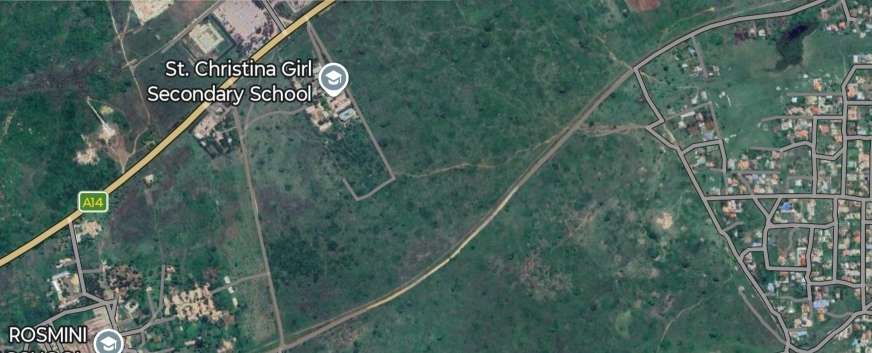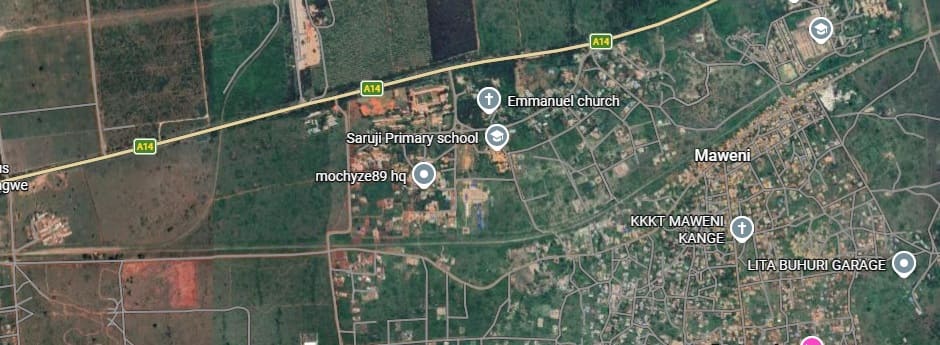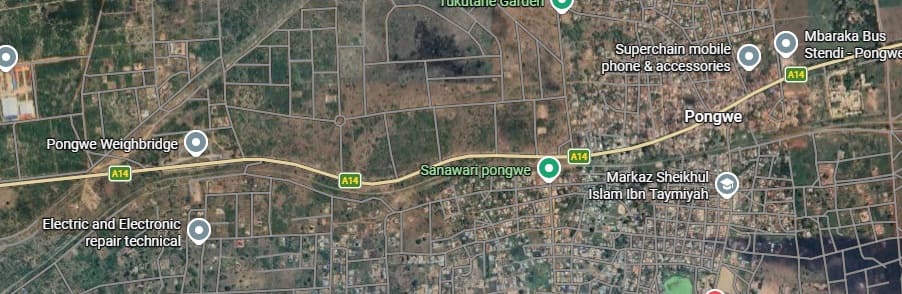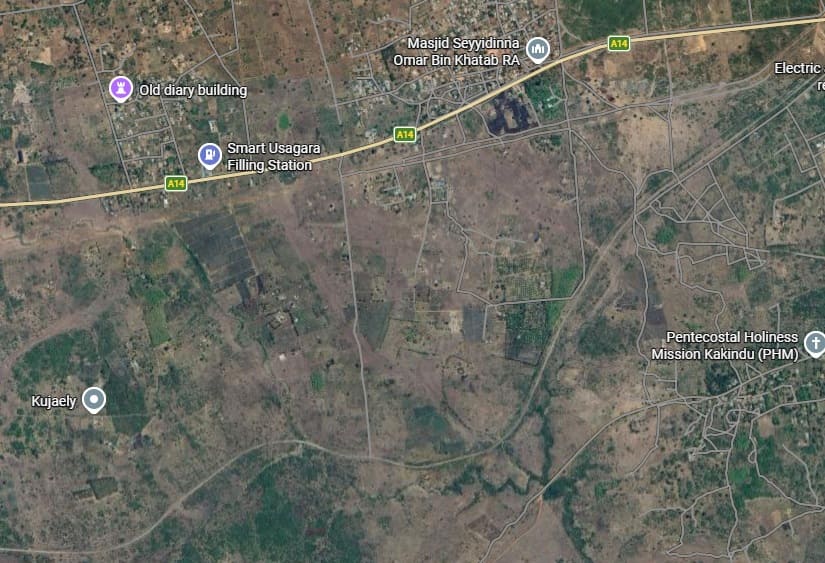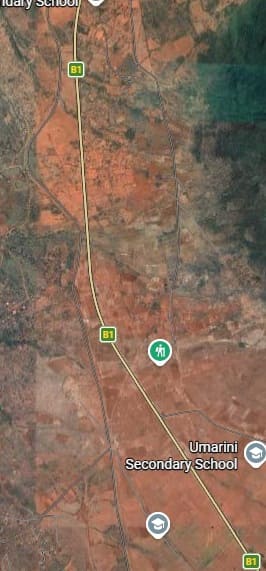
Tag Archives: Hedaru

Railways of Tanzania – Part 5 – Tanga to Ruvu (and thence to Dar-es-Salaam)

This is the fifth article about the Railways of Tanzania, and there will be more to come.

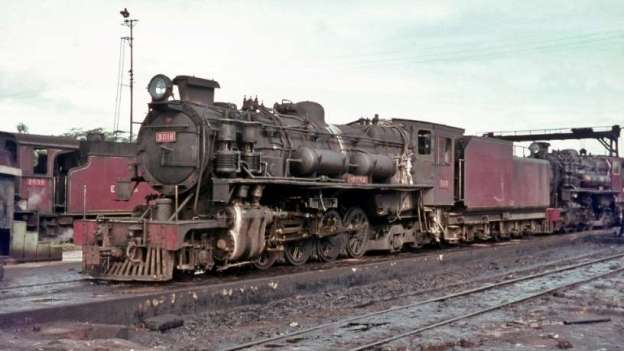
The featured image for this article is an EAR Class 30 locomotive No. 3019 ‘Nyamwezi’ at Tabora depot. This Class and Class 29 locomotives were active on the railway network at the time the line between Mnyusi and Ruvu was opened. It is likely that the two classes of locomotives would have operated between Mnyusi and Ruvu before deisel-electric locomotives took over freight duties, © Basil Roberts and licenced for reuse under a Creative Commons licence, (CC BY-SA 4.0). [55]

The first length of the rail route from Tanga to Dar-es-Salaam is the length of what was the Usambarabahn (the Tanga Railway) from Tanga to Moshi and on to Arusha.

That length of the route was covered fully in Part 2 of this series of articles. [1] Highlights from the first part of that article are included here for the sake of completeness.

A significant source of information about Tanzania’s Railways is M. F. Hill’s book Permanent Way Volume II: The Story of the Tanganyika Railways. [2] This book is only available second-hand or possibly from libraries. It was written before the construction of the link line between Tanga and Dar-es-Salaam. In the context of this article it is useful as background material.

UnitedRepublicofTanzania.com has a page dedicated to this link line which it refers to as the ‘Ruvu Link Line’. It says: “The Ruvu Link Line serves as a vital junction, linking the Central Line, which runs from Dar es Salaam to Mwanza, and the Tanga Line, which connects the port city of Tanga to [Moshi and Arusha]. This strategic positioning allows for the efficient distribution of goods and resources throughout the country, enhancing Tanzania’s overall economic competitiveness.” [23]
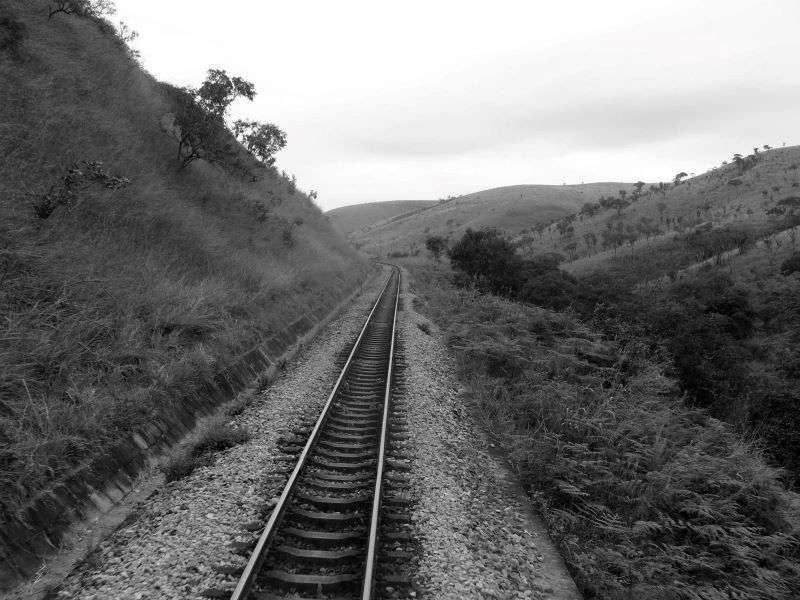
A length of the Ruvu Link Line. [23]

In recent years, the Tanzanian government has made significant investments in the Ruvu Link Line, with the aim of modernizing and expanding the infrastructure. This includes the ongoing rehabilitation of the existing track, the construction of new stations and maintenance facilities, and the introduction of more efficient locomotives and rolling stock.” [23]

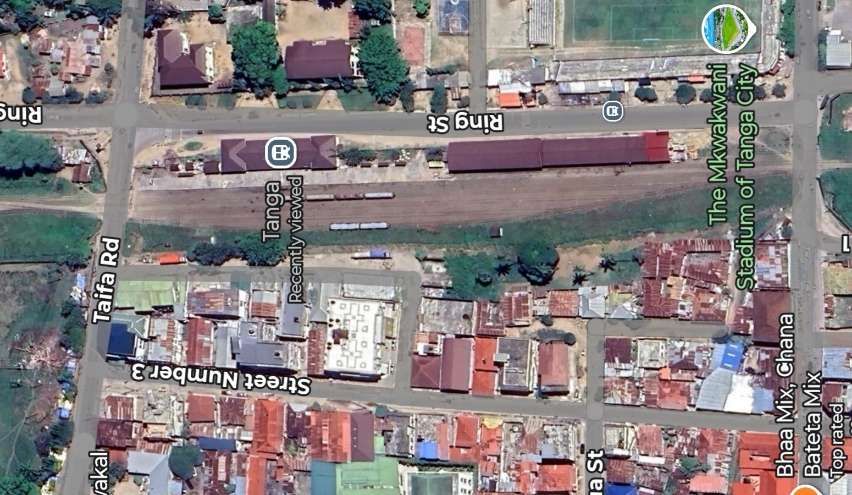
The journey from Tanga to Dar-es-Salaam begins at Tanga Railway Station on Ring Street, Tanga.
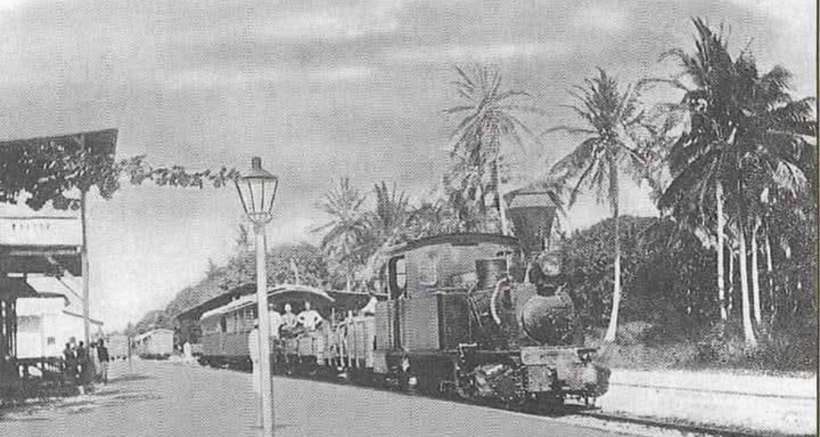
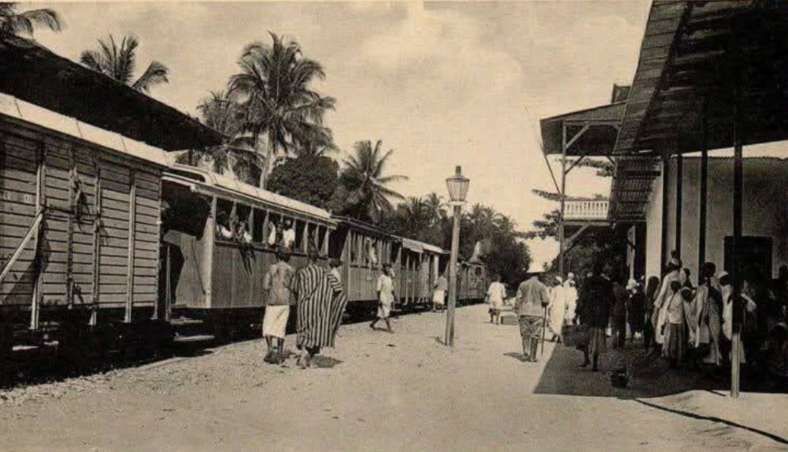
Tanga Railway Station, 1890. This image was shared on the City of Tanga in Tanzania (Tanga Facebook) Facebook Group by Ragini Pattni on 24th December 2025. [3]
The Station at Tanga close to the turn of the 20th century. This image was shared on the City of Tanga in Tanzania (Tanga Facebook) Facebook Group by Ragini Pattni on 24th December 2025. [3]
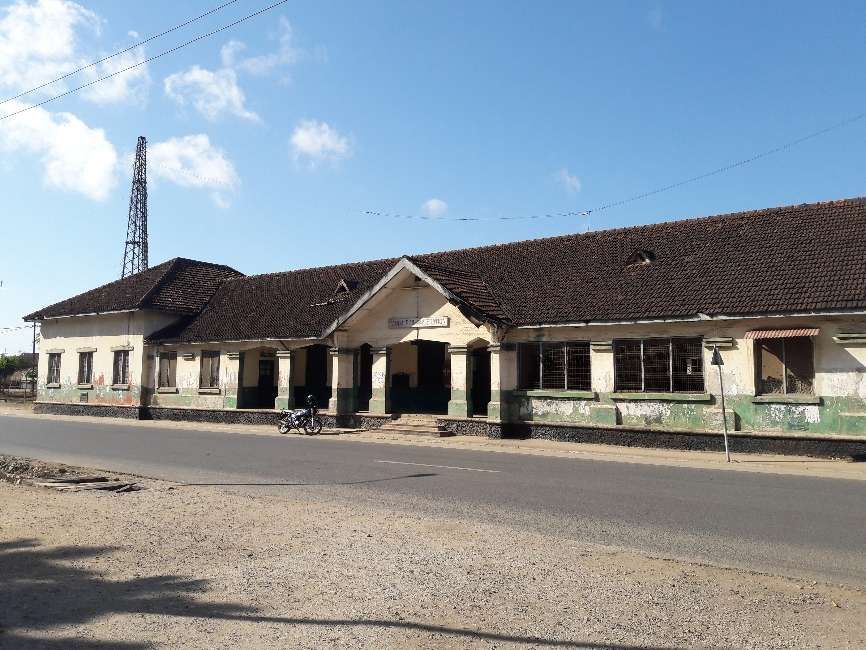
The Railway Station on Ring Street, Tanga. [Google Maps, March 2026]
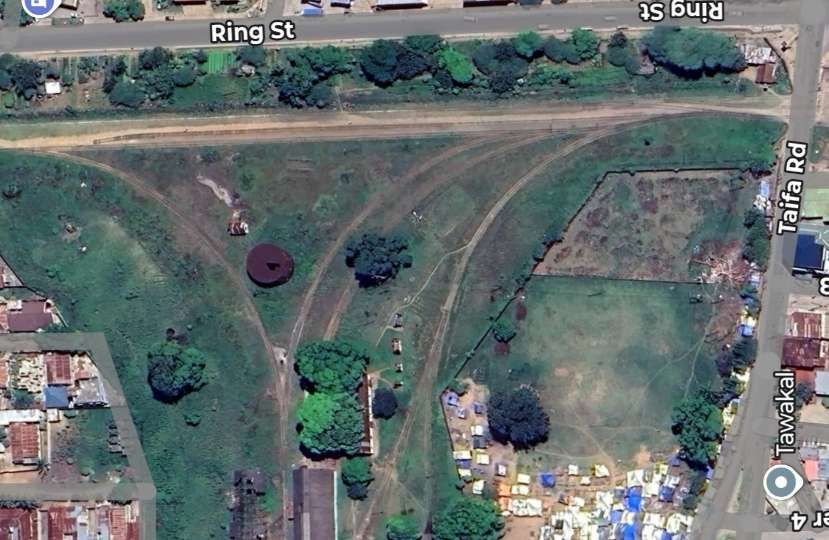
The turning triangle immediately to the West of the station at Tanga. [Google Maps, March 2026]
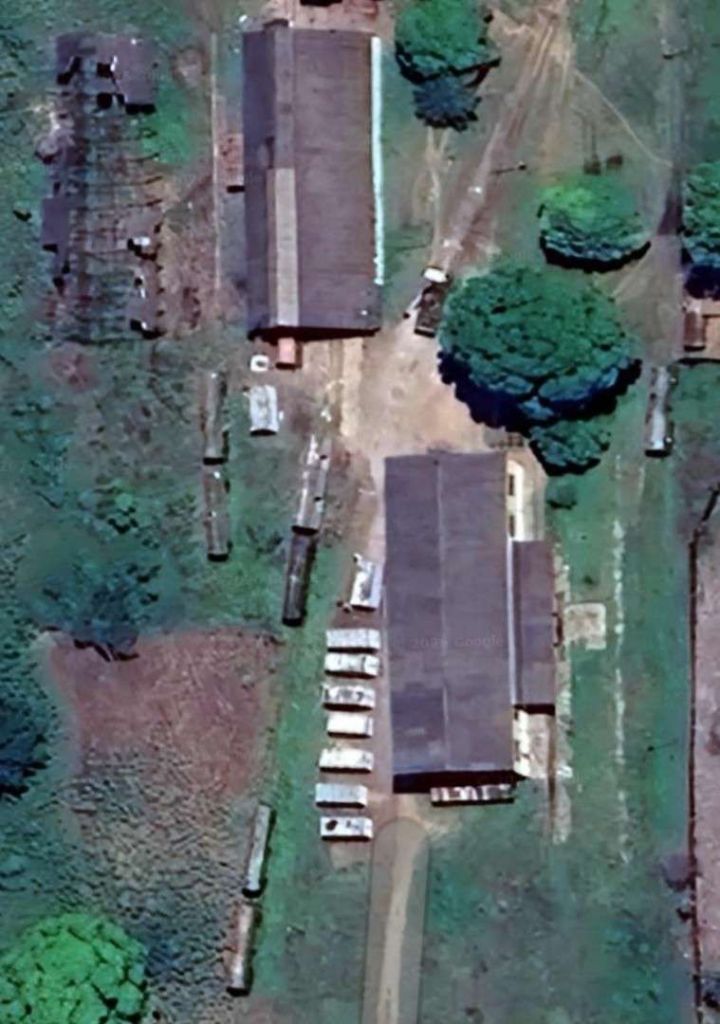
Buildings at the South point of the turning triangle in Tanga. [Google Maps, March 2026]
The roadside elevation of the Railway Station at Tanga. This image was shared on the City of Tanga in Tanzania (Tanga Facebook) Facebook Group by Ragini Pattni on 24th December 2025. [3]
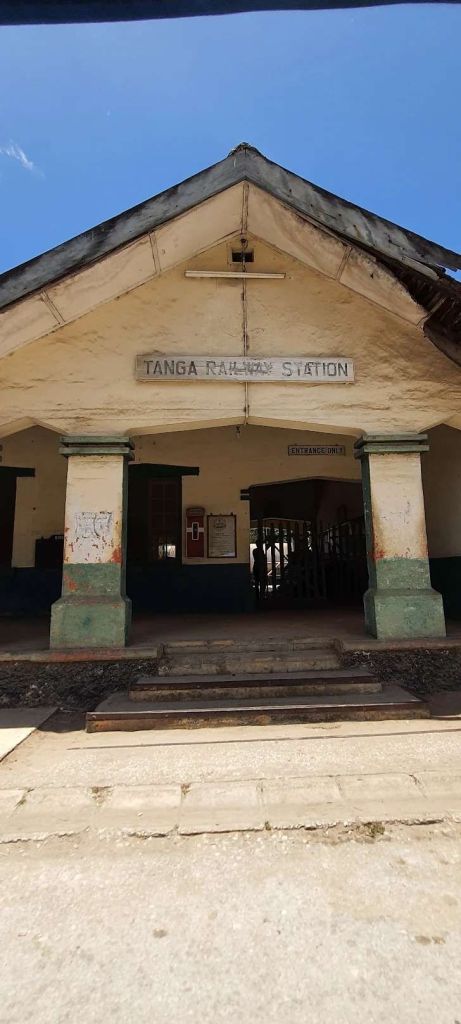
Tanga Railway Station entrance, © Shane, Google Images. [4]
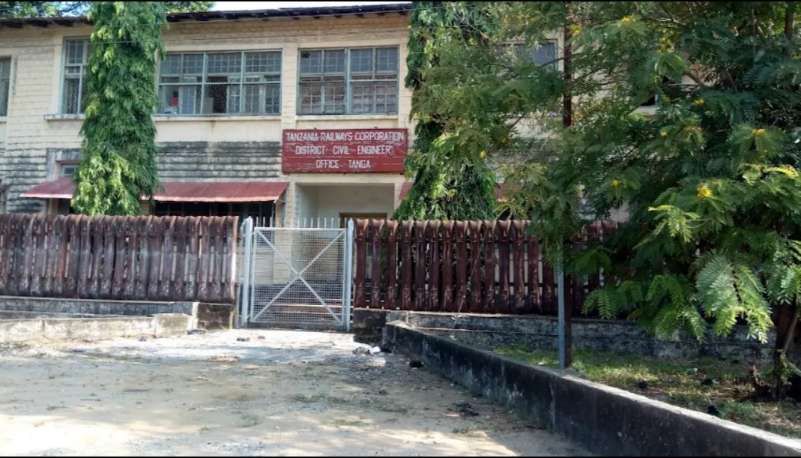
The District Civil Engineer’s Office, Tanzania Railways Corporation, Tanga © Paschal P. Rutayuga. [5]

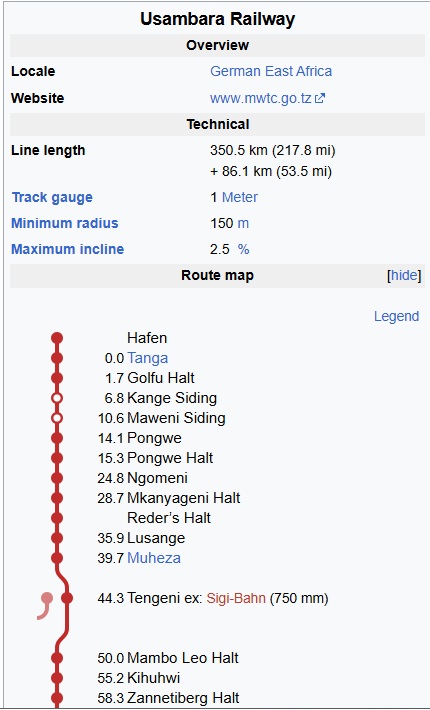
The significant locations along the first stretch of the Tanga Railway (or the Usambarabahn or Usambara Railway) are highlighted on the adjacent schematic map of the line. [6]

The first location that we can easily establish on the satellite images below is the village/town of Maweni, nearly 11 kilometres from Tanga Railway Station.

Pongwe is only a few kilometres along the line. Again no obvious location can be seen on satellite images for any halt/station. Mkanyageni Halt (Reder’s Halt) is also not obvious on the satellite imagery.

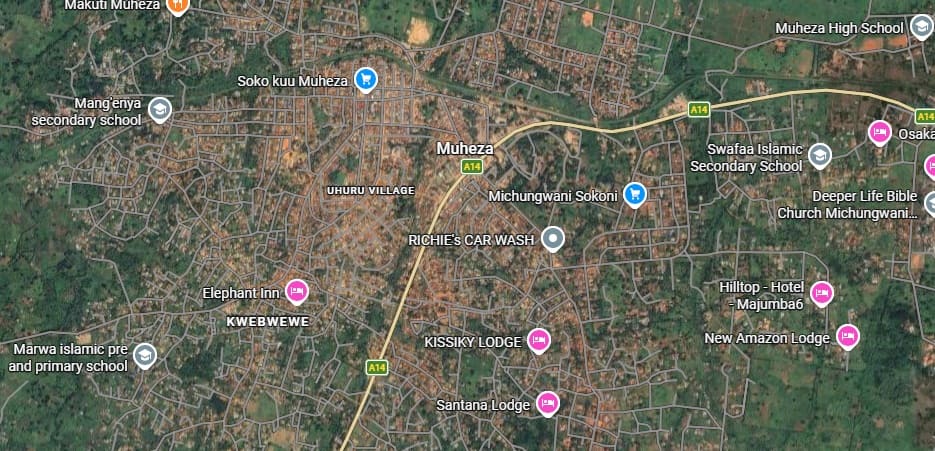
Muheza, a more significant township, has an easily identifiable railway station!

Muheza is a more significant township and it has a clearly identifiable railway station! The location of the station is shown on the larger scale extract from Google’s satellite imagery below. It is close to the point where the A14 turns South away from the line. [Google Maps, March 2026]

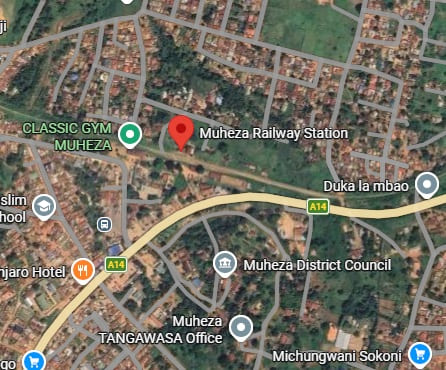
Muheza Railway Station sits close to the centre of the town. [Google Maps, March 2026]

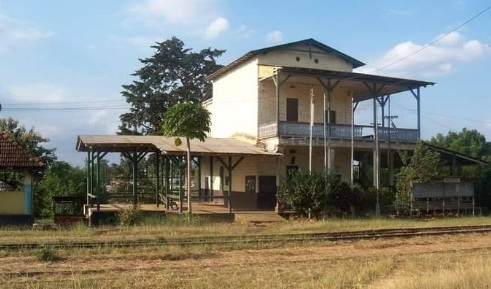
Muheza Railway Station, © Issa Mates, April 2021. [Google Maps, March 2026][7]

The station location was caught on camera in the late 19th century. It can be found among a series of photographs held by the Getty Foundation, here. [8] The picture is annotated, “Muheza station on Usambara Railway, Usambarabahn, German East Africa, Tanzania, 1890s, 19th Century.”

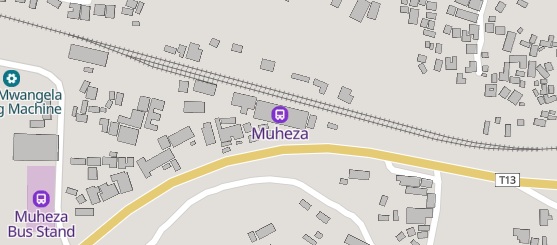
Muheza Railway Station as shown on MapCarta. [15]

The line runs through or close to a series of villages – all of which are covered in Part 2 of this series of articles. [1]

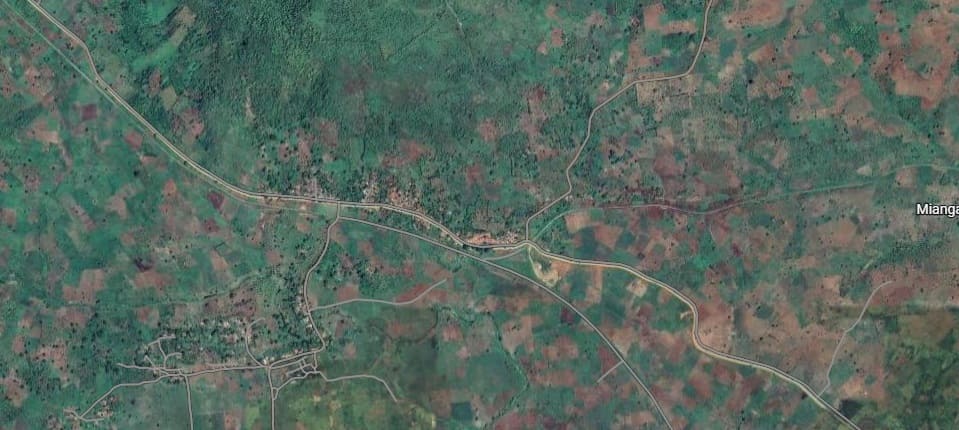
This satellite image centres on the junction between the Tanga line and that from Dar-es-Salaam which sits to the West of Mianga the line from Tanga sweeps left and then right and joins the line from Dar es Salaam. The line then heads East-northeast, leaving this image at the top-left. [Google Maps, March 2026]

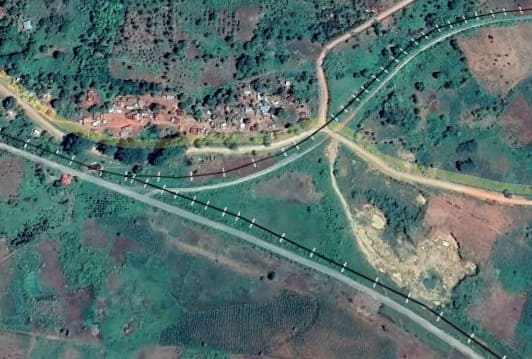
This closer view of the junction is taken from Google Earth. The black lines approximate to the two railway routes but are several metres, at least, out of position. The junction is named on the Schematic map of the line below – Murasi Junction and is recorded as being 65 km from Tanga. [Google Earth, March 2026]

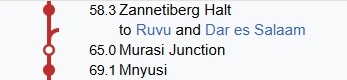
The most notable location at the top of this section of the schmatic map of the line is the railway junction between the line from Tanga and that from Dar es Salaam. – Murasi Junction. Travelling on from Murasi Junction the next location recorded is the town of Mnyusi. [6]

Mnyusi River Bridge {Google Maps, March 2026]

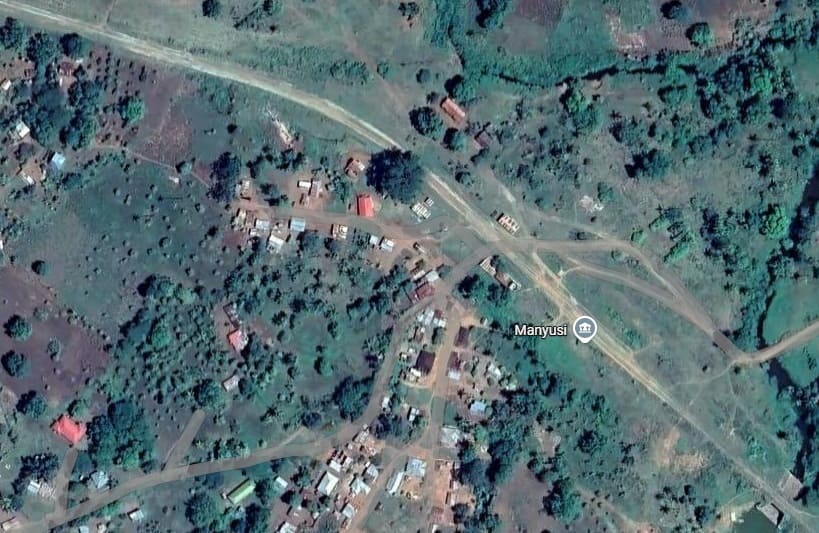
Mnyusi sits at the centre of the satellite image below. The line runs along the Southwest side of the town. There is a significant culvert/bridge carrying the line over the local river.

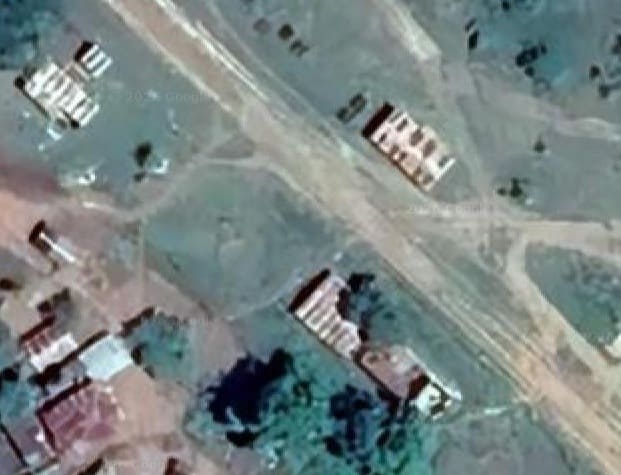
The town of Mnyusi sits on the Northeast side of the railway line. To the Northwest of the bridge/culvert shown above, there is a passing loop and possibly old station buildings. Trains from Tanga for Dar-es-Salaam, and from Dar-es-Salaam for Tanga, will probably have reversed at this location or at Murasi Junction with the locomotive running round its train. [Google Maps, March 2026]

Returning to the railway junction from Mnyusi, Dar-es Salaam trains left the Usambarabahn to head for Ruvu. [6]

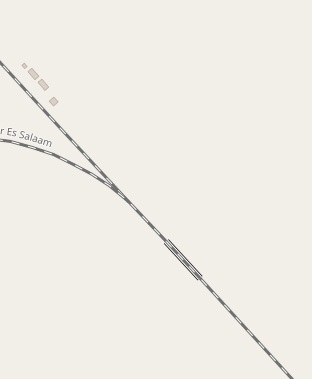
The Usambara Railway heads away to the North from the line to Ruvu which headed southeast from the junction. [14]

The Usambarabahn (the Usambara Railway, Northern Line or Tanga Line) existed in splendid isolation under German rule and between the two world wars. No connection was made to the central line and Dar-es-Salaam until August 1963! [10] The line was built, primarily, to provide a through connection between all parts of the East African railway system, one particular benefit being the possibility of moving rolling stock between sections which have peaks of traffic at different
times of year. [11]

By that time, Tanganyika was independent of British rule. Tanganyika became independent from the British on December 1961 and Zanzibar became free through a revolution on 12th January 1964. Tanganyika and Zanzibar united on 26th April 1964, forming the United Republic of Tanzania.

The story of the construction of this line was told at a meeting of the Permanent Way Institution in 1964. [12]

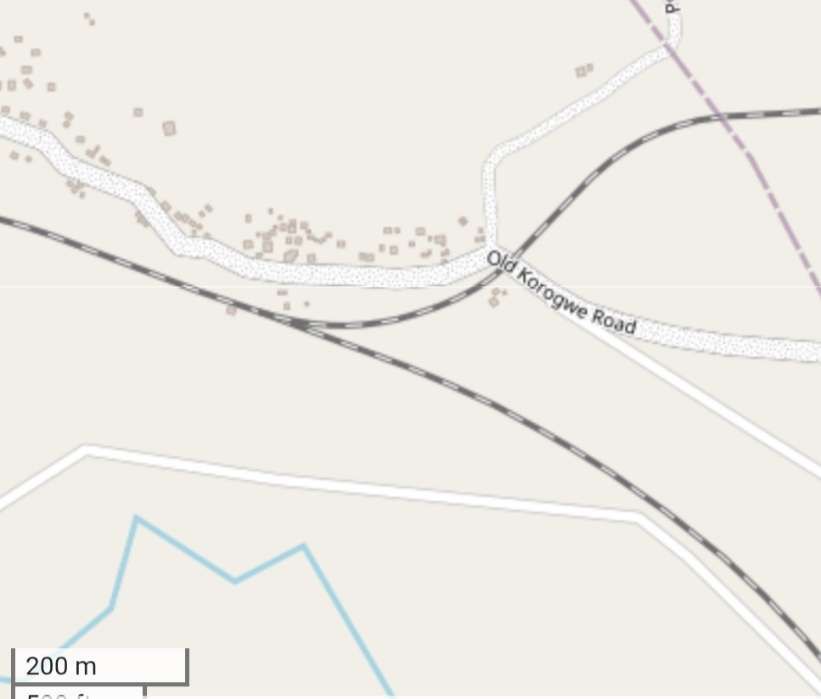
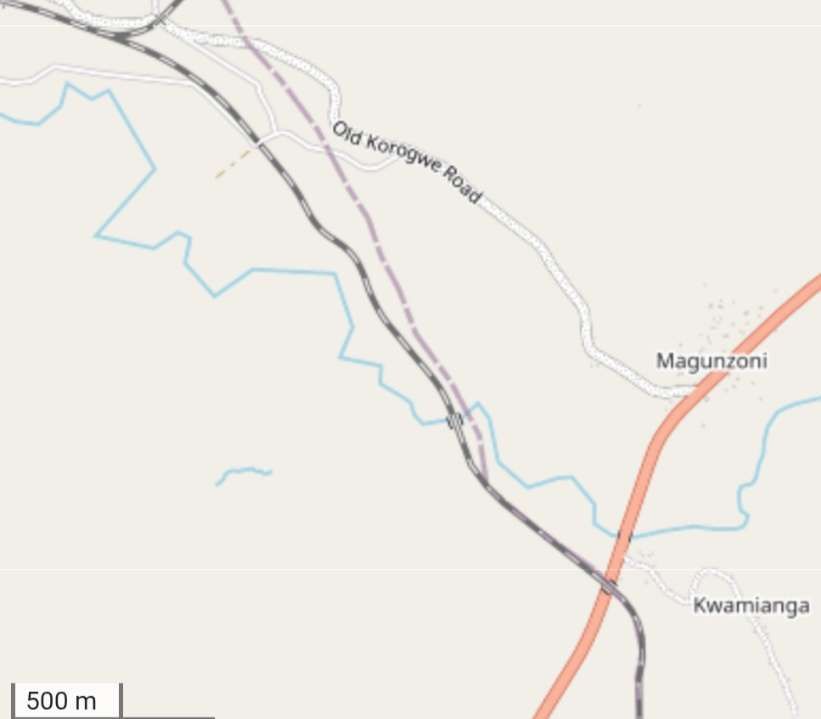
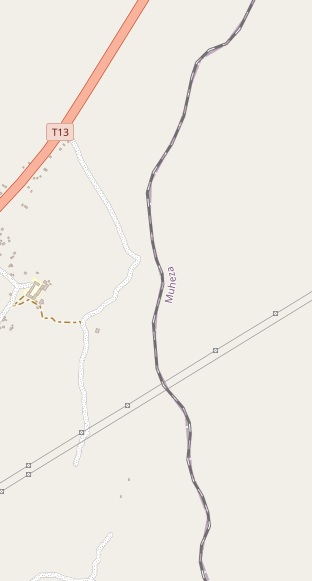
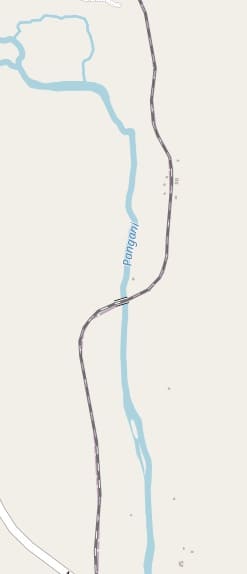
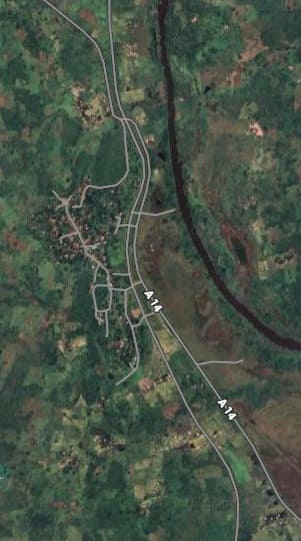
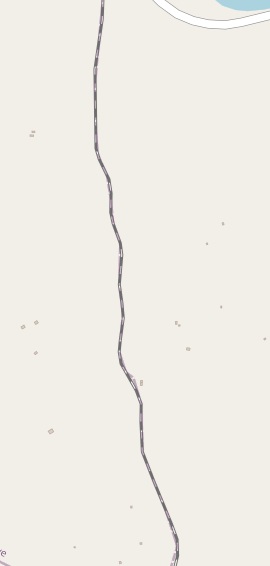
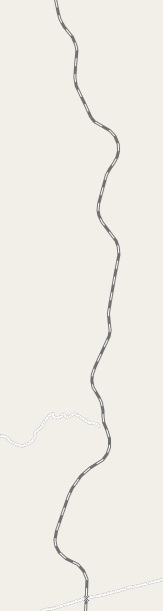
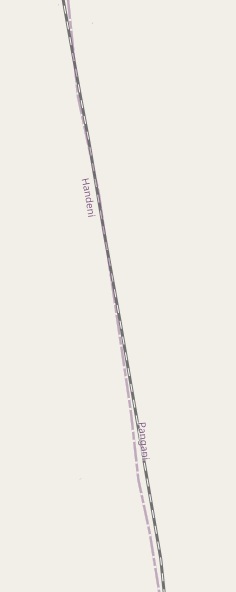
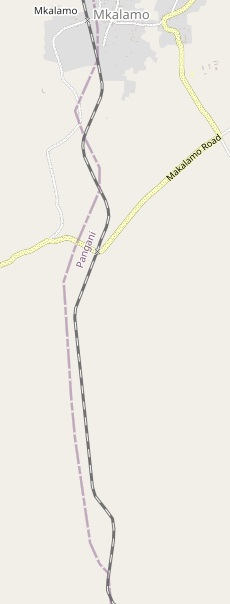
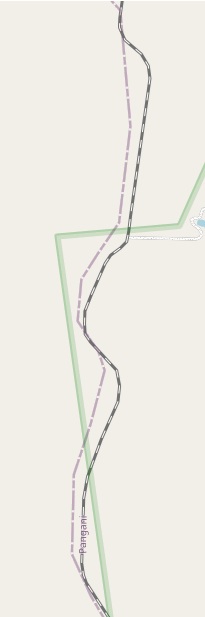
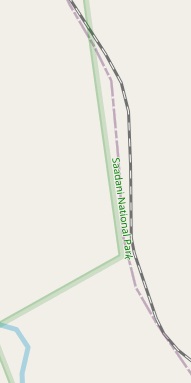
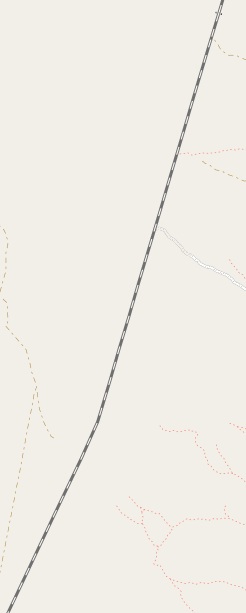
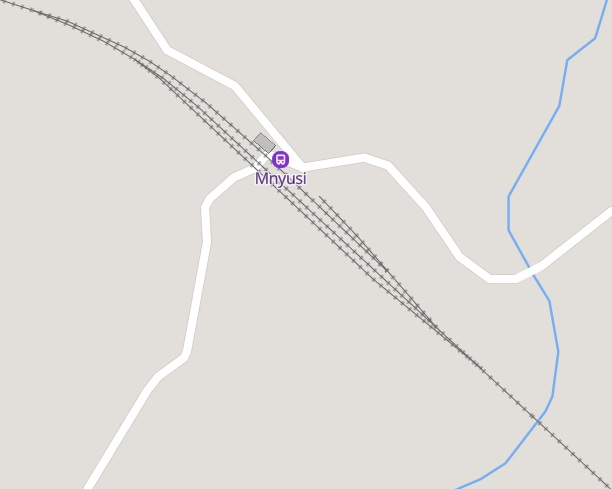
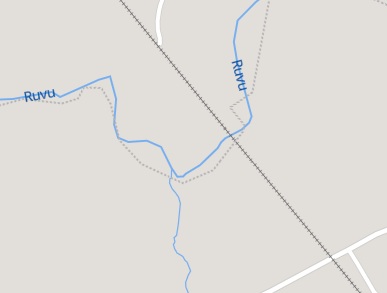
The first 6 to 7 km of the line South to Ruvu, as it appears on OpenStreetMap’s mapping. [14]
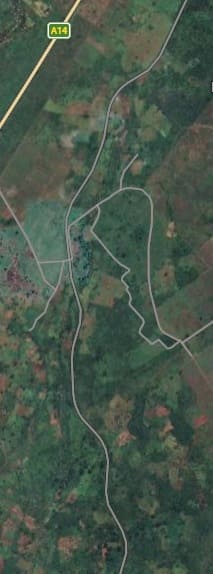
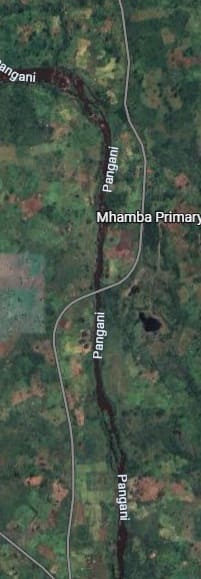
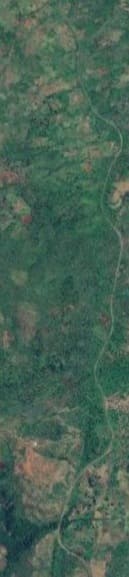
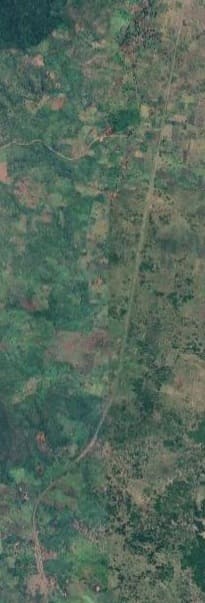
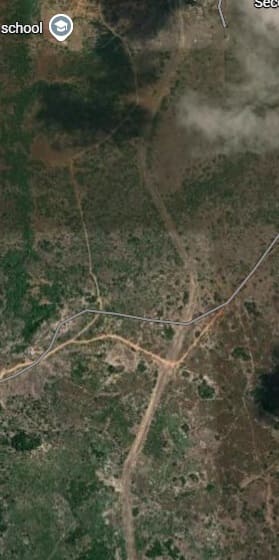
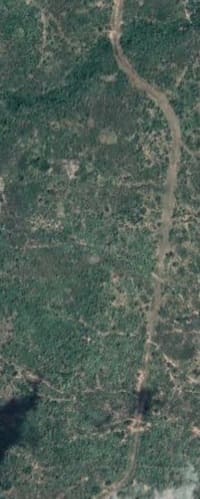
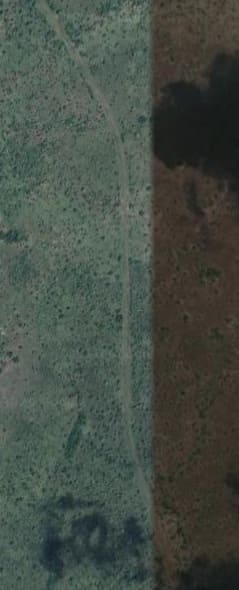
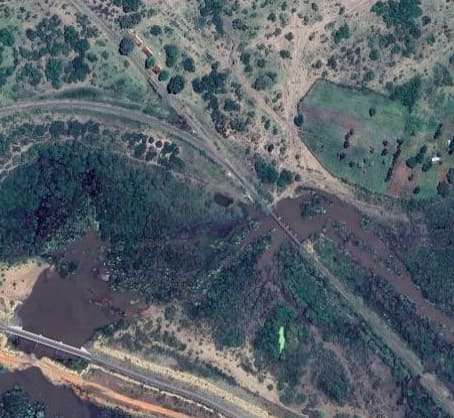
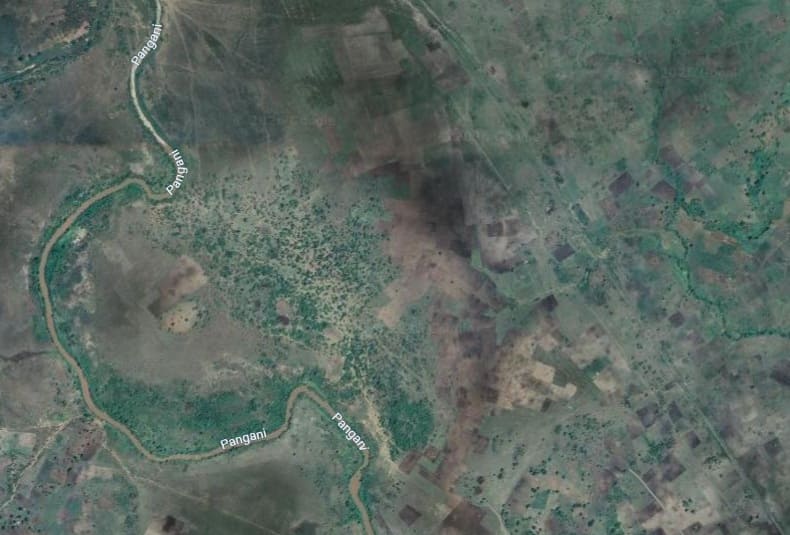
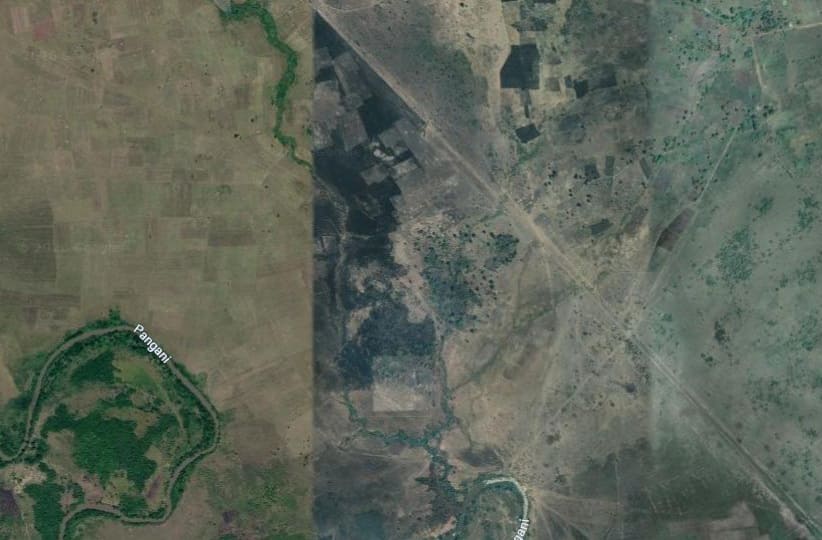
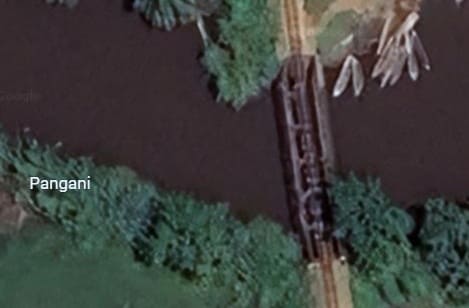
Approximately the same area as it appears on Google Maps satellite imagery. The Pangani River runs diagonally across this satellite image, from close to the top-left to close to the bottom-right. The railway line bridges the river just below the centre of the image and a little to the right. [Google Maps, April 2026]

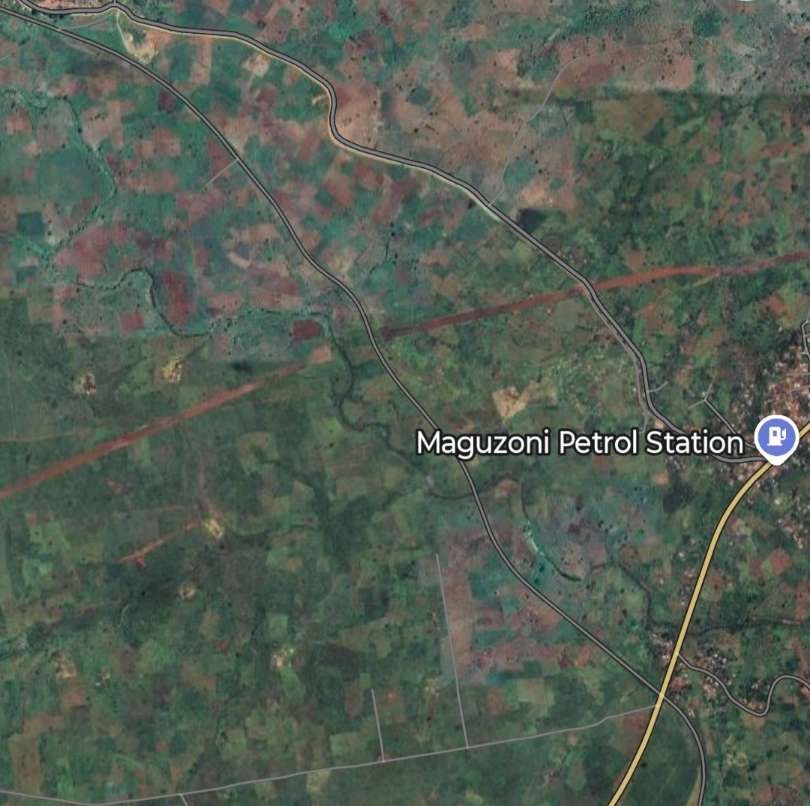
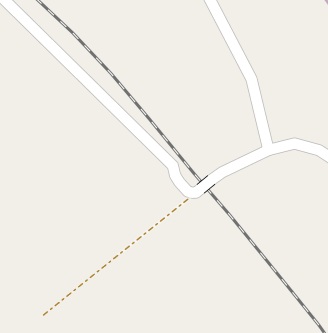
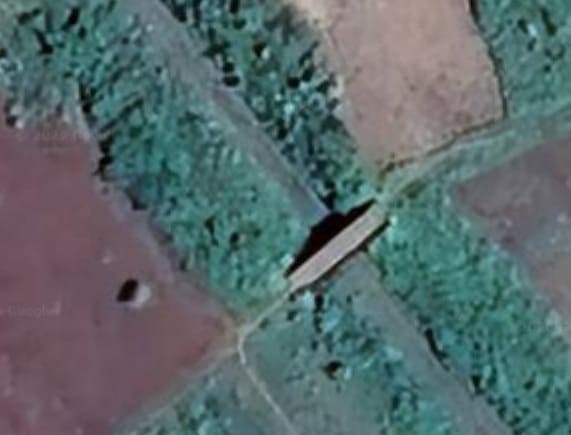
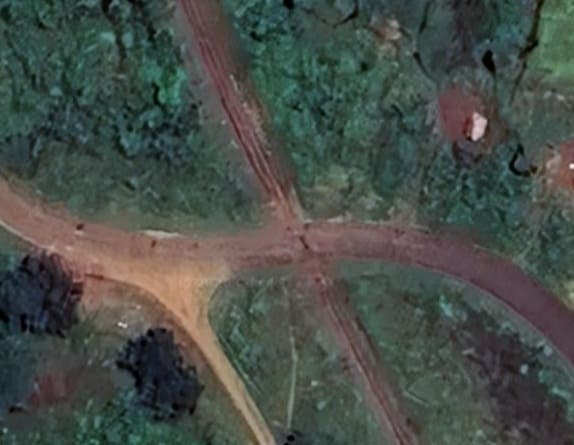
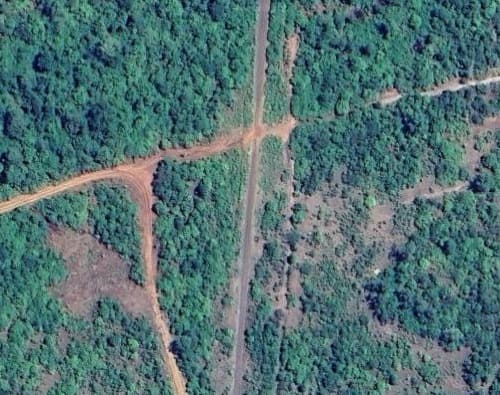
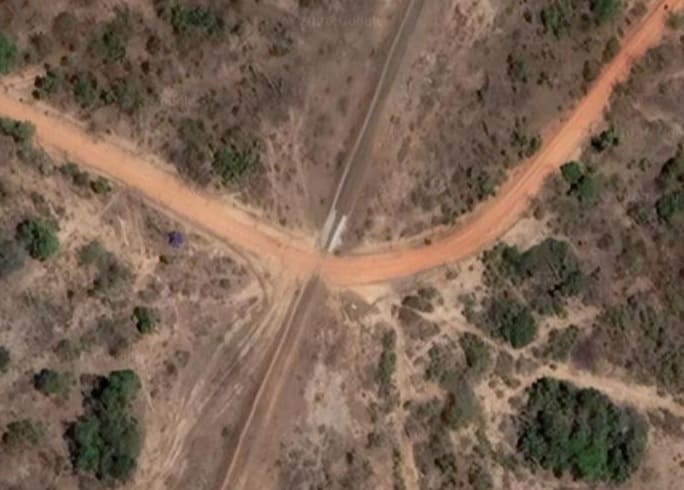
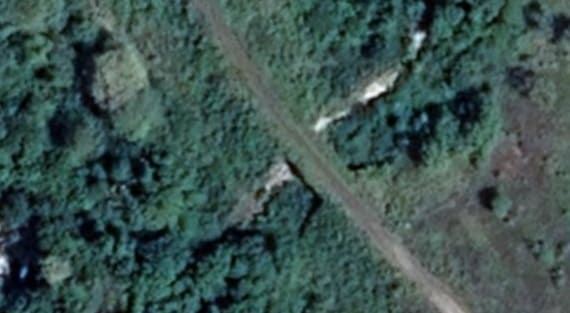
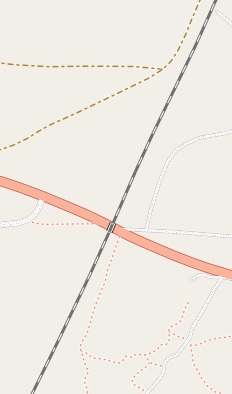
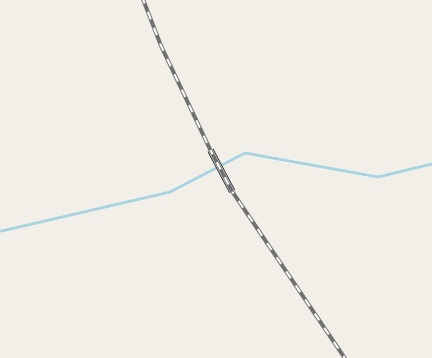
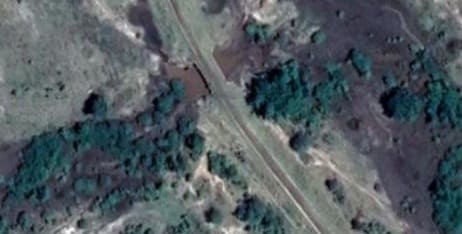
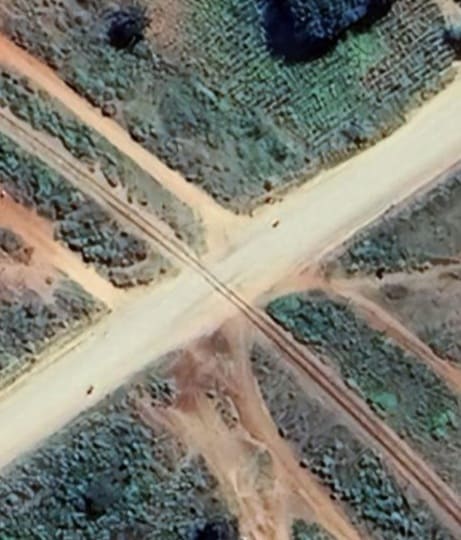
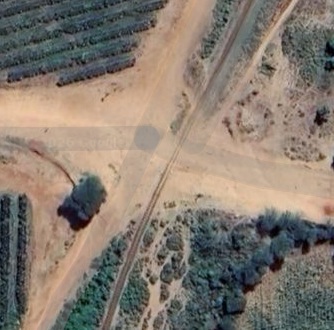
Just a short distance Southeast of the railway junction, a minor road (more like a track) bridges the line.

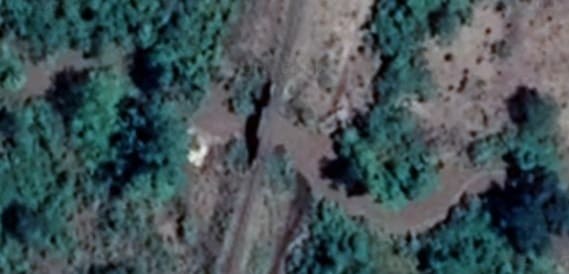
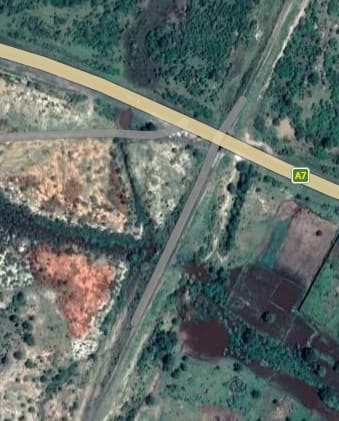
The same location on Google’s satellite imagery. [Google Maps, April 2026]

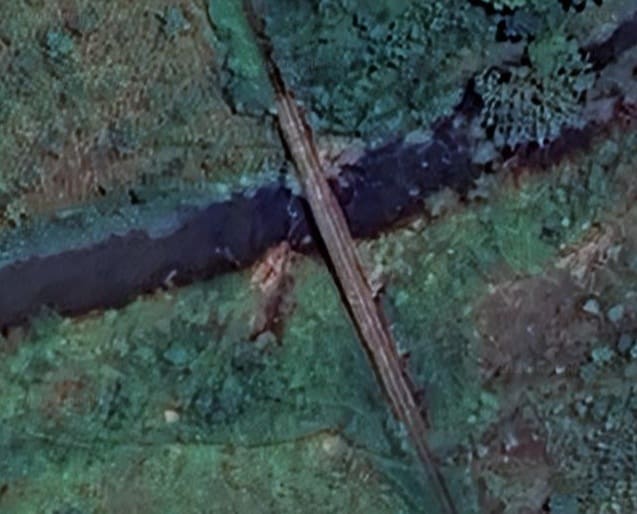
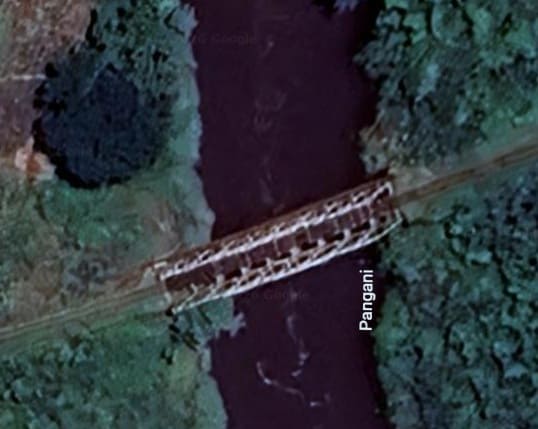
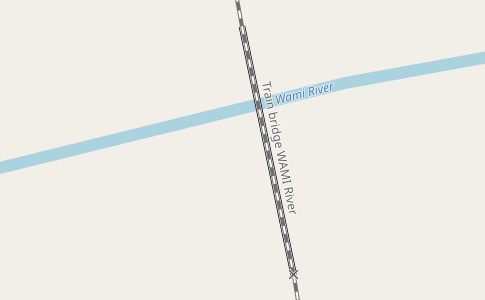
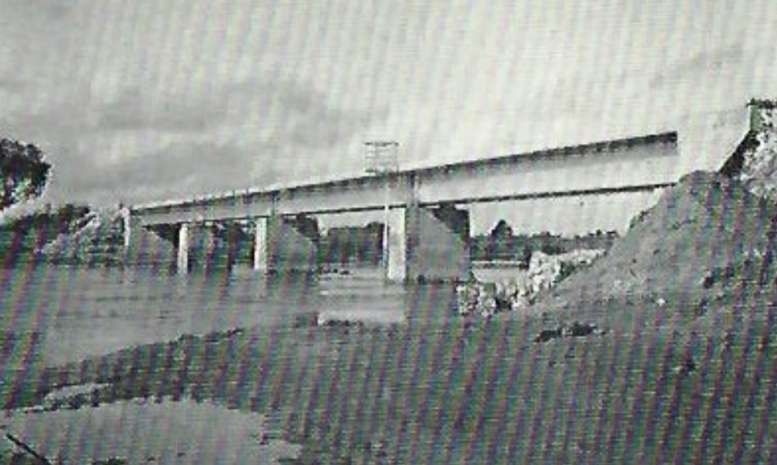
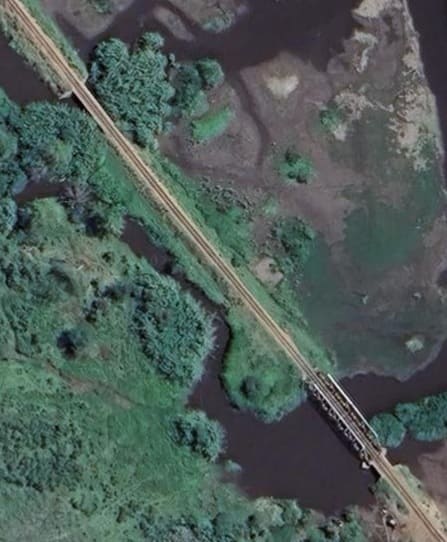
The Pangani River Bridge: this bridge is probably of the same type as that over the Wami River. That bridge appears in an article by K. Rahmani which is in Appendix 1 below. That bridge is a multi-span girder bridge (4 No. 60ft spans) [Google Maps, April 2026]

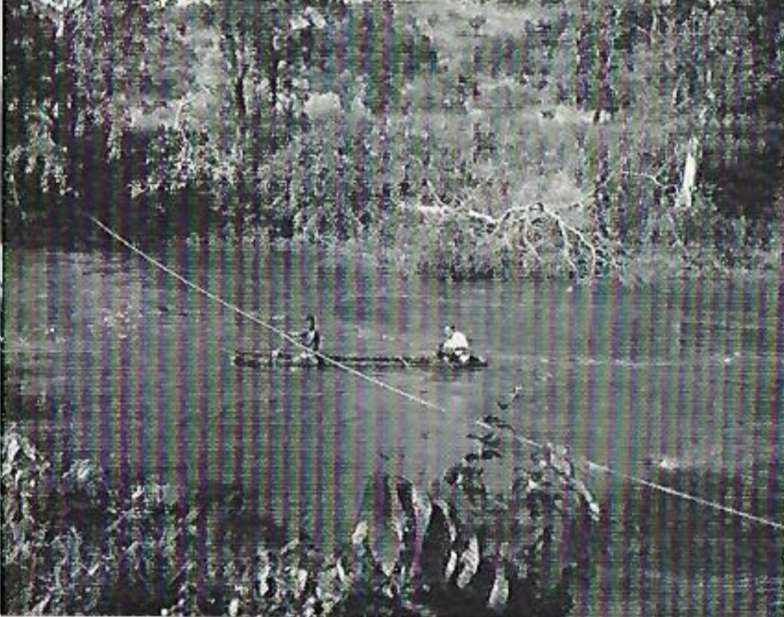
This image shows work being undertaken as part of the planning for the construction of the railway. Depth readings are being taken along the line of the railway at the location of the future Pangani River bridge. [12: p58]

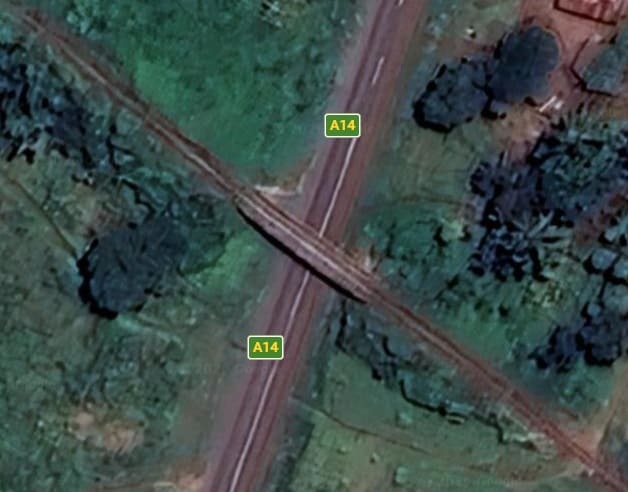
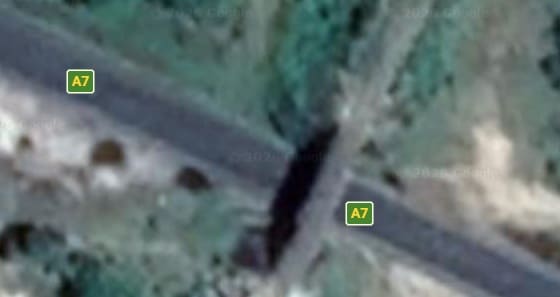
The next significant structure on the line is this bridge over the A14 (Google)/T13 (OpenStreetMap)

About 600 culverts, in both Armco and Precast concrete, totalling some 11 miles if laid end to end, were laid. The largest size was 12 ft 6 in diameter in Armco. Eleven major bridges were built over the Mnyusi. Pangani, Mbuzi, Msangasi, Mligaji, Mvavi, Wami, Usigwa, Mkombezi, Mbiki and Msua rivers. One 30 ft span bridge was built over Mililengwa river and two 60 ft span bridges were built over Tanga-Korogwe and Dar es Salaam-Morogoro main roads. All the bridges, except Pangani bridge which is a 116 ft span of the Callender-Hamilton type, are plate girders with reinforced concrete deck slabs. Although only two of the rivers – Pangani and Wami – flow all the year round, the other rivers have a heavy flow during the two rainy seasons, short and long. Four of the rivers including the Wami which has a bridge of four 60 ft spans, were diverted from their original courses.” [12: p58]

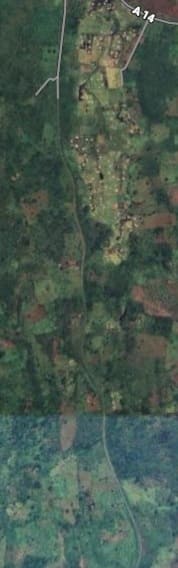
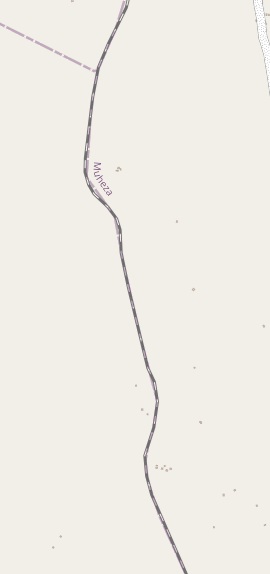
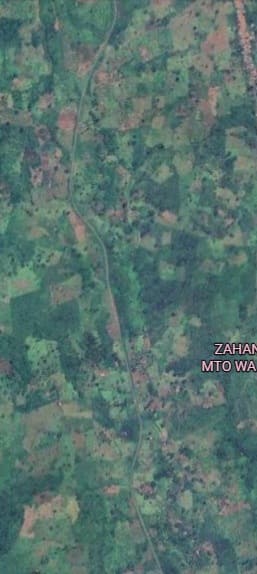
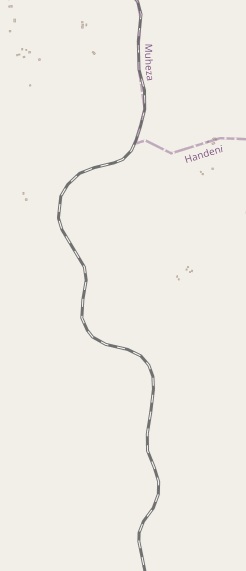
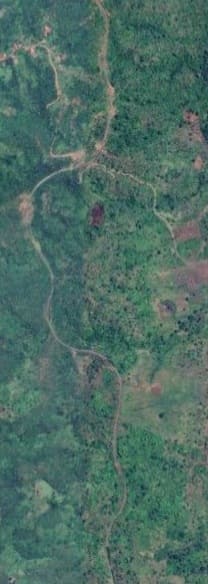
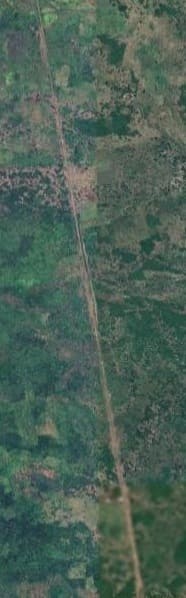
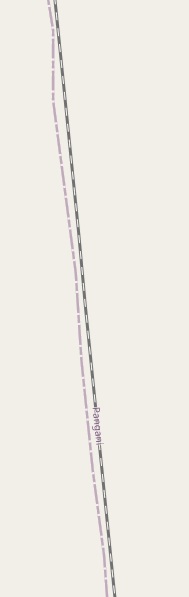
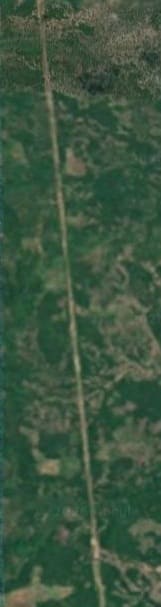
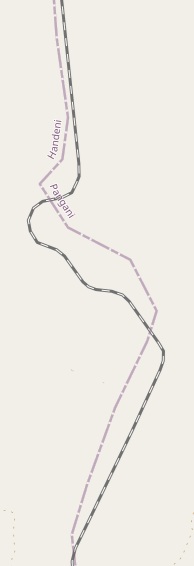
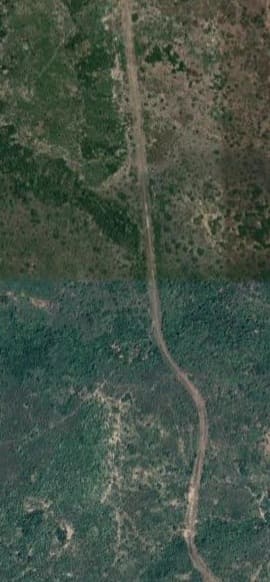
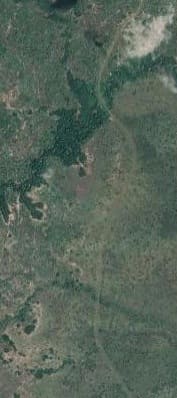
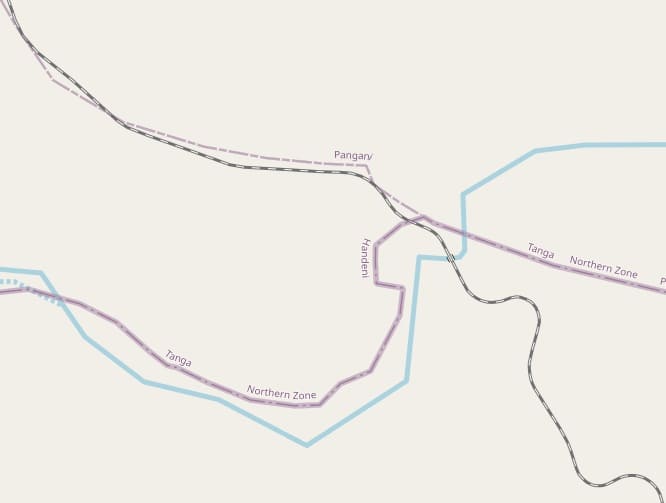
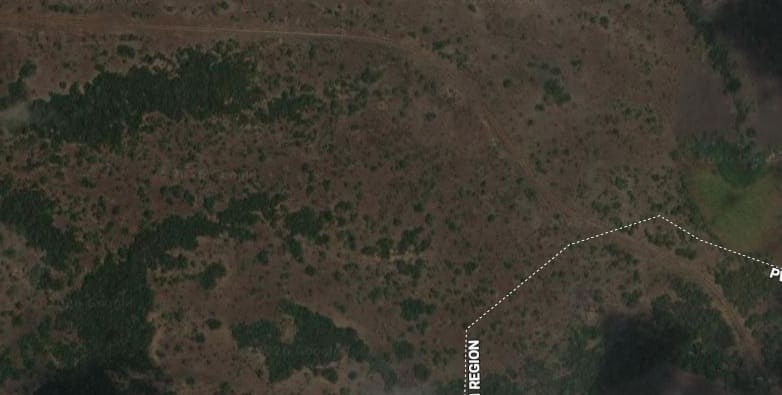
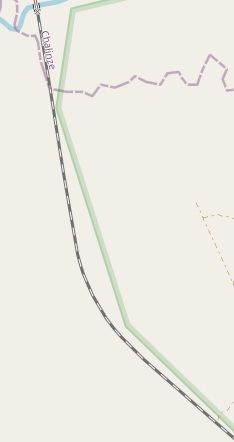
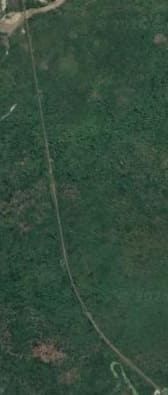
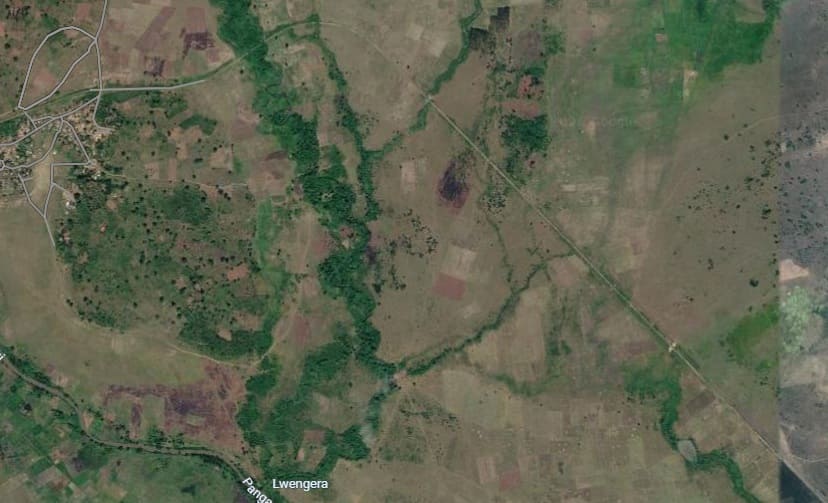
The next length of the line on OpenStreetMap [16] and on satellite imagery [Google Maps, April 2026]

Over some distance the railway follows the shared boundary between Muheza and Korogwe districts.

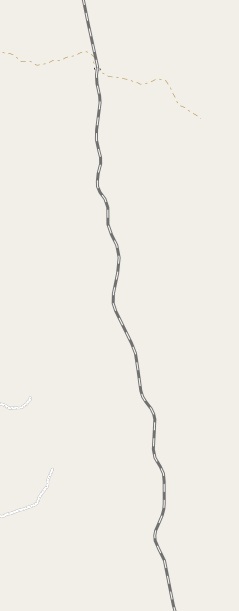
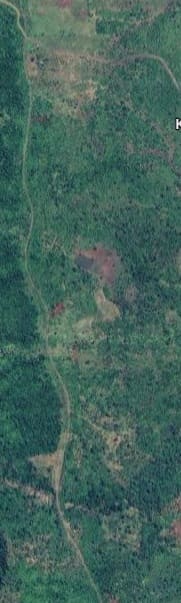
The next length of the line on OpenStreetMap [17] and on satellite imagery. [Google Maps, April 2026]

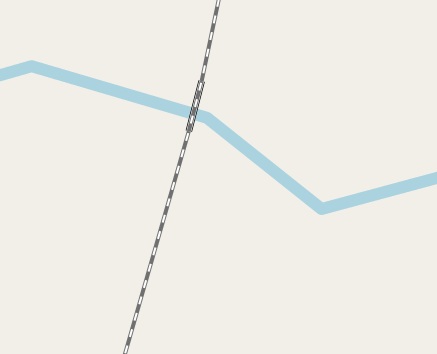
The railway crosses the Pangani River again close to the centre point of this image. The bridge is shown in greater detail below. [Google Maps, April 2026]

The next bridge over the Pangani River: this appears to be a Warren Truss Girder Bridge. [Google Maps, April 2026]

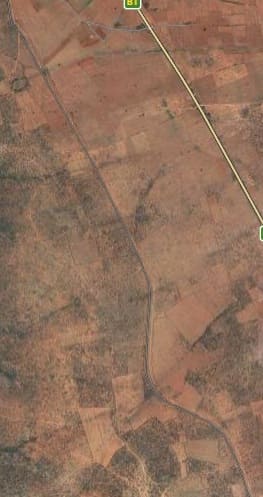
The next length of the line on OpenStreetMap [18] and on satellite imagery. [Google Maps, April 2026]

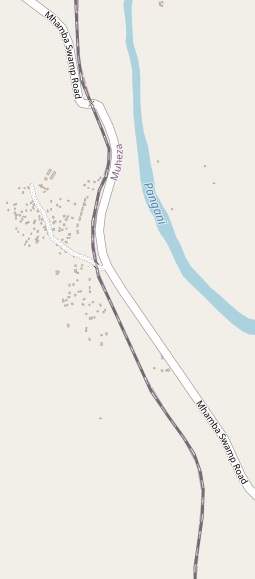
To the South of the bridge over the Pangani River, the Mhamba Swamp Road crosses the railway.

The Mhamba Swamp Road Level Crossing. [Google Maps, April 2026]

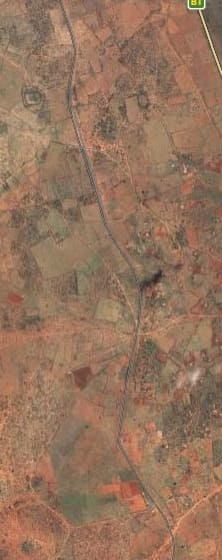
The next length of the line on OpenStreetMap [19] and on satellite imagery. [Google Maps, April 2026]

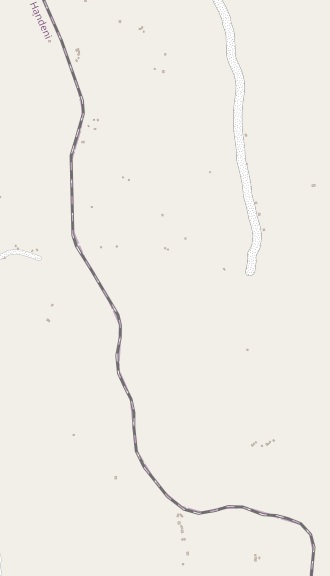
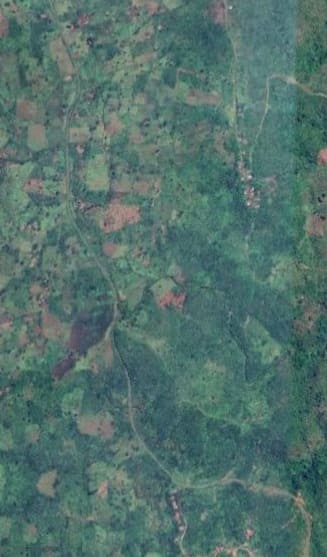
Continuing to run South the line continues to follow district boundaries, by the bottom of the next OpenStreetMap extract it is the mutual boundary between Muheza and Handeni districts. …

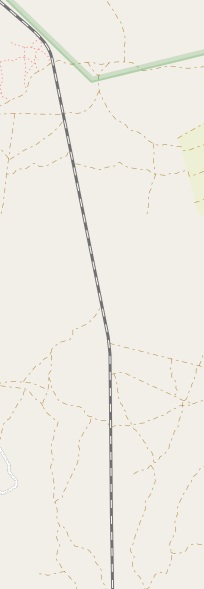
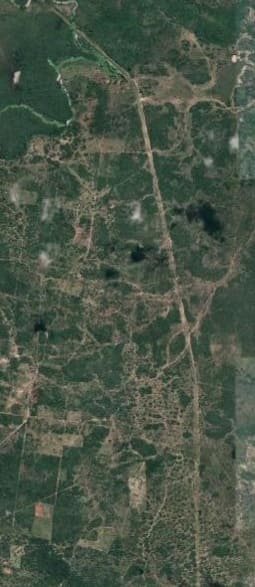
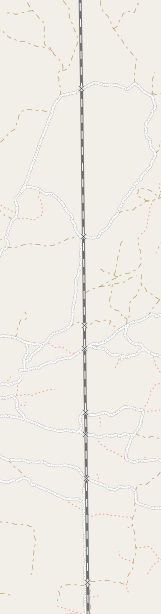
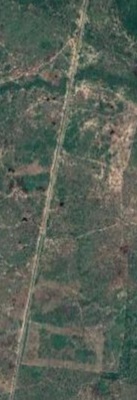
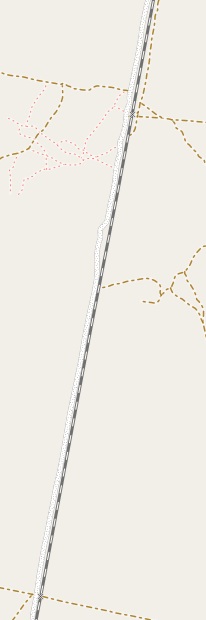
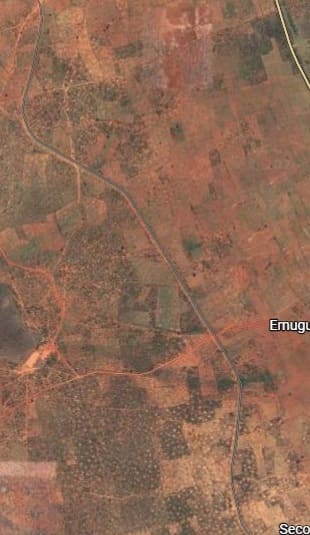
The next length of the line on OpenStreetMap [20] and on satellite imagery. [Google Maps, April 2026]

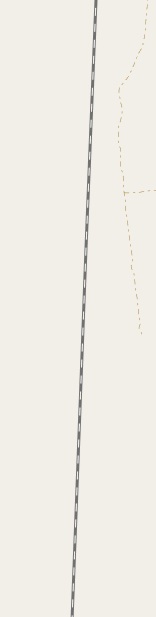
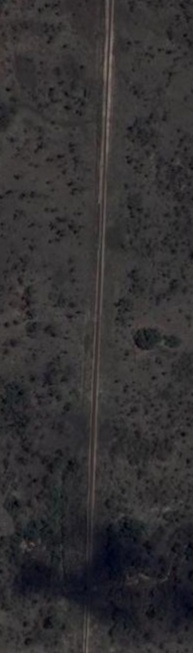
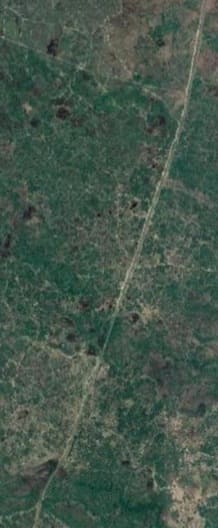
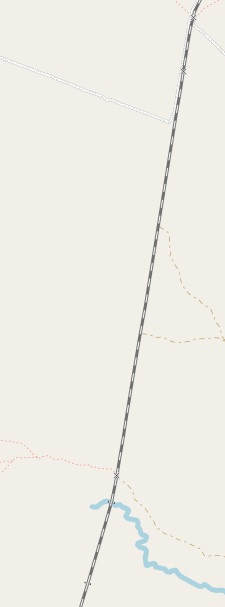
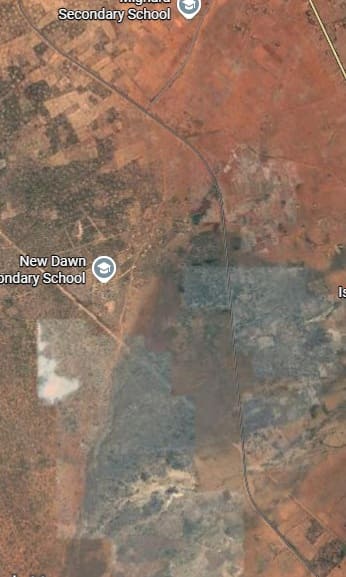
There are no obviously significant structures or locations on this length of the railway. [20] [Google Maps, April 2026]

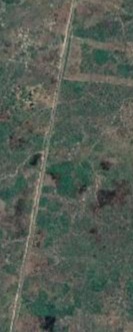
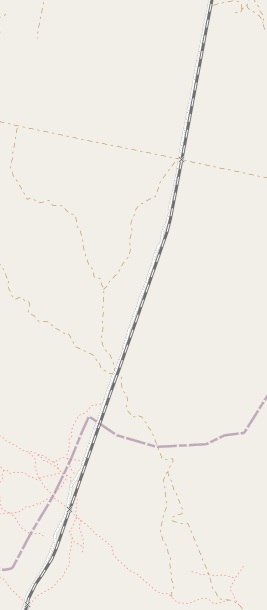
The next length of the line on OpenStreetMap [21] and on satellite imagery. [Google Maps, April 2026]

The line continues South although it takes a more significant turn to the East to follow the contours of the land. [21][Google Maps, April 2026]

The next length of the line on OpenStreetMap [22] and on satellite imagery. [Google Maps, April 2026]

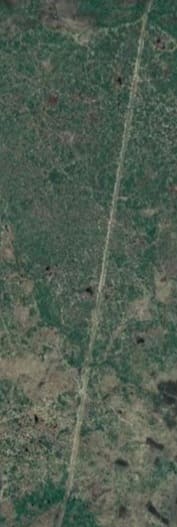
The line continues South. [22][Google Maps, April 2026]

Two Google satellite image extracts cover the same length as the adjacent map extract. [Google Maps, April 2026][24]

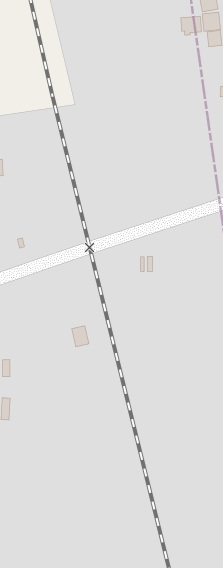
The next length of the line. [25] [Google Maps, April 2026]

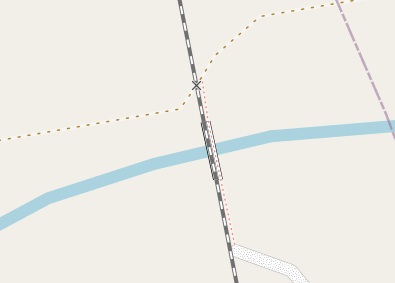
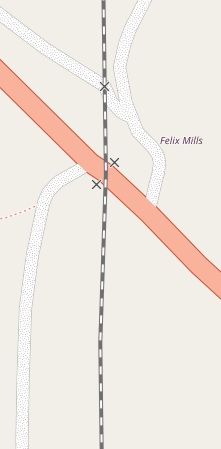
The image immediately below shows the road crossing marked by the ‘X’ on OpenStreetMap. [Google Maps, April 2026]

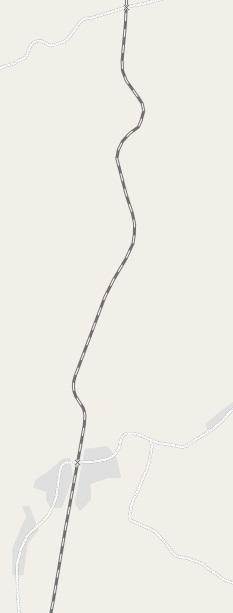
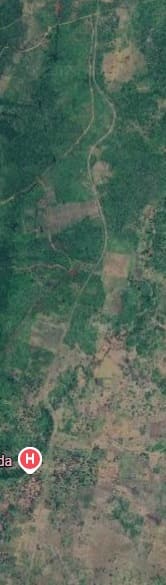
The line continues South. [26][Google Maps, April 2026]

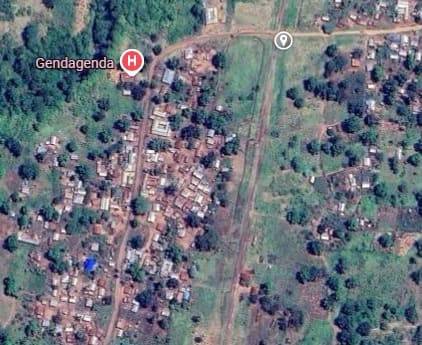
The hospital flagged on the image above is Gendagenda Hospital. The area around it is shown on the next image below. [Google Maps, April 2026]

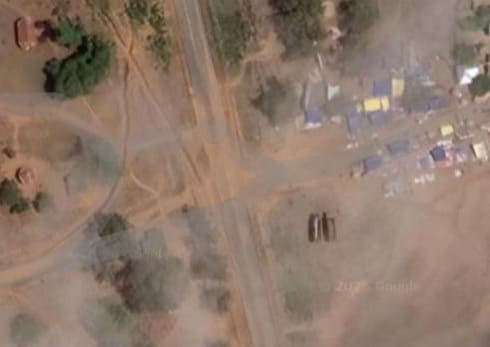
Gendagenda Hospital , the adjacent level-crossing and a settlement which OpenStreetMap notes as being centred on a number of milling machines. [Google Maps, April 2026]

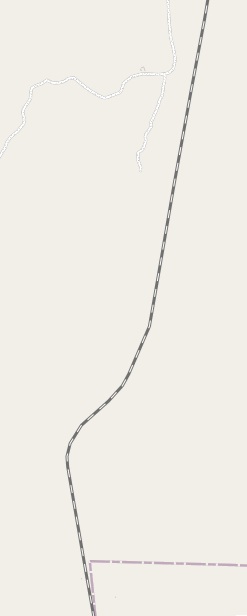
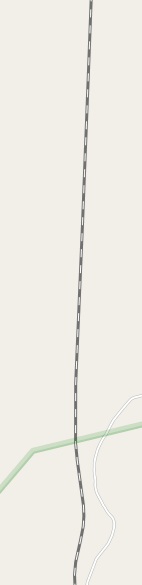
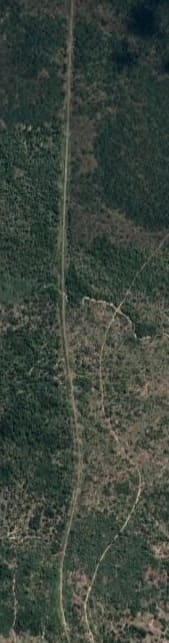
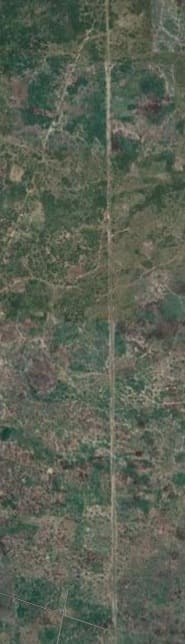
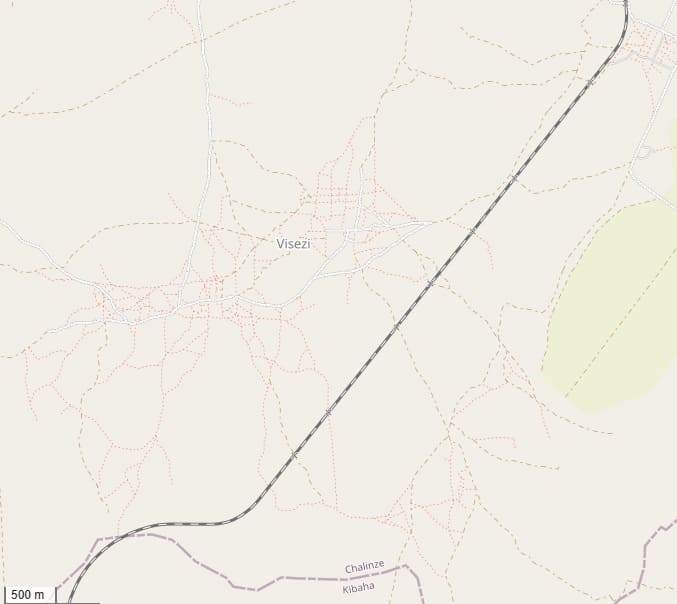
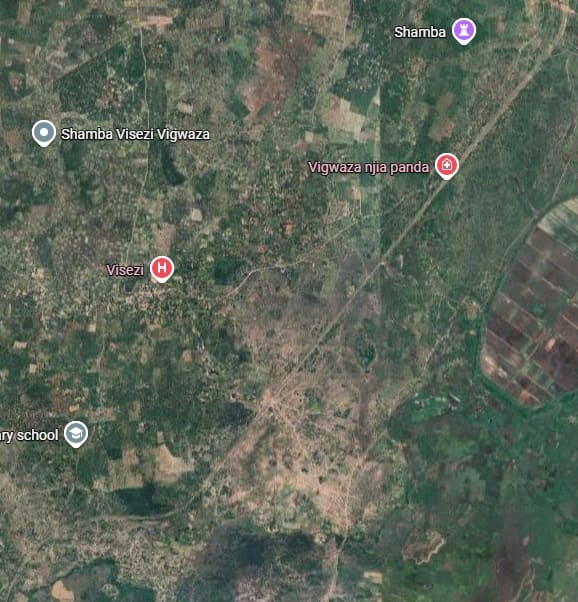
There is little to say about each length of the line as we head South. [27][Google Maps, April 2026]

The relatively flat land over the next sections of the route of the line means that its path can be straight. [28][Google Maps, April 2026]

Another straight length of the line. [29][Google Maps, April 2026.

As the topography changes the line seeks the easiest gradients. [30] [Google Maps, April 2026]

Two satellite images allow us to see the line following the course indicated by OpenStreetMaps. [Google Maps, April 2026]

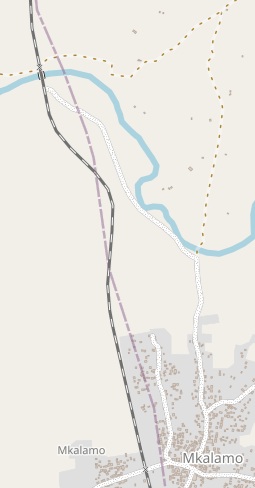
The line bridges the Mafret River. [31]

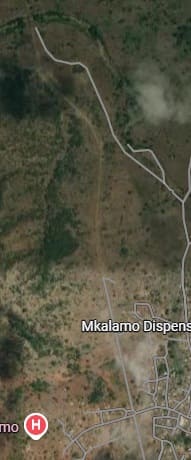
After bridging the river the line runs into Mkalamo. [31][Google Maps, April 2026]

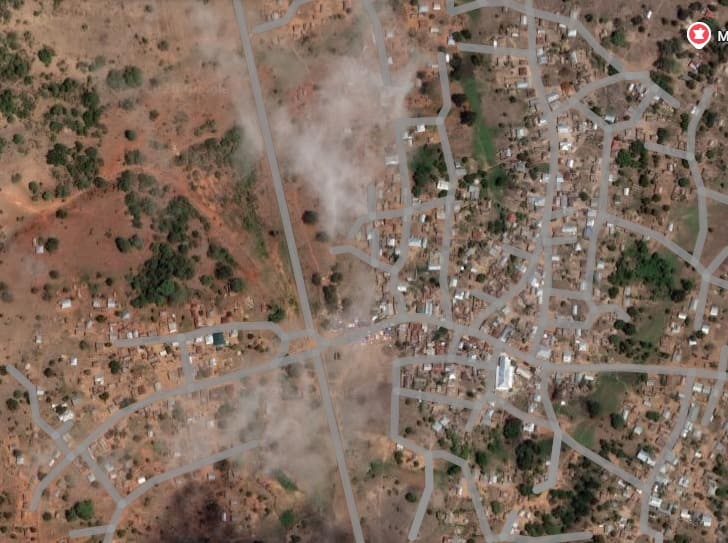
The town of Mkalamo. The location of a passenger halt is not clear, if indeed one existed. The most likely locations are immediately North or South of the road which crosses the line. [Google Maps, April 2026]

The most likely locations for a halt at Mkalamo are immediately North or South of the road which crosses the line. [31]

A close inspection of the satellite imagery shows a passing loop to the straddling the road-crossing. [Google Maps, April 2026]

The pointwork at the North end of the passing loop.
The pointwork at the South end of the passing loop. Note two similar structres sloe to the points North and South of the station/passing loop. [Google Maps, April 2026]

The location of the road-crossing at Mkalamo is slightly obscured by cloud. In addition the satellite images in this area of Tanzania are not of a particularly high resolution. [Google Maps, April 2026]

South of Mkalamo, the line crosses the Makalamo Road. [32][Google Maps, April 2026]

The Makalamo Road crossing. [Google Maps, April 2026]

South of Mkalamo, the railway line continues running South. [33][Google Maps, April 2026]

Two obvious watercourses can be seen on the satellite images above. The first appears to be culverted under the line as no bridge is visible. The second is spanned by a small girder-bridge.

The small girder bridge carrying the line over the second watercourse. [Google Maps, April 2026]

Here the line turns away from the boundary of the Saadani National Park. [34][Google Maps, April 2026]

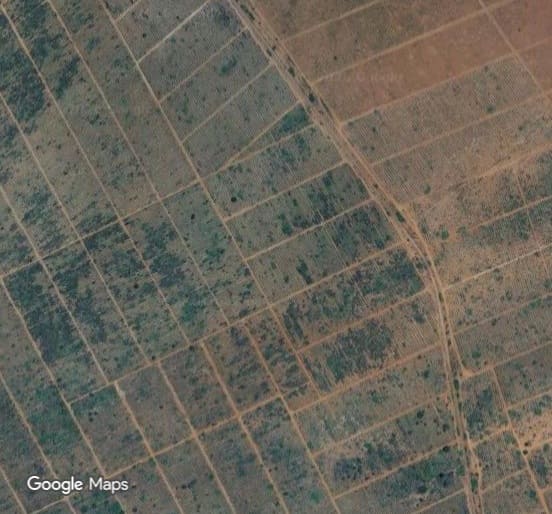
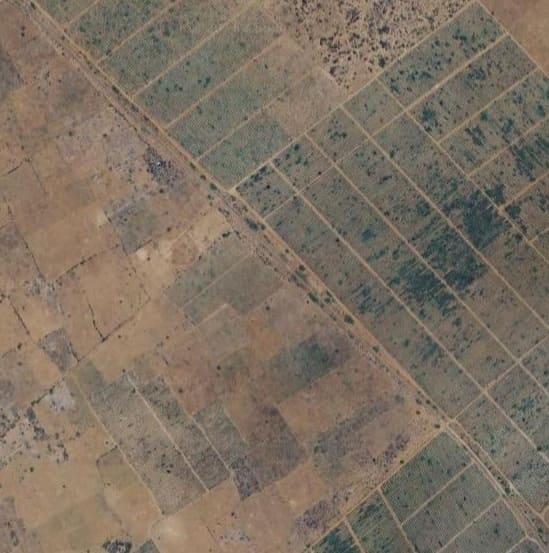
It appears as though the quality of the satellite imagery reduces as the line turns into the national park.
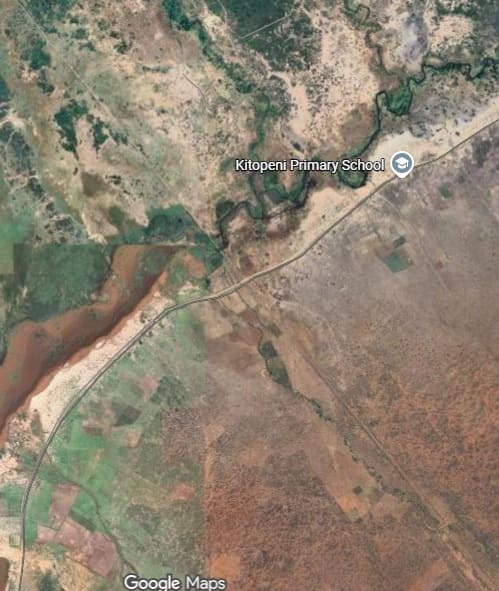
The line turns for a short while to the East and crosses the a river which outfalls into the Indian Ocean at Buyuni Kitopeni. [35]

Cloud cover on the satellite imagery from Google means that it is difficult to follow the line on the satellite imagery.

Approximately at the centre of the OpenStreetMap extract above, this length of the line is visible. The riverbridge is approximately at the bottom right of this image, perhaps just beyond the bottom right. [Google Maps, April 2026]

A much closer focus on the bridge location. The low resolution of the satellite imagery means that we can only just perceive the straight lines of the bridge parapets. [Google Maps, April 2026]

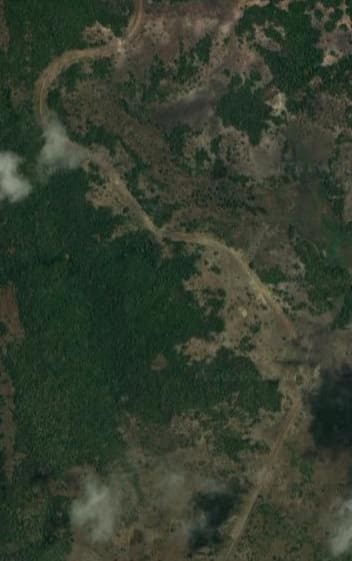
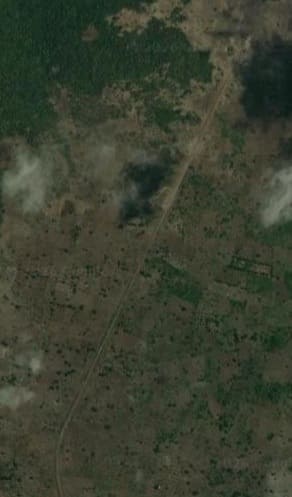
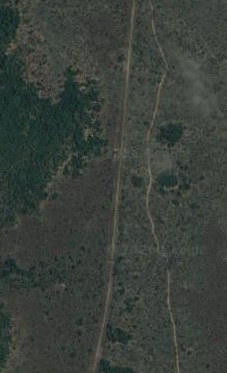
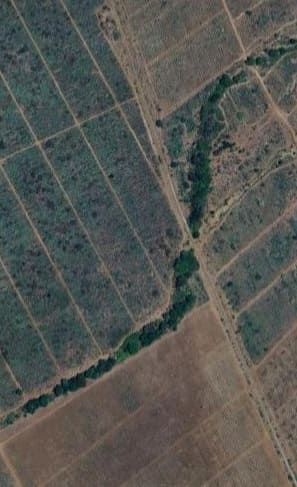
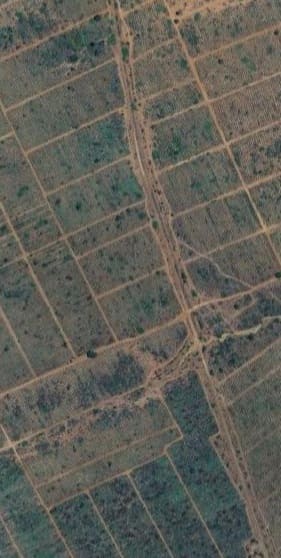
On this next extract from the satellite imagery the line can just be made out at the top-left corner. Hidden by cloud cover, it curves round to the East before turning South once again. It can be seen curving to the Southeast and leaving the extract at the bottom-right corner in shadow. [Google Maps, April 2026]

Covered by cloud, the line heads Southeast before curving East and then South. The changes of direction appear bottom-right of the OpenStreetMap extract above and at the top of that below.

The line tuns South and continues in a southerly direction. [36]

This image shows the line appearing from the cloud cover and turning first West and then close to South. The bridge show toward the top of the OpenStreetMap extract is inconveniently covered by cloud.
The bridge towards the bottom of the OpenStreetMap extract can be seen below.
An enlarged setion of the Google Maps image above shows a small structure carrying the line over an unidentified watercourse. [Google Maps, April 2026]

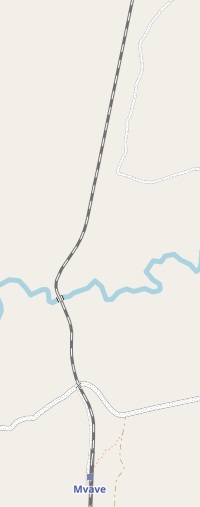
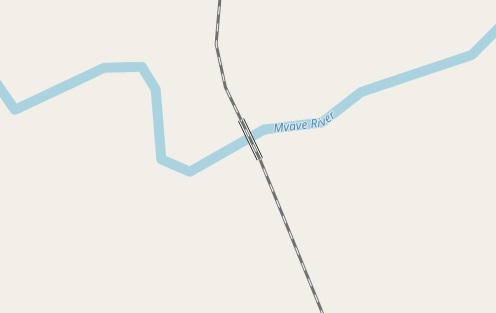
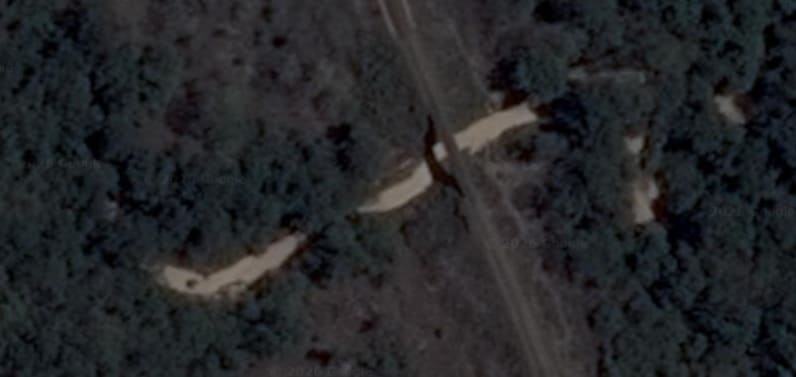
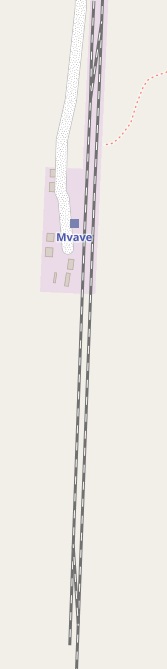
The Mvave River is crossed before Mvave Railway Station is reached. [37][Google Maps, April 2026]

The Mvave River Bridge. [37]
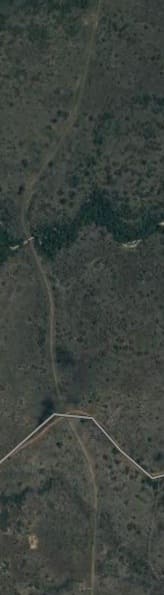
The Mvave River Bridge. [Google Maps, April 2026]
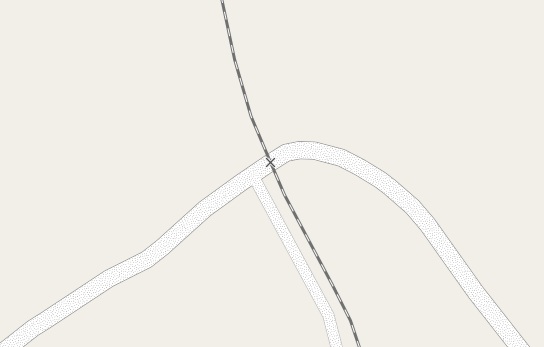
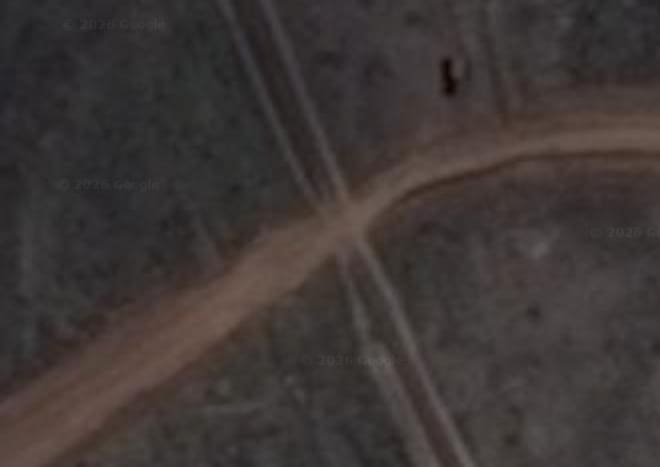
Road Crossing North of Mvave station. [37]
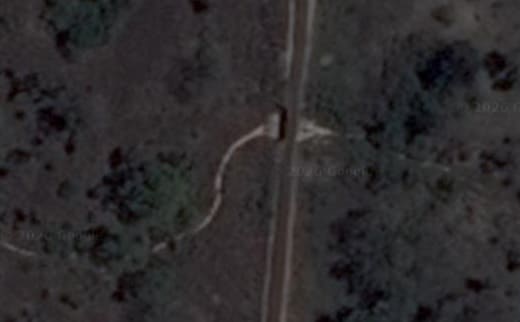
The murram road crossing to the North of Mvave Railway Station. [Google Maps, April 2026]

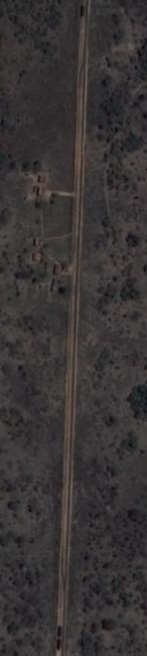
Mvave Railway Sation. [37][Google Maps, April 2026]

Mvave Railway Station is relatively remote and the topography to the South of the station is flat.

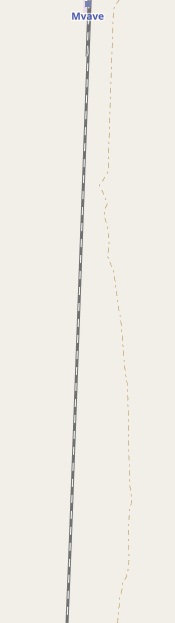
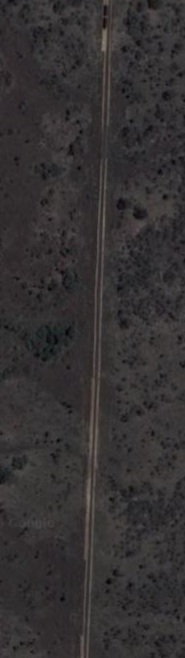
The line runs almost due South from Mvave. [38][Google Maps, April 2026]

The same trajectory is followed on these next extracts.

Almost due South again. [39][Google Maps, April 2026]

The trajectory remains the same down the upper part of these next extracts. [40][Google Maps, April 2026]

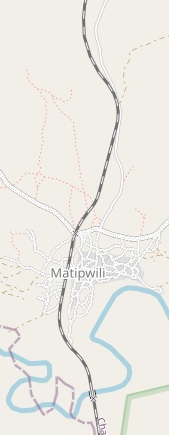
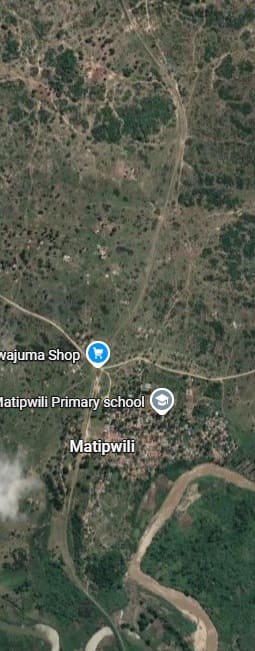
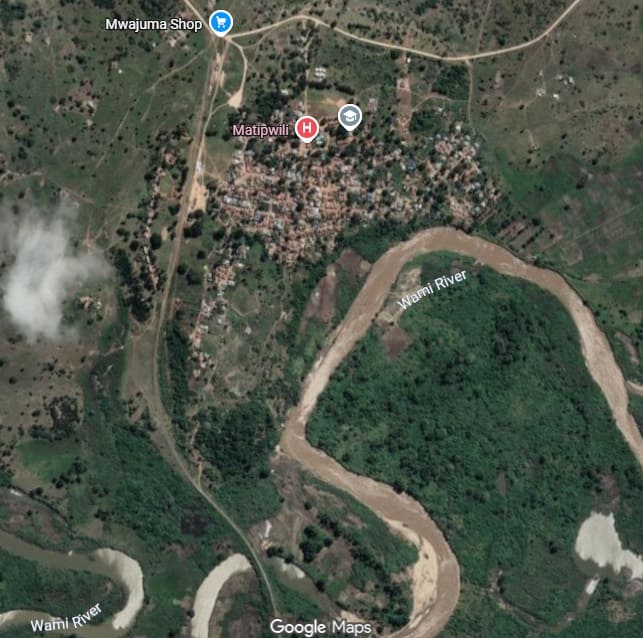
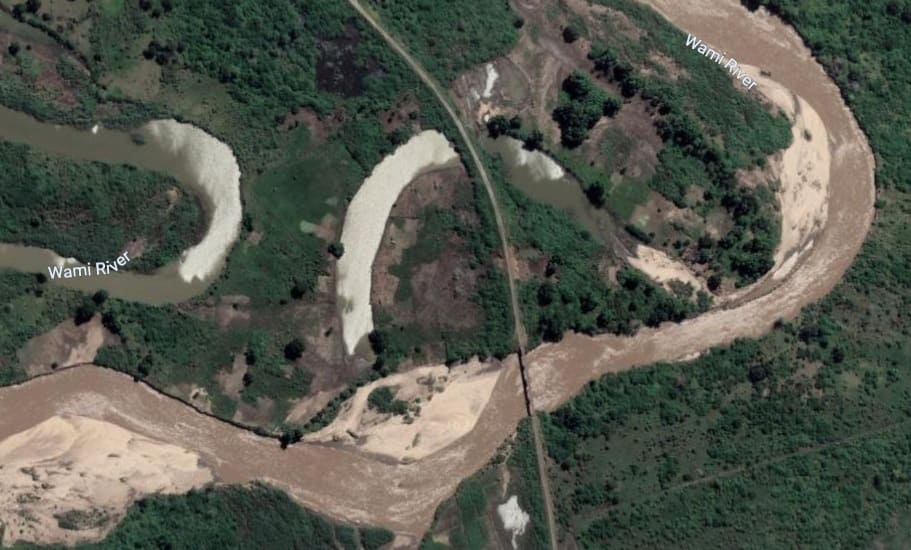
The line continues South through Matipwili and across the Wami River. [41][Google Maps, April 2026]

Matipwili and the Wami River. [Google Maps, April 2026]

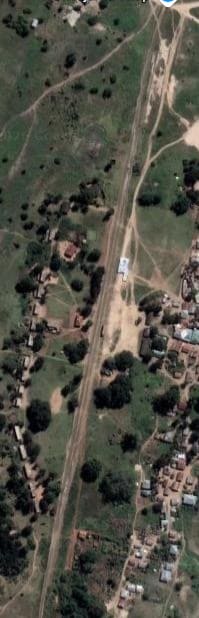
Matipwili Village Railway Station. [Google Maps, April 2026]

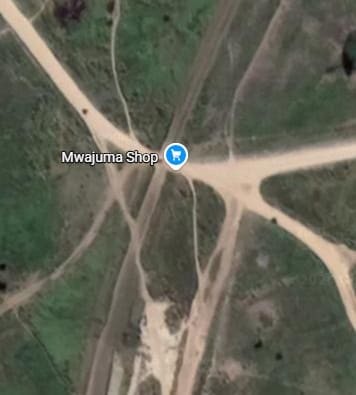
Road-crossing at the North end of the Station site. 9Looks like a misplaced flag for a supermarket!). [Google Maps, April 2026]
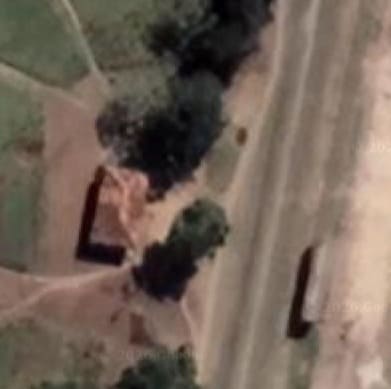
The Station building at Matipwili Village. [Google Maps April 2026]

The line South from Matipwili station curves to the Southeast and back towards the South before crossing the Wami River.

The Wami River crossing. [Google Maps, April 2026]

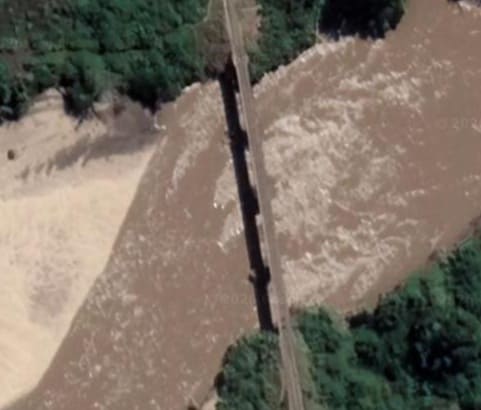
A enlarged view of the bridge over the Wami River. [Google Maps, April 2026]

Wami River Bridge. [41]

South of the Wami River the lines curves to the Southeast. [42][Google Maps, April 2026]

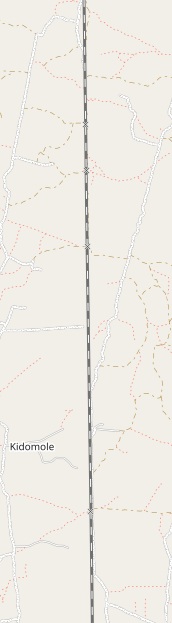
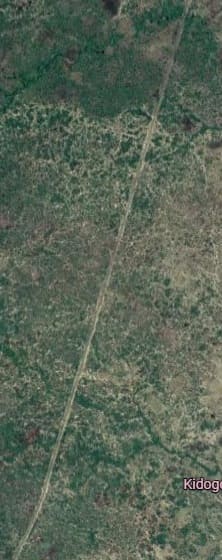
The line then reverts to its southerly course and maintains this bearing across open scrubland through to Kidomole Railway Station and beyond. [43][Google Maps, April 2026]

The railway continues on the same bearing. [44][Google Maps, April 2026]

And continues on the same bearing over this next length. [45][Google Maps, April 2026]

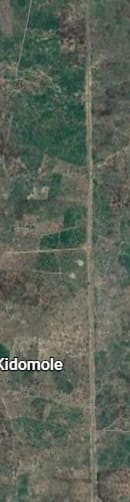
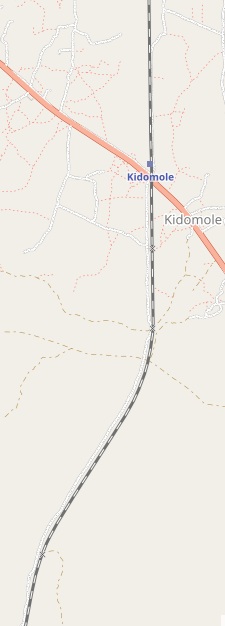
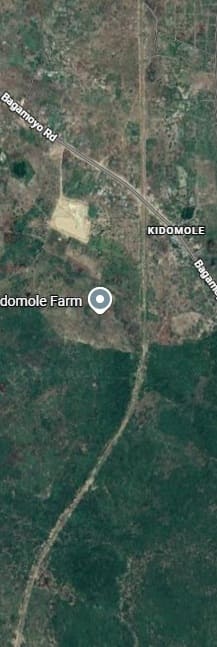
The railway crosses the T35 at Kidomole. [46][Google Maps, April 2026]

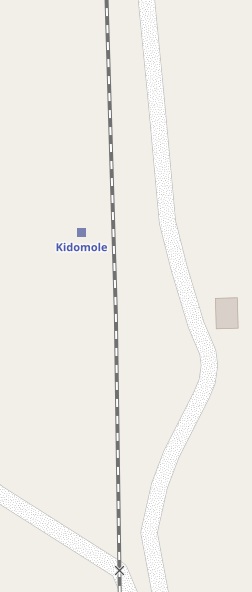
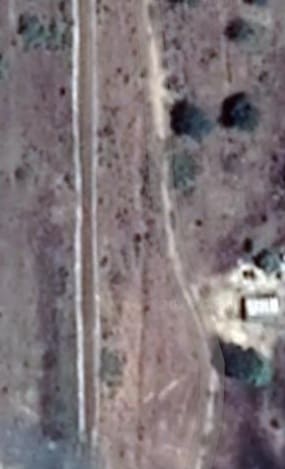
A closer view of the ‘station’ at Kidomole. Neither of these images shows any station facilities at Kidomole. It would appear that it was little if anything more than a location to hold the train. or perhaps a request stop? [46][Google Maps, April 2026]

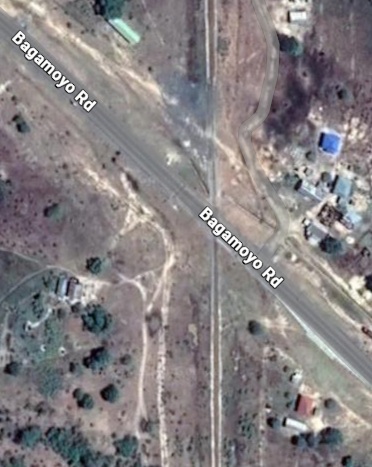
The T35 (Bagamoyo Road) level-crossing at Kidomole. The road is paved. [46][Google Maps, April 2026]

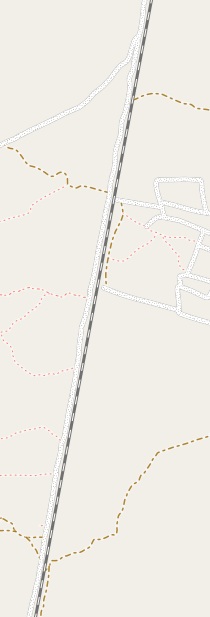
The railway to the South of Kidomole adjusts its alignment a little to the West and runs at a bearing just to the West of South as the OpenStreetMap extract covering the broader length of the line (above) and that below show. [46][47]

The line is now on a bearing just to the West of South. [47][Google Maps, April 2026]

The line continues South on the same bearing. [48][Google Maps, April 2026]

A slight change in direction means that the line travels towards the South-southwest. [49][Google Maps, April 2026]

A slight change in direction at the bottom of the last extract means the line reverts to a course closer to South. [50][Google Maps, April 2026]

The watercourse is not named on OpenStreetMap but it appears to be a tributary of the Ruvu River. [50][Goog;e Maps, April 2026]

After crossing the river, the line turns a little further to the Southwest and a little more towards the bottom of these extracts. [51][ Google Maps, April 2026]

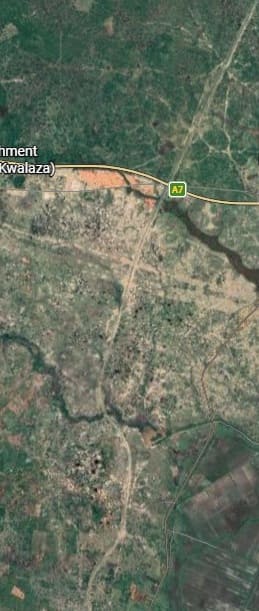
Next we see the line crossing the T1/A7 road before continuing to head South, this time on a meandering course. [52][Google Maps, April 2026]

The T1/A7 is crossed by means of one of the few bridges over roads on the line. [52][Google Maps, April 2026]

Open StreetMap does not show the watercourse just South of the road – in the Google Maps satellite image it appears to be in flood. [Google Maps, April 2026]

A watercourse is shown on OpenStreetMap and Google’s satellite imagery, some significant distance South of the road. South, too, of the electricity supply cables which cross the line of the railway.

The watercourse is not named. [52][Google Maps, April 2026]

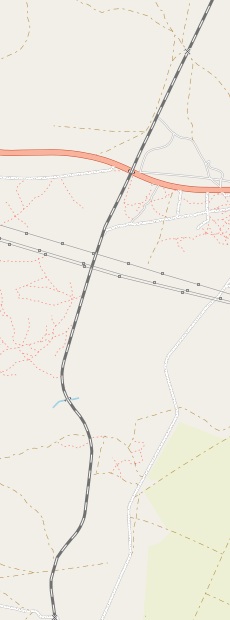
On the next OpenStreetMap extract, the line runs Southwest. {53]
The same area on Google’s satellite imagery. [Google Maps, April 2026]
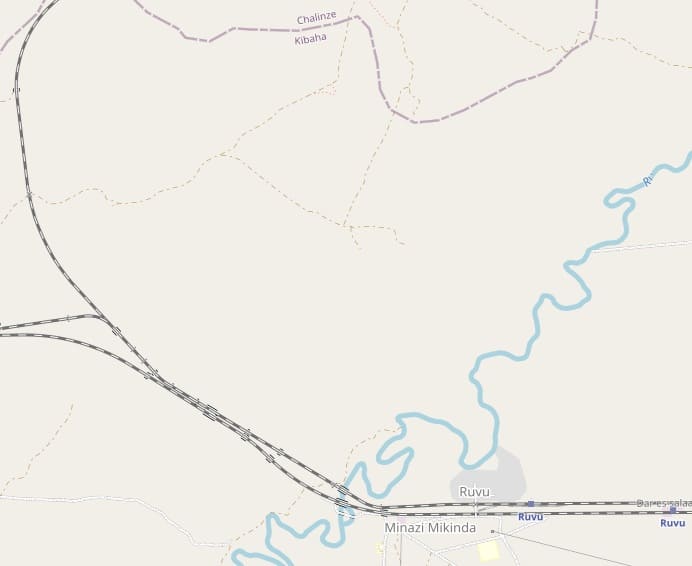
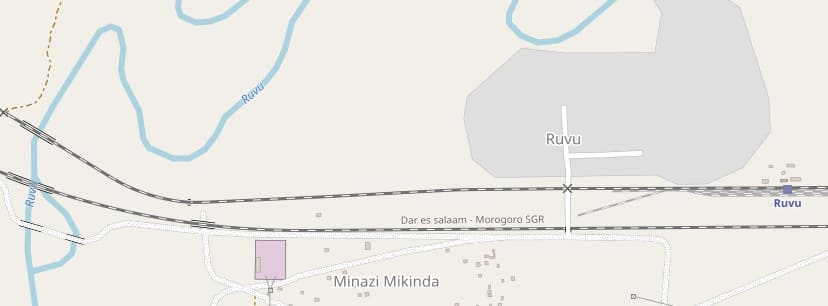
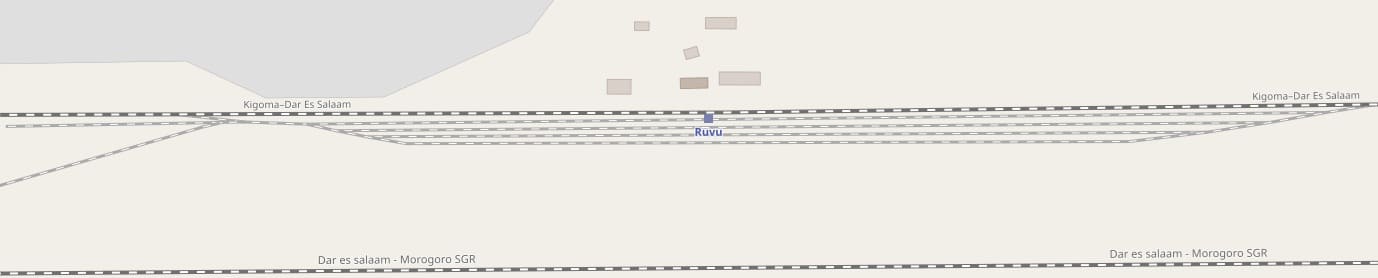
The approach to Ruvu manages to seem relatively complex! The line Mnyusi enter to p left and forma a junction with the metre-gauge line from Dodoma, which runs across the extract from left to right, passing through Ruvu Railway Station and heading on towards Dar-es-Salaam. The pcure is complicated by the presence of the new Standard-Gauge Railway (SGR) which has a separate station for Ruvu a little to the East of the metre-gauge station. [54]
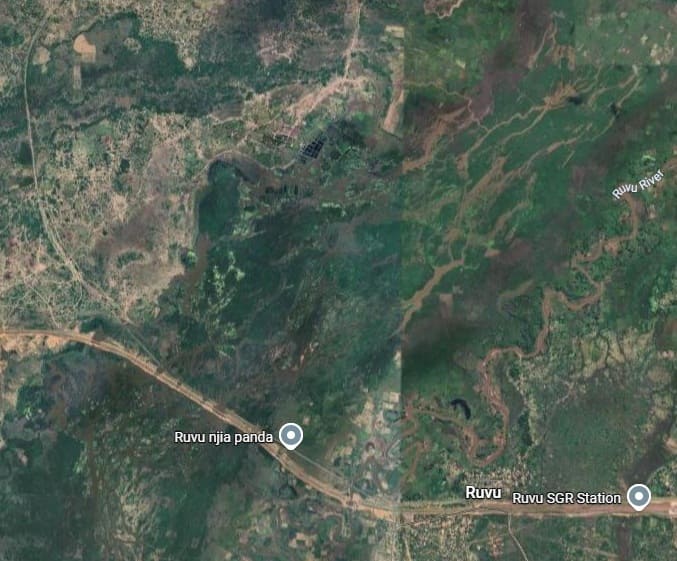
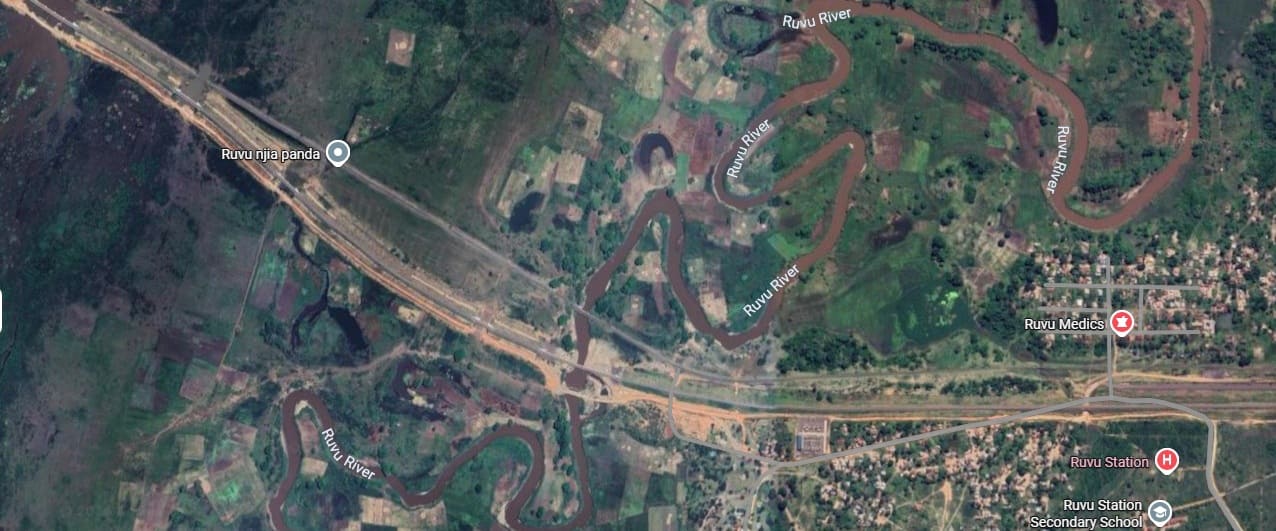
The same area as it appears on Google’s satellite imagery. [Google Maps, April 2026]

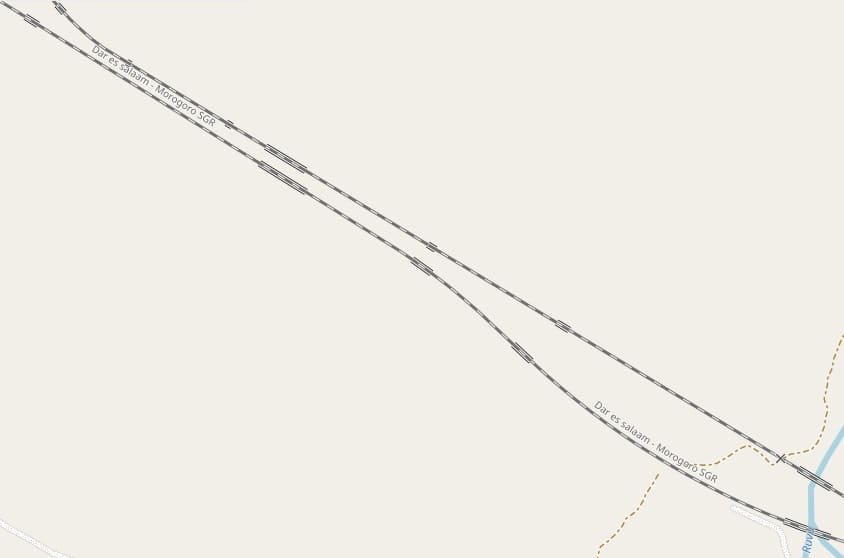
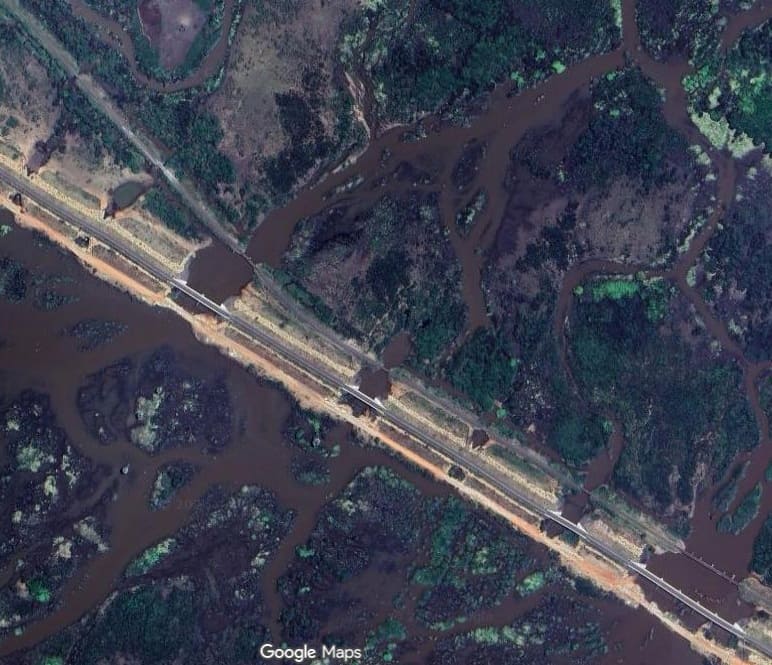
The junction between the Dodoma to Dar-es-Salaam railway and the Mnyusi to Ruvu link line. The Ruvu River was in flood at the time of the Google satellite image was taken. The bridge to the Southeast of the junction would often span a dry watercourse with the bridge over main river much closer to Ruvu. [54][Google Maps, April 2026]

A series of usually dry watercourses are bridged by both the metre-gauge line and the SGR before both cross the main channel of the River Ruvu. [54]

Just short by at bridge from the length of the two railways as are shown on the OpenStreetMap extract above. [Google Maps, April 2026]

The last length of the metre-gauge line to Ruvu Station. [54]
The last length of the metre-gauge line to Ruvu Station. [Google Maps, April 2026]
Ruvu Metre-Gauge Railway Station with the SGR to the South. Ruvu Town is to the Northwest of its station. [54]
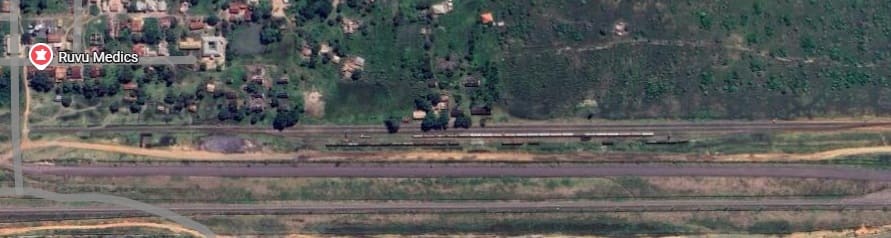
The Metre-Gauge Railway Station runs East-West across this image and the SGR towards the bottom of the image. [Google Maps, April 2026]

We finish our journey here in Ruvu. The remainder of the journey from Ruvu to Dar-es-Salaam will be covered in reverse in the articles about the Central Line which will follow in due course. Please don’t forget to have a look at the Appendix (which follows the refernces for this article. The Appendix covers the construction of the Mnyusi to Ruvu Line.

References

  1. https://rogerfarnworth.com/2026/04/01/railways-of-tanzania-part-2-the-route-of-the-usambara-railway-tanga-to-moshi
  2. M.F. Hill; Permanent Way Volume II: The Story of the Tanganyika Railways; East African Railways and Habours, Nairobi, Kenya; Watson & Viney, Aylesbury & Slough, 1957.
  3. https://www.facebook.com/share/p/1ALffLxhDg, accessed on 18th March 2026.
  4. https://www.google.com/search?client=ms-android-motorola-rvo3&hs=AZD&sca_esv=b05c8d9632b51df6&sxsrf=ANbL-n5vLNTMT9J1cn4sS7VDi8IhkG_BNg%3A1773944351007&q=tanga%20railway%20station%20photos&si=AL3DRZGgcPNmWPDVEk81ds4iaXPEjuNcyuY9Q822zd2Q3wgtDLa9VVF_9x9TK7LuOrzAGGVlybqvwgpMRLdjvIPVO6109T3ngqw96Xr3Qzr3BAwZo0lgWOz-pkCpT8YplwOa9Nc8V9yUN8GP7Lus4LLAZVKs0HHFqg%3D%3D&ved=0CBEQy9gMahcKEwj4td_XyayTAxUAAAAAHQAAAAAQCg&ictx=1#ebo=1&lpg=cid:CgIgAQ%3D%3D,ik:CAoSF0NJSE0wb2dLRUlDQWdJREM2Y3IxMmdF, accessed on 19th March 2026.
  5. https://www.google.com/search?client=ms-android-motorola-rvo3&hs=AZD&sca_esv=b05c8d9632b51df6&sxsrf=ANbL-n5vLNTMT9J1cn4sS7VDi8IhkG_BNg%3A1773944351007&q=tanga%20railway%20station%20photos&si=AL3DRZGgcPNmWPDVEk81ds4iaXPEjuNcyuY9Q822zd2Q3wgtDLa9VVF_9x9TK7LuOrzAGGVlybqvwgpMRLdjvIPVO6109T3ngqw96Xr3Qzr3BAwZo0lgWOz-pkCpT8YplwOa9Nc8V9yUN8GP7Lus4LLAZVKs0HHFqg%3D%3D&ved=0CBEQy9gMahcKEwj4td_XyayTAxUAAAAAHQAAAAAQCg&ictx=1#ebo=1&lpg=cid:CgIgAQ%3D%3D,ik:CAoSF0NJSE0wb2dLRUlDQWdJQ2szYi1Pd2dF, accessed on 19th March 2026.
  6. https://en.wikipedia.org/wiki/Usambara_Railway, accessed on 13th March 2026.
  7. https://maps.app.goo.gl/C952JgVPwCuYSAv98, accessed on 20th March 2026.
  8. https://www.gettyimages.co.uk/photos/usambara-railway, accessed on 21st March 2026.
  9. https://imagerenderer.com/images/rendered/share/68974575&domainId=12, accessed on 21st March 2026.
  10. https://en.wikipedia.org/wiki/History_of_rail_transport_in_Tanzania, accessed on 16th April 2026.
  11. A. M. O’Connor; East African Railway Developments: 1962-1963; in East African Geography Review No. 2, April 1964, p46-47; via https://journals.co.za/doi/pdf/10.10520/AJA19376812_9, accessed on 18th April 2026.
  12. K. Rahmani; Construction of the Mnyusi-Ruvu line; in the Permanent Way Institution Journal, No. 82, 1964, p55-62..
  13. https://www.openstreetmap.org/node/8806556432#map=16/-5.24451/38.61205, accessed on 18th April 2026.
  14. https://www.openstreetmap.org/node/8806556432#map=14/-5.25780/38.62448, accessed on 18th April 2026.
  15. https://mapcarta.com/N8807059101/Map, accessed on 25th March 2026.
  16. https://www.openstreetmap.org/search?query=mnyusi&zoom=18&minlon=38.324834704399116&minlat=-5.018608470777954&maxlon=38.32927644252778&maxlat=-5.015108237892018#map=15/-5.29182/38.62553, accessed on 21st April 2026.
  17. https://www.openstreetmap.org/search?query=mnyusi&zoom=18&minlon=38.324834704399116&minlat=-5.018608470777954&maxlon=38.32927644252778&maxlat=-5.015108237892018#map=15/-5.31447/38.62711, accessed on 21st April 2026.
  18. https://www.openstreetmap.org/search?query=mnyusi&zoom=18&minlon=38.324834704399116&minlat=-5.018608470777954&maxlon=38.32927644252778&maxlat=-5.015108237892018#map=15/-5.33822/38.63033, accessed on 21st April 2026.
  19. https://www.openstreetmap.org/search?query=mnyusi&zoom=18&minlon=38.324834704399116&minlat=-5.018608470777954&maxlon=38.32927644252778&maxlat=-5.015108237892018#map=15/-5.35801/38.63480, accessed on 21st April 2026.
  20. https://www.openstreetmap.org/search?query=mnyusi&zoom=18&minlon=38.324834704399116&minlat=-5.018608470777954&maxlon=38.32927644252778&maxlat=-5.015108237892018#map=15/-5.38334/38.63630, accessed on 21st April 2026.
  21. https://www.openstreetmap.org/search?query=mnyusi&zoom=18&minlon=38.324834704399116&minlat=-5.018608470777954&maxlon=38.32927644252778&maxlat=-5.015108237892018#map=15/-5.40753/38.64063, accessed on 21st April 2026.
  22. https://www.openstreetmap.org/search?query=mnyusi&zoom=18&minlon=38.324834704399116&minlat=-5.018608470777954&maxlon=38.32927644252778&maxlat=-5.015108237892018#map=15/-5.43085/38.65029, accessed on 21st April 2026.
  23. https://unitedrepublicoftanzania.com/economy-of-tanzania/infrastructure-in-tanzania/railway-in-tanzania/ruvu-link-line-unveiling-tanzanias-crucial-railway-intersection, accessed on 24th April 2026.
  24. https://www.openstreetmap.org/#map=14/-5.51813/38.65128, accessed on 28th April 2026.
  25. https://www.openstreetmap.org/#map=14/-5.51813/38.65128, accessed on 28th April 2026.
  26. https://www.openstreetmap.org/#map=14/-5.56759/38.65170, accessed on 28th April 2026.
  27. https://www.openstreetmap.org/#map=14/-5.61697/38.64767, accessed on 28th April 2026.
  28. https://www.openstreetmap.org/#map=14/-5.66753/38.64595, accessed on 28th April 2026.
  29. https://www.openstreetmap.org/#map=14/-5.71750/38.65025, accessed on 28th April 2026.
  30. https://www.openstreetmap.org/#map=14/-5.76959/38.65514, accessed on 28th April 2026.
  31. https://www.openstreetmap.org/#map=14/-5.81459/38.65617, accessed on 28th April 2026.
  32. https://www.openstreetmap.org/#map=14/-5.83201/38.65780, accessed on 28th April 2026.
  33. https://www.openstreetmap.org/#map=14/-5.88145/38.65909, accessed on 28th April 2026.
  34. https://www.openstreetmap.org/#map=14/-5.91500/38.66415, accessed on 28th April 2026.
  35. https://www.openstreetmap.org/#map=14/-5.95000/38.69797, accessed on 28th April 2026.
  36. https://www.openstreetmap.org/#map=14/-5.99661/38.71925, accessed on 28th April 2026.
  37. https://www.openstreetmap.org/#map=14/-6.04894/38.71196, accessed on 28th April 2026.
  38. https://www.openstreetmap.org/#map=14/-6.08717/38.71436, accessed on 28th April 2026.
  39. https://www.openstreetmap.org/#map=14/-6.13957/38.71282, accessed on 28th April 2026.
  40. https://www.openstreetmap.org/#map=14/-6.18668/38.70947, accessed on 28th April 2026.
  41. https://www.openstreetmap.org/#map=14/-6.22994/38.70741, accessed on 28th April 2026.
  42. https://www.openstreetmap.org/#map=15/-6.25628/38.71294, accessed on 28th April 2026.
  43. https://www.openstreetmap.org/#map=14/-6.30672/38.72912, accessed on 29th April 2026.
  44. https://www.openstreetmap.org/#map=14/-6.36294/38.72895, accessed on 29th April 2026.
  45. https://www.openstreetmap.org/#map=14/-6.39936/38.73556, accessed on 29th April 2026.
  46. https://www.openstreetmap.org/#map=14/-6.45668/38.72569, accessed on 29th April 2026.
  47. https://www.openstreetmap.org/#map=15/-6.49649/38.72492, accessed on 29th April 2026.
  48. https://www.openstreetmap.org/#map=15/-6.51934/38.71994, accessed on 29th April 2026.
  49. https://www.openstreetmap.org/#map=15/-6.54040/38.71561, accessed on 29th April 2026.
  50. https://www.openstreetmap.org/#map=15/-6.59357/38.70059, accessed on 29th April 2026.
  51. https://www.openstreetmap.org/#map=14/-6.63890/38.69282, accessed on 29th April 2026.
  52. https://www.openstreetmap.org/#map=14/-6.69253/38.66784, accessed on 29th April 2026.
  53. https://www.openstreetmap.org/#map=14/-6.74589/38.64244, accessed on 29th April 2026.
  54. https://www.openstreetmap.org/#map=14/-6.79294/38.64226, accessed on 29th April 2026.
  55. https://en.wikipedia.org/wiki/EAR_30_class, accessed on 29th April 2026.

Appendices

Appendix 1: K. Rahmani; Construction of the Mnyusi-Ruvu line; in the Permanent Way Institution Journal, No. 82, 1964, p55-62.

CONSTRUCTION OF THE MNYUSI-RUVU LINE EAST AFRICAN RAILWAYS AND HARBOURS

CONTRIBUTED BY K. RAHMANI, B.A., B.Sc. (EDIK.), A.M.I.C.E., A.M.A.S.C.E. (Associate Fellow)

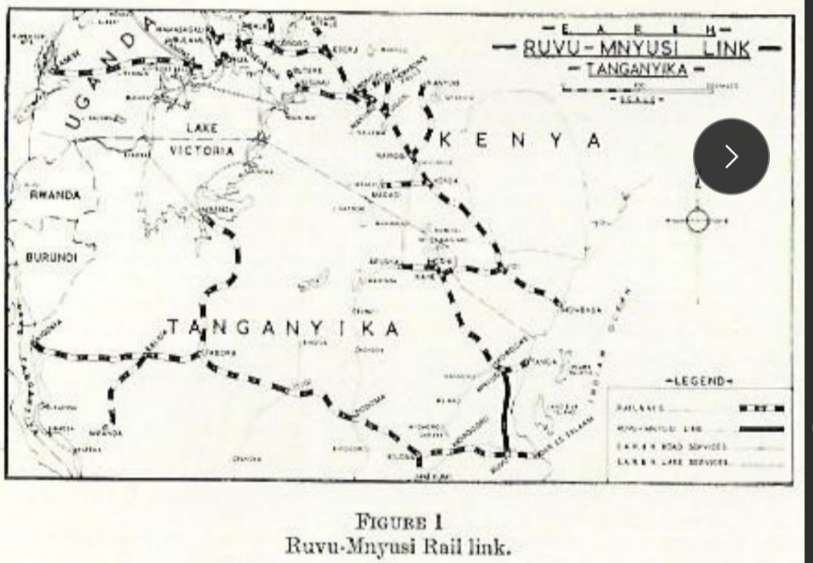
The 117 mile long Mnyusi-Ruvu line which provides a direct railway link between Tanganyika, Kenya and Uganda was opened by Mr. Julius Nyerere, President of Tanganyika on 17th August 1963. (Figure 1). [12: p55]

HISTORY

The necessity of a railway to connect the Central and Tanga lines was felt by the Germans before the 1914-18 War for reasons of railway operating as well as from a general administrative and strategic point of view. [12: p55]

[12: p56]
[12: p56]

A reconnaissance was made in the neighbourhood of Morogoro for the purpose of finding as short a connection as possible between the Central and Tanga Railways taking into consideration economic development as well, and to determine the choice of a suitable point of junction the sections from Morogoro to Kilosa on the Central Railway and from Korogwe to Mombo on the Tanga Railway were surveyed. Various alignments were considered and are briefly described below: [12: p57]

  1. Ngeregere-Maurai-134 miles; branching from the Central Railway about 12 miles east of Morogoro and continuing towards Maurui. A junction at Ngeregere was considered in view of Ngeregere becoming a possible junction for a future Nyasa Railway.
  2. Morogoro-Maurui-148 miles; Had its object getting nearer to Ngugu mountains.
  3. Mkata-Maurui-160 miles. It was considered together with Kimamba to Maurui, 180 miles, to open up best areas and serve Ngugu and Tuliani.

The 1914-18 war put a stop to the construction of the link but the Germans made a temporary connection by a tram line from Kimamba to Mombe using the tracks of sisal estates.

4. Morogoro-Korogwe; Kilosa-Korogwe – After the war in 1921, the Tanganyika Railways made a reconnaissance for those two routes but the first was considered very close to the coast and consideration was given to opening up country more attractive than that lying between Morogoro and Korogwe, i.e. along the route Dodoma-Kondoa-Arusha, a rough reconnaissance of which was made in 1922. The project rested there till 1932 when further reconnaissance was made, but construction could not be started because of the economic depression of the thirties and the Second World War.

In 1948, however, a further survey of the route Morogoro-Korogwe was undertaken but funds could not be made available for the construction due to urgent expenditure elsewhere as a result of the amalgamation of the Tanganyika, Kenya and Uganda Railway Systems.

Its findings were that the link would be 195 miles long and cost about £5 million. In 1951, an engineering survey was made between Morogoro-Korogwe. This was ruled out on economic grounds not only because of the high initial investment but because of poor revenue returns. The project was shelved,

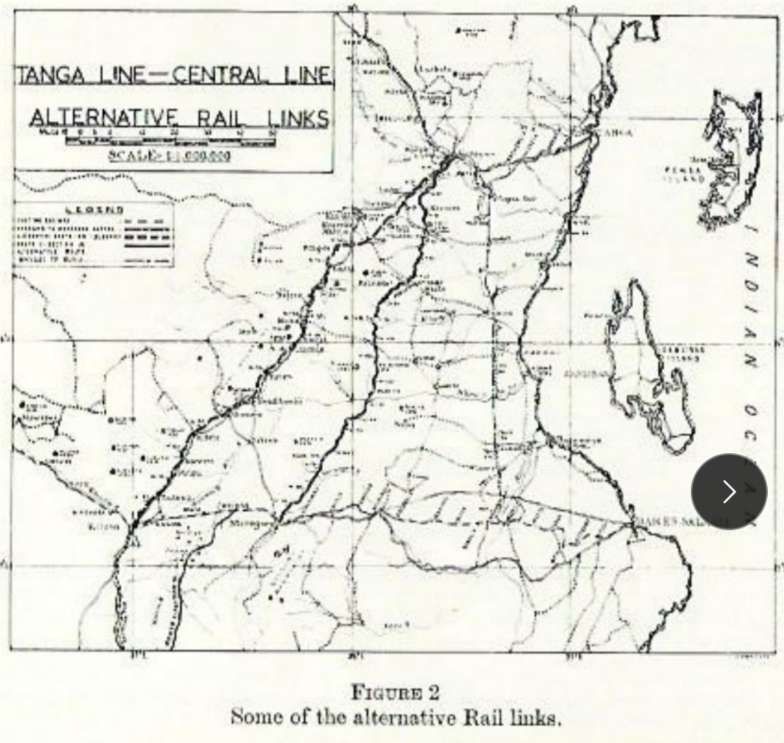
5. Mayusi-Ruvu – The project was reconsidered again in 1958 in the light of the fact that the peak crop seasons of the 3 countries occurred at different times and it was not possible to move the rolling stock throughout the system to meet the demand for it. It was realized that if a facility existed for such movement of the rolling stock, this would not only obviate the provision of more rolling stock but the savings because of the economic use of the rolling stock could be offset against the total cost of the construction. On the basis of this, a decision was taken in 1958 to construct the link. It was considered that if the line was constructed closer to the coast it would decrease the length and the cost. Thus a survey undertaken in 1958 confirmed that the link between Mnyusi and Ruvu would be only 117 miles long and would cost just over £2 million. This scheme was approved. (Figure 2).

CONSTRUCTION

Construction was started in 1960. Headquarters of the whole construction were established at Pangani Falls, about 50 miles from Tanga, in August 1960. The total length of 117 miles was divided into five sections for the purpose of the earthworks to be constructed under contract. Sections I to V were 27.5, 48, 4, 26 and 11 miles long respectively. It was also decided to start the construction from both the north and south ends. The north party was to cover initially sections I and II, ie. up to mile 75.5, and the south party was to cover sections III, IV and V. i.e. from mile 75.5 to mile 117.

Headquarters for the northern section were at Pangani Falls but then moved to Mkalamo when the work proceeded. Headquarters for the southern section were at Kwaraza, about 10 miles along the track from Ruvu, and then moved to Wami during November 1962.

Contract for the earthworks including culverts for section I was awarded to Messrs. Stirling Astaldi Ltd. and the work was started on 1st September 1960. The contractors for the section V at the south end were Messrs. East African Enterprise Ltd. and the work began in October 1960. [12: p57]

FIGURE 3
Soundings being taken in Pangani River using a dug-out canoe. During the early stages of the construction of the bridge here, a crocodile would sit on a rock in the river and supervise work. [12: p58]

Contractors for section II were Messrs. Douglas Smith Ltd., and for sections III and IV, Maula, Dad and Rose Ltd. [12: p58]

CLEARING

Clearing for the entire earthworks included 28.5 million square feet of light bush and 52.5 million square feet of thick bush and forest including 4,000 trees of 2 ft to 5 ft diameter and larger. [12: p58]

EARTHWORKS

The earthworks consisted of 850,000 cubic yards of hard and soft rock and 2.5 million cubic yards of earth, the highest bank being 95 ft and the deepest cutting 45 ft in rock. Excavation to catch water and side drains involved 100,000 cubic yards of earth and 15,000 cubic yards of soft rock. [12: p58]

BRIDGES AND CULVERTS

About 600 culverts, in both Armco and Precast concrete, totalling some 11 miles if laid end to end, were laid. The largest size was 12 ft 6 in diameter in Armco. Eleven major bridges were built over the Mnyusi. Pangani. (Figure 3), Mbuzi, Msangasi, Mligaji, Mvavi, Wami, Usigwa, Mkombezi, Mbiki and Msua rivers. One 30 ft span bridge was built over Mililengwa river and two 60 ft span bridges were built over Tanga-Korogwe and Dar es Salaam-Morogoro main roads. All the bridges, except Pangani bridge which is a 116 ft span of the Callender-Hamilton type, are plate girders with reinforced concrete deck slabs. Although only two of the rivers – Pangani and Wami – flow all the year round, the other rivers have a heavy flow during the two rainy seasons, short and long. Four of the rivers including the Wami which has a bridge of four 60 ft spans, were diverted from their original courses. (Figure 4). [12: p58]

FIGURE 4
Four 60ft-span plate girder bridge at Wami

In addition, two 11 ft diameter Armco trolley under-passes, three trolley over-passes and various pipe culverts were constructed. The latter were provided as a result of the 1961 floods when the openings provided in the original design proved quite inadequate. [12: p59]

COMPACTION

The earthworks contractors gave the finished formation. Most of the bank compaction was done during the construction of the earthworks by routing heavy machinery over the banks, but the compaction of the top layer was done by using a rotavator and vibratory, pneumatic-tyred and sheepsfoot rollers. A density of 95% was obtained. Soil stabilisation was also necessary at various sandy and clay locations. Black cotton soil, which was used for some banks, compacted very well under slightly wet conditions. [12: p59]

BALLASTING

A total of 4.5 million cubic yards of stone ballast was laid. The ballast was railed from two stone quarries at Ngeta near Ruvu and another near Pangani River. The contractors for breaking the stone at both these quarries were Messrs. Tanganyika Engineering Contracting Company Ltd. Some ballast was also obtained from Mweni Prison near Tanga. The ballast was dumped from trains at convenient places near the rail head. Then the formation was pre-ballasted using road transport. A grader was used to level the ballast on the formation. When, however, due to extreme weather conditions, the roads were impassable the track was post-ballasted soon after track-laying. [12: p59]

FIGURE 5
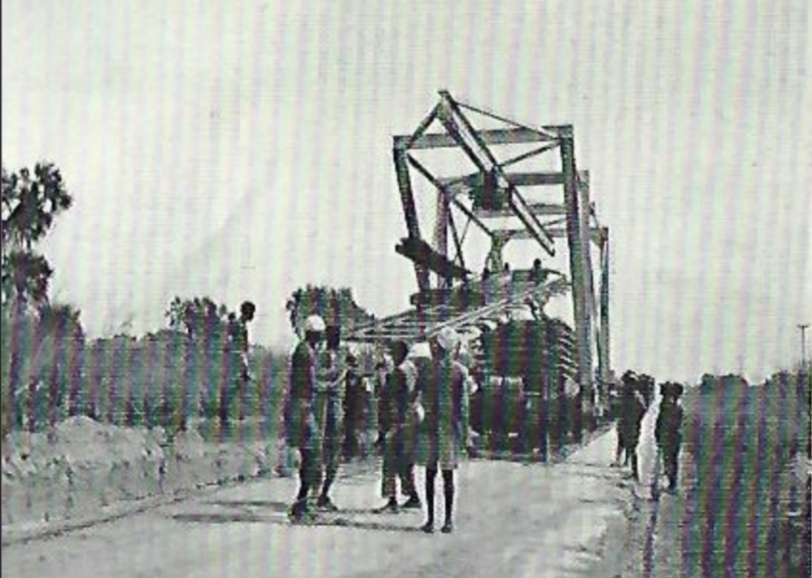
The track-laying gantry at work. [12: p60]

TRACK-LAYING

The new line is laid to metre gauge – the standard for the system. 55 lb and 50 1b second-hand rails with steel trough sleepers were used in the construction. In previous railway construction in the territories, all plate-laying was done by hand, but on this job mechanized track laying was done for the first time. A track-laying gantry was locally manufactured, using an open bogie truck. Track sections … were pre-fabricated in permanent-way depots, loaded on open bogie trucks and transported as a train (with the engine pushing) to the construction site where the track-laying gantry had been left on the last rail length laid the previous day. Sets of nine panels of track were loaded on top of each other in each bogie wagon. Before the start of the day’s work, these panels were jacked up and rollers were placed under the bottom panels which were resting on the track laid on the bogie wagons. At the same time short pieces of rails joined the gaps over the couplings of the wagons to give an uninterrupted track over the entire train length. The set of 9 panels in the wagon next to the track-laying gantry was pulled forward to the gantry by means of a winch. The top panel was then lifted up by means of another winch, slid forward on rollers, lowered and then bolted into position at the end of the track on which the track-laying gantry was standing. The locomotive then pushed the gantry to the next panel and the process was repeated. Up to a mile of track was laid in a matter of four hours by unskilled African labourers. The method proved so successful that it has been adopted on the other construction work being done by the East African Railways. (Figure 5).  [12: p59-60]

PACKING AND BOXING

The track-laying was followed by a packing gang who aligned, lifted and packed newly laid track. This was later followed by a gang with a Matisa Tamping chine for the final packing and boxing. [12: p60]

SUPERVISION

Apart from the various contractors’ own staff, all the supervision was departmental. This comprised a Resident Engineer, two Section Engineers with 2 Assistant Engineers, an Engineer-in-Charge for staking out assisted by an Assistant Engineer, Inspectors of Works, Permanent Way Inspectors, Surveyors, Plant Foremen, Office Staff, and further staff up to a total of 1,000 Artizans and men who were responsible for the construction of all bridges (except the two rail-over-road bridges built by contractors), for the construction of station buildings and staff quarters, ballasting, plate-laying, water supply and other miscellaneous works. There are six stations including the the two end stations and over 150 staff quarters were constructed.  [12: p60-61]

FIGURE 6
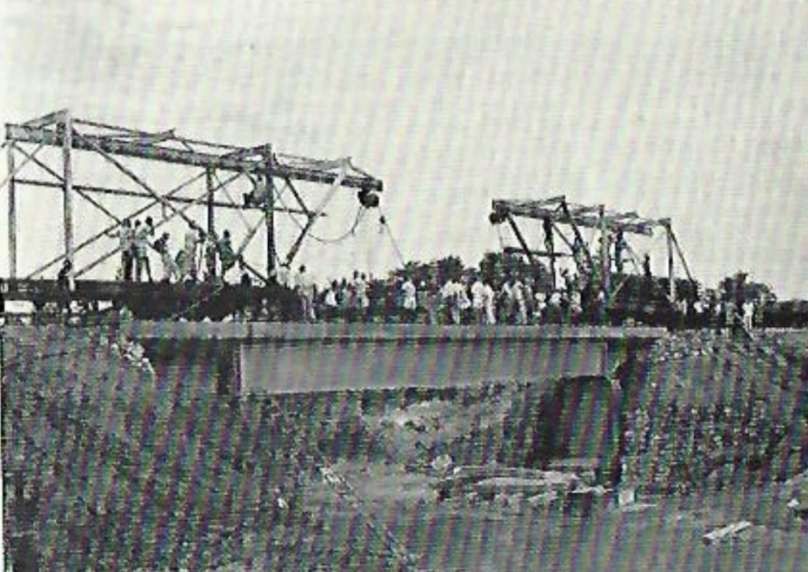
The link-up at Mvavi Bridge, Mile 62, on 4th March 1963. [12: p61]

The oil fuel installations at Wami consisting of two tanks of 42,000 gallons capacity, and ancillary works, were constructed by contract. [12: p61]

FLOODS

The unprecedented rains of 1961 put back the work by six months as some of the completed work was washed away. The remedial work caused a 30% increase in the cost of the construction. At one time the flood waters in the 4 mile long Wami flood plain (section III) completely cut off the staff employed on the construction of the bridge and Wami station and food had to be dropped by air; but later, due to the threat of the rising flood, the staff had to be rescued using an Army helicopter. The highest water level of Wami River rose to an all-time record in April 1963. This flooding caused further damage and delay. [12: p61]

COMPLETION

In spite of these set backs, track-laying of the 117 miles was completed and the link-up on 4th March, 1963, at the Mvavi bridge, Mile 62, was a scene of great rejoicing amongst the staff. (Figure 6). The formal opening of the line, however, had to be delayed as the Mvavi and Mligaji (mile 55) bridges were not completed and had been by-passed. Although the terrain through which the railway was constructed was infested with big game e.g. lion, elephant, leopard, buffalo, hippo, giraffe, pythons, no accidents were reported. The biggest nuisances were snakes, mosquitoes, tsetse and horse flies and adverse weather and road conditions. Nevertheless the morale of the staff was very high at all times.

COST

The low cost of construction of £2.9 million is due to three factors:

  1. The entire land was Crown Land and only £5,000 was paid as compensation for crops and houses.
  2. Second-hand Permanent Way material ex re-laying on other sections was used throughout.
  3. Low wages of daily paid staff.

Railways of Tanzania – Part 2 – The Route of the Usambara Railway – Tanga to Moshi

NB: Given the way in which some of the images in this article have been displayed, this article is best read/viewed on a laptop or desktop computer rather than a mobile phone. If you need to read it on a mobile, it may be sensible to read it in landscape rather than portrait view.

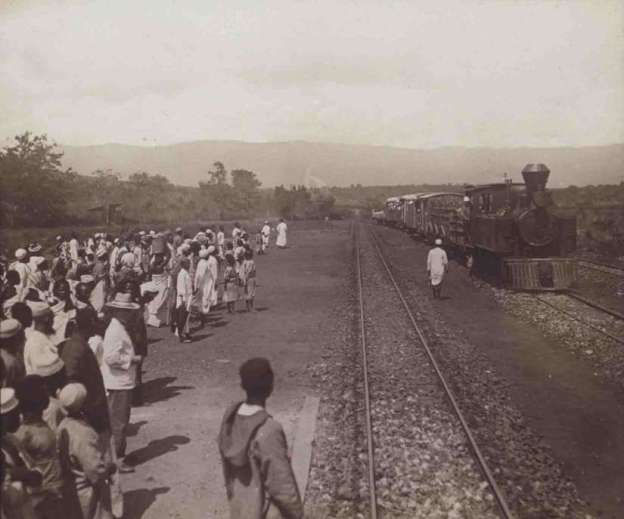
The featured image is an early German photograph of a train on the Usambarabahn at a typical station location.Thecsoecific location was not recorded.

There is a description of the route of the Usambara Railway or the Tanga Line on-line on the United Republic of Tanzania website: “As the train departs Tanga, it slowly climbs through the rolling hills and lush forests of the Usambara Mountains, offering breathtaking views of the surrounding countryside. Along the way, the train passes through several small towns and villages, each with its own distinct character and cultural traditions. … One of the highlights of the Tanga Line journey is the crossing of the Pangani River, which is spanned by a impressive steel bridge. This engineering marvel, constructed during the German colonial era, is a testament to the ingenuity and determination of the railway’s builders. … As the train continues its journey inland, it winds through the fertile agricultural regions of the Kilimanjaro and Meru districts, passing by vast coffee and sisal plantations. The final destination, the town of Moshi, is nestled at the base of the majestic Mount Kilimanjaro, the highest freestanding mountain in the world.” [5]

One of the must-see attractions along the Tanga Line is the Lushoto town, a charming community community nestled in the heart of the Usambara Mountains. This picturesque town is known for its traditional architecture, vibrant markets, and stunning views of the surrounding peaks. … Another highlight of the Tanga Line journey is the Amani Nature Reserve, a protected area that is home to a diverse array of plant and animal life. Visitors can explore the reserve’s hiking trails, spot a variety of bird species, and learn about the region’s unique ecosystem. … As you continue your journey, you’ll also have the chance to visit the Vugiri Falls, a stunning waterfall that cascades over the rugged landscape, and the Nduruma River, a popular spot for birdwatching and outdoor recreation.” [5]

Notable cultural and natural attractions close to the line include: the Kilindi Palace, a former royal residence that now serves as a museum showcasing the history and traditions of the Kilindi people; the Magila Monastery, a historic religious site that dates back to the 19th century; various traditional villages; the Mkomazi National Park, a protected area that is home to a diverse array of plant and animal species; the Usambara Mountains, a stunning mountain range that is home to a rich array of endemic plant and animal species; the region’s diverse habitats, from wetlands to forests, provide a rich and varied birdlife for enthusiasts to discover.

In 2018, the Government of Tanzania invested 5.7 billion Tanzanian shillings to rehabilitate the line. As of July 2019, diesel powered cargo trains were leaving Tanga Railway Station again. Passenger transport between Tanga and Arusha was planned to start in September 2019, but has not been commenced as yet. [6]

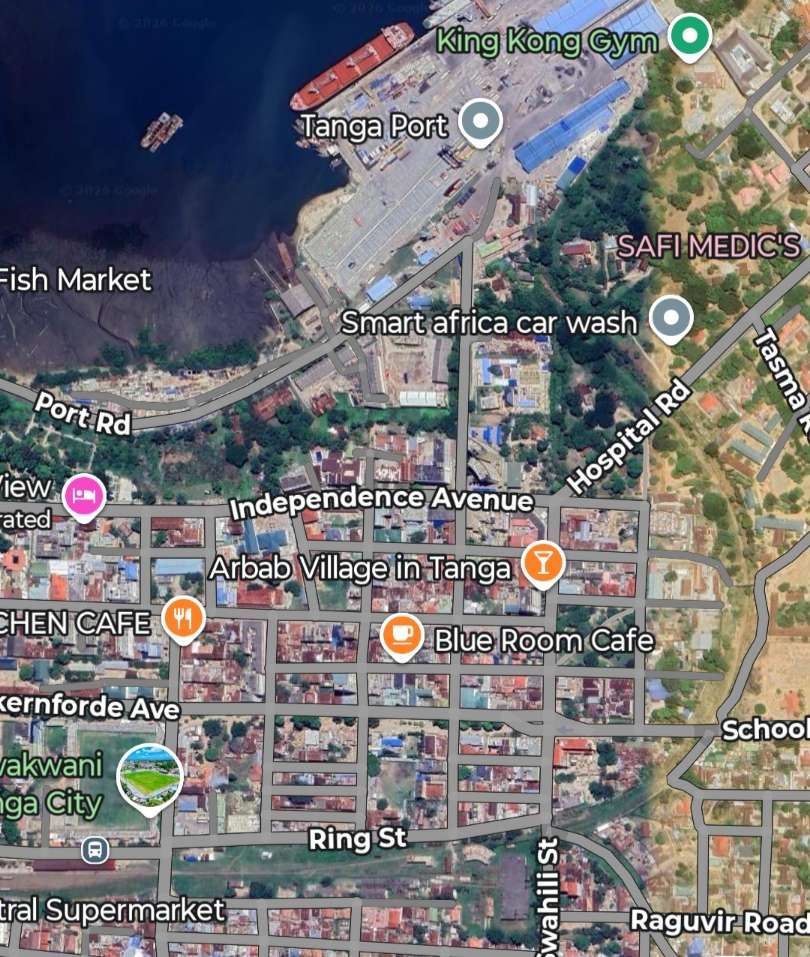
The line has its terminus in the Port of Tanga. It leaves the Port of Tanga (Hafen von Tanga) to run towards the station. On the satellite image below it can be picked out curving round from the port to the station on Ring Street.

The Port of Tanga is at the top of this extract from Google’s satellite imagery. The station is at the bottom-left of the image on Ring Street. The line can be seen curving between the two. [Google Maps, March 2026]
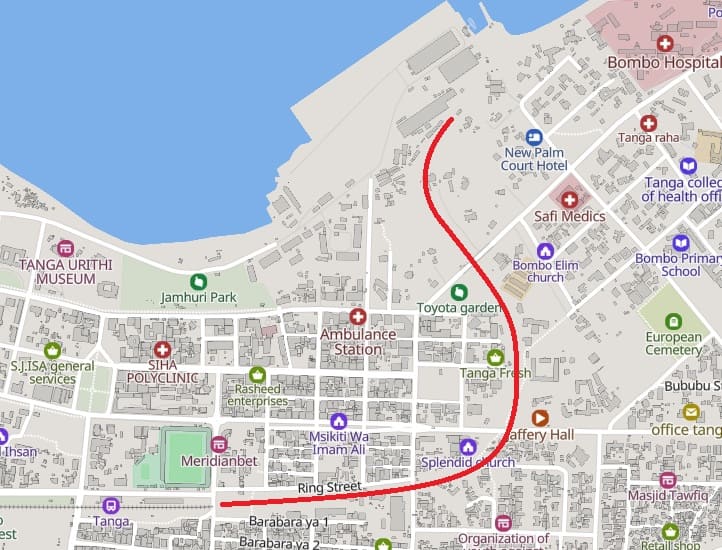
Tanga Railway Station appears in the bottom-left of this MapCarta image, superimposed in red on the map is the line that ran down to the port. It would appear that the line of the railway has been built over at, at least, one point – buildings of the Malindi Hotel sit over the line of the railway. [14]

An early photograph of the port can be found here. [9] The linked postcard image is annotated, “Vintage illustration after a photograph, Usambara Railway, Usambarabahn, German East Africa, at Tanga, Tanzania, 1890s, 19th Century.”

Tanga Railway Station is on Ring Street, Tanga.

Tanga Railway Station, 1890. This image was shared on the City of Tanga in Tanzania (Tanga Facebook) Facebook Group by Ragini Pattni on 24th December 2025. [2]
The Station at Tanga close to the turn of the 20th century. This image was shared on the City of Tanga in Tanzania (Tanga Facebook) Facebook Group by Ragini Pattni on 24th December 2025. [2]
The Railway Station on Ring Street, Tanga. [Google Maps, March 2026]
The turning triangle immediately to the West of the station at Tanga. [Google Maps, March 2026]
Buildings at the South point of the turning triangle in Tanga. [Google Maps, March 2026]
The roadside elevation of the Railway Station at Tanga. This image was shared on the City of Tanga in Tanzania (Tanga Facebook) Facebook Group by Ragini Pattni on 24th December 2025. [2]
Tanga Railway Station entrance, © Shane, Google Images. [3]
The District Civil Engineer’s Office, Tanzania Railways Corporation, Tanga © Paschal P. Rutayuga. [4]

The significant locations along the first stretch of the Tanga Railway (or the Usambarabahn or Usambara Railway) are highlighted on the adjacent schematic map of the line. [6]

The first location that we can easily establish on the satellite images below is the village/town of Maweni, nearly 11 kilometres from Tanga Railway Station.

Pongwe is only a few kilometres along the line. Again no obvious location can be seen on satellite images for any halt/station. Mkanyageni Halt (Reder’s Halt) is also not obvious on the satellite imagery.

Muheza, a more significant township, has a railway station!

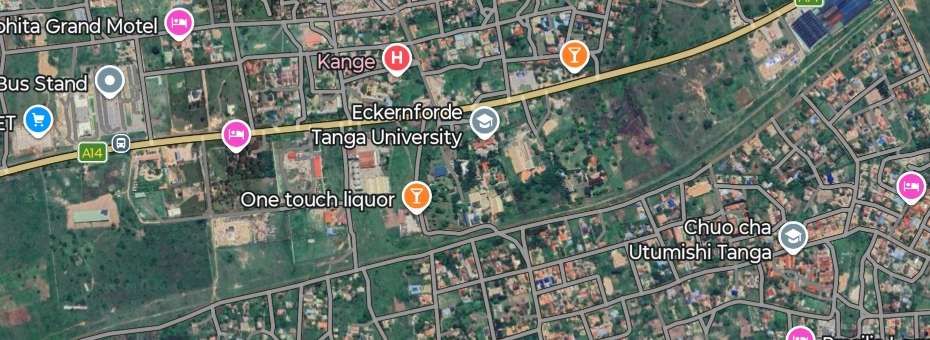
The next sequence of images shows the line heading out into the suburbs of Tanga, alongside the A14 and running to the North of the airport before drifting away to the South of the A14.

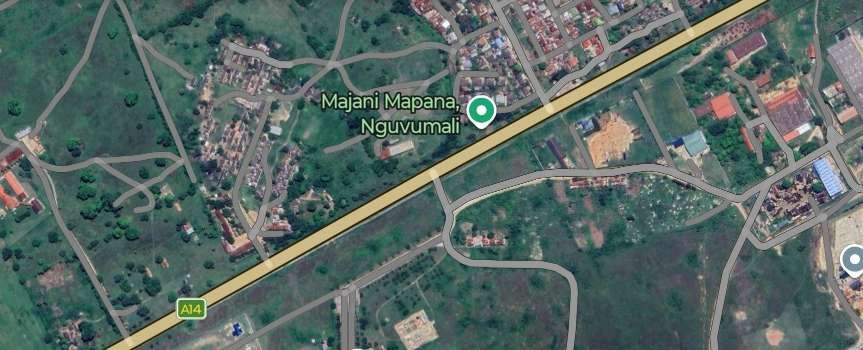
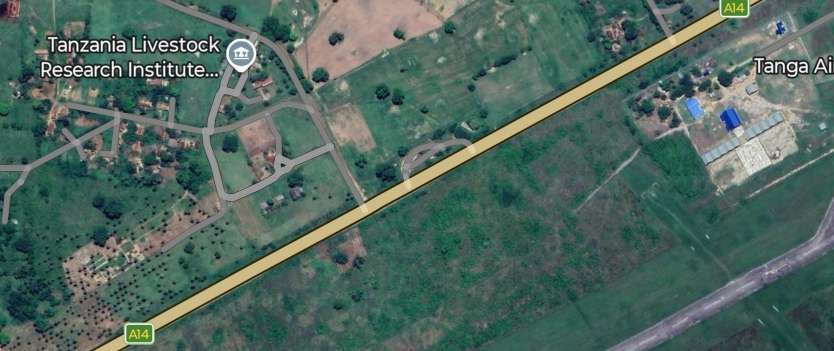
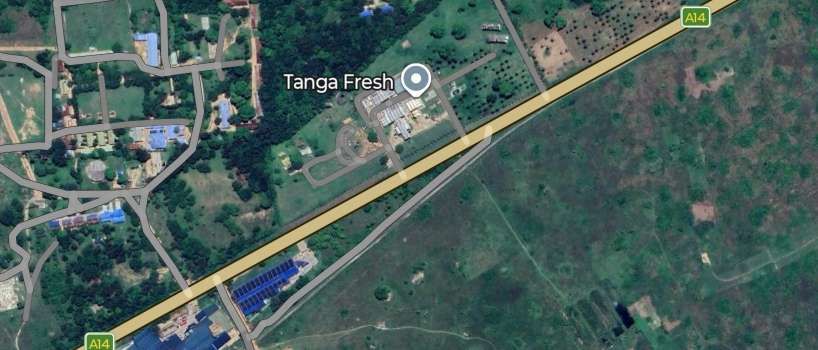
This series of satellite images show the railway line heading Southwest out of the city of Tanga. for a distance it ran alongside the A14 [Google Maps, March 2026]

Beyond the city limits, the line continues in a south-westerly direction. For the sake of space a smaller scale is used in the satellite images that follow below. …

Maweni is the first identifiable location which appears on the schematic map of the line, even so, it is not possible from Google Maps to identify the location of any halt/station. [Google Maps, March 2026]
Pongwe is the next identifiable location which appears on the schematic map of the line, it is not possible from Google Maps to identify the location of any halt/station. [Google Maps, March 2026]
The line leaves Pongwe and heads Southwest away from the A14. [Google Maps, March 2026]
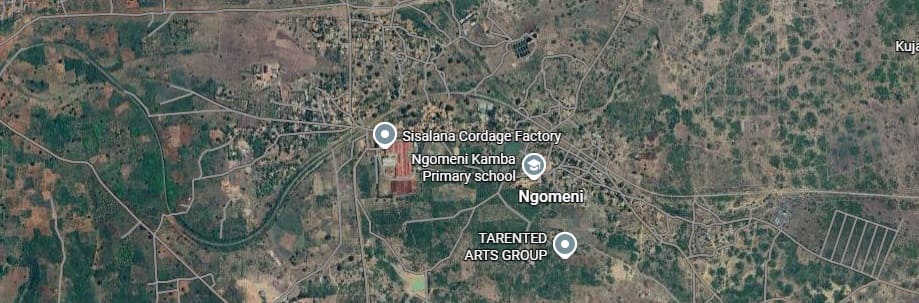
It turns West from Southwest as it runs into Ngomeni with its Sisalana Cordage Factory, again there is no identifiable location for a railway station. [Google Maps, March 2026]
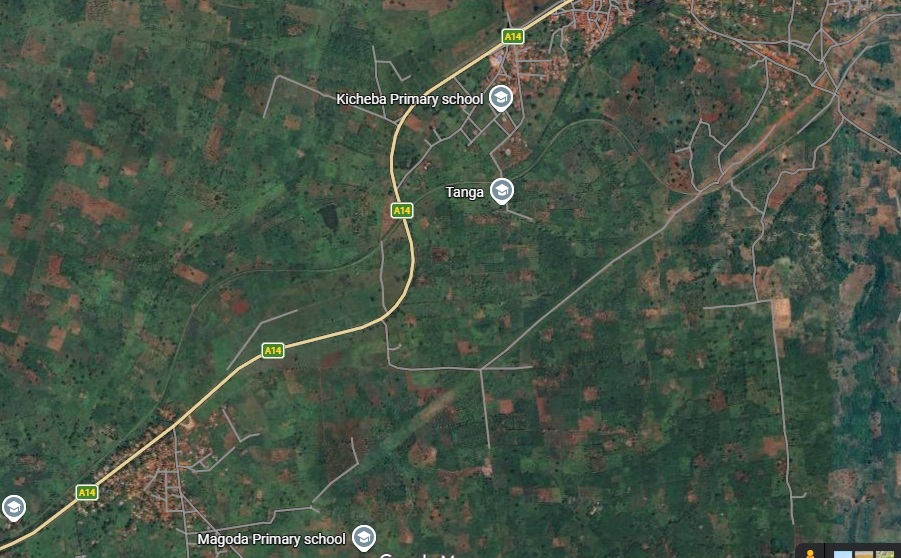
This next length of the line shows it meandering through the landscape, being bridged by the A14 before returning to run close to the A14 but on its North side. {Google Maps, March 2026]
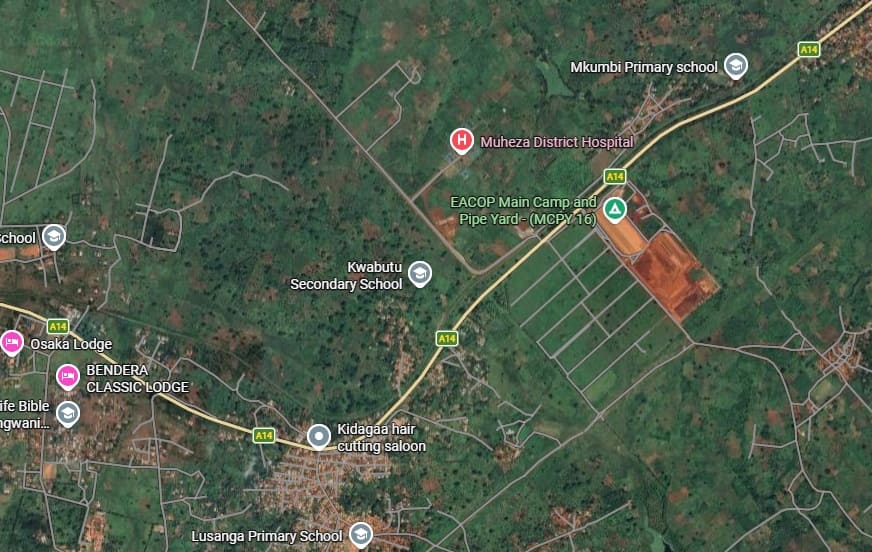
Still heading generally in a south-westerly direction, the line runs alongside the A14, passes through Lusanga and heads on towards Muheza. [Google Maps, March 2026]
Muheza is a more significant township and it has a clearly identifiable railway station! The location of the station is shown on the larger scale extract from Google’s satellite imagery below. It is close to the point where the A14 turns South away from the line. [Google Maps, March 2026]

Muheza Railway Station sits close to the centre of the town. [Google Maps, March 2026]
Muheza Railway Station, © Issa Mates, April 2021. [Google maps, March 2026]

The station location was caught on camera in the late 19th century. It can be found among a series of photographs held by the Getty Foundation, here. [8] The picture is annotated, “Muheza station on Usambara Railway, Usambarabahn, German East Africa, Tanzania, 1890s, 19th Century.”
Muheza Railway Station as shown on MapCarta. [15]

The next satellite image extract picks up the railway at the western edge of Muheza close to its secondary school and sees it still running generally in a Southwesterly direction. …

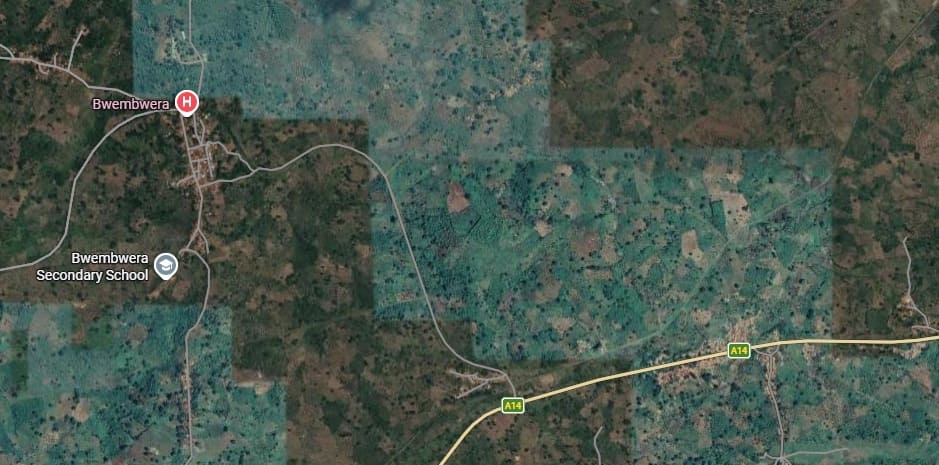
The route of the railway can be picked out as a faint lighter line running top-right towards bottom-left of this extract before turning a little closer to Southsouthwest, leaving the extract at its southern edge. Tengeni is not marked on the satellite image at this scale but is the point where the line of the railway crosses a road at around the two-thirds point across the extract. There is no obvious railway halt at this location. Historically it was an important location on the Usambara Railway because it was the point where the 750 mm gauge Sigibahn met the Usambarabahn. [Google Maps, March 2026]
The line continues on this next extract from Google’s satellite imagery. It can be seen entering the extract at the top-right apex, turning first towards the south-southwest before meandering towards the A14 at the third point across the image. It then runs parallel to and on the North side of the A14. Leaving the extract, just to the West of the A14. [Google Maps, March 2026]
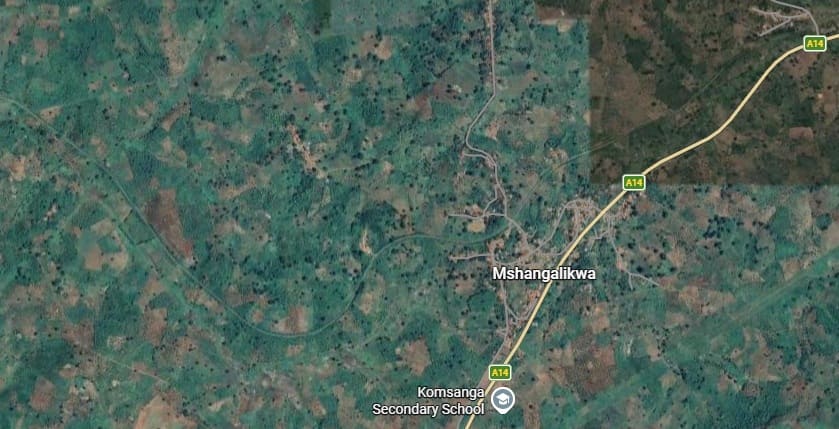
The line, again, enters this extract in the top-right corner a short distance away from the A14. I have not been able to identify the location of the Mambo Leo Halt. The line runs sinuously just to the Northwest of Mshangalikwa and heads away from the A14 to the West. [Google Maps, March 2026]

There is no obvious location along the line for Kihuhwi but there is a possibility that Zannetiberg Halt was close to what is now the Zeneti Medical Centre. which sits just beyond the western side of the extract immediately below.

The line crosses this extract in an East to West direction from the mid-point on the left of this extract to the bottom-left apex. [Google Maps, March 2026]
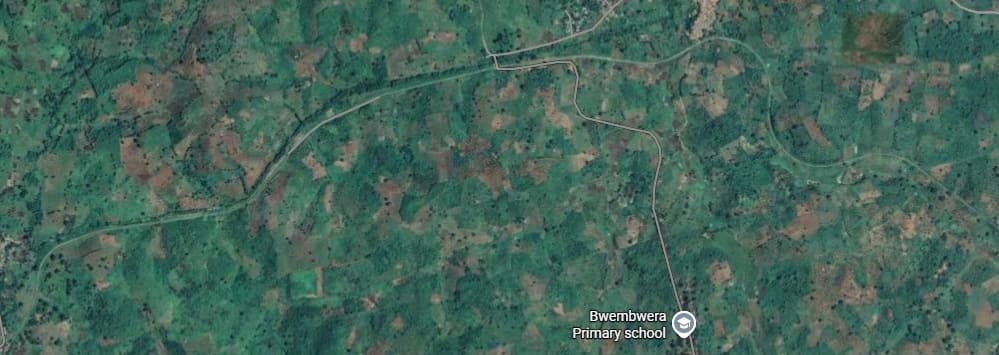
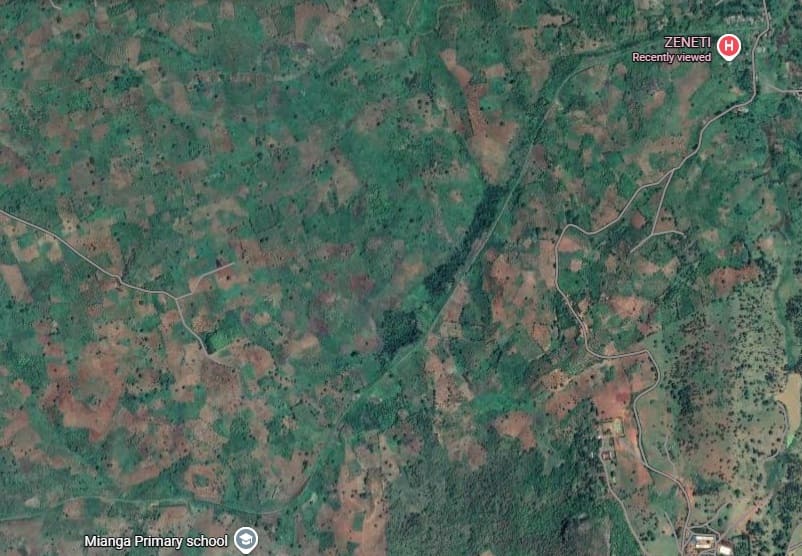
The line enters this extract just to the Northeast of Zeneti Medical centre, crossing the road to the East of the medical centre at a level-crossing. After a short distance heading West, the line turns to runSouth-southwest towards the location of Mianga Primary School. Close to the school, the line curves to the West and leaves the extract from Google’s satellite imagery just above the bottom-left of the image. [Google Maps, March 2026]
Heading West from Mianga the line sweeps left and then right and in doing so joins the line from Dar es Salaam. The line then heads East-northeast, leaving this image at the top-left. The junction is at the centre of this image. [Google Maps, March 2026]

This closer view of the junction is taken from Google Earth. The black lines approximate to the two railway routes but are several metres, at least, out of position. The junction is named on the Schematic map of the line below – Murasi Junction and is recorded as being 65 km from Tanga. [Google Earth, March 2026]
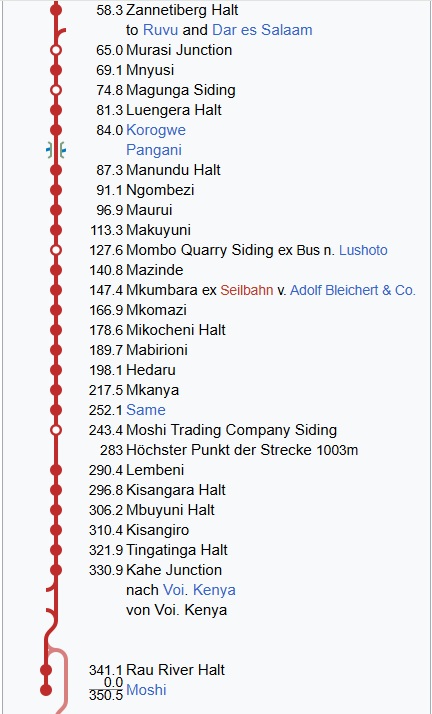
The most notable location at the top of this section of the schmatic map of the line is the railway junction between the line from Tanga and that from Dar es Salaam. – Murasi Junction. Travelling on from Murasi Junction the next location recorded is the town of Mnyusi. [6]
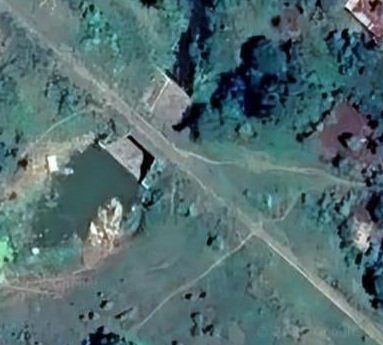
Mnyusi sits at the centre of the satellite image below. The line runs along the Southwest side of the town. There is a significant culvert/bridge carrying the line over the local river.
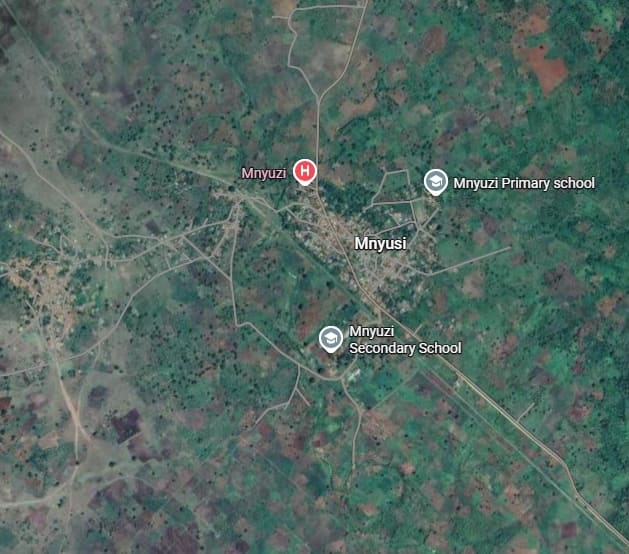
Mnyusi River Bridge {Google Maps, March 2026]
The town of Mnyusi sits on the Northeast side of the railway line. To the Northwest of the bridge/culvert shown above, there is a passing loop and possibly old station buildings. [Google Maps, March 2026]
A closer view of the passing loop at Mnyusi. There is a group of three structures which might be, or might have been, railway structures. These are shown in closer detail below. [Google Maps, March 2026]

Three buildings align with the railway at Mnyusi and appear to have been station buildings. [Google Maps, March 2026]

Beyond the passing loop the line continues to head Northwest along the Northeast flank of the Pangani River valley, as can be seen on the next satellite image below.

Mnyusi Railway Station, as shown on MapCarta. [16]
The line form Tanga and Dar es Salaam enters this extract from Google’s satellite imagery at the apex at the bottom-right of the image. It runs Northwest to leave the extract centre-top. [Google Maps, March 2026]
Again, the line enters this image at the bottom-right apex and runs Northwest, leaving the image at the top, just to the left of centre. [Google Maps, March 2026]
In this next extract from Google’s satellite imagery the line again enters bottom-right and runs Northwest to a point just below the top of the image. It then swings round to the West. It runs to the North of a small settlement which is known as Old Korogwe and continues West towards Korogwe itself. Two of the locations noted on the schematic route of the line, Magunga Siding and Luengera Halt have been passed without being noticed! [Google Maps, March 2026]
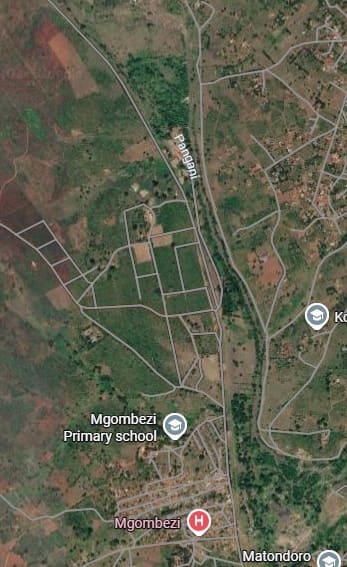
The next extract from the satellite imagery takes the line through Korogwe. The settlement was reached by the line from Tanga around the turn of the 20th century. The construction of the line to the West of Korogwe commenced in 1903. [10]
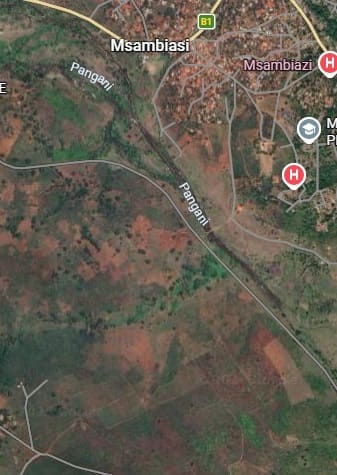
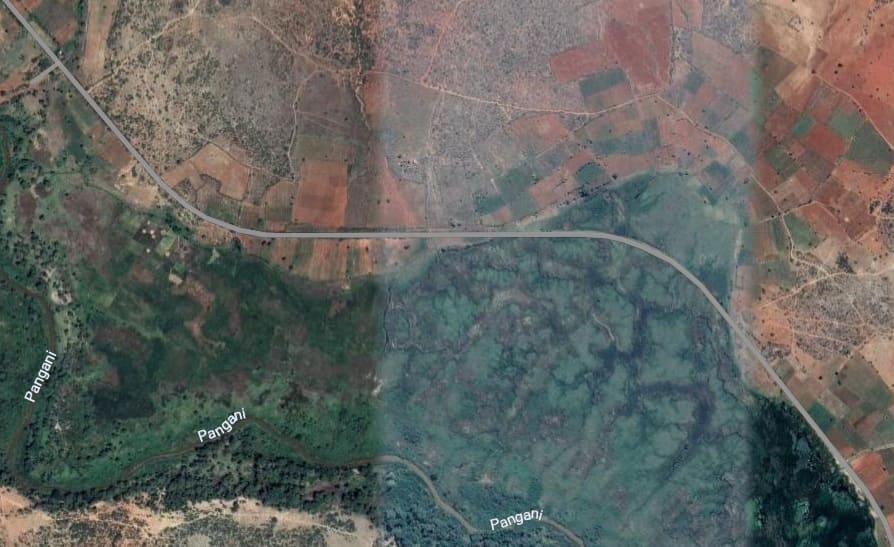
The line from Tanga approached Korogwe from the East. The railway station

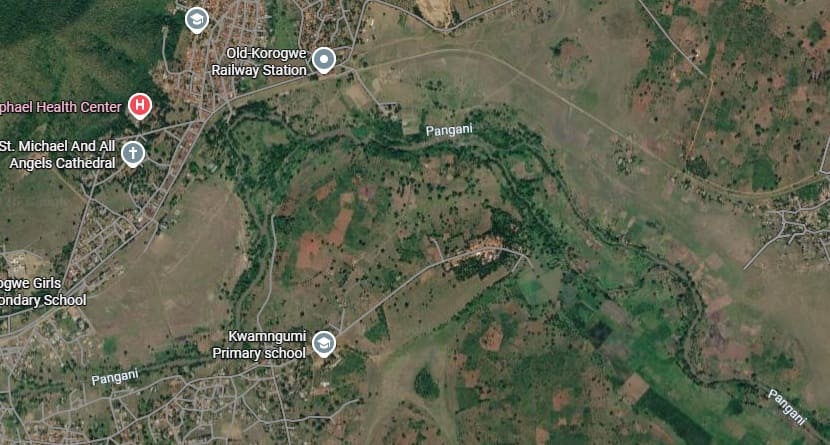
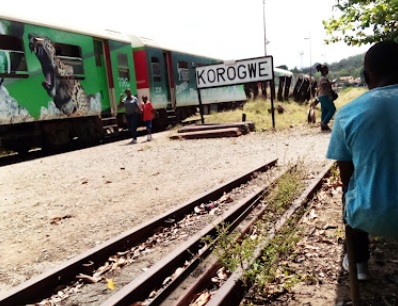
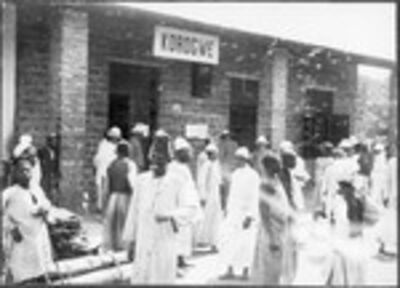
Old-Korogwe Railway Station in May 2022, (c) Vincent Christian. [Google Maps, March 2026] The image below shows the station in the early 20th century. [11]

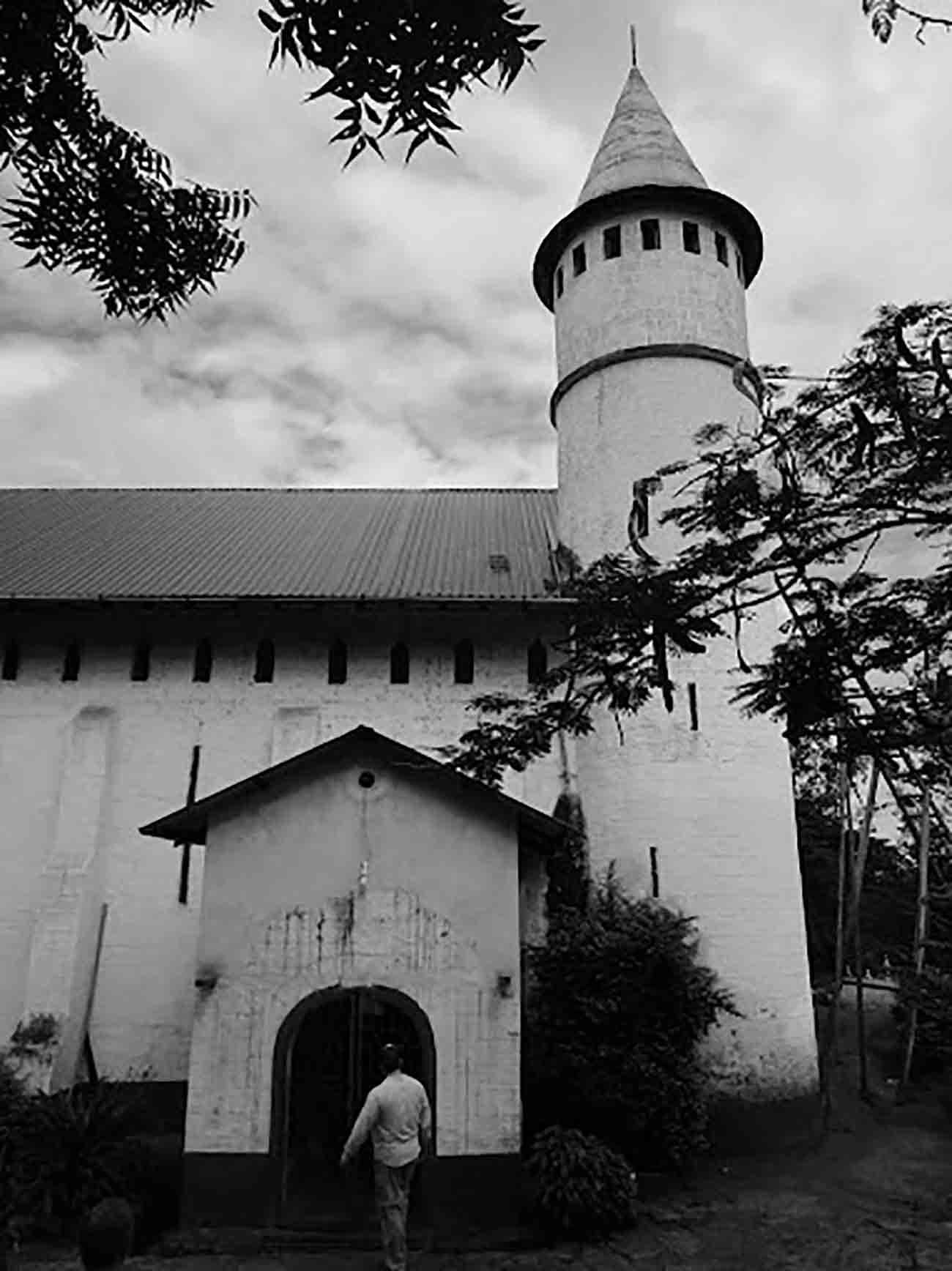
St. Michael and All Angels Cathedral, Korogwe in 2017. (c) Yohana Joseph Mzuri. [Google Maps, March 2026]

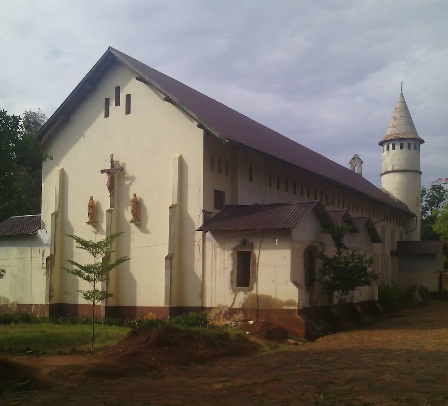
Korogwe is the seat of the Anglican Diocese of Tanga and has a cathedral church dedicated to St. Michael and All Angels. [17] Towards the end of 2025, the Anglican Church of Tanga marked 25 Years as a Diocese and 177 Years of Christianity in the Region.

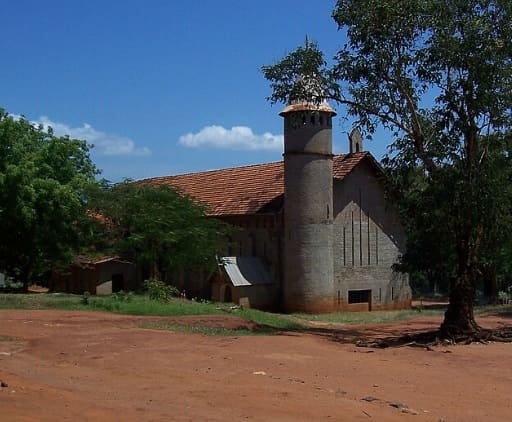
Another view of St. Michael and All Angels’ Cathedral at Korogwe, (c) Public Domain. The photograph was taken by ‘Acognat’. [18]

Korogwe had a population of 62,032 in 2022. as well as its Cathedral, the town has a teacher training college and a number of secondary schools. [12]

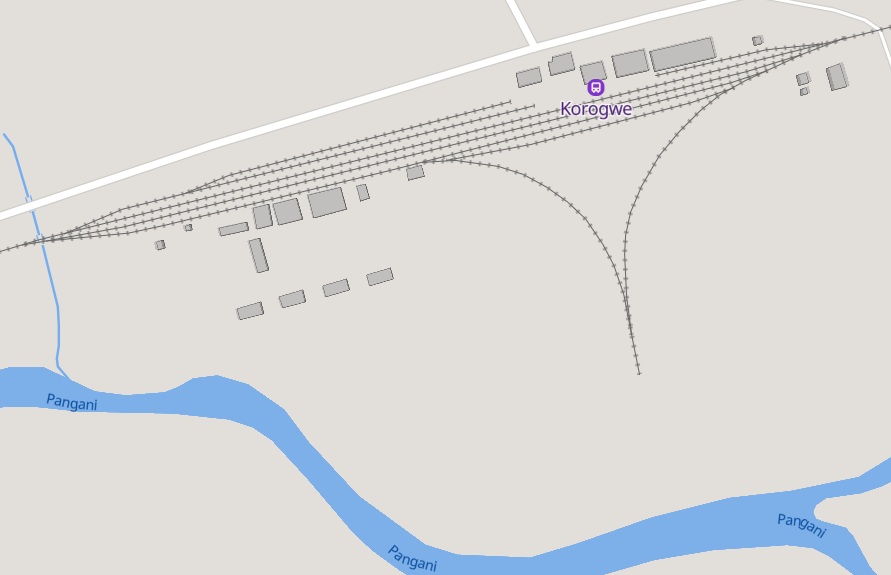
Korogwe Railway Station and the Pangani River as shown by MapCarta. [13]

The town of Korogwe has developed to the West of the railway station. The line curves round the South side of the town.

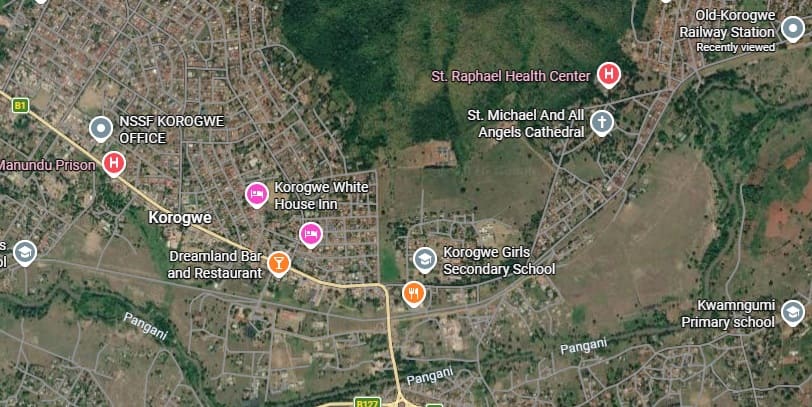
The railway line runs to the Southeast of the Cathedral and to the South of Korogwe town, crossing the B1 at a level crossing. [Google Maps, March 2026]
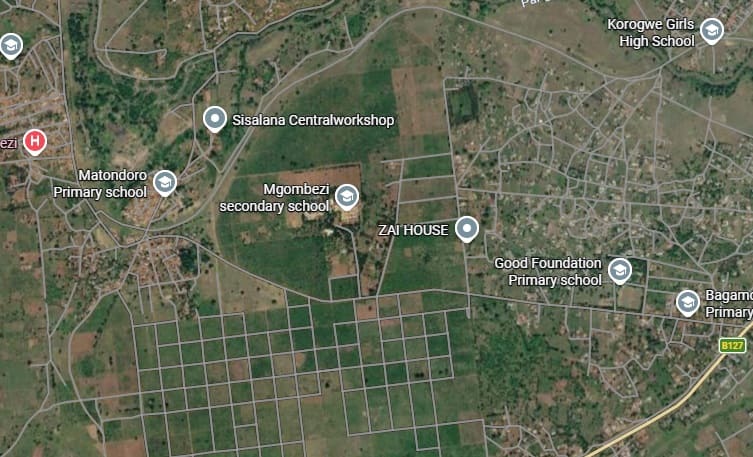
In this next extract from Google’s satellite imagery, the line enters on the right, just below the top corner close to Korogwe Girls High School and almost immediately bridges the Pangani River. After crossing the river the line runs West as far as Matondoro Primary Scholl before curving tightly round to the North. [Google Maps 26th March 2026]
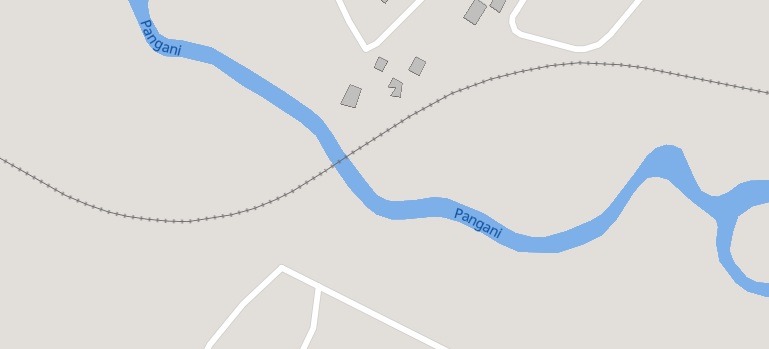
The Pangani River Bridge at Korogwe as it appears on MapCarta. [19]

After turning to the North, the line ran along the West side of the Pangani River and began to turn away to the West. [Google Maps, March 2026]

The next extract shows it heading West on the opposite side of the Pangani River to Msambiasi. [Google Maps, March 2026]
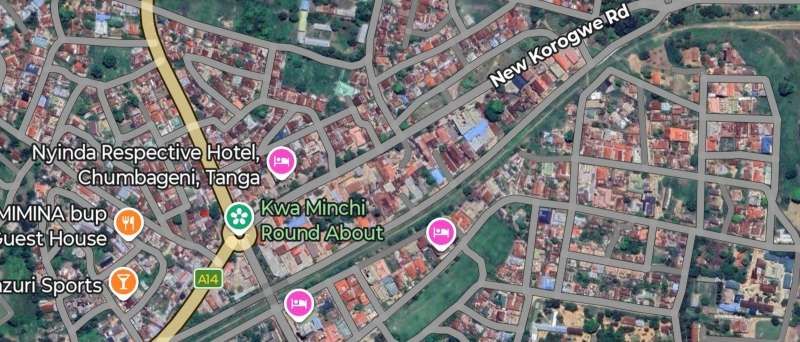
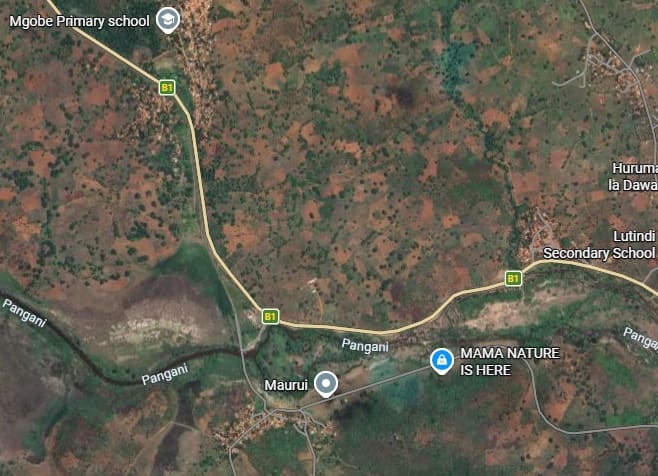
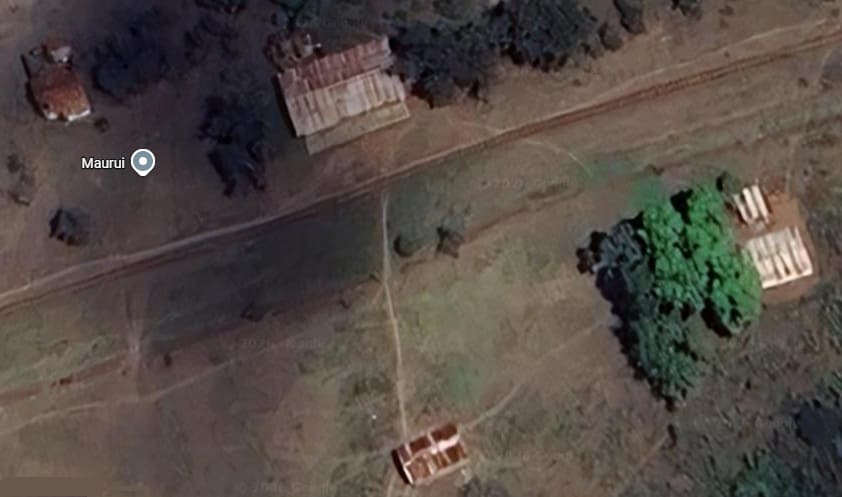
An S-curve interupts the westerly direction of the line, before the line passes through the station at Maurui and turns North to cross the Pangani River once again. Then the line takes a position alongside the B1 travelling Northwest. [Google Maps, March 2026]

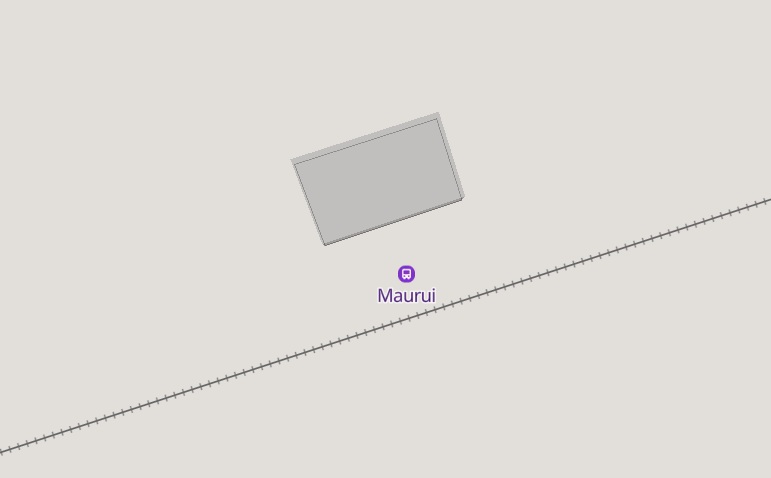
Maurui Railway Station [Google Maps, March 2026] and MapCarta. [19]

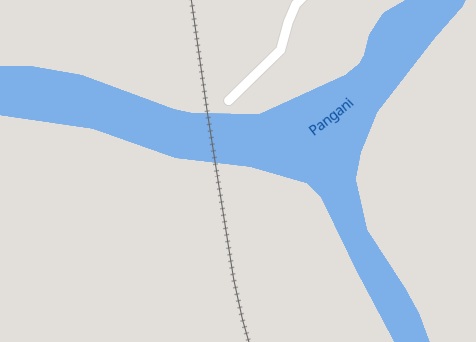
MapCarta shows both Maurui Station and the bridge over the Pangani River. [19]

The Pangani River Bridge. {google Maps, April 2026]
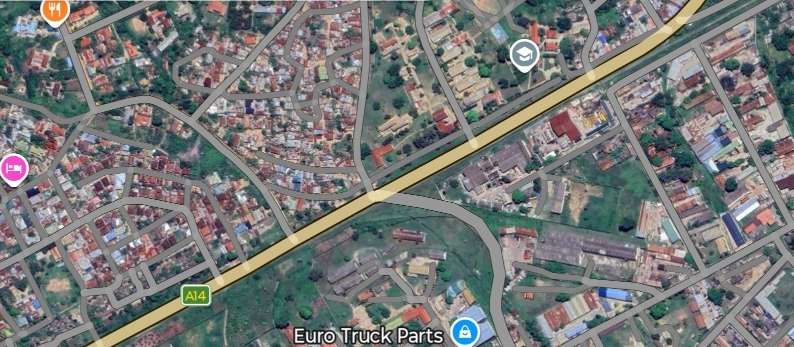
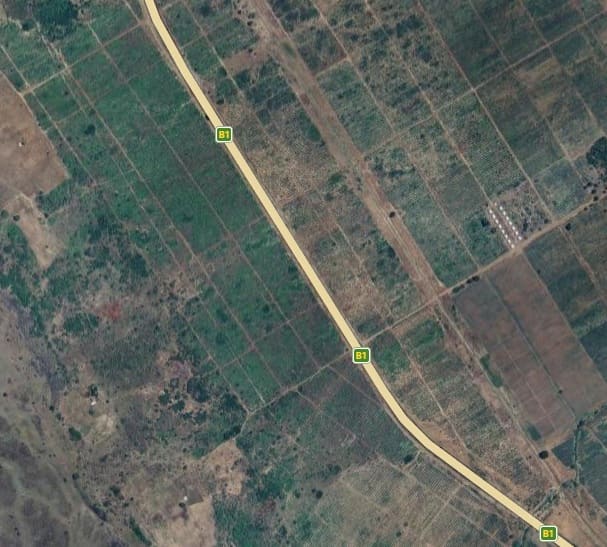
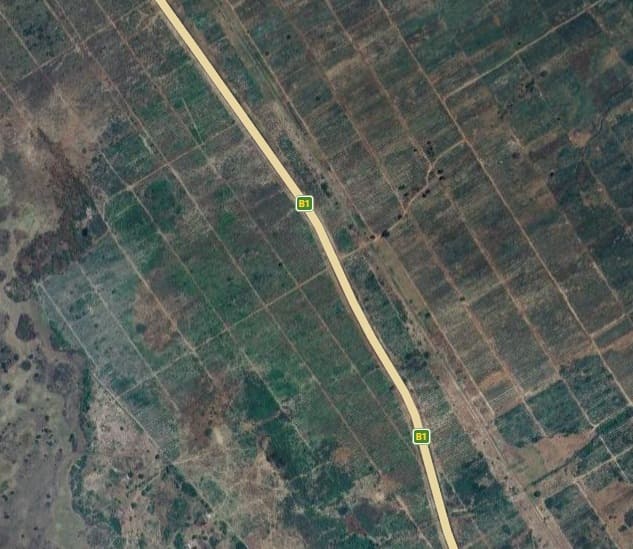
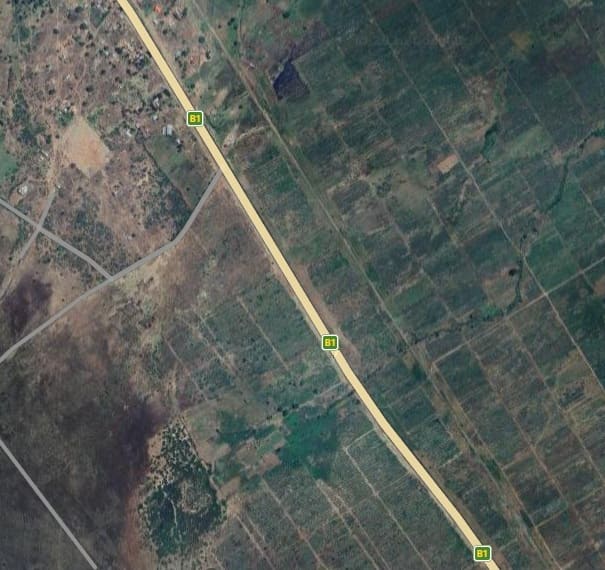
This next extract follows the line Northwest to Makuyuni. The railway sits adjacent to the B1/T2 throughout this length. [Google Maps, March 2026]

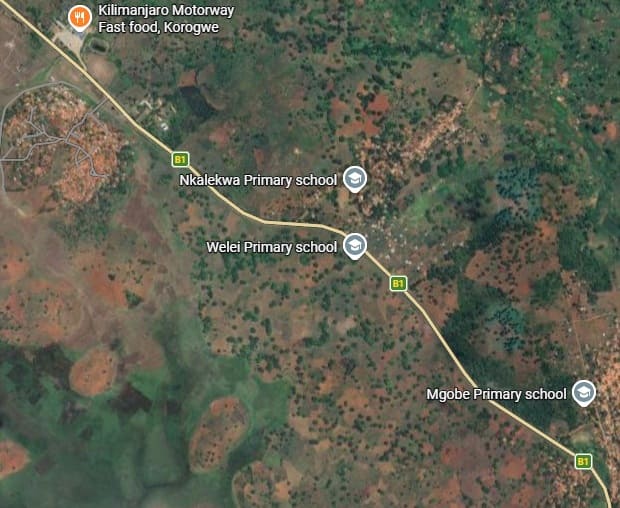
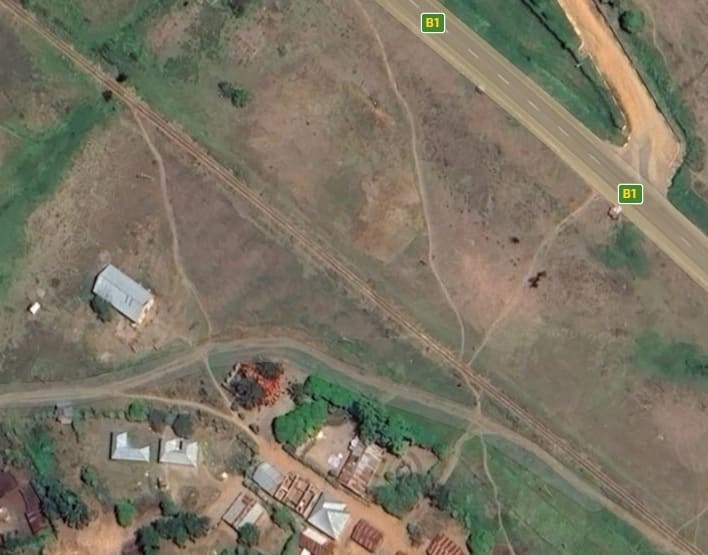
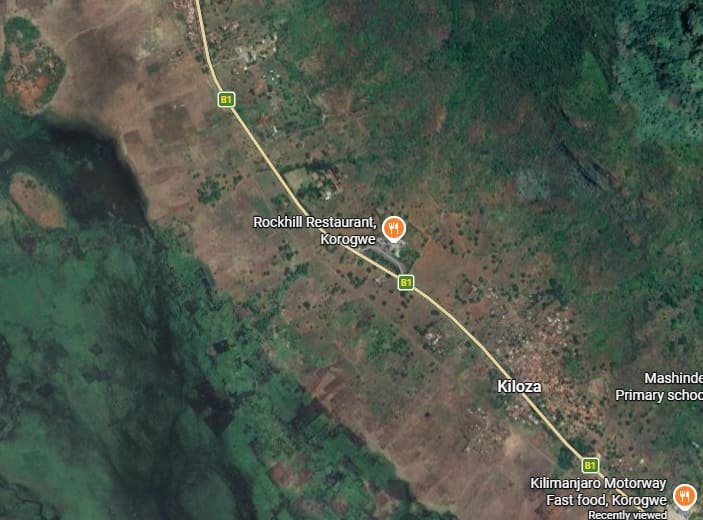
Lutindi Railway Station (?) as it appears on modern satellite imagery {Google Maps, March 2026] Nothing is shown at this location on MapCarta, other than the services (Kilimajaro Motorway Fast Food, Korogwe). Despite the presence of a significant small settlement on the Southwest side of the line, Lutindi is some way to the Northeast of the line.

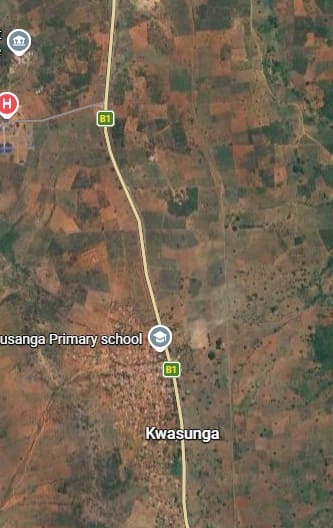
The line continues Northwest alongside the B1/T2 towards Makuyuni. Note the divergence of road and rail at the top of the extract. [Google Maps, March 2026]

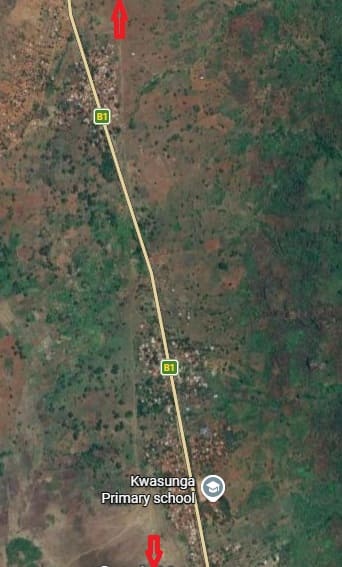
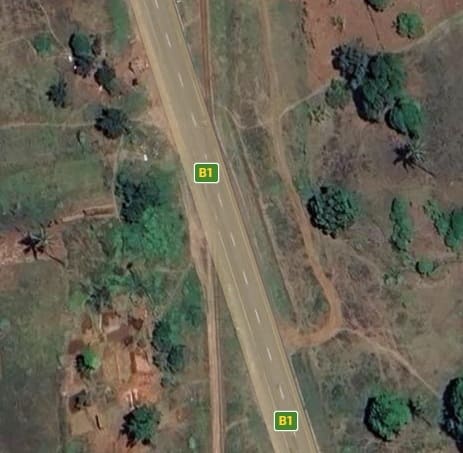
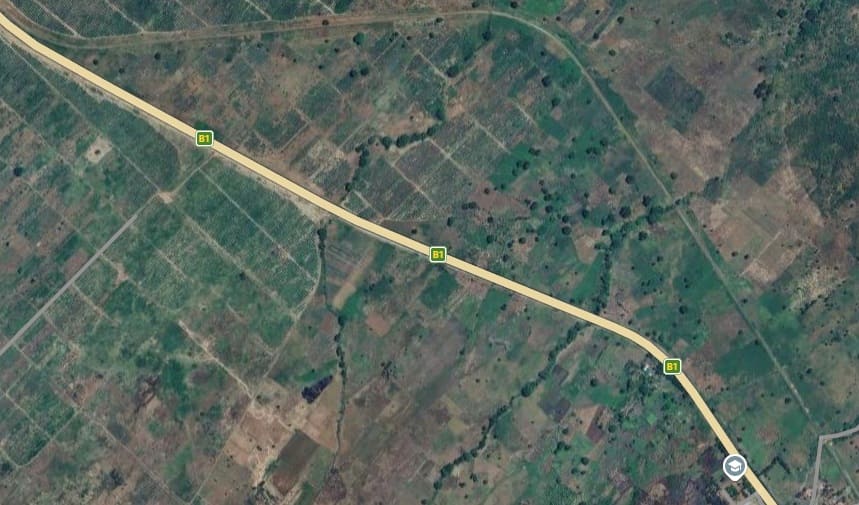
As this next extract from the satellite imagery shows, the separation of road and rail is only enough to allow the railway to pass to the West of Kwasunga. It enters this extract at the bottom arrow, and leaves at the top arrow. In between, the line crosses the B1/T2, as shown below. [Google Maps, March 2026]

On this next extract the line enters at the bottom of the image to the East of Kwasunga and heads North through a couple of shallow bends to exit at the centre-top of the image still on the East side of the B1/T2. [Google Maps, March 2026]

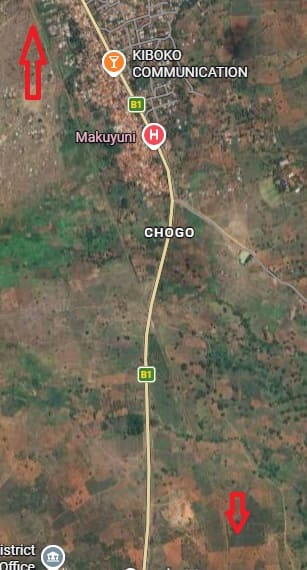
Two arrows again assist in locating the pints at which the line enters and exits this satellite image. The town of Makuyuni is at the top of the extract. the line at road cross below the centre of this image. [Google Maps, March 2026]

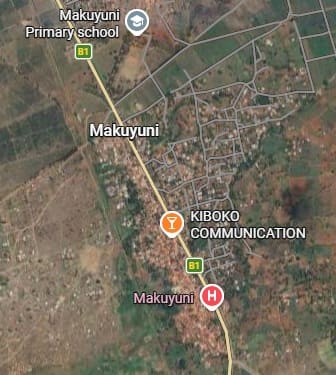
This extract from Google’s satellite imagery focusses on the town of Makuyuni. The railway line can be seen entering the image centre-bottom to the West of the B1/T2. It leaves the image top-left to the West of the road. {google Maps, March 2026]

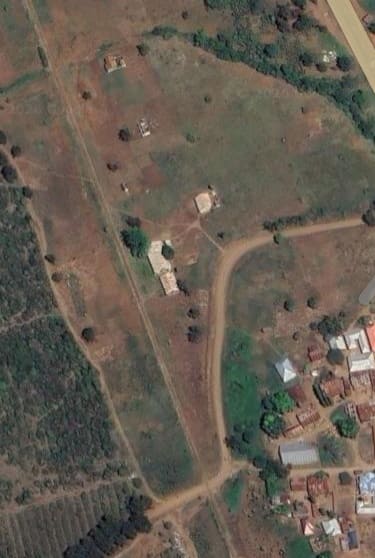
Makuyuni Railway Station is little more than a single-building halt to the Northwest of the town. [Google Maps, March 2026]

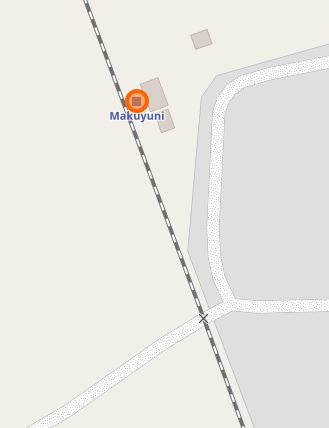
The same location on OpenStreetMap. [20]

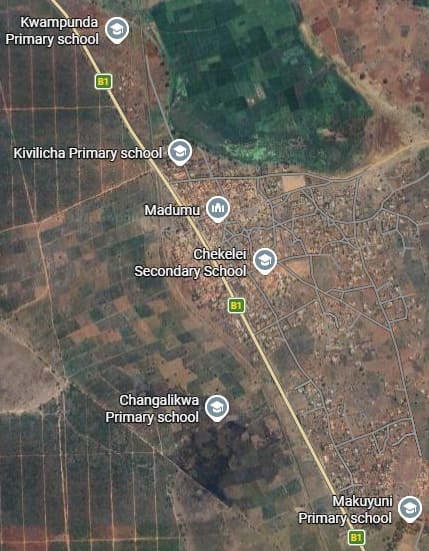
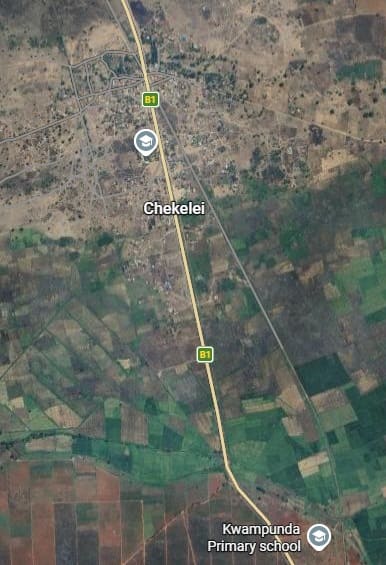
From Makuyuni the line continues to follow the same bearing – heading North-northwest towards Moshi. … Population density is higher here and the satellite image shows significant areas of farmland. The line enters the image a little to the West of the B1/T2, it diverges from the road to pass to the West of Maduma before then crossing the road once again close to the flag for Kivilicha Primary School. It runs North from that crossing to pass to the East of the flag for Kwampunda Primary School. [Google Maps, March 2026]

On the next extract from the satellite imagery below, the line can be seen more clearly.

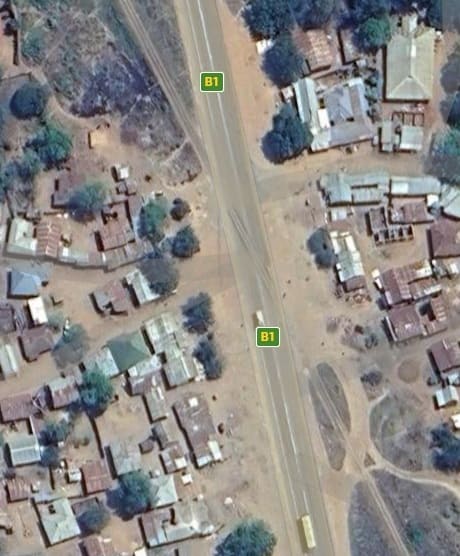
The line enters the image to the immediate East of Kwampunda Primary School and then traverses a well cultivated area before passing through Chekelei where, once agin, the railway crosses the B1/T2.

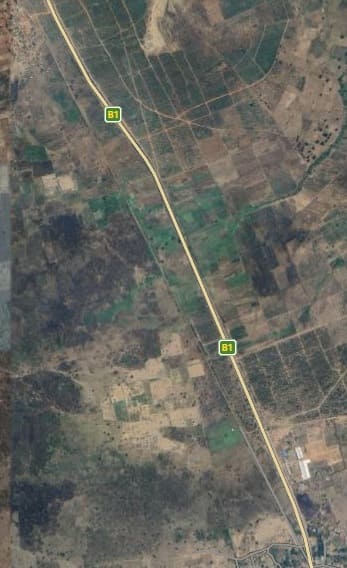
This next extract shows the line running roughly parallel to the B1/T2 in a North-northwest direction. [Google Maps, March 2026]

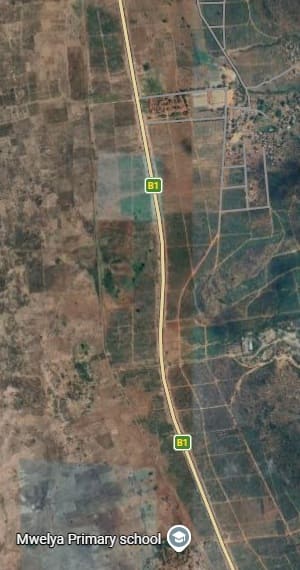
The line enters this next extract from Google’s satellite imagery immediately to the East of the flag for Mwelya Primary School. It contiues to keep company with the B1/T2, leaving the image to the West of the road. [Google Maps, March 2026]

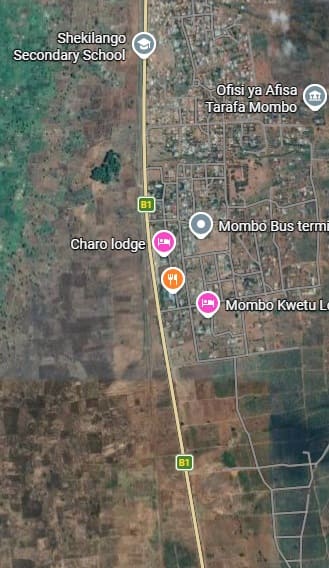
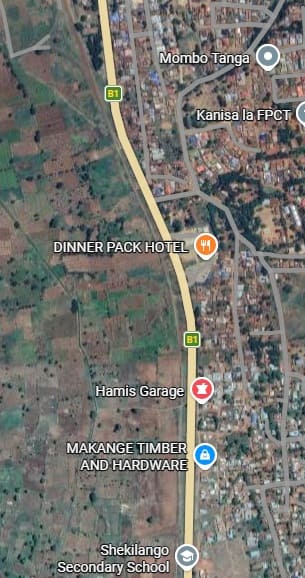
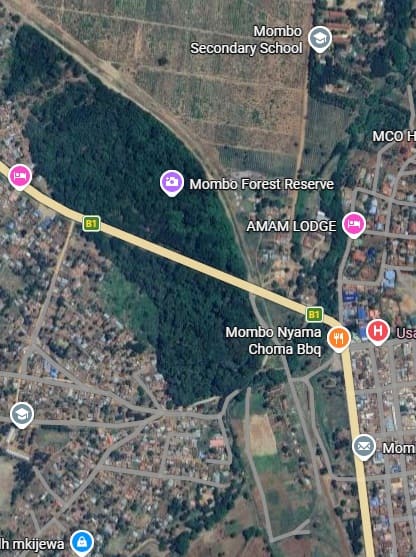
The town of Mombo appears on this next extract from the satellite imagery. The railway remains to the West of the road but takes much closer order as it runs past the town. It remains close to the road across the remainder of the image.

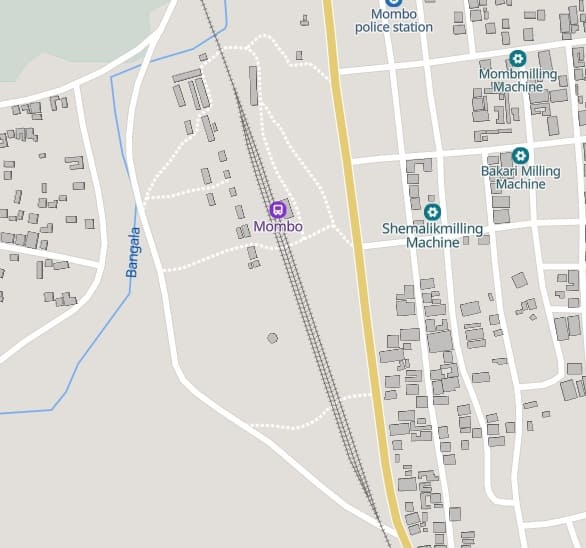
Across the next extract (below), the railway remains close to the B1/T2, still on its West side. Mombo is a town of relatively significant side. Its population in 2012 was 17,093. That figure increased to 24,080 by the time of the 2022 census. Close to the top of this image road and rail move apart to allow room for Mombo Railway Station. [Google Maps, March 2026]

As this MapCarta image shows Mombo station was large enough to warrant a passing loop on the railway line. [21]
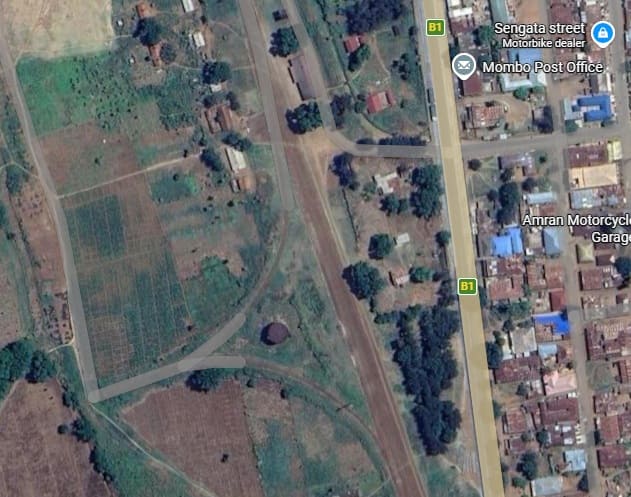
Google satellite imagery also shows a turning triangle at Mombo railway station. The station building is towards the top of this extract on the East side of the line. [Google Maps, March 2026]

Continuing North from Mombo Railway Station the line crosses the B1/T2 once again and skirts the Northeast edge of the Mombo Forest Reserve. [Google Maps, March 2026]

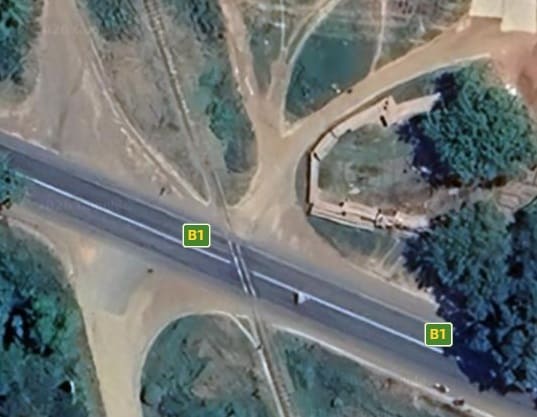
The level-crossing to the West of Mombo. [Google Maps, March 2026]
Leaving the forest reserve behind the line closes in on the B1/T2 once again and runs on its Northeast shoulder. On this map extract the line enters at the bottom-right apex and leaves at the top-left apex. [Google Maps, March 2026]
The railway is still following the road on this next extract from the satellite imagery. [Google Maps, March 2026]
A couple of fields separate road and rail over this next length of the line. [Google Maps, March 2026]
Closer order is resumed across this satellite image extract. [Google Maps, March 2026]
Road and rail run parallel on this next satellite image. [Google Maps, March 2026]
Slightly more interest in this extract from the satellite imagery. Road and rail separate for a short distance before once again resuming closer order! [Google Maps, March 2026]
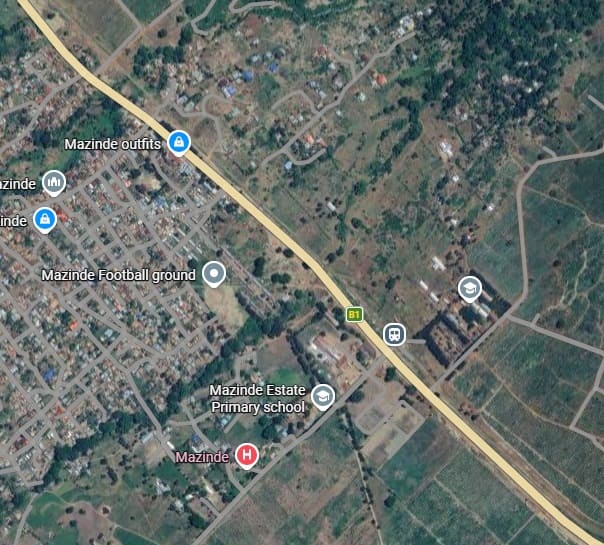
Road and rail remain close through Mazinde and its railway station. [Google maps, March 2026]

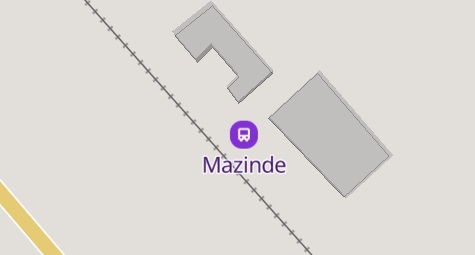
MapCarta shows that Mazinde Railway Station is more like a Halt, just s coupls of buildings and no passing loop or goods yard. [22]

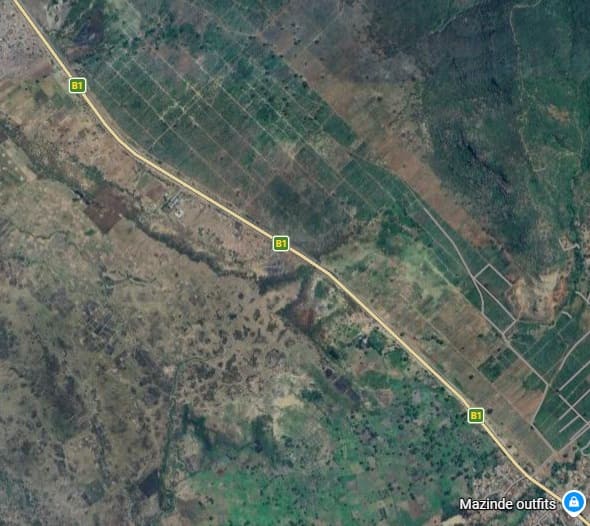
Northwest of Mazinde, road and rail continue close together. [Google Maps, March 2026.

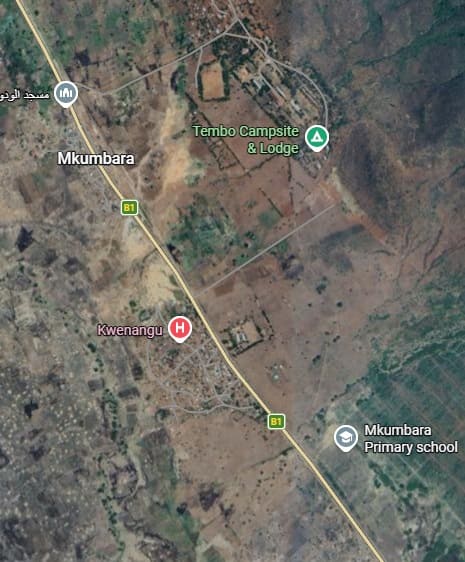
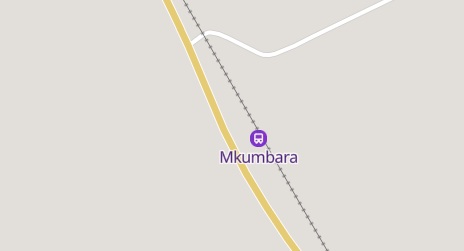
Road and rail remain close through Mkumbura. Mkumbura was the location where the Mkumbara to Neu Hornow Cableway/Ropeway, which operated during the German colonial period, met the Usambarabahn. The story of the Cableway can be found here. [23]

Mkumbura Rail Station as shown by MapCarta. [24]
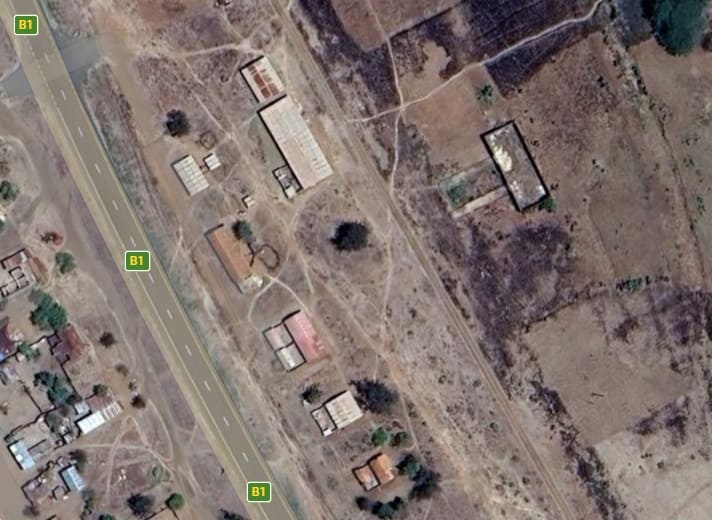
A much closer view of the location of Mkumbura Railway Station. [Google Maps, March 2026]
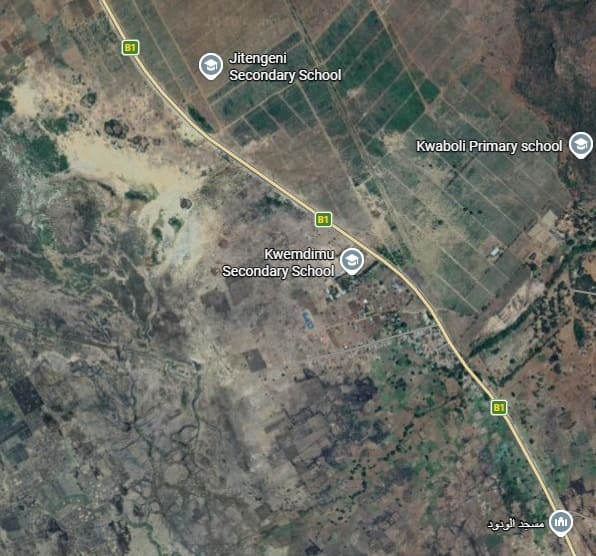
The line continues North-northwest alongside the B1/T2 as far as a point East of Kwemdimu Secondary School. There the BI/T2 begins to drift away from the railway to the Northwest. The railway leaves this extract from the satellite imagery at the centre-top of the image. [Google Maps, March 2026]

Over these two extracts from Google Maps, the line continues heading North-northwest. [Google Maps, March 2026]

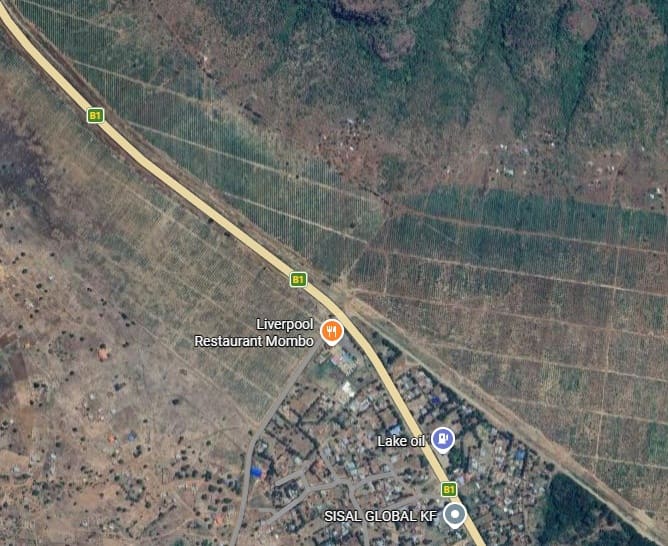
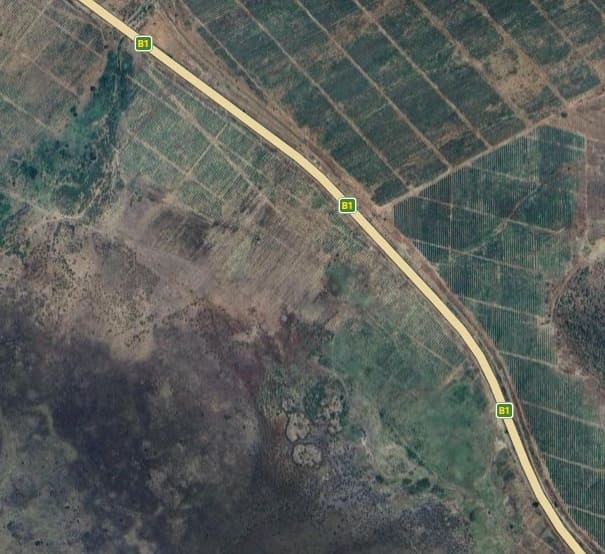
The line gradually turns to the North over these two extracts before turning back to the Northwest. The arid landscape appears to be used for Sisal farming. [Google Maps, March 2026]

The line then continues to the Northwest across this next extract. [Google Maps, March 2026]
Just a short distance further to the Northwest, the line curves round to head Southwest. [Google Maps, March 2026]
The curve then reverses and the line take close order to the B1/T2 once again. [Google Maps, March 2026]
And the main road soon begins to drift away again. [Google Maps, March 2026]
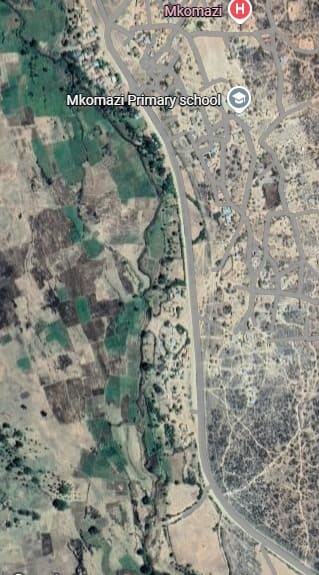
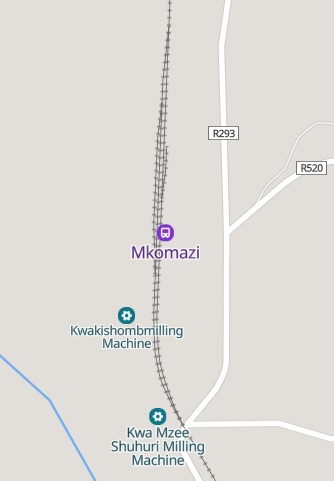
The line runs from the bottom-right corner of this extract to the top-left corner. The road running to its Southwest is the R293 Langoni-Mkomazi Road. [Google Maps, March 2026]

The line enters the next extract adjacent to the road in the bottom-right corner of the image and follows the road North. At the top of this extract, the road turns East and crosses the railway. The line leaves the image centre-top. [Google Maps, March 2026]

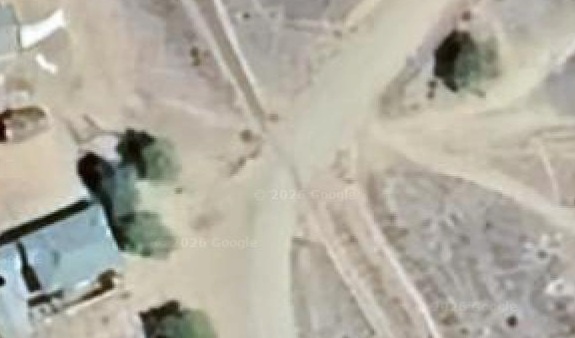
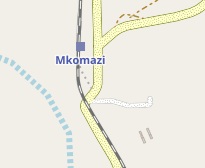
The level crossing at Mkomazi, [Google Maps, March 2026] and below on OpenStreetMap. [25]

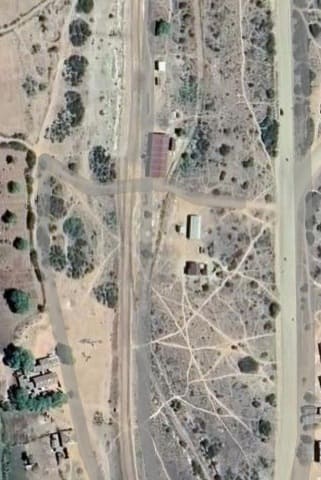
Mkomazi Railway Station sits just to the North of the level-crossing shown on the last 3 images. [Google Maps, March 2026][26]

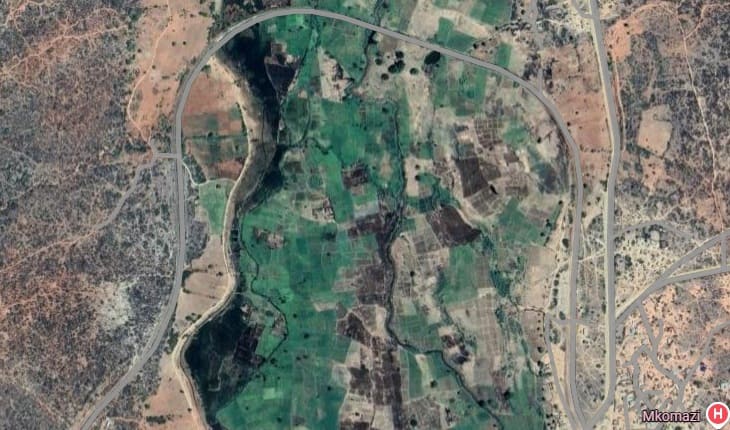
Beyond Mkomazi Railway Station, the railway loops round through West to South. [Google Maps, March 2026]

The line runs South before beginning to curve back through West to North as shown below. [Google Maps, March 2026]

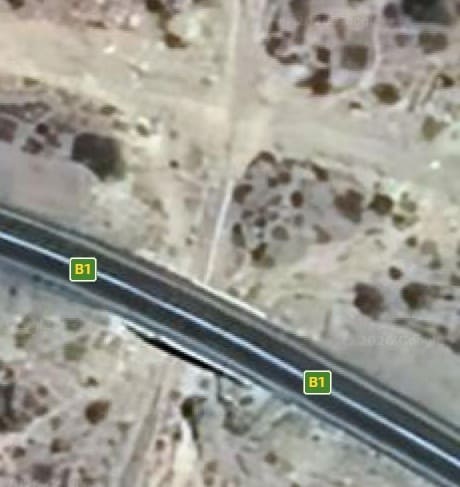
The modern B1/T2 crosses the line by means of a bridge. [Google Maps, March 2026]
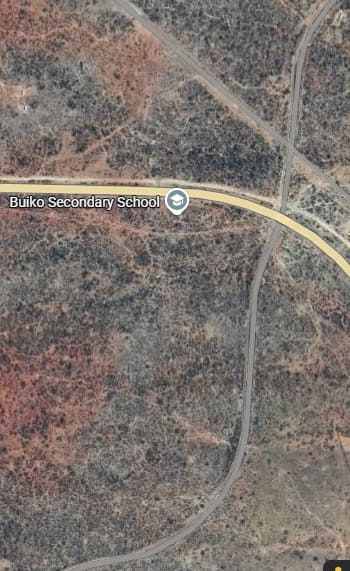
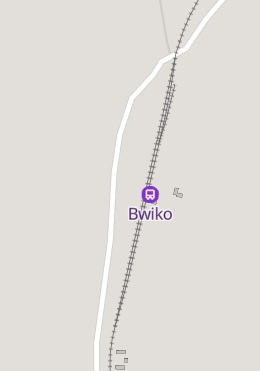
The line turns through Southwest to West and then North before running Northeast. As it does so it passes through Buiko Railway Station which is shown on the MapCarta extract below. [26][Google Maps, March 2026]

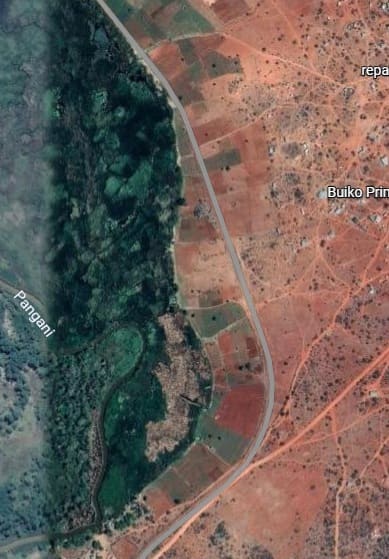
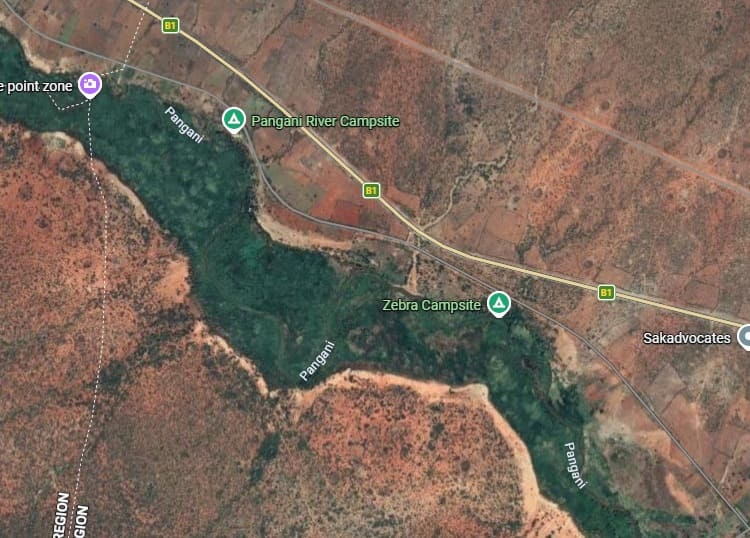
Beyond Buiko, the railway is back near the Pangani River but running at the top of the eastern/northern valley side. [Google Maps, May 2026]

The line can be seen on this extract from Google’s satellite imagery running Northwest, then West and then Northwest again. [Google Maps, March 2026]
The line can still be seen running along the northeastern flank of the Pangani River Valley, seeking as far as possible to keep gradients to a minimum, it follows the contours just above the valley. [Google Maps, March 2026]
Taking slightly closer order with the B1/T2, the line continues generally to the Northeast. [Google Maps, March 2026]
The line enters this extract from Google’s satellite imagery in the bottom-right corner of the image and leaves centre-top. [Google Maps, March 2026]

The line plots a lonely journey Northnorthwest across these two satellite image extracts. [Google maps, March 2026]

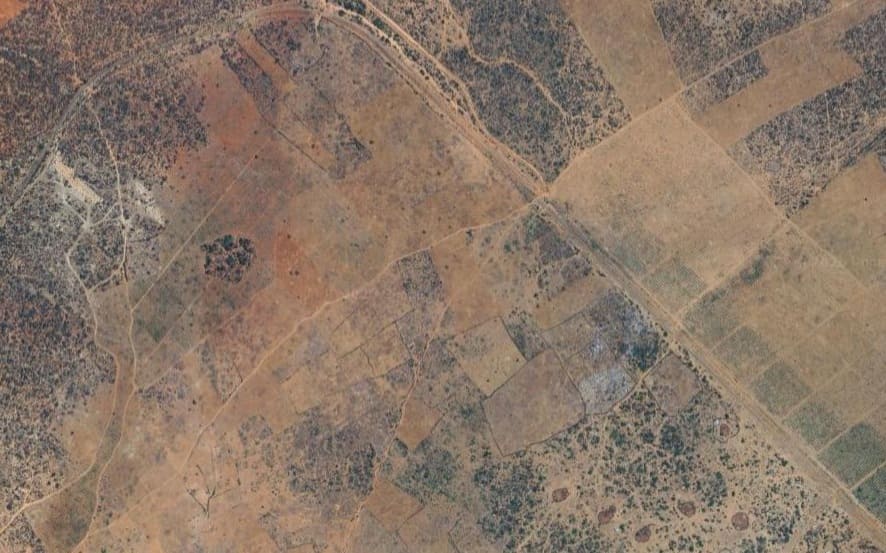
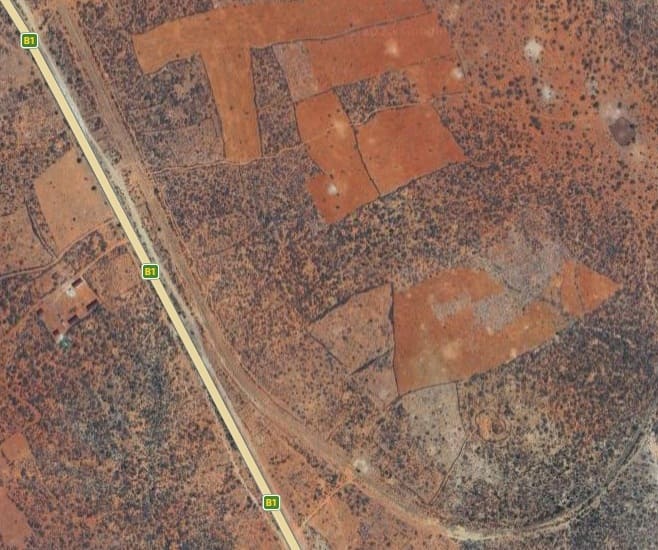
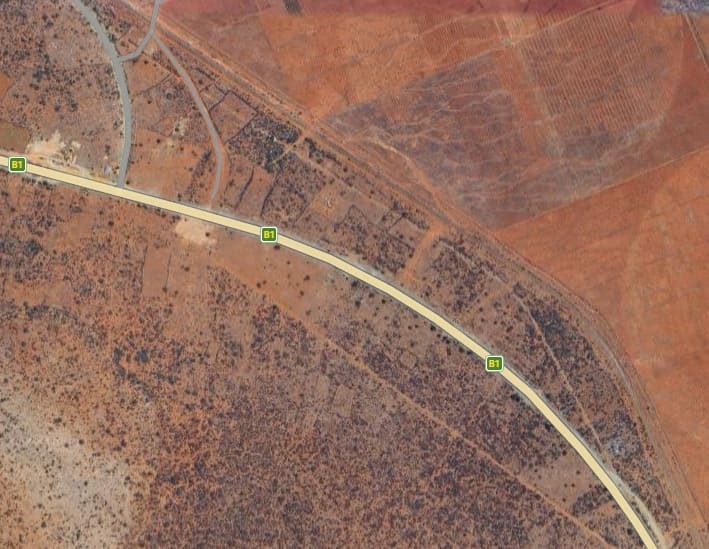
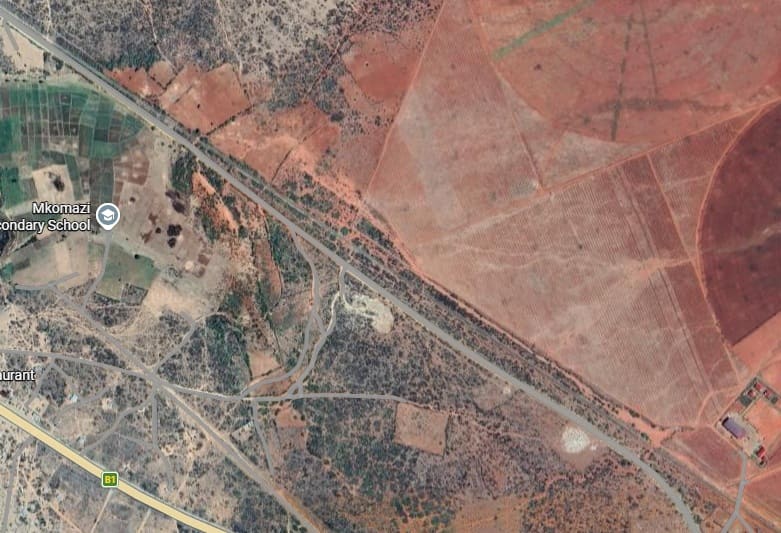
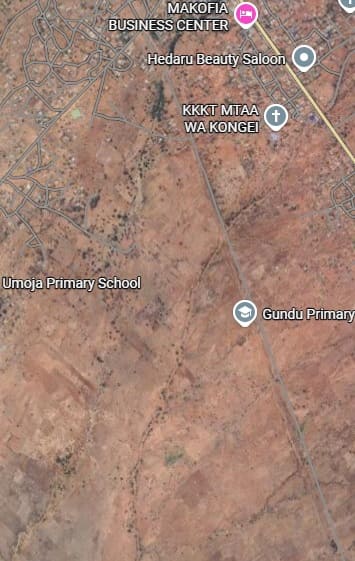
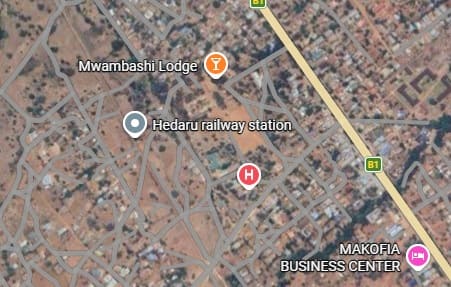
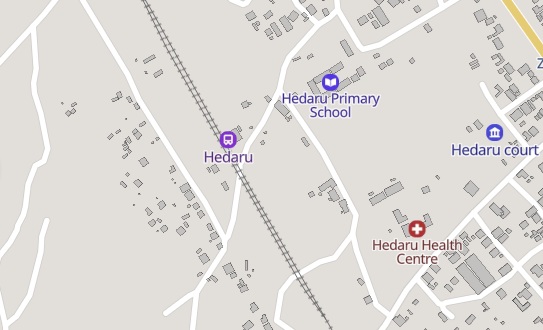
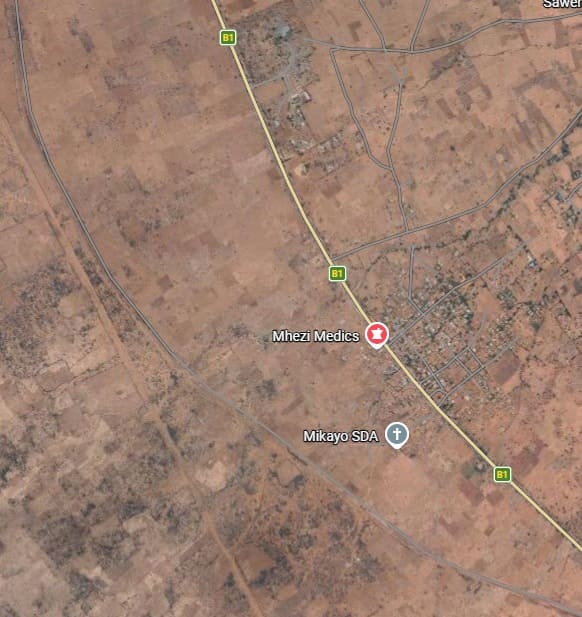
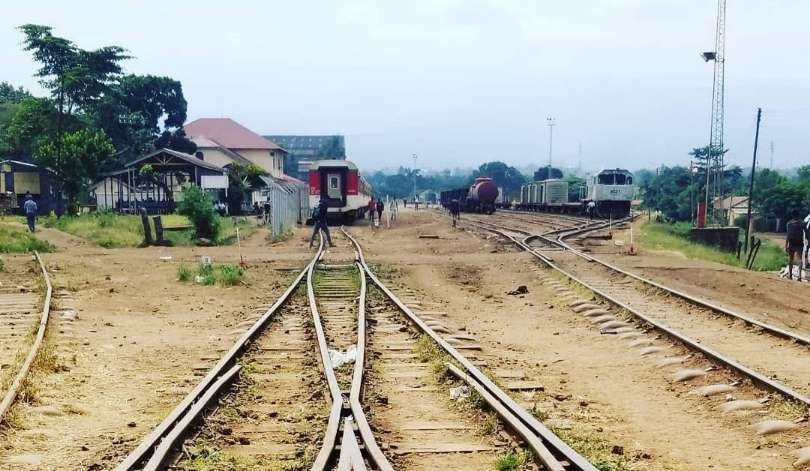
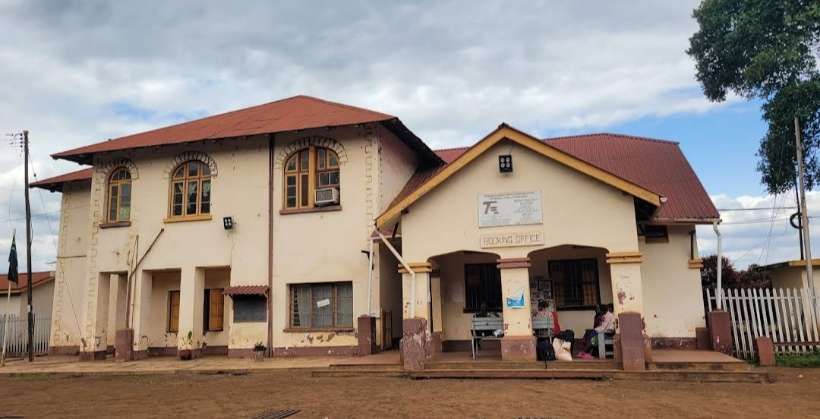
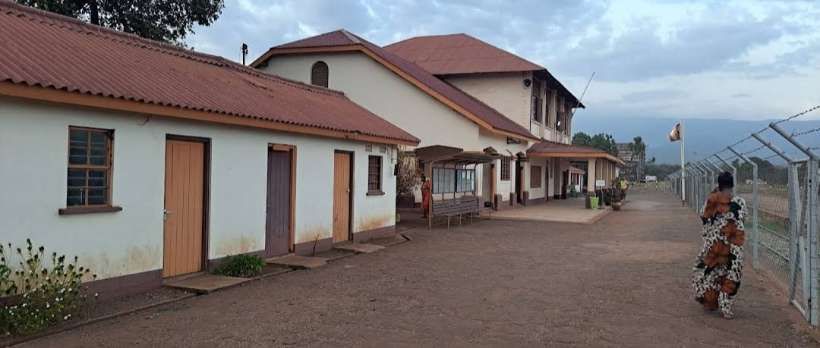
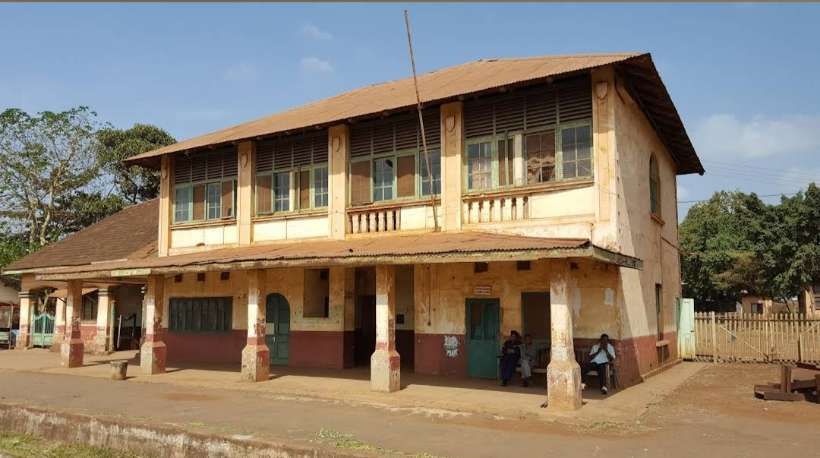
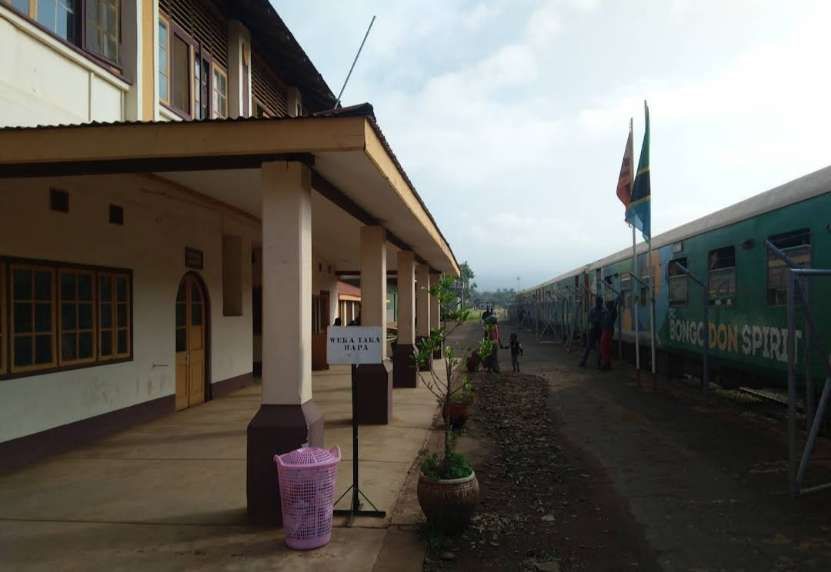
Civilisation of some sort beckons at the top of this next extract. The town is Heraru. Its station sits to the southwest of the town. It is marked by the grey flag on the small image immediately below.

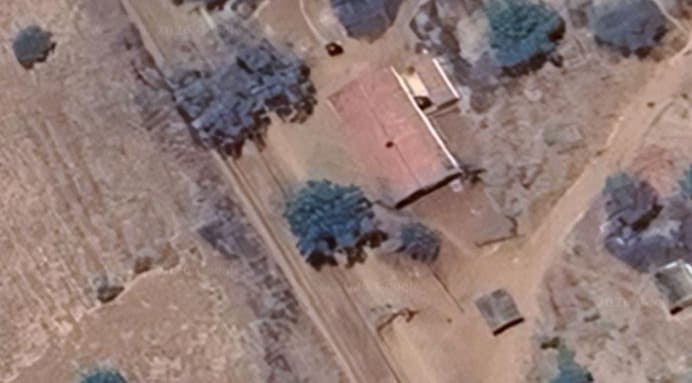
Hedaru Railway Station has a passing loop but otherwise few facilities. [27]

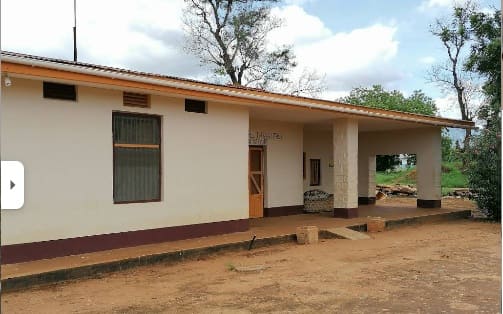
Hedaru Railway Station Building, (c) Beppe Mambretti and shared on Google Maps, May 2021.

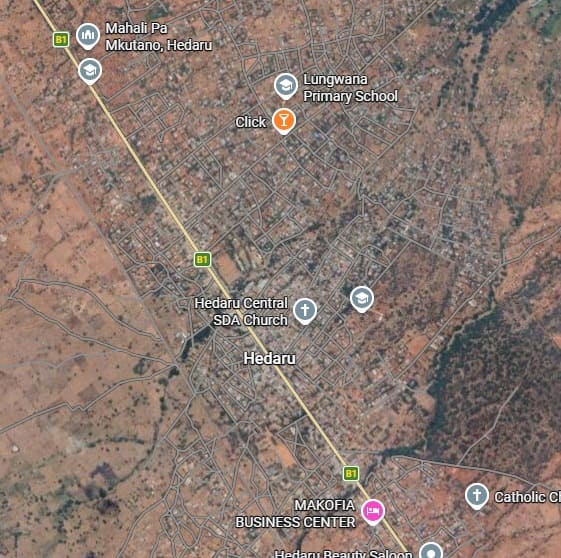
As can be seen on this larger extract from Google’s satellite imagery, Hedaru is a relatively significant sized town. The population of Hedaru was 22,972 according to the 2022 national census. [28][Google Maps, March 2026]

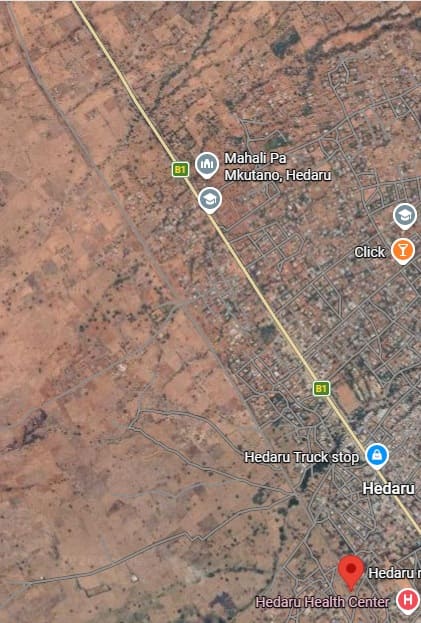
Hedaru Station is marked by the red flag on the first of these two images which begin the journey further North and West along the line. [Google Maps, March 2026]

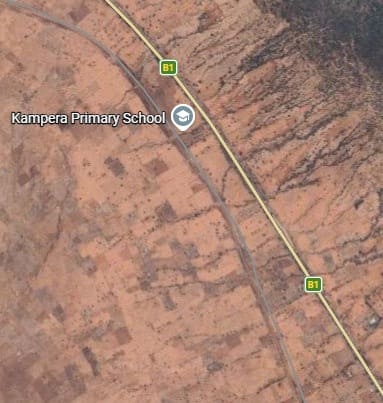
The railway continues to the Northwest, entering this extract in the bottom-right corner and leaving close to the top-left. [Google Maps, March 2026]

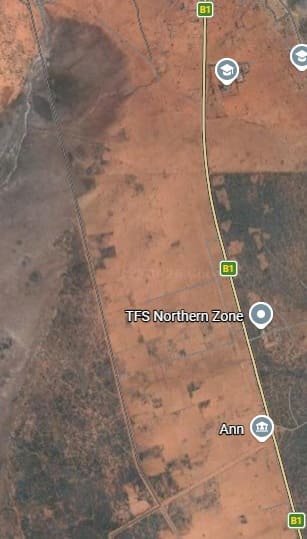
The line continues Northnorthwest towards Mkanya and Same. [Google Maps, March 2026]

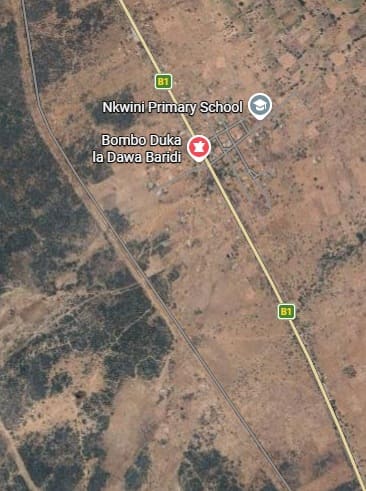
The landscape is quite barren – the occasional school appears on the maps but otherwise only limited evidence of habitation.

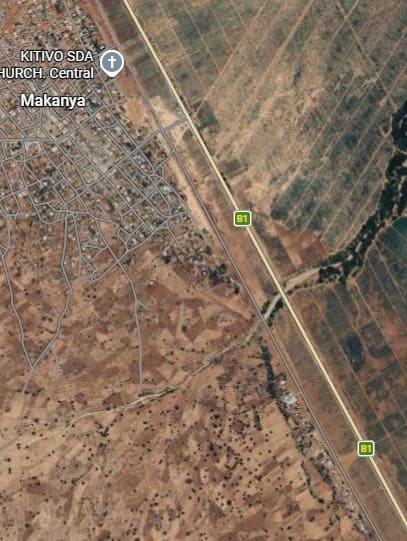
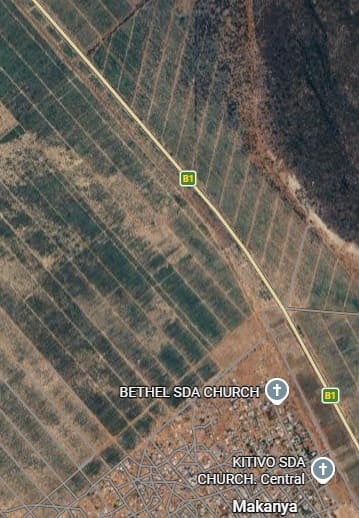
The line then passes through what appear to be Sisal plantations that surround Makanya. [Google Maps, March 2026]

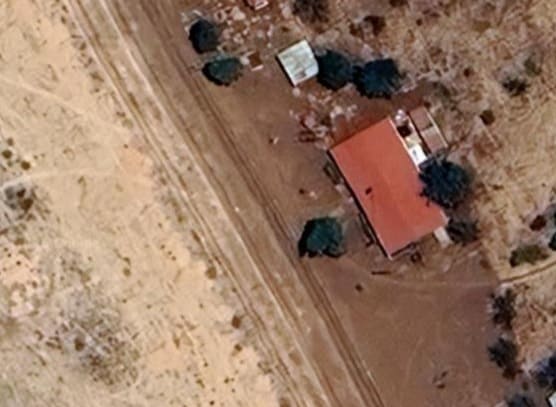
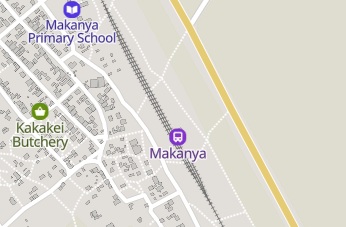
Makanya had a population of 12,980 in 2022. [29] Its railway station was at the South East end of the town.

Makanya Railway Station – two loops off the mainline allowed for trains to pass each other. [30][Google Maps, March 2026]

Beyond Makanya the road and railway run together through the Sisal plantations. Google Maps, March 2026]

The railway and road run close together as they continue North. [Google Maps, March 2026]

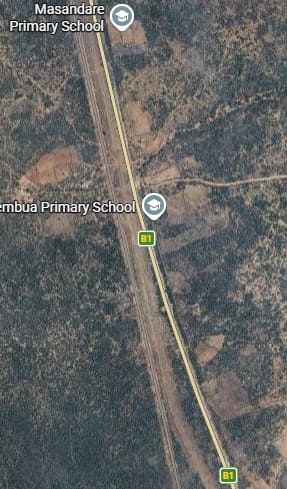
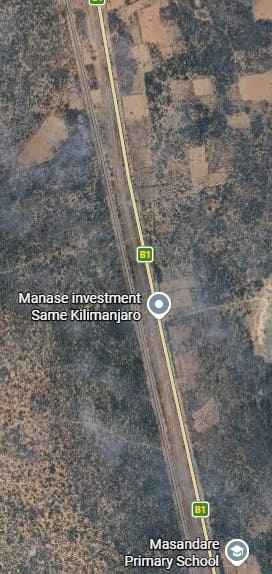
The line is now flanked by two roads which gradually converge until all three run close together past Hembua and Masandare Primary Schools. [Google Maps, March 2026]

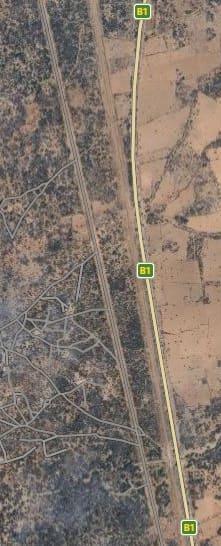
The line continues North close to the B1/T2 [Google Maps, March 2026]

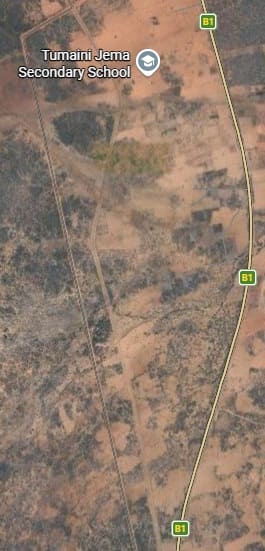
The journey continues North towards Same. [Google Maps, March 2026]

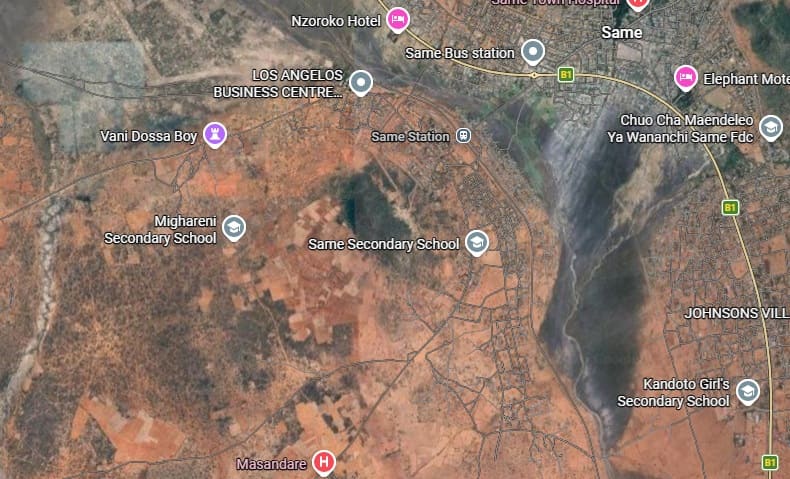
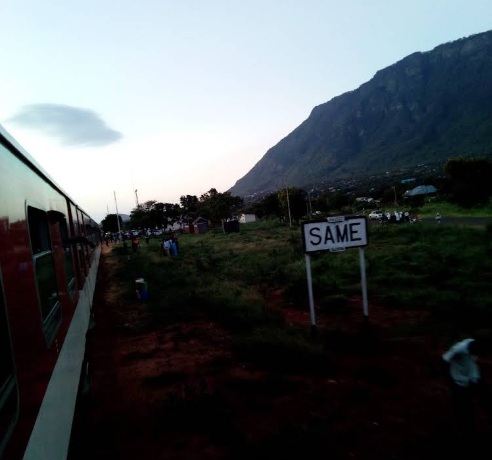
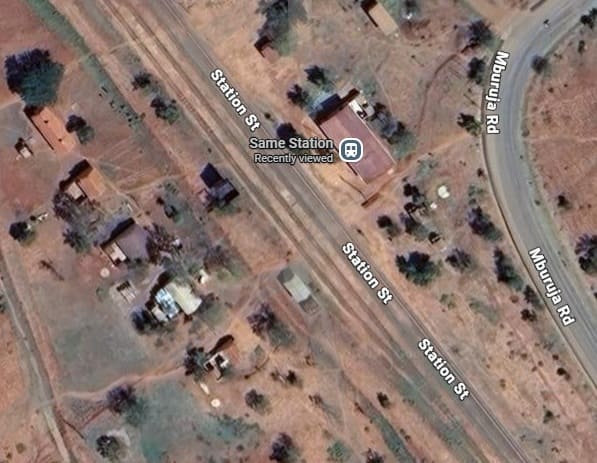
Same’s population in 2012, was 25,794 inhabitants, in 2022, the number had risen to 34,322. [31] The town is close to the Mkomazi National Park. The railway station is just right of centre towards the top of this satellite image. the majority of the town sits to the North and east of the railway station. [Google Maps, March 2026.

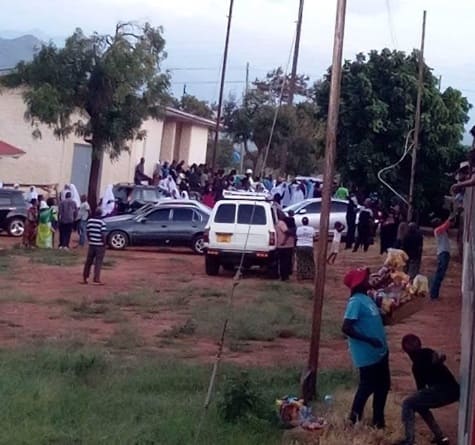
Same in February 2020 (c) Thomas Kimaro. [Google Maps, March 2026]

The two photographs immediately above show Same Railway Station in February 2020.

The station building sits back from the railway tracks with Station Street in between the building and the railway. [Google Maps, March 2026.

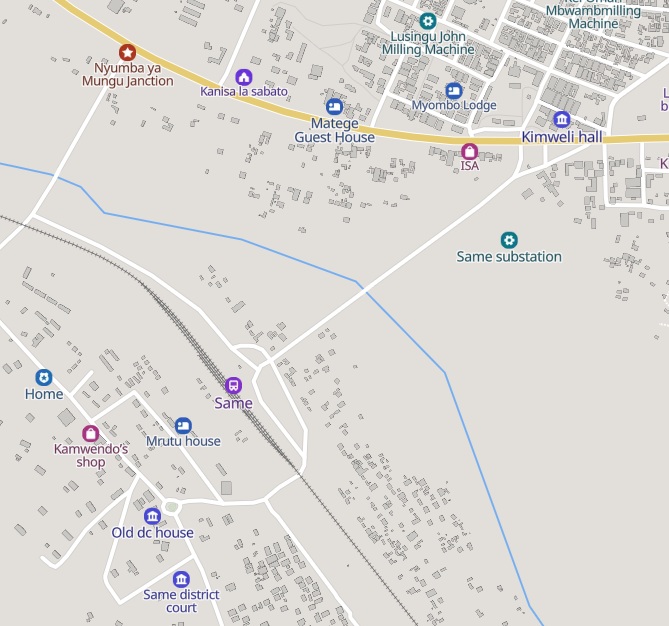
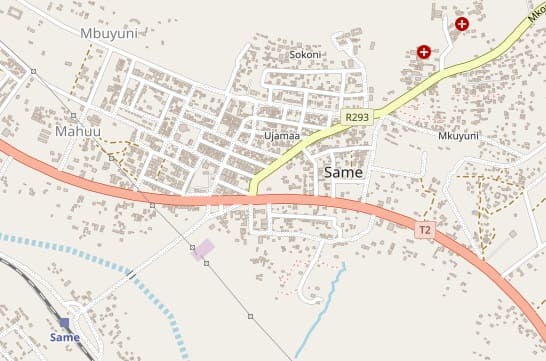
These two maps show Same Railway Station in relation to the town of Same. The MapCarta [32] extract on the left shows three lines running through the station. The OpenStreetMap image [33] shows a little more of the town.

The line heads Northwest out of Same. There is about 100 kilometres to go to reach Moshi and [Google Maps, March 2026]

The line is now following the contours to avoid the heaviest gradients. [Google Maps, March 2026]

The B1/T2 is still following the line. [Google Maps, March 2026]

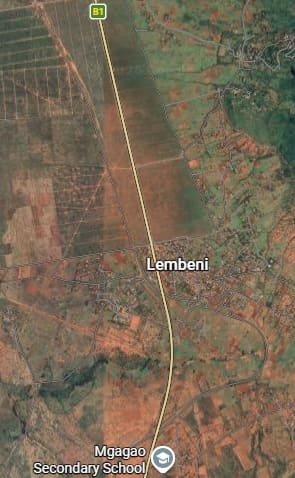
The next town is Lembeni [Google Maps, March 2026]

Careful inspection of the image above shows the line swinging East and then curving round to the West through the town.

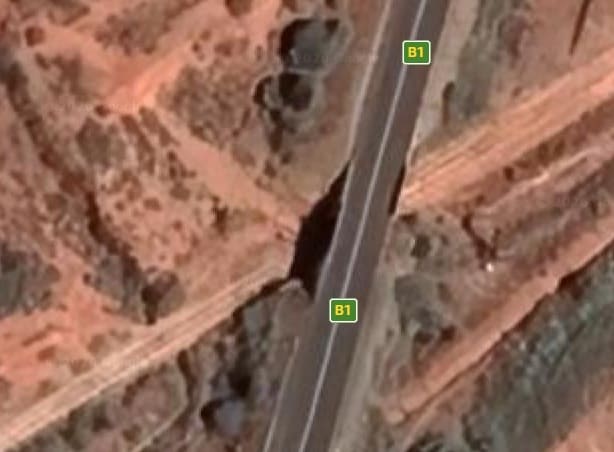
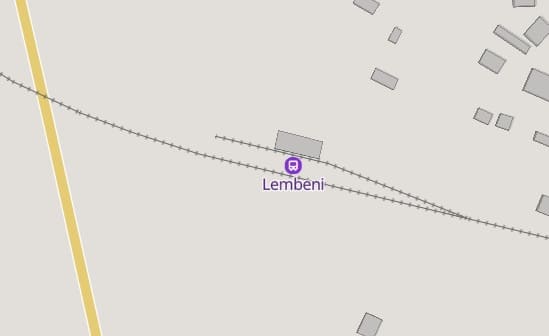
Lembeni Bridge and Railway Station [Google Maps, March 2026] [34]

Lembeni Railway Station. [Google Maps, March 2026]
Two views of the rail bridge over the B1/T2 at Lembeni. That on the left was taken by Kassimu Miraji, that above was taken by Allan Kaitila [Google Maps, March 2026

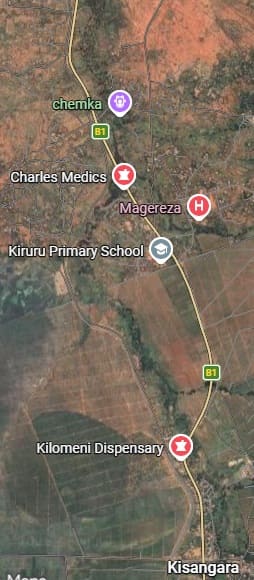
The next extract from the satellite imagery takes the line as far as Kisangara. [Google Maps, March 2026]

Not being able to identify the location of the Railway Halt at Kisangara. One of these two ungated-crossings is as good as any other possible location. [Google Maps, March 2026]

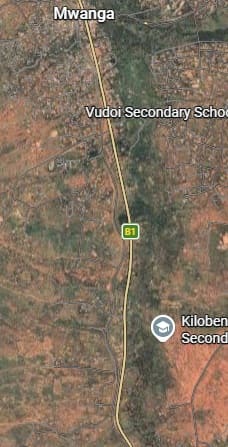
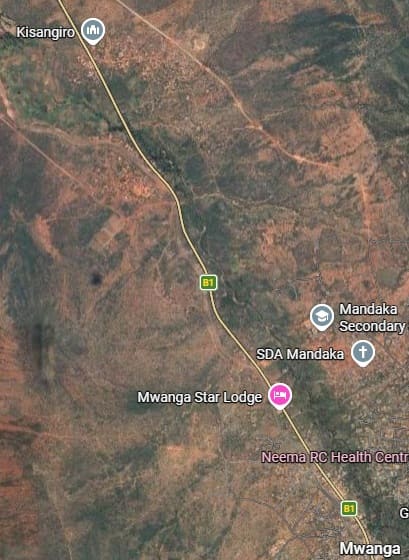
The next location along the line is Mwanga which has no railway station. It does have a bus station! Mbuyuni Halt must have been close to the village. [Google Maps, March 2026]

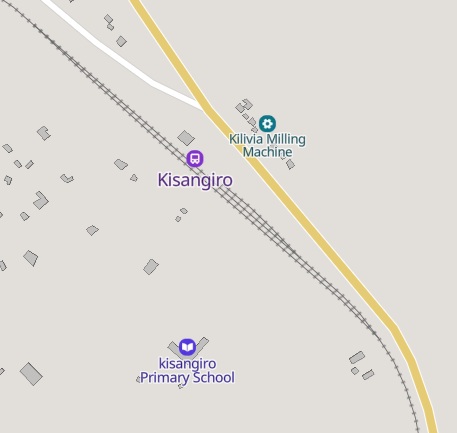
Kisangiro has its own halt on the railway with a passing loop. [35][Google Maps, March 2026]

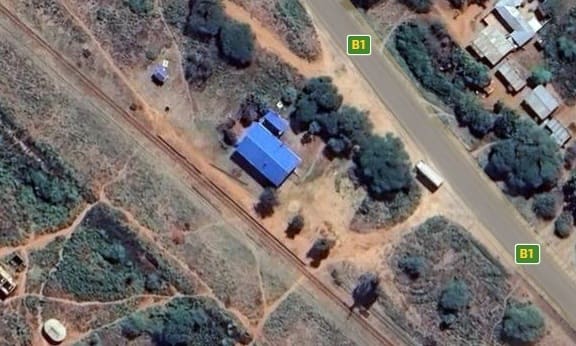
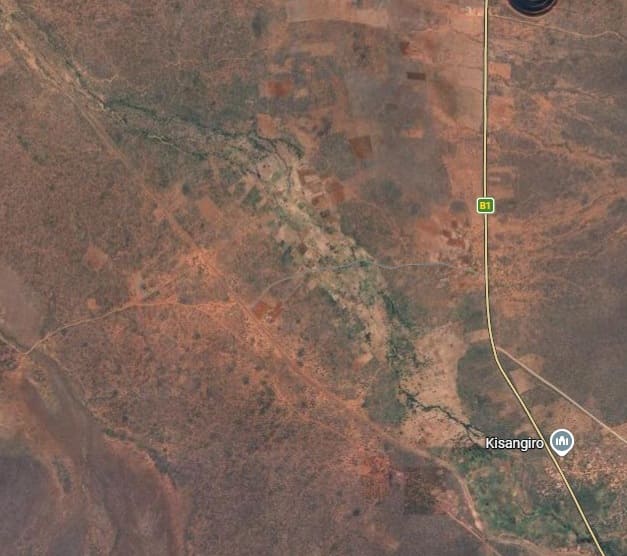
Kisangiro Halt was a distance South of the centre of the village at a location where the railway diverged from the road, running West-northwest on the South side of the greener area visible in the top-left of the larger extract above.

The line heads Northwest carful inspection of the image shows it running from South of the greener area and the bottom-right of the image diagonally across the image to the top-left corner. The road runs North. [Google Maps, March 2026]
Again, careful inspection of this image shows the line running from the bottom-right corner to the top-left. In doing so it crosses the

The bridges over the Rivu River appear to be a Warren Truss Girder Bridge and a large concrete culvert which takes a lesser branch of the river. [Google Maps, March 2026]

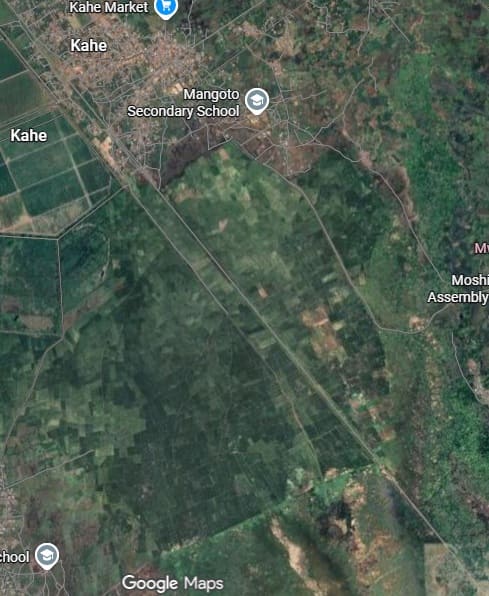
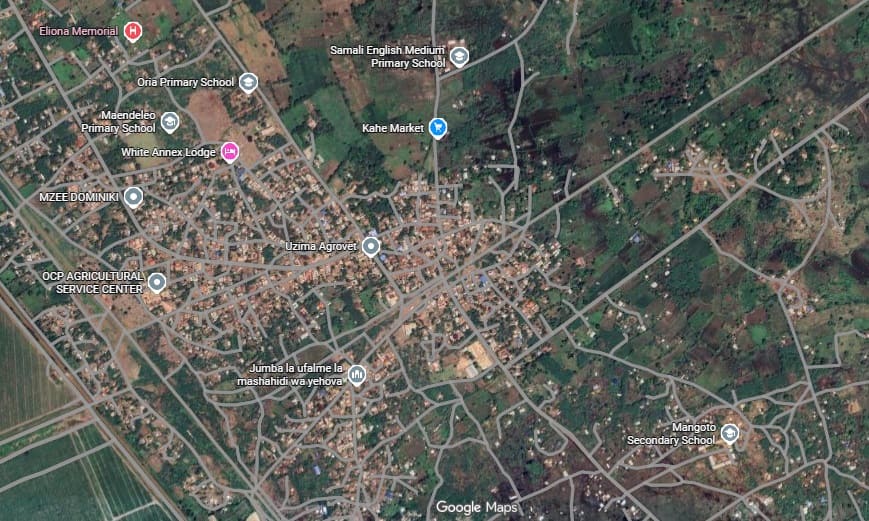
The next significant location along the railway is the town of Kahe which sits at the top of this extract from Google’s satellite imagery. Kahe Railway Station was a junction station. Southest of Kahe Railway Station, the line to Voi in Kenya diverged from the Usambarabahn! [Google Maps, March 2026]
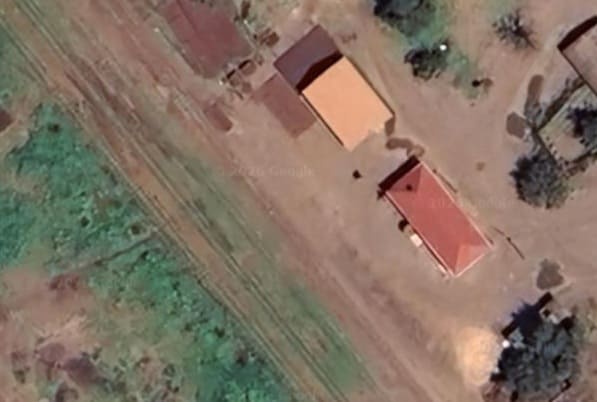
Kahe Railway Station is centre-left on this satellite image. The line from Kenya enters at the top-right corner of the image and runs diagonally towards the bottom-left.
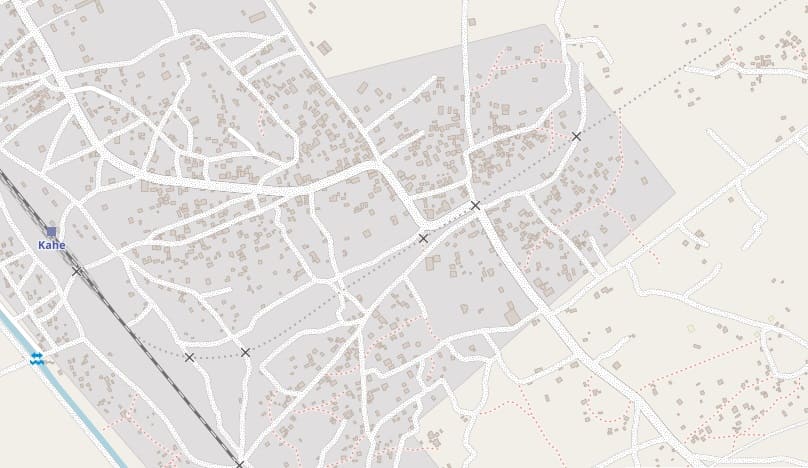
A similar area on the mapping provided by Openstreetmap.com, which shows the line from Voi meeting the Usambarabahn. [39]
Kahe Railway Station. [36] [Google Maps, March 2026]

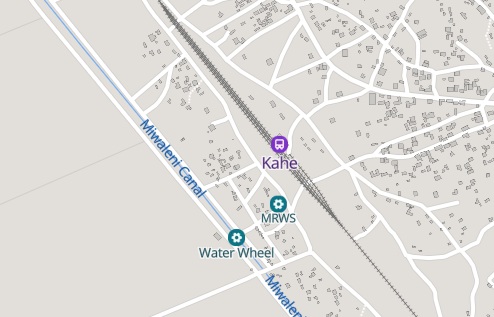
The line between Voi and Kahe can be followed here. [40]

We continue North-northwest from Kahe Railway Station. …

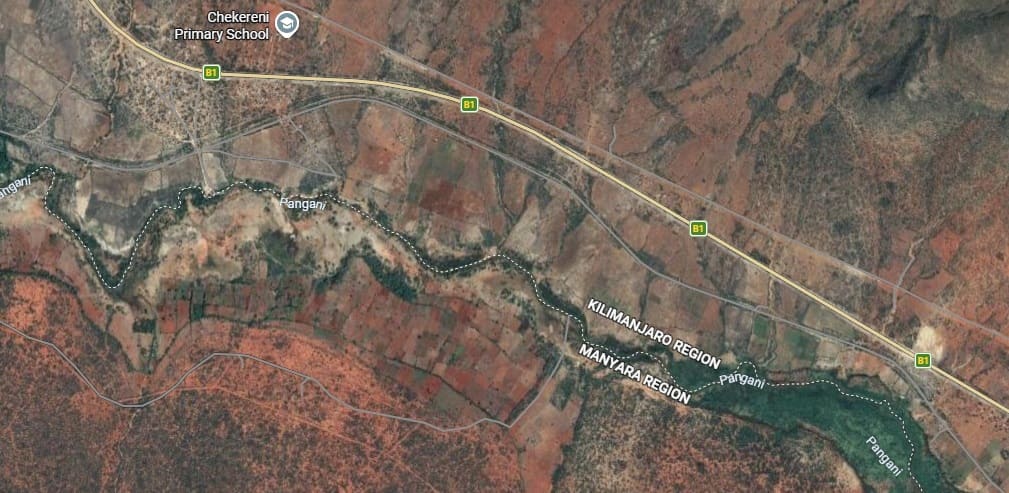
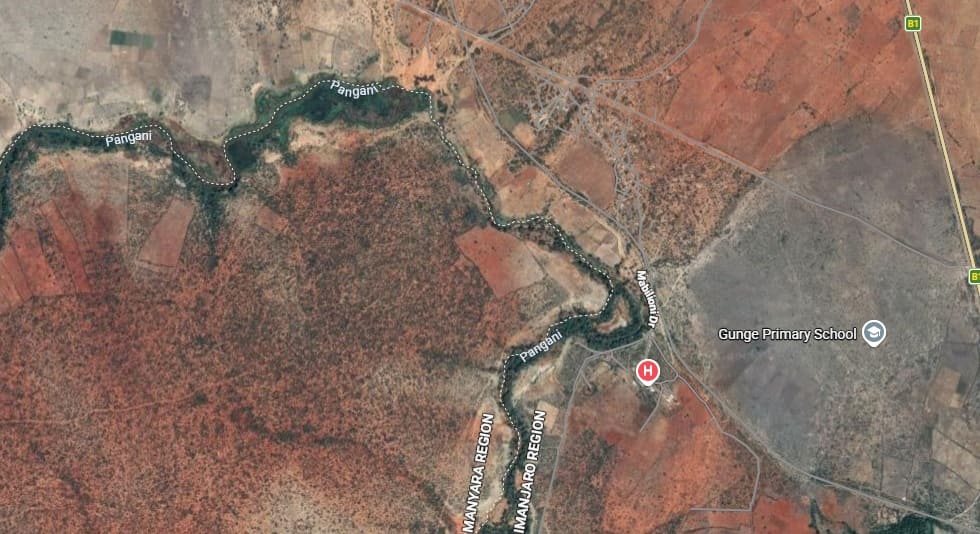
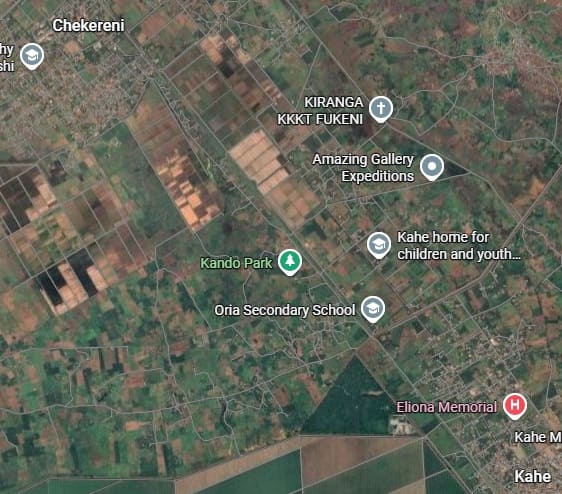
Chekereni lies to the Northwest of Kahe and is at the top-left of this next satellite image. This area of Tanzania is noticeably more fertile. [Google Maps, March 2026]
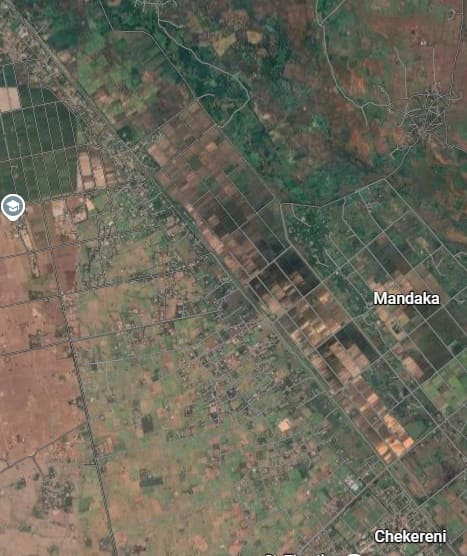
Again, the line runs bottom-right to top-left. [Google Maps, March 2026]
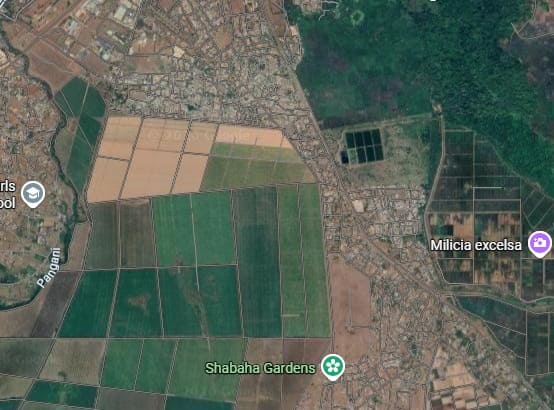
This next extract from Google’s satellite imagery takes us into the suburbs of Moshi. The line enters bottom-right once again. It leaves the top of the image close to the centre. [Google Maps, March 2026]
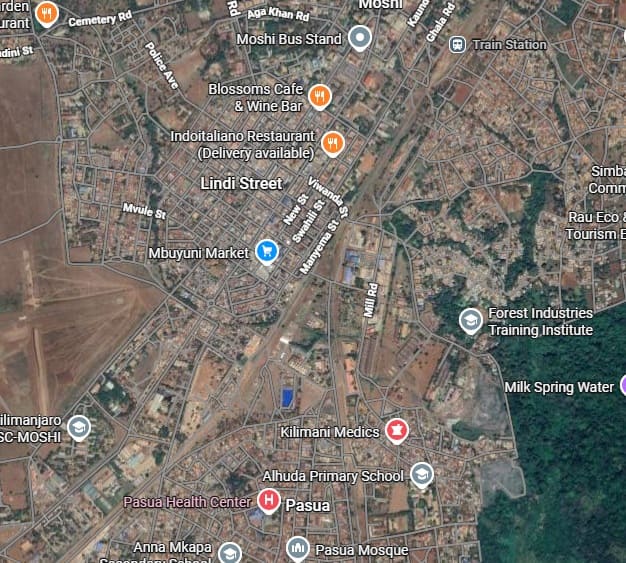
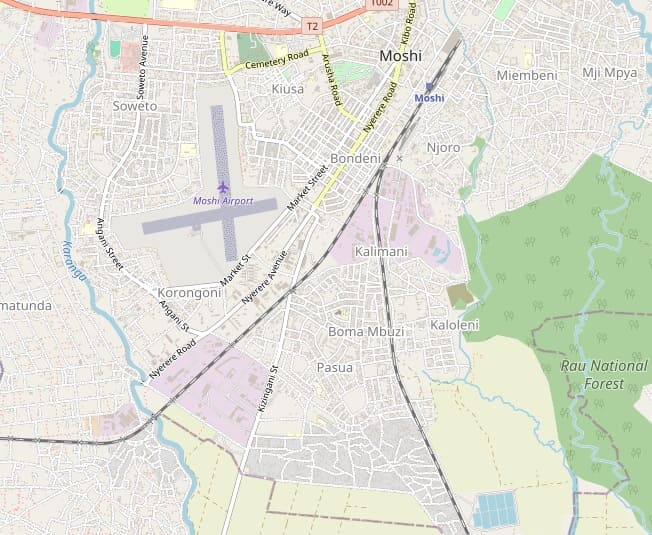
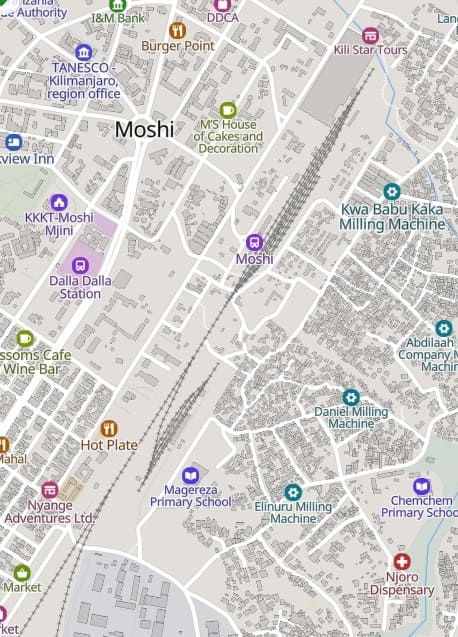
The railway station in Moshi is a terminus. The line to Arusha heads away to the Southwest. The line from Tanga and Dar-es-Salaam enters from the South. [Google Maps, March 2026]
The lines are much clearer on this extract from the OpenStreetMap mapping. [37]

This extract from MapCarta shows the track layout in the vicinity of Moshi Railway Station. [38]

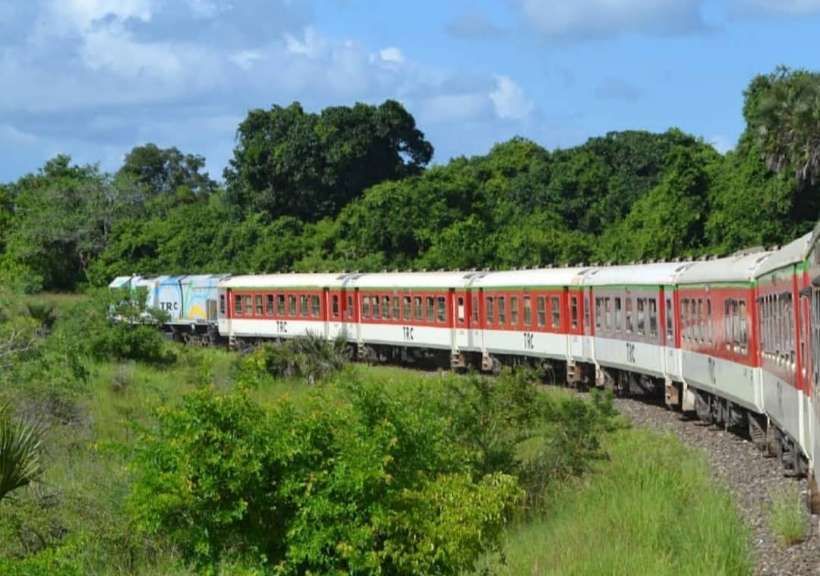
Tanzania Railways train on the curve South of Moshi Railway Station. This is a luxury train heading Southeast away from Moshi Railway Station, © Ally Kessy, 2020. [Google Maps April 2026]
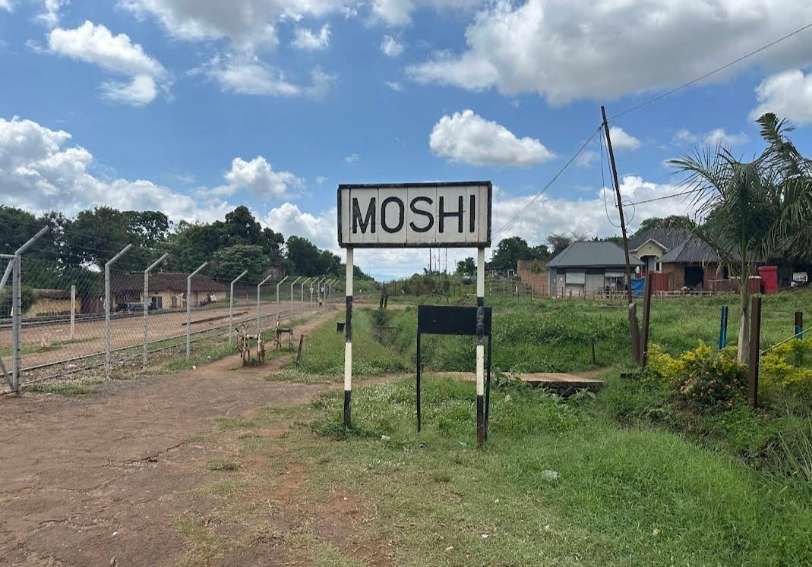
The Station Sign © カーンオリバー, 2025. [Google Maps, April 2026]
The approach to the passenger facilities at Moshi Railway Station in 2021, © Ally Kessy. [Google Maps, April 2026]
The station forecourt, Moshi Railway Station, © Kisali, 2025. [Google Maps, April 2026]
The rail side elevation of Moshi Railway Station. Note the security fencing between the station building and the rail tracks. © Tanzania Railways, 2022. [Google Maps, April 2026]
The platform elevation of Moshi Railway Station again, © Seva TV, 2018. [Google Maps, April 2026]
A passenger train sits in Moshi Station in 2022, © Michael Emmanuel. [Google Maps, April 2026]

We have reached the end of what was the Usambarabahn. The extension to Arusha came much later. We have also noted, as part of this article, the point where the line between Moshi/Kahe and Voi in Kenya met the Usambarabahn. We will come back to both of those lines on another occasion.

References

  1. M.F. Hill; Permanent Way Volume II: The Story of the Tanganyika Railways; East African Railways and Habours, Nairobi, Kenya; Watson & Viney, Aylesbury & Slough, 1957.
  2. https://www.facebook.com/share/p/1ALffLxhDg, accessed on 18th March 2026.
  3. https://www.google.com/search?client=ms-android-motorola-rvo3&hs=AZD&sca_esv=b05c8d9632b51df6&sxsrf=ANbL-n5vLNTMT9J1cn4sS7VDi8IhkG_BNg%3A1773944351007&q=tanga%20railway%20station%20photos&si=AL3DRZGgcPNmWPDVEk81ds4iaXPEjuNcyuY9Q822zd2Q3wgtDLa9VVF_9x9TK7LuOrzAGGVlybqvwgpMRLdjvIPVO6109T3ngqw96Xr3Qzr3BAwZo0lgWOz-pkCpT8YplwOa9Nc8V9yUN8GP7Lus4LLAZVKs0HHFqg%3D%3D&ved=0CBEQy9gMahcKEwj4td_XyayTAxUAAAAAHQAAAAAQCg&ictx=1#ebo=1&lpg=cid:CgIgAQ%3D%3D,ik:CAoSF0NJSE0wb2dLRUlDQWdJREM2Y3IxMmdF, accessed on 19th March 2026.
  4. https://www.google.com/search?client=ms-android-motorola-rvo3&hs=AZD&sca_esv=b05c8d9632b51df6&sxsrf=ANbL-n5vLNTMT9J1cn4sS7VDi8IhkG_BNg%3A1773944351007&q=tanga%20railway%20station%20photos&si=AL3DRZGgcPNmWPDVEk81ds4iaXPEjuNcyuY9Q822zd2Q3wgtDLa9VVF_9x9TK7LuOrzAGGVlybqvwgpMRLdjvIPVO6109T3ngqw96Xr3Qzr3BAwZo0lgWOz-pkCpT8YplwOa9Nc8V9yUN8GP7Lus4LLAZVKs0HHFqg%3D%3D&ved=0CBEQy9gMahcKEwj4td_XyayTAxUAAAAAHQAAAAAQCg&ictx=1#ebo=1&lpg=cid:CgIgAQ%3D%3D,ik:CAoSF0NJSE0wb2dLRUlDQWdJQ2szYi1Pd2dF, accessed on 19th March 2026.
  5. https://unitedrepublicoftanzania.com/economy-of-tanzania/infrastructure-in-tanzania/railway-in-tanzania/tanga-line-a-historic-railway-route-through-northern-tanzania, accessed on 20th March 2026.
  6. https://en.wikipedia.org/wiki/Usambara_Railway, accessed on 13th March 2026.
  7. https://maps.app.goo.gl/C952JgVPwCuYSAv98, accessed on 20th March 2026.
  8. https://www.gettyimages.co.uk/photos/usambara-railway, accessed on 21st March 2026.
  9. https://imagerenderer.com/images/rendered/share/68974575&domainId=12, accessed on 21st March 2026.
  10. Hans Wettich; The development of Usambara under the influence of the East African Northern Railway and its private branch lines, with special consideration of the Mkumbara-Neu-Hornow cableway; Simion, Berlin 1911. Reprint from: Proceedings of the Association for the Promotion of Industry 90 (1911), Issue 6; via https://publikationen.ub.uni-frankfurt.de/frontdoor/index/index/docId/11924, accessed on 24th February 2026.
  11. https://africacommons.net/artifacts/3029389/korogwe-station-tanzania-africa-ca/3858567, accessed on 25th March 2026.
  12. https://en.wikipedia.org/wiki/Korogwe, accessed on 25th March 2026.
  13. https://mapcarta.com/N8806556763/Map, accessed on 25th March 2026.
  14. https://mapcarta.com/N274950072/Map, accessed on 25th March 2026.
  15. https://mapcarta.com/12650936/Map, accessed on 25th March 2026.
  16. https://mapcarta.com/N8807059101/Map, accessed on 25th March 2026.
  17. https://unitedrepublicoftanzania.com/economy-of-tanzania/infrastructure-in-tanzania/unlocking-the-beauty-and-significance-of-the-cathedral-church-of-st-michael-and-all-angels-in-korogwe-a-closer-look/, accessed on 25th March 2026.
  18. https://en.wikipedia.org/wiki/Korogwe#/media/File:St._Michael’s_Cathedral,_Korogwe.jpg, accessed on 25th March 2026.
  19. https://mapcarta.com/N8806543490/Map, accessed on 27th March 2026.
  20. https://www.openstreetmap.org/node/8806556432#map=18/-5.016856/38.327058, accessed on 28th March 2026.
  21. https://mapcarta.com/34359746/Map, accessed on 28th March 2026.
  22. https://mapcarta.com/N8804470889, accessed on 28th March 2026.
  23. https://rogerfarnworth.com/2026/03/08/the-mkumbara-to-neu-hornow-cableway-ropeway-usambara-hills-tanganyika
  24. https://mapcarta.com/12650936/Map, accessed on 29th March 2026.
  25. https://www.openstreetmap.org/#map=15/-4.64654/38.07093, accessed on 29th March 2026.
  26. https://mapcarta.com/34359722/Map, accessed on 29th March 2026.
  27. https://mapcarta.com/34355144, accessed on 30th March 2026.
  28. https://datacommons.org/place/wikidataId/Q20614510, accessed on 30th March 2026.
  29. https://www.wikidata.org/wiki/Q20619402, accessed on 30th March 2026.
  30. https://mapcarta.com/12656052, accessed on 30th March 2026.
  31. https://www.citypopulation.de/en/tanzania/cities, accessed on 31st March 2026.
  32. https://mapcarta.com/12646230/Map, accessed on 31st March 2026.
  33. https://www.openstreetmap.org/#map=15/-4.07147/37.73321, accessed on 31st March 2026.
  34. https://mapcarta.com/12657728, accessed on 31st March 2026.
  35. https://mapcarta.com/N8736426762, accessed on 31st March 2026.
  36. https://mapcarta.com/34355154, accessed on 31st March 2026.
  37. https://www.openstreetmap.org/node/255602805#map=15/-3.35899/37.34255, accessed on 31st March 2026.
  38. https://mapcarta.com/Moshi, accessed on 31st March 2026.
  39. https://www.openstreetmap.org/#map=16/-3.49420/37.44452, accessed on 9th April 2026.
  40. https://rogerfarnworth.com/2026/04/09/railways-of-tanzania-part-3-voi-kenya-to-kahe-and-moshi-tanzania