
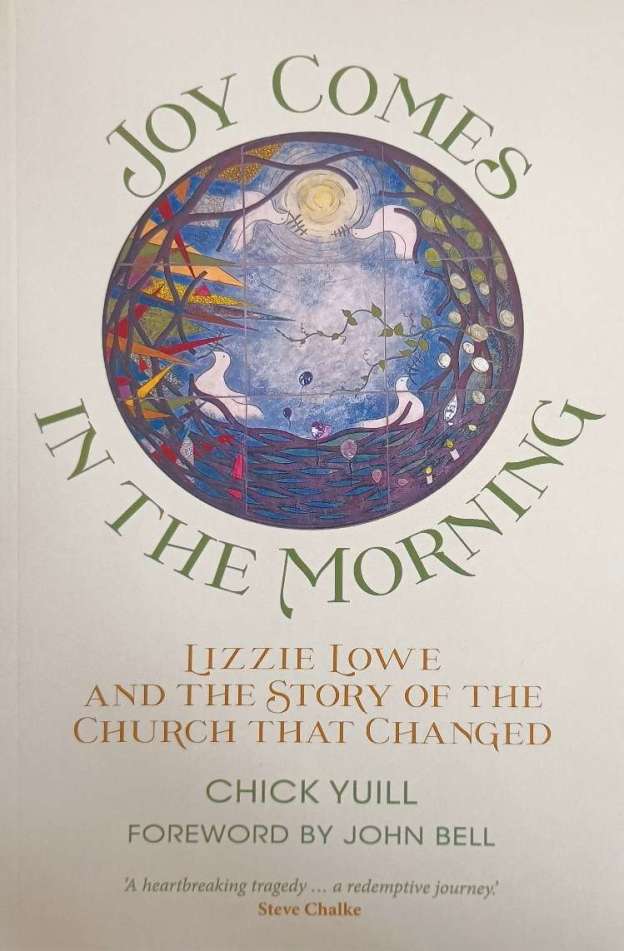
This is the title of a book written by Chick Yuill. It is a story of loss and change in a South Manchester suburb, Didsbury. It was published by Darton Longman & Todd in 2026.
“The author has waived his right to all royalties, these will go directly to Lizzie’s Legacy, the charity set up in Lizzie’s memory to further greater inclusion and diversity.” [1: back cover]
The Church in question is my sending parish, St. James & Emmanuel, Didsbury, where I explored a call to ordained ministry in the Church of England in the 1990s.
Chick Yuill recounts a ten-year journey of St James and Emmanuel Church, Didsbury to become a fully inclusive worshipping community following the tragic death of a member of their congregation, fourteen-year-old Lizzie Lowe, who took her own life in 2014.
Lizzie had a growing awareness that she was gay but did not feel able to reconcile that realisation with her Christian faith, nor to confide in any adults within the church. Chick Yuill tells Lizzie’s story and that of her family, before telling the story change experienced by the church.
This book “has been written with the full involvement of Lizzie’s parents Kevin and Hilary Lowe, Bishop Nick Bundock who was rector of the congregations at the time, and other members of St James and Emmanuel.”
John Bell talks of Lizzie Lowe as “the seed which has fallen to the ground and produced a rich harvest.” This book enters the pain and grief experienced by Lizzie’s family and their church. It faces into the sense of culpability which the congregations in Didsbury felt over their failure to provide a place where a teenager could talk openly about her struggles. It speaks clearly about the journey of the church to a place of full inclusion.
The front cover illustration is detail of a work by Gordon Cooke and Nick Roberum which was unveiled on Saturday 14th September 2025 by Kevin & Hilary Lowe. It commemorates Lizzie’s death, it celebrates “the impact of her all-too-short life on St James and Emmanuel and the wider church. It is a powerful and evocative image, a collaboration between two gifted local craftsmen, Gordon Cooke, a ceramicist, and Nick Roberson, a stone carver. … Just over a metre in diameter, the circular ceramic design is based on the concept of the web of the church being torn apart by Lizzie’s tragic death and then being renewed and woven together again by the subsequent change of attitude brought about by her passing – a change that led to St James and Emmanuel’s fully inclusive stance. There are jagged shapes on one side opposite shoots of vegetation on the other that reflect both the pain of the journey and the new life that has sprung from such terrible loss. Four doves of peace, each with a green shoot in its beak, remind one of the renewal of the earth after the devastation of the great flood in the Genesis story. Small candles glow and purple balloons – Lizzie’s favourite colour – float gently upwards. In the centre, drawing its light from a glowing sun, is a bright white sky that, like a portal, seems to invite the onlooker into some heavenly realm. And the whole thing is set in a bold stone surround on which the words of Psalm 30 verse 5 are etched: ‘Weeping may endure for a night, but joy comes in the morning.’” [1: p161-162]
The book is both easy to read and difficult to encounter, Chick Yuill tells the story well but the pain is evident. The book is both raw and pragmatic, it faces into deep pain and loss but tells a helpful story of engagement with questions of ethics and theology. It covers the process of consultation with the congregation and does not avoid recounting mistakes made. Real inclusion is hard won and at times difficult to sustain as it makes room even for those who opposed change.
The book is built around testimonies of the impact of change in the lives of a number of individuals. These personal stories root the narrative which is not so much an intellectual journey as one which sees the Holy Spirit at work in the lives of different individuals bringing both joy and hope in the midst of deep despair. It is a powerful story of the redemption and conversion of a community of Christian believers.
John Bell suggests that readers should take time to read this book slowly. … Good advice!
This short paperback book might help us believe that real change is possible.
When our hearts are opened, for whatever reason, we can be changed, we can see the truth more clearly. God’s grace, God’s love, creep past the barricades of our comfort, our certainty and our fears.
For that to happen, we need to allow ourselves time to truly hear the stories of those Chick Yuill interviewed in his research.

